CHAPTER IV TWO MINISTERS, A BARD, A SCHOOLMASTER, AN INNKEEPER, AND OTHERS — Mr. Jones, the Minister — The Landlord of the "Cross Inn" — Mr. Rowlands, the Minister — The Poacher — Llewellyn, the Bard — Azariah John Pugh — Morgan Rhys and Others
55
Jones is a little, thin, long-skulled, black-haired,
pale Congregational minister, with a stammer and
a squint. He has a book-shelf containing nothing
but sermons and theology, which he has read, and
the novels of Sir Walter Scott, which he hopes to
read. I suppose he believes in metempsychosis.
He is accustomed to say that everything is theology—which
is fine; and that theology is everything—which
is hard. He tries to love man as
well as God, and succeeds in convincing every one
of his honesty, generosity, and industry. In the
care of souls he fears no disease or squalor or shape
of death. But there is a condescension about his
ways with men. He calls them the worldliest of
God's creatures. But with the Divine he is happy
56and at ease, and in his pulpit seems to sit on the
right hand. Then his Biblical criticism is absent
as if it had never been, and he sees the holy things
at once as clearly as Quarles and as mystically as
Herbert or Crashaw. He speaks of them with the
enthusiasm of a collector or of a man of science
dealing with a bone or a gas. Like them, he sees
nothing but the subjects of the moment. He
loves them as passionately and yet with a sense of
possession. He gives to them the adoration which
he seems wilfully to have withheld from women,
pageantry, gardens, palaces—which his speech
would have adorned. He lavishes upon them his
whole ingenious heart, so that, to those used to
the false rhetoric and dull compliment of ordinary
worshippers, there is in his sermons something
fantastical, far-fetched, or smelling of the lamp.
If he has to describe something naked or severe,
he must needs give them a kind of voluptuousness
by painting the things which they lack, and the
lack of which makes them what they are. With
Herbert, he might repeat:
57My God, where is that ancient heat towards thee,
Wherewith whole shoals of Martyrs once did burn,
Besides their other flames? doth Poetry
Wear Venus' livery? only serve her turn?
Why are not Sonnets made of thee? and lays
Upon thine altar burnt? Cannot thy love
Heighten a spirit to sound out thy praise
As well as she? Cannot thy Dove
Outstrip their Cupid easily in flight?
Or, since thy ways are deep, and still the same,
Will not a verse run smooth that bears thy name?
Why doth the fire which by thy power and might
Each breast does feel, no braver fuel choose
Than that, which one day worms may chance refuse?
Sure, Lord, there is enough in thee to dry
Oceans of ink; for as the Deluge did
Cover the Earth, so does thy Majesty;
Each cloud distils thy praise, and doth forbid
Poets to turn it to another use.
Roses and lilies speak thee: and to make
A pair of cheeks of them, is thy abuse.
Why should I women's eyes for crystal take?
Such poor invention burns in their low mind
Whose fire is wild, and does not upward go
To praise, and on thee, Lord, some note bestow.
Open the bones, and you shall nothing find
In the best face but filth; when, Lord, in thee
Thy beauty lies in the discovery.
It is no matter to him that to the uninspired
audience his holy persons appear only exquisite
marionettes. His sermons are all of his love
for them. Could one leave out the names of
prophet and evangelist, they might seem to
be addressed to earthly beauties. No eyebrow
ever awakened more glowing praise. He takes
religion, as he does his severe morality, like a
sensuous delight. One might think from his
58epithets that he was an æsthete, except that he is
so abandoned.
When he ventures to speak of men, their very
virtues and vices are all handled in such a way
that they seem to be his own imaginations. Thus,
his drunkard is as unreal and as terrible as a chimera.
The words are those of a man who has conceived
a drunkard in his own brain, and then, seeing
the real thing, has preferred his own conception,
and shunned the poor human imitation. Still, he
speaks of religious things, of incidents in the life of
David or Christ or the Maries, as if he had seen, for
example, the Holy Family in some misty barn among
his own hills. I have even heard him introduce a
farmer whittling a flail of hazel sticks and binding
it with willow thongs, in a picture of that scene.
This quaintness and clearness are perhaps the
result of his not quite healthy asceticism. But
even by the farmhouse fire he makes use of them,
and will speak of the red or brown hair of scriptural
characters, and even of the grey hair and shining
eyes of Charity. In hunger or weariness or pain,
common people sometimes see things thus: he
never sees them otherwise. In the chapel they
delight the older labourers, and yet fail because they
vanish in the cold night air and "leave not a rack
59behind." Some hearers, on the other hand, sicken
at them, when the blood is noisy in the breast and
the brain is warm, as they sicken at drugs.
It is not, therefore, surprising that at one time
he had gorgeous earthly dreams. But with an
oddity of which nothing will cure him, he is much
troubled by this pomp which he desires not to see
save in celestial things. And now he allows sleep
nightly but a brief victory over him.
A very pretty companion for Jones was Owen,
the innkeeper, a robust man of words, who called
himself the preacher's best customer, because he
needed so much of his charity.
He was a perfect Celt, according to the English
superstition. For never was there such a failure
who was also such a swaggerer as he. He had fair
hair, blue eyes, and a small, elegant beard, which
Business could not make dull, nor passion wild.
He was bullied by a contemptuous wife; he was
ridiculed by all his regular customers, rallied by the
rest. But the beard was always neat and fair, a
symbol of his unconquerable mind. No matter how
he was trodden down, he smelt sweet. He had
60humour, for he could laugh at himself, though he
lacked the common gift of being able to laugh at
others, and had no repartee. The more lusty the
Saturday night thrusts at him, the more vivid was
his reply, and it was commonly a piece of egoism
and self-exposure, which, if not so long and so
wonderfully draped, would have called for a repetition
of the very blow he was parrying. Once when
he had been sold up and had little more than a wife
and a walking-stick in the world, and his position
attracted some trifling compliments and condolences
from his old harriers, he stood up, and, wielding his
stick and motioning to his wife to be silent, gave
an inventory of the things he had lost with such
decoration as would have abashed an auctioneer.
There is a Welsh proverb, "A Welshman keeps
nothing until he has lost it"; and the now invisible
and inaccessible furniture called up such a tumult
of admiration that he cared not that it was no
longer his. How rich he looked! As the words
flowed on and it was time for his hearers to be
going, it was clear that if he had forgotten anything,
he had invented more; but though he ended
in no better company than that of his wife, who
picked something from his coat and held it between
the tips of two fingers for his humiliation, he but
wiped his forehead and cursed because he had forgotten
the ancient horse-trappings of brass that used
to hang over the mantelpiece at the —— Arms.
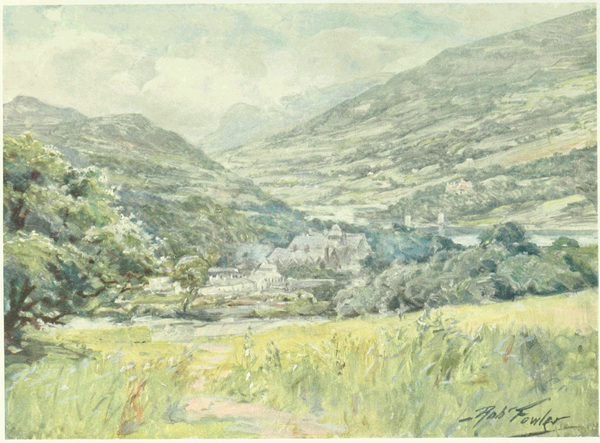
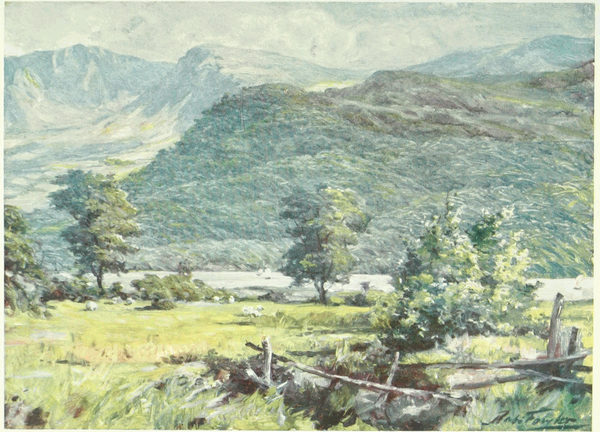
BODDNANT HALL, CONWAY VALLEY
61His voice, whether he sang or spoke, was of
wide range and exquisite adjustment, and he spoke
with care and gusto, as if he loved his native
tongue. Under its influence, he respected nobody
of any importance. Thus, he was once pretty
justly thrashed; when, having tired his chastiser by
his patience, he remarked at great length that he
supposed the other did not know who he was, and
the splendour of his manner overcame his heated
companion. No sooner had he got home than he
gave a rapturous description of how one had given
another a thrashing down the road. He did it so
well that he was asked whether he was the beater.
"No," said he bravely, "it happened that I was
beat."
Had he lost by a bargain, had he taken a bad
coin unawares, had he been worsted in argument,
he could so rant that he moved every one, and
himself obviously first of all, and made the worse
appear the better. He kept a genealogical tree in
constant use by pruning and watering, and though
there was not only a prince but a poet in it, I
think he gloried less in the old splendour of his
62family than in the length of its fall, as who should
say he had once been so high that he was "from
morn to dewy eve" in falling.
When first I saw him, he had just come into
the "Cross Inn." It was mid-day; the weather
was cold and wet; and since he never liked to see
a man drinking by himself, and the shepherds
coming down from the mountains to market had
called pretty often, he was not sober. He told me
that his was a fine house—the finest in the village,
and therefore in the county; and that it had not
paid the former tenant well, who had, in fact, sold
but eighteen gallons of beer in a month. He was
going to do better than that, he said; to make a
beginning, he was going to drink that quantity
himself. I asked for brandy. He had not a drop,
and explained that he had a weakness for it himself—took
a drop very often; and that therefore,
to get out of temptation, he had finished his stock
on the night before. "But," said he, "I have upstairs
such a bed as you—pardon me—never slept
in yet."
"I have no doubt," said I, and sat down.
63But when he heard that I was walking across
Wales, and had therefore tried many beds, he
insisted that I should see the thing. It was the
finest in the village—in the county—in Wales—"I
don't see why I should not say in the whole
world." Truly it was a noble bed, in a great,
empty, raftered, uncarpeted room; the wood all
darkened oak, with a dusky gleam; the hangings
ample and of a rich crimson stuff; the purity of
the linen splendid. If a royal person or a poet
had not slept in it, "that was their misfortune."
He stood by, awed and reverent, beholding the
bed. I was not his equal in eloquence, and he
echoed my praise with an elaborate "of course":
and for the sake of hearing some of the words he
loved, he finally invited me to spend a night in the
bed, "as his guest," so he magnificently said.
All his family were of the same temper. His
father and mother had gone to London years ago,
and, at seventy years of age, to the infirmary of a
workhouse....
The aged paupers sat in a long, grey, motionless,
and silent row—like a sculptured frieze, or like
persons expecting to be photographed—under the
wall of a church. Before them was a strip of grass,
one emerald half of which shone so that it seemed
of an element like flame; for it was pure, insubstantial
colour; and into this, as the paupers
saw, the tide of the shadow of the church gradually
64ate. Beyond the grass was the infirmary, and
alongside it a yellow road, and on that a hearse.
Watching this and the paupers, a crowd of persons,
with uninterested, inquisitive eyes and bowler hats,
stuck their noses through the railings which ran
between the busy street and the infirmary. Motor
cars brayed, hooves clattered.
Presently three men carried out a coffin, containing
the remains of Mrs. Owen, and shoved it
into the hearse. "God love me, what a coffin!"
said one of the crowd. But the frieze of paupers
were silent and motionless in the long grey row—all
but the husband of the corpse. He, like the
others, seemed to stare at the hearse with fixed
gaze, and in a loud voice he remembered what a
bonny woman the corpse had been, and in particular
how, while a travelling musician played in the
village street, when she was past fifty years of age,
she had locked herself into the kitchen and danced,
having spread a mat to deaden the clicking of her
merry clogs; and he had watched her, unobserved.
The story and his uncontrolled, bleating voice
raised a laugh under the bowler hats; and the old
men lifted their heads and straightened themselves
and laughed; and most loudly and grimly of all
laughed Owen, while he remembered the cottage
65in sight of the beacons of Breconshire; and the
hearse rolled out and the crowd removed.
Rowlands, another minister, is six feet and two
inches in height, seventeen stone in weight, and has
a voice which is in proportion. When he stands
up, one supposes that he can never sit down; when
he sits down, one supposes that he can never stand
up. Every one of his attitudes seems to be final.
Only when he is moving is his ponderosity a little
less than divine; for he moves with an odd briskness,
so that, from behind, he is like a large schoolboy
on some urgent business. His mind is subject
to similar changes of aspect. In domestic life no
one is less awful than he; and were he not good-tempered,
cheerful, frolicsome, and humorous as
well, he would be one of the most mirth-provoking
of mankind. On children he leaves no impression
but that of weight, and in spite of his black clothes,
he once reminded a child (with a shrill voice) of
Atlas upholding the world.
In his everyday life he is a learned, happy child.
His curiosity is matched by his credulity. He is
the victim not only of tradesmen, but of beggars.
66He cannot keep his coat clean, and that he sews on
his own buttons is apparent from the fact that he
seldom has more than one or two of those decorations.
He knows every one in his neighbourhood—miners,
farmers, parsons, and the resident Englishmen—and
knows and loves them so well that he
never condemned any one except for cruelty. For
he seems to have started life with such a strong
belief in the sinfulness of men, that he has ever
since been pleased and surprised by this one's goodness
and the amiability of that one's badness. He
might, in truth, have spoken of himself in something
like the words of that fine, possibly Welsh
poet of the seventeenth century, Thomas Traherne:
A learned and a happy ignorance
Divided me
From all the vanity,
From all the sloth, care, pain, and sorrow that advance
The madness and the misery
Of men. No error, no distraction I
Saw soil the earth or overcloud the sky.
I knew not that there was a serpent's sting
Whose poison shed,
On men, did overspread
The world; nor did I dream of such a thing
As sin, in which mankind lay dead.
They were all brisk and living wights to me,
Yea, pure and full of immortality.
Joy, pleasure, beauty, kindness, glory, love,
Sleep, day, life, light,
Peace, melody, my sight,
My ears and heart did fill and freely move.
All that I saw did me delight.
The universe was then a world of treasure,
To me an universal world of pleasure....
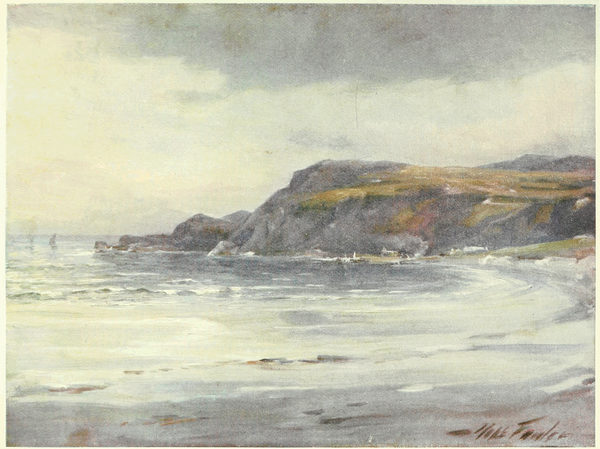
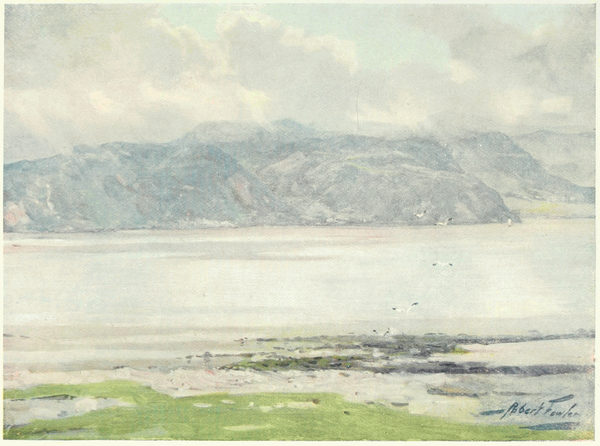
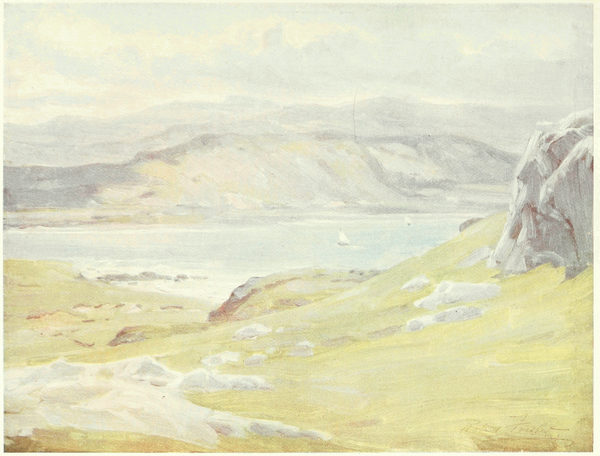
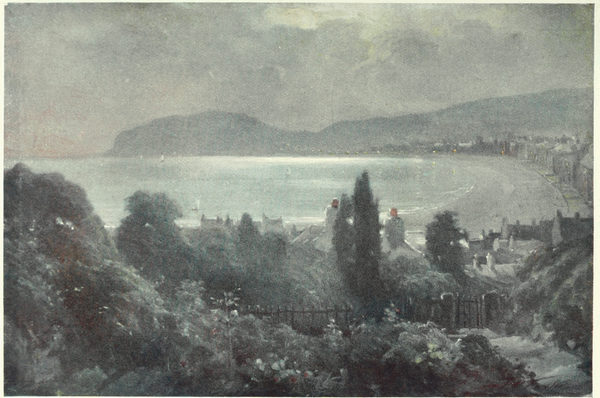
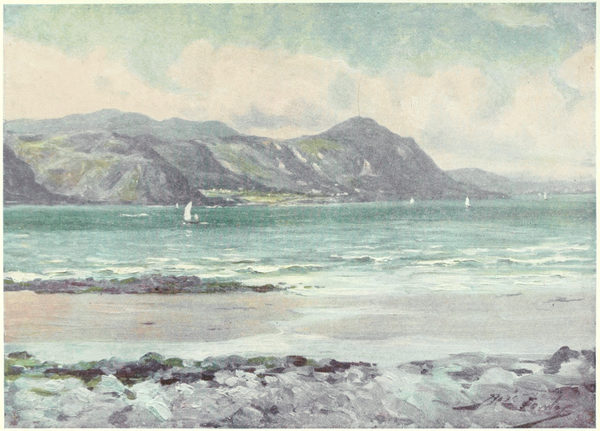
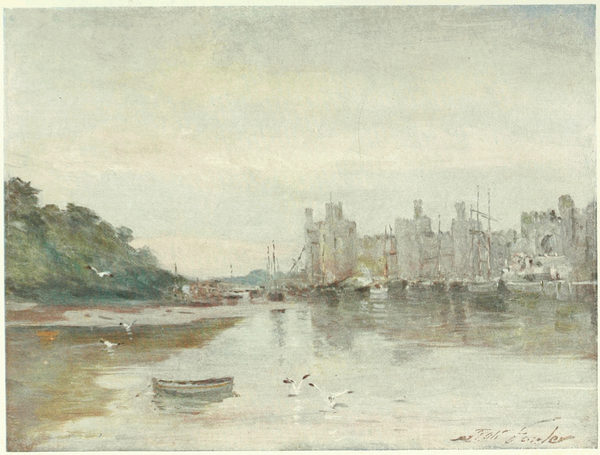
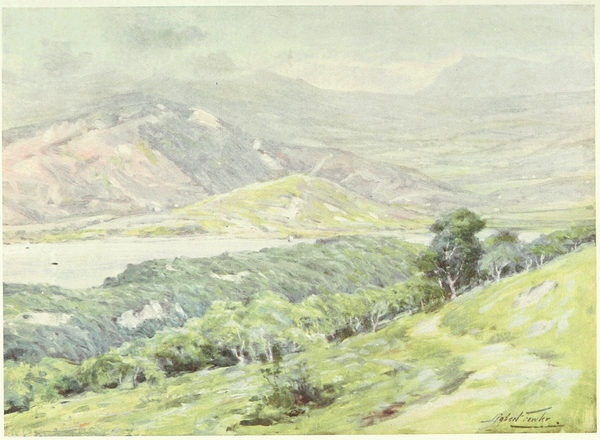
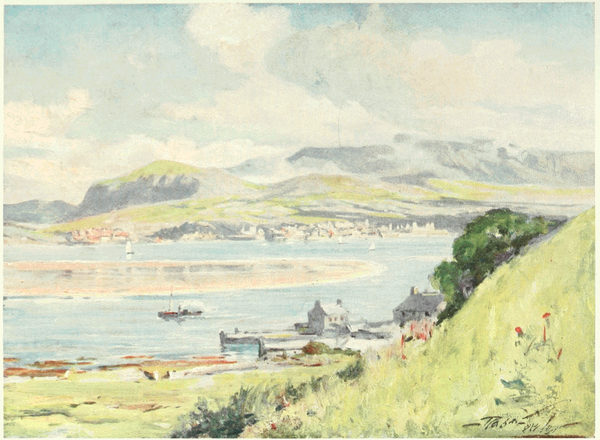
DISTANT VIEW OF CARNARVON BAY
67His own verses, by the way, are not so good, for,
like all Welsh ministers, he writes a hundred lines
of verse every day, perhaps to avoid being thought
singular.
He makes a fine figure of Charity in his old age,
with his preoccupied blue eyes under a brow that
is marked only by three lines like three beams
thrown upward by a sun. He has a large, joyous,
curving mouth, side-whiskers, careless beard, large
feet.
He has but one touch of sentiment. Nearly
half a century ago he fell in love with a pretty
woman, and unsuccessfully; yet, though she is
known to be married and still alive, he has come to
have for her memory a grandfatherly tenderness,
regarding her as a white and careless girl, in spite
of time. For the rest, so warm and radiant is he,
that I remember the peculiarity of Kai. "When
it rained hardest, whatever he carried remained dry
for a handbreadth above and a handbreadth below
68his hand, and when his companions were coldest,
it was to them as fuel with which to light their
fire."
But in the pulpit—whether it is a whim or an
atonement or merely a recollection of his years at a
theological college—he always makes an attempt to
dust the wrinkles of his waistcoat. In every other
way he makes his week-day self incredible to a
stranger. He justifies and makes use of his size
more than any man I ever saw. Seeing him in the
pulpit, it seems fitting that he should live there
day and night, so necessary a pillar is he to the dull,
small chapel, though, when holding out his arms, as
often he does, he threatens to demolish the little
arches and poor windows and to create something
more splendid in their place. Going there once in
his absence, a visitor remarked to a deacon that
they had made some changes in the building; and
asking what had gone from there, he was told,
"Oh, only Mr. Rowlands."
Standing there, he undertakes to speak on behalf
of the Deity, whose ways he explains, and by a
magnificent self-conceit supposes that his own
stature and voice are fitting symbols to mortals
incapable of apprehending things more august.
For a time, indeed, during the singing of the
hymns, there is a geniality as of lightning about his
face. He smiles; he tosses his head with the joy
of the song, and may even be supposed to feel, not
without sympathy, that the mighty music says
things which were not dreamed of by prophets or
apostles.
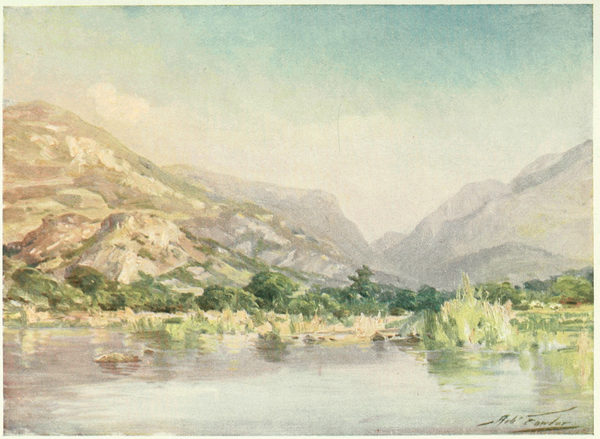
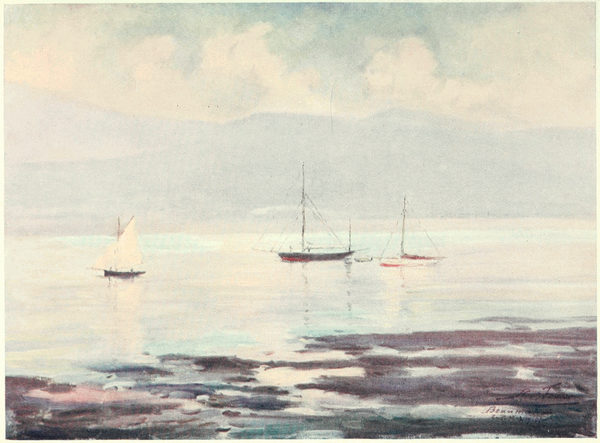
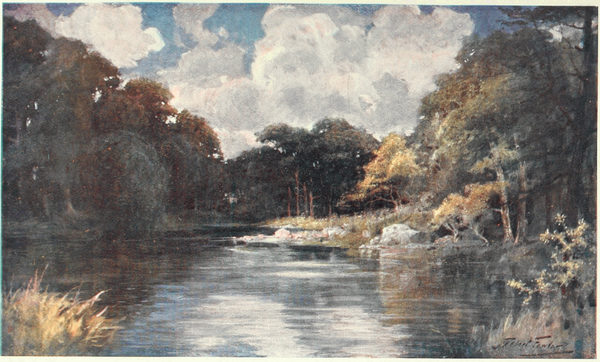
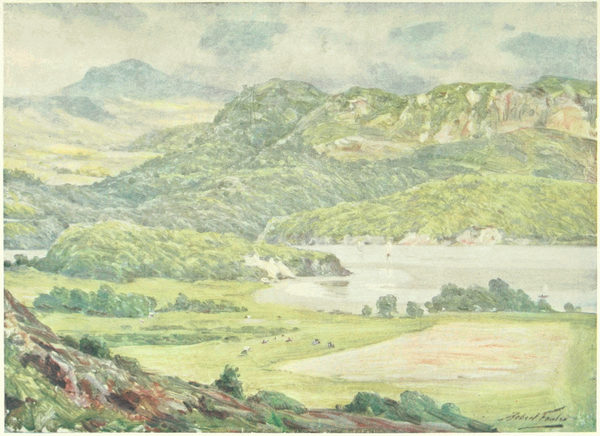
ON THE RIVER SEIONT, CARNARVONSHIRE—EVENING GLOW
69When he reads a lesson, it is plain to see that
above all other Gods he loves "the Lord that
smiteth." He opens his mouth and rejoices in the
rich and massy Welsh. He makes no attempt at
mere clear reading, which would be of no use to an
imaginative audience, that is familiar with the
Bible; but, raising and lowering his voice, now
hurrying as if to a precipice where all will be overthrown,
now creeping as if he feared what is to
come, he makes the chapter anew, creating it as if
he were sculptor or musician. I suppose he uses
nearly as many musical notes as if he sang; but
the result differs from singing, as prose from poetry;
and so noble is the prose that it suggests only one
possible answer to the question which, like a school-man,
he once asked, Whether the music of the
spheres be verse or prose? Yet, if the note of the
lesson is melancholy, full of the dreariness of moving
over the void and creating, the note of the
sermon is triumphant, or if not triumphant it is
70minatory, or if not minatory it is scornful, and at
times a listener expects to see him wrapped in a
cloud and carried away from an undeserving and
purblind race.
The medium of what English people would call
his rhetoric is the "hwyl," an exuberant, impassioned,
musical modulation of the voice, and, to compare
great things with small, comparable to the very
finest intoning to which has been added (if we can
suppose it) a lyrical, egotistical indulgence in all
moods of pity, scorn, tenderness, anger, sorrow, joy,
anxiety and hope. It can be familiar or lofty. It
is as powerful as harp and song together; and the
force of it often arises from the fact that what is
heard is rather the musical accompaniment of the
man's thought than the thought itself. Hence its
terrible and lovely purposes, and the many sentiments
with which it is shot, and the dubiousness of
the loftier passages, as in the verses which the bards
recited before Arthur and only one man understood
them, except that they were in Arthur's praise.
I have seen him so thunder that I thought of
the Llewelyns and Glyndwr, and forgot that the
castles fester no longer with Englishmen, and
aerea ramis
dependet galea et prato gravia arma quiescunt,
71and for the moment, thought he was a man. No
actor ever stormed and swelled so, because no actor
yet played the part which he played. It was a
chant; yet it was too uncontrollable for a chant.
If you call it declamation, you must admit that to
declaim a man shall first go to Medea, that she
Having drawn that weakness from his limbs
Which torpid now and chilly there abode,
Through every vacant artery may force
The green and joyous sap of thriving plants,—
Juice of crushed stalks mixed with their ropy gums,
And purpled bright with strength from berry and grape,
Full of a stinging, swift, and masterful
Vivacity.
For the blood of a declaimer of seventy does not
travel so by ordinary ways. Nor can a declaimer,
as he does, build up for the imagination an earth,
with sky and mountains, within a little chapel, for
the sake of showing how the lightning vaults and
impales the unjust man. At other times his words
rise up and circle and make fantastic architecture,
as real as dreams, for the terror of the soul that for
the time is forced to dwell therein. And though
the substance of his sermon is but anecdote, biblical
reference, exhortation, warning, picturesque logic
built upon some simple religious theme, men and
women weep under this divine bullying. A man,
72listening outside the chapel, put his hand to his head
to make sure that his hat was on, so stiffly his hair
stood up.
"Then the earth shook and trembled; the
foundations also of the hills moved and were shaken,
because he was wroth....
"He bowed the heavens also, and came down:
and darkness was under his feet.
"And he rode upon a cherub, and did fly: yea,
he did fly upon the wings of the wind.
"He made darkness his secret place; his pavilion
round about him were dark waters and thick clouds
of the skies...."
Once he paused long, towards the end of a
sermon, while the thunder withdrew with a terrible
solemnity which he envied; and he did not hesitate
to follow the thunder with the words, "It has been
said," and so to end.
One who used to come in late, years ago, was
Gwilym Pritchard, the poacher.
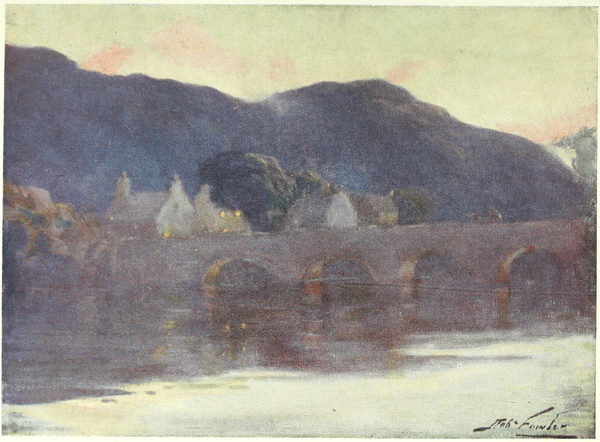
BRIDGE, CWM-Y-GLO—EVENING
73I wish to make a nice distinction between
poachers and poachers. The man who is nothing
but a poacher I regard as one only in the strict
literal sense. Such a man is rare to-day. Formerly
he went to the woods as another man went to the
Bar. He lived like a gentleman upon other men's
venison, and was beneath the pleasure of salt-pork
broth. He would swagger about the hamlet with
a deer on his back. The deer was but a carcass
at sixpence the pound to him. He has lately
stooped to dictate his autobiography, which may
be bought over the counter. A less majestical
note was never sounded. He turned gamekeeper,
and no doubt touched his cap for half-a-sovereign,
and stared at his palm for a crown. He is, in
short, "one of God's creatures." But the nobler
one I have in mind seemed to bear high office in
the scheme of the natural world. A mighty man,
capable of killing anything and of sparing anything
too, he was a true scholar in his kind. The pedants
who peep and botanise and cry "allium" or
"cnicus" to one another in the awful woods, and
the sublime enthusiasts who cannot see the earth
for the flowers, were equally beneath him. He
would give twelve hours a day at least to the open
air, as a scholar to his books. Thus he had
acquired a large erudition which would probably
have exhausted a whole field of inquiry if written
down. It is fortunate that faultless observers
like this hand down nothing to posterity, since it
74leaves us in these latter days free to feel ourselves
discoverers when we come upon what hundreds
have known during the last thousand years. In
the case of this man, the knowledge came out not
so much in speech—of which he was economical—as
in infinite tact,
Wearing all that weight
Of learning lightly like a flower.
It was shown in the way he stepped in
the woods, in the way he laid his ear to the
bare ground (not the grass) to ascertain a distant
noise of footsteps. I have seen him lose a
wood-pigeon by an interrupted aim, and, standing
without sound or motion, shoot the bird, that
returned to its branch, enchanted by the absence
of hostile sounds; for his very clothes were more
the work of nature than the tailor, and matched
the trees like a hawk or a November moth. His
belief in the earth as a living thing was almost
a superstition. I shall not forget how he took
me to a hilltop one autumn day, when the quiet
gave birth to sound after sound as we listened
and let our silence grow. By a process of elimination
he set aside the wind, the birds, the falling
leaves, the water, and tried to capture for my
sake the low hum which was the earth making
music to itself. And what I heard I can no more
describe than the magic of an excellent voice when
once it is silent. "Depend upon it, that means
something," he said. "And now——" there was a
sharp report and a hare that I had not noticed
bounded as if it had fallen from a great height, and
lay dead.
75Having been caught once, I remarked that his
captor must have been a clever man. "A fool," he
replied—"a fool. He'd been after me a hundred
times, and I had fooled him all but once."
It was at one time his practice to deliver a
tithe of his poached game at the cottages of the
sick, infirm, or poor, as a present from the Squire,
a notoriously ungenerous man. His occupation
had made him indifferent to the future or the past.
None ever chattered less about past happiness and
future pain. He seemed to owe a duty to the
present moment of which he partook as if he were
eating ripe fruit. Even a piece of drudgery or a
keen sorrow never drove his intelligence backward
or forward; pain he took as some take medicine, on
trust. Thus he was a small, though not a poor,
talker. Venturing once to greet him pleasantly
with the long beginning of a story, when I found
him seated without any visible occupation, and
76noticing his irritation, I said that I had supposed
he was not doing anything; to which he answered
"Yes, nothing!" and continued. At one time of
his life he heard that a considerable sum of money
had been left to him. A year later, the foundering
of a ship left his fortunes unchanged; and on the
afternoon of the news, he shot every pigeon at
which he raised his gun. Birds of prey he would
never shoot, even to show his skill. Jackdaws were
always spared; he used to say that there was "a bit
of God" in that bird. It was noticeable, too, that
here and there he spared game birds, though he
despised the race. I have seen him raise his gun
and drop it again, not without a sigh as the bird
flew off, observing that there was "something in
the bird" which stayed his hand. In men, as in
birds and beasts, he was anxious to see individuality,
and loved the creature that possessed and used
it. The only time I ever saw him use contempt
was towards a beggar who had soiled his calling by
theft. A good beggar, a good thief, anything
beyond which "the force of nature could no further
go," he reverenced. And he was a good poacher,
glorying in the name. He died polishing the white
steel on his gun.
77
Of Llewelyn, the bard, I cannot decide whether
he most loves man or men. He is for ever building
castles in the air and filling them with splendid
creatures, whom he calls men. Then he laments
that he cannot find any like them on hill or in
valley: when, straightway, he will meet some
human being, old friend or passing stranger, on
the road or in a shop, and away go the phantoms
of his castles, and he is wild in adoration of the
new thing he has found. His grandmother, by
the way, was called a fairy's child, though the
truth seems to have been that her mother was a
gipsy girl. Perhaps that is why he has no creed
but many creeds, and was looked upon with great
favour by the Calvinists until they found that he
liked the Church as well. Yet I think that he
likes men truly because they remind him of something
he has read or dreamed, or because they
make him dream; herein somewhat resembling the
fellow who paid much court to another because he
reminded him of the late Duke of ——, and he
was a lover of dukes. Or he is like some that
have seen processions of phantoms and say that
sometimes the phantoms are simply fairies speaking
78an unknown tongue, but that sometimes several
have the faces and voices of some among the dead
whom they used to know. Why he is so glad to
be among us at the farmhouse I have not discovered,
but I suppose we remind him of Hebrew
prophets or Greekish kings, for of our established
merits he takes no thought.
I think he wastes so much pity for Annie of
Lochroyan that other maids find him passionless,
and he grows tender over Burd Ellen and Cynisca
as their lovers never did. Arthur and Gwalchmai
and Gwenhwyvar, the most unreal and unliving of
all the persons of literature, please him most. In
a world where all things are passing, he loves best
those things which, having past and having left a
ghost of fame behind, can live for ever in minds
like his. In London he saw but a place where
marsh and river and woods had been and might be
again; or where
Sometimes a lily petal floated down
From dear, remote pools to the dreary town;
where the gulls flew over in the mournful January
light; where a few friends had fires and lamps and
books—their light faintly flickering in tremendous
gloom and making one faint reality in the place;
where wind and rain sometimes brought the past
again; for the very touch of rain and wind beckoned
to him, as it is fabled that the foam driven from
waters that cover old towns will draw the unwary
whom it touches into the deeps.
79He himself professes to care only for his own
childhood and youth; only he is aware, as not
every one is, that the childhood began in Eden,
and is ages old, so that, after all, the few years that
make middle age do not count for much. His life
and his way of looking at it remind me of a story
of a young Eastern prince. Every day, from his
early childhood, a story-teller had told him a tale.
But, soon after he was sixteen, the story-teller
came to him, and, falling on his knees, told him
that he had no more stories to tell. The young
prince fell into a rage and swore that he would kill
the man if, in a week, he had no new story ready.
And the story-teller, who was very old and unwilling
to die, went into the desert and neither ate
nor drank, and made a plan by which to save his
life. So he returned to the young prince, who
asked if he had a new story, and he said that he
had. And the prince bade him tell the story; and
he began to speak, and told the prince the story
which he had told him first, when he was a small
child; and the prince was pleased. And until the
80old man died, he never told a story which he had
not told before; and the prince was always pleased.
His poetry, if it could be understood, might be
counted great, and perhaps it is so in a world where
trees and animals are reverenced in a way which is
hardly dawning here. He is a kind of mad Blake.
He sees the world from among the stars, and those
who see it from an elevation of five or six feet, and
think that they see it as it really is, are not satisfied.
He would make human the stars and seasons; he
would make starry the flowers and the grass. He
would have it that the world is but a shadow of
Blake's "Real and Eternal world": that we who
are shadows cling to the superstition that we are
not, and have but prejudiced and fearful ears for
his prophecies. He sees the world as a commonwealth
of angels and men and beasts and herbs;
and in it, horrible discords that we others scarcely
hear seem to him to strike the stars.
Each outcry of the hunted hare
A fibre from the brain doth tear;
A skylark wounded on the wing
Doth make a cherub cease to sing.
After all, in matters of the spirit, men are all
engaged in colloquies with themselves. Some of
them are overheard, and they are the poets. It is
his fortune that he is not overheard, at least by
men.
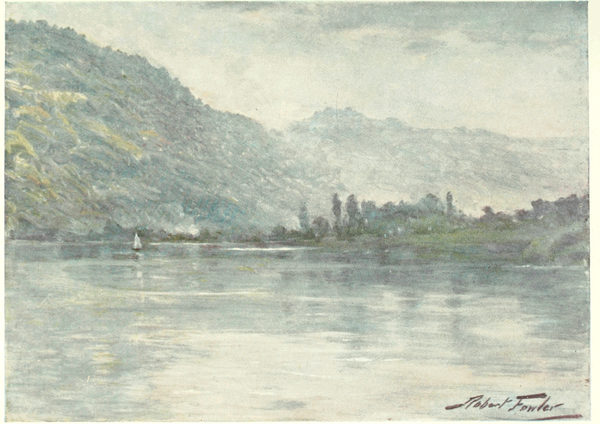
MORNING MISTS, NEAR TREFRIW
81Yet how much would he sacrifice could he but
write a few verses in the old Welsh manner,—but
a few verses like those he repeats as lovingly as
others would their own. First, there is the elegy on
Gwenhwyvar by Griffith ap Meredith ap Davydd:
The wearer of white and green, of red and blue,
Is now in the painful fold of death.
The Church conceals her—she whom velvet so adorned.
Wearer of velvet,
We mourn with tears now that the flush of her beauty has faded,
Now that the wearer of velvet and red is no more.
That he praises for its clear-eyed simplicity, its
mournfulness direct as the cry of a child, as the
bravery of this is as direct as the laughter of a
child (it is by a poet who was also a prince):
I love the time of summer, when the charger
Of the exulting chief prances in the presence of a gallant lord,
When the nimbly moving wave is covered with foam,
When the apple tree is in flower,
And the white shield is borne on my shoulder to battle.
This, also, for its simple pride:
The men who went to Cattraeth were men of name:
Wine and mead out of gold was their drink:
Three men, and threescore, and three hundred, with golden torques.
How often will he repeat "with golden torques"!
82But (and here some will reconsider their opinion
that he is a fool, or one "not wise" as the pleasant
Welsh phrase goes) there is no one that can laugh
more loudly than he; or sing a song more happily;
or join more lustily than he in hunting on foot,
over the craggy hills, some fox which the farmer
can never shoot when he comes for the turkeys in
November; and in the heat of the run he will
curse the hounds for gaining on the fox, and the
fox for running no faster, saying that the worst
of fox-hunting is that it is so one-sided, since the
fox is not allowed to rejoice at the end with hounds
and men.
And here is one of his imitative songs, reduced
to its lowest terms by a translator:
She is dead, Eluned,
Whom the young men and the old men
And the old women and even the young women
Came to the gates in the village
To see, because she walked as beautifully as a heifer.
She is dead, Eluned,
Who sang the new songs
And the old; and made the new
Seem old, and the old
As if they were just born and she had christened them.
She is dead, Eluned,
Whom I admired and loved,
When she was gathering red apples,
When she was making bread and cakes,
When she was smiling to herself alone and not thinking of me.
She is dead, Eluned,
Who was part of Spring,
And of blue Summer and red Autumn,
And made the Winter beloved;
She is dead, and these things come not again.
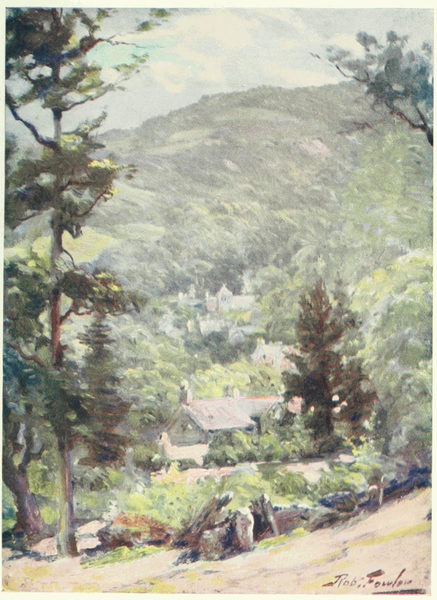
DISTANT VIEW OF BETTWS-Y-COED
83
One of the most inspiriting of our fire-siders at
the farmhouse is a young schoolmaster named
Azariah John Pugh, and called, in the Welsh
fashion, almost invariably, Azariah John.
He is mainly English and partly Spanish; he
was born in England, but having a Welsh name,
he boasts much of his country, as he has elected to
call Wales. But in truth he belongs to no time or
place. He cares nothing for the house he lives in,
for the village, or for any place he ever saw. Yet
are we never tired of hearing his rich sentiments
about them all. If only he be far away from it,
there is no place known to him which he will not
magnify with words which others do not easily use
even for their true loves. Probably he would like
to like them; but that very liking seems to be due
to his feverish wide reading in books that are full of
sentiments he admires and would borrow, if he
84could. Thus, of old cities, rivers flowing past famous
places, mountains of beauty or story, the white
cliffs of the south, the whin-red moorland of Wales,
old gardens, solemn woods, all solitudes, fading
races, sunsets, fallen greatness in men and things,
old books, old beer, poverty, childhood ... of all
these he will talk as if he had discovered them
to the world, though it may be doubted whether
he knows them at all. Yet is he a magnificent
echo of the genuine lovers of these things, and
he is so sorrowfully anxious to be believed
that to some of us he has seemed to be the true
heir, though defrauded of his inheritance, of all
beauty and all antiquity. He is for ever speaking
of "remembering afresh and with pleasure
ancient matters," though he knows that even he
cannot remember them with pleasure, and that no
experienced man ever does so. He is so young
that he has nothing to forget. But in his own
esteem he is old now, and shakes his head over
the light-heartedness of old men, saying, "If they
were as old as I am——"
He speaks so suavely that the plain man
wonders that he has never felt as deeply himself.
Before his patriotism, the patriot is abashed. The
lover of the quiet life, in his presence, is persuaded
that himself can hardly be said to love it. No
lover repeats more fondly—
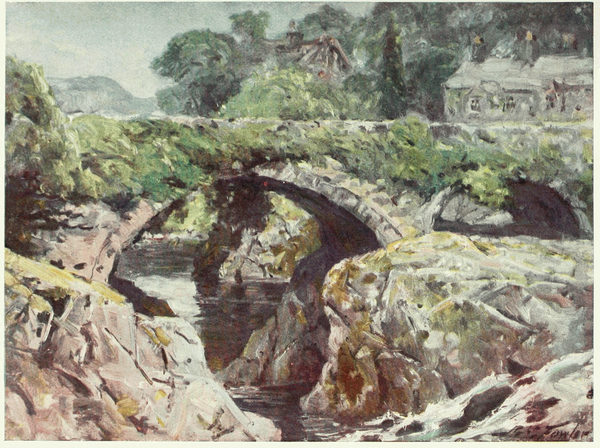
THE OLD BRIDGE, BETTWS-Y-COED
85And I would send tales of forgotten love
Late into the lone night, and sing wild songs
Of maids deserted in the olden time.
He thus deceives every one but himself, and that
one exception is the real cause of his unhappiness.
He cannot avoid his affectations. He only finds
them out when they are full-grown and most noisily
and hungrily abroad in every man's ears, and then
he has to maintain them, wearily but with an
apparent gaiety. Pity even will not hurt him. It
is his genial air: he rejoices in it as a pigeon, leaning
and raising her wing to expose her tender side,
rejoices in summer rain, and as languidly; and then
again he is furious at it, and cultivates brutality,
drinks much beer, and uses many oaths, of which
he wearies and comes again to the old tap.
The ghosts of the subtle emotions which we say
make up modernity have come into his brain, and
they are so many that he has become, if not a
theatre, at least a mortuary, of modernity. But the
nervous strain of any real passion in his neighbourhood
obliges him to be rude or to run away. Real
passion was always scandalously ill done: he would
have no lover die less romantically than Romeo.
86And as his thoughts, so are his acts, except
that they are few. He has been to Rome, the Bay
of Spezzia, Windermere; he has walked along the
Pilgrim's Road to Canterbury. He has learned to
work badly in metal and wood. He has had whims
and drugs enough to win an appreciation from Mr.
Arthur Symons. He has written poems under the
influence of something in his stomach; but either
he cannot read them, or they are not fit to be read.
He wrote one, I remember, about a girl who
worked a story in tapestry while her lover played
on a harp the melody which told the same story.
He wrote a sermon on the death of John Jones
because a hundred persons of that name die every
day, and he wished to praise the average man, out
of a whimsical distaste for his late less fantastic
likings. He has had friends and has been left by
them; or, as he says, after the Welsh poet,
The brave, the magnanimous, the amiable, the generous, and the energetic
Are as stepping-stones to the bard.
He has made love, and he has been scorned; the
sad tunes of
Old unhappy far off-things
And battles long ago
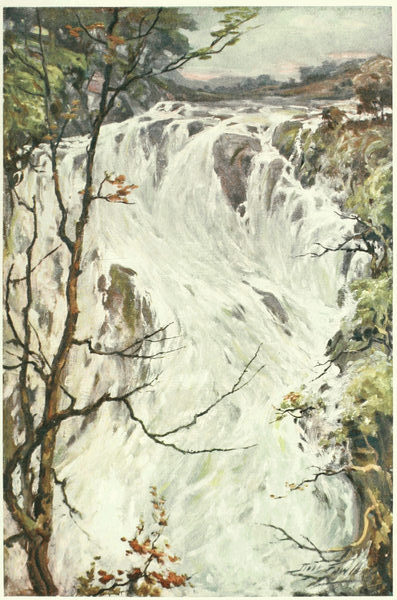
SWALLOW FALLS, BETTWS-Y-COED
87are accordingly most dear to him, and in his gayest
moments he will murmur some sad melody like
"The Marsh of Rhuddlan" or "My Johnny was a
shoemaker." I have heard him repeat this strange
poem of Taliesin's as if he were a reincarnation of
the bard:
Primary chief bard am I to Elphin,
And my original country is the region of the summer stars;
Idno and Heinin called me Merddin,
At length every King will call me Taliesin.
I was with my Lord in the highest sphere,
On the fall of Lucifer into the depth of hell;
I have borne a banner before Alexander;
I know the names of the stars from north to south....
I have been with my Lord in the manger of the ass;
I strengthened Moses through the water of Jordan;
I have been in the firmament with Mary Magdalene;
I have obtained the muse from the cauldron of Ceridwen;
I have been bard of the harp to Lleon of Lochlin;
I have been on the White Hill, in the court of Cynvelyn;
For a day and a year in stocks and fetters,
I have suffered hunger for the Son of the Virgin.
I have been fostered in the land of the Deity,
I have been teacher to all intelligences,
I am able to instruct the whole universe,
I shall be until the day of doom on the face of the earth:
And it is not known whether my body is flesh or fish....
And it falls strangely from this wandering voice
that calls itself a man. It is comic and it is terrible.
He alone seems to feel the true sadness of them:
flatterers and low comic persons tell him that he is
but a vessel come into the world to be filled with
88all the sorrows that have been. Truly, all that has
passed, is.
Nevertheless, we love him for his gross natural
self, for so we think his only convincing affectation,
the only one which he displays with some consistency
by the fireside; and we know, as the world
does not know, how costly and passionate affectations
are.
I should like to win some charity for Morgan
Rhys, the descendant of a prince, a bard and a
tin-plater. Charity it must be; for, in truth, he is
something of a Celt in the bad, fashionable sense
of that strange word, and is somewhat ridiculous
beside the landlord of the "Cross Inn." An
orphan, he lived as the only child in the large
house of a distant relative, reading everything,
playing half-heartedly at games, yet now and then
entering into them with such enthusiasm that he
did what he liked and won a singular reputation.
He went seldom to a chapel, and when he went,
did something more than escape boredom, by the
marvellous gift of inattention which enabled him
to continue his own chain of thought or fancy
from beginning to end of the service. He was
89quite unhindered by hymn, prayer, or sermon, and
accepted what he heard, as elderly persons accept
fairies, without even curiosity. The death of
others made him helpless for a time, but he did not
reason about the fact: his own death he at all
times contemplated without fear; what he feared,
if anything, was the fear of death.
These things would not be remarkable, if he had
not been at the same time an impressionable, submissive
child, incapable of listening to argument,
indeed, but of an unsatisfied sentimentality that
might have been made much use of by a priest.
His abstraction from things to which he was
indifferent was wonderful. He was delighted
and fascinated by abstraction itself, and finding a
thing uninteresting, he could at once withdraw
into a sweet, vaporous, empty cave. Thus, he
was praised at school for his calmness during
punishment, which, he says, on many occasions he
never felt at all.
When a child of five he had been left alone for
half a day in a remote chamber of a great house,
and at nightfall was found sitting at a window
that commanded an orchard and a lawn, and when
he did not rise to greet his friends, and was questioned,
merely said "Look!" Nobody could see
90anything, or rather, they saw everything as usual:
nor could he explain. He always remembered the
incident, and could not explain it. There was no
fairy, no peculiar light or gloom. Yet he admitted
that he was intoxicated by the mere trees and the
green lawn. In the same way he was often found
listening to silence. He did not pretend to hear
strange music. It was the voluptuousness of
sheer silence. At home, in the fields, at school,
he would cry: "There!" So far as any one could
see, there was nothing. To shut his eyes was not
to see amply and clearly, but to see infinite purple
darkness, which he vastly loved. He would ask
friends whether they remembered this place or that
on a certain day, and if they did, could never have
them share his pleasure at the recollection; and
for this whim he was scolded and ridiculed.
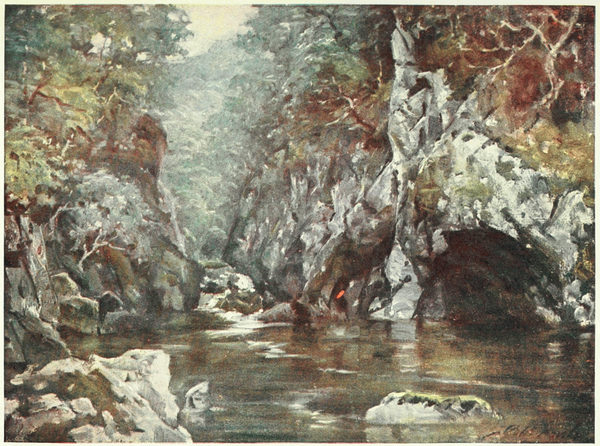
FAIRY GLEN, BETTWS-Y-COED
91But at the age of sixteen or seventeen, poetry
gave him a second world in which he thenceforward
moved with a rapture which I do not
often observe in the religious, while in religious
matters he remains so pure a sceptic that he has
never yet learned that there is anything about
which to be sceptical. This so-called matter-of-factness
in combination with a rich imaginativeness
is perhaps a Welsh characteristic. I remember a
farmer in Cardiganshire, with the blood of a lamb
on his wrist, singing a fine hymn very nobly; and
though I cannot like such a mystic, I admire him.
In the same way will Rhys turn from ribaldry to a
poem by Mr. Yeats. But he valued poetry not so
much because it was full of music for ear and
spirit, though that he loved; not so much because
it was the first discoverer of Nature and Man,
though that he well knew, as because it revealed to
him the possibility of a state of mind and spirit in
which alone all things could be fully known at
their highest power, and that state was his most
cherished aim, and poetry helped him to achieve it.
Along with love of poetry went a curious study
of appearances and illusions. He was never tired
of considering them; of trying to elucidate the
impressionism of the eyes and the other senses;
of trying to know what there was in tree or face
or flower which many measurements, scientific
descriptions, photographs, and even pictures did
not exhaust. So many trees he saw were scarcely
more than nothing, though close by and in clear
air: what were they, he asked. He had never any
answer. "If only we could think like that!" he
said once, pointing to a fair, straight hawthorn
that stood, with few branches and without leaves,
92on the mountain side. And he came to hope for
a state in which he and the trees and the great
estuary near his house, the flowers, the distant
white cottages, should become all happily arranged
in as perfect a pattern as that made with iron dust
by a magnet—all filling their places, all integral
parts of a whole, and important because they were.
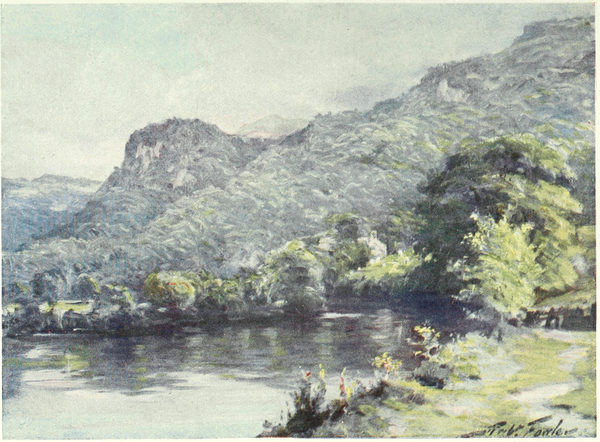
CHURCH POOL, BETTWS-Y-COED
93One evening he came into the farmhouse in
deep excitement because (as he said) he had been
part of the music of the spheres. He had walked
through village after village, over the mountains
and along the rivers, under great motionless white
clouds. The air had been so clear that every straw
of the thatch gleamed separately. He had passed
through the lonely places with a sense of passing
through a crowd because the rich spring air had
been so much a presence. The men labouring or
idling in the fields had seemed to be seraphic and
majestic beings; the women smiling or talking by
the gates were solemn and splendid. When at
last he descended into this valley, he saw the wood
smoke rising gently and blue from all the houses,
as if they had been a peaceful company smoking
pipes together. He had looked at the sky, the
flushed mountain sheep, the little stony lanes
that led steeply up to farmyard and farm, the
jackdaw making suitable music high up in the cold
bright air, the buzzard swirling amidst the young
bracken, and he had approved, and had been
approved, in ecstasy. And on that day the mazes
of human activity had been woven into a rich
pattern with the clouds and the hills and the waters
for the pleasure of the gods, and were certainly
for once fitted to the beauty and harmony of the
universe. Thus he spoke in ejaculations, to our
great joy, though not without giving us a fear that
he would spoil it by something inapposite. But
merely remarking that he had seen the parson
feeding his boar and that the harmony between
them also was complete, he became silent, and for
a time the whole world shimmered and darkened
as if it had been some tapestry which Rhys had
made. The most pious member of the party, a
Christian if ever there was one, remarked that he
"wished he had felt like that sometimes." To
which Rhys replied that he could not possibly wish
that, as he would then be damned like himself:
and the other agreed.
On days like this, he stepped over the edge of
the world and saw the gods leaning from the stars
among the clouds, and perhaps the loneliness that
followed appalled him. For these days flew fast.
94And so he tried to fortify himself by mingling
warmly with the life of every day in the village,
where his reputation was for generosity, hard drinking,
and perfect latitude of speech. He stimulated
the trade-unionist, the parson, the minister, the
bard. But he could not live both lives. The
worldly one was the more difficult and he gave it
up, and only made spasmodic and gross attempts to
return to it. He began to shrink not only from all
men but from all outward experience, and to live, as
only too easily he could, upon his own fantasy. He
was "surprised" when he saw men in the street.
A million people, all different and their differences
so much the more difficult because they were not
acknowledged, frightened him. So his advocacy
of certain humane measures and his support of
some enthusiasms sounded as if they came from
an angel, a fiend, or a corpse. As will happen
with men who love life too passionately, he was
often in love with death. He found enjoyment in
silence, in darkness, in refraining from deeds, and
he longed even to embrace the absolute blank or
death, if only he could be just conscious of it; and
he envied the solitary tree on a bare plain high up
among the hills, under a night sky in winter where
the only touch of life and pleasure was the rain.
95And now, with his fantastic belief that the corpse
is life's handiwork and its utmost end, he is humanised
only by a dread of the blank to which he is
going:
When we shall hear
The rain and wind beat dark December, how,
In that our pinching cave, shall we discourse
The freezing hours away?
He has made a heaven and he fears it.
Once there came to him and to the farmhouse a
ghost from the north. He was a tall, black-haired,
white-faced man, with high curved brow, straight
fleshy nose, perfect firm lips, and bony chin. Was he
soldier or scholar or priest? asked one and another.
His face was vigilant, of childlike freedom of expression,
and yet of boundless mystery in repose.
When he spoke, he had fire, dignity, rapidity, ease,
fertility of ideas, and everything of the orator
except that his speech was simple. He could move
a Welsh multitude with politics as a wind moves
the corn, yet he did so but once, because "it was a
blackguard game." Distinguished from the rest
only by his white tie, in the pulpit he looked a
Loyola and was a Chrysostom; yet he stood there
but once or twice, to bury a noble man. He was
master of an English style that was like Newman's
in simplicity, music, and weight, yet published but
96one pamphlet that was wrung from him by a needy
cause in a week, and never did anything to disabuse
a public that praised him for it. His handwriting,
in any haste, was that of a leisured and proud monk.
His deep voice had a kind of flame-like hum of
passion in it; he always used it in the service of the
beautiful and the true. I heard him laugh only
once, and then the depth which he discovered for
a moment disturbed me so that I distrusted all
laughter afterwards: it was like a nymph emerging
from a deep cave. In scorn, in ignorance, in mere
contentedness, he never uttered a word. He is
content to be the light and the rest of a few scholars
and a hundred miners, and to be the faithful, unhonoured
Levite of the mighty dead, of whom not
one, or prince or bard, had a virtue which he has
not, except it were a strong right arm and the will
to make a war in which to use it for the service
of the liberty and integrity of Wales, for these
alone of mortal things he passionately loves.
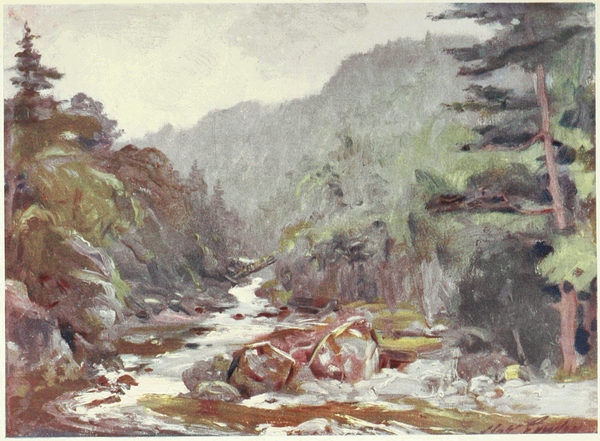
MINER'S BRIDGE ON RIVER LLUGWY
97Lastly, there is at the farmhouse still a memory
of that poet, great discoverer of manuscripts and
splendid human being—Iolo Morganwg—also herbalist,
lover of liberty and of the Revolution in
France, a mighty walker, who would ride in no man's
coach, and having been given a horse, drove it before
him for a long way, and complained that a horse
was wearisome. He learned his alphabet from the
tombstones which his father made. In his youth,
in the middle of the eighteenth century, he thought
of going to America to search for the Welsh colony
left five hundred years before by Madoc ap Owen
Gwynedd, whom Southey strove to sing. He was
stone-mason, bookseller, land-surveyor and (in slave-owning
days) seller of sugar "uncontaminated by
human gore." Eighty years ago he was to be seen
"on the highways and byways of Glamorgan—an
elderly pedestrian of rather low stature, wearing his
long grey hair flowing over his high coat-collar,
which by constant antagonism had pushed up his
hat brim into a quaint angle of elevation behind.
His countenance was marked by a combination of
quiet intelligence and quick sensitiveness; the
features angular, the lines deep, and the grey eye
benevolent but highly excitable. He was clad in
rustic garb: the coat blue, with goodly brass
buttons, and the nether integument good homely
corduroy. He wore buckles in his shoes, and a pair
of remarkably stout well-set legs were vouchers for
the great peripatetic powers he was well known to
possess. A pair of canvas wallets were slung over
his shoulders, one depending in front, the other
98behind. These contained a change of linen and a
few books and papers connected with his favourite
pursuits" (the study and collection of old Welsh
manuscriptions for the illustration of Welsh history).
"He generally read as he walked, 'with spectacles
on nose,' and a pencil in his hand serving him to
make notes as they suggested themselves. A tall
staff, which he grasped at about the level of his ear,
completed his travelling equipment." And in this
chair, they say, he spent a night, sleeping and reading
alternately.
Outside, by the window, is the village idiot, with
a smile like the sound of bells ascending from a
city buried in the sea.
CHAPTER V WALES MONTH BY MONTH — January — I — II — February — I — II — III — March — I — II — April — I — II — III — May — I — II — June — I — II — July — I — II — III — IV — August — I — II — III — September — October — I — II — III — November — December
99
The road ran for ten miles between mountains
on which the woods of oak and fir moaned, though
there was little wind. A raven croaked with a
fat voice. I could hear a score of streams. But
the valley would not speak with me. The sole
joy in it was that of walking fast and of seeing the
summits of the hills continually writing a wild
legend on the cloudy sky. The road curved and
let in the poor sunlight from the south-west; and
there were interminable oak woods ahead,—one
moan and one dull cloud.
But, suddenly, a space of the south-west sky
was silver white. The sun was almost visible, and,
suddenly, a company of oak trees caught the light
and shone, and became warm and glorious, but
100misty and impenetrable with light. They dreamed
of summers to come and summers past. For one
moment they were as fine and strange and chosen
from all the rest, as things discovered by a lantern
on a country road at night. Not only were they
impenetrable to the sight, but it was impossible
to suppose oneself amongst them. They were
holding festival, but not for me. They were
populous, but not with men. They were warm
and welcoming, and something was happy there.
They were as a large, distant, and luminous house
seen in a cold and windy night by some one hungry,
poor, timid, and old, upon a lonely road, envying it
with an insatiable envy that never dreams of satisfying
itself.
But, in a moment, a mist arose from the grass
between the oaks and me: the glory departed:
and the little, draughty farmhouse was far more
to be desired than they, where a soft-voiced motherly
girl of twenty gave me cheese and bread and milk,
and smiled gently at the folly of walking on such
a day.
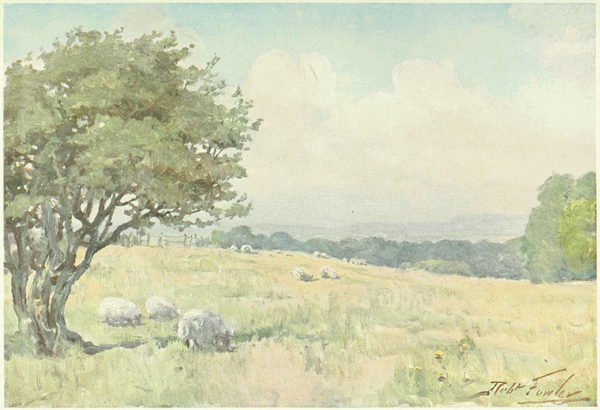
SUNNY FIELD, NEAR LLANBERIS
101
All day I wandered over an immense, bare,
snowy mountain which had looked as round as a
white summer cloud, but was truly so pitted and
scarred and shattered by beds of streams and
valleys full of rotten oak trees, that my course
wound like a river's or like a mouse's in a dense
hedge. The streams were small, and, partly frozen,
partly covered up by snow, they made no noise.
Nothing made any noise. There was a chimney-stack
clearly visible ten miles away, and I wished
that I could hear the factory hiss and groan. No
wind stirred among the trees. Once a kite flew
over among the clouds of the colour of young
swan's plumage, but silently, silently. I passed
the remains of twelve ancient oaks, like the litter
of some uncouth, vast monster pasturing, but
without a sound.
The ruins of a farm lay at the edge of one
valley: snow choked the chimney and protected
the hearth, which was black with flames long dead,
and as cold as a cinerary urn of the bronze age. I
stumbled over something snowy near by, and
exposed the brown fragments of a plough, and
farther on, a heavy wheel standing askew on its
crumbling axle.
The trees below were naked on one side of their
boles, but above was the snow, like a stiff upright
mane on every branch, which seemed to have
forced them into their wild and painful curves.
102All the fallen rotten wood broke under my foot
without a sound, and the green things disclosed
were as some stupid, cheerful thing in a house of
tremendous woe.
It was impossible to think of the inn to which I
was going, and hardly of the one which I had
left. How could their fires have survived the
all-pervading silent snow? When one is comfortable,
near a fire or within reach of one, and in
company, winter is thought of as a time of activity,
of glowing faces, of elements despised, and even a
poetry book brings back the spring: one will run,
or eat chestnuts, or read a book, or look at a picture
to-morrow, and so the winter flies. But on the
mountain there was no activity; it was impertinent:
there was the snow. When I could remember
anything it was these verses, which were the one
survival from the world I had known before I began
to cross this immense, bare, snowy mountain:
The beams flash on
And make appear the melancholy ruins
Of cancelled cycles; anchors, beaks of ships;
Planks turned to marble; quivers, helms and spears,
And gorgon-headed targes, and the wheels
Of scythéd chariots, and the emblazonry
Of trophies, standards, and armorial beasts,
Round which death laughed, sepulchred emblems
Of dead destruction, ruin within ruin!
103The wrecks beside of many a city vast,
Whose population which the earth grew over
Was mortal, but not human; see, they lie,
Their monstrous works, and uncouth skeletons,
Their statues, homes and fanes; prodigious shapes
Huddled in grey annihilation, split,
Jammed in the hard, black deep; and over these,
The anatomies of unknown winged things,
And fishes which were isles of living scale,
And serpents, bony chains, twisted around
The iron crags, or within heaps of dust
To which the tortuous strength of their last pangs
Had crushed the iron crags; and over these
The jagged alligator, and the might
Of earth-convulsing behemoth, which once
Were monarch beasts, and on the slimy shores,
And weed-overgrown continents of earth,
Increased and multiplied like summer worms
On an abandoned corpse, till the blue globe
Wrapped deluge round it like a cloke, and they
Yelled, gasped, and were abolished; or some God
Whose throne was in a comet, passed, and cried
Be not!
They lay beneath; the snow was over them.
It was hard to walk while all things had thus, in
Asiatic phrase, perfected their repose. When the
distant chimney appeared again, it was as incredible
as a thing seen in a dream when one knows that it
is a dream. It interrupted the perfection of the
whole, as I did, but only as the smell of a mouse
may spoil the beauty of an old room which has
been left for a dead man alone, for some time
104after the funeral. The farther I went, the more
immense became the extent of hills ahead and
around. Their whiteness made the sky gloomy,
as if with coming night. The furthest were
grey with distance. In the cold that overtook
my swiftest walking I could not put by the
imagination that I could see myself travelling
over more endless white hills, lost, to my own
knowledge, and yet beyond my own power to
save. And, again, I thought of all the hills beyond
those I saw, until even the immensity before me
became more awful, because it suggested the
whole, as the light of one candle by the organist
suggests the whole cathedral at midnight.
And then, though I did not know it, a change
began, and dimly, not hopefully, as when one
thinks one hears the double click of a latch in a
house which strangers inhabit now, I saw that the
sun began to set, and it was red. I knew that red:
it belonged to the old world: it was the colour of
the oast houses in Kent. A window, two miles off,
caught the light and blazed. A bell told the hour
in a church, and shook some of the snow from the
belfry in a mist. I warmed myself in the breath
of a flock of sheep. I knew that I heard the voice
of a stream which had been with me for a long
way. Borrow, I remembered, knew the stream.
Borrow! I was at home again.
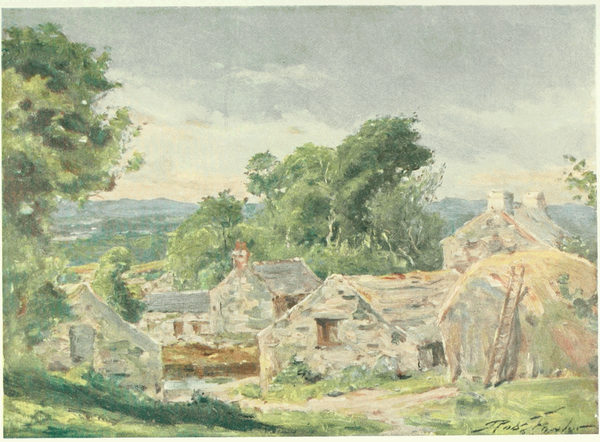
WELSH FARM, NEAR LLANBERIS
105Slowly the fire and the ale constructed the world
again, and though I could still see the snow from
the hearth of the inn, it was as impotent as the
frail moon which was convoyed down among the
moorlands by dark and angry clouds, while I read—as
now my reader does—this passage from Wild
Wales:—
"'I suppose you follow some pursuit besides
bardism?' said I; 'I suppose you farm?'
"'I do not farm,' said the man in grey. 'I keep
an inn.'
"'Keep an inn?' said I.
"'Yes,' said the man in grey. 'The —— Arms
at L——.'
"'Sure,' said I, 'inn-keeping and bardism are
not very cognate pursuits?'
"'You are wrong,' said the man in grey; 'I
believe the awen, or inspiration, is quite as much at
home at the bar as in the barn, perhaps more. It
is that belief which makes me tolerably satisfied
with my position and prevents me from asking Sir
Richard to give me a farm instead of an inn.'
"'I suppose,' said I, 'that Sir Richard is your
landlord?'
106"'He is,' said the man in grey, 'and a right
noble landlord too.'
"'I suppose,' said I, 'that he is right proud of
his tenant?'
"'He is,' said the man in grey, 'and I am right
proud of my landlord, and will here drink his
health. I have often said that if I were not what
I am, I should wish to be Sir Richard.'
"'You consider yourself his superior?' said I.
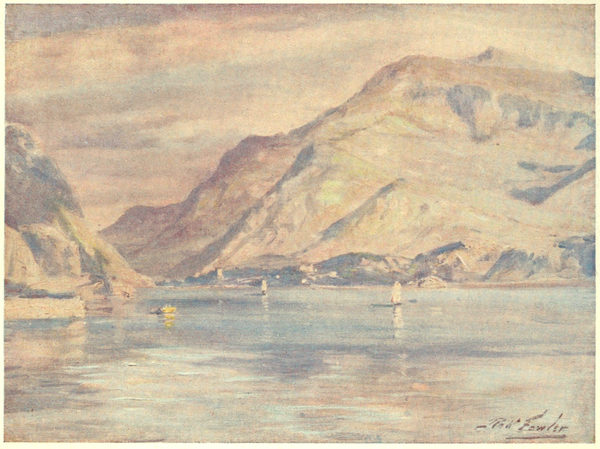
107"'Of course,' said the man in grey; 'a baronet
is a baronet, but a bard is a bard, you know.
I never forget what I am, and the respect due to
my sublime calling. About a month ago I was
seated in an upper apartment, in a fit of rapture;
there was a pen in my hand and paper before me on
the table, and likewise a jug of good ale, for I
always find that the awen is most prodigal of her
favours when a jug of good ale is before me. All
of a sudden my wife came running up and told me
that Sir Richard was below, and wanted to speak
to me. "Tell him to walk up," said I. "Are you
mad?" said my wife. "Do you know who Sir
Richard is?" "I do," said I; "a baronet is a baronet,
but a bard is a bard. Tell him to walk up." Well,
my wife went and told Sir Richard that I was
writing and could not come down, and that she
hoped he would not object to walk up. "Certainly
not, certainly not," said Sir Richard. "I shall be
only too happy to ascend to a genius on his hill.
You may be proud of such a husband, Mrs. W."
And here it will be as well to tell you that my
name is W.—J. W. of ——. Sir Richard then
came up, and I received him with gravity and
politeness. I did not rise, of course, for I never
forget myself a moment, but I told him to sit
down, and added, that after I had finished the pennill
(song for the harp) I was engaged upon, I would
speak to him. Well, Sir Richard smiled and sat
down, and begged me not to hurry myself, for that
he could wait. So I finished the pennill, deliberately,
mind you, for I did not forget who I
was, and then turning to Sir Richard, entered upon
business with him.'
"'I suppose Sir Richard is a very good-tempered
man?' said I.
"'I don't know,' said the man in grey. 'I have
seen Sir Richard in a devil of a passion, but never
with me. No, no! trust Sir Richard for not
riding the high horse with me. A baronet is a
baronet, but a bard is a bard, and that Sir Richard
knows.'"
The which Borrovianism should as much delight
108my hard-working reader as it did me, on that
January night: may it console him also.
I passed through a village where I found
that the old-fashioned bidding marriage was not
dead. For a printed sheet with this announcement
(in Welsh) fell into my hands:
Inasmuch as we intend entering the
state of wedlock on ——, we invite
wedding gifts, which will be repaid
with thanks on a like occasion.
T. Williams.
Elizabeth Jones.
It is expected that gifts due to them,
and to their parents and brothers,
will be paid on the wedding day.
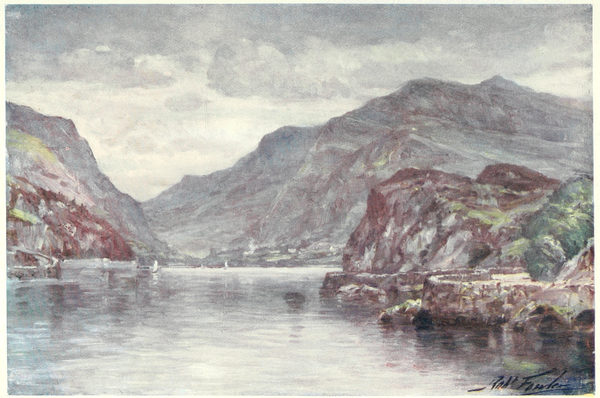
SNOWDON FROM LLANBERIS LAKE
109The custom was old; the village was new, and
it stood on the edge of a strange new land. Having
passed it, the road dipped among sublime black hills
of refuse from furnace and pit. The streams were
rich with yellow water, purple water. Here and
there were dim, shining, poisonous heaps of green
and blue, like precious stones. There were railway
lines everywhere, and on them trucks, full of scraps
of metal, like sheaves of scimitars and other cruel
weapons—still cruel, but hacked, often rusty, and
expressing something more horrible than mere
sharpness and ferocity. There were furnaces,
crimson and gold; and beyond all, a white-clouded
sky which said that it was over the sea.
In the early afternoon a grey mist invested all
things, so that even when I was close to them,
they seemed about to pass away, and I was tempted
to walk regardless and straight ahead as the harper
did in the tale.
It is told that a harper was asked to play and
sing at a wedding. It was a fine day, and on his
way he sometimes played over the melodies he most
liked; and as he went, the fairies followed him,
their little feet going fast and sharp like drumsticks.
When he reached the house, the fairies were still
behind him. They followed him in, and presently,
since he again tuned his harp, the company began
to dance, and the fairies with them; the house,
which was a little one, did not impede them;
and in no long time they all went dancing out of
the house. The fairies, it is said, were not to be
110distinguished from the bridal party. They went on
across well-known country, regardless and straight
ahead, through a barn where men were threshing,
through a hall where men were dining. Coming
at last to a place he did not know, the harper
ceased and became separated from the rest, and
slept. When he awoke, he found himself in a
pleasant place among very little people, and all
that was asked of him was that he should play on
the harp every night. Then one day he got leave
to go out of the land of the fairies; but he left his
harp there and could never get back again. He
found that the others had returned. He could say
nothing of the wedding day, except that he had
never before harped so well.
And well did the mist harp. It was the one
real credible thing among those furnaces, which
were but as gaps in it, or as landscapes seen rapidly
from small windows in a lofty house upon a hill.
111
Next day I crossed the river. At first, the
water seemed as calm and still as ice. The boats
at anchor, and doubled by shadow, were as if by
miracle suspended in the water. No ripple was to
be seen, though now and then one emitted a
sudden transitory flame, reflected from the sun,
which dreamed half-way up the sky in a cocoon of
cloud. No motion of the tide was visible, though
the shadows of the bridge that cleared the river in
three long leaps, trembled and were ever about to
pass away. The end of the last leap was unseen,
for the further shore was lost in mist, and a solitary
gull spoke for the mist. A sombre, satanic family
of what had yesterday been the chimneys of
factories rose out of the mist,—belonging to a
remote, unexplored, inaccessible country over there,
which seemed to threaten the river-side where I
stood. But the tide was rising, and the thin long
wavering line of water grew up over the mud, and
died, and grew up again, curved like the grain of
a chestnut or mother-of-pearl, and fascinating,
persuasive. And sometimes the line of water
resembled a lip, quivering with speech, and yet
silent, unheard. Two swans glimmered at the
edge; and beneath them, in the water, and beside
them, on the polished mud, their white reflections
glimmered.
Suddenly the tantara of a trumpet stung me
like an enormous invisible wasp, and I looked
down and saw a grey, drowned dog at my feet.
His legs lay in pairs; his head curved towards his
112fore-legs, his tail towards his hind-legs. He was of
the colour of the mud. But his very quietness
and powerlessness and abjectness, without any consideration
of all the play and strife and exercise
that once led him step by step towards death,—without
a thought of the crimson tongue that once
flickered, after hunting or fighting, like a flame
of pure abandoned vitality,—gave me a strange
suggestion of power and restraint, just as the misty
land over the water, without any consideration of
all the men and machinery that were visible there
yesterday, suggested a life without those things.
The beast became a puissant part of the host of
all the dead or motionless or dreaming things, of
statuary and trees and dead or inefficient men, and
was, with them, about to convince me of a state
quite other than ours, and not worse, when once
again the trumpet disturbed me and turned me to
the thought that I was the supreme life-giver to
these things, that I gave them of myself, and that
without me they were nothing; and I feared that
this fancied state was but suggested by my envy
of calm things, and that, though dreams may put
the uttermost parts of the earth into our possession,
without the dream the dreamer is nothing more
than naught.
113
Thence I went to an irregular, squalid, hideous,
ashen town,—a large village, but noisy and without
character, neither English nor Welsh. The
street songs were but a week or two behind those
of London, and they were not mixed with anything
but an occasional Welsh hymn tune or "Sospan
bach." But there used to be an old house there
that spoke of old Wales, and I went to see it.
When I came to the edge of its garden I heard
a blackbird sing, and in the busy street how old
and far away it sounded! as if it were true that
"thrice the age of a man is that of a stag, and
thrice that of a stag is that of the melodious
blackbird."
Pretentious, unpicturesque, fatigued, and silent,
the women walked to and fro, between the shops.
Now and then an unmarried girl laughed; the
others had no such energy.
It was more pleasant to be among the men, who
were on the other side of the road, many of them
standing still, packed close in a half-moon figure
that swelled out over the pavement, and watching
something. There was nothing gorgeous or adventurous
or even elegant in their scrupulous dress;
114in the old faces either alcoholic or parched, in the
waxen faces of the younger; in the voices which
seemed to have been copied from the gramophone,
their favourite instrument. I liked them for the
complete lack of self-consciousness which allowed
them to expose quite fearlessly their angular figures,
their uninteresting clothes, their heartless, rigid
faces that retained smiles for an incredibly short
time. They were the equals, in everything but
ease, of the labourers whom they were watching.
But when I saw at last what they were watching,
I thought that I could have rejoiced to have seen
them, looking passionate for once, in flames.
For, under the direction of a foreman, whose
snub nose, bow legs, and double collar made him a
sublime and monstrous priest or chief of what was
most horrible among the men and women of the
street, a band of labourers, without pity, without
even ferocity, but mechanically, was demolishing
"Quebec," a dignified mid-eighteenth-century
house, where for five generations a decent, stable
professional family had lived, loved beauty according
to its lights, and been graceful in its leisure. The
very house had seemed to say, amid its troubled
neighbours, as Marlowe's Edward said,
This life contemplative is heaven.
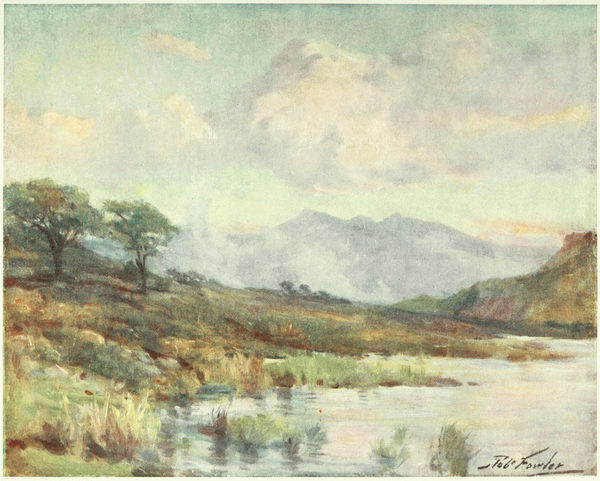
SNOWDON FROM CAPEL CURIG LAKE—SUMMER EVENING
115Now it was falling in thunders and clouds of ruin;
and I wondered that the people did not fall upon
the enormous, red-haired, passionless men who
wielded the pickaxes.
For twenty years I had known "Quebec" and
had watched the streets creeping upon it, until
the house and great garden were surrounded and
spied upon by houses on all sides but one. That
one side had been protected by a lofty and massive
wall, and through that the enemy had now broken
an entrance.
Behind that wall, the two Alderneys had grazed
on three acres of meadow, in the midst of which
had been an old orchard, and in the midst of that
the gardens and the house. Once I had seen a
girl with the delicate Kentish rake gathering a
little hay there. In one corner, too, had been a
tangle of elder and bramble, which (so we used to
fancy) might possibly have—by pure and unbroken
descent, miraculously escaping all change—the sap
of Eden in their veins.
But the Alderneys were gone, and the meadow
was slashed with ruts; the trees were down; the air
was foul with dust of mortar and brick and plaster;
and, mocking at the disembowelled house, new
bricks, scaffolding, and iron pillars and girders lay
116round about, among the fallen clouds of ivy, which
were torn and dead. Oh, Westminster, Tintern,
Godstow, Kidwelly, you have immortality, not
indeed in your forms, but in the hearts of men;
but "Quebec" dies with me! So I thought and
wondered.
Hastily broken up, without a grave, without
ceremonial, without a becoming interval of desolation
in which to spend its tears, and have at least
the pleasure of regret, the house, I knew, could not
but send forth piteous ghosts to wander up and
down,—inops, inhumataque turba,—and round their
heads garlands of branches with those terrible buds
that were never to be leaves,—until their sorrows
and ours were smoothed by time or consumed by
death. I met them afterwards in spring, when the
purple of the brambles should have been at last
overcome by green, and they seemed the sole
inhabitants of the brand-new, crowded streets,
beneath which "Quebec" is buried.
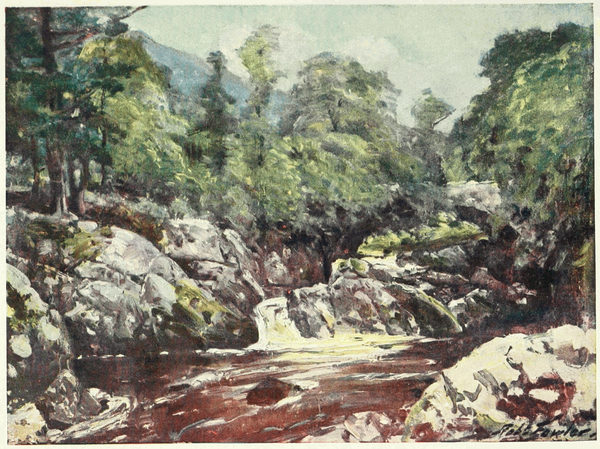
117Suddenly I met Philaster, who had years ago
rung the great bell of the house and become the
angry coachman's willing captive, so that he might
see the house quite close, and the flowers and the
grass. Between us we made the power of the breaker
and builder as naught. For a little while, indeed,
we asked, What would other children do who lived
in that suburb, and had no "Quebec" to provide a
home for all their fancies,—to lend its lawns for
bright ladies and brave knights to walk upon,—its
borders and bowers to complete the scenery of
Hans Andersen,—its grey walls to hide beauty and
cruelty, misers and witches, and children crying
because of wicked stepmothers? We had set out,
as children, to live as if for eternity. Now we
would live as if for annihilation to-morrow. We
would no longer set our hearts upon anything which
the world can destroy. We would set our hearts
upon things of the imagination—like "Quebec."
So we went up into an attic, and drew the
curtains, and lit the fire, and took draughts of long
oblivion, and made our sorrows pompous by reading
Villon and Catullus and Du Bellay, and the close
of Paradise Lost, and the thirteenth book of the
Morte Darthur, and Goethe's "Now comes first love
and friendship's company," and other things that
reminded us of decay and beauty; and not one of
them but drew a long echo from the hoary walls of
"Quebec" (now safe within our brains). Yet not
one of these things, however splendid or tumultuous
or tender, was then too splendid or tumultuous or
tender for our mood. Nor could one of them stir
118us so potently as the picture that came often that
evening to our minds. Here was the gaudy, dismal,
roaring street, its roar sometimes settling into
a kind of silence through which the heart longs
for voice of woman or bird to penetrate; and
there, seen over the high wall, was the old man
who owned "Quebec," playing bowls with several
happy children in the twilight, and half-hidden
by the dense border of hollyhock, red-hot poker,
blush roses, nasturtium, and sunflower; and the
house itself, looking more distant than it was,
in that sweet light, seemed to possess those
calm, impregnable high places of the wise, than
which, says Lucretius, there is no possession
more desirable.
Just before dawn, I came to a cleft high in
the hills, so that I could only see a little copse of
oak and hazel, and in the dying moonlight a
thousand white islands of cloud and mountain
Totus conlucens veste atque insignibus albis.
The night had gone, and the day had not come;
and the little copse had the serious, brooding air
119which all things have at that hour, and especially
when the land is tender with the first hope of spring
and in that reverie—
Cette rêverie
Que ne pense à rien.
For what I saw seemed but the fragments of something
which night had built for its own delight, and
as they became clearer and clearer they had more
and more the appearance of being unbuilt and
dissolved. But, gradually, the birds were let out
and they sang. Their songs, on the wintry hill,
which I had last visited in summer, broke upon
the silence as in summer they never do, like the
opening of the door of a room that is empty but
has once been gay with fire and books and men;
and sweet though the blackbird was, and shrill the
missel-thrush, their songs were awful, and said
that "a large part of the earth is still in the
urn unto us." The grass, which had truly been
of no colour, though my urgent memory persuaded
me that it was green, began to awake to
colour, and, while in the shadow of the copse
the dusk was impenetrable, the light reached
a knoll where there was dead bracken still.
"Colour," said Novalis, "is an effort of matter to
become light," and for one moment the grass
120upon that knoll ceased to strive and was light.
A plover that wheeled close by disappeared and
was but a glow.
I went on, and on a lower slope the ploughman
was beginning to plough in the shadow. Grim
and worthless looked the work, until I looked
round and saw the dawn that was being prepared.
But I watched too carefully, for I saw it all. Ever,
as it grew, statelier and richer, I said to myself,
that in a little while it would be perfected: yet
still I watched and I began to think of those who
saw it, as I had seen it before, from windows of
towns, as they rose for work, or as they douted the
candles and put away cards or books, and paused
for perhaps a minute, and gazed as they never
gazed at human beauty, because, though they
revered it, they feared it also, and though they
feared it they were fascinated. I thought of those
that leapt up at it; those that mourned because
they had seen it pass so often before into a common
day; those that, on inhospitable roads, saw it and
neglected it, or cursed it after a night in which
they had drunk their last poor earnings altogether.
If it would but last ... I had been looking at
it and had not seen it, and when I dropped these
thoughts I knew that it was gone, the slowly
prepared and solemn dawn which made the
splendid spring of that year.
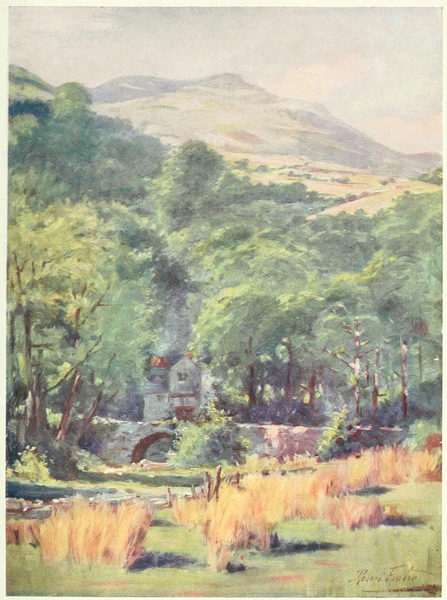
121
Then I took a path which led out of sight of
the white crested mountain and down among larches
and oaks.
The wind was changing the grass from green to
silver, and back again, rhythmically. In the pallid
herbage at the edge of the wood it produced many
little sounds, the combination of them barely louder
than the sound which fancy makes among tombs;
and yet that little concert passed into the ear and
heart, giving a sympathy with the thousand minute
sorrows of the inanimate world and a feeling that is
part of the melancholy so importunately intruding
on a spring day. But there, too, was trefoil,
delicatest herbage of the early year, with its trick
of globing and preserving rain upon its foliage,
so that it is more delicate still in the grey dawn.
One stalk with all its leaf singularly fine and small
had grown out of a scar in a teazel stem.
So I came into a valley, and there was one
white house in it, with a green, glowing, and
humming garden, and at the door a woman who
might have been the Old Year. It was one of
122those white houses so fair that in the old time a
poet compared a girl's complexion with them, as
with lilies and foam. It held all the sun, so that
suddenly I knew that in another valley, farther
south and farther east, the rooks were making the
lanes sleepy with their busy talk; the kingfishers
were in pairs on the brooks, whose gentle water
was waving and combing the hair of the river
moss; the gold of the willow catkin was darkened
by bees; over an old root of dock was a heaving
colony of gleaming ants; perhaps the chiffchaff
had come to the larches and the little green
moschatel was in flower with large primroses
among the ash stoles in wet woods; and in the
splendid moments of the day the poplars seemed
to come into the world, suddenly, all purple....
Yet here there was no rich high-hedged lane,
no poplar, no noise of rooks, but only a desolate
brown moorland crossed by deep swift brooks
through which the one footpath ran, and this white
house, like a flower on a grave, recalling these
memories of other valleys; so that I forgot that
near by the birches stood each in a basin of foam
from the dripping of mist and rain, and that I
had not yet seen a thrush's nest in any hawthorn
on those hills. Therefore, I counted that house
as lucky for me as the Welshman's hazel-stick
in the tale that is told in Iolo Morganwg's life.
123This is the tale.
A Welshman, with a fine hazel-stick in his
hand, was once stopped on London Bridge by an
Englishman, who asked whence he came. "From
my own country," said the Welshman churlishly.
"Do not take it amiss," said the Englishman;
"and if you will tell me what I ask, and take my
advice, it will be much for your good. Under
the roots of the tree from which came your
stick, there are great treasures of gold and silver;
if you can remember the place, and will take me to
it, I will make the treasure yours."
Now knowing that the fellow was a magician,
the Welshman, though at first unwilling to be a
party in this strange thing, at length agreed, and
went with him to Craig-y-Dinas and showed him
the hazel-tree. They dug out the root and found
a broad flat stone underneath, which covered the
entrance to a cave. They went in, the magician
warning the Welshman lest he should touch a bell
that hung in the middle of their path. At the
spacious further end of the cave, they saw many
warriors lying asleep in a circle, with bright armour
on, and weapons ready at hand. One of the
124warriors, refulgent above all the rest, had a jewelled
and golden crown along with the shield and battle-axe
at his side.
At the feet of the warriors, in the middle of
the circle, they saw two immense heaps, the one of
gold, the other of silver, and the magician told the
Welshman that he might take away as much as he
could carry from either of the heaps. So he took
much gold. The magician took nothing. On their
way out of the cave he again warned the Welshman
lest he should touch the bell. But should he touch
it, said the magician, some of the warriors would
surely awake and ask "if it was yet day": to which
he must at once answer: "No, sleep thou on,"
whereupon the warriors would sleep again. And
this the Welshman found to be truth when he
staggered under his gold and grazed the bell; but
remembering the other's words, he said: "Sleep
thou on" when the warriors asked if it were day;
and they slept.
When they had left the cave, and closed the
entrance, the magician told the Welshman that he
might return to the cave whenever he wished;
that the warriors were the knights of King Arthur,
and the warrior with the jewelled and golden
crown was King Arthur; that they were awaiting
125the day when the Black Eagle and the Golden
Eagle should go to war; for on that day the
trembling earth would toll the bell, and at that
sound the king and the knights of the king would
awake, take their weapons, overthrow the Saxon,
recover the island of Britain, and again establish
their king at Caerlleon, in justice and in peace and
for ever. But the Welshman spent his gold. He
went again to the cave; he overloaded his back
with gold; he stumbled and the bell rang; he
forgot the password. And the knights rose and
leaned upon their elbows, and one of them stood
up and took away his gold and beat him and thrust
him out and closed the mouth of the cave; and
though he and many others made all the hill sore
with their digging, the cave was not found again.
For half a day there was now a world of snow,
a myriad flakes falling, a myriad rising, and nothing
more save the sound of rivers; and now a world of
green undulating hills that smiled in the lap of the
grey mountains, over which moved large clouds,
sometimes tumultuous and grey, sometimes white
126and slow, but always fringed with fire. When the
snow came, the mountains dissolved and were not.
When the mountains were born again out of the
snow, the snow seemed but to have polished the
grass, and put a sharper sweetness in the song of the
thrush and the call of the curlew, and left the
thinnest of cirrus clouds upon the bare field, where
it clung only to the weeds. So, in this dialogue
of mountain and snow, nothing was easily remembered
or even credible, until I came to the
foot of a hill which hazels and oak trees crowned.
The snow was disappearing and the light came precipitately
through it and struck the hill. All the
olive and silver and leaden stems of oak and hazel
glowed together and made a warm haze and changed
the hill into an early sunset cloud out of which
came the cooing of wood-pigeons. The mountains
lay round, grey, faint, unimportant, about to pass
away; the country that lay between them and the
hill was still in mist. So the hill rose up crowned
and garlanded like a statue in a great hall of some
fair woman of whom one wonders what art can persuade
her to stay on that cold pedestal for ever. The
wood-pigeons cooed continually; and there was the
hill, using all the sunlight, as a chrysanthemum will
do in a London street. It lived; it appealed to all
the sense and brain together; it was splendid; it
was Spring's, and I do not know of anything else
that mattered or was, for the time. Very sweet it
was to see the world as but a shining green hill
and a shining brown wood, with a wood-pigeon for
a voice, while all other things that had been were
gone like the snow. That there was also a wind I
knew only because it brought with it the scent of a
farmyard behind: for it had motion but no sound.
Something in me was content to see the hill as a
monument of Spring that might endure for ever,
that the wood-pigeons might coo their song; and
saw that it made possible the sound of bells in an
evening landscape, of wheat in sheaves, and quiet
beeches and doves among them. Yet I climbed to
the wood, and saw that last year's leaves were too
thick yet for a flower to pierce them; and that
same wind had found a brittle, dead ash-tree in
which to sing a cold November song; and the
pigeons clapped their wings and flew away. And
that cold November song made me remember
against myself the old legend of the child who
played with fairies, but came once with her mother
and saw them no more.
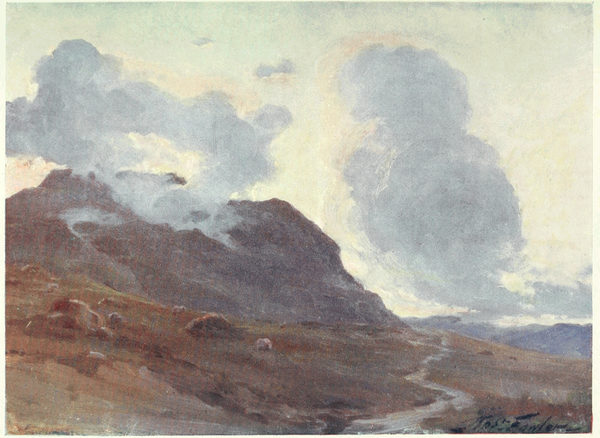
COMING NIGHT, NEAR BEDDGELERT
127There were, says the story, at a small harbour
belonging to Nefyn, some houses in which several
128families formerly lived; the houses are there still,
but nobody lives in them now. There was one
family there to which a little girl belonged; they
used to lose her for hours every day; so her mother
was very angry with her for being so much away.
"I must know," said she, "where you go for your
play." The girl answered that it was to Pin-y-Wig,
"The Wig point," which means a place to
the west of the Nefyn headland; it was there, she
said, she played with many children. "They
are very nice children,—much nicer," said the child,
"than I am." "I must know whose children
they are," was the reply; and one day the mother
went with her little girl to see the children. It
was a distance of about a quarter of a mile to Pin-y-Wig,
and after climbing the slope and walking a
little along the top they came in sight of the Pin.
It is from this Pin that the people of Pen-yr-Allt
got water, and it is from there they get it still.
Now after coming near the Pin the little girl raised
her hands with joy at the sight of the children.
"Oh, mother," said she, "their father is with them
to-day; he is not with them always; it is only sometimes
that he is." The mother asked the child
where she saw them. "There they are, mother,
running down to the Pin, with their father sitting
down." "I see nobody, my child," was the reply,
and great fear came upon the mother; she took
hold of the child's hand in terror, and it came to
her mind at once that they were the Tylwyth Teg.
Never afterwards was the little girl allowed to go
to Pin-y-Wig: the mother had heard that the
Tylwyth Teg exchanged people's children with
their own.
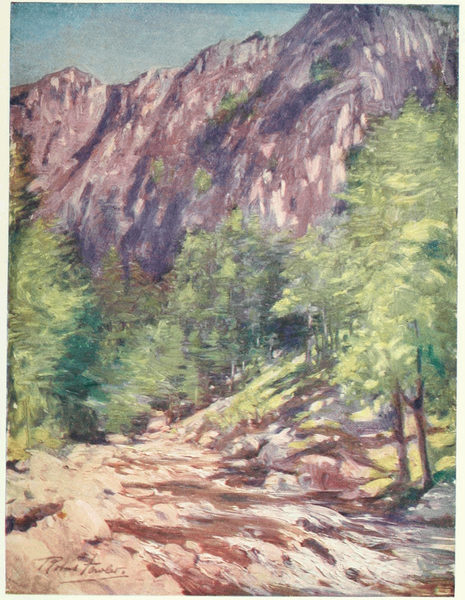
129
Yesterday, the flower of the wood-sorrel and
the song of the willow-wren came together into the
oak woods, and higher up on the mountain, though
they were still grey, the larches were misty and it
was clearly known that soon they would be green.
The air was full of the bleating of lambs, and though
there was a corpse here and there, so fresh and
blameless was it that it hardly spoiled the day.
The night was one of calm and breathing darkness;
nor was there any moon; and therefore
the sorrowful darkness and angularity of early
spring valleys by moonlight, when they have no
masses of foliage to make use of the beams, did
not exist. It was dark and warm, and from the
invisible orchard, where snow yet lay under the
stone wall, came a fragrance which, though it was
not May, brought into our minds the song that
130was made for May in another orchard high among
hills:
Have you ne'er waked in the grey of the day-dawn
Whitely to stand at the window scarce seen,
Over the garden to peer in the May-dawn
Past to the fruit-close whose pale boughs not green
Slowly reveal a fresh faintness a-flutter
White to the young grass and pink to the sky?
O, then a low call to waking we utter:
"Bluth, lasses, apple-bluth spirts low and high."
Out, lasses, out, to the apple-garth hasten—
Nay, never tarry to net your glad hair—
Here are no lovers your kissed shoes to fasten
(O, for the days when girls' feet may go bare).
O'er the dim lawn the may-rime yet lingers,
Pallid and dark as the down of the dawn—
Gather your skirts in your delicate fingers,
Stoop as you run o'er the almond-hung lawn.
Look through the trees ere dawn's twilight is over—
Lo, how the light boughs seem lost in the stars;
Everywhere bluth the grey sky seems to cover
Quivering and scented, new spring's kisses' scars.
Wet are the blossoms to wash your faint faces—
Bury your faces cheek-deep in their chill;
Press the flushed petals and open your dresses—
So—let them trickle your young breasts to thrill.
Winter has wronged us of sunlight and sweetness,
We who so soon must be hid from the sun;
Winter is on us as summer's completeness
Faint-hearted drops down a tired world undone;
Brief is the bloom-time as sleepy maids' laughter
Who know not one bed-time 'tis summer's last day.
Though from the heart of the rose they have quaffed her.
Come, lasses, come, ere our rose world falls grey.
131We had talked long into the night, and then as
sleep came, out of this darkness peered the early
timorous warble of a blackbird, and gradually all
the birds in orchard, hedge, and wood made a thick
mist or curtain of innumerable and indistinguishable
notes through which still crept the bolder note of
that same nearest blackbird. As the night lost its
heaviness, though not its stillness, the continuous
mist of songs grew thicker and seemed to produce
or to be one with the faint darkness which so
soon was to be light. It seemed also to be making
the landscape which I saw being made, when I
looked out. There, was the side of the hill; there
the larches, the dark hedges, and the lingering snow
and the orchard: they were what I had seen before,
but changed and increased; and very subtle, plaintive,
menacing, vast, was the work, though when
the light had fully come, once more the larches,
the hedges, and the orchard were as if they had
never been sung to a new order of beauty by the
mist of songs, and yet not the same, any more than
a full coffin is the same as the lips and eyes and
hands and hair, of which it contains all that we
did not love. And still there were many songs;
but you could tell who sung each of them, if you
wished.
132
At the end of the month, when already the
cuckoo had come and the blackthorn flowers among
hawthorn branches were deceiving those who desired
May, I went again to the hill where the wood-pigeons
had cooed. I sat in a room in sight of it,
during a cloud-gathering sunset. The white houses,
which had earlier been like remnants of winter
snow, were now like flowers. They and the misty
larches and the birches gave a nuptial splendour to
the old hills. Once more the land stood in preparation,
as it stands year after year, so that one might
think it expected a new dynasty of gods to come
on May day, as often happened in the old time.
And in the oaks and hazels the wood-pigeons cooed
again. But when the sunset was perfect, they
ceased as if they also feared and loved the white
and green lines of cloud that lay over the hills—of
a white and green which I had only seen together
before in a crimpled, tender cabbage cut in two
and lying half in bright water for the cook. Then
the silence grew and grew, exciting and paining
and pleasing and never satisfying the ear; so that
I knew not whether the silence or the speech that
preceded it was the more mysterious. For him
that has ears there is nothing more expressive than
speech; but it is never unequivocal as silence is.
The two are perhaps handmaidens to one another
and inseparable parts in the universal harmony,
although Maeterlinck says that a silent child is
wiser than Plato eloquent.
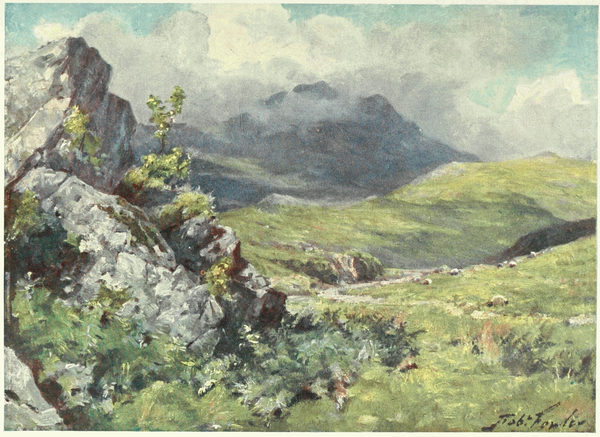
133A cuckoo had been singing, but now I heard it
not; no longer did the yellow-ammer insist, the
thrush gossip, the blackbird muse; the sounds of
the house were dead: and I saw a hundred
cows, some lying down, some moving so lazily—like
sailing ships on a wide sea—that I could
not see the changing of their pattern on the
grass, and I was entangled in the unfathomable
dream of the unending hills and the unending
valleys.
In the room hung a landscape of savage hills,
cloven by dark shadows and bright streams, and
the glass reflected the calm grass and the hill
and the oak and hazel woods which thus mingled
with the picture at times and made a strange
palimpsest of winter and spring. Now one and
now the other predominated, until some one
came in, as three cuckoos flew crying overhead,
and sang this song, which gave the victory to
spring:—
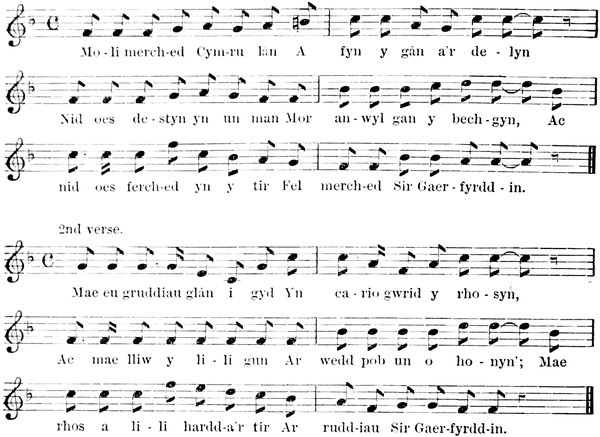
THE MAIDS OF CAERMARTHENSHIRE
Mo-li merch-ed Cym-ru lân A fyn y gân a'r de - lyn
Nid oes de-styn yn un man Mor anwyl gan y bech-gyn,
Ac nid oes ferch-ed yn y tir Fel merch-ed Sir Gaer-fyrdd-in.
Mae eu gruddiau glân i gyd Yn ca-rio gwrid y rho-syn,
Ac mae lliw y li-li gun Ar wedd pob un o ho-nyn';
Mae rhos a li - li hardd-a'r tir Ar rudd-iau Sir Gaer-fyrdd-in.
And something like these were the Welsh
words, which were by Watcyn Wyn:
Song and the harp desire to raise
To sweet Wales praise for its women;
Lads and their hearts have not one theme
So dear, no dream so clinging;
There are no maidens in the land
Like the maiden band of Caermarthen....
Of modest looks and nimble feet,
They are just as fleet as the wind's wings;
Dearly and lovesomely each floats
Red petticoats out farther;
They dance it swiftly through the earth,
The maids who had birth in Caermarthen....
When men would love they desire the way
Of these; for, I say it in earnest,
One is worth two or even three
Of the usual free brave women.
If I take a wife I shall kiss the braids
Of one of the maids of Caermarthen.
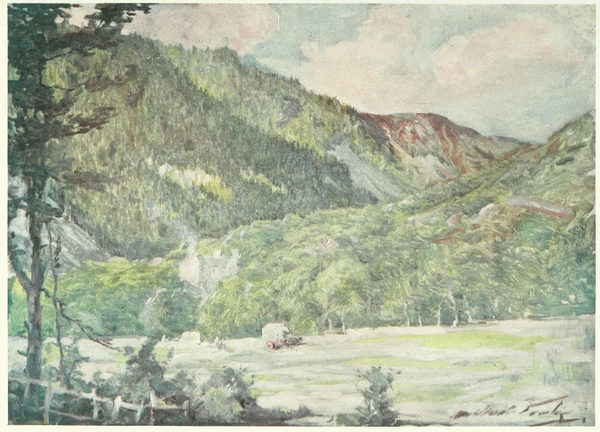
A HAYFIELD NEAR PORTMADOC
134
All the morning I had walked among the
mountains, and snow had fallen; but gradually I
descended, and found a hawthorn standing all white
and alone; and, at first, the delicacy of the country
had an air of unreality, as if it were but a fancy
provoked by the grim, steep, cold heights. Nor,
at first, were the small farmhouses quite so real as
the crags I remembered. As I approached them,
I seemed to be revisiting lands that belonged to a
fictitious golden past; but as I came up to them,
I was not undeceived, as I should have expected to
be. How sweet and grave were the young larches!
The brooks were not running as I had heard them
up among the hills, but as brooks would run if I
read of them at home and at ease in the verses of
some tender poet, or as they will when I remember
them many years hence. The sound of the world
was heard only as the laughter of youthful voices
135by the trout pools, or again as the pealing of bells
that presently grew and swelled and bubbled until
the valley in which they pealed overflowed with
the sound, and the moment of their ceasing was
not marked. So at last I gave up some of the
pleasure of sight and hearing and smell under the
influence of those very senses. For a fancy came of
a kind that is not easily avoided when spring and
our readiness for it come together. And the fancy
was that I was coming into a land whither had
fled the transient desirable things of childhood
and early youth. Especially was it the land to
which had fled the acquaintances of that time, who
were known, perhaps, only for one day—one spring—with
whom intimacy began to flower, and then
death or some less perfect destroyer intervened and
"slit the thin-spun life" and gave an unwithered
rose into our keeping—the memory of a laugh, a
revelation, a catch of fish. We did not know them
long enough to have doubts, self-questionings, the
egotistical indulgences in letters and conversations
of which we sometimes drink so deep that we taste
the lees and know futility. Or they passed away
as childish games do: we made an appointment
and never kept it, and so we never knuckled the
marble or saw the child again. We knew them
once, golden-haired, and with laughter which no
sigh followed, with clear voices in anger or love.
These grow not old! And with them are some of
those who were once as they, the friends who were
once acquaintances: for who does not pleasantly
(or bitterly) remember the first fresh moments
when, like a first glass, our friends, with all their
best qualities perhaps unknown, were tasted carelessly,
the palate quite unsoiled and in no need of
the olives of charity; or the moments when, with
tastes and aims not yet mutually discovered, we
were yet dimly conscious of the end, seeing the
whole future under vague light? Some of these
we can—and I did—recall as if the happy voices
had not died, but had simply made way for harsher
or sadder tones, and had fled here to keep an
immortality. I heard them on the fresh warm
air. And with them hovered those I saw but once—in
a crowd, at a wayside inn—and desired; and
at my evening inn some empty chairs were not
wholly in vain. Thus did the shadow of the
mountain fall far over the soft lands below.
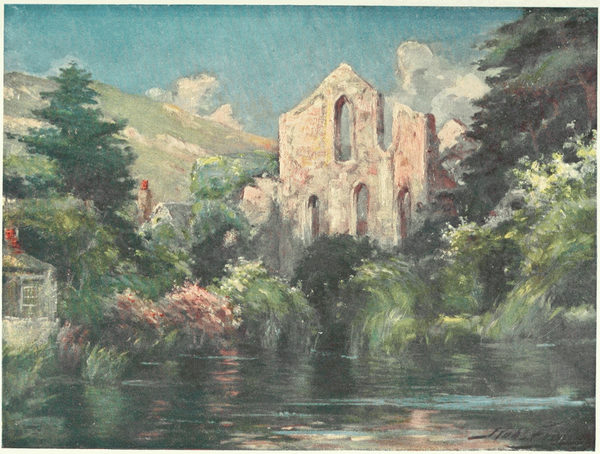
136
All sign of snow had left the hills, when
long before sunrise, but not before the east had
137begun to grow serious with thoughts of dawn, I
came upon a rough meadow, where a solitary thorn
was white with flower—or of that colour which
white is in the dusk. It reminded me of snow,
but prettily defying the mountains, it meant all
May. And it happened that the day then being
born was perfect May. The east opened, and the
close-packed, dwarfed hills were driven out of it
like sheep, into the gradual light. From that
moment until the day passed in a drift of purple
and dim cloud, all things were marvellously clear.
In the hedges, on the rough meadows, and in the
steep wastes under the cliffs, there were hundreds
of hawthorns flowering, and yet they were not
hundreds, but one and one and one.... They
were as a crowd of which we know all the faces,
and therefore no crowd at all; and one by one
these were to be saluted. Not only the white
thorns, but the oaks in the large fields, and even the
ashes and alders by the brooks were each distinct.
If I had raised my head, I should have seen, indeed,
that the mountains were in haze, and that what I
had just passed was in haze. But I never saw, or
wished to see, for more than a quarter of a mile,
and within that distance all things were clear and
separate, like books which oneself has handled and
known, every one. Even the daffodils under a
hazel hedge never became a patch. The women,
at gateways or among the cows, stood out like one
or two statues in a large vacant hall. One field
had in it twelve isolated oak trees, and that they
were twelve I saw clearly, and wondered and
admired, and never dreamed of thinking of them as
just a number of oaks. One by one the footpaths,
to left or right, went up to one of the oaks or
thorns, and, untrodden, disappeared suddenly. And
I could not but recall the lovely clear pictures in
old Welsh poetry and story which had on winter
nights reminded me of May. And chiefly this,
from the Mabinogion, was in my mind.
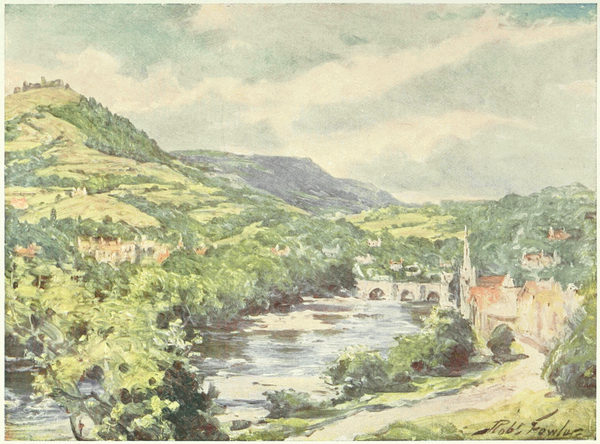
138"'I was,' said Kynon, 'the only son of my
mother and father, and I was exceedingly aspiring,
and my daring was very great. I thought there
was no enterprise in the world too mighty for me,
and after I had achieved all the adventures that
were in my own country, I equipped myself and
set forth through deserts and distant regions. And
at length it chanced that I came to the fairest
valley in the world, wherein were trees of equal
growth; and a river ran through the valley, and a
path was by the side of the river. And I followed
the path until mid-day, and continued my journey
139along the remainder of the valley until the evening;
and at the extremity of an plai I came to a
large and lustrous castle, at the foot of which was
a torrent. And I approached the castle, and there
I beheld two youths with yellow curling hair, each
with a frontlet of gold upon his head, and clad in a
garment of yellow satin, and they had gold clasps
upon their insteps. In the hand of each of them
was an ivory bow, strung with the sinews of the
stag; and their arrows had shafts of the bone of the
whale, and were winged with peacock's feathers;
the shafts also had golden heads. And they had
daggers with blades of gold, and with hilts of the
bone of the whale. And they were shooting their
daggers.
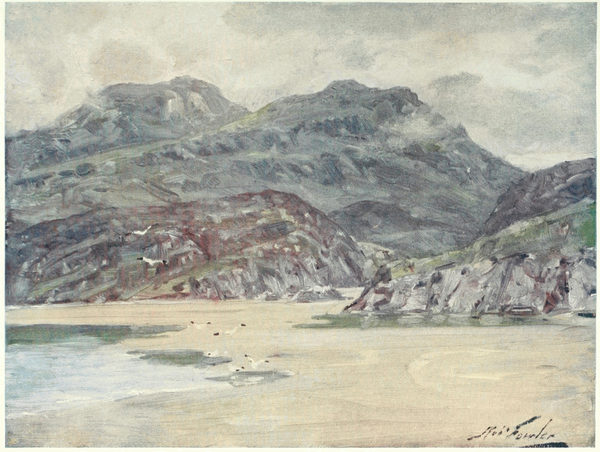
A LONELY SHORE NEAR PENRHYN DEUDRAETH
140"'And a little way from them I saw a man in
the prime of life, with his beard newly shorn, clad
in a robe and a mantle of yellow satin; and round
the top of his mantle was a band of gold lace. On
his feet were shoes of variegated leather, fastened
by two bosses of gold. When I saw him, I went
towards him and saluted him, and such was his
courtesy that he no sooner received my greeting
than he returned it. And he went with me towards
the castle. Now there were no dwellers in the
castle except those who were in one hall. And
there I saw four-and-twenty damsels, embroidering
satin at a window. And this I tell thee, Kai, that
the least fair of them was fairer than the fairest
maid thou hast ever beheld in the Island of Britain,
and the least lovely of them was more lovely than
Gwenhwyvar, the wife of Arthur, when she has
appeared loveliest at the Offering, or on the day
of the Nativity, or at the feast of Easter. They
rose up at my coming, and six of them took my
horse, and divested me of my armour; and six
others took my arms, and washed them in a vessel
until they were perfectly bright. And the third
six spread cloths upon the tables and prepared
meat. And the fourth six took off my soiled
garments, and placed others upon me; namely, an
under vest and a doublet of fine linen, and a robe,
and a surcoat, and a mantle of yellow satin with
a broad gold band upon the mantle. And they
placed cushions both beneath and around me, with
coverings of red linen; and I sat down. Now the
six maidens who had taken my horse unharnessed
him, as well as if they had been the best squires in
the Island of Britain. Then, behold, they brought
bowls of silver wherein was water to wash, and
towels of linen, some green and some white; and
I washed. And in a little while the man sat down
141to the table. And I sat next to him, and below
me sat all the maidens, except those who waited on
us. And the table was of silver, and the cloths
upon the table were of linen; and no vessel was
served upon the table that was not either of gold
or of silver or of buffalo horn. And our meat was
brought to us. And, verily, Kai, I saw there every
sort of meat and every sort of liquor that I have
ever seen elsewhere; but the meat and the liquor
were better served there than I have ever seen
them in any other place....'"
Only the brain of the man who saw things thus
could describe that clear day in May.
It was a country of deep, calm pastures and
slow streams that might have been in England,
except that smiling women at the last farm I had
passed were talking in Welsh and calling one another
Mary Margaret, or Blodwen, or Olwen; and that far
off, like a dim thought or a half-forgotten dream,
a mountain conversed with the most distant clouds.
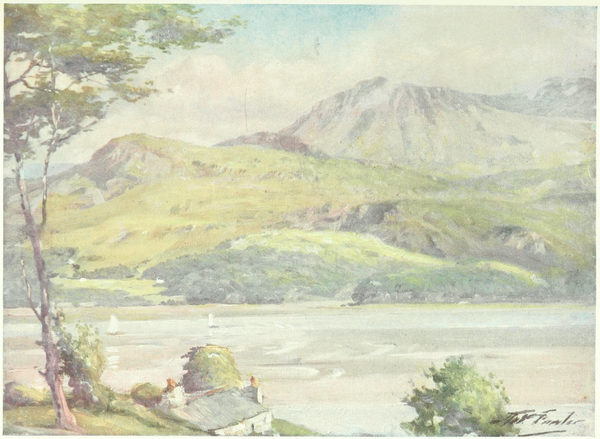
THE SHORE NEAR HARLECH—AFTERNOON
142Along my path there had been many oaks and
doves among their leaves; and deep hedges that
sent bragging stems of briers far out over the footpath,
and hid delicate single coils of black bryony
in their shadows; and little bridges of ferny stone,
and beneath them quiet streams that held flower
and tree and cloud in their depth, as if in memory;
and great fields where there was nothing, or perhaps
a merry, childlike, scampering stoat that pursued a
staring, trotting rabbit. I had walked for ten miles
and had not seen a man. But it would be more
just to ignore such measurements, since the number
of milestones was unimportant; so also were the
hours. For the country had given me the freedom
of time. Dreams of brains that had long been dead
became stronger than the strong right hand of to-day
and of yesterday. And without asking, these
verses sang themselves in my head:—
Midways of a walled garden,
In the happy poplar land,
Did an ancient castle stand,
With an old knight for a warden....
Across the moat the fresh west wind
In very little ripples went;
The way the heavy aspens bent
Towards it, was a thing to mind.
The painted drawbridge over it
Went up and down with gilded chains;
'Twas pleasant in the summer rains
Within the bridge-house there to sit.
143There were five swans that ne'er did eat
The water weeds, for ladies came
Each day, and young knights did the same,
And gave them cakes and bread for meat.
I remembered them with a curious sense of
being uncontrolled, or, if you will, of being controlled
as one is in sleep, and not by friends, railways,
clothes, and meals, as one usually is. I had
entered that golden age that is always with us,
where there are no wars except in the Iliad and
Paradise Lost. At one stile, I saw Aeneas,—in
mediæval mail,—revealing a blue-eyed, confident
face, with a slippery mouth set firm by his destiny.
The country was without obvious character.
An artist could have made nothing of it. Nothing
in the arrangement of meadow and corn-land, wood
and reedy water, made a clear impression on the
mind: they might, perhaps, have been rearranged
without attracting attention. So the landscape
occupied the eyes little and the mind not at all.
Wandering over it with no emotion but rest, I
made of it what I would. In different moods I
might have met there Proserpina, or Camilla, or
Imogen. But chiefly I met there the vague
persons of poetry, like Shelley's Ione, which are
but as large eyes or eloquent lips discerned in
144fleeting darkness. And I was too deeply lost to
be at once rescued by the sight of a dignified,
untenanted house, whose shrubberies I wandered
into, along a rabbit run as deep as a footpath
in the short, hawk-weedy grass. Docks and
milk-thistles had not yet overpowered lupin
and phlox in the deep borders that still had a
tinge of race in their order and luxuriance. The
martins of the eaves had added to the pompous
portico of the house, so that it had the look of
wild rock. The roses had sent up enormous
talons from their roots and tyrannised everywhere.
There were no flowers in the garden more delicate
than the enchanter's nightshade and nipplewort of
the shrubbery, and the short wild poppies that
could just flower in the old gravel of the paths.
For this one moment the wild and the cultivated
were at peace together, and the harmony gave the
place an unreality,—so that even at the time I had
a dim belief that I was in a garden out of a book,—which
made it a fit haven for my mood. Then, in
a corner, among ruined, ivy-covered elms, I found
a stupid, mournful grotto of wildly-shaped stones
wildly accumulated: at the threshold lay a penny
doll that played a part between comedy and tragedy
very well. Going near, I saw, not quite so clearly
145as I see it now, a long-bearded, miserable man,
reclining, with fair, unwrinkled brow and closed
eyes and shining teeth. On his long sloping forehead
a high-mounted spider dreamed; yet he did
not stir. A snake, in a fold of his coat beneath his
beard, disregarded the heaving of his chest. His
breath filled the grotto as a cow's would have done,
and it was sweet. And I turned away suddenly,
put to shame by what my soul, rather than my eyes,
had recognised as Pan. For I ought to have been
prepared and I was not.
And as I walked home in an embowered lane,
some floating, clashing insects troubled me, and
that night, whilst I enjoyed the coming on of sleep,
I could not but fancy that I heard the whisper of
a god's garment, and wondered had I troubled a
god's meditation and walk.
To-day, it is another country, as different
from the last as old age from maturity. No
longer does the greenfinch in the hawthorn say a
hundred times that it has five young ones and is
happy. No longer does the perfect grass, seen
betwixt the boles of beeches, burn against the
sky. For that dream of mountains has come true,
and so many and so great are they that I can
compare my loneliness only with what I have
fancied to be the loneliness of one planet that now
is and again is not in a tumultuous, grey, midnight
sky, or of a light upon a ship between clouds and
angry sea, far off.
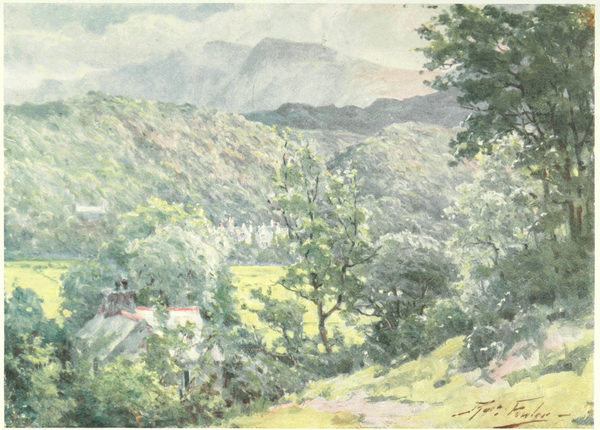
IN THE WOODS, FARCHYNYS, BARMOUTH ESTUARY
146The thought of steam and electricity never
truly touches the primitive sense of distance; and
here, even the milestones among the foxgloves are
somewhat insolent, when they say that the town
under that farthest hill is thirty miles away; for
the hill, unknown to me, is farther away than any
place I have ever seen, and I would rather say
that it is thirty years away and in the dim future
or the dim past.
In their shape, there is something human, or
suggesting human work, in these hills. Castles, or
less noble masonry, noble when fallen, look thus
in their ruins, and become thus tricked with delicate
verdure and flowers. A great plough driven at
random through frosty country would have turned
up half-mile clods like these. And at twilight there
is a ridge like an extended giant with raised knees
and chin thrown back; and often I have seen a
horned summit, like a Pan, capture the white
moon.
147This mountain ahead is not only old, but with
its uncovered rock and broken boulders and hoary
streams and twisted trees, that look as if a child
had gathered garlands and put them in play upon
the ancient stems, it declares mightily, if vaguely,
the immense past which it has seen. There are
English hills which remind us that this land also
was once in Arcady: they are of a golden age,—the
age of Goldsmith, of Walton, of Chaucer if
you like, or of Theocritus; but they speak of
nothing since; they bear no wrinkles, no wounds,
no trophies. But by this mountain you cannot be
really at ease until in some way you have travelled
through all history. For it has not been as nothing
to it that Persia, Carthage, Greece and Rome, and
Spain have been great and are not. It has been
worn by the footprints of time which have elsewhere
but made the grass a little deeper or renewed
the woods. It has sat motionless, looking
on the world; it has grown wrinkled; it is all
memory. Were it and its fellows to depart, we
should not know how old we were; for we should
have only books. Therefore I love it. It offers
no illusions. Its roads are winding and rough.
The grass is thin; the shelter scarce; the valley
crops moderate; the cheese and mutton good;
the water pure; the people strong, kind, intelligent,
and without newspapers; the fires warm and bright
and large, and throwing light and shadow upon
pewter and brass and oak and books. It offers
no illusions; for it is clear, as it is not in a city or
in an exuberant English county, that the world
is old and troubled, and that light and warmth and
fellowship are good. Sometimes comes a thought
that it is a huge gravestone, so is it worn, so
obscure and brief its legend. It belongs to the
past, to the dead; and the dead, as they are more
numerous, so here they are greater than we, and
we only great because we shall one day be of their
number. You cannot look at it without thinking
that the time will come when it may be, and we
are not, nor the races of men—
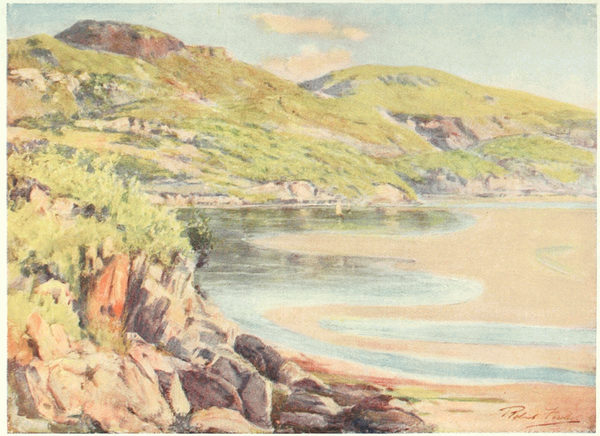
INCOMING TIDE, NEAR BARMOUTH
148sed haec prius fuere: nunc recondita
senet quiete.
And hearing an owl among its oak trees, its age
was quaintly expounded to me by that passage in
the Mabinogion where the Eagle of Gwernabwy
seeks a wife.
"The Eagle of Gwernabwy had been long
married to his wife, and had by her many children.
She died, and he continued a long time a widower;
but at length he proposed a marriage with the Owl
149of Cwm Cawlwyd. But afraid of her being young,
so as to have children by her, and thereby degrade
his own family, he first of all went to inquire about
her age amongst the aged of the world. Accordingly
he applied to the Stag of Rhedynfre, whom
he found lying close to the trunk of an old oak,
and requested to know the Owl's age.
"'I have seen,' said the Stag, 'this oak an acorn,
which is now fallen to the ground through age,
without either bark or leaves, and never suffered
any hurt or strain, except from my rubbing myself
against it once a day, after getting up on my legs;
but I never remember to have seen the Owl you
mention younger or older than she seems to be at
this day. But there is one older than I am, and
that is the Salmon of Glynllifon.'
"The Eagle then applied to the Salmon for the
age of the Owl. The Salmon answered, 'I am as
many years old as there are scales upon my skin,
and particles of spawn within my belly; yet never
saw I the Owl you mention but the same in
appearance. But there is one older than I am,
and that is the Blackbird of Cilgwri.'
"The Eagle next repaired to the Blackbird of
Cilgwri, whom he found perched upon a small
stone, and inquired of him the Owl's age.
150"'Dost thou see this stone upon which I sit,'
said the Blackbird, 'which is now no bigger than
what a man can carry in his hand? I have seen
this very stone of such weight as to be a sufficient
load for a hundred oxen to draw, which has suffered
neither rubbing nor wearing, save that I rub my
bill on it once every evening, and touch the tips
of my wings on it every morning, when I expand
them to fly; yet I have not seen the Owl either
older or younger than she appears to be at this
day. But there is one older than I am, and that
is the Frog of Mochno Bog; and if he does not
know her age, there is not a creature living that
does know it.'
"The Eagle went last of all to the Frog, and
desired to know the Owl's age. He answered, 'I
never ate anything but the dust from the spot
which I inhabit, and that very sparingly; and
dost thou see these great hills that surround and
overawe this bog where I lie? They are formed
only of the excrements from my body since I have
inhabited this place; yet I never remember to
have seen the Owl but an old hag, making that
hideous noise Too-hoo-hoo, always frightening the
children of the neighbourhood.'"
Farther along the road, and not wholly cut off
151from a world of richer fields, there is the ruin of
an abbey, which, being the work of human hands,
says the same thing more clearly. It is but a cave
of masonry topped by umbrageous ivy that swells
over its edge like froth over a tankard. Altar
and bells and books and large abbatic oven are
gone. Only the jackdaw remains. The winds
blow through and through the ruins. There is
moss; here are flowers,—yellow cistus and cinque-foil,
purple fumitory, pearly eyebright, and still
some white stitchwort stars. But nothing dies
save what we let die, and here, as in a library, on
this once consecrated ground, meet all religions.
It has room for the Druid. Its ivy leaves repeat
the praises of moon and sun. It will deny no
fairy and no god an altar and a place for dancing.
I have gone there with many fancies and many
memories of books, and there they find a home.
And if, as some have done, you go there with
willingness and an inability to accept what dreams
have hitherto been dreamed, you may seem there,—in
favourable hours, when the casements of all the
senses are opening wide upon eternity, and all
things are silent as fishes, and the curves of bramble
and brier among the masonry seem to be thinking,—to
be on the edge of a new mythology and to
taste the joy of the surmises of him who first saw
Pan among the sedges or the olives.
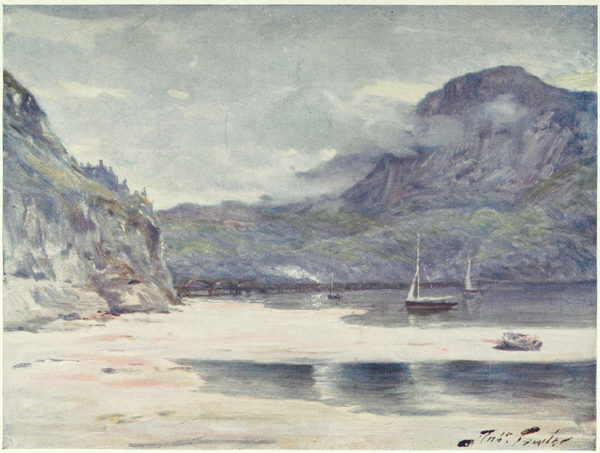
152
For three days I walked and drove towards
Llyn-y-Fan Fach. On the first day I passed through
a country of furnaces and mines, and the country
had been exquisitely made. The gently swirling
lines of hill and valley spoke of the mountains far
off, as the little waves and the foam coming up
the shore like chain-mail speak of the breakers out
in the bay. Every large field that was left unburdened
by house or factory had a fair curve in it,
and even the odd pieces of land were something
more than building sites and suggested their context.
But as we passed through, only the highest
points gave the curious eye any satisfaction, since
the straight lines of houses, the pits and the heaps
of refuse, and the enormous factories, obscured
the true form of the land. Even so might some
survivor of a deluge look upon the fair land he
knew; for we lacked the courage to think of hill
and valley as having undergone an inevitable
change, which in a century might be known to
153have brought beauty with it, as changes do.
Everything was brand-new, but not fresh. A
wanton child might have done it all, had he been
large and rich and careless enough to do it thus,
nec numero nec honore. Or had it been all built to
the music of the organ-grinder whom I met playing,
for the joy of playing, "The Absent-minded
Beggar"? The staring, mottled houses of various
stone and brick, which had no character save what
comes of perfect lack of character, might have been
made by some neglected boy who had only played
with penny trains and motor cars and steamers and
bicycles. Phlox and foxglove, and sweet-william
and snapdragon, and campanula and amber lilies
could not make sweet the "rockeries" of hot-looking
waste. The streets, named after factory magnates,
had been made in long blocks and broken up by
the boy, thoughtlessly. The factories themselves,
noble as some of the furnaces were by day and
night when sweating men moved to and fro before
them, were of the same origin. They were mere
cavities, and one marvelled that the smoke from
their chimneys was permitted to waver and roll in
the same way as clouds the most splendid and
august. Many were already in places decayed.
That they had been glazed only to have the
windows pierced by the stones of happy children
was all in their favour that could be seen. Their
roofs had fallen in, and neither moss nor ivy had
had time to grow thereon; the splintered wood
was still new and white. Middle-aged men of
fifteen and aged men of thirty were in keeping
with their ludicrous senility. A millionaire playing
at imitating antiquity could have done no
worse. The decay was made in Birmingham.
Time had been sweated and had done its work
very ill. Here and there, indeed, there were
scenes which perhaps an unprejudiced mind would
have found sublime. There were pools, for example,
filled with delicate grass and goldfish
amongst it. They were made yesterday, and yet
had they fed little brooks for ages they could not
have been more shining and serene as sunset poured
all its treasury into their depths. Passing one,
soon after dawn, and before the night-workers had
left the factory, the reeds in it stood up just so that
no storied pool had more the trick of antiquity.
Near by, one green field, set amidst houses and a
factory, was enclosed by abundant but ill-stretched
barbed wire, without gate or possible entrance of any
kind. In the middle was a tattered notice, warning
trespassers. No cloister was ever more inviolate.
The grass grew as it liked, and all whom the heavy
headstones of the buildings had spared in the rash
burial of rural divinities must there have danced;
and the grass shone as if with recent festival, and
its emptiness hinted at a recent desertion. All the
other fields had been carelessly defaced by broken
cheap china and tin kettles and rags, and like cattle
that have a day to live and are insulted with the
smell of their lucky companions' blood, they were
dreary and anxious. Footmarks, but not one
footpath, crossed them in all directions.... A
Battersea kitchen after Christmas is adorned like
this land with similar spoiled toys. Their pathos is
the same in kind; but here it is worse, because
a grown-up person—the original grandeur and
antiquity of the land as shown in the one green
field—has burst in and marred the completeness of
the children's play.
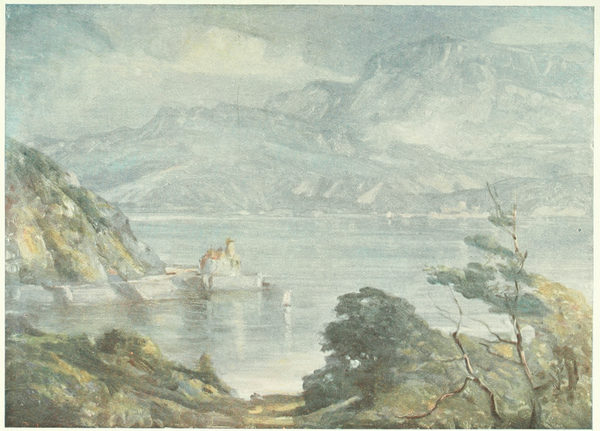
MISTY MORNING, NEAR BARMOUTH
154
At the edge of one village in this country
there was a new public-house, the worst of the
buildings in the place, because the most impudent.
It glittered and stank and was called "The Prince
of Wales." Inside, English and some Welsh voices
were singing together all of Britain's most loved
songs; perhaps "Dolly Gray" predominated, and
in its far-floating melody the world-sorrow found
a voice; for a harper played on the harp while
they sang. The landlord liked to have the harper
there, because he drew customers and kept them,
and it was clear that he himself, when he had time,
loved music, since he took his pipe out of his
mouth to hum the last words of a song about a
skylark, a dead mother, and some angels. The
next song was "The Rising of the Lark," which
begins thus:
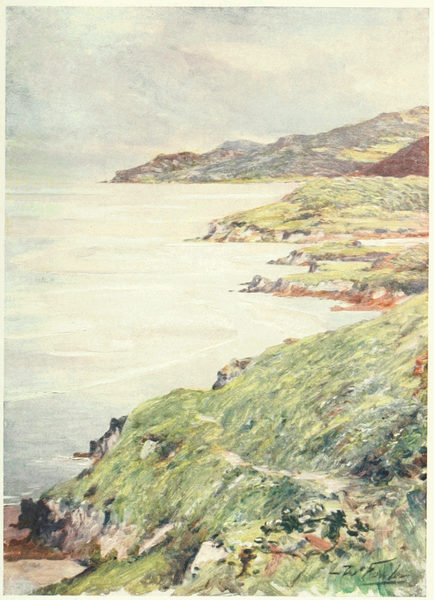
A LONELY SHORE, BARMOUTH ESTUARY
155No one sang except the harper; the landlord
frowned, remarked that "Evan was very drunk tonight,"
and offered to stop the song if we objected,
and then began to talk. He said that the harper
was a poor sort of man; had been a schoolmaster
and was a "scholar"; had been to prison for an
unmentioned crime; and was now a man with a
wife, whom he supported by odd jobs and by "my
own charity, for," explained the host, "I let him
have his drinks free." He was fond of his harp,
as if it had been a horse or a barrel of beer; and
boasted, when drunk, that he knew that he was
the sixth of his family who had played the harp,
and that same harp, and that he was the last of the
156true harpers. So we went into the taproom and sat
down with fourteen miners and the harper, who was
doing his best with "God bless the Prince of Wales."
"You are fond of your National Anthem," said
a voice which might have cut glass and perhaps
came from Glasgow.
Whereupon, with sublime, gentle anger the
harper played and sang the National Anthem of
Wales:—
Mae hen wlad fy Nhadau yn anwyl i mi, Gwlad beirdd a chantorion, en-
wogion o fri; Ei gwrol ry - fel - wyr, gwlad-garw-yr tra
mad, Dros ryddid goll-a-sant eu gwaed. Gwlad! Gwlad!
pleid - iol wyf i'm Gwlad, Tra môr yn fur i'r
bur hoff bau, O bydded i'r hen-iaith ba - rhau.
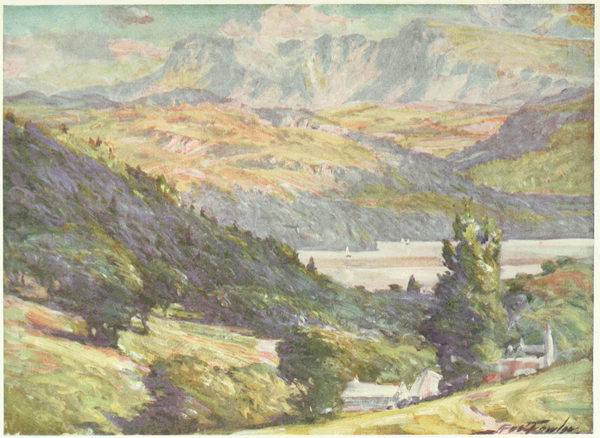
VIEW FROM BONTDDU, DOLGELLY
157The words cannot, of course, be translated, but
the following are as much like them as a photograph
of Snowdon is like Snowdon. "Dear to me
is the old land of my fathers, a land of bards and
minstrels of great name. Her brave warriors, best
of patriots, poured out their blood for freedom.
Ancient and mountainous Wales, Paradise of the
bard, every valley and cliff is lovely in my sight;
through the feeling of patriotism, how alluring is
the ripple on her rivers and brooks. If the enemy
treads my country under foot, the old language of
the Welsh lives as it used to live; the Muse suffers
not, in spite of the horrid hand of the traitor, nor
yet the melodious harp of my country." And the
chorus says: "My country, my country, I am
bound up with my country. While the sea is a
boundary to the fair and well-loved place, may the
old language last." ...
While he sang, we saw that the harper was a
little, pale, snub-nosed, asthmatic man, with red
hair and a delicate, curved mouth and heavy-lidded,
pathetic, sentimental, but unsympathetic grey eyes,
and glowing white fingers. He leaned over his
instrument as a mother over her child when she is
bathing it, or as a tired man reaping with a reaping-hook.
He evidently knew what he liked; yet, as
the evening wore out, he lost himself sentimentally
over the poorest tunes. He seemed to love listening
at least as well as playing. Slowly we emptied
the house of all its Englishmen by encouraging
him to play the airs which the harp had known
158through all its life. He played the plaintive best.
Such quick happiness as "New Year's Eve," which
begins—
moved his sorrow more and his sentiment less, and
his white fingers stuck among the strings.
When he rose at 11 P.M. to go, he could carry
the harp, but hardly himself; and we led him home,
murmuring sad ditties lovingly. As he stumbled
in, he cursed his wife, a frail burden of middle age,
singularly like himself, and then continued to
murmur.
The light of one candle and the beauty of the
harp almost made beautiful the room in which we
stood, while he sat with his instrument. The
garish wall-paper was mildewed with lovely gleaming
white fur, near the windows; elsewhere it was
decorated by a large tradesman's photograph of Mr.
Chamberlain, a copy of "The Maiden's Prayer,"
and the usual framed mourning verses on relatives;
there was, too, a plush mandoline, and in the
hearth a frond of the royal fern, and over it photographs
of two generations of big consumptive men.
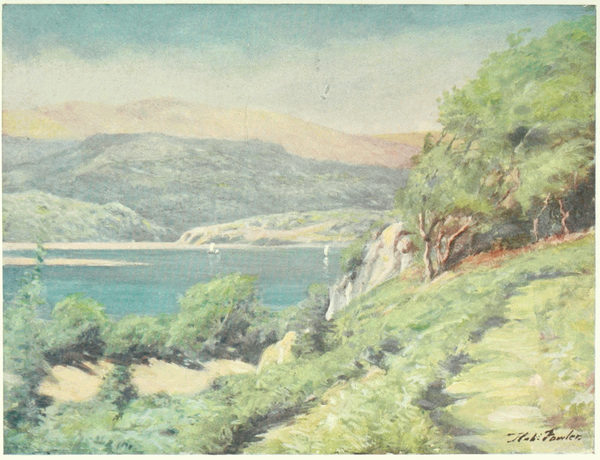
THUNDERY WEATHER, NEAR DOLGELLY
159For a time the harper hesitated between the
English tunes which were most in favour at "The
Prince of Wales" and the songs for which the harp
was made, when it was made for a bard who could
string a harp, make a song for it, and accompany
himself on the strings. We praised the Welsh airs,
and though he seemed to ignore us, he played
nothing else. We saw only his eyes, his white flickering
fingers, and the harp, and as the triumphant,
despairing, adoring melodies swept over it, this
foolish casket of a man seemed to gather up all
that could live of the lovers and warriors of a thousand
years. No epitaph could be so eloquent of
transient mortality. He had but to cloud or
brighten those cruel, sentimental eyes, and to
whisper to the dead instrument, to utter all that
they had ever uttered. To this heir had come the
riches of many hearts and he squandered them in a
taproom for beer, and here for our amusement, as if
they had been no better than gold and he a spendthrift.
When sometimes he paused and silence
came, or only the bark of a pump was heard, we
seemed to have been assisting at the death and the
last carouse of the souls for whom the music spoke.
They lived only in his fingers and the harp, and with
these they must die. They were as fleeting as pale
butterflies in storm or as the Indian moonflower
that blossoms only after sunset in May. Yet again
160and again the fingers and the harp consented to
their life, and reassured, and half-believing that,
because he had so much in trust, he could not die,
we sat down and fell asleep, and waking again, were
not surprised to find, as the July dawn approached,
that the harper was harping still. For in that holy
light that twittered among the strings, he was an
immortal harper, doomed for ever to go on, because
there was so much to be done, and because, as the
landlord had said, he was the last of his race.
I went on, and was over the edge of this
country, "built to music and so not built at all,"
when the sun began to rise behind me. Before, a
range of hills stood up against the cold sky with
bold lines such as a happy child will draw who has
much paper and a stout crayon, and looked so that
I remembered the proverb which says, that if a man
goes up Cader Idris at night, by dawn he is dead,
or mad, or a poet. They were immense; they filled
half the sky; yet in the soft light that felt its way
glimmeringly, and as if fearfully, among their vast
valleys and along their high crags, they looked like
ruins of something far more mighty; the fields also,
on this side of them, and all the alder-loving streams
and massy woods, were but as the embers of something
which the night had made and had only half
destroyed before its flight. And it was with surprise
that, as I took my eyes off the prospect and looked
down and in the hedge, I saw that I was in a place
where lotus and agrimony and vetch were yellow,
and the wild rose continued as ever to hesitate
between red and white.
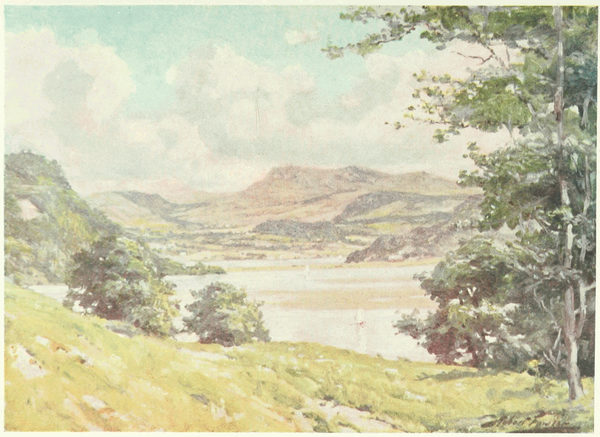
161It was not long possible to turn my back upon
the rising sun, and when I looked round, I saw
that the country I had left had been taken into the
service of the dawn and was beautiful two miles
away. Factory and chimney and street were bent
in a rude circle round the sun, and were as the
audience of some story-teller, telling a new tale—silent,
solemn, and motionless, round a fire; and
over them the blue clouds also were silent, solemn,
and motionless, listening to the same tale, round
the sun.
When I went on towards the hills, they by
that time looked as if they had never known the
night; and sweet it was to pass, now and then, a
thatched, embowered cottage, with windows open
to the scented air, and to envy the sleepers within,
while I could see and recognise the things—the sky
and earth and air, the skylarks singing among the
162fading stars, and the last cuckoo calling in the silent,
vast and lonely summer land—which make dreamless
sleep amidst them so divine, I had long not
known why. For half the day there was nothing
to remember but sudden long views that led,
happily, nowhere, among the clouds or the hills,
and farms with sweetly smiling women, and jutting
out of every hedge-bank a little pistyll of fair water,
curving and shining in the heat, over a slice of stone
or through a pipe, into the road. These things the
memory has to work to remember. For, in truth,
the day was but as a melody heard and liked. A
child who, in the Welsh story, went to the land of
the fairies, could only say that he had been listening
to sweet airs, when he returned after a long stay.
But at length, when I was among the hills, the
ferns whispered all along the stony hedges, and on
a cold stream of wind came the scent of invisible
hay, and a great drop of rain shook all the bells on
a foxglove stalk, and the straight, busy rain came
down, and the hills talked with the heavens while it
thundered heavily. The doves and jays only left
the hedge as I passed within reach of them. The
crouching partridge did not stir even after her eye
caught mine. The lightning was as a tree of fire
growing on the northern sky. The valley below
was a deep and tranquil mere, in which I saw a
church and trees and fields, as if they were reflections
of things in the sky, and, like reflections in
water, they were reverend in their beauty. The
rain in my face washed off more than the weariness
of a long day's walk, and I rejoiced, and found it
easy to catch a train six miles off, which had seemed
impossible.
163
On the next day I was near the lake, Llyn-y-Fan
Fach, and high up among hills, which had in
many places outgrown their grassy garments, and
showed bare cliffs, senates of great boulders, and
streams of sliding fragments of stone like burnt
paper. The delicate mountain sheep were panting
in the heat, or following the shifting oasis of a
shadow that sometimes moved across the hill; a
horse stood nervously still, envying the shadow
which he cast upon the ground. The world, for
hours, was a hot, long road, with myself at one
end and the lake at the other, when gradually I
descended into a gentle land again.
Far off, church bells were celebrating the peace
and beauty of the morning as I turned into a lane
of which more than twenty yards were seldom
visible at one time; and I lost sight of everything
164else. Tall hedgerow elms and orchard trees held
blue fragments of the sky among their leaves and
hid the rest. Here and there was a cottage among
the trees, and it seemed less the work of human
hands than the cordon and espalier trees, apple and
pear, and the fan-shaped cherry on the wall, with
glowing bark. July, which had made the purple
plum and the crimson bryony berry, had made it
also, I thought. The lane was perhaps long enough
to occupy an hour of the most slow-paced tranquil
human life. Even if you talked with every
ancient man that leaned on his spade, and listened
to every young linnet that was learning to sing in
the hazels, you could not spend more than two hours
in passing along it. Yet, more than once, as I was
pausing to count the white clusters of nuts or to
remind myself that here was the first pale-blue
flower of succory, I knew that I took up eternity
with both hands, and though I laid it down again,
the lane was a most potent, magic thing, when I
could thus make time as nothing while I meandered
over many centuries, consulting many memories
that are as amulets. And even as I walked, the
whole of time was but a quiet, sculptured corridor,
without a voice, except when the tall grasses
bowed and powdered the nettles with seed at my
165feet. For the time I could not admit the existence
of strident or unhappy or unfortunate things. I
exulted in the knowledge of how cheaply purchased
are these pleasures, exulted and was yet humiliated
to think how rare and lonely they are, nevertheless.
The wave on which one is lifted clear of the foam
and sound of things will never build itself again.
And yet, at the lane's end, as I looked back at the
long clear bramble curves, I will confess that there
was a joy (though it put forth its hands to an
unseen grief) in knowing that down that very lane
I could never go again, and was thankful that it
did not come rashly and suddenly upon the white
highroad, and that there is no such thing known
to the spirit as a beginning and an end. For not
without cool shadow and fragrance was the white
highroad.
Then, after some miles up a hot and silent hill, I
came to the lake under the chin of a high summit,
and it was cool....
At the end of the twelfth century, when Owen
Gwynedd in the north and Lord Rhys in the
south made little of English kings, a farmer's
widow lived with one son at Blaensawdde, near
the lake. She sent her cattle on to the Black
Mountain under the care of her son. And the
166cattle liked Llyn-y-Fan because the great stones on
its shore gave them shade, and because the golden
stony shallows were safe and sweet, and no water
was finer than that in the little quiet wells of the
Sawdde brook.
Watching his cattle there one day, the youth
saw a lovely girl, with long, yellow hair and pale,
melancholy face, seated on the surface of the lake
and looking down into the mirror of the water, for
she was combing her hair. Some say that she was
rowing with golden sculls up and down the lake in a
golden boat, so ample was her hair. The young
man was moved by her loveliness to hold out to her
his own barley-bread and cheese, which was all
that he had with him. And she came near, but
she would not accept the food; when he tried to
touch her, she slid away, saying—
"O thou of the crimped bread,
'Tis not easy to catch me";
and so disappeared, as a lily when the waves are
rising.
The youth told his adventure to his mother,
who advised him to take unbaked dough for the
girl, instead of his crisp barley bread.
167The next morning he was at the lake before
dawn, and saw cold ripples on the water and a
cloud on the highest of the hills. But as the light
overcame the cloud and began to warm the ripples,
he saw some of his cattle in danger on the steep
side of the lake, where the rains run almost perpendicularly
down to the margin and cut weals of
naked red earth in the mountain-side. And as he
was running round to the cattle, he saw the girl
upon the water, and again held out his hand to offer
his unbaked dough. Again she refused, and said:
"O thou of the moist bread,
I will not have thee."
Then, with smiles, she disappeared.
The youth told his second adventure to his
mother, and she advised him to take slightly baked
bread. The Welsh have a proverb: "Better is
cookery than kingship"; and she being skilled
with the oven, baked him the bread.
The next morning he was again at the lake.
The cold ripples turned to gold and then to silver,
and the cloud left the mountain; and he saw the
wind making grey O's and V's on the water, until
it was almost evening, and behind him the oak
trees in the Sawdde valley gleamed where his
homeward way would be, when he saw several
cows walking on the water, and then the girl
moving towards him. He ran forward into the
168water; he held out the bread, and she took it, and
promised to marry him on the condition that he
should not give her three causeless blows; if he
did, she would disappear. Suddenly she left him,
and he would have cast himself in with despair, if
she had not returned with another as beautiful and
in the same way, together with a majestic, tall,
and hoary man, who promised to bestow the girl
upon him if he could distinguish her.
So the two girls stood before him; and the
youth, casting down his eyes in thought and perplexity,
saw one thrust her little foot forward, and
he noticed how her sandals were tied, because he
had before studied the beauty of her ankles and
feet; and he chose rightly. The old man promised
that they should have as many cattle, horses, sheep,
and goats as she could count of each without
drawing breath. The girl counted quickly, 1, 2,
3, 4, 5, 1, 2, 3, 4, 5, and so on, and all the beasts
came up from the lake; and the young man went
with the girl and married her, and lived at Esgair
Llaethdy beyond Blaensawdde, and there she bore
him three sons.
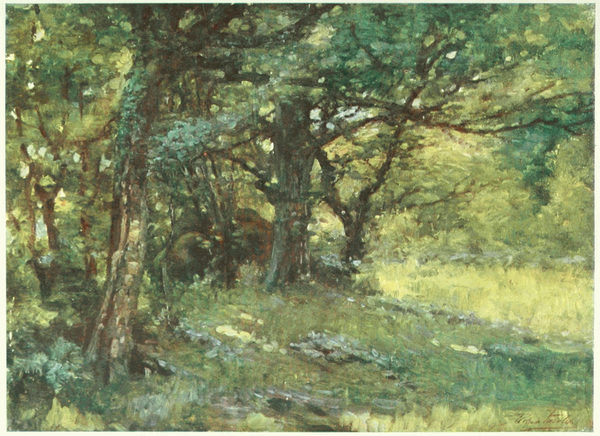
169But one day, when they were to go together to
a christening, she was reluctant, saying that it was
too far to walk; and he bade her take a horse. She
asked for her gloves, and when he returned with
them, he found her still delaying, and flicked her
shoulder with one and said pettingly, "Go, go."
And she reminded him that he had given her a
causeless blow.
On another day, at a wedding, she gave way
to tears, and he tapped her shoulder to admonish
her. And she reminded him that he had given
her two causeless blows.
Many years later, at a funeral, she laughed, and
again he tapped her shoulder. And she turned, and
called her cattle and horses and sheep and goats
by name—the brindled cow, the white speckled,
the mottled, the white-faced cows;
"And the grey Geingen
With the white bull
From the court of the king;
And the little black calf
Though suspended on the hook,
Come thou also quite well home";
and the four grey oxen ploughing in the fields.
They followed her to the lake, and behind them
grew the furrow made by the plough which the
four oxen still drew, and they all entered the lake.
Her sons desired to see her, and she appeared
again to her son Rhiwallon, and told him that he
was to be a healer of men, and gave him prescriptions,
170and promised that if he needed her, she
would come again. So she often met them near
the lake, and once walked with them towards
Myddfai, as far as Pant-y-Meddygon, where she
showed them herbs and their virtues. And they
became famous, and good physicians. They were
physicians to Rhys Gryg of South Wales; and the
last of their descendants who practised at Myddfai
was buried in 1739 at Myddfai church.
On a fine, very hot day I had to wait three
hours for a train, and should have left the bald
junction for that time, if I had not seen there
a poet of my acquaintance, contentedly reading
Spenser on the central platform. I sat down with
him, but he preferred reading to talking, and I
looked over his shoulder to read:
Begin then, O my dearest sacred Dame!
Daughter of Phœbus and of Memorye....
171And I could not sufficiently admire his fortitude,
until, on the arrival of a train, he left the book on
the seat, and walked down alongside the train. It
stopped ten minutes, and he talked with persons
in three different carriages before it left. He came
back unperturbed, and told me briefly that —— from
Patagonia was in the train, with —— the bard from
North Wales, and a friend from London. Seeing
me surprised, he explained that every Saturday in
the summer he spent entirely on the platform, waiting
for surprises of this kind. Four trains stopped
there before I left, and each seemed to be laden
with friends and acquaintances,—some who lived
in distant parts and even overseas, and some
whom he had not seen for years. And some of the
persons whom he greeted he had never seen before,
which was a good reason for greeting them; he
had perhaps heard of them, or they of him; and so
they talked.
The liking of Welshmen for Welshmen is very
strong, and that not only when they meet on
foreign soil, as in London, but in their own land.
They do not, I suppose, love their neighbours more
than other men do, but when they meet a fellow-countryman
for the first time they seem to have
a kind of surprise and joy, in spite of the commonness
of such meetings. They do not acquiesce in
the fact that the man they shake hands with is of
their race, as English people do. They converse
172readily in trains: they are all of one family, and
indeed if you are Welsh, not only can you not avoid
meeting relatives, but you do not wish to. Small
news about the coming and going of people travels
among them rapidly, and I have never got out of
a train in Wales without feeling that I shall meet
some one whom I should like to meet, on the
platform or in the first street. They like their own
land in the same way. I do not easily believe in
patriotism, in times of peace or war, except as a
party cry, or the result of intoxication or an article
in a newspaper, unless I am in Wales.
I did not know before that any save sellers of
newspapers were happy in railway stations, and as
my train went out, I passed the poet at his Spenser
again and recalled the poem called "Howell's
Delight," which was written by a young, unfortunate
prince of North Wales in the twelfth
century:—
A white foam-crowned wave flows o'er the grave
Of Rhuvawn Bevyr, chief of Rulers.
I this day hate England, a flat and inactive land,
With a people involved in every wile;
I love the land where I had the much-desired gift of mead,
Where the shores extend in tedious conflict;
I love the society and the numerous inhabitants
Therein, who, obedient to their Lord,
Direct their views of peace;
173I love its sea-coast and its mountains,
Its cities bordering on its forests, its fair landscapes,
Its dales, its waters, and its vales,
Its white seamews, and its beauteous women;
I love its warriors, and its well-trained steeds,
Its woods, its strongholds, and its social domicile;
I love its fields clothed with tender trefoil,
Where I had the glory of a lasting triumph;
I love its cultivated regions, the prerogative of heroism,
Its far extended wilds, and its sports of the chase,
Which, Son of God! are great and wonderful.
How sleek the majestic deer, and in what plenty found;
I achieved with a push of a spear the task of honour
Between the Chief of Powys and fair Gwynedd;
And if I am pale in the rush of conflict,
'Tis that I know I shall be compelled to leave my country,
For it is certain that I cannot hold out till my party comes,
A dream has revealed it, and God says 'tis true.
A white foam-crowned wave flows o'er the grave,
A white bright-foaming wave boldly raves against the towns,
Tinted the time it swells like glittering hoar.
I love the marches of Marioneth,
Where my head was pillowed on a snow-white arm;
I love the nightingale on the privet wood
In the famous vale of Cymmer Deuddwfr,
Lord of heaven and earth, the glory of Gwyneddians.
Though it is so far from Keri to Caerliwelydd,
I mounted the yellow steed, and from Maelienydd
Reached the land of Reged between night and day.
Before I am in the grave, may I enjoy a new blessing
From the land of Tegyngyl of fairest aspect!
The flowers by the road, wood-betony, sage,
mallow, ragwort ... were dry; the larches, that
174were fitted to the hillside like scales or breast
feathers, were dry; but a mountain stream, which
many stones tore to ribbons, was with me for miles,
and to the left and to the right many paths over the
hills ran with alluring courses for half a mile,
like happy thoughts or lively fancies, and ended
suddenly. The mountains increased in height as
the sun sank, and their sides began to give a home
to enormous, still shadows and to rich, inaccessible
groves among the clefts. And in the end of the
afternoon I came to a village I knew, which grew
round an irregular lawn.
From the inn, I could see the whole village.
The limes before me were full of light; the
green grass beyond was tending to be grey. There
were not far fewer people than usual in the neighbourhood,
yet the calm was great. It seemed to
have something to announce and to call solemnly
for silence; the voice of a child crying, a man with
shining cuffs, was an extraordinary impertinence.
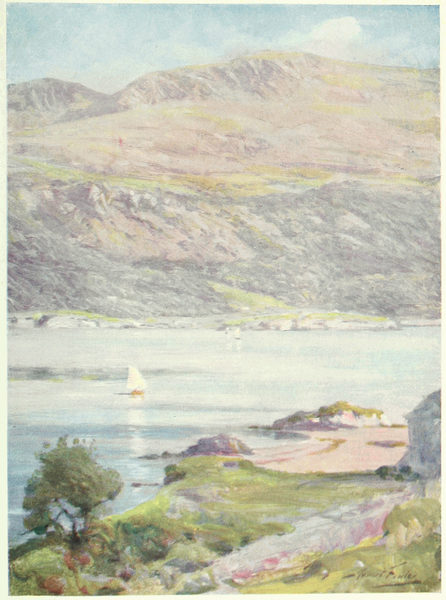
SUNNY AFTERNOON, CARDIGAN BAY
175But two reclining cows were calm enough,
and in the middle distance an oak was stately
enough. A tramp, his wife, and five children spoke
with quiet, husky voices that were sad enough.
A passage from Hyperion which I recalled was
noble enough. Six bells that rang three miles off
and some white downs of cloud on the horizon
were in harmony. It was a time when the whole
universe strove to speak a universal speech, the
speech of the stars in their courses, of the flower
that is beautiful, of the soul that aspires, of the
mind that thinks. But, as it seemed, owing to
my fault, the effort was unsuccessful, and I rose
hurriedly and left the village behind.
And while the hedgerows on one side of
the road were in places rich with the heavy, horizontal
sunshine that came through gateways on
the other side, I saw the star-like shining of the
windows of an old house on a hill. A difficult
winding lane led up to it, and so long was the lane
that between the road and the house a badger and
a raven had their homes. When I came near the
house one pallid angle of it glowed, and only where
it glowed was it visible.
The house was perhaps two hundred years old—stately,
grey as the old blackthorns in the hedge,
and it was, perhaps because I knew of the fading
race that had lived within it, the oldest thing
among those old hills. It was more unchangeable
than the most grim crag on the hills which had its
176milkwhite harebell on that day. It was a survival
from winter, from hundreds of winters, and therefore,
though young in years, it spoke a language
which time, knowing that the unchangeable is
dead, had forgotten:
A spirit calling in an old old tongue
Forgotten in lost graves in lonesome places;
A spirit huddled in an old old heart
Like a blind crone crouched o'er a long-dead fire....
Nothing ever happened among the Powells at
——. The lawn was mowed; the fern from the hill
was carted down; the little red apples ripened; the
Powell hair turned from gold to grey. A stranger,
indeed, heard much of them, but when he asked
where they lived, he was told that there were
thirty of them in the church and one at —— on
the hill. Five generations of them had lived there,
since the only conspicuous one of the family had
died in the first war with Napoleon. Of those
five, the last could only say that theirs had been
the most desperate of quests, for they knew not
what they sought. They had lived in dignity and
simplicity, neither sporting nor cultured, yet loving
foxhounds and books. Generation after generation
of the children had learned "L'Allegro" and
"Il Penseroso" from their fathers, and with all
their happiness in that dim house, they learned to
love "Il Penseroso" best....
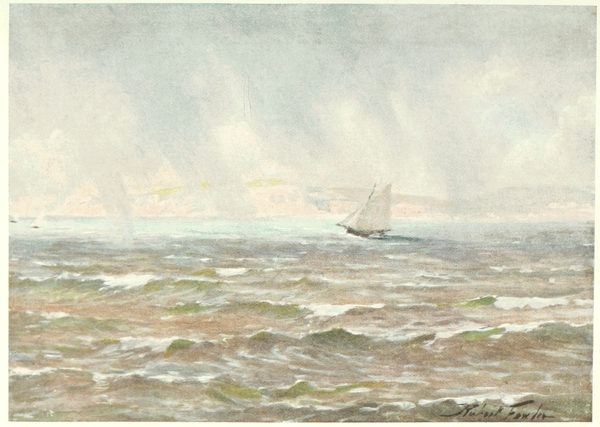
A SUDDEN SQUALL, CARDIGAN BAY
177
In the afternoon I climbed out of a valley,
descended again, and came on to a road that rolled
over many little hills into many little valleys, and
at the top of each hill grew the vision of a purple
land ahead. But, for some miles, the valleys were
solitary. There were brooks in them with cold,
fresh voices, and copses of oak, and sometimes
the smoke or the white wall of a house. There
sang the latest of the willow-wrens, and among the
blackthorns a bullfinch, with delicate voices. The
air was warm and motionless; the light on oak
and grass was steady and rich; the sky was low and
leaning gently to the earth, and its large white
clouds moved not, though they changed their
shapes. But these things belonged to the brooks,
the copses, the willow-wrens; or so it seemed,
since that warm day, which elsewhere might have
seemed so kind with an ancient kindness as if to one
returning home after long exile, was not kind, but
was indifferent and made an intruder of me. And I
should have passed the stony hedges and the little
178brooks over the road and the desolate mine, in the
indifferent little worlds of the valleys, one by one,
as if they had been in a museum, or as if I had been
taken there to admire them, had it not been that on
the crests of the road between valley and valley,
I saw the purple beckoning hills far away, and that,
at length, towards the last act of the dim, rich,
long-drawn out and windless sunset, the road took
me into a small valley that was different. Just
within reach of the sunset light, on one side of the
valley lay a farm, with ricks, outhouses, and two
cottages, all thatched. In the corner of the field
nearest to the house, the long-horned craggy cattle
were beginning to lie down. Those cattle, always
vast and fierce, seemed to have sprung from the
earth—into which the lines of their recumbent
bodies flowed—out of which their horns rose coldly
and angrily. The buildings also had sprung from
the earth, and only prejudice taught me that they
were homes of men. They enmeshed the shadows
and lights of sunset in their thatch, and were as
some enormous lichen-covered things, half crag,
half animal, which the cattle watched, together
with five oaks.
There was not a sound, until a child ran to a
pump, and sang a verse of some grave hymn lightheartedly,
and filled a shining can with dark water,
and disappeared.
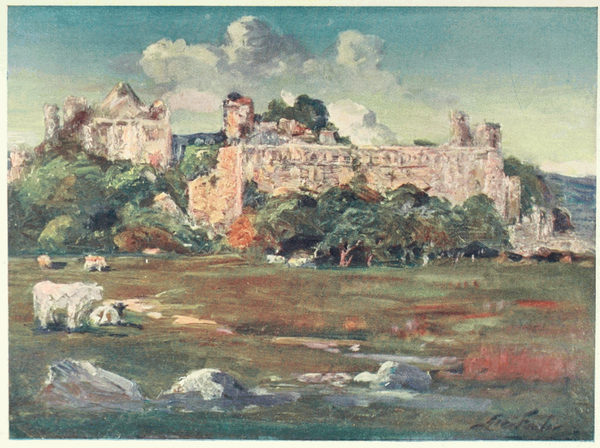
ST. DAVID'S—BISHOP'S PALACE
179Then I raised my eyes, so that they crept swiftly,
though not without feeling the weariness of the
distance, over hill after hill to the one upon which
the last, mild, enormous, purple dragon of the sunset
was pasturing; yet I saw nothing in earth or
sky which did not belong to those things, half crag,
half animal, in the small valley, in happiness and
peace that consented to the voice of the child.
Then I passed the farm and saw a crimson fire
casting innumerable arms about a room; I heard
the rattle and click of the pump; and I knew that
it was cold, that I had far to go, and that the
desolation beyond the farm was illimitable.
For such moods of the world are easily shut
against us for some small thing, as the world of the
little people was shut against the man in the tale
which Gerald of Wales repeats:—
A priest of Gower, named Elidorus, told Gerald
that when he was a schoolboy he was often beaten
by his master. So one day he ran away and hid
himself in a hollow among the alder roots at the
edge of a stream. There he was safe, but had no
food. And on the third day two wonderfully
little men came to him and said that if he would
180come with them, they would lead him to a happy
and pleasant country. He therefore left his hiding-place
and went with the little men through a
country of wood and field and water that was
beautiful, although they saw neither sun nor moon.
At last they came to the court of the king, and
Elidorus was presented to him; and, after looking
at him carefully, the king gave him over to his
young son. And the people of that country,
though they were wonderfully little, were beautiful
in shape and of a fair complexion, and they wore
long hair that fell over their shoulders in the
manner of women. Their horses and hounds were
of a suitable size. The little people ate neither flesh
nor fish, but lived on milk, which they concocted
with saffron. They never took an oath; they
always spoke the truth. Nor had they any kind of
public worship, but simply kept and loved good
faith. And their language was very much like
Greek, as he afterwards said.
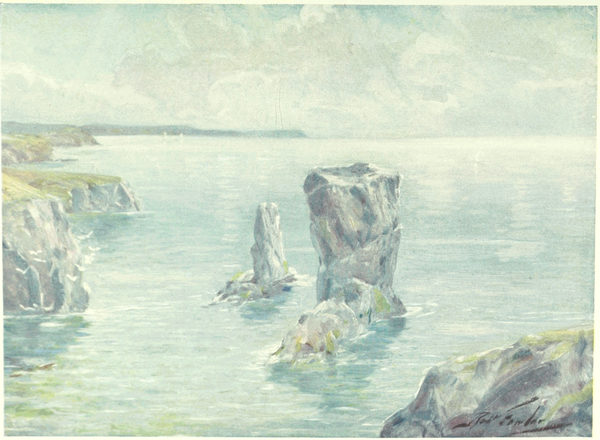
181The little people often went up into our world,
and never returned without speaking harshly of
men for their ambition and want of faith and constancy.
Sometimes Elidorus went up with them.
Sometimes he went up alone, but revealed himself
to his mother only, telling her of his life and
of the little people and their country. When he
told her that gold abounded there, she asked him to
bring her some golden thing as a gift. So he stole a
golden ball from the son of the king and ran to his
mother with it. But the little people pursued him,
and in his haste he stumbled over the threshold
of his mother's door and fell. He lost hold of
the ball, and the little people picked it up and went
away, laughing at him and taunting him. And
when he rose up, he was ashamed and angry because
he had stolen the ball. Then he would have gone
back to the country of the little people, but,
although he searched for a year, he could never
discover the true path. In course of time he gave
up the search and the hope of returning. He even
went back to school and became a priest. But
long afterwards, when he was an old man, he could
never speak of his strange truancy without tears.
The rain and the wind had ceased, and in
the garden the Painted Lady butterflies were
tremulously enjoying the blue Michaelmas daisies,
and an old man was gathering seeds of hollyhock,
182evening primrose, and foxglove, and putting
them into white cups on the garden paths. In
the hedges the bryony coils were crimson and
green among thorn and hazel; the sparrows were
thick in the elms, whose branches had snatched
straws from passing waggons; one bare ash tree
was all in bud with singing linnets. Over all was
a blue sky, with throbbing clouds of rooks; and
beyond all, over leagues of rocky pastures and
grim oaks, the mountains,—and upon one of them
a white flower of cloud or snow, above which
presently rose many clouds, and in the midst of
them a narrow pane of sky full of misty golden
light, and behind that a land where Troy is still
defended,—where still Camilla, loving war and
maidenhood eternally, bounds over the unbending
corn,—and where, in the hall of a castle, four-and-twenty
damsels are embroidering satin, and the
least lovely of them is lovelier than Gwenhwyvar,
the wife of Arthur, "when she has appeared
loveliest at the Offering, or on the day of the
Nativity, or at the feast of Easter."
The last village was far behind. The last happy
chapel-goer had passed me long ago. A cock
183crowed once and said the last word on repose.
The rain fell gently; the stems of the hazels in
the thickets gleamed; and the acorns in the grassy
roads, and under the groups of oaks, showed all
their colours, and especially the rosy hues where
they had but just before been covered by the cup.
One by one I saw the things which make the
autumn hedges so glorious and strange at a little
distance: the yellow ash trees, with some green
leaves; the hoary and yellow willows; the hawthorns,
purple and crimson and green; the briers,
with most hips where there were fewest leaves;
the green brambles with red fruit and black; tall,
grey, and leafless thistles with a few small crimson
flowers; the grey-green nettles with purple stems;
the ragwort flowers; and on the long, green, wet
grass the fallen leaves shining under red and
yellow oaks; and through the olive lances of hazel
the fields shining in patines of emerald. Doves
cooed in the oaks, pheasants gleamed below. The
air was full of the sweetness of the taste of blackberries,
and the scent of mushrooms and of
crumbling, wild carrot-seeds, and the colour of
yellow, evening grass. The birches up on the hills
above the road were golden, and like flowers.
Between me and them a smouldering fire once or
184twice sent up dancing crimson flames, and the
colour and perfume of the fire added themselves to
the power of the calm, vast, and windless evening,
of which the things I saw were as a few shells and
anemones at the edge of a great sea. The valley
waited and waited.
Then by the roadside I saw a woman of past
middle age sitting silently. Her small head was
poised a little haughtily on a blithe neck; her fine,
grey, careful hair spared gloomy white forehead and
round ears, which shone; her full, closed lips spoke
clearly of both the sadness of to-day and the voluptuousness
of yesterday. She was beautiful, and not
merely because she had once been a beautiful girl.
She had become mortal through grief, and though
I could not see her crown, yet crowned she was.
Will you always, O sad and tranquil Demeter,
sit by the wayside and expect Persephone?
It was the last day of the month, and in a
gently heaving land, which was broken every three
or four miles by a sudden, castled crag, Autumn
was perfect, but with just a touch of sublimity
added to its beauty by the thought that, on the
next day or the next, winter would fall upon her
unsuspected, as Pizarro and the Spanish cavalry fell
upon that noble Indian, Atahualpa, who had come
up to them in peace and meekness and pomp, upon
a golden litter, among thousands of his gentle
subjects, making music and decorated with gold,
and expecting to meet the gods.
ST. CATHERINE'S ROCK, TENBY
185The bells of the cattle on broad, yellow lawns
were ringing. Squirrels glowed in the road; the
heavy rooks let fall the acorns among the leaves
continually. The last beams of the sun reached
now a circle of high bracken on a far-off hill, and
reached it alone and transfigured it with strong,
quiet light; and then made one brown hill seem to
be consumed in a golden glow, while the next hill
was sombre; and again devoted themselves to a
group of beeches that shone ruddy, branch and leaf
and bole, and divine and majestic and unrelated to
the cattle passing underneath.
The sun went down; wild-duck and moorhen
cried and scudded on the calm, winding, silver river
at my feet; and in a field beyond, that retained so
much liquid and lugubrious light as to seem a
green water, some laughing boys in white and
yellow played football, without regarding the silver
and purple, frosty sky, to which, nevertheless, their
shrill voices added something, from which their
186movements took something, that was glorious and
pathetic. And near by, dark oxen with rocking
gait thrust their horns up into the sky as they
approached the bridge.
OLD ROMAN BRIDGE, NEAR SWANSEA
187
The night had almost come, and the rain had
not ceased, among the hills of an unknown country.
Behind me, twelve desolate miles of hill and sky
away, was a village; and on the way to it, half-a-dozen
farms; and before me were three or four
houses scattered over two or three miles of winding
lanes, with an inn and a church. The parson had
just come away from his poultry, and as his wife
crossed the road with her apron over her head, I
asked where the inn was, and whether it had a room
ready in the winter. Two minutes after she had
seen me—if she could see me in the dark lane—she
had told me that if the inn had no room, I was not
to go farther, but to stay at the vicarage. But the
inn had a bed to spare, and there was good beer to
be had by a great fire in a room shining with brass
and pewter, and overhead guns and hams and hanks
of wool; and the hostess was jocund, stout, and
young, and not only talkative but anxious to be
talked to, and she had that maternal kindness—or
shall I call it the kindness of a very desirable
aunt?—towards strangers, which I have always
found in Welsh women, young and old, in the
villages and on the moors. So there I stayed and
listened to the rain and the fire and the landlady's
rich, humming voice uttering and playing strange
tricks with English. I was given a change of
clothing as if I had asked and paid for it. Then I
went to the vicarage, and because I said I loved
Welsh hymns and Welsh voices, the vicar and his
wife and daughter, without unction or preparation
or a piano, sang to me, taking parts, some tremendous
hymns and some gay melodies,
Whence banished is the roughness of our years,
which made the rain outside seem April rain.
They sang, and told me about the road I was to
follow, until I had to go to my inn.
Next day, after paying what I liked at the inn,
and promising the hostess that I would learn Welsh,
I walked for twenty miles over stony roads gleaming
with rain upon the white thorns and bloom on
the sloes, and through woods where nothing brooded
solemnly over grey moss and green moss on the
untrodden, rotten wood, and up dry, ladder-like beds
188of brooks that served as paths, over peat and
brindled grass, and along golden hazel hedges,
where grew the last meadow-sweet with herb-robert
and harebell and one wild rose, and above
little valleys of lichened ash trees; and sometimes
beneath me, and sometimes high above, the yellow
birches waved in the rain, like sunset clouds
fettered to the ground and striving and caracoling
in their fetters.
Again I came at nightfall to a strange farmhouse,
and was honoured by being asked into the
kitchen; again I was given dry clothes. The juicy
mutton broke up like game. The farmer sang to
me from the Welsh hymn-book and from a collection
of old Welsh songs, in a room which was
none the worse for a portrait of Miss Maud Millett,
"The Soldier's Farewell," and the presence of a
fierce-thoughted, mild-eyed young minister, who
was the most majestic man I have seen since I first
saw the shop-walkers at Maple's—the kind of man
whom one supposes that the animals observe, and so
learn to temper their contempt for us. This man
had the strange whim to call the devil a gentleman,
a poor distinction which I could not understand
until he showed me a passage, that should be highly
interesting to gentlemen and the residue of mankind,
189in one of the Iolo MSS. Beginning at the
beginning, the MS. declares that Adam's eldest son
was ungenteel, "a low vassal"; but Seth and Abel
were genteel. The angels also, the tenth grade,
who fell from heaven, were ungenteel, "through
pride, which is the principal characteristic of weakness."
Continuing, the writer says of Noah's sons
that one was a lord, the second a gentleman, the
third a servile clown. Either the usual order of the
sons is changed, or Ham was held to be a gentleman
because from him was descended Nimrod, and all
destroyers are gentlemen. If this be true, then
Japheth was a "servile clown,"—in spite of the fact
that he was "the first who made a targe with a lake
in it, to signify that he and his brothers possessed
the whole world," inventing heraldry,—merely in
order that ungentility might have a common fount.
And thus we see that descent is efficacious to all
except descendants of Japheth (or Ham), and that
therefore the genealogies are waste paper, and a
popular pursuit which has hitherto been regarded
as harmless is proved to be also fraudulent....
Then he went back to his books, which he allowed
me to see. They were pretty, uncut editions of
the profane classics; theology, Welsh history, and
Grimm's Fairy Tales—all thumbed and pencilled.
190Frowning above was a photograph of Spurgeon,
and a picture of Whitman from a chance number
of an English weekly.
When I left on the next morning early, the
farmer was threshing with an oaken flail in his
barn; but he stepped out to tell me what he knew
of the way through the bogs and over the hills,—for
there was no road or path,—and to beg me not
to go, and to ask me to pay what I had paid at
my former inn, for my lodging.
VIEW NEAR MUMBLES, SWANSEA
191The next twenty miles were the simplest and
most pleasant in the world. For nearly the whole
way there was a farm in every two miles. I
had to call at each to ask my way. At one, the
farmer asked me in and sat me by his peat fire to
get dry, and gave me good milk and butter and
bread, and a sack for my shoulders, and a sense of
perfect peace which was only disturbed when he
found that I could not help him in the verses he
was writing for a coming wedding. At another,
the farmer wrote out a full list of the farms and
landmarks on my way, lest I should forget, and
gave me bread and butter and milk. At another,
I had but to sit and get dry and watch an immeasurably
ancient, still, and stately woman, her
face bound with black silk which came under her
chin like a stock, and moving only to give a smile
of welcome and goodwill. At another, they added
cheese to the usual meal, and made the peat one
golden cone upon the hearth, and brewed a pale
drink which is called tea. Sometimes the shrill-voiced
women, with no English, their hair flying
in the wind, came out and shrieked and waved
directions. In one of the houses I was privileged
to go from the kitchen, with its dresser and
innumerable jugs and four tea-services, to the
drawing-room. It was a change that is probably
more emphasised in Wales than elsewhere, since
the kitchens are pleasanter, the drawing-rooms
more mysterious, than in England, I think. The
room was cold, setting aside the temperature, and
in spite of crimson in the upholstery and cowslip
yellow in the wall-paper and dreary green on the
floor. There was a stuffed heron; a large pathetic
photograph of man and wife; framed verses; some
antimacassars, and some Bibles.... The room
was dedicated to the unknown God. The farmer
did not understand it; he admired it completely,
and with awe, reverencing it as a priest his god,
knowing that it never did him any good, and yet
not knowing what evil might come if he were
without it.
192At last, as I left landmarks behind in the rain,
I reached a poor little house where a family of sixteen
sat round the peat or went about their work,
all preserving that easy dignity when their poverty
is under the eyes of a stranger which I have ever
found among the Welsh. Of his own accord, the
farmer came with me over the worst part of my
way—two apparently trackless miles—until I came
to a road at last. He spoke no English; and yet I
had, and think he had, a wonderful sense of satisfaction
in our companionship of an hour, as he led
me over undulating, boggy lands intersected by
rivers,—which looked a little way off like an unpeopled
continent in miniature, with lake and hill
and stream,—and along the edges of steep crags that
rose sheer from black brooks and grey foam, and
above hollows inhabited by perfect, golden birches.
It was a land which always comes back to me when
the same cold rain, on the top of a London omnibus,
beats the face and blurs the hurrying crowd and
makes the ears tingle. Once, the rain stopped, and
the air was calm, as we passed among decaying oaks,
which were as a church full of men when the organ
begins, and we no better than any one of them....
He accepted money with as little offence as the
others had given when they refused it. As a rule,
I would rather drop a sovereign by the road than
offer a man sixpence who has nothing of the
lackey about him, though imitativeness has compelled
me to do otherwise.
PENNARD CASTLE, GLAMORGANSHIRE
193As he left me, a mist which he had probably
foreseen suddenly cloaked me and hid everything
except the road and its green edges, where the
gentlest of winds shook the rain on the feathered
grasses, but could not make it fall. The road was
a river, shallow but swift, and for four miles there
was not a house visible, except when the mist
divided for a minute and showed, far away, a fair,
shining, unshadowed valley, and a white house and
motionless sheep, which I saw as a departed spirit
might for a moment behold the earth; for the
world was gone like last year's clouds. Yet again,
the mist rose a little and showed lawns with a
lovely dim light over the grass, as if the lawns had
a light of their own which also made them seem
aloof. And strangely sufficient was the mist, the
hard road, and the moist stick in my hand, when
my mood changed as when at night bells clash as if
they were building the cathedral again with their
noise, and we watch its pinnacles thus made among
the stars, and joyously they clash so that we believe
they will never cease; and suddenly they cease
194and slowly toll. For the inn glimmered close by,
and I heard the rustle of many sheep, and my brain
began to prepare itself for meeting men again.
Twenty miles from the sea, a little river leaves
an underground lake, flows through a cave, and
falls radiant from the darkness among steep rocks,
and takes a course like a man's thoughts when they
have the joy of an unknown impulse and no certain
aim. There, the river always talks of Spring. It
winds and studies all the country round,—castle
and farm and inn and old graves,—with many
sharp digressions, which I suppose it could not
have done without, any more than I in a similar
case. Now it shines and curves gently and looks
over its bank at the cattle, and now, changing its
voice, it is gloomy and intent among mossy stones,
and now it leaps and is all foam over a ladder of
crag. Suddenly it enters a steep, wooded valley,
and falling over a perpendicular cliff, it is richly
embowered, and always remembers Summer, and
begins to please the trout where it swirls with
shuddering foam or runs swiftly in the middle, and
gloomily and slow under the alder roots. But in
195the wood, where birch and oak and hornbeam stand
over it, it gains a look of great and growing age
which mountain rivers have, and a shadow besets
its cheerfulness, so unlike the happy prime of
English waters among cowslip meadows. When
it leaves the wood it is a masterly, full-grown
stream that can turn a mill-wheel. Then it begins
to pause in deep pools under shadowy bridges,
where the otter slides for a moment over a slippery
ledge and then can hide his path for fifty yards.
There the girls stand and dip their vessels, and
think for a minute while the vessels fill, and raise
them again, spilling some, and show that the black
water can shine as when it left the mountain ten
miles away.
Leaving a hamlet near one bridge, the river
runs through such a lonely land that even on
stormy nights it is heard only by the groups and
groves of oaks that guard the stony and tussocky
pastures. Here and there, on either hand, a brook
adds a murmur to its music. A throbbing flock
of lapwings for ever wheels and gleams and calls
over it. The royal fern basks on its edge. And
there Autumn abides.
When it reaches the next village, the river is
so yellow and poisonous that only in great floods
196dare the salmon come up. There, with two other
rivers, it makes a noble estuary, and at the head
of that estuary and in the village that commands
it, the old and the new seem to be at strife.
On the one hand are the magnificent furnaces;
the black, wet roads; the ugly houses, that have
the one pleasing virtue of not pretending to be
anything else, with their naïvely chosen names,
such as "Bryn Gwyn Bach" and Mazawattee Villa;
the cheap and pretentious chapels; yet all of them
filled with people bearing the old names,—the
women called Olwen, Myfanwy, Angharad,—loving
the old songs, theologies, histories. I heard of
one man there who once heard part of Robinson
Crusoe told on a winter night. For a year he
struggled and learned to read, and found no version
in Welsh. Then he went to London, and while
he helped to sell milk, learned to read English, and
came back home with a copy of the desirable
book.
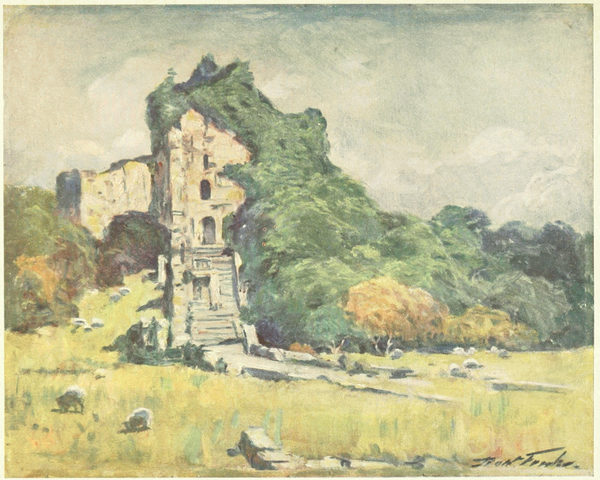
197On the other hand, there is the great water,
bent as if it were a white arm of the sea, thrust
into the land to preserve the influence of the sea.
Close to the village stands a wooded barrow and an
ancient camp; and there are long, flat marches
where sea-gulls waver and mew; and a cluster of
oaks so wind-worn that when a west wind comes
it seems to come from them as they wave their
haggish arms; and a little desolate white church
and white-walled graveyard, which on December
evenings will shine and seem to be the only
things at one with the foamy water and the
dim sky, before the storm; and when the
storm comes the church is gathered up into its
breast and is a part of it, so that he who walks in
the churchyard is certain that the gods—the gods
that grow old and feeble and die—are there still,
and with them all those phantoms following
phantoms in a phantom land,—a gleam of spears, a
murmur of arrows, a shout of victory, a fair face,
a scream of torture, a song, the form of some
conqueror and pursuer of English kings,—which
make Welsh history, so that to read it is like walking
in that place among December leaves that
seem never to have lived and been emerald, and
looking at the oaks in the mist, which are only
hollows in the mist, while an ancient wind is
ceaselessly remembering ancient things.