“THIS,” said John Ruskin, speaking of the Vale of Yewdale, “is the most
beautiful valley in England.” And it is by Yewdale that Coniston is
usually approached. Wherefore let all pay a visit to Coniston, if only
for the sake of passing down that charming vale.
The drive from Ambleside along the banks of the Brathay, across Skelwith
Bridge and thence over Oxenfell to Yewdale and down to Coniston, is
typical of many of the day excursions in Lakeland—the changing scenes
of beauty en route are so entrancing in themselves that even without a
chief object in view, the drive is well worth taking. For whether it is
the rich lichen-covered boulders over which the Brathay gently murmurs,
the pastoral enclosures on its banks, with the old boundary walls
climbing up the steep fellsides beyond, the feast of colour presented by
the river and dark fir trees as we cross Skelwith Bridge, the wild
moorland scenery of Oxenfell with that delicious glimpse across Colwith
of the Langdale Pikes and Helvellyn, or the larch trees, heather and
bracken slopes of Yewdale, interspersed with grey craggy patches, or
whether, finally, it is Coniston Lake itself that most impresses us
would be impossible to decide with any certainty.
But Coniston Lake alone is one of the sights of Lakeland and holds a
high place in the esteem of many lovers of the beautiful in nature,
beside Ruskin, who loved it so well that he made his home by its
margin.
The lake is about five miles long and not more than half a mile in
width. On its Western side it is bounded by low, wooded slopes not
unlike those at the lower end of Windermere, while on the opposite side,
in great contrast, is seen the fine mountain—Old Man, whose peculiar
name is a corruption of the Gaelic, Alt Maen, the High Rock. Below its
rugged escarpments nestles the village of Coniston with its church,
railway-station and other signs of a thriving tourist centre.
In the church-yard, beneath the fine runic cross, carved with figures
symbolical of his writings, is laid to rest John Ruskin, whose name will
for all time be most closely associated with this lovely spot. His home,
Brantwood, is on the east side of the Lake, about two miles from the
village and a mile from Tent Lodge, where Tennyson once resided.
The Furness Railway Company, under the management of Mr. Alfred Aslett,
a veritable genius of organization and enterprise, has placed a
comfortable steam yacht on Coniston, as well as a most picturesque
gondola, and these ply continuously throughout the summer months from
Waterhead to Lake Foot. The sail down the lake is one of great beauty,
affording magnificent near views of the Old Man, and Dow Crags, with
Fairfield, Helvellyn, Red Screes and other Lakeland giants peering over
the coronal of wood at the head of the lake. Brantwood, Tent Lodge, the
ivy-covered Coniston Hall and other farmsteads are in sight from the
water and lend to the scenery an air of domesticity. The view from
Beacon Crags, the eminence overlooking the foot of Coniston, commands
the entire length of the lake with its glorious background of mountains
and is second to none in the district.
If we take the main road past the head of Coniston, in an easterly
direction, and follow it up the steep rise to High Cross,
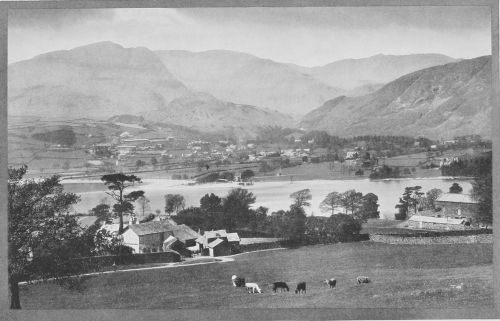
Coniston Lake
And the mountain Old Man, on the breast of which is situated the village
of Coniston. The view is taken from near Brantwood, Ruskin’s home.
beautiful peeps of Coniston are seen through the woods. Above us on the
moor is the romantic sheet of water, Tarn Hows, the favourite stroll of
all Coniston habitués. The main road continues over the hill, however,
and in another mile reaches the quaintest and most old-world village
imaginable. This is Hawkshead. Its old market square, pillared houses
with outside stairs, quaint nooks entered by roadways passing under the
houses, to say nothing of the centuries-old church, and the grammar
school, with the actual desk at which Wordsworth learnt his lessons, are
at once interesting and amusing. An old epitaph in the Church-yard,
visited from far and near, ran as follows:—
“This stone can boast as good a wife
As ever lived a married life,
And from her marriage to her grave
She was never known to misbehave.
The tongue which others seldom guide
Was never heard to blame or chide,
From every folly always free,
She was what others ought to be.”
It is sad to reflect that the above was erased by the lady’s
sons-in-law, for the prosaic reason that “it wasn’t true”! To Hawkshead
belongs Esthwaite Water, a reposeful sylvan lakelet, quite different
from the more northerly meres, but nevertheless very alluring in its own
way, with distant Langdale Pikes and Bowfell a shimmering, almost
unreal, background.
In actual distance it is not far from Hawkshead to Wastwater, but there
is an entire contrast in the character of their scenery. Wastwater is
the grandest of the lakes and is possessed of a wild, sombre beauty.
Grouped around its head are Scawfell, Great Gable, Kirk Fell, Yewbarrow
and the wild mass of the Pillar, the highest and most rugged of
Lakeland’s mountains while—rising directly from the very edge of the
water—the boulder-strewn slopes of the Screes, crowned at a height of
1,000 feet by magnificent bastions of rock, confine the southern side of
the lake in almost its entire length. It is a very weird sensation to
row along the lake under these Screes and see them plunge straight down
into the water, until they merge into the blackness of its depths. This
is the deepest of the lakes, and the steep angle of the mountain is
continued under water for two hundred and fifty-eight feet. Wastwater is
open to the west, whence an excellent road leads from Seascale, on the
Furness Railway, up to Wastdale Head, the small village about a mile
beyond the head of the lake.
Wastdale Head is almost entirely enclosed; indeed Will Ritson, the
erstwhile landlord of the hotel and a great character, used to say that
“t’ view frae Wastdale Heed was ’tpoorest he knew, for yan could see
nowt for t’ mountains”! Many famous men have foregathered here in times
past; it has appealed to natures as different as those of Darwin and
Ruskin, Sir Walter Scott and Turner, Wordsworth and Professor Sedgwick,
all of whom visited it many times. Will Ritson was the contemporary of
these visitors and many are the tales told of the jovial times they had.
Christopher North and Auld Will, as he was called, wrestled together and
the Professor got the worst of three falls, but Auld Will owned that he
was “a verra bad ’un to lick.” Christopher North got even with his
conqueror next day, however, when, with some other dalesmen, they went
on the lake together. When they were well away from the shore, the
Professor fell overboard and sank like a stone. Auld Will was terribly
upset and, with his companions, did all he could to rescue him when he
came to the surface. But the Professor plunged about to such an extent
that for long they could not get hold of him. At last one of them seized
him round the neck and held him up, whereupon
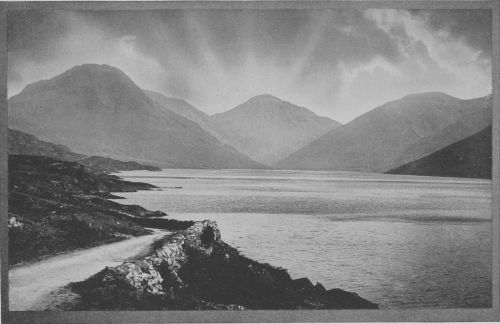
Wastwater and Great Gable
“A Gathering Storm.”
the drowning man burst into laughter and climbed over the side of the
boat. He was an excellent swimmer and the whole business was just a
prank to get even with Auld Will!
There were merry times at Wastdale in those days, and although the old
figures have departed, their place is nowadays taken by another and
vastly increased generation of mountain lovers. These are the rock
climbers and mountaineers, whose Mecca is the Wastwater Hotel. At
Christmas, Easter and other holiday times, the valley is full to
overflowing, and climbing enthusiasts, who include ’Varsity Dons,
Members of Parliament and distinguished Barristers, are glad to get
accommodation on the billiard table, in the bath room, or even in the
barn. Early in the morning, they set out with ropes intent upon their
various climbs, Scawfell Pinnacle, the famous Pillar Rock or the Needle
on Great Gable.
A very favourite climb is this latter, short but exceedingly difficult
and only for those of long experience. The way lies up the crack seen in
the illustration and it is climbed by wedging the knee in this crack,
whilst the hands grasp its rough edges above one’s head. The leader, who
should be an uncommonly good cragsman, attaches the rope round his waist
and when he has attained the top of the crack, rests there and takes in
the rope as the next climber ascends. It is just kept taut so that in
case of a slip the second man comes to no harm. When he has joined his
leader, the latter climbs a stage higher to the next platform, and the
performance is repeated. Then comes the crux of the climb. The top
boulder overhangs considerably on one side, and the way lies up the
almost vertical right-hand outline seen in the photograph. The hand- and
footholds are very small, the situation is most exposed and it demands
not only great gymnastic skill, but a perfectly cool and daring nerve to
lead up this last bit. Once there the leader sits down—the top is
about a yard square and by no means level—and takes in his companion’s
rope. The descent can be made by reversing this route or by a more
exposed ridge on the other side.
I recall a very unpleasant experience of my own on the Needle. It was on
the bitterly cold Christmas day of 1897, that a party of three of us
climbed to its apex. We had no sooner arrived there than it came on to
rain and as the rain fell it froze immediately on the rock; the Needle
became almost like a huge inverted icicle. I essayed the descent, but
the small handholds near the top were veneered with ice. It was quite
impossible, so, with great difficulty, I regained my companions on the
top. By this time a driving wind had sprung up and it behoved us to
descend at once, or else be frozen and then blown off. It was an
unpleasant dilemma, but we got out of it in the following manner. The
strongest man of the party lowered first one and then the other of us,
swinging round and round on the rope end like a spider at the end of its
clew, until we reached the neck between the Needle and the mountain,
seen in the illustration. Then the last man tied his rope round the top
of the rock and came down hand over hand for about twenty feet, when off
slipped the rope from the top and he came tumbling down on to us.
Fortunately he retained his grasp of the rope and, as we were tied to
the other end, we were able to arrest his fall before he had gone far.
Beyond a severe shaking he was no worse, and this, with a bruised
shoulder where his boot struck me as his body flew through the air, was
all the damage sustained in our escapade.
For those whose ideas of exercise lie in a milder direction, the walk up
Great Gable or Scawfell Pike, the highest English mountain, will suggest
itself. The views from these summits are magnificent in every direction
and embrace the wild fastnesses of the Pillar, the silvery light over
the sea, where the Isle of Man glimmers in the
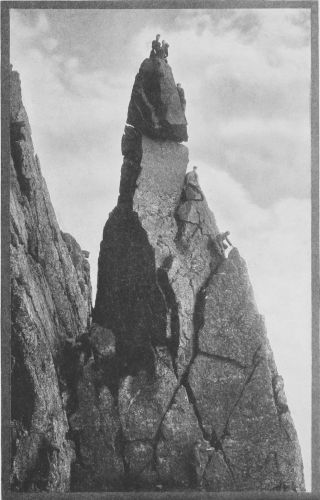
An ascent of The Needle Rock, Great Gable
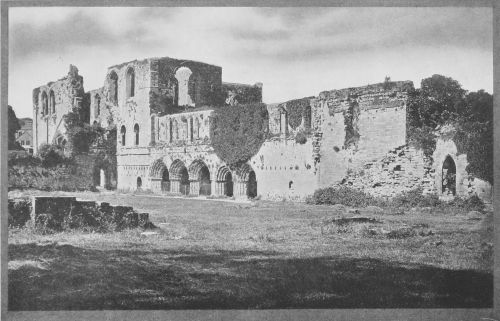
Furness Abbey
General View showing the entrance to the Chapter House and the
Cloisters.
distance, the soft beauties of Windermere, Derwentwater and Skiddaw,
with Wastwater, “abode of gloom and congregated storms,” in the valley
at our feet. Auld Will used to do a bit of guiding when business was
slack at the inn, and one day he accompanied a parson up Scawfell Pike.
The fell side was stony and the going so rough that this gentleman was
led to indulge in language that quite disgusted Auld Will, who had
always a great respect for “the cloth.” He said nothing in reproof,
however, until he had seated his charge safely on the top of Scawfell
Pike, when he stood back, mopped his brow and delivered himself to the
parson as follows: “Theer, me man, thoo can mak t’maist o’ that, for
it’s as near Heaven as thoo’ll ivver get!”
No description of Lakeland could pretend to completeness without some
reference, however brief, to the monastic ruins of Furness Abbey. From
Wastwater to Seascale Station is twelve miles by road and thence the
Furness Railway takes one in a very short time to the secluded Vale of
Beckans Ghyll—a fitting retreat for an edifice which had for its chief
object complete withdrawal from every-day life. This charm of aloofness
and sequestration still hovers around the spot where the Abbots of
Furness centuries ago, for the Abbey was founded by Stephen, in 1127,
eschewed all dealings with “the world, the flesh and the devil.”
It ranks second to Fountain’s Abbey in opulence and extent, but if we
add beauty of detail, the ruins of Furness are equal to any in Great
Britain. It was originally a filiation from the monastery of Savigny, in
Normandy, which belonged to the order of Benedictines, but before many
years had passed, the brethren entered the Cistercian order, changing
grey for white habiliments. The chief abbot was endowed with great
civil, as well as ecclesiastical influence. In his criminal courts, the
power of life and death was his; he had control of the militia; every
mesne lord was bound to contribute his quota of armed men at the Abbot’s
summons, and, save to the King, he was answerable to no man.
The hand of time has lain heavily upon some portions of the abbey, but
sufficient can be deduced from “the roofless pile of ruins” to enable us
to gather some conception of its original beauty and importance. Amongst
its finest features are the deeply recessed trio of Transitional Arches;
the Sedilia, with well-preserved canopies in the richest style of the
Decorated Period; the northern gate of the Abbey, a really beautiful
Gothic arch; the Chapter House, one of the most exquisite bits of early
English architecture preserved to us, and the great East Window of the
Choir or Chancel.
In addition to the Abbey itself, the little dell in which it is situated
contains the hotel and railway station, and it redounds greatly to the
credit of their designers, that neither of these mars the scenic effect
of the landscape. In the hotel, amongst other topical mementoes, are
some beautiful and very ancient bas reliefs and the Abbot’s Room, an
apartment which revives in all who visit it the atmosphere of Furness
Abbey as it was in the days of its pristine glory.
Much remains to be said. Many picturesque spots have barely been
mentioned, Haweswater, Loweswater and Ennerdale Water among others, and
even if the tourist should spend six months in this wonderful district,
his position will be very much that of mine in compiling this book. He
will by no means have exhausted all its beauties.