The supreme attraction of Tara is its antiquity. It must not, however, be
thought that a visit to this famous hill reveals no beauties. It is not
situated among mountains; hardly a lake is visible from its summit: yet
the view from it is so fine that if there was no historic interest
attached to it, the tourist in search of the beautiful alone would have
his eyes feasted with as fair a scene from one of its grassy ramparts as
could be gazed on in any part of Ireland. Eastward the view is obstructed
by the hill of Screen, but on every other side it is superb. Westward the
eye ranges over the fairest and most fertile part of Ireland, the great
plain of Meath and West Meath, anciently called Magh Breagh, or the fair
plain. And fair indeed it is in summer time, one great green sea of grass
and wild flowers, reaching to the Shannon, sixty miles away. But it is
southward that the view from Tara is most striking. The Dublin and Wicklow
mountains are more imposing when seen from Tara than from any other place.
They rise in a vast, blue rampart, and seem so colossal as to appear
thousands of feet higher than they are. Those old, barbaric Irish kings
and chieftains must have been lovers of the beautiful, for they almost
invariably fixed their strongholds not only in the fairest parts, but in
places commanding the fairest prospects. There are hardly two other places
in Ireland the surroundings of which are more beautiful than those of Tara
and Uisneach, or from which fairer prospects are to be seen. They were,
from far-back antiquity, the seats of those by whom the country was
supposed to be ruled, for it often happened that he who was styled chief
king had but little control over his vassals.
There is no other spot of European soil the records of which go so far
back into the dim twilight of the past as do the records of Tara. Before
the first Roman raised a rude hut on the banks of the Tiber, when the
place where the Athenian Acropolis now stands was a bare rock, kings,
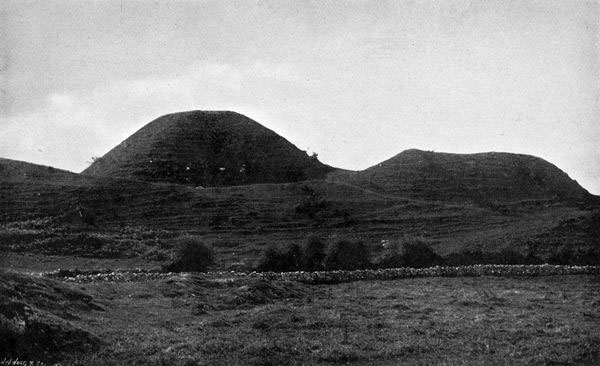
whose names are given in Irish history, ruled in Tara. When one gazes on
those grassy mounds, that are almost all that remain of what our ancient
poets used to call “the fair, radiant, City of the Western World,” he can
hardly believe that such a place could ever have been the abode of
royalty, the meeting-place of assemblies, and the permanent home of
thousands. Other desolated strongholds of ancient royalty and dominion
bear ample evidence of their former greatness. Ruined columns of
Persepolis yet remain. The site of Tadmor is marked by still standing
pillars of marble, and vast piles of decomposed bricks tell of the
greatness of ancient Babylon; but green, grassy mounds and partially
obliterated earth-works are almost all that remain of Tara. It is so
ruined that it can hardly be ruined any more. Time may yet destroy even
what remains of the bricks of Babylon, but time can hardly change what
remains of the ruins of Tara.
No other spot of Irish earth can compare with Tara in historic interest or
in antiquity. Emania and Rathcroghan are little more than places of
yesterday compared with it. It is over three thousand years ago since the
first king reigned in Tara. Some may say that it is only bardic history
that tells of what took place in Ireland in those very remote times, and
that it is unworthy of credence. It is true that there is a great deal of
fiction mixed with the early history of Ireland, as there is with the
early history of all countries; but the ancient Irish chroniclers did not
attempt much more than a mere sketch of the salient points of Irish
history of very remote times, say from beyond the third century B.C. Some
of the facts they mention have been verified in remarkable ways by what
may be called collateral evidence. This evidence is found in place names,
and in the names of persons and things. One of those proofs of the general
correctness of what is related in Gaelic literature about far-back events
of Irish history is so remarkable that it deserves special mention. One of
the kings who ruled in Tara considerably over a thousand years B.C. was
named Lugh, or in English, Lewy or Louis. He established the games that
were held annually at Tailtean, near Kells, that were regularly celebrated
down to the time of the Anglo-French invasion, in honour of his mother,
whose name was Tailte. Those games were held in the first week in August,
and from them the Irish name for the month of August is derived; it is
Lughnasa. This is the only name known in Gaelic to the present hour for
the month of August, except a periphrastic one meaning “the first month of
autumn.” This name for August is known in every part of Ireland and
Scotland where the old tongue still lives, but it has been corrupted to
Lunasd in the latter country. The meaning of the word Lughnasa is, the
games or celebrations of this same Lugh or Lewy, who lived and reigned
centuries before Rome was founded, and before a stone of the Athenian
Acropolis was laid. It seems almost impossible to conceive that the Gaelic
name for the month of August could have had any origin other than that
given above on the authority of one of the most learned of ancient Irish
ecclesiastics, Cormac MacCuillenan, Archbishop of Cashel, in the ninth
century.
The descriptions of Tara given in ancient Gaelic writings have been
verified in the most remarkable manner by the researches of modern
archæologists. Dr Petrie’s great work, “The Antiquities of Tara Hill,”
would go far to remove the prejudices of the most bigoted despiser of
Irish historic records. He was one of the most learned and scientific
investigators of antiquities that ever lived, and was not only a good
Gaelic scholar himself, but had the assistance of the greatest Gaelic
scholar of the century, John O’Donovan. Those two gentlemen translated
every mention of Tara that they could find in prose or verse in ancient
Irish manuscripts; they compared every mention they could find of the
monuments of Tara with what remains of them at present; and they found
such a general agreement between ancient descriptions of those monuments
and the existing remains of them as proved what is said in Gaelic
manuscripts about the extent and splendour of Tara in Pagan times to be
well worthy of credence. Every one who visits Tara, and who is in any way
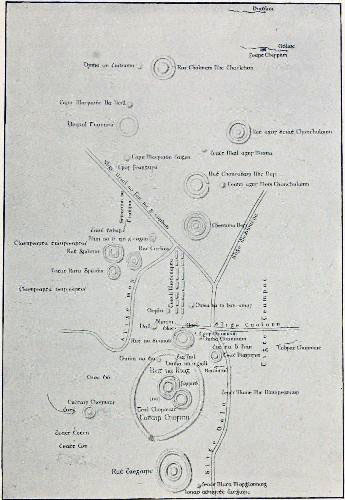
interested in archæology, should have Doctor Petrie’s map of it, which
will be found in his minute and elaborate work on the “Antiquities of Tara
Hill.” That map is reproduced here. The book is very scarce, as only a
small edition of it was printed, but it can be found in the “Transactions
of the Royal Irish Academy.” Armed with Petrie’s map a visit to Tara would
be one of the most interesting and enjoyable excursions that could be made
from Dublin. Kilmessan Station can be reached from the Broadstone terminus
in an hour, and less than two miles of a walk through a beautiful country
brings one to the summit of “the Hill of Supremacy,” as it was called of
old when he who ruled in Tara ruled Ireland. No matter how confirmed an
archæologist he may be who stands for the first time on this celebrated
hill, his first feeling will be of joy at the beauty of the prospect that
is spread before him. To know how beautiful Ireland is, even in those
places that are not on the track of tourists, and that are seldom
mentioned in guide books, one should see the view from the hill of Tara.
It would be hard to find any other hill in Ireland so well adapted for a
place of assembly or for the dwelling of a ruler as Tara. Uisneach, in
Westmeath, is, perhaps, the only hill in Ireland that possesses all the
advantages of Tara. In ancient times, when war was the rule and peace the
exception, it was imperative that a stronghold should be on a height.
Athens had its acropolis and so had Corinth. Tara had the advantage of
extent as well as of height, and could be made a permanent dwelling-place
as well as an acropolis, for there are fully a hundred acres on what may
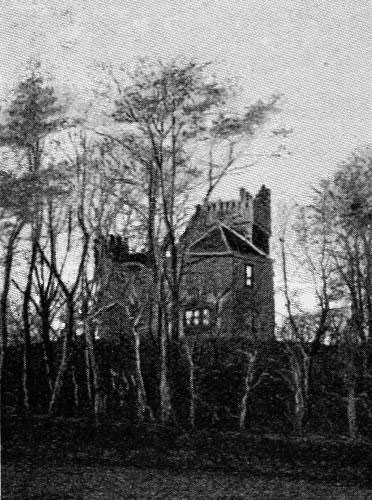
be called the summit of the hill. It is unfortunate that some of the hill
has been enclosed, planted with deal trees, and a church erected on the
very track of some of the most ancient monuments. This plantation and
church have terribly interfered with the picturesqueness and antique look
of Tara. Planting deal trees and erecting a modern church amid the
hoariest monuments, and on the most historic spot of European soil, was
little less than sacrilege. If there had been a proper national spirit, or
a due veneration for their past among the Irish, they never would have
allowed a church or any modern building to be erected on the most historic
spot on Irish soil; and even now they ought to have the church removed,
the wall torn down, and the plantation uprooted. All Greece would rise up
in indignation were any one to erect a church or chapel amid the ruins of
the Athenian Acropolis.
MONUMENTS ON TARA HILL.
(After Petrie’s Map.)
The most interesting and best preserved of the antiquities of Tara is the
track of the banquetting-house. It must have been an enormous building,
for it was about 800 feet long and about 50 wide. It is wonderful how
perfectly plain and well-defined the track of this once great structure
appears after nearly fourteen hundred years, and in spite of the way this
historic spot has been uprooted and levelled. But not a vestige of
stone-work or of stones is to be seen near the ruins of the
banquetting-house. It seems absolutely certain that there were no
buildings of stone in Tara when it was at the height of its grandeur, and
that seems to have been about the middle of the third century, during the
reign of Cormac MacAirt. It must not be thought that buildings cannot be
fine unless they are of stone; but buildings of stone were very rare in
northern countries until comparatively recent times. Moore, in his
“History of Ireland,” says, speaking of wooden buildings and of
Tara—“However scepticism may now question their architectural beauty,
they could boast the admiration of many a century in evidence of their
grandeur. That those edifices were of wood is by no means conclusive
either against the elegance of their structure or the civilisation of
those who erected them. It was in wood that the graceful forms of Grecian
architecture first unfolded their beauties.” So the absence of stone
buildings in Tara in no way proves that it was not a place of grandeur as
well as of beauty; and the tenth century Gaelic poet may have been
justified in saying of it,
“World of perishable beauty!
Tara to-day, though a wilderness,
Was once the meeting-place of heroes.
Great was the host to which it was an inheritance,
Though to-day green, grassy land.”
Every mention of Tara in the vast remnant of Gaelic manuscripts of the
ninth, tenth, eleventh, and twelfth centuries that still exists shows it
to have been, beyond all comparison, the most important place in ancient
Ireland. Oengus the Culdee, author of the longest poem in ancient Gaelic,
the famous Félire, recently translated by Mr Whitley Stokes, speaks thus
of this renowned but now ruined spot:
“Tara’s mighty burgh hath perished
With its kingdom’s splendour;
With a multitude of champions of wisdom
Abideth great Ardmagh.”
The poet contrasts the desolation into which the strongholds of the Pagans
had fallen with the then flourishing condition of the centres of
Christian teaching. Tara was the political as well as the social centre
of ancient Ireland. It is in connection with it that the only mention made
of roads having names is found in ancient Gaelic writings. Five great
roads, as will be seen by the annexed map, led from Tara to the
extremities of the Island. The Slighe Dala went southward; the Slighe
Asail went north-west; the Slighe Midhluchra, went north-east; the Slighe
Cualann went south-easterly; and the Slighe Mór went in a south-western
direction. Traces of those roads may still be seen by the practised eye of
the archæologist.
One of the most interesting things connected with Tara is the Lia Fail, or
Stone of Destiny. It was upon it the over-kings of Ireland had been
inaugurated from far-back antiquity. It is said to have been brought by
Fergus, brother of the then reigning chief King, to Scotland, in order
that he might be crowned king on it over the part of Scotland he had
conquered. It remained under the coronation chair of the Kings of Scotland
down to the time of Edward the First, who seized it and brought it to
Westminster, where it is now, and the sovereigns of England have been
crowned on it ever since his time. Petrie maintains that the Lia Fail is
still in Tara, and that the pillar stone that stands over the graves of
the men who fell in ’98 is it. He adduces very strong evidence from
manuscripts of high authority and of great antiquity to prove what he
says. There is, on the other hand, strong testimony to prove that it was
brought to Scotland by Fergus. The question will probably never be finally
settled. The principal virtue supposed to be possessed by the Lia Fail was
that it would bring political power to the country in which it was,
particularly if its people were of Celtic stock. It is very remarkable
that soon after the stone supposed to be the Lia Fail was taken out of
Ireland, her political power began to decline, her over-kings lost a great
part of their former authority, and in the long run she lost her
independence. Scotland’s political power and national independence
vanished not long after she had lost the Lia Fail, and in a few centuries
after England had got it she became one of the foremost nations in the
world. The English claim to be Saxons, but it is now generally admitted
that the Celtic element preponderates in the island of Great Britain, so
that the prophecy attached to the Lia Fail seems to be fulfilled.
The Lia Fail is certainly the most extraordinary stone in Europe, if not
in the world. The famous Rosetta stone, covered as it is with archaic
writing, and verifying, as many suppose, the truth of Old Testament
history, is hardly more interesting than the rude granite slab that lies
under the coronation chair in Westminster, unmarked with a single letter.
It is about 25 inches in length, about 15 in breadth, and 9 in depth. How
such a rude, unshapely flag-stone could have such a history, and have been
an object of veneration and interest for so many centuries, is what
strikes with wonder those who see it. But if it is not the real Lia Fail,
if it is a sham, and if the stone still standing in Tara is the genuine
one, the wonder increases; for the fact of a spurious article having
become invested with such fame and regarded with such veneration is the
greatest wonder of all.
Doctor Petrie says, in his “Antiquities of Tara Hill,” that “it is in the
highest degree improbable that to gratify the desire of a colony the Irish
would have voluntarily parted with a monument so venerable for its
antiquity and considered essential to the legitimate succession of their
own kings.” He quotes verses from a tenth century poet, Kenith O’Hartigan,
who says that the Lia Fail is
“This stone on which are my two heels”;
and he quotes from an ancient tract called the Dinseanchus, another
proof that when it was composed, and that time could not have been later
than the tenth century, the Lia Fail was in Tara. It often happens,
however, that Irish annalists and historians, so fond were they of looking
backward to the past, make things appear as they had been, and not as they
were when they wrote. The over-kings of Ireland were called Kings of Tara
five hundred years after Tara had been abandoned, and when it was as waste
and desolate as it is to-day. O’Dugan, in his topographical poem, written
in the fourteenth century, tells of clans inhabiting the English Pale,
when they had been banished westward by the invaders nearly two hundred
years before he wrote. He prefaces his topographical poem by saying
“O’Maolseachlinn, chief King of Tara and Erin,”
but the last O’Maolseachlinn that was nominally chief King of Ireland and
Tara had died three hundred years before O’Dugan wrote! Why those old
Gaelic poets were so fond of describing things as they had been, and not
as they were when they wrote, is hard to understand. They may have got
their information from documents that were centuries old when they copied
them. It seems a certainty that the men whose writings Petrie quotes to
prove that the Lia Fail was in Tara in the tenth century, did what O’Dugan
did in his topographical poem—that is, speak of things as they had been
hundreds of years before. He never mentions the English at all. This
partially accounts for Irish writers of the tenth century speaking of the
Lia Fail being then in Tara. They intended to describe where it used to
be, but not where it was. When Petrie says that the Lia Fail is spoken of
by all ancient Irish writers in such a manner as to leave no doubt that it
remained in its original situation at the time when they wrote, he makes a
great mistake. Here is a quotation from the “Book of Leinster,” a
manuscript of the highest authority, compiled in the early part of the
twelfth century, and mostly from writings of a much earlier date:—“It was
the Tuatha De Danaans who brought with them the great Fal, that is, the
stone of knowledge that was in Tara; from which [the name of] Magh Fail
is on Ireland. He under whom it would roar was then [rightful] King of
Ireland.”[2]
There is another very strong proof brought to light by the publication of
“Silva Gadelica,” by Mr Standish Hays O’Grady, that the Lia Fail was
removed from Tara. In the tract called the “Colloquy,” one of the speakers
says: “This, then, and the Lia Fail, or stone of destiny, that was there
(in Tara) were the two wonders of Tara. When Ireland’s monarch stepped on
it, it would cry out under him,” ... “And who was it that lifted that
flag, or that carried it away out of Ireland?” asked one of the listeners.
“It was a young hero of great spirit that ruled over” ... Here,
unfortunately, the tract ends abruptly. The “Colloquy,” or “Agallamh na
Seanorach,” is a tract of respectable antiquity. Its language seems to be
that of the fifteenth or perhaps the fourteenth century, but the version
that has come down to us may be, and probably is, but a transcript of a
much more ancient tract, the language of which was modernised.
If Doctor Petrie had known of the existence of those two proofs given of
the Lia Fail having been removed from Tara, he never would have said that
all ancient Irish writers spoke of it in such a way as to leave no doubt
of its being there still. O’Reilly, author of Irish dictionary, says: “Lia
Fail, the stone of destiny, on which the ancient Irish monarchs used to be
crowned until the time of Mortogh Mac Earc, who sent it into Scotland
that his brother Fergus, who had subdued that country, might be crowned on
it. It is now in Westminster Abbey.” O’Reilly was the most learned Irish
scholar and historian of his day, and was a painstaking, conscientious
man, who would hardly state any thing for which he did not have good
authority. It must, however, be admitted that up to the present no
positive statement seems to have been found in ancient Irish writings as
to when and by whom the Lia Fail was brought from Tara to Scotland;
neither does it seem to be known where O’Reilly got his information about
it.
When Petrie spoke of the improbability of the Irish allowing such a
venerated monument as the Lia Fail to be taken out of Ireland, he should
have remembered that at the time when it is said to have been taken, in
the beginning of the sixth century, Christianity had become established in
Ireland. Paganism or Druidism may have survived among a few, but it had
got its death-blow. Pagan monuments of every kind had begun to be
disregarded. The Lia Fail was essentially a Pagan monument, and
consequently an abhorrence to Christians. The fathers, or at least the
grandfathers, of the men who allowed Fergus to take it to Scotland, would
probably have shed the last drop of their blood to keep it in Ireland. The
disrepute into which everything connected with Paganism had fallen after
the introduction of Christianity is plainly set forth in the “Book of
Leinster” in the very page from which the Gaelic extract about the Lia
Fail has been given:—“It happened that Christ was born not long after; it
was that which broke the power of the idols.”[3] The Lia Fail was an idol
that had lost its power and prestige, so that the people would not be
likely to have any objection to its being removed to Scotland or anywhere
else.
But there are still other even stronger objections for accepting Petrie’s
theory that the Lia Fail is still in Tara. The pillar stone that is there
is not a lia, and never would have been called such by the ancient
Irish. Lia means a stone of any kind in its general sense; but the
pillar stone in Tara would not be called a lia, but a coirthe. Lia
is always applied to a flag-stone, both in ancient and modern Gaelic. The
stone under the coronation chair in Westminster is a real lia or
flag-stone; the one in Tara is a coirthe, or pillar stone, for, judging
from its height above the ground, it cannot be much less than eight feet
in length; it is very nearly round, and was evidently fashioned into its
present shape by man. If the stone in Tara is the real Lia Fail, how did
it come to lose its original name and be know even still by an Irish name
that connects it with Fergus, the person by whom the real Lia Fail is
popularly believed to have been brought to Scotland? This loss of an
original name, and its substitution by a new one, could hardly have
occurred in the case of such a famous monument as the Lia Fail. If the
superstitious reverence with which it had been regarded before the
introduction of Christianity had vanished, its original name would have
remained. There are many place names in Ireland that have not changed
during twenty centuries, and it is almost impossible to conceive how the
name of the most venerated monument in all Ireland could have changed had
the monument itself remained in the country. Another strong objection
against the pillar stone in Tara being the real Lia Fail is its shape. The
real Lia Fail was intended to be stood upon by the chief king at his
inauguration; but the most flat-footed monarch that ever ruled Ireland
would have considerable difficulty in standing steadily on the coirthe
in Tara, even if it were prostrate, for it is round and not flat.
Standing steadily on it would be nearly as difficult a performance as
“rolling off a log” would be an easy one.
Taking everything into consideration, there seem to be very strong reasons
to believe that the Lia Fail was taken from Tara to Scotland at the time
it is popularly believed to have been taken—namely, about the year 503 of
the Christian era; that it was taken in order to have Fergus Mac Earc
inaugurated on it as king over that part of Scotland which he had brought
under his domination; that it was taken from Scone to Westminster by
Edward the First in the year 1296, and that it is now under the coronation
chair in Westminster Abbey. It seems strange how a man of Doctor Petrie’s
archæological knowledge could have been led to believe that the pillar
stone still in Tara, for whatever use it may have been originally
intended, was the real Lia Fail, or Stone of Destiny.
It would be most instructive and interesting if a scientific examination
was made of the stone under the coronation chair. If it was proved to be a
meteoric stone, its fame and the reverence with which it was so long
regarded could be easily understood. If an ancient tribe saw a stone
falling from heaven among them, they would regard such a thing as a
miracle, and think that the stone was sent to them for some special
purpose. They would, if possible, take it with them wherever they went. If
the Lia Fail was proved to be a meteoric stone, the esteem and honour in
which it was so long held, and the power which it was believed to possess,
would be easily accounted for.
The history of Tara is, to a great extent, the history of ancient Ireland
of pre-Christian times. It was more of a political centre than London or
Paris is at present. The event that above all others left a permanent mark
as well as a blot on Irish history may be said to have had its origin in
Tara. The horrible Leinster Tribute and Tara are closely connected.
In the first century of the Christian era, an over-king called Tuathal,
from whom the common Irish surname O’Tool, or Tool, seems to have
originated, reigned in Tara. He had two daughters, famed for their beauty.
We are told in the “Book of Leinster” that they were “fairer than the
clouds of heaven.” Their names were Fihir and Darine. A king of Leinster
named Eochy married Fihir, the elder of the two sisters. He got tired of
her after a short time, went to Tara, told Tuathal that Fihir was dead,
and that he wanted to marry her sister Darine. Tuathal consented, and
Eochy took his new wife home to his dun, which was in the western part
of the present county of Wicklow. Darine had been only a short time in her
new home when she met her sister Fihir, who she had been told was dead.
Darine was so overwhelmed by shame that she died, and Fihir was so shocked
at the death of her sister that she died of grief. So Tuathal’s two
beautiful daughters were dead, and were buried in the same grave. When
Tuathal heard of their deaths he summoned his vassals, the kings of Ulster
and Connacht; his army and theirs invaded Leinster, defeated and killed
its king, ravaged it, and imposed the celebrated Tribute on the
unfortunate province—namely, fifteen thousand cows, fifteen thousand
sheep, fifteen thousand pigs, fifteen thousand silver chains, fifteen
thousand bronze or copper pots, and fifteen thousand linnen (?) cloaks,
together with one great cauldron into which, Hibernicè, “twelve beeves
and twelve pigs ‘would go,’ in the house of Tara itself.” This was,
indeed, a prodigious pot that could boil four-and-twenty quadrupeds of the
sort, for Ireland was always famous for its large pigs and beeves. Such a
cauldron having been used, shows that however poorly the inhabitants of
other parts of Ireland may have fared in ancient times, the people of
Tara lived well. When it is remembered that ancient Leinster was little
more than half the size of the modern province, such a tribute appears
enormous. Ancient Leinster, or, to speak more correctly, the Leinster of
the time of Tuathal, went no further north than a line running from Dublin
to Athlone. The counties of Meath, Westmeath, Longford, and Louth belonged
to the province of Meath that had been carved out of parts of the four old
provinces by Tuathal himself. The Tribute was to be paid every year, but
it was not, for, as the Leinstermen’s own great Chronicle says, “It never
was paid without a fight”; and sometimes when they succeeded, as they very
often did, in licking the combined armies of all the other provinces, it
used not to be paid for many years. It was, however, paid on and off for
over five hundred years, and to forty over-kings. It was remitted in the
seventh century; but many attempts were subsequently made to re-impose it
on the unfortunate Leinstermen, who paid more dearly for the treacherous
act of one of their kings than any other province or nation mentioned in
history. One of their poets has said in a yet untranslated poem in the
“Book of Leinster”:
“It is beyond the testimony of the Creator,
It is beyond the word of supplicating Christ,
All the kings of the Irish
That make attacks on Leinstermen!”[4]
It is not to be wondered at that the Leinster Tribute totally
denationalised the province on which it was levied, and made its harried
inhabitants side with the Danes and with the Anglo-Normans against their
own countrymen. But what is most astonishing about the Tribute is its
enormousness. That part of Leinster which was the ancient province could
hardly pay such a tax to-day. This matter seems to show that ancient
Ireland, in spite of a state of almost continual intestine warfare, was
far richer and more populous than is generally supposed.
The most horrible act recorded in Irish history was committed at
Tara—that is, the slaughter of 3030 women by the Leinstermen in the year
241. Here is what the Four Masters say of it under that year:—“The
massacre of the girls at Cloonfearta at Tara, by Dunlang, King of
Leinster. Thirty royal girls was the number, and a hundred maids with
each of them. Twelve princes of the Leinstermen did Cormac put to death in
revenge of that massacre, together with the exaction of the Borumha
(Tribute) with an increase after Tuathal.” The Cormac here spoken of was
the celebrated Cormac Mac Airt, one of the best over-kings that ever ruled
ancient Ireland. This horrible massacre of maidens in Tara is so often
mentioned in ancient Irish history and annals, and the same number of
victims so invariably given, that there cannot be any doubt whatever about
its having occurred. But particulars about it seem wanting. There was
probably some pagan festival to be celebrated in Tara, at which the
children of the upper classes only attended. The ladies may have arrived
from the different parts of the country before the men, and when the
harried Leinstermen made a raid on Tara, they found it unguarded save by
women, and killed them and burned Tara to the ground at the same time; or
it may have been that the women tried to help the few men that happened to
be there in protecting the place, and Dunlang made an indiscriminate
massacre of every one he found in it. This horrible act was caused by the
imposition of the Leinster Tribute. It is to be presumed that there were
no Leinster girls among those who were slaughtered.
Those interested in Irish history, or in ancient history in general,
should read the tract called the Borumha, or Tribute, in the “Book of
Leinster.” Translations of it have been recently made in the Revue
Celtique and in Silva Gadelica. There is not in any ancient or mediæval
literature anything to excel it in general interest. It is an historic gem
that has been forgotten or overlooked for centuries. The indifference
which the educated classes of the Irish people have heretofore shown about
the ancient literature of their country was one of the most shocking,
sickening symptoms of national degradation ever shown by any civilised
people. They are latterly beginning to take more interest in it; but it is
greatly to be feared that they have been induced to turn their attention
to it more by the example shown them by foreigners than by any change of
opinion originating among themselves. Much as O’Donovan, O’Curry, and
Stokes have done to call the attention of the cultured classes of the
Irish people to the study of Celtic literature, it is doubtful if they
would have succeeded if the scholars of Continental Europe had not taken
an interest in it. The renaissance of Celtic studies which seems to
have taken place owes a large part of its origin to the Germans and the
French.
Many valuable gold ornaments of antique and beautiful design and
workmanship have been found in Tara and its immediate vicinity, but very
few of them have found their way to the Kildare Street Museum in Dublin,
one of the greatest, if not the very greatest, collection of ancient
weapons, implements, and ornaments to be seen in Europe. Most of the gold
ornaments found in Tara have been melted down. If one is to believe what
the peasantry living in its vicinity say, the quantity of gold ornaments
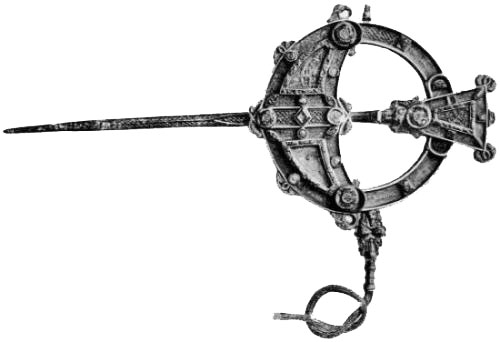
found there was very great. The famous Tara Brooch, preserved in the
Dublin Museum, and considered the most beautiful piece of metallurgy,
either ancient or modern, that is known to exist, was not found in Tara,
but on the seashore about three miles from Drogheda, and nine or ten from
this famous hill. It was found by an old woman, who is said to have sold
it to a shopkeeper in Drogheda for ninepence. The Royal Irish Academy paid
£500 for it. Many think that a regular, scientific exploration of Tara
Hill ought to be made, such an exploration as Schlieman made of the site
of Troy. If this were done under government surveillance, or by some
responsible and skilled antiquarian, there is hardly a doubt but that many
and precious ornaments in gold, and implements and weapons in bronze,
would be found, especially the latter, for there seems every reason to
believe that Tara was the seat of government long before iron was known,
and long before the bronze age came to an end. It would, however, be a
tremendous task to uproot several hundred acres merely on speculation. But
the quantity of antique gold ornaments that has been found in Ireland was
immense, more, it is thought by some, than has been found in all the rest
of Europe. They are being found almost every year. Nearly £300 worth of
golden fibulae was found in the County Waterford in 1894. They are now to
be seen in the Dublin Museum.
TARA BROOCH.
The many things that are told about Tara in old Gaelic books would fill a
large volume. They are all interesting. They may be incredible, grotesque,
or funny, but they are never common-place: it is this uniqueness that is
the great charm of ancient Irish literature. What could be more unique
than this account of the burial of Laoghaire, the chief king who was
cotemporary with St Patrick, but of whom the Saint never succeeded in
making even a half decent Christian. It is taken from the book of the Dun
Cow. When Laoghaire was killed by “the elements,” by lightning probably,
“his body was taken from the south and was buried with his warrior weapons
in the outward(?) south-eastern rampart of the Kingly Rath Laoghaire in
Tara, and its face to the south against the Leinstermen [as if] fighting
with them, for he had been an enemy of the Leinstermen when alive.” The
idea of facing his enemies with his dead body, for Laoghaire must have
given orders as to how and where he should be buried, could only have
entered into the brains of ancient Irish kings, for they were grotesque or
original in almost everything.
It is strange how long political memories last. The enmity between
Leinster and Meath has not even yet quite died out. Meath, as the seat of
the over-kings, represented Ireland, and was also the place from which the
hateful Leinster Tribute originated. This is not yet forgotten, for
whenever wrestling matches, or athletic sports of any kind, are held near
Dublin by the people of adjoining counties, the counties of Dublin,
Kildare, and Wicklow are always pitted against Meath. Dubhthach Mac U
Lugair, one of the first converts St Patrick made in Ireland, tells us, in
a poem of his in praise of his native province of Leinster, that its war
cry was “The magnification of Leinster, the destruction of Meath.”
Dubhthach may have been a good Christian, but there are good grounds for
thinking that he was a better Leinsterman; for he says in the same poem
that—
“Except the host of Heaven round the Creator
There never was a host like Leinstermen round Crimhthan.”
Crimhthan was a king of Leinster, who is said to have had a stronghold in
Howth, where the Bailey Lighthouse now stands.
Although few traces of cultivation are to be seen on the Hill of Tara,
there can be no doubt that it has been very much defaced and uprooted.
The great rath of King Laoghaire, who was cotemporary with St Patrick,
has almost entirely disappeared. Its earthen rampart must have been of a
good height, when it served as a sepulchre for Laoghaire with his body in
an erect position, with its face turned southward, against the
Leinstermen. Laoghaire was never a Christian; or if he was such at one
time, there seems strong reason to think that he relapsed into paganism
towards the end of his career. At all events it is evident that he was not
a favourite of St Patrick’s or of the early Irish Christians, and it is
quite likely that when Tara was abandoned, his rath was uprooted, and
his body, or what remained of it, consigned to some unmarked grave. But
from whatever cause, this rath has certainly been almost entirely
obliterated. It must have been considerably over two acres in area, if one
can judge by the small segment of it that can still be traced.
The following story is told in the life of St Patrick in the Leabhar
Breac. Mr. Whitley Stokes says in his translation of the lives of the
Saints from the “Book of Lismore,” that it so disgusted Thomas Carlyle
that it caused him to give up the study of Irish history:
“Then three of Ui Meith Mendait Tire (a tribe that were located in the
vicinity of Tara) stole and ate one of the two goats that used to carry
water for Patrick, and came to swear a lie. Whereupon the goat bleated
from the stomachs of the three. ‘By my good judge,’ said Patrick, ‘the
goat himself hides not the place where he is.’” It is hardly to be
wondered at that a story like this, that would make any right-minded man
laugh, only disgusted a hypochondriacal crank like Carlyle.
The last chief king who lived in Tara was Dermot MacCarroll, who died in
the year 565. He was evidently only half a Christian, for it has been
fully proved that Druidism lingered in Ireland for many years after the
death of St Patrick. Dermot got into a dispute with the clergy because
they sheltered a man who had done something that displeased him. The end
of the dispute was that St. Ruadhan, one of the prominent ecclesiastics of
the time, cursed Tara, and it was forever abandoned as the seat of
royalty. It is almost certain that the real cause of the cursing of Tara
by the clergy was that druidical or pagan rites continued to be practised
in it after the bulk of the people had become Christians; for it had been
for untold centuries the seat of paganism as well as of royalty. It has to
be admitted, however, that great a benefit to the true faith as the
abandonment of Tara as a political centre undoubtedly was, it was
disastrous to the authority of the chief kings, for they appear to have
lost much of their authority over the provincial rulers when they
abandoned Tara and made their abodes in various places in Meath,
Westmeath, and Donegal.
The vast antiquity given to Tara cannot be reasonably considered as the
mere invention of Irish bards or chroniclers. It is inconceivable that
they would invent the names of forty or fifty kings, most of whom ruled
there over a thousand years before the Christian era. The Irish annalists
who wrote about the very remote historical events of Irish history lived
and wrote long before Ireland came under English domination. They would
have no object in inventing historic falsehoods. The Tuatha de Daanans and
Firbolgs, who possessed the country before the Milesians, had vanished
more than a thousand years before the most ancient annals we possess were
written. What object could men who claimed to be Milesians have in
inventing historic falsehoods about races who possessed the country before
them? Besides, the general correctness of Irish annalists in recording
purely historic events is now admitted by all those capable of forming an
opinion. The men who wrote the oldest chronicles that we possess of
events in the very far-back past of their country, evidently wrote what
had been handed down to them, either in writing or by tradition. They
would have had no object in becoming fabricators.
So far, then, Tara with its glamour of greatness and antiquity, its
uprootedness, its ruin, and its utter desolation.