Figaro-“Feindre d’ignorer ce qu’on sait, de savoir tout ce
qu’on ignore; d’entendre ce qu’on ne comprend pas, de ne
point ouïr ce qu’on entend; surtout de pouvoir au delà de ses
forces; avoir souvent pour grand secret de cacher qu’il n’y
en a point; s’enfermer pour tailler des plumes, et paraître
profond, quand on n’est, comme on dit, que vide et creux;
jouer bien ou mal un personage; répandre des espions et
pensionner des traîtres; amollir des cachets, intercepter des
lettres, et tâcher d’ennoblir la pauvreté des moyens par
l’importance des objets; voilà toute la politique ou je
meure.”
Le Comte—“Eh! c’est l’intrigue que tu définis!”
Figaro—“La politique, l’intrigue, volontiers; mais, comme
je les crois un peu germaines, en fasse qui voudra!”
Le Mariage de Figaro, Act III, Scene V.
Curious History of the Chevalier d’Eon—Secret Agent of
Louis XV—The Chevalier Feigns to Be a Woman—Curiosity
of London Aroused—Necessity for the French Government
to Obtain Possession of State Papers in d’Eon’s
Hands—Beaumarchais Accepts Mission—Obtains Possession
of the Famous Chest.
IT was the summer of 1775. The moment was approaching
when the attention of Europe would be directed towards
the events transpiring on the other side of the Atlantic, in
that New World, of which the old was as yet scarcely conscious.
The stand for freedom, for individual rights, for the
liberty of expansion which was there made, was destined to
rouse the warmest sympathies amongst all classes, especially
in France. The enthusiasm which greeted the resistance of
the colonies rapidly became a national sentiment which the
French government was unable to suppress or even to keep
within bounds. To direct this enthusiasm into a practical
channel that should lead to immediate and efficient support of
the insurged colonies whilst awaiting the active intervention
of the government, was to be primarily the work of one man,
and that man was Beaumarchais.
But in starting for London on the present occasion, he
was unconscious of the historic importance which this journey
was destined to assume. The mission with which he was
charged was one of the most singular with which any government
ever seriously commissioned one of its agents.
There was living at this time in London the Chevalier
d’Eon de Beaumont, who was a former agent of the occult
diplomacy of Louis XV, and who at this time was an exile
from his country, to which he had been forbidden to return
in consequence of the scandalous and disgraceful quarrel that
had occurred between him and the French Ambassador, the
Comte de Guerchy, years before. Although publicly disgraced,
he retained the secret confidence of the old King, who
allowed him an annual income of 12,000 francs. The present
government was willing to continue this pension, but on condition
that the chevalier give up the secret correspondence
of the late King, which remained in his possession, and of
which it was very important that the French government
should obtain control. It was to negotiate the remittance
of this correspondence that Beaumarchais was commissioned
the summer of 1775. The oddity of the character with which
he had to deal, rather than the actual nature of the mission,
was what made the negotiation so difficult and the proceedings
so unusual.
Several years previous, about 1771, a rumor began to circulate
in England that the Chevalier in question was really
a woman disguised. Although one of the most belligerent of
characters, who “smoked, drank and swore like a German
trooper,” it appears that “the rarity of his blond beard and
the smallness of his form (Gaillardet),” “a certain feminine
roundness of the face, joined to a voice equally feminine, contributed
to give credit to the fable (note of M. de Loménie,
sur le Chevalier d’Eon).” There were also certain facts in
the life of the chevalier which supported this theory; among
others it was known that as a very young man he had been
sent by Louis XV in the guise of a woman to the court of
St. Petersburg, where he had succeeded in being admitted as
reader to the Empress Elizabeth.
As the Chevalier d’Eon was a widely known personage in
English society, the matter took on great proportions and became
a subject of betting according to the manière anglaise.
D’Eon, who seems to have cared primarily for one thing,
namely, notoriety of whatever sort, secretly encouraged the
dispute, although he wrote at the same time to the Comte de
Broglie: “It is not my fault if the court of Russia during
my sojourn here, has assured the court of England that I
am a woman.... It is not my fault if the fury of betting
upon all sorts of things is such a national malady among
the English that they often risk more than their fortunes
upon a single horse.... I have proved to them, and
I will prove it as often as they wish, that I am not only a
man, but a captain of dragoons, with his arms in his hands.”
And yet he was able to keep the world in a state of complete
mystification as to his true sex, up to the time of his
death in 1810.
Voltaire says of him: “The whole adventure confounds
me. I cannot understand either d’Eon, or the ministers of
his time, or the measures of Louis XV, or those being made at
present. I understand nothing of the whole affair.” In his
Memoires sur le Chevalier d’Eon de Beaumont, M. Gaillardet
says: “The history of the Chevalier d’Eon was one of the
most singular and most controverted enigmas of the 18th century.
That century finished without its being known what
was the veritable sex of that mysterious being, who after
being successively doctor of law, advocate in the Parliament
of Paris, censor of belles-lettres, secretary of embassy at
St. Petersburg, captain of dragoons, Chevalier de Saint
Louis, minister plenipotentiary to London, suddenly, at the
age of 46 years announced himself to be a woman, assumed
the costume of his new rôle, and conserved it until the time
of his death in 1810.”
As we shall presently see, and for reasons wholly justifiable,
it is Beaumarchais who works this transformation in
the life of d’Eon. Nothing in relation to his strange character
is so passing strange as the fact that the King and
his minister, and above all that Beaumarchais himself, the
cleverest of men—should have been completely duped by the
Chevalier as to the matter of his sex. It even went so far
as to be generally believed that the demoiselle d’Eon was seriously
in love with Beaumarchais, and the latter himself believed
it. In the most skillful way the chevalier endeavored
to make use of this deceit to further his own ends. Failing
in this, and having made the fatal avowal and received the
King’s orders to assume the garb of a woman, the fury of
d’Eon knew no bounds. Powerless to wreak his vengeance
in any other way, he endeavored by calumny and abuse to
thwart the career of the man upon whom he had been able
to impose only in the matter of his sex. Beaumarchais
readily excused all the insults cast at him, believing as he
did, that this is the manner of revenge of the strange creature,
“his amazon”—(as d’Eon is familiarly called in the correspondence
between himself and the minister Vergennes)—for
finding that her love is not requited.
But to return to the facts of the case: D’Eon, at the time
of the death of Louis XV was living in constant hope of being
restored to favor and allowed to return to France. His
pension of 12,000 francs had proved all too small for his
support and he was heavily in debt. No sooner had the
young king, Louis XVI, mounted the throne than the Chevalier
sent word to Vergennes, minister of foreign affairs, announcing
that he had in his possession important letters
which were of such a nature that should they fall into the
hands of the English, it might precipitate a war between
the two nations. An agent was therefore dispatched to enter
into negotiations. “Understanding,” says Gaillardet, “that
if he did not profit by this occasion, he would have little to
expect from the new reign, d’Eon resolved to put a high price
on the papers in his possession. He demanded: first, that
he be solemnly justified of the imputations directed against
him by his enemies—especially the family of the Comte de
Guerchy; second, that all the sums, indemnities, advances,
etc., due him for the past 26 years, be paid, amounting in
all to 318,477 livres, 16 sous.”
Unable to come to any reasonable terms, the negotiations
were broken off and the agent returned to France. He was
replaced by another who was equally unsuccessful, and for a
time the matter was dropped.
In the meantime noise of the affair reached the English
government, and d’Eon soon had the satisfaction of receiving
large offers from that quarter if he would consent to give up
the papers. The Chevalier, whatever his faults, or the violence
of his character, was not a traitor; he had no intention
of giving the papers in his possession to the English at any
price, but he was well satisfied that their value should be thus
enhanced.
In the meantime, his pension was suspended and finding
himself without funds, “he borrowed 5,000 pounds from his
devoted friend and protector, the Lord Ferrers, giving him as
security a sealed chest, which, Ferrers supposed, contained
the famous correspondence. He took care, however,” says
Gaillardet, “to withdraw from that deposit precisely the personal
documents of the late King, which were the most important
for the court of France and for himself. These papers
contained a plan for the restitution of the Stuarts, a descent
upon England, and other dreams, constituting what
d’Eon called le grand projet of Louis XV.”
At this juncture Beaumarchais appeared on the scene.
“To interest the latter in his cause, and give him a mark of
confidence (Gaillardet) d’Eon avows with tears that he is
a woman, and this avowal was made with so much art that
Beaumarchais did not conceive the least doubt.”
D’Eon recounted the history of the papers in his possession,
and the offers which he had resisted. Charmed to
oblige a woman so interesting by her sorrows, her courage,
her esprit, Beaumarchais addressed at once touching letters
to the King in favor of his new friend. “When one thinks,”
he writes, “that this creature, so much persecuted, belongs
to a sex to which one forgives everything, the heart is touched
with a sweet compassion.” “I do assure you, Sire,” he writes
elsewhere, “that in taking this astonishing creature with dexterity
and gentleness, although she is embittered by twelve
years of misfortune, she can yet be brought to enter under
the yoke, and to give up all the papers of the late King
on reasonable conditions.”
As to the motives which could have induced le chevalier
d’Eon to avow himself a woman, his biographer, already
quoted, gives the following explanation:
“His military and diplomatic career was about finished;
disgraced, he would disappear from the scene of the world and
fall into obscurity. But precisely shadow and silence were
a horror to him. If there was a mystery in his existence, if
they learned that he was a woman, he would become the hero
of the day and of the century; his services would then appear
extraordinary. This metamorphosis would attract
to him the attention of Europe, and enable him more
easily to obtain satisfaction from the French government,
who would no longer refuse a woman the price of blood shed
and services rendered.”
Both Gaillardet and Loménie, after a careful examination
of all the correspondence in relation to the affair between the
Chevalier d’Eon and Beaumarchais, assure us that not a
line exists which does not prove that the latter was completely
deceived as to the matter of the sex of the Chevalier.
Lintilhac, however, thinks that he has found proofs to the
contrary in a letter which begins, “Ma pauvre Chevalière,
or whatever it pleases you to be with me....” London,
Dec. 31, 1775. Gudin, in his life of Beaumarchais, says, “It
was at a dinner of the Lord Mayor Wilkes that I encountered
d’Eon for the first time. Struck to see the cross of St.
Louis shining on his breast, I asked Mlle. Wilkes who that
chevalier was; she named him to me. ‘He has,’ I said, ‘the
voice of a woman.’ It is probably from that fact that the
talk has all come. At that time I knew nothing more about
him; I was still ignorant of his relations with Beaumarchais.
I soon learned them from herself. She avowed to me with
tears (it appears to have been the manner of d’Eon—note
of Loménie) that she was a woman, and showed me her
scars, remains of wounds which she had received, when, her
horse killed under her, a squadron of cavalry passed over her
body and left her dying on the plain.”
“No one,” says Loménie, “could be more naïvely mystified
than is Gudin. In the first period of the negotiation, d’Eon
is full of attentions for Beaumarchais; he calls him his
‘guardian angel’ and sends him his complete works in fourteen
volumes; for this curious being, this dragoon, woman
and diplomat, was at the same time a most fruitful scribbler
of paper. He has characterised himself very well in the following
letter: ‘If you wish to know me, Monsieur the Duke,
I will tell you frankly that I am only good to think, imagine,
question, reflect, compare, read, write, to run from the rising
to the setting sun, from the south to the north, and to fight
on the plain or in the mountains ... or I will use up
all the revenues of France in a year, and after that give you
an excellent treatise on economy. If you wish to have the
proof, see all I have written in my history of finance, upon
the distribution of public taxes.’”
This, then, was the strange being with whom Beaumarchais
had to deal. On the 21st of June, 1775, he received from
Vergennes the following letter, which shows in the best possible
light the credit which the secret agent of the government
had already acquired. He wrote:
“I have under my eyes, Monsieur, the report which you
have given M. de Sartine of our conversation, touching M.
d’Eon; it is of the greatest exactitude; I have taken in consequence
the orders of the King. His Majesty authorizes you
to assure to M. d’Eon the regular payment of the pension of
12,000 francs.... The article of the payment of his
debts is more difficult; the pretensions of d’Eon are very high
in that respect; they must be considerably reduced if we are
to come to any arrangement.... M. d’Eon has a violent
character, but I do him the justice to believe that his
soul is honest, and that he is incapable of treason....
It is impossible that M. d’Eon takes leave of the English
King; the revelation of his sex does not permit it; it would
be ridiculous for both courts.... You are wise and
prudent, you know mankind, and I have no doubt but that
you will be able to arrange the affair with d’Eon, if it can be
done. Should the enterprise fail in your hands, we shall
be forced to consider that it cannot succeed and resolve to
accept whatever may come from it.... I am very sensible,
Monsieur, of the praises which you have been so good as
to give me in your letter to M. de Sartine. I aspire to merit
them, and accept them as a gage of your esteem, which will
always be flattering to me. Count, I beg you, upon my own,
and upon the sentiments with which I have the honor to be
very sincerely, Monsieur, etc.
“De Vergennes.
“A Versailles, June 21st, 1775.”
July 14, 1775, Beaumarchais wrote to M. de Vergennes
announcing that he had obtained possession of the keys of
the famous chest, which he had sealed with his own seal and
which was deposited in a safe place. “Whatever happens,
M. le Comte, I believe that I have at least cut off one head
of the English hydra ... the king and you may be
quite certain that everything will rest in statu quo in England,
and that no one can abuse us from now to the end of
the negotiation which I believe about finished.” But in the
meantime, while undertaking the settlement of the affair with
d’Eon, the active mind of Beaumarchais had become enflamed
with an ardent zeal for the cause of liberty, as it was being
then defended on the other side of the Atlantic. “One of
the first,” says Gaillardet, “he had embraced the cause of
the Americans, had espoused it with a sort of love that partook
of idolatry.... He followed every phase with an
interest which nothing discouraged, not ceasing to hope in
the midst of reverses, triumphing and clapping his hands at
every victory.... He excused their faults, exalted
their virtues, plead for them with all the faculties of his
esprit and of his soul, before those whom he wished to interest
in their fate.”
Every voyage back to Paris, which the interests of his
mission necessitated, every letter which it occasioned, was
made to subserve itself to this one end which transcended
all others; namely, to rouse the young King from that state
of indecision and indifference to which he was born, and
where he seemed likely to remain.
In the next chapter this subject will be taken up in all
its detail; for the present it is necessary only to remind
the reader that the matter of which we are now treating is all
the while secondary in the mind of Beaumarchais. It is, however,
of vital importance in that, at the beginning, it offers
the avenue of approach to the King and his ministers which
might otherwise have been wanting. Through the masterly
way in which he settled the affair with d’Eon, the confidence
of the King and of his minister was secured. Before the
affair was terminated, an open channel had been established
which permitted the whole current of the genius of Beaumarchais
to flow direct to its goal.
It will be remembered that the Chevalier d’Eon had borrowed
five thousand pounds of his friend the English Admiral,
Lord Ferrers, and had left him as security the chest
containing the famous correspondence of the late King. Before
it could be delivered to Beaumarchais there were many
difficult questions to settle, the chief one being the Chevalier’s
return to France, owing to the resentment still felt by the
family of the Comte de Guerchy towards the Chevalier, and
the latter’s well known violence of temper. The King and
M. de Vergennes demanded absolute oblivion of the past and
a guarantee that no further scandals should arise. This was
difficult to assure, owing to the fiery nature of the Chevalier.
Already, as we have seen, the latter had avowed “with tears”
that he was a woman.
August 7th, 1775, M. de Vergennes wrote to the King, “If
your Majesty deigns to approve the propositions of the
Sieur de Beaumarchais to withdraw from the hands of the
Sieur d’Eon the papers which it would be dangerous to leave
there, I will authorize him to terminate the affair. If M.
d’Eon wishes to take the costume of his sex, there will be
no objection to allowing him to return to France, but under
any other form he should not even desire it.”
In a letter to Beaumarchais, the 26th of the same month,
M. de Vergennes wrote: “Whatever desire I may have to see,
to know, and to hear M. d’Eon, I cannot hide from you a
serious uneasiness which haunts me. His enemies watch, and
will not pardon easily all that he has said of them.... If
M. d’Eon would change his costume everything would be
said.... You will make of this observation the use
which you shall judge suitable.”
The idea appeared not only good to Beaumarchais, but
to offer, perhaps, the only solution to the difficulty. He
therefore made this the condition of settlement of the debts
of d’Eon, the continuation of his pension, as well as of his
being allowed to return to France. The same motives which
had actuated the Chevalier to declare himself a woman
worked now in favor of what Beaumarchais, endowed with
full power in his regard, demanded of him. Realizing, as
M. de Vergennes had done, that if the matter were not now
adjusted, it would never be again taken up; realizing too that
his notoriety would be increased tenfold by this metamorphosis,
he decided to submit to what was imposed upon him.
Early in October, Beaumarchais wrote to M. de Vergennes:
“Written promises to be good are not sufficient to arrest a
head which enflames itself always at the simple name of
Guerchy; the positive declaration of his sex and the engagement
to live hereafter in the costume of a woman is the only
barrier which can prevent scandal and misfortunes. I have
required this and have obtained it.”
As a matter of fact, on the 5th of October, the Chevalier
signed the famous contract, in which he promised to deliver
the entire correspondence of the late King, declared himself
a woman and engaged to “retake and wear the costume of
that sex to the time of his death;” and he added with his own
hand, “which I have already worn on divers occasions known
to his Majesty.” The agent of the French Government on
his side agreed to deliver a contract or pension of 12,000
francs, as well as “more considerable sums which shall be remitted
for the acquittal of the debts of the Chevalier in
England.” “Each of the contractants,” said Loménie, “reserved
thus a back door; if the more considerable sums did
not seem considerable enough, the Chevalier intended to
keep a portion of the papers, so as to obtain still more
funds. Beaumarchais, on his side, had no intention of paying
all the debts which it should please the Chevalier to declare,
and had demanded of the King the faculty to batailler
to employ his own expression—with the demoiselle d’Eon,
from 100,000 to 150,000 francs, reserving the right to give
him the money in fractional parts, and to extend or retract
the sum according to the confidence which that cunning personage
should inspire.”
After the contract was signed, Beaumarchais still holding
the money in reserve, demanded the papers of which it was
questioned. The chest was produced. Suddenly realizing,
however, that he had no authority to open the chest and to
examine the contents, and having but small confidence in the
veracity of the chevalier, he hastened back to Versailles, obtained
the desired permission, and reappeared in London with
his new commission. On opening the chest he found indeed
that papers of but small importance were contained therein.
D’Eon, blushing, confessed that the letters of which the
French government desired to obtain possession were hidden
under the floor of his room in London.
“She conducted me to her room,” wrote Beaumarchais,
“and drew from under the floor five boxes, well sealed and
marked, ‘Secret Papers to remit to the King alone’, which she
assured me contained all the secret correspondence, and the
entire mass of the papers which she had in her possession. I
began by making an inventory, and marking them all so that
none could be withdrawn; but, better to assure myself that
the entire sequence was there contained, I rapidly ran over
them, while she made the inventory.”
This want of honor in the Chevalier, whose security left
with the Lord Ferrers had been proved of comparatively little
value, dispensed Beaumarchais, so he considered, from
the necessity of acquitting the full debt contracted by d’Eon.
This was afterwards most bitterly reproached to him by the
Chevalier. In a letter to Lord Ferrers, Beaumarchais wrote:
“I have lived too long and know mankind too well to count
upon the gratitude of anyone, or to feel the least annoyance
when I see those fail whom I have the most obliged.” (From
a letter dated Jan. 8, 1776, to Lord Ferrers,—Gaillardet.)
The note of 13,933 pounds sterling first addressed to M. de
Vergennes had since been increased by 8,223 pounds sterling,
of which d’Eon demanded the payment. Beaumarchais, however,
true to the interest of the King and his minister, to
their great satisfaction, terminated the transaction for a little
less than 5,000 pounds sterling. From the determined
refusal of Beaumarchais to increase the sum arose the
wild fury of d’Eon, who saw his last hope escape him. His
invectives against Beaumarchais, his abuse, all had their
origin here.
“I assured this demoiselle,” wrote Beaumarchais to Vergennes,
“that if she was prudent, modest and silent, and if
she conducted herself well, I would render so good an account
of her to the minister of the King, and even to His Majesty,
that I hoped to obtain for her new advantages. I did this
the more willingly because I had still in my possession nearly
41,000 francs, from which I expected to recompense every
act of submission and of sobriety on her part, by acts of
generosity approved successively by the King and by you,
Monsieur le Comte, but only as favors, and not as acquittals.
It was in this way that I hoped still to dominate and bring
into subjection this fiery and deceitful creature.”
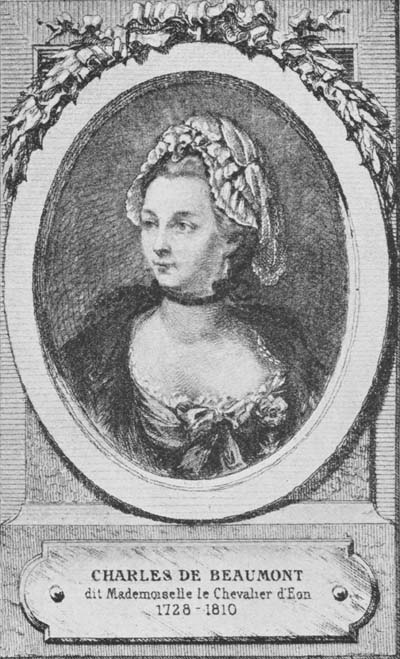
CHARLES DE BEAUMONT
dit Mademoiselle le Chevalier D’Eon
1728 - 1810
Early in December, Beaumarchais appeared in Versailles
with his famous chest, containing at last the entire mass of
papers, the negotiation of which had occupied the minister
of Louis XVI since the time of the latter’s accession to the
throne. Overjoyed at the successful termination of the affair,
the King and his minister testified their satisfaction with
warmth.
A very honorable discharge was given their agent with a
certificate which terminated thus: “I declare that the King
has been very well satisfied with the zeal which he has shown
on this occasion, as well as with the intelligence and dexterity
with which he has acquitted himself of the commission which
his Majesty has confided to him. The King has therefore
ordered me to deliver the present attestation to serve him at
all times and in all places where it may be necessary.
“Made at Versailles, the 18th of December, 1775.
“Signed: Gravier de Vergennes.”
The matter of the papers was indeed settled; they were
safe in the hands of the government, and all uneasiness in regard
to them was at an end; not so Beaumarchais with his
amazone intéressante. Furious to find that his exorbitant
demands upon the French government had miscarried, d’Eon
thought only of wreaking his vengeance upon Beaumarchais.
After exhausting himself with very “masculine abuse” upon
his “austere friend” (Loménie), he suddenly, with the same
art with which he had avowed himself a woman, set about convincing
Beaumarchais that he was in love with him, uttering
bitter reproaches for the cruelty, hardness and injustice with
which he had treated an unhappy woman, who in a moment of
weakness had revealed herself to him. “Why,” cried this disguised
dragoon, “why did I not remember that men are good
for nothing upon this earth but to deceive the credulity of
women, young and old?... I still thought that I was
only rendering justice to your merits, admiring your talents,
your generosity; I loved you already no doubt; but this
situation was still so new for me that I was very far from
realizing that love could be born in the midst of trouble and
sorrow.”
In a note, M. de Loménie remarked that what there was
specially piquant in this correspondence of d’Eon and Beaumarchais
is that the former, while posing as a woman, “often
gives an enigmatic turn to his phrases, as though he wished
to establish for the day when the fraud would be unveiled,
that he had been able to dupe a man as clever as the author
of the Barbier de Séville, and that he duped him in mocking
at him to his very face, without being suspected. Beaumarchais,
for his part, amused himself at the expense of
that vieille Dragonne in love, and confirmed himself more
and more in the error as d’Eon more adroitly simulated the
anger of an offended old maid.”
Beaumarchais wrote to M. de Vergennes: “Everyone tells
me that this crazy woman is crazy over me. She thinks that
I undervalue her, and women never forgive similar offenses.
I am very far from doing so; but who could ever have imagined
that to serve the King well in this affair, I should have
been forced to become gallant cavalier to a capitaine de dragons?
The adventure appears to me so ridiculous that I
have all the trouble in the world to regain my seriousness so
as suitably to finish this memoir.”
If d’Eon had the satisfaction of duping Beaumarchais in a
certain sense, he failed utterly in inducing him to loosen the
strings of the royal purse which he carried, and without
which nothing was accomplished. Finding that Beaumarchais
was inexorable on this point, all the pent-up fury of
the chevalier blazed forth. He began at once addressing
interminable memoirs to the minister Vergennes, full of
accusations against his agent, couched in the coarsest and
most violent language, attributing to the latter all the epithets
that fall so glibly from his pen, “the insolence of a
watchmaker’s boy, who by chance had discovered perpetual
motion.”
“Beaumarchais,” said Loménie, “received these broadsides
of abuse with the calm of a perfect gentleman: ‘She is a
woman,’ he wrote to M. de Vergennes, ‘and a woman so frightfully
surrounded that I pardon her with all my heart; she
is a woman—that word says everything.’”
But exactly this was what the chevalier did not want; he
did not want to be pardoned by Beaumarchais; he wanted a
quarrel with him, and to have his accusations credited by
the minister. He succeeded in neither of his objects, although
his resentment and his desire for revenge augmented
rather than diminished with time. Returned to France, he
openly accused Beaumarchais of having retained for himself
money that was destined for him. His abuse was so violent
that in self-defense the accused man appealed for justification
to the minister, and received the following letter, which
bears date of January 10th, 1778:
“I have received, Monsieur, your letter of the 3rd of this
month, and I have not been able to see without surprise that
the demoiselle d’Eon imputes to you having appropriated to
yourself to her prejudice the funds which she supposes to
have been destined for her. I have difficulty in believing,
Monsieur, that this demoiselle has been guilty of an accusation
so calumnious; but if she has done so, you should not
have the slightest disquietude or be in the least affected; you
have the gage and the guarantee of your innocence in the account
which you have given of your management of the affair,
in the most approved form, founded upon the most authentic
titles, and in the discharge which I have given you of the
approval of the King. Far from the possibility of your disinterestedness
being suspected, I have not forgotten, Monsieur,
that you made no account of your personal expenses,
and that you never allowed me to perceive any other interest
than to facilitate to the demoiselle d’Eon the means of
returning to her native land.
“I am very perfectly, Monsieur, your very humble and
very obedient servitor,
“De Vergennes.”
Beaumarchais was at this time far too deeply engaged in
his gigantic mercantile operations to be seriously disturbed
by the accusations of the Chevalier d’Eon. Far greater difficulties
were to overwhelm him, and still more signal ingratitude
was to be his portion. He will accept that too, in very
much the same spirit in which he has accepted all the rest.
“Vor der Ankunft Dean’s und Franklin’s, Beaumarchais
war ohne Frage, der bestunterrichtete Kenner Englands und
der Vereinigten Staaten auf dem continent.”
Bettelheim, “Beaumarchais: Eine Biographie.”
Beaumarchais’s Earliest Activities in the Cause of American
Independence—First Steps of the Government of France—Bonvouloir—Discord
Among Parties in England—Beaumarchais’s
Memoirs to the King—Meets Arthur Lee—Lee’s
Letter to Congress—King Still Undecided—Curious
Letter of Beaumarchais, with Replies Traced in the Handwriting
of the King.
NO record of the actual awakening of Beaumarchais’s interest
in the War of American Independence has ever
been brought to light, but certain it is that for nearly a year
before the date of any document contained in the French
Archives, Beaumarchais was the “real, though secret, agent
of the Minister Vergennes in London.”
The earliest written allusion to any definite commission
from the government in regard to this matter is found in the
letter of Beaumarchais to Vergennes, written July 14, 1775,
a part of which, relating to the Chevalier d’Eon, is given
in the previous chapter. After announcing exultantly the
possession of the keys to the famous chest of which it had just
been questioned, he continued: “I would return at once to
give the details of what I have accomplished if I were only
charged with one object; but I am charged with four, and find
myself obliged to leave for Flanders with milord Ferrers and
in his vessel. It would not be just that the King and M. de
Sartine were less content than the King and M. de
Vergennes....
“In politics, it is not sufficient to work, one must
succeed....
“I shall take no repose until I have informed you in regard
to the veritable state of things in England, a knowledge
of which becomes more important from day to day. As soon
as I shall be as tranquil over the objects of M. de Sartine
as I am now over ‘notre amazone’ (the Chevalier d’Eon) I
shall return to Versailles....
“I profit by the first sure occasion of dropping a letter
into the post at Calais, to tell you, without its being known
in London, that I have just put into the hands of the King,
the papers and the creature that they have wished to use
against him at any price.
“I say, ‘without its being discovered in London,’ because it
is a great question to find out what my object is, but what
can be gotten from a man who neither speaks nor writes?
“I am with the most respectful devotion, M. de Comte
... etc.... Beaumarchais” (letter given by
Gaillardet in his Mémoires sur le Chevalier d’Eon).
Beaumarchais’s mission to Flanders is alluded to in another
place by Gaillardet, without, however, giving any authority
for the statement which he made. He said, “The
court of Louis XVI still hesitated to follow Beaumarchais in
the adventurous career whither he was drawing it, so to
speak, with a tow-line,... although Holland and
Spain were already engaged by his efforts to embrace the
cause of France and the United States against England.”
Doniol in his Histoire de la Participation de la France dans
l’Etablissement des Etats-Unis, said: “Franklin before returning
to America had treated with armorers and merchants
of England, Holland and France for the furnishing and
transmitting of munitions of war to the colonies. These
operations were centralized in London, and Beaumarchais did
not remain ignorant of them.... He knew, heard, and
prepared many things.”
Although “no special memoir, no private archive has up
to the present revealed the intimate details (Doniol, II, 31),”
it seems certain that the plans of Beaumarchais centered in
the dispatching of funds, or if possible, of ammunitions of
war, to the insurged colonies, and that the head of these
operations was to be in the Low Countries. To further these
projects, the most profound secrecy was necessary, not only
to ensure their success, but to prevent the government from
being compromised. This fact accounts sufficiently for the
almost total lack of documents relative to these negotiations.
What facilitated them was the profound discord which existed
at this time in England itself, and especially the diversity
of opinion in relation to the uprising among the
colonists. No one realized the deep significance of this fact
for the interest of France and of America better than Beaumarchais,
and no one knew so well how to turn it to the advantage
of both these countries. It goes without saying
that had England been united in her desire to crush America
and united in her attempts to prevent foreign interference,
the history of the war would have been very different from
what it was.
As a matter of fact in England “a party, small indeed in
numbers, but powerful from its traditions, its connections,
and its abilities, had identified itself completely with the
cause of the insurgents, opposed and embarrassed the Government
in every effort to augment its forces and to subsidize
allies, openly rejoiced in the victories of the Americans,
and exerted all its eloquence to justify and encourage
them.” (Lecky, III, 545.)
“This glorious spirit of Whiggism,” said Chatham in a
speech delivered in January, 1775, “animates three millions
in America, who prefer poverty with liberty, to gilded chains
and sordid affluence, who will die in defence of their rights
as freemen.... All attempts to impose servitude upon
such men, to establish despotism over such a mighty continental
nation, must be vain, must be fatal. We shall be
forced ultimately to retreat. Let us retreat while we can, not
when we must.”
From the beginning, the members of the Opposition had
emphasized the danger to Great Britain that would arise
from a prolonged struggle with the colonies, foreseeing that
they later would be forced into an alliance with France.
(Walpole’s last Journal, 11-182.)
At this time the Americans had no sympathy for the
French and no desire to incur any debt of gratitude towards
them. “France had hitherto been regarded in America, even
more than in England, as a natural enemy. Her expulsion
from America had been for generations one of the first objects
of American patriots, and if she again mixed in American
affairs it was naturally thought that she would seek to
regain the province she had lost.” (Lecky, 111, 453.) To
ask aid of her was at first an intolerable thought to the
greater number among the Revolutionary party—necessity
alone finally drove them to the step. Even then, it was with
no intention of accepting the help with gratitude, as subsequent
events proved: It was a means to an end, and the less
said about it, the sooner it was obliterated or forgotten, the
better for all concerned.
The attitude of France towards America was of a totally
different nature. There was never any feeling of animosity
against Americans engendered by those wars which finally
terminated so disastrously for the French in the peace of
1763. As these wars had all been of European origin, the
resentment of the French fell upon the English alone. The
very name America had a wild, sweet charm for every Frenchman’s
ear. For him the red man was no savage foe, but a
friend and brother. Side by side they penetrated together
the dense fastnesses of the primeval forests, ascended the
rivers, climbed the mountains, shot the cataracts; at night
they lay down under the same tent, shared the same meals and
smoked together the pipe of peace. The dread which kept
the English settlers hovering near the coast was unknown to
the French. Thus they were able to explore and claim for
the great Sun-King the vast central region, part of which
bears his name to the present day. Not only was the thought
of these great possessions alluring to adventurers and traders;
philosophers and thinkers as well looked into the future
and saw the part that they were to play in the development
of the race. In 1750 Turgot had uttered the following
words, “Vast regions of America! Equality keeps them from
both luxury and want, and preserves to them purity and simplicity
with freedom. Europe herself will find there the perfection
of her political societies, and the surest support of
her well-being.” But since 1763 the fruit of French explorations
on the continent of America had been in the hands of
the English; a few sugar islands among the West Indies
alone remained to them. Their foot-hold in America was
gone, but not their love for America. More than this a
generosity of nature, joined to a tolerance of, and admiration
for qualities not of the same type as their own, has always
been a marked characteristic of the French. It was
therefore in the very nature of things that the nation should
have been roused to enthusiasm by the news of the heroic
resistance of the colonies, especially when it is taken into
consideration that every blow dealt by the defenders of liberty,
was aimed directly at the “triumphant political rival
of France.”
But the people of the nation were not its government, and
at the time of the uprising in America, France was ruled by
a king, weak indeed in character yet absolute in power, in
whose divine right to rule, his ministers as well as himself,
believed. It was not, therefore, to be expected that the
French government would look with favor upon the rebellious
subjects of any nation, whether friend or foe. It was in
the nature of things that they should hesitate before encouraging
measures that were intended to aid revolt. As late as
March 5, 1775, M. de Vergennes had written to the French
ambassador in London bidding him quiet the fears of the
English government in regard to the probable interference
of France. “The maintenance of peace with England,” he
wrote, “is our unique object.”
The French government, however, could not wholly resist
the tide of public sentiment or remain altogether unmoved
by considerations of interest. It was thought well to send
some prudent and sagacious agent to the New World to try
the public temper and to see if the interference of France
actually was desired. A man admirably fitted for the task
recently had arrived in London from the French West Indies,
who in returning, had passed through the colonies, and who
knew them well, leaving many acquaintances there. This
man was Bonvouloir. The 7th of August, 1775, M. de Vergennes
wrote to the French Ambassador, “The King very
much approves the mission of Bonvouloir.” (Bancroft—IV—360)
“His instructions,” he wrote to the ambassador a
little later, “should be verbal and confined to the two most
essential objects: the one to make a faithful report to you
of the events and of the prevailing disposition of the public
mind; the other to secure the Americans against jealousy
of us. Canada is for them le point jaloux: they must be
made to understand that we do not think of it in the least.”
(Quoted from J. Durand’s New Materials for the History
of the American Revolution, 1889, p. 1-16, Bonvouloir.)
On the 8th of September he set sail. The result of his
mission, although it promised nothing to the colonies, was to
them at least an encouragement. Already in the Summer
of 1775 a motion had been made in Congress and strongly
supported by John Adams, to send an ambassador to France.
“But Congress still shrank from so formidable a step,
though it agreed, after long debates and hesitation, to form
a secret committee to correspond with friends in Great
Britain, Ireland, and other parts of the world.” (Adams’s
Life, I, 200-202.) It was with this secret committee, of
which the celebrated Dr. Franklin was a prominent member,
that Bonvouloir came in touch.
Although the French government had taken this one preliminary
step, she remained to all appearances as indifferent
to the cause of the colonists as she was to the condition of
affairs in England. Beaumarchais began deluging her with
such volumes of information on both these subjects, that almost
in spite of herself, her own interest was aroused. “The
energy of a believer is a force to which undecided convictions
yield—and this was the case with the King in regard to
the schemes of Beaumarchais.” (Gaillardet.)
But before entering into a consideration of those schemes,
it would be well to glance at the actual condition of England
herself. We already have spoken of the division existing
in her midst, but the greatest difficulty which the English
government had to encounter was the one that she has
had to face in 1914 when she found herself suddenly plunged
into war with another country, namely that of raising a
formidable army. Then as now, the hatred of conscription
was so deep rooted in the English people that even the government
of Lord North did not dare to resort to it. “To
raise the required troops on short notice was very difficult....
The land tax was raised to four shillings in the pound.
New duties were imposed; new bounties were offered. Recruiting
agents traversed the country.... Recruits, however,
came very slowly. There was no enthusiasm for a war
with English settlers. No measure short of conscription
could raise at once the necessary army in England and to
propose conscription would be fatal to any government.”
(Lecky, III, 455.)
In her dilemma, England found herself reduced to the infamous
measure of hiring German soldiers to fight for her
against her own subjects. The shameful conduct of the
Landgrave of Hesse, the Duke of Brunswick and the Prince
of Waldeck, has been immortalized by Germany’s great poet,
Schiller, in his Kabale und Liebe; “In England they excited
only contempt and indignation.” (Lecky) Moreover, the
disorders arising from the press-gang service ran high, while
“after three expulsions, the famous demagogue Wilkes” still
retained his seat in Parliament, and in 1774 had been made
Lord-Mayor of London. At a public dinner he had been
heard to exclaim insolently, “For a long time the King of
England has done me the honor of hating me. On my side,
I have always rendered him the justice of despising him;
the time has come to decide which has the better judged the
other, and to which side the wind will make the heads fall.”
This divided condition among the people themselves justified
the assertion of Beaumarchais, made in his memoir to the
King: “Open war in America is less pernicious to England
than the intestine war which seems likely to break out before
long in London; the bitterness between the parties has risen
to the highest excesses since the proclamation of the King,
declaring the Americans rebels.” Beaumarchais in this was
only voicing the general opinion. But “The English People,”
says Loménie, “with that national sentiment and good
sense which often has characterized them in great crises,
baffled these previsions. The defeat of the English troops
weakened the opposition more than the ministry. Everything
became subordinate to the necessity of combatting with
energy; and the irritation, instead of augmenting, cooled
down considerably.”
As the war progressed, party-feeling disappeared while
the actual entry of France into the struggle developed a
unity of purpose among the English which would have been
very disastrous to the new nation, had it existed in the beginning.
The summer of 1775 was passed by Beaumarchais, ostensibly
in negotiations with the chevalier d’Eon, in reality with
plans and arrangements made with other European powers
to join France in the secret support of the colonies. No
word written or spoken of these negotiations escaped him,
so that we can judge of their nature only from the results.
“The middle of September,” says Doniol (p. 134, I) “having
arranged his combinations, he returned to Versailles to emphasize
the necessity of France’s conducting herself as the
future ally of the Americans, that is, to come to an understanding
with them in regard to the aid necessary for the
development of their revolt.”
M. de Vergennes seems to have been his first confidant.
It was decided to act on the mind of the King. A memoir
was to be drawn up and given to M. de Sartine who should
believe himself the unique confidant. This plan was disclosed
in the following letter which Beaumarchais wrote to Vergennes:
“Sept. 22, 1775
“Pour vous seul;
“M. le comte: M. de Sartine gave me back the paper
yesterday, but said nothing to me of the affair. Now in
relation to the secret which I let him think I was guarding
from you, relative to my memoir to the King, I thought it better
that I wrote to you an ostensible letter which you could
carry or send to His Majesty and if you were not charged
by him with a reply, at least I should receive one from your
bounty to console me for having taken useless pains. Send, I
beg you, a blank passport, if you think I should await the
orders of the King in London, in case he has not the time
now, to decide the matter well. Of all this, please be kind
enough to inform me. Everything being understood thus
between us, it will be to your advantage to write to me so
obscurely that no one but myself can divine the object of
your letter, if you should send it to me by way of the ambassador.” ...
The “ostensible” letter, which was written at the same
time for the purpose of making an impression upon the King,
was sent to the latter the next day by Vergennes with the
following note:
“I see, Sire, by the letter of the Sieur de Beaumarchais
which I have the honor to join to this, that he himself already
has had that of reporting to Your Majesty the notions he
collected in London, and what profit he thinks can be drawn
from them.”... After asking for the King’s orders, he
continued, “I requested M. de Beaumarchais, who was to
leave to-night for London, to defer starting until to-morrow
at noon....
“De Vergennes.
“A Versailles, le 23 Septembre 1775.”
(Quoted from Doniol I, 133.)
The “ostensible” letter is addressed to Vergennes but is
really a second appeal to the King. In it Beaumarchais
dared to state forcefully the embarrassment into which the
King’s silence plunged him. He says:
“Monsieur le Comte,
“When zeal is indiscreet, it should be reprimanded; when
it is agreeable, it should be encouraged; but all the sagacity
in the world, would not enable him to whom nothing is replied,
to divine what conduct it is expected he should maintain.
“I sent yesterday to the King through M. de Sartine, a
short memoir which is the resumé of the long conference
which you accorded me the day before; it is the exact state
of men and things in England; it is terminated by the offer
which I made you to suppress for the time necessary for
our preparations for war, everything which by its noise,
or its silence could hasten or retard the moment. There must
have been question of all this in the council yesterday, and
this morning you have sent me no word. The most mortal
thing to affairs of any kind is uncertainty or loss of time.
“Should I await your reply or must I leave without having
received any? Have I done well or ill to penetrate the
sentiments of those minds whose dispositions are becoming
so important for us? Shall I allow in the future these confidences
to come to nothing and repel them instead of welcoming
them—these overtures which should have a direct
influence upon the actual resolution? In a word, am I an
agent useful to his country, or only a traveller deaf and
dumb? I ask no new commission. I have too serious work
for my own personal affairs to finish in France for that, but
I would have felt that I had failed in my duty to the King,
to you, to my country, if I allowed all the good I might
bring about and all the evil which I might prevent to remain
unknown.
“I wait your reply to this letter before starting. If you
have no answer to make me, I shall regard this voyage as
blank and nul; and without regretting my pains, I will return
instantly to terminate in four days what remains to
do with d’Eon and come back without seeing anyone; they
will indeed be very much astonished, but another can do better
perhaps; I wish it with my whole heart.”
The memoir which had been sent to the King by way of
M. de Sartine, the 21st September, 1775, shows in its first
sentence that another memoir had preceded it. Beaumarchais
wrote:
“Au Roi:
“Sire,
“In the firm confidence which I hold, that these extracts
which I address to Your Majesty are for you alone, I will
continue, Sire, to present to you the truth in all points
known to me, which seem to me to be of interest to your
service, without having regard to the interests of anyone
else whomsoever. I left London under pretext of going to
the country and have come running from London to Paris,
to confer with MM. de Vergennes and de Sartine upon objects
too important and too delicate to be confided to the
care of any courier.
“Sire, England is in such a crisis, such a disorder within
and without, that she would touch almost upon her ruin
if her rivals were in a state seriously to occupy themselves
with her condition. Here is the faithful exposition of the
situation of the English in America; I hold these details
from an inhabitant of Philadelphia arrived from the colonies,
after a conference with the English ministers, whom his
recital has thrown into the greatest trouble and petrified
with fear. The Americans, resolved to suffer everything
rather than yield, and full of that enthusiasm of liberty
which has often rendered the little nation of Corsica so redoubtable
to the Genoese, have thirty-eight thousand men,
effectively armed and determined, under the walls of Boston;
they have reduced the English army to the necessity
of dying of hunger in that city, or of going elsewhere to
find winter quarters, something which it will do immediately.
Nearly eight thousand men well armed and equally determined,
defend the rest of the country without a single cultivator
having been taken from the land, or a workman from
the manufactories. Every one who was employed in the
fisheries, which the English have destroyed, has become a
soldier and wishes to revenge the ruin of his family and the
liberty of his country; all who followed maritime commerce,
which the English have stopped, have joined the fishermen
to make war upon their common persecutors; all those working
in the ports have served to augment this army of furious
men, whose every action is animated by vengeance and rage.
“I say, Sire, that such a nation must be invincible, especially
having behind her sufficient country for a retreat, even
if the English were to become masters of the coast, which
is far from being said. All sensible people are convinced
in England that the English colonies are lost for the metropolis,
and that is also my opinion.”
Then follows an account of the discord prevailing within
the country itself, as well as an account of the secret
negotiations being carried on by members with Spain and
Portugal. He concluded thus:
“Résumé. America escapes from the English in spite of
their efforts; the war is more vividly illuminated in London
than in Boston.... Our ministry, uninformed and stagnant,
remains passive while events are occurring which touch
us most closely....
“A superior and vigilant man would be indispensable in
London to-day....
“Here, Sire, are the motives of my trip to France, whatever
use Your Majesty may make of this memoir I count
upon the virtue, the goodness of my Master, trusting that
he will not allow these proofs of my zeal to turn against me,
in confiding them to anyone, which would only augment the
number of my enemies. They will, however, never hinder
me from serving you so long as I am certain of the protection
of Your Majesty.
“Caron de Beaumarchais.”
Of the secret deliberations of the council and the resolutions
arrived at we can judge only from the letter of Beaumarchais
addressed to Vergennes the night of the 23rd of
September. The King had read the “ostensible” letter, and
as Beaumarchais hoped, had been more stirred by it. He
had conferred with his minister and had given his orders.
Vergennes hastened to communicate them to Beaumarchais
who left the same night for London. Later he wrote:
“Paris the 23rd of September, 1775.
“Monsieur le Comte:
“I start, well informed as to the intention of the King
and of yourself. Let your Excellency have no fears; it
would be an unpardonable blunder in me to compromise in
such an affair the dignity of my master, or of his minister:
to do one’s best is nothing in politics; the first man who
offers himself can do as much. Do the best that can possibly
be done under the circumstances is what should distinguish
from the common servitor, him whom His Majesty and yourself
Monsieur le Comte, honor with your confidence in so
delicate a matter. I am, etc.
“Beaumarchais.”
But the French government was slow to move. They
were willing to make use of the indefatigable zeal of their
secret agent in collecting information, but they were in no
haste to commit themselves by any act that might bring
them prematurely into conflict with England. Rightly
enough, they wished to wait until the colonists themselves
had arrived at a decision. “France,” says Lecky, “had no
possible interest in the constitutional liberties of Americans.
She had a vital interest in their independence.” No one
realized this fact better than Beaumarchais, and for exactly
this reason he continued to urge, with unabated ardor
that France should consent to give the colonists the secret,
yet absolutely indispensable aid, which he had been preparing;
the fear which tormented him was that through lack
of means of effective resistance they should reconcile themselves
with the mother country. Still apparently occupied
with the affair of d’Eon, late in November he appeared
again at Versailles. On the 24th in a letter to Vergennes
relating to the change of costume decided upon for the
Chevalier, Beaumarchais wrote: “Instead of awaiting the reply,
which should bear a definite decision, do you approve
that I write the King again that I am here, that you have
seen me trembling lest in a thing as easy as it is necessary,
and perhaps the most important that he will ever have to
decide, his Majesty should choose the negative?
“Whatever else happens I implore the favor of being allowed
an audience for a quarter of an hour, before he comes
to any decision, so that I may respectfully demonstrate to
him the necessity of undertaking, the facility of doing, the
certainty of succeeding, and the immense harvest of glory
and repose which this little sowing will yield to his reign....
In case you have orders for me, I am at the hotel
of Jouy rue des Recollets.”
The “seed” which Beaumarchais demanded, which should
bring such a harvest of prosperity and glory to France was
a sum of money, 2,000,000 francs perhaps, which he proposed
to send as specie, or converted into munitions of war
through such channels as he had prepared in other countries.
During the first period of Beaumarchais’s activity
in our cause, no idea of his personal intervention except as
transmitter of the funds of the government, appeared to
have entered his mind. The icy coldness with which his
advances were met did not in the least chill his ardor—he
only looked about for some new avenue of approach. His
plans had been disapproved, not to say rejected.—The 7th
of December he addressed another memoir to the King,
couched in such respectful language, so warm and glowing
from his inmost heart, that its daring boldness was almost
forgotten. (In his New Materials for the History of the
American Revolution, Durand gives the Memoir in full.—The
selections here given are taken from his translation of the
original.)
“Au Roi
“Sire: Your Majesty’s disapproval of a plan is, in general,
a law for its rejection by all who are interested in
it. There are plans, however, of such supreme importance
to the welfare of your Kingdom, that a zealous servant may
deem it right to present them more than once, for fear that
they may not have been understood from the most favorable
point of view.
“The project which I do not mention here, but of which
Your Majesty is aware through M. de Vergennes, is of this
number; I rely wholly upon the strength of my reasons to
secure its adoption. I entreat you, Sire, to weigh them
with all the attention which such an important affair demands.
“When this paper is read by you, my duty is done. We
propose, Sire, and you judge. Yours is the more important
task, for we are responsible to you, while you, Sire, are responsible
to God, to yourself, and to the great people to
whom good or ill may ensue according to your decision.
“M. de Vergennes informs me that Your Majesty does
not deem it just to adopt the proposed expedient. The objection,
then, has no bearing on the immense utility of the
project, nor on the danger of carrying it out, but solely
on the delicate conscientiousness of Your Majesty.
“A refusal due to such honorable motives would condemn
one to silence, did not the extreme importance of the proposed
object make one examine whether the justice of the
King of France is not really interested in adopting such
an expedient. In general it is certain that any idea, any
project opposed to justice should be discarded by every
honest man.
“But, Sire, the policy of governments is not the moral
law of its citizens.... A kingdom is a vast isolated body,
farther removed from its neighbors by a diversity of interests,
than by the sea, the citadels, and the barriers which
bound it. There is no common law between them which ensures
its safety.... The welfare and the prosperity of
each impose upon each, relations which are variously modified
under the name of international law, the principle of
which, even according to Montesquieu, is to do the best for
one’s self as the first law, with the least possible wrong to
other governments as the second.’...
“The justice and protection which a king owes to his subjects
is a strict and rigorous duty; while that which he may
offer to other states is never other than conventional. Hence
it follows that the national policy which preserves states,
differs in almost every respect from the civil morality which
governs individuals....
“It is the English, Sire, which it concerns you to humiliate
and to weaken, if you do not wish to be humiliated and weakened
yourself on every occasion. Have the usurpations and
outrages of that people ever had any limit but that of its
strength? Have they not always waged war against you
without declaring it? Did they not begin the last one in a
time of peace, by a sudden capture of five hundred of your
vessels? Did they not humble you by forcing you to destroy
your finest seaport?... humiliation which would have
made Louis XIV plutôt manger ses bras than not atone for?
A humiliation that makes the heart of every true Frenchman
bleed.... Your Majesty is no longer ignorant that
the late king, forced by events to accept the shameful treaty
of 1763, swore to avenge these indignities.... The very
singularity of his plan only the better discloses his indignation....
“Without the intestine commotions which worry the English
they already would have profited by the state of weakness
and disorder under which the late king transmitted the
kingdom to you, to deprive you of the pitiful remains of
your possessions in America, Africa, and India, nearly all
of them in their hands, and yet Your Majesty is so delicate
and conscientious as to hesitate!
“An indefatigable, zealous servant succeeds in putting the
most formidable weapon in your hand, one you can use without
committing yourself and without striking a blow, so as
to abase your natural enemies and render them incapable
of injuring you for a long while....
“Ah, Sire, if you believe you owe so much to that proud
English people, do you owe nothing to your own good people
in France, in America, in India? But if your scruples
are so delicate that you have no desire to favor what may
injure your enemies, how, Sire, can you allow your subjects
to contend with other European powers, in conquering
countries belonging to the poor Indians, the African Savages
or the Caribs who have never wronged you? How can
you allow your vessels to take by force and bind suffering
black men whom nature made free and who are only miserable
because you are powerful? How can you suffer three
rival powers to seize iniquitously upon and divide Poland
under your very eyes?...
“Were men angels, political ways might undoubtedly be
disdained. But if men were angels there would be no need
of religion to enlighten them, of laws to govern them, of
magistrates to restrain them, of soldiers to subdue them;
and the earth instead of being a faithful image of hell, would
be indeed a celestial abode. All we can do is to take men
as they are, and the wisest king can go no farther than
the legislator Solon, who said: ‘I do not give the Athenians
the best laws, but only those adapted for the place, the time
and the people for whom I make them.’...
“I entreat you, Sire, in the name of your subjects, to
whom you owe your best efforts; in the name of that inward
repose which your Majesty so properly cherishes; in
the name of the glory and prosperity of a reign begun under
such happy auspices; I entreat you, Sire, not to be deceived
ceived by the brilliant sophism of a false sensibility. Summum jus
summa injuria. This deplorable excess of equity
towards your enemies would be the most signal injustice towards
your subjects who soon suffer the penalty of scruples
out of place.
“I have treated the gravest questions summarily, for fear
of weakening my arguments by giving them greater extension,
and especially through fear of wearying the attention
of Your Majesty. If any doubts still remain, Sire, after
reading what I have presented to you, efface my signature,
and have this attempt copied by another hand, in order that
the feebleness of the reasoner may not diminish the force
of the argument, and lay this discussion before any man instructed
by experience and knowledge of worldly affairs;
and if there is one, beginning with M. de Vergennes, who
does not agree with me, I close my mouth;...
“Finally, Sire, I must confess to being so confounded by
your Majesty’s refusal, that, unable to find a better reason
for it, I conjecture that the negotiator is an obstacle to the
success of this important affair in the mind of Your Majesty.
Sire, my own interest is nothing, that of serving you
is everything. Select any man of probity, intelligence and
discretion, who can be relied upon; I will take him to England
and make such efforts as I hope will attain for him the
same confidence that has been awarded to myself. He shall
conduct the affair to a successful issue, while I will return
and fall back into the quiet obscurity from which I emerged,
rejoicing in having at least begun an affair of the greatest
utility that any negotiator was ever honored with.
“Caron de Beaumarchais.”
Post Scriptum.
“It is absolutely impossible to give in writing all that relates
to this affair at bottom on account of the profound
secrecy which it requires, although it is extremely easy for
me to demonstrate the safety of the undertaking, the facility
of doing, the certainty of success, and the immense harvest
of glory and tranquillity which, Sire, this small grain of
seed, sowed in time, must give to your reign.
“May the guardian angel of this government incline the
mind of Your Majesty. Should he award us this first success,
the rest will take care of itself. I answer for it.”
Consider for a moment that the loyal subject who dared
to write thus to an absolute king, his master, was a civilly
degraded man, incapable in the eyes of the law of fulfilling
any public function. It is the same man to whom had been
addressed several years previously, the famous letter from
some English admirer, which was inscribed “To Beaumarchais,
the only free man in France,” and it was delivered
to him.
No special attention seems to have been paid to this
memoir. At least no outward sign was given; and Beaumarchais
after waiting several days, resorted to another
measure. He addressed a letter to the King upon the very
inconsequent subject of the costume which the Chevalier
D’Eon should assume and the disposition that should be made
of his man’s attire. To such questions, at least, Louis XVI
would not fear to give a definite answer—perhaps he might
be induced to take an additional step and half unconsciously
to decide weightier matters. The expedient was worth a
trial and Beaumarchais resorted to it. In writing the letter
he left a wide margin and humbly begged the King to
write the answer opposite each question.
“The autograph,” said Loménie, “is interesting. The
body of the piece is written in the hand of Beaumarchais
and signed by him; the replies to each question are traced
in the margin, in a handwriting fine, but uneven, weak, undecided,
where the v’s and t’s are scarcely indicated. It is
the hand of the good, though weak and unhappy sovereign
whom the revolution was to devour seventeen years later....
Below is written and signed in the hand of Vergennes,
‘All the additions are in the handwriting of the King.’”
“Essential points which I implore M. de Vergennes to present
for the decision of the King to be replied to on the
margin:
| “Does the King accord the demoiselle d’Eon
permission to wear her cross of St. Louis
on her woman’s attire? |
In the provinces only. |
| “Does His Majesty approve the gratification
of 2000 pounds which I allowed that
demoiselle for her Trousseau? |
Yes. |
| “Does His Majesty allow her the entire
disposition of her man’s attire? |
She must sell it. |
. . . . . . . .
. . . . . . . . |
|
| “The King not being able to refuse a
recognition in good form of the papers
which I have brought back from England,
I have begged M. de Vergennes, to implore
His Majesty to add with his own hand, several
words showing his approval of the way
in which I have filled my mission. That
recompense, the dearest to my heart, may
one day be of great utility to me.... |
Good. |
| “As the first person whom I will see in
England is milord Rochford, and as he is
likely to ask me in secret the reply of the
King of France to the prayer which the
King of England made through me, what
shall I reply? |
That you received none. |
| “If that lord wishes secretly to engage
me to see the monarch shall I accept or not? |
Perhaps. |
| “If that minister ... wishes to bring
me into connection with other ministers, or
if the occasion in any way arises shall I accept
or not?” |
It is useless. |
. . . . . . . .
. . . . . . . . |
|
| |
|
Finally Beaumarchais brought forward the demand for
which the rest of the letter is but a cloak, the one burning
question for the answer of which he had waited so long and
in vain and to which Louis XVI still made no reply:
“And now I ask before starting, the positive response to
my last memoir; but if ever question was important, it must
be admitted that it is this one. I answer on my head, after
having well reflected, for the most glorious success of this
operation for the entire reign of my master, without his
person, or of that of his ministers, or his interests being in
the least compromised. Can anyone of those who influence
His Majesty against this measure answer on his head to
the King for the evil which will infallibly come to France
if it is rejected?
“In the case that we shall be so unhappy as that the
King should constantly refuse to adopt a plan so simple
and so wise, I implore His Majesty to permit me to take
note for him of the date when I arranged this superb resource,
in order that one day he may render me the justice
due to my views, when it will only be left to us bitterly to
regret not having followed them.
“Caron de Beaumarchais.”
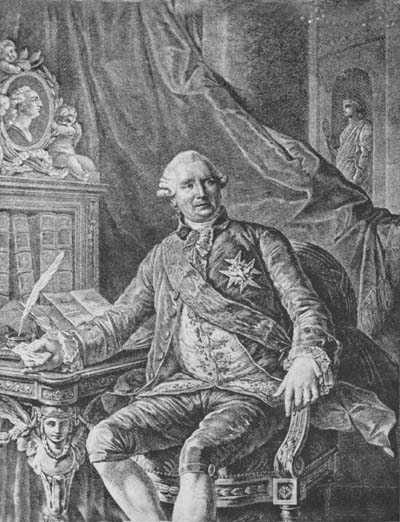
CHARLES GRAVIER—COMTE DE VERGENNES
“The temerity of the secret agent,” says M. de Loménie,
“in the end prevailed over the prudence of the King; but
for the moment ... Beaumarchais was obliged to start
for London knowing only that d’Eon must sell his old
clothes.”
For the moment the hopes of Beaumarchais seemed wholly
shattered. “Intrigues of the court,” said Doniol, “controlled
the actions of M. de Vergennes, and made him feel the danger.
The minister was visibly the butt of serious attacks, Beaumarchais
was in consequence held at a distance. Everything
seemed to be compromised. He seized the occasion of the
new year to write to M. de Vergennes.
“January 1, 1776.
“Monsieur le comte:
“It is impossible to be so deeply touched as I am with
your favors without being very much so by your apparent
coldness. I have examined myself well, and I feel that I
do not merit it. How could you know that I had carried
my zeal too far, if you do not first enter with me into
the details of what I have done or ought to have
done?
“Great experience with men, and the habit of misfortune,
have given me that watchful prudence, which makes me think
of everything and direct things according to the timid or
courageous character of those for whom I do them.”
Thus the year 1775 ended and the new year began with
but little encouragement for the agent of the King in the
cause of America; but his was a heart that did not easily lose
courage. More than this, matters were really advancing;
the timid policy of the King and the objections of the ministers
began to give way to “the quiet and uniform influence
of M. de Vergennes, which imperceptibly overcame the scruples
of the inexperienced Prince, who never comprehended the
far reaching influence of the question.” (Bancroft—History
of America, IV, p. 363.)
It was absolutely necessary to the existence and prosperity
of France that the great commercial power and assumed
preponderance of Great Britain and her attempted
monopoly of the seas should be broken. The revolt of the
American Colonies was her opportunity.”
George Clinton Genet in Magazine of American History,
Nov., 1878.
Beaumarchais’s English connections—With Lord
Rochford—With Wilkes—Meets Arthur Lee—Sends Memoir to the
King—His Commission to Buy Portuguese Coin—Called
to Account by Lord Rochford—Vergennes’s Acceptance
of his Ideas—Article in The Morning Chronicle.
AS has been stated already, Beaumarchais during his
stay in London came in touch with all classes. It was
Lord Rochford whom he had known intimately at Madrid
who introduced him at the court of St. James. It was d’Eon
and Morande who brought him into touch with the brilliant,
daring Wilkes, then Lord Mayor of London.
Around the latter’s table the most pronounced members
of the opposition, as well as the leading Americans then in
London, were wont to assemble. It was here that Beaumarchais
met the young and gifted representative of America,
Arthur Lee, who was destined to bring so much discord into
all continental relations with America. The bitterness which
subsequent developments brought out in his character had
not then shown itself.
During the winter of 1776, Lee was replacing Franklin in
London. Ardent and intelligent, with decided personal
charm he captivated Beaumarchais. In fact it was primarily
through Lee that Beaumarchais came in touch with the
pulse of American life and from him that he acquired that
ardent sympathy with the sons of the new world, which never
left him.
Both Beaumarchais and the Count de Lauragais, another
agent of France in London, urged the French minister to
permit Lee to appear before him, to plead in person the
cause of his country. But on this point Vergennes was inexorable,
and Arthur Lee was not permitted to come to Versailles.
Most of the correspondence which passed between Beaumarchais
and the French ministers during the early part
of 1776 is lacking, but the following memoir addressed to
the king, February 29, 1776, shows that a decided advance
had been made:
“La Paix ou la Guerre
“To the King alone:
“The famous quarrel between America and England which
is soon going to divide the world and change the system of
Europe, imposes upon every power the necessity of examining
well how the event of this separation will influence it,
either to serve its ends or to thwart them.
“But the most interested of all is certainly France, whose
sugar islands have been, since the peace of 1763, the constant
object of regret and of hope to the king of England....
“In the first memoir placed before Your Majesty three
months ago by M. de Vergennes, I tried to prove that the
sense of justice of Your Majesty could not be offended in
taking wise precautions against this enemy who never has
shown herself delicate in those which she has taken against
us.
“To-day when a violent crisis is advancing upon us with
great strides, I am obliged to warn Your Majesty that the
conservation of our American possessions and the peace
which you so desire depends solely upon this one
proposition—We must aid the Americans!
“This is what I will prove to you.... The King of England,
the ministers, the parliament, the opposition, the nation,
the English people, parties, in a word, which tear the
state to pieces, all agree that it is not to be hoped that they
can bring back the Americans, even if the great efforts which
they now put forth should be able to subdue them. From
this, Sire, the violent debates between the ministry and the
opposition, the action and reaction of opinions admitted or
rejected, do not in the least advance matters, they serve,
however, to throw much light upon the subject....
“The fear exists in England that the Americans, encouraged
by their successes and perhaps emboldened by some
secret treaty with France and Spain, will refuse the same
conditions of peace to-day which they demanded with clasped
hands two years ago. On the other hand the Sieur L. (Lee)
secret deputy of the colonies at London, absolutely discouraged
at the uselessness of the efforts which he has made
through me to obtain from the French Ministry aid of powder
and munitions of war—said to me to-day,
“‘For the last time, is France absolutely decided to refuse
us all aid and has she become the victim of England and the
laughing stock of Europe, by this unbelievable torpor?’
“Obliged myself to reply positively, I await your last reply
to his offer before I give my own.
“‘We offer,’ he says, ‘to France as a price of her secret
aid, a secret treaty of commerce which will enable her to
reap during a certain number of years after the peace, all
the benefits with which we have for the last century enriched
England, besides a guarantee of her West Indian Possessions
according to our power.
“‘If this is rejected, Congress immediately will make a
public proclamation and will offer to all nations of the world
what I secretly offer to you to-day.... The Americans,
exasperated, will join their forces to those of England and
will fall upon your sugar islands—of which you will be deprived
forever.’...
“Here, Sire, is the striking picture of our position. Your
Majesty sincerely wishes to maintain peace. The means to
conserve peace, Sire, will make the résumé of this memoir.
“Admit all the foregoing hypotheses and let us reason.
This which follows is very important.
“Either England will have the most complete success in
the campaign over the Americans; or the Americans will repel
the English with loss; or England will adopt the plan
of abandoning the colonies to themselves and separating in
a friendly manner; or the opposition taking possession of
the ministry, will bring about the submission of the colonies
on condition of their being reinstated as in 1763.
“Here are all the possibilities brought together. Is there
a single one which does not instantly bring upon us the war
which you desire to avoid? Sire, in the name of Heaven,
deign to examine the matter with me.
“First, if England should triumph over America, it can
only be at an enormous expense of men and money, now the
only indemnity which England will propose to make on her
return, will be the capture of our sugar islands.... Thus
Sire, it will only remain for you, the choice of beginning
too late an unfruitful war, or to sacrifice to the most disgraceful
inactivity your American colonies and to lose two
hundred and eighty millions of capital and more than thirty
millions of revenue.
“Second, if the Americans win, the moment they are free
from the English, the latter in despair at seeing their possessions
diminished by three fourths, will be still more anxious
to indemnify themselves by the easy capture of our
islands, and one may be sure that they will not fail in attempting
it.
“Third, if the English imagine themselves forced to abandon
the colonies to themselves, which is the secret desire of
the king, their loss being the same and their commerce equally
ruined the result remains the same for us.
“Fourth, if the opposition comes into power and concludes
a treaty with the American colonies, the Americans, outraged
against the French whose refusal to aid alone forces
them to submit to England, menace us from to-day forth,
to take away the islands by joining forces with the
English....
“What shall we do in this extremity to win peace and
to save our islands?
“Sire the only means is to give help to the Americans, so
as to make their forces equal to those of England....
Believe me Sire, the saving of a few millions to-day soon
may cause a great deal of blood to flow, and money to be
lost to France....
“If it is replied that we cannot aid the Americans without
drawing upon us a storm, I reply that this danger can
be averted if the plan be adopted which I have so often
proposed, to aid the Americans secretly....
“If your Majesty has no more skillful man to employ, I
am ready to take the matter in charge and will be responsible
for the treaty without compromising anyone, persuaded
that my zeal will better supplement my lack of dexterity,
than the dexterity of another could replace my zeal....
Your Majesty knows better than anyone that secrecy is the
soul of action and that in politics a project made known,
is a project lost.
“Since I have served you sire, I have never asked for any
favor. Permit, O my master, that no one be allowed to
prevent my working for you and my whole existence is consecrated
to you.
“Caron de Beaumarchais.”
Under the outward show of indifference the French government
had been steadily moving toward the point aimed
at by its secret agent. Early in March Vergennes had
placed a list of considerations before the king in which the
future actions of the government were outlined. Beaumarchais
had been recalled in order to deliberate with the ministers,
and when all was arranged, he returned to London
to continue the work there.
But the enemies of the cause of America were not slumbering
and in spite of his precautions he found that he was
being watched. “Beaumarchais,” says Doniol, “already under
the suspicion of the police of the foreign office, of being
employed with that with which he was really occupied, had
been furnished with a letter by M. de Sartine, which gave
him a mission in the name of the king to buy up ancient
Portuguese coin, to be used in the islands.”
Beaumarchais wrote to Vergennes, April 12, 1776, “I
wrote yesterday to M. de Sartine thanking him as well as
the king for having furnished me with the means of sleeping
tranquilly in London. Certain that you will deliver him
my dispatch I lay down my pen, because for eight hours I
have been writing and making copies, and I am exhausted.
“Deign to remember sometimes, M. le Comte, a man who
respects you and who even dares in his heart to add a more
tender sentiment.
Beaumarchais.”
The following letter bears the date, April 12th, 1776; but
as Beaumarchais later explains, it really was written on the
16th. It shows the intimate relation which existed between
him and Lord Rochford, as well as the skill and address of
Beaumarchais in extricating himself from a very difficult
situation.
“Monsieur le Comte:
“While England assembled at Westminster Hall is judging
the Duchess of Kingston, I will give you an account of
a serious conversation which took place between Lord Rochford
and myself.” ...
The lord, after informing Beaumarchais of a letter he had
just received from King George of England appointing him
to the vice-royalty in Ireland, continued: “But I must not
omit to read you the last phrase of the letter of the King, M.
de Beaumarchais, because it regards you particularly.
“‘A vessel from Boston, charged with letters and merchandise
from Congress for a merchant of Nantes, with
orders to exchange for munitions of war, has been brought
to Bristol. This circumstance, joined to that of two French
gentlemen, secretly in communication with Congress, and
having, it is said, hidden relations with persons in London,
has singularly alarmed our council....
“‘Several evilly informed persons have endeavored to
cause suspicions of this connivance to fall upon you. What
do you think of all this? I know very well that you are here
to finish with d’Eon; on this point I wish to trust your
word alone, as I have already said to the king.’
“‘Before replying, Milord,’ I said, ‘to that which regards
me, permit me to speak first of the vessel from America. Not
that I have orders from our ministers, but following my own
light. I have learned already of the arrival of the American
vessel at Bristol, but I was no more astonished that it was
charged for a merchant of Nantes, than if it had been one
for Amsterdam, or Cadiz, or Hamburg. The insurgents
have need of munitions, and have no money to buy them,
they are forced, then, to hazard their raw materials in order
to exchange them, and any port whatever where they
can find munitions is naturally as good as any other.’
“‘But, Monsieur, has not France given orders in her
ports in regard to this? Have we not the right to expect
the merchants of Nantes to be punished?’
“‘Milord, you have permitted me the right to speak
frankly. I will do it all the more freely since I have no
commission and what I say will compromise no one. Indeed,
Milord, do you wish our administration to deal harshly with
the people of Nantes? Are we at war with anyone? Before
asking this question of me, let me ask a preliminary one
of you. Because England has a private quarrel with someone,
what right has she to restrict our commerce? What
treaty obliges us to open or close our ports according to
the wish of the British nation? Certainly, Milord, I
scarcely can believe that anyone would dare to raise so unbelievable
a question, the solution of which might have consequences
which England has great interest not to provoke....
“‘Nothing prevents you from chasing the Americans as
much as you like, seizing them whenever you can,—except
under the cannon of our forts, by the way! But require of
us to disturb our merchants because they have dealings with
people with whom we are at peace, whether we regard them
as your subjects or a people become free, ... in truth that
is asking too much! I do not know what the administration
would think of such a demand, but I know very well that
it seems to me decidedly more than out of place.’
“‘I see, Monsieur, that you are crimson with anger.’
(In truth M. le Comte, the fire had mounted to my face, and
if you disapprove, that I have shown so much heat, I ask
your pardon.)
“‘Milord,’ I replied, with gentleness and modesty, ‘you
who are English and patriotic, you should not think evil
that un bon Français should have pride for his country.’
“‘Therefore, I am not in the least offended.’”
The conversation now turned on the delicate matter of
Beaumarchais’s mission. After showing his credentials for the
buying up of Portuguese coin and frankly affirming that the
affair with d’Eon was settled so far as he was concerned, he
continued, “‘If there should be any pretended French agents
in England, I am sure that if they could be captured, the
government would disavow them, and even punish them....
“‘And now, Milord, I offer you my sincere compliments
for that which the king destines for you. If you accept
the Vice-Royalty, I hope you will remember your ancient
friendship for M. Duflos whom I recommend to you afresh.
I hope you will charge him with the details of your house
in Ireland as you have in France. He promised me this.’
(This Duflos, M. le Comte, is a Frenchman whom I long
ago secured for Lord Rochford; he is absolutely devoted to
me, and through him you will always have certain news of
the most intimate interior of the vice-royalty. I am a little
like Figaro, M. le Comte, I do not lose my head for a little
noise.)
“By the way, the Hessian troops have started. They
took the oath of allegiance to England the 22nd of March.
“The Americans have actually twelve vessels of from
twenty-two to forty-four pieces of cannon, and twelve or
fifteen of twenty pieces, and more than thirty of twelve
pieces, which gives them a navy almost as respectable as
that of the English, and for the last two and a half months
the insurgents have lost only one vessel brought into Bristol,
which is indeed worthy of remark.
“I count upon your goodness to hope that my recommendations
for Aix are not forgotten. [In allusion to his suit
with the count de La Blache, still pending.] It is not just
that I be judged in the South when I am nine hundred miles
away in the North.
“Receive my respects, my homage, and the assurance
of my perfect devotion.
“Caron de Beaumarchais.”
(Doniol I, 407.)
On the 26th of the same month, M. de Vergennes wrote to
his secret agent, “almost as though he spoke to an ambassador.”
(Doniol.)
“I have the satisfaction of announcing to you that His
Majesty very much approves the noble and frank manner
with which you repelled the attack made upon you by Lord
Rochford in relation to the American vessel destined for
Nantes and conducted to Bristol. You have said nothing
which His Majesty would not have prescribed you to say
if he had foreseen that you would be obliged to answer in
regard to a matter so far removed from the business with
which you are charged. Receive my compliments, Monsieur.
After having assured you of the approbation of the
king, mine cannot seem very interesting to you; nevertheless,
I cannot refuse myself the satisfaction of applauding the
wisdom and firmness of your conduct and renewing the assurances
of my entire esteem. I have not neglected your commission
for Aix. M. le Garde des Sceaux assured me that
it would remain in suspense till your return.
“I am very perfectly
“de Vergennes.
“Versailles, April 26th, 1776.”
Post Scriptum.
“The king approves, that you do not refuse the overtures
the Lord Rochford may make to you. You are
prudent and discreet. I should be without uneasiness even
if you had a more important commission than that which
M. de Sartine has given you. It was well, however, that
you had it, since it served to disperse the suspicions aroused
by your frequent voyages to London. It must be admitted
that the English whom we believe to be men are really far
less than women, if they are so easily frightened.... Nothing
equals the sincere attachment with which I have the honor
to be, Monsieur, your very humble, etc.
“de Vergennes.”
The same day Beaumarchais addressed the count with
a letter from London which runs as follows:
“M. le Comte:
“I profit by this occasion to entertain you with freedom
upon the only really important matter at present, America
and all that pertains to it. I reasoned a long time, day
before yesterday, with the man you thought best to prevent
coming to France. (Arthur Lee.) He incessantly asks
if we are going to do absolutely nothing for them. And
without wasting time in repeating to me how very important
their success is to France because he does us the honor
of believing that we agree with him on that point, he tells
me simply, ‘We need arms, powder, and above all engineers:
only you can help us, and it is to your interest to do so.’
“The Americans are as well placed as possible; army, fleet
provisions, courage, everything is excellent, but without powder
and engineers how can they conquer or even defend
themselves? Are we going to let them perish rather than loan
them one or two millions? Are we afraid of losing the
money?
“Weakness and fear is all that one sees here....
“It is clear that the ministry is silent because it has nothing
to reply. Fear and anger on one side, weakness and
embarrassment on the other, this is the real condition. You
would be still more convinced of this truth if you will recall
the nature of their treaties with Germany and if you
examine the rate of the new loan.... And when this is
well proved, is it really true, M. le Comte, that you will do
nothing for the Americans?
“Will you not have the goodness to show once more to the
King how much he can gain, without striking a blow, in
this one campaign? And will you not attempt to convince
His Majesty that this miserable pittance which they demand,
and over which we have been disputing for more than
a year, will bring to us all the fruits of a great victory
without undergoing the dangers of a combat? That this
help can give to us while we sleep, all that the disgraceful
treaty of 1763 made us lose? What greater view can occupy
the council of the king and what force your pleading will
take on if you show the reverse of the picture and count
what the defeat of the Americans will cost us. Three hundred
millions—our men—our vessels, our islands, etc. ... because
their forces once united against us, their audacity
augmented by their great success, it is only certain that
they will force these same Frenchmen to support a fatal
war which two millions now would avert.
“In spite of the danger which I run in writing these daring
things from London, I feel myself twice as much French
in London as at Paris. The patriotism of this people stirs
my own....”
As may be seen from this letter, Arthur Lee still inspired
complete confidence in the agent of the French government,
so much indeed that Beaumarchais gladly disclosed to him
the plans which he had formed for coming to the aid of
the Americans.
So certain was he that France would ultimately yield to
the necessity of giving them secret support that he no doubt
spoke with indiscreet assurance on the subject. Exactly
what passed between the two men will never be known, but
what is certain is, that during the spring of 1776, Arthur
Lee addressed to the secret committee of Congress a letter
in which he says:
“In consequence of active measures taken with the French
Embassy in London, M. de Vergennes has sent me a secret
agent to inform me that the French court cannot think of
making war on England but that she is ready to send five
million worth of arms and ammunition to Cap Français
to be thence sent to the colonies.”
A careful analysis of this important missive will at once
make clear the profound misunderstanding which arose in
the mind of the secret committee of Congress regarding the
true state of affairs in France. So completely was every
statement perverted that though the whole bears a semblance
of truth yet in reality nothing could be further removed
from it.
For instead of sending an agent to confer with Arthur
Lee, M. de Vergennes had steadily refused to enter into
any relation whatever with him. Instead of promising munitions
of war for which Beaumarchais had been pleading so
long and so ardently, the government continued to refuse to
compromise itself by making any statement regarding them.
And yet in judging Arthur Lee, whether he intentionally
distorted the truth or only indulged in what he considered
a harmless exaggeration, we must not forget that this letter
with its assurances of help, arriving at the moment which
it did, had a profound influence in shaping men’s minds for
independence.
As regards Lee himself, the letter had the effect of greatly
augmenting his credit with Congress. Silas Deane was already
on his way to France, charged with an express commission
to secure munitions of war on credit, so it was determined
to join Arthur Lee to the commission as soon as
it could be brought about.
But to return to the French court. The first intimation
of anything like an avowed approval of the plans of Beaumarchais
is to be found in a letter of M. de Vergennes under
date of May 2, 1776. He wrote:
“I have received the first of this month, Monsieur, the letter
with which you honored me, written the 26th of last
month.”
Then follows a lengthy preamble in which the count,
speaking as an observer of men and one used to dealing
with them, continues:
“This preface is not destined to refute your foresight,
which on the contrary I praise and approve. But do not
suppose that because your plans are not immediately acted
on, that they are rejected. Although the method which I
employ is sure, I am forced to curb the desire which I feel
to express to you all my thoughts, therefore, I rely upon
your sagacity to divine them. Think well and you will
find that I am nearer to you than you imagine.... A
thousand thanks, Monsieur, for the news items which you
communicate to me, they have been seen and relished.... I
have delivered the letter which you recommended to me; if
an answer comes I will forward it to you. I flatter you
that you know my friendship and attachment for you.
“de Vergennes.”
In fact the hindrances were gradually disappearing from
the path of the minister. In a résumé, in all probability
drawn up by Vergennes himself, entitled, “Réflexions sur la
nécessité de secourir les Américains et de se préparer à la
guerre avec l’Angleterre,” without date, but placed by Doniol
the first of May, 1776, the following passages occur:
“There is no obstacle, and it is even necessary to aid the
insurgents indirectly by means of munitions or of
money....
“We are to make no agreement with them until their independence
is established. The aid must be veiled and hidden,
and appear to come from commerce so that we can always
deny it.
“It would be sufficient for an intelligent merchant, faithful
and discreet, to be stationed in each one of the ports,
where the American vessels would come to land their cargoes—he
would treat directly with their captains and would
mask the shipments to prevent the reproach of the court
of England.”—Doniol.
This was not at all what Beaumarchais had been planning
and preparing. In the next chapter we shall see him with
his usual flexibility abandon his own ideas and adopt those
of the ministry, since they tended to the same end. In the
meantime he was addressing the following letters to Vergennes:
“Monsieur le Comte:
“There is nothing very important here but the news of
the evacuation of Boston, which arrived three days ago....
“The government assumes an air of approbation, of mystery,
of intelligence even. It wishes to have it considered
as a ruse of the ministry, but that does not take. It is too
certain that the impossibility to hold Boston from lack of
provisions has driven the English away....
“All this confirms what I announced in my last dispatch,
that the Americans are in good condition everywhere, engineers
and powder excepted. I thank you for your obliging
goodness in regard to my affair at Aix. I thank you also for
the honorable encouragement which the approbation of the
king and your own gives to my enterprise.... Say what you
will, M. le Comte, a little exaltation in the heart of an honest
man, far from spoiling him for action vivifies everything he
touches, and enables him to do more than he would have
dared to promise from his natural capacity. I feel this
exaltation, it remains for my prudence to direct it in a
way that turns to the good of the affairs of the king.
Conserve for me his esteem, Monsieur le Comte.
“Ah, Monsieur le Comte, as a favor ... some powder
and engineers! It seems to me that I never wanted anything
so much....”
(Given by Gaillardet.)
Five days later; London, May 8, 1776.
... “I say then, the time approaches when the Americans
will be masters at home.... If they have the upper
hand, as everything seems to point to that end, will we not
have infinitely to regret, Monsieur le Comte, not to have
ceded to their prayers? If, far from having acquired the
right to their gratitude, as we could easily do at small cost
and without risk, we will have alienated them forever? As
they will have conquered without us, they will revenge themselves
for our hardness to them. What are two or three millions
advanced without compromising ourselves? Because I
can engage my sacred faith to make any sum you wish reach
them at second hand by way of Holland, without risk or
other authorization than that which exists between us. A
small effort will perhaps suffice, because I know that the Virginians
have now an abundant manufacture of saltpeter,
and that the Congress has decided that powder shall be made
in every place instead of at Philadelphia as formerly. Beside
this, Virginia has seven thousand regular troops, and
seventy thousand militia, iron in abundance, and she makes
almost as many arms as all the rest of America together.
“But engineers, engineers and powder! Or the money to
buy them!”
(Gaillardet.)
Three days later, London, May 11, 1776.... “All
the quarrels for the last eight days are in relation to the
quomodo of the evacuation of Boston. The opposition and
the ministry are openly tearing out each other’s eyes about
it. The whole affair consists of the doctors deciding how the
sick man died. Let them dispute over that great coffin. The
couriers arrive at every moment.... To-morrow all
the news of the American papers will be printed in the English
ones. The whole affair begins to clear up. You were
certainly very near me as you said, when I imagined you very
very far.”
(Gaillardet.)
“London, May 17, 1776.
“... Eight days ago a pack boat from Virginia sent
by Lord Dunmore brought news to the government, but it
was so bad that it was thought advisable to say that the
chest containing the mail was washed overboard in a storm.
Admirable ruse! Effort of superior genius! Yesterday another
vessel arrived from Canada. A man jumped into a
boat and the vessel pushed out again. That man hurried
straight to London without stopping. No one can find out his
errand. From these incidents comes the refrain; the news
must be very black since it is kept such a mystery.”
(Gaillardet.)
Thus ended the first phase of the activity of Beaumarchais
in the cause of the Americans. In a few more days he was
back in France ready to turn the force of his mind, the
power of his intellect and all the energy of his being into the
development of that vast mercantile establishment which was
for a time to supply the colonies with munitions of war and
other necessities.
As a proof that no one ever was able to pass from grave
to gay with more facility than Beaumarchais, we will close
the present chapter with a rather lengthy extract from an
article which appeared in the London Morning Chronicle
shortly before his return to France:
From the Morning Chronicle, London, May 6, 1776.
“Monsieur, the Editor:
“I am a stranger, full of honor. If it is not to inform you
absolutely who I am, it is at least to tell you in more than
one sense who I am not.
“Day before yesterday, at the Pantheon, after the concert
and during the dance, I found under my feet a lady’s mantle
of black taffeta, lined with the same and bordered with lace.
I am ignorant to whom this mantle belongs, never having
seen, even at the Pantheon, her who wore it and all my investigations
since have not enabled me to learn anything in
relation to her.
“I therefore beg you, M. the Editor, to announce in your
paper this lost mantle so that it may be returned faithfully
to whomever shall reclaim it.
“But that there may be no error in relation to it, I have
the honor to announce to you that the person who lost it
wore a pink plume that day in her hair; I think she had
diamond pendants in her ears, but I am not so sure of that
as of the rest. She is tall and well formed, her hair is a
silvery blonde; her complexion dazzlingly white; her neck is
fine and gracefully set; her form slender, and the prettiest
little foot in the world. I have even remarked that she is
very young. She is lively and distracted; her step is light
and she has a decided taste for the dance.
“If you ask me, M. the Editor, why, having noted her so
well, I did not at once return her mantle, I shall have the
honor to repeat what I said to you before, that I have never
seen this person; that I do not know either her features, or
her eyes, or her costume, or her carriage, and do not know
who she is, or what she is like.
“But if you insist upon knowing how I am able to so well
define her, never having seen her, I in turn will be astonished
that so exact an observer as you do not know that the simple
examination of a lady’s mantle is sufficient to give of her
all the notions by which she could be recognized.
“Now suppose, Monsieur, that on examining this mantle, I
found in the hood some stray hair of a beautiful blonde attached
to the stuff, also some bits of down escaped from the
feathers, you will admit that a great effort of genius would
not be needed to conclude that the hair and the plume of that
blonde must in every way resemble the samples which have detached
themselves. You feel that perfectly. And since
similar hair never grew from skin of uncertain whiteness,
analogy will have taught you as it has taught me, that this
beautiful silvery hair must have a dazzling complexion, something
which no observer can dispute with us without dishonoring
his judgment.
“It is thus that a slightly worn spot in the taffeta on the
two lateral parts of the interior of the hood which could not
have come from anything but a repeated rubbing of two
small hard bodies in movement, showed me that, not that she
wore the pendants on that particular day, but that she does
so ordinarily; and that it is hardly probable between you and
me, that she would have neglected this adornment on a day
of conquest or of grand assembly, both which are one. If I
reason badly do not spare me, I beg you. Rigor is not
injustice.
“The rest goes without saying. It can easily be seen that
it was sufficient for me to examine the ribbon which was attached
to the mantle at the neck, and to knot it at the place
rumpled by the ordinary usage to see that the space
enclosed being small, the neck daily enclosed in that space
must also be very fine and graceful. No difficulty there.
“Suppose again, Monsieur, if on examining the body of
the mantle you should have found upon the taffeta the impression
of a very pretty little foot, marked in gray dust,
would you not have reflected as I did, that had any other
woman stepped on the mantle since its fall, she would certainly
have deprived me of the pleasure of picking it up?
Therefore it would have been impossible that the impression
of the shoe came from any other person than her who
lost the mantle. It follows, you would have said that if the
shoe was small the foot must be smaller still. There is no
merit in my having recognized that; the most careless observer,
a child would have found that out.
“But this impression made in passing and even without
being felt, announces, besides an extreme vivacity of step,
a strong preoccupation of mind to which grave, cold, or aged
persons are little susceptible. I therefore very simply concluded
that my charming blond is in the flower of her age,
very lively and distracted. Would you not have thought the
same, M. the Editor?
“The next day in recalling that I had been able to pick
up the mantle in a place where so many people passed (which
proves that it fell at the very instant) without having been
able to see who lost it (which proves that she was already
far away), I said to myself, ‘Assuredly this person is the
most alert beauty of England, Scotland and Ireland; and
if I do not join America to the rest, it is only because they
have become of late diablement alerte in that country.’
“In giving you this mantle, M. the Editor, permit me to
envelop myself in my own and that I sign myself,
“L’Amateur français.”
Look upon my house, gentlemen, from henceforward as
the chief of all useful operations to you in Europe, and my
person as one of the most zealous partisans of your cause,
the soul of your success and a man most deeply impressed
with the respectful esteem with which I have the honor
to be....
“Roderigue Hortalès et Compagnie”
Beaumarchais to the Secret Committee of Congress, Aug.
15, 1776.
Memoir Explaining to the King the Plan of His Commercial
House—Roderigue Hortalès et Cie.—The Doctor Du
Bourg—Silas Deane’s Arrival—His Contract with Beaumarchais—Lee’s
Anger—His Misrepresentations to Congress—Beaumarchais
Obtains His Rehabilitation.
ON the 24th of May, 1776, Beaumarchais returned to
France. He wrote to the Count de Vergennes the same
night:
“Monsieur le Comte,
“I arrive very tired, completely exhausted. My first care
is to ask you for your orders and the hour when you will be
so good as to give me audience. It is three o’clock in the
morning. My negro will be at your levée, he will be back
for mine. I hope he will bring me the news which I desire
with the greatest impatience, which is to go in person, and
assure you of the very respectful devotion with which, I am,
M. le Comte, yor very humble and very obedient servitor, Beaumarchais.”
(Doniol.)
SILAS DEANE
No written statement was ever made of the exact arrangement
arrived at between the minister and his confidential
agent. What is certain is that as soon as the latter understood
the new plan of procedure he brought at once to the
aid of the undertaking the whole force of his powerful mind
as well as the experience of those years passed under the
tutelage of old Du Verney, and in his attempted enterprise
at the court of Spain.
A letter without date, published for the first time by
George Clinton Genet in the Magazine of American History,
1878, written by Beaumarchais to the King, gives a clear
statement of how he proposed to proceed in founding this
new mercantile house which should hide from all the world and
even from the Americans themselves the connivance of the
Government in the operations:
“To the King Alone:
“While state reasons engage you to extend a helping hand
to the Americans, policy requires that Your Majesty shall
take abundant precaution to prevent the secret succor sent
to America from becoming a firebrand between France and
England in Europe.... On the other hand, prudence
wills that you acquire a certainty that your funds may never
fall into other hands than those for whom you destined
them. Finally, the present condition of your finances does
not permit you to make so great sacrifice at the moment as
passing events seem to require.
“It becomes my duty, Sire, to present to you, and it is for
your wisdom to examine the following plan, the chief object
of which is to avoid, by a turn which is absolutely commercial,
the suspicion that your majesty has any hand in the
affair.
“The principal merit of this plan is to augment your aid
so that a single million ... will produce the same results
for the Americans as if your Majesty really had disbursed
nine millions in their favor.... Your Majesty
will begin by placing a million at the disposition of your
agent, who will be named Roderigue Hortalès et Cie.; this is
their commercial name and signature, under which I find it
convenient that the whole operation shall be carried out....
One half million exchanged into Portuguese pieces,
the only money current in America, will be promptly sent
there, for there is an immediate necessity for the Americans
to have a little gold at once to give life to their paper money,
which without means of making it circulate already has become
useless and stagnant in their hands. It is the little
leaven that is necessary to put into the paste to raise it and
make it ferment usefully.
“Upon that half million no benefit can be obtained except
the return of it in Virginian tobacco, which Congress must
furnish to the house of Hortalès, who will have made a sale
in advance to the Farmers-General of France, by which they
will take the tobacco from them at a good price; but that is
of no great consequence.
“Roderigue Hortalès counts on employing the second half
million in the purchase of cannon and powder, which he will
forward at once to the Americans.”
Here follows an exposition of the proceedings, with an
explanation of how, supposing the king permits him to buy
powder at actual cost price from the magazines, instead of
buying it in the market of France, Holland, or elsewhere, the
money invested by the king will increase not in double progression,
1-2-4-8, etc., but in triple progression, 1-3-9-27, etc.
“Your Majesty will not be frightened at the complicated
air that this operation assumes under my pen, when you remember
that no commercial speculation is carried on or succeeds
by any more simple or more natural means than this.
“I have treated this affair in so far, Sire, in the spirit of
a great trader, who wishes to make a successful speculation
and I have developed to you the unique secret by which commerce
in bulk augments the prosperity of all states that have
the good sense to protect it....
“If the return in tobacco and the sale of the product
take place as I have pointed out, Your Majesty soon will
find yourself in a position to send back by the hands of
Hortalès et Cie. the three millions provided for from the price
and profits of these returns, to recommence operations on a
larger scale.”
Then follow considerations upon the advisability of employing
Holland or French vessels for the transport of the
munitions to Cape Francis, chosen by Hortalès et Cie. as
the first depot of commerce.
“Holding to the choice of French vessel charged to the
account of Roderigue Hortalès et Cie., Congress, or rather
Mr. Adams, Secretary of Congress, will be alone forewarned
by the agent in England that a vessel is carrying to him at
Cape Francis both goods and munitions, which are to be returned
in Virginian tobacco, so that he may send to the Cape
upon a vessel loaded with tobacco an agent who will bear his
power to receive both and to send back by the captain of
Hortalès et Cie. the entire return in tobacco or at all events
a recognition that he owes Hortalès et Cie. the balance of
the amount for which he may not have been able to furnish
return.”
So far in Beaumarchais’s mind, the mercantile undertaking
was to be for the king, only cloaked by the appearance
of a mercantile house. But it seems that the French government,
anxious to evade all possible risk and wishing to
deny all connivance in the transactions, decided to remain
entirely foreign to the operation.
“We will give you secretly,” said the government, “a million.
We will try to obtain the same amount from the court
of Spain. ... with these two millions and the co-operation
of private individuals, whom you will associate in your
enterprise, you will found your house and at your own risk
and perils you will provision the Americans with arms and
munitions, and objects of equipment and whatever is necessary
to support the war. Our arsenals will deliver to you
these things, but you will replace them or pay for them.
You shall not demand money of the Americans, because they
have none, but you shall ask returns in commodities of their
soil, the sale of which we will facilitate in our country....
In a word, the operation secretly sanctioned by us
at the outset must grow and develop through its own support.
But on the other hand, we reserve the right of favoring
or opposing it according to political contingencies. You
will render us an account of your profits and losses, while
we will decide whether we should grant you new subsidies or
discharge you of all obligations previously made.” (Loménie,
II, p. 109.)
In this transaction, the responsibility of the agent to the
United States had no consideration. “The advances of the
government were simply a guarantee to Beaumarchais
against loss.” (Durand, p. 90.)
The difficulties and dangers of this undertaking have been
admirably summed up by M. de Loménie. “They were of a
nature to cause any other man than Beaumarchais to hesitate....
He threw himself into this, however, with all
his usual intrepidity, and the tenth of June, 1776, a month
before the United States had published their Declaration of
Independence, he signed the famous receipt which, kept secret
under the monarchy, delivered to the United States in 1794,
under the republic, occasioned a suit lasting fifty years, and
to which we shall return. The receipt read thus:
“‘I have received of M. Duvergier, conformably to the orders
of M. de Vergennes, on the date of the 5th of this month,
the sum of one million, for which I shall render count to my
said Sieur Comte de Vergennes.
“‘Caron de Beaumarchais.
“‘Good for a million of livres tournois.
“‘At Paris, this 10th of June, 1776.’
“Two months later, Spain advanced the like sum, besides
which Beaumarchais had associated with himself numerous
private individuals in France and elsewhere, so that his first
sending to the Americans surpassed in itself alone, three
millions.” (Loménie, II, p. 110.)
Early in June the vast mercantile house of Roderigue Hortalès
et Cie. was established at Paris, while agents, clerks, and
employees of every sort were installed at the center of operations,
as well as at the various sources of supplies and in
the seaports, Beaumarchais remaining the head and center of
action, in every place.
It so happened at this time, that a complete change was
being made in the equipment of the French army, so that the
arsenals and forts were charged with munitions of war, which
the government was willing to dispose of at a nominal price.
Before the arrival of Beaumarchais on the scene of action,
the Comte de Vergennes had countenanced and furthered the
operations begun by Franklin before he left London. Among
the agents employed by the latter were the Brothers Mantaudoin
of Nantes, who had undertaken the transportation of
munitions of war to the Americans. (Doniol, I, p. 373.)
Another agent and intimate friend of Franklin was a certain
Doctor Dubourg, a man more or less widely known as a
scientist, but possessing as well a decided taste for mercantile
operations. He had entered heartily into the cause of
the Americans, and was very zealous in forwarding munitions
of war to the insurgents. He seems at the beginning
to have possessed to a considerable degree the confidence of
the French minister, who deigned to correspond with him in
person, and to consult him on several occasions. But as it
became necessary “to act on a grander scale, the intervention
of the friend of Franklin was no longer sufficient.”
(Doniol, p. 374.) The “faithful and discreet agent” spoken
of in the Réflexions had long been fixed in the mind of the
Minister of War. The good doctor who knew nothing of the
relationship between the famous author of the Barbier de
Séville and the French Government or of his interest and
services in the cause of American Independence, all along had
been secretly aspiring to a complete control of the transactions.
What succeeded in convincing him that he was the
man destined for the place was that early in June, 1776, Silas
Deane, the agent of the Secret Committee of Congress, arrived
in Paris charged with a letter from Franklin to his
“dear good friend Barbeu Dubourg,” with express instructions
to regard this latter as “the best guide to seek after
and to follow.” (Doniol, V. I, p. 485.)
Elated at this mark of esteem shown him by the colonies,
the good doctor undertook to fulfill then to the letter the
instructions of Congress and to prevent Silas Deane from
coming in contact with anyone but himself. Deane soon
realized that though “inspired with the best intentions in
the world,” the doctor would be a “hindrance rather than the
essential personage pointed out by Franklin.” (Doniol.) He
therefore insisted so strongly upon meeting the French minister
that Dubourg was forced to yield. The meeting took
place the 17th day of July, 1776.
“It must be said of Silas Deane at this important meeting
that he fulfilled the intention of his mandate not only with
intelligence, but with a fecundity of reasoning which could
only come from a vigilant patriotism. All the impression
which he could desire to produce and which was hoped from
his mission flowed from his replies.” (Doniol, V. I, p.491.)
The Comte de Vergennes appeared to refuse to give the aid
asked, but he led Silas Deane to understand that a confidential
agent would take the matter in charge. This confidential
agent was no other than Beaumarchais.
Four days before this interview, the Doctor Dubourg had
learned to his great disappointment where the confidence of
the minister had been placed. Knowing nothing of the real
situation, he thought to dissuade the latter from his choice
by attacking the private character of the man who had
usurped his place. The effect of his letter upon the Comte
de Vergennes can be judged from the fact that the latter
immediately communicated it to Beaumarchais himself, who
was charged with the reply.
The Doctor wrote:
“Monseigneur:
“I have seen M. de Beaumarchais this morning and conferred
with him without reserve. Everyone knows his wit,
his talents, and no one renders more justice to his honesty,
discretion and zeal for all that is good and grand; I believe
him one of the most proper men in the world for political negotiations,
but perhaps at the same time, the least proper
for mercantile enterprises. He loves display, they say that
he keeps women; he passes in a word for a spendthrift and
there is not a merchant in France who has not this idea of
him and who would not hesitate to enter into the smallest
commercial dealings with him. Therefore, I was very much
astonished when he informed me that you had charged him
not only to aid you with his advice but had concentrated on
him alone the ensemble and the details of all the commercial
operations....
“I represented to him that in taking the immense traffic and
excluding those who already had run so many dangers and
endured so many fatigues ... it would be doing them
a real wrong.... But I return to my first and principal
reflection and implore you, Monseigneur, to weigh it
well. Perhaps there are a hundred, perhaps a thousand persons
in France with talents very inferior to those of M. de
Beaumarchais, who would fill better your views, inspire more
confidence, etc., etc....”
The reply of Beaumarchais, first published by M. de Loménie,
and since become so famous, is in the former’s most
characteristic style. It had its part to play as we shall see,
in the trouble which came to its author, and was partly responsible
for the non-recognition of his services by the
American people. The good doctor always retained a grudge
against his brilliant and preferred rival. From him Doctor
Franklin imbibed in the beginning such a prejudice against
the indefatigable friend of the American cause, that he always
avoided him as much as possible. From the reply, a
copy of which Beaumarchais sent at the same time for the
amusement of the ministers, we quote the following:
“Tuesday, June 16, 1776.
“Eh! What has that to do with our affairs, that I am
a man widely known, extravagant, and who keeps women?
The women that I keep for the last twenty years are your
very humble servants. They were five, four sisters and one
niece. For three years two of these women are dead, to
my great regret. I keep now only three, two sisters and a
niece, which is still extravagant for a private individual like
myself. But what would you have thought if, knowing me
better, you should have learned that I push scandal so far
as to keep men as well; two nephews, very young and good
looking, even the very unhappy father who brought into the
world this scandalous voluptuary? As for my display, that
is even worse. For three years, finding lace and embroidered
garments too petty for my vanity, have I not affected the
pride of having my wrists always garnished with the most
beautiful fine muslin? The most superb black cloth is not
too elegant for me, at times I have been known to push dandyism
so far as to wear silk when it was very hot, but I beg you,
Monsieur, do not write these things to M. the Comte de Vergennes;
you will end in losing for me his good opinion.
“You have reasons for writing evil of me to him, without
knowing me. I have mine for not being offended, although
I have the honor of knowing you; you are, Monsieur, an honest
man so inflamed with the desire to do a great good that
you have thought you could permit yourself a little evil to
arrive at it.
“This thought is not exactly the thought of the évangile
but I have seen a good many persons accommodate themselves
to it. But let us cease to speak lightly; I am not angry
because M. de Vergennes is not a small man and I hold to
his reply. That those to whom I apply for advances may distrust
me I admit, but let those who are animated with true
zeal for their common friends look twice before they alienate
themselves from an honorable man who offers to render every
service and to make every useful advance to those same
friends. Do you understand me now, Monsieur?
“I will have the honor of meeting with you this afternoon.
I have also that of being with the highest consideration, Monsieur,
your very humble and very obedient servitor, well
known under the name of Roderigue Hortalès et Compagnie.”
It was on the 17th of July that Silas Deane and Beaumarchais
met for the first time. Both men recognized at
once in the other the man for whom each was looking. Both
had warm, generous and unselfish natures; both had their
minds fixed upon one object alone, the procuring and sending
of aid as quickly as possible to the insurged colonies. In
excusing himself to Congress for discarding the services of
the “dear, good friend” of Franklin, Mr. Deane wrote: “I
have been forced to discourage my friend on seeing where
the confidence of M. de Vergennes was placed.” At the same
time he does ample justice to the kindness and interest manifested
by Dubourg.
“M. Dubourg has continued,” wrote Deane, “to render me
every assistance in his power.... His abilities and
connections are of the first class in this kingdom and his zeal
for the cause of the colonies is to be described only by saying
that at times they are in danger of urging him beyond both.”
Beaumarchais, on his side, finding Silas Deane empowered
by Congress to act directly, ceased to communicate with
Arthur Lee.
Already a change had come in their relationship. Returned
to France and finding the government bent upon another
form of offering aid to the Americans, it had become
necessary to break his connections with Lee. Unable to
explain the true nature of the enterprise, being bound to
absolute secrecy, Beaumarchais wrote the 12th of June,
1776: “The difficulties which I have found in my negotiations
with the ministers have forced me to form a company
which will cause aid to reach your friends immediately by the
way of Cap Français.”
Naturally enough this meager information was very unsatisfactory
to Lee; more than this, he had hoped to play himself
a principal rôle in the enterprise (Spark’s Life of
Franklin, p. 449).
From Beaumarchais he learned that Silas Deane had arrived
from the colonies empowered to treat with the ministers
who had refused steadily to permit his own appearance
at Versailles; more than this, he learned that Beaumarchais
had entered at once into negotiations with the agent of Congress
and that he, Arthur Lee, was being consulted by no
one. “Enraged and disappointed,” continued Sparks, “Lee
hurried to Paris, where he endeavored to bring about a quarrel
between Deane and Beaumarchais. Failing in this, he returned
to London, vexed in his disappointment and furious
against Deane.” To avenge himself he wrote to the committee
in congress that the two men were agreed together to
deceive at once the French Government and the Americans by
changing what the former meant to be a gratuitous offering
into a commercial speculation. (Silas Deane Papers.)
As can readily be seen, these letters arriving in Philadelphia
before any report from Deane, predisposed Congress—two
of whose members were brothers of Arthur Lee, against
the measures Deane was taking with Beaumarchais. But for
the moment, no one interfered with their operations and both
men were too intent upon the all-important matter in hand
to speculate upon the possible results of the irritation
of Doctor Dubourg, or the anger and jealousy of Arthur Lee.
Deane, however, fearing lest the noise of Lee’s visit to Paris
should offend the French Minister, addressed to the latter the
following letter:
“Sir: I was informed this morning of the arrival of Arthur
Lee. This was a surprise to me, as I know of no particular
affair that might call him here, and considering the
extreme jealousy of the British ministry at this time and that
Mr. Lee was the agent of the colonies in Great Britain, and
known to be such, I could wish unless he had received some
particular orders from the United Colonies that he had suspended
his visit, as I know not otherwise how he can serve
me or my affairs—with profound gratitude I say it—now in
as favorable a course as the situation of the times will admit.
I have the honor to be,
“Silas Deane.”
(From Spark’s Dip. Correspondence, p. 40.)
Immediately after their first meeting, Beaumarchais had
addressed a letter to Deane of which the following is an
extract:
“Paris, July 18, 1776.
“I have the honor to inform you that for a long while I
have formed the project of aiding the brave Americans to
shake off the yoke of England.... I have spoken already
of my plans with a gentleman in London (Arthur Lee),
who says he is very much attached to America; but our correspondence
since I left England has been followed with difficulty
and in cipher; I have received no reply to my last letter,
in which I fixed certain points of this great and important
affair. Since you are clothed, Monsieur, with a
character which permits me to have confidence in you, I shall
be very well satisfied to recommence, in a more certain and
regular manner, a negotiation which till now has been barely
touched....”
Silas Deane replied:
“Paris, Hôtel Grand-Villars, July 20, 1776.
“Monsieur:
“Conformably with your demand in our interview yesterday,
I enclose a copy of my commission and an extract of my
instructions, which will give you the certitude that I am
authorized to make the acquisitions for which I addressed
myself to you....
“In regard to the credit which we demand and which I
hope to obtain from you, I hope that a long one will not be
necessary. A year is the most that my compatriots are in
the habit of asking; and Congress having engaged a great
quantity of tobacco in Virginia and Maryland which will
be embarked as soon as ships can be procured, I do not
doubt but considerable returns in nature will be made within
six months, and the whole be paid for within the year. I
shall press Congress for this in my letters. Nevertheless,
events are uncertain, and our commerce is exposed to suffer;
but I hope that whatever comes you will soon receive sufficient
returns to be enabled to wait for the rest. In case
that any sum whatever remains due after the expiration of
the accepted credit, it is of course understood that the usual
interest will be paid you for the sum.
“I am with all the respect and attachment possible,
your, etc.
“Silas Deane.”
In his reply to this letter Beaumarchais after accepting
the conditions offered by the agent of Congress ends thus:
“As I believe I have to do with a virtuous people, it will
suffice for me to keep an exact account of all my advances.
Congress will be master to decide whether I shall be paid in
merchandise at their usual value at the time of their arrival
or to receive them at the buying price, the delays and assurances
with a commission proportional to the pains and
care, which is impossible to fix to-day. I intend to serve
your country as though it were my own, and I hope to find
in the friendship of a generous people the true recompense
for my work which I consecrate to them with pleasure.”
In a lengthy letter written the 24th of July, 1776, the
agent of Congress set forth the difficulties of the enterprise
in which they are engaged.
He manifested also with warmth his grateful recognition
of the services of Beaumarchais. He wrote to him:
“Paris, July 24th, 1776.
“Monsieur:
“I have read with attention the letter which you have done
me the favor to write the 22nd, and I think that your propositions
for the regulation of the price of merchandise are
just and equitable. The generous confidence which you
place in the virtue and justice of my constituents inspires
me with the greatest joy and gives me the most flattering
hopes for the success of this enterprise, for their satisfaction
as well as yours, and permit me to assure you again that the
United Colonies will take the most effective measures to send
you returns, and to justify in all respects the sentiments
which animate you toward them.
“Silas Deane.”
Nothing could be clearer and more explicit than the understanding
arrived at between Beaumarchais and Deane. The
latter possessed full power to act, and the former relied unreservedly
upon the good faith of the American Congress.
In the meantime Deane wrote, introducing his new friend to
the Committee of Secret Correspondence.
“Paris, August 18, 1776.
“... I was directed to apply for arms, etc., for
25,000 men.... This I wished to get of the ministry
direct, but they evaded it and I am now in treaty for procuring
them through the Agency of M. Chaumont and M.
Beaumarchais, on credit of eight months, from the time of
their delivery. If I effect this as I undoubtedly shall, I must
rely on the remittance being made this fall and winter, without
fail, or the credit of the colonies will suffer....”
(Spark’s Diplomatic Correspondence, V. I, p. 28.)
Three days earlier he had written, “I find M. de Beaumarchais
possessed of the entire confidence of the ministry;
he is a man of wit and genius, and a considerable writer on
comic and political subjects. All my supplies come through
his hands, which at first greatly discouraged my
friends....”
At the same time Beaumarchais, inflamed with zeal for the
cause of liberty, and wholly unconscious of the effect which
his sincere but fantastic letters would have upon the unexpansive
nature of the men to whom they were addressed,
wrote the following to Congress:
“Paris, August 18, 1776.
“Gentlemen:
“The respectful esteem which I bear towards that brave
people who so well defend their liberty under your conduct
has induced me to form a plan concurring in this great work
by establishing an extensive commercial house ... to
supply you with necessaries of every sort that can be useful
for the honorable war in which you are engaged. Your
deputies, gentlemen, will find in me a sure friend, an asylum
in my home, money in my coffers, and every means of facilitating
their operations whether of an open, or of a secret nature.
I will, so far as possible, remove all obstacles that may
oppose your wishes, from the politics of Europe....
The secrecy necessary in some parts of the operations which
I have undertaken for your service, requires also on your
part a formal resolution that all vessels and their demands
should be directed constantly to our house alone, in order
that there may be no idle chatting or loss of time, two things
that are the ruin of affairs....
“... I shall facilitate your unloading, selling, or disposing
of that which I do not wish.... For instance,
five American vessels have just arrived in the port of Bordeaux
laden with salt fish; though this merchandise coming
from strangers is prohibited in our ports, yet as soon
as your deputy had told me that these vessels were sent to
him by you to raise money by the sale for aiding him in
his purchases in Europe, I took such care that I secretly
obtained from the government an order for the landing without
notice being taken....
“I shall have a correspondent in each seaport town, who
on the arrival of your vessels shall wait on the captain and
offer every service in his power.... Everything which
you wish to arrive safely in any country in Europe ... shall
go with great punctuality through me, and this will
save much anxiety and many delays. I request you, gentlemen,
to send me next spring, if it is possible, ten or twelve
thousand hogsheads or more if you can of tobacco of the best
quality from Virginia.
“You will understand well that my commerce with you is
carried on in Europe; that it is in the great ports of Europe
that I make and take returns. However well founded my
house may be and though I have appropriated many millions
to your trade alone, yet it would be impossible for me to support
it, if all the dangers of the sea, of exports and imports
were not entirely at your risks....
“Your deputy shall receive as soon as possible full power
and authority to accept what I shall deliver to him, to receive
my accounts, examine them, make payments upon them
or enter into engagements which you shall be bound to ratify
as the head of the brave people to whom I am devoted. In
short, you may always treat of your interests directly
with me.
“Notwithstanding the open opposition which the King of
France and his ministers show, and ought to show, to the
violation of foreign treaties ... I dare promise you,
gentlemen, that my indefatigable zeal shall never be wanting
to clear up all difficulties, soften prohibitions, and, in short,
facilitate all operations of commerce....
“One thing can never diminish; it is the avowed and ardent
zeal which I have in serving you to the utmost of my
power....
“Look upon my house, then, gentlemen, henceforth, as the
chief of all useful operations to you in Europe and my person
as one of the most zealous partisans of your cause, the soul
of your success, and a man most deeply impressed with the
respectful esteem with which I have the honor to be, etc.
“Roderigue Hortalès et Cie.”
“It must be admitted,” says Loménie, “that the letters of
Beaumarchais were curious enough by their medley of patriotism
and commercialism, both equally sincere with him, to
inspire distrust in the minds already prejudiced. Imagine
serious Yankees, who nearly all before having made war had
been merchants, receiving masses of stuff, embarked often
in secret, during the night, and whose bills presented in consequence
certain irregularities, accompanied with letters in
which Beaumarchais associated protestations of enthusiasm,
offers of limitless services, political counsels and demands for
tobacco, indigo, and salt fish.
“The calculating minds of the Yankees were naturally inclined
to think that a being so ardent and fantastic, if he
really existed, was playing a commercial comedy concurred
in by the government and that one might with all security of
conscience utilize his remittances, read his amplifications,
and dispense with sending him tobacco,” which, as we shall
soon see, was exactly what happened.
Infinite difficulties and complications, however, were to
arise before even the first shipments could leave the ports of
France, and in August the cargoes were not yet collected.
The sixteenth of August Beaumarchais wrote to
Vergennes:
“It is decided that all vessels coming from America shall
be addressed to the house of Hortalès.... So many
things must be carried on together without counting the
manufacture of cloth and linen, that I am forced to take on
more workers. This affair politico-commerçante is becoming
so immense that I shall drown myself in details as well as the
few aids which I have employed up to the present time, if I
do not add more. Some will travel, some reside in the seaports,
the manufactories, etc.
“I have promised tobacco to the Farmers-General, and I
ask it of the Americans. Their hemp will be a good commodity.
At last I begin to see the way clear for my business.
The only thing which I do not see are those fatal letters-patent
of which I have neither wind nor news....
M. de Maurepas tells me every time he sees me, ‘It is attended
to, it is finished.’... I should have had them
Tuesday. Here it is Friday, but the letters have not come.
At the end of the session of parliament this delay of three
days makes me lose three months, because of vacation. I am
not angry but distressed to see my condition so equivocal
and my future uncertain.” (Doniol, V. I, p. 513-14.)
As shown in the above letter, Beaumarchais while beginning
his extraordinary operations for the Americans was
not forgetful of his own interests. He was still a civilly degraded
man with no solid basis upon which to build. Gudin,
in his history of Beaumarchais, says: “Arriving from London,
May, 1776, he presented a petition to the council in order
to obtain letters of relief; that is, letters of the king by
which it was permitted him to appeal from the judgment
rendered against him, although the delay accorded by law
had long expired.
“The development of his projects called him to the west
coast of France; he did not wish to go until his request was
admitted.
“‘Go all the same,’ M. de Maurepas said to him. ‘The
council will pronounce very well without you.’”
The projects alluded to by Gudin were, of course, his mercantile
operations for supplying the Americans with munitions
of war. But so well did Beaumarchais guard his secret,
that his dearest friend knew as little of the real nature of
his enterprise as the rest of the world. In his visit to the
ports of France during the summer of 1776, Gudin accompanied
him. Their reception at Bordeaux is described by the
latter.
Here as elsewhere, Beaumarchais hid his real occupation
under the show of seeking amusement.
“When it was known,” says Gudin, “of our arrival, invitations
poured in upon us from every side; the women received
him as the most amiable of men, the merchants as the most
intelligent, the crowds as the most extraordinary; we passed
several days in the midst of festivities.... All the
while Beaumarchais was preparing new commercial combinations.
“One evening, on entering, he found several letters from
Paris; he read them while I was preparing for bed, hurried
by fatigue to repose myself. I asked him if he was satisfied
with his news.
“‘Very well,’ he said to me without the least emotion. I
was soon asleep. In the morning I felt myself pulled by the
arm; I wakened, recognized him and asked if he were ill.
“‘No,’ he replied, ‘but in half an hour we leave for
Paris.’
“‘Eh, pourquoi? What has happened? Have you been
sent for?’
“‘The council has rejected my demands.’
“‘Ah, ciel! and you said nothing to me last evening?’
“‘No, my friend, I did not wish to disturb your night. It
was enough that I did not sleep. I have been thinking all
night of what there is for me to do. I have decided, my plan
is formed and I go to execute it....’
“Sixty hours later we were in Paris.
“‘Eh, what,’ he said to M. de Maurepas, who was somewhat
surprised to see him so promptly, ‘while I was running
to the extremities of France to look after the affairs of the
king, you lose mine at Versailles.’
“‘It is a blunder of Mormesnil (the minister of justice).
Go find him, tell him that I want him, and come back
together.’
“They explained themselves all three. The matter was
taken up under another form, the council judged differently,
the request was granted and letters of relief obtained the
12th of August, 1776.”
This, however, was but the first step. The letters patent
simply allowed Beaumarchais the privilege of having his case
brought up a second time for judgment. At this juncture, a
new difficulty presented itself. In the words of Loménie: “It
was the end of August; the parliament was about to enter on
its vacation and it did not wish to take up the matter until
afterwards. But Beaumarchais did not adjourn so easily
anything once begun. He went again to M. de Maurepas,
and persuaded that one is never better served than by himself
he did with the first minister what we have seen him do
with the king. He drew a note for the first president of Parliament
and for the solicitor-general, had M. de Maurepas
to sign two copies of the note and send one to each of the
above officials.” The notes ran thus:
“Versailles, this 27th of August, 1776.
“That part of the affairs of the king with which M. de
Beaumarchais is charged, requires, Monsieur, that he make
several voyages very shortly. He fears to leave Paris before
his case has been tried. He assures me that it can be done
before vacation. I do not ask any favor as to the ground
of the affair, but only celerity for the judgment; you will
oblige him who has the honor to be, very truly yours, etc.
“Maurepas.”
In the same way, Beaumarchais served himself through
Monsieur de Vergennes, obtaining with the same facility the
favor which he desired. He wrote:
“August 29th, 1776.
“I had the honor of seeing M. le Comte de St.-Germain
yesterday.... I was very well received....
After two hours’ conversation, he wished to keep me to dinner.
But can a miserable unfortunate who is running after
the solution of his lawsuit take time to dine? I left him, but
I have hope that he will be an additional protector. If all
is not well, at least all is not bad. I have drawn up a letter
intended to correct the fault committed.
“It is your reply to his letter. Pardon, M. de Comte, if
I have taken the liberty of acting as your secretary. For
so long I have been attached to you by all possible titles,
if you approve of the letter there is only a signature and an
envelope necessary.” (Doniol, V. I, p. 574.)
M. de Loménie continued: “This was still not sufficient for
Beaumarchais. He wished the Attorney-General Seguier to
speak and to be eloquent in his favor; for this he wrote a
letter to Maurepas, accompanied by another note, rather
more expressive, for M. Seguier, a note which the minister
copied with the same docility as the preceding one.” It runs
as follows:
“Versailles, this 30th of August, 1776.
“I learn, Monsieur, by M. de Beaumarchais, that if you
have not the goodness to speak on his affair it will be impossible
for him to obtain a judgment before the 7th of
September. That part of the affair of the king with which
M. de Beaumarchais is entrusted requires that he make a
voyage very soon; he fears to leave Paris before he is restored
to his estate as citizen; it has been so long now that
he suffers, and his desire in this respect is truly legitimate.
I ask no favor as to the ground of the affair, but you will
oblige me infinitely if you will contribute towards having him
judged before vacation.
“I have the honor to be, etc. Maurepas.”
The trial took place. Beaumarchais chose for his defense
a lawyer, Target, who had remained firm during the
entire existence of the parliament Maupeou, refusing to
plead before it. “Beaumarchais,” says Loménie, “always
faithful to his taste for mise en scène, wrote him a letter
which circulated everywhere and which commenced with the
words, ‘The Martyr Beaumarchais to the Virgin Target.’”
An immense concourse of people thronged the judgment
hall the day appointed for the trial; and when, after the
pleading of Target and the recommendation of Seguier, the
restored parliament annulled by a solemn decree the decree
of the parliament Maupeou, the wildest excitement prevailed.
Beaumarchais immediately addressed the following
letter to Vergennes:
“Paris, this Friday, September 6, 1776.
“M. le Comte,
“I have just been judged, déblâmé, amidst a universal concourse
of applause. Never did so unfortunate a citizen receive
greater honor. I hasten to announce to you the news,
begging you to place my gratitude at the feet of the king.
I am so trembling with joy that my hand can scarcely write
all the respectful sentiments with which I am, Monsieur le
Comte, your very humble and very obedient servitor, Beaumarchais.
“Do me the kindness, M. le Comte, to announce this very
happy news to M. de Maurepas and to M. de Sartine. I
have four hundred persons about me who applaud and embrace
me and make an infernal noise, which seems to me
superb harmony.”
The happy man was carried in triumph amid the enthusiastic
shouts of the populace from the great chamber of justice
to his carriage.
The next day he published a discourse which he had intended
to deliver, but from which he had been dissuaded.
It will be remembered that Beaumarchais had been consulted
by the ministers in regard to the principles on which
the new parliament should be recalled, and that they had not
dared to carry out the justice and the liberality of his ideas.
Although as we have seen, Beaumarchais utilized the ministers
pretty much as he desired, he did so without in the least
compromising his own freedom.
In this daring address he combated the existing abuses
of the present parliament, as he before had done those of
the Parliament Maupeou.
“He contributed,” says Loménie, “without being conscious
of it, to prepare the ruin of the parliament which applauded
him. He combated their abuses and caused to enter into
the minds of the masses the necessity for judicial reform.”
M. de Loménie says elsewhere: “Beaumarchais at this moment,
reinstated in his rights as a citizen, enjoying the brilliant
success of his Barbier de Séville, already invested
with the intimate confidence of the government in the American
question; well received at court, popular in the city; directing
the dramatic authors in their struggle for literary
liberty, might be considered as a man who had at last conquered
evil fortune; nevertheless, he was not yet disengaged
from the fetters of his past. His first suit with the Comte
de la Blache, which had been the origin of his trials and of
his celebrity, existed still in the midst of his triumphs, and
held in check his fortunes and his honor.”
This man, confidant of the ministry in the affairs of the
United States, the popular author of the Barbier de Séville,
was under the blow of an iniquitous sentence which declared
him indirectly a forger, and placed his goods at the discretion
of an enemy.
In 1775, the first judgment had been revoked and the affair
sent before the parliament which met at Aix in the south
of France.
The zeal which we have seen Beaumarchais display in carrying
rapidly to a successful termination the matter of his
rehabilitation was now turned toward the retarding of the
judgment in the other case.
The Comte de la Blache, on the other hand, vexed at seeing
the rapidly rising fortunes of his adversary, endeavored
by every means in his power to hasten the decision. Overwhelmed
with the multiplicity of his undertakings, Beaumarchais
appealed to M. de Vergennes, urging that the case be
allowed to stand in statu quo for the present. In a letter
from the minister, dated June 2, 1776, the following passage
occurs:
“I saw yesterday, in relation to your affair at Aix, M. le
Guard of the Seals, who immediately gave orders to write to
M. de la Tour, the first president of the tribunal, to the effect
that all ultimate procedure should be suspended....
You know, Monsieur, the sincerity of my interest for all
that concerns you.
“de Vergennes.”
Thus with a comparatively tranquil mind, the indefatigable
agent of the government was able to turn his attention
to the gigantic commercial enterprise which he already had
well in hand.
We shall not, therefore, be surprised to see him rise above
all adverse circumstances, and notwithstanding the disloyalty
of some of his agents, the fury of the English Ambassador,
the opposition of the government itself, actually succeed in
landing immense cargoes on the American coast in time for
the great decisive campaign of 1777.
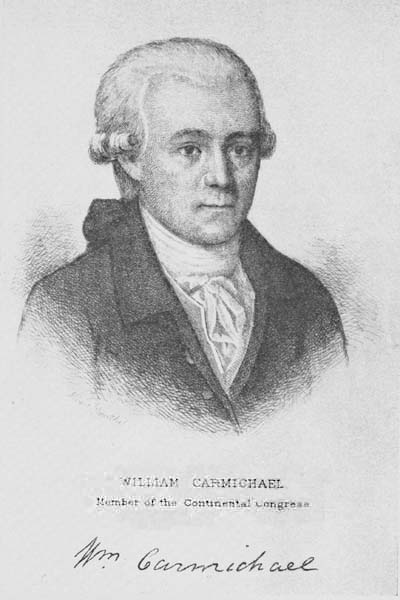
WILLIAM CARMICHAEL
Member of the Continental Congress.
“I should never have completed what I have but for the
generous, the indefatigable and spirited exertions of Monsieur
de Beaumarchais, to whom the United States are in
every account greatly indebted, more so than to any other
person on this side the water.”
Silas Deane to Congress, November 29, 1776.
Suspicions of English Aroused Through Indiscretions of
Friends of America—Treachery of du Coudray—Counter
Order Issued Against Shipments of Beaumarchais—Franklin’s
Arrival—England’s Attempt to Make Peace Stirs
France—Counter Order Recalled—Ten Ships Start Out—Beaumarchais
Cleared by Vergennes.
WHILE Beaumarchais, through the intervention of the
Ministry, was bringing his own personal interests to a
successful termination, he was at the same time carrying vigorously
forward his operations in the cause of America.
These operations were the most difficult. In the words of
Loménie: “It was a question of an officially prohibited commerce,
which prohibition was under the vigilant supervision
of the English Ambassador,—and could receive the official
support of the French government only on condition that it
was carefully hidden. The least indiscretion, the slightest
diplomatic embarrassment occasioned by the affair would
immediately transform this support into persecution. It was
under these conditions that the author of the Barbier de Séville
105
was obliged to extract without noise and in small
quantities, from the different arsenals of the state, 200 pieces
of cannon, mortars, bombs, bullets, 25,000 guns, 100 tons of
powder; to manufacture the stuffs necessary for the equipment
of 25,000 men, collect all these objects in the different
ports and send them to the insurgents without arousing the
suspicion of the English Ambassador.”
It was, however, humanly impossible that suspicions should
not be aroused; too many people were interested in the cause
of America; too many were eager to aid in the struggle of
the colonies for liberty. Especially was the cher bon ami
of Dr. Franklin constantly bringing things to the brink of
exposure through his officious intermeddling. Although he
knew nothing of the real basis upon which the commercial
house, Roderigue Hortalès et Cie., was founded, yet he was
very well aware that Beaumarchais had supplanted him in the
confidence of the ministers. Forced to see himself set aside,
Dubourg none the less continued collecting supplies on his
own account, which he forwarded to the insurgents. His
indiscreet zeal led him often into grave difficulties.
“With the best intentions in the world,” says Doniol, “he
was in danger of interfering with, rather than aiding the
cause he hoped to serve.”
The letters of Beaumarchais to Vergennes during this
period constantly revert to this theme, “Dubourg must be
made to keep silence and not to compromise the ministry.”
“If,” he writes in another place, “while we are closing the
doors on one side, someone opens the windows on the other, it
is impossible that the secret does not escape.” At length
quite out of patience at some new and serious indiscretion
which the good doctor in his simplicity had told to Beaumarchais
himself, the latter wrote to Vergennes, “Is there then
no way to stop the mouth of that cruel gossiper?...
As he told me I could scarcely refrain from dealing him a
blow, but I restrained myself, simply turning my back and
walking away.... I depend upon you, M. le Comte,
to deliver us from this fatal and mischief-making agent.”
But Dubourg was by no means the only person interested
in the cause of America who was sowing snares in the pathway
of Beaumarchais and of Deane. At the worst, the good
doctor was only indiscreet, he was never guilty of that personal
ambition which in times of great crisis delights to bring
ruin upon the schemes of others, and which uses all its power
to thwart those enterprises which it cannot lead. Many
enemies of this latter type were destined soon to manifest
themselves. On the 1st of October, 1776, Silas Deane wrote
to Congress of a certain Mr. Hopkins of Maryland, then in
Paris, who without official authority was interesting himself
in the same cause. “Offended at some supposed personal
slight, he formed the dark design,” says Deane, “of defeating
at one stroke my whole prospect as to supplies.... However
thunderstruck I was, as well as my friend Monsieur
Beaumarchais at this treachery ... we exerted ourselves
and truth prevailed.... It would be too tedious
to recount what I have met with in this way.... I do
not mention a single difficulty with one complaining thought
for myself.... I am happy in being so far successful,
and that the machinations of my enemies, or rather the enemies
of my country ... have been brought to nought.”
But perhaps the most dangerous enemy in the pathway of
Deane and Beaumarchais was a man in whom from the first
they had reposed the most entire confidence. This was
Trouson du Coudray, a French officer of rank and genius,
a personal friend of the minister of war, the Comte St. Germain,
who had been the military preceptor of le Comte d’Artois.
He had afterwards been stationed at the garrison of
Metz, where he was associated with the drawing out of old
arms and of replacing them by ones of more recent date. As
it was precisely these old arms which the French Government
was willing to part with to Hortalès et Cie.,—at a reasonable
price, du Coudray was admirably placed to further the
proceedings of its agent. Had he been truly disinterested in
his proffered services, his coöperation would have been invaluable.
As a matter of fact, “this officer,” says Doniol,
“certainly capable, was one of those who whatever employment
is made of their services, look first to the personal advantage
they can draw from them. Having fascinated Deane
and Beaumarchais, he succeeded in having himself named one
of the staff officers of artillery and was to go out to
the colonies in command of the chief vessel of Hortalès et
Cie., the Amphitrite. Deane at once wrote to Congress, announcing
the great acquisition which he had made. He bestowed
the highest praise upon du Coudray, but at the same
time evinced a fear lest Congress might consider that he had
overstepped the bounds of his commission in appointing him
to so high a rank. He excused himself for having been forced
to confer upon the officer special marks of favor in order to
secure his services, which, he felt sure, would, in the end,
justify him for the step he had taken. He humbly expressed
a hope that Congress would not consider as too high the
salary he had promised, and begged it to confirm the wisdom
of his choice.”
Du Coudray was not long in showing himself unworthy of
the confidence thus reposed in him. It was this unfortunate
step of Deane, afterwards imputed to him as a crime by
Arthur Lee, which was the chief cause of his subsequent recall
and the semi-disgrace inflicted upon him. Beaumarchais,
being as deeply inculpated as Deane, fell equally in the
opinion of American patriots. But as yet, no foreshadowing
of coming events had dampened the zeal of the colonial commissioner,
or of his indefatigable friend. On October 15,
1776 (Spark’s Dip. Corres., I, p. 51), a contract was signed
M. de Monthieu, Roderigue Hortalès et Cie. and Silas Deane,
for furnishing armed vessels and merchandise on condition
that risks and perils be on account of the U. S. and that “in
case the vessels be detained in American ports more than two
months, without returning them laden with the cargoes proposed,
wages and expenses shall be paid by the United
States.”
While Deane was thus busily engaged in carrying out the
commission with which he was entrusted, he was being left, as
far as Congress was concerned, absolutely without support
or approval. Communication between the two continents was
slow in those days, and it has been shown already that before
Deane was able to send any definite information to Congress
of his reception by the French Government, Lee had
forestalled him by giving that body his own private and unfounded
interpretation of the relation entered into between
the commissioner and the agent of the French Government.
When Lee’s letter reached America, Congress was deeply engrossed
with the weightier matters which were forcing themselves
upon its attention, owing to the decisive step which it
was about to take in declaring itself free from British rule.
The matter, therefore, was allowed to rest in statu quo for
the present. Congress preferred to await developments before
setting on foot any investigations, and so, though Deane continued
to give frequent and full accounts of all his transactions,
no reply was ever made to any of his letters. This
rendered his situation cruel in the extreme. Wholly unsuspicious
by nature, it never occurred to him that an enemy
was busily at work, undermining his character and poisoning
the minds of his compatriots in regard to the disinterestedness
of the motives which actuated him. His irritation began
at last to manifest itself. “For heaven’s sake,” he wrote
in a letter to Congress, dated October 1, 1776 (Spark’s
Diplomatic Correspondence, Vol. II), “if you mean to have
any connection with this kingdom, be more assiduous in getting
your letters here. I know not where the blame lies, but
it must lie heavy somewhere, when vessels are suffered to sail
from Philadelphia and elsewhere, right down to the middle
of August, without a single line. This circumstance was near
proving a mortal blow to my whole proceedings.”
October 17th of the same year he says:
“Warlike preparations are daily making in this kingdom
and in Spain. I need not urge the importance of immediate
remittances towards paying for the large quantity of stores
I have engaged for, and I depend that this winter will not be
suffered to slip away unimproved. I have the honor to
be, etc.
“Silas Deane.”
By the end of November, notwithstanding the delays and
discouragements encountered by the agents of the two governments,
several vessels had been loaded with supplies and
were about to set sail. Silas Deane wrote to Congress, Nov.
29th, 1776.
“I should never have completed what I have, but for the
generous, the indefatigable, and spirited exertions of M.
Beaumarchais, to whom the United States are on every account
greatly indebted, more so than to any other person on
this side the water ... therefore I am confident you
will make the earliest and most ample remittances.” After
giving further details, he proceeds: “A nephew of Beaumarchais,
a young gentleman of family, education and spirit,
makes a voyage to America with M. Ducoudray (in the various
documents, the name of this officer appears, sometimes
written as above by Mr. Deane, but more often ‘du Coudray,’
which is the correct form) and is ambitious of serving his
first campaign in your cause. I recommend him therefore to
your particular patronage and protection, as well on account
of the great merits of his uncle, as on that of his being
a youth of genius and spirit.... I have confidently
assured his uncle that he will receive protection and
paternal advice from you, and am happy in knowing that
you will fulfill my engagements on that score.
“I cannot in a letter do full justice to M. de Beaumarchais,
for his address and assiduity in our cause. His interest
and influence, which are great, have been exerted to
the utmost, in the cause of the United States.”
On the 3rd of December, 1776, in a letter to John Jay
written when the last measures were being taken for the
despatching of the vessels equipped by Hortalès et Cie.,
Deane thus expressed himself:
“If my letters arrive safely they will give you some idea of
my situation:—without intelligence, without orders, and without
remittances, yet boldly plunging into contracts, engagements,
negotiations, hourly hoping that something will
arrive from America.
“By M. du Coudray I send 30,000 guns, 200 pieces of
brass cannon, 30 mortars, 4,000 tents, and clothing for 30,000
men, with 200 tons of gunpowder, lead balls, etc., etc.,
by which you may judge we have some friends here. A war
in Europe is inevitable. The eyes of all are on you, and
the fear of your giving up, or accommodating is the greatest
obstacle I have to contend with. Monsieur Beaumarchais
has been my minister in effect, as this court is extremely
cautious and I now advise you to attend carefully
to the articles sent you. I could not examine them here.
I was promised they should be good, and at the lowest price,
and that from persons in such station that had I hesitated
it might have ruined my affairs....
“Large remittances are necessary for your credit, and
the enormous price of tobacco, of rice, of flour and many
other articles, gives you an opportunity of making your
remittances to very good advantage. Twenty thousand
hogsheads of tobacco are wanted immediately for this kingdom,
and more for other parts of Europe.”... (Correspondence
and Public Papers of John Jay, 1890, p. 97.)
In spite of the remonstrances of Deane, Congress continued
deaf and dumb in regard to their Commissioner,
neither condemning nor approving his acts, but passing all
by with like indifference. In the meantime, Beaumarchais
was pushing forward his gigantic operations, being taken
with “a sort of drunkenness of activity and of confidence in
himself, which,” says Doniol, “turned him at times from
precautions. He was at this juncture, really a political
agent. He had indicated to M. de Maurepas a plan of
finance which would enable France to arm itself, without
increasing taxation, and the mission had been given him to
study the execution of the plan with M. Necker, who had
been called to the management of the Treasury. He had discussed
with Deane, perhaps somewhat with Vergennes, the
creation of a bank, in view of making loans on the lands of
America.” (Doniol II, p. 57.)
Extracts from a Memoir by Beaumarchais, addressed to
Vergennes, in regard to a loan to be made to the Congress:
“Supposing always,” he wrote, “that your intention is
neither to let America perish nor to force her to arrange
with England through lack of the succor which is indispensable
for her defense, if you can procure it; supposing
also that my work and my ministry have not ceased to be
agreeable to you; I have found a means of supporting the
Americans without disbursing considerable sums, which you
do not possess, but which the Americans cannot dispense
with.
“If you look upon me as the important advocate of that
nation before the Ministry of France,—an employment
which I have assumed because it was as noble as it was useful
to my country; knowing that I have not done this without
your secret agreement, you must hear me to-day, even
aid me, if you do not wish to leave without results a plan
which is without danger.” After developing the details of
his scheme for rendering more effective aid to the Americans,
Beaumarchais continues, “As you see, M. le Comte,
this is only an extension adroitly given, to that which I
have been doing for the last year. For the past two weeks
I have been buried in the meditations and the correspondence
which this work requires. To-day I am in condition to
treat secretly with you and M. de Maurepas. Any evening
which you wish, I will attend upon your orders.”
Things were moving, however, far too slowly for the impatient
spirit of Beaumarchais. The 14th of October he
had written to Vergennes.
“Every time that I think how we hold in our hands the
destiny of the world, and that we have the power to change
the system of things—and when I see so many advantages,
so much glory ready to escape, I regret infinitely not to
have more influence over the resolutions of the councils, and
not to be able to multiply myself, so as to prevent the evil
on one hand, and aid the good on the other. I know too
well your patriotism to fear offending you in speaking
thus....
“I expect to be at Fontainebleau Thursday at the latest.
Until then I shall not sleep until I have finished the work
on Finance, promised to M. de Maurepas.”
Obstacles of every kind were being thrown in the path of
Beaumarchais, though he remained ignorant of their source.
He continued to insist that the government permit him to
carry forward what it had encouraged him to commence.
His letters of this period testify to “a consciousness of being
hampered, a desire to act, fear of being too presumptive
in his demands, and intentions of rendering effective service.”
(Doniol II, p. 58.) He thought the delays came
from Maurepas, whose coldness had distressed him, so he
urged Vergennes to plead for him. “If I were not certain,”
he wrote, November 12, 1776, “that I do not displease you
in desiring you to raise as far as possible the obstacles which
retard my course, I would not have the indiscretion to make
observations when it seems I ought simply to submit. But
I know that you are as much annoyed as I by all that tends
to spoil my plans. This idea consoles me and enables me not
to lose patience....” “Do not,” he pleads, “do not,
M. le Comte, look upon my impatience as insubordination, it
is nothing but zeal.” Then he proceeded to urge Vergennes
to send him an order through the minister of war, the
Comte de St. Germain, that there be delivered to him 2,000
hundredweight of powder, which would enable him to set
sail, and he ended by saying how he had “le cœur bien serré
to see how things are going or in reality, not going.”
The fall of New York offered an opportunity for Beaumarchais
to press his solicitations, urging that the Americans
had been beaten only from lack of supplies. “If I
were asking a personal favor,” he wrote to Vergennes, “I
would have patience, but I shall lose it if you do not come
to my assistance.” On the second of October he had written:
“Everything about me follows me with talk and does
all that it can to ruin me. Across all these bitter things I
walk with assurance to my ends; unless a pistol shot stops
me, I will be found ready to treat with all who present themselves.
My zeal and my disinterestedness are the basis of
my defense. I have no important paper about me—everything
is secure.”
In the midst of so many hidden dangers Beaumarchais
was soon made to feel a still graver one. The French government
suddenly began to thwart all his operations, and
this without a word of warning or explanation. The fact
was that the suspicions of the Court of St. James had been
thoroughly aroused, and, pressed by the English Ambassador,
the minister had been forced to take a stand. The
fifteenth of November the English Court notified the Spanish
Ambassador that everything was known, and the twenty-second
of the same month, they expressed themselves still
more strongly through other avenues. Vergennes was informed
that the aid being rendered by France was no longer
a secret. Something had to be done immediately to allay
the fears of the English, and from this had arisen the apparent
hostility of the ministers.
Even had there been no one directly to blame for these
disclosures, entire secrecy still could not have been maintained.
The very multiplicity of the operations, “the goings
and comings of Deane and Beaumarchais and their intermediaries,
the confidence that was inspired by the support
of the government leading to indiscretions, all this
divulged the acts.” (Doniol II, 35.) More than this, officers
enrolled, or those who wished to be, were spread about
in the cafés and public places, in Paris or the seaports,
awaiting the moment of embarkation. All these men, “infatuated
and needy,” were under the control of du Coudray,
who was expecting to sail on the largest of Beaumarchais’s
ships, l’Amphitrite, a vessel of 480 tons, which already had
received its cargo, and was only awaiting the presence of
the officer in order to set sail. For some unaccountable
reason, he had returned to Versailles without giving any
notice. He remained there for more than a week, causing
a delay which threatened to spoil everything. Beaumarchais,
supposing that the ministry was at fault, wrote to
Vergennes in the following impatient manner: “Everything
has gone, everything is waiting. Why cannot I have the
whole management of the affair? Then nothing would be
delayed and my vessels would already be in America.” The
truth was that du Coudray, relying upon his powerful support
at court, had gone to Versailles in order to succeed in
escaping if possible from the hands of Beaumarchais, so
as not to go over as his envoy. He had all along been
lengthening “by every means in his power the delay in getting
off, had sown discontent among the enrolled, sending
away such as he could not gain, had encouraged complaint,
confided the place of embarkation to indiscreet persons, and
then threw upon Beaumarchais the blame of the noise
which he himself had made.” (Doniol II, 61.) In addition
to all the rest, Beaumarchais was guilty of a particular
indiscretion of his own. Having gone the 6th of December,
1776, to Havre, under the assumed name of Durand, in order
to superintend, without arousing suspicion, the despatching
of three of his vessels, the Amphitrite, La Seine, La Romaine,
he could not resist the temptation of busying himself
at the same time with his literary productions. Displeased
with the way in which his famous comedy, Le Barbier de
Séville, was being performed, he imprudently collected the
actors, making them rehearse the play under his direction.
His presence in the seaport thus became known; the English
Ambassador was notified and the latter at once addressed
to the Government the most vehement remonstrances.
“On the 16th of December a counter order was issued and
sent to Havre and Nantes, prohibiting the officers from embarking
and the vessels from setting out. But when the
counter order reached Havre, l’Amphitrite, which bore the
greater part of the officers and munitions, already had set
sail. The Seine and the Romaine were alone sequestered,
Beaumarchais then returned with all haste to Paris, in order
to obtain the revocation of the counter order.” (Loménie
II, p. 136.)
But in the meantime, an event had happened which, as
soon as it became known, roused the French people to the
highest pitch of enthusiasm, while it deepened the distrust
and anger of the English Ambassador. This event was the
arrival of Dr. Franklin upon the shores of France. Beaumarchais
already had announced the fact in a letter to Vergennes.
“The noise,” he said, “caused by the arrival of Mr.
Franklin is inconceivable.... The courageous old
man allowed the vessel to make two captures, in spite of the
personal danger he ran.”
Though the French people might welcome with heartfelt
enthusiasm, the venerable old democrat and philosopher, yet
his presence at this moment was a serious matter to the
Court of France. The Government was moving, it is true,
directly towards open war with Great Britain, but she was
as yet very unwilling that the English should have cause
of offense in her attitude towards the country which had
now declared itself free and independent. All the supplies
which she was allowing to be sent by Hortalès et Cie. went
out in vessels bound direct to her West Indian possessions,
and were ostensibly intended for her own colonists, so that
the English Government had no legal right to interfere.
England therefore redoubled her watchfulness at the court
of her rival, and knowing as she very well did that it was
in every way to the interest of France to aid the Americans
in their fight for liberty, she was all the more determined
to harass and thwart every operation which tended in
that direction.
All this time the Americans were far too deeply engrossed
with the difficulties of their own situation to spend much
thought upon those that surrounded their friends in Europe.
On the 26th of September, Congress had appointed three
commissioners to the Court of France. Silas Deane already
on the spot had been retained; to him were added Benjamin
Franklin and Thomas Jefferson. The latter declining to
serve, was replaced by Arthur Lee, who was still in
London.
Immediately after setting foot in France, Franklin wrote
to his cher, bon ami, the Doctor Dubourg, a letter full of
warm expressions of friendship and of polite messages to
Madame. He enclosed under the same cover a letter to Silas
Deane, begging his dear friend to see to its speedy delivery.
The letter to Deane informed him of his new appointment,
and gave orders that Lee be summoned immediately to join
them. He bore with him no letter from Congress, nor any
message relating to the past services of Deane, news of
which, in fact, had hardly reached the colonies at the time
of the doctor’s embarkation.
Franklin had no personal interest in the work already
accomplished, since his cher, bon ami had been set aside, as
soon as Deane saw “where the confidence of the Government
was placed.” From the first he had determined not to interfere
in the quarrel that existed between Lee and Deane,
and he steadily refused to enter into the merits of the zeal
displayed by Beaumarchais under cover of Hortalès et Cie.
Warned against him by so many of his friends, and having
particular reasons for not showing marked favor to Deane
(the suspicious jealousy of Lee’s character threatened from
the start to thwart the entire object of the commission), he
chose the course of ignoring all that already had been accomplished.
For the moment Deane, himself, seemed alienated
from Beaumarchais. Vexed at the delay in despatching
the supplies (for he knew nothing of the counter-order
issued by the Government), irritated by Lee, annoyed at the
indifference of Franklin and dismayed by the silence of Congress,
Deane in turn assumed an attitude of cold indifference
which perplexed and disquieted his friend. The new
duties which were forced upon him, the change in the character
of his mission, occupied for the time all his thoughts.
As soon as the three commissioners were united in Paris,
Franklin wrote asking for an audience with the minister of
foreign affairs, M. de Vergennes. “Sir,” he wrote, “we beg
leave to acquaint your Excellency that we are appointed
and fully empowered by the Congress of the United States
of America to propose and negotiate a treaty of amity and
commerce between France and the said states....
(Doniol II, 112.)” The minister, however, really anxious to
further the plans of Beaumarchais, was slow to give additional
umbrage to the English Ambassador by receiving the
three commissioners whose presence in Paris it was impossible
to hide.
Already Franklin had taken up his quarters in Passy,
where he held a little court of his own. Imbert de St.
Amand, in his Les Beaux Jours de Marie Antoinette, has
given a vivid picture of the impression made upon the inhabitants
of Paris by the presence in their midst of the aged
philosopher. “The idol of the day,” he says, “in that Paris,
so capricious and so versatile, was Franklin—that peasant,
that septuagenarian philosopher, that learned democrat,
that man of the future—was acclaimed by the French aristocracy.
The philanthropists, the apologists of perpetual
peace, demanded war with loud cries. Louis XVI, notwithstanding
his scruples of conscience, allowed himself to be
won over. The apartments of Versailles filled themselves
with solicitors of peril and of glory. All the young nobility
wished to start at once. What transport! what madness!
what valor in those paladin philosophers, those chivalrous
democrats, having the double passion of glory and liberty,
full of superb illusions, of generous follies, and so eloquent,
so amiable, so brave! With what gaiety these quitted
their pleasures, their châteaux, their theatres, to live the life
of a soldier, to go to seek the other side of the Atlantic,
perils and unknown dangers!”
All this excitement caused by the presence of Franklin did
not tend to lessen the vigilance of the English, although
from the first they had hope that if France could be prevented
from aiding the Colonies, Franklin might in the end
be obliged to enter into negotiations with England. It was
precisely this fear which haunted the French Government
and induced the King to revoke the counter-order issued to
prevent the sailing of the ships of Hortalès et Cie. Happy
at last in gaining permission to leave port, Beaumarchais
thought only of despatching his retarded vessels, when he
learned that the Amphitrite, the one ship that had set out
before the arrival of the counter-order, was at Lorient, a
seaport on the west coast of France, whither it had been
brought by du Coudray “under the pretext that bad weather
encountered in the channel had shown the defective condition
of the vessel.” (Doniol II, p. 314.)
Beaumarchais, still deceived, wrote to Vergennes:
“L’Amphitrite, after sixteen days of bad weather, has been
obliged to return for a moment to take on fresh provisions,
those on board having been saturated by the sea. This is
what I have from M. du Coudray, who asks that it be kept
secret, and who expects to depart in a few days.”
The treachery of this officer could not, however, long remain
secret. “The English Ambassador, learning the details,
complained loudly to Vergennes, who, irritated to find
himself again compromised, laid the blame on Beaumarchais
withdrawing the permission newly accorded to set sail.” (Loménie
II, p. 137.) Du Coudray then wrote a long letter full
of lame excuses. Beaumarchais, furious on learning the
truth, replied as follows:
“Paris, January 22, 1777.
“As your conduct, sir, in this affair is inexplicable, I
will not waste time in trying to comprehend it. All that
concerns me is to guarantee myself and my friends against
occurrences of the same kind in future. As the veritable
owner, therefore, of the Amphitrite, I send herewith an order
to Captain Fautrelle, to take absolute command. You
are sagacious enough to see that I have not taken so decisive
a step without previously consulting powerful and
judicious friends. Have the kindness, sir, to conform to
it, or find another vessel to take you wherever you please,
with no pretension on my part to hinder you in any respect,
except in matters which relate to myself and which tend to
injure me.”
When Deane learned of the disgraceful conduct of the
man in whom he had reposed such entire confidence, he withdrew
the commission which he had granted him, and the
8th of February wrote to Beaumarchais. “The strange, ungrateful
and perfidious conduct of this man, mortifies and
embarrasses me strangely, and as I wish with all my heart
that I had never seen him, I wish equally that he may never
see America.” Beaumarchais at once forwarded this letter
to Vergennes, begging him to prevent du Coudray from setting
out for the new world. An order from Vergennes arrived
commanding him to return to his garrison at Metz.
Instead of obeying, he hastened to Versailles, where, as has
been shown, he had powerful protection. He succeeded in
being privately presented to Franklin and through the intervention
of the ministers of war and the navy, du Coudray
received from Franklin a recommendation to Congress,
which recommendation Deane himself finally consented to
sign, although with reluctance, for he informed Beaumarchais
at once of the act, assuring him that he had done no
more than admit that du Coudray was a good officer. Vergennes,
not wishing a quarrel either with the Comte de
St. Germain or with M. de Sartine (minister of war and
the navy), was obliged to close his eyes to the action of the
officer, who at once hastened to set sail for America. (See
Doniol II, p. 317.)
The 11th of February, Beaumarchais wrote to Vergennes:
“Everyone knows the evil which that officer wishes
to do me. Having made to myself a law to explain to no
one the wise and pressing motives which oppose themselves
to the departure of that officer, and owing to the necessity
of preventing his indiscretions, I am liable to be taxed with
a design to persecute him, whom on the contrary I have
from the first endeavored to advance and have aided in sincere
good faith.... It is neither in my character nor
in my principles to revenge myself on anyone—I should be
obliged to pass my life at that odious business....”
“Neither the orders of Vergennes nor the interference of
Beaumarchais or Deane having prevented du Coudray from
crossing the Atlantic, the evil which followed was inevitable.
Arrived in America, he hastened to accuse Beaumarchais of
the very acts which he himself had attempted to perform,
and he accused not him alone, but in consequence Silas
Deane of complicity, as well as the Comte de Vergennes.”
(Doniol II, p. 353.)
“Dreaming of great position in America, he built upon
the order to retain him on the continent, and gave it out as
an intrigue of Beaumarchais.” He at once issued a pamphlet
to Congress, in which he explained, “It is to my credit
alone, and to my zeal in your service, that you are indebted
for the extent of the aid accorded to your commissioner, and
in nothing to the Sieur de Beaumarchais; everything was
finished when he arrived.” He further dilated upon the
greed of gain which characterized the French agent, and
accused him of fraud in his dealings with the colonies. To
minds already prepossessed with similar ideas, this pamphlet
was not calculated to increase the confidence of Congress
in the good faith either of their commissioner or of
his friend. During the two months preceding the open exposure
of the perfidy of this officer, the difficulty of the situation
of Beaumarchais hardly can be overestimated. “Denounced
by the conspiracies of du Coudray as being only
incited by desire for lucre; obliged to resort to complicated
expediencies in order to spare the Government the recriminations
of the English, constrained to defend himself against
the mistrust aroused even in the spirit of M. de Vergennes
by his at times inevitable indiscretions; forced to fall back on
justifications which might seem equivocal, he lent himself to
doubt, even to suspicion.” (Doniol II, p. 308.) On the
30th of January he wrote to M. de Vergennes:
“When one writes to a minister whom one respects and
cherishes, one is very much embarrassed to find terms to explain
a fact like the one that suffocates me. After Mr.
Deane had shown during a month a very bad humor, and
saying to myself the whole time that there was something
very mysterious in the delay of the vessels at Havre, I was
anxious to have an explanation of his offensive tone. He
replied that, tired himself of not knowing where the blame
lay, he had the honor to send you a memoir by M. Lee, and
that the latter reported that Your Excellency had clearly assured
him that for a long while there had been no obstacle on
the part of the ministry and that if I said there was, it could
only be an imposture of mine or of M. Montieu. Pardon,
M. le Comte, if after swallowing all the other bitter pills
without complaint, this rests in my throat and strangles
me in passing. Your Excellency will perhaps be so good as
to cast a glance over the four letters that I join to this, written
by me to M. de Sartine the 3rd, 18th, 22d and 29th of
January. They will inform you of the true state of affairs
if it is possible that you are ignorant of it, and you will tell
me afterwards up to what point you order me to keep silent
and sacrifice myself. This blow crushes me and makes me
desire that my whole conduct as a vigilant man and faithful
servitor be promptly examined and with the utmost rigor. It
is impossible for me to take an instant’s repose until you
have accorded me this grace. Read, I beg you, my letters
to M. de Sartine and judge of my suffering.”
Vergennes immediately replied, and the whole situation
grew brighter. Beaumarchais wrote the next day, February
1, 1777, “I sincerely thank you for your goodness in tranquilizing
me. I have force against everything except your
discontent. Never judge me without hearing me, this is the
only favor I ask. I know well that you are accused of irresolution,
which is very far from your character. Afterwards
they cast upon me the reflections of their discontent, making
you speak, so that I may feel it more keenly—I will never
believe anything again. I have the intimate consciousness
that I do my best and even the best that can be done under
the circumstances. Across all the obstacles that surround
me, a small success pays me for great labor. I feel myself
already light-hearted again since yesterday’s letters have told
me that three of my vessels have started.” Beaumarchais was
thus after so many delays given full power to act. On the
4th of February, 1777, he wrote to Vergennes:
“At last I have my delivery.... It is a pity that
the Dutch should be destined to have the principal gain from
the transport of these materials. No matter, the most important
thing is, not to let America come to grief through
lack of good munitions....”
By the beginning of March ten vessels of Roderigue Hortalès
et Cie. were floating towards America. The seventh of
that month he announced the fact to Vergennes: “Never,” he
wrote, “has commercial affair been pushed with so much
vigor, in spite of obstacles of every nature which have been
encountered. May God give it good success!”
“Beaumarchais,” says M. de Loménie, “naturally expected
soon to receive very many expressions of gratitude from Congress,
as well as very much Maryland and Virginia tobacco.
He did not even receive a reply to his letters.” Nevertheless,
he continued to send out ships laden with supplies, all
through the spring and summer, receiving from his agents
alone information of their safe arrival.
The failure of Congress to ratify the conditions offered
by its commissioner would have brought to ruin the commercial
house of Roderigue Hortalès et Cie. in spite of the
subsidy of two millions with which it had been founded, had
not the Government again come to its assistance. But
though the ministers in general, and Vergennes in particular,
never entirely deserted Beaumarchais, other and wholly different
measures for aiding the Americans were now seriously
occupying their attention. The colonies in declaring themselves
free from British rule had forced upon France the
necessity of coming to some definite decision. This she was
slow in doing, but so inevitable was it that she should take
an active part in the great struggle that already the measures
necessary for the arming and equipping of her forces
were being discussed in her councils, while the nation, gone
mad with enthusiasm, was urging her forward in the pathway
which could lead to nothing but open war.
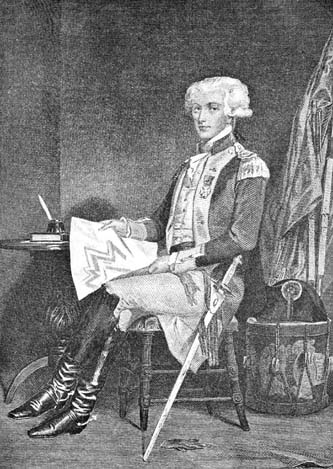
LAFAYETTE
“Never Greece, never Rome, never any people of the ancient
world, exposed the motives of its independence with a
more noble simplicity, nor based them upon more evident
truths.”
Gudin de la Brenellerie, Histoire de Beaumarchais.
The Declaration of Independence and Its Effect in Europe—Beaumarchais’s
Activity in Getting Supplies to America—Difficulties
Arise About Sailing—Treachery of du Coudray—Lafayette’s
Contract with Deane—His Escape to
America—Beaumarchais’s Losses—Baron von Steuben
Sails for America in Beaumarchais’s Vessel, Taking the
Latter’s Nephew, des Epinières, and His Agent, Theveneau
de Francy—The Surrender of Burgoyne—Beaumarchais
Finds Himself Set Aside While Others Take His Place—Faces
Bankruptcy—Vergennes Comes to His Assistance.
“THE Act,” says Doniol (I, p. 561), “which proclaimed to
the civilized world the institution of the American Republic
and which was destined to open a new phase of civilization,
was announced in Europe only as an incident, secondary
to the resistance of the rebels.
“The English Government would not admit that the
solemn act produced any visible emotion in London. In the
beginning Garnier, the French Ambassador, was no more
struck than the cabinet of London by the page of political
philosophy put into being by the declaration of Congress, and
which was to respond so loudly in the country of Voltaire
and the Encyclopædia.” In France, “when it became
known,” continues Doniol, “it produced the most vivid sensation
which was possible to create a century ago by the means
of publicity then existing.”
But though the action of the colonies was greeted with wild
enthusiasm by the populace, the government remained cold
and undemonstrative. Silas Deane had written to Congress,
January 17, 1777, “The hearts of the French people are universally
for us and the opinion for an immediate war with
Great Britain is very strong, but the court has its reasons for
postponing a little longer.”
The chief cause of the apparent inaction of the government
arose from the ruined condition of its finances. Beaumarchais,
as was seen in the last chapter, already had been commissioned
to draw up a plan of finance which should aid in
the present crisis. This he had done, basing his scheme of
reform upon the wise and prudent measures adopted by the
great Sully. He endeavored to prove that these reforms
would, if put into execution, cause such an increase of revenue
as would enable France safely to declare war, without increasing
the rate of taxation or incurring the risk of bankruptcy.
His scheme, however, had been set aside. On the
30th of March, 1777, he addressed a lengthy memoir to the
prime minister, M. le Comte de Maurepas, of which the following
is an extract: “... I have doubtless explained
badly my ideas of help for the Americans, since it seems that
you have not adopted them. The fear of giving you too much
to read makes me concise to the point of being perhaps obscure....
Read the letter of M. Deane....
Judge if a good Frenchman, a zealous subject of the King,
a good servitor of M. de Maurepas, who respects him and
wishes to see his administration honored among all the people
of the world, judge if he can support your constant refusal
to lend him a hand, the earnest solicitations of America
at bay, and the insolent triumph of armed England....
M. le Comte, spare your servitors the sorrows of one day
hearing you reproached with having been in a position to
save America at small cost and you have not done it, to tear
her from the yoke of England and to unite her to us by commerce,
and that you have neglected it.
“Hear me, I pray you; you distrust too much your own
powers and my resources; and above all I fear that you do
not sufficiently esteem the empire, which your age and your
wisdom gives you over a young prince whose heart is formed,
but whose politics are still in the cradle. You forget that
that fresh young soul has been turned and brought back from
very far. He is tractable, helpless, weak in his whole being.
You forget that while dauphin, Louis XVI had an invincible
repugnance to the old parliaments, yet that their recall honored
the first six months of his reign; you forget also that
he swore never to be vaccinated, yet that eight days afterwards
he had the vaccine in his arm. No one is ignorant of
this, and no one will excuse you for not employing the beautiful
power of your place in causing to be adopted the great
things which you have in your mind.
“If you find my liberties too daring, go back to their respectful
motives, and you will pardon them to my
attachment.
“It was not play on my part, M. le Comte, when attaching
myself to you, I said with feeling: ‘I shall never have a day
of true happiness, if your administration passes away without
having accomplished the three greatest acts which could
illustrate it: the humiliation of England by the union of
America and France; the re-establishment of the finances, following
the plan of Sully, which I have placed several times at
your feet, and the rendering of civil existence to protestants....
These three things are to-day in your hands; I wish
only the honor of having often recalled them to you. What
work, M. le Comte, what success more beautiful, could crown
your career? After such actions, there is no death. The
dearest existence of man, his reputation, survives all and becomes
eternal. Hear me then, I beg you, in favor of the
Americans. Remember that the deputies await my answer
to dispatch a courier who will carry encouragement or desolation
into Congress.... Do not render my pains unfruitful,
through not concurring in them, and may the recompense
of my works be the honor of having made them acceptable
to you!
“I am, with the most respectful devotion, M. le Comte,
“Your very, etc.,
“de Beaumarchais.”
To all this Maurepas made no reply, and the unhappy
agent, still harassed and thwarted in his plans, wrote to Vergennes:
“April 13, 1777.
“... If I do my duty, as M. de Maurepas had before
the goodness to say to me, in presenting without ceasing
and under all its faces, the picture of so important an affair,
permit me to represent to you, M. le Comte, what you
know better than I, that loss of time, silence and indecision
are even worse than refusal. Refusal is a deed, one can act
afterwards, but from nothing, nothing ever comes—it remains
nothing....”
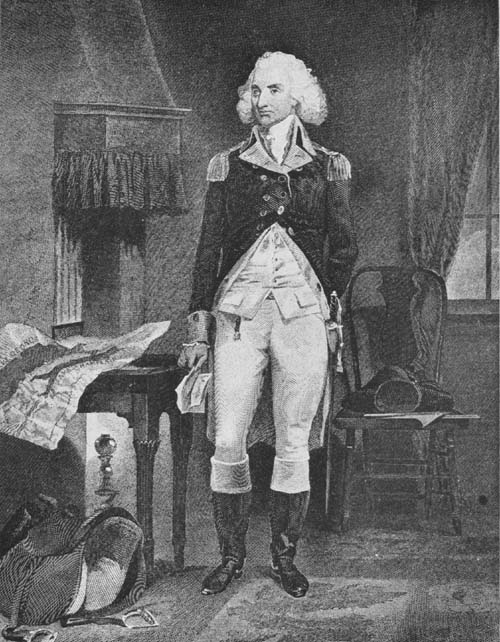
GENERAL JOHN SCHUYLER
In the same letter he warmly pleaded his own cause. “In
so far as I work alone,” he said, “my secret is secure. If the
indiscretion of the officers of the Amphitrite and their foolish
chief make known the destination of the vessel, what can I
do more than you? I defy any man in this country, beginning
with the ministers themselves, to cite either what name, what
charge, from what port and for what destination I have sent
the vessels dispatched since.... In a word, M. le
Comte, now that all is in operation, when the first pains and
labors of so vast an establishment have obtained a certain
success, when my profound disdain for the idle gossip of society
has turned aside the babblers and now that I can assure
the happy consequence of the enterprise, do you refuse
to concur any longer? and does my active perseverance inspire
the same in no one?... In the name of Heaven, of
honor, of the interests of France, retard no longer your decision,
M. le Comte! Confer again with M. de Maurepas.
No object is more important, and none so pressing.
“In the instant of closing this letter, I receive one from
Nantes, by which I am informed of the refusal to provide sailors,
and so my richest ship is stopped at the moment it is
ready to sail.... I implore you, M. le Comte, promptly to
arrange with M. de Sartine what is necessary for the departure
of my vessel.... I hope to go myself for your orders
upon very many objects Thursday evening, if you do
not send them before. I recommend the Americans to your
remembrance and their advocate to your good will.... The
hour of the post has passed while I was writing. I send
this therefore by a man on horseback.”
In striking contrast to the outspoken and independent
tone assumed by Beaumarchais when addressing the ministers,
is the friendly yet authoritative manner which he employs
when it is question of a subordinate. To de Francy,
his confidential agent, he had written February 28, 1777, in
relation to the dispatching of the Amphitrite, after it had
been brought back by du Coudray: “We shall have to say,
like Bartholo (one of the characters in the Barbier de Séville)
‘le diable est entré dans mon affaire,’ and remedy as best
we may the evil that is past, by preventing its happening
again. Give the enclosed letter to M. du Coudray. I send it
to you open, in order that you may reply in my behalf to his
objections, should he make any. Show to Captain Fautrelle,
the enclosed order which we give him, in quality of proprietor
of the vessel which he commands, and take his word of honor
to conform to it entirely. I received yesterday a letter from
my nephew along with yours. As unreasonable as the rest
of them, my nephew seems to be unwilling to go back to his
place on the Amphitrite. You can understand the little attention
which I pay to such childishness. Simply recommend
him again to the special care of M. de Conway and to the
Chevalier de Bore. Command the captain to receive on board
M. le Marquis de la Rouërie, who comes to us with special
recommendations. Give to the Captain the general rule and
the secret of the route. If the force of circumstances obliges
him to put into Santo Domingo, arrange with him and M.
de Conway not to stop there, but to write to the governor of
the island in order to notify him that the fear of some unlucky
encounter, alone prompted the drawing up of the fictitious
order in regard to the destination of the Amphitrite,
and take from him a new fictitious order for France, in order
to shelter yourself by that order in case you encounter an
English vessel between Santo Domingo and the true destination
of the ship. You know very well that all the precautions
of the Ministry are taken in accord with us; it is upon this
that we can count.
“As soon as the Amphitrite has set sail, go on to Nantes,
where, by the way, you will probably find le Mercure started,
because it is ready now to set sail. Good-bye, my dear
Francy. Come quickly back to Paris. You have trotted
about enough for this time; other work awaits you here: but
I will be there to divide it with you. Bring me back this
letter.”
The fear of a possible reconciliation of the colonies with
Great Britain, which constantly haunted the agent of the
French Government, had of late been greatly augmented.
The 8th of March, 1777, he had written to Vergennes:
“Sunday morning.
“M. le Comte; Another letter you will say. Will they
never stop! Eh! how can I stop, M. le Comte, when new objects
unceasingly excite my attention and my vigilance? A
private secretary of Lord Germaine arrived yesterday, secretly
sent to Messrs. Deane and Franklin. He brings
propositions of peace. The most superb recompenses are
promised him if he succeeds.”...
Monday morning, he wrote ... “America is doing the impossible
to hold her own. But be sure that she cannot go
much farther without you, or without a reconciliation with
Great Britain.... While I am treating with you, I warn
you that England is secretly attempting to treat with M.
Franklin.... Deane is regarded as a formidable obstacle
to any project of adjustment: They will attempt to dislodge
him at whatever price. My news is so positive as to
the intention of the ministers that my conjectures become
facts. They have the project to compel Deane to leave
France, and to make of him the expiatory victim.” A short
time before Beaumarchais had written to the same minister:
“The doctor Franklin at this moment, wishes to send away
M. Deane from France. My special object is to prevent his
leaving. The manly firmness of this Republican alone, can
arrest the insinuations of every kind employed against the
doctor.”
As a matter of fact, Franklin was well aware of the dismay
which the noise of his secret communications with agents
of Great Britain had caused the ministers, nor did he desire
to allay their suspicions. He knew well the value for France
of an alliance with the colonies, at least supposing the fact of
their independence. He knew, also, how far it was to the
interest of England to prevent such an alliance. So long as
France remained outwardly inactive, Franklin did nothing to
allay the fears of the one government nor to weaken the hopes
of the other, although there can be no doubt that in his heart
he was bent only upon concluding a treaty with France. In
March, 1777, he wrote: “I did not come to make peace, but
to procure the aid of European powers to permit us to defend
our liberty and our independence, which it is certainly
to their interest to guarantee, because our great and growing
commerce will be open, and cease to be the monopoly of
England.... I think we shall be capable with a little help,
of defending our possessions long enough, so that England
will be ruined if she persists in destroying us.... I flatter
myself to live to see my country established in peace and
prosperity, while Great Britain will no longer be so formidable
a figure among the powers of Europe.” There also
seems no doubt but that he had at last secretly concurred
with Deane in aiding the escape of Lafayette from the restrictions
imposed upon him by the French government, although
subsequently, the whole blame was allowed to rest
upon Deane alone.
The situation in regard to Lafayette was as follows: Some
time during the year 1775, the young Marquis who was then
scarcely eighteen, and who was serving under the Comte de
Broglie at the garrison of Metz, was present at a dinner
given in the fortress where the English Duke of Gloucester
was guest. The latter was bitterly opposed to the policy of
George III in regard to America, and at table spoke freely
of the uprising among the colonists; it was then, so Lafayette
tells us in his memoirs, that he formed the resolution of offering
his services to the insurgents. Through the intervention
of De Broglie, the Baron von Kalb, a Prussian general serving
in France, introduced to Silas Deane on November 5,
1776, the young marquis with two of his cousins who had
formed the same determination to offer their services to
America. Silas Deane received them with enthusiasm, and
promised all high positions in the American Army (see Doniol
Vol. II, p. 63). Eleven other officers were added and the
entire group were to sail from Havre on La Seine, one of the
fleet of Hortalès et Cie. when the order already spoken of,
came from the government to prevent further operations of
the house. Moreover, a special prohibition was issued regarding
the young officers, because it was of great importance
for the French Government to seem to oppose the enlistment
of such prominent members of the high nobility as Lafayette
and his colleagues. Nothing daunted, Lafayette, whose fortune
made him independent, bought a vessel of his own, La
Victoire, and having decided “to go in spite of everything and
without regard to consequences” secretly negotiated with
Deane, and set sail, April 20, 1777, with some twenty other
commissioned officers.
The agreement which had been drawn up between them was
signed by Lafayette, the Baron von Kalb, and Silas Deane;
it bore the date of December 7, 1776, although it was not
really issued until February, 1777. This discrepancy was
owing to the fact that since the arrival of Franklin in December,
Deane’s commission had changed in nature, so that
he no longer was empowered to enlist officers for the American
service. The date of December 7, 1776 had been chosen
because on that day the two noblemen had been presented to
the American Commissioner and an informal engagement entered
into. This was immediately before the arrival of
Franklin in France.
The true patriotism which inspired Deane led him to
adopt this subterfuge, feeling as he did that the services of
so brilliant an officer as Lafayette, and one belonging to such
an illustrious house, would be of sufficient value to his country
to warrant the irregularity of the act. The Baron von
Kalb had originally, it would seem, stipulated with Deane
for a considerable salary, part of which was to be paid in advance.
(See Our French Allies, Stone, p. 39.) Deane rightly
understood the effect which would be produced in the different
courts of Europe by the daring deed of the young nobleman
and foresaw the consequent fury of the English which
could not help but hasten the final decision of the ministry.
Therefore he willingly concurred in the designs of Lafayette,
aiding them to the utmost of his power (Doniol, Vol. II,
Chap. VII). Congress afterwards disavowed all the commissions
granted by Deane, so that most of the officers were
obliged to return to France. Lafayette and the Baron von
Kalb, having fortunes of their own, were willing to serve
without pay; they were therefore given appointments. The
romantic escape of the young nobleman caused all the commotion
that was expected of it. The Capital went wild with
exultation, openly vindicating his act, while the anger of the
English knew no bounds.
England, indeed, had good grounds for discontent with the
conduct of her rival. “Public opinion in London,” says
Doniol, “was more and more for war. France everywhere
was accused of aiding the colonies.... It was said that
open war was preferable to the insidious peace which we pretended
to maintain while according every advantage to the
revolted colonies.”—(Doniol II, p. 455.) Other causes of
grievance, especially in regard to the protection granted to
American vessels in all French ports, were constantly coming
up. “England,” says Doniol, “incriminated especially the
authorities of Martinique. According to Lord Weymouth,
the Americans armed openly in the island, favored by the
most notable persons. So much pressure was brought to
bear upon the French Government by the English Ambassador,
that, not yet ready for war, it was forced to
grant the satisfaction which was demanded. As in previous
instances, the blow fell heaviest upon Beaumarchais. July
1, 1777, he wrote:
“I have just received news that afflicts me.... M. de
Bouille, the new governor of Martinique, has notified the
merchants that it is agreed between the courts of France and
England, that the English Navy seize the French vessels
coming from their islands, taking all the commodities of
America which they find.... This is so impossible, that
though I have read it, I still cannot believe it!
“Afternoon.... I am indeed, in despair to receive the
confirmation of that trying announcement. It seems certain
that France has ceded to the English the right to seize
all French vessels coming from the islands, which are charged
with American commodities. What distress, M. le Comte,
could have brought about such an arrangement?... I
learn by letters from Cape Francis of the 18th of May, that
the cargo of the Amétie, happily arrived in that port, has
started for America, divided on several American and Bermudan
vessels, bought at my cost at Santo Domingo for....
“P. S. You are not to blame, M. le Comte, for the consequences
of that sorrowful convention with the English. Your
hands were tied to sign it. But I am in despair. I made
my payment of the 30th yesterday, selling all the paper
money which I had, at a disadvantage. A quarter of an
hour is so important, that a million arriving the next day
could not repair the lack of but thirty thousand louis d’or.
I was compelled to pay yesterday £184,328 2s., and £21,864
8s. 4d. remain unpaid from the 15th on which I have only
received £200,000 instead of £221,864 8s. 4d. From now
until the 15th, I must pay £268,304 8s. 3d. I am lacking
therefore £490,168 16s. 7d. with the loss of my paper money,
and the three last payments which I must replace so as to
be abreast of my affairs. I therefore beg you to send me
an order for 5,000,000 fr., after that I can go forward, but
as my destination is not a matter of indifference, I shall
have the honor of conferring with you about it.”
The documents deposited in the bureau of foreign affairs,
show that M. de Vergennes “taking into consideration the
desperate situation into which Beaumarchais found himself
thrown, owing to the obstinate refusal of Congress to send
him returns, had advanced successively, the 13th May, 1777,
400,000 livres, the 16th of June, 200,000 livres, and the 3rd
of July 474,496 livres.” (Loménie II, p. 145.) By this
means alone, Beaumarchais was able to continue his active
services in the cause of America.
Although the court of Louis XVI were making pretense
of not favoring the Americans, they already had decided on
war and were endeavoring to bring the court of Spain to a
similar decision.
“The 26th of June,” says Doniol, “a memoir was addressed
to the Spanish cabinet explaining the seasonableness of associating
themselves positively with the colonies, and in consequence,
of making war upon England.”
“By the means so far employed,” wrote Vergennes, “the
reconciliation of the colonies with Great Britain cannot be
prevented; those means have been all that have been prudent,
but they will not suffice any longer; it is necessary that the
assistance become sufficiently effective to assure a total separation
and so compel the Americans to gratitude.”
Madrid was finally forced to follow the course laid out
for it at Versailles; but before openly declaring their alliance,
both courts awaited some decisive act of the Americans. The
capture of Burgoyne determined the King, although several
months more elapsed before the treaty was actually signed.
But if the court was thus apparently inactive, Beaumarchais
continued as assiduous as ever in aiding the Americans,
and this notwithstanding the coldness of the commissioners,
the total absence of returns and the unbroken silence
of the Continental Congress. The Hon. John Bigelow, in his
admirable paper Beaumarchais, the Merchant, speaking of
Beaumarchais at this period, said: “He received no tobacco,
nor money, nor thanks, nor even a letter from Congress....
His funds were exhausted, and all his expectations of returns
were disappointed.... At last, reduced to extremities, he
resolved to send a confidential agent to the United States, to
obtain, if possible some explanation of results so chilling to
his enthusiasm, and for which he was so poorly prepared.
For this mission he selected a young man named Theveneau
de Francy, a person of considerable talent, generous and enthusiastic,
but poorly trained for the delicate duty assigned
him. De Francy embarked for the United States at Marseilles
on the 26th of September, 1777, on board of one of
Beaumarchais’s ships, carrying twenty-four guns, called
Le Flammand.”
“De Francy,” says Loménie, “went out with the double
mission of obtaining justice from Congress for the past, and
to prevent cargoes from being delivered gratis in the future.”
But before entering into a consideration of his mission,
let us pause to note among the passengers of the Flammand
a now justly celebrated personage, who was destined to render
such effective aid in training the American troops; this
was Baron von Steuben. In his life of that famous Prussian
officer, Frederick Kapp has given a detailed account of the
incidents which led up to his entering the American service.
The French minister of war, the Comte de St. Germain, had
long been a pronounced admirer of the military tactics employed
by the king of Prussia. He had endeavored to have
those tactics introduced into the French army but without
success. Being on intimate terms with the Baron, the latter
made a halt in Paris with the intention of visiting his friend
at Versailles on the occasion of a voyage to England in the
spring of 1777. Having notified the count of his desire to
wait upon him, the Baron was surprised to be requested not
to come to Versailles, but to meet him at the arsenal in
Paris. “You have arrived very apropos,” the count said;
opening a map and pointing to America, he continued, “Here
is your field of action, here is the Republic you must serve.
You are the very man she needs at this moment. If you
succeed, your fortune is made and you will acquire more
glory than you can hope for in Europe for many years to
come.” He then pictured the bravery, the resources of the
Americans, and intimated the possibility of an open alliance.
After this he sketched the other side of the situation; spoke
of the disadvantages under which the Americans labored:
bad training, lack of order and discipline among the troops,
and ended by saying “You see now why you must not be seen
at Versailles.” The Baron, however, seemed but little touched
by the eloquent appeal of his friend. He told the count that
he was no longer young, that he had no ambition; though he
was without fortune, yet his position was all that he desired.
After a second interview, his interest seemed somewhat
aroused. The Count gave him a letter to Beaumarchais,
who introduced him to Deane; and Deane took him to Passy
to see Franklin. Both commissioners seemed anxious that
Steuben should enter the service. “But,” says his biographer,
“when Steuben mentioned a disbursement for the expenses
of his journey, they expressed some doubts of their
power to grant it. Mr. Deane made no difficulties; Franklin,
however, made several. He spoke a great deal of presenting
him with a couple of thousand acres of land,... but Steuben
did not care for them.... As to any advances, Franklin
positively declared that it was out of the question; he
told him this with an air and manner to which Steuben, as
he remarked in a letter written at that time, ‘was then little
accustomed,’ whereupon he immediately took leave, without
any further explanation.
“He went thence to M. de Beaumarchais, telling him that
he intended to set out immediately for Germany, and that he
did not wish to hear any more of America. As soon as
Beaumarchais was informed of the cause of Steuben’s resolution,
he said to him, that if he wanted nothing but money,
a thousand louis d’or and more were at his disposal. Steuben
thanked him for his generous offer, but said his determination
was fixed. The Count of St. Germain endeavored
to dissuade him, but to no effect.
“Arrived at Rastadt, he found a very persuasive letter
from M. de Beaumarchais, who wrote that the Comte de St.
Germain expected his prompt return to Versailles; that a
vessel was ready at Marseilles for his embarkation, and that
Beaumarchais’s funds were entirely at the Baron’s disposal.
“Prince William of Baden, with whom Steuben conferred,
urged him to accept; accordingly he returned to Paris,
August 17, 1777.”
On the 26th of September he set sail. Beaumarchais wrote
to Congress:
“The art of making war successfully being the fruit of
courage combined with prudence, knowledge and experience,
a companion in arms of the great Frederic, who stood by
his side for twenty-two years, seems one of the men best
fitted to second M. Washington.”
Baron von Steuben was well received in America. As he
asked for no pay, and wished to enter the army as a simple
volunteer, no objection was made to his enlistment. He
soon was raised to a position suitable to his rank and talents.
A little more than a year after his arrival, Beaumarchais,
overjoyed at the success which had attended the Baron,
wrote to his agent, Theveneau de Francy: “Recall me often
to the memory of M. the Baron von Steuben.
“I congratulate myself from that which I learn of him,
to have given so great an officer to my friends, the free men
of America, and to have forced him in a way to follow that
noble career. I am in no way disquieted about the money
that I lent him for his voyage. Never have I made an investment
which gave me greater pleasure, because I have
been able to put a man of honor in his true place. I learn
that he is Inspector General of all the American troops.
Bravo! Tell him that his glory is the interest of my money,
and that I do not doubt but at that title, he will pay me
with usury.”
On the same vessel went also the nephew of Beaumarchais,
the son of his elder sister married to the watchmaker, De
Lépine, who on entering the American service took the name
of des Epinières. It was the same of whom Beaumarchais
had spoken impatiently on the occasion of his refusing to
continue his voyage upon the Amphitrite, when du Coudray
had brought that vessel back to port. That he had his way,
is proved by the fact that his name is mentioned amongst the
six aids who accompanied the Baron von Steuben to America.
An idea of the young man’s character may be gained
from the following brief extract of a letter written by him
the evening of an engagement: “Your nephew,” he wrote,
“my very dear Uncle, may perhaps lose his life, but he will
never do a deed unworthy of one who has the honor of belonging
to you. This is as certain as the tenderness which
he always will have for the best of uncles.” According to
Loménie, he never returned to France, but died on the field of
battle, after having attained the rank of Major.
At the time when the Baron von Steuben set sail for
America, Beaumarchais was no longer the confidential agent
of the government. As has been seen, Franklin had from the
first, refused to treat with him, while Lee’s influence at
home and abroad was at all times used to bring about his
ruin. More than this “everything,” says Doniol, “seemed
to cost too much; they (Franklin and Lee) had allowed themselves
to be persuaded that Beaumarchais ought to serve
them for nothing. The Barbier de Séville, as he was called
familiarly, passed with too many people for gaining great
profit, for there not to be many interested in ruining him. It
was also of the utmost importance to England to interfere
with his operations, and the English Ambassador fed the
flames.... Dubourg had his part to play ... but whatever
the reasons, it remains true that Franklin never missed
an opportunity openly to contest the operations of Roderigue
Hortalès et Cie., and to attempt to bring them to
naught.” (Doniol II, 611.) Other intermediaries, therefore,
began to be employed.
Although less recognition was given to Beaumarchais by
the government, the ministers continued to make use of his
advice. “At the moment,” says Doniol, “when he was treated
with the greatest coldness, his counsels were appropriated....
They used his political estimates almost in the terms
in which he expressed himself, sometimes textually. At the
end of October he was admitted to discuss with Vergennes
and Maurepas the definite stand to take in offering propositions
of alliance with the American colonies. Three months
later when the King was about to sign the treaty, it was evident
that the Secretary of State had demanded of Beaumarchais
a résumé of their discussion. This résumé entitled,
Mémoire particulière pour l’Etat,” was drawn up by Beaumarchais
under circumstances peculiarly distressing. It was
at the moment when he first realized with absolute certainty
that his coöperation in the aid soon to be freely and openly
accorded the Americans was no longer desired. Nevertheless,
he continued to express himself with the same manly
vigor as previously. After setting forth the actual situation
of France and Spain with regard to England, he said: “What
remains for us to do?
“Three courses are open to us. The first is worth nothing,
the second is the most sure, the third, the most noble; but a
wise combination of the third and second could instantly raise
the King of France to be the first power of the civilized
world.
“The first course, which is worth nothing, absolutely
nothing, is to continue to do what we are doing, or rather
what we are not doing; to remain longer passive by the side
of the turbulent activity of our neighbors, and obstinately
to refuse to take sides while still awaiting events.” After
setting forth at length the actual condition of affairs in England,
the perils which menaced France, the desire which
actuated all parties in Great Britain to make peace with
America while wreaking their vengeance upon France, he continues
warningly, “But the first step towards peace being
once taken, be sure that it will be too late for France to declare
in favor of America.” Then follows a narration of
preparations then making in England to take France unawares.
“After having become the laughing stock of all
Europe,” cries the daring advocate of the alliance, “a fatal
war and the bankruptcy of America will be the worthy reward
of our inaction.
“The worst course therefore, of all the courses, is now, to
take no course and to attempt none in conjunction with
America, waiting until England shall have closed up every
way; something which will certainly happen very shortly.
“The second course which I regard as the most sure, would
be to accept publicly the treaty of alliance proposed to us
for more than a year by America,... As soon,” he says,
“as the English learn that there is no longer any hope to
treat with a country which has treated with us, they will
instantly make war upon us, declaring us to be aggressors.”...
One objection after another that might present itself
to the minds of the ministers is then taken up and
weighed, especially in relation to the ignorance which existed
among them with regard to the “extent of the powers entrusted
to the legation at Passy, the uncertainty of the
consent of Congress, the possible mobility of an assembly
of which the majority was the only law, and which made
them fearful that France might have to regret too late, a
step which naturally would exasperate the English.
“These fears, Beaumarchais knew how to turn aside by
reasons and considerations (Doniol II, p. 742) which would
not have been out of place in the mouth of a minister.”
The third course open to France, “the noblest of all,” was
to declare to the English in a manifesto which should be announced
at the same time to the other potentates of Europe,
that the King of France, after having, through delicacy and
regard to England, long remained a passive spectator of the
war existing between England and America, to the great disadvantage
and injury of French Commerce; “that conditions
being so and so,” which he proceeded to clearly define, “His
Majesty obliged by circumstances to decide upon some definite
course ... and not wishing to declare war against England,
nor to insult her ... His Majesty contents himself
with declaring that he will hold the Americans for independent,
and desires to regard them as such from henceforward,
relatively to their commerce with France, and the commerce
of France with them.”...
“After drawing up his manifesto, Beaumarchais entered
into the exposition of the measures to take, and discussed the
shades of opinion of each minister exactly as though he had
been part of the council.... It is not one of the least
singularities of the times to see the author of the Barbier
de Séville deliberating as it were with the ministers, saying
‘I would do’ and putting himself naïvely in the place of the
King of France.” (Loménie, II, p. 160.)
It was early in December that news of the surrender of
Burgoyne reached Europe. “The joy of the news of Saratoga
brought Beaumarchais to Passy, in spite of the bitter
griefs which he had against the Commissioners.” (Doniol
II, 646.) The same day he wrote to Vergennes:
“December 5, 1777.
“Monsieur le Comte:
“... Yesterday I was at Passy with the courier who
arrived from Congress, and I passed the morning in comforting
my heart with the excellent news of which we had that
moment received the announcements.
“I came back to Paris, bringing M. Grand in a light carriage
with a postillion and two horses. The carelessness of
my postillion ... caused us to be overturned.... Mr.
Grand had his shoulder broken; the violence of the fall made
me bleed profusely at the nose and mouth;—a piece of broken
glass entered my right arm—the negro who followed was
badly hurt. See me then prostrated, but more ill in mind
than body ... it is not the postillion who kills me, but M.
de Maurepas. Nevertheless the charming news from America
is a balance to my soul.... I am the voice which cries
from the depths of my bed, ‘De profundis clamavi ad te
Domine; Domine exaudi orationem meam.’ Although you
received the Gazette of Boston yesterday, I will send you
the extract which I myself made to insert in le Courrier
d’Europe. It is just that I give them in England by my
phrases all the poniard thrusts which their Ambassador
gives me here with his. I salute you, respect and cherish you,
and will sign, if I can with my wounded arm, the assurance
of the unalterable devotion with which I am, etc.
“Beaumarchais.”
Two days later, he wrote:
“M. le Comte:
“Your honorable and sweet interest consoles me for everything.
In thanking you for the counsels which you have been
so good as to give me I can assure you that I did not allow
myself to be too vivacious in the letter of which I sent you
a copy; I cannot explain myself in writing, but you will be
much more surprised than I, because you are less acquainted
with the persons of whom it is a question, when I give you an
account of all that has happened. I always have put a great
difference between the honest deputy Deane, and the insidious
Lee, and the silent Dr. Franklin.
“The movement which the news of America has given to
all idle heads is inconceivable; the English of the cafés do not
know where to hide themselves;—but all that is nothing like
so curious as what will take place in London from the shock
of the different reports. I await the details with a pleasure
equal to all the trouble which they have tried to make me.
I thank you for the interest which you take in my health.
I am getting up to-day for the first time, and to-morrow I
hope to go out.... Receive with your ordinary goodness
the assurances of the very respectful devotion with which I
am, etc.
“Beaumarchais.”
Wounded in body and sick at heart, the zealous patriot
and vigilant friend of America continued to give notice to
the government of the news which, through his agents and
friends in London, he received before anyone else.
Thursday, the 11th of December, he wrote:
“To M. le Comte de Vergennes, to be communicated, if he
pleases, to M. le Comte de Maurepas.
“M. le Comte:
“Although I find it difficult to use my right arm, still I
must force it to aid me in announcing to you that I received
last night very particular news from London. Everything
is in such a state of fermentation since the news of Burgoyne
that the crisis has arrived, when the deceived King, the audacious
ministry, and the most corrupt parliament must cede to
the cries of a furious nation....
“What is the true moral sense of this crisis? It is, that
whichever one of the two nations, France or England, recognizes
first the independence of America, she alone will reap
all the fruits, while that independence will certainly be ruinous
to the one which allows her rival to get the advance.
This word sums up everything; this moment accomplishes
everything. As to the details, in spite of my grievances and
my sufferings, if my poor body can endure the broutage, and
if you have the time and the desire to receive me to-day, or
better, to-morrow, my postillion has orders to await yours.
“I renew, with the same devotion, M. le Comte, the assurances
of the very profound respect of the poor turned and
overturned
“Beaumarchais.”
A few days later he had still more startling news to announce;
a mysterious stranger had arrived in Paris, had
visited M. Deane, had dined with him, remaining more than
two hours. At the end of that time, a lackey of Mr. Deane
came into the street, looked anxiously about; seeing a cab
(which was none other than the one in the employ of Beaumarchais)
he asked if it was engaged; being told that it
awaited two ladies, the lackey entered the house and soon the
mysterious stranger came into the street and went away on
foot, followed, of course, by the cab.
Two more days passed, and at the end of that time, Beaumarchais
was able to give more definite information. The
mysterious stranger proved to be a secretary of the Lord
Germaine. “Beaumarchais,” says Doniol, “informed as usual
before all others, dispatched at once a notice to the ministers.
He had followed the English Emissary from the moment of
his arrival, informed himself of what he already had accomplished,
found out his lodgings and notified the ministers,
who sent at once an agent to confer with Deane.” (Doniol
II, 64.) Vergennes hastened to inform the Court of Spain of
the secret actions of England, with a design to rouse it to
action. The moment was indeed a critical one, for the English
government was leaving nothing undone to come to terms
with the Americans.
January 1, 1777, Beaumarchais wrote to Vergennes:
“I hasten to inform you that an emissary from Lord North
arrived in Paris yesterday. He has been watched ever since
he left London. He has orders to gain the deputation at
Passy at any price whatever. This is the moment or never,
to cry tu dors Brutus. But I know that you are not asleep.
From your side you see very well that I do not keep bad
guard either.... Be sure that the English ministers are
working seriously to make peace with America, and that it is
of as much value to the nation that they make it, as it is for
Lord Chatham and others.... And so peace with
America is absolutely resolved; this is what has been very
expressly communicated to me. As for myself, I am informed
by the same avenue that the minister of France has given the
Americans here help of money by means of Messrs. Grand,
that the English ministers know it on good authority and
that I am shifted off, which annoys no one in England. I
easily believe it. Then I have lost the fruits of the most
noble and unbelievable labors, by the very means that lead
others to glory; I have several times guessed as much by
the strange things which have struck me in the conduct of
the Americans towards me.... Miserable human prudence,
thou canst save no one when intrigue is bent upon ruining
us.
“M. le Comte, you are the man upon whose equity I have
the most counted; you have not even refused at times esteem
and well-wishing to my active zeal. Before I perish as
merchant, I demand to be fully justified as agent and trader.
I demand to lay before you my accounts, in order that it be
proved well that no one else could have done so much with
so little means across so many difficulties. It is certain
that this summer M. le Comte de Maurepas permitted me to
send guns to America, and he promised me that when they
were gone I should be reimbursed, because he feared at that
time the indiscretion of those about M. le Comte de St.
Germain. I bought them, sent them and gave my notes
which fall due soon, and yet M. de Maurepas seems to have
forgotten his promise. This article and the charging of my
vessel at Rochefort, arrives at more than 800,000 francs.
“By the unbelievable retention of my vessel in port, everyone
considers me lost and demands his money; nevertheless,
though ready to perish through this delay and money not reimbursed,
I do not lose my head. You can judge of that by
the cold and reasoned work which I put into your hands
Saturday. But I avow that I am at the end of my courage
and my strength by the assurance that Messrs. Grand have
secured the confidence which I believed I so well merited.1
This breaks my heart. I have fulfilled the most thorny of
tasks; I must be allowed to prove that I have fulfilled it well;
it is in giving my accounts that this truth will appear....
“Be happy, M. le Comte, this year and all years. No one
merits to be so, more than you, and no one desires it more
truly than
“Beaumarchais.”
Although no longer made use of as intermediary, the former
agent of the government was not wholly abandoned by
Vergennes.
A few days previously Beaumarchais had written:
“M. le Comte: I felt yesterday the sweet influences of
your goodness. If I did not obtain what I asked for, at least
I could judge by the gentle tone of the prohibitions that they
were less directed against me than forced by events and
promises already made. To lose much money is a great evil,
when one has very little; but to carry in one’s heart the mortal
sorrow of displeasing when one has done one’s best, and
even the best that could be done, under the circumstances,
is a state which kills me. Receive, M. le Comte the warmest
testimony of my gratitude.”
On the 22nd of January, 1778, the discarded agent handed
in the résumé required of him by the ministers. In writing to
Vergennes he said: “This sorrowful Memorial (Mémoire
Particulière, pour les ministres du Roi, et une manifeste pour
l’Etat) which at another time, and on another subject, I
could have finished in two hours, has taken me eight days to
write, my head being so confused by the frightful medley of
objects which it contains, and in regard to which I claim
your justice while invoking your mercy.
“I even thought for four days that it had become useless
through delay, and abandoned everything to work upon my
consular balance-sheet. By a tour de force, I put myself on
my feet for twelve or fifteen days;—But grand Dieu, is this
to live? The more I assume a tranquil air, the more my secret
torment increases. I have examined myself well, I have not
done the least wrong, and in going over my papers to assure
myself of my state, I have been frightened at all it has
been necessary to overcome in the last two years, to arrive
where I am. If I am to be aided, you cannot do it too
quickly or too secretly for the letters of change are like
death, they wait for no one.... If I am not to be, Amen—I
have done what I ought, and more than what I could. I
learn by sure news that my two vessels of Marseilles are certainly
at Charlestown. This, in spite of France and England.
Sixty-six cannons, twenty-two mortars, bombs and
bullets in proportion; eighty thousand weight of sulphur and
my poor guns which have not yet been paid for. All this is
in America, by my indefatigable labor, and I have had to
deceive all the world, with unbelievable pains, in order to
make this shipment secretly. Ah, M. le Comte, it is my balance
sheet which will show what an active man you have
allowed to be lost and dishonored if you permit this fearful
misfortune to accomplish itself. I have no courage to talk
of England, because in truth I am dying of sorrow.”
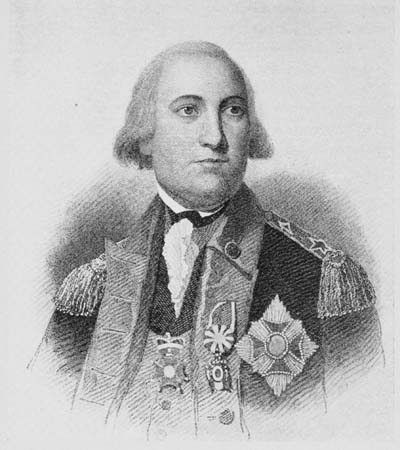
GENERAL BARON VON STEUBEN
That the Comte de Vergennes did not lend an altogether
deaf ear to this cry of despair, may be judged from the following
letter, dated February 15, 1778,
“M. le Comte:
“You have seemed to take a too obliging interest in my
fearful situation, for me to allow you to remain ignorant a
moment of the excessive joy which I have felt since yesterday.
Yesterday, my teeth clenched with fury to be without
news, I waited the moment to close my case, refusing to
make any payment the 15th, which falling due to-day Sunday,
was exigible yesterday, the 14th. Read, M. le Comte,
read I implore you what I received at 2 o’clock, and what I
replied this morning, see, my joy is excessive. I am no
longer exposed to the dishonor of a bankruptcy, which, notwithstanding
all my efforts, I could never have justified,
without an involuntary and fatal indiscretion. M. le Comte
de Maurepas received me Monday, like a corsaire who had
failed in respect to our flag. I did not say a word, I would
have had too much to say. I withdrew, death in my heart.
Not that I thought the interests of America abandoned. I
know very well that they are not....
“The profound silence which I have imposed upon myself
for the past two months, since the departure of the brother
of M. Deane, secretly embarked at Bordeaux and bearing
... but this shall be matter for another letter. It is just
that M. de Maurepas learns through me of this affair, for
if the fear of the most frightful misfortune has rendered me
pressing solicitor, I am not a man without virtue; it will be
the strongest proof which I can offer of the resignation with
which I know how to support the coldness and disdain of
those who have protected me. Ah! but I am again saved.
It is to you that I render a million thanks for all the efforts
which you have made in my favor. Never will I forget the
generous efforts which you have made to save me from
ruin....”
The moment of the open alliance between France and
America was now hastening forward. With it, ends the first
phase of the war of the United States against England,
“phase heroic by its enterprise, its constancy, its privations,
by the serenity of its chief and by the results obtained, if
one considers the nature and quality of the soldiers.”
(Doniol III, 260.)
It was to this period that the activities of Beaumarchais
in the cause of America essentially belong. The operations,
however, now so well under way, he continued to carry on
through his agent de Francy, though from henceforward they
are wholly private in character.
“Any crisis which puts in peril all that society undertakes
to secure to us by its laws, uncovers our hearts to the world,
strips our native selfishness of all its disguises, and makes us
appear to each other pretty nearly as bad as we must always
appear to the angels.”
Hon. John Bigelow in “Beaumarchais the Merchant.”
De Francy Sails for America—His Disappointment in the
New World—Beaumarchais Recounts His Grievances
against the Deputies at Passy—Rejoices Over American
Victories—Manœuvers to Insure Safety to his Ships—The
Depreciation of Paper Money in America—De Francy
Comes to the Aid of Lafayette—Contract between Congress
and De Francy Acting for Roderigue et Cie.—Letters
of Lee to Congress—Bad Faith of that Body—Deane’s
Signature to Documents Drawn up by Franklin
and Lee—Beaumarchais’s Triumph at Aix—Gudin Seeks
Refuge at the Temple—Letters of Mlle. Ninon.
THEVENEAU DE FRANCY arrived in the States the
1st of December, 1777. He was the bearer of letters to
Congress from Roderigue Hortalès et Cie., filled with polite
reminders of the fact that great advances had been made for
arms, ammunition, etc., and that it was very important that
much tobacco should be returned as soon as possible.
(Spark’s Diplomatic Correspondence, Vol. 1, p. 112.)
De Francy, young and enthusiastic, had set out full of
admiration for the brave people with whom he had to deal.
A little experience, however, convinced him that it was no
easy or brilliant task which lay before him. On the 14th of
December, two weeks after his arrival, he addressed a lengthy
letter to his superior, in which, after giving details of the
voyage, he proceeded to describe the condition of the country
to which he had come. He begged Beaumarchais to obtain
for him a captain’s certificate from the Ministry, “for,” he
said disconsolately, “it is all I am likely to get out of this
enterprise. Government currency is in such poor credit that
the 28 per cent. you promised me, to-day is worth only
1/2 per cent. The paper money is so discredited that merchants
prefer keeping their merchandise to selling it at any
price for paper. The farmers bring nothing to market, so
that everything is selling at the most extravagant prices;
chickens sold for $25.00 after the capture of Burgoyne.
There is no doubt that what you have done has been presented
here in a false light. I expect to have many prejudices
to destroy, and many heads to set right, for the sending
of several vessels without invoices (a thing which, to tell
the truth, is unprecedented) and the errors found in the bills
of lading of the Amphitrite especially, have caused it to be
suspected that the shipments were not made for a merchant.
I have explained to General Whipple the reason for this apparent
disorder, and have made him admit that it was inevitable.
Nevertheless, there were articles furnished at
Havre, which differ so widely from what was delivered, that
the General told me that our correspondent in this country
is either a poor merchant or a swindler. For example: on
my invoice there are 62 boxes or barrels of tinned iron.
Captain Fautrelle has delivered but 41.... They have
given him notice of missing boxes, but will they ever arrive?”
In his second letter, written two days later, he announced
that Silas Deane had been recalled and John Adams appointed
to replace him. He recommended Beaumarchais to
put his affairs in order and get his accounts regulated at
once, “for,” said he, “Mr. Adams has the reputation of being
the first statesman on the continent and he has in fact an
air, extrêmement fin. I fear that, aided by his colleagues, he
may be disposed to play sharp with you. Be on your guard.
“The Colonel Langdon thinks that the affair of the officers
has had something to do with the recall of Deane. I am
almost sure that it is the work of that famous politician of
Spain and Berlin, Arthur Lee. It is he in part who has
alienated Doctor Franklin from you, and no doubt he will
do what he can to have his opinion adopted by Deane’s successor.”
“I have not yet been able to obtain direct news of your
nephew but I am assured that he is in the Army and well
placed, and that he has received honorable mention. As to
his contract with Deane, I warn you not to reckon upon that.
I do not doubt that he will obtain by his own merits, the
grades which Mr. Deane promised him, but Congress will give
no heed to a contract made with him. Mr. Deane has far
exceeded his powers in granting commissions to officers who
were recommended to him in the beginning of his sojourn in
France. He had not even the right to make a lieutenant,
consequently nearly all who came out with commissions signed
by him, and who have not wished to serve until they were
placed, have been obliged to return. If M. du Coudray had
not died, they would have been greatly embarrassed to place
him.... Almost all our officers who brought letters of
recommendation, and have conducted themselves well, have
advantageous places. La Rouërie is colonel and much
esteemed. The Marquis de Lafayette has been wounded in
the leg. This did not prevent his keeping the saddle, however,
all day. He cried, ‘There, I am wounded, now I am
content.’”
In the meantime, Beaumarchais had written to de Francy
from Paris, “I profit, my dear Francy, of every occasion to
send you news; let it be the same with you, I beg of you.
Although it is to-day the 20th of December, 1777, my largest
ship has not yet set sail; but this is the common lot of all
merchantmen destined for America. The ministry fears that
our commerce will take away too many sailors at a time when
the state may have need of them from one day to another.
The most rigorous orders have been given in all the ports, and
especially in the ports where I arm. It seems that the force
and capacity of my ships have made Lord Stormont attack
the ministry in a way to make them fear that he suspects them
of favoring an operation, which in truth, is carried on without
them and in spite of them. Ready to set sail, my artillery
has been taken from me, and the delay in getting it back or
in forming another is what detains me in port. I struggle
against obstacles of every kind, but as I struggle with all
my force, I hope to conquer with patience, and courage and
very much money. The enormous loss which all this occasions
me seems to touch no one. The minister is inflexible;
there is no one, even to Messrs. the deputies at Passy, who
do not pretend to the honor of thwarting me,—me—the best
friend of their country. At the arrival of my vessel, the
Amphitrite, which at last unloaded at Lorient a small cargo
of rice and indigo, they had the injustice to seize upon it,
saying that it was sent to them and not to me; but, as M. de
Voltaire has very well said, ‘Injustice in the end produces
independence.’ They have very probably taken my patience
for weakness, and my generosity for stupidity. In proportion
as I have been attached to the interests of America, in so
far I have been offended by the dishonest liberties which the
deputies of Passy have wished to take with me. I have written
them a letter of which I send you a copy, and which they
have left without reply up to the present. While waiting, I
have left the cargo in the hands of MM. Berard brothers, of
Lorient, and in so doing I have not believed myself to have
deviated in any way from the frank and generous attitude I
always have maintained towards Congress, but simply to use
my legitimate right in regard to the first and very small
return which they make upon an enormous advance; that
cargo is worth about 150,000 livres. You can see the great
difference between that drop, and the ocean of the debt
owing me.” (Note of Loménie, “Franklin and Lee, who in
this instance acted in spite of Deane, did not dare insist,
and the cargo remained for Beaumarchais.”)
“As for you, my dear, I suppose you have arrived and that
you have obtained from Congress a reasonable adjustment,
such as the situation of America permits them to give. I
hope that following my instructions, you have obtained and
will continue to obtain much tobacco, and I expect that my
vessels will find their return cargoes ready to be embarked as
soon as they arrive where you are. I still hope that if events
should retard my vessels still longer, that you will send me
at least by le Flammand a ... cargo that will deliver me
from the horrible pressure in which I find myself.
“I do not know whether I flatter myself, but I count upon
the honesty and equity of Congress as I count upon mine
or yours. The deputies here are not in comfortable circumstances,
and pressing need often make men indelicate; this
is the way I explain the injustice which they tried to do me.
I do not despair even of winning them back to me by the
gentleness of my remonstrances and the firmness of my conduct.”
Loménie says, “This explanation may seem strange ...
but the fact is that the deputies from America received no
more remittances from Congress than Beaumarchais. Silas
Deane had been obliged to borrow from the latter the funds
absolutely necessary for his personal expenses. Arthur Lee
tried later to make use of this fact to inculpate Deane ...
but it has been well proved that necessity alone forced Deane
to contract the debt. As for Franklin, he was a little richer
when he landed in France, because he wrote to his colleague,
Silas Deane, from Quiberon, December, 1776; ‘Our vessel has
brought indigo to the value of about 3000 pounds sterling
which will be at our orders to pay our expenses.’...
“During the year 1777, the French Government itself gave
money at different times to the deputies at Passy, up to
the moment when it passed to them, through the Banker
Grand, the two millions, which were used partly to support
the agents and under-agents of America in France, and
partly to buy munitions for Congress.”
To return to Beaumarchais’s letter:
“It is very unfortunate my friend, for the cause of the
colonies that their interests in France have been confided to
several persons at once; a single one would have succeeded
better. As for what regards myself I must do M. Deane the
justice to say that he is ashamed and sorry both together,
at the conduct of his colleagues with me, of which the blame
belongs entirely to M. Lee.
“I am having trouble also with the provincial Congress
of South Carolina, and I wrote by L’Estargette to M. the
President Rutledge demanding justice from himself to himself.
L’Estargette, who will correspond with you, will inform
you of the success which follows my just demands.
“Across all these annoyances, the news from America overwhelms
me with joy. Brave, brave people! whose military
conduct justifies my esteem, and the beautiful enthusiasm felt
for them in France. In a word, my friend, I only want returns
in order to be in a condition to serve them anew, to
meet all my engagements, so as to be able to make others in
their favor.
“It seems to me, from what I hear, that our French
soldiers have done wonders in all the battles in Pennsylvania.
It would have been a disgrace for me, for my country, for
the name of a Frenchman, if their conduct had not been equal
to the nobility of the cause they had espoused....
“The City of London is in a terrible commotion; the ministry
at bay—the opposition triumphant, and the King of
France, like a powerful eagle, hovering above all these
events, reserves to himself another moment of pleasure to
see the two parties, divided between the hope and fear of
his decision, which will have such a great weight in the quarrel
of the two hemispheres.
“To prescribe to you your conduct when you are three
thousand miles from me would be foolishness ... serve me
to the best of your ability is the only way to render yourself
useful to me, to yourself, and to become interesting to
the Americans themselves.
“Do as I do; despise small considerations, small measures,
small resentments. I have associated you in a magnificent
cause; you are the agent of a just and generous man. Remember
that success is always uncertain, that the money due
me is at the risk of a great concourse of events, but that my
reputation is my own, as you are to-day the artisan of yours.
Let it be good my friend, then all will not be lost, even if
everything else should be. I salute you, esteem you, and love
you.”
In the postscriptum which follows, “we see Beaumarchais,”
says Loménie, “applying the resources of comedy to politics,
and ingeniously combining the means to elude the ministerial
orders, as he would have arranged a theatrical play.”
“Here,” wrote Beaumarchais in the postscriptum, “is what
I have thought out relative to my large vessel—le Fier Roderigue.
I must keep my word given to M. de Maurepas, that
my ship is to carry only seven or eight hundred soldiers to
Santo Domingo, and that I will return without touching the
continent. Nevertheless, its cargo is very valuable to Congress
and to me; it consists in ready made clothing for the
soldiers, cloth, blankets, etc. It carries an artillery of sixty-six
bronze cannons, ... and much other merchandise.
“After much thinking, it seems to me that you might arrange
secretly with the committee of Congress, to send two
or three American corsaires immediately to Santo Domingo.
One of them will send its gun-boat to Cape Francis ...
then M. Carabasse (Beaumarchais’s agent at the Cape) will
go aboard her with M. de Montaut, the captain of my vessel
le Fier Roderigue. They will arrange together that when
my vessel sets out, the American Corsaire will capture it
under any pretext he chooses, and carry it off. My captain
will protest violently, and threaten to complain to Congress.
The vessel will be taken to where you are. The Congress
will disavow the brutal act, liberate my vessel, with obliging
excuses for the French flag; during the time this takes, you
will have unloaded the cargo quickly, and filled the ship with
tobacco, and you will send her back to me with just what you
have been able to gather together. As the bearer of this,
M. Carmichaël, returns directly, you will have time to arrange
this manœuver either with the Secret Committee of
Congress, or directly with a friendly and discreet corsair.
By this means, M. de Maurepas will be disengaged from his
promise made to others, I from mine to him, because no one
can oppose himself to violence, and my operation will have
been successful in spite of all the obstacles which cross my
path.... My vessel starts before the 15th of January. It
bears orders to wait news from you at Cape Francis. After
all that I am doing, the Congress cannot longer doubt, I
hope, that the most zealous partisan of the republic in
France is your friend
“Roderigue Hortalès et Cie.”
Commenting upon the above letter, James Parton has
written:
“Such was Caron de Beaumarchais; unique among merchants
and men. Whether it was by those or by other
manœuvers that the ship was enabled to reach America, no
one has informed us. Certain it is that she arrived safely at
Yorktown, Virginia, and was loaded with tobacco for her
return. I trust M. de Maurepas was satisfied.” (Life of
Franklin, Vol. II, p. 271.)
The next letter in this series which has been preserved to
us is from De Francy and is dated May 14, 1778. In it he
announced that it was the twelfth since his arrival, all of
which he feared had failed in reaching their destination.
Continuing his account of the disorderly consequences of the
depreciation of paper money, he said, “I have just extricated
the Marquis de Lafayette from a serious mistake into which
he had fallen unsuspectingly.
“You have, of course, heard of the excessive depreciation
of paper money. At one moment in Pennsylvania it reached
the point of absolute worthlessness. The expenses of the
Marquis at this time, as he received no pay, were absolutely
enormous. He at first borrowed money on bills of exchange
at 2 for 1, afterwards at 3 for 1. He supposed that was
borrowing at the rate of $2 for $1 and $3 for $1; instead,
the rate was 2 and 3 pounds Pennsylvania currency for 1
pound sterling. The pound sterling was worth 34 shillings
Pennsylvania currency. He had signed the bills presented
to him without reading them and his expenses far exceeded
the amount he supposed them to reach. I informed him of
his error and ... have advanced him very considerable
sums on account of the House ... my arrangement with
him is that he shall reimburse the principal in one year in
Paris, paying 6 per cent., the same as Congress allows you.”
The allowance of 6 per cent. made by Congress to Beaumarchais,
to which De Francy here alludes, had been settled
in a contract drawn up the 6th of April, 1778 duly signed,
sealed and delivered to the indefatigable agent, of which the
following is the substance: (The contract in full is given by
Durand, p. 119-126 in his New Material for the History of
the American Revolution.)
“To whom it May Concern:
“Whereas, Roderigue Hortalès et Cie. have shipped or
caused to be shipped ... considerable quantities of cannon,
arms, ammunition, clothing, and other stores, most of which
have been safely landed in America ... and Whereas as
Roderigue Hortalès et Cie., willing and desirous to continue
supplying those stores ... provided satisfactory assumption
be made and assurance given for the payment in France
of the just cost, charges, freight of the cargoes already
shipped as well as those to be hereafter shipped....
“Now know ye that John Baptist Lazarus Theveneau de
Francy, agent of Peter Augustin Caron de Beaumarchais, as
representative of the house of said Roderigue Hortalès et
Cie., by him especially appointed and empowered to act ...
in virtue of the powers in him trusted, to contract, agree and
engage to and with M. Ellery, Jas. Forbes, Wm. Henry Dayton,
Wm. Hurer, Esq., a Committee of commerce, properly
appointed and authorized by the delegates of the United
States of America in Congress assembled to enter into, execute,
ratify and confirm this contract for and in behalf of
the said United States as follows:
“1st. That the cost and charges of the cargoes already
shipped shall be fairly stated in current prices ... at the
date of shipment.
“2nd. The freight to be charged agreeably to contract
entered into by Caron de Beaumarchais, Silas Deane, and
M. Monthieu.
“3rd. All orders to be transmitted to Messrs. Roderigue
Hortalès et Cie. or their agents, subject to the inspection and
control of an agent appointed under the authority of Congress,
who shall have liberty to inspect the quality of such
merchandise.
“4th. All articles hereafter shipped to be provided as
nearly as possible to order ... and not higher than the
current price ... attended with most moderate charges.
“5th. Good ships shall be chartered or bought at moderate
price for transportation of the stores.
“6th. That agents appointed under the authority of
Congress, shall have free liberty to inspect the quality, and
require the prices of all articles to be shipped for the account
of the United States, with power to reject such as they judge
unfit or too high priced; they shall also be party in the
charters and purchasing of ships to be employed in the
service.
“7th. Bills on the House of Roderigue Hortalès et Cie.,
for 24,000,000 livres tournois, annually, shall be honored
and paid....
“In consideration whereof, the said William Ellery, James
Forbes, William Henry Dayton, William Durer, Esq., Committee
of Commerce for Congress ... agree and engage
with Roderigue Hortalès et Cie., by their said agent as follows:
“1st. That remittances shall be made by exports of
American produce ... for the express purpose of discharging
the debt already justly due, or thereafter to become
justly due in consequence of this agreement....
“2nd. That all cargoes ... for the discharge of said
debt, be addressed to Roderigue Hortalès et Cie. ... subject
to the inspection and control of an agent appointed
under the authority of congress, who shall have liberty to
inspect the quality of such merchandise, assent to or reject
the prices offered, postpone the sales and do everything for
the interests of his constituents.
“3rd. That the customary interest of France not exceeding
6 per cent. per annum shall be allowed on the debt already
due, or that from time to time, shall be due to the said
Roderigue Hortalès et Cie.
“4th. That any payments of Continental Currency in
America ... shall be computed at the current, and equitable
course of exchange at the date of payment ... and
interest to be discounted on the amount from that date.
“5th. That remittances to be made for the purpose of
discharging the debt now due, or to become due to the said
Roderigue Hortalès et Cie., shall be made at such times and
seasons, as shall be most convenient for the American interest,
but are to continue until the entire debt, principal and
interest, shall be fully and fairly discharged.
“6th. That a commission of 2-1/2 per cent. shall be allowed
to the said Roderigue Hortalès et Cie. ... on all
charges and monies paid and disbursed by them for the account
of the United States.
“In witness whereof the contracting parties have hereunto
set their hands and seals, this 16th day of April in the year
of our Lord, 1778.
Signed: “William Ellery,
James Forbes,
William Henry Dayton,
William Durer,
Jean Baptiste Lazarus Theveneau de Francy.
Signed, sealed and delivered in the presence of
Charles Thomson,
Secretary of Congress.”
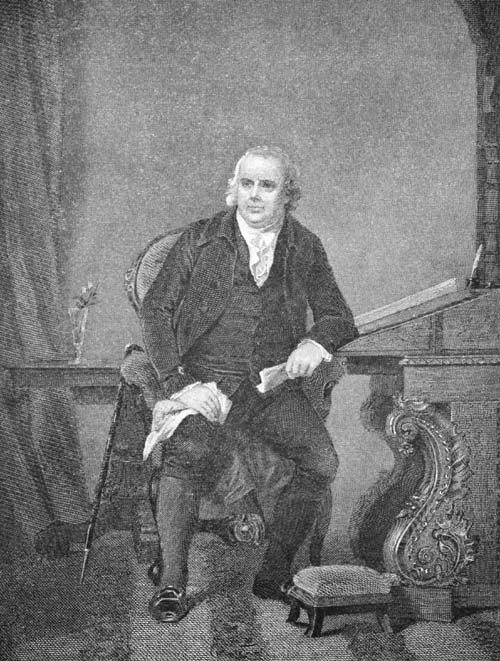
ROBERT MORRIS
Naturally enough, having obtained a contract of such precise
stipulations, signed, not as formerly, by an agent three
thousand miles from the seat of Congress, but by a committee
chosen from the bosom of that body, de Francy thought the
greatest difficulty of his mission already accomplished, and
Beaumarchais, when he received the glad tidings, set about
with renewed vigor, the gathering together and dispatching
of supplies. The Americans, however, still found reasons for
delaying the fulfillment of their part of the contract; and it
was only after two more months of ceaseless activity that de
Francy succeeded in getting enough tobacco to freight the
Fier Roderigue for its return voyage. Which cargo, the
second that had reached Beaumarchais, was destined when
it arrived in France to be seized upon by Lee, as that of the
Amphitrite had been, with the same results. In a letter to
Beaumarchais, June, 1778, de Francy announced the order
which he had received for the delivery of the tobacco, “The
rest of the letter,” says Bigelow, “is filled with complaints of
the bad faith of these republicans, who refuse him the vessels
they had promised to carry off his tobacco, and urges Beaumarchais
to send out at least six himself.”
A letter dated July 11th is filled with still more bitter
complaints. “In spite of the most formal engagements,” he
wrote, “these people find the means of obstructing all business,
the pretext for breaking promises the most solemn.”
In a word, he thinks it better to suspend business until “laws
better established put a bridle upon the bad faith which
reigns in the country.” A little later he wrote: “If this
business were to be continued, which I do not advise unless
you have special reasons, it would be one of the greatest
commercial operations ever engaged in, if one could only rely
upon the good faith of these republicans. But they have
no principle and I desire sincerely to see all your accounts
closed with them.
“I believe Carmichaël is the only one who appreciates all
you have done for this country. He arrived at York two
days ago, before I went to Virginia. The moment of our
meeting was one of the most agreeable that I have passed in
this country. We did not quit each other for two days.
During these two days, I rendered him a service by letting
him into the private character of all the members of Congress.
I told him those who were his friends, and those who
were opposed to his nomination as Secretary of Legation.
In gratitude I hope he will serve you well.... I made the
President feel that your letter to M. Sartine clearly demonstrated
that the assertions of du Coudray and Lee were vile
and infamous lies. The force and energy of this letter astonished
him. He could not help saying to me that he would
not have believed that anyone could have written with such
freedom to a minister in France....
“I believe Carmichaël is your friend; if I am mistaken, I
never wish to speak to an American again, as long as I live.”
Then follows a most doleful picture of the discord, selfishness,
and greed, which seemed to reign everywhere. Upon
this part of the letter, Hon. J. Bigelow has commented admirably.
He says:
“A little more experience with the world would probably
have taught the young man that any crisis which puts in
peril all that society undertakes to secure to us by its laws,
uncovers our hearts to the world, strips bare our native
selfishness of all its disguises, and makes us appear to each
other, pretty nearly as bad as we must always appear to the
angels. There is no doubt but the revolted colonists,
struggling for their very existence, appeared disadvantageously
to a sentimental enthusiast like de Francy, but we
have yet to hear of any people while having so much at risk,
appearing better.
“Of course after having been kept so long without tobacco,
and treated with undisguised distrust as a swindler or as the
agent of one, de Francy takes very dyspeptic views of the
men who compose the Continental Congress.”
As a matter of fact, he hits off one after another of our
great heroes with anything but the reverential tone which
we are wont to use in referring to them. “President
Laurens,” he says, “is a very upright merchant, but no more;
in important affairs he is an old woman.” “Samuel Adams
is an old fox who has genius.” “The famous Hancock is
precisely the Corbeau revêtu.” “Robert Morris works for
himself while working for the Republic.” “General Washington,”
here his tone changes, “has honor, courage, and a
truly disinterested patriotism.... I have seen much of him
and I really believe he is the first man on the continent, although
to tell you the truth, he is very difficult to know
well....”
The unaccountably bad faith of Congress began to arouse
the suspicions of the agent of Beaumarchais, which he hastened
to communicate to his superior. On the 31st of July,
1778, de Francy wrote: “I have not been able to obtain a
perusal of the letters of Lee. Two of his brothers, members
of Congress, had possession of the foreign correspondence
during the past year, and they have abstracted all his letters
for fear they would be prejudicial to him; but I cannot doubt
but you are there painted in the blackest colors. I know
at least that anonymous letters were written against you,
filled with lies, insults, and atrocities; and what is of a
marked fatality, your excessive zeal for the Americans has
been the basis of the lies of Lee, and of all the misgivings with
regard to you. Doubtless you recollect that at the commencement
of 1776, while you were in London, you promised
this little doctor, then humble and suppliant, that if the
Americans fully decided never to reunite with England, you
would send out under the name of Roderigue Hortalès et
Cie., all the succor of which they would have need; and the
enthusiasm which then animated you, gave great latitude to
your promise. At least, the doctor so communicated it; and
to give importance to what he said, he made an ambassador
of you, and instead of naming you, he remarked that the
promise came from the ambassador of France. Behold here
the origin of his elevation! His brothers have strongly supported
his high pretensions and he was named agent. He
was obliged to maintain what he had written, but fearing
lest the reserve of the ministers towards the agents in France
should make Congress suspect that the French Ambassador
never had spoken to him in England, he abandoned his first
assertion and then wrote that it was you who called upon him
in London to make him such beautiful promises on the part
of the French Minister. The Memoir of du Coudray attests,
on the other hand, that the minister put you forward that
he might disavow you if he desired. Congress readily allowed
itself to be persuaded that everything that arrived on
your vessels was a present, or at least a loan from your government
which it might acquit at its pleasure.
“When after my arrival at York, I announced my purpose
and the reclamations I came to make, I did not find a
single member of Congress disposed to believe that it was
an individual who had rendered them such signal services,
and that he was to be paid for them, as it was impossible to
find on this continent a man who would ever have attempted
for the freedom of his country the one-hundredth part of
what you have done.... True Americans are infinitely
rarer here than in Paris, and I am satisfied there is not one
whose zeal approaches yours.”
As a sample of what Lee had been writing to Congress, the
few following passages quoted at random, will suffice:
“Upon this subject of returns I think it my duty to say ...
that the ministry have repeatedly assured me that no returns
are expected for these subsidies.” At another time he
wrote, speaking of a shipment just being made, “this is gratis
as formerly, and what has been sent I have paid for; so
that those merchants Hortalès et Cie. have no demand upon
you; nor are you under any necessity of sending effects to
them, unless you think it a proper market for some things, as
it certainly is for fish.” (See Vindication of Arthur Lee.)
“These assertions,” says Loménie (Vol. II, p. 178), “offering
the advantage of dispensing America from all gratitude
and all payment to Beaumarchais, Congress was naturally
disposed to adopt.” It must be remembered, however, that
at this moment the party which upheld Arthur Lee, headed
by his two brothers and Samuel Adams, were at the height
of their power, so that the opposite side, in whose ranks
stood the upright and clear-sighted John Jay, was temporarily
overruled.
Before inserting the last letter which we give of de
Francy, a short explanation is necessary. Already the
reader has been apprised through these letters, of the difficult
position in which Silas Deane had been placed, through
the secret disavowal of his acts by Congress, even while he
still remained their credited commissioner in France. Unconscious
of the perfidy of Lee, yet thoroughly distrusting
him, dismayed at the attitude of Franklin, who explained
nothing, but who took from the first the part of ignoring all
Deane’s previous transactions, the latter was forced to submit
for the present to this embarrassing state of affairs, and
to place his whole hope of adjustment in the equity of
Congress in which he still firmly believed. Slowly it began
to dawn on him, that the ground of his colleagues’ resentment
to him was largely a matter of money. In the beginning
Deane, realizing to the full the lack of trained military
men among the insurgents, had freely promised commissions
of high rank, with proportionately high pay, to the
French officers who came to him well recommended and who
had a desire to serve. As most of these men were either
unable or unwilling to provide their own equipment and
traveling expenses, Deane had advanced them money in the
name of Congress, but taking it, not from his own resources,
for he had none, but from those of his friend Beaumarchais,
with the understanding, of course, that it should all be
repaid.
When Franklin arrived, Deane soon realized that repayment
would be very difficult, and dreading to face the effect
which the whole truth would have produced, he had begged
Beaumarchais to delay sending in his accounts until Congress
should have ratified his agreements. This Beaumarchais,
with characteristic generosity, readily conceded. De
Francy wrote: “You appear still to have the blindest confidence
in Deane and you neglect your own interests....
Well, now, on February 16th, when Deane passed the morning
with you, they had written to Congress—(I have seen
the letter signed by the three agents)—that you got possession
of the cargo of the Amphitrite contrary to their expectations,
and that they did not oppose it because their
political situation did not permit them to come to any explanation
with you. They add that they had been informed
that you had sent an agent to Congress to solicit the payment
of a very considerable debt, but that it was not necessary
to settle anything with this agent; that the commercial
venture to which it related was a mixed business which it was
necessary to sift before closing the account; that they would
occupy themselves with the business, and that it was better
to leave it with them to arrange with you.
“I will make no reflections upon this transaction; I will
only say that it appears to me very extraordinary, an incredible
weakness even, that Mr. Deane should have consented
to sign what it pleased his colleagues to write, up to
the very moment when you had the generosity to sacrifice
everything for him and he knew it. You can well imagine,
that with such news, doubts are reinforced, objections multiplied,
etc., etc.”
Of the recall of Deane, already announced in a previous
letter of De Francy, we shall speak at length, in another
chapter. For the present let us return to France to follow
Beaumarchais in his private career as citizen.
It will be remembered that when, in 1776, the restored
parliament had annulled the decree of the parliament Maupeou,
Beaumarchais had petitioned the Ministers to obtain
for him the adjournment of the final decision in the matter
of the suit instituted against him by the Comte de la Blache
so many years before. “This suit,” says Loménie (Vol. II,
p. 54), “which had been the origin of his tribulation, and of
his celebrity, still subsisted, and in the midst of his triumphs
held his fortune and his honor in check.... The Count
de la Blache, seeing the credit of his adversary so rapidly
growing, urged on with all his force the final decision. Beaumarchais
was in less haste; occupied in organizing his operations
with America, and in reconquering his civil existence,
he did not wish to terminate the other case until he had assured
himself very well of his position.
“The decisive combat came off at Aix in July, 1778. The
author of the Barbier de Séville, accompanied by the faithful
Gudin, started for Provence. He was going at the same time
to despatch two vessels from Marseilles for the United States
and to finish with the most desperate of his enemies.”
“At Marseilles,” says Gudin in his memoir, “Beaumarchais
covered the part he played in public affairs, by the veil of
amusements or his private business.”
Of the memoirs which he published at Aix, in relation to
this important suit, Loménie has said: “They contain passages
which are not below the best to be found in the memoirs
against Goëzman ... one feels a man who is conscious
of his power, who conducts vast operations, who enjoys a
great celebrity and who considers his social importance as
equal at least to that of a field-marshal.
“The city of Aix seemed predestined to famous lawsuits.
In the same place where Mirabeau was soon to come to give
forth the first bellowings of his eloquence, was seen to glitter
the sparkling fancy of the Barbier de Séville. Vainly, the
Count de la Blache surrounded himself with six lawyers,
and prepared from very far back his triumph.... At
the end of a few days, Beaumarchais had conquered the
public.”
“You have completely turned the city,” his attorney said
to him. His triumph was complete; a definite decree of Parliament
disembarrassed him forever of the Comte de la
Blache. The latter was condemned to execute the agreement
drawn up and signed, du Verney, 1770.
“The affair,” says Gudin, “was examined with the most
scrupulous attention and judged after fifty-nine seances.
The legatee, all of whose demands were rejected, was condemned,
and his memoirs were suppressed.”
Beaumarchais, in turn, was condemned to pay 1,000 écus
to the poor of Aix as a punishment for the severe witticisms
against his antagonist, in which he had indulged in his
memoirs. They were also publicly condemned. Beaumarchais,
however, was triumphant. Overwhelmed with joy to
find his honor and his fortune restored to him, he desired
only that the good people of Aix should rejoice with him.
Instead, therefore, of the 1,000 écus demanded of him, he instantly
doubled the sum, requesting that it might be distributed
in dowries to twelve or fifteen poor, but worthy
young women; the benediction of so many families happily
established seeming to him the most beautiful which he could
draw upon himself.
“The intoxication of this triumph, after so many years
of uncertainty and combat, the enthusiasm with which he
was received by the people of Aix,” are graphically described
by Gudin in a letter written at the moment of his triumph.
“All the city,” wrote Gudin, “which subsists on suits, was
in a state of the greatest impatience. While the judges deliberated,
the doors of the court house were besieged;
women, idlers, and those interested, were under the trees of a
beautiful avenue not far off. The cafés, which bordered this
promenade, were also filled. The Comte de la Blache was in
his well lighted salon, which looked out on this avenue. Our
friend was in a quarter at some distance away. Night came;
at last the doors of the court house opened and these words
were heard: ‘Beaumarchais has gained;’ a thousand voices repeated
them, the clapping of hands spread down the avenue.
Suddenly the windows and doors of the Comte were closed,
the crowd arrived with cries, and acclamations, at the house
of my friend; men, women, people who knew him and those
who knew him not, embraced him, and congratulated him;
this universal joy, the cries and transports overcame him, he
burst into tears, and see him, like a great baby, let himself
fall fainting into my arms. It was then who could succor
him, who with vinegar, who with smelling salts, who with air;
but, as he himself has said, the sweet impressions of joy do
no harm. He soon returned to himself, and we went together
to see and thank the first president.... On
returning ... we found the same crowd at the house;
tamborines, flutes, violins succeeded before and after supper;
all the fagots of the neighborhood were piled up and
made a fire of joy.... The mechanics of the place
composed a song, and came in a body to sing it under his
windows. Every heart took part in his joy, and everyone
treated him like a celebrated man, to whose probity, due justice
had at length been rendered.”
Gudin’s enthusiasm for his friend was destined, however,
to a singular recompense. Arrived in Paris, he had composed
a lengthy epistle to Beaumarchais (Loménie II, p. 66),
which began as follows:
“The severe justice of Parliament has confounded the
malice of thy enemies, though they had hoped that the dark
art, which a vile senator in unhappy times had made to incline
the balance, would surprise the prudence of our true
magistrates.”
This chef-d’œuvre, composed of a hundred or more verses,
had been inserted in a copy of Courrier de l’Europe, which
was published in London, and which had altered the text by
putting at the place of the words, “of a vile senator”—“a
profane senate,” so that the personal allusion to the judge
Goëzman was transformed into an allusion to the whole parliament
Maupeou. But most of the members of this judicial
body had gone back to their places in the grand council, from
whence Maupeou had drawn them. Irritated at the triumph
of Beaumarchais, and not daring to attack a man so strong
in the favor of the public and the confidence of the ministers,
“they seized this opportunity of scourging Beaumarchais
over the back of his friend.”
The latter was absent from Paris, busy with the despatching
of vessels from one of the seaports, when, suddenly, a
warrant, “issued,” says Loménie, “without the slightest
warning, came to surprise the pacific Gudin.” As he sat at
table one evening with his mother and niece, a letter was
handed him, which proved to be from a friend, Mme. Denis,
niece of Voltaire. He glanced it through and there read
the startling announcement: “You are about to be arrested,
and that for verses printed in the Courrier de l’Europe. You
have not an instant to lose.”
“I lost none,” wrote Gudin. “Having read the letter, I
quitted the table without a word and passed into my room,
where I hastily dressed myself, and then took refuge at the
house of Beaumarchais. I read the letter to Mme. Beaumarchais....
“My first care was to send a messenger to prepare my
mother for the strange visit she was about to receive, and
bidding her not to alarm herself, and to reply that she did
not know where I was, and that it was possible I was with
Beaumarchais at a hundred leagues from Paris.”
After calling about him several of his friends, men of experience,
they deliberated what was to be done. “Do not
allow yourself to be taken, these men of the grand council
hate Beaumarchais, and are quite capable of revenging themselves
upon his friend....”
“I decided therefore to withdraw into the enclosure of the
Temple. This castle, ... so scandalously taken by
Philipp the Bel from the Templars, and since ceded to the
Chevaliers of Malta, was at this time, owing to the privileges
of that order, an asylum, not for criminals, but for any person,
who, without having given serious offense, found himself
in difficulty, as for instance, a debt, a challenge, in a word,
an affair like the present. (The Temple, famous for being
the stronghold in which a few years later the royal
family was imprisoned, and from which Louis XVI was
led to execution, was subsequently destroyed by Napoleon.
It stood near the present Place de la République. Much of
its site is now occupied by the Magasins du Temple, the
great second-hand shops of Paris.)
“The custom was to inscribe one’s name upon the bailiff’s
register on entering the Temple; he asked me why I had
come to claim the privileges of the place.
“‘Is it debts?’
“‘I have none.’
“‘An attack?’
“‘My enemies, if I have any, have never used any weapon
against me except their pen.’
“‘A quarrel at cards, or an affair with a woman?’
“‘I never play cards, and I have never caused either disorder
in a family, nor scandal in a house of joy.’
“‘But why then?’
“‘For verses, which grave personages do not find to be
good, verses printed I don’t know how in London, denounced,
I don’t know why in Paris, and which the grand council, who
has not the control of books and is in no way judge of what
takes place in England, pretends to be injurious to a tribunal
which no longer exists.’”
“Beaumarchais, on his return to Paris, learned of my adventure,
and was justly angry. He came and took me from
my retreat. ‘Be sure,’ he said, ‘they will not dare to arrest
you in my carriage or in my house.’”
“At the end of several days,” says Loménie, “Beaumarchais
had succeeded in liberating his friend; nothing could
paint better his situation at this period than the tone of his
letters to the ministers, especially to the keeper of the seals:
“‘Monseigneur,’ he wrote, ‘I have the honor to address
to you the petition to the council of the King, of my friend
Gudin de la Brenellerie, who unites to the most attractive
genius the simplicity of a child, and who, in your quality of
protector of the letters of France, you would judge worthy
of your protection if he had in addition the honor of being
known to you.’”
Beaumarchais thus was able to ignore the smoldering resentment
of his enemies and to press forward his vast enterprises.
The war had now broken out between France and
England. French merchantmen went to sea completely at
the mercy of events. The French flag, instead of a protection,
was now a signal for attack. It was therefore clear
that if Beaumarchais was to continue his mercantile operations,
it must be upon a new basis. But before we follow
him into the equipping of armed vessels to protect his merchant
fleet, let us linger a moment, that we may gain a still
nearer view of Beaumarchais, the man.
The popular enthusiasm which everywhere had welcomed
the uprising amongst the colonists continued to voice itself
in every quarter of France and on all occasions where it was a
question of the rights of man. The wild joy which had
greeted the triumph of Beaumarchais at Aix was due largely,
Gudin tells us, to the fact that for the first time in the
annals of that city a nobleman had been so signally humiliated
as had been his antagonist. In this general desire
for a recognition of human rights, the aristocracy of France
themselves took the lead. Rousseau, calling so loudly for
human beings, men and women, to leave the lines marked out
for them by authority and tradition and to return to nature
as their guide, was heard, not only in the remotest hamlet
of the realm, but his voice found echo in its lordly castles
and its palace halls. In Emile, he traced the revolution
which was to take place in the instruction and training of
the child; in La Nouvelle Heloïse, he laid down a scheme of
morals, the teaching of which was directly opposed to the
Christian code. The effect of these teachings upon contemporary
France could not be more strikingly exemplified
than in the following letter addressed to Beaumarchais by a
girl of seventeen. It gives at the same time an idea of the
confidence which the name of the latter inspired among the
masses of the people. The letter is written from Aix and
is dated not long after the successful termination of his
suit:
“Monsieur:
“A young person crushed under the weight of her anguish,
comes to you and seeks consolation. Your soul, which is
known, reassures her for a step which she dares take, and
which, were it anyone else, would remain without consequences.
But are you not Monsieur de Beaumarchais, and
do I not dare hope that you will deign to take my cause and
direct the conduct of a young and inexperienced girl? I
am myself that unfortunate who comes to lay her sorrows
in your bosom; deign to open it to me. Allow yourself to
be touched with the recital of my woes.... Ah! if
there are hard hearts, yours is not of that number....
Shall I say to you, Monsieur, that I feel in you a more
than ordinary confidence? You will not be offended; my
heart tells me to follow that which it inspires. It tells me
that you will not refuse me your succor. Yes, you will aid
me, you will support despised innocence; I have been abandoned
by a man to whom I have sacrificed myself. I avow,
with tears that I yielded to love, to sentiment and not to
vice.... I enjoyed a certain consideration; it has
been taken from me. I am only seventeen, and my reputation
is lost already. With a pure heart and honest inclinations
I am despised by everyone. I cannot endure this idea;
it overwhelms me and I am in despair.... Ah, Monsieur,
lend me your aid, reach out to me your generous hand,
cause to spring up in my oppressed soul, hope and consolation.
I do not wish to injure the perfidious one who has
betrayed me; no, I love him too much. It is at the foot of
the throne that I wish to carry my plaint. If you will deign
to aid me, I promise myself everything. You have powerful
protectors, Monsieur; you know the Ministers, they respect
you. Say to them that a young person implores their
protection, that she sighs and groans night and day; that
she desires only justice.... (The ungrateful one must
in the end do me justice.) I can say without presumption
that I am not unworthy of his tenderness. He opposes nothing
to my happiness but my fortune, which is not sufficient
to arrange his affairs, which are not in too good order. He
has no aversion to me. There is nothing about me to inspire
it. The only crime of which I am culpable is to have
loved him too well. Do not abandon me, Monsieur; I put
my destiny in your hands.... If you are kind enough
to reply to this, be so good as to address your letter to M.
Vitalis, rue de Grand-Horloge, at Aix, and above the address
simply to Mlle. Ninon. You will be so good as to pardon me,
Monsieur, if I still hide my name.... I know
that with you I have nothing to fear, but still a certain fear
that I cannot conquer, that I would not know how to define,
holds me back. You have connections in Aix; I am very
well known here. In small towns one knows everything; you
know how they talk. I implore you, do not divulge the confidence
which I have taken the liberty of making to you....
Monsieur, I have the honor to be, with sentiments
of the most perfect consideration, your very humble and
very obedient servant,
“Ninon.”
“Let one imagine a similar letter,” says Loménie, “suddenly
falling from six hundred miles away, upon a man
forty-six years of age, the busiest man of France and Navarre,
who had need to confer every morning with the Ministers,
who had forty ships on the seas, who pleaded against
the comedians, who was preparing a pamphlet against the
English Government, who was busy founding a bank, who
dreamed of editing Voltaire; surely this man would throw
into the waste basket the sorrows of a young and unknown
girl. Not in the least. Beaumarchais had time for everything.
Here is his reply to Mlle. Ninon:
“‘If you are really, young stranger, the author of the letter
which I have received from you, I must conclude that you
have as much intelligence as sensibility, but your condition
and your sorrows are as well painted in this letter as the
service which you expect of me is little. Your heart deceives
you when it counsels you an act like the one which you dare
conceive; for although your misfortune might secretly interest
all sensible persons, its kind is not one whose remedy
can be solicited at the foot of the throne. Thus, sweet and
interesting Ninon, you should renounce a plan whose futility,
your inexperience alone hides from you. But let me
see how I can serve you. A half confidence leads to nothing
and the true circumstances of an open avowal might perhaps
furnish me the means of seeing how the obstacles may be removed
which separate a lover from so charming a girl. But
do not forget that in desiring me to keep the matter secret
you have told me nothing. If you sincerely believe me the
gallant man whom you invoke, you should not hesitate to
confide to me your name, that of your lover, his position
and yours, his character and the nature of his ambition;
also, the difference in your fortunes, which seems to separate
you from him.’ He next attempts to persuade the young
girl to forget a man who has shown himself so unworthy
of her regrets. ‘Forget him, and may this unhappy experience
of yours hold you in guard against similar seductions.
But if your heart cannot accept so austere a counsel, open
it to me then entirely, that I may see, in studying all the
connections, whether I can find some consolation to give
you, some view which will be useful and agreeable.
“‘I promise you my entire discretion, and I finish without
compliment, because the most simple manner is the one that
should inspire the most confidence. But hide nothing
from me.
‘Beaumarchais.’

THE TEMPLE
“Mademoiselle Ninon,” continues Loménie, “asked for
nothing better than to unburden her poor heart; she addressed
to Beaumarchais an avalanche of letters of which
several contain no less than twelve pages; she gave her name,
the name of her seducer, and recounts her little romance with
a curious mixture of naïveté, of precocity, sensitiveness, intelligence
and garrulity. This Provençale of seventeen is
literally saturated with the Nouvelle Heloïse.
“‘Fatal house,’ she cried, in speaking of the place where
she first met her lover, ‘’tis thou which causes my pains.’
She has all its contradictions, ... protesting that if
she has left the path of virtue, she has only all the more
felt the worth of a pure and virtuous soul. ‘Lovely innocence,’
she cried, ‘have I lost thee? Ah! no, no; I have
sounded to the remotest depths of my heart; it is too sensitive,
but it is still honest. I implore you, Monsieur, do not
believe it corrupt.’
“Whether,” continues Loménie, “these rather wordy dissertations
of the little philosopher in skirts gave to Beaumarchais
the idea that it would be too difficult to correct
such an exalted brain, or whether it was that the work which
was crushing him on every side prevented his following this
strange correspondence, true it is that he replied no more
to the long letters of Mlle. Ninon, although she addressed
to him the most melancholy reproaches. But what could he
do? The war had just broken out between France and England.
Beaumarchais, who had had his own part in bringing
about that result, was engaged himself in the conflict; he
drew up political memoirs, he armed vessels; where could he
find the time to reply to the confidences of Mademoiselle
Ninon? Nevertheless it would seem that these letters interested
him because he has classed them in a package by themselves,
upon which he has written with his own hand: ‘Letters
of Ninon, or affair of my young client, unknown to me.’”
“After the perplexing and embarrassing scenes you have
just had to pass through, it must give you the most solid joy
to see an armament going out to America.... I congratulate
you on this great and glorious event, to which you
have contributed more than any other person.”
“Silas Deane to Beaumarchais.”
March 29, 1778.
“It seems to me that we cannot consistently with our own
honor or self-respect pay off an undisputed debt with a
doubtful or disputed gift.”
Speech of Mr. Tucker of Virginia, Relative to the Claims of
Beaumarchais, 1824.
Deane’s Recall—Beaumarchais’s Activity in Obtaining for
Him Honorable Escort—Letters to Congress—Reception
of Deane—Preoccupation of Congress at the Moment of
His Return—Arnold and Deane in Philadelphia the Summer
of 1778—Deane’s Subsequent Conduct—Letters of
Carmichaël and Beaumarchais—Le Fier Roderigue—Silas
Deane Returns to Settle Accounts—Debate Over the
“Lost Million”—True Story of the “Lost Million”—Mr.
Tucker’s Speech—Final Settlement of the Claim of the
Heirs of Beaumarchais.
IN
accounting for the recall of Deane, Wharton, in the beginning
of his Diplomatic Correspondence, Vol. I, p. 560,
says:
“Deane had, or was supposed to have had, a considerable
amount of business patronage which to Arthur Lee’s eye gave
too much opportunity for speculation, and not only did he
suppose that Deane made use of this opportunity for his own
benefit, but he himself desired to have the entire control of the
business side of the mission placed in the hands of his brother
William Lee, then, through the influence of Wilkes, alderman
of London. The close connection which existed between Lee
in Paris and the center of the opposition in London was not
unknown to the French Ministry.”
From the first, Vergennes had distrusted Lee, and held him
at a distance. “Having had occasion,” says Loménie (Vol.
I, p. 115), “to study closely the work of the deputation at
Passy, I am able to affirm that Lee never had any credit with
the French Government, who, rightly or wrongly, suspected
him of having secret relations with the English Cabinet....
It is this which perfectly explains his permanent
irritation against his two colleagues.”
Doniol (Vol. I, p. 368) affirms positively, “spies of the
foreign office were in communication with him and he aided
them to arrive even to M. de Vergennes.”
“In his heart,” continues Doniol, “he had an antipathy
for France, which was shared by the majority of his countrymen.
He was willing to accept everything from us, but
on condition that no obligation be incurred.”
“It is certainly not too much to say,” says Jared Sparks
in his Life of Franklin (Vol. I, p. 450), “that the divisions
and feuds which reigned for a long time in Congress with
respect to the foreign affairs of the United States are to be
ascribed more to Lee’s malign influence than to all others.”
It was the same that at the most perilous moment of the
war, which was precisely this same winter of 1778, was exerting
itself to the utmost of its power to place a creature of its
own at the head of the American forces. So bitter had party
spirit become, that a member from New England, whose patriotism
was undisputed, had allowed himself to write in a letter
which has been preserved: “I would rather that the
whole cause should come to ruin, than that Mr. Washington
should triumph.”
Lee succeeded so well in poisoning the minds of Congress
with regard to their commissioner that after much discussion
a resolution was passed on December 8, 1777, recalling
Deane. The reason given being the importance of obtaining
information as to the true state of affairs in Europe.
“It was originally proposed,” says Parton (Life of Franklin,
Vol. I, p. 250), “to accompany the resolution of recall by
a preamble of censure. But John Jay took the defence of his
absent friend and succeeded in getting the offensive preamble
condemning a servant of the public unheard, stricken out.”
“In this case,” continues Parton, “Jay was warmly his friend
and defender, and not on this occasion only, but whenever
he was attacked by Congress.”
Franklin also warmly pleaded his cause by letter. Knowing
that Congress had received unfavorably the foreign officers
sent over by Deane, he wrote as follows:
“I, who am on the spot, and who know the infinite difficulty
of resisting the powerful solicitations of great men, ... I
hope that favorable allowances will be made to my
worthy colleague on account of his situation at that time, as
he long since has corrected the mistake and daily proves
himself to my certain knowledge an able, faithful, active and
extremely useful servant of the public.” (Parton, Life
of Franklin, Vol. II, p. 350.)
Franklin indeed might well plead for his friend in regard
to the commissioning of officers, since, as has been seen, it
was he who was responsible for the departure of du Coudray
for America.
When the news of his recall reached Deane, he was filled
with consternation. It was easy for him to pierce the thin
veil of the reason given. The treatment which he already
had received from Congress seemed the guarantee of further
trouble.
He at once communicated his fears to Beaumarchais and
his resolution not to return to America until a satisfactory
explanation of the charges held against him were given.
Beaumarchais, however, warmly urged his complying with
the command of Congress, assuring him that his presence
and the positive proof of his integrity which he would bear
with him quickly would dispel the gathering storm.
Deane seems to have been convinced that the wisest course
would be to yield to authority; accordingly, he at once set
about his preparations for the journey. Beaumarchais,
equally active, addressed a lengthy memoir to the ministers.
The memoir is given in full in the Deane papers (Vol. II,
p. 399). In it, with characteristic boldness, he prescribes
the rôle necessary for each minister to play, in order that
Deane’s enemies may be outwitted. Though Beaumarchais
was no longer entrusted with the millions which were being
handed over to the Americans, yet from the tone of his
memoir there can be no doubt that he was still an indulged
favorite.
“March 13, 1778.
“Secret Memoir to the King’s Ministers, Sent to the Comte
de Vergennes:”
(After explaining clearly the character and ambitions of
Lee, his English connections, his influence in Congress, Beaumarchais
continued:) “To succeed in his design, it was necessary
to dispose of a colleague so formidable as Mr. Deane.
This he has done by rendering him in many respects an object
of suspicion to Congress.
“Having learned that foreign officers demanding commissions
were not received favorably by the American Army, he
put the worst construction upon the conduct of his colleague
who sent them, maintaining that Mr. Deane arbitrarily and
in spite of good advice, was responsible for the sending....
Another reason is the officious zeal displayed by M. Lee in
constantly writing to Congress that all merchandise, etc., was
a present.... Nothing then is easier than for the
adroit Lee to blacken the conduct of Mr. Deane by representing
it as the result of underhand measures contrived to
support demands for money in which he expected to share;
and this explains the silence, more than astonishing, that
Congress has observed in regard to over ten letters of mine
full of details.”
Then he draws a faithful picture of Deane’s situation and
speaks of his having at first formed the determination not to
return until charges should be communicated to him.
“I have, however, urged him to go back to face the storm.
‘Lee,’ I have said, ‘accuses you of having arbitrarily sent officers
to America; your complete defense is in my portfolio. I
have in my possession a cipher letter from this time-serving
Lee, urging me to send engineers and officers to the assistance
of America, and the letter is written before your arrival
in France.’”
Then he urged the importance for French interests to have
so true and tried a friend as Mr. Deane back in America.
“I would desire,” he wrote, “a particular mark of distinction,
even the King’s portrait or some such noticeable present
to convince his countrymen that not only was he a creditable
and faithful agent, but that his personality, prudence and
action always have pleased the French Ministry.... I
strongly recommend his being escorted by a fleet....
Once justified before Congress, his opinion becomes of immense
weight and influence.... His enemies will remain
dazed and humiliated at their own failure....
Should the ministry be unable to grant a fleet as he wishes,
he ought at least to have a royal frigate to be furnished by
M. de Sartine. His friend Beaumarchais will with pleasure
undertake the composition of an explanatory and defensive
memoir. He should have a testimonial, laudatory of his conduct,
and this important writing is the province of the Comte
de Vergennes. Finally I believe that there should be accorded
to him some special favor, showing the esteem entertained for
him personally and this would properly come from M. le
Comte de Maurepas in the name of the king. (This seems
to have been the only suggestion not carried out by the
ministers.)
“There is not a moment to lose....”
Beaumarchais then recommended that everyone assume a
dejected air at the news of Deane’s recall, so that the enemies
of the latter might be thrown off their guard. “If it
is thought advisable, I will even quit Paris as one driven to
despair. My lawsuit at Aix will furnish an excellent excuse.
I suggest in addition that a reliable person accompany Mr.
Deane, to return in the same frigate under order to await
his convenience, bringing back the result of M. Deane’s labors
with Congress....
“Upon the assurance that these considerations be regarded
as just, I will neglect everything else until I have completely
vindicated Mr. Deane.”
If anything could be more curious than the tone of the
above memoir, it is the docility with which each minister filled
the rôle mapped out for him. Not only was the portrait of
the King with the personal testimonials given to Deane, but
a fleet was sent out under the popular Comte d’Estaing to
bear him safely to America, and with him the first minister
sent by France to the new world went as his companion,
charged with orders to follow closely his interests in the
ensuing combat.
To the president of Congress he bore the following letter
from the Comte de Vergennes:
“Versailles, March 25, 1778.
“Monsieur Deane being about to return to America, I
seize this occasion with pleasure to give my testimony to the
zeal, activity and intelligence with which he has conducted the
interests of the United States and for which it has pleased
his Majesty to give marks of his satisfaction.”
To Deane himself Vergennes wrote the same day:
“March 26, 1778.
“As I am not, Sir, to have the honor of seeing you again
before your departure I pray you to receive here my wishes
that your voyage may be speedy, short, and happy, and that
you may find in your own country the same sentiments which
you inspired in France. You could not, sir, desire anything
to be added to that which I feel for you and which I shall
keep as long as I live. The King, in order to give a personal
proof of the satisfaction which he has had in your conduct,
charged me to communicate it to the Congress of the United
States. This is the object of the letter which Mr. Gérard will
give you for Mr. Hancock. He will also give you a box
ornamented with a portrait of the king. You will not refuse
to carry into your country the image of its best friend.”
On the 23rd of March, Beaumarchais had written to Congress
in a letter in which he set forth the proofs in his possession
of the innocence of Deane.
“These, gentlemen,” he wrote, “were the real motives that
determined us both in sending you the officers. As I have
never treated with any other, as my firm never has transacted
business with any other in France, and as the other commissioners
have been lacking even in common civility towards me,
I testify that if my zeal, my advances of money, and my shipments
of supplies and merchandise have been acceptable to
the august Congress, their gratitude is due to the indefatigable
exertions of Mr. Deane throughout this commercial
affair.
“I hope that the honorable Congress, rejecting the insinuations
of others, who are desirous of appropriating for themselves
the credit of the operations, will accept in perfect
faith the present declaration of the man most capable of enlightening
them and who respectfully signs himself and his
firm, gentlemen, yours, etc.
“Caron de Beaumarchais,
“Secretary to the King and Lieutenant-General of the King’s
Hunt, known in America under the title of his firm, Roderigue
Hortalès et Cie.”
Before quitting France, Silas Deane addressed a letter to
Beaumarchais, dated March 29, 1778. Obliged to quit
France during the absence of his friend, he wrote thanking
him for his letter to Congress, which he hoped would throw
light upon the vexed question. “It is unhappy,” he said,
“that the short time allowed me to prepare for my voyage will
not admit of our making at least a general settlement of our
accounts.... I hope to return to France early in the
fall; immediately after my return it shall be my first business
to adjust and settle with you the account for your several
expeditions and disbursements.... After the perplexing
and embarrassing scenes you have had to pass through,
it must give you the most solid joy to see an armament going
out which will convince America and the world of the sincere
friendship of France, and their resolution to protect its
liberties and its independence.
“I again congratulate you on this great and glorious event,
to which you have contributed more than any other
person....
“I shall improve my first opportunity of writing to you,
and rely on being honored with a continuance of your correspondence
and friendship. Wishing that you ever may be
happy and fortunate, I am, etc.,
“Silas Deane.”
The misgivings which had haunted the American commissioner
seemed entirely to disappear during his voyage, so confident
was he of being able to justify himself before Congress,
and if ever commissioner had the right to look forward with
joy to setting foot again on his native land, that commissioner
was Deane. When he had gone out two years previously
he had left his country poor, unrecognized and not
yet decided to declare its independence. By his unhesitating
and indefatigable zeal, aided by that of Beaumarchais, supplies
and officers of priceless value had been sent to its aid,
arriving at the moment when they were most needed.
Mistakes had been made, it is true, but those mistakes were
all of a nature that no man of honor need blush to acknowledge.
Far from having enriched himself during those two
years of service, he had spent not only all his own private
savings, but had been obliged to draw very heavily upon the
generosity of his friend, since all the stores brought with him
from America had fallen into the hands of the English. In
the words of Parton, “He was returning now the acknowledged
minister of a victorious nation, the honored guest of a
French Admiral, bringing back a powerful fleet (twelve line
of battleships and four frigates) to aid his country, and accompanied
by an ambassador of the King of France! Well
might he write exultingly to the president of Congress, well
might he expect a warm welcome and a hasty adjustment of
his claims; as the proud French vessel was dropping anchor
in Delaware Bay, July 10, 1778, he wrote: ‘I shall embark
this afternoon ... and I hope soon to have the honor
of presenting my respects to your Excellency and the Honorable
Congress in person. . . .’
No reply came to him from Congress. No one paid him
the smallest attention. His testimonials were ignored and
even the presence of the French fleet had no power to rouse
Congress from a stony indifference. He was in despair.
“He had brought with him,” said Parton, “only a hundred
pounds, not expecting to be detained in America many
weeks. When at last given audience, he told his story to distrustful
and estranged employers. All the friends of Arthur
Lee, all the ancient foes of France, and a large proportion
of the faction who desired to put Horatio Gates into the
place of Washington, were disposed to believe the foul calumnies
sent over by every ship from Paris.”
As a matter of fact the time of his arrival in Philadelphia
was not well suited to a fair consideration of Deane’s
claims. The city recently had been evacuated by the British
Army. During the occupation, Toryism had been rampant
and the state was retaliating with indictments for treason.
Disputes over questions of jurisdiction engaged the civil authorities
in quarrels with Arnold, the commander of the garrison,
who numbered among his sympathizers Silas Deane and
the mercantile class.
Arnold, after his brilliant exploits at Saratoga, had seen
himself thrust aside at the moment of victory to make way
for Gates. Wounded at Saratoga, and burning for revenge,
Arnold was already so much disgusted with the Continental
Congress that he began seriously to wish to see Great Britain
triumph.
Washington had put him in command of the garrison at
Philadelphia in June, 1778. The reigning belle of the
Quaker City was at that moment Miss Margaret Shippen,
“the most beautiful and fascinating woman in America.” She
was the daughter of a wealthy merchant, who along with his
whole class, was eager for the war to come to an end through
a speedy adjustment with Great Britain, whose liberal offers,
since the surrender of Burgoyne, seemed more than satisfactory
to their moderate patriotism.
No sooner had Arnold entered into his new post than he
fell a captive to the charms of the young woman in question,
then under twenty years of age.
“As no one kept a finer stable of horses, nor gave more
costly dinners than Arnold,” it was natural that he should invite
the Tory friends of the young lady whose hand he hoped
to win. Although he was “thirty-five years of age and a widower
with two sons” ... his handsome face, his gallant
bearing and his splendid career, made him acceptable. In the
fall their engagement was publicly announced, while the Tory
sentiments of the commander of the fort of Philadelphia became
definitely fixed.
The bitterness of his own grievances against Congress led
him to give ear willingly to the complaints poured out by the
exasperated French commissioner, whose patriotism was also
rapidly vanishing in the gulf of his private wrongs.
It was during this summer of association between Arnold
and Deane that the sentiments of the latter underwent the
profound change which induced a subsequent conduct so disappointing
to his dearest friends. Silas Deane never has been
accused of treason to his country, for he was incapable of
such an act as that which rendered Arnold an object of contempt
to our enemies even—but that he was untrue to his
own past cannot be denied. No one in the beginning had been
a warmer advocate of independence or had worked so indefatigably
for an alliance with France. In the end, this was
completely reversed. The unfortunate course which he took
to avenge himself for the atrocious wrongs heaped upon him
by the party in Congress then in power led him to exile, where
he died destitute and dishonored. However, “the most bitter
reproach,” says Wharton, “ever heaped upon this loyal patriot
was that he had joined hands in friendship with the
traitor Arnold.”
While the condemnation of Lee at the bar of history seems
unanimous, it is unfair to allow the blame of his conduct to
rest wholly upon him, for it must be shared by that party in
Congress which was dominant during most of the existence of
the body, and which supported the pretensions of Lee and
shared his antagonisms.
A consideration of the complex causes which led to the ruin
of Deane is in place here, only as these causes relate to his
connection with Beaumarchais. Up to a certain point the
credit of the two men is inseparable, and it must not be forgotten
that the same party which planned Deane’s downfall
was also the one that tried to prevent the alliance with
France, and was unwilling to admit any debt of gratitude to
Roderigue Hortalès et Cie.
Gérard de Rayneval, first ambassador of France to
America, who accompanied Deane on the occasion of his
recall, attributes the action of Congress at this time to an
“esprit d’ostracisme, which,” he says, “already has begun to
make itself felt against those men who, having rendered important
services, are no longer deemed necessary....”
The private secretary of Deane while in France, W. Carmichaël,
had returned to America some time before. Having
aided Beaumarchais and Deane in the shipment of supplies to
the new world, there was no one who understood better the
exact nature of the difficulties against which they had labored,
or the real debt of gratitude owed them by America.
Under date of September 3, 1778, he wrote to Beaumarchais
from Philadelphia:
“I have written you twice lately about your affairs, so that
I have the pleasure of repeating that Congress begins to feel
its lack of attention to you and to realize that it was too
ready to believe the base insinuations of others, which I truly
believe would have had no weight if du Coudray had not circulated
such prejudicial reports concerning you.... I
have applied myself with my whole power to convince my
compatriots of the injustice and ingratitude with which you
have been treated and this before the arrival of Deane, and I
flatter myself to have had some success. His efforts have
been the same, so that justice, although tardy, should now
prevail. I wish for the honor of my compatriots that it had
never been necessary for us to plead for you.
“M. de Francy is in Virginia and works sincerely and indefatigably
for your interests. I expect him here soon.
“Your nephew spent several weeks with me, but is now commanded
with his general to join the army under the orders
of General Sullivan. He is a brave young man who makes
himself loved very much when he is known; he has all the
vivacity of his age and desires to distinguish himself. General
Conway assures me that he conducted himself like a
young hero at the battle of the Brandywine. I take the
liberty of entering into these details because I know they will
delight his mother, since bravery always has been a powerful
recommendation to the fair sex, and she will be charmed to
find so much in her own son.... I do not know whether
I shall be continued in my place as Secretary of the Embassy
at your court, or be employed in some other department.
“Dr. Franklin certainly will be continued at the Court of
Versailles, and an attempt will be made to force the Lees to
fall back into the obscurity from which they have lifted themselves,
but whether this will succeed is doubtful. We have
as many intrigues and cabals here as you and your friends
suffer from on the other continent. And why not? Are we
not sovereign states and are we not friends and allies of
Louis XVI?
“I beg you to believe me always, Yours,
“W. Carmichaël.”
The spirit of the letter, as well as the news it brought,
must have been consoling to the heart of Beaumarchais. But
in the meantime, he had been pushing forward his vast commercial
enterprises and with his usual vigor prepared himself
for new dangers to which the open alliance with France exposed
his undertaking. He wrote to De Francy:
“I am dispatching the Zephyr, so that you may know that
I am ready to put to sea a fleet of more than twelve vessels at
whose head is le Fier Roderigue, which you sent back to me
and which arrived safely the first of October. This fleet will
carry six thousand tons, and it is armed absolutely for war.
So arrange yourself in consequence. If my ship, the Ferragus,
leaves Rochefort in September, keep it there to join
my fleet in returning. This is an armament which I hold in
common with M. de Montieu.... Allow the ships to remain
in port no longer than is absolutely necessary, for although
strong and well armed, our enemies must not be allowed to
interfere with their return.
“They will not arrive until some time in February, as they
are to make a detour to provision our colonies with flour and
salt provisions, of which they are in great need, and the
payment of which, sent to us in bills of exchange upon our
treasurers before the return of the fleet, will enable us to
meet the terrible outlay which this armament costs us....
You will receive by the Fier Roderigue all my accounts with
Congress.... The result is that Congress will pay for nothing
which it does not receive, or that was destroyed en route.
I join the exact account of what I have received from Congress,
in spite of the unjust deputation at Passy who have
disputed every return cargo and who would have seized upon
that of La Thérèse if M. Pelletier, instructed by me, had not
sold it by authority. This perpetual injustice makes me
indignant and has made me take the resolution to have no
more to do with the deputation as long as that rogue Lee
is there....
“I have been promised, my dear Francy, your commission
of captain. I hope to be happy enough to send it by le Fier
Roderigue, but do not count upon it until you see it in your
hands. You know our country; it is so vast that it is a long
way from the place where things are promised to the place
where they are given. In a word, I have not received it yet,
although it has been promised....
“I have received no other money from the comte de Pulaski
than that which he himself gave me. I send you his exact
account. He should write me but I have heard nothing. I
approve of what you have done for M. de Lafayette. Brave
young man that he is. It is to serve me as I desire, to oblige
a man of his character. I have not yet been paid for the
money I advanced to him but I have no uneasiness about
that.
“As for you my dear de Francy, I will write you later
what I will do for you. If you know me, you will expect to
be well treated. Your fate is hence forth attached to mine.
I esteem you and love you and you will not have long to
wait for the proof of it. Remember me often to Baron von
Steuben. I congratulate myself after all I hear of him, for
having given so great an officer to my friends the free men,
and for having in a way forced him to follow that noble
career. I am not in the least disturbed by the money I lent
him. Never have I made a use of funds the investment of
which gratified me as much as this does, since I have succeeded
in putting a man of honor in his true place. I learn
that he is inspector-general of all the troops; bravo! Tell
him that his glory is the interest on my money and at that
title I have no doubt he will repay me with usury.
“I have received a letter from M. Deane and also one from
Mr. Carmichaël; assure them of my warm esteem. Those
two are brave republicans. They have given me the hope
that I may soon embrace them both in Paris, which will not,
however, prevent me from writing them by the Fier Roderigue,
who is very proud to find himself at the head of a
small squadron, and who I hope will ne se laissera pas couper
les moustaches, on the contrary he promises to do some
cutting for me,
“Adieu, my Francy, I am yours for life,
“Caron de Beaumarchais.”
Silas Deane returned to France in 1781, to settle all his
accounts. On the 6th of April of that year the indebtedness
to Beaumarchais by Congress was fixed by him at 3,600,000
livres after the deduction of all receipts and comprising the
interest promised. This sum, then, Beaumarchais demanded
of Congress.
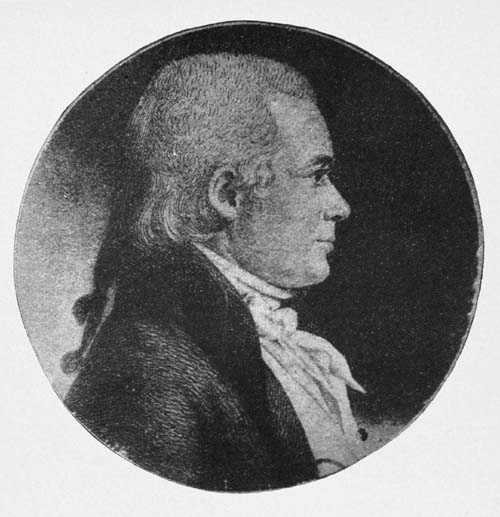
CÆSAR AUGUSTUS RODNEY
Attorney General of the U. S.
Two years passed. Congress paid no attention to the
demand. In 1783, another emissary, Mr. Barclay, arrived
from America in the capacity of consul-general, and with
the mission to revise all the accounts rendered by Silas
Deane. Beaumarchais refused to submit to this treatment,
but Mr. Barclay told him Congress would pay nothing until
there had been a new inspection of the accounts. After a
year Beaumarchais was forced to submit.
In revising the statement made by Deane, Mr. Barclay
admitted all the claims, but gratified Congress by lessening
commissions, expenses, etc. Still Congress refused to pay
the new and reduced accounts. Soon after this, an incident
arose which determined Congress to postpone payment indefinitely.
In the fall of 1783, after signing the treaty which ended
the war, the United States wished to borrow six millions from
the French Government. It was decided to grant the request
and at the same time to make an exact recapitulation
of all the sums already furnished, whether loaned or
presented.
In the first class were announced eighteen millions; then
another loan of ten millions from Holland, guaranteed by
the king of France and of which he paid the interest; finally
the six millions about to be loaned. This constituted a sum
of thirty-four millions which the United States promised to
refund at future times. Finally the King announced as a
gift, the three millions conveyed to the colonists before her
treaty of Alliance in 1778, and six millions given in 1781.
It was therefore nine millions which the king of France relinquished
without expecting any return, and this in addition
to the enormous expenditure made in sending the fleets and
armies of France to America. (See Loménie Vol II, p. 186.)
The statement was signed by Franklin and received without
comment by the United States, but three years later, in
1786, Franklin made the discovery that the king of France
stated that three millions had been given to the cause of
independence in America before 1778, whereas he, Franklin,
had received but two millions.
What had become of the other million?
Inquiry was at once made of the United States banker in
France, and an explanation demanded. After much difficulty
it was learned that this million was one delivered by
the royal treasurer on the 10th of June, 1776.
“It was,” says M. de Loménie, “precisely the million given
to Beaumarchais, but the reticence of Vergennes showed that
an embarrassing mistake had been made, though unconsciously,
by the royal treasurer.”
It was impossible in 1786 for the French government to
avow the secret aid she had given to the colonies before her
open recognition of American Independence. The two millions
given to Franklin in 1777 through the banker, Grand,
after France had decided upon the policy of open recognition,
but before the act, had never been a secret—but the
million given to Beaumarchais, while really intended to help
the American cause, had been conveyed to him under stress
of secrecy at a time when it was unsafe to submit to writing
even the most informal engagement in regard to it.
Whatever the stipulations made concerning the use of the
money, they were verbal and have never been revealed. Nothing
could attest the profound confidence inspired in the magistracy
by Beaumarchais more than this absence of documents
relative to the loan. There can be no doubt that whatever
the arrangement made by Vergennes, he was satisfied
with the account rendered him by Beaumarchais, for we find
him coming repeatedly to the latter’s aid when the failure of
Congress to return cargoes, placed the house of Hortalès
and Company in danger of bankruptcy. The confidence of
the minister is also further attested by his refusal to deliver
the receipt for the million, signed by Beaumarchais, on the
10th of June, 1776, and so become a handle to the calumny
which Congress was directing against him.
To summarize the exposition of that conscientious historian,
Loménie: “Why,” he asks, “did the government insert
this million in the list of those given directly to America?
Was it simply a recapitulation of the accounts of the
treasury made without thought of the inconvenience that
might result for Beaumarchais; or did the government really
intend Beaumarchais to render an account of it to the United
States?... We have the right to affirm that the government
never intended that he should be accountable for it to
anyone but to the minister.
“By refusing constantly to name the person to whom the
million had been given, the minister said implicitly; ‘I class
this million with those given gratuitously because in effect
it was given; but since it was not given to you, and as the
man to whom it was given, engaged himself by his receipt
to render an account of it to me, and not to you, that man
cannot be accountable except to me. If I asked to have the
million returned, you would then have the right to demand it
of him who received it; but since I ask nothing, I am the
one to decide whether that million, gratuitously given by me,
shall profit you or the man to whom I gave it. It was given
to aid in a secret operation very useful to you, but which,
by your refusal to acquit and by losses which he has experienced
in his commerce with you, seems to have been more
harmful than fruitful to him.’” (See Loménie, Vol. II, p.
190.)
Of all this that was transpiring Beaumarchais knew
nothing, nor could he obtain from Congress any explanation
of their reason for totally ignoring their debt to him. At
last his patience at an end, on the 12th of June, 1787, he
wrote to the President of Congress as follows:
“A people become sovereign and powerful may be permitted,
perhaps, to consider gratitude as a virtue of individuals
which is beneath politics; but nothing can dispense
a state from being just, and especially from paying its
debts. I dare hope, Monsieur, that touched by the importance
of the affair and by the force of my reasons, you
will be good enough to honor me with an official report as to
the decision of the honorable Congress either to arrange
promptly to liquify my accounts, or else to choose arbiters
in Europe to decide the points debated, those of insurance
and commission as M. Barclay had the honor of proposing
to you in 1785; or else write me candidly that the sovereign
states of America, forgetting my past services, refuse me
all justice: thus I shall adopt the method best suited to my
interests which you have despised, to my honor which you
have wounded, although without losing the profound respect
with which I am of the General Congress and of you,
Monsieur le President, the very humble, etc.
“Caron de Beaumarchais.”
It was at this juncture that Beaumarchais, stung by the
reproaches of his own countrymen, made a ringing vindication
of his acts in the cause of American independence, which
will be given in the next chapter.
The reply which Congress made to the letter above quoted,
was to appoint Arthur Lee to examine the accounts.
“The work was soon done,” says Loménie, “d’un tour de
main. Arthur Lee pretended to discover that instead of
3,600,000 livres owing Beaumarchais, he not only had
nothing to reclaim but on the other hand owed 1,800,000
francs to the United States!” The absurdity of this account
could not fail to appear to Congress, and after four years
more of protestations, in 1793 it confided a new examination
of the debt to “that most distinguished American Statesman,
Alexander Hamilton,” who established the sum owing
Beaumarchais as 2,280,000 francs, but at the same time he
proposed to suspend payment until the question of the lost
million was settled.
In the meantime the Revolution was advancing upon
France with awful strides. Already the royalistic government
had fallen, that government whose greatest glory was
its noble service to the cause of American independence.
When in 1794 Gouverneur Morris applied to Buchot,
then minister of Foreign affairs for the new French government,
there was no one left who knew or cared for the details
that had prevented Vergennes from producing that
famous receipt. At the demand of Congress, therefore, it
was given to Morris.
Armed now with what it chose to consider as proof that
Beaumarchais wilfully had appropriated to himself a million
livres intended by the French Government for it, Congress
refused all settlement.
They not only repudiated the payment of the 2,600,000
livres surplus of the debt honorably acknowledged by Deane,
who alone knew the immense advances that had been made by
Beaumarchais to cover the expenses of the commissioner as
well as of the officers whom he had commissioned, but that
august body considered that it might even dispense with paying
the 1,800,000 livres surplus over and above the million,
out of the sum accorded by Alexander Hamilton in which
he ignored those advances, together with a part of the commission
and interest freely granted by Congress in the contract
already quoted in this volume, and arranged by the
agent of Beaumarchais, Theveneau de Francy, in 1778.
Congress refused all this, arguing that, as M. de Loménie
says: “Since the interest of the million given in 1776 will
absorb the difference, therefore we owe nothing, and will
pay nothing.”
The interest on the surplus, as it would have much more
than absorbed the million in question, they, of course, conveniently
ignored.
This turn in his affairs with Congress was a crushing blow
to Beaumarchais, but it did not prevent him, during the
entire remainder of his life, pleading with the representatives
of the American people to pay their debt to him.
But at the moment when Congress held triumphantly
aloft the receipt for the 1,000,000 livres, and flaunted it in
his face, Beaumarchais was in no position to defend himself,
for the Revolution which had overwhelmed France had so
shattered and ruined his fortune that he was obliged to take
refuge in a garret in Hamburg. Here, devoured by
anguish,—unable to obtain news from home, knowing only
that his goods had been confiscated, that his wife, his daughter,
and his sisters had been thrown into prison, his thoughts
turned to the people for whom he had performed such
herculean labors and to them he addressed one last appeal.
This was in April, 1795.
“Congress,” says Loménie, “remained deaf to all his
reclamations; not only it allowed him to die without liquidating
the debt, but during the thirty-six years following his
death, all the governments which succeeded one another in
France, and all the ambassadors of those governments, vainly
supported the demand of the heirs of Beaumarchais.”
During the years which follow his death, from 1799 to
1835, “The claims of the heirs of Beaumarchais” occupy
congress after congress of the United States. In the
progress of the suit all the French governments, from the
Empire under Napoleon down to the reign of the “bourgeois
King,” Louis Phillippe, always take the stand of Vergennes.
The following letter from the Duc de Richelieu, dated the
20th of May, 1816, may be said to express the attitude of
the French Government in the whole matter. He wrote:
“The notes successively presented by the ministers of
France are so particular and positive, that they seem to
remove all doubt on the facts of the subject in dispute, and
consequently all hesitation as to the decision to be given.
It was in fact stated that the French Government had no
concern in the commercial transactions of M. de Beaumarchais
with the United States.
“By this declaration it was not only intended to convey
the idea that the government was in no ways interested in
the operations or in his chances of loss or gain, but a positive
assurance was also given that it was wholly unconnected
with them; whence it results that in relation to them France
is to be considered neither as a lender, a surety nor as an
intermediate agent. The whole of these transactions were
spontaneous on the part of M. de Beaumarchais and the
right and agency derived from them appertain exclusively to
him....
“The million delivered on the 10th of June immediately
reached its intended destination and a simple authorization
of the King, but a few months subsequent to the payment of
the sum, was the only document which finally placed the
expenditure in the regular train of fiscal settlement.
“I am therefore warranted, Sir, after a fresh examination
of the facts, in presenting the declaration of the above
as stated, and in considering it a matter of certainty that
the million paid on the 10th of June was not applied to the
purchase of shipments made to the United States at that
period by M. de Beaumarchais....
“There is no member of the Government who can be ignorant
of the services rendered by the head of that family to
your cause and the influence produced on its early successes
by his ardent zeal, extensive connections and liberal employment
of his whole fortune.
“Be pleased, Sir, to receive, etc., etc.
This claim, so repeatedly stated before Congress, was
taken up and examined by a succession of committees which
seem each to have adopted the views of the French Government.
To the honor of the United States let it be stated
that such men as John Jay and Thomas Jefferson, had from
the first recognized the debt due to Beaumarchais and had
urged the payment of the debt. Later it was James Madison,
Cæsar Rodney, William Pinkney and others, who similarly
urged Congress to appropriate the money to liquidate
the claim.
To close this long debate we have selected a few paragraphs
taken here and there from reports of committees,
terminating with an extract from a speech delivered by Mr.
Tucker of Virginia, in order to demonstrate clearly that
the enlightened opinion of the most representative Americans
always has stood for the recognition of this claim....
“Only two points,” the report says, “are to be decided: Did
Mr. Beaumarchais receive from the French Government
1,000,000 livres in behalf of or on account of the United
States? If so, has he, or his representative at any time accounted
with the United States for their expenditure? ...
On the face of the instrument itself it appears that Beaumarchais
was to account to Vergennes and not to the United
States, for the expenditure of the money.... This contradicts
the idea that he was accountable to us for its application....
The engagement of Beaumarchais was positive,
express and unqualified to account to Vergennes and to him
only for the money received. The United States are no
parties to the instrument; there is no stipulation to render
them any account of the expenditure.... It is not easy to
conceive on what principle he ought twice to account for the
same money.... The French government have uniformly
declared that they furnished no supply of arms or
military stores. Vergennes is full and explicit; he states
that all the articles furnished by Beaumarchais are on his
private account, who had settled with the artillery department
for them by giving orders or bills for their value. This
expressly excludes the idea that the million livres in question
were intended to be applied to the payment in advance of
the account of Beaumarchais.... This construction was
acquiesced in by our government in the contract of 1783,
when we knew neither the date nor the person to whom the
money was paid....
“... The United States allege that the French Government
paid this debt for them. The Government through
their ministers declare officially that they did not. There
seems therefore no room for dispute. Considering that the
sum of which the million livres in question made a part, was
a gratuitous grant from the French Government to the
United States, and considering that the declaration of that
Government clearly states that that part of the grant was
put into the hands of M. de Beaumarchais as its agent, not
as the agent of the United States, and that it was duly accounted
for by him, to the French Government; considering
also the concurring opinion of two attorneys-general of the
United States that the said debt was not legally sustainable
in behalf of the United States; I recommend the case to the
favorable attention of the legislature whose authority alone
can finally decide on it. Signed
“James Madison,
“C. A. Rodney,
“Wm. Pinkney.
“January 31, 1817.”
From the speech of Mr. Tucker of Virginia, 1824:
“Mr. Chairman: It is well known to most of the assembly
that in the first years of the Revolution, M. de Beaumarchais
furnished military supplies and clothing to the amount
of several million livres....
“The merits of this claim have hitherto hinged upon the
fact whether the million in question was received by Beaumarchais
for the purpose of supplies or not;...
“In regard to this there is the solemn declaration of M.
de Vergennes that the king had furnished nothing. Again
there can be no doubt that M. de Beaumarchais must have
been held accountable to his government for the million, for
whatever purpose it was put into his hands.... If it was
intended for such services as those for which secret service
money is employed, it is said, and it seems not improbable,
that the vouchers in such cases are destroyed.... But
there could be no reason to destroy them if they related
merely to the purchase of supplies....
“On weighing all the considerations there is some preponderance
of testimony that M. de Beaumarchais received
the million in dispute for the purpose of supplies, and if
France had been passive on this occasion or if we had
paid any valuable consideration to her for this million I
should think that we were justified in charging M. de Beaumarchais
with that amount. But when it is recollected that
we received these supplies directly from him, having arranged
the settlement of the account on our own terms; that the
million that we claim as a credit was paid not by us, but by
France, and that, as an act of bounty; and when France
insists that it was for another purpose;... it seems to me
that we cannot, consistently with our honor or self respect,
pay off an undisputed debt with a doubtful or disputed
gift....
“As an individual, I could never seek to give the bounty
of a benefactor a direction which he objected to, for the
purpose of making a discount from the acknowledged debt
of a third person.
“Sirs:—in this matter France is right or she is wrong....
Then the error consists in claiming our gratitude for
9,000,000 livres instead of 8,000,000 ... which can in no
way affect the claim of M. de Beaumarchais.... The whole
present difficulty comes from the mistake of Dr. Franklin
in the treaty of 1783....
“Assuredly if our agent had signed a treaty under a mistake
as he himself states, that mistake should be rectified with
the French Government which should give us a satisfactory
explanation or hold us bound in gratitude for only 8,000,000
livres, neither of which can affect the claims of M. de
Beaumarchais....
“Mr. Chairman: We ought to be consistent with ourselves
with regard to the declaration of the French Government.
When M. de Vergennes declared to our commissioners
in September 1778, that the military supplies were furnished
by M. de Beaumarchais, we acquiesced in that assurance and
required no further proof....
“On every ground then, Mr. Chairman, I am free to say,
I would vote at once for the appropriation to the whole
amount of this claim ... and I hope the committee will
adopt the resolution for that purpose offered by the Committee.”
But the government of the United States still refused to
listen to reason. However, in 1835, under pressure of necessity,
the United States having a claim against France which
it wished to bring forward, offered the heirs of Beaumarchais
the choice of taking 800,000 francs and considering the
affair closed, or nothing. The heirs chose the former and
so at last ended the long drawn out debate regarding “the
lost million.”
“It was to take from the Ministers all idea of my ambition,
to conjure the storm, that I began again to amuse
myself with frivolous theatrical plays, while guarding a profound
silence upon my political actions.”
Petition to MM. the Representatives of the Commune of
Paris by P. A. Caron de Beaumarchais.
The Mariage de Figaro—Its Composition—Difficulties
Encountered in Getting it Produced—It is Played at
Grennevilliers—The First Representation—Its Success—Institut
des mères nourrices—Beaumarchais at Saint
Lazare.
SEVERAL years before Beaumarchais had written in
answer to the question,—“What gives you so gay a philosophy?”
“The habit of misfortune, I hasten to laugh at everything
so as not to be obliged to weep.”
So now in 1778 after seeing Deane recalled, his own service
ignored, and jealousies aroused even among the ministers
themselves he turned from all this bitterness, to develop
in his own inimitable way, the gay scenes of his
Mariage de Figaro.
“In this piece,” says Gudin, “the combinations were so
new, the situations so varied that one would be tempted to
believe that such a work would have absorbed all the faculties
of the mind of its author during many years, but for him it
was only a relaxation from the many and diverse affairs in
which he was engaged.”
M. de Maurepas said to him one day, “And how, occupied
as you are, have you been able to write it?”
“I, M. le Comte! I composed it the day when the ministers
of the King had sufficient leisure to go together to
the Redoute.”
“Are there many repartees equal to that in your comedy?
If so, I answer for its success,” retorted Maurepas; for just
the day before all the ministers had gone in a body to spend
several hours at one of the new and fashionable pleasure
gardens of Paris known as the Redoute.
But having written his play was very far from having it
produced, for the daring boldness of the author since the
marvelous success of his first comedy was known not to
have diminished. The authorities rightly suspected that the
new play would contain even more pointed criticisms upon
the existing social order than had the Barbier. To be
produced in public it must first pass the censors and have
the approbation of the king.
La Harpe has said of this play, “It took much wit to
write it—but not so much as to get it played.”
Letters given by Loménie show that already in October,
1781, the actors of the Théâtre-Français had seen the piece
and were discussing with Beaumarchais the distribution of
the parts. The author had appealed to the lieutenant of
police to name a censor and asked as a special favor that
the play should not leave his office. Six weeks later Beaumarchais
learned that the king had read his play and that
it had been condemned.
Madame Campan in her Memoires speaks of the incident.
Marie Antoinette who had always liked and protected
Beaumarchais said to the King,
“Will the piece not be played?”
“Certainly not,” answered the King, “it is detestable.
Why, the Bastille would have to be pulled down if that were
allowed!”
The situation against which the versatile author had to
contend was the positive prohibition by the supreme head of
authority—the King himself, but who was seconded, however,
by very few of those personages who were nearest to
him. In fact this very prohibition excited the curiosity of
the court to such an extent that everyone from the loftiest
personages down, and notably the Duke d’Artois, brother
of Louis XVI, was demanding the favor of hearing Beaumarchais
read his play.
“Every day,” explained Madame de Campan, “one hears
on every side, ‘I have heard,’ or ‘I shall hear the piece of
Beaumarchais.’”
Flattered as the author must have been by the enthusiasm
of the courtiers, he was far too clever to lose his head or
grant lightly the privilege of a reading.
“Even the most considerable personages of the realm,”
says Loménie, “obtained the privilege on condition that they
asked at least twice. The Princess Lamballe, for instance,
personal friend of the queen, had a violent desire to have
Beaumarchais read the Mariage de Figaro in her salon. She
sent an ambassador to him, one of the greatest nobles of
the court, the oldest son of the Maréchal de Richelieu, the
Duc de Fronsac—an ardent patron of the Mariage.—Beaumarchais
refused to see him. The duc wrote next day:
“You closed your door against me yesterday which was
not well. However, I do not hold against you enough malice
to prevent me from speaking of the negotiation with which
I am charged by Mme. the Princess of Lamballe—and I propose
you come next Wednesday to Versailles to dine with
me, after which we will go to her. Your very humble servant,
etc.
“Le duc de Fronsac.”
Beaumarchais evidently refused a second time for again
the Duke wrote another letter, more urgent, to which the
author finally yielded.
The grand Duke (afterward Paul I) and Duchess of
Russia, while visiting Versailles in the spring of 1782, also
became ardent supporters of the piece, after Beaumarchais
had accorded them the privilege of a reading.
Strong now with the support of so many notables, he took
occasion to write a vigorous letter to M. the Garde des
Sceaux, to which august personage he began by apologizing
for bothering him with such a “frivolous subject” but ended
by a very ardent plea that his play be permitted to appear
before the public.
“In June of 1783,” says Loménie, “Beaumarchais, who,
it must not be forgotten, conducted twenty other operations
at the same time, seemed on the point of succeeding.... By
the influence of some one unknown, the comedians received
an order to learn the piece so that it might be played before
the court of Versailles. Later it was decided that it should
be performed in Paris itself at the hôtel des Menus-Plaisirs.”
Everything was ready, even the tickets were out, when
suddenly an express order of the king arrived, forbidding
the performance. “This prohibition of the king,” says
Madame de Campan, “seemed like an attack upon the liberty
of the public. The disappointed hopes of the people excited
discontent to such an extent that the words, ‘oppression,’
‘tyranny’ were never pronounced in the days before the fall
of the throne, with so much passion and vehemence.”
Beaumarchais could well afford, as he writes, “to put his
piece back in its portfolio, waiting until some event should
draw it out again,” for the prohibition of the king had
acted only as the most serviceable advertisement. Therefore
he had not long to wait.
Being in England on business the latter part of the summer,
he received a letter from the Duc de Fronsac, from
which the following is an extract:
“Paris, the 4th of September, 1783.
“I hope, Monsieur, that you will not object that I shall
write to obtain your consent to have the Mariage de Figaro
played at Grennevilliers.... You know that I have for several
years turned over my estate of Grennevilliers to M. de
Vaudreuil. M. le Comte d’Artois comes there to hunt the
18th and Madame the Duchess de Polignac with her society
comes to supper. Vaudreuil has asked me to arrange
a spectacle, for there is a good enough hall. I told him
that there was nothing more charming than the Mariage de
Figaro, but that we must have the consent of the king. We
have secured that and I went running to find you and was
astonished and distressed to find that you were far away in
the north.
“Will you not give your consent that the piece be played?
I promise you that I will do my utmost to have it well given.
M. le Comte d’Artois and his whole society are waiting
with the greatest eagerness to see it, and certainly it will
be a great step in advance towards having it given at Fontainebleau
and Paris.... I, in particular, have the greatest
desire and I beg you to reply quickly, quickly. Let it
be favorable, I beg you, and never doubt my gratitude and
the esteem and friendship with which I shall always be,
Monsieur, yours, etc.
“Le duc de Fronsac.”
“While the duc de Fronsac,” says Loménie, “sent after
Beaumarchais, the comte de Vaudreuil who was arranging
the festival in honor of the comte d’Artois and Madame de
Polignac, waited with impatience for the consent of Beaumarchais.
We have under our eyes a letter of the comte
written to the duc de Fronsac which was found among the
papers of Beaumarchais, apparently because the latter fearing
some sudden change of feeling in the King, had requested
that the duc give him the entire correspondence, in
order that he might be in a position to prove that he had
acted only at the urgent solicitations of the courtiers.
“This circumstance enables us to observe closely what was
passing in those frivolous heads that were soon to be stricken
off, and to realize with what blind impatience those thoughtless
patricians aspired to be pointed out by Figaro for the
contempt of the masses.”
In this letter of the count, after running over a half dozen
plays that do not satisfy him, he says: “Fearing the permission
of M. de Beaumarchais would not reach us in time
we will postpone the spectacle for three or four days so it
will not be given until the 21st or the 22nd. Will you please
see that the comedians hold themselves ready for that date?
But hors du ‘Mariage de Figaro,’ point de salut (our only
salvation is in the Mariage de Figaro). Thank you a thousand
times, my dear Fronsac, for all your trouble. I know
that it is for these ladies and M. the comte d’Artois, who
join in my gratitude. Receive the renewed expression of my
deep regard which is yours for life;
“Le comte de Vaudreuil.”
Again to quote Loménie:
“Beaumarchais, then in England, learned that nothing was
now lacking but his own consent to play the piece prohibited
by the king several months before. He returned immediately
to Paris and it was he now who was the one to make the conditions.
He was not satisfied simply to amuse the court, but
wished rather to reach the public and to make them laugh
at the expense of the court, which was a very different matter.
If, however, the one would lead to the other, Beaumarchais
would be charmed to gratify MM. de Vaudreuil
and de Fronsac, but before consenting to the representation
taking place at Grennevilliers, he required that the favor
be accorded him of a new censure. Singular request!
“‘But,’ they said to him, ‘your play has already been
censored, approved, and we have the permission of the
king.’
“‘No matter, it must be censored again.’
“To M. de Breteuil he wrote, ‘they found me a little difficult
in my turn and they said it was only because I was
so sought after; but since I desired absolutely to fix public
opinion by a new examination of the piece, I insisted, and
so they have accorded me the severe historian, Gaillard of
the French Academy.’
“This,” continues Loménie, “was well thought out. Just
before a court festival, where all were eagerly awaiting the
representation, what censor, no matter how arbitrary, would
dare interfere by spoiling their joy and provoking the anger
of the powerful lords who ordered the festival? And so, as
was to be expected, the report of the censure was ‘completely
favorable.’”
But Beaumarchais was not yet satisfied. “The play approved
once more,” he wrote in his memoirs to M. de Breteuil,
“I carried my precaution so far that I required before I
would consent to its being played at the festival, the express
promise of the magistracy that the Comédie-Française
might consider it as belonging to their theater and I dare
certify that that assurance was given by M. Lenoir, who
certainly believed everything complete as did I myself.”
“To appreciate the diplomatic value,” continues Loménie,
“of this passage, and the art with which Beaumarchais in
the suppleness of his tenacity knew how to bind over the
people who inconvenienced him, and that he could not openly
attack, it is well to recall that at this moment he was
struggling against an express prohibition of the representation
of his play by the king, a prohibition that his majesty
consented to lift only for one day, in a particular house and
that only to gratify his brother the Comte d’Artois and M.
de Vaudreuil.”
Beaumarchais, on his side, was sincere in not wishing to
let it be played at Grennevilliers except on condition that
he be formally promised that sooner or later it would be
given to the public; but since he did not dare to push the
matter so far, he saw the way to take one step in advance,
by inventing the beautiful paraphrase that had just been
read, which became a sort of vague engagement contracted
with him and upon which he would depend very soon to
push matters still further.
On these conditions he finally accorded the permission
asked, and M. de Vaudreuil thanked him in a letter which
proves as far as he was concerned, that he accepted the
engagement in the sense understood by Beaumarchais. He
wrote:
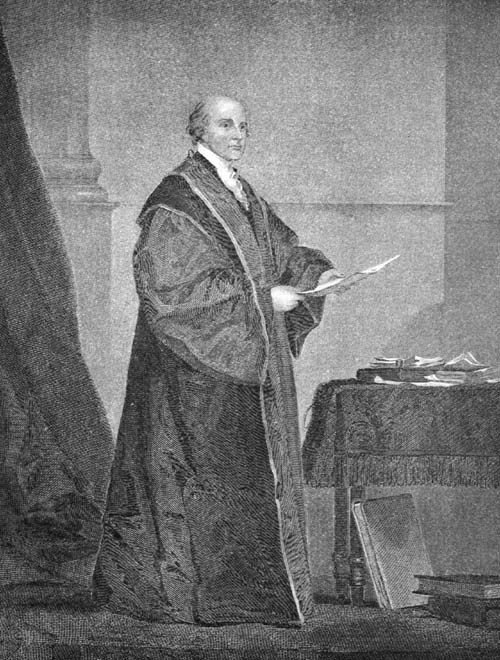
JOHN JAY
“The comte de Vaudreuil has the honor to thank M. de
Beaumarchais for the kindness which he has shown in allowing
his piece to be played at Grennevilliers. The comte de
Vaudreuil has seized with alacrity this opportunity of giving
to the public a chef d’œuvre which it awaits with impatience.
The presence of Monseigneur the comte d’Artois
and the real merit of this charming piece will in the end
destroy all the obstacles which have retarded its representation.
The comte de Vaudreuil hopes very soon to be able
to thank M. de Beaumarchais personally.
“This Monday, Sept. 15th, 1783.”
“The success of this representation at Grennevilliers was
such,” to continue the account of Loménie, “that a complete
change operated in Beaumarchais’s attitude toward the
piece. Resigned hitherto under the royal prohibition, working
slowly and carefully to gain ground, he now became impatient,
pressing and almost imperious. It is clear to anyone
who will reflect, that on the day when Louis XVI permitted
at the insistence of the Queen, the Comte d’Artois
and M. de Vaudreuil to the representation at Grennevillier,
he placed himself where he would be unable long to resist
public curiosity, carried now to the heights by that very
representation, of which everyone spoke, and by the address
of Beaumarchais.” It was not, however, until March,
1784, that the desired permission was given.
“The picture of that representation of Le Mariage de
Figaro,” says Loménie, “is in all the chronicles of the times,
it is the best remembered scene of the eighteenth century.
All Paris from earliest morning, pressed the doors of the
Théâtre-Français; the greatest ladies dining in the boxes of
the actresses so as to be sure of their places—the guards
dispersed, the doors broken down, the iron railings giving
way before the crowd of assailants. When the curtain rose
upon the scene, the finest reunion of talent which the Théâtre-Français
had ever possessed was there with but one
thought, to bring out to the best advantage a comedy, flashing
with esprit, carrying one away in its movement and audacity,
which if it shocks some of the boxes, enchants,
stirs, enflames and electrifies the parterre.”
And what is this play that roused such wild enthusiasm a
century and more ago, and which to-day, although its political
significance has long vanished, would still give its
author, had he done nothing but create its characters, a
right to a place among the immortals?
“The Mariage de Figaro,” to quote his own words, “was
the most trivial of intrigues:
“A great Spanish nobleman, in love with a young girl
whom he wishes to seduce, and the efforts of that same girl
and of him to whom she is engaged, and of the wife of the
nobleman united to outwit his designs—and he an absolute
master whose rank, fortune and prodigality render all
powerful its accomplishment—that and nothing more.”
The characters are those in the main of the Barbier: the
Comte Almaviva, the Comtesse Rosine, and the valet Figaro,
are old friends. But there are new ones, the page Cherubim,
and Suzanne, lady’s maid to the Comtesse—“Always
laughing, tender, full of gaiety, of esprit, of love and delicious!—but
good.”
“Like the Barbier,” says Lintilhac, “it is here a question
of marriage, but it is the valet this time who is to marry
and the obstacles which retard this desired dénouement arise,
not from the jealousy of a guardian, or the resistance of a
father but from the covetousness of a young libertine master....
It is the master who is outwitted, the valet and
his fiancée who triumph, and in this dénouement lies the whole
secret of the wild enthusiasm with which the piece was
greeted. Right here lies the Revolution.”
But the master is as truly painted in the play as the
other characters. “The Comte Almaviva,” says Imbert de
Saint Amand, “is the old régime, Figaro is the new society.
Almaviva is corrupt, but he is always comme il faut. Even
in his anger he remains the man of good society; no doubt
his faults are great; he is a libertine from ennui, jealous
from vanity, but he is not odious, not ridiculous.”
But to return to Lintilhac: “We may see that Figaro,
by the aid of two clever women and his own esprit has the
opportunity to interest the public and to bring all to a
happy ending.
“‘Be on your guard that day, M. Figaro! First put the
clocks in advance so as to be a little surer of marrying.
Get rid of Marceline who wants to marry you herself—take
all the money and the presents, let the count have his
way, in little things; drub Basil roundly,... (Act I,
Scene II). And let us finish the programme which the fat
doctor interrupts,—giving yourself full rein, invective politics,
graft and those who live by it; ridicule censorship, and
the law, as well as those who abuse both—banter privileges
and the privileged and all that attaches itself to either, in
a word—open the way for the men of genius who are preparing
there below in the obscure crowd, and who wish to
emerge.
“But the time to laugh, la folle journée commences.
Quel imbroglio! Twenty times everything seems finished,
and suddenly, an unexpected incident, but always arising
out of the situation, throws forward in rapid movement that
brilliant group of personages. They seek, they evade one
another, group themselves in tableaux turn by turn, animated
and gracious, laughing or grotesque....
“And the new song to the old music! And the scene which
a moment ago framed these charming groups, suddenly fills
with the noise of the crowd and the whole village which
sings. Quel crescendo of gaiety!...
“Take the most ingenious comedy of Lope de Vega, or
Calderon, add the gaiety of Regnard, the comique of George
Dandin, the amusing of Vadé, and one will scarcely have in
imagination the equivalent of the scene on the night which
terminates the Mariage de Figaro.”
And his faithful friend Gudin says of it: “In this piece
the parterre applauded not only scenes founded upon true
comique—that of situations, new characters, like Cherubim
and Bridoison—but also the courageous man who dared
undertake to combat by ridicule the libertinage of the great
lords, the ignorance of magistrates, the venality of officers
and the unbecoming way of pleading of lawyers.
“Beaumarchais might perhaps consider himself more
authorized in this than anyone else since he had been calumniated
so outrageously by great lords, and injured by the insolent
pleadings of lawyers, and blâmé by bad judges....
Let us dare to say what is true, that since Molière no author
had better understood the human heart, or better painted
the manners of his time.”
And his latest critic, Lintilhac, a hundred years after
Gudin, corroborates his judgment. “By the creation of
Figaro, Beaumarchais is the first comic French author after
Molière, the incomparable painter of character.”
Of the famous monologue of the piece, Gudin says, “I remember
that when the author composed it in a moment of
enthusiasm, he was alarmed himself at its extent. We examined
it together; I regarded it with severe attention.
Everything seemed to me in its place; not a word could
be omitted without regretting it. Every phrase had a
moral or a useful object proper to cause the spectator to
reflect either on human nature or on the abuses of society.”
Of its moral significance Beaumarchais has commented in
his preface to the play: “An author has but one duty; to
correct men in making them see themselves as they are,
whether he moralizes in laughing or weeps in moralizing.”
And let us now close this brief summary of the famous play
by the description given by Imbert de Saint-Amand in
“La fin de l’ancien Régime.”
“Beaumarchais, that marvelous wit, was scarcely aware
perhaps of the weight of his attacks and of the gravity of
the piece. He did not desire the fall of the throne any more
than the overturning of the altar, at heart he was monarchic....
The first representation was given April 27,
1784, by the Comédie Française.... The success went to
the stars. Beaumarchais himself could not help crying out,
‘There is something more astounding than my piece, it is its
success.’ ... Actors and actresses surpassed themselves.
Every word told. Each bit of satire was welcomed by
acclamations and bravos without end. The public recognized
itself in the portrait of Figaro. ‘Never angry, always gay,
giving over the present to joy and not worrying about the
future any more than the past,—lively, generous, generous!’
“‘Like a robber,’ says Bartolo.
“‘Like a lord,’ replies Marceline.
“What joy for all that assembly, his definition of a courtier:
“Figaro—‘I was born to be a courtier.’
“Suzanne—‘hey say it is a very difficult business.’
“Figaro—‘Receive, take, ask, that is the secret in three
words.’
“What joyous laughter at the reflection, very true, by
the way:
“Le Comte—‘The domestics here take longer to dress than
their masters.’
“Figaro—‘That is because they have no valets to help
them.’
“What an excellent remark upon the chances for functionaries:
“Le Comte—‘With character and intelligence you may
one day be promoted in office.’
“Figaro—‘Intelligence will advance me? Monsieur is
making sport of mine—to be mediocre and cringing, one can
arrive at anything.’
“And after this very subtle observation, what a picture of
diplomacy:
“‘Pretend to be ignorant of what everyone knows, and
to know what others do not know, seem to understand what
nobody comprehends, not to hear what all hear, and most
of all appear able to do the impossible. Seem profound
when one is only empty; spread spies, pension traitors,
loosen seals, and intercept letters; magnify the poverty of
the methods by the importance of the object,—that’s politics,
or I’m a dead man.’
“The diplomats who were in the audience were transported
with pleasure in hearing their business so exactly judged.
“The great ladies went into ecstacies at the remark of
Suzanne to the countess: ‘I have noticed how a knowledge
of the world gives an ease to ladies well brought up, so they
can lie without showing it.’
“They applauded with enthusiasm that democratic
observation, but profoundly true of this same Suzanne: ‘Do
you think women of my position have hysterics? That is a
malady which is only to be found in the boudoir.’
“The great lords, always surrounded with flatterers and
parasites, applauded with transport that phrase of Figaro
to Basil: ‘Are you a prince that you must be servilely flattered?
Suffer the truth, wretch, since you cannot pay a
liar.’
“But the moment when the enthusiasm became delirium,
frenzy—the moment when the dukes and peers, the ministers,
the cordons rouges, the cordons bleus—were transported to
the seventh heaven of acclaim, was when the daring Barbier
transformed himself into a tribune and said to all of them in
the monologue under the chestnut tree:
“‘Because you are a great lord you believe yourself a
great genius. Rank, fortune, position, all that make you
so proud! What have you done to deserve so many gifts?
You have taken the trouble to be born, nothing else!’
“The functionaries charged with the censure were particularly
enchanted with this phrase of the same monologue:
‘On condition that I do not speak in my writings, either of
authority, or religion, or politics, or morals, or of people
in position, or bodies in favor, or anyone who holds to anything,
I am allowed to write, to print everything freely
under the inspection of two or three censors.’
“The ministers charged to fill public functions found the
following phrase very just: ‘They thought of me for a
position, but by ill luck I was suited to it; they needed a
calculator, it was a dancer who received it.’”
“The Mariage de Figaro” says Loménie, “was presented
sixty-eight times consecutively, something unheard of in that
day. The receipts for the first presentation amounted to
6,511 livres, that of the sixty-eighth was 5,483. During
eight months, from the 27th of April, 1784, to the 10th of
January, 1785, the piece had brought to the Comédie
Française (not counting the fiftieth presentation which at
Beaumarchais’s request had been given for the benefit of the
poor) a gross sum of 347,197 livres, which left when all expenses
were deducted, a net profit to the Comedians of
293,755 livres, except the part of the author which was
valued at 41,499 livres....
“This sum the author of the Mariage de Figaro, as if to
sanctify the piece, consecrated to works of charity.
“‘I propose,’ he wrote in the Journal de Paris, the 12th
of August, 1784, ‘un institut de bienfaisance, to which any
woman recognized as needy and inscribed in her parish, can
come, her infant in her arms and with her certificate from
the parish priest, say to us, “I am a mother and a wet nurse,
I gain twenty sous a day, my infant makes me lose twelve.”
Let us give her nine livres a month in charity.... So if
the comedians have gained two hundred thousand francs
from my Figaro, my nursing mothers will have twenty-eight
thousand which with the thirty thousand of my friends, will
produce a whole regiment of marmots stuffed with maternal
milk.’”
“This institute,” continues Loménie, “of les pauvres mères
nourrices, encountered obstacles at Paris which prevented its
establishment in that city; but since the idea was good it
did not remain fruitless. The Archbishop of Lyon, M. de
Montazet, adopted it. He accepted the help and money of
Beaumarchais, and the Institut de bienfaisance maternelle,
if I am not mistaken still in existence in Lyon, was the outcome
of the Mariage de Figaro. Beaumarchais was one of
its most constant protectors and in 1790 he sent six thousand
francs to it and received in return the following letter
signed by three of the most respectable and important inhabitants
of Lyon:
“‘Lyon, the 11th of April, 1790.
“‘Monsieur:
“‘To speak to you of the success of l’Institut de bienfaisance
maternelle, is to entertain you in regard to your
own work. The idea of it is yours, therefore the plan of
the work belongs to you. You have aided it with your generous
gifts and more than two hundred children saved to
the country, already owe their lives to you. We consider
ourselves happy to have contributed to it and our gratitude
will always equal the respectful sentiments with which we are
Monsieur, etc., Les administrateurs de l’Institut de bienfaisance
maternelle.
“‘Palerne de Sacy, Chapp et Tabareau.’”
It was jealousy, Gudin tells us, that prevented the establishment
of the institute at Paris. A storm of protest arose
from his enemies on every hand.
“It is not enough,” they wrote, “to have gained at the
bar the crown of Cicero and Parru; to have received at the
theater, from the hands of Thalie, the laurels of Molière,
he must needs add to the just applause with which he is
greeted, the cries of joy and benediction of the unfortunate!...
From this feeble stream of money will flow rivers of
milk and crowds of vigorous infants.” An engraving was
circulated showing Figaro helping mothers and opening the
prison doors of poor debtors....
Gudin says: “The design made known, redoubled the solicitation
of the unfortunates addressed to him as well as the
insults which the envious poured upon him. He scarcely
could open a letter which did not contain either a demand
for charity if it was signed, or a series of invectives if it
were anonymous.”
One of these letters contained a curious request, not for
money, as was usually the case, but asking that the author
of the Mariage de Figaro, send the applicant a ticket to his
play. “Misfortune,” he wrote, “has driven me to despair,
but before ending my life I desire once more to indulge in
unrestrained laughter.”
With characteristic generosity, Beaumarchais sent at once
a message, to inquire into the cause of the young man’s misfortune
and not only gave him the desired ticket but restored
hope to his distressed mind, found a position for him and
warmed him back to a desire for life.
“But thus,” Gudin tells us, “while with his wife, his daughter,
his sisters, and a few friends, he was receiving the applause
of the people and the benedictions of the fathers of
families—a frightful outrage and one without motive was
inflicted upon him by authority.
“I was supping with him; we were at the table when the
commissioner Chenu was announced and asked to speak privately
with Beaumarchais. They passed into an adjoining
room.
“We knew that the commissioner was his friend, still the
conference made us uneasy. At length they came out together.
Beaumarchais embraced us, as he said he would be
obliged to go out and perhaps to pass the night away from
home. He begged us not to be uneasy and that the next
day we should be informed as to the cause of his going.
“These words, far from calming, troubled us. We could
not doubt that he had been arrested, but why? Where would
they take him? Perhaps to the Bastille?...
“Not to the Bastille, nor to Vincennes, but to St. Lazare,
a prison house of correction for delinquent youths, he, a
man of mature age, of the constancy, of the fortune of M. de
Beaumarchais, treated as a depraved adolescent! It was a
cowardly outrage.
“His enemies were charmed to see him thus humiliated.
The consternation was general. Lafayette, the Prince de
Nassau-Siegen, and other noblemen appealed instantly in
his favor. At the end of five days he was liberated....
“I went with his wife and daughter and the Commissioner
Chenu to bring him the news of his release. His first reaction
was to refuse liberty.
“‘I have done nothing to merit having lost it,’ he said,
‘I shall not go from here until judged and justified....’
“If he had not been husband and father, his obstinacy
would no doubt have carried him to the point of demanding
justice of the king against the king himself ... but he could
not permit himself to pierce the hearts of his wife and
daughter by condemning them to eternal tears in the vain
hope of tearing from power the avowal of an injustice....
“Princes, Marshals of France, persons of every rank had
inscribed their names at his door during his detention and
came to felicitate him on his return....”
And what was the cause that had operated to bring about
this sudden outburst of power directed against the author of
the Mariage de Figaro?
It was this. In a dispute carried on with vigor in the
pages of le Journal de Paris, between Beaumarchais and certain
anonymous attacks directed against him, the former had
made use of the expression, “After having been forced to conquer
lions and tigers to have my comedy played....”
“Lions and tigers!” Evidently the daring man meant the
King and Queen of France! The news was brought at once
to the royal presence. Louis XVI, already annoyed beyond
measure at the success of the play, to the performance of
which he had been forced to consent in spite of himself, only
needed some pretext to vent his displeasure, “so without rising
from the card table at which he was seated,” says Loménie,
“he wrote, if we may credit the authority of the author
of Souvenirs d’un Sexagénaire, M. Arnault, ... upon the
back of a seven of spades, in pencil, the order for the immediate
arrest of Beaumarchais and joining insult to rigor,
something which no sovereign is permitted to use, he ordered
him conducted, not to an ordinary prison, but one ridiculous
and shameful for a man of his years, to Saint-Lazare,
where depraved adolescents were detained.
“To treat as a young good-for-nothing, a man of his age
and celebrity, a man to whom confidential missions were entrusted,
who carried the secrets of state, who was charged
with the most important operations, and whose talents were
a powerful attraction to the public and to the aristocracy,
was not only a gross injustice, it was a most serious fault,
because it became manifest to everyone how pernicious the
influence of uncontrolled power might become even in the
hands of the best prince. This arbitrary act is the only one
of its kind that can be held as a reproach to Louis XVI....
“The next day, when the motive was demanded for that incarceration,
the government said nothing, as it had nothing
to say, for it would have been difficult to make anyone believe
that Beaumarchais intended to compare Louis XVI to a
tiger. The public became uneasy and began to murmur, and
the day after to murmur loudly.”
“Every one,” says Arnault, “felt himself menaced, not only
in his liberty but in his reputation.” The fourth day there
was a general movement of indignation.... The fifth day
Beaumarchais was turned out of prison almost in spite of
himself ... and Loménie continues:
“A few days’ reflection had made the king realize that he
could not decently admit the intention given to the author,
and coming back to the sentiments of justice and goodness so
natural to him, he almost begged Beaumarchais to come out
of prison, and set about in every way to make up to him for
the wrong done him. Grimm affirms that nearly all the ministers
were present at the first performance of the play after
his release, which was made the most brilliant possible, when
they had the slight unpleasantness of hearing this passage of
the famous monologue applauded with fervent energy: ‘Not
being able to debase the spirit, they take revenge in abuse.’”
D’ESTAING
Louis XVI, very soon after this, hastened to make amends
in the noblest manner and the one most worthy of a sovereign
who felt that he had done wrong. “Le Barbier de Séville,”
says Grimm, “was given at the little theater of the Trianon,
and the very distinguished favor was accorded the author to
be present at the performance.”
In the chapter on the Barbier we have spoken already of
this striking scene, where the queen herself, the Comte d’Artois,
M. de Vaudreuil, etc., were the actors. There is one
more line to this touching picture which we have from the
pen of Gudin.
“A zealous partisan of royalty, after making himself
trusted by those in power and in the guise of a Sans-culotte,
had penetrated to the presence of the unhappy queen, then
prisoner in the Temple. He was able to speak to her and
asked if there were anyone of whom she could think who
might help her, and he suggested Beaumarchais. The queen’s
countenance instantly fell.
“‘Alas,’ she said, ‘he now has it in his power to avenge
himself for the insult once offered him.’” And Gudin adds,
“She did not know the heart of Beaumarchais or that if it
had been possible, now that she was in trouble, he would have
come to her relief with far more alacrity than in the hey day
of her power.”
But the storm now gathering, that was to sweep the
mighty from their seats, was destined also to vent its fury
upon the man of the people whose riches and honors long
had been the objects of their jealous rage. Twice he owed
his safety to the poor whom he had assisted, but in the
general débâcle which followed there was no opportunity
for his wit or his ingenuity to save him; the author of the
Mariage de Figaro and the Barbier was forced himself to
bend before the storm.
“In my feeble childhood I was always astonished to see that
the cheval de bronze had its foot in the air, but never advanced....
Sad emblem of my affairs, which like this image
seem always to march, but which have no movement.”
Beaumarchais to Ramel, Minister of Finance.
The Marine of Beaumarchais—Success of His Business
Undertakings—His Wealth—Ringing Plea of Self-Justification
in the Cause of America, Addressed to the Commune
of Paris, 1789—The Beautiful House Which He
Built in Paris—His Liberality—His Friends—His Home
Life—Madame de Beaumarchais—His Daughter, Eugénie.
SINCE
the official declaration made by the French Government
to the Court of London, recognizing the independence
of the United States, England had considered that
war had been declared, and on June 18, 1778, she struck the
first blow.
“Beaumarchais,” says Loménie, “disposed himself to make
war as well as to carry on commerce. See him now demanding
sailors from the Minister of the Navy, M. de Sartine,
for the service of his great vessel, le fier Roderigue!
“‘Paris, the 12th of December, 1778.
“‘Monsieur:
“‘If I presented myself to-day before you, and if I had
the honor to propose to you to construct and arm a vessel
of this importance, as one able to take the place of a vessel
of the King, wherever I should send it, do you think, Monsieur,
that you would refuse cannon and the title of Captain
of a battleship to its Commander? How then can it be less
precious when all is ready than if it were still to be built?
“‘I beg your pardon; but the multiplicity of objects which
occupy you may very easily hide from you the importance of
my armament, consecrated to the triple employment of encouraging
the commerce of France by my example and my
success, of promising to provision the islands most in need,
and of conducting to the continent of America, in the most
stormy times, a French merchant fleet important enough to
convince the new states by this effort of the great desire of
France to support the new commercial bond that already
joins us....
“‘It is to your wisdom that I present these serious matters,
and I dare say that there are none more worthy of the
attention and protection of an enlightened minister such as
you.
“‘Caron de Beaumarchais.’
“Le Fier Roderigue,” continues Loménie, “set sail, with
her sixty cannon, convoying ten merchantmen. At the Isle
of Granada it encountered the fleet of the Admiral d’Estaing,
which prepared to give battle to that of the English Admiral
Biron. Sighting the beautiful vessel of Beaumarchais passing
in the distance, the admiral made a sign for it to come.
Seeing that it belonged to His Majesty, Caron de Beaumarchais,
he assigned it to its post of battle without the authorization
of its proprietor, allowing the unfortunate merchantmen
which this vessel was protecting to go on at the mercy of
the seas and of the English. Le Fier Roderigue resigned itself
bravely to its fate, and took a glorious part in the Battle
of Granada and contributed its part to making the English
Admiral retire, but its captain was killed and it was riddled
with bullets. The evening of the combat the Comte d’Estaing,
feeling the need of consoling Beaumarchais, wrote to
him a letter, which he sent through the Minister of the Navy,
the like of which is not often found in the archives of a
dramatic poet:
“‘On board the Languedoc, the 12th of July, 1779.
“‘I have only the time to write you that le Fier Roderigue
has held her post in line, and contributed to the success of the
arms of the king. You will pardon me all the more readily
for having used her, since your interests will not suffer from
it, be sure of that. The brave M. de Montaut unfortunately
was killed. I will urge the minister without ceasing for the
favor of the state, and I hope you will aid me in soliciting
that which your navy has very justly merited.
“‘I have the honor to be, with all the sentiments which you
have so well known how to inspire, Monsieur, your very humble
and obedient servant,
“‘Estaing.’
“The minister hastened to send the letter to Beaumarchais,
who replied as follows:
“‘Paris, September 7, 1779.
“‘Monsieur:
“‘I thank you for having sent me the letter of the Comte
d’Estaing. It is noble of him, in the moment of his triumph,
to have thought that a word from his hand would be very
agreeable to me.... Whatever may happen for my affairs,
my poor friend Montaut died on the bed of honor, and I
feel the joy of a child to know that my vessel has contributed
to take from the English the most fertile of their
possessions....
“‘You know my tender and respectful devotion,
“‘Beaumarchais.’
“However, the joy of the patriot,” continued Loménie,
“was somewhat mitigated by the distress of the merchant.
The report of the captain, second in command of the Fier
Roderigue, arrived at the same time, and though it contributed
equally to the glory of Beaumarchais, it was very
disastrous from the point of view of his coffer. He, therefore,
addressed a vigorous appeal to the King, asking for an
indemnity which would save him from ruin.” That the request
was subsequently granted, we may judge from the following
extract from a letter to Necker, written a little more
than a year after the date of the battle, and given by Gudin:
“Paris, July 18th, 1780.
“You have rendered, Monsieur, an act of justice in my regard,
and you have done it with grace, which has touched me
more than the thing itself. I thank you for it; but I owe
you more important thanks upon the indemnity, which the
King has been so good as to offer me for the enormous losses
which the campaign with d’Estaing has caused me.”
Loménie asserts that the indemnity had been fixed at
2,000,000 francs, and was to be paid in installments, the
last coming to him in 1785.
But to return to the American Congress. After long debates
a reversal of parties had placed at the head of that
body the honorable John Jay, who hastened to address Beaumarchais
with the first letter which came to him from Congress,
although his earliest shipment of supplies had been
made almost two years previously:
“By express order of Congress, sitting in Philadelphia, to
M. de Beaumarchais.
“January 15, 1779.
“Sir:
“The Congress of the United States of America, recognizing
the great efforts which you have made in their favor,
presents to you its thanks, and the assurance of its esteem.
It laments the disappointments which you have suffered in
the support of these States. Disastrous circumstances have
prevented the execution of its desires; but it will take the
promptest measures to acquit itself of the debt which it has
contracted towards you. The generous sentiments and the
breadth of view, which alone could dictate a conduct such as
yours, are the eulogy of your actions, and the ornament of
your character. While, by your rare talents, you have rendered
yourself useful to your prince, you have gained the
esteem of this young Republic and merited the applause of
the New World.
“John Jay, President.”
This beautiful expression of the best feeling in the States
must have been soothing to the heart of Beaumarchais. That
he understood the attitude of America and knew very well
the complexity of the situation in which the young republic
found itself involved, may be judged from the following extract
from his Mémoire justicative à la cour de Londres,
printed in the first collection of his works and written in
1779. He says:
“In truth, my ardent zeal for my new friends might well
have been a little wounded at the cold reception which was
made to brave men whom I had myself brought to expatriate
themselves for the service. My pains, my work, and my
advances were immense in this respect. But I am afflicted
only for our unhappy officers, because even in the very refusal
of the Americans, I don’t know what exultation, what
republican pride attracted my heart, and showed me a people
so ardent to conquer their liberty, that they feared to
diminish the glory of success in allowing strangers to divide
with them the perils. My soul thus is composed; in the
greatest evils it searches with care, and consoles itself with
the little good which it encounters. And so, while my efforts
had so little fruit in America ... sustained by my pride, I
disdained to defend myself, leaving the evil-minded to their
proper channel.
“The idle of Paris envied my happiness, and were jealous
of me as a favorite of fortune and of power; and I, sad plaything
of events, alone, deprived of rest, lost for society, exhausted
by insomnia and troubles, tour à tour exposed to the
suspicions, the ingratitude, anxieties, to the reproaches of
France, England and America; working day and night and
running to my goal by constant effort across a thorny land—I
exhausted myself with fatigue and advanced little. I felt
my courage revived when I thought that a great people would
soon offer a sweet and free retreat to all the persecuted of
Europe; that my fatherland would be revenged for the humiliation
to which it had been subjected by the treaty of
1763; in a word, that the sea would become open to all commercial
nations; I was supported by the hope that a new
system of politics would open in Europe.”
But notwithstanding all his difficulties and losses, the affairs
of Beaumarchais were advancing steadily. His merchant
fleet, after the Treaty of Paris, signed in September,
1783, was no longer subject to the risks of war, and soon began
to bring him in vast returns. But as late as March of
this same year, we find him writing to Vergennes, in a letter
quoted by Gaillardet:
“The taking of my two vessels cost me more than 800,000
livres, and since the publicity of my losses I have been drawn
upon, through fear, for a similar sum. Remittances have
come to me from America, and now unfortunately their payment
is suspended. I have two new vessels at Nantes, one of
12,000 tons, which I destined for China, and which I am now
unable to sell.
“I have 80,000 livres worth of bales of merchandise on
the Aigle, destined for Congress, and the Aigle has been
taken. A sudden inundation, which happened at Morlaige,
has submerged two warehouses where I had 1,000,000 pounds
of tea. The whole is damaged to-day.
“Day before yesterday, at the instant of payment, the exchange
agent of Girard by his fraudulent bankruptcy carried
off near 30,000 livres.
“Two vessels must be sent to the Chesapeake before the
middle of May if I am not to lose all the miserable remains
of the tobacco of my stores in Virginia, the main part of
which was burned by the English, because for four years
le Fier Roderigue has been detained at Rochefort, where it
has at last decayed. This is the most trying time of my life;
and you know M. le Comte that for three years I have had
over 200,000 livres in disuse, because of the enormous mass
of parchments which M. de Maurepas ordered me secretly
to buy, wherever I found them. I shall perish if M. de
Fleury does not promptly arrange with you to throw me the
‘on account’ which I demand, as one throws a cable to him
whom the current carries away. I always have served my
country well, and I will serve it still without recompense;
I wish none. But in the name of Heaven, of the King, of
compassion and of justice, prevent me from perishing or
from hiding shamefully in a foreign country the little courage
and talent which I always have sought to render useful
to my country and to my King. What I ask is of the most
rigorous equity and I will receive it as a favor.
“I present to you the homages of him who has not slept
for two months, but who is none the less, with the most respectful
devotion, M. le Comte, your very humble and very
obedient servitor,
“Caron de Beaumarchais.”
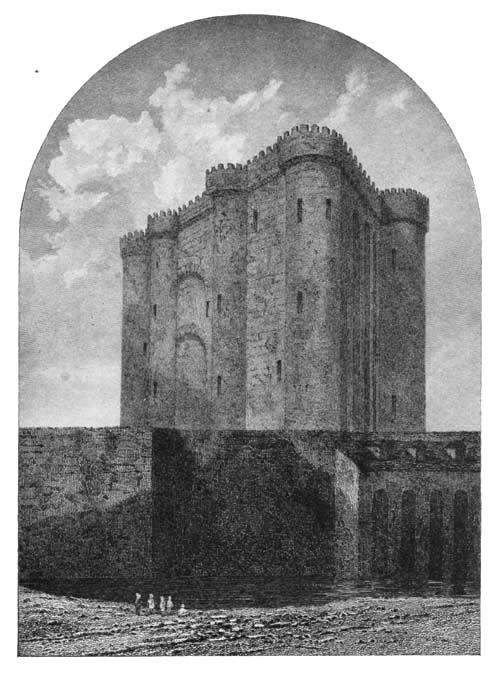
THE BASTILLE
But let us now turn from this gloomy picture and cast a
glance at the home life of this man so buffeted before the
world.
Bonneville de Marsangy, in his life of Madame de Beaumarchais
has drawn the picture for us. He says:
“Beaumarchais, in consequence of the noise which continued
to be made about his name, was none the less one of
the personages the most sought after of the capital. Whatever
he says about it, the fact is that he lived in great
style. His stables contained as many as ten horses. He
kept open table; strangers of distinction, desirous of knowing
the popular author of so many celebrated works, solicited
the honor of being presented to him. He received men of
distinction in politics, in letters and arts, and women the
most sought after, in the midst of whom the mistress of the
house shone in the first rank by her esprit, her education, and
her charms.... Nearly every evening in the Hotel Boulevard
St. Antonie, there was talking, music, playing, although
the master never took part in play. His esprit was equally
free, equally alert, his fancy inexhaustible. It is there he
loved to read his new productions, and he excelled at that.
Arnault recounts one of these literary reunions at which he
assisted, ‘in a great circular salon, partly ornamented with
mirrors, partly with landscapes of vast dimensions, and half
of which was occupied by seats for placing the auditors.
Upon an estrade, furnished with a desk, stood the armchair
of the reader. There, as in a theatre, Beaumarchais read,
or rather played his dramas; because it is to play, if one delivers
a piece in as many different inflexions of the voice as
there are different personages in the action; because it is to
play if one gives to each one of the personages the pantomime
which should characterize him.’” (Arnault, Souvenirs
d’un sexagénaire, Vol. IV.)
And Gudin adds another touch to the portrait of this
many-sided man; after speaking of the loss of his mother,
dying in her eighty-third year, he said:
“Beaumarchais came at once to see me, offered me all the
consolations of friendship, and reclaimed the promise which
we had given one another long ago, to unite the rest of the
days which nature reserved to us.
“It is thus that I found in the family of my friend all
those attentions which could sweeten the irreparable loss of
the tenderest mother and one whom I had quitted almost
never.”
In 1787 Beaumarchais had accumulated a sufficient fortune
to contemplate the building of a superb residence, for
which he already had bought the land in that section of the
City of Paris now occupied by the Boulevard which bears
his name. It was directly opposite the Bastille, and was
not yet completed on the memorable 14th of July, 1789,
when the ancient fortress was destroyed. This residence cost
the owner one million six hundred and sixty-three thousand
francs. “Une folie,” Napoleon called it. When in 1818, the
government bought the property so as to make way for the
new boulevard, they paid the heirs of Beaumarchais only
five hundred thousand francs. As an investment, therefore,
it was far from successful; but as a residence, it was, while
it lasted, one of the sights of the city, and was regarded as
such. It was the very last word in elegance and comfort,
and rivaled the most sumptuous palaces of the capital. In
the beginning, it was always open to the public, but so vast
became the horde of visitors, that very soon entrance was
obtainable only by tickets (though these were never refused
to anyone who asked politely for them).
Although the storm of the Revolution was gathering already,
its shadow had not yet fallen upon Beaumarchais,
who did not foresee either its fury or the extent of the devastation
it was to carry in its train.
After the fall of the Bastille he had been appointed by
the Maire of Paris to superintend the demolition of the
structure so as to prevent damage to buildings in the neighborhood.
Soon after he was named member of the Municipal
Council, but, says Loménie, “denunciations soon began to
rain upon him. All the adversaries of his numerous lawsuits
and all those whom his riches irritated denounced him to the
fury of the masses, as one who upheld authority, or who was
hoarding wheat or arms. His house, situated at the very
entrance to that terrible suburb, the center of the mob, presented
itself as a sort of insolent provocation, which naturally
called for the visits of the people.” To rid himself of
these dangerous visits became his constant preoccupation;
first demanding official visits, then placarding about him
the results of these visits, stating that nothing suspicious
had been found in his possession, again distributing about
him all the money possible, and suggesting to the municipality
all sorts of charitable institutions, because “disorder
and misery always march in company.” Among the accusations
persistently made against him was that he had enriched
himself at the expense of the American people, and
that he had sent them arms and munitions for which he
charged them a hundred times their value. Stung to the
quick by the falsehood of these accusations, coming as they
did from his own countrymen, he made a ringing protest of
self-defense to the commune of Paris in September, 1789, in
which he said:
“You condemn me to speak well of myself by
speaking so ill of me.... Attacked by furious enemies, I
have gained, perhaps with too much brilliancy, all the lawsuits
undertaken against me, because I never have brought
an action against anyone, although for the greatest benefits
I have received almost universally, I dare say it, unheard of
and constant ingratitude....
“Since I have been attacked upon this point I am going to
state before you all the unheard of labors, which a single
man was able to accomplish in that great work. Frenchmen,
you who pride yourselves to have drawn the desire and ardor
of your liberty from the example of the Americans, learn
that that nation owes me very largely her own. It is time
that I should say it in the face of the universe, and if anyone
pretends to contest what I say, let him rise and name
himself; my proofs will reply to the imputations which I
denounce....
“These accusations, as vague as despicable, relate to the
Americans whom I served so generously; I, who would be reduced
to the alms which I scatter, had not noble foreigners,
taken in a free country, associated me with the gains of a
vast commerce, while I associated them to my constant losses
with America! I, who dared form all the plans of help necessary
to that people, and offered them to our ministers; I,
who dared blame their indecision, their weakness, and so
loudly reproach them with it, in my proud reply to the English
manifest by Gibbon; I, who dared promise a success
which was very far from being generally admitted....
“All that I could obtain after a great deal of trouble
... was to be allowed to proceed on my own responsibility
without the assistance of the government in any way, on
condition of being stopped if the English made the least complaints,
and of being punished if they produced proofs—which
put so many hindrances in the way of my maritime
operations, that to help the Americans, I was obliged to mask
and to disguise my works in the interior; the expeditions, the
ships, the manufactures of the contractors, and even to the
reason of trade, which was a mask like the rest.
“Shall I say it, Frenchmen? The King alone had courage,
and as for me I worked for his glory, wishing to make him
the prop of a proud people who burned to be free; because
I had an immense debt to fulfil towards that good king....
Yes, the King, Louis XVI, who assured to the Americans
their liberty, who gives you yours, Frenchmen, gave back
to me also my estate. Let his name be honored in all the
centuries. Then, leaving aside the labors which I am ready
to expose in a work where I will prove that I sent at my risks
and perils, whatever could be had of the best in France, in
munitions, arms, clothing, etc., to the insurgents who needed
everything, on credit, at the cost price, leaving them masters
to fix the commission which they would one day pay to their
friend (for so they called me); and that after twelve years, I
am still not paid. I declare that the measures which I am
making at this moment before their new federal court, to obtain
justice of them,—faithful report which a committee of
the Treasury has just given of what is due me, is the last
effort of a very generous creditor. But I will publish everything,
and the universe shall judge us. Omitting, I say, all
the details of my work, of my services towards that people,
I will pass to the testimony which was given me by the agent,
the minister of America, before he left France. His letter
of March 18th, 1778, bears these words: ‘After the perplexing
and embarrassing scenes you have had to pass through, it
must give you the most solid joy to see an armament going
out to America.... I again congratulate you on this great
and glorious event, to which you have contributed more than
any other person.
‘Silas Deane.’
“Alas, that was the last of my successes. A minister of the
department to whom I showed that letter, alas, though up to
that time he had treated me with the greatest kindness, suddenly
changed his tone, and his style. I did my best to persuade
him that I did not pretend in any way to appropriate
to myself that glory, but to leave it entirely to him. The
blow had carried, he had read the praise; I was lost in his
favor. It was to take from him all idea of my ambition, to
avert the storm, that I recommenced to amuse myself with
frivolous theatrical plays, while keeping a profound silence
upon my political actions. But that helped nothing. It is
very true that a year later, the general Congress, having received
my vivid complaints upon the delay of payment, wrote
me the ... letter by the Honorable Mr. John Jay,
their president, the 15th of Jan. 1779....
“If it was not money, it was at least gratitude. America,
nearer the great services which I had rendered her, was not
yet where she disputed her debts, fatiguing me with injustice,
to wear out my life, if possible, and succeed in paying nothing.
It is also true that the same year, the respectable Mr.
Jefferson, to-day their minister in France, then Governor of
Virginia, struck by the fearful losses which the depreciation
of paper money would inflict upon me, wrote, to my general
agent in America, M. de Francy, in these terms:
“‘December 17, 1779.
“‘Monsieur:
“‘I am very much mortified that the depreciation of paper
money, of which no one, I think, had the least idea at the time
of the contract, passed between the supercargo of the Fier
Roderigue (war vessel of mine, very richly charged, the cargo
of which had been delivered on credit to Virginia, which state
owes me still almost the whole, after more than twelve years
have passed), and that state has enveloped in the general
loss M. de Beaumarchais, who has merited so well of us, and
who has excited our greatest veneration by his affection for
the true rights of man, his genius, his literary reputation, etc.
Signed, “‘Thomas Jefferson.’
“In the work, which I am going to publish, where I will
show the proofs of the excellence of all my shipments to that
people, after exact inspection which they themselves made,
before the departure of my vessels, well attested by their ministers,
and the excuses which he made me, of which I have all
the originals, the surprise will be to see the patience with
which I have supported all the invectives of my enemies. But
it would have been to disgrace the greatest act of my life,
the honorable part which I had in the liberty of America, if
I had mingled it with the discussions of a vile law suit....
It was my scorn, my indignation, which made me keep silence.
It is broken; I will hold my tongue no more on that great
object, the glory of my entire life. They say that my sordid
avarice has been the cause of the misfortunes of the American
people. My avarice, mine, whose life is only a circle of generosity,
of benevolence. I will not cease to prove it, since
their savage libels have rendered so many men unjust. Not a
single being, who went at that time from Europe to America,
without having pecuniary obligations to me, of which nearly
all are due me still; and no Frenchman has suffered in that
country whom I have not aided with my purse. I invoke a
witness, whom it does you honor to respect, the very valiant
general of your troops. Ask him if my services did not
hunt out unfortunate Frenchmen in every corner of America.
“Render justice to my good heart, noble Marquis de Lafayette;
Your glorious youth, would it not have been ruined
without my wise counsel and the advances of my money? You
have very well repaid all that was loaned you by my orders;
and I say it to your glory, you have added fifty louis more
than were due to me, to join that money to the charitable institution
which I was founding of the pauvres mères nourrices....
“And you, Baron von Steuben, Comtes Pulasky, Bienousky,
you, Tronçon, Prudhomme, and a hundred others, who
have never acquitted their debts to me, come out of your
tombs and speak!
“Fifteen hundred thousand francs at least, of services rendered,
fill a portfolio, which probably will never be acquitted
by anyone, and more than a thousand unfortunates whose
needs I have anticipated are ready to raise their voice in my
favor.... The third of my fortune is in the hands of my
debtors, and since I have aided the poor of Sainte-Marguerite,
four hundred letters at least are on my desk from
unfortunates, raising their hands to me.... My heart is
torn, but I cannot reply to all.
“September 2, 1789.”
But from the accusations of his enemies, and the pleadings
of his own cause, let us turn, before worse calamities overtake
him, to contemplate anew the charming picture, which
the interior of his home presents.
It was in 1791 that he took his family to occupy the
splendid new residence which we have just now mentioned.
Its mistress Madame de Beaumarchais was a woman of rare
intelligence and energy of character; “her physiognomy,”
says Bonneville, “offered an expression full of vivacity and
intelligence. The eye is superb, tempered by long lashes,
heightened by the daring arch of the brows; the mouth is admirably
well formed; the chin full, the complexion brilliant....
The reputation for beauty of Madame de Beaumarchais
was general. The public ratified on all occasions, the praise
of her friends. It is traditional in her family that she rarely
left her home without being recognized and followed at a distance
by a cortège of admirers, drawn not only by the celebrity
of the name she bore, but also by the prestige of her
bearing. Often, even, she was obliged to gain her carriage
to avoid the importunity of the too flattering attentions.
“Beaumarchais, as he confesses perhaps superfluously, was
far from being a devotee; still he respected the beliefs of
others; he had desired especially that his daughter should be
brought up piously. Eugénie was at this moment a pupil at
the convent of Bon Secours; her father often went there to
visit her. The Superior, who had had proof of the generous
and good heart of the father of her pupil, permitted herself to
speak of one of the school-mates of Eugénie who was unable
to pay the expenses of her education. The author of the
Mariage de Figaro replied at once in the following delicate
manner:
“‘July 27, 1790.
“‘I send you, Madame, a bill of 200 livres for your unfortunate
pupil. This is for the year. I will have the honor
of giving to you or to her, in money, the first time I go to
the convent, three louis, which will make six francs a month
for this year, the same as I give to my daughter; but I conjure
you, Madame, that my help does not force or press her
vocation. I should be distressed if she were in any way
thwarted as to her future. I have not the honor of knowing
her; it is the good which you have said of her which determined
me. That she remains free, and less unhappy, this is
all the thanks I ask; keep the secret for me. I am surrounded
with virulent enemies.’
“One cannot,” continues Bonneville, “hide oneself more
gallantly, to do good.
“The prioress hastened to divulge the secret; and to the
rough draft of the letter of Beaumarchais found among his
papers, is attached a note in which his young protégée expressed
with emotion all her gratitude to her benefactor.”
The violences directed against the religious establishments
soon forced Beaumarchais to bring his daughter home. It
was about this time that we find a letter, addressed by the author
of the Mariage de Figaro, to the Municipal officers of
Paris, begging, with his characteristic energy, that the
churches be opened, and more masses be said in the Quartier-Vieille-rue-du-Temple.
“In this letter,” says Loménie, “it is the husband, the
brother, but especially the father who speaks. The author of
the Mariage de Figaro adored his only daughter, he had just
brought her home from the convent, and if he went himself
very little to mass, he was not sorry to have her go for him.
It is this side of Beaumarchais, so good, so simple, so jovial,
so gay, that makes us love him, and which comes out with
special force in a song which he wrote to celebrate the young
girl’s return under her father’s roof. This song has been
classed as one of the best of the poetic inspirations of Beaumarchais.
The turn naïf of the old popular songs is found
in it, combined with a graceful mixture of friendliness, finesse
and gaiety.”
The charm of these verses, which it is impossible to render
into English, gave the song a great popularity, and it circulated
widely.
In it, there was question of the marriage of Mlle. Eugénie,
where the father jestingly says: “My gentilhomme, is that
all you are?
“Parchment and blazonry will never open my house.
“If someone really tender,
Sings thee songs in the air,
Let me hear them
For thy Father sees clear
And I will say if there is reason
That he should enter here.
“Should some excellent young man
See heaven in thy eyes,
Say to him ‘Beautiful astronomer,
Speak to that good old man,
He is my father, and there is reason
That he should choose his son-in-law.’
“If he has some talent
What matters his fortune?
Judge, writer, soldier,
Esprit, virtue, sweet reason—
These are the titles valued here.”
“The result of all this was that Beaumarchais was deluged,”
says Loménie, “with the most singular demands in
marriage for his daughter. Here it is from a nobleman, but
one who makes no point of his blazon, who despises the fortune
which he has not, who esteems only virtue, and who
aspires to marry Mlle. Eugénie and her dot; there, from a
father, perfectly unknown to Beaumarchais, who begs him
to keep the daughter for his son, still in college; farther on
it is a captain, who has only his sword, but who is worthy of
being a Marshal of France. Politely to turn aside this
avalanche of virtuous and disinterested suitors, the father of
Eugénie wrote a letter which, with slight modifications,
serves him for all, and of which the following is a sample:
“Paris, May 21, 1791.
“Although your letter, Monsieur, appears to have its
origin in a simple jest, since it is serious and honest, I owe
you a reply.
“You have been deceived regarding my daughter. Scarcely
fourteen years old, she is far from the time when I will
allow her to choose a master, reserving for myself in this
only, the right to advise. Perhaps you are quite ignorant of
the exact situation. I have only lately taken my daughter
from the convent; the joy of her return drew from my indolence
a song, which after having been sung at my table, went
the rounds. The tone bonhomme which I there took, joined
to the jest of her future establishment, has made many persons
think that I already thought of her settlement.
“But may I be preserved from engaging her before the
time when her own heart will give her a consciousness of what
it all means, and Monsieur, this will be an affair of years, not
of months.
“What the song says jestingly, however, will certainly be
my rule to enlighten her young heart. Fortune touches me
less than talents and virtue, because I wish her to be
happy....
“Beaumarchais.”
But the young girl’s presence under her father’s roof was
to be of short duration. Very soon, his anxiety for their
safety led him to dispatch his family to Havre. For, says
La Harpe,

HOUSE OF BEAUMARCHAIS
“His house was placed at the entrance of that terrible
faubourg like the Palace of Portici at the foot of Vesuvius....
The eruption of the volcano was as yet only at rare
intervals; that of the faubourg was at every moment. It is
inconceivable that under the lava always boiling, that house
was not engulfed.”
So it is here we will leave him to await alone,—except for
his faithful Gudin—the coming of the storm, which his own
writings had done so much to rouse, but which he neither
desired, nor, to the end, comprehended.
“I know very well to live is to combat, and perhaps I
should be afflicted at this if I did not know that in return to
combat is to live.”
Caron de Beaumarchais.
“—Often broken-hearted, always consoled by the sublime
principle of the compensation of good and evil—which was
the ground of his optimism...”
Lintilhac in Beaumarchais et Ses Œuvres.
House of Beaumarchais Searched—The 10th of August—Letter
to his Family in Havre—Letter of Eugénie to her
Father—Commissioned to Buy Guns for the Government—Goes
to Holland as Agent of Comité de Salut Public—Declared
an Emigré—Confiscation of his Goods—Imprisonment
of his Family—The Ninth Thermidor Comes to
Save Them—Life During the Terror—Julie again in Evidence—Beaumarchais’s
Name Erased From List of Emigrés—Returns
to France.
EARLY
in 1792, Beaumarchais embarked in a new political
and commercial operation which, says Loménie,
“was destined to embarrass his fortune and to be the torment
of his latter days. France was without arms and he
undertook to procure them for her. It is difficult to understand
that a man sixty years old, rich, fatigued by a most
stormy existence, afflicted with increasing deafness, surrounded
254
with enemies, and desirous only of repose should
have allowed himself to be induced to attempt to bring into
France sixty thousand guns detained in Holland under circumstances
which rendered this operation as dangerous as
it was difficult.”
However, Gudin tells us, “he had only the choice of dangers.
To have refused to procure the arms would have
marked him for disfavor. He therefore chose the danger of
being useful to his country. This resolution exposed him
to the risk of being pillaged and assassinated, but in the end
it saved his life.... During the days of frenzy which preceded
the overthrowing of the throne, the most hostile menaces
sounded around his house.”
The populace insisted that he had stored it with wheat
and guns. In vain Beaumarchais protested, in vain he placarded
the walls of his garden with official statements proving
that the house had been searched and that nothing had
been found. The fury of the mob was not to to be appeased.
Finally on the 8th of August, the threatenings became so
ominous that he was persuaded to spend the night in the
home of a friend, who had sought safety outside Paris, leaving
an old domestic alone in charge. Beaumarchais says:
“At midnight the valet, frightened, came to the room
where I was, ‘Monsieur,’ he said to me, ‘get up, the people
are searching for you, they are beating the doors down,
someone has turned traitor, the house will be pillaged.’ ... The
frightened man hid in a closet while the mob searched
the house.” When morning came, he returned to his own
home, around which the threatenings still continued without
ceasing.
Gudin says: “He received the most alarming notices, and
the day after the imprisonment of the king, August 10th, a
great multitude set out in the direction of his house, threatening
to break down the iron gates if they were not immediately
opened. I and two other persons were with him.
“At first his desire was to open the doors and to speak to
the multitude. But persuaded that secret enemies conducted
the crowd, and that he would be assassinated before he could
open his mouth, we induced him to leave the house by a side
entrance.... As we were but four we decided to separate
in the hope of deceiving those who sought him....
“Whatever the cause, once admitted and masters of the
situation, someone proposed to swear that they would destroy
nothing. The populace swore and kept its word. Always
extreme, it even swore to hang anyone who stole anything.
It visited the whole house, the closets, the granaries,
the cellars, and the apartments of the women and my own.
They wished to hang my own domestic, who seeing the crowd,
ran from room to room with some of my silver hidden in her
pocket; they thought she was stealing, and she was forced to
call in the other domestics as witnesses. They searched
everywhere and found only the gun, hunting case, and sword
of the master of the house, these they did not disturb.
“Thirsty from excitement and fatigue, that breathless
troop, instead of opening a cask of wine, satisfied itself with
water from the fountain. They even left the master’s watch
hanging at the head of his bed, and other articles of jewelry
about the rooms.... A troup conducted by a magistrate
would not have been more exact in its perquisition, or more
circumspect in its conduct.
“Truth here resembles fable,—something extraordinary
always mingled itself with the events which came to Beaumarchais.
This conduct of the populace was the fruit of
the benefits which he had poured upon the poor of his neighborhood.
If he had not been loved, if he had not been dear
to his domestics, all his goods would have been dissipated
by pillage.”
The next day Beaumarchais wrote to his daughter in
Havre:
“August 12, 1792.
“... My thoughts turned upon thy mother, and thee
and my poor sisters. I said with a sigh, ‘My child is safe;
my age is advanced; my life is worth very little and this
would not accelerate the death by nature but by a few years.
But my daughter! Her mother! They are safe? Tears
flowed from my eyes. Consoled by this thought I occupied
myself with the last term of life, believing it very near.
Then, my head hollow through so much contending emotion,
I tried to harden myself and to think of nothing. I watched
mechanically the men come and go; I said, ‘The moment approaches,’
but I thought of it as a man exhausted, whose
ideas begin to wander, because for four hours I had been
standing in this state of violent emotion which changed into
one like death. Then feeling faint, I seated myself on a bank
and awaited my fate, without being otherwise alarmed.”
“When the crowd had retired,” says Gudin in his narrative,
“Beaumarchais returned and dined in his home, more
astonished to find all undisturbed than he would have been to
have seen the whole devastated....”
“And so we continued to live alone in that great habitation,
occupied in meditating on the misfortunes of the state
and sometimes upon those which menaced us....
“On the 23rd of August, upon awakening I perceived
armed men in the streets, sentinels at the doors and under
the windows. I hastened to the apartment of my friend—I
found him surrounded by sinister men occupied in
searching his papers and putting his effects under seal.
Tranquil in the midst of them, he directed their operations.
When they were through, they took him with them and I was
left alone in that vast palace, guarded by sans culottes
whose aspect made me doubt whether they were there to conserve
the property, or to give the signal for pillage.”
Beaumarchais had been carried off to the mairie (police
court) “where he defended himself so perfectly,” continues
Gudin, “that his denouncers were confounded and about to
liberate him when Marat denounced him anew.... He was
sent to l’Abbaye along with others whose virtues were a title
of proscription.
“At the end of a week his name was called. General consternation
in the prison.
“‘You are called for.’
“‘By whom?’
“‘M. Manuel. Is he your enemy?’
“‘I never saw him.’ Beaumarchais went out. All the assembly
sat silent.
“‘Who is M. Manuel?’ demanded Beaumarchais.
“‘I am he. I come to save you. Your denouncer, Colmar,
is declared culpable—he is in prison—you are free.’...
“Two days later came the September massacres. And
thus a second time his life was saved. ‘Long afterwards he
learned that a woman to whom he had rendered an eminent
service had solicited Manuel to obtain the liberty of her
benefactor.’” (Gudin, p. 430.)
“It would seem natural,” says M. de Loménie, “that in
such a moment, the author of the Mariage de Figaro would
consent to set aside the matter of the guns and occupy
himself with his own personal safety.”
He consented, however, to hide himself during the day
outside Paris, but every night he returned on foot by byways
and across ploughed fields, to urge the ministers to
make good the promises of their predecessors and make
it possible for him to obtain the sixty-thousand guns from
Holland which he had promised the nation.
“The fact was,” says Loménie, “that on the one hand,
until those guns were delivered, he remained an object of
suspicion to the people, while on the other he believed that
the minister Lebrun was trying to exploit the matter to
his own credit while leaving to Beaumarchais, if necessary,
all the responsibility of failure. This was what rendered
him so tenacious, that he tormented even Danton who, by
the way, could not help laughing to see a man so badly
compromised who should be thinking only of his safety,
obstinately returning every night to demand the money which
had been promised as a deposit, and to obtain a commission
for Holland.”
Finally Lebrun consented to give the author of the
Mariage de Figaro a passport to Holland and promised to
have the necessary money ready for him at Havre.
“He set out,” says Lintilhac, “on the 22nd of September,
1792, with Gudin, directing himself toward Havre, where,
after so many emotions, he wished to press his wife and
his daughter in his arms. From there, he passed to England
where he was arrested, imprisoned, then set free. As
soon as Madame de Beaumarchais knew that her husband
was safe, she returned to Paris to be nearer, so as to defend
his interests. A noble task which she accomplished at the
peril of her life.
“The departure of Beaumarchais, the motive of which
remained a secret, emboldened his enemies who renewed their
accusations. The 28th of November a second decree was
rendered against him as suspected. Immediately seals were
placed upon all the houses which he owned in Paris.
Madame de Beaumarchais hastened to protest the accusations
against her husband and against the placing of the
seals. With great difficulty she finally obtained a decree
dated February 10, 1793, which accorded to her husband
a delay of two months to present his defense and at the
same time the immediate removal of the seals. He wrote
from London, December 9, 1792, to his family:
“‘My poor wife and thou, my dear daughter. I do not
know where you are, nor where to write to you, neither by
whom to give you news. Still I learn by the gazette that
seals have been placed for the third time on my property
and that I am decreed, accused for this miserable affair of
the guns of Holland.... Be calm, my wife and my sisters.
Dry thy tears, my sweet and tender child! they trouble
the tranquillity of which thy father has need to enlighten
the National Convention upon grave subjects which it is important
it should know.’”
Beaumarchais returned immediately to France, drew up
a memoir for his justification, secured the removal of the
seals at Paris; but the municipality of Strausborg maintained
those which it had imposed. Beaumarchais grew impatient,
addressed a petition to the minister of the interior
who sent a dispatch to the administrator of that department
of the Bas-Rhein. Again, the author of the Mariage de
Figaro is vindicated and absolved.
The troubles of Beaumarchais showed no signs of diminishing
either in number or perplexity. In the month of January,
1793, the English government, having joined the
coalition against France, was on the point of herself taking
possession of the sixty-thousand guns for which Beaumarchais
had so long been negotiating.
“He, however,” says Loménie, “did not lose his head, having
already had wind of the project. At the very time when
he was imprisoned in London he had induced an English
merchant ... by means of a large commission ... to become
the purchaser of those same guns and to maintain
them in his name at Tervère as English property, until
the real owner could dispose of them. But the fictitious
owner could not hold them long, because the English ministers
said to him, ‘Either you are the real owner or you
are not; if you are, we are ready to pay for them; if you
are not, we intend to confiscate them.’...
“The English merchant remaining faithful to the engagement
with Beaumarchais, resisted; affirmed the guns to be
his property, invoked his right to dispose of them as he
pleased, and this respect for law which distinguishes the
English Government above all other governments, left the
question undecided. The guns remained at Tervère under
guard of an English battleship.” (Loménie, Vol. II, p.
424.)
“Things were at this pass when the committee of public
safety informed Beaumarchais that he must secure the arms,
or else prevent their falling into the hands of the English;
failing which his family and goods in default of his person
would answer for the success of the operation.” And so,
early in June, 1793, again he left France on this most difficult
mission.
“To enter into all the details of his interminable tours et
détours, going from Amsterdam to Basle, from Basle to
Hamburg, from Hamburg to London ... all which he
directed like a very ingenious intrigue de comédie ...
would be too long. He was able to keep the guns at Tervère
and when the moment seemed to him favorable, he supplicated
the committee of public safety with loud cries, to
order the General Pichegru to come and carry off the guns;
but the committee absorbed by a thousand things made no
reply.... The only missive he ever received from them was
the following, dated, 5 pluviose, An II (January 26, 1794),
written by Robert Lindet, ‘You must be quick, do not await
events. If you defer too long, your service will not
be appreciated. Great returns are necessary and they must
be prompt. It is of no use to calculate the difficulties, we
consider only results and success.’”
“Not only,” continues Loménie, “did the Committee abandon
Beaumarchais to himself, but with a thoughtlessness
which is another sign of the times, they allowed their agent
to be put upon the lists as an émigré, which act entailed
the confiscation of his property.
“Madame de Beaumarchais went at once to the committee
of public safety, explained that her husband was not an
émigré, since he had left the territory of the republic because
of an official mission, and provided with a regular
passport, and her proof in her hand, she succeeded in having
the decree withdrawn and the seals removed from the
property. Beaumarchais had at this time taken refuge in
Hamburg.
“He found himself,” says Loménie, “in the most cruel
situation both materially and morally. He knew that the
revolutionary tribunal was fixed permanently at Paris, that
it struck without pity mothers, wives, and daughters of
the absent ones, and that the bloody knife never ceased to
fall. The unfortunate man was in torture. Eugénie tried
to comfort her father in the unconscious tranquillity of a
young girl. Every precaution had been taken to hide from
her the horrible tragedy which was being enacted about her;
she presented a striking contrast with the terrible reality
of the times.
“She walked alone and melancholy in the lovely garden,
while the dismal car passed along the terrace perhaps. But
in her sad dreaming, she did not turn her head; she admired
the earliest advances of spring. On March 11th, she wrote
to her father,
“‘The verdure of our trees is beginning to appear, the
leaves develop from day to day, and flowers already beautify
thy garden. It would be very lovely, if we could walk
here with thee. Thy presence would add a charm to everything
which surrounds us. There is no happiness for me but
what thou partakest in. We are only happy through thee,
oh my tender father!’”
The very next day measures were taken which ended in
the annulling of the decree rendered by the comité de salut
public in which the comité de sûreté générale, which had
taken its place, once more declared Beaumarchais to be an
émigré, replaced the seals upon his property, confiscated his
revenues and on the 5th of July, 1794, arrested his wife,
his two sisters, and his daughter.
They were shut up in the convent of Port-Royal which
had been changed into a prison and which, says Loménie,
“by an atrocious irony was called Port-Libre, where they
waited their turn to mount the fatal cart that should conduct
them to the guillotine.” The ninth thermidore came
to put an end to these butcheries. Eleven days later, another
decree of the comité de sûreté générale, again established,
gave to the Citoyennes Caron their liberty.
During this frightful period of the terror, Beaumarchais,
still at Hamburg, deprived of all communication with his
family, was a prey to the most terrible mental agony. His
correspondence shows that he had moments of the deepest
despair when he asked himself if he were not losing his mind.
“Where shall I address thee?” he wrote his wife. “Under
what name? What shall I call thee? Who are thy friends?
Whom can I consider mine? Ah, without the hope of saving
my daughter, the atrocious guillotine would be sweeter
to me than my horrible condition.”
It was at this period that the following address to the
American people was written.
“Americans: Though I have served you with an indefatigable
zeal, I have in my life received only bitterness for
recompense, and I die your creditor. Permit then in dying
that I will to my daughter the debt which you owe me. Perhaps
after I am gone, other injustices, from which I cannot
defend myself, will rob me of all I possess so nothing will be
left for her, and perhaps Providence has ordained by your
delay in paying me, that through you she will be spared
absolute want. Adopt her as a worthy child of the state.
Her mother, equally unfortunate, and my widow, will conduct
her to you. Let her be looked upon as the daughter of
a citizen! But if after these last efforts, if after all has
been said, I must still feel that you will reject my demands—If
I am to fear that you will refuse her arbitrators; at
last, desperate, ruined in Europe as well as by you, your
country being the only one in which I could beg without
shame—what would remain for me to do, but to supplicate
Heaven to give me the strength to take the voyage to
America?
“Arrived in your midst, mind and body weakened, unable
to maintain my rights, should I there be forced, my proofs in
my hand, to have myself carried to the doors of your
National Assembly, and, holding aloft the cap of liberty,
with which I helped as much as anyone to adorn your
heads—to cry out ‘Give an alms to your friend, whose accumulated
services have only had this recompense, date
obolum Belisario!’
“Pierre-Augustin Caron Beaumarchais.”
It was precisely to save her daughter, that Madame de
Beaumarchais had broken all communication with her husband,
retaken her family name and thought only of making
herself forgotten.
“The Revolutionary laws,” says Gudin, “ordained the
divorce of the wives of émigrés, under pain of being suspected
and of running the risk of death that could not be inflicted
upon their husbands. Madame de Beaumarchais, worthy of
the courageous man whose hand she had received, went to
the Revolutionary Committee and with that firmness which
inspired respect and that grace which embellished every action,
said, ‘Your decrees oblige me to demand a divorce. I
obey, although my husband, charged with a commission is
not an émigré and never had the thought: I attest it and I
know his heart. He will justify himself of this accusation,
as he has of all the rest, and I shall have the satisfaction of
marrying him a second time, according to your new laws.’”
“Such was the effect of his destiny,” observes this
eighteenth century philosopher, “that he was obliged to renew
the knot of his own marriage at the same time that he
occupied himself with the marriage of his daughter.”
The condition of the family of Beaumarchais when they
found themselves once more free, was far from enviable.
Their revenues had been seized and their beautiful home was
ordered to be sold. Eugénie felt only horror for the place
and persuaded her mother to live in a small house. Gudin
had gone into the country and Julie, the faithful sister of
Beaumarchais, went to live alone with an old servant in the
deserted palace of her brother, which was now guarded by
agents of the Republic and which bore written upon its
walls, “Propriété nationale.”
“If, as I hope,” says Loménie, “the reader has retained
an agreeable impression of Julie, it will be a pleasure perhaps
to see again that intelligent, merry, courageous face
which neither age, privations, nor dangers had been able to
change.
“A picture of the domestic and inner life of three women,
once rich, forced to face the difficulties of a fearful epoch
will give details of interest to that period which history
itself cannot furnish.
“During the time when the head of the household was
proscribed, it was Madame Beaumarchais, a person of rare
merit who joined to all feminine graces a truly virile energy
of character, who bore the weight of the situation and while
working on one hand to prevent the sale of her husband’s
property, tried on the other, to have his name erased from
the fatal list; and all the time was obliged to provide for
her family with what she had been able to save from the
wreck of their fortune. On her side Julie guarded the house
of her brother, kept her sister-in-law in touch with events
at the house, and urged her to resistance in the animated and
original tone which characterised her.
“‘Morbleu! my child,’ she wrote her after the Terror, ‘let
us quickly get the decree suppressed. Even the fruits, the
same as last year, are requisitioned; the cherries being ripe,
they are to be picked to-morrow and sold, and the rest as it
ripens, and then close the garden to the profane and the
gluttons! Isn’t it sweet to have lived here alone for six
months, and only be allowed to eat the stones of the fruit?
And even they are sold with the rest. It is for the birds
that I am sorry ... nevertheless, it is a pity that the
agency had to interfere this year;... See if thou cannot
prevent this brigandage by a firm protest at the agency....
“‘And here a pound of veal has been brought me which
costs twenty-eight francs, and at even that it is a bargain,
for it might sell for thirty. Rage! Fury! Malediction!
One cannot even live by ruining oneself and devouring three
times one’s fortune. How happy those who have gone before!
They feel neither the confusion in my head, nor my
eye which weeps, nor the flame which devours me, nor my
tooth which sharpens itself to eat twenty-eight francs worth
of veal; they feel none of these evils.’
“Those twenty-eight francs worth of veal, which Julie consumed
with humorous anger, bring us to say a word of the
curious state of want which was produced by the constant
depreciation of paper money after the Terror. It is still
Julie who informs us how people lived at that time; her
sister-in-law had just given her four thousand francs in
paper money and she returned an account of the use to
which she put them that December 1794.
“‘When you gave me those four thousand francs, my
good friend, my heart beat fast. I thought you suddenly
had lost your reason to give me such a fortune; I slipped
them quickly into my pocket and spoke of other things, so
that you would forget them.
“‘Returned home and quick, some wood, some provisions,
before the prices go higher! And see Dupont (the old
servant) who runs, exhausts herself! And lo, the scales fall
from my eyes when I see the result of four thousand, two
hundred, and seventy-five francs.
“‘One load of wood |
1,460 |
fr. |
Nine pounds of candles |
900 |
|
Four pounds of sugar |
400 |
|
Three litrons (six qts.), of grain |
120 |
|
Seven pounds of oil |
700 |
|
A dozen wicks |
60 |
|
A bushel and a half potatoes |
300 |
|
Laundry bill for one month |
215 |
|
One pound of powder for the hair |
70 |
|
Three ounces of pomade (that used to be three sous) |
50 |
|
| |
———— |
| |
4,275 |
fr. |
Over and above this is the provision for
the month, butter, eggs, at 100 francs,
as you know, and meat from 25 to 30
francs a pound and all else in
proportion |
576 |
|
Bread, there has been none for two days;
we only get it every other day—for the
last ten days I have only bought 4
pounds at 45 fr. |
180 |
|
|
———— |
| |
5,022 |
fr. |
“‘When I think of this royal expenditure which costs me
from eighteen to twenty thousand francs without allowing
myself the least luxury, J’envoie au diable le régime.’
“Shortly after this the value of paper money decreased
still more and the price of commodities increased in alarming
proportion. In another letter to her sister-in-law Julie
gave the following details:
“‘Ten thousand francs which I have scattered in the last
two weeks, give me such a fright, seize me with such pity
that I no longer know how to count my income. In the
last three days, wood has risen from 4,200 francs to 6,500
and all the costs of transporting and piling are in proportion,
so that my load of wood has cost me 7,100 francs.
Every week it costs from 700 to 800 francs for a pot-au-feu,
and other meat without counting butter, eggs, and a thousand
other details; laundry work has increased so that 8,000
francs are not enough for one month. All this makes me
impatient and I solemnly affirm that I have not for two years
allowed myself a luxury, or gratified a single whim, or made
any other expenditures but for the house; nevertheless the
needs I have are urgent enough to make me need potfulls of
money.’
“But if the sister of Beaumarchais is at the point of
famine, the wife and the daughter are no better off; I see in
the correspondence of Madame de Beaumarchais that one of
her friends went the rounds of the neighborhood to try to
obtain some bread which was becoming rarer than diamonds;
‘I am told,’ she wrote, the 5th of June 1795, ‘that at Briare,
flour is to be had, if that is true I will make a bargain with
some country man and send it direct to you by the barge
which goes from Briare to Paris, but that will greatly increase
the cost. Please tell me what you think, while waiting
I still hope to get hold of a small loaf somewhere. Oh, if
I had the gift of miracles, I would send you, not manna
from heaven—but good bread and very white!’
“When Beaumarchais in exile, learned all the deprivations
from which his family suffered he learned also that they had
sufficient moral courage to support them. Gaiety had not
wholly disappeared from that interior which used to be so
joyous; even if exposed to starvation, the frightful guillotine
no longer operated and one began to breathe more
freely.”
One of his old friends wrote to him, “See now the soup
tureen of the family arrive, that is to say, upon the mahogany
table (there is no such thing as a cloth) is a plate
of beans, two potatoes, a carafe of wine, with very much
water. Thy daughter asks for a white poodle to use as a
napkin and clean the plates—but no matter, come, come; if
we have nothing to eat we have plenty to laugh about.
Come, I tell thee, for thy wife needs a miller since thy salon
is decorated with a flour mill; while thy Eugénie charms thee
upon her piano, thou wilt prepare her breakfast, while thy
wife knits thy stockings, and thy future son-in-law turns
baker; for here everyone has his trade and that is why our
cows are so well guarded.
“It is too droll to see our women, without perruque in
the morning, filling each one her occupation, because you
must know that each one of us is at their service and because
in our régime, if there are no masters, there are at
least valets. This letter costs thee at least a hundred francs
counting the paper, pens, the oil of the lamp, because for
economy’s sake I came to thy house to write it. We embrace
thee with all our hearts.”
And his faithful Gudin wrote him, though in much more
somber strain, from his retreat in the country: “My most
ardent desire, my friend, is to see you again and to press
you to my heart; but circumstances are such that I had to
leave Paris where I could no longer subsist. I have taken
refuge in a little hamlet fifty miles away, where there are
thirteen peasant cabins. The house which I inhabit was a
tiny priory, occupied once by a single monk.” And after a
very long and profoundly pessimistic discourse upon the sad
condition of affairs which he likens to the barbarity which
formerly engulfed Greece and Egypt and Assyria, Sicily,
and Italy, he terminates thus:
“Adieu my good friend, I would have wished to have
talked to you of yourself, of your family, of those whom you
love, the regrets which we feel to meet no more together.
Our hearts like your own, are crushed with sorrow....
I embrace you and sigh for the happy moment that will
unite us.
“Gudin.”
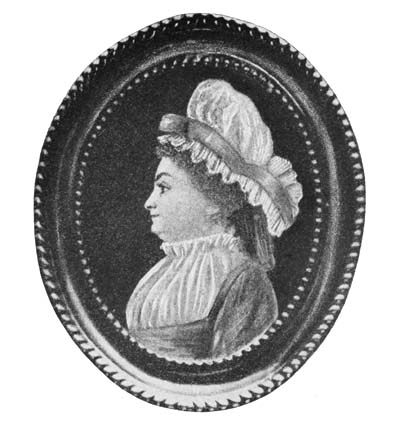
MADAME DE BEAUMARCHAIS
Now that his anxieties for his family were allayed, Beaumarchais
was not idle, for his stay in Hamburg was occupied
in drawing up memoirs upon matters of public utility, in
commercial negotiations, and in agreeable companionships
with distinguished émigrés who like himself were anxiously
awaiting the moment when they could return to France.
As for Beaumarchais, the affair of the 60,000 guns had
ended, distressingly enough for his coffers, by the English
carrying them off. They consented, however, at the urgent
request of the merchant friend, to pay an arbitrary sum
which was, however, far below their real value, but saved
Beaumarchais from complete ruin. The affair ended, his
only desire was to return home. This he was prevented from
doing because of the proscription unjustly continued against
him, which all the efforts of his friends and his family had
been as yet unable to have removed.
Finally a member of the committee which he was serving,
the same Robert Lindet before mentioned, wrote in his behalf
to the minister of police, Cochon, the following letter:
“You have asked me to enlighten you regarding the second
mission of Citizen Beaumarchais, and upon the exact time
when that mission ended or should end.
“In charging the Citizen Beaumarchais with a mission,
the committee of public safety proposed to itself two objects.
The first was to procure the 60,000 guns deposited
in the armory at Tervère, as objects of commerce; the
second was to prevent these guns from falling into the
power of the enemy.
“The Committee was obliged to pay for them only at the
agreed price on condition that they should be delivered and
placed at their disposition in one of the ports of the Republic,
within five or six months, The negotiation might
take longer, but these terms were used to excite the zeal
of the Citizen Beaumarchais.
“Before the expiration of the term he sent from Holland
to Paris, the Citizen Durand, his friend, who had accompanied
him on his journey, to give an account of the obstacles
which delayed the execution of the enterprise and to
propose measures which he thought were needful.
“Citizen Durand was sent back to Citizen Beaumarchais
with a revised passport, which ran thus; ‘to conduct him to
his destination and to continue his mission;’ because it
seemed important to procure the guns for the government at
whatever time that should be found possible, and also that
the enemy should be prevented from seizing and distributing
them in Belgium among the partisans of the house of
Austria.
“The department of Paris placed the Citizen Beaumarchais
upon the list of émigrés and placed seals upon his
property.
“The committee decreed that since the Citizen Beaumarchais
was on a mission he should not be treated as an émigré,
because he was absent on a mission for the government. The
department removed the seals.
“Some time after, the citizen Beaumarchais was replaced
on the list of émigrés. There had been no new motive. The
mission was not finished, his negotiations continued to be
useful, he had not been recalled.... However, they persisted
in considering him an émigré! ... the presence of
citizen Beaumarchais in a foreign country was necessary up
to the moment when the secret of his mission having been
divulged, the English carried off the guns from the armory
at Tervère to their ports, which they did last year.
“Nothing would then have prevented citizen Beaumarchais
from returning to France because he could no longer hope
to be able to fulfil his mission; but his name still rested on
the list of émigrés and he could not return until it was
erased.
“It was an injustice ever to have placed it upon the list
of émigrés, since he was absent for the service of the Republic.
“Robert Lindet.”
“To the Minister of Police.”
This letter and the ardent solicitations of the wife and
friends of the proscribed man, finally induced the committee
to have his name erased from the list of émigrés, and so after
three years of absence the author of the Mariage de Figaro
was able to return to his native land.
“Qu’étais’je donc? Je n’étais que moi, et moi tel que je
suis resté, libre au milieu des fers, serein dans les plus grands
dangers, faisant tête a tous les orages, menant les affaires
d’une main et la guerre de l’autre, paresseux comme un âne
et travaillant toujours, en butte à mille calomnies, mais,
heureux dans mon intérieur, n’ayant jamais été d’aucune
coterie, ni litéraire, ni politique, ni mystique, n’ayant fait
de cour à personne, et partout repoussé de tous.... C’est
le mystère de ma vie, en vain j’essaie de le résoudre.”
Beaumarchais After His Return from Exile—Takes Up All
His Business Activities—Marriage of Eugénie—Her Portrait
Drawn by Julie—Beaumarchais’s Varied Interests—Correspondence
with Bonaparte—Pleads for Lafayette
Imprisoned—Death of Beaumarchais—Conclusion.
ON
his return to Paris, July 5th, 1796, “Beaumarchais,”
says Loménie, “found himself faced with a fortune
ruined, not alone as so many others had been in the general
crisis, but still more, by the confiscation of his revenues, the
disappearance of his papers, and of the debts owing to him.
His beautiful house was going to destruction, his garden
torn up. While on one hand his debtors had disembarrassed
themselves of their obligations by settling with the state in
paper money, his creditors were waiting to seize him by the
throat. He had accounts to give to, and to demand of
the State, who, after confiscating his fortune, held still
274
745,000 francs deposited by him when he undertook the
mission to secure the 60,000 guns....”
Not to go into all the perplexing details of the decisions
and counter decisions rendered by the State, the anxieties,
the almost insuperable difficulties that surrounded him on
every side, let it suffice to say that with old age advancing
apace, he still retained almost the same vigor, the same tenacity
of purpose, the same indefatigable energy that have
characterized him through life. Without ceasing, he drew
up memoirs, conferred with the ministers, worked day and
night to re-establish his fortune, so that those dear to him
might not be left in want.
That he eventually succeeded in this may be judged by
the fact that his family continued to inhabit their splendid
residence until 1818, when the French government under the
Restoration bought it for purposes of public utility. Moreover,
the report rendered after his death by his bookkeeper,
shows that the fortune which he was able to will his family
rose very near the million mark, and this, not counting the
debts owing him and lawsuits still pending, notably that with
the United States.
But at the moment of his return to France it was not
simply with his shattered fortune that Beaumarchais’s mind
was occupied. During their sojourn at Havre in 1792, the
wife and daughter of Beaumarchais had made the acquaintance,
says Bonneville, “of a young man of distinguished family,
Louis André Toussaint Delarue, whose sister, a woman
of remarkable intelligence, had married M. Mathias Dumas,
a soldier with a very great future, who, after having taken
part brilliantly in the war of American Independence as
aide-de-camp of Rochambeau, was now Adjutant General
of the Army under the orders of Lafayette, and had attached
to him his young brother-in-law as officier d’ordonnance....
In 1792 they all found themselves waiting in Havre for an
opportunity to escape into England.”
It was there that M. Delarue met Mlle. Eugénie....
The two young people coming together under these unusual
circumstances soon learned to love one another. His determination
to obtain her hand in marriage was not at all
affected by the fact that at that moment the entire possessions
of her father were lost. Beaumarchais on his return
to France, touched by so much constancy and devotion,
hastened to assure the happiness of the young people. “Five
days after my arrival,” he wrote to a friend, “I made him
the beautiful present.... They will at least have bread,
but that is all, unless America discharges her debt to me,
after twenty years of ingratitude.”
They were married June 15th, 1796, Eugénie being nineteen,
and her husband twenty-eight years of age. On the
eve of her marriage, the Aunt Julie sketches for a friend
the portrait of the young girl, in which she shows her as one
in every way worthy of her father’s affection—and with a
character which, while indicating many contradictory possibilities,
had, nevertheless, great charm and lovableness as
well as intellectual force. It shows, too, that the terrible
experiences through which she had passed, had left their
trace upon her. Time, however, softened this very complex
and somewhat formal young lady. “Dying in 1820 the
daughter of the author of the Mariage de Figaro,” says
Loménie, “left in the hearts of all who knew her, the memory
of a person of charming vivacity, of finesse and goodness;
loving and cultivating the arts with passion, an excellent
musician, woman of the world, and at the same time an
accomplished mother.”
The young man whom she married proved himself in every
way worthy of her. In 1789 he was aide-de-camp of General
Lafayette, and later held honorable official positions
under the empire, the Restoration, and the government of
July. In 1840 he was made maréchal de camp de la garde
nationiale, which post he held until 1848 when he resigned, at
the age of eighty-four years. “In 1854,” writes Loménie,
“he still lives, surrounded in his flourishing old age by the
respectful affection of all those who know how to appreciate
the noble qualities of his heart and his character.”
But to return to Beaumarchais; hardly had he found himself
reunited to his family than he wrote to his faithful
Gudin, bidding him return. The Revolution, however, had
left this good man so destitute that he was obliged to request
a loan in order to make the journey. This was at
once promised. He wrote, August 26, 1796, “I start as
soon as I shall have received the ten louis.... My whole
heart glows at the thought of finding myself again under
the roof with your happy family. And Oh, I shall see you
again! How I regret that aerostatic machines are not already
perfected.... But any conveyance is good, if it only
conducts me to you. Adieu my good friend; keep well. I
will write you the moment of my setting out.”
Of their meeting, he writes later, “I came from the depths
of my retreat to embrace my friend. Meeting after so
many years, after so many atrocious events, was it not to be
saved from the dangers of shipwreck and to find ourselves
upon the rocks? It was in a way like escaping from the
tomb, to embrace each other among the dead, after an unhoped
for resurrection.”
Beaumarchais’s activities of this period continued to be
the most varied. He entered with interest into the changing
fortunes of the republic—which he accepted and over whose
future he tried at times to become enthusiastic. In March,
1797, he had written to a friend:
“Yesterday’s dinner, my dear Charles, is one that will long
remain in my memory because of the precious choice of
convives which our friend Dumas [General Mathieu-Dumas,
brother-in-law of M. Delarue] had assembled at the house
of his brother. On former occasions when I dined with the
great ones of the State, I have been shocked at the assemblage
of so many whose birth alone allowed them to be
admitted. Des sots de qualité, des imbéciles en place, des
hommes vains de leurs richesses, des jeunes impudents, des
coquettes, etc. If it was not the ark of Noah, it was at least
the court of the Roi Petaut; but yesterday out of twenty-four
persons at table, there was not one whose great personal
merit would not have given him a right to his place.
It was, I might say, an excellent extrait of the French Republic,
and I, who sat silent, regarding them, applied to
each the great merit which distinguished him. Here are
their names:” And then, after making the inventory, he
terminates thus:
“The dinner was instructive, in no way noisy, very agreeable,
in a word such as I do not remember to have ever before
experienced.
“Caron Beaumarchais.”
“Four months later,” says Loménie, “un coup d’état had
proscribed nearly every one of those twenty-four convives.”
“The deputies of the people,” says Gudin, “were taken
from their sacred seats, locked up in portable cages like
wild beasts, tossed on board vessels and transported to
Guyan.” This coup d’état cooled very considerably the republican
ardor of Beaumarchais; “He was totally at a loss,”
continues Gudin, “to understand either the men or their doings;
he failed to comprehend anything relative to the forms
or the means employed in those times without rule or
principle. He called upon reason, which had helped him
triumph so many times; reason had become a stranger, she
was, if we dare say it, a species of émigrée whose name rendered
suspicious anyone who invoqued her.”
But though Beaumarchais was forced to leave the political
revolution to take its course without attempting to change
it, his mind ever alert, found innumerable points of contact
with the age in which he lived. “Although afflicted with
almost complete deafness we see him,” says Loménie, “rising
above his personal preoccupations and the sorrows that assailed
him, to apply his mind with the whole force of his
indefatigable ardor to questions of public utility, to literary
affairs, and a thousand other incidents foreign to his own
interests. Now he points out with indignation, in the
journals of the times, the unbelievable negligence which permits
the body of Turenne, rescued from the vandalism of
the Terror, to remain forgotten and exposed among skeletons
of animals in the Jardin des Plantes, until he finally
brings about a decree of the Directory which puts an end
to this scandal; again he writes letters and memoirs upon
all subjects of public interest ... now to the government,
now to such deputies as Baudin des Ardennes, who
represent ideas of moderation and legality.
“He bestirred himself for the agents of rapid locomotion,
aided Mr. Scott in the development of aerostatic machines;
celebrated in verse a motor called the velocifère, talked literature
and the theatre with amiable Collin d’Harleville, or
pleaded still with the Minister of the Interior for the rights
of dramatic authors against the actors, ... and occupied
himself at the same time with having his drama La Mère
Coupable brought again before the public.”
This drama which had been written immediately preceding
the outbreak of the Revolution, had been read and accepted
by the Théâtre Français in 1791, but following this, Beaumarchais
had been chosen by the Assembly of Dramatic
Authors to represent their interests before the corps législatif,
which was about to pronounce judgment, and he had
acquitted himself with so much ardor that a rupture had
followed between himself and the Théâtre Français. Another
troupe of the neighborhood demanded the play with so much
insistence that he allowed them to produce it upon their
new theatre; here it was performed for the first time in
June, 1792. But the piece was so poorly played that its
success was indifferent. During the time of the Revolution
its performance was not to be thought of, but it will not
be considered surprising that one of Beaumarchais’s first
concerns, after the settlement of the most pressing of his
family affairs, was to have the piece brought again before
the public and played at the Comédie Française. This was
effected in May, 1797. Its complete success brought a great
happiness to his declining years.
The characters of La Mère Coupable are the same as
those of Le Barbier, and Le Mariage de Figaro—although
from a literary point-of-view it is very far from rivaling
the two earlier productions, “the subject,” says Loménie,
“taken in itself, is at the same time, very dramatic and of
an incontestable morality.”
Among the numerous letters, written or received by Beaumarchais
in regard to this drama, is one addressed by him
to the widow of the last of the Stuarts, the Countess of
Albany, who happening to be in Paris in 1791 had begged
Beaumarchais to give a reading of La Mère Coupable, in
her salon. He replied:
“Paris, 5th February, 1791.
“Madame la Comtesse:
“Since you insist absolutely upon hearing my very severe
work, I cannot refuse you. But observe that when I wish to
laugh, it is aux éclats; if I must weep, it is aux sanglots. I
know nothing between but l’ennui. Admit then, anyone you
wish Tuesday, only keep away those whose hearts are hard,
whose souls are dried, and who feel pity for the sorrows
that we find so delicious.... Have a few tender women,
some men for whom the heart is not a chimera, and who are
not ashamed to weep. I promise you that painful pleasure,
and am with respect, Madame la Comtesse, etc.,
“Beaumarchais.”
But from his own interests let us turn with him again to
those of national importance.
“As ardent an imagination as that of Beaumarchais,” says
Loménie, “could not be expected to remain a stranger to
the universal enthusiasm which in 1797 was inspired by the
youthful conqueror of Italy.”
Through the intervention of the General Desaix, Beaumarchais
who had celebrated in prose and verse the movements
of the young conqueror across the Alps, was able
to address a letter to him directly, to which he received the
following concise reply:
“Paris, the 11 germinal An VI,
March, 1798.
“General Desaix has handed me, citizen, your amiable
letter of the 25 ventose. I thank you for it. I shall seize
with pleasure, any circumstance which presents itself, to
form the acquaintance of the author of La Mère Coupable.
“I salute you,
“Bonaparte.”
“Thus,” says Loménie, “for the General Bonaparte, Beaumarchais
is above all else, the author of La Mère Coupable.
Can this be an indication of a literary preference for this
drama, or a certain political repugnance for the Mariage
de Figaro, or simply the result of the fact that La Mère
Coupable had recently been placed upon the stage? This
is a question that seems difficult to answer.
“I find,” continues Loménie, “among the papers confided
to me by the family of Beaumarchais, another letter of Bonaparte,
at that time first Consul, addressed to Mme. de Beaumarchais
after the death of her husband, which is a reply
to a petition. It reads:
“Paris, vendémiaire An IX.
“Madame:
“I have received your letter. I will bring into this matter
all the interest which the memory of a justly celebrated
man merits, and that yourself inspires.
“Bonaparte.”
In one of the mauvais vers (from a literary viewpoint)
with which Beaumarchais in his old age commented upon
the career of the great general, is one which, says Loménie,
“honors his sensibility.” It was written in 1797, and runs
thus:
“Young Bonaparte, from victory to victory,
Thou givest us peace, and our hearts are moved;
But dost thou wish to conquer every form of glory?
Then think of our prisoners of l’Olmutz.”
The allusion in the verse was to Lafayette and his fellow-prisoners,
who for five years had been detained, first in
a prison in Prussia, and later in the Austrian fortress of
Olmutz. In 1792, Lafayette had been declared a traitor
by the National Assembly after the fateful tenth of
August, and been forced to cross the frontier and give himself
up to the Austrians, who were then fighting against
France. He was held as a prisoner of State. His wife and
family, having been unable to secure his release, were permitted
to share his captivity with him. Napoleon, who never
had entertained a very high opinion of the military capacity
of Lafayette, nevertheless stipulated for his release and for
that of his fellow-prisoners in the treaty of Campo Formio,
which was signed during the year 1797.
But to return to the private life of Beaumarchais. Gudin,
after visiting his friend, had not consented to remain under
his roof, feeling that now he would be a burden and so had
returned to his country retreat to await events. It was
there that he learned of the joy that was about to crown
the old age of his friend. He wrote to Beaumarchais:
“I remember the songs you made for Eugénie, when you
cradled her on your knees, and it seems to me that I can
hear you sing others for her child. Kiss her for me, my
dear friend, compliment her for me, and all of you rejoice
over your domestic happiness; it is the sweetest of all, the
most real perhaps.”
For Beaumarchais, this was indeed the crowning blessing
of this life. On January 5th, 1798, Madame Delarue gave
birth to a daughter, Palmyr, as they called her. This event
caused her grandfather to give way to “transports of joy,”
though at first his only thought was “for his beloved Eugénie.”
With the reëstablishment of Beaumarchais’s fortune,
Gudin, who had in the meantime settled his own affairs, returned
to live with his friend.
“I came again,” he says, “to my native city, delighted to
see my friend, and to find his family augmented. We tasted
the sweetness of friendship the most intimate. I saw him
abandon himself in our conversations to the most vivid hope
for the prosperity of the state and of our arms.
“Beaumarchais, at this time, was full of force and of
health. Never were his days devoured by so many plans,
projects, labors and enterprises.... His age allowed us
to hope that we might retain him a long while.
“We had spent the day together in the midst of his family,
with one of his oldest friends. He had been very gay and
had recalled in the conversation several events of his youth,
which he recounted with a charming complacency.... I
did not leave him until ten o’clock; he retired at eleven,
after embracing his wife. She was slightly indisposed; he
recommended her to take some precautions for her health,—his
own seemed perfect. He went to bed as usual, and
wakened early. He went to sleep again and wakened no
more. He was found next morning in the same attitude
in which he placed himself on going to bed.”
An attack of apoplexie foudroyante had carried him
off at the age of sixty-seven years and three months. This
was on the 18th of May, 1799.
The suddenness of the death of Beaumarchais caused,
as may be imagined, the most profound sorrow to his family
and friends.
Madame de Beaumarchais wrote a few days after his
death:
“Our loss is irreparable. The companion of twenty-five
years of my life has disappeared, leaving me only useless
regrets, a frightful solicitude and memories that nothing
can efface.... He forgave easily, he willingly forgot injuries....
He was a good father, zealous friend, defender
of the absent who were attacked before him. Superior to
petty jealousies, so common among men of letters, he counselled,
encouraged all, and aided them with his purse and
his advice.
“To the philosophic eye, his end should be regarded as a
favor. He left this life, or rather, it left him, without
struggle, without pain, or any of those rendings inevitable
in the frightful separation from all those dear to him. He
went out of life as unconsciously as he entered it.”
“The inventory,” says Gudin in his narrative, “which is
made at a man’s death, often reveals the secrets of his life.
That of Beaumarchais showed us that to succor families in
distress, artists, men of letters, men of quality, he had advanced
more than 900,000 francs without hope that these
sums ever should be repaid. If one adds to these, sums
that he had lavished without leaving the least trace, one
would be convinced that he had expended more than
2,000,000 in benevolences.”
The mortal remains of Beaumarchais were laid to rest in
a sombre avenue of his garden which he himself had prepared.
“In planting his garden,” says Gudin, “he had
consecrated a spot for his eternal rest.... It was there
that we placed him. It was there that his son-in-law, his
relatives, his friends, a few men of letters, paid him their
last respects, and that Collin d’Harleville read a discourse
which I had composed in the overflowing of my sorrow, but
which I was not in a condition to pronounce.”
“A beautiful copy of the Fighting Gladiator,” says Lintilhac,
“decorated the entrance to the ostentatious mansion
where camped la vieillesse militante of Beaumarchais. The
posture of the combat, like the face of the gladiator, betrayed
a manly agony. What expressive symbol of his life
and work!”
In pausing now to cast a backward glance over the
achievements of this one man, we scarcely can fail to admit
with Lintilhac that Beaumarchais was not boasting when
he wrote toward the end of his life: “I am the only Frenchman,
perhaps, who never has demanded anything of anyone,
and nevertheless, among my great labors, I count with pride,
to have contributed more than any other European towards
rendering America free.”
That he ever looked upon his work in the cause of American
Independence, as his strongest claim to immortality
among men, can be judged from his constant return to the
subject and especially from what he says in his memoir of
self-justification delivered before the Commune of Paris in
September, 1789. (Given in Chapter XI.) It may be said
that the very persistence of his reclamations in this regard
was responsible for the indifference with which they were
universally received. A man so rich, so happy, so prosperous,
so gay, so universally successful in all his undertakings,
could not expect to be taken seriously when he loudly decried
the universal ingratitude of mankind, even though his
accusations might be just. What Beaumarchais essentially
lacked, as La Harpe has pointed out, was above everything
else, measure and good taste. He was too ostentatious, too
expansive, talked too much of himself, pushed himself forward
with too much noise, was too brilliant, too daring, too
successful; and yet, as M. de Loménie has said in the remarkable
résumé of the character of Beaumarchais given at
the end of his work: “It does not seem to us possible to
contest the fact that Beaumarchais is one of those men who
gains the most by being seen at close range and that he is
worth infinitely more than his reputation.” And the same
author continues:
“Beaumarchais had implacable enemies; but one very important
point is to be noted, namely that all those who attacked
him with fury either knew him very little, or did not
know him at all; while those who lived intimately with him
loved him passionately. All the literary men who knew him
in life, and who spoke of him after his death, have spoken
with affection and esteem. Two minds as different as those
of La Harpe and Arnault meet, in regard to him, with the
same expressions of sympathy, and I have not found a trace
in all the papers left after his death of a single man who,
after knowing him intimately, became his enemy. On the
contrary, I constantly have found testimonials of attachment
that are far from common. I have found that friendships,
begun in his youth, when he was a simple watchmaker,
or contrôleur of the house of the king, follow him for thirty
or forty years without ever changing or weakening, but on
the contrary, redouble in intensity and manifest themselves
in the greatest tenderness, and in the most disinterested
ways....
“The goodness of the author of the Mariage de Figaro,
extended not only to those about him. Gudin affirms that
M. Goëzman fallen into misery was succored by him; that
Baculard was on his register for 3,600 frs. which were never
returned.
“A charming trait of his character often has been remarked,
in relation to the inscription engraved upon the
collar of his little dog, which was as follows:—‘I am Mlle.
Follette; Beaumarchais belongs to me. We live on the
Boulevard.’
“We can therefore say with La Harpe and Arnault who
knew him, that although the author of the Mariage de Figaro,
was followed all his life by black calumnies, he resembled
in nothing the portrait which his enemies have left
us of him. It is true that his good qualities are often somewhat
veiled by légèreté d’esprit and défaut de tenue. His
friend d’Atilly painted him to nature, when he said, ‘he has
the heart of an honest man, but he often has the tone of a
bohemian.’ The frivolity of the century in which he lived
had too much colored his ideas ... and indeed equitably
to judge the character of the man in its entirety, one must
not forget either the situation in which he found himself, or
the century in which he lived.”
Louis de Loménie wrote in 1854, more than half a century
after the death of Beaumarchais. Since the appearance
of his work, many others have taken up the pen to
discuss the pros and cons of this many-sided character.
The last of these, M. Eugène Lintilhac, calls attention to
the crowd of obliges from the scepter to the shepherd’s
crook. “What man in need,” he says, “great lord or modest
author, ever came and knocked at his door, without carrying
away consolation in words and species? To how many
oppressed, mulattos, slaves, Jews, protestants has he not held
the hand?”
Sainte-Beuve says somewhere, that the Society of Dramatic
Authors should never assemble without saluting the
bust of Beaumarchais. It can do so henceforward because
they have placed in the hall where their meetings are held,
a marble bust of its founder.
On the one hundredth anniversary of the first production
of the Mariage de Figaro, on April 27, 1884, the play was
performed again at the Théâtre Français. At the close of
the performance the bust of Beaumarchais was brought forward,
and crowned while Coquelin recited verses to his praise
written for the occasion by M. Paul Delair.
Thus to have survived a veritable death from oblivion, and
to have come after a century of neglect into a resurrection
of honor and fame, is sufficient proof of the real greatness
of the literary genius of Beaumarchais to convince all unbelievers.
This has been the act of reparation accorded him
by France. The debt of gratitude owed him by America is
still unpaid. It remains to be seen whether the same resurrection
of honor awaits him among us.
This book is a first attempt to state fully the facts of the
life of Beaumarchais for the American people, so that they
may know the man who was their friend, even before they
came into existence as a nation, and it is put out in the hope
that they may share the sentiment renewed in M. Eugène
Lintilhac and so forcibly expressed by Gudin—“I soon found
that I could not love him moderately when I came to know
him in his home.”
And so with this expression of a friend’s esteem, let us
leave Beaumarchais in company with his faithful Gudin,
Gudin, “whose great work,” says Lintilhac, “the History of
France, still sleeps in the Bibliotèque Nationale, ... but
whose author has found a surer path to glory in taking the
first place in the cortège of his illustrious friend,—Beaumarchais.”
Although America has been slow to recognize the claims
of Beaumarchais to her gratitude, yet Time, the great
leveler, is restoring all things to their place; and to-day, if
our “friend” is cognizant of what history is doing, he realizes
that this same United States, which his services did so much
to found, is repaying this debt with interest so far as money
goes, but still more with warm affection and heartiest friendship
cemented by the life blood of both nations—and to-day
he repeats what he wrote in December, 1779—“As for me,
whose interests lose themselves before such grand interests;
I, private individual, but good Frenchman, and sincere friend
of the brave people who have just conquered their liberty;
if one is astonished that my feeble voice should have mingled
with the mouths of thunder which plead this great cause, I
will reply that one is always strong enough when one has
right on his side....
“I have had great losses. They have rendered my labors
less fruitful than I hoped for my independent friends, but as
it is less by my success than by my efforts that I should be
judged, I still dare to pretend to the noble reward which I
promised myself; the esteem of three great nations; France,
America, and even England.
“Caron de Beaumarchais.”
Beaumarchais et son Temps par Louis de Loménie, Paris,
1850. Translated by H. S. Edwards. N. Y. 1857
Histoire de Beaumarchais, Gudin de la Brenellerie. Edited
by Maurice Tourneux, 1888
Œvres Complètes, précédées d’une notice sur sa vie et ses
ouvrages par Saint Marc Gerardin, 1828, 6 tomes
Nouvelle Edition Augmentée de quatre pièces de Théâtre et
des documents divers inédits avec une introduction par M.
E. Fournier, ornée de vingt portraits, etc. 1876
H. Doniol—Histoire de la Participation de la France dans
l’établissement des Etats-Unis, 5 tomes. Paris, 1886-1892
E. Lintilhac—Beaumarchais et ses œuvres; précis de sa vie
et histoire de son esprit, etc. Paris, 1887
Beaumarchais the Merchant. Hon. John Bigelow in Hours
at Home, June 1870
Marie Thérèse Amélie Caron de Beaumarchais d’après sa
correspondence inédite par Bonneville de Marsangy,
1890
Bibliographic des œuvres de Beaumarchais. H. Cordier,
1883
Beaumarchais: eine Biographie. A. Bettleheim, 1886
Mémoires sur le Chevalier d’Eon, suivis de douze lettres
inédites de Beaumarchais. F. Gaillardet, 1866
New Material for the History of the American Revolution.
J. Durand, 1889
Diplomatic Correspondence. Francis Wharton
Diplomatic Correspondence of the American Revolution.
J. Sparks, 1829-1830
Life and Times of Benjamin Franklin. James Parton, 1864
Deane Papers, (6 vols.). 1887
A Vindication of Arthur Lee, designed as a refutation of
the charges found in the writings of Benjamin Franklin,
as exhibited by Jared Sparks, etc. 1894
Beaumarchais: étude par P. Bonnefon, 1887
Beaumarchais and Sonnenfels. A. von Arnett
Mémoires de Beaumarchais. Nouveile édition, précédée d’une
appréciation tirée des Causeries du Lundi par M. Sainte-Beuve,
1878
Cours de Littérature ancienne et moderne par La Harpe,
1799-1803
A History of England, in the 18th Century. By W. E. H.
Lecky (4 Vols.) 1887
Correspondence and Public Papers of John Jay, 1890-93
Judgement—qu’approuve le nouvel échappement de montres
du Sieur Caron, 1754
Claims of the Heirs of Beaumarchais Against the United
States. House Documents
Report of the Committee of Claims on the Petition of the
Heirs of Beaumarchais. 1812-1817
Le Barbier de Séville. 1902. 20th Century Text-Books
Life of F. W. von Steuben, with an Introduction by George
Bancroft, 1859, by F. Kapp
Beaumarchais. Vortrag von Dr. S. Born, 1881
Beaumarchais. A. Hallays, 1897
La Fin de l’ancien Régime. 1879. Imbert de St. Amand.
Les Femmes de la cour de Louis XV. 1876. Imbert de
St. Amand
Les beaux jours de Marie Antoinette, Imbert de St. Amand
The Lost Million. Charles J. Stillé
Silas Deane. Paper read before the American Historical
Association of Boston and Cambridge, 1887, by Charles
Islam
The Marquis de La Fayette in the American Revolution.
Charlemagne Tower, 1895
The American Revolution. 2 vols. John Fiske, 1891
House Documents, Vol. 9. Report 111. Fifteenth Congress,
First Session.
-
Aix,
-
Beaumarchais doubles fine imposed on him at, ii. 174
-
lawsuit in progress at, ii. 173
-
recommendations for, ii. 65
-
Alfort,
-
professional school at, i. 45
-
Alliance,
-
open, between America and France, ii. 153
-
Ambassador,
-
English, complains to Vergennes, ii. 120
-
first French, sent to America, ii. 190, 193
-
America,
-
Cause of, aided by Beaumarchais’s financial training under Du Verney, ii. 78
-
love of, by French, ii. 35
-
wild sweet charm of, for Frenchmen, ii. 35
-
Americans,
-
addressed by Beaumarchais from Hamburg, ii. 263
-
distrusted motives of French, ii. 34
-
eulogized by Beaumarchais, ii. 43
-
looked on French as natural enemies, ii. 34
-
America’s,
-
“friend,” final word of, ii. 288, 289
-
Ammunition,
-
Amphitrite,
-
again sets sail, ii. 131
-
cargo of, taken by Beaumarchais, ii. 172
-
errors found in bills of lading of, ii. 155
-
indiscretion of officers, ii. 136
-
put in command of Captain, ii. 120
-
returns to port, ii. 119
-
sets sail, ii. 116
-
the vessel of Beaumarchais, ii. 107
-
Angellucci, Guillaume,
-
author of libel, gives written agreement, i. 258
-
Archbishop of Lyon,
-
adopts idea of Beaumarchais, ii. 227
-
Archives, Secret,
-
edited by H. Doniol, i. 36
-
Armament,
-
goes out to America, ii. 192
-
Arnault, M.,
-
Arnold, Benedict, i. 32
-
gave costly dinners, ii. 194
-
put in command at Phila, ii. 194
-
Tory principles fixed, ii. 194
-
Artois, Comte d’,
-
comes to Grennevillier, ii. 216
-
takes part of Figaro, i. 284
-
August 10th,
-
mob enters house of Beaumarchais, ii. 255
-
Austria, Empress of,
-
sends diamond ring to Beaumarchais, i. 266
-
Beaumarchais demands audience with, i. 262
-
-
Barbier de Séville, Le,
-
author of, demands settlement, i. 282
-
brilliant preface to, i. 275
-
first performance a failure, i. 273
-
first prohibition to produce, i. 272
-
last play staged at Le Petit-Trianon, i. 285
-
296
permission granted to perform, i. 273
-
second performance of, great success, i. 274
-
story of, i. 276
-
Baron von Steuben,
-
at Valley Forge, i. 32
-
invoked by Beaumarchais, ii. 247
-
Barry, Mme. du, i. 249
-
libel against, destroyed, i. 253
-
sustains Maupeou, i. 175
-
Bastille, ii. 214
-
opposite house of Beaumarchais, ii. 241
-
Beaumarchais, Caron de, i. 35
-
activity of, i. 287
-
addresses daring memoir to King, ii. 46ff.
-
addresses President of Congress, ii. 203
-
again faces bankruptcy, ii. 239
-
anxiety for health of father, i. 99
-
appeals to La Borde, i. 243
-
appeals to ministers, ii. 258
-
arrives in Paris, ii. 77
-
arrives in Vienna, i. 262
-
attempts to buy guns, ii. 254
-
avenges his sister, i. 88ff.
-
begs M. de Sartine to intercede,
-
begs to read his play to Mesdames, i. 151
-
buried in garden, ii. 284
-
bust of, crowned, ii. 287
-
buys titles of nobility, i. 71
-
carried in triumph, ii. 101
-
charity of, arouses enmity, ii. 228
-
claims of the heirs of, i. 40
-
commissioned to settle affairs of D’Eon, ii. 18
-
compared to Grandison, i. 143
-
compared with Figaro, i. 270
-
composes popular song, i. 267
-
composes song on return from Vienna, i. 268
-
confers with ministers on problems of finance, ii. 111
-
confined in l’Abbaye, ii. 257
-
consulted by ministers, i. 254
-
dares accuse King of false sensibility, ii. 49
-
death of, ii. 283
-
déblâmé, ii. 100
-
defends ancestors, i. 237
-
defends himself, i. 221
-
demands account from actors, i. 282
-
demands aid for America, ii. 58
-
demands a new censor of his M. de F., ii. 218
-
demands return of thirty-five louis, i. 75
-
demands settlement, i. 293
-
destroys libel against Mme. du Barry, i. 253
-
destroys libel directed against Queen, i. 256
-
determines to visit Empress of Austria, i. 260
-
difficulties of his position, i. 66
-
directs ministers in regard to recall of Deane, ii. 187f.
-
disavows du Coudray, ii. 120
-
discloses plans of secret aid to Lee, ii. 57
-
distaste for gambling, i. 74
-
dog, little, of, ii. 286
-
duel forced upon him, i. 63
-
enters Secret Service, i. 249
-
excuses violence of D’Eon, ii. 26
-
faces bankruptcy, ii. 137
-
faces ruin, ii. 151ff.
-
fantastic letter of, to Congress, ii. 92ff.
-
freed by Manuel, ii. 257
-
gains lawsuit at Aix, ii. 174
-
gay life at Madrid, i. 100ff.
-
generosity of, i. 81, ii. 284
-
gives Comedians lesson in accounts, i. 295
-
goes to Spain, i. 84
-
home life of, recounted by Gudin, i. 72
-
honorable position at court, i. 105
-
honored by invitation to Petit-Trianon theatricals, i. 283, ii. 232
-
humbles himself, i. 199
-
impatient at delays, ii. 112
-
imprisoned at St. Lazare, ii. 229
-
indiscretion of, ii. 115
-
induces Steuben to go to America, ii. 140, 141
-
297
infatuated with Lee, ii. 57
-
inflamed for cause of liberty, ii. 22
-
initiated into finance, i. 71
-
invites authors to dinner, i. 299
-
jealousies aroused against, i. 304ff.
-
judged by parliament Maupeou, ii. 100
-
lawsuit with Comte de le Blache, i. 167
-
learns he is set aside in aiding America, ii. 149
-
letter to de Francy, ii. 159ff.
-
letter to Dubourg, ii. 86
-
life of, by E. Lintilhac, i. 126
-
loudly reclaims the fifteen louis, i. 208
-
made gifts of first two dramas, i. 292
-
meets Gudin, i. 170
-
meets her who becomes his third wife, i. 245
-
meets Madame Lévêque, i. 156
-
meets Pauline, i. 108
-
memoirs of, criticised by Lintilhac, i. 215ff.
-
memoirs to King regarding America, ii. 38
-
merchant, the, i. 36
-
more attractive than other men, i. 179
-
music master to Mesdames, i. 59
-
nephew of, recommended to care of Congress, ii. 110
-
objection to card playing, i. 100
-
pays tuition of pupil, ii. 248
-
plans to go himself to Santo Domingo, i. 115
-
plays comédie on stage of life, i. 260
-
plea of self justification, ii. 243ff.
-
pleads for Lafayette imprisoned, ii. 281
-
preparations for voyage to Spain, i. 85ff.
-
prepares to leave London, ii. 73
-
private character, i. 172
-
private life, ii. 240ff.
-
proudly reclaims rights, i. 200
-
reads Le Barbier to friends, i. 189
-
receives written order from King, i. 257
-
recommends Deane be escorted by fleet, ii. 188
-
replies to Mlle. Ninon, ii. 181
-
replies to Lord Rochford, ii. 63, 64
-
reposes full confidence in Deane, ii. 89
-
restored to his rights as Citizen, ii. 100
-
retires to Flanders, i. 243
-
returns from exile, ii. 273
-
returns from Spain, i. 103
-
saved by Mesdames, i. 64
-
saved by Vergennes, ii. 152
-
second wife dies, i. 162
-
secret missions of, i. 249
-
seeks safety from mob, ii. 254
-
sends in his règlement de comptes with Pauline, i. 137
-
sends “ostensible” letter to Vergennes, ii. 41
-
sends uncle to Santo Domingo, i. 109
-
sent to For-l’Evêque, i. 191
-
serious side of education of, i. 144
-
serves himself through the Ministers, ii. 98, 99
-
starts for London, i. 252, ii. 44
-
still pleads for aid to be sent to America, ii. 67
-
still used by Ministers, ii. 143ff.
-
stops at Nuremberg, i. 260
-
tact of, with royal pupils, i. 60
-
takes Gudin from Temple, ii. 178
-
thrown into prison, i. 264
-
touched by child’s letter, answers, i. 202
-
unites family, i. 83
-
unable to obtain explanation, ii. 202
-
uncle dies at Santo Domingo, i. 114
-
uses attitude of English Lord to gain end, i. 257
-
victimized by widow of father, i. 247
-
warns ministers of English spies, ii. 132
-
298
writes angry letter to Janot de Miron, i. 117, 118
-
writes de Francy, ii. 157
-
writes for the Morning Chronicle, ii. 73
-
writes to Vergennes regarding America, ii. 31
-
Beaumarchais, Julie de,
-
accuses brother of levity, i. 121
-
after the terror, ii. 265ff.
-
as authoress, i. 79
-
attacked by Goëzman, i. 236
-
describes family love making, i. 115
-
literary aptitudes of, i. 236
-
maliciousness of, i. 131
-
writes tenderly to brother, i. 128
-
Beaumarchais, Madame de, i. 36, ii. 240
-
beauty of, ii. 247
-
imprisoned at Port-Royal, ii. 262
-
protests decree of Revolutionary Tribunal, ii. 258
-
Bertrand, le grand, i. 236
-
attacks Beaumarchais, i. 227
-
Bigelow, Hon. John, i. 36
-
comments on letter of de Francy, ii. 168
-
defends memory of Beaumarchais, ii. 138
-
Blache, Comte de la, i. 165
-
appeals to the parliament Maupeou, i. 177
-
brought Beaumarchais before tribunal at Aix, ii. 173
-
contests settlement, i. 167
-
lawsuit of, ii. 101
-
Boisgarnier, Jeanne Marguerite de, i. 79
-
courted by Janot de Miron, i. 116
-
death of, i. 235
-
marries J. de M., i. 124
-
plays charades of her brother, i. 142
-
Bon Secours,
-
Mlle. Eugénie attends convent of, ii. 248
-
Bonvouloir,
-
instructions to, i. 30, ii. 37
-
Brenellerie, Gudin de la,
-
Historie de Beaumarchais, i. 36
-
Breteuil, M. de,
-
Buchot,
-
gives out receipt of Beaumarchais for 1,000,000 livres, ii. 204
-
Burgoyne,
-
entrapped at Saratoga, i. 32
-
news of surrender of, reaches England, ii. 147
-
surrender of, ii. 145
-
-
Caillard,
-
invents calumnies against Beaumarchais, i. 167
-
supports the parliament Maupeou, i. 176
-
Calumny,
-
as described by Basil, i. 278
-
Campo Formio,
-
Canada,
-
“le point jaloux,” ii. 37
-
Cape Henry,
-
Carmichaël, Wm., ii. 161
-
returns to America, ii. 196
-
writes to Beaumarchais, ii. 196
-
Caron, André-Charles, i. 45
-
Caron, le père,
-
courts Madame Henry, i. 122, 123
-
death of, i. 247
-
devotion to son, i. 82
-
letter of, i. 46ff.
-
marries second time, i. 124
-
marries third time, i. 246
-
meets the Princesses, i. 61
-
retires from business, i. 78
-
Caron, Marie Louise,
-
Caron, Pierre-August,
-
assumes name of Beaumarchais, i. 59
-
becomes inmate of palace of Versailles, i. 58
-
born, i. 43
-
contrôleur clerc d’office, i. 57
-
devotes himself to study, i. 57
-
escapades of i. 45
-
horloger du roi, i. 53
-
invention crowned by Academy, i. 52
-
299
-
marries widow, i. 58
-
“Maudite musique” denounced by father, i. 48
-
petitions Royal Academy of Sciences, i. 51
-
wife of, dies, i. 58
-
writes Le Mercure, i. 49
-
Chamfort,
-
accepts invitation of Beaumarchais, i. 303
-
Charles I. of England,
-
judicial murder of, i. 161
-
Chartres, duc de,
-
honors Beaumarchais, i. 242
-
Chaulnes, duc de,
-
determines to kill Beaumarchais, i. 183
-
goes to Louvre to find Beaumarchais, i. 185
-
sent to Vincennes prison, i. 190
-
strange character of, i. 179
-
Chevalier du S., i. 115, 129
-
carries off Pauline, i. 136
-
Chenu, the commissioner,
-
arrests the duc de Chaulnes, i. 188
-
carries out order of King, ii. 230
-
Chevalier D’Eon,
-
abuses Beaumarchais, ii. 26
-
agent of Louis XV., ii. 14
-
declares himself a woman, ii. 19
-
disguised as woman in St. Petersburg, ii. 15
-
exiled to London, ii. 14
-
reasons for change of sex of, ii. 19
-
Chinon,
-
Clavico, Joseph, i. 217
-
adventures with, i. 91ff.
-
immolated by Goethe, i. 96
-
signs declaration, i. 93
-
successes of i. 96
-
Clôture, compliment de, i. 279ff.
-
Colin d’Harleville,
-
reads discourse over grave of Beaumarchais, ii. 284
-
Collé,
-
replies to Beaumarchais, i. 301, 302
-
Colonists,
-
forbidden to extend settlements, i. 27
-
had no sympathy with the French, i. 29
-
turn to France, i. 29
-
Comédie des Italiens,
-
refuses the Barbier, i. 173
-
Comédie française,
-
refused to permit singing, i. 279
-
Comedy,
-
morality of, i. 146
-
the serious, i. 145
-
Compte rendu,
-
Condé, Prince of,
-
dispute with Beaumarchais, i. 107
-
Congress,
-
Continental, devoid of power, i. 28
-
debt of, to Beaumarchais fixed by Deane, ii. 199
-
disavows all commissions of Deane, ii. 135
-
draws up contract with agent of Beaumarchais, ii. 163ff.
-
holds aloft famous receipt, ii. 205
-
ignores letter of Deane, ii. 193
-
parties of, reversed, ii. 236
-
petitioned again and again by French Government, ii. 205
-
sent Barclay to revise account of Beaumarchais, ii. 200
-
strange silence of, ii. 202
-
urged to admit claim, ii. 208
-
Constant, le petit,
-
writes to Beaumarchais in prison, i. 201
-
Conti, Prince de,
-
honors Beaumarchais, i. 242
-
Cordilières,
-
Cornwallis,
-
Cotignac,
-
Coudray, Tronson du,
-
at Metz, ii. 106
-
fascinates Deane and Beaumarchais, ii. 107
-
gives pretext of bad weather, ii. 119
-
good officer, ii. 121
-
300
issues pamphlet against Deane and Beaumarchais, ii. 122
-
openly thwarts plans of Deane and Beaumarchais, ii. 115
-
placed in command of Amphitrite, ii. 115
-
unworthy of confidence, ii. 107
-
Counter order revoked, ii. 119
-
-
Dauphin, i. 60
-
Deane, Silas, i. 37
-
accompanied by first French Ambassador to America, ii. 190
-
addresses Beaumarchais, ii. 191
-
addresses letter to Congress, ii. 193
-
associated with Arnold, ii. 194
-
changes date of contract with Lafayette, ii. 134
-
commended by King, ii. 190
-
commended by Vergennes, ii. 190
-
communicates fears to Beaumarchais, ii. 187
-
compact between Beaumarchais and, ii. 90, 91
-
defended by Franklin, ii. 186
-
defended by John Jay, ii. 186
-
difficult situation of, ii. 171
-
embarrassing position of, ii. 118
-
given portrait of King, ii. 189
-
guest of French Admiral, ii. 193
-
insists on meeting French Minister, ii. 84
-
a loyal patriot, ii. 195
-
manly firmness of, ii. 132
-
meets Beaumarchais, ii. 87
-
meets Lafayette with Von Kalb, ii. 134
-
no traitor, ii. 195
-
papers of, ii. 187
-
receives news of his recall, ii. 187
-
reluctantly signs recommendation of Du Coudray, ii. 121
-
returns to France, ii. 199
-
sent by Franklin to Dubourg, ii. 83
-
sent to Paris, i. 31
-
signs contract with Lafayette and Von Kalb, ii. 134
-
starts for France, ii. 69
-
writes to Congress, ii. 92
-
Delarue, Louis-André-Toussaint,
-
meets family of Beaumarchais, ii. 274
-
Delarue, Mme.
-
gives birth to daughter, ii. 282
-
Des Epinières,
-
Beaumarchais demands he return to post, ii. 131
-
commended by Gen. Sullivan, ii. 197
-
nephew of Beaumarchais, i. 80
-
nephew of Beaumarchais goes to America with Steuben, ii. 142
-
writes to uncle, ii. 142
-
Diderot,
-
founder of new literary School, i. 148
-
replies to Beaumarchais, i. 302, 308
-
Doligny, Mlle.,
-
created rôle of Rosine, i. 279
-
letter of, i. 290
-
Doniol, II.
-
monumental work of, ii. 32
-
Dorat, M., i. 299
-
Dramatic authors,
-
rights of, i. 288
-
rights of, recognized by Napoleon, i. 307
-
Dubourg, Barbeu,
-
discredits Beaumarchais with Franklin, ii. 85
-
friend of Franklin, ii. 83
-
greets Franklin, ii. 117
-
officious zeal of, ii. 105
-
tries to discredit Beaumarchais with Vergennes, ii. 84
-
Duras, M. le Maréchal de,
-
confers with Beaumarchais, i. 298
-
Du Verney, Paris,
-
dies, i. 163
-
tutelage of Beaumarchais under, of use in cause of America, ii. 78
-
-
England,
-
difficulties of recruiting in, ii. 38
-
parties in, ii. 33
-
Estaing, Admiral D’,
-
commandeers Le Fier Roderigue, ii. 234
-
writes to Beaumarchais, ii. 235
-
Eugénie,
-
La vertue malheureuse, i. 149ff.
-
success in England, i. 149
-
301
Eugénie, Mlle.,
-
daughter of Beaumarchais, i. 246
-
marries M. Delarue, ii. 275
-
returns home, ii. 249
-
sent to convent school, ii. 248
-
suitors of, ii. 250
-
writes to her father, ii. 262
-
-
Ferrers, Lord,
-
friend of Chev. D’Eon, ii. 25
-
Figaro,
-
creation of, i. 147, 269
-
creation of, ranks Beaumarchais with Molière, ii. 223
-
first conception of, i. 271
-
Flanders,
-
Beaumarchais retires to, i. 243
-
Follette, Mlle.,
-
little dog of B., ii. 286
-
For-l’Evêque,
-
Beaumarchais sent to, i. 191
-
France,
-
aid to America openly avowed, i. 33
-
attitude of, towards America, ii. 35
-
betrayed, i. 29
-
disclaims Canada, ii. 37
-
important rôle played by, i. 33
-
no intention of claiming part of New World, i. 30
-
still demurs, ii. 45
-
Francis, Cape,
-
base of mercantile operations with America, ii. 80
-
Francy, Theveneau de,
-
gives impressions, ii. 167ff.
-
letter to, ii. 132
-
reports on conditions in America, ii. 156
-
sets out for America, ii. 154
-
writes Beaumarchais of Deane’s recall, ii. 156
-
Franklin, Benjamin,
-
arrives in France, i. 116
-
at Versailles, i. 32
-
defends Deane in letter to Congress, ii. 186
-
idol of Paris, ii. 119
-
intentionally arouses suspicions of French Government, ii. 133
-
overlooks a million, ii. 201
-
won over by du Coudray, ii. 121
-
steadily refuses to treat with Beaumarchais, ii. 142
-
writes Dubourg, ii. 117
-
French,
-
generosity of, ii. 35
-
loved America, ii. 35
-
motives of, distrusted by Americans, ii. 34
-
Fronsac, duc de,
-
wishes to hear Le Mariage de Figaro, ii. 216
-
-
Gaillardet,
-
life of Chev. D’Eon, ii. 16
-
Garrick,
-
adapts Eugénie to English audience, i. 149
-
Gates, Horatio, i. 32
-
Congress in favor of, to replace Washington, ii. 193
-
George III.,
-
appealed to by Louis XV., i. 251
-
Gérard, de Rayneval,
-
accompanies Deane, ii. 190
-
First French Ambassador to America, ii. 195
-
Goethe,
-
reads memoirs of Beaumarchais, i. 231
-
writes drama Clavico, i. 231
-
Goëzman, Counsellor,
-
accuses Beaumarchais of attempt at corruption, i. 209
-
aided by Beaumarchais, ii. 286
-
attacks Julie, i. 236
-
presided over the parliament Maupeou, i. 177
-
Goëzman, Madame,
-
confrontation of, with Beaumarchais, i. 223ff.
-
demands two hundred louis, i. 204
-
demands fifteen louis for the secretary, i. 206
-
memoir of, i. 222
-
refuses to return the fifteen louis, i. 207
-
Government,
-
English, redoubles watchfulness, ii. 117
-
of France, embarrassed by presence
-
of Franklin, ii. 116
-
of France, slow to move, ii. 36
-
302
Grand, M.,
-
Grasse, Comte de,
-
Grennevilliers,
-
Gudin de la Brenellerie,
-
accused of writing memoirs of Beaumarchais, i. 219
-
alone in house of Beaumarchais, ii. 257
-
gives account of triumph of Beaumarchais, ii. 174
-
goes to live with Beaumarchais, ii. 241
-
meets Beaumarchais, i. 170
-
returns to join friend, ii. 276
-
seeks refuge in le Temple, ii. 176
-
seized by the duc de Chaulnes, i. 184
-
Guerchy, Comte de,
-
quarrel with D’Eon, ii. 14, 23
-
Guilbert, Marie-Joseph,
-
-
Hamburg,
-
Hamilton, Alex.,
-
revises account of Beaumarchais with Congress, ii. 204
-
Havre,
-
Beaumarchais goes to, ii. 115
-
family seeks safety at, ii. 251
-
Heirs of Beaumarchais,
-
claims of, settled, ii. 211
-
Héloise, La Nouvelle, ii. 179
-
Hessians,
-
hired to fight Americans, ii. 38
-
start for America, ii. 64
-
Hinterland, i. 27
-
Holland,
-
engaged by Beaumarchais to unite with Spain and France, ii. 32
-
-
Independence,
-
American, Beaumarchais intervenes in cause of, i. 250
-
declared by Congress, ii. 126
-
war of America, important rôle of Beaumarchais in, i. 267
-
Institut de bienfaisance, ii. 227
-
Institute for Nursing Mothers, ii. 228
-
-
Jay, John,
-
correspondence of, ii. 111
-
defends Deane, ii. 186
-
writes Beaumarchais, ii. 236
-
Jefferson,
-
sends letter to Beaumarchais, ii. 245
-
-
Kaunitz, Chancellor, i. 264
-
-
La Borde,
-
aids Beaumarchais, i. 243
-
Lafayette, Marquis de, i. 37
-
about to sail on Beaumarchais’s vessel, ii. 134
-
dinner at Metz, ii. 133
-
forced to borrow from Beaumarchais, ii. 162
-
pleads for Beaumarchais imprisoned, ii. 229
-
returns borrowed money with interest, ii. 247
-
sets sail for America, ii. 134
-
La Harpe,
-
comments on du Verney, i. 69
-
defends character of Beaumarchais, i. 219
-
eulogizes Beaumarchais, i. 213
-
eulogizes memoirs of Beaumarchais, i. 238
-
final characterization of Beaumarchais, ii. 285
-
invitation of Beaumarchais accepted by, i. 301
-
refuses invitation to dine with authors, i. 299
-
Lamballe, Princess de,
-
invites Beaumarchais, ii. 214
-
La Mère Coupable,
-
Lawsuit,
-
against Comedians, i. 287
-
of the fifteen louis, a master stroke, i. 214
-
Lee, Arthur,
-
added to commission in France, ii. 117
-
comes to Paris, ii. 89
-
condemned at bar of history, ii. 195
-
connections with Beaumarchais broken, ii. 88
-
303
denounces Deane and Beaumarchais to Congress, ii. 88
-
distrusted by Vergennes, ii. 185
-
effects of letter of, to Congress, ii. 108
-
enraged against Deane and Beaumarchais, ii. 88
-
in London, ii. 57
-
jealous of Deane, ii. 185
-
meets Beaumarchais, ii. 56
-
not permitted to come to France, ii. 66
-
poisoned Congress against Deane, ii. 186
-
revises account of Beaumarchais, ii. 203
-
summoned to join Deane and Franklin, ii. 117
-
Vergennes refuses to see, ii. 89
-
writes to Congress, misrepresenting action of French Government, ii. 68
-
Lebrun,
-
gives passport to Beaumarchais, ii. 258
-
Le Mariage de Figaro, i. 39
-
Lepaute,
-
plagiarism of, detected, i. 52
-
watchmaker to the Luxembourg, i. 51
-
Lepin, Françoise,
-
sister of Beaumarchais, i. 180
-
Lenormant d’Etioles,
-
festival given by, i. 268
-
gives festival, i. 142
-
second marriage of, i. 201
-
Les deux Amis, i. 157
-
Le Temple,
-
chosen as refuge by Gudin, ii. 177
-
prison of, ii. 232
-
Lettres de Cachet,
-
Beaumarchais a victim of, i. 190
-
Libel,
-
against Mme. du Barry destroyed, i. 253
-
against Queen destroyed, i. 256
-
Lindet, Robert,
-
makes appeal for Beaumarchais, ii. 270
-
Lintilhac, Eugène,
-
Beaumarchais et ses œuvres, i. 36
-
Living,
-
high cost of, after the terror, ii. 266ff.
-
Loménie, Louis de,
-
Life and Times of Beaumarchais, i. 36
-
Louis XV., i. 56, ii. 14
-
death of, i. 253
-
dies, i. 242
-
le grand projet de, ii. 18
-
occult diplomacy of, i. 249
-
parliament of, destroyed by fifteen louis, i. 231
-
Louis XVI.,
-
ascends throne, i. 254
-
hesitates, ii. 32
-
inflicts outrage without motive on Beaumarchais, ii. 230
-
refuses to commit himself regarding aid to America, ii. 53
-
replies in own hand writing to questions of Beaumarchais, ii. 52f.
-
seeks to undo wrong done Beaumarchais, ii. 231
-
won over to American cause, ii. 70
-
-
Mariage de Figaro, Le, i. 39
-
Beaumarchais composes, ii. 212
-
Monologue of, ii. 223
-
permission given to play, ii. 215
-
permission revoked, ii. 215
-
proceeds go to charity, ii. 226
-
returns from, ii. 226
-
story of, ii. 221
-
Marie-Antoinette,
-
attacked in libel, i. 256
-
in the Temple, ii. 232
-
protectress of Beaumarchais, i. 267
-
takes the part of Rosine, i. 283
-
Marie-Thérèse, Empress of Austria,
-
receives Beaumarchais, i. 263
-
Marmontel, i. 173
-
Maupeou,
-
Chancellor, dissolves parliaments, i. 174
-
the parliament, i. 174
-
the parliament, abolished, i. 254
-
the parliament, Beaumarchais called before, i. 177
-
the parliament, judges Beaumarchais, i. 240
-
304
the parliament, sentence of, annulled, ii. 100
-
the parliament, supported by Voltaire, i. 219
-
Maurepas, le Comte de,
-
Beaumarchais works for, ii. 113
-
Beaumarchais addresses memoir to, ii. 127ff.
-
promises letters-patent, ii. 96
-
uses Beaumarchais as political agent, ii. 111
-
Meinières, Madame de,
-
enchanted by memoirs of Beaumarchais, i. 232f.
-
compares Beaumarchais to Demosthenes, Cicero, etc., i. 233
-
Memoir,
-
Beaumarchais addresses new, to King, ii. 42ff.
-
Memoirs of Beaumarchais
-
praised by Mme. de Meinières, i. 232f.
-
read by Goethe, i. 230
-
read by Voltaire, i. 219
-
read in Philadelphia, i. 231
-
Mémoire justicative de Beaumarchais, ii. 237f.
-
Ménard, Mlle, de,
-
femme d’esprit, i. 173
-
painted by Greuze, i. 179
-
takes refuge in convent, i. 191
-
Mercantile project outlined to King by Beaumarchais, ii. 78ff.
-
Mesdames, i. 59ff., 84, 151
-
Metz,
-
Meudon, i. 63
-
Miron, Janot de,
-
aids in writing memoirs, i. 236
-
marries Mlle. Boisgarnier, i. 120
-
writes Beaumarchais, i. 116
-
Morande, Theveneau de, French libelist, i. 251
-
Morris, Robert, i. 39
-
-
Napoleon,
-
characterizes house of Beaumarchais, ii. 241
-
recognizes rights of dramatic authors, i. 307
-
writes Beaumarchais, ii. 280
-
New York,
-
fall of, effect in Paris, ii. 113
-
Nivernais, duc de,
-
suggests change in Eugénie, i. 152
-
Nuremberg, i. 260
-
-
Opposition, The,
-
in England, favors Insurgents, ii. 34
-
-
Paris du Verney,
-
early life, i. 69
-
founds Ecole Militaire, i. 67
-
notices Beaumarchais, i. 68
-
Parliaments,
-
Passy,
-
deputies at, thwart Beaumarchais, ii. 157
-
deputies at, uncomfortable position of, ii. 158
-
Franklin takes up quarters at, ii. 118
-
Pauline,
-
charming Creole, i. 108
-
fortune of, i. 109
-
marries the Chevalier du S., i. 140
-
People,
-
English, respect of, for law, i. 252
-
of France, enthusiastically greet Franklin, ii. 116
-
the, of France, support Beaumarchais, i. 214
-
Philadelphia,
-
evacuated by British, ii. 193
-
Philadelphian,
-
reads memoirs of Beaumarchais, i. 231
-
Poland,
-
division of, declared iniquitous by Beaumarchais, ii. 49
-
Polignac, Mme. la duchesse de,
-
hears Le Mariage de Figaro, ii. 216
-
Pompadour, Madame de, i. 53
-
Port-Libre,
-
family of Beaumarchais imprisoned at, ii. 262
-
-
Receipt, Famous,
-
for “lost million,” ii. 82
-
Rochambeau, Comte de,
-
305
Rochford, Lord,
-
aids Beaumarchais to gain ends, i. 257
-
complains to Beaumarchais, ii. 62
-
friendship for Beaumarchais, i. 101
-
intimate with Beaumarchais, ii. 56
-
King bids Beaumarchais encourage friendship of, ii. 66
-
Roderigue Hortalès et Cie,
-
assumed name, ii. 79
-
commercial house of, ii. 77
-
Roderigue, Le Fier,
-
takes part in Battle of Granada, ii. 234
-
vessel of Beaumarchais, ii. 161
-
Ronac,
-
assumed name of Beaumarchais, i. 261
-
“Ronde,”
-
Roosevelt, Theodore,
-
erects Statue to Rochambeau, i. 34
-
Rousseau, J. J.,
-
effect of teaching of, shown in letter, ii. 179
-
reads the memoirs of Beaumarchais, i. 219
-
Russia,
-
Crown Prince of, supporter of Le Mariage de Figaro, ii. 215
-
-
Saint-Amand, Imbert de,
-
account of Le Mariage de Figaro given by, ii. 224ff.
-
Le Barbier de Séville given at Le Petit-Trianon, i. 285
-
Recounts reception of Franklin, ii. 118f.
-
St. Antoine,
-
Sainte-Beuve, M. de,
-
eulogizes Beaumarchais, i. 230
-
invocation of Beaumarchais, i. 229
-
gives honor to memory of Beaumarchais, i. 289
-
St. Petersburg, ii. 15
-
50 representations given in, of Barbier de Séville, i. 275
-
Saratoga,
-
Arnold wounded at, ii. 194
-
mock hero of, i. 32
-
victory of, news of, reaches Paris, ii. 145
-
victory of, turning point of war, i. 31
-
Sartine, M. de,
-
appealed to by Beaumarchais, i. 255
-
explains imprisonment, i. 266
-
friendly to Beaumarchais, i. 197
-
grants permission to play Le Barbier, i. 272
-
intercedes for Beaumarchais i. 211
-
Lieutenant General of police, i. 177
-
secures written order for Beaumarchais from King, i. 257
-
Sauvigny, M., i. 299
-
School for Rakes,
-
adapted from Eugénie of Beaumarchais, i. 149
-
Seals,
-
placed on house of Beaumarchais, ii. 258
-
Secret aid,
-
impossible to avow, ii. 201
-
Sedaine, i. 173
-
correspondence with Beaumarchais, i. 305, 306
-
Shippen, Miss Margaret,
-
belle of Philadelphia, ii. 194
-
Spain, i. 80, 84
-
Beaumarchais’s intimacy at Court of, aids in affairs with America, ii. 78
-
engaged by Beaumarchais to aid America, ii. 32
-
preparing to aid America, ii. 109
-
urged to join France in war on England, ii. 137
-
Steuben, Baron von, i. 38
-
called on by Beaumarchais, ii. 247
-
life of, by Kaft, ii. 139
-
sees deputies at Passy, ii. 140
-
takes des Epinières to America as aid, ii. 142
-
urged to lend services to America, ii. 137, 138
-
visits Paris, ii. 139
-
Sully,
-
Beaumarchais recommends prudent measures of, ii. 127, 128
-
306
-
Terror,
-
Théâtre Français,
-
Comedians of, refuse account, i. 293
-
Toryism,
-
rampant in Philadelphia, ii. 193
-
Tourneux, Maurice,
-
Edits life of Beaumarchais by Gudin, i. 36
-
Trianon, Le Petit, i. 283
-
Tucker, Mr.,
- of Virginia, address of, in favor of Beaumarchais, ii. 209
-
-
Valley Forge,
-
Vallière, duc de la, i. 105, 200
-
Vaudreuil, M. de,
-
at Grennevilliers, ii. 218
-
thanks Beaumarchais, ii. 219
-
Venice,
-
enthusiasm for Eugénie, i. 150
-
Vergennes, Comte de,
-
addresses Beaumarchais like an Ambassador, ii. 65
-
aids Beaumarchais, ii. 125
-
approves change of costume of D’Eon, ii. 23
-
augments credits of Beaumarchais, ii. 85
-
Chevalier D’Eon demands ransom from, ii. 17
-
discountenances Dubourg, ii. 84
-
finally overcomes scruples of King, ii. 54
-
praises Beaumarchais, ii. 29
-
replies to Beaumarchais, ii. 124
-
speaks at last, ii. 69
-
Versailles,
-
Beaumarchais reappears at, i. 252
-
court of, i. 32
-
Victoire, La,
-
vessel bought by Lafayette, ii. 134
-
Voltaire,
-
eulogizes the memoirs of Beaumarchais, i. 215
-
Vrillière, duc de la,
-
keeps Beaumarchais in prison, i. 197
-
releases Beaumarchais, i. 212
-
-
War declared on England, ii. 233
-
Washington, George,
-
Wilkes, Lord Mayor,
-
insolence of, ii. 38
-
members of opposition, meet at home of, ii. 56
Beaumarchais, and the War of American Independence. Two volumes.
Illustrated. By Elizabeth S. Kite.
The Political History of the Public Lands, from 1840 to 1862. From
Pre-emption to Homestead. By George M. Stephenson.
Georgia as a Proprietary Province—The Execution of a Trust. By James
Ross McCain.
Lincoln, the Politician. By T. Aaron Levy.
The Agricultural Papers of George Washington. Edited by Walter Edwin
Brooke, Ph.B.
RICHARD G. BADGER, PUBLISHER, BOSTON