“On dit qu’il n’est pas noble aux auteurs de plaider pour le vil intérêt,
eux qui se piquent de prétendre à la gloire. On a raison; la gloire est
attrayante; mais on oublie que, pour en jouir seulement une année, la
nature nous condamne à dîner trois-cents-soixante-cinq fois;... Pourquoi,
le fils d’Apollon, l’amant des Muses, incessammant forcé de compter avec
son boulanger, négligerait-il de compter avec les comédiens?”
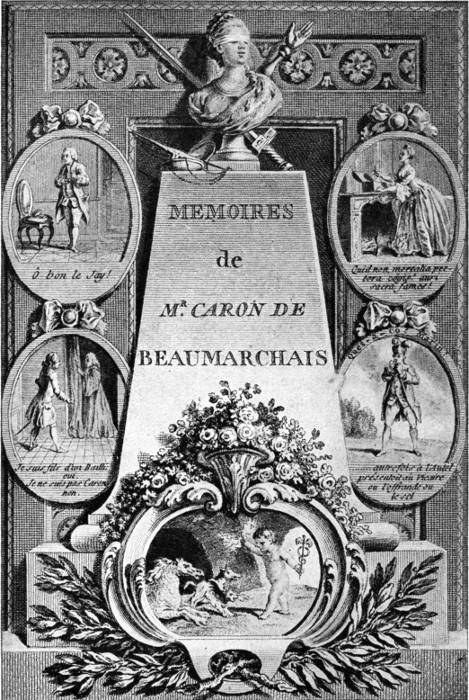
Compte Rendu, par Beaumarchais
Beaumarchais Undertakes to Protect the Rights of Dramatic
Authors—Lawsuit with the Comédie-Française—Founder of the
First Society of Dramatic Authors—Jealousies Among Themselves
Retard Success—National Assembly Grants Decree 1791—Final Form
Given by Napoleon.
WHILE Beaumarchais
was enjoying the triumph of his Barbier de Séville,
his other affairs were by no means neglected.
Very soon we shall have occasion to accompany him to London on one of the
most singular missions of which it is possible to conceive. But before
entering into a history of the political and financial operations into
which Beaumarchais plunged after his return from Vienna, it is necessary
to speak of the very important matter which the success of the Barbier
emboldened its author to undertake.
As Beaumarchais possessed to such an extraordinary degree the power, as he
himself has expressed it, “de fermer le tiroir d’une affaire,” and
instantly to turn the whole force of his mind into a totally different
channel, we shall not be surprised to find him at one and the same time
undertaking to protect the rights of dramatic authors against the
comedians of the king; settling for Louis XVI a matter of occult diplomacy
of the old king, Louis XV, which had dragged on for years, and which no
one else had been able to adjust; working with unremitting zeal for his
own rehabilitation as citizen; pursuing the interests of his suit with the
Comte de la Blache, which was still in progress; leading a life in London
and Paris which from the point of view of pleasure left little to be
desired; and all the while engaged in constant and almost superhuman
exertions to stir the French government out of its lethargy in regard to
the insurgent American colonies, and later in sending the latter aid,
under the very eyes of the English, exposed to constant danger of
bankruptcy and ruin.
Unlike Beaumarchais, we are unable to give our attention to so many things
at the same time, and we are therefore forced to treat each action
separately.
Beginning then with his action against the comedians, it is necessary to
state that the custom by which that ancient and highly honored institution
the Théâtre-Français regulated its accounts with the author whose plays
were there produced, permitted of so much obscurity that no attempt was
ever made to verify those accounts, so that all the authors practically
were obliged to content themselves with whatever the comedians chose to
give them.
This condition of affairs had arisen in the following manner. The earliest
theatrical representations, since those given in Greece and Rome, were the
Mysteries, or Miracle
Plays,
which were written by the monks, who went
about presenting them and who, of course, worked gratuitously. Later,
small sums were offered for plays, but it was not until the time of Louis
XIV that an author received any considerable sum for a literary
production. Even during the reign of this liberal monarch it was the
personal munificence of the king that extended itself to the author,
rather than any rights which he possessed. That this munificence was quite
inadequate is proved by the fact that the “grand Corneille,” whose sublime
genius lifted at one stroke, the literature of France to a height which
few nations have surpassed, was allowed to die in poverty and distress.
Finally in 1697, a royal decree had been issued, which gave to the authors
of the Théâtre-Français the right to a ninth part of the receipts of
each representation, after the deduction of the costs of the performance
and certain rights, the limits of which were not clearly defined. It was
stipulated also that if for twice in succession the receipts fell below
the cost of performance, from which presentation the author of course
received no returns, the piece, which was then termed, tombée dans les
règles, became the property of the comedians. There was nothing said
about any future performance of the piece. The comedians thus had it in
their power to take it up anew, retaining for themselves the entire
proceeds of the performances.
Innumerable abuses had crept in, so that instead of a ninth, it was well
proved that often the author received less than a twentieth part of the
returns of the play. The position of the comedians was strengthened by the
current opinion that it was degrading to the high art of literature to
bring it down to a financial basis. Profiting by this and abusing their
privileges, the Comédie-Française had gone on confiscating the
productions of authors without serious opposition,
although
their actions
had given rise in more than one instance to very serious trouble. Such was
the condition of affairs in 1775.
“The richest of the dramatic authors,” says Loménie, “Beaumarchais, for
whom the theater had never been anything but a form of recreation, and who
had made a present of his first two plays to the comedians, could not be
taxed with cupidity in taking in hand the cause of his brothers of the
pen. This is what determined him. We soon shall see him defending, for the
first time, the rights of others more than his own, and hazarding himself
in a new combat against adversaries more difficult to conquer than those
against whom he had fought already; he will conquer nevertheless, but not
for many years, and only with the aid of the Revolution will he succeed in
getting the better of the kings and queens of the theater, in restraining
the cupidity of the directors, and in establishing the rights of authors,
until this time so unjustly despoiled.
“To the end of his life he did not cease to demand that the law surround
with its protection a kind of property, no less inviolable than other
forms, but before his fervid pleadings, completely sacrificed.
“The society of dramatic authors to-day so powerful, so strongly
organized, which rightly, or wrongly is sometimes accused of having
replaced the tyranny of the actors and directors of the theatre by a
tyranny exactly the reverse, do not know perhaps all they owe to the man
who was the first to unite into a solid body the writers who up to that
time had lived entirely isolated.”
Beaumarchais had long lived on terms of intimacy with the comedians of the
Théâtre-Français; that he continued to do so during the years when his
suit against them was in progress, is proved by the following letter from
Mlle.
Doligny,
written in 1779.
The letter to which she alludes was in relation to his drama, Les Deux
Amis, which he very much desired to have brought a second time before the
public. The piece, it will be remembered, had never succeeded in Paris.
Beaumarchais professed a special fondness for it, however, and desired now
to have it revived. The letter of Mlle. Doligny is as follows:
“Monsieur: I do not know how to thank you enough for all that you said of
me in the letter which you wrote to the Comédie on the subject of Les
Deux Amis. All my comrades were enchanted with the gaiety and esprit
which shone in your letter. I was more enchanted than anyone, because of
your friendship and goodness to me.” Then follows a special request in
regard to two friends, after which she terminates thus:
“It is your Eugénie, your Pauline, your Rosine, who solicits this; I dare
hope that you will pay some attention to their recommendations. Receive
the testimony of esteem, of attachment and of gratitude with which I am
for life, Monsieur, your, etc.
Doligny.”
In 1775, Beaumarchais and the comedians were living on the best of terms
as well may be supposed. Never had the Comédie received such fabulous
returns from any play heretofore produced. Never had actors entered with
more spirit into the views of their author.
“As many times as you please, Messieurs, to give the Barbier de Séville,
I will endure it with resignation. And may you burst with people for I am
the friend of your successes and the lover of my own!—If the public is
contented and if you are, I shall be also. I should like to be able to
say
as much for the critics; but though you have done all that is
possible to give the piece to the best advantage and played like angels,
you will have to renounce their support; one cannot please everybody.”
During the summer the matter of the Barbier de Séville seems to have
dropped, owing no doubt to the fact that Beaumarchais was occupied
completely with his secret mission and with his ardent addresses to the
king in relation to the insurgent colonies. It will be remembered also
that it was in August of this same year that the elder Caron breathed his
last. We have given already the letter written on his death-bed where the
venerable old watchmaker with expiring breath blessed his son who always
had been his pride and honor, as well as his devoted friend.
And so to return to the case of the Comédie-Française. In December,
1775, being for a short time in Paris, Beaumarchais addressed himself to
the comedians, in a letter the tone and matter of which show that his
solicitude as an author had been aroused by a suspicion that they were
trying to make his piece tomber dans les règles, and so confiscate it,
by giving it on a day when some special performance at Versailles was
liable to attract thither a large portion of the theater-going public. He
wrote in a spirited way demanding that something be substituted for the
Barbier on that night. The letter terminates thus, “All the good days
except Saturday, the 23rd of December, 1775, you will give me the greatest
pleasure to satisfy with the Barbier, the small number of its admirers.
For that day only, it will be easy to admit the validity of my excuses,
recognized by the Comédie itself. I have the honor to be, etc.
“Caron de Beaumarchais.”
“In re-reading my letter I reflect that the Comédie may be embarrassed
for Saturday because all the great tragedians
are
at Versailles. If that
is the reason—Why did you not tell me simply how the matter stood? He who
seems strict and rigorous in discussing his affairs is often the man who
is the easiest in obliging his friends.—I should be distressed if the
Comédie had the smallest occasion to complain of me, as I hope always to
have nothing but praise for it.
“Reply if you please.
Paris, December 20th 1775.”
Time passed on. As Beaumarchais had given to the comedians his first two
dramas, hope was entertained that he would demand no return for his
Barbier. Early in May, 1776, to their surprise and dismay, came a polite
request that an exact account of the part due him as the author be made
out and given to him. The play then had been given thirty-two times.
Not wishing to stir up trouble between themselves and their excellent
friend, while at the same time unable and unwilling to grant the request,
the comedians met the difficulty by a profound silence. “At last,” says
Beaumarchais in his Compte rendu, written several years later, “one of
them asked me if it was my intention to give the piece to the Comédie or
to require the right of authorship? I replied laughing like Sagnarelle: ‘I
will give it, if I wish to give it, and I will not give it, if I do not
wish to give it; which does not in the least interfere with my receiving
the account; a present has no merit, excepting as he who gives knows its
value.’
“One of the actors insisted and said, ‘If you will not give it, Monsieur,
tell us at least how many times you desire that we play it for your
profit, after that it will belong to us.’
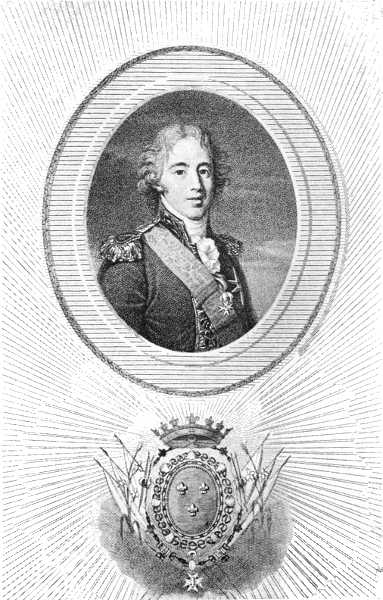 Charles Philippe—Comte D’Artois
“‘What necessity, messieurs, that it should belong to you?’
“‘A great many authors make similar arrangements with us.’
“‘Those authors are not to be imitated.’
“‘They are very well satisfied, monsieur, because if they do not enjoy the
profits of their piece, at least they have the advantage of seeing it
played more often. Do you wish that we play it for your profit six, eight,
or even ten times? Speak.’
“The proposition seemed to me so amusing that I replied in the same gay
tone, ‘Since you permit me, I ask you to play it a thousand and one
times.’
“‘Monsieur, you are very modest.’
“‘Modest, Messieurs, as you are just. What mania is it that you have, to
wish to inherit from people who are not dead? My piece not belonging to
you until it falls to a very low receipt, you ought to desire that it
never belong to you. Are not eight-ninths of a hundred louis, more than
nine-ninths of fifty? I see, Messieurs, that you love your interests
better than you understand them.’
“I laughingly saluted the assembly, who smiled a little on their side
because their orator was slightly flushed with argument.
“At last, on January 3rd, 1777, M. Desessarts, one of the comedians, came
to my house ... bringing me four thousand, five-hundred, and six livres as
belonging to me from my droits d’auteur for the thirty-two performances
of the Barbier. No account being joined, I did not accept the money,
although M. Desessarts pressed me to do so in the most polite way in the
world.
“‘There are a great many points upon which it is impossible for the
Comédie to give MM. the authors anything but une côte mal taillée (in
lump, without detail)’.
“‘What I require very much more than money,’ I replied, ‘is une côte bien
taillée, an exact account, which may serve as a type or model for all
future accounts and may bring at last peace between the actors and the
authors.’
“‘I see,’ he said, ‘that you wish to open a quarrel with the Comédie.’
“‘On the contrary, Monsieur, nothing would please me so much as to be able
to terminate everything to the equal advantage of both parties.’ And he
took back the money.”
Three days later Beaumarchais sent a polite note explaining why he
returned the money, and clearly stating the nature of the account which he
demanded. Receiving no reply, he wrote again, in the most courteous way,
reminding them of their negligence.
The Comédie then sent a simple memorandum, “following the usages
observed by us with Messieurs, les auteurs,” which was without
signature.
Beaumarchais at once returned the memorandum, thanking the comedians for
their pains, but begging that the memorandum be verified and signed.
Receiving no reply, three days later he sent a second missive, in which he
assumed that his first letter had gone astray. “I beg you,” he added, “to
enlighten me as to this matter and send me your account certified. The
messenger has orders to wait.” And he ends thus, “I am ill. I have been
forbidden all serious affairs for several days; I profit by this forced
leisure to occupy myself with this which is not serious at all.”
For the Comédie, however, it was, to say the least, a serious
embarrassment. They replied that it was impossible to verify the account
except for the receipt taken at the door, “the other elements can only be
guessed at.”
“The letter,” says Beaumarchais, “was garlanded with as
many
signatures
as the memorandum had not.”
Assuming that it was their ignorance of affairs that caused the disorder,
he undertook to give, in his own inimitable way, a lesson in bookkeeping.
The letter begins as follows:
“In reading, Messieurs, the obliging letter with which you have just
honored me, signed by a number among you, I am confirmed in the idea that
you are very honest people, and very much disposed to do justice to
authors; but that it is with you, as with all men who are more versed in
the agreeable arts than in the exact sciences, and who make phantoms of
the embarrassing methods of calculation, which the simplest arithmetician
would solve without difficulty.”
Then follows the lesson. The letter ends with, “Eh, believe me, Messieurs,
give no more côtes mal taillées to men of letters; too proud to receive
favors, they are often too much in distress to endure losses.
“So long as you do not adopt the method of an exact account unknown only
to yourselves, you will have the annoyance of being reproached with a
pretended system of usurpation over men of letters which is surely not in
the mind of any one of you.
“Pardon that I take the liberty of rectifying your ideas, but it is
necessary to come to an understanding; and as you seemed to me in your
letter embarrassed to give an exact form to a simple account, I have
permitted myself to propose to you an easy method, capable of being
understood by the simplest accountant.
“Two words, Messieurs, enclose the whole of the present question; if the
account which I returned is not just, rectify it. If you believe it to be
exact, certify it; this is the way we must proceed in all matters of
business.”
“The actors,” says Loménie, “did not relish this lesson in
accounts
given
with so much complaisance and politeness. They replied that they would
assemble the lawyers forming the council of the Comédie and name four
commissioners from their body to examine the case.”
“To assemble all the council of lawyers,” says Beaumarchais, “and name
commissioners to consult as to whether an exact account should be sent me,
duly signed, seemed to me a very strange proceeding.”
The comedians were, however, in no hurry to act. The 14th of February,
1777, they wrote to their troublesome friend.
“It is still a question of assembling the council. The circumstance of the
carnival joined to the services which we are obliged to perform at court
and in the city have prevented the frequent reunion of different persons
who should occupy themselves in this affair....”
“I concluded from this letter,” says Beaumarchais, “that the Comédie was
contented with me, but that the carnival seemed a bad time to occupy
themselves with business. Letting the comedians, the lawyers, and their
council dance in peace, I waited patiently until the end of Lent, but
either they were still dancing, or doing penance for having danced,
because I heard nothing from them.
“Four months rolled by in a profound sleep from which I was awakened June
1st, 1777.” The cause of Beaumarchais’s awakening was the sudden discovery
that urgent requests from time to time to the comedians to play the
Barbier met with constant refusal.
The 2nd of June he wrote a letter from which we extract the following, “If
patience is a virtue, you have the right, Messieurs, to think me the most
virtuous of men, but if you take the right to forget that you owe me for
two or three years a verified account ... it is I who have the right
to
be offended, because there are limits to the patience of even the most
absurd....”
After a spirited recapitulation of his wrongs he continues, “In a word,
Messieurs, you will give the piece, or you will not give it, it is not
that which is important to-day. What is important is to put an end to so
much indecision. Let us agree that if you accept I shall within eight days
receive from you a certified account ... and when that term has expired, I
may regard a silence on your part as an obstinate refusal to do me
justice. You will not then object if, making a pious use of my rights as
author, I confide the interests of the poor to those persons whose zeal
and interests oblige them to discuss these interests more methodically
than I, who profess to be always, with the greatest love of peace,...
Yours, etc.,
“Beaumarchais.”
The comedians in their turn awakened by the letter just quoted replied
before the expiration of the eight days, promising the much desired
meeting. Beaumarchais accepted their proposal with his usual grace and
himself fixed the day for the assembly. Fresh difficulties arose. The
comedians wrote an apologetic letter asking for a further delay of a few
days.
“I thought the comedians very good,” wrote Beaumarchais, “to fear that
after waiting more than a year for their convenience, I should be offended
by a new delay of a few days; I was too used to their manner of proceeding
to lose patience at so small a cost. I resolved, therefore, to await the
moment when it should please the fugitive assembly to meet. I waited until
the 15th of June, when I received a letter from M. le Maréchal de
Duras....”
“The comedians,” says Loménie “brought to the wall had
solicited
the
support of the duke, who intervened and begged the claimant to discuss the
matter with him. As Beaumarchais demanded nothing better, he hastened to
offer to the Duke of Duras the same lesson in bookkeeping which he had
vainly offered to the comedians.... Beaumarchais wrote to him:
“‘You are too much interested, M. le Maréchal, in the progress of the most
beautiful of the arts, not to admit that if those who play the pieces gain
an income of twenty-thousand livres, those who thus make the fortune of
the comedians should be able to draw from it that which is absolutely
necessary. There is no personal interest, M. le Maréchal, in my demand;
the love of justice and of letters alone determines me. The man whom the
impulsion of a great genius might have carried to a renewal of the
beautiful chefs-d’œuvre of our masters, certain that he cannot live
three months from the fruits of the vigils of three years, after having
lost five in waiting, becomes a journalist, a libellist or debases himself
in some other trade as lucrative as degrading.’”
M. de Loménie continues, “After a conversation with Beaumarchais, M. de
Duras seemed to enflame himself with ardor for the cause of justice. He
declared that it was time to finish with the debates where authors are at
the discretion of the comedians. He proposed to substitute for the
arbitrary accounts a new regulation where the rights of the two parties
shall be stipulated in the clearest, the most equitable manner. He invited
Beaumarchais to consult with several dramatic authors, and to submit to
him a plan. To this Beaumarchais replied that in a question which
interested all equally, everyone who had written for the Théâtre-Français
had a right to be heard and that all must be assembled.”
The duke consented and the first society of dramatic authors
was
founded
by a circular, dated June 27th, 1777, in which Beaumarchais invited all to
a dinner.
“To unite men,” says Loménie, “who up to that time had been in the habit
of living isolated and jealous lives, was something far from easy, even
when invoking them to a common interest.”
In order that the reader may judge of the obstacles which this new phase
of his enterprise presented, we subjoin two letters of La Harpe, published
by M. de Loménie, in reply to the invitation of Beaumarchais.
“If the end,” says Loménie, in speaking of the first of these letters,
“announced a man unwilling enough to treat with his fellows, the beginning
seemed equally to indicate a little annoyance that another than himself
should have been given the lead with the consent of M. de Duras.”
“M. le Maréchal de Duras,” wrote La Harpe, “has already done me the honor,
Monsieur, of communicating to me, and even in great detail, the new
arrangements which he projects, and which tend, all of them toward the
perfection of the theater, and the satisfaction of authors. I am none the
less disposed to confer with you and with those who like you, Monsieur,
have contributed to enrich the theater, upon our common interests and on
the means of ameliorating and assuring the fate of dramatic authors. It
enters into my plan of life necessitated by pressing occupations never to
dine away from home but I shall have the honor of coming to you after
dinner. I must warn you, however, that if by chance, M. Sauvigny or M.
Dorat are to be present, I will not come. You know the world too well to
bring me face to face with my declared enemies. I have the honor to be
with the most distinguished consideration, Monsieur, etc.
“De la Harpe.”
Beaumarchais, a little embarrassed because he had also invited
Sauvigny
and Dorat, replied to La Harpe by the following letter: “You have imposed
upon me, Monsieur, the unpleasant task of informing you that MM. Sauvigny
and Dorat do me the honor of dining with me to-day. But in a common cause,
permit me to observe to you that in all countries it is the custom to set
aside private quarrels.
“I shall be only too happy, if seconding my pacific views, you do me the
honor to come and forget in the pleasure of an assembly of men of letters
all of whom honor you, small resentments which exist perhaps only through
misunderstanding.
“Do not divide us, Monsieur. We are none too strong with all our forces
united against the great machine of the Comédie. We dine at three, and I
shall flatter myself that you are coming even until three-fifteen—so
anxious am I to have you with us.
“I have the honor to be, etc.
“Beaumarchais.”
To which La Harpe replied:
“It is absolutely impossible, Monsieur, ever to find myself with two men
whose works and whose persons I equally despise; one of them, Dorat,
insulted me personally ... and the other is an unsociable and ferocious
madman whom no one sees, and who is always ready to fight for his verses.
You feel, Monsieur, that this means to fight for nothing. I cannot
conceive how you can class these among les plus honnêtes gens de la
littérature.
“I beg you to accept my excuses, and my sincere regrets. I take very
little account of quarrels where amour-propre alone is concerned, but I
never forget real offenses.
“I have the honor to be ... etc.
“La Harpe.”
“It was necessary to get on without La Harpe,” says Loménie, “at least for
this first meeting, because I see by another note of his that at the next
meeting, where Beaumarchais no doubt sacrificed to the irascible
academician on that day Dorat and Sauvigny, for he accepted the invitation
for dinner and wrote in a more joyful tone.
“‘Your invitation leading me to suppose that the obstacles which kept me
away no longer exist, I willingly consent to join you towards five
o’clock. It is not that I renounce the pleasure of finding myself, glass
in hand, with a man as amiable as you, Monsieur, but you are of too good
company not to have supper and I admit that it is my favorite repast; thus
I say with Horace, “Arcesse vel imperium fer.”
“‘I have the honor to be—etc.
La Harpe.’”
On the third of July, 1777, twenty-three dramatic authors found themselves
gathered together around the table of Beaumarchais. If several had
absented themselves from personal jealousies, others had stayed away
through indifference. Collé, homme spirituel and author famous in his
time, replied in a letter flattering to Beaumarchais but refusing all
participation in the work of the society. Absent at that time from Paris,
he wrote, “I avow, Monsieur, with my ordinary frankness that even had I
been in Paris I should not have had the honor of finding myself at your
assembly of MM. the dramatic authors. I am old and disgusted to the point
of nausea with that troupe royale. For three years I have seen neither
comédiens nor comédiennes.
De tous ces gens-là
J’en ai jusque-là.
I do not any the less, Monsieur, desire the accomplishment of your
project, but permit me to limit myself to wishing you success, of which I
would very much doubt if you were not at the head of the enterprise, which
has all the difficulties which you can desire because you have proved to
the public, Monsieur, that nothing is impossible to you. I have always
thought that you disliked that which was easy.
“I have the honor to be, etc.
Collé.”
A second invitation had no better success. The old poet answers in the
same vein, “M. Collé thanks M. de Beaumarchais for his remembrance. He
begs him anew to be so good as to receive his excuses for the affair of
the comedians. He is too old to bother himself with it. Like the rat in
the fable, he has retired into his Holland cheese and it is not likely
that he will come out to make the world go otherwise than she is going.
For fifteen years he has been saying of the impolite and disobliging
proceedings of the comedians, that verse of Piron in Callisthène, ‘From
excess of contempt I have become peaceable. A force de mépris je me
trouve paisible.’
“M. Collé compliments M. de Beaumarchais a thousand and a thousand times.”
Diderot, the founder of the new school of literature, also refused his
concurrence.
“Vous voilà, Monsieur,” he wrote, “at the head of an insurgence of
dramatic poets against the comedians ... I have participated in none of
these things and it will be possible to participate in none that are to
follow. I pass my life in the country, almost as much a stranger to the
affairs of the city as forgotten of its inhabitants. Permit me to limit
myself
to desires for your success. While you are fighting, I will hold
my arms elevated to heaven, upon the mountains of Meudon. May those who
devote themselves to the theater owe to you their independence, but to
speak truly I fear that it will be more difficult to conquer a troup of
comedians than a parliament. Ridicule does not have here the same force.
No matter, your attempt will be none the less just and none the less
honest. I salute and I embrace you. You know the sentiments of esteem with
which I have been for a long time, Monsieur, yours, etc.
“Diderot.”
Most of the authors had responded with enthusiasm to the appeal of
Beaumarchais. A few lines from a letter of Chamfort will serve to show the
spirit which animated many of them.
He says, “One can flatter one’s self that your esprit, your activity and
intelligence will find a way to remedy the principal abuses which must
necessarily ruin dramatic literature in France. It will be rendering a
veritable service to the nation and join once more your name to a
remarkable epoch.... I hope, Monsieur, that the états-généraux de l’art
dramatique, which to-morrow is to come together at your house, will not
meet with the same destiny as other states-general, that of seeing all our
miseries without being able to remedy any. However it be, I firmly believe
that if you do not succeed, we must renounce all hope of reform. For
myself, I shall have at least gained the advantage of forming a closer
bond with a man of so much merit, whom the hazards of society have not
permitted me to meet as often as I should have desired.
“I have the honor to be, etc.
Chamfort.”
“After the dinner,” says Loménie, “they proceeded to the election of four
commissioners charged to defend the interests of the society, and to work
in its name at the new regulations demanded by the duke of Duras.
Beaumarchais, originator of the enterprise, naturally was chosen first.
Two Academedians, Saurin and Marmontel, were joined to him, and besides
them Sedaine, who, without being yet a member of the Academy, enjoyed a
very justly acquired reputation.
“This assembly of insurgents, to use the term of Diderot, recalled in a
way the group of colonies who just one year before at the same time of the
year, had declared their independence, but it was easier to conquer the
English than the comedians.
“These latter, learning of the action of the authors, assembled on their
side, called to their aid four or five lawyers, and prepared to make a
vigorous resistance.”
In very truth the troubles of Beaumarchais were only beginning, nor did
these troubles come from the comedians alone; after the first few meetings
complete discord reigned among the authors themselves, so much so that
anyone but Beaumarchais would have given up in despair. The details of
this disheartening undertaking have been given fully in the Compte
rendu, published with the works of Beaumarchais. They have interest for
us only so far as they reveal the character of this many-sided man.
Overwhelmed with enterprises of every sort, with losses and disasters that
from time to time brought him to the verge of ruin, he still maintained
the cause of men of letters with unfaltering perseverance, and this
notwithstanding the bickerings, the petty jealousies, the ingratitude of
the most interested in the result of the undertaking. Those appointed
joint-commissioners with him left to him all the work. When anything went
wrong all the blame fell back on his shoulders;
nevertheless,
with his
usual philosophy he forgave and forgot everything but the end which he
kept constantly in view.
At last, in the spring of 1780, a sort of arrangement was reached which
was indeed an improvement on the regulations of the past, though still far
from satisfactory.
In honor of the reconciliation, authors and comedians were invited to dine
together at the house of the man who for so long had been trying to bring
peace between them. It was not long before a rumor was afloat that
Beaumarchais had gone over to the side of the comedians. His colleague,
Sedaine, hastened to inform him in a thoughtless fashion of the reproaches
which were being made by some of those for whom he had sacrificed so much
of his repose. The tone of the letter of Sedaine was light and flippant.
Beaumarchais, hurt to the quick, replied in the following words:
“Paris, this 3rd of May, 1780.
“I have not at once replied, my dear colleague, to your letter because the
heat which mounted to my head would not have permitted me to do so with
proper moderation. I have passed my entire life in doing my best, to the
sweet murmur of reproaches and outrages from those whom I have served; but
perhaps nothing ever has hurt me so much as this ... Let others do better,
I will congratulate them.... No human consideration can retain me any
longer in the following of this very ungrateful, dramatic literary
association. I salute, honor and love you.
“I realize in re-reading my scribbling that my head is still hot, but I
recommence in vain. I find myself less master of myself than I could
wish.”
“Sedaine,” says Loménie, “recognizing that he had been in the wrong,
replied by an affectionate letter which proved that
if
the author of Le
Philosophe sans le Savoir loved gossip, he was at heart an excellent
man.”
“Yes, my dear colleague,” he wrote, “your head was still hot when you
replied. Perhaps something in my letter hurt you, because the reproaches
which I had heard uttered had angered me. I cannot, however, believe that
you have taken for my sentiments that which I reported of your ungrateful
and unreasonable confrères. Nevertheless, excepting three or four, the
rest do us justice, and it is to you that we pass it on. If I said
anything which pained you, I very sincerely beg your pardon. It is for you
to be moderate, it does you more honor than me, who am older than you.
Continue your beautiful and excellent services; finish your work, and do
them good in spite of their ingratitude. This affair terminated to our
honor by you, I will beg them to assemble at my house and they will order
me to join myself to a deputation to go to thank you for all your pains.
This is all we can offer you now. They will do it, or I shall separate
myself from them for the rest of my life, who have only need of repose and
your friendship.
“I embrace you with all my heart, and let us leave the evilly disposed for
what they are.”
The debates, however, were not over, for the next ten years the struggle
continued with Beaumarchais always in the lead.
“At last,” says Loménie, “the Revolution came to put an end to the old
abusive privileges of the Théâtre-Français, and the usurpation of the
directors of the theaters of the provinces. Following a petition drawn up
by La Harpe, Beaumarchais and Sedaine, representing the society of
dramatic authors and under the influence of numerous memoirs published
by
Beaumarchais, the National assembly recognized the right of property of
authors, suppressed all the privileges of the Comédie-Française, and
decreed, on the 13th of January, 1791, that the works of living authors
could not be produced anywhere in France without the consent of the
authors.... To protect these interests was one of the chief occupations of
the old age of Beaumarchais.... To the very end he continued to be the
patron of men of letters; one of his last letters was addressed to the
Minister of the Interior under the Directory, supporting a petition of the
society.”
It was Napoleon who gave the final form to the regulations existing
between dramatic authors and the Théâtre-Français. The honor,
nevertheless, belonged to Beaumarchais, for it was he who conceived and
carried on for so many years one of the most difficult enterprises ever
undertaken by a private individual.
Essentially modern in all his views, his was the rôle of preparing the way
for many of the things that the nineteenth century was to produce. Himself
no revolutionist, at least not in theory, it was yet he who played so
important a part in sustaining on one hand and preparing on the other the
two greatest political and social revolutions which the world has ever
seen.
The establishment of the reign of justice, liberty, and individual rights
was the goal ever before him.
“Qu’ étais-je donc,” he writes near the close of his life, “What have I
been after all? I have been nothing by myself and myself as I have
remained, free in the midst of fetters, serene in the greatest dangers,
braving all the storms, sustaining commerce with one hand and war with the
other, indolent as a mule, but always working, the butt of a thousand
calumnies, but happy in my family, never having been of
any
coterie,
neither literary, nor political, nor mystic, never having paid court to
anyone, and ever repelled by all.” Somewhere else he adds, “It is the
mystery of my life, in vain I try to comprehend
it.”