the cagot—vallée d'aspe—superstitions—forests—despourrins—the
two gaves—bedous—high-road to saragossa—cascade of
lescun—urdos—a picture of murillo—la vache.
The subject of the Cagots has occupied the attention of learned and
unlearned persons both formerly, and at the present time; and the
interest it excites is rather on the increase than otherwise; like the
mysterious question of the race and language of the Basques, it can
never fail to excite speculation and conjecture. A gentleman, who is a
professor at the college of Pau, has devoted much of his time to the
investigation of this curious secret, and has thrown his observations
together in the form of a romance, in a manner so pleasing, and so well
calculated to place the persons he wishes to describe immediately before
the mind's eye of his reader, that I think a few extracts from his story
of the cagot, yet unpublished, will give the best idea of the state of
degradation and oppression in which the Cagots were forced to exist; and
exhibit in lively colours the tyranny and bigoted prejudice to which
they were victims. I avail myself, therefore, of the permission of M.
Badé, to introduce his Cagot to the English reader.[39] The story thus
opens:
a béarnais tale.
"ON a fine night in the month of June, 1386, a mounted party,
accompanied by archers and attendants on foot, were proceeding, at a
quiet pace, along the left bank of a rivulet called Lauronce, on the way
between Oloron and Aubertin. A fresh breeze had succeeded the burning
vapours which, in the scorching days of summer, sometimes transform the
valleys of Béarn into furnaces. Myriads of stars glittered, bright and
clear, like sparkles of silver, in the deep blue sky, and their
glimmering light rendered the thin veil still more transparent which the
twilight of the solstice had spread over the face of the country; while
through this shadowy haze might be seen, from point to point, on the
hills, the ruddy flame of half-extinguished fires.
"From time to time, those who composed the cavalcade paused as it
reached higher ground, in order to contemplate the magnificent spectacle
before them and the effect produced by the doubtful and fleeting shadows
which rested on the fields, on the dark woods, and on the broken and
uncertain line in the southern horizon which indicated the summits of
the Pyrenees. The air was full of the perfume of newly-cut hay; the
leaves sent forth a trembling murmur; the cricket uttered his sharp
chirrup in the meadows; the quail's short, flute-like cry was heard, and
all in nature harmonized with the beauty of the summer night."
The party, who are travelling at this hour in order to avoid the heats
of the day, are then introduced by the narrator as the Baron de Lescun
and his niece, Marie, an orphan confided to his care: they are on their
way to the Court of Gaston Phoebus, Count of Foix, at Orthez, who is
about to give a series of fêtes and tournaments: they have been
joined by a lady and her son—the Dame d'Artiguelouve (a name of old
standing in Béarn, and still existing,)—and the young domenger, (the
Bérnais title of Damoiseau,) Odon, escorted by their pages and valets.
Conversation ensues between them, in which the young lady expresses some
doubts as to their prudence in choosing so witching an hour, however
beautiful the time, for their journey; when it is known that evil
spirits and sorcerers are abroad on their foul errands.
They presently arrive on the territory of Faget, when they are startled
to observe, as if flitting near them, human forms, which glide
noiselessly along, like shades in the darkness. Some of these mysterious
beings placed themselves in a stooping position on the margin of the
streams, with their faces bent close to the water. Others, divesting
themselves of their garments, entered, with hurried and noiseless stops,
a neighbouring field of oats, and there concealed themselves. Some of
the strangers were astonished at what they saw, and could not resolve in
their own minds whether or not these were, indeed, phantoms that
appeared in their path.
"'Midnight must be near, and the fête of St. Jean is about to begin,'
said the Sire de Lescun; 'for these are the poor people who are on the
watch for the unattainable moment, when, it is thought, the water
changes into wine, and has the power of healing all their infirmities:
the dew of this night, received on the body in the fields, is also said
to be endowed with the same marvellous virtue.'"
A confused noise now met their ears as they entered the forest of
Lorincq, and a singular spectacle was presented to them:
"The forest, all resplendent with illuminations, seemed full of bustle
and animation. Numerous torches sparkled amongst the trees to which they
were suspended or attached; others were borne along, whirled from place
to place, their black smoke sending its long wreaths into the air, and
their red flame flashing through the gloom. A thousand voices burst
forth, as if simultaneously, from height and valley, above, around, and
underneath; an immense crowd hurried along—some mounting, some
descending—amongst the crackling branches, until the intricate alleys
and close retreats of this labyrinth of verdure were filled with human
beings.
"The lame and wounded, the infirm and paralytic grouped themselves
around the fountains, to be ready at the right moment to plunge their
afflicted limbs in the cold waters, and then to cast in their offering
of a piece of money: some, providing for the future, busied themselves
in filling, from the beneficent source, their vases and pitchers to
overflowing; for it was firmly believed, that, in memory of the holy
baptism administered by the patron of the fête, Heaven had endowed the
waters with peculiar powers during that favoured night; allowing the
virtue to take effect from midnight to the rising of the sun.
"In the humid fern might be seen cattle sent to graze at will, in the
hope of being cured of some malady, their tinkling bells indicating
where they wandered. Parties of old men, women, and children, dispersed
here and there, were eating cakes prepared for the occasion; while young
men and girls danced in circles beneath the ash and elm trees, to the
sound of the flute of three notes, accompanied by the nasal cadence of
the lute of six strings.
"After halting for a considerable time, and taking their part in the
religious advantages of the fête, the cavalcade resumed its route; and
soon descended into the valley of the Bayse, as the sky began to be
tinged with the hue of dawn. When they arrived at the hospital of
Aubertin, the first rays of the sun were casting a golden light on the
Roman transepts of the church."
At the moment that the Dame d'Artiguelouve and her son are alighting
from their horses, they are arrested, and impressed with a superstitious
feeling of terror, by observing a fine white courser at the door of the
church, held by a page. This was, at the period, a bad omen for the
stranger who first saw it, and boded no good to any one.
"'I would not', said Joan Bordenabe—a peasant standing by,—'for the
castle of Artiguelouve, have met with so bad an omen, as the Ena[40]
Garsende and her noble son, who have come at once, face to face, with
that animal, covered, as it would seem by his colour, with the snows of
the Pyrenees: by our Lady of Sarrance, their future years will be as
black as he is white!'
"'But,' replied his companion, 'if I were the knight to whom the charger
belongs, I would part with him instantly, even if, at the same time as I
drowned him, I must throw into the Gave my sword and golden spurs: don't
you see that spiteful-looking magpie, which has just started up before
him, after having chattered in his very face? What awful signs of evil
are these! and on such a morning, at the rising of the sun! * * * May
the bon Dieu, the Holy Virgin, and the white fairies of the
subterranean caves, who are always combing their hair at the first
glimpse of dawn, and looking into the clear mirror of the fountains,
protect that beautiful young lady, who is at this moment entering the
church. It is to be hoped she has made an ample provision of fennel to
lay under her bed's head, and in her oratory, to counteract the evil
influence of the Brouches!'"[41]
While the young lady, Marie de Lignac, enters the church to perform her
devotions, the rest of the party leave her, to join the chase of the
wild boar, which the Lord of Artiguelouve, the father of Odon, is
following, as his horns announce, in the adjacent forest.
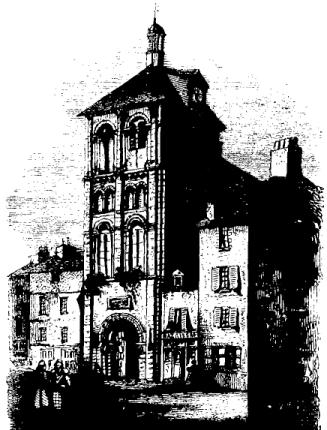
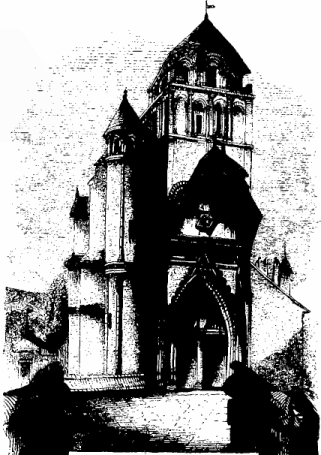
The Hospital of Aubertin, which still exists, is a building of the
twelfth century, and was one of many establishments depending on the
order of monks hospitalers of Sainte Christine: it served as an asylum
to the pilgrims of St. James, and as a resting-place to travellers going
and coming to and from Spain, Marie found the church filled with persons
of different professions: merchants from Arragon and Catalonia; pilgrims
adorned with palms and cockle-shells, emblems of their wandering;
shepherds in their red dresses and brown berret-caps; and wayfarers of
many sorts, waiting only for the morning to continue their journey in
various directions, and offering up their prayers previously to setting
out. Among others, she noticed particularly a young knight (un beau
caver[42]) devoutly kneeling at the foot of the altar of the Virgin,
while his archers and men-at-arms were engaged in prayer close behind
him: she judged that to him must belong the white charger at the
church-door, which had inspired the peasants with so much superstitious
terror. Nothing appeared to disturb the devotion of the knight; neither
the neighing of steeds without, nor the clatter of the hoofs of mules in
the court, as the different groups prepared to depart; nor the coming
and going of the merely curious, who were busied observing the beauty of
the edifice, the materials of which, according to popular belief, were
furnished by the Holy Virgin herself, who directed the elaborate and
beautiful ornaments of the pillars and cornices still to be seen there.
The knight's costume was half civil, half military; of one sombre
colour, without blazon or distinction—a circumstance unusual at the
period: the expression of his face was grave and melancholy: he was
somewhat bronzed with the sun, otherwise his complexion was fair, and
his blue eyes were full of character and softness.
Even the appearance of the lady does not cause the knight to cease his
prayers, and she remains looking upon him, half-divided between her duty
and a sudden feeling of admiration and involuntary esteem for which she
is unable to account, except by considering him as an apparition sent
from heaven,—when a violent noise without, accompanied by the cries of
hunters and their horns, effectually put a stop to the religious
occupation of all within the church. All hurry out, and, amongst the
rest—her orisons over—is the young lady, attended by her page. She had
scarcely left the door, and was hastening to the neighbouring hostelry,
when she saw before her, at a very short distance, surrounded by a
furious pack of hounds, who, bleeding and wounded, were yet attacking
their enemy boldly, an enormous wild boar, evidently rendered savage by
his sufferings. The beast rushed along, his white tusks gleaming
fearfully, and his hot breath already reaching the terrified girl and
her feeble protector. Marie turned back, and darted towards the open
door of the church, and in another moment might have been out of the
reach of the infuriated animal; but a stone imprudently aimed at the
boar by a peasant from the wood, sent him, foaming, exactly in the
direction she had taken. She saw there was no escape—made a bound, and
fell senseless on the threshold of the church: the boar had just reached
the spot, and one stroke of his terrible tusk had sufficed to crush the
fragile being, who lay extended before him, when a young peasant, with a
swiftness almost supernatural, interposed between her and her fate; and,
with an axe with which he was armed, discharged so well-directed a blow
on the head of the brute, that he extended him dead at his feet.
Certainly, never had succour arrived at a time of more need; and it was
impossible to deny that the young man's intrepidity had saved the lady's
life: nevertheless, when the crowd collected around them, as Marie,
assisted by her terrified page, began to recover consciousness, and her
deliverer stood, his axe yet reeking with the blood of the animal from
whom he had saved her, and whose carcase lay recking, the skull cleft in
two,—it was with anything but applause or commendation that this act of
self-devotion was hailed by all present.
As they cast their eyes on the coarse and ragged garb of the young man,
those nearest observed on the breast a certain piece of red cloth, cut
in the form of a goose's foot: a cry of horror and contempt, mingled
with surprise, accompanied this discovery, and the words—"It is a
Cagot! it is a Cagot!" rang through the assembly, and was repeated by a
hundred voices in different intonations of horror. * * *
The object of this popular disgust was a tall, handsome,
powerfully-built youth, fair, and of fine complexion: he stood in an
easy attitude, in which the majesty of recent action was conspicuous:
his colour was heightened, and his bright eyes flashed with satisfaction
at the deed he had performed; but when he heard the rage of the people
rising, and the fatal and detested name of Cagot sounded in his ears,
a far different feeling—the consciousness of his utter degradation,
which he had for a moment forgotten, returned to him with added force.
Suddenly recalled from his illusion, his head sunk mournfully on his
bosom, and he seemed at once to retire within himself, gathering all
the courage and patience of which he was capable to enable him to
endure the outrages and violence which he knew but too well awaited him.
"'Accursed Cagot![43]—down with the accursed Cagot!' repeated a host of
confused voices.
"'Death to the leprous wretch!—to the river with him!—drag him to the
river!—he has infected our fields—the holy dew is on him yet!'
"'He has laid his infected hands on our master's goods—he has dared to
touch the game!' cried one of the huntsmen, coming up.
"'Hound of ill omen!' thundered Odon d'Artiguelouve, dashing through all
the crowd, with his lady-mother and all his mounted attendants—'has he
dared to place his devilish claw on that which belongs to us?'
"'He has bewitched our woods, and blighted our harvests!' exclaimed a
peasant, giving him a blow, and spitting in his face.
"'To the flames with the sorcerer!—to the fire with the
broomstick-rider!—to the fire with the comrade of the infernal
spirits!' cried others; and one threw at him a half-burnt log of the St.
John's fire, which, striking him on the forehead, sent the unfortunate
Cagot reeling to the foot of a tree, against which he leaned for
support.
This, and much more insult was lumped upon the unfortunate young man,
accompanied by furious howlings and execrations, which became every
moment louder: hisses, laughter, and showers of mud and stones were sent
towards him as he stood, motionless and calm; his eyes half-closed;
without uttering a groan or a word; but, apparently, resolved to endure
without shrinking the undeserved fate which pursued him.
Every moment the crowd increased, and with it the fury of popular
hatred, until, at length, fatigued with the patience of their victim,
the people proposed at once to drag the Cagot to the river. He was,
therefore, seized, bound, and, in spite of his resistance and his
strength, they prepared to carry their threats into execution; at the
same time uttering those savage cries, known in the country as les cris
Basques, and imitating, in derision of the wretched creature they were
injuring, the sharp voice of the goose, and the nasal call of the duck.
The young Ena Marie, for whose sake her deliverer was thus suffering,
wept, entreated, and appealed to the senseless multitude in vain, and
implored the mercy of Odon and Dame Garsende, who treated her prayers
with indifference, and appeared to think the conduct of the mob
perfectly justifiable. But, at the moment when all hope seemed lost, the
interference of the young knight of the church prevented the execution
of the crime about to be perpetrated.
Followed by his archers and men-at-arms, he rushed forward, and
commanded that the prisoner should be released, in a tone and with
gestures so commanding, that the astonished crowd was, for a time,
arrested in their project, and a general silence ensued, presently
broken by a voice at a distance, which exclaimed—"Noble and generous
child! the blessing of Heaven be on thee!" All eyes were directed
towards the speaker—an old man with silver hair, clothed in a dark
mantle, with the hood drawn over his head: he stood on an elevated mound
above the scene of action, and on finding himself observed hurried away
from the spot.
Meantime, taking advantage of the awe his appearance had excited in the
public mind, the knight hastened to the poor Cagot, cut with his sword
the cords which bound him, and set him at liberty. Amazement was painted
on the victim's countenance, as he observed the relief which approached
him: to be the object of care to a noble knight—to be defended, treated
like a human creature was indeed a prodigy to him! The being, but an
instant before stupified and inert, from whom insult and injury had
drawn no cry nor tear, this evidence of humanity touched to the quick:
he cast a long look of tenderness and gratitude on his deliverer; and
large tears rolled down his bleeding cheeks. But the panic of the
instant soon passed away; hoarse murmurs arose, and threatening words,
and the tumult recommenced, Odon d'Artiguelouve advanced to the knight,
and demanded, in a haughty tone, by what right he interfered with the
execution of the laws.
"'I am not a stranger to this country,' replied he, calmly, 'though it
is some time since I quitted it; and I know its fors and customs
probably as well as you can do, Messire.'
"'Then,' answered Odon, 'you should know that a Cagot is forbidden to
appear in an assembly of citizens, and that all commerce with them is
expressly denied him; that he has no right to touch any article intended
for their use; and yet you defend this wretch, who has defiled, by the
contact of his accursed hand, the game which belongs to a gentleman.'
"'It appears, then,' answered the knight, with bitter irony, 'that a
gentleman singularly loves his game, since he attaches more value to a
boar's head than to the life of a noble lady, which this poor Cagot
preserved at the risk of injuring one of these precious animals.'
"'Was it for high deeds of this nature,' interposed the Lady of
Artiguelouve, seeing that her son's countenance fell, 'that the knight
took his vows, when he received the honour of the accolade?'
"'I swore, madam,' answered the caver, 'to consecrate my arms to the
service of religion, and the defence of the widow, the orphan, and the
unprotected.'
"'And by what enchantment,' rejoined Dame Garsende, 'does your
knight-errantship behold in us giants or monsters?'
"'A loyal and christian knight ever sees a monster in oppression, madam.
No man can be punished before he is judged, and I see here neither jury,
court of knights, or cour majour.'
"'If that is all,' cried Odon, 'every formality shall be gone through.
Seize this miserable wretch, my friends, and drag him to the
justice-seat; we will follow.'"
An immediate movement was made to obey this order; but the knight again
interfered.
"'It is well,' said he; 'but if you have a right to take him before a
court, he has that of claiming sanctuary. From whence come you, friend?'
he added, turning to the Cagot.
"'From the Vallée d'Aspe, sir knight,' was the answer.
"'Then, it would suffice to reach the Pène d'Escot, at the entrance of
this valley, to be in an inviolable security, and we would, if it were
necessary, escort you as far; but closer still a refuge attends you; you
have only to reach the circle of sanctuary which yon church of
Aubertin offers.'"[44]
A great struggle now ensues, the Béarnais resolving to oppose the
Cagot's entrance to the sanctuary, and the knight and his followers
maintaining his attempt. The young Marie of Lignac at length forces her
way through the crowd, and laying her hand on the Cagot, demands, by
virtue of the fors et coutumes, that he be given up to the protection
of a noble lady who claims her right to shelter the guilty.
This appeal was not to be treated with contempt; and the mob, perhaps
tired of the conflict, gave way with a sudden feeling of respect; while
Marie led the persecuted Cagot, surrounded by the knight's men-at-arms,
to the door of the church, where he entered, and was in safety.
The next scene of the story introduces the reader to the old knight of
Artiguelouve, and the interior of his castle,[45] where the late events
are recounted to him by his wife and son, with great bitterness; and
envy and offended pride excite the mother and son to resolutions of
vengeance, which the father, a man apparently soured with misfortune,
and saddened by some concealed sin, can only oppose by expressions of
contempt, which irritate the more.
The demoiselle de Lignac, meantime, is arrived at the Castle of Orthez,
and received, as well as her uncle, with great honour by Gaston de Foix,
who proposes instituting his beautiful guest the queen of the
approaching tournament.
The unknown knight, having left the Cagot with the monks of Aubertin,
and acted the part of the good Samaritan by his charge, is next seen
pursuing his way southward; where, in the mountains, an interview takes
place between him and his father, who is, it seems, a proscribed man.
They meet after many years of absence, during which the young knight has
won all kinds of honour, having gone to the wars under the care and
adoption of a brave champion, Messire Augerot de Domezain; who, dying of
his wounds, had recommended his young friend to the King of Castile,
from whom he receives knighthood. He learns from his father that the
holy hermit, brother of Augerot, under whoso care he was brought up, is
dead; and he further learns, that the time is nearly come when the
secret of his father's misfortunes will be revealed to him. All that the
knight, in fact, knows about himself is, that a cloud hangs over the
noble family to which he belongs, and that his father is obliged to
conceal himself to escape persecution.
The father and son separate: the one retiring to his retreat in the
Vallée d'Aspe, the other journeying onwards to the court of Gaston
Phoebus.
He has arrived at Orthez, and has just reached the famous Hôtel de la
Lune, described by Froissart, when he falls into an ambush, and is
carried off by unknown enemies, and thrown into a dungeon in the ruins
of an abandoned castle, situated on a hill to the south of the Valley of
Geu, between Lagor and Sauvelade—a spot which may still be seen. Here
the unfortunate knight is left to lament and mourn, that all his hopes
of distinguishing himself in the tournament, and of again seeing the
beautiful Marie, are destroyed at once.
The fêtes go on, and every thing at Orthez breathes of gaiety and
splendour; the people have their games; the Pyrrhic dances, called
sauts Basques, are in full force, performed by the Escualdunacs in
their parti-coloured dresses, and red sashes; the Béarnais execute their
spiral dances,[46] and sing their mountain-songs and ballads; some cast
great stones and iron bars, in which exercises is distinguished Ernauton
d'Espagne, the strong knight mentioned in Froissart as being able to
bring into the hall of Gaston an ass fully laden with fuel, and to throw
the whole on the hearth, to the great delight of all present. These
scenes give occasion to the author to introduce many of the proverbial
sayings of the people, which are curious and characteristic. Their
strictures on the dress and appearance of the knights and nobles, are
in keeping with the freedom of the habits of the day, when the
commonalty, however oppressed in some particulars, were allowed a
singular latitude of speech.
Amongst their homely sayings, occur the following:—
"Habillat ù bastou qu', aüra l'air d'ù baron."
Dress up a stick, and you can give it the air of a baron.
————
"Nout basquès mey gran hech que non pouchques lheba:"
Do not make a larger fagot than you can lift.
————
"Quabaü mey eslurras dap l'esclop que dap la lengue."
It is better to slide with sabots than with the tongue.
————
"Yamey nou fondes maysou auprès d'aigue ni de seignou."
Never build a house near a torrent nor a great lord.
————
"Las sourciéros et lous loup-garous
Aus curés han minya capons."
————
Witches and loup-garoux make priests eat fat capons, i.e. are to
their advantage—an adage which would seem to infer that the
search for sorcery was known to be a job in all ages.
The tournament goes on: and, to the great disappointment of the lady of
the lists, no stranger-knight appears; and her admirer, Odon, is the
victor over all others; when, just at the last moment, the trumpet of
the Unknown sounds, and he comes into the arena, and challenges the
envious knight, after defeating all the others, Dame Garsende has
recourse to a stratagem to overcome him, which fails in regard to him,
but overwhelms her son in confusion, and causes his defeat: she cuts the
cord of a canopy under which the knight has to pass, in the hope that it
will fall in his way, and encumber his advance; but he adroitly catches
it on the end of his spear, and Odon, in falling from his horse after
the knight's attack, gets entangled in the garlands and drapery, and
makes a very ridiculous figure. Of course the stranger-knight is made
happy in the chaplet placed on his brow by Marie, and the kiss of custom
by which the gift is accompanied. His rival retires, vowing vengeance.
A grand feast then takes place; and as the guests arrive they are
severally recognised by the people. The stranger-knight, whose device is
a branch of vine clinging to an aged tree, is hailed with acclamation,
and a tumult of enthusiasm, consequent on his successes and his
honourable reception by Gaston Phoebus; to whom, when questioned as to
his name and family, he replies that he is called Raymond, the adopted
son of Messire Augerot de Domezain. Gaston instantly recognises in him a
knight whose valorous deeds are on record, and who saved the life of
Marie de Lignac's father, at the battle of Aljubarotta.
Raymond produces a chain of gold, which the dying knight had charged him
to deliver to Gaston, to be sent to his daughter; and the tears and
thanks of the young lady are the reward of his accomplished mission.
The stranger-knight is now at the height of favour: adopted by Ernauton
d'Espagne as his brother-in-arms; welcomed by the gorgeous Gaston
Phoebus; hailed by the people; and, above all, loved by Marie. He is, of
course, exposed to the evil designs of Garsende and her son, from which
he twice escapes; but they are obliged to conceal their enmity, and he
is ignorant from whence he is attacked. During a grand banquet, a
minstrel, whose verses had warned him to avoid a poisoned cup, unable to
approach him near enough to deliver a billet, gives it in charge to one
of his favourite men-at-arms, who places it in the sheath of his sword
till he can transmit it to his master. This action is observed by
Garsende; who, afterwards, taking advantage of the soldier's fondness
for the fine vintage of Jurançon, contrives to get possession of the
letter, and excites the jealousy of Marie, who imagines it written by a
woman, deceived by the expressions, "My beloved Raymond," and the
signature of "The Being dearest to your Heart," and the mysterious
rendezvous appointed, all of which is, in fact, written by his exiled
father. This plot, however, fails, through the candour and devotion of
Marie; and the knight keeps the tryst which his father had appointed at
a ruined hermitage, formerly tenanted by the preceptor of Raymond, on a
lonely hill above the Vallée d'Aspe. Here they meet; and a scene of
tenderness on the part of the son, and mystery on that of the father,
ensues; in which the latter entreats yet a little time before he
discloses certain secrets of moment, concerning the young knight, whose
successes appear to produce a strange effect on his mind, almost
amounting to regret, for which the other cannot account. When they part,
he agrees that, when he has once seen him the husband of Marie,—who,
though aware of the mystery which envelopes him, has generously granted
him her hand,—and when he knows him to be removed from all danger, he
will no longer withhold the information he has to give.
They separate; but enemies have been on their track; and the father is
watched to his concealed retreat, while Raymond remains sleeping at the
foot of the altar, in the hermitage. The intention of Odon
d'Artiguelouve, who is on the spot, had been to murder him as he slept;
but the information brought him by his spies, who have watched the old
man, entirely changes his intentions. A more secure revenge is in his
power, and he returns to his castle with extraordinary satisfaction;
leaving the happy lover of Marie, and the successful victor of the
lists, to his dreams of future bliss.
The great day arrives on which Gaston de Foix has announced a solemn
festival, to be held in honour of the Knight of the Vine-branch, and
his affianced bride, Marie de Lignac. All the nobles of the country
assemble; and, amongst them, the old "grim baron," Loup Bergund
d'Artiguelouve, and his family. Minstrels sing, music sounds, and
honours and compliments pour upon the favoured knight; and even his
rivals, to judge by their joyous countenances, have only pleasure in
their hearts. The Prince of Béarn, and his brilliant court, enter their
decorated pavilion amidst the shouts of the assembled guests; the people
are admitted to view the jousts; and Raymond advances to the foot of the
throne, and receives a paternal embrace from the courteous Gaston
Phoebus. The signal is given for the amusements to begin, when a loud
voice is heard above the trumpets and the clash of instruments: the
herald-at-arms pauses; and Odon d'Artiguelouve, who had cried, "Hold!"
stands up in his seat, and thunders forth these ominous words:
"'Suspend the solemnities; for I behold here, on this spot, in presence
of our august assembly, one of those impure beings on whom the sun
shines with disgust,—who excite horror in heaven and on earth,—whose
breath poisons the air we breathe,—whose hand pollutes all it touches.
Hold! for, I tell you, there is a Cagot amongst us!'"
As he spoke, he pointed with a frantic gesture of malevolence towards an
aged man, wrapped in a large, dark, woollen cloak, who was vainly
endeavouring to conceal himself in the crowd.
A cry of horror and indignation burst from all sides: all shrunk back
from the profane object indicated; leaving a space around him. A deadly
paleness, the effect of amazement and consternation, passed over the
face of Raymond; for, in the person of the accused, he recognised—his
father!
Raymond almost instantly, however, recovers from the effect of this
terrific announcement; and springing forward, and placing himself before
the old man, cried out, in a loud and firm voice:
"'He who dares make such an assertion has lied!'
"'How! exclaimed Odon d'Artignelouve; 'dost thou give me the lie? Here
is my gage of battle: let him take it up who will.' And, throwing his
glove into the midst of the assembly, he continued:
"'I, Odon d'Artiguelouve, to all gentlemen present and to come—knights
and nobles—offer to maintain my words, with sword, or battle-axe, or
lance, against all who shall have the boldness to deny that yonder old
man, wrapped in a dark mantle, now before us, has dared to trample under
foot our laws and ordinances, and sully by his impure presence our noble
assembly; for he is no other than a vile Cagot, leprous and infected,
belonging to the Cagoterie of Lurbe, hid, like a nest of snakes, amongst
the rocks of Mount Binet, at the entrance of the Vallée d'Aspe.'"
A shudder of horror ran through the crowd as these words were uttered.
"'And I,' cried the knight, in a voice of furious indignation—'I,
Raymond, the adopted son of Augerot de Domezain,—whose real name will,
I trust, one day appear,—in virtue of my privileges, my title, and my
oath, protest, in defiance of thy rank, thy strength, and thy youth; in
despite of thy sword, thy lance, and thy battle-axe,—I protest, in the
face of God and the men who hear me, that, from the crown of thy head to
the sole of thy foot, thou art an infamous and perjured impostor,—a
traitor as black as hell can make thee,—and that thou hast lied in thy
throat. My arm and my sword are ready to engrave upon thy body, in
characters of blood, the truth of my words!'"
The tone of energetic conviction with which Raymond spoke, his bold and
martial bearing, the flash of his eye, and the indignant rage of his
manner, impressed his hearers as they listened, and a murmur of applause
followed his exclamation. Marie, pale as death, sat like a statue of
marble; her hands clasped, her breath suspended, and her eyes fixed
wildly on the trembling old man,—the object of all attention.
Odon was about to reply, when Count Gaston, with a heightened colour and
an excited air, rose and spoke:
"We are," he said, "deeply displeased that such a discussion should have
disturbed the peace of our assembly. You are not ignorant, Sir Raymond,
that our laws accord to all men of Béarn the right of combat against the
aggressor who has outraged him by the injurious epithets of false and
traitor. And you, Sir Odon, remember that here, as in the Cour Majour,
we owe justice to all,—to the weak as well as the strong; and that,
before judgment, proof is necessary."
The old man is now required by Odon to stand forth and answer in full
assembly whether he is not called Guilhem, whether he is not a Cagot,
and whether he is not a member of the Cagoterie of Lurbe.
A profound silence ensues in the assembly; all, in breathless anxiety,
await the answer of the accused, who stands hesitating and apparently
unable to utter a word; at length, with an effort, and in a hoarse and
trembling voice, he falters from beneath the thick hood which he had
drawn over his face, "Heaven has so decreed it—Alas! it is a fatal
truth!" Now comes the triumph of the rival of the unfortunate knight; he
starts up, wild and fierce, exultation trembling on his envenomed
tongue:
"Béarnais!" cried he; "listen to me! If this man, who has dared to call
me false and traitor, were a knight, as he calls himself, or a noble,
like me, he would, by our laws, be entitled to claim the right of duel,
to which he had provoked me, on foot or on horseback, armed at all
points; or, were he a man belonging to the people, I being a gentleman,
he could oppose me with a shield and a club; or were we both equally
peasants, we could fight, each armed according to our rank. But, were I
ten times the aggressor, and he the offended party, all combat between
him and me is impossible, for he is beneath the knight, the noble, the
citizen, the serf, the labourer; beneath the lowest degree in the scale
of humanity—beneath the beasts themselves; he is a vile Gesitain, a dog
of a leper, an infamous and degraded Cagot, and yonder stands his
father!"
Horror takes possession of all—knight, lady, prince, and people. In
vain the unfortunate Guilhem, throwing back his cowl and imploring to be
heard, proclaims aloud that he is not the father of the noble knight;
that Raymond does not belong to their unhappy race, and calls the
Redeemer to witness that he speaks the truth; he is treated with scorn
and contempt, and the popular fury rises at the disavowal.
Gaston Phoebus commands silence, and calls upon the knight to disprove
the fact alleged, and confirm the hope he entertains; but Raymond has no
words but these:
"No, noble Prince; I have no power to speak other than the truth; and
were the torments I endure ten times heavier, I have only to
confess—this is, indeed, my father."
Marie, as he spoke, uttered a wild shriek, and fell senseless to the
ground; a yell burst from the crowd, joy and triumph glowed on the
countenances of Odon and his mother, and Gaston Phoebus cast himself
back in his seat, and covered his face with his robe.
"'Go, Cagot!' roared the pitiless Odon; 'who now is a false traitor, who
now has lied, and proved himself a vile impostor? Away with thy helmet,
thy sword, and thy spurs; away with all the armour of the craven! Let
the herald at arms degrade thee before the world! Where is now thy name,
thy titles, thy prerogatives? where are thy fiefs and thy domains? Thy
name is Cagot, thy possessions leprosy, and every foul disease—every
impurity of soul and body; thy castle is a mud hut in the Cagoterie of
Lurbe, and this is thy blazon!'"
As he spoke he raised his arm in the air, and, with the frantic force of
hate, dashed in the face of the distracted Raymond a piece of red cloth
cut into the form of a goose's foot.
At the sight of this emblem the populace rose with fury, and rushed in a
body, with savage cries, on the unfortunate pair.
A scene of horror now takes place; Raymond is deserted by all his
people but one, his favourite man-at-arms, and the generous Arnauton,
who will not quit his adopted brother even in such degradation; together
they stand against the mob, whose rage the Prince himself is unable to
restrain. Odon leads them on; the poor old man is with difficulty
rescued from their grasp by the determined valour of his defenders, who
are, however, too few to contend against their foes, and Odon is on the
point of attaining the object of his wishes, and beholding the heart's
blood of his rival—when assistance comes in the shape of the young
Cagot who had saved the life of Ena Marie. At the moment when the blow
is falling, and Raymond has no chance of escape, he darts forward, and,
seizing Odon in his powerful grasp, drags him to the bridge of the Gave,
which is thrown over the torrent, where a mill-wheel is working. There a
fearful struggle goes on, which is closed by both combatants being
precipitated into the stream, to reappear crushed and mangled by the
mighty engine under which they fell.
The bravo young Cagot casts one dying look, full of tenderness and
gratitude, towards those who watch his end with pity and despair, and
all is over.
On the evening of that fatal day, Guilhem and Raymond, both exhausted
and overcome with grief and fatigue, rest themselves in a miserable hut,
far away amongst the rocks, in one of the steepest and wildest gorges
of Mont Binet. It was one of the accursed and abhorred dwellings of the
Cagot village of Lurbe.
The night was black and fearful: a tempest raged in all its terrors
without, and occasional gusts of wind and rain penetrated the wretched
retreat where the unfortunate fugitives sat, their vestments torn, and
their bodies as severely wounded as their minds. Several Cagots, both
male and female, from other cabins near, hovered round them, tenderly
administering to their wants, and preparing such balms to heal their
wounds as their simple knowledge afforded. They accompanied these
friendly offices with tears and passionate gesticulations, accompanied
by half inarticulate exclamations, such as savages, unused to speech,
might do in a strange unvisited land.
"'It is, then, true, my father,' said Raymond, as he looked round on
these beings, ill-clothed, poor, degraded by oppression and contempt,
scarcely endowed with common intelligence, and miserable to regard—'It
is, then, true, that you are a Cagot, and that these are my brothers and
my equals? Ah! why did you let me wander into a world which I ought
never to have known? Why did you not let me live and die a Cagot as I
was born? These, then, are Cagots!'
"'Yes,' cried Guilhem, weeping bitterly; 'Yes, we are Cagots, and all
men are our persecutors; and yet, when one of their children falls
into our hands, we do not ill-use it, we do not torture it, we do not
crush it beneath the wheels of a mill; we do good for evil, and they
repay us by evil alone! Ah! I am as if bound on a flaming pile, my tears
are like molten lead on my cheeks. I!—a wretched, vile Cagot!—I should
die with pity if I saw one of my executioners in the state to which they
have reduced me!'
"'My father, my dear father, calm yourself,' said Raymond, with tender
affection; 'your son, at least, is left you.'
"'No, no,' cried the old man, passionately;'my son is not left me; my
son is dead; he was torn in pieces by the mill-wheel of Orthez. I am not
your father; you are not—you never were, you never can be—my son;
this is the first word of the secret I have to tell you.'
"'What do you tell me!' cried Raymond, in amazement! 'Your disavowal was
not, then, a deception, prompted by paternal affection! What! are you
not my father? and was that generous creature, sacrificed for my sake,
indeed your son!'
"'He was my child, my only child! the only living being attached to me
by the ties of blood—the only creature who would have listened to my
last agonized sigh at my hour of death. And see what was his fate, for
me! I allowed him to venture for my sake amongst the ferocious people;
see to what an end his devotion and gratitude to you had led him!' So
saying, the unfortunate old man uncovered the mutilated remains of his
unfortunate son, rescued from the stream, and transported to the spot by
the compassionate care of Arnauton d'Espaigne. The body lay on a rustic
couch, enveloped in a white shroud, which is always, according to the
usage of the country, prepared long before death, a taper of yellow wax
shed its feeble rays on the corpse'."
The grief and lamentations of Guilhem are interrupted by the rites which
then take place; the men wringing their hands, and gesticulating, and
cursing the cruelty of the world: the women weeping and wailing; and one
of those endowed with poetical powers, improvising a lament over the
body, uttering her words in a melancholy cadence, deeply expressive of
the grief of all.
"'Alas, Gratien!' she moaned; 'thou hast then left us! thou hast
deserted thy aged father—gone without a pressure of the hand! Gratien,
may God receive thy soul! To live is to suffer. Life is like the wheel
by which thou wert torn. Thou wert in the right to fly it. Happy child!
thou art gone to a place where there are no Cagots, no men to persecute
thee; thou wilt know now who were the ancestors from whom we descend.
Thou hast no more use for the pruning-knife and the infamous axe. No
more toil nor suffering await thee; no more contempt nor outrage!
Accursed be the wheel, oh, Gratien, which crushed thee! never may the
torrent wash out thy blood which stains it; let it turn for ever red and
bloody! No bell tolled for thy soul; but the thunder and the wind, oh,
Gratien! Toll louder still—no bell for the Cagot! But Heaven weeps with
us, the trees groan with us. Old man! thou dost not weep alone. Adieu,
dear Gratien, thy body is returned to thy cabin; but thy soul, escaped
the demon, is fled on a beam of the moon to the great house of heaven!
Yes, he cries—I am in heaven; I am telling the Cagots, our ancestors,
that their children are still in suffering!'"
Guilhem, comforted by the tenderness of Raymond, recovers in some
degree his self-possession, and proceeds to relate to the young knight
the manner of his falling, when an infant, into his charge. The
narrative is as follows:—
"'In 1360, twenty-six years ago, when I was myself thirty-nine years of
age, the event happened which I have now to tell you. I was a Cagot from
my birth, by my parents and my ancestors—a proscribed outcast of unkind
nature, like these you see around—poor, ignorant, timid, and a mark for
insult and contempt. I had already suffered much; for God, alas! had
given me a heart formed to feel and to love; yet long habits of
endurance had, in great measure, rendered it callous and insensible,
unaided as I was by intellectual culture.
"'I married a woman of my race; but, after a year, she died, leaving me
in lonely widowed sorrow, with one child. Alas! he has just rejoined his
mother, and rude is the journey which has conducted him to her!
"'At this period, as you know, and as I afterwards learnt from the mouth
of your venerable preceptor, the holy hermit, all France was overrun
with bands of marauders and robbers of every nation, called the
late-comers.[47] Béarn was no more free from them than other parts of
the kingdom. One day, I was returning from Oloron, my heart more sad
than usual,—cursing men and life, for I had been the object of new
injuries,—when a chief of one of these predatory bands suddenly
presented himself before me; and, addressing me, said: 'Good man, will
you do a kind action? Take this infant, abandoned to my men-at-arms by
an unfaithful servant. I have saved it from their inhumanity: it has
that about it which will pay your trouble.' I saw that he held in his
arms a child, who was weeping bitterly; when I looked on its lovely
face—round, innocent, and rosy—my heart was touched, and I accepted
the charge.
"'Alas! the sweet creature knew not that it had fallen into the hands of
a Cagot; for no sooner had I received it on my bosom, than it ceased
crying; and, so far from showing repugnance to one about to become its
father, its hands were stretched towards me, and it smiled in my face.
My dear Raymond, thou wert this infant sent by Providence to my care.'"
The old man then relates his bringing home the child; employing a goat
to nourish it; and at length confiding it to the charge and instruction
of the hermit of Eysus, the only being whose religion or charity allowed
him to listen to the confession of the Cagot. While Raymond, however,
was yet an infant, and but a short time after Guilhem had received him,
the latter was, one day, returning from an expedition to the town, where
the wants of his family obliged him to resort, and passed by the ruins
of the old tower (the very place in which Raymond afterwards became a
prisoner, and was rescued, by the fortunate familiarity of Guilhem with
the spot, in time to appear at the tournament).
"'I had,' said he, 'taken from my dress the ignominious mark of my
degradation; and, in full security, was gathering at my leisure some
herbs destined for your use, when it so happened that some shepherds of
the Vallée d'Aspe observed and at once recognised me; and their usual
superstition acting on them at the supposed ill-omen of meeting a Cagot
picking herbs, they attacked me with one accord, and commenced pelting
me with stones, and using every epithet of opprobrium. I was struck to
the earth; then they dragged me to the entrance of a sort of inclined
cavern, called in the country 'The Den of the Witches'[48]. With coarse
jests they thrust me through the opening, exclaiming that, as the evil
spirits raised tempests when stones were thrown in there, perhaps they
would be appeased by receiving the body of a Cagot.
"'I fell to some distance, rolling along the declivity; and my body
stopped at the bottom on the damp earth. When I had a little recovered,
I prepared to attempt an escape, as I heard that my tormentors had
departed; but, on reaching the opening, I found a barrier which I had
not looked for: these wretched men had lighted a fire of weeds and
brushwood at the mouth of the cave. The flames raged violently, excited
by the current of air from within, and I soon felt the effect; sparks
and pieces of burning timber fell in; and my wounded body was soon a
prey to a scorching shower which poured down upon me.
"'A greater fire rose within my soul,—my injuries had driven me to
despair; my brain reeled, and the torments of hell seemed within me and
around. Hatred and bitter vengeance rose boiling from my heart; and I
cursed all human nature,—invoking ruin and destruction on mankind, from
whom I had never known pity, I raved in my burning prison, and gave
myself up to fury and despair, when Heaven took compassion on my misery.
A lighted brand which fell from above disclosed, by the vivid flash it
cast through the gloom, an opening at the other end; and I clearly
distinguished a covered way, evidently made by human hands, which seemed
to run along to some distance before me. I retreated into its shelter,
and my heart revived once more.
"'I advanced some little way and reposed myself, when, suddenly, I
thought I could distinguish in the distance vague and interrupted
sounds. A shudder came over me; and at first I dreaded to move; but, at
length, I forced myself to do so; and, gathering up one of the lighted
brands, I yielded to my curiosity, and proceeded forward.
"'Presently the sounds became more distinct; and I could not mistake the
voice of wailing and lamentation, which found an echo in my own heart
and awakened its sympathies. I continued my way cautiously; and, after a
few minutes, found myself at an opening, formed in a shelving position,
in the manner of a loop-hole, closed with two flagstones, not so near
but that a space was left wide enough for me to see into a vaulted
chamber beyond, which at the moment was lighted by a torch.
"'A young and beautiful woman was seated on the ground, in an attitude
of profound grief, leaning against the wall opposite. A man of high
stature, and who might be about my own age, stood at a little distance,
and looked towards her with a ferocious and menacing air, in which there
was, nevertheless, an appearance of what might be thought shame, for the
glance was oblique, as if he avoided meeting her eye. The light fell
full upon his face, which was so remarkable in its expression, that I
could not detach my regard from him, and his features remain deeply
graven on my memory.
"'You are, then, obstinately resolved to drive me to extremity,' said
he, 'and will not consent to my demand?'
"'What?' answered the lady, in a voice of grief, but full of energy,
'shall I despoil my son of his rights and his inheritance without
knowing that he is dead, and that in favour of my most cruel enemies?
No! he may yet live—Providence may yet watch over him—restore him one
day to the world, when he will come to claim his own and revenge his
mother's wrongs!'
"'You have no alternative but a fearful death, remember!' said the man,
in hoarse accents.
"'Rather any death than abandon my child!' was the answer.
"'Then, madam,' returned her companion, 'your will shall be done—impute
your fate to your own conduct.'
"As he pronounced these words, he approached the door of the dungeon,
where stood another female in the shade, who contemplated the scene in
silence, with an unmoved and chilling aspect. They then left the place
together, fastening the heavy door carefully, while the sound of their
keys and chains sent a fearful echo through the vaulted apartment. Their
victim fell back in a state of desolation, pitiable to behold, and burst
into passionate tears, praying fervently to Heaven, and uttering
exclamations which might melt the stoutest heart.'
"'I was deeply moved to behold her; and, in a low voice, ventured to
exclaim: 'Madam, be of good cheer! Heaven hears you; and has sent one
to your aid who is ready to exert every effort, for your relief.'
"'What voice is that?' cried she, starting.
"'Be not terrified!' I answered; 'it is that of a mortal, guided hither
by the hand of God!'
"'At the same time I applied myself to loosen the stones at the
loop-hole, and with much difficulty succeeded in doing so; but, in spite
of all my precautions, the unfortunate lady, bewildered with fear and
grief, was so astonished when I appeared through the opening, that she
uttered a cry and fainted on the ground.
"'Without losing a moment, I took her in my arms, and carried her
through to the subterranean way. I then replaced the stones as closely
as I could, and hastened to bear her to the mouth of the cave, which I
now found without obstacle, the fire extinct, and nothing to impede our
progress.
"'Oh, Raymond! the ways of Providence are inscrutable! This dungeon,
from whence I had rescued that innocent victim, is the same where, a few
days since, you were thrown by the hands of enemies; and the lady who
had nearly perished there was—your mother!'
"'Great Heaven!' exclaimed Raymond, 'my mother! condemned to such
horrors—buried in the earth alive;—oh! to find the author of her
injuries!'
"'I saw that person this very day,' replied Guilhem; 'I recognised him
in the old man who was seated on the right of your rival.'
"'That was his father, the lord of Artiguelouve,' cried Raymond.
"'Then it was no other than the lord of Artiguelouve who was your
mother's persecutor.'"
The Cagot now goes on to relate, that, on bringing the unfortunate lady
to this village, she recognised, in the infant he had adopted, her own
son. She recounted, that those persons whom he had seen in her dungeon
had plotted to remove both her and the infant, as their existence
interfered with certain plans of their own. One of her servants had been
bribed, who, under pretence of bearing the child to a place of safety,
and the better to deceive her, having taken with it jewels of value, had
feigned to be set upon by robbers, and had her son forcibly torn from
him. Three months afterwards, the man, overcome with remorse and
wretchedness for his crime, fell sick, and, on his death-bed, desired
secretly to see the mother, who wept for her infant as dead; to whom he
related the truth. This information was fatal to herself; for her
enemies now threw off the mask, and insisted on her renouncing for her
son all claim to the estates and titles of which he was the heir; which
she having refused to do, they treated her in the manner that has been
related.
A mystery still hung over the revelations of the lady, who named no
persons in her story, and who appeared to dread to make further
disclosures; and, above all, she desired that no vengeance should be
taken on the authors of her grief.
"'There are crimes,' she said, 'which recoil on those who perpetrate
them: he who sows vengeance, reaps not peace: and I would that my son
should feel that mercy is the highest attribute of humanity. Keep,
therefore, the secret of his birth from him, and let him know only
tranquillity and joy.'"
The Cagot promised to comply with her christian desire, and, together
with the pious hermit of Eysus, to bring up her son in piety, and
ignorance of his station, until he should be one day safe from the
danger of his enemies. The unfortunate mother left a letter, addressed
to the Sire de Lescun—a friend on whom she could rely—which, on some
future occasion, was to be delivered to him; but the long absence of the
Knight of Lescun, in the wars, had hitherto prevented its being done.
Whether the mother of Raymond would have continued in the same
intentions, cannot be known; for grief and sickness soon brought her to
the close of her sad career. When she was dying, the poor man who had
succoured her and her child, conceiving that he was not acting according
to his conscience, in withholding from her the exact situation in which
he was himself placed, threw himself on his knees at her bed-side, and
with tears entreated her forgiveness, for that he had the misfortune to
be a Cagot.
"'Have pity upon me,' said he, 'that I thus add to the weight of sorrow
which you carry with you to the tomb.'"
Instead of the start of abhorrent contempt which the persecuted man
dreaded, she turned upon him a look of the most ineffable benevolence;
and, placing her cold hand upon his head, uttered these words:—
"'It is well;—Cagot since thou art, I bless thee; for thy heart is more
noble than the proudest blazon could make it.'
"No human description can convey an idea of the impression made on the
heart of the good man by these few words,—the first of pity and
consolation he had ever heard addressed to one of his own fated race. A
new life, a new being seemed given him as he heard them; and, from that
instant, he vowed to exist only for the salvation of the being left
behind by the angel who had shed her benediction upon him. She died, and
he kept his word."
The supreme tribunal of Béarn, the Cour Majour, was assembled at
Orthez, in one of the grand saloons of the castle of Moncade, to
dispense to the people, by its irrevocable decrees, the national justice
of its celebrated Fors. Great excitement prevailed; for it was known
that the Knight-Cagot, or Cagot-Knight, as Raymond was called, was
about to appear, to defend himself from his accusers.
"The Lord and Lady of Artiguelouve were present in the great assembly,
summoned to appear for their deceased son, to support the charge he had
made. The fair Marie de Lignac sat pale and agitated, supported by her
uncle, the Knight of Lescun. The Bishops of Lescar and Oloron, the
eleven judges,[49] and all the nobles of the country attended, and were
seated on elevated benches, in due order, near Prince Gaston de Foix."
After a consultation of some length, these equitable magistrates had
decided that justice should be allowed to the complainant, and
punishment awarded to those who had injured him, provided that he could
prove that he was a man and not a Cagot.
Nothing now remains for Raymond but the presentation of his mother's
letter, and all the proofs which establish his birth. On opening the
paper, and on examining the embroidery on the mantles which wrapped the
rescued infant; on looking at the initials of the chain of gold, the
Knight of Lescun recognised the son of his cousin, Marguerite
d'Amendaritz, first wife of Messire Loup Bergund, who, when he hears the
truth, is seized with sudden remorse and amazement, and, being now
without an heir, is not sorry to recover him whom he had before
abandoned to destruction. In spite, therefore, of the indignation of his
wife—and her endeavours to repress his agitation throughout the
scene—he starts up, and proclaims himself the father of Raymond: who,
he declares aloud, is his long-lost son,—stolen from him by
routiers—whose loss had cost him the life of a beloved wife, whom he
deplored.
The result is, however, far different to his expectations, or that of
all present. The young knight, on finding that he is the son of a man so
laden with crime as Loup Bergund, is seized with a frenzy of contempt
and disgust.
"His open and expansive forehead became contracted with horror—he stood
silent a few seconds, petrified and overwhelmed with his emotions—his
body shrinking back in an attitude of repulsion and dislike, as if a
venomous reptile were before his sight. His regard then fell full on
Loup Bergund, and the terrible severity of its expression made the
unworthy tyrant shrink beneath his glance of fire.
"You my father!"—exclaimed he, at length, in a terrible voice—"do
you open your arms to me as to your son? Hence!—back! there is
nothing in common between us—we can be nothing to each other! I know
you not. Go—say to your captive of yonder dungeon that her son is dead;
that the routiers have stolen him: you my father! no; you have no
son—it is a falsehood—you are a great lord, and I a wretched
foundling—a being without a name—one disdained by wolves and robbers.
No; you are not my father. I have no other but he who stands beside me;
I am the son of no other than the poor Cagot."
As he spoke, Raymond dashed the chain of gold on the ground, and
trampled it under his feet—he seized his mother's letter from the hands
of the Knight of Lescun, and thrusting it into the flame of a torch hard
by, burnt it to ashes; then, throwing himself into the arms of Guilhem,
he burst into a passion of tears. Recovering himself, however, in a few
moments—while all looked on silent and aghast—he cried aloud—
"'And now I am, indeed, a Cagot—irrevocably so—and it is my glory and
my joy! But hear me all! while I proclaim what you are worth, and those
whom you dare to despise, and for whom the Redeemer died, as well as for
us all: You are decked in gold and gorgeous raiment, and they are in
rags; but they have hearts which beat beneath, and you have souls of
ice: you are their executioners, and they are martyrs. You cast your
wives and children into the dungeons of your castles, from whence the
poor Cagots save them: you are great upon the earth, but they will be
great in Heaven!"
These last words fell, like thunder, upon the ears of all, but most on
those of Gaston Phoebus—who thought of his murdered son—and writhed
with agony. Raymond continued:
"'God will yet do justice, in his time, to the oppressors of the
innocent. Your names, in future ages, will be execrated. Meantime, keep
your pomp, your pleasures, your grandeur, and your luxury; while our
possessions are opprobrium and contempt, shame, banishment, and
suffering—days without sun, and nights without repose or shelter. Yes,
drive us from you—you know that we are infectious, that we shall
contaminate your purity—Away! Room, room for the Cagots!'"
And Raymond and Guilhem retired through the crowd, which shrunk back,
appalled, to let them pass.
The next day Marie de Lignac received a letter, the contents of which
were never seen but by her tear-dimmed eyes; nor ever re-read by her
after she entered the convent of Marciniac.
The Lord of Artiguelouve, on his death-bed, was a prey to the most
bitter repentance: he implored that some priest of more than common
sanctity should hear his last confession; and one was discovered in a
holy hermit, who, when he was summoned from his retreat, was found
kneeling beside a humble tomb, where he passed all his days in prayer,
with rigorous fasting and unwearied penance. He obeyed the call of the
expiring sinner, and received his last sigh. Thus did the repentant Lord
of Artiguelouve meet the forgiveness of his son, Raymond: for it was he
that closed his eyes with a blessing, and then returned to his hermitage
to weep by the tomb of his father, the Cagot.
I am indebted to M. Baron du Taya's (of Rennes) learned researches and
obliging kindness for a few particulars respecting the Cacous of
Brittany.
It is thought there that this proscribed race are the descendants of
leprous Jews, which would at once account for the detestation in which
they continued to be held, but for the term "Chrestaàs" applied to
them, which destroys that supposition: again, it is said that they are
descended from original lepers, and that diseases are inherent in
their blood—though not leprosy, it may be epilepsy: for this reason,
the rope-makers of Ploermel were held in abhorrence, and are even now
shunned: they are irritated when the term caqueux is applied to them,
but it is common to call them Malandrins—a word of opprobrium, only
less shocking to their ears. They had always their separate
burial-ground and chapel; and, till the revolution of 1789, the
prejudice existed against them: even now it is not entirely extinct.
Rope-makers, coopers, and tailors are still held in a certain degree
of contempt in Brittany, as those of these trades were formerly all
looked upon as Cacous.
The Cacous of St. Malo met with some compassion from Duke Francis II.,
the father of Anne of Brittany; and also in the time of Francis I., King
of France, ordinances were made in their favour; but they were not so
fortunate as their brethren of Rome, who, in the sixteenth century, are
said to have sold, in one Holy week, rope to the amount of two thousand
crowns, to make disciplines.
In 1681, a law was passed to this effect; "Seeing that there are no
longer any Leprous, Ladres, or Caquins at Kerroch, parish of St.
Caradec d'Hennebon, there is in future to be no distinction made in the
inhabitants of this village—who formerly had their burial-ground and
chapel apart—and all shall be admitted to the benefit of parish
assistance during their lives, and buried in the church after their
death. For it is considered that it was ill and abusively ordained by
the Bishop of Vannes, in 1633, that the wives of the said inhabitants
should not be purified, except in their own chapels; for it is well
ascertained that no native of the said village of Kerroch has ever been
afflicted with leprosy."
Notwithstanding this sensible and humane act, the people of Kerroch are
not free from the absurd suspicion even yet.
"It would appear," observes M. Baron du Taya, "that the Cacous were
first a subdivision of lepers, and afterwards, by hereditary
remembrance of them, the latter were always the objects of
commiseration amongst the professors of religion and chivalry. Thus the
first Grand Master of St. Lazare was himself a leper. Several great
names occur amongst these Grand Masters: such as Jean de Paris, in 1300;
a Bourbon in 1521; and, under Henri IV., a Philibert de Nerestang."
In 1436 a prohibition was issued against the Cacosi receiving the kiss
of peace, and the kiss of the monks, before men who were whole; it was
not denied them, but they were to be the last.
In many places in Brittany the rope-makers work out of the towns near
those places where lazar-houses were once established. They were not
authorized to place their benches in the lower part of the church at
Pontivy till after the revolution in 1789! The villagers still look upon
certain rope-makers, tailors, and coopers, as possessing an evil eye,
and are in the habit of concealing their thumbs under the rest of
their fingers,[50] and pronouncing the word argaret as a
counter-spell: this word is unintelligible even to the Bas-Bretons
themselves. The prejudice still exists in Finisterre against the Cacous:
the village of Lannistin is one of their abodes. The Cagot girls of
Béarn are said never to be able to draw water from a brook or well
without spilling half of it: so that their houses are always dirty, and
themselves thirsty. Probably the same misfortune exists in Brittany, for
there is little cleanliness to be found there.
Perhaps, after all, the most probable conjecture as to the origin of
these unhappy Cagots is, that they were persons suspected of
witchcraft, and banished in the first instance from society, to which
traditional prejudice prevented their return; and, though the cause of
their banishment was no longer remembered, the abhorrence they had once
inspired did not wear out with ages. The supposition of their having
been the first Christians, persecuted and contemned, and never
regaining the world's good opinion, seems a notion difficult to adopt,
except that the first Christians were suspected of sorcery and
communication with evil spirits. "He casteth out devils through
Beelzebub, the chief of the devils." If such were, indeed, the case,
what a lesson for prejudice and superstition, that the descendants of
the earliest converts should be persecuted by their Christian brethren!
The Vallée d'Aspe, where the scene of the preceding story is laid, is
one of the most picturesque of Béarn, and the customs of its people
remarkable.
The Pic d'Anie, whose solemn height rises above the village of Lescun,
is regarded by the Aspois as the sojourn of a malignant deity. From
thence come the fearful storms which desolate the country, and no
inhabitant of the village will dare to climb the ascent: it is looked
upon as a piece of presumption to attempt it; for it is believed that
the Jin of the mountain, called the Yona Gorri, or flame-coloured
spirit, has there fixed his solitary abode, and has his garden on the
summit, which he will not allow to be visited by strangers. Certain evil
spirits have occasionally been seen in his company, each holding a
lighted torch and dressed in shining scarlet habiliments: they thus
surround the chief, and dance round him to the music of an unearthly
instrument, like a drum. Loups-garoux, and sorcerers mounted on dragons
and other animals, may be seen in the air, wending their way towards
Anic, as far as from Jurançon, Gan, and St. Faust.
At Escout is a fairy oak, beneath which, whoever places an empty vase,
having belief, will find it, after a short period, when he returns, full
of gold and silver: there are known to exist persons in the Vallée
d'Aspe whose fortune had no other source.
There is a famous rock at the entrance of the valley, the object of
attraction to all females who desire to become mothers. Many of the
superstitions are similar to those in the Landes where the belief in the
power of the demon is generally received. The Homme Noir—a fearful
spirit with large black wings—may frequently be seen perched on the
summit of the highest peaks, shaking from his pinions showers of hail,
which break the early flowers and crush the rising corn.
There are persons, even now—though they are rarer than in the time of
that acute discoverer, De Lancre—who are believed to deserve the name
of Poudoueros, Hantaumos, Brouchos, Mahoumos, for they are votaries
of the evil one, and many spells are requisite to avoid their "witch
knots," and "combs of care," &c.
Presages can be drawn from the croak of a magpie, from the rush of
waters, and the howling of dogs. If a flower is seen to expand on a
barren rock, or in a place where there is no other vegetation, it is
looked upon as an augury of an abundant harvest throughout the country.
But if a tree spreads its branches over the roof of a house it announces
all sorts of misfortunes: the sons of that house will perish in a
foreign land: the lovers of those daughters will be faithless: the
parents will be abandoned by their children, and die in aged
destitution.
If a single rose is left
"——Blooming alone,
Its lovely companions all faded and gone;"
and if it grows with its beautiful head inclined towards a cottage, woe
to the inhabitant; he has but a brief space of existence left him! Let
every one beware of insulting the fountains; for if a stone or any
rubbish is thrown into their waters, the person doing so will perish by
thunder!
At the entrance of the Vallée d'Aspe, on the Spanish side, is St.
Christine, where formerly stood one of those hôpitaux des ports,
erected by benevolence for the safety of pilgrims and travellers. This
was called, in a bull of Innocent III., one of the three hospitals of
the world; but it has been long since destroyed.
The forests of Itseaux, Gabas, Benou, and Irati, were formerly the most
considerable in this part of the Pyrenees: that of St. Engrace is still
very extensive. About a century ago the forest of Itseaux was so thick,
and so little known in its vast extent, that more than one person was
lost in its depths. A singular circumstance occurred at that period,
which may give an idea of the perfection of its solitude. A young girl
of about sixteen or seventeen was found there in a savage state: she had
been a denizen of the shades from the age of seven or eight. All that
was known of her was, that she had been left by some other little girls
in the woods, having been surprised by the snow. The shepherds who found
her conducted her to the hospital of Mauléon: she never spoke, nor gave
any sign of recollecting the past; they gave her grass and vegetables to
eat, but she continued to droop, and in a very short time died of grief
for the loss of her liberty.
About twenty years after this a wild man was observed in the same
forest: he was very tall, and strongly built, hairy like a bear, active
as an izard, and perfectly harmless. His delight was in coursing the
sheep and dispersing them, uttering loud peals of laughter at the
confusion he created. Sometimes the shepherds sent their dogs after
him, but he never suffered them to come up with him. Nothing was known
or traced respecting his history, and he appears to have finished his
wild career in the forest: probably he was some child left by accident
or design in that savage solitude; where, like Orson, some bear nursed
him, but who never found a Valentine to restore him to humanity.
Itseaux still presents an immense extent of wood: it covers one side of
the mountains of Lescun, fills the valley of Barétous, and joins the
great forest of St. Engrace, to the entrance of the Vallée de Soule. It
is the largest of the Pyrenean forests.
There is scarcely a valley in the Pyrenees to which some celebrity is
not attached. Amongst others, the Vallée d'Aspe resounds with the fame
of the pastoral poet, Despourrins: and Ariosto has celebrated that of
Gavarnie, where, in the Tours de Marboré, he places the abode of some
of his heroes.
"Charlemagne, Agramont, tous leurs fameux héros;
Les Zerbin, les Roger, les Roland, les Renaud:
De ces Palais du Temps habitent les ruines.
*
*
*
*
*
*
*
*
Tout parle d'Arioste en ce fameux vallon
Et comme aux champs Troyens, chaque roche à son nom."
Cyprien Despourrins, though he wrote as one of the people, and for
them, was not a man of obscure birth; his family was originally of a
race of shepherds; but one of his ancestors having made his fortune in
Spain, returned a great man to his native valley, the beautiful Vallée
d'Aspe, and there bought the Abbey of Juzan, and became a proprietor,
with many privileges. The father of the poet inherited his estates, and
distinguished himself in the career of arms, being cited for his
bravery, the character of which bears the impress of the times in which
he lived, namely, the end of the seventeenth century. Numerous anecdotes
are told of him: amongst others, that he had had a dispute with three
foreign gentlemen; and in order to get the quarrel off his hands at
once, he challenged them all three at the same time, and came off
victorious in the combat. To perpetuate the memory of his victory, he
obtained from the King permission to have engraved, over the principal
entrance of his house, three swords, which may still be seen on the
stone of the old building shown as his residence. After this notable
exploit, Pierre Despourrins visited the Eaux de Cauteretz, where, in
the neighbourhood of Argelez he formed an acquaintance with the family
of Miramont, and an attachment to the fair Gabrielle, daughter of that
house; through his marriage with whom, he afterwards became possessor of
the château of Miramont, near St. Savin, destined to become famous by
means of his son, the famous poet Cyprien. The château is still to be
seen, and is a great lion in the neighbourhood.
There are constant disputes between the people of Bigorre and Béarn, as
to which has the greater right to claim the poet as their own, for he
belonged to both; but as he chose the musical patois of the latter in
which to sing his pastorals, it appears but just that the Béarnese
should have the preference. He was born at Accous, in 1698: his two
brothers, Joseph and Pierre, became, one the vicar, the other the curate
of the village, and he was called, par excellence, the chevalier.
There is a curious story told, illustrative of the simple manners of
these mountaineer-priests. The two brothers were very musical: one
played the flute, the other the violin; and every Sunday their talents
were exerted for the benefit of their parishioners. All the young people
of the place were accustomed to meet in the court-yard of their house;
and, seated at a casement, the reverend pair played to their dancing. As
soon as the bell sounded for vespers, the ball was suspended, and all
the docile flock accompanied the good pastors to church.
The chevalier had inherited his father's warlike qualities, and was, it
seems, always ready with his sword. He was at the Eaux Bonnes when he
received an affront from a stranger, which—as Sir Lucius O'Trigger has
it,—"his honour could not brook." Unluckily, he had not his sword with
him, and the affair must be decided at once; he therefore sent his
servant to Accous to fetch it, recommending him great promptitude and
address in inventing some story to prevent his father from guessing his
errand. The servant used his utmost despatch, and thought he had managed
very cleverly to avert suspicion: the old knight, however, was too
clear-sighted in such matters; and, having divined the state of the
case, mounted his mule instantly, and secretly followed the messenger.
He traversed the mountains of Escot and Benou, and, braving all their
difficulties, arrived at the Eaux Bonnes. On asking for his son, he was
informed that he was closeted with a stranger: he repaired thither, and,
pausing at the door, heard the clashing of swords. Satisfied that all
was as he surmised, the imperturbable old knight remained quietly at his
post, awaiting the issue of the combat. At length the noise of arms
ceased; young Despourrins came out precipitately, and found his father
on the watch, who, embracing him tenderly, exclaimed—"Your servant's
hasty departure prevented my setting out with him; but I followed
closely, guessing that you had an affair of honour on your hands; and,
in case you should fall, I brought my sword with me, which has never yet
failed at need." "I am your son," replied the Chevalier; "my adversary
is grievously wounded; let us hasten to afford him assistance."
After Despourrins, the son, was established near St. Savin, and the
estates of the Vallée d'Aspe were abandoned by his father for his new
domain, he seems to have given himself up to the charms of poetry and
music, living the life of a shepherd, and familiarizing himself with the
habits, customs, manners and pleasures of that simple race, until he
spoke with their words, and thought with their thoughts. Whoever has
visited the beautiful Valley of Argelez, and wandered amongst the wilds
in the neighbourhood of the once famous abbey of St. Savin, can well
understand the poet's delight in such a retreat, and will not wonder
when he is told that Despourrins often passed whole nights in the woods,
singing his verses, like one transformed to a nightingale. Even now the
songs he sung are remembered and cherished; and though the pastous of
his native mountains probably know nothing of the poet, his lays are
constantly on their tongues. One of the most famous is a romance, called
"La Haüt sus las Mountagnes," which I give entire, with a translation in
prose and verse, in order to show the nature of this Troubadour
language, which differs from the Gascon dialect, in being softer and
less guttural; in fact, resembling rather more the Italian than Spanish
language:—
La haüt sus las Mountagnes, û Pastou malhurous
Ségut aü pè d'û Haû, négat de plous,
Sounyabe aü cambiamen de sas amous.
"Cô leüyé, cô boulatye!" disé l'infourtunat,
"La tendresse et l'amou qui t'ey pourtat
Soun aco lous rébuts qu'ey méritat?
"Despuch que tu fréquentes la yen de counditiou
Qu'as près û tà haüt bôl, que ma maysou,
N'ey prou haüte entà tu d'û cabirou.
"Tas oüilles d'ab las mies, nous dégnen plus meacla;
Touns superbes moutous, despuch ença,
Nou s'approchen deüs més, qu'entaüs tuma
"De richesses me passi, d'aünous, de qualitat:
You nou soy qu'û Pastou; més noùn n'y a nad
Que noüs surpassi touts, en amistat,
"Encouère que ay praübé, dens moun pétit estat,
Qu'aïmi mey moun Berret tout espélat,
Qué nou pas lou plus bèt Chapeü bourdat.
"Las richesses deü moundé nou bèn queda turmen;
Et lou plus bèt Seignou, dab soun aryen,
Nou baü pas lou Pastou qui biü counten.
"Adiü, cô de tygresse, Pastoure chens amou,
Cambia, bé pots carabia de serbidou:
Yamey noun troubéras û tau coum you!"
translation.
High up, amongst the mountains, an unfortunate shepherd
was seated at the foot of a beech, drowned in tears, musing on
the changes of his love.
"Oh light, oh fickle heart!" said the unhappy youth; "for
the tenderness and the affection which I have borne towards you,
is this wretchedness a fitting reward?
"Since you have frequented the society of persons of condition,
your flight has been so high that my humble cottage is too low
for you by at least a stage.
"Your flocks no longer deign to mix with mine; your haughty
rams, since that period, never approach mine but a battle
ensues.
"I am without wealth or dignity; I am but a simple shepherd
but there is none that can surpass me in affection.
"And methinks, according to my simple ideas, that I prefer my
berret, old and worn as it is, to the finest ornamented hat that
could be given me.
"The riches of the world only bring uneasiness with them, and
the finest lord with all his possessions cannot compare to the
shepherd who lives content.
"Adieu, tigress-heart! Shepherdess without affection; change,
change, if you will, your adorers, never will you find any so true
as I have been."
I here give a metrical version of the same song:
despourrins.
————
"La Haut sas las Mountagnes."
————
Above, upon the mountains,
A shepherd, full of thought,
Beneath a beech sat musing
On changes time had wrought:
He told to ev'ry echo
The story of his care,
And made the rocks acquainted
With love and its despair.
"Oh! light of heart," he murmur'd,
"Oh! fickle and unkind!
Is this the cold return
My tenderness should find?
Is this a fit reward
For tenderness like mine?—
Since thou hast sought a sphere
Where rank and riches shine,
"Thou canst not cast a thought
Upon my lowly cot;
And all our former vows
Are in thy pride forgot.
For thee to enter in,
My roof is far too low,
Thy very flocks disdain
With mine to wander now.
"Alas! I have no wealth,
No birth, no noble name,
A simple shepherd youth
Without a hope or claim;
But none of all the train
That now thy favours share
Can bear, as I have borne,
Or with my love compare.
"I'd rather keep my habits,
Tho' humble and untaught,
Than learn the ways of courts,
With dang'rous falsehood fraught;
I'd rather wear my bonnet,
Tho' rustic, wild, and worn,
Than flaunt in stately plumes
Of courtiers highly born.
"The riches of the world
Bring only care and pain,
And nobles great and grand
With many a rich domain,
Can scarcely half the pleasures,
With all their art, secure,
That wait upon the shepherd
Who lives content and poor.
"Adieu, thou savage heart!
Thou fair one without love:
I break the chain that bound us,
And thou art free to rove.
But know, when in thy vanity,
Thou wanderest alone,
No heart like mine will ever
Adore as I have done."
The royal circle of Neuilly has been enlivened sometimes by the sound of
the Béarnese minstrelsy; and, on one occasion, listened to a band of
mountaineers from Luchon, who undertook, a few years since, a journey
through Europe, singing their choruses in all the principal cities. On
hearing the above song of Despourrins, the King exclaimed, with his
usual ready kindness,—"Your songs alone would be sufficient to make one
love your country."
Several celebrated singers, favourites in the Italian world, were
natives of Béarn: one of these, Garat, surnamed "the musical Proteus,"
was born at Ustaritz. Nothing appeared impossible to this prodigious
singer: his voice was splendid and his taste exquisite: his only defect
was an inordinate vanity—by no means an uncommon fault in artists of
this description. A person on one occasion, thinking to embarrass him,
inquired how high in the scale he could go; "I can mount as high as it
pleases me to go," was his reply. He used frequently to surprise the
Parisians by the introduction of Basque and Béarnese airs, whose
peculiarity and originality never failed to cause the most lively
admiration and enthusiasm; but he did not announce them as mountain
songs till he had secured the praise he sought for them, having passed
them for Italian productions. A similar ruse was practised by Mehul,
when he brought out his "Irato," which the public was given to imagine
was composed by an Italian maestro. Its success was very great, and
Geoffrey, the editor of a popular paper, in noticing the opera,
exclaimed,—"O, if Mehul could compose as well as this, we might be
satisfied with him." When the triumphant composer threw off his
incognito, the unlucky critic was not a little mortified. The celebrated
singer Jelyotte was from Béarn, and Louis the Fifteenth used to delight
in hearing him sing his native melodies: in particular one beginning,
"De cap à tu soy Marion," one of Despourrins' most spirited pastorals:—
"I am your own, my Marion,
You charm me with each gentle art;
Even from the first my love was won,
Your pretty ways so pleased my heart;
If you will not, or if you will,
I am compell'd to love you still.
"No joy was ever like my joy,
When I behold those smiling eyes,
Those graceful airs so soft and coy,
For which my heart with fondness dies:
And when I seek the charm in vain,
I dream the pleasure o'er again.
"Alas! I have no palace gay,
My cottage is but small and plain;
No gold, nor marble, nor display,
No courtly friends nor glitt'ring train;
But honest hearts and words of cheer
Are there, and store of love sincere.
"Why should we not be quite as blest,
Without the wealth the great may own?
A shepherd life, methinks, is best,
Whose care is for his flock alone;
And when he folds them safe and warm,
He knows no grief, he dreams no harm.
"If you, dear Marion, would be mine,
No king could be so blest as I;
My thoughts, hopes, wishes, should combine,
To make your life pass happily;
Caresses, fondness, love, and glee,
Should teach you soon to love like me."
Another very favourite song is the "Aü mounde nou y a nat Pastou,"[51]
in which mention is made of the national dances for which Béarn is
celebrated, as well as the Pays Basque which produces baladins,
famous throughout France for their feats of agility and grace. There is
a great variety of these dances, and those executed by the young men of
St. Savin are remarkable in their kind: bands of the dancers go from
village to village in the times of fêtes, and are much sought after:
they appear very like our May-day mummers, or morrice-dancers, and have
probably the same, namely, an eastern, origin: instead of Robin Hood,
the Chevalier Bayard is the personage represented in their disguise, and
a female always appears amongst them, who answers to our Maid Marian:
they are covered with flaunting ribbons, and hold little flags in their
hands.
song.
"There's not a shepherd can compare
With him who loves me well and true;
French he can speak, with such an air,
As if the ways of courts he knew:
And if he wore a sword, you'd say,
It was the King who pass'd this way.
"If you beheld, beneath our tree,
How he can dance the Mouchicou,—
Good Heaven! it is a sight to see
His Manuguet and Passe-pié too!
His match for grace no swain can show
In all the Valley of Ossau.
"Lest Catti, in the summer day,
The noon-day sun too hot should find,
A bow'r with flow'rs and garlands gay,
By love's own tender hand entwined,
Close to our fold, amidst the shade,
For me that charming shepherd made."
There is considerable variety of style and expression in the poetry of
Despourrins, although his subject does not change—being "love, still
love."
The following might pass for a song by a poet of the school of
Suckling:—
song.
————
"Malaye quoan te by!"
————
"oh! when I saw thee first,
Too beautiful, and gay, and bland,
Gathering with thy little hand
The flow'r of May,
Oh! from that day
My passion I have nurst—
'Twas when I saw thee first!
"And ever since that time,
Thy image will not be forgot,
And care and suff'ring are my lot;
I know not why
So sad am I,
As though to love were crime—
Oh! ever since that time!
"Those eyes so sweet and bright,
Illume within my trembling breast,
A flame that will not let me rest;
Oh! turn away
The dazzling ray—
They give a dang'rous light,
Those eyes so sweet and bright!
"Thou hast not learnt to love,
But, cruel and perverse of will,
Thou seek'st but to torment me still.
Faithful in vain
I bear my chain,
Only, alas! to prove
Thou hast not learnt to love!"
But, perhaps, one of the most striking of all Despourrins' poems, from
the beauty of the patois and the pretty conceits, is the "Deus
attraits d'ûc youenne pastoure," which reminds one of Ronsard's "Une
beauté de quinze ans, enfantine."
poem.
"Tis to a maiden young and fair,
That my poor heart has fall'n a prey,
And now in tears and sighs of care
Pass all my moments, night and day.
"The sun is pale beside her face,
The stars are far less bright than she,
They shine not with so pure a grace,
Nor glow with half her charms to me.
"Her eyes are like two souls, all fire;
They dazzle with a living ray;
But ah! their light which I desire
Is turn'd from me by Love, away.
"Her nose, so delicate and fine,
Is like a dial in the sun,
That throws beneath a shadowy line
To mark the hours that love has run.
"The fairies form'd her rosy mouth,
And fill'd it with soft words at will,
And from her bosom breathes the South—
Sweet breath! that steals my reason still.
"Her waist is measured by the zone
The Graces long were wont to wear;
And none but Love the comb can own,
That smooths the ringlets of her hair.
"And when she glides along like air,
Her feet so small, so slight are seen,
A little pair of wings, you'd swear,
Were flutt'ring where her step has been.
"Dear object of my tender care,
My life, my sun, my soul thou art,
Oh! listen to the trembling pray'r,
That woos thee from this breaking heart."
a quarrel.
————
"Adechat! las mies amous."
————
He.—my pretty Margaret, good day!
The mountain air is chill;
And if you guide your lambs this way,
The cold will do you ill.
She.—No, gentle friend, tho' cold I seem,
The air I need not fear;
It is the chillness of your stream
That runs so fresh and clear.
He.—The cock had not begun his song;
When with my flocks I came;
To meet you here I waited long—
Your haste was not the same.
She.—My lambs and I were in the mead
Before the break of day;
And you, methinks, have little need
To blame me for delay.
He.—My sheep, with many a ruddy streak,
And bells of jocund sound,
Heav'n knows, a lively music make,
Which can be heard far round.
Come, let our flocks be hither led,
Beneath this shade repair;
For you have butter, I have bread,
And we our meal will share.
Feed, pretty lambs, and feed, my sheep,
Awhile her flock beside,
And, as on flow'rs ye browse and sleep,
We'll leave you for a tide.
Thou, God of Love, who in the air,
Art hov'ring in our view,
Guard well our flocks, and to thy care
Oh! take two lovers too!
She.—No,—farewell till to-morrow, dear,
I may not now abide;
For if I longer tarry here,
My friends will surely chide.
despourrins.
————
"Y Ataü quoan la rose ey naberè."
————
"When first the rose her perfume threw,
And spread her blossoms to the day,
I saw thee, Phillis, blooming too,
With all the charms that round her play.
"Pure as the sun, thy glace of power,
Thy voice has music's softest swell,—
I saw thee in an evil hour,
Or never should have loved so well!
"Though from thy presence I remove,
While I lament I still adore,—
Oh! what can absence do to love,
But to increase the feeling more!
"Ye simple swains, who know not yet
What pleasure and what pain may be,
Guard well your hearts from Love's regret,
If you would live from danger free."
despourrins.
————
"Aü mounde nou-y-a nad Pastou,
T'à malhurous coum you!"
————
"No shepherd in this world can be
The child of wretchedness like me:
One would not think it, but I know
No feeling but continued woe;
For Sorrow came into my fold,
And there her dwelling loves to hold.
"It seem'd the joy of Fate,
New pleasures to provide,
And, 'midst my happy state,
A lamb was all my pride.
The sun conceal'd his light,
Whene'er she came in sight.
"I never dreamt of gold,
I lived content and free;
The treasure of my fold,
Seem'd but to live for me.
Alas! those hours that bless,
Not long would time allow,
My joys, my happiness,
Are changed to sorrow now!
"She loved my pipe to hear,
And midst the flock would pause,
And with a smile, so dear,
Would give me soft applause:
And with her music sweet
My notes she would repeat.
"How many jealous swains
Would look, and sigh, and long:
Not one a word could gain,
She only heard my song;
But now that lamb has stray'd
I see her form no more;
My ev'ry hope betray'd,
My fate let all deplore!
My sleep, my rest, is gone,
And I am all undone!"
despourrins.
————
"Moun Diü! quine souffrance—
M'as tu causat!"
————
"Of what contentment
Those eyes bereft me—
And ah! how coldly
Thou since hast left me:
Yet didst thou whisper
Thy heart was mine,—
Oh! they were traitors
Those eyes of thine!
For 'tis thy pleasure
That I repine.
"Alas! how often
I sigh'd in vain,
And loved so dearly
To purchase pain:
And all my guerdon
To be betray'd,
And only absence
My safety made,
To muse on fondness
So ill repaid.
"But let me warn thee
While time is yet,
Thy heart may soften
And learn regret:
Should others teach thee
New thoughts to prove,
And all thy coldness
Be quell'd by love,
Thou mayst glean sorrow
For future years,—
Beware—false maiden!
Beware of tears!"
despourrins.
————
"Per acère castagnere."
————
beneath a chesnut shade
A shepherd, drown'd in tears,
By her he loved betray'd,
Thus sung his grief and fears:
"Why dost thou smile," he said,
"As all my woes increase?
When will my truth be paid,
And all thy coldness cease?"
The fair one listen'd not,—
And feign'd she had not seen;
But sought a distant spot,
The furze and heath between,
But, as she proudly went,
Thorns, in her path that lay,
Her little feet have rent,
And stopp'd her on her way.
She paused, in sudden pain,
Her pride aside she laid,
And, in soft tone, was fain
To ask her lover's aid;
She bade, in piteous mood,
He would the thorns remove,
And take from gratitude
The kiss denied to love.
That grateful kiss she must
Bestow—tho' she deplore it;
And he had been unjust
Not—doubly—to restore it.
despourrins.
————
"Roussignoulet qui cantes."[52]
————
oh! nightingale that sing'st so sweet,
Perch'd on the boughs elate,
How softly does thy music greet
Thy tender list'ning mate.
While I, alas! from joy removed,
With heart oppress'd, must go,
And, leaving her so fondly loved,
Depart in hopeless woe.
Ah me! I see before me yet
Our parting and her pain,
My bosom throbb'd with vain regret
To hear her still complain.
My trembling hand she fondly press'd,
Her voice in murmurs died:
"Oh! is not our's a fate emblest,
Since we must part," she cried.
I promised her, whate'er betide,
To love her to the last,
And Fate, my truth has sadly tried,
In all our sorrows past;
But she may trust me, tho' we part,
And both our lot deplore:
Where'er I go, this bleeding heart
Will suffer ever more.
The clearest streams that gently flow,
The river murm'ring by,
Not purer than my heart can show,
Nor have more tears than I.
No book nor scroll can tell a fate
Where sorrows so combine;
No pen can write, nor song relate,
Such misery as mine!
Thus, like the turtle, sad and lone,
Who leaves his mate in pain,
I go, with many a tender moan,
And dream of love in vain:
By all the ties that bound us long,
By all the hopes we knew,
Oh I hear thy shepherd's latest song,
Receive his last adieu!
Anxious to visit a country whose history and traditions had so much
excited my interest and curiosity, I accompanied a friend, early in the
year 1843, on an expedition to the Vallée d'Aspe, and through part of
the Pays Basque. I would willingly have waited for spring, particularly
as I heard from everybody in Pau, that to reach the valleys leading to
Spain in the month of February was impossible—was worse than folly: in
fact, was what none but the English, who are supposed to have taken
leave of their senses, would attempt. One French gentleman, who was well
acquainted with every part of the Pyrenees, and had twice made the
ascent of the Pic du Midi, was indignant at our perseverance, insisting
that we should be stopped by the snows—although very little had fallen
in the last winter—and that the Basque country was totally
uninteresting except in summer. Others told us that it was never worth
seeing at any season; but, as I had become aware that persons settled in
Pau were bound in a spell, and scarcely ever ventured more than a league
from their retreat until, being once in motion, they set forth towards
the mountains in the opposite direction, I did not allow myself to be
persuaded to remain in the "Little Paris of the South" for carnival
balls, and, followed by the pity and surprise of most of our friends, we
took our dangerous way, on a sunny morning, as hot as July, towards
Oloron.
Oloron, finely situated on a height, is a wide, open, clean, and
well-built town, with so much open, fresh air, that, after the
enervating and confined atmosphere of Pau, one seemed to breathe new
life. The walks are good and extensive, and the magnificent range of the
snowy mountains very close. Two rushing torrents divide the town between
them—the Gaves of Ossau and Aspe—and from the two bridges which span
them the view of their impetuous course is extremely imposing. These
magnificent torrents are the charm of the Pyrenees; making the country,
through which they hurry, one scene of beauty and animation: they do
also terrible mischief by their violence when swelled by rains, as we
had afterwards occasion to observe; but, at all times, give a character
of singular grandeur to the places where they sweep along in
uncontrolled majesty.
The village, or faubourg, of Ste. Marie d'Oloron joins the main town;
and here is situated the cathedral, once of great importance, but now,
like all the religious establishments in this part of France, preserving
little of its ancient glory. The pillars, however, of its aisles are
very grand and massive, and are part of the early structure: the form
and height are imposing, and the chapels of the choir graceful; but the
chief curiosity is the portal, which bears marks of a Saracenic origin.
The arch is a wide circle, finely ornamented, and, in the centre, an
Indian-shaped pillar divides it into two smaller circular arches: the
base of this pillar is formed of two figures standing back to back,
stooping beneath the load they bear on their hands and depressed heads:
they are covered with fetters, both on their legs and arms: their
striped dresses are quite Indian, and they wear a curious, melon-shaped
cap: the faces are hideous and exaggerated, the limbs strong and well
made, and they are in perfect preservation.
I have not seen any satisfactory account of the cathedral, which might
explain these curious supporters: on each side of the portal projects a
carved figure—one much defaced, the other representing a leopard or
panther. A series of beautiful pillars, forming pedestals to absent
saints, fill up the space of the porch, and that beyond is closed by
high, open arches—rebuilt, but, doubtless, originally of the same
construction as those of the beautiful side-entrance to the cathedral of
Bourges, where Moorish carvings also occur.
There are no other antiquities in Oloron; but it is an agreeable,
healthy town, and looks flourishing and lively; and, I should imagine,
must be a cheap place to live in, and has several advantages over its
rival, Pau; this, however, is not acknowledged by the partisans of that
exclusive town, which is supposed, by those who patronise it, to bear
away the bell from every other in Béarn.
The Vallée d'Aspe begins its winding way soon after Oloron is past; and
the magnificent, broad river dashes along its rocky bed, as green and
bright and foaming as its rival of Ossau, which it exceeds in volume.
Our destination was to Bedous, where we were to rest for the night; and,
as the shades of evening were already coming on, we could not long enjoy
the beauty of this lovely valley, which we anticipated seeing on our
return, after having visited all the wonders of the pass into Spain, as
far as Urdos, where the high road, which is remarkably good, ends.
Bedous is a shabby, insignificant, and, at this time of year,
desolate-looking town, in the bosom of the mountains, where we were fain
to lodge for the night as we best could, having good reason to
congratulate ourselves on our precaution in taking provisions,
particularly bread, wine, and coffee, as all we found there was bad.
There was, however, no want of civility and desire to please; and the
attendance, if not good, was, at all events, ample: two of the
waiting-maids were extremely handsome—- with dark eyes and fine
features, and their handkerchiefs put on very gracefully; but the voices
of all the inhabitants of Bedous were cracked and hoarse, and so
unmusical, that it was difficult to imagine oneself in the country of
Despourrins.
As early as possible the next morning we set forth on our journey
further up the valley; and, the weather being fine and the sky clear,
we were delighted with the aspect of the snowy mountains above and
around us. The plain of Bedous is of some extent, and, in the fine
season, must be extremely beautiful, being highly cultivated and very
picturesque: seven villages are scattered at distances along its
expanse—the most conspicuous of which is Accous, where the poet was
born; and on a mound without the town stands a pyramid, lately erected
to his memory. Nothing can be more beautiful than this position; and, in
summer, it must be a little Paradise. The village of Osse, opposite, is
a small Protestant retreat in an equally charming spot: hills, called in
the country Turons, surround this happy valley—avant-couriers of
the higher chain, which rise as the Gave is followed into deeper
solitude.
Marca, the historian of Béarn, cites, in his work, a curious document
relative to this valley. It is dated June 1, 1348, and its title is
sufficiently singular; it runs thus.
"Contract of a peace made between the valleys of Aspe and Lavedan, by
order of the Pope, who had absolved the earth, the inhabitants and the
castle of Lavedan, from the sin committed by the abbé of St. Savin, in
causing the death, by magic art, of a great number of the inhabitants
of Aspe, in revenge for the rapines and ravages they had committed in
Lavedan: in punishment of which crime, neither the earth, the women,
nor the herds of Lavedan had borne fruit for six years."
The people of this neighbourhood have the credit of being remarkably
intelligent, and, at the same time, simple in their habits and manners:
there is considerable jealousy between them and those of Ossau: all we
could judge of was that the civility appeared equal, and it appeared to
us that the beauty of the peasantry was more striking, though in this
opinion we are not borne out by that of others. The boasted costumes are
rarely seen in winter; but we observed one young woman very
picturesquely dressed in an old and faded black velvet boddice,
peculiarly shaped, laced with red, which, if it had ever been new in
her time, might have been pretty. Every article of their dress, however,
looks as if it had descended from generation to generation, till every
bit of colour or brilliancy had departed from it, leaving only a
threadbare rag, which imagination alone can invest with grace or beauty.
The route we were following was the high road to Saragossa, and,
occasionally, we met sombre groups of men in black capotes, mounted on
horses or mules, and others escorting waggons laden with Spanish
wool—the chief article of commerce. Flocks of beautiful goats were very
frequent, and every object seemed new and singular to our eyes.
We dismounted from our carriage at a little bridge over the Gave, and,
under the direction of a guide who had accompanied us from Bedous, we
set forth, beside its rushing current, towards the cascade of Lescun,
far up in the hills. The loud roar and dash of the beautiful torrent,
foaming and splashing over its bed, strewn with huge pieces of rock, was
the excuse which our guide gave for declining to sing Despourrins'
songs, with which he was, however, well acquainted. "Ils sont plus
forts pour ça en Ossau" was his remark, in a voice so harsh and coarse
that I did not pursue my entreaties. We met a fine old man, whom I took
for a shepherd, from his cloak and brown berret, and the large
Pyrenean dog which followed him, but he turned out to be a rich
proprietor of land, showed us part of his domains, and seemed a
well-informed man, talking familiarly of England and its comté de
Chester, asking us our motive for visiting this part of France, which
he concluded to be economy, and entertaining us greatly by his remarks.
Our walk, or rather scramble, to the cascade was very agreeable, but
exceedingly rugged, mounting the whole way between the hills till we
reached the spot where the Gave comes foaming over a broad ledge of
rock, and falls into the valley below with a thundering sound. It is
much interrupted in its descent, and forms new cataracts as it goes: so
that the whole side of the mountain is in commotion with its leaps and
gambols; clouds of spray, like smoke, curling up from the foamy abyss,
and every echo sounding with its hoarse murmurs. It reminded me of some
of the falls in the Mont Dore; but without the pines.
Meantime, the snowy peaks of the giants of the valley were seen peering
over the lower hills, and shining in light; but scarcely had we reached
the highest point of the cascade, and were standing on the bridge which
spans it, when clouds came over the scene, heavy drops began to fall,
and we found it necessary to hasten our return to the high road, where
we had left our carriage.
To descend the stony and slippery ways was infinitely more difficult
than to mount; and I soon found that clinging to the tough branches of
box, which here grows luxuriantly, and sheds a fine fresh odour round,
was not sufficient assistance. The guide now proved, by the strength of
his arm in assisting us, and his agility, that he possessed qualities
more useful than the Arcadian accomplishment, the want of which had
annoyed me as we came, and I forgave him for being unable to sing the
praises of La Plus Charmante Anesquette, the words of which ditty he
nevertheless repeated, with surprise and pleasure at finding they were
old acquaintances of ours.
Our way was now towards Urdos, by Cette Eygun, and through Etscau, where
the Gave forces its way along the street, and where, on the opposite
bank, on a high terrace, stands the antique village of Borce—once of
importance and now only picturesque. We did not see the town of Lescun,
but the path to it appears most precipitous: the inhabitants are said to
be the most daring smugglers in the valley, and the town stands perched
like a vulture's nest, closed in by savage hills, and concealed from
sight, as if it had much to hide.
The Spirit of the Pic d'Anie was evidently offended at our seeking his
vicinity at so unaccustomed a season, and sent down one of his storms of
rain which are so frequent in the valley. As the weather, however,
continued warm we did not heed his anger, and continued our journey
through the most magnificent scenery—grander and more surprising at
every step—till we reached the huge masses of rock called Le Portalet,
where once stood a fort, built by Henri Quatre to arrest the approach of
the Spaniards. A little further on is a wondrous path, worked in the
rocks, over a tremendous precipice, for the purpose of transporting
timber. A new fort is being constructed here, and the appearance of a
little toy-like hut, fastened to the entrance of a cave for the
convenience of the workmen who are to blast the rock, is startling and
curious.
Urdos is a wild-looking place, at the extremity of the valley, with no
interest belonging to it except that it is the end of the road for
carriages, and that at this spot the remainder of the way to Jacca must
be made on mules. As the weather was unpropitious, and the snows
rendered the trajet uncertain, we did not allow our curiosity to carry
us further, and contented ourselves with observing the remarkable groups
crowding round the inn-door at which we stopped. Spaniards, in wild
costumes, with white leggings buttoned behind, sandaled feet, turbaned
heads, and rough cloaks thrown over their shoulders, carrying large
bundles of goods, were lounging by the entrance, waiting till the rain
should cease that they might pursue their way. Some women were of their
party, whose appearance was very singular, and the colours of their
dresses varied and brilliant in the extreme: one had thrown her green
gown, lined with red, over her head, like a veil, and her face was
nearly concealed by its folds; her petticoat was of two other bright
hues, and she stood, in a commanding attitude, grasping a large staff, a
perfect specimen of a brigand's wife.
By degrees, as different guests passed in and out of the inn, and were
attracted to the door by the appearance of strangers, we were able to
form the most charming pictures, till all Murillo's groups seemed
combined in the shifting scene within that narrow frame.
At one time, the tableau was complete with the following figures, all
coloured in the richest manner, and harmonizing most exquisitely:—a
very pretty, intelligent young woman, dressed in green, violet, red, and
brown, stood leaning against the doorpost, with an infant in pink, grey,
and stone-colour, in her arms: her husband—a handsome, dark Spaniard,
with a many-coloured handkerchief with ends twisted round his wild,
black, straggling hair—raised his face above her: in shade, behind,
stood a sinister-looking smuggler with a sombrero, dressed in dark
velvet, and a large white cloak thrown over his shoulder: occupying the
front space, leant, in a graceful attitude, a female who seemed mistress
of the inn. She was a very striking figure, and, both as to costume and
feature, might have been the original of many a Spanish Sainte
Elizabeth, but younger than she is usually represented. Every part of
her dress had a tint of red so subdued into keeping, that it seemed the
effect of study, although, of course, mere chance; her gown was rich
dark crimson, her apron brighter geranium, her handkerchief, sleeves,
and boddice, shades of reddish brown; the large hood on her head a
chocolate colour: it was formed of a handkerchief tied negligently under
her chin; a second, of rich tint, was bound tightly over her brows,
hiding her hair, and her beautiful features came out in fine relief; a
delicate blush was on her somewhat tanned cheek, and her eyes were full
of calm expression: she had very prettily-shaped hands and feet, and was
altogether a model for a painter; struggling through this group, almost
at their feet, came, from beneath their drapery, a lovely little brown
child, all reds and purples, with glossy black hair, ruddy cheeks, and
large black eyes fixed upon us with a sly, smiling gaze. The stained
stone, of which the house was built, was of a fine cold colour, and the
deep rich shade within made a back-ground which completed the whole.
In the door-way of a neighbouring stable was another party watching the
rain, nearly as picturesque; and before them was dancing, in grotesque
attitudes, a half-crazed old woman, at whose vagaries the lookers-on
indolently smiled. Our admiration of the beautiful children quite won
the hearts of the mothers, who had, apparently, at first regarded us
with a somewhat haughty air, and a few little silver pieces completed
our conquest; we, therefore, drove off on our return to Bedous, in high
favour with our strange wild friends, and ceased to feel at all alarmed
at the possibility of their overtaking us on the mountains.
We were obliged to pass another night at the inodorous inn of Bedous,
amidst the noise of a carnival night, and the hideous howls of a jovial
party who had that day assisted at a wedding, and who seemed bent on
proving that music was banished from the valley. I heard the word
"Roncevaux" in one of their songs; but could distinguish nothing
besides to atone for the discord they made, as they danced La Vache
under our windows, in the pouring rain, by the light of a dim lanthorn.
I was told by the landlady that in the church of Bedous were formerly
two bénitiers, one within the aisle, and one in the porch; the latter
being appropriated to the use of that unfortunate race—the
Cagots—about whom I had been so inquisitive ever since I arrived in
Béarn. Accordingly, we lost no time in going to seek for these strange
relics; after looking about in vain, and discovering only one
bénitier, we were assisted in our search by a man belonging to the
church, and our female guide; who understood only patois, and led to
the mysterious spot where the worn stone is to be seen on which once
stood the vase of holy water into which the wretched outcasts were
permitted to dip their fingers. The recess is now used as a closet,
which is closed with wooden doors, and the bénitier is removed,
"because," said the man, "there is no distinction now, and the Cagots
use the same as other people,"[53] I inquired if it was known who were
Cagot families, and was told "certainly;" but little account was taken
of the fact. "Bedous," said my informant, "was one of the Cagot
villages, but the prejudice is almost worn out now: it is true we do not
care to marry into their families if we can help it; not that there is
any disease amongst them; it is all mere fancy. Only when people
quarrel, they call each other Cagots in contempt; however, we shall soon
forget all about it."
On our return through the valley to Oloron, we paused at Notre Dame de
Sarrance, a place of pilgrimage, entirely uninteresting as a church, but
placed in a beautiful position amongst the hills.
At Oloron, when we passed before, there was no room for us, in
consequence of the whole inn being occupied with guests at the wedding
of the landlord's fourth daughter, the three others having been lately
married. As we arrived the day after the wedding, there still remained
sufficient good cheer to supply our wants, and make a pleasing contrast
to Bedous.