Author of “Army and Navy Stories,” “Great Western Series,” “Onward
and Upward Stories,” “Woodville Stories,” Famous “Boat-Club
Series,” “The Starry-Flag Series,” “Young America Abroad,”
“Lake Shore Series,” “Riverdale Story-Book,”
“Yacht-Club Series,” and “The
Boat-Builder Series.”
BOSTON:
LEE AND SHEPARD, PUBLISHERS.
NEW YORK:
CHARLES T. DILLINGHAM.
Entered, according to Act of Congress, in the year 1869, by
WILLIAM T. ADAMS,
In the Clerk’s Office of the District Court of the District of Massachusetts.
ELECTROTYPED AT THE
BOSTON STEREOTYPE FOUNDRY,
No. 19 Spring Lane.
TO
HELEN HAMLIN, FRANK HAMLIN, JARVIS L. CARTER, EDWARD STETSON, CHARLIE HAMLIN, ISAIAH STETSON, ADDIE HAMLIN, MARY STETSON,
AND “A THOUSAND AND ONE OTHER BOYS AND GIRLS” OF THE
CITY OF BANGOR, WHO SENT ME A BLACK BEAR, IN TOKEN
OF THEIR LOVE AND ESTEEM, ADMONISHING ME
NOT TO EAT HIM, BUT TO INSTRUCT AND
TO PRESERVE HIM FROM THE EVILS
OF THIS WICKED WORLD,
This Book
IS AFFECTIONATELY DEDICATED.
Though I did not eat him, nor any part thereof, and his life was too
short to permit him to profit by any instruction I might have been able
to give him, yet he is preserved from “the evils of this wicked world”
at the rooms of the Society of Natural History, and I hope my readers
will profit by the story he suggested.
O. O.
THE LAKE SHORE SERIES.
THROUGH BY DAYLIGHT; or, The Young Engineer
of the Lake Shore Railroad.
LIGHTNING EXPRESS; or, The Rival Academies.
ON TIME; or, The Young Captain of the Ucayga
Steamer.
SWITCH OFF; or, The War of the Students.
BRAKE UP; or, The Young Peacemakers.
BEAR AND FORBEAR; or, The Young Skipper of Lake
Ucayga.
PREFACE.
“Bear and Forbear” is the sixth and last of the Lake
Shore Series, and was one of the serials which appeared in
Oliver Optic’s Magazine. The story itself is complete, and
independent of its predecessors, though the characters that
have been prominent in the other volumes of the series are
again presented, to be finally dealt with according to their
several deserts. The writer has endeavored to show that
fidelity to duty prospers even in this world, and that evil
doing brings pain and misery; and if he has awarded
“poetical justice” to each, it will only make the contrast
the more evident.
The author has endeavored to make a proper use of the
Christian precept which forms the principal title; and he
trusts that his readers, both young and old, will be able to
deduce the moral from the story, and, profiting by it, be enabled
to avoid such disagreeable ruptures as that which
threatened the peace of the two communities in the story,
but which the “two bears” happily prevented.
In closing this series, the author desires once more to
thank his juvenile and his adult friends for the kind consideration
they have always extended to him, and for the
increasing favor bestowed upon his efforts to please and to
instruct.
“Wolf, I am about ready to buy this boat,
if you are about ready to sell it,” said Tom
Walton, as we were sailing up the lake in the
Belle.
“I’m quite ready to sell it to you, Tom,” I replied.
“You ought to own her by this time, Tom,” added
Waddie Wimpleton, who was one of the party.
We were going up the lake to have a good time;
in other words, it was vacation with me. When
Tom Walton spoke, I was thinking of the events
of the past, as the sail-boat glided swiftly over the
clear waters of Lake Ucayga. I was the general
agent of the Union Line, which now included the
Lake Shore Railroad and the Ucayga Steamboat.
The two millionnaires, who had fixed their residences
on opposite sides of the lake, at the Narrows, where
it is only one mile wide, had been the most bitter
enemies for years, taking up the hatchet after a long
period of the most intimate and friendly relations.
Major Toppleton had built the Lake Shore Railroad
as a plaything for the students of the Institute
established on his side of the lake, in order
to give them a thorough and practical knowledge
of railway business. The idea had grown on his
hands till the road had become a very important
channel of travel. Buying up the stock of the old
steamers on the lake, he had obtained the control
of them, and ran them in connection with the railroad.
This movement gave Middleport, on the
major’s side of the lake, a very great advantage over
Centreport, where Colonel Wimpleton resided.
Then the two great men became rivals for the
business of the lake; and the colonel built a large
and splendid steamer, to run in opposition to the
railroad, which, by its great speed and elegant accommodations,
had carried the day against the railroad.
The students of the Wimpleton Institute were
formed into a company, and nominally managed the
affairs of the steamer, thus obtaining an insight into
the method of conducting business in stock companies.
I had been a kind of shuttlecock between
the rival magnates, and had been successively employed
and discharged by each. The war between
the two sides of the lake had extended to the families
of the principal parties, and the inhabitants of the
large towns in which they lived. The two sons of
the great men had been particularly hostile; but,
having mended their ways, and, from vicious, overbearing,
tyrannical young men, becoming kind, gentle,
and noble, they buried the hatchet, and their
relations were pleasant and friendly. By their indirect
efforts, with some help from me, the feud between
the fathers had been healed, and they were
now warm personal friends. The railroad and steamboat
lines had been united, and were now running
in connection with each other.
I am not disposed to say much about my own
agency in bringing about this happy state of things,
though I had labored patiently and persistently for
years to accomplish the result. I was happy in the
achievement, and not inclined to apportion the credit
of it among those who had brought it about, except
to award a very large share of it to the sons
of the two magnates. The two lines had been running
in connection about two months. As the general
superintendent of the united line, I had gone
over the entire route daily until everything worked
to my own satisfaction, as well as to that of the
traveling public. As captain of the steamer, I had
been constantly employed all winter, and I felt disposed
to play a few days. It was vacation at both
the Institutes, and Tommy Toppleton had gone to
one of the great watering-places with his father and
mother, though the time fixed for their return had
arrived. Waddie Wimpleton had accepted an invitation
to spend a few days on a cruise with me up
the lake. We intended to live on board of the
Belle, and spend the time in fishing, sailing, and
rambling through the wild region.
I had bought the Belle at auction, at a time
when I was out of employment, having been discharged
by Major Toppleton from my situation as
engineer on the Lake Shore Railroad. She had cost
me a very small sum, compared with her value, and
I intended to make my living by taking out parties
in her. But, as I was very soon appointed to the
command of the steamer, I employed Tom Walton
to run her for me; and he paid me a portion of
the receipts. He had done well for himself, and well
for me, in her. Tom was a very honest, industrious,
and capable fellow, and supported his mother and
the rest of the family by his labor. I had told
him I would sell the Belle to him at a fair price,
any time when he wished to buy her. I had been
rather surprised that he did not avail himself of this
offer, for my share of the earnings of the boat had
already paid me double the amount she had cost me.
“I think of going into the general navigation
business,” said Tom, with one of his good-natured
laughs; “and if I can buy her, I will do so.”
“You can, Tom,” I replied.
“My mother has been sick a good deal for the
last two years, and it took about all I could make
to take care of the family, or I should have bought
her before.”
“I’ll trust you, Tom,” I added.
“I don’t want anybody to trust me, except to
keep the folks from starving. I didn’t mean to buy
that boat till I had money enough to pay for her.
I’ve got a little ahead now.”
“How much have you, Tom?” I asked.
“I haven’t enough to bust the Middleport Bank
yet. You’ve used me first rate, Wolf, and I don’t
mean to cheat you on this boat. After all, whether
I buy her or not rather depends on what you
ask for her.”
“You shall have her for what she will bring at
auction.”
“What will she bring at auction?”
“I don’t know.”
“I don’t think I can buy her, then, for I know a
man in town who will start the bidding at one hundred
and fifty.”
“Do you? Well, I had no idea any one would
give that for her,” I replied.
I saw that Tom was troubled, though he still kept
his face alive with his usual smile. I would have
given him the boat at once, only the offer to do
so would wound his pride and hurt his feelings,
for, poor as he was, he had the instincts of a gentleman.
“I shall make money by buying the boat, Wolf,
and I want her badly, but not enough to run in
debt for her,” added he.
“Suppose we do as Major Toppleton and Colonel
Wimpleton did on the steamers.”
“What’s that?”
“Mark.”
“I’m willing to mark; but I’m afraid I can’t hit
your figures, Wolf, for the Belle is a valuable piece
of property. I ought to know that, if no one else
does.”
“You write what you are willing to give, and I
will write what I am willing to take. If my figures
are lower than yours, they shall be the price
of the boat, and the trade is completed.”
“Your figures?”
“Yes.”
“Why not my figures, if they are higher than
yours?”
“If you give all I ask, that’s enough. If my figures
are higher than yours, we will split the difference,”
I continued, handing him a pencil and paper.
“That’s fair, so far as I am concerned; but don’t
you cheat yourself, Wolf,” replied Tom, taking the
paper and making his figures upon it, after considerable
hesitation.
“You needn’t worry about me, my dear fellow.
Give your figures to Waddie. He shall stand between
us,” I added, as I wrote my own valuation,
and handed it to him.
“There is considerable difference in your estimates,”
laughed Waddie. “What am I to do?—split the difference?”
“Not unless my figures are higher than Tom’s.”
“They are not, Wolf. Tom’s are a mile and a
half higher than yours.”
“Then the boat is sold at my price,” I added.
“Cheap enough!” exclaimed Waddie.
“What are the figures?” asked Tom.
“You marked one hundred and fifty dollars, Tom,
and Wolf marked fifty dollars. So the Belle is sold.”
“So am I,” said the skipper.
“Are you not satisfied?”
“No; I feel just as though I had been overreached.
See here, Wolf Penniman; I didn’t mean to have
you give me this boat.”
“I haven’t given her to you.”
“I supposed you would ask three or four hundred
dollars for her.”
“I am satisfied, Tom. I have made money out
of her, and now I get back all she cost me.”
“But don’t you think it’s an insult to the Belle
to sell her for fifty dollars?” laughed Tom.
“If she does not complain, you need not.”
“Wolf, I don’t feel exactly right about it. I have
a kind of an idea that you have taken pity on me,
for a poor, miserable fellow as I am, and given me
the boat.”
“No such thing, Tom!” I protested.
“Didn’t I say there was a man in town that
would bid a hundred and fifty dollars on her if she
was put up at auction?”
“I don’t know him, Tom; and I’m afraid he
would not use her kindly. The Belle is yours.”
“I can afford to give you a hundred for her without
busting the Middleport Bank. Don’t you think
I’d better do it?”
“Certainly not, Tom. A trade is a trade.”
“But I feel just as though I had stolen her.”
“Don’t feel so, my dear fellow. I will give you a
bill of sale when I can get something to write it with.
It’s all right now, Tom. ‘Be virtuous and you will
be happy,’ and your boat will sail all the faster
for it.”
“I am happy, Wolf I have saved up about one
hundred and fifty dollars. I thought that would
almost buy the Belle. Now I’m just a hundred
in. I’m going into the general navigation business,
and I want some more boats, to let, and I’m lucky
enough to have the capital to invest in them. I
shall buy some row-boats, for there are lots of people
that want to hire them.”
“I have no doubt you will do a good business
letting boats, Tom. Rowing is a great art, and a
healthy one. But have good boats. Don’t buy poor
ones because they are cheap.”
“Not I, Wolf; my boats shall be first chop, ‘A,
No. 1, prime.’ But I suppose you gentlemen want
some dinner—don’t you?”
“We do want some dinner, Tom,” I replied. “I
make a business of attending to that matter every
day.”
“Exactly so, Wolf. That’s just what you thought
the last time you thought so.”
“Eating dinner I have always found to be a healthy
amusement, and I intend to follow it up as long as
I live, and can get any dinner to eat,” I replied.
“You will always get it, Wolf, for you are a rich
man now; and you will die worth a million, if you
don’t die before you have a million. Now, if you
will take the helm, you shall have a beefsteak and
some baked potatoes, first chop, A, No. 1, prime, in
about half an hour, more or less, but rather more
than less.”
I took the tiller, and Tom went into the cuddy
to prepare the meal. In half an hour, more or less,
we had the beefsteak and baked potatoes, smoking
hot, done to a turn, and just as nice as the best
hotel in the country could furnish.
CHAPTER II. A NEW ACQUAINTANCE.
We left Middleport early in the morning, and
when we dined, we were above Priam. We
intended to land at a point near the residence of
my old friend Captain Portman, to enable me to
call upon him. We arrived at this point early in
the afternoon. Waddie was not acquainted with
my friend, and did not care to call upon him; but
he decided to take a walk on shore, and we proceeded
together till we came to the entrance to
Captain Portman’s grounds. He was a wealthy gentleman,
who had chosen this wild region for his
residence, for he was a genuine lover of the beauties
of nature, and enjoyed them as much in the
winter as the summer.
The country was exceedingly wild and rugged.
The rocks rose in precipitous steeps at times, and
there was a profusion of cascades and cataracts. One
might follow a stream through the depths of the
primeval forests, and find it leaping from the precipices
a dozen times in a single mile. In the midst
of this magnificent scenery Captain Portman had built
his mansion, selecting a rugged steep for its site;
and here Nature and Art had joined hands to increase
the loveliness of the place. Half a mile from
his house, on the road to Priam, was the Cataract
House—a hotel which had received its name from
a grand and beautiful waterfall in the vicinity. At
this house, during the summer, many wealthy people
boarded.
When we reached the road which leads from
Hitaca to Priam, Waddie turned to the right and
I turned to the left. I was about to enter the rustic
gateway which opened into the estate of Captain
Portman, when I was startled by a succession
of shrill screams. I saw Waddie spring into the
woods which bounded the road on the left. The
voice of the person in distress—for I supposed no
one would scream unless in distress—was that of a
female. Of course I was interested; and, turning
from the gateway, I rushed down the road, and
followed Waddie into the woods.
I had made such good time that I overtook my
fellow-voyager before he reached the scene of the
adventure. The trees were very large, and the
grove had been cleared up on the ground for the
convenience of the visitors at the Cataract House,
so that we could see some distance; and we soon
discovered the person who had uttered the terrific
screams. She was a young lady, elegantly dressed,
and apparently not more than seventeen years old.
“Help! Help!” she cried, as she stood apparently
paralyzed.
But we could see nothing to alarm her, though
we discovered a young gentleman in the distance
“making tracks” in the direction of the hotel.
“What is the matter with her?” asked Waddie.
“I don’t see anything to frighten her.”
“I do,” added Waddie, as we stepped forward,
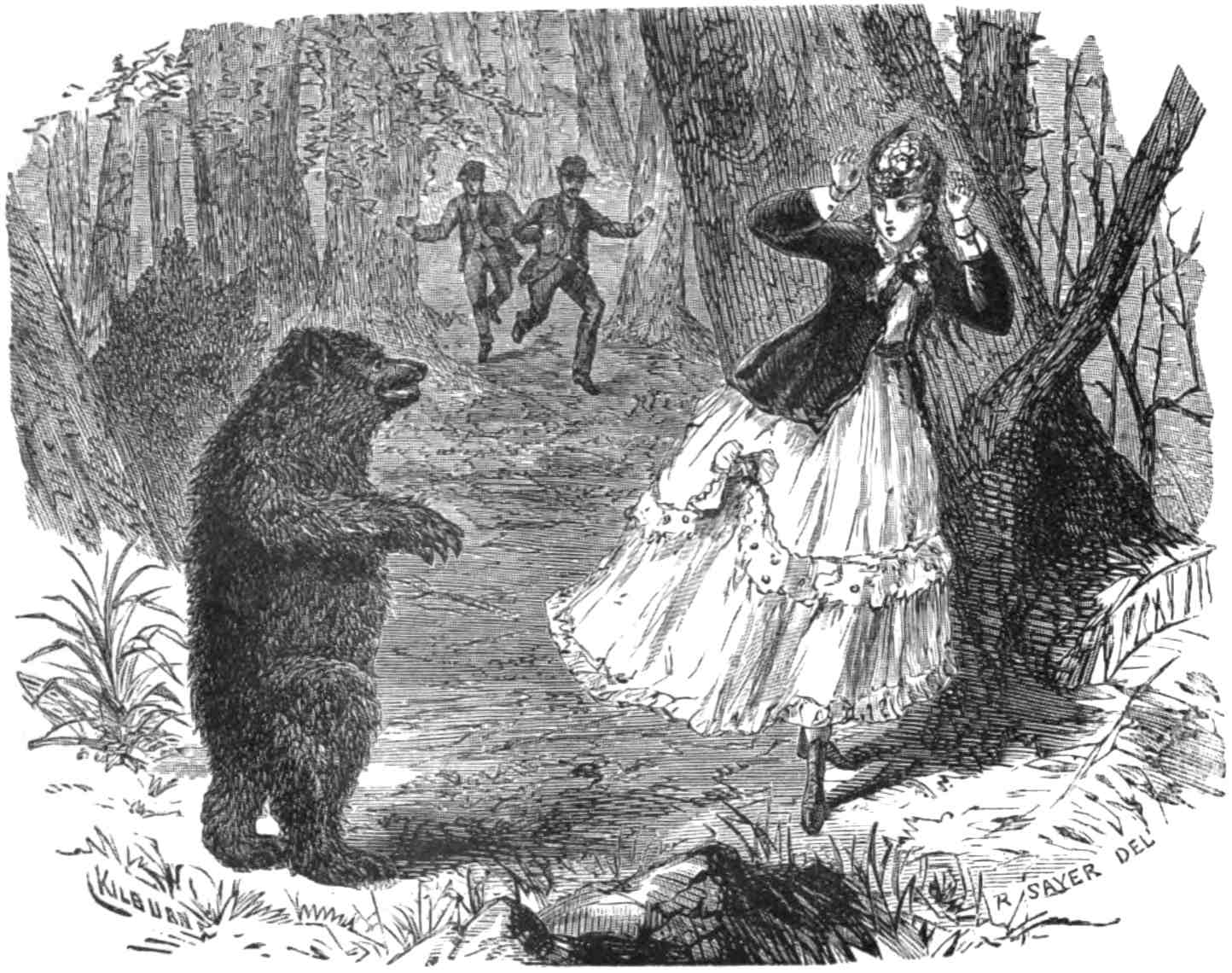
and discovered a small black bear, which a huge
tree had before hidden from our view.
“A bear!” I exclaimed.
The creature stood up on his hind legs, and was
reaching forward with his right fore paw towards the
young lady, while the left was dropped at his side.
For my own part, I do not remember that I had
ever even seen a bear before, and I confess that I did
not like the looks of him. Whether Waddie shared
my feeling or not I do not know; but he quickened
his pace, and soon placed himself by the side of the
interesting sufferer. Neither of us had a club, knife,
or other weapon, and we were not in condition to
face a wild beast.
“Save me!” gasped the young lady.
“I will conduct you to the hotel, if you please,”
said Waddie, hardly noticing the bear, which still
sat upon his haunches, with his right paw extended
towards the terrified maiden.
“O, dear me! I cannot move,” sighed she.
Waddie took her by the arm, and supported her.
As they moved off, the bear followed.
“He’s coming!” cried the lady; and, afraid that
the awful monster would pounce upon her behind,
she halted and faced him again.
The moment they stopped, Bruin stood up on his
haunches again, and held out his paw as before. I
came to the conclusion that if he intended to eat
any one up, he would have begun before this time,
and I ventured to place myself between him and
the lady. This brave movement on my part seemed
to afford the lady some relief; but she clung to
Waddie as though she expected to be devoured,
brown silk dress, laces, ruffles, and all. The bear
looked at me a moment, as I stood about a rod distant
from him. Dropping upon all fours again, he
cantered towards me. I was inclined to beat a retreat,
but somehow the animal did not seem to be
as ferocious as wild beasts have the credit of being,
and, though it required no little resolution on
my part, I decided to stand my ground.
The bear was about the size of a full-grown Newfoundland
dog, but broader across the back, and
much heavier, weighing, I judged, over a hundred
pounds. He opened his mouth as though in the
act of laughing. I had had no experience with
wild animals, but I had an idea that they howled
and made a “general row” when they were savage,
and intended to do mischief. After the first sight
of the bear, my courage gradually increased, and I
am happy to say that I did full justice to my valor
on this occasion. I did not run away. The bear
came close to me, and then erecting himself again,
he extended his right paw as before, looking up into
my face as pleasantly and cunningly as though he
had been a playful child.
The fellow evidently means something by his action;
but I was not sufficiently skilled in bear nature
to comprehend him. He was not savage, and did
not exhibit the slightest intention to use the fine
rows of elegant teeth which he displayed. This assurance
was very comforting to me. I retreated two
or three paces as a strategic movement, in order to
develop the further intentions of the enemy, if he
was an enemy. The rascal followed me, again stood
up, and presented his paw.
“Don’t be afraid, miss. He will not hurt anything,”
said I, as the young lady was again alarmed
by the last move of the bear. “He is quite harmless.”
“I am afraid he will bite me!” gasped she; and
she would not have suffered any more if she had
already been bitten.
“Shall I leave you, Wolf?” asked Waddie.
“Yes, certainly; the bear is as harmless as a kitten,”
I replied.
“Allow me to conduct you to the hotel,” added
Waddie, gallantly. “I suppose you are staying at
the hotel.”
“Yes; I had been walking with Lord Palsgrave,
when that awful creature came upon me,” she replied.
“Whom did I understand you to say you were
walking with?”
“With Lord Palsgrave.”
“Ah, then you are English people?” added Waddie,
who was doubtless duly impressed with the quality of
his new acquaintance.
“Lord Palsgrave is English, but I am not.”
“If you will allow me, I will conduct you to the
hotel.”
“I am so frightened, I fear I cannot walk so far.”
“You need not leave on account of the bear,” I
interposed. “He is as gentle and tame as a baby
kitten.”
By this time I had discovered what Bruin meant by
his mysterious movement with the right fore paw.
When I had worked my courage up to the sticking
point, I extended my hand towards him, to see if he
would snap at it. If he did, I concluded that I should
use a big stone which lay on the ground at my feet.
If he wanted to fight, I felt that, in the cause of a
terrified maiden,—very pretty, too, at that,—I could
afford to test the relative hardness of the bear’s head
and the rock.
But I wronged him. The bear had no belligerent
intentions. He was evidently a good fellow in his
way; and, if bearish in his manners, he was friendly in
his disposition. Instead of snapping at my hand, he
reached forward his paw, and I realized then that he
only desired to shake hands with me. I had learned a
sufficient amount of politeness to accommodate him
in this respect, and when I took his paw he bowed
his head several times, to indicate his pleasure at
making my acquaintance. I could not suffer myself
to be behind him in courtesy, and I bowed as often as
he did.
I heard Waddie laughing heartily, and turning
round, I saw that the young lady was beginning to
smile at the passage of compliments between me and
the bear. I must say that I was delighted with my
new acquaintance, he was so very polite and well
mannered. But I had not yet measured the depth of
his affection for me. He was not satisfied with merely
bowing and shaking hands with me, but insisted upon
hugging me. First he embraced my arm, and then
my body, though I did not yet feel quite well enough
acquainted with him to endure the final transport of
his devotion. I shook him off, and he tumbled upon
the ground. Then he began to roll over, as a dog is
taught to do, making the most extravagant demonstrations
of affectionate regard towards me. In a few
moments I was rolling on the grass with him, and I
felt confidence enough in his good intentions to return
his embraces. I put my hand in his mouth, but he
did not bite; and though his sharp claws were rather
trying to the nap of my coat, he used them only in
sport.
“Won’t you come up and shake hands with him,
Miss—”
“Miss Dornwood,” she added, supplementing my
question. “No, I thank you. I thought he was a
wild bear.”
“No, he is as tame as a kitten. He only wanted
to shake hands with you. I am sure he would not
hurt any one.”
“He is real funny; and I wish I dared to play
with him,” added she, shrinking back, as Bruin followed
me a little nearer to the place where she
stood.
“Don’t bring him any nearer, Wolf,” laughed
Waddie. “‘Distance lends enchantment to the view.’”
I sat down upon a rock, and continued to play
with the bear, while Waddie and Miss Dornwood
watched the sport at a respectful distance.
“I don’t know what I am to do with this fellow,
now I have made his acquaintance,” I continued, as I
tumbled him over upon the ground when his embraces
became a little too ardent. “I see by the looks of his
neck that he has been in the habit of wearing a
collar.”
“If you will only keep him away from me, I don’t
care what you do with him,” said Miss Dornwood.
“I don’t think they ought to let such creatures
wander about these grounds, for it is almost as bad
to be frightened to death as to be eaten up.”
“Where is the gentleman who was with you?”
asked Waddie.
“He went to the hotel after a vehicle, for we
intended to take a ride along the lake when we saw
this road. We only arrived this morning, and we
find it a very beautiful region.”
“There come three men,” added Waddie, pointing
into the woods.
I recognized Captain Portman as one of them.
CHAPTER III. AN ANGRY GUARDIAN.
“How do you do, Captain Penniman? I am
delighted to see you,” said Captain Portman,
coming up to me, and extending his hand.
As I took his hand, a burst of laughter from
Waddie and Miss Dornwood attracted my attention.
Turning my head to ascertain what amused them, I
saw the bear standing on his hind legs, and extending
his paw, as he had done to me, evidently wishing to
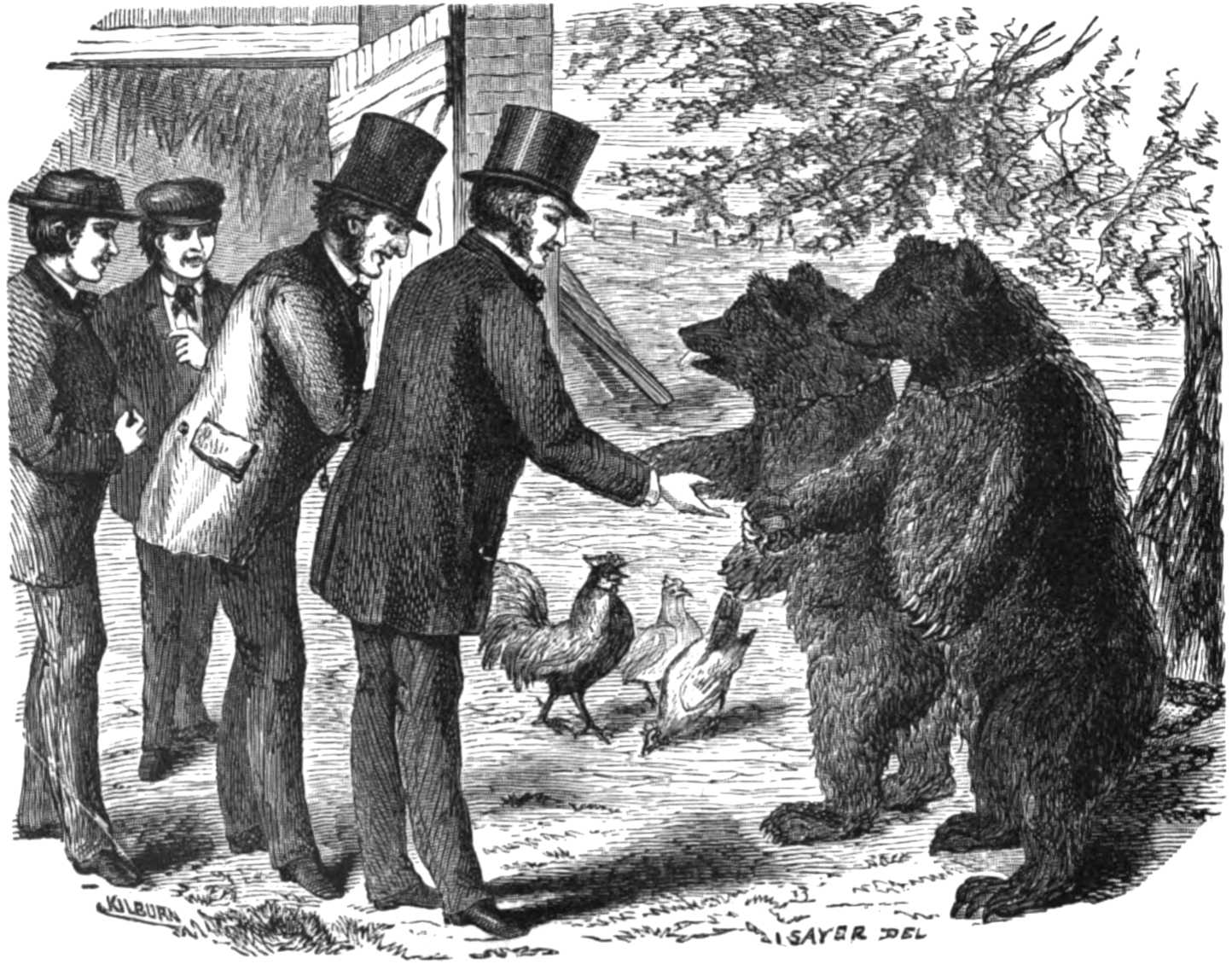
shake hands with the new comer. Captain Portman
took his offered paw, and gave Bruin a warm greeting.
“So, my old rogue, you have got away again,” said
he, as he patted the bear on the head.
“You seem to be acquainted with my old friend
here,” said I.
“Yes, he belongs to me; but he bothers me sadly,”
replied Captain Portman. “Unless we buckle his
collar very tight, he slips it over his head; and if it is
tight, it worries him and makes him cross. He has
got out of my grounds several times, and frightened
strangers staying at the hotel. The landlord says he
will shoot him, if he finds him loose again.”
“He frightened this young lady,” I added.
“I am very sorry,” said Captain Portman, turning
to the lady. “He is entirely harmless.”
“I see he is now, sir; but I supposed he was a wild
bear,” replied Miss Dornwood.
“When I knew he was loose, I hastened to find him,
lest the landlord should put his threat into execution,”
continued Captain Portman, caressing the bear. “He
makes so much trouble that I am afraid I shall have
to get rid of him; but I do not like the idea of killing
him while he makes himself so agreeable. If you
will take him, Wolf, I will give him to you, for I
know you will treat him kindly.”
“Thank you, sir, I should be delighted to own
him,” I answered. “I have a nice place for him at
home.”
“You shall have him.”
“He and I will be warm friends.”
And Bruin, as if he comprehended the new relation
between us, gave me one of his warmest hugs.
“How do you happen to be here, Wolf, without
calling upon me?” asked Captain Portman.
“I was just going up to your house when I heard
this lady scream, and I hastened back to her assistance.”
“Gallant as ever,” said he, laughing. “Then I
shall see you again to-day.”
“Yes, sir. I will call at your house in the course
of the afternoon.”
“My men will take care of the bear for you till you
are ready to return to Middleport, if you desire.”
I assented to this arrangement, and the two men
who came with Captain Portman took charge of the
bear, though he was very unwilling to be separated
from me. I should have gone with the captain, but
I desired to see Lord Palsgrave, for whom Miss
Dornwood was waiting. I had never seen a live
lord, and I was anxious to behold the phenomenon.
I supposed he would soon appear with the vehicle
for which he had gone.
“I am very much obliged to you for the service
you have rendered me, gentlemen,” said she, as the
party moved off with the bear.
“Not at all,” replied Waddie. “I am very glad,
for one, to have served you.”
“And I have made an excellent friend by the
adventure,” I added.
“Do you refer to the bear, or to me?” said Miss
Dornwood, archly.
“I confess that I referred to the bear.”
“I hope you will include me.”
“Then I have made two excellent friends.”
“Lord Palsgrave seems to be a long time obtaining
the vehicle,” she added, glancing towards the road.
“Is Lord Palsgrave an old gentleman?” I asked.
“Dear me! No,” replied Miss Dornwood, with a
blush. “He is only nineteen.”
“Nineteen! Well, I had an idea that lords were
always old men.”
“Not at all. Lord Palsgrave is quite a young man.”
“Was it he we saw going towards the hotel when
you screamed?”
“Yes; he left me only a few moments before I
saw the bear.”
I came to the conclusion, guided partly by the
blush which mantled her cheek when she spoke of
him, and partly by the fact that his lordship was
only nineteen, that he was a lover; and I was rather
sorry that she was already entangled, for I thought
Waddie regarded Miss Dornwood with more interest
than I had ever before seen him look upon a young
lady. She was certainly a very pretty girl, and I did
not blame Lord Palsgrave for taking a fancy to her.
His lordship did not come with the vehicle, though
an hour had elapsed since his departure, and Miss
Dornwood was beginning to be impatient. We did
not think it was polite to leave her, and we continued
to talk about the bear, Lord Palsgrave, and such other
topics as we could find available. While we were thus
engaged, I saw a lady and gentleman approaching us.
As they came nearer, the latter disengaged himself
from his companion, and hastened to the spot where
we stood. He was a young man of twenty-five, and
looked very cross. I did not like the looks of him, and
I saw that Miss Dornwood was very much disturbed
by his coming.
“What are you doing here, Edith?” demanded he,
bestowing a contemptuous glance upon Waddie and
myself.
“I am waiting for Lord Palsgrave,” she replied, her
cheek flushed, and her lips trembling.
“Who are these persons?” continued he.
“I do not know who they are, but they have been
very kind to me, and I am very grateful to them.”
“No doubt you are!” sneered the gentleman; and
I realized that we had encountered another bear,
though not so well behaved as the first had been. “Do
you pick up acquaintances in this manner without
my knowledge?”
“Why, Charles!”
I saw that Miss Dornwood was greatly agitated
and deeply grieved at this ungentle treatment, and
I did not wonder at it.
“What are you doing here?” he continued, rudely.
“I am waiting for Lord Palsgrave.”
“I don’t wonder that Lord Palsgrave does not
come, if he sees you engaged in this manner. Do
you put yourself on familiar terms with entire
strangers?”
“How rude you are, Charles!” exclaimed Miss
Dornwood, struggling to repress her tears at his
unkind treatment.
“I beg your pardon, sir,” interposed Waddie; “but
there was another bear—there was a bear in the
woods here. The lady encountered him, and we
came to her assistance.”
“A bear!” sneered the gentleman.
“A bear, sir!” repeated Waddie, with emphasis.
“It is true, he was a tame bear, but he frightened the
lady, and her screams attracted our attention.”
“If you have rendered her any assistance, I am
obliged to you for it,” said the gentleman, coldly.
“Edith, go back to the hotel.”
“Lord Palsgrave told me to meet him at the road
when he came with the carriage,” pleaded the young
lady.
“I insist that you return to the hotel,” added the
gentleman, almost fiercely. “I have forbidden your
making acquaintances without my knowledge.”
“I couldn’t help it, Charles.”
“Will you return to the hotel?”
“No; I will not, Charles! I will not be treated
in this rude manner before strangers,” she replied,
bursting into tears, and retreating a few paces from
her tormentor.
“So, miss! Do you dare to disobey me?” demanded
he, his checks red with anger.
“I will not be treated in this manner before
strangers,” she replied, with spirit, as she wiped away
her tears.
“What will Lord Palsgrave say when he finds
you making friends so easily?”
“I don’t care what he says; but I will not be
treated like a little child, Charles Overton.”
“We will see! Will you return to the hotel, or
shall I carry you there?” said the brute, stepping
towards her.
“Neither, Charles,” she answered, retreating a step
or two before him. “These young gentlemen came
to my assistance when I needed their help, and I am
very grateful to them.”
“I trust you have thanked the young gentlemen
for their service.”
“I have.”
“That’s enough, then. Now you will return to the
hotel.”
“I will not, Charles Overton. I have obeyed you
in all things; but when you insult me before strangers,
and insult them too, I will not endure it.”
“Very fine, Edith! But you will return to the
hotel, and obey me now, as you always have done.”
“I shall return to the hotel when I am ready to do
so, but not before;” and Edith looked as though she
meant all she said.
Behind all this there was evidently a history of
which Waddie and I were entirely ignorant. I concluded
that the irritable gentleman was the young
lady’s guardian, and was doubtless armed with proper
authority to command and control her. But she was
not less than seventeen, and certainly she was entitled
to some consideration from him. As she had suggested,
he treated her like a little child, and his conduct
was rude and ungentlemanly in the extreme. I
sympathized with Edith; but I did not deem it proper
or prudent to interfere. I saw that Waddie, who was
naturally rash and impetuous, found it exceedingly
difficult to restrain himself under the provocation.
“Edith, you shall obey me!” exclaimed Mr. Overton,
springing towards her, with the intention of dragging
her back to the hotel.
“I beg your pardon, sir,” interposed Waddie, stepping
between the angry guardian and his ward. “I
hope you will not use any violence.”
At that moment I heard a kind of clattering noise,
and turning, I saw the bear rushing at railroad
speed towards us. He had doubtless escaped from
Captain Portman’s men, and had come back to renew
the agreeable acquaintance he had made. Now,
Mr. Overton happened to be the nearest person to him
as he approached the group, and Bruin leaped up to
him, and placed his paws upon the arm extended to
grasp Edith. Perhaps he thought the parties were
playing, and he wished to have a hand in the game.
Mr. Overton evidently had not seen the bear till he
felt his paws upon his arm. A man who is a tyrant is
necessarily a coward; and turning his head, the savage
guardian saw the bear, with his mouth open. His
expression was one of abject terror, and, starting back,
he shook the playful animal from him. Bruin immediately
stood up, and extended his paw, as though
he were ready to make friends with all mankind. To
my surprise, Miss Dornwood grasped the paw with
her gloved hand, and shook it warmly. Probably
she thought that, between the two bears, he was the
less savage and bearish.
“You do not seem to like him any better than I did
at first,” said Edith, glancing at Mr. Overton, who had
retreated to a safe distance. “I suppose I am forbidden
to make his acquaintance, but I shall do so.”
Bruin had doubtless been trained to respect ladies,
and did not offer any rough familiarities to her, as he
had to me. He stood up before her, and received
her caresses with a good-natured grin. Mr. Overton,
seeing that the bear did not proceed to eat any of us
up, regained his sell-possession.
“If you wish to avoid trouble, Edith, you will go to
the hotel at once,” said he, renewing the attack.
“I shall not go,” she replied, earnestly.
“Then I shall lead you there.”
And stepping forward to enforce his threat, the bear,
perhaps thinking he meant to have a frolic, sprang
upon him with extended paws.
“Take him away! Take him away!” cried Mr.
Overton, utterly unable to appreciate the familiar
overtures of the bear.
“He will not hurt you, sir.”
“Take him off—will you?” gasped he, in terror.
“Here, Bruin, come here,” interposed Edith, pulling
him by the neck.
The bear turned to her, stood up, and extended his
paw to her.
CHAPTER IV. FIRE ON THE LAKE.
I began to think my bear was as fickle as
human beings, for he seemed to have taken
quite a fancy to Edith. Certainly, in this respect, I
was willing to believe he was a bear of excellent taste.
He did not offer to hug her arm, or to take other
liberties with her, but was very affectionate, while he
was very circumspect. Mr. Overton did not again
attempt to use force with the young lady while she
was thus guarded.
“Let the ugly beast alone, Edith!” growled her
disconcerted guardian.
“He behaves very well now, Charles, and I am not
afraid of him.”
“Once more, are you going to the hotel, or not?”
“Very soon I am, if Lord Palsgrave does not
appear,” she replied, still caressing Bruin.
“I think, Waddie, I will go up to Captain Portman’s,
His men are coming again after the bear, and
I will take him along with me,” I interposed. “Come,
Bruin, old fellow, don’t you know me?”
I put my hand upon his head, and he leaped upon
me, as though he was heartily glad to renew the
acquaintance.
“I am going to the hotel, Miss Dornwood,” said
Waddie, touching his cap to the young lady, and moving
in the direction indicated.
She placed herself at his side, and they started together.
“You are not going with her, sir,” said Mr. Overton,
angrily.
“Then she will go with me.”
“You young puppy!”
“Gently, if you please, sir,” added Waddie, quietly.
“Stop, Edith!” commanded the guardian.
“You told me to go to the hotel, Charles, and I
am going,” she replied.
“Not with that young man.”
“That shall be as he pleases.”
“No; it shall be as I please. Stop, sir! Do you
hear me?” cried Mr. Overton.
“If I understand the matter, sir, you have no control
over me, if you have over this lady,” replied Waddie,
turning around to address the guardian.
They continued on their walk, followed by Mr.
Overton, who was presently joined by the lady he had
left when he came forward to discipline his ward.
They soon disappeared among the trees, and I made
my way to the mansion of Captain Portman, where I
spent a couple of hours very pleasantly. I told him
about the adventure we had had with Edith and her
guardian.
“I pity the poor girl,” I added; “for this Mr. Overton
is a petty tyrant, who must make her very uncomfortable.”
“Doubtless it is very unfortunate for her; but it is
one of those cases with which outsiders cannot meddle,”
replied my friend.
“I think he would have dragged her up to the hotel
by force, if the bear had not interfered.”
“Well, the interference came better from the bear
than from you.”
“Do you think one ought to stand by, and see a man
abuse a young lady without taking her part?” I inquired,
with considerable interest.
“That’s a hard question to answer, Wolf. The gentleman
is her guardian, and has authority over her;
but if he were actually abusing her, I am inclined to
think I should interfere on my own responsibility.
Yet it is not prudent to meddle with things of this
kind.”
“I am afraid Waddie will meddle,” I added.
“He seemed to be rather interested in the young
lady.”
“He should be very careful what he does.”
“I must go over to the hotel, and see that he does
not get into trouble.”
“But you will come and spend the night with me,
Wolf.”
“We intended to sleep on board of the Belle.”
“I shall be very glad to see you and Waddie to-night,
and I hope you will spend a day with me before
your return home.”
“Thank you, sir. I will do so, if possible,” I replied.
I walked to the hotel, and found Waddie on the
piazza. He looked very nervous and uneasy, and I was
afraid something had happened.
“Where is the young lady?” I asked.
“She is in the house,” he replied. “I was hoping I
should see her again. There is something wrong
somewhere, Wolf. A man don’t treat a young lady
like that unless there is something wrong.”
“It is hardly proper for us to meddle with the
matter,” I suggested.
“I don’t purpose to meddle with it, unless he abuses
her before my face. If he does that, I shall feel
justified in protecting her; for a man has no right to
abuse even his own child. But I should like to know
something more about the matter,” continued Waddie,
warmly.
“Did she say anything to you on your way up to
the hotel?” I asked.
“Not a word. We were talking about the bear all
the way. Her guardian followed close to us. I know
by her sad manner that she is in trouble all the time.
After the brute spoke to her as he did, my sympathies
were all with her.”
“I don’t think we shall be likely to see her again.
This men is evidently her guardian, and he will take
care that she does not come out of her room again to-day.”
“I would give a good deal to know what the trouble
is between them. He must be some relation to her, or
she would not call him Charles.”
“Very likely. Did you see Lord Palsgrave?” I
inquired.
“Not a lord,” laughed Waddie. “I asked the landlord
about him, and was told his lordship had taken a
horse and buggy, but had not been seen since. Mr.
Overton appears to be a little worried about him; but
I don’t believe he has run away.”
“I think we shall have to give up the idea of seeing
the show to-night,” I suggested.
“We shall be about here a few days, and we will
come up to the hotel again,” replied Waddie. “I am
ready to go down to the boat when you are.”
“I don’t think there is anything more for us to say
or do here;” and we started for the lake.
Tom had put the Belle in good order during our
absence, and caught some fish for supper. While he
was cooking them, we sat in the cabin, and told him
our adventure in the woods, informing him that he
would have a black bear for a passenger on the return
voyage.
“If he only behaves himself, I don’t care what he
is,” laughed the young skipper.
“If he don’t behave well, you must bear with him,”
said Waddie.
“I’ll do that, for I can’t bear to quarrel with anybody,
even if he is a bear,” added Tom.
“It is barely possible that he may help you, for he
can bear a hand in an emergency,” I continued.
“Does he wear gloves?” asked the skipper.
“No.”
“How can he bare a hand, then?” grinned Tom.
“However he will make a good barometer.”
“He knows weather—it rains or not.”
“By the way, Wolf, is he barefooted?” inquired
Tom.
“Yes, and barefaced.”
“Can he sing?”
“Certainly; he is a barytone. But, punning aside,
I must go home a day sooner, and build a house for
him.”
“Baronial halls!” exclaimed Waddie.
“Forbear!” I added.
“What’s for bear?” asked Tom. “Beefsteak?”
“Not an ounce; he must have no meat. It would
make him savage, and then he would eat up all the
cats and kittens in the neighborhood, if not the children,”
I replied.
“Don’t make a bugbear of him, Wolf,” added
Waddie.
“Fish ready!” shouted Tom. “Bear this dish to
the table, if you please.”
“Let the table bear it,” said Waddie.
“The fish smells good, and I think my stomach will
bear some of it,” I added, as we seated ourselves at
the table.
The odor of the dish before us did not belie its
quality, and we ate a very hearty supper. For a vacation,
this kind of life exactly suited me. I enjoyed
the sailing and the fishing very much, and it was delightful
o put in at the various points and ramble
on shore, while sleeping in the little cabin of the
Belle added a new excitement to the cruise. I had
begun to think Ucayga Luke was rather too small
to afford full scope for the pleasures of such an occasion;
and I thought, when I was able, and had the
time, a yacht cruise on the ocean would suit me
exactly. But the lake was certainly very pleasant, and
I was not disposed to complain.
When we had finished our supper, Waddie and I
adjourned to the standing-room, in order to give Tom
a chance to wash his dishes and put the cabin in
order; for three persons about filled it, so that there
was little space for one to move around. It was nearly
dark, and there was a fresh breeze on the lake. We
enjoyed the scene very much, for certainly there is
no more beautiful region in the whole world than that
which surrounded us. The hills and the precipitous
rocks were in strong contrast with the water. The
Ucayga was just passing the point where we lay,
though on the other side of the lake. Coming from
the opposite direction was a tow-boat, dragging slowly
after her a fleet of canal-boats.
Waddie and I continued to pun on the bear till
the last glimpses of twilight were fading out behind
the hills on the opposite shore of the lake. Tom had
made up our beds in the cabin, and we were thinking
of playing a game of chess, which I had just begun
to learn under the pleasant instruction of Grace
Toppleton. The lamp on the foremast burned brightly,
and the little cabin looked very cosy and attractive.
“What’s that?” exclaimed Waddie, suddenly, as
a yell from the fleet of canal-beats, which had just
passed our anchorage, started us from the quiet of our
situation. “By the great horn spoon, one of the
boats is on fire!”
“That’s so!” added Tom, nervously. “What shall
we do?”
“I don’t know that we can do anything,” I replied,
as my companions, by their looks, appeared to appeal
to me. “It burns like tinder. I think she must have
petroleum, or something of that kind, on board.”
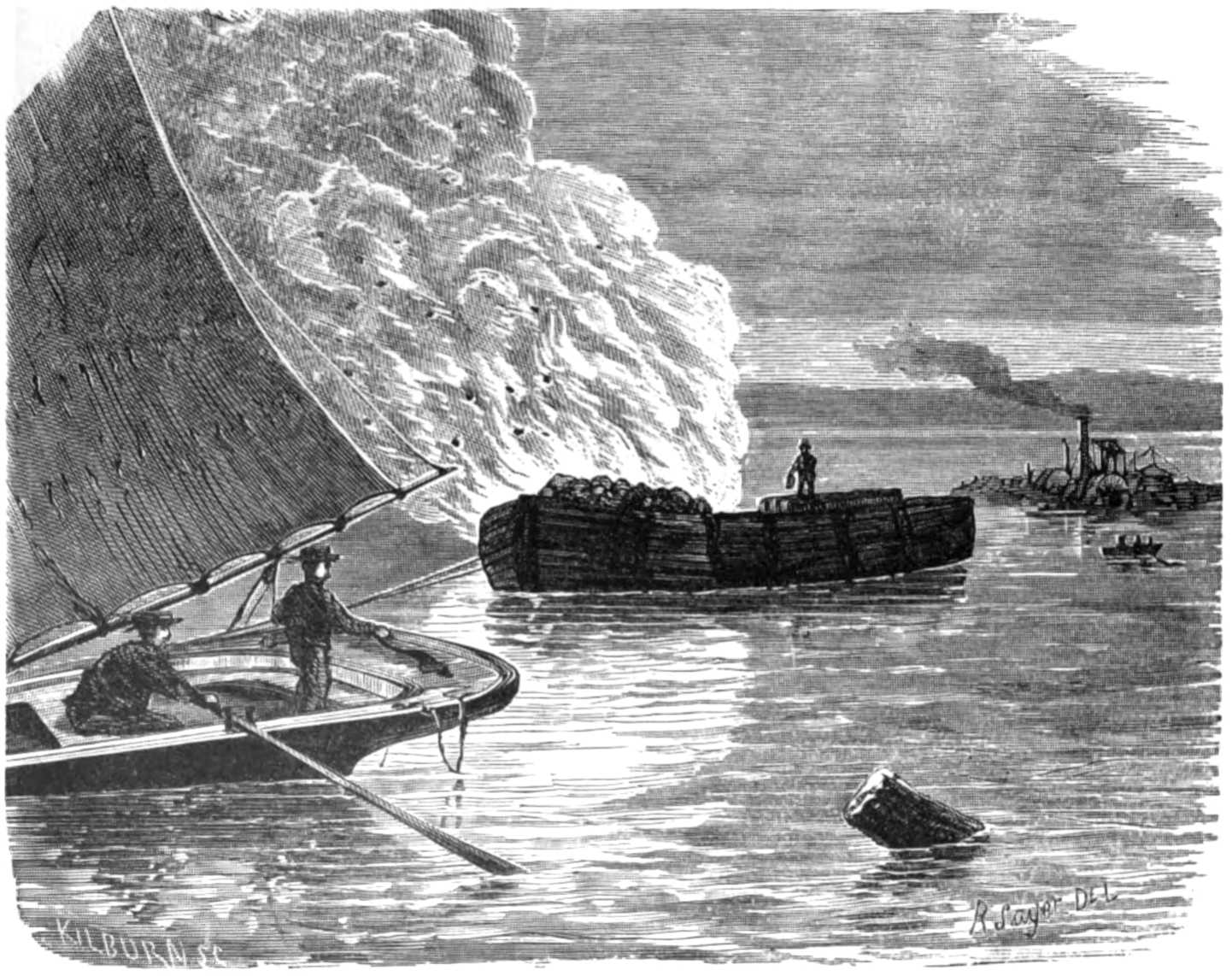
The fire blazed up very suddenly, and it was plain
to me that she had some combustible materials on
her deck. The hands on the other boats made haste
to cast off the fasts which connected the burning craft
to their own, in order to prevent the flames from
spreading. At the same time, the tow-boat increased
her speed to drag the other canal-boats out of the
way of their dangerous companion.
“Get up your anchor, Tom. Let us go out there,
and see what we can do,” said I. “The thing
appears to be drifting this way, and we may be burned
up if we stay here.”
“My sentiments exactly,” replied Tom, as he sprang
to his cable.
“Stand by the jib-halyards, Waddie,” I added, removing
the stops from the mainsail. “Up with it!”
We were all thorough boatmen, and in half a minute
we had the Belle under way. As the burning
canal boat was dead to windward of us, we had to
stand away from her, in order to beat up to her position.
As soon as Tom had set the jib, he took the
helm, while Waddie and I seated ourselves to watch
the progress of the flames. By this time the steamer,
having dragged the other canal-boats out of the reach
of possible danger, had stopped her wheels, and was
getting out a boat to visit the doomed vessel, for such
she was by this time, as her deck was covered with
one sheet of flame.
“Help! Help!” shouted some one from the boat.
“By the great horn spoon, there is some one on
board of her!” exclaimed Waddie, springing to his
feet under the excitement of the moment.
“I do not see any one,” added Tom. “Of course
those who were on board left her before she cast off
from the other boats. They had only to step from
one deck to another.”
“Help! Help! Save me!” again shouted the unseen
person.
“He must be in the cabin,” I suggested. “The
wind drives the flame right over the hatchway, so
that he cannot escape.”
“What shall we do?” demanded Waddie, appalled
by the prospect of a human being perishing in the
flames before our eyes.
“Run up to windward of her, Tom,” said I.
He obeyed, and by the time the Belle reached her
bow, I had the cable ready to make fast to her stern.
The stern of the burning canal-boat was to
windward, so that the flames were driven over
the entrance to the cabin. I made fast the cable
of the Belle to the bow of the burning craft.
“Now, Tom, take the wind on your port beam,
and let her drive as hard as she will.”
“I see; you want to sling her round.”
“Yes, Waddie, you and I will help her with the
oars, for it will be a hard pull to swing that heavy
canal-boat.”
We took the oars; and, when the Belle came
up with a jerk, which nearly threw us overboard,—for
the wind was quite fresh,—we strained our
muscles at the oars.
“Pull, Waddie!” I cried, anxiously, for I felt that
the safety of the man in the cabin of the burning
boat depended entirely upon the success of our
movement.
Tom helped Waddie with one hand, while he
steered with the other. Though the burning boat
was very long and heavy, it did not require much
power to turn her, balanced as she was on the water.
The sails of the Belle pulled strong, our efforts at
the oars increased the force, and we soon had the
satisfaction of seeing that we were accomplishing
our purpose. As soon as the vessel began to turn,
her inertia being overcome, the work was easy, and
we whirled her on her axis like a top.
“Hold on, now!” I shouted, boating my oar. “She
will swing the rest of the way without any help.
Come about, Tom, and run up to her bow before
the fire makes it too warm there to cast off the
cable.”
“Won’t you bring my hatchet out of the cook-room,
Wolf?” added Tom.
I brought a small hatchet from the cuddy, which
Tom used in splitting up his wood.
The canal-boat continued to swing under the impetus
we had given her. As soon as she had turned
into a position so that the wind struck her broadside,
and carried the flames away from the cabin
door, we saw a man rush up the steps.
“There he is!” shouted Waddie. “Bear a hand,
Tom! Let her drive.”
“She is driving all she will,” replied Tom. “Wolf,
we won’t wait to untie that cable; just chop it off
with the hatchet when I luff her up.”
“Help! Help!” shouted the man on the after-deck
of the canal-boat.
“We will be there in a minute!” shouted Tom.
“Keep cool!”
“It’s rather a warm place to keep cool in,” suggested
Waddie.
“Now, luff up, Tom, and we will get clear of the
cable.”
He put the helm hard down, and, as the boat
came up into the wind, the cable lay across the
forward deck of the Belle. With one blow of the
hatchet I severed it, about thirty feet from the bow
of the canal-boat, so that Tom lost only a small
portion of his line. The man on deck had seated himself
at the extreme end of the boat, with his legs
hanging over the water, in readiness to leap into the
lake, if the flames were again driven upon him.
But the combustible material seemed to be amidships,
though the wood-work was now well kindled,
and the great volume of the flame was at this part
of the boat. Tom ran the Belle around under the
stern of the burning vessel, and I fastened the boat-hook
to it, as she lost her headway.
“Drop down,” said I to the person above.
He first threw a black leather travelling-bag upon
the forward deck, whose contents rattled as though it
were filled with old iron. With the assistance of Waddie
and myself, he came down himself, and stepped
into the standing-room. I picked up his valise, as
Tom filled away again, in order that it might not be
lost overboard when the Belle heeled over under
the pressure of the sails.
“You came out of a warm place,” said Waddie,
as the stranger seated himself.
“Not very warm,” he replied. “I was in the
cabin, and there was no fire down there.”
“But there would have been very soon.”
“No doubt of that. There are two windows in
the stern, but, as I cannot swim, I did not like to
jump out into the water,” continued the stranger.
“You take it very coolly,” said Tom, with a grin.
“I don’t know that I was afraid of anything. I
supposed those other canal-boats were close by, and
as soon as I saw or heard any one, I meant to jump
into the water, and let him pick me up.”
“Was there no one with you on board?” asked
Waddie.
“Yes, a whole family; but they were on deck
when the fire broke out, and had only to step on
board one of the other boats by her side. I have
been travelling a great deal lately, and I was tired
and sleepy; so I lay down in a bunk, and went
to sleep. When the fire broke out, the men yelled,
and that waked me up. I sprang for the stairs,
but a sheet of flame lay right over the cabin doors,
and I couldn’t go through. So I shut the doors,
and went to the windows. I yelled with all my
might, to let the boatmen know where I was; but
none of them came near me. Then I tried the
doors again, and found the fire was blowing off in
another direction.”
“That was after we had swung the canal-boat
around,” interposed Waddie.
“I did not know what did it, but when it was
safe to do so I went on deck.”
“How did the boat catch afire?” asked Tom.
“I don’t know. There is half a dozen barrels on
deck, and they smelled like petroleum. Very likely
some smoker dropped his match into the stuff. I
heard something which I took to be the bursting
of one of the barrels; at any rate, they made a
jolly fire. But now I am out of the scrape, I don’t
know that I care.”
“It won’t be pleasant for the owner to have his
property destroyed,” suggested Waddie; and I think
none of us were pleased with the selfish remark of
the stranger.
The person whom we had rescued from the burning
boat was a young man, not more than twenty-five.
He was very well dressed, and I judged from his air
and manner that he had seen the world. He interlarded
his narrative with much offensive profanity,
with which I do not care to soil my pages. On the
whole, he did not produce an agreeable impression
upon any of us.
“Have you got that man out of the cabin?”
shouted a man in the boat from the steamer.
“Yes, he is safe,” replied Tom. “Why don’t you
bring up your steamer, and put the fire out?”
“No use; we couldn’t put it out now.”
“Haven’t you a fire engine on your tow-boat?” I
asked.
“No; it is broke down.”
I was inclined to agree with the speaker, who was
the captain of the steamer, that it was useless to attempt
to extinguish the fire, for the canal-boat was
now one mass of flame. She was drifting rapidly
towards the shore, and I was afraid she would set the
woods on fire, for the bushes hung over the bank, so
that the flame would be blown directly into them.
“Will you go on board one of those canal-boats, sir,
or shall we put you on shore?” asked Tom, addressing
our passenger.
“I don’t know. I have had about enough canal-boat
for one day,” he replied, shrugging his shoulders.
“I will do just as you say,” added Tom.
“Is there any hotel around here?” inquired the
stranger.
“Yes, a first-rate hotel, not far from the falls,”
added our skipper, pointing in the direction of the
spot.
“Then I will go there.”
“All right,” answered Tom, heading the Belle
towards the shore.
“My name is Schleifer,” continued the stranger.
“I am a drummer for a hardware house in New
York.”
This seemed to be a satisfactory explanation to me
of the nature of the contents of his travelling-bag,
which had rattled like old iron when he threw it upon
the deck, and which I found, when I lifted it, was very
heavy.
“I got into Hitaca too late to take the boat down
the lake, for I expect to sell some goods at the towns
below. I had taken all the orders I could get in
Hitaca a few days before; so I had nothing to do,
and wanted to get to Middleport. I didn’t like the
idea of lying around Hitaca till the next morning;
so I thought I would try a canal-boat, just for the
novelty of the thing.”
“Well, how did you like it?” asked Waddie.
“I liked it well enough till the fire interfered with
the tranquillity of my dreams; but I did not even
get singed; so I have no reason to complain.”
By this time the Belle had reached the shore at
the point off which she had been moored before.
The burning canal-boat had grounded just above us,
on a shoal place. As her combustibles on deck had
been consumed, the flames were not so fierce, and
did not reach the shore.
“I suppose I’m a lucky dog,” said Schleifer, as
Tom lowered his sails, having made fast to a tree
on shore. “My life is not insured, and it would
have been an ugly investment for any office half an
hour ago.”
“Thank God for preserving your life,” I added.
“That’s all very well; but I thank my own coolness
that I wasn’t fool enough to rush on deck, where
the fire would have made an end of me in a minute
and a quarter. Do you happen to have any whiskey
on board of this craft?”
“Not a drop,” replied Tom, promptly. “We
haven’t any use for the article, and we don’t keep it.”
“They keep it at the hotel—don’t they?”
“I suppose they do. I never called for any,”
added Tom.
“Are you the skipper of this craft?” asked
Schleifer, in a kind of contemptuous tone.
“I am; and the craft is a good deal better than
the skipper.”
“That may be; and, if you don’t take any whiskey,
I should say you were half right, at least. I
should think, with so much cold water under you
and all around you, you would want a little drop
of whiskey, just to help keep up an equilibrium,
you know.”
“I find that people who take whiskey find it the
most difficult to keep up an equilibrium.”
“Every one to his fancy; but I can’t sell goods
without a little whiskey. I generally carry a pocket
pistol in my bag; but it got smashed against the
hardware, the other day, and I’ve been dry ever
since.”
“That was because you did not keep up the
equilibrium,” laughed Tom. “What kind of hardware
do you sell, Mr. Schleifer?”
“Iron, of course.”
“Pickaxes and crowbars?”
“Not exactly. I couldn’t carry samples in my
bag very well. I think I will try to find that
hotel now. Did I understand you to say that you
were the skipper of this boat?”
“I have that honor; and I wouldn’t swap it off
to be governor of the state,” replied Tom.
“Do you keep her to let?”
“That’s what I keep her for.”
“She is a good-looking boat; but I should like
her better if she carried a little whiskey on board,”
said Schleifer. “Haven’t you just a thimbleful, say
forty drops, in the medicine chest?”
“Not the twentieth part of a drop.”
“How long does it take you to run from here
down to Cent— down to Middleport?” asked the
drummer.
“That depends on the wind.”
“Well, as the wind is to-night.”
“I could fetch it in four hours. The wind would
be fair after I got by Priam.”
“Well, skipper, seeing it’s you, I will give you a
five-dollar bill if you will land me in Centre— I
mean in Middleport.”
“Well, seeing it’s you, Mr. Schleifer, I won’t do it.”
“Not for five dollars?”
“No, nor for ten. My boat is engaged to these
gentlemen for the rest of the week.”
“We will let you off, Tom,” whispered Waddie.
“I don’t want to be let off.”
“I have an invitation from Captain Portman for
Waddie and myself to sleep at his house,” I added.
“Is that so? Then I will take him down to
Centreport for ten dollars.”
“Middleport,” said Schleifer. “I will give you
five.”
“No; nothing short of ten for a night run down
the lake. I like to sleep a little once in a while.”
After some bickering the drummer agreed to give
ten dollars for his passage; but he insisted upon
going to the hotel first for a “drop of whiskey.”
CHAPTER VI. THE ENGLISH LORD AND THE DRUMMER.
“I couldn’t go to sleep to-night without a
drop of whiskey, and I must have some,”
said Schleifer. “It won’t take me long to go to
the hotel.”
“Do you know the way?” inquired Waddie.
“No; but I can find it.”
“We are going up that way. We will show you
the road.”
“I don’t need any help. I can snuff a place
where they sell whiskey two miles off,” replied the
commercial gentleman, coarsely.
He went on shore, taking his bag with him, and
made his way up to the road which led to the
hotel. Waddie and I walked up to Captain Portman’s
house; but he was not at home, though the
servant said he would return soon. He had probably
gone over to the hotel, which he generally
visited in the evening. We did not care to remain
if Captain Portman was not at home, and we
walked towards the hotel, expecting to meet him
there.
“Why didn’t that fellow go to Middleport in the
tow-boat, if he wanted to go there?” said Waddie,
who had taken a strong dislike to Tom’s passenger.
“I suppose he was afraid of being blown up, or
burned up,” I replied.
“He did not even take the trouble to thank us
for saving him from the flames.”
“Probably he does not think we saved him from
anything but a wet jacket,” I suggested.
“Even that is worth acknowledging.”
“These drummers live on brass, and this fellow is
in the hardware line.”
“Waddie! Is that you?” called Tom Walton, as
he rushed up to us when we came down the hill
from Captain Portman’s mansion.
“Yes, it is I. What’s the matter, Tom?” asked
Waddie.
“A young woman just came down to the boat,
and said she wanted to see you very bad,” replied
Tom, with no little excitement in his manner.
“A young woman! Who is she?”
“I haven’t the least idea; but she has a nobby
look, as I made her out in the dark. She wanted
you so bad that I told her I would try and find
you.”
“Who can it be?” said Waddie.
“Probably Miss Dornwood,” I suggested.
“But she would not be out of the hotel at this
hour in the evening.”
“Her relations with her guardian were not very
pleasant, you know,” I added.
“Well, we will go down and see her, at any
rate;” and we walked towards the moorings of the
Belle.
“Waddie, you must be very careful,” said I, not
at all pleased with the complications which seemed
to be before us.
“Careful? What do you mean, Wolf?”
“If I am not mistaken, the question which we
attempted to dodge once before this evening will
come up again.”
“What’s that?”
“When Mr.— What’s his name?”
“Mr. Overton,” added Waddie, supplying the
name I had forgotten.
“When Mr. Overton attempted to compel Miss
Dornwood to return to the hotel, you stepped between
him and her. If the bear had not made a
scene just at that moment, there might have been a
quarrel between you and the guardian.”
“You are too cautious, Wolf. I wouldn’t stand
by and see him abuse the young lady. Why, Captain
Portman said he should interfere, and take the
responsibility,” protested Waddie.
“I would interfere if there were any real abuse,
Waddie; but I think it is better to wait for a
pretty strong provocation before you meddle with
family affairs.”
“I will be as careful as I can, Wolf; but when I
see a young lady persecuted by a cruel guardian, it
isn’t exactly my style to take it coolly.”
“We don’t know anything about the facts yet,
and you must remember that there are two sides to
every story.”
“I will try to remember it. But I don’t see what
she wants with me.”
“Very likely she has had some trouble with her
guardian, and wants your assistance.”
“If I can assist her, I shall certainly do so. I
think that Overton is a brute, whatever his relations
to the lady may be.”
By this time we were near the boat, and I repeated,
in a low tone, my caution to Waddie. I
saw that he was very much interested in the young
lady, and, aware of his impetuous character, I was
afraid he would be too forward in rendering assistance
to her. Miss Dornwood stood upon the shore
near the boat. As we approached her, I saw that
she was very much agitated, and I regarded this
as altogether in her favor.
“Good evening, Miss Dornwood,” said Waddie.
“I do not know what you will think of me,” she
replied, in trembling tones. “I am very much
alarmed.”
“What is the matter?” asked Waddie, in a tone
which was calculated to assure her.
“I wished to see you very much, for you were so
kind to me that I was sure you would assist me.”
“I should be very glad to assist you, if it is in
my power to do so.”
“You said you had a boat. I suppose this is the
one.”
“It is not mine, though we came up the lake to-day
in her.”
“Do you know where the town of Ruoara is?”
asked the young lady, as she glanced around her
in terror.
“I do, very well indeed. It is only eight miles
from my home,” replied Waddie.
“I wish to go there very much,” continued she,
earnestly.
“To-night?”
“Yes, to-night—immediately.”
“That’s very unfortunate, for the skipper has to
take a gentleman to Middleport,” replied Waddie.
“O, dear! What shall I do?” exclaimed the
young lady. “I must go at once.”
“Perhaps you can go in the boat with the gentleman
as far as Middleport, and—”
“Who is the gentleman?” interposed she, anxiously.
“I don’t know him. He is a commercial agent.”
“I cannot go with a stranger,” said she, shaking
her head in a very positive manner.
“Am I not a stranger?”
“No; I learned, after we parted this afternoon,
that you were the son of a very influential gentleman,
and you were kind enough to step between
me and my guardian, when he intended to lay his
hands upon me.”
“Who told you this?”
“The landlord. He said your friend was Captain
Penniman; and I was sure, after the service you
had rendered me, that you would again be my
friend, and help me to get to Ruoara.”
“Won’t you sit down in the boat?” added
Waddie, stepping on board of the Belle.
“No, I thank you. I do not wish to meet any
strangers,” replied Miss Dornwood. “I know you
think I am very bold; but I should not have come
to you if I had not known who you were.”
“If you will not go with the gentleman, I do not
see what I can do for you. There is no other sail-boat
here.”
“I suppose I must return to my prison,” said she,
bursting into tears.
“Do not weep,” interposed Waddie, moved by her
grief.
“Mr. Wimpleton, I envy the poor man’s daughter
who is surrounded by good and true friends,” sobbed
she. “I will go back to my prison.”
“What do you mean by your prison?” inquired
Waddie.
“My guardian sent me to my room, and then
locked me in it. I cannot endure such indignities.
I am going to leave him. I am going to work for
my daily bread in a factory, in a shop—anywhere
that I can earn enough to support me.”
“Is your situation so desperate as this?”
“It is, indeed! If I had no spirit at all, perhaps
I could endure it.”
“There comes some one,” interposed Tom Walton,
who had walked up to the road, as soon as
he understood the case, in order to warn us of the
approach of his passenger.
Without another word, Miss Dornwood fled like
a frightened fawn in the direction opposite that in
which Schleifer was approaching. Waddie, deeply
interested in her case, followed her, intent upon assisting
her to the extent of his ability.
“There is some one with him,” said Tom, as I
joined him, half way between the lake and the
road.
“Perhaps you are to have two passengers,” I
suggested.
The drummer and the person who was with him
halted in the road, and seemed to be engaged in a
very earnest conversation. We could not hear a
word they said, but it was evident that they had
not met for the first time, and that they were not
talking about the sale of hardware. It was too
dark to see any more than the form of Schleifer’s
friend.
“You wait here,” said he, after the conversation
had continued a few moments.
“Hurry up,” replied the other person, whose voice
seemed to be familiar to me, though I could not
identify it.
As the drummer approached, we retreated towards
the boat.
“Hallo, there, skipper!” shouted he.
“Are you ready?” asked Tom, as we stopped,
and waited till he came up.
“If it’s all the same to you, I won’t go down the
lake to-night. I met a friend of mine at the hotel,
and I want to stay with him till to-morrow.”
“All right,” answered Tom.
“A trade’s a trade. I agreed to give you ten
dollars for the trip. If you will call it five, and not
go, I shall be satisfied,” added Schleifer.
“I don’t want any five, if you don’t go,” replied
Tom. “I only want what I earn.”
“But I am willing to compromise.”
“I don’t compromise. We will call it square as
it is. If you are satisfied, I am.”
“Well, I shall want your boat another time, and
I’ll make it right with you then,” added the drummer,
as he turned to leave.
“It’s all right now.”
“That’s lucky for Waddie,” I suggested.
“It works first rate. Now, if Waddie wants to
take the lady to Ruoara, the boat is all ready.”
“But where is he?”
“They haven’t got a great way yet.”
“Probably she will go towards the hotel. You
follow them, Tom, and I will go up this way,” I
replied, moving in the direction which Schleifer had
taken.
I soon discovered the drummer and his friend
walking rapidly towards the hotel. I was a little
curious to know who the person was whose voice
had sounded so familiar to me, and I quickened my
pace, hoping the lights in front of the hotel would
enable me to obtain a clear view of him. I followed
them closely; but before reaching the hotel
they turned in at a road which led to the stable in
the rear. Before I could come up with them, they
had seated themselves in a light wagon, which must
have been ordered before, and drove off.
“Who are those gentlemen?” I asked of the stable-keeper,
who stood in the yard with a lantern in
his hand.
“One of them I never saw till now; the other
is stopping at the hotel, and is a big gun,” he
replied.
“I know the taller one. Who is the other?”
“He’s the big gun. He came this morning; but
no one found out what he was till after dinner.”
“What is he?”
“He’s the big gun. He’s an English lord. I forget
what they call him.”
“Lord Palsgrave,” I suggested.
“That’s the name. He’s a nobby fellow, and
spreads his dollars with a looseness.”
“Where is he going now?”
“To Priam, I reckon. He said he should not be
back till to-morrow morning; and there is to be a
big dance there to-night. But I wonder he didn’t
take the young lady with him, who came with his
party.”
I walked round the hotel, in order to intercept
Waddie and Miss Dornwood; but I saw nothing of
them, and I concluded that Tom had already overtaken
them. After the information I had obtained
from the stable-keeper, my idea of an English lord
was considerably modified. He was on good terms
with a hardware drummer, which did not seem to
be exactly consistent with his exalted position. But
it was possible that the drummer was a baron or a
marquis in disguise, though the clatter of his hardware
samples did not tend to prove it.
I continued my walk towards the lake, and presently
met Waddie and Miss Dornwood.
CHAPTER VII. MISS DORNWOOD’S STORY.
As soon as I saw and recognized Waddie and
Miss Dornwood, they turned out of the road
with the evident intention of avoiding me.
“Waddie!” I called to him.
Hearing my voice, they returned to the road, assured
that I was not the brutal guardian whom
the young lady had so much reason to shun.
“Haven’t you seen Tom?” I asked.
“No.”
“He is looking for you.”
“We heard some one behind us, and turned aside
till he had passed,” added Waddie. “What does he
want?”
“The drummer has concluded not to go to Middleport
to-night.”
“And can you have the boat?” inquired Miss
Dornwood, eagerly.
“The boat is certainly available,” I replied. “But
do you really wish to make a trip of thirty miles
on the lake in the night?”
“I am afraid of nothing but the tyranny of my
guardian,” she responded, promptly.
“Where is Tom?” inquired Waddie. “We will
lose no time.”
“I will find him. If he passed you, he must be
near the hotel.”
They walked towards the boat, and I returned to
the hotel, where I found Tom, and we soon joined
Waddie on board of the Belle. We were all ready
to start; but I confess I was very much troubled
about the circumstances of the voyage. The mainsail
was flapping in the fresh breeze; but I was
somewhat afraid that Waddie was getting himself,
and perhaps me, into a scrape.
“Are you going, Waddie?” I asked, in introducing
what I wished to say.
“Certainly I am.”
“I hope you will go with me. I should not feel
safe without you,” added Miss Dornwood.
“Won’t you go too, Wolf?” asked Waddie.
“I should be glad to have you,” continued the
young lady.
“I am not perfectly clear in regard to this matter,”
I suggested.
“Pray do not stay here any longer,” interposed
Miss Dornwood. “If my guardian should discover
my absence, I’m afraid he would come down here
to look for me. Please to go out upon the lake, and
I will tell you all my story. Then, if you will not
assist me, we can return.”
“Shove off, Tom,” I replied.
The skipper ran up the jib, and the Belle, gathering
headway, stood out into the lake.
“I think you are very cautious, Captain Penniman,”
said Miss Dornwood.
“I am sure my friend here does not wish to do
anything wrong,” I added.
“I will bear all the blame,” said Waddie, warmly.
“I think I can find friends for Miss Dornwood without
going so far as Ruoara.”
“Where?” I asked, curiously.
“At my father’s house.”
“I shall not be obliged to trespass upon the kindness
of your father’s family, Mr. Wimpleton,” added
Miss Dornwood. “My friends in Ruoara will not
hesitate to receive me into their house, though they
know all the circumstances of my situation.”
“Who are they?” I asked.
“Mr. Pinkerton and his family. Do you know
them?”
“Very well indeed. Ben Pinkerton’s father,” added
Waddie.
The Pinkertons were of the highest social standing
in Ruoara, and I was almost willing to believe
that there could be no harm in conveying the young
lady to such friends as they were.
“Emily Pinkerton was my schoolmate at the academy,
and before my father died, our two families
became quite intimate,” continued Miss Dornwood.
“Emily was at my guardian’s house last spring with
her father and mother, and they know all about
the circumstances.”
“Do they think it is proper for you to leave your
guardian?”
“Mr. Pinkerton told me himself to come to his
house whenever I could not endure my guardian
any longer. I should have gone there before if I
could have got away.”
“Are your father and mother both dead?” I inquired.
“Both of them. I am going to tell you the
whole history of our family. I am seventeen now,
and Mr. Pinkerton says I am old enough to think
for myself. I believe I am.”
“I should say you were,” I replied.
“My mother was married twice,” Miss Dornwood
began. “Her first husband’s name was Richard Overton,
and they had one son, Charles Overton, who
is now my guardian. His father died when he was
only four years old. Two years after his death, my
mother was married again, to Edward Dornwood,
my father. He was a wealthy man; but he was deformed,
and in very poor health. I wish I could
tell you how much I loved him, and how devoted
he was to me. Even the great hump upon his back
was not a deformity in my eyes. But, feeble as he
was, my mother was the first to pass away, and
died when I was only eight. I hardly remember her.
I have no doubt she loved me as a mother should
love a child; but I know she used to scold me very
severely, and I recollect this more clearly than anything
else.
“My father never spoke an unkind word to me.
When I did wrong, when I fretted, he looked so
sad,—sometimes actually shedding tears,—that it
became a positive terror to me to displease him.
When he became so feeble that he could not leave
the house, I spent all my time out of school with
him. His eyes failed so that he could not see well,
and, for hours together, I used to read books to
him which had not the least interest to me. I can
truly say, that I was never so happy as when with
him.”
“Where was this Charles Overton all this time?”
I asked, as she paused to wipe away her tears.
“He lived near us, and professed a very deep interest
in my poor dear father, and in me too, for
that matter. His father had died a poor man, and
he was a clerk in a store. He used to come in
every day, and express so much solicitude for my
father and his affairs, that we were all deceived in
him. We thought he was a good man, but really
all he cared for was my father’s money. By degrees
he won his confidence; and, though he had
never treated me as a sister when we were children
together, I was very grateful to him for the care he
bestowed upon his step-father.
“When I was about fourteen years old, my father
began to fail in health very rapidly, and it was evident
to himself, as it was to the rest of us, that he
could not last many months longer. With a calmness
which seemed to be awful to me, he spoke of
leaving the earth to join the angels in heaven. I
wept bitterly at the thought of parting with him;
but he suffered so terribly that I finally became
reconciled to his going, for I realized that my loss,
even in a worldly sense, would be his gain. Then
he told me about his property, and asked me if I
should like to have Charles for my guardian.
“I was fifteen years old, but I knew little or
nothing about business. I was entirely satisfied to
have Charles an my guardian, though I hardly comprehended
what his relations with me in that capacity
were to be. The next day came the lawyers,
and my father made some changes in his will, which
had been written years before. In a word, he
named Charles Overton as my guardian, and made
him the executor of his will. I am sure he charged
him to be very kind to me, and to take good care
of my fortune. But my father lived nearly a year
after he had settled up his worldly affairs, during
which Charles was as devoted to him and me as the
most loving son and brother could be. He came to
our house to live, in order that he might better
attend to the wants of the invalid, and resigned his
situation in the store so that he could devote all
his time to this duty.
“I will not try to tell you the sad story of
my father’s death. He passed away, and ceased to
suffer. We laid him in the silent tomb, and life
was not to me what it had been before. I had lost
my greatest earthly comfort, and, young as I was,
I looked forward with joy and hope to the time
when I should join my father in heaven. But this
sadness wore away, though I have not ceased, and
never shall cease, to think of my father as an angel,
even when he was upon the earth. Charles Overton
took charge of everything, and came into
actual possession of the house in which I had lived
all my life. It was more than six months after my
father’s death when he spoke to me about business.
Then he showed me my father’s will, and read
it to me. He described the legal forms through
which he had passed, but I could not understand
them.
“My father gave him twenty thousand dollars in
his will, and a fixed salary for doing the business of
his estate until I was of age. After giving many
legacies to charitable objects, the residue of his fortune
was given to me. I was told that I was the
heiress of two hundred thousand dollars. But there
was one very singular clause in the will, to the
effect that, if I married without the consent of
Charles Overton, I was to receive fifty thousand
dollars, and the residue of the fortune was to go
to my half brother. I was astonished and shocked
at this part of the will. I asked Charles to let me
see it. Certainly it was all written down as he had
read it; but it seemed incredible to me that my
doting father had intended to subject me to such a
condition.
“About this time Charles Overton began to exercise
his authority over me. He resorted to every
expedient in his power to annoy me, and make me
miserable. He succeeded, too, in making me as unhappy
as I could wish any human being to be, if
he were my worst enemy. I could not divine his
object; but, between him and his wife, I had hardly
a day of peace from one year’s end to the other. I
was not permitted to go into company, nor to visit
those who had been my friends and companions
during the latter years of my father’s life. I was
not allowed even to take a walk without some one
to attend me, and see that I made no new acquaintances,
nor met any old ones. I may say with truth
that I have been a slave now for nearly two years.
“I remonstrated and protested against this treatment;
but Charles explained that he was only carrying
out the wishes of my father that he should
watch over me with the utmost care. It was only
when I believed I comprehended his motives, that
I ventured actually to resist him. I refused to obey
him, and went out when I could find an opportunity.
I was fully persuaded that he intended to
break me down and wear me out, so that he could
get my fortune.”
“But why is he so particular that you should
make no acquaintances?” asked Waddie. “If you
should be married without his consent, he will get
most of your fortune.”
“Mr. Pinkerton told me that clause would not
stand the test of the law. But I do not think of
being married either with or without my half brother’s
consent,” added Miss Dornwood, with much
embarrassment.
She paused a few moments, and looked over the
side of the boat into the water. I realized that it
was a great trial to her to feel obliged to tell this
long and painful narrative.
“I have not told you the worst yet,” she continued.
“I was satisfied that Charles Overton wanted
my money; that he was plotting day and night to
obtain it. Doubtless what he termed my obstinacy
worried him. He is a man of no principle whatever,
and I am sure he is equal to any crime he
has the courage to perpetrate. About three weeks
ago, while we were at Cape May, we met Lord Palsgrave.
While we were bathing in the surf one day,
a wave lifted me off my feet, and carried me out
of my depth. I could swim, and was not at all
alarmed; but his lordship swam out to me, and, in
spite of my protest, insisted upon saving me from a
watery grave. I thanked him for his good intentions,
though I did not need his services; and from
that time to this he has clung to me. I must tell
the whole truth: he proposed to me, and I promptly
rejected him, for I did not like him. My intimacy
with him assured me there was not much difference
between a lord and a boor. My guardian did like
him, if I did not, and declared that his lordship was
the only man who could marry me with his consent.
I was persecuted on this subject till I was disgusted
with it.”
And then the poor girl burst into tears again.
CHAPTER VIII. THE STRANGE BOAT.
Miss Dornwood was evidently contrasting
her present situation with the happiness which
had been her portion during the lifetime of her father.
It was not strange that she wept, as she compared
the tenderness of her devoted parent with the
harshness and brutality of Charles Overton. I had
seen enough of him to convince me that she had
not exaggerated the truth, and I was so moved by
her story that I was ready to do as much as
Waddie to assist her. There was nothing said,
therefore, about returning to the hotel, and the
Belle dashed on her course over the waves.
Tom Walton sat at the helm, drinking in every
detail of the young lady’s story, but still, from the
force of habit, working the boat with the nicest skill.
He made long tacks, and had run nearly over to
Port Gunga, so that from this point he could lay a
course directly through the Narrows, about fifteen
miles distant, without cramping her.
“Do you think his lordship is really a lord?” I
asked, when Miss Dornwood had become quiet, and
we ceased to hear her sobs.
“I suppose he is. I have no reason to doubt it,”
she replied. “He showed me a letter from his father
the other day.”
“Who is his father?”
“The letter was signed ‘Dumford.’ He explained
that his father was Earl of Dumford, and taking
his father’s second title, he was called Lord Palsgrave.
I know nothing about these things, and
really feel no interest in them. He talks about the
nobility of England with a familiarity which indicates
a thorough acquaintance, and, as I know nothing
about the matter, he might do so with entire
impunity. He clings to me all the time. I cannot
go out of the house that he does not follow me.
He has not left me for so long a time since we first
met as he did to-day, when I encountered the bear.
Indeed, I have not seen him since; but, then, I
was shut up in my room.”
“How did you get out of your prison?” inquired
Waddie.
“As soon as it was dark, I went out of the window
upon the roof of the piazza, and entered one
of the entries by another window. Passing down
the back stairs, I came to the grove, and made my
way to the place where I had seen your boat.
Now, all I ask of you is, to convey me to Mr.
Pinkerton’s house. I will give you no further
trouble.”
“Indeed, I shall be very glad to serve you to
any extent you may require,” said Waddie.
“Thank you; but I shall not have to trouble you
any further, and I will pay the boatman for what
he has done.”
“Not a penny for me, miss. I should blush if I
could take any money for a job of this kind,” protested
Tom.
“I really cannot see what motive your guardian
has for compelling you to marry this lord,” I added,
changing the topic. “He will consent to this, and
his consent prevents him from reaping any benefit
under your father’s will.”
“I do not understand it myself,” replied Miss
Dornwood.
“It would be his policy to withhold his consent,
whoever the person may be.”
“So it seems to me; but I hope I never shall
see Lord Palsgrave again. Charles knows that I
dislike him, and this may be the reason why he
persecutes me.”
“Miss Dornwood, I don’t believe this Palsgrave
is a lord any more than I am,” I ventured to
remark.
“Why, what makes you think he is not?” she
asked, astonished at my violent conclusion.
“I saw him get into a buggy and drive off with
the drummer that we took out of the burning canal-boat.”
“Is that so?” inquired Waddie.
“His voice sounded a little familiar to me, as I
heard him speak to the hardware man.”
“Are you sure it was he?” said Waddie.
“I did not know who it was then; but when I
saw them drive off together, I asked the stable-keeper
who he was. He assured me it was the
English lord. I don’t think the nobility of England,
as a general rule, run with hardware drummers.”
“Did the drummer really go away with his lordship?”
added Waddie, rubbing his hands, as though
he were delighted with the fact; and I think by
this time he had some idea himself of defeating
the matrimonial project of Lord Palsgrave.
“I could not have been mistaken.”
“A man is known by the company he keeps, and
if that Schleifer isn’t a scoundrel, I will never ask
the privilege of guessing again. But you must be
tired by this time, Miss Dornwood.”
“I am, indeed, very tired. I am not strong, and
the excitement of this day has fatigued me very
much,” she replied.
“There is a nice little cabin forward, and you
shall have it all to yourself. It is now only ten
o’clock, and we shall not reach Ruoara before one
or two. You can go to sleep just the same as
though you were on shore.”
“I could not go to sleep, even if I were at
home.”
“Well, you can lie down and rest yourself,” persisted
Waddie.
After much persuasion she consented to occupy
the cabin, and, as she entered, Waddie closed the
doors, for there was sufficient ventilation through
the blinds in them. As the Belle flew on her
course, dashing the spray smartly over her bow,
we sat by the side of the skipper discussing Lord
Palsgrave. Certain I was that his voice had sounded
familiar to me; but I labored in vain to fasten it
upon any person I could recall to mind.
We heard nothing of our lady passenger, and
we concluded she had gone to sleep. Tom began
to gape fearfully, and I felt very sleepy myself,
while Waddie was as wide awake as ever. At the
suggestion of the latter, Tom and I wrapped ourselves
up in our overcoats, and stretching ourselves
upon the scats, went to sleep, leaving him at the
helm. It was not necessary that all of us should
keep awake, and Waddie agreed to call one of us
to take his place in a couple of hours. I do not
thick my position was a very comfortable one, for
I dreamed that an enormous black bear had squatted
down upon my stomach, and insisted upon shaking
hands with me. But my hands seemed to be tied
behind me, so that I could not comply with his
bearship’s civil demand; and the next best thing I
could do was to struggle to free myself from the
weight that rested upon me, and made me feel very
uncomfortable. I continued to labor in this manner,
when, instead of throwing off the bear, I smashed
the boat beneath me, with a loud crash. I waked
under this shock, and started to my feet to escape
drowning in the lake.
“Boat ahoy!” shouted Waddie, as I stood up.
Then I realized that the Belle had actually
struck something, the shock of which had become
part of my vision.
“What’s the matter, Waddie?” asked Tom Walton,
who had been aroused by the crash.
“I ran into a boat just now,” replied Waddie,
straining his eyes to penetrate the gloom which surrounded
us.
“Where is it?” I asked.
“I don’t know. I can’t see it, but I hear the
stroke of oars.”
“What boat was it?”
“I don’t know, I only got a glimpse of her, as
she slid off to leeward of us.”
“Right in the Narrows. Finding I was running
too close to the Middleport side, I let out the sheet
and kept her away. In an instant I struck the boat.
There were two men in it, and that is all I know
about it. Hold on!” exclaimed he. “Take the
helm, Tom, and I’ll light up the lake.”
Waddie had brought with him some bengola
lights, with which he purposed to try an experiment
in fishing. Taking one of these, he placed it on
the well-trap to keep it from burning the deck, and
set it on fire. The bengola blazed with a brilliant
light, and the lake was illuminated from one side
to the other, for in the Narrows it was only a mile
wide.
“There it is!” shouted Tom, pointing to a small
row-boat, in which were two persons, pulling with
all their might towards the Centreport shore.
“Keep her away, Tom,” said I, earnestly. “I
want to see who they are.”
Tom let out the sheet, and put the helm up;
but the boat disappeared behind the steamboat wharf
before we could get near enough to see the faces
of the two men.
“No use; they are ashore by this time,” said
Waddie.
“I don’t see what anybody should be crossing
the lake for at this time of night,” I added. “It
is half past twelve.”
“There is something mysterious about that boat,”
said Waddie, shaking his head. “The men were not
pulling when we struck the boat; if they had been I
should have heard them, and not run into her. When
they saw or heard the Belle, they must have stopped
pulling. They didn’t speak, or make any sound.”
“Of course they must have had a purpose in acting
so,” I added, not a little perplexed by the mystery
which seemed to surround the movements of
the men.
“Why didn’t they speak after I hailed them? If
they had been honest men they would have said something
after the bump the Belle gave them,” added
Waddie, much excited.
“I am afraid there is something wrong,” I continued.
“I don’t know why there should be,” interposed
Tom Walton. “It isn’t so very strange that a boat
should cross the lake in the night. Perhaps the men
are going after a doctor for some one that is sick.”
“Why didn’t they speak when I hailed?” insisted
Waddie. “Any honest man would have sung out
when we ran into his boat.”
“Perhaps they were frightened,” suggested Tom.
“They did not pull like men who were alarmed
when we saw them.”
“Well, I thought they did pull just like men who
were scared. They made good time.”
“I’m not satisfied, and I should not be surprised to
ace some building blaze up in a few moments,” persisted
Waddie.
This remark corresponded with my own thoughts.
We were both thinking of fires, for in all the towns
upon the lake there had been a large number of them
within a few months, all of which were believed to
have been caused by incendiaries, though no one
could comprehend the motives of the miscreants who
set them. In Centreport and Middleport several barns
and storehouses had been destroyed, and I was persuaded
that the two men in the boat were incendiaries.
“Shall I head her for Ruoara?” asked Tom, while
we were discussing the matter. “We are going to
leeward now.”
“No; run her for the steamboat wharf at Centreport,”
I replied. “I am going ashore to see what
those men are about.”
“All right,” added Tom, as he peered through the
gloom to make out the wharf.
“What do you say, Waddie? Will you land with
me?” I asked, as we approached the wharf. “Tom
can land Miss Dornwood at Ruoara, and take us on
board when he returns.”
“I don’t know, I don’t exactly like to leave her,
since she depends upon me for assistance,” answered
Waddie, hesitating. “If the Pinkertons should happen
to be away, she might wish to take some other
course.”
“I’ll tell you what will do just as well,” interposed
the skipper. “I will go with you, Wolf, and Waddie
can sail the Belle down to Ruoara.”
“That will fit the case exactly,” replied Waddie, as
the boat rounded to at the landing-steps.
Taking our overcoats, Tom Walton and I went on
shore. Still we heard nothing from Miss Dornwood,
and we thought she was sleeping very soundly, if the
shock of the collision had failed to wake her. We
went upon the wharf, but we could see nothing of the
two men.
“I wonder what boat they came over in,” said Tom,
as he descended the steps to satisfy himself on this
point.
“Do you make it out?” I asked, following him half
way down.
“Yes, it is the Grace’s tender,” answered he.
“There will be a fire over here soon—you may depend
upon it,” I continued, as we walked up the steps
again. “Nothing would suit me better than to get
hold of the villains.”
“I am with you there, Wolf,” added Tom, earnestly.
“But, after all, it isn’t so strange that a boat should
cross the lake even at midnight.”
“Certainly there is nothing strange in the crossing
of the boat, but there is something very strange in
the conduct of those men. It is the most natural
thing in the world for men to sing out when a boat
runs into them; but these men did not open their
mouths. When the Belle approached them, their boat
was lying on the water, and they were perfectly silent,
evidently trying to avoid being seen. If they had
pulled straight across the lake, like honest men, I
shouldn’t have thought anything of their being out
at this time of night.”
“Perhaps you are right,” added Tom.
“At any rate, we can take a turn around the town,
where the barns and storehouses are, and see if we
can find them.”
We walked along the street by the side of the lake,
looking carefully into all the lanes and by-places.
CHAPTER IX. THE ROBBERY OF THE CENTREPORT BANK.
Tom Walton and I went entirely around the
town of Centreport, visiting every part where
there were detached buildings which presented to
the incendiary favorable opportunities for plying his
infamous trade. The main street, on which were
located the principal churches, the bank, the post
office, the library, and other public buildings, was
so densely populated that the miscreants could not
work to advantage. So far as we could discover,
not a soul was stirring in the place. We saw
nothing of the two men, and when we returned to
the steamboat wharf, Tom was rather disposed to
make fun of my fears.
“We haven’t seen a spark of fire yet, Wolf,”
said he, as we seated ourselves on a box, much
fatigued after the long tramp we had taken.
“That’s very true, and I am willing to give it
up, and to believe there will be no fire in Centreport
this time,” I replied.
“It was a wild goose chase.”
“Perhaps it was; but it may be that our coming
on shore has saved some building from destruction,”
I reasoned. “If we did not see the rogues, they
may have seen us, and kept out of the way.”
“That may be, and then again it may not be. In
any opinion, the two persons in that boat were a
couple of honest men who had been courting, and
sat up rather later than they meant to. Probably
they knew the Belle, and did not want us to know
who they were, for fear they would get blackguarded,”
replied Tom, with an expansive gape, which I could
hear, if I could not see.
“You are ingenious, Tom, and very likely your
explanation of the mystery is a reasonable one,” I
added, with a yawn as expansive as that of my
companion.
“What time is it now?”
“I don’t know; about two, I should think.”
“Look at your watch,” added he, striking a match
to afford me the needed light.
“Half past two,” I answered, consulting my watch.
“I’m as tired as a dog,” added Tom.
“So am I.”
“I suppose Waddie will not be back before five
o’clock. He must see the young lady up to Mr.
Pinkerton’s house.”
“I do not expect him before that time.”
“Well, Wolf, I move you we take a nap,” continued
Tom, stretching himself. “Here’s the Raven,
and we can bunk on board of her.”
“Her cabin is locked.”
“The standing-room is not, and we can lie down,
as we did in the Belle.”
I approved the suggestion. We had our overcoats
with us, and both of us were tough and hardy.
We wrapped ourselves in the coats, and he took one
seat while I took the other. Neither of us needed
rocking, and we dropped asleep as readily as though
we had been in our own beds on shore. By the
side of the Raven, which was Waddie Wimpleton’s
boat, lay the tender of the Grace, in which the
strange men had crossed the lake. If they intended
to return to Middleport in her, they could not very
well get off without waking us.
I do not know what it was that aroused me in
the morning, but the moment my senses came back
to me, I was conscious that there was a grand commotion
in Centreport. It was broad daylight, and I
heard people shouting in the street above the wharf.
I waked Tom, who had not been disturbed by the
noise that had aroused me.
“Whats the row?” asked he, springing to his
feet.
“I heard some one shouting up in the street. I
should not wonder if there was a fire, after all.”
“A fire!”
“I don’t know. We will go up and see what the
trouble is. There is some kind of a row in town,
at any rate.”
We walked up the wharf; but we heard no more
shouting. The Grace’s tender lay alongside the
Raven, just as it had been when we went to sleep,
and of course the strange men had not returned to
Middleport in it. Just at the head of the wharf,
and within twenty rods of the moorings of the
Raven, was the house of Captain Synders, the constable
of Centreport. As we approached it, we saw
that officer rushing out in hot haste, buttoning his
vest, as though he had not been allowed sufficient
time to complete his toilet. I at once reached a
correct solution of the noise which had disturbed
my slumbers. Some one had been pounding at the
door of the constable’s house, and shouting for him.
“What’s the matter?” I inquired, as we ran forward
and overtook him.
“They say the Centreport Bank has been robbed,”
replied Captain Synders, with all the excitement of
manner which such a discovery was likely to create
in a dignitary of his importance.
“Robbed!” exclaimed Tom.
“Robbed!” I repeated.
“That’s what they say, and I suppose it’s true,
for Gibson, the porter of the bank building, came
down to call me. He was almost crazy.”
Captain Synders quickened his pace, and we followed
him to the bank. Gibson had already called
Mr. Barnes, the cashier, who arrived about the same
time that we did. He was terribly excited, as well
he might be, and proceeded at once to examine the
vault, which opened from the banking-room. The
double doors were open, as the robbers had left
them, and Mr. Barnes entered, intent upon ascertaining
what loss the bank had sustained. My heart
beat quick, also, for I had ten thousand dollars in
bonds in the bank, which had been presented to me
by Colonel Wimpleton. A similar princely gift from
Major Toppleton had been deposited in the Wimpleton
Bank for safe keeping. I was actually worth
more than twenty thousand dollars, but I could not
help feeling just then that riches take to themselves
wings and fly away.
The cashier made a hasty examination of the
drawers in the vault. All of them had evidently
been opened, and valuable papers were scattered
like chaff through the little apartment. The robbers
evidently did not intend to encumber themselves
with any useless documents.
“All the money is gone,” said Mr. Barnes, with
a gasp.
“All your specie?” I asked.
“No; not all of it. I suppose it was too heavy
for them,” he replied, examining the boxes which
had contained the gold, at the bottom of the vault.
“They have taken a great deal of it. All the bank
notes are gone. They have made a good haul.”
“How much do you suppose they have taken?”
inquired Captain Synders.
“I can’t tell; but not less than sixty thousand
dollars.”
“Good gracious!” exclaimed the excited constable.
“I did not believe that this vault could be opened
by any burglar,” added the cashier, as he turned to
the riven doors.
A hole had been cut in the outer one, and screws
applied by which the bolts on it had been doubled
up and wrenched off. The robbers were evidently
accomplished mechanicians, and had probably come
a long distance, from some one of the great cities,
to do the job. They had entered the building
through a back window, by taking out the screws
in the hinges of the shutters, and then cutting
through the glass to unfasten the sash.
“The men we saw on the lake did this job,”
said Tom.
“What men?” demanded Captain Synders.
We related our adventure in the Narrows in the
night, and no one doubted that the two strange
men were the robbers.
“What sort of men were they?” asked the cashier.
“We couldn’t see them very plainly. When we
had lighted the bengola they were too far off to
be identified,” I replied. “We supposed they came
over to set fires, and we walked all around the
town to find them, if we could.”
“What time was this?” inquired the constable.
“After twelve—about half past twelve,” I replied.
“Well, what’s to be done?” said the cashier, appealing
nervously to the officer.
“I will look over the vault again, and see if I
can find anything that will afford me a clew to the
robbers.”
We went to the vault again, and Mr. Barnes
picked up the papers on the floor. Among them
were my bonds, none of which had been taken, for
the simple reason that the villains could make no
use of them. Nothing could be found to afford any
clew to the robbers. There was no stray button,
piece of cloth, nor any of the tools with which they
had worked.
“I don’t think they had been gone long when I
came,” said the porter. “I heard a noise on the
back side of the building when I was opening the
front door.”
“Why didn’t you say so before,” replied Captain
Synders, savagely. “Have we been fooling
away our time while the rascals were in town?”
“I didn’t think of it till just this minute,” pleaded
Gibson. “I didn’t think anything of it at the time,
and when I went in and found the bank had been
robbed, I was so scared I couldn’t think of anything
else.”
“What sort of a noise did you hear?” demanded
the constable.
“I don’t know just what it was. It was a kind
of a shuffling noise. Perhaps the robbers had
thrown their traps out the window, and were
flying round to pick them up.”
“You are smart!” sneered Captain Synders.
“Why didn’t you go round to the rear of the
building, and see what it was?”
“Because I didn’t think anything at all about it,”
replied Gibson, who was terribly frightened by the
charge that he had failed to do his whole duty.
“I don’t go and look into everything whenever I
hear a noise—do you?”
“I do, when a bank has been robbed.”
“Well, I didn’t know a bank had been robbed
when I heard that noise.”
“Gibson did the best he knew how,” added the
cashier. “If the robbers left only half an hour ago,
they cannot have gone far by this time.”
“That’s so!” exclaimed Captain Synders, as he
bolted out the door.
“Where are you going?” shouted the cashier.
“After a horse.” But he did not wait to answer
any questions in regard to his intended movement,
and we were left in the dark.
“Synders is a blockhead,” said Mr. Barnes. “He
will make a great stir, and that is all he will do.”
“He will not be likely to catch the burglars,” I
replied; for I had a poor opinion of the constable’s
capacity to work up a case. “It’s a pity we haven’t
a smarter man.”
We went out of the bank to the rear window,
where the villains had entered the building. The
ground was much beaten and tracked, and I was
soon able to identify the footprints of the two men.
I found the track by which they had come to the
building, and that by which they had left it. The
latter only interested me, and I traced it as far as
I could. It led me through a narrow and circuitous
alley, which conducted to a street back of the main
one of the town. I satisfied myself that the villains
had approached the bank in this direction.
“Tom, whoever robbed the bank, they were not
strangers in Centreport,” said I to the skipper, after
the cashier had gone to secure the valuable papers
which were scattered about the vault.
“What makes you think so?” asked Tom.
“Strangers could not have found their way through
these back alleys.”
“Who do you suppose they were?”
“I have no idea,” I replied, still studying the
ground, at the junction of the alley with the back
street, in order to ascertain in what direction the
robbers had departed. “I can’t think of any one
who is up to a deed of this kind.”
“Here’s the track!” cried Tom. “They went down
towards the steam mill.”
One of the burglars wore a boot with irons on the
outside of the heels, the print of which enabled us
to follow them; but when we came to a street more
travelled and harder than the other, we could no
longer trace it. But we were satisfied that the
rogues had gone down to the lake. There were no
boats below the steamboat wharf, that we knew of,
and we concluded that they must have returned
as they came. We hastened towards the public
landing.
“There they are!” shouted Tom, as we reached
a point in the street which extended along the
bank of the lake from Colonel Wimpleton’s mansion,
from which we could see the end of the
wharf.
CHAPTER X. THE ROBBERS SEPARATE.
Tom Walton pointed to the tender of the
Grace, in which a young man was pulling
across the Narrows with all his might. He was
already so far from us that we could not make him
out. We ran with all our speed towards the wharf;
but we were obliged to pass behind some buildings,
and lost sight of the retreating robber in the boat.
It was still early in the morning, and no one in
this part of the town was stirring.
“I am afraid we are too late,” said Tom, as we
turned the corner at the steamboat wharf.
“If we can only see them so that we shall know
them, we shall have some chance,” I replied.
“There goes the Raven!” shouted my companion,
as we saw Waddie’s sail-boat shooting out from the
wharf.
“Who is in her? Isn’t it some one after that
fellow in the tender?”
“I don’t know; it may be,” replied Tom, as we
halted, out of breath, at the end of the wharf.
By this time the man in the row-boat had nearly
reached the other side of the lake. I could only
see that he was a young man, well dressed, and
rather slender in stature. He had taken off his coat,
and was bareheaded. The other man, in the Raven,
seemed to take particular care that he should not
be scrutinized by any person on shore. He wore a
shaggy old coat, and a dilapidated Panama hat; but
these articles belonged to Waddie, who kept them
in the boat for use when he went fishing or sailing.
The robber in the Raven had evidently availed himself
of these garments to disguise his person as
much as possible.
He was a good boatman, and handled the Raven
with much skill. He had left the wharf under
mainsail only; but as soon as he was clear of the
shore, he ran up the jib, and headed the boat up
the lake. I did not readily see why the rogues had
separated at this point, whether it was to divide
their pursuers, or whether they wished to go to
different parts of the country. The Raven and the
tender were the only boats at the wharf, and I
finally concluded that they had taken this course to
prevent the sail-boat from being used in the pursuit,
as well as to divide the attention of the pursuers,
for I was satisfied that they were conscious of
having been discovered. In order to obtain the tiller,
the hat, and the coat, the man in the Raven must
have broken into the cabin; but this was a trivial
achievement to one who had set at defiance the
huge lock of the bank vault.
“We are standing here like fools!” exclaimed
Tom, as we were watching the two boats, though
we had hardly wasted a minute in this way.
“We have no boat to follow them,” I replied.
“But there comes the Belle,” I added, as I glanced up
the lake.
The sail-boat was not half a mile distant, and
we had been so intent upon observing the movements
of the robbers that we did not see her before.
The breeze was even fresher than it had been
during the night, and she was rushing over the
waves with a huge bone in her mouth, at a speed
which would soon bring her to the wharf. The
man in the tender landed at the wharf in Middleport,
and with his hat and coat in his hand, walked
up the wharf. Though we lost sight of him, we
were confident that he would be overtaken. There
were but three roads by which he could leave the
town, if he left it at all, and men with fast horses
could make his chances of escaping very small.
“Hurry up, Waddie!” shouted Tom, as the Belle
neared the wharf.
“Shall we try to follow both of them, or only one?
That’s the question now,” I added.
“Both of them, of course,” replied Tom, eagerly.
“I will chase the Raven in the Belle, and you or Waddie
can follow the fellow that went over in the tender.”
“Good! That is the plan.”
“Hallo, there! Have you seen anything of them?”
shouted Captain Synders, as he drove his horse swiftly
down the wharf.
“Yes, seen them both,” I answered. “One has
crossed over to Middleport, and the other is in the
Raven.”
“Good gracious!” exclaimed the excited constable.
“Get me a boat, and row me over to the other side
as quick as lightning.”
“We have no boat; but there comes the Belle.
She will be here in half a minute.”
“But I am going to chase the Raven in the Belle,”
interposed Tom, who had worked himself up to a
high pitch of excitement at the prospect of the thrilling
race before him.
“I must get across the lake somehow,” added the
officer.
“What’s the matter?” demanded Waddie, as he
rounded the corner of the wharf, and headed the Belle
up to the landing-steps.
“The bank has been robbed,” returned Tom, as we
all rushed to the stairs.
“By the great horn spoon!” ejaculated Waddie.
“Sixty thousand dollars gone,” added Tom.
“You don’t mean so!”
“It’s as true as preaching. One of the robbers has
taken the Raven, and the other has crossed to Middleport.”
“By the great horn spoon!” repeated Waddie, so
startled by the intelligence that he could only give
expression to his feelings in his favorite phrase.
“Hurry up!” shouted the constable, as we all
tumbled into the boat.
Captain Synders told the man who had come with
him in the wagon to drive the horse back to the
stable, and inform the bank people where he had gone.
“What’s to be done?” demanded Waddie, as he
shoved off the Belle.
“Put me across the lake in double-quick time,” replied
the constable.
“No; run down to your father’s house, and take
another boat,” added Tom. “I shall lose sight of the
Raven if you keep me to go over there.”
“That’s it. We have another sail-boat there, and
it won’t take three minutes longer,” added Waddie, as
he headed the Belle in the direction indicated.
“That won’t do,” protested the constable. “I shall
lose the fellow on the other side.”
“And I shall lose the fellow on the lake,” retorted
Tom.
“But I am the constable of Centreport,” puffed the
captain.
“Tom is right,” I interposed. “The fellow on the
other side can’t get a great way. The Raven is a
faster boat than the Belle, and—”
“We will settle that question to-day,” interposed
Tom. “It’s going to be breezy, and we shall see which
is the best boat. That fellow handles the Raven as
though he knew how; but, if I don’t beat him, I’ll sell
the Belle for two cents.”
The constable yielded the point at my suggestion,
and in a couple of minutes Waddie ran the boat
alongside the little pier near his father’s house.
“Which of you is going with me?” demanded the
constable, as he stepped ashore.
“I will,” replied Waddie. “Hold on just one minute,
Tom. I have something for you.”
Waddie rushed into a building adjoining the billiard
house, where he kept his property. I sprang on board
of the sail-boat at the pier, and hoisted the mainsail.
Tom gave an extra pull at his peak-halyards, which
Waddie had not fixed to suit him.
“Here, Tom, take this. You may want to use it,”
said Waddie, returning and handing the skipper a
revolver—the one with which I had had some experience
a few years before.
“Thank you, Waddie,” replied Tom. “Probably
that fellow in the Raven has some of these playthings,
and this one may come handy to me.”
“Here is a box of cartridges.”
“All right; I know just what to do with them. Is
any one going with me?”
“I am,” I replied, jumping into the Belle again.
“You are the man for me, Wolf,” added Tom, as he
shoved off.
The constable and Waddie pushed off the other
sail-boat, and headed her towards Middleport. There
was certainly a lively prospect of an exciting chase,
both upon the land and the water. I had just taken
the helm of the Belle, in order to permit Tom to adjust
the sails with the nicest care, when Colonel Wimpleton
appeared upon the shore.
“Hold on, Wolf!” shouted he. “I want you.”
“Botheration!” exclaimed Tom. “I shall never
get off.”
“One of the robbers is in that boat,” I replied,
pointing to the Raven.
“I want you to get up steam on the Ruoara and
chase her,” added the colonel.
“I suppose I must go ashore, Tom,” I continued
to the skipper, as I ran the Belle up to the wharf
again.
“All right; I will fight it out alone if I get near
enough to the rascal,” answered Tom, who always
made the best of everything, however unfavorable
the circumstances.
I leaped ashore, and pushed off the bow of the
boat, so that the skipper was detained hardly a
moment. Setting the helm, he adjusted his sheets,
gave a pull at the jib-halyards, and the Belle flew
off like a rocket, with the fresh breeze on the quarter.
“This is very awkward business for me, Wolf,” said
Colonel Wimpleton, as we started for the steamboat
wharf.
“It is awkward for all, I suppose, who have money
in the bank,” I replied.
“It is particularly so to me. I have to pay twenty
thousand dollars to-day, and all the cash balance in
the bank has been swept away,” he added. “I must
pay this money to-day, or be dishonored. Indeed,
I would rather lose twice the amount than fail to
do so.”
“Very likely you can get the amount from the
Middleport Bank,” I suggested.
“Perhaps I can; but twenty thousand dollars is
a large sum to obtain without any notice whatever.
I sold some bonds the other day to provide for this
payment, and now those villains have cleaned out
the bank.”
“They may be caught before night,” I added. “I
think their chances of escaping are very small.”
“I don’t know about that,” replied the magnate,
shaking his head. “If that fellow in the boat is
hard pressed, he will run ashore, and take to the
woods, and, having the start, he will make good
use of his time.”
“Tom will see where he lands, and he will follow
him to the end of the world.”
“Probably the other robber has a fast horse on
the other side of the lake, and Captain Synders is
a clumsy fellow.”
“But Waddie is with him.”
“Waddie has not had much experience in chasing
robbers. I hope he will not expose himself, for these
villains are probably well provided with pistols.”
“Waddie has one of his revolvers, and Tom has
the other.”
“It is dangerous business to deal with these desperate
fellows, and I want a strong force to make
the matter sure. I sent immediately for the engineer
of the Ruoara, but found he had gone to
Gulfport, and would not return until it was time to
make his first trip. The fireman is getting up steam,
but we had no one to run the boat.”
By the time we reached the steamboat wharf, all
Centreport was aroused, and we found a crowd of
men on the pier. The cashier had a party ready,
and was embarking in a boat for the other side,
to assist Captain Synders in the pursuit beyond
Middleport. I went on board of the Ruoara, and
attended to the engine.
“How long before you will be ready to start,
Wolf?” asked the colonel, as the cashier’s party was
about to push off.
“In about half an hour, sir, though this boiler is
rather slow.”
“I must provide for my payment to-day, and I
will go and see Major Toppleton. Run the boat
over to the wharf on the other side when you are
ready, and take me on board,” added he, as he
left me.
I was rather afraid his pride would not permit
him to apply to Major Toppleton for assistance,
even in the emergency which had so suddenly been
crowded upon him; but I had no doubt the latter
would be glad to serve him.
CHAPTER XI. A LITTLE SPARK KINDLES A BIG FIRE.
Before we had steam enough to start the
Ruoara, her regular engineer arrived, and I
was relieved from duty in this department. In obedience
to the instructions of Colonel Wimpleton, I
took the helm, and ran the boat over to the other
side of the lake. I saw the great man of Centreport
on the wharf, as we approached, and I knew
him well enough to understand at once that something
had gone wrong with him. He was walking,
at a hurried pace, back and forth across the end of
the wharf. He frequently compressed his lips and
pursed up his mouth. Yet the worst I feared was,
that he had not been able to find Major Toppleton,
in order to make his application for assistance.
The boat ran up to the pier, and still the colonel
rushed back and forth across the wharf, apparently
making mouths at the evil destiny which confronted
him. He did not seem to be in any hurry to pursue
the thief who had stolen his money, or even to
take any notice of the steamer which was ready to
do his bidding. I had not seen him in such a frame
of mind for two months, and it really gave me much
anxiety. If the great man was angry, he was liable
to do something which would endanger the pleasant
relations which now happily subsisted between the
two sides of the lake.
I left the pilot-house as soon as the forward hawser
was made fast, and took position on the hurricane
deck, in plain sight of him, in readiness to receive
his commands, whatever they might be. I
looked up the lake to see how Tom Walton progressed
with the chase; but both of the sail-boats
had disappeared in the haze of the morning, or had
gone behind the point at Gulfport. I did not think
the steamer and the posse on board of her would be
likely to render much assistance in catching the
bank robber, unless she started very soon; but the
colonel still paced the wharf. I observed that he
cast an occasional glance up the pier, but his actions
were all a mystery to me. At last he halted near
the gangway of the boat, and, after gazing attentively
towards the head of the wharf for a moment,
he rushed, with an appearance of desperation in his
manner, on board of the steamer.
“I can’t wait any longer, Wolf; cast off,” said he.
I had not the least idea what he was waiting for;
but I repeated the order he had given me to the
captain of the boat, who was on board, and in
another moment we were headed up the lake. I
ought to say that these ferry boats were a part of
my charge, and their commanders looked to me for
directions. The colonel remained on the forward
deck, resuming his walk there with as much zeal
as he had manifested on the wharf. I am sorry to
say that he looked decidedly ugly, and I began to
fear that he had had a falling out with Major Toppleton,
and that there was more work for the young
peacemakers to do.
Some one had said, within a short time, that
Captain Wolf Penniman had a great deal of influence
over both the magnates, and that he even
twisted them around his little finger, as though they
had been boys. For my own part, I could not see
it, for I was absolutely afraid of both of them—I
mean, afraid of offending them in some manner. I
certainly treated them both with the most profound
respect, and never ventured upon the slightest familiarity
with them. When I felt it to be my duty
to speak, I did so. Whatever influence I had over
them was really through their own sons and daughters.
As I had been at times on good terms with
both, I was the medium of communication between
them; and it was presumed to be my influence,
when it was actually that of Tommy and Waddie.
I wanted to know what the matter was with the
colonel, yet I had not the assurance to ask him.
But I hoped he would tell me, and, as there was
no one else on board to whom he would be likely
to speak, I expected him to do so. I waited a while
on the hurricane deck for his wrath to subside, and
then I went below, where he could see me, and
where, if he wished to do so, he could mention
what it was that troubled him. I passed him on
the forward deck, and seated myself on the rail near
the bow, on the lookout for the Belle and the
Raven, which I hoped soon to see again.
“Wolf,” said the colonel, after he had gradually
worked forward till he came to the place where I
was seated.
I turned and looked at him. It did not appear to
me that his wrath had sensibly subsided, for his
under lip was projected far out beyond the upper
one, and I had learned to interpret this as a bad
sign.
“Wolf, I have been trying for two months to believe
that Toppleton was a good friend of mine,” he
added, after one of his ominous pauses.
“I have been able to believe it without trying
very hard,” I ventured to reply; for an equivocal
answer, under the circumstances, looked criminal
to me.
“It is not so. For dinner parties, and drumming
through the streets, with all the parade of friendship,
he’s all right; but when you come to the real,
substantial thing, it is all a humbug with him.”
“I am sorry you think so,” I replied, deeply grieved
to have my worst fears realized.
“I should not think so, if I could help it,” he
added, biting his lip. “I went to Toppleton and
told him what had happened, and that I had to
pay twenty thousand dollars to-day.”
“Of course he was willing to accommodate you,”
I suggested, in order to draw him out.
“Not at all. Instead of that, he began to hem
and ha, and make apologies,” replied the colonel,
with intense disgust.
“I am very much surprised.”
“So was I,” added the colonel, dryly.
“But he must have some good reason,” I intimated.
“What good reason can he have? Do you suppose,
if he came to me under such circumstances, I
would make any apologies? No! I would give him
the money without winking, even if I broke the
Centreport Bank.”
“But what did he say, sir?” I inquired, not quite
willing to believe that Major Toppleton would be
behind the colonel in good intentions.
“What did he say? Why, he began to make excuses.
He told me he had hastened home to pay a
note of thirty thousand dollars for railroad iron, which
became due to-day, and the payment would use up
his entire balance in the bank.”
It seemed to me that this was a tolerably good
excuse, though I did not venture to say so while
the great man was so excited.
“Didn’t I understand you to say that you were
waiting on the wharf for something?” I asked.
“I was waiting for Toppleton. He said he would
see the cashier of the Middleport Bank, and ascertain
what could be done. He told me he would see
me on the wharf in ten or fifteen minutes.”
“Perhaps he could not find the cashier.”
“Perhaps not,” sneered the colonel. “I don’t
think he wanted to see him very badly.”
“I am satisfied Major Toppleton will do all he
can,” I added.
“If he means to do so, he has an awkward way
of showing it. In my opinion he is selfish, and does
not act like a genuine friend.”
“I think you wrong him, Colonel Wimpleton.”
“No, I don’t! Isn’t there fifty thousand dollars
in the Middleport Bank?” continued he, warmly.
“Isn’t there enough to pay his note and mine?”
“I know nothing about it; but I think you and
Major Toppleton need a couple of bears between
you.”
“A couple of what?” demanded the colonel,
sternly.
“A couple of bears,” I replied, laughing.
“Bears?”
“Yes, sir.”
“What do you mean by that, Wolf?”
“One is bear, and the other is forbear.”
“I don’t want any moral lessons, Wolf, from you.”
“Excuse me, sir; but I meant no offence.”
“You need not presume to lecture me on my
duties.”
“Captain Portman presented a black bear to me
yesterday, and that bear was indirectly the cause of
my being here last night, when these robbers crossed
the lake. Bears have been uppermost in my mind
since that event.”
“Without any fault on my part, I am put in a
tight place. I have no claim upon Toppleton, it is
true; but, if he were the friend he pretends to be,
he would help me bear my burden to-day. That is
the only bear I want to know anything about at
the present time. I am mortified and disgusted with
myself to think I said anything to him about the
matter.”
“But you did not even wait to hear what he
would do, or what he could do.”
“I waited fifteen minutes, and he knew I was in
a hurry. In my opinion, he did not mean to see
me again. I call it shabby treatment, and Toppleton
won’t make anything by it. No, he won’t!” continued
the colonel, working himself up into a passion.
“I tell you what it is, Wolf; I have been
a fool to think that man was my friend, or that he
could be anything different from what he has been
for the last dozen or fifteen years. The union line
won’t last much longer, Wolf.”
Turning on his heel, he walked aft, shaking his
head in the fury of his wrath. Certainly the relations
between the two magnates were again in a
very perilous condition, and my heart rose to my
throat, so much did I dread the consequences of the
colonel’s wrath. He was an impulsive and unreasonable
man. It would not be unlike him to notify the
major at once that the two lines would no longer
run in correspondence. I should not have been surprised,
at that moment, to receive an order to run
the Ucayga through to the lower end of the lake,
even without notifying the Railroad Company. Such
a step was a calamity to be feared.
“Wolf, I shall put more money into Toppleton’s
pocket in one year by giving him the through passengers
on the railroad, than I asked him to lend
me,” said the colonel, as he again came up to the
place where I sat.
“I think it is rather necessary to know what
Major Toppleton intends to do before you condemn
him,” I suggested.
“I don’t care what he intends to do, so long as
he did not come up to the mark. I shall not take
money out of my pocket, and put it into his, after
this.”
He walked off again, leaving me to consider how
small a spark could kindle a great fire. I was afraid
he would order me to notify the Railroad Company
that the present arrangement was to be discontinued.
He was excited now, and I wished to get out of
his way before he directed me to do any disagreeable
thing. By this time the boat was approaching
Gulfport, and I hoped soon to see the Belle; and
the sight of her would be likely to change the
subject. I concluded to go on the hurricane deck; but
as I passed the colonel, he stopped me.
“Wolf, I must be at Middleport at nine o’clock
to take the train for Ucayga,” said he. “I must
raise the money to pay the note, though I cannot
be on time.”
“We have an hour to spare, sir, and within that
time we shall know what is to be done,” I replied.
“I have no doubt Tom Walton has given the fellow
in the Raven a hard run.”
“The Belle!” shouted the captain of the boat, as
we came up with the point below Gulfport.
“There they are! Tom is crowding him hard,
and the fellow is making for the shore below the
town!” I added.
In a short time the steamer came within hailing
distance of the Belle; but the water was too shallow
for her to run in towards the shore. It was decided
that I should join Tom in the Belle, while a party
was landed above and below to surround the robber
if he took to the shore, as he plainly intended to do.
CHAPTER XII. THE LANDING OF THE ROBBER.
The steamer ran ahead of the Belle as far as
the depth of the water would permit, so as
not to delay the latter unnecessarily. I dropped
into the jolly-boat, which was towing astern, with a
couple of deck hands at the oars; and the moment
the steamer stopped, we cast off. Pulling to a point
in the path of the Belle, the men lay on their oars
till she came up. Tom luffed up a little, and I
sprang on board, so that she lost hardly a moment.
“Good! I’m glad you’ve come, Wolf; for that
rascal is going ashore, to take his chances there,”
said Tom, as I leaped aboard the Belle. “Just set
up on the weather side, and keep as still as a
mouse—as still as two mice.”
I took the place assigned to me, and kept as still
as I was desired to be. The boat which had put
me on board returned to the steamer, and she ran
up the lake about a mile, where she landed a part
of the force on board. Coming about, she steamed
up to the wharf at Gulfport, where she sent on
shore the rest of the men. Colonel Wimpleton
could not wait for the issue, and the steamer then
started for Middleport, in order to enable him to
raise the money to pay his note.
Less than half a mile from the shore of the lake
there was a road which led from Gulfport to Port
Gunga, which was to be the line of attack for the
pursuers. About twenty of them had volunteered
for the service, and they were to be scattered along
the road, so that it would be impossible for the
robber to pass this line. If this one had the money,
or any considerable portion of it, with him, the chances
were decidedly in favor of obtaining it in season
to pay the colonel’s note.
The Belle was about half a mile from the shore
when I went on board of her, and the Raven was
about half way between her and the land. Above
Gulfport the lake was bordered for some distance
by a perpendicular cliff of rocks, from twenty to
fifty feet high; but below it there was in some
places a kind of shelf or beach, formed by the crumbling
of the rock and earth above it. There were
not many places where a boat could land when the
wind was fresh, as on the present occasion, and
these were hardly available to a person not acquainted
with the coast. The cliff, which extended for several
miles along the lake, could be climbed only in
a few places. The robber’s chances of getting away
from us, therefore, were not first rate. And then
if he succeeded in climbing the cliff, he was sure to
be confronted by the force along the road.
The Belle was doing her prettiest, and from the
beginning had been gaining upon the Raven, for
the wind was too fresh for the latter, though the
rascal on board of her handled her exceedingly well.
Tom Walton was cool enough to work the boat to
the best advantage, and his whole soul was in the
business he had in hand.
“You have been beating him, Tom,” said I, as
a splash of spray ducked both of us.
“I have gained half a mile on him since we
started,” replied Tom, without taking his eye off
the chase.
“That fellow sees it, and understands the situation.
Probably he will smash the Raven in making a
landing.”
“He won’t unless he wants to do so. Let that
fellow alone. He knows what he is about, and there
isn’t a better boatman on the lake or in the state
than he is. He’s as cool as a cucumber, and when
he sees the right place to land, he’ll go ashore,”
added Tom, who could not help admiring the robber’s
skill, in spite of his crime.
The villain certainly compelled the Raven to do
her best, and if the breeze had not been too heavy
for her to carry sail, he would have run away from
his pursuer. As it was, he was obliged to touch
her up, and let out the sheet when the fresh flaws
came, which materially retarded her progress. Both
boats dashed furiously on their course towards the
shore. We saw the robber stand up in the stern-sheets
of the Raven, as she came within hailing distance
of the land, evidently for the purpose of examining
the prospect ahead. The rocks did not appear
to suit his fancy, for he let out his sheet, and
stood farther up the lake.
“Do you see that, Wolf?” exclaimed Tom, as the
fellow put his helm up.
“I was in hopes he would try to land there, for the
cliff is fifty feet high,” I replied. “And he couldn’t
get ashore without smashing the Raven.”
“Didn’t I tell you he knew what he was about?
Wolf, in my opinion, we are no match for that fellow,
and he will get away from us,” added Tom, shaking
his head significantly.
“If he gets away from us, he won’t escape the
twenty men who are on the lookout for him in the
road.”
“I’m not so sure of that. A fellow who is smart
enough to make his way through a couple of iron
doors, and sail the Raven as that chap does, can do
almost anything.”
“Don’t give it up yet, Tom.”
“Give it up! I’ve no notion of giving it up. I’ll
follow him from Dan to Beersheba, till the sun goes
down on the other side of the Cape of Good Hope.
But he’s smart, if he is a villain; that’s what I mean
to say.”
“There’s no doubt of that, Tom; and we must be
smart, too,” I replied.
We had gained nothing since I came on board the
Belle, or not more than enough to make up for the
moment lost by luffing up. The Raven was still about
a quarter of a mile ahead of us. Her skipper was now
sailing her along the coast, on the lookout for a convenient
place to land. Under the lee of the shore the
wind was less gusty, and I was not sure that she was
not now gaining upon us. Out in the middle of the
lake, where the sea was heavy, the Raven did not behave
so well, and it was possible that the robber intended
to continue the cruise under the lee of the
shore.
“Wolf, he’s smart!” ejaculated Tom, after we had
followed the fellow a few moments under the lee of
the rocks. “He’s gaining on us, as sure as you live!”
“Do you think so, Tom?”
“I know it.”
“Then keep her away a little more, and run out
into the lake, where you will get the full force of the
wind.”
“That’s the idea! I was just thinking of doing
that,” replied the skipper, as he followed the suggestion.
“Let her slide! I’d give two and sixpence if I
only had a gaff-topsail to help her along a little more.
I always intended to have one as soon as I bought
her.”
“It wouldn’t help her much.”
“Yes, it would, Wolf. One square foot of sail up
by the topmast, where it would get all the wind there
is going, is worth two down by the boom. That’s so!
By Jim Hill, Wolf, that fellow knows what he is
about!”
“Of course he does!”
“But don’t you see what he is up to, Wolf?”
“He is up to getting away.”
“Yes; but he is not going on shore till he gets beyond
the place where the steamer landed those men.
That’s just what he is up to now. He saw her land
them, the same as I did.”
Doubtless it was very important to fathom the purpose
of the robber; but, as it was soon demonstrated,
we were not skilful enough to do so. Tom had run
the Belle out into the lake till she rolled and pitched
heavily in the sea. In doing so he had increased the
distance between her and the Raven, though, half a
mile ahead, the trend of the coast would drive the latter
out so as to compensate for the loss, if she continued
on her present course. While we were comforting
ourselves with the prospect of this advantage, the Raven
suddenly hauled her wind, and ran by the shortest
line for the shore.
“There she goes!” shouted Tom, grasping the main
sheet with a kind of desperation, and putting down
the helm.
“That fellow knows this shore as well as I do,” I
added, as Tom headed the Belle towards the chase.
“He has chosen the best place to land on this side of
the lake.”
It was the spot where the steamer had landed a portion
of her posse. There was a kind of gully in the
precipice, through which the water from the hills made
its way into the lake. In fact it was the outlet of a
brook, which was dry, however, except in the wet season.
A boat of the size of the Belle or the Raven
could run into the inlet about her length, so that a
person could step over her side upon the shelf of rock
and earth beneath the precipice.
The cliff was hardly fifty feet high on each side of
the indenture in the rock, and it was rather a difficult
task to climb up from the shelf, though a bold person
could do it. Twenty rods above this point, however,
there was an easy ascent to the summit of the precipice
by a zigzag path up the rocks. If the robber was
acquainted with the locality, as he appeared to be, he
would make for this path. His boat was headed towards
this landing-place, and we watched his movements
with the most intense interest. As it was probable
that the men on shore had not stationed themselves
below this point, I was obliged to acknowledge to myself
that the villain’s chances of escaping were better
than I had believed at any time before.
It was possible that he had discovered this available
landing-place from his position in the boat, and that
he was not aware of the existence of the zigzag path.
He ran the Raven into the outlet of the brook, lowering
the jib and mainsail as he approached the narrow
opening, so that the boat lost her headway in
season to prevent any injury to her hull as she
grounded in the shoal water. The rascal leaped
lightly on shore, with a travelling-bag in his hand,
which I had no doubt contained the plunder from
the bank. He paused on the shelf below the cliff,
glanced at the Belle, and then at the precipice. He
did not appear to be in a great hurry, and examined
the means of ascent to the land above with deliberate
care. His action assured me he knew nothing of the
path, and the prospect seemed to brighten.
Tom decided to land at a point below the gully,
in order to save time, and to enable us to choose our
own means of approaching the robber. I lowered the
jib and mainsail, and Tom ran the Belle upon an
abrupt gravel beach, about twenty rods below the
gully. We landed, and hauled the boat as far up on
the shore as our united strength would permit. I
deemed this a prudent measure, after certain experience
I had had of a similar nature. Tom took from
his pocket the revolver which Waddie had given him,
and which he had fully charged with patent cartridges
on his cruise up the lake, and we hastened to the gully.
The robber was climbing the cliff, and had already
nearly accomplished the ascent. The rocks at the side
of the ravine had crumbled away so that the first part
of the way was comparatively easy. At the top grew
some bushes on the verge of the cliff. He had reached
one of these, and had thrown his left arm around one
of them. He had evidently caught hold of a root of
this bush, which projected over the cliff, and hauled
himself up by main strength to his present position,
where he seemed to be resting after his violent exertions.
He had swung his travelling-bag over his
shoulder with a string.
“Shall I fire?” said Tom, producing his pistol.
“No. We don’t want to kill him,” I replied, appalled
at the idea of taking the life even of a robber.
Tom seemed to be of my mind, and rushed towards
the cliff. I followed him. He easily accomplished
the greater part of the ascent, and was almost within
reach of the dangling legs of the robber, when the
villain aimed a revolver at him, and fired. Tom
released his hold upon the rocks, and would have
fallen over backwards if I had not caught him in
my arms.
I was appalled at the calamity which had befallen
Tom Walton, and deplored the want of
caution with which we had conducted the enterprise.
Of course we understood that the bank robber was
armed, and the fact occurred to me as we approached
the gully; but when I saw him suspended by the
arms to the bush on the brink of the precipice, I
did not consider him in condition to use a revolver.
I am as much afraid of a pistol as any other prudent
person, and I do not, as a general rule, think it
advisable to stand before the muzzle of such a weapon
when it is loaded, and in the hands of a desperate
man.
If I had been called upon to express an opinion, I
should have said that it was simply impossible for the
robber to use his weapon. Tom and I expected to
overtake him before he could get over the brink of
the precipice, seize him by the heels, and drag him
down from his perch. When he came down, I intended
to throw myself upon him, and choke him till
he was willing to hold still and have his arms tied
behind him with the cord by which he had slung the
travelling-bag over his shoulder. I could not see how
this nice little plan was to fail, and we began to ascend
the precipice. I felt reasonably sure that we should
make a victim of the villain.
I was not only appalled, but astounded, when Tom
came over upon me. It was disaster and defeat at the
same time, and at that moment I only hoped the robber
would not take the trouble to fire again. He did
not, being apparently satisfied with the mischief he
had done. I was afraid Tom had received a mortal
wound, and I thought of nothing but him. I was
standing on the gradual ascent of the steep, where the
earth and rocks had caved down from above, so that I
had a good foothold, and was fortunately able to save
my friend from going over backwards. I held on to
him, and retreated to the level ground below.
“Good Heaven, Tom!” I exclaimed. “The villain
has hit you.”
“Never mind it, Wolf. Don’t make a row. It
isn’t bad,” he replied, with a cheerful smile, as he
placed his right hand on his left arm above the
elbow.
“Where did it hit you?” I asked, with the most
intense anxiety.
“Here,” he answered, indicating the place on his
left arm.
“I was afraid it had gone through your body.”
“No; but it took all the starch out of my arm, so
that I could not hold on to the rock—that’s all.”
I heard a scrambling above, and looking up, I saw
the robber drag himself over the brink of the cliff. It
required a tremendous muscular effort for him to accomplish
the act. Without asking my advice this
time, Tom raised his pistol and fired; but only the
legs of the rascal were visible, and these immediately
disappeared, so that I concluded he was not hit.
“I ought to have fired in the first of it,” said Tom,
as he restored the weapon to his pocket.
“I am sorry now that you did not; but I did not
exactly like the ilea of killing the man,” I replied.
“But how is your arm?”
“That will do very well. It is bleeding a good
deal, and don’t feel first rate. But come; let’s follow
that fellow. I want to put one of these little
pills into him.”
“No; let me bind up your arm first,” I insisted.
“It may stop the bleeding. Take off your coat, and
let me see what it is.”
“But the robber will get away while we are fooling
here.”
“No matter if he does. You may lose your arm
if we neglect the wound. Off with your coat.”
It was not so easy for him to take off his coat,
but with my assistance it was removed with some
difficulty. I found that the bullet from the pistol had
ploughed a wound diagonally along the fleshy part
on the inner side of the arm. It must have passed
very near his body, and I regarded it as a narrow
escape from a mortal injury. I tore off a piece of
his shirt, and scraped some lint from it, which I placed
upon the wound in order to stanch the bleeding, and
then bound my handkerchief around it.
“That’s it, Wolf. You were cut out for a doctor.
It feels first rate now,” said he; but his face was paler
than usual, and I saw that he was suffering much pain.
“Come, now; let’s see where that fellow has gone.”
“I’m afraid you are not in a condition to chase a
robber, Tom.”
“Yes, I am. I’ll follow him to the other side of
sundown,” he replied, leading the way to the zigzag
path. “I don’t want to kill him; but, if one of these
bullets will travel faster than I can, he shall have the
benefit of it. Come on, Wolf.”
Tom certainly had pluck enough—more than I
should have had with such an ugly wound in my
arm. I followed him up the path, and we soon reached
the high ground above the lake.
“Now don’t be rash, Tom,” said I, placing myself
ahead of him. “That fellow has at least five more
balls in his revolver, and if we get shot, we can’t do
any good.”
“My pistol will carry as far as his I reckon, and it
is a poor rule that won’t work both ways. If I see him
again, I shall give him some,” replied Tom.
“Don’t you feel weak, Tom?”
“No, not much; at any rate, I’m good for ten miles.
Do you see anything of the villain?”
“Not a thing. We will go over to the other side
of the gully, and we may be able to trace him.”
We hastened to the place indicated. On the brink
of the precipice the ground was considerably stirred
up by the violence of the robber’s struggle to attain
the summit of the cliff; but we could find no other
trace of him. The region above the lake was a pasture,
and the short grass afforded no impress of his
footsteps. The country was wild and rugged, with
plenty of bushes and trees to afford concealment to
the robber. Between us and Gulfport there was a
wood.
“We are not much wiser now we are up here,”
said Tom. “What shall we do?”
“I think we had better move towards the Gulfport
road. We can find some of our people there,
and notify them that the robber has landed here.”
“That fellow’s smart, and in my opinion he will
be on the lookout for our people,” added Tom, as
we moved towards the road. “He’ll work up towards
Port Gunga, because he will think the men
are in the other direction. We shall do better if we
divide; you go up to the road, and I will follow
up the shore.”
“I don’t believe in separating. What could either
of us do alone, if one of us should happen to see
him?” I replied, not wishing to leave Tom in his
wounded condition, though his plan was certainly
the better one.
“One of us could follow him and keep the run
of him just as well as two. There isn’t any need
of looking into his pistol barrels, you know.”
“I’ll change your plan a little, and then we will
adopt it. You shall walk towards the road, and
tell our people the robber has landed, and I will
go up the lake.”
“It’s all the same to me; but, if you are going
that way, you shall take this pistol,” replied Tom,
handing me the weapon. “Don’t be afraid to use
it, Wolf, if you get a chance. You are a little too
tender-hearted for this kind of business.”
“I will use it, if I get a chance to stop him in
that way,” I answered, as I took the pistol.
We separated, and I pursued my way in the direction
of Port Gunga, which was about five miles
distant. Tom walked due east towards the road,
where I expected he would meet some of the posse
who had been landed to intercept the robber. He
soon disappeared among the bushes and trees. But
he was hardly out of sight before he called to me.
I halted, and presently I saw him and Mr. Bradshaw,
a deputy sheriff, who had taken charge of the posse
which had come up in the steamer.
“Have you seen anything of him?” asked the
sheriff, as we met near the gully.
“Not since he climbed up the cliff,” I replied.
“You ought to have fired at him the moment
you saw him,” added the officer. “You mustn’t
mince matters with such fellows. It is better to
shoot him than to be shot by him.”
“We did the best we knew how,” interposed Tom.
“Of course you did. However, we are pretty sure
of him, for I have sent our folks up the Port Gunga
road, and they are certain to head him off. I
wouldn’t give two cents for his chances,” continued
Mr. Bradshaw, confidently.
“Well, what shall we do?” demanded Tom, impatiently.
“As you are hurt, you had better take your boat
and go home,” added the officer.
“Not I,” protested the plucky skipper. “I’m going
to stay to see the fun, and help bag the game.”
“Just as you like, but you must look out for
your arm.”
“I’m all right. Wolf fixed my arm as good as
a doctor could.”
“Well, we will follow up towards Port Gunga,
and see that the robber does not take the back
track when he finds our folks in front of him,” said
the sheriff, as we started in the direction indicated.
“I waited on the bluff here till I saw where the
rascal was going to land, and then I stationed my
men where they could trip him up.”
“Why didn’t you bring them up to the cliff, and
head him off when he landed?” I inquired, disposed
to be critical in my turn.
“Why didn’t I? Because our people were more
than a mile from here,” replied the sheriff. “You see
we expected he would land half a mile farther down
the lake. I had to go and tell them where to look
for him; and though I have been in a hurry, I have
but just returned.”
“If you had been on the cliff when the fellow
landed, you could have fixed him,” I added.
“But I didn’t know what he was going to do till
he did it.”
“You did the best thing you knew how,” said
Tom.
“Of course I did.”
“That’s just what we did; and I don’t think it
pays to tell what might have been done,” continued
Tom, who was always disposed to take things as he
found them, and blame no one for what could not be
helped.
“It will all come out right. We are sure of
him,” said the sheriff. “But I think we had better
spread out a little. You take the shore of the lake,
Wolf; you go to the left, Tom; and I will take a
course between you. If either of you see him sing
out.”
This was good policy, and it was promptly adopted.
I walked over to the cliff by the lake, and following
the shore, I soon reached a high point of land,
which commanded a view for a considerable distance.
I halted to take a careful survey of the region,
hoping I might discover the fugitive; but I could
see nothing. There was a tall tree on the top of
the hill, which I climbed in order to obtain a still
better view. I could see Tom and the sheriff, but
no one else. I began to fear that the robber understood
the situation better than we supposed, and
had adopted some plan which had not been anticipated
by any of us. So far, I surveyed only the
region which the fugitive was expected to traverse.
Before descending the tree, I turned my gaze in the
direction we had just come.
I saw the robber, and called with all my might
to Tom and the sheriff.
CHAPTER XIV. THE ROBBER TAKES THE BACK TRACK.
I was never more vexed and disconcerted in my
life than when, from the tall tree on the hill, I
discovered the robber. I think the tones in which I
yelled to Tom and the sheriff betrayed the disgust I
felt at the unsatisfactory situation. The officer’s confident
prediction was set at nought, for the robber
had evidently not gone fifty rods from the point
where he landed and climbed the cliff. As Tom
had so often suggested, the fellow was smart, and
knew what he was about.
When I saw the robber, he was on the shelf below
the cliff where he had landed, in the very act
of hoisting the mainsail on board of the Raven. He
worked rapidly, yet with a kind of deliberation and
care which required nothing to be done over a second
time. His object in landing may have been simply
to get rid of his pursuers on the lake, though it was
possible his had ascertained the impracticability of escaping
in the direction he had apparently chosen.
But his operations looked to me just like a flank
movement. He had seen the steamer land a force,
and then depart down the lake. Being closely pursued
by the Belle, he had landed to balk Tom and
me; and now, having sent all his pursuers on shore,
he had them just where he wanted them. He could
now cross the lake in the Raven, and make his
escape on the other side. It looked to me just as
though we had lost him, and I did not believe the
money in the rogue’s travelling-bag would be used
that day to pay the colonel’s note.
The robber hoisted the mainsail, and then the jib,
of the Raven. Then, with a sinking of the heart
I saw him hasten towards the place where the Belle
lay. I understood his purpose, and I trembled for
Tom’s boat. Of course he foresaw that it would be
used to pursue him, and he intended to set her adrift,
or disable her so that she would not be available
for use against him. I saw him put his shoulder to
her stem, and attempt to push her off. I concluded
from this that he intended to tow the Belle out into
the middle of the lake, and leave her there, or possibly
scuttle her.
He made a desperate effort to shove her off the
ground, but without success. Tom and I had hauled
her nearly out of the water, and she was too heavy
to be launched again by one person. I fancied that
the fellow swore some in his disappointment, and I
congratulated myself upon the happy thought which
had induced me to haul her so far out of the water.
I wondered what the fellow would do next, for I
could not believe he would leave while the Belle
was in condition to pursue him. I was curious to
know what he would do next; but I was already
blaming myself for staying so long in the tree, and
I descended. Before Tom and the sheriff could reach
me, I was running with all my might towards the
zigzag path.
I soon reached a point where I could see the operations
of the robber again, which had been hidden
from me after I descended the tree. He was running
from the Belle to the Raven. In his hand he carried
the travelling-bag, which he appeared not to
leave behind him for a single instant. But then, to
my intense mortification, if not horror, I saw a dense
smoke rising from the cuddy of the Belle.
The villain had set her on fire!
Tom kept a supply of shavings and light kindlings
in the cook-room, and there was a tin match-box
attached to the mast. The scoundrel had found
everything convenient for the execution of his vile
scheme, and the beautiful Belle was in imminent
peril of being totally destroyed. I had reached the
head of the zigzag path when I discovered the fire,
and I was hopeful that I might be in season to extinguish
it before the boat was entirely disabled.
The robber leaped into the Raven, and pushed off
with a celerity which seemed to insure his safety.
I rushed down the steep path to the shelf below.
I wanted to do some desperate thing, for I was so
vexed I could hardly contain myself. I had the
revolver which Tom had given me in my hand, and
I discharged it at the rascal in the Raven; but I
might as well have fired at the moon, for the pistol
would not carry half the distance. The robber took
no notice of me, and did not even condescend to
return my shot. He let out his sheet, and the Raven
went off flying, with the fresh breeze nearly aft, and
by the time I reached the gully, he was forty rods
from the shore.
Though I had nearly exhausted my breath in running,
I did not abate my speed till I reached the
Belle. I leaped on board, and seized the bucket
which was under one of the seats. I dashed several
pailfuls of water into the cuddy, which put a quietus
on the fire. The robber had simply lighted the
shavings in the box which had been built in the head.
Hardly more than two minutes had elapsed from
the time the fire was set till I reached the Belle.
The combustibles in the wood-box blazed furiously;
but the fire was confined principally to them,
though I found the ceiling and the under side of
the deck planks were charred. With a bucket of
water and a dipper, I put out every spark of fire.
I could not push the boat off alone, but I hoisted
the sails, so that she would be ready to start as soon
as Tom and the sheriff arrived. By the time they
were coming down the path, I had rigged the pump,
in order to remove the water I had thrown into her
in putting out the fire, as soon as she was under way.
“Take hold here, Mr. Bradshaw!” I shouted, when
the sheriff and Tom came within hail of me.
The official was puffing like a grampus, and he
looked as thoroughly disgusted as a deputy sheriff
could be. He put his shoulder to the bow of the
Belle, and we shoved her off into the lake. Tom
sprang on board, and took his accustomed seat at
the helm. The officer was placed on the port side,
and I took position at the pump which I had rigged
for use, after I had shoved the boat clear of the shore.
She filled away, and we started about a quarter of a
mile behind the Raven. If there was any difference
at all in the wind, it was stronger than it had been
earlier in the morning, and this fact improved our
chances.
I had made fast the sheets, so that for the present
Tom had nothing to do but steer. He said nothing
about his wound, but I could see that it gave him
much pain, and I hoped I should be able to induce
him to abandon the pursuit when we reached the
other side of the lake, if the robber led us in that
direction.
“This is a pretty kettle of fish,” said the sheriff,
as soon as he had recovered his wind.
“I told you that fellow was smart,” replied Tom,
with his gaze fixed steadfastly on the Raven.
“How in the world did he get back here without
our seeing him?”
“We did not look where he was.”
“Where did you first see him, Wolf?” asked the
officer.
“He was on the shore here, getting the Raven
ready to be off. I shouldn’t have seen him if I
hadn’t climbed a tree.”
“It was lucky you thought of that. But where
was the fellow while we were beyond the cliff?”
“In my opinion he has not been fifty rods from
the place where he landed,” I replied. “There are
plenty of places among the rocks where he could
hide. I think it is very likely he concealed himself
in the gully, and as soon as he found we were at a
safe distance from him, he concluded to cross the
lake, where there is no one to pursue him.”
“He’s smart,” repeated Tom. “That will do,
Wolf; don’t pump any more. You keep her wabbling
so that she don’t do her best.”
“Let me take the helm, Tom,” I suggested. “I’m
afraid you will make your arm worse.”
“No, I thank you. I can get as much out of the
Belle as anybody else; but you may stand by the
sheets, if you like, for I can’t use my left arm very
well.”
“Just as you say, Tom,” I answered, taking a seat
by his side, where I could reach the sheets.
“Now keep still, and don’t move one of your
little fingers,” said Tom. “I’ll give him some. If
I don’t, the Belle isn’t a lady. Let out that jib-sheet
about an inch and a half, Wolf.”
“All right,” I replied, obeying the order. “You
are putting a fine point upon it, Tom.”
“I must have her just so when she does her best.
Mr. Bradshaw, will you move forward about six
inches? That’s it; now she is just as I want her.
Don’t she spin!” exclaimed Tom.
“She is doing first rate, and so is the Raven.”
“Wait a bit till she gets out a little farther. She
will have to duck under when she gets the full
weight of the breeze. By the way, Wolf, is she
burned much in forward? I didn’t stop to look in.”
“Very little. I think you can make her as good
as new in half an hour,” I answered. “The robber
spent some time trying to shove her off, before he
thought of setting her on fire. I was just at the
path when I saw the fire. It had not been burning
more than two minutes when I threw on the first
bucket of water.”
“Now she is getting it savage,” said Tom, as the
wind drove the Raven down to her gunwale in the
waves. “See that! He had to luff her up. He
lost a little on that.”
Both boats had the wind on the quarter, and the
Raven was leading the way directly across the lake
to High Bluff, just below Priam. She was jumping
up and down on the waves like a feather, and it
was evident enough that she could not carry all sail.
Her skipper had been obliged to luff her up so as
to spill the mainsail, and then we saw that he had
let his jib-sheet run out so that the head sail did not
draw. As soon as the flaw had spent itself, he kept
her away again, with the jib still shaking.
“It was a great mistake that the steamer went
back,” said the sheriff. “If we only had her here,
she would make short work of that boat.”
“Don’t say anything more about mistakes, Mr.
Bradshaw,” replied Tom.
“Well, I think it was a mistake to let her return,”
persisted the officer.
“If that steamer had been out here, the robber
would have taken some other course. We have all
made mistakes enough, but we have done the best
we could, and it’s no use for the pot to call the
kettle black.”
“Do you see what that fellow is up to now?” I
interposed.
“I think I do,” replied Tom. “He sees the gully
on the upper side of High Bluff, and, if I mistake
not, he is going to run in there.”
“If he does, that will be his last blunder,” I replied.
“Why so?” inquired the sheriff, who was not familiar
with the locality.
“He can run his boat into the gully on either
side of the bluff; but he can no more climb up to
the high land above than he can shin up a rainbow,”
said Tom. “I only hope he will run in
there.”
“He may find a way to get out of the gully,” I
suggested.
“He can’t do it. It isn’t in the power of man
to get up.”
“But you know there is a crooked path to the
top.”
“That’s very true; but the path is just on the
side of the lake, and you can’t reach it from the
gully on either side. If he strikes the middle of
High Bluff on the lake side, he can go up. If he
runs into the gully, he can’t,” answered Tom.
The Raven was running directly towards High
Bluff. If he did not know of the path to its summit,
he would not be likely to suspect its existence
from anything he could see; and we waited, with
intense anxiety, to ascertain what course he intended
to take.
CHAPTER XV. THE ROBBER IN A TRAP.
In a short time we were satisfied that the robber
intended to run the Raven into the gully on
the upper side of High Bluff. Certainly no more
inviting prospect could have been desired by a man
in his situation; for the entrance was broad and free
from peril, promising a good landing-place to the
voyager, as, indeed, there was, though his troubles
would commence after he left his boat. Tom had
explored the locality thoroughly, and was sure that
the man could not get out of the gully.
The battle between the friends of Tommy Toppleton
and the rebels had been fought at High
Bluff, as detailed by my friend Ned Skotchley, and
the tradition among the students was, that the gully
was impassable except by the bridge, and that its
sides were absolutely perpendicular. If the robber
would favor us by running into this trap, we felt
reasonably certain that we should be able to bag
the game, although I could not help dreading his
pistol, when we drove him into close quarters. I
did not wish to be shot myself, and I was equally
averse to having so good a fellow as Tom Walton
shot again.
“There he goes into the south gully!” exclaimed
Tom, as the Raven passed clear of the foot of the
path to the summit of the bluff. “We have him
now.”
“Not quite,” I suggested.
“I am sure a man can’t climb up the side of the
gully,” protested Tom.
“That fellow has a bag full of tools, which he
used in breaking into the bank.”
“What good will tools do him?” demanded Tom.
“Will they help him shin up a rock?”
“Perhaps they will. I think, if I had his traps,
I could get out of the gully; and I don’t believe
in trusting anything to luck this time. We must
try and be as smart as that fellow is, and make no
mistakes.”
“I don’t see how he could get out of that place,
even if he had a whole chest of tools,” persisted
Tom. “He can only come out the way he went in.
That is the only way I could ever get out of that
hole.”
“The robber had a long cord, with which he
slung his bag over his shoulder. He used only one
end of it, and it may be fifty feet long, for aught I
know. There are plenty of stout bushes, no doubt,
hanging over the hole.”
“That’s so; and the tree that Briscoe’s fellows
crossed upon still lies across the gully.”
“Exactly so. And how deep is the gully under
this tree?”
“Twenty or twenty-five feet, I should say.”
“Then he can tie a stone to the end of his cord,
throw it over the trunk of the tree, and let it come
down on the other side. That’s easy enough—isn’t
it?”
“I should say it was,” replied Tom, fully comprehending
my suggestion.
“Then, if he can’t go up the cord hand over
hand, he can fix some sticks in the line, and go up
comfortably. But very likely the fellow has a rope-ladder
in his bag.”
“I guess he wouldn’t stop to put any rounds in
his ladder,” laughed Tom.
“He has chisels and such things in his bag, at
any rate. He could stick these into the chinks of
the rocks, and go up on them without much trouble,
and without much loss of time. No, Tom; we must
be ready to head him off when he tries to get out
of the gully.”
“Yes; but if we leave the boat, he will serve us
the same trick he did on the other side,” said Tom.
“We will make no mistakes this time. Run for
the foot of the path, Tom. Shall I take in the jib?”
“Yes, take it in, Wolf,” replied Tom, for we were
within a few rods of High Bluff.
I lowered the jib, and made everything snug
forward.
“Now let go the mainsail-halyards,” added the
skipper; for, as the wind was blowing directly on
shore, we were obliged to take in all sail.
I took the boat-hook, and fended off as the Belle
grounded on the beach.
“Now what’s to be done?” demanded Tom,
nervously.
“Let Mr. Bradshaw go on the bluff,” I continued.
“What, alone?” asked the sheriff.
“Why not? I am willing to go alone,” I replied.
“You will have all the advantage of the robber. If
he attempts to climb up, you can knock him, even
without being seen yourself. All you have to do is
to keep yourself in a safe position, and watch him.”
“What are you going to do?” inquired the officer,
apparently not very well satisfied with the arrangement.
“Do you mean to make me fight it out
alone?”
“Just as soon as the robber leaves the Raven,
we are going to drag her out of the gully, and put
her where he can’t get at her again. That’s the
idea, and we have the worst part of the work
to do.”
“It won’t take both of you to do that.”
“Tom has but one arm to help himself with, and
can’t do this job alone. If you are afraid to go
upon the bluff, I will go, and you may help Tom
take the Raven,” I replied.
“Afraid! I am not afraid.”
“Then hurry up, or the fellow will get out before
you are in position to do anything.”
“Which way do I go?” said he, stepping on shore.
“Follow the path, and when you are on the bluff,
move to the gully on the left, and then continue
till you can see or hear the fellow,” I replied, hoisting
the mainsail of the Belle again. “You can’t go
wrong, and you will be as safe as though you were
at the other end of the lake.”
“I think a man who talks as big as he does ought
to have a little more pluck,” said Tom, as the sheriff
disappeared in the windings of the steep path.
“I don’t blame him much. It isn’t pleasant to be
shot.”
“I don’t think it is; and I ought to know as well
as any of you.”
“That’s so, Tom. You are the hero of this enterprise.”
“Pooh!” snuffed Tom. “Flatten down that mainsail,
Wolf.”
“Ay, ay! down it is,” I answered, hauling in the
sheet, and crowding off the head of the boat.
The skipper ran the boat out into the deep water,
and then continued up the lake till the Belle had
reached the upper side of the gully, where we could
see the position of the Raven.
“Now, steady, Tom. We are not going into that
fellow’s pistol barrels, you know. Luff her up, and
let us see where he is before we go in.”
He threw the Belle up into the wind, out of pistol
range of the Raven. The latter had grounded where
the gully contracted its width. Her sails had not
been lowered, for the robber evidently intended to
abandon her at this point.
“Do you see the rascal?” asked Tom.
“No; he isn’t in sight; but he may be in the
cuddy.”
“I guess not. He wouldn’t box himself up in such
a place. He has left her.”
“Probably he has; but we will make sure of it
before we go in.”
From the point where the Raven had grounded
there was a gradual ascent in the ravine, down which
flowed the waters of the brook; but there was room
enough on the bottom to walk dry shod round to
the deep water on the other side. We concluded
that the robber had left the boat, and gone to the
upper part of the gully, to find a place where he
could reach the ground above. We waited long
enough to satisfy ourselves that he was not in the
boat, and then stood in towards the head of the
gully. In a few moments we reached the Raven.
She was deserted and empty, and I lost no time in
pushing her off. Taking her painter on board of
the Belle, we towed her out into the lake.
“That job is done, and I don’t believe the robber
will sail in the Raven any more to-day,” said
Tom.
“Now what shall we do with her?” I asked.
“We will anchor her just as far from the shore
as her cable will reach bottom.”
This was less than a quarter of a mile from the
bluff, and we soon had her anchored where it was
impossible for her to be reached by the robber.
“I don’t think we have made any mistake this
time, Wolf; though, if we have, we won’t say anything
about it,” said Tom, as we ran towards the
shore again.
“Perhaps not; but we haven’t captured the robber
yet,” I replied.
“We know where he is, at any rate.”
“That’s so. If the sheriff keeps both eyes open,
he won’t get out of the trap. But he will shoot any
of us who come within reach of his bullets.”
“Well, we won’t go within reach of them, then,”
added Tom. “But what shall we do with ourselves
now?”
“I don’t know that we can do anything better
than to cruise up and down off the mouth of the
gully.”
“That won’t do any good.”
“I don’t know about that. The rascal might find
some logs in the gully, and make a raft, if we don’t
keep watch of him on this side. How does your
arm feel, Tom?”
“It aches; but I can stand it first rate.”
“I may as well go on the bluff, and see what Mr.
Bradshaw is about, if you can run the Belle off the
gully alone.”
“O, I can! I could work her up to Middleport
without any help.”
“Then I will go ashore. You might anchor off
the gully.”
“No. I will stand off and on, where I can see
the fellow if he come in sight.”
The Belle was run up at the foot of the path to
the bluff, and I landed. The boat worked well
under the mainsail alone, and Tom stood off with
this sail only. I made my way up the steep path,
and soon reached the high ground. I discovered the
sheriff over by the bridge which led from the bluff
to the road. He was lying on the ground, and, as
I approached him, I saw him glance over the cliff
into the ravine. He had his pistol in hand, and was
trying to get a shot at his intended victim.
“Where is he?” I asked, as I joined the officer.
“The last I heard of him, he was down here,”
replied the sheriff, pointing down into the ravine.
“What is he doing?”
“I don’t think he is doing anything just now.
Between you and me, I believe I wounded him.”
“I didn’t hear you fire.”
“I have popped at him twice. I could hear every
step he took, and I followed him all around the
bluff. I got a sight of him twice, and fired both
times.”
“What is he doing?”
“Probably he is keeping himself in a safe place.
I haven’t heard anything of him for some time.”
“Isn’t he at work in some other place?”
“No; I don’t think he can move without my
hearing him.”
“We will stir him up a little,” I added, taking a
good-sized rock, and rolling it over the precipice.
I heard it drop upon the rocks below, but no
other sound came from the chasm.
“That’s a good idea. I didn’t think of that,”
said the sheriff, as he proceeded to roll rocks into
the abyss, which, however, appeared to produce no
effect upon the robber, at least so far as dislodging
him was concerned.
“I will cross the gully,” I continued. “Then we
shall have one on each side, and he cannot so easily
conceal himself.”
“Cross the gully!” exclaimed the sheriff. “How
can you do that?”
“There is a bridge,” I replied, pointing to it.
“Yes; but the moment you show yourself on that
bridge, the villain will put a bullet through your
brains,” added the officer.
“I will see that he is not in a position to do that
before I cross.”
I crawled upon my hands and knees to the brink
of the abyss, and assured myself that the robber
was not where the sheriff supposed he was. I then
crossed the bridge, and began to move in the direction
of the tree which lay across the chasm. I had
not taken ten steps before a bullet whizzed uncomfortably
close to my ears. Luckily it did not hit
me; but, deeming discretion to be the better part
of valor, I was not ashamed to lie down upon the
ground.
CHAPTER XVI. SHOWERS OF ROCKS.
Stealing a cautious glance over the brink of
the precipice, I discovered the robber coiled up
under a projecting rock, about five rods from the
place where the sheriff had been looking for him.
It was ticklish business, though, after I had heard
one bullet whistle by my ears, I felt more like a
veteran, and found my courage increasing. Still I
was careful not to expose my head again to the
robber’s aim, for I had a certain regard for my head,
and the contents thereof, which made me rather
tender of it. It may not have been a very good
head, but it was the best one I had, and I did not
like to have it damaged, for no one could give me
another if I lost it. Besides, I was afraid it would
hurt Grace Toppleton’s feelings, as well as my own,
to have a hole through my head.
I lay upon the ground and did not deem it prudent
to attempt to obtain a second glance at the
robber at once. But I kept this position only long
enough to consider what I should do next. I crawled
back a little way from the ravine, where I could
lift my body up without being seen by the villain.
I then made signs to the sheriff on the other side
to indicate to him the precise location of the fugitive.
He understood me perfectly, and, guided by my signals,
he advanced to that part of the bluff directly
over the robber’s head. When he had reached the
right spot, I nodded my head to signify the fact.
The bluff was well supplied with rocks, and the
sheriff followed up the tactics I had suggested, by rolling
them over the brink of the precipice. It was
evident enough to me that the robber could not
stand this sort of treatment for any great length of
time; for, though none of the rocks thrown into
the chasm were larger than a man’s head, they were
heavy enough to smash a man’s skull after falling
from fifteen to twenty feet. Of course the chances
of hitting him with stones rolled blindly into the
ravine were not very good; but, if we followed up
the shower, he was in danger of being hit sooner
or later.
“Pitch them in, Mr. Bradshaw!” I shouted. “Give
him plenty of them.”
“Where is he now?” asked the sheriff.
“He isn’t far from you. Let him have a shower
of them,” I added.
Taking a position myself far enough from the gully
to be out of reach of the robber’s pistol, I began
to help my companion on the other side, and for a
few minutes we rained down the rocks into the
chasm with a zeal which threatened to bury the
victim beneath them. But, as we heard nothing of
him, I concluded, after a time, that he had changed
his position, or that his head had been broken, and
we suspended the assault when we were tired of the
hard work it involved.
I then crawled up to the chasm as close as I
dared to go, and listened attentively for any sound
which might indicate the robber’s presence; but it
was his policy to keep entirely still, and I obtained
no information. The sheriff did the same thing on
his side of the gully, and we occasionally glanced
at each other for intelligence. As we continued the
search, and our excitement increased, both of us became
more venturesome. We were soon reminded
again of the folly of exposing our heads to the
fire of the desperado in the chasm. I saw the sheriff
dodge, and heard the crack of a pistol in the chasm.
“All right!” shouted Mr. Bradshaw to me. “Nobody
damaged. He’s right under you, Wolf.”
“I know where he is now,” I replied; and I renewed
the assault with a volley of rocks.
The sheriff did the same, and there was a heavy
shower of stones into the abyss. We followed it up
for half an hour, throwing the missiles in different
places for several rods, so as to cover any change of
position the robber might make. But the labor was
heavy, and seemed to be unprofitable, while we were
working in the dark. Making a signal to the officer to
continue the assault on his side, I walked down to the
bridge, where I could look into the chasm, and be out
of the reach of a ball from the robber’s pistol. From
this secure position I obtained a full view of the rascal.
He was crouching under the overhanging cliff, at least
five rods from the place where the sheriff was throwing
over the rocks. The desperado raised his pistol,
and fired as soon as he saw me; but I knew the weapon
would not carry half the distance, and I was brave
enough not to flinch.
I was tired of carrying on the war in this blind
manner. I had been on the bluff over an hour, and
nothing had been accomplished. I crossed the bridge,
and walked up to the place where the sheriff lay. I
had an idea, which I hoped would bring matters to an
issue.
“Hold on, Mr. Bradshaw,” said I, as I approached
him. “You are wasting your ammunition. The fellow
is a hundred feet from you.”
“This is hard work,” replied the sheriff, wiping the
perspiration from his brow.
“Yes, and almost useless. I don’t believe we have
hit him a single time.”
“I thought he must be smashed to jelly by this
time.”
“No; he is crouching under an overhanging rock,
out here,” I added, pointing to the place where I had
seen him.
“Hold on, then, and I will give him some more,”
said the zealous officer.
“No, let him rest a few minutes. One of us must
keep watch of him at a safe distance from his pistol,” I
continued, picking up a little stick from the ground.
“Let us have some signals. I will go down where I
can see him, and direct you so that you can throw the
rocks in where he is.”
“Good! I like that,” replied the officer.
“When I raise this stick, it means farther from me;
when I lower it, nearer to me. When I carry it out
to the right, it means on your side of the chasm;
when to the left, on the other side,” I proceeded, suiting
the action to the word.
“I understand. Up means farther off; down, nearer
to you; right, nearer to me; left, farther from me.
That’s a good idea, Wolf, and we shall smash him this
time.”
“And when you are in the right place I will raise
both hands,” I added.
I returned to the bridge, and looked for the robber
again. He was not in the place where I had last seen
him, and I concluded that, as he had explored the
gully from the point where he landed, he had gone
in the direction of the fallen tree over the chasm.
Taking the side of the gully opposite that on which
the sheriff was, I followed it in the direction of the
tree. There was a turn in the gully, and I was
obliged to fall back into the road which lay near
it, in order not to expose myself. I soon reached a
point where I could see the fallen tree. The robber
was directly under it, busily at work doing something
which I could not see.
I raised my hand with the stick in it as high as I
could, to indicate to the sheriff that he had a considerable
distance to go. He increased his speed, and
when he reached the tree, I raised both hands, the signal
that he was in the right place. But by this time
he needed no telegram from me; for, precisely as I had
suggested that he would do, he threw his cord over
the trunk of the fallen tree. The officer saw the line,
and taking position at a safe distance, he began to
pour in the rocks with a vigor which threatened to annihilate
the robber, and bury him beneath the débris.
I had a fair view of the whole scene. The desperado
was trying to climb up his rope, and had actually
begun the ascent, when he suddenly dropped upon the
ground. It was plain enough to me that a rock had
hit him.
“Hold on!” I shouted, at the top of my lungs, for
I did not wish to have the fellow unnecessarily injured.
The sheriff promptly suspended his operations, and
I ran with all speed to the fallen tree. Mr. Bradshaw
lay down on his stomach, and crawled towards the
chasm. As I approached, I saw him retreat a little,
which assured me the fugitive was not killed.
“He hasn’t got enough yet,” said the sheriff, as I
arrived on the other side of the chasm; and he immediately
launched another rock into the abyss.
“Hold on!” shouted the robber.
“What do you want?” demanded Mr. Bradshaw.
“Don’t throw any more rocks down,” replied the
rascal, in a tone which indicated that he was in pain.
“You have broken my shoulder now.”
“Do you surrender?” called the sheriff.
“Yes.”
“All right; throw up your pistol, then.”
“I can’t throw it up—my shoulder is broken,”
answered the robber.
I happened to have a fish-line in my pocket, one
end of which I threw into the chasm.
“Tie your pistol to this line,” I added, “and I will
haul it out.”
I heard him moving in the gully, and I crept forward
to as point where I could see him. He was
tying the pistol to the fish-line.
“Pull it up,” said he.
I drew up the revolver, and put it in my pocket.
I then dropped down the line again, and directed
him to send up his other pistol. He persisted that
he had only one, and I told him to send up his
cartridges, and any knife he had about him. He attached
a box of cartridges and a small bowie-knife
to the line, which I drew up.
“Now come up yourself,” said Mr. Bradshaw. “But
I want you to understand, if you attempt any treachery
you are a dead man.”
“I can’t get up,” replied the robber. “My shoulder
is broken.”
“If his shoulder is broken, he can’t very well
shin up that rope,” I added.
“How shall we get him out?” asked the sheriff.
“We can take him off in the boat,” I replied.
“Indeed, that’s the only way we can get him out,
unless we hoist him out with his line.”
“As we must return to Centreport in the boat,
that will be the easiest way,” replied the sheriff.
I crossed the chasm on the trunk of the tree,
and, after a short consultation with the sheriff, it
was agreed that he should remain on the bluff, and
see that the robber did not escape while we were
bringing up the Belle, and that I should go with
Tom, and take him on board at the place where
he had landed. If we both left the bluff, he might
still be smart enough to escape, in spite of his injury.
I hastened down the path, and, hailing Tom, was
soon on board of the Belle. I told the skipper we
had damaged the robber so that he was willing to
surrender, and had given up his pistol, which I exhibited.
By the time we reached the point in the
gully where the Raven had grounded, the robber
had arrived there, and the sheriff at the point on
the bluff above him. On the way, I had loaded all
the barrels of the robber’s revolver, and held it in
my hand. But the desperado seemed to be very
badly injured, and I was obliged to help him into
the boat. He seated himself opposite me, and I
put his travelling-bag in the cuddy.
Pushing off, Tom headed the Belle out into the
lake, in order to take a tack so as to reach the foot
of the path, and receive the sheriff on board. Under
the lee of the Raven, the skipper put the helm
down, and I went forward to clear away the jib.
While I was thus occupied, the robber made a sudden
spring at Tom, and taking him up in his arms,
tossed him into the lake. The deed was done in
the twinkling of an eye. The robber then made
a leap towards me.
The robber appeared to be suffering so much from
the injuries in his shoulder that I had not considered
him capable of giving us any further trouble;
and when I went forward to clear away the jib, I put
the revolver in my pocket. I did not suppose a man
who declared that his shoulder was broken would make
an attack upon us, and I had relinquished the precautions
adopted when the desperado came on board.
I was astounded and horrified when I saw Tom
pitched into the lake with so little ceremony. I saw
the robber spring towards me, and I fully comprehended
his purpose. He doubtless intended to throw me
overboard also, and then seek some more available
landing-place than he had chosen before. I had only
time to pick up the boat-hook, when I divined his plan,
before he was upon the half deck. I had been too
tender-hearted and forbearing before, but now I was desperate,
when I saw poor Tom floundering in the lake,
wounded, and hardly able to help himself.
Swinging the boat-hook over my head, I sprang
towards the robber; and, clearing the fore-stay, I
brought it down upon his bare pate with a force that
felled him to the floor of the standing-room. He attempted
to dodge my blow, but the boom swung round
and held him so that he could not avoid it. I hit him
fairly with the heavy iron at the end of my weapon,
and he dropped as an ox does under the butcher’s axe.
“I think you will lie still for a while now,” said I,
glancing at him, as I hastened to the helm.
The Belle had lost her headway when Tom was
removed from the helm, and I was fortunately able to
reach him with the boat-hook. I extended it to him,
and he grasped it with the hand of the uninjured arm,
I pulled him in, and helped him on board.
“Are you hurt, Tom?” I asked, anxiously, as soon
as I had dragged the skipper into the standing-room.
“No, I guess not,” he replied, shaking the water
from his hair. “That fellow wouldn’t have done that
it I had only had two arms, instead of one. It was a
shabby trick he played me.”
“I think he will have a sore head after this.”
“I saw you crack him with the boat-hook.”
“I gave him a stunner.”
“Did you kill him?”
“I don’t know. He hasn’t moved since he fell.”
Gathering up the sheet, which had run out in the
scrape, I headed the boat for the foot of the path,
where the sheriff was waiting for us. I had heard
him yell when the robber tossed Tom into the lake,
and I had no doubt he was gratified with the turn I
had been able to give to the affair.
“How do you feel, Tom?” I asked, when I had put
the Belle on her course.
“First rate, Wolf,” he replied; but his looks and
actions belied his words.
“No, you don’t, Tom. You are suffering.”
“Well, to tell the whole truth, and nothing but
the truth, that villain gave my sore arm an awful twist,
and it don’t feel as good as it did.”
“Let me get the sheriff on board, and then we will
run for Priam, where we can have something done for
you.”
“O, never mind me, Wolf. I’m so glad we have got
our man, that I don’t care much for anything else,” replied
Tom.
“I’m afraid you will take cold, and have a bad arm,
if something isn’t done for it.”
“I should rather laugh to see myself taking cold,”
added Tom. “Why, I’m in the water half the time,
and I feel just as good when I’m wet through as when
I’m dry.”
“I don’t care what you say; I intend to take good
care of you, Tom,” I replied, as I lowered the mainsail,
and ran the boat up at the foot of the path.
“You have had a narrow escape,” said the sheriff.
“Yes; but an inch is as good as a mile. We are all
right now. Hurry up, Mr. Bradshaw. We are going
up to Priam.”
“To Priam?”
“Yes; I’m going to have Tom taken care of before I
do anything more.”
“But I don’t want to go to Priam.”
“Leave you here, then, if you like,” I replied.
“But I want to take that man up to Centreport.”
“On board, or I will shove off without you.”
The sheriff stepped into the boat, and began to talk
about his prisoner; but I headed the Belle for Priam,
in spite of his objections.
“That fellow begins to move,” said Tom.
The robber rolled over and put his hand to his head.
Then he heaved a long sigh. Tom took the helm, at
his own desire, and the sheriff and I raised the desperado,
and laid him on one of the seats. The blood
was flowing down the side of his head, and we found
an ugly wound where I had hit him. The blow had
stunned him; but he was beginning to revive. The
sheriff washed his head, and bound a handkerchief
over the wound, which I judged was not a serious
one. In a short time he was able to sit up, and the
officer put a pair of handcuffs upon his wrists.
“I suppose it is all up with me now,” said he, after
he had surveyed the situation, and glanced particularly
at the handcuffs.
“You may us well hang up your fiddle now,” added
Tom. “How is your shoulder?”
“My shoulder is sore, but I think I could use it
again if there was a good chance,” said he, biting his
lips. “What are you going to do with me?”
“I’ll take good care of you now,” replied the sheriff.
“Don’t be rough on a fellow.”
“By gracious! I’ve seen this fellow before!” exclaimed
Tom, suddenly. “It’s Schleifer, that hardware
drummer, as sure as you live!”
I looked at him carefully, and was satisfied that
Tom was right. But he was very much changed.
His face was covered with smut and dirt. His dress,
which had been carefully adjusted when we saw him
before, was now deranged and soiled. He had evidently
used a good deal of oil in cutting the hole
through the door of the bank vault, and had daubed
his face all over, so that he looked like a machinist
just from the shop. As I looked at him now, I was
not surprised that we had not recognized him.
“Schleifer it is, if you believe that is my name,”
he replied. “Names are cheap.”
“Where is the other fellow?” asked Tom.
“I hope he has been smarter than I have,” answered
the robber, gloomily.
“You have been smart,” added Tom.
“If I had not run into that infernal hole, I should
not have been here.”
“Who was that man with you?” I asked, recalling
the scene in front of the stable at the hotel, on
the preceding evening.
“Who is he? You can ask just as many questions
as you please; and I can answer just as many as
I like,” replied he. “But we won’t quarrel because
I have been unfortunate. It’s a great pity that a
young man like me should be sent to the jug for
the best part of my life. Can’t we make a trade?”
“What do you mean by a trade?” asked the
sheriff.
“I’ll be fair with you,” continued the robber. “I
have in my bag about thirty or forty thousand dollars—I
don’t know how much. We didn’t stop to
count the money. Call it forty thousand. Here are
four of us, and that’s just ten thousand apiece. In
other words, if you will let me off, I will give you
ten thousand apiece, whether I have anything myself
or not.”
“That’s a pretty good offer,” said the sheriff, who
had probably never seen ten thousand dollars in
his life.
I did not care to discuss such a question, and
therefore said nothing.
“It won’t compromise you in the slightest degree,”
continued the robber, evidently encouraged by the
remark of the officer. “Just run the boat up to
the shore, and I will take care of myself. All you
have to say is, that you could not catch me. You
can put a shot or two through your hat, and through
your coat, to prove that you have not been backward
in following me up.”
“Ten thousand dollars is a good deal of money
to a poor man like me,” added Mr. Bradshaw. “It
is more money than I ever expected to see at one
time.”
“It will not be the first time such a trade has
been made,” urged the robber.
“What do you say, Wolf?” added the sheriff
turning to me.
“I don’t say anything,” I replied.
“Here is a good chance to make some money.”
“I can tell you of a better chance.”
“What’s that?”
“Go up and rob the Middleport or the Ucayga
Bank. If you do the job well, I have no doubt
you can make fifty thousand by it.”
“Of course I wouldn’t rob a bank,” he replied,
laughing.
“You might as well as make a trade with this
fellow. It’s all the same thing.”
“You really don’t suppose I meant to do such a
thing,” said he, with a sickly smile.
“Come, what do you say?” persisted the robber,
glancing anxiously ahead, for we were rapidly approaching
Priam.
“We will not say anything more about it,” replied
the sheriff.
And he did not. I will not say whether, if the
sheriff had been alone, he would have made such
nefarious bargain as that suggested by the robber;
but I considered it better that he was not alone.
Schleifer pressed the subject; but Bradshaw was now
indignant at the idea, and finally it was dropped.
The sheriff behaved rather nervously; but I could
not tell whether it was because he was losing a
chance to make his fortune, or was afraid he had
committed himself.
“Do you suppose they have caught the other fellow?”
asked Tom, as we approached Priam.
“If they haven’t, they will catch him,” I replied.
“What makes you think so?” demanded the robber.
“I know all about him now,” I answered.
“You don’t know so much as you think you do.”
“I think I shall be able to find Lord Palsgrave,”
I added.
“Bah! You will find him as you did me—by accident,
if you find him at all. If I had not run
into that hole, you would not have seen me again.
I was a fool that I did not cut a hole in the bottom
of this boat, instead of trying to burn her.”
“We all make blunders,” I suggested.
“Yes, you have made your full share,” sneered he.
“Do you know where I was when you were looking
for me on the other side? I’ll tell you. I was
in that gully, listening to what you said.”
The robber was evidently trying to comfort himself
in his misfortune, and he regaled us, until we
reached the wharf, with a recital of the manner in
which he had balked us. He wanted to know how
we happened to be in the Narrows at midnight,
but I did not care to enlighten him. We landed
at Priam, and went up to the hotel, the sheriff
guarding his prisoner with the greatest care. The
intelligence of the robbery of the bank had already
reached the town, for Captain Synders and Waddie
had passed through the place several hours before
in pursuit of the other robber.
I sent for a doctor as soon as we reached the
hotel, and obtained a supply of dry clothing for
Tom. In a short time I had made him very comfortable,
The physician dressed his wound, and declared
that it was not serious, though it would give
the patient some trouble.
CHAPTER XVIII. AT THE CATARACT HOUSE.
It was decided that the sheriff should return to
Centreport with his prisoner in the Ucayga,
which left Hitaca at one o’clock, and would be at
Priam before two. The doctor insisted that Tom
should keep quiet for two or three days, and he reluctantly
consented to return in the steamer, while
I went up the lake to the Cataract House, to see
what had become of Lord Palsgrave.
Soon after we arrived at the hotel, Schleifer declared
that he was nearly starved, for he had not
eaten anything since he had taken his supper the
evening before in Hitaca. I ordered an early dinner
for the whole party, and the robber’s handcuffs
were removed to enable him to use his knife and
fork; but both the sheriff and myself had a revolver
by the side of our plates, and the rascal made no
attempt to escape.
While we were at dinner, Captain Synders and
Waddie arrived, on their return from the pursuit
of the other robber, They had not been able to
obtain the slightest clew to him in this direction,
and had come to the conclusion that he had gone
towards Ucayga; but a party had been sent in that
direction, and it was hoped he had been captured.
“How far did you go, Waddie?” I asked.
“We went about a mile beyond the Cataract
House,” he replied. “We could not find the slightest
trace of him.”
“Did you stop at the Cataract House?”
“Yes, a few minutes.”
“Did you see Mr. Overton?”
“No; but the landlord told me he was out looking
for Miss Dornwood, who disappeared last evening
very strangely,” replied Waddie, chuckling, “Lord—What’s
his name?”
“Lord Palsgrave,” I added, with interest.
“Lord Palsgrave was helping him in the search.”
“Indeed!” I exclaimed, “All right!”
“What’s all right?”
“Lord Palsgrave.”
“What of him?”
“He’s your man.”
“What do you mean?” demanded Waddie, unable
to comprehend my rapid suggestions.
“You have not seen the robber we captured,
Waddie. I had forgotten that. You must go in
and look at him.”
“Why?”
“He is an old acquaintance of ours.”
“The robber?”
“Yes; in a word, it is the hardware drummer
that we took from the burning canal-boat,” I replied.
“His mission in Centreport was to rob the bank.”
“Now I remember the fellow said he wanted to
go to Centreport, half a dozen times, and as often
corrected himself, and made it Middleport. You don’t
say that drummer is the fellow!”
“It’s a fact; and, if the drummer was one of
them, it follows that Lord Palsgrave is the other.”
“By the great horn spoon!” ejaculated Waddie.
“It’s as clear as mud,” I added. “I saw his lordship
and the drummer leave the stable together in a
vehicle.”
“But how could he get back here? That’s what
bothers me. We came down by the direct road, and
could not get any traces of him.”
“I don’t know how that is, but I am satisfied his
lordship is one of the men who robbed the Centreport
Bank. I am going to the Cataract House
in the Belle. Captain Synders had better go with
me, for I am sure Lord Palsgrave is our man.”
“All right; and I will go also,” replied Waddie.
We went into the hotel, and my friend was fully
convinced of the correctness of my theory when he
saw and recognized the drummer. Schleifer, or whatever
his name was, continued to be boastful and
defiant. He was a hard villain, and seemed to take
great pleasure in informing us how he had cheated
us in the pursuit. When we went in, he was telling
the sheriff that, though he had been hit on the
shoulder by a stone, he was not much hurt, and had
concluded that his chances were better in the boat
than in that dismal hole. We did not pay much
attention to him, however; and, after Waddie and
Captain Synders had dined, we embarked in the
Belle for the Cataract House.
“I don’t understand how the other robber can be
down here,” said the constable when we were under
way. “In fact, I don’t believe he is here.”
“You shall be satisfied on that point before night,”
I replied.
“It would be a feather in our caps if we should
happen to catch him,” added the captain.
“If he don’t get frightened and clear out, we
shall have him before night,” I replied.
Indeed, I wondered that his lordship had the temerity
to remain in the vicinity after the crime in
which he had been engaged, and I suggested to my
companions that we should proceed with the utmost
caution, and capture him before the news of
Schleifer’s mishap reached him. The wind was still
fair and fresh, and we made a quick run to our
destination. We landed at a point some distance
above that from which we had started the night
before, and, taking a path through the woods, proceeded
to the stable in the rear of the hotel. I
wished to ascertain when and how his lordship had
returned. I did not like to have the constable exhibit
himself, and I left him in the grove, though
he grumbled not a little at being compelled to play
an inferior part in the transaction. I found the
stable-keeper, who knew me very well, and being
in a position to send customers to the hotel, I was
treated with much consideration.
“You remember that I was here last evening?”
I began, after he had greeted me.
“Yes, you were asking about that lord who is
stopping in the house.”
“Exactly so. I never happened to meet a live lord,
and I am rather anxious to see one. Has he returned
yet?”
“Yes; he came back this morning, about eight
o’clock.”
“Did the other gentleman return with him?” I
asked.
“No; did you know him?”
“I had seen him before. Do you know where
they went?”
“Over to Highlandville, Lord Palsgrave said he
had been over there to see a friend be met in
England last year.”
His lordship was certainly very obliging to state
his business so definitely to the stable-keeper; and
I was rather desirous of knowing who his friends
in Highlandville were. This place was about five
miles back from the lake.
“Do you know where he is now?” I continued.
“He and another gentleman took a team this forenoon,
and went away. They have not returned
yet.”
“Who was the other gentleman?”
“Mr. Overton, I think; at any rate, it was the
one who came with him,” replied the stable-keeper.
“I reckon there is some trouble in the family, Captain
Penniman. The young lady who came with
the party cleared out last night, and they have
been looking for her all day. I believe they have
gone to Hitaca this time.”
The stable-keeper wanted to tell me all about
the young lady, who had “cleared out;” but as
I knew more of the matter than he did, I was
not anxious to hear the story. The only point in
his narrative that interested me was the statement
that the young lady was supposed to be insane,
being subject to this malady. I concluded that this
was an invention of Mr. Overton, put forth for the
purpose of concealing the real trouble.
“There they are now!” said the stable-keeper, as
a team drove up to the side door of the hotel. “I
thought they would be back by dinner time.”
One of the gentlemen alighted from the vehicle,
and went into the hotel, while the other drove the
horse up to the stable. The latter was Mr. Overton,
and as I did not care about being seen before
we were ready to put the bracelets on the wrists of
his lordship, I left the stable, and moved towards the
grove where I had left my companions. But the
horse, when headed towards the stable, smelt his
oats, and started off rather suddenly, and Mr. Overton
drove him around the hotel to prevent the animal
from turning too short a corner. I did not observe
where he went, and as I was hastening to
the grove, I met him in the road, where I could
not avoid him without jumping over the fence, which
my dignity would not permit me to do. He recognized
me at once, and stopped the horse.
“I wish to see you, young man,” said he, in an
arrogant tone, as he stepped out of the vehicle.
One of the hostlers came to the place, and took
charge of the horse, so that he was relieved of all care
on his account, and able to give his whole attention
to me. I nodded to him, as he spoke, to indicate
that I was ready to hear him.
“You are one of the persons who were with my
ward, Miss Dornwood, yesterday afternoon?” he continued,
pulling off his glove.
“I am one of the persons,” I replied.
“You are the owner of a boat?”
“No, sir, I am not.”
“One of your party is?”
“One of my party is.”
“Where is that boat now?” demanded he, beginning
to be a little excited.
“She lies over by the shore yonder.”
“Where?” repeated he, sternly.
“If you wish to see her, I will take you to her,”
I replied, good-naturedly, for this is my policy when
other people are angry.
“I don’t wish to see her; I only want to know
where she is.”
“Well, sir, she is not a half a mile from here.”
“Hasn’t she been away somewhere?”
“I believe the lake is free for her to go wherever
her skipper chooses to take her,” I replied, prudently.
It occurred to me that Lord Palsgrave might be
interested to know where the Belle had been, and I
was afraid some information might be conveyed to
him before I was ready to have him receive it.
“You don’t answer my question,” said Mr. Overton,
savagely.
“I don’t consider myself under any obligation to
answer your questions, especially when you propose
them in this offensive manner,” I replied, mildly.
He bit his lips, and perhaps he recognized the
force of my remark.
“I have a purpose in putting these questions,” he
added, more gently.
“I can’t help it if you have, sir.”
“In a word, the young lady whom you assisted
has run away. Do you know anything about her?”
“For the present, sir, I decline to answer.”
“Which means that you do know something about
her.”
“You may draw your own conclusions.”
“Let me tell you, young man, that Miss Dornwood
is my ward, and under my authority. Lord Palsgrave
and myself have been searching for her all the forenoon.”
“Indeed! Is Lord Palsgrave much interested in
her?” I asked.
“He is to be her husband, and of course he is
very anxious in regard to her.”
“If he is to be her husband, I should think he
might be anxious,” I added, coolly.
“He is very much distressed, and if you know
anything about her, you will do him a very great
favor by informing him where she is.”
“I should be happy to oblige his lordship.”
“Lord Palsgrave is compelled to start for New
York this afternoon, upon important business, and
he is very anxious to know what has become of
Miss Dornwood before he leaves.”
“I should think he would be. Then he is going
away on important business,” I repeated, glad to
know the fact. “Will you introduce me to his
lordship?”
“I will.”
“I will tell him where the lady is.”
“Very well; you shall see him at once.”
“I will meet you at the hotel in a few moments,”
I replied, moving towards the place where I had left
Waddie and Captain Synders.
CHAPTER XIX. THE OTHER BANK ROBBER.
I called Captain Synders and Waddie from
their hiding-place, and hastened to the hotel, intending
to reach it about as soon as Mr. Overton, for I
was rather fearful that his lordship would take the
alarm, and leave before I had an opportunity to introduce
him to the constable.
“I promised to tell Lord Palsgrave where Miss
Dornwood is,” said I, as we hurried towards the rear
entrance of the hotel, while Mr. Overton had gone to
the front door. “Have you any objection, Waddie?”
“I don’t know that I have. It is useless to try to
hide her from him,” he replied, as we entered the hotel.
I saw Mr. Overton go into the parlor; and, after placing
the constable where he would be available when
his services were needed, Waddie and I followed the
anxious guardian. We found him talking to an elegantly
dressed lady, who, I concluded, was his wife.
“Lord Palsgrave is not here just now,” said Mr.
Overton, as we approached the spot where he stood.
“He has gone up stairs to dress for dinner,” added
the lady. “He said he would be down in a few moments.”
“We are somewhat in a hurry,” I continued, anxiously;
for I was afraid his lordship might obtain a
hint of the presence of a constable on the premises.
“If you are in a hurry, it will be quite as proper
for you to impart your information to me,” said Mr.
Overton.
“I promised to give it to Lord Palsgrave only,” I
added, wishing him to understand that I would give it
to no other person.
I was very much afraid of making a blunder. Of
course his lordship, having just returned from robbing
a bank, would naturally be very excitable and suspicious.
I walked across the room with Waddie, in
order to obtain an opportunity to speak with him in
private.
“Go to the office, Waddie, and ascertain the number
of Lord Palsgrave’s room, and don’t let him leave the
house,” I said to him, in a low tone. “Don’t say anything
unless he attempts to leave.”
“I understand,” replied Waddie, as he left the parlor
to execute his mission.
“I hope you will not leave till you have seen Lord
Palsgrave,” said Mr. Overton, perhaps afraid that I
should follow the example of my companion.
“I will not, sir,” I answered, walking with him over
to the place where the lady was seated.
“We are very anxious indeed about Miss Dornwood,”
he added; “but more for her own sake than
for any other reason. She is young and giddy.”
“I think you need not be disturbed about her.”
“How can we help being worried about her?” said
the lady.
“Well, madam, I can assure you she is with excellent
people, who will be very careful of her.”
“Did I understand you to say that you conveyed
Miss Dornwood away in your boat?” asked Mr.
Overton.
“Whatever the facts may be, I did not say so. Did
I understand you to say that Miss Dornwood is engaged
to Lord Palsgrave?”
“I did say so.”
“I suppose you have been acquainted with his
lordship for a long time, then?”
“No, only a few weeks.”
“Of course you are satisfied that he is what he
represents himself to be.”
“What, Lord Palsgrave?” demanded Mr. Overton,
with a frown. “Why do you ask such a question?”
“I suppose you are aware, sir, that all people who
pass themselves off as noblemen in the United States
are not really so.”
“I think such a suggestion is an insult to his lordship.
Did Miss Dornwood intimate to you that Lord
Palsgrave was an impostor?”
“She did not. On the contrary, I am confident that
she believes he is just what he claims to be.”
“There can be no doubt about that. May I ask if
you know anything about Lord Palsgrave?”
“I do know something about him, though I have
not yet even met his lordship.”
“I think you ask rather remarkable questions concerning
him. But here comes his lordship,” added
he, as an elegantly-dressed young gentleman entered
the parlor.
Mr. Overton hastened to meet Lord Palsgrave, and
spoke to him for a moment in private. While they
were thus engaged, Waddie entered the room, and
came to my side. We had an opportunity to examine
his lordship’s elegantly-fitting garments, which were
certainly very creditable to his tailor. I had obtained
a single glance at his face, and if his voice had been
familiar to me, there was also something in his looks
which seemed to remind me that I had seen him before,
though I did not then recognize him.
Lord Palsgrave was in full dress, with a white vest
and black dress coat. His patent-leather boots were
unexceptionable, and his pants were a capital fit.
From his neck an eye-glass dangled at the end of a
silken cord. He wore a light mustache, which had
evidently been colored within a recent period, and
every hair on his head was adjusted with the nicest
care. If I had met him in the street I should have
called him a dandy without any compunction of conscience.
I wish to say that I have since seen a live
duke and a live earl; but both of them, though they
looked and acted like gentlemen, were very plainly
dressed.
“He’s a swellish-locking fellow—isn’t he?” said
Waddie, as he joined me in the parlor.
“The chief end of man with him is to keep up appearances,”
I replied.
“I think I have seen that fellow before.”
“So do I, but I can’t make him out.”
“Did you get a good view of him, Wolf?”
“I only obtained a single glance at his face when
he came in; but I pity Miss Dornwood if she is compelled
to throw herself away upon such a puppy as he.”
“That match will be broken up, I think.”
“Did you see him up stairs, Waddie?”
“No. I knocked at his door, and satisfied myself he
was in his room; but I cleared out as soon as he answered
me. I did not let him see me when he came
out.”
“Where is Captain Synders now?” I asked.
“I told him to stand by the door when I came in,
and he is all ready to pounce upon his victim.”
“Here comes Mr. Overton,” I added, as his lordship
turned and walked over to the place where Mrs. Overton
was seated.
“Excuse me, but I have not your name,” said Mr.
Overton.
I walked with him into the immediate presence of
his august lordship.
“Lord Palsgrave, Captain Penniman,” said Mr.
Overton.
His lordship had adjusted his eye-glass as he raised
his head from the lady.
“Captain Penniman!” exclaimed he; and his face
turned as red as a blood beet.
“Nick Van Wolter!” I almost shouted, as I recognized
the distinguished nobleman. “I hope your
lordship is quite well.”
“By the great horn spoon! It is Nick Van Wolter!”
cried Waddie.
“Do you know these persons, Mr. Overton?” said
his lordship, recovering his self-possession, and adjusting
his eye-glass with particular care.
“I do not.”
“Don’t you know me, Lord Nick Van Wolter?”
I asked, laughing heartily at the airs of his lordship.
“Certainly not,” he answered.
“Then I have the advantage of your lordship.”
“So have I,” added Waddie; “and that’s two
against one.”
“Who are these persons?” demanded his lordship,
still squinting at us through his eye-glass.
“I don’t know them; but one of them informs me
that he knows where Miss Dornwood is, and is willing
to inform your lordship,” replied Mr. Overton.
“I am that person, and I shall be happy to give
his lordship all the information in my power,” I answered.
“What do you know of the lady?” asked his lordship,
in supercilious tones.
“She went down the lake in the Belle last night—his
lordship knows the Belle very well.”
“The belle—pray, sir, do you refer to Miss Dornwood?”
said Lord Palsgrave, squinting at me through
the glass.
“I do not. I refer to the sloop boat Belle, in which
your lordship has sailed more than once.”
“What do you mean by that, fellow?”
“Come, Nick, this farce is played out.”
“Nick! What do you mean, fellow, by applying
such an insulting epithet to me?” exclaimed his
lordship.
“I hope you will treat Lord Palsgrave with proper
respect,” interposed Mr. Overton.
“Well, sir, I happen to know that Lord Palsgrave
and Nick Van Wolter, the son of the present captain
of the steamer Ucayga, are one and the same person.
In other words, Mr. Overton, he is a humbug.”
“Fellow!” ejaculated his lordship. “How dare you
insult me?”
“O, I dare, it you call the simple truth an insult,”
I replied.
“I will not endure this insolence,” said his lordship,
rushing towards the door.
“Yes, you will,” I interposed, placing myself before
him.
“I will call the landlord, and have you ejected from
the premises.”
“Not yet. I will send for the landlord, and save
you that trouble. Waddie, will you call him?” and
I nodded to him to indicate that Captain Synders
might also be introduced.
By this time there was a great excitement in the
parlor. The guests of the house who were waiting
for dinner had become interested in the affair. Nick
Van Wolter, while he still attempted to maintain his
assumed character, was evidently very much disconcerted,
and was thinking how he should get out of
the room, and make his escape. When Captain Synders
entered the parlor, his jaw fell.
“Nick Van Wolter, as true as you live,” said the
constable, as he came in, Waddie having previously
informed him who the victim was.
“Captain Penniman, you promised to tell his lordship
where Miss Dornwood is,” interposed Mr. Overton.
“I am entirely willing to do so,” I replied. “But
I am surprised to find that his lordship does not remember
the Belle. Why, when his lordship and the
other gentleman—who, I believe, does not pretend to
be a lord—were crossing the lake last night, after midnight,
the Belle actually ran into his boat. I will add
that Miss Dornwood was on board of the Belle at the
time, though she was asleep in the cabin.”
“His lordship in a boat?” repeated Mr. Overton.
“Exactly so; and if his lordship will pardon the
freedom of my speech, he and the other gentleman—who
is not a lord—robbed the Centreport Bank
of fifty or sixty thousand dollars.”
“Robbed a bank!” exclaimed Mr. Overton.
Lord Palsgrave’s face was deadly pale, and his frame
quivered with emotion.
“His lordship is well acquainted with Captain Synders,
constable of Centreport, who is here for the purpose
of arresting him.”
“O, yes! I know his lordship like a book,” replied
the constable. “I have known him for a good many
years, and I’m sorry to say, I never knew much good
of him.”
At this moment the gong for dinner sounded; but
none of the guests in the parlor manifested any disposition
to regard the summons.
“I have heard enough of this nonsense. Mrs. Overton,
allow me to escort you to the table,” said his
lordship, trying to stiffen his joints again, as he
stepped up to the lady, and extended his arm to her.
“I hope Mrs. Overton will excuse your lordship, for
we have not finished our business yet,” I remarked, as
the constable stepped up to his victim.
His lordship was evidently very much disgusted and
disheartened.
CHAPTER XX. THE END OF LORD PALSGRAVE.
“Landlord, I have been outrageously insulted
in your house, and if you do not instantly
expel these insolent persons, I shall be obliged to leave
myself,” said Lord Palsgrave, approaching the landlord,
who had just arrived at the scene of the excitement.
“Not just yet, I guess,” replied Captain Synders,
who did not permit his victim to get out of the reach
of his arm.
“I know nothing about this business,” replied mine
host. “Captain Synders is a constable, and I presume
he knows what he is about.”
“I do know just what I’m about,” added the constable.
“I think it is quite proper for the officer to show
his warrant,” added the landlord.
“I haven’t any warrant; but we don’t let a bank
robber escape for the want of one.”
“At least you ought to show some ground for arresting
this gentleman.”
“I’m going to search him, and if I don’t find twenty
or thirty thousand dollars in bills of the Centreport
Bank upon him, I shall be willing to wait till I get
a warrant, before I take him.”
“Search me! Do you think I will submit to such
an unheard-of indignity?” demanded his lordship,
stamping his foot with rage, which, however, was
manufactured for the occasion.
“I guess you will, Nick,” quietly replied the constable.
“Don’t call me Nick, fellow,” foamed the victim.
“Captain Penniman, before you proceed to extreme
measures in my house, I hope you will give me some
assurance that there is no mistake about the person,”
interposed the landlord.
“I demand it as my right,” added Lord Palsgrave.
“I will appeal to the British minister at Washington,
who is a particular friend of my father.”
“I shall be very happy to satisfy you, and all present,
that there is no mistake in regard to the person,” I
replied. “A man who called himself Schleifer—though
that is probably not his real name—was
taken out of a burning canal-boat on the lake, last
evening, by our party. That man was one of the
bank robbers.”
“I never saw or heard of such a man,” protested
Lord Palsgrave, violently.
“I beg his lordship’s pardon, but he rode away from
the stable of this hotel with that man. The stable-keeper
assured me the person who went with him was
Lord Palsgrave. I am sure they went off together.
The other man has been arrested.”
I saw that his lordship was startled by this information.
“Did you recognize Lord Palsgrave in the vehicle
with the other man?” asked the landlord.
“I did not, for I could not see his face,” I replied.
“But I did recognize the man who has been arrested,
and the stable-keeper said the other one was his lordship.”
“As you did not identify Lord Palsgrave yourself,
there may still be some mistake.”
“There is a mistake,” said his lordship, warmly.
“Further, this person is not Lord Palsgrave, but
Nick Van Wolter, the son of Captain Van Wolter
of the Ucayga. Here are three of us who have
known him for years.”
“If that’s the case, I have nothing to say,” added
the landlord.
“Come, Nick, let’s see what you have in your
pockets,” said Captain Synders.
“Landlord, will you suffer this indignity to be
inflicted upon me in your house?” appealed Nick.
“I haven’t anything more to say about it. Dinner
is ready, ladies and gentlemen,” he replied.
But no one was disposed to dine while the issue
was pending.
“Mr. Overton, I assure you this is an outrage,”
protested Nick.
“If you are not what you represented yourself
to be, I have no sympathy with you,” replied the
gentleman addressed, who evidently thought it necessary
to free himself from any suspicion of complicity
with the bank robber.
Nick glanced around the room with all the dignity
he could summon to his aid, and then made a
leap towards one of the open windows. The vigilant
constable was too quick for him, and placed a
heavy hand upon him.
“Don’t be in a hurry, Nick,” said the officer, taking
from his pocket a pair of handcuffs.
“What have you there?” demanded Nick.
“Only a pair of irons!”
“Irons! Has it come to this? They will pierce
my soul!” exclaimed his lordship, who had evidently
borrowed this fine expression, as he had his knowledge
of heraldry, from the novels he had read.
“They won’t touch your soul, Nick; I’m only going
to put them on your wrists, so that you will
hold still, and not jerk about so,” added the constable,
as, with some force, he snapped the irons
upon his prisoner. “Now, we want to know what
you have in your pockets, Nick. It’s no use to
jerk; you can’t get away.”
Captain Synders searched his pockets, but did not
find anything to implicate him in the robbery; but
he took possession of a bunch of keys, which he
handed to me, and requested me to examine the
prisoner’s effects in his room. The landlord went
with us, and we opened his trunk.
“These are the clothes he had on last night,” said I,
taking from the trunk a tweed suit. “You see they
are very much soiled with smut and oil.”
“Do you find any tools?” asked the landlord.
“No; I think the other robber provided them,” I
replied, as I pulled all the clothing out of the
trunk.
In the bottom of it I found a packet done up in
brown paper. It was about the length and width
of a bank note, and I was sure it contained money.
I opened it.
“There’s no mistake about that,” said the landlord,
as I came to the bills. “Centreport Bank,” he
added, looking at the face of the notes.
“I was sure of my man. See here,” I replied,
pointing to the address of the cashier on the brown
paper, which had probably enclosed some article
sent to Mr. Barnes at the bank.
“That’s a pile of money,” added the landlord, as
I turned over the notes.
“I judge, from what the other robber said, that
there must be twenty or thirty thousand dollars.”
We returned to the parlor, and exhibited the
result of the search. There was no longer any doubt
as to the guilt of his lordship, and the guests went
to their dinner, congratulating themselves, perhaps,
that, after all, Lord Palsgrave was not “the biggest
toad in the puddle.” Mr. Overton, however, did
not go with them, but paced the room in high excitement.
It was easy to understand that the situation
was very far from being agreeable to him.
“Well, I suppose we may as well be getting
back to Centreport as fast as possible,” said Captain
Synders, who was probably in a hurry to march his
prisoner in triumph into the town.
“His lordship has not dined yet,” suggested Waddie.
“I don’t want any dinner,” said Nick, bursting into
tears, as the extent of his reverses crowded upon
his mind.
Half an hour before, every one treated him with
profound respect and great consideration; now every
one despised him, and looked down upon him with
contempt. His tears were moving, and, as he had
laid aside his lordly airs, we were not disposed to
ridicule him. If he had been sincerely repentant
over his crime, instead of being sorry for its mere
exposure, we could have pitied and sympathized
with him.
“Take me away from here as quick as you can,”
added Nick. “I hope you will let me go to my
room and change my clothes.”
“That suit is good enough,” replied the constable.
“I would rather not go to Centreport in this dress.”
Waddie and I interfered in his favor, for we were
not disposed to increase his suffering, and the constable
consented to take him to his room to clothe himself
in a more becoming suit.
“Captain Penniman, you have not told me yet
where Miss Dornwood is,” said Mr. Overton.
“I did not agree to tell you, but only your friend,” I
replied.
“He is not my friend now. He is an impostor,”
added Mr. Overton, warmly.
Nick glanced at him as he uttered these words,
and appeared to regard the epithet as very unkind
from him.
“Tell him, Wolf,” said Waddie.
“Miss Dornwood is at Mr. Pinkerton’s, in Ruoara,”
I added.
The guardian bit his lip, and seemed to be very
much disconcerted. His plans for the fortune, as well
as those of Nick, were doubtless very much deranged.
He said no more, and Captain Synders conducted his
prisoner to his room. As the injury which Tom
Walton had received rendered it doubtful whether
we should return to complete my vacation in this
part of the lake, I concluded that I would take my
bear home in the Belle. I promised to meet the rest
of our party at the boat in a short time, and hastened
over to Captain Portman’s. I found him at home;
and, as we walked out to the quarters of Bruin, he
told me he had another bear on his hands.
“Another!” I exclaimed.
“Yes, the twin brother of mine,” replied Captain
Portman. “Major Tompkins, a friend of mine in
Hitaca, brought them down from the woods, where
an old hunter had reared them as pets. They amused
him so much that he bought them to keep in his garden;
but the illness of his wife compelled him to go to
Europe, and as he expected to be absent two or three
years, he gave one to my neighbor, Mr. Walker, and
the other to me. Mine has never been cross, though
they say the other one has been a little ugly; but
found they had almost choked him by buckling the
strap too tight around his neck. He has been as
pleasant as a kitten since he has been here. Now,
Wolf, if you want both of them, you shall have them.”
I did not want both of them, and I was rather
embarrassed by the offer; but when we reached the
quarters of the two bears, I changed my mind. I saw
them play together, and I laughed till my side ached
at their gambols. It was a pity to part two such excellent
friends, and I decided to accept Captain Portman’s
offer. I stepped up to the one whose acquaintance
I had made before. He appeared to recognize
me, stood up, and presented his paw. The other had
been trained in like manner, and performed the same
trick. I shook hands with them, and found they were
both ready for a frolic, in which, however, I had not
time to engage.
I told the two men whom Captain Portman called
where the Belle lay, and they led the bears down to
the lake, while their employer walked with me. I
related to him the particulars of the bank robbery
and the capture of the robbers. He was very much
astonished to learn that the lord at the hotel was
one of the criminals.
When we reached the lake, I found Captain Synders
and Waddie with the prisoner, who was still in irons.
The constable was very impatient, and when he saw
the two bears, which were to be his fellow-passengers,
he declared he would not go in the boat with them.
Indeed, I found myself that two bears were rather too
many for the space the Belle afforded; but Captain
Portman relieved me of the difficulty by promising
to send one of his men to Middleport with them in
the steamer the next day.
Captain Synders embarked his prisoner, and we
were soon driving down the lake. Nick Van Wolter
was the image of despair. The brilliant calculations
for the future had utterly failed, and instead of marrying
an heiress, he was to spend a long time in the penitentiary.
I have no doubt he was willing to believe
that “the way of the transgressor is hard.”
CHAPTER XXI. THE ADVENTURES OF NICK VAN WOLTER.
“Wolf, you have been a thorn in my path,” said
Nick Van Wolter, as the Belle stood down
the lake.
“Do you regard me as the author of your misfortunes?”
I inquired.
“Certainly I do.”
“You are mistaken. You are the author of them
yourself, Nick.”
“I don’t think so. Everything was going very well
with me till you came up here,” he added, bitterly.
“I did not instigate you to rob the bank.”
“No; but I should have got off if you had not
turned up.”
“You don’t seem to think that your crimes are the
cause of your misfortunes, Nick. If you had been an
honest and upright young man, I could not possibly
have done you any harm.”
“That may be true, but you have upset all my
calculations.”
“You should not have had any such calculation
as the robbing of a bank.”
“Well, I suppose it will not make any difference
now. This is the end of me,” he replied, as the tears
filled his eyes again. “Ten or twenty years in prison
is not a pleasant thing to think of.”
“You ought to have thought of that before you
robbed the bank.”
“Of course I had, but I didn’t. I hadn’t the least
idea that I should be detected. I didn’t think it was
possible; and it wouldn’t have been, if you had kept
out of the way.”
“You were blind, Nick. Murder will out. Those
who commit great crimes are almost always discovered.
I don’t believe a man who commits a crime has more
than one chance in a hundred of escaping the consequence
of it, even in this world,” I added, warmly.
“Do you think any one would have suspected me of
robbing the bank if you had been out of the way,
Wolf?”
“I think it would have come out. There is always
a screw loose somewhere in this kind of business.
You did not know I was near the hotel till Mr.
Overton introduced me.”
“Yes, I did; I saw you yesterday afternoon, when
you landed at the grove. I saw Waddie coming towards
the place when Miss Dornwood and myself
were walking. I was afraid he would see me, and I
told the lady I would get a team and drive her along
the shore road, if she would wait where she was.”
“We saw you hastening towards the hotel,” said
Waddie.
“I heard Miss Dornwood scream, and saw the bear
before her, but I could not return because you were
there. I stepped back into the grove, and saw all that
passed.”
“And you expected to marry Miss Dornwood?” I
asked.
“Yes, I expected to do so, though she refused me
once. Mr. Overton assured me he could make it all
right, and I had no doubt he would. The girl was
pretty and interesting.”
“Did Mr. Overton know you were not what you
represented yourself to be?” I inquired, finding that
Nick was disposed to be communicative.
“Of course I never told him who I really was; but,
after the talk we had together at Cape May, I think he
understood the matter well enough. It was very fine
for him to call me an impostor, after we had understood
each other for a month,” replied Nick, sourly;
and he seemed to be as much disgusted with Mr.
Overton as with me.
“You had an understanding with him, then?”
“It was not in black and white; but I knew what he
meant, and he knew what I meant.”
“What did he mean?” I asked.
Nick hesitated, and looked in the bottom of the
boat, as if considering whether he should answer the
question or not.
“I think Mr. Overton has used me in a shabby
manner,” said he, at last. “He did not even offer
to help me out of my trouble, but called me an impostor.
I don’t know that I am under any obligation
to conceal his tricks.”
“If he means any wrong towards Miss Dornwood,
you ought not to conceal it,” added Waddie.
“She is a good girl, and I liked her. I don’t wish
her any harm; and that is what Mr. Overton means.
He intends to rob her of her fortune.”
“Are you sure of that, Nick?”
“I am. I’ll tell you the whole story, Wolf; and if
you have a chance to do me a favor, I hope you will
do it.”
“I shall be glad to do anything that is right for
you,” I replied.
“I don’t want to be paraded through the streets
of Centreport, and stared at by all the folks I used
to know,” said Nick, glancing at the constable, as
though he knew him well enough to understand that
he would make the most of his victim.
The prisoner evidently expected me to save him
from this painful exhibition, and I was willing to do
so if it was in my power.
“I don’t owe Mr. Overton anything, certainly,” continued
Nick. “I could have choked him when he
introduced you to me, Wolf.”
“Didn’t he speak to you beforehand about me?”
I asked.
“Not a word. Do you think I should have showed
myself to you? Not at all. If I had known you
were in the house, or anywhere near it, I should have
taken myself off. When I came back in the morning,
Mr. Overton told me your boat was gone, and he could
not find any of the party who belonged to her. This
made me perfectly easy. I was going to New York
this afternoon, and I had no more idea of seeing you
than I had of meeting the Queen of England.”
“By the way, Nick, how did you get back to the
hotel?” inquired Waddie, who had been much mystified
on this subject. “We sent two men by the
upper road, and Captain Synders and myself came by
the shore road.”
“When I met Cutter last night—”
“Who?”
“Cutter—the man who went down to Centreport
with me.”
“Schleifer,” I added.
“He has as many names as a Spanish Infante,” said
Nick. “When I met him, we changed our plans. He
was to go to Middleport as quietly as he could, and
took a canal-boat, so as not to let many people see him.
You know how he happened to come ashore here. I
was to meet him on the wharf at Middleport, as soon
as everything was still, and I intended to drive down
after dark, so that no one could see me. After Miss
Dornwood came back to the hotel, and Mr. Overton
had locked her into her room, I went down to the bar
to get a glass of wine, for I was alarmed, and wanted
something to raise my spirits. I met Cutter there, and
he decided to ride with me to Middleport.
“I took a team, and told the stable-keeper I should
not be back till late, if I returned before morning. I
drove to Highlandville, where we put the team up at
one stable, and hired a horse and buggy at another.
At Middleport, where we arrived at half past eleven, I
put the team in the shed at the store near the head of
the wharf. I knew just where to find a boat, and we
started to cross the lake. In the darkness I made out
a sail-boat, going through the Narrows. She was close
aboard of us when I discovered her. Then the sail-boat
kept away a little, and ran into us.”
“Did you know what boat it was?” asked Waddie.
“I did not. I knew the Belle was up the lake, and
it did not occur to me that it was she, even when the
fireworks blazed up. We ought to have given up the
job then, but Cutter said it was all right. We got out
of the way as quick as possible. We walked over to
the Institute, and soon saw the sail-boat go down the
lake. We were satisfied then, and went to the bank.
We approached the building by the back way, and did
the job. It took so long to cut the hole through the
door, that we did not finish till nearly daylight; and
even then we heard the porter in the building.
“In a few minutes there was a commotion, and we
realized that our work had been discovered. I led the
way to the steam-mill by the back alleys, hoping to
find a boat there. We were disappointed, and as there
was no one in the way, we hastened to the steamboat
wharf. I jumped into the tender of the Grace; but
Cutler said he would not leave the Raven, which lay
there, for some one to use in following us. We decided
to separate then, in order to divide and bother
our pursuers. I pulled across the lake, and got my
horse at the shed. I took the upper road; but the
horse was not fast, and I soon heard the rattle of a
wagon behind me. Seeing a road into the woods,
I drove in, taking care to remove the tracks of the
wheels and the horse, so that they might not attract
the attention of my pursuers. I suppose they had
not heard the rattle of my vehicle, for presently they
passed my hiding-place at a furious speed.
“Resuming the road, I continued on my way, and
reached Highlandville without seeing any person.
Returning the horse I had hired here, I obtained
the one I had driven from the hotel, and went leisurely
back without seeing any of the pursuers. I
believed I was all right then; and I should have been,
if Wolf had not crossed my path.”
“Did you divide the money?” asked the constable.
“No; we each took what we happened to have.
Cutter carried the gold in his bag. We were to meet
in New York, and make a fair division, expecting the
newspapers to tell us how much the bank had lost, so
that neither could cheat the other.”
“Where have you been since we parted above
Hitaca, Nick?” I inquired, in order to bring him back
to the Overton business.
“I went to Philadelphia first. I meant to go into
some kind of business, and save the money I had; but,
while I was at a hotel in the city, I met Cutter, who
persuaded me to visit a gambling saloon, where I lost
about half of my money. I found that Cutter was
employed by the establishment to visit the hotel, and
bring in customers. I had wit enough to stop playing
when I found it was a losing game. Cutter took a
fancy to me, and put me in the way of making a little
money at this gambling house. I was employed as ‘a
young gentleman from the country.’ When any one
came in, I was allowed to win largely, for the encouragement
of other young men from the rural
districts, but of course my winnings went back to
the banker.
“As the season advanced, a gambling house was
opened at Cape May, and Cutter and myself went
down to influence customers. I did not like the
business, and he was dissatisfied with his salary. He
informed me that he had been a machinist, and
through many stages the conversation went on till
he told me he meant to make a grand strike by emptying
the vault of some bank. He talked to me
about the plan for weeks before I would consent to
have anything to do with it. Then I suggested the
Centreport Bank. All this time we boarded at the
best hotel, and no one except an occasional victim
knew who or what we were. We bathed in the surf,
danced, dined, and flourished in the drawing-rooms.
“There was a rumor about the hotel that an
English lord, incog., was staying there. Every one
wanted to penetrate the mystery; but, if there was
any lord there, he kept his own secret. As a joke,
Cutter whispered confidentially to some of the guests
that I was the lord. I soon found that I was treated
with great consideration, though, as my friend had not
told me what his was about, I did not understand the
reason. Fathers and mothers introduced me to their
daughters, and I was a lion in spite of myself. Among
those to whom Cutter had imparted the great secret
was Mr. Overton, and I made the acquaintance of Miss
Dornwood. Will you give me a drink of water,
Wolf? I feel quite faint,” said Nick, who was really
very pale.
I brought him some water, and also some crackers
and cheese, for I knew he had not been to dinner; but
he would not eat.
CHAPTER XXII. COLONEL WIMPLETON’S WRATH.
Nick soon declared that he felt better, and
continued his story.
“I was very much pleased with Miss Dornwood,
especially when I learned that she had a fortune of
two hundred thousand dollars. A few days after I
was introduced to her, I had the pleasure of saving
her from drowning while she was bathing in the
surf. She was not as grateful to me as I supposed
she would be, but I hoped soon to win her regard.
One day Mr. Overton came into the gambling saloon
where I was employed. I was engaged in inducing
a man from the country to play, and I did
not notice the presence of the guardian of Miss
Dornwood for some time. He knew enough of the
world to understand my position. If I had seen
him sooner, I should not have committed myself.
But Mr. Overton did not seem to have any less regard
for me, when he met me about the hotel,
and encouraged my advances to Miss Dornwood.
“I told Cutter what I was doing in this direction.
He laughed, and informed me of the practical joke
he had played upon me. He advised me to follow
up the affair, and not to take the trouble to deny
that I was an English nobleman. I was pleased
with the attentions bestowed upon me by the guests,
and was not disposed to ruin myself in their estimation.
I continued to be very devoted to Miss
Dornwood; and, as her guardian and his wife would
not permit her to make other acquaintances, watching
her every moment of the time, I was almost
her only companion. I gave up my place in the
gambling saloon, lest it should compromise me, and
I had plenty of time to give to Miss Dornwood.
She seemed to like me very well, and I soon proposed
to her; but, to my chagrin and astonishment,
she gave me a decided refusal.
“I did not believe she meant it, and I was confident
that I could change her mind in due time.
After this she tried to avoid me; but I managed
very carefully, devoting myself quite as much to
the guardian as to the ward. Miss Dornwood certainly
treated me very kindly, though she was rather
shy. Mr. Overton thought she was making too
many friends at Cape May, and decided to spend a
few weeks at Newport. The family went there,
and Cutter and myself went also. On the journey
I thought Miss Dornwood had relented towards me,
and soon after our arrival I had a talk with Mr.
Overton, in which I boldly pleaded for the hand of
his ward. He had no objections, and told me that,
according to the terms of Mr. Dornwood’s will, his
ward could not marry unless with the guardian’s
consent, without losing three fourths of her fortune.
“The conversation was a long one, for Mr. Overton
was very guarded in his remarks; but I understood
him perfectly, even while he did not fully
commit himself. He said that, as usual, some very
extravagant reports had been circulated in regard
to the extent of her fortune. He did not wish to
have any mistakes or disappointments, and he told
me he would give me on our wedding day fifty
thousand dollars. He wished to be distinctly
understood that this was all she was entitled to; and
he added that, as I was an English nobleman, money
could not be any object to me. I did not deny
that I was a lord, and told him I was satisfied with
the dowry of his ward. I understood Mr. Overton
as well as he understood me; and I was satisfied I
could obtain the rest of Miss Dornwood’s fortune
after our marriage.
“Life at Newport made sad inroads upon my
funds, and it was necessary for them to be replenished
very soon. I intended to obtain my supply
from the vaults of the Centreport Bank, and Cutter
and I completed our plans for the job. I suggested
to Mr. Overton that the Cataract House was
a capital place to spend a few weeks, when he spoke
of leaving Newport, and it was decided that we
should go there. Cutter and I agreed upon the night
for the visit to the bank, but we separated before
we reached the Cataract House. You know the rest
of the story, Wolf.”
“Did you really expect to marry Miss Dornwood?”
asked Waddie, who appeared to be disgusted
with the conceit of Nick.
“Certainly I did; and I think she had changed
her views since she refused me.”
“Did you acknowledge that you were a lord?”
“When we went to the Cataract House I did.
Cutter wrote me some letters, and insisted that I
should do so, because it would prevent suspicions in
regard to us.”
“I believe you are only nineteen, Nick: did you
intend to marry immediately?” I inquired, rather
amused at the calculations of the strategist.
“No; not at once. I expected to get twenty or
thirty thousand dollars from the bank, and to spend
a year or two in Europe, as Mr. Overton talked of
going there. Well, a change has come over my
dreams,” added Nick, sadly, as he glanced at the
irons on his wrists. “I did not see how anything
could go wrong, and yet everything has failed me.”
His case was only a repetition of the common experience
of evil-doers.
Night came on, and the wind, which had blown
fresh all day, subsided, so that we did not reach
our destination till after nine o’clock in the evening.
Captain Synders took his prisoner to the town
lock-up for the night, and the next day conveyed
him to the county jail, to await his examination
and trial.
The day had certainly been an eventful one, and
I was very much fatigued; but I was not willing to
go home until I had seen Colonel Wimpleton. I
was anxious to know whether the Union Line was
to be broken up, and the war between the two
magnates resumed. I hastened with Waddie to the
house of the great man. We found him in his
library.
“Ah, Wolf, I didn’t expect to see you to-night;
but I heard at Ucayga that you had captured one
of the robbers, and recovered part of the money,”
said he.
“We have captured both of the robbers, and recovered
all the money,” I replied.
“Indeed! You have done well.”
“I don’t mean to say I have done all this,” I
protested. “I think Tom Walton has done the most,
and fared the hardest.”
“I heard he was shot in the arm.”
“Yes, sir;” and I explained the nature of his
wound.
“I was told that Waddie and Captain Synders
could find nothing of the other robber.”
“We could not; but Wolf knew just where to
put his hand upon him,” added Waddie. “We found
him at the Cataract House; and who do you suppose
he is, father?”
“I haven’t any acquaintance among that class of
people, and could not be expected to know him.”
“It is Nick Van Wolter.”
“Nick!” exclaimed the colonel, with a frown.
“Yes, sir, it is Nick, otherwise Lord Palsgrave,”
laughed Waddie.
The colonel was anxious to learn the particulars
of the capture of the robbers, and Waddie and I
related the adventures of the day. I delivered to
him the package of money found in Nick’s trunk,
which had been intrusted to me by the constable.
“You have had a stirring time of it,” said Colonel
Wimpleton, when we had finished. “I have
been in Ucayga all day, and did not know what was
going on. I had not been in the house an hour
when you came. I had considerable difficulty in
raising the money to pay my note.”
“Have you seen Major Toppleton?” I asked, though
it required some courage to ask the question, for I
dreaded another explosion.
“Seen him! No!” replied Colonel Wimpleton,
rising hastily from his chair, and beginning to march
up and down the library. “I have heard from him,
though. He was at Ucayga this morning, raising
money, to prevent me, I firmly believe, from getting
what I wanted. There was almost a panic in money
matters at Ucayga to-day. Toppleton got all he wanted,
and came down by the ten o’clock train, and everybody
was short by the time I arrived, But I raised
the money, and paid my note. He came over to
see me, after his return, I learn,—to apologize, I
suppose, for his shabby conduct. He wanted to see
me very much, I am told.”
“Perhaps he came over to bring you the money
you wanted,” I suggested, very mildly.
“Not he!” sneered the colonel, determined to
put the worst possible construction on the actions
of his former rival.
After a longer experience of human life than I
had at that time, I am satisfied that it is always
the safest way to credit other people, especially
friends, with good intentions. Those who believe
that others mean well are seldom disappointed; and
it is equally certain that those who do not believe
others mean well, as seldom fail to realize their expectations.
The very want of trust and confidence
in others begets suspicion and evil dealing, while
most people are ashamed to fall below what others
give them credit for.
“Toppleton is not the man I took him for,” added
the colonel, after pacing the room for a time in
silence. “As soon as practicable, Wolf, our boat
must go through from Hitaca to Ucayga.”
“Don’t do that, father,” interposed Waddie, as
much alarmed as I was.
“It shall be done, Waddie. We can take all the
through travel on the lake, and I shall no longer
put money into Toppleton’s pocket.”
“But, father, you judge Major Toppleton too
harshly.”
“No, I don’t. When I go to a friend in such an
emergency as that of this morning, I do not like to
have him make excuses, and put me off,” replied
the colonel, bitterly.
“We must bear and forbear, at least until we
know what others mean.”
“So Wolf says; but I don’t want to hear any
such stuff,” added the magnate, angrily.
It was useless to say anything more, and Waddie
had the good sense to hold his peace. We left
the room together, and, tired as we both were, we
could not separate for the night till we had thoroughly
considered the perilous situation.
“I think myself it was rather shabby of the major
to leave my father in the lurch, after what had
happened,” said Waddie.
“So it was, if he did leave him in the lurch; but
we must hear the other side of the story. It appears
that Major Toppleton came over to see your father
this forenoon, after he had been to Ucayga to raise
money.”
“My father is rather hasty in his conclusions
sometimes, and I hope the major will be able to explain
his conduct.”
“It is doubtful whether he obtains an opportunity
to explain,” I added.
“We must be peacemakers again, Wolf.”
“We can’t do much in an affair of this kind. I
think, if your father had waited a little longer this
morning, instead of leaving Middleport without seeing
the major, all would have been well.”
“Let us hope for the best, Wolf; and in the
mean time don’t say a word about breaking the
union to any one.”
I promised to keep still, and we separated. I
went home, crossing the lake in the Belle; but, in
spite of the good fortune which had attended our
efforts in the pursuit of the robbers, I had not been
so sad for many a day.
CHAPTER XXIII. MAJOR TOPPLETON EXPLAINS.
I slept soundly enough that night, in spite of
my anxiety concerning the perilous condition of
the relations between the two sides of the lake. In
the morning I called upon Tom Walton. His wound
was doing very well, and he was quite comfortable.
He was astonished when I told him that Nick Van
Wolter was the other bank robber, and that he was
Lord Palsgrave. But I was in a hurry to see Major
Toppleton, and I could not stay long, though I gave
Tom a bill of sale of the Belle, and received the payment
for her.
I found the magnate of Middleport at home, and of
course I had to tell him all about the bank robbers
before anything could be said, though I had become
rather tired of the subject, especially with another and
more interesting one uppermost in my mind.
“You had a breezy time of it, Wolf,” said the major.
“Rather exciting, sir.”
“Where was Colonel Wimpleton all day? I could
not find him.”
“He was at Ucayga, looking up the money to pay a
note which came due yesterday.”
“Precisely so; he came over to see me about it in
the morning. He was in a tremendous hurry, and
very much excited about the robbery,” added the
major.
“He was excited about something else when I saw
him.”
“You don’t mean—”
“O, no, sir,” I promptly interposed, when I saw that
he supposed the magnate of Centreport had been
drinking again. “Nothing of that kind.”
“You understand me. Well, I am glad that he has
not fallen back. Your remark startled me, Wolf.”
“I am afraid the colonel is not as kindly disposed
towards you as formerly.”
“Why, what’s the matter?” demanded the major,
evidently alarmed at my suggestion.
“I think there is a misunderstanding. He came
over to see you yesterday morning, and he thought
you were not inclined to assist him in the emergency.”
“What an idea! I intended that his note should
be paid, even if my own was not, though I hurried
home to attend to the payment of it. This is very
strange,” mused the major. “I was not aware that
I said or did anything that could give offence to
him.”
“I am confident there has been a mistake; but I
do not know that I ought to repeat anything he said
to me.”
“In the interest of peace and friendship you may
do so, Wolf. What did he say?” asked the major,
anxiously.
“He said that when he informed you he had a note
of twenty thousand dollars to pay, and that the bank
had been robbed, instead of helping him out, you answered
that you had a note to pay yourself.”
“I certainly did tell him that I had a large sum to
pay; but I also told him that I would see what could
be done. I invited him to breakfast with me, and told
him I would go and see the cashier of our bank. I
did not suppose he had any doubt of my willingness
to help him; and the only question with me was, how
it was to be done. He was in a desperate hurry, and
could not wait a minute. The steamer was coming
over after him, before she went up the lake in pursuit
of the robber. I told him then that I would see him
on the wharf in ten or fifteen minutes, and hastened to
find the cashier. He was not at home; but I soon
found him, and learned that the funds in our bank
were not sufficient to pay both notes. I immediately
decided to raise the amount needed to pay the
colonel’s note, in Ucayga. I sent an order to Lewis
Holgate to get up steam on the dummy, and then
went as fast as I could walk to the wharf. The steamer
was just leaving the pier when I came in sight
of it.”
“The colonel waited for you till the time expired,”
I added.
“I was not five minutes behind time. The absence
of the cashier had detained me a little, but I could
not help it. However, I supposed the colonel would
return before eleven o’clock to raise the money to
pay his note.”
“He was very much excited about it.”
“I am really very sorry. Perhaps I did not speak
as explicitly as I ought to have done; but it never
occurred to me that he would misunderstand my motives.
The dummy ran down to Hitaca as a special
express to convey me. I raised the money, and
returned by the ten o’clock train. The steamer had
come back from up the lake; but I could not find
Colonel Wimpleton. In the afternoon I heard that
he had gone to Ucayga, and I was on the lookout
for him till the last train arrived. The money has
been in our bank since eleven o’clock yesterday, and I
have a check for the amount in my pocket now.”
“The colonel was rather too hasty in his conclusions.
The steamer returned to Middleport at ten, and he
took the train for Ucayga, where he raised the money
and paid the note himself.”
“I regret that he has any feeling on the subject,”
added the major, with much anxiety. “I must go
over and see him.”
“I am afraid your meeting will not be a pleasant
one.”
“I will state the facts just as they are, and I hope
he will see that there has been a mistake. The Ucayga
is coming in, and the ferry steamer will start in
a few minutes.”
We walked down to the wharf together. My two
bears had just been landed from the steamer, in
charge of one of Captain Portman’s men. They
were very tractable, and were the centre of attraction
on the wharf. They were willing to shake
hands with everybody, and seemed to be enjoying
themselves very much. I took charge of one of them,
while the man retained the other, and we led them
towards my father’s house, followed by a large escort
of loafers and juveniles. We had a small barn on the
place, in which we secured the bears.
My sisters were very much afraid of them, and my
mother declared she could not have the brutes on the
place; but I hoped all of them would think better of
it, and make friends with my pets. After the man had
gone, I brought out my carpenter’s tools, and proceeded
to fit up the barn for the accommodation of the
bears. The animals were so full of fun they would
not let me work, and I was obliged to tie them to
a tree in the garden. My mother and my sisters
stood at the windows of the house watching them;
but I could not induce them to make the acquaintance
of my new friends. When I found that my sisters
were really afraid of the bears, I was rather sorry I
had brought them home.
While I was at work I was surprised by a visit from
Colonel Wimpleton and Waddie. As they entered
the yard, both bears stood up, and offered to shake
hands with the visitors. Waddie accepted the proffered paw,
but the colonel was more particular in the
choice of his acquaintances.
“Have you seen Major Toppleton this morning?”
I inquired of the colonel.
“No; and I have no desire to see him,” replied the
magnate, coldly.
“He went over to see you about nine o’ clock.”
“I was not at home. Have you done anything
about the steamer, Wolf?”
“No, sir. What do you wish to have done?”
“Didn’t I tell you yesterday what I wished to have
done?”
“I haven’t done anything yet, sir.”
“I told you to make the new arrangement.”
“I hope you will see Major Toppleton before anything
is done.”
“I shall not see him,” answered the colonel, sourly.
“You may notify the Railroad Company that the
present arrangement will be discontinued, say from
the first of next month.”
“Of course I shall do as I am directed, but I am
quite sure there is a misunderstanding between you
and the major.”
“I don’t care to argue the matter. What are you
going to do with these bears, Wolf?”
“I’m going to keep them as pets.”
At this moment the one which had frightened Miss
Dornwood stood up, and expressed a desire to shake
hands with Colonel Wimpleton.
“They are perfectly harmless, sir,” said I, seeing
that the great man was in doubt.
“Won’t they bite?”
“No, sir.”
Thus assured the colonel took the offered paw of
the bear, and in a few moments they were excellent
friends, for Bruin’s ways were very winning. Waddie
was playing with the other, and both my visitors were
very much interested in the animals. While they
were occupied in this manner, Major Toppleton presented
himself in the yard.
“Good morning, colonel,” said the major.
“Good morning,” replied the magnate of Centreport,
very stiffly.
“I heard you were here, colonel, and I came up
to see you. I looked for you all day yesterday, and
have been looking for you all the morning.”
“Sorry you gave yourself so much trouble.”
I saw that Major Toppleton was nettled at the
coldness of his reception, and I was afraid he would
be angry. As he approached the bears, both of them
rose and offered their accustomed greeting. The
major shook hands with both of them, for he had
already made their acquaintance on the wharf.
“When I went down to the wharf yesterday, your
steamer had been gone only a few moments,” continued
the magnate of Middleport. “I was sorry
that I missed you.”
“It didn’t make any difference,” said the colonel.
“You will attend to the matter of which I spoke to
you, Wolf,” he added, edging off towards the gate.
“Perhaps it didn’t make any difference to you,
but it did to me,” continued the major. “I am afraid
I did not, in the excitement of the moment, express
myself as clearly as I should have done.”
“As clearly as was necessary. I understood you
perfectly,” replied the colonel, still edging towards
the gate.
“Then you understood that I intended to raise the
money you wanted.”
“No, I did not. You told me you had a note to pay
yourself, and that was as much as to say you could
do nothing for me.”
“There was, indeed, a mistake then; and I am very
sorry that I did not express myself more clearly.”
“I paid my note, and nothing more need be said
about the matter,” growled Colonel Wimpleton.
“My dear colonel—”
“Don’t ‘dear’ me after this.”
I trembled for the major when this rude remark was
uttered, for his temper was not always to be depended
upon, and certainly the provocation was very strong.
I never saw a better opportunity to get up a quarrel,
and nothing but a little forbearance on the part of
the only one of the two who seemed to be capable
of exercising this virtue could ward off the calamity.
The colonel was unreasonable; but the major felt that
he had not plainly stated his intentions. As usual,
there was blame on both sides.
CHAPTER XXIV. BEAR AND FORBEAR.
“Colonel Wimpleton, there has been a
misunderstanding between us,” said the major,
with dignity. “I feel that I am not without blame.”
“I don’t demand any apology,” added the colonel.
“I wish to make an explanation. If after that
you are not satisfied, I will not complain.”
“I don’t ask any explanation.”
“But I desire to make one, if you will do me
the favor to hear it,” continued Major Toppleton,
taking from his pocket the check he had drawn the
day before, and handing it to the colonel.
“It is too late,” said the latter, as he glanced at
the check.
It was written yesterday at eleven o’clock, and
the money was in the bank to cash it. If I failed
to say yesterday morning that your note should be
paid whether mine was or not, I failed to say all
that I felt and all that I intended.”
“You didn’t say that,” replied the colonel, relaxing
the frown upon his brow a little. “You simply
told me you had a note to pay, but would see
what you could do.”
“I ought to have said more, for I meant more.
When I found you had gone, I went express to
Ucayga, and raised the money for you, returning to
Middleport at eleven.”
“Did you really raise the money for me?”
“I did, as I intended to do from the first.”
Colonel Wimpleton’s face was changed, and had
almost relaxed into a smile.
“I didn’t understand you,” said he. “When you
said you had a note to pay, I took it as an excuse
for not helping me out of my difficulty.”
“I certainly did not offer it as such. I was thinking
only of the manner of raising the money for
you. When I came back from Ucayga, I deposited
the money I had brought with me, wrote this check,
and hastened over to Centreport to find you. I
failed to see you, but I was on the lookout for you
all the rest of the day.”
Major Toppleton explained his position as fully as
he had to me. The colonel was satisfied, for he
could not be otherwise, when he found that the former
had done all that a friend could do to aid
him.
“Major, I wronged you, and I’m sorry for it,”
said Colonel Wimpleton. “I ought to have given
you credit for good intentions, at least. Wolf, you
needn’t attend to that matter of which I spoke to
you.”
I wanted to give three cheers, and I should have
done so, if I had not wished to conceal from the
major the length to which the colonel had carried
his resentment. As it was, I vented my delight in
a grand frolic with the bears.
“Colonel, I am sorry that I failed to tell you
what I intended to do,” added the major. “I don’t
blame you for the construction you put upon my
words.”
“But I blame myself. It all looks plain enough
to me now, though it did not before. Forgive me,
major, and I promise never to misjudge you again.”
“And I hope you will forgive the stupid manner
in which I answered you yesterday morning,” added
Major Toppleton.
As they stepped forward to shake hands, they
came near the two bears. Both of the bruins immediately
abandoned their play, stood up, and each
extended his paw to the magnate near to him.
The two gentlemen laughed heartily as they saw
the bears; but they shook hands with each other,
and then with their humble imitators.
“This suggests some names for your pets, Wolf,”
said Waddie, laughing.
“I thought of that before. This is Bear,” I replied,
putting my hand on the head of my first acquaintance;
“and this is Forbear,” I added, taking
the other by the paw.
“Bear and Forbear,” said Colonel Wimpleton.
“You have preached that sermon to me once, Wolf;
but I was not in the humor to hear it. I appreciate
the two bears better now.”
“And you will bear with me next time I make
a blunder, and seem to stand in a doubtful position,”
added Major Toppleton.
“Most assuredly I will, if you forbear, as you
did to-day, when I made rude and ungentlemanly
speeches to you.”
“I think those two bears will make a team which
will drag any man through the world with peace
and comfort,” I ventured to add.
“You are right, Wolf. I must have those two
bears,” said the colonel.
“Well, sir, my mother and sisters are afraid of
them, and I don’t know that I shall be able to keep
them here.”
“I meant bear and forbear,” laughed the colonel.
“Those are the names of these bears.”
“Well, I should be very happy to have the live
bears, for whenever I see them, they will remind
me of the lesson I have learned to-day.”
“You have a nice place for them over in your
grounds; and I suppose I can see them there whenever
I wish.”
“Certainly you can.”
“If they should get loose when I am away, they
would frighten the whole neighborhood, for we have
no man to see to them,” I added.
My mother and my sisters would be delighted to
get rid of them; and I was afraid they might do
mischief in my absence. Besides, there was such a
striking fitness in presenting them to the magnate
of Centreport under the circumstances, that I could
not have resisted the inclination to dispose of them
in this manner, even if they had not promised to
be a nuisance to me. It was a fortunate circumstance
that the explanation and reconciliation had
taken place in the presence of the bears, for the association
would always be remembered by the colonel.
I presented the bears to him.
The two magnates departed together, and Waddie
and I were to remove Bear and Forbear to
their new home.
“I didn’t know my father was coming here when
we crossed the lake,” said Waddie. “I came to see
you about another matter.”
“What’s that?”
Waddie blushed.
“I thought we ought to go down to Ruoara and
call upon Miss Dornwood,” said he, with some hesitation.
“Of course you are moved in this matter by a
sense of duty,” I laughingly replied.
“Not wholly, Wolf; but I should like to know
how she is after her cruise.”
“No doubt you would.”
“You may laugh at me if you like, Wolf; but I
think Miss Dornwood is a very pretty girl.”
“And a very good girl too, Waddie, which is
more and better.”
“I’m going down to Ruoara, and wish you would
go with me.”
“I will.”
“We must get the Belle, for the Raven, you
know, is moored off High Bluff.”
We called upon Tom Walton to obtain the use
of the boat, and then led the bears down to the
shore of the lake, where the Belle was moored.
“Bear” went on board very readily, but “Forbear”
did not seem to like this mode of conveyance, and
declined to take the place assigned to him. Waddie,
impatient to reach Ruoara, was disposed to
pitch him into the standing-room by force; but I entreated
him to forbear. While he was hoisting the
mainsail, I coaxed the animal; and seeing his brother
so comfortable in the boat, he finally yielded his
own inclination to mine, and went on board. I
fastened them so that they could not fall overboard
if they engaged in a frolic on the passage, and
Waddie pushed off.
When the Belle began to jump on the waves in
the Narrows, Forbear exhibited some signs of terror,
and was inclined to make himself unhappy;
but he soon took part in the game between Bear and
myself, and we reached the Centreport shore without
any difficulty. I found it was best to bear even with a
bear, and to forbear as long as forbearance is a virtue—which
is much longer than many people are willing
to believe. We marched the interesting couple up
to a rustic deer house, in the grounds of Colonel
Wimpleton, which had been designated as their future
abode. We made them comfortable, and then
left them to enjoy life as they could, and to enforce
the great moral lesson which their names illustrated.
“I meant to have been in Ruoara before this
time,” said Waddie, as he led the way to the lake
at a pace which was trying to my legs.
“What’s your hurry, Waddie?”
“I am afraid Mr. Overton will be there before us.”
“What if he is?”
“I wish to have Miss Dornwood and her friends
understand all about her guardian before he sees her
again.”
“She evidently understands him quite as well as
any one else,” I replied, as we embarked in the
Belle, and Waddie took the tiller.
“We have the benefit of Nick’s revelation, and
I think that is enough to condemn him.”
“I don’t think Nick’s testimony is worth much,
though I have no doubt it is all true. I agree with
you that it will be well to have Mr. Pinkerton informed
in regard to Nick’s trade with him.”
“I wonder what Mr. Pinkerton will do?” added
Waddie.
“That will depend upon what Mr. Overton does.
I judge, from the temper of Miss Dornwood, that
she will refuse to live with her guardian again.”
“I hope we shall get there before he does.”
“Probably we shall. It was too late for him to
come up in the afternoon boat when we left the
Cataract House. It is not likely that he took the
morning boat to-day, and we shall be in Ruoara before
he can get there, if he takes the afternoon
steamer.”
But Waddie was nervous and uneasy. He talked
about Miss Dornwood during the rest of the passage,
which, however, was not a long one. We
landed at the wharf, and hastened to the house of
the Pinkertons, where we were kindly welcomed by
all, including Miss Dornwood. Mr. Overton had not
been seen or heard from.
“I am very glad to see you again, Mr. Wimpleton,”
said Miss Dornwood; “for I want to thank
you and your friend again for the kind service you
rendered me.”
“We were very glad of the opportunity to serve
you,” replied Waddie, blushing; and I could not help
realizing that my friend was “fatally insnared.”
“But where is my other friend, the skipper of
the Belle, as you called him?” asked the young
lady.
“He was shot in the arm yesterday by one of
the bank robbers.”
“I am so sorry! We heard all about your capture
of the robber.”
“There was a report this forenoon that the other
robber had been caught,” said Mr. Pinkerton.
“Yes, sir; he was captured in the afternoon, at
the Cataract House,” replied Waddie. “All the
money has been recovered.”
“That’s very fortunate.”
“Who do you think the other robber was, Miss
Dornwood?” asked Waddie.
“I have no suspicion.”
“Lord Palsgrave.”
“Lord Palsgrave!” exclaimed she, her cheeks reddening
with confusion.
“And Lord Palsgrave turns out to be the son of
the very worthy commander of the Ucayga—Nick
Van Wolter.”
Of course we were obliged to tell the whole
story, and by the time it was finished, dinner was
ready; and before we had finished that, a servant
announced Mr. and Mrs. Overton.
There was a prospect of a lively breeze.
CHAPTER XXV. MISS DORNWOOD’S GUARDIAN.
Waddie and I, in the course of our narrative,
had fully informed Mr. Pinkerton in regard to
the relations of Nick Van Wolter with Mr. Overton.
“Now, Captain Penniman, you and I will see Mr.
Overton. Waddie, if you will go to the office of my
lawyer, Mr. Bayard, and state to him all the facts in
the case, you will oblige me very much,” said Mr.
Pinkerton. “In about half an hour return with him.”
“I will do so with pleasure,” replied Waddie.
“Perhaps Miss Dornwood had better go with you.
She can tell a part of her story to better advantage
than you can.”
Waddie was still better pleased with this arrangement,
and they left the house by the side door, so as
not to be seen by Mr. Overton in the library. I followed
Mr. Pinkerton into the presence of the guardian
and his wife. I bowed to them as I entered, but they
evidently were not pleased to see me.
“I am informed that Miss Dornwood, my ward, is in
your house, sir,” Mr. Overton began.
“Not at this moment, though she is within call, and
will be here in half an hour,” replied Mr. Pinkerton.
“You are aware, sir, that I am her legal guardian?”
“I am, sir.”
“Permit me to say, sir, that your conduct in harboring
and encouraging her in her present vicious course
is entirely unjustifiable,” continued Mr. Overton, sternly
and severely.
“Permit me to say, sir, that I take an entirely different
view of the matter,” added Mr. Pinkerton, very
courteously.
“Then you take a very extraordinary view of it.”
“There is room for some difference of opinion on
this subject, and, until better informed, I shall be
obliged to retain my own view.”
“Miss Dornwood ran away from me. Are you
aware of this fact, sir?”
“I am; you locked her into her room, and she escaped.
With the assistance of some good friends,
she came here, where I purpose to have her remain
as long as she is pleased to do so.”
“Allow me to remind you again, sir, that I am
her legal guardian.”
“Allow me to remind you, sir, that you have abused
your office.”
“That is a very strong statement, Mr. Pinkerton,”
replied the guardian, who seemed to be surprised at
the charge.
“I have no doubt it can be fully proved, Mr. Overton.
A young lady of seventeen is legally an infant,
but not morally. The duties of a guardian are those
of a father.”
“I have endeavored to be as a father towards her,”
added Mr. Overton, who was plainly unprepared for
the step which Mr. Pinkerton’s remarks foreshadowed.
“Do you think a father would lock his daughter
of seventeen into a room in a hotel?”
“If she disobeyed him—yes.”
“Or drag her by force through the grounds of a
public hotel?”
“The law would justify him in doing so, if she refused
to obey his reasonable commands.”
“Perhaps it would; I will leave that matter in the
hands of the lawyers. Certainly, if the young lady
were not absolutely vicious, the moral sense of the
community would not justify either father or guardian
in the use of force.”
“She is absolutely vicious,” answered the guardian,
boldly.
“Sir, you insult her!” said Mr. Pinkerton, indignantly.
“I know her well; and a more gentle, modest,
and well-behaved girl does not live in this
country.”
“She impudently refused to obey me.”
“Only after you, in the presence of the young
gentleman who had assisted her in her peril and terror,
had treated her in the most outrageous manner; after
you had ordered her to the house, like a child. Your
conduct was that of a common bully.”
“Sir!”
“I wish to be entirely frank with you, sir. You
have made her life miserably unhappy by your petty
tyranny and contemptible espionage. You have not
treated her with any of the consideration due to a
young lady who has entered her teens,” continued
Mr. Pinkerton, calmly.
“Am I to understand, sir, that you intend to remove
me from my office of guardian on these grounds?”
“No, sir, not exactly on those grounds. The law,
in most if not all the states, provides that when a
guardian becomes ‘evidently unsuitable’ for the discharge
of his duties, he shall be removed.”
“Do you think I am an unsuitable person?” demanded
Mr. Overton, who was very nervous and much
alarmed.
“I do so consider you, sir.”
“If you think I am too strict with her, though I
have only acted for her welfare, I will be less so in
the future,” said Mr. Overton, who now seemed disposed
to compromise.
“Miss Dornwood says she will never live with you
again under any circumstances, even if she is obliged
to earn her own living.”
“Is her will to be the law?”
“She is entitled to be consulted. But here she
comes, and on this subject she may speak for herself.
The gentleman with her is Mr. Bayard, her legal
adviser and mine.”
Miss Dornwood, attended by Waddie and the
lawyer, entered the library. Mr. and Mrs. Overton bowed
coldly as they entered. The young lady was very
much embarrassed, and seated herself as far from her
guardian as the size of the room would permit.
Mr. Pinkerton informed the legal gentleman what
had thus far transpired. Mr. Bayard, who by this
time fully understood the subject, explained the law,
and said that Miss Dornwood could petition the Court
of Probate, or Surrogate, to remove the guardian, and
appoint a new one.
“Prepare the papers as soon as convenient, Mr.
Bayard,” said Mr. Pinkerton.
“The petition must be presented to the court having
jurisdiction in the cause when the will of Mr. Dornwood
was admitted to probate. Perhaps Mr. Overton
would prefer to resign his office of guardian, which
it is competent for him to do,” added the lawyer.
“No, sir; I don’t intend to do that,” replied Mr.
Overton.
“Such a course might be best for you.”
“Gentlemen, you speak to me as though I were a
monster, and not a gentleman; as though I were guilty
of some base crime,” protested Mr. Overton.
“That is precisely the view I take of it, after
listening to Miss Dornwood’s statement, and that of
Mr. Wimpleton.”
“Sir, do you mean to insult me? I am not on
trial.”
“You are not, but you ought to be,” coolly retorted
the legal gentleman.
“If there is any law in the land—”
“Plenty of it,” interposed the cool lawyer. “As
the attorney of Miss Dornwood, I only hope you
will commence the proceedings. You are excited, sir.
Pray keep calm.”
“Can I keep calm while I am charged with a base
crime?” fumed Mr. Overton, rising from his chair,
and pacing the room in his wrath.
“I see that you do not understand the case. Let
me refresh your memory, and point out to you the
bearings of some of your actions. In the first place,
you went to the Cataract House with a couple of
bank robbers.”
“Only one, sir,” I suggested.
“With one, then; that is just as bad.”
“But he was an impostor, and I did not know that
he was not what he represented himself to be,” replied
the guardian.
“I think you did. You must have known that he
was a common blackleg, for you saw him plying his
trade in a gambling saloon at Cape May. You had an
understanding with him, after you had seen him
at the gambling table,—not as a visitor, but as one
who was plundering a victim,—that he should marry
your ward, and that he was to accept, as her dowry in
full, fifty thousand dollars, though the young lady’s
fortune was four times that amount. You made this
bargain with the blackleg and bank robber.”
Mr. Overton was very red, and then very pale. His
limbs were shaky, and he was obliged to resume
his chair. He attempted to defend himself, and declared
that the testimony of a bank robber against
a gentleman in his position would prove nothing.
“I grant that it is a very poor kind of testimony,”
replied Mr. Bayard. “But, so far as it can be confirmed
by other witnesses, it will be useful. Did you
not tell Miss Dornwood that you would not consent
to her marriage with any other person than this bank
robber and blackleg?”
“The gentleman came to me as an English lord,
and I thought it was a good match for her.”
“Lord Palsgrave!” laughed the lawyer. “You
knew very well that he was not a lord. You do not
answer my question, Mr. Overton.”
“I am not on trial.”
“Will Miss Dornwood answer?”
“He did tell me that I could marry only Lord Palsgrave
with his consent,” replied she, with a blush; and
it was plain enough that she had never thought of
marrying anybody.
“Do you intend to drag all this matter into the
court?” demanded Mr. Overton.
“Undoubtedly; and we intend to examine Mr.
Dornwood’s will very critically, especially that part
of it relating to the consent of the guardian to Miss
Dornwood’s marriage. We believe it has been tampered
with.”
Mr. Overton appeared to be stunned by this declaration.
Doubtless, like all other evil-doers, he supposed
that his deeds were entirely covered, and that
no one suspected him of anything wrong. He was
unable again to regain his self-possession, and Mr.
Bayard restated the grounds on which he proposed
to proceed.
“I will resign,” gasped he, at last, after his wife
had whispered in his ear.
“That is the most prudent step you can take,”
added the lawyer.
“I wish you to understand that I do not resign
because I have done anything wrong, but because I
do not wish to have my name publicly connected
with a bank robber. I did not know what he was,”
protested Mr. Overton.
“Yon can put any construction you please upon
your own conduct,” said Mr. Bayard. “It will be
necessary for you to render an account of all your
expenditures as the guardian of Miss Dornwood, and
deliver her property into the hands of your successor.”
“That’s a gratuitous insult,” replied the crestfallen
guardian.
But a time was fixed for the transaction of
this important business, and Mr. Overton agreed to
be present with his resignation. He and his wife
departed sadder and wiser than they came. As there
was no doubt in the minds of any of us that he had
intended to rob his ward of the greater portion of
her fortune, we did not pity him.
Waddie devoted himself assiduously to Miss Dornwood
during the rest of our stay at Mr. Pinkerton’s,
and it was quite late in the evening when we returned
to Middleport. The next day we went up
the lake again, and Waddie sailed the Raven down
to Centreport. After this he went down the lake
as far as Ruoara about every day. At the end of
a fortnight, however, when Mr. Pinkerton and Miss
Dornwood went to her residence to attend the proceedings
at the Surrogate Court, Waddie consented
to finish the vacation with me in the upper waters
of the lake. Tommy Toppleton went with us this
time; Tom Walton was again able to take his place
at the helm, and we had a splendid time.
We were obliged to attend court at the examination
of the bank robbers, who were fully committed
for trial. Subsequently they were convicted,
and sentenced to twenty years in the penitentiary.
Mr. Pinkerton was appointed the guardian of Miss
Dornwood, after the resignation of Mr. Overton; and
the Raven plied very regularly between Ruoara and
Centreport.
CHAPTER XXVI. THE YOUNG SKIPPER OF THE BANSHEE. — Transcriber's Notes
“What boat’s that?” said Tom Walton to
me, as we walked down to the shore where
the Belle was moored.
“That’s the Banshee,” I replied, quietly.
“Never heard of her.”
“She is new—just finished.”
“She’s a first-rate boat, and has a bully name,”
added Tom, as he critically surveyed the new craft.
The Banshee was larger than the Grace, and was
really a magnificent boat. Tom was delighted with
her, and expressed his admiration in the warmest terms.
I am willing to acknowledge that there was a conspiracy
against Tom; but the time for springing the
trap upon him had not quite arrived. I had engaged
him to take out a party to sail that day. We
went on board the Belle; but Tom kept one eye on
the Banshee all the time.
“Can’t we go aboard of her, Wolf?” asked Tom.
“We haven’t time now. There comes Major Toppleton,
with his family; and we have to go over
to Centreport for the rest of the party.”
“I should like to ask how large a party you intend
to take out in the Belle. There are five of
the Toppletons, and you and I make seven.”
“We will go over and see how many there are
on the other side,” I answered quietly.
We crossed the lake, and found five Wimpletons,
Miss Dornwood, and Miss Pinkerton.
“Good gracious, Wolf!” exclaimed the skipper, in
a low tone, and with a look of infinite embarrassment.
“The standing-room of the Belle won’t hold
but ten, and they are crowded at that. We can’t
carry them all, Wolf.”
“We will try, at any rate.”
“Try! You might as well try to put a ton of
hay into an egg-shell. You can’t do it. You must
sail the Raven, and carry part of them.”
“We will take them over to the other shore, and
then decide what shall be done,” I added, as Tom
ran the Belle up to the landing steps.
The party entered the boat, and when they were
seated, the standing-room was quite full, for the ladies
were considerably expanded.
“Where do you intend to put the other five,
Wolf?” whispered Tom, when we were under way.
“I don’t think we can put them into the Belle,”
I replied.
Tom was very much troubled, and worried sorely.
Why had I not told him that our party was to consist
of all Middleport and all Centreport? He would
have engaged another boat. He did not believe he
had “feed” enough on board for such a crowd.
He continued to fret, in his good-natured way, until
we were within hailing distance of the Banshee.
“The Toppletons have all gone on board of that
new boat,” said Tom.
“They probably want to see her. Suppose we
run alongside, and take a look at her,” I suggested.
“I should like to see her, first rate,” answered the
skipper. “You didn’t tell me whose boat she was,
Wolf.”
“She was built for Captain Portman.”
“She’s a regular out-and-outer; and she will sail
like sixty. Look at that bow! She is sharp enough
to cut cheese with; but she has plenty of beam, and
won’t be crank.”
Tom ran the Belle under the stern of the Banshee,
and came up at the accommodation steps on
the port side. Like a gallant skipper as he was,
Tom assisted the ladies on board of the new boat,
and then stepped on deck himself. We walked about
the beautiful craft, and the skipper examined everything
with a critical eye. Passing down the fore-hatch,
we entered the cook-room, which was fitted
up with every convenience.
“I should like to be the cook on board the Banshee,”
said Tom, as he examined the appointments
of the kitchen.
“Wouldn’t you rather be the skipper?” I asked.
“Perhaps I would, but I never expect to go skipper
of such a nobby yacht as this.”
“Possibly you may,” I added, as we passed into
one of the two state-rooms which occupied the middle
of the vessel.
“What’s this for?”
“This is the captain’s room.”
“First rate,” said Tom, with enthusiasm.
We went into the other state-room, and then
passed into the main cabin, which was large enough
to contain four berths. The floor was richly carpeted,
and the table was provided with racks and
water pitcher. There was an abundance of lockers
and closets, which were stocked with dishes and
stores. Rich hangings partially concealed the berths,
and everything was as luxurious as the parlor of a
gentleman’s house. Tom gazed with admiration and
delight at the elegant appointments of the cabin.
By this time the entire company had assembled in
this stately apartment, and all of them were watching
Tom. No one noticed any of the rest of us.
“Why, they are getting her under way,” said Tom.
“Hadn’t we better be off?”
“Not just yet,” I replied.
“But I’m afraid the Belle will be in her way.”
“It’s all right;” and I proceeded to point out the
conveniences on board of the yacht.
In a few moments we heard the rattle of the jib,
and the Banshee was off.
“I think we will go on deck now,” I continued.
“Why, she’s off now!” exclaimed Tom, springing
to the steps. “Where’s the Belle?”
“She is moored all right, Tom,” I interposed.
“The ladies have concluded to go in the Banshee
if you will take the helm.”
“O, this was the game—was it?” laughed Tom.
“I didn’t see how you expected to carry fourteen
in the Belle. I’ll take the helm, and glad of the
job.”
All the party followed him to the standing-room.
Joe Poole, who had formerly sailed with Tom and
me in the Grace, had the helm. There were also
two men on the forecastle, coiling up the jib-halyards.
“Here, Tom,” I interposed, as he was about to
take the helm from Joe Poole. “You didn’t look
at this arrangement for the spy-glass.”
I pointed to the glass, which was secured on a
couple of spring brackets, so that it could not be
moved from its place by the pitching of the vessel.
Under it was a large silver plate, upon which
an inscription was engraved. It was placed directly
over the entrance to the cabin, and in calling Tom’s
attention to the spy-glass, I intended he should see
this plate. All the party in the standing-room were
watching him with the most intense interest and
delight.
“Good gracious, Wolf!” shouted the skipper, his
eyes opening till they were as large as the hawse-holes
of the yacht.
I thought he would be crazy, he was so astonished
and delighted. The inscription on the plate was as
follows:—
“Presented to Captain Thomas Walton by the
Directors of the Centreport Bank, in testimony of
their high appreciation of his gallant conduct and
skilful management in the capture of the robbers of
their Bank.”
“I say, Wolf, won’t you make a little speech for
me?” said Tom.
“Make it yourself, Tom. There is the president of
the bank,” I replied, pointing to Colonel Wimpleton.
“Colonel Wimpleton, this is handsome of you, and
I thank you ten thousand times—call it ten million
times. If my heart were as big as the moon, it
would shake all over with gratitude. I don’t
deserve this, but I am the happiest skipper that ever
trod a plank.”
The entire party clapped their hands, and seemed to
be almost as happy as Tom was.
“The money which that robber had in his bag
would pay for a dozen such yachts as this; and it
would have been lost without you,” said Colonel
Wimpleton. “It’s only a salve for your wounded
arm.”
It was some time before Captain Walton was in
condition to take the helm, he was so excited. He
went all over the Banshee again, and I attended
him.
“So you were fooling me all the time, Wolf,”
said he. “But you said she was built for Captain
Portman.”
“So she was; but as it was rather late in the
season for him, he was kind enough to let the colonel
have her, and another will be built for him
before spring.”
“She’s a bully boat.”
“She will make your fortune, Tom, for people
will like her.”
“That’s so. I can let the Belle, and run the
Banshee myself.”
Tom finally cooled off enough to take the helm.
He was the lion of the day, and he handled the
yacht so as to call forth the admiration of the party.
Colonel Wimpleton had consulted me in regard to the
reward for Tom, and I had suggested the yacht, because
I knew she would enable him to make a great
deal of money. The magnate could not wait for a
boat to be built, and Captain Portman, to whom I
applied for information in regard to the cost of the
Banshee, enabled him to obviate this delay. Certainly
Tom could not have been better suited if
he had been consulted. He was very grateful, and
very modest, winning the regard of all on board.
We sailed up to the Cataract House, where the
company dined; after which the excursion was continued
to the head of the lake. All had a splendid
time; and, as Grace Toppleton was present, it was
one of the happy days of a lifetime to me. We
landed Miss Dornwood and her friend at Ruoara,
and came to anchor off Middleport before dark.
The Banshee was immediately in great demand.
Applications for her came from every town on the
lake; and when the season closed, Tom had money
enough to pay a quarter down on a house he bought
for his mother. Joe Poole ran the Belle when a
skipper was needed by her party, and half a dozen
row-boats added to Tom’s income. One of his brothers
attended to the letting of the boats, and the next
season Tom did a large business. The family, by the
exertions of Tom, was now on the high road to
prosperity.
A lapse of five years has produced no change in
the pleasant relations between the two sides of the
lake, though it has witnessed many changes in
the circumstances of those who have figured in my
story. The Union Line is still a unit. The Lake
Shore Railroad does a large business. Captain Van
Wolter still commands the Ucayga, and the only
sorrow of his life is the fact that his son has fifteen
long years of imprisonment before him. All the
old students have left the Institutes, and new ones
have taken their places.
Tom Walton, with a great pair of bushy whiskers,
still runs the Banshee, and makes money in the boat
business. He has built a very comfortable double house
near his boat pier, and lives in one side himself, while
his mother occupies the other. He is married, and is
regarded as one of the solid men of Middleport; he can
no longer be called “The Young Skipper of Lake
Ucayga,” though his heart is as young and fresh as
ever.
There have been quite a number of new houses
erected in Middleport and Centreport. Near the
mansion of Colonel Wimpleton is the elegant house
of Mr. Waddie Wimpleton. Miss Dornwood that
was, Mrs. Wimpleton that is, lives there, of course,
and is highly esteemed by everybody in town, not
only as an elegant lady, but as a useful and benevolent
woman. By the side of this house is another,
occupied by Mr. Thomas Toppleton, for his lady desired
to live near her mother and brother; and it
was whispered that her husband thought his chances
of being sent to Congress from the district in which
Centreport was situated were better than in the one
to which Middleport belonged. At any rate, Tommy
has political aspirations, and is a rising man;
and I am only sorry that I shall not have the opportunity
to vote for him when he is nominated.
On the other side of the lake, between the mansion
of Major Toppleton and the shore, stands what
I regard as a very pretty house. It was erected by
the major for the use of his oldest daughter, and
we live there. I shall be happy to introduce Mrs.
Penniman to any of my friends who call. I wish
to say, aside, so that she will not hear me, that I
think she is even prettier now than she was on the
day when I first saw her, and helped her into the
engine-room of the dummy. She is very happy, and
I am sure I am. Her father bestowed a very liberal
dowry upon her when we were married, and I
have doubled my little fortune in five years, so
that we are abundantly provided with this world’s
goods.
I am still the general agent of the Union Line,
but I am not obliged to work very hard. I am interested
in several railroads, including the Great
Lake Shore in Ohio, which had the audacity to steal
our name. My father still runs the engine of the
Ucayga, in connection with Christy Holgate, who
has been true to his high Christian aspirations. Lewis
Holgate did not turn out very well. He was discharged
from his place on the Lake Shore Railroad,
and the last I knew of him, he was “firing” on one
of the main lines.
My mother comes over to our house almost every
afternoon, where she is always warmly welcomed by
Grace, who loves her almost as much as I do. I
often think, when I see her, that the Bible lessons
she taught me have been the foundation of all that
I am or ever shall be. I shudder when I think where
I might have been without her; and I do not think
it egotism for me to say, in view of the facts
that the principle of “Love your enemies,” which
she imparted to me, was the basis upon which the
present happy peace between the two sides of the
lake rested; for Waddie and Tommy confessed that
they had learned the lesson from me. She is a good
mother, and I shall love, and cherish, and pray for
her as long as I live.
The two bears are still alive, though the fun is
all gone out of them. They are now grave, sedate,
and dignified bears, and as such, are fit symbols
of the Christian sentiment they represent. I
am grateful to them for the good they have unconsciously
done, and I never call them by any other
names than Bear and Forbear.