WHICH BE THE BEST BEACHES IN ENGLAND.—CONCERNING
STATIONARY AND MOVABLE SHINGLES.
The variety exhibited by Nature seems to be almost
infinite, take what ground we will for observation and
comparison. This has been frequently noted in both the
animal and vegetable departments of Creation. I believe
it to be no less true of the mineral, especially when we
embrace under that head fossil remains.
If there be any feature in British scenery which to a
cursory observer appears uniform and identical everywhere,
it is the yellow-looking beach along the coast line.
Yet it will be found on trial that our beaches differ widely
from each other. No two are quite alike. Devonshire
is not more diverse from Yorkshire, or Norfolk from the
Isle of Wight, than are their respective beaches, as to
what these contain.
Nay more: on the range of the Sussex coast—a very
monotonous range—I am acquainted, at this present time
of writing, with four beaches, which I do not scruple to
pronounce totally different one from another. If I were
shown the pebbles, I could generally tell from which
quarter they came. But to become aware of variety, you
must observe certain admitted facts. The frequenters of
our coast-scenery, not one-tenth part of whom can plead
the sad excuse of being invalids, usually know but little of
the character of a beautiful beach lying in their intermediate
neighbourhood. Ordinarily speaking, a man
will be better informed concerning the plains of the
Pampas, or the windings of the Coppermine River, than
he is upon the nature of the soil which is under his feet,
or of the bough which hangs over his head in the forest.
And the reason of this is obvious; we neglect the reality
for the sake of the appearance. We greedily devour
certain stereotyped works as a kind of royal road to
knowledge; but we omit to notice and inquire into the
sensible objects which are strewn along our daily path.
Of course, we pay the penalty in kind. Two-thirds of
our “book-knowledge” is merely conceited ignorance;
not the genuine gold, fit for current coin, but a baser
metal washed over, which will stand no one in stead for
long.
I will now describe accurately three beaches which
occur in three different counties. Any one who makes
their acquaintance hereafter, especially if in quest of
pebbles, will, I believe, recognize the original of each
sketch. One of them now lies far away; but to think of
them is like dwelling on the still vivid impressions of a
dream.
I am in a district of the New Red Sandstone, and as
far as my eye can reach I see towering cliffs of a kindred
formation, wheeling round or jutting out in foxy-coloured
masses, while the innumerable points of shingle glow
like an autumn stubble at their feet. I commence searching
near the bright water-line, and what with the simple
grandeur of the scene, and what with the balmy breath
of the south, I insensibly stray onward for several miles,
until the increasing weight in my pockets suggests a
pause. Now I will sit down under the shadow of that
mid-way rock, light a cigar, and inspect my treasures.
No sooner said than done. What a calming sensation
a whiff of good tobacco induces on these burning
days! But what have I got? Above thirty globes of
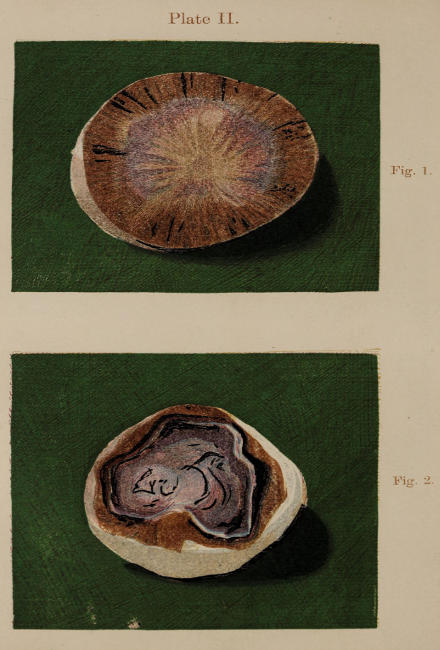
chalcedony, blue and white, as oval as bantams’ eggs. I
select half a dozen on account of some beauty or peculiarity,
and fling the remainder into the sea, there to
undergo a fresh impregnation. Next, sundry bits of the
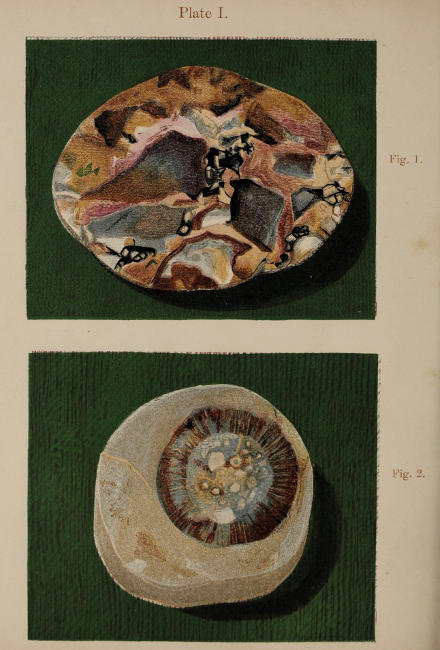
red and white conglomerate. Let me advise everybody
who has the opportunity, to pick this up. When sliced
and polished, the surface obtained beats the inlaid work
of a cabinet-maker all to nothing. Next, a couple of
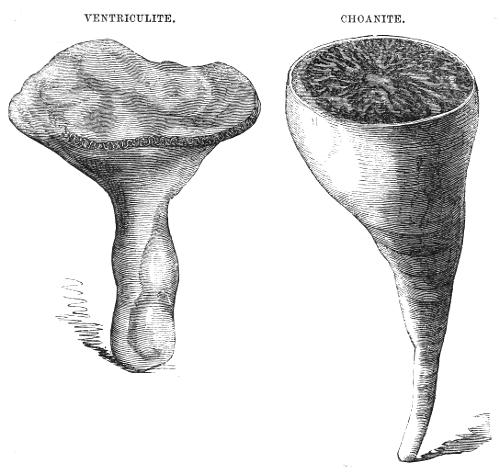
choanites, one in the dark “rag,” ribbed like sea-weed;
the other in pretty light-brown moss-agate. These two
go into my breast-pocket for safety. Lastly, what has
never been out of my hand since I found it—a huge,
knotted jasper-agate, of five pounds’ weight.
I will only add that the beach here described is a first-rate
one in its way, although not my absolute favourite.
I had, however, never seen it before, and have never
visited it since; moreover, I had not a hammer with me,
nor any refreshment beyond a cigar, after tramping over
many miles of deep shingle; consequently, I do not suppose
I did justice to the contents of that bit of coast.
But where am I now? Two hundred miles away, and
the scene is changed. I have just rounded a headland,
on whose summit the ripening corn-field is waving and
gleaming like the tuft on the head of a woodpecker.
Dizzy precipices of chalk stand like sugar-loaves against
the blue sky, here and there cleft in a tortuous, yawning
chasm. Beneath, the beach seems to slumber, so gentle
is that lisping murmur, where the long billowy swell
washes the face of the skerries, and lifts up and down
their heavy fringe of tangle like a giant’s beard. Two
hours are mine, as we mortals reckon, before I am expected
at the evening meal. This time I have my hammer
with me—no clumsy carpenter’s tool, which might
rend or splinter, but a tempered steel.
I did but walk a couple of miles in all. I found sundry
pieces of perfectly white agate, one of which proved
good enough for a seal. I broke open a score or two of
jaspers, and was rewarded at last by a fine slab of the
rich brown (quasi-Egyptian). Then I hunted up from
the shingle a pocketful of “sponges,” and a choanite in
dark purple flint, which is rare. And then time was up,
and scaling the cliff by a well-known gap and pathway,
I returned home to crab-pie and a cup of tea, and the
welcome of a dear, kind face. This part of our coast is
much visited now by pebble-seekers.
Now I have crossed a channel of the sea, and have
looked upon the mighty three-deckers, and all the flower
of the yachtery of England; and I have strolled through
a smart modern town, and have passed a meditative half-hour
in a very ancient village, and then, at a sharp turn,
I have quitted the high-road, with its hot milestones, and
picked my way through a blossoming lane where the
nightingales were singing; and I have scrambled over
the edge of a snipe-bog, and hurried past the mouth of a
diluvian estuary, and here I am, stretched at full length
on the choicest bit of beach in all the realm of Queen
Victoria. In front of me are soaring pinnacles of chalk,
ribbed and dotted with primeval flints, like the gun-muzzles
in an upper deck. Behind me rises another
barrier, formed of the dark “greensand;” and on one
side, for the space of a mile, these lofty brows have
dipped and disappeared, that the red edge of the wealden
might crop out from a wide tract of rush-grown water-meadows.
Through the heart of these latter steals a
rivulet, beloved of stray wild-fowl, but not tenanted by
anything so lively as a trout.
The position of this beach is all that can be desired,
and its contents will not disappoint expectation. It has
sometimes reminded me of one of those angular nooks
formed externally by the converging hedges of a cover
and a crop, where you are sure to meet with the hares
and pheasants which have come out to feed on your
wheat-stubble or turnips. Here, however, instead of the
scuttling game, you must look for matchless pebbles.
Often as I have paced this charming strand, the occasion
of my first stepping upon it was pure accident, as,
indeed, are some of the pleasantest turns in life. I remember
one summer’s day, when the solid cliffs seemed
to be pulverizing under the heat, and the air-vessels in
exposed sheaves of bladderwrack were splitting and popping
like crackers, I found four or five specimens within
a couple of hundred yards which I have never since surpassed,
seldom equalled. Two of these were deep red
choanites, conveying the idea, not of dull “oxide,” but
that the animal’s blood had suffused the agate; another
was a particoloured madrepore, another, a moss-jasper.
This bay, however, possesses peculiar advantages. In
addition to the fossils which drop from time to time out
of its own overhanging cliffs, it is fed in a remarkable
manner from other sources.
Until of late years, Sussex has been the usual resort
of those who desired to collect pebbles for the cabinet.
The capabilities of this coast vary with every twenty
miles. The Brighton beach was once famous for the
supply of “landscape-pebbles;” but in the lapse of
years its fecundity has been sadly impaired. The best
chance remaining now is that of an occasional waif
during the March winds on the sweep fronting Brunswick
Terrace, and for about half a mile toward
Shoreham.
Bognor has long reefs of rock at low water, and, by
the usual rule, it ought to yield petrified sponges; for
I think that, generally speaking, the locality determines
the animal. But the infirmity of the Bognor shore is,
that its pebbles are chafed and worn to skeletons by the
furious storms which assail this unprotected coast in
winter. No fossil with a delicate constitution can long
withstand the effect of these gales and plunging seas.
Off Beachey-head, in the other direction, is found a
variety which I have not met with elsewhere. The
specimen shown to me was vermicular; the creature,
which had perhaps been a “sabella,” lying in distinct
coils, not unlike macaroni, in the blue agate. This
pebble was a very large and perfect one; and the man
who had picked it up, and paid perhaps half-a-guinea
for the dressing of it, was desirous to realize a five-pound
note. I wish much that it had found its way
to the British Museum. There is no stone there resembling
it.
At Deal and Ramsgate, “fortification-agates” may be
readily met with, and sometimes a bit of carnelian: but
this last, bright and homogeneous, is rare. The Hastings
beach is mainly worn out. Aldborough, in Suffolk,
was wont to be famous for its coloured agates; and Fifeshire,
and part of Forfarshire, for eyed jaspers: but many
years have gone by since I visited either of these counties,
and I would not venture to speak with confidence
concerning their actual beaches now.
Very good pebbles are picked up at Cromer; and,
occasionally, carnelians, both red and white. Felixstowe,
a little lower down the coast than Aldborough,
abounds in yellow agates, some of them beautifully
translucent, and rivalling the carnelian in smoothness
of texture. At Scarborough, remarkable specimens both
of the agates and jaspers are obtained by those who
know where to look for them. Filey has the same
charms for enticing strangers to wander onwards along
its pretty coast. Indeed, all the Yorkshire beaches
deserve and will repay a visit, both in fossils and
transparencies.
Carnelians are peculiar stones as to their habits, if I
may use such an expression in speaking of inanimate
substances. It were absurd to doubt that plenty of
them still haunt our English coast; but where they
manage to hide themselves has often perplexed me.
The method of searching for them is as follows. Instead
of keeping the sun behind you, he should now be
full in front, like a candle in your eyes. But you must
not look at the sun: you must look along the surface
of the beach; and whenever a bit of carnelian peeps
out from the shingle, you will at once descry it, owing
to the position of the great light.
I tried this once at Blackgang Chine for three-quarters
of an hour, and in the course of that time I filled both
my waistcoat-pockets with red bits. It is true, none of
these were larger than pudding-raisins, and some of
them scarcely more brilliant; still, the search was very
diverting. If the shingle had not been unusually damp,
I might have lain down every now and then and looked
along its surface; in which case I should, doubtless, have
succeeded better.
The mention of Blackgang leads me to speak of the
Isle of Wight, as the choicest storehouse for this kind
of fossils in Britain.
If it be true, as some geologists aver, that the pearly
“Vectis” was at one time joined on to our Hampshire
coast, from which it afterwards broke off like a loose
morsel from the side of a cake, that would go far to
explain the abundance and beauty of its organisms.
For, upon such a separation from the mainland, the
industrious sea would have great opportunities of denuding
the face of the cliffs and sucking the orifices
of the chines. Also, this circumambient sea is peculiar
in its character hereabouts; and the crystallizing waves
impart an unusual lustre to rolling agates and jaspers.
The beaches of the Wight are circumscribed in extent,
which is a great relief after the interminable ranges on
the Sussex coast. The difference is as great as that between
a quiet forenoon spent in the museum in Jermyn
Street, and the laborious distractions experienced if we
pass a similar interval of time amidst the endless rooms
and innumerable cases on the first floor of the British
Museum.
The village of Sandown, from the flag-staff on as far as
Red Cliff and Culver, exhibits a tempting and instructive
shore. In winter, it is better to commence at the dyke,
and end with Red Cliff; but in summer, you may walk
the whole range with advantage. Here, a couple of
hours may be taken to as many miles; and if you do
not shut your eyes, you must fill your pockets. But
look with resolution for good ones.
From Sandown to Shanklin, in the opposite direction,
it is scarcely inferior. It was once even better; but, lying
so near at hand, it has been unceasingly hunted over;
and to look for a fine pebble there now, is almost like
hoping to find a hare sitting in your kitchen-garden.
Many tons’ weight of beautiful fossils have been gathered
within the compass of a morning’s walk here, in the last
few years.
At the foot of Shanklin Chine occurs a singular collection
of limestone pebbles, siliceous within, which are
well worth examining. Extraordinarily-tinted choanites
are here sometimes detected in the heart of most unattractive
and mis-shapen blocks. I once asked a successful
beaching lapidary there, how he knew them?
He declared that he did not know them at all; but
that whenever he saw fresh bonzes thrown up, especially
if with a deep-sea mark upon them, he would
break them all, and generally obtained a superb specimen
among them. The objection to this murderous
process was, as he confessed, that some of the finest
were wont to be destroyed.
Latterly, I thought I discovered a way to recognize
the presence of any such choanite. It is to look closely
for a peculiar depression in the stone which is connected
with the principal air-hole belonging to the fossil. But
this method demands time and care.
Onwards to Luccombe, the beach disappears, owing, I
imagine, to immovable depth of sand. At Luccombe
Chine, it partially revives: but do not linger here. Go
on to Bonchurch, and as you approach that lovely hillside,
rouse all your energies. Here comes in a mile of
sand, small shingle, and half-buried pebbles, which will
put your skill to the test, if skill you have. Look out
for symptoms of the “tubular” structure, and diverge
now and then to the pools among those weedy rocks.
Many a beautiful “actinia” in flint lies there snug
enough, wedged in a dark cranny, and coated over with
glutinous moss. You must really not be idle now.
Do not even light a cigar, but hammer and delve and
scrape away; only do not give in until you lay hold of
something worth the while. Two zoophytes, of the
agatine-siliceous kind, were picked up on this spot about
a twelvemonth since, for which large sums of money were
offered in Ventnor the same day. For one of this sort,
an American gentleman, not long ago, gave eight pounds
sterling. But there is in Brighton, or was till very
recently, a pebble from the Rottingdean beach, for which
fifty guineas have been offered to its possessor, and
refused. I have not seen it myself, but I am told that
it is a spotted pyriform choanite; the material, very
beautiful agate.
At Ventnor, red gravel and diminutive carnelians,
some of them not bigger than pins’ heads, await the
pebble-seeker. Occasionally an agate is found here
which is “chatoyant,” like an opal, but this is scarce.
I once tried the Freshwater strand, “ultima thule,” but
I only met with doubtful, ragged flints. The north side
of the island presents on its shores a surface chiefly of
mud and estuary drift, delightful to solans and sea-gulls,
but not profitable for the cabinet of the mineralogist.
I ought here, in common gratitude, to say something
of the beauties of the Garden Isle. But, though some
of the happiest hours of my life have been passed there,
I grudge to dilate upon the theme. I could not, if I
would, convey to a stranger a sense of the unutterable
attachment which I feel for its swelling downs and
curling seaward bays. Much of the charm of our old
English scenery, which is fast disappearing elsewhere
before the railway and the canal, is still to be met with
in this sequestered island. Here are uncultivated rocky
slopes, proffering rare wild-flowers; ivy-mantled cliffs and
moss-grown brambles; bays which in winter witness the
howling storm, and sometimes the fearful wreck, but in
summer are invested with the calm beauty of a moonlit
lake. The inhabitants also, many of them “aborigines,”
have a primitive, unsophisticated character in the inland
villages; while, on the coast, this is chequered by that
roving disposition and semi-superstitious bent which are
always to be found among sailors.
Oddly enough, the story of a pebble illustrates this
trait of character. Some years ago, I was calling on a
lapidary in Sandown who had done a good deal work
for me, and done it well. His account was settled, and I
was wishing him good morning, when he drew my attention
to a remarkably beautiful pebble, ready cut and polished,
and begged my acceptance of it. Now the stone,
displayed on his board along with other specimens, could
not fail to sell; and was worth to him, I should say,
perhaps a sovereign. I was very unwilling to take it,
but there was no refusing without offending an old
friend; so it went home in my pocket. But somehow
curiosity was stirred in my mind when reflecting on the
circumstance afterwards. Why should he wish to make
me a present? Or, allowing for goodwill taking so
straightforward a course, why part with a stone of so
much moneyed value? A few days after I dropped in
again. My friend was out: but I found his wife, and
stayed for a chat. Presently I referred, quite cursorily,
to the gift which her husband had made me, “and,” said
I, “I wish only it had been something of less value.”
The gentler sex are sometimes more communicative
than their mates. “Ah! sir,” replied Mrs. ⸺, “there
was reason for giving you that, may be. Anyways,
I’m real glad that it’s gone from us.” “Indeed! how
is that?” “Why, that stone was an unlucky stone for
us, and I wished it to go, somehow.” Then I learned
from her the following singular tale.
Two brothers, sea-faring men, were great friends of
the lapidary and his wife. One day, one of these brothers
found this pebble on the beach, and had it cut. It
turned out, as I have said, a remarkably fine specimen.
It was what they call a “deep-sea” pebble, and the
“choanite” of a reddish hue lay exactly central in the
bonze of white limestone. The sailors were both of them
quite fond of it: and when they went to sea again, the
handsome pebble went with them, and was laid “o’ nights”
on a shelf by the hammock.
Their boat was upset: one brother was drowned: the
other righted the craft and got to shore, not without difficulty.
Several articles were missing, having gone to the
bottom; but the pebble was safe.
The survivor brought it back to the lapidary, and
made him accept of it, being unwilling to retain it himself.
The lapidary took it, and put it aside: but his
better half found it out, and insisted that he should
neither sell it nor keep it. So, he gave it away. This
stone I afterwards parted with to a London collector:
not wishing to preserve so sad a reminiscence. I took
a fossil in exchange, which I almost immediately lost.
So, nothing connected with the mysterious choanite was
“lucky.”
Perhaps every feature in “Vectis,” from the matted
festoons on its honey-combed rocks to the “witchery of
its soft blue sky,” predisposes a frequent visitor to approve
also of its pebbles. But it is an unprejudiced fact, that
in texture and colour they excel those which are found
on the Sussex beaches. And while I think highly of
our Devonshire jaspers, I remember a jasper-agate,
gathered some years ago at Sandown, which might
challenge all such stones of native growth in our
London museums, and bear away the palm.
Many a calm summer’s evening, many a stormy
winter’s forenoon, have I whiled away in absolute contentment
on that most interesting shore. In the hot
noons of July the bathing is delicious; and after your
bath, the shadow cast by overhanging cliffs, and a fanning
breeze from the sea, make a ramble onwards
irresistible. But I found winter as pleasant in its way.
When the gust roared, and chimneys smoked, and the
heavens looked dark and disturbed, it was inspiriting to
go forth roughly clad, and to watch the fitful changes
where the weather-gleam strikes upon Culver; or to mark
how that treacherous mist would come creeping round
Dunnose, till the “white horses” rose on the sea, and
the heavy squall which had long been packing in the
offing burst with a wild cry, driving in a yet heavier
element with tatters of oar-weed and splinters of broken
dyke against the face of the immovable cliff.
After passing Shanklin, the style of scenery as far as
Luccombe and the Fishers’ huts, is quaint and picturesque.
Here the “Gault” makes its appearance, and the hill-paths
are in consequence slippery and dangerous. After
this, succeed several miles of fairy-like beauty. And then,
the stern grandeur of Black-gang, the coast-line trending
away in a range as savage as that of Calabria. And
last, the chosen home of the poet, sublime Freshwater,
and rainbow-tinted Alum-Bay.
Having said so much on the pleasure of beach-rambling,
it may be well to put tourists on their guard
in two important particulars. The first of these touches
personal safety. No one should set out upon what may
prove a prolonged expedition without first ascertaining,
on Kalendar authority, the hours of the tide for that
day. There are sundry points on the coast of the Isle
of Wight, for instance, where after a couple of hours’
progress, on scientific thoughts intent, the pedestrian
may find himself hemmed in by a jutting precipice in
front, while the advancing tide behind has gradually cut
off all hopes of a retreat on “terra firma:” and as the
face of the cliff is seldom such as admits of being scaled,
it will then fare badly with him if he be not “the king
of fishes.”
The other matter respects fatigue. Hearty exercise is
desirable; not so that which results in utter exhaustion.
My own experience is as follows:—I have climbed to the
summit of Sca’ Fell, and then walked back, footsore and
fasting, to Keswick. I have swum a mile before breakfast.
I have ascended Mount Etna at midnight in
December’s snow. But for sheer fatigue, pulling at the
muscles, and drying up the marrow, there is nothing
equal to ten miles of stiff shingle, while a foggy north-easter
currycombs your face, and perhaps your shoe-leather
has been laid open by the edge of an inauspicious
flint.
If in addition to all this, forgetting “Cording,” you have
sallied forth non bene relictâ parmulâ, your condition is
by no means enviable. Therefore, whoever intends to go
beaching in earnest should look to his outer man, and
carry with him certain creature-comforts, not omitting to
include in these a supply of good tobacco.
Yet one word more upon this head. Have a due
regard to the well-being of your eyes. They are, as you
will not fail to acknowledge, the working party on these
occasions. Manage how you will, they must be subjected
to a great stress and strain. Give them half an hour’s
respite, if possible, while you sit down and inhale the
“weed.” It is unpleasant to find, after too intense a
service on the part of your “daylights,” as you return
homewards along the meadow-path, that a beach you
have left two or three miles behind you is all coming
back, whether you like it or no, upon your organs of
vision.
On the whole, summer is the most fruitful season for
stocking a cabinet, on account of the more powerful
illumination cast upon the objects of your search. But
in winter the beach itself is very likely to be in better
condition, for it is oftener agitated, and many specimens
will come to the surface which in calmer weather lie
buried under sand. It is important to train yourself to
attentive observation, and after long habit the ear will
listen intuitively.
If you hear the sea make a dull, booming noise during
the night, be on the look-out two or three tides later,
when the first shingle now thrown up has sifted and
settled down. Large pebbles will then be found on the
top of all, the process being much like that which takes
place on shaking a basin of lump sugar.
But it will be well for you to be always on the alert.
The seaside elements must be coaxed and humoured, if
you hope to get anything by their agency. A beach
itself is exceedingly capricious. On some days you may
walk for miles and remark nothing worth picking up;
perhaps the next day, over the same ground, so great
will be the profusion of fossils as to suggest the idea
that since your last visit a petrified shoal had returned to
life, swum into the bay, and there been once more stifled
in gurgling lime, or liquid silex, and penetrated by the
metallic “moss.”
“The sea yields its harvests without sowing or planting,”
and seaside scenery is exquisite if you have come
upon it where it is unsophisticated. Happily it is in
such sequestered “Edens of the western wave” that the
most desirable pebbles are met with. I have gathered
rare specimens where the dor-hawk was wheeling overhead,
and saucy sea-gulls screeching almost in my face;
while a cunning crow would watch from a projecting
ledge of rock to see whether I was about to capture, and
afterwards throw away, anything which might serve him
for a luncheon.
The terraces of Margate and Ramsgate are invaluable
to the tired artizans of London seeking their well-earned
recreation; but no poet could venture to affirm of them
what Scott said of “Brignall banks,” that they are “wild
and fair.” But quit these populous thoroughfares, and
get away to pearly Beachey Head, or roam the lone
strands of Yorkshire or Devon, or go and lose yourself
among shadowy nooks and gleaming bays in the sweetest
of all islands, and you will possess the genuine colour
and scent, and music and mystery of the sea, as the
Creator has framed and blended that wondrous element.
You need not look for pebbles unless you like; sometimes
it were better not. But saunter down to the
water’s crinkled edge, and inhale that indescribable
odour from old rock, slippery now with dulse and ribbon-weed—Piesse
and Lubin distil nothing to equal it—and
con the page in Nature’s volume which lies open before
you; it will never give you a head-ache, nor a heart-ache
either.
Here, after presently stripping to the elbow, you may
surprise a hermit-crab, or catch the spotted “goby” in
his dark saline pool, but please let him go again; you
ought to give him his freedom, if only out of gratitude;
for all this time your own tired body is being braced and
refreshed, and your mind, yesterday jaded and careworn,
is winning back its elasticity under a sense of blessed
repose.
I will now mention some peculiarities in the nature of
our beaches, which I have noted from time to time in
the book of my experience.
A BEACH is supposed to be a permanent accumulation
of pebbles and small shingle, due to such cliffs or
banks as are near at hand. And this general definition
would be so far scientifically correct, if nature were stagnant
like the surface of a deserted mill-pond. But, as Nature
is always at work, always shifting the scenes, the
above definition, although it sounds like a truism, does
not hold good in either of its clauses. The accumulation
which we look upon is not permanent, nor is it always
due to a neighbouring source. Sometimes the collection
of stones which we find heaped up in an immemorial
bay has been washed round—much of it, perchance,
recently—from a distant quarter. And this might be
taking place under our very eyes, and we not know it,
just as we do not see the grass grow. Except in very
calm weather, beaches are continually travelling, and
they travel rapidly along certain lines of coast, until they
arrive at a terminal point or headland. To get round this
latter takes time, but they do get round it at last, with
the help of strong gales prevailing in one direction, and
under the rushing tides of an equinox. Now if we suppose
a few acres of shingle to be once fairly carried past
such a promontory, and discharged into the curve of an
elliptical bay, they will be locked in, and may, perhaps,
never get out again.
I have myself no doubt that Sandown Beach is fed and
replenished in this manner: and the bay being deeply
indented with the points of Culver and Dunnose, prominent
at opposite extremities, egress is difficult. Yet most
persons might naturally suppose that whatever they find
on the beach here is due to its overhanging cliffs.
Some of the best pebbles travel fast, and are, in fact,
migratory, till they reach such a “nidus” as I have
described. This is owing to the rounded form which
fossils usually assume. Angular lumps rather remain
stationary. Jasper I suppose makes few excursions:
while the agates and oval choanites are continually on
the move, and may have visited a dozen different localities
before they are picked up. I have hunted a bit of
yellow agate in this way for above a mile in the course of
a few weeks, dropping it again on purpose, and never
finding it in the same place.
Beside the above real motion of a beach, there is an
apparent total change for a time which is by no means
uncommon in exposed situations.
This is, when an inshore gale drifts the sand and conceals
for a day or two the entire mass of shingle. It is
a provoking circumstance when it occurs, but it seldom
lasts long in its effects. The sudden re-appearance of
half a mile of solid beach, as if by magic, on a change
of the wind, has sometimes surprised me in spite of past
experience.
In average weather, when a beach is not migrating,
the rise and fall of the pebbles in the same lines is very
observable. The only change then induced in a stratum
of shingle is by the suck and draught of the sea. This
latter, however, is unceasing, as may readily be tested
by bathers; everything which you set your foot upon
under the wave being in a gentle rolling motion. It
yields an amusing diversion in the water, to play the
pebbles about under one’s feet. The effect of it, however,
is not so quaint as that which I remember experiencing
many years ago in Loch Long, where are no
pebbles, but plenty of mud. Here, wading out in the
shallows to arrive at swimming depth, I put one foot
after the other on the backs of some unsuspecting
flounders lying on the sand, and laughed aloud at the
tickling sensation as they glided away from under me.
But all motion is a source of interest and charm,
especially while we are on the sunny side of forty. I
believe that this forms one feature of delight in the capture
of winged insects. Exquisite as is a good British
collection, the dry side of the science, whatever learned
entomologists may say, is not the most inviting, and
would attract comparatively few persons after a time.
In like manner, who would care for cover-shooting, if
all were sitting-shots? But the “runners” and “fliers”
impart a zest.
Even here, my friends the seaside pebbles have a claim
to please: for, although inanimate, they are not altogether
devoid of motion, as I think I have shown.