TO LORD BRASSEY, IN HIS TRIPLE CAPACITY OF LAWYER, MASTER-MARINER,
AND MEMBER OF THE ROYAL COMMISSION
ON UNSEAWORTHY SHIPS,
THIS VOLUME IS RESPECTFULLY INSCRIBED BY THE AUTHOR.
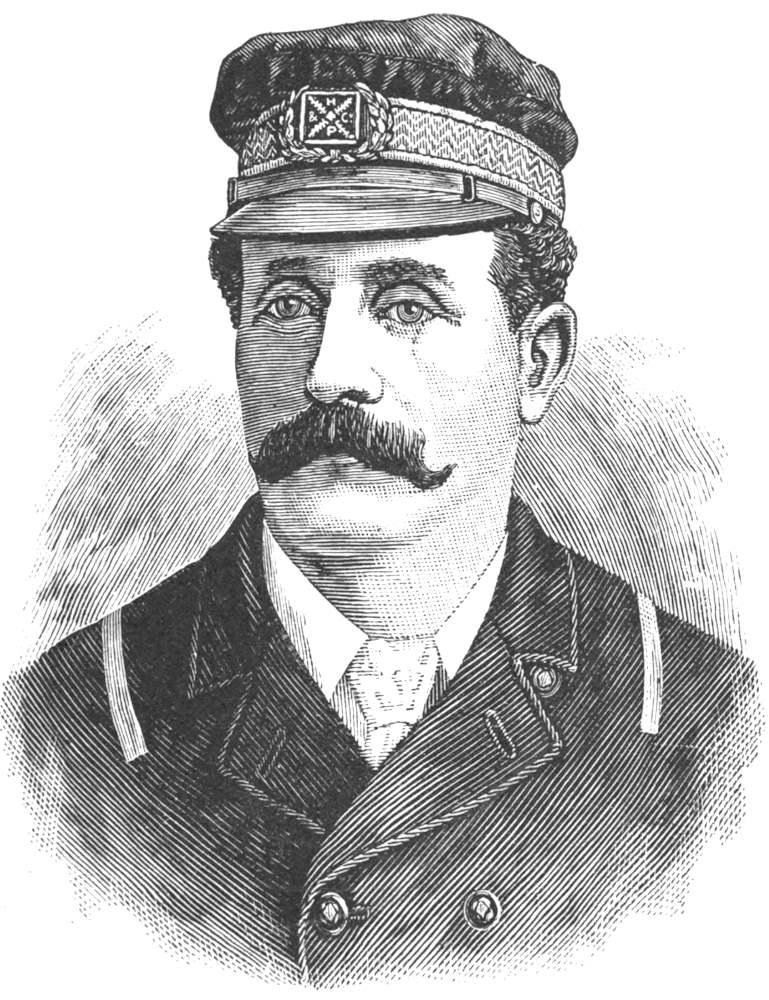
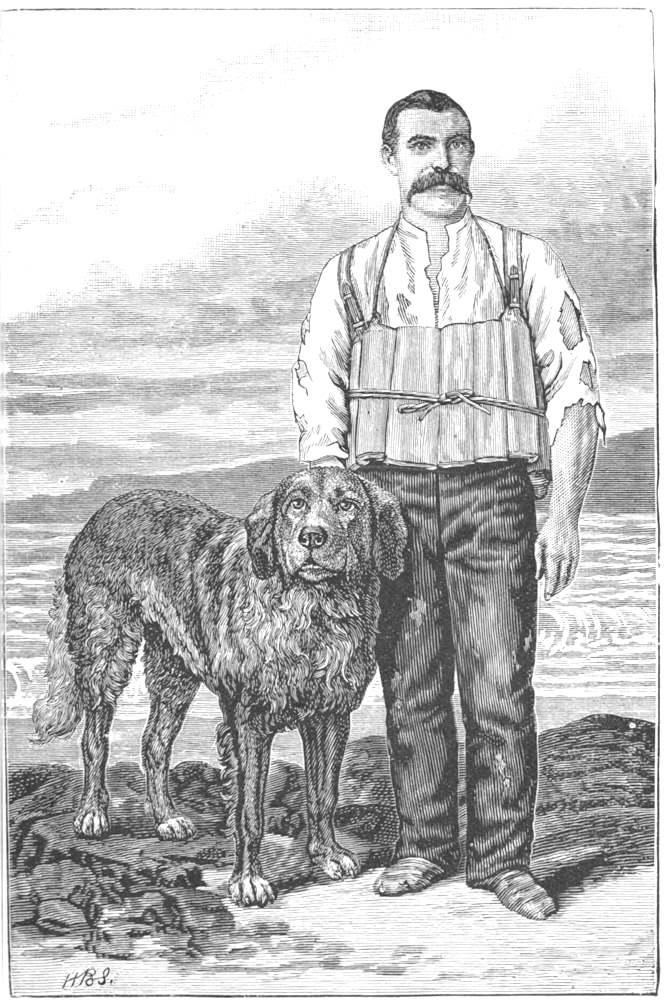
LORD BRASSEY AS A MASTER-MARINER.
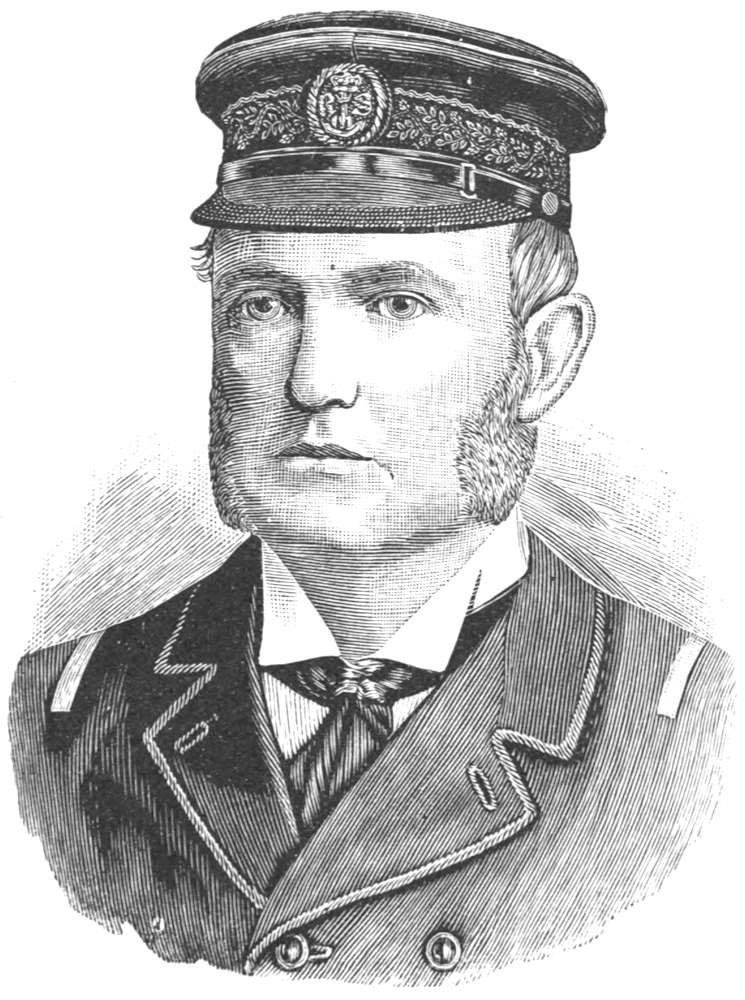
THE LATE CAPTAIN MATHIESON,
S.S. Alert.
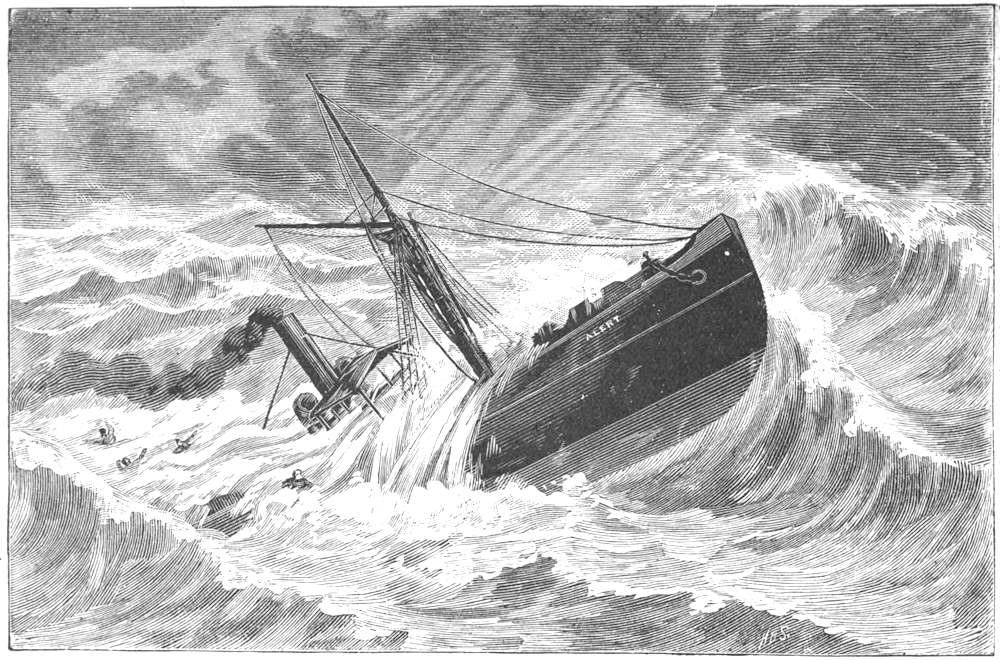
Battling with the Waves.
CHAPTER I. INTRODUCTORY.
“Boldly I venture on a naval scene,
Nor fear the critic’s frown or pedant’s spleen.”
Falconer.
A shipwreck, at all times and under any circumstances,
is a lamentable occurrence, but it is peculiarly so
in instances where out of a whole ship’s company only
one solitary individual is left to tell the tale. So far as
is known to the compiler of the present work there have
been only two such shipwrecks in Australian waters.
One was the wreck of the emigrant ship Dunbar near
Sydney Heads, Port Jackson, on the 20th August, 1857,
when a seaman named Johnson—who is still living and
permanently employed by the New South Wales Government,
as a lighthouse-keeper at Newcastle—was the sole
survivor out of 121 persons.
The other was that of the steamer Alert, near Melbourne
Heads, Port Phillip, Victoria, on the 28th of
December, 1893, and the relation of which forms the
subject matter of these pages. The last named vessel
had 16 persons on board and all, save one, perished either
by drowning, or by being dashed to pieces against the
cruel rocks. Disaster comes to us in all forms, but the
stirring story told by Robert Ponting, the survivor from
the Alert, partly lifts the veil and shows us how brave men
can, and do, even under the most adverse circumstances,
battle to the last against the mighty raging sea which
finally engulphs them.
It might be fitly said in the language of the poet.
We ask thee, insatiable Deep!
How many lone ones weep
For friends who lie buried in thee?
Husbands, fathers, sons, brothers, all!
Sunk ’neath thy heaving pall,
Beautiful, treacherous, cruel Sea!
In calms, thy smooth and placid breast
Might lull a babe to rest,
And ne’er disturb its peaceful sleep.
In storms, thine awful mountain waves—
Not cradles then, but graves—
Swallow brave men. Oh! hungry Deep.
To do his duty and face death on the battlefield
the soldier requires great courage, even although there
he has only his fellow man—and the instruments
created by him—to contend against. The seaman’s
courage is, however, of a very different sort. In a
storm he has to war with something infinitely more
awe-inspiring than anything puny man can make!
Hence, however sorrowful and heartrending the detail
of suffering and death at sea, still we who read of such
cannot but admire the indomitable pluck which
characterises the conduct of mariners, even when they
believe and feel that all hope has fled. Death is the
portion of all; yet, although we are aware it is
inevitable, there is a something—call it what we will—that
instinctively impels us to fight and struggle for
existence. During this struggle there are some well
authenticated instances wherein men seem to have
passed through the very gates of death, and yet, by the
mysterious workings of Divine providence, have been
for a time brought back, so to speak, into the land of
the living until some purpose or aim had been
accomplished. A clear case of the latter sort came
within the experience of the present writer, and he
hopes that the relation of the incident here will not be
considered out of place by his readers:—
We were coming from Quebec, Canada, bound
to Milford, England, with a timber-laden ship called
the Marmion. When about half way across the Atlantic
the captain became very ill with something understood
by us to be British cholera. He was confined to bed,
but persisted, every day the sun was to be seen, in
being carried up on deck to take observations at noon.
We could all see he was dying, and though every
attention was paid to him, we expected each day to be
his last. Just three days before we sighted land our captain
died apparently, and it being cold winter weather, we
determined, if possible, to bring his body on for burial
when we arrived in port. To our astonishment, some
hours after we believed him dead, he suddenly revived,
and asked for something to eat! He continued improving
so much that one night about six o’clock, when
we had just sighted Kinsale light, on the Irish coast, he,
without any assistance, came up on deck, took the
bearings of the light, and altered the ship’s course.
A heavy gale was blowing, and the weather as thick
as a hedge; still the ship, under close reefed topsails,
was kept running all night before the wind, the captain,
meanwhile, against all persuasion, insisting upon remaining
on the poop. At noon next day, when the ship was
still rushing along in the midst of a thick fog which
prevented any land from being seen, the captain said
quietly to the man at the wheel: “If the ship has been
steered properly since we saw Kinsale light, she will be
in Milford Haven in about three hours’ time; if she
hasn’t been steered properly, she will be God knows
where.” Almost immediately after speaking to the
helmsman the skipper muttered in a bitter tone, as if
communing with himself: “Anyway, it won’t make
much difference to me.” In two hours more the weather
cleared a bit, the we saw the land very “close to,”
and we were heading straight for St. Ann’s—an island
which lies in the entrance to Milford—as an arrow from
a bow. By three p. m. we were safe in port with the
anchor down. In the flurry of letting the anchor go we,
for the time being, forgot all about our captain’s
condition, but on walking aft and going below, we found
him lying on the sofa in the saloon, dead for certain,
as it proved, this time! He was, physically, a weak
man, but had a powerful will and a taciturn nature.
The anxiety of getting the ship safe into port had no
doubt kept him supernaturally alive. The anchor down,
he felt his task was done; he had quietly gone below,
and unseen, passed away beyond the cares and troubles
incidental to human life!
The voyage of life is anything but plain sailing,
and whether we like it or not—aye, whether our duty
lies in the hut of the shepherd—in the palace of the
prince—in the workshop—in the forest—in the camp—or
on the ocean—we may expect to encounter some
phase or other of that perpetual conflict with the
material forces of the universe, or that scarcely less
persistent conflict with the moral force of circumstances,
which, together, make up so much of the tragedy of life,
and after all, impart to it so much of its dignity.
Knowing then that storms and trials have to be
encountered it is clearly our duty, so far as we are able,
to take every precaution to minimise disaster of every
kind. Disasters, of course, will occur, both on sea and
shore, even when everything has been done that thought
and skill can suggest, but with regard to shipping
matters can we say that, in the interests of life and
property, all is done that could and should be?
Without presuming here to enter into the cause, or
causes, of the Alert going to the bottom, it is saddening
to think that though the vessel went down in broad
daylight, and not far from the shore, still the accident
was not seen. It may be that even if it had been seen,
nothing, owing to the state of the weather, could have
been done to help the sixteen men who were left to
buffet with the waves, but, nevertheless, it must have
added another pang to the suffering of these men to see
and know the land was “So near and yet so far.”
The incidents which occurred after the foundering
of the Alert are so extraordinary that if they were not
authenticated beyond a doubt, the recital of them
would at once be classed as a narrative from the
prolific pen of a dealer in romance. Indeed, it might
be fittingly said that the wonderful endurance displayed
by the survivor, Robert Ponting, in battling with the
waves for fifteen hours on what must have been to him
a terribly long, and dreary night—his being cast upon
the beach—his curious discovery and ultimate resuscitation—all
partake of the miraculous!
Moreover, as if to make matters still more sensational,
somebody conveyed the news to Ponting’s wife,
at South Melbourne, that her husband was amongst the
lost, and Messrs. Huddart, Parker, and Co., the owners
of the Alert, also, on the 4th January, 1894—six days
after the date of the wreck—sent a cablegram to
London, stating that Ponting was drowned.
The following extract from a letter, lately received at
Melbourne by Mr. Robert Ponting from his brother-in-law,
Mr. Thomas Hutton, in London, clearly gives the
particulars of this unaccountable blunder:—
“Dear brother Bob,—
We heartily congratulate you on your
wonderful escape from the sad fate that befel your
shipmates through the foundering of the Alert. You
also have our sincere sympathy for the terrible ordeal and
physical suffering you have passed through. At the same
time I may tell you that all your relations here had five
weeks’ mental suffering on your account. It came about
thus—On Saturday, 30th December, 1893, I read in
the “London Morning Post” a telegraphic report of the
loss of the Alert, in which it stated there was only one
survivor, but no name was given. Of course we all
hoped that you were the survivor, and in order to
ascertain this I went, on the 2nd of January, as soon as
the office opened after the holidays, to Mr. James
Huddart’s office, 22 Billiter street, London, but they
could give me no information. They told me they
would bring my request for information before Mr.
Huddart, and that evening I got a letter from him
stating that he would be glad to cable to his Melbourne
branch if I wished, at my expense. I sent him, as
desired, a cheque for £1 18s 8d, or 4s 10d per word for
eight words—five words for the message and three for the
answer. He deeply deplored the sad necessity there
was for such a cable, but stated that he would send it
on at once, and immediately communicate the result
to me. Mr. Huddart got the reply from his Melbourne
office on the 4th January, and then he forwarded a
telegram to me as follows:— ‘Much regret to inform
you, brother (R. Ponting) drowned in the Alert.’ Of
course I had the sad duty of letting mother and father
and all the other members of the family know the
mournful news that had reached me. You, dear Bob,
can imagine our feelings when we thus knew for certain
that you were lost. We all purchased mourning
clothes and wore them for five weeks, until, on 6th
February last, we received a letter from Mr. James
Huddart which filled us all with joy. This letter
enclosed a cutting from a Geelong paper, stating that
you had been saved and that you were the sole survivor.
Mr. Huddart’s welcome communication also stated
that owing to a strange error, on the part of his Melbourne
branch, the word “drowned” had been cabled
instead of “saved.” In reply I thanked Mr. Huddart
for his kindness in sending the good news to us, but I
did not further refer to the painful mistake they had
made, although it had caused us such grief. I need
scarcely tell you we are all truly thankful that God in
his mercy, saved you from the dangers of the deep.”
It will be seen from the foregoing that Robert
Ponting was placed in the unique position of being able
to read of incidents which took place after his supposed
death.
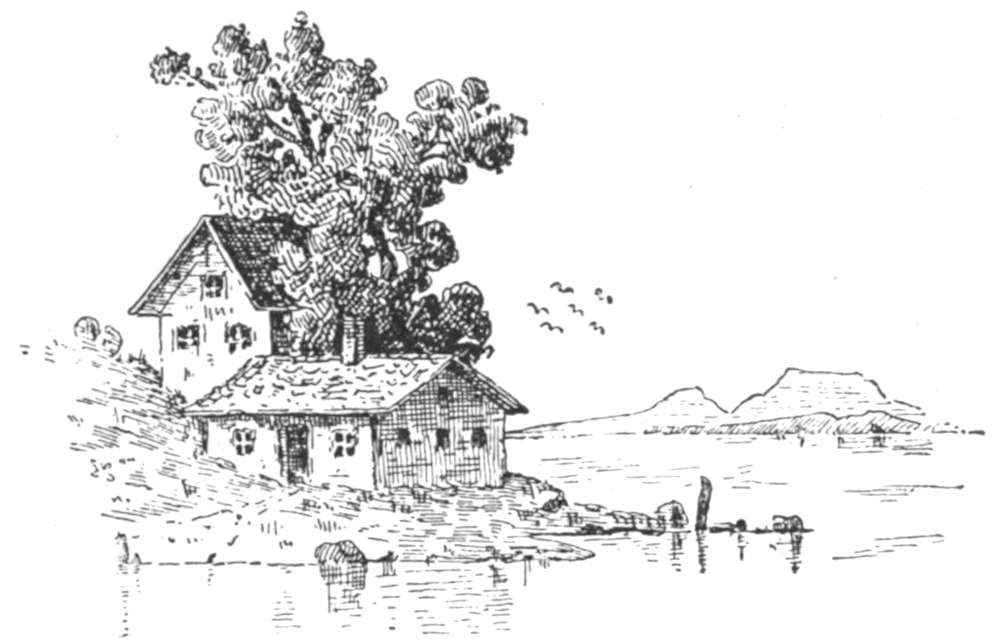
SORRENTO.
From a Photo by the late J. Dodd, lost with the S.S. Alert.
CHAPTER II. SORRENTO AND ITS SURROUNDINGS.
“That pale, that white fac’d shore,
Whose foot spurns back the ocean’s roaring tides.”
Shakespeare.
In order to give those of our readers who have not
visited Sorrento a clearer idea of the coast whereon the
S.S. Alert was wrecked, it has been deemed necessary to
give, by way of preliminary, a brief outline of the locality.
On the S.E. side of Port Phillip bay, about 40 miles
south of Melbourne, lies the pretty little township of
Sorrento. It has a population of some 300 persons, but
during the summer months this number is largely increased
as the neighborhood, principally owing to the
enterprise of the Hon. George Coppin, M.L.C., is a
favorite resort for pleasure seekers and picnic parties, who
arrive, per train or steamboat, from Melbourne and
suburbs. In addition to its notoriety as a bathing and
health giving place, Sorrento possesses a historic interest
which is at once instructive, amusing and contradictory.
Here it was that Colonel Collins, in October, 1803,
landed, from the ships Calcutta and Ocean, 350 British
convicts, with the intention of forming a permanent
penal settlement in accordance with instructions received
from the Imperial Government. After staying a few
months, he, however, abandoned the locality as it was,
to use his own words, “an inhospitable spot not fit for a
white man to live in.”
In one sense it was providential that the Colonel
condemned the place, otherwise the record of the
origin of Victoria, as a colony, would not have been very
edifying. One of the principal reasons given by Collins
for deserting the settlement was “want of water,” but
wells, dug by the members of the expedition, still exist
to prove how easily water could have been obtained.
Other proofs are not lacking to show that the gallant
Colonel must have had other reasons than the ones he
gave for taking his departure. For instance, Mrs. Hopley,
wife of one of the officers of the expedition, according to
Rusden’s “Discovery and Settlement of Port Phillip,”
wrote to her friends in England, thus—“My pen is not
able to describe half the beauties of that delightful
spot. We were four months there. Much to my
mortification, as well as loss, we were obliged to
abandon the settlement through the whim and
caprice of the lieutenant governor. Additional
expense to the government and loss to individuals
were incurred by removing to Van Dieman’s land.
Port Phillip is my favorite and has my warmest
wishes. During the time we were there (Sorrento),
I never felt one ache, or pain, and I parted with the
place with more regret than I did my native land.”
Further, one of the officers wrote—“It was one of the
most healthy and enjoyable spots that it has been my
good fortune to find in the course of my travels.
Why it should have been abandoned is a mystery.
Climate, prospect, and every natural advantage were
in its favor, and water was to have been obtained in
abundance if there had been any desire to have
found it.” Amongst the members of the Collins
party were two men who afterwards became famous
though their stations in life were widely apart. One
was William Buckley—a convict who made his
escape and lived for 32 years amongst the native
blacks as “the wild white man,”—and the other
was the late Hon. John Pascoe Fawkner—then a boy
in charge of his parents—who had an excellent claim to
be considered the founder of Victoria, and was beyond
all doubt the founder of the City of Melbourne. At the
rear of Sorrento, across a narrow neck of land about a
mile and a quarter wide, lies the Ocean Beach—or as
landsmen love to call it, the “Back Beach,”—where the
ever surging South Pacific rolls in its mighty waves on
to a bleak and barren shore, which embraces a stretch
of coast line extending from Cape Schanck to Port
Phillip Heads, a distance of about 20 miles. The fore-shore,
or rocky beach, is here flanked by a sort of
amphitheatre of high cliffs, from whence a magnificent
view seaward can be obtained, and, when a strong
southerly wind is blowing, the commotion of the waters,
as seen from this vantage ground, forms a remarkably
imposing picture. Here one can gaze on what Tennyson
describes as “The long wash of Australasian Seas.”
Now, with sullen roar, racing swiftly along, now leaping
high over the outlying reefs, then dashing with irresistible
force against the jutting rocks, and finally spending
their fury by lashing themselves into a fringe, or belt,
of creamy foam which extends as far as the eye can
reach. If there be one place more than another to
which the grand lines of Gordon, the Victorian poet,
are appropriate, that place is Sorrento Ocean Beach.
“Oh, brave white horses! you gather and gallop,
The storm sprite loosens the gusty reins,
Now the stoutest ship were the frailest shallop,
In your hollow backs, or your high arched manes.”
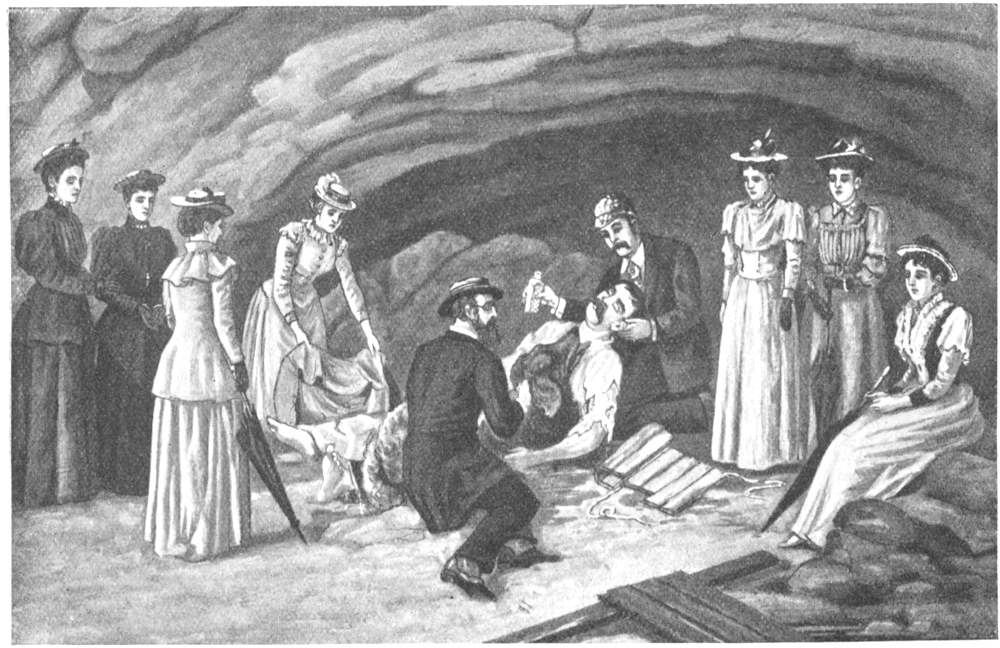
RESUSCITATION OF ROBERT PONTING.
CHAPTER III. THE DISCOVERY AND RESUSCITATION OF ROBERT PONTING.
“How lovely shines the liquid pearl,
Which, trickling from the eye,
Pours in a suffering brother’s wound
The tear of sympathy.”
“’Tis thine to aid the sinking frame,
To raise the feeble hand.
To bind the heart by anguish torn,
With sweet affection’s band.”—Anon.
On Thursday, the 28th December, 1893, a large
number of visitors were, as is usual at holiday times,
down at Sorrento. All day a heavy gale of wind and
rain had been blowing along the Victorian coast, and
visitors were, of course, thereby prevented from
enjoying themselves on the ocean beach. Next day,
however, the weather was considerably finer, and the
sun shone out, although a pretty stiff cool breeze was
still coming in from the south, or seaward. Taking
advantage of the gleams of sunshine and the receding
tide, four young ladies, namely—Miss L. Armstrong,
of 397 Station-street, North Carlton; Miss E. Duggin,
of St. Belades, Kasouka-road, Camberwell; Miss K.
E. Davis, of 97 Webb-street, Fitzroy; and Miss M.
Moorman, of 349 Smith-street, Fitzroy, were down
strolling on the only bit of sandy beach there is below
the cliffs, when suddenly they came across the body of
a partially dressed man lying half-buried in the drifting
sand. Although frightened at first, instead of running
away screaming at the unwonted sight, as many of
their sex at their age would have done, these brave
girls, with a promptitude which reflects credit on their
heads, as well as their hearts, quickly determined on
their line of conduct, and added another proof of the
truth of Scott’s opinion:—
Oh Woman in our hours of ease,
Uncertain, coy, and hard to please;
When pain and sickness wring the brow.
A ministering angel, thou!
The following account was given to the present writer
by Miss Davis, one of the foregoing young ladies:—“We
left ‘Lonsdale House’ directly after breakfast
on Friday morning for Jubilee Point. We got
down the cliff about half-past ten, intending to
look for shells and seaweed. We had just reached the
end of the railing, and were looking at some ‘natural
aquariums,’ as they are called, when our attention
was drawn to a man stretched on the sand to all
appearance dead. Miss Moorman said, ‘I believe it’s
a drunken man,’ but on looking closer we saw that he
had a life-belt around him. We went near to him and
noticed that his eyes were moving. Finding that he
was not dead, I knelt down and asked, ‘Are you ship
wrecked, Mr.?’ After a minute or two he replied in a
faint whisper, ‘Yes,’ and shortly afterwards he gasped
out ‘Refreshments,’ then immediately swooned away.
We then arranged that two of us should stay by the
man, dead or alive, and the other two go at once to
obtain help of some kind. We saw that the man’s
life-belt was clogged with sand, and also his eyes, nose
and ears. With some difficulty we undid the belt, and
dipping our handkerchiefs in water we wiped the sand
from his face. He then came to a little, and said he
felt better, but all the time till assistance came, and
even after, he kept swooning away, and each time he
went off we thought he was dead. We put our cloaks
over him, and sheltered him from the cold wind as
much as we could with our parasols, till Messrs
Ramsay and Stanton came and applied the treatment
usual in cases of the apparently drowned. In our
small way we gave all the aid in our power. The scene
was one which none of us will fail to remember, and
although we do not wish to be in such another incident,
still we feel it did us good to be there, for we got an
object lesson, and any of us know now how to treat a
person rescued from the water.” The two young
ladies who ran back for assistance luckily had not
gone far when they met Mr. J. Douglas Ramsay,
the well-known dentist, of Elsternwick. By a strange
coincidence Mr. Ramsay had been in former years
a medical officer on board several ships belonging
to the “Loch” line, and hence he was just the very
man required for the emergency. What took place
afterwards cannot be better told than in the graphic
language of Mr. Ramsay himself, as given at the official
enquiry, held a few hours after the discovery already related.
In giving evidence Mr. Ramsay stated, “I, with
my wife and her sister, Mrs. Whitelaw, went to the
Ocean Beach by trap at about 10 a. m. this day
(Friday, 29th December) and then walked on towards
St. Paul’s, one of the highest points around. When we
were within a few hundred yards of it I saw two
ladies hurrying up. They came towards us and one
said, ‘There is a shipwrecked sailor down there. Can
you tell us where to get some stimulant?’ I replied
‘Thank God! we have some here in a flask.’ I ran
down in the direction pointed out and found a man
lying on the sand about seven yards from the water’s
edge. He appeared to be dead. He was clad in
black trousers and white shirt, stockings were on his
feet, but no boots. I immediately tried if I could
discover any signs of life, but could find no pulse, everything
he had on was covered with sand, and his body
was stiff and cold. I prized open his teeth, and poured
some brandy down his throat and then commenced to
work his arms to restore animation if possible. After
10 minutes I saw a few signs of life and then, assisted
by my wife and the other ladies, I dragged him behind
a rock for shelter from the cold wind which was
blowing strong. I continued working at him for about
half-an-hour and the whole of the ladies assisted me
materially by rubbing, in turns, the man’s hands and
arms. As soon as I saw it was likely that the man
would be saved, I sent Mrs. Ramsay and her sister back
to get more assistance and they both cheerfully started
on the journey. Meanwhile Mr. Austin Stanton, of
Collins-street, Melbourne, in company with Miss Hill,
came on the scene, and he at once took off his great coat,
and spread it over the man’s body, while Miss Hill took
off her jacket and wrapped it round his feet, which were
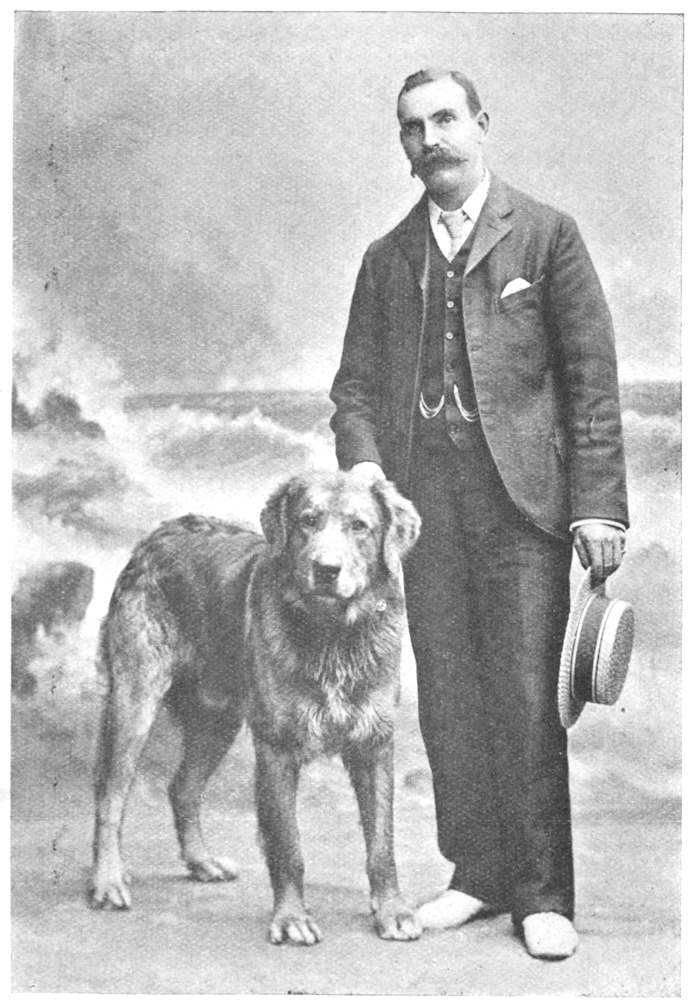
very much bruised. Mr. Stanton had his large St.
Bernard dog, “Victor Hugo,” with him, and as warmth
was now the great thing necessary, Stanton got the
docile animal to lie down and nestle up close to the
man’s body. It was indeed a strange sight, and one
which called up feelings which I will not readily
forget, to see a huge dog, in faithful obedience
to his master’s orders, lying close to an
apparently dead man! One could almost imagine
that the intelligent animal knew the effect its conduct
would produce; be this as it may, the increased
warmth soon became apparent. The man opened his
eyes and drew a long breath. I at once gave him
some more brandy, and a better color began to appear
in his face. A few moments after, he suddenly
exclaimed: ‘Where is my life-belt?’ I told him it
was all right, having been taken off previously. He
then said: ‘Could some one go round the beach?
Some of my mates might be washed up.’ In answer to
questions he said his name was Bob Ponting, that
he had been cook on board the steamer Alert, and that
she had foundered the previous day when about three
miles off the coast. From the weak state our patient
was in we dared not question him further, but some of
us went along the beach, without, however, finding
or seeing any traces of his mates. About two hours
from the time Ponting was found additional assistance
came. Constable Nolan, of Sorrento, brought a party
of men in a buggy. They also brought a stretcher, on
which we placed the poor man, and between us we
carried him up the cliffs and across to the buggy. It
was no easy task, even with half a dozen willing hands,
as the cliffs at this point are very steep, and after
getting to the top the scrub is very thick and hard to
walk through. We got Ponting into the buggy and
brought him to Clark’s Mornington Hotel, Sorrento,
where we arrived about 1.30 p. m. He is now receiving
all care and attention. I fancy he will pull through
with good nursing. Had he not been such a powerful
man, he could not have stood the terrible exposure. It
is a miracle that he is alive at all. He is a fine-looking
man of about 30 years of age. He was only married
three months ago, and was very anxious that a telegram
should be sent to his wife. Of course we complied
with his request as soon as possible.”
On arrival at the hotel Ponting was immediately
attended to by Dr. Browning, the Government medical
officer of the Quarantine Station, Point Nepean, and
also by Drs. Mullen, Hutchinson and Cox, but in spite
of all their skill the poor fellow showed unmistakable
signs of collapsing. The life color, which had been
coming back to his skin, now gradually disappeared,
his body got cold and rigid and he relapsed into a
complete state of coma, so much so that the medical
gentlemen despaired of his case as utterly hopeless.
However, after rubbing two bottles of brandy through
his skin, applying hot bricks to his feet, and rolling him
in warm blankets, the doctors saw that their patient
was likely to recover. As the wounds on Ponting’s
body—caused by the nails in the raft on which he had
floated—showed signs of engendering blood-poisoning,
blisters were applied to the various places with good
effect. Nearly all the forepart of Friday night he lay
tossing in a delirious condition and talked wildly of the
terrible experience of the preceding twenty-four hours.
His wife was sent for, and aided by her careful nursing
the doctors knew that their combined efforts were
being crowned with success. Meantime search parties
had been scouring the rocky coast and they succeeded
in finding seven of the ill-fated ship’s company, but
they were battered and bruised almost beyond recognition.
The bodies were removed from the beach and
laid in a row side by side in a shed at the rear of the
Mornington Hotel, and on the following day (Saturday)
Ponting, having recovered consciousness and improved
considerably, was carried there for the purpose of
identifying his dead comrades. It was an affecting
scene, and a trying ordeal for Ponting in his weak
state as one by one the bodies were uncovered to his
gaze. No. 1 was J. Williamson, one of the sailors;
No. 2 was Page, a steerage passenger; No. 3, D.
McIvor, a fireman; No, 4, W. Thompson, also a
fireman; No. 5, W. Stewart, the other steerage
passenger; No. 6, J, Thompson, the chief engineer, and
the seventh was Captain Mathieson, the commander of
the Alert.
“Strange that the ocean should come and go
With its daily and nightly ebb and flow.
Should bear on its placid bosom at morn
The bark that ere night will be tempest torn;
Or cherish it all the way it must roam,
To leave it a wreck within sight of home;
To smile as the mariners’ toils are o’er,
Then wash the dead to the cottage door,
And gently ripple along the strand,
To watch the widow behold him land.
Strange that the wind should be left so free
To play with a flower, or tear a tree;
To range or ramble where’er it will,
And as it lists, to be fierce or still;
Above and around to breathe of life,
Or to mingle the sea and sky in strife;
Gently to whisper, with morning light,
Yet to growl, like a fetter’d fiend, ere night;
Or to love, and cherish, and bless, to-day
What to-morrow it ruthlessly rends away.
But stranger than all, that man should die
When his plans are formed and his hopes are high.
He walks forth a lord of the earth to-day,
And the morrow beholds him part of its clay.
He is born in sorrow, and cradled in pain,
And from youth to age it is labour in vain;
All that the length of his years can show
Is that wealth is trouble, and wisdom woe;
That he travels a path of care and strife
Who drinks of the poisoned cup of life!
Alas! if we murmur at things like these
That reflection tells us are wise decrees;
That the wind is not ever a gentle breath;
That existence is only the step towards death;
That the ocean wave is not always still;
And that life is chequered with good and ill.
If we know ’tis well that such change should be,
What do we learn from the things we see?—
That an erring and sinning child of dust
Should not wonder nor murmur, but hope and trust.”—Hall.
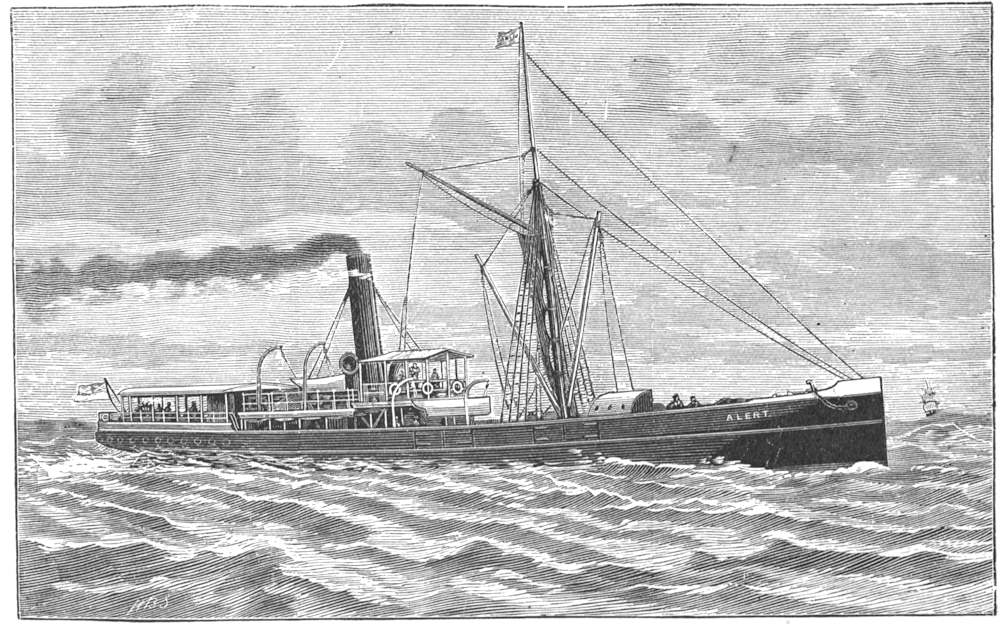
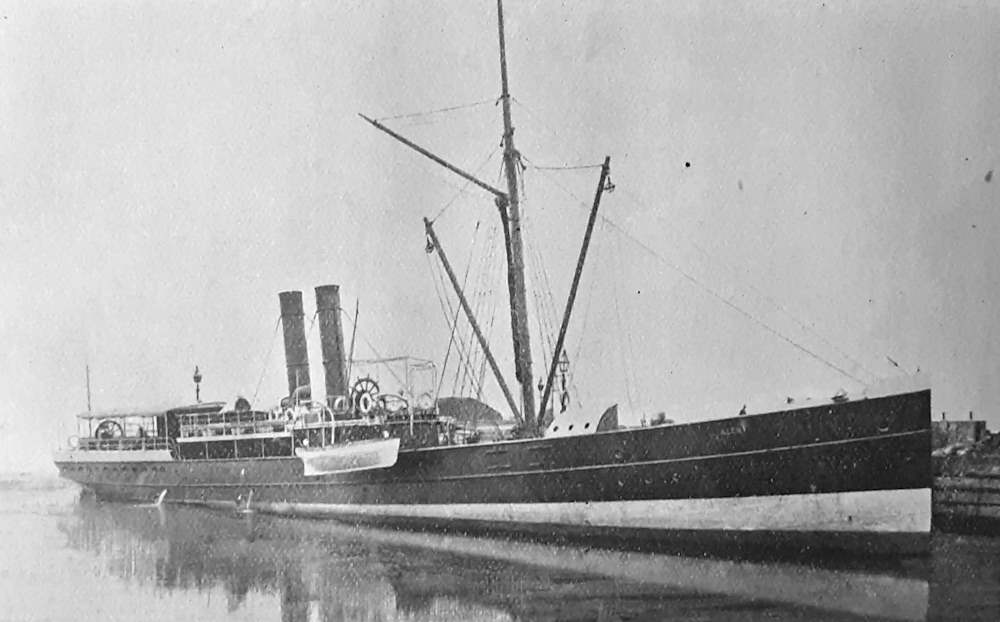
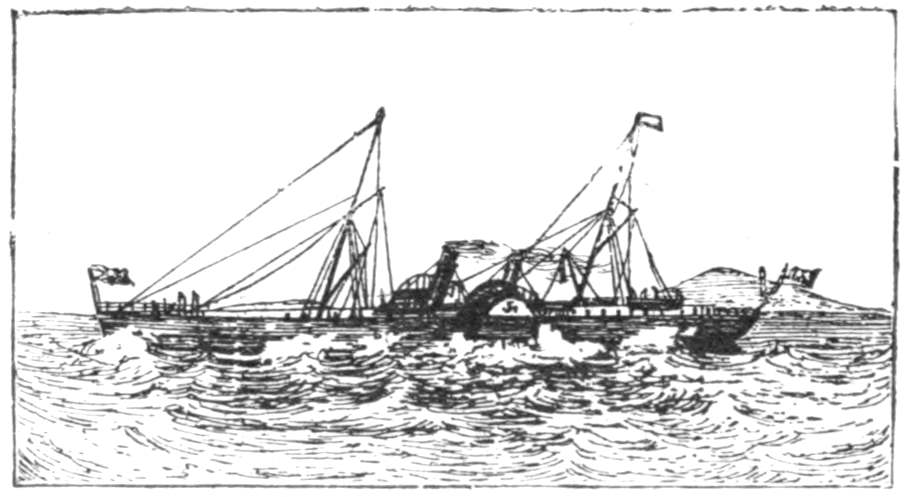
S.S. ALERT.
From a Photo by the late J. Dodd, lost with the S.S. Alert.
CHAPTER IV. DESCRIPTION OF THE ALERT .
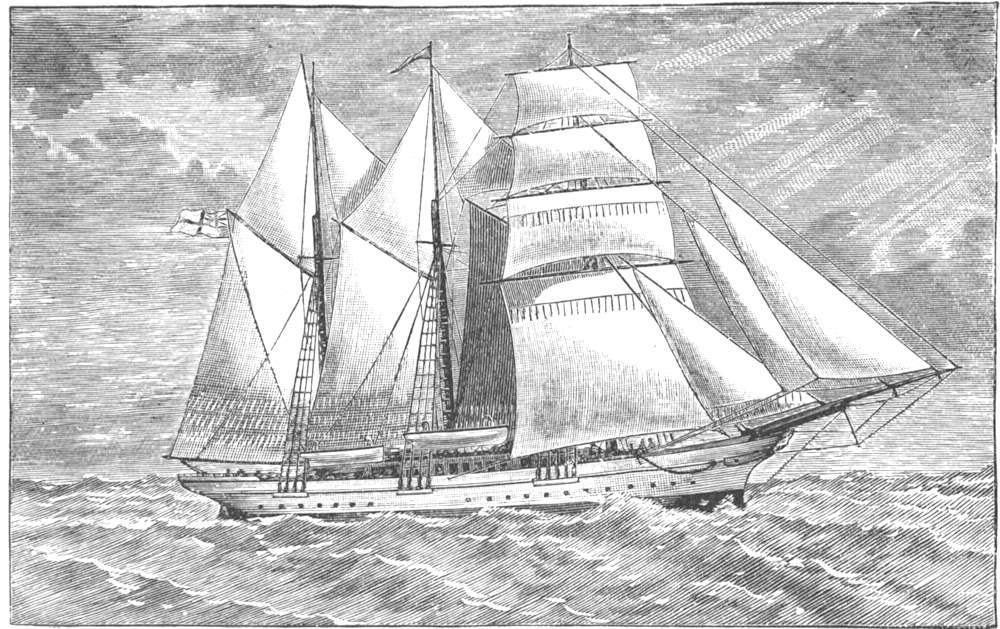
The following is a complete description of the S.S.
Alert:—
Owners, Messrs Huddart, Parker and Co., Melbourne.
She was an iron screw Steamer of 243 tons gross
measurement, built at Port Glasgow, Scotland, in 1877.
Her length was 169 feet. Breadth of beam, 19 feet 6 in.,
and depth of hold, 9 feet 8 inches, In other words,
her length was nearly eighteen times her depth, and
nearly nine times her width. She came out to Melbourne
under sail, and rigged as a three masted
Schooner.
From the time of her arrival here until the month
prior to her loss, she had been trading inside Port
Phillip Heads, from Melbourne to Geelong and vice
versa. All the time she was engaged in the Geelong
trade, and up till the period of her loss, she was rigged
with a foremast only, and hence she was not capable of
carrying sail aft.
The cargo she had on board when she left Metung,
(Gippsland Lakes) her last port of call, consisted of 25
tons wattle bark, 20 bags maize, 14 empty casks, 40
bales wool, 55 sheepskins, one box tools and 20 packages
furniture. In all estimated about 44 tons.
With regard to her draught of water when on the
fatal voyage, it is alleged that she was drawing 9 feet
6 inches aft, and 5 feet 9 inches forward.
Complete list of the persons on board the Alert at
the time of the disaster.
Drowned—
Albert Mathieson, captain, age 35, married, no children;
residence. St. Vincent-street, South Melbourne
J. G. Hodges, chief officer, 32, married, no children;
Yarraville.
J. Mattison, second officer, 43, single; South Melbourne.
J. Thompson, chief engineer, 48, single: South Melbourne.
J. Kilpatrick, second engineer, 33, married; one child;
Williamstown.
J. Dodd, steward, 32, married, one child; Carlton.
T. Thompson, A.B., 45, married, two children; South
Melbourne.
J. Williamson, A.B., 27, single; South Melbourne.
J. Arthurson, A.B., 25, single; South Melbourne.
J. Coutts, A.B., 42, married, three children; South Melbourne.
W. Thompson, fireman, 30, single, Williamstown.
D. McIvor, fireman, 28, single, Balaclava.
J. Newton, saloon passenger, 29, single; Beechworth.
W. Stewart, steerage passenger, 60, married, seven children;
Collingwood.
— Page, steerage passenger, Steiglitz.
Saved—
R. Ponting, cook, 30, married, no children; South Melbourne.
CHAPTER V. THE VOYAGE.
The hapless vessel can no longer steer.
Free from the floods that burst in dread career
O’er her trembling hull, she dips in each sea,
And then she sinks! fill’d solely from the lee.
Anon.
The subjoined narrative is given, as nearly as
possible, in the words of Robert Ponting, the sole survivor.
The S.S. Alert left Melbourne at mid-day on Saturday,
December 23rd, 1893. Proceeding down Hobson’s
Bay we called at Portsea and Queenscliff, and finally
cleared through Port Phillip Heads at 5.30 p. m. We
had moderately fine weather along the coast and
rounded Wilson’s Promontory at 4 a. m. on Sunday.
Four hours after, we reached Port Albert, lay there all
day, discharged cargo early Monday morning (Christmas
Day), and sailed at 7.30 a. m. for Gippsland Lakes.
Had moderate sea and cloudy weather along the “90
mile beach” and got to Lakes entrance about 4 p. m.
Proceeded up the lakes, called on the way at Metung
and Paynesville, and arrived at Bairnsdale, our destination,
at 8 p. m., in the midst of a heavy thunderstorm.
Next day, Tuesday, being Boxing Day, no cargo was
put out. On Wednesday, 27th, discharged all cargo
and shipped a small quantity of wattlebark, wool and
some cases of furniture, the latter belonging to Mr.
Deasy, inspector of police. We sailed same day at
2 p. m. for Melbourne, having three passengers on board,
one, Mr. J. Newton, in the saloon, and two in the fore-cabin,
whose names I did not then know, but I have
since ascertained their names were Stewart and Page.
There were several other passengers expected but they
did not turn up. On the way down the lakes, we
called at Metung and shipped a little more wattlebark,
making our cargo as I have since been informed, in all
about 44 tons. Just before dark we passed out
through the Lakes entrance. Outside we met with
misty weather, a smooth sea and a light breeze from
the south-west. At 2 o’clock on Thursday morning
(28th), I was awakened by the stopping of the propellor—I
slept in the stern sheets immediately over it—I
went on deck to see what was the matter, and was
informed that, owing to the thick weather, the red
light on Cliffy Island could not be picked up. We lay
“hove to” for nearly four hours, then, as the wind rose
and lifted the fog we found we were well on our proper
course. The ship was again kept on her way and we
rounded Wilson’s Promontory a little before 7 a. m.
Soon after, the wind chopped round from south west to
south-east, enabling us to set the trysail and staysail.
We passed through between the islands all right and
then fell in with a heavy rising S.W. swell and a choppy
sea from S.E. This caused the vessel, being very light,
to get very lively and take on board large quantities of
heavy spray. At 8 a. m. the crew came for their breakfast,
but the steward told me that no one in the after
part of the ship wanted any breakfast. I was not surprised
at this as I had often seen the Alert make things
so lively that no one on board required anything to eat
for the time being. I went forward to ask whether the
two steerage passengers wanted breakfast, but they
would not have any. About 11 a. m. when off Cape
Liptrap, the sea was very much higher, but we did not
give much heed to this as we had always found it a bit
rougher when passing headlands. At noon the crew
came along for their dinner and they brought their beds
with them. They placed these on the engines to dry,
grumbling very much as they did so that the ship was
so dirty they could keep nothing dry either above or
below. I told the men they might have their dinner in
the galley, but after looking in they declined, remarking
it was worse than the forecastle. Tea and toast
was all they required aft for their midday meal. By
3 p. m. we were about two miles off Cape Schanck and the
wind having gone round to S.W. again, blowing a
steady gale, there was a heavy sea breaking just off the
point. In order to avoid these breakers, Captain
Mathieson altered the ship’s course and headed out seaward
for a while, till the Schanck was given a wide berth,
then the course was shaped for Port Phillip Heads,
The Alert now began to roll very much and take heavy
lurches to leeward at the same time taking lots of water
on board. A great many articles in the galley were
thrown down and smashed or washed away. It was
impossible for me to help this, although the steward
said there would be a jolly row when we got into port
over losing so many things.
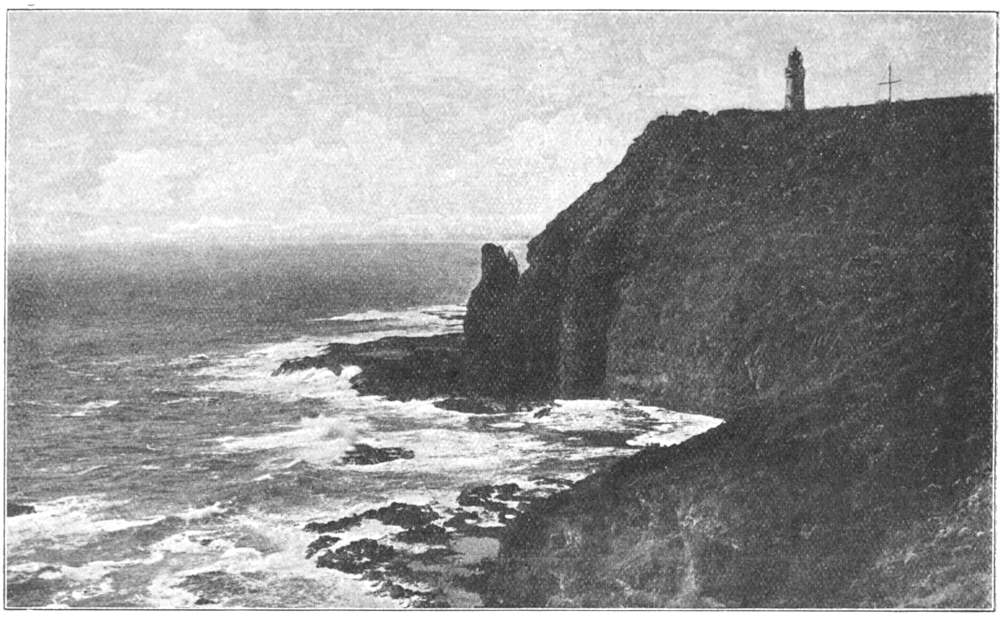
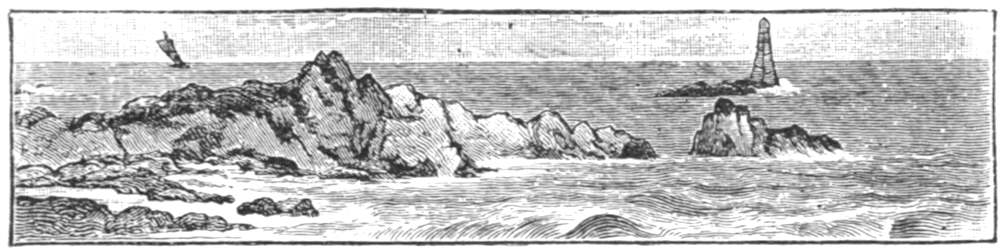
CAPE SCHANCK
At 4 p. m. the watch came from below but all hands
remained on deck and went up on the poop as it was
the driest part of the ship, and, but for the rain, fairly
comfortable. The steward told me not to attempt to
get any tea ready till we got inside, so I went below
with him into the saloon. We had not been there many
minutes till we heard a tremendous sea break on board
on the lee side. It made the ship shiver like a leaf and
listed her over to starboard so much that the two lamps
hanging in the saloon were thrown violently up against
the deck overhead and smashed to pieces. We ran up
on deck to see what was the matter and found the lee
side of the vessel full of water, the bulwarks amidships
being clean out of sight. Two men were at the wheel
and the Captain was on the bridge evidently trying to
get the ship’s head up to the sea and wind. The next
wave came right up on the lee side of the poop—where
I was standing holding on to a stay—and washed me
overboard, but I managed to grasp the poop railing and
held on for bare life. Just as the chief mate, Mr.
Hodges, was coming to my rescue another heavy roller
threw me inboard again and dashed me up against the
companion with such force that I thought for a time
my legs were broken. I asked Mr. Hodges whether he
thought the ship was in danger. He replied, “No, I
think she will come up to it,” meaning that when the
vessel got her head to windward she would free herself
from the water on deck. Meantime, Captain Mathieson
had taken the wheel himself and sent the two men to
join the others in taking in sail foreward. As soon as
the canvas was taken off the ship another attempt was
made to bring her up, but all efforts were useless. She
would “come to” a little bit, then the sea and wind
would sling her off again, like a gate swinging on its
hinges. Each time she went off she seemed to become
more helpless and dipped nearly her whole broadside
into the hissing waters. The steward and I went down
into the saloon and found the water about three feet
deep on the starboard, or lee, side of the floor. Every
roll the vessel took dashed the water over Mr. Newton
where he lay. We assisted him up on deck and then
tried to discover where the water was coming in. We
found that the pantry window—which looked out on the
starboard side of the main-deck—had been burst in by
the pressure of water from the outside. We blocked
the aperture up as well as we could and then went up
on the poop. The Captain was still at the wheel and
the men were foreward securing things about the deck
in the best way they could. Captain Mathieson
beckoned me and asked if there were any water below
in the saloon. I told him there was and it was still
rising. His countenance changed, but he made no
reply. By the beating of the engines I could hear they
were commencing to work more slowly, and the
ship seemed as though she were becoming
entirely unmanageable. The chief engineer, Mr.
Thompson, called out to Mr. Kilpatrick, the second
engineer, who was on duty below, “Give it to
her, Jack,”—meaning for him to keep the engines
working as fast as he could. In answer to the steward’s
question, “Is there no show to get the vessel head on?”
Mr. Hodges said, “I am afraid she won’t come to.
She is too light foreward and we have no sail aft to help
her round. Everything is against her at present as
it happens. There is that upper deck and the foreward
boat, all on the starboard side. What with the
big funnel and bridge, the life-boat on the engine-room
skylights, the awning of wood instead of canvas
and too little cargo, she’s all top and no bottom.”
The ship now began to lie down almost steadily on her
beam ends, the big seas dashing over her as if she
were a half tide rock, and pouring down into the engine-room
and stoke-hole. The second engineer, Mr. Kilpatrick,
and W. Thompson, the fireman, came up and
stated that there was too much water below for them
to stay any longer. The Captain sang out from the
bridge, where he had been standing exposed from early
morning, “Call all hands aft, passengers and everybody.”
As soon as we were mustered together he gave
orders, “Now boys, get out the life-belts and put them
on.” Matters now began to wear a serious aspect, and
although there was no panic, everybody felt that a great
change was at hand. The steward and I started throwing
the life-belts from the racks underneath the awning
and in a few minutes everybody had one on. Poor Mr.
Newton, who seemed downhearted, asked “How do
you put this on?” By way of reply the steward fastened
it properly round him at once, and also on the two
steerage passengers. The next order given by the
Captain, was, “Now then my lads, bear-a-hand and
get the life-boat out.” The words were scarcely out of
his mouth when the ship took a fearfully sudden lurch to
starboard and away went the life-boat, chocks and all,
clean over the ship’s side. Two lines that were fast to
the boat kept it from washing away. The crew soon
made the boat fast properly, and though she was half
full of water, Mr. Hodges jumped into her and called
out for all the spare life-belts to be thrown to him so
that he might fasten them on to the boat’s thwarts
while some of the sailors were keeping her clear of the
ship’s side. He had got about six of them tied on when
we saw a heavy sea coming and sang out to him, “Look
out.” He leaped back to the ship just in time as in
less than a minute the boat was either smashed to
pieces or swamped; for we saw no more of her. Orders
were then given to get the foreward boat ready but as
the waves were breaking clean over it, nothing could be
done. The ship now lay over so much that we could
not stand on the deck. The Captain got over the
bridge railing and stood on the end of the bridge, while
the rest of us got on the outside of the weather (port)
bulwarks. Though we were all crowded close together
very little was said, each one kept looking at the big
breakers, knowing that the time had come when each
man would have to enter on a desperate struggle for
life. Almost the only remark made was by one of the
sailors, who said, “We can see the Schanck lighthouse,
quite plain, and no doubt the people there see us
and will send help of some kind.” Prior to putting
on the life-belt I took off all superfluous clothing, leaving
nothing on but my white cap, shirt, trousers and
socks. The steward followed my example but kept his
boots on. All the others were fully dressed and a few
of them had even their oilskins on beneath the life-belts.
The seas now rolled relentlessly over us, each one
holding on as best he could. The wooden awning was
wrenched off its stanchions and swept away to leeward.
Some one suggested that there would be more safety
further foreword both from the sea and the propellor, as
the latter was still slowly revolving, and a number of
our crowd crept as far foreword as the bridge. I decided
to keep aft as I was afraid the boiler would burst and
blow us all into the air. Whilst standing alone, holding
on to the rail opposite the saloon companion, a tremendous
sea broke over the ship’s quarter and swept me
fathoms away from the vessel. I swam some distance
clear and then turned to see how my mates were getting
on. They were all still clinging on to the weather bulwarks
and from the way their faces were turned, I
saw they were watching me. The ship for a little
while looked as if she were going to uprighten then she
began to sink slowly, stern first. I saw Captain
Mathieson still holding on to the railing at the port end
of the bridge. I think he must have told the men to
jump into the sea, for I saw one after the other spring
clear of the vessel, then, last of all, he jumped himself.
The Alert’s bow then rose in the air till I could see
many feet of her keel clear of the water. She hung in
that position for a minute or two as if she hesitated to
sink. It flashed across my mind that as there was no
water in the forehold, perhaps she was going to keep
afloat after all. The hope raised by the thought, however,
soon left me as the ship gave a sort of plunge and
then gradually disappeared. Fire and steam burst
up through the funnel just before the waters closed over
it!
CHAPTER VI. AMONG THE BILLOWS.
On the ocean’s troubled breast
Toss’d incessant without rest,
Now on raft and now on wave,
Death and trouble round me rave.
Owing to the manner in which the ship went down
she created little or no suction. A slight swirl and
wreckage—principally pieces of the awning, a few
gratings and life-buoys—were all that denoted where
our vessel had been. She sank about 4.30 p. m., and
just then the thick weather cleared off a little so that
when I rose on top of a wave I could see a considerable
distance off. The shore was plainly visible and I
judged we were about three miles S.W. of Cape Schanck.
I saw that the whole fifteen of my companions had
managed to get hold of some wreckage. The Captain,
chief mate and two firemen were all grouped together
on some pieces of weather-board, and the others were
scattered in twos and threes, each on top of something.
My first fear was that the sharks would get hold of me,
then it struck me that the water was too rough for them
to attack any one. I could only see some single pieces
of board near me, so I was puzzled for a bit as to how
to steer for something larger. All of a sudden I saw a
lot rise on the top of a big wave right ahead
of me. I soon reached it and thought I was quite as
well off as the rest of my mates. My raft consisted of
eleven or twelve pieces of weather-board all nailed
together on a crosspiece. I got on top, and then
every single piece of plank that came near me I pulled
on board, till I succeeded in piling them up high
enough to keep me out of the water. The sixteen of
us were at this time all floating nearly in a line. Two
sailors and the steward were about thirty yards
seaward of me, the captain, chief mate, and two
firemen about 50 yards off landward, and the rest a
little distance further inward still. A large number of
Mullihawks collected and kept hovering above our
heads. I had no sooner got my raft put together, to
the best advantage, when a heavy sea came, and
turned all clean over on top of me. The nails in the
planks caught my clothes and pierced my skin so that
I had great difficulty in clearing myself from underneath.
When I succeeded in getting on top again I
saw that all my mates to windward of me had also
been washed off their wreckage, and a similar fate
shortly after befel those to leeward. It almost seemed
as if the same wave had capsized the lot of us one after
the other. Everyone, however, succeeded in catching
their planks and getting on them again. After the
capsize I found my raft in a very different condition to
what it was previously. All the loose planks were gone
and a number of the ones nailed to the crosspiece had
also disappeared. All of my mates, when on top of
their wreckage, knelt on the boards with their heads
facing the shore, and held on in that position. The
noise made by the wind and waves made it useless, at
the distance I was off, for me to call to my companions,
but I made signs, and tried to show them, by
lying down flat on my raft, what I believed to be the
surest way of holding and keeping on, with my head
facing the seas.
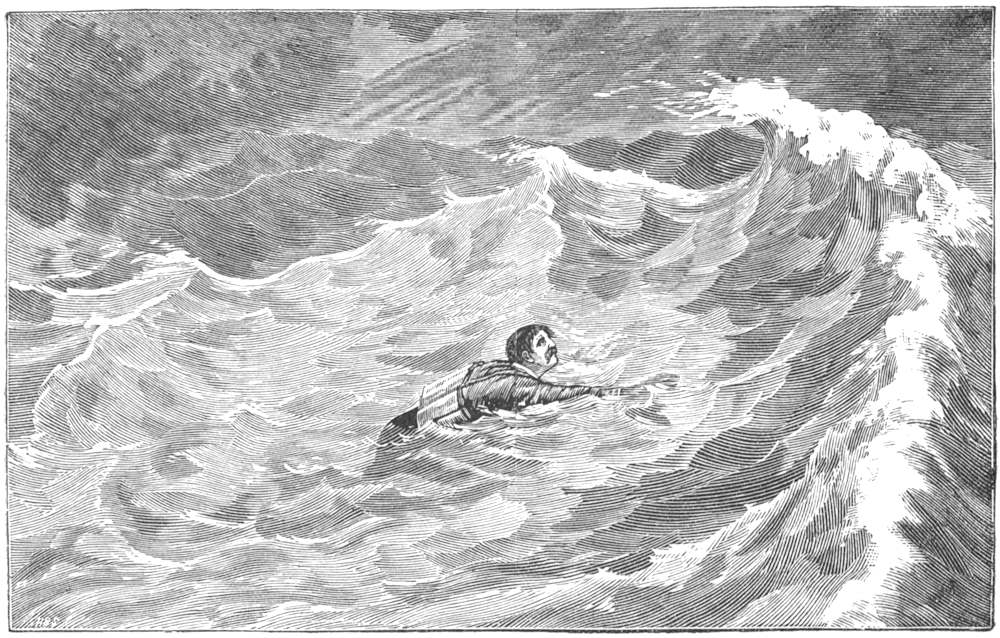
FOUNDERING OF THE S.S. ALERT, THREE MILES S.W. OF CAPE SCHANCK. DECEMBER 28, 1893.
As we drifted nearer the shore the seas got larger and
more powerful still, so that in spite of all our precautions
we could not retain our hold on the boards for any
length of time. The frequent turning over of my raft
knocked me sort of stupid every time I went under, and
I have no doubt that the rest of my companions had
similar experience. I reckon it must have been about
6 p. m. when I saw the steward washed away a great
distance from the wreckage he had been on. After a
long struggle he succeeded in getting back to his mates,
but he evidently had completely exhausted himself in
the effort, for he had hardly been a minute on the top of
the boards till he fell from his kneeling position forward,
with his head on the edge of the raft. He seemed to
be smothering in the foam of the sea, so I shouted to
his raft mates to hold his head up till I came to help
him if I could. I knew poor Dodd was not strong, still
I thought we might be able to keep him alive until the
life-boat, or some other assistance, came from the shore.
I left my raft and swam towards him as quickly as I
could, but before reaching him a big sea buried me.
When I got to the surface again I saw the steward had
been washed off the boards and was floating some
distance away in a position that told me he was dead. It
greatly grieved me to see that my most intimate companion
was the first to go out of our number, and for
the time being I felt unnerved enough almost to give up
hope myself. Then I thought it useless brooding over
the matter, and determined to struggle on while I had
any strength left. For a while I swam towards the raft
on which were the captain, the chief officer and the two
firemen. As I got near I saw a large breaker turning
them clean over. They had their feet to the sea, and
as their raft capsized I saw the legs of the whole four
in the air at the same time. Finding it out of my
power to help them, and thinking that matters might be
made worse by crowding too close together, I started
back to my boards again. Quite exhausted I reached
my raft. As I lay on it I began to think it was time
the life-boat was in sight. I could see a good distance
around, the shore being plainly visible, but no sign of
any help coming. It could not have been more
than 7 p. m., yet it seemed to me that I had
been days, instead of hours, in the water. I noticed that
all had got on their boards again. The different groups
were all ranged round in a semi-circle, and all, except
myself, heading shoreward. I had found, by bitter
experience, that in heading shoreward I was more
exhausted—when turned over, or washed off my raft by
a sea—in getting back to my boards than when I faced
and headed the sea. At the same time, this method of
going head first into the seas kept myself and my raft
from drifting shoreward as quickly as the others. I did
not mind this drawback, as my hope was strong that the
life-boat would pick us all up before dark. Various
currents now began to scatter our rafts in all directions.
Both Coutts and Williamson (two of the sailors), drifted
so close to me that I could speak to them. One after the
other I asked how they were getting on. I got no reply
and I could plainly see that they were so exhausted that
they could not keep up the life struggle much longer.
The boards to which Coutts held on were being carried
seaward, while those belonging to Williamson were
drifting in shore, towards the place where the
four-masted ship Craigburn was wrecked. I reckoned we
had all drifted some miles shoreward—from where the
Alert had foundered—before the tide began to turn,
and take our various rafts hither and thither. The seas,
if possible, began to get bigger, and break irregularly in
all directions around us. I caught sight of Mattison, the
second officer, Thompson, the sailor, Kilpatrick, the
second engineer, and Mr. Newton, the saloon passenger,
all being carried by a current which I judged would
take them round Cape Schanck whilst the rest of our
number were going, some towards the shore, and some
out seaward.
ROBERT PONTING “AMONG THE BILLOWS” ON THE NIGHT OF DECEMBER 28, 1893.
CHAPTER VII NIGHT.
“Mirk and rainy is the nicht,
No’ a star in a’ the carie;
Lightnings gleam athwart the lift,
And winds drive wi’ winter’s fury.”
—Tannah.
Darkness began to set in, and I soon lost sight of
everybody and everything except the light on Cape
Schanck. With the daylight fled my hope of a life-boat
coming to our assistance. I had all along been under
the impression that the sinking of our ship had been
seen by the people in the lighthouse, and that it was
only a question of time when help would come. I began
to give way to despondency! While the daylight lasted
I expected assistance, and my attention, when not
struggling under water, was taken up watching my
mates and the shore. Now night had come, and I felt as
if I were left alone in the midst of the raging waters.
Was it worth while trying to continue what seemed to
be a hopeless struggle for life? I thought of my poor
wife, who, just then, would be expecting me home! I
remembered, too, that Captain Mathieson—who knew
my life was insured—had asked me, on the way from
Melbourne to Port Albert, if I had made my will.
When I told him “No,” he said, “You should have
done so, as no one knows what may occur.” I gave
little heed to his words at the time, but now they
seemed to have all the meaning of a presentiment.
Under the circumstances, thoughts like these were
anything but cheering, but nevertheless I made up my
mind that, while God gave me strength, I would battle
on to the end. My raft, through being so frequently
turned over, had got reduced to three boards and the
crosspiece. At first I thought this was a misfortune, but
I found that, being smaller, it was more easily managed,
and less liable to be capsized. The wind began to be
very cold, and a heavy shower of rain came on. As I
lay on my boards, the raindrops felt to me like spots of
ice as they fell upon my body. Strange as it may seem,
I believe I must have perished with the cold, but the
frequent washings off the raft, and my struggles in
swimming to get on again, always kept my blood in
circulation, and made me feel fairly warm. Meanwhile,
the tide was slowly setting me down towards Cape Schanck,
I saw the light burning brightly, and it seemed no
great distance off. As I drew nearer and nearer, the
breakers I got amongst were terribly heavy. From
the peculiar thunder-like roar they made in rushing
along, I could hear them coming in time to get
ready for them. This I did by turning myself on
the raft with my head and face seaward. These
tremendous waves generally ran in threes, one after
the other in succession. The first would dash me
off my boards and bury me in a half-senseless state
under water; then by the time I got to the surface
again, and had a breath or two, the second sea would
be on me, repeating the burying process, so that I used
to reckon the third would completely finish me. After
recovering from these dashings my next great trouble
was to find my boards. I was anxious to keep them,
as they not only gave me a rest, but they also seemed to
be kind of company for me. In the dark I could see
them always a little distance off; as they shone on the
water with a ring of phosphorus around them. I feel
certain that if I had been unable to get on to my boards
during the short intervals (about fifteen minutes)
between these terrible breakers I would not have had
sufficient strength left to resist them. I think it must have
been about midnight when I was off the Schanck, but
time seemed to be getting beyond my comprehension.
I fancied that away back in the dim past I had seen, as
in a dream, the Alert sink and leave us all to struggle
each one for himself. Then, as I gradually remembered
the event took place only a few hours before, the
thoughts arose where were my mates and how
many of them living. Were they, like myself, still
battling for life, or had they all perished in the pitiless
storm?
The gale seemed now at its height, and my heart
sank within me as I reflected that assistance from the
shore had become an impossibility. No boat could face
and live in such a sea as now swept along with a force
at least double that of the time when the ship went
down. How I longed for daylight! But would it ever
come for me, or any of my companions? If to be
rescued depended on endurance, then I felt sure the
chief officer, Mr. Hodges, would be almost certain to
hold out, for he was, far more than ordinary, a powerful
man, and his action, up to the period of the vessel leaving
us, showed he was clearly and collectedly helping everyone,
and preparing for the worst. Whether the foregoing
thoughts crowding in on me, caused me to be less watchful,
or whether the continued strain on brain and muscle made
me stupid and weak, I cannot say, but in the midst of
my reflections I got caught in a sort of swirl, or
whirlpool. I was rapidly turned round and round, then
quickly, raft and all, sucked under water. Whilst
below this time I felt, as my boards were wrenched
away from my instinctive, but nerveless grasp, that all
was over. Thanks, however, to my life-belt, more than
my own exertions, I was thrown to the surface
just as I was choking for want of air. Some minutes
after, my boards came up a little distance off, and I
managed with great difficulty to reach them and drag
myself on top again. As I lay on my raft, resting and
trying to collect my scattered senses, I turned my
head shoreward, for a bit, to watch the Cape Schanck
light. I had not been able, during the forepart of the
night, to see the light continuously owing to the heavy
showers of rain which had passed over. Now I began
to realise that it seemed farther off than before. I was
getting into comparatively smoother water, and this
fact together with the receding light told me plainly
that the tide was carrying me seaward. While nearing
the light it helped to revive my drooping spirits—not
that I expected any help from it, for by this time I
had abandoned all idea that the lighthouse people
could assist—but still the sight of it, gleaming out like
a “star of hope,” encouraged me to struggle on.
A new idea seized me. Instead of allowing myself
to drift out to sea again, I would leave the raft and
make a last desperate effort to swim for the shore. A
little reflection, however, showed me the hopelessness
of making the attempt. In the dark I could not see
the smoothest place to steer for, and being weak, stiff,
and sore, I felt that I would most likely be dashed to
pieces amongst the rocks. Therefore, I decided to
stick to my boards, so long as they stuck to me. My
feet now began to trouble me very much, and their
cold numbness seemed inclined to creep up my legs.
I knew I had made a great mistake in taking off my
boots. Had I kept them on they would not only have
helped to keep my feet warm, but they would also have
prevented my feet from being bruised, and battered
against the boards, with the action of the water. Besides,
I found by experience that whether in the water, or on
the raft, my feet were too light, and needed weight to
keep them down. My woollen socks—although I was
kept continually pulling them up—were of great service
in keeping some heat in, and, though it might have been
fancy, my white cotton cap kept my head a bit warm. I
think I must have drifted about ten miles past, or south-east
of Cape Schanck, and was nearly out of sight of the
light before the current began to set in again. The sea
had by this time moderated a good deal and I was
enabled to keep longer resting on my boards. I tried
all ways of reclining on the raft but I found it the safest
plan to lie on my left side, thus I got a good grip of the
crosspiece with my left hand and one of the boards with
my right. In this position I had a chance to watch the
heavy seas when they were going to break. I now began
to get very cold, and every now and then was seized with
cramp in both legs. The working of the life-belt caused
my body, and also the inside of my arms, to get raw and
sore. To make matters worse, I felt terribly thirsty at
times, and a sort of drowsiness seemed to steal over me as
if tempting me to go to sleep. I, however, fought against
the latter feeling, for I had an inward conviction that if
I once gave way to sleep I should never wake again.
Meanwhile, I kept gradually nearing the Schanck light once
more, but as no signs of daylight were yet visible, I began
to fear it would never come for me. The pain in my neck
through my head hanging over the life-belt, was getting
almost unbearable. Now and then, when I got a chance,
I propped my head up with my left hand while keeping
the elbow resting on the boards. This gave me ease but
I dared not do it so often as I wished for fear of
being caught unawares and washed off the raft.
All of a sudden I saw a light flashing away in the
direction where I deemed Port Phillip Heads would be.
My first thought was that it must be a search-light to
find out our whereabouts. I kept anxiously watching,
but as it did not again appear I came to the conclusion
that it had been a flash-light from one of the pilot
schooners a long way off, and the hope raised by it died
away as quickly as it came. Racked with thirst and
pain, and under the impression that it was impossible
for me to hold out much longer, my thoughts flew back
over my past life. Matters long forgotten rose up
swiftly in my memory, and the acts of my whole career
seemed to pass in review before me. After the past
came the questions of the present and the future. Must
I go now, and was I fit to die?
CHAPTER VIII. MORNING.
“See, the day begins to break,
And the light shoots like a streak
Of subtle fire. The wind blows cold,
While the morning doth unfold,”—Fletcher
At length—and what a length—the day began to
dawn, and with it came renewed hope that I might be
rescued. As the welcome light crept slowly in I kept
straining my eyes, when I got a chance on top of a sea,
for some signs of my shipmates, but in no direction
could I see the slightest trace. Had they been picked
up? Had they reached the shore? or had they, unable
to withstand the tossing and exposure during the
fearful night, all been drowned? The sight of even
one of them would have helped to revive my drooping
spirits. Whilst it was dark night I clung to the thought
that although I could not see my mates, still some of
them might be near me. Now, however, I realised that
I was alone amidst the seething waters. Then I
remembered that when darkness closed in on the
previous day the majority of my companions were a
good distance inshore of me, and it was just possible
that they had got safely to land. This reflection helped
me to make up my mind to struggle on while there was
a bit of life left in me. A number of albatrosses now
began to hover around, and two of them swooped down
close to my head. I raised my arms as well as I could
and thereby succeeded in frightening them away.
Seeing me lying on the boards I dare say they thought
I was dead! By the time daylight came thoroughly in
I was able to see the land stretching along at no great
distance off. I think it must have been about 5 a. m.
when I found myself right abreast of the Schanck with a
strong current sweeping round it and setting me towards
the Heads. The tide, wind and sea all bore directly on
my raft and seemed to be taking me rapidly nearer the
shore.
Quite plainly I could see the Rotunda on St. Paul’s,
and by all appearance I was being driven in a little to
the westward of it. When lifted up by the seas, as I
came nearer and nearer the shore, I saw what looked
like a little bay with a belt, or patch, of sandy beach at
the head of it. Whilst earnestly praying that I might
be fortunate enough to be drawn into the bay, my heart
went down again when I caught sight of the fearful
breakers that were running across its entrance. These
breakers lay directly in front of me, and I could see no
way in, except by passing through them. Gathering my
scattered senses together as well as I could, I took a fresh
hold of my boards, and prepared for a last desperate
effort. As I got close to the broken waters I could hear
their thundering roar, although they were still to
leeward of my raft. After some minutes’ anxious
suspense, I reached the dreaded breakers; then almost
instantly my boards were ruthlessly snatched away, in
spite of my best efforts to retain them. I felt myself
being turned over and over like a rolling ball; at the
same time I experienced, more than at any previous
period, an awful sense of utter helplessness. The thick
foam filled my mouth and nostrils so much that I felt
all the sensations of suffocation, and believed my end
had come. Just then another sea threw me clear of the
foam and dashed me, face and knees downwards, on
to some rocks which were sunk a little under water.
Instinctively I threw out my arms, and thus prevented
my face from striking the jutting stones, while the
thickness of the life-belt kept the blows from my body.
Dazed, and almost senseless as I was, I could see that
the sandy patch was still a distance off, too far away for
me to expect the incoming breaker to carry me there.
My strength being gone, I felt it utterly useless to
attempt to swim to the beach, and hence I came to the
conclusion that if the next wave did not take me in, it
would dash me against the rocks and knock out the
little life I had left. Along, it came roaring, but being
too weak and stupid to make ready for it, I was caught
broadside on, lifted high above the rocks, and whirled
away helpless as a log, right up on the sandy shore,
As I rolled over and over on the sand the motion made
my neck and head feel as if they were going to burst
in pieces. Suddenly the rolling ceased, then I became
aware that the back-wash of the wave was taking me out
again. In sheer desperation I clutched the sand, but
my fingers, being numbed and nerveless, had no power
of grasping. Then I dug my knuckles in as well as I
could, but all to no purpose, out I kept going, as
helpless as when I came in!
CHAPTER IX. THE LANDING.
“I long to lay this painful head,
And aching heart beneath the soil,
To slumber in that dreamless bed
From all my toil.
“Though long of winds and waves the sport,
Condemned in wretchedness to roam.
Live!—thou shalt reach a sheltering port,
A quiet home.”
Montgomery.
Just as I had given myself up for lost,
providentially I was washed sideways against a jutting
rock, and this enabled me to stem the recoiling water
until it passed away. Although powerless to
do anything I had sense enough left to know
that unless I managed to get further inshore the back-wash
of the next wave would certainly carry me off and
finish me outright. I strove to get on my hands and
knees, and with great difficulty succeeded in doing so. I
crawled along, in what direction I knew not, for the sand
in my eyes had made me partially blind, and my neck,
which seemed to have given way altogether, rendered me
incapable of holding my head up. Unable to creep
another yard, I tumbled over on to the sand, and, while
lying exhausted, the succeeding wave came up close
enough to touch my feet. I knew then that, instinctively
I had been going in the right direction and was safe, so
far, from the sea. After resting for a brief space, I again
essayed the creeping, and painfully dragged myself over
the sand and rocks towards a small cave in front, and at
foot of the cliffs. The distance I had to go was only a
few yards, but in the condition I was it seemed a mile to
me. I think it must have been about 8 a. m. when I got
inside the cave. My reason for going there was a sort of
confused idea that I might get shelter from the cold
wind which felt as if it were blowing right through my
very bones. I crouched in a corner on top of some
seaweed, but obtained no relief from the change, indeed,
the cold seemed, if possible, worse than ever, and sharp
shooting pains now and then darted over my whole body.
SORRENTO OCEAN BEACH (from a Photo).
The White Cross indicates where Ponting landed. Showing Jubilee Point in the distance.
I endeavored to collect my wandering thoughts concerning
the position I was now in. While on the water I
had, at first, strong hope that assistance would come, then
latterly, when nearing the shore, hope rose again that if
I succeeded in getting to the beach I would soon be
right. Now that I was on land, I was helpless to do anything
for myself and there seemed no appearance of aid
coming. Evidently the loss of our vessel was still unknown,
otherwise there would have been somebody on
the beach before this time looking for us. Where were
my shipmates? Were they all drowned, or were some of
them lying like myself on other parts of the shore? As
these thoughts rushed through my mind I began to feel
that I must abandon all hope of being rescued. Yet it
seemed hard that I should be saved from the waves only
to perish through weakness and exposure on the rocky
beach! One minute I prayed for help and the next I
almost longed for death to come and end my troubles!
I had not been lying down for very long when I began
to feel much easier. The extreme cold had departed
and the twitching pain in my limbs had gradually
abated; but, meanwhile, the thirsty craving came back,
and my head got still more dull and leadenlike. I took
these symptoms to mean that I was getting weaker, and
slowly dying. The struggle for life had been a
protracted one, but it could not be kept up much longer.
I had striven hard to keep my spirits up and live, but
God had willed that I must go! My poor wife would
soon know the worst. The end of my troubles would be
the beginning of hers. My life being insured, she would
not be left altogether penniless, but still the news of my
death would be a sad blow to her and our relations.
God help her, and them! A burning sensation seemed
to shoot through my head! A strange buzzing sound
filled my ears, and then I lost all consciousness!
How long I lay in the cave, or whether in a swoon or
sleeping, I cannot say, but when my senses returned I
had a vivid impression that I had just awoke out of a
fearful dream. The state of my body, and a glance at
the rocks around, however, soon convinced me that the
incidents of the past day and night were reality indeed.
I now not only felt sore and numbed, but my whole
body tingled with a peculiar sensation similar to that
which a person feels when his leg, or foot, is said to be
“asleep.” On looking outward, I fancied, in my half
blind condition, that the sun was shining brightly on
the sand, and I made up my mind, if possible, to get
out to the heat. After a number of ineffectual
attempts, I managed to rise once more on hands and
knees, and got outside, although, when on the way, I
reeled over, like a drunken man, at least a dozen times.
With my back on the sand, I lay head up hill towards
the cliffs, but was not there long till I felt sorry I had
left the cave, for the sun seemed to have no heat in it,
and the sand, drifting with the strong wind, flew all
over me. I knew I was too far gone to attempt to return
to the cave, and thought my time had come at last!
Concerning the incidents which took place some
time after my coming out of the cave on to the beach,
the reader is already acquainted with them from the
narrations given by others in the former portions of this
book. Personally I have no clear recollection of these
matters. Excepting during intervals of consciousness,
all is blank to me up till Saturday morning, 30th
December, when I found myself in bed at Clark’s hotel,
Sorrento, surrounded with the best of comfort and
attention. I distinctly remember hearing the voices of
ladies coming nearer and nearer on the beach, and of
my being ungracious enough to feel no joy at the sound.
The thought uppermost in my mind then was “It’s all
over. Too late, too late!”
I also remember speaking to the ladies and subsequently
to some gentlemen. I saw too, as in a dream,
a group of people and a dog, and wondered what they
were all doing. During the five days I remained at
Sorrento I received nothing but the greatest care and
attention from everybody. Then I was removed to my
own home at South Melbourne, where through starting
to walk too soon, my legs and feet got bad again and I
was confined to bed for six weeks. I believe I will
ultimately get all right, but up to present time of writing,
I still feel, in nerves and muscles, the effects of the
long exposure. Frequently at night I wake up suddenly,
suffering from severe cramps and under the impression
that I am on the raft at sea! This reminds me of a
remark I overheard the other day in Melbourne that
“the survivor of the Alert stuck to his raft because he
could not swim.” No greater mistake could be made.
I am a native of Tortworth, near Bristol, England, and
when at school there was taught to swim by the clergyman
of the parish. Afterwards I removed to Clevedon,
in the Bristol Channel, where I practised daily, during
summertime, swimming in the surf. Without reckoning
myself an expert, I purpose in the next chapter to
make a few remarks on this important subject.
R. PONTING AND MR. A. STANTON’S DOG “VICTOR HUGO.”
From a Photo taken after the Wreck.
CHAPTER X. HINTS ON SWIMMING.
There is not an effect without a cause,
Swimming is an outcome of nature’s laws.
It is easy to learn to swim, and hence,
The main requisition is confidence,
Men cannot do it—at least so they say—
Till they’ve been taught by those who know the way.
How do brutes learn?—swim splendidly they can—
Nature guides them, and nature teaches man,
Minus teaching, lower animals swim.
The training they get is just “a throw in!”
I have had a good deal of experience in the matter
and my advice to any person swimming towards heavy
seas is this—When a large wave is coming, don’t wait
till it breaks on you, dive under it to save being struck
and carried away. On the other hand, if swimming with
the seas—that is, in the direction in which they are going—and
a larger one than usual is coming along behind
you, turn round, face it, and dive as in the former case.
I don’t know whether Shakespeare could swim, or not,
but in his play of “The Tempest” he describes exactly
the mode of procedure in rough water, thus—
“I saw him beat the surges under him,
And ride upon their backs; he trod the water,
Whose enmity he flung aside, and breasted
The surge most swol’n that met him; his bold head
’Bove the contentious waves he kept, and oar’d
Himself with his good arms in lusty stroke
To the shore.”
I am so convinced of the merits of swimming, that
if I had the power I would make a law compelling
everybody, male and female, to learn the art when
young. Once learnt—like riding on horseback—it is an
exercise having a method that can never be forgotten,
even although years may elapse between the times of
practice. It may be said that everyone is not called
upon to swim, but no one knows how soon he, or she,
may be placed in a position requiring the use of it, and
the fact of being able to do something for oneself
inspires confidence—the great thing needed—to a person
in the water, whether there voluntarily, or by
accident.
Nowadays, everyone knows by reading, that the
human body will not sink in water—and especially salt
water—unless the lungs are filled with it instead of air.
Yet each one, except a swimmer, when fallen into the
water, either does not believe in the truth of this
natural law, or else gets so frightened as to forget all
about it! No one can become a swimmer till he
possesses thorough confidence in the power of the water
to support him, and he can easily get this confidence by
a little practical lesson:—Go down to the beach at
Port Melbourne, or any other where having a sloping
sandy beach, strip off your clothes, take a small white
stone in one hand, wade out from the shore till the water
rises as high as your waist. Then turn face shoreward
and throw the stone to the bottom, the water being clear
you will see the stone plainly. Stoop down and try to
pick it up. You will find the water, even against your
inclination, prevents you from sinking to the stone, and
if you want to get it, you must use active force by
diving. To encourage you to dive, remember that you
are in shallow water, and can put your feet to the
ground at any moment you wish to stand upright.
Having this practical knowledge, if a person unacquainted
with swimming should happen, accidentally, to
fall into the water, all he has to do when he comes to
the surface—which he must do if he keeps his mouth
shut and does not attempt to breathe while under—is
to turn on his back, refrain from struggling and plunging,
or raising his hands above his head. He can
easily keep himself from turning over face downwards
by putting his arms a little distance out from his sides,
at the same time taking care that the hands are open
and flatly in line with the surface of the water. In this
position he can float in safety for hours, if the water
be smooth, and call for assistance meanwhile. This
method is very well in its way, but the better plan is to
learn swimming, and then, under ordinary circumstances,
a man can help himself confidently.
My story now draws to a close, but I feel that it
would be the height of ingratitude for me to conclude
without a few special words to my many benefactors.
CHAPTER XI. GRATITUDE.
“The bridegroom may forget the bride
Was made his wedded wife yestreen
The monarch may forget the crown
That on his head an hour has been;
The mother may forget her child
That smiles sae sweetly on her knee;
But I’ll remember thee, Glencairn,
And a’ that thou hast done for me.”
Burns.
So far as ability and memory would permit I have
given a plain unvarnished account of the incidents
connected with the most trying time that I have ever
experienced. Each day removes the date of the Alert
disaster further off; still, in quiet moments, when I look
back on the 28th and 29th of last December, I cannot
prevent a saddening sensation from stealing over me.
Mingled with the feeling, however, comes the thought
that I can never be grateful enough, firstly to God, and
secondly to the many kind friends by whose assistance
I was snatched from the grave! I will be unworthy
of the life they recalled if ever I forget those who
befriended me in my need, therefore, through the
pages of this little book I take the opportunity of
publicly conveying some token of my heartfelt gratitude
to the Misses Armstrong, Davies, Duggin, Hill,
Moorman, and the nurses, Miss Skelton and Mrs.
Keating, to Mrs. J. D. Ramsay and Mrs. Whitelaw, to
Drs. Browning, Cox, Hutchinson, Hewlett, and
Mullen, to the six gentlemen who carried me up the
cliffs, namely, Constables Conroy and Nolan, Messrs.
Knowles, J. D. Ramsay, J. F. Watts and W. D.
Watts, also to Messrs. Clark, Cousins, Maillard, McWalter,
Stanton, and others whose names have not been
supplied to me. To each and all of the above ladies and
gentlemen I owe a debt which I never can repay. Further,
these friends have not only aided me as the “poor
shipwrecked mariner,” but also, since the wreck, they
have in various ways laid me under a load of obligation
to them. There is still another friend whose kind
services to me must be acknowledged, although it is
not an easy task for me to convey my thanks to him. I
allude to Mr. Austin Stanton’s St. Bernard dog,
“Victor Hugo.” He, by the instructions of his owner,
took an important part in the proceedings outside the
cave on the Ocean Beach, and the very least that can
be said of him is that he is a worthy descendant of the
noble animal described in Crabbe’s lines—
“With eye upraised, his master’s looks to scan,
The joy, the solace, and the aid of man,
The rich man’s guardian, and the poor man’s friend,
The only creature faithful to the end.”
CONCLUSION.
On the 2nd of February, 1894, the Melbourne Marine
Court, consisting of Mr. J. A. Panton, Police Magistrate,
Captain A. J. Roberts, and Mr. Douglas Elder, concluded
their investigation into the circumstances surrounding
the foundering of the Alert. The decision
given was as follows:—
“We find that when the Alert left Metung, she was properly
equipped in every respect, and apart from the manner in which she
was laden, was in a good and sea-worthy condition. She was a
suitable vessel, having regard to her build, for the trade in which
she was engaged, as it was shown in evidence that she was
classed for any trade. In view of the vessel’s construction
and the manner in which laden on her last voyage—having
on board only about forty four tons of cargo—the Alert
in the opinion of the Court, had not sufficient stability, and in
view of the weather experienced, she had too much freeboard for
the voyage she was on. Considering the trim of the vessel and the
state of the weather, it would have been more prudent had the Alert
run into Western Port for shelter. In the opinion of the Court,
the Master should have kept her head to sea when the vessel
first commenced to take in lee water. There was not any neglect
on the part of the lighthouse keeper at Cape Schanck, and
existing regulations appear to have been carefully observed.
The crew of the life-boat at Queenscliff appears to have been
properly directed, and, in the opinion of the court, they did all
that could have been done, having in view all the existing circumstances.
A proper look-out was kept on board the pilot schooner on
the cruising station. The reason the boats on the Alert were not
made use of would appear to be attributable to the fact that when
the vessel heeled over, the forward boat could not be got at, and
the after life-boat was washed away about the moment when the
vessel foundered, and there is no evidence to show what became of
it. There was a sufficient supply of proper life belts on board, and
they were easily available. There is no evidence before the Court
to show that the late Master, Alexander Mathieson, did not use
every precaution in handling the vessel. There is no evidence to
justify the Court in expressing an opinion as to the immediate
cause of the foundering of the steamship Alert.”
A perusal of the foregoing shows that, while almost
everything else has been commented on, no mention,
whatever, is made of the fact that the rig of the vessel
did not permit of sail being set aft. In view of
the great length of the Alert—as compared with her
depth—the above fact constituted, in the opinion of the
compiler of this book, a very grave defect. Further, no
vessel, whatever her length, or whether steamer or
sailing ship, should be classed by the Government
officials as fit to go outside Port Phillip Heads,
unless she is rigged in a suitable manner to enable her
to carry sail aft, as well as foreward. No doubt in these
“hurry skurry” days the tendency of the time is to
make steam machinery take the place of sail, but until
man can control wind and waves, machinery can never
wholly supersede canvas. The latter is not only
required to steady a steamship in a seaway, but is
indeed an actual necessity during emergencies brought
about by either a breakdown of machinery, or stress of
weather.
It is not so very long since a large steamer, the
Age, was tossing about, for a week or so, in Bass’ Straits,
as helpless as a log, because her machinery had met
with a mishap, and she was unable to set canvas
enough to keep her side down, let alone bring her into
port!
Moreover, it may be added that there is scarcely a
single sea-going steamer, which, at the present time,
carries half the canvas she ought to. In the interests
of life and property this is a matter that should be
carefully seen to in future, and, if need be, enforced by
legal enactment.
Steam power is very well in its place,
When water’s smooth and the ship’s in a race,
But when sea’s rough and wind blowing a gale,
There’s certainly greater safety in sail.
S.S. ALERT BEFORE ALTERATIONS.
Battling with the Lawyers.
“Let us consider the reason of the case; for nothing
Is law that is not reason.”—Sir John Powell.
KILPATRICK v. HUDDART, PARKER & CO., LTD.
On Monday, the 11th February, 1895, in the First
Civil Court, Melbourne, before his Honour, Sir Hartley
Williams and a jury of six, an action was commenced
in which the plaintiff, Mrs. Lucy Kilpatrick, widow of
John Kennedy Kilpatrick, sued the defendants, Messrs.
Huddart, Parker and Co., to recover £3000 damages
for the loss of her husband.
Mr. C. A. Smyth, Mr. Box, and Mr. W. H.
Williams (instructed by Messrs. Gaunson and Wallace)
appeared for the plaintiff, and Mr. Purves Q. C. and
Mr. Mitchell (instructed by Messrs. Malleson, England,
and Stewart) for the defendants. Mr. Purves requested
at the outset that all witnesses be ordered out
of court, and his Honour, Mr. Justice Williams, made
the necessary order, except in the case of two experts
whose evidences would not relate to the facts of the
trial.
THE PLAINTIFF’S CASE.
Mr. Smyth, in opening the case, stated that the
action was brought by the widow Mrs. Kilpatrick on
behalf of herself and her infant daughter, born in
September, 1892, to recover damages from the defendants
on account of the loss of her husband; and the
ground of the action was that he had lost his life
through the conduct of the defendants in sending to sea,
and keeping at sea, the steamer Alert in an unsea-worthy
condition. At the time of his death, the deceased was
engaged as second engineer on the ship. He was a
young man in the prime of life, being only twenty-nine
years of age, and held a certificate of a high class as first
engineer, although he was employed in a subordinate
capacity on the fatal voyage. He was also a man of
strong and vigorous constitution. The action was
based on the 103rd section of the Marine Act 1890,
which was precisely the same as the section of the
Imperial Act, under which many decisions had been
given. These showed that the representatives of any
person who had lost his life in an accident arising from
the unsea-worthiness of a vessel, were entitled to recover
damages. The jury would be told by a number of
witnesses that the steamer, from a variety of causes,
was utterly and entirely unfit for the sea-going trade at
the time of the disaster. The unsea-worthiness was a
question of fact depending on the circumstances of the
case, and would be decided by the jury under the direction
of the judge.
Mr. Justice Williams: The cause of the action is
that the defendants did not take reasonable precaution
to ensure the sea-worthiness of the ship. You have not
only to prove that she was unsea-worthy, but that she
was so by some act of negligence on the part of the
defendants.
Mr. Smyth in continuation said the Alert was a small
steamship of 243 tons gross measurement, built at
Glasgow about seventeen years ago. She was unduly long
as compared with her beam, and particularly so as compared
with her depth. The engines and boilers were all
placed aft, and she was constructed as a river boat on
very fine lines. The weight of her machinery was
about 150 tons, and in consequence of having all this
weight in the after part, she sat in the water with her
bow up and her stern low down. Her engines were
very powerful, and when she steamed fast the effect
was to bring her stern down still deeper, and of course
raise her bow still higher out of the water. Then at the
aft part of the ship were the saloon and engine rooms;
but the entrance doors to these, instead of opening outwards,
opened inwards, so that in the event of pressure
of water they would open instead of closing. In
addition to these, there were doors, or lids, on each
side of the vessel’s deck leading into the stoke-hole and
coal bunkers. Further, there were gratings, or
“fiddleys,” as they are often called, on each side for
admitting light and ventilation to the engineers and
firemen below. In the opinion of experts, provision
should have been made for covering these openings with
tarpaulins, so as to prevent water from going below in
heavy weather. There was also in the front of the
poop a hole cut through the iron bulk-head, which was
fitted with a square glass window in a wooden frame.
This also opened inwards, and was used for the purpose
of passing dishes of food into the pantry and saloon,
when required, from the cook’s galley. Such an opening
might be very well for river trade, but was a most improper
thing in a small vessel sent out on the high seas.
It was no wonder that the pressure of water burst this
window in and caused the saloon to fill. Notwithstanding
all these defects, more had to be mentioned. There
was a large wooden awning which extended all over the
poop, and constituted a highly dangerous article on
board a vessel of the Alert’s dimensions. She had besides
only about forty-four tons of cargo on board, and it was
stowed away in the main hold, and none in the foreward
part of the ship. Consequently, the vessel was out of all
trim, and not in a fit state to go to sea. The state of
the weather and the manner of her loading caused the
ship to list to starboard, or leeward, and all the efforts
of Captain Mathieson to get her head to windward
failed entirely. This was principally due to the fact
that the Alert had only one mast, and hence no sail
could be set aft to help the ship’s head up. As a result
of the way in which the vessel was loaded, she had
little or no “freeboard” aft, while foreward she had a
very large amount, hence the wind and waves had tremendous
power on the bow as compared with the after
part. Experts would be called on behalf of the plaintiff,
shipwrights, pilots, master-mariners, and others acquainted
with navigation, who would testify to the jury
that any of the matters which he (Mr. Smyth) had
drawn attention to would be sufficient to make the
vessel unsea-worthy. For these reasons he would ask
the jury to award the plaintiff damages for the lamented
death of Mr. Kilpatrick.
EVIDENCE FOR THE PLAINTIFF.
The first witness called was Robert Ponting, the sole
survivor of the wreck. Under examination by Mr. Box,
the witness stated: I know the Alert pretty well. I was
on board of her in the capacity of cook. I was in
Messrs. Huddart, Parker, and Co.’s employment. I
was on the S. S. Despatch before I went to the Alert.
The Alert temporarily took the place of the Despatch in
order to get the latter repaired, and at the time of the
wreck we were on the eighth trip, I believe, after taking
the place of the Despatch. These trips were from Melbourne
to Port Albert, and Bairnsdale, and the lakes,
and back, not always calling at Port Albert on the way
back. I have been at sea twelve years altogether.
I recollect going to Bairnsdale on this last trip of the
Alert. We got to Bairnsdale on that trip on Christmas
night, 1893. We did not discharge cargo next day, as
it was a holiday—Boxing day. The vessel discharged
on Wednesday, 27th December. I saw some cargo
taken in on that day. It was put in the main hold.
The main hold was abaft the mast and immediately in
advance of the bridge. The Alert had another hold
forward of the mast, and also another one, but no cargo
was placed in any hold except the main. The cargo
consisted principally of wattle bark, sheepskins, and some
furniture. We left Bairnsdale on Wednesday afternoon
about two o’clock, and called at Metung, where we took
in some more bark in bundles. This was also put in
the main hold. So far as I know, we had no heavy
cargo on board. During the previous seven trips we
never brought so light a cargo. We passed through the
Lake’s Entrance that night. Outside there was a calm
sea, and not much wind. Sometime after getting out
to sea, the weather became thick and foggy, and during
the night the ship was hove to for about four hours until
the fog lifted. A breeze sprang up from the S. E., and
we steered for Wilson’s Promontory, and succeeded in
passing it at about seven o’clock on Thursday morning.
There was not much swell on until we got through the
Straits. While the wind was S. E., the trysail and
staysail were set. After passing the Promontory, the
wind began to vary, but it was not blowing hard, although
there was a rising swell from the S. W. When passing
Cape Liptrap, the ship was very lively and knocking
about a good deal. She shipped no water, only spray
now and then. I was not always in the cook’s galley.
I kept moving about, and could see how the vessel was
sitting in the water. I could not say how much freeboard
she had, but she was high out of the water foreward,
and down aft. The ship had an awning aft. It
was made of weather-board, and was a fixture. The
grating on the top of the deck was to let air into the
stoke-hole. I never saw it covered over, and did not see
any covering for it. The bunker holes were on deck.
They were covered with iron tops, or lids. The
entrances to the stoke-hole and engine room were on
the port and starboard sides. There was a window in
front of the poop on the starboard side. It was about sixteen
inches square, a wooden frame with glass fitted in.
It was large enough for an ordinary man to get through,
and was used for passing food into the saloon. It
opened into the pantry, and the pantry led to the
saloon. When unfastened, it was made to fall down on
its hinges horizontal inside the pantry, thus forming a
sort of shelf on which dishes were placed. A small
bracket underneath kept it in position as a shelf.
When shut, the fastenings were two small brass bolts,
one each side. These bolts were not so thick as my
little finger, and when the window was closed they shot
into catch holes at the sides of the wooden frame work.
They fitted loosely, and when shutting the window we
used to turn the bolts round to prevent them slipping
out of their sockets. The window was constantly being
used, and sometimes was left open on a fine day. I
remember the ship getting to about two miles east of
Cape Schanck, at three o’clock on Thursday afternoon
(28th December). There was a heavy sea running off
the Cape, but not so heavy as I have seen by a long
way. The wind veered round to S. W., and the captain
altered the ship’s course. By altering the course,
the ship was kept close enough up to the wind to allow
of the sail drawing to keep her steady. The crew came
aft at eight bells (4. P. M.), while the ship was still heading
off the land. Shortly afterwards Captain Mathieson
kept the ship away on her course for Port Phillip Heads.
I suppose it would be about ten minutes after the ship
was kept away that she shipped the first heavy sea on
the lee side. All the doors leading into the galley and
stoke-hole were closed on the port (the weather) side.
I could not say whether at that time they were open on
the starboard (the lee) side, but they were open all the
time previously. She took the sea I have spoken of on
board close by the engine room. It canted her over
to starboard. The deck was right full up with the
water, which ran all the way aft. The after part of the
alleyway was under water up to the break of the poop.
The pantry window would be about two feet above the
level of the main deck. I could not say whether the
water covered the window altogether, but it was
sufficiently up against it to get in if it were open. This
was the sea that swung the saloon lamps up against the
ceiling and broke them. Sail was then taken off the
ship, and her head brought up to windward, but she
would be no sooner close up than the seas would knock
her off into the trough again. The captain was at the
wheel on the bridge at this time. Another sea came
over the lee side and washed me overboard feet first.
This sea sent a lot of water into the saloon, the sliding
door of which was wide open. After I got washed on
board again, I went below into the saloon and found
the water rushing about there. The pantry window
was then open, and the sea coming in. The steward
and I succeeded in closing the window and refastening
the bolts before we went on deck again. I did not
afterwards go below, but the chief mate, steward, and
myself on looking down the companion saw that the
water was still rising in the saloon. At this time the
water on the main deck was up right over the pantry
window, so that we could not see it at all. The steward
said the window must have been carried away. I do
not know what state the engine room and stoke-hole
were in then; but shortly afterwards all the people connected
with the motive power came on deck, saying they
could not remain below on account of the water. I had
a conversation with the chief officer concerning the
condition of the ship and the weather. I got washed
away some little time before the vessel foundered.
She went down about half past four with her nose
sticking up in the air. I am the only man that was
saved out of her. After being nearly sixteen hours in
the water, I was ultimately thrown ashore about ten
miles from where the ship went down.
Cross-examined by Mr. Purves: Before I was
wrecked, I did not know exactly what the dimensions of
the Alert were. I saw the figures in the papers after
the Marine Board enquiry. It is correct when I say
this was the lightest cargo I had ever known on board
the vessel. It was the general talk of everybody on
board about the cargo being the smallest we ever had.
I could not swear that the captain said so. The crew
said it before we left the wharf at Bairnsdale, and they
said it when they were putting their life-belts on before
the ship went down.
Question.—You received certain moneys from a fund
subscribed by the public? Answer.—Yes.
Q.—Do you know whether Messrs. Huddart, Parker
and Co. contributed to that fund? A.—It was advertised
in the newspapers that they contributed £100 to
the fund, and from the £1200 subscribed by the public
I received £25.
Q.—Did you have any bad weather on this particular
voyage? A.—Not exceptionally bad.
Q.—Did you have a choppy sea,—mind I don’t mean
a sea cook’s chops? (Laughter.) A.—Yes, we had
some choppy seas.
Q.—Was it blowing a gale? A.—Not before we
reached the Schanck.
Q.—Do you know how many miles you went from
seven o’clock till four? A.—About nine or ten knots
an hour.
Q.—At three o’clock you were two miles east of the
Schanck? A.—Yes; and at four o’clock we were six or
seven miles to windward of the Schanck.
Q.—You were going out to sea from two miles until
the time you foundered? A.—No; we were making for
the Heads when she went down.
Q.—How do you know when the vessel foundered?
A.—When I got back to the ship, after being washed
overboard the first time, I found on examining my
pockets that the water had stopped my watch at
five minutes past four, and I estimate that she sank
about twenty minutes after that. (At counsel’s request
the witness here handed the watch over, and its rusty
works—together with the time its dial indicated—were
evidently examined with much interest.)
Q.—Up to the time you were two miles east of the
Schanck, did the vessel ship any water. A.—Only
spray. There was no heavy sea. The wind kept
increasing as we went along. It was a fresh, but not a
heavy gale.
Q.—If I call a witness who said it was a heavy gale,
and that it was blowing a gale before you got to Cape
Schanck, you will contradict him? A.—Yes.
Q.—The ship never was in any danger until her
course was changed to the Heads? A.—None whatever.
Q.—Did the danger not commence when within two
miles of the Schanck at the time the course was altered
so as to head out seaward? A.—No; it was no danger
that we would be frightened of.
Q.—Did the ship have the trysail on her when shaping
for the Heads? A.—Yes.
Q.—Did she have it on her when the captain tried to
bring her head to the wind? A.—No, they took it in.
Q.—Up to about a quarter of an hour after her course
was shaped to the Heads, you never apprehended any
danger? A.—I can’t swear to a few minutes.
Q.—Had you ever faced such weather as this before?
A.—Not in the Alert.
Q.—Had you in any ship? A.—Yes, in the Despatch
on the coast.
Q.—That is the only ship you saw such heavy
weather in? A.—I have been in dozens. I have been
in the Despatch in far heavier weather.
Q.—Up to the time the ship was headed out to sea,
was there any water in the saloon at all? A.—No, not
a drop.
Q.—Do you say that the water that went in at the
pantry window caused the ship to founder? A.—I say
it helped to founder her.
Q.—Directly she was put on her course, she came on
her beam ends and never righted herself. Was it not
the shifting of her course that caused her to founder?
A.—Not that I am aware of.
Q.—When she foundered, you were in the sea looking
on? A.—Yes.
Q.—Does that picture correctly represent the sinking
of the Alert? (Picture showing the vessel in the act of
going down handed to witness.) A.—I don’t say correctly.
It is something fair.
Q.—Do you call that a moderate gale which is depicted
there? A.—I did not make that picture. I told them the
ship went down stern first, and they drew it themselves.
Q.—In your previous evidence before the Marine
Board you said, “The second sea that came washed me
overboard and I clung to the rail, and the next sea took
me on board again. The second sea washed me into
the saloon, and the water dashed in the cabin door.
The steward drew my attention to the water in the
saloon.” What did you mean by that? A.—I never
used those expressions. They are put down wrongly.
Q.—The statement was read over to you, and you
signed it. Why did you not correct it? A.—I certainly
would have done so if I had understood it when it was
read over. I do not remember hearing it read. It may
have been read, but I could not follow it.
Q.—Was the ship going ahead at the time she
disappeared? A.—No, she was drifting in.
Q.—Did not the smoke and flame rush out of the
funnel before she foundered? A.—It rushed out when
she was foundering.
Re-examined by Mr. C. A. Smyth: I have been
suffering ever since the wreck, and was confined to bed
in the first instance for about three months. When I
was examined before the Marine Board was four or five
weeks after the wreck. I was not recovered at that
time, and had to take to my bed after that. I cannot
say whether the statement I then made was read to me
before I signed it. Some of the passages are not correct.
My memory varies sometimes, but it is fairly
good on the whole subject. I was in the saloon when
the lamps were smashed, and there was no water in the
place at that time. The lightness of the ship and the
show of getting her round were matters of conversation
amongst all of us.
His Honour Mr. Justice Williams: Q.—Supposing
all the doors of the companion were shut, could the
water get into the saloon in any way except through the
pantry window? A.—That was the only way.
Re-cross-examined by Mr. Mitchell: Q.—Are you able
to say whether water could get from the saloon to the
engine room and back again? A.—There was a little
round door over the shaft big enough for one man to get
through. It would lead to the stern of the ship. I
could not say whether it was open or shut.
Q.—When you saw the water rising in the saloon, could
you see the condition of the lee companion doors? A.—All
three of us—chief mate, steward, and myself—were
standing in the port door at the time we saw the
water rising. It was not safe then to go into the saloon.
KILPATRICK v. HUDDART, PARKER & CO., LTD.
Second Day, Tuesday, February 12, 1895.
Evidence for the Plaintiff.—(Continued.)
James Grant, examined by Mr. C. A. Smyth, stated:
I am a shipwright, with about forty years’ experience in
the business, and amongst shipping. I have a certificate
for navigation as chief officer. I got it in 1875. I also
passed my examination before the Steam Navigation
Board as marine engineer. I have seen the S. S. Alert
running up and down the Bay several times as a Bay
trader. Some repairs were effected to her machinery
in the year 1893, some months before she was lost.
Messrs. Robinson Bros. had the contract for the job, and
I was engaged as their ship carpenter to carry out the
shipwrighting work. I was working on her two months
altogether. Speaking of her generally, she had very
fine lines. The model now shown me appears to be like
her. There is no bearing here (pointing to bottom of
model). To give her stability, the flat part should be
carried further along. There is no bearing until the
bulging part touches the water, and it would have the
effect of throwing her deep in the water aft. She was about
170 feet long, her breadth eighteen or nineteen feet, and her
depth between nine and ten feet. In my opinion the Alert
was very long for her beam and for her depth. According
to the Alert’s certificate of register, she came out from
England as a three masted schooner, or barque, under
sail only. When I was making the alterations she had
only one mast, a foremast, as shown in that model.
The captain’s bridge went right across the ship, and
there was a gangway going fore and aft on the starboard
side, from the bridge to the poop. There was nothing
on the port side at all. The stoke-hole would be about
twelve feet in width athwart ships, and about five feet
fore and aft. It was covered over with a grating composed
of ¾-inch iron running fore and aft, and these
bars were about two inches apart. There was no
provision made for covering this grating with a tarpaulin
by means of cleats. Nor was there any provision made
for covering any of the skylights. There was nothing
to prevent the water getting through either grating or
skylights. If water went through either of these places,
it would go into the engine room and stoke-hole. The
height of the ship’s bulwarks above the main deck was
four feet six inches. The breadth of the alleyways
between the bulwarks and the side of the machinery
casing would be about three feet at the narrowest part,
and five feet further on. There was a port hole in the
bulwarks opposite; but if the vessel shipped water while
lying on her side, that port could not discharge inside
water, and there was no provision for discharging water
in the alleyways except that port hole. I remember the
window made for passing food to the saloon. I did not
make it. Originally it must have been cut out of the
iron. It was a glass window about 16 x 14 inches,
with a wooden frame. I did not notice how it opened;
but if it opened inwards it would be a source of danger
if the vessel shipped much water aft. I remember the
bunker holes for shipping the coal. I fixed them in.
Each had a cast-iron frame sunk in the deck. The
covers were about sixteen inches in diameter. They
were flush with the deck, and were only held in their
places by their own weight. In the case of a vessel
dashing about heavily with water rolling inside, those
covers might get knocked off, and the stoke-hole would
be filled direct from the sea. If a lug were placed on
the lower part of the cover, and a half-turn given, then
it would stay on and prevent water going down. The
Alert’s covers had no lugs. The weight of her boiler
and engines would be about one hundred and fifty tons.
The weight of the water in the boiler would be twenty-three
to twenty-five tons. Taking into consideration
the ship’s cargo, build and trim, I do not think she was
fit for a sea voyage. If she had had an after mast with
a sail on, it might have helped a bit when efforts were
made to bring her to the wind; but as long as she was
so light foreward she would be hard to bring up, if not
impossible. The light cargo would affect her stability.
She was not fit to stand a gale of wind. She was right
enough for the Bay trade; but with my experience at
sea, I say she was not safe, and I would not have gone
to sea in her. She had very little freeboard aft and too
much foreward. I know the awning that was over her.
It was wooden and permanently fixed. When the
vessel was lying over, the wind would get under it and
prevent her from righting herself. The proper awning
at sea is canvas. In bad weather a vessel is better
without any awning.
Cross-examined by Mr. Purves: Q.—You have
described yourself as a chief officer? A.—Yes; I will
show you my discharges if you like.
Mr. Purves: Oh, I don’t want to see them. What
vessels were you chief officer of? A.—The S. S. Omeo,
and also two sailing ships.
Q.—Did you examine the lines of the Alert? A.—Yes;
I saw her out of the water in the dry dock in the
River Yarra. In most good trust worthy ships’ bottoms
there is a floor running a long way foreward and aft;
but when working in the after hold of the Alert, the floor
was so fine that one could not stand on it.
Q.—What height was the casing around the engine
room and stoke-hole? A.—It was about seven feet
above the deck of the vessel, and when the doors on
each side are closed the only way water can get in is
through the top.
Q.—Did you ever see a sea go as high as that? A.—I
have seen a sea go over a ship’s foretopsail yard.
Q.—What ship was that? A.—The Royal Bride.
Mr. Purves: The Royal Bride, I presume, stood on her
head to accomplish that remarkable feat. (Laughter.)
Q.—Seas that would go over the topsail yard would also
go down the funnel? A.—I should say so. I have seen
steamers at Greymouth with bags tied over the funnel.
Q.—Then the water would be just as likely to go
down the Alert’s funnel as her grating? A.—No; it
would not be just as likely that the sea would go down
the funnel as the grating; but seas might come over the
weather side, and a good deal go down the grating. I
do not say sufficient would go down that way to sink
the ship.
Q.—How many tons of water do you calculate the
Alert would ship through the pantry window in the
course of a minute? A.—Nearly twenty tons. It
would depend a good deal on the height of the water
outside. If the vessel were on her beam ends, and the
window covered with water, enough would rush in to
knock everything down.
Q.—Would the wooden awning help to bring the
Alert’s head round in a gale? A.—By putting up a sail
aft to the wind, you can always bring a vessel up. The
wooden awning might have that effect, but in my
opinion it would do more harm than good.
Q.—Suppose during a six hours’ gale, keeping a certain
course, the Alert never shipped a sea, would you
consider that a proof of her sea-worthiness? A.—Not
altogether. The moment she altered her course she
might ship a sea and go down. If I were on board, and
found in a violent gale that by pursuing a certain course
I was safe, I would not alter that course.
Q.—Supposing your alleyways were full of water, and
the bunkers had the covers on, how could the water get
the covers off? A.—It is very different with a vessel
turning over and jumping. The sea would make you
jump off your feet sometimes.
Q.—Have you seen the Excelsior steamer? A.—I
have, but I have not travelled in her. She is fine in her
lines, but she is only a river boat. No man with any experience
would build a vessel like the Alert to go to sea.
Q.—How much cargo would it take to make the Alert
sea-worthy? A.—It could not have been done anyhow.
No amount of cargo would make her sea-worthy. She
might be better in a gale if she were heavily laden.
She should have had about 100 tons of cargo; it would
put her more on an even keel. If the forty-four tons
of cargo had been put in the forehold, a difference would
have been made.
Q.—Which would make the more stable cargo, 100
tons of feather beds, or 100 tons of pig-iron? A.—They
would both be the same weight, but the feather beds
would be more lively than the pig-iron. (Loud laughter.)
They would, however, be the very worst cargo a vessel
could possibly take, for the one would be all too high,
and the other all too low. There is a medium in
everything.
Re-examined by Mr. Smyth: A vessel coming out
here as a barque, or schooner, would have square, as
well as fore and aft canvas, and would be in proper trim.
She would not require water in her boiler, and when
sailing the funnel would be unshipped and put down
below. The Alert had two boilers, but when the
alterations were made, one boiler as large as the previous
two was put in. This boiler was in her when she was
lost. It stood about four feet above the level of the
main deck. The old boilers did not come above the
deck. A light cargo would make the ship more lively,
and would affect her stability. She did not have
enough. If the vessel were on her course standing out
to seaward, and there was no apprehension of danger,
there would be nothing to prevent me, as a seaman,
from altering her course. It was good seamanship to
make for the Heads. I knew the late Captain
Mathieson. He was a first-rate seaman, understood his
business, was sober and attentive, and quite fit for the
position. The greater the head of water outside the
pantry window, the greater the pressure, and the more
quickly the water would be forced through.
Q.—We are told by Mr. Ponting that the vessel was
lying over, and that the water was over the whole of
that aperture, coming up to the break of the poop; and
there is that body of water constantly coming in from
the sea. That is as far as we can give you the pressure
of the water outside. Can you make a calculation of
the quantity of water that would go through that
aperture per minute, and the weight of it? A.—Assuming
the water is two feet higher than the aperture, I
make it 2,820 gallons, and 28,200 lbs. in a minute.
There are 2,240 lbs. to the ton, that would give between
twelve and thirteen tons.
Q.—Supposing the water is only one foot above the
aperture, what difference would it make? A.—It would
be a third less, and that would be eight or ten tons. If
the water were flush with the top of the aperture, the
discharge through would be a little less than I have
stated, and if fifty or sixty tons of water were down that
aperture, a small sea would smother the vessel, and she
would go right down stern first.
To His Honour.—If the forty-four tons of cargo had
been placed further foreward, it certainly would have
helped the ship a bit by giving her a more even trim.
James Scott Sutherland, examined by Mr.
Williams, deposed: I am a shipwright, and have had
experience of about fifty years. I knew the S. S. Alert
for about seventeen years. I never worked on board of
her until on the last occasion, when she got new engines,
about two years ago. I was employed by Mr. Grant.
My work was principally in the stoke-hole and engine
room putting beams and flooring down there, and also
in the cargo hold. I had an opportunity of judging her.
In my opinion she was never intended for an ocean
going vessel. I think she was altogether out of proportion
by being too long for her depth and width, and too
fine in her after section. She could scarcely have any
freeboard according to her depth. If she were drawing
nine feet six inches aft, and only had nine feet depth of
hold, she could not have any freeboard. On the top of
the boiler there was a skylight, and just at its after part
were some gratings. These gratings led down to the
stoke-hole. There was no protection for them that I
saw. I lined the bunker holes on her deck. The rims
where the lid fits in were let down flush with the deck;
a grating went into the flange on the inside, and the lid
went down on that again. From having passed over it,
I say the whole was level with the deck. The vessel sat
in the water with her bows up. If she shipped any
water she could not help taking it into the alleyways.
There were two little ports, one on each side of the bulwarks,
to take the water away. There were none foreward
in front of the engine room. I did not notice the
window in the poop. I do not consider the wooden
awning much of a disadvantage, except that it would
give her extra top weight when she was off an even keel.
It would do for the Bay trade, but for encountering a
heavy gale there should have been a canvas awning. I
do not consider forty-four tons of wattle bark and furniture
a sufficient cargo to put her on an even keel. She
would not be in proper trim to go to sea.
Cross-examined by Mr. Mitchell: The awning would
be about equal to the weight of a mast, and would make
the vessel top heavy, otherwise it would make no appreciable
difference. I was working inside, and anything I
saw of the outside of the ship was from casually looking
at her.
Andrew Michael McCann, examined by Mr. Smyth,
stated: I am a shipwright, shipbuilder, and general contractor,
and have had over thirty years’ experience as
such. I have had about thirteen years’ experience at
sea in sailing vessels and steamers. I have been ship’s
carpenter, second mate, and chief mate. I was partner
in the firm of Campbell, Sloss & McCann, and shareholder
in Robison Bros. & Co. I knew the Alert since
she arrived in the colony. She was engaged in the trade
between Melbourne and Geelong, inside the Heads.
During that time my firm did several jobs on various
occasions to the vessel. I have made trips to Geelong
in her as a passenger. She was a fast boat in the Bay.
She was very low down aft, and carried her cargo foreward.
I put that wooden awning on myself about ten
years ago. It was intended as an awning. In a small
boat it would not be beneficial outside the Bay. I don’t
think the tendency would be good in a boat of this kind.
It would take the wind pressure and incline the vessel
over and keep her there. Canvas is admitted to be the
proper awning, so that it can be furled, and it should be
furled when the wind increases. There is a difference
in the dimensions of vessels. I know the length and
depth and beam of the Alert approximately. From the
model I know where the engines were placed. They
were abaft the midship section, and would have a tendency
to bring her down aft. I can only give an estimate
that the engines, boiler, water, and coal would
weigh about one hundred and forty tons. In ordinary
fine weather, the Alert would be sea-worthy with forty-four
tons of cargo. There is a likelihood of heavy weather at
any time outside Port Phillip Heads. In consequence of
the general construction, the small freeboard, and the
want of aft canvas to assist in fetching her up in the
wind, if necessary, I do not think the Alert was suitable
for heavy weather at any time, and in my opinion she
was never constructed or intended for sea voyages. The
great number of times her length exceeds her beam and
her depth makes her unsuitable for sea going purposes.
She would make bad weather even in the ordinary
weather got in the Straits outside. That means she
would be a very wet ship in bad weather. She was very
finely built, and was fine all round. A second mast
would enable the helmsman, or master, to have more
command over the ship. For the safety of the vessel
more canvas would have been of great assistance, and
the helm would have had more effective power. If she
had after sail, and they had taken the head sail off her,
it would have had a tendency to fetch her up to the wind.
Q.—Assuming there was a grating over the stoke-hole
unprotected, would that be a cause of danger? A.—Unless
properly protected, it would be a serious cause of
injury. It is the ordinary custom for all hatches to
be protected by tarpaulins, cleated and battened down.
It would be a reasonable and proper thing to make a provision
for tarpaulins over that grating, and it should be
compulsory to have such fastenings. I have not seen
the window in the fore part of the poop, but if there was,
it should have had a shutter outside on hinges capable
of being fastened inside and out. It is customary on all
new ships to have the bunker hole covers secured, and
so they ought to be.
Cross-examined by Mr. Mitchell: I have been on the
Alert I daresay one hundred times doing repairs to the
ship. It was an improper thing not to be able to attach
a cover to the grating. It would be a very heavy sea
that would go over it from the weather side, but if the
vessel were thrown on her beam ends, there is nothing
to prevent it going in on the lee side. An angle of 45
degrees would be sufficient to throw her over enough to
take in a lee sea that would cover it. It is not the throw
over of the vessel alone, it is simultaneously the rise of
the sea to leeward. I have no knowledge how far the
ship did go over on this occasion, but I think there
would not be much of a sea from the weather side. If
she did take water in on the weather side, it would be
principally forward of the bridge, and it would get to the
lee side before getting to the grating. By 45 degrees I
mean the vessel has to go 45 degrees from the perpendicular.
This is not an unusual angle for a ship to heel
over; in my experience I have known them to heel over
almost to a right angle.
His Honour,—I have known large steamers to roll
over to a greater degree than an angle of 45.
Q.—By Mr. Mitchell: What is your idea as to how
the Alert was lost? A.—The opinion I have formed is
that they had a change of wind and a mixed sea; that the
vessel began to labor and take in much water, which eventually
took her down. On measuring the model of the
Alert now shown in court, I find that the vessel’s length
was eighteen times her depth and nine times her beam,
approximately.
John McKenzie, examined by Mr. Smyth, said: I
am a Marine Surveyor, and I have been a Master Mariner.
I have had twenty-one years’ experience at sea,
and have been thirteen years as captain to almost every
part of the globe. Since the year 1870, I have been a
Marine Surveyor. I have also had a good deal of experience
in shipbuilding, and was for two years Shipwright
Surveyor for the Underwriters’ Association. I
knew the Alert, and first became acquainted with her
thirteen years ago. I officially surveyed the vessel in one
of the dry docks in Melbourne. I was then Surveyor to
the Lloyd’s Associated. Captain Webb, now the managing
Director of Huddart, Parker & Co., was in command
of the ship at that time. I was seeing if she was
in good condition and fit for risk for insurance. I did
not see Captain Webb on that occasion. I found some
rivets defective in the after keel of the vessel. They
were not done on that occasion. Captain Webb called
at our office the day after, and wished to know if I would
allow the vessel to run another six mouths before completing
the repairs I had asked for. He told me she
was only intended for the Geelong trade. I have been
on board the Alert a good many times since. I remember
when the last repairs to the engines were made.
On several occasions I was there while they were going
on. I saw the work being done. The alterations that
were made would, in my opinion, not alter the trim of
the ship. They were very powerful engines for such a
small vessel. I have been on her several trips to Geelong.
In those days she sat very much by the stern,
and did not show much freeboard.
The effect of the engines going full speed had a tendency
to pull her down aft fully a foot. The model on
the table there was made from my instructions. It has
the dimensions of the Alert, and it is only made from
recollections of the vessel. I had no plans to guide me.
It is, I believe, a very fair representation of the Alert.
She had very fine lines both fore and aft, and thus her
stability was reduced very considerably. I have calculated
the weight of machinery, including shaft and propeller,
as about 150 tons. That also includes the coal
bunkers. With that weight in such a small vessel, it had
the effect of putting her so far down in the water that
she showed very little freeboard. It was too heavy for
the vessel. She was not able to carry such a weight in
that particular part of the ship, and it brought her down
too much aft. Putting whatever cargo you like in her
foreward, in my opinion she would not be fit for ocean
going under any circumstances. By the time you got
the vessel sufficiently loaded foreward, she would be so
deeply immersed that she would show very little freeboard
from the midship section aft. Assuming she had
nine feet six inches of water-line aft, and four feet six
inches foreward, then she had about one foot nine inches
freeboard aft, and eight feet of freeboard foreward. I
heard it stated in evidence that there were forty-four
tons of cargo on board on her last trip. With that
amount of cargo, and placed in the position it was, from
the nature of the cargo—it being of so light a description—it
would take so much space in the hold that it
would add to her instability. It would be stowed up to
the deck, and would not lie far enough foreward in the
vessel. In my opinion with all that weight aft, she was
not fit for sea going at that time of the year. Southerly
gales are more frequent and more heavy about Bass
Straits in summer than in winter. From the extraordinary
dimensions of the ship in the first place, and from
her being so deeply immersed in the water aft, she was
not sea-worthy. For the length to be eighteen times that
of her depth is, I think, out of all proportion. There is
not any hard and fast rule as to what a vessel’s dimensions
should be, but in my opinion, according to Lloyd’s
rule, the length should never exceed sixteen times the
depth. I remember the grating. It was not safe to go
to sea without some protection for it. It would have
been only a necessary precaution to have had cleats and
tarpaulins ready. I think that the whole of the casing
round the engine room was unsafe. It left only the
alleyways on each side to hold water. The two sides
would hold somewhere about fifty tons, and that quantity
would be sufficient to put the ship out of sight. The
sides of the vessel ought to have been carried up as high
as the top of the casing, and the whole thing covered
over with a deck. The entrances to the engine room
and stoke-hole were dangerous. When the alleyways
are full of water, it is bound to get through the doors of
those places. I remember the window in front of the
poop. It was a most improper thing to have, and was
simply dangerous. In smooth water it was not so important,
but it is necessary to secure every aperture to
any vessel when she has to go outside the Heads. With
such a window as it was, the Alert was not a sea going
vessel, even if her bunker lids had been fastened, which
they were not.
I heard the evidence of Mr. Ponting yesterday that
the vessel encountered certain weather after passing
Cape Schanck, and that she stood out to sea three or four
miles. It was a right thing to do to give the land a
good berth, and after getting a good offing there was
nothing improper in Captain Mathieson making for the
Heads. I knew Captain Mathieson by reputation. He
was always considered to be a careful seaman. I heard
of the efforts made to get the vessel’s head up to the
wind, and that every time she was brought up she paid
off. I should think that was on account of her being so
light foreward. If she had had an after mast it would
have had some effect, but under the circumstances I
question if it would have had the desired effect. When
the vessel was struck by the seas, she must have been
struck on the port side and hurled over to such an extent
that the whole of the lee deck became flooded. The
vessel was simply waterlogged, and could not steer. In
all probability there was water in the engine room and
stoke-hole which interfered with the fireman keeping
up sufficient steam in order to get the proper amount of
power. These things, combined with her light bow and
the wind striking on it, would make the ship lie like a
helpless log impossible to be steered. I saw the wooden
awning on the Alert. It was very useful for passengers
down the Bay, but for a small vessel like her going outside,
it should not have been a fixture. The effect
would be that when she came over on her beam ends,
the wind would get underneath the awning and hold
the ship down. If an awning were wanted, it ought to
be of canvas, and not spread at all even in half a gale.
Cross-examined by Mr. Purves: I was not discharged
from the Underwriters’ Association, but left their employment
because I had finished my agreement with
them. I am now in business for myself. I am a surveyor
of shipping, and also teach navigation. I have
the same authority to survey ships as any other
surveyor. I have not got up this case. I made the
model exhibited, and McKenzie the shipwright finished
it. I have spoken to Captain Mathieson on several
occasions. He did not carry a pilot on board. He
was an exempt master and a skilful sailor. From
Melbourne to Bairnsdale and back, would be about 530
miles, and the Alert would need about fifty tons of coal
to do the round. She would burn twenty tons in
twenty-four hours, and at the time she foundered, she
would have burnt a good deal of her supply of coal. A
ton of water is about three feet by two feet in size.
There would be a ton and three quarters in a 400 gallon
tank. If both the alleyways were filled, they would
hold about fifty tons of water, and the ship would go
under. At the time the Alert was built, the bunker
tops on a good many vessels were fitted in the same
way as hers; but they are not allowed to be fitted in
such a way now. I surveyed the Alert. I did not pass
her for insurance. She was refused by the Underwriters.
I will swear the Secretary informed me that
she was not to be insured until she was passed. She
was not passed by me. Glass ports are just as efficient
to keep out the sea as an iron casing, because they are
properly secured inside. A window like the Alert’s
could be made perfectly secure, but in her case it was
not. When I surveyed the ship I did not complain of
the window. I would not object to it because the ship
was only trading to Geelong. I know the S. S. Excelsior.
She is not fit to go to sea. I would not pass her.
Henry William Byrant, examined by Mr. Smyth:
I am a duly qualified medical practitioner residing at
Williamstown. I knew John Kennedy Kilpatrick for
four years. He never ailed in any way. I examined
him once or twice, and found him perfectly sound and a
very strong man. I would not make any statement as
to how long he might have lived, but he would live as
long as any healthy man might live. His age was
twenty-eight to thirty.
FOOTNOTES:
KILPATRICK v. HUDDART, PARKER & CO., LTD
Third Day, February 13, 1895.
Evidence for the Plaintiff.—(Continued.)
William Matthews, examined by Mr. Smyth, stated:
I am a ship and boat builder. I have had about thirty-seven
years’ experience. I knew the Alert and travelled
in her to Geelong a few times, but not outside the Heads.
I see the model on the table. I think the Alert was
finer aft than the model. Otherwise it fairly represents
her. I think she had about two feet freeboard aft, and
about eight or ten feet or more out of the water foreward.
I know the weight of the engines which were in
the aft part of the ship. I knew her hull very well. Having
regard to her length, breadth, and depth, I do not
think any sane man would send a ship like that outside
the Heads. I have been in the Alert in the Bay, with a
south-east wind, and she was nearly going down then.
It was not a very heavy wind, but there was a nasty
sea, and she nearly drowned the lot of us. The water
came in aft over the lower part. There is no doubt that
the gratings over the engine room and stoke-hole should
be secured. I would fasten them with tarpaulins, iron
cleats, and wedges. I think a glass and wooden frame
in the bulk-head of the saloon of a vessel like the Alert
would be easily smashed. The glass would be a mere
bagatelle against the water. It should not have been
where it was in the front of the poop on a sea-going
vessel like this one at any rate. I know the bunker
holes. The covers should be screwed down and fastened
below by a bar. They would not be secure by simply
being fastened down by their own weight in a boat like
that, rolling about as she did. I think if the vessel had
had more cargo than the forty-four tons placed in her
main hold, she would have been even worse than she was.
That cargo was not right to go outside the Heads with,
as the vessel, considering her length, was not fit to carry
it. If the cargo had been stowed in the forehatch it
would have put her more on even keel. It was a great
mistake to place that wooden awning on the boat. If a
gale of wind were blowing, the wind would get under the
awning, and if the vessel were lying over, it would help
her to go over further without doubt. It would keep
her down when she was down. If the Alert had had
another mast and sail on it, her head could have been
brought up to the wind and sea. At all events it would
help in doing that.
Cross-examined by Mr. Purves: I carry on business
at Williamstown. I have built small vessels larger than
the Alert, but never built a full rigged ship. It was
some years ago that I was nearly drowned in the Alert.
It was on the way to Geelong, when we were just the
other side of Point Cook. The sea came in one side
and out the other. I cannot say the decks were full,
but the after part of the boat was flooded particularly.
I was not frightened, as I am used to that sort of thing.
Of course if I had been washed overboard, I might
have lost my life, but I did not think there was any
great danger so long as I had something to hold on by.
The water came over both aft and amidships. It came
over the port side from the mast to the poop, heavy seas,
quite enough to wash you overboard. The fires were
not put out, but some water went down the bunker
holes. One of the bunker lids I saw off myself. I don’t
know how it came off. The sea did not go on the poop.
At the time I speak of, the Alert had about eighteen inches
freeboard. By freeboard I mean the distance from the
water up to the level of the deck. It has nothing to do
with the bulwarks. I still think that forty-four tons of
cargo was too much for that vessel to go to sea with.
Of course if it had been placed further foreward, it would
have been better.
Q.—You appear to think that Captain Mathieson and his
crew were a pack of lunatics to go outside with the Alert?
A.—I don’t think I ever said so. I said no sane man
would send such a ship outside the Heads.
Q.—That is pretty well the same thing. What would
be the greatest risk you would have taken in the Alert.
Albert Park Lagoon, or the upper Yarra? A.—She was
more fit for the Lagoon if the water were deep enough.
Even in the Upper Yarra she would not have been safe
if she encountered the wash of a big steamer.
(Laughter).
Q.—Where would you have put another mast? A.—I
would have put it just aft of the house on deck, and
fitted it with a trysail and gaff. I am not prepared to
say what size the sail should be.
William White, examined by Mr. Williams, said:
I am a shipbuilder, and have been engaged as such for
fifty years. I carried on business at Williamstown for
forty years, during which time I built many ships. I
knew the Alert. The whole weight of the engines being
aft, she sat very low in the water. Her bow was up.
Stability at sea is gained in two ways, first by breadth
and shallowness, requiring very little ballast, or by
being deep and narrow. I should say that the Alert
required a good deal of ballast to make her stable.
Forty-four tons of cargo in the main hatch would not
give her sufficient stability. She would not be sea-worthy
in my opinion with it. Forty-four tons in the
forehold would help to lift her stern out of the water and
put the bow down.
The Alert had only one mast. In trying to bring the
ship to the wind, it would be almost impossible to do
so on account of the height of the bow out of the water,
and any sail that could be set would be so much foreward
that it would be next to impossible to keep her
end on to the sea. A sail aft would keep her bow to
the wind. The best thing a ship can do in a gale of
wind is to lie to. She had a wooden awning, and that
would be a very great hindrance to the sea-worthiness of
the ship. It was a very bad thing, because it would
hold a great deal of wind, and could not be taken away.
In the Bay wooden awnings are used, and it appears
this vessel was allowed to go outside with one. It
would help to blow her over and keep her in that
position. As to the pantry window, I did not see it,
but I say it would be extremely dangerous placed where
it is said to have been. Every sea that came on board
would rush aft, and tend to break everything that was
not sufficiently strong to resist its force. The set of
the ship in the water, being so high foreward, would
naturally throw the water aft, and it would rush aft of
its own accord. The grating over the engine room and
stoke-hole should have been covered with tarpaulins
held in cleats and battened down.
Cross-examined by Mr. Mitchell: I last went to sea
as a seaman about forty years ago. I was second
officer and carpenter. I have not built any large ships,
because there is nothing of that sort done here, but I
have built vessels larger than the Alert, and better sea-boats.
The Alert was very long and lean; if she had
carried a main mast with sail, she might have been
more safe.
Q.—Did you ever measure the Alert? A.—No.
Q.—Then how do you know she was long and lean
when you never measured her? A.—In the same way
that I know you are long and lean, though I never
measured you. (Laughter.)
Q.—What in your opinion was the cause of the ship
foundering? A.—I always understood that—(here Mr.
Mitchell complained that the witness was going away from
the subject.) Witness in a firm, determined tone said,
You asked for my opinion, and I am going to give it to
you, or I am going to give you nothing. (Laughter.)
I always understood that the ship was blown round
broadside on, and was wallowing in the sea. She
became unmanageable in the trough, and, being top-heavy,
rolled over till she filled with water and sank.
John Murray Robertson, examined by Mr. Smyth,
stated: I am an engineer, employed as second engineer
on the P. S. Ozone. I have been about twenty-six years
at sea, and I hold a chief engineer’s certificate. I know
what the dimensions of the Alert were, and I know
where her machinery was. It was placed aft. She
had only one mast. The grating over the stoke-hole
should have had a covering on it of iron, wood, or tarpaulin.
In my opinion it is not right to have a window
in the front of the poop in a sea-going vessel going
outside the Heads. It should be blocked up with a
door, or shutter opening outwards. If below the level
of the bulwarks, it was not safe to have such an aperture
in a vessel like the Alert. I knew the covers for the
coal bunkers. They should have been fastened down.
I think a second mast would have been an advantage to
the Alert.
Cross-examined by Mr. Purves: The Ozone is a very
fast boat, and we often have heavy weather going down
the Bay. Sometimes we have a lot of water on the
deck. Our bunker lids have something that fastens
them down when they are turned round a bit. The
Ozone could not jump them off, because they fit in a
socket. I should think the Alert was a sea-worthy ship
if she had been further at sea. It is often the case that
a captain has to bring the head of his steamer to the
wind and lay to; when that is done, we steam easy
ahead just to keep steerage way on her. I presume the
Alert was sea-worthy when the Board of Trade gave
her her certificate.
Re-examined by Mr. Smyth: I would not say the
Alert was an ocean going vessel. I would call her a
coasting steamer.
Occasionally there is worse weather near the land
than out on the ocean. I did say there are means by
which a man could batten down the window in the
poop.
Q.—How would a man batten down on the iron frame-work?
A.—In the iron I should put some small holes
and put a plate over it. I would make the holes with
a hammer and chisel. It would take half an hour.
Q.—Where would you get the iron plate? A.—It is
a queer ship if there is not a bit of iron on board. Of
course it would be better to have an iron door outside
fastened on hinges.
Andrew Brown McKenzie, examined by Mr. Box,
said: I am a shipwright, and have been about thirty-six
years, more or less, in that business. I have been on
board the Alert several times, and have known the
vessel for a long time. She had very fine lines, and was
very sharp foreward and aft. She had no bearings
under her counter. Any time I saw her, she never had
more than about eighteen inches of freeboard. To look
at the vessel, she was like a snake in the grass. If the
engines had been more amidships, she would have been
a better vessel. The pantry window should not have
been where it was; but being there, it should have
been protected. I knew the engine room and stoke-hole.
There ought to have been a tarpaulin on top of the
grating. The Alert was very long and narrow, and should
have had another mast placed aft with sail on it to help
if the engines got disabled. A wooden awning covered
the ship’s poop, and, in my opinion, it should have been
made of canvas, so that it could be taken in when
blowing. The bunker lids should have been fastened
in with a turn screw, the same as the lid of an iron tank.
Cross-examined by Mr. Mitchell: I have been eight
years at sea. I am the plaintiff’s father, and was on
board the Alert seeing my son-in-law just before the fatal
voyage. I have built all sorts of ships in the old
country, and have built vessels here for the Melbourne
Shipping and Coal Company.
Q.—Do you seriously say that this ship, the Alert,
was like a snake in the grass?. A.—Yes. That was
my opinion of her. She was so long and low. I did not
take particular notice of the pantry window, but if the
brass bolts dropped out, the aperture could not be
properly secured. I saw the grating on the stoke-hole.
I say that a seaman could not with his hands have
secured anything on that grating to prevent the water
from coming in. In times of storm it is too late to
think of these things. They ought to be provided for
before a vessel leaves a port. As a rule it is the ship’s
carpenter, who, under the instruction of the captain,
sees to these matters, but the Alert had no carpenter.
William Malone, examined by Mr. Box, stated:
I am a seaman, and belong to the steamer Dawn at
present. I was engaged on the Alert last November
twelve months. That was four weeks before she
foundered. I have been off and on at sea during the
past twenty years, and was on the Alert when she
went outside the Heads to Bairnsdale. I never thought
her a trustworthy boat for going outside. I did not see
any very bad weather in her. On one trip there was a
stiff breeze, and she did not act very well. With a
beam sea she shipped a lot of water. She took the most
of the water on board amidships, and about the alleyways.
This was between Cape Schanck and Port
Phillip Heads, with a fresh, but not a heavy, breeze
blowing. The Alert had no mast aft. A boat going
outside should have an after mast in case they want to keep
her head to wind in a heavy sea. There is no means of
getting her head to wind without that. Her coal and
engines were in the after part of the ship, and during
my time she carried no carpenter. I was not discharged
from the Alert. I had a word or two with the Captain,
and luckily left her the voyage before she was lost.
Cross-examined by Mr. Mitchell; Q.—Did the
Captain accuse you of being drunk while in the performance
of your duty? A.—No, nothing of that kind.
He could not do that, because I did not have any drink.
Some ships will ship more water than others, but in an
ordinary strong breeze a vessel should not take water
on board. The water taken in by the Alert on the
occasion I speak of ran out aft.
John Leith, examined by Mr. Smyth, stated: I am
a master mariner. At the present time I am captain
of the S. S. Maitland. She is engaged in the regular trade
between Melbourne, Port Albert, and the Gippsland
Lakes. I went to sea in 1857. I was master in 1871, and
have been sailing out that way since 1880. Southerly
bursters come in that trade pretty nigh any time. Mr.
Justice Williams: I wish to goodness you would bring
one along now. (Laughter.) (Here it may be stated
that during the time this trial was going on, a very hot
northerly wind was blowing, making the court as warm
as an oven.) The witness continuing, said: I know
the Alert, and have been down the Bay a number of
times in her as a passenger. She was always well
down by the stern. She was long and narrow, with no
great depth. She had one mast only, and the engines
were well aft. She was not fit to be in a gale of wind,
and gales do come along in Bass Straits.
Q.—Assuming that she had an iron grating open
about twelve feet athwart and four feet fore and aft,
was that a proper thing to leave unprotected in a sea-going
vessel of that kind? A.—It was not in a vessel
down by the heels as she was. In a gale of wind, or
any heavy sea, everything would sweep over her, and
fill the stoke-hole and engine room. In my opinion, provision
ought to have been made for covering that grating
before going outside. There ought to have been
something over it, and a very good strong arrangement,
such a thing as a skylight with flaps, that could have
been opened and shut. A tarpaulin might stand a little
time, but it would not stand many seas. I knew the
alleyways between the bulwarks and the casing of the
machinery. I also remember seeing the pantry window.
It was open when I saw it in Hobson’s Bay, and they
were passing food through it into the cabin. It was
right enough for the Bay traffic, but for a sea-going
vessel it should have been secured so that it would
stand the same weight of water as the bulk-head. The
glass should have been protected the same as port holes
are protected, with a cast iron port either inside or outside.
I cannot bring myself to think that a piece of
glass is sufficient protection against a heavy sea. The
hole that was there was big enough to fill the saloon
with water, and cripple the ship. I could not say how
many tons would go through, but when water runs
through a hole in a ship, it goes with a great rush. With
only a piece of glass between her and filling the saloon,
it is a dead certainty she would founder. I never saw
a bunker-hole with a lid resting by its own weight. It
should be dropped into notches. Forty-four tons of
cargo was not sufficient ballast for the Alert. At the
same time I should say that one ship acts differently to
another. One could go empty, while another would require
a lot of cargo. The vessel that would go empty
would have more beam and a flatter floor, or bottom,
than the Alert. Amidships was the best place for the
cargo, but I don’t think the Alert had stability enough
for a gale of wind even if she were fully loaded. I knew
the late Captain Mathieson, and thoroughly agree with
the statement that he was a skilful seaman and a good
master of a vessel. If she had a second mast and
canvas aft, the Alert would have kept to the wind, head
on to the sea, with less pressure on the screw propeller.
The wooden awning, when the vessel was laid down on
the starboard side, would assist in keeping her over to
leeward.
Cross-examined by Mr. Purves: The steamer I am
in, the Maitland, is not flat. She is round, and is a
sea-worthy vessel. She can go to sea in any ordinary
weather. We trade to the Lakes, the same trade in
which the Alert was when she was lost.
Q.—The Maitland knows how to roll, does she not?
A.—She does not.
Q.—Does she not belong to some bill-sticker? A.—No,
unless you call the Commercial Bank by that name.
There may be some bills sticking in there (Great
laughter). I remember taking the Maitland down to the
Heads on the afternoon the Alert was lost. I did not
go outside because a strong ebb-tide was running. A
gale rose with the ebb-tide, and made the “Rip”[1]
dangerous. The wind was from the south-west, but it
was not that I feared, it was the “Rip.” Had I been
able to get the ship down to the Heads earlier, I would
have gone on outside to sea. A south-west wind would
not give smooth water under Point Lonsdale. The
bunker lids of the Maitland have catches. They fit in
notches like the top of an iron tank.
Q.—Supposing your gratings were open, and the ship
taking water on board, what would you do? A.—We
have none on the Maitland.
Q.—But if you had a grating, how long would it
take you to put a spare jib over it? A.—The spare jib
might be stowed away in the fore peak and not easily
got at. It might take a lot of time to get a spare sail,
and then it would not be fit for the purpose.
Q.—Would it not be prudent to make everything
snug in a gale? A.—We always make everything snug
before we leave port. We don’t wait for a gale to do
that. The Alert was not a fit vessel for the trade she
was engaged in. She was a ship never meant to go
outside the Heads. She was not sea-worthy.
Q.—Did you have any night-caps last night, Captain?
A.—No, I don’t like them.
Q.—How is that? A.—Ever since I was with you, I
gave them up (Laughter).
Re-examined by Mr. Smyth: In my opinion there
was nothing to prevent Captain Mathieson, as a skilful
seaman, from making his course for the Heads. I
reckon that he was as good a ship-master as any on the
coast.
Mr. Justice Williams: Q.—Were you lying inside
the Heads on the night of the Alert’s wreck? A.—I
came to an anchor about nine o’clock that evening. I
knew there would be a bad “Rip” on, and therefore did
not go out.
His Honour: Q.—What was the weather like? A.—It
was a fresh gale with fierce squalls and blinding
rain. From three to four o’clock in the afternoon it
blew hard at times, and then would lull off for a bit.
Thomas Bicknell, examined by Mr. Box: I am a
master mariner. I have been coasting pilot in
Australian and New Zealand waters for the last ten
years, and have been in all sorts of vessels. I knew the
Alert well for a great number of years. I have been
often on board of her, and frequently a passenger in
her to Geelong and back. I considered her a very
unsuitable boat even for the Geelong trade, or anywhere
else in the Bay; for outside the Heads she was a perfect
water trap. Her extreme length did not compare
with her depth, and she had a very narrow beam. She
was very fine, with no bearings, and not sufficient
stability. Her engines and boilers were well aft, and
gave her a lift in the bow, at the same time depressing
her stern. I have seen the pantry window, but did not
pay much attention to it. Placed close to long, narrow
alleyways that window would be dangerous unless
properly constructed and secured. It should have been
secured from the outside so that the pressure of water
on the outside cover would have tightened it instead of
forcing its way through. Water in the saloon of a
vessel labouring in the sea would make her unmanageable.
I saw the grating. There should have been an
iron door on hinges over it, and over that a tarpaulin,
because a tarpaulin in itself is not sufficient. Forty-four
tons of cargo, composed of wattle bark and
furniture, would have very little effect on the Alert.
She was very tender and crank. Had that cargo been
iron or ballast, it would have kept the ship out of difficulties,
provided she had after canvas to keep her to the
wind. In a case like hers you lose seaway, and you
want after canvas to give the ship steering way. I saw
the wooden awning. It would help to put the vessel
down, and the wind would catch it and keep her down.
It should have been made capable of being taken in in
rough weather. A vessel lying over like the Alert did
would no doubt take water in every opening. Her freeboard
was about one foot eight inches, and that is very
low. I have seen her with her gunwale almost level
with the water. If the bunker lids were not properly
secured, then they were dangerous. A vessel leaning
over very much is likely to throw them off. Knocking
about as she was, the water would hit against the lee
cover and throw it off, and if there was any water on
the deck, it would pour down below.
[1] The “Rip” is the name applied by seamen to a very strong,
nasty current which runs immediately at the Heads entrance. With
the wind in and the tide out, or vice versa, a dangerous joggle of
waves arise.
KILPATRICK v. HUDDART, PARKER & CO., LTD.
Fourth Day, Thursday, February 14, 1895.
Evidence for the Plaintiff.—(Continued.)
Mr. Bicknell, cross-examined by Mr. Purves: Q.—Are
you a pilot? A.—I am a coasting pilot and an
exempt pilot for the ports of Adelaide, Melbourne, Newcastle,
and all intermediate ports. I have commanded
many vessels, steam and sail, in my time, and have a
thorough knowledge of the Australian coast—none better.
I have been on the Alert in the Bay, but never outside
with her. I felt she would be a coffin for someone
sooner or later.
Q.—Assuming the Alert started from Wilson’s Promontory
with a south-easterly gale and a south-westerly
sea, passes Cape Liptrap, and gets to within two miles
of Cape Schanck, carrying, on the latter part of the
journey, a trysail and a staysail, and shipping no water,
would that be an indication to your mind that the vessel
making that passage was sea-worthy? A.—It would not.
Q.—If Captain Mathieson was two miles off Cape
Schanck, and if a south-easterly gale veered into a
south-westerly one, was he a proper seaman to try and
get an offing? A.—Yes, he was.
Q.—What is the most dangerous sea for a boat of
small freeboard? A.—The most dangerous would be
in the trough of the sea; when the lee side of it lifts
over and falls on top of the ship in a mass.
Q.—Supposing I tell you that in the case of the Alert
three tremendous seas coned over on top of her,
would you say that was an uncommon occurrence?
A.—Heavy seas generally run in threes—one, two,
three,—and the third is generally the worst.
Q.—Would three tremendous seas one after the other
have an appreciable effect on a sea-worthy ship? A.—No,
I have often been in a ship with decks flooded.
She would shake the water off her decks, and away she
would go, as lively as ever. That is a good sea boat.
Q.—I presume you will admit that hundreds of sea-worthy
ships have been overwhelmed by the waves?
A.—Yes, some of the best ships that ever floated have
gone to the bottom. In a heavy gale of wind a ship,
even riding at anchor, often founders. She strains herself,
and opens out forward.
Q.—Assuming that the Alert was passed in England
by Lloyd’s surveyors, would that shake your opinion
as to the sea-worthiness of the ship? A.—No, it
would not.
Q.—No matter how good a ship, how admirably proportioned,
how safely built, there may come a time in
her history when stress of weather may cause her to
founder? A.—Yes.
Q.—Did you ever see a steamer on her beam ends
in your life? A.—I have seen them at an angle of 45
degrees, and we usually call that pretty near “beam
ends.”
Re-examined by Mr. Box: A large quantity of
water in the saloon of a vessel like the Alert would
make her unmanageable. Her alleyways were about
forty feet long on each side, and four feet wide. They
would hold at least thirty or forty tons of water, and the
saloon twenty or thirty tons more. A vessel shaped
like the Alert, flooded with water on one side, would
have very little chance of recovering. I have been
down the Bay in her with the wind blowing strong.
She heeled over to starboard when hauled up to the
wind, and took a lot of water in the alleyways.
Mr. Justice Williams: Q.—We have heard a lot
about these seas in the Bay. What is your opinion of
them? A.—They are mere teapot waves compared
with what we meet outside.
His Honour: Q.—Do the seas you meet in Bass
Straits outside compare in size with the seas you meet
round Cape Horn? A.—No, they do not, but they
are more dangerous in the Straits, because they are
short, quick, and fierce.
His Honour: Q.—Would you be surprised to hear
that in going round Cape Horn a sea will sometimes
come over the foreyard? A.—With a loaded vessel I
would not be surprised at all. A good deal depends
upon where you are. With the wind more to the southward
there is not so much drift.
Neil McLaughlan, examined by Mr. Williams: I
am a master mariner, and have been so for twenty-seven
years. I have been a coasting pilot about
fourteen years on the Australian coast. I knew the
steamer Alert ever since she came out here. She sat in
the water very low aft, and very light foreward. That was
because she had very little bearings, and had heavy
machinery aft. She was not adapted for going outside
the Heads. Forty-four tons of cargo would not be
enough to trim her for a sea voyage. Of course if it
had been placed in the forehold, it would have made
some difference in giving her a better grip of the water
forward. Wattle bark and furniture would be all top
weight. She was a very tender boat at the best. With
another sail aft, the captain would have a much better
chance of bringing the ship’s head up, and keeping it
up. I remember the alleyways each side of the engine
room. The effect of water getting in them would be to
put the ship still further down aft, and the water was
bound to force its way below somewhere. I have seen
the gratings on top of the stoke-hole and engine. For
going outside the Heads they should have been covered
with wood or iron, and I would have put a tarpaulin
over that again, with cleats to fasten it at bottom.
The window in front of the poop was composed of glass
with a wooden frame. When seas came on board, with
the trim the Alert was in, the water would press against
that window very heavily. It was very improper to
have such a thing there at all, but, being there, it should
have been properly guarded. A couple of pieces of iron
should have been riveted on to the bulks-head, forming
a slide for an iron cover plate to go up and down, and
the whole secured with a screw bolt as well. The
window opening inwards, as it did, increased the danger
very much. It was a wrong thing to have a wooden
fixed awning on the Alert. She would, in a breeze of
wind on the beam, be thrown over to leeward by it. I
noticed that the motion of her engines drew her stern
down very much.
Cross-examined by Mr. Purves: I know Lloyd’s
Register of British and Foreign Shipping. There are
no better surveyors than those of Lloyd’s. Every ship
I have commanded was registered by Lloyd’s. Still I
say the Alert was not fit to go to sea. As a sea-going
man of experience, I think my opinion of equal value
with Lloyd’s system of underwriting. On account of
her weight aft, her depth of hold, her breadth of beam,
and her rig, the Alert should never have been sent
to sea.
Q.—You object to the deck fittings? A.—I object
to the way she was rigged. I mean the masts.
Q.—Your objection is that she had only one mast,
and should have had two? A.—Yes, that is one
objection.
Q.—Why should a steamer have any masts at all?
A.—If anything occurred She could be navigated with
sails.
Q.—She is perfectly able to be navigated round the
world without any masts? A.—I never heard of a
steamer without a mast. If the machinery goes well,
and no emergency crops up, you could do without a
mast.
Q.—If you were going to purchase a ship, and could
not see her, what authority would you consult? A.—I
would not purchase any ship unless I could see her
myself.
Q.—Would not a tarpaulin over the grating, if
cleated-battened or nailed down, keep out any sea?
A.—No, the sea would burst it down between the bars
like a bit of paper.
Q.—How many hours would it take to fill the ship, if
seas were continually thrown in, unprotected by a
tarpaulin? A.—It would take about half an hour.
The water would also go down the ventilators if they
were turned that way. I was last on board the Alert
two trips before the accident occurred.
Re-examined by Mr. Williams: Ten or twelve tons
of water would go through that cabin window in a
minute. Half of fifty or sixty tons of water in the
saloon would put the Alert down, and she would sink
stern first.
Lucy Edith Kilpatrick, examined by Mr. Box,
stated: I am the widow of John Kennedy Kilpatrick.
I was married to him on June 4, 1891. There is one
child by the marriage called Mary. She is now two
years and five months old. My husband at the time of
his death was twenty-nine years old. He held a chief
engineer’s certificate. He enjoyed good health, and was
a strong man, and always sober. Previous to joining
the Alert he had been out of work for some time. His
wages as second engineer of the Alert were £8 per
month. When he was in the employ of the Melbourne
Harbour Trust as chief engineer of the dredge
Latrobe, his wages were £22 per month. Prior to that
he was working on shore, and while in work he gave me
on an average £3 per week for house-keeping expenses.
Cross-examined by Mr. Purves: During the time
my husband was out of work he earned nothing at all.
James Graham, examined by Mr. Smyth, stated: I
am an actuary. I have made a calculation of what a
certain sum per week would be worth as an annuity.
On the basis of £8 per month an annuity would cost
£1,924 10s., and on the basis of £3 per week, or £13
per month, it would cost £2,978. That is in the case of a
man aged twenty-nine, and assuming he was a good
life.
Cross-examined by Mr. Purves: In making the
calculation, I used the “H. M. Table” prepared by
the Institute of Actuaries of Great Britain. I worked
it out at 3½ per cent. rate of interest, and took the
expectation of life, for a healthy man of twenty-nine
years, at thirty-five years. I do not reckon it would be
safe to calculate interest at five per cent. now-a-days.
Therefore I averaged it at a price as a practical transaction
which I would be prepared to carry out.
This closed the case for the plaintiff.
KILPATRICK v. HUDDART, PARKER & Co., LTD.
“Between two hawks, which flies the higher pitch?
Between two dogs, which hath the deeper mouth?
Between two horses, which doth bear him best?
Between two girls, which hath the merriest eye?
I have, perhaps, some shallow spirit of judgment;
But in these nice, sharp quiblets of the law,
Good faith, I am no wiser than a daw!”
—Shakespeare.
THE DEFENCE.
In addressing the jury on behalf of the defendants,
Mr. Purees said: Under the Marine Act, owners of ships
were bound to send their ships to sea in a sea-worthy
condition, but that did not mean that the owner should
guarantee to his servants that the ship would swim
under all circumstances. The Act said nothing about
the shape of the ship. The ship could be of any shape
whatever, so long as she was passed by the proper
authorities, and was reasonably sea-worthy in the
opinion of the surveyors and those who sent her to sea.
All the experience of the past in the matter of ships
showed that when the Almighty brought His forces
into play, the most perfect ship that ever was built met
the time in her career when she was no longer sea-worthy.
Noah’s ark, when it sailed—if ever it did sail—was
built practically on similar lines to the ships of
to-day. Some of the witnesses for the plaintiff admitted
that the Alert was fitted for trading in the Bay. If that
were so, why was she not suitable for outside work.
Bad seas had to be encountered inside the Heads as
well as outside. Evidence would be adduced that
would show the Alert was built on the ordinary
principles of shipbuilding. She was built at Glasgow
by one of the most eminent firms in the world; was
classed 90 A1 at Lloyd’s, and sent out here under sail as
a three-masted schooner, or barque. She was employed
for a time in the Geelong trade, and although some of
the witnesses had said she was not fit even for the Bay,
yet Lloyd’s surveyors had certified that she could
go anywhere. When it was decided to put the Alert to
outside work, she underwent a special survey, and she
had various improvements made, including an alteration
to her boilers and machinery. All precautions were
taken to make the vessel sea-worthy, and the local
surveyors gave her a certificate in November, 1893,
classing her as fit to engage in what is called “the home
trade,” which ordinarily meant coasting outside from
Newcastle, N. S. W., on the one hand, to Adelaide, S.
A., on the other hand, a coast line embracing a stretch
of at least 1,200 miles. It would be proved by evidence
that the alterations made gave the ship twenty per cent.
more buoyancy aft. She had an efficient captain and a
good crew; and before going in the Gippsland trade,
she was sent a trial trip to Tasmania. She went from
Melbourne to Tasmania without an ounce of cargo in
her. She loaded up at the latter place and returned to
Melbourne, proving all the way that she was fit to do
the work she was intended for. Then she was put in
the Port Albert trade, and carried cargoes varying from
10 to 150 tons. She sailed well on her last voyage, and
never shipped any seas until her course was altered
towards the Heads. Within a few minutes of doing so,
she shipped three successive seas, which put her on her
beam ends, and she never righted. Ponting, the cook,
was not the only one living who saw this. There was
another eye-witness whom he (Mr. Purves) would call
to prove that he saw these seas overwhelm the ship.
Nothing in the world could have saved the ship under
the circumstances, and it was preposterous to talk of
the wreck being due to pantry windows, open gratings,
or anything of that sort. In his (Mr. Purves’s) opinion
Captain Mathieson committed an error of judgment in
heading his ship to port instead of keeping her out to
sea. The owners had every confidence in the ship, as
was indicated in the fact that she was fully insured.
EVIDENCE FOR THE DEFENDANTS.
John Horwood Barrett, examined by Mr. Purves,
stated: I am a master mariner and captain of the ship
Hesperus. She is a full rigged ship of 1800 tons. I remember
the 28th December, 1893. On that morning
my vessel was to the westward of Cape Otway.
Speaking from memory, we were steering east making
round the Otway for Melbourne. The weather then
was a heavy gale from the S. W., and that was a fair
wind for me. We signalled to Cape Otway at 4.15 P. M.
on the 28th, and then continued our course for the
Heads after getting the proper position. Our course
would be about north-east, half north. I came along as
far as Split Point, and then hove to because there was
a heavy sea running from the S. W. I considered it
prudent to come on, as far as the ship’s safety was concerned,
but I did not think it was just to come on to the
Heads and take a pilot out of the schooner in such a
sea as that. Therefore, on account of the danger to
which the pilots would be exposed, I hove the ship to
at ten P. M. till two o’clock next morning. During all
that time it was blowing a strong gale with heavy
squalls.
Q.—I will ask you to come on board a little steamer
one hundred and sixty-nine feet long, nineteen feet six
inches beam, and nine feet six inches depth. She passes
Wilson’s Promontory at nine in the morning, goes
through the Straits and on to two miles off Cape
Schanck, carrying with her a south-east gale and
south-east sea, and does not ship any water. What is
your opinion of her being sea-worthy? A.—I should
think she was decidedly a sea-worthy vessel.
Q.—Approaching the Schanck her captain desires an
offing, and takes the ship out to windward six miles.
Meanwhile the wind veers round to S. W., and Captain
Mathieson shifts his course and makes for the Heads.
He carries with him probably the same sea he had before,
and he is overwhelmed in ten minutes by several
seas, and ultimately the vessel founders. Might that
not happen to any ship? A.—Certainly; to any vessel
if she happened to keep away under those conditions.
Cross-examined by Mr. Smyth: Q.—Supposing that
when the Alert got her offing of six miles without taking
any water on board, except spray—which you say was
a sign of her being sea-worthy, and that there is no
apprehension of danger of any kind on board—was
there anything to prevent her then making a course for
the Heads, remembering that she was a steamship with
a competent master? A.—I consider that the sea I
experienced—Mr. Smyth: I am not speaking of the
sea you experienced. You were off Cape Otway, about
sixty miles westward of the Heads, while the Alert
was off Cape Schanck, twenty miles eastward of the
Heads. You say the sea had increased so much that
you would not risk a pilot.
Q.—Assuming that there was no danger, and the
evidence here is that there was no apprehension of
danger at that time when she got her offing, and being
as you say a sea-worthy vessel, with, as we know, a
skilful captain, was there any reason why the course
should not be altered to the Heads? A.—I cannot
answer anything on assumption. I want facts.
Q.—I have given you the facts. Was there anything
to prevent the ship going for the Heads? A.—It is fair
to assume that there must have been a big sea running.
Q.—It is fair to assume that you are endeavouring to
play with me instead of giving me an answer. How
many years’ experience have you had at sea? A.—Twenty-five
years in command.
Mr. Smyth: I will state the case once more. We
have evidence that at the time I speak of there was a
south-easterly sea and wind. Sometimes it is blowing
a light gale, at others a strong breeze. She makes her
offing, taking no water in. She is as you say sea-worthy.
In that state of things the wind veers round to
the south-west. Whatever the state of the sea, the captain
has no apprehension of danger. What was to prevent
him altering her course? A.—The condition of the sea.
Q.—What was the condition of the sea? A.—A
heavy sea running from the south-east. I assume that.
Q.—Is that assumption of yours based on what you
ascertained? A.—No, on what you have just told me.
Q.—What would you have done under the circumstances?
A.—I would have kept her out to sea the
whole time.
Q.—Do you mean to say that the sea was so bad that
pilots did not go on board of other ships that evening
you were off Cape Otway. A.—I believe they did go
on board other vessels.
Q.—As a fact you know that the pilots did go on
board other boats? A.—Yes; I know they went on
board the French mail boat.
Q.—And if you had gone on, they would have
boarded you? A.—Yes; but I did not care to take a
pilot on and send him back in a small boat.
His Honour: Q.—Did you know anything about the
steamer Alert? A.—Nothing personally, except that I
observed the sea, and it was so high that we could not
see the pilot schooner within fifty yards of us.
[At this stage it was arranged that on account of the
great heat of the weather the court would adjourn until
Monday 18th instant.]
KILPATRICK v. HUDDART, PARKER & CO., LTD.
Fifth Day, Monday, February 18, 1895.
Evidence for the Defendants.—(Continued.)
William Francis Deary, examined by Mr. Purves,
stated: I am inspector of shipping, and nautical
surveyor to the Victorian Marine Board; also shipwright
surveyor. I thoroughly understand the nature
of a shipwright surveyor’s work. I went to sea in 1872,
and I have had experience since that time in shipping.
Apart from my official standing, I am a master mariner,
and I have had the command of ships since 1883, until
I took up my present position about five years ago. I
knew the steamship Alert for ten or twelve years. In
my official capacity I have known her nearly five years.
During that time I had opportunities of surveying her,
and I have surveyed her critically. I remember a
change in her equipment being made when she went to
take up the running of the S. S. Despatch in the Gippsland
Lakes’ trade. Generally the changes made were
in the nature of life buoys and life boats. I know her
machinery was altered. Subsequently to those alterations
I surveyed her on November 11, 1893, and gave
a declaration upon which a certificate was issued.
(Shipwright surveyor’s declaration concerning S. S.
Alert, and dated November 4, 1893, was here handed in
and marked as an exhibit.) I carefully examined the
Alert on the date specified in my declaration, and in all
respects the requirements of the Act were fulfilled.
Having regard to the projected voyage, namely within
the limits of the home trade, all apertures, and
skylights, and places of that kind which would require
protection were sufficiently protected. In my opinion
the Alert was one of the most sea-worthy ships afloat.
I knew her lines, her tonnage, and her dimensions. I
knew Captain Mathieson, and always considered him
a competent navigator. The vessel had a good crew.
There was nothing omitted in the case of the Alert
which was done in the case of any other steamers
licensed by me.
THE PANTRY WINDOW.
Cross-examined by Mr. Smyth: Exhibit No. 10 now
handed in is a certificate granted by the Marine Board,
based on my declaration and that of Mr. McLean.
He is engineering surveyor to the Marine Board, and
has the machinery and the whole of the iron-work in his
department. I have the whole of the wood-work and
the deck-work. In my declaration two life-boats are
described as being in good order on the Alert. If it is
said there was only one life-boat and a dingy, then
I say it is false. One boat was slung in the starboard
davits on the foreside of the bridge, and the other on
top of the engine room skylight. There was a difference
in their size. One was twenty feet long, and the other
fourteen feet. The fourteen-foot boat was not whale-boat
form, and some people might call it a dingy.
There was cork padding in both boats. The top of
the skylight is a very fit place for a life-boat. It would
not make the vessel top heavy. In a small ship like
the Alert, it is hard to find a place to carry a boat, and
you have to do the best you can. She had not two
life-boats when in the Bay. They were not required in
the Bay traffic. She had boats then but not life-boats.
I was appointed shipwright surveyor when the retrenchment
business began, nearly two years ago. I am not
a shipwright. I did not want the assistance of a practical
shipwright surveyor in the case of the Alert. I am
perfectly practical enough to carry on that work. I
know there is a rule to the effect that iron gratings over
stoke-holes must be protected with iron plates fitted
with hinges, or otherwise, in a manner satisfactory to
Lloyd’s surveyors. On the Alert the protection consisted
of canvas covers, which were kept ready on board
for immediate use. They were not tarpaulins, but just
ordinary canvas. I think they were brought out for me
to see. There were no cleats to fasten them down, but
they could easily be lashed down to ring bolts on the
deck. The canvas might in time tear away from the
grating—say in about three years. The wooden awning
was put on a few years ago for the Bay trade.
Q.—How was the pantry window protected? A.—It
could easily be protected.
Q.—That is not answering my question. How was
the glass window protected? A.—The glass was the
protection, and if necessary a piece of canvas could
easily have been placed over it. The aperture was
about sixteen inches by fourteen inches, and we did not
think it was a source of danger, that is why it was not
further protected. I was in the service of Huddart,
Parker & Co. some years ago. I was second mate,
mate and master in various of their vessels. I was
appointed to the Marine Board in March, 1890, about
five years after leaving Huddart, Parker & Co. I know
Captain Webb. He was managing director of Huddart,
Parker and Co. up to a short time ago. He is a
member of the Marine Board. Mr. Ernest Parker of
Huddart, Parker & Co. is also a member of the Marine
Board. I never in my life designed a ship. A shipwright
surveyor ought to have a knowledge of designing
ships. I never had that knowledge. I knew the covers
to the Alert’s coal bunkers. They were iron, kept on by
their own weight. If necessity demanded it there was
no trouble in putting four battens and a piece of canvas
over them. When making my declaration I was perfectly
satisfied that these bunker lids were quite
sufficient held down by their own weight.
Re-examined by Mr. Purves: According to the
evidence given, the Alert was kept away, and I say that
before she was kept away all the places that required
covering should have been seen to. Supposing there
was a drop of water about the deck, there would have
been no difficulty in making everything secure. The
lids to the bunker holes would weigh about fifty to
sixty pounds each.
Re-cross-examined by Mr. Smyth: The bunker lids
were about ¾ of an inch in thickness. They might not
have weighed more than forty to fifty pounds, and they
may have been an inch thick for all I know.
Charles William McLean, examined by Mr. Purves,
stated: I am engineering surveyor to the Marine
Board of Victoria, and have occupied that position
since the inception of the present Board, and previously
I was under the Steam Navigation Board—ten years
altogether. Prior to that I was assistant resident
engineer to the Melbourne Harbour Trust. I have
been as engineer on steamers trading here on the coast,
and hold a certificate as first class sea-going engineer.
I am a member of the Institute of Civil Engineers in
London. I have been engaged in supervising and
designing the actual construction of vessels. I knew the
Alert, and saw her very frequently. I saw her in
December, 1892, when the boilers were out. A change
was then being made in her machinery. I made a
thorough examination of the position of the old
machinery, and also of the hull from stem to stern, both
internal and external. I always considered her sea-worthy.
She was much fuller below the water than she
appeared to be above water. The water displaced by
the vessel when loaded down—without any cargo, but with
everything ready for sea—would weigh about 312 tons.
Comparing that with the surplus buoyancy—which is
the amount the water would weigh if all the spaces
above water were filled—it was very good. The
surplus buoyancy was about 400 tons, being rather
more than the displacement. That means that there
was a very fair amount of surplus buoyancy. I acted
on behalf of the Marine Board in examining the Alert,
and I gave a declaration to the secretary of that Board.
The Alert was then plying in the Bay for a short time
after. I next saw her between the 2nd and 4th
November, 1893, when it was proposed to send her
down to the Gippsland trade in place of the Despatch
which had to be laid up to get new engines. The
owners desired a home trade certificate for the Alert to
go outside the Heads. The new machinery had been
placed higher up than the old, and it was thought in
doing that that every provision had been made for outside
work. The new machinery did not alter the main
freeboard at all, but raised the ship about five inches aft.
I was perfectly satisfied that the engine room protection
was quite the thing, the very best that was made, and
as a result of the examination I gave the certificate. I
remember the pantry window referred to. It was about
two feet three inches above the level of the main deck.
It was fastened by two ordinary bolts running into
catches, and was quite safe.
His Honour: Q.—Do you say that under those
circumstances that window would be as safe as a port?
A.—I think so from the way it was made. I certainly
think it was not as dangerous as a port, because the
ports are always below the main deck. Nothing more
than broken water could reach the pantry window.
To Mr. Purves.—I recollect the stoke-hole grating,
it was eight feet wide from door to door, and about three
feet six inches fore and aft. Nothing more than broken
water could get in through that grating. An occasional
sea would perhaps pass over, but no solid water would
get in there until the vessel would be over on her beam
ends. There would be no difficulty in putting canvas
covers on. The bunker lids were of a very ordinary
type. I never knew of one to lift off yet. I can name
numbers of vessels that have the same lids as the Alert
had. I don’t think there is anything in the suggestion
that the wooden awning rendered the ship unfit to go
to sea. When the awning is lying over at an angle of
45 degrees, the wind would get below it, and the vessel
would be lifted up. Buoyancy would be the resulting
tendency. In my opinion the Alert was a stable ship,
and her stability was added to by the alterations to the
engine room. Her machinery including everything
would weigh about 105 tons. In addition, she had two
ballast tanks, one of these right foreward in the fore
peak would hold fifteen tons of water, and would be
most suitable for anyone desiring to trim the ship. She
was a long vessel, but her proportions were not unusually
long. The declaration given under the Marine Act
meant that she was right without cargo. We have
always to assume they may go out without any cargo.
Of course cargo improves the vessel’s stability, but we
have always to look at the worst side.
Cross-examined by Mr. Smyth. I say the vessel was
sufficiently stable for ocean-going purposes without any
cargo at all. Included in the one hundred and five tons
I spoke of, I allowed for coal twenty tons, water fifteen
tons, weight of boiler thirteen tons, weight of engines
twenty-six and a half tons, shafting six tons, and
additions to engine room seven and a half tons. Then
there were four tons of chain cable in her bottom. If both
tanks were filled, they would hold twenty tons water
ballast. I never was master of a vessel. I was at sea
as engineer only, for about three years. I am accustomed
to calculate the stability of ships, and that is
why I am able to say this vessel was capable of going
out on the ocean without any cargo. If a number of
experienced men say that forty-four tons of cargo was
not sufficient for the Alert, I would contradict them.
Such men know nothing of stability. I gave evidence
before the Marine Board enquiry, as I do to-day, that
the boat was perfectly sea-worthy.
Q.—Do you remember that the Marine Court found,
after you gave your evidence, that she was not sufficiently
stable? A.—No, I do not remember that. (Mr.
Purves here objected the Marine Court did not find
that the Alert had not sufficient stability.)
Mr. Smyth to witness: This is what the court
found. “In view of the vessel’s construction and the
manner in which laden on her last voyage, having only
about forty-four tons of cargo, the Alert, in the opinion
of the court, had not sufficient stability.”
Q.—Will you now say that after you gave your
evidence the Marine Court did not find she had insufficient
stability? A.—I don’t know what they meant,
but that was their finding I believe. Their finding may
have been due to the cargo; if it was not of the kind to
add stability, the vessel would be still more unstable
with cargo than without. For all I know the cargo
may have been built too high, or been all on one side.
I am not prepared to say that the cargo was the cause
of making the vessel unstable on this occasion. The
alterations to the engines made her more stable than
before. Portions of the new machinery did come
higher above the deck than before the alterations, three
feet perhaps. The difference in weight between the
old machinery and the new would be about six tons.
An iron plate outside the window would have made it
strong as the bulk-head. I do not think it was one of
my duties to see about the pantry window. It was not
considered dangerous. I knew it was there, and took it
into consideration when the vessel was getting overhauled
in February, 1893. The certificate I gave then
was for the Bay trade. When giving the certificate to
go outside, in November, 1893, I don’t think I did consider
on that particular occasion whether the window
was safe or not. From memory I fix its height above
the main deck at two feet six inches. It was like the
window in the Excelsior. I have not passed the Excelsior
as a sea-going vessel. She is a Bay trade boat, and
will require a lot of alterations before I pass her for the
sea. The Alert was thoroughly overhauled in February,
1893, and in November of the same year I simply
surveyed her for giving a certificate to go outside.
Q.—How long were you over this November survey?
A.—I don’t remember the time; I will say two hours.
Q.—Mr. Johnson signed the certificate with you.
Was he with you at this survey? A.—No, he was not,
but I knew what he did. He examined the vessel concerning
her steam.
Q.—He was there to make this examination and to
give that certificate, but he was not with you? A.—That
is so; he was there at other times.
Q.—We have evidence that the water went down the
gratings, and that in consequence the fires got low, and
the men connected with the engines came up from
below to put on their life-belts. Was that not on
account of the water going down the stoke-hole? A.—The
water was going somewhere. The doors must
have been left open. It did not go down the gratings
that I know of.
Q.—Assuming that the water went down the gratings,
would that be an element of danger. A.—Yes, it
would.
Q.—And there being no protection, you gave a
certificate to go outside the Heads? A.—Yes; the
grating of the S. S. Dawn is the same.
Q.—Has not the Dawn a very much larger freeboard?
A.—I don’t know.
Q.—Do you know the dimensions of the Dawn? A.—Yes,
she is one hundred and fifty-four feet long, twenty-four
feet beam, and eighteen feet in depth. She is not
the same class of vessel as the Alert.
Q.—Then why did you compare the two vessels?
A.—I only referred to the gratings.
Re-examined by Mr. Mitchell: The new engines
and boilers of the Alert were six or seven tons lighter
than the previous ones, but the difference was made up
to be nearly equal by additions to the vessel’s hull.
Q.—It was suggested that by the way you slummed
this survey, you were responsible for the loss of the men
at sea? A.—The survey was not slummed, and no
blame was attached to me at all.
Q.—Your opinion is that the water must have got in
through the doors and skylights being neglected? A.—Yes.
His Honour: Q.—Assume that before the ship was
kept away, and all her gratings, skylights, doors, and
pantry window covered and protected, do you think
there would be any danger in putting the vessel away
on her course for the Heads when she had a south-east
sea and a south-west wind? A.—No; if all openings
had been closed, she was comparatively safe.
His Honour: Q.—A number of the witnesses described
the boat as being rather skittish and tender?
A.—Boats like her require to be specially handled; but
with everything properly fastened, I would have had no
hesitation in going for the Heads, although I think it
would have been better to have kept out to sea. She
would have weathered it.
William Watson, examined by Mr. Purves, stated:
I am a surveyor for Lloyd’s Registry of Shipping. The
British Lloyd’s is an institution that has grown during
the last sixty years. It is the biggest thing in the
world. A vessel that is “A1” at Lloyd’s has a
character that any man, who is interested in running
risks, takes as a standard. The document now shown
me is a certificate stating that the Alert was classed
when first built “ninety A1,” fit to carry dry and
perishable cargo to all parts of the world. Below is a
maltese cross which indicates that she was built under
special survey. (Mr. Box here objected that the
certificate given when the vessel was built had nothing
to do with the present case, and his Honour decided to
admit the evidence subject to the objection). Witness
continuing said, “ninety A1” is simply a distinction
to show that it is not “one hundred A1” nor “eighty
A1,” but still an “A1” ship. The meaning of “A1” is
that the hull of vessel so classed is fit to carry dry
and perishable cargo. I knew the Alert mentioned in
Lloyd’s certificate, and remember the alterations made
in her. I did not see her officially between July, 1893,
and the date when she was lost (December, 1893).
My opinion of her was that she was a good little ship.
She was sea-worthy in every sense of the word, and was a
very nice vessel.
Q.—What is a nice vessel—a plum cake is very nice
but I would not like to go to sea on one.—? A.—A
very smart craft I would call her. I have been to sea,
but I am not a sailor.
Cross-examined by Mr. Box: I was in the employment
of Lloyd’s in England, but not as surveyor. I
was appointed surveyor, but did not continue in it. I
am no authority as to what risks insurance companies
will take. It is not a mere matter of premium. A risk
is taken on the recommendation of surveyors. I am not in
receipt of an annual salary from Lloyd’s, but I make
surveys for them in Melbourne, and I get paid for my
services by the owners of the ships in Melbourne whose
vessels I recommend. I re-classified the Alert in July,
1893. She was then in the Bay trade. I don’t know
how she came out to Victoria. I don’t remember when
she was built. I never formed an opinion as to whether
she was built for the Bay trade only. She was, in 1893
when I surveyed her, fit to go all over the world. I did
not go to sea in her, but I would not have been afraid to do
so. She was fit according to Lloyd’s rules, and that was
enough for me. It is not a rule of Lloyd’s that the
grating over the engine room and stoke-hole should be
covered.
Q.—Is this a rule of Lloyd’s: “The engine room
skylights are to be in all cases securely protected, the
gratings over stoke-hole must also be protected with
iron plates?” A.—That rule does not refer to the
grating openings on top. There is no occasion to have
any cover whatever to those gratings. There was no
necessity to have any protection to the pantry window;
I did not look upon it as dangerous. I don’t think there
would be any special liability on the part of that window
to burst in when the vessel was on her beam ends. It
would not be a serious matter if it did burst in. I could
put a cushion in and stop it. There was no danger in
the grating, and none in the pantry window.
Re-examined by Mr. Purves: Apart from my
position at Lloyd’s, I have built many thousands of tons
of ships. My business was a shipbuilder, and when
busy, I have built over 20,000 tons a year. The reclassification
of the Alert brought her to her original
status equal to a new ship just built. I am trusted with
Lloyd’s business in Melbourne, and have a free hand.
The amount of freeboard a ship has is no proof of her
sea-worthiness.
Thomas Houston, examined by Mr. Mitchell, stated:
I am a marine surveyor for this port. I have had over
thirty years’ experience as ship master, mostly in sailing
vessels. I have been in steamships, but not in command.
I have been in Melbourne about nine years. I
knew the Alert well, and have been frequently on board.
I have been under her twice while she was in dock, not
in a professional way, but as a contractor for painting.
I have no reason to suppose for a moment that the
vessel would be unsea-worthy. I have been a passenger
in the Alert up and down to Geelong, and in a convivial
sort of way I recollect the pantry window. I could not
say its height above the main deck, but I think it was
about half way up the front of the poop, and the latter
was between three and four feet high. I don’t know
how it was fastened. There was nothing about the
window to make the ship unsea-worthy. Any practical
man could make the window tight without bolts or anything
else, so that it would not take a gallon of water in
an hour. I have no knowledge of the height of the
grating, but I am told it was seven feet above the main
deck. I don’t see any necessity for cleats; it could be
secured in various ways, so that no water would go down,
and the bunker lids also could have been easily protected
by placing a piece of canvas over them. I think
the wooden awning would have assisted to bring the
ship to the wind and keep her there. If the vessel was
on her beam ends, the awning would in all probability
tend to throw her over, but by that time she would be
too far gone to recover herself, and hence it would make
very little difference. The fact of having the wooden
awning where it was would not make the ship unsea-worthy.
Cross-examined by Mr. Smyth: I have had a vessel
pretty well over with her yard arms in the water. She
came up again by throwing cargo overboard. There is
nothing extraordinary in a vessel rolling over 45 degrees.
There is nothing to prevent a ship from righting herself
if she is sea-worthy. I have not the faintest idea what
prevented the Alert from righting herself. I don’t think
thirty or forty tons of water on board of her ought to
affect her although she was low aft. Perhaps the
pantry window would have been better if made in some
other way than with glass; but I consider it of no importance.
Anybody could have stopped it splendidly
with a cushion. If there was a lot of water in the
stoke-hole as well as the saloon, she might founder. I
do not believe that water came through the grating. In
sending a ship to sea extreme contingencies should be
provided against. An open grating was not unsafe, but
still it would be better covered. I am a contractor for
painting ships for Huddart, Parker, and others.
In reply to His Honour the witness said: Cutting a
small window would not weaken the bulk-head. I think
it most likely I would have had an outside shutter to
protect the window.
KILPATRICK v. HUDDART, PARKER & CO., LTD.
Sixth Day, Tuesday, February 19, 1895.
Evidence for the Defendants.—(Continued.)
Hugh Bell McMeikan, examined by Mr. Mitchell,
stated: I am master of the tug boat Albatross. I
have had experience at sea since 1850. I have been
Master of all sorts of vessels. I knew the Alert, and
have been on board of her often. So far as I saw she
was all right. I saw her outside the Heads after she
went into the Gippsland trade. She always behaved
well so far as I saw. I have seen the pantry window
often; it would not make the vessel unsea-worthy.
His Honour: We have heard that when this vessel
got within two miles of the Schanck, she made an offing
of about six miles. Supposing you had been on
board of her then with a strong sea running from the
S. E., and wind from the S. W., would you, before
putting the ship away on her course to the Heads, have
taken any precautions with regard to the window? A.—No,
I don’t think I would. It had been there long
before, and had not been found fault with. If I had
been in command of that ship, I would have given orders
to the officers to see that everything was snug. I never
heard in my life of a bunker lid coming off by the rolling
of a vessel. I don’t see that the wooden awning or
the forty-four tons of cargo had anything to do with the
vessel’s sea-worthiness. She was sea-worthy enough
to come up from Gippsland to where she did.
Cross-examined by Mr. Smyth: The Albatross is
supposed to go outside in any weather. Her length is
one hundred and fifty feet, beam, inside paddle boxes,
nineteen feet six inches, outside paddle boxes fifty feet,
and depth eleven feet six inches. She sits on an even
keel; but the Alert sat very much by the stern. I knew
the late Captain Mathieson, and he was a skilful
mariner. The master on board of his own steamer is
the best judge of what to do; he knows his vessel.
There was nothing to prevent Captain Mathieson from
altering his course for the Heads. I don’t think the
Alert wanted any cargo to make her stable. She would
float without anything. If any steamers go to sea with
bunker lids simply laid down by their own weight, that
would to a certain extent be a cause of danger. I have
a canvas awning on the Albatross.
Lucy Edith Kilpatrick (the plaintiff) recalled by
defendant’s counsel, in reply to Mr. Mitchell, said: I
received some money from the fund that was subscribed.
I am to get £100. I get it in weekly instalments.
To Mr. Smyth: The £100 I am to receive is not
from Messrs. Huddart, Parker & Co., but from a fund
subscribed by the public. I do not know the amount
of insurance the owners of the Alert received.
William Wilson, examined by Mr. Purves, stated:
I am the master of the steamer Eagle, a tug boat. Her
owners are Messrs. Huddart, Parker & Co., and I am in
their employ. I have been master for nineteen years.
I knew the Alert, and was in her for eight months in 1889.
I remember the wreck of the ship Holyhead at Point
Lonsdale, Port Phillip Heads. I was employed on the
Alert at that wreck, for about three weeks altogether. I
had an opportunity of judging the capacity of the Alert
as a sea-boat. I say she was good. I did not see anything
in my eight months’ experience of her that made
me think she was a dangerous ship. I did not see any
fault with her at all. I wish she had been mine.
Cross-examined by Mr. Box: We had pretty rough
weather when working at the Holyhead. Other boats
could not have done the work like the Alert. Nothing
would stop her until she met a gale of wind. Of course
in a gale of wind we could not get cargo out of the
Holyhead. I had on one occasion one hundred and forty
tons of cargo in the Alert. It made her sit differently
in the water. It balanced her.
Louis John Daly Schutt, examined by Mr. Purves,
stated: I am a Victorian sea pilot, and have been one
about six years. Prior to that time I was in the employment
of Huddart, Parker & Co. as captain and
also as mate. I commanded the Alert about four and a
half years in the Geelong trade. During that time we
had some heavy weather and seas for the Bay. I formed
the opinion that she was a good little sea-boat. After I
left her the engines were shifted. There was no great
difference in her after the alterations. When I was in
her there was a window under the break of the poop.
The glass in it got broken. It was about a quarter inch
thick. I put a new one in three eights of an inch thick.
I maintain that it could not possibly be broken by a sea,
unless the sea washed something against it. When I
had charge of the Alert the gratings were low down,
afterwards they were built up to the top of the engine
house. I believe the same bunker lids were on the ship
when she went down as when I had her. They
fastened down with keys, I am positive. Outside the
Heads the seas are bigger than in the Bay. If I
had the command offered me, I would have taken the
Alert to sea. I had not the slightest doubt about her
sea-worthiness.
Cross-examined by Mr. Smyth: I was in command
of the Alert from 1884 to 1889. She was never out at
sea while I was in her. I put the glass window in myself.
One of the passengers who was the worse for
liquor put his foot against the previous one and cracked
it. I have had seas on board in the Bay, and the starboard
alleyway full, but no water ever went below.
In my time the engine room went right back to the
front of the poop, and prevented water going from one
side of the ship to the other. One of the new improvements
made was that this casing was cut away and an
after hold put in.
Q.—When the Alert foundered, did the water getting
into the saloon take her down stern first? A.—I say
no. Supposing forty tons of water were in the cabin it
would be pretty well full. I don’t see that it would take
her down, owing to the watertight compartments.
Gilbert Moore, examined by Mr. Mitchell, stated:
I am a master mariner in charge of the S.S. Excelsior,
one of Huddart, Parker & Co’s steamers trading
between Melbourne and Geelong. I knew the Alert, and
was in command of her. For two or three winters I
was trading with her to Geelong and back to Melbourne,
and sometimes we had heavy weather. She behaved
very well indeed. Sometimes in bad weather she would
not behave very grand. In moderate, good, and fine
weather she was beautiful. I went to Tasmania in her
in February, 1893. I had no cargo going over, but
coming back I had I daresay about seventy tons. We
had fine weather going but a stiff breeze coming back.
She behaved well and was a bit wet. I remember the
pantry window; it did not affect the ship in any way.
It was about eighteen inches above the deck. It was
sufficiently secured to withstand the pressure of
water. The bunker lids had slots and turned round,
thus fixing them in. I saw that they were fastened. I
can’t see how the wooden awning or the open grating
would make the ship unsea-worthy. It is a matter of
opinion. There was a tarpaulin to cover the grating if
they liked to put it on.
Q.—What in your opinion should have been done with
the vessel before changing her course for the Heads?
A.—I would have put the engines dead slow. As a matter
of course a man, in weather like she was in, should
have seen that everything was secure. If I had to run
the ship, I would keep the engines slow; and if I had a
sail, I would set it. If the sea was too heavy and she
would not come to the wind, I would let go a sea anchor.
Cross-examined by Mr. Smyth: I knew the late
Captain Mathieson. He was a careful seaman, and a
good ship master. He would be the best judge of what
he ought to do. The grating was six feet wide, and fore
and aft from eleven to thirteen inches.
Q.—Supposing Mr. Grant, the man who put the grating
in, said it was twelve feet across and three feet six
inches long? A.—I know differently; I never measured
it, but I say it was not three feet long.
Q.—You looked very particularly before you went to
Tasmania to see that the bunker lids were fastened with
slots? A.—Yes, I did. I considered it necessary.
They fitted properly and were caught with slots.
Q.—If you were the only witness out of thirty who
said these lids did not fit in by their own weight, will
you contradict them all? A.—Yes.
Q.—If Mr. Grant, who fitted them in, states that the
lids secured themselves only by their own weight, do
you contradict him? A.—Yes; I say what I know.
Q.—You swore at the Marine Board enquiry that you
took the Alert to Tasmania as a trial trip? A.—I
meant to say it was a severe trial to the ship.
Q.—We are told by witnesses that her freeboard aft
was only about two feet? A.—That is wrong. She
had double that. She never had less than four feet aft
from the water’s edge to the deck. She used to draw
ten feet six inches aft, and her depth of hold was nine
feet six inches.
Q.—Then how could she get the freeboard? A.—Because
she had a long heel aft.
Q.—Did you say to-day that it was according to the
weather, and that in bad weather the Alert would not
behave very grand? A.—I don’t remember saying that,
but if I did, it would be true of her, or any other ship.
Q.—When you were in the Alert, did she ever take
water down into the engine room or stoke-hole? A.—It
might be a few drops, or a bucketful, down through the
gratings, or the doors.
Charles William McLean was recalled to explain
that although there was a clause in the Alert’s river and
Bay certificate that she was not fit to ply outside the
river and Bay, as defined by the Act, it did not mean
that the vessel was unfit to go outside the Heads.
His Honour: That is a question for argument.
Mr. Smyth: I shall argue that the vessel was certified
as unfit to go outside the Heads.
Mr. Purves: That is an absurd argument, because
there was a subsequent declaration that she was fit to
go outside.
His Honour: I think it is a question of construction.
If the vessel was going to trade in the river and Bay,
she got a certificate to that effect. If she were going to
trade outside the Heads, she must have a certificate for
outside. The one is not inconsistent with the other.
That is the view I hold at present.
Carl Gustafson, examined by Mr. Purves, stated:
I am a Russian Finn and an A.B. seaman in the employ
of Huddart, Parker and Co. I am now forty-eight
years of age, and have been at sea since I was nine
years old. I was seaman on board the Alert for four
years, and was in her after she was altered and went to
sea. I was not in her outside the Heads. My
experience of her was in the Bay. In heavy weather I
have seen the decks flooded, but never knew of any water
going below, either through gratings or pantry window.
From what I knew of the Alert, I would go anywhere in
her. I thought her a good strong boat.
Cross-examined by Mr. Box: I remember the Alert
in the Bay taking a very large quantity of water on
board. The engines had to be slowed down because
the seas came over. I can’t remember if the fires were
nearly put out on that occasion. She was not in very
much trouble. The pantry window was a round glass
in a wooden frame. It had a wooden slide in front outside
that covered it right over. I am in the Excelsior
now, but I an not mixing up her pantry window with
the Alert’s. I never noticed how it was fastened inside.
When I left the Alert, two years ago, I have been in the
Excelsior ever since.
William King, examined by Mr. Purves, stated: I
am chief engineer of the Excelsior. I am an engineer
by profession, and have had sixteen years’ experience of
shipping. I knew the Alert, and was chief engineer of
her from 1890 to 1893 in the Bay trade, and also for
six months after the engines were altered. During that
time I went outside the Heads to Tasmania. On that
voyage I considered she was perfectly sea-worthy. We
had fine weather going, and very rough weather coming
back. I was perfectly satisfied with the way she
behaved. I never heard of, or saw, any water coming
in through bunker holes or gratings while I was in her.
I would go to sea in her any time and anywhere.
Cross-examined by Mr. Box: Engineers and seamen
have to take a good deal of risk sometimes. If one is
out of employment it is not easy to get a billet. There
was no risk in going in the Alert. We were sixteen
hours coming from Tasmania. That was the only time
I went outside in her. The Excelsior is larger than the
Alert. I have seen the latter shipping heavy water in
the Bay. She had to go slow at times. The new
engines lifted her about six inches higher in the stern.
John Legg, examined by Mr. Purves, stated: I am
dockmaster in the employ of Mr. Duke, of Duke’s dock.
By trade I am a shipwright, and have been employed
by Mr. Duke for about thirty years. I have had the
Alert in dock on many occasions. She was buoyant and
able, in my opinion, for her size.
Cross-examined by Mr. Box: I have never designed
a vessel myself. I have been to sea as master of sailing-vessels,
not steamers. I don’t know anything about the
Alert’s inside. She was not very deep, and was rather
narrow in the beam. I would not call her a very tender
vessel. I was on board of her before she was altered, but
not after. I would call her a stable vessel for her size.
There is no doubt that she was fitted for the Bay trade.
As to going outside that all depends upon the weather.
It would be a risky thing taking a vessel built from that
model outside in all sorts of weather. I would go to sea
in the Alert in ordinary weather.
James Trainor, examined by Mr. Purves, stated: I
am a seaman, but at present I am a labourer. I was
an A.B. on board the Alert and other ships for sixteen
years. I went to Tasmania in the Alert. She went
without cargo and came back with seventy tons of oats.
She behaved like any other vessel of her size would do.
I considered her as good as any other vessel.
Cross-examined by Mr. Box: I have been wrecked
twice. It was my idea to go in the Alert to see how she
would behave. I asked to go. I volunteered to go in
her. I was Huddart, Parker’s man then.
Q.—I suppose there was great excitement in the
office to see how she would go? A.—Yes. (Laughter.)
I had heard great talk of the Alert. I was not astonished
to get back safely in her.
Richard Gough, examined by Mr. Mitchell, stated:
I am a shipwright surveyor, and have been working for
about three years surveying ships for the Marine Board.
I knew the Alert, and on two occasions made a survey
of her for the river and Bay trade. The last survey I
made was in April, 1893. I then made a declaration.
I should say the Alert was sea-worthy in every respect.
The opening spoken of as the pantry window was about
fourteen inches by twelve inches square. The glass
was about half-an-inch thick, and was in a strong
wooden frame. I don’t remember how it was fastened.
It would not make the ship unsea-worthy in the slightest
degree. The grating was a great height from the main
deck, and if any water went down it would only be a
splash. The bunker lids fitted into sockets. They
rested by their own weight. Unless the ship were
upside down no water could go through them. In my
opinion the wooden awning did not make the ship
unsea-worthy. When the alterations were being made
I did not have before me the specification of what had
to be done.
Cross-examined by Mr. Box: On one occasion after
repairs were completed the Alert had a permit to go to
Tasmania, not a certificate. A certificate is for a year;
a permit is only for the occasion. I gave a certificate
to the engineer. There would be no examination of the
vessel again on her return from Tasmania because she
had a certificate for the river and Bay trade. We do
not make a declaration to give a permit. I did not
make a declaration that the Alert was fit for the outside
trade. Captain Deary was appointed shipwright surveyor,
and he took my place. Captain Deary is not a
shipwright, but I cannot help that. He was appointed,
and is a shipwright surveyor by virtue of his office. A
shipwright surveyor’s certificate should be given by a
man skilled in shipwright surveying. I never measured
the grating. When I surveyed the Alert for the permit
to go outside the Heads to Tasmania, she had not got
a shutter in front of the window. I do not remember
whether she had a shutter at any time I surveyed her.
I signed a certificate about life-boats only for the river
and Bay trade. I signed only the permit to go outside.
The Alert was built for shallow water.
Re-examined by Mr. Mitchell: In my opinion the
Alert was a sea-worthy vessel fit to go to Tasmania.
When Captain Deary made the declaration that she was
fit for the outside trade, I was still a shipwright surveyor,
but was receiving no pay from the Marine Board. I
had ceased to be their officer through retrenchment. I
believe the Alert’s trip to Tasmania had something to do
with clearing the Customs duty off her engines.
Samuel Johnson, examined by Mr. Mitchell, stated:
I am assistant engineer and surveyor for the Marine
Board. I have had two and a-half years’ experience in
that capacity. I have had about five years’ experience
at sea as third and chief engineer. I signed the declaration
with Mr. McLean. Alongside the wharf I tested
the vessel under steam to see to the safety valve. The
test was satisfactory. Mr. McLean inspected everything
else. I only saw the vessel in dock for about
half an hour.
Cross-examined by Mr. Smyth: So far as the steam
was concerned I made a thorough examination. I
signed the declaration for that part of the survey which
I did. I made no examination of the vessel’s hull. I
daresay my examination took over an hour alongside
the wharf, and on that I gave the certificate. So far as
I was concerned that authorised the Alert to go to sea.
KILPATRICK v. HUDDART, PARKER & CO., LTD.
Seventh Day, Wednesday, February 20, 1895.
Evidence for the Defendants.—(Continued.)
Thomas Webb, examined by Mr. Purves, stated: I
am a master mariner, and a member of the firm of
Huddart, Parker & Co. I knew the S. S. Alert. She
was built under my special superintendence at Glasgow.
She was classed ninety A1. I have had experience in
the navigation and building of ships. When finished
the Alert was a sea-worthy ship. The pantry window
was built in her during her construction. I was master
of her for about twelve years, and my opinion was that
she was a very fine sea-boat. The alteration of her
engines gave her more lift aft, about five inches. During
the twelve years I was in command, she ran every
day whatever the weather was. I saw no indication in
her of a danger of shipping seas. In my time no water
went in at the pantry window, nor in the grating, which
latter was four feet lower then than when she was lost.
She was insured for £4,000. She stood in my ledger at
that time at £13,000, and we were satisfied to stand the
risk of £9,000.
Cross-examined by Mr. Smyth: The vessel cost
about £12,000 at first, and we expended £7,000 on her
here, putting in new machinery in 1893. On the voyage
out from England she was insured for £12,000. She
came out under sail, as a barque, with funnels down.
She was then in charge of Captain Munn, who gave her
the character of a splendid sea-boat. He told me that.
He is dead now. At the time she was trading in the
Bay I believe the insurance was less than £4,000. I
was managing director of the Company. I am not so
now. I am still a member of the firm and also a member
of the Marine Board. During my twelve years’
command of the Alert in the Bay, I have seen her take
some water on board. She did not quite fill the alleyways.
She could not fill them as the water ran away
through the port-holes and the scuppers. The pantry
window was glass in my time. It was cracked by
heat but not by water. I never gave instructions to
Captain Mathieson to hurry up. I told him not to go
so fast, and complained about too much coal being used.
There might have been a time when she was in the Bay
trade that she was not insured at all. She got Lloyd’s
certificate in 1877 when she was built, and that was
allowed to drop until 1893. We did not find it necessary
to put her on Lloyd’s Register again in 1893; it
was for our own convenience to put her back on it so as
to give her a character again, in case we wanted to sell
her. We paid the fees, £5 5s., for putting her back on
Lloyd’s Register. My company subscribed £100 to the
fund got up for the Alert sufferers. Ponting had some
I believe. He got it through us. I don’t think Huddart,
Parker & Co. paid him anything at all. There was
£1,200 subscribed. Mrs. Kilpatrick got her portion of
that. I don’t think Huddart, Parker & Co. gave her
anything. Only one writ has been served on Huddart
and Parker in addition to the present case. I believe
the plaintiff in the other case is Mrs. Mathieson—the
late captain’s wife. I consider we did our duty when
my firm gave £100 to the relief fund, to which the
public subscribed £1,100 more.
Alexander Wilson, examined by Mr. Purves,
stated: I am engineer in charge of ports and harbours
in the employment of the Victorian Government. I am
by profession an engineer. I have no other qualification.
I have had experience of the sea for seven years
in the capacity of a marine engineer. I consider myself
competent to give an opinion as to the sea-worthiness of
ships. The steamer Alert has been under my observation
ever since she arrived here. Up to 1881 I surveyed
her every six months. My opinion is that she was a
good sea-worthy boat. I recollect a small pantry
window she had in the poop. I don’t think it affected
her sea-worthiness. I don’t think it would be possible
for green seas to find their way down the grating
on top of the stoke-hole. Ring bolts at each corner
for the purpose of fastening a tarpaulin would be quite
as efficient as cleats. The bunker lids rested in the
ordinary way. I never knew of lids being washed
off. I don’t think they made the ship unsea-worthy.
Assuming that the wooden awning was made of right
material, it would not affect the ship to any great extent.
If she laid over it would rather have a tendency to raise
her again. Wood instead of canvas would not in the
least make her unsea-worthy. There is a wooden one
on the Lady Loch, and she goes anywhere. The old
steamer Western had a house on deck with a wooden
awning. The Alert had watertight bulk-heads. She
was divided into one, two, three, and four compartments
when I knew her. These bulk-heads would prevent
water going from one part to another. The ship in my
opinion had sufficient stability.
Cross-examined by Mr. Smyth: I am not a shipwright,
but I have designed seven ships. The Lady Loch is one.
She does not carry her awning the whole length of the
poop like the Alert. The length of the Lady Loch is one
hundred and seventy-five feet, beam twenty-five feet,
and depth about twelve feet. She has only a small
portion of awning aft. Her freeboard depends upon
what she is carrying. I should say with nothing in her
but coal and her machinery it would be about four feet.
The Western was not far different in dimensions to the
Alert, but was a different class of vessel. The Western’s
length was one hundred and eighty-three feet, beam,
twenty-three feet, and depth, twelve feet six inches. I
agree with Mr. McLean that an iron casement outside
screwed down would be a good protection for the pantry
window, but whether it was necessary is another thing.
The water would not have got in if the window had
been shut; and if the window was burst open, it would
be a matter of five minutes to put it right. It could be
barricaded from the outside. I would find my way
there with a piece of timber and shove it up against the
face of the window. As for the gratings, if green seas
came down, the only thing the men could do would be
to spread canvas and lash it over the gratings.
Q.—How long would it take with a vessel lying over
on her beam ends, and heavy seas running, to get your
canvas and lash it over? A.—You are putting almost
an impossibility. I cannot imagine the ship getting into
that position. It would take ten minutes to get the
canvas—supposing the covers were at hand. All these
vessels carry covers, but I would not swear that the
Alert carried covers.
Q.—Do you say that the bunker lids are always let in
by their own weight? A.—I am not prepared to say
positively whether I have seen any screw on like the
lid of a four hundred gallon tank. I think some are that
way. I am not positive how the Alert’s were.
Q.—Would not a canvas awning that you could take
in be better than a wooden awning at sea? A.—It
would be advantageous I think.
Q.—You told us that cleats were unnecessary, as ring
bolts would do? A.—I am informed that there were
ring bolts alongside the grating. I did not see them that
I can remember. I am not a master mariner. I was
not in command of a ship. I am not a seaman, mate,
or captain. I am an engineer.
Clement Ernest Jarrett, examined by Mr. Purves,
stated: I am manager of the Alliance Marine and
General Insurance Coy. I remember the steamer Alert.
She was insured in my office for £4,000, and valued at
£6,000. I have known her ever since she came out. I
employ experienced people, and I insured her after
survey. I would have insured her for double the
amount she was insured for, if required, without
hesitation. I knew the vessel personally. I travelled
in her outside the Heads, and formed the opinion that
she was a very nice little vessel. I am not a seaman.
I should not have the slightest hesitation in going out
in her. In fact I had serious thoughts of going out in
her on the trip on which she was lost.
Cross-examined by Mr. Smyth: £6,000 was the
owners’ valuation. They valued her specially for
insurance, not necessarily that that was her value. I
accepted their valuation, and considered it too low. I
insured her when she was in the Bay trade. She was
insured for the same amount, and never less. She was
insured for less before she had the new engines. £3,000,
I believe, nothing less. I believe she was always
insured.
James Alexander Mitchell, examined by Mr.
Purves, stated: I am a licensed Port Phillip pilot, and
have been such close on twelve years. Prior to that I
was master of steamers and sailing vessels for eleven
years. I knew the Alert, and remember the day she
foundered, December 28, 1893. It was reported to me
on that date. I was in charge on that day of the pilot
schooner Rip. At about 4 o’clock P.M. I was cruising,
as near as I could judge, from seven to eight miles outside
Port Phillip Heads. We were cruising about in
all directions. The weather was very thick. We never
saw the land. All along the eastern shore as far as the
Barwon the weather was thick. It was clearer to seawards
and towards the west. It was blowing what we
call a southerly gale. The sea was very rough and
very high. I cannot remember what the barometer
was. It was heavy weather as a matter of fact. There
was a cross sea from the south-east, and a swell from
the south-west, and the two met and sent the water up.
Our vessel was shipping a good deal of heavy spray. I
have seen the Alert at a distance, when she was passing
Williamstown going to Geelong.
Q.—After the Alert got off the Schanck, about seven
miles, with the wind and sea as they were, was it, in
your opinion, a prudent thing to do to keep the ship
away for the Heads? A.—I should say there would
be danger in that manœuvre unless they—as sailors
would say—watched a slant, or watched for a smooth,
and then put her on her course. Before doing this, it
would be only an ordinary precaution to make everything
snug.
Q.—Your idea was that the heaviest weather was off
the Schanck? A.—Yes, and off the Heads.
Cross-examined by Mr. Williams: We boarded
some ships on that day (Dec. 28). There was no
particular trouble in boarding them. The same care
had to be exercised that day as in every other gale. As
pilot in charge I do not think that I would have boarded
a vessel between three and five that afternoon. I did
not know Captain Mathieson personally. I cannot say
whether he got a slant. I gave my opinion on a
supposed case. For all I know he may have waited for
a slant.
Q.—Assuming that there was a south-east gale blowing
all day, and the Alert in it, in your opinion if things
had not been snug on the ship would anything have
happened to her? A.—I should hardly have thought
that in a gale of wind, blowing all day long, she would
have got as far as the Schanck if things had not been
snug. She would have been full of water before.
Q.—What sort of gale was it in the early part of the
day? A.—It started with a fresh breeze in the early
morning and gradually increased to a moderate gale from
10 o’clock till noon. After twelve it had some indication
of getting finer and the barometer rose. Then the
wind veered to the south-west and blew hard. A swell
had been coming from the south-west all day long.
Re-examined by Mr. Purves: I should think a vessel,
perhaps two or three miles from land in the daylight,
would have managed to reach Western Port; but in
my opinion it would have been a dangerous thing to try.
We saw nothing at all all day long.
This concluded the evidence.
Mr. Purves submitted a point for the consideration
of the judge: That the obtaining of certificates from
the surveyors appointed by the Marine Act, and recognised
under the Act, who surveyed the ship, and made
the necessary declarations, was evidence of such a
nature that in itself it was proof that the owners used
all reasonable means to secure the sea-worthiness of the
ship. His Honour would see the vast importance of this
case to shipping companies. The conditions of the law
were complied with in taking all reasonable precautions.
Mr. Justice Williams: You contend that the
certificates of the surveyors authorised by the Act are
conclusive evidence?
Mr. Purves: Yes; not merely evidence, but conclusive
evidence. Unless it is shown that the certificates
were obtained by fraud, they are actual proof of sea-worthiness.
Mr. Purves, in addressing the jury on behalf of the
defendants, made a severe attack on the witness, Robert
Ponting, and urged at great length that the evidence
given by him was not to be relied on. He (Mr. Purves)
did not think that Ponting had told wilful untruths,
but had simply got up a theory of his own as to how
the wreck occurred, and repeated it so often to himself
that he believed it, and also endeavoured to make other
people believe it. There was no credit due to Ponting
in the matter at all. He did not save or try to save
anybody but himself. Indeed, even that he did not do,
for Providence alone had enabled him to reach the
shore, while better men were allowed to go to the
bottom. The jury had sat day by day patiently listening
to all the details of this most important shipping
case, and he (Mr. Purves) was sure they would see that
it was a matter which should never have been brought
into court at all. No one sympathised more than he
(Mr. Purves) did with the unfortunate plaintiff, Mrs.
Kilpatrick, who had undoubtedly lost her husband and
breadwinner; but that was no reason why the innocent
owners of the Alert should be called upon to recoup
anyone for loss sustained through an accident over
which they (the owners) had not the slightest control.
It should also be borne in mind that Messrs. Huddart,
Parker and Co. had sustained a severe loss themselves
by the sinking of the ship, which was one of their breadwinners.
Notwithstanding the serious loss to the firm,
they had liberally subscribed to the fund got up in
relief of the sufferers. From first to last the owners
had done all that men could do. When the Alert was
taken from the Bay trade to be put into the outside
trade, she was surveyed by the most skilful men that
could be found, and the owners expended £7,000 in
effecting alterations to make her a most efficient ship.
Not content with the local survey they had her re-classified
at Lloyd’s. She proved herself a sea-worthy ship,
even on the occasion of her last voyage, by running
under adverse conditions from Wilson’s Promontory to
Cape Schanck without shipping any water, and it was
only when Captain Mathieson in a reckless moment
altered her course to the Heads, in a tremendous sea
and heavy weather, that she foundered. Any of the
largest steamers would have foundered under similar
circumstances. Unless it was proved that the defendants,
as reasonable men, were not satisfied that the ship
was sea-worthy, the plaintiff had no case whatever.
Was there any evidence to show that the Alert was
unsea-worthy? He would ask the jury to say that the
defendants were not in any way to blame, and that the
disaster, which they all deplored, was an act of God.
He desired to apologise to the jury for being unable to
produce, notwithstanding his promise to do so, the
person who, in addition to Ponting, actually witnessed
the foundering of the Alert at sea. During the course
of his remarks, Mr. Purves pointed out that a good deal
had been said by the witnesses for the plaintiff about the
fact of the Alert being rigged with only a foremast. In
contradiction to this theory of danger it was only
necessary to draw the attention of the jury to the fact
that the steamships of Her Majesty’s navy—the best
ships in the world—had no masts at all! They were
merely fitted with flag-poles for signalling purposes.
Some of the most incredible stories had been told concerning
the wreck of the Alert. For instance, the
witness Ponting had said that “flames and smoke came
out of the vessel’s funnel as she sank.” The thing was
simply impossible. (Here Mr. Purves spoke with great
emphasis and considerable warmth.) “Why hang it,
gentlemen of the jury, the fires must have been out a
considerable time before the ship went down!” The
learned gentleman then concluded an impassioned
appeal by drawing marked attention to the fact of the
plaintiff, Mrs. Kilpatrick, having attended the court
with her baby every day since the trial began, when
she ought to have been at home attending to her household
duties. He (Mr. Purves) could see no other object
in her conduct than that she was desirous, through her
presence, and that of her infant, of enlisting the sympathy
of the jury. He was sure, however, that those
gentlemen would not be misled, but would, in bringing
in a verdict for the defendants, estimate her attendance
in court at its true worth.
In addressing the jury, on behalf of the plaintiff, Mr.
Smyth said that he was astonished at the unwarrantable
manner in which his learned friend, Mr. Purves, had
dragged Mrs. Kilpatrick’s name before the jury. In
the beginning of the case he (Mr. Smyth) had called
Mrs. Kilpatrick as a witness to testify as to her late
husband’s age, general habits, etc., and was then done
with her. Since then his learned friend, Mr. Purves,
had served her, through Messrs. Gaunson and Wallace,
with a notice to appear on his behalf. Therefore, Mrs.
Kilpatrick had attended day by day in response to Mr.
Purves’s demand, and on that account only. She had
no one to leave her infant with, and consequently was
compelled to bring the child to court. Under these
circumstances it was mean and contemptible for Mr.
Purves to put the construction he did on the presence
of the plaintiff in court. He (Mr. Smyth) would not
make any remark concerning what his learned friend,
Mr. Purves, said about Ponting, as the latter was perfectly
able to defend himself. With regard to the
statement made that the owners of the Alert had
acted liberally in relieving the sufferers, he (Mr. Smyth)
failed to see where the liberality came in. What were
the facts? £1,200 were raised by public subscription,
toward which Messrs. Huddart, Parker contributed
£100—exactly one-twelfth of the whole—but they did
not aid Ponting, the only survivor from the wreck of
their ship, to the extent of a single farthing!
In continuation, Mr. Smyth said that the obligation
was imposed on the owners of ships not only to put
them in a sea-worthy condition, but to keep them so
during every voyage. The certificates were the permit
to go to sea, but the owners to save themselves must
then take all reasonable precautions that the ship was
sent to sea in a sea-worthy condition, and through
their agent, the captain, that she was kept in a
sea-worthy condition during the progress of the
voyage. The certificates were not conclusive evidence
of sea-worthiness, except as to the condition
of the vessel at the time of survey. He contended that
the evidence proved that at the time of the wreck there
were such defects in the vessel as to make her unsea-worthy.
She was built for the Bay trade, and was
never fit to go outside.
KILPATRICK v. HUDDART, PARKER & CO., LTD.
Eighth Day, Thursday, February 21, 1895.
Continuation of Mr. Smyth’s address to the jury.
He would ask the jury to say that the pantry window
was not protected, and that it rendered the vessel unsea-worthy.
He would also ask them to say that the
defendants had not used all reasonable means to insure
sea-worthiness, especially as the evidence of Captain
Webb, one of the directors of the company, showed that
he was thoroughly acquainted with the condition of that
window. The cargo of forty-four tons of wattle bark
and furniture, which the Alert carried on the occasion
when she foundered, was too high and too light to make
her stable. When her trial trip to Tasmania was made,
a fine day was selected, and she carried no cargo; but
on the return journey, when the weather was rough,
she carried seventy tons of oats, and that was very
different to forty-four tons of light loading. Ponting,
the cook, said it was the lightest cargo he ever saw in
her, and that the light cargo was the subject of comment
amongst the crew. He would further ask the jury
to say that this light cargo, and the manner in which it
was stowed, was another cause of unsea-worthiness in
a vessel that sat so low astern, had such extreme dimensions,
and that was intended for the Bay trade, and
even in the Bay was a wet ship. The gratings over the
stoke-hole being unprotected were a further cause of
unsea-worthiness, and, as Ponting stated, the water
entered the ship through them. He (Mr. Smyth) was
perfectly satisfied to leave it to the jury that the plaintiff
was entitled to compensation for the pecuniary loss she
had suffered through losing her husband on this unsea-worthy
ship.
Mr. Justice Williams summed up the case to the
jury. He said his charge might be made comparatively
short, the evidence having been placed before them
with very great fulness by the witnesses and learned
counsel on both sides.
The plaintiff brought an action under an Act of Parliament,
by which, providing the action were brought
within a certain time, she was entitled to recover
damages if the loss of her husband was caused by the
neglect of the defendants. Her ground of action,
shortly put, was that the death of her husband was
caused by the negligence of the defendants. She said
in effect that it was part of the contract of the defendants
to take all reasonable means to provide that their
ship should start on all voyages in a reasonably sea-worthy
condition. Sea-worthy condition meant that
the ship should be in a fit state to encounter all the
perils of a sea voyage. Of course, if a vessel got into a
cyclone, a typhoon, or some terrible storm that overwhelmed
her, the owners were not to be blamed for that.
Such an occurrence would be due to what Mr. Purves
had called “the act of God.” Speaking for himself he
(His Honour) thought the Almighty got the credit, or
the discredit, for many of these things of which it would
be better to say that such occurrences were due to the
destructive agencies of nature for which the owners
were not responsible. He (His Honour) did not give
the Almighty the credit for slaughtering the human
creatures He had created right and left in this indiscriminate
manner. The plaintiff, to support her cause
of action, had first to prove that the ship was not sea-worthy,
and then, to render the defendants liable, she
would have to prove that the vessel was not sea-worthy
by reason of some precaution not having been taken by
the defendants which they should have taken. The
defendants pleaded that they did take all reasonable
means of making the vessel sea-worthy, and were not
guilty of any neglect, and that, even if this were not so,
the cause of the foundering was the improper navigation
of the captain. If that were so, the owners were
not responsible, because the ship did not founder
through their fault, but through the fault of the captain.
Owners were not responsible for the rash act of a
captain at sea. This was important to bear in mind in
this case, because the defendants endeavoured to show
that the ship would have come through the gale all right
if she had been properly handled by the captain. They
said that if he had made things all right fore and aft,
and had put the covers over the gratings, he would have
come through right enough. If the jury thought that
the foundering of the vessel was contributed to by the
negligence of the defendants, then their duty was to find
a verdict for the plaintiff. They (the jury) had a difficult
task to perform, because they had to decide between
experts. Doubtless the jury knew something of the sea;
probably they had all made long voyages, but what was
their knowledge as compared with that of those who
were bred up to the sea, whose nursery was the sea,
and who could with a glance of the eye tell more than
the best amateur sailor who ever lived?
The plaintiff through her witnesses attacked the
general structure of the Alert, and said that the ship
was unsafe to go on the high seas. It was contended
that the vessel was designed and intended for the Bay
service, that her engines were much more aft than they
were generally placed in ocean-going steamers, and this
much was generally admitted. It was said that this put
the vessel down by the stern, and raised her bows.
Certainly, if the bows were in the air greater play was
given to the waves and the wind, and if the wind and
weather were on the port-side, there would be great
difficulty in bringing the ship up to the wind. The
plaintiff brought a great body of evidence in support of
that view; but on the other hand the defendants brought
a great body of evidence to rebut it. Some very
experienced witnesses had been called on both sides.
Captain Bicknell, a coasting pilot of large experience,
gave his evidence very well, and was most emphatic in
condemning the ship as totally unfitted to go to sea; a
mere “cockle boat” he called her. In addition to
expert evidence called to prove that the ship was sea-worthy,
the defendants put in certain certificates, some
from Lloyd’s in England, and some from the Marine
Board here. These certificates in his (His Honour’s)
opinion were not conclusive of sea-worthiness—he
would reserve that point—but they were entitled to very
great weight. The ship was built at Glasgow in 1877,
and the greatest care seemed to have been taken in
constructing her. She was surveyed by Lloyd’s, and
certified as fit to carry perishable cargo to any part of
the world. She came out here not with steam, but
under sail, rigged as a barque. She ran in the Bay
trade a long time. In the Bay, with a strong south-east
wind blowing, there were occasionally fair seas to be
encountered; but these were merely pigmy teapot seas
as compared with those outside. Talk of waves! One
might as well compare a millpond to the Bay as compare
the Bay waves to those to be met with outside on
the high seas. Whoever heard of a ship being wrecked
by heavy seas in Hobson’s Bay? Anyone who had
encountered “great guns” in rounding the Horn in a
sailing ship, or who had seen the seas off the Cape of
Good Hope, would not think of big seas being found in
our Bay. Then there was the question of cargo. This
was one of the plaintiff’s strongest points. Some witnesses
said that it did not matter what cargo the ship
had, she would have gone to the bottom all the same.
The certificates did not touch this question. They
were strong evidence that the vessel was sea-worthy, so
far as structure and build were concerned, but did not
touch the question of neglect on the part of the captain
to put the ship in a sea-worthy condition before she
started on her voyage. The plaintiff said that, having
regard to the ship’s build and her tendency to be
unstable by reason of her build, she should have been
loaded and trimmed with the greatest care and caution,
but defendants’ witnesses said the cargo did not make
the slightest difference to her, so long as she was
handled properly. A great deal had been said about
the bunker lids, but there was no evidence to show that
they got out of position, or that any water got through
the bunker holes. This was a weak part of plaintiff’s
case. As to the grating over the stoke-hole, the
defendants averred that they had provided canvas to
cover it, and it would be a hard thing to say that the
defendants ever knew, or ought to have known, that the
grating, unless protected by iron or wood, was such a
danger as to render the ship unsea-worthy. The wooden
awning had been condemned by some of the experts as
unusual on a small ocean-going steamer. In the
ordinary way, perhaps, such an awning would do no
harm, but if the wind came to blow on the beam, the
awning became a kind of fulcrum against which the
wind pressed, and helped to heel the ship over. On
the other hand, two of the witnesses for the defence had
said that the effect of the awning would be contrary
and would help to heave her stern up. Then there was
the pantry window on which there had been such a
tremendous onslaught. It was said that it was a source
of danger to the ship, and supposing they (the jury)
came to the conclusion that it rendered the vessel
unsea-worthy, they would have to ask themselves the
question, “Did that danger contribute to the foundering
of the ship in this case?” They (the jury) must not
only find that it was a source of danger, but they must
also find that the defendants knew, or ought to have
known, it was so, to the extent of making the ship
unsea-worthy.
He (His Honour) regretted very much that the witness
Ponting had been attacked by Mr. Purves. The
unfortunate man was the sole survivor of the wreck,
and had spent the whole of that tempestuous night on
the sea, and had done nothing to deserve being spoken
ill of. Ponting had given his evidence in a proper
manner, and appeared to be a decent sort of man;
certainly not the kind of being Mr. Purves sought to
make out. Mr. Purves had also said that Ponting had
been saved by an act of Providence, but he (His
Honour) did not know why Providence should have
shown any more consideration for Ponting than for anyone
else on board the ship. The man was, providentially
no doubt, saved by his own perseverance and
tenacity. If Ponting’s story was true, undoubtedly the
pantry window did give way and the water poured in.
If the jury found that the captain neglected his duty,
they would have to find a verdict for the defendants.
On the other hand, if they found a verdict for the
plaintiff with damages, they would have to say how
much they would apportion to the widow and how
much to the child.
In reply to His Honour the foreman of the jury said
they would prefer to consider their verdict next day.
Mr. Mitchell directed His Honour’s attention to
the fact that he had said in his summing up that the
certificates had nothing to do with the loading, whereas,
in giving the certificates, the surveyors did so on the
assumption that the vessel might go to sea without
cargo. If there was a condition as to cargo, it would be
mentioned in the certificate. Mr. Mitchell also contended
that the defendants would not be liable unless
the captain loaded the vessel in a way that, in his
opinion, would make her unsea-worthy.
His Honour: These both seem to be good points,
and I will bring them before the jury to-morrow morning.
KILPATRICK V. HUDDART, PARKER & CO., LTD.
Ninth Day, Friday, February 22, 1895.
His Honour, addressing the jury, said: Gentlemen,
I told you yesterday, with respect to the charge that is
made against the owners of the vessel, that you should
disregard the certificate given when considering whether
the vessel was loaded in such a way as to render her
unsea-worthy. I don’t think I was quite right in saying
that. I had forgotten that Mr. McLean, engineer
surveyor to the Marine Board, told us that the certificate
was for an unloaded ship. You cannot disregard
that certificate altogether. Still you must bear this in
mind, that though a vessel may, in the opinion of the
Marine Board, be sea-worthy, the captain, or mate,
may load her in such a way as to make her unsea-worthy.
There is some evidence that the cargo put in
her was built so high in the hold as to make her less
stable than if it had been better stowed. I also told
you that if the captain loaded the vessel in such a way
as to render her unsea-worthy, the owners would be
responsible. That is a little too bald. The owners are
entitled to some protection in this respect, that is, unless
the captain knew, or ought to have known, that the
cargo was loaded in such a manner as to render her
unsea-worthy. If he trims the ship in a way which he
knows, or ought to know, will render the voyage risky
and perilous, then the owners would be responsible.
Gentlemen of the jury, you are to give your verdict for
plaintiff, or defendants, but not your reasons. You may
cause endless trouble if you do.
The foreman of the jury asked whether there was
any evidence as to the ballast tanks being filled.
His Honour replied that the only shred of evidence
on that point was that one of the tanks was stowed
away in the forepeak.
The jury retired at a quarter past 10 A.M., and at a
quarter past 6 P.M. returned into court with a verdict
for the plaintiff for £600, allotting £500 to Mrs. Kilpatrick
and £100 to the child.
Note.—The compiler of this book takes the present
opportunity of publicly thanking Mr. J. Wallace (of
Messrs. Gaunson and Wallace) for his kind courtesy in
lending a copy of the shorthand notes taken at the trial.
These notes—together with the compiler’s own personal
observation in court—have enabled a clear, full, and
authentic account of this most important shipping case
to be now placed before the public.
Battling with Waves and Lawyers. — FOOTNOTES:
I’ll no say men are villains a’;
The real hardened wicked,
Wha hae nae check but human law,
Are to a few restricted;
But, Oh! mankind are unco weak,
And little to be trusted;
If self the wavering balance shake,
It’s rarely right adjusted.—Burns.
Kilpatrick v. Huddart, Parker and Co. being the
first trial of its sort that ever took place in Victoria,
much more than ordinary interest was taken in the proceedings.
Each day during its progress the court was
crowded by people, principally nautical, who apparently
gave the case their closest attention. Considering that
the eminent Counsel engaged on each side were called
upon to use and listen to technical phrases, which they
could not possibly know much about, they got on remarkably
well, and talked glibly of “port and starboard,”
“weather and lee bulwarks,” “scupper holes,”
“garboard streaks,” etc. Personally, I spent a good
many hours listening to the different opinions given by
the various witnesses as they passed through the water
of examination and the fire of cross-examination. Being
myself an “old salt” I was amused, if not enlightened,
at the familiar jargon, and it did not require a very
great stretch of imagination for me to fancy that I was
for the nonce back once more amongst the “toilers of
the sea.”
At the same time I must confess that I was a good
deal astonished at many of the opinions given out from
the witness box. These opinions—while strictly upholding
the truth of the old adage, “Many men, many
minds”—were no doubt well meant, and even if some of
them were a little ridiculous, I daresay the various
witnesses spoke “according to their lights.” If not considered
audacity on my part, I would like to draw attention
to a number of these “notions.” For instance, one
witness on being asked how he would have blocked the
pantry window during the time the water was pouring
through it, replied that he would have got “a hammer
and chisel and cut a few holes in the iron bulks-head,
through which, by means of bolts, he would have
fastened an iron plate, making all secure in half an
hour.” To have done a job like that when the ship was
lying alongside the wharf would have been, in my estimation,
a very smart half hour’s work, but to do it
when the ship was wallowing in the sea, now rolling to
windward, and now on her beam ends, and the decks
full of raging water, was simply an utter impossibility.
Admitting, which I do not, that the plate could have
been put on in half an hour, the ship would have been
down before the job was finished! Ergo. It is much
easier to do a perilous job in a witness box than have
nerve enough to do it on a sinking ship!
Another witness for the defendants said he would
have fastened a piece of canvas over the window; while
a third, fourth, and fifth stated they would have stopped
the water from getting in by means of “a cushion” “a
pillow,” or “a bit of anything.” Just so; and this is
how these men of imaginary fertile resources throw
slush on the memory of Captain Mathieson—as able
and tried a seaman as ever walked a plank—as if he,
and those with him, had not done all that men could do
under the circumstances. Again, two of the defendants’
witnesses—neither of them a sailor by the way—were
of opinion that “by the wind getting underneath the
wooden awning when the ship was lying over, it would
have a lifting tendency, and, like a sail, would buoy the
vessel up.” For the benefit of landsmen, or of those
whose knowledge of nautical affairs is only superficial,
I may here state that if a main trysail had been set on
the ship, it would have had a lifting tendency, because
the wind, after striking flatly against the sail, must escape
somewhere, and there being considerably more
room for escape at the upper part of the sail than at the
lower, the wind consequently goes upward, i. e. Above
the gaff the wind has boundless space to fly to; while
beneath the boom the exit space is confined to the small
area between the boom and the ship’s deck. Anyone
who has ever been half way out on a ship’s gaff—as I
have been many a time—when a trysail was set could
not fail to feel the wind blowing him up from below,
and pretty strongly too. On the other hand, a ship
lying over with a big wooden awning on her poop, the
wind, being abeam, would enter on the upper or
weather side, and must rush through to leeward or
downward, thus having a powerfully depressing effect
upon the ship. Further, if the awning happened to be
choked to leeward by the sea, the depressing tendency
would thereby be rendered all the more acute, by reason
of the wind not being able to get out. Even a schoolboy,
if he gave the subject the slightest reflection, would
be convinced that in this case, as in every other, the
wind must follow the dictates of nature, instead of being
guided by the theories of non-practical men. Another
witness for the defence—who also is not a sailor—averred
that “the amount of freeboard a ship has is no
proof of her sea-worthiness.” This is true in a sense,
for different ships require to be loaded, or trimmed, in
different ways. I have been in ships that were at their
best when trimmed a few inches by the head, but I
never saw, or heard of, a long, small ship—except, of
course, the Alert—that was considered in good trim to
go to sea with a freeboard aft of only a few inches, and
nearly the whole of her out of the water foreward! I
don’t say that it is impossible for a vessel in the last
named condition to be sea-worthy, but I do say that I
would have to be out at sea with her a few times in a
breeze of wind before I believed it. While dealing with
weather, I may as well point out that Captain Barrett
of the ship Hesperus—although his vessel was not within
a hundred miles of where the Alert was—said in his
evidence that “it was so bad that he did not think it just
to take a pilot for his ship on account of the danger to
which he (the pilot) would be exposed in boarding on
the afternoon of the Alert’s wreck.” Good, kind, considerate
man! he is just the sort of captain I should like
to sail with. Then Pilot Mitchell also stated that “the
weather was so bad between three and five on the afternoon
of 28th December, 1893, that he did not think he
would have boarded any ship at that time.” However,
just as there are different ways of trimming ships, so there
are different ways of getting a pilot on board. As a
case in point, I remember on one voyage we were bound
to Queenstown (Cork) for orders. While we were still
out of sight of land—it being at least a hundred miles
off—a pilot boat bore down on us one morning in answer
to our signal. A gale of wind was blowing, and a very
heavy sea running at the time, so much so that if the
“hooker” (a name given to Queenstown pilot boats) had
come alongside of us she would have been instantly
swamped. To have attempted to lower a small boat,
either from our ship or the “hooker,” would have been
utter madness, as no boat could have lived in such a
sea. After bringing the “hooker” near enough to make
a bargain, by word of mouth, as to the cost of taking us
into port, one of the pilots sung out for us to heave a deep
sea leadline on board of the “hooker.” Our best leadsman
threw, after three or four attempts, the line
amongst the pilots, and then one of them made the line
fast around his waist and jumped overboard, his mates
at the same time calling out to us, “Haul away boys!”
Whilst the process of hauling in was going on, we
would catch a glimpse of our pilot now on the crest of a
wave, floating “like a cork,” and then he would disappear
altogether in the trough of the sea. A few minutes
sufficed to drag him on board, and his first exclamation
as he jumped upon our deck was, “It’s hurdy weather,
me boys.” Within a quarter of an hour after coming
on board, behold our pilot—with a stiff glass of grog in
him and a dry suit of the skipper’s clothes on him—walking
the poop and conning the ship as if he had
been on board of her for a month! We were safe in
the “Cove of Cork” next day, and the entire cost of the
job was, as per agreement, £10.
The incident I have just related took place in the
month of December, so it will be easily understood that
the pilot’s voluntary bath was not a very warm one.
Do our Victorian pilots go so far in search of ships, and
do they ever board them in the Cork fashion? I trow
not. The two systems of pilotage are very different.
Here, pilotage is compulsory; that is, the ship must pay
for a pilot whether she takes one or not. There, if you
don’t take a pilot, you are not required to pay for one.
I may be wrong, but I often think that if the Cork
system were in vogue here, our pilots would go further
to sea in search of ships, and as a natural sequence
there would be fewer wrecks strewn along our coast.
When I use the term “Cork system,” I refer solely to
the voluntary plan and the practice of going over a
wider radius in search of ships. The jumping overboard
process I don’t advocate, although emergencies
may rise sometimes to make even that necessary.
Turning back to the opinions given at the trial, I
cannot help taking notice of what Pilot Schutt said in
answer to the question as to whether the water getting
into the saloon had taken the Alert down stern first?
His reply was, “I say no. Supposing forty tons of
water were in the saloon, I don’t see that it would take
her down, owing to her watertight compartments.” If
the saloon had been in the forepart of the Alert, Mr.
Schutt’s opinion would have been a correct one. Forty
tons of anything in the other end of the ship would
have made a wonderful difference, for the ship would
have been more on an even keel, and would have had a
better hold of the water with her forefoot. But forty
tons placed in the stern of a small vessel, already overladen
aft, would certainly sink her even if there were no
other causes.
Another witness gave it as his opinion that “beam
ends was almost an impossibility. He could not imagine
a ship in such a position.” This is simply a landsman’s
way of putting it because he gets it into his head
that a ship has to be over to an angle of 90 degrees before
she is beam ended. Seamen, however, think and
say that a ship is on her beam ends when she lies down
on her side till her deck assumes an angle of 45 or 50
degrees, and certainly that position is “beam ends”
enough to satisfy the most fastidious man on board.
When a ship is in the position I have described, it is
much more easy to crawl about on the outside of the
weather bulwarks, than to crawl about the ship’s deck.
By way of giving a clearer idea of “beam ends,” I
may here relate a bit of my own experience. On one
occasion I was in a splendid ship called the Mary Ellen,
bound from the Clyde to Demerara. By the time we
had been a week at sea, we were about 100 miles outside
of Cape Clear, on the Irish Coast, and then got
caught in a very heavy gale of head wind. For three
days we lay hove to under the close reefed main topsail—a
position in which some ships will ride comparatively
dry, and skim the waves like a seagull—but for some
reason or other our ship made what in nautical parlance
is termed “very bad weather of it.” Strange as
it may seem to landsmen, it is nevertheless true that
ships are like men; you have to be acquainted with
them for a considerable time, under all sorts of circumstances,
before you get to know their good qualities and
their bad ones. Experience alone can make you
familiar with their little tricks, or ways, and then you
are in a position to deal with them accordingly.
The Mary Ellen was a new ship, on her first voyage,
and seeing that she was behaving badly, the captain,
after consultation with his officers, determined to try if
the ship would ride easier under the lee clew of the
main topsail, or “goose wing” as it is sometimes called.
When everything was ready to execute the movement,
I ran aloft to the maintop, in order to see and keep all
the necessary gear running clear. However, before the
weather sheet was half hauled up, the ship fell off until
she was beam on to the sea and wind. The skipper at
once called out, “Get that sheet home again as soon as
you can, but meantime look out, men, and hold on for
your lives.” On glancing up to windward, I saw a tremendous
sea coming down broad on the ship’s beam, its
angry looking crest seemed on a level with where I
stood in the main top. Along it came, and struck the
ship with such force that she heeled clean over, so much
so that as I looked down I saw nothing underneath me
out of the water except the ship’s weather topside from
the bilge to the top-gallant rail. She was literally
buried under water, the weight of which caused her to
tremble so, that I felt the very mast I was on shiver
like a leaf. My first thought was that the ship would
never rise, then, as I saw she was making an effort to
get up and free herself, it flashed across my mind that
if she ever came to the surface again, I would be the
only soul left on board! Slowly the good ship began to
uprighten, and as she did so I saw here and there beneath
me, heads, legs and arms of my shipmates darting
out of the water like fish when they are plentiful in a
pond.
As soon as she rose we placed a tarpaulin in the
mizzen rigging, sheeted the topsail home again, and
got the ship up to the wind once more. If another such
sea had come along before we got things put right, it
would have been a case with the ship and all of us. As
it was two men were swept overboard; the lee bulwarks
were gone from the poop to the cathead; boats, galley,
and almost everything about the decks had disappeared
as if they never had been! Two days afterward the
gale eased off, and we ran back to Queenstown,
discharged the cargo, and docked the ship for repairs
before starting again on our voyage.
In order to show the enormous loss of life amongst
seamen in comparison with other trades, or callings,
Mr. J. H. Wilson, a member of the House of Commons,
has compiled a table from statistics contained in the
“Report on the work of the Labour Department of the
Board of Trade” and issued on November 28, 1894.
Mr. Wilson’s table embraces a period of ten years,
1883-4 to 1893-4, and is as follows:—
Industries
Number Employed
Ten years loss
Annual Average
of Life
Loss of Life
Factory and Workshop Operatives
5,270,835
4,047
405
Railway Servants
381,626
4,717
472
Miners
718,747
10,333
1,033
Seamen
188,391
21,241
2,172
Further, Mr. Wilson estimates that one seventh of
the lives lost amongst seamen is due to causes which
could not easily be prevented, and that the remainder—18,206
for ten years, or 1862 annually—are lost through
preventable causes such as under-manning, incompetent
seamen, insufficient stability, want of proper shifting
boards, over insurance, reckless navigation, superficial
surveying and over loading. The foregoing list, be it
remembered, is not ancient history, but is made up to
date, so to speak, and during a time when the “Plimsol
Shipping Act” was supposed to be in full swing!
It is a common saying that, owing to the great improvements
made in connection with modern shipping, the
mortality amongst seamen is considerably less now than
it was in former years, but the stern logic of facts shows
that instead of this being the case, the loss of life is
increasing at a fearful rate. On looking back a bit I
find, from a perusal of the “British Wreck Register,”
that during the thirty years preceding Mr. Wilson’s
table (namely 1853 to 1883) there were 21,651 seamen
lost by shipwreck, or an average of 721 annually. In
other words, the annual loss during the past ten years—1883
to 1893—has been three times as great as the
annual loss during the previous thirty years. Surely
this is a startling piece of information, and one well
calculated to make a person ask, Is this state of
matters due to modern improvements, or is it in spite of
them? Speaking as one who has had many years’
experience as a seaman, I have no hesitation in saying
that six out of every ten disasters which overtake ships
are caused by the foolish practice of hurrying vessels
out of port in an unfit condition. Many a time have I
seen, and been in, ships sent away from Melbourne and
elsewhere with hundreds of tons of cargo on deck. In
some instances this cargo was intended to remain on
deck, and in others it had to be put below after the ship
got to sea. Indeed, in one notable case a royal mail
steamer actually took with her, from Melbourne, a
number of stevedores men, or lumpers, for the express
purpose of stowing the cargo whilst the vessel was on
her way to Adelaide. Every now and then the community
is startled with the account of some appalling
shipping disaster, and, as a rule, the credit of such is
given to the Creator by announcing them as “acts of
Providence.” In sober truth they are mostly “acts of
improvidence,” the blame resting solely with foolish,
short-sighted man. A large steamer will come into
port to-day, discharge and load cargo all night, and sail
next morning on a fresh voyage. “Despatch in port”
this is called, but too often it means “danger at sea,”
and the sooner ships are compelled to be worked
reasonably in port, and out of it, the better it will be
for all concerned. While dealing with the “despatch
in port” business, I may as well mention another
reprehensible practice in connection with it. All, or
nearly all, of the steamers trading on the Australian
coast are so timed that they sail from the various ports
on Fridays and Saturdays, consequently the ships are
ploughing the seas on Sundays and earning money for
the various shipowners, while they (the owners) good,
Christian men no doubt, are quietly sitting, or kneeling,
in their pews at church! This system entirely
deprives Jack of his day of rest, for it is well-known
“there is no Sunday in seven fathoms water.” I admit
it would seem hard to make a law preventing coasting
steamers from sailing unless there was reasonable
prospect of reaching their destination before Sunday,
but it surely is quite as hard on seamen to carry out the
practice which prevails at present. I can call it nothing
but one of the worst forms of “sweating,” for it
“sweats” the ship, the machinery, and the men, and
though it seems a money-making plan it tells its own
tale, on all three, in the end.
Here in Melbourne we are accustomed to receive
homilies from pulpit and press concerning the wickedness
of causing railway, tram, and other employès to
work on Sunday, but whoever heard of anyone speaking,
or writing, on behalf of the seamen engaged in the
coasting steamers? As Burns said, “Evil is wrought
by want of thought as well as want of heart,” and shore
folk, if they think about the subject at all, imagine,
when they stroll down among the wharves on Sunday,
that because they see no work going on, therefore no
Sunday labour is being done! I don’t, for even a
moment, say that Melbourne shipowners are any worse
than those of any other port, for I have reason to know
that almost everywhere Sunday work is winked at. I
got what I may term an “eye-opener” when a boy on
my first voyage to sea. During the Crimean war, the
ship I was in took coals out from Scotland to Constantinople
for the Turkish Government. We discharged
cargo at the government dockyard, in the Bosphorus,
by means of gangs of convicts—who, by the way, were
chained in pairs, each two being connected by a ten
foot chain which was shackled round one’s right ankle,
and the other’s left—working every day, except Friday,
which is the Turkish sabbath. On that day our own
ship’s crew carried on the discharging, and consequently
our cargo was being put out every day in the week without
cessation. This system, doubtless, suited our
owner’s pocket, and yet allowed those belonging to each
religion, Christian and Mahometan, to have their
Sunday off!
Mr. Purves, the learned Q. C., in his address on
behalf of the defendants, stated that “Ponting was not
the only man who saw the Alert founder. There was
another eye-witness whom he (Mr. Purves) would
produce to tell the court that he saw the ship overwhelmed
with three tremendous seas.” It is almost
needless to say that Mr. Purves did not produce this
other “eye-witness.” If there was, or is, really another
man besides Ponting who saw the Alert go down, why
in the name of humanity did he not report the
occurrence at the time? Had he done so a number of
valuable lives might have been saved, or at least steps
might have been taken in the direction of making efforts
to save them. The very first intimation, or knowledge,
of the wreck of the Alert was received from the lips of
Ponting, the sole survivor, as he lay on Sorrento Beach,
the day after the ship had gone down, and if any human
being on the shore witnessed the accident without
drawing public attention to it at the time, I think he, or
she, richly deserves to be indicted for manslaughter!
True it is that Pilot Mitchell, in his evidence, stated
that he “remembered the day the Alert foundered,
December 28, 1893, and that the occurrence was
reported to him on that date;” but nevertheless I would
rather believe that the shorthand writer made a mistake—or
the witness himself made a slip of the tongue—than
that he (Pilot Mitchell) really meant what he is
credited with saying.
A good deal of stress was laid by Mr. Purves on the
fact that the Alert was insured, this in itself being, as
he said, “a proof of sea-worthiness.” I, however,—who
ought to know at least quite as much about ships
as Mr. Purves—contend that the fact of a vessel being
insured is no more proof of sea-worthiness than the fact
of one being uninsured would be proof of her unsea-worthiness.
Indeed, many of the finest ships afloat are
not insured at all, while some of the worst “coffin”
ships that ever left a port are insured “up to the mast-head,”
so to speak! This position of affairs need not
cause the slightest wonder, for insuring a ship is not
like insuring a man. The latter must die, and it is only
a question of time when the insurance company must
pay over the money. On the other hand, there is no
“must” concerning the fate of a ship. The chances are
great that she will be lost, but they are quite as great
that she will never be lost. Thousands of ships on which
insurance premiums have been paid for years live to be
old hulks, and finally get broken up without any
responsibility on the part of insurance companies, and
thousands of ships go to the bottom, some of them sent
there by force of circumstances, and others by man’s
cupidity, or stupidity!
Mr. Purves had firmer ground to stand on when he
stated that “the Act said nothing about the shape of
a ship.” This is true, but I think the day is not far
distant when those in authority will pass an act interfering
with both the shape and the rig of ships. The
terribly increasing loss of life and property at sea is
forcing both of these important points into prominence.
No further back than February 19, 1895, Mr. Tankerville
Chamberlayne, M.P.,—from his place in the House
of Commons—asked the President of the Board of
Trade “to consider the advisability of recommending,
or compelling, shipbuilders to construct steamers with
overhanging or raking stems as formerly, inasmuch as
in the event of a collision the damage sustained from a
vessel so constructed is almost always confined to those
parts above the water-line, whereas, with the present
ram shaped bows, a ship run into is almost certain to
sink.”
While on the subject of collisions I may as well
mention that I was lately present at a practical exhibition
of an invention which if adopted by shipowners
would, I am convinced, reduce the loss of life and
property, through collision or leakage, to a minimum.
The apparatus is the simplest and most effective I have
ever seen. It consists of a double sheet of canvas—the
length and width of which to be regulated by the
size of the ship carrying it—interlined with strong
wooden battens. In the event of a collision, this
“apron” (as it is called) has only to be carried by one
or two men, from its place on deck, the upper end made
fast to the bulwark above the fracture, and the rest
pitched overboard. This done in less than ten
seconds the apron will unroll right down,—as far as the
keel if necessary—completely cover the hole, make it
watertight, and allow permanent repairs to be made
from within while the ship proceeds on her voyage to a
port! The rapidity and certainty with which the apron
flies to the aperture is like magic, and must be seen to
be believed by those who do not understand that it
simply follows a natural law in being drawn by the
suction of the inrushing water. The inventor and
patentee, Mr. James Holmes, the Auckland shipbuilder,
is now resident in Melbourne, where (as also in Sydney
and New Zealand) he has given a number of practical
tests in the presence, and with the entire approval, of the
highest engineering and nautical authorities. The
apron is inexpensive, and should be added by all our
Marine Boards to the life saving apparatus which all
ships are compelled to carry.
Another source of danger which tends to make ships
unsea-worthy is the system of building vessels now-a-days
with “well decks.” The proper name for these in
my estimation is “ill decks.” “Well decks” are not only
weak points in a ship from a structural point of view,
but in addition are positively dangerous, inasmuch as
they are open to take in, and retain, water. As nobody
likes these decks, neither designer, builder, commander,
or seaman, it may be asked why ships are
built with them? The explanation is simply this:
Every ship on entering or clearing out of a port has to
pay pilotage, towage, harbour, wharf, and other dues.
These dues are, as a rule, calculated on the registered
tonnage of the vessel at so much per ton,—in some cases
even the number of hands on board is dependent on the
tonnage—and where a “well deck” occurs in a ship,
being open space, it is not calculated as carrying space
in reckoning the ship’s tonnage. Hence two ships
might really be of the same size, but if one of them had a
“well deck”—or two or three as some ships have—her
registered tonnage would be considerably less than the
other vessel whose upper deck was flush fore and aft.
At first sight this might seem a very slight difference,
not worth mentioning, but when it comes to be
remembered that every time a ship goes into a port the
allowance, or shortage, for her “well decks” is saved
by the owner, and as ships are in and out of port a good
many times in the course of their career, the saving soon
runs up to a considerable sum of money.
Some of the witnesses examined at the trial stated
that there was “no hard and fast rule with regard to
the length, breadth, and depth of ships.” While agreeing
as to the truth of this statement, I may add that, in
my opinion, it is a great pity there is not such a rule to
go by so that shipowners could not get a sea-going ship
built just whatever shape they pleased. Difference of
opinion there may be—and perhaps must be—concerning
the exact proportions of a sea-worthy ship; but
there can be no difference of opinion regarding certain
natural laws; for instance, a pyramid won’t stand upon its
apex, and hence ships built on what I may call the “rule
of thumb” principle are more apt to be wrong than right.
Independently of loading and rig, the longer a ship is, the
less her ability to keep out of the trough of the sea; her
depth is the measure of her strength to resist a vertical
strain, and her breadth of beam is the measure of her
strength to stand a side blow. When iron steamers
were first built they were constructed about five times
as long as they were broad, and about seven times as
long as their depth. These were considered safe proportions,
but a genius arose who discovered—after
studying the twelfth proposition of Euclid’s first book
no doubt—that without any other alteration than adding
two and a-half breadths to a steamship’s length, she
could carry just double the quantity of cargo, while the
working expense of the ship was not much increased.
This, therefore, is the real reason why steamships are
frequently built with their length ten times their width
and sixteen times their depth. A few are even worse
than this, their depth being only an eighteenth part of
their length! The latter are not worthy of being called
ships, they are mere logs from a sea-going point of view!
This much may, however, be said, that, in spite of the
bad shape of a ship, a great deal, by means of loading
and rig, can be done to help a “lame” vessel to behave
herself. At the same time the reverse is also true that
the best shaped ship ever built can be “crippled” by
loading and rig. Any seaman reading this will
thoroughly understand what I mean; but as this book is
written for both “sea and shore” readers, perhaps, for
the benefit of the latter class, I had better explain the
apparent paradox, thus: Take a ship, the best and
most sea-worthy ever built, load her with a dead cargo,
say pig-iron, as much as she can safely carry, stow it
fore and aft in the hold as low down as possible, that is,
on the ship’s floor or “skin.” Send her to sea, and
when she gets into heavy weather she will be so
“stiff” that she will strain herself, and shake the masts
out of her. On the other hand take a similar ship, put
the iron cargo in the tween-decks, that is, the upper
hold, and she will be so tender, or “crank,” that in a
moderately heavy sea she will roll over and founder.
The reasons are simply these: In the instance of the
first ship the centre of gravity of the cargo would be too
far below the centre of the ship’s displacement, and
hence when a wave struck the vessel’s side she would,
after heeling over, recover her perpendicular so suddenly
that a severe jerk would be the result. The other ship,
having the centre of gravity of the cargo too high,
would roll too easily and would be so slow in starting to
recover herself that her decks would be flooded from
the lee side, and if there were places where the water
could go below, no human aid or skill could keep her
afloat, unless she could at once be brought up head
to wind and sea. The latter movement would, of
course, be an impossibility in the case of a sailing ship—or
a steamer with weakened power—so rigged that
she could not set after canvas. Anything beyond
smooth water and a light breeze will put a “lame” ship
in peril at sea, and little or nothing can be done by the
people on board to help her; but a good, sea-worthy
ship, even in very bad weather, may give time for skill
and courage to do much. As an instance in point I
have much pleasure in relating the following incident:—
In 1890 the ship Enterkin, commanded by Captain
James Logan, who, by the way, was a schoolboy with
me, and in after years we were both together “before
the mast,” was on her passage from England to Melbourne
with 2,500 tons of steel rails for the Victorian
Government. The ship had got nearly as far along as
Cape Leuwin when she experienced a heavy gale
which, through bad stowage in port, shifted the cargo
and threw the vessel on her beam ends. After some
trouble the Enterkin was put round on the other tack,
but this did no good for the cargo shifted again, and
the ship lay down just as bad on her other side. She
was then put away before the wind, and whilst running
along in her crippled state Captain Logan, with great
presence of mind, caused all the wooden upper spars to
be sent down from aloft. These spars, top-gallant and
royal masts with their respective yards, were, together
with all the spare ones on deck, sawn into short chunks.
Watching chances between the rolls these chunks were
thrown down the hatchways amongst the rails, and thus
the cargo was wedged up enough to enable the ship to
run back to Mauritius, where the rails were re-stowed
and the Enterkin made all “atanto” again. Afterwards
she brought her cargo safely to Melbourne, and loaded
up for England. When she reached there the insurance
agents were so well pleased at the captain’s
conduct that they forwarded a cheque for £300 as a
slight token of appreciation. This sum, I may add,
Captain Logan divided amongst all hands, from the
smallest boy upward, as he considered all were entitled
to share as well as himself.
Since writing the former portion, or first edition, of
this book, fresh proof has been supplied of the danger
incurred by allowing steamships to go to sea, without
being sufficiently provided with spars and sails. In
February last two of our own coasters, the Gabo and
the Bothwell Castle, broke down at sea, and for days were
drifting about unable to make a port. Fortunately it
was fine weather, and they both succeeded in getting
assistance to tow them in. The steamer Gascogne, which
left Havre for New York on January 26 last, had a much
more trying time of it. On the third day after leaving
port her machinery broke down. It was patched
and she went on her way for two days more when a
second and more serious break took place. This was
also patched up, but in less than twelve hours a third
stoppage took place. The engineers worked night and
day for ninety-six hours, meanwhile the great ship was
wallowing in the heavy sea, and drifting hundreds of
miles out of her course. The passengers were battened
down below, and all hope was abandoned, as the Gascogne
had got far from the track of ships. Finally the engines
were started again, and the vessel steamed slowly on,
arriving at New York after a fearful passage, which took
seventeen days from port to port. The Daily Chronicle,
an English newspaper, in commenting on the case,
stated: “In steamship circles here the speculations
concerning the whereabouts of the Gascogne during the
period of anxiety are looked upon as the beginning of a
new departure. This feeling applies especially to a
scheme for the immediate organisation of ocean-search
parties, and the reserve of Government, or other ships
at hand to perform this duty. The ports of the world
will thus be able to mobilise a flying squadron in the
interests of humanity.” This is what I call a mad
scheme, very much like sending the blind to look for
the blind. The better plan is to either compel steamers
to be fitted with twin screws or carry enough sail to
give them at least steerage way. Prevention is better
than cure in this as in every other matter. The annual
marine commerce of the British empire is estimated by
competent authorities to amount to £970,000,000. Of
this one-seventh (or £138,571,428) belongs to the self-governing
colonies. Surely the interests involved in
these immense sums demand that all possible means
should be used to avoid casualties of every description.
The following remarks I quote from the “British
Nautical Magazine,” a journal which certainly cannot
be accused of pandering to the views of seamen: “In
considering the safety of ships, we should not look to
their efficiency in fine, or even moderately rough
weather, but they should have a fair margin to meet
any contingency. Indeed, the whole subject is one
which has a right to be judged alone by a very high
standard, as its issues are not ordinary commercial
ones, but human lives. The question of the freeboard of
ships is at once one of the most important, and one
of the most complex subjects connected with naval
architecture. It is only just to those who have to
encounter the dangers of the sea that the vessel in
which they sail shall not be loaded beyond the limit of
safety, and, on the other hand, the gain of the owner
upon his investment may depend upon that limit being
reached. There have been, so far, only three principal
proposals for fixing the load-line. First, a certain proportion
of the depth of hold, three inches to the foot
being about the average, i. e., the ship should have a
freeboard at least about one-fourth of her depth of hold.
Second, one-eighth of the beam is the minimum freeboard
for ships whose length is not more than five
times their breadth, and 1/32 of the beam should further be
added to the freeboard for each additional breadth—beyond
the five times—in the length of the ship, Third,
the actual buoyancy of every ship should be calculated,
and a percentage of the whole (say 30 per cent.)
kept above the load-line, as reserve, or surplus buoyancy.
In calculating the buoyancy of a ship, the measurements
should be from the underneath side of the cargo deck—add
to this the capacity of watertight erections above
the deck—and thus the whole cubic content is ascertained.
Allowing thirty-five cubic feet to the ton (since
a ton of sea-water occupies about thirty-five cubic feet
of space) the total capacity of the ship is arrived at,
and 30 per cent. of the whole amount should be kept
above water as spare buoyancy in an ordinary ship
loaded with a general cargo. Were a cargo of less
specific gravity than water carried, little or no spare
buoyancy would be required, but a maximum would be
needed in the case of a heavy cargo where there is
necessarily much empty space capable of being rapidly
filled by water in the event of a leak. Freeboard has a
good deal to do with the stability of a ship, and there is,
probably, no department of science of which so many
false notions are current, and none in which the terms
employed have been so often misunderstood and misapplied.
The terms stability and steadiness are popularly
looked upon as synonymous, although they really have,
in connection with this subject, widely different meanings,
so diverse, indeed, that the presence of one in excess
implies a want of the other. The word metacentre, too,
has proved a stumbling-block to many people, and it is a
very common error to suppose that it is the point about
which the ship rolls. So far from this being the case,
that a ship really does not roll about any fixed axis
whatever, it is only in scientific language that she can
be said to roll about an axis at all, the axis being an
instantaneous one, that is, one which is constantly
changing. In the case of ships whose cargoes are badly
stowed, so that as the ship rolls the cargo shifts,
stability, or righting force, is largely diminished, and
there is thus little or no tendency to return to the
upright, the ship rolling, as it were, lifelessly about at
the mercy of the waves. Water-logged ships afford
another illustration of the same state of things, but in
these cases the evil is aggravated, as the water moves
so freely that a momentum is acquired which holds the
ship back even when the waves have a tendency to
restore her to the upright. We are not in a position to
estimate the proportion of losses at sea which are
caused by bad stowage; it is, without doubt, considerable,
and when we remember how comparatively small
a difference in the disposition of the cargo will affect
the behaviour of the ship at sea, we are inclined to
think that as many losses may be put down to this
cause as to overloading. We must not be understood
now to refer to loose, imperfect stowage, though that is
the cause of great evil, but to improper disposition of
the weight. This can only be remedied by the more
general diffusion and appreciation of scientific knowledge;
ignorance and carelessness, not greed, are the
chief causes of mischief in these cases. So far as the
question of stability is concerned, steamers require less
freeboard than sailing ships; strong ships less than weak
ones, and it is even possible to have a prescribed freeboard,
according to rule, and yet such conditions of
stowage that the ship would be safer if immersed
deeper.”
One of the witnesses for the defence stated that the
Alert’s displacement, with everything on board except
cargo, was 312 tons, and that her surplus buoyancy was
400 tons. Assuming this statement as correct, then by
adding 44 tons—the weight of the cargo said to have
been on board during the fatal voyage—I find the total
displacement to have been 356 tons. This leaves the
surplus buoyancy to be exactly 100 per cent. or half of
the whole. If this were really the case, and in addition
the ship trimmed heavily by the stern, need there be
any wonder why, when the ship rolled her lee bulwarks
under water, she was unable to rise to an upright
position?
APPLICATION FOR A NEW TRIAL.
“The law is a sort of hocus-pocus science that smiles in yer face
while it picks yer pocket, and the glorious uncertainty of it is of mair
use to the professors than the justice of it.”
—Macklin.
“Law was made for property alone.”
—Macaulay.
The hearing of Messrs. Huddart, Parker and Co.’s
appeal commenced on Wednesday, May 8, 1895, in the
Supreme Court, Melbourne, before the full court consisting
of Chief Justice Madden, Mr. Justice Hodges,
and Mr. Justice Hood. The Attorney-General (Mr.
Isaacs), Mr. Purves, and Mr. Coldham (instructed by
Messrs. Malleson, England, and Stewart) appeared for
the defendants in support of the application, and Mr. C.
A. Smyth, Mr. Box, and Mr. Williams, for the plaintiff
to oppose it.
Mr. Isaacs, at great length, read over portions of the
evidence given before Mr. Justice Williams during the
previous trial, and concluded by strongly urging that a
new trial should be granted on the grounds, first of misdirection
by the judge; and second, of the jury’s verdict
being given against the weight of evidence.
Mr. Smyth, Mr. Box, and Mr. Williams, also at great
length, read over portions of the evidence, and contended
that the judge’s direction to the jury was a fair
one, and the jury’s verdict a just one which should not
be disturbed.
During the course of arguing the various items, the
Chief Justice pointed out that “the effect of a second
mast on the Alert would have been to weigh the stern of
the vessel down still more than it was down.”
Mr. Smyth: It would have assisted in getting the
vessel up to the wind.
Chief Justice Madden: I cannot see how much
better off the vessel would be had there been another
mast, except that with a sail on it, perhaps the steamer
might have been steadied.
Mr. Justice Hood: No doubt had there been
another mast, persons would have come forward and
said that was the cause of the disaster.
Chief Justice Madden: When persons are in misfortune,
generous people come forward and find ingenious
reasons. The first thing a captain would do, if there
were a second mast with a sail up, would probably be
to strip it off like a shot.
Mr. Smyth: Many of the numerous experts were of
opinion that a sail aft would have been not only useful,
but actually necessary.
Chief Justice Madden: These witnesses wished,
in a generous impulse, to make the best argument they
could. The generous impulses which were usually
exhibited were attachable in an enlarged degree to
sailors. I think the man would be a wicked one who,
knowing the unsea-worthy condition of a vessel, did not
report it to the proper authorities.
Mr. Justice Hood: What do you say that the
owners ought to have done that they did not do?
Mr. Smyth: The Act says the owner is to take all
reasonable means to ensure the sea-worthiness of the
vessel.
Mr. Justice Hodges: What would be reasonable
means?
Mr. Smyth: One reasonable thing would be to see
that there was protection for the pantry window.
Mr. Justice Hood: Take some other steamer, the
Despatch for instance. What should the owners do to
find out whether she was sea-worthy?
Mr. Smyth: I cannot say exactly. They run the
risk.
Mr. Justice Hodges: They run the risk of being
considered unreasonable whatever they do.
Mr. Smyth: In addition to the question of the Alert’s
sea-worthiness there was the condition of the cargo.
Mr. Justice Hood: But the certificate is that she is
fit to go to sea without any cargo.
Mr. Smyth: Nevertheless judgment should be exercised
in loading the ship so that she would occupy a
proper position in the water.
Mr. Justice Hood: If your contention is correct,
the certificate should state that the vessel was sea-worthy
so long as she was loaded in a particular way.
Was there any witness who said that, assuming the
vessel was sea-worthy, the loading rendered her unfit
for sea?
Mr. Smyth: All the plaintiff’s witnesses deposed
that the vessel was not fit to go outside the Heads.
Chief Justice Madden: Is there evidence that 44
tons of cargo could not have been stowed without making
the steamer unstable?
Mr. Smyth: We have the fact that 44 tons of light
cargo were stowed on board.
Mr. Justice Hodges: Wattle bark loaded up to
below the water-line would not make the vessel unstable.
Mr. Smyth: There is no evidence that it was below
the water-line.
Mr. Justice Hodges: Nor any that it was above.
Mr. Smyth: The nature of the cargo was such that
it would take space high up in the vessel, and thus
render her unstable.
Mr. Box submitted that the owners were liable if
the steamer was so loaded as to make her more top
heavy than she ordinarily was. It was a case of taking
a bay-trade vessel for coastal service, and the first gale
she met with she went to the bottom. The only
cargo on the ship was furniture and bark, which
was piled right up to the deck. It was to be remembered
that a very small thing would alter the trim of a
ship. Another thing to be considered was that the
action of the screw tended to lower the vessel aft.
The Chief Justice said that the evidence as to the
manner in which the cargo was stowed left the matter
very much in doubt. The lighter the cargo was the
more naturally the vessel would sit. Was it fair to
assume, in the absence of evidence, that the cargo was
necessarily stowed in the worst possible way, the presumption
ordinarily drawn being that men acted in the
best possible way?
Mr. Justice Hood: Why should it be assumed that
the chief officer did the work all wrong?
Mr. Box referred to the evidence of Ponting as to a
conversation with Mr. Hodges when he said the ship
was too light.
Mr. Justice Hood: That does not mean that the
cargo was improperly stowed, but that there was not
enough of it. Did he stow it in such a way that he
could go to the bottom if he had a chance?
Mr. Box said that if the cargo and window had no
effect on the vessel, then why did she not right herself?
The steamer never righted herself after she shipped the
first sea.
Mr. Justice Hodges: The owner has to use all
reasonable means to ensure the sea-worthiness of the
vessel; that involves doing two things, viz., finding out
what ought to be done, and, secondly, doing it.
Mr. Justice Hood: What do you say the owner
ought to have done?
Mr. Box: See that the window catches were safe.
If there is a manifestly dangerous opening, and the
catches are merely little screws, then the owner has not
taken all reasonable means. The owner takes the responsibility
of a jury finding that he has not taken all
reasonable means of ensuring the safety of the vessel.
The issue is one which the jury has a right to determine.
Suppose there were no question of a certificate, and it
were a fight between the two of us, I would submit that
we would be entitled to hold the verdict.
The Chief Justice remarked that in the case of a
concealed defect known only to the owner, or a palpable
defect, the certificate would amount to nothing, but in
the case of a defect which was not observed, but which
proved fatal, the owner should not be held liable.
The Chief Justice: One of the witnesses makes a
very important observation, viz., that when once on her
beam ends it was all over with the steamer, and if that
were so it was not the pantry window did it.
Mr. Box: All that points to the vessel not being fit
for outside service.
The Attorney-General reminded Mr. Box that the
vessel had been to Tasmania.
Mr. Box observed that this was a trial trip, and she
took a man who volunteered to go. Once the Alert
nearly got swamped in the Bay. The pantry window
should have been passed by a shipwright surveyor,
which Captain Deary was not.
The Attorney-General said that Captain Deary
was described as a shipwright surveyor, but he was
not qualified as such.
The Chief Justice: Is not that a ground for attacking
the Government which put him there?
The Chief Justice gave the results of a calculation
he had made, which showed that the cargo was below
the water line.
Mr. Box: What is your Honour’s authority?
The Chief Justice: The authority which I started
with is the twelfth proposition of Euclid’s first book.
(Laughter.)
Mr. Williams submitted that the reasonable means
to be taken to ensure the sea-worthiness of the vessel
did not depend on the opinion of the owner or master,
but on those of the jury.
The Chief Justice, in delivering judgment, said that
this was an action brought by the personal representative
of Mr. Kilpatrick to recover damages for the loss
sustained by his being drowned by the foundering of a
steamer, which the defendants called the Alert, in
which the deceased was an engineer. The action was
based on section 103 of the Marine Act. The vessel
was built in 1877, and certified to be fit to carry goods
to any part of the world. In 1891 she was fitted up
here for sea traffic, and she received from the Marine
Board of Victoria a certificate of her fitness for sea.
She made several voyages to the Gippsland Lakes and
Tasmania. In November, 1893, she was again repaired,
and her certificate was renewed. On December 28,
1893, she left Bairnsdale with some bark and furniture.
She fell in with a gale, and when the captain tried to put
her head to the wind she fell off. It was said, as
seemed probable, that being trimmed very low aft and
very high forward, the wind caught her head and blew
her off. Finally she fell over on her beam and foundered
within a very short time. All her crew, unhappily,
were drowned, except Mr. Ponting, her cook,
who, after desperate and heroic efforts, escaped with life.
Ponting, who was called for the plaintiff, said that a
huge wave struck the vessel on the windward or port
side, and she heeled over to her beam end, and did not
rise again. Three waves dashed over while she lay so.
The water entered in part through the starboard door
of the saloon, and through a window which was in the
saloon bulk-head used for the purpose of passing food from
the galley to the pantry, which window was open.
The door was then closed by the chief officer, and the
window by the steward. From these and other facts
the plaintiff said that the Alert was inherently unsea-worthy
from defective design and construction, and
was, at all events, rendered unsea-worthy by bad and
imprudent arrangement of her cargo, and, therefore, that
the defendants did not “take all reasonable means to
send her to sea in a sea-worthy condition,” and so that
they were liable for the loss of Mr. Kilpatrick’s life
within the meaning of the Marine Act. That Act
established a court of marine survey to inquire into the
propriety and fitness of granting a certificate that any
vessel was sea-worthy. This court might be warned or
advised by anyone of any defect in the vessel sought to
be certificated, and was constituted of persons specially
qualified to deal with such questions. The plaintiff
practically contended that the section was intended to
ignore the certificate, which was in fact a formality
which every vessel must possess if she was to
go to sea, and disregarding the certificate as any
evidence of the satisfaction of the law’s requirements,
so as to relieve the owner of liability for injuries caused
by the vessel’s unsea-worthiness. He did not concur in
this view. The statute, in his opinion, aimed at assuring
safety to the sea-going public, and that by the examination
of qualified experts acting honestly, and by the
application of sufficient tests the vessel should be
certified a reasonably safe, sound and sea-worthy one.
And then the section imposed on the owner the obligation
that neither he nor his agents should lessen the
sea-worthiness by improper loading or other interference
with her safety or stability as certified. The plaintiff
admitted that the section did not compel the owner to
warrant the sea-worthiness of the vessel. If not, then
the certificate, which in his Honour’s opinion was
certainly not conclusive of sea-worthiness of the vessel
to satisfy section 103, must nevertheless be an exceedingly
important element in satisfying it, because it embodied
the deliberate opinion of skilled men responsibly
chosen. There are always men, pretty numerous too,
who, not being in office themselves, were ever prepared
to sneer at, and belittle those who were, but it could
not be assumed that those in whose hands the lives of
the public were placed were chosen without the
requisite knowledge, caution and discretion. If this be
assumed, then it must be assumed that the section contemplated
all ship owners, and these must include
persons who know nothing about ships, as to their construction
or sea-going necessities. If such a person’s
ship was certified by a board of experts appointed by
the state to be sea-worthy, unless he were compelled to
warrant her sea-worthiness, what more could he be
expected to do? In his opinion the board’s certificate
was intended to be conclusive when granted, unless
there were some fraudulent concealment of defect.
The plaintiff’s contention in concrete shape was that
the fastenings of the pantry window were not sufficient,
and that it was by means of this window that the
saloon was flooded. This involved the question
whether this window was so obviously unsafe that if
it escaped the notice of the board, the owner or master
should have seen and mended it. Again, it was argued
that the gratings on the top of the engine house were an
obvious source of danger, because it was not supplied
with means to cover it securely, but all the evidence
showed that this contrivance, which was seven feet
above the deck, took in no water till the vessel were on
her beam ends. The answer to all this seemed to be
that a vessel that got on her beam ends was like a
vessel that got on shore. It was a condition by no
means to be ordinarily expected, and so to be reasonably
provided against in anticipation. She might get up in
one case as she might get off in the other, but the
chances were ordinarily very strongly against her, and
any of her equipment might prove insufficient under a
stress, which it was never to be reasonably expected
she would encounter. How she came to be on her
beam ends no evidence had explained, except Mr. Ponting’s
statement that a great wave struck her on the port
side, and threw her right on her beam ends. Hence it
was to be assumed that if Mr. Ponting (who from the
earliest moment of the disaster was acting rationally,
struggling for his life) observed accurately all that
occurred, the steamer getting on her beam ends was to
be accounted for by her having been knocked down as
by the mere blow of a wave. The plaintiff argued that
this itself was evidence that a vessel with so little
stability or flotative power as to be capable of being so
knocked down was not sea-worthy. The interpretation,
however, which his Honour put on the statue assumed
that a vessel might be in fact unsea-worthy, but if
certified by the board to be sea-worthy no liability
would, in the absence of the exceptions already stated,
attach to the owner. The contention would then be
that those who were presumably best qualified to know
had determined that the Alert was sea-worthy, but
through no fault of the owner they were mistaken. It
was then contended for the plaintiff that whatever the
Alert’s condition might have been, within the meaning
of the certificate as to construction or equipment, she
was loaded so improperly as to destroy any stability she
might have possessed, and so imprudently as not to mitigate
as far as might have been her constructive difficulty of
getting up to the wind which helped to set her on her
beam ends. The first of these contentions would, in his
Honour’s opinion, if proved, destroy any protection
which the board’s certificate gave the owner, because
that certificate meant sea-worthiness as long as she was
properly loaded. If cargo was put in the Alert in such
a fashion that it made her top-heavy, or that it shifted
from negligent stowage, that would account for all that
happened in fact, and in law it would show that a sea-worthy
boat under the certificate was made unsea-worthy
by the owner’s agents. The evidence on this
point, however, was absolutely inconclusive. It
amounted to no more than that an unusually light
cargo of bark and furniture went into the ship through
her main hold. As to how or where it was stowed there
was absolutely nothing to show. A verdict founded on
what might be conjectured would be eminently unsatisfactory.
But for this contention of the plaintiff his
Honour would have thought that a verdict might have
been entered at the trial for the defendants as a matter
of law. This, however, was a matter of fact, which
might be proved in favour of the plaintiff at another
trial by other additional evidence. The argument that
the cargo should have been stowed as far forward as
possible was fallacious as attaching any liability to the
defendants. It was not proved as a fact where it was
stowed, and from anything that appeared in evidence it
might have been stowed right forward. But apart from
this the board’s certificate was that the Alert was sea-worthy
without cargo. The plaintiff contended that the
low freeboard aft was a prominent feature of unsea-worthiness.
If then the forty-four tons of cargo as
assumed were under the main hatch, that fact must
have improved her trim, and putting it further forward
would only have been one step better. It was no
detriment, but an advantage, from the plaintiff’s point
of view, to the ship’s sea-worthiness. He considered the
verdict on the present evidence quite unsatisfactory and
against the weight of it. He had not overlooked the
rule relating to juries, which was sometimes considered
to amount to this—that the court should not disturb
even an absurd verdict as long as it was not insane.
The latest view of the Privy Council in Aitken v.
M’Meikan on this point was that which bound the
court, and, though it laid down no rule of general
application, it was decided on a ground applicable here.
The evidence for the plaintiff ran in a different plane
from that for the defendants, and regarding that fact
and that the jury had never considered the case in its
true legal aspect, he thought there must be a new trial.
Verdict for plaintiff set aside, and new trial granted,
with costs, the costs of the former trial to abide the
event of the new trial.
Mr. Justice Hodges agreed that there should be a
new trial. In the face of the evidence, the verdict, he
considered, was one which reasonable men could not
find. He desired to say nothing as to the extent to
which the certificate of the Marine Board was conclusive
as to the sea-worthiness of the vessel.
Mr. Justice Hood concurred, because he saw no
evidence to justify a jury acting by reason and not by
sympathy in finding that the defendants had not taken
all reasonable care to make this ship sea-worthy. They
had done all that the Act of Parliament required them
to do. Competent men had examined their vessel, and
these men had informed them that there was nothing
wrong with her, and that she was perfectly fit to go to
sea. As against that the plaintiff had proved nothing,
but desired it to be laid down that, no matter what the
owners of ships did, if an accident happened and a
jury could be persuaded that the defendants were to
blame, there was an end of it. In his opinion that would
be legislating and not interpreting the Act of Parliament.
It would be to say that shipowners were required to
warrant the safety and sea-worthiness of their ships,
and that was more than the law required them to do.
The full court, in giving judgment on the appeal for
a new trial, placed a good deal of weight on the fact of
the Alert having passed successfully through the surveys
made by the English and Victorian Marine authorities,
and, further, the court was of opinion that the certificates
given by these authorities were prima facie evidence
that the vessel was in all respects not only perfectly sea-worthy,
but proof also that the owners had done everything
which the law required them to do. Had I sufficient
time and space at my disposal, I could cite
hundreds of cases showing clearly that these surveys
and certificates are more theoretical than practical.
Suffice it for the present that I, as briefly as possible,
relate two instances of certificated examinations which
came under my own personal observation thus:—
In 1863 I was an officer on board of a large ship called
the Saldanha, which was chartered to carry sheep from
Victoria to New Zealand. At Geelong we took 6000
sheep on board consigned to Port Chalmers. By way
of parenthesis I may mention, what may read rather
curious now-a-days, that we had ten shillings per head
freight alone for every sheep we landed alive. On the
passage down we lost 1000 of them; some died, but the
major portion were killed by being trodden to death
during the heavy lurches of the ship to leeward. We
cast them overboard every day in such quantities that
it would have been almost possible by means of the
carcases to have tracked our ship’s way from Port
Phillip to Port Chalmers! After discharging our living
freight at the latter port, we sailed again for Melbourne
in order to bring down another hatch, but, unfortunately,
through the ship being “flying light”—she was like a
balloon on the water—we got caught in a heavy squall
and were driven ashore, in spite of letting go both
anchors, on a sandy beach near the entrance to Port
Chalmers Heads. By means of our boats we all landed
safely and lived amongst Maoris for a few days until
three steamers came to our assistance. By means of
our united efforts, aided by a high spring tide, we got
the ship off the beach and towed her back to Port
Chalmers, where, with all due solemnity, an examination
was held by Lloyd’s surveyors, and also by the
insurance agents. The result of these, and other
numerous surveys, was that the Saldanha was condemned
as unsea-worthy, and sold by the insurance
agents for a few hundred pounds to a company who desired
to make a coal hulk of her. Accordingly she was
“stripped to a gantlin” and used for such purpose.
And now for the sequel: Within eighteen months
after the purchase, this ship—notwithstanding her condemnation
by certificates—under the name of the
Retriever was sent to Melbourne and put upon the patent
slip at Williamstown for examination. After being on
the slip for twenty-four hours, the first real examination,
for there was neither dock or slip in those days at Port
Chalmers, the ship was found all correct, certified accordingly
and taken across to Sandridge Railway Pier,
where she loaded a first class cargo of wool, hides,
tallow, etc., consigned to the United Kingdom. For
aught I know to the contrary, the Retriever, late Saldanha,
is afloat doing duty yet!
The second instance occurred in 1871, when the S. S.
Queen of the Thames was in Melbourne on her first and
only voyage. She belonged to the then well-known
firm of Davitt and Moore, and arrived here safe after
what was, at that time, considered a remarkably quick
passage of fifty-two days from London. Just a few
days prior to the Queen of the Thames leaving here for
England, attention was drawn to the fact that she had
no “long boat,” and it was suggested that she should
be compelled to carry one in the interest of sea-worthiness.
Her commander, Captain McDonald, became
quite indignant at the idea of “colonials” daring
to interfere with the equipments of his ship. In those
days there was no Marine Board composed of shipowners,
but there were other means of looking after the
interests of “those who go down to the sea in ships,”
and consequently the captain was informed that unless
he obtained the requisite boat, his ship would not be
allowed to clear at the customs.
The following are extracts from a bitter letter of
Captain McDonald’s which appeared in the Argus
newspaper of February 20, 1871:—
“The Queen of the Thames and everything about her
was planned and built with a special view to the
Australian passenger and mail service, and the best
skill and experience procurable in Great Britain were
enlisted in her service.... Although the Board of
Trade, Lloyds, the Emigration Commissioners of Great
Britain, etc., passed the Queen with her life boats, and
though she and they were highly complimented by all
the authorities at home, still your Mr. Gossett is not
satisfied with these arrangements. He has discovered
the dreadful truth that she has no long boat, and he
threatens that he will not allow her to leave the port
until she is provided with one.... It seems hard
that a non-professional Victorian official should have the
power to dictate changes in the vessel’s arrangements,
and enforce these changes under such a heavy penalty
as the detention of the ship would imply.”
Mr. Gossett was, however, inexorable, although the
captain pleaded that he was nearly ready for sea, and
there was not time to get a boat built. At length the
difficulty was got over by the Queen of the Thames getting
the Lady Jocelyn’s long boat and the latter ship giving
an order for a new one in its place. As may be imagined
Captain McDonald, in anything but a good
humour, quickly sailed for London. On the way there
the ship got wrecked close to the Cape of Good Hope,
and that very boat which the captain had so reluctantly
taken with him was the principal means of saving all
hands from a watery grave! I may just add that the
Queen of the Thames was classed AA I at Lloyd’s, a much
higher class than that of the Alert, and yet Mr. Gossett,
I am glad to say, refused to recognise the certificate—although
undoubtedly a high one—and had the courage
to carry out what he believed to be a measure for the
safety of all concerned.
During the progress of the arguments in the Kilpatrick
v. Huddart, Parker and Co. appeal case, Mr. Justice
Hood, in commenting on the rig of the Alert, said: “No
doubt had there been another mast in the ship persons
would have come forward and said that was the cause
of the disaster.” While Chief Justice Madden, on the
same subject, was of opinion that “the first thing a
captain would do, if there was a second mast with a
sail up, would probably be to strip it off like a shot.”
With regard to both of these opinions, although I feel
constrained to comment at length on them, I must, for
the sake of brevity, content myself with the remark that
the dictum or logic they contain “may do for the
marines, but certainly won’t do for sailors.”
Furthermore, the Chief Justice said, “I think the
man would be a wicked one who, knowing the unsea-worthy
condition of a vessel, did not report it to the
proper authorities.” Now, while all right-minded
people will heartily agree regarding the healthy sentiment
contained in the foregoing sentence, nevertheless
it is well known that a good deal depends upon circumstances.
There are positions wherein men can report
defects in anything, and get praise—as they should—for
so doing, and there are also positions wherein men,
on shore, if they drew attention to defects, would be
instantly “sacked” from their employment, and, if on
board ship, would in all probability be sent to jail as
wicked designing men! I will try to give an instance
in point: About three weeks after the jury brought in a
verdict in favour of Mrs. Kilpatrick, I interviewed a
seaman on board of a steamer then lying in the Yarra
at the Australian wharf. He made a statement which
I took down in writing, and after reading same over to
him, he, in my presence, declared it was true in every
particular. Here it is, “I solemnly and sincerely
declare that my name is ——.[2] I am an able seaman,
and came out to Melbourne as such in the barque Alert.
She was a long, narrow, and shallow vessel, built for a
river steamer, but we brought her out under sail only.
Her machinery was in position but her funnels were
not; they were stowed below. In the first instance she
sailed for Melbourne from Greenock, and after being a
week at sea the crew refused to go any further in her.
They all went aft and desired the captain to put the
ship into the nearest port. Accordingly the Alert was
taken in to St. Tudwell Roads, Cardigan Bay, Wales,
where the crew were taken ashore, tried for refusing
duty, and sent to jail for six weeks. At the earnest
request of the men a surveyor was sent to examine the
ship. He stated that the men had a just cause of complaint,
and he pronounced the Alert to be unsea-worthy.
The magistrates, on learning this, at once made an
order releasing the men from confinement. A new
crew was shipped, of whom I was one; but, owing to
the name the vessel had got, and the extra risk to run,
we demanded, and got, £3 15s. per month, the then
highest wages out of the port for coasters. During a
period of three weeks, fifteen attempts were made to
get the Alert out of the Bay, and fifteen times she had
to go back to her anchorage. The reason we could not
get outside was because the wind was not fair and the
ship would not stay. There was no room to wear her
round, so there was nothing for it but go back. At last
a slant was got, and we sailed for Melbourne. Prior to
leaving St. Tudwell Roads the authorities on shore told
us that although we had signed articles we need not go
in the ship unless we liked, and Captain Webb, to
encourage us, said he was going out himself as a
passenger in her to Melbourne. At the last moment he
changed his mind and did not come with us. Captain
Munn was in command, and the Alert carried eight
hands all told. She was very crank, or tender, and
every night at sundown, fine or foul, the top-gallant sails
were taken in and stowed. At no time during the
passage out would the vessel stay. When we wanted to
put her on the other tack we had always to wear her
round. She was loaded with ballast and trimmed on a
fairly even keel. The decks were never dry except during
calms. Frequently a lot of water got into the saloon,
and was got out by all hands bailing with buckets. In
one breeze we had she shipped a sea which smashed in the
skylight and carried away the wheel and binnacle. We
were about five months coming out, and ran short of
provisions on the way. I do not remember a window
in front of the poop. If there was one it must have
been covered over, for I never saw it or heard of it at
any time. We never expected to reach Melbourne in
her. She was a dangerous vessel, and not fit, in a
breeze with a seaway, to either stay, wear, or run. I
would not ship in her again under any circumstances.
When in Queensland I read in the newspapers some
account of the trial, and was sorry that I was not in
Melbourne to give evidence as to what I knew of the
Alert. And I make this solemn declaration, conscientiously
believing the same to be true, and by virtue of
the provisions of an Act of the Parliament of Victoria
rendering persons making a false declaration punishable
for wilful and corrupt perjury.” (Signed)
Declared at Melbourne this 19th day of March, 1895,
before me, J. A. Reid, J.P.
The following comments on the decision of the Full
Court appeared in the Sydney Bulletin, published June
1, 1895:—
“The Victorian Full Court lately granted a new trial
in the Alert case, with costs against the unfortunate
woman who won a verdict some few months ago. The
Alert foundered in a gale off Port Phillip Heads, and all
hands, save one, were drowned. Mrs. Kilpatrick,
widow of the second engineer, sued Huddart, Parker
and Co., for damages, alleging that they had not taken
every reasonable means to ensure the sea-worthiness of
their vessel, her complaint being bracketed, so to speak,
with a suggestion that the said Alert, having little
margin of sea-worthiness to spare, stood always in need
of special precautions against accident. The case was
tried by Judge Williams and a jury of six, and Mrs.
Kilpatrick was awarded £600 damages. Judge Williams
explained his view of the law concerning shipowners’
responsibility, and analysed the evidence, and did his
best, no doubt, to procure a fair, honest expression of
intelligent opinion from the jurymen. Messrs. Huddart,
Parker and Co. availed themselves of the Law of
Appeal—which is the birthright of capital, and will
remain its birthright until the people arise and kick.
The Full Court set aside the verdict of Justice Williams’
jury. Widow Kilpatrick asked for justice, and thought
she had got it in the form of £600 damages. Had she
lost the case, she didn’t possess the money-power to
appeal—but this is, in legal eyes, an irrelevant detail.
The Full Court finds that the outcome of a long trial
was not justice, nor law, nor anything except costs.
Justice Madden and his two colleagues ruled that “the
jury had never considered the case in its true legal
aspect.” Nobody knows the law, says the lawyers,
nevertheless the true aspect of the thing they can’t
swear to is easily recognised. This by the way. Perhaps
the jurymen who gave damages to the engineer’s
widow were all wrong, according to the Act. If so,
Judge Williams, their adviser, should have told them
that no vessel certificated by the Marine Board, and
floating comfortably on the water, can be called unsea-worthy.
The lack of proper fastenings to a pantry
window may be of grave consequence when the vessel
gets on her beam ends, “but this defect would not be
obviously dangerous,” in the ordinary way, and sea-worthiness
is estimated in quite an ordinary way, says
the Full Court. Judge Williams, by this showing,
should have directed the jury to find for the defendant,
but the Full Court made no reference to him. Common-sense
asks why Justice Williams allowed an obviously
absurd verdict to pass. And if he couldn’t squelch it
on the spot, why couldn’t he, seeing that one judge is,
or ought to be, as good as the rest of them? And if it
wasn’t absurd—but the list of questions that suggest
themselves is appalling. The answer is costs. An
appeal to a higher court is an accusation of injustice,
or ignorance, or dense stupidity against the lower court.
The setting aside of a jury’s verdict, on the ground that
they “never considered the case in its true legal aspect”
is an assertion that the judge didn’t present it to them in
a proper way. When the world troubles to consider
the legal aspect of these appeals, it will suddenly observe
that the law invites contempt, purely for the sake of
costs.”
I have a strong impression that our new Governor,
Lord Brassey, when he arrives and gets fairly into his
new position, will be found to be the right man in the
right place. His Excellency is both a lawyer and a
seaman in his own person. He was educated at Oxford,
and took his M. A. degree there. In 1864 he was
called to the bar, but he never had any inclination
to follow it up, for his natural bent was toward the
sea and shipping. He passed for, and holds, a Master-mariner’s
certificate. From 1880 to 1884 he was a Lord
of the Admiralty, and during the ensuing year filled
the more important post of Secretary to the Board.
He was created a Peer in 1886, and since then has served
as a very useful member of the “Commission on
unsea-worthy ships.”
In order to show that Lord Brassey is not what seamen
term “a fresh water sailor,” it may be mentioned
that from 1854 to 1893, inclusive, he has sailed upwards
of 228,680 knots, a distance which would girth our
entire globe nearly ten times! During the above period
he has, in his own vessels, been to Australia, Africa,
Borneo, Canada, India (east and west), Norway, Russia,
Straits Settlements, United States of America, etc., etc.
In short, his Lordship has been—in the homely
language of the “Geordie” sailor when asked how
much he had travelled—“to Rooshayah, Prooshayah,
Memel, and Shields, the fower quarters o’ the globe ye
noodle.” Having had such a remarkable experience of
sea and ships, it may be taken for granted that Captain
Lord Brassey is a pretty good judge of what constitutes
safety—so far as human knowledge can go—with regard
to the shape and rig of a vessel. He is very wealthy,
and, if he desired, could have his steam yacht full
powered enough to be driven thirty knots an hour, but
his is not a policy of “speed and smash,” it is one of
“sense and security.” Hence the Sunbeam, in case of a
breakdown of her machinery, carries sail amounting to
9200 square yards of canvas. Under steam alone she
averages about ten knots an hour, but with a spanking
breeze, and all sail set, fifteen knots per hour are easily
got out of her.
THE S.S. SUNBEAM UNDER FULL SAIL.
In a large port like Melbourne where important shipping
cases are often before the law courts, it is certainly
a serious drawback that there are so few lawyers who
are possessed of nautical experience. Of course many
of our Victorian legal luminaries have been out on
yachting excursions, and perhaps now and then got wet
both outside and inside, but this kind of experience, like
the “little learning,” is really worse, and therefore
more “dangerous” than if they knew nothing at all!
Whenever I hear, or read of, one of these would be
“sea-lawyers” floundering through a shipping case, I
am always reminded of the story told of the seaman
who was a witness in an assault case. When Jack
entered the witness-box, he was asked by one or the
lawyers whether he (Jack) appeared for the plaintiff or
the defendant. Jack replied that he did not understand
the terms, and therefore did not know whose side he
was on. To this the lawyer sarcastically remarked:
“A pretty kind of a witness you are not to know
whether you are for the plaintiff or defendant.” As the
case proceeded Jack detailed that the scrimmage took
place just “abaft the binnacle.” “Where is that?”
asked the lawyer, sharply. “Don’t you know where it
is?” queried Jack. “I do not,” replied the limb of the
law. With a broad grin on his face Jack interjected,
“A pretty kind of a lawyer you are not to know where
abaft the binnacle is!”
The new trial, which had been ordered by the Full
Court, commenced on Wednesday, Oct. 23, 1895, before
Mr. Justice Hodges and a fresh jury of six. Mr. W.
Williams and Mr. Meagher, instructed by Messrs.
Ebsworth and Wilson[3], appeared for the plaintiff (Mrs.
Kilpatrick), and Mr. Coldham with Mr. Schutt, instructed
by Messrs. Malleson, England, and Stewart,
appeared for the defendant company. On both sides
fewer witnesses were examined than on the first trial,
and the evidence, so far as it went, was almost a repetition
of that given in the previous case with the exception
that the position of the cargo was more fully dealt
with. At the close of the evidence on the fifth day of
the trial, both Mr. Coldham and Mr. Williams delivered
very able addresses to the jury. His Honour, Mr.
Justice Hodges, then summed up. He dealt with all
the points of the case, and his charge to the jury, in
brief, amounted to this: “If they determined that the
Alert was sea-worthy there would be an end to the
matter, for in that event they would at once give a
verdict for the defendants. On the other hand, it was
for the jury to say whether reasonable precautions were
taken to ensure the sea-worthiness of the ship, and if
they found that such was not done, they would then
consider the measure of damages to be awarded to the
plaintiff because of such neglect. With regard to this
neglect the defendants had a strong answer seeing that
they had Lloyd’s and the Marine Board’s certificates of
sea-worthiness, yet it might be that Lloyd’s and the
others were all wrong. If the jury found a verdict for
the plaintiff, then in assessing damages, they (the jury)
were to remember that the plaintiff would only be
entitled to receive pecuniary compensation for pecuniary
loss; but the mother or the child could not be compensated
for the grief or pain they suffered. The jury were
to throw all sympathy out of the question, and deal
with the matter as one requiring simply cold justice to
be dispensed.” After retiring for about an hour the jury
returned into court with a verdict for the plaintiff.
Damages £791, to be apportioned thus, £666 to Mrs.
Kilpatrick and £125 to the child.
I quote the following from the Age newspaper of
November 26, 1895:—
“The S.S. Ethiope, which was placed in the Alfred Graving
Dock, Williamstown, for the purpose of ascertaining
the leakage in her hull, which occurred during her passage
down the Bay on leaving for London with a full cargo
of wool, was floated out yesterday and berthed at the
railway pier, Williamstown, where she will receive on
board the portion of her cargo that was landed prior to
her entering the dock. Whilst in the dock a thorough
examination was made of the vessel, and the cause of
the leakage was discovered under the engine room.
The bolts in several of the seams had started, and
allowed sufficient water to inflow to cause the vessel’s
return to port for examination and repairs. The repairs
were speedily carried out, and on the reloading being
completed Captain Miles feels confident that the cargo
by the ship will arrive in London in time to catch the
January wool sales. During the stay of the Ethiope in
dock her bottom was cleaned and coated with Rahjten’s
anti-fouling composition. The Ethiope will leave again
for London during the week.”
And hereby hangs a tale. Here it is: In the matter
of the survey of the S.S. Ethiope “I, Robert Barclay,
chief engineer of the S.S. Ethiope, solemnly and sincerely
declare that we sailed from Melbourne on Sunday,
November 17, 1895, bound to London with a cargo of
wool and preserved meats. During the passage down
Hobson’s Bay my attention was drawn to the fact that
there was a leak somewhere in the ship, and by measurement
I ascertained there were five feet of water in
the bilges. I reported the matter to the captain; then
we rigged the pumps and put on the donkey engines to
work them. As the state of affairs looked serious, the
ship was brought to an anchor inside the Heads on Sunday
afternoon. We kept the pumps going all night and
next day (Monday), until they became choked with coal-dust.
I then advised Captain Miles to return to
Melbourne, and have the ship docked and examined.
He, the captain, at first was under the impression that
it was only the water ballast tank that was leaking, and
he demurred to go back with the ship. I was so convinced
that the ship was leaking that I told the captain
that I declined to risk the men’s lives, and my own, in
going to sea before the ship was surveyed. Captain
Miles told me that if there was nothing the matter with
her, I would have to be responsible for detaining the
ship. I undertook the responsibility, and the vessel was
accordingly brought back to Williamstown on Tuesday,
Nov. 19, 1895. After discharging a portion of the
cargo into lighters, the ship was taken into the Graving
Dock on Thursday, Nov. 21. One of Lloyd’s surveyors,
Mr. Watson (and others, I believe), examined the ship,
and reported to the captain, and through him to me,
that there was nothing the matter with the vessel, and
insinuated that the whole affair was simply a scheme to
get the ship’s bottom cleaned, in order to make a
quicker passage, at the expense of the underwriters.
It was further stated that I would have to pay all the
expense of the survey and delay; that I was an incompetent
man, and in all probability my certificate would
be taken from me. Being ill and weak—through exposure
in the water while previously trying to find the
leak when the ship was down the Bay—I was confined
to my bed by order of Dr. McLean of Williamstown,
who was tending on me. When the survey report and
comments were given to me, they did not help to make
me feel any better; but ill as I was, I determined that
I would search for the leak myself. On Monday morning,
Nov. 25, the ship being then painted over and
ready to be taken out of dock, I went under the ship’s
bottom with a table-knife, and had not searched many
minutes until I discovered—about ten feet distant from
the place where I suspected the leak—an opening where
the plates overlap each other. I inserted the knife, and
found that only the handle stopped the blade from
going in further. I ran on deck, and came back with a
long piece of tin, this I inserted in the seam with the
result that it went clear in to a depth of eight inches.
Still keeping the tin inserted, I found I could carry it
along the edge of the plate for a distance of eighteen
inches. I then went and brought Captain Miles down
to see for himself. He said he felt very glad that I had
discovered the cause of the leak, and desired me to
leave the knife and tin sticking in the aperture until he
telephoned for the surveyors to come from Melbourne.
On being sent for Mr. Watson did not come, but Mr.
McLean, the Marine Board Surveyor, came down to
Williamstown, and on his arrival he at once acknowledged
that the whole mystery had been solved. He
thanked me for pointing the matter out, and stated that
everything would have to be done to make the ship
sea-worthy before she was allowed to proceed to sea.
During the past nineteen years I have been engineer
on board some of the largest steamers afloat, and
have also superintended the building of a number of
these ships, and it is not pleasant, after my experience,
to have my competency questioned in the offensive
manner in which it has been. The above statement
is, to the best of my belief and knowledge, true in
every particular. And I make this solemn declaration,
conscientiously believing the same to be true,
and by virtue of the provisions of an Act of Parliament
of Victoria rendering persons making a false
declaration punishable for wilful and corrupt perjury.”
Robert Barclay, Chief Engineer. Taken at Williamstown
this 29th day of November, 1895, before me, J. A.
Reid, J.P.
As a sequel to the foregoing it may not be out of
place to give the subjoined extract from the proceedings
of the Marine Board, as reported in the Argus of
November 30, 1895:—
“The steamer Ethiope, having returned to port in a
leaking condition, was detained for repairs, and was to
be examined on November 30 before receiving the permission
of the board’s engineer to proceed to sea.
Captain Clark stated that he heard a rumour that since
the vessel had left the dock she was leaking worse than
ever. Mr. McLean, the board’s engineer, said there
was no foundation for the report, and it arose from the
fact that the water which was in the vessel ran aft as
her trim was altered. He had given great attention to
the pumps and bilges and was satisfied that she was
now quite dry and watertight. His report was
adopted.”
SUPREME COURT BUILDINGS, MELBOURNE.
Containing eight Halls of Justice.
The Ethiope’s case requires no comment from me. It
speaks volumes for itself! And now my self-imposed task
is done; and in bidding good-bye to the readers of this
little book, I may state that in writing it I have endeavoured
to effect a twofold object. Firstly, to aid
Robert Ponting, the Alert survivor, in earning a living,
and, secondly, to aid in drawing public attention to
what I believe to be important matters, affecting not
only the safety of ships, but the lives of men. If I succeed
in either of these objects, I shall feel that my labour—which
to me has been a pleasure—has been put forth
in a good cause. My long experience at, and connection
with, the sea have given me at least some little
warrant for dealing with subjects relating to seamen and
shipping; but whether the ideas I have given expression
to will please or not I cannot tell. Under the impression
that some good might be done—to use the
language of Burns:—
“Sae I begun to scrawl, but whether
In rhyme or prose, or baith thegither,
Or some hotch-potch that’s rightly neither,
Let time mak proof.”
Seamen are not saints by any means, but if there be
one class of men beyond another who should, in the
exercise of their calling, have things made for them as safe
and as comfortable as possible, surely it is those “who
go down to the sea in ships.” I use the term “seamen”
in its broadest sense, including “skipper” and all,
for I am not altogether a believer in the witticism of
the Irishman who said, “There’s but one good billet on
board of a ship and, be japers, the captain always takes
it.” The latter’s position is a responsible one, and his
duty, where rightly performed, is by far the most important
of any. Various circumstances have caused this
book to remain “on the stocks” for a considerable time,
and now that I launch it out on the great sea of
Public Opinion, I cannot give it a better “send-off”
than by heartily re-echoing the prayer of the poet:—
“When wilt thou save the seamen,
Great God of mercy—When?
Not shipping kings, but seamen,
Not property, but men!”
Amen.
[2] For obvious reasons the declarant’s name is kept back from
publication.
[3] It is but an act of “cold justice” to mention that Mr. Ebsworth,
in addition to being an able lawyer, is a practical seaman who has
passed through eight years’ experience, and holds a chief mate’s certificate
from the Board of Trade.
Final Battle with the Lawyers. — FOOTNOTES:
“Law was design’d to keep a state in peace,
To punish robbery, that wrong might cease;
To be impregnable: a constant fort,
To which the weak and injured might resort,
But oft, perverted minds its force employ,
Not to protect mankind, but to annoy;
And, long as ammunition can be found,
Its lightning flashes and its thunders sound.”
Crabbe.
When I wrote the word “Amen” on the last page of
the second edition of this book, I believed that my task had
come to an end. Fate, however, has decreed otherwise;
and in view of surrounding circumstances it is absolutely
necessary that this (the third) edition should be considerably
enlarged. Moreover, to have kept silent with regard to
the after-transactions—which hinge on the events already
related—would have been, in my estimation, a sort of
moral cowardice, displaying a lack of duty to my readers,
and also to myself as a faithful chronicler. Having given
the above brief remarks by way of preliminary, I now
proceed to relate the incidents in the order in which they
took place.
Mr. Robert Ponting sued Messrs. Huddart, Parker & Co.,
shipowners, for £500 as damages for loss of health and
property caused by, as alleged, the sinking of the
S.S.Alert through unsea-worthiness; and on July 26,
1896, law proceedings were commenced in the County
Court, Melbourne, before Judge Chomley and a jury of
four. Mr. J. Ebsworth, solicitor, conducted the case for
the plaintiff, and Messrs. Coldham and Schutt, barristers
(instructed by Messrs. Malleson, England & Stewart,
solicitors), acted on behalf of the defendants. The
trial lasted four or five days, and the evidence on both
sides was almost a repetition of that given in the two
previous trials of “Kilpatrick v. Huddart, Parker & Co.”
At the close of the case on Monday, August 3, the jury
brought in a verdict in favour of defendants, and accordingly
judgment (with costs) was entered against Ponting. In
all probability the case would have ended here but for
a singular circumstance which ultimately completely altered
the position of affairs. It came about thus: I (the present
writer) took a good deal of interest in the case and attended
the court daily. During the address of Mr. Coldham to
the jury—on the Friday prior to the conclusion of the
trial—I heard one of the jurymen (McGregor) call out to
Mr. Coldham these words, “Your argument is absurd.” I
know not whether the judge heard the remark. I only
know that he did not rebuke the juryman. After adjourning
the case till the ensuing Monday the Court rose, and as
I passed out of one of the Little Bourke Street entrances
I heard Mr. Coldham remark to Mr. Stewart, as they left
the doorway, “I promised to meet him (or them) at
Menzies’.” No attention was paid by me to what I deemed
a casual remark until a few minutes afterwards, when an
acquaintance said to me, “If you want to see Huddart
Parker’s barrister and solicitor talking to the jury, just go
into the bar of Menzies’ Hotel.”
Though believing my friend had made a mistake, I, out
of curiosity, went into Menzies’ bar, and there saw, sure
enough, Messrs. Coldham and Stewart and three of the
jurymen (including McGregor) drinking, smoking, and talking
together in the most friendly manner, so far as appearances
went. The matter seemed so incredible that I, on reflection,
deemed it best to go and bring in some person, as a witness,
to the bar. Accordingly I went out, and happening to
meet Mr. Ebsworth (solicitor for Ponting) on the street, I
succeeded in getting him, somewhat reluctantly, to go with
me to the bar. It is almost needless to add that, the
moment the five gentlemen saw Mr. Ebsworth, they did
not wait for a ceremonious introduction; but, on the contrary,
took a hasty departure at once. Immediately after
their disappearance I asked Mr. Ebsworth, “What are you
going to do about this affair?” “Oh,” he replied. “I can
do nothing. Mr. Coldham is at the top of the profession;
I am only, so to speak, a new beginner, and it would be
against professional etiquette for me to take any notice of
these people having a drink together.” To this I rejoined,
“And so, rather than break through ‘professional etiquette,’
you would stand by and see your client, Ponting, suffer an
injustice. If this be the view you take of what I call a
serious matter, I may as well tell you what I will do. In
the event of this jury bringing in a verdict in favour of the
defendants, and of your drawing no attention to what you,
as well as myself, have seen, I will, in the public press,
expose the whole affair, including the conversation I have
had with you on the subject.” This had the desired effect;
and when the jury brought in their verdict against Ponting—as
before related—Mr. Ebsworth ventured to draw
the Judge’s attention to the hotel bar proceedings. Judge
Chomley, however, “pooh-poohed” the incident, and remarked
that “in all probability the gentlemen concerned
had met by chance in a public bar, and were only taking
a friendly glass together.” Nevertheless, he added that if
affidavits were brought to him showing that serious wrong
had been done, he, the Judge, would consider the matter,
and give a decision at a future time. Affidavits were taken
by myself and others detailing the whole of the circumstances,
and these sworn statements were considered by
Judge Chomley about six weeks after the trial; but he saw
nothing serious in them, and finally refused to grant a new
trial. Notice of appeal to the Supreme Court was at once
given by Mr. Ebsworth; but, notwithstanding this notice,
a demand for costs was served on Ponting, and because
it was returned unsatisfied, the defendants’ lawyers applied
for, and obtained, an order nisi to make Ponting compulsorily
insolvent. Mr. Justice Hood, however, refused to
make the order absolute until after the appeal case had been
heard.
Matters remained in this state of suspension till March 3,
1897, when the hearing of the case commenced. The following
is an abridged report, culled from the columns of
the Melbourne Age of March 4 and 6:—
LAWYERS AND JURORS—THE PONTING APPEAL CASE.
Conduct of Counsel and Solicitor
“Highly Indiscreet and Imprudent.”
Majority of the Court favour a New Trial.
The Full Court, consisting of Mr. Justice Williams, Mr.
Justice Holroyd, and Mr. Justice A’Beckett, yesterday commenced
the hearing of an appeal by the plaintiff in the suit
of Ponting v. Huddart, Parker & Co., Limited, against
a decision by Judge Chomley refusing to grant a new trial
of the action. The first ground of the appeal was that the
jury, or some of them, did not act fairly and impartially;
but were biassed or influenced by reason of the fact that
they, or the majority of them, had had conversations with
defendants’ senior counsel, Mr. W. T. Coldham, and the
defendants’ solicitor, Mr. Gordon R. Stewart, with reference
to the action and the matters in dispute therein. That
three of the said jury were for a period of at least fifteen
minutes drinking and smoking with defendants’ senior
counsel and solicitor at the bar of Menzies’ Hotel, and
conversing with them with reference to this action, such
interview having been made by arrangement and appointment.
That a written communication passed between one
of the jury (McGregor) and Mr. Coldham, and the contents
thereof were discussed at the Law Courts, and afterwards
at Menzies’ Hotel, such communication having reference
to a point in connection with the action, as to which
McGregor had from the jury-box expressed himself as being
unfavourable to defendant. That the learned Judge exercised
a wrong discretion in refusing to grant a new trial on
facts as detailed and set forth in the several affidavits filed
in support of and in opposition to the summons. The
other ground on which the appeal was based was that
certain documents were improperly admitted as evidence
at the trial.
Mr. Leon, instructed by Messrs. Ebsworth & Wilson,
appeared for the appellant plaintiff; and Mr. Box, Mr.
Coldham, and Mr. Schutt, instructed by Messrs. Malleson,
England & Stewart, for the respondent defendant. It will
be remembered that in July last Ponting, the sole survivor
of the wreck of the Alert, brought an action against the
owners of the vessel, Messrs. Huddart, Parker & Co.,
Limited, to recover damages for injuries sustained by him
as the result of the disaster. The case was tried before
Judge Chomley and a jury of four, and resulted in a verdict
for defendants. On August 20 last plaintiff applied for a
new trial on grounds similar to those of the present appeal,
but his summons was dismissed with costs.
Mr. Leon, in support of the first ground of appeal, read
the affidavits that were used at the application for a new
trial made to Judge Chomley, full particulars of which have
already been published. The effect of the affidavits made
on behalf of the plaintiff was that on July 31, while
Mr. Ebsworth, in the course of his address to the jury,
paused for a moment to look at some documents before
him, Mr. Coldham came into court, leant on the railing of
the steps leading to the jury-box, and smiled and winked at
the jury. Mr. Mitchell, one of the jurors, gave him a significant
glance, and smiled in return. Immediately after the
Court adjournment, at 4 o’clock, and while the case was still
part heard, Mr. Coldham was heard to say to Mr. G. R.
Stewart, “I have promised to meet them at Menzies’ Hotel,”
and about the same time was seen to run, with his wig and
gown on, towards Goldsbrough’s Lane. He called out to
a juryman, Mr. McGregor, “Don’t go away, McGregor, I
want to see you. I will meet you at Menzies’.” About
4.20 p. m. the foreman, Mr. Hopkins, and Messrs. Mitchell
and McGregor, two other jurors, were seen standing before
the bar at Menzies’ Hotel with Messrs. Coldham and
Stewart, talking earnestly and drinking and smoking. It
was also said that as the jurymen left the box on the
afternoon in question, one of them (McGregor) handed
Mr. Coldham a written communication. In answer to these
allegations affidavits were filed denying that Mr. Coldham
told Mr. Stewart that he had “promised to meet them,” or
that he had said anything to that effect. While standing
at the barristers’ table immediately after the adjournment,
Mr. Coldham was handed a piece of blotting-paper, on
which was a sketch and figures relating to the Alert’s funnel,
concerning which the juryman McGregor had spoken in the
box while the case was proceeding. He ran after McGregor
to give it to him back, and on meeting him accidentally
at Menzies’ handed it to him, saying, “Here is your beautiful
production.” He, with Mr. Stewart, then accepted
McGregor’s invitation to have a drink. Nothing whatever
was said about the case, and the allegation that counsel
winked at the jury was false, and a grotesque invention.
Mr. Box said the whole point of this matter was whether
there was any pre-arranged meeting at Menzies’. His
client said there was no pre-arrangement, and that the
meeting was purely accidental. Who cared twopence about
a glass of wine?
Mr. Justice Williams: I would say it was very imprudent,
to say the least of it, of counsel and solicitor, to
go drinking with three of the jury during the hearing of the
case.
Mr. Box: Whether they had a drink or not, it was not
by pre-arrangement. Mr. Coldham swears that he made
no such statement as that alleged relative to a promise to
meet any of the jurymen.
Mr. Leon said he did not care whether there was a
conflict of evidence on that point or not. He did not rely
on that. In his opinion Mr. Coldham supported Mr. Reid’s
statement, because he said in his affidavit that he called out
to McGregor that he wanted to see him. The main feature
of this affair was the agreement of all the deponents, and
the admission by Mr. Coldham and Mr. Stewart that they
were drinking with three jurymen in the bar of an hotel
before the case had been concluded. He had not got to
prove that there was actual impropriety, but there could
be no doubt about the principle that even the appearance
of wrong-doing must not be shown in the administration of
justice. In the first place, it was a gross impropriety on the
part of these three jurymen to drink and smoke and converse
in a public bar with counsel and solicitor for one of
the parties in a case being heard by them. It was very
improper for counsel and solicitor to be seen with members
of the jury in a public bar in the presence of people who
knew that litigation was going on, and that the judges of
the facts in that litigation and the advocates for one of the
parties to that litigation were “hobnobbing” together. He
had no hesitation in saying it was most indiscreet and improper,
and if there was the appearance of impropriety in
connection with the case the trial must be void. The public
must feel satisfied and rest content in their minds that not
even the shadow of suspicion could be cast on the administration
of justice. That principle had been laid down by
the Court, and such being so, this occurrence was such
an impropriety as would vitiate the proceedings. It was
admitted that the juryman McGregor was a friend of
Mr. Coldham’s, and had passed him a paper relating to
the case.
Mr. Box: In open court.
Mr. Leon did not care whether it was in open court or
not. It was a most improper thing to do. Communications
had no right to be passed between the judge of the facts of
the case and the advocates of one of the parties in the case.
Nothing of that kind could be tolerated, because people
would say, and be justified in saying, there was a very fine
understanding between defendants’ counsel in the case and
that juryman; that they seemed to be on excellent terms
with each other. To allow such a thing to pass would be
intolerable, and bring the administration of justice into
contempt, The principle for which he contended had been
laid down by Mr. Justice Hood in a considered judgment.
Mr. Schutt said that before the Court proceeded to
deliver judgment on the first ground of appeal, he would
like it to consider a point of law raised as a defence at the
trial of the action in the lower Court, but not then argued,
as the jury found in defendants’ favour. He believed the
point was absolutely fatal to plaintiff’s case, and even if the
Court were of opinion that a new trial should be granted, it
would be useless in the face of this point to order a new
trial to go on.
Mr. Justice Williams said the Court would deliver
judgment, and the point could be argued after.
Mr. Justice A’Beckett said he had the misfortune to
differ from his learned brothers as to the course which
should be taken with regard to this appeal. The ground on
which he thought a new trial should not be ordered, was
that beyond all question it would inflict a great hardship on
the defendants, who had succeeded in the action, and who
were in no way to blame for the indiscretion which had
occurred. He thought the duty of the Court in dealing
with litigation between the parties was to do justice between
the plaintiff and defendants, and not to make an order
subjecting to injustice one of those parties in vindication of
a principle, unless it was absolutely necessary that they
should proceed to that vindication; nor should they make
it for the mere purpose of marking strongly their disapproval
of that which had occurred. Viewing the case in that aspect,
it appeared to be that they were not called upon to vindicate
any principle, or to express their disapprobation of what had
occurred (disapprobation that both sides admitted must be
expressed), in a way which would produce the very serious
results that would follow the granting of a new trial. What
occurred was done openly, and, as Judge Chomley had said,
it was the very last mode of approaching a jury improperly
that any man in his sober senses—in his “glass of wine”
senses—would attempt. The evidence did not show that
there was the slightest attempt made to influence the jury,
and when it was known what really occurred, he did not
think the conduct would convey to a rational mind any
cause for suspicion. The drinking of this glass of wine at
the invitation of one of the jurymen was a matter which
people might observe upon. They might say it did not look
well to see counsel treated by that juryman. He thought
that observation would be quite right; it was conduct which
the Court would not sanction or countenance, and if the
Court had called upon those engaged in this matter for an
explanation, it would express its disapprobation and make
them pay. But he did not think they should go beyond
that, particularly as the judge who tried the case thought it
was not a matter in which it would be right to order a new
trial. Being convinced that the jury were not influenced,
and that the fact that counsel and solicitor had accepted
sixpennyworth of hospitality from one of the jurymen would
not induce anyone to suppose they would be influenced, he
thought this new trial should not be granted. The impropriety,
such as it was, did not require such an expression of
disapprobation by this Court as would be expressed by granting
a new trial.
Mr. Justice Williams thought there should be a new
trial. It was said that they should not grant a new trial,
because their so doing would be a hardship upon the
defendant. That such was not an objection to the granting
of a new trial was decided by authority. In the case of
Costa v. Merest (3 B. and B., 272), some one, a stranger to
both the parties, circulated in the Court handbills reflecting
on the plaintiff’s character. Defendant was absolutely
innocent of any connection with the distribution of these
handbills, and the Court that heard the application for a new
trial assumed that the jury had not been unduly influenced.
But, taking the defendant’s statement as true, the Court
made the rule absolute for a new trial. If any case would
be a hardship on a defendant he thought that would have
been. There was a defendant entirely innocent, yet because
it might be alleged with reasonable suspicion or belief that
the administration of justice had been influenced by the
distribution of the handbills, the Court on that ground
granted a new trial. In this case, so far as the question of
hardship was concerned—with which he thought they had
nothing to do—the defendant was not so entirely innocent.
The parties to litigation lost their personality in their counsel
and solicitor, and the persons who did these acts which
gave rise to reasonable suspicion in the minds of plaintiff
and others who witnessed them, were the defendants’ own
counsel and legal adviser. Therefore, in the circumstances,
he did not think the argument of hardship applied. Then
it was said the learned Judge of the County Court had
already decided the matter of this application; that in the
exercise of his discretion he refused a new trial. In his
opinion, however, the learned Judge had not dealt with the
application on the grounds upon which it now came before
the Court on appeal. He had apparently gone on the aspect
of what was the intention of the defendants’ solicitor and
counsel, whether they were actuated by any corrupt motive,
and whether the jury were in point of fact influenced by
what they did. Those were the grounds on which Judge
Chomley dealt with the case; and, speaking for himself, he
did not differ from the view taken by the learned Judge
on that aspect. The principle upon which the Court should
exercise its discretionary power in granting a new trial on an
application of this kind was, that if from the acts of the jury
or the legal advisers of one of the parties in connection with
the jury, there were reasonable grounds for suspicion that
the administration of justice was being improperly influenced,
the Court should, in order to preserve the administration
of justice from that stain or taint, grant a new trial. It
appeared to have been established on authority that where
acts had been committed such as to give reasonable ground
for suspicion, in the minds of the litigating party and his
advisers or the public, that there had been an attempt to
bias and influence the proper administration of justice, the
Court, for the purpose of placing the administration of justice
as far as possible above reasonable suspicion, would grant a
new trial. Another case had been cited (Hughes v. Budds,
4 Jurist, p. 156), where some of the jury managed to get out
of their room on more than one occasion while considering
their verdict, and two of them went to an hotel, where they
were seen drinking beer and eating bread and cheese in the
company of the plaintiff’s attorney. The Court there held
that these were acts of impropriety on the part of the jury
sufficient to awaken a reasonable suspicion that the administration
of justice had been tampered with. In the Victorian
Court the same principle seemed to be observed, according
to decisions by Mr. Justice Hood and the Chief Justice.
He accepted every word of Mr. Coldham’s affidavit, and
from the undisputed facts it was apparent that he knew the
juryman (McGregor) before. This was all the more reason
why he should have kept him at arm’s length. It appeared
that McGregor handed Mr. Coldham a piece of paper just
as the Court had adjourned. That fact alone would
be calculated to excite suspicion. The learned counsel
thoughtlessly and indiscreetly took this piece of paper, and
looked at it, when his proper course would have been to
hand it back at once, and say to the juryman, “You must
not communicate with me.” This piece of paper contained,
in the shape of a drawing, the juryman’s views on the construction
of a portion of the vessel. That was an improper
act. Mr. Coldham ran out into the street, and called out
that it was of no use to him. Getting as a response “That’s
all right,” he shouted out that he intended to take it down
to him. Learned counsel could not remember whether he
said “at Menzies’ Hotel,” but what was present in his mind
was that he would bring it to the Menzies’. Therefore, he
must have known the juryman was going there. He did
meet the juryman there, and together with the defendants’
solicitor had a drink with him after handing the paper back.
Such conduct on the part of both the counsel and the
solicitor was highly indiscreet and highly imprudent, or, as
Mr. Box admitted, “heedlessly indiscreet.” Coming back
to the principle he had enunciated, what would these undisputed
facts give rise to in the minds of the plaintiff and the
public generally? They would naturally give rise to the
suspicion that plaintiff’s case, so far as the administration of
justice was concerned, was not receiving fair play. He
would go further and say that the facts would reasonably
give rise to the suspicion that there was some underhand
work going on which was calculated to influence the jury in
favour of the defendant. Upon that ground, and acting on
the principle he had referred to, he thought there should be
a new trial, and in coming to that conclusion he did not
think it was in the slightest degree contrary to that on which
Judge Chomley relied. Upon these grounds, and the
principle he had named, and with the view of keeping the
administration of justice free from reasonable suspicion or
taint, he thought this Court was acting wisely, if he might
say so, in following authorities, both ancient and modern,
and saying that there should be a new trial.
Mr. Justice Holroyd said he concurred with his
learned brother, Williams. He considered Mr. Coldham’s
affidavit, on the very face of it, bore the stamp of truth;
but he felt that he was absolutely constrained, by authority,
to arrive at the same conclusion as his brother, Williams.
He would be directly contravening English decisions, and
decisions of this Court, if he were to decide otherwise. No
doubt it was a great hardship to the defendant that he
should lose the fruits of his victory because of an indiscretion
upon the part of jurymen or his counsel or solicitor.
At the same time that was a necessary condition of the
relationship which existed between counsel and solicitor and
client. Some people, not familiar with the great caution that
both bench and bar, he believed, exercised in maintaining
the pure administration of justice, might fancy that the
Court in coming to this decision suspected some foul play.
Speaking for himself—the other members of the Bench had
spoken for themselves—he suspected none, but he cordially
agreed that the administration of justice must be free from
suspicion. Therefore he concurred in the judgment pronounced
by his brother, Williams.
Mr. Leon: Then your Honour will make an order
allowing the appeal, with costs?
Mr. Justice Williams: Before doing so we will hear
what Mr. Schutt’s law point is.
Mr. Leon said he was not instructed as to the point,
and the Court, therefore, adjourned the case until Thursday
next, the understanding being that subject to the point of
law involved a new trial should be ordered.
The Menzies’ Hotel incident, as a matter of course,
created a good deal of stir in the Melbourne Press. It is
impossible in these pages to give all the comments; but
the following well-argued article front the leading columns
of The Age of March 10, 1897, is worth quoting:—
“‘A highly indiscreet and highly imprudent act’ on the
part of Mr. Coldham, the barrister, has involved Messrs.
Huddart, Parker. & Co., and Mr. Ponting, in pretty stiff
law costs. So says Mr. Justice Williams; and Mr. Justice
Holroyd adds his verdict that this is ‘a necessary condition
of the relationship between counsel and client.’ If counsel
blunder clients necessarily suffer, while the advocates may
reap advantages from their own mistakes. This is one of
the delightful aspects of the administration of the law, as
distinguished from every other kind of profession. The
ship captain who commits a ‘highly indiscreet and highly
imprudent act’ runs the risk of being disrated for his rashness
or carelessness. The surgeon who carves his patient
like a butcher may be sued for improper and unskilful
treatment, and if unsuccessful in his defence loses cash
and credit at the same time. The carpenter or plumber
who builds unskilfully must repair the damages of his
default. But the lawyer who gives unsound advice, or
conducts his case with imprudence and indiscretion, may
simply shunt the consequences on to his client, and is as
merry as before.
“Mr. Coldham’s case necessarily raises the question of
what ought to be a lawyer’s responsibility in the management
of his client’s concerns. Mr. Ponting, the sole survivor
from the wreck of the Alert, sued the owners of that
steamer for damages. The case was tried in the County
Court before a judge and jury. Mr. Coldham acted as
counsel for the defendant shipowners. One of the jury,
a man named McGregor, was a personal acquaintance of
the barrister. During the progress of the trial, according
to one set of affidavits, certain winks and nods and smiles
and by-play were indulged in between counsel and this
juryman. Mr. Coldham denies the winking part of the
business. However, there is something that he does not
deny. This juryman of his acquaintance handed to him
during the trial a private paper connected with the case,
and subsequently he met his friend at an hotel bar, and
had some drink and talk with him. This almost inevitably
gave rise to the suspicion that the jury had been improperly
influenced. A new trial was applied for, principally on that
ground; and though Judge Chomley refused to grant it,
and sustained the jury’s verdict, the Full Court judges have
done otherwise, on the ground of the ‘highly indiscreet and
highly improper’ conduct of Mr. Coldham.
“To the man of law the interest that centres in this case
will be the grounds on which the judges differed from each
other. To the ordinary citizen it will rather lie in the fact
that the verdict of the Court mulcts the client for the lapse
of the lawyer. Mr. Justice Chomley refused to disturb the
jury’s verdict on the ground that, though Mr. Coldham’s
conduct had been wrong, it had not corruptly influenced
the jury’s minds. Mr. A’Beckett held the same opinion.
Mr. Coldham, he holds, had done an exceedingly foolish
act in hobnobbing with jurymen in an hotel bar during the
progress of the trial. He said ‘it was conduct which the
Court would not sanction or countenance; and if the Court
had called upon those engaged in this matter, it would
express its disapprobation and make them pay.’ But as
the conduct in question was not corrupt, he refused to
inflict the hardship of a new trial on Messrs. Huddart,
Parker & Co. That is one view of the case. Justices
Williams and Holroyd take quite another. They hold that
Mr. Coldham’s acts gave rise to reasonable suspicions in
the minds of onlookers. They no more say that the
barrister acted corruptly than do the other judges, but they
are clear that his conduct was such that any reasonable
man might have entertained from it a suspicion of corruption.
Mr. Justice Williams says that it was apparent that
he knew the juryman (McGregor) before. This was all the
more reason why he should have kept him at arm’s length.
It appeared that McGregor handed Mr. Coldham a piece
of paper just as the Court had adjourned. That fact alone
would be calculated to excite suspicion. The learned
counsel thoughtlessly and indiscreetly took this piece of
paper, and looked at it, when his proper course would have
been to hand it back at once, and say to the juryman, “You
must not communicate with me.” This piece of paper contained,
in the shape of a drawing, the juryman’s views on
the construction of a portion of the vessel. That was an
improper act. Mr. Coldham ran out into the street, and
called out that it was of no use to him. Getting as a
response “That’s all right,” he shouted out that he intended
to take it down to him. Learned counsel could not remember
whether he said “at Menzies’ Hotel,” but what
was present in his mind was that he would bring it to
Menzies’. Therefore, he must have known the juryman
was going there. He did meet the juryman there, and
together with the defendants’ solicitor had a drink with him
after handing the paper back. Such conduct on the part
of both the counsel and the solicitor was highly indiscreet
and highly imprudent, or, as Mr. Box admitted, “heedlessly
indiscreet.”
“On these grounds Justices Williams and Holroyd have
upset the jury’s verdict, and granted a new trial. There
were other reasons alleged, and there may possibly have
been other reasons in the minds of the judges. The
Ponting trial is almost precisely on the same lines as three
or four previous trials arising out of the same wreck. The
widow of a drowned sailor named Kilpatrick sued the
owners of the Alert, and got a verdict in two separate
actions, on the ground of the vessel’s unsea-worthiness. On
an appeal to the Full Court she was again successful, and
the action was then carried to the Privy Council, where
it now remains. Ponting’s case came before a County
Court jury, and was dismissed. This might possibly have
supplied an additional ground for suspicion that the jury
had been improperly influenced. That suspicion may be
ever so ill-founded; but there it was, and there it is.
Mr. Coldham’s imprudence caused a miscarriage of justice,
and a wrong to both the parties to the trial. The point of
immediate interest to the litigating public is as to whether
in a case like this the innocent client ought to pay, and
the inculpated practitioner escape. Clearly, says Mr.
Justice A’Beckett, the Court has power in cases like this
‘to make the lawyer pay.’ And we know this from the
action of the Chief Justice on June 28, 1894, when he
dismissed a jury in a part-heard case because Mr. Field
Barrett, solicitor, had been seen speaking to one of the
jurymen. The Chief Justice said that if he discovered
the expenses of the Crown in the suit he would order
Mr. Barrett to pay them. The excuse put forward that
Mr. Barrett was a personal friend of one of the jury was
declared by the Chief Justice to be an additional reason
for ‘keeping him at arm’s length.’ Mr. Coldham could
not have been ignorant of this case nor of the strict rule
from which it had its rise. He therefore offended with open
eyes against one of the canons of justice. The argument
arising out of this act ought to have a strictly impersonal,
and not a personal, bearing. It is that when an officer
of the Court commits an improper and unprofessional act
which entails cost on the public at large as well as on
the litigants in the trial, he should be the chief sufferer,
and not go scathless whilst others carry the burdens of
his culpability. It is all very well to be tender of Mr.
Coldham’s feelings; but the ordinary ethics of daily life
demand that every wrong-doer ought as far as possible to
bear the penalty of his own wrong, and it seems something
like an outrage on equity if a lawyer is to be
permitted to commit ‘improper’ acts against the dignity
and sacredness of justice, and then lightly throw the penalty
on others.”
Notwithstanding the seriousness of the “Bar” episode,
there was a good deal of the comic element involved in it,
and therefore the journal (quoted below), which is edited
and conducted by and for barristers, evidently for once at
least, carried out Pope’s advice:—
“Eye Nature’s walks, shoot folly as it flies,
And catch the manners living as they rise;
Laugh where we must, be candid where we can,
But vindicate the ways of God to man.”
JURISPRUDENCE IN MELBOURNE.
Concerning the fact of the barrister and the solicitor for
the defendants having been seen drinking in an hotel bar
with the jurymen during the progress of a County Court
case, the following comments appeared as a leading article
in The Australian Law Times of March 20, 1897:—
“A Question of Propriety.
“Pontingv.Huddart, Parker & Company.
“When Ponting, the plaintiff, escaped from his watery
grave when the S.S.Alert foundered so suddenly, and was
cast upon the back beach at Sorrento, he, no doubt, thought
himself a fortunate man. Most solitary survivors from wrecks
would so think themselves, and would settle down to a quiet
life. Not so Ponting. He started to voyage on a sea hitherto
unknown to him—bestrewn with far more wreckage than
sweeps to and fro in the cross seas that wash our southern
coast. Ponting went to law and sued his owners for
damages. Now, law in the Supreme Court is not always
without its risks, but law in the County Court and before
a jury is never without its perils. We all know the result—verdict
for the defendants. Of course, in a case of this
kind there was the inevitable new trial application, and that
unsuccessful, the still less inevitable (to use the phrase)
appeal. And all because the counsel for the defendants
was observed, after winking at the jury—in itself a venial
offence—to go across to Menzies’ Hotel during an adjournment
and have a ‘glass of wine’—that is the euphemism
for whisky and soda—with the gentlemen, or some of the
gentlemen, of the jury.
PONTING AND “VICTOR HUGO” IN 1899.
“The counsel in question was, undoubtedly, very foolish
to do so. Counsel remarked, in arguing the point for the
respondents, that he was ‘heedlessly indiscreet’; instead of
being, we presume, merely indiscreet, or, at worst, indiscreet
with a certain amount of discretion; or, as it might be put,
he should have gone to Menzies’, being discreetly thirsty, and
have drunk at discretion by himself; i. e., failing the proximity
of some fellow-counsel, whom he might have invited to
drink with him, or failing such counsel accepting such
invitation—two eventualities as uncommon in Melbourne
as our old friend Fearne’s ‘Contingent Remainders’ are in
the Mallee.
“Instead, therefore, of going ‘hatting,’ or indulging in
a ‘Johnny Woodser,’ anglicé drinking by himself, he,
heedlessly indiscreet, or heedless and indiscreet—as one
with a keen scent for good English would prefer—hobnobs
with the jury. He should have known better. That is to
say, he knew better and should have acted better—but did
not. In the first place, the jury was probably a common
jury; or, if a special jury, they were probably still more
common, with whom no eminent counsel should foregather;
because special juries generally consist of publicans, ex-publicans,
or retired gaol-warders, or a proportion of each;
worthy citizens, doubtless, good fathers, good husbands,
and so forth, who paying so much rates per annum for their
‘bits of property’ are thereby and therefore pre-eminently
qualified by law, reason, and common sense to decide in
a jiffy all those subtle points of tort or contract in which
ordinary bodies, from the Full Court to the Privy Council,
find so many difficulties.
“The jury having given in their verdict in favour of the
defendants, the majority of the Full Court have decided
that this drinking business was a good ground of appeal.
Now, although, as a rule, what everybody says must be
untrue, we are inclined to agree with the majority in this
case, and to disagree with the minority, consisting of
A’Beckett, J. That learned Judge said ‘he had the misfortune
to differ from his learned brothers as to the course
which should be taken with regard to the appeal.... What
occurred was done openly, and it was the very last mode of
approaching a jury improperly, that any man in his “sober
glass of wine” senses would attempt. They might say it
did not look well to see counsel treated by jurymen....
Being convinced that the jury were not influenced, and that
the fact that counsel and solicitor had accepted a sixpennyworth
of hospitality from one of the jurymen would not
induce anyone to suppose that they would be influenced,
he thought this new trial should not be granted.’
“That is all very well, but Mr. Justice A’Beckett seldom
practised on the common-law side of the Court, and, as
Ulpian says (we translate):—
“‘Equity’s an evil, but common law’s the devil.’
Pandecta, tom. ccix., p. xviii, passim.
And although jurymen are sworn to give their verdict
according to the evidence, and, as a rule, observe their oath
so sworn on a tenpenny Bible, yet evidence seen through
the medium of a tumbler full of grog with, it may be,
a little lemon and sugar in it, and in company with an
advocate for one of the parties only, becomes a somewhat
lop-sided affair. Hospitality is a most excellent, and we
fear, in these times of depression, too rare a practice, and
we should be the last to say anything to discourage it; but
when administered in sixpennyworths by jurymen to counsel—of
one of the parties only—during the progress of a case,
and before a bar counter, it is, to say the least, somewhat
out of place.
“It is to be observed also that the majority of the Court
uttered no obiter dicta in their judgment. They read out
no homily on the evils of drink, as they might well have
done in view of the numerous young gentlemen just called
to the bar, and who in the dearth of law may easily fall
into evil ways; and they carefully avoided asking for such
further and better particulars of the stimulants used by
counsel and jury as might have given a huge and cheap
advertisement to some particular brands. So far so good.
Justice now takes breath. The ill-fated Alert is still lapped
in the sounding depths. Ponting, the plaintiff, has succeeded
on his point; at the bar of Menzies the glasses are
still a-clink, and the P. and O. Steam Navigation Company
is building a new steamer of 12,000 tons to carry the papers
in the appeal case home to the Privy Council.
“On the same subject Mr. J. Arbuckle Reid—who was
an eye-witness of the entire transaction—gives his version
thus:—
“‘Mister Hoteggs, in addressing the jury,
Lashed himself into a terrible fury;
Talked wildly concerning the funnel and mast,
Till Mac—from the jury-box—spoke out at last.
Cried he, “Your rubbish is getting much stronger,
And I cannot hold my tongue any longer;
I will sum up your speech, sir, just in a word:
It is utter nonsense. Your talk is absurd.”
Hoteggs looked glum, being quite taken aback.
Thought he, “I must go on a different tack;
This man is against me, that’s plain to be seen,
But I know how to manage him—he is green.”
Quick to act on the thought, Hoteggs called out,
“At Menzies’ Hotel I am going to shout;
Mac, come on, bring your mates, and over a gill,
I will make each one convinced against his will.”
To Menzies’ they went, and, quite needless to say,
Hoteggs, after that, had it all his own way.’
“‘Moral for Barristers.
“‘If with a jury you have any bother,
Just shift the case from one bar to the other;
At the court bar your talk may do your side harm,
The pub. bar’s the place, with a dram and a yarn;
But be cautious and mind what you are about,
Otherwise “Be sure your sin will find you out.”’”[4]
Finding that the Full Court decision was against them,
Messrs. Huddart, Parker & Co.’s lawyers changed their
tactics. With the object of quashing the whole proceedings,
they raised the point that the Alert was not a British ship
within the meaning of the Merchant Shipping Act. This
point was fully recognised on March 24, 1897, before the
same Supreme Court Judges who decided the appeal case.
Mr. Schutt (barrister) appeared for Huddart, Parker & Co.,
and Mr. W. H. Williams (barrister) appeared for Ponting.
As the matter debated is of great importance to all concerned
in shipping interests, it has been deemed advisable
to adhere to the authentic verbatim reports of the proceedings
as given in the Herald newspaper, March 24, 1897,
and the Argus Law Reports of May 11th, 1897, hereto
annexed:—
“What is a British Ship?
Schutt for the respondents.—The plaintiff brings his
action under sect. 103 of the Marine Act 1890. That
section comes within Part VI. of the Act, and therefore
has to be read with sect. 98, which says that the provision
of that Part “shall apply to all British ships registered
or being at any place within Victoria and to no others.”
Thus, although sect. 103 only uses the word “ship,” it can
only apply to a “British ship.” The Imperial Act, 39 and 40
Vict., c. 80, sect. 5, corresponds to our sect. 103; but this
question could not arise in England, because there is no
equivalent to sect. 98 in the Imperial legislation. We have,
however, to refer to the Imperial legislation to find out
what is a “British ship”; and we find that, by sects. 18
and 19 of the Merchant Shipping Act 1854, 17 & 18 Vict.,
c. 104, which two sections it is submitted are to be read
together, a British ship must be owned by a British owner,
and must be registered. By sect. 17 of the same Act,
Part II. of the Act, under which sects. 18 and 19 are, is
to apply to the whole of the British dominions. Again,
if any alteration of the ship be made, re-registration is
required by sect. 84 et seq., which, if not done by sect. 87,
the ship shall not be deemed duly registered, and shall no
longer be recognised as a British ship. In this case the
Alert, when originally registered, had three masts. The
number of her masts was subsequently altered, but she was
never re-registered; she is, therefore, not now a British
ship, and the plaintiff has no cause of action. [W. H.
Williams referred to Chartered Mercantile Bank of India,
London and China v. Netherlands India Steam Navigation
Co., 10 Q. B. D. 521; 52 L. J. Q. B. 220, per Brett, L. J.,
as to the meaning of “British ship.”] That case is distinguishable,
the question there being whether a certain
rule of the Admiralty Court as to the equal liability of the
two ships should apply, and, accordingly, whether Dutch
or English law was applicable. The ships were there held
to be English because owned by English owners, although
registered in Holland. The question was not whether they
were British ships within the meaning of the Merchant
Shipping Acts. He referred also to Leary v. Lloyd, 3
E. & E. 178; R. v. Clark, 5 V. L. R (L.) 440; 17 and 18
Vict., c. 104, sects. 106, 547.
W. H. Williams for the appellant.—Our local Parliament
has put its own meaning on the words “British ship” in
sect. 98. The Marine Act 1890 says nothing about
recognition or non-recognition, according to whether a ship
is registered or not. A British ship means a ship owned
by British people. Registration has nothing to do with the
British character of the ship. The case in 10 Q. B. D.,
and Lord Esher’s observations there, are exactly in point
here. In addition, it does not lie in the mouth of the
defendants to now take advantage of their own wrong.
They have continued to sail in and out of port for years,
and in their answers to interrogatories they admit that their
ship was a British ship, and that they were the registered
owners. To allow the defendants to raise this point now
would be against public policy. The alteration to the Alert
had, according to the Act, to be made under the supervision
of the Marine Board. Yearly certificates have been granted
by that Board to her for the last sixteen years, and during
that time she has been continuously travelling under the
British flag. Her owners thus are estopped from saying
she is not a British ship. In addition, the alteration effected
was not a very material one; it did not alter her identity.
Mr. Schutt argued in support of the view that the vessel
was not registered as a British Ship.
Mr. Justice Holroyd: Suppose, on the consideration
of this statute of ours, your view is correct, can you possibly
take advantage of it? You, as owners, have for years
enjoyed all the privileges possessed by the owners of a duly
registered British ship, and you have availed yourselves of
them over and over again. You have sailed from port to
port, and obtained your clearance papers in that character.
Can you now turn round and say that the vessel was not
duly registered?
Mr. Schutt: It seems to me that you are assuming
that there was evidence that we did enjoy those privileges,
whereas there is not the slightest evidence that we ever did
fly the British flag.
Mr. Justice Holroyd: You got your clearance papers
from port to port.
Mr. Schutt: There is no evidence that we did get them.
Mr. Justice Holroyd: How did she get out?
Mr. Schutt: There is nothing to show that we went out.
Mr. Justice Williams observed that if a new trial were
allowed, the evidence would doubtless be forthcoming.
Mr. Schutt submitted that, as against Ponting, the
defendants were perfectly entitled to raise the defence.
Mr. Justice Holroyd: Why? Because he nearly lost
his life?
Mr. Schutt: No; because no representation was made
to him that the vessel was a British ship.
Mr. Justice Holroyd: It is contrary to public policy
that you should be allowed to say such a thing. I don’t
care a straw what Ponting knew. Here you have taken
advantage of the privileges afforded by the Imperial Legislature
to our colony for years, to obtain certain advantages
which would not otherwise have been conceded. You have
sailed out and come into port under false pretences, and
now you ask to escape from the liability imposed on you
by the Act of our Parliament, on the ground that the vessel
was never duly registered at all. It seems to me that is
directly contrary to public policy, and a fraud on the statutes.
Mr. Schutt: It is not a fraud; no one knew it.
Mr. Justice Holroyd: It fortunate for you no one
did know it, or you would have been fined £100 over and
over again.
Mr. Justice Williams said that, although the Court
had ordered a new trial on one ground, it had been urged
that the new trial would be fruitless, as it could not be
shown that the vessel was a British ship. It was said that
the vessel was not a British ship unless owned by British
subjects, and registered in the manner prescribed by the
Merchant Shipping Act. The point had been ably argued
by Mr. Schutt, and with great ingenuity; but he (his
Honour) could not agree with him.
Mr. Schutt in reply.—The answer to interrogatories
referred to stated as a matter of fact what was really a
question of law, which the defendants were not bound to
know. There was also no obligation on the defendants
to re-register, and therefore they should not be estopped
from raising this defence. They might be liable to certain
penalties. A leading text-book says that a British ship
means a ship which is registered and owned by British
owners: Maude and Pollock on Merchant Shipping (3rd
ed.), pp. 1, 2.
The following authorities were also referred to during
argument:—Bell v. Bank of London, 28 L.J. Ex. 116;
Union Bank of London v. Lenanton, 3 C. P. D. 243.
Williams, J.—This is an application for a new trial.
The Court has already delivered judgment upon a point
which we need not further refer to, ordering that a new trial
should take place upon the ground there dealt with. But
now Mr. Schutt, counsel for the defendants, says that there
is an objection which would be a fatal objection to the
plaintiff’s case, that it is an objection which could not
possibly be got over, and that the Court ought not to send
a case for a new trial when the trial would be futile. The
Court saw the force of that contention of Mr. Schutt, and so
we have heard arguments on that point. Now, that point
was this—that this action was an action brought under
sect. 109 of our Marine Act, 1890, and that that section
only applies to the case of a British ship, and that therefore
the plaintiff, before he could bring his action upon the
implied contract created by sect. 103, must show that the
Alert, the ship in question, was a British ship. So far Mr.
Schutt’s contention appears to be correct, because sect. 98
of the same Act says, “The provisions contained in this
part of this Act”—i. e., the part dealing with the safety of
ships and prevention of accidents, in which sect. 103 is
included—“shall (except where it is otherwise specially
provided) apply to all British ships registered or being at any
place within Victoria, and to no others.” Therefore it is
perfectly clear, so far, that sect. 103 only applies to British
ships. Well then, Mr. Schutt further contended that a ship
could not be a British ship unless it was owned by British
subjects, and unless it was registered in the manner provided
by the Merchant Shipping Act, 1854, 17 and 18 Vict.,
c. 104. Now, there is no doubt that those provisions
of the Merchant Shipping Act, 1854, as to registration,
and as to what constitutes a British ship, apply to this
colony, because sect. 17 says, “The second part of this Act
shall apply to the whole of Her Majesty’s dominions.” Now
it is upon that point that Mr. Schutt seems to have based
his contention—namely, that to constitute the Alert a British
ship, it must be proved not only that she belongs to British
subjects, but that she was registered as required by the
Merchant Shipping Act, 1854. He certainly argued the
point very ably, and displayed great ingenuity in his argument,
but, unfortunately, I cannot agree with him on that
point. Sect. 18 of the same Act provides that “no ship
shall be deemed to be a British ship, unless she belongs
wholly to owners of the following description, that is to say,”
and then the subsections proceed to give the description of
the persons to whom she may belong—viz., natural-born
British subjects, persons made denizens by letters of denization,
or naturalised by or pursuant to any Act of the Imperial
Legislature, or by or pursuant to any Act or Ordinance of
the proper Legislative authority in any British possession,
and bodies corporate established under, subject to the laws
of, and having their principal place of business in the United
Kingdom or some British possession. Well, that section, if
it stood alone, says that a ship shall not be a British ship
unless it belongs to owners of a certain description, and if
so, it would follow by implication that she was a British
ship. Sect. 19 then goes on to say, “Every British ship
must be registered in manner hereinafter mentioned,” with
certain exceptions. It assumes there that the ship is a
British ship. It is not “every ship claiming to be a British
ship,” or “seeking to be a British ship,” but it is “every
British ship must be registered in the manner hereinafter
mentioned, except”—and then it goes on to provide for the
exceptions to registration, and then having done that, it goes
on to say “and no ship hereby required to be registered
shall, unless registered, be recognised as a British ship.” It
is upon those words that Mr. Schutt so strongly relies.
Now, I desire to draw attention to the marked difference of
language. Sect. 18 says, “no ship shall be deemed to be a
British ship, unless she belongs wholly to owners” of
a certain description, while sect. 19 has “no ship required to
be registered shall, unless registered, be recognised as a
British ship,” and then it goes on to say in that section,
“and no officer of customs shall grant a clearance or
transire to any ship hereby required to be registered for the
purpose of enabling her to proceed to sea as a British ship,
unless the master of such ship, upon being required so to
do, produces to him such certificate of registry as is hereinafter
mentioned; and if such ship attempts to proceed to
sea as a British ship without a clearance or transire, such
officer may detain such ship until such certificate is produced
to him.” I think, in the first place, that sect. 19 recognises
the fact that a ship may be a British ship without registration;
but then it says if you are a British ship you must also
be registered, and, if not, certain consequences will follow,
some of which are enumerated, one being that she shall not
be recognised as a British ship. What is the meaning of
“shall not be recognised” is given by sect. 106, which says
“whenever”—apparently equivalent to “wherever”—“it is
declared by this Act that a ship belonging to any person or
body corporate qualified according to this Act to be owners
of British ships shall not be recognised as a British ship,
such ship shall not be entitled to any benefits, privileges,
advantages, or protection, usually enjoyed by British ships,
and shall not be entitled to use the British flag or assume
the British national character; but, so far as regards the
payment of dues, the liability to pains and penalties, and
the punishment of offences committed on board such ship
or by any persons belonging to her, such ship shall be dealt
with in the same manner in all respects as if she were a
recognised British ship.” Well now, I think—I am taking
an extreme case that the ship has never been registered at
all, I am not giving my judgment on the view that she was
registered and then partially altered, I am taking a bald case
of a ship not being registered at all—that the effect of the
consequences is pointed out by sect. 106. These are the
consequences: namely, that she shall not be entitled to
any benefits, privileges, advantages, or protection, usually
enjoyed by British ships, and shall not be entitled to use the
British flag or assume the British national character, and
that because she has not been registered she loses those
advantages, and though she loses them there shall be still
attached to her all the pains and penalties and punishments
for offences as a recognised British ship. I see that is the
view taken by a learned writer on shipping—MacLachlan on
Merchant Shipping (4th ed.), at p. 96—and it appears to me,
though it was not necessary for his judgment, that Brett,
L.J., in the Chartered Mercantile Bank of India, London
and China v. The Netherlands India Steam Navigation Co.,
Ltd., 10 Q. B. D. 521, takes exactly the same view. It is
true that he speaks of a contract outside of the statute, but
he is speaking of the statute. He said that it was contended
that the ship was not a British ship, and was a Dutch ship
because registered in Holland; but he says he does not
think the contention has any foundation at all. If the ship
is owned by a British subject, that makes it a British ship,
and the flying of a flag and the registration, wherever made,
are not material. The question is, who is she owned by?
The fact that she is not registered deprives her of advantages,
and leaves her open to pains and penalties. On that
ground alone I am prepared to overrule this point, because
this ship, the Alert, was owned by British subjects, and that
being so, I feel tolerably clear that she was a British ship, and
a British ship within the meaning of sect. 103. I think it
absolutely immaterial whether she was registered or not.
That is the main ground for my judgment.
There are other grounds which it is difficult for the
defendants to get over. For the purpose of saving expense,
an interrogatory was delivered to the defendants asking,
“Were you at the date of the accident the registered owners
of the Alert?” and the defendants on their oaths said
“Yes, we were”; and in addition to that there is no doubt
about the fact that for years since the alteration of her three
masts to one, the Alert has been going in and out of port
and enjoying every advantage as if she were a British ship;
and now at a very late stage, and for the purpose of defeating
an action, they say we were not. But I do not base my
judgment so much on that ground as on the main ground.
I think the new trial should take place.
Justice Holroyd: I concur that there should be a new
trial. I do not differ, I think, in any respect from the
judgment that has been delivered, although I entertained
some doubt as to a portion of it, on which my brother
Williams has mainly relied. I have doubted whether sects.
18 and 19 of the Merchant Shipping Act, 1854 should
not be read together as containing a definition of what
should be regarded as a British ship, and whether so reading
those two sections, the true construction of them was not
that a British ship meant a ship belonging to any of the
persons described in sect. 18, and registered under the provision
of sect. 19. My doubt, however, is not sufficiently
strong to induce me to differ from the judgment just
delivered. I think that judgment is supported by a reference
to the previous Acts relating to registration, particularly
the Act 8 and 9 Vict., c. 88, to which I have just directed
my attention. It is called, “An Act for the Encouragement
of British Shipping and Navigation,” and it speaks of the
conditions which are to attach to a British registered ship,
and draws clearly a distinction between a “British registered
ship” and a “British ship.” I think that throws some light
upon, and gives support to, the judgment of my brother
Williams. But, in my opinion, it is too late for the defendants
now to turn round and set up this ground at all. For
years past the defendants have represented themselves as
the owners of a duly registered British ship. They have, by
so doing, up to this time avoided payment of the penalties
prescribed by sect. 53 of the Act for not informing the
registrar that the ship had ceased to be effectually registered,
and, of course, they avoided it if the argument maintained
by Mr. Schutt is correct. I think still it would be contrary
to public policy to allow them to come now and declare that
during these years they were not the owners of a duly
registered British ship. There is a case which I think
supports the view I am taking. It is Tabram v. Freeman,
2 Cr. & M. 451. In that case an attorney, to whom an
insolvent was indebted, and who held a cognovit as a security
for the debt, and who was employed by the insolvent to
prepare his schedule, and acted as his attorney in procuring
his discharge, agreed with the insolvent to omit the debt out
of the schedule, and that the cognovit should be suspended
until after the discharge, and then revived. The insolvent
obtained his discharge, and the attorney two years afterwards
entered up judgment on the cognovit, and issued
execution. The Court, on motion, set aside the judgment
and execution, and upon the ground as stated by Gurney,
B., at p. 455, that “the plaintiff was the attorney employed
by the insolvent, and must be held responsible for the
preparation of the schedule. How can he, who prepared
the schedule falsely, take advantage of it? It is an act of
oppression on the debtor, and a fraud on the law, on the
Act, and on the creditors.” The principle of that decision
is precisely the same as the principle on which I rely in this
case.
Justice A’Beckett: I wish only to add a few words
to say that I think that, without the answer to the interrogatory,
and without considering the conduct of the defendants,
it cannot be said, on the construction of the statutes,
that the Alert does not come within the meaning of
sect. 103, and that her owners do not come within the
liability imposed by that section; and in approaching the
subject, I think we have first to consider that the Marine
Act 1890 is a Victorian statute, and we have to ascertain
what was the meaning of that Victorian statute in saying
in sect. 98 that the provisions contained in Part VI. of the
Act “shall ... apply to all British ships registered or
being at any place within Victoria and to no others.” We
must find a meaning for these words, and of course may
refer to the English Act for the purpose of interpreting
them. One thing required is that the ship shall be a
British ship registered in Victoria. Primarily, those words
would mean a ship of British nationality. The Alert was
a British ship so far as nationality is concerned, and she
was at the time of her wreck registered de facto; but Mr.
Schutt says that, by reason of a defect in her registration,
we are not to regard her as duly registered, and that consequently
she has ceased to be a British ship. It seems to
me, having regard to what Part VI. deals with—viz., “The
Safety and Prevention of Accidents,” that, when a particular
obligation is cast upon the owner of a registered ship, it
would be an altogether unwarrantable construction of that
section to read it as equivalent to “duly registered,” in
such a way as to allow an owner to escape its provisions
by omitting to do something which the English Act required
to make a valid registration. He could not, by his own
default, put himself in a position to say that he was not
registered, by altering his ship after registration and neglecting
to register that alteration. I think, having regard to
the object of this legislation, that a registration de facto is
sufficient to bring a ship within the provisions of sect. 98.
If the Alert was within the section, the only question is
whether her owner would be subject to the consequences
of not being recognised as the owner of a British ship.
What are those consequences? They are defined in
sect. 106 of the Merchant Shipping Act 1854, and, as
my brother Williams has pointed out, there is nothing in
that section to alter the civil liability imposed on the owner
by sect. 103 of the Marine Act 1890. I therefore think,
on the words of the Act alone, that the defendants have
no case on the point raised.
Justice Williams: This appeal will be allowed, with
costs, and there will have to be a new trial before a Judge
of this Court.
Appeal allowed. New trial ordered before a Judge
of the Supreme Court.
“I am sure, if you go to law, you do not consider the appeals,
degrees of jurisdiction, the intricate proceedings, the knaveries, the
cravings of so many ravenous animals that will prey upon you, villainous
harpies, promoters, tipstaves, and the like, none of which but will puff
away the clearest right in the world for a bribe. On the other side,
the proctor will side with your adversary, and sell your cause for ready
money; your advocate shall be gained the same way, and shall not
be found when your cause is to be heard. Law is a torment of all
torments.”—Otway.
It should be mentioned that, although Mrs. Kilpatrick
obtained verdicts in both trials (the first jury awarding her
£600, and the second one awarding her £791, with costs
in each case), still the money was not paid over. The
necessary financial security was lodged by Messrs. Huddart,
Parker & Co. in the Supreme Court, Melbourne, and steps
taken to have the matter sent to England for decision there
by the Privy Council. The hotel bar business, however,
had meanwhile given a new turn to the legal kaleidoscope,
and the defendants’ lawyers were placed in a pretty awkward
position; for they had to face the expenses and risk of a
new trial, or compromise the matter in some way. They
wisely, no doubt, chose the latter course; and through a
neutral friend of theirs I was communicated with, and
requested to interview Mrs. Kilpatrick and Mr. Ponting
for the purpose of ascertaining how much—or rather, how
little—money they would take to settle matters, and stop
all law proceedings. Why I was sent for I know not,
seeing that I was opposed from the outset to law proceedings
on the part of Mrs. Kilpatrick and Mr. Ponting too!
Suffice it here to say that I did interview them both, and
paved the way for the final settlement, which took place
on May 20, 1897. Where the money came from is hard
to say, but it is generally believed that Messrs. Huddart,
Parker & Co. paid in the case of Mrs. Kilpatrick, and their
lawyers paid in the case of Mr. Ponting. In dividing the
“spoil,” the winning lawyers must have had a merry scramble,
for they carried off more than two-thirds of the whole!
The poet, Pope, was not very far wrong when he said, or
wrote:—
“There, take, says Justice, take ye each a shell;
We thrive at Westminster on fools like you:
’Twas a fat oyster—live in peace—adieu!”
A little light is thrown on the subject by the following
extract from the columns of the Melbourne Herald of
June 1, 1897:—
THE “ALERT” LITIGATION.
About the Settlement. The Cost of Law. The Plaintiff’s Explanations.
On last Saturday week we announced that the actions
arising out of the loss of the steamer Alert, near Cape
Schanck, some years ago, had at length been settled. The
plaintiffs were Mr. Robert Ponting, sole survivor of the
wreck, and Mrs. Kilpatrick, widow of one of the engineers.
The terms of the settlement were stated to be the payment
of sums of £400 to Mrs. Kilpatrick, and £135 to Mr.
Ponting, “clear of all legal expenses.” We now find that,
though this statement was technically correct, it did not
correctly set out the exact result to the plaintiffs. Mr.
Ponting writes to us as follows:—
“Sir,—In your issue of last Saturday (May 22nd) there
appears a statement setting forth that, when the settlement
of the above cases took place, Mrs. Kilpatrick received
£400 and Mr. R. Ponting £135, clear of legal expenses.’
This is not correct, and I hope you will kindly grant me
space enough to put the real facts of the case before the
public. During the process of my law case I paid over to
my solicitor and others the sum of £75. This amount,
deducted from £135, leaves me with a balance of £60,
out of which I am called upon to pay various sums to
witnesses left unpaid by the lawyers. With regard to Mrs.
Kilpatrick—who, I believe, paid in to her solicitors upwards
of £200—she is left with the balance of less than £200,
and, like myself, is called upon to pay various witnesses out
of it. When we were asked our terms of settlement, Mrs.
Kilpatrick and I agreed—and signed documents to that
effect—that we would accept £400 and £135 respectively,
clear of all legal expenses. Summed up, the whole affair
stands thus:—Defendants’ solicitors paid over to ours
£1335. This, added to the sum £275, paid in by us
(Mrs. Kilpatrick and myself), makes up a total of £1610.
Out of the latter amount £535 were paid back to us, and
the balance, £1075, went amongst the lawyers. I am not
grumbling at the distribution. On the contrary, I feel
grateful for the assistance rendered to me. At the same
time I think it only fair that, in the eyes of the public, I
should not be credited with more money than I really got.
“I am, etc.,
“ROBERT PONTING.
“Barry Street, Carlton, “May 29th, 1897.”
On inquiry at the office of Mr. Ebsworth, solicitor, who
acted for Mr. Ponting throughout the protracted litigation,
and for Mrs. Kilpatrick during the recent portion of it,
we learn that the figures, as stated by Mr. Ponting, are,
approximately correct. It is true that during the course
of the proceedings Mr. Ponting had to find about £75
to meet current cost, and that Mrs. Kilpatrick was, during
the three years’ litigation, called upon to pay about £200.
These sums may be taken as representing the difference
in costs between solicitors and client and the taxed costs;
and considering the protracted nature of the proceedings,
the sums mentioned will be considered very reasonable in
the present state of the rules of the Supreme Court regarding
costs. That the lawyers received £1075 will not be
regarded as surprising, when it is remembered that there
were several trials and appeals, extending over three years;
and that there were numerous witnesses to be paid out of
that sum, in addition to the witnesses’ fees remaining to
be paid when the settlement took place. Counsel’s fees
would also swallow up a considerable amount. Taken
altogether, the case is one that well illustrates the present
cost of litigation, and might be advantageously taken into
consideration as an object-lesson by the Law Commission
when it enters upon its investigations.
And now this strange, eventful history must be brought to
a close. I have endeavoured, from first to last, to adhere to
proved facts, irrespective of the opinions of friends or foes.
Life is, after all, a mixture of sweets and sours, and we have
to take these as they come in the shape of praise or blame,
as the case may be. No matter what line of writing a man
may adopt, it is quite impossible for him to please everybody.
This being so, the proper plan, in my estimation, is
to carry out Ovid’s advice:—
“In a familiar style your thoughts convey,
And write such things as, present, you would say.”
I began this book by relating Ponting’s wonderful escape
from the waves, and I finish it with his, quite as wonderful,
escape from the lawyers!
My sincerest wish for him is that he may never again be
called upon to battle with either of them.
Farewell!
Printed by Hazell, Watson, & Viney, Ld., London and Aylesbury.
TESTIMONIAL Given to Mr. Ponting by the People of Melbourne
at the Theatre Royal.
= BOSISTO’S =
“Parrot Brand”
EUCALYPTUS OIL
The World-famed Household Remedy
——FOR——
Parrot Brand
TRADE MARK REGISTERED
Influenza,
Coughs, Colds,
Chest
Complaints,
Rheumatism AND ALL
Painful Affections.
CAUTION.—Beware of the many inferior, and in
numerous cases adulterated, Eucalyptus Oils now
being offered for sale, which are not only worthless,
but harmful to use.
Small quantities may be had from ROBERT PONTING, (LATE OF MELBOURNE).
Transcriber’s Notes
DIRECTIONS FOR USING STANDARD TEST EUCALYPTUS OIL.
INFLUENZA.—Great relief is given by half filling a quart jug with hot water
and placing on the top of the water half a tablespoonful of Eucalyptus
Oil; a cloth should cover the head—breathe the vapour. Also, a drop
of the Oil rubbed in each nostril gives much relief.
FOR RHEUMATISM, LUMBAGO, SCIATICA, STIFFNESS OF THE JOINTS.—Rub
the Oil well into the affected parts frequently, take warm Eucalyptus
baths, and vegetable pills twice a week.
IN OBSTINATE OR CHRONIC CASES OF RHEUMATISM, besides being well
rubbed into the affected parts, it should be sprinkled on a damp cloth, and
left until a warmth is produced over the skin; this should be repeated daily,
if not entirely relieved by the first application.
LIVER COMPLAINTS.—The Oil should be well rubbed over the region of the
Liver every night, or apply the damp cloth, as in Chronic Rheumatism, and
take good vegetable pills twice a week.
WHOOPING COUGH, CROUP, SORE THROAT, INFLUENZA, ASTHMA, AND
ALL BRONCHIAL AFFECTIONS.—To be well rubbed in twice a day between
the shoulders, and over the throat and chest. For young children, mix in
equal parts the Oil and sweet oil before rubbing in, to avoid irritation of the
tender skin. Three to five drops on a little sugar should be taken every hour
till relief is obtained.
CONSUMPTION, ASTHMA, BRONCHITIS.—Put a little water in a kettle, let it
boil, then put a dessertspoonful of the Oil into the kettle and put the cover
on firmly and closely. Convey the steam, by means of a rubber pipe, into
the sick room. The patient, on strongly inhaling the vapour for 10 or 15
minutes, will experience great relief. This should be done three times a day.
Four or five drops taken on castor sugar two or three times a day will also
give much relief.
DIPHTHERIA.—Same directions as for consumption, unless a spray producer is
available, when it is better to spray the Oil on the affected parts. A little Oil
may be painted over the white patches, and give internally three drops every
hour. Sprinkle the Oil about the bed and room to prevent infection.
COLIC PAINS IN THE STOMACH OR BOWELS.—Apply the Oil freely sprinkled
over a cloth previously rinsed in hot water. It is recommended in adult
cases to take six to ten drops internally on castor sugar.
CHILBLAINS, SPRAINS, STRAINS, BRUISES.—Rub the Oil well into the
affected parts two or three times a day. It subdues the pain, and, if applied
in time, prevents discoloration of the skin, and speedily effects a cure.
CROUP, INFLAMMATION OF THE LUNGS.—Same directions as for Consumption,
only more often.
TYPHOID FEVER.—Give two to five drops on sugar or in a little milk every
three hours. Hot packs once or twice a day, like those recommended for
Scarlet Fever, will greatly assist, and produce sleep. Sprinkle about the
room as a disinfectant.
SCARLET FEVER.—Give five drops on sugar every three hours for the general
symptoms and throat. If the skin is dry and hot, or the rash does not come
out, put a teaspoonful in a quart of hot water, soak this up in a sheet, and
pack the patient closely in it, with double blankets closely pinned outside to
keep in the vapour; after keeping the patient in an hour, sponge over with
Eucalyptus water made as described. When getting better, rub over the
whole body an embrocation consisting of one part of the Oil and two parts
olive oil. Sprinkle in the bedroom to prevent infection.
AGUE AND REMITTENT FEVER.—Give three to five drops four or five times a
day, and sprinkle about the bedroom.
As a DISINFECTANT, DEODORANT, and ANTISEPTIC.—The sweet and
refreshing aroma, although peculiar at first to some, supplies to a sick room
an exhilarating and purifying effect. A few drops sprinkled on a cloth, and
suspended in a room, is a sweet and thorough deodorant and disinfectant.
pg 28 Changed: the beauties of that delighful spot to: the beauties of that delightful spot
pg 29 Changed: Collins party where two men to: Collins party were two men
pg 54 Changed: Death and trouble rouud me rave. to: Death and trouble round me rave.
pg 168 Changed: What is your opinion should have been done to: What in your opinion should have been done
pg 187 Changed: exactly one-twelth of the whole to: exactly one-twelfth of the whole