For several moments none of the astounded
hunters spoke. Frank was trembling with excitement.
Phil seemed to have lost his reason.
The latter boy turned as if to walk away. Lord
Pelton was the first to recover his senses.
“It’s the old ram,” he muttered.
“Yes, yes, the old ram,” repeated Phil in a
dazed way.
Frank laughed hysterically.
“What’s the matter?” continued the Englishman.
“Aren’t you goin’ to bag him?”
“Yes,” mumbled Phil, “ain’t we goin’ to
bag him?”
Then, to the surprise of his companions, Phil
dropped down on a rock and buried his face in
his hands. That broke Frank’s spell.
“What’s the matter here? Wake up!” he
cried grasping Phil by the shoulder. “It’s
‘Old Baldy’ alive. Maybe not kickin’, but
alive.”
“‘Old Baldy!’” shouted Phil springing to
his feet. “What was I doin’?”
“You were having the rattles,” laughed
Frank nervously. “And so was I. I certainly
never expected to really see him.”
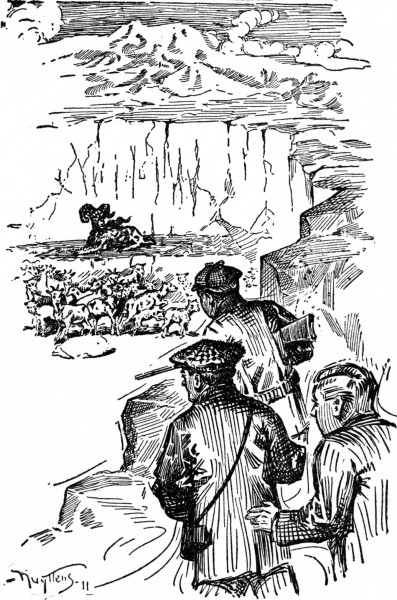
So far as could be seen not an animal had
moved. The flock, as if panic-stricken, stood
huddled at the bottom of the big ram’s shelf.
The strangely marked leader still lay with his
head erect and alert. Phil, not yet wholly himself,
drew a long breath.
“He’s alive, I reckon, but he looks like a
ghost,” said Phil. “And by cracky, he is a
ghost to me.”
“He ain’t a ghost,” exclaimed Frank, moistening
his lips, “and I wouldn’t make him one
for all the ram’s horns in the Rockies.”
“That would be potting, I fancy,” commented
Lord Pelton. “I rather believe your ‘Old
Baldy’ is on his last legs.”
“It’s just like a king’s throne,” suggested
Phil, “that cave o’ his with the flock crowdin’
round about it.”
“I couldn’t shoot him,” exclaimed Frank.
“I’d feel like an assassin.”
“Do you happen to notice,” broke in the Englishman,
“that all the sheep are ewes and
lambs?”
“That settles it,” exclaimed Frank. “I vote
to spare the ‘Monarch of the Mountains.’ ‘Old
Baldy’ must be Husha the Black Ram. And
to me, he’s kind o’ like a religion.”
“He’s a part of history at least,” added
Lord Pelton.
“It seems tough to lose him,” said Phil, “but
I think you’re both right. Let’s take a snap
shot of him and call it off.”
This suggestion meeting approval, Phil got
the camera. He made a picture of the enclosure
and its contents which, when printed in a prominent
sporting magazine, created a sensation.
It was then decided to get a picture of “Old
Baldy,” or “Husha.”
“Let ’em go,” exclaimed Frank when the
ewes and kids suddenly fled to the left around
the shelf as the picture makers advanced on
the right side. “We don’t want ’em.”
As panic seized the flock and it retreated,
the big ram on the shelf drew himself on his
haunches.
“Why don’t he follow them?” asked Lord
Pelton.
“He can’t,” answered Frank. “He’s too
old.”
But, as Phil trained his camera on the quarter
century chief of the sheep, “Old Baldy”
faced the intruders with lowered head and eyes
that shot forth the fire of youth and rage.
Twice he struggled to get on his feet and each
time he failed.
“You’re right,” said the Englishman,
“it’s the old ram’s last stand. But don’t get
too close; he may have one more charge in
him.”
Phil was too absorbed to give heed to this
advice. A snap shot of such a beast would be
an achievement indeed. Therefore, he crept
closer to the shelf and the unmoving ram.
Frank and Lord Pelton saw the fire in “Old
Baldy’s” eyes; then at last they saw him with
a supreme effort gather his legs beneath him.
“Look out!” shouted Frank.
“He’s coming,” cried the Englishman.
Before Phil, his eyes on the camera “finder,”
could retreat there was a snort and the ram
threw himself from the shelf. He fell short on
his charge but, with another cry, sprang to his
feet again. This time “Old Baldy” expanded
himself once more into the majestic creature
he had once been and again charged the boy.
But once more he fell short, as Phil sprang
backwards.
Balked of his prey the ram fell on his knees
and then on his belly. His head was yet erect;
on each side of the cross marking his face his
big dull eyes glared wickedly. Then the flash in
them suddenly faded to a dull gray like his
thin, straggly coat, and the defiant head sank
slowly down.
“It’s his last fight,” exclaimed Frank.
Once more Phil advanced and “snapped”
the prostrate “monarch of the mountains.”
Then the three approached to within a few feet
of the feeble animal. The old leader of the
mountain sheep suddenly threw his head up;
the gray of his eyes turned to fire and, quivering
in every muscle, he rose in the air like a
ball. In the same motion the ram threw himself
forward again, but the effort was his last.
Half-way in the spring the beast dropped to
the rocks in collapse and, his eyes closed, sank
again and rolled on his side.
“Pelton,” said Frank, omitting in his excitement
the young Englishman’s title, “we’ve always
planned, if we found ‘Old Baldy’ alive,
that he was to be yours. His day is over. End
his suffering.”
“I don’t like to do it,” said Lord Pelton.
“It don’t seem sportsmanlike.”
“You can see he’s dying,” argued Phil.
“Isn’t it better that his head and horns be carried
away as a trophy than that the old sheep
be left here to be torn to pieces by eagles?”
Slowly Lord Pelton raised his rifle and, with
a bullet in the center of “Old Baldy’s” cross,
Husha the Black Earn gave one convulsion and
the king was dead.
Before taking time to measure the dead ram,
Frank and Phil hurriedly turned for a further
examination of old Husha’s home, for such apparently
the natural rock refuge had been for
years. The shelf around the pool was worn
smooth by the bodies of its inhabitants. Rock
edges were covered with sheep hair and the
scattered bones strewn about indicated that
many animals had died in the enclosure. More
especially interested in the old leader’s throne-like
shelf the three hunters hurried in that
direction.
“Another skeleton,” said Frank as he
reached Husha’s bench and half cave.
“But not of a sheep!” exclaimed Lord Pelton
breathlessly.
And then, their eyes wide, all saw, plainly
enough in the full sunlight, a brown and
weather beaten human skull. It lay in the rear
of the big ram’s refuge and with it the half
buried ribs, legs and arm bones of a human
skeleton. Speechless, all leaned forward. The
rank odor of the half cave was almost overpowering
and the ledge was covered inches deep
with animal refuse. But, in spite of these,
Frank and Phil jumped on the bench.
The same thought was in the mind of each.
Nervously they began an examination of the
bones. Not a vestige of clothing was to be
found but, behind the disjointed skeleton lay a
long, decayed stick.
“An Indian bow,” whispered Frank.
From between the bones of the body Phil
drew forth a bit of metal—the silver bowl of a
small pipe.
“And an Indian pipe!” he exclaimed.
Kneeling in the dust the boys eyed each other
for a second and then Frank turned to their
companion.
“Lord Pelton,” he said with suppressed excitement,
“you don’t need to have any doubt
that our big sheep is Husha the Black Ram.
This skeleton is that of the only man who could
have followed him here.” Then he held up the
dry skull. “This is all that is left of Koos-ha-nax,
the mighty hunter.”
The discoveries made by the boys had driven
all other ideas out of their heads. For many
minutes they searched Husha’s ledge and for as
many more they stood over the dead sheep.
Then Lord Pelton reminded them that “Old
Baldy” was not the only ram on the summit and
a start was made to capture other trophies if
possible. Contrary to their expectations many
of the sheep had not fled through the cut. From
ten o’clock until twelve, Lord Pelton and the
boys scoured the rocky heights bagging, in all,
four magnificent heads.
They now had luncheon and then Phil began a
three-hour task of preparing the slain animals
for curing and mounting. “Old Baldy” himself
stood forty-eight inches high; was seventy-six
inches long and, it was estimated, weighed
four hundred and seventy-five pounds. His
heavy, semicircular horns measured forty-nine
inches from tip to tip. His pelt was in such bad
condition that no attempt was made to save it.
The next largest specimen was a beautiful ram,
his horns indicating a growth of thirteen years.
This sheep was shot by Phil and it was almost
black in color. It was forty-one inches across
the shoulders; sixty-nine inches long and
weighed about three hundred and fifteen
pounds. The others were all smaller. One of
the latter, Lord Pelton’s prize, had by far the
best formed and most perfect horns.
By four o’clock Frank had made temporary
repairs on the landing wheel and with the Englishman
had cleared a stretch of summit of all
fragments. Frank also made another round of
the summit snapping pictures and then the
souvenirs of the expedition were put aboard the
Loon; the skeleton of Koos-ha-nax, as the boys
firmly believed; the six heads and horns; the
five pelts and the fragments of the Indian’s
bow and pipe bowl.
The ascent that followed was the quickest and
most successful that the Loon made on its western
trip. The rock floor was smooth and amply
long for the preliminary run. At six o’clock
the monoplane was again at Smith’s ranch.
“And so far as I am concerned,” exclaimed
Frank, “I don’t care whether we turn another
trick. All I want is to see Skinner and Hosmer
and show ’em these heads.”
“And Koos-ha-nax’s skull, pipe and bow,”
added Lord Pelton.
“O, no!” said Phil, “these are for Captain
Ludington. They’ll prove to him that the
Kootenais knew what they were talking about.”
By the light of the lanterns that night Phil
sweat over the specimens, in anticipation of
which work the camp was liberally supplied
with arsenical soap, burnt alum and saltpeter.
As the preparation of the heads and skins was
not completed that night it was agreed the next
day that Phil should remain in camp while
Frank and Lord Pelton made an attempt to
join Mr. Mackworth’s party.
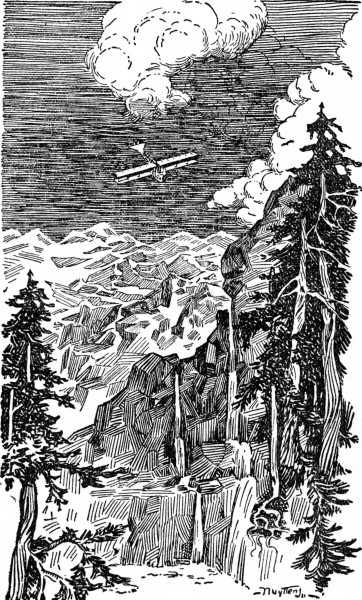
They made a beautiful flight along the course
of tortuous Goat Creek and reached Goat Pass
in less than an hour. So far there was no sign
of the mountain party but—as the members of
it were to turn south into the Herchmer range,
at the headwaters of the creek—Frank laid a
course along the ridge of these unmistakable
heights. The entire country was either abrupt
mountain slopes or heavy, abutting pine forests.
Following a saw-tooth course to keep an eye
on both sides of the range, the Loon had advanced
along the Herchmers only a few miles
when Mr. Mackworth’s camp was suddenly
made out far down the western mountain side
in the timber. Several hundred feet above it
Mr. Mackworth, Captain Ludington, Jake
Green and the two guides were seen standing
on the barren slope violently waving their
arms.
“There’s no white flag,” said Frank. “That
means no landing. We’re to go back. But I
wish we could talk to ’em. Say,” he exclaimed.
“Write ’em a note. Tell ’em where we’ve
been and what we did.”
Lord Pelton grasped the opportunity and,
while Frank began circling about the upgazing
persons, the Englishman filled a page of his
memorandum book with an account of the trip
to “Baldy’s Bench.” Finding no small weight
in the cabin Lord Pelton tied the note and a
silver dollar in his handkerchief and, the next
time the Loon passed over the group, dropped
the message.
Anxious to see the effect of the note, Frank
continued the eaglelike swoops of the monoplane
while his English companion lay on the
floor with his head in the open port. Before
the message had been read the latter reported
that Skinner was on a run to the camp below.
Then Frank could see the old hunter returning
with a package. Mr. Mackworth read Lord
Pelton’s few words and immediately threw his
hat in the air. “Grizzly” Hosmer expressed
his feelings by rapidly discharging his rifle.
Then Mr. Mackworth was seen to grasp Skinner’s
package and, in a few seconds, its contents
had turned into a long, jointed trout rod.
He waved it in the air.
“He means for us to return to the ranch and
go fishing,” called out the Englishman.
“I think not,” answered Frank. “He has
an idea. Look!”
Captain Ludington with a bit of paper on his
knee was writing something.
“It’s an answer,” exclaimed Frank.
“They’re going to put it on the pole. They
want us to catch it. Can you do it?”
As the operator swung around again in a
wide spiral this was seen to be true, for the men
below all seemed working to attach the paper
to the top of the pole. Two sweeping circles
and the Loon was near the rocks. Their friends
were shouting but, owing to the noise of the
propellers, not a word could be distinguished.
“Head for it—I’ll get it,” announced the
Englishman as he thrust his head and arm
through the opening and, the monoplane sweeping
swiftly forward, Frank felt a light shock.
“Get it?” yelled the aviator.
“Rod and all,” was the excited answer and
Lord Pelton drew into the cabin Mr. Mackworth’s
choicest fly rod.
The message read: “Congratulations. No
landing in the mountains. Return to ranch;
break camp and take wagons and outfit to
Michel. Join you in a week or less. Three
good heads. One grizzly skin; ten feet.”
Before noon, the monoplane was again in
camp. Plans for carrying out Mr. Mackworth’s
instructions were soon made. Early the next
morning Hosmer’s horses were to be caught,
hitched to the two wagons and camp broken.
The boys had no fear that they could not find
the trail to town, since it followed the Elk
River, but they preferred not to separate.
Therefore, the Loon was dismounted and
packed in one wagon. This consumed nearly
all afternoon.
At sundown the next evening the two wagons,
one driven by Frank with the Englishman by
his side and the other trailing behind with Phil
in charge, creaked down the main street of
Michel. So far as Frank and Phil were concerned
the “Battle with the Bighorn” was at
an end.
Five days later the mountain party reached
civilization laden with the trophies of a successful
hunt. Mr. Mackworth and Captain
Ludington reached Michel at two o’clock in the
afternoon. When the heads, horns, pelts and
skins brought in by both parties had been laid
in the shade of the car, it was a satisfied group
of hunters that sat in the Teton’s easy-chairs
to gloat over their treasures.
Nor were they alone in their admiration.
Hosmer, Skinner and experienced big game
hunters of Michel pronounced the collection the
best that had ever come out of the mountains.
“Grizzly” Skinner and Phil worked until dark
packing the hides and heads for shipment to
Spokane, where experienced taxidermists were
to cure and mount them. This over, Nelse and
Robert served a celebration dinner. If there
had been enthusiasm before, this meal was a
riot of jollification.
“And remember,” exclaimed Mr. Mackworth
as the feast progressed, “Captain Ludington
and I have marvelous heads of both goats and
sheep, and Lord Pelton has a prize that will
never be duplicated in the head and horns of
Husha the Black Ram. But we could not have
had these if it had not been for our young
friends. Therefore,” he continued enthusiastically,
“I propose a toast: Here’s to Frank
Graham and Phil Ewing—may they be as successful
in life as they have been in ‘Battling
the Bighorn!’”
The next book in the Aeroplane Series will be
“The Boy Scouts of the Air”
or
“The Aeroplane Spy.”
See complete list of titles on page 2.
The
Boys’
Big
Game
Series
THE GIANT MOOSE. The monarch of the big Northwest; a story told
over camp fires in the reek of cedar smoke and the silence of the barrens.
THE WHITE TIGER OF NEPAL. The weird story of the man-killer
of the foothills. Tinged with the mysticism of India, dramatic and stirring.
THE BLIND LION OF THE CONGO. A story of the least
known part of the earth and its most feared beast. A gripping tale of the
land of the white pigmies.
THE KING BEAR OF KADIAK ISLAND. A tale of the
bully of the Frozen North and his mysterious guardian. A game-and-man-story
that makes a good boy-story.
The topnotch of production in boys’ books. Remarkable
covers and four-color jackets. Illustrations and
cover designs by Dan Sayre Grosbeck.
Price, 60 cents each
The REILLY & BRITTON CO.
PUBLISHERS, CHICAGO
The
Boy Scouts
of the Air Books
By GORDON STUART
Are stirring stories of adventure
in which real boys, clean-cut
and wide-awake, do the
things other wide-awake boys
like to read about.
Four titles,
per volume,
60 cents
- THE BOY SCOUTS OF THE AIR AT EAGLE CAMP
- THE BOY SCOUTS OF THE AIR AT GREENWOOD SCHOOL
- THE BOY SCOUTS OF THE AIR IN INDIAN LAND
- THE BOY SCOUTS OF THE AIR IN NORTHERN WILDS
Splendid Illustrations by Norman Hall
Publishers The Reilly & Britton Co. Chicago
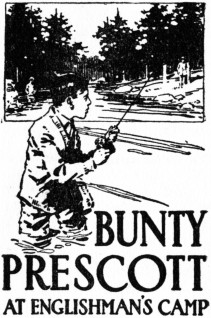
Bunty Prescott
at Englishman’s Camp
By MAJOR M. J. PHILLIPS
Take a boy away from the stuffy schoolroom
and turn him loose away up in the jack pine
country—the land of deer and bear and trout, and
he will grow “fat and saucy”—as did Bunty. And
if he is a wide-awake
youngster
he will find excitement
aplenty—as
did Bunty. Give
him a rifle, a rod
and reel, and a desire
to know things,
and, well—you have
a story every boy
will enjoy reading.
“Bunty Prescott
at Englishman’s
Camp” is a story
full of boy interest,
written by a man
who knows boys as
he knows the woods
and streams—a
story no youngster
can read without
learning something new of the lore of out-of-doors—hunting,
fishing, camping out.
Snappy cover stamped in three colors, and three-color
jacket. Illustrated by Emile Nelson. Price $1.00
Publishers The Reilly & Britton Co. Chicago
By H. L. SAYLER
SEVEN TITLES
- THE AIRSHIP BOYS Or, The Quest of the Aztec Treasure
- THE AIRSHIP BOYS ADRIFT Or, Saved by an Aeroplane
- THE AIRSHIP BOYS DUE NORTH Or, By Balloon to the Pole
- THE AIRSHIP BOYS IN THE BARREN LANDS Or, The Secret of
the White Eskimos
- THE AIRSHIP BOYS IN FINANCE Or, The Flight of the Flying
Cow
- THE AIRSHIP BOYS’ OCEAN FLYER Or, New York to London
In Twelve Hours
- THE AIRSHIP BOYS AS DETECTIVES Or, On Secret Service in
Cloudland
Fascinating stories of that wonderful region of
invention where imagination and reality so nearly
meet. There is no more interesting field for stories
for wide-awake boys. Mr. Sayler combines a remarkable
narrative ability with a degree of technical
knowledge that makes these books correct in all
airship details. Full of adventure without being
sensational.
The make-up of these books is strictly up-to-date
and fetching. The covers are emblematic,
and the jackets are showy and in colors.
The illustrations are full of dash and vim.
Standard novel size, 12mo. Price $1.00 each.
Publishers The Reilly & Britton Co. Chicago
Good Books for Boys
The Boy Fortune Hunters
Series
By FLOYD AKERS
The Boy Fortune Hunters in Alaska
The Boy Fortune Hunters in Panama
The Boy Fortune Hunters in Egypt
The Boy Fortune Hunters in China
The Boy Fortune Hunters in Yucatan
The Boy Fortune Hunters in the South Seas
Mr. Akers, in these new books, has at a single
bound taken the front rank as a writer for
boys. The stories are full of adventure, yet clean,
bright and up-to-date. The first volume tells of
the exciting scenes in the early days of the Alaskan
gold fields. The next book takes “The Boy Fortune
Hunters” to the “Canal Zone,” and the third story
is filled with stirring incidents in a trip through
Egypt. The fourth book relates exciting adventures
in the Flowery Kingdom, and the fifth and
sixth stories detail further adventures in Yucatan
and among the South Sea Islands.
Illustrated 12mo. Uniform cloth binding,
stamped in three colors. Stunning
colored wrapper. Price 60 cents each
Publishers The Reilly & Britton Co. Chicago
Books for Older Children by L. Frank Baum
The Daring Twins Series
By L. FRANK BAUM
In writing “The Daring
Twins Series” Mr. Baum
yielded to the hundreds of
requests that have been
made of him by youngsters,
both boys and girls, who in
their early childhood read
and loved his famous “Oz”
books, to write a story for
young folk of the ages between
twelve and eighteen.
A story of the real
life of real boys and
girls in a real family
under real conditions
Two Titles:
The Daring Twins
Phoebe Daring
While preparing these books Mr. Baum lived with
his characters. They have every element of the
drama of life as it begins within the lives of children.
The two stories are a mixture of the sublime and
the ridiculous; the foibles and fancies of childhood,
interspersed with humor and pathos.
Price, $1.00 each
Publishers The Reilly & Britton Co. Chicago
Transcriber’s Notes:
Printer’s, punctuation and spelling inaccuracies were silently
corrected.
Archaic and variable spelling has been preserved.
Variations in hyphenation and compound words have been preserved.