Sidney Henderson fairly broke into a run in
order to catch up to the three girls. They heard
him coming, and turned around, while Tom and
Phil, some distance off, were spectators of the
scene.
“I say!” burst out poor Sid pantingly, as he
came to a halt, “I’m awfully sorry, Miss Harrison,
but—er—I can’t take you to the theatricals
to-night, after all. I’ve just received bad news.”
“Bad news? Oh, I’m so sorry!” and the blue
eyes of the pretty girl, that had been merry and
dancing, as she chatted with Ruth and Madge,
took on a tender glance.
“Oh, it isn’t that any one is sick, or—er—anything
like that,” Sid hastened to add, for he saw
that she had misunderstood him. “It’s just that
I have received a message—I have got to go
away—I—er—I can’t explain, but some one is
in trouble, and I—I’m awfully sorry,” he blurted
out, feeling that he was making a pretty bad
mess of it. “I’ve arranged for Tom Parsons to
take you to the theatricals, Miss Harrison.”
“You’ve arranged for Mr. Parsons to take
me?” There was no mistaking the anger in her
tones. Her blue eyes seemed to flash, and she
drew herself up proudly. Madge and Ruth, who
had shown some pity and anxiety at Sid’s first
words, looked at him curiously.
“Yes, Tom will be very glad to take you,”
went on the unfortunate Sid.
“Thank you,” spoke Miss Harrison coldly. “I
don’t believe I care to go to the theatricals after
all. Come on, girls, or we will be late for tea,”
and without another look at Sid she turned aside
and walked on.
“Oh, but I say, you know!” burst out the second
baseman. “I thought—that is—you see—I
can’t possibly take you, as it is, and I
thought——”
“It isn’t necessary for anyone to take me!” retorted
Miss Harrison coldly. “It’s not at all
important, I assure you. Good afternoon, Mr.
Henderson,” and she swept away, leaving poor
Sid staring after her with bewilderment in his
eyes. It was his first attempt at an affair with
a maiden, and it had ended most disastrously.
He turned back to rejoin his chums.
“Well?” questioned Tom, as Sid came up. “Is
it all right? Am I to have the pleasure of two
young ladies to-night?”
“No, it’s all wrong!” blurted out Sid. “I
can’t understand girls!”
“That’s rich!” cried Phil. “Here you have
been despising them all your life, and now, when
you do make up to one, and something happens,
you say you can’t understand them. No man
can, old chap. Look at Tom and me, here, and
we’ve had our share of affairs, haven’t we, old
sport.”
“Speak for yourself,” replied the pitcher. “But
what’s the row, Sid?”
“Hanged if I know. I told her I couldn’t
possibly go to-night——”
“Did you tell her why?” interrupted Phil.
“Well, I said I had received word that I had
to go away, and—er—well I can’t explain that
part of it even to you fellows. I’ve got to go
away for a short time, that’s all. It’s fearfully
important, of course, or I wouldn’t break a date
with a girl. I can’t explain, except that I have
to go. I tried to tell her that; and then I said
I’d arranged with you to take her, Tom.”
“You what?” cried the amazed pitcher.
“I told her I was going to have you take her.”
“Without asking her whether it would be agreeable
to her?”
“Of course. I didn’t suppose that was necessary,
as you and Miss Clinton and Miss Tyler
were all going together. I just told her you’d
take her.”
“Well, of all the chumps!” burst out Phil.
“A double-barreled one!” added Tom.
“Why—what’s wrong?” asked Sid wonderingly.
“Everything,” explained Phil. “You ask a
pretty girl—and by the way, Sid, I congratulate
you on your choice, for she is decidedly fine looking—but,
as I say, you ask a pretty girl to go to
some doings, and when you find you can’t go,
which is all right, of course, for that often happens,
why then, I say, you coolly tell her you have
arranged for her escort. You don’t give her a
chance to have a word to say in the matter. Why,
man alive, it’s just as if you were her guardian,
or grandfather, or something like that. A girl
likes to have a voice in these matters, you know.
My, my, Sid! but you have put your foot in it.
You should have gently, very gently, suggested
that Tom here would be glad to take her. Instead,
you act as though she had to accept your
choice. Oh, you doggoned old misogynist, I’m
afraid you’re hopeless!”
“Do you suppose she’ll be mad?” asked Sid
falteringly.
“Mad? She’ll never speak to you again,” declared
Tom, with a carefully-guarded wink at
Phil.
“Well, I can’t help it,” spoke Sid mournfully.
“I’ve just got to go away, that’s all,” and he
hastened on in advance of his companions.
“Don’t stay out too late, and get caught by
Proc. Zane again,” cautioned Phil, but Sid did
not answer.
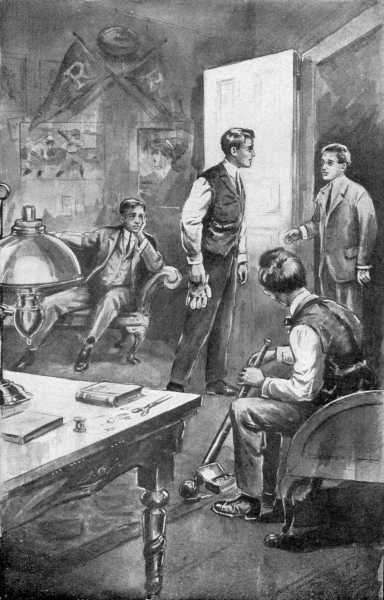
Tom and Phil lingered in the gymnasium,
whither they went for a shower bath, and when
they reached their room, to put on clothes other
than sporting ones for supper, Sid was not in the
apartment. There was evidence that he had
come in, hastily dressed, and had gone out again.
“He’s off,” remarked Tom.
“Yes, and it’s mighty queer business,” remarked
Phil. “But come on, we’ll get an early
grub, tog up, and go get the girls.”
“What about Miss Harrison?”
“Hanged if I know,” answered Tom. “I’d be
glad to take her, of course, but I’m not going to
mix up in Sid’s affairs.”
“No, of course not. Well, come on.”
In spite of hearty appetites Tom and Phil did
not linger long at the table, and they were soon
back in their room, where they began to lay out
their dress suits, and to debate over which ties
they should wear. Tom had managed to borrow
a dress shirt, and so did not have to buy one.
“I say, Phil,” remarked the pitcher, as he almost
strangled himself getting a tight fifteen
collar to fit on the same size shirt, “doesn’t it
strike you as queer about Sid—I mean his chasing
off this way so suddenly?”
“It sure does. This is the second time, and
each time he scoots off when he’s had a note from
some one.”
“Remember when he came back last night,
smelling so strong of tobacco?”
“Sure; yet he doesn’t smoke.”
“No, and that’s the funny part of it. Then
there’s the fact of him having no money to-day,
though he had a roll yesterday.”
There was silence in the small apartment, while
the clock ticked on. Tom, somewhat exhausted
by his struggle with his collar, sank down on the
ancient sofa, a cloud of dust, like incense, arising
around him.
“Cæsar’s legions! My clothes will be a sight!”
he cried, jumping up, and searching frantically
for a whisk broom.
“Easy!” cried Phil, “I just had my tie in the
right shape, and you’ve knocked it all squee-gee!”
for Tom in his excitement had collided with his
chum.
They managed to get dressed after a while—rather
a long while.
“Come on,” said Tom, as he took a final look
at himself in the glass, for though he was not too
much devoted to dress or his own good looks,
much adornment of their persons must be excused
on the part of the talented pitcher and his
chum, on the score of the pretty girls with whom
they were to spend the evening.
“I’m ready,” announced Phil. “Shall we leave
a light for Sid?”
“I don’t know. No telling when he’ll be in.
Do you know, Phil, it seems rotten mean to mention
it, and I only do it to see if you have the
same idea I have, but I shouldn’t be surprised if
old Sid was gambling.”
“Gambling!”
“Yes. Look how he’s sneaked off these last
two nights, not saying where he’s going, and acting
so funny about it. Then coming in late, all
perfumed with tobacco, and getting caught,
and not having any money and—and—Oh, well,
hang it all! I know it won’t go any further, or
I shouldn’t mention it; but doesn’t it look queer?”
Phil did not reply for a moment. He glanced
at Tom, as if to fathom his earnestness, and as
the two stood there, looking around their common
home, marked by the absence of Sid, the
fussy little alarm clock seemed to be repeating
over and over again the ugly word—“gambler—gambler—gambler.”
“Well?” asked Tom softly.
“I hate to say it, but I’m afraid you’re right,”
replied Phil. “Sid, of all chaps, though. It’s
fierce!” and then the two went out.
Tom and Phil called at the residence of Miss
Harrison’s relatives for Madge and Ruth. Tom
tried, tactfully enough, to get Miss Harrison to
come to the theatricals with himself and Ruth,
but the blue-eyed girl pleaded a headache (always
a lady’s privilege), and said she would stay at
home. Sid’s name was not mentioned. Then
the four young people went off, leaving a rather
disconsolate damsel behind.
Sid was in bed when Tom and Phil returned,
and he did not say anything, or exhibit any signs
of being awake, so they did not disturb him, refraining
from even talking in whispers of the
jolly time they had had. There was a strong
smell of tobacco about Sid’s clothes, but his chums
said nothing of this.
The next day Sid was moody and disconsolate.
He wrote several letters, tearing them up, one
after the other, but finally he seemed to hit on
one that pleased him, and went out to mail it.
Amid the torn scraps about his desk Phil and
Tom could not help seeing several which began
variously “My dear Miss Harrison,” “Dear Miss
Harrison,” “Dear friend,” and “Esteemed
friend.”
“Trying to square himself,” remarked Tom.
“He’s got it bad—poor old Sid,” added Phil.
“It will all come out right in the end, I hope.”
But it didn’t seem to for Sid, since in the course
of the next week, when he had written again to
Miss Harrison asking her to go with him to a
dance, he received in return a polite little note,
pleading a previous engagement.
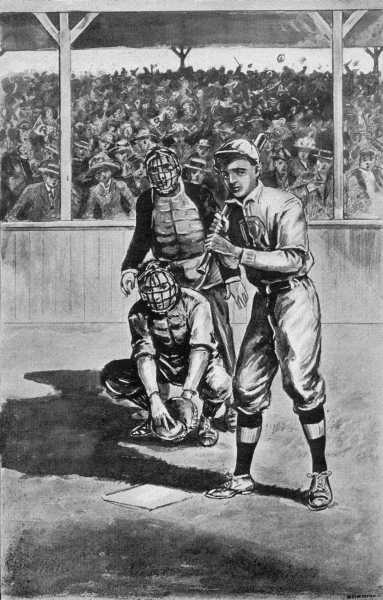
“Well,” remarked Tom one afternoon, when
he and his crowd of players had thronged out on
the diamond, “we’re getting into some kind of
shape. Get back there, Dutch, while I try a few
curves, and then we’ll have a practice game.”
“And pay particular attention to your batting,
fellows,” cautioned Coach Leighton. “It isn’t improving
the way it ought, and I hear that Boxer
has some good stick-wielders this season.”
“Yes, and they’ve got some one else on their
nine, too,” added Bricktop Molloy. “Have ye
heard the news, byes?” for sometimes the red-haired
shortstop betrayed his genial Irish nature
by his brogue.
“No, what is it?” asked Phil.
“Fred Langridge is playing with them.”
“What? Langridge, the bully who used to be
here?” cried one student.
“That same,” retorted Bricktop.
“Have they hired him?” inquired Holly Cross.
“No, he’s taking some sort of a course at
Boxer Hall, I believe.”
“A course in concentrated meanness, I guess,”
suggested Tom, as he thought of the dastardly
trick Langridge had tried to play on Phil during
the previous term.
“Well, no matter about that,” came from the
coach. “You boys want to improve your batting—that’s
all. Your field work is fair, and I
haven’t anything but praise for our battery.”
“Thanks!” chorused Tom and Dutch Housenlager,
making mock bows.
“But get busy, fellows,” went on the coach.
“Oh, by the way, captain, what about a manager?”
“Election to-night,” answered Tom quickly.
“The notice has been posted. Come on, we’ll
have a scrub game. Five innings will be enough.
There ought to be——”
“My uncle says——” began a voice from a
small knot of non-playing spectators.
“Fenton’s wound up!” cried Dutch, making an
attempt to penetrate the crowd and get at the
offending nephew of the former coach.
“Can him!” shouted Joe Jackson.
“Put your uncle on ice!” added Pete Backus.
“Leave him out after dark, and Proc. Zane will
catch him,” came from Snail Looper.
“Well, I was only going to say,” went on
Ford, but such a storm of protesting howls arose
that his voice was drowned.
“And that’s the chap they talk of for manager,”
said Phil to Tom disgustedly.
“Oh, I guess it’s all talk,” remarked the
pitcher. “We will rush Ed Kerr through, and
the season will soon start.”
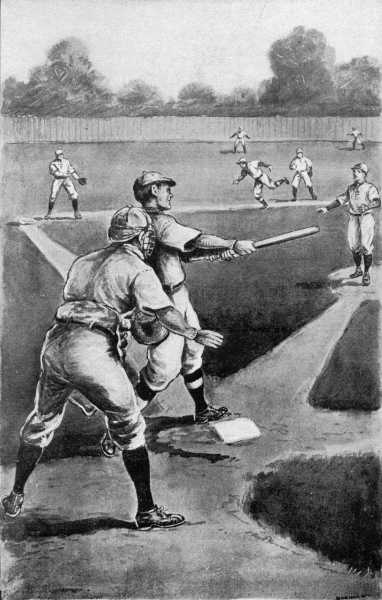
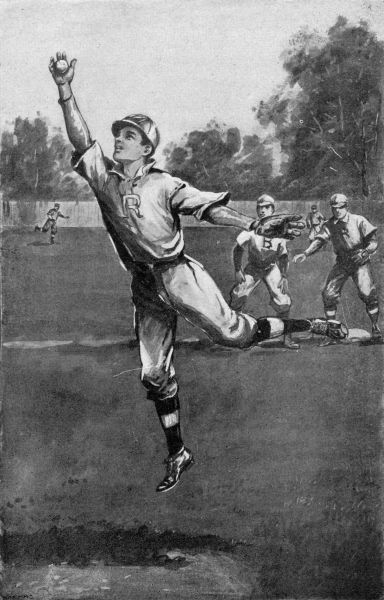
The scrub game began. It was not remarkable
for brilliant playing, either in the line of fielding
or batting. Tom, though, did some fine work in
pitching, and he and Dutch worked together like
well-built machines. Tom struck out three men,
one after the other, in the second inning, and repeated
the trick in the last. Sid Henderson rather
surprised the coach by making a safe hit every
time he was up, a record no one else approached
that day, for Rod Evert, who was doing the
“twirling” for the team opposed to Tom’s, was
considered a good handler of the horsehide.
“Good work, Henderson,” complimented Mr.
Leighton. But Sid did not seem particularly
pleased.
“Everybody on hand for the election to-night,”
commanded Tom, as the game ended, the pitcher’s
team having won by a score of eight to four.
There was a large throng assembled in the
gymnasium that evening, for at Randall sports
reigned supreme in their seasons, and the annual
election of a baseball manager was something of
no small importance. For several reasons no
manager had been selected at the close of the
previous season, when Tom had been unanimously
selected as captain, and it now devolved upon the
students who were members of the athletic committee
to choose one.
As has been explained, among the players themselves,
or, rather, among the majority, Ed Kerr,
the catcher of the previous season was favored,
but, of late there had been activity looking to the
choosing of some one else.
There were vague rumors floating about the
meeting room, as Tom Parsons went up on the
platform, and called the assemblage to order. It
was noticed that Bert Bascome, a freshman who
was said to be quite wealthy, was the center of a
group of excited youths, of whom Ford Fenton
was one. Ford had tried for the ’varsity the
previous season, had failed, and was once more
in line. As for Bascome, he, too, wanted to
wear the coveted “R.”
“Politics over there all right,” observed Phil
Clinton to Dutch. “Any idea of how strong they
are?”
“Don’t believe they can muster ten votes,” was
the answer. “We’ll put Ed in all right.”
Tom called for nominations for chairman, and
Mr. Leighton, who was in the hall, was promptly
chosen, he being acceptable to both sides.
“You all know what we are here for,” began
the coach, “and the sooner we get it over with
the better, I presume. Nominations for a manager
of the ball nine are in order.”
Jerry Jackson was on his feet in an instant.
“Mr. Chairman,” he began.
“Are you speaking for yourself or your
brother?” called Dutch.
Bang! went the chairman’s gavel, but there
was a laugh at the joke, for Jerry and Joe, the
“Jersey twins” were always so much in accord
that what one did the other always sanctioned.
Yet the query of Dutch seemed to disturb Jerry.
“Mr. Chairman,” he began again. “I
wish——”
“Help him along, Joe,” sung out Snail Looper.
“Jerry is going to make a wish.”
“Boys, boys,” pleaded the coach.
“My uncle says——” came from Ford Fenton,
indiscreetly.
“Sit down!”
“Put him out!”
“Muzzle him!”
“Silence!”
“Get a policeman!”
“Turn the hose on him!”
“Don’t believe he ever had an uncle!”
These were some of the cries that greeted Ford.
Bang! Bang! went the gavel, and order was
finally restored, but Fenton did not again venture
to address the chair.
“Mr. Chairman,” began Jerry Jackson once
more, and this time he secured a hearing, and
was recognized. “I wish to place in nomination,”
he went on, “a manager who, I am sure, will
fulfill the duties in the most acceptable manner;
one who knows the game from home plate to
third base, who has had large experience, who is
a jolly good fellow—who——”
“Who is he?”
“Name him!”
“Don’t be so long-winded about it!”
“Tell us his name!”
“He’s going to name Ford’s uncle!”
Once more the horse-play, led by Dutch, broke
out.
Bang! Bang! went Mr. Leighton’s gavel again.
“I nominate Ed Kerr!” sung out Jerry.
“Second it!” came from his brother in a flash.
“Mr. Kerr has been nominated,” spoke the
chairman. “Are there any others?”
“Move the nominations be closed,” came from
Tom quickly, but, before it could be seconded,
Bert Bascome was on his feet. He had a sneering,
supercilious air, that was in distinct bad
taste, yet he seemed to have a sort of following,
as, indeed, any youth in college may have, who
is willing to freely spend his money.
“One moment, Mr. Chairman,” began Bascome,
and so anxious were the others to hear
what was coming that they did not interrupt.
“When I came to Randall college,” went on the
freshman, with an air as if he had conferred a
great favor by his act, “I was given to understand
that the spirit of sportsmanship and fair
play was a sort of a heritage.”
“So it is!”
“What’s eating you?”
“Who’s the goat?” came the cries. Bert
flushed but went on:
“Closing the nominations before more than one
name——”
“The nominations have not been closed,” suggested
Mr. Leighton.
“Then am I out of order?” inquired Bascome
sarcastically. He seemed to know parliamentary
law.
“No,” answered the coach. “You must speak
to the point, however. Have you a name to place
in nomination? Mr. Parsons’ motion was lost
for want of a second.”
“I have a name to place in nomination,” went
on Bert deliberately, “and in doing so I wish to
state that I am actuated by no sense of feeling
against Mr. Kerr, whom I do not know. I simply
wish to see the spirit of sport well diversified
among the students, and——”
“Question! Question!” shouted several.
“Name your man!” demanded others.
“I believe Mr. Kerr is highly esteemed,” continued
Bascome, holding his ground well, “and I
honor him. I believe, however, that he belongs
to a certain crowd, or clique——”
“You’re wrong!” was a general shout.
“Mr. Chairman!” shouted Kerr, springing to
his feet, his face strangely white.
“Mr. Bascome has the floor,” spoke Mr.
Leighton quietly.
“Name your man!” was the cry from half a
score of youths.
“I nominate Ford Fenton for manager!”
shouted Bascome, for he saw the rising temper
of some of the students.
“Second it,” came from Henry Delfield, who
was the closest chum of the rich lad.
“Move the nominations close!” cried Tom
quickly, and this time Phil Clinton seconded it.
The battle was on.
“Two students have been nominated,” remarked
Mr. Leighton, when the usual formalities
had been completed. “How will you vote
on them, by ballot or——”
“Show of hands!” cried Tom. “We want to
see who’s with us and who’s against us,” he added
in a whisper to Phil and Sid.
“I demand a written ballot,” called out Bascome.
“We will vote on that,” decided the chairman,
and it went overwhelmingly in favor of a show
of hands.
“We’ve got ’em!” exulted Tom, when this test
had demonstrated how few were with Bascome—a
scant score.
A moment later the real voting was under
way, by a show of hands, Kerr’s name being
voted on first. He had tried to make a speech,
but had been induced to keep quiet.
It was as might have been expected. Possibly
had the ballot been a secret one more might have
voted for Fenton, but some freshmen saw which
way the wind was blowing, changing their votes
after having declared for a secret ballot, and all
of Bascome’s carefully laid plans, and his scheming
for several weeks past, to get some sort of
control of the nine, came to naught. Fenton
received nine votes, and Kerr one hundred and
twenty. It was a pitiful showing, and Fenton
soon recognized it.
“I move the election of Mr. Kerr be made
unanimous!” he cried, and that did more to offset
his many references to his uncle than anything else
he could have done. Bascome was excitedly whispering
to some of his chums, but when Fenton’s
motion was put it was carried without a vote in
opposition, and Kerr was the unanimous choice.
“Well, I’m glad that’s over,” said Phil with
a sigh of relief, as he and his chums drifted from
the gymnasium.
“Yes, now we’ll begin to play ball in earnest,”
added Tom. “Come on, Sid, I’ll take you and
Phil down to Hoffman’s and treat you to some
ice cream.”
“I—er—I’m going out this evening,” said Sid,
and he blushed a trifle.
“Where, you old dub?” asked Tom, almost
before he thought.
“I’m going to call on Miss Harrison,” was
the somewhat unexpected answer.