Many persons are constitutionally timid and diffident.
They were bashful in childhood, bashful at
school, bashful in society, always bashful. In business
they are not generally your pushing, go-ahead
operators. They shrink from contact with the bustling
crowds. They prefer, and will usually be
found doing quiet brain work in dim back offices.
Bashful young ladies, to the rightly constituted
masculine mind, are rather attractive than otherwise.
The timid, retiring manner; the modest,
downcast look; the soft blushes—all are particularly
engaging, especially to those who have been long
in society, and accustomed to the cool self-possession
and calm assurance of fashionable ladies.
The genuine diffident girl is not the product of
cities. She is not found in the crash of town life,
but in the seclusion of quiet country towns.
There is no class of girls in the world so easy to
get along with after they get acquainted with you,
as bashful ones. And the courting them is an easy
and delightful affair; they are so loving and confiding;
no reserve, no distrust, no coquetting; but
frank, open-hearted and generous. Even if you
are unsuccessful in your suit they never mortify you
in their refusal. It is generally given in so frank
and candid a manner as to command your admiration.
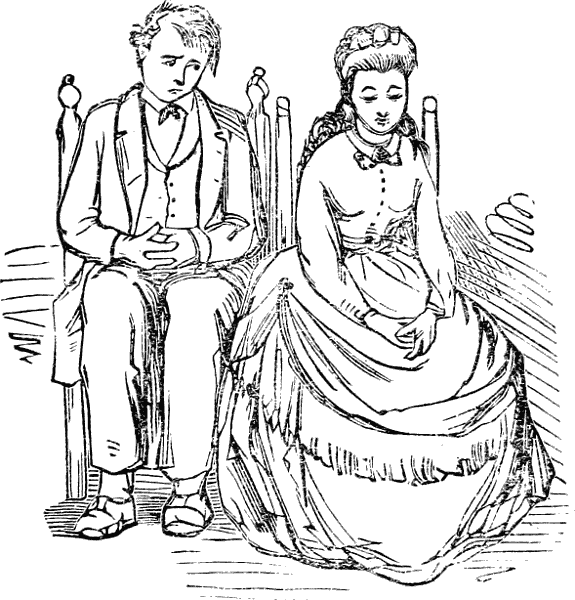
Natural Diffidence is the result, as already
stated, of certain peculiarities of constitution. There
is a want of confidence in one’s self—a shrinking
dread of intercourse with strangers, especially those
of the opposite sex, and he, or she, can give no reason
for this diffident feeling. He may be well educated;
of attractive personal appearance, of good
conversational abilities, and well dressed, yet from
that strange feeling of natural bashfulness, so well
known, yet difficult to describe, he is a timid, shrinking
creature, subject to trials of which a self-reliant
man has no conception. He blushes and becomes
confused if suddenly addressed. His heart beats
painfully at the idea of entering a well-lighted room
filled with ladies and gentlemen. And this feeling
is the result, in a great measure, of his small self-esteem.
Your truly diffident person is of extremely
sensitive, retiring disposition, and while he is apt to
accord to others superiorities they do not possess, he
entertains for his own abilities, personal and mental
qualities, the most humble opinion. And thus he
does himself great injustice and injury. He does
not attain that position in society nor that success
in professional or business life that he would were
he not shackled by his foolish timidity—his deference
to others.
A bold, self-confident man, with a mere fraction
of a bashful man’s ability and attainments, will invariably
distance him in the affairs of life. “Brass”
always tells. The world don’t stop to analyze a
man for his real merit. It takes him at his own
valuation, and if a man puts a low estimate upon
himself and goes through life with a hanging head
and blushing face, he has small success, and less
pity. The good things of this world—the successes
in love, in business, in politics, &c., are invariably
won by those who have a good opinion of themselves;
who have faith in their special talents and
abilities, and who push ahead in accordance with
this faith.
There never was a truer saying than that faint
heart never won fair lady. While women have a
genuine admiration for the truly modest and pure-minded
men, they have a genuine contempt for your
chicken-hearted, bashful, tongue-tied fellows.
Although a good many screeching females in
these Women’s Rights, Advanced Female days can
not lay special claims to any superfluous amount of
modesty, still the softer sex have not yet lost those
endearing qualities of gentleness, modesty, and loving
trustfulness in the opposite sex. Since that time
when Eve cast her first loving glances towards robust
Adam, women’s love and admiration have gone
out to bold and gallant men. As she is timid and
weak, so the more does she admire the qualities of
strength and courage. Man is her natural protector,
and she looks up to him and clings to him in
love and confidence.
Women are pre-eminently romantic in all that concerns
love. Her heroes are those who do brave and
perilous deeds; who scorn ease and effeminacy, and
who laugh at danger—captains who go down to
the sea in ships and sail away over the mysterious
ocean to strange, far-away lands—men who with
shut jaws, gleaming eyes, and fixed bayonets go
digging over fort walls, from which come unceasing
flashes of fire and a pitiless rain of death.
(How the officers and men who came home from
The War were honored, and almost caressed, especially
by the ladies; and what a host of marriages
took place among the gallant fellows!)
It has been truly said that no woman really loves
who has not discovered some traits in her lover’s
character that she considers noble and heroic. It
is a glory for a woman to be able to be proud of her
lover or husband—of his superior intellect, his dignity
and strong manhood and loving care and tenderness,
and it is proverbial how a true woman
overlooks and endeavors to conceal the faults and
weaknesses of her husband. He was her hero at
marriage, and though the illusion may have passed,
she still bravely tries to maintain it.
It often happens that a bright, superior girl marries
a quiet, bashful fellow, in whom her friends do
not see anything worth marrying for. But it is certain
the girl has discovered under all the young
man’s reserve and diffidence, superior traits of character
that have secured her attention and love.
This may be illustrated by an incident in which
the actors are personally known to the writer.
Frank W—— was a young man of more than
common intelligence and strength of character, but
he was so obstinately bashful and retiring that his
real worth was entirely unappreciated by his acquaintances.
He rarely ventured out to parties,
&c., and when he did, was entirely eclipsed by all
the ready-tongued young men in the room. Now
this Frank W—— was irretrievably in love with
the most charming young lady in town, Miss Louisa
L——, who understood and appreciated W——,
and often gave his society marked preference, to
the surprise and disgust of the before-mentioned
ready-tongued fellows, yet was careful to give no
indication by which W—— could hope he had secured
her affections. Thus matters went on a couple
of years, and W—— was almost in despair,
though he had really made more progress than he
had imagined. But an accident occurred that
brought matters to an agreeable termination. They
were out for a ride, with a spirited horse one autumn
afternoon, and in going down a steep hill a
rein broke, and the animal dashed forward at a tremendous
pace. W—— turned quietly towards
Miss L——, and giving her an assuring look, placed
a foot on the dasher-board, and with a leap placed
himself fairly astride the animal. Leaning forward
and seizing the beast by the nostrils he twisted her
head suddenly to one side, and brought the whole
affair to a stand-still within half-a-dozen rods.
Soothing the excited horse by a little gentle stroking,
W—— united the rein, and then coolly drove
on as if nothing had happened.
“I then and there decided to marry him,” said
Miss L——, relating the incident. “I concluded
that one who could perform such a daring and dangerous
act, and regard it with quiet indifference, was
a true and noble man, and one whom I could implicitly
trust.” And she was right, for a woman
never secured a better or more faithful husband.
A bashful young man who had the appearance
of no great amount of spirit, complained to his father
of his want of success in winning the esteem
of a certain proud young lady. “You can swim,
Sam?” “Yes, sir.” “Well, the next time you go
sailing with that girl, manage to dip her into the
stream, without letting her suspect you; then rescue
her like a man. Or do anything else that will
show that you have some life and pluck, and you’ll
find she has an improved opinion of you directly.”
And the pith of wisdom is in this bit of paternal
advice.
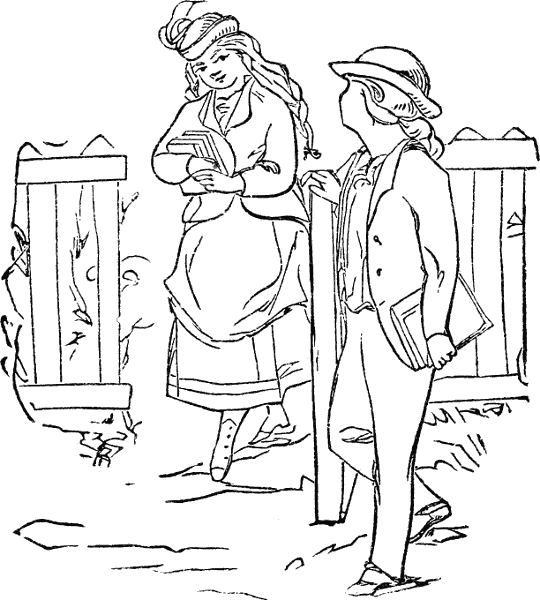
NOT BASHFUL.
Rather than be a bashful, blushing, stuttering
booby, it would be much better for a young man to
be over-confident and bold. With the latter qualities
his chances of success in any direction in life,
would be infinitely better. And it is the stout, true
heart that finds favor with the ladies. Women
love to be sought, and have attention paid them.
It is their nature to be timid, trustful and confiding.
They love to rely upon and feel the support of manly
strength. Now a timid, bashful fellow does not
possess those qualities that women most admire,
and to possess them should be a bashful person’s
foremost ambition.
The boy who hangs his head and sucks his
thumb when spoken to by a stranger, and who is
generally to be found moping behind the kitchen
fire, looking at a picture book, is not the mother’s
favorite. The saucy little chap who sticks his fists
into his breeches pocket, and don’t see anything in
strangers to fear; who rides the colts bare-back;
who don’t like the girls because they can’t climb
after bird’s eggs; who sails about the pond on a
six foot plank; and is the leader in all kinds of
boyish mischief;—this is the brave and fearless boy
that fills his mother’s heart with secret pride and
joy. “The spunky little cuss,” though coarse and
jarring, is far more pleasant to the mother’s ear
than “Poor child, he is so sensitive and bashful.”
And again we repeat, women do not admire bashful
men. While they may pity, a woman secretly
despises a man who is really or appears to be afraid
of women. A diffident fellow never was nor never
will be a favorite with the ladies. It is your easy-going,
self-possessed, talking chaps who are the
popular ones. This is illustrated in any assemblage
of both sexes. Take a party, for instance, early in
the evening when matters are a little frigid. The
ladies are inclined to congregate in groups by themselves,
with shy glances towards the gentlemen,
whose inclinations seem to be that of making wall-ornaments
of themselves. Presently there will enter
the room a fellow who is not quite certain if he
understands what the word “bashfulness” means.
He goes up to a group of ladies, smiles and bows to
all, shakes hands with some, and is in felicity right
away, to the envy and admiration of the wall-ornament
chaps.
While young ladies are timid and retiring, they
dislike the exhibition of these qualities by men.
This cannot be better illustrated than by noticing
how a young man from the city, with his easy manners,
his self-assurance, and ready ways, will go into
a country village and “cut out” the fellows right
and left, making himself a favorite with the girls in
an amazing short time. And this fellow may be
only a shallow-brained fop from some city dry goods
store, where he is engaged measuring out ribbons
from 8 A. M. till 6 P. M. His education is not worth
speaking of; he smokes; he gets drunk making
New Year’s calls; he don’t go to church; his moral
character will not bear severe inspection, and yet
this fellow goes to the country, and even the sensible
girls rather admire him, and are well pleased to see
him coming up the walk for an evening’s visit. The
best of the country beaux have received a good education
at the academy; they are clear in head and
sound in body, they are able to marry, owning their
own business, or soon to do so, and yet the company
of a pop-in-jay chap from the city is openly preferred
to that of these substantial and worthy country
young men. And they do not understand it, though
it is plain enough. The city fellow brings with him
an air of the great world outside this country village.
For years he has read the morning paper as regularly
as he has taken his breakfast, therefore he is
informed of all the events of the day. He can tell
you the present mental condition of Queen Victoria,
what the latest news is from Mormondom, or how
Prince Jim Jund is progressing with his railroad
enterprise in Africa. He can discuss politics with
the father, talk with mother concerning the last
General Religious Convention, and with the young
ladies fairly effervesces with small talk. And here
he has at immense advantage the country young
men, whose current literature probably consists of
the Weekly County paper, fearfully dry and dull,
a city story, or Agricultural paper, and Ayre’s last
Almanac. With these only for his mental food,
how can a young man make himself entertaining
and agreeable with chatty talk on the light topics
of the day?
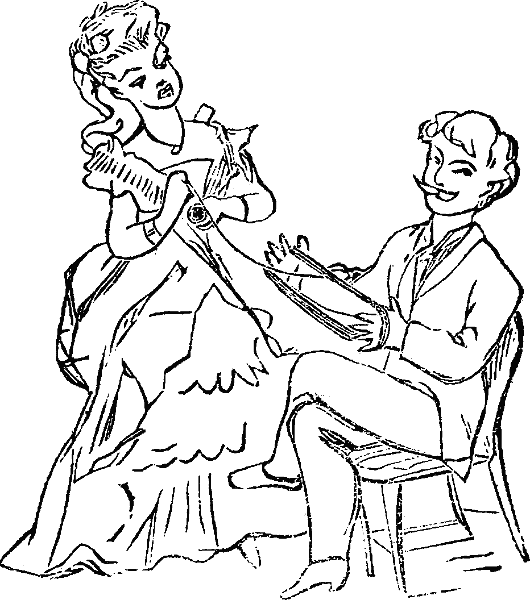
The city chap is brim full of pleasant gossip.
He don’t sit cross-legged, twisting his hat and
talking tedious farm-talk to the “old man,” while
he is dying to be visiting with the women-folks.
He has long been in contact with people—the
world—and constant friction has rubbed out any
awkwardness he may have possessed years ago.
There is an agreeable ease and freedom in his manner,
as there is in that of all genuine city people,
and it could not well be otherwise. In his capacity
of salesman in a large city retail store, he has come
in contact with all classes of ladies. He don’t blush
now when addressed by one of them. The sight
of bright eyes and pretty ankles does not throw
him into a state of flutteration, as it does our country
friend. He isn’t afraid of the women much—not
much. He does not class them with the angel
species, to converse with whom requires great courage
and moral force. He has learned by considerable
unpleasant experience that a great many of the
gentler sex have brisk little tempers, and some
spiteful, harassing ways, and tongues that can say
sharp things:—in fact, who are very much mortal,
and so, not considering them either doves or angels,
he experiences no trepidation in their society whatever.
Again, our city fellow, rusticating in the country,
and having it very much his own way with the
damsels, is well dressed. His clothes are probably
not of expensive material, but they are of excellent
fit, and gives his person a stylish, genteel appearance.
That a person well dressed receives respect and
attention that would not possibly be shown him
were he poorly or slovenly clothed is a fact so familiar
to all that it would be absurd to discuss it.
The matter of Dress is of so much importance
as concerns the feeling of Bashfulness, that we
shall consider it fully in another chapter.