The Giants’ opponents that day were the St.
Louis Cardinals, the last of the Western clubs to
visit the Polo Grounds on the first round of the
inter-sectional games.
Cincinnati, as has been said, had been able to
make an even break of it with the Giants. The
Pittsburghs had done even better, for the Smoky
City boys had left the big town with three scalps
hanging to their belts. The Giants had taken
sweet revenge on the Chicagos, however, having
made a clean sweep of the whole four games.
For several seasons, the best the Cardinals
could do was to finish at the tail of the first division
or the head of the second. They had an
excellent pitching staff and some of the heaviest
batters in either league. Their fielding was good
and their shortstop was such a phenomenon that
the St. Louis owners had refused an offer of two
hundred and fifty thousand dollars for him.
But despite these advantages the team had not
been able to win the championship. They did not
work with the smoothness and perfection necessary
for a champion team. Perhaps it was
the failure of efficient management or a case of
individual stars playing for their own records
instead of for the good of the team. But whatever
the reason, the record showed that while
they had started out each season like a house afire
they had failed at the end to take the coveted
flag.
This year, however, things were different. A
new manager had seemed to be able to put some
of his own vim and determination into the team
and they were playing like a machine. The first
four men in the batting order had been dubbed
the “Murderers’ Row” because of the way they
were “killing” the ball, and the rest of the team
were not very far behind. It was perfectly clear
that this year the Cardinals were a team to be
reckoned with.
Under ordinary circumstances, Joe would have
pitched the first game of the St. Louis series so
that the Giants might have a good chance to get
the jump on their opponents by grabbing off the
opening contest. But the day before had originally
been an open date, and the Giants and
Brooklyns had taken advantage of it to play off
a postponed game; and as the Brooklyns had
usually been a “Jonah” for the Giants, McRae
had thought it advisable to put Joe in the box.
The result had justified his judgment.
Markwith, the portside flinger of the Giants,
had been chosen, therefore, to open the St. Louis
series. He was one of the star pitchers of the
league, and during the season could be counted on
to turn in his fair share of victories. His speed
was dazzling and he had a good assortment of
curves and slants. The only trouble with him
was that he was an “in and outer.” When he
was good he was very good indeed, practically
unbeatable. But if his support were bad or the
opposing batters began to get to him, he was
liable to lose his nerve and be batted out of the
box.
This day, however, he showed up well in practice
and seemed to be in fine fettle, so that it was
with less misgiving than usual that McRae put
on him the pitcher’s burden.
“Get right after them, Red,” the manager
counseled, as the bell rang for the Giants to take
the field. “I want you to show that Murderers’
Row that you’re some little murderer yourself.”
“I’ll do my best, Mac,” said Markwith, with
a grin, as he slipped on his glove and went to the
box.
The first inning was short and sweet. Remley,
the lead-off man of the Cardinals, tried to wait
Red out. This was justified perhaps by the fact
that Markwith was a trifle unsteady at the opening
and had difficulty in finding the plate. His
first two offerings were balls. He whipped the
third over, however, for a strike and followed it
with another. With two strikes on him, Remley
lashed out savagely at the next ball and missed it.
“You’re out,” called the umpire, as the ball
settled in Mylert’s glove.
Remley threw down his bat in vexation and
went grumbling to the dugout.
McCarthy came next, swinging three bats of
which he flung away two as he toed the line.
“Put it over, kid, and see me kill it,” he called
to Markwith, shaking his bat at him.
Red grinned and floated up a slow one that
looked as big as a balloon as it approached the
plate but small as a pea when it reached it.
McCarthy nearly broke his back reaching for it.
“Strike one,” called the umpire.
“Not so much of a killer after all, are you?”
taunted Markwith, as the catcher returned the
ball to him.
McCarthy glowered and gritted his teeth as he
waited for the next one.
It came waist high over the plate, and McCarthy
caught it on the end of his bat. It seemed
for a moment that he had made his boast good,
for the ball shot on a line toward center. Iredell,
however, who was playing close to second, leaped
into the air and speared it with his gloved hand,
while the stands rocked with applause.
Mornsby, the famous shortstop of the Cardinals,
was next at bat.
“Oh, see who’s here!” remarked Markwith,
with affected surprise.
“Play ball, you clown,” growled Mornsby.
“You’re not on the vaudeville stage now.”
This was a fling at a theatrical venture that
Markwith had gone into the preceding winter.
“So you’re the quarter of a million dollar
beauty!” retorted Markwith, referring to the
price that had been offered for Mornsby. “Just
watch me make you look like thirty cents.”
He put over a ball at which Mornsby refused
to bite. The next one he fouled off. The third
he struck at too high and the ball dribbled down
to the pitcher’s box. Markwith picked it up with
a tantalizing grin and tossed to Burkett for an
easy out at first.
“Thirty cents was too big an offer,” he called
to Mornsby, as he drew off his glove and came
into the bench. “I ought to have made it a
dime.”
“We’ll get you yet, you false alarm,” snapped
Mornsby. “You’ll curl up before the game’s half
over.”
The Giants in their half made a bid for a run
but were unable to score. Curry poled one out
between right and center that Cooper gathered
in after a long run. Iredell raised a twisting
Texas leaguer over second that McCarthy and
Weston both tried for but failed to reach, narrowly
missing colliding with each other.
In the mixup, Iredell, by fast running, reached
second. Burkett came next, and with two balls
and two strikes called on him lined out a grasser
that Mornsby found too hot to handle. He
knocked it down, however, but recovered it too
late to get Burkett at first. Iredell, who had
taken a good lead, had no difficulty in making
third.
On the first ball pitched to Wheeler, the next
batter, Burkett made a break for second. His
aim was not so much to reach the base as to draw
a throw from the catcher which would enable
Iredell to make for home. The catcher threw
the ball, not to second but to the pitcher, and Iredell,
who had started for the plate, was caught
and run down between third and home. Burkett
in the meantime had reached second and was
half way down the base line between second and
third, ready to dash for the latter if Iredell
should be put out. A snap throw to Weston,
however, the moment that Iredell had been
tagged, caught Burkett between the bags and he
was also run down, making three out. It was
a bit of stupidity, or at least carelessness, on the
part of the Giants and of smart playing by the
visitors.
The next four innings produced no tally for
either side. Leadows, the bespectacled pitcher
for the Cardinals, was having one of his best
days, and he set the Giants down almost as fast
as they came to the bat. Markwith, too, was
pitching well. He was hit harder and oftener
than Leadows, but so far the breaks of the game
had been with him, and he had had spectacular
support on the part of the Giant fielders. Hupft
especially made some almost miraculous catches
in the field that shut off sure home runs and
McCarney was guarding third in a way that recalled
the days of Jerry Denny.
“Do you see that?” Joe asked in a low tone
of Jim, as McCarney made a superb stop of a
hot grounder and relayed it like a bullet to first.
“You didn’t see him doing that kind of playing
yesterday when I was in the box.”
“Right you are,” replied Jim. “And I noted,
too, the one that Hupft picked off the fence in
the last inning. Both of them are playing like
fiends.”
In the sixth inning the Giants broke the ice.
Burkett laced out a dandy two-bagger to right.
Wheeler laid down a perfect sacrifice between the
pitcher’s box and first that enabled Burkett to get
to third. Willis sent out a long fly to right center
that was caught, but on the throw in Burkett
scored by a long slide to the plate. Larry went
out on an assist from Mornsby to Blair and the
inning was over. But the Giants were a run to
the good, and at that stage of the game a single
run might prove the winning tally.
In the seventh the Cardinals went them one
better. Blair led off with a sharp single to left.
Atkins followed with a grounder that just touched
the end of Iredell’s glove and went for a hit, Blair
reaching third. Munson was set down on strikes
and Bixby sent up a high twisting foul that Mylert
caught at the very edge of the dugout. Remley,
however, whaled out a mighty three-bagger to
right that scored both of his mates. Markwith
put on extra steam and struck out McCarthy,
leaving Remley on third.
The Giants’ half of the seventh was fruitless
and the eighth opened with St. Louis one run to
the good.
It was not any too good a lead, and they
started out to put the game “on ice.” Mornsby
offered at the first ball pitched, and sent the ball
crashing into the bleachers for the first home run
of the game. This mighty hit seemed to rattle
Markwith and he passed Nealon to first on four
consecutive balls. Ralston rapped out a two-bagger
on which Nealon went all the way to the
plate. Leadows struck out, but Blair made a
pretty single on which Nealon reached third.
Markwith passed Atkins and the bases were full.
The score now stood 4 to 1 in favor of St. Louis
with three men on bases and one out.
McRae, the Giants’ manager, beckoned to
Markwith, and the latter, drawing off his glove,
came in to the bench.
“Wouldn’t give a dime for me, eh?” jeered
Mornsby. “I wouldn’t give a plugged nickel for
you. That home run broke your heart, didn’t
it? I told you you were a false alarm.”
Markwith, usually ready with a retort, was too
discomfited to make reply.
“It’s up to you, Joe,” said McRae. “I know
you pitched yesterday, but I’ll have to call on you
to save this game if it isn’t already past saving.”
Joe was not altogether unprepared for the call,
for in the previous inning McRae, seeing that
Markwith was faltering, had sent him out to do
a little warming up.
“All right, Mac,” he responded, and walked
out to the box.
His coming was the signal for a storm of
cheers from stands and bleachers. It seemed
almost hopeless, but they had seen him so often
lead a forlorn hope to victory.
As was his right, Joe tossed up a few balls to
Mylert to get the location of the plate. Then
he took his stand in the box as Munson came to
the plate, eager to send his comrades home.
Even a single would probably bring in two of
them. A long sacrifice to the outfield would account
for one run. And a sharp two-bagger
would clear the bases.
Joe wound up and shot a fast high one over
the plate. Munson missed it by inches.
“Strike one!” called the umpire, and the crowd
cheered boisterously.
Mylert returned the ball to Joe on the bound.
Joe muffed it and it dropped at his feet.
He stooped carelessly to pick it up. Then like
lightning he shot it to Larry at second, catching
Blair flat-footed off the bag.
Nealon on third made a dash for the plate.
Larry tagged Blair and returned the ball in a
flash to Joe, who had run over to the third base
line. Joe put the ball on Nealon and the side
was out.
It had all happened in the twinkling of an eye.
For an instant the crowd was paralyzed. Then
it woke up and a perfect tempest of cheers swept
over the field.
Robson, the rotund assistant manager, fairly
shouted with glee as he brought his hand down
with a resounding smack on McRae’s knee.
“Did you see that, John?” he roared. “Did
you see that fake muff? Did you see that lightning
throw? Did you ever see any foxier playing
in all your life?”
“No, I didn’t,” grinned McRae. “But for the
love of Mike, Robbie, keep that ham of a hand off
my knee. Yes, that was some playing. I don’t
know which is the greater, that boy’s arm or his
head. They’re both wonders. Joe hasn’t his
match in the baseball world.”
Joe came in smiling, to be mauled and pounded
by his rejoicing comrades.
McRae and Robson beamed upon him.
“Great work, Joe,” said McRae. “Now if you
hold them down in the next inning and our boys
get busy with their bats we still have a chance to
cop the game.”
But the Giants, although they got two men on
bases in their half of the eighth, were unable to
score, and the ninth opened with St. Louis still
three runs ahead.
They made no more, however, for in their half
of the ninth Joe mowed them down in order,
and the Giants came in to make their last stand
with three runs to tie and four to win.
Burkett led off with a nicely placed single in
short right. Wheeler followed with a clean hit
over second, on which Burkett tried to reach
third. The ball came back too quickly, however,
and he had to turn back to second, which he
reached safely only through a muff by Weston,
who was covering the bag. It was a close call
and the Giant rooters breathed a sigh of relief.
McCarney, who had already made two hits and
seemed to have his batting clothes on, fell an
easy victim on strikes. Larry came to the rescue
with a neat bunt that got him to first and advanced
his comrades each a base.
The bases were now full, and Hupft, who came
next to bat, was implored to give the ball a ride
and bring his mates in. But a groan went up
when he raised an easy pop fly to the box that
Leadows caught without moving from his tracks.
Two men were now out and many of the spectators
were beginning to rise from their seats.
They sat down suddenly, however, at the mighty
roar that went up when Joe came to the plate.
Leadows looked him over carefully. He had
a wholesome respect for Joe’s prowess, not only
as a pitcher, but as a batter. Here was a foeman
worthy of his best.
Leadows took an unusually long time winding
up. Then he sent in a swift incurve that just
missed the corner of the plate. Joe remained
motionless.
An outcurve followed, and again Joe let it
go by.
The third was a fast one with a hop to it, and
came over the plate half way between knee and
waist. Joe met it full on the seam.
There was a resounding crash and the ball
started on its journey to the bleachers.
It started almost on a line, rising steadily as
it soared toward right field. On and on it went
as though it had wings. The Cardinal outfielders
started for it and then stopped and threw up their
hands in despair. The ball cleared the field,
cleared the bleachers, cleared the wall. Where
it finally landed no one knew, no one cared.
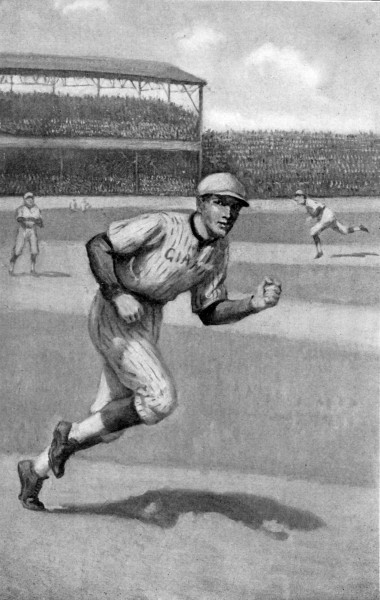
Joe had dropped the bat and started like a
deer for first. But as he rounded the bag on his
way to second, a glance at the ball told him there
was no need for hurry. So he jogged around
the bases at his leisure following the three comrades
who romped joyously to the plate, while
in his ears were the thunderous cheers of the
spectators like the roaring of the sea.
He had made a homer with the bases full.
He had pulled the game out of the fire. At the
very last moment he had snatched victory from
defeat!