Consternation sat on every face. The easy
confidence of the night before was gone. A thunderbolt
had come out of the blue. The chief
prop had been knocked from under them. The
easy way in which Hughson had tamed the men
from the wild and woolly West had made it seem
a dead certainty that he would win if he should
be called on to repeat.
There was hot scurrying to and fro among the
leaders. McRae and Robson, with drawn faces,
were deep in discussion as to the best thing to
be done. The program would have to be radically
changed.
McRae came hurrying over to Joe when the
latter entered the clubhouse.
“I was going to pitch you today,” he declared,
“but I’ve changed my mind. I’ll have to save
my ace to take the last trick, if necessary. I’m
going to keep you for the final. Markwith goes
in today and I’ll take a chance on Barclay tomorrow.
That spitter of his may fool them.”
But neither Markwith nor Barclay fulfilled the
hope of their manager. The Chicagos, who were
like wild men, now that they seemed to have another
chance with the dreaded Hughson out of
the way, batted like fiends, and the two games
went to their credit by scores of seven to two and
six to four. Jim had held them to a tie up to the
eleventh inning, but then he faltered and they
batted in the winning runs.
Now the score was even. The result of the
last game would decide the championship and tell
whether the flag would fly in the East or the
West.
It was up to Joe. Upon his shoulders rested
the fortunes of his team. Would he be equal
to the task? That question was being asked in
every city between the Atlantic and the Pacific.
Reputation, the pennant, the chance to get into
the World’s Series—all of these depended upon
the skill and strength of that right arm of his.
The enormous crowd that packed the stands
gave him a tremendous greeting when he came on
the field and began to warm up. But in all that
sea of human faces, the only one that Joe looked
for was in an upper box where a handkerchief
waved at him. And in the pocket of his baseball
shirt a tiny glove lay close to his heart.
“How did he warm up, Robbie?” asked McRae
anxiously, as the bell rang for the game to begin
and Robson came back to where he was sitting on
the players’ bench.
“All to the good,” declared Robson. “The ball
came into my mitt almost hard enough to knock
me down. They won’t be able to see them.”
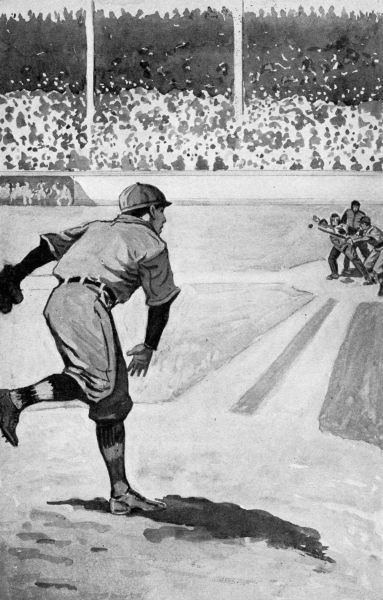
For a moment, as Joe took up his position, he
had a touch of stage fright. His head whirled
and everything seemed to swim before his eyes.
Then his vision cleared, his heart ceased its thumping,
and his nerves became like steel.
“Zimmie,” the big third baseman of the Chicagos,
who led off in the batting order, swaggered
up to the plate, swinging three bats. He threw
away two of them and gripped the remaining one
tightly and glared at Joe.
“Trot them out, kid,” he called, “and I’ll murder
them. You’re only a false alarm, anyway.”
Joe shot the first one over for a beautiful strike
and the crowd yelled in delight.
“That’s the way, old man!” sang out Larry
from second. “They can’t touch you.”
The second was a ball and the next a foul.
Then a high, fast one with a hop to it, eluded Zimmie’s
bat and sent him back to the bench looking
sheepish.
The next one up hit a slow one to short that
got to first in plenty of time, and the third man
closed the inning with a two-balls-three-strikes record.
A tempest of cheers compelled Joe to remove
his cap as he came in to the bench.
“You’re going like a runaway horse, Matson,”
said McRae. “Keep it up and the flag is ours.”
“We’ll hand you a couple of runs to start off
with,” declared Larry, as he strode to the plate.
But neither in that inning nor in the next three,
did the promised runs come in. Hamilton, the
Chicago pitcher, was at his best, and his famous
drop ball was working to perfection. It seemed
as though the game were going to resolve itself
into a duel between the pitchers, and the crowd
held its breath as man after man went down before
the rival boxmen.
“Isn’t he a wizard?” exclaimed McRae, as Joe
mowed the enemy down as fast as they came to
the plate. “They’re so much putty in his hands.
That rise ball of his has a jump on it that’s got
those fellows buffaloed. They miss it by six
inches.”
“And his fadeaway,” put in Robson. “Do you
see how he mixes it in with the fast ones? He’s
outguessing them all the way.”
Joe’s heart was beating high with elation. The
sense of mastery thrilled him. He was absolutely
in control of all his curves. They broke just
where he wanted them. The Chicagos knew that
their only chance was to rattle him, and their
coachers danced up and down on the side lines,
hurling out jibes and jeers that they hoped would
“get under his skin.” But they fell away from
him like water from a duck’s back.
But in the fifth inning the Giants “cracked.”
Denton, at third, fumbled an easy roller and
when at last he had stopped juggling the ball, he
threw over the first baseman’s head and the batter
got to third on the error. The fielders played
close in to get him at the plate, but a “Texas
leaguer” that Larry could easily have gobbled if
he had been in his usual position, dropped behind
him and the man on third came home for the first
run of the game.
The next man up rapped a fly to right, that
Curry lost in the sun, and made the round of the
bases, driving his comrade in ahead of him. Three
runs to the good for the Chicagos and not one of
them earned!
Joe put on steam and fanned the rest of the
side, but the damage had been done. In so close
a game as that, three runs seemed like a winning
lead.
McRae was raging, and stormed among his
players like a cyclone as they came in to bat.
“Get after them!” he cried, furiously. “Give
Matson something to go on. Your bats have
holes in them. You’re hitting like a lot of old
women. Knock the ball out of the lot. We’ve
got to win.”
They made a gallant effort and got two men on
bases. But although they hit the ball hard a Chicago
fielder always seemed to be in front of it.
The sixth inning was full of thrills and it looked
for a time as though the New Yorks would score,
and score heavily.
Joe had got through the first half with nothing
against him but a base on balls—a decision which
led to an acrimonious discussion between McRae
and the umpire in which the scrappy manager narrowly
escaped being ordered off the field.
In the Giant’s half, Iredell, the first man up, was
given his base on balls. McRae thought he detected
signs of wobbling on Hamilton’s part and
began to “ride” him from the first base side lines.
Larry, who was coaching at third, ably seconded
his chief, and the crowd joined in trying to make
the pitcher “crack.”
Hamilton was a veteran and used to such tactics,
and ordinarily they would not have affected
him. But there was so much at stake on this game
and the strain up to now had been so tremendous
that for a moment he faltered and passed the second
man.
The yells of the crowd increased at this, nor
was his agitation lessened when McRae entered a
vehement protest against his delivery, claiming
that he lifted his foot from the ground when releasing
the ball.
There was some ground for this and the umpire
cautioned Hamilton, who by this time was plainly
rattled. He pulled himself together, though, and
made the next batter put up a high fly to short.
The next man went out on strikes and Chicago
breathed more easily. But Hamilton was not yet
himself and a third pass filled the bases.
The crowd was crazed with excitement now, and
Meyers, the next man up, was entreated to “kill
the ball” as he came to the plate.
There were “two and three” on him when at
last he got the ball he wanted. It left his bat with
the crack of a bullet and soared high in the air
toward center. It had all the earmarks of a home
run and the crowd went wild, while the three men
on bases tore around them toward the plate like
so many runaway horses.
On, on, the ball went as though it were going
clear to the fence. But Lange, than whom there
was no swifter center fielder in either of the major
leagues, had started for it at the crack of the bat,
running with his back to the ball and looking back
over his shoulder from time to time to gauge its
course. At the last second he leaped high in the
air, clutched the ball with one hand, and fell to the
ground, rolling over and over, but coming up still
holding on to the ball.
A groan rose from the New York bench and
the yells of the jubilant crowd in the stands were
suddenly stilled. It was hard to have their soaring
hopes so suddenly brought to earth. But it
was a magnificent play, and generous applause
greeted the center fielder as he came in to be
hugged and pawed by his exulting comrades.
At the “lucky seventh” the crowd rose and
stretched loyally but in vain. Only two more innings
remained and the crowds were like mourners
at a funeral.
Five minutes later they were shouting and
screaming like maniacs.
It was the last half of the eighth, and the
Giants’ turn had come. Larry led off with a rattling
two base hit to right. Denton sacrificed him
to third. Curry lined out a single to center, bringing
Larry home. He stole second by a close margin.
Byrnes clipped a two bagger just inside the
third base line, and Willis cleaned up by lacing a
three bagger between left and center. The score
was tied and the crowd promptly went mad. The
next two men went out in order, and the Chicagos,
sore and raging, came in for their last time at
bat.
But Joe felt now that he had the strength of
ten. The ball shot over the plate like a bullet and
not a man reached first.
“Now for the World’s Series, boys!” encouraged
McRae. “Now for fifty thousand dollars!
Here’s where you win it!”
But it was the tail of the batting order that
was coming up now. The first two men were
easy outs and then Joe came to the plate.
“It looks like an extra inning game,” was the
remark that went around the stands.
Like all pitchers, Joe was only a moderately
good batter and his average hovered around the
two hundred mark.
Perhaps on this account Hamilton was too confident,
for he took a chance and put one over “in
the groove.” Joe caught it square on the end of
the bat and the ball sailed far away into right
over the fielder’s head.
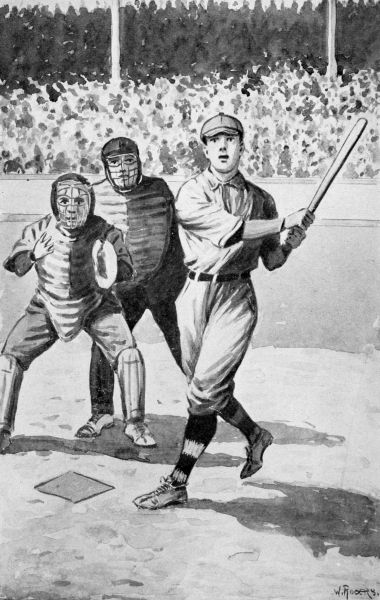
Joe was off with the crack of the bat. He
rounded first like a frightened jackrabbit and
straightened out for second. The ground fell
away from under his flying feet. He was running
like the wind. He heard the frantic roar of
the crowds, the yells of the coachers. On he went
toward third, touched it and thundered down to
the plate. He knew the ball was coming, he saw
the catcher set himself. Twenty feet from home
he launched himself into the air and slid into the
rubber, just eluding the catcher’s outstretched
hand.
The game was over, the Giants had won the
pennant, and had put themselves in line for the
great Series that would decide the championship
of the world!
How they came through that ordeal will be told
in our next volume entitled: “Baseball Joe in the
World’s Series; Or, Pitching for the Championship.”
Joe could never quite remember just what happened
for the next few minutes. The gleeful
shouts of his team-mates, the rush and roar of
the great crowd that surged down upon him, the
tugging and pulling that seemed to be rending him
apart—all this he sensed but dimly. He only
knew that he was blissfully, supremely happy. He
had played his part gallantly. He had made good
on the Giants. He had won the flag!
But had he not won more than that? Was he
not now free to speak? He touched the little
glove that lay in his pocket.
He dressed as rapidly as he could and emerged
with Jim into the street. He hailed a passing
taxi.
“Where are you going, Joe?” asked Jim.
“Going?” repeated Joe. “I’m going straight
to the Marlborough Hotel.”
THE END
UP-TO-DATE BASEBALL STORIES
The Baseball Joe Series
By LESTER CHADWICK
Author of “The College Sports Series”
12mo. Illustrated. Price per volume, 60 cents, postpaid.
Baseball Joe of the Silver Stars
or The Rivals of Riverside
In this volume, the first of the series, Joe
is introduced as an everyday country boy
who loves to play baseball and is particularly
anxious to make his mark as a pitcher. A
splendid picture of the great national game
in the smaller towns of our country.
Baseball Joe on the School Nine
or Pitching for the Blue Banner
Joe’s great ambition was to go to boarding
school and play on the school team. He
got to boarding school but found it harder making the team
there than it was getting on the nine at home.
Baseball Joe at Yale
or Pitching for the College Championship
From a preparatory school Baseball Joe goes to Yale University.
He makes the freshman nine and in his second year
becomes a varsity pitcher and pitches in several big games.
Baseball Joe in the Central League
or Making Good as a Professional Pitcher
In this volume the scene of action is shifted from Yale College
to a baseball league of our central states. Baseball Joe’s
work in the box for Old Eli had been noted by one of the
managers and Joe gets an offer he cannot resist.
Baseball Joe in the Big League
or A Young Pitcher’s Hardest Struggle
From the Central League Joe is drafted into the St. Louis
Nationals. At first he has little to do in the pitcher’s box, but
gradually he wins favor. A corking baseball story that fans,
both young and old, will enjoy.
Baseball Joe on the Giants (New)
or Making Good as a Twirler in the Metropolis
How Joe was traded to the Giants and became their mainstay
in the box makes an interesting baseball story.
Send For Our Free Illustrated Catalogue
CUPPLES & LEON CO., Publishers, NEW YORK
The Y. M. C. A. Boys Series
By BROOKS HENDERLEY
12mo. Cloth. Illustrated. Price per volume, 60 cents, postpaid.
This new series relates the doings of a
wide-awake boys’ club of the Y. M. C. A.,
full of good times and every-day, practical
Christianity. Clean, elevating and
full of fun and vigor, books that should
be read by every boy.
The Y. M. C. A. Boys of Cliffwood
or The Struggle for the Holwell Prize
Telling how the boys of Cliffwood were a wild set and how,
on Hallowe’en, they turned the home town topsy-turvy. This
led to an organization of a boys’ department in the local
Y. M. C. A. When the lads realized what was being done for
them, they joined in the movement with vigor and did all they
could to help the good cause. To raise funds they gave a minstrel
show and other entertainments, and a number of them
did their best to win a gold medal offered by a local minister
who was greatly interested in the work of upbuilding youthful
character.
The Y. M. C. A. Boys on Bass Island
or The Mystery of Russabaga Camp
Summer was at hand, and at a meeting of the boys of the
Y. M. C. A. of Cliffwood, it was decided that a regular summer
camp should be instituted. This was located at a beautiful
spot on Bass Island, and there the lads went boating, swimming,
fishing and tramping to their heart’s content. There
were a great many surprises, but in the end the boys managed
to clear up a mystery of long standing. Incidentally, the volume
gives a clear insight into the workings of the now justly
popular summer camps of the Y. M. C. A., throughout the
United States.
Send For Our Free Illustrated Catalogue
CUPPLES & LEON CO., Publishers, NEW YORK
White Ribbon Boys Series
By RAYMOND SPERRY, Jr.
12mo. Cloth. Illustrated. Price per volume, 60 cents, postpaid.
This new series deals with the great
modern movement for temperance. Clean-cut,
up-to-date stories that will please all
growing boys and girls and do them a
world of good.
The White Ribbon Boys of Chester
or The Old Tavern Keeper’s Secret
Chester was a typical factory town with its quota of drinking
places. The father of one of the boys was a foreman in
one of the factories, and he advocated temperance so strongly
that some of the men, urged on by an old tavern keeper,
plotted so that he lost his position. One day, when partly
intoxicated, the tavern keeper’s son climbs in a factory window,
smashes things, and is badly burned by acid. He is
rescued by the boys who are advocating temperance, who
take him to his mother. When the tavern keeper sees the
condition of his son, he breaks down, and confesses to the plot
against the discharged foreman. Temperance wins out, and
the town of Chester becomes far more prosperous than ever
before.
The White Ribbon Boys at Long Shore
or To the Rescue of Dan Bates
In this tale the scene is shifted to the seashore, where the
boys are having a vacation for the summer. Encouraged by
the temperance work done in their home town, they join a
local crusade to close the various drinking and gambling
houses. They fall in with another lad, the son of a well-known
drunkard of the summer resort, and do all they can to
aid him. A good, clean-cut boys’ story, full of life and action,
not at all preachy, but teaching the best of morals.
Send For Our Free Illustrated Catalogue
CUPPLES & LEON CO., Publishers, NEW YORK
The Motor Boys
SECOND SERIES
(Trade Mark, Reg. U. S. Pat. Of.)
By CLARENCE YOUNG
12mo. Illustrated. Price per volume, 60 cents, postpaid.
This, the Second Series of the now
world famed Motor Boys virtually starts
a new series, but retains all the favorite
characters introduced in the previous
books. The Motor Boys Series is the
biggest and best selling series of books
for boys ever published.
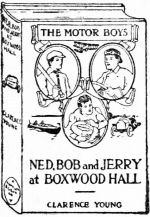
Ned, Bob and Jerry at Boxwood Hall
or The Motor Boys as Freshmen
Fresh from their adventures in their automobile, their
motor boat and their airship, the youths are sent to college to
complete their interrupted education. Some boys at the institution
of learning have heard much about our heroes, and so
conclude that the Motor Boys will try to run everything to suit
themselves.
A plot is formed to keep our heroes entirely in the background
and not let them participate in athletics and other contests.
How the Motor Boys forged to the front and made warm
friends of their rivals makes unusually interesting reading.
Send For Our Free Illustrated Catalogue
CUPPLES & LEON CO., Publishers, NEW YORK
The Motor Girls Series
By MARGARET PENROSE
Author of the highly successful “Dorothy Dale Series”
12mo. Illustrated. Price per volume, 60 cents, postpaid.
Since the enormous success of our “Motor
Boys Series,” by Clarence Young, we have
been asked to get out a similar series for
girls. No one is better equipped to furnish
these tales than Mrs. Penrose, who, besides
being an able writer, is an expert automobilist.
- The Motor Girls
or A Mystery of the Road
- The Motor Girls on a Tour
or Keeping a Strange Promise
- The Motor Girls at Lookout Beach
or In Quest of the Runaways
- The Motor Girls Through New England
or Held by the Gypsies
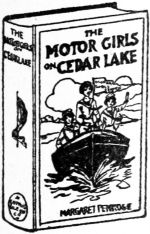
- The Motor Girls on Cedar Lake
or The Hermit of Fern Island
- The Motor Girls on the Coast
or The Waif from the Sea
- The Motor Girls on Crystal Bay
or The Secret of the Red Oar
- The Motor Girls on Waters Blue
or The Strange Cruise of the Tartar
- The Motor Girls at Camp Sunrise (New)
or The Cave in the Mountain
Send For Our Free Illustrated Catalogue
CUPPLES & LEON CO., Publishers, NEW YORK
The Motor Boys Series
(Trade Mark, Reg. U. S. Pat. Of.)
By CLARENCE YOUNG
12mo. Illustrated. Price per volume, 60 cents, postpaid.
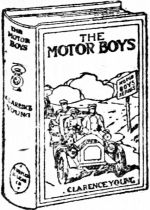
- The Motor Boys
or Chums Through Thick and Thin
- The Motor Boys Overland
or A Lone Trip for Fun and Fortune
- The Motor Boys in Mexico
or The Secret of The Buried City
- The Motor Boys Across the Plains
or The Hermit of Lost Lake
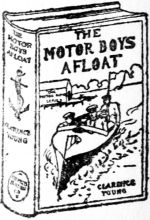
- The Motor Boys Afloat
or The Stirring Cruise of the Dartaway
- The Motor Boys on the Atlantic
or The Mystery of the Lighthouse
- The Motor Boys in Strange Waters
or Lost in a Floating Forest
- The Motor Boys on the Pacific
or The Young Derelict Hunters
- The Motor Boys in the Clouds
or A Trip for Fame and Fortune
- The Motor Boys Over the Rockies
or A Mystery of the Air
- The Motor Boys Over the Ocean
or A Marvellous Rescue in Mid-Air
- The Motor Boys on the Wing
or Seeking the Airship Treasure
- The Motor Boys After a Fortune
or The Hut on Snake Island
- The Motor Boys on the Border
or Sixty Nuggets of Gold
- The Motor Boys Under the Sea
or From Airship to Submarine
- The Motor Boys on Road and River
or Racing to Save a Life
CUPPLES & LEON CO., Publishers, NEW YORK
Every Boy’s Mechanical Library
By J. S. ZERBE, M.E.
Price, per volume, 60 cents, Net. Postage extra.
AUTOMOBILES
This is a subject in which every boy is interested. While few
mechanics have the opportunity to actually build an automobile,
it is the knowledge which he must acquire about every particular
device used, that enables him to repair and put such machines in
order. The aim of this book is to make the boy acquainted with
each element, so that he may understand why it is made in that
special way, and what the advantages and disadvantages are of
the different types. To that end each structure is shown in
detail as much as possible, and the parts separated so as to
give a clear insight of the different functions, all of which are
explained by original drawings specially prepared to aid the reader.
MOTORS
To the boy who wants to know the theory and the practical
working of the different kinds of motors, told in language which
he can understand, and illustrated with clear and explicit drawings,
this volume will be appreciated. It sets forth the groundwork
on which power is based, and includes steam generators, and
engines, as well as wind and water motors, and thoroughly describes
the Internal Combustion Engine. It has special chapters
on Carburetors, Ignition, and Electrical systems used, and particularly
points out the parts and fittings required with all devices
needed in enginery. It explains the value of compounding,
condensing, pre-heating and expansion, together with the methods
used to calculate and transmit power. Numerous original illustrations.
AEROPLANES
This work is not intended to set forth the exploits of aviators
nor to give a history of the Art. It is a book of instructions intended
to point out the theories of flying, as given by the pioneers,
the practical application of power to the various flying structures;
how they are built; the different methods of controlling them;
the advantages and disadvantages of the types now in use; and
suggestions as to the directions in which improvements are required.
It distinctly points out wherein mechanical flight differs
from bird flight, and what are the relations of shape, form, size
and weight. It treats of kites, gliders and model aeroplanes,
and has an interesting chapter on the aeroplane and its uses in
the great war. All the illustrations have been specially prepared
for the work.
CUPPLES & LEON CO., Publishers, NEW YORK
The Webster Series
By FRANK V. WEBSTER
Mr. Webster’s style is very much like
that of the boys’ favorite author, the late
lamented Horatio Alger, Jr., but his tales
are thoroughly up-to-date.
Cloth. 12mo. Over 200 pages each. Illustrated.
Stamped in various colors.
Price per volume, 40 cents, postpaid.
- Only A Farm Boy
or Dan Hardy’s Rise in Life
- The Boy From The Ranch
or Roy Bradner’s City Experiences
- The Young Treasure Hunter
or Fred Stanley’s Trip to Alaska
- The Boy Pilot of the Lakes
or Nat Morton’s Perils
- Tom The Telephone Boy
or The Mystery of a Message
- Bob The Castaway
or The Wreck of the Eagle
- The Newsboy Partners
or Who Was Dick Box?
- Two Boy Gold Miners
or Lost in the Mountains
- The Young Firemen of Lakeville
or Herbert Dare’s Pluck
- The Boys of Bellwood School
or Frank Jordan’s Triumph
- Jack the Runaway
or On the Road with a Circus
- Bob Chester’s Grit
or From Ranch to Riches
- Airship Andy
or The Luck of a Brave Boy
- High School Rivals
or Fred Markham’s Struggles
- Darry The Life Saver
or The Heroes of the Coast
- Dick The Bank Boy
or A Missing Fortune
- Ben Hardy’s Flying Machine
or Making a Record for Himself
- Harry Watson’s High School Days
or The Rivals of Rivertown
- Comrades of the Saddle
or The Young Rough Riders of the Plains
- Tom Taylor at West Point
or The Old Army Officer’s Secret
- The Boy Scouts of Lennox
or Hiking Over Big Bear Mountain
- The Boys of the Wireless
or a Stirring Rescue from the Deep
- Cowboy Dave
or The Round-up at Rolling River
- Jack of the Pony Express
or The Young Rider of the Mountain Trail
- The Boys of the Battleship
or For the Honor of Uncle Sam
CUPPLES & LEON CO., Publishers, NEW YORK
Transcriber’s Notes:
A List of Illustrations has been provided for the convenience of
the reader.
Printer, punctuation and spelling inaccuracies were silently
corrected, except as noted below.
Archaic and variable spelling has been preserved.
Variations in hyphenation and compound words have been preserved.
Author’s long dash style has been preserved.
Page 200: “Joe did not wait an instant. He was not sure” (first
line of the last paragraph) is a duplicate of the first line
two paragraphs earlier (printer's error); changed to
“Joe wanted to tell her why that life was so” (corrected line was
obtained from another printing).