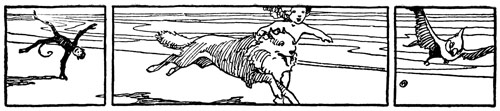
| |
PAGE |
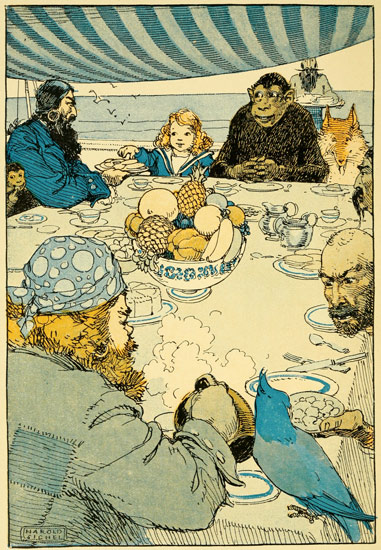
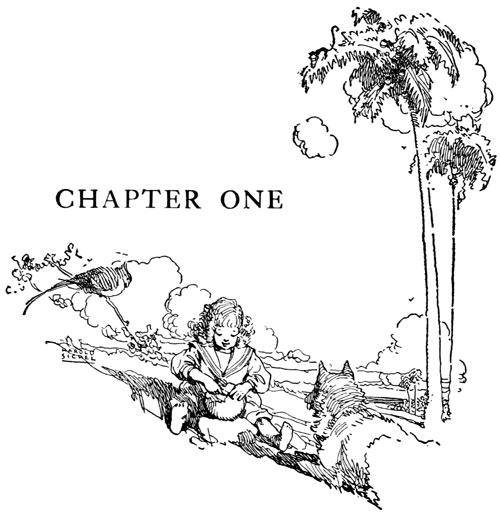
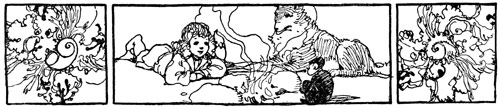
Barty and the Good Wolf had
everything you could imagine |
Frontispiece |
He was so delighted with Robinson
Crusoe that he could not remember
the time |
4 |
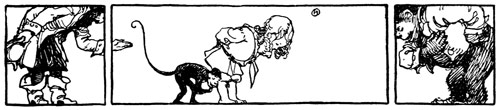
"Hello!" he called, "were you the
ones at the Snow Feast?" |
41 |
"It's getting worse," gasped the
Good Wolf |
70
|
Barty leaned forward with his
hands on his knees and gazed with
all his might |
94 |
Barty drew nearer and the next
moment gave a shout |
118 |
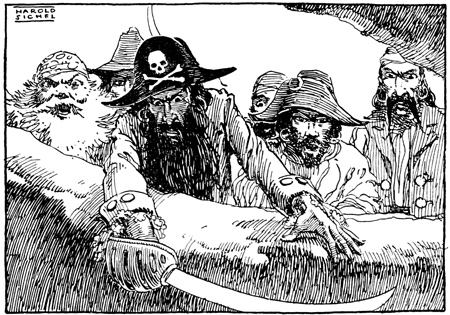
The pirates began to row towards
the shore |
132 |
"Oh!" said the captain, "I'm
really smiling" |
136 |
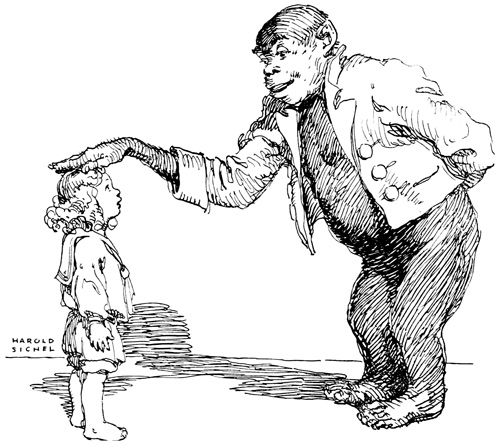
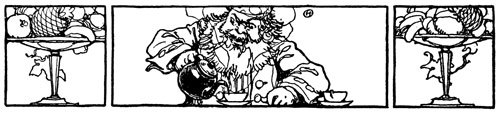
The Pirate Captain took off his
hat with a big flourish |
146
|
"It's another pirate vessel and it is
going to attack us" |
188 |
"We've won! we've won!" cried
Barty |
200 |
BARTY CRUSOE AND
HIS MAN SATURDAY
HOPE you remember that I told
you that the story of Barty and
the Good Wolf was the kind of
story which could go on and on, and that
when it stopped it could begin again.
It was like that when Tim's mother told
it to Tim, and really that was what Tim
liked best about it—that sudden way it
had of beginning all over again with something
new just when you felt quite mournful
because you thought it had come to
an end. There are very few stories like
that,—very few indeed,—so you have to
be thankful when you find one.
This new part began with Barty finding
an old book in the attic of his house. He
liked the attic because you never knew
what you might find there. Once he had
even found an old sword which had belonged
to his grandfather and which might
have killed a man if his grandfather had
worn it in war.
One rainy day he found the book. It
was a rather fat book, and it had been
read so much that it was falling to pieces.
On the first page there was a picture of a
very queer looking man. He was dressed
in clothes made of goat skin; he carried a
gun on one shoulder and a parrot on the
other, and his name was printed under the
picture and it was—Robinson Crusoe.
Now, Barty was a very good reader for
his age. He had to spell very few words
when he read aloud, so he sat down at
once on the attic floor and began to read
about Robinson Crusoe as fast as ever he
could. That day he was late to his dinner
and was late for bed, and as the days went
on he was late so often that his mother
thought he must be losing his appetite.
But he was not. He was only so delighted
with Robinson Crusoe that he could not
remember the time.
That week the Good Wolf was away
on very important business, and if Barty
had not had his wonderful book to read he
might have felt lonely. The Good Wolf
had taught him a special little tune to play
on his whistle when he wanted to call him
without calling all the other animals.
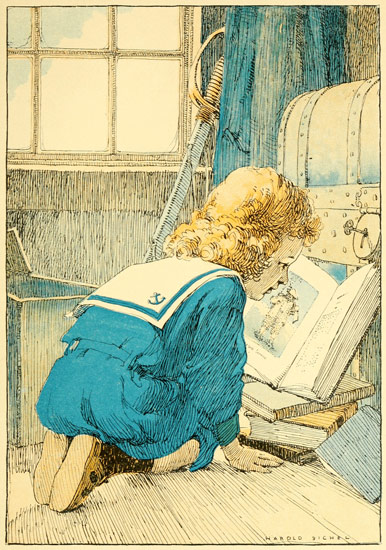
He was so delighted with Robinson Crusoe that he could
not remember the time
The day Barty finished reading his
book he tucked it under his arm and
ran into the wood to his secret place and
played his tune, and in less than two minutes
he turned round and saw the Good
Wolf trotting towards him out of the
green tunnel.
Barty ran and hugged him, and while he
was hugging him the book under his arm
fell down to the grass. "What is that?"
asked the Good Wolf, and he went to it
and sniffed it over carefully.
"It is a book I have been reading," answered
Barty. "It is about a man whose
name was Robinson Crusoe. He was shipwrecked
on a desert island."
"What is a desert island?" inquired the
Good Wolf.
"It is a perfectly beautiful place with a
sea all around it. Oh! I wonder if there
are any desert islands around here!"
The Good Wolf looked thoughtful. He
sat down and gently scratched his left ear
with his hind foot.
"Do you want one?" he asked. "Let
us make ourselves comfortable and talk it
over."
So they sat down and Barty leaned
against him with one arm round his neck
and began to explain. "A desert island is
a place where no one lives but you. There
are no other people on it and there are no
houses and no shops and you have to make
yourself a hut to live in. And beautiful
things grow wild—cocoanuts and big
bunches of grapes. And there are goats
and parrots you can tame so that they sit
on your shoulder and talk to you."
"Do the goats sit on your shoulder and
talk to you?" asked the Good Wolf, looking
a little surprised.
"No, only the parrots," said Barty.
"The goats follow you about and are
friends with you. The only trouble sometimes
is cannibals."
The Good Wolf shook his head. "I
never saw a cannibal," he remarked.
"They are not nice," said Barty, "they
are savage black men who want to eat
people—but you can frighten them away
with your gun," he ended quite cheerfully.
Then he told about Robinson Crusoe's
man Friday and about everything else he
could remember, and the story was so interesting
and exciting that several times
the Good Wolf quite panted. "Why, I
should like it myself," he said, "I really
should."
"If we only knew where there was a
desert island," said Barty.
The Good Wolf looked thoughtful again
and once more scratched his left ear with
his right foot, but there was an expression
on his face which made Barty open his eyes
very wide.
"Do you know where there is one?" he
cried out. "You look as if—"
The Good Wolf stood up and shook his
pink ear very hard—and then he shook his
blue one. "Nothing flew out," said Barty.
"I saw nothing at all."
"What flew out did not fly out here,"
answered the Good Wolf. "It flew out in
the place where it was wanted—ten thousand
miles away."
Barty caught his breath and clapped
his hands. "I know something nice is
going to happen," he shouted, "and it's
something about a desert island."
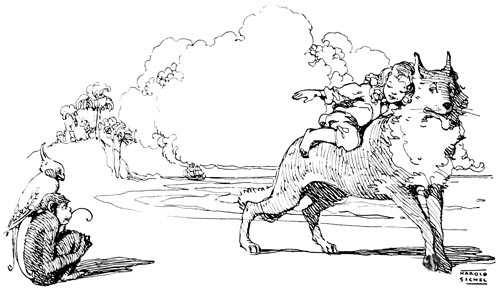
"Get on my back and clasp your arms
around my neck and shut your eyes," the
Good Wolf said. "This is not a trifling
matter."
Barty scrambled up joyfully and did as
he was told. The Good Wolf's fur felt
soft and thick when he laid his face against
it. He shut his eyes tight and then just
for a few moments he felt as if they both
were almost flying over the ground. They
went so fast, indeed, and the air sung so
in his ears as he rushed through it that it
made him feel drowsy and he soon fell
asleep.
When he felt himself waking he was
quite warm, as if the sun were shining on
him. There was a sound in his ears
still; it was not the rushing of the air but
a sound like rushing of water, which he
had never heard before. He had never
seen the sea and knew nothing about
waves except what he had read in the
story of Robinson Crusoe.
He sat up and stared straight before
him and his eyes grew bigger, and bigger,
and bigger. He was sitting on a snow-white
beach and there before him was
spread the great blue ocean, and its waves
were swelling and breaking into snowy
foam, and rushing and spreading and curling
on the sand.
After he had looked straight before
him for quite five minutes he turned and
looked round about him. What he saw
was a curve of beach and some cliffs rising
from behind it. And on top of the cliffs
were big leaved plants and straight, slender
palm trees which waved and waved like
spreading green feathers.
"I wonder if cocoanuts grow on them,"
said Barty. "That would be very nice:
Robinson Crusoe found cocoanuts."
When he said Robinson Crusoe that
made him remember. "Why, it's a desert
island," he said. "It's a desert island!"
Then, of course, he remembered about
the Good Wolf and he turned round to
look for him. And there he sat on the
sand a few feet away.
"Were we wrecked?" asked Barty.
"Well, not exactly wrecked," answered
the Good Wolf, "but here we are."
"Where is here?" asked Barty.
"Ten thousand miles from everybody,"
said the Good Wolf.
"Oh," said Barty, and his mouth was
very round.
"You said a desert island," remarked
the Good Wolf, watching him.
"Yes," answered Barty, trying to speak
cheerfully, because he did not want to hurt
the Good Wolf's feelings by seeming dissatisfied.
"And—and it is very nice and
desert, isn't it?"
"It is," answered the Good Wolf. "I
chose the kind—like Robinson Crusoe's,
you know."
"It is a very nice one," said Barty, "and
I am much obliged to you." Then he
dug his toe into the sand a little. "I am
just thinking about my mother," he said
while he was doing it.
The Good Wolf looked as cheerful as
ever. "I had something in my pink ear
which I shook out as we passed your cottage,"
he chuckled. "It's a kind of scent
like mignonette and it makes mothers forget
the time. It's very useful in case of long
journeys, because when you come back they
never say 'where have you been?' They
don't know how long you have been away.
I shook out a whole lot when we passed
your house and I heard your mother say
'how sweet the mignonette smells to-day!'"
Barty's face was quite cheerful by the
time the Good Wolf had finished. "I'm
so glad I know you," he said. "You can
do everything, can't you?" The Good
Wolf looked thoughtful again (which
makes three times), and he scratched his
ear with his hind foot more seriously than
ever.
"Look here," he said. "There is something
I shall be obliged to tell you."
"What is it?" asked Barty, feeling very
much interested.
"I can't do everything on desert islands."
"Can't you shake things out of your
ears?" exclaimed Barty.
"No," answered the Good Wolf. "I
won't deceive you. I can't."
Barty could hardly gasp out "Why?"
"Just cast your eye on them, just look
at them," said the Good Wolf. "You
have been too much excited to notice
them before. Do they look as if I could
shake things out of them?"
Barty did look at them and he did gasp
then. His voice was almost a whisper.
"No," he answered.
The tall pink ear and the tall blue ear
had dwindled until they were only ordinary
Bad Wolf ear size. "There is something
in the air of desert islands that
makes them dwindle away," the Good
Wolf explained. "I could not shake a pin
out of them now."
Barty drew a long breath, stood up
straight and dug his strong little hands
into his pockets. "Well," he said cheerfully,
"all right. I asked for a desert island
and I've got one. We shall have to
look for everything and make everything
exactly like Robinson Crusoe did. I believe
it will be more fun. Don't you?"
"Sure of it," chuckled the Good Wolf.
"Quite sure of it. If we could shake
everything out of our ears when we
wanted it, it would be scarcely any fun at
all. It doesn't make me feel mournful."
"It doesn't make me feel mournful
either," said Barty. "Think what a lot of
things we shall have to do."
"Yes," the Good Wolf answered. "We
shall have to find a place to sleep in and
things to eat and a fire to cook them
with."
"I wonder where we shall find the
fire?" said Barty.
"I don't know yet," the Good Wolf
answered, "but on Robinson Crusoe's
Desert Island you did find things somehow."
"It will be great fun looking for them—like
playing hide-and-seek," Barty said.
There seemed so many new things to
do that he did not know where to begin
first. But the little curling edges of the
waves which came spreading out on the
white sand seemed just for that minute to
be nicer than anything else. So he sat
down and began to take off his shoes and
stockings.
"I am going to wade," he said. "I
never waded in my life. I forgot desert
islands were the seaside."
It was so cool and lovely and splashy
and it was such fun to pretend he was
going to let a wave catch him and then
turn and run, shouting and laughing away
from it, that for a few moments he almost
forgot about the Good Wolf. But at last
as he was running away from a big wave, he
saw him come galloping along the beach as
if he had been somewhere and was returning.
"Where did you go?" called Barty.
"Come along with me," said the Good
Wolf, "and I will show you."
They turned and went back to where
the rocks were. There was a large circle
of them and inside the circle was a pool of
quiet, clear water. "Here is something
better than wading," said the Good Wolf.
"I felt sure this was here. It is just the
kind of a place you find on a desert island
when you want to learn to swim. Take
off your clothes and I will take you in and
teach you."
Barty took off his clothes in one minute
and a half.
"Come on," said the Good Wolf.
"Catch hold of my hair and hold tight,
just at first." And in he jumped and
Barty with him.
The water had been warmed by the sun
and was as clear as crystal. It wasn't too
deep, either.
"Do exactly as I do," the Good Wolf
said when they were splashing about together.
He could swim splendidly, and
Barty imitated him. At first he held on
to his friend's thick, shaggy coat with one
hand and paddled with the other, and
kicked his legs. When he had learned
what to do with his hands and feet the
Good Wolf made him splash about in the
shallower places until he began to feel quite
brave, and actually swam a few strokes alone.
"I never, never thought I should learn
to swim," he kept shouting joyfully. "See,
I'm keeping up all by myself."
"Of course you will learn to swim,"
said the Good Wolf. "It is one of the
first things you have to do when you are
wrecked on a desert island." By the time
they decided to come out of the water
Barty knew that it would not be long before
he could swim as if he were a little
fish. He felt so proud and happy that he
sang out loud as he run up and down in
the sun to dry himself before he put on his
clothes again. There are no towels on
desert islands.
"What shall we do next?" asked Barty
when he had finished dressing.
"Well," said the Good Wolf, "supposing
now that I could shake things out of my
ears what do you think you should ask me
to shake out first?"
Barty did not think many minutes.
"My belt," said Barty, "is rather loose
by this time. If you could shake things
out I think I should ask you to shake out
some dinner."
"It's what I should have chosen myself,"
said the Good Wolf. "What Robinson
Crusoe did on his desert island when
he wanted his dinner, was to go and look
for it until he found it."
"Yes," said Barty, "I suppose we shall
have to go and look too."
"All right, it's part of the game," said
the Good Wolf. Then he looked at
Barty a little anxiously. "Are you very
hungry?" he inquired.
"Yes," said Barty, quite like a soldier.
"So was Robinson Crusoe. That's part
of the game, too."
"Come on," said the Good Wolf. "You
are a good companion to be shipwrecked
with. There are boys of your age who
might have cried and said they wanted to
go home."
"Oh, but I said a desert island," answered
Barty. "And I meant a desert island.
And it will be splendid finding something
good to eat when your belt is as loose as
mine."
The Good Wolf smiled a smile which
reach to his ears, and off they went towards
the place where the trees were.
CHAPTER TWO
 S Barty and the Wolf walked
along together they talked
about Robinson Crusoe in
the book.
S Barty and the Wolf walked
along together they talked
about Robinson Crusoe in
the book.
"His ship was wrecked on the rocks and
broken all to pieces," said Barty. "But
we did not come in a ship, did we?"
"No," answered the Wolf.
"And barrels and boxes full of biscuits
and things floated about in the water and
he swam after them. It would be rather
nice to see a box of biscuits now, wouldn't
it?" Barty said.
"Is your belt very loose?" asked the
Good Wolf.
"It never was as loose as this before,"
said Barty.
"Buckle it a little tighter," said the
Good Wolf. So Barty buckled it one hole
tighter.
They walked along the shore till they
came to a place where they could begin to
climb the green cliff. Then they climbed
and climbed and climbed and the grass
grew greener and thicker and there were
flowers growing on every side and bushes
with birds singing on them, and the birds
were all sorts of lovely colors. Some of
them stopped singing just to look at Barty.
"They have never seen any boys before,"
remarked the Good Wolf.
"Do you think they like them?" asked
Barty.
"You ought to go and see," the Good
Wolf answered.
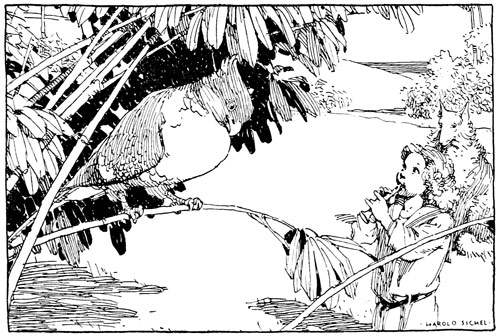
On one of the nearest bushes a bird was
sitting which was prettier than all the rest.
It had a white body and breast and soft
blue wings and crest. Barty crept towards
it with gentle little steps. He hoped very
much that he would not frighten it. It
did not look frightened. It put its head
on one side and watched him. Then Barty
took his whistle out of his pocket and
softly played the tune the Good Wolf had
taught him. The bird put his head on the
other side and listened as if he were pleased.
He was very attentive until Barty had
finished and then suddenly he flew
up in the air and fluttered 'round and
'round about, singing the tune himself.
"He is answering me!" cried out Barty,
joyfully. "He learned the tune in a
minute."
"He is a clever bird," said the Good
Wolf. "Perhaps he knows a whole lot of
things."
"I believe he likes me," said Barty.
"I believe he does."
"All birds know a good thing when they
see it," was what the Good Wolf said with
his wisest air. "All animals do. I am an
animal myself. You never threw a stone
at a bird, did you, by the way?"
Barty stood quite still and looked at
the ground, thinking very hard.
"I never threw a stone at anything,"
he said when he looked up.
"Ah," said the Good Wolf. "Such a
good plan that: Never to throw a stone at
anything. In fact it's a good plan never
to throw anything at anything. I shouldn't
be surprised if you find your Desert Island
ever so much nicer just because you're
like that. Animals know, I tell you. So
do fairies. Look at the bird!" Barty
was looking at it. It flew a few yards
ahead of him and perched on a slender
young tree, making funny little chirping
noises.
"It sounds—" said Barty, "why, it sounds
as if it were saying 'Trot along, trot along,'
just as you did when we went to the
Snow Feast."
"I did not see it at the Snow Feast,"
the Good Wolf said. "But perhaps it had
a relation there. If it says 'trot along,'
let us trot. Perhaps it is clever enough
to notice how loose your belt is, and it
thinks it can show us something to eat
which will make it tighter."
So Barty trotted along and the Good
Wolf trotted with him. The bird with
the blue crest flew before them and Barty
was quite sure it was showing them the
way somewhere, because every now and
then it stopped and perched on a bough
and sang its little song. They went up
the hill and up and up until they came to
a place where they suddenly found themselves
on the edge of a green hollow, and
the minute they saw it the Good Wolf
cried out, "There's something we want,"
and trotted down as fast as he could to a
big, clear pool which lay at the bottom
of the hollow, and began to lap quickly.
"I want it, too," shouted Barty, and
ran down the green slope himself.
He was just going to kneel down when
he saw his bird fluttering about under a
tall tree, and when he looked up he saw
the tree was a very funny one. It was like
a palm tree but it had great balls hanging
from it and something queer was going on
high up among the branches. The leaves
were shaking as if things were moving about
among them, and Barty was rather startled
because he heard chattering, squeaking little
voices. The sounds were so funny that for
a minute he forgot that he was thirsty.
"That isn't birds," he said to the Good
Wolf. "It isn't singing and it isn't chirping.
What do you think it is?"
"Just watch a minute and you will see,"
the Good Wolf answered. Barty did not
get up from his knees but he threw his
curly head back and looked with all his
might. What do you suppose he saw?
First one little tiny black face with sharp
eyes and sharp white teeth and a wrinkled
nose, and then another little tiny funny
black face with sharp eyes and sharp white
teeth and a wrinkled nose, and then
another, and then another. They peeped
at him from under the leaves, and from
over the leaves and round the big balls
which hung from the branches. They
gibbered and chattered and squeaked, and
squeaked and gibbered and chattered.
Barty's eyes got bigger and bigger and
began to sparkle, and suddenly he jumped
up and clapped his hands.
"They're monkeys!" he shouted. "They
are little jet black monkeys, just like the
ones that played in the land of the Snow
Feast. Horray! Horray! Horray! Perhaps
they are the very ones."
He put his hands up to his mouth and
made a trumpet of them and shouted
through it to the top of the tree. It was
such a very tall tree and there were so
many monkeys in it and they were making
such a noise that they never could have
heard him if he hadn't shouted.
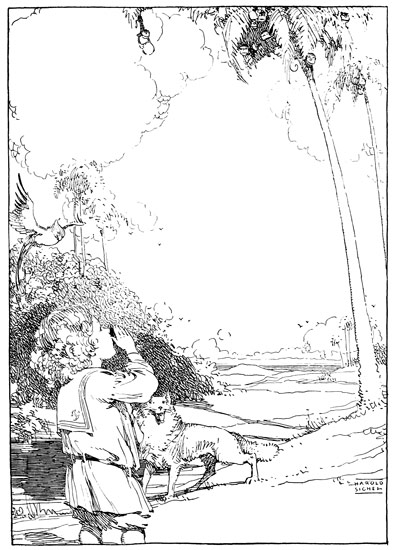
"Hello!" he called, "were you the ones at the
Snow Feast?"
"Hello!" he called. "Were you the
ones at the Snow Feast? Did you play in
the band?" There was such a lot of chattering
and squeaking at this that Barty
thought it must mean "yes." There was
rustling and jumping and scuffling, and
suddenly a tiny black arm and hand darted
out and plucked off one of the big hanging
balls and threw it down to the earth.
It bounded and bounded and rolled, and
Barty ran after it and caught it just as it
was going to roll into the pool of water.
"What is it?" he cried out. "What can
it be?"
"It is something that will make your
belt tighter," chuckled the Good Wolf.
"It is another thing we wanted. It's a
big fresh cocoanut."
He gave a jump as he said it and so
did Barty. "There comes another," he
called out, "and another and another."
They had to keep jumping about because
the jet-black monkeys were throwing the
big nuts down as fast as they could.
"They know we are hungry," said
Barty.
When the monkeys stopped throwing
they settled themselves on the branches
and watched with their little bright eyes
twinkling as if they were delighted. They
evidently wanted to see what Barty would
do.
The Good Wolf soon showed him what
to do. He found a flat rock by the edge
of the pool and laid the big nut on it and
then looked for a stone heavy enough to
break it open. When it was broken open
Barty felt sure nothing had ever looked so
nice before. He had never known what
a fresh young cocoanut was like. It was
soft and creamy and rich, like some new
kind of wonderful breakfast food.
Barty took a piece of the cocoanut shell
and used it for a spoon. He sat comfortably
on the grass and made quite a good
breakfast. The blue and white bird
watched him and the jet-black monkeys
watched him, and the Good Wolf watched
him.
Presently the blue and white bird flew
down from the twig she was sitting on
and began to peck very hard at some
green leaves growing among the grass.
She was so busy that the Good Wolf
stopped watching Barty and began to
watch her.
"That is a very clever bird," he said in
a few minutes. "I believe she knows
more about desert islands than people
who have been to school for ten years."
Barty stopped his cocoanut shell spoon
halfway to his mouth.
"I believe she is trying to dig up something,"
he said.
"Claws are stronger than beaks," said
the Good Wolf. "I will go and help her."
He went to the place where the green
leaves grew, and the minute he came near
her the blue and white bird hopped out
of his way and hopped on to the nearest
bush and sang the little whistling song she
had learned from Barty. It sounded so
like talking that Barty almost shouted
with delight.
"She says 'all right,'" he cried out.
"That is bird talk."
The Good Wolf had begun to be very
busy himself. He was digging very fast
in the earth with his claws. Soon Barty
saw he had dug up the root of the green
leaves and it looked like a nice potato.
He looked quite pleased and excited and
went on digging and digging until he had
dug up six fine roots and then he sat
down by them and panted delightedly,
with his nice big red tongue hanging out
of his mouth.
"Well," he said, when he found his
breath again, "the intelligence of that bird
is beyond everything. What would you
think of a hot roast potato, when your
belt got a little loose again?"
"I should love it," answered Barty.
"Sometimes my mother lets me roast a
potato for myself, and it is nicer than
anything."
The Good Wolf looked down at his six
roots and chuckled.
"Blue Crest has shown us something
just like potatoes, only nicer. There are
plenty of them growing about here. We
can always dig them up, and when we
have roasted them we can get some of the
salt that has dried on the rocks by the sea
to eat them with. What do you think
of that?"
Barty was too joyful for anything.
"It is just like Robinson Crusoe," he
cried out. "Just—just—just! He was
always finding things."
"That's the advantage of a Desert
Island," answered the Good Wolf. "You
find everything when you have looked for
it long enough to give you a beautiful
appetite. Nobody could live on desert
islands if they were not like that."
CHAPTER THREE
 HEN
the Good Wolf made
his remark about the convenience
of desert islands,
such a chattering broke out
among the black monkeys in the high
branches in the cocoanut tree that Barty
threw his head back as far as he could to
see what was happening.
HEN
the Good Wolf made
his remark about the convenience
of desert islands,
such a chattering broke out
among the black monkeys in the high
branches in the cocoanut tree that Barty
threw his head back as far as he could to
see what was happening.
"Why," he cried out the next instant,
"they are all sitting together at the very
top of the tree as if they were holding
a meeting. I am sure they are
talking to each other about something
important."
"Perhaps they are talking about us,"
the Good Wolf said.
"I do think they are," laughed Barty.
"They keep turning their heads to look
down on us." Then he jumped up and
stood on his feet and shouted out to them
as he had shouted before. "Hello!" he
said. "I don't know whether you are
the ones who played in the band at the
Snow Feast, but will you be friends? Let
us be friends."
They all chattered so fast at this that it
seemed as if they had gone crazy.
"You can't understand what they say,"
said Barty, "but I believe they mean that
they will."
"Ah, they'll be friends," the Good Wolf
answered. "You see, there is something
about you that makes friends."
"Is there?" cried Barty, quite delighted.
"I am glad. I wonder what it is that
does it?"
"Well, you're a jolly little chap," said
the Good Wolf. "You've got such stout
little legs, and you always seem to be
enjoying yourself."
"I am always enjoying myself," Barty
answered. "I'm enjoying myself now
'normously. What shall we do next?"
The Good Wolf scratched behind his
right ear, and Barty saw it was that
thoughtful sort of scratch of his—the one
he scratched when he was turning things
over in his mind.
"Well," he said, after being quiet for a
few moments, "Robinson Crusoe looked
for a good many things that first day,
didn't he?"
"Yes, he did," murmured Barty.
"Now what do you think we had better
look for first?" the Good Wolf asked him.
"What do you think?" said Barty.
"I want you to tell me," replied the
Good Wolf. "It's your desert island, you
know, and you ought to take some of the
responsibility."
Barty stood still and looked down at
the ground, and the crowd of black monkeys
at the top of the tree looked down
at him and stopped chattering as if they
wanted to hear what he would say. After
about a minute he looked up.
"We can't roast potatoes unless we
have a fire, and we can't have a fire unless
we have some matches, and we haven't
any matches," he said.
The Good Wolf shook his head seriously.
"No, we haven't any matches," he answered.
"Do you think we should find any if
we went to look for some?" Barty asked,
feeling rather uncertain.
The Good Wolf got up and shook his
fur coat thoroughly.
"There is no knowing what one may
find on a desert island," he remarked.
"There is absolutely no knowing." Then
he stopped a minute. "Is that all you
can think of just now?" he asked Barty.
"Just look about you."
Barty looked about him on the grass
and under the trees, but he saw nothing
which made him think of anything new.
"Look all about you," said the Good
Wolf.
So he looked not only on the ground,
but up into the tree tops and over them
into the sky. It looked very blue and hot
and beautiful, but far away he saw a
rather small cloud of a very queer color—it
was purplish-black and had ragged
edges.
"It's a storm cloud," said the Good
Wolf, looking serious, "and it's coming
towards the island. Do you see the wind
beginning to stir the tops of the trees?"
"Yes," said Barty, looking rather anxious
himself. "On Robinson Crusoe's desert
island there was a kind of storm they call
a tropical storm—I don't know what
'tropical' means, but the storms were
dreadful. Is there going to be one now?"
"There is," said the Good Wolf. "Tropical
storms are storms in the hot countries,
and they are not nice to be out in."
Barty gave a shout.
"Then it's a house we must find first,"
he said, "as quickly as ever we can. We
can't stay in the forest because the wind
roots up the trees and the lightning strikes
them and they fall crashing and crashing.
We must find a house or a place to hide
in. Could we run back to the beach and
dig a hole in the sand and creep into it?"
"The kind of storm that cloud is bringing
here," answered the Good Wolf, "will
lash the sea into waves like mountains,
and they will roll in and cover the beach
like a big tide."
"The tree tops are beginning to shake
now and the monkeys are chattering as if
they were frightened," said Barty. "It's
very queer and exciting."
"We must get away from the trees,"
said the Good Wolf. "Are you frightened?"
"Yes, I am frightened," answered Barty,
"but there isn't any time to cry. Shall we
run as fast as ever we can and look about
us everywhere while we are running?"
"Yes," answered the Good Wolf; "we
had better run to a place where there will
be nothing to fall on us. One to be ready,
two to be steady, three and—away!"
And off they both started as fast as they
could, and left the monkeys chattering and
screaming behind them.
There were trees everywhere except near
the shore, so they ran back towards where
the sea was.
"If we stay on the cliffs the mountain
waves won't dash up that high, will they?"
Barty panted as he ran.
"No, they won't," answered the Good
Wolf, "but the wind may blow us off the
cliffs into the water."
"I don't see any house anywhere," said
Barty.
"Neither do I," said the Good Wolf.
"You don't find houses on desert islands;
you have to build them."
Barty's stout little legs were flying
over the ground faster than they had
ever flown before, and he was in such
a hurry he could scarcely find breath
to speak, but he gave a little gasping
laugh.
"There isn't much time to build one
now," he said. And the Good Wolf
grinned from ear to ear.
How they did run—over the grass
and up the slopes and down the hollows
and over the green gullies! The wind
came in hot puffs and shook the tree
tops, and the purplish-black cloud looked
more ragged than ever, and was growing
bigger and coming nearer. By the time
they got to the bottom of the long green
slope which led to the top of the cliff
they had to stop a few moments to take
breath.
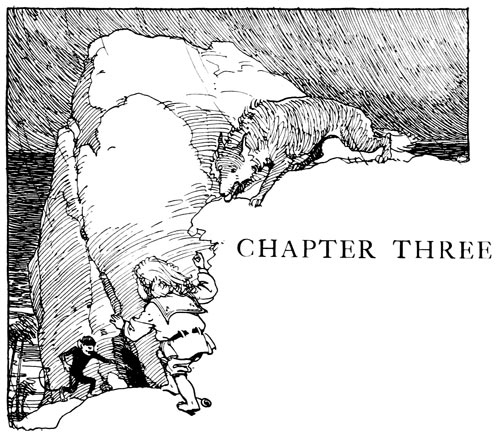
It was just then that Barty thought he
saw a little black head dart out of the long
grass and then dart back again.
"Did you see anything near that big
leaf?" he asked his companion.
"No," answered the Good Wolf.
"I thought I saw something, but perhaps
I didn't," Barty said.
Then they began to climb the long
green slope, and it was very steep, and the
hot puffs of wind seemed to rush down it
to push them back.
"Did you see anything peep out from
behind that bush?" Barty said, stopping
suddenly again.
"No," answered the Good Wolf,
"nothing."
Then they climbed and climbed. The
big puffs of wind grew hotter and fiercer,
and the cloud spread until it was
blotting out the blue of the skies quite
fast. Barty's stout little legs were very
tired.
"Did you see anything peep up from
behind that bit of rock?" he said suddenly,
for the third time.
"No," answered the Good Wolf;
"nothing at all."
"I was almost sure I did," said Barty,
"But it was gone so quickly that I
couldn't see what it was."
The Good Wolf looked at him out of
the corner of his eye.
"Was it black?" he inquired.
"Yes," answered Barty. "Perhaps you
did see it."
"No," replied the Good Wolf; "I
didn't see it exactly, but I thought that if
you were to see anything just at this time
it would be something black."
"Why?" asked Barty. "Why?"
"Trot along, trot along, trot along,"
said the Good Wolf. "We haven't found
a house yet, but at the top of the cliff
there is a hollow in the ground that we
might lie down in."
The cloud had grown so big that it had
spread itself over the sun and was making
the sky look quite dark. The hot wind
was blowing so hard that the Good Wolf
had to bend his head and stiffen himself
on his four legs to stand up against
it.
"Take hold of my hair and hold on
tight!" he called out.
His thick coat was being blown all
about, and Barty's curly hair was streaming
straight out behind him. The wind made
such a noise that they could hardly hear
each other's voices. The waves off the
shore were rolling and breaking on the
beach with a sound like thunder.
"It's getting worse," gasped the Good
Wolf. "Hold on to me and we will push
as hard as we can until we get to the
top."
"Th-this is a t-t-tropical storm," Barty
panted.
"Do you wish you were at home?" the
Good Wolf managed to ask before the
wind blew his breath away.
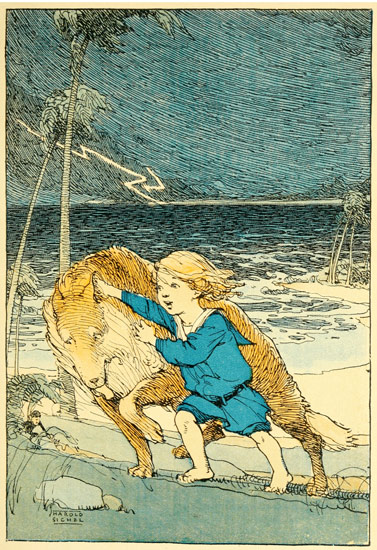
"It is getting worse," gasped the Good Wolf
"N-no-not yet," Barty managed to
shout back, almost without any breath at
all. "I s-said a desert island."
"Y-y-you are a j-jolly little ch-chap!"
the Good Wolf shouted back. "Y-you
are a-a st-stayer. Hold on to me tighter—here's
a b-big blow coming."
It was such a tremendous blow that
they had to throw themselves flat on
the ground and let it pass over them.
But they were nearly at the top of
the cliff by this time, and after a
few more battles and gasping short runs
they reached the place where the green
hollow was and threw themselves down
into it and huddled close together.
They lay there for some time before
they could get their breath again.
"The purple-black cloud looks as if it
were dragging in the sea, and flashes are
coming out of it," said Barty, when he
could speak.
As soon as he could get breath again
the Good Wolf sat up and scratched behind
his ear very seriously.
"What has happened?" cried Barty
suddenly. "It seems as if the wind had
stopped all at once."
"I'm afraid it hasn't stopped for long,"
the Good Wolf answered. "I don't like
the look of this at all."
A big drop fell on Barty's nose and
made him jump.
"That was a 'mense drop of rain!" he
cried out; "and it felt as heavy as a
stone."
"That's what I don't like," the Good
Wolf said. "When the rain comes down
it will come in a deluge, and if the wind
doesn't blow us over the cliff the deluge
will half drown us."
Barty gave another jump, but this time
it was not because a raindrop had startled
him. It was because he heard something
a few yards away behind him. It was
a squeaky, gibbering little voice, and it
sounded as if it said something very much
like this:
"Chatterdy-chatterdy-chat-chat-chatterdy.
Chat-chatter-chat!"
Barty heard it because the wind had
stopped blowing and everything seemed
for a few moments to be quite still. He
stood up to look.
"It's the black thing!" he cried out.
"It's one of the black monkeys who has
followed us. He keeps popping his head
in and out of a hole."
"I thought it was about time," the
Good Wolf remarked. "Let us go and
look at the hole."
"Chat-chat-chattery, chattery-chatterdy,"
said the black monkey, as if he were
telling them to come.
They went to look, and as they drew
near it the monkey kept darting in and
out and chattering all the time.
The hole was in a piece of rock which
stood out of the cliff. The opening was
just big enough to crawl into.
"If we can get in it will keep the rain
off us," cried Barty, and he went right
down on his stomach and crawled in to
see if there was room enough.
"Chattery-chattery-chat-chat-chatterdy,"
said the black monkey, running before
him.
Almost as soon as Barty had crawled
into the hole he gave a shout. He found
he had crawled into an open place like a
room, with walls of rock, and on one side
there was actually an opening like a window,
which looked out on the sea.
"It's a cave! It's a cave!" he called
back to the Good Wolf, and the Good
Wolf came scrambling in after him.
"It's a cave in the cliff," he said, "and
the storm may do what it likes; it can't
touch us. We found it just in time."
They were only just in time, for at that
very moment there came a great bellowing
roar of thunder and a great rushing
roar of rain. But it was all outside and
they were safe and warm, and Barty
danced for joy, and the black monkey
danced too.
CHAPTER FOUR
 HE
tropical storm went on.
The thunder crashed and
the lightning flashed and the
rain poured down in torrents.
Barty had never heard such a
noise in his life, but inside the cave everything
was dry and warm and comfortable.
The floor was covered with fine white
sparkling sand, like a wonderful new kind
of carpet. The walls and roof were made
of white rock which sparkled also. The
Good Wolf sat down on the white sand
floor and smiled cheerfully. Barty sat
down, too, and the black monkey sat
down at the same time, because he was
still perched on Barty's shoulder. He
seemed an affectionate monkey, for he
put one funny arm round the little boy's
neck and leaned a black cheek against his
curly hair.
HE
tropical storm went on.
The thunder crashed and
the lightning flashed and the
rain poured down in torrents.
Barty had never heard such a
noise in his life, but inside the cave everything
was dry and warm and comfortable.
The floor was covered with fine white
sparkling sand, like a wonderful new kind
of carpet. The walls and roof were made
of white rock which sparkled also. The
Good Wolf sat down on the white sand
floor and smiled cheerfully. Barty sat
down, too, and the black monkey sat
down at the same time, because he was
still perched on Barty's shoulder. He
seemed an affectionate monkey, for he
put one funny arm round the little boy's
neck and leaned a black cheek against his
curly hair.
"Come down and sit on my knee,"
Barty said to him, "I want to look at
you. I never had a monkey for a friend
in all my life before."
The black monkey jumped down on to
his knee as if he had learned boys' language
in his cradle. He could only chatter
monkey chatter himself, but it was
quite plain that he understood Barty. He
was funny when he sat down and folded
his tiny hands before him, as if he were
waiting to hear what was going to be said
to him.
"He has such nice eyes," said Barty.
"I believe he is asking me to tell him to
do something."
"Yes, that's what he wants," replied the
Good Wolf. "That is what he came for.
I knew he was coming. That was why I
asked you if you had seen something
black."
"Was it?" said Barty. "You know all
about this desert island, don't you?"
"Yes," the Good Wolf answered.
"Every single thing," and he said it with
such a peculiar smile that Barty knew
there was some secret in his mind and he
wondered what it was, but he did not ask
because he felt sure that the Good Wolf
would tell him some time.
The black monkey was looking at him
so eagerly and with such a funny expression
that Barty could not help laughing.
"His face is so tiny and wrinkled that
he looks like a baby a hundred years
old—only babies never are a hundred
years old," he said. "Will you stay with
me?" he asked the monkey. "If I were
really Robinson Crusoe and you were
bigger you might be my Man Friday."
"Chat-chat—chattery-chatterdy-chatterdy,"
replied the little black creature,
getting so excited that he quite jumped up
and down as if he could not keep still.
He chattered so hard and his chatter
sounded so much as if he were talking
that it made Barty laugh more than ever
and put a queer new thought into his
head.
"It seems as if he were trying to say
Saturday," he cried out. "Perhaps he is
saying it in monkey language. I'm going
to call him that. If he isn't a Man Friday
he can be a Man Saturday." And
Man Saturday seemed so pleased and the
Good Wolf thought it such a good idea,
that Barty was delighted and hugged his
new little black friend quite tight in his arms.
"Things get nicer and nicer," he
chuckled. "I wouldn't have missed coming
to this desert island for anything."
Tropical storms come very quickly and
go very quickly. Suddenly this one
seemed to end all at once. The thunder
stopped and the lightning stopped and the
rain was over and the huge black cloud
disappeared and out came the blazing sun
looking as if it were pretending that it had
never been hidden at all.
Barty and the Good Wolf went to look
out through the big hole in the wall of
the cave which was like a window. Everything
was sparkling and blue and green
and splendid again.
The sea, and the sky, and the grass, and
the trees all looked so beautiful that Barty
stood and gazed out of the window for
about five minutes, forgetting everything
else. Then suddenly he turned and
looked around the cave.
"Where is Saturday?" he cried out.
The Good Wolf turned and looked
about too, and after he had done it he
shook his ears in a mystified way.
"I don't see him anywhere," he said.
"He is not in that corner and he is not
in that one, and he is not in that one, and
he is not in the other one. If he were in
the middle we should see him, of course."
"I am sure he wouldn't run away,"
said Barty. "I feel quite sure he wouldn't.
He had such a nice look in his eyes and I
know he took me for his friend. And I
took him for mine. When people are
friends they don't run away."
"Oh no," answered the Good Wolf.
"Certainly not. Let us walk slowly all
round the cave and look very carefully.
This cave is a queer shape and it may have
corners we can't see just at first."
So they walked round side by side and
looked very carefully indeed. Once they
walked round, twice they walked round,
three times they walked round, and then
they stopped and looked at each other.
The Good Wolf sat down and scratched
his ear with his hind foot in a very careful
manner, and Barty put his hands in his
pockets and whistled a little, quite thoughtfully.
But almost the very next minute
he cheered up and his face beamed all over.
"Why," he exclaimed, "you see, if he is
my Man Saturday, he has things to do for
me! I've not lived on a desert island
long enough to know what they are, but
I daresay they are very important. I
believe he has gone to do something for
me which he knows is his duty."
The Good Wolf stopped scratching his
ear with his hind foot and became as cheerful
as Barty.
"Of course!" he exclaimed emphatically.
"You are a very clever boy to think of
that. You always think of the right
things at the right time, instead of thinking
of the right things at the wrong time or
the wrong things at the right time, which
is very confusing."
"Shall we go outside and see if he is
anywhere about?" said Barty.
"That is a good idea, too," responded
the Good Wolf. "You are full of good
ideas, and they are the most useful things
a person can have on a desert island."
They walked down the cave—it was
rather a long cave—towards the narrow
passage which led from the hole outside to
which Saturday had led Barty. As they
came to the entrance to it they both drew
back to look at something very queer
which was coming towards them through
the passage itself. It certainly was the
queerest thing Barty had ever beheld since
he had been a boy, and the Good Wolf
himself looked as if it seemed a queer
thing even to him. It would have seemed
queer to you, too. What it really was
Barty could not possibly have told, but
what it looked like was a bundle of dried
leaves bound together by long grass and
walking over the ground by itself as if it
were alive.
"It is walking, isn't it?" asked Barty,
too much astonished to be sure his eyes
did not deceive him.
"It certainly is," the Good Wolf replied,
"there is no mistake about that,
and though I am Noah's Ark Wolf and
have lived for ages and ages, I have never
seen a bundle of dry leaves walk before.
It is very interesting, indeed." He actually
sat down to watch it and Barty leaned
forward with his hands on his knees and
gazed with all his might. On it came. It
did not walk fast at all, but rather slowly
as if it found it rather hard to get along—which
seemed very natural, because no
bundle of dried leaves could have had
much practice in walking.
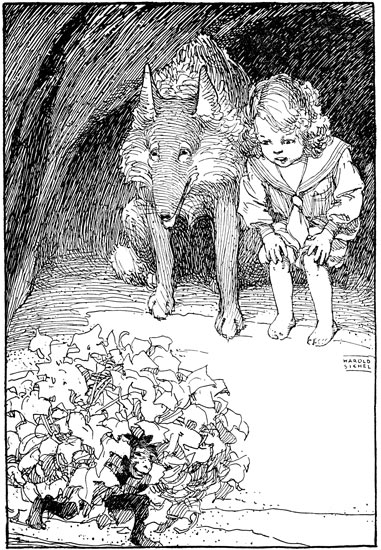
Barty leaned forward with his hands on his knees and gazed with all his might.
It walked past them and it walked the
full length of the cave until it reached the
corner nearest the window.
"It's stopping," called out Barty, and
the next minute he called out again: "It's
lying down."
It did lie down, almost as if it were
tired, but it did not lie still more than a
minute. It rolled over on its side and lay
there, and there was a scuffling and a
couple of black legs were to be seen kicking
themselves loose, and a pair of black
arms twisting themselves from under it,
and a little black wrinkled face and head
with cunning, bright eyes pushed themselves
out, and the minute Barty saw them
he shouted aloud with glee:
"Saturday! Saturday! Saturday!" he
cried out. "It was Man Saturday all the
time. He was carrying the bundle of
leaves himself and it was so big and he
was so little and the leaves hung down so
that we didn't see him."
Man Saturday came running across
to his little master. It was plain to be
be seen that he was so pleased about
something that he did not know
what to do. He caught hold of Barty's
hand and chatterdy-chattered at him
and tried to pull him towards the
corner.
"He wants me to do something," said
Barty. "He brought the leaves for something.
He wants me to find out what
they are for."
Man Saturday danced before him to
the corner where the bundle of leaves lay.
He began to pull at the twigs which tied
them together, and Barty knelt down and
helped him.
"I'm sure they are for something important,"
he said. "I am going to think
very hard."
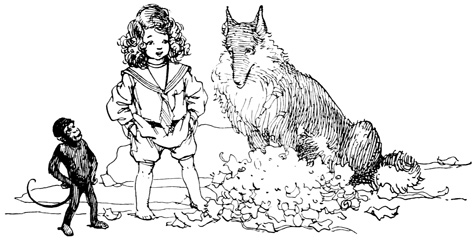
He stood up and put his hands in his
pockets and he stood astride because boys
can often think harder when they stand
that way. Man Saturday tried to imitate
him, but as he hadn't any pockets he put
his hands on his hips and held his head on
one side while he watched Barty with his
sharp little eyes, all eagerness to see if he
would find out what he meant. He
looked so funny.
"You couldn't eat them however loose
your belt was," Barty said, looking at the
leaves. "And you couldn't drink them
even if you were dreadfully thirsty—and
you couldn't wear them even if your
clothes were worn out as Robinson Crusoe's
were. Even if you had a needle and
thread to stitch them together they would
break to pieces because they are so dry
and brittle."
"Yes, they are very dry," remarked the
Good Wolf, quietly.
And then all in a minute Barty felt
sure he knew.
"If there were enough of them you
could lie down on them," he said in great
excitement. "That's what they are for!
Saturday knows where there are more of
them and they are for a bed." When he
said that, Man Saturday gave a squeak of
delight and he immediately caught at
Barty's hand and began to pull him towards
the passage which was the way out
of the cave.
"He has got a store of them somewhere,"
said the Good Wolf, "and it is a
place where the rain could not reach it.
Let us trot along and see."
Barty and Man Saturday were trotting
along already, at least Man Saturday was
trotting and Barty was creeping through
the passage, and in two minutes he was
out on the side of the cliff again and standing
upon the ledge outside the cave. It
was a very convenient ledge, and you
could walk nearly all round the cliff on it.
It was the kind of ledge you would only
find on a desert island like Barty's—a
really nice desert island.
Man Saturday led the way, and after a
few yards they came to a place where
some trees and bushes hung over the edge,
and beneath them was a hole in the rock,
rather like a very little cave, and there
were a great many leaves near the entrance
to it. Anyone could see how they had
got there. They were blown from the
trees and bushes, and when Barty bent
down and peeped into the hole he saw
that it was full of leaves which had been
blowing in there for years until the tiny
cave seemed almost stuffed with them.
No rain could reach them and so they
were quite nice and dry.
The hole was too small for Barty to
crawl into, but it was more than large
enough for Man Saturday, and chattering
to Barty as fast as he could he crawled in
and began to put together another bundle.
He got the twigs from a bush close by
and he pushed leaves out to Barty, so that
he might help him.
It was great fun for Barty. He knew
he could carry quite a bundle, and so he
made a big one and when it was done he
carried it back to his cave and pushed it
before him when he crawled through the
passage. Man Saturday brought one suited
to his own size, because he was determined
to work, too. Then they went back
and made more bundles and the Good
Wolf carried a big one on his back. In
about half an hour the corner of the cave
had a beautiful soft, heaped up, dry leaf
bed in it, and Barty was rolling over and
jumping and turning somersaults on it,
and Man Saturday was jumping about
with him. The leaves were piled so high
and were so springy to jump on that it
was like dancing in a hay stack, but rather
nicer.
"Now," said Barty, stopping a minute
to take breath after turning six somersaults
on end, "we have a beautiful bath and we
have a house and we have a bed and we
have a Man Saturday—and we found
something to eat when we looked, and I
believe we shall find something more when
we look again. I think just now I will
lie down and have a sleep. Running very
hard in storms does make you sleepy."
"That's a good idea, too," answered the
Good Wolf. "I believe I should like to
curl up and get a few thousand winks myself.
Forty wouldn't be enough."
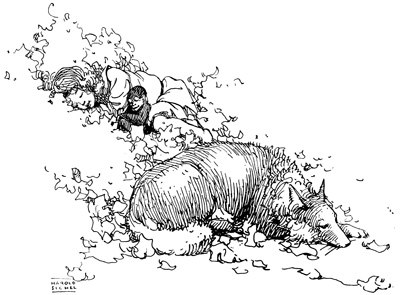
And he did curl up at the bottom of
Barty's big bed of leaves, and almost before
he had time to do it Barty had curled up,
too, like a squirrel in a nest, and he was
fast asleep—and so was little Man Saturday,
who curled up close beside him.
CHAPTER FIVE
 ARTY'S bed of leaves was so
comfortable that he slept all
night like a dormouse and
never rolled over once.
There is no knowing when he would have
opened his eyes if he had been left to himself,
but when the sun had risen and
begun to make the blue sea look as if it
were sparkling with diamonds, he suddenly
awakened and sat up to listen to something
he had heard in his sleep.
ARTY'S bed of leaves was so
comfortable that he slept all
night like a dormouse and
never rolled over once.
There is no knowing when he would have
opened his eyes if he had been left to himself,
but when the sun had risen and
begun to make the blue sea look as if it
were sparkling with diamonds, he suddenly
awakened and sat up to listen to something
he had heard in his sleep.
What he had heard was Blue Crest.
There she sat on the edge of the cave
window, whistling the calling song she had
learned from him the day before.
"Hello," said Barty, "I'm glad you've
come back. I wondered where you were
in the tropical storm." Blue Crest spread
her wings and flew into the cave to perch
on his wrist. She sang a little song of her
own. She was saying "good morning"
and letting him know she was glad he had
come to the Desert Island. Barty whistled
back to her and stroked her feathers with
his fingers and lifted her up to put his
cheek against her soft wing. Anyone
would like to be wakened by a bird who
was tame enough to sit on one's wrist and
sing.
"But where is the Good Wolf? And I
don't see Man Saturday," he said suddenly,
looking round the cave.
Blue Crest spread her wings and flew to
the cave window again. Barty scrambled
down from his leaf bed and followed her.
It was a very nice window to look through.
You could see so much sea and sky, and
the white beach seemed so far below; and
when he looked down Barty saw where
the Good Wolf and Man Saturday had
gone. They were standing in the sands
together and looked as if they were very
much interested in something lying near
them. Barty was just wondering what
they were doing when he was so startled
by something that he jumped. There was
a sudden sound of the flapping of wings
and a large white bird rushed past him
quite close to his face. It flew out of a
round hole in the front of the cliff, and
the sight of it made Barty think of something.
"If she were a hen I should know there
were eggs there," he said, "and that would
be convenient."
The truth was that getting up had
made him think of breakfast, and breakfast
made him think of eggs. Blue Crest
put her head on one side and gave three
cheerful chirps. Then she flew to the
round hole and disappeared inside. In
about a minute she appeared again standing
at the entrance, and she whistled
Barty's call.
The little boy scrambled out onto the
ledge outside the cave window. He knew
that she was calling him to come and look
at something. By standing on tiptoe he
could look into the hole, and when he
looked he saw it was full of very white
eggs, which was so exciting that he could
not help calling out to the Good Wolf
and Saturday.
"Hel-lo! Hel-lo!" he shouted. "I'm
coming and I've got some eggs for breakfast."
He was putting some into his blouse,
which seemed a good place to carry them,
when he saw the Good Wolf look up at
him and then saw him turn towards the
cliff and begin to run. He ran up the
green slope so fast that he began to gallop,
and he galloped until his tail and his
hair streamed straight out behind him
as they had done when he was running
away from the tropical storm. He was
excited.
Barty ran to meet him. He wanted to
hear what had happened, so did Blue
Crest; she flew after him. When they
met the Good Wolf, he was quite out of
breath and so was Barty. Blue Crest was
not, but she fluttered down for a rest on
Barty's shoulder.
"Have you a piece of glass in your
pocket?" the Good Wolf panted out.
"Yes," answered Barty, beginning to fumble
in his pockets. "At least I had yesterday
a piece of grandma's old spectacles.
Where is it?" fumbling deeper and deeper.
"Oh! I must have lost it! It's gone!"
"I thought so," said the Good Wolf.
"It fell out of your pocket onto the beach
and something has happened. Come and
see what it is." You may be sure Barty
did not lose any time. He had to hold
his blouse tight so that the eggs would not
break when he was running.
When he got to the beach he found
Man Saturday standing as he had seen him
from the cliff ledge. He was looking very
hard at the small pile of something Barty
had noticed that they were watching when
he first saw them.
"What is it?" he cried out, feeling very
much interested himself.
"Don't you see anything curious?"
asked the Good Wolf.
Barty drew nearer and the next minute
he gave a shout.
"Smoke is beginning to come out of
it," he said. "It looks like real smoke.
What set it on fire? What is that shining
thing? Why, it's my piece of glass," and
he made a jump towards it.
"Don't touch it," said the Good Wolf.
"The sun has been shining through it onto
the leaves and has made it into a burning-glass,
and it has lighted a fire. That is
what has happened. Now you can cook
your eggs."
"Let us roast them," said Barty.
"Roasted eggs make you feel just like a
picnic."
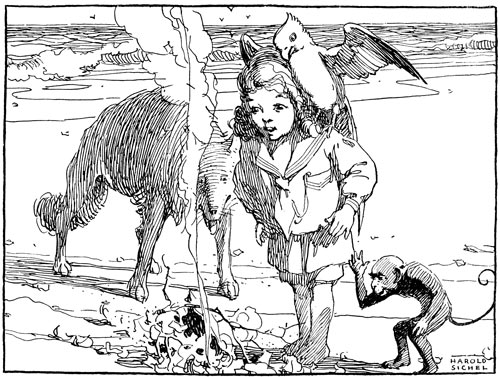
Barty drew nearer and next moment gave a shout
Man Saturday gave him a cunning little
look and then began to be very busy
indeed. He ran and brought more sticks
and leaves and Barty knelt down and blew
the tiny flame until it grew into a bigger
one, and then he fanned with his hat until
the chips and twigs were snapping.
In a few minutes there was fire enough
to cook anything and then began the
breakfast making. It was like a picnic.
They put the eggs in the hot sand to roast
and found some crystals of salt dried in
the crannies of the rocks. Man Saturday
brought some young cocoanuts and some
of the roots that were like a potato, and
they were roasted too. Man Saturday ran
about chattering and imitated everything
Barty did. He seemed quite delighted
with the idea of roasting things in hot
ashes, and when Barty and the Good Wolf
went together to their swimming pool to
have a bath while the breakfast was cooking,
he sat beside the fire and watched it,
with his arms hugging his knees and his
eyes twinkling. "He always looks as if
he were thinking very hard indeed," Barty
said. "Perhaps he is thinking now how
queer it is that a piece of glass can set
things on fire. I dare say he never saw
fire before."
Barty splashed about splendidly in the
clear green water of the swimming pool
and before his bath was ended he could
swim ever so much better than he had
swam the day before. He came out of
the sparkling water all rosy and laughing
with delight. But when he was putting
on his clothes he stopped with a stocking
half way on and began to think.
"It is very queer," he said in a puzzled
voice, "but I keep thinking of something and
I don't know what it is I'm thinking about."
"That's queer," said the Good Wolf.
"The Desert Island is beautiful, and
the cave, and Man Saturday, and Blue
Crest, and the swimming, but I feel as if I
want to tell somebody about it and I
don't know who it is. I can't remember."
"You'll remember in time," said the
Good Wolf, "if you don't bother about it.
I think the eggs must be roasted enough
by now."
They went to see and found them all
beautifully done. It was a lovely
breakfast. They drank cocoanut milk
out of cocoanut shells, instead of coffee,
and the roasted eggs tasted exactly like a
picnic.
Man Saturday ate a cocoanut and
seemed to enjoy it very much. After he
had finished he began to walk up and
down the beach and to look out at the sea
as if he were keeping watch. Barty
thought he looked anxious about something.
"What do you think he is looking for?"
he asked the Good Wolf. Just at that
minute Man Saturday stopped walking
up and down and stood quite still shading
his eyes with his small black paw.
The Good Wolf watched him for a few
minutes.
"I think," he said, "that he must be
looking out for ships."
"What does he want them for?" said
Barty.
"He doesn't want them," answered
the Good Wolf. "He is afraid of
them."
"Why," said Barty, "what sort of
ships?"
"Pirates," said the Good Wolf.
That made Barty feel just a little
uncomfortable.
"Pirates are almost as bad as cannibals,
aren't they?" he said.
"Sometimes worse," said the Good
Wolf, "though of course it depends upon
the kind of pirates."
Man Saturday was not looking out
from under his hand any more; he was
running quickly across the beach to the
cliff. When he got there he began to
climb up the face of it. Only a monkey
could have done it. He caught hold of
tiny bushes and twigs and clumps of green
things and pulled himself up like lightning.
In a few minutes he was as high as the
cave and he stood on the ledge and looked
out from there, shading his eyes again with
his black paw.
"He can see round the point from
there," said the Good Wolf.
"Do you feel at all nervous?" asked
Barty.
"I had a good night's sleep and I have
had an excellent breakfast," the Good
Wolf said, "and I am prepared for almost
anything—but Pirates and Cannibals are
known to be very disagreeable."
"But they are adventures, if they don't
catch you," said Barty, cheering himself up.
"They are adventures if they do catch
you," answered the Good Wolf.
"The Best Adventure is finding out
how to get away," said Barty.
"Well, you see a person comes to a
desert island for adventures," said the
Good Wolf.
Barty sat and hugged his knees and
looked rather serious.
"Robinson Crusoe had a good many,"
he said. "He had to be shipwrecked before
he could get to his island."
"Look at Man Saturday!" he said the
next minute. Man Saturday was dancing
up and down on the ledge and looking
very much excited. He kept pointing
round the headland and they could see
that he was chattering though they could
not hear him.
"He sees something coming round the
point," said the Good Wolf. "This is
beginning to look serious."
"But in adventures people always do
get away," said Barty, cheering himself up
again. "You see they couldn't write the
adventures if they didn't."
"There, you have thought of the right
thing at the right time again," said the
Good Wolf. "It's a most valuable habit.
Do I see a ship with black sails coming
round the point?"
"Yes," answered Barty, "you do, because
I see it myself. It is a very fierce
looking ship, with guns sticking out through
holes, and there are black flags as well as
black sails, and white bones and skulls are
painted on them. It is a very fierce ship
indeed."
"Man Saturday is beckoning to us to
go to the cave," the Good Wolf said, "perhaps
we would better go."
Barty thought so, too, so they had
another run back up the green slope and
Blue Crest flew with them. They ran as
fast as they had run in the storm, and when
they got to the creeping in place they
were inside in two minutes.
Man Saturday had clambered in through
the window and he was chattering as fast
as he could. He jumped onto Barty's
shoulder and put his arm round his neck
as if he intended to protect him. Blue Crest
perched on the leaf bed and sang a little
thrilling song which Barty knew was meant
to be encouraging and was also full of good
advice if he could have understood it.
Then all four went to the window and
looked out.
The Pirate ship had come quite close to
the shore by this time. Barty could see
that there was a crowd of men on the
deck and that they looked as fierce as the
ship. They had big hats, and big beards,
and big moustaches, and big sharp-looking
crooked swords at their sides. Some of
them had taken their swords out of their
scabbards and were flourishing them
about.
"That biggest one is feeling the edge of
his to see if it is sharp," said Barty. "I
think he must be the captain. It would
be so nice to stay in here and watch them
if they wouldn't come and find us."
"Chattery-chattery—chat-chat chatterdy,"
said Man Friday, pointing to make
them look at something which was happening
at the side of the ship.
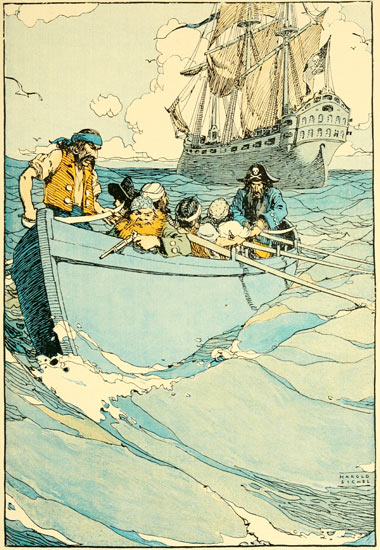
The Pirates began to row towards the shore
He was pointing at some of the pirates
who were letting down a boat into the sea.
As soon as it was in the water they let
down a rope ladder and half a dozen of
them swarmed down it. Then the captain
walked to the side and climbed down
too. He took a seat and sat with his bare
crooked sword across his knees. He waved
his arm fiercely to the other pirates and
they began to row towards the shore.
"Don't let us look out of the window
any more," said Barty. "They might see
us."
"I am afraid they saw us when we ran
up the hill," said the Good Wolf.
Barty rather gasped. You would have
gasped yourself, you know, if you had been
in a cave on a desert island and a boat full
of pirates was being rowed very fast to the
shore, just at the foot of the cliff where
your cave was.
"Well," said Barty, "this is an adventure.
I hope it will end right. But I do
wish there weren't so many pirates and
they did not look so fierce."
And he sat down quite flat on the cave
floor, and so did the Good Wolf, and so
did Man Saturday. Blue Crest sat on
Barty's shoulder and really hung her head
and drooped her wings.
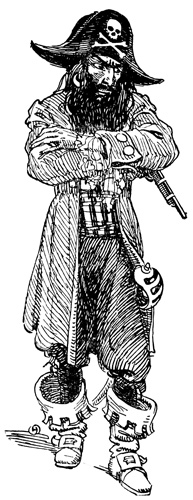
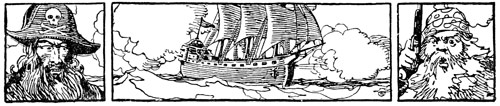
"Oh!" said the captain, "I'm really smiling."
CHAPTER SIX
ARTY
and the Good Wolf
and Saturday and Blue Crest
sat very quiet indeed. It is
always best to sit very quiet
when pirates are landing on the beach just
below your cave. You never can tell
what will happen if you do something that
attracts their attention.
But after a few minutes Barty could not
help whispering a little.
"I have only read one book about
pirates," he whispered, "and they blindfolded
prisoners and made them walk out
on a plank until they tumbled into the sea.
They slashed heads off, too. Will they
take us prisoners?"
"If they take us at all they will take us
as prisoners," said the Good Wolf.
Barty looked round the cave and thought
what a nice place it was and how comfortable
the leaf bed had been.
"I can't help thinking about that thing
which I can't remember," he said to the
Good Wolf. "I'm thinking very hard
about it just now. I wonder what it is."
The Good Wolf had no time to answer
because they heard the pirates shouting so
loudly as they tried to pull their boat
upon the beach that he had to go to the
window and peep to see what they were
doing.
"They look fiercer than ever, now that
they are nearer," he whispered. "They
have such crooked swords and such curly
black mustaches. You would better come
and peep yourself."
So Barty went and peeped. He did it
very carefully so that only the least bit of
his curly head was above the cave window-ledge
and it only stayed there for a
mite of a minute.
The pirates dragged their boat up on the
beach with savage shouts and songs, and
then they stood and looked all about them
as if they were searching for something.
They looked up the beach and down the
beach, and then they began to look at the
cliff and talk to each other about it.
Barty could see they were talking to each
other about it.
"I believe they know we are here and
are trying to find out where we are hidden,"
he said. It certainly looked as if
they were. They looked and looked and
talked and talked. At last the Captain
walked ahead a few dozen yards and
climbed upon the rock and stood there
staring up at the cliff-front as hard as ever
he could; then he took a spy-glass out of
his satchel and he looked through that.
"It seems as if he is looking right at
the window," said Barty, rather shaking,
"I'm sure he must see it."
He did see it that very minute, because
he began to shout to the other pirates and
to wave his hat and his sword.
"There's a cave!" he yelled. "There's
a cave! They are hiding in there."
Then he jumped down from the rock
and ran with the other pirates to the place
where the green slope began. Barty and
the Good Wolf and Saturday could hear
their shouts as they ran, and they knew
they were running fast though they could
not see them from the cave window.
I will not say that Barty did not turn
a little pale. A desert island is a most
interesting place and adventures are most
exciting, but pirates chasing up a green
slope to your cave, waving swords and
shouting and evidently intending to search
for you, seems almost too dangerous.
"I can't help thinking of that thing I
can't remember properly," he said to the
Good Wolf. "I wonder what it is."
"Come and stand by me," said the
Good Wolf. "Whatever happens we
ought to stand by one another."
Barty went and stood by him and put his
arm tight round his furry neck. There was
something about the Good Wolf which comforted
you even when pirates were coming.
They were coming nearer and nearer,
and louder and louder their shouts sounded.
They had come up the green slope very
fast indeed, and Barty and the Good Wolf
could even hear what they were saying.
"A little boy and a wolf," they heard.
"They ran up the hill. They must have
hidden somewhere." Then after a few
minutes they heard the pirate crew on the
ledge not far from the window.
"There must be a way in," the Captain
called out. "Swords and blood and
daggers! We must find it. Daggers and
blood and swords! Where can it be?"
Barty stood by the Good Wolf and
Saturday stood by Barty and Blue Crest
stood by Saturday, so they were all in a
row prepared to meet their fate.
Suddenly there was a great big savage
shout and there stood the pirates, all in a
row, too, six of them staring in at the
window. It was enough to frighten any
one just to look at them, with their dark-skinned
faces and white, sharp teeth gleaming,
and their black eyes and beards, and
their hats on one side.
"Swords and blood and daggers!" said
the Captain, when he saw Barty and the
Good Wolf and Saturday and Blue Crest
standing in a row looking at him. "Blood
and daggers and swords!" and he jumped
over the window ledge right into the cave
and all the other five jumped after him.
After they were all inside, there was just
one minute in which both rows stood and
stared at each other. Barty wondered, of
course, what would happen next. No one
could help wondering. Would they begin
to chop with the crooked swords? But
they did not. They did something quite
different. This is what they did:
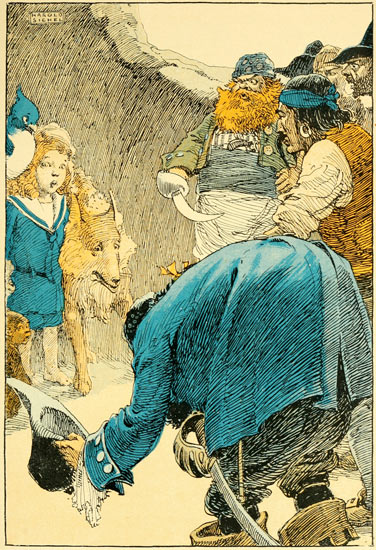
The Pirate Captain took off his hat with a big flourish
The Captain took off his big hat with
a great flourish and made a bow right down
to the ground, then the second pirate took
off his big hat with a great flourish and
made a bow right down to the ground,
then the third pirate took off his hat, and
the fourth and the fifth, until all six had
taken off their hats with a flourish and
made the most magnificently polite bow
any one had ever seen.
"I beg your pardon," said the Captain
in a most fierce voice. "I hope we are
not disturbing you. I apologize most
sincerely—I trust you will excuse us—I
really do."
Barty's eyes and mouth opened quite
wide. His mouth looked like a very red,
round O. "Why?" he gasped out, "how
polite you are."
"Thank you extremely," roared the
Captain. "We appreciate the compliment.
We are not known anywhere but
on this particular desert island, but if we
were known, we should be known for our
politeness. We are the Perfectly Polite
Pirates," and his row of pirates made six
bows again.
"I—I didn't know pirates were ever
polite," said Barty.
"They never are," answered the Captain.
"They are rude, all but ourselves. We
were rude until a few years ago—when we
met the Baboo Bajorum, and he would not
stand it any longer."
"Who is he?" asked Barty.
The Perfectly Polite Pirate Captain
made a splendid bow to Saturday.
"He is a relation of this gentleman," he
said, "only he is twenty times as big and
twenty times as strong, and if you do anything
he does not like he can break you
into little pieces and throw you away."
Barty gave Saturday an alarmed look.
"Have you a relation like that?" he said.
"Chatterdy-chat-chatterdy," Saturday
answered, and Barty knew he meant
that if he had he was not a very near
relation.
One thing which puzzled Barty very
much was that though the pirates were so
polite that they kept bowing all the time
they looked as fierce as ever, and when the
Captain said such polite things, his voice
was so rough and savage that it made you
almost jump out of your skin when he
began to speak.
"I hope you won't be cross at my
speaking about it," Barty said, "but your
voice scarcely sounds polite at all."
"Oh!" said the Captain as fiercely as
ever, "I beg five hundred thousand million
pardons, but that is nothing but a bad
habit we can't get rid of. We spoke like
this for such a long time that now we can't
make our voices sound polite at all. We
take voice lozenges six times a day, but it
seems scarcely any use, and we can't help
looking fierce and swinging our swords.
But we are really as gentle as doves."
"I—I never sh-should have thought it,"
said Barty, moving back a little, because
the pirate Captain began to swing his sword
that very minute, and it looked rather
alarming even if he were as gentle as a
dove.
He saw that Barty was startled and
stopped himself and made another bow.
"Pray excuse me," he said. "You see
what a habit it is."
"What did you come here for?" asked
Barty, feeling rather braver.
"To ask you to a tea party—to inquire
if we might have the extreme pleasure of
your society at a tea party on the ship."
"I never should have thought that
either," said Barty. "We ran away and
hid because you looked so frightening."
The Pirate Captain put his sword into
its scabbard carefully, and took out his
pocket handkerchief to wipe away the tears
which came into his eyes.
"That is always the way," he said, looking
quite overcome. "That is what
happens when you get into bad habits and
can't get out of them. We are so fond of
having tea parties, but people don't want
to come to them. When we feel that we
can't live any longer without a tea party,
we have to put to shore and chase people
with our swords and take them prisoners.
Sometimes we have to blindfold them and
put chains on them to get them on
board, for they always think they are
going to be made to walk the plank.
They are so surprised when we take off
the chains and give them tea and muffins
and strawberry jam."
Barty began to feel quite cheerful. This
was a much nicer adventure than he had
thought it was going to be. To meet real
pirates who were perfectly polite, and to
go on board a pirate ship to tea, was really
entertaining as well as exciting.
"Will you come?" inquired the Pirate
Captain perfectly politely in spite of his
savage voice, which Barty was beginning
not to mind. "You will do us such an
honor. And will this gentleman come?" he
bowed to the Good Wolf. "And these two?"
he made a bow to Saturday and Blue Crest.
"We will all come," said Barty; "every
one of us."
All the six pirates bowed down to the
floor of the cave again.
But then the Pirate Captain frowned
such an awful frown that Barty began to
feel a little frightened again.
"Don't you want us to go?" he inquired.
"You look as if something had made you
angry."
"Oh! I beg your pardon," said the
Captain. "You think I am frowning, but
I am not. I am really smiling. That is
my way of looking pleased. I can't do it
the other way. I was so fierce all the
years before I became polite that I can't
untwist my face, and when I am perfectly
delighted I scowl as if I were going to
bite people's heads off. It is most inconvenient.
Don't let it disturb you."
"I will try not to," answered Barty,
"but it startles me because I am not used
to it."
"Will you come to the ship now?" said
the Captain. "Baboo Bajorum is waiting."
That made Barty give another little
jump. "Baboo Bajorum," he said; "the
one who is strong enough to break people
into little bits?"
"He can break them into very little
bits," said the Captain. "And he does
not always save the pieces. But he never
does it if you are polite. He is really
very nice indeed."
"I always try to remember to say
'please,'" said Barty. "And I believe I
should like to see what he is like."
"He will be another adventure," said
the Good Wolf.
"Pray, do us the honor to lead the
way," said the Pirate Captain, bowing, and
he and his men stepped behind Barty and
the Good Wolf and Saturday and Blue
Crest.
So Barty crept through the passage and
the Good Wolf crept after him and Saturday
crept after him and Blue Crest hopped
after him, and then the six pirates lay
down on their stomachs and crept after
them, and when they all crawled out in a
line through the entrance on to the hill,
they made such a long row that they
reached yards and yards.
CHAPTER SEVEN
HEY
went down to the seashore
and all got into the
boat. Barty sat at one end
and the Good Wolf sat at
his feet. Saturday took a seat on Barty's
knee and Blue Crest sat on his shoulder.
The boat was a pretty white one and the
pirates rowed so well that it went up and
down over the waves in a most agreeable
manner, rather like a rocking-horse.
When they reached the ship the rest of
the pirates crowded to the side to see who
had been brought to the tea party.
"How they are all scowling," said Barty
to the Captain.
"You must remember what I told you,"
the Captain said. "Those are smiles.
They are really grinning from ear to ear
with pleasure because they see you
come without being chained and padlocked."
"Ah! I must remember," said Barty,
"that when they look cross they are only
trying to look perfectly delighted."
Two of the sailors let down a rope
ladder. Blue Crest flew up it and Saturday
ran up it in a minute. The pirates
in the boat held it steady and the pirate
Captain carried Barty up on his back.
The Good Wolf looked serious for a
second or so and then began to walk up
as calmly as if he had used rope ladders
all his life.
When Barty was once on board every
pirate on the ship began to wave his hat
and cheer. A few of them took out their
swords and began to flourish them and
then seemed suddenly to remember that
sword waving might not seem polite, and
very quickly put them back into their
scabbards.
Barty looked all around him. The
deck was very big and clean and the cannons
were polished until the brass they
were made of shone like gold. At one
end there was a gay blue and white awning
spread, and under it was a table which
looked as if it were piled with the kind of
good things you have at a tea party.
"Where is Baboo Bajorum?" asked
Barty, because he was really very curious.
"If you will have the extreme goodness
to please be so kind as to do me the
honor to step this way I will show you,"
said the pirate Captain. So they went in
a procession, the pirate Captain leading
the way with his hat in his hand, Barty
following, the Good Wolf following Barty,
Saturday following the Good Wolf, Blue
Crest hopping after Saturday, and the six
pirates in a line behind them. The
pirates made bows all the time and Barty
took off his hat for politeness.
When they reached the awning a very
big black person, who looked as if he were
Saturday who had suddenly grown immense,
rose from a chair and made a low
bow. He was covered with shaggy hair
and had strong long arms and strong long
hands. "He is a Gorilla," said the Good
Wolf in a low voice to Barty, "but I know
him quite well, and though you would not
think it, he has a delightful disposition."
At all events he knew how to manage
pirates and make them give a beautiful tea
party. Barty and the Good Wolf and
Saturday and Blue Crest were all given
comfortable seats under the blue and white
awning, and the Captain and six pirates
handed them things faster than they could
eat. Blue Crest had a muffin with strawberry
jam on it, and she perched on the
end of her plate and pecked away in perfect
delight. Saturday had sugared walnuts
which he had never tasted before and
which filled him with glee. Barty and
the Good Wolf had everything you could
imagine, only the Good Wolf did not care
for tea.
Baboo Bajorum did not talk except to
make a remark now and then to Saturday,
who understood his language. The pirates
seemed to understand him without any
words. He just sat and watched them and
they watched him to see if he were pleased
with what they were doing. Once a pirate
who was greedy stole a piece of cake
before he handed the plate to Barty, and
Baboo Bajorum stretched out his enormously
long hairy arm and seized him by
the seat of his trousers and threw him over
the rail into the sea. The pirate could
swim very well and in a few minutes came
clambering over the side of the ship again,
but he looked very wet and ashamed
and sneaked down into the hold as if he
knew better than to come back to the
party.
"That is the way he teaches us," said
the Captain to Barty, eagerly handing him
a currant bun with one of his best bows.
"It is a way that makes you improve very
quickly. He never argues. If he hits
you or throws you overboard you know
you have made some mistake and you
make haste to find out what it is."
"I dare say that does teach people
quickly," answered Barty, "but I should
not like it."
He glanced rather anxiously at Baboo
Bajorum, but Baboo was looking at him
with quite a nice expression. Barty
thought it must be a Gorilla smile, and as
he of course wished to be polite he got up
and made a low bow. Then Baboo Bajorum
got up and made a low bow
also, and all the pirates made bows
and the Good Wolf made a bow and
Saturday made one and Blue Crest
bobbled her head up and down most
gracefully.
"He likes you," the Good Wolf said to
Barty in a whisper; "he sees you are
polite by nature. I saw it myself that first
morning when we met at the edge of the
deep forest."
Barty's forehead wrinkled itself up in a
puzzled way. "The morning we met on
the edge of the deep forest," he said.
"Now you have made me begin to think
of that thing I can't remember. What is
it, what is it, what is it?"
"Never mind," said the Good Wolf;
"you will find out in time. Just now you
must enjoy your adventures."
"Yes, I must," said Barty. "They
are such splendid adventures. Just
think, here I am on a pirate ship, having
tea with pirates. What will come
next?"
What came next was very interesting,
but it was the thing that came next but
one which was thrilling.
After tea was over Baboo Bajorum made
a sign to the pirate Captain and he got up
and bowed more deeply than ever and
began to tell his story.
"This," he said, "is the story of how
we were made into Polite Pirates. When
first we were pirates we were a disgrace to
the name. We chased ships and made
them prisoners. We robbed them of their
treasures and burned them and sank them
in the sea. We made people walk the
plank or chopped their heads off. Nobody
would associate with us and we were never
invited anywhere. I think I might even say
that we were disliked. One day we
dropped anchor near a small island in the
Indian Ocean. We were very hot and
tired because the sun was blazing and the
sea was like a burning-glass and we had
been having a busy day. We had chased
a merchant vessel loaded with a rich cargo
of gold and splendid stuff and ivory, and
when we had caught it we had behaved in
our usual rude and inconsiderate way.
We had sliced any number of heads off,
and after we had carried the rich cargo to
our own ship we had blown up the
merchant ship without a word of apology.
We were so hot and tired when we
dropped anchor near the little island that
we all lay down in our hammocks and fell
into a deep sleep.
"Just before I went down to my cabin
one of the other pirates asked me to come
with him to the side of the ship and look
at something he had been noticing on the
island.
"'Do you see those big creatures dodging
in and out among the trees?' he said.
'Are they savages, or what are they?'
"I took my spy-glass and looked and
saw that there really were some big creatures
moving about among the cocoanut
palm trees. They seemed to be peeping
at us but trying to keep out of our sight
and I could not see them plainly at all.
"'They look like savages dressed in
skins of wild beasts,' I said; 'but they
cannot do us any harm so long as we
are on the sea and they are on the land.
We will go to our cabins and sleep and
leave one of the little cabin boys to
watch.'
"So we went downstairs and left a little
pirate whose name was Reginal Cyrel
Adolphin Seymour to watch. He was a
little boy who had run away from school
to be a pirate, and very often he had
been heard to remark that now he really
was a pirate he would rather learn the
multiplication table. He was as hot and
tired as any of us that day, and what he
did was to fall asleep the minute the rest
of us had gone to lie down." The pirate
Captain stopped and cleared his throat
and mopped his forehead with his red
handkerchief.
"What happened then?" asked Barty.
He saw Baboo Bajorum leaning forward
with his big hairy hands on his knees and
listening attentively. The pirate Captain
began again:
"The sun got hotter and hotter and we
slept and slept and slept. You know how
heavily one sleeps on a hot day and how
hard it is to get awake when you try. We
did not try, but suddenly we all wakened
at once. We were wakened by a great
roaring which we thought was a sudden
storm. But it was not a storm. It was a
Baboo Bajorum sound, which you have
never heard and which I hope you will
never hear. It is louder than lions and
fiercer than tigers and more piercing
than panthers and leopards. Baboo Bajorums
never make it unless they are very
angry indeed, and when you hear it you
had better look out."
"Are there more Baboo Bajorums than
one?" Barty asked. "I thought this
gentleman was the only one in the
world."
The pirate Captain opened his mouth
very wide and drew a long breath. Then
he said in a solemn voice:
"When we waked up there were forty-two
Baboo Bajorums on our ship and one
was sitting by each man's hammock and
roaring the angry roar."
"Ah," said Barty, "how frightening!"
and he felt quite alarmed.
"It was frightening," replied the pirate
Captain, "but we deserved it—for our
unpoliteness. We had disturbed the Captain
of the merchant ship at his dinner when
we cut his head off, and we had disturbed
the whole crew when we blew the ship up.
Books about politeness always say that
you must have quiet and unassuming manners.
We deserved all that happened.
We had been loud and assuming."
"What did happen?" inquired Barty,
and the Good Wolf leaned forward to
listen, and Saturday leaned forward and
Blue Crest nearly tilted over with eagerness.
"When they stopped roaring they took
us all prisoners. They had swum over
from the little island and climbed up
the ship's side as soon as they were sure
we were asleep. This gentleman," and
he made a bow to Baboo Bajorum, "is the
Great Baboo of all. He made me get
out of my hammock and fastened a chain
round my waist so that he could lead me
about. The other Baboos did the same
with the other pirates. The first place he
led me to was to a black corner down in
the hold. I had taken captive a sick old
gentleman on the merchant ship and I had
loaded him with chains and put him down
in the darkest corner of the bottom of the
ship. I was going to try and make him
sign a paper to give me the money he had
left on land. Baboo Bajorum made me
take the chains off him and take him on
deck and wait on him and make bows to
him until my back was almost broken."
"He must have been very glad," said
Barty, quite relieved.
"He was gladder than I was," said the
pirate Captain. "It was through him that
we found out what the Baboo Bajorum
really intended to teach us. We were so
frightened that we could not understand
their signs, and as they always knocked us
down or threw us overboard when we
did not obey at once, we should very soon
have been black and blue all over. The
sea was very full of sharks near the island
and when you were thrown overboard you
never knew whether you would get back
or not."
"That was dangerous enough to make
any one polite," said Barty.
"But," said the Captain, "we did not
know it was politeness they wanted until
we brought the old gentleman out of the
hold. He was very polite himself and
made the most beautiful bows to all the
Baboos. They had never seen bows before
and they were very much pleased and
began to practice bowing themselves.
When the old gentleman was bowing a
book fell out of his pocket. The Great
Baboo kicked me until I picked it up.
This is it. I never go anywhere without
it." He took a book from his pocket
and handed it to Barty, who opened it.
"'A Guide to Perfect Politeness, With
Rules for Entertaining Royal Families, the
Nobility and Gentry.' That is the name
of it," said Barty. "Are there any adventures
in it?"
"Not exactly adventures," said the
pirate Captain. "It tells you how to converse
brilliantly and how to fill up awkward
pauses and how to begin a letter to
a duke when you are writing to one,
besides about never eating with your knife
and always saying 'please' and 'I thank
you' and 'pray excuse me' and 'I beg
your pardon.'"
"Ah, I see!" said Barty. "That's why
you said all those things in the cave."
"It was indeed," answered the pirate
Captain. "The moment the Great Baboo
saw the book he went and sat by the old
gentleman and made signs to him to read
aloud. The old gentleman read to him.
In half an hour from that time I was
chained to the mast and all the other
pirates were chained on the deck round
me and I was reading to them out of the
'Guide to Perfect Politeness.' The Great
Baboo had thrown me into the sea in a
very sharky place until I understood what
he wanted. We all knew all the book
by heart before breakfast next morning,
and since then we have never broken a
single rule. That was three years ago.
The other Baboo Bajorums went back to
their island in six months, but the Great
Baboo has always sailed with us."
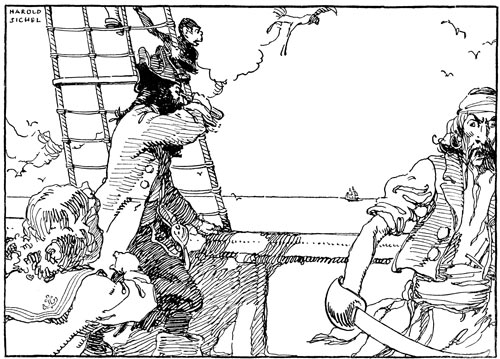
"It is another pirate vessel and it is going to attack us."
At that moment Barty heard the sound
of many feet running on the deck and the
shouting of many voices, as if something
new and alarming was happening. The
pirate sailors were all running about.
Some came tumbling up the companion-way
and some went screaming up the
rigging and some went running to the side
to look over the sea.
The pirate Captain stopped and clapped
his spy-glass to his eye.
"Hello!" he said. "I beg your pardon,
excuse me for disturbing you by mentioning
it, but there is a large ship bearing
down on us at full sail. It is
another pirate vessel and is going to
attack us."
Barty jumped up and threw his cap in
the air. "Hooray! Hooray! Hooray!"
he said. "There's going to be a pirate
battle and I'm certain we shall win."
CHAPTER EIGHT
HE
other pirate ship looked
very big and grand. All its
sails were filled with wind
and it came cutting through
the waves so fast that it looked as if it
were alive. Barty stood and watched it
and Saturday came and took hold of his
hand. Everybody on the polite pirates'
ship was running about, dragging guns
into place or pulling ropes or sharpening
swords. There was a great clatter and
noise and shouting of "I beg your pardon,"
or "pray excuse me," or "may I ask you to
be so kind," when the pirates fell over each
other, or got in each other's way, or wanted
to be helped to lift or drag something.
Blue Crest prudently went and hid in a
coil of rope and Good Wolf walked up
and down the deck and examined things.
Baboo Bajorum walked up and down, too,
with his big hands in his pockets. Suddenly
there came a white puff of smoke
from the chasing ship and a big "boom,"
and Barty and Saturday both jumped at
the same time because they knew the
cannon had begun to fire.
The pirate captain shouted and waved
his sword and then a puff of white smoke
and a big "boom" came from the side of his
ship, and Barty knew they had fired back.
Then everything became so exciting
that you could scarcely stand it.
As soon as the boom and puff of white
smoke was sent from the polite pirates'
ship, a boom and a puff of white smoke
came from the impolite pirates' ship, and
as soon as a boom came from the impolite
pirates' ship, a boom answered back from
the polite pirates' ship.
It was like this:
"Boom!" from the impolite pirates.
"Boom——boom!" from the polite pirates.
"Boom!" from the impolite pirates.
"Boom, boom, boom!" from the polite
pirates.
"Let us go and sit behind that big coil
of rope and watch," said the Good Wolf.
It was the coil of rope Blue Crest had
hidden herself inside, and when Barty and
the Good Wolf and Saturday sat on the
floor of the deck behind it, she was so glad
that she whistled Barty's little song to let
him know that she was quite near him.
But Barty could scarcely hear her because
there was so much noise. Pirates were
shouting, gunners were ramming cannon
balls into cannons, and the polite pirate
captain was yelling polite orders to his
men. Barty was obliged to shout himself,
just as he had been obliged to shout in
the tropical storm.
"Do you think we shall win?" he called
out, as loud as he could, to the Good Wolf.
"We have the best guns," the Good Wolf
called back. "The polite pirates have taken
good care of their guns instead of quarreling
about who should clean them. Listen!"
"Boom! Boom!" came from the impolite
pirates' ship.
"Boom! Boom! Boom! Bang!
Crash!" answered the polite pirates' ship.
The crash was the splitting and tearing
open of the side of the other ship. Barty
jumped up at the sound of it.
"We've hit them! We've hit them!"
he shouted.
"We have the best gunners!" called
out the Good Wolf.
"Boom!" said the impolite pirates'
ship.
"Boom! Bang! Crash! Bang! Bang!
Boom!" said the polite pirates.
Barty could not help jumping up and
down, and Saturday simply stood on his
head for joy and waved his little black
legs in the air. Then came another roar
and crash and bang, and the polite pirates
raised a great loud cheer of victory and
threw their hats in the air. The impolite
pirates' ship was rapidly filling with water,
and toppling over on one side.
"We've won! We've won!" cried Barty,
dancing. "Look at the pirates running
to launch their life-boats."
The impolite pirates were indeed running
and skurrying about like mad things.
They had left their guns altogether. The
sea was pouring in at the big holes in the
side of their ship and the ship was tilting
more and more every second.
"If they don't get into the boats in a
few minutes, their ship will turn over and
they will be drowned," said the Good Wolf.
"They are the quickest pirates I ever
saw," said Barty—"though, of course, I
haven't seen many."
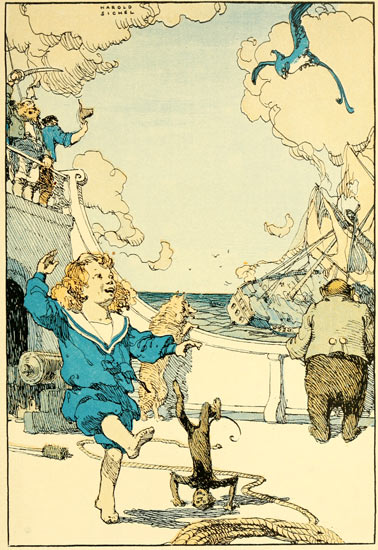
"We've won! We've won!" cried Barty, dancing
They were quick. They skurried and
scuffled and darted. They undid knots
and loosened ropes like lightning, and in
two minutes their life boats swung out and
they scrambled into them and were dropped
down into the water.
"If Baboo Bajorum was to fire a broadside
into them now," said the Good Wolf,
"he would blow them and their boats into
smithereens."
"Oh, I should not like him to do that,"
said Barty. "I'll go and ask him not to
do it."
He ran to the end of the ship where
Baboo Bajorum was standing watching the
other ship sinking, and he took off his
hat and made his deepest and politest
bow.
"I beg your pardon," he said, "excuse
me for interrupting. I know it is not
polite but would you be so kind as to do
me the great favor of not blowing the Impolite
Pirates into smithereens. If they
hadn't come I should never have seen a
pirate battle on the high seas and I always
wanted to see one."
And he made another bow which was
really a most beautiful one.
Baboo Bajorum listened to him with the
greatest politeness. He made a bow each
time Barty made one. In fact Barty
thought he looked like a very nice gorilla
indeed. He did something with his face
that looked rather like smiling and then he
put out his big hairy hand and patted
Barty's head.
"Thank you, Mr. Bajorum," Barty
said, feeling much relieved. "It's very
kind of you, because, of course, they have
given you a good deal of trouble."
Then he went back to the Good Wolf.
He was rather hot and out of breath with
excitement and he fanned himself with his
hat.
"Even Robinson Crusoe never went to
a pirate's battle," he said. "This is the
biggest adventure of all. Let's go and
look over the side and see what the other
pirates are doing."
Evidently Baboo Bajorum had given his
gunners orders to stop firing, because
they had left their cannons and with the
rest of the crew had run to the side and
were leaning over watching their conquered
enemies just as Barty wanted to
do. The Impolite Pirates, all black with
smoke and powder, were looking very
much frightened. They had got into
their boats and were rowing away from
their sinking ship, but they plainly did not
know which way to go, because they
realized that if Baboo Bajorum began to
fire his cannons at them he would blow
them to smithereens. In fact, they could
not understand why he did not blow them
to smithereens immediately, and it made
them feel very nervous. Of course they
had not the least idea that Barty and the
Good Wolf were on board, or perhaps they
would have known that Barty was the kind
of little boy who would not like to see
pieces of pirates flying about in the air,
even though he had felt that a pirates'
battle was a sort of accommodation to him.
Their ship tilted more and more and at
last sank down and down into the water,
until it was out of sight. The cannon
balls had smashed such big holes in it that
the sea filled it directly. And the Impolite
Pirates bent over their oars and
rowed and looked back over their shoulders
at Baboo Bajorum's ship in a frightened
manner. They were saying to each other,
"What is he going to do next?"
You see the trouble was, that however
fast they rowed, they could not get away
because Baboo Bajorum's ship was quietly
sailing after them and they were so tired
with fighting that they could scarcely row
at all.
"And where do they think they are
going to row to?" said the Polite Pirate
captain. "They have neither food nor
water in their boats and of course they are
afraid to row towards the Desert Island,
because we can stop them. They will
simply perish if they row out on the high
seas."
"Perish," said Barty.
He had once read a story about shipwrecked
sailors perishing on the high seas,
and it had made him cry. "I don't believe
I want them to perish. I should
not like to perish myself and neither would
you. Now, would you?"
"No," answered the captain, "I should
not. Nobody would. Perishing is about
as unpleasant a thing as could happen to
any man."
"I will go," said Barty, determinedly,
"and speak to Mr. Bajorum."
So he ran to Baboo Bajorum, and after
saluting in the usual manner he made three
bows, one after the other.
"I hope I am not intruding and that
you will please to be so kind as to excuse
me for troubling you, Mr. Bajorum," he
said, "but might I ask you another very
great favor. The Impolite Pirates are
very frightened, and they were in such a
hurry that they had not time to put any
food or water in their boats, and if they
try to row out to sea they will perish. Do
you think, sir, if you forgave them and let
them come on board and you took a good
deal of pains with them you might improve
them into Polite Pirates, just as you did
the others. You see, it would make your
crew much bigger, and it might be much
wiser for everybody when you were all
intimate friends. Do you think you could
oblige me by doing it?—excuse the liberty
I am taking."
Mr. Baboo Bajorum listened as attentively
as he had done before, and almost
as soon as he began to speak Barty saw him
do that thing with his face which made
him look as if he were smiling, and even
before Barty had finished he put out his big
hairy hand and patted him again on the head.
"Thank you very kindly, Mr. Bajorum,"
said Barty. "I am extremely obliged and
grateful and—and 'preciative. Could you
call them back now? They are very tired,
but they are rowing as fast as they can."
He forgot that Baboo Bajorum did not
speak in the ordinary way and so could
not call out "Come back, I won't hurt
you."
Perhaps Baboo Bajorum forgot, too.
He leaned over the side and waved his
long, huge, hairy arm and gave a kind of
awful roar. The pirates did not understand
him at all and were so frightened
that several of them tumbled backwards
off their seats, and one or two of them
dropped their oars and tried to hide themselves
in the bottom of their boats.
"They are so frightened they can't understand,"
said Barty. "Would you mind
lifting me up and letting me stand on the
side and wave my handkerchief at them?—if
it won't inconvenience you, please."
Baboo Bajorum lifted him up in a
minute. His long arms were so strong
that he lifted him as easily as if he were a
pin. Barty stood on the rail and took
out his pocket handkerchief and waved
and waved it, and then he made a trumpet
of his hands and shouted as loud as ever
he could.
"Come back! Come back! We won't
hurt you. Come back! Come back!"
A nice, fat, curly-headed little boy, standing
on a ship's side, waving a white handkerchief
and shouting in a loud and
friendly manner, is a very different thing
from a Baboo Bajorum shaking a long,
black, hairy arm and roaring, so the Impolite
Pirates stopped rowing and began to listen.
The captain leaned over and put his hand
behind his ear. Then he gave orders to
his sailors and they began to row cautiously
towards the ship.
"What did you say?" he shouted.
"Come back," Barty shouted in answer.
"Mr. Bajorum will not let anyone hurt
you. This," waving his hand towards the
Baboo to introduce him, "is Mr. Bajorum."
The Impolite Pirates were so astonished
that their faces dropped and they sat with
their mouths wide open. Then they took
off their hats and mopped their foreheads
with their red bandanna handkerchiefs.
Then they took up their oars and began
to row towards the ship.
They were in five boats, and they all
stopped in a line by the ship's side and
looked up at the row of Polite Pirates
who were looking down. They were so
amazed that their mouths were still wide
open, and when the Impolite Pirate captain
spoke he stammered.
"D-d-did you s-s-say we m-might c-c-come
on b-b-b-board?" he said. And
when all the Polite Pirates bowed at once
and the Captain answered him he was so
overcome that he fainted quite away into
the bottom of his boat. Because this was
what the Captain said:
"If you will do us the honor and the
kindness and will be so good as to oblige
us, we shall be more delighted than we
have words to express."
Then they let down a rope ladder and a
bottle of smelling salts and some eau de
cologne to restore the Impolite Captain,
and by the time he was restored and assisted
up the rope ladder all the Polite
Pirates were standing lined up on deck
ready to receive him and his crew with
low sweeping bows. Barty and the Good
Wolf came forward together and Barty
explained.
"They are like this," he said, "because
they are polite pirates, and in time they
are going to teach you to be polite too.
It is really very much nicer."
Just at first they almost gibbered because
they did not know what to say, but when
they were taken below and allowed to
wash the smoke and powder off their faces
and hands, and then were given cups of
tea and muffins and raspberry jam, and then
were shown all over the beautiful ship,
they could not help but begin to be calm.
But because they had never seen anything
like Baboo Bajorum and his crew before,
they could not help staring, and they could
not all keep their mouths shut at the same
time. The bows and politeness quite
made them jump sometimes, but it was
plain they began to admire them, because
it was not long before they began to try
to remember to make bows themselves.
At last they were all sitting peacefully
together on the deck, and the sun had
gone down and the moon had risen. The
ship had sailed back to the Desert Island
again and was lying at anchor in the
beautiful blue water, which was making a
soft lap-lap-lapping sound against its side.
Barty looked out at the green slope which
led up the cliff to the cave, and suddenly
he remembered how he had slept on the
bed of leaves last night and how comfortable
it had been, and he remembered, too,
that the Polite Pirates had only invited
him to tea. So he got up from his chair
and went to Baboo Bajorum and bowed—this
time he did it more beautifully than
ever, and he did it six times.
"I am ever so much obliged to you,
Mr. Bajorum," he said. "I enjoyed the
battle so much and thank you for inviting
me to the tea party. I have enjoyed myself
so much that I am rather sleepy.
Would you be so kind as to oblige us by
letting us get into the boat and go back
to the cave to bed?"
Baboo Bajorum patted him again and
shook hands with him and was most polite.
In fact, everybody was so polite and made
so many bows—even the Impolite Pirates—that
it took some time to get the boat
launched. But at last it was on the water
and everybody got safely down the ladder,
and the Polite Pirates took their seats and
began to row towards the shore and those who
stayed on the ship raised a delightful cheer.
Barty sat close to the Good Wolf and
laid his head against his furry neck. The
sky looked dark blue and the water looked
dark blue and the stars in the sky looked
as if they were shining in the water, and
Barty was so happy and drowsy that he
could scarcely tell which was sea and
which was sky.
When they reached the white beach the
Polite Pirate Captain picked Barty up in
his arms and carried him up the queer
slope, and instead of crawling through the
hole he carried him round the ledge and
lifted him in through the window.
The moon was shining in on the sparkling
white sand of the cave floor and it
shone in on the soft, heaped up bed of leaves
which looked delightful. Barty stood in
the moonlight and rubbed his eyes.
"Thank you," he said to the Polite
Pirate Captain. "There never was anything
like you in Robinson Crusoe."
"Who was Robinson Crusoe?" asked
the Captain, leaning on the window ledge.
"He was in a book," answered Barty.
"It was a very nice book, but this is nicer,"
and he rubbed his eyes harder than ever.
Just then the Good Wolf came in through
the passage. Blue Crest was on his back
and Man Saturday came after.
The Polite Pirate Captain took his hat
off with a grand flourish.
"Good-night," he said. "A thousand
thanks for a most delightful and perfectly
charming afternoon. Good-night." And
he turned round and ran round the ledge
and down the green slope.
"And just think how frightened we
were," Barty said drowsily, as he crept onto
the softest part of his leaf bed. "I
never thought pirates could be so nice."
The Good Wolf made a jump and
curled up beside him snugly. Saturday
curled up and was asleep in two minutes,
and Blue Crest was asleep in one. And
the moon shone in at the cave window
and the sound of the waves on the beach
was a soft murmur.
"Did I hear you say that this was nicer
than Robinson Crusoe?" asked the Good
Wolf, just as Barty's eyes were closing.
"It is—nicer," answered Barty, drowsily.
"But—I can't help thinking of that
thing—I can't remember. What—is—it?"
"In the morning I will tell you," said
the Good Wolf. And that very minute
Barty's eyes shut and he could not see the
white moonlight any longer because he
was fast asleep.
In the morning he wakened as suddenly
as he had fallen asleep. He sat up among
the leaves and saw the Good Wolf looking
at him.
"What is it?" he said. "I am thinking
of it again. I must find out what it is."
"Come along and get your bath in the
pool," said the Good Wolf, cheerfully, "you
shall know then."
The morning was brighter and the sea
and the sky even bluer than they had been
the day before. The slope was like green
velvet and the pool in the rocks as clear
as green crystal. Barty splashed and
clashed and swam about almost like a fish.
But he could not help saying to himself,
"What is it? What is it? I wonder
what it is?"
When he had finished his bath and put
on his clothes, he said it to the Good Wolf
who was standing and looking at him as
he had looked when he awoke.
"What is it? What is it?" he said. "I
feel as if I were just going to remember."
The Good Wolf began to sniff the air
gently.
"Is there any mignonette growing about
here?" he said.
Barty gave a little sniff, too, and then
a little jump. There was the scent
of mignonette in the air and the
last time he had smelt it had been
when the Good Wolf had carried him
away.
"It's my mother—my mother I was
thinking of!" he cried out. "Why
couldn't I remember. She'll be wondering
where I am. I must go home this
minute."
"There," said the Good Wolf. "All
right. We will go home. The reason
you could not remember was because I
made you forget on purpose. If I had not
done that you would have been wondering
all the time whether you were not too far
away and if she was looking for you, and
you would not have enjoyed the Desert
Island at all. I made her forget, too, so that
she has not even missed you. She thinks
you have only been playing in the woods a
few hours. Has it been nicer than Robinson
Crusoe?"
"Yes, yes!" cried Barty.
"Get on my back and shut your eyes,"
said the Good Wolf.
"I don't want to shut my eyes until I
have looked round at the Desert Island
again," said Barty. "It is a lovely Desert
Island. Could Saturday and Blue Crest
come with us?"
He said that because Saturday had come
running up and Blue Crest was perched
on a rock.
"They can if you like," said the Good
Wolf, "but I think you had better leave
them here. You will want them when
you come back."
"Can I come back?" Barty shouted
joyfully.
"Yes—whenever you ask me to bring
you. This Desert Island will always be
here. Jump upon my back quickly. Your
mother is just beginning to remember you."
Barty jumped up, waving his hand to
Saturday and Blue Crest.
"I'm coming back, I'm coming back,"
he said.
Then he laid his cheek on the Good
Wolf's fur and clasped his arms round his
neck and shut his eyes, and then he was
fast asleep again.
When he wakened up he was standing
in his own cottage garden, and he went
into the cottage and his mother looked up
from watering her flowers and smiled at
him.
"I was just beginning to wonder where
you were," she said. "What rosy cheeks
you have. You do look as if you had
been enjoying yourself."
And that is the end of this story