Barry had obtained the information which he had given his patron, in the
most commonplace way. After the session of the Committee, he was sitting
in the corner of the room talking to Joe Hart, when Jesse Hudson and Mr.
Collins came along talking very earnestly. Hudson said to the other:
"Much obliged for offering that Green Island bill. I'll do as much for
you some day."
That was enough for Barry. He realized the importance of this disclosure
and hastened to tell Mr. Carlton. He met with some delay in locating
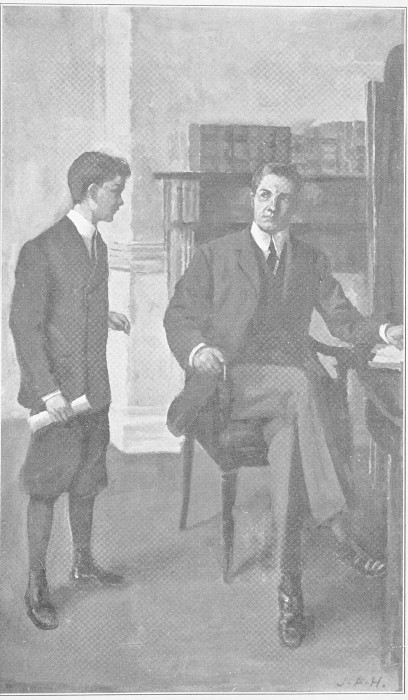
him, but finally found him in his own room with Felix Conway, where he
made his startling announcement.
Ten minutes after exploding this verbal bomb, Barry started home with
Joe Hart. On the way it occurred to him that he was beginning to have a
genuine affection for the mischievous page boy. Joe was as full of
pranks as an egg is full of meat, but Barry was quick to learn that none
of his tricks were cruel or mean. He was simply overflowing with animal
spirits. He was capable also, quick to know what was required of him,
and prompt to act. Joe Hart was not prepossessing to look upon. He had a
thick thatch of red hair, a freckled face, and stub nose, and a pair of
blue eyes that gazed upon you with a look of appealing inquiry and the
innocence of an angel.
"Joe," said Barry one day, "you must have been a terror at school."
"Yes," replied Joe, with a comical twist of the mouth, "whenever any of
the boys were bad, the teacher lathered me. He said he couldn't go
wrong."
"The Sergeant-at-Arms of the House is very fond of you," suggested
Barry.
"He must be," replied Joe, "he scolds me so much."
Barry had been in Washington three weeks, when he came home one evening
about eleven o'clock and found Mrs. Johnson, his landlady, in tears. He
was very much exercised at this unexpected sight. It was as though he
had found his own mother crying.
"Why, what's the matter?" he asked.
"It is all about Joe Hart," she said, lifting a corner of her apron and
furtively wiping away the tears.
"Why, what about him, Mrs. Johnson?"
"Well, you know he is like yourself: he is like a son to me. His mother
placed him in my charge, and in a measure I am responsible for his
conduct. Now, you know it would break her heart if he would go wrong or
get into bad habits."
"Oh, he's all right, Mrs. Johnson."
"I wish I could feel so sure," she said. "I've been anxious about that
boy for a long while. He is getting careless. He is spending all of his
money and he stays out late at night."
"Well, I stay out myself sometimes, Mrs. Johnson."
"Yes," she said, "but I know where you are, and besides, you have never
been out later than eleven o'clock. Why, one morning it was one o'clock
when he got home, and you see tonight, it is already past eleven."
"Well, I think you'll find it's all right," said Barry, soothingly.
"But I must know that it's right," she persisted. "Won't you help me?"
"I'd be glad to do anything I could for you."
"Well, you can help if you want to."
"How?"
"By finding out where Joe Hart has been spending his nights."
Barry raised his hand in protest.
"Oh, Mrs. Johnson, I couldn't do anything like that."
"Yes, you could," she replied, with a doggedness that some women can
employ so effectively.
"But I couldn't," he reiterated. "Joe 'd never forgive me."
The tears left her eyes at this response and a look of anger replaced
them.
"Well," she said, angrily, "I can pry into his business and I am going
to, and if you won't help me, I'll get somebody that will!"
Barry went to bed that night feeling very uncomfortable. He had his own
suspicions concerning Joe Hart, but he did not have the courage to give
voice to them. Besides it distressed him very much to feel that he had
incurred the displeasure of his motherly landlady. All the next day the
incident bothered him, and more than once he found himself looking
anxiously at Joe and wondering whether it would not be a good thing to
ask his young friend to explain the cause of his unusual conduct. But he
did not, and the feeling of his discomfort weighed heavily upon him
every hour of the day.
That night at dinner Barry noticed that Joe was very much preoccupied
in his manner. He bolted his food and kept looking at the clock with an
unnatural anxiety.
"What's the matter, Joe?" asked Barry. "Have to go out?"
"Yes."
"Where?"
Joe seemed confused for a moment and then said hastily:
"Oh, it don't make any difference."
A few minutes later Joe went to the door and looked out, and then came
in again and began drumming on the table cloth.
"What's the weather like?" asked Barry, in an attempt to make
conversation.
"Looks like rain," replied Joe, aimlessly.
Barry could stand this no longer. He walked to his young friend and said
in a determined voice:
"Look here, Joe Hart, what do you mean? You say it looks like rain, and
the sky's full of stars. You don't know what you're talking about.
What's on your mind?"
Joe's freckled face reddened to the ears. He showed more confusion than
Barry had ever known him to display before.
"I was thinking of something else," he mumbled. "I guess you're right
about the weather. It doesn't look like rain at all."
Barry walked away very much dissatisfied. It was evident that Joe was
trying to deceive him, and he did not relish that. Presently the boy
came over to him very shyly.
"Barry," whispered Joe, in a sort of awe-stricken voice. "Have you got
four or five dollars to spare?"
Barry hesitated.
"It's only until pay-day," said Joe, eagerly. "I'll get my check in a
week and I'll be sure to pay you back."
"It's not that, Joe," said Barry, gently. "I'd be willing to give you
every penny I've got in the world, but I hate to see you waste your
money."
"Oh, it won't be wasted," he cried.
Without another word Barry put his hand in his pocket and pulled out a
pocket-book, reached in and lifted out a five-dollar note and handed it
to the other.
"You're a bully fellow," exclaimed Joe, in his old happy-go-lucky,
care-free manner. "I knew you wouldn't go back on an old pal."
"Of eight weeks' standing," said Barry, drily.
Joe's eyes danced with delight.
"That's a long while in these days of fierce competition."
Five minutes later the door slammed and Joe had disappeared. At the same
moment Mrs. Johnson came to Barry.
"I overheard your conversation, and it has distressed me more than I can
explain. I feel more than ever that it is necessary to find out what
this boy is doing with his money and where he spends his nights."
Barry looked at her helplessly.
"I don't see how I can help you, Mrs. Johnson."
Her eyes sparkled.
"Yes, you do. I have made up my mind that I will look after him and I
have also made up my mind that you are going to help me."
Barry laughed, feebly.
"Well, if that's the case," he said, "I guess I might as well take my
orders."
"Well, I want you to go after him right away. Don't let him see you, but
find out what he does with that money."
"Oh, Mrs. Johnson," said Barry, "I couldn't do that."
She began to weep and in a moment or two threatened to become
hysterical.
"I must know," she exclaimed. "I must know, and if you don't go after
him I'll get my bonnet and go myself!"
After this there was nothing for Barry to do but put on his hat and
follow Joe Hart. The boy had a start of three or four blocks, but Barry
could see him passing under an electric light near the end of the
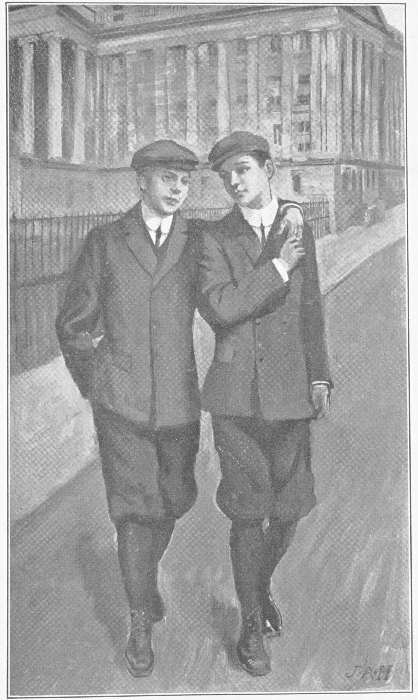
Treasury Building. They went block after block until they reached the
poorer section of the city on the outskirts of the railroad tracks.
Presently Joe stopped at a fruit stand and began examining the stock of
the Italian who presided over the place. In a few moments he had
purchased a basketful of peaches, pears, and plums. At this stage of the
pursuit Barry's better feelings came to the surface again and he
resolved that he would follow Joe no farther. He turned off into a side
street. Somehow or other he lost his way. Coming out of the other end of
the street he almost ran face to face into Joe Hart. But the little page
was so absorbed that he did not notice his friend. Joe walked up to a
small, mean-looking house in the middle of the block, facing a large,
vacant lot. Barry hid behind the trunk of a convenient tree. Joe rapped
on the door and a poorly-clad, pale-faced woman responded. Her face
brightened at the sight of Joe.
"Good evening, Mrs. Lewis," cried Joe, in his cheeriest voice, "how are
the children getting along tonight?"
"They're better, thank God," she cried, fervently. "The doctor says that
the crisis passed yesterday and they will be on the mend in a few days."
"I'm mighty glad to hear it," said Joe.
"It's very kind of you to come here," continued the woman; "and I'm
sorry I can't ask you in."
"Don't mention it. I'm a busy man, and haven't much time to spare.
Here's a basket of fruit. Here's the prescription you wanted last night,
too."
"May Heaven bless you," cried the woman, the tears coming into her eyes.
"I don't know how in the world I can ever repay you for your goodness to
us."
"Don't mention it," cried Joe, brusquely. "Here's a five-dollar bill.
You may need it."
"Oh," she said, "I can't really take this."
"You must!"
"But I won't be able to give it back to you."
"Well," said Joe, with a laugh, "we'll put that up to Danny. We'll make
Danny pay me when he gets better."
And the next moment Joe had started off in the darkness. Barry came out
from his hiding place. The woman saw him.
"Are you looking for Joe?"
"Yes; has he gone?"
"Yes," she said, "he has just gone." And then, looking at him
inquiringly, "Do you know him?"
"Yes, ma'am; he's my chum."
"Well," she said, "if you know him you know an angel in disguise. My
Danny says that and Danny ought to know."
"Danny?" said Barry, inquiringly.
"Yes," she replied, "my boy, Danny Lewis. He is head of the local
messenger boys in the district telegraph office. He was taken sick two
weeks ago and the doctor said it was typhoid fever. Someone had to take
his place at the office, and when Joe Hart heard of it he volunteered
to act as substitute. For more than a week he has been acting as page in
the House during the day and chief of the telegraph boys at night. He
did it to keep Danny from losing his position. You know these things are
mighty uncertain. Now the week for Danny's night shifts is passed and
everything is safe, but Joe didn't stop at that. He knew we were poor,
and he has been buying food and fruit almost every night."
The strange lump that came into Barry's throat prevented him from making
any reply. But his hand was perfectly free, and when he put it into Mrs.
Lewis' she found that he had left another five-dollar bill in her palm.
Half an hour later, as he turned into the street where Mrs. Johnson's
boarding house was located, he almost collided with Joe Hart, who was
coming in another direction. He looked at him very fixedly and said in a
stern voice:
"Where have you been?"
"I've been out."
"That don't answer my question," said Barry, severely. "I want to know
where you've been spending your nights."
"Oh, nowhere in particular," said Joe, hastily, and then, in an endeavor
to turn the subject, he said:
"How do you like your work at the Capitol?"
"It's none of your business how I like my work," laughed Barry, "but it
is my business to tell you that you've been discovered!"
"Discovered!" echoed Joe.
"Yes. Caught, captured, found out! Don't you know the meaning of the
English language?"
"Yes, but I don't know what you're talking about."
"I'm talking about the way you've been spending your time the last two
weeks. I know all about you."
"How do you know?"
"Well, I saw you tonight and know all that you did."
For an instant Joe threatened to become belligerent. He doubled up his
fists and came towards Barry in a menacing way. Then he reconsidered
himself and his hands dropped listlessly to his sides. He spoke in a
reproachful way:
"I think that was mighty mean of you, Barry Wynn."
"I think so, too," confessed Barry. "I'm ashamed of myself all right,
but Mrs. Johnson was worried, and Joe—Joe, I'm mighty proud of you."
Barry, as he spoke, put his arm around Joe's shoulder, but the boy
pushed it away. His face was flushed and he looked embarrassed.
"Say, Barry," he said finally, "I want you to make a solemn promise to me."
"What is it?"
"Never mind what it is. I want you to say that you will do as I say."
"All right," said Barry, finally; "I'll promise. What is it?"
Joe looked the picture of humiliation. His eyes were on the ground and
he spoke pleadingly:
"Barry, it's just this. I want you to promise me that you'll never
mention this business to the other boys at the Capitol."
"Why?" asked Barry.
"Because, I'd never hear the last of it. Those fellows would just guy
the life out of me."
Barry, his heart swelling with a new and peculiar sensation, made the promise.