BY
D. W. STIRKE Native Commissioner Northern Rhodesia
WITH AN INTRODUCTORY CHAPTER BY
SIR HARRY JOHNSTON, G.C.M.G., K.C.B. At one time H.M. Commissioner &c., for Northern Zambezia
LONDON:
JOHN BALE, SONS & DANIELSSON, LTD. OXFORD HOUSE
83-91, GREAT TITCHFIELD STREET, OXFORD STREET, W.1
PREFACE BY THE AUTHOR.
In presenting this book to the public I would
like to register my appreciation of the kindness
of various friends who have materially assisted me
in its production. My brother-officials Messrs.
Helm and Palmer and my friend the Rev. V. Ellenberger,
of the Paris Huguenot Mission, have greatly
assisted me with advice and information, while my
sincere gratitude is due to Mr. Coxhead (Secretary
for Native Affairs), Mrs. Marshall, Mr. Walton
(Assistant Native Commissioner), and Mr. Thomas
(Vice-Principal of the Barotse National School)
for photographs.
The greatest care has been taken in checking
and rechecking any and all portions of the book
and several items have been deleted as lacking
confirmation, which was unavoidable in handling
such a mixed race as the present day Barotse.
I would also wish it to be fully understood that
this work has been compiled by me, aided by
my friends as mentioned before, but with no
official assistance from the Administration, and
this work must in no way be considered “Official”
or “Approved by the British South African Co.”
The information to be found in the book is however
fairly accurate, in spite of not being written
under the ægis of the Administration.
Since finishing the book the death of the
Paramount Chief Lewanika has occurred, and he
has been succeeded in his position by his eldest
son, Yeta, who has taken the title of Yeta II.
Lewanika was a man of about 70 years of age,
and had a hold on his people that no Murotse
chief will ever have again. He will, for generations,
be remembered as the chief who did most
for the improvement and consolidation of his
people. Lewanika travelled to England for the
late King Edward’s coronation, and it was always
a great delight to him to talk about the friends he
made and the sights he saw while going to, staying
in, and returning from England.
Early in his reign he was deposed by a relative
of his named Tatila; but Tatila had not the grip
over his people nor the statesmanship to hold the
chieftainship, with the result that Lewanika was
reinstated after a couple of battles. To the
surprise of all he showed great clemency and
pardoned most of the rebels. A notable example
of his clemency is the induna Noyōō, who was
very prominent in killing off Lewanika’s women
and children during Tatila’s brief rule. Lewanika
told me himself that his reason for sparing Noyōō
was because he and Noyōō had herded cattle
together when very small boys.
Lewanika led many successful raids against the
neighbouring tribe of the Mashukulumbwe, and
he was the first Barotse Chief who accepted their
homage and counted them as a portion of his
people.
He had a great belief in acquiring knowledge
of other native races and chiefs, and sent embassies
to Chitimukulu the Awemba Chief and to Khama
the Bamangwato Chief (the Bamangwato being
better known nowadays under the general term
Bechuana).
Lewanika was a man of most charming and
courteous manners and had always a very sincere
regard for Europeans, while his loyalty to the
Empire has repeatedly proved itself, more especially
since the beginning of the German War. A visit
by a European, accompanied by his wife, was
always considered a great compliment by the late
chief.
Missionaries always received support from
Lewanika, and were given grants of land for
their stations and many other privileges. The
Chief himself never professed Christianity, but
set an example to his people by attending church
services and by supporting the Missions generally.
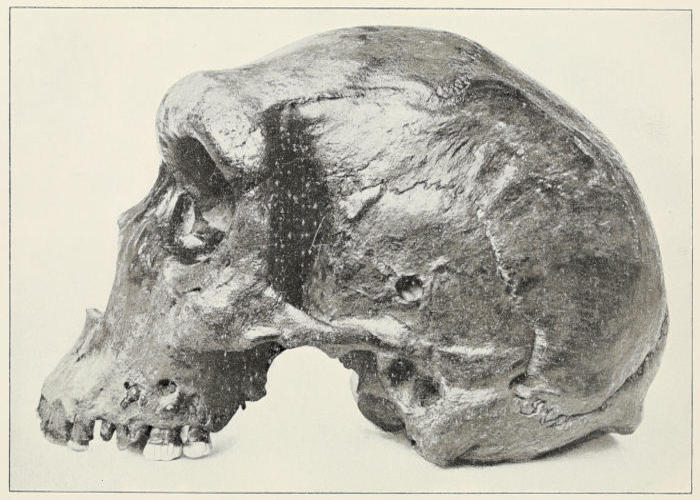
The Skull of an ancient North Rhodesian
Type of Man (Homo rhodesiensis).
(From a photograph kindly lent by Dr. Smith
Woodward, British Museum).
Face p. 1
INTRODUCTION.
By Sir HARRY JOHNSTON, G.C.M.G., K.C.B.
Sometime H.M. Commissioner, &c., for Northern Zambezia.
Barotseland at the present day is
mainly defined as the kingdom of the
recently dead Lewanika which lies both to the
east and west of the Upper Zambezi, north of
Sesheke, the Katima Rapids, the “Caprivi”
boundary line of former German South West
Africa. The western boundary line of Barotseland
is the east bank of the Kwando river up stream
to its intersection with the 22nd degree of E.
longitude; the northern boundary is the 13th
degree of S. latitude; and the eastern limit is a
line drawn from the 13th degree of S. latitude to
the upper waters of the Kabompo-Lulafuta, and
then southward to the Majili river and along the
Majili down to its union with the Upper Zambezi
near Sesheke.
The master people, still, in this Upper Zambezi
state are the A-luyi, who seem to have entered the
lands of the Upper Zambezi from the direction of
Eastern Angola, if vague tradition be anything
to rely on. At any rate the A-luyi became the
dominant tribe in this region some three hundred
years ago, if not much earlier. Prior to their
dominancy the Upper Zambezi regions had been
invaded by terrible armies of cannibals, the “Bazimba”
of Portuguese East African records and
the “Giagas,” “Jaggas” of Portuguese Congo and
Angola history. The term “Jagga” seems to have
been derived from the title Jaga, which they gave
to their chiefs; amongst themselves this tribe or
congeries of tribes which played such an amazing
part in the history of Central Africa in the latter
half of the 16th century was known either as the
“Imbángala” of the middle course of the Kwango
river or the Va-chibokwe, Va-kioko, Va-chokwe,
Bajoko (according to Livingstone), or Ba-jok of
South-west Congoland and the Kasai sources.
This boiling over of the Va-chokwe—as they are
nowadays termed in their original home—caused
terrific, population-destroying raids to be made
across Northern Angola into Luango and the Congo
coast region, and southwards over Barotseland,
Central Zambezia, Southern Nyasaland and
Moçambique, and northwards up the East Coast
to the surroundings of Mombasa. The Va-chokwe
were known by several names in the Portuguese
records, the Jagga, Ba-zimba, and Bambo (sing.
“Mumbo.”) “Ba-zimba” seems to have died out
as a tribal name, but the Bambo still inhabit the
region through which the Lower Shire flows, and
the original Va-chokwe, Va-kioko, Va-chibokwe, or
Ba-jok are prominent inhabitants in the basin of
the extreme upper Kasai, and come into Barotseland
or Angola on trading expeditions. They are a
singularly independent, quarrelsome, warlike people,
not unlikely to give trouble yet to the Belgian
controllers of Congoland, to the British peace-keepers
in North-West Zambezia, or to the
Portuguese in Eastern Angola.
But though Upper Zambezia was traditionally
overrun by the Va-chokwe three hundred and fifty
years ago, the A-luyi seem soon afterwards to have
absorbed the invasive quota of peoples and to have
settled down as the rulers of Upper Zambezia till
their land was first invaded from the south about
one hundred and twenty years ago.
This invasion took place from the direction of
Lake Ngami and the invaders seem to have been
a section of the Ba-hurutse division of the Bechuana
people. They reached the Upper Zambezi—traditionally—at
the end of the 18th century, whether
as friends or foes, tradition does not say; probably
in small numbers and with no racial feud against
the A-luyi. Their descendants may be the
“Njenji” or “Zinzi” tribe who still speak a
dialect of Sechuana and are settled rather high up
the Zambezi. They seem however to have long
retained the tribal name—Ba-hurutse—which became
shortened into Ba-rotse.
These Ba-hurutse colonists of the Upper Zambezi
valley apparently preserved some slender connection
with the remainder of the great area of
Bechuanaland, and had allowed news to reach the
Fatherland of their tribe regarding the well-watered
region in which they had made a new home. At
any rate Sebituane, the son of an erratic woman
chief in Basutoland, who in the second decade of
the 19th century led her people forth on a mad
excursion, gradually found his way to the north-west,
and finally at the close of the eighteen-twenties
had crossed the Zambezi and brought his
followers—now called the Makololo—to the conquest
of its upper valley.
By about 1840, he had conquered the A-luyi,
whom he and his people called the “Ba-rotse”
(Ba-hurutse), by the name of the earlier Bechuana
colonists. Livingstone found him a fine-looking,
copper-coloured man. “He was far and away the
finest Kafir I ever saw,” wrote W. C. Oswell at the
time—1851; and many years afterwards (in 1890)
he repeated the same thing to me. “Sebituane
is a gentleman in life and manner” exclaimed his
surprised guests in 1851, when they appreciated
to the full his gracious and thoughtful hospitality.
One feels on reading the remembrances of
Livingstone and Oswell how intense must have
been their regret when a few days after their
arrival this great chief fell ill with inflammation of
the lungs and passed away. Sebituane’s last days
of life were taken up with recounting in a subdued
voice (he was suffering from an old wound in the
lungs) his wonderful adventures since he had first
reached the Zambezi and found his way into
Barotseland as a ruler. To the east of his moving
horde of Bechuana or Makololo, were the fierce
Tebele Zulus under Umsilikazi or Mosilikatse,[1]
who likewise strove to conquer for themselves a
state in North Zambezia. The pressure of the
Amandebele drove Sebituane to the more swampy
regions of “Barotseland.”
After Sebituane’s death Livingstone and Oswell
left his country, promising to return. His son
Sekeletu—inferior to his splendid father in height,
physique, and appearance—was placed on the throne
and ruled Barotseland for some twelve years.
Livingstone had returned to the Upper Zambezi in
1853, determined then to discover the whole secret
of its course and of its main tributaries, and to
follow up the trail of the Ba-joko traders and the
“Mambari” or half-caste Portuguese, who were
beginning to renew their trading enterprize with the
Upper Zambezi, and ascertain if through Sekeletu’s
kingdom they could find their way “á contra costa”—to
Portuguese Zambezia and Moçambique.
Livingstone traversed Barotseland (or Uluyi, as
it was still more anciently called). Makololo porters
and soldiers—some of whom were really A-luyi
subjects of Sekeletu—accompanied him to São
Paulo de Loanda, and turned back with him from
Portuguese civilization to deliver him safely again
at Sekeletu’s capital, whence, after many adventures
on the Tonga highlands and along the cataract-strewn
Zambezi, he reached that river’s delta and
the settled towns of the Portuguese.
He returned in 1858 and, accompanied by Charles
Livingstone and John Kirk, he once more entered
Barotseland and sat with Sekeletu and his subordinate
chiefs. But Livingstone had become by
then more deeply interested in the problems,
geographical and political, of Lake Nyasa and the
Shiré river, the ravages of the Yao and Arab slave-traders,
the courses of rivers west and north of
the Nyasa watershed. Barotseland simmered on;
scarcely visited by any European—unless it was
some stray hunter who had found his way to the
Zambezi. At last, in the year 1878, the pioneers
of the great French Protestant Mission—notably
Monsieur François Coillard—came into the Lake
Ngami basin from Bechuanaland, and thence
travelled to Upper Zambezi.
They found this former kingdom of Sebituane
and Sekeletu ruled intermittently and disturbedly
by a young chief of the old Aluyi dynasty—Lewanika.
Sekeletu had died in 1864, and a
period of struggle then arose in which the Aluyi
and allied peoples, with possibly the remnant of the
old settlement of the “Barotse” (Ba-hurutse), overcame
the fighting caste of the Makololo, killed the
males and married the females; and at the end of
the struggle—about 1870—-the former dynasty of
Aluyi chiefs was re-established.
The French Protestant missionaries (some of
whom were Swiss) did much to keep Lewanika and
his people in touch with British South Africa, after
they were well-established in his country. He was
made aware, at the close of the ’eighties, of German
ambitions, of Portuguese desires to “protect” his
territory—the journeys of Serpa Pinto and Capello
and Ivens (1878-1883) had kept him advised of
this; and at the same time of the formation of a
great Chartered Company which had come to terms
with the Matebele Zulus and was extending British
political influence over the regions north of the
Zambezi.
The “Barotse” people had heard something about
the Arabs far back in the 19th century, for Livingstone
found an intelligent, enquiring, civil-spoken
Arab staying at or near the Barotse capital on the
Zambezi in 1855.
Lewanika came to hear of the war with the
Arabs in Nyasaland and on Tanganyika into which
Germans and English were led, and his sympathies
lay with the Europeans. Though Sekeletu had
been a slave-trader on rather a considerable scale,
Lewanika held such a policy in abhorrence. In
1891 he came to a preliminary understanding
with the Chartered Company which has been
strengthened by later agreements. In 1902,
Lewanika, who had been born and brought up in
the heart of Central Africa, travelled via Cape
Town to England and was present at the coronation
of King Edward VII. He looked a fine and imposing
figure in Westminster Abbey, where I—recently
returned from Uganda—was presented to
him, after the ceremony was over. He had, indeed,
as the author of this book says in his introduction,
“most charming and courteous manners.” Further,
it should be added that in regard to the kingdom of
the Barotse, the British South Africa Chartered
Company has taken no false step, has incurred no
unfavourable criticism, and has received praise for
its control of native customs and defence of native
rights from the French Protestant and the Church
of England missionaries at work in this country and
its neighbour states.
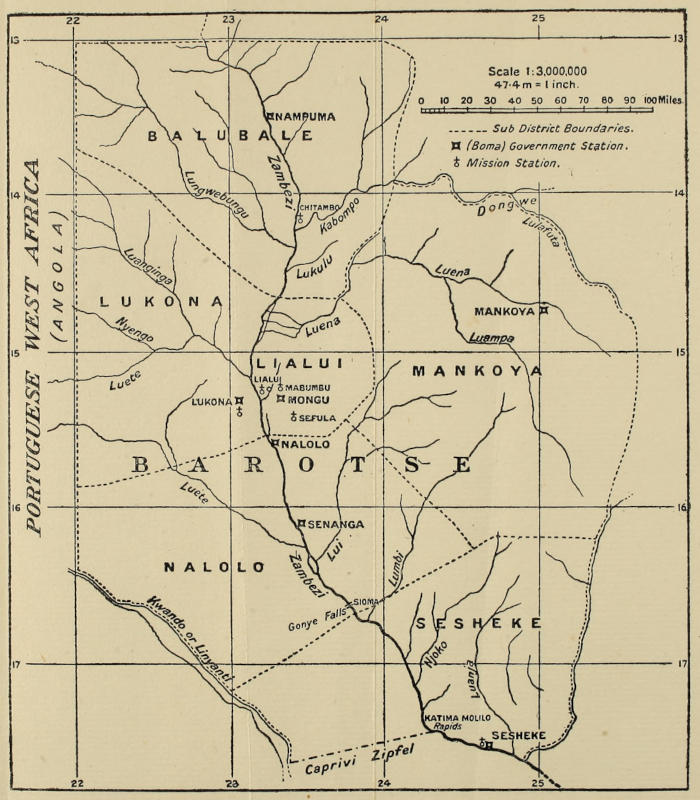
The Barotse country, as defined on the sketch
map accompanying this book, includes a number of
interesting and distinct Bantu languages. It is
even possible that a traveller who pushed his
explorations to the south-western limits of the
kingdom and of the British sphere might find in the
valley of the Kwando river a few nomad Bushmen
of more normal stature than the stunted Bushmen
of Cape Colony, but speaking a tongue of
Bushman and not Bantu affinities. The Bushmen
were more anciently inhabitants of this land than
the Bantu Negroes; but not far away, to the east
of Barotseland, we have had a sensational discovery
within the last twelve months of a different and
peculiar species of man which once inhabited South
Central Africa, prior to the penetration thither of
the Negro sub-species. This was Homo rhodesiensis,
the skull, jaw, and limb-bones of which were
found in close association with rudely-chipped
quartz knives and scrapers, and with the broken
bones of antelopes still living in Rhodesia. The
place of discovery was some sixty feet below the
surface in a cave at the Broken Hill Mine almost in
the middle of Northern Rhodesia. The bones
found are attributable to at least two personages,
the limb-bones and the skull having belonged to a
tall man perhaps not less than six feet in height.
He possessed tremendously-developed brow ridges,
a feature in which Negro man is as a rule more
deficient than the European. These, and the large
flat face and comparatively small front teeth and
other features, suggest an affinity with Neanderthal
man (Homo primigenius) of Europe. Other points
show some resemblance to the black Australian. But
the brain-case measured in space only about 1,280
cubic centimetres—a capacity much inferior to the
ordinary brain-cases of the Neanderthaloids and
Australoids, though, of course, there are occasional
examples of Australoid women’s skulls that have a
brain capacity of under 1,000 cubic centimetres.
These bony remains of Rhodesian man may have
been living creatures as much as forty thousand
or as little as ten thousand years ago: there is not
enough surrounding evidence to fix the date of them
more precisely. All we can say is that the bones of
the beasts they hunted and ate are nearly if not
quite identical with those of existing species.
Probably at the time when this big-browed, gorilla-faced
man was alive, the Upper Zambezi, which
flows through Barotseland three or four hundred
miles westward of Broken Hill Mine, formed a
great longitudinal lake in the heart of the Barotse[2]
country, the greater part of which still remains very
swampy. And when it issued from this expansion it
joined the Kwando, the Okavango, and the Zuga
to form a vast lake in what is now the North
Kalahari Desert. The Guay river was then the
Upper Zambezi and the Kafue river joined it as
now.
The Kalahari Desert which well nigh ruins the
north-western part of South Africa is probably
“younger” as a desert even than the Sahara—and
the Sahara Desert is a thing of yesterday, possibly
much more recent than the existing human species.
In the days when Rhodesian man with the huge
brow-ridges, long, ape-like face and poorly developed
brain ranged across all of Northern Rhodesia that
was not under water, he might have passed between
the vast Zambezi Lake on the west and the sources
of the Guay on the east, and have wandered down
into a green, tree-besprinkled South Africa, where
he was no doubt killed out by the smaller but far
more cunning Bushman or the intelligent Strandloopers
who painted pictures on the rock surfaces
like their relatives of Europe, the Crô-Magnon
men. Long after these antecedent types of
invaders had died away came in the vigorous
Negroes...? Two thousand years ago?
... who spoke Bantu languages. Whether,
between the Strandloopers, Bushmen and Hottentots
who invaded the southern portion of South Africa
thousands—who yet can say how many?—of years
ago and the Bantu Negroes of yesterday (so to
speak), other races entered and dwelt in southern
and South-Central Africa, we do not know. I have
given reasons elsewhere for premising that the
flocking south from Equatoria of the Zulus,
Bechuana, Karaña, Nyanja, Tonga, Luyi, Hérero,
Angola, Luba, Lunda, Yao and Makua tribes and
their allies and embranchments was quite a recent
episode in the history of Africa, perhaps not more
than two thousand years old. We have at present
absolutely no knowledge of the incoming of any
other type of inhabitant later than the Hottentot
and before the Bantu; though there may have been
many Negro immigrants belonging to neither group
linguistically.
Barotseland, as its recent past becomes revealed
to us from the second half of the sixteenth century,
seems to have had as a dominant people the Aluyi;
and as other tribes of importance the Tonga group
(Ila-Tonga-Subia) in the south and south-east, the
Luena or Lubale, Mbunda, and Lujazi tribes of
northern Barotseland and the adjoining parts of
Angola, the Nkoya-Mbwela peoples of eastern
Barotseland; and a section of the southern Luba
folk. Sporadically there has also occurred a strong
invasion of the Lunda people (Ma-bunda) into the
northernmost basin of the Zambezi, but it is
doubtful whether these immigrants penetrate into
the political limits of Barotseland. Similarly a
section of another vigorous South Congo people
has colonized the Northern Zambezi basin; the
Luba, who are known in North-Eastern Barotseland
as the Kahonde or Kaondi. Then again the enterprising,
uppish, cheeky Va-chokwe or “Ba-joko”
traders—once the slave-traders of South Congoland
and Eastern Angola—circulate through Northern
Barotseland and add yet another type of Bantu
language to its markets and meetings.
The dominant language at Court and in trade
to-day is an almost artificially-manufactured tongue
which had come into existence during the last fifty
years—Si-kololo. This will be found illustrated
in its most modern form in the first volume of my
Comparative Study of the Bantu and Semi-Bantu
Languages (Oxford, 1919). My information has
been mainly derived from the Sikololo Grammar
and Vocabulary published in London by Dr. Stanley
Colyer in 1917, and from a Sikololo Phrase-book
produced two years’ earlier by Mr. Stirke, the
author of this book, in conjunction with a very
noteworthy colleague, Mr. A. W. Thomas, formerly
master of the Barotse National School.
Sikololo which has gradually displaced and superceded
the Sechuana or Sesuto language of the
original Bechwana invaders of a hundred years
ago, is a far easier language to speak and pronounce
than the difficult and highly peculiar idiom of
Central South Africa. To philologists, Sechuana
and its later southern specialization, Sesuto, are intensely
interesting. Sechuana entered South Africa
at as ancient a date as any other Bantu tongue—say
sixteen or seventeen hundred years ago, coming
thither from South-East Africa. But since then it
has become highly specialized. The most specialized
form of it was the southernmost, Sesuto, scarcely
distinguishable a hundred or more years ago from
the Sepedi of the Western Transvaal.
The chief Sebituane, born some hundred and
twenty years ago, was a Mosuto, the son of a
great crazy woman-chief known as Mantatisi. He
carried his Sesuto tongue with him on the
amazing journey he made with half his tribe
across Bechuanaland to Lake Ngami and the
Zambezi. Sechuana or Sesuto was the Court
language in Barotseland when Livingstone first
reached the Upper Zambezi in 1851. As the years
rolled by, and after the Makololo (Basuto) dynasty
had given place to a restoration of the Aluyi
chieftainship, the original Sesuto spoken by
Sebituane and well understood by Livingstone
(who could converse in it freely) became greatly
changed. It has remained the governing language
of Barotseland and has succeeded almost in replacing
and killing the remarkable Siluyi of the
old rulers; and neither of the beautiful languages
of the Tonga-Subia group of Southern and South-Eastern
Barotseland has been allowed to take its
place.
In Sikololo the pronunciation is much simplified.
The rough guttural combination kx—of Sechuana-Sesuto
gives way to the simple k; a hiatus formed
by a dropped consonant is filled by h; ts is
generally changed to z; e in the prefixes becomes
i; f which had become h in Sesuto is generally
replaced; the uncouth tl, tlh or the aspirated th
and kh return to the simple t and k; and in
general the pronunciation of Sikololo is brought
into conformity with the harmonious phonology of
the Zambezi languages.
A far more interesting tongue is Siluyi, the
nearly extinct language of the Aluyi; in its older
form, that is to say, as it was spoken round
about Lialui (the original governing centre, near
the left bank of the Zambezi, in about 15° 15´).
Here it was a stately language, using preprefixes,
and possessing all the seventeen customary prefixes
of the Bantu languages. The second (Ba-) and
eighth (Bi-) of these were in an abbreviated form,
because the Luyi tongue had rather a dislike to
an initial b, though it turned the sixteenth
prefix—Pa- into Ba-, following a practice which recurs a
good deal in the Angola tongues.
The principal form in which I have presented
this language in the First Volume of my Comparative
Study is derived from the studies of Luyi
(Siluyi) compiled some twenty to twenty-five years
ago by the Rev. E. Jacottet, of the French Protestant
Mission. It was soon evident, when the
British South Africa Co. officials got to work, that
there was at least one separate dialect of Luyi
spoken to the East and North-East of the main
Zambezi. This was the Si-kwango or Si-kwangwa,
a tongue in which the preprefixes are dropped.
Si-kwangwa seems still to be a living speech among
the people in the East-Central part of Barotseland;
but the much nobler Luyi of the Zambezi vicinity is
dying out, even among the natives of Luyi stock,
dying out in favour of mongrel Sikololo.
Allied to Siluyi apparently, is the Nyengo language
of the Bampukushu people, a scattered tribe
living still (perhaps) in the South-Western portion
of Barotseland, on the banks of the Kwando or
Linyanti river. There has been no record of this
speech since that which was compiled by Livingston
about 1853, and which I have reproduced (numbered
82) in my Comparative Study of the Bantu
Languages.
Still farther south, in the northern part of the
basin of Lake Ngami, there were, down to quite
recently, the Ba-yeye or Makoba people, whose
language also seemed to show kinship with Luyi as
well as with the Subia-Tonga group. The imperfect
record of this is numbered 81 in my book.
It may be extinct as a spoken tongue by now. But
its existence where it last lingered on the northern
side of Lake Ngami would seem to show that this
basin of the shrinking lake (which received a vast
but diminishing tribute of water from the Okavango
river, and earlier still from the present “Upper
Zambezi”) was colonized by the Bantu from the
north before it was found and peopled by the
Bechuana tribes from the south-east.
So much does Sikwangwa differ from Siluyi
nowadays, that it is almost a separate language.
If this be so, the Western Zambezi group of my
formation would contain at least four languages,
Yeye, Nyengo, Luyi and Sikwangwa. I am also
informed that Sikwangwa is not the only existing
dialect of Luyi, but that two others exist, and are
spoken to the North-West and North-East of Lialui
and the Zambezi: Si-koma and Si-kwandi. These
have only been recorded in name, and I have seen
no specimens of their vocabularies. It would be
interesting to ascertain whether, like Luyi, they
retain the use of preprefixes; or whether they have
dropped them, as have most of the languages in the
western half of the Zambezi basin.
There is a tendency in Siluyi for b and p to take
the place of v or f as the initial of the root, although
in the prefixes b and p are inclined to drop out: so
that Aba- becomes Aa-; Ibi-, I; Ubu-, Uu-; and
Apa-, Aba-. Thus we have -pumo for “belly,”
instead of the familiar -fumo; -bumu for “chief,”
in place of -fumu; -pumbu for “ground” (ordinarily
-vu) -buu for “hippopotamus” (-vubu), -bula for
“rain” (-vula); and -pi for “war” (-vita). The
roots for the numerals “six,” “seven,” “eight” and
“nine” were in Livingstone’s day, very peculiar
and unlike those of any other Bantu tongue; though
to-day they are supplemented by paraphrases
meaning “five-and-one,” “five-and-two,” etc.
The Rev. Mr. Jacottet has shown how rich
Siluyi was in folk-lore and legends. It is a great
pity this particularly interesting, expressive Bantu
tongue should be allowed to die out through the
vogue given to the artificial amalgam of speech
known as Sikololo.
Subia, spoken in Southern Barotseland, on and
near the Zambezi at its bend eastward, is also a
language of great interest, said likewise to be dying
out under the rivalry of mongrel Sikololo. It was
first noticed by Livingstone about 1851, and a
grammatical sketch of it was given by Jacottet in
1896. But in the present century, F. V. Worthington
and C. F. Molyneux, officials of the Chartered
Company, supplied me with a full vocabulary and
grammatical information which has been reproduced
in my Comparative Study, Vols. I and II. Subia
is spoken to the south of the Zambezi as far eastward
as Pandamatenka; but it belongs to the West
Central Zambezia Group, mainly in use on the
north side of the great river, and including the
Tonga, Ila and Lenje tongues and their dialects.
This group is related to the Luba languages of
Southern Congoland and to the tongues of the
Bangweulu basin and of the Luangwa valley. They
are all beautiful-sounding and expressive languages,
representing Bantu speech in an attractive form.
The Tonga language is spoken in South-East
Barotseland in one or more dialects. The Tonga
people are a series of vigorous tribes not very likely
to give up their expressive language in favour of
the bastard Sikololo or the crabbed Sechuana.
They attained some degree of civilization two centuries
ago under the teaching of Portuguese Jesuit
missionaries. Their attitude towards Livingstone
and later travellers, down to the incoming of the
British South Africa Company, was hostile. James
Chapman, the great explorer of Southern Zambezia
and even of Barotseland—in some senses the rival
of Livingstone—suffered much from attacks at their
hands. So did F. C. Selous. They also warred
incessantly against the Zulu invasions under
Umsilikazi and Lobengula, and checked the
Zuluizing of central Northern Zambezia, which,
in default of similar vigorous opposition, took
place in the regions east of the Luangwa river.
Similarly related to Tonga and Subia are the
Ila (Shukulumbwe) and Lenje tongues, though
both lie almost or wholly outside the limits of
Barotseland, in the central part of Northern
Rhodesia. The Ba-ila tribes, two divisions of
which are also known as the Ba-lumbu and Ba-shala,
are a splendid-looking folk in physical development,
who were long recalcitrant to European
influence. In fact their healthy plateau country
has only been opened up to knowledge during the
last twenty years. When they were first seen in
the latter part of the nineteenth century they were
found to be—the men especially—living in a state
of complete nudity, except in the case of the
married women. But to make up for the complete
neglect of clothing the men devoted particular
attention to their head-hair. This was pulled up,
greased, lengthened by the insertion of ancestral
hair pullings, and fastened to a supple arched, recurved
whip, so that it rose a foot to two feet
above the occiput. Nowadays I imagine that
their complete nudity is modified. The mining
surveys, motor roads, and suggestions of railways,
together with good and wise government, in and
out of the Barotse kingdom, have succeeded in
taming the Ba-ila and in drawing them into paid
employment; though it is still feared by watchful
administrators that they tend to diminish owing to
sexual vice which causes the women to become
infertile.
Another language of interest and importance is
that of the Nkoya and Mbwela tribes living in East
Barotseland. It has affinities jointly to the Luyi
Group and to that of the North-West Zambezia
languages. Preprefixes are not used, but the
seventeen prefixes-with-concords seem to be fully
represented in primitive forms, except that the
seventh prefix (Ki-) is represented by Shi-, which
brings it near to the Si- of Luyi. The tenth prefix
is lisped as Thi-, Thin-, &c., a feature reappearing
in one or two other tongues of the Group. The
eighth prefix is Bi- and the locative prefix is Pa-.
The root for ‘two,’ in the numerals is the East and
South Africa form, -bidi or -biji (for -bili); not the
-bali root that obtains in the other members of the
North-West Zambezian Group. Another peculiarity
that signalizes Nkoya is the root -mwa- for
‘all,’ only to be met with elsewhere in two of the
Manyema languages of East Congoland. In
Nkoya there is none of that dislike to the consonant
p, which recurs over and over again in
Bantu Africa. But in the other members of the
North-West Zambezia Group this obtains, and in
these—Luena, Mbunda, Lujazi and Chokwe—the
16th prefix is given as Ha- or A- instead of
Pa-. Otherwise they are fairly orthodox, betraying
little more “West African” affinities than the use
of the -bali root for ‘two’ (instead of -bili), which
is a characteristic of West Central Africa.
The Luena or Lubale language only enters the
north-western part of Barotseland; Mbunda is
spoken in separate parts on either side of the
Upper Zambezi, also in the north of this state;
Lujazi extends from South-East Angola to the
western limits of Barotse territory; and Chokwe
comes in as a trading language in the extreme
north. None of these North-West Zambezia
languages use preprefixes.
One other great Bantu Group may be met with
in the northern part of Barotseland. Here there are
outlying dialects of Luba and Lunda which have
penetrated into Barotseland comparatively recently.
The Luba tongues of South Congoland are represented
by Kahonde, a form of South Luba
illustrated in my Comparative Study under the
designation of 105a. This is spoken on the North-Eastern
verge of Barotseland in the basin of the
Upper Kabompo river. Southern Lunda, introduced
into the northern part of this territory goes
under the name of “Ma-bunda,” the root of which—bunda—is
the same as that of “Mbunda,” a
quite distinct language of the North-West Zambezia
Group allied to Luena, Lujazi, Nkoya, and
Chokwe. “Bunda” is evidently a language and
tribal name which in the shapes of -bundu, -bundo,
and -bunda haunts Angola and Western Zambezia
without implying close relationship between the
different forms of speech thus termed. The
“Ma-bunda” dialect of Lunda may represent an
older form of the latter name, which seems to be a
contraction of Lu-unda for Lu-bunda. The language
(No. 111) which I have styled “Western
Lunda” in my Comparative Study was originally
called by its discoverer, the Revd. S. Koelle,
“Ru-unda,” suggesting that Ru- (= Lu-) was
the familiar language prefix and -unda or -bunda
the root. The loss of an initial b is a frequent
occurrence in the Lunda languages.
The distribution of tongues southward from
Angola and the Congo Basin over the regions
north of the main Zambezi river indicates no
causes of hesitancy, no interruptions in the north-to-south
progress of the Bantu peoples. But westward
of the course of the Luangwa river, as far as
the Barotse country extends, or at any rate as far
as the main stream of the Zambezi flows, this great
river seems to have been a very decided and
arresting barrier in the distribution not only of
African tribes and languages but of the larger or
more remarkable mammals and birds.
With regard to man of course the barrier has
not been so effective. Evidently the Aluyi people
of long ago crossed the Upper Zambezi and penetrate
to the Lower Kwando or Chobe, and across
this stream to the vicinity of Lake Ngami, though
not much farther west; and in return, immigrants of
Bechuana stock entered Barotseland from Lake
Ngami in the last century. But there seems to
have been a not easily explained halt in human
migrations between Western Zambezia and South-West
and South Africa. It would be comparatively
easy to account for, if one could presume that the
present sterile influence of the Kalahari desert
prevailed two thousand or even one thousand years
ago, and earlier still. But on the contrary from
the many indications we can collect and from the
legends of the natives in the regions south of the
Zambezi, we are inclined to believe that the present
arid nature of the lands on the western side of
South Africa is quite a modern feature which has
gone on rapidly increasing. So rapidly that even
I who made a journey in 1882 to the Kunene river
from Mossamedes can remember flowing streams
(in the dry season) and forests, where the rivers and
rivulets are now dry and the woodland is dead.
There seem, in addition, to have taken place in
comparatively recent times, changes in the disposition
of water supplies, which have diverted much
useful moisture from inner South Africa into the
Atlantic Ocean. Not such a very long time ago the
Kunene river, which brings an abundant supply of
fresh water from the great knot of highlands in
Southern Angola, bore this water into Lake Etosha
in Ovampoland, and beyond that towards the course
of the Okavango or the great vanished lake of
which Ngami is the surviving vestige: Ngami,
which even in Livingstone’s day—the end of the
’forties, some seventy-two years ago—was twice its
present size. Into the same basin flowed the
mighty Okavango (known much farther north as
the Kubango), the Kwando and the upper
Zambezi, then the outlet of another vast lake in the
Barotse country. Quite possibly these two shallow
lakes of huge size sent their overflow of water
through the Guay river into the bed of the
Zambezi-Kafue, and so out into the Indian Ocean
after all; for these waters of Central Africa were
completely hemmed in southwards by the plateaux
of Damaraland, Bechuanaland and Matebeleland.
But in those days the ultimate source of the
Zambezi would have lain in the Benguela highlands
near the Atlantic Ocean, and not in the Luvale
country near to the upper Kasai.
As regards the mammalian fauna and some of
the more striking or peculiar of African birds,
Barotseland, east of the Upper Zambezi, appears,
in common with all the rest of South Central Africa
up to the east coast of Lake Nyasa and down to the
main course of the Zambezi, to be deficient as
compared with Portuguese West Africa, South
Africa, and (in a lesser degree) Moçambique. It
probably has more in common as a distributional
area with the southern part of the Congo basin
outside the forest area, and west of the Luapula-Lualaba
streams. Down to recent times Barotseland
possessed great herds, enormous numbers of a
few species of game animals, but not such a great
variety of species. Like South Congoland outside
the forest zone, it seems never to have had any
example of the rhinoceros: indeed, I have no
confirmatory evidence of the existence of a
rhinoceros or a giraffe, west of the eastern rise of
the Nyasa-Tanganyika plateau, or of the waters of
Lake Nyasa. The rhinoceros begins to show itself
south of Lake Nyasa and east of the Shire river.
It recurs in Southern Angola and Damaraland, up
to the vicinity of the Western Zambezi, and as far
north as the beginning of the lofty plateaux where
the Kwanza river rises.
The Kwanza, which divides Angola into two
unequal portions, is very noteworthy as a boundary.
Its ultimate sources are in the Ngangela, Bihé and
Lujazi highlands (plateaus and mountains) which
connect the mountain ranges of Benguela on the
west with the 5,000-feet-high plateau dividing the
Southern Congo basin from that of the Zambezi.
This undulating line of heights (rising on several
peaks to nearly 8,000 feet) really marks off Southern
from Northern Angola; and zoologically Southern
Angola extends eastwards almost to the banks of
the Upper Zambezi and covers the western limits
of Barotseland.
Here you have a remarkable extension of the
South African area of zoological distribution. East
of this, from the Upper Zambezi to the Shire river
and the east coast of Lake Nyasa (with the
Zambezi as a southern boundary) there is an
interruption in distributional area which affects
certain mammals and birds very curiously. For
some the interruption is complete. The Ostrich,
the true Gazelles, the Oryxes, the Secretary bird,
certain types of Vulture, the Striped Hyena, the
Chita or Hunting Leopard, the Caracal Lynx, the
Aard Wolf (Proteles), the Big-eared Fox (Otocyon),
the small Desert Foxes, the Black-backed Jackal,
the Pedetes or Cape Jumping Hare, the Elephant-shrews,
the Mountain Zebras, the White Rhinoceros
and, in a lesser degree, the Black, are in a
measure confined to north-east and eastern Equatorial
Africa on the one hand, and to Africa south
of the Zambezi and to Southern Angola on the
other. Some of the examples cited stretch across
to the Bahr-al-ghazal and even Northern Nigeria
from Abyssinia and the Eastern Sudan; others
reach Senegal and Western Nigeria beyond the
forest zone. But all of the examples cited (besides
many more less well-known birds and mammals)
seem to be absent from North Angola, Northern
Zambezia and Nyasaland, and apparently also from
Moçambique. In Moçambique, numerous forms
may have been exterminated by the white man and
the black hunters, who began shooting here in the
17th century. Yet it is difficult to understand that
they could thus have eliminated the Ostrich,
Springbok, Striped Hyena (represented in South
Africa and Angola by the Brown Hyena), Chita,
Caracal, Aard Wolf, and Pedetes rodent, or even
the Giraffe.
The Giraffe’s distribution conforms somewhat,
but not so closely, to similar restrictions. Its least
specialized form, perhaps, is the Reticulated Giraffe
of Somaliland, whereon the original markings are
seen to be white stripes, horizontal and perpendicular,
on a red ground. From Somaliland the
Giraffe radiates over the eastern Sudan to Northern
Nigeria and thence (with gaps) to Senegal. It
entirely avoids forested Central and West Africa,
though it has a near relation, the Okapi, in the
forests of Equatorial Africa east and north of the
main Congo river. The distribution of the Giraffe
continues south from Uganda and Somaliland to
the east of Tanganyika and Nyasa down to the
neighbourhood of the Ruvuma river. It has never
been reported south of that stream, or until the
Lower Zambezi has been crossed. A hundred years
ago and down to about 1900 it was found in various
sub-species and varieties south and west of the
Zambezi to Cape Colony and into Southern Angola.
But it has never been shown to exist between
the Upper Zambezi and the Moçambique coast,
north of that river system.
On the other hand the range of the Sable
Antelope does not leave out Northern Zambezia
and Barotseland. It begins in Eastern Africa, in
the latitude and neighbourhood of Mombasa (a
fact first suggested in my book on Kilimanjaro,
published in 1885), broadens over what was
formerly “German East Africa,” passes round the
south end of Tanganyika into Southern Congoland
and crosses Barotseland into Eastern Angola.
Here, in the south-eastern basin of the Kwanza,
and possibly in north-western Barotseland as well,
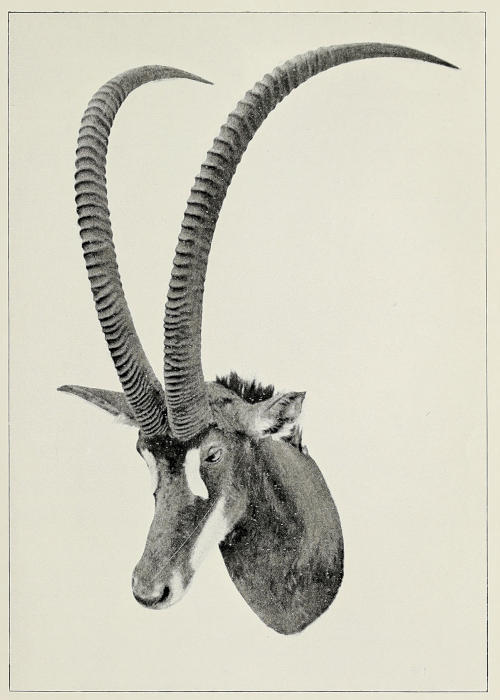
it develops its most superb form—Hippotragus
variani, generally called the Giant Sable—with
magnificently developed horns, longer than those
of any other type found elsewhere, and a longer,
narrower skull. It is possible (from heads I once
saw, shot to the west of the main Upper Zambezi
and specimens of horns) that the Giant Sable may
be found just within the limits of Barotseland.[3]
North of the belt of dense forest between the
Liba and Kabompo, on the spongy plains near to
the river, Livingstone noticed in the rainy season
large numbers of Buffaloes, Elands, Kudus, Roan
Antelopes, Gnus, and other game. He even avers
that farther north he saw a White Rhinoceros. It
was on a Sunday and his encampment was almost
surrounded by herds of astonished Mpala antelopes,
tsesebes (“bastard hartebeests”), zebras and
buffaloes. But although the Black Rhinoceros is
undoubtedly found in Southern Angola close up to
the Barotse frontier, and the White has been shot
immediately south of the Upper Zambezi, no word
has come from any other quarter as to the existence
of the monstrous White square-lipped species in
the direction of the Upper Zambezi and the Congo
watershed; so it is possible his eye-sight was
deceived.
Giant Sable Antelope, from Angola
(From a specimen in the Museum of the New York Zoological Society
presented by John Jay Paul.)
In general, Barotseland, east of the main
Zambezi and of its great north-western affluent the
Lungo-e-bungo, seems to possess the mammal
and bird fauna of Northern Angola, Southern
Congoland, Northern Rhodesia and Nyasaland.
Moçambique is richer—up to the Shire river—in
possessing the Black (I used to think also the
White, and perhaps was not wrong) Rhinoceros,
and a few other creatures found also in Eastern
Equatorial and in Trans-zambezian Africa. Otherwise
Moçambique remains rather an unsolved
problem, as to why and how it served as an
interruption in the spread of the vertebrate fauna
of Pliocene and Pleistocene North Africa down to
South Africa, an extension which as regards West-Central
and Western Africa may have been barred
by the former enormous area of dense forest growth.
In botany, as in vertebrate zoology, Barotseland
is part of the region which lies between the Kwanza
and Zambezi rivers on the south, and the main-stream
of the Congo on the north, from Lake
Mweru to the Atlantic Ocean. It has a sufficient
rainfall, from 22 inches in the south-west to 42 inches
in the north-east, to maintain a fairly luxuriant flora
as well as powerful rivers. North of the confluence
of the Kabompo and the Liambai or Liba (the
Upper Zambezi), there seems to have been seventy
years ago a luxuriant belt of forest stretching northwards
and occupying the mountainous region between
the Liba-Zambezi and the Kabompo or
Lulafuta.
The average elevation of the Barotse Valley,
south of this confluence, ranges from a little under
3,000 feet at Sesheke to about 3,600 feet at the
juncture of the Zambezi and the Kabompo; but
the forested country between these rivers must rise
in part to at least 4,500 feet. The richness of this
forest seems to have made an immense impression
on Livingstone in the middle of the ’fifties. Up till
then, coming from South Africa through Bechuanaland,
he had at most seen scattered trees with
occasionally a fine solitary umbrageous specimen,
or a palm thicket. But above the confluence of
these two rivers he evidently plunged (when he had
to land) into a woodland comparable with the
splendid forests of the Congo or the Cameroons.
His Missionary Travels contains some very good
word-painting of the grand growth of the trees, the
deep gloom of the forest depths as contrasted with
the shadeless glare of Bechuanaland. In spite of
the incessantly rainy weather—and in this little-explored
region the yearly rainfall must be far in
excess of the modest estimate quoted by travellers
in the Barotse park-land and plateaux—Livingstone
found considerable pleasure in here seeing—for the
first time—the real forest display of Central Africa.
North of the Zambezi-Kabompo junction Livingstone
noticed the increasing growth of the bamboo
on the uplands, as a skirting of the great display of
tropical forest which so deeply impressed him as he
followed the northward course of the main Zambezi.
This—or these—bamboos recur on the elevated
plateaux of Eastern Barotseland, and extend over a
good deal of the upland on either side of the Upper
Kafue, as well as over the five thousand feet crest
of the Congo boundary. No doubt they may also
be observed within the north-western limits of
Barotseland. They are seemingly of the same
types as the bamboos of Nyasaland and the elevated
portions of Northern Rhodesia south of
Tanganyika, and in such case belong to the
Oxytenanthera and Arundinaria genera. The
only other genus of arboreal bamboo in Africa is
Oreobambos; but that, I think, is confined in its
range to Abyssinia and the Snow mountains of East
Equatorial Africa.
The forests of Northern Barotseland have one
or more species of wild plantain (Musa) and either
wild or introduced examples of the oil palm, where
the rainfall is over fifty inches per annum. This
may have been introduced from Congoland or
Northern Angola by the natives, who in the north
of the Barotse country are so closely connected
with the peoples of the Congo basin; or as in
the case of North Nyasaland and Zanzibar Id., it
may be a separate species or sub-species of the
Elaïs genus.
According to the reports of later travellers, there
is much woodland and scrub on the higher land—4,000
to 4,500 feet—on the west side of the
Zambezi, south of the Kabompo-Zambezi junction.
This woodland is also repeated, less markedly, to
the east of the great river where the land likewise
rises. The Mankoya country (Eastern Barotseland)
has a larger, steadier rainfall than Sesheke and the
southern regions; and the Mashukulumbwe table-land,
and the valley of the upper Kafue are said to
be well and regularly watered countries. The
more scattered growth of trees (occasional fine and
large trees are common) seems due to human intervention.
The natives of the Lukona province,
towards Angola, are a wilder, less intelligent race
than folk of Tonga kinship on the east, and not so
eager to promote tree planting. Bulovale (the
region between the Luena and Kabompo rivers)
and north of the Kabompo up to the boundary
of the Zambezi watershed are well forested
regions.
The central valley of the Zambezi—“Borotse
proper,”[4] as it might be called, the region which the
Barotse (really the Aluyi) have so long dominated—ranges
from below the Zambezi-Kabompo confluence
on the north to the Gonye Falls on the
south, and is about 150 miles long and 60 miles
broad. It is the bed—most observers think—of
the old lake of the Upper Zambezi, and presents
to-day an utterly flat and treeless aspect. Then
ensue from Gonye to Katima, some eighty miles of
rapids or falls. From Katongo to Mambova, past
the now world-famed Sesheke, where Livingstone
and Oswell first “discovered” the Zambezi, there
are fifty miles of navigable river; then two more
rapids at Mambova and Nkalata, and then another
navigable stretch of some sixty miles to the vicinity
of the Victoria Falls. (These lie well outside the
political limits of Barotseland, the boundary striking
north along the Majili river, ten miles east of
Sesheke.) The plain of the extinct lake is much
flooded during the winter rains, when a good deal
of central Barotseland is under water. The rainy
season seems, however, to be tending more and
more towards the spring months (the autumn of
South Central Africa).
The geology of Barotseland may be summarized
thus: In the north-west, north, east and south-east
the surface is a red laterite clay, superimposed on
granite which in the higher portions obtrudes itself
in mountains and hills. The central valley and
most of the south-west has a heavy, white, sandy
soil, but with a good deal of alluvium laid down on
the sand by river courses or in the bed of the
ancient lake. There is a basaltic outbreak in the
neighbourhood of the Victoria Falls, but this lies
outside Barotseland limits. In the eastern half of
the country gold, copper—connected with the
copper deposits of Katanga—tin, lead, zinc and
iron have been discovered, chiefly in regions
between four and five thousand feet in altitude.
In this little book and in the first and second
volumes of my Comparative Studies of the Bantu
Languages (fed from much the same source) our
information concerning Barotseland and its peoples
has been greatly implemented. But that fact does
not conceal from us that the country, its zoology,
botany, peoples, and even its geography (to say
nothing of geology) are still far too little known.
The portions that lie to the west and south-west of
the main Zambezi remain almost unknown and undescribed,
or are only made known to us in works of
travel fifty, sixty, seventy years old, which even if
accurate in what particulars they give were written at
a much lower level of knowledge than exists concerning
Africa in general to-day. We know more about
Eastern Angola than we do of Western Barotseland.
Recent discoveries concerning Angolan Antelopes,
Zebras, Rhinoceroses, and other mammalian
types make us eager to ascertain how these discoveries
affect Barotseland west of the Zambezi.
How far do the Bushman tribes extend into Western
Barotseland? Are they of normal human stature,
like those of South-East Angola? Do they speak
languages akin to the Bushman tongues and use
clicks? Have they greatly projecting brows like
certain Bushmen of the Northern Kalahari, or are
they without brow projections at all but very
prognathous in the lower part of the face? What is
the full tale of the Bantu tribes of Western Barotseland?
Are there still unrecorded Bantu languages
on the Kwando river? Do the tongues recorded
south-west of the Upper Zambezi by Livingstone,
seventy-two years ago, still exist?
Does Livingstone’s great forest between the
course of the Upper Zambezi and that of the
Kabompo still maintain itself, in spite of the reckless
spirit of destruction inherent in all uneducated
Negro tribes, who since the imposition of
peace by the white man have been largely increasing
the area of their settlement in Northern
Barotseland? If the forest is still there, in whole
or in part, why are no botanical reports and collections
available? The botany of Barotseland, in
common with its zoology, has never been efficiently
explored and reported on since the land was first
entered. Cattle apparently prosper in the whole
country; yet the tsetse fly exists seemingly everywhere.
Does it, north of the Zambezi and west
of the Luañgwa, convey no germs? The time—it
seems to me—has come when the British Empire,
from London or from Cape Town, should have
this country examined scientifically from west to
east and north to south; not with anything but
benevolent intentions towards its natives—Aluyi
and Batonga, Basubia and Mabunda, Batonga and
Baila, Bankoya and Kahonde, Valujazi and Valubale—but
with the earnest endeavour to make
fully known its resources and defects, its wonders
and survivals, and the relation that Western
Barotseland bears to the growing menace of South
Africa: the spread of the Kalahari Desert, the
drying up of once fully habitable land, the cause
of ruin in South Angola, in Eastern Damaraland,
and the vast, dead region north, east, south, and
west of Lake Ngami.
H. H. Johnston.
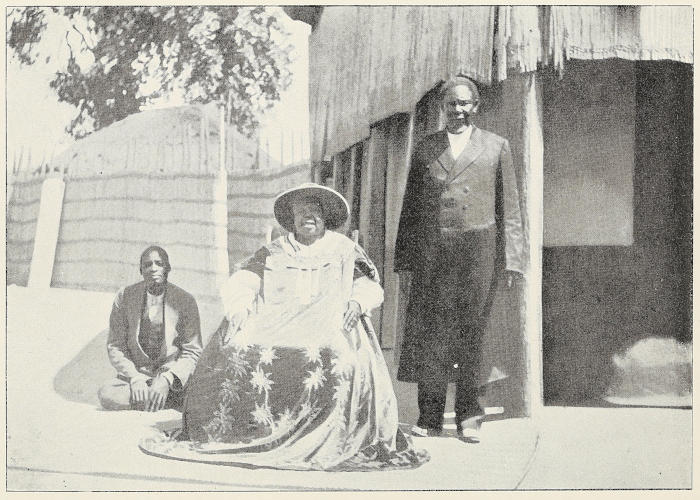
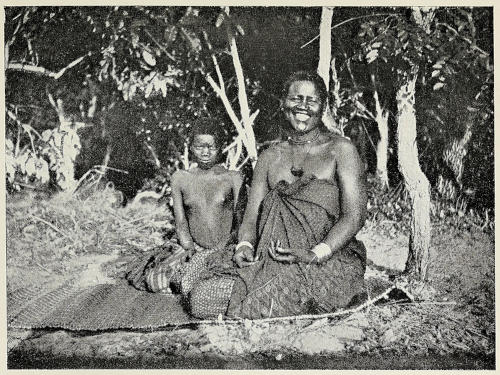
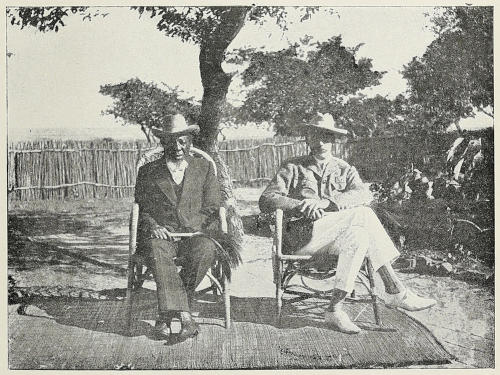
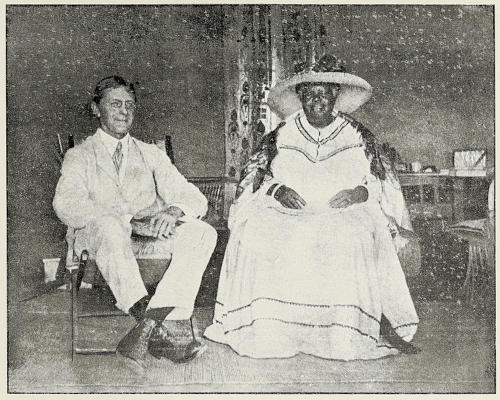
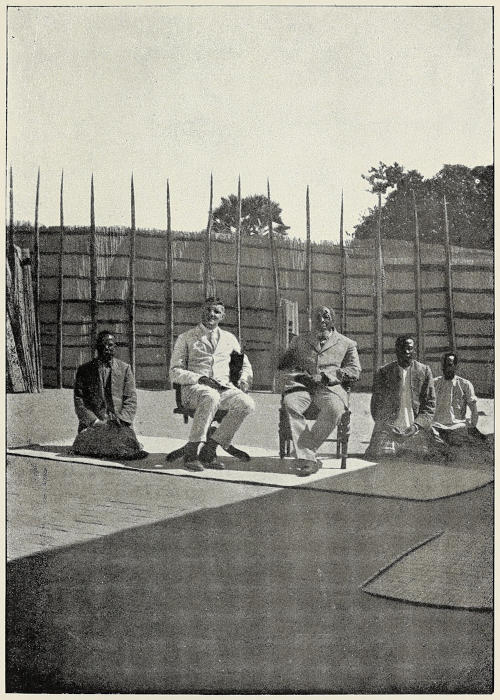
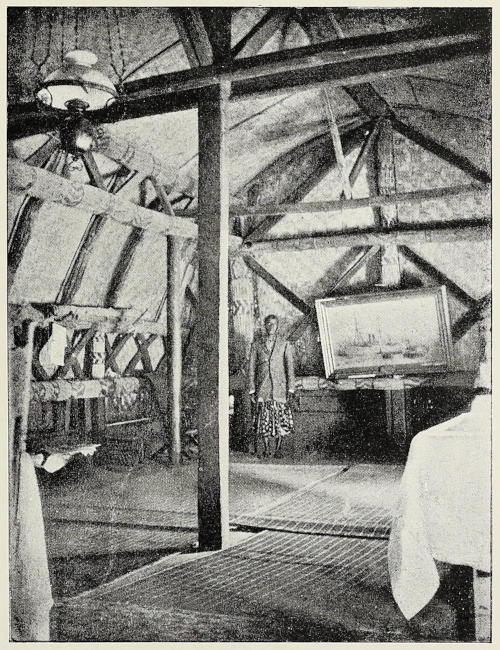
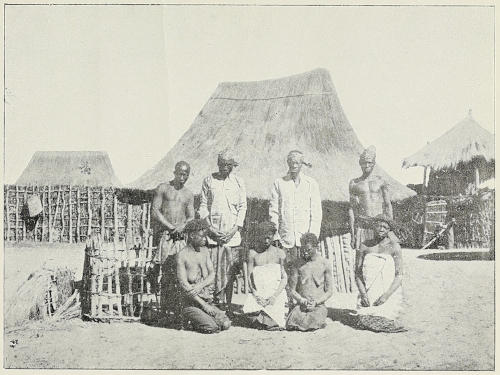
The Mokwai Mataŭka of Nalolo with her husband
(standing) and interpreter (sitting)
Photo by Mrs. Marshall
BAROTSELAND: EIGHT YEARS AMONG THE BAROTSE. — CHAPTER I. The Barotse and their Origin.
The origin of the Barotse is a matter of conflicting
conjecture. It has been suggested
by the Abarozwi of Southern Rhodesia that the
Barotse are descendants of theirs and that Lewanika
is a direct descendant from their royal house. The
Barotse of Barotseland deny this in toto. They
aver that they came south from the Congo Basin
and found the Alunda and Balubale living in their
country (videmap). The Alunda and Balubale confirm
the statement of the Barotse, and it is known
that the Barotse lived for some years among the
Lunda, gradually working south till they left the
forest country on the Zambezi and came out on to
the flat swampy country known to-day as the Barotse
Valley.
They were then sometimes called by foreigners the
Barozi or Barotse, but were better styled the A-luyi
and spoke Siluyi and in our days Sirozi or Sikololo.
During the chieftainship of Mbukwano, the
A-luyi were conquered by Sebituane, a roving
Mosutu with a band of warriors. Sebituane not
only re-christened the A-luyi as “Makololo,” but
forced Sesuto as a language on them. Sebituane
and his followers were not called Basuto by the
A-luyi but Makololo, which name, according to the
Rev. E. Smith, once of the Batonga-Baila mission,
was derived from the fact that Sebituane’s favourite
wife was a Makololo woman.
Sikololo (a mongrel form of Sesuto) is the lingua
franca of the Barozi to-day. The greatest difficulty
is found in getting any well-authenticated
information from the Barozi as to their past history.
The origin of the name “Murozi” (a native of
the Barozi country) is peculiar. The true name of
the people is the A-luyi; the prefix A or Ba being
the plural of Mu and applied to mean “people.”
When the Makololo under Sebituane first invaded
the southern portions of the country, they found a
subordinate tribe called the Masubia living near
Sesheke. These people told the Makololo that
their overlords living to the north were the
“A-luyi.” The Makololo converted this into “Ba-luizi,”
“Ba-ruizi” (L and R being interchangeable)
and finally “Ba-rozi.” Why the foreign missionaries
decided to call it “Barotse” is best known to
themselves; certainly no one else can imagine or
find any reason for it at all. There is no possible
reason for mistaking the “z” in Barozi for “ts”.[5]
Whether from the vicissitudes of their southern
trek or from natural laziness is unknown, but they
have no system of record, nor, as is the case in
many native tribes, have the village elders ever
acted as historians and handed their knowledge on
from father to son. The Barozi themselves say
that owing to their numerous raids and their intermarriage
with the aboriginal tribes and with women
raided from other tribes, they have lost all purity of
race and incidentally all remembrance of their
former history. They certainly are to-day a very
mixed race, and nearly all their songs, dances,
customs and legends are either borrowed wholly or
in part from other tribes. They are quite positive
that the Abarozwi of Southern Rhodesia are related
to them, but they state that these people are a
branch that left them and trekked south into
Matebeleland where they settled. If this is correct
it must have been previous to the Matebele settling
in Southern Rhodesia under Mosilikatse, as the
Barozi, though fond of raiding weaker or more
divided people, were too canny to try conclusions
with a powerful and warlike people like the Matebele.
Besides the raid of Sebituane and his
Makololo, several raids by the Matebele are known
of, and although the Barozi certainly suffered at the
raiders’ hands, they generally got rid of them by
strategy and cunning. Their own successes over
people like the Bashukulumbwe and Batonga were
nearly always gained by treachery, superior numbers,
superior weapons, or else by internal dissensions
amongst the people they raided.
The Barozi were very fortunate in the class of
people they found occupying the country they settled
in; the more timid tribes were at once enslaved,
while more powerful people were propitiated and
gradually absorbed. Unfortunately, the conquerors
readily acquired all the vicious and degraded habits
of the conquered, and are to-day, both physically
and morally, a far poorer type of native than they
were on entering the country, always providing
their statements are true. Natural laziness and the
rapidity with which they acquired the demoralizing
customs of their subject people have practically eliminated
the true Muluyi nature in so much that the real
Sirozi or Siluyi language is gradually dying out and
to-day is known to but a few of the blood royal, sons
of Indunas and the like. Sikololo, which is a mongrel
Sesuto, is the commonest language in use in the
country and even amongst the outlying tribes such
as the Alunda, Balubale, Bankoya, Batotela, Bandundulu
and others, it is always possible to find one
or more persons in every village with a slight
knowledge of Sikololo. The missionaries possibly
made a mistake in not working up Sikololo on their
arrival in the country, but having Sesuto text-books
and grammars to hand they commenced to teach
Sesuto. Sikololo is now being reverted to and this
should simplify matters to a great extent. Many
pure Siluyi words are in use in Sikololo, for which
there are no equivalents in Sesuto. For example,
river work such as paddling and other matters connected
with boats are unrepresented in Sesuto, as
there is no river work in Basutoland, and the words
in use in Sikololo are practically all Siluyi.
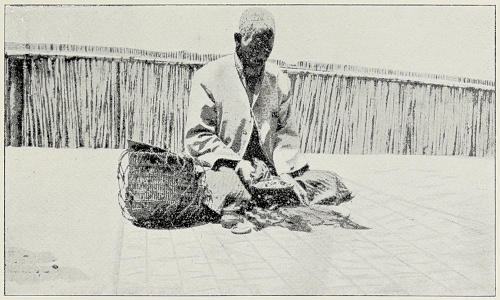
One of Lewanika’s Aunts with Attendant
Photo by J. C. Coxhead, Esq.
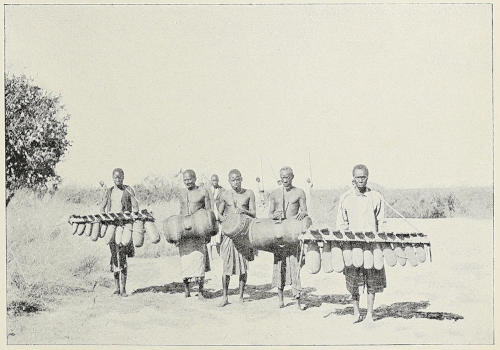
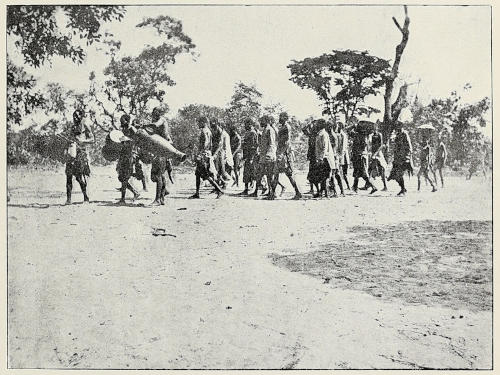
Lewanika’s Band (Mirupa and Silimba)
Photo by J. C. Coxhead, Esq.
Siluyi itself is doubtless a corruption of an older
Siluyi language, but this is hard to prove owing to
the lapse of time and lack of authentic records.
The Bambowe, an aboriginal tribe on the
Zambezi, living south of the Balunda, corroborate
the statement made by Alunda and Balubale, that
the Barozi or Aluyi lived amongst them while coming
from the Congo Basin. The Bakwangwa, another
aboriginal tribe living east of the Zambezi, say the
Barozi found them there and absorbed them, and yet
Sirozi (Siluyi) is clearly the language of which Simbowe
and Sikwangwa are dialects. Any one conversant
with one of these languages, understands and
is understood by speakers of the others. Some idea
of the composition of the Barozi people of to-day can
be gained when one realizes that they are composed
of Bambowe, Bakwangwa, Bahoombi, Bakoma,
Makololo, Bandundulu, Bambunda, Bankoya,
Bashasha, Alunda, Balubale, Bambalangwe,
Batonga, Basubia, Mashukulumbwe, Bakwande,
Batotela, Bakwangali, Bakwengo, Balojazi,
Vachibokwe, Basanjo and other tribes. Many of
the above tribes were, so far as can be gathered,
aboriginal owners of the Barozi country, others were
raided from time to time and slaves (chiefly women)
taken back to the homes of the raiders, where they
in time intermarried and became Barozi.
CHAPTER II. The Administration of Barotseland.
The Barotse Reserve is administered by the
British South Africa Company in agreement
with the Paramount Chief Lewanika. By
this agreement the Chief Lewanika has handed over
certain powers and privileges to the B.S.A. Co.
The company is empowered to collect a poll-tax,
of which a percentage is set aside for the Barotse
nation. Out of this percentage the Barotse
National School and its industrial branch is maintained.
The school is controlled by a European
principal and vice-principal, as well as a European
instructor, at the head of the industrial side, supported
by an effective staff of native teachers.
The B.S.A. Co. further have a resident magistrate
near Lewanika’s capital at Lialui, who is
supported by two Northern Rhodesia police
officers and a company of native police (recruited
in Angoni and Awembaland). Native commissioners
are maintained at Lialui, Nalolo, Balovale,
Mankoya, and Lukona, with an assistant magistrate
and a native commissioner at Sesheke.
Lewanika has ceded all judicial rights to the
B.S.A. Co. with the exception of very minor items
and of civil cases between natives. At the same
time the B.S.A. Co. recognizes native laws where
such native laws are not repugnant to British ideas
of justice.
At present Lewanika has his capital at Lialui,
where his Kotla (Parliament)[6] sits daily. His
sister Mataŭka is Mokwai of Nalolo (Mokwai
being a title designating a woman of royal blood
on the father’s side).
A younger sister, Mbwanjikana, is Mokwai of
Libonda, and Lewanika’s eldest son Litia (or Yeta,
as he is now called by all Barozi since his youth)
is stationed at Sesheke. (Yeta, styled Yeta II, has
since succeeded his father as Paramount Chief.)
The two sisters and Yeta are subordinate to
Lewanika, but all three have their Kotlas (Parliaments)
and Prime Ministers. There is a right of
appeal from any of these subordinate Kotlas to the
Lialui Kotla.
The Barozi Reserve is closed against farming
or mining, and is reserved for the Barozi only.
Trading is allowed, but any applicant for a licence
has to be proved by the Administrator, Resident
Magistrate, and the Chief Lewanika—Lewanika
getting a half share of all gun and store licences
issued throughout Barotseland.
Liquor is naturally not allowed to be sold in
the Reserve, nor are powder, caps, nor guns. The
Administrator will grant permission to the Chief, at
his request, for any of the more important Indunas
to buy sporting guns and a limited amount of
ammunition.
Slavery has been suppressed, although, in due
justice to the Barozi, it does not appear to have
existed in its more brutal form in this country.
The B.S.A. Co. has given every encouragement
to the Paris Huguenot Mission in the Reserve, and
the Mission have several privileges to assist them,
such as free inspection of their schools by the
Principal of the Barozi National School, the reservation
of vacancies in the Barozi National School
for members of the Mission Schools and other
items. The Chief Lewanika has always lent the
mission the support of his approval, although he
himself has not become converted.
The B.S.A. Co. has endeavoured in every possible
way to protect the interests of the Barozi
people and their Chief Lewanika. The Resident
Magistrate at Mongu, besides his magisterial
duties, acts as adviser to the Chief and the Kotlas
(or Parliament) as well. The native is safeguarded
against himself as regards his cattle by restrictions
placed on the local traders as to numbers purchased
annually—restrictions on breeding stock being
much more stringent than on bulls and bullocks.
The Rhodesian Native Labour Bureau is given
free access to the country to recruit labour, but is
under close Government supervision.
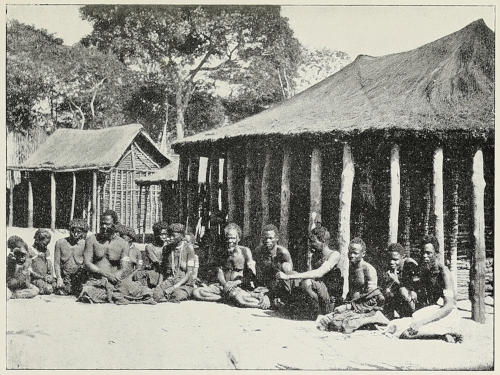
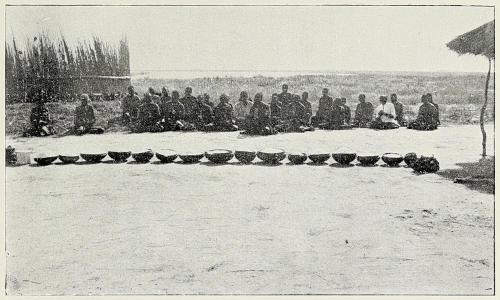
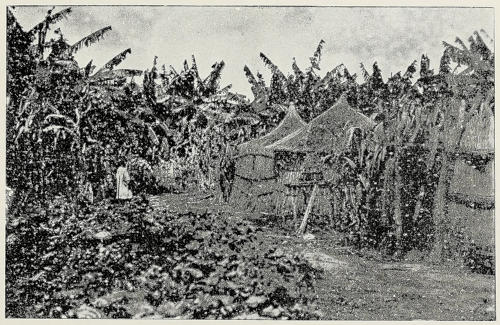
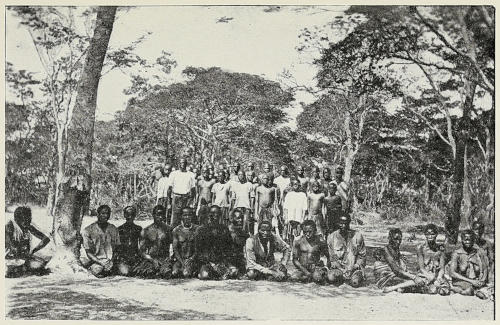
A Lujazi Village
Photo by J. C. Coxhead, Esq.
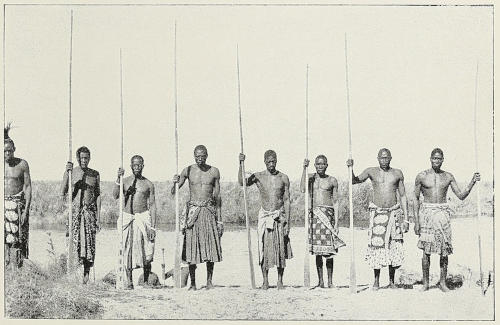
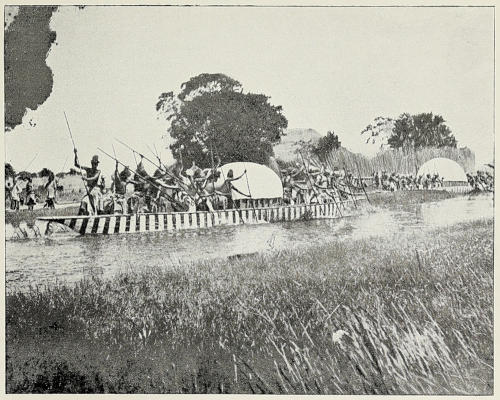
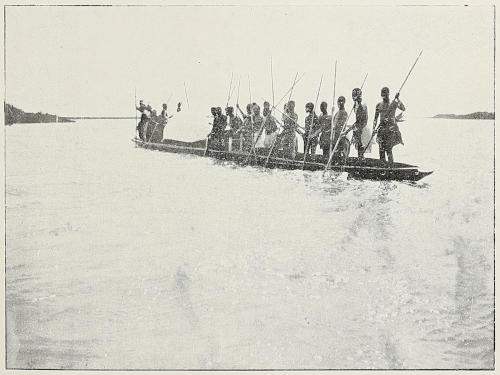
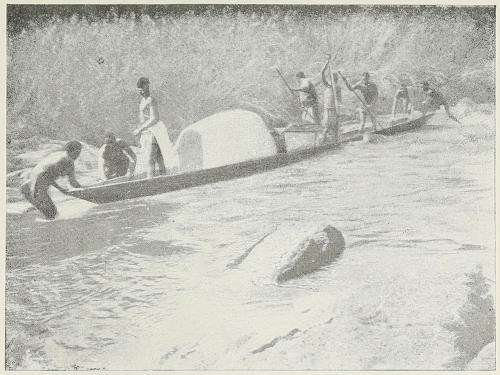
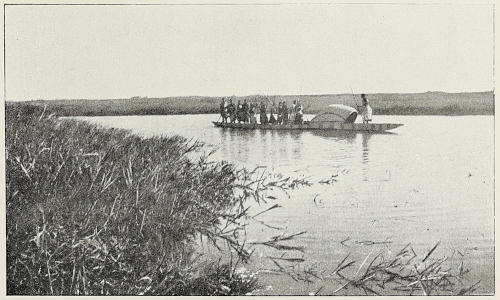
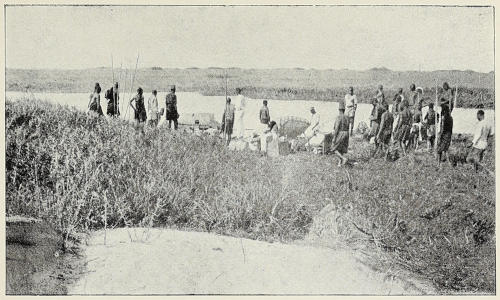
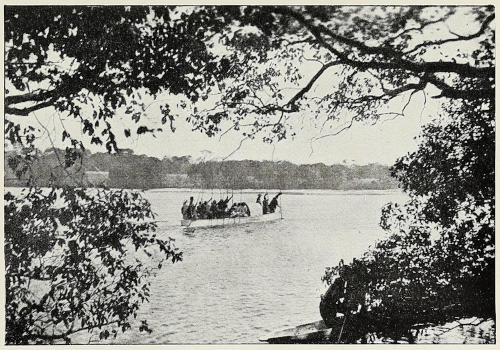
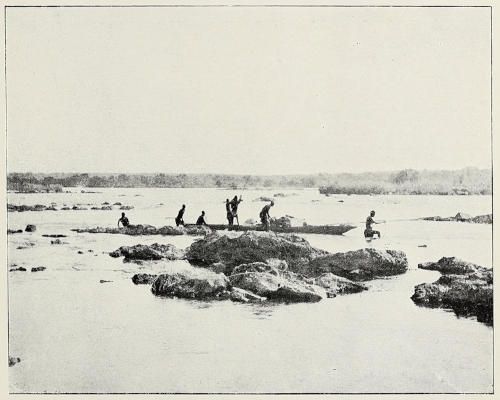
Lewanika’s Head Paddlers
Photo by J. C. Coxhead, Esq.
Besides all these safeguards, there is a Resident
Commissioner stationed at Salisbury in Southern
Rhodesia, a large part of whose duties is the protection
of natives’ rights. Beyond him again is the
High Commissioner for all native protectorates, who
directly represents His Majesty King George V,
and is also Governor-General for the Union of
South Africa.
A poll tax of 10s. is collected, which is very much
lighter than the tax collected from any native race
south of the Zambezi. This tax is collected from
adult males only, boys, old men and women not
being taxed, with the exception of second and other
wives of polygamous marriages. A man’s first wife
does not have to be paid for, but, as a man who
marries more than one wife is nearly always a man
of means, he is responsible for the tax of his second
and other wives. Exemptions are granted from
payment of tax, either for a number of years or for
life, for sickness, disease or old age.
The Administrator of Northern Rhodesia pays a
visit to the Barozi Reserve in person or by proxy
every year, and during his visit the Chief and the
people are at liberty to bring any complaints and
grievances before him. No matter is too trifling or
insignificant to receive the fullest and most careful
attention and it is doubtless the care taken over
these minor points that has solidified the excellent
relations at present existing between the Chief
Lewanika and the officials of the B.S.A. Company.
CHAPTER III. Native Administration.
The Paramount Chief of the Barozi is the
head of the nation and, in the eyes of his
subjects, can do no wrong. His actions are nevertheless
curtailed by the national assembly, which
was called in the early days of the Aluyi, the
“Namōō,” but after the Makololo invasion, the
“Kotla.”
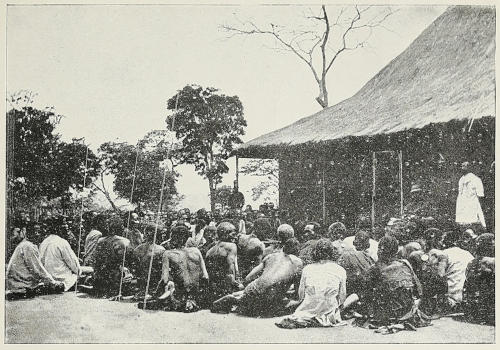
On state occasions the Chief sits in the middle
of the Kotla which holds its daily meetings in
a long rectangular building open on three sides.
Half-way along the fourth side, which is walled,
sits the Paramount Chief on a raised daïs. On
his immediate right sits the “Ngambela” or Prime
Minister and the various Indunas in order of the
responsibility of their positions. On the immediate
left of the Chief sits Ingangwana the Induna at
the head of the “Likombwa,” a division of the
people who supervise the Chief’s food and all his
personal property (as different from his property
as Chief). On the left of the Likombwa sit all
sons-in-law of the Chief, with the exception of
those who hold positions as Indunas of the people,
in which case they sit to the right in order of
seniority of position.
In any discussion the “Left” supports the
Chief while the Ngambela and the “Right” oppose
the Chief, should his wishes clash with the national
welfare. There are two rules for the conduct of
business in the Kotla which will be dealt with
separately. No state affairs are discussed in the
presence of the Chief by the assembled Kotla.
The reason for this is that out of respect for the
Chief’s person, it is argued that discussion would
be cramped and restrained and that the best and
wisest solution of the question would not be arrived
at. So the arrangement of the Kotla may be
placed under the following two headings: (1) with
the Chief present; (2) in the absence of the Chief.
(1) The Chief comes practically daily and sits in
the Kotla to show himself to his loyal subjects,
and to let them see that he is well. Trivial
matters only are discussed, the Chief asking any
questions he wishes of the Ngambela or any of
the indunas.
Should there be embassies from other people, they
are received while the Chief is present and the
Chief may, at will, call up the head of the embassy
and inquire of him as to the health of the Chief
who sends the embassy, the state of crops and
general welfare of the nation represented, or as
to how the embassy like the Barotse country; but
all these questions are polite nothings.
While the Chief is present, the Left sits as previously
stated but the Right is slightly different.
First comes the Prime Minister (or Ngambela),
after him comes Solami. Solami is the man who
represents the father of the Chief. As is easily
understood no Chief, whose father held the chieftainship,
ever held sway during his father’s lifetime.
This is not stipulated by law but has always been
the case—the death of a Chief’s father often having
been arranged by his son to secure succession. So
we find Solami is the man who has married the
Chief’s mother. Here again it might be suggested
that a Chief’s mother might also be dead by design
or by course of nature. This is guarded against
by the Barotse custom “ku yola” (to appoint),
which appoints a successor to take the name and
position of any male or female person of importance.
Makoshi, the mother of the present Chief,
Lewanika, died about ten years ago and a daughter
of Lewanika’s (Ngula by name) was at once
appointed Makoshi. Her husband is Solami and,
though a son-in-law, yet represents the father of
the Chief.
On Solami’s right sits Natamoyo. “Natamoyo”
means the “father of life” according to the Siluyi
meaning of the word “moyo,” and he has or rather
had, a position of great value and power. Should
any man—Chief, induna, or private person—be
pursuing anyone with the desire or intention of
killing him, the hunted person was safe directly
he could reach the Natamoyo or his palisade.
Natamoyo was in fact very similar to the “city of
refuge” of the Old Testament. Natamoyo also
had the power to veto an execution when discussed
in the Kotla, but his chief value lay in
his being a haven of refuge. He had as well the
following privilege. If the Chief committed any
act of injustice to any of his people, the injured
party could complain to the Natamoyo, who then
went to the Chief’s palisade and abused him
roundly. The Chief would then desist from the
course of action which was objected to. Needless
to say this privilege was very great and valuable
amongst a people over whom order was only maintained
by the exercise of great brutality, persecution
and very often injustice. It is hardly needful to
point out that anyone else having the temerity to
resent any action of the Chiefs would have paid
for it with his life, in all probability being assisted
out of the world, with torture and various most
revolting cruelties.
After Solami comes Mukulwakashiku, an Induna
who acts as Prime Minister during the absence of
the Ngambela. On Mukulwakashiku’s right sit
the various indunas who take precedence by the
relative value of their positions.
(2) When the Chief leaves the Kotla, the business
of the people is discussed; cases are tried
and new laws talked over, or old laws amended.
The “Right” sits in the same order, but the positions
of Solami and Natamoyo are now of little
value and the two leading men are the Ngambela
and Mukulwakashiku. Other divisions of the
people for legislative purposes will be described
later, but the method of the procedure of the
Kotla will now be given. The Ngambela calls
Mukulwakashiku and instructs him to inform
the assembled Kotla of the matter under discussion.
This is done and the assembled Barozi
are called on to express their opinions. The
smallest man (in position) on the “Right” starts
the ball rolling, and utters his views on the
matter. He must be a free-born Murozi, but not
of necessity even the headman of a village. All
the divisions have different values for each member
and the junior member of each division speaks first.
In a large assembly the first speakers are always
members of the “Ikatengo,” a division which comprises
the people, petty headmen and very minor
indunas. Headmen of more important villages and
sub-Indunas of the “Lukaya” division speak after
the Ikatengo have finished. When the “Lukaya”
have finished, the indunas of importance who
comprise the Saa division speak next. Following
them, the Sikalu expresses its opinion; this division
is composed of the higher indunas. Members of
the three division, Lukaya, Saa and Sikalu of the
“Right” alternate with members of the “Left,”
and when the head “Sikombwa” of the “Left”
has finished, Mukulwakashiku gives his personal
opinion. He is the last speaker before the
Ngambela. The Ngambela then gives a brief
résumé of the various pros and cons and shows
the weak points in the different arguments.
Should he disagree with the majority, a lively
discussion takes place, and should the majority still
disagree, the matter is laid before the Chief by one
of the “Sikombwa” (Left) and his decision is
final. This is seldom if ever the case—especially
nowadays—as the present Ngambela is a man of
great cleverness, tact and diplomacy, and can always
command a great following. When the matter is
settled in the Kotla, one of the “Sikombwa” is
sent with word to the Chief who sends word back
by the same man as to his approval or otherwise.
In the event of his disapproval he gives his
reasons by the same channel, and these reasons
are announced to the Kotla by Mukulwakashiku
at the Ngambela’s orders. When the Kotla hear
the Chief’s reasons, they signify their agreement
thereto by clapping their hands (kandelela), and
their resolutions are rescinded or else they refuse
to be guided by the Chief. The Ngambela then
goes to the Chief and explains the matter and
urges his acceptance of the ruling of the Kotla.
This he generally gets.
This is a brief description of the working of the
chief legislative organ as regards the making of
laws, settling of cases, &c. Their methods of
administering the law are as follows: Any private
person, free or serf, brings his case to the headman
of his village, the headman takes it to the resident
induna of the native district in which the village
may lie, the country being divided off into a large
number of districts, like parishes in England,
though much bigger in area; the resident induna
carries the case to the Kotla induna who
represents that native district in the Kotla and
the representative induna takes the case to the
Ngambela who hears the case at his own residence.
Should the parties agree to the Ngambela’s finding
the case is settled, but should there be any dissatisfaction
the matter is discussed before the
assembled Kotla, each party speaking in turn
with their respective witnesses.
The divisions enumerated earlier in this chapter
have each and all of them certain duties and
privileges. The “Sikalu” is a Privy Council and
consists of a score or so of the highest indunas.
They are divided again into two divisions which
have their respective duties. The “Sikalu” of
the night sits together with the Chief in a very
humble sort of hut, a good distance from any
chance of eavesdropping, and these indunas when
so employed do not “kandelela” when speaking
to the Chief. The Ngambela is one of the night
Sikalu. The Sikalu discusses any new law to be
made or any important matter which it is necessary
to keep very secret, and these discussions are
always held in whispers and at a good distance
from any likely shelter for eavesdroppers.
Arrival of the Nalikwanda
Photo by J. C. Coxhead, Esq.
The Secretary for Native Affairs and the late Paramount Chief
Photo by J. C. Coxhead, Esq.
The Sikalu of the day is sometimes taken on
one side in the Kotla by the Ngambela if any
little unforeseen piece of news or information crops
up in any discussion. Their conversation is also
strictly private and is held entirely in whispers.
The “Saa” is a much larger division of the
people, and has the privilege of going to the Chief
after dusk and discussing current topics with him,
the Sikalu members being also members of the
Saa. Any member of the Saa can talk when he
chooses and about what he chooses. Should two
start simultaneously the holder of the most important
position speaks first. The Lukaya and
Ikatengo are not allowed free access to the Chief
but are only called into the presence of the Chief
when required by him.
There are, beside these legislative divisions,
several other divisions of the people headed by
various indunas. On the death of an important
person another person, generally younger, is
elected to the place of the deceased; thus indunas
of the same name have been at the head of divisions
since time immemorial. These divisions are
enumerated in order of seniority. It was the duty
of the induna in charge of each division to provided
a certain number from the division under
him for tribute work for the Chief, or for raiding
parties or anything else that might necessitate a
large number of people being assembled together.
The first division is the Kabeti under the
Ngambela who deputes his authority to the induna
Imandi. The second division is the Mutakela under
the induna Mukulwakashiku, third the Ngundwe
under Noyo, fourth the Ngulubela under Katema,
fifth the Kawayo under Namunda, sixth the
Mbanda under Muyumbana, seventh Njeminwa
under Kalonga. The first six divisions are Barozi
only, but the seventh division comprises all alien
people subject to the Barozi as well as the
Likombwa or Chief’s body servants and the less
important of his relatives by blood or marriage.
All these divisions and arrangements of the people
are of long standing before the Makololo invasion,
and were necessitated by the fact that as there was
no known method of writing amongst the Barozi,
every induna of the respective divisions had to act
as index of the people under his supervision.
CHAPTER IV. Barozi Industries.
The Barozi industries are neither numerous
nor complicated. A simple people living
in a state of savagery would not have any very great
or serious wants. Living on the Zambezi, and in a
low flat swampy country which becomes inundated
yearly, boats were a necessity of life. The trunk of
a large tree cut down and then carefully hollowed
out and pointed at bow and stern, such were their
first boats and so they are to-day.
In the course of time they found that a long
paddle worked by men standing up was more
effective than a short paddle worked by anyone
sitting down, as well as being much more useful for
work in shallow water where the paddles being cut
long are available as poles for pushing the boat
along. Of all the various trees used for boat making
“mukwa” (a tree resembling an ash) is alone unsinkable,
all other kinds sink on being submerged.
Paddles are made of young “mukwa” as it has
more play and give in it than other woods. Paddling
itself is quite a fine art, and to be a paddler in the
Barozi sense of the word is to have a more than
useful knowledge of the science. Steering is done
by the stern paddler assisted by the bow paddler,
but by no means all of those who are good paddlers
are capable of paddling in the bow or stern.
The Barozi say that they learnt boat building
from the Batotela, but this is possibly automatically
suggested by the fact that suitable trees for boat
building are found a long distance from Barozi
itself, either amongst Batotela on the Lumbi, Bankoya
on the Dongwe, and Alunda and Balubale
on the upper Zambezi.
Pottery.—This industry, since the introduction of
iron pots and metal dishes, is fast dying out. At an
earlier date large numbers of clay pots of all sizes
were made. Considering that no wheel nor any
instrument beyond the bare hands were used, the
pottery work is wonderfully good. The favourite
forms of work were big circular pots with wide
orifices which were universally used for cooking
porridge and other foods, and large pots with thin
necks and narrow mouths which were used for
keeping water in. These pots are very porous and
are most excellent for keeping water cold during
the heat of the day. The more ambitious workers
(the industry is incidentally worked by women)
used to cut patterns and daub red ochre streaks
on their pots, this is usually done after the first
baking. Children universally model animals, though
very crudely, in clay, but few of these models are
burnt.
The Nalikwanda
Photo by J. C. Coxhead, Esq.
Government Messengers and a Post-runner at Nalolo
Ironwork.—It is not quite certain whence the
Barozi acquired this industry. They must have
had some knowledge of it during their migration
from the Congo to their present habitat, though
when they first left the Congo it is probable that
their implements were made of copper. The blacksmith
work of to-day is mainly in the hands of the
Batotela, Bakwangwa, Bankoya and Bambunda,
although traces of it are found in all tribes, aboriginal
and otherwise, who are included in the Barozi people.
In a few places iron is dug for and short shafts
sunk, but the main supply of iron is gained from
swamps and the beds of small streams. The ore,
as recovered from these sources, goes through a
rough smelting process, being placed under a large
fire of wood in a circular fire-place from which small
channels are made in which the molten iron is run
off. These channels end in small circular depressions
which collect the iron and it is then left to cool
off. The iron is naturally very impure and is always
very soft, but on the other hand it is very easily
rubbed up to a good degree of sharpness and is
really much more useful and adaptable to rough
work than well-tempered European steel. The
iron when cool is then taken in hand by the blacksmith,
whose knowledge is generally passed on
from father to son. He uses rough pincers, heavy
and light hammers and an anvil all made from
native iron. Bellows are constructed by taking
a large piece of wood which is trimmed down into
two large circular basins parallel to each other with
a long pipe running down from between them, a
small hole from each basin leading into the pipe.
A closed pair of scissors gives, on a very small
scale, a good idea of the woodwork of the bellows,
the two finger holes being the circular depressions
and the closed blades the pipe. Over each depression
is tied a well dressed piece of hide which is
tightly tied round the rim of the depression or cup.
In the centre of each piece of hide a light stick,
about twelve inches long is attached, and by jerking
these sticks up and down quickly, quite a useful
draught is made. At the mouth of the pipe a
nozzle of clay is made to prevent the fire getting
to the wood. Only charcoal is used by the blacksmiths
and this is made, by preference, from any of
the harder red woods with which the country abounds.
Spear heads, axe and hoe heads, snuff spoons and
nails are the chief articles made, and a good blacksmith
will embellish his work with all kinds of
punched ornamentation.
Basketwork.—This is a form of work which is
very nearly universal throughout the Barozi country,
although certain branches of it are confined to
certain localities. Plain mats made of rows of reed-like
grass kept very close to each other by several
parallel lines of bark, knotted to each individual
piece of grass, are made all over the country. The
best makers are, however, the Banyengo and
Bambunda. These mats are about five feet broad
and eight to ten feet long. A smaller mat, possibly
introduced by the Makololo, is made of flat reeds
which are kept together by strings of bark. The
bark in these mats does not show as the reeds are
strung on the various lines of bark. These mats
are about two feet six inches broad by five to seven
feet long. Another mat is made like the large mat
mentioned previously, but worked throughout with a
chequer pattern of dark bark so as to form squares,
diamonds, triangles and, in the more daring
efforts, to form crocodiles, men, horses, cattle and
elephant. The best workers of this last form of mat
are the Bambunda. Another form of mat is made
out of undressed papyrus strung on bark, so closely
that they are, when placed at a fair angle, practically
waterproof, and the Bakoma who are the chief
makers of this form of mat, frequently build their
houses of several mats slung over a horizontal
pole.
Crossing Cattle over the Zambezi
The Mokwai’s House and Fence at Nalolo
Circular and oval baskets of white stiff grass
with patterns of black grass woven into the white
are made by the Bambunda. These baskets have
circular covers and are really very well and artistically
made. The black grass used for patterns is of
two varieties, one kind being the pith of a very
slender root belonging to a small bush, while the
other kind is simply the white grass as used in the
main construction of the basket, soaked and partially
decomposed in water before weaving. The Bankoya
and the Alunda make a very closely woven grass
basket which is waterproof and which is much used
in districts where clay is scarce, to carry and even
to cook water. Grass baskets are almost universally
made throughout the Barozi to carry grain, meal,
sweet potatoes and other foodstuffs.
Woodwork.—The Barozi are not very proficient
at woodwork, the neatest and best workers being
again the Bambunda, Bakwangwa and Bandundulu
who make stools and wooden dishes in large
quantities. These are generally made out of a
soft wood and are then hardened on the surface
by being scorched all over with a red-hot axe blade,
a certain quantity of fat being rubbed in after the
scorching. The Bambunda are very clever at
carving little figures of wood representing men,
women, animals and boats, the Bambalangwi,
Balubale and Alunda carve long hair combs and
sticks in a variety of interesting patterns. The
average Murozi can carve himself a knobkerry,
axe and hoe handle, or the shaft of a spear, but
their work is very plain though very neat and
wonderfully regular.
The Bandundulu are the chief makers of boat
paddles, though the Bambunda and Bakwangwa cut
them as well.
CHAPTER V. Barozi Customs (Mikwa).
The customs from infancy to old age and
death, of the nation will be given first, and
a few peculiar customs of certain tribes will be
described afterwards.
Birth.—A pregnant woman on feeling her confinement
near, has a small grass hut built for her
at the side of her husband’s house. There she
is confined, no male being present, though other
married women come to assist. Young women
are not allowed to be present. The umbilical
cord (kakombo) is cut close to the child’s navel
(mukubu) and a piece of string is knotted tightly
round the navel to prevent further bleeding. The
child is washed with cold water. The mother’s
thighs are washed with hot water, grass having
been boiled in it previously. The afterbirth is
buried by women near by. Certain roots are
procured from the forest and soaked in water,
the child being washed with this mixture every
day for two or three months. The mother remains
in the temporary hut for two months, women going
every day to help her wash herself and child.
After two days the husband may go to see his
child but may not sleep there. Certain of the
tribes absorbed by the Barozi have a custom
that compels a woman, after delivery of a child,
to sleep with two other men before returning to
her husband. The Barozi themselves do not have
this custom. About four months after the birth,
if the child lives, conjugal relations are resumed,
but if the child dies shortly after birth the mother
mourns for a day or so, and directly she has
recovered from the effects of giving the child
birth, returns to her husband. Twins are not
killed, nor are they considered unlucky. A child
born deformed is killed, generally by the mother
choking it by forcing the breast well into its
mouth.
Triplets are very rare and are considered bad.
One is killed and two left alive, the reason being
that the mother has only two breasts. Children
are suckled for nearly eighteen months. If it
becomes known that a woman, married or single,
has procured abortion, she is taken by the other
women of the village and the hair of her head
is pulled out by the roots. Nothing is said however,
if a woman takes medicine to prevent
pregnancy. If a woman gives birth to a still-born
child a grass hut is built outside the village
and the woman has to live there, day and night,
for a month, only women attend her and bring her
food, no man will go near the place. When the
month is finished, the women bring medicine to
wash her with and she is then at liberty to return
to the village, but must sleep once with some man
other than her husband, before returning to her
husband.
Capture of a young Crocodile
Photo by Mrs. Cambell
Arrival of Lewanika’s Subsidy at Lialui:
Carried by British South Africa Company’s Messengers
Photo by J. Walton, Esq.
It is considered most unlucky for a woman to
become pregnant while still suckling a child, and
native tradition holds that the first child will always
die, as after the mother becomes pregnant the milk
then belongs to the unborn child and the bigger
child will not thrive on it. Children are always
carried on their mothers’ backs, supported by a
skin, until about two years old, after which age,
if the journey is any distance, the child is placed
astride one shoulder of the father and so carried.
A child is never beaten till about two years old and
after that chastisement is very mild. At six or
seven boys are chastised by father or mother, but
girls of the same age are only chastised by their
mothers.
Arrival at the Age of Puberty.—Boys have no
initiation ceremony, and circumcision, though
practised among one or two of the tribes absorbed
by the Barozi, such as the Balunda and Bankoya, is
not practised by the Barozi. Girls have a ceremony
known as the “Mwalianjo.” Directly a girl has
her first periods of menstruation, she immediately
goes and hides, if living out on the plains, in an
adjacent clump of reeds or, if living near the forest,
in the bush near the village. While thus hiding
she is not supposed to see or speak to a man or boy,
and if one actually approaches through inadvertence,
she covers her head with a cloth or skin until he
has passed by. Directly her absence from the
village is noticed by her contemporaries, the married
women go and look for her and stop with her in the
bush, singing and dancing. At night after dark,
she is brought back to her father’s yard to sleep,
but at daybreak she is always hidden again in the
bush. This goes on for a month. The women
while dancing and singing round the girl beat her
with sticks, not severely enough to do damage but
hard enough to arouse the tears and lamentations
of the novitiate. The married women also show
the girl how to receive and how to comport herself
during the conjugal embraces of her husband, one
woman taking the man’s part for the performance.
Much advice is given her how to preserve her
husband’s affections. At the end of the month
the women take the girl to the nearest water and
wash her. One of the elder women then goes and
turns the bridegroom out of his house and the girl
is then brought and placed in the hut in the blankets,
the husband recalled and the newly married pair
left. The company then dance and sing all night,
drinking and eating largely the while. In the
early morning the women take the bride and cut
all her hair off, and she is in all senses of the word,
a married woman. This “mwalianjo” ceremony
was in itself fairly harmless, although possibly a
trifle coarse and vulgar from a European point
of view, but of later years single girls who had
not even arrived at the age of puberty used to
attend these ceremonies and join in the obscene
jesting that went on, and the married women besides
giving good advice, also counsel the bride-to-be
never to refuse the overtures of one or more
paramours, as well as giving her hints of how
best to hide these intrigues from her husband.
Very few girls reach the age of puberty without
being already bespoken in marriage. Should the
bridegroom elect have died just previously or at
the time of his wife’s “mwalianjo” ceremony,
the girl remains with her father and indulges in
fairly promiscuous intercourse with the men and
youths of the village, until a suitor turns up and
marries her. Virginity is unknown and certainly
not demanded.
Marriage.—As has been shown in the previous
paragraph, girls are all bespoken in marriage many
years before arriving at a marriageable age, and
have, theoretically, very little say in the matter
at all; the arrangements being made between
suitor and father or mother. The mother’s rights
over her daughter are not so powerful as the father’s.
A young man arriving at an age when he considers
it good to get married, goes to the parents of the
girl of his choice (generally before she has arrived
at the age of puberty), and asks their consent to his
marriage with their daughter. If the parents agree,
the suitor gives the girl a necklace of white beads
and a blanket. The matter is then left until the
girl goes into hiding for her “mwalianjo.” No
permission or approval is required from the suitor’s
parents, but sometimes a father while his son is
still fairly young, will arrange a marriage for him.
After the “mwalianjo” is finished, the bridegroom
will give presents to his father-in-law and mother-in-law.
The presents are generally an ox, a hoe
and a wooden dish. The father-in-law on his side
gives a shirt and a loin cloth to his son-in-law.
The mother-in-law then cooks beer in large quantities
and the bridegroom, his friends and relatives, the
bride and hers, all drink the beer. The bridegroom
also has certain obligations, such as cutting a garden
for his wife’s parents and building or helping to
build a new house for them. During the performance
of these duties the newly married couple live
in the wife’s village, eating the food of the wife’s
parents, but after performing these duties, the
couple return to the husband’s village, returning
to visit the wife’s parents occasionally but having
their permanent residence at the husband’s village.
In case of divorce, the wife returns to her father’s
village. No compensation is due from the girl’s
parents if she is divorced.
Tax-payers
Photo by J. Walton, Esq.
Royalty travelling by Boat
Photo by Mrs. Cambell
Death.—The Barozi bury all their dead with the
exception of lepers. Their reason for not burying
lepers is the idea that if a leper is buried in the
earth the ground will become impregnated with
leprosy and everyone will die of that disease. Men
and women are buried alike. The eyes of the
corpse are closed and the knees bent right up to
the chest. The arms are bent at the elbow and
the hands placed palm to palm level with the mouth.
A blanket is then folded round the body. A rough
stretcher is made of poles and the corpse carried on
it to the grave. Each district or collection of
villages has a common burial place. If possible a
corpse is brought to its own burial ground. But
this is only done when the person dies within a
short distance of his or her home. Corpses are
buried the same day as death takes place. Men
always act as carriers, irrespective of the sex of the
corpse. The corpse is lifted off the bier at the
graveside and placed in the grave, on its side, head
to the west. The Barozi dig a straight square hole
and a mat is placed tent-wise over the corpse.
The clothes of the deceased are put in the grave
under the mat, as well as a few wooden dishes and
pots, the latter being first broken. The mat over
the corpse is put there with the idea that no earth
shall actually be thrown on the body, although as
the sides get filled up, the mat eventually gives
way under the weight and the grave thus gets
filled up. Some of the burial party stand in the
grave at the side, the rest push the earth to the
edge of the grave. Those standing in the grave
take the loose earth and place it gently all round
the edge of the mat covering the corpse, raising
themselves on the earth thus placed as the grave
gets filled up. After the mat has given way
beneath the weight of the earth, the grave is
filled up. A mound of earth is placed over the
grave and a few more pots and wooden dishes
are broken and placed on top. The burial party
and mourners then return to the village. On the
path outside the village a small fire is made and
the whole party, men and women have to leap over
the fire as a form of purification. They then
assemble at the deceased person’s house and mourn.
The mourning lasts for three or four days, and
consists of sitting round the deceased’s house and
wailing. Cattle are killed, the number being in
proportion to the wealth of the deceased, and the
meat is eaten during the mourning. After the
mourning is finished the whole party wash in
special medicines. If the deceased is a man his
house is broken down, but if a woman her husband
still lives in the house, but the house is plastered
afresh before he re-occupies it. No difference is
made in the burial of a pregnant woman. The
Barozi themselves make no distinction in burying
hunters, though the Alunda and Bankoya do.
The only people who have separate and special
burial grounds amongst the Barozi are those of the
blood royal. The less important members have a
common burial place, but the paramount Chief and
sub-chiefs at Nalolo, Libonda and Sesheke have
each a village already built and selected, in the
middle of which they will eventually be buried. In
former times, many of the reigning chiefs favourite
indunas would voluntarily submit to having their
arms tied behind their backs and being placed thus
bound into a boat which had previously been bored
through in several places. The boat was then
towed into midstream and sunk. It is also probable
that in former days a number of slaves were killed
with the deceased chief, but a natural shyness of
admitting these things makes them very difficult to
prove, while the sanctity as well as fear of approaching
burial places of any kind, prevent any sort of
exhumation as proof.
Certain of the tribes included in the Barozi,
have different customs as regards death and burial,
but they are very slightly different and the difference
is hardly worthy of comment. The Alunda
used to bury on platforms erected in the bush, but
now nearly all burials are conducted similarly to
those of the Barozi.
The Bankoya, Alunda, Bambalangwe and Balubale
bury chiefs and indunas in their huts and,
after so doing, generally move their villages a little
distance from the old site. Hunters are usually
buried outside the village, a short path being cut
from the main path to the grave. Poles are stuck
round the grave with the skulls of various wild
animals on them. These tribes tie a long string to
the corpse and keep the end of the string above the
top of the grave. The Bambunda place a reed in
or close to the ear of the corpse when in the grave,
the end protruding above the top of the grave.
Witch doctors and others are supposed to learn
important secrets from the spirit of the deceased by
means of a reed or string communication. Another
custom among the Bandundulu is that of “bringing
back” those men who stand in the grave placing
the earth in it. After the grave has been nearly
filled, the oldest woman in the village takes her hoe
and places it on the shoulder of one of the men and
pulls him out of the grave. Each of the men so
employed is treated similarly. The grave is then
raised to the necessary height. As far as can be
gathered, though it is admitted that there is very
little native confirmation, the idea is this: The
oldest woman being very old and near to death can
therefore get no harm from the dead. So she is
chosen to affront the dead by bringing back from
the grave, those people who were employed in
filling up the grave, and who having entered the
grave were as dead or as the property of the dead.
The use of the hoe is symbolical of the digging out.
The Alunda after a burial do not leap a fire as the
Barozi do, but stand at the nearest bifurcation of
the path leading to the village, and the oldest
woman of the village brings burning sticks and
passes them round the burial party. Here again,
the employment of an elderly woman near to death
and thus immune to the danger of the dead, is
noticeable.
Having thus roughly depicted the four chief
divisions of the life of the average male or female
Murozi, a few points of their daily life as governed
by custom will be now described.
Mankoya women dancing
Photo by J. Walton, Esq.
“Well in swing”
Work.—A very hard and fast rule is maintained
in the division of the day’s work although, as is
usual with many native races, the greater portion
falls on the female. The axe and the hoe are very
emblematic of the different kinds of work for each
sex. The man does all wood cutting in preparing
a new garden or in building a house, while the
woman tills the garden with her hoe, cuts grass for
thatching with her hoe and mixes mud for plastering
the house with her hoe. So emblematic are
these two implements that very light and ornate
axes and hoes are made solely for carrying when
visiting. The woman does all garnering of grain,
though the man builds the frame of the grain bin.
Brewing of beer and cooking of food is woman’s
work, though young and single men cook their own
porridge or employ little boys to do it for them.
All mud plastering is done by women though the
framework of the house, the building of the reed
fence, and the thatching of the house is the man’s
portion. Grass cutting is chiefly women’s work,
but men often assist at it, reed cutting for fence
and hut building is done by both sexes. A woman
will fetch loose fire-wood from the bush but will not
cut fire-wood down with an axe. All carrying is
done by women on their heads but men always
carry their loads divided into half, half fastened to
each end of a pole which is carried on the shoulder.
Women do all the carrying of water required by a
household. All cattle herding and milking of cattle
is done by men only, but the Barozi cannot give
any reason for the custom except that it has always
been men’s work. There is a belief that if women
enter a cattle kraal, it will bring on an immediate
and untimely menstrual discharge, the only women
who go near a kraal are therefore very old women
or very young children. The most notorious
exceptions to the above customs are the Alunda.
These people will often admit they are the slaves
to their women folk. The average Lunda woman’s
daily work is fishing, which they do by wading
along the sides of streams, pushing a large wicker
basket in front of them. The Alunda men use
the hoe as well as the axe, and tend their gardens,
grind meal for porridge, plaster their huts and do
all the work that is generally supposed by other
tribes to be women’s work only. In speaking of
the Alunda, it must be remembered that the
Alunda living in the Barozi country are only a
small portion of the main tribe, the larger portion
living in Southern and South-western Congoland.
All other tribes under the sway of the Barozi
follow the customs depicted above, in the division
of labour between the sexes. It will be seen by
reference to Chapter IV that women do not share
in many of the industries of the country; with the
exception of the mat and pot making all other
industries are worked by men. This, however, is
only fair and just, as it will be seen from the
preceding paragraphs that the larger portion of the
day’s work certainly falls on the women.
Salutations.—A great deal of the ceremony of
salutations is being killed by civilization. The
ordinary forms of greeting differ according to the
status of the parties meeting each other. In a
country where time was and is very little object,
two people of equal status on meeting put down
their spears and anything they may be carrying
and squat on their heels. Right hands are clasped
but not shaken, and a second grip is given after the
first one, by closing the hand on the thumb of the
proffered hand. This grip is done by both parties
simultaneously, and is by no means peculiar to the
Barozi, as the Matebele, Basuto, Bechuana and
Xosa people all do the same. The Barozi, after
completing the grip, clap their hands (kandelela)
three times and then converse on various topics.
If the parties are related or well-known to one
another the two grips are given and then both
parties join hands, the right hand of one holding
the left hand of the other, and vice versa, a kiss is
given by each to the palm of his friend’s left hand.
If very close relatives meet, besides this they spray
each other with spittle. When a person of humble
status meets an induna or person of importance, he
or she steps off the path and claps (kandelela) until
the big person has gone by. The Chief has a
special salute for himself, which is also given to
any envoy coming direct from him. It consists of
every man greeting him by standing up and shouting
“Yo sho” at the same time throwing both
arms to full extent above the head, this is done
three times, then all kneel, clapping their hands
three times and shouting “Shangwe” (my father),
“Mangwe” (my master), “Mawe” (my mother), this
performance is repeated a second time exactly
similarly and a third time, when the only difference
is that the third time “Yo sho” is said on their
knees. When women greet the Chief, they remain
seated on the ground and shout “Ya shé” clapping
their hands at the same time. These are the actual
greetings although when the Chief moves about
from one locality to another, large ceremonial
dances for men and women take place. The clapping
of hands (ku kandelela) is differently performed
by the two sexes. Men bring both palms
smartly together, the right hand uppermost and at
right angles to the other hand. The women close
the fingers and arch each hand, making a cup
formation of both hands which makes a hollow
sound as they clap the concavities together.
Mambalangwe “Nuts”
Photo by Mrs. Cambell
A great deal of respect is still shown to elders of
both sexes. For instance, several women may be
hoeing a garden and during the heat of the day
one of the younger ones will go and fetch water in
a calabash, or dish, for drinking purposes. On her
return should there be other women waiting to
drink, the eldest has the first drink, and this is not
affected by the ownership of the dish or any other
reason, except in the case of an old slave woman
and a younger free woman when the free woman
drinks first unless the free woman is a girl who has
not been through her initiation ceremony when the
old slave woman drinks first. Age has seniority,
then married before single, maturity before immaturity.
On the other hand, at a meeting or
assembly, the younger men speak first on the
supposition that their council is rashest and of least
value, the old grey heads and deep thinkers having
the last say. A father commands more respect in
many ways than a mother, but there are other
reasons for that more than the imagined superiority
of sex. Chief amongst them is, that in a country
of easy and frequent divorce, the children when
able to walk and look after themselves, immediately
belong to the father and gradually forget their
mothers. But the principle of “respect for age”
still has a great effect on the young of either sex,
throughout the country. A youthful induna of
much importance will still be exceedingly polite to
older indunas of much smaller position.
A gift is always received by both hands, and the
modern European method of holding out one hand
to receive anything whatsoever, is unknown. This
custom certainly arises from the idea that as both
hands are held up to receive a gift, there can be
no possibility of a stab or blow being delivered, as
would be quite possible if one hand only was used
to receive whatever was passing between two
parties.
Feeding.—No unmarried women will eat eggs, as
the belief is that if they eat them they will be
barren. Nor will unmarried women eat the flesh
of the pelican, because, according to native tradition,
the pelican cannot, owing to strength and
size of wings and extreme buoyancy, be pulled
under and eaten by crocodiles, and if they were to
eat its flesh they would not be caught as wives by
men. No women may eat the monitor lizard
(hopani) though men eat it and it is considered
a great delicacy. The reason for this is that
monitors look very like snakes, of which women
are more frightened than men.
Men, women and children always rinse their
hands before eating. This is the more necessary
since most foodstuffs are carried from the pot to
their mouths by hand. It makes no difference if a
man is eating by himself or with company. After
the meal the hands are rinsed again and the mouth
as well. Men seldom eat with their wives, as a
man who does so is jeered at and considered
greedy, on the principle that being stronger than
his wife he will grab the largest and best portions.
Women and children, male or female, eat together,
and little boys will eat with little girls, but grown
up men practically always eat either by themselves
or with men friends. Meals are eaten twice a day
regularly, but sometimes more often when food is
plentiful. The staple diet is a stiff porridge made
of ground flour of manioc (a species of cassava),
mealies (maize), red and yellow millet or Kafir
corn. A sauce is made of fish, meat, wild spinach
or monkey nuts, and the lumps of porridge are
dipped in this as detached from the dish. Maize
porridge is eaten generally with milk, sweet or sour.
Meat and fish are preferred high, but fresh meat
and fish are eaten when plentiful. Milk is a very
popular form of food, especially in the thick sour
form. Many kinds of wild fruit are eaten, as is
game when procurable. The Nambove and certain
lower classes of the Barozi will eat crocodile, but
the better class Barozi turn up their noses at it, as
they do at the wild cats which, however, are gladly
eaten by the Mambunda. Food is eaten in early
morning and towards sundown.
The appearance of the new moon means a general
holiday. The day after its appearance no one goes
to work at the gardens. In former times the
“Ngomalume” and “Liwale” dances were danced
in the villages of Nalolo and Lialui (the residences
of the two biggest Barozi Chiefs) only, by men and
women respectively, but this custom is dying out.
The ploughing and hoeing of a new ant heap is
also the occasion (on the day after the ant heap is
ploughed) for a holiday. The belief being that if
a holiday is not taken the seeds planted in the new
garden will die. This custom does not apply to
ant heaps that have ever been ploughed before.
Certain tribes under Barozi rule have a custom
which refers to the fidelity of their wives, but the
Barozi do not make use of this custom. Should a
man suspect his wife of infidelity he takes a little
ash from the fire and when his wife brings the newly
cooked morning food he throws the ash over it
and goes out to eat with one of his friends. If the
woman happens to be virtuous or, whether virtuous
or not, wishes to give the lie to her husband’s suspicions,
she shuts herself up in her hut and bewails
her lot or sulks, whichever her temperament may
lead her to do. If on the other hand, she is
unrepentant and reckless, she throws the spoiled food
away and goes off and eats with her women friends.
The Barozi themselves have no form of blood
brotherhood. They have a custom called “making
a friendship” (ku ikeza bulikani). One man calls
another to his house and tells him he wishes to be
friends with him. If the other party agrees, the
first man gives the other a small present. On the
return of the second man to his house a return
present is sent. This makes the friendship binding.
After that if the first man is in trouble or need, he
runs to his friend and the friend supplies him if
possible, with what he needs or assists him to the
best of his ability. Anything a man lets his friend
have is a gift, and there is no obligation of returning
it or its value, the only obligation that remains
is that of help in the event of his friend wanting it.
The subordinate tribes have a proper form of blood
brotherhood. It is practised amongst men only.
The two who wish to make the brotherhood get
two cups of beer. Small incisions are made on the
chest and a drop or two of blood is squeezed from
the incisions into the beer. Each man takes the
other’s cup and drinks it, they then swear never to
hate each other, never to kill one another should
they meet in battle, and never to be angry with
one another. It is believed that a man who kills
his blood brother will die of leprosy.
Mat-makers, with Mats for Sale
Photo by J. Walton, Esq.
A Mambalangwe Family
Photo by Mrs. Cambell
There is a marriage custom that exists among
certain of the subordinate tribes in Baroziland.
When a woman is pregnant a man, generally an
acquaintance of hers or of her husband, will go up
to her and place his hand on her stomach, at the
same time addressing his remarks to the unborn
child: “You within, if you are a woman, shall
be my wife, but if you are a man, you shall be
my friend.” When the woman is delivered this
prophecy is carried out. There is, however, no
record of what would happen if there were twins.
This custom is probably learnt from the Batoka,
but the Barozi do not practise it.
Another custom, also existing among certain of
the subordinate tribes, is the obligation of a man to
give a younger sister or cousin to his son-in-law,
should the son-in-law’s wife die or be childless.
But if it is only a case of sterility the elder woman
returns home to her father, as the marriage of
two sisters to one man at the same time is not
tolerated.
CHAPTER VI. Barozi Riddles and Conundrums.
Conundrums are universal throughout the
Barozi, and a few are given as examples.
Most of them are lacking in humour from an
European point of view, but the ability to guess
them is looked on as quite an asset, especially
among women and children. Each riddle is prefixed
by the words “A-ko,” “Here it is,” used by
the person asking the riddle. The person taking
up the challenge replies “Keyi,” which means
“Bring it.” These words are pure Silui (Serozi)
and are used for all riddles, although the riddles
themselves may be in Sikololo, Mbunda or any
other tongue or dialect in use in any part of Barozi.
There are not any permanent riddles, as they are
generally made up by the person asking them,
but there are a few certainly which, from the length
of time they have been known and their popularity,
may be considered as permanent jokes.
(1) Question. “Ku tanta mbilingwa ku uka ni mbilingwa.”
“It climbs up and falls back.”
Answer. “Ki kokwani ha ipahama kwa kota.”
“An insect climbing a tree (still slips).”
(2) Q. “Kateli ka shangwe no malimba.”
“My father’s calabash has spots.”
A. “Ki ngwesi.”
“A tiger-fish.”
(3) Q. “Ka ka bonwe fo ka felela.”
“Something one cannot see the end of.”
A. “Ki ndila.”
“It is a road.”
(4) Q. “Mbumu na mbumu ka kuwana.”
“Chief and chief do not visit each other.”
A. “Ki musitu.”
“It is the forest.”
(5) Q. “Tutanela twili ba mundi.”
“Two huts in a village.”
A. “Mele no akatana.”
“The breasts of a young girl.”
(6) Q. “Ka nwela ka tumuka.”
“Something that dives in and leaps out.”
A. “Ki silabo.”
“A paddle.”
(7) Q. “A lila ba likamba la walanda.”
“Something that crys on the river bank.”
A. “Ki maoma.”
“It is the war drum.”
(8) Q. “Ha ka siwi.”
“Something that cannot be left behind.”
A. “”
“A shadow.”
(9) Q. “Ka be ka luma, ka be lu felile.”
“If this thing bit, we should die.”
A. “Ki munyako.”
“The doorway.”
(10) Q. “Kato ka shangwi ku longa.”
“My father’s boat is full.”
A. “Likundi.”
“A pod of peas.”
(11) Q. “Ka kasa fezwi bu meti.”
“Something of which the blood is never finished.”
A. “Ki pula.”
“The rain.”
(12) Q. “I samba ka shemwa ak’a endi ni balelo.”
“Born a long time, and yet cannot walk.”
A. “Sitondo.”
“A tree.”
(13) Q. “Anuke a ku fukile utu kobela no ku kena.”
“Boys dressed in white clothes.”
A. “Ki mundali.”
“Mealies.”
(14) Q. “Lila la tau ha li iniwi ki nzi.”
“A fly cannot sit on the stomach of this lion.”
A. “Ki mulilo.”
“It is fire.”
(15) Q. “Ka bata mazwalelo.”
“It looks for a place to be born in.”
A. “Ki tozi.”
“Pumpkin stalks (before they bear fruit.)”
(16) Q. “Mutala no ku sumenena.”
“A well fixed fence.”
A. “Ki mayo.”
“The teeth.”
(17) Q. “Ndundu no makumba.”
“A bundle of bark.”
A. “Ki lezazi.”
“The sun.”
(18) Q. “Namani ya zwalwa ka nako ye, kwamoraho a mazazi e na le manaka amateleli.”
“A calf born now, in a few days has long horns.”
A. “Ki mbututu.”
“A baby.”
(19) Q. “Lutondo lwa ka yengwa Nyambi.”
“Tree made by the god Nyambi.”
A. “Ki kuma.”
“The papyrus reed (with tuft on top.”)
(20) Q. “Mulamu wa Nyambi na mbulwa makolwa.”
“The stick of the god Nyambi has no branch.”
A. “Ki noha.”
“A snake.”
(21) Q. “Mulume a lebe a mane kapata matunga a bile.”
“A long man cannot reach this country.”
A. “Ki lihulimu.”
“The sky.”
(22) Q. “Komo i potoloha silezi.”
“A cow that walks round in the mud.”
A. “Mukwenyani.”
“A mother-in-law.”
(23) Q. “A mutulo u ku nengela a mbowela u ku nengela.”
“The people of the north dance and those of the south dance.”
A. “Matali a kota.”
“The leaves of trees.”
(24) Q. “Ku tina ku mukelekete, mukelekete ku choka.”
“You climb this tree, it breaks.”
A. “Ki mutwa.”
“The little thorn-bush.”
(25) Q. “Ka ka muenwa mwanda.”
“You cannot see any trace of it.”
A. “Ki mundu.”
“It is the watersnail.”
(26) Q. “Ndo nambulwa mwelo.”
“The house that has no door.”
A. “Liki.”
“An egg.”
(27) Q. “Ka lubilo ku siya sitimela.”
“What runs quicker than a train?”
A. “Ki pilu.”
“The heart.”
(28) Q. “Mwandu ya ngulubati ha ku keni lishingwa zepeli.”
“No two logs can enter this old man’s house.”
A. “Lisuba la ndonga.”
“The eye of a needle.”
Gang of Natives proceeding to the Mines
in Southern Rhodesia
Photo by Mrs. Cambell
CHAPTER VII. Barozi Songs and Dances. — The Liimba. — The Liwale. — The Ngomalume. — The Lishoma. — The Bunyanga. — The Mandendi from the Mankoya. — The Liala from the Makwangwa. — The Naimbwe from the Mankoya. — The Seperu from the Mashukulumbwe. — Silui (Sirozi). — Sinkoya. — Silui (Sirozi). — Silui. — Sindundulu. — Sinkoya. — Silui — Sinkoya. — Silui. — Mbunda.
This is a purely Barozi song and is sung and
danced by women only, to celebrate the
arrival of a Chief.
“Sitengu nalili, masiku a nakene, ndendende.”
Sitengu (a small bird that is heard before cock crow)
has called, the night is finished. Yea! yea!
“Mukalelwa mweta sikawana moya, ndendende.”
The one who is in trouble says he cannot free
himself from his trouble. Yea! yea!
“Mufuma mweta sika sheba sinu, ndendende.”
The rich man says, I am in need of nothing.
Yea! yea!
“Muwabelwa mushekasheka, ndendende.”
The man who is glad always laughs.
“Mu siala munyima tayiwa mangwi, a kena ta liya
mu yenda munyima tayiwa a tata ta ndoo.”
He who stops behind, my master, is white like a
pelican, but he who goes along (with us) is
bright like a leopard.
And many other verses.
This is a purely Barozi dance and is danced when
the new moon appears, by women only, with drums
and silimba.
This is purely Barozi and is danced by men at
the arrival of the new moon.
Purely Barozi, danced by men only, on the
arrival of a Chief. In both these dances a large
war drum is placed before the Chief, and the men
shuffle round it in time to the drum.
Shooting Rapids
Ngonya Falls at Sioma, Barotseland
An Mbunda song sung by men and women,
generally sung when a hunter has brought meat,
but also after the hearing of some case between
various people. A few verses are:
“Tangwa lia toko nji ka bangila mwebwangi,
wa ili musambwa lia ndonga, konja lala tulo
njilinga bati mwebwangi na na welelo, buno
buta njilinga chilapo.”
The sun is set, I follow my wife, she has crossed
the river, I cannot sleep, what shall I do
without my wife? Yes, I will make a paddle
of my gun.
“Njamba wa funda bilindi bia Kalunga, u yu wa
funda umu.”
The elephant digs holes of God, who digs here?
“Kwenda buchechi, kwenda na mema, mu zabule
wino ngandu mwali umo.”
Go carefully, go in the water, come out carefully,
the crocodile is there.
The verse used chiefly after the settlement of
disputes:
“Nena bwala tu nwe, kumi lia matemo, milonga
tu andeka.”
Bring beer to drink (and) ten hoes (as a fine) we
will talk over the disputes.
A song and dance for men and women, with
drums accompaniment, danced for sick people.
“Kwa Mulala na Sikobela kwa ili lukambo yai, ya,
yai, ya, we yai, ya, kwa ili.”
To Mulala and Sikobela they have gone to dance,
yes, yes, yes, yes, yes, yes they have gone there.
And other lines of a similar nature.
A song and dance for men and women, with
drums, danced for sick people.
“Mwaka bani fa bang’ambote matondo.”
The year I will die, the medicine will speak to me.
“Ke’ manene Nalwamba katondo.”
The (medicine of the) tree standing at Nalwamba.
“Ni liat’aba kaowa.”
If I stand there the insect kaowa (will bite).
“Tu kaiowani, tu kaiowani, mene sisingi kuli
yowano tamba ni kalemwa ngandu.”
Let us go and wash, let us go and wash, I do not
want to go and wash lest the crocodile catch
me.
And other lines.
A dance danced by the doctor, with the audience
singing and beating drums.
“Mu kuchaba nkuni tu ka moni ba lubanda.”
Let us go to gather fire-wood and to see the people.
“Shimu bombola mema, meme ye mema a
kalambwi.”
The cold water, the cold water of the river.
“Baulima na Balushangi mawa fulili kalangu
kaluwi.”
Balima and Balushangi, please make bells for
dancing.
And other lines.
Food for Sale
The End of the Day’s Journey
A dance for men and women without drums.
“Si nibizi ka kapiololo, litaba kamuso li ta
anduluka.”
Do not call me with a whistle, the matters will
be discussed to-morrow.
“Ha ni jeli fande haisi, mwa muzuzu ni mwa
makozwana.”
I cannot eat outside the house, inside yes, but not
outside.
And other lines.
Besides these combined songs and dances,
there are numerous songs that are sung to the
accompaniment of the “Silimba” or kangombio.
The “silimba” is an instrument made on the
pattern of a Xylophone—the notes are pieces of
wood cut down very carefully till they are as thin
as possible without splitting, each piece being
fastened to a frame over long calabashes of varying
lengths, the longer the calabash the deeper the
note resulting from it. Each calabash has a small
hole near the base, carefully covered with spider-webs
to give vibration to the notes. The notes
are struck with sticks (one held in each hand) with
a knob of native rubber at the end of each.
The “kangombio” is a small hand instrument
consisting of one round calabash with an open top
on which a thin piece of wood is placed. On the
wood a row of thin tongues of metal of varying
lengths, is placed. The tongues of metal are
fastened to the wood at one end and then run over
a small bridge fastened to the piece of wood, the
playing ends being left unfastened. The performer
holds the calabash with both hands and strikes
the notes with the thumbs of each hand.
A few of the songs used are given below. Like
all native songs, the same line is sung over and
over again till the performer wishes to change.
“Mangwalala a iya ku ndia a na eni.”
The crows that come to eat my (body) are
disappointed.
“Kana ka shiwa Kenda na kulila ipula Kambundu
wa ya ndilila liye.”
Child of dead people go and cry and ask the
Kambundu (for food) because I am poor.
“I’anuke, I’anuke, I’anuke a Libonda.”
“Iimbu ku lia mangambwa, tingulu, ku lia amamu’na
ngulu.”
“Mbu ku mwan’a lilolo wa twelanga meyi matungu.”
Children, children, children of Libonda.
The hippo eats the pumpkin leaves and the sweet
potatoes, and he eats the leaves of the sweet
potatoes.
The hippo is the child of the lilolo (any place
where three or more people sit together), he
dives into the great waters.
“Mangwe she mangwe ku wabelwa.”
Greeting to our master, we are glad (to see) our
master.
“Wato wa ngi no yongela Kayenyi.”
My boat is lost at Kayenyi.
“Kanitwa no mengo na kakayi.”
I am alone my brothers are dead.
“Liyunyi lia lila ba mawa, lia nchingisha winga wa
ku yanda nka yami, ba yaya ba ya shilunga.”
The birds have eaten my mother, they have made
me live alone and be poor, all my relatives
are dead.
“Numwaka likuwana lia lile ba mawa.”
This year they will eat your mother (and you will
be poor to).
“Kasongo ku li mwene Shindi na litunga liendi.”
Kasongo has gone to the chief shindi, and to his
country.
“Nkaka lwabila wa matunga.”
You my master are lord of the countries.
“Ka nuwe mbu wa Libonda wa mona ka tu
tjimba-tjimba.”
The hippo of Libonda jumps in. You see him
swimming.
“Ka mona wato ba lipe wa fulanga meyi matungu.”
He sees a boat near the bank, he shakes the water
at the bottom.
“Lwabila tu lienga nobe twa bula ku bwala
maliata, tu liye ku shima ku malovu nkaka tu
lenga nobe.”
Chief we will eat your food, if you cannot give us
presents give us meal and beer, Chief, to eat.
“Silwale, Silwale wa manitondo kasa lilume lile
lile.”
Silwale, Silwale of Namitondo is not a very
big man.
“Kalume ka masumango, Silwale, Silwale.”
A short man, Silwale, Silwale.
“Ipulani Kawanda, Kawanda, wa ya bika binakwata
ku buta bwa ma ndundu banjitwila kabunga.”
Ask Kawanda, Kawanda is gone who holds my gun
and grinds my meal for me.
“Chinyanga wa ya, mama, soka ko komwalile ba
ndumba na chisumpa, ba li munjubo na ba
ningula.”
The hunter is gone, my mother, shut the door to
keep out the lions and the leopards, so say
the people in the huts.
“Chilambu change, tangwa lia kuta na tate mukuzomba
chilambu change njiambata mikila.”
The day I go hunting with my father I will carry
my blanket and (wild beast) tails.
“Liyumbo,” or Food-tribute
Travelling in Barotseland
CHAPTER VIII. Barozi Legends. — Mwaliye. — Sabwiza and his Younger Brother. — The Thunder and the Elephant. — The Woman and the Hyena. — Singalamba. — The Story of the Greedy Woman. — Kabweli. — The Greedy Man and his Clever Wife. — The Woman and the Hare. — The Doctor Snake and the Little Boys. — Mange. — The Hare and the Animals. — Nyambi and Kamunu. — The Hare and the Crocodile.
There are many legends amongst the Barozi,
very few of them are historical, and they are
more like our fairy tales. Many of them have
equivalents among other native races, though
generally differing in title. A selection is given
herewith.
A man once sent his relations through the
country to find a wife for him. After many and
long journeyings they found a very beautiful girl.
Her mother consented to the marriage and she
left for her husband’s village, taking her younger
sister for company. The girl had never ground
meal since her birth, which in a country where all
women grind the meal for the porridge, was a
very strange thing. When she arrived at her
mother-in-law’s house, her mother-in-law told her
to grind meal for food, as she refused to grind any
more for her. Mwaliye replied that she did not
know how to, but her mother-in-law insisted, so
Mwaliye took grain in a basket, a dish and a
grinding mortar from her and went to get water.
When she came back to the mortar she said,
“Alas, to-day I have become a slave!” She then
began to grind the meal, and as she stamped it
with the long wooden pestle, she sang. This is
what she sang: “At home I do nothing but look
at the sun, here I am turned into a big flour
pestle.” As she sang this, the foot of the mortar
sank into the earth. She went on singing and her
feet sank into the earth and the dishes sank in as
well. Still she wept and went on singing. Then
the mortar sank into the earth, and was finally
followed by the pestle and the girl.
When her husband came back, his mother was
very sad as she did not know what to tell him. A
little bird came near the mother’s house and sang
a song: “Your Mwaliye has gone very far down
under the earth with her basket, and her plates and
her mortar and her pestle.” When Mwaliye’s little
sister heard that, she ran to the place where
Mwaliye had disappeared and started to sing a
song: “Open up the hole! Open up the hole!
My elder sister! Open up the hole! When she
sings thus, she saw the sun! Open up the hole!”
When she had sung this, they saw the top of the
pestle appearing, so she repeated her song till at
last Mwaliye returned with all her things. Then
she told her husband how her mother-in-law had
made her grind meal and he was very angry.
Sabwiza was supposed to be a very handsome
man. He was also a hunter of great renown.
One day he went hunting elephants with his
younger brother. But his brother hated him and
planned to kill him. They soon found elephants
and began to stalk them. When they came close
Sabwiza loaded his gun and got ready to shoot.
Then his younger brother who was close behind him,
caught him and killed him. When he was dead,
the younger brother went home and told the
people of the village that Sabwiza had died whilst
hunting. The whole village wept for Sabwiza; as
they sat wailing for him, they looked up at the
sky and saw Sabwiza walking on the clouds carrying
his hunting gear. Then he disappeared.
Shortly after this the people took the younger
brother and made him headman in Sabwiza’s place.
He was given all Sabwiza’s goods and Sabwiza’s
wife as well. But whenever he sat with his wife
or eat food or did anything, Sabwiza always
appeared. So the younger brother died of fright.
The elephant always said he was not afraid of
thunder. One day the thunder told the elephant
that he, the thunder, was the more powerful of
the two. But the elephant denied this and said
that he was the more powerful. Then the thunder
said, “All right! go a long way off and bellow.
If I hear you, then you are the more powerful.”
Off went the elephant for a very long distance, and
trumpeted as hard as he could, but the thunder
could not hear him at all. Then the thunder
started. It made a fearful roar and the lightning
flashed. Then the elephant was very frightened.
The thunder called out to him and said, “Do not
be afraid, it’s only your blood brother.” The
thunder slapped him on the back, but the elephant
was very frightened and called the thunder his
master.
One evening as it was getting dark, a woman sat
cooking her husband’s food. A hyena approached
the hut, the woman did not see it was a hyena, but
thought it was her husband. She was holding
the child in her arms. When she wanted to stir
the porridge, she handed the child, as she thought,
to her husband. The hyena took the child. When
the woman had finished cooking, she said, “Give
me the child and let me nurse it.” But the hyena
then ran off with the child.
When the woman heard her child cry out, she
looked round and saw it was a hyena. The hyena
ran away and ate the child. The husband hearing
his wife weeping, came running and asked
what the matter was. The woman told him,
and they both sat down and wept for their dead
child.
Singalamba was a hunter. One day he went
hunting in the forest with his son. He did not kill
anything, so he killed his son. After drying his son’s
flesh in the sun, he tied it up in bundles and went
home. On the road home he heard a bird singing this
song: “Look at this man who has eaten his son,
when I get to the village I will tell them the meat
is human flesh—Singalamba has eaten his son.”
Singalamba threw sticks at the bird and killed it;
he then lit a fire and burnt it up. Further along
the road he heard another bird singing the same
song. He threw sticks at it again, but this time
he missed and the bird flew on to the village.
When it got there it perched on the roof of
Singalamba’s hut and sang the same song. When
his wife heard the song she asked Singalamba if
the meat were the flesh of her son, but he said,
“No, our son has gone with meat to his grandmother.”
Then the woman sent to ask her mother
if the little boy had arrived with the meat. Her
mother sent back word that the boy had never
come at all. So the woman again accused her
husband of killing his son, and at last he confessed.
Then the people were very angry at being deceived,
and his wife took all her things and left him and
went away home, and never came back to him
again. The man soon after died.
There was once a woman who loved eating above
everything else. When the other people in the
village usually went off to till their gardens, she put
a stone in her cheek and pretended to be very sick
with toothache. When the people saw what they
thought was a bad swelling, they wanted to cure
her by cutting it, after the custom for relieving
swellings, but she refused, saying she was afraid of
the pain. So they went off to the gardens leaving
her behind. Directly they were gone, she spat the
stone out of her mouth and got some grain, ground
it, cooked the meal and eat it. She then lay down
and slept. When the people returned they asked
her if the pain were better but she always said
“No!” She did this for a long time, but one day
she was seen cooking food by an old woman who
had also been left at home on account of ill-health.
When the people came home this old woman told
them how they had been deceived. So they made
a plan to catch her. The next day that they went
off to the gardens, they only went a little way and
then crept very quietly back to the village and hid.
When they saw the woman who was supposed to be
sick, get up and cook food, they all came out of
their hiding places and laughed at her. Then she
was very ashamed for the rest of her life.
One day some girls were travelling to the chiefs
village to work for him. When they left their home
a little boy named Kabweli followed them. When
they saw him, they tried to drive him away but he
refused to leave them. Again, when they had gone
about half-way, they tried to persuade him to go
ahead, but he refused and came along behind them.
So they went on. Everyone passing them said
“Where are you girls going?” They replied “To
the Lumbi to the village of our chief Nangandu-ku-ambwa”
(lit. the one who is called the Crocodile man).
When the passer-by met Kabweli a little behind
the girls, he asked “Where are you going, Kabweli?”
And Kabweli always answered “I am going with
these girls to the chief. I throw away the cinders.”
The work of servants travelling with their masters,
amongst other things was to throw away the ashes.
And so they journeyed on and whenever the girls
slept, Kabweli threw away the ashes. But when
the got at last to the chief’s village they found the
chief was just dead and that a lot of people had
gathered to mourn him.
When Kabweli arrived and heard the news, he
went to where the chief’s body was and looked at it.
Then he said, “Do not bury him for a little.” The
people listened and obeyed him. Then Kabweli
went into the forest to look for certain medicinal
roots. When he found them, he boiled them and
bathed the chief’s body with the juice. Then
Nangandu got up and was quite well again much
to the surprise of all the mourners. Then he gave
Kabweli many presents.
There was once a man who was very greedy.
He used to go hunting and fishing and whenever
he brought back meat, he used to get up in the
night, while his wife was asleep and eat it all, but
when his wife got up in the morning and asked
where the meat had gone, he always said the
dogs had eaten it all up. So she went to the
“Mantis” and told him and the “Mantis” told
her to go home and put white shells in her eyes
when she went to sleep. So she did this and when
her husband got up to eat the meat, he looked
at his wife, and thought her eyes were open. So
he lay still for a little and then had another look,
but she still seemed to have her eyes open. He
did this all night and got no sleep, he was afraid to
get up and eat the meat as he thought his wife was
looking. At dawn he fell asleep and shortly afterwards,
his wife woke up, took the shells from her
eyes and went out and found the meat quite safe.
Then she woke her husband up, but he was very
sleepy as he had had no sleep, and he said “Go
away, I want to sleep.” So she ate up all the
meat.
Once a woman lived in a cave. The hare came
and asked her to marry him. She agreed. The
hare was very proud and took the lion to see the
beautiful woman. When the woman saw him, she
sang “What does the lion want here? I do not
like the lion, I only love the hare.” Then the hare
was very proud indeed. Every day the hare
brought one or another of the animals to see his
future wife, but the woman always sung the same
song. But at last the hare in his folly, took a man
to see her, and she fell in love with the man and
married him. Then the hare wept bitterly for
many days.
The Author and the Mokwai of Nalolo
A Mrozi Boat and Crew
Once a big chief took sick. His indunas called
many doctors, but all failed. At last they went and
asked the “mantis.” The mantis told them to go
to a certain cave near a large rock, where they
would find a doctor. So the big indunas sent some
small indunas. When they got there they sang
this song, “Come out, come out, Mutombo! And
all the people may see you.” Now this Mutombo
was a big snake. Then Mutombo put his head out
of the cave, and, when they saw his snake’s head,
they fled in terror. Returning home, the big
indunas mocked them and went the next day
themselves. But when they saw Mutombo they
also ran away. Then the little boys said they
would try. When the snake saw the little boys,
he came out and went with them, riding on their
shoulders. When they drew near the village, the
people saw the snake, and all fled in fear, until the
boys told them it was the doctor. Then Mutombo
cured the chief, and all the little boys who fetched
Mutombo were given villages and cattle, and the
big indunas who had run away were made their
servants.
Mange was a chieftainess who ruled the Bakwangwa.
Her brother, who was also a chief, hated
her. The Bakwangwa also hated her, as she was a
very cruel woman. At last she fell sick and died.
She was buried by her people at Ituku, near a big
swamp. Soon afterwards she came out of her
grave in the shape of a very strong wind that
broke all the branches of the trees. When she got
as far as the swamp at Ikwiji she went down into
the bottom of the swamp with all her cattle and
people, and built her village there. Soon after this
every one who passed by the swamp heard things
that astonished and frightened them. Some heard
cattle bellowing, some drums being beaten, people
talking, women grinding meal, and many other
noises. It is said nowadays if any one sees those
cattle they die.
Once upon a time there was a great drought in
the country. So the animals all agreed to dig a
deep well. This they did, and then went off to
graze in the forest. A hare came along and filled
his two gourds with water, and then dropped dung
into the well. When the animals came back and
saw the dung in the well, they were very angry,
and kept asking one another who had done this
dirty trick. The next day they went off to graze,
but left the hippopotamus on guard. Along came
the hare, carrying his gourds for water, and a small
gourd of honey. He sat down and greeted the
hippopotamus, who asked him what he had in his
little calabash. The hare told him, and the hippo
asked if it was good to eat. The hare dipped a
feather in the honey and gave it to the hippo to
lick. The hippopotamus was delighted, and asked
for more. The hare agreed to give him more, on
the condition that the hippo let himself be tied up
fast to a tree. The hippopotamus was so greedy
that he readily consented. After he was tied up
fast, the hare drew water and threw some more
dung into the well. When the animals came back,
they laughed at the hippo for being deceived by
the hare. Then all the animals took turn to guard
the well, but the hare deceived them all and dirtied
the well every time after he had drawn his water.
At last the tortoise was left in charge. He lay in
the water close to the edge and pretended to sleep.
When the hare saw the tortoise was on guard, he
laughed, and said, “I shall have no trouble in
deceiving that old fool.” So thinking the tortoise
slept, he started to fill one gourd. The tortoise
seized it. Then the hare beat him with his disengaged
hand—the other was gripping the gourd—but
the tortoise seized him by the hand, the hare
tried to kick him, but the tortoise seized his foot,
then he tried to bite him, but the tortoise caught
him by the teeth—in fact, the hare tried everything
but the tortoise held on until the animals came and
found them and killed the hare for his impudence.
The Author and Lewanika
A long while ago Nyambi and his wife Nasileli
were the only people on earth. Nyambi was a very
clever person and made trees, rivers, animals, birds,
fishes, and when he had finished these he made a
man Kamunu and his wife. He found this man
Kamunu was quite different to the other things he
made; if Kamunu saw Nyambi making a spoon or
working iron, he immediately did the same. So
Nyambi began to be rather frightened. One day
Kamunu made a sharp piece of iron, and threw it
at a lichwe antelope, killed it and eat it. When he
found it was easy, he killed many animals like this.
Then Nyambi was very angry with him, and asked
him why he ate his brothers in this way. Then
Nyambi drove Kamunu far away. Kamunu
stopped away for some time, but at last he thought
Nyambi would forgive him, so he came back.
Then Sasisho (a small unknown animal), who was
messenger to Nyambi, reported that he had seen
Kamunu carrying an anvil and a pot of medicine.
Then Kamunu asked Nyambi to give him a place
to plant his gardens. This Nyambi did for him.
When Kamunu’s mealies grew, the eland came and
ate them, so Kamunu killed one of the eland.
When he told Nyambi, Nyambi forgave him.
Then Kamunu’s dog died, and shortly after his
pot broke, and again soon after this his son died,
and on each occasion Kamunu came to Nyambi
to get medicine to prevent these accidents. But
Nyambi was afraid of making Kamunu too
powerful, so he told him he did not know of any
medicine. At last Nyambi got tired of Kamunu,
and jumped over a big river to an island in the
middle, but Kamunu cut down a big bundle of
reeds and floated across on this. Then Nyambi
called all the animals and told them that Kamunu
was the strongest and cleverest, and would kill
all if they gave him the chance. So the weaker
animals and birds all agreed to run away whenever
they saw him, and the strong animals said they
would try to hurt him if they saw him. Then
Nyambi told the animals to bring fire-wood and
make a huge fire. When this was done, he put
the Nyungu-luila-matanda (a large pot of special
medicine) on the fire to heat. When the fire was
very fierce and the pot very hot, he called all the
animals and Kamunu to see who could take the
pot off the fire. The animals all tried in vain.
Then Kamunu saw how hot it was, and threw water
on the fire, and, taking a bundle of grass well soaked
in water, he lifted the pot up with the grass and
took it off the fire. Thus Nyambi showed the
animals how wise Kamunu was. Soon Nyambi
got so frightened of the cleverness of man that he
called the spider to spin a thread from the earth to
the sky, and by this means Nyambi went to live in
the skies. Nyambi is the god of the Barozi, while
Kamunu is the first man on earth.
The hare used to live on an island with the tiger-cats.
He used to look after their camp and all the
fish they caught. One day the hare stole the fish
and ate them. He then tied himself up with ropes
of twisted grass, and began to bawl at the top of
his voice “Mawe! (my mother) Shangwe (my
father) come and untie me.” When the tiger-cats
came back, they found him thus, and asked him
who had done it, and who had stolen the fish.
The hare told them it was some strange people
whom he did not know. So the next day one of
the tiger-cats hid instead of going with the others,
and saw the hare steal the fish and tie himself up.
When the others heard this they got up in the
middle of the night and left the island. When the
hare woke, he found them gone, and no boat left
for him to cross in. At the river bank he saw a
crocodile, so he said, “Old cripple, carry me over
to the other side!” So the crocodile agreed. As
they were going over, the hare said, “Phew!
Crocodile, you stink.” The crocodile said, “What
is that you say?” The hare said, “I only said you
make a splendid boat and swim very well.” When
they got to the bank the hare jumped on to the
shore and told the crocodile to put mud on his back
and lie at the edge of the water. Then the hare
went off and found the hyena. He told the hyena
that he knew of a splendid bit of meat which he
would share with him if only he would take it to
the water and wash it. The hare then took the
hyena and showed him the crocodile’s head by the
water, and said, “There it is.” The hyena could
not see the rest of the crocodile’s body because of
the mud on it. So he went and made a grab at the
meat. Then the hare called out to the crocodile:
“There’s the meat I promised you;” so the crocodile
seized the hyena and ate him.
A Mumbunda Witch Doctor telling Fortunes
A Barotse Village
Photo by J. Walton, Esq.
CHAPTER IX. Barozi Laws. — The Law of Succession.
The ancient laws and customs of the Barozi
are respected by the Administration as long
as there is nothing repugnant in them to the ideas
of justice as represented by the present standards
of British Law. It is endeavoured in this chapter
to give a brief outline of the more important of
their laws with the penalties ensuing on a breach
thereof, as in vogue before the arrival of the
present Administration.
Homicide was not punishable by any fixed
penalty, and no difference was made between
murder and manslaughter. The penalty lay in the
hands of relatives of the deceased, who could do
one of four things to the guilty party, viz., to kill
the guilty, to fine him, to take him as a slave or to
let the matter drop. The last mentioned was
naturally only done when politic to do so, the first
penalty was generally resorted to when the guilty
party was very poor and possibly useless as a slave.
Compensation was nearly always settled by the
assembled Kotla.
If a man was found slain near a village, but with
no actual evidence as to the slayer, the village was
held responsible for the killing and the Kotla
placed a collective penalty on the village. A
certain amount of danger lay in discovering a slain
person at any distance from human habitations, as
the finding often brought a charge of killing as its
reward.
In a case where there was actually no proof,
witch-doctors were called in, and some wretched
person who had fallen foul of the witch-doctor or
even of some of the relatives of the deceased,
generally got fined, however innocent he might
really be.
All cases of homicide are now adjudicated upon
at proper Courts of Justice, duly approved of by
the High Commissioner of South Africa.
Theft was punished frequently, more severely
than homicide, but in a country where lock and
bolts were unknown, this was probably inevitable.
The guilty party had all his possessions seized by
the aggrieved party and a clay pot was smashed,
portions of it were made red hot with fire and the
thief was seized and his fist tightly closed round
one of the red hot pieces and firmly held there.
This generally resulted in his being maimed for
life, as the burnt hand festered and rotted away in
most cases, while, even if it were looked after well
enough to heal, the flesh and sinews of the hand
were so burnt as to prevent the hand ever resuming
its normal state and condition.
A kleptomaniac or an incorrigible thief was
promptly helped into the next world. A first
offence, if the value of the stolen property was very
minute, was occasionally let off with a fine, but a
second offence always brought the punishment of
burning of the right hand. Theft cases are now
tried by the Courts of Administration.
Adultery was punishable in various ways. The
killing of the guilty couple if found “in flagrante
delicto” brought no penalty on the husband. If
the matter came to the ears of the injured husband
later, the paramour was fined one head of cattle.
There was no fine or compensation from the
paramour if the guilty wife had gone uninvited to
his hut, but the paramour was nearly always accused
of having called the woman to his hut and could
then be fined for the offence. The Barozi law has
always been distinctly unjust on this point, but it
was doubtless necessitated by the lack of morals
among the Barozi. A woman could name any
number of paramours to her husband on his return
from a long journey or a hunting or fighting
expedition, and these would one and all have to
pay a fine to the husband, although the woman
might have named them out of spite only. There
is no such thing as rape amongst the Barozi. A
man criminally assaulting a female child under the
age of puberty, might possibly have to pay a fine
to the girl’s father, but carnal knowledge of an
unmarried girl earned no penalty, and there is no
known case of any woman or girl needing coercion,
in fact the power to refuse, on the woman’s part
might practically be said to be non-existent, while
the laxity or rather utter lack of morals certainly
made the desire to refuse non-existent.
Start of a River Trip
Photo by E. S.
Interior of Lewanika’s Dining-room
Photo by J. Walton, Esq.
Cases of adultery are still settled by the Kotla
but, as there is always the possibility of an appeal
from a decision to the nearest Native Commissioner’s
Court, the Kotla takes much more
pains over settling these cases than in former times.
These three “Crimes” with their various sub-headings
formed the chief cases settled in earlier
days by the Kotla. Land disputes, which were
rare, were nearly all settled by the Chief and as the
country has ever been larger than the actual
requirements of the people, disputes on land and
water rights were practically unknown.
The Natamoyo’s yard was always a city of
refuge. Any law-breaker who could get away from
the avenging parties, and could reach the shelter
of the yard round the house or hut of the Natamoyo,
was safe. “Natamoyo” in Silui or Sirozi means
the “man of life,” and thus his actual residence
became a city of refuge to any wrongdoer. A
day’s sojourn at Natamoyo’s yard was sufficient
sanctuary and wiped away any obligation required
by law.
Blood relatives of the Chief had practically, a
different set of laws for their conduct. If one of the
blood royal killed a man, he was fined very lightly
as a presupposed provocation was allowed in his
case.
If he committed adultery, he was fined the same
as an ordinary man in amount, but as the royal
progeny were the large stock holders of the country,
the value of the fine was really quite out of proportion
when compared with the same fine imposed on
the owner of one or two head of stock.
If a thief was of royal origin, he was fined but
never maimed like a commoner. The chief himself
had no laws to submit to, but this freedom was
largely counterbalanced by the knowledge that if
his actions became too arbitrary or irregular, his
life would promptly pay for them.
There is a curious custom which still holds good
to-day, and which, though really belonging to the
chapter describing customs, is introduced here as
bearing on the laws pertaining to theft. This
custom is “Kufunda” (Sikololo) or “Kushwanga”
(Silui). This was the right of a man to his
relatives’ possessions. A man could take cattle, or
goods of a relative, and the aggrieved party could
not bring an action for theft against him. Should
any one overdo the “Kufunda,” the aggrieved
party could warn his relative that he was tired of
losing all his possessions and that the “Kufunda”
must cease. After a public warning, any further
case would be treated as a mild theft and a fine
imposed on the guilty party, but this warning was
seldom used, as a great deal of genuine generosity,
or, it might be said, a genuine community of
property existed amongst relatives. Nearly all
other matters in the Barozi country are governed
by custom. First, as a great deal of English law is
based on some old custom, so do Barozi customs
regulate decisions in any matters brought under the
jurisdiction of the various Kotlas.
This law is particularly selected to be described
here as a peculiar and solitary example of how the
old Barozi law differs entirely from the similar laws
of all the tribes now absorbed under the sovereignty
of the Barozi. According to Barozi law, the heir is,
if possible, a son; but failing a son, a brother. A
father may nominate a favourite son as heir and he
need not be the eldest son, but should he die
intestate, the Kotla will generally choose the elder
son as heir unless he is an outlaw or desperado,
when a younger and better behaved man is elected.
On the other hand the laws of all other tribes hold
as the heir the sister’s son. This, as is quite easy
to understand, was caused by the looseness of
morals of these smaller tribes, which meant that no
man could be sure that the child born by his wife
was begotten by him himself. It was argued that
whoever was the father to the son of any man’s
sister, the son must at any rate have a certain
amount of his mother’s and hence of his maternal
uncle’s blood, and was therefore the most suitable
person to appoint as heir. Comparing this with the
Barozi law on the subject, it will be seen that
although under Barozi law the nephew might
be an heir if there were no sons of the deceased
alive, yet the law or custom regulating succession
in the other subordinate tribes, made the nephew
heir in preference to all other possible heirs.
As a matter of fact, all estates (in which the
ruling of the law of succession might affect other
members of the deceased’s family—to wit, the
estates of wealthy indunas and headmen) come
under the jurisdiction of the Kotla for settlement.
The reason for this is that wealth is nearly always
represented by cattle and as in ancient European
times, the Crown was the only possessor of lands,
so the chief is by repute the owner of all cattle in
the country, and on the death of any person of
importance who was in charge of a large herd of
the chief’s cattle, the Kotla had to step in to
decide how many cattle should revert to the chief,
how many were earned by the deceased as a reward
for herding the rest, and how many should be left
on the chief’s behalf in the care of the heir. So,
while the Kotla always hands over the bulk to one
particular person, the other members of the family
are also given a small share, while the estate
often maintains the widow or widows—especially if
pregnant—for some time, until remarriage or return
to their parents releases the estate from such
obligations.
A Mambalangwe Belle
Photo by Mrs. Cambell
CHAPTER X. General.
Clothing.—The Barozi wear for the most
part European clothing. The men wear what
is known as “seziba” in Sisuto, or “sekupato” in
Sirozi. This is made by taking two broad pieces
of limbo and by joining them by a narrow piece.
The broad piece is draped in front from well below
the knees up to the belt over which it passes, the
narrow piece turns down inside the belt, is passed
between the legs and up the back to the belt under
which it goes. Having passed the belt, the other
broad piece is turned down from the belt to the
back of the legs, hanging over the buttocks.
The women wear skirts made full at the feet and
narrowing in to the waist. The wealth of a person
is shown by the quantity of limbo worn in the
“seziba” or skirt. The women like to wear anything
up to eight or nine skirts, one on top of
another as a large posterior is considered a great
sign of beauty. Small children, after about the
second year, wear a small dress over the genital
organs, consisting of numerous strings of twisted
bark. Further away from trading centres people
are found in skins, the men with a skin in front and
one behind, and the women with a kilt made of
cowhide. Hides are used for blankets, but the
European blanket is nearly universal throughout
the country.
Personal Ornaments.—Few, if any of these, are
of truly native origin. Brass rings are worn, if procurable,
and ivory and bone ones. Ivory bracelets
on the arms are, however, of native origin. In
the old days, chiefs, members of the blood royal,
sons-in-law of the Chief, and the wives of the Chief,
were the only people who could wear ivory bracelets,
but nowadays, anyone who can afford to buy, wears
them. Ivory pins for scratching the head were also
a royal privilege, but anyone who likes can carry
one now. So in former days, the carrying of an
eland-tail fly switch was a royal privilege, but this
has also lapsed with time and the approach of
civilization. Beards are worn by the men, but
moustaches are seldom seen. No beard used to be
allowed to be longer than the Chief Lewanika’s.
Even his son Litia, who had a longer beard than
the Chief’s, hid his beard inside his shirt when
moving in public. Beads are universally worn.
Tattooing and Painting.—In former times red
ochre was very popular as a decoration, especially
for the hair but this is never used now. Tattooing
is universal. The most common mark is the straight
line running from the forehead to the end of the
nose. This is done by men and women. The
women also tattoo a black circle round each eye
above the eyebrow and down to the cheek bone,
this looks, when newly made, like the rim of an
immense pair of spectacles. Women also cut rows
of small gashes along the stomach about level with
the navel. These were all supposed to add to
beauty, possibly to draw attention to a clean skin.
The women also cut a parallelogram of deep gashes
above the buttocks right across the back, but this
is done solely and simply to give their husbands a
good grip on their wives when indulging in the
pleasures of matrimony. Unfortunately, this place
for a grip is not kept sacred to husbands only. A
great deal of gashing is also done for medicinal
purposes, which will be mentioned further on.
Religion and Superstitions.—The Barozi worship
a god named Nyambi. He is, by repute, very
cruel, and for this reason all children are given ugly
names with the idea that if Nyambi should pass by
and hear anyone calling “Katongwani” (the little
hyena), “Kambotwe” (the little frog), “Namasiku”
(thing of darkness or night), “Mubu” (mud) &c. &c.,
he would think a person with such a name as
bound to be ugly and not worth killing. Nyambi
is supposed to have a wife named Nasilele who is
represented by the Evening Star. When the moon
wanes, this is said to be from shame because
Nasilele being jealous of Nyambi’s attention to a
younger wife, is trying to poison Nyambi. The
new moon shows that Nasilele has been unsuccessful.
Thunder and lightning, which is all
classed as rain, is said to be sent from Nyambi.
The lightning is supposed to be an enormous spur
wing goose. Its wings beating against the earth
cause the thunder and lightning, and the damage
actually done by lightning is said to be caused by
the spur of the goose’s wing. A small table, about
eighteen inches high, is erected in every village, and
on this are generally placed a small dish of water
and a few cobs of mealies or other foodstuffs.
This is in case Nyambi should feel hungry or
thirsty while passing through the village. The
Barozi do not, however, realize a heaven. A dead
man’s spirit is either captured by a witch doctor as
his servant, or else starts a career of its own—always
of evil-doing. The spirits of the dead
always work off any old scores that may be outstanding
between the deceased and other people.
Sickness, bad crops, accidents, bad luck, &c., are
all attributed to the malignancy of spirits. To this
day, cattle are sent as an offering to the grave of
Mwanambinji, who in his day was a great chief,
and who becoming scared of his brother, descended
with people and cattle into the earth near Sinanga
in the Barozi Valley.
A Mankoya Chief and Retinue
Photo by J. Walton, Esq.
Certain people are credited with power to make
rain, to give immunity from lions, to cure all sicknesses
and many other things, but they will, none
of them, stand inspection or examination. All
abnormal sights in the heavens, such as the appearance
of Halley’s Comet, which was very clearly
visible in the Barozi country, are said to be signs
of great trouble coming. The death of His Majesty,
King Edward VII., was at once received as the
misfortune predicted by the appearance of the
comet.
Amongst the Barozi, monkeys are said to be
human beings and the Barozi do not eat them,
although some of the subordinate tribes do so.
The “Lisikita” (grey owl) is looked on with great
dread and only a few educated Barozi will shoot at
it. Its presence is said to foretell the speedy death
of some member of the village at which it is seen.
The “Lisikita” is said to live on human bodies
and is often considered to be a “Muloi” i.e., an
evil spirit sent by some one to bewitch and kill an
enemy. Great faith is put in witch-craft of all sorts.
If two men quarrel, one will go to a witch-doctor
and pay him an agreed price to bewitch his enemy.
The natural vicissitudes of daily life all play into
the hands of the witch doctor. A man cutting a
bough, may get hurt by the bough falling on him,
the axe may slip and cut him, a thorn in the bush
may graze him and give him blood-poisoning, he
may have a touch of fever, his cattle may die from
bad grazing, all and everything is immediately
claimed by the witch-doctor as a proof of the
potency of his charm. The bewitchment is in some
cases, effected by certain herbs being boiled in
water and the man’s name being whispered into
the steam, in other cases, the doctor climbs a tall
tree, faces the direction of the village of the party
to be bewitched, and calls the party by name, in
other cases some reputedly wondrous herb dropped
near the fence or near the hut of the party will do
the necessary mischief; in other cases, a wooden
dish filled with human urine and excrement and
placed inside the party’s fence will effect the evil.
Women believe that by rubbing dried hyena dung
on a rival wife’s blanket, the rival will become
repulsive to the husband and will be driven away
to the honour and glory of the other wife. A
peculiar and very disgusting method exists but the
origin of it is unknown and it is very rarely heard
of. It may possibly come from the west from
certain wild tribes in the Portuguese Territory. If
a man wishes to strengthen himself to bewitch his
foes, he cooks porridge. When cooked he takes it
into his house and makes his wife strip and lie flat
on her back. Each handful that he takes to eat, is
rubbed on his wife’s genital organs. Whether
this is only done when the foes are relatives of his
wife, or against any or all foes is unknown. The
Barozi deny all knowledge of this, but a case of it
has been heard of in recent years, and as it seems
a little too peculiar to be attributed to the imagination
of the wife, mention has been made of it.
There is a quaint ceremony attached to the
yearly move of the chief from his village to his
rainy season dwelling-place. It might almost
belong to the chapter devoted to customs, but its
similarity to the Old Testament story of the ark,
has almost brought it under the heading of religion.
It must be explained that the Barozi valley is a
huge plain which is inundated during the wet
season, from March to May, by the floods from
the Zambesi. There is a legend that the first
known Barozi chief “Mbōō” (Mwanasilundwe)
had warning that there was going to be an
abnormal flood. The name of this flood was
“Meya-lungwangwa” (the waters are itching). So
he built himself a tremendous boat of beams of
wood which he laced together with bark and reeds.
When completed, he got on to this with his wives,
children, animals and servants, and went on until
at last he reached the higher forest country where
he was safe. The chief, every year at high water
goes off to his village at the edge of the valley, in a
very large boat, with about sixty people paddling in
front of the boat and another sixty in the stern.
The boat is called “Nalikwanda” and is always
spoken of as a man, and when being prepared for
the excursion has a “beard” made of plaited reeds
hung on to bow and stem. Over the shelter
(“lutanka”) erected in the middle of the boat, is a
big figure representing an elephant—the crest of
the chief. (The Mokwai of Nalolo and Litia also
perform this ceremony, and have a bull and an eland
respectively as their crests.) The chief sits in the
“lutanka” or shelter and eats there while on the
voyage. Fire is carried on a small raised daïs made
of clay, and the chief’s war drums are carried on
board and beaten strenuously throughout the trip.
The paddlers in front, where they can be seen, are
always relatives of the chief, those behind are the
leading indunas headed by the Prime Minister. If a
“relative” swaggers because he paddles under the
eyes of the chief, there is always the retort that he
paddles where he can be seen, but may not paddle
at the back as he can’t be trusted. In old days the
induna in charge of the whole crew, had the power to
throw out anyone who did not paddle well, and this
is kept up to-day, though more as a memento of old
times than for any inefficiency, one or two of the
paddlers always being thrown overboard into the
water, much to the delight of the rest of the crew.
The whole trip is the most important ceremony of
the year, and the “Nalikwanda” is accompanied by
innumerable boats of all sizes filled with men,
women and children. All present shriek and yell
at the tops of their voices, and the drums are beaten
as hard as possible. The resulting noise is better
imagined than described. Every few moments a
paddler of the Nalikwanda calls out “Ana moyōō”
(People of life) and the whole crew roars “Wōō.”
This is done twice at a time amid the redoubled
yells of the populace. Arrived at their destination,
the chief lands amid the acclamations and greetings
of his people. The same ceremony is employed for
the return journey at the end of the rainy season.
A Traveller on the Zambezi
Photo by J. Walton, Esq.
The Mankoya Chief, Mweni-Mutondo, and Band
Photo by J. Walton, Esq.
The “Ngombo” is a Bambunda form of divination
or fortune-telling. It consists of three or four
skins of the stink-cat (a species of weasel) which
are used as a small mat. The fortune teller sits
behind these and holds a tray made of bark over
the skins, with forty or fifty models and symbols on
it. The models represent a man, a woman, a boat,
a drum, a chair, a male child, a female child and a
carrier’s load. The symbols are a buck’s hoof (pad)
to represent travel, a dried monkey-nut shell to
represent a pregnant woman, a star with rays to represent
the sun, a quarter circle to represent the moon,
a tortoise skull to represent “early” as tortoises are
supposed to travel very early, a tiger-fish’s jaw
to represent laughter, the dried out shell of a spotted
beetle to represent trouble, a broken bone to represent
fear, an iron bangle to represent a village and
many other symbols too numerous to mention.
These all lie in the tray and the fortune-teller, after
invoking the aid of various spirits, sprinkles a little
red ochre and a little chalk over the tray. The
séance is then ready to commence and after payment
of a small fee, the enquirer asks any question
he may wish answered. The fortune-teller then
gives the tray several gentle jerks to mix up all the
figures and symbols and after doing this several
times, and at the same time invoking the spirits to
help him to read clearly and truthfully, he answers
the queries put to him. Great faith is put in his
answers, although to a sceptical on-looker it might
well be thought that by judicious shaking, the
various symbols can be arranged more or less as
the fortune teller wishes. Directly the male (or
female, as the case may be) figure assumes an
upright or prominent position, the answer is read
from the proximity of the surrounding symbols.
The fee is very small, a shilling, or a few beads or a
bit of limbo, are each and all sufficient to the
“Ngombo” who is very popular, and if the fortune
teller is at all lucky in his prophesies, his reputation
spreads throughout the country.
There are several forms of witch-craft which
have been alluded to previously, but the “tests”
for proving a person guilty of witch-craft will now
be described. There is the boiling water test, in
which, after a large pot of water has been brought
to the boil, the accused has to immerse his arm and
to pick up the pebbles thrown into the bottom of
the pot. His immunity from burn or scald proves his
innocence. The most important test is that of
“Mwati.” This test is made in two ways according
as the matter is serious or not. If the matter is not
too serious, the accused person brings a dog or a fowl.
These are made to drink the “Mwati” and should
they vomit and live after it, the accused is held to
be not guilty, but should the dog or fowl die, the
accused is found guilty and fined accordingly. In a
more serious case, the accused will drink the
“Mwati” himself. His innocence is proved by his
vomiting and living, but his death proves his guilt
and his relatives will then probably have to pay
the compensation. These tests are of course prohibited
by law, and any one aiding or abetting at an
administration of the “Mwati” is liable to several
years’ imprisonment. The same penalty is in store
for any one who throws the bones to ascertain who
may be guilty of witch-craft, and a heavy penalty
exists for the person who even makes the bare
statement that another is a witch, witch-doctor or a
person who employs unnatural means for obtaining
his desires. This may seem severe to any one who
does not know and realize the immense influence
and power any knowledge of the black arts, whether
real or pretended, has over an ignorant, uneducated
and superstitious native race. But when it is
remembered what the part played in the rebellions
by superstition was, it is easy to understand that
anything appertaining to witch-craft has to be
suppressed with a stern and unyielding hand.
There seems to be no trace of fire-worship in the
country. The Barozi will not, however, throw
rubbish on their fires and do not expectorate into it,
as this would be considered dirty, but there is no
veneration for fire as a deity or of divine extraction.
Medicinal, &c.—The majority of cures effected
by native doctors are the result of good constitutions,
and not science. There are doubtless native
remedies that are effective, but as few or any of
these have been analysed it is impossible to ascertain
their efficacy. Trivial illnesses are attributed
to evil spirits residing in the body, and the cure for
these is to call in a “doctor,” who makes a roaring
fire on which a large pot of herbs and water is
boiled. When boiling, the pot is placed on the
edge of the fire and covered with a skin. The
patient is brought and placed under the skin as
well. The proximity to the fire and the steam from
the boiling pot cause such heavy perspiration that
the patient nearly always faints from exhaustion
as well as from the partial suffocation. Any
attempt of the patient to withdraw from the covering
is sternly prevented, and any groans or spasmodic
movements of the patient’s limbs are held to be a
sure sign of the egress of the evil spirits. During
the sweating the “doctor” dances vigorously, and
drums are beaten and songs sung to drive off the
evil spirits. As a large number of trivial ailments
are caused by malaria, this sweating is often
efficacious, but on the other hand, the patients
frequently die from exhaustion or pneumonia.
Venereal diseases are very prevalent amongst the
Barozi. Syphilis, yaws and gonorrhœa are common.
The Barozi affirm that they never knew of any of
these ailments till visited by members of other
tribes, but this is very dubious. The Barozi do not
recognise any difference between syphilis and yaws,
which they consider as two forms of one disease.
It is commonly stated that a certain cure for
venereal diseases can be effected by the sufferer
having sexual connexion with a virgin. The fact,
however, that children of similar ages commence
immoral relations almost as soon as they can walk,
may possibly explain why this cure is never effected.
No attempt at segregation is made, nor do sufferers
of either sex refrain from copulation while suffering
from these diseases. Much of the epilepsy now
common in the country is undoubtedly due to
syphilis. The “doctors” have a reputed cure, and
cases are known of in which apparent external
healing takes place, but nothing is known or proved
of the entire elimination of the disease from the
sufferer, or from his or her progeny.
Leprosy is very common throughout the country
and is becoming more common as each year passes,
although it must be admitted that the increase is
very slow and small. In former days the Barozi
practised segregation. A hut for the leper was
built outside the village, the “doctor” visited him
at night, and then never actually came in contact
with the leper, but prescribed for him from outside
the hut. The leper’s food was cooked after sundown
and carried by an old woman and deposited
into his bowls and dishes, which were placed outside
his hut. To-day it is regrettable that nothing of
this sort is done. Lepers mix freely with clean
people; leper men marry clean women, clean men
marry leprous women. Leprous and clean eat from
common dishes, use the same blankets, the same
sleeping mats, the same houses. This lapse is more
probably due to a spirit of fatalism than anything
else, although the Barozi are certainly not notorious
for cleanliness or energy. Segregation might be
effected. There are large spaces of unoccupied
country that might be fenced off and made into
enormous leper locations, but the difficulty of
obtaining the consent of the Barozi people to
such treatment and the expense entailed would be
very great. It is noticeable that in those parts of
the country where sun-dried barbel and other fish
are eaten in large quantities lepers are most
numerous.
Blood-letting is very common amongst the
Barozi as a form of relief from pain. This is
done in two ways, either by cutting a row of gashes
about an inch long over the part affected, or else
by cupping. To perform the last-mentioned form
of blood-letting, the top of a bullock or buck’s
horn is taken and pressed over the sore spot which
is well damped previously. As it dries, the horn
establishes suction, and eventually raises a blister
over the sore place. The blister bursts, and a
quantity of blood is drawn off by the suction.
The horn drops off naturally after the blister bursts.
Another method of relieving acute pain is to tie a
piece, of bark or string tightly round the affected
part. This is more frequently done for pains in
the head, chest, and stomach.
Village School Boys, with Parents in foreground
Photo by J. Walton, Esq.
Hauling Boats through Rapids
The Barozi have certain medicines to prevent
pregnancy, and although they are not at all ready
to submit these roots for analysis, they are by
repute very effective. They have other roots to
assist women to become pregnant, but these do not
seem to be held in such confidence as the preventive
roots.
It is certain that the Barozi, or, rather, the
“doctors,” have knowledge of many very effective
poisons, but here again the lack of opportunity to
hold post-mortems prevents any definite results
being proved. One medical officer who held a
post-mortem was ever afterwards charged with
taking certain portions of the inside of the corpse
away to make up into medicines for other patients,
and it took several years to overcome and remove
this belief. Amongst other poisons the Barozi
prefer to use the dried brain of the crocodile, as
this when properly dried and powdered looks so
similar to the ordinary meal from which they make
their daily porridge, that it is indiscernible when
mixed with the meal, and the impossibility of
holding a post-mortem directly after death prevents
the efficacy of the poison being proved or disproved.
The Barozi themselves swear that it is
most fatal. There is naturally much reticence
nowadays amongst them to disclose the poisons or
their names, but there is one poison that is reputed
to take two or three months to kill the person to
whom it is administered. The person poisoned is
said to feel no effects for two or three days, after
which vomiting starts and lasts till death; at the
same time the body slowly wastes away. This
poison is administered in either food or drink, and
is only known, perhaps fortunately, to very few.
Another very favourite remedy for complaints is
the firing of a gun—loaded with powder only—at
the afflicted party. This is generally done when
the sick person is unable to afford a “doctor’s”
fees. As guns are left for long periods loaded, it
sometimes happens that the bullet is accidentally
left in, and the patient is then freed from any
further need of medical attention in this world.
Games and Recreation.—Recreation is taken by
old and young alike. Adults and children dance
on all and every occasion. A few of the dances, as
will be seen, are for the different sexes, but the
majority of dances are performed by men and
women together; although the men generally
group on one side and the women opposite them.
Children have other games in which the adults do
not join. The little girls make clay models like
human beings, and use these as dolls; the little
boys make models of cattle and play at herding
cattle. The sexes join in many of their games.
The favourite games when boys and girls play
together is “Mandwani.” The children go outside
the village and make several little grass huts about
two or three feet high. A chief is appointed, and
indunas and other important people are elected,
and a mock representation of the daily life at the
capital is acted. Another game is “Chuku-chuku.”
A child picks up some small article and hides it in
the hands, then holds out the hand, and another
guesses what it is. A correct guess meets with
much acclamation, wrong guesses being loudly
derided. Boys are very fond of making small
traps to catch small birds such as sparrows.
Riddles (liyumbo, vide Chap. VI.) are very
popular, but this form of amusement is not confined
to children only, as adults are equally fond
of asking each other riddles. Children play another
game called “Mayumbo.” A series of small holes
are dug in the earth and some small object is
chosen. This is taken up by one player, who also
takes up loose sand and throws a little into each
pit, the small object falling into one or the other
of the holes with the sand. The game is to guess
which hole the thing has fallen into. This game
has a close relationship to similar games which are
found from Suez to the Cape of Good Hope
amongst all African tribes, and may tend to prove
a common source of origin for all of them, although
it is also reputed to be played amongst Arab tribes
as well; and if this is so, it might suggest that the
game was originally introduced by the Arab slave
dealers who undoubtedly came as far south as the
Zambezi, if not further. Wrestling is also very
popular amongst boys, but no other fighting is
practised.
Totems.—This is a subject that might well come
under the heading of religion, as doubtless, in earlier
times the family totem was held in great respect
and reverence. To-day however, the totem is
rapidly disappearing from the Barozi, and many
young men will tell you that they are unaware
of their family totems. This is very largely due
to intermarriage and amalgamation with other
tribes. It must be remembered that a child took
the joint totem of its father and mother, when one
considers this and remembers also that the father
and mother in turn held the joint totems of their
parents and so on ad infinitum, it will be quite easy
to understand the extreme difficulty in arriving at
accurate information from a naturally lazy and
careless people who have, apparently, never had
any methods of record. There is no doubt that
the mother’s totem predominates and always has
done so, as cases are numerous of men marrying
back to the same (or partially the same) totem
as held by their father, but marrying back to
the totem held by the mother is practically unknown.
The totem laws were probably the origin of the fear
and disgust of the Barozi to anything like consanguinity
of married couples, and although to-day
the totem is forgotten to a great extent, the
marriage of relatives of close blood relationship
is unknown, and the very idea of such a marriage
most abhorrent. This is all the more striking
amongst a people whose immorality is notorious
and who might with justice be called unmoral rather
than immoral. The totems, or such as can be
remembered were numerous, all the large buck,
the rapids of rivers, trees of the forest, fish, wild
animals, roots and bushes and all the elements, were
all held as totems for various families. It is worthy
of comment that in the case of divorces where
female children have been retained by the mother,
these female children have assumed the mother’s
totem and dropped the father’s totem. It is however
nearly impossible to ascertain whether this is
due to carelessness or is founded on some old law
regulating the totems. To-day there is no certain
knowledge among the Barozi whether edible totems
such as buck, birds or fishes, were sacred to those
whose totems they were, and thus uneatable or not,
but an elephant-totem man will certainly not refuse
a lump of elephant meat nowadays. The totem of
the Chief’s family is the “Namuchoko,” a species of
white pumpkin. This was the totem of the Chief’s
mother.
Architecture.—The round hut universally built
by nearly all native races in South Africa, is most
popular among the Barozi, although they say that
they learnt it from the Batotela, an aboriginal tribe
that were resident in the country when the Barozi
entered it. The chiefs and big indunas built large
square houses but this style they think was acquired
from the Portuguese. The Alunda and Balubale
who live to the north, and through whom the
Barozi passed on their way south from the Congo,
built square huts, but they also suggest that this
was acquired from the Portuguese, so that it is
a little difficult to determine what the true Barozi
style of architecture ever was. Several of the
wilder and more debased tribes build little grass
shelters only, while the people of the Makoma
country often build their residences of mats only.
Some of the Barozi state that the true Barozi style
of building was a long rectangular hut with a reed
frame and walled with grass. The reeds were bent
into a curved dome which was also covered with
grass, probably a little thicker than the walls. This
form of building is still used, but chiefly for travelling-camps
erected en route for the Chief and royal family,
and the dining-room of the Chief Lewanika is built
on this pattern though very elaborately, and with
mud instead of grass walls. Nearly all huts have a
fence round them, the bigger the man, the bigger
the fence. Grain bins are built of various designs;
some are made on the pattern of a miniature round
hut with a small roof which is taken on and off
as food is required. Others are made of clay
only and these latter stand four and five feet high.
A large lump of clay is taken and hollowed out
and as it dries, more is added to it till the bin
is the required height. The grain is then inserted
and a big cap of clay is put on the top as a cover.
When the grain inside is wanted, a hole at the
bottom is made and the grain taken out as wanted.
The clay bins are only used for mealies, but the
others for all kinds of food. All bins are built off
the ground to escape white ants, mice and other
vermin.
Portion of a Lubale Village
The Lunda Chief, Sinde, and Harem
Oaths, &c.—The Barozi are very prone to oaths.
If a Murozi makes an ordinary every-day statement,
he is disbelieved promptly and has to swear to its
truth before he is believed. The favourite oath is
“Ka niti—It is the very truth.” “Fa” is another
form which also means “It is the truth,” but “fa”
also means “there” and has probably got its value
as an oath in a roundabout way by meaning “yes,”
there it is (the truth). The common expression of
doubt is “Kauki.” This is a common vulgar
expression and means “(If you tell me a lie) may
you be broken.” Some of the missionaries hold
that this word is very wrong, but it is dubious that
it is any worse than the English “Go and be
hanged,” or any other vulgar form of disagreement.
The Barozi have many of these forms of disbelief,
“Lu kupazule” (you be torn), “lukung’a ne wena”
(may you be injured), “Sijo so ta ja si ku pazule”
(may the food you eat choke you) and many more.
This form of oath-taking is called “Ku konka” or
“ku kaule” and if carried too far is often a cause of
squabbles and quarrels, but if real trouble is wanted
in the shape of a fight, swearing (“Kulwaha”)
is resorted to. All swearing is done by invoking
the private portions of the opponents’ relatives,
thus “Malete l’aho” (the testicles of your father),
“Maboya maho” (the hair on your mother’s thighs),
and many other filthy suggestions, all enough to cause
trouble. A man to swear at his wife or the wife at
her husband is held to be quite sufficient grounds for
divorce.
[2] With Sechuana prefixes, if Ba-rotse means the Rotse
people, Bo-rotse = the Rotse country, Se-rotse the Rotse
language, and Mo-rotse a Rotse man.
[3] See for a description of the Giant Sable and its habitat,
and also an account of ‘South African’ elements in the
Angolan Fauna, an article by Mr. Gilbert Blaine in the
Part II Proceedings of the Zoological Society for June, 1922.
[4] As already mentioned, the ‘Bo-’ prefix before the root
-rotse means the country.
[5] I do not here agree with the author. The first Bechuana
invaders or visitors about the year 1800 were from the Ba-hurutse
tribe of the Bechuana stock. Their name became
shortened into “Barotse.”—H. H. J.
[6] The author spells this “Khotla.” But in the original
Sesuto word it is “Kotla.”—H. H. J.