Larger versions of most illustrations may be seen by right-clicking them
and selecting an option to view them separately, or by double-tapping and/or
stretching them.
GARDEN CITY, NEW YORK
GARDEN CITY PUBLISHING CO., INC.
COPYRIGHT, 1923, BY
HARCOURT, BRACE AND COMPANY, INC.
All rights reserved, including those of translation
into foreign languages, including the Scandinavian.
PRINTED IN THE U. S. A.
TO JAMES SHELLEY HAMILTON
PREFACE
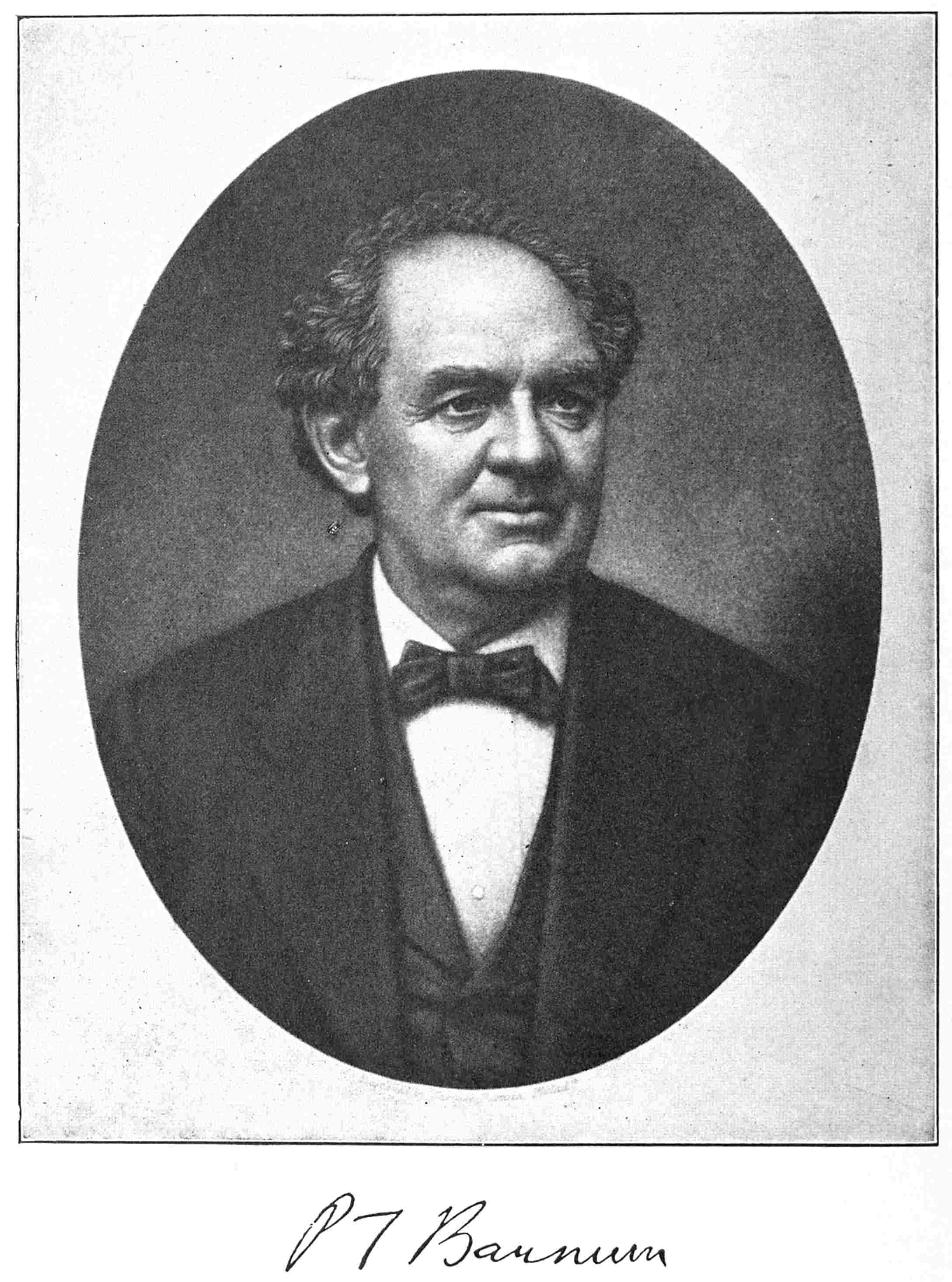
P. T. Barnum wrote a voluminous autobiography, the many
editions of which have long been out of print. This autobiography
is one of the most ingenious and fascinating, and
at the same time one of the most bombastic and verbose books
in American literature. It will be discussed here in its proper
place in detail, and it is mentioned in the very beginning because
some explanation is necessary, besides the story of this
extraordinary man, for telling it now. Barnum was taken
for many years at his own valuation, by his friends and critics
alike; those who admired him accepted him for what he himself
always said he was, “The Prince of Humbugs,” and those
who despised him admitted readily that he deserved that title.
His autobiography was regarded during his lifetime as the
perfect embodiment of the facts of that life and their interpretation,
and no attempt has been made since to review one
of America’s greatest shows. In the Preface to some of his
editions of the Life of P. T. Barnum, Written by Himself,
and Struggles and Triumphs, Forty Years’ Recollections of
P. T. Barnum, as it was sometimes called, Barnum wrote:
“There is an almost universal, and not unworthy curiosity to
learn the methods and measures, the ups and downs, the strifes
and victories, the mental and moral personnel of those who have
taken an active and prominent part in human affairs. But an
autobiography has attractions and merits superior to those of a ‘Life’
written by another, who, however intimate with its subject, cannot
know all that helps to give interest and accuracy to the narrative,
or completeness to the character. The story from the actor’s own
lips has always a charm it can never have when told by another.”
The story from the actor’s own lips is likely to be prejudiced
in favor of the author who is also the hero. When Rudyard
Kipling first toured the United States, he interviewed Mark
Twain. Mark Twain told this young Anglo-Indian, who had
visited the Hartford shrine to worship before an American
whom he believed to be a master, something that applies to
Barnum and his autobiography:
“Returning to the big chair, he [Mark Twain], speaking of truth
and the like in literature, said that an autobiography was the one
work in which a man, against his own will and in spite of his
utmost striving to the contrary, revealed himself in his true light
to the world....
“‘But in genuine autobiography, I believe it is impossible for
a man to tell the truth about himself or to avoid impressing the
reader with the truth about himself.... It is not in human nature
to write the truth about itself. None the less the reader gets a
general impression from an autobiography whether the man is a
fraud or a good man. The reader can’t give his reasons any more
than a man can explain why a woman struck him as being lovely
when he doesn’t remember her hair, eyes, teeth, or figure. And the
impression that the reader gets is a correct one.’
“‘Do you ever intend to write an autobiography?’ Kipling
asked.
“‘If I do, it will be as other men have done—with the most
earnest desire to make myself out to be the better man in every
little business that has been to my discredit; and I shall fail, like
the others, to make my readers believe anything except the truth.’”1
Even so with Barnum: it is impossible for him to tell the
truth about himself, and yet he does not avoid impressing
the reader with the truth about himself. No one thanks
P. T. Barnum more than I for publishing his voluminous
autobiography, for without it this book would have been more
difficult, and with it the task of interpreting the story and
character of one of the most typical Americans was a business
of checking the inaccuracies that necessarily follow from what
Mark Twain called the earnest desire to make himself out
to be the better man in every little business that has been
to his discredit. There was also the work of coördinating
the material found in the seven different editions of the autobiography,
for Barnum continually found it necessary in later
editions to suppress things contained in early editions which
seemed unseemly after mature consideration, even though they
happened to be the truth about himself. He also added
appendices each year towards the end of his career that gave
interesting information about his activities, so that in order
to get a complete picture of the man from his autobiography
it is necessary to read about ten different volumes. After
these duties were finished, there remained only the larger task
of ferreting out those things which the author of his own
life always sees fit to omit entirely. Every eminent or notorious
person should write his autobiography, if only to provide
his future biographer with a skeleton to articulate.
Since Barnum’s death in 1891 there has been ample time
to estimate accurately his influence and position in our life.
It is my conviction that both of these were important. A
distinguished American editor said recently that he considers
Lincoln and Barnum the most typical American figures, and
that he is rather afraid to think which is the more typical.
William Roscoe Thayer wrote in The Life of John Hay: “If
the question had been asked during the third quarter of the
nineteenth century, ‘Who is the typical American of this
period?’ a perspicacious observer might have replied, ‘Phineas
T. Barnum.’” And it is because he was so typical and at
the same time so unique that Barnum remains to-day one
of the outstanding figures of our national life, for Barnum
was a most typical American without ever becoming an average
American. In newspapers, books, and magazines we frequently
see the sentence, “P. T. Barnum was right.” There
was a popular song beginning, “P. T. Barnum had the right
idea.” But the people to-day who use these expressions are
rather doubtful of the details of the showman’s social psychology,
which made him successful, and therefore right. That
social psychology is usually summed up popularly in the
phrase attributed to him, “There’s a sucker born every minute.”
But there was more to Barnum than that, and it is
the purpose of this book to give an impression of that idea,
or group of ideas, which has interested the world in Barnum
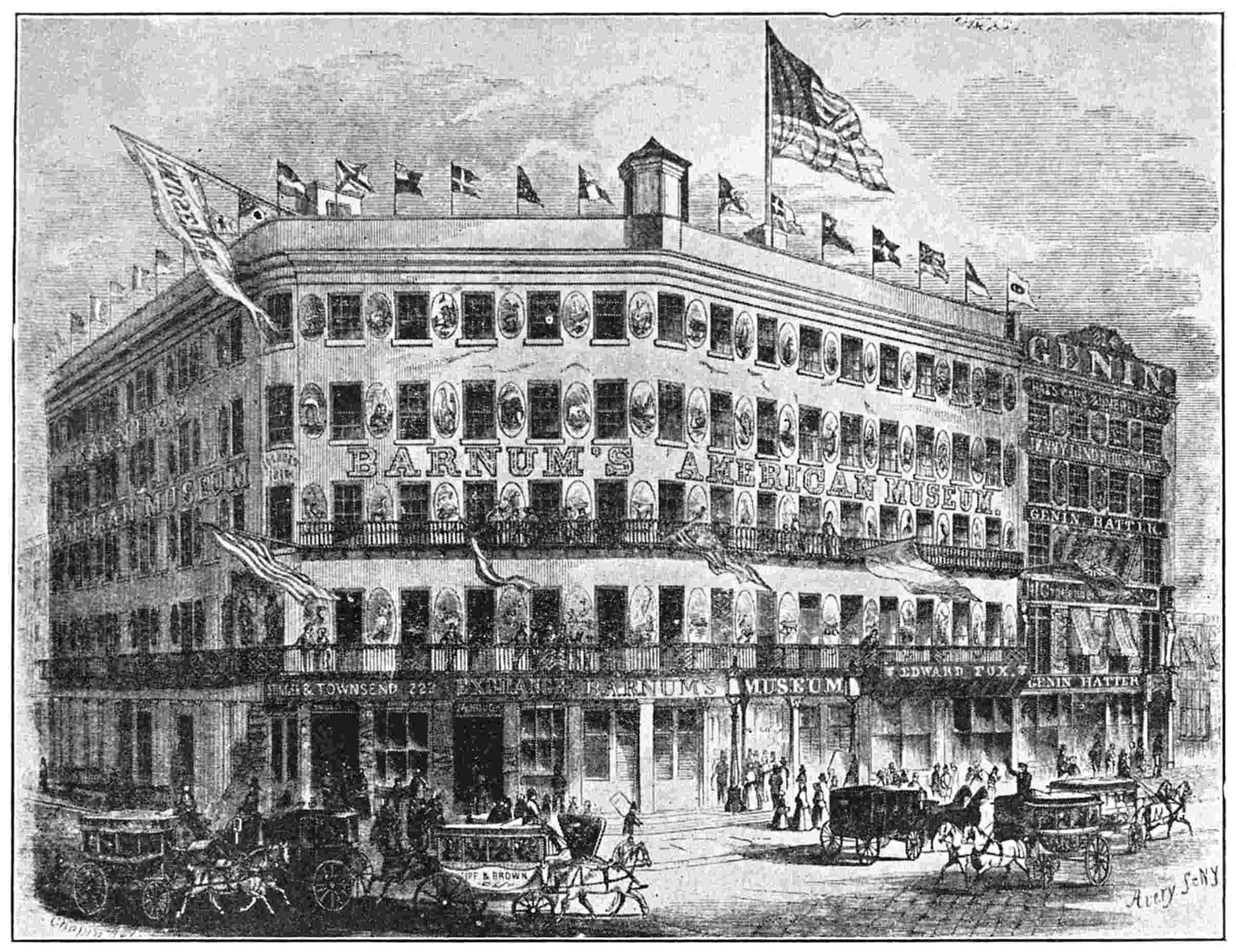
since the year 1841, when Barnum’s American Museum
opened its doors at Ann Street and Broadway.
The things that Barnum did were often so curious, sometimes
so incredible, and always so picturesque, that the reader
may be inclined to doubt their accuracy. I am not writing
a romance, however, and there is ample authority for every
statement and anecdote included in this book; the bibliography
at the end indicates the sources of information. The
footnote is one of the banes of a reader’s continued interest.
If he is a curious reader, the footnote plagues him with the
necessity to look at the bottom of the page; if he is a cursory
reader, the footnote which he skips is always an annoyance
because he is compelled to skip it. Therefore, I have omitted,
at the risk of being called a romancer and in the hope of
being more entertaining, all footnotes except those absolutely
necessary to my reputation for veracity.
Many persons have aided me in the composition of this
book. My thanks are especially due to Leonidas Westervelt,
whose private collection of Barnum and Jenny Lind books,
pamphlets, and letters, which is probably the largest in existence,
he so kindly placed at my disposal; to C. Barnum
Seeley, for information about his grandfather; to Harry
Houdini, for permission to use pictures and showbills from
his huge private collection of theatrical material; to Elizabeth
Hall Dietz, for valuable assistance; and to the New York
Public Library and the Harvard College Library.
Firecrackers had just celebrated the thirty-fourth year of
the Independence of the United States in the small town of
Bethel, Connecticut, when the first son by his second wife
was born to Philo F. Barnum. P. T. Barnum was born on
July 5, 1810. He arrived late. It was a pity, for he would
so much have enjoyed being born on the Fourth of July. He
himself wrote that after peace and quiet were restored, and
the audience had regained their seats, he made his début.
Probably his tardiness was for the best: competition between
P. T. Barnum and the national holiday would have been too
much—for the national holiday.
Lincoln had just about cut his first tooth, and Poe was
in his swaddling clothes, when Barnum appeared on the
American scene. When, in 1891, he died, Free Silver was
beginning to be discussed in the Senate, and William James’s
Principles of Psychology was a new book. The span his life
covered was as significant as any in American history, and
he managed to make himself as much at home among his
contemporaries as the Fourth of July. Barnum wrote to
Matthew Arnold when Arnold was lecturing in this country,
inviting him to visit at Bridgeport, Connecticut. The invitation
read: “You and I, Mr. Arnold, ought to be acquainted.
You are a celebrity, I am a notoriety.” This remained his
self-appointed position among his fellowmen during his entire
lifetime.
They named him Phineas Taylor Barnum, after his maternal
grandfather, Phineas Taylor, from whom he inherited a
tract of swampy, snake-infested land, known as “Ivy Island,”
and a propensity for practical jokes which the boy never outgrew.
Barnum wrote of his grandfather: “He would go farther,
wait longer, work harder, and contrive deeper, to carry
out a practical joke, than for anything else under heaven.”
Barnum admitted the influence of Phineas Taylor’s propensity,
and throughout his own life he exercised it with all the
force which heredity gives to individual action. The paternal
grandfather was Ephraim Barnum—Captain Ephraim Barnum,
a captain of militia in the Revolutionary War. Captain
Ephraim Barnum had fourteen children by two wives, and
died at the age of eighty-four, when P. T. Barnum was seven
years old. His grandson tells us that “he relished a joke better
than the average of mankind.”
Philo F. Barnum, P. T. Barnum’s father, was sometime
tailor, farmer, tavern-keeper, livery-stable proprietor, and
country store merchant. He also operated a small express
company, and his son wrote that “with greater opportunities
and a larger field for his efforts and energies, he might have
been a man of mark and means.” He never did a profitable
business in any of these capacities.
Phineas began the little schooling he received when he
was six years old. He later wrote that “a school-house in
those days was a thing to be dreaded—a schoolmaster, a kind
of being to make the children tremble.” The first three male
teachers he sat under—a Mr. Camp, a Mr. Zerah Judson,
and a Mr. Curtiss—“used the ferule prodigiously.” For one
season he attended the private school of Laurens P. Hickok,
later Professor Hickok, the educational philosopher and metaphysician.
Hickok’s sweetheart, Eliza Taylor, was also a
pupil. “One day he threw a ruler at my head,” Barnum wrote.
“I dodged, and it struck Eliza in the face. He quietly apologized
and said she might apply that to some other time when
she might deserve it.” Young Phineas excelled all other
scholars in Bethel in arithmetic, he admits, and his later
career shows a constant development by the rules of arithmetical
progression and sometimes even as fast as a geometrical
progression. He recalled that his teacher and a neighbor
got him out of bed late at night at the age of twelve to settle
a wager. The teacher had bet that Phineas could figure up
the correct number of feet in a load of wood in five minutes.
Phineas marked down on the stovepipe in his father’s kitchen
the given dimensions and in less than two minutes gave the
correct result, much to the delight of his teacher, his mother,
and himself, and the incredulous astonishment of the neighbor.
He was often kept out of school to help on his father’s
farm, and he records as one of his earliest emotions an aversion
to hand-work that earned him a reputation as the
laziest boy in town. This impression of him by his neighbors,
however, was false, Barnum said, “because I was
always busy at head-work to evade the sentence of gaining
bread by the sweat of my brow.” Throughout his life he
hated manual labor and routine work, but the number of
enterprises in which he sometimes engaged simultaneously
would indicate that he never disliked work if he was allowed
to choose its nature. What Barnum called “my organ of acquisitiveness”
was large. At an early age he earned money by
selling cherry-rum to soldiers, and when he was twelve years
old he owned a sheep, a calf, and a sum of money in his own
right. He would have been a wealthy boy for his environment,
if his father had not insisted that he buy his own clothes.
When he was about twelve years old, Barnum paid his
first visit to New York City, assisting a neighbor to deliver
a drove of cattle there. To “go to York” from Connecticut
in 1821 was not a trip, but a journey, which had some of
the elements of a pilgrimage; it took Phineas four days to
reach the big city with his cattle. During this period passengers
traveled from Connecticut to New York via the New
York-Boston stage coach or by boat via Long Island Sound.
The stage coach was not allowed to take on passengers in
any Connecticut town on Sunday, and any man who rode
on horseback or in his carriage before sundown on the
Lord’s Day was arrested by a deacon of the church. If
the stage coach driver was found with passengers in his
possession, he was arrested by meeting house sentinels, posted
along the Connecticut route of the coach. In Barnum’s youth
the Blue Laws were Connecticut’s contribution to American
life. The voyage to New York by boat depended upon the
state of the wind, sometimes requiring eight hours and sometimes
several days. Barnum’s grandfather, Phineas Taylor,
took this voyage upon an occasion which gave him an opportunity
to enact what seemed to impress his grandson as Phineas
Taylor’s most famous practical joke. On this particular voyage
the fourteen jolly jokers from Bethel were becalmed for
seven days, at the end of which all needed to shave. There
was one razor on board, belonging to Phineas Taylor, who
professed himself against the practice of shaving and refused
the loan of his razor. Finally, the boat approached New
York on Sunday afternoon. Barnum’s grandfather was persuaded
to lend his razor since the barber shops would be
closed when the party arrived in New York. Because time
was short, he stipulated that each man must shave half his
face and pass the razor on to the next. After all had finished,
each could begin shaving the other half of his face.
Half of each face was shaved, and Phineas Taylor began
on the other half of his own face. When he had finished,
Barnum’s grandfather stropped the razor, and, as if by
accident, it flew from his hand into the water. All the other
passengers created a sensation with their half-shaved faces
when they arrived in New York on Sunday afternoon. Barnum
himself never ceased to delight in this type of joke.
Barnum’s father soon despaired of ever being able to make
his son useful on the farm, and Barnum admitted that he
“generally contrived to shirk the work altogether, or, by slighting
it, get through with the day’s work.” His father opened
a country store in Bethel and made Phineas the clerk. Here
he drove sharp bargains with old women who paid for their
purchases in butter, eggs, beeswax, feathers, and rags. The
atmosphere of the country store exercised an important influence
on Barnum’s later career. On wet days there was no
business, and then, he tells us, “from six to twenty social, jolly,
story-telling, joke-playing wags and wits, regular originals,
would get together at the tavern or store, and spend their
evenings or stormy afternoons in relating anecdotes, describing
their adventures, playing off practical jokes upon each other,
and engaging in every project out of which a little fun could
be extracted by village wits whose ideas were usually sharpened
at brief intervals by a ‘treat,’ otherwise known as a glass
of Santa Cruz rum, old Holland gin, or Jamaica spirits.”
Practical jokes of a crude nature, the product of brains whose
sole aim was to get the better of the other fellow somehow,
were a great source of amusement and one of the few sources
of instruction of young Phineas. These Connecticut Yankees
must have made this Connecticut Yankee realize that if he
was to survive in this world, he must be sharp and not too
scrupulous, except on Sunday.
His own grandfather played what Barnum called a practical
joke, and which we might be inclined to call something more,
on the boy the day he was born. It has been mentioned that
Barnum inherited a tract of land called “Ivy Island” from
Phineas Taylor in consideration of taking the name Phineas
through life. His grandfather never spoke of the boy in the
presence of strangers without saying that he was the richest
boy in town because he owned “Ivy Island.” For about six
years these allusions to “Ivy Island” continued, and finally,
when he was twelve years old, permission was granted him
to visit the property which was deeded in his name. The
property consisted of bogs, snakes, hornets, and stunted ivies,
mostly under water. When he asked for an explanation,
Phineas was told that it could not be an island unless it was
literally surrounded by water, and that it could not be “Ivy
Island” unless its main product was stunted ivies. We shall
see how Barnum used “Ivy Island” to advantage, but at the
time it was a profound disappointment, and the incident must
have influenced his impression of the ways of the world.
Deception was common practice in the country store business.
Barnum wrote that often he cut open bundles of rags
brought to the store by country women to exchange for goods,
and found that what were ostensibly good linen and cotton rags
contained in their midst extra weight in the shape of stone,
gravel or ashes; and farmers regularly brought their loads of
oats, corn, and rye into town short of their stated weights.
Many years later Barnum told a story in his book, The Humbugs
of the World, that he would agree characterizes the atmosphere
in which he found himself as a boy:
“There is a much older and better-known story about a grocer
who was a deacon, and who was heard to call downstairs before
breakfast to his clerk:
“‘John, have you watered the rum?’ ‘Yes, sir.’ ‘And sanded
the sugar?’ ‘Yes, sir.’ ‘And dusted the pepper?’ ‘Yes, sir.’ ‘And
chicoried the coffee?’ ‘Yes, sir.’ ‘Then come up to prayers.’”
The boy was brought up to attend church regularly. Barnum’s
grandfather was a Universalist, and that was the religion
which he strenuously defended during his maturity and
unto his death, but apparently he also came under the stern
influence of strict Methodism. Of his early religious experiences
Barnum told a reporter for the New York Sun when he
was seventy-three years old: “I was brought up in the fear
of hell, and when I went to Methodist prayer meetings, at
the age of thirteen or fourteen, I used to go home and pray
and cry and beg God to take me out of existence if He would
only save me; but I didn’t see much chance for me in the way
they put it.” There was only one meeting house in Bethel,
where all attended, and no differences of sects seemed to disrupt
the harmony of religion, but seemingly this did not detract
from the severity with which worship was indulged.
Doubtless it was partly as a reaction from the fiery hell of
those early Methodist influences that Barnum as soon as he
was able to choose for himself turned to Universalism, by
which salvation is guaranteed more or less to all those who
seek for it, without regard to their previous condition of sinful
servitude. The meeting house at Bethel, without steeple
or bell, was also without heat in winter, for one of the brethren
said when a stove was suggested by an irreverent reformer,
“A pretty pass, indeed, when professing Christians need a
fire to warm their zeal.” The women were allowed to bring
to church tin boxes with live coals, as foot-stoves, but the men
were expected to endure with hardihood the cold Connecticut
winter draughts during the long sermons, which usually lasted
one hour and a half, and sometimes continued for two hours.
Phineas attended a Bible class at which the students drew
texts for their compositions from the clergyman’s hat. In
his autobiography Barnum told that he once drew forth the
text from Luke X. 42: “But one thing is needful; and Mary
hath chosen that good part which shall not be taken away
from her.” “Question: What is the one thing needful?” His
answer is short, but it serves as a concise creed from which
he did not deviate later in life:
“This question, ‘What is the one thing needful?’ is capable of
receiving various answers, depending much upon the persons to
whom it is addressed.
“The merchant might answer that ‘the one thing needful is plenty
of customers, who buy liberally without “beating down,” and pay
cash for all their purchases.’
“The farmer might reply that ‘the one thing needful is large
harvests and high prices.’
“The physician might answer that ‘it is plenty of patients.’
“The lawyer might be of opinion that ‘it is an unruly community,
always engaged in bickerings and litigations.’
“The clergyman might reply, ‘It is a fat salary, with multitudes
of sinners seeking salvation and paying large pew rents.’
“The bachelor might exclaim, ‘It is a pretty wife who loves her
husband, and who knows how to sew on buttons.’
“The maiden might answer, ‘It is a good husband, who will love,
cherish, and protect me while life shall last.’
“But the most proper answer, and doubtless that which applied
to the case of Mary, would be, ‘The one thing needful is to believe
on the Lord Jesus Christ, follow in his footsteps, love God and
obey his commandments, love our fellow-man, and embrace every
opportunity of administering to his necessities. In short, the one
thing needful is to live a life that we can always look back upon
with satisfaction, and be enabled ever to contemplate its termination
with trust in Him who has so kindly vouchsafed it to us, surrounding
us with innumerable blessings, if we have but the heart
and wisdom to receive them in a proper manner.’”
The clergyman approved highly this essay of the thirteen-year-old
Barnum, and he himself approved it many times in
later life, when he wrote the same thing in different words.
To his mind, one must look carefully to the main chance,
attain monetary success by all odds, and practise humility
by means of a proper respect for God and Jesus Christ. In
short, Barnum lived a life that he himself always did look
back upon with satisfaction—a satisfaction which stands out
triumphantly in his autobiography.
The character of his early environment in Bethel, Connecticut,
was admirably summed up by Barnum when he was
seventy-one years old. He presented a bronze fountain
eighteen feet high, “the design a Triton of heroic size, spouting
water from an uplifted horn,” to the inhabitants of his
birthplace. The town was decorated with flags and bunting,
and the police and fire companies, with apparatus and bands
of music, greeted their native son, their returned hero, the
conqueror of Success. Barnum made this speech, which is
inserted here because it tells with characteristic altiloquence
more of his early life than anything he ever wrote, or which
ever could be written by another:
“My friends: Among all the varied scenes of an active and eventful
life, crowded with strange incidents of struggle and excitement,
of joy and sorrow, taking me often through foreign lands and
bringing me face to face with the king in his palace and the peasant
in his turf-covered hut, I have invariably cherished with the most
affectionate remembrance the place of my birth, the old village
meeting house, without steeple or bell, where in its square family
pew I sweltered in summer and shivered through my Sunday-school
lessons in winter, and the old school-house where the ferule, the
birchen rod and rattan did active duty, and which I deserved and
received a liberal share. I am surprised to find that I can distinctly
remember events which occurred before I was four years old.
“I can see as if but yesterday our hard-working mothers hetcheling
their flax, carding their tow and wool, spinning, reeling, and
weaving it into fabrics for bedding and clothing for all the family
of both sexes. The same good mothers did the knitting, darning,
mending, washing, ironing, cooking, soap and candle making, picked
the geese, milked the cows, made butter and cheese, and did many
other things for the support of the family.
“We babies of 1810, when at home, were dressed in tow frocks,
and the garments of our elders were not much superior, except on
Sunday, when they wore their ‘go-to-meeting clothes’ of homespun
and linsey-woolsey.
“Rain water was caught and used for washing, while that for
drinking and cooking was drawn from wells with their ‘old oaken
bucket’ and long poles and well sweeps.
“Fire was kept over night by banking up the brands in ashes in
the fireplace, and if it went out one neighbor would visit another
about daylight the next morning with a pair of tongs to borrow a
coal of fire to kindle with. Our candles were tallow, home-made,
with dark tow wicks. In summer nearly all retired to rest at early
dark without lighting a candle except on extraordinary occasions.
Home-made soft soap was used for washing hands, faces, and everything
else. The children in families of ordinary circumstances ate
their meals on trenchers, wooden plates. As I grew older our family
and others got an extravagant streak, discarded the trenchers and
rose to the dignity of pewter plates and leaden spoons. Tin peddlers
who traveled through the country with their wagons supplied these
and other luxuries. Our food consisted chiefly of boiled and baked
beans, bean porridge, coarse rye bread, apple sauce, hasty pudding
beaten in milk, of which we all had plenty. The elder portion of
the family ate meat twice a day—had plenty of vegetables, fish of
their own catching, and occasionally big clams, which were cheap
in those days, and shad in their season....
“Our dinners several times each week consisted of ‘pot luck,’
which was corned beef, salt pork, and vegetables, all boiled together
in the same big iron pot hanging from the crane which was supplied
with iron hooks and trammels and swung in and out of the huge
fireplace. In the same pot with the salt pork, potatoes, turnips,
parsnips, beets, carrots, cabbage, and sometimes onions, was placed
an Indian pudding, consisting of plain Indian meal mixed in water,
pretty thick, salted and poured into a home-made brown linen bag
which was tied at the top. When dinner was ready the Indian
pudding was first taken from the pot, slipped out of the bag and
eaten with molasses. Then followed the ‘pot luck.’...
“There were but few wagons or carriages in Bethel when I was
a boy. Our grists of grain were taken to the mill in bags on
horseback, and the women rode to church on Sundays and around
the country on week days on horseback, usually on a cushion called
a pillion fastened behind the saddle, the husband, father, brother,
or lover riding in front on the saddle. The country doctor visited
his patients on horseback, carrying his saddle-bags, containing calomel,
jalap, Epsom salts, lancet and a turnkey, those being the
principal aids in relieving the sick. Nearly every person sick or
well was bled every spring.
“Teeth were pulled with a turnkey, and a dreadful instrument it
was in looks, and terrible in execution....
“I remember seeing my father and our neighbors put through
military drill every day by Capt. Noah Ferry in 1814, for the war
with Great Britain of 1812–15.
“My uncles, aunts, and others, when I was a child, often spoke
about ravages of Indians from which their ancestors had suffered,
and numbers of them remembered and described the burning of
Danbury by the British in 1777....
“Esquire Tom Taylor sometimes wore white-topped boots. He
was a large, majestic-looking man, of great will-force, and was considered
the richest man in Bethel. Mr. Eli Judd was marked second
in point of wealth. Every year I took twelve dollars to Esquire
Tom Taylor to pay the interest on a two hundred dollar note which
my father owed him. I also annually carried four dollars and fifty
cents to Eli Judd for interest on a seventy-five dollar note which
he held against my father. As these wealthy men quietly turned
over each note filed away in a small package till they found the
note of my father, and then indorsed the interest thereon, I trembled
with awe to think I stood in the presence of such wonderfully rich
men. It was estimated that the richer of them was actually worth
three thousand dollars!
“Esquire Tom Taylor made quite a revolution here by one act.
He got two yards of figured carpet to put down in front of his bed
in the winter, because the bare board floor was too cold for his feet,
while he was dressing. This was a big event in the social life of
that day, and Esquire Tom was thought to be putting on airs which
his great wealth alone permitted.
“When I was but ten years old, newspapers came only once a
week. The man who brought us the week’s papers came up from
Norwalk, and drove through this section with newspapers for subscribers
and pins and needles for customers. He was called Uncle
Silliman. I can remember well his weekly visit through Bethel,
and his queer cry. On coming to a house or village he would shout,
‘News! News! The Lord reigns!’ One time he passed our school-house
when a snow storm was prevailing. He shouted: ‘News!
News! The Lord reigns—and snows a little.’
“Everybody had barrels of cider in their cellars and drank cider-spirits
called ‘gumption.’ Professors of religion and the clergy all
drank liquor. They drank it in all the hat and comb shops, the
farmers had it at hay and harvest times. Every sort of excuse
was made for being treated. A new journeyman must give a pint
or quart of rum to pay his footing. If a man had a new coat he
must ‘sponge’ it by treating. Even at funerals the clergy, mourners,
and friends drank liquor. At public vendues the auctioneer held
a bottle of liquor in his hand and when bidding lagged he would
cry ‘a dram to the next bidder,’ the bid would be raised a cent,
and the bidder would take his boldly and be the envy of most of
the others.
“The public whipping post and imprisonment for debt both flourished
in Bethel in my youthful days. Suicides were buried at crossroads.
How blessed are we to live in a more charitable and enlightened
age, to enjoy the comforts and conveniences of modern
times, and to realize that the world is continually growing wiser
and better.
“I sincerely congratulate my native village on her character for
temperance, industry, and other good qualities.
“And now, my friends, I take very great pleasure in presenting
this fountain to the town and borough of Bethel as a small evidence
of the love which I bear them and the respect which I feel for
my successors, the present and future citizens of my native village.”
Among the many ways Barnum found for making money
during his boyhood, the lottery business was his most important
enterprise; from the ages of twelve to fifteen he was
a lottery manager and salesman, selling his tickets to the workmen
in the hat and comb factories near Danbury. Lotteries
at this time were permitted by the state and often indulged
in by churches and educational institutions, and in Bethel
lotteries were held for the benefit of the church, where, according
to Barnum, the minister often preached against gambling.
That grandfather, Phineas Taylor, who appears at
every turn in the early career of Barnum, was manager of a
lottery, and it was by his example and with his advice that
Phineas tried this means of growing rich quickly.
In September, 1825, when Barnum was fifteen years old,
his father died insolvent. Phineas had loaned his father all
his savings and held Philo Barnum’s note for the money, but
as he was a minor his debt was ruled out, and he was compelled
to serve as clerk in a store just before the funeral in
order to get money for shoes to follow the coffin to the grave.
Irena Barnum, his mother, continued to keep the tavern
at Bethel to support herself and her five children, of whom
Phineas was the oldest. Phineas soon became a clerk in the
general store at Grassy Plain, a village one mile northwest
of Bethel, where he worked for six dollars a month and his
board. Here his duties were much the same as they had
been in his father’s country store at Bethel, but he showed
signs of the advertising ability and the power to attract by
unusual enterprises which were later to make him famous,
when he organized at this store in Grassy Plain a lottery for
the purpose of moving his boss’s old stock of tinware and
green glass bottles. Those who won prizes in the lottery
received their choice of a tin dipper or some green glass bottles.
It was while he was a clerk at Grassy Plain that Phineas
met Charity Hallett. Charity had visited Grassy Plain on a
Saturday to buy a hat from Aunt “Rushia,” the only milliner
of the two towns. It was Phineas’s custom to return to Bethel
every Saturday night, remaining with his mother until Monday,
so that he might go to church with her. He was told
that Charity was afraid to return to Bethel alone in the storm
on this particular Saturday night. During the ride he learned
that “the fair, rosy-cheeked, buxom girl, with beautiful white
teeth,” as he later described her appearance at the time, was
a tailoress in Bethel. Her face haunted him in his dreams
that Saturday night. He met her in church the next morning,
and the reality seemed to fulfil the pictures of his imagination.
But he was able to see her only in church every Sunday
that season, for they were separated by the distance between
Bethel and Grassy Plain.
As his job continued in a country store, Barnum became
more inured to the ways and means of country store success.
In his autobiography he recorded the gist of these: “It was
‘dog eat dog’—‘tit for tat.’ Our cottons were sold for wool,
our wool and cotton for silk and linen; in fact nearly everything
was different from what it was represented. The customers
cheated us in their fabrics: we cheated the customers
with our goods. Each party expected to be cheated, if it was
possible. Our eyes, and not our ears, had to be our masters.
We must believe little that we saw, and less that we heard....
Such a school would ‘cut eye-teeth,’ but if it did not
cut conscience, morals, and integrity all up by the roots, it
would be because the scholars quit before their education
was completed.” He did quit for a time and went to Brooklyn,
New York, where he was offered a position in a grocery
store, but the humdrum of this existence of petty trade was
beginning to annoy him. His disposition was speculative,
and a regular salary never satisfied him, especially since all
these early salaries were small. Although he was only seventeen
years old, he was ambitious enough to want his own
business, and he opened a porter-house in Brooklyn. He soon
sold it at a profit and on the basis of his experience became
a bartender in another porter-house in New York City.
While working and living in New York, he visited the theater
frequently, and soon became in his own opinion “a close
critic.”
Grandfather Phineas Taylor wrote his grandson in 1828,
offering him half of his carriage-house rent free, if young
Phineas would return from New York and establish some kind
of business in Bethel. Before he left New York Phineas made
arrangements for shipments with wholesale merchants, and
upon his return to Bethel turned the carriage-house, which
was situated on the main street of Bethel, into a retail fruit
and confectionery store, where ale and oysters were also sold.
Phineas invested his entire fortune, $120, in his Bethel store,
and during the first day’s business took in $63. Grandfather
Phineas Taylor was much pleased with his boy’s success;
he advised him to take the agency for some country-wide
lottery in addition to his store business, and Barnum followed
his advice. The store was the resort of the country loungers
and the town wits, and the practical jokes which were played
there, and which delighted Barnum so much that he reproduced
them in detail in his autobiography, contributed to
make him what he later was. In the autobiography he himself
attributes his development in part to the influence of these
stale puns and crude practical jokes, which he did not seem
to realize, even in his middle age, were far-fetched, and often
barbaric.
When Barnum was eighteen years old, his store in Bethel
was visited by the first showman he ever met, Hackariah
Bailey, not related to James A. Bailey, who was Barnum’s
partner many years later. Hackariah Bailey was a “character.”
He imported the first elephant that was ever brought
to this country and made a fortune by exhibiting it. Later
he toured with several traveling menageries, operated opposition
steamboats on the Hudson River, and finally built a
hostelry in Somers, New York, which he called “Elephant
Hotel,” where a golden elephant stood on a large stone pillar
in front of the veranda as homage to the foundation of the
Bailey fortune. Young Barnum listened with great interest
to the stories of Hackariah Bailey.
Barnum made another trip to New York City in his nineteenth
year to investigate opportunities, of which he had been
told, for a thriving lottery business in Pittsburg. An agency
for the whole state of Tennessee was vacant, and the offer
of it was tempting, but there was Charity Hallett, tailoress
in Bethel, and Tennessee was too far from Bethel. The possibilities
of profit in the lottery business impressed Barnum,
and he used all the time he could spare from his store in selling
lottery tickets throughout near-by Connecticut counties. He
established agents throughout the surrounding country and
soon was selling from five hundred dollars’ worth to two thousand
dollars’ worth of lottery tickets each day. It was in this
business that Barnum first used advertising. He issued handbills
and circulars with extravagant language and huge pictures.
Immense gold signs and posters in many colored inks
covered the front of Barnum’s lottery office, and “home-made
poetry” persuaded prospective purchasers. Oyster suppers at
his mother’s tavern followed the drawing of prizes.
Charity Hallett, the “attractive tailoress,” continued to occupy
an important place in Barnum’s mind; he was still meeting
her at church, and whenever the sale of oysters, lottery
tickets, and general merchandise permitted him spare time.
In the summer of 1829, when he was just nineteen years old,
Barnum, without mentioning his intentions to his mother,
proposed marriage. Those intentions must have been obvious,
however, for some time, because in his autobiography
Barnum wrote that his mother and his other relatives thought
that his enterprise, if not his origin, entitled him to aim higher
in the social scale than a local tailoress. But there were many
impartial townspeople, said Barnum, who thought that Charity
Hallett “was altogether too good for Taylor Barnum.”
They were married that November in New York City at the
house of Charity’s uncle. Barnum went on record in his autobiography
as opposed to early marriages, but he hastily prefaced
these admonitions with the statement, “had I waited
twenty years longer, I could not have found another woman
so well suited to my disposition, and so valuable as a wife,
a mother, and a friend.” Barnum’s mother was angry at his
secret marriage in New York, but, after a month of Sundays,
he was invited to bring his wife to Sabbath dinner. During
the two years after his marriage Barnum continued his country
store, his lottery business, with branches in Danbury, Stamford,
Norwalk, and Middletown, and found time to engage in
religious and political controversy.
At this period in New England history religion was rife,
and in 1831, particularly in the section where Barnum lived
and throughout the rest of New England as well, it was also
violent. Converts were being made wholesale by means of
protracted religious meetings and hortatory witchery; some
of these converts worked themselves into religious frenzy, and
suicides as well as murders in the name of God were common
occurrences. Many of the more imaginative ministers advocated
a Christian Party in politics, and were in favor of confining
the right to hold public office to those only who professed
faith in God and belief in Jesus Christ. At the age
of twenty-one Barnum was sagacious enough to realize that in
spite of all his respect for clergymen and his reliance on their
work they must be kept in their proper place, which was
in church. Many persons besides himself were alarmed at
the prospect of a religious fanaticism that would conquer civil
government to the destruction of liberty. Barnum wrote several
articles on the dangers of religious usurpation, which he
sent to the nearest weekly newspaper, a Danbury publication.
The editor regretted that he could not find space for Mr. Barnum’s
contributions, whereupon, like many writers on controversial
subjects, Barnum was convinced that the editor did
not dare to print his articles, and that there was no free press.
But unlike most of his rejected brethren, Barnum took action.
He purchased a press and types, and within a few weeks after
the rejection of his religious opinions began publication of
his own weekly newspaper in Danbury, Connecticut, which
was called, of course, The Herald of Freedom.
There are no files of this paper extant, which is unfortunate,
for they would undoubtedly reveal interesting character developments
in our hero’s history. He himself tells us that “the
boldness and vigor with which this paper was conducted soon
commanded a liberal circulation, not only in the vicinity of
its publication, but large numbers of copies were sent into
nearly every State in the Union.” The vigor and boldness
are not Barnum’s exaggerations, for we know that he was
always vehement, but particularly so at this period, and it was
not long before he was sued for libel. A Danbury butcher
whom Barnum accused in his paper as a spy in the Democratic
Party caucus, sued for libel and collected several hundred
dollars. But this did not deter the twenty-one-year-old editor
and publisher, and soon afterwards he had another and more
important libel suit to defend. The Herald of Freedom accused
a deacon of “taking usury of an orphan boy.” Had
he called the deacon a “note-shaver” and extortioner, or
merely remarked that he was “grinding the face of a poor
orphan boy,” the court would have been lenient, but to call
a deacon a usurer was ungodly, for usury is forbidden in the
Bible, and the judge, who was also a churchman, charged the
jury vigorously; and when they brought in the appropriate
verdict, he sentenced Phineas T. Barnum, editor, to sixty
days in the common jail and to pay a fine of $100.
Barnum went to jail in Danbury, where his room was
papered and carpeted, and where friends were allowed to visit
him daily. He continued to edit The Herald of Freedom
there, and several hundred additional subscriptions came in
during his period of servitude. Mr. P. F. Madigan, the New
York autograph dealer, recently found the following letter
from Barnum, written while he was in jail. It was addressed
to Gideon Welles, then a member of the Connecticut Legislature,
and afterwards Secretary of the Navy under President
Lincoln:
“Danbury, ‘Common Jail,’ Oct. 7, 1832.
“Mr. Welles D’r Sir:
“I am by the unhallowed decree of that lump of superstition
David Daggett sent within these gloomy walls sixty days for daring
to tell the truth!! My trial with Hanson Taylor did not come
on this term on account of the absence of witnesses; but my trial
with Seth Seelye has come and the best counsel in the country
were employed against me. Seelye testified in his own defense, and
in his testimony he contradicted four unimpeachable witnesses.
Daggett charged the jury in such a manner that many intelligent
men who were present remarked that he was the best lawyer that
had pled in behalf of the State. The bar and seat of the Judge
was filled with priests, there being no less than eight present.
Brother Holly of the Sentinel will report the case at length, and
I hope you will take the trouble to read the trial and then make
such remarks as justice demands. The excitement in this and the
neighboring towns is very great, and it will have a grand effect.
Public opinion is greatly in my favor. After the judge had given
his cursed charge I was advised by many to forfeit the bonds which
were but $100, but I chose to go to prison, thinking that such a
step would be the means of opening many eyes, as it no doubt
will. A number of the Presbyterians in this town have declared
it to be oppression, and are beginning to raise their voices against
it. The same spirit governs my enemies that imprisoned Sellick
Osborn and burnt to death Michael Servetus by order of John
Calvin. But the people are more enlightened than in the days of
Calvin and they will upon reading my trial express their indignation
at such oppression and persecution. You will observe that the
Democrats in this County have a Convention at Bridgeport on
Thursday next. I am constantly writing to our friends in different
parts of the country urging upon them the importance of attending
this meeting, and I think it will be well attended and be the means
of helping our party very much in this county. Judge Wildman
is so lame with the rheumatics that he cannot walk; but he declares
he will attend the convention if he is obliged to hire men to carry
him in their arms. He is a man of spirit and sense. It is a great
pity we had not about twenty men like him in this country.
“You will observe in my paper of last week that I have engaged
the services of our friend Andrews; if you can give him a compliment
you would much oblige me, as by my copying it into my
columns it might prove of much service to my paper. Please accept
my warmest thanks and those of my wife for your assistance in
recovering the lost shawl. It came safe and my wife was thrown
into ecstasies as an offset for the tears, which (womanlike) she
had shed over the loss of it. Lest I might tire your patience too
much I will draw to a close. Please give my respects to Judge
Niles and the rest of our friends, tell them that I am suffering
for daring to tell the truth but that the kindness of friends keeps
my spirits buoyed up in this day of trial. Let me hear from you
when opportunity shall offer and believe this to be from your
Ob’t servant in good spirits.
P. T. Barnum.
“G. Welles, Esq.”
Barnum in his early years was a Democrat, because Grandfather
Phineas Taylor was a staunch Democrat, and his father
had also voted that ticket. If we are to judge from the above
letter, written when he was twenty-two years old, Barnum
had some of the qualifications of a ward politician. He refers
several times to “our friends,” and he seems to have believed
firmly that it was a duty as well as a privilege to attend party
conventions.
The end of Barnum’s term in the Danbury Common Jail
was celebrated by indignant defenders of a free press from
the surrounding country. In the court-room where he had
been convicted and sentenced an ode, written for the occasion,
was sung, and an eloquent oration on the Freedom of the
Press was delivered by the Rev. Theophilus Fiske. Both the
ode and the oration have disappeared into limbo. “A sumptuous
repast” was served to several hundred guests, and speeches
and toasts continued most of the afternoon. But the most
imposing part of the celebration was still to come. It was
reported in Barnum’s paper, The Herald of Freedom, for
December 12, 1832:
“P. T. Barnum and the band of music took their seats in a coach
drawn by six horses, which had been prepared for the occasion.
The coach was preceded by forty horsemen, and a marshal, bearing
the national standard. Immediately in the rear of the coach was
the carriage of the Orator and the President of the day, followed
by the Committee on Arrangements and sixty carriages of citizens,
which joined in escorting the editor to his home in Bethel.
“When the procession commenced its march amidst the roar of
cannon, three cheers were given by several hundred citizens who
did not join in the procession. The band of music continued to
play a variety of national airs until their arrival in Bethel, a distance
of three miles, when they struck up the beautiful and appropriate
tune of ‘Home, Sweet Home!’ After giving three hearty
cheers, the procession returned to Danbury. The utmost harmony
and unanimity of feeling prevailed throughout the day, and we are
happy to add that no accident occurred to mar the festivities of
the occasion.”
While he was indulging in political and religious controversy,
Barnum was also buying recklessly for his country store. In
order to do business faster than the ordinary country store, he
extended credit and soon had an accumulation of bad debts.
Many of these accounts are balanced in his old ledger: “By
death, to balance;” “By running away, in full;” “By cheating
me out of my dues, to balance;” “By failing in full;” “By
swearing he would not pay me, in full.” Barnum became disgusted
and sold his interest in the store. And that year lotteries
were prohibited in Connecticut by law. The Herald
of Freedom was not making money, and No. 160 of that paper
was the last issue published under Barnum’s name. He was
compelled to seek new and more profitable enterprises, and
he decided to enlarge his horizon. In the winter of 1834–1835,
when he was twenty-four years old, Barnum removed
his wife and daughter to New York City.
Thus ends the early Yankee influence that shaped Barnum’s
character. It made of him a creature that in its development
was to become the apotheosis of the Yankee, with all the distinguishing
characteristics of that type and some very distinctive
qualities all his own. Mrs. Trollope in her Domestic
Manners of the Americans characterizes the Yankee with
traits that are appropriate to Barnum’s personality as it was
bred by his early environment. “In acuteness, cautiousness,
industry, and perseverance,” wrote Mrs. Trollope of the Yankee,
“he resembles the Scotch; in habits of frugal neatness,
he resembles the Dutch; in love of lucre he doth greatly resemble
the sons of Abraham; but in frank admission and
superlative admiration of all his own peculiarities, he is like
nothing on earth but himself.” The Connecticut Yankee with
his wife, Charity, and their daughter, Caroline, left Bethel
with nothing but the crafty, bold and thrifty Yankee heritage
and the practical education that were calculated to make him
preëminent if the proper outlet and channel were offered for
his energies.
CHAPTER II GROWING PAINS — I — II — III — IV
The New York to which Barnum emigrated late in the winter
of 1834 is a New York with which we must become acquainted.
Its population was slightly more than 200,000, and Mrs.
Martha J. Lamb in her History of the City of New York
deplored the overcrowding: “New York City by this time appeared
like a youth much overgrown for his years. It had
shot up with a rapidity that defied calculation. Wealth was
increasing faster than sobriety was inclined to measure.
Swarming multitudes from every quarter of the globe were
rendering the community in a certain sense unformed.” In
contrast to this picture of wild growth we can record that
stage coaches were the only means of public conveyance, and
the newfangled horse car was forcing its clattering way up
one street on a single-tracked line, in spite of the opposition
of the large majority, who preferred their safe and sure stage
coaches. Broadway, according to Charles Dickens, who visited
New York a few years after Barnum became a resident,
was “a wide and bustling street, which, from the Battery Gardens
to its opposite termination in a country road, may be
four miles long,” and in Mrs. Lamb’s opinion “Washington
Square was quite a long distance from the city.” The number
of omnibuses surprised Dickens—“half-a-dozen have gone
by within as many minutes”—and he was also impressed by
the large-wheeled tilburies, the gigs, the phaetons, and the
hackney coaches, by which the upper classes were carried
about the city. But when Dickens crossed the wide and
bustling street called Broadway, he found it necessary to look
out for the pigs, who trotted clumsily behind the carriages
and acted as the city scavengers.
The dress of the ladies interested Dickens just as much
as it has interested visiting authors since. “Heaven save the
ladies, how they dress!” he wrote. “We have seen more colors
in these ten minutes than we should have seen elsewhere in
as many days. What various parasols! what rainbow silks
and satins! what pinking of thin stockings, and pinching of
thin shoes, and fluttering of ribbons and silk tassels, and display
of rich cloaks with gaudy hoods and linings!” Here
was a community apparently awaiting a Barnum. The gaudy
hoods and linings, the fluttering ribbons and rainbow silks
and satins indicate a certain wealth and a taste for the gay
and amusing. Barnum must have been conscious here in
New York as he walked the streets and pondered how to support
his wife and baby, of an atmosphere more favorable to
his talents and their expression than the New England which
he had just left, where the “pinking of thin stockings, and
pinching of thin shoes” would have been punished by means
of the whipping post, or at least with the jealous and shocked
disdain of neighbors and the exclamatory menaces of the town
clergyman. In the New York of 1835 to adorn the body
and to divert the mind were not crimes, and a corresponding
share of the trade and industry of the city were devoted to
the satisfaction of those ends. Broadway had shops that were
handsome enough to impress Mrs. Trollope, who found most
of America new, brazen, and boring when it was not offensive.
She also admired the uniform houses in the residential sections
of the city where neat iron railings and pretty green
blinds gave an impression of ease and luxury that she found
nowhere else in the United States.
That New Yorkers of 1835 could be unrestrained in their
enjoyments when the occasion was presented we know from
the many accounts of the nature of New Year celebrations.
James Gordon Bennett, the elder, wrote in the New York
Herald: “We were sorry to see so much intoxication in our
streets ... and it even extended into the Mayor’s office. In
consequence of the improper behavior of many of his visitors,
by which the carpets were completely ruined, he was compelled
to close up and go home at one o’clock, and deprived many
of the pleasure of seeing him.”
Soon after Barnum arrived in New York the city was almost
destroyed by the largest fire in its early history. The fire
started on a cold day, December 16, 1835, and burned steadily
for three days because there was no efficient water supply,
and the water available froze in the pipes. More than seven
hundred buildings were turned to ruins, and almost all the
insurance companies went into bankruptcy. Many mercantile
establishments were forced out of business, and the banks suspended
payment. It was during this fire that the New York
Herald, founded in that same year by James Gordon Bennett,
became popular. Cross-eyed James Gordon Bennett, owner,
editor, and reporter for his new enterprise, went through the
ruins of the fire with a note-book and gave New York its only
vivid account of the results and causes of the disaster. This
kept the Herald, which both in friendship and enmity was
such a potent advertising medium for Barnum for many years,
from almost certain bankruptcy, because the demand for the
paper during the fire did not fall off afterwards, and a large
advertising contract from Dr. Brandreth’s pills kept it alive.
Times were hard, but the fire made them worse, and during
the first five years of Barnum’s residence in New York the
city, as well as the rest of the country, suffered great financial
distress. President Jackson’s famous “specie circular” caused
the government treasury to gather in all the gold of the country,
and the result was a drastic panic, from which Barnum’s
efforts must have suffered a severe check. In April, 1837,
more than two hundred and fifty large New York business
houses suspended payments, and every bank in the city did
the same.
Barnum had no money worth mentioning when he arrived
in New York. In Connecticut he had made large sums of
money for his age and for his environment, but he had also
spent large sums without any anxiety about his ability to continue
to earn then. He sought in New York for an opportunity
with a business organization, where he could share in
the profits rather than work for a fixed salary. Business was
bad, opportunities were limited, and Barnum found nothing
to his taste. His money began to disappear, and his family
was in ill health; in order to relieve immediate needs, he became
a “drummer” in a cap store and watched the “Want”
advertisements in The Sun. In his mind was the fixed
idea that if he could get something to exhibit to the New
York amusement-loving public, he would succeed. But, meanwhile,
he answered advertisements of inventors and adventurers,
always to discover that they wanted money immediately
in order to produce it in the future. Barnum’s present was
immediate in its demands, and he could not afford to consider
a vague future, but his self-confidence in the face of
hardship was great enough to enable him to refuse to bind
himself for three years when he applied to William Niblo,
proprietor of Niblo’s Garden, for the position as bartender
at that establishment. Barnum did not get the position, for
William Niblo, who was later one of Barnum’s good friends,
insisted that his bartender must contract for three years of
service. During the entire winter of 1834 he could find no
work, except as commission agent for the cap store, which
was not very profitable. In the spring of 1835 he received
several hundred dollars of the debts owed to him in Bethel
for groceries and lottery tickets, and with the money he opened
a private boarding house at 52 Frankfort Street. The Connecticut
transients stopped at Barnum’s when in New York,
and soon Barnum and his wife had enough trade to enable
him to capitalize his spare time by purchasing an interest in
a grocery store.
Mr. Coley Bartram, of Redding, Connecticut, called at
Barnum’s grocery store in July, 1835. He mentioned to Barnum
that he had just sold his interest in an extraordinary
negress, and he handed him a copy of The Pennsylvania Inquirer
for July 15, 1835, with the following advertisement:
“CURIOSITY.—The citizens of Philadelphia and its vicinity have
an opportunity of witnessing at the Masonic Hall, one of the greatest
natural curiosities ever witnessed, viz., JOICE HETH, a negress
aged 161 years, who formerly belonged to the father of Gen. Washington.
She has been a member of the Baptist Church one hundred
and sixteen years, and can rehearse many hymns, and sing
them according to former custom. She was born near the old
Potomac River in Virginia, and has for ninety or one hundred
years lived in Paris, Kentucky, with the Bowling family.
“All who have seen this extraordinary woman are satisfied of
the truth of the account of her age. The evidence of the Bowling
family, which is respectable, is strong, but the original bill of sale
of Augustine Washington, in his own handwriting, and other evidence
which the proprietor has in his possession, will satisfy even
the most incredulous.
“A lady will attend at the hall during the afternoon and evening
for the accommodation of those ladies who may call.”
Mr. Coley Bartram told Barnum that this extraordinary
slave was now owned by R. W. Lindsay, who was exhibiting
her in Philadelphia, but who did not have much ability as a
showman and was therefore anxious to sell his purchase and
return to his home in Jefferson County, Kentucky. Barnum
was excited. He had read short paragraphs about this negress
in the New York newspapers, and he had been interested, but
this detailed description of her superb qualifications for his
purposes enthralled him. He hurried to Philadelphia to look
at Joice Heth, and he was “favorably impressed with the
appearance of the old woman,” who “might almost as well
have been called a thousand years old as any other age.”
She was lying on a lounge, her lower extremities doubled up.
She could move one of her arms, but the other was stiffly
clasped to her breast, and both legs were completely beyond
her control and could not be straightened. She was blind,
and she had no teeth. Thick, bushy, savage gray hair added
to her value as a monstrosity. The nails of her left hand,
which lay immovable across her breast, were four inches
long, and as the fingers were helplessly turned down, the
nails extended above the wrist; her toe nails were equally
large.
Joice Heth was sociable, and she could talk intelligibly with
any one who would talk with her. She referred to George
Washington as “dear little George,” swore that she was present
at his birth, and that she was the first person to put clothes
on the future father of his country. “In fact,” she told Barnum,
and it was one of her favorite expressions, “I raised
him.” Mr. Lindsay showed Barnum the bill of sale from
Augustine Washington, George Washington’s father, dated
February 5, 1727, by which Augustine Washington deeded to
his sister-in-law and neighbor, Elizabeth Atwood, “one negro
woman, named Joice Heth, aged fifty-four years, for and in
consideration of the sum of thirty-three pounds lawful money
of Virginia.” Five years later, when George Washington was
born, Joice Heth, being an old family nurse, was called in to
assist at his arrival and in his subsequent education, according
to her story.
All this seemed plausible to Barnum, and the bill of sale
did look creased, fragile, and old. Barnum asked how such
an old woman with such historic associations had only then
come to the public attention, why she had never aroused
the curiosity of showmen and audiences before; but when it
appeared that she had lived in an outhouse on the Kentucky
estate of the Bowling family, the respectable family of the advertisement,
Barnum was contented that she was authentic.
The discovery of the bill of sale in the Virginia record office
by one of the Bowling sons made the family realize the value
of its property, Barnum was told. He asked how much a
piece of property like Joice Heth might be worth, and the
answer was three thousand dollars. At the time he possessed
five hundred dollars of his own. He persuaded Lindsay that
one thousand dollars was enough, and, returning to New
York, he borrowed an additional five hundred dollars and sold
his interest in the grocery store. By his contract with Lindsay
Barnum came into “the possession of the person of the African
woman, Joice Heth,” and Lindsay offered to continue his exhibitions
in Philadelphia while Barnum made preparations for
her reception in New York. He called upon William Niblo,
who did not recognize him as the young man who a few months
before had applied for the position of bartender at Niblo’s
Garden. Niblo agreed for one-half the receipts of Joice Heth’s
exhibition to allow Barnum the use of a room near his saloon,
and also paid the expense of whatever printing and advertising
was necessary. Levi Lyman, whom he characterized as a
“shrewd, sociable, and somewhat indolent Yankee” lawyer of
Penn Yan, New York, was engaged by Barnum as his assistant.
Lyman wrote a memoir of Joice Heth, and Barnum distributed
throughout the city small handbills and posters announcing
his phenomenon. The newspapers printed advertisements on
the day of her début, written by Barnum, and containing the
following partial descriptions of her attractions:
“She is cheerful and healthy, although she weighs but forty-nine
pounds. She relates many anecdotes of her young master;
she speaks also of the red-coats during the Revolutionary
War, but does not appear to hold them in high estimation.
She has been visited by crowds of ladies and gentlemen, among
whom were many clergymen and physicians, who have pronounced
her the most ancient specimen of mortality the oldest
of them has ever seen or heard of, and consider her a very
great curiosity.” And again: “Joice Heth is unquestionably
the most astonishing and interesting curiosity in the world.
She was the slave of Augustine Washington (the father of
George Washington), and was the first person who put clothes
on the unconscious infant who was destined in after days to
lead our heroic fathers to glory, to victory, and to freedom.
To use her own language when speaking of her young master,
George Washington, ‘she raised him.’” (Italics are always
Barnum’s.)
The newspapers took up Joice Heth readily. The New York Evening Star
wrote: “Her appearance is much like an
Egyptian mummy just escaped from its sarcophagus.” And
the New York Daily Advertiser said of her: “Ancient or modern
times furnish no parallel to the great age of this woman.
Methuselah was 969 years old when he died, but nothing is
said of the age of his wife. Adam attained nearly the age
of his antiquated descendant. It is not unlikely that the sex
in the olden time were like the daughters at the present day—unwilling
to tell their age. Joice Heth is an exception; she
comes out boldly, and says she is rising 160.” Joice Heth
was an habitual smoker of a corn cob pipe, and when a
reporter of the Evening Star asked her how long she had
smoked a pipe, she answered glibly, “One hundred and twenty
years.” Barnum acknowledged in his autobiography that
Joice Heth taught him many facts about the Washington
family which he never knew before.
The gross receipts in New York for the Joice Heth exhibition
were $1,500 each week. Visitors continued for some
weeks to come to Niblo’s Garden, asked her questions about
the Washington family, listened to her sing hymns and discuss
theology, and departed satisfied as to her age and previous
condition of servitude. After the New York public had
paid all the tribute it was likely to pay, Barnum toured New
England with his slave, exhibiting at Providence, Boston, and
other large cities. In Boston he met Maelzel, who was then
exhibiting his automaton chess-player. Barnum enjoyed many
conversations with this inventor and showman, whom he regarded
as the father of public entertainers. Maelzel told
Barnum that he would succeed as a showman, “because you
understand the value of the press, and that is the great thing.
Nothing helps the showman like the types and the ink.”
“When your old woman dies,” he added, “you come to me,
and I will make your fortune.”
Barnum kept up a steady stream of publicity concerning
Joice Heth, and when the Boston audiences began to decrease
in numbers, a notice appeared in one of the newspapers signed,
“A Visitor,” in which it was stated that Joice Heth was a
humbug, that she was made of india rubber, whalebone, and
hidden springs, and that the exhibitor was a ventriloquist,
which accounted for her powers of conversation. The presence
of Maelzel’s automaton in the same city, in fact, in the
same hall, made this announcement more interesting to the
public. Those who had not seen Joice Heth went to see the
ingenious mechanism, and those who had seen her went again
to satisfy themselves that she was not alive. Barnum thus
created controversy, which he realized from the beginning of
his career was the life of trade in the show business.
While he was exhibiting Joice Heth in Albany, New York,
Barnum met a “Signor Antonio,” who balanced crockery and
guns with bayonets on his nose, a feat which was a novelty
in this country at the time. Signor Antonio told Barnum
that he was an Italian by birth, that he had sailed from
England to Canada, and that Albany was the first city in
the United States where he had ever exhibited his talents in
public. Barnum engaged him for one year to perform anywhere
in the United States at a salary of $12 per week and
his expenses. When Antonio, Joice Heth, Levi Lyman, and
Barnum returned to New York, Barnum insisted that Antonio
submit to two indignities: first, he must be thoroughly washed,
and secondly, he must change his name to Signor Vivalla.
A notice soon afterwards appeared in the newspapers that
Signor Vivalla, who could do wonders with his nose and on
stilts, had just arrived from Italy, and Barnum sent copies
of these notices to all the theatrical managers in New York
City. The manager of the Franklin Theater called and was
favorably impressed with the artist Mr. Barnum said he had
just imported from Italy, and a contract was made for the
performances of Signor Vivalla in the Franklin Theater at
$50 per week. Although Vivalla had spent much time in
England, Barnum always refused to allow him to speak English
and accompanied him upon the stage to assist him and
to explain the tricks to the audience, this being Barnum’s
first appearance on any stage. During the second week of
Signor Vivalla at the Franklin Theater, he was so popular that
Barnum received $150 for his services, and he then took his
juggler and balancer to Boston and Washington. Meanwhile,
Levi Lyman was exhibiting Joice Heth in New England for
Barnum. A snow storm caused bad business for Vivalla’s
exhibitions in Washington, and Barnum was forced to pawn
his watch and chain for thirty-five dollars in order to get
money enough to proceed to Philadelphia. By arousing a
controversy there concerning Signor Vivalla’s ability, and by
organizing a defiant contest with another performer, whom he
paid, Barnum created enough excitement to yield large profits.
In February, 1836, Barnum’s brother sent a message to
the boarding house in New York, which Mrs. Barnum was
still operating, that Joice Heth, who had been resting at
Bethel after an illness, was dead. The body was sent to
Barnum in New York. He called upon a well-known New
York surgeon, who had once expressed a desire to hold a post-mortem
examination of Joice Heth, if she should not prove
to be immortal. The body was dissected before a large and
distinguished company of doctors, clergymen, and editors, and
the operating surgeon found an absence of ossification of the
arteries in the region of the heart, leading him to the opinion,
he told Barnum and Levi Lyman privately, that Joice Heth
was probably not more than eighty years old. Thus with a
few strokes of a surgeon’s knife were dispelled all the eye-witness
stories of the birth and youth of George Washington,
and apparently the surgeon did not keep his opinion private,
for The Sun on the day following the operation printed the
story of the dissection and accused Barnum of fraud in Joice
Heth’s age. Levi Lyman, interested in playing jokes on editors,
then called upon James Gordon Bennett, and told him
that as a matter of fact Joice Heth had never died, that she
was still living in Connecticut, and that the dissection had been
performed on the body of an old Harlem negress. Bennett
was thankful for the story and printed these revelations in
full. When his story was emphatically denied by the surgeon,
Levi Lyman offered to give the editor the real inside history
of Joice Heth. He told Bennett that Barnum had invented
Joice Heth’s background and had taught her the hymns and
instructed her in the George Washington family history. Bennett
printed this account, and that story was generally accepted
thereafter as the truth about Joice Heth. Barnum himself
never denied any of these stories until twenty years later,
when in his first autobiography he told the facts as they have
been presented here. Barnum inaugurated then a policy which
he maintained throughout his long public career, namely,
never to contradict any implication, nor to protest against
any epithet. When people read that Joice Heth was a fraud
perpetrated upon their credulity by Barnum, what must have
impressed them most in the controversy was Barnum’s cleverness,
and it was for the general propagation of this impression
that he was striving always. “... Never, until the present
writing,” he said in his autobiography, “have I said or written
a word by way of contradiction or correction. Newspaper
and social controversy on the subject (and seldom have vastly
more important matters been so largely discussed) served
my purpose as ‘a showman’ by keeping my name before the
public.” Joice Heth was buried respectably at Bethel, Connecticut.
She must be regarded as one of the most interesting
of Barnum’s ventures, not only because she was the first of
her kind, but because of his unique exploitation of her repulsive
qualities, even though in the fullness of his mature
notoriety he grew to be ashamed of her and of his own lowly
origin in the field of showmanship; he referred to her in the
last edition of his autobiography as “the least deserving of
all my efforts in the show line....”
Some years after the death of Joice Heth, R. W. Lindsay,
who sold Barnum the negress, lost all his money and became
ill. Barnum wrote the following letter, which throws interesting
light upon the Joice Heth episode, and still more interesting
light on Barnum’s character:
“Mr. Baker:
“Dear Sir.—Yours of the 3rd inst. has been forwarded to me.
Please read and then seal the enclosed to Lindsay. I send along
$100, which I wish you to use in the best possible manner for his
benefit. I really expect that if he had the money himself, he would
lay it out foolishly, and that if a little pains was taken to get him
into a Hospital in Boston or elsewhere that money, or less, would
procure for him a permanent cure and then leave him in health to
look out for himself. If he is allowed to live out this $100 in food
and clothing he will soon be begging again and the relief will be
but temporary. I earnestly trust that you will try to have this
prove a real benefit to him. On reflection perhaps he had better
not receive my letter, nor know that you have got my check, until
you have got it cashed, and looked about and determined how it
is best to use it. His assertions that I understand he has made
to others that I am under obligations to him are ridiculously false.
I never had anything to do with him except to buy from him in
perfect good faith and pay him the money for an old negress, which
he falsely represented as the ‘Nurse of Washington’ and which
he imposed on me as such, by aid of a forged Bill of Sale purporting
to have been made by the father of George Washington. I honestly
believed all this and exhibited accordingly as Lindsay had done for
months previous—finally she died and the imposition became manifest,
and I have ever since borne the stigma of originating that
imposture. I never denied it before—but I might have done so
truly. This is all the ‘obligation’ I am under to Lindsay, but he
is a poor devil, and I hope to see him recover. Please take his
receipt or some acknowledgment when he receives the benefit of this
sum if convenient—if not—no matter. I would be pleased to hear
from you at Charleston, S. C. Truly yours,
If Barnum would have us believe that he bought Joice Heth
“in perfect good faith,” that he “believed all this,” he must
convince us that suddenly at the age of twenty-five his mind
developed an artlessness and gullibility which it had never had
even during his boyhood, and which it did not manifest during
his later career.
Barnum and his Italian continued to travel about New
England, New York, and New Jersey, but with poor success,
for juggling, balancing crockery, and walking on stilts were
as nothing compared to just being 161 years old, and the
public were more interested in the family history of George
Washington than in feats of skill and accuracy; there is also
reason to believe that Signor Vivalla’s skill was not vastly
entertaining.
In April of 1836 Barnum met Aaron Turner, one of the
early circus proprietors of America. They formed a partnership
by which Barnum became ticket-seller, secretary, and
treasurer of Turner’s traveling circus at $30 per month and
twenty per cent. of the net receipts. He was also to receive
$50 per month for the services of Signor Vivalla. Charity
and their small daughter Caroline returned to Bethel, and
Barnum toured the country with Turner’s circus, traveling
in New England, the middle Atlantic states, and some of the
South.
Turner may be regarded as one of Barnum’s masters, in
so far as he had any at all. Barnum listened with approval
as Turner told him and the rest of the company that any
man of health with common sense was capable of making a
fortune. “Who am I?” he used to say. “I don’t know who
I am, or where I came from. I never had father or mother
that I know of.... What little I can read I picked up
myself after I was eighteen years old; and as for writing I
used at first to make my mark, but being a poor devil I had
to give my note so often that I finally learned to write my
name.”
Turner was another active practical joker, and Barnum
once more found himself in an atmosphere where that type
of humor won great applause. Upon one occasion a joke of
Turner’s endangered Barnum’s life. The company was in
Annapolis, Maryland. The murder in Rhode Island of a Miss
Cornell had aroused the entire population of the eastern states
against the accused, the Rev. Ephraim K. Avery, who had
been acquitted in the face of general conviction of his guilt.
Turner pointed out Barnum to some of the loungers in the
bar-room of the Annapolis hotel as the Rev. Ephraim K.
Avery, incognito. The bar-room was quickly emptied as the
righteous Maryland townsmen started after Barnum with the
intention of taking the Rhode Island law into their own
hands. He was roughly seized and informed of the intention
of the mob to tar and feather him, which process
was to be followed by a regulation lynching. When Barnum
protested that he was Barnum, the name being then unknown,
the outraged citizens refused to listen. It was only with great
difficulty that he persuaded these enraged advocates of
direct action to return with him to the hotel and confront
Aaron Turner with his own hoax. Turner told the mob,
which had been increased by fifty or sixty persons as Barnum
was marched up the main street to the hotel, that “he believed
there was some mistake about it. The fact is my friend
Barnum has a new suit of black clothes on, and it makes him
look so much like a priest I concluded it must be Avery.”
The mob, appreciative of Turner’s joke, dispersed, but Barnum
was left with his new coat torn off his back and his other
clothes damaged from the rolling in the dirt which he had
received at the hands of the mob. When he became angry
with Turner, the showman said: “My dear Barnum, it was
all for our good. Remember, all we need to insure success
is notoriety. You will see that the whole town will be talking
about the trick played by one of the circus managers on the
other, and our pavilion will be crammed to-morrow night.”
The pavilion was crammed the next night, but Barnum was
incapable of considering impersonally the value of such dangerous
personal publicity.
The character of Aaron Turner was the most important
early influence that shaped Barnum’s own methods, excepting
his own boyhood environment in Connecticut. Turner’s procedure
in the face of difficulties, his insane love of a practical
joke, his insistence upon notoriety at any cost, gave Barnum
the first lessons in the school of which he himself was to
become the master. Upon one occasion the company arrived
at Hanover Court House, near Richmond, Virginia, during a
storm. It was impossible to give the show, and Turner purposed
to move on to Richmond, but the landlord at Hanover
Court House insisted that since an agent of the circus had
engaged rooms and three meals for the entire company of
thirty-six, he must be paid for those conveniences whether
or not they were used. This argument arose just before the
noon meal. Turner tried persuasion, but the landlord was
firm. He therefore ordered dinner, which was promptly eaten
by the whole company. As soon as the table was cleared,
supper for thirty-six was ordered for half-after noon. After
the thirty-six had eaten as much as possible of the supper,
Turner ordered lighted candles for every member of the company,
and directed that they all go to their rooms and get into
bed at one o’clock in the afternoon. Half an hour later they
dressed and went down to breakfast, which Turner had ordered
for two o’clock sharp. They ate as much as possible
under the circumstances, and at half-past two the company
left for Richmond. Turner insisted upon carrying out this
program with due solemnity in spite of the protests of the
landlord and the convulsive mirth of his own performers.
Barnum, having received $1,200 as his share of the profits,
separated from his partner after a few months, and organized
his own traveling circus, consisting of Vivalla, musicians, and
a negro singer and dancer. With these performers, his horses
and wagons and a small canvas tent, Barnum started on a
tour of the South. On this tour he exhibited a personal versatility
that is interesting in the light of the later triumph of
his personality. When his company reached Rocky Mount
Falls, North Carolina, on a Sunday, Barnum delivered an
inspiring sermon before the population of the town, after its
regular clergyman had finished his services. He assured
the congregation, “We cannot violate the laws of God with
impunity, and he will not keep back the wages of well-doing....
Diamonds may glitter on a vicious breast, but the soul’s
calm sunshine and the heartfelt joy is virtue’s prize.” In
Camden, South Carolina, the negro singer, Sandford, left
Barnum without notice, just before the show. The audience
must not be disappointed, and so the Barnum who had played
the clergyman the previous Sunday blacked his face thoroughly
and sang the songs advertised, including “Zip Coon,” “The
Raccoon Hunt, or Sitting on a Rail,” and “Gittin’ Up Stairs.”
Many of the congregation came up after the prayer meeting to
congratulate the impromptu preacher, some even to take down
his name; and the coon songs were encored vigorously.
Aaron Turner disbanded his circus soon after Barnum left
him, and Barnum bought some of its equipment for his own
show. He also hired another negro singer to relieve him of
the part, which he had taken every day since the departure
of the original, giving the impression successfully to most of
his audiences in Southern territory that he was a real negro.
Barnum added Joe Pentland, clown, ventriloquist, comic singer,
and legerdemain artist, to his company, and the enlarged show
was known as “Barnum’s Grand Scientific and Musical Theater,”
the first traveling show to carry the name of P. T.
Barnum. In May, 1837, Barnum’s company disbanded at
Nashville, Tennessee, because of poor business. After a short
trip to New York, he took his circus into Kentucky and
down the Mississippi, to New Orleans, where it was finally
disbanded; Barnum returned to New York, disgusted at the
lack of opportunities to make money with a traveling show.
Barnum advertised in the New York newspapers that he
had $2,500 to invest in a reliable business and wanted a
partner with such an organized business. He received ninety-three
answers, one third from saloonkeepers and the rest from
interesting miscellaneous promoters. One man was a counterfeiter
and needed Barnum’s $2,500, he admitted, to purchase
paper, ink, and new dies. Finally Barnum entered into partnership
with Proler, a German manufacturer of water-proof
blacking for boots, Cologne water, and bear’s grease. Proler
took charge of the factory, and Barnum opened a store on
the Bowery, where he sold the products of the factory. Their
capital, that is, Barnum’s money, was soon absorbed, and
Barnum sold his interest to his partner, taking Proler’s note
for $2,600. Before his note came due, Proler sailed for Rotterdam,
and Barnum was left with nothing for his $2,500 but
four recipes, one for bear’s grease, which grew hair on a
bald head, one for Cologne water, one for blacking, and one
for water-proof paste.3
Without money again, Barnum was also without employment
in the spring of 1840. He hired the saloon of Vauxhall
Garden in New York and offered a variety performance, in
which Mary Taylor, later one of the country’s favorites, first
appeared in New York. Jack Diamond, the first, and for a
long time the most popular, dancer of negro dances in this
country, also performed under Barnum’s management. But
the Vauxhall Garden venture did not make money, and after
less than two months Barnum was forced to close his show.
He hated the thought of once more becoming a traveling
showman, separated from family, but he had just enough
money left for one more trial at this business, and he took
Master Jack Diamond, the dancer, a fiddler, and a delineator
of Yankee characters on a tour of Canada, New York State,
and the Northwest. They finally reached New Orleans, and
Barnum had $100. He had left New York with that amount,
so that his four months’ tour had yielded nothing but expenses.
In New Orleans the receipts were good, but Master Diamond,
who had borrowed large sums from Barnum, absconded, and
Barnum returned to New York in April, 1841, determined
never to leave it again in the capacity of traveling showman.
He was thirty-one years old, and had had varied experiences,
but no success. The foundation of his subsequent
career was being laid, but up to this time the small accident
which starts one on the way to partial realization of dreams
had not yet happened to him. Barnum had tried vigorously
to contribute by his enterprise to his success, but the financial
depression that reigned throughout the country during this
period, together with losses sustained by the duplicity of a
partner, or the state of the weather, caused him to find himself
at the age of thirty-one in the same financial position he had
occupied upon his arrival in New York five years before.
On his way back to New York Barnum read in a Pittsburg
newspaper an advertisement for Sears’ Pictorial Illustrations
of The Bible, and three days after his return to the city he
called upon Robert Sears, its publisher. For $500 Barnum
received 500 copies of the book and received the agency for
its sale in the United States. He opened an office in New
York, advertised widely, and in six months he had sold several
thousand copies of the book; but he had appointed agents
and sub-agents in other cities, who cheated him of all his
profits and also of his capital. For the third time he was
swindled because of his trust in other people. Only after
serious financial losses, and not until late in life, did Barnum
learn to question the integrity of those he was forced to trust.
It is doubtful if he ever gave up an implicit faith in man’s
innate righteousness, for a skeptical opinion of mankind, although
it might be justified by his continual experiences, would
clash with his sincere piety, and his earnest belief that the
dead shall be raised. Virtue, to him, undoubtedly bore its
own reward, and he seldom guarded against the attempt to
cheat him out of it.
Soon his funds were completely exhausted, and Barnum
sought any kind of employment and found none that was
lucrative. At the age of thirty-one, with a wife and two
daughters to support, and a third daughter in prospect, he
was compelled to grasp at straws, and he wrote advertisements
for the Bowery Amphitheater at four dollars per week. He
added to this by means of occasional articles which he wrote
for the Sunday newspapers. Heretofore theatrical managers
had most of them contented themselves with announcements
in the newspapers of the names of their plays and the names
of their performers, and Barnum was one of the first men in
the United States to realize the power of the paid adjective
in advertising theatrical attractions. Adjectives were lavished
at this time on patent medicines, and the advertising columns
in the newspapers of the day were made up largely of extravagant
praise of pills by their makers. Theaters were sparing
in their advertisements. His daily visits to the newspaper
offices for the purpose of inserting his advertisements made
him acquainted at this time with those persons who were to
contribute so much to his success during the rest of his life
by advertising his wares, not least of which was his personality.
CHAPTER III BARNUM’S AMERICAN MUSEUM — I — II — III — IV — V — VI
When, in his thirty-second year, Barnum was “at the foot
of fortune’s ladder,”—his own description of his position as
a writer of advertisements and newspaper articles—he learned
that Scudder’s American Museum was for sale. Scudder’s
American Museum had been founded in 1810, and it had
gradually risen in the estimation of the population, so that in
1840 it was New York’s greatest storehouse of curiosities,
natural, theatrical, and unnatural. Scudder, its founder, had
spent more than $50,000 on the collection, and for many years
the profits had kept him comfortable. When he died he left
a considerable fortune and the Museum to his daughters; but
ladies in 1840 were neither permitted by custom nor fitted
by education to manage a museum, and the Scudder establishment
had been losing money since the death of its founder,
because of lack of proper administration. Barnum had visited
the American Museum many times, and he coveted the
opportunity to exercise his energy in such a fertile field, so
suited to his talents and previous experience. The price
asked for the Museum, however, was $15,000, and Barnum
was forced to admit to himself that his dreams were presumptuous.
But he never admitted that to himself for long;
he preferred to act on the assumption that anything was within
his grasp, materially and intellectually, and to consider difficulties
later. When he discussed his intentions with a friend
who knew his circumstances, the friend said, “You buy the
American Museum? What do you intend to buy it with?”
“Brass,” said Barnum, “for silver and gold I have none.”
The building of the American Museum at the corner of
Broadway and Ann Street was owned by Francis W. Olmsted,
a retired merchant, and the Museum collection was owned
by the estate of Scudder, administered for Scudder’s daughters
by John Heath. Barnum’s first step was to approach Mr.
Olmsted, but he did not know that gentleman, and he knew
no one who did. He dared not visit this important person,
who had a suite of rooms in Park Place. In a letter he told
Mr. Olmsted that he wished to buy the Museum collection,
and though he had no money, he knew that by devotion to
business, and because of his past experience as a showman,
he would be able to make it successful, if it could be purchased
on reasonable credit. In his letter Barnum asked
Mr. Olmsted to purchase the Museum collection in his own
name from the Scudder estate, and to give him twelve dollars
and a half per week out of the profits to support his family.
All the rest of the profits were to be Olmsted’s until the cost
of the collection and the rent of the Museum building were
paid. Barnum only asked in addition for an agreement in
writing that the Museum would be his property as soon as
he had made all the payments to Mr. Olmsted. If Barnum
failed to meet any instalments, the property reverted to Mr.
Olmsted, Barnum would forfeit all his payments to date, and
withdraw from the management. His letter ended with this
earnest appeal: “In fact, Mr. Olmsted, you may bind me in
any way, and as tightly as you please—only give me a chance
to dig out, or scratch out, and I will either do so or forfeit
all the labor and trouble which I may have incurred.” Barnum
added that by means of his plan Mr. Olmsted would
have a permanent tenant for his Museum building, while the
present indications were that the Museum would fail and the
building would become vacant.
Barnum did not trust the mail. He took his letter personally
to Mr. Olmsted’s door and left it with the servant.
Soon he received an appointment for an interview, in the
course of which he persuasively explained to Mr. Olmsted
his past experience with Vauxhall Garden, the traveling circus,
and Joice Heth, and gave as references William Niblo, Aaron
Turner, Moses Y. Beach, of The Sun, and many other showmen
and newspaper men. He made arrangements for some
of these men to call on Mr. Olmsted the next day, and when
Barnum saw his prospective landlord again, Mr. Olmsted said,
“I don’t like your references, Mr. Barnum. They all speak
too well of you. In fact, they all talk as if they were partners
of yours and intended to share the profits.” Barnum was
delighted. Mr. Olmsted then said that he was thinking of
carrying out Barnum’s scheme, and insisted that he must
have the right to appoint, at Barnum’s expense, a ticket-seller
and accountant. It was also agreed that Barnum should take
an apartment for his wife and children in the building adjoining
the Museum for an additional rent of $500 a year, making
his total rent $3,000 each year, on a lease of ten years.
Mr. Olmsted was about ready to conclude the agreement.
There was only one small matter to settle; did Mr. Barnum
own any small piece of unencumbered real estate which he
could offer as security? Barnum thought of all his small holdings
in Connecticut, but every one that was worth anything
was mortgaged to the extent of its value. He saw his dream
slipping away; and then he thought of Ivy Island. He hesitated;
Ivy Island was surrounded and largely covered with
water, and its main product was stunted ivies. The temptation
was great. Mr. Olmsted was already amply secured, in
Barnum’s opinion, for Barnum was confident of his ability
to make the Museum a great success; why shouldn’t he offer
Ivy Island as security? He told Mr. Olmsted that he had
five acres of land in Connecticut free from all mortgages, but
he omitted to mention that no one would have given a mortgage
on them. Mr. Olmsted asked how much Barnum had paid
for his land. It was a present from his grandfather, Phineas
Taylor, for taking his name. Mr. Olmsted supposed that
Barnum would be reluctant to part with such a piece of
property, because of its fond associations, and Barnum replied
that he did not expect to part with it, for he intended to make
his payments punctually. The security was accepted.
Barnum’s next step was to interview John Heath, the administrator
of the Scudder estate, and make him an offer
for the Museum collection in the name of Mr. Olmsted.
Twelve thousand dollars was agreed upon as the price, and
Barnum was to take possession of the American Museum on
November 15, 1841. A day was appointed to draw up the
agreements with Mr. Olmsted, and on that day Heath appeared
and informed Barnum that he must decline his offer, since
he had meanwhile sold the collection to the New York Museum
Company for $15,000 and had accepted an advance payment
of $1,000. Barnum appealed to Heath’s honor, but Heath
replied that he had not put it in writing, and that he was
obliged to do the best he could for Scudder’s orphan daughters.
Mr. Olmsted was perfectly satisfied with the new arrangements,
for he would now have a permanent tenant for his
Museum building, and Barnum was disregarded and forgotten.
But he was not inactive. He gathered information about
the company known as the New York Museum Company.
The chairman of the board of directors, he learned, was the
ex-president of an unsuccessful bank, and the other directors
were stock speculators. Barnum discovered that their scheme
was to purchase the American Museum, join it to Peale’s
Museum, which the chairman of the board of directors of
the New York Museum Company already owned, and to
issue stock to the public to the amount of $50,000. Then
the directors planned to appropriate $30,000 and allow the
stockholders to take care of themselves on the principle
of caveat emptor. Barnum visited his newspaper friends,
Moses Y. Beach, Major M. M. Noah, and several other
newspaper owners. He told them his troubles and explained
the plans of the New York Museum Company. He
asked for the use of their columns “to blow that speculation
sky-high,” and they agreed with him that it was a public
duty as well as a personal favor. Barnum wrote daily editorial
notes for almost every newspaper in New York warning
the public not to buy stock in the New York Museum Company.
He described the board of directors as broken-down
bank directors engaged in the exhibition of stuffed monkey
and gander skins, and he cited the instance of the Zoölogical
Institute, which had failed because of just such a financial
plan as that proposed by the New York Museum Company.
He branded the Peale speculation as more fantastic than
Dickens’s “Grand United Metropolitan Hot Muffin and Crumpet-Baking
and Punctual Delivery Company.”
After planning his press campaign against the New York
Museum Company, Barnum called upon Heath and asked
when the company of speculators was to pay the additional
$14,000 and take over the Museum. He was told that December
26 was the day agreed upon, and he assured Heath that
the stock speculators would never pay the $14,000 on that day.
With a disinterested air, he announced his intention of traveling
in the South with his circus, and said that unless he could
purchase the Museum on December 27, if the New York
Museum Company should forfeit its option, he would never
buy the Museum at any price, because of his other interests.
He agreed to postpone his trip to the South until December
27, but not a day later, and this time the agreement of sale
was put in writing. This agreement, Barnum insisted, must
be kept strictly confidential, and he told all his friends who
inquired that he had lost the chance to buy the Museum.
Meanwhile Barnum kept up his stream of publicity against
the bogus stock company. On December 1 he was asked to
call upon the board of directors of the New York Museum Company,
in order to learn something to his advantage. The directors
offered Barnum the position as manager of the new combined
museums at his own price of $3,000 a year. He stipulated
that his duties and salary were not to commence until January
1, 1842. As he was leaving the directors’ room, the
chairman remarked with a smile that, of course, the newspaper
paragraphs would now cease. Barnum replied that he always
tried to serve the interests of his employers; Barnum loved
ambiguity and a pun. In order that the public might forget
Barnum’s paragraphs, the directors determined to withdraw
their stock-selling advertisements until after January 1.
They forgot completely about December 26 and their promised
payment in full, knowing that no one but Barnum wanted to
purchase the Museum; and did they not have him in their
employ? On the morning of December 27 Barnum and his
lawyer met Heath and Mr. Olmsted at Mr. Olmsted’s suite
in Park Place. At two o’clock in the afternoon he was in
possession of the American Museum, and his first official act
was the dispatch of the following letter:
“American Museum, New York, Dec. 27, 1841.
“To the President and Directors of the New York Museum:
“Gentlemen:—It gives me great pleasure to inform you that you
are placed upon the Free List of this establishment until further
notice.
P. T. Barnum, Proprietor.”
The amusements of New York were somewhat limited in
their number and rather crude in their character when Barnum
bought the American Museum. New York had its native
favorites and its imported celebrities in the persons of Edmund
Kean, Junius Booth, Edwin Forrest, Tyrone Power, William
Macready, and Charlotte Cushman, but the opportunities
offered to see these and their less talented contemporaries
were not many, for the God-fearing section of the population
were certain that the theater was under the management of
the devil, and there was an even larger number who did not
care whether it was or not, so that between indifference and
straight-laced morality theatrical property suffered from a general
depression.
There were only three theaters in New York that were
recognized by those who guarded their human contacts carefully,
so that they might always be fit to associate with each
other. These theaters were the Park, the Bowery, and
Mitchell’s Olympic. The Park Theater was the theater of
fashion, and the Bowery was just a grade lower, although
the circumspectly critical Mrs. Trollope called it “as pretty
a theater as I ever entered.” At the Park during the season
of 1841 Fanny Elssler began an engagement in “The petite
comedy of ‘The Dumb Belle.’” Edwin Forrest was playing
at the Bowery Theater one night in “Metamora! The Last
of the Wampanaogs,” an Indian play, and the next night,
October 13, in “Damon and Pythias.” The Chatham Theater,
which was out of bounds for fashionable society, offered “The
Six Degrees of Crime, or Wine, Women, Gaming, Theft, Murder,
the Scaffold.” It was in this theater, where she went
in spite of the warnings and pleas of her New York society
friends, that Mrs. Trollope saw a woman in one of the boxes
“performing the most maternal office possible” during the intermission.
Mitchell’s Olympic presented on Friday evening,
December 17, 1841, “Why Did You Die, after which Tableaux
Vivans.” (The spelling of vivants is Mitchell’s.) “Jonah,
or a Trip to Whales,” ran for several nights at the Bowery
Theater, and Niblo’s Garden, adhering to its policy as a
summer garden, offered during the summer of 1841 “Godenski,
or The Skaters of Wilna, a pantomimic ballet.” The attraction
in the hall of the American Museum just before Barnum
took charge was “Love and Physic.” Dickens described
the Bowery and Park theaters as “large, elegant, and handsome
buildings, and are, I grieve to write it, generally deserted.”
While the theater generally suffered from a bad reputation
among classes of the community that adhered sternly to conventions
and propriety, many of the establishments catered to
those classes which did not. The gallery of each theater was
reserved almost exclusively for prostitutes and negroes, and
was known familiarly as “the third tier.” No woman without
an escort was allowed in either the orchestra or the balcony
seats, and the gallery readily became a place of assignation
for the young bloods and their accompanists. Those who
frequented the theaters were not usually scrupulous in their
efforts to impress their neighbors by their manners, and in
her Domestic Manners of the Americans Mrs. Trollope referred
to the practice of the men in the balcony, who were
in the habit of placing their feet on the brass rail in front
of the first row, slouching into their seats, and exposing their
hind quarters to the patrons of the orchestra. For some years
after the publication of Mrs. Trollope’s book, this practice was
greeted with shouts from orchestra audiences of “Trollope!
Trollope!”
Barnum’s American Museum, on Broadway at Ann Street,
was in the heart of the New York of its day. Opposite was
the hotel of best repute, the Astor House; four blocks north
was the city’s best restaurant, Delmonico’s; between the two
was The Park, that is, City Hall Park. St. Paul’s Church
was across the street, and Trinity Church was five minutes’
walk from the Museum. The Tribune and Herald offices
were near by, and the other newspapers were published in the
same district. No Metropolitan Museum of Art offered free
exhibitions of pictures, and no American Museum of Natural
History educated the public in real natural life; Barnum’s
Museum was therefore patronized by those who to-day would
patronize the Zoölogical Gardens and the American Museum
of Natural History for satisfaction of their generic curiosity,
as well as by those who enjoyed freaks. The curiosities
in the Museum when Barnum purchased the collection included
relics sent in from all over this country by those who
found them, and curiosities brought in by sea captains who
had made voyages to China, Siam, and other distant places.
Among its main attractions under Scudder’s management were
the stuffed animals, a live anaconda, a tame alligator, and the
gallery of paintings, supposed to be national portraits.
One of Barnum’s first acquisitions was a model of that
object of national pride, Niagara Falls. The falls were eighteen
inches high, and everything else in the model was in proportion.
Into this model Barnum arranged to have water
pumped, and he advertised widely “The Great Model of
Niagara Falls, With Real Water,” and many couples who could
not afford a honeymoon visited the Museum instead, attracted
by Barnum’s promise of real water. Soon after his advertisements
appeared in the newspapers Barnum was ordered to
come before the Croton Board of Water Commissioners. In
that year, 1842, water first flowed through the Croton Reservoir,
for after the great fire of 1835 the citizens were aroused
to the necessity for a sufficient supply of water, and the Croton
Reservoir was the result. It was opened on the Fourth of
July, 1842, and a seven-mile parade, with red-shirt firemen,
torch lights and the other paraphernalia of a monster procession
commemorated the occasion. The president of the
Board of Water Commissioners informed Barnum that the city
could not furnish him with water for a Niagara Falls at
twenty-five dollars a year. Barnum asked the president not
to believe all he read in the newspapers and showbills and
offered to pay one dollar a drop for all the water he used
more than one barrelful for his Niagara Falls; he explained
the operation of the pump behind the scenes, and the water
commissioners enjoyed the deception. In his autobiography
Barnum thought it necessary to excuse himself by means of
the argument that if visitors found his Niagara Falls “small
potatoes” they had the rest of the magnificent Museum for
twenty-five cents admission. It was always his opinion that
any misrepresentation was justified if he gave patrons what
they had not come for after they entered his Museum. Another
of Barnum’s early improvements of such a nature was
what he advertised as an “aerial garden,” which consisted of
two cedar plants, ten pots of wilted flowers, and several small
tables, located on the roof of the Museum building, where ice
cream was served.
But Barnum’s activities were not confined to such minor
improvements. He opened the Museum on January 1, 1842,
under his own management, and on July 4, 1842, Bennett’s
Herald referred to him as “the Napoleon of public caterers.”
Besides the experiments in animal magnetism, which were
popular before Barnum became proprietor, he introduced a
classic scene by Mr. Bennie, entitled “Il Studio or Living
Statues.” A splendid attraction for one week only was the
family of Industrious Fleas. “These insects,” Barnum advertised,
“have been taught by a gentleman from Germany,
and rendered so docile as to be harnessed to carriages and
other vehicles of several thousand times their own weight,
which they will draw with as much precision as a cart horse.”
Jugglers, albinos, educated dogs, automatons, rope-dancers,
dioramas of The Creation, The Deluge, and A Storm at Sea,
fat boys, giants, gipsies, ventriloquists, knitting machines,
models of Dublin, Paris, and Jerusalem, and examples of fancy
glass-blowing were a few of the attractions at the Museum
for twenty-five cents admission, children half-price. The first
Punch and Judy Show ever exhibited in this country was one
of Barnum’s early attractions.
Barnum’s aim was to make the Museum the talk of New
York, and he used for this purpose every available means of
advertising, creating means when they were not available.
A man came to the box-office of the Museum one morning
and asked for money. Barnum inquired why he did not work,
and, after buying him a breakfast, employed him at $1.50
for the day. The man’s job was to place a brick at the
corner of Broadway and Ann Street, another brick at the corner
of Broadway and Vesey Street, another in front of the
Astor House, and another in front of St. Paul’s Church. This
brick-layer was to hold a fifth brick in his hand, and he was
to continue from brick to brick, exchanging the brick in his
hand for the brick on the walk, without talking to any one
en route. At the end of every hour of this work, he was to
present a ticket at the Museum, walk through the building
and pass out to continue solemnly his brick work. Half an
hour after the man began his rounds five hundred men and
women were watching him, and trying by conjecture and questions
to solve the mystery of his purpose. Solemn and taciturn,
he went from brick to brick, ignoring the comments and
questions of the crowd, and at the end of the first hour the
streets surrounding the Museum were filled with people.
Whenever he entered the Museum, people bought tickets and
followed him, hoping that inside was the solution to the riddle
of his strange actions. After several days of this walking advertisement,
the police interfered and insisted that Barnum
must withdraw his man because of the congestion of traffic
he caused, for the crowds practically closed all streets near
the Museum. But Barnum’s bricks were discussed for several
weeks and received due newspaper notice.
The ordinary devices of showmen were used by Barnum
on his own exaggerated scale. Huge posters outside announced
the contents of the Museum, and long descriptive advertisements
in the newspapers heralded new attractions. On
a balcony which circled the outside of the Museum building, a
band of music played all day long, and a huge poster announced,
“Free Music for the Million!” Barnum took care,
he confessed, to choose the worst band he could find, on the
chance that the discordant notes would drive the crowd into
the Museum. This appears a far-fetched method of advertising,
but he assured the readers of his autobiography that it was
profitable. Powerful Drummond lights, the first New York
saw, shone from the top of the Museum and lighted Broadway
from the Battery to Niblo’s Garden. Barnum planned in advance
to dispose of the entire profit of the first year in advertising,
and the profits came in so fast that he had difficulty
devising enough media. Paintings of strange animals were
made for Barnum in panels and attached to the entire outside
surface of the Museum. The work of putting up the paintings
was performed in one night without advance notice, and the
next morning when New York saw its popular landmark, it
looked as if it had broken out into a huge rash. The changed
appearance caused people to hurry inside to see if corresponding
changes had been made there. Barnum estimated that
these gaudy pictures increased his profits by one hundred
dollars a day, and they never fell back after the novelty had
become a tradition; it may be that it was impossible to grow
accustomed to Barnum’s animals, and undoubtedly they always
attracted the streams of immigrants and Western visitors
ever flowing into New York City.
It was the world’s way, Barnum wrote, “to promise everything
for next to nothing,” and he confessed that he fell rapidly
into that way and excelled in it. This, he insisted, was
not because he was less scrupulous, but because he was more
ingenious and energetic than his competitors. However, there
were instances of deception in which Barnum allowed the
association of ideas to work to his advantage. He promised
nothing, but allowed an innocent observer to jump to his own
conclusions, contributing by his advertisements a slight shove
in the wrong direction. The best of these was Barnum’s exploitation
of a negro violinist. He engaged this negro artist,
who had a foreign musical education and a reputation in
musical circles, to play at the Museum, and he advertised the
negro widely, but the public did not appear to be interested.
The receipts did not increase, and Barnum issued instructions
for the large colored posters, showing the negro violinist in
action, to be posted on the boards upside down. This was no
sooner carried out than the Museum was crowded, on the assumption
that the negro violinist played the violin while standing
on his head. It was a source of great disappointment to
many when they only heard him play the violin right side up,
but, said Barnum, never mind, they had the Industrious Fleas
and the Albinos for their money.
Barnum’s first object was publicity for the Museum and
for the name of P. T. Barnum, and he went to any lengths
to carry out those purposes. He soon succeeded in making
his Museum and his personality the talk of New York, and
it was then his ambition to make them national institutions.
In his use of the newspapers, which seemed in those days
to be naïve in the extreme, he was indefatigable. Many
years later Barnum told a reporter for the Indianapolis
Journal: “In the old Museum days ... night after night
at the midnight hour, and later, I crawled up these several
newspaper staircases to put in these journals some fresh
and startling announcement about my business. I even did
this after the editor had gone home, but the foreman in
the composing room had some authority then and would often
put the matter I offered in type or make an announcement
for me.” Barnum added, “If I am ever profoundly thankful
for any instrumentalities, it is for the editor and his paper.
They furnish the wind for my sails.” Barnum owed this
debt of gratitude, but he must be given credit as the inventor
of steam navigation in the seas of publicity.4 The editors of
the day were not philanthropists, and Barnum worked in
devious ways for his notoriety. It was his genius that he
realized the value in dollars and cents of his name and his
activities and at the same time attached no estimable value
to the character he might establish in the world. Charlatan,
humbug, mountebank, and impostor were names he delighted
in and conjured with, and it was possible for him to do so
because his character was a composite of Baron Munchausen
and Pecksniff, with an intensely practical turn of mind. He
was the father of publicity in a country where it may be
said to have grown to be a monster akin to Frankenstein’s,
and his child supported him in luxury for many years. He
combined with a genial temperament that would not allow
him to worry about details a rhinoceros hide that refused to
allow the slings and arrows of outraged editors and citizens
to penetrate to his heart; his disposition was such that it was
inevitable that he should succeed as an exploiter of monstrous
hoaxes or legitimate extravaganzas.
The greatest of Barnum’s early curiosities, if we are to
judge from the controversy caused by its exhibition, was The
Fejee Mermaid. In the summer of 1842 the proprietor of
the Boston Museum, Moses Kimball, brought to Barnum a
figure supposed to be a preserved mermaid. Kimball had
purchased it from a sailor, whose father, the captain of an
American ship, bought it in Calcutta and honestly believed
it to be a preserved mermaid found by Japanese sailors off
the coast of Japan. The captain thought so highly of this
mermaid that he appropriated $6,000 of the ship’s funds in
order to purchase it. His employers did not think so highly
of his purchase, and the captain was forced to serve on his
ship without pay until he had made up the misappropriation.
He died in that service, leaving to his son nothing but the
mermaid.
Barnum wrote that he was much impressed with the genuineness
of this article of his commerce, but he did not trust
his own judgment alone. He consulted his favorite naturalist,
who had advised him on other phenomena. The naturalist,
after a careful examination, admitted that he could find no
sign of joining or other traces of artificial manufacture, but he
shook his head dubiously and said that he had never seen a
monkey with such strange arms and teeth, nor a fish with such
queer fins. Barnum asked why he should assume that it was
manufactured. “Because,” answered the naturalist, “I don’t
believe in mermaids.” Barnum thought that was bad logic;
he preferred for the purposes of the occasion to believe in
mermaids, and he hired this one. But to believe in mermaids
yourself, and to make the public believe in mermaids, are
not synonymous. However, Barnum’s confidence in the general
credulity of his patrons was not unfounded upon both
precedent and his own experience. He had learned much
from Joice Heth, and this same mermaid had been exhibited
in London twenty years before by the sea captain who owned
it, and according to the London Times of the period every
day three hundred persons paid a shilling each to see it.
Soon after the mermaid came into Barnum’s possession, a
news letter appeared in the New York Herald from Montgomery,
Alabama. It told of the state of trade, the condition
of the crops, the political situation, and mentioned near the
end that a Dr. Griffin, of the Lyceum of Natural History,
London, who had but recently returned from Pernambuco,
had in his trunk a most remarkable curiosity, a real mermaid,
found by Chinese in the Fiji Islands, preserved by them, and
purchased by Dr. Griffin for the London Lyceum of Natural
History. One week later another news letter, this time from
Charleston, South Carolina, telling the same story, was published
in another New York newspaper. A third letter, mailed
from Washington to another New York newspaper one week
after the second news letter, announced the mermaid and
mentioned that Dr. Griffin was soon to visit New York en
route to London, and expressed the hope that New Yorkers
would have the opportunity to see this extraordinary curiosity.
Several days after the Washington letter, Levi Lyman, Barnum’s
assistant in the business of Joice Heth, registered at a
Philadelphia hotel as Dr. Griffin, of Pernambuco and London.
He remained there several days, and, just after paying his
bill, he thanked the landlord for his constant courtesy and
attention, and offered to show him, in gratitude for the excellent
treatment he had received at the hostelry, a unique curiosity.
The landlord gazed in wonderment at a real mermaid,
and asked for permission to invite a few friends to see it. The
doctor said that he did not suppose that it would do the
Lyceum of Natural History of London much harm if a few
of the landlord’s best friends saw the mermaid; the Philadelphia
newspapers for the next day and several days later
commented at length on the great natural phenomenon.
THE MERMAID IN HER NATURAL ELEMENT
From The Sunday Mercury
Finally Dr. Griffin arrived in New York and registered at
the Pacific Hotel. Reporters soon learned that the mermaid
was in town, and the polite and genial agent of the Lyceum
of Natural History allowed them to look at his curiosity.
Barnum had meanwhile prepared illustrations of the mermaid
and printed 10,000 copies of a pamphlet describing it.
These were stored in the Museum until the time came to use
them publicly. Barnum, of course, had written the three
news letters and sent them
to friends in Montgomery,
Charleston, and Washington,
who could be trusted to
mail them from those cities;
the newspapers of the day
were not particular about
the source of their news, if
it was news. Barnum called
upon the editors of the Herald,
the Mercury, and the
Atlas, with his engravings
of the mermaid. He told
them that he had hoped to use these engravings when he exhibited
the mermaid at the Museum, but that Dr. Griffin had
decided that as agent for the Lyceum of Natural History it
would be quite impossible for him to exhibit his curiosity in
public anywhere except in London. Therefore, Barnum magnanimously
offered his engravings, now worthless to him, for
the editors to print. They thanked him, and the following
Sunday each newspaper printed a different picture of the mermaid,
and each editor realized Barnum’s deception only when
he saw the rival newspapers.
CAPTURE OF THE FEJEE MERMAID
Inserted by Barnum in The Sunday Atlas
The public was now interested in the mermaid. Most newspaper
readers had seen at least one illustration or one of
Barnum’s out-of-town letters. The 10,000 pamphlets were
turned over to newsboys to sell at a penny each in all the
hotels, stores, and public places. Then Barnum hired, through
an agent, Concert Hall on Broadway, and the newspapers
printed advertisements which announced that Dr. Griffin, because
of the solicitations of gentlemen of science, had consented
to exhibit his mermaid for one week only at Concert
Hall. Dr. Griffin would also show, for one week only, the
other scientific specimens he had collected for the London
Lyceum of Natural History, including the Ornithorhinchus,
or the connecting link between the seal and the duck; two
distinct species of flying
fish, one from the Gulf
Stream and one from the
West Indies, which undoubtedly
connected the bird and
the fish; the Paddle Tail
Snake of South America; the
Siren, or Mud Iguana, a connecting
link between reptiles
and fish; the Proteus Sanguihus,
a subterraneous animal
from Australia; “with
other animals forming connecting
links in the great chain of Animated Nature.” Darwin
did not publish The Origin of Species until seventeen years
after Barnum’s unique natural specimens were exhibited in
New York.
THE CORRECT LIKENESS OF THE FEJEE MERMAID
From The Sunday Herald
There was no indication in the Fejee Mermaid of a junction
between the fish body and the monkey head. The spine extended
unbroken to the base of the skull. The shoulders were
covered with animal hair, and under a microscope fish scales
were visible beneath the hair. The face was of a monstrous
ugliness, and the whole specimen, which was three feet long,
was dried up and black. The misshapen arms, with their hideous
long fingers on the ends of distorted hands, were turned
up, and the right hand covered the right side of the face.
The mouth was wide open, revealing bestial teeth, and the
whole expression of the face gave the vivid impression that
the animal had died in an extreme agony, which had been carefully
preserved by its embalmers. It was Barnum’s private
opinion, which he did not express
until many years later, that The
Fejee Mermaid, as he spelled it,
was made in Japan, China, or
India, and that it was probably
an object of worship in one of
those countries. Profoundly religious
himself, in a Christian
way, Barnum always enjoyed attributing
hideousness to so-called
pagan faiths. He found in Dr.
Ph. Fr. von Siebold’s Manners
and Customs of the Japanese in
the Nineteenth Century an account
of a Japanese fisherman
who joined the upper half of a
monkey to the lower half of a
fish so deftly that the joint could
not be detected. The Japanese
then announced to his fellow-countrymen
that he had caught
the object in his net, and that it
had died soon after its capture.
The mermaid was exhibited in
Japan, and its Japanese owner
maintained that it had spoken a
few words before it died, in which it had predicted some
years of fertility, to be followed by years of a fatal epidemic,
the only remedy against which would be the possession of
the prophet’s likeness. The sale in Japan of crude pictures
of the animal was great, and the figure itself was finally sold
to Dutch traders, who carried it to Batavia, “where,” according
to Dr. von Siebold, “it fell into the hands of a shrewd
American, who brought it to Europe, and there, in the years
1822–23, exhibited his purchase as a real mermaid, at every
capital, to the admiration of the ignorant, the perplexity of
the learned, and the filling of his own purse.” Barnum was
convinced that this was his mermaid, and this its origin, and
he hailed the Japanese fisherman as one of his brothers under
the skin, who by his scheme for selling pictures and attracting
crowds to the mermaid was entitled to occupy a throne along
with Barnum as a Prince of Humbugs.
Concert Hall was crowded as soon as The Fejee Mermaid
moved in. Levi Lyman, as Dr. Griffin, told the audiences
of his travels and adventures in far-off places in search of
unnatural curiosities. Barnum was afraid that some of those
who visited Concert Hall might recognize Dr. Griffin as the
Levi Lyman who had accompanied Joice Heth, but Joice Heth
had been dead six years, and no one doubted Dr. Griffin; he
looked scientific. He was dignified and polite, and he explained
with great pains and patience the science and natural
history of the connecting links by which he was surrounded.
After one week at Concert Hall, Barnum announced that at
last, after much trouble and expense, he had induced Dr.
Griffin to exhibit The Fejee Mermaid at Barnum’s American
Museum, where it could be seen daily, along with the other
curiosities, without extra charge. Barnum designed an enormous
flag, representing a mermaid eighteen feet long, which,
when it was unfurled, covered the front of the Museum. This
was too much, even for Lyman, who protested against such
a colossal deception: The Fejee Mermaid was only three feet
long. Lyman indignantly told Barnum that the public would
not swallow such a difference between its expectations and
the reality, and he insisted that the flag be taken down. Barnum
answered that he had paid seventy dollars for that flag,
and it must remain in front of the Museum. “Well, Mr.
Barnum,” Lyman answered, “if you like to fight under that
flag, you can do so, but I won’t.” Barnum could not dispense
with Professor Griffin, and the flag was hauled in. It is
strange that Lyman should choose this flag as an issue, and
Barnum does not explain it, but it was likely that Lyman was
having considerable difficulty satisfying many disappointed
visitors with his wizened mermaid, and could endure no further
difficulties. Lyman later went to Nauvoo, Illinois, where
he became an influential Mormon.
In later years, and in the last editions of his autobiography,
Barnum did not give the details of The Fejee Mermaid with
so much pride in his own ingenuity. He wrote in the 1888
edition of his autobiography, published three years before his
death: “I used it mainly to advertise the regular business
of the Museum, and this effective indirect advertising is the
only feature I can commend, in a special show of which, I
confess, I am not proud. Newspapers throughout the country
copied the mermaid notices, for they were novel and caught
the attention of readers. Thus was the fame of the Museum,
as well as the mermaid, wafted from one end of the land to
the other. I was careful to keep up the excitement, for I
knew that every dollar sown in advertising would return in
tens, and perhaps hundreds, in a future harvest, and after
obtaining all the notoriety possible by advertising and by
exhibiting the mermaid at the Museum, I sent the curiosity
throughout the country, directing my agent to everywhere advertise
it as ‘From Barnum’s Great American Museum, New
York.’ The effect was immediately felt; money flowed in
rapidly, and was readily expended in more advertising.”
While The Fejee Mermaid was on exhibition at the Museum,
one of the visitors said to Barnum, “I lived two years on the
Fiji Islands, and I never heard of any such thing as a mermaid.”
“There’s no accounting for some men’s ignorance,”
was Barnum’s answer. But most of the public seemed satisfied,
and apparently sent their friends, for during the first four
weeks of the mermaid’s exhibition at the Museum the receipts
were $3,341.93. During the four weeks preceding its arrival
the receipts had been only $1,272.
The Museum was now well on its way to financial success.
Barnum and his family had lived on the $600 a year allowed
him out of the profits until the Museum was paid for. Six
months after he had purchased the Museum, Mr. Olmsted
found him in the ticket office one day eating his dinner of
corned beef and bread. “Is that the way you eat your dinner?”
he asked. “I have not eaten a warm dinner since I
bought the Museum, except on the Sabbath,” Barnum answered,
“and I intend never to eat another on a week day
until I am out of debt.” Mr. Olmsted was much pleased,
clapped Barnum on the shoulder, and assured him that he was
a safe investment. The assertion that he ate only one hot
dinner a week is possibly a Barnumization of the truth, for
it is this type of statement Barnum was most likely to exaggerate
in his autobiography, and which in some instances can
be proved untrue. But in less than one year after he arranged
for its purchase, Barnum owned the American Museum in his
own name and had paid his rent out of the profits. The profits
for the year 1842, according to Barnum’s account books, were
$27,912.62. For the year before he became its proprietor, the
profits had been $10,862.
The bogus New York Museum Company sold Peale’s Museum
to Henry Bennett, who created publicity by parodying
Barnum’s attractions. When Barnum exhibited The Fejee
Mermaid, Bennett advertised a “Fudg-ee Mermaid,” and when
Barnum advertised a family of singers as the “Orphean Family,”
Bennett presented the “Orphan Family.” The novelty
of this opposition, however, did not pay expenses, and Barnum
soon bought out Bennett, but he hired Bennett as manager of
his own museum and instructed him to continue the opposition
and the parodies, which created publicity for the American
Museum. At the end of six months the collections were combined.
Within a year, by means of ingenious, and sometimes unscrupulous,
advertising, Barnum’s American Museum became
New York’s most popular place of amusement. For New
Yorkers it was a place of regular resort, and families brought
their lunches and ate them in the Museum rooms so that they
might spend the whole day among the curiosities. The Museum
was known throughout the country, and visitors to New
York, who arrived early in the morning, often visited Barnum’s
before they went to their hotels or to their breakfast, for the
Museum was opened every morning at sunrise. Barnum once
compared the number of visitors to his Museum with those
of the British Museum, which, of course, was free of charge,
and found that his patrons were more numerous.
Besides his notorious curiosities, Barnum enlarged the Lecture
Room of the Museum, and presented regular dramatic
performances there. He felt that what he called the “Moral
Drama” would pay better than anything that was attractively
immoral; and the “Moral Drama” was more palatable to his
own conscience, for from childhood until his last year he had
a sincere religious fear of impropriety in public presentation.
The greatest manifestation of Barnum’s genius for theatrical
management in this country was his instinctive realization
that the largest part of the community is eminently respectable
in public, and it was what, more than anything else, contributed
to his financial success, that Barnum catered to the
reputable who still retained vestiges of curiosity. Many persons
who would not be seen in a theater visited regularly the
Museum Lecture Room—Barnum would never consent to calling
it a theater—where the moral dramas of “Joseph and His
Brethren,” “Moses,” and “The Drunkard” were performed.
One afternoon a New England lady walked into Barnum’s
office and sat down on the sofa. She examined Barnum curiously
for a minute, and then remarked that he looked “much
like other common folks, after all.” “Mr. Barnum,” she said
“I never went to any Museum before, nor to any place of
amusement or public entertainment, except our school exhibitions;
and I have sometimes felt that they even may be
wicked, because some parts of the dialogue seemed frivolous;
but I have heard so much of your ‘moral dramas,’ and the
great good you are doing for the rising generation, that I
thought I must come here and see for myself.” At that
moment the gong announcing the beginning of the show in
the Lecture Room rang. The lady jumped from the sofa.
“Are the services about to commence?” she asked anxiously.
There was the noise of shuffling feet as the crowd hurried to
the seats. “Yes,” said Barnum, “the congregation is now
going up.” Barnum wrote concerning his moral performances:
“I resolved, as far as possible, to elevate and refine
such amusements as I dispensed. Even Shakespeare’s dramas
were shorn of their objectionable features when placed upon
my stage.”
E. A. Sothern, Tony Pastor, and Barney Williams received
their first stage training on the stage of Barnum’s Lecture
Room. On holidays performances were given every hour
throughout the afternoon and evening, and Barnum is given
credit in histories of the theater for originating the continuous
performance, which has since proved so popular in vaudeville.
These continuous programs on holidays were very popular,
and on the first Fourth of July of Barnum’s management of
the Museum so many people visited the building that the sale
of tickets was stopped. This Barnum described as “exceedingly
harrowing to my feelings.” He noted sadly that thousands
were waiting outside to purchase tickets, and that those
inside did not seem in a hurry to leave. Barnum ordered his
carpenter to build a temporary flight of stairs at the rear of
the building, which opened out into Ann Street. At three
o’clock that afternoon this exit was opened, but much money
had been lost. When, on the next St. Patrick’s Day, Barnum
was informed in advance that the Irish population intended to
visit the Museum in large numbers, he opened the rear exit
again. Before noon the Museum was crowded, and the sale
of tickets had to be stopped. Barnum rushed to the rear exit
and asked how many hundreds had passed out that way. He
was told that three persons had used it during the whole
morning, for the visitors had brought their dinners and intended
to remain in the Museum all day and night. Barnum
hurriedly called his sign painter and ordered a sign in large
letters
☞ TO THE EGRESS.
This was nailed over the rear door. Some of the Irish visitors
spelled out the sign, “To the Aigress,” and many remarked,
“Sure, that’s an animal we haven’t seen,” and found themselves
on Ann Street, with no chance of re-entering the
Museum.
It was on his first Fourth of July in the Museum that
Barnum exhibited another instance of his ingenuity in the
face of a difficulty. In order to make the most of the holiday
by utilizing the publicity value of the American flag, Barnum
fastened a string of large flags across Broadway, tying one
end to the Museum and the other to a tree in St. Paul’s
Churchyard. Several days before Independence Day Barnum
had visited the vestrymen of St. Paul’s and requested permission
to use the tree in the churchyard, but they called
his request insulting and talked of sacrilege. On the Fourth
of July he gave orders for the flags to be attached, as he
had originally planned. The flags attracted huge crowds,
and at half-past nine in the morning two indignant vestrymen
entered Barnum’s office and demanded that they be detached
from their church immediately. Barnum answered pleasantly
that he would go into the street with them and see what could
be done. He looked at the flags and remarked solemnly that
they were a beautiful sight. He argued with the vestrymen
that he always had stopped his Free Music for the Million
when they held their services, and he merely requested this
favor in return. One of the vestrymen lost patience and
shouted that unless Barnum took down the flags within ten
minutes he would cut them down. The crowd was attracted
by the angry gestures. Barnum suddenly took off his coat,
rolled up his shirt sleeves, and shouted in his sonorous voice,
tinged with anger, loudly enough for all in the crowd to overhear,
“I should like to see you dare to cut down the American
flag on the Fourth of July; you must be a Britisher to make
such a threat, but I’ll show you a thousand pairs of Yankee
hands in two minutes, if you dare to take down the stars and
stripes on this great birthday of American freedom.” In a
moment the vestrymen were surrounded by several heavy,
angry men, who threatened varied punishment. The poor bewildered
vestrymen disappeared quietly from the crowd, and
Barnum with obsequious smiles enjoyed his triumph.
Barnum was apparently indefatigable in his personal interest
in the Museum and in his personal efforts to make it
ever more popular. He often appeared before his audiences
with stunts or speeches, because he knew he could entertain
them, and because he liked to think that they were interested
in him. When Peale, of Peale’s Museum, presented an actor
who pretended to conduct experiments in Mesmerism, Barnum
personally conducted his own experiments in Animal Magnetism
from the stage of the Moral Lecture Room. A young
girl, carefully trained in advance, sat on the stage. Barnum
made a few passes with his hand in front of her, and she
was then under his control; she raised her hands when he
requested her to do so, grimaced when he put tobacco in
his mouth, and smiled when he ate candy. Then it was his
practice to turn to the audience and offer to forfeit fifty dollars
if he could not put any member of the audience in the same
state within five minutes. At the end of three minutes the
volunteer was, of course, wide awake. Barnum would look
at his watch, remark that he had two minutes, which was
plenty of time, and offer to demonstrate to the audience that a
person mesmerized was a person insensible to pain, by cutting
off one of the fingers of the small girl, who was still asleep.
He would take out his knife, feel the sharp edge, and turn
towards the girl, who had meanwhile fled behind the scenes
in a fright that delighted the audience. Barnum would say
in an astonished tone of voice, “Then she was wide awake,
was she?” His volunteer from the audience usually answered,
“Of course she was, she was wide awake all the time.” “I
suppose so,” was Barnum’s answer, “and, my dear sir, I
promised that you should be ‘in the same state’ at the end
of five minutes, and as I believe you are so, I do not forfeit
fifty dollars.” This type of trick never seemed to anger,
rather than to amuse, the audiences.
No such trickery was too much for Barnum, and he carried
out a similar deception on a public scale with no harm to
his reputation and no qualms of conscience. In June of 1843
he attended the Bunker Hill celebration, where Daniel Webster
delivered a stirring oration, but Barnum was just as interested
in an old canvas tent near the Bunker Hill Monument
as he was in the ceremonies of the day. He found in that
tent a herd of fifteen one-year-old calf buffaloes, which he
immediately purchased for $700; a scheme by which he could
utilize these buffaloes had hatched in his mind almost as
soon as he saw them. The animals were docile and tired,
for they had been driven east from the western plains. At
Barnum’s order they were brought to New York and then
transported to a New Jersey barn near Hoboken. Barnum
hired their former owner, C. D. French, to take care of the
animals for thirty dollars per month, because French understood
the lasso. The newspapers shortly afterwards announced
that a herd of wild buffaloes, captured in the Rocky
Mountains, was passing through New York soon on its way
to Europe, in charge of the very men who had captured the
animals, and during the next few days suggestions appeared
in the newspapers that it would be a fine thing for New York
if the owners of these buffaloes could be induced to present
a buffalo chase on a race course near New York, demonstrating
to the eastern population the use of the lasso and the ferocity
of the buffalo. One of the correspondents expressed it as his
sincere opinion that it would be worth a dollar to see such
a sight, and that he for one would be willing to pay that
amount. Another estimated that no less than fifty thousand
persons would be interested in a buffalo chase without the
danger but with the thrills, and other obliging correspondents
suggested places for the hunt, including the race course at
Hoboken, New Jersey. Before long advertisements appeared
in all the newspapers, and handbills were circulated throughout
New York announcing that there would be a “Grand
Buffalo Hunt, Free of Charge—At Hoboken, on Thursday,
August 31, at 3, 4, and 5 o’clock p. m. Mr. C. D. French,
one of the most daring and experienced hunters of the West,
has arrived thus far on his way to Europe with a Herd of
Buffaloes, captured by himself, near Santa Fé. He will exhibit
a method of hunting the Wild Buffaloes, and throwing
the lasso, by which the animals were captured in their most
wild and untamed state. This is perhaps one of the most
exciting and difficult feats that can be performed, requiring
at the same time the most expert horsemanship and the greatest
skill and dexterity. Every man, woman, and child can
here witness the wild sports of the Western Prairies, as the
exhibition is to be free to all, and will take place on the extensive
grounds and Race Course of Messrs. Stevens, within
a few rods of the Hoboken Ferry.” The public was further
assured that, “No possible danger need be apprehended, as a
double railing has been put around the whole course, to prevent
the possibility of the Buffaloes approaching the multitude.”
These announcements mystified and delighted New York.
Who was the city’s anonymous benefactor? Who supplied
such entertainment free of charge and kept modestly in the
background? Barnum meanwhile had purchased the rights
to the receipts of all the ferry boats which crossed between
New York and Hoboken on August 31, 1843, and extra ferry
boats were provided for the day. The weather was clear,
and the boats, under the administration of Captain Barnum,
were crowded to the railings with adventurers. Twenty-four
thousand people went to Hoboken that day. They stood on
the railings and clutched the awnings to support themselves,
and each paid six and a quarter cents going and the same
to return.
When the crowds arrived in Hoboken, they waited in the
arena for the wild buffaloes, who finally appeared in reluctant
and tame parade of their alleged ferocity. The animals were
thin and pale from lack of nourishment during their first
master’s patronage, and although they had been crammed
with extra rations of oats for several days they refused at
the outset to be wild. C. D. French, “one of the most
daring and experienced hunters of the West,” dressed and
painted as an Indian, poked his wild buffaloes with a goad,
but the most they would do for the twenty-four thousand
interested spectators was to trot. There was much laughter
and shouting at their recalcitrance, and the noise made by the
crowd frightened the nervous buffaloes so much that they
galloped from the enclosure in terror and threw the spectators,
who believed that they had actually grown wild, into
a panic. The buffaloes took refuge from their oppressors
in a near-by swamp, and all that C. D. French could do
would not persuade them to return to the Race Course. He
finally lassoed one of them, and entertained the crowd with
this beast, and with exhibitions of lassoing on horses and
horsemen. No one suspected the ferry boat arrangement,
and no one suspected Barnum. It was after midnight when
the last of the crowds succeeded in getting home from Hoboken,
but, apparently, a good time was had by all, for there
were no riots, and the receipts of the ferry boats turned over
to Barnum amounted to $3,500. After the exhibition Barnum
sent his buffaloes to Camden, New Jersey, where they attracted
Philadelphia crowds in the same manner. Some of
the herd then went to England and were sold, while the others
were fattened on a farm and sold for buffalo steak in Fulton
Market at fifty cents per pound. In order that the Museum
might profit by the advertisement, Barnum made public his
responsibility for the Great Buffalo Hunt.
Some time after his success with the buffaloes, Barnum
presented the first Wild West Show New York had seen.
He engaged a band of Indians from Iowa, among whom were
impressive men, beautiful squaws, and two or three papooses.
The Indians appeared on the stage of the Moral Lecture
Room in real war dances, which they performed with all
the vigor and realistic interpretation of their savage origin.
In fact, it was necessary to rope them in, for fear that in
their frenzy towards the end of a dance they might forget
that they were merely players, and make for members of the
audience; for Barnum’s Indians had never before seen a railroad
or a steamboat, and scalps were not yet obsolete in
their minds. They seemed thoroughly under the impression
that they were not acting but living, which in one particular
caused the proprietor of the American Museum some expense.
After a week of war dances, Barnum suggested a change of
program, including an Indian wedding dance. The interpreter
explained, and the chief agreed. On Monday afternoon
when the first change to the wedding dance was to
take place, Barnum was informed by the chief that he must
supply a red woolen blanket as a wedding present for the
bridegroom to give to the father of the bride, an inviolable
Indian custom. After each performance the chief insisted
that he must have another new blanket for the next performance,
and when Barnum attempted to explain that the
wedding was only “make believe,” the chief gave forth an
ugly “Ugh!” terrifying Barnum into spending $120 for twelve
red woolen blankets for the rest of the week.
These special exhibitions were supplemented by flower
shows, dog shows, and poultry shows at the Museum, and
Barnum, soon after he became manager, decided that he
must have a baby show. He organized such an exhibition
with graduated scales of prizes for triplets, the fattest baby,
the most beautiful baby, and the handsomest twins. The
main prize of $100 for the most perfect baby was a source
of considerable difficulty. Barnum thought that it would
be a fine thing for him to award this prize himself, a fine
thing in publicity for himself, and also for the baby, who
could say in later years that he had been personally selected
as unique by P. T. Barnum. In later years he did meet many
men and women who claimed that honor, but at the time
of the awards the defeated mothers stormed about Barnum,
and their indignation could not be appeased until he announced
that he would award a second prize of $100 to the baby
selected by a committee of mothers. Whereupon each mother
became the enemy of every other, and Barnum’s $100 was
safe. In deciding future baby contests, however, he sent in
written reports and was not to be disturbed for the rest of
the day.
In November, 1842, Barnum stopped one night at the
Franklin Hotel in Bridgeport, Connecticut, which was kept
by his brother, Philo F. Barnum. His brother mentioned
that there was a dwarf in Bridgeport, who played daily in
the streets, and was accepted by the rest of the population
as a natural curiosity. Barnum asked his brother to bring
the child to the Franklin Hotel, and as soon as he saw this
dwarf he realized that here was a natural curiosity who could
be transformed by instruction and publicity into a unique and
profitable one. The child was the smallest Barnum had ever
seen, and was in excellent health, without any deformities.
He was two feet, one inch in height and weighed fifteen
pounds. His hair was flaxen, and his eyes dark; his cheeks
were pink and his whole appearance gave the impression of
health, symmetry, and whimsical charm on a lovely, diminutive
scale. He was very bashful, and Barnum only learned
after difficulty that his name was Charles S. Stratton, and
that he was five years old. Barnum visited Mr. and Mrs.
Sherwood E. Stratton, the child’s parents, and after some
persuasion they consented to exhibit their son at Barnum’s
Museum for three dollars per week and board for himself
and his mother. Barnum hired him for four weeks only,
because at the time he was doubtful whether a five-year-old
child who was only two feet in height might not grow before
long to a normality that would make him mediocre.
The dwarf and his mother arrived in New York on Thanksgiving
Day, 1842, and Barnum had something to be thankful
for that day. Mrs. Stratton was astonished and somewhat
annoyed when she noticed that her son was announced in
large handbills as “General Tom Thumb, a dwarf eleven years
of age, just arrived from England.” The “just arrived from
England” was the first instance of a method Barnum often
repeated. He realized early in his career the love of the
American mind for an importation, and he never advertised
anything as domestic if he could possibly deceive his patrons
into believing that he had incurred much trouble and expense
by importing it from abroad, where its popularity was always
stupendous. He hoped, patriotically, in his autobiography
that such deception might check “our disgraceful preference
for foreigners.”
Barnum made his dwarf eleven years old for fear that
the public might not believe that a child five years old would
not grow beyond his present height. In the various pamphlets
concerning the life of General Tom Thumb, which were sold
at his exhibitions, it is recorded that when he was born he
weighed nine pounds, two ounces, more than the average
weight of a new-born baby, and that at five months he had
ceased to grow and weighed only fifteen pounds. His weight
of fifteen pounds and his height of two feet, one inch, were
said to have remained unchanged from the age of five months
until the age of five years and for many years thereafter.
The change of name from Charles S. Stratton to General
Tom Thumb was a stroke of Barnum’s inspiration, and it
contributed largely to the General’s subsequent success. Tom
Thumb is the most appropriate name a dwarf ever had, and
besides it possessed the advantage of some familiarity from
the story of the legendary Tom Thumb, of whom it will be
remembered:
“In Arthur’s court Tom Thumbe did live,
A man of mickle might,
The best of all the table round,
And eke a doughty knight;
His stature but an inch in height,
Or quarter of a span;
Then think you not this little knight
Was prov’d a valiant man?”
According to nursery lore, the legendary Tom Thumbe was
swallowed by a cow when he crossed the cow’s blade of grass
but was soon delivered up again from the cow’s stomach,
only to meet his death by a bumble bee after a series of
valiant adventures. Barnum’s addition of “General” to Tom
Thumb enriched the name by a pompous mockery that was
more valuable because of its incongruity.
General Tom Thumb was soon domesticated to the ways
of public exhibition. Barnum taught his pupil day and night
new jokes and old rôles, which he learned quickly, for the
child, according to Barnum, had a love of the ludicrous and
a humorous charm. When he was ready to make his début,
Barnum took General Tom Thumb first on a tour of the
newspaper offices, and even invaded the home of one newspaper
editor, who happened to be eating dinner. Tom Thumb
danced between the tumblers and hopped over the roast.
James Gordon Bennett wrote in the Herald on December 15,
1842: “We were visited yesterday by the comical little gentleman
who is at present holding nightly levees at the American
Museum. He is certainly the smallest specimen of a
man we have ever seen.”
The General’s popularity was immediate, and after the
first four-weeks’ engagement was finished, Barnum reëngaged
him for one year at seven dollars a week, with a bonus of
fifty dollars at the end of the engagement. It is clear that
neither General Tom Thumb nor his father had any idea
of the value of a dwarf, and Barnum took advantage of
the age of the boy and the ignorance of his father. Barnum
also retained the privilege of sending the General on a tour
of the country. Before the end of the year Barnum increased
Tom Thumb’s salary to twenty-five dollars per week, and he
assures us that the General deserved the raise. Besides exhibiting
frequently at the Museum, where he sang songs,
danced, and told stories in the pert and saucy manner of
people who are too small to be slapped, General Tom Thumb
was sent to other cities, where he made money for Barnum
and advertised the American Museum.
At the same time as the exhibition of General Tom Thumb
in New York, Barnum presented at the Museum two famous
giants, M. Bihin, the tall, thin French giant, and Colonel
Goshen, a portly Arab. The giants were amiable enough, but
jealous of each other’s success, and quarreled furiously one
day when the Arab called M. Bihin “a Shanghai” and M.
Bihin called the Arab “a nigger.” They seized clubs and
medieval swords on exhibition in cases, and made for each
other, until Barnum interfered. He informed them that he
had no objection to their fighting, maiming or killing each
other, but they were both under engagement to him, and if
there was to be a duel, it must be duly advertised and take
place on the stage of the Lecture Room. “No performance
of yours would be a greater attraction, and if you kill each
other, our engagement can end with your duel,” Barnum assured
them. The giants enjoyed the humor of the situation,
and lived in peace until the end of their engagement.
After the contract with General Tom Thumb expired, Barnum
engaged him for another year at fifty dollars per week
and all his expenses, with the right to exhibit him in Europe.
The Museum was so successful and operating with so little
friction after less than three years that Barnum was looking
for new worlds to conquer, and he took his General under
his arm and went to Europe. Passage was booked on the
packet ship Yorkshire for Liverpool, and General Tom Thumb,
his father and mother, the General’s tutor, Professor Guillaudeu,
and Barnum made ready to sail on January 18, 1844.
Barnum made use of the General at the Museum until the
last moment before sailing. Advertisements appeared in the
newspapers of the day announcing that the opportunity to see
General Tom Thumb was rapidly slipping away. When the
boat was delayed by adverse winds and tides, the General
remained another day at the Museum, and thousands of people
visited him in a desperate attempt to get a last look. The
Evening Post announced as an item of news on January 16,
1844: “A few hours more remain for General Tom Thumb
to be seen at the American Museum, as the packet in which
he has engaged passage to England does not sail to-day, in
consequence of the easterly winds now prevailing. He may
be seen throughout the entire day and evening; and at three
and seven o’clock p. m. there will be grand performances;
at each of which the General appears on the stage in the
same characters which have excited so much admiration and
applause of late.” The next day the weather was still bad,
and people stormed the Museum. On the day of sailing,
January 19, General Tom Thumb was on exhibition until
eleven o’clock in the morning; the boat sailed at noon. He
was escorted to the dock by the municipal brass band, and
more than 10,000 persons saw him off. It was estimated that
more than 80,000 persons had visited General Tom Thumb
at the Museum.
CHAPTER IV TRAVELS WITH A MIDGET — I — II — III — IV
After a long and stormy passage of nineteen days, during
which Barnum entertained the passengers with choice samples
of practical jokes, the packet Yorkshire arrived at Liverpool.
A crowd was waiting on the docks to look at General Tom
Thumb, for it had been announced that he would arrive
on the Yorkshire, and the fame of his popularity in America
had spread to England even before Barnum had decided on
the venture abroad. But Mrs. Stratton managed to smuggle
her little treasure ashore without attracting notice.
For the first time in his life as a showman, except in the
early days of his struggle for opportunities, Barnum was
deeply depressed at his prospects. After he had been in
Liverpool only a few days, disheartening and panicky sensations
overcame his natural exuberance. He was among strangers,
and he was homesick; everything appeared different,
and the foreign atmosphere took on the shape of a ghostly
hostility in Barnum’s mind. He tells us that as the boat
was leaving the dock in New York, he was in “the melting
mood,” and soon after his arrival in Liverpool this thirty-three-year-old
showman, whose reputation for bold enterprise had
already spread throughout a large part of the United States,
sat down in his dismal hotel room and had a good cry. The
cause of this dejection was doubt of his ability to succeed in
different surroundings, and regret that he had so hastily made
the attempt. These in turn were caused by several encounters
and predictions of his first days in England. The proprietor
of a Liverpool waxworks called at the hotel; he had heard
of the arrival of General Tom Thumb, and he was anxious
to add this unique curiosity to his collection of waxworks
at ten dollars per week for both the curiosity and the manager.
Soon afterwards Madame Céleste, who was performing
at the Theater Royal in Williamson Square, presented her
compliments to Mr. Barnum and invited him to use her private
box. In the box adjoining were a dignified lady and gentleman,
who looked with approval at General Tom Thumb, partly
hidden from the audience by his tutor’s cloak. They became
interested in the General as soon as they learned who he was
and urged Barnum to exhibit him in Manchester, where they
lived. Barnum asked how much they thought he could charge
for admission in Manchester, and the lady answered that since
the General was such a decided curiosity, she thought twopence
for each person would not be too much. But her husband
cried nonsense, remarked that women knew nothing of
such things, and assured Barnum that one penny was the
usual price for seeing giants and dwarfs in England, and that
the public would never pay more. It was this conversation
more than anything else that caused Barnum to wish he
were in New York, where admission was twenty-five cents,
children half-price, and he swore solemnly to himself that
General Tom Thumb should never be seen for less than a
shilling a head.
It had been Barnum’s plan to proceed at once to London,
but he learned that the royal family was in mourning because
of the death of Prince Albert’s father, and he had made up
his mind before he had been in England one week to present
General Tom Thumb at Buckingham Palace, which, he naïvely
admits, he intended to appropriate as his headquarters. Meanwhile,
he presented his letters of introduction in Liverpool,
and was induced by friends to hire a hall and give a few
exhibitions. Mr. Maddox, of the Princess’s Theater, London,
visited Liverpool incognito with the special purpose of sizing
up Tom Thumb and possibly proposing an engagement to
Barnum. An arrangement was made for three appearances
at the Princess’s Theater, for Barnum was unwilling to contract
with another showman for any long engagement, and
he consented to the exhibition at the Princess’s only for the
purposes of advertisement.
To his first three performances in London General Tom
Thumb attracted large crowds, and Barnum once more felt
sanguine. He declined an offer for a reëngagement and
prepared to exploit his prodigy on a grand scale. He hired
Lord Talbot’s mansion in Grafton Street, where Lord
Brougham was one of his neighbors, and from this house he
sent invitations to the nobility and the editors to visit General
Tom Thumb. They came in large numbers and told their
friends about the General. The friends, who were not invited,
also came in large numbers, and were turned away by
the butler. Barnum was in England, and he planned to do
what no English showman would have dared to do: he treated
himself, unobtrusively, as an equal of every one from the
Queen to the coster. But he also catered to their opinions
of themselves. He realized that he must maintain a dignity,
if he was to receive upper-class patronage, and he instructed
the servants to admit no one to the private at-homes of General
Tom Thumb without a ticket of invitation. But he was
always careful to send invitations the next day to all those
who had not been admitted. The premonitions of failure
which he had suffered in Liverpool made Barnum certain that
the only way to establish Tom Thumb financially in England
was to make him the darling of fashion; the common people
could be trusted to follow in the tracks of their betters. And
Barnum knew also that the one road to sure success lay in
the direction of approval by Her Majesty the Queen. He
therefore turned all his persistent and cunning attention towards
this consummation.
Since the Court was in mourning, it was extremely doubtful
that he could be received, but as it was not impossible, Barnum
refused to relinquish the hope. Horace Greeley, one of
Barnum’s best friends and an adviser to whom he always
listened attentively, had given him a letter of introduction to
Edward Everett, American Minister to the Court of St.
James’s, and Barnum admitted that “to that letter, perhaps
more than to anything else, I was indebted for my first introduction
to Her Majesty.” It was fortunate for Barnum
that he had such a letter of introduction, if we are to take
the word of a keen observer of the times on the personality
of Edward Everett. Maunsell B. Field, whose book, Memories
of Many Men and Some Women, is one of the most
interesting American books of reminiscences, visited Edward
Everett at the American Ministry about the same time as
Barnum. Field was then a young man traveling for his
education; later he became one of New York’s eminent
lawyers and the partner of John Jay, but Edward Everett
could not be expected to foresee that. “I found Mr. Everett,”
Field wrote, “as frigid as an iceberg. He was as polished
as his own writings, but equally cold. To a young man just
out of college, this sort of reception operated like a wet
blanket. After my first call, I never ventured upon him again.
I feared taking cold.” But Everett was quite different with
Barnum. During his first week in London the American
Minister called and was delighted with General Tom Thumb.
They dined with the Minister next day, and the Everett family
gave Tom Thumb many presents. Mr. Everett promised
to use all his influence at the Palace to insure a presentation
before Queen Victoria.
Meanwhile, the Baroness Rothschild sent her carriage for
General Tom Thumb and his guardian. Barnum and his tiny
ward passed a cordon of liveried servants and walked into
a brilliant hall, lined with statuary. They ascended a flight
of magnificent marble stairs and were announced by an elegant
servant. The Baroness was seated on a “gorgeous couch,”
and lords and ladies everywhere were sitting on gold chairs
that looked to Barnum like solid gold, “except the bottoms,
which were rich velvet.” Ebony, pearl, and gold dazzled Barnum’s
eyes wherever he looked, and when they were about
to leave after a session of two hours, a fat purse was quietly
slipped into Barnum’s hand. That, too, contained gold.
Other receptions at the homes of other bankers and members
of the nobility followed, and they invariably ended with some
one slipping a fat purse into Barnum’s hand.
Barnum thought that the time had now come for a public
exhibition. It was true that he had not yet seen the Queen,
or, rather, the Queen had not yet seen him and his child
wonder; but he must not wait longer and lose the shillings
per head that were ripe and ready to drop into his purse.
There was also danger that the haut ton would monopolize
General Tom Thumb, and the shillings of the multitude were
more valuable in Barnum’s eyes than the generous admiration
of lords and ladies of fashion. He engaged Egyptian
Hall in Piccadilly, and the élite flocked to the exhibitions,
followed by enough of the common people to pay large
profits.
One morning at breakfast at the house of Edward Everett,
Barnum met Mr. Charles Murray, the Master of the Royal
Household, who had visited the United States and written
a book about them. Barnum happened to have read the book,
and he assured Murray how much he admired the opinion of
the Master of the Royal Household on the American people.
He also hinted that he intended to take General Tom Thumb
over to Paris to see Louis Philippe. Mr. Murray felt sure
that Queen Victoria would want to see the General before
Louis Philippe; and he was correct. Soon afterwards a handsome
member of the Life Guards brought Barnum a note inviting
General Tom Thumb and his guardian, Mr. Barnum,
to appear at Buckingham Palace. Mr. Murray called the
same day and told Barnum that it was Her Majesty’s command
that General Tom Thumb should appear before her as
he would appear anywhere else; she did not want him primed
with etiquette, she wished to see him in his natural state.
On the night of the appointment at the Palace, Barnum
placed a placard on the door of Egyptian Hall, reading:
“Closed this evening, General Tom Thumb being at Buckingham
Palace by command of Her Majesty.” When they arrived
at the Palace, Barnum was told by a Lord-in-Waiting
that he must answer all questions addressed to him by Her
Majesty through the Lord-in-Waiting, and under no circumstances
must the Queen be addressed directly. He was also
told that in leaving the presence of the Queen he must “back
out,” so that the Queen always saw his face; and the Lord-in-Waiting
illustrated his instructions by a few steps in the
proper direction.
Everything was then quite clear, and the party was conducted
up a marble staircase to the Queen’s picture gallery,
where Her Majesty, Prince Albert, the Duchess of Kent, and
about twenty of the nobility were waiting. General Tom
Thumb strutted proudly up the long gallery towards the end
of which the royal party was standing, and as soon as he
came within speaking distance, bowed deeply and said in his
high treble voice, “Good evening, Ladies and Gentlemen.”
Every one laughed merrily at the dwarf’s simplicity, but the
dwarf did not mean to be facetious; he thought they were
ladies and gentlemen. Queen Victoria took his hand and led
him about the picture gallery, asking him many questions, and
his answers caused her to laugh continually. He informed
the Queen that her picture gallery was “first-rate,” one of his
common expressions of approval, and he expressed a desire
to see the Prince of Wales. But the Queen regretted that the
Prince of Wales was in bed, and invited General Tom Thumb
to call again, when he would see him. The General sang and
danced for the company, and after conversations with Prince
Albert and other members of the party, lasting more than an
hour, Barnum and General Tom Thumb made ready to leave
the royal presence.
Barnum had been talking with the Queen while General
Tom Thumb was entertaining Prince Albert. After two or
three questions, put through the Lord-in-Waiting and answered
via that official, Barnum began to feel uncomfortable, and
he entered directly into conversation with the Queen. The
Lord-in-Waiting was shocked, but Victoria did not seem to
object, for she immediately entered into direct conversation
with Barnum.
The time for backing out arrived, and Barnum mollified
the Lord-in-Waiting by following carefully his instructions
and example. But General Tom Thumb’s legs were short,
and he found his manager and the Lord-in-Waiting were retreating
towards the door more rapidly than he could step
backwards. The General turned and ran a few steps, then
faced again towards the Queen and respectfully bowed and
walked backwards, continuing this method of catching up
whenever he found himself behind in the race for the door.
The royal party found these antics of the little General delightful,
and Barnum said that the spectacle of Tom Thumb’s
little feet running through the room and then solemnly stepping
backwards was a performance funnier than any he had
ever seen the General give. Barnum, six feet two in height,
and General Tom Thumb two feet one in height, bowing
respectfully as possible under the circumstances, was assuredly
a sight to set before a Queen; the droll contrast of the
dwarf and his manager should have been enough to make even
Prince Albert giggle. The sight was not displeasing to the
Queen, but it was to her poodle-dog, who barked sharply
at General Tom Thumb and made for his legs. The General,
frightened out of all propriety, raised his little cane and attacked
the poodle, causing more merriment than ever. When
they finally arrived in the ante-room, an attendant hurried
after them to ask in the name of the Queen whether the
General had been injured.
In another room refreshments were served, but Barnum
could not enjoy them; he was thinking of something else.
He asked who edited the Court Circular and was told that
the gentleman happened to be in the Palace at the time.
He was sent for, and Barnum asked if it would be possible
for him to have more than a mere mention of the audience.
The editor was quite willing to give Barnum a favorable
notice and asked him to write out what he wished printed.
Barnum did so, and, much to his delight, his own words
were printed the next day in all the newspapers. The Court
Circular said in part: “His personation of the Emperor Napoleon
elicited great mirth, and this was followed by a representation
of the Grecian Statues, after which the General
danced a nautical hornpipe, and sang several of his favorite
songs.”
The audience with the Queen, and the newspaper notices
of it, caused such a demand for a sight of General Tom
Thumb that Barnum was forced to engage a larger room in
Egyptian Hall. A second visit to the Queen soon followed,
and this time the General was received in the Yellow Drawing
Room, draped entirely in yellow satin damask, with sofas
and chairs of the same material, “surpassing in splendor and
gorgeousness anything of the kind” Barnum had ever seen.
As Barnum and General Tom Thumb entered the room, the
Queen and her suite were leaving the dining-room. The General
remarked familiarly that he had seen her before, and
praised the Yellow Drawing Room enthusiastically. “I think
this is a prettier room than the picture gallery; that chandelier
is very fine,” he said.
He was introduced by the Queen to the Prince of Wales.
They shook hands cordially, and General Tom Thumb measured
his height against that of the Prince, remarking, “The
Prince is taller than I am, but I feel as big as anybody.”
Then he strutted up and down the room in mock pride, to
the delight of the audience. The Queen introduced the Princess
Royal, and Tom Thumb led her immediately to a sofa
built for his size, which Barnum had brought along, and
chatted familiarly with her tête-à-tête. The Queen then
handed the General a souvenir made expressly for him, an
elegant ornament of mother-of-pearl set in emeralds and enameled
with the General’s coat of arms, although what that was
would be interesting to discover, for Barnum advertised Tom
Thumb as the son of a carpenter. General Tom Thumb told
the Queen that he was very much obliged and would keep her
souvenir as long as he lived. The Queen of the Belgians was
present at this second visit, and on a third visit to Buckingham
Palace which they paid soon afterwards, King Leopold
was also present.
It was on this third visit that General Tom Thumb noticed
a Shetland pony, belonging to the Queen, outside the Palace.
It was just suited to Tom Thumb’s size, and he coveted it.
When they came before the Queen, she asked the General
to sing his favorite song, and he sang “Yankee Doodle,”
causing much merriment by his controversial choice. But the
General was not thinking of the Revolutionary War; he was
thinking of the pony, which he dared not ask for. While
singing “Yankee Doodle” to the Queen, he pointed his finger
significantly at her when he came to the line, “Yankee Doodle,
Yankee Doodle, riding on a pony,” but the Queen either did
not take the hint, or did not understand it, and the General
had to be content with the gold pencil case which he received
on this occasion. After every visit at Buckingham Palace, a
large sum of money was sent to Barnum by command of the
Queen.
Since Queen Victoria had received General Tom Thumb
three times, it was almost an act of disloyalty for any of her
subjects in London to neglect to visit him. At a country fair
Barnum heard the English proprietor of a small collection of
waxworks, whose articles of trade were beginning to turn
yellow with neglect, say to some of his fellow craftsmen: “Tom
Thumb has got the name, and you all know the name’s everything.
Tom Thumb couldn’t never shine, even in my van, ’long
side of a dozen dwarfs I knows, if this Yankee hadn’t bamboozled
our Queen—Gawd bless her—by getting him afore her
half a dozen times.” “Yes, yes—that’s the ticket,” another
agreed, “our Queen patronizes everything foreign, and yet she
wouldn’t visit my beautiful waxworks to save the crown of
Hingland.” This recommendation of his publicity skill must
have pleased Barnum, but his lowly rivals were not accurate,
for, as much as General Tom Thumb owed his success to Barnum,
the manager had good raw material with which to work;
it was General Tom Thumb’s pert and whimsical charm that
won the Queen after Barnum gained the audience. Her subjects
were equally enthusiastic, and the receipts from March
until July of 1844 for the public exhibitions averaged more
than $500 each day. Carriages lined up outside Egyptian
Hall as if for a command performance at the opera, and portraits
of the General appeared in all the illustrated newspapers.
The Duke of Wellington called frequently at Egyptian Hall,
and on one occasion the Duke was delighted with the General’s
costume and imitation of Napoleon. When Wellington asked
the miniature Napoleon on what he was pondering so deeply,
Tom Thumb, retaining his sober expression, said that he was
thinking of the loss of the Battle of Waterloo. This obvious
display of wit delighted the Duke and was published all over
England, thereby increasing Barnum’s receipts.
Besides their public exhibitions Barnum and his midget
visited the houses of the nobility three or four nights each
week and gave private exhibitions at ten guineas each. They
often visited two parties in an evening. The Dowager Queen,
Adelaide, invited General Tom Thumb to Marlborough House
and gave him a watch and chain made for his size; she also
gave him moral advice, which he promised to observe carefully
when he grew up. The Duke of Devonshire presented
him with a gold and turquoise snuff-box.
While Barnum and General Tom Thumb were in London,
the Emperor of Russia visited Queen Victoria, and the two
popular Americans were present at the grand review of British
troops held by the Duke of Wellington in honor of the Emperor
Nicholas. They also visited the King of Saxony and
Ibrahim Pasha, who were guests in London. Sir Robert and
Lady Peel, the Dukes and Duchesses of Buckingham, Bedford,
and Devonshire, Count D’Orsay, Daniel O’Connell, Lord
Chesterfield, and Mr. Joshua Bates, of Baring Brothers, were
especial friends of General Tom Thumb. He and Barnum
enjoyed the freedom of all the theaters and public places of
entertainment, as well as the hospitality of private residences.
But Barnum never neglected the larger rewards from the
populace in favor of the perquisites of the nobility and royalty.
The General appeared at the Lyceum Theater in a
play written for him by Albert Smith, called “Hop o’ My
Thumb.” Songs were sung in London music halls in honor
of Tom Thumb, music was dedicated to him, and polkas were
named after him.
In the management of this English engagement Barnum
proved himself a perfect showman, readily adaptable to
changed conditions. He believed that when in London he
must do as the toffs did, if he was afterwards to attract the
crowds who believed in the nobility of their constituted betters.
A method that would have earned him an injurious reputation
as a snob in this country caused the London aristocracy to
storm his mansion and the mass of the people to crowd Egyptian
Hall. After a tour of the provinces that was as successful
as the London engagement, preparations were made
for General Tom Thumb’s appearance in Paris.
Barnum had preceded Tom Thumb to Paris, where he met
Dion Boucicault, who was living there at the time. Boucicault
gave Barnum much valuable advice and spent a day with
him looking for a suitable exhibition hall. They finally
selected the Salle Musard in the Rue Vivienne as the General’s
French headquarters. Barnum issued preliminary paragraphs
in the newspapers concerning “Le Général Tom Pouce” and
returned to London to get the littlest star. Before his departure
from Paris he called upon William Rufus King, American
Minister at the Court of France, who assured him that
after his success with Queen Victoria there would be no difficulty
with Louis Philippe, the affable King, who was distinguished
by his green umbrella when he walked unattended
through the streets of Paris. Barnum returned to Paris with
his entire party and the day after his arrival received a
command to appear at the Tuileries on the following Sunday
evening. When they arrived at the Palace, Barnum and General
Tom Thumb were received by Louis Philippe, the Queen,
and the Princess Adelaide, the Duchess d’Orléans and her
son, the Count de Paris, Prince de Joinville, the Duke and
Duchess de Nemours, the Duchess d’Aumale, and the editor
of the Journal des Débats, the official journal. After his
quaint performances, Louis Philippe presented Tom Thumb
with an emerald and diamond brooch.
The King was so genial that Barnum, who later wrote
that he felt quite at home in the royal presence, decided to
ask a favor. The Longchamps celebration, one of the gala
days of fête and display for the new court and society, was
to take place within a few days after Barnum’s arrival. He
asked Louis Philippe if General Tom Thumb’s carriage might
appear in the avenue reserved for the court and the diplomatic
corps, for he feared that unless this favor was granted the
small carriage with its tiny ponies would be crushed and the
General hurt. The King arranged this small matter with one of
his officials and told Barnum to call upon the Prefect of Police
the next day for a permit. Other members of the court gave
General Tom Thumb presents, and after a visit of two hours
the entertainers left. The Queen had asked Tom Thumb
how he spent his spare time. He answered, “I frequently
draw and do it pretty well,” meaning that he drew audiences
to his exhibition halls, but Her Majesty was not accustomed
to Yankee puns, and several days later a mahogany paint
box with a silver plate on which were the General’s initials
was sent to him with the compliments of the Queen.
On the day of the Longchamps celebration General Tom
Thumb in his little carriage with four ponies, and a coachman
and footman powdered and in livery, rode up the Champs
Elysées with the ambassadors to the Court of Louis Philippe.
The General’s coach had been built in England. It was twenty
inches high and eleven inches wide. The body was an intense
blue and the wheels were blue and red. On the inside it was
richly upholstered. On the doors were the General’s coat
of arms, conferred upon him for the occasion by Barnum:
Britannia and the Goddess of Liberty, supported by the British
lion and the American eagle. The crest was the rising sun
and the British and American flags. Underneath was the
motto, “Go Ahead!” The same crest was on the body of
the coach and on the harness. The coachman’s box was of
red velvet, embroidered with a silver star and flowers of red
and green. The equipage was drawn by Shetland ponies, and
two small boys acted as coachman and footman. These
equerries wore sky-blue coats trimmed with silver lace, and
aiguillettes tipped with silver. Their breeches were red, with
silver buckles and silver garters attached, and they wore
cocked hats and wigs. The footman also carried a cane.
The cost of this imposing advertisement was between three
hundred and four hundred pounds.5 As this carriage, with
the tiny General bowing from right to left and left to right,
proceeded in the line of court equipages along the Champs
Elysées, thousands cheered enthusiastically for “Le Général
Tom Pouce.”
This exclusive advertising swelled the profits at the first
public exhibition. The receipts on the first day were 5,500
francs and were limited to that amount because no more
people could possibly be accommodated in the large Salle
Musard. Performances were given every afternoon and evening,
and seats were reserved two months in advance. Barnum’s
profits were so heavy that, he tells us, he was compelled
to take a cab every night to carry his francs. Tom Pouce
became the rage of Paris, and he attained cosmopolitan fame
when at the age of six a boulevard café was named after
him. He was visited and kissed by the leading actresses of
Paris and also by the ladies-in-waiting to the Queen. Louis
Philippe asked for two more audiences with General Tom
Thumb, and he received a special invitation to the King’s
birthday party. On the last visit to the King at St. Cloud,
Louis Philippe asked specially to see the General in his impersonation
of Napoleon Bonaparte. This costume had been
carefully kept in the bottom of a trunk while Barnum was
in Paris, but he granted the King’s request, and the newspapers
were careful not to mention the sacrilege to Napoleon’s
memory.
Every member of the royal family bore a gift for General
Tom Thumb, and none of the ladies of the royal household
missed an opportunity to kiss his pink cheeks. A quaint
history of General Tom Thumb written for young children
and published at Philadelphia in 1849 made this comment on
the reception at the Court of Louis Philippe: “Other and valuable
presents were heaped upon the little traveler by the
royal family. How the world changes! Louis Philippe has,
since that time, been driven from his throne, and with his
wife and children is in England; and it is very likely that the
money which the gifts were worth, which were given to the
little dwarf, would have been many times within the last year
[1848] very acceptable to the dethroned monarch. Tom
Thumb is Tom Thumb still, but Louis Philippe is a king no
longer.”
In Paris Barnum picked up a bargain, which pleased him
so much that he mentioned it in all the editions of his autobiography.
The effects of a Russian prince were sold at
auction, and Barnum bought among other things a gold tea-set
and a silver dining-service. What delighted him most,
however, was that the initials of the nobleman were engraved
on the plate, and that therefore it was sold for its weight
value; and the initials were “P. T.,” which needed only an
addition of “B” to make them appropriate for Phineas’s and
Charity’s table.
After a long engagement in Paris, Barnum and General
Tom Thumb visited with great financial success Rouen, Orléans,
Bordeaux, Brest, Toulon, Montpellier, Nîmes, Marseilles,
Nantes, and other cities. Barnum had turned his
acquisition into something of an actor, for throughout France
he appeared in a comedy called “Petit Poucet,” and the revenue
authorities recognized the General’s histrionic ability by
classifying him officially as subject to only the theatrical tax
of eleven per cent. instead of the twenty-five per cent. tax
for natural curiosities.
General Tom Thumb visited Spain, where he was received
by Queen Isabella, with whom he attended a bull fight. On
his return trip to France, many European newspapers of the
day report, he was held up by brigands, one of whom mounted
the box of the coach and drove off rapidly with his prize.
It was rumored, according to the Illustrated London News
for September 20, 1845, that “a lady, from excess of fantasy,
has eloped with him to the neighborhood of Guilligomach.”
The fact that seemed certain to the Illustrated London News
was that the General had not been seen or heard of since his
departure from the Spanish border. Possibly this was Barnum’s
foreign publicity, but he neglects to say so, and if it
were an example of his successful cunning, he would have
mentioned it in his autobiography.
At Brussels Barnum and Tom Thumb spent the day after
their arrival at the palace of King Leopold and the Queen,
where they entertained the children of royalty and distinguished
guests. After this engagement and several exhibitions
at other cities in Belgium, Barnum brought his party back to
London, where they appeared again with great success in
Egyptian Hall. The triumphant tours of France and Belgium
had increased General Tom Thumb’s popularity, and the
London receipts were larger than during the first engagement.
In October, 1844, Barnum returned to New York in order
to renew the lease of the American Museum and to bring
his wife and daughters back to London. He left General
Tom Thumb under the management of his father, Sherwood
Stratton, a shrewd Yankee. Upon Barnum’s return
the party toured England, Scotland, and Ireland. At Oxford
the students of the University came in large numbers
and paid their admission in farthings, forty-eight to the shilling,
arguing that the smallest curiosity should be paid for
in the smallest coin, to the exasperation of Sherwood Stratton,
who besides being the father of General Tom Thumb was
also ticket seller at all the exhibitions. Stratton was often
pointed out by Barnum to visitors at the exhibitions as the
normal father of a subnormal celebrity, which caused the
father to become a notoriety himself, for people surrounded
him at the box office and asked many questions about the
birth and early life of his boy. Upon one occasion a dowager
said to Stratton, who was Yankee in habits of speech as well
as in character, “Are you really the father of General Tom
Thumb?” “Wa’al, I have to support him,” answered the
ticket-seller.
At the end of the tour of Great Britain Barnum returned
to London again, and General Tom Thumb appeared once
more at the Egyptian Hall. This time he impersonated Cupid
with wings and quiver, Samson carrying away the gates of
Gaza, the Grecian Statues, the Fighting Gladiator, the Slave
whetting his knife, Ajax, Discobolus, Cincinnatus, Hercules
with the Nemean Lion, Napoleon, and Frederick the Great.
A few days before Barnum brought Tom Thumb back to
the Egyptian Hall, Benjamin Robert Haydon, the historical
painter, had taken another room in the hall to exhibit his
latest painting, “The Banishment of Aristides,” together with
his “Nero Playing His Lyre While Rome Is Burning.” Haydon
depended upon this exhibition to relieve him from debt.
He wrote in his now famous diary, “I fear nothing on earth
but my banker, where I have not five shillings on account,
and have a bill coming due and want help.” Haydon’s two
paintings were part of a series he planned for the decoration
of the House of Lords, but Sir Robert Peel, who was one of
his patrons, told Haydon he feared the House would not
accept the works. Haydon was the personal friend of Keats,
who sent him his poems for criticism as he wrote them, and
also of Wordsworth, who sent his sonnets, “piping hot from
the brain,” as one of the poet’s letters expressed it.
When Haydon exhibited at Egyptian Hall, he was sixty
years old, and worried almost to frenzy by the struggles
of those years. He trembled in fear of the debtor’s prison,
which he had already experienced once. His father had been
a printer and bookseller, and Haydon had no means but his
art. His independent spirit and lack of patience with ignorance
caused him to upbraid for their stupidity those patrons
he was lucky enough to get. William Michael Rossetti wrote
that he was vain and combative, and Blackwood’s Magazine
had nicknamed him “The Cockney Raphael.” Haydon’s
grand conception was a series of historical paintings to adorn
England’s public buildings. He had already painted “Solomon,”
“Jerusalem,” “The Banishment of Aristides with His
Wife and Children,” “Nero Playing His Lyre While Rome
Is Burning,” and he was at work on “Alfred and the First
Jury,” when General Tom Thumb moved into Egyptian Hall.
Haydon’s scheme for a series of historical paintings had been
taken up with George IV, but that king was always more
interested in private affairs than in public works.
Haydon had married a widow with children, and although
this marriage added materially to his burdens, his diary is
filled with praises of their loveliness. He wrote in the diary:
“I sat all day and looked into the fire.... A man who has
had so many misfortunes as I have had gets frightened at
leaving his family for a day.” On Easter Monday, 1846, he
wrote: “O God, bless my receipts this day, for the sake of
my creditors, my family, and my art. Amen.” The receipts
that day were only one pound, two shillings. Later he wrote:
“Tom Thumb had 12,000 people last week. B. Haydon,
133½, the ½ a little girl. Exquisite taste of the English
people.” The next entry reads: “They rush by thousands
to see Tom Thumb. They push, they fight, they scream, they
faint, they cry help and murder! and oh! and ah! They
see my bills, my boards, my caravans and don’t read them.
Their eyes are open, but their sense is shut. It is an insanity,
a rabies, a madness, a furor, a dream. I would not have
believed it of the English people.” Haydon’s exhibition
brought in 17 pounds, 13 shillings after Tom Thumb came to
Egyptian Hall, and Tom Thumb took in 600 pounds a day.
The deadly contrast, coupled with his seemingly illimitable
woe, caused Haydon to go home in despair. His diary reads:
“Cleared out my exhibition. Next to victory is a skilful
retreat, and I marched out before General Tom Thumb, a
beaten, but not conquered exhibitor.” But he was also conquered,
if not by Tom Thumb, then by circumstances. His
wife was going to visit friends in the country, and he embraced
her fervently. An hour later his daughter walked into
the studio and found her father lying on the floor. There
was a deep gash in his throat; a blood-stained razor and a
small pistol, with which he had blown out his brains, lay
beside his body. Above him was the easel with the unfinished
“Alfred and the First Jury.” He had but a few minutes
before written in his diary a will in which he appointed friendly
administrators of his debts, and the journal of his life closed
with the harrowing words, “Stretch me no longer on this
rough world.”
Tom Thumb cannot be said to have caused Haydon’s death,
he was merely the last straw. A large conclave followed the
body to its grave, and among the mourners were Wordsworth
and Sir Robert Peel.
In February of 1847, after having been abroad with General
Tom Thumb for three years, punctuated by two short trips
to New York, Barnum returned to this country. He had renewed
the lease of the American Museum for ten years at
a rental of $10,000 a year, and taxes; he also leased the adjoining
buildings and enlarged the Museum and the Lecture
Room. The news of Barnum’s triumphs on the continent as
well as the receptions of the Connecticut Yankee at the Court
of Queen Victoria had been copied by the New York newspapers
from the foreign journals, and after Barnum’s return
the Museum was more popular than ever. In Europe he had
kept it constantly in mind, and he made many purchases
for the ever-increasing collection. Models of machinery and
duplicates of the dissolving views which were so popular in
London, were shipped to the Museum.
BARNUM’S AMERICAN MUSEUM
From “Gleason’s Pictorial Drawing Room Companion”
Westervelt Collection
GENERAL TOM THUMB
An engraving made in England during his first appearance, 1844
Houdini Collection
Barnum also made an offer for Shakespeare’s home, which
he knew would never be permitted to leave England, but
which he planned to remove in sections to his Museum, if
he could get away with it, for he admitted to his own mind
no impossibility until everything had been tried in an endeavor.
Barnum’s designs became public in London, Englishmen
interfered, and the Shakespeare home was purchased
by the Shakespearean Association. “Had they slept a few
days longer,” Barnum wrote of this project, “I should have
made a rare speculation, for I was subsequently assured that
the British people, rather than suffer that house to be removed
to America, would have bought me off with twenty thousand
pounds.”
He made an offer of 500 pounds for a tree on which Lord
Byron had carved his name, and which was then growing on
the poet’s English estate. Colonel Wildman, who had bought
Byron’s estate and cherished it, flew into a military rage of
great proportions at the indignity of Barnum’s offer.
In London Barnum also made complete arrangements for
the transfer of Mme. Tussaud’s famous Waxworks to New
York, but after the papers were drawn up the enterprise was
canceled by the English owners. In Paris Barnum purchased
Robert Houdin’s automatic writer, which had won the gold
medal at the Quinquennial Exposition. Barnum visited Robert
Houdin at his home, and was delighted with the mechanical
conveniences and contrivances of the magician’s residence.
Instead of a butler, a slot for a visiting card greeted Barnum
after he rang the bell. Doors opened apparently by their
own volition, and luncheon was served when Houdin pressed
a button that caused the dining table to rise from the floor.
Barnum also purchased in Paris a diorama of Napoleon’s
funeral, showing all the processional details from the embarkation
of the body at St. Helena to its entombment in the
Invalides.
Barnum met at Liverpool by appointment a troupe of Lancashire
Bell Ringers, who were then enjoying popularity
throughout the United Kingdom. He hired them for a tour
of the United States and an engagement at the Museum, on
condition that they would consent to a change of name to
the “Swiss Bell Ringers” and would also consent to allow
their mustaches to grow and to dress in Swiss costumes.
When they objected that they spoke only English, Barnum
assured them that if they kept their Lancashire dialect unspoiled
by purer accents the American people would never
know that they were not talking Swiss.
In order to compensate the English people for the loss of
some of their curiosities, Barnum sent to England a party
of American Indians, who were exhibited successfully throughout
Great Britain. He also sent Professor Faber’s automaton
speaker, a machine he had obtained while in New York on
one of his short trips. When played upon with proper piano
keys, this mechanical figure spoke English and German.
During the last two years of their tour abroad Barnum had
taken General Tom Thumb, through the agency of his father,
into partnership, and the profits of the successful tour were
divided equally between them after the first year. A London
newspaper on September 18, 1847, reported that Tom Thumb’s
secretary had furnished one of the American newspapers with
a statement of his receipts in Europe, which were said to be
more than £150,000.
A few days after their arrival in New York Barnum put
General Tom Thumb on exhibition at the Museum. He advertised
in the New York newspapers of February 25,
1847:
GENERAL TOM THUMB, The Smallest man in Miniature in
the known world, weighing only FIFTEEN POUNDS, who has
been patronized by all the CROWNED HEADS of Europe, and
been seen by over 5,000,000 persons, has returned to America, in
the packet ship Cambria, and will make his GRAND DEBUT at
his former headquarters in this city, the American Museum, where
the most extensive preparations have been made to receive him.
He will be seen this MORNING FROM 11½ to 1 O’CLOCK.
On the platform in one of the main halls of the Museum, in his
extraordinary and popular performances, including his CITIZEN’S
DRESS, in which he will relate his History, Travels, &c., sing a
variety of songs, dance the Polka, Sailor’s Hornpipe, give representations
of NAPOLEON, FREDERICK THE GREAT, GRECIAN
STATUES, &c., &c. He will also appear in his magnificent
COURT DRESS Presented him by Queen Victoria, of England,
and worn before all the principal Courts of Europe. After which
he will appear in his BEAUTIFUL SCOTCH COSTUME, in which
he will dance the HIGHLAND FLING, &c.
THE MAGNIFICENT PRESENTS received from Queen Victoria
and the principal Crowned Heads of Europe will be exhibited
in the afternoon from 3 to 5 o’clock, and in the evening from
7½ to 9 o’clock.
The Little General will appear in various Costumes and Performances
on the Stage.
In the Lecture Room, in connection with other splendid performances,
including ETHIOPIAN MINSTRELS OR SERENADERS,
the Panoramic Representation of the
WAR IN AFGHANISTAN, GREAT WESTERN, the Yankee Comedian.
MISSES WHEELER AND JULIEN.
LIVING OURANG OUTANGS to be seen at all hours.
TWO MONSTER SNAKES, 20 feet long.
ANATOMICAL VENUS, to be seen at 1s. extra.
MADAME ROCKWELL, Fortune Teller.
It appears that some one had been converting the Moral
Lecture Room into a popular medical laboratory during Barnum’s
absence abroad, if the Anatomical Venus, to be seen at
one shilling extra, is any indication of a change of policy.
The crowds that welcomed General Tom Thumb home
were larger than the Museum had ever previously accommodated.
His European reputation had increased his popularity,
and Barnum exploited it fully. It seems that other showmen
exploited it also. W. C. Coup, who many years later became
associated with Barnum in the circus, wrote in his book of
circus life, Sawdust and Spangles, of an enterprising circus
crier, who, many years after General Tom Thumb had ceased
to exhibit, announced a small boy as General Tom Thumb.
He had a coach and ponies for his exhibition, and the barker
shouted:
“Ladies and Gentlemen: We have little Tom Thumb inside.
More than this, we have the carriage which was presented to him
by her Majesty, Queen Victoria, of England. Ladies and gentlemen,
Queen Victoria gave this superb outfit to him with the words:
‘Here, Tom Thumb, is the little carriage, together with the horses,
together with the harness—here, Thomas, take it. Take these to
America; show it to your countrymen. Tell the people of America
that it cost three thousand pounds in our money or $15,000 in
their money. Take it, Thomas; take it.’”
In April, 1847, Barnum and Tom Thumb’s parents toured
the United States with their foreign and domestic celebrity.
They visited all the large cities of the East and many New
England towns. In Washington they were received at the
White House by President Polk and Mrs. Polk. In Philadelphia
the receipts for twelve days were $5,594.91, and for
the entire tour the receipts averaged $500 a day, the expenses
being twenty-five dollars a day for the party. Barnum once
said, pointing to General Tom Thumb, “That is my piece of
goods; I have sold it hundreds of thousands of times, and
have never delivered it.” In November they exhibited in the
South and also visited Havana, Cuba, where they found it
difficult to get a good meal but received large amounts of
money from the excited population for a sight of General
Tom Thumb and his autograph. The General’s tiny autograph
was always in demand, and he sold it often, but sometimes
he gave it away and with it interesting sentiments. He
wrote at this time the following letter on his small stationery
in his tiny handwriting, to a clergyman who had requested his
autograph:
“Congress Hall, Albany, July 22d, ’47.
“Respected Sir:
“In accordance with your request, I send you a little note. My
travels have thus far been chiefly in England, Scotland, Ireland,
France, Belgium, Spain, and a portion of the United States.
“I was born in Bridgeport, Ct., the 11 of January, 1832. I
have traveled fifty thousand miles, been before more crowned heads
than any other Yankee living, except my friend Mr. Barnum, and
have kissed nearly Two Millions of ladies, including the Queens
of England, France, Belgium, and Spain.
“I read the Bible every day, and am very fond of reading the
New Testament. I love my Saviour and it makes me happy. I
adore my Creator and know that He is good to us all. He has
given me a small body, but I believe he has not contracted my
heart, nor brain, nor soul. I shall praise his name evermore.
“Time compels me to make this note short like myself.
“I am, my dear sir,
“Truly yours, “Charles S. Stratton, “known as
“General Tom Thumb.6
“To Rev. Dr. Sprague, Albany.”
While Barnum was traveling in this country with General
Tom Thumb in the summer of 1848, he saw in Cincinnati
what was to become one of his best known curiosities and
shams. A woolly horse was announced for exhibition in Cincinnati,
and Barnum, ever on the alert for Museum material,
inspected the freak of nature. He was a small, well-formed
animal with no mane and very little hair on his tail, but the
body and legs were completely covered with a natural growth
of curly, thick hair, similar to sheep’s wool. Barnum saw
excellent possibilities in this animal, if he was properly exploited
by opportune publicity. He purchased the woolly
horse and sent him to Bridgeport, to be kept in strict retirement
until the proper occasion for his début should present
itself. Barnum knew that a woolly horse exhibited at the
Museum would be nothing but another curiosity, and his unfailing
instinct for appropriate publicity told him that if The
Woolly Horse were to become a phenomenon, he must be tied
to a public event.
Not long after Barnum bought The Woolly Horse, Colonel
Frémont was lost in the Rocky Mountains. The whole country
was interested in his fate, and news of his expedition
was telegraphed everywhere every day. It was feared that
he and his party had died during the severe winter in the
mountains. Finally, after weeks of public anxiety, news of
Colonel Frémont’s safety came from the West and was telegraphed
throughout the country. The public was relieved,
and thankful for a new hero.
Barnum saw his opportunity. The Woolly Horse was led
out of the Bridgeport barn, covered with blankets and leggins
to conceal his unique features, and shipped to New York,
where he remained in an obscure livery stable until Barnum’s
publicity was ripe. The next despatches to the New York
newspapers from the West announced that Colonel Frémont
had captured near the Gila River a most extraordinary animal,
who had no mane and no hair on his tail, but whose body
was covered with a thick coat of wool. The despatches added
that the Colonel had sent the animal to the United States
Quartermaster General as a token of his esteem. Two days
later this advertisement appeared in the New York newspapers:
“COL. FREMONT’S NONDESCRIPT OR WOOLLY HORSE
will be exhibited for a few days at the corner of Broadway and
Reade Street, previous to his departure for London. Nature seems
to have exerted all her ingenuity in the production of this astounding
animal. He is extremely complex—made up of the Elephant,
Deer, Horse, Buffalo, Camel, and Sheep. It is the full size of a
Horse, has the haunches of a Deer, the tail of the Elephant, a fine
curled wool of camel’s hair color, and easily bounds twelve or
fifteen feet high. Naturalists and the oldest trappers assured Col.
Frémont that it was never known previous to his discovery. It is
undoubtedly ‘Nature’s last,’ and the richest specimen received from
California. To be seen every day this week. Admittance 25 cents;
children half price.”
This was the third time that Barnum had used the same
method with different curiosities. He had been successful in
this anonymous manner of presentation with The Fejee Mermaid
and the Buffalo Hunt of Hoboken, and there was no suspicion
of Barnum in this third venture. Pictures of Colonel
Frémont and his brave soldiers chasing Barnum’s Woolly
Horse through the Rocky Mountains were posted about New
York, and the public rushed to see the curiosity, for it was
avid of concrete evidence of Colonel Frémont’s expedition,
which was thrilling because it had almost been tragic. No
one questioned the authenticity of The Woolly Horse; Colonel
Frémont had not yet come out of the West, and there was no
one else interested enough to deny with authority the animal’s
relations with the Colonel.
After New York had more than paid for the expenses of
The Woolly Horse, Barnum sent the animal to several other
large cities, enjoying equal success. Finally, he appeared in
Washington, where Barnum planned, as he expressed it, “to
pull the wool over the eyes of the politicians.” He was successful
in this endeavor for several days, and then Colonel
Benton, who was senator from Missouri, and who was the
father-in-law of Colonel Frémont, saw The Woolly Horse, and
denied publicly and with emphasis that his son-in-law had
ever seen the animal. Colonel Benton instituted a suit against
Barnum’s agent for obtaining twenty-five cents from him under
false pretenses. At the trial the senator testified that he had
received many letters from his son-in-law since Colonel Frémont
had come out of the mountains, and that no mention
had ever been made of The Woolly Horse; he was sure that
Colonel Frémont had never seen the animal. But the court
was not so sure, for it was decided that the evidence against
Barnum’s agent was not substantial enough, and Colonel Benton’s
case was dismissed. The publicity of the trial caused
an increase in the receipts, and Barnum kept The Woolly Horse
in Washington only long enough to satisfy public curiosity
without turning his discovery from a joke into an outrage
in the public mind. The horse was sent back to Bridgeport,
where he was turned loose in a field adjoining Barnum’s new
home, and served as an advertisement for P. T. Barnum and
his Museum, because every one who passed Bridgeport in the
trains saw The Woolly Horse eating Barnum’s grass.
This deception enraged the newspaper editors, who had been
fooled by it, and delighted the public, who enjoy being fooled
at a moderate sum so long as they have plenty of company.
It was referred to for many years, along with The Fejee Mermaid,
by hostile editors, and particularly by James Gordon
Bennett, whenever they wanted to write against Barnum. And
he himself grew rather ashamed of it, as he did of Joice Heth
and The Fejee Mermaid, for it is only in the first edition of
his autobiography that he mentions this deception.
CHAPTER V HIS BROTHER’S KEEPER — I — II — III
Upon his return to New York from Europe, Barnum found
that he had many new friends. “I could hardly credit my
senses,” he wrote in a newspaper article at the time, “when
I discovered so many wealthy men extending their hands to
me and expressing their delight at seeing me again, who before
I left New York would have looked down on me with
disdain had I presumed to speak to them. I really forgot,
until they forced the truth upon my mind, that since I left
them I had accumulated a few more dirty dollars, and that
now therefore we stood on equal ground! On the other hand,
I met some honest friends in humble circumstances, who
approached me with diffidence never before exhibited—and
then again I felt ashamed of human nature. What a pitiful
state of society it is which elevates a booby or a tyrant to
its summit, provided he has more gold than others—while a
good heart or a wise head is contemptuously disregarded if
their owner happens to be poor.
“This coat, I am sorry to say, will fit many of my acquaintances
in New York. I beg them, for their own sakes and for
mine, to wear it. I wish them and all the world to know that
my father was a tailor, and that I am ‘a showman’ by profession,
and all the gilding shall make nothing else of me....”
This is the first proud public utterance of an attitude
Barnum seems to have retained fervently throughout life;
he was ostentatiously unpretentious. This sort of speech, and
the continual parade of one’s lack of pride, was likely to
appeal strongly to the great public whose motto was “I’m as
good as him, and better”; it was not an attitude that could
have hurt Barnum’s business, for his public was the large
public, whose great pride was its mediocrity. But Barnum
meant what he wrote; it was his sincere belief that all
men are created equal, a misconception that he shared with
some of the more distinguished and less disinterested demagogues
of his period. Barnum merely failed to appreciate
what he should have accepted as a commonplace: that there
are levels which we cannot bridge, and which must be recognized.
In simple fashion he grandly denies the existence
of differences, but he himself would not have found much
in common with Edgar Allan Poe, one of his most distinguished
contemporaries, or, on the other hand, with the bartender
across the way from the Museum. Barnum would have
been at a bewildering loss to understand Poe’s melancholy
outlook and cynical distrust of a world that had not trusted
in his ability; and his temperance views, which will be discussed
in this chapter, would have separated him to some
extent from sympathetic association with a bartender. The
social levels which Barnum wished to remove with one glorious
gesture of democracy save most people much valuable time
by relieving them of the necessity for establishing a minute
and general interest in all the various specimens of mankind.
But it was just that interest, curiosity, and concern in the
welfare of his fellowmen that always entertained Barnum,
for he had something in his character of the Y. M. C. A.
worker, but not enough to mar his appreciation of the desires
of a vast proportion of his prospective patrons. He never
catered down to a particular public, nor, except in some things
that were most dear to his deepest convictions, did he try to
raise them up. His was the curiosity of most of his patrons,
and he had in his own mind an almost infallible test of what
his public would want. But there is such a thing as being
proud of one’s lack of pride, and it was this type of militant
modesty which Barnum possessed.
In 1846 Barnum found that his personal fortune was large.
What it amounted to he does not say, contenting himself
with the statement in his autobiography that fortune continued
to smile upon him. Five years of sensational popularity
had turned the Museum into a gold mine, and the
Tom Thumb tour had yielded a large capital both to General
Tom Thumb and to his promoter. The time had come for
Barnum to choose a residence, where at some time in the
near future he could live in the bosom of his family and
forget the details of showmanship forever. It was always
Barnum’s intention to retire, and almost his last words as
he lay dying were an inquiry about the day’s receipts at the
circus. Retirement to such a character, fed on notoriety, was
as impossible as it would have been for Hercules to settle
down as the instructor of a gymnasium.
Barnum and Mrs. Barnum selected Bridgeport, Connecticut,
as a place to live, for Bridgeport is on Long Island Sound,
which gives it an expansive view across the waters, is in
the state of their nativity, and is only a short distance from
New York City, where Barnum’s activities were always centered.
He purchased seventeen acres of land one mile from
the center of Bridgeport and prepared to build.
When he was in England, Barnum visited Brighton and
was impressed by the Brighton Pavilion, the gorgeous memorial
to his extravagance built by Queen Victoria’s wicked
uncle, George IV. This was one of the first examples of
Oriental architecture in England, and one of the most hideously
uncomfortable buildings of which any king could boast.
Barnum engaged a London architect to furnish him with plans
and drawings in the style of the Brighton Pavilion; its spires
and minarets appealed to his spectacular imagination.
On one of his short trips to this country from England,
he began negotiations with architects for the erection of such
a building on his Bridgeport property, and while he was touring
the United States with General Tom Thumb, “Iranistan,”
the name he gave his Oriental palace, was completed. It was
a combination of Byzantine, Moorish, and Turkish architectures.
There were three stories, with broad piazzas, and
large arched window-ways. Minarets and spires stood up all
over the building in logical but profuse style, and domed
conservatories bulged at either end. A large iron fence enclosed
the extensive grounds, and fountains were scattered
lavishly about. Reindeer and elk pranced through the park.
The whole, Barnum assures us, was built regardless of expense,
and he had no desire to ascertain the cost. He had
his money’s worth in detail, at least, and it was undoubtedly
satisfying for him to live in a house that must have been
constantly mistaken for the Museum. He admitted that in
deciding upon the type of home he needed, he considered
convenience and comfort and had no desire for style, but he
felt that it must at the same time be unique; in this he
had an eye for business, “for I thought that a pile of buildings
of a novel order might indirectly serve as an advertisement
of my various enterprises.” His purpose was eminently
successful; no one could pass “Iranistan” in the train without,
at least, inquiring what it was.
The interior was correspondingly ornate. A large winding
staircase, probably something in the style of those staircases
in the mansion of Baroness Rothschild and the palace of
Queen Victoria, led up from the main hall, and along its
luxurious way marble statuary abounded. The panels of the
drawing-room walls represented the four seasons, and the
ceiling was white and gold. Pier glasses and mirrored
folding doors added to the drawing-room’s glamor. The
dining-room walls were richly paneled with figures representing
Music, Painting, and Poetry. A Chinese library with
Chinese landscapes in oils and Chinese furniture, where there
was a tortoise-shell table with brass trimmings, adjoined the
dining-room. The walls in Barnum’s private study were
brocaded with rich orange satin, and adjoining the study was
a bathroom, with a shower of hot and cold water. An enthusiastic
New York visitor to “Iranistan” said that inside
it was “as elegant as a steamboat.”
In November, 1848, the family moved in, and a housewarming
at which one thousand guests participated took place
soon afterwards. Barnum stocked “Iranistan” with fancy
poultry and varied live stock, and in 1848 he was elected
president of the Fairfield County Agricultural Society, where
he often made homely speeches. Soon afterwards he was
chosen president of the Pequennock Bank, and his prosperity
became an established and recognized part of his fame. In
1849 Barnum extended his activities to Philadelphia, where
he opened another museum.
When he first built “Iranistan” Barnum was proud of his
wine cellars, but it was not long before he was ashamed
of them. In the fall of 1847 he visited Saratoga Springs
with General Tom Thumb. The New York State Fair was
in progress, and Barnum saw so much intoxication among
men of wealth and distinction that he was constrained to
think about his own soul. Seldom do we find a prohibitionist
so frank and naïve in his objection to spirits as was Barnum.
He wrote in his autobiography: “I saw so much intoxication
among men of wealth and intellect, filling the highest positions
in society, that I began to ask myself the question, What
guarantee is there that I may not become a drunkard? I
reflected that many wiser and better men than myself had
fallen victims to intemperance; and although I was not in
the habit of partaking often of strong drink, I was liable
to do so whenever I met friends, which in my travels occurred
every day. Hence I resolved to fly the danger, and I pledged
myself at that time never again to partake of any kind of
spirituous liquors as a beverage.”
Barnum kept his pledge, which did not include light wines
and beer, and he felt himself out of danger. He went about
among his friends and urged them to follow his example, to
give up whisky. Later he arranged public lectures in Bridgeport,
and his friend, the Rev. E. H. Chapin, one of the leading
temperance orators of the country, spoke in the Bridgeport
Baptist Church at Barnum’s request.
The Rev. Mr. Chapin dwelt on the risks which moderate
drinkers imposed upon themselves, and the moderate drinker’s
evil influence upon the community, for it is the example of
the man who knows when he has had enough that the young
man emulates when he first takes up a glass of liquor. “If
you say that you can drink or let it alone, that you can quit
it forever without considering it a self-denial, then I appeal
to you as a man, to do it for the sake of your suffering fellow-beings,”
was Mr. Chapin’s exhortation. If a man was a
public character, he said, this act of self-denial was a duty,
and Barnum felt that he was assuredly a public character,
an example of success. Another of Mr. Chapin’s arguments
that appealed strongly to Barnum, perhaps more even than
the first, was this: “If, on the other hand, you say that you
like to indulge moderately in the use of intoxicating drinks,
and that it would be a self-denial on your part to abandon
the practice, then, sir, I warn you in the light of all human
experience, that you are in danger, and should give it up for
your own sake. When appetite has so far got its hold upon
you as to make the thought of abandoning strong drink uncomfortable,
I tell you that the chances are strongly in favor
of your dying a drunkard, unless you renounce the use of
intoxicating beverages altogether.”
It was the force of this possibility that he would die a
drunkard which worried Barnum most. He returned home
from the lecture terribly impressed and went to bed, but not
to sleep. He was awfully conscious of having throughout his
life pursued a course of wrongdoing, pernicious in its effect
not only on himself but also on the community. “I arose from
my bed,” he wrote afterwards, “and feeling that as a man I
could not persist in a practice which I could not conscientiously
and logically defend, I took my champagne bottles, knocked
off their heads, and poured their contents upon the ground.
I then called upon Mr. Chapin, asked him for the teetotal
pledge, and signed it.”
After he returned from his wine cellar, having knocked the
heads off his champagne bottles, Barnum informed his wife
of what he had done. The tears streamed down Charity’s
face. Many weary nights of weeping had she spent, she
said, in fear for his strength of character and powers of
resistance to the temptation constantly offered to the moderate
drinker to become an habitual drunkard. Barnum reproached
her for not telling him of her fears, but she replied that she
also feared her warnings would be received in anger. Barnum’s
was a frank admission of the personal lack of self-control
which drinking men have often charged against prohibitionists,
and he was human enough to confess the
personal element in his attempted conversion of mankind.
For he did not rest with himself. “I now felt I had a great
duty to perform,” he wrote. “I had been groping in darkness,
was rescued, and I knew it was my duty to try and save
others. The morning I signed the pledge I obtained over
twenty signatures in Bridgeport.” He talked temperance
wherever he went, and toured New England with a lecture
on the subject. Soon what had at first appealed to him as
a personal concern became a national issue, a cause, and his
most significant admission of this process of thought was his
statement: “We had become convinced that it was a matter
of life and death; that we must kill Alcohol, or Alcohol would
kill us; or our friends.”
From an advocate of personal redemption and a propagandist
in fear of his soul, Barnum soon became a temperance
orator extraordinary, and he was able in his pseudo-public
capacity to contribute largely to the cause. Before long he
must have been a crank on the subject, for he never missed
an opportunity to urge temperance in his personal conversations,
and he was always ready to deliver a lecture on the
subject. A deep sense of mankind’s obligation to him and a
just satisfaction in his accomplishment caused Barnum to
tell in his autobiography of the people he saved from themselves
and their ruin. In Philadelphia a man came to him to
offer thanks for his salvation and brought his partner along.
“This gentleman,” said the convert, pointing to his partner,
“is my partner in business, and I know that he is glad I have
signed the pledge to-night.” “Yes, indeed, I am, George, and
it is the best thing you ever did,” replied the frank partner,
“if you’ll only stick to it.” “That will I do till the day of
my death; and won’t my dear little wife Mary cry for joy
to-night when I tell her what I have done!” “At that moment,”
wrote Barnum, “he was a happy man—but he could
not have been more so than I was.”
Soon after he was convinced of the advantage of temperance,
Barnum became a prohibitionist and advocated prohibiting by
law the sale of liquor. In 1853 the New York Illustrated
News, a weekly newspaper in which Barnum owned a third
of the stock, reported the following meeting:
“P. T. Barnum, Esq., lately addressed a very large Temperance
meeting at Metropolitan Hall, New York. In the course of his
speech, he said that Intemperance was the cause of an annual
expenditure or loss of two hundred and fifty millions of dollars
in this nation. In this city he estimated that there were 7,000 grog
shops, and allowing that the expenditure in each averaged $10 per
day, the aggregate in one year’s time would be $25,550,000 besides
the wholesale business. He offered, if the city would give him
that sum and stop liquor-selling for one year, to pay all the city
taxes, amounting to about four millions, send every child to a good
school, present every family with a library of one hundred good
books, three barrels of flour, and a silk dress to every female, old
or young, a suit of broadcloth to every male citizen, old or young,
and an admission to each to the Museum.”
Barnum never forgot to advertise the Museum.
And the Museum was also devoted to Temperance. A
pamphlet called Sights and Wonders of New York, including
a description of the miracles, marvels, phenomena, curiosities,
and nondescripts, contained in that great Congress of Wonders,
Barnum’s Museum, which is an account of the trip of a supposititious
uncle and his nephews through the Museum, gave
the following evidence of the extension of Barnum’s temperance
activities to the Museum:
“Mrs. Pelby’s celebrated groups of wax figures then came in for
a share of deep and thoughtful consideration by the whole party.
“And first, the Intemperate Family. The group composes one
family: the old man at the table, with the bottle in his pocket, is
the father of the dying man; both are drunkards. The fruits of
the poisonous bottle are too clearly depictured in the misery, poverty,
and wretchedness, around the unfortunate group. ‘Look well,
my boys, on that picture of woe—remember an uncle warns you—see
that you touch not, taste not, handle not, the contents of the
intoxicating bottle, lest your condition should be as unfortunate
as the one you are now gazing upon.’ They shuddered, and passed
on to the other side, to the groups representing the last Supper of
our Lord with the disciples.
“Uncle Find-out informed his nephews that the moment selected
by the artist was where Jesus says—‘One of you shall betray me.’
He then drew their attention to the countenances of the disciples,
and requested them to point out the one that appeared the most
faithful delineation of the betrayer of Jesus. In a few minutes
the two boys recognized Judas, and each exclaimed, ‘That, uncle,
is the man!’—and he quietly nodding assent, they pressed on to
the groups representing the trial of Jesus before Pontius Pilate....
Here Uncle Find-out purchased for six cents a pamphlet describing
all the wax statuary, and also containing a copy of the Death
Warrant of Our Saviour.”
For many hundreds of performances Barnum presented in
his Moral Lecture Room, “The Moral, Domestic Drama of The
Drunkard, or the Fallen Saved.” In the first act of this
drama, which was more popular than any play Barnum ever
presented in the Museum, we see The Moderate Drinker.
“In the second act we have his progress, step by step, to
ruin,” read the newspaper advertisement, “his increased appetite
for strong drink; the distress of his relations; the embarrassments
of himself and family. In the third act we
have his Drunken orgies in Broadway, his bar-room debauchery,
the degradation of himself and vileness of his associates,
loss of time, &c. In the fourth act we have Despair and
Attempted Suicide, and in the fifth act his restitution to
sobriety and society by the aid of a Temperance Philanthropist.”
There is no record that Barnum took the last part
himself. The advertisements said, “It is a most thrilling and
affecting performance. The whole drama is relieved with lively
sparks of wit and humor, and the comic characters, funny
scenes, country dances, songs, choruses, &c., serve to render
the piece as amusing as it is instructive.”
After performances of “The Drunkard” it was announced
from the stage that all those who wished to sign the teetotal
pledge could do so at the box office. Barnum wrote that “almost
every hour during the day and evening women could be
seen bringing their husbands to the Museum to sign the
pledge.” No bar was allowed on the Museum premises, and
when Barnum discovered that men were in the habit of going
out for a drink between the acts of “The Drunkard” he refused
to give return checks. “The Loan of a Lover” was
the attraction in the Lecture Room during the afternoon, while
“The Drunkard” was performed at night.
Horace Greeley’s Tribune was delighted with the success
of Barnum’s “Drunkard.” Horace Greeley probably wrote
the editorial himself which said: “When Barnum presents his
reformatory piece of ‘The Drunkard’ night after night to two
or three thousand persons at a time; when we hear his stage
manager, as in his speech Monday evening, speak of his
‘present proud position’ as Director of Amusements, tending,
not to debase, but to elevate the moral tone of the community;
when we see three Theaters in this vicinity, and Theaters
in other places, dropping their customary performances, and
hastily getting up this same drama of ‘The Drunkard’ and
boasting of its wholesome effects, we may think what we
please of the inconsistency of these copyists, and admire, if
we choose, the course of the original, but we must feel gratified
at the evidences which all present of the emancipation of the
public mind from the shackles of prejudice and its restoration
to a sound and promising condition of moral healthfulness on
the subject of Temperance.” And the Tribune continued:
“When the Theater,—which for years has attracted by its
artful disguise of vice the youthful mind, has excited by its
double entendres and indelicate allusions, the youthful mind,
then tempted by its showy bar-rooms to a grosser abandonment,
and completed by its third tier its course of iniquitous
fascinations,—when the Theater really commences to hold the
mirror up to nature, and paint the blackness of that very
vice a taste for which it has ever done so much to cultivate,
we may hope for reform indeed.” It is doubtful whether
there is reason in such acclaim of the substitution of slush for
smut. It is still a question, awaiting scientific research,
whether in both the long and the short run, tawdry, false, and
stultifying intellectual sentiments passed out over the stage
are more harmful to the formation of the mind of the race
than obscenities which assuredly seem to wear off sooner.
Barnum became by his success with “The Drunkard” something
of a dictator of public amusements, as well as a caterer.
But he would not have been permitted to exercise any autocratic
powers. “The Drunkard” was successful, in fact, it
became a mania, because it satisfied a need of the moment,
and Barnum had been the first to recognize that vice dramatized
in lurid enough colors could support a very thick coating
of moralic acid.
CHAPTER VI JENNY LIND — I — II — III — IV
The conceit that to induce Jenny Lind to sing in this country
would add to his reputation and fortune and to her fortune
and reputation came to Barnum in October, 1849. He had
been resting, as much as he ever rested, at “Iranistan,” and
was devoting his leisure to schemes for the improvement of
his Museum and his dignity. He considered a Congress of
Nations, an exhibition to excite the admiration and awe of
the United States and Europe, which would consist of a man
and a woman, the most perfect specimens available, from
every accessible country in the civilized and savage world.
He sent an agent abroad to scout for the appropriate types,
but the project was one that required large financial outlay
and considerable time for its proper execution, and in the
meantime Barnum became interested in Jenny Lind.
He had never heard Jenny Lind sing, and he had never
even seen her, since she arrived in London a few weeks after
he left there with General Tom Thumb; but he had heard of
her singing and her personality, for both were objects of
universal admiration abroad. In Europe she was the idol
and the ideal of the moment, and whatever people she visited
readily accepted her as a genius whose gifts they were happy
and privileged to enjoy. In this country she was unknown
to all except the few transatlantic travelers and those who
read the musical notes from abroad.
For several days after he thought of importing Jenny Lind
Barnum made calculations on the backs of envelopes, and all
his calculations led to what seemed to him the inevitable result
of a properly executed conception: immense success. He
realized that his work would not be easy, in fact that it would
be more speculative and more exacting than anything he had
ever previously attempted. But Barnum’s two conclusions
were, in his own words: “1st. The chances were greatly in
favor of immense pecuniary success; and 2d. Inasmuch as
my name has long been associated with ‘humbug,’ and the
American public suspect that my capacities do not extend beyond
the power to exhibit a stuffed monkey-skin or a dead
mermaid, I can afford to lose fifty thousand dollars in such
an enterprise as bringing to this country, in the zenith of
her life and celebrity, the greatest musical wonder in the
world, provided the engagement is carried out with credit to
the management.” To this second consideration Barnum attached
great importance, for it is clear that his Congress of
Nations was conceived with the same purpose, which was a
desire to show America that he was a man of esteem as well
as an amusing and extraordinary character, and that his mind
worked along high lines for the edification of his countrymen.
Although the term “humbug” was self-imposed, and fruitful
of publicity, there was no getting away from its reproachful
implications, and Barnum sometimes rankled under its insinuations
of guilt; though he was too wise to deny them as
just, he aimed to prove them unjustified. Jenny Lind, he
knew, would transform him from a showman into an impresario,
and he also expected that if her tour was properly managed
it would make both of them more wealthy than they
had ever been.
Barnum looked about for an agent to entice her to the
United States by means of stupendous bait, and he found
him in the person of John Hall Wilton, an Englishman who
was visiting this country with The Sax-Horn Players. In a
few minutes’ conversation Barnum and Wilton agreed that
if Wilton secured Jenny Lind’s services for Barnum he was
to have a liberal commission, and that if he was not successful
he would receive only his expenses and a small sum for
his time. There is some reason to believe that Wilton suggested
the Jenny Lind project to Barnum in the first place.
Barnum’s letter of instruction to Wilton begins, “In reply
to your proposal to attempt a negotiation with Mlle. Jenny
Lind to visit the United States professionally.” As we shall
see later, Barnum often omitted credit in his autobiography
where it was due, preferring to take the admiration of his
readers for his own perspicacity in many instances of conceptions
which originated in the minds of other men. Wilton
left for Europe on November 6, 1849, carrying letters of instruction
from Barnum and letters of introduction to his
bankers, Baring Brothers. His instructions were to engage
Jenny Lind on the basis of a share in the profits of the concerts,
if possible, and if that was not possible, to engage
her at $60,000 for one hundred concerts, or, if absolutely
necessary, to offer her $150,000 for one hundred and fifty
concerts. Wilton was also empowered to engage an orchestra
conductor and another singer.
Wilton visited London, where he discovered that Jenny
Lind was resting at Lübeck in Germany. He wrote to her
and learned that one of her stipulations for an American
tour, to which she was not averse, was that she be accompanied
to the United States by Julius Benedict, afterwards
Sir Julius Benedict, the composer, pianist, and orchestra director,
and by Giovanni Belletti, an Italian baritone. Wilton
engaged both these artists in London and proceeded to Lübeck.
Jenny Lind told him during their first interview that she had
offers from several persons for a tour of the United States.
One of these was from the famous Chevalier Wyckoff, who
had toured this country as the manager of Fanny Elssler, the
danseuse, with great success. Wyckoff was an American, who
was well known for many years at the courts of Europe,
and who had attained notoriety by a speculative marriage
with a titled lady and by the account which he later wrote
of his love affairs. Chevalier Wyckoff told Jenny Lind when
she happened to mention Mr. Barnum that Barnum was a
mere showman, and that in order to make money out of her
he would put her in a box and exhibit her about the United
States at twenty-five cents admission. This prediction had
frightened her, and she wrote to Joshua Bates, of Baring
Brothers, at whose London house General Tom Thumb had
performed; he had reassured her that if she dealt with Barnum
she would not be dealing with an adventurer.
There were two other things that attracted Jenny Lind
to Barnum: he was the only manager who did not ask her
to share in the losses as well as the profits, and she liked the
picture of “Iranistan” that was engraved on Barnum’s letterhead.
After she came to this country and stayed a night at
“Iranistan,” she said to Barnum: “Do you know, Mr. Barnum,
if you had not built ‘Iranistan,’ I should never have
come to America for you? I had received several applications
to visit the United States,” she explained, “but I did not
much like the appearance of the applicants, nor did I relish
the idea of crossing 3,000 miles of ocean; so I declined them
all. But the first letter which Mr. Wilton addressed me was
written on a sheet headed with a beautiful engraving of ‘Iranistan.’
It attracted my attention. I said to myself, a gentleman
who has been so successful in his business as to be able
to build and reside in such a palace cannot be a mere adventurer.’
So I wrote to your agent, and consented to an
interview, which I should have declined, if I had not seen the
picture of ‘Iranistan’!” Which was a confirmation of Barnum’s
already firm conviction that it pays to advertise.
However, the story is not so simple as Jenny Lind made it.
As her letters and her biographers show, she had been considering
a tour of the United States for some time. In 1849
she was at the height of her popularity, and in that year she
had abandoned forever the medium through which she had
gained that popularity, the opera. After much profound feeling,
rather than thought, on the subject, she had come to
the conclusion, induced by the influences surrounding her
throughout her life, that to sing in opera was immoral, that
the stage was immoral, and that opera was merely drama
set to music. The dangers and pitfalls surrounding a virtuous
prima donna, as well as the innuendoes and implications,
were not, in the opinion of Jenny Lind, worth the adulation
she received everywhere. She had determined never again
to sing in opera as long as she lived, and she kept to that
determination. But she had another profound desire: she
wanted money, not for herself, but in order to endow a hospital
for poor children in Stockholm, where she was born.
Before her American tour she had enough money to use for
her own comfort for life, but she did not have enough for
her hospital, and she could never be thoroughly happy without
the great sense of personal satisfaction which her charities
gave her. In order to carry out this desire, she was considering
a Russian tour, at the invitation of royal personages,
when Barnum’s offer came. She did not much like the idea
of a Russian tour, because Josephine, her constant companion
and religious mentor for many years, Mlle. Josephine Åhmansson,
was ill and could not tour Russia in comfort. There is
also in Jenny Lind’s correspondence the hint of another reason,
always powerful with her. Russia was too much like
France, which she hated and never had visited professionally
since the days of her education, because France was immoral.
Barnum’s offer was larger than any she had received to sing
anywhere. In the Hotel du Nord at Lübeck, with no one
but Josephine Åhmansson and the Swedish consul to advise
her, Jenny Lind signed the Barnum contract. She had been
accustomed to take much advice and counsel before making
any professional or business decision, but here she acted
quickly and without any of her usual hesitation and nervous
distrust of herself and the world. The Barnum contract
meant two things for her: she would never be compelled to
sing in opera again, and she could afford to build her hospital
in Stockholm, and those were all she wanted at the time.
Barnum’s contract with Jenny Lind provided that she was
to sing under his management in one hundred and fifty concerts
or oratorio performances, distributed over a period of
one year, if possible, or at most eighteen months from the
date of her arrival in New York, the concerts to take place
in the United States and Havana, Cuba. She was to have
control of the number of concerts to be given each week, providing
that there should be no less than two in each week,
and there was a special provision that never was she to be
required to sing in opera. Barnum in consideration for these
services agreed to furnish her with a maid, a male servant,
and place at her disposal a carriage and horses with the necessary
attendants in every city visited; to pay the traveling
and board expenses of Jenny Lind, her companion, and her
secretary; and to pay her $1,000 for each concert and oratorio
in which she sang. It was also provided that if, after seventy-five
concerts, Barnum should have realized a clear profit of
$75,000 for himself, then Jenny Lind was to receive, in addition
to her $1,000 a night, one-fifth of the net profits of the
remaining seventy-five concerts. If, on the other hand, the
receipts fell short of expectations after fifty concerts, the
agreement was to be revised. Barnum also agreed to pay
Julius Benedict $25,000 for his services as musical director
of the concerts, and Signor Giovanni Belletti, the baritone
vocalist, $12,500. A clause was added to the effect that
Jenny Lind was always at liberty to sing for charity, providing
only that the first and second concerts in each city should not
be for any charity. The contract required that before Jenny
Lind, Julius Benedict, and Signor Belletti left Europe, Barnum
must place the entire sum of $187,500 in the hands of Baring
Brothers, as security for his fulfilment of the terms of the
agreement.
Barnum scraped together all his resources and made efforts
to raise $187,500 in cash. He visited Wall Street and offered
the president of his bank some second mortgages as security
for a loan; he suggested that the Jenny Lind contract be
made over to the bank, which was to appoint a receiver of
all profits exceeding $3,000 a concert. The banker laughed
and said: “Mr. Barnum, it is generally believed in Wall
Street that your engagement with Jenny Lind will ruin you.
I do not think you will ever receive so much as three thousand
dollars at a single concert.” Barnum was angry; he answered
that he would not take $150,000 for his contract, but upon
further inquiry in Wall Street he discovered that nobody was
willing to offer anything for it. Finally, John L. Aspinwall,
of the reputable banking firm of Howland & Aspinwall, gave
him a letter of credit on Baring Brothers for a large sum
on his mortgages. He then sold some of his real estate and
discovered that with all his efforts he was still $5,000 short
of the required sum. He knew no way of getting it. He
happened to mention his predicament to the Rev. Abel C.
Thomas, a good friend, who was one of the leading Universalist
preachers of this country; Barnum was also an active
Universalist, and the Rev. Abel C. Thomas lent him the necessary
$5,000.
Meanwhile, John Hall Wilton had returned to the United
States with the signed contract. There was no cable across
the Atlantic then, and when Wilton arrived in New York
on February 19, 1850, Barnum did not yet know whether
his mission had been successful. He was at his Museum
in Philadelphia, and Wilton immediately telegraphed him in
code that he had secured Jenny Lind’s services, and that she
was to begin the concerts the following September. Barnum
was uneasy; he felt that the time between the signing of the
contract and the first concert was too long for the maintenance
of continued public interest, and he telegraphed Wilton to
mention the contract to no one until he met him next
day in New York. But news of this nature is difficult to
keep secret, and the next morning, as Barnum was riding
in the train from Philadelphia to New York, he read about
his Jenny Lind contract in the New York newspapers.
He was anxious to see how this announcement would strike
a member of the general public. While the cars were being
changed at Princeton, Barnum told the conductor, who was
an acquaintance, that he had just engaged Jenny Lind to
visit this country. “Jenny Lind? Is she a dancer?” asked
the conductor. The question chilled Barnum. He informed
the conductor who and what Jenny Lind was, as his first
step in educating the public, and he realized that he could
not have too much time for the work before him. “Really,
thought I,” he wrote in his autobiography, “if this is all that
a man in the capacity of a railroad conductor between Philadelphia
and New York knows of the greatest songstress in
the world, I am not sure that six months will be too long a
time for me to occupy in enlightening the entire public in
regard to her merits.” Classical music has never had a circus
appeal, but in order to come out of his contract with a profit,
Barnum had to sell Jenny Lind as extensively as he sold the
circus in later years. His instinct was sound when he quizzed
the conductor on Jenny Lind, for it was to conductors and
even to brakemen that Barnum had to appeal for financial
support of his huge enterprise.
Though Jenny Lind was unfamiliar, even as a name, to the
vast multitude in the United States, she was known throughout
every country in Europe as The Swedish Nightingale, a name
which was said to have been given her by Douglas Jerrold, a
writer in Punch, who later gave the glass house of London
the name of Crystal Palace. One would like to believe that
this was the origin of that famous sobriquet, but, unfortunately,
Jenny Lind had been called The Swedish Nightingale
by her early admirers in her native country, Sweden.
She was born in Stockholm, October 6, 1820, and was
christened Johanna Maria Lind, but no one from her early
childhood ever called her anything but that charming combination
of sounds, with its implications of familiarity and
Victorian virtue, Jenny Lind. Her father, Nicolas Jonas
Lind, was a good-natured roisterer, twenty-two years old when
Jenny was born. He was able to do little towards the support
of his family by means of his position as bookkeeper.
But he loved Bellman’s songs, and Bellman was the Swedish
Burns, and he sang those songs with a good voice. All the
practical management of the family affairs was left to Jenny’s
mother, the influence of whose piety, austerity, and stubbornness
on her daughter was undeniably great. At the period
of Jenny’s birth her mother was keeping a day-school for
girls. In her early years she was also influenced by her grandmother
on her mother’s side, who implanted firm religious
beliefs in the child. It was this grandmother who first discovered
that Jenny Lind had musical talent. At the age of
three Jenny reproduced on the square piano which her half-sister
used for practising her scales a military fanfare she
had heard.
Later when Frau Lind was compelled to go out as a governess,
Jenny was cared for by her grandmother in the Home
for Widows of Stockholm Burghers. Thus her religious instruction
was continued. Jenny used to sit at the window
in the Home for Widows of Stockholm Burghers and sing
to a cat “with a blue ribbon round its neck.” On one morning
the maid of a dancer at the Royal Opera House heard the
child singing and reported the discovery of a phenomenal
voice to her mistress, who sent for Jenny. Her mother took
her to the Royal Opera House, and when the dancer heard
the child’s voice she immediately pronounced her a genius and
advised the parents to have her educated for the stage. But
both Jenny’s mother and grandmother believed fiercely that
the stage was immoral. Her mother, however, agreed to allow
the child to be taught singing, and she accepted a letter from
Mademoiselle Lundberg, the dancer, to Herr Croelius, Court-Secretary
and Singing-Master of the Royal Theater. Jenny
sang for Herr Croelius, who took her to Count Puke, the head
of the Royal Theater. He asked how old she was, and when
he was told that she was nine years old said irritably, “But
this is not a crèche.” With great difficulty he was persuaded
to listen to the child. Jenny herself explained later that she
was “a small, ugly, broad-nosed, shy, gauche, under-grown
girl.” But as Count Puke listened to her sing, he was moved
to tears, and he made arrangements to have her taught singing
and brought up at the expense of the government. Frau
Lind felt that she was “sacrificing her child to the stage,” but
her financial condition was such that she could not afford the
luxury of allowing one of the world’s greatest voices to go
uncultivated. A contract was signed with Frau Lind, by
which it was provided that the Royal Theater would supply
the child with food, clothes, and lodging, tuition in singing,
elocution, and dancing, while Frau Lind was to teach her
daughter “the Piano, Religion, French, History, Geography,
Writing, Arithmetic, and Drawing.” After the child was educated,
the Royal Theater was to have her services at a salary.
Jenny Lind, as much as she may have been troubled by
uncongenial home environment—for her mother was stern
and cruel as well as bigoted and intolerant—never suffered
from lack of recognition of her talent. Her official biographers7
report that: “From her earliest childhood, her gifts
were felt to be surpassing; and this feeling never flagged.
From the beginning of her dramatic career to its close, it
is one unbroken triumph; and she had this singular good fortune
of finding her way to the exercise of her gifts, before a
sympathetic public, as soon as she had them to exercise.” It
was as a child actress that Jenny Lind was first praised, for
at the age of ten she took parts in the Royal Theater productions.
A Stockholm newspaper protested that it was immoral
to allow a child of her age to play with such innocent abandon
a part of such immorality in “Thirty Years of a Gambler’s
Life.” She also sang at private concerts, and at the age of
seventeen made her début in opera and was received with
great applause. Throughout her lifetime she kept the seventh
of March, for that was the day in 1838 of her début, as a
second birthday, that of her art. She won popularity and
acclaim almost at once and continued to sing in opera.
By her twentieth year Jenny Lind was recognized and
idolized by the Swedish public both as a singer and an actress.
The musicians of Stockholm, and in fact of all Sweden, had
no more to teach her, and they were content to praise her.
The directors of the Royal Theater offered her the highest
salary they were allowed to offer, $750 a year for three years.
But Jenny Lind refused their offer, arguing that it was “not
with half-developed, if even happy, natural gifts, that an artist
can keep his ground.” She had decided to study abroad.
Several influences persuaded her to this decision. Geijer, the
eminent Swedish historian, who wrote lieder which Jenny Lind
sang, had written a song to her in which he said:
“Oh! if from yon Eternal Fire,
Which slays the souls that it sets free—
Consuming them, as they aspire—
One burning spark have fallen on thee!
“Fear not! Though upward still it haste,
That living fire, that tongue of flame!
Thy days it turns to bitter waste;
But ah! from heaven—from heaven it came!”
These words, she afterwards felt, launched her into the open
sea of public appearance. They told her that it was not
wrong of her to aspire to fame, which was hedged with temptations,
or to think of her talent in high spiritual terms, for
after all it came from heaven. Where else should the poor
daughter of a boarding-school mistress and an accountant
with an ear for popular lyrics get a voice that was gaining
universal praise? Thus she squared her religious doubts as
to the propriety of utilizing her accomplishments.
Herr Berg, who had taken Croelius’s place as her instructor,
admitted to Jenny Lind that he had no more to teach her.
Then Signor Giovanni Battista Belletti, who was afterwards to
accompany her to America, came to Stockholm from Italy and
joined the Royal Theater company. Jenny Lind admired
the technical features of this baritone’s voice, and when asked
where he learned his technique, Belletti replied, “At Paris
under Garcia.” Manuel Garcia was the most celebrated
maestro of Europe; Jenny Lind determined to visit him, and
in July, 1841, she left for Paris with a female companion.
Soon after her arrival in Paris, Jenny Lind called upon
Garcia. He was the brother of Mme. Malibran and Mme.
Viardot, the two most famous divas of the day, and his reputation
as a teacher was unsurpassed. He listened to Jenny
Lind sing scales and the Perche non ho of Lucia. She broke
down completely. The strain of an extended concert tour in
Sweden, which she made in order to get enough money to
live in Paris, and the excessive number of performances at
the Royal Theater since she had discovered her voice, had
chosen this vital moment to reveal their effect. Garcia said,
“Mademoiselle, vous n’avez plus de voix.” He did not say
what was later attributed to him by some newspapers,
“Mademoiselle, you have no voice,” but, “Mademoiselle,
you no longer have a voice,” which was bad enough. The
shock was a terrible one, and in great distress Jenny asked
Garcia what she could do to recuperate. He told her not
to sing a note for six weeks, to talk as little as possible, and
then to visit him again, when he would decide if he could
take her as a pupil. She spent the six weeks learning Italian
and refurbishing her French, for she knew that eventually
she would sing in those languages. The rest of the days
she listened to the agonizing melody of the Paris street vendors,
and the two themes which afterwards remained in her
head were, “Haricots, haricots, verts!” and “Ah, le vitrier!”
Mme. Ruffiaques, at whose pension Jenny Lind boarded, wrote
in a letter that “she scarcely could have believed such dignity
of conduct possible in a young person coming alone to Paris.”
After the six weeks of probation, Garcia consented to give
Jenny Lind two lessons a week. He taught her the management
of her breath, the production of the voice, and the blending
of its registers, of which she had known nothing. For
ten months she continued her studies under Garcia. The
problem then arose whether she should appear somewhere
on the Continent or return immediately to Stockholm. Paris
she hated. It was too immoral. Its frivolity displeased her,
its selfishness irritated her, but its restless love of excitement
in all forms horrified her. To return to Stockholm without
having sung in Paris would be to incur the implication that
she was not good enough to sing in Paris, and Stockholm received
its opinions on art and music from Paris. In a letter
written at this time she told of her despair: “It might perhaps
be better for me to engage myself somewhere as nursery-maid;
for it is a very difficult thing to appear, here, in public.
On the stage it would be out of the question. It could only
be in the concert-room: and there I am at my weakest point,
and shall always remain so. What is wanted here is—‘admirers.’
Were I inclined to receive them, all would be smooth
sailing. But there I say—STOP!” She was no longer the
“small, ugly, broad-nosed, shy, gauche, under-grown girl.”
She was beginning to burgeon into a plain, but not unattractive,
womanhood. Never was she what might be called beautiful,
and her most ardent admirers have always been ready
to admit that she was plain, confining their raptures to her
voice and its effect on her appearance as she became inspired
by its loveliness and the force of the music she was singing.
Meyerbeer heard her on the stage of the Paris opera house
privately, and he said of her voice, “Une voix chaste et pure,
pleine de grâce et de virginalité.” He advised her to sing at
once in Germany, but she had already signed her Swedish
contract and was homesick for Stockholm. She never sang
in public at Paris during her life, and the Parisians resented
her refusal to sing there, but she kept her determination to
reproach France by ignoring it, and made only one public
appearance in France, a concert for charity at Nice in her
last years. When invited to sing at the Paris opera, she
wrote the director, “For the more I think of it, the more I
am persuaded that I am not suited for Paris, nor Paris for
me.” She was quite right. It is very unlikely that Paris
would ever have become wildly enthusiastic about “une voix
chaste et pure, pleine de virginalité”; and it would have been
impossible for Jenny Lind to be happy in a city where the
senses were of more interest than the pleasures of the religieuse
to which she was so passionately addicted.
The next two years were spent in Sweden and Denmark.
A triumph at Copenhagen awakened Jenny Lind to the possibility
of extending her popularity. She had thought merely
of Sweden as the sphere of her activities until Denmark
expressed its approval. In Copenhagen too she met Hans
Christian Andersen, who wrote of her in his autobiographical
Das Märchen meines Lebens: “Through Jenny Lind I
first became sensible of the holiness of Art. Through her
I learned that one must forget one’s self in the service of
the Supreme. No books, no men, have had a more ennobling
influence upon me as a poet than Jenny Lind; and therefore
have I spoken of her so fully and so warmly. Her
praises were sounded everywhere, the praises not of the artist
only but of the woman. The two united awoke for her a
true enthusiasm.” It is this combination that makes that
enthusiasm so unique in the history of artistic and dramatic
triumphs; praise of her personality and praise of her voice
were equal, and it was that combination which no other singer
had ever achieved, which none has since surpassed. The history
of her triumphs in this country and in Europe is the story
of one of the world’s great furors, if nothing else; its spread
was so wide and its legendary development so exalted that
even to-day we who have no impression of the sound of her
voice know the name of Jenny Lind. And like many a
legend, distance has added charm to the reality.
Meyerbeer remembered that voice he had heard in Paris,
and he sent for her to sing in his operas in Germany. But
she was inclined to remain in Sweden, where the directors
of the Royal Theater were awakening to her importance and
offered her $2,100 a year for eight years, to be followed by a
life pension. To friends who urged upon her the value of
a European reputation she would not pay attention, and she
decided to accept this offer and continue to shine in the light
of her familiar popularity. She was always doubtful of her
ability to conquer strange audiences and ever ready to sacrifice
wide success to her timidity. A friend in despair mentioned
to another friend that Jenny Lind intended to sign
this Swedish contract. The second expressed it as his opinion
that Jenny Lind was wise to do so; that she knew her limitations,
that she realized Sweden was not Germany, and
that it showed good judgment to face the fact that she could
not win triumphs in an extended sphere. The friend hurried
to Jenny Lind with these opinions, and she became so angry
that she tore up her Swedish contract. A challenge to her
pride always proved successful at every turn in her career;
and she never seemed to entertain any desire for achievement
until some one expressed doubt of her ability to attain it.
Nevertheless, she left for Germany doubtful and uneasy about
her future, for Berlin had heard such stars as Malibran,
Sontag, Grisi, Persiani, and even the great Madame Catalani
herself, and Jenny Lind must appear before audiences who
would compare her accomplishments with the memories, and
in some cases the present talent, of these cherished favorites.
But this thin, pale, plain girl, with marked broad Scandinavian
features, who looked at first glance to an observer “like a very
shy country school-girl,” was accepted by kings and queens,
critics and composers as soon as she opened her mouth. She
made her public début in Bellini’s Norma and was received
with tremendous enthusiasm by the Germans, and when she
followed this with Meyerbeer’s Camp of Silesia, which had
been written for her, she became the rage of Berlin.
From this time on Jenny Lind’s career becomes a series
of unbroken triumphs which trailed themselves through every
country she visited and increased in volume as they progressed.
In Vienna a staid music critic of the Allgemeine Musik-Zeitung
declared the appearance of Jenny Lind “an event
altogether exceptional; such as has never before been witnessed,
and will probably never be repeated.” She was called
before the curtain twenty-five times there, and the Empress
Mother of Austria dropped a wreath before her feet. Thousands
of people waited for her to leave the opera house until
daybreak, and then the horses of her carriage were unharnessed
by enthusiastic students, and she was only able to
proceed to her lodgings with the aid of a detachment of
cavalry.
And all the time she was homesick for Sweden, and
melancholy. She had not wanted to sing in Vienna and
only did so at the earnest solicitation of Prince Metternich
and Baron Rothschild. Again she had feared she might lose
the reputation she had won in Germany, and once more she
felt repugnance for the stage. Even after accepting Herr
Pokorny’s offer to appear at his theater in Vienna, she wrote
to her friend and adviser, Madame Birch-Pfeiffer: “Tell Herr
Pokorny that I am very grateful to him for the offered half-receipts
and quite satisfied on the score of money; but—that
he must engage some other singer; for he cannot reckon
on me, as I cannot accept the engagement, and cannot believe
that I should be able to carry it out in Vienna. Break it off,
good mother. I am contented with very little, and shall
perhaps sing no longer than till next spring, as I can then
go home, by Hamburg, and afterwards live in peace. For,
you see, mother Birch, this life does not suit me at all. If
you could only see me—the despair I am in whenever I go
to the theater to sing! It is too much for me. This terrible
nervousness destroys everything for me. I sing far less well
than I should, if it were not for this enemy. I cannot understand
how it is that everything goes so well with me. People
all take me by the hand. But all this helps nothing! Herr
Pokorny would not be very well pleased, for instance, if I
were to sing there once only and, that once, fail. For the
money he offers me he can get singers anywhere who are
not so difficult to satisfy as I am, and who, at least, wish
for something, while I wish for nothing at all!” In this and
other letters of a similar character one gets the impression
that Jenny Lind was extremely proud of her humility. She
often alluded to the fact that managers could get other singers
who would do as well as she for the same money, and who
really enjoy singing on the stage. But through it all there
is a note of superiority to those poor deluded persons, an
unconscious implication that the right attitude is her attitude,
and the sly, lurking assurance that really there are no other
singers who would be worth the same money.
The Jenny Lind fever is so interesting in artistic annals,
because it was not merely a popular excitement, but just as
much a succès d’estime. There were mad rushes to get to
her concerts, and frenzied efforts to catch a glimpse of her
face, but wherever she performed she also conquered the
critics and gained high praise from musicians of enduring
fame. Her voice must have been one of the best Europe has
ever heard. The people will readily rush to worship a golden
calf, but Berlioz, Chopin, Mendelssohn, and Meyerbeer could
not be stampeded into inordinate praise, and if their opinions
seem to us to-day somewhat extravagant, we must remember
that they were written under the influence of an extraordinary
emotional accomplishment. Even Richard Wagner, who
would not have been moved by the white dresses and holy
innocence of this operatic virgin, was impressed with her
voice and individuality when he heard her at Berlin in
Mozart’s Don Giovanni. Chopin wrote of her art: “She does
not show herself in the ordinary light, but in the magic rays
of the aurora borealis. Her singing is infallibly pure and
true and has an indescribable charm.” Moscheles, Thalberg,
Taubert, and Schumann were her admirers, and Mendelssohn,
who wrote his Elijah for her, kept up a correspondence which
only ended with his death in 1847. He said of Jenny Lind,
“She is as great an artist as ever lived; and the greatest I
have known.” It is rumored that Mendelssohn was in love
with her, and it may be so; however, he was married, apparently
quite happily, and Jenny Lind could never have been
cast in the rôle of home-breaker. Jenny Lind, if she had
met Mendelssohn before he had met his wife, might have
had a greater artistic fame than she enjoyed, for she needed
the humanizing and inspiring influence of an artist to counteract
the religious repression to which she constantly subjected
herself. She also needed some one to tell her, or at least
to make her realize, what was art, for even Mendelssohn was
constrained to admit in bewildered perplexity, “She sings bad
music the best.”
When she was ill for a few days in Berlin, Meyerbeer wrote
to her and asked that Heaven might grant her “relief from
those doubts in the power of your talent which turn even your
days of triumph into days of anxiety.” It was just that which
she needed to perfect her art and her personality, but Meyerbeer
was asking too much from Heaven. These doubts were a
concentrated compound, consisting of lack of self-confidence,
pious preoccupations and moral repressions, together with a
crafty fear of losing altogether whatever she had already
gained. They did not affect her popularity, for even with
her doubts she did sing wherever she had the opportunity,
but they undoubtedly affected her art, and without them she
might have been the greatest singer the world has ever
known. With them she was held back from supreme artistic
triumph in this world that she might enjoy comfort in the
next, and it is to be hoped that her spiritual promises to
herself have been fulfilled.
There were disparagers of Jenny Lind, but they rarely
found fault any more discriminately than those who shrieked
praise of both her personality and her powers. The testimony
of several great artists in other fields, who found her unimportant
and even dull, was natural, for she must have been
so to any one who could not become enraptured with her
vocal perfection, but yet it is a reflection on the powers of
that voice that it could not move the emotions of several
great men, unprejudiced by too much technical knowledge of
music. Carlyle heard her in England and was thoroughly
bored. “Lind seemed to me,” he wrote, “a very true, clear,
genuine little creature, with a voice of extraordinary extent
and little richness of tone; who sang, acted, etc., with consummate
fidelity, but had unfortunately nothing but mere non-sense
to sing or act; a defect not much felt by the audience,
as would appear, but very heavily pressing upon me for one.
‘Depend upon it,’ said I to Fuz, ‘the Devil is busy here to-night,
wherever he may be idle!’—Old Wellington had come
staggering in to attend the thing. Thackeray was there;
d’Orsay, Lady Blessington,—to all of whom (Wellington excepted!)
I had to be presented and grin some kind of foolery,—much
against the grain. It was one o’clock when we got
home; on the whole, I do not design to hear Lind again; it
would not bring me sixpence worth of benefit, I think, to
hear her sing six months in that kind of material.” She sang
La Somnambula when Carlyle heard her.
Hawthorne heard her in England, and “on the whole, was
not very much interested in her.” Thackeray wrote his wife
from Cambridge, England: “Then we went to Jenny Lind’s
concert, for which a gentleman here gave us tickets, and at
the end of the first act we agreed to come away. It struck
me as atrociously stupid. I was thinking of something else
the whole time she was jugulating away, and O! I was so
glad to get to the end and have a cigar, and I wanted so to
go away with Mr. Williams, for I feel entirely out of place
in this town.” It is significant that Carlyle and Thackeray,
and as we shall see when we come to America, Walt Whitman,
were all dissenters from the Lind religious wave, but it does
not necessarily mean that she did not have a good voice.
It does seem to indicate clearly, however, taken along with
the evidence of Mendelssohn’s reluctant admission, that she
did not sing good music. Then, too, the very extravagance
of the popular mania with its false sentiment and absurd
idolatry were likely to prejudice these men against what had
been heralded to them as a phenomenon of the ages and what
turned out to be only a benevolent soul coupled with a lovely
voice, who usually sang most commonplace and oftentimes
dull music to the accompaniment of large-scale fatuity upon
the part of her doting audiences.
Jenny Lind went to England in April, 1847, and was greeted
cordially by Mendelssohn, who was conducting four performances
in London of his new oratorio, Elijah. She was also
welcomed by her friends, Grote, the historian, and his wife.
She made her début at Lumely’s Her Majesty’s Theater on
May 4, 1847, and the excitement was intense. From early
hours in the afternoon, until half-past seven when the doors
were opened, crowds stood outside in the Haymarket, and
when the theater was finally opened, there was a crush which
was named later “the Jenny Lind crush,” in which gentlemen
lost their hats and ladies parts of their dresses. Before she
sang a note the audiences applauded loudly, and after her
concerts the newspapers were extravagant in their adulation.
After a tremendous public success, and a welcome by all
the best people, Jenny Lind returned to Stockholm, with an
intervening engagement in Germany. Upon her arrival in
Stockholm, she was unfavorably impressed with its moral differences
from England. She wrote to her Viennese friend,
Madame von Jaeger: “There is, here, I confess, such frivolousness
in everything that I am sad.... I sometimes doubt
whether I can find joy and happiness here. The last three
years have given me a great deal clearer insight. Do not
imagine that they do not treat me well; on the contrary: I
have nothing at all to complain of, myself: only, it does pain
me that our nation should, through French influence, have lost
so much of its true self.” In order to counterbalance this
insidious French influence in some measure, Jenny Lind devoted
the entire proceeds of her Swedish performances to the
foundation of a Theater School, which would help to rescue
the stage from what her biographers call “the perverting influences
which had largely dominated it since the early part
of the century.” She returned to her beloved Victorian England
for renewed triumphs in 1848.
And on this second trip Herr Julius Günther accompanied
her. He and she had sung together in opera and in the concert
hall since the time of her return from Paris. Just before
leaving for her début in Berlin, which led to her first great
triumph, they had become somewhat engaged. After her first
London success she met him in Stockholm, and when he saw
that her successes had not placed her out of his reach, he
spoke again, and rings were exchanged. Jenny Lind’s biographers
do not go into this relationship intimately because it
is not their purpose, their book declares, “to enter into all
the private and domestic incidents of our heroine’s life, except
so far as they touch her artistic career.” It is doubtful
whether in the life of a public character there are any private
and domestic incidents that do not touch her artistic career.
Undoubtedly, love, marriage, or betrothal have an influence
upon a personality which must not be overemphasized, but
which surely need not be underestimated.
Religious influences on Jenny Lind were heavy. In England
she had met among others Bishop Stanley, and she associated
with and was continually surrounded by churchgoers
whose interest in their spiritual life made it impossible for
them to see with a wholesome outlook many advantages in
worldly existence. The moral repugnance which she had early
entertained for the stage, inherited from her mother and grandmother
and fostered by her intimate associations, bred a feverish
anxiety to be done with theatrical life. Besides the feeling
that opera was improper morally, she hated its Bohemianism
and was annoyed by its intrigue. Then there was Mademoiselle
Josephine Åhmansson. Jenny Lind was deeply impressed
by the strong piety of this woman, who was her constant
companion. Mrs. Stanley, wife of the Bishop, at whose
palace Jenny Lind stayed several times, wrote in a letter
to her sister: “Her companion is the best that could be for
her; and as Jenny said, ‘She has lived so much with clergymen,
she is so clever at explaining to me the Bible, and we talk all
out of it on Sundays.’” Josephine Åhmansson was throwing
her influence against opera, and Jenny was disturbed at the
prospect of the future. Herr Günther, now returned to Stockholm,
was an opera singer; marriage with him would mean
that even if she herself retired from the stage she would
always live in its professional environment. Herr Günther
could not give up opera, apparently, although there is no record
of any attempt upon the part of Jenny Lind to persuade
him to do so. There was an exchange of letters, and the engagement
was ended.
At Newcastle about this time in the house of Joseph Grote,
brother of the historian, Jenny Lind met Captain Claudius
Harris, of Her Majesty’s Indian Service. Captain Claudius
Harris was fascinated by The Swedish Nightingale, and she
liked his manners. She said that he had a “pure mind,” but
apparently he was not very good company, for when she was
first introduced to him she said, “Oh! What a dull young
man!” But he was handsome, tall, with regular features, and
profoundly religious. Later in the winter she was singing at
Bath, and she called on Captain Claudius Harris’s mother
to inquire after her son’s health. He hurried to his mother’s
house, saw her frequently at Bath and wherever she appeared
in the neighborhood. They were engaged to be married.
She told him that he must tell his mother, to which he answered,
“Do not be angry with me: I have already talked to
her about it,” and she was not angry, but thought his filial
devotion only proper.
But Captain Claudius Harris consulted his mother too much.
She had brought him up a strict Evangelical and instilled in
him her own complete horror at the thought of the theater.
Captain Harris regarded Jenny Lind’s dramatic powers as
temptations in her path, and Jenny Lind began to grow uneasy.
It was one thing for her to dislike the stage on moral
grounds, but it was quite another for any one to challenge the
propriety of her career. She wanted, she said, to live quietly
near “trees, water, and a cathedral,” but she did not want to
look back upon her whole careful life as a career of sin. Captain
Harris and his mother had been doubtful about Jenny
Lind from the first, for, after all, she was an actress, although
Captain Claudius Harris assured his mother that a sweeter,
purer soul than Jenny Lind never lived. A marriage settlement
was drawn up, and Captain Claudius Harris wished to bind
his bride in writing never to return to the stage again. She
insisted that the marriage settlement must give her absolute
control of her own destiny, and also, incidentally, of her own
fortune. This last Captain Claudius Harris declared to be
“unscriptural.” Jenny Lind refused to sign, and the Captain,
with his mother behind him, was firm. She confided her
troubles to Mr. Nassau Senior, a lawyer and a writer, who later
made a private record of the whole affair, which was published
by his son. She told him that she was plagued by
people who wanted her “to think the theater a temple of
Satan, and all the actors priests of the Devil,” that they
required her “not only to abandon her profession, but to be
ashamed of it,” and “to go down to Bath, among people
who care for nothing but clergymen and sermons, as a sort
of convert or penitent.” Jenny Lind would have enjoyed the
company of clergymen and the people who cared about nothing
but them and their sermons, but she, who had looked upon
her whole life as spiritually superior, would not be considered
a convert to something she already believed in so profoundly
and a penitent for sins she had never allowed even to tempt
her.
Nassau Senior advised her if she needed comfort to come
to Paris after she had settled with Captain Claudius Harris,
or to remain happily engaged to him if he agreed to her terms.
Captain Harris terrified her by “threats of torment here and
hereafter if she broke her word,” Nassau Senior said, “and
last of all, when in the joy of reconciliation she was singing
to him, she turned round and saw that he had gone to sleep.”
This was too much, and as Mrs. Grote was sitting, nursing a
headache, by the fire of her Paris apartment, there was a
tap at the door, and Jenny Lind entered.
She had broken her engagement to Herr Günther because
he could not give up the stage, and her engagement to Captain
Claudius Harris because he insisted that she give up the
stage. She regarded herself as stubborn and independent, but
it was a modest request that she made of Captain Claudius
Harris: some slight control of her own personality. Immediately
after this crisis she did retire from the stage. She had
attempted to sing her operas in concert halls in England without
scenery or acting, and the attempt was the one and only
failure to attract crowds. This goaded her to give a few last
operatic performances in England, a final gesture to the world
that she was not to be underestimated except by herself.
Then she went to Germany for rest and a milk cure and a
grape cure. And while Jenny Lind was resting at Lübeck,
Barnum’s offer, with its opportunity to make enough money
to retire and build her hospital for Stockholm children, came
like a dispensation from heaven and was accepted without hesitation.
After a hurried trip to Stockholm, Jenny Lind and Josephine
Åhmansson left for England, where she was to give a few
concerts before her departure for the United States. Barnum
had arranged these concerts, and had also hired a music critic
to write accounts of them for a Liverpool newspaper. These
criticisms were sent to him on the boat that left for New
York just before Jenny Lind’s departure and were reprinted
in American newspapers.
Jenny Lind’s farewell English concerts were a series of
frenzied triumphs, much to the satisfaction of Barnum, who
had counted upon them to stimulate excitement in this country.
At Manchester the bed on which Jenny Lind was said
to have slept in La Somnambula was put on exhibition and
offered for sale. Just before going aboard the steamer Atlantic
she was presented with a bunch of grapes measuring three feet,
six inches in circumference, fourteen inches in diameter, and
one foot, six inches in length, weighing eight pounds. She
went aboard the Atlantic on August 21, 1850, and the Liverpool
police found it necessary to warn Barnum’s agent to have
her on the ship several hours before the time of departure,
or they would not guarantee her safety from the crowds.
A passenger on the same steamer, who published his account
of the departure in the New York Herald for September 2,
1850, reported this incident just before the boat sailed:
“An amusing incident, however, occurred about this time,
which excited the mirth of even Jenny herself, and which
I quietly noted as one of the many desperate cases of
‘Lind fever’ that fell under my observation. Accompanying
us in the tender was an elderly man of very genteel appearance,
who paced the deck in evident anxiety and impatience, and
whose luggage seemed to consist of a solitary pair of unmentionables,
which were carelessly rolled up and ‘tucked’ under
his arm. Arriving alongside of the leviathan Atlantic, he
sprang over the gangway with surprising agility, and exclaimed,
‘Where’s Jenny Lind? Can anybody tell me if Jenny
Lind is to be seen? Oh! where the devil is Jenny Lind?’
Not obtaining a very satisfactory reply to his beseeching
queries (and especially to the last, which was uttered in a
tone betokening the strongest kind of despair), and being
informed that he must either leave the ship or submit to summary
ejectment, he broke away from the gangway and rushed
forward, muttering, ‘Impossible! I must go. Can’t be helped.
Borrow clothes on board, no doubt,’ &c.”
The enthusiasm was unparalleled, and more of it was personal
than artistic. It was natural that thousands should bid
her good-bye, for in 1847, 1848, 1849, and 1850 Jenny Lind
was more popular personally in England than Queen Victoria.
Her charities had contributed somewhat to this effect, for she
had sung many times for the benefit of hospitals and other
institutions.
This was the state of the public mind about Jenny Lind
when Barnum imported her in August, 1850. And he had
taken steps to insure that that state of mind would be transplanted
with her to the United States in even greater measure.
Music was not flourishing in the United States when Barnum
engaged Jenny Lind. Lyman Abbott’s father, who enjoyed
music, his son writes in his Reminiscences, went regularly to
Christy’s Minstrels, because the voices were good, although
the jokes were bad. Madame Malibran, the sister of Manuel
Garcia, who taught Jenny Lind, appeared in opera in New
York under the management of her father in 1826. But the
Havana Opera Company, of which she was the star, did not
create much enthusiasm when it performed opera in English.
N. P. Willis, the poet, who wrote a memoir of Jenny Lind,
said that her arrival in the United States marked an epoch
for music in America. “No singer, who could still please
a court and an European capital, thought yet of a trip to the
transatlantic Republic; and though sometimes, as in the case
of Malibran, we have had great celebrities here before they
were famous, and oftener still, have had them here after their
dawn and in their twilight—we had never seen one of the
first magnitude during her meridian.”
Such was the situation with which Barnum was confronted
when Jenny Lind signed his contract, and though he had in
her personality and ability excellent material for his ends,
it was necessary for him to work hard on almost barren
ground in order to make his $187,500 come back with accretions.
CHAPTER VII THE SWEDISH NIGHTINGALE IN THE AMERICAN WOODS — I — II — III — IV — V — VI
After the conductor on the Philadelphia-New York train had
guessed that Jenny Lind was a dancer, Barnum began to
remove all possible misconceptions in the public mind concerning
his new purchase, which he had this time literally
procured after much trouble and expense. He wrote a statement
to the press, confirming the rumor that he had engaged
Jenny Lind. It was printed in all the New York newspapers
for February 22, 1850, and copied by newspapers in other
cities. With a noble gesture Barnum said to the public:
“Perhaps I may not make any money by this enterprise; but
I assure you that if I knew I should not make a farthing profit, I
would ratify the engagement, so anxious am I that the United States
should be visited by a lady whose vocal powers have never been
approached by any other human being, and whose character is
charity, simplicity, and goodness personified.
“Miss Lind has numerous better offers than the one she has
accepted from me; but she has great anxiety to visit America. She
speaks of this country and its institutions in the highest terms of
praise, and as money is by no means the greatest inducement that
can be laid before her, she is determined to visit us.
“In her engagement with me (which includes Havana), she expressly
reserves the right to give charitable concerts whenever she
thinks proper. Since her début in England, she has given to the
poor from her own private purse more than the whole amount which
I have engaged to pay her, and the proceeds of concerts for charitable
purposes in Great Britain, where she has sung gratuitously,
have realized more than ten times that amount.”
It was this mention of Jenny Lind’s charities, used casually
but pointedly in every publicity notice Barnum wrote that
turned his speculation into a certain success. It is proof of
his sagacity as a showman that he utilized all sides of his
materials, and even exploited as effectively as he did their
main claims to fame, any incidental personal characteristics
they might reveal. He not only exploited them thoroughly,
but he also foresaw the possibilities of them, at least in the
case of Jenny Lind. A few years later Barnum looked back
upon his accomplishment and confessed: “I may as well
state,” he wrote in his autobiography, “that although I relied
prominently upon Jenny Lind’s reputation as a great musical
artiste, I also took largely into my estimate of her success
with all classes of the American public, her character for
extraordinary benevolence and generosity. Without this
peculiarity in her disposition, I never would have dared make
the engagement which I did, as I felt sure that there were
multitudes of individuals in America who would be prompted
to attend her concerts by this feeling alone.” Previously
divas had sung for charity, and there are those who do so
unobtrusively every day, yet never before or since have we
heard of an artist’s benevolence in the same breath as we
heard of her talents; but Jenny Lind during the entire period
of her fame in America was known and discussed more as
a Florence Nightingale than as The Swedish Nightingale.
Barnum, as he himself expressed it, “had put innumerable
means and appliances into operation for the furtherance of
my object, and little did the public see of the hand that indirectly
pulled at their heart-strings, preparatory to a relaxation
of their purse-strings; and these means and appliances
were continued and enlarged throughout the whole of that
triumphal musical campaign.” It was not necessary for Barnum
to work very hard with the New York newspapers; they
could be depended upon to realize that Jenny Lind was a
story, and in the days when James Gordon Bennett, the elder,
was hurling almost daily competitive epithets at Horace
Greeley, a story was sought after with even greater zeal
than to-day, when cables, wireless telegraphy and airplanes
make so many of them. In 1850 the New York newspapers
gave much space to the news from Europe, and Jenny Lind
was creating a European sensation. The English and Continental
newspapers were received by the New York newspapers
on the fastest steamers, and long extracts from them took the
place of local stories. Although the conductor of the Philadelphia
train may have ignored it, the Jenny Lind mania in
Europe did not escape the eye of the metropolitan editor.
Extracts of European criticisms, accounts of her personal and
artistic triumphs, comments on her benevolence, appear regularly
in the newspapers of the period, so she was not exactly
unknown to those in America who read the European news.
But there were undoubtedly many who did not read the
European news, and it was for those that Barnum worked,
because they were to pay the bills. He met an English newspaper
writer who had seen Jenny Lind and had heard her
sing. Barnum hired him to write articles of one or two
newspaper columns once or twice each week, as long as his
ingenuity and Barnum’s suggestions held out. He wrote of
her personal characteristics and the warmth of her receptions
in Europe, so that those who could not be fascinated
by the sentimentality of her benevolence could be impressed
by the prestige of European opinion. The articles were dated
“London” and appeared as special correspondence from
that city. Barnum told a reporter for the Chicago Tribune
in June, 1890, “I suppose that was the first attempt in this
country to ‘work the press.’ I am free to confess that it
couldn’t be done now. Besides, it is not necessary.” This
last was in deference to his guest, for he always regarded
reporters as guests, “whom he frequently did not wait for, but
sent for,” as a friend said. But Barnum “worked the press”
until he died, not always so crudely, but with invariable
effect, and to-day also young men with imaginations think
publicly for motion picture stars and prima donnas, bank
presidents and national governments.
On August 14, 1850, the New York Tribune printed an
alleged letter received by Barnum from Julius Benedict, who
wrote that he had just heard Jenny Lind again and assured
Barnum that “her voice has acquired—if that were possible—even
additional power and effect by a timely and well-chosen
repose.” Julius Benedict also said: “Mlle. Lind is
very anxious to give a Welcome to America in a kind of
National Song, which, if I can obtain the poetry of one of
your first-rate literary men, I shall set to music, and which
she will sing in addition to the pieces originally fixed upon.”
This letter was without doubt written by Barnum. It was
dated from Schlangenbad, Germany, August 24, and was
printed in the New York Tribune of August 14. This may
have been a misprint in the Tribune, and it may have been
an error in calculation upon the part of Barnum or his employees.
However, even if the letter were mailed from Germany
on August 4 or August 1, it could not possibly have
reached Barnum in time to print in the Tribune of August 14.
Besides, Barnum, as he tells in his autobiography, had been
thinking for some time of this Welcome to America, and we
know that the desire for such a song not only did not originate
with Jenny Lind, but that she was reluctant to sing it
after Barnum had made the arrangements necessary; then,
Julius Benedict would not have suggested a song by a “first-rate”
literary man, using one of Barnum’s favorite Yankee
adjectives. Three days later the Morning Courier and Enquirer,
a New York newspaper, printed the following card
of announcement from Barnum:
“Messrs. Editors:—
“Will you please to state that Jenny Lind having expressed a
strong desire to sing at her first concert in New York a ‘Welcome
to America,’ and Mr. Jules Benedict, the eminent composer, having
volunteered to set such a composition to music, I hereby offer two
hundred dollars for such a song as may be accepted for the
above purpose by the following committee:—Messrs. George Ripley,
Jules Benedict, Lewis Gaylord Clarke, J. S. Redfield, and
Geo. P. Putnam. The songs to be addressed to the committee box,
No. 2743 Post Office, New York, and to reach here by the 1st of
September.”
Seven hundred and fifty-three poems were submitted to the
judges, and the prize was finally awarded to Bayard Taylor,
whose contribution does not do him any credit. In its report
the Prize Committee stated frankly that a large proportion
of the productions were “not fit to feed the pigs.” The announcement
that Taylor’s poem had won the prize created a
storm of protest, and most of the other 752 poets rushed or
wrote to favorite newspaper editors, crying fraud. Putnam,
one of the judges, was Bayard Taylor’s publisher, and George
Ripley was one of Taylor’s colleagues on the staff of the
New York Tribune. But the judges were not guilty of fraud,
however appearances may have been against them. They
submitted two poems, the one by Taylor, and one by Epes
Sargent, to Jenny Lind, who, reluctant to sing any such song,
chose Bayard Taylor’s because it was shorter.8
Taylor’s ode read:
GREETING TO AMERICA
Words by Bayard Taylor—Music by Julius Benedict
“I greet with a full heart the Land of the West,
Whose Banner of Stars o’er a world is unrolled;
Whose empire o’ershadows Atlantic’s wide breast,
And opens to sunset its gateway of gold!
The land of the mountain, the land of the lake,
And rivers that roll in magnificent tide—
Where the souls of the mighty from slumber awake,
And hallow the soil for whose freedom they died!
“Thou Cradle of Empire! though wide be the foam
That severs the land of my fathers and thee,
I hear, from thy bosom, the welcome of home,
For song has a home in the hearts of the Free!
And long as thy waters shall gleam in the sun,
And long as thy heroes remember their scars,
Be the hands of thy children united as one,
And Peace shed her light on thy Banner of Stars!”
There was another stanza, but this is quite enough, which
is what Julius Benedict and Jenny Lind thought, for only
those two stanzas were set to music and sung. Bayard Taylor
himself was not proud of his effort. Both he and Richard
Henry Stoddard, his best friend, competed for the prize,
because they both needed the $200. Taylor wrote to a friend
that his “only inspiration was the hope of getting the two
hundred dollars,” and the protests of the other competitors,
coupled with the knowledge that he had not written a good
poem, made him regret that he had ever yielded to temptation.
He was worried about the effect of the poem upon his
reputation, and he told Stoddard before the protests of the
other competitors that he anticipated them because two of
the judges were his friends. Two months after the prize was
announced he wrote to Stoddard: “Did you see the Brooklyn
announcement of my lecture? (‘Bayard Taylor, the successful
competitor of the Jenny Lind prize.’) Is that
song to be the only thing which will save my name from
oblivion?” It was not necessary for him to worry: his
translation of Goethe’s Faust has outlived the “Welcome to
America.”
William Allen Butler, author of “Nothing to Wear,” wrote
a book of parodies which went into three editions, called
Barnum’s Parnassus, purporting to be confidential disclosures
of the Jenny Lind Prize Committee. The following is the
most interesting poem in the book:
A VOLUNTEER ODE
By the ‘Acknowledged Best Song Writer’—Not a Competitor
I
“Ho! all ye bards, from best to worst,
In village, town or city;
Hand in your Songs before the 1st
To Barnum’s Prize Committee!
“Ho! every charming poetess
Pick out your choicest ditty,
And send it on, post-paid—express—
To Barnum’s Prize Committee!
* * * * *
IV
“$200, cash! My eyes!
In cash, two hundred dollars!
Why, in the good old centuries
Your Spensers and your Wallers,
And those Elizabethan gents,
In ruffs, and beards and bonnets,
Were glad to get as many pence
For one of their short sonnets!”
* * * * *
The protesting poetical voices pleased Barnum immensely.
He had offered his $200 for a prize ode, and he received
as well several hundred letters of indignation written to the
newspapers, a book of parodies, in every one of which his
name was mentioned several times, and a reputation for
generosity to poor literary men, who were also newspaper men.
At the same time enterprising publishers, without Barnum’s
solicitation and much to his advantage, were publishing
brochures on the life of Jenny Lind, in all of which her virtues
were exaggerated and her powers over-rated. Her portraits
were in every shop window. Jenny Lind songsters, Jenny
Lind Musical Monthlies, and Jenny Lind Annuals were announced
for sale six months before her arrival. A few days
before she landed in New York the Morning Courier and Enquirer
told its anxious readers that “she possesses a greater
combination of greater excellence than all who have gone before
her, and ... she adds to these a divine purity and grace
peculiarly her own.... Her method is fertile, her manner
fervid, her execution finished to the last possible degree, and
her powers as an actress remarkable.... It seems to be admitted,
in fact, that she approaches as nearly to perfection in
her art as can be expected of a human being unaided by
magic power.” These and other advance ecstasies concerning
Jenny Lind’s voice, before she had sung a note, worked
up newspaper readers to a high pitch of anticipatory delight.
Jenny Lind was to appear, as Barnum later expressed it, “in
the presence of a jury already excited to enthusiasm in her
behalf.”
Every berth was occupied in the Atlantic, which was known
as the “Jenny Lind Boat,” Americans in Europe being eager
to return home as her traveling companions. Accounts of her
very last moments in England, her visit to Queen Victoria to
bid farewell, the enthusiasm of the Liverpool mobs, were published
in the newspapers here before her arrival, and they all
came, as the Morning Courier and Enquirer naïvely said, from
“a source likely to be well informed.” On August 21, 1850,
she sailed from Liverpool, and the steamer Atlantic was due
in New York on September 1.
In eleven days and two hours the “Jenny Lind Boat” made
the passage from Liverpool to New York, and on each of
those days there was an item of excitement in almost every
New York newspaper about the divine creature who was
honoring America with her presence. On Sunday, September
1, 1850, the Atlantic was sighted. Even the elements were
in favor of Barnum; the boat arrived on a holiday from work,
and almost all New York tried to welcome Jenny Lind to the
city. Barnum went aboard the ship with the health officer,
Dr. Doane, at noon Sunday, and with a large bouquet of
flowers tucked into his white waistcoat, climbed hurriedly up
the ladder to greet his prima donna. But he had been anticipated,
for Mr. Collins, owner of the line of “leviathans” of
which the Atlantic was one, had already reached the steamer
with a bouquet three times larger than Barnum’s.
After they had conversed for a few minutes, Jenny Lind
asked Barnum when and where he had heard her sing. “I
never had the pleasure of seeing you before in my life,” he
answered. She was astonished, and wondered how he had
dared to risk so much money without a knowledge of what
he was buying. “I risked it on your reputation, which in
musical matters I would much rather trust than my own
judgment,” was Barnum’s answer. He did not mention her
reputation as Lady Bountiful, but he had it in mind, for it
was at this point in his autobiography that he confessed that
he would never have imported a woman who could only sing.
As the boat slowly rode up the harbor to its dock at the foot
of Canal Street, to the accompaniment of whistles, fog-horns,
waving and shouting, Jenny Lind went into raptures about the
view. She said what all prima donnas and prime ministers
have said since upon arriving in New York harbor. She saw
an American flag and threw it a kiss, exclaiming, “There is the
beautiful standard of freedom; the oppressed of all nations
worship it.” Signor Giovanni Battista Belletti, with characteristic
Latin ardor, made some fervent remarks. “Here is the
New World at last,” he shouted with appropriate gestures,
“the grand New World, first seen by my fellow-countryman,
Columbus!” To have a countryman of Columbus in the party
must have been of supreme publicity delight to Barnum.
More than 30,000 persons were standing about the dock,
according to all the newspapers of the day, and as Jenny Lind
looked at them and listened to their clamorous greetings, she
said with the proper intonation of surprise, “But have you no
poor people, all these people are so well dressed!” West
Street for a dozen blocks was thronged with people ready and
anxious to make an enthusiastic holiday of her arrival.
A large bower of green plants was decorated with flags, and
two triumphal arches adorned the dock, the center of each arch
bearing a large device: “Welcome, Jenny Lind!” was on the
first; the second, surmounted by the American eagle, read
“Welcome to America!” Barnum had arranged for the building
of these arches, but quietly, so that the impression given to
both Jenny Lind and the multitude was that of an official
municipal greeting. Just before the steamer touched the dock,
some one suggested that a Swedish flag would not be out of
place. None was to be found on such short notice, and the
German flag was hurriedly hoisted as an effective substitute.
Cheering broke loose, and the 30,000 swayed with excitement
as the Atlantic docked. As soon as the boat touched the
pier, the crowd broke bounds, and the strong detachment of
Fifth Ward police with great difficulty prevented many persons
from being swept into the water. One man did fall off
the dock, and Jenny Lind watched the rescue with sympathetic
excitement. People were crowded on all roofs in the neighborhood,
and all the windows looking out on to West Street
were filled. Spars and rigging of near-by vessels were covered
with the reckless, and the fenders and bulkheads of the Hoboken
Ferry House and wharves were densely packed with
men and women. As Jenny Lind stepped down the gangplank,
which was covered with carpet for the occasion, the
crowd made a mad dash to get nearer and snapped the gates
of the dock; some men and women were trampled under others’
feet, and many were injured, but none killed. The Tribune
reporter saw a man, “squeezed under the mass and hardly able
to breathe, holding out his new hat at arm’s length and imploring
somebody to take it and prevent it from being
smashed.”
Captain West, master of the Atlantic, escorted Jenny Lind
to Barnum’s carriage. On the dock Barnum had lined up some
of his Museum employees, and as Jenny Lind approached the
carriage, they threw bouquets into it, making the public and
newspapers believe that here was a spontaneous tribute to a
great popular favorite. Writing to her cousin in the country
two days after Jenny Lind’s arrival, Miss Julia Knapp, a
young girl, said that as she came down the gangplank she
wore “a pale blue silk hat, trimmed with lace, a slate-colored
dress, with a broadcloth cloak, trimmed with velvet.”9
When the party was seated in his carriage, Barnum mounted
the box beside the driver, because the people knew him, and
“my presence on the outside of the carriage aided those who
filled the windows and sidewalks along the whole route in
coming to the conclusion that Jenny Lind had arrived.” It
may be, too, that he wanted to give those who had no opportunity
to see his songstress something for their trouble; there
were nudgings and shouts of “That’s Barnum; there’s Barnum.”
The crowd pressed on after the carriage, and it was
with difficulty that it reached the Irving House, where Barnum
had engaged rooms. Jenny Lind appeared several times at the
window of the carriage and bowed to the people who were
throwing flowers into it.
It was a quarter to three o’clock before the party finally arrived
at the Irving House, where more than 5,000 persons had
taken up places in an effort to catch a glimpse of Jenny Lind.
The police cleared a passage, and she was able to proceed to
her room, but the crowd would not go away and would not be
quiet until loud cries for The Swedish Nightingale were finally
answered by her appearance on a balcony; she waved her
handkerchief to the mass of people, who howled their gratitude.
Barnum dined with Jenny Lind that afternoon, and she
courteously asked to drink his health. “Miss Lind,” Barnum
responded, “I do not think you can ask any other favor on
earth which I would not gladly grant; but I am a teetotaler,
and must beg to be permitted to drink your health and happiness
in a glass of cold water.” She was much astonished that
there should be a man who did not drink European light wines,
but she understood and respected his views.
The crowds continued outside the Irving House all day, and
every time a shadow passed before Jenny Lind’s window, or
what the crowd chose as her window, enthusiastic cheers
greeted it. At half-past twelve that night, the New York
Musical Fund Society, which had been preparing for this occasion
for three weeks, began an instrumental serenade. The
musicians were escorted by three hundred firemen in red shirts,
bearing lighted torches. More than 20,000 people watched,
listened and cheered. Broadway was completely blocked, and
the three hundred spluttering torches revealed figures on the
roofs, in the neighboring windows, and hanging to lamp posts
and awning frames. Barnum led Jenny Lind to one of the
hotel balconies, after the loud demands for her presence
threatened to drown the music of the serenade. He asked the
musicians to play “Yankee Doodle” and “Hail Columbia,” and
Jenny Lind with admirable tact encored both those songs.
The crowd cheered madly, and she repeatedly waved her handkerchief.
At quarter past one the music was finished, and she
tried to go to bed, but the crowd was not yet ready for bed.
George Loder, head of the Musical Fund Society, made a
speech of welcome, which, by common agreement, was much
too long. One of the newspaper correspondents intimated
that the serenade and the speech were offered in the hope that
Jenny Lind would return the compliment by giving a benefit
performance for the New York Musical Fund Society.
The New York correspondent of the Philadelphia Sunday
Dispatch reported the following conversation which he gathered
in the crowd:
“Sa-ay, Joe, don’t you think Barnum’ll make a lose? Thousand
dollars a night’s a big pile, and singin’ isn’t dancin’; Fanny Elssler
was the gal for my money.”
“Oh, shut up! What the hell do we know about singin’?”
“I’ll go in for her too; but I thought she was one of Barnum’s
hums, for I heered he said he didn’t care if she hadn’t no more voice
than a crow, he knowed we’d all swear she sung like an angel, if it
cost us ten dollars to say we’d heered her. You know the time he
showed the horse with his tail where his head ought to be? Well,
all of them that paid their two shillings was satisfied. Wasn’t he
stood in his stall with his tail in the manger—and didn’t they tell all
the rest to go in and win, for it was a fus’ rate curiosity, jes so and
no mistake?”
“Well, there ain’t no use of your talkin’, Pete; Barnum knows
what he’s about. Why, s’pose he did lose fifty thousand by her,
he’d more an’ make it up in the Museum. The glory of the thing’s
what he looks at.”
But it did not look as if Barnum would lose his fifty thousand
dollars. The excitement kept up unabated for weeks.
The small girl, Julia Knapp, writing to her cousin Susan in
Greenwich, Connecticut, said, “They call her the New Messiah
we will send you a paper all about her, I suppose you have
heard of Dr. Webster he was hung on Friday last.”
Not only the common people besieged Jenny Lind. The
Mayor called upon her at her rooms, and she was visited all
day and part of the night by people who used various claims
to distinction as cards of admission to her private suite. Milliners,
tailors and furniture dealers sent her articles which
they had manufactured and named for her; they were grateful
for her autograph in return. Water carafes with her face and
name were sold. Songs and poems were dedicated to her,
dances were named after her, and she conquered the kingdom
of man when a cigar was called the Jenny Lind. Crowds
gathered outside the hotel to watch her enter or leave. Society
called in large contingents, and Barnum was fearful that
the haut ton of Bleecker Street would monopolize his prize and
thus make her repugnant to the masses, for he realized that he
was not in England with General Tom Thumb. But her reputation
for kindness and simplicity won the admiration of the
people, and shopkeepers continued to send gloves, hats, shawls,
chairs and gowns. On the day after her arrival in New York
all the morning newspapers devoted their first pages to the
prima donna. The New York Tribune printed four columns
on the first page concerning her reception, and a poem with
fifty-two footnotes explaining its Scandinavian allegorical allusions.
The other newspapers gave her the same amount of
space, and the interest in her was maintained at the same high
pitch during her entire stay in New York.
On the day after her arrival, Barnum and Jenny Lind
visited together with Benedict and Belletti all the public halls
in New York to choose a place for her first concerts. The sky
was cloudy and rain was falling, but eager spectators were out
in large numbers and followed the party from amusement hall
to amusement hall, so that a contemporary was able to describe
the tour of inspection as a royal procession. Many of
the enthusiasts were disappointed, for Jenny Lind wore a veil.
In anticipation of her visit A. B. Tripler, a twenty-five-year-old
speculator, built a hall which he intended to name for
Jenny Lind, and which was to be used for her concerts in New
York, but it was not finished in time. Therefore, Barnum,
with the approval of Jenny Lind and Julius Benedict, chose
Castle Garden, the largest place of amusement in the city, for
her first concerts. Barnum now realized that his audiences
would be larger than even he had hoped, and he accordingly
hired the largest available hall and made arrangements for
its alteration in order to provide more seating capacity and
increased standing-room.
Barnum wrote in his autobiography: “On the Tuesday after
her arrival I informed Miss Lind that I wished to make a
slight alteration in our agreement. ‘What is it?’ she asked in
surprise. ‘I am convinced,’ I replied, ‘that our enterprise will
be much more successful than either of us anticipated. I
wish, therefore, to stipulate that you shall always receive
$1,000 for each concert, besides all the expenses, as heretofore
agreed on, and that after taking $5,500 per night for expenses
and my services, the balance shall be equally divided
between us.’ Jenny looked at me with astonishment. She
could not comprehend my proposition. After I had repeated
it, and she fully understood its import, she grasped me cordially
by the hand, and exclaimed, ‘Mr. Barnum, you are a
gentleman of honor. You are generous. It is just as Mr.
Bates told me. I will sing for you as long as you please. I
will sing for you in America—in Europe—anywhere!’” Here
we have a picture of such exceptional magnanimity on the one
side, and on the other such joyous gratitude—it is a pity that
it is untrue.
Concerning this change in the contract, Barnum was frank
enough to add this warning in his autobiographical account of
the incident: “Let it not be supposed that the increase in her
compensation was wholly an act of generosity on my part. I
had become convinced that there was money enough in the
enterprise for all of us, and I also felt that although she
should have been satisfied by my complying with the terms of
the agreement, yet envious persons would doubtless endeavor
to create discontent in her mind, and it would be a stroke of
policy to prevent the possibility of such an occurrence.” This
attitude is one which Barnum afterwards dubbed “profitable
philanthropy” in speaking of his own charitable endeavors,
and we could admire his foresight and his compassion, if other
men’s books did not make him out to be inaccurate, to say the
least.
Maunsell B. Field, whose Memories of Many Men and Some
Women has already been quoted in another connection, played
an important part in the negotiations between Barnum and
Jenny Lind. He was a member of the law firm of Jay and
Field, and Jenny Lind when she first came to New York presented
a letter of introduction to John Jay, Field’s partner.
Jay was in Europe, and when Jenny Lind learned this, she
asked Field to visit her at the Irving House, as she had urgent
business for him. “Upon my arrival,” wrote Field, “I mentioned
whom I desired to see, and was at once accosted by a
stranger, who introduced himself to me as Mr. Barnum. He
offered to accompany me to Miss Lind’s drawing-room, and
I followed him upstairs. On the way, he turned to me and
said, ‘I am going to introduce you to an angel, sir—to an
angel!’” While they were waiting for Jenny Lind to appear,
Barnum poured “ceaseless praises of her” into Field’s ear.
When she finally did appear, Field noted that she looked
“wonderfully substantial for an angel.”
According to Field, Jenny Lind had left for America without
any formal contract with Barnum, but merely on the strength
of a memorandum executed by his agent. She wanted Field’s
advice in drawing up a formal contract, and Barnum, Jenny
Lind, and Field sat down together and discussed terms.
Field executed the contract, and it was signed the next day
by Barnum and Jenny Lind. He did not state the terms of
the contract, but he wrote: “After a time Miss Lind became
dissatisfied with her contract, and I was sent for to revise it.
Mr. Barnum made the required concessions.... Again and
again Miss Lind desired changes made in the contract to her
own advantage, and every time Mr. Barnum yielded. Whatever
his motive, he was most obliging and complaisant, and
although I have never since met him, I have always esteemed
him for the good-nature and liberality which he exhibited at
this time in his business relations with Miss Lind. I believe
that she received every farthing that belonged to her, and that
he treated her with the most scrupulous honor.”
This would seem to indicate on reputable authority that the
initiative for changes in the contract came invariably from
Jenny Lind, and that while Barnum was not voluntarily magnanimous,
Jenny Lind was persistently dissatisfied. Many
years later at a dinner party in England Jenny Lind discussed
her Barnum contract with W. P. Frith, the artist, who recorded
the conversation in My Autobiography and Reminiscences.
She told Frith that she went to America bound by a
legal engagement with Barnum. “Whether from being badly
advised, or from the undervaluing of powers common to
genius, Mademoiselle Lind found on her arrival in America,
that she had made a terrible mistake in the terms of the engagement.”
Immediately after her arrival she took up the
terms of the agreement with Barnum, she told Frith, and it
was in this reconsideration of terms that Field undoubtedly
participated. Before asking for a new contract, Jenny Lind
told Barnum that she was prepared to fulfil her duties, if he
should demand the letter of the original agreement, and according
to her own story, he listened carefully and when she
had finished, said: “This, madam, is the document you signed
in England, is it not?” “Undoubtedly,” said Miss Lind, “and
I am ready to abide by it, if I have been unable to convince—”
“Be so good as to destroy it. Tear it up, madam;
and if you will instruct your lawyer to prepare another from
your own dictation, naming whatever you think fair for your
services, I will sign it without hesitation.”
This account gives Barnum credit for sufficient magnanimity,
and it is therefore a reflection on the degree of his human
vanity that he saw fit to color the truth when it was so bright
in its natural complexion. Field and Jenny Lind herself make
Barnum out as complaisant and yielding beyond the degree of
most men of business, but Barnum is not satisfied with that
glory; he must also take the initiative in magnanimity and
make us believe that it was he who voluntarily offered changes
in the contract. Besides, he must have known, what his lawyers
could have told him, that the most he could ever accomplish
in a court of equity by refusing Jenny Lind’s demands
was an injunction restraining her from singing under other
management in this country. It would not have been to Barnum’s
advantage, if Jenny Lind had returned home dissatisfied;
and rather than sacrifice the opportunities his publicity
had created, it was wisdom on his part to accede to any demands.
On the other hand, Jenny Lind apparently gave W. P.
Frith the impression that she had bartered her gift for a pittance,
when as a matter of fact the terms of the original agreement
gave her $1,000 for each concert and her expenses, which
was not such a “terrible mistake.” The inevitable conclusion
is that neither Barnum nor Jenny Lind was acting out of the
bigness of his heart or the simplicity of hers, but rather on the
larger body of business principles. Under her new contract
Jenny Lind received one-half of the net profits, with a guarantee
of $1,000 for each concert, and a stipulation that after
one hundred concerts the contract could be terminated by either
party to it.
After Castle Garden had been selected, and while preparations
were being made for the first concerts, Barnum took
Jenny Lind to visit all the leading newspaper offices, where
she watched with appropriate interest the papers being run off
the presses. Mayor Caleb S. Woodhull conferred upon her the
freedom of the city, which she could hardly enjoy because of
the dense crowds that followed her everywhere. The president
of the Art Union invited her to the opening of the season’s
exhibition; after a private view of the pictures, “a magnificent
collation was served,” according to a contemporary, and she
was enrolled as a member of the Art Union “in the midst of a
perfect shower of compliments.” Mr. Daniel T. Curtis, of
Boston, sent her what the Tribune described as “some of the
most splendid nectarines ever grown in this country—they
were a marvel to all who beheld them.”
Barnum and Jenny Lind inspected the institution for the
blind, a riding academy, houses of correction, Greenwood
Cemetery and the city prison. Every day each newspaper
printed a special column headed “Movements of The Swedish
Nightingale,” wherein it was told what she visited and who
visited her. Many clergymen and people of the best reputation
in the community were her daily visitors. Dr. Anson Jones,
the last president of Texas, called and was delighted with The
Swedish Nightingale. The Rev. Dr. Cummings with the little
girls of his school visited her, and the little girls presented her
with “a six dollar bouquet,” according to the exact Herald.
The first rehearsal was held at Castle Garden a few days
after Jenny Lind’s arrival. Barnum had invited all the music
critics, who brought with them all their friends, so that the
audience was large enough to frighten Jenny Lind, who insisted
upon comparative privacy, and at all subsequent rehearsals
Barnum’s generosity was limited to the critics and a few invalids
who could not bear the crush of the regular performances.
While Jenny Lind was singing the Casta Diva from Norma at
this first rehearsal, the Battery guns attached to Castle Garden
boomed loudly, startling the singer and surprising the audience.
It was explained that California had just been admitted
to the Union, and Jenny Lind smiled her interest in the popular
enthusiasm over the gold state. During the first rehearsal
the Battery was crowded with people, anxious to catch the few
notes of this marvelous voice that might escape from the bulky
Castle Garden. After the rehearsal, Jenny Lind attempted to
get to her carriage through the crowd, and she took the arm of
Maunsell B. Field, who attended the rehearsal and reported
the scene in his book. The crowd pressed close, and the police
forced a passage for the singer. Some of the crowd broke the
cordon of policemen and tried to thrust petitions for charity
into Jenny Lind’s hands, while others made desperate efforts
to gaze into her face, that they might tell their grandchildren
they had seen Jenny Lind plain. The people took Maunsell
B. Field for Barnum and addressed him familiarly by that
name, as he and Jenny Lind proceeded with difficulty to her
carriage. At later rehearsals various excuses were used by
eager admirers to gain admission, and some men brought violins
and other portable musical instruments in order to make
the doorkeeper believe that they were members of the orchestra.
Barnum had decided to sell the tickets for the first concert
at auction. In his youth, while touring with his traveling
circus, he had witnessed an auction of tickets for Fanny Elssler’s
dancing performance in New Orleans, and at the time
he was much impressed with the publicity value of the scheme
and with the profits it yielded. Accordingly, on Saturday,
September 7, the auction was held at Castle Garden. Barnum
entered the hall, late and excited, and was cheered heartily by
the crowd of 4,000. He ascended into the pulpit beside the
auctioneer and addressed the people. He said that he was surprised
and mortified to discover that those who were present
had been compelled to pay a shilling [a coin of the period
worth 12½ cents] for admission to the sale. He had understood
that the Garden would be open to the public free of
charge for the auction sale; there was protracted applause. He
announced when the tickets sold at the auction would be delivered,
and a sarcastic voice from the crowd shouted the inquiry,
“Another shilling admission?” The auctioneer replied
heatedly, “Certainly not!” But Barnum, the champion of the
people against the interests, turned towards the auctioneer
and said with vehemence, “I don’t know about that! How
can you tell? Let the tickets be delivered at the outer gate!
(Applause with a round of groans for the exactors of the shilling
admission.)”
JENNY LIND
Engraving from a daguerreotype
Houdini Collection
INTERIOR OF CASTLE GARDEN
Illustrating the first appearance of Jenny Lind in America
By permission of the New York Aquarium
The bidding for the first ticket was lively, and the four
thousand persons who had come out on a rainy day to pay
their money and take their choice, grew excited. Prices rose
rapidly, and the first ticket was finally sold for $225 to Genin,
the hatter, whose establishment adjoined Barnum’s American
Museum. This was the best stroke of business Genin ever
did. Newspapers in Houston, Texas, Portland, Maine, and
intervening cities and villages, announced to their interested
readers that Genin, the Broadway hatter, had purchased the
first ticket for the first Jenny Lind concert at the enormous
price of $225. More than two million readers knew the next
morning that Genin was a hatter. An Iowa editor printed the
story of one of his neighbors who discovered that he owned a
hat with Genin’s label. He pointed it out to the loungers at
the village post office, and he was urged to give his neighbors
an opportunity for distinction by putting the hat up at auction.
It was finally sold to an excited townsman for fourteen
dollars. In New York men hurried to Genin’s shop to purchase
hats, and, if possible, to catch a glimpse of the man who
had paid $225 for the first ticket.
Barnum advised Genin to purchase this first ticket at any
price for its publicity value. Some newspapers said that
Genin was Barnum’s brother-in-law, and that the purchase
was framed up before the auction; but Genin was not Barnum’s
brother-in-law. He was merely a business neighbor and
a personal friend. Genin profited by Barnum’s instructions
in publicity, for a few years later, when Louis Kossuth visited
this country, he took down from his shelves some of his old
style hats, named them after the Hungarian revolutionist, and
sold them at high prices. Genin was also the author of a History
of the Hat from the Earliest Ages to the Present Time.
Other hatters were envious of Genin’s Barnumized notoriety,
and Knox, the hatter of 128 Fulton Street, advertised in
the New York Tribune two days after Genin’s purchase:
“There is no truth in the assertion that Knox, the hatter, paid
$225 for the choice of a seat at Jenny Lind’s first concert.
Knox can’t afford it; and it must have been done by some
Broadway Hatter, who sells a poor article at a high price, as
Knox is contented with very small profits. His Fall style of
Hats is the admiration of everybody.” Espenscheid, of 107
Nassau Street, advertised: “THAT TICKET—The sensible
portion of the community begin to see the folly of contributing
to the support of the Broadway $4 hatters in luxury and idleness,
and paying for their expensive show-shops, and $225
Concert Tickets, when they have only to turn the corner of the
Museum and walk a few steps to Espenscheid’s, 107 Nassau
Street, where a better, lighter, more graceful and durable Hat
is sold for $3.50.”
The auction sale was more successful than even Barnum
had expected. Tickets near the stage, where it is not desirable
to sit at a concert, brought higher prices at the auction than
those in the center of the building, because almost as many
persons went to Castle Garden to see Jenny Lind as those who
came to hear her sing. The average price paid for the tickets
to the first concert was $6.38 for each ticket. In two sessions
the auctioneer sold out all the seats in Castle Garden and collected
$17,864.05 for Barnum. Upon this occasion a system
which has since become a regular part of the theatrical business
was inaugurated: the first theater ticket speculators New
York knew started shop. Hall & Son, Jolie’s, both music publishers,
the Irving House and other New York hotels bought
up large numbers of seats at the public auction and sold them
at a large increase.
Castle Garden, which since its construction in 1807 had
been a fort, a cabaret, a music hall and an opera house, and
which is now the Aquarium, was capable of accommodating
almost 10,000 people, standing and sitting. Barnum had
divided the hall into three sections, each of which was marked
by lamps of different colors, red, yellow, and blue. The tickets
corresponded in color with the lamps, and the one hundred
ushers wore rosettes of those colors and carried wands of those
colors, so that the audience gained their seats without the devastating
crushes which occurred at the Jenny Lind performances
in England.
The newspapers of Wednesday morning, September 11, 1850,
reflect the feverish excitement that was in the air. The Tribune
had imported from Boston a special critic to report the
concerts, and that paper informed its readers on the morning
of the first concert: “To-night will be a new Avatar in our
musical history—the first appearance of another divinity in
the world of Song.” The Courier and Enquirer warned those
who intended to be present not to applaud until they were
quite sure Jenny Lind had finished, “as Jenny Lind is said to
diminish a final note until her audience are quite sure it has
ceased, and then swell it out again upon their astonished and
delighted ears.” The Herald wrote: “Jenny Lind is the most
popular woman in the world at this moment,—perhaps the
most popular that ever was in it.” In the excitement of the
moment the Herald apparently forgot the Virgin Mary.
This advance adulation placed Jenny Lind at a disadvantage,
for it made it necessary for her to live up to a
tremendous expectation, if she was to please the discriminating.
The Courier and Enquirer sensed this difficulty, and begged
its readers on the morning of the first concert not to be disappointed
“if Jenny Lind’s singing be at all like any they ever
heard from mortal lips,” for, the editor insisted gravely, “Jenny
Lind is merely a mortal woman, of very substantial flesh and
blood, who, gifted by nature with genius and a voice, has made
herself a great singer by hard labor; just such labor, such
daily practice as provokes them to wish that their neighbor,
Miss A., who is an amateur vocalist, lived a square or two
further down the street, when she takes her music lessons.”
Barnum, too, was afraid that the great expectations which he
had so largely created by his advance publicity, would act as
a boomerang and cause the public to accept the reality with
disappointment.
Evening came at last. The doors were opened at five
o’clock, although the concert was scheduled to begin at eight,
and more than seven thousand persons were seated, “with
as much order and quiet as was ever witnessed in the
assembling of a congregation at church,” according to Barnum’s
description. A double row of policemen kept order and
regulated the stream of carriages. The wooden bridge which
approached the entrance to Castle Garden was brilliantly
lighted the length of its two hundred feet, giving the effect of
a triumphal avenue. More than two hundred boats were
anchored as near as possible to the Garden, and more than a
thousand people caught escaping strains of music from this
vantage point; and when they could not hear, they shouted
and yelled indignant interruptions, thus preventing those in
the rear parts of the hall from hearing.
Inside, the hall was a mass of gas light. A wooden arch
bordered the stage, and from it were hanging the flags of the
United States and Sweden, with arabesque ornaments in white
and gold beneath them. A large bank of flowers, spelling out
the words, “Welcome Sweet Warbler,” was suspended over
the pillars of the balcony directly in front of the stage. Julius
Benedict and his sixty musicians entered promptly at eight
o’clock and were received with applause. They began the
overture from Weber’s Oberon, but the audience paid little
attention. They were waiting for Jenny Lind, and they tolerated
the preliminaries only because preliminaries increased
the suspense and nervous excitement, but they were too restless
to listen to them. Signor Belletti sang the Sorgete from Rossini’s
Mahomet II, and the audience applauded after he was
finished with something of relief as well as appreciation.
There was a breathless moment of silent anticipation. The
doors at the back of the stage opened. Jenny Lind, in a white,
virginal dress, came gracefully down between the music stands,
escorted by Julius Benedict, while Barnum watched nervously
in the wings.
That placid face, with its thick nose and heavy Scandinavian
features and its oval simplicity, stared out with frightened,
earnest, blue eyes at this immense gathering, which
rose to its feet in tumult, cheered as if for the foundation of
a republic or the downfall of a monarchy, and hurled things
handy into the air. She curtsied deeply in profound appreciation.
But it was impossible to stop the riot of enthusiasm.
The screaming, the shouting, the waving and the wild cheering
oppressed her, as she stood in her white dress, gazing
bewilderedly at the multitude of her admirers. The experience
was disconcerting and alarming, as if she were suddenly,
without any reason to expect it, thrown into the general assembly
hall of an insane asylum. She may have been thinking
of this orgy, when she said later in her broken English that
Americans “are all firemens,” which the Herald took to mean
that “we are all on fire with musical enthusiasm.” But, possibly,
Jenny Lind did not mean anything so complimentary.
The wild scene, accustomed as she was to enthusiasm,
frightened her into an approach to panic, and the hysteria of
the audience communicated itself in some degree to the star,
who trembled and wavered in the first notes of Bellini’s Casta
Diva, until those who listened anxiously feared that she would
break down completely. But she soon regained confidence
and the control of her nerves, and she finished her song in
loud and clear tones that indicated complete self-possession.
The last notes of the air were drowned in the appreciation of
the audience, and at the moment of her conclusion a shower of
bouquets hit the stage in front of her, while handkerchiefs
waved, and the men cheered hoarsely.
Benedict and Richard Hoffman played a duet by Thalberg
on two pianos, but no one listened; each had to tell his neighbor
how superb was Jenny Lind. She appeared with Belletti
and sang the duet from Rossini’s Il Turco in Italia, “How Shall
I Please the Lady Fair?” At this point an attempt was made
by those in the boats outside to besiege the hall and gain entrance,
which was frustrated with difficulty and much noise by
the police. Benedict and the orchestra played the overture to
Benedict’s own opera, The Crusaders, and the audience paid
their respect to the composer by listening to it, but every one
sat up in his seat again when Jenny Lind sang the song with
accompaniment of two flutes from Meyerbeer’s Camp of
Silesia. She followed this with a Swedish melody, Herdsman’s
Song, accompanying herself on the piano. This song caused
tremendous enthusiasm at the first concert, and wherever
Jenny Lind sang it, for it involved a perfect imitation of an
echo, as the herdsman called to his flock. It was popularly
dubbed “The Echo Song” and was demanded everywhere as
an encore. The last number on the program was Bayard
Taylor’s “Greeting to America,” which Benedict had set to
music in less than a week. It was received with thundering
applause, and even the critics did not dare to admit that it was
the worst piece of music and poetry on the program.
At the close of the concert there were loud cries of “Barnum!
Barnum!” This was as it should have been, for in
America he was the author of the Jenny Lind comedy. Barnum
“reluctantly” appeared. He said to the audience: “My
friends, you have often heard it asked, ‘Where’s Barnum?’
Henceforth you may say, ‘Barnum’s nowhere!’” Then he
said that he felt “compelled to disregard the fact that Mademoiselle
Lind had herself begged him not to mention on this
evening one of her own noble and spontaneous deeds of beneficence.”
She would devote her share of the proceeds of the
first concert, $10,000, to charity, to be distributed as follows:
The Fire Department Fund, $3,000; Musical Fund Society,
$2,000; Home for the Friendless, $500; Lying-in Asylum for
Destitute Females, $500; Home for Indigent Females, $500;
Protestant Half Orphan Asylum, Roman Catholic Half Orphan
Asylum, and New York Orphan Asylum, $500 each; the
Dramatic Fund Association, $500; the Old Ladies’ Asylum,
$500; and the Home for Colored and Aged Persons and the
Colored Orphan Asylum, each $500. The charities were
chosen by Barnum, Mayor Woodhull, and Jenny Lind, and
Barnum took care that no discrimination was made because of
race, creed, or previous condition of servitude.
It is interesting in this connection to know that Jenny Lind
abhorred negroes. She exclaimed to Maunsell B. Field in disgust,
“They are so ugly!” Apparently, she forgot for the moment
that they are God’s creatures. Although she had æsthetic
feelings about their appearance, these did not interfere
with her charitable instinct, for she sent Mrs. Harriet Beecher
Stowe $100 as a contribution to the fund for buying slaves into
freedom. She also wrote Mrs. Stowe to thank her for a copy
of Uncle Tom’s Cabin, and said in her letter: “I have the feeling
about ‘Uncle Tom’s Cabin’ that ... the writer of that
book can fall asleep to-day or to-morrow with the bright,
sweet conscience of having been a strong means in the Creator’s
hand of operating essential good in one of the most important
questions for the welfare of our black brethren.”
After the announcement of the charities, three cheers were
given for Jenny Lind, and three cheers were given for Barnum.
The Musical Fund Society gave her another serenade
in gratitude for her donation of $2,000, and then she was allowed
to retire to the New York Hotel, where she had removed
to avoid the crowds that thronged the district of the Irving
House. It was said that Barnum collected $1,000 from the
proprietor of the hotel where Jenny Lind stayed for the privilege
of her patronage, and wherever she went in the United
States, it was said, hotel proprietors paid Barnum for the advertising
value of her presence. If this was true, it reduced
considerably Jenny Lind’s living expenses, which under the contract
were to be paid by Barnum. The newspapers of the
period printed this as an accusation against Barnum, and as a
fact; there is no confirmation of it, nor is there any possibility
of a positive denial. Barnum does not mention it in his autobiography,
but the scheme is one that would have appealed to
his business ingenuity.
The newspapers of the day after the first concert were beside
themselves, and the undiscriminating praise increased
with the number of concerts. The Herald in an effulgence of
mixed metaphors wrote of Jenny Lind’s song, “which she spins
out from her throat like the attenuated fiber from the silkworm,
dying away so sweetly and so gradually, till it seems melting
into the song of the seraphim and is lost in eternity.” After
the first rehearsal, The Spirit of the Times critic wrote: “As a
bird just alighted upon a spray begins to sing, he knows not
why, and pours forth the increasing volume of his voice from
an instinct implanted within him by that Power which made
him vocal,—as flowers unfold their petals to the air, as
zephyrs breathe, as rivulets leave their founts, as thoughts flow,
as affections rise, as feelings develop,—so this wondrous creature
sang. It was not Art. It was a manifestation of Nature.”
The Spirit of the Times was not a comic paper. The
Herald remarked casually that Jenny Lind’s appearance in the
old world was “as significant an event as the appearance of
Dante, Tasso, Raphael, Shakespeare, Goethe, Thorwaldsen, or
Michael Angelo.” “As a cantatrice,” continued the Herald
writer, “she is as much superior to all her northern predecessors
as Napoleon was to his contemporaries, or as Eli Whitney,
the inventor of the cotton gin, was to the first ‘gemman ob
color’ who used it. She has changed all men’s ideas of music
as much so as Bacon’s inductive system revolutionized philosophy.”
The Herald sincerely believed that the advent of
Jenny Lind was an indication that “the wand of civilization
has fallen from the hands of the southern nations and passed
to the hardy northern races.... All feel her power, all go
mad who see her, and they cannot explain the secret of her
influence.” Had the Herald stopped in its abandon to analyze
the depths of its own sentimentality, it might have had the
secret of that influence. In his lofty peroration this inspired
editorial writer sings that Jenny Lind has left “the effete monarchies
of Europe” to sing as she confessed she never could
sing in her former languishing environment to the great and
free American democracy, where things never stand still. In
all these criticisms there was little comment on her voice, as
such. Those who did venture to criticize it found in it a certain
coolness, which her champions called its purity, and a
lack of ardor, which her worshipers commended as the absence
of the common Latin display of disgraceful passion.
But those who attempted to qualify their praise were overwhelmed
by the recriminations against their judgment of those
who were confirmed fanatics.
At her other concerts in New York the programs did not
differ much in quality from the first, but in the later concerts
Jenny Lind sang sacred music, and in these oratorios she was
very popular. In his Reminiscences, written many years after
the event, Lyman Abbott wrote: “It was impossible to doubt
the Resurrection while she was singing ‘I know that my Redeemer
liveth.’ She seemed a celestial witness; to doubt her
testimony was to doubt her veracity.” And Jenny Lind surely
would not have lied about such a thing as the Resurrection.
Dr. Abbott knew a chorus girl in the oratorio choir, and when
Jenny Lind sang “The Messiah” he escorted his friend to
the concert. Probably Lyman Abbott as a young man enjoyed
a much higher spiritual reaction than most of his contemporaries,
for it is hard to believe that Jenny Lind impressed
the general population as a celestial witness of the Resurrection
under the exclusive management of P. T. Barnum. Another
critic, however, said that her rendition of “I know that
my Redeemer liveth” was “an appeal to shake the heart of a
Jew.”
Other members of the Jenny Lind audiences were impressed
differently. Walt Whitman wrote in the New York Evening
Post of August 14, 1851, in one of his Letters from Paumanok:
“The Swedish Swan, with all her blandishments, never
touched my heart in the least. I wondered at so much vocal
dexterity; and indeed they were all very pretty, those leaps and
double somersets. But even in the grandest religious airs,
genuine masterpieces as they are, of the German composers,
executed by this strangely overpraised woman in perfect scientific
style, let critics say what they like, it was a failure; for
there was a vacuum in the head of the performance. Beauty
pervaded it no doubt, and that of a high order. It was the
beauty of Adam before God breathed into his nostrils.” And
in speaking of Jenny Lind later in his Good-Bye My Fancy,
Whitman said: “... the canary, and several other sweet
birds are wondrous fine—but there is something in song that
goes deeper—isn’t there?”
Washington Irving, who was an old man when Jenny Lind
came to New York in 1850, overcame his reluctance to combat
with the crowds and finally heard her sing; he wrote to Miss
Mary M. Hamilton: “I have seen and heard her but once, but
have at once enrolled myself among her admirers. I cannot
say, however, how much of my admiration goes to her singing,
how much to herself. As a singer, she appears to me of
the very first order; as a specimen of womankind, a little more.
She is enough of herself to counterbalance all the evil that the
world is threatened with by the great convention of women.
So God save Jenny Lind!”
There seems to be no doubt from the records of the period
that Jenny Lind’s voice was a brilliant and powerful soprano,
dramatic, flexible and rich, and she was praised very highly
for her ability to control the shake and the skilful management
of her breath. She always insisted also that a singer
should “look pleasant” while singing and never allow herself
contortions of any kind. She had a perfect horror of careless
enunciation.
After the first concerts had confirmed the greatest hopes and
most fervent expectations, the personal, popular enthusiasm
increased, if possible. The rumor went about that one of
Jenny Lind’s gloves had been found by a citizen of New York,
and the finder exhibited the glove to large crowds, charging
one shilling to kiss its outside and two shillings to kiss the
inside. A crowd gathered outside her hotel one evening saw
two ladies appear on a balcony. The crowd looked eagerly;
it could not be sure, but some of the members believed that
one of the ladies was Jenny Lind. Just then the lady dropped
a peach pit from the balcony, and a mad scramble followed
for the possible peach pit that had lodged for a moment in
the divine mouth of Jenny Lind. The only Whig candidate
for Assembly in one of the districts of Rensselaer County,
New York, was Jenny Lind. She had previously received a
vote for Lieutenant Governor of Massachusetts, and she received
several votes in New York City for mayor.
These and other absurdities were ridiculed and held against
the population of New York in newspapers of other cities, and
especially by the London press. The London Athenæum,
commenting upon the reports of Jenny Lind’s reception in New
York, wrote: “‘Jenny’s in New York,’ ‘Jenny’s in America,’
shout the papers—they can scarcely credit their own good
fortune. They go about asking one another if it can be true....
The gentle little lady has come amongst them to sing a
few of her pastoral airs ‘for a consideration,’—and they greet
her with a perfect Niagara of welcome. We never remember
child’s play performed before by such a company. The whole
thing looks like a vast ‘make-believe.’ America seems to have
no serious business in life; and the whole people—bishops,
magistrates and all—are engaged in a huge game of ‘High
Jinks.’” But this criticism resembled the sober reflections of
a reformed drunkard, as he sees a fellow man rolling in the
gutter. The London Athenæum forgot its own account by a
Frankfort, Germany, correspondent published several years
before: “Dine where you would during the Frankfort Fair,
you heard of ‘Free Trade’—and Jenny Lind; of Railroads—and
next of Jenny Lind; of the Spanish Match [the marriage
of the Spanish princess]—and, still, Jenny Lind; of the Pope
and the people—and, always, Jenny Lind! When she was
coming—what she would sing—how much be paid—who get
the places—and the like.” The London papers forgot in their
ridicule of American adulation the scenes in Liverpool just
before her departure, and that when she first arrived in England
she bore a letter of introduction from the King of Prussia
to Queen Victoria, in which His Majesty asked Her Majesty
“to show every possible kindness to one of the most modest,
exemplary and talented singers which any time has yet produced.”
And they also forgot that when Queen Victoria and
Prince Albert visited the opera when Jenny Lind sang, the
glasses were leveled at the stage, and the royal box was almost
like any other box; yet when Charles Macready performed
in King Lear, one of his most famous rôles, while Jenny Lind
was present, the stage was ignored in favor of her box. In the
English provinces crowds had gathered outside Jenny Lind’s
hotels, singing,
“Jenny Lind O! Jenny Lind O!
Come to the window!”
And Jenny seldom would respond. Gants and mouchoirs à la
Jenny Lind were started in London and imitated in New York.
Carlyle was able to write with justice to his brother: “All
people are rushing after a little Swedish woman, an Opera
Singer, called Jenny Lind: 40 pounds is the price of a box
(four sittings) for one night, in some cases! I saw Jenny,
one day, dined with her, and had to speak French to her all
dinner,—a nice little innocent, clear, thin ‘bit lassie’; somewhat
like a douce minister’s daughter; sense enough, too; but
my notion was that I could easily raise fifty women with much
more sense (one in Dumfries with twice as much perhaps);
and that, as to singing, with such a shrew of a voice,—I would
not give 10 pounds or hardly 10 pence, to hear Jenny!”
It is a curious phase of the Jenny Lind mania that in cities
which had not yet heard her sing, the enthusiasm of other
cities was always ridiculed. Boston laughed at New York,
and Philadelphia scorned both, until it was forced to hold its
tongue and listen to its own raptures. And as soon as she had
left a city, and the trance had worn off slightly, people shook
their heads over the antics of their neighbors: London ridiculed
New York, and New York laughed at Boston.
But while Jenny Lind remained in a city the enthusiasm was
unbounded, and not the least enthusiastic were those who
came to seek her charity. Swedes came from all over the country
to remind her in her benevolence that after all they were
Swedes. Maunsell B. Field was asked by Jenny Lind, according
to his book, to select appropriate charities. He presented
a list of institutions for her approval, and she approved them
without looking at his list. Then Field started on his mission
of mercy, and he was to regret that he had ever undertaken
the job. “Scarcely anybody,” he wrote, “—there were a few
praiseworthy exceptions—was satisfied. At almost every establishment
at which I called, they tried to persuade me that
a larger allotment should have been made to their particular
institution, and that its needs and deservings were so much
greater than those of such a sister one.” Jenny Lind herself
was literally hounded by charity seekers as soon as it became
generally known that she practised charity. Every day people
visited her and gained admission on various pretexts, only
to beg when they came within her hearing. Some ladies who
called for a gift, when they received one, turned up their noses
and asked, “Is that all?” Upon another occasion an indignant
petitioner declared that he had not come for alms but for
a donation, when the sum he received did not exceed his expectations.
She received begging letters daily, and Barnum also received
his share. He said that he received an average of
twenty begging letters every day during her tour of the country.
One woman in Pittsburg informed Barnum that she had
just given birth to twins, a boy and a girl, and that she had
named them P. T. Barnum and Jenny Lind respectively, adding
that in gratitude it was his duty to send her $5,000 for the
immediate wants of the pair, and also that she thought Barnum
should make provision for their future education and support.
One man wrote: “god Nose I am Poore,” and another,
who said he was too decrepit to earn a living, took advantage
of Barnum’s love of religion, when he wrote: “I tak grait
pleshur in Readin my bibel, speshily the Proffits.”
Acknowledgments of Jenny Lind’s donations appeared
every day in the newspapers, which was excellent publicity,
but it was also appropriate, for her charities were large enough
to be exceptional news. There was something in Jenny Lind’s
character that made charity necessary, and that was probably,
as her letters intimate, a sense of possessing a gift from God,
which she considered that she held in trust, and which it was
therefore her duty to dispense; for all life was a terrible obligation
to Jenny Lind. If she made a pecuniary fortune by
means of a God-given art, it was part of the divine justice that
ruled her world for her to give much of that fortune to God’s
creatures, individually, and through the agencies of homes for
indigent females, firemen’s funds and university scholarships.
But this obligation carried with it as many worries and annoyances
as it did delights and satisfactions. It even extended its
annoyances to other persons, who in some cases were not even
remotely associated with her. Henry Wadsworth Longfellow
wrote in his Journal for September 11, 1850: “In the twilight,
a visit from a vendor of essences, who offered a great bargain;
namely, that he would give me a dollar’s worth of his essences,
and I should write for him a poetical epistle to Jenny Lind
asking charity in his behalf. Stupid dolt! it took me some
time to make him comprehend the indecency of his behavior.
Truly an ignoble Yankee is a very ignoble being.”
Barnum was accused continually in the newspapers of contributing
nothing to charity, while his Angel gave away her
money in profusion. A conundrum went the rounds of the
newspapers throughout the country which read: “Why is it
that Jenny Lind and Barnum will never fall out?” Answer:
“Because he is always for-getting, and she is always forgiving.”
It was said that Barnum himself invented this disparagement,
and it would not be unlikely, for he never cared
what the public thought of him so long as they talked about
him. Without doubt it was Barnum’s wise policy to elevate
Jenny Lind to the skies even at the expense of himself. He
may have realized that every good story, including those in the
Bible, has a villain, and he was quite willing to take the rôle
providing the receipts were large enough. Almost every day
for several weeks in October of 1850 James Gordon Bennett
attacked Barnum in the Herald and demanded to know when
he was going to give something to charity. A sample of these
misstatements read: “Jenny Lind does all the generous acts,
and Barnum perpetrates all the mean doings. He has not
given a penny as yet for any charitable purpose, although he
makes more out of Jenny’s talents than Jenny does herself.”
This was untrue, for whenever Jenny Lind gave a concert for
charity, she gave her voice. Barnum paid all the expenses of
the hall, the orchestra, printing and advertising. She frequently
urged him to deduct the expenses from the proceeds
and give the remainder to charity, but he wrote in his autobiography
that he insisted on paying his share to charity, for
“it was purely a business operation, ‘bread cast upon the waters,’”
which “would return, perhaps, buttered; for the larger
her reputation for liberality, the more liberal the public would
surely be to us and to our enterprise.” Before the first concert
Barnum thought the receipts might total $20,000, and he
announced that Jenny Lind would give her share, $10,000, to
charity. When her share totaled only $8,500, he made
up the difference without any announcement of his own liberality.
It was one of the ingredients of his disposition which
contributed to his success that allowed Barnum, with the
knowledge that he had contributed largely to Jenny Lind’s
charities, to enjoy in silence what would have caused most men
to write indignant letters and institute exorbitant libel suits.
Barnum was never indignant publicly, and by laughing at his
detractors he always gained the applause of the large numbers
of his fellow citizens, who respected him because he was successful
and enjoyed him because he was entertaining.
There were a hundred men in New York the day after Jenny
Lind’s first concert who would have given Barnum $200,000
for his contract. He received offers for an eighth, a tenth,
and even a sixteenth of a share in the profits, but he kept the
entire contract to himself, for he did not relish assistance which
refuses to take a risk. The receipts of the second concert in
New York were $14,203.03, and the remaining four concerts
there brought in a total of $54,988.81, making the total for the
six New York concerts, Jenny Lind’s first appearances, $87,055.89.
Then Barnum moved on Boston.
The party left on the Empire State on the evening of September
26. As the steamer passed Blackwells Island, the
prisoners were drawn up to greet Jenny Lind. She seemed
much pleased and asked Barnum who these enthusiastic lovers
of music were, and when she was told that they were prisoners,
she hurried to the opposite side of the deck; she could not
sympathize with creatures who had done wrong. Along the
banks of the East River cheering crowds gathered to salute
her, and as the boat passed Fort Adams at half-past two in the
morning, the officers serenaded her.
In spite of the rain a large crowd assembled at the Old
Colony Depot to welcome Jenny Lind to Boston. The entrance
to the Revere House, where she stayed in Boston, was completely
blocked with people. Soon after her arrival the Mayor
and a group of his selectmen hurried to the hotel and were
introduced. The Mayor assured her that, in spite of its reputation,
Boston was as cordial as any place in the United States,
and that she would find greater appreciation there for her talent
than elsewhere. “It is not your superhuman musical endowments,”
he added, “that have captivated our senses, it is
your unblemished private character, and—” But here Jenny
Lind interrupted and asked the Mayor, “What do you know
of my private character? What can you know of my private
character? Sir, I am no better than other people, no better.”
“Madam,” the Mayor insisted, “where there is so much goodness
of heart as you display, there must be virtue. Your Christian
conduct is sufficient excuse for allusion to your exalted
reputation. It has charmed the world; and though small communities
may be deceived in their estimate of an individual,
the world, I think, cannot. The world has conceded to you all
that I have pronounced of your history. Your fame has been
domesticated, not only in your own country, but throughout
Europe; and in America your name has become a household
word. The object of this visit, Miss Lind, on the part of
myself and the aldermen and other gentlemen who accompany
me, is not to utter fulsome adulations; we have come to do
honor to ourselves, and to testify respect for genius and virtue.
We are happy to find you in such good health and spirits, and
hope that your visit to America may be pleasant.” Jenny
Lind’s response was that they praised her too much, and she
probably meant it, for she had a very fair sense of proportion.
The people outside the Revere House refused to leave, although
they were dripping with rain, until the Mayor requested
them to do so. The New York newspapers eagerly
copied this account, and the Tribune, heading its reprint “Alas
for Boston!”, interpolated sarcastic comments on the Mayor’s
remarks. The auction of the first ticket in Boston started at
$250, twenty-five dollars more than the last bid in New York;
as a Boston newspaper expressed the difference, it “at once
clapped a broad-brimmed beaver extinguisher upon the flaming
glories of the Mammoth Manhattan hatter, and the great
city that owned him for its champion. Genin was instantaneously
swamped in ticket-buying supremacy. His cake of immortality
was dough, his felt and fur transcendentalism was
scattered to the four winds, and he sank at once with a crashing
souse into a mere eightpenny oblivion.” Ossian F. Dodge,
a vocalist, paid $625 for the first ticket. The publicity Genin
received had taught others its value, and Dodge paid this high
price as an investment, which was successful, for immediately
after Jenny Lind’s departure his own concerts were well attended.
Longfellow and the Hon. Edward S. Everett called upon
Jenny Lind at her hotel, and the poet was charmed with her
personality, and later with her voice. She visited Cambridge
and looked through the telescope of the astronomical observatory.
As she was gazing at the skies a large meteor crossed
the path of the telescope, and some of the newspapers took
this as a gigantic omen of “the brilliant reputation which is
to attend the great vocalist on her travels through the United
States.” But Barnum was attending to the details of that,
and he needed no meteor’s assistance. The newspapers were
kept supplied daily with fresh stories of Jenny Lind. One
of these told of the antics of the coachman who had driven
her to the Revere House. In mockery of his unbalanced
fellow citizens, he rose on the steps of the hotel, and, extending
his hands, shouted to the crowd: “Here’s the hand
that lifted Jenny Lind out of the coach, gentlemen. You
can, any of you, kiss it, who choose to buy that privilege for
five dollars, children half-price.” A Boston newspaper told
of the invention of a “Jenny Lind Tea Kettle,” which, “being
filled with water and placed on the fire, begins to sing in a few
minutes,” and a provision dealer in Lynn, Massachusetts,
offered for sale “Jenny Lind Sausages.”
The Boston concerts were successful, and Jenny Lind’s renditions
of Handel’s Messiah, Haydn’s Creation, and Rossini’s
Stabat Mater were especially popular. But the last concert
in Boston was a riot. It was held in the Fitchburg Depot,
a building badly adapted to the needs of a concert hall. Those
who had purchased only standing-room stormed the hall early
and took many of the seats, which led to the impression that
Barnum had sold too many tickets. The hall was without
ventilation, for the windows were nailed down, and the heat
was oppressive. The audience kept up a loud, indignant
conversation to alleviate its discomfort, and it was impossible
to hear Belletti’s solo beyond the first rows of the orchestra.
While he was singing, some one suggested relief by breaking
the windows, and the impromptu accompaniment of the sound
of smashing glass gave to his song a weird effect. When
Jenny Lind herself appeared, there was more quiet, but not
enough for all to hear her. A rumor that the floor would
not hold the weight of the crowd threatened to become the
source of a panic until Benjamin Peirce, America’s most eminent
mathematician, mounted a chair and reassured the crowd
by stating it as his emphatic expert opinion that the floor
would hold their weight.10 The confusion continued until the
end of the concert. Barnum was threatened with violence
by the crowd and was compelled to go to his hotel quietly
before the concert was finished. Announcement was made
that the tickets which could not be used by their rightful
owners because of the appropriation of seats by the mob
would be redeemed at cost price, but the mob was angry,
and there was much talk of tar and feathers for Barnum,
who left Boston the next day, allowing his manager, Le Grand
Smith, to pay off the dissatisfied ticket-holders.
This episode, which is one of many omitted from Barnum’s
autobiography, caused Jenny Lind to become dissatisfied with
her manager. Throughout their tour it was difficult for
Barnum to reconcile his methods with her temperament, but
this was the first sign of disagreement. Jenny Lind hated
crowds, and to Barnum they were a delight as well as a
necessity. She hated humbug, a word which was constantly
on her lips to describe all that was abhorrent to her; and
Barnum called himself the “Prince of Humbugs.” When
she heard that Ossian F. Dodge had paid $625 for the first
ticket to her Boston concert, she said, “What a fool!”
The newspapers were also angry at Barnum for the riot
in the Fitchburg depot, and one of them published an attack
upon his methods that accused him openly of fraud. The
editor of another Boston newspaper wrote to Barnum: “One
of our occasional correspondents has sent an article which
I find is in type, handling you very severely. Thinking that
you would dislike very much to be placed before the public
in an unfavorable light, especially at this particular time, I
concluded to write this and say, that if you desire it, I will
prevent its appearing in our columns. Please reply by bearer,
and believe me, Faithfully yours, ——. P. S. Please loan
me one hundred dollars for a few days to aid me in making
an improvement in our paper.” Barnum answered: “Sir—I
hope you will by no means curtail the privilege of ‘correspondents’
or editors on my account. Publish what you please, so
far as I am concerned. I have no money to lend, and never
yet paid a farthing ‘blackmail,’ and, so help me God, I never
will. P. T. Barnum.” Then Barnum published the entire
correspondence in the Boston newspapers, omitting the name
of the editor.
From Boston the party went to Philadelphia. Philadelphia
was determined not to lose its head and heart, as Boston
and New York had done, and the audience that assembled
in the Chestnut Street Theater was quiet, staid, and cold;
they could not have been more skeptical had they been from
Missouri. When Belletti came upon the stage, there was a
dead silence, and after his song only a few daring hands ventured
to break the heavy hostility. Jenny Lind’s appearance
was greeted with a few cheers, which were conspicuous for
their individuality rather than their communal strength. The
first of her arias was received with only slight applause, but
when she sang “Take This Lute,” the ice was broken, and the
rest of the program was received with enthusiasm appropriate
to her reputation.
She returned to New York from Philadelphia, and gave
fifteen more concerts in Tripler Hall. At one of these Daniel
Webster, who had paid a personal call in Boston, and who
impressed her as America’s greatest intellect, heard her sing.
He twisted impatiently in his seat while she sang florid arias,
and finally whispered to one of his friends, “Why doesn’t she
give us one of the simple mountain melodies of her native
land?” The remark was overheard and carried to Jenny Lind,
who obliged Daniel Webster with the “Mountain Song.”
When she finished, he rose in his seat and bowed his large
head respectfully and solemnly at the simple maiden who was
curtsying to him from the stage.
After dispensing more than $5,000 in public charity, Jenny
Lind returned to Philadelphia, and then went to Baltimore,
where she was greeted enthusiastically by a crowd, who insisted
that she appear on the balcony of her hotel. She
dropped her shawl by accident, and the people below fell
on top of one another and tore the shawl to bits for souvenirs.
During her second visit to Philadelphia she had been subjected
to evidences of popularity, but she had a bad headache and
refused to appear on the hotel balcony. The crowd would
not go away, and finally, in order that Jenny Lind might get
rest, Barnum dressed her pious companion, Josephine Åhmansson,
in the singer’s cloak and bonnet, and to authenticate the
deception he smilingly received the applause of the multitude
as he stood by Miss Åhmansson’s side.
In Washington Jenny Lind became a national character.
The morning after her arrival President Fillmore called at
her hotel and left his card, Jenny Lind being out. She was
impressed with this mark of esteem and considered it a command
for her presence. She wished to go at once to the
White House in answer to the command, but Barnum convinced
her that in the United States the President does not
command individuals, and that the next morning would be
time enough to return the compliment. Barnum and Jenny
Lind spent the next evening in the private circle of the President
at the White House, and she was charmed with the
simplicity of her reception at the American court.
The concerts in Washington were held in a hall that was
being built especially for Jenny Lind, and which was not
finished when she arrived. Planks instead of steps, unpainted
walls and rough benches, were accepted by the President, the
members of his cabinet, and the leaders of Washington’s
political society, in order that they might hear Jenny Lind
sing. Among others, Daniel Webster, General Cass and General
Scott were at the first concert. Soon after Benedict began
the overture a murmur was heard in the rear of the hall.
It died down, and the overture was finished. There was great
applause, and Benedict turned to face the audience in gratitude.
But the audience was not looking at the stage, and
the applause had not been for the overture. The figure of
an aged man was slowly advancing to the front of the hall.
Every one made way for him, and as he crept along, the shouts
and the applause increased. Bowing to the right and to the
left, he feebly groped his way to his seat. Finally he reached
the seat, and there was silence as all watched him slowly
sink into it. Then a voice from the gallery shouted, “Three
cheers for Harry Clay!”
On the morning after her first Washington concert Henry
Clay called upon Jenny Lind and enjoyed a long conversation
with her. Webster sent a note asking for an appointment,
and it soon became a matter of state importance for the
most prominent senators and representatives to visit her at
the hotel. She made the trip to Mt. Vernon, and Colonel
Washington, one of the President’s descendants, guided her
through the George Washington house and estate. Mrs. Washington
gave her a book with his autograph from the first
President’s library.
On the occasion of the second concert in Washington the
President and the same celebrities attended again, and Barnum
was unfortunately persuaded to request Jenny Lind to
sing “Hail Columbia,” which was hardly suited to her voice.
Even this audience which was anxious to please was not enthusiastic
over her rendition of the popular tune, and Barnum
after that experience declined to suggest any songs for his star.
Richmond and Charleston paid tribute after Washington
had heard Jenny Lind, and then the party left for Havana,
Cuba. At Charleston she celebrated Christmas, and she ironically
presented Barnum with a statue of Bacchus in Parian
marble, which he kept at “Iranistan” for many years.
Jenny Lind was dissatisfied with the dirty hotel in Havana,
and she left the rest of the party and went out alone to find
a house. She returned a short time later and invited Barnum
and his daughter to share with her a pleasant house in a
suburban district, where she rested and played ball on the
lawn. She insisted that Barnum too must come out on the
lawn, but Barnum was getting corpulent, and he tells us that
when he grew tired too soon, Jenny Lind would exclaim in
“her rich, musical laugh,” “Oh, Mr. Barnum, you are too fat
and too lazy; you cannot stand to play ball with me!” In
Havana she met again Fredrika Bremer, the Swedish writer,
who had been touring America. Fredrika Bremer had known
Jenny Lind in Sweden, and when they met in Havana they
talked of their Swedish friends, for Jenny Lind seemed reluctant
to discuss her concerts or her triumphs. “I fancied,”
wrote Fredrika Bremer, “that Jenny Lind was tired of her
wandering life and her rôle of singer. We talked of—marriage
and domestic life. Of a certainty a change of this kind is
approaching for Jenny Lind. But will it satisfy her soul and
be enough for her? I doubt.”
An Italian opera company was performing in Havana when
Jenny Lind arrived, and the population was divided concerning
the relative merits of singing inspired by the cold north,
and that which was nurtured in southern warmth. The Creoles
favored Jenny Lind, but the Castilians supported the Italians,
and all the newspapers were also on their side. There was
much sentiment against Barnum because of the high prices
he asked for his tickets, and the hall was not crowded when
the first concert began. The audience was divided into
hostile factions, and Belletti, although he was an Italian, was
received in silence and got no applause when he had finished.
When Jenny Lind entered, a few daring hands clapped, but
they were almost immediately silenced by hisses. This attitude
angered her, and she pitted her voice in all its power against
this hostility which seemed to her so unreasonable. After
her first recitative there was a silent pause. The audience
seemed afraid and undecided, but as she prepared to retire,
there was a burst of applause, and she was brought back five
times. Although encores were forbidden by the rules of the
opera house, upon this occasion the regulation was relaxed,
and Jenny Lind repeated the Casta Diva. Barnum could not
restrain tears of joy, as he watched from his post in the wings
Jenny Lind’s triumph over hostility. When she came back
stage, he rushed up to her and said, “God bless you, Jenny,
you have settled them!” She threw her arms about his neck,
wept, and asked, “Are you satisfied?”
After four concerts in Havana, although they were financially
and artistically successful, the original intention to give
twelve concerts there was abandoned, and the party left for
New Orleans. On this voyage Jenny Lind was troubled and
distressed at the presence in the ship of four hundred reveling
gold-hunters from California. When the boat arrived in New
Orleans, the wharf was crowded with people who were anxious
to welcome her, and she dreaded the encounter, for the quiet
of her Havana vacation had increased her hatred of crowds.
“Mr. Barnum,” she said, “I am sure I can never get through
that crowd.” “Leave that to me,” Barnum answered. He
dressed his daughter in a veil, and, taking her arm, proceeded
down the gangplank, while Jenny Lind remained in her cabin.
Many of the people on the wharf recognized Barnum immediately,
and his manager, Le Grand Smith, stood against the
rail of the deck, shouting, “Make way, if you please, for Mr.
Barnum and Miss Lind.” Barnum and his daughter made
their way through the crowd with difficulty and drove to the
hotel where Jenny Lind’s suite had been engaged. A few
minutes later Jenny Lind drove through the empty, tranquil
streets of New Orleans to the hotel.
In New Orleans the concerts were very successful, and after
her first appearance, the planters and other wealthy residents
of the near-by Mississippi River towns came down the Mississippi
to hear her. New Orleans at that time was described
by a member of the Jenny Lind party as the city where
“drinking seems to hold its chief abiding place in the New
World,” and where “drunkenness may be regarded as one of
the more prominent features of the lower classes.” Therefore
Barnum chose New Orleans as a most appropriate place for
his lecture on temperance. He had contributed $500 to the
temperance cause, which was under the leadership in Louisiana
of Father Matthew. Possibly at Barnum’s dictation or suggestion,
Father Matthew wrote to all the newspapers in
acknowledgment of this gift. Soon afterwards Mayor Crossman
and some of the leading citizens asked Barnum to lecture
on temperance. He was in excellent form that evening. He
spoke of the poisonous qualities of alcohol, and when a member
of the audience asked, “How does it affect us, externally
or internally?” Barnum replied, “E-ternally.” He spoke for
one hour and a quarter, and a contemporary account suggests
that another hour would not have been too much. At the
end of his temperance lecture he announced the date of Jenny
Lind’s last concert, but the demand for tickets was great, and
Jenny Lind refused to travel on the Sabbath, so that, not very
reluctantly, Barnum was forced to give two farewell concerts.
It was at the last concert that, according to the New Orleans
Picayune of the next day, “one enthusiastic individual in the
pit of the St. Charles’ Theater, who vociferously encored Jenny
Lind in the ‘Last Rose of Summer,’ for the third time, finding
his ‘call’ not responded to, rushed out and made his way
among the quadroon flower-girls on St. Charles Street, asking,
‘Have you got the last rose of summer?—where’s the last rose
of summer? I’ll give five—I’ll give ten dollars for the last
rose of summer.’”
The concert party proceeded up the Mississippi River, and
Jenny Lind gave performances at Natchez and Memphis. At
Nashville, Tennessee, they arrived just before April Fool’s
Day, and on the first of April Barnum exercised his cruel and
unthinking practical sense of humor by obtaining blank telegraph
forms and sending his companions and employees alarming
despatches from home. Le Grand Smith received a message
from his old father in Connecticut that the family homestead
was in ashes, and some of the minor employees had
offers for their services from banks and other institutions.
The musical performers were offered long engagements in New
York or London, and one of the married men was informed
that he was the father of twins. The next morning they read
in a Nashville newspaper an account of the deception, for
Barnum was proud of his wit and anxious to make publicity
even at the expense of other persons’ anxiety or false hopes.
In his early circus days Aaron Turner had played the same
kind of trick on him, and he forgot how angry he had been
at this type of practical joke.
In Cincinnati the crowd on the wharf was so large that
once more Jenny Lind was distressed. The news of how
Barnum kept the crowds from Jenny Lind in New Orleans
had spread, and it was impossible for him to repeat the trick
at Cincinnati. Therefore, this time he took Jenny Lind’s arm.
She was heavily veiled. Le Grand Smith shouted from the
deck of the ship, “That’s no go, Mr. Barnum, you can’t pass
your daughter off for Jenny Lind this time.” The crowd
backed away from the couple of celebrities and jeered wisely
at Barnum, assuring him that he could fool New Orleans, but
not Cincinnati. In five minutes Jenny Lind was in her rooms,
and the crowd persisted for an hour on the wharf.
In May, 1851, Barnum and Jenny Lind returned to New
York, where she gave fourteen concerts with great success.
Then they went to Philadelphia, where three concerts were
scheduled, but when Jenny Lind arrived there, she discovered
that Barnum had hired the National Theater, which had been
used for a circus only a short time before. The dressing
room smelled like a stable, and Jenny Lind assured Barnum
indignantly that she was not a horse. This disagreement
brought to a head other causes of dissatisfaction. Barnum
said many times in his autobiography that Jenny Lind’s advisers,
and particularly John Jay, who had succeeded his partner,
Maunsell B. Field, as Jenny Lind’s legal representative,
plagued him continually during the tour. They poured into
Jenny Lind’s ears the suggestion that while she was getting
large sums of money from Barnum, he was making much more
out of her talents. Her secretary, who was anxious to become
her manager, used this argument whenever the opportunity
presented itself. Also, at this time, Otto Goldschmidt, a
young German whom Jenny Lind had known in Europe, joined
the party to take the place of Julius Benedict, whose ill health
made it necessary for him to return home. This serious
student and frigid musician, whose Teutonic personality as
gleaned from the few stories about him, leads to the impression
that he was more precise than he was interesting, would
not have been attracted either by Barnum’s character or his
methods.11 And Jenny Lind, as we shall see, paid special attention
to the opinions of Otto Goldschmidt.
Matters reached a crisis after the first of the additional
Philadelphia concerts. The latest contract provided that after
one hundred concerts either party could terminate the agreement
with the consent of the other party. Ninety-three concerts
had been given, and Barnum and Jenny Lind agreed
to abrogate the contract forthwith. She paid him $1,000
for each of the remaining seven concerts, and the $25,000
agreed upon as the forfeit to be paid for the termination of
the contract.
Barnum’s management of the Jenny Lind tour had been
successful, but not easy. Besides the constant necessity of
keeping up a steady stream of publicity, which was a burden
as well as a delight to Barnum, he had to contend with dissatisfied
newspapers, beggars, and the dignity of Jenny Lind’s
friends, who kept assuring her that after all Barnum was a
showman and not an impresario. At the end of the nine
months of work and anxiety Barnum was tired of the bickerings
and the misunderstandings and the clashes of different
temperaments, even if he was not weary of the vanity, the
notoriety and the little pleasantries which always characterized
his enterprises; so that he was glad to retire for a rest
under the gilded domes and shining minarets of “Iranistan,”
while Jenny Lind continued to give concerts under her own
management.
The ninety-three concerts under Barnum’s management had
yielded a total of $712,161.34 in a period of nine months. Of
this amount Jenny Lind received from Barnum, besides all
her expenses, $208,675.09 as her share of the proceeds, including
her guaranteed stipend of $1,000 per concert. She
refunded to Barnum $32,000 to break the contract after the
ninety-three concerts, so that her net profit from the tour
totaled $176,675.09. Barnum’s gross receipts, after paying
Jenny Lind her share, were $535,486.25. He never printed
what proportion of this was net profit, but his expenses probably
reached $350,000.
The Jenny Lind tour, besides the financial profit to the
two principals and the beneficial effect on Barnum’s prestige
and Jenny Lind’s popularity, had an effect of great importance
on the history of music in the United States. No star in
her ascendancy had ventured into the barbarous American
woods in search of gold, but the success of Jenny Lind, which
was so much greater financially and emotionally than any of
her European triumphs, opened the eyes of other musical
celebrities to possibilities in an American tour; it also awakened
American impresarios to the opportunities in this country.
Grisi and Mario, who were Europe’s favorites before
the Jenny Lind vogue, made plans to visit the United States,
and Johanna Wagner at one time entertained that intention.
Henriette Sontag visited New York when Jenny Lind was
preparing to leave. She enjoyed some success here, due in
part to her beauty and charming manner, as well as to her
voice, but she did not create a Jenny Lind furor. At the time
when Mme. Sontag visited the United States, Von Bülow
called her in compliment to her beauty, “a forty-eight-year-old
soubrette.” She had many admirers in Europe, and some
of these were personal. Lord Clanwilliam, British Ambassador
at Berlin, was so persistent in his unwelcome attentions
to Mme. Sontag that he was called “Lord Montag following
Sontag.” After Barnum retired, Le Grand Smith became an
impresario in his own name and brought Mme. Alboni to
this country in 1852. Neither of these stars enjoyed the
success of Jenny Lind, for, aside from any difference in the
qualities of their voices, it was well known that young men
in Europe drank champagne from Henriette Sontag’s slipper,
and Alboni’s lovers were almost as many as Jenny Lind’s
charities: church has always been more popular in America
than burlesque.
In 1855 Thalberg came to the United States and was received
by appreciative audiences. Barnum imported an Englishwoman,
Catherine Hayes, who gave concerts in California,
where gold was being discovered. Julien presented a successful
series of operas in many large cities. New musical halls
were built in New York, Philadelphia, and other populous
cities. Less than one year after Jenny Lind left this country,
J. S. Dwight, editor of the Boston Journal of Music, wrote in
his magazine: “Verily, we need not go abroad for music. The
last ten days at home have been rich with musical events....
There has been the oratorio of Beethoven, and there has been
the Mendelssohn Festival; and there has been another of the
choicest and purest kind of Chamber Concerts; and there have
been three or four nights of Alboni’s opera; and last, but
not the least significant as a sign of the times, the two weekly
afternoon orchestra ‘rehearsals,’ both (as usual) largely attended,
and one inordinately crowded—either of these were
text enough for quite as long a disquisition as could be profitable
for one week. We can only take them in their order
and pass lightly over topics, any one of which would be a
perfect God-send and meat for weeks of gossip and excitement
at almost any other time—as times were once.”
Credit must be given to Barnum for the impetus to musical
enterprise in the United States, even though his intentions
were not purely educational or philanthropic. “It is a mistake,”
he told a reporter in 1890, “to say the fame of Jenny
Lind rests solely upon her ability to sing. She was a woman
who would have been adored if she had had the voice of a
crow.” It would be a mistake to say that music in America
depended for its success on Barnum, but it was his ability
as a publicity entrepreneur that caused thousands to realize
for the first time what pleasure they had been missing in
their ignorance of music. He created a large scale demand,
the satisfaction of which was carried out by men of superior
musical judgment, but music in the United States was advanced
many years in its progress by Barnum’s daring importation
and unique exploitation of Jenny Lind.
Jenny Lind continued to give concerts after she and Barnum
separated, but her success was not so great as that she had
enjoyed under his management. This was due in some measure,
and probably very largely, to the absence of Barnum,
who was always resourceful in the face of public indifference,
which he combated with new inducements. But it was also
due to the fact that her novelty was wearing off, and even a
public that adored a heroine in white was beginning to find
unrelieved perfection dull. A French writer has set it down,
“Pretend to a fault if you haven’t one, for the one thing
the world never forgives is perfection,” and Jenny Lind had
not even a fault she could pretend to. Disraeli once said of
Gladstone that he was “a man without a single redeeming
vice,” and the characterization fits perfectly the public side
of Jenny Lind’s personality. Barnum had succeeded admirably
in keeping her perfection a source of delight to the
public. His manager, Le Grand Smith, remarked, “Well, Mr.
Barnum, you have managed wonderfully in always keeping
Jenny’s ‘angel’ side outside with the public.” This accomplishment
was admired by showmen and theatrical agents
throughout this country and England, and it increased Barnum’s
reputation among impresarios as much as the successful
management of the concerts raised his esteem with the
general public.
It was only after Barnum and Jenny Lind severed their
connection that the public began to find fault. Possibly this
equivocal perfection would have been penetrated finally, even
under Barnum’s management, but while he was her manager
he strove energetically to maintain it, and afterwards there
was no one capable of taking his place. For almost a year
Jenny Lind had been a Dickens heroine in the hearts of
Americans, a David Copperfield doll wife to the great sentimental
public, and the first intense ardors of love were beginning
to relax into the type of criticism in which every
husband sooner or later indulges. Behind the crinolines people
began to look for humanity and did not rest until they found
satisfactory flaws. It was inevitable that this should happen,
for, as Fielding has pointed out, characters of angelic perfection
in a story are discouraging to the reader, since he must
accept “a pattern of excellence which he may reasonably despair
of ever arriving at.” The Jenny Lind of public repute
represents a character of angelic perfection and a pattern of
excellence it would be difficult to emulate; and it was more
than likely that there were few who would have cared to
make the attempt. While Barnum, another public character,
was in the play there was a villain to whom the audience
could fasten whatever of pique or dissatisfaction assailed them.
Almost as soon as he left the scene, the heroine fell from
her pedestal. The newspapers found in Jenny Lind’s actions
signs and portents of temperament and irritability, stubbornness
and irrationality. In the flood tide of its eulogy the New
York Herald had written: “If Jenny Lind has faults, they
are like spots on the sun, swallowed up and lost in the glorious
effulgence of the luminary of the world.” The spots on the
sun were beginning to be faintly discernible, and some newspapers
even used telescopes in their efforts to find them.
They discovered that she had a strong will, which on occasion
could be described as pig-headedness, that when she felt uneasy
she was cold and irritable, but instead of loving these
imperfections as part of the character of a human being, those
newspapers which brought them to light used them iconoclastically
to prove that the idol they had set up before their eyes
was not pure gold.
When Otto Goldschmidt joined the concert party, he did not
add to her popularity. Jenny Lind had first met him in
England, where she was attracted to him from the fact that
he was a pupil of her friend, Mendelssohn, and because of
his ability as a pianist. He played at one of her concerts
for charity in England, and he also played solos at several
of her provincial concerts. He came to America, and at
her suggestion took Julius Benedict’s place. Soon he fell
in love with her, or she fell in love with him; there is no record.
But eventually they fell in love with each other. There
had been rumors of Jenny Lind’s engagement to many persons
while she was in this country. Once she told Barnum that
she had just heard a rumor that he and she were to be married
and asked him how he supposed that had ever originated.
“Probably from the fact that we are engaged,” he answered.
According to Maunsell B. Field’s book, Signor Belletti was
frantically in love with Jenny Lind. Field wrote that “the
baritone of the troupe which accompanied her, who was in
the same house [The New York Hotel], was madly in love
with her, and he used to lie in bed all day, weeping and
howling over his unrequited affection.” Before Otto Goldschmidt
joined the party at Niagara Falls, where Jenny Lind
was resting, she had seemed to show interest in Belletti. She
invariably selected him as a companion in her walks, and she
appealed to him for advice on all subjects. But the serious
young German, who was eight years younger than she was,
soon became the dominating force in her life. Belletti despaired
and left the company soon after Otto Goldschmidt
arrived.
Whenever Otto Goldschmidt played piano solos at her concerts,
Jenny Lind sat near him on the stage and fixed her
attention on the player. The audience took the hint and applauded
his playing,—or possibly her presence. Goldschmidt
was apparently a good musician, but there is plenty of newspaper
evidence that the public found him dull, and that Jenny
Lind found it necessary to force her friend upon her audiences.
In Philadelphia he was led to foreshorten his performances
on the program because of the excess of obviously ironical
applause, but Jenny Lind met him as he came off the stage
and defiantly shook his hand in public.
They were married at Boston in February, 1852, and lived
quietly for several months at Northampton, Massachusetts.
Jenny Lind had never had congenial home life, and she always
enjoyed the happy surface surroundings of the families she
visited in Germany. There was in her character from the
beginning of her womanhood a tendency to shrink from the
world, with its dangers, into the arms of a protecting husband,
whose intimacy would be a refuge from the distrust
she always felt for strangers.
After her marriage Jenny Lind gave a few concerts, and
the advertisements always read “Madame Otto Goldschmidt
(late Mlle. Jenny Lind).” But she was tired of public life,
and although Otto Goldschmidt was in favor of a few more
profitable concerts, she was anxious to return to Europe as
soon as possible. This decision was wise, if we can judge
from a Philadelphia newspaper of December 19, 1851:
“Jenny Lind has resolved to give no more concerts in Philadelphia;
few persons will regret her determination, unless she should
be able to better suppress the evidences of ill temper and vexation
than she did on Tuesday evening last. She looked as stingey as
a hive of wasps, and as black as a thunder-cloud, and all because
the house was not crowded. The fact is that Jenny Lind’s attractions
were not strong enough to counteract the dullness of Goldschmidt’s
piano playing, or the merely mediocre ability of Burke
on the violin. The absence too of orchestra was a disgusting exhibition
of parsimony, and a determination to make the most money
she possibly could. Miss Lind has never succeeded since she left
the guardianship of Mr. Barnum; and then she has had poor advisers,
and has been in ill humor when even the homage paid to
her talent was not manifested with the greatest enthusiasm. The
nightingale has feathered her nest well in our country, and she
can go back to her Swedish home where we wish her long health,
a better disposition and a good husband to cheer her declining
years.”
Barnum saw her several times after the end of their agreement,
for they were still very friendly to each other. She
told him that she found it annoying to give concerts under
her own management, because people were constantly cheating
her.
Madame Otto Goldschmidt (late Mlle. Jenny Lind) announced
her farewell concert at Castle Garden for Monday,
May 24, 1852. The concert was well attended, but not
crowded. It rained heavily on May 24, 1852, and that may
have been one reason for the moderate attendance, but one
cannot believe that Barnum would have allowed rain to interfere
with the positively last appearance in America of The
Swedish Nightingale. It was estimated by a newspaper that
the receipts for the last concert were $7,000; the receipts of
the first concert under Barnum’s management had been $17,864.05,
and none of his concerts held in Castle Garden yielded
less than $10,000.
Jenny Lind sang a “Farewell to America,” the words of
which were written specially for her use by C. P. Cranch, but
it did not cause enthusiasm. The New York Herald, her
erstwhile champion, and many of the other New York newspapers,
did not trouble to review her farewell concert, contenting
their readers with short notes concerning it. The
Herald that had called Jenny Lind the most popular woman
the world had ever known, the same Herald that had compared
her genius to that of Raphael, Shakespeare, Columbus,
Eli Whitney, Napoleon, Bacon, Dante and Michael Angelo,
sent her from America with these words: “There has been very
little of the classic or pure artistic in her concerts; and she
has been applauded not as an artist, but as a clever vocalist.”
That sun, whose spots the Herald said were “swallowed up
and lost in the glorious effulgence,” was setting more rapidly,
perhaps, than a real sun should, and the Herald itself with
characteristic inconsistency would doubtless have admitted
that possibly it was only a sky rocket.
Barnum visited Jenny Lind in her dressing room after her
last concert. She told him that she would never sing in public
again, but he reminded her that her voice was a gift Providence
had invested in her for the edification and delight of
her fellow men, and that she owed it to God and man to
devote that voice to charity and mankind’s enjoyment, if she
herself no longer needed money. “Ah! Mr. Barnum,” she
answered, “that is very true, and it would be ungrateful in
me to not continue to use for the benefit of the poor and
lowly that gift which our kind Heavenly Father has so graciously
bestowed upon me. Yes, I will continue to sing so
long as my voice lasts, but it will be mostly for charitable
objects, for I am thankful to say I have all the money which
I shall ever need.” The New Messiah and her advance agent
in pious obeisance paid tribute to their idea of a beneficent
Providence, whose all-seeing eye watches over both a Swedish
Nightingale and a Connecticut Yankee.
At one o’clock of the morning of Jenny Lind’s departure,
only a few hundred people gathered for a farewell serenade.
The hour, and the fact that it was still raining, undoubtedly
prevented a larger attendance, but the conviction that she was
no longer a goddess contributed somewhat to the neglect. The
firemen were her only faithful admirers. In gratitude for
her donations they presented her with a copy of Audubon’s
Birds and Quadrupeds of America in a rosewood case, and
also with a gold box, seven inches by three inches, the largest
gold box made in America up to that time, they said. The
Musical Society was not present at the serenade, but the same
number of firemen, three hundred, with their red shirts and
their lighted torches, waited in the rain under her window.
“Jenny Lind O! Jenny Lind O!
Come to the window!”
But in spite of the cries of several hundred admirers, Madame
Otto Goldschmidt and her husband refused to appear on the
balcony.
At the dock when her ship left two thousand people gathered
to make a noise, in contrast to the thirty thousand who
had shoved their way to greet her. The Herald on the morning
of her departure gave her this parting thrust: “She has
been principally engaged in singing pieces of operas and
catches of all kinds, which were considerably more of the
clap-trap style than in accordance with the rigid rules of
classical music. When she returns to London and makes
her reappearance in opera, she will have to prune away a
great deal of her ad libitum redundancies in which she indulged
during her career in this land.” This was the same
woman whose song seemed to the Herald of a little more than
a year before to be “melting into the song of the seraphim”
until it was “lost in eternity.”
After her return to England, where she and her husband
settled eventually, Jenny Lind was rarely heard in public.
She and Otto Goldschmidt lived at Malvern Hills, where near
by there are the three things she admired most, “trees, water,
and a cathedral.” She gave a few oratorio concerts in England
and several concerts for charity on the Continent, but after
her marriage her retirement was practically complete. It is
significant of her character that without a pang of regret
she could still her voice as soon as she changed her name
from Jenny Lind to Madame Otto Goldschmidt. After 1863
she was seldom heard in public, even for charity, although
she was only forty-three years old. Her last appearance took
place in 1883, and in 1887 she died at Malvern Hills, England,
after suffering from complete paralysis for five weeks.
At one time Jenny Lind intended to write an autobiography,
but when the public did not receive Carlyle’s Reminiscences
with the applause she thought it deserved, she abandoned her
idea with the comment, “No! let the waves of oblivion pass
over my poor little life!” There must have been moments
in those later years of uninterrupted existence along common
family lines when Jenny Lind was restless—for what, she did
not know; but, unfortunately for the development of her
talents, in such moments she could always take quick refuge
in God. Some pagan influences might have made her a great
woman, for the God she adored had done all he could in the
way of native gifts. If she had listened to the dictates of
her emotions with half the unresisting attention she paid to
the Bishop of Norwich and Josephine Åhmansson, the world
to-day would know of Jenny Lind as something more than
the spiritual toy of its grandfathers. The development of
her talents and personality into genius was thwarted by suppression
of the ordinary aims and aspirations of men. She
smothered her desire for money by an inordinate indulgence
in charity; a more natural appetite for worldly possessions
might have led to artistic tastes, of which there is absolutely
no indication beyond the technical development of her voice.
Even in music there is no important discrimination and no
predilection for the great, and of literature and art she knew
nothing, because she did not allow herself even the little
mental freedom necessary for their wide acquaintance. The
desire for fame was lost in a constant consideration of God,
making man’s aspirations unimportant in her mind. She
could write to a young boy who was just entering the University
of Heidelberg, when she herself was still under thirty:
“You are just going to begin life, dear Rudolph; and life
has quite as much joy as it has sorrow: but I, for my part,
prefer the sorrow: for there is something exalted about it,
whenever one’s heart is full of pain: for then it is that we
first feel how poor we are on earth, how rich in heaven.”
Any tendency towards intellectual supremacy through the
agency of her great natural voice was thwarted by her weak
dependence upon the advice of others, leading eventually to
the retirement of marriage.
It was rumored that Jenny Lind’s last years were unhappy,
that she was treated with indifference by her husband, and
that her grave in 1890 had fallen into neglect. This story,
printed in a London newspaper and reprinted by the New
York Tribune, was denied vigorously by Barnum. He said
that he had visited Otto Goldschmidt in London, and that he
happened to know that Jenny Lind’s husband sent fresh
flowers to her grave every day. The London newspaper had
printed that she died broken-hearted, but Barnum declared
confidently, “Her whole life was a song, and her last days
were spent in singing for indigent clergymen.”
In their introduction Jenny Lind’s biographers wrote: “And,
certainly, the tale of Jenny Lind may well be told for the
sake of bearing splendid witness, to all those who feel themselves
stirred by some inherent native power, of the unconquerable
force with which a pure and strong individuality,
if it be true to the inner light and loyal to the outward call,
can dominate circumstances, however harsh and rude, and
can, with a single eye on the far goal of artistic perfection,
and upheld by faith in God, move straight to its aim with
an unswerving and irresistible security, shaping its passage,
amid pitfalls and snares, over this perilous earth with a motion
as free and sure and faithful as a star that passes, in unhindered
obedience, over the steady face of heaven.” This
is not, to my mind, the main interest of Jenny Lind’s life.
In her existence and triumphs lies a tale wherein is contained
the extraordinary circumstances by which a mädchen who
wanted most to be a hausfrau attained by means of a sweet
and charitable disposition and a superb voice to a celebrity as
well, and failed to become a great artist because she succeeded
so well in becoming a hausfrau.
CHAPTER VIII SUNDRIES AND AN AUTOBIOGRAPHY — I — II — III
Barnum wrote that he “did not know a waking moment that
was entirely free from anxiety” during the nine months of
the Jenny Lind tour; but, despite the labor and annoyances
of that enterprise, it was not his only occupation during the
period. Barnum’s American Museum was still flourishing,
and it received additional patronage because of the national
advertising that Barnum gave Jenny Lind, and which Jenny
Lind gave Barnum. Always mindful of the success of his
Museum, Barnum sold the tickets for Jenny Lind concerts
in New York at the Museum, in the expectation, which was
usually gratified, that those who came to buy Jenny Lind
tickets would stay to look at the diorama of Napoleon’s
funeral.
But Jenny Lind and his Museum were not enough for the
Barnum who had capital to invest. In 1849 he and Sherwood
E. Stratton, General Tom Thumb’s father, organized “Barnum’s
Great Asiatic Caravan, Museum, and Menagerie.”
They chartered a ship which was sent to Ceylon in May, 1850,
to bring back twelve or more live elephants, and any other
available wild animals. On the Island of St. Helena the ship
left five hundred tons of hay to be used for feeding the beasts
on the return trip. The ship arrived in New York with its
extraordinary cargo in 1851, and ten of the elephants, harnessed
in pairs to a chariot, paraded up Broadway and were
reviewed by Jenny Lind from the Irving House.
“Barnum’s Great Asiatic Caravan, Museum, and Menagerie,”
including General Tom Thumb, traveled the country for
four years, yielding large profits to its owners. After four
years all the equipment was sold, except one elephant, which
Barnum retained for his personal use. In charge of a keeper
the elephant was sent to Bridgeport, and on Barnum’s farming
land adjoining “Iranistan” both were put to new uses.
The keeper was dressed in Oriental costume of silken breeches,
turban, and yellow silk tunic. A six-acre field, facing the
railroad tracks of the New York & New Haven Railroad,
was set aside for the exclusive use of the elephant. Barnum
gave the keeper a railroad time table, and whenever a passenger
train came into sight the elephant busily plowed the
land, the keeper goading him on and leading him as close
as possible to the railroad tracks, so that he who rode might
see. This publicity plan was arranged by Barnum for the
benefit of his American Museum.
The newspapers of this country and Europe printed accounts
of the phenomenon, and everywhere it soon became
known that “P. T. Barnum, proprietor of the American Museum
in New York,” had been the first man in the world
to make use of the elephant as an agricultural animal. Many
people visited Bridgeport especially to watch the elephant in
action, and hundreds of letters came to Barnum from agricultural
societies. In his autobiography he summed up the
questions asked, as follows:
1. Is the elephant a profitable agricultural animal?
2. How much can an elephant plow in a day?
3. How much can he draw?
4. How much does he eat?
5. Will elephants make themselves generally useful on a farm?
6. What is the price of an elephant?
7. Where can elephants be purchased?
Concerning, “Will elephants make themselves generally useful
on a farm?” Barnum said, “I suppose some of my inquirers
thought the elephant would pick up chips, or even pins as they
have been taught to do, and would rock the baby and do
all the chores, including the occasional carrying of a trunk,
other than his own, to the depot.” The elephant’s trunk
was an inexhaustible source of puns to Barnum. Some anxious
farmers asked whether an elephant would quarrel with a cow,
if it was possible to breed elephants on the farm, and how
old calf elephants must be before they would begin to earn
their own living. The number of letters he received, written
with a serious inquiring purpose, caused Barnum to fear that
some farmers would buy elephants, and he printed a form
letter, headed “Strictly Confidential.” In this letter, a copy
of which was sent to each of his correspondents, Barnum
said that to him the elephant was a profitable agricultural
animal because he advertised the Museum, but that other
farmers might find the animal a burden. The original cost
of an elephant, Barnum pointed out, was from $3,000 to
$10,000. In cold weather the animal would not work at all;
and in any weather he could not earn his keep, since every
year he would eat up the value of his head, trunk, and body.
He concluded by asking his correspondents to keep these facts
secret, so that each of the hundreds felt himself in the confidence
of a great man.
The newspapers worked Barnum’s elephant for all he was
worth. Reporters made special trips to Bridgeport from
distant points to write of the scene accurately. Some of their
stories said that Barnum’s elephant built a stone wall around
the farm, planted corn with his trunk, washed the windows
of “Iranistan,” and sprinkled the walks and lawns by inhaling
water into his trunk and using that instrument as a garden
hose. The elephant was also credited with feeding the pigs
and picking the fruit, and one writer had the audacity to
print that since he was a male elephant he carried Barnum’s
letters to and from the post office. Millions of readers
throughout the country saw pictures of Barnum’s elephant,
and after the six-acre field had been plowed more than fifty
times, the animal was sold to Van Amburgh’s Menagerie.
For several years at this period Barnum was president of
the Fairfield County Agricultural Society, although his practical
knowledge of farming was nothing. But he proved useful
as manager of the county fairs of the society. His knowledge
of showmanship was exhibited in this capacity with great
effect in at least one instance. At one of the last sessions
of Barnum’s last fair a pickpocket was caught. Pickpockets
visited the fair annually and usually came away with large
profits, and this particular pickpocket had a reputation for
that work both here and in England. The day after his
arrest was the last day of the fair, and Barnum anticipated
light receipts. He therefore obtained permission from the
sheriff to exhibit the pickpocket at the agricultural fair, for
the purpose, he urged the sheriff, of giving those who had
been robbed an opportunity to identify him. Barnum issued
handbills announcing that for the last day of the fair the
management had obtained an unusual attraction, “a live pickpocket,”
who would be exhibited, safely handcuffed, without
extra charge. Some farmers brought their children ten miles
to see the extraordinary sight.
Barnum was now recognized by his fellow citizens as a
superior organizer of large-scale entertainment. When the
New York Crystal Palace was in financial difficulties, he
was asked to become president. By means of Julien’s concerts
and a celebration of the Independence of the United
States, he tried to save it from bankruptcy, but he came to
the conclusion after three months’ work that “the dead could
not be raised,” and when he discovered that the creditors
of the Crystal Palace expected him personally to pay all its
debts he resigned.
Demands were continually made upon Barnum’s time and
his money at this period. Men with inventions visited him
almost daily, offering him the opportunity to make a profit
of never less than $100,000 and often as high as $1,000,000
in a remarkably short time. He was offered thousands of
acres of land if he would lend his name to the sale of many
more acres by stock companies, and impromptu miners offered
similar inducements for the use of his notoriety. These adventurers
in finance, Barnum tells us, usually began their conversations
with, “Mr. Barnum, I know you are always ready
to join in anything that will make money on a large scale.”
Barnum’s answer usually was: “You are much mistaken in
supposing that I am so ready or anxious to make money. On
the contrary, there is but one thing in the world that I desire—that
is, tranquillity. I am quite certain your project will
not give me that, for you probably would not have called
upon me if you did not wish to draw upon my brains or my
purse—very likely on both. Now of the first, I have none
to spare. Of the second, what I have is invested, and I have
no desire to disturb it.” The schemer usually protested that
his plan only required a stock company for its promotion, and
that Barnum would not be bothered with details. “If you
should propose to get up a stock company for converting
paving stones into diamonds, with a prospect of my making
a million a year, I would not join you,” Barnum tells us he
always replied. When he was assailed with the glittering
prospects of money to be made, he answered: “I do not
want to make any money, sir; I have sufficient already to
spoil my children.” But these answers did not turn away
the pests. A man in Nashville, Tennessee, begged Barnum
to join him in a project for a cemetery in that city, and when
Barnum doubted whether people would die fast enough to
make it profitable, the prospector answered, “Oh, the money
is not to be made out of the necessities of the dead, but from
the pride of the living.” Another man planned to carry passengers
overland to California on camels, and Barnum told
him he thought asses preferable, but he did not wish to be
one of them. Professor Gardner, the New England soap manufacturer,
wrote to Barnum:
“Barnum:—I never saw you, nor you me, yet we are not strangers.
You have soaped the community, and so have I. You are
rich, I am not. I have a plan to add half a million to your wealth,
and many laurels to your brow. I manufacture by far the best
soap ever known, as a million of gentlemen, and three millions of
God’s greatest work, beautiful women, will testify. I send you a
sample to prove the truth of my words. Try it, and when you
find that I state FACTS, put $10,000 in the soap business, join
me as an equal partner, and we will thoroughly soap the American
Continent in three years, at a profit of a million dollars.
“By doing this, sir, you will erect a monument in the hearts of
the people worthy of your name! You will have the satisfaction
of knowing that you have conferred a boon upon your countrymen.
Cleanliness is next to godliness. You, sir, can aid in cleaning and
purifying at least ten millions of your dirty fellow-citizens. It is
a duty you owe to them and yourself. Look at my portrait on
the soap wrapper, and you will see the face of an honest man.
Send me your check next week for $5,000, and the week after for
$5,000 more. This additional capital will enable me to supply
the demand for my unrivaled soap, and I will send you quarterly
returns of profits. Come, old fellow, fork over, and no grumbling!
You will thus become a public benefactor, and unwashed millions
shall chant your name in praise.
“My soap makes soft hands and cures soft heads. It removes
paint and grease, is unsurpassed for shaving, cures chaps on hands
or face, and is death on foul teeth. It cures eruptions to a charm.
I have no doubt that a sufficient quantity, properly applied, would
cure the eruption of Vesuvius.
“Address me immediately at Providence, Rhode Island.
“Yours, etc., “Professor Gardner,
“Known as the New England Soap Man.”
That Barnum declined the offer is strange, for, undoubtedly,
he believed that cleanliness is next to godliness. But he tried
the cake of soap and found it to be excellent.
Barnum did put money into many schemes and business
enterprises, and almost always it was lost. Phillips’s Fire
Annihilator, an English patent; the steamship North America,
designed to carry immigrants and freight from Ireland to New
York; and the Illustrated News, a weekly illustrated newspaper
published in New York in 1853, were a few of his investments.
The Fire Annihilator refused to put out fire; the
North America could not find enough Irish freight, and the
Illustrated News was abandoned after one year because Barnum’s
partners did not know enough about the issue of a
newspaper. Throughout his career whenever he turned from
pure showmanship to trade, he usually lost money.
While indulging moderately in sundry enterprises, Barnum
kept careful control of the Museum. He visited New York
only one or two days each week, spending the rest of his
time at “Iranistan,” but he transacted business for the Museum
at his home, and he continued his efforts to make the
collection larger and better. Any curiosity that happened to
be passing through New York was requisitioned for the Museum.
Miss Pwan Tekow, a Chinese lady, arrived in New
York in April, 1850, and Barnum exhibited her at the Chinese
Museum, a collection he purchased at this time and operated
separately from Barnum’s American Museum. The advertisement
for Miss Pwan Tekow read: “She is such a curiosity!
The women admire her tiny feet, the men her pretty face,
plump figure, and both the air of high breeding and education
she exhibits. Surrounded by the immense Chinese collection
she fancies herself in the Flowery Nation, and laughs and talks
with all the spirit and vivacity of our own beauties. This
is the first time that a Chinese lady of consequence has ever
been seen by the eyes of ‘barbarians.’” The Chinese Museum
brought in revenue while the American Museum was being enlarged,
so that business literally continued while alterations
were going on.
In August of 1850 a negro came to New York who claimed
to have discovered a weed that would turn negroes white.
Barnum exhibited him at the Museum. He hailed this negro
and his weed as the solution of the slavery problem, contending
in his advertisements that if all the negroes could be turned
white the problem of slavery would disappear with their color.
The newspapers reported daily the progress of the negro’s
change in color.
A Gallery of Beauty, a contest in which two hundred prizes
were offered to “the handsomest women in America, the Public
to be the Judges” from daguerreotypes sent to the Museum,
created a sensation, and another Baby Show added greatly
to the popularity of the Museum. Barnum wrote to his friend
Ballou, of Ballou’s Pictorial:
“Friend Ballou.
“Dear Sir: We gave Mr. French to-day our advertisement of the
Baby Show—I send here a circular of particulars which I hope you
will notice.
“Two triplets and one Quartern are already engaged, and we
expect the woman from Ohio who has five (at a birth).
“In a few days we shall have the Giant Woman from Maine, said
to be a very tall curiosity. I guess our Museum can sometimes
furnish as good things for you to illustrate as you can pick up
elsewhere, and I will occasionally pay for engraving special curiosities
such as giant, etc., if you will publish them. Of course I
don’t expect or wish you to publish anything that is not of itself
full of interest to the public.
“Our Baby Show will make a grand scene for illustration.
In July, 1853, The Bearded Lady was exhibited at the
Museum, and she caused Barnum trouble of the kind he liked
most. The Bearded Lady, according to a pamphlet she sold
when she was exhibited, was born in Versoix, Switzerland,
March 25, 1831. Her parents noticed a slight down on her
face when she was a baby, and at the age of eight she had
a beard two inches long, which grew to be five inches long
by the time she was fourteen years old. Physicians in Geneva
advised against cutting the beard, for fear it would become
hard in texture. In 1849 a French showman offered the
parents attractive terms for the right to exhibit their child,
and she consented. Her popularity in Europe was great;
Louis Napoleon was interested in her and presented her with
many gifts. In London it was said that she was visited by
more than 800,000 persons. She married a French artist, M.
Clofullia, and gave birth to a boy, whose face was covered
with hair at his birth. Barnum met the woman and her son,
Esau, in New York in 1853 and engaged them for the Museum,
where they attracted large crowds.
One William Charr made a complaint against The Bearded
Lady, and she was brought to the Tombs Court. Charr had
visited the Museum at a cost of twenty-five cents and after
looking at The Bearded Lady came to the conclusion that
he had been humbugged out of his money. He expressed
the belief in court that said lady was “nothing more nor less
than a dressed-up man,” and further, “that she and Mr. Barnum
were humbugs and ought to be ‘dealt with according to
law.’” Barnum appeared in court to defend the character
of his curiosity and his own reputation. He presented for the
consideration of the court a letter and certificate from three
physicians that such a hirsute growth was possible, and that
Madame Clofullia’s was natural. M. Clofullia, the husband
of The Bearded Lady, being duly sworn, insisted that he was
the legal husband of Madame, that they had been married
for three years, and that she was the mother of two children,
one of whom was alive in the presence of Esau, the Hairy Boy.
Jacques Boisdechene, being duly sworn, said that he was the
father of the woman known as The Bearded Lady, that
M. Clofullia was her husband, and that she had borne two
children, one of whom was alive. Phineas T. Barnum, being
duly sworn, said that to the best of his knowledge the woman
in question was a woman, that she had been examined by
Dr. Valentine Mott, Dr. John W. Francis, and Dr. Alexander
B. Mott, and that they had all come to the same conclusion.
Dr. Covil, of the Tombs Prison, also made an affidavit to the
effect that in collaboration with the matron of the prison he
“had an interview with the lady in question, and both are
perfectly convinced that, in spite of her beard, she is a
woman.” The magistrate was satisfied that Barnum had
proved his innocence of humbug, and the case was dismissed.
Barnum and The Bearded Lady left the court-room, followed
by a large crowd.13
This episode was probably a piece of Barnum’s planned
publicity. It would seem offhand as if he could readily have
proved out of court to the complete satisfaction of William
Charr that The Bearded Lady was a woman. But “a large
crowd of spectators, whom the novelty of the case had collected,”
said the Tribune, followed them out of court, and
that could not have been accomplished out of court.
Barnum, having passed the first ten years of his notorious
career, was now known the world over as a consumer of
curiosities. He had first choice on all the monstrosities in
the world, because he paid more for them than anybody else.
Men, women and children wrote to him, telegraphed him,
and called with varied products for his inspection. Ossified
men, all bone, india-rubber men, with no bones, three-legged
men, and men without legs were brought to his attention.
Often Barnum must have felt like the Creator in the presence
of His mistakes.
Upon one occasion a man rushed into the Museum office
and asked how much Barnum would pay for the greatest
curiosity ever exhibited anywhere by anybody. Barnum asked
for particulars. The curiosity was a man, but this man had
two heads, with two distinct faces, both handsome. His two
mouths spoke Spanish, French, and English; they could carry
on a dialogue with each other, sing duets, one mouth singing
in English and one in Spanish, or vice versa, including French,
and the two mouths could converse at the same time with
Spanish, French and English gentlemen. The discoverer of
this unique man wanted only a price and traveling expenses
to transport his man from Mexico. Barnum said: “Why,
let me see. There’s no use specifying a particular sum, or
standing upon trifles in an affair of such importance, and I’ll
tell you what I will do. As soon as you bring your curiosity
to me, and I find that the man is, and can do, what you say,
you may hire a wagon, and the stoutest cart horse you can
find in New York, and I will go with you to the United
States Sub-Treasury building at the corner of Wall and Nassau
Street, and load on all the silver coin the wagon can carry
and the horse can drag. That is merely your commission as
agent. I will make terms with the curiosity afterwards.” The
agent never appeared again.
While some people thought that they could make Barnum
believe in anything, others sincerely believed that anything
was a valuable curiosity. He received a telegram from Baltimore,
Maryland: “To P. T. Barnum: I have a four-legged
chicken. Come quick.”
Sometimes when Barnum could not get exactly what he
wanted for his Museum, he stooped to deception of a kind
that might be characterized as both fraudulent and damaging
to the interests of other entertainers. Alexander, the Conjurer,
known as Alexander, the Great, who in the middle period
of the nineteenth century was the most famous of all magicians,
told Houdini, the magician, when the latter visited him
in Germany some years ago, that when he was in New York
Barnum offered him an engagement at the American Museum.
Alexander refused, because at the time he was exhibiting his
art for an admission fee of fifty cents, and he was afraid
to lose caste if he were to exhibit at Barnum’s, where admission
was only twenty-five cents. Barnum promptly hired
an unknown magician and advertised him widely as Alexander,
the Great.
Barnum was now forty years old. In 1841 he was living
on cold dinners, and Charity Barnum was hostess of a boarding
house in Frankfort Street. In 1851 his wife entertained
in a palatial example of Oriental architecture, and Barnum
was president of a bank, with a general reputation as the
most delightfully crafty man in the United States. The first
decade of Barnum’s extraordinary career was summed up in
the following verses published in 1851 in the Albany Argus:
THE GREATEST MAN
What man, of all the nation’s host,
Now fills the public eye the most,
By ever being at his post?
Why, Barnum!
Who is the man beyond all doubt,
Who always knows what he’s about?
Whose mother always “knows he’s out”?
That Barnum!
Who lines his pockets first with gold,
By many a speculation bold,
And levies on the young and old?
Paul Barnum.
Who carried round old, old “Joice Heth”
Till she had neither life nor breath,
And never gave her up till death?
O! Barnum.
Who told us she was “George’s nurse,
Full three half centuries old or worse,”
And stopped with rum her muttered curse?
Didn’t Barnum?
Who made a man of Tommy Thumb,
Who though a little man was “some”
And quickly brought a handsome “plum”
For Barnum!
And who but Barnum would have thought
A “Woolly Horse” by Frémont caught
Could such a host of money ’ve brought!
But Barnum?
But not a horse alone was wooled;
For that same stuff was often pulled
O’er many eyes, and all got fooled
By Barnum!
A Mermaid rare—a curious bird,
A five-legged cat that never stirred
Bring gold, as we have often heard,
To Barnum.
But Barnum, though he’s always bold,
Is also shrewd, as we are told,
He’s often bought but never sold,
Not Barnum!
But all his speculations past
Compare at nothing to the last;
This made the people stand aghast
At Barnum!
An angel’s voice was heard afar
Eclipsing every former “star”
And in a twinkling, Barnum’s “thar”
Was Barnum!
Yes, Barnum’s offered her a “pile”
Some thought him crazy all the while,
But now he “does it up in style”
Does Barnum.
In 1854, sitting under the weird, gilded minarets and Persian
domes of his replica of the George IV. Pavilion, in his
private study, where the walls were brocaded with rich orange
satin, Barnum composed his first autobiography. He was
forty-four years old. General Tom Thumb, The Fejee Mermaid
and The Woolly Horse, The Swedish Nightingale and
The Bearded Lady, had made his fortune, and, taking his
ease at his “Iranistan,” the promoter of these works told
the world how to do it, or at least how he thought he did it.
The book is an extraordinary one; in the large library of
theatrical memories and books of actors’ and managers’ reminiscences
it stands out as highly exceptional both in quality
and quantity. From the year 1855, when Barnum first issued
the Life of P. T. Barnum Written by Himself, until 1891,
when he died, there were seven different editions of this book
under that and other titles. The story is that a lady who
bought all the successive editions of the Life of P. T. Barnum
Written by Himself, and Struggles and Triumphs, or Forty
Years’ Recollections of P. T. Barnum Written by Himself,
as it was sometimes called, said to Barnum: “You know, Mr.
Barnum, I am continually busy with your ‘Life.’ You have
no idea how much I enjoy reading it.” “My dear madam,”
said Barnum, “that is nothing to the way I enjoy living it.”
He should have added, “and writing it,” for, every year after
the first revised edition was issued in 1869, Barnum added
an appendix, telling in detail what had happened to him of
interest to the world during the past year. He developed his
autobiography, which was sold in large numbers first at the
Museum and later at the Circus, into an annual message to
the American people, a periodical repetition of the details of
his lively achievement. The appendix usually told how much
the Circus had earned during the past year, what cities Barnum
had visited and who had visited him at Bridgeport;
if he chanced to move his residence, there was a new, pretty
description of his latest house. He also gave thanks that
he was still alive, and expressed appropriate humility before
God and his readiness at any time to proceed to heaven,
should the necessity arise. There is so much solemn reiteration
of the fact that “all of that which we now prize highly
(except our love to God and our affections for humanity),
shall dwindle into insignificance,” that one suspects Barnum
of an obsession in the nature of regret that the Greatest
Show on Earth could not by any known means be transported
to heaven.
The first edition of the book in 1855 bore the dedication:
“To the Universal Yankee Nation, of Which I Am Proud to
Be One, I Dedicate These Pages, Dating Them from the
American Museum, Where the Public First Smiled Upon Me,
and Where Henceforth My Personal Exertions Will Be Devoted
to Its Entertainment.” The book caused a storm of
protest on the literary side and enjoyed a popular success
almost immediately. Many of the editors who reviewed Barnum’s
book were shocked, and England was especially mortified.
The élite, the classes, had taken up Barnum, called
madly for General Tom Thumb for their week-end parties
and evening fêtes, rushed after Jenny Lind, and now Barnum
had the audacity and the bad taste to take his machine apart
and show those who had watched it eagerly how it turned
the wheels of their fatuity. They recognized their folly,—and
blamed him for it. Blackwood’s Magazine, Fraser’s Magazine,
Tait’s Edinburgh Review in Great Britain, and the
Southern Literary Messenger in the United States, among
others, wrote ten page reviews of the Life of P. T. Barnum
Written by Himself. They recalled the shades of Cagliostro
and other famous and comparative rascals and impostors to
prove that Barnum was the present world’s worst woe. The
editors were very angry, and through the pages of their reviews
one can hear the sounds of their gasps of perturbation
in their too apparent determination to finish this charlatan
once for all by a mighty stroke of a thundering pen, wielded
for the common good. The burden of their complaints was
that Barnum had deceived the world by his brazen curiosities:
Joice Heth, he admitted, may not have been 161 years old;
General Tom Thumb was born in Bridgeport, not imported
from England, and was five years old, not eleven: The Woolly
Horse and Colonel Frémont were strangers. And Barnum
boldly admitted his deceptions in his book. It was immoral,
said the editors. No one of them had had the perspicacity
to doubt Barnum’s integrity when his ventures were presented
for admiration. The editors, along with their wives and children,
had screamed their delight. It took Barnum himself
to tell them the secret that they had been humbugged, and
they never forgave his lack of editorial ethics. To have
whispered privately in an editor’s ear that he was only spoofing
him would have been taken in confidence and with dignity,
for the editor could then have bragged about it from
his club chair. But to take in the public and the editor too
was unpardonable sin, and the man who did it was a scoundrel,
and no mistake. One New York newspaper writer was
also shocked by Barnum’s admission that he did good for
his own profit: that was a radical and cynical principle of
ethics, which turned slightly sour the milk of human kindness.
The popular journals and Barnum’s host of patrons accepted
his book as the greatest curiosity of all, and half a
million copies were sold, according to his estimates. His was
the virtue of success, and the large majority, who bowed
down in what William James called “the exclusive worship
of the bitch-goddess SUCCESS,” accepted Barnum’s autobiography
as a handbook. It had the advantage over all other
such manuals, that it was witty. Mark Twain “sat up nights
to absorb it, and woke early and lighted the lamp to follow
the career of the great showman,” according to Albert Bigelow
Paine, his biographer. Mrs. Clemens could not understand,
did not at all approve of her husband’s interest in Barnum
and Barnum’s methods. “She did not realize then,” wrote
Mr. Paine, “his vast interest in the study of human nature,
or that such a book contained what Mr. Howells calls ‘the
root of the human matter,’ the inner revelation of the human
being at first hand.” She also did not realize then, or ever,
that there was much of Colonel Sellers in Samuel L. Clemens,
and that her husband was compelled by circumstances to make
a fortune first, and immortality afterwards. It is natural
that Mark Twain should have found worth reading by early
morning lamplight the chronicle of an adventurer who had
carved out of the world a fortune for himself.
Barnum also admired Mark Twain. He tried persistently
to harness his friend’s literary ability and popularity to his
own enterprises. Whenever Mark Twain spent a night in
Barnum’s home at Bridgeport the greatest showman on earth
tried very hard to get the highest paid writer in the country
to write a piece about the circus.
The book itself undoubtedly contains “the root of the
human matter,” and it is so fascinating because Barnum succeeds
in concealing nothing except certain facts. He attempted
to paint himself in angel white, with a dash of coloring
in the cheeks to make the picture popular, but his very
strivings after sainthood reveal his mind and character too
plainly, and whenever he tries most to deceive the reader,
he succeeds only in enlightening him. The book is well
written, if we consider that the man who wrote it left school
when he was twelve years old and found little leisure for
study in composition after that period. Of course, the subject
was one that always delighted the author, and his inspiration
was therefore ever with him.
Barnum wrote as he talked, grandly, sonorously and wittily,
but he is often exceedingly dull. What he never learned was
the art of concentrating his material. He was himself Boswell
to his own Dr. Johnson, and he wrote with even less critical
perspective than the illustrious Scotch raconteur. Almost
anything that happened to him seemed to him fit for publication,
unless it was obscene or self-damaging. When he gave a
relative money, it was set down with unction in the current
edition of the autobiography. When he bought a sister’s son a
farm in Wisconsin, so that the boy might spend the rest of his
days in honest toil and healthy happiness, it was set down
in the autobiography, with the notation that it is always admirable
to help those who will help themselves. Barnum
labored under the delusion for the most part of his career,
at least so far as his literary expression was concerned, that
everything he did was both important and interesting; that
is why one quarter of the autobiography is soporific. There
is nothing so tiresome for continued reading as a joke book,
and Barnum was unsparing in his rambling anecdotes cheap-jack
chronicles, and tales of country yokelry. Indiscriminately,
promiscuously, without connection or reason, he poured
forth jokes on or by his friends and neighbors and himself,
in a barber shop, in a church, on his father’s farm, in the
Museum, at “Iranistan.” Some of the anecdotes are interesting,
and some are revelatory, but even these lose their effect
in the jumble of their dreary companions. In the later editions
he, or an adviser, had enough judgment to omit some
of the extraneous boyhood anecdotes that fill many pages in
the first edition, but too many are retained, and after a period
with the books the reader must conclude that the charm of
many of his stories probably lay in the way he told them
rather than in the stories. Barnum as a wag in print was
inferior to Barnum as a manipulator of choice pieces of waggery
gathered from the ends of the earth, or at least from
Bridgeport, Connecticut.
“The idea haunts one like a presence,” wrote the editor
of the Christian Review concerning the autobiography, “that
having sold the public in so many nice tricks, he may have
sold it again in explaining how they were done.” This is
fair criticism, for while reading Barnum there is always a
suspicion that he is not telling the truth even now when
he thinks it can be told, a suspicion confirmed often by other
men’s books.
Whether or not he told the truth, he struck a note that
found large sympathy among his contemporaries. The American
people were looking for a philosophy of Success, and
Barnum combined for them “There’s a sucker born every
minute,” with “Honesty is the Best Policy.” These truths,
neither imposing in itself, taken together, as Barnum took
them, formed the metaphysics of business, whose Aristotle
was Barnum.
It is easy to believe that his book sold half a million
copies, for Barnum’s influence contributed profoundly to the
life of his period, and has lapped over into our own time.
His success was so much admired, envied, and emulated, that
to-day we have a host of advertising and publicity experts,
who owe more for their facility than they realize to the way
which Barnum paved. It would be absurd to make Barnum
responsible for the crimes and follies of publicity that have
since his time become common, but since he was clearly the
father of publicity, which has developed into unquestioned
and legitimate misrepresentation on a large scale, he must
acknowledge his child, and must also be held responsible
in some measure for its antics, but only in so far as any
father may be said to be responsible for the actions of his
child. The effect alone of the statement attributed to Barnum,
which he made in a speech, “There’s a sucker born
every minute,” is incalculable, but the persistency with which
it has worked its way into the body of American proverbs
until it stands as one of the few distinctive proverbs of the
country indicates its prestige. This simple sentence of Barnum’s
has done more than any other one thing to crystallize
the American preference for bluff rather than scientific thoroughness:
the implication of “There’s a sucker born every
minute” is “Catch him, or you’re a sucker of the worst order,”
and it unconsciously converts the Golden Rule into “Do the
other fellow, or he’ll do you.”
While a few editors roared and the people bought his book,
Barnum sat in his study at “Iranistan” and laughed. All he
usually asked of any one was, “Mention my name.” If
people called him a scoundrel in print, it was good; for to
call him a scoundrel in print they had to say, “P. T. Barnum,
of the American Museum, is a scoundrel,” and their diatribes
soon made it unnecessary to add, “of the American Museum.”
The more people who read of Barnum’s rascality, the more
people bought the Life of P. T. Barnum Written by Himself
and dated from the American Museum. And those who read
the Life of P. T. Barnum Written by Himself visited Barnum’s
American Museum. There was not more than a loud minority
of censure. Even the pious portion of the community recommended
Barnum. He had so cleverly and sincerely mixed
his own earnest piety with his large-scale deception that clergymen
were known to recommend his book to the young. Henry
Hilgert, a preacher in Baltimore, said from his pulpit: “I
pray you to recommend the good citizen, Phineas Taylor
Barnum, to your children as an exemplary man. When you
give one of your daughters away in matrimony, advise her
to imitate Charity Barnum; when your son leaves home to
try his luck upon the ocean of life, give him Barnum for a
guide; when you yourself are in trouble and misery, and near
desperation, take from Barnum’s life and teachings consolation
and new courage.” Barnum never neglected to include
this reference in the subsequent editions of the autobiography.
And Mr. Hilgert was not alone. The clergy followed close
behind the business community, taking him into the fold, with
frequent and familiar public references to their good fellow
citizen, “Brother Barnum.”
CHAPTER IX HUMBUGGED AND BANKRUPT — I — II
Barnum’s interest in the future of Bridgeport, Connecticut,
and its suburbs as a manufacturing center was one of the
abiding influences of his financial life, and he did more than
any other one man to make that city such a center. In 1851
he purchased with William H. Noble, a wealthy citizen of
Bridgeport, 224 acres of land on the east side of the Pequonnock
River, where they planned a new manufacturing suburb,
with model houses for sober workmen. The new city was
laid out with an eye to beauty and convenience as well as
profit; trees were planted, and an eight-acre grove was set
aside as a park. Then Barnum and his partner began to
sell lots at cost, reserving for themselves enough property
to guarantee a large profit when the new city should begin
to flourish and property should be in demand. The purchasers
of lots were constrained to build after a style of architecture
approved by Barnum and his associate—there is no record
of an attempt to make it Oriental—and they planned a city
which for neatness would be an example to other communities,
and which would harbor enough manufactories to keep its
happy population out of mischief.
The two real estate operators built a large toll bridge to
connect their new city of East Bridgeport with Bridgeport
proper. Soon a coach builder set up his factory on the Barnum
and Noble property, and other buildings began to rise
in the town, for Barnum advanced money liberally, permitting
purchasers who would build in East Bridgeport to repay their
debts in instalments; he had become so infatuated with East
Bridgeport that any one with a scheme for its improvement
or a new enterprise to be located there was listened to with
undivided attention that soon developed into enthusiasm.
A small clock company which manufactured its product in
Litchfield, Connecticut, had absorbed some of Barnum’s
money; he became a director in the company, which soon
afterwards failed, and Barnum took over the clocks on hand,
removing the materials to East Bridgeport. At about the
same time Theodore Terry’s clock factory at Ansonia had
been destroyed by fire, and Terry approached Barnum with
the proposal to build a new clock factory in East Bridgeport.
A joint stock company was formed, known as the Terry &
Barnum Manufacturing Company. Barnum’s Litchfield
clocks and Terry’s stock which had not been destroyed by
the fire were combined, and in 1852 Barnum built a factory
in East Bridgeport for the manufacture of clocks.
Several years later Barnum was approached by the Jerome
Clock Company, the largest clock manufactory in America,
for financial aid. The company’s factories were situated in
New Haven, Connecticut, and Barnum supplied extra capital
on condition that the company would remove as soon as
convenient to East Bridgeport. The Jerome Company employed
more than seven hundred workmen, and Barnum saw
in this number a valuable addition to the population of East
Bridgeport. He wrote in his autobiography that Chauncey
Jerome, the reputable president of the company, visited him
in Bridgeport on this business, but Chauncey Jerome later
wrote a book in which he said that he had never seen Barnum
until after the termination of their business relations.14
Barnum was finally persuaded to lend his name as security
for $110,000 to aid the Jerome Clock Company. The cause of
the need for $110,000, as stated to Barnum, was the dull business
year, and Barnum wrote that he was impressed by the information
that unless the company could get financial aid it
would be forced to dismiss many of its honest, toiling operatives.
He was also impressed by the general reputation of
the company, whose clocks were known and sold throughout
the world; they were sold even in China, where, Barnum said,
the natives took the movements out and used the cases as
temples for their gods, “thus proving,” wrote Barnum, “that
faith was possible without ‘works.’” Chauncey Jerome’s
reputation was another thing that pleased Barnum. He was
a wealthy man, a pioneer clock maker, who with Seth Thomas
had been associated with the manufacture of American clocks
since the industry was established in this country. But what
interested Barnum even more was that Chauncey Jerome had
built a church in New Haven and had donated a magnificent
clock to a church in Bridgeport.
When the cashier of a New Haven bank expressed the
opinion in a letter to Barnum that the Jerome Clock Company
deserved the highest confidence, Barnum gave his notes for
$50,000 and promised to accept the Jerome Clock Company’s
drafts for $60,000. He was also willing that his notes should
be renewed any number of times, providing that the stipulated
sum of $110,000 was not exceeded. He was told that it was
impossible to say when his notes would be needed most, and
therefore he signed his name to notes without dates for $3,000,
$5,000, and $10,000.
The Jerome Clock Company went into bankruptcy in the
autumn of 1855. From time to time Barnum had been asked
for additional notes by the agent of the company, which he
refused to furnish until he had received back his canceled
notes. This was done, and he soon grew confident enough
in the Jerome Company to neglect the precaution. He was
told one day that the banks were hesitating to discount his
notes, and upon inquiry he discovered that they had not been
taken up as they expired, and that the blank date notes he
had issued had been made payable for longer terms than he
had intended. He soon discovered that unwittingly he had
indorsed notes for more than half a million dollars, and that
his money had been used to pay the debts and expenses
of the Jerome Clock Company. This drain on his credit
was one that Barnum’s resources could not withstand, and he
was compelled to go into bankruptcy.
The entire Jerome Clock Company transaction is both complicated
and obscure. The only sources of information concerning
it are Barnum’s own statements in his autobiography,
on the one hand, and Chauncey Jerome’s statements in his
autobiography on the other. Neither deserves to be believed,
if we consider the weight of the evidence offered. Barnum
shouted fraud loudly and accused Chauncey Jerome personally.
Jerome wrote that he knew nothing about the transactions,
that he was retired at the time, although he owned stock in
the company, and that all the financial dealings with Barnum
were conducted by the secretary of the Jerome Clock Company,
who was making desperate but sincere efforts to retrieve
the company’s fortunes. It is likely that both men were either
swindled or deceived by some one who thought that, eventually,
everything would be all right. And, what made Barnum
even angrier, the company had never even removed its more
than seven hundred workmen to East Bridgeport!
As soon as Barnum’s failure was announced, there was an
almost universal cry of “I told you so!” He was called an
adventurer, a swindler, and a fraud by persons and papers
who but a short time before had hailed him as a genius.
His autobiography, which had been published only a year
before the bankruptcy, in so far as it admitted many deceits
and much humbug, did Barnum great harm in public opinion
when he went into bankruptcy. Especially were the newspapers
anxious to point the obvious moral, since it was at
them Barnum had laughed in his autobiography, for, while
professing to admire newspapers and their editors, Barnum’s
book showed by the facts of his career that his deceptions
were made possible by either the innocence or the ignorance
of editors. James Gordon Bennett, especially, seized the opportunity
with avidity, and the Herald for March 17, 1856,
contained this editorial:
“THE FALL OF BARNUM—The author of that book glorifying
himself as a millionaire from the arts and appliances of obtaining
money upon false pretenses, is, according to his own statements
in court, completely crushed out. All the profits of all his Fejee
Mermaids, all his woolly horses, Greenland whales, Joice Heths,
negroes turning white, Tom Thumbs, and monsters and impostures
of all kinds, including the reported $70,000 received by the copyright
of that book, are all swept away, Hindoo palace, elephants, and all,
by the late invincible showman’s remorseless assignees. It is a case
eminently adapted to ‘point a moral or adorn a tale.’”
The tale was adorned with much morality, preached against
him from the pulpit, and preached to him in private. Barnum
later said that he was able to endure all the abuse with equanimity,
but that it always made him furious to read moral
strictures about himself in which were mentioned the “instability
of ill-gotten gains.”
But Barnum had many friends as well as detractors. Individuals,
corporations, hotels, actors, actresses and singers,
financiers and leading citizens, offered him loans, gifts, benefit
performances, and other forms of aid. A letter signed by
more than one thousand business organizations and citizens,
including Cornelius Vanderbilt, James W. Gerard, Simeon
Draper and Robert Stuyvesant, was published in the New
York newspapers. It urged Barnum to accept a series of
public benefit performances that his wife and children might
have security. Barnum answered, declining, “because I have
ever made it a point to ask nothing of the public on personal
grounds, and should prefer, while I can possibly avoid that
contingency, to accept nothing from it without the honest
conviction that I had individually given it in return a full
equivalent.” He added that he still had his health and felt
competent, while that remained with him, to earn a livelihood
for himself and his family. Bridgeport congregated in a mass
meeting, headed by the Mayor, and resolved its utmost sympathy
for its distinguished citizen. Mr. Dwight Morris said
that “it was principally to him [Barnum] that they owed their
present beautiful resting-place for the dead. (Applause.)”15
Some citizens of Bridgeport offered him $50,000. Barnum
thanked them for their kind resolutions and declined their
generosity. He wrote to his townsfolk in part:
“No man who has not passed through similar scenes can fully
comprehend the misery which has been crowded into the last few
months of my life; but I have endeavored to preserve my integrity,
and I humbly hope and believe that I am being taught humility
and reliance upon Providence, which will yet afford a thousand
times more peace and true happiness than can be acquired in the
din, strife, and turmoil, excitements and struggles of this money-worshiping
age. The man who coins his brain and blood into gold,
who wastes all of his time and thought upon the almighty dollar,
who looks no higher than blocks of houses and tracts of land,
and whose iron chest is crammed with stocks and mortgages tied
up with his own heart-strings, may console himself with the idea
of safe investments, but he misses a pleasure which I firmly believe
this lesson was intended to secure to me, and which it will secure
if I can fully bring my mind to realize its wisdom. I think I hear
you say—
“‘When the devil was sick,
The devil a saint would be.
But when the devil got well,
The devil a saint was he.’
“Granted, but after all, the man who looks upon the loss of money
as anything compared to the loss of honor, or health, or self-respect,
or friends,—a man who can find no source of happiness except in
riches,—is to be pitied for his blindness. I certainly feel that the
loss of money, of home, and my home comforts is dreadful,—that
to be driven again to find a resting-place away from those I love,
and from where I had fondly supposed I was to end my days, and
where I had lavished time, money, everything, to make my descent
to the grave placid and pleasant,—is, indeed, a severe lesson; but,
after all, I firmly believe it is for the best, and though my heart
may break, I will not repine.”
All is for the best, in this best of possible worlds!
Barnum paid his personal debts and sold his assets to
make good some of his notes. Though he took the public
sympathy without any suggestion that he did not need it,
Barnum was not exactly penniless, a condition which some
of his pitiful public statements of the time would seem to
indicate. The lease of the American Museum, one of his
most valuable possessions, was in Mrs. Barnum’s name. The
collection itself was sold to Greenwood and Butler, two of
Barnum’s former managers, for double its original cost. This
sum was used to pay clock debts, but the lease held by Mrs.
Barnum brought her $19,000 a year. “The situation is disheartening,”
Barnum had said, “but I have experience, energy,
health, and hope.” He also had money in his wife’s name,
a world-wide notoriety which developed in spite of some newspapers
into sympathy, and valuable personal friends.
Barnum’s creditors, and especially people who had bought
up the clock notes cheaply, caused him much annoyance. He
was examined in supplementary proceedings daily for a long
period. The process was called, “putting Barnum through a
course of sprouts.” This heckling won him much sympathy
from the public and the newspapers. One lawyer asked
him his business. He answered, “Attending bar.” “Attending
bar! Attending bar! Why, I thought you were a teetotaler.”
“So I am,” said Barnum. “And yet, sir, you have
the audacity to assert that you peddle rum all day, and drink
none yourself?” “That is not a relevant question,” said
Barnum. The judge decided that it was a relevant question,
and Barnum finally answered, “Very well, I do attend bar,
and yet never drink intoxicating liquors.” “Where do you
attend bar, and for whom?” “I attend the bar of this court
nearly every day, for the benefit of two-penny lawyers and
their greedy clients,” was the answer. When another lawyer,
who had been asking him many questions, said apologetically,
“You see, Mr. Barnum, I am searching after the small
thing; I am willing to take even the crumbs that fall from
the rich man’s table,” Barnum asked, “Which are you, then,
Lazarus, or one of the dogs?”
Barnum was asked in court how he lived without any
means, and he answered: “I hired a furnished house in Eighth
Street last December, where my family resides, and where we
have kept five boarders from the first day that we took the
house.” “Do you pretend to say that you make your living
by keeping boarders?” asked the lawyer. “Partly so; my
vegetables were raised last year on my land in Connecticut,
and my son-in-law at Bridgeport sends me a box of meat
every week. I have also a few friends who would not let me
exactly starve this year. I have received various letters from
friends at a distance offering to send me money, which I have
declined. One wealthy gentleman, whom I scarcely knew in
Bridgeport, offered to be one of ten to raise me $100,000,
without security, if I could be relieved from clock debts and
return to Connecticut to reside. But I desired no assistance,
and would not receive it.” “What does your wardrobe consist
of?” the lawyer asked. “I am ready to answer truthfully
all civil questions,” said Barnum, “but I will not be insulted!
My position is not a pleasant one, but I shall try to meet all
my troubles with patience. If you choose to trifle unnecessarily
with my feelings, however, I shall be protected by the
Court, or will protect myself.” “By advice of his counsel,
Mr. Barnum answered the question,” said the New York
Tribune. “I have only one suit of clothes besides the one
on my back, and this you will see is rather seedy.” “Do you
own a gold watch?” Mr. Barnum was much nettled, and
appealed to his counsel, who told him he was bound to answer
the question. “Yes, sir.” “What did it cost?” “About
$250.” “Where is it?” “I believe it is in my pocket.” “Do
you own any diamonds?” “Does that look like a diamond?”
asked Barnum, pointing to a plain gold pin on his cravat.
“That is not answering my question,” said the lawyer. “I own
a diamond pin and ring, which cost about $300.” “Where
are they?” “I can produce them when they are wanted.”
“Do you own a pianoforte?” “I do,” said Barnum, and
added triumphantly, “but, unfortunately for you, it is mortgaged
for about its full value. I have had the money and
spent it.” “Have you any money in the bank?” “I have
no money except what is in my pocket.” “How much is that?”
“I can count it for you, but there is less than $25.” “Never
mind, I don’t want it, if that is all you have got.” “Mr.
Barnum: ‘Then I shall probably spend it before long.’”16
In an examination on March 20, 1856, Barnum made a
significant statement:
“Q. You stated, in your examination yesterday, that you
were the poorest kind of business man. Do you mean to convey
the impression that you are non compos mentis? A. I
mean to say that I do not understand the details of accounts
and a credit business; my business has always been a cash
business—‘pay before you go in,’—I never knew the meaning
of the expression ‘bills payable’ until within a year.” This
is one more proof that Barnum was always a poor business
man. During his early career he understood nothing of ordinary
business methods and was not interested in them. He
had also had no experience in financing his large operations.
The Museum was bought on its receipts, and the Jenny Lind
enterprise was refused financial backing. When Barnum was
approached with a financial statement as complicated as that
of the Jerome Clock Company must have been, he was undoubtedly
at a loss. In fact, whenever he turned from showmanship
to the ordinary operations with which the average
small business man and clerk are occupied daily, he was completely
bewildered.
Soon after Barnum’s bankruptcy the Wheeler & Wilson
Sewing Machine Company bought property in East Bridgeport
for its large factories. This caused Barnum to renew his
faith in the future of East Bridgeport, and he repurchased
some of his property from creditors with $5,000 loaned to
him by Mr. Wheeler, of Wheeler & Wilson. This property
eventually brought him more money than he had lost in the
Jerome Clock Company failure.
Barnum had received one letter of sympathy which he now
took advantage of. General Tom Thumb wrote from Jones’
Hotel, Philadelphia:
“My dear Mr. Barnum,—I understand your friends, and that
means ‘all creation,’ intend to get up some benefits for your family.
Now, my dear sir, just be good enough to remember that I belong
to that mighty crowd, and I must have a finger (or at least a
‘thumb’) in that pie. I am bound to appear on all such occasions
in some shape, from ‘Jack the Giant Killer,’ upstairs, to the doorkeeper
down, whichever may serve you best; and there are some
feats that I can perform as well as any other man of my inches.
I have just started out on my western tour, and have my carriage,
ponies, and assistants all here, but I am ready to go on to New
York, bag and baggage, and remain at Mrs. Barnum’s service as
long as I, in my small way, can be useful. Put me into ‘heavy’
work, if you like. Perhaps I cannot lift as much as some other
folks, but just take your pencil in hand and you will see I can
draw a tremendous load. I drew two hundred tons at a single pull
to-day, embracing two thousand persons, whom I hauled up safely
and satisfactorily to all parties, at one exhibition. Hoping that
you will be able to fix up a lot of magnets that will attract all
New York, and volunteering to sit on any part of the loadstone, I
am, as ever, your little but sympathizing friend,
“Gen. Tom Thumb.”
Barnum did not accept this offer immediately, but early
in 1857 he arranged his affairs and left for England with
General Tom Thumb and Cordelia Howard, a small girl whose
Little Eva in Uncle Tom’s Cabin was very popular in this
country.
CHAPTER X “THE ART OF MONEY-GETTING” — I — II — III
Upon his return to England Barnum was greeted cordially
by those who had admired him in the days of his reputation.
His autobiography, in spite of the few scathing reviews, had
not damaged either his popularity or his esteem in England.
One of the first to greet Barnum in London was Albert
Smith, playwright, dentist, literary hack and showman, who
had admired Barnum and had studied his methods during the
first English tour of General Tom Thumb. Smith at the
time of Barnum’s return to England was exhibiting his panorama
of Mont Blanc, which he had ascended the year before.
He gave a descriptive lecture explaining his model. In the
course of this lecture Smith referred several times to a character
he had met on his trip, whom he called “Phineas Cutecraft,”
a Yankee showman, who had visited Cologne Cathedral
with him. According to Smith’s story, the sexton was telling
them the sad tale of the ashes and bones of the eleven thousand
virgins of Cologne, who had been sacrificed upon a certain
black historical occasion. “Old fellow, what will you take
for the hull lot of bones?” asked Phineas Cutecraft. “I want
them for my Museum in America.” “Mine Gott! it is impossible,”
the German was supposed to have answered. “We
will never sell the Virgins’ bones!” “Never mind,” said
Phineas Cutecraft, “I’ll send another lot of bones to my
Museum, swear mine are the real bones of the Virgins of
Cologne, and bust up your show!”
A celebrity who received Barnum cordially upon his return
to England was Thackeray. When Thackeray visited the
United States in 1853 to deliver his lectures on The English
Humorists of the Eighteenth Century, he had called upon
Barnum at the Museum with a letter of introduction from
Albert Smith, and he had asked Barnum’s advice on the management
of his lecture tour. Barnum had given Thackeray
valuable information concerning the cities he should visit, the
lecture halls suitable in each city, and the proper admission
charges, for which the novelist was grateful. When he returned
to New York in 1855 to deliver his lectures on The
Four Georges, he visited Barnum often. Therefore, in 1857,
when Barnum returned to London, Thackeray hastened to
offer him sympathy and financial aid. To Thackeray’s question
whether he needed money, Barnum replied, “I need more
money in order to get out of bankruptcy, and I intend to
earn it; but so far as daily bread is concerned, I am quite
at ease, for my wife is worth 30,000 or 40,000 pounds.” “Is
it possible?” Thackeray said. “Well, now, you have lost all
my sympathy. Why, that is more than I ever expect to be
worth; I shall be sorry for you no more.”
It is difficult to reconcile this statement to Thackeray, which
Barnum gives boldly in his autobiography, with the pose of
a martyr to innocent misfortunes which Barnum adopted towards
his Bridgeport friends, and with his statements in court,—which
are not included in the autobiography—that he was
supporting himself by keeping boarders and by boxes of meat
from his son-in-law.
Thackeray took Barnum to one of his famous whitebait
dinners at Greenwich, and they dined together at a Covent
Garden cabaret, where music was furnished by a boy-choir.
An entertainer dressed on one side in a woman’s long skirts,
and on the other with a man’s side-whiskers, did a male and
female duet, much to the disgust of Thackeray and to the
delight of Barnum. Soon after his return to New York Barnum
found a woman who could sing in two registers. He
presented this hermaphroditic entertainment at the Museum
under the name of Dora Dawron, who was popular with New
York audiences for many years.
Otto Goldschmidt, who was in London, called upon Barnum
and said that Jenny Lind, who was then living in Dresden,
had asked him to find out if Barnum needed money and to
beg him to accept her aid. Goldschmidt also advised Barnum
to bring his family to Dresden because living was cheap there,
and he added, “My wife will gladly look up a proper house
for you to live in.” Barnum declined the kindness on the
ground that Dresden was too far from his business opportunities.
Julius Benedict and Giovanni Belletti also called
and offered assistance. But Barnum needed none. General
Tom Thumb was drawing crowded audiences wherever he
went, and Cordelia Howard’s “Little Eva,” with her mother
as “Topsy,” was a great success in London and the other
large cities. That Barnum was in any way financially interested
in these enterprises was not made public, for fear that
his creditors would interfere with his plans for paying them
off. But he remitted money from London continually, and it
was used for paying some of his debts.
After a successful tour of Scotland, Ireland and Wales, as
well as England, Barnum and General Tom Thumb went to
Germany. They toured the spas, where General Tom Thumb
drew huge crowds at large prices. Barnum made so much
money at these resorts that he was able to send home thousands
of dollars for the payment of debts and for the repurchase
of Bridgeport real estate.
They visited Holland, which pleased Barnum more than any
country in Europe, except Great Britain. He admired the
Dutch most for those very virtues which counted against his
own success in that country: frugality, industry, and thrift.
The Dutch were not enthusiastic over General Tom Thumb,
because they were not accustomed to spend money for such
things. But Barnum enjoyed himself so much in this clean
and busy little kingdom that he was compensated in pleasure
for his expense, and he also found there the Albino Family,
consisting of perfect Albino specimens, a man, his wife and
son, whom he sent to America, where they were the most
popular attraction at the Museum for a long period.
Barnum returned to England, where his wife and daughters
had arrived. He settled them in a house in London, arranged
for General Tom Thumb’s management by agents, and made
a hurried trip to New York for the purpose of settling some
of his debts. When he arrived in New York, he found that
many of his friends avoided him on the streets, and in Bridgeport
he was cut by a few of those he had known well before
his bankruptcy.
“Iranistan” had been taken over by Barnum’s creditors,
but they found it impossible to sell the weird residence, and
they offered Barnum the use of it as a home. Painters and
carpenters were putting the house in order; they were in the
habit of eating their lunches in the dome room, where there
was a circular cushioned seat. One of them left his lighted
pipe on a stuffed cushion, and on December 18, 1857, Barnum,
who was in New York, received a telegram from his brother
announcing that “Iranistan” was burned to the ground. Barnum’s
reflections on this disaster were: “My beautiful Iranistan
was gone! This was not only a serious loss to my estate,
for it had probably cost at least $150,000, but it was generally
regarded as a public calamity.” No doubt; it was also a great
loss to Barnum’s immortality, for, were it standing to-day,
nothing could be so effective as a memorial to his unique personal
traits. The insurance on “Iranistan” was only $28,000.
Subsequently Barnum’s creditors sold the grounds and outhouses
to Elias Howe, Jr., the inventor of the sewing-machine
needle, who intended to build another resplendent mansion on
the site, but death prevented him from carrying out his plans.
Barnum returned to England early in 1858 and took General
Tom Thumb on another successful tour of the British
Isles. Soon after beginning this tour he discovered that it
did not require his personal attention—General Tom Thumb
was now famous enough to require only routine exploitation—and
he therefore placed his midget in the hands of assistants
and devoted his own time to another activity. Some friends
in England suggested that he lecture on “The Art of Money-Getting.”
At first the paradox of the title amused him, and
he tells us that he thought himself more competent to lecture
on “The Art of Money-Losing.” But he came to the conclusion
that in order to lose money, it was first necessary to
have made it. However, the paradox remains, that Barnum
helped to pay his debts incurred by careless handling of
money by means of a lecture on “The Art of Money-Getting.”
In his lecture Barnum stated many bald platitudes, no
longer honored even by time, and he added to them none
of the humorous twists with which he sometimes enlivened
truisms. It is difficult to realize from a reading of this printed
lecture why it was so successful, unless many good anecdotes,
which Barnum said were omitted in the printed version for
the sake of brevity, alleviated the dullness of his commonplace
ideas. He assured his readers of things they knew so
well that they should have begun to doubt them. In simple
terms he urged economy: he did not believe, he said, in saving
extravagantly, but he was also opposed to lavish spending.
Such expressions as “laying by a ‘nest-egg,’” “easy come, easy
go,” are elaborated in great detail and with little novelty.
“The old suit of clothes, and the old bonnet and dress will
answer for another season; the Croton or spring water will
taste better than champagne; a cold bath and a brisk walk
will prove more exhilarating than a ride in the finest coach;
a social chat, an evening’s reading in the family circle, or
an hour’s play of ‘hunt the slipper’ and ‘blind man’s buff,’
will be far more pleasant than a fifty or a hundred dollar
party, when the reflection on the difference in cost is indulged
in by those who begin to know the pleasures of saving.”
Sound health, and above all, abstention from intoxicating
drinks, and from tobacco, “the noxious weed,” are indispensable
to success. He said that he spoke from experience, for
he used to smoke until he “trembled like an aspen leaf,” but
on the advice of a physician he had given up tobacco entirely.
But economy and abstemiousness were not the only attributes
of Success: he assured his audiences that “unless a man enters
upon the vocation intended for him by nature, and best
suited to his peculiar genius, he cannot succeed.” He did
not tell them how a man was to determine such natural fitness
for vocation, and he neglected to mention that for some years
of his own early manhood he looked with little success for the
vocation suited to his peculiar genius. “Avoid debt,” “go-aheaditiveness,”
“whatever you do, do it with all your might,”
are some of the mottoes Barnum offered his listeners as substantial,
and they listened as to a man with a message. It
does not profit a man to be too visionary, Barnum warned,
and he cited the instance from a London newspaper of a
“philosophic pauper who was kicked out of a cheap boarding-house
because he could not pay his bill, but he had a roll
of papers sticking out of his coat pocket, which, upon examination,
proved to be his plan for paying off the national debt
of England without the aid of a penny.”
Luck, in Barnum’s opinion, was for all practical purposes
non-existent: “There never was a man who could go out in
the morning and find a purse full of gold in the street to-day,
and another to-morrow, and so on, day after day. He may
do so once in his life; but so far as mere luck is concerned,
he is as liable to lose it as find it.” He also hazarded the
revolutionary belief that Providence was not absolutely dependable;
he urged people to remember Cromwell’s, “Not
only trust in Providence, but keep the powder dry,” and he
added a story of Mahomet and a faithful follower, who remarked
in the desert one night, “I will loose my camel, and
trust it to God.” “No, no, not so,” said the prophet in consternation,
“tie thy camel, and trust it to God.”
And above all, Barnum urged, Advertise: “But I say if
a man has got goods for sale, and he don’t advertise them
in some way, the chances are that some day the sheriff will
do it for him.” To a man who told him that he had advertised
three times and received no good, Barnum said he replied:
“Sir, advertising is like learning—‘a little is a dangerous
thing.’” He claimed that there was only one liquid a man
could use in excessive quantities without being swallowed up
by it, and that was printer’s ink.
“The Art of Money-Getting” was immediately successful
in getting money for Barnum. In a half-column review of
the lecture the London Times paid tribute to the showman’s
“fund of dry humor,” sonorous voice, and surprisingly respectable
appearance, more like that of a man of business than a
charlatan! The Times reported that “hundreds of people
pressed one after another into the large music-hall [St.
James’s] for the purpose of seeing and hearing the most adventurous
and least scrupulous of showmen.... The whole
scene was, in fact, an apotheosis of notoriety.” “Whether a
huge multitude,” reflected the Times, “applauding an orator
for a deliberate panegyric of ‘humbug’ may be considered as
a sign of the high moral state of a nation is a point that we
will not here discuss.” But before taking credit for the
achievements of a Prince of Humbugs, Barnum had taken a
precaution: “... he had so defined the word ‘humbug’ as
to render it comparatively harmless.” “Had he satisfactorily
demonstrated,” said the Times, “that he was John Howard or
Alfred the Great or any other immortal benefactor of his
race, he couldn’t have been honored with more encouraging
cheers than when, with marvelous effrontery, he declared that
he himself was considered the greatest humbug in the whole
world.... And we may assert, with equal truth, that notoriety
puts itself out at compound interest. If Mr. Barnum has
got nothing else by the admiring throng he has at least got
a new chapter for a second edition of his autobiography.
Having already related how he drew together a mob of Yankees
to see a few tame bulls, he can now describe the eagerness
of John Bull to see the most enterprising of Yankees.”
Barnum’s lecture was proportionately as popular in the
provinces as it was in London. He delivered it more than
one hundred times during 1859 and repeated it several times
with success in London. At Oxford and Cambridge the undergraduates
received his wisdom with enthusiasm, but it was
not always serious applause. At Oxford, after he was interrupted
several times, he added this remark to the lecture:
“I am an old showman, and I like to please my patrons. Now,
it is quite immaterial to me; you may furnish the entertainment
for the hour, or I will endeavor to do so, or we will take
portions of the time by turns—you supplying a part of the
amusement and I a part—as we say sometimes in America,
‘you pays your money, and you takes your choice.’” The
students decided on a compromise: Barnum to supply half
the entertainment, and they would supply the other half, and
after fifteen minutes of the lecture, some one suggested singing
“Yankee Doodle.” But Barnum was pleased with their
jocularity and happy with the receipts, for that night at Oxford
brought him £169. A London publisher offered $6,000
for the copyright to “The Art of Money-Getting,” but, wisely,
Barnum declined, for he intended to deliver the lecture in
the United States and again in England, and he also wanted
it for that second edition of the autobiography, where, he
agreed with the Times, it would form an interesting new chapter
of the chronicle of his conquests.
Barnum returned to the United States in 1859 with enough
money to pay all but $20,000 of his debts. His family had
boarded and lived cheaply, and all their money was devoted
to taking up Barnum’s notes and buying in East Bridgeport
real estate at assignees’ sales.
On March 17, 1860, Butler and Greenwood, who had purchased
the Museum collection, sold it to Barnum again. Although
during their management a newspaper reported that
“there is no pleasanter temple for the vacant hour,” and that
in the Museum might be seen “parsons, poets, publishers, and
other public characters looking at the curiosities and studying
the fishes,” the Museum had not prospered during Barnum’s
absence. Barnum renovated the building and decorated it
with brilliant flags and streamers. Flaming posters announcing,
“Barnum’s on his feet again,” were plastered throughout
the city. A large audience greeted him on March 24, 1860,
when he made a speech about his decline, fall, and rise again.
An advertisement in the Herald of March 24 read: “Between
the first and second acts Mr. P. T. Barnum will appear, and
give a brief history of his Adventures as a Clock Maker, showing
how the clock ran down and how it was wound up; shadowing
forth in the same the future of the Museum.”
Barnum, remantled in the esteem of Success, was received
by the large audience of his fellow citizens with an enthusiasm
that caused him to experience deep emotion. He told them
the sad story of his clock debts, and how, with admirable
foresight, he had in the days of his prosperity made over to
his wife some of his property, including the lease to the
Museum. Concerning this piece of sagacity, Barnum added
the following footnote when he reprinted his speech in the
autobiography: “I was worth hundreds of thousands of dollars
when as a matter of love I transferred a portion to my wife,
little dreaming that it would be needed during my lifetime.”
Mr. Barnum did for love what so many men do as a precautionary
measure of business.
He told his audiences how his family had lived frugally,
although the value of the Museum lease was more than $80,000,
so that his debts could be paid and his real estate repurchased.
“The Christian name of my wife,” he said, “is
Charity. I may well acknowledge, therefore, that I am not
only a proper ‘subject of charity,’ but that ‘without Charity
I am nothing.’ But, ladies and gentlemen, while Charity thus
labored in my behalf, Faith and Hope were not idle. I have
been anything but indolent during the last four years.” Then
he told of his accomplishments in Europe.
“Many people,” said Barnum, “have wondered that a man
considered so acute as myself should have been deluded into
embarrassments like mine, and not a few have declared, in
short meter, that ‘Barnum was a fool.’ I can only reply that
I never made pretensions to the sharpness of a pawnbroker,
and I hope I shall never so entirely lose confidence in human
nature as to consider every man a scamp by instinct, or a rogue
by necessity. ‘It is better to be deceived sometimes than to
distrust always,’ says Lord Bacon, and I agree with him.”
Assuredly, all was for the best, said Barnum. The very
factory which he had built for his defunct clock company was
now a thriving sewing-machine manufactory “filled with intelligent
New England mechanics.”
Barnum’s speech concluded with a reiteration of the Museum
policy, which, he assured his audience, would remain the
same as it always had been under his management: “The
dramas introduced in the Lecture Room will never contain a
profane expression or a vulgar allusion; on the contrary, their
tendency will always be to encourage virtue and frown upon
vice.” He sent free tickets to clergymen and editors, assuring
them in a circular letter of the same policy, and asking
that after an inspection of the Museum they would kindly
recommend it to their friends, for he desired “to enlist the
influence of the intelligent and educated.”
Much verse commemorated the return of Barnum, including
one woman’s “A Health to Barnum,” which ended:
“Here’s health and luck to Barnum!
An Elba he has seen,
And never may his map of life
Display a St. Helene!”
But there was not much danger of a St. Helene, for Barnum
was once more in his element, and he worked with all the
verve he had formerly exhibited in the exploitation of Museum
attractions. About one month after his renewed management
began, he was visited by James C. Adams, known as “Grizzly”
Adams, who had traveled from San Francisco by boat with
his collection of California animals, consisting mostly of vicious
bears. He had twenty grizzly bears, several wolves and buffaloes,
California lions, tigers, and elk. One of his stars was
“Old Neptune,” the great sea-lion of the Pacific. Most of
these animals “Grizzly” Adams had captured himself during
his long career as a hunter and trapper in the Sierra Nevada
and Rocky Mountains.
“Grizzly” Adams was as much a show as his beasts. He
wore a hunter’s buckskin suit, trimmed with the tails of Rocky
Mountain animals. For a cap he used a wolf’s head, trimmed
with tails; his own stiff, bushy, gray hair grew long. His
beard was white, long and grizzly, and after a voyage of
three and a half months around Cape Horn with constant
care and attention to his wild animals, who were trained to
obey him but recognized no other master, “Grizzly” Adams
was not natty when he presented himself to Barnum. During
their conversation the hunter removed his hat out of
deference to his prospective employer, and exposed the top
of his skull, which was smashed in; he explained to Barnum
that one of his pet bears, “General Frémont,” had laid open
his master’s brain in a moment of playfulness. Barnum remarked
anxiously that the wound looked dangerous. “Yes,”
said Adams, “that will fix me out. It had nearly healed; but
Old Frémont opened it for me the third or fourth time before
I left California, and he did his business so thoroughly, I’m
a used-up man. But I reckon I may live six months or a
year yet.” Later he said: “Mr. Barnum, I am not the man
I was five years ago. Then I felt able to stand the hug of
any grizzly living, and was always glad to encounter, single-handed,
any sort of an animal that dared present himself.
But I have been beaten to a jelly, torn almost limb from
limb, and nearly chawed up and spit out by these treacherous
grizzly bears. But I am good for a few months yet, and
by that time I hope we shall gain enough to make my old
woman comfortable, for I have been absent from her some
years.”
CASTLE GARDEN IN 1850
From a contemporary color print
CHARITY BARNUM,
P. T. BARNUM’S FIRST WIFE
From 1888 edition of his Autobiography
JAMES ANTHONY BAILEY
Harvard Theatre Collection
Barnum and “Grizzly” Adams formed a partnership and
exhibited his animals in a tent at the corner of Broadway
and Thirteenth Street. On the opening day a brass band
preceded the animals down Broadway and up the Bowery,
the first forerunner of the Barnum street parade which became
such a popular feature of the circus in later years.
Adams, mounted on his favorite bear, “General Frémont,” who
was docile for the occasion, rode on a float with three bears.
He, in his strange costume, and his uncaged bears attracted
great attention in the crowded streets of New York’s business
section.
“Grizzly” Adams’s wife came from Massachusetts to nurse
him. His dangerous wound was dressed daily, but the doctor
assured Barnum that his partner could not live longer than
a few weeks, and he also told Adams that his wound was incurable.
But this information did not seem to interest him;
for six weeks he continued to perform with his animals at
Broadway and Thirteenth Street, and then the doctor insisted
that he must take a rest. Barnum bought out his partner,
and Adams, instead of retiring, asked Barnum to employ
him as trainer in a tour of Connecticut and Massachusetts
during the hot summer months. For sixty dollars a week and
his traveling expenses “Grizzly” Adams traveled with the animals,
and when Barnum urged him to retire before he died
in one of the cages, he replied that he would guarantee to
travel with the bears for ten weeks longer if Barnum would
pay him five hundred dollars as a bonus for his physical endurance
at the end of that period. Adams was interested in
getting as much money as he could for his wife, whom, he
considered, he had neglected long enough. After five weeks
of this endurance test, Barnum took pity on the hunter and
asked him to accept half the bonus and retire to die.
But Adams refused to die until his ten weeks’ engagement
was finished, and during the hottest days of August he continued
his vigorous work with the animals, while his wound
became worse and his physical condition weaker. At the end
of the stipulated tenth week Adams collected his five hundred
dollars, traveled to his wife’s home in Massachusetts, went to
bed and never got up again, for five days later he died. After
the death of “Grizzly” Adams, his animals were added to
the Museum collection and later sold to a menagerie, except
the famous Sea-Lion of the Pacific, who lived in a tank in the
Museum and was supplied daily with fresh sea water by the
deck hands of the Fall River steamboats.
At the time of his partnership with “Grizzly” Adams, Barnum
planned a large wild west show, with real Indians and
western animals, something in the nature of the Buffalo Bill
exhibition which was organized many years later. He never
carried out this plan, although he was always confident that
a show of this character, touring the United States and Europe,
would yield large profits. Several years later, in 1864, ten
Indian chiefs, the most distinguished in the country, visited
President Lincoln at the White House to pay their homage.
Barnum bribed their interpreter to bring them to the American
Museum in New York. They were proud chiefs, and they
were under the impression that this New York reception at
Barnum’s American Museum was an honor; they had no suspicion
that they were exhibiting themselves in a theater for
the benefit of the proprietor.
Barnum personally introduced his guests from the platform
of the Moral Lecture Room, and they considered that they
were receiving treatment worthy of their position in the country.
After two public receptions at the Museum, Barnum took
the Indians in carriages to visit the Mayor of New York, who
made a speech of welcome at the City Hall. At a public
school the children gave an entertainment in their honor, and
they were delighted. Barnum drove with them in Central
Park and through the crowded city streets, always returning
to the Museum in time for the public receptions, admission
twenty-five cents, children half-price.
Barnum paid nothing but the original bribe for these unique
curiosities, but his position was made embarrassing by the
interest which the Indian chiefs took in the other curiosities
of the Museum. Whenever they saw a glittering shell or
sparkling ornament, one of the chiefs would remove his coat
or his shirt and insist that Barnum exchange the article for
the garment. Of course, Barnum presented the chief with
the coveted object, and as soon as they realized the extent
of this generosity the chiefs begged for everything portable
in the Museum.
Among the Indian chiefs was Yellow Bear, who, in his belligerent
days, had a reputation as one of the most successful
enemies of the white men. Barnum introduced the chiefs
individually and with great ceremony from the stage of the
Lecture Room, and when Yellow Bear’s turn came, Barnum
would always pat him familiarly on the head, place his arm
about the chief, and say in unctuous, flattering tones: “This
little Indian, ladies and gentlemen, is Yellow Bear, chief of
the Kiowas. He has killed, no doubt, scores of white persons,
and he is probably the meanest, black-hearted rascal that lives
in the Far West.” A pause followed, during which Barnum
patted Yellow Bear affectionately on the head; the Indian
would respond with smiles and bows of pleasure and gratitude.
“If the blood-thirsty little villain,” Barnum continued, “understood
what I was saying, he would kill me in a moment;
but, as he thinks I am complimenting him, I can safely state
the truth to you, that he is a lying, thieving, treacherous, murderous
monster. He has tortured to death poor, unprotected
women, murdered their husbands, brained their helpless little
ones; and he would gladly do the same to you or to me if he
thought he would escape punishment. This is but a faint
description of the character of Yellow Bear.” Then Barnum
gave his pet another pat on the head, and the introduction
was finished, with grateful bows from Yellow Bear and roars
of laughter from the audience.
After a week at the Museum the Indians discovered that
people were paying for admission. They were insulted and
left the next day for Washington, feeling a tremendous loss
of dignity. Barnum felt relieved when he saw them depart
without any attempts to wreck the Museum.
The Prince of Wales, later King Edward VII, visited Barnum’s
American Museum on October 13, 1860. The Prince
was touring the United States, and Barnum felt that it would
be a pity if he were to go back home without seeing one of
the national institutions, so he sent an invitation. Just an
hour before the royal party intended to visit the Museum,
the manager was informed that Barnum’s invitation was accepted.
Barnum was in Bridgeport, and the Prince of Wales
was therefore received by Greenwood, the manager, instead
of by the Prince of Humbugs. With great interest Albert
Edward examined The Siamese Twins and the “What Is It?”
According to the Herald, this was a deformed, idiotic negro
boy, whom Barnum exhibited as the connecting link between
man and the ape. After looking over the curiosities in the
cases, the Prince of Wales said that he supposed he had
seen all, and almost in the same breath he asked for Mr.
Barnum. When told that he was in Bridgeport, the Prince
said, “We have missed the most interesting feature of
the establishment.” The Prince undoubtedly remembered the
jovial gentleman who had brought his General Tom Thumb
to Buckingham Palace for the entertainment of the Queen
and her children. Barnum felt complimented at the Prince’s
visit and the royal statement concerning him, and he was
pleased especially because all the newspapers printed accounts
of the visit and the Prince’s words. He also made much of
the fact that the Museum was the only place of public amusement
visited by the Prince in this country. A few days before
the Prince’s arrival Barnum had prepared for the possible visit
by having removed to the cellar a frightful wax figure of Queen
Victoria, which had delighted Museum patrons for nineteen
years. It bore the placard, “An exact likeness of Her Majesty
Queen Victoria, taken from life,” but Barnum feared the
Prince might not recognize his mother in the dirty wax which
was supposed to represent her regality.
Barnum called upon the Prince of Wales in Boston and was
received cordially. He reminded the royal visitor that he
knew him when he was a boy in short pants. The streets
of Boston were crowded on this occasion, and Barnum would
have had great difficulty getting to the Revere House if a
policeman had not mistaken his appearance for that of Stephen
A. Douglas and shouted with much spectacular respect,
“Make way there for Judge Douglas’s carriage.” The crowd
opened a passageway, and hurrahs for Douglas were shouted
all along the route. Barnum took off his hat, bowed to right
and to left, and received the borrowed cheers with gratitude
and pleasure. When Douglas was a candidate for President in
1860, several newspapers remarked that he looked the image
of P. T. Barnum.
Barnum’s renewed enterprise and the publicity which came
to him by reason of his past reputation contributed largely to
the rejuvenation of the Museum, until as a source of profit it
was as valuable as it had ever been. Sometimes Barnum was
lucky enough to gain publicity from deceptions practised upon
him as well as by means of his own deceptions. His famous
Cherry-Colored Cat was an example of both forms of deception
in one. A farmer visited the Museum one day and informed
Greenwood that he had a cherry-colored cat, which
he would sell for twenty-five dollars. Greenwood agreed in
writing to pay that amount, providing the cat was not artificially
colored. The farmer returned with a handsome black
cat, and told Greenwood calmly that his cat was the color of
black cherries. Greenwood refused to pay for this deception,
but as soon as Barnum heard about it he was delighted at a
joke he might have perpetrated himself and insisted that the
practical joker was worthy of his hire. He got back his
twenty-five dollars by exhibiting the cat in a paper bag as a
mysterious novelty, a Cherry-Colored Cat. He fooled his
patrons precisely as the farmer had fooled his manager.
In 1861 Barnum created a sensation with whales. He
learned that fishermen had caught a white whale at the mouth
of the St. Lawrence River, and he hurried to Canada to
arrange for the capture alive of a pair of white whales for
his Museum. Barnum witnessed the capture and arranged
for the transportation of his whales, and then he started back
to New York. On the way he informed telegraph operators
that they might take from the wire any news about whales
addressed to P. T. Barnum and give it out to their townspeople.
The result was a triumphal procession seven hundred
miles long, with plenty of attendant publicity, when the white
whales started on their journey. People gathered at all the
railroad stations to catch a glimpse of the white whales in
their long boxes, filled with sea weed and salt water. Before
he left Quebec, Barnum wrote accounts of the capture and
shipment of the whales for the Quebec and Montreal newspapers,
and these were copied in other papers. Despatches
telling the progress of the trip were posted on bulletin boards
outside the Museum in New York, and the excitement in
the city was great. When the whales were finally deposited
in their tank, built specially for their reception in the basement
of the Museum, thousands rushed to see them.
But neither Barnum nor any of his assistants knew the
daily diet of a whale, and they had neglected to provide salt
water in the tanks. The Museum cellar was badly ventilated,
and all these factors caused the sudden death of the notorious
animals. A Tribune editorial expressed the mock hope, “May
both whales meet again in the open seas of immortality.” Barnum
was not discouraged by this unforeseen catastrophe, and
the publicity he had aroused was too valuable to waste. He
ordered pipes laid between the Museum and New York Bay
so that sea water could be pumped into the new tank he ordered
for the second floor, where new whales could get plenty
of fresh air. This tank, according to Barnum’s own estimates,
was twenty-four feet square and lined with slate and French
plate glass at a cost of $4,000. Two whales were soon on
their way to New York, and soon they died. Barnum ordered
two more. The public was now excited, and the necessary
controversy was created by the statement in some of the
newspapers that Barnum’s whales were mere porpoises. Professor
Agassiz, of Harvard, visited the animals and gave Barnum
a certificate that they were genuine white whales. The
publication of this authoritative statement silenced all comment
by amateur newspaper naturalists.
It was Barnum’s contention that more persons are humbugged
by believing too little than by believing too much.
“Many persons,” he wrote, “have such a horror of being taken
in, or such an elevated opinion of their own acutness, that they
believe everything to be a sham, and in this way are continually
humbugging themselves.” In illustration he gave the instance
of a Yankee lady who visited the Museum to see the whales.
Barnum knew her personally, and after she had watched the
whales she called at Barnum’s office. “Mr. B., it’s astonishing
to what a number of purposes the ingenuity of us Yankees
has applied india-rubber,” she said. The whales, in her
opinion, were constructed by Barnum of india-rubber and compelled
to rise to the surface at regular intervals by means of
a bellows puffing air into their bodies. Barnum realized that
it would be useless to argue against such an ingenious conviction,
and he therefore begged his friend to keep the secret
to herself, assuring her that she had been the only person acute
enough to discover it. Whenever he met the lady in later
years, she assured him that she never had revealed his secret,
and never would so long as she lived.
Barnum advertised his whales in screaming captions daily.
The following is a sample:
Barnum’s american museum
After months of unwearied labor, and spending
NEARLY TEN THOUSAND DOLLARS
NEARLY TEN THOUSAND DOLLARS
NEARLY TEN THOUSAND DOLLARS
in capturing and transporting them from that part of the Gulf of
St. Lawrence nearest Labrador, the Manager is enabled to offer
his visitors
TWO LIVING WHALES,
TWO LIVING WHALES,
TWO LIVING WHALES,
TWO LIVING WHALES,
TWO LIVING WHALES,
TWO LIVING WHALES,
a male and a female. Everybody has heard of WHALES
IN NURSERY TALES AND “SAILOR’S YARNS,”
IN NURSERY TALES AND “SAILOR’S YARNS,”
everybody has read of WHALES in story, song, and history, and
everybody
WANTS TO SEE A WHALE,
WANTS TO SEE A WHALE,
WANTS TO SEE A WHALE,
WANTS TO SEE A WHALE,
and now they have the opportunity. Barnum has
CAPTURED TWO OF THE LEVIATHANS,
CAPTURED TWO OF THE LEVIATHANS,
CAPTURED TWO OF THE LEVIATHANS,
has built a small ocean in his Museum, filled it from the briny deep,
and there
THE TWO LIVING WHALES,
THE TWO LIVING WHALES,
THE TWO LIVING WHALES,
THE TWO LIVING WHALES,
measuring respectively fifteen and twenty feet in length, may be
seen at all hours sporting in their native element. Who will miss
the opportunity of seeing them? Another may not offer in a lifetime.
Embrace this ere it be too late.
LAST TWO DAYS OF
WILLIAM TILLMAN AND WILLIAM STEDDING,
The Colored Steward and German Sailor of the
SCHOONER S. J. WARING,
Who slew three of the piratical crew, and rescued themselves and
the vessel from their power.
WHAT IS IT? OR, MAN MONKEY.
MADAGASCAR ALBINOS,
PURE WHITE NEGROES, OR MOORS.
SEA LION, MAMMOTH BEAR SAMSON, with a variety of other
living Bears; MONSTER SNAKES, AQUARIA, HAPPY
FAMILY, LIVING SEAL, WAX FIGURES, &c.
In the Lecture-Room, a great Dramatic Novelty is offered,
EMBRACING FARCE, VAUDEVILLE, and BURLETTA,
with a brilliant and talented company, including
LITTLE LOLA, THE INFANT WONDER,
MR. and MRS. C. B. REYNOLDS,
MISS DORA DAWRON, DOUBLE-VOICED SINGER,
LA PETITE ADDIE LE BRUN,
The favorite Juvenile Danseuse, always popular.
MARIE; THE CHILD OF SORROW,
With a laughable farce, every day at 3 and 7¾ o’clock.
Admission to all, 25 cents; Children under 10, 15 cents.
When his last pair of white whales died Barnum utilized
his tank for the abode of a still greater wonder. He obtained
for an engagement of several weeks at the Museum the first
and only hippopotamus that had ever been exhibited in America.
He advertised his hippopotamus as “The Great Behemoth
of the Scriptures,” and as such the animal was visited
by clergymen, naturalists, theological students, and devotees
of the Bible, as well as by the common people, whose curiosity
was aroused by the controversy created by the theologists and
scientists. Barnum’s advertisements were a great factor in
the popularity of the animal; the following will serve to show
his style of sonorous statement and ecstatic hyperbole, which
later developed into the roaring phrases of the circus press
agent:
Barnum’s american museum
SECOND WEEK OF THAT WONDERFUL
LIVING HIPPOPOTAMUS,
FROM THE RIVER NILE IN EGYPT,
THE GREAT BEHEMOTH OF THE SCRIPTURES,
AND THE MARVEL OF THE ANIMAL KINGDOM.
The history of this animal is full of interest, and to every class,
especially the educated and intelligent, but above all to the biblical
student, who has read with interest the glowing description of
THE GREAT BEHEMOTH
in the Book of Job. He is strictly an
AMPHIBIOUS ANIMAL,
living in the water and out of it; under the water, or on the top
of it; floats on its surface with perfect ease, or beneath the surface,
midway between the top and the bottom. In their natural state
these animals are wild and ferocious; though on the land, they are
not very formidable, but when pursued they fly to the rivers,
DESCEND TO THE BOTTOM AND WALK ACROSS,
frequently appearing on the opposite side without the least indication
of their course on the surface of the stream. If exasperated
by assaults, in the water they are the most
FRIGHTFUL ANTAGONISTS,
their gigantic proportions and herculean strength giving them power
over every opposing force, frequently destroying whole boat-loads
of men and their boats, crushing with their huge jaws everything that
comes in their way.
In the Museum the specimen here exhibited has an
ARTIFICIAL OCEAN OR RIVER,
where he is to be seen in all his natural peculiarities, floating on,
and swimming beneath the surface, walking on the bottom several
feet beneath, exhibiting, in short, all the peculiarities of his nature;
and to perfect the scene a native
ARABIAN KEEPER, SALAAMA,
who is himself a curiosity as a specimen of that historic tribe of
men, who exhibits all the stolidity and Arabian dignity of that
Oriental race; the only man who can control or exhibit his Hippopotamiship,
is in constant attendance. They are both to be seen
at all hours, DAY and EVENING.
This is the
FIRST AND ONLY REAL HIPPOPOTAMUS
ever seen in America. He is engaged at a cost of many thousands
of dollars, and will remain
A SHORT TIME ONLY.
A SHORT TIME ONLY.
Also just obtained at great expense, and now to be seen swimming
in the large tank in the Aquarial Hall,
A LIVING SHARK,
besides a great variety of other living Fish, Turtles, &c., &c.
WHAT IS IT? OR, MAN MONKEY.
SEA LION, MAMMOTH BEAR SAMSON, MONSTER SNAKES,
AQUARIA, HAPPY FAMILY, LIVING SEAL, &c.
The Lecture-Room Entertainments embrace
PETITE DRAMA, VAUDEVILLE, BURLETTA, and FARCE.
By a company of rare musical and dramatic talent.
MISS DAWRON, DOUBLE-VOICED VOCALIST,
MLLE. MATILDA E. TOEDT,
The Talented Young Violinist, &c.
Admission to all, 25 cents; Children under 10, 15 cents.
The description of the behemoth in the Book of Job and
Barnum’s description of the hippopotamus as given above do
not tally exactly. And a comparison of the two leaves the
impression that the author of the Book of Job was the better
press agent:
“Behold now behemoth, which I made with thee; he eateth grass
as an ox.
Lo now, his strength is in his loins, and his force is in the navel
of his belly.
He moveth his tail like a cedar: the sinews of his stones are
wrapped together.
His bones are as strong pieces of brass; his bones are like bars
of iron.
He is the chief of the ways of God: he that made him can make
his sword to approach unto him.
Surely the mountains bring him forth food, where all the beasts
of the field play.
He lieth under the shady trees, in the covert of reed and fens.
The shady trees cover him with their shadow; the willows of
the brook compass him about.
Behold, he drinketh up a river, and hasteth not: he trusteth that
he can draw up Jordan into his mouth.
He taketh it with his eyes: his nose pierceth through snares.”
Job xl., 15–24.
Barnum advertised his behemoth “for a short time only,”
then added another week “by special request,” and continued
a “farewell week” through many months of public curiosity.
By such enterprises and expedients as the Indian chiefs,
the whales, and the behemoth, “The Art of Money-Getting”
and the Prince of Wales, Barnum recovered his fortune and
redeemed his reputation for success and cunning. He was
once more a venerated Prince of Humbugs because he was able
to maintain a palace, and many of those who had seen in
his downfall a subject of righteous retribution saw in his
revival the happy achievement of deserving merit.
Before the reopening of the Lecture Room in 1864 with a
dramatization of Dickens’s Great Expectations Barnum delivered
the following rhymed speech, which in bare outline
sums up some of the characters and oddities Barnum had
introduced to the public until 1864, when he was fifty-four
years old:
Ladies and Gentlemen:
“That Prince of Humbugs, Barnum,” so it appears
Some folks have designated me for several years.
Well, I don’t murmur; indeed, when they embellish it,
To tell the truth, my friends, I rather relish it,
Since your true humbug’s he, who as a host,
For the least money entertains you most.
In this sense I’m a “humbug,” I succumb!
Who as a “General” thing brought out Tom Thumb?
Who introduced (you can’t say there I sinned)
The Swedish Nightingale, sweet Jenny Lind?
Who brought you Living Whales from Labrador?
The Hippopotamus from Nilus’s shore,
The Bearded Lady with her (h)airs and graces,
The Aztec Children with their normal faces,
The Twins of Siam—rarest of dualities—
Two ever separate, ne’er apart realities?
The Family of Albinos? the Giraffe?
The famous Baby Show that made you laugh?
The Happy Family—cats, rats, doves, hawks, harmonious?
Their voices blend in tones euphonious.
The great Sea Lion from Pacific’s coast,
The “Monarch of the Ocean,” no empty boast;
Old Adam’s Bears, cutest of brute performers,
In modern “peace meetings” models for reformers.
That living miracle, the Lightning Calculator,
Those figures confound Hermann the “Prestidigitator.”
The Grand Aquaria, an official story
Of life beneath the waves in all its glory;
The curious “What Is It?” which you, though spunky,
Won’t call a man and cannot call a monkey.
These things and many more time forbids to state,
I first introduced, if I did not originate;
“The World’s Seven Wonders,” pooh! let them invite you,
Here “seven” saloons all wonder-full delight you.
To call this “humbug” admits of no defense,
For all is shown for five and twenty cents.
And now, good friends, to use less rhyme than reason,
To-day re-opens our dramatic season;
Therefore I welcome you! And though we’re certain
To raise “Great Expectations” with the curtain,
And “play the Dickens” afternoon and nightly,
I bid you welcome none the less politely
To these my “quarters,” merry and reliable,
That yours are always welcome ’tis undeniable!
And Patrick Henry like I say, I boast of it,
If that be “humbug,” gentlemen, “make the most of it.”
CHAPTER XI THE DWARFS’ DUEL, OR THE MARRIAGE OF THE MIDGETS — I — II — III
General Tom Thumb had exhibited himself throughout the
United States on his own account with great success, and
after Barnum had recovered from bankruptcy with his aid
the General returned to his own management.
In December, 1861, a dwarf visited Barnum at the Museum,
who promised to be a great success with the public. He was
seventeen years old, twenty-nine inches high, and weighed
twenty-four pounds. He had a well-shaped body, a pretty
head, and the sharp tongue which is such an asset in a midget.
His name was George Washington Morrison Nutt, and he was
the son of Major Rodnia Nutt, a New Hampshire gentleman
farmer. Barnum instructed an agent in New England to
proceed immediately to Manchester, New Hampshire, and to
offer Major Rodnia Nutt as much as $30,000 for the privilege
of exhibiting his son for three years. In addition to this
salary of $200 per week Barnum offered to pay all expenses
of board, clothing, costumes and travel, as well as the expenses
of any companion Major Nutt might select for his
son. The dwarf was also to enjoy the profits of all the sales
of books, pictures and autographs. This high offer is explained
by the postscript of Barnum’s letter to his agent:
“I hear that several showmen are after him. Nail him, and
don’t let them get ahead of you. Get him on lower terms if
you can. Get privilege of continuing engagement two years
longer, if possible, on same terms. Payments always to be
made weekly. P. T. B” Several other showmen wanted
the services of George Washington Nutt, but none was able to
offer $30,000, the price which Barnum was finally compelled
to pay, and by reason of which the dwarf became popularly
known as “The $30,000 Nutt.”
Barnum rechristened his new dwarf Commodore Nutt, after
the manner of General Tom Thumb, and he was dressed in
naval uniform. His presence at the Museum was proclaimed
by large posters and newspaper advertisements, which brought
immediate results. Two Shetland ponies, a miniature coachman
and footman in livery, gold-mounted harness and elegant
carriage in the shape of a huge English walnut, were Commodore
Nutt’s properties. When he made his first appearances,
Commodore Nutt resembled General Tom Thumb in his youth.
Tom Thumb, meanwhile, had grown more portly, but many
Museum patrons insisted that Commodore Nutt and General
Tom Thumb were one and the same person, and that Barnum
was a humbug. Tom Thumb was just then touring in the
West. When the controversy had grown to proper dimensions,
Barnum persuaded General Tom Thumb to return east and to
exhibit at the Museum on the same platform with Commodore
Nutt. In August, 1862, the rivals, advertised as “The Two
Dromios,” appeared together. Many persons visited the Museum
again to settle their doubts on this momentous question,
and some of them went away convinced more than ever that
it was all a deception. It was confidently stated by those who
had visited General Tom Thumb in his childhood that Commodore
Nutt was General Tom Thumb, and that the stout,
small man labeled General Tom Thumb was a newcomer.
The continued controversy increased receipts and delighted
Barnum.
In 1862 Barnum visited Washington with Commodore Nutt,
and they were received at the White House by President Lincoln.
At the time Lincoln was busy with the Civil War,
but he was interested in Barnum and his dwarf. When they
called at the White House a special cabinet meeting was in
progress, but Lincoln had left word that Barnum and the
Commodore were to be shown in at once. They were introduced
by Lincoln to the members of his cabinet, and when
Commodore Nutt shook hands with Chase, Secretary of the
Treasury, he remarked, “I suppose you are the gentleman
who is spending so much of Uncle Sam’s money?” Stanton,
Secretary of War, spoke up, claiming that credit, and the
Commodore said, “Well, it is in a good cause, anyhow, and I
guess it will come out all right.” Lincoln was pleased with
this remark, and he bent his long body down to take the
little Commodore’s hand, as he said: “Commodore, permit
me to give you a parting word of advice. When you are in
command of your fleet, if you find yourself in danger of
being taken prisoner, I advise you to wade ashore.” “I guess,
Mr. President, you could do that better than I could,” answered
the Commodore, as he gradually looked up the long
expanse of Lincoln’s legs.
As a contrast to the “Two Smallest Men and Greatest
Curiosities Living,” Barnum engaged Anna Swan, the Nova
Scotia giantess, who was seventeen years old and was supposed
to be the tallest woman in the world. Her features were attractive,
and in spite of her enormous size she was admired
for her beauty. For many years she was a leading attraction
at the Museum; later she married Colonel Bates, a giant, and
they toured England with success.
In the same year, 1862, Barnum discovered another dwarf,
a young girl, Lavinia Warren, who lived with her parents
in Middleboro, Massachusetts. Lavinia Warren, whose name
at baptism was Mercy Lavinia Warren Bumpus, was born
October 31, 1841. She traced her pedigree to William, Earl
of Warren, who married Gruneda, daughter of William the
Conqueror. Lavinia had two older brothers and two older
sisters, and they were all more than six feet tall. She had
two younger brothers of normal size and a younger sister,
Minnie Warren, who was also a dwarf. Lavinia’s father was
six feet in height, and her mother was a tall woman. After
she was ten years old she stopped growing, and at that time
was twenty-four inches high and weighed twenty pounds.
She went to school in Middleboro and was taught housework
by her mother. Throughout her girlhood she lived the life
of a normal person; she was extremely sensitive about her
abnormality and determined that it must not make any difference.
She studied hard, and at the age of sixteen became
a school teacher in the Middleboro school, where she was always
able to maintain proper discipline in spite of her size.
She was satisfied with this occupation for life. Then a cousin,
who was a traveling showman, visited the Bumpus house and
suggested that Lavinia should travel with his show. She was
eager to see the country, and, after gaining the reluctant
permission of her parents, she went West with her cousin,
whose show was located on board a Mississippi River boat
that stopped for exhibitions at all important towns on the
river. During her travels Lavinia Warren met General Grant
and Stephen A. Douglas. The latter tried to kiss her, but
she was conscious of her womanhood and drew back with becoming
modesty. Douglas did not bother her further.
Barnum heard of Lavinia Warren in 1862, and he engaged
her for several years, including the privilege of a foreign tour.
Before exhibiting Lavinia Warren at the Museum, Barnum
placed her in a suite at the Fifth Avenue Hotel, where she
was visited by fashionable society and popular Civil War generals,
including the Vanderbilts and the Astors and Generals
McClellan, Burnside, Rosecrans and McPherson. Barnum
purchased jewels and an elaborate wardrobe for Lavinia, and
when society admirers had stimulated general curiosity sufficiently,
he exhibited her to the public at the Museum.
When Lavinia Warren exhibited at Barnum’s American
Museum, the spectacle of “The Two Dromios” had ended;
General Tom Thumb was on a vacation in Bridgeport, his
home, and Commodore Nutt was the only other dwarf at the
Museum. The Commodore was about five years younger than
Lavinia Warren, but age has never acted as a check on
affection, and in this respect at least these midgets did not
differ from ordinary men and women, for it was not long
before Commodore Nutt was fascinated. Lavinia Warren
was well-mannered, demure, intelligent, and she had pretty
pink cheeks. The Commodore was a sprightly, gay boy of
seventeen, whose susceptibility to a woman’s charm seemed in
no way limited by his size.
Among the many presents of jewelry which Barnum made
to Lavinia for her use in her exhibitions was a small ring,
which was still too large for her tiny fingers. Barnum, inadvertently,
suggested that she give it to the Commodore as
a present. The Commodore was delighted; he regarded the
ring as a token that his obvious interest was reciprocated.
Lavinia was uneasy, for, as she confided to Barnum, she could
only regard the Commodore as “a nice boy,” while she considered
herself a serious-minded woman; had she not taught
school? She continued to treat the Commodore kindly, but
she refused to encourage his attentions.
Meanwhile, General Tom Thumb was spending his time
in Bridgeport with his ponies and his yacht, which were his
favorite sources of amusement since he had come of age. He
visited New York one day and dropped in to see his friend
Mr. Barnum at the Museum. He was introduced to Lavinia
Warren, and after chatting pleasantly with her for a short
time the General hurried to Barnum’s private office. As soon
as they were alone, he asked Barnum for detailed information
about Lavinia and her family. Tom Thumb looked up at
his friend earnestly and said with emphasis in his diminutive
treble voice, “Mr. Barnum, that is the most charming little lady
I ever saw, and I believe she was created on purpose to be
my wife!” There was a pause. Barnum refused to express
any opinion on this statement. “Now, Mr. Barnum,” the
General continued, “you’ve always been a friend of mine, and
I want you to say a good word for me to her. I’ve got plenty
of money, and I want to marry and settle down. I really
feel as though I must marry that young lady.”
The little General was excited, but determined. Barnum
was amused, and, indulging his inordinate love of a pun,—and
that pun in particular, since he had already used it once
on Jenny Lind,—he said, “Lavinia is already engaged, General.”
“To whom? Commodore Nutt?” the General asked
with suspicion and jealousy in his voice. “No,” said Barnum,
“to me.” The General was immensely relieved, and he insisted
that Barnum’s contract must not interfere with his happiness.
“I hope you will favor my suit with her?” he asked. “Well,
General,” Barnum said, “I will not oppose you in your suit,
but you must do your own courting. But I tell you, Commodore
Nutt will be jealous of you, and, more than that,
Miss Warren is nobody’s fool. You will have to be careful,
if you want to succeed.”
The General was confident and active. He abandoned his
yacht and neglected his ponies. Much of his time was now
spent at his sister’s house in New York City, and every day
he visited the Museum for pleasure. Commodore Nutt grew
jealous, and he resented the General’s frequent intrusions.
When the rivals were left alone in the Museum dressing-rooms
one day, the Commodore laid the General flat on his back, for
the Commodore was wiry and alert, while the General, who
was eight years older, was portly and slow. Although physically
the General was at a disadvantage, in his courtship he
had the advantages of a man of wealth and leisure over at
person who must work every day for his living. While Commodore
Nutt was entertaining the Museum patrons, General
Tom Thumb was entertaining Lavinia Warren. Sundays and
evenings, when Lavinia was at leisure and the Commodore
was not present, the General chatted shyly with her, and
by his constant presence he indubitably established in her
mind the reason for it. Finally, satisfied that he had made
discreet and sufficient progress, General Tom Thumb returned
to his neglected family in Bridgeport. But before he left
New York he begged Barnum to invite Lavinia Warren to
the Barnum house in Bridgeport for the week-end. He
wanted his mother to meet Lavinia.
On the following Friday, when the Commodore and Lavinia
were sitting in the Museum Green-Room, Barnum said, “Lavinia,
would you like to go up to Bridgeport with me to-morrow
and stay until Monday?” “Thank you,” she said,
“it will be a great relief to get into the country for a couple
of days.” “Mr. Barnum,” said the Commodore, “I should
like to go up to Bridgeport to-morrow.” “What for?” asked
Barnum innocently. “I want to see my ponies; I haven’t seen
them for several months.” Barnum was afraid that he could
not spare both Lavinia and the Commodore from the Museum,
he said. But the Commodore insisted that he could perform
at half-past seven Saturday night and catch the eight o’clock
train for Bridgeport. Barnum did not wish to lose the Commodore’s
friendship, and Lavinia did not seem to object to
his company at the week-end party. Barnum confessed that
he knew nothing of Lavinia’s opinion of the rivals. At the
time he believed that she wished the presence of the Commodore
to prevent a declaration by the General, but she confided
nothing to him.
General Tom Thumb waited with his best coach at the
Bridgeport railroad station on Saturday morning. The coachman
was dressed up for the occasion with a broad velvet ribbon
and a new silver buckle on his hat. The General drove
Barnum and Lavinia to Barnum’s house, and then he took
Lavinia for a drive. Stopping with her for a few minutes at
his own house, he showed her the rooms which his father had
ordered to be constructed midget size, and also showed her the
gorgeous diminutive furniture which filled those rooms. Then
he drove with her to East Bridgeport and pointed out his real
estate. At luncheon he was delighted when Lavinia, in answer
to Barnum’s question about her drive, said: “It was very pleasant;
it seems as if you and Tom Thumb own about all of
Bridgeport.”
The General returned to Barnum’s house for dinner, and
he brought his mother along. She did not yet know that her
son intended matrimony, but she was delighted with Lavinia
Warren. Taking Barnum aside, the General asked for an invitation
to spend the night at “Lindencroft,” Barnum’s new
Bridgeport residence. “I intend,” he explained, “to ask her
to marry me before the Commodore arrives.”
After dinner Lavinia and General Tom Thumb played
backgammon. At nine o’clock Barnum yawned ostentatiously
and said he would like to retire, but that some one must wait
up for the Commodore. General Tom Thumb volunteered,
“if Miss Warren will remain also.” Lavinia explained that
she was used to late hours, and the two dwarfs waited for the
third. The Barnum family retired, excepting two young girls,
who had been told of the situation, and who were interested
in its dénouement. They took up positions on the hall stairway,
where they could watch and listen in darkness. It is
to their curiosity that we are indebted, via Barnum, for the
detailed report of what happened that evening.
Backgammon grew tiresome, and the General finally suggested
that they had had enough. There were a few minutes
of meditative silence. Then the General drew from his small,
inside coat pocket a large, much-folded paper, and, handing
it to Lavinia, he asked her if she knew what that was. “It is
an insurance policy,” she said. “I see you keep your property
insured.” “But the beauty of it is,” said the General
with a cunning smile, “it is not my property. And yet I get
the benefit of the insurance in case of fire.” He unfolded the
large insurance policy, and the two little heads bent over its
wide expanse. “You will see,” the General demonstrated,
“that this is the property of Mr. Williams. But here, you will
notice, it reads, ‘Loss, if any, payable to Charles S. Stratton,
as his interest may appear.’ The fact is, I loaned Mr. Williams
three thousand dollars, took a mortgage on his house,
and made him insure it for my benefit. In this way, you see,
I get my interest, and he has to pay the taxes,” he wound up
triumphantly.
“That is a very wise way, I should think,” Lavinia said.
“That is the way I do all my business,” the General answered,
and he returned the large insurance policy to his
pocket. “You see, I never lend any of my money without
taking bond and mortgage securities, then I never have any
trouble with taxes; my principal is secure, and I receive my
interest regularly.” Thus any one, and especially Lavinia,
could see what a smart little, rich little man he was. This exposition,
and the romantic morning drive around the real estate,
made his point.
He drew his chair closer. “So you are going to Europe
soon,” he said, although the fact was well known to both of
them.
“Yes,” Lavinia answered. “Mr. Barnum intends to take
me over in a couple of months.”
“You will find it very pleasant,” Tom Thumb said, “I have
been there twice; in fact, I have spent six years abroad, and
I like the old countries very much.”
“I hope I shall like the trip, and I expect I shall,” said
Lavinia. “Mr. Barnum says I shall visit all the principal
cities, and he has no doubt I will be invited to appear before
the Queen of England, the Emperor and Empress of France,
the King of Prussia, the Emperor of Austria, and at the courts
of any other countries we may visit. Oh! I shall like that;
it will be so new to me!”
“Yes, it will be very interesting, indeed. I have visited
most of the crowned heads,” said the small man of the world.
“But don’t you think you’ll be lonesome in a strange country?”
he asked anxiously. Lavinia did not think she would
be lonesome. “I wish I was going over,” Tom Thumb said.
“I know all about the different countries, and I could explain
them all to you.”
“That would be very nice,” Lavinia admitted.
“Do you think so?” He moved his chair closer.
“Of course,” she said calmly, without emphasis. “It would
be pleasant to have some one along who could answer all my
foolish questions.”
“I should like it first-rate, if Mr. Barnum would engage
me,” said the General.
“I thought you said the other day you had money enough
and were tired of traveling,” Lavinia said, slyly teasing him.
“That depends upon my company while traveling,” said the
General, gallant and bold.
“You might not find my company very agreeable,” suggested
Lavinia.
“I would be glad to risk it,” said the General.
“Well, perhaps Mr. Barnum would engage you if you asked
him.”
“Would you really like to have me go?” the General asked,
as he insinuated his arm around the back of the chair. He
did not dare to touch her yet.
“Of course I would,” she said gently.
The General’s arm boldly encircled her small waist, and he
turned her towards him. “Don’t you think it would be nicer
if we went as man and wife?” Lavinia was surprised, and
she removed the General’s arm. When questioned further,
she said that she did think it was all very sudden, but the
General did not agree with her. He finally argued away her
doubts with a kiss, and she consented to marry him if her
mother granted permission.
A few minutes later a carriage drove up, and the bell rang.
Commodore Nutt entered. “You here, General?” he asked
gruffly.
“Yes,” Lavinia answered for him. “Mr. Barnum asked him
to stay the night, and we were waiting for you.”
“Where is Mr. Barnum?” asked the Commodore.
“He has gone to bed, but a supper has been prepared for
you,” Tom Thumb said.
“I am not hungry, thank you,” said the Commodore
brusquely. “What room does Mr. Barnum sleep in?” He
was told, and he went up to see Barnum, who was reading in
bed.
“Mr. Barnum,” the Commodore asked, “does Tom Thumb
board here?”
“No,” said Barnum. “Tom Thumb does not board here.
I invited him to stop over night, so don’t be foolish, but go to
bed.”
“Oh, it’s no affair of mine; I don’t care anything about it.
Only I thought he’d taken up his residence here.” And he
went off to bed, but not to sleep.
Ten minutes later Tom Thumb rushed into Barnum’s room.
“We’re engaged, Mr. Barnum! We’re engaged! What do
you think of that!”
“Is that possible?” asked Barnum.
“Yes, sir, indeed it is, but you mustn’t mention it. We’ve
agreed to tell no one, so don’t say a word. I’m going to ask
her mother’s consent Tuesday.”17
The next day, Sunday, Lavinia said nothing about the
event of Saturday night. She treated Commodore Nutt with
her usual cordiality, and as General Tom Thumb went home
early in the morning, the Commodore was once more in
good humor, for, although he was suspicious, he was still uncertain
of the exact extent of the General’s progress. On
Sunday evening the General had a short conversation with
Lavinia, and that night Lavinia and the Commodore went
back to New York together. There is no report of their conversation
on the train.
The General sent a good friend to Lavinia’s mother, with
a letter, and the friend also urged the suit personally. On the
following Wednesday the General went to New York, where
he waited in Lavinia’s company for her mother’s answer.
Both of them entered Barnum’s private office Wednesday
afternoon, and Tom Thumb said: “Mr. Barnum, I want somebody
to tell the Commodore that Lavinia and I are engaged,
for I’m afraid there will be a row when he hears about it.”
“Do it yourself, General,” was Barnum’s suggestion. “Oh,
I wouldn’t dare do it,” said Tom Thumb. “He might knock
me down!” “I will do it myself,” Lavinia decided.
The General retired, and Barnum sent for Commodore
Nutt. When the Commodore entered, Barnum said: “Commodore,
do you know what this little witch has been doing?”
The Commodore had no idea. “Well, she has been cutting
up one of the greatest pranks you ever heard of. She almost
deserves to be shut up for daring to do it. Can’t you guess
what she has done?”
He looked at Barnum in silence for a moment, and then in
a low, trembling voice, he said, looking full at Lavinia, “Engaged?”
“Yes,” said Barnum, “actually engaged to be married to
General Tom Thumb. Did you ever hear of such a thing?”
“Is it so, Lavinia?” the Commodore asked earnestly.
“Yes, it is really so,” said Lavinia.
The Commodore turned weak and pale. He choked, turned
on his tiny heel, and when he got to the door, he just managed
to say in a broken voice, “I hope you may be happy.”
“That’s pretty hard,” Barnum said to Lavinia.
“I am very sorry,” said Lavinia, “but I could not help it.
That diamond and emerald ring you asked me to give him
caused all the trouble.” Lavinia Warren was placing too
much responsibility on a small ring.
Half an hour after Barnum told him the news, Commodore
Nutt returned to the private office. “Mr. Barnum,” he asked,
“do you think it would be right for Miss Warren to marry
Charlie Stratton if her mother should object?” “No, indeed,”
said Barnum. “Well, she says she will marry him
anyway; that she gives her mother the chance to consent, but
if she objects, she will have her way and marry him.” Barnum
reassured the Commodore. He would not permit such
disobedience, he said, and if Mrs. Warren objected to the
match, Barnum intended to put an end to it by insisting on the
terms of the contract with Lavinia and taking her to Europe
immediately. The Commodore was joyful. “Between you
and me, Mr. Barnum,” he said, “I don’t believe she will consent.”
But the Commodore was wrong. Mrs. Warren consented,
but only after she was convinced that the match
was not prompted by Barnum for the purpose of making
money.
When the Commodore’s last hope was destroyed, Barnum,
endeavoring to comfort him, said, “Never mind, Commodore,
Minnie Warren is a better match for you anyhow. She is two
years younger than you, and Lavinia is older.” “Thank you,
sir, but I would not marry the best woman living. I don’t believe
in women,” was the Commodore’s reply.
Barnum suggested that Commodore Nutt act as best man
at the wedding, with Minnie Warren as bridesmaid. The Commodore
refused without giving any reason. A few weeks later
he told Barnum that Charlie Stratton had asked him to act
as best man, and that he had accepted. “And when I asked
you, you refused,” said Barnum. “It was not your business
to ask me,” the Commodore answered. “When the proper
person asked me, I accepted.”
The public announcement of the forthcoming wedding of
General Tom Thumb and Lavinia Warren created great popular
excitement. The levees held at the Museum daily by
Lavinia Warren were crowded beyond the capacity of the
space, and she sold daily three hundred dollars’ worth of photographs
of herself. The receipts at the Museum were more
than $3,000 each day, and Barnum offered General Tom
Thumb, who was on exhibition with his fiancée, $15,000 if he
would postpone the wedding for one month and continue the
joint appearances. “No, sir,” the General said excitedly,
“not for fifty thousand dollars!” “Good for you, Charlie,”
said Lavinia, “only you should have said one hundred thousand.”
Barnum’s profits were so large that he could well afford a
fine wedding. He determined to make it a grand occasion,
because he wanted to do the right thing by his exceptional
wards, he tells us, but he was also doing a good thing for his
Museum. Many accused Barnum of having arranged this
diminutive marriage on a large scale as an advertisement.
“Had I done this,” he wrote later, “I should at this day have
felt no regrets, for it has proved, in an eminent degree, one of
the ‘happy marriages.’” But he did not arrange the attachment
General Tom Thumb felt for Lavinia Warren, and it is
probable that the match was for him a financial loss, because
it meant the end of his lucrative contract with Lavinia Warren
and the renunciation of a European tour which would
have brought him large profits.
It was suggested to Barnum that he hire the Academy of
Music and charge admission to the wedding ceremony. But
that impressed even Barnum with its lack of dignity; there
was always something sacred to him about any church ceremony,
which aroused his sense of propriety as nothing else
could. He had promised the couple a respectable wedding,
and he intended to see that they had one. Preparations were
made for one of the most imposing social events of the time.
Two thousand invitations were issued to New York’s notorieties,
plutocrats and celebrities. As much as sixty dollars was
offered for one of these private invitations, but none was sold
by Barnum.
The Herald printed a long protest against Barnum’s part in
the wedding. The motive for it is difficult to understand,
for Mr. and Mrs. James Gordon Bennett were among the invited
guests, and Mrs. Bennett sent the couple a miniature
silver tea set. The Herald wrote:
“The American press and public have been exceedingly lenient
with Barnum. They have allowed him to make money by humbugging
innocent people, and more money by selling a book telling
how well his humbugs have succeeded. Recently, however, he has
taken altogether too bold an advantage of this leniency. Having
secured a dwarf woman, he has been exhibiting her at the Museum
for some time past as the betrothed of another dwarf, called General
Tom Thumb. How this match was arranged, we do not care
to know; but we are informed that it is to be consummated at
Grace Church to-morrow with all the display of a fashionable wedding.
Of course, we have no objections to the marriage, and no
desire to forbid the bans. Miss Warren is a woman and Tom
Thumb is a man, no matter how small they may be, and they have
as good a right to be wedded as any other man and woman. This
will be by no means the first time that dwarfs have been married and
lived happily ever after. We do object, however, to Barnum’s share
in the transaction, and particularly to his attempt to make money
by the public exhibition of the intended bride and all the paraphernalia....
“By his connection with this miniature marriage, Barnum has
injured himself sadly in the estimation of virtuous people. There
is such a thing as going a little too far even with patrons so indulgent
as Americans. The marriage vows ought not to be trifled
with for the interest of a showman. The exhibition of Miss Warren
at the Museum, the display of Miss Warren’s wedding dress,
Tom Thumb’s wedding shirt, Miss Warren’s wedding shoes, and
Tom Thumb’s wedding stockings in store windows on Broadway,
and all the other details of Barnum’s management of this matter,
are offensive to delicacy, decorum, modesty and good taste. Why
should men and women be so much more eager to see Miss Warren
after she was engaged to Tom Thumb than before? What class of
ideas did Barnum appeal to when he advertised her engagement so
extensively? One had only to listen to the conversation of silly
countrymen and countrywomen as they stood gaping at the ‘little
Queen of Beauty,’ or to open his ears to the numerous jokes in circulation
upon the subject, in order to receive a sufficient answer
to these questions. What Barnum will do when the wedding is
over nobody can tell. Doubtless he intends to exhibit the couple
after the marriage ceremony. There will be a crowd to see the
little people married, and certainly there would be a greater crowd
to see them encouched, as the princes and princesses of France
were exhibited during old monarchical times. We advise Barnum
not to attempt this, however. He has already overstepped all ordinary
barriers, and must be satisfied. Those persons who have encouraged
him by their wish to see Miss Warren and her dry goods
have our sincere compassion. We hope that the wedding will pass
off pleasantly to-morrow, and that no speculating Barnum will
henceforward overshadow the happy pair.”
There was a part of the population who visited the Museum
in order to comment lasciviously on this unusual engagement
and its probable results, but this could hardly be blamed on
Barnum. There was a larger part of those present who visited
the couple because to them a marriage between two “cute”
personalities was a “cute” spectacle, and it was for this effect
that Barnum was undoubtedly striving. He had never before
in his career catered to the propensities towards lewdness
inherent in men and women, and he never did so again; there
is no reason to believe that by this wedding he wished to attract
those interested in abnormal sex suggestions. The
Herald’s contention, based as it was on the deep-rooted antagonism
of James Gordon Bennett to Barnum’s personality,
was far-fetched, to say the least.
The wedding of General Tom Thumb and Lavinia Warren
took place at Grace Church, Tuesday, February 10, 1863,
when the General was twenty-five years old, and his bride
twenty-two. The governors of several states, members of
Congress, army generals, millionaires, and men and women of
old New York ancestry were the spectators. President Lincoln
and his wife sent the couple a “gorgeous set of Chinese
fire screens.” Mrs. Cornelius Vanderbilt gave them “a coral
and gold-set brooch, ear-rings and studs of the finest workmanship,”
and Mrs. August Belmont sent “a splendid set of
silver chaste charms.”
The neighborhood of Grace Church was crowded as if for
a public procession, and people waited hours for the privilege
of seeing the diminutive bride and groom enter the church.
The invited guests were attired in full dress, and the women
wore what a contemporary called “opera costume.” In front
of the altar a platform three feet high had been erected and
covered with Brussels carpet in order that the little couple
could be seen and could see.
At noon Barnum and the bridal party arrived at the
church, followed by Commodore Nutt and Miss Minnie Warren.
General Tom Thumb had respectfully applied to Bishop
Potter to perform the ceremony, and the Bishop had consented,
but pressure was brought to bear on his sense of propriety,
and he finally decided that it would be better for him
to take back his promise. Two clergymen read the services,
and Mr. Morgan played operatic selections on the church
organ.
After the marriage was performed, the wedding party drove
to the Metropolitan Hotel, where thousands of enthusiastic
citizens were waiting for them. A reception was held in the
hotel parlors, and so great was the confusion resulting in the
effort to reach the couple, who were mounted on another dais,
that it was necessary to shut the doors. Lavinia Warren in
white satin, the skirt decorated with a flounce of “costly point
lace,” with a long train, bowed and smiled from her platform.
She also wore “tulle puffings,” and “a berthe to match.” Her
hair was waved and “rolled à la Eugenie, elaborately puffed
in noeuds behind, in which the bridal veil was looped.”
“Natural orange blossoms breathed their perfume above her
brow,” wrote an observer, “and mingled their fragrance with
the soft sighs of her gentle bosom.” Tom Thumb and Commodore
Nutt were in full dress suits with white corded silk
vests and blue silk undervests.
At three o’clock in the afternoon two thousand boxes of wedding
cake were distributed, and the wedding presents were
placed on exhibition in the hotel parlors. In the evening the
couple were serenaded by the New York Excelsior Band, and
General Tom Thumb made a speech of thanks from one of
the balconies of the Metropolitan Hotel.
Strenuous objections were made by some of the Grace
Church pewholders against the clergymen who allowed the
church to be devoted to what one of them described as “a
marriage of mountebanks, which I would not take the trouble
to cross the street to witness.” But this indignant pewholder
wanted to know why he had been excluded on that day from
his pew. The Rev. Dr. Taylor, the responsible clergyman,
replied that the wedding had been private, decorous and beautiful,
and that it was not possible for him to refuse the church
to any couple so long as no admission charge was asked. But
the protests continued, and an attempt was also made to blackmail
Barnum. Soon after the wedding a woman called at the
Museum and showed him a copy of a pamphlet called “Priests
and Pigmies.” She said that she intended to issue this
pamphlet, which she assured him said some frightful things
about him, unless he wished to purchase the copyright for a
large sum. Barnum laughed and said: “My dear madam, you
may say what you please about me or about my Museum; you
may print a hundred thousand copies of a pamphlet stating
that I stole the communion service, after the wedding, from
Grace Church altar, or anything else you choose to write;
only have the kindness to say something about me, and then
come to me, and I will properly estimate the money value of
your services to me as an advertising agent. Good morning,
madam.”
In the course of their honeymoon, General Tom Thumb and
Mrs. Tom Thumb visited Lincoln at the White House, where
he gave a dinner and reception for them. Lincoln liked Lavinia
because her face resembled his wife’s. The dwarfs retired
from public life for a few months, but soon they were
weary of their privacy, and together with Minnie Warren
and Commodore Nutt they toured Europe for three years.
Several times it was rumored that Commodore Nutt and
Minnie Warren were married. Barnum met the Commodore
after his return from Europe. “Are you married yet, Commodore?”
Barnum asked. “No, sir; my fruit is plucked,”
he answered. “You don’t mean to say you will never marry?”
“No, not exactly,” was the Commodore’s reply, “but I have
decided not to marry until I am thirty.” “I suppose you
intend to marry one of your size,” Barnum hinted. “I am not
particular in that respect,” said the Commodore. “I think I
should prefer marrying a good, green country girl to anybody
else.” But when he died in 1881 at the age of thirty-three,
he was still a bachelor.
It was said that the Commodore became “a fast young man”
after his disappointment, and when he made advances to Minnie
Warren, she refused him because of his past. In 1874
Major Newell, known as General Grant, Jr., was added to
the troupe of famous dwarfs. The Major and Minnie were
married in 1877. In July 1878, a baby was about to be
born to them. Neighbors in Middleboro, Massachusetts,
where they lived with General and Mrs. Tom Thumb, saw
Minnie cutting baby clothes from doll patterns, one-sixth the
size of ordinary baby clothes. A girl was born and died four
hours later. Minnie died of exhaustion soon afterwards. At
birth the baby weighed five pounds, ten ounces. Major
Newell later went to England, where he was very popular.
He married an Englishwoman of normal size, and when he
died at the age of sixty he left a widow and two children.
General Tom Thumb and Mrs. Tom Thumb had one child,
who died of inflammation of the brain two and a half years
after her birth. The General and his wife, together with the
other dwarfs, visited Queen Victoria, Napoleon III and the
Empress Eugénie, Pius IX, Victor Emmanuel and William I, of
Germany. When they toured England in 1865, the tax assessors
estimated the receipts at between ten and twenty thousand
pounds a year. In 1872 they made a tour of the world
with Commodore Nutt and Minnie Warren, visiting Australia,
China and Japan, as well as the principal European
countries. When they arrived in Japan, General Tom Thumb
and Sylvester Bleecker, who managed the tour and wrote a
book about it, visited one of the famous mixed bathing pools,
where men and women bathe together without the formality of
clothes. “Mr. Bleecker,” said General Tom Thumb, “if we
tell this to the folks at home, they will not believe us; but it is
so! Men and women bathing together with not a rag upon
them, and they don’t mind it a bit! Write and let P. T.
[Barnum] know what we have seen. If he had that place,
just as it is—men, women and children, all in the United
States, it would be the biggest show he ever had.”
When he was young, according to Barnum, General Tom
Thumb was miserly, and he spent no penny that could be
avoided. In later life he spent thousands of dollars on yachts,
horses and precious stones. Before leaving for Europe he
asked Barnum to sell his sailing yacht and buy him a steam
yacht for thirty or forty thousand dollars. In his letter he
explained that when he was not using it, his crew could use
it to tug vessels in and out of Bridgeport harbor, and thus
pay their own wages and eventually the entire cost of the
yacht. His tastes ran along conventional American lines:
after he was eighteen years old the General smoked cigars
regularly, and a few years later he became a third-degree
Mason. General Tom Thumb’s dimensions made very little
inward difference to his character. He was very much a man
of the world as soon as he was old enough to think. It was
his body that he sold to the public, and it was his body that
he always comforted; it is doubtful if he had much of a soul.
Between him and the Bridgeport business man there were no
essential differences, if we disregard for the moment the all
important difference in size. And it was this similarity to the
normal business man, the seemingly incongruous fact that in
spite of his size he thought and acted like any one else, that
made his appeal as a curiosity so great. His dumpy, portly
figure, straight wisps of beard, thin, irregular mustache, and
sharp, stern eyes, give the impression of a wistful caricature
of the American man of business. And when he died at the
age of forty-five, on July 15, 1883, he was buried with the
ritual of the Free and Accepted Masons.
Not long after the General’s death Mrs. Tom Thumb married
Count Primo Magri, an Italian dwarf, who received his
title of nobility from Pope Pius IX. Count Magri, with his
brother, Baron Ernesto Magri, traveled with General and
Mrs. Tom Thumb. The General had spent too much money
on yachts and horses, and Mrs. Tom Thumb was not rich
when her husband died. After many years of exhibiting with
her second husband, they kept a general store for automobile
tourists in Middleboro, Massachusetts. The store was called
“Primo’s Pastime,” and was open only in the summer, when
the proprietor and his wife were not exhibiting at Coney
Island.
Mrs. Tom Thumb died at the age of seventy-seven on November
25, 1919. In order to get money enough to return to
Italy Count Magri was compelled to sell his wife’s effects,
which brought only $300. On October 31, 1920, he died at
Middleboro, aged seventy-one, and he was buried by the Grand
Rapids, Michigan, Lodge of the Benevolent and Protective
Order of Elks.
CHAPTER XII THIS WORLD, AND THE NEXT — I — II — III — IV — V
After he had sensationally married his dwarfs, to the immense
credit of the American Museum, Barnum had time in
his fifty-fifth year for rest, reading and recreation, but he did
not take it. He wrote a book, he became a state legislator,
he developed East Bridgeport real estate, he lectured on Success
and on Temperance, and he projected forerunners of what
was to be his admission card to immortality: The Circus.
The book was The Humbugs of the World, the most revealing
book Barnum wrote, although it is written in general terms
for the information and guidance of his contemporaries rather
than for the instruction or benefit of mankind. The Humbugs
of the World tells most about Barnum because it is abstract
and subjective, and in it he gives us a better impression of his
own character than in all the anecdotes of all his autobiographies.
The Humbugs of the World begins with a definition of the
scope of humbug by the man who styled himself “Prince of
Humbugs”: “A little reflection will show that humbug is an
astonishingly widespread phenomenon—in fact, almost universal....
I apprehend that there is no sort of object which
men seek to attain, whether secular, moral or religious, in
which humbug is not very often an instrumentality.” We all
use humbug in our business, said Barnum, and religious humbugs
in his opinion were a large division of the subject. In
his discussion of humbug in commercial life, Barnum seems
most accurate:
“Business,” he wrote, “is the ordinary means of living for nearly
all of us. And in what business is there not humbug? ‘There’s
cheating in all trades but ours,’ is the prompt reply from the boot-maker
with his brown paper soles, the grocer with his floury sugar
and chicoried coffee, the butcher with his mysterious sausages and
queer veal, the dry-goods man with his ‘damaged goods wet at the
great fire,’ and his ‘selling at a ruinous loss,’ the stock-broker with
his brazen assurance that your company is bankrupt and your
stock not worth a cent (if he wants to buy it), the horse jockey
with his black arts and spavined brutes, the milk man with his
tin aquaria, the land-agent with his nice new maps and beautiful
descriptions of distant scenery, the newspaper man with his ‘immense
circulation,’ the publisher with his ‘Great American Novel,’
the city auctioneer with his ‘Pictures by the Old Masters,’—all and
every one protest each his own innocence, and warn you against
the deceits of the rest. My inexperienced friend, take it for granted
that they all tell the truth—about each other! and then transact
your business to the best of your ability on your own judgment.
Never fear but that you will get experience enough, and that you
will pay well for it too; and towards the time when you shall no
longer need earthly goods, you will begin to know how to buy.”
But in Barnum’s opinion there was one more thorough humbug
than all the others: “The greatest humbug of all is the
man who believes—or pretends to believe—that everything
and everybody are humbugs.” Then follows this detailed
definition of the chronic cynic:
“We sometimes meet a person who professes that there is no
virtue; that every man has his price, and every woman hers; that
any statement from anybody is just as likely to be false as true, and
that the only way to decide which, is to consider whether the truth
or a lie was likely to have paid best in that particular case. Religion
he thinks one of the smartest business dodges extant, a
first-rate investment, and by all odds the most respectable disguise
that a lying or a swindling business man can wear. Honor he thinks
is a sham. Honesty he considers a plausible word to flourish in
the eyes of the greener portion of our race, as you would hold out a
cabbage-leaf to coax a donkey. What people want, he thinks, or
says he thinks, is something good to eat, something good to drink,
fine clothes, luxury, laziness, wealth. If you can imagine a hog’s
mind in a man’s body—sensual, greedy, selfish, cruel, cunning, sly,
coarse, yet stupid, short-sighted, unreasoning, unable to comprehend
anything except what concerns the flesh, you have your man.
He thinks himself philosophic and practical, a man of the world;
he thinks to show knowledge and wisdom, penetration, deep acquaintance
with men and things. Poor fellow! he has exposed his
own nakedness. Instead of showing that others are rotten inside,
he has proved that he is. He claims that it is not safe to believe
others—it is perfectly safe to disbelieve him. He claims that every
man will get the better of you if possible—let him alone! Selfishness,
he says, is the universal rule—leave nothing to depend on his
generosity or honor; trust him just as far as you can sling an elephant
by the tail. A bad world, he sneers, full of deceit and nastiness—it
is his own foul breath that he smells; only a thoroughly
corrupt heart could suggest such vile thoughts. He sees only what
suits him, as a turkey-buzzard spies only carrion, though amid the
loveliest landscape. I pronounce him who thus virtually slanders
his father and dishonors his mother, and defiles the sanctities of
home, and the glory of patriotism, and the merchant’s honor, and
the martyr’s grave and the saint’s crown—who does not even know
that every sham shows that there is a reality, and that hypocrisy is
the homage that vice pays to virtue—I pronounce him—no, I do not
pronounce him a humbug, the word does not apply to him. He is
a fool.”
In this virulent exposé of the cynic, Barnum was right from
his point of view to call that type of mind a fool’s, for that
type of mind is so seldom successful. Barnum, as he indicates
clearly in The Humbugs of the World, was constantly on the
look-out for deception of different species, but his attitude
was never that of the chronic cynic. His profound belief in
Christianity—particularly in Universalism—and the ultimate
perfectibility of man, whether in heaven or on earth, made it
possible for him to denounce sincerely those who doubted man
and God, and at the same time to use energetically the opportunities
offered by the present imperfect state of society. He
was not his own last word in degradation, the cynical humbug,
because he had a sincere faith in spiritual values. It is true
that he capitalized man’s machinery of Christianity for the
purposes of the show business, but he himself believed piously
and with sincerity in the immediate and ultimate efficacy of
that machinery. Barnum felt enough to be no worse than
his contemporaries, and he knew enough to be no better.
He had so much sincere belief in the popular Christian ideals,
and so much ability in the practice of his profession, that he
was accepted by mankind as an honest as well as a successful
man.
To be a humbug, by Barnum’s sanitary definition, was not
to be dishonest. His humbug was not a cheat, nor an impostor,
and he excluded counterfeiters, forgers, confidence men
and pickpockets from his select company of happy deceivers.
However, even Barnum’s distinction between humbug and dishonesty
is vague, and one that allows latitude for personal
opinion in specific instances. Almost every one would disagree
with a few of Barnum’s examples of humbug, preferring
to characterize them as pieces of thievery, and there are those
who would accept some of his stories of imposture as merely
innocent deceptions. No subject, based as it is on varying
standards of honesty, could offer more room for difference of
opinion, which is why Barnum’s consideration of it is such an
excellent index of his own moral character. The true humbug,
said Barnum, is the man who advertises his wares in an
outré manner, but who gives his customers their money’s worth
after he has attracted their patronage. He wrote in The
Humbugs of the World: “And whenever the time shall come
when men are kind and just and honest; when they only want
what is fair and right, judge only on real and true evidence,
and take nothing for granted, then there will be no place left
for any humbugs, either harmless or hurtful.” Meanwhile,
he felt it was his legitimate privilege to supply the demand.
After making it clear that the difference between a thief and
a Barnum is a great one, the author exposed various humbugs
in detail. Barnum’s book contains chapters on the spiritualists
of his day, adulterations of food and of drink, fraud
in auctions, lottery deceptions, bogus oil and coal stocks, the
Dutch tulip speculations, the South Sea Bubble, patent medicines,
the Moon Hoax, ghosts and haunted houses, witchcraft,
magic, adventurers, vampires, religious impostures and heathen
humbugs. Many of these subjects, and others in the book
which are too detailed to mention, do not fall within the
scope of Barnum’s definition of a humbug; most of them
are treated entertainingly, even if they were perpetrated by
swindlers and impostors, with whom Barnum usually had no
patience, and of whom he had no understanding. His sense
of honesty and propriety as expressed in this book is great
enough to lead the reader to believe that he was guilty of
his own accusation in that he condoned deception only in
the show business, and believed firmly that cheating in other
trades was indefensible.
And even in his own trade practices which were distasteful
to him, but no worse than some of his own acts, come in
for rigorous moral condemnation. In discussing advertising
he is very hard on the man who dares to deface landscape
with billboards: “Any man with a beautiful wife or daughter
would probably feel disagreeably, if he should find branded
indelibly across her smooth white forehead, or on her snowy
shoulder in blue and red letters, such a phrase as this: ‘Try
the Jigamaree Bitters!’... A lovely nook of forest scenery
or a grand rock, like a beautiful woman, depends for much
of its attractiveness upon the attendant sense of freedom from
whatever is low; upon a sense of purity and of romance.
And it is about as nauseous to find ‘Bitters’ or ‘Worm Syrup’
daubed upon the landscape, as it would be upon the lady’s
brow.”
Barnum’s favorite example of the harmless humbug type,
who retained his integrity along with his notoriety, was Monsieur
Mangin, the French pencil maker, to whom a chapter
of The Humbugs of the World is devoted. Mangin used
to drive through the Champs Elysées, the Place Vendôme,
the Place de la Bastille, or the Place de la Madeleine, in a
large, ornamented carriage drawn by two bay horses. When
he stopped his horses in one of the populous Parisian streets,
his servant would hand him several large portraits of himself,
which he would hang on the sides of the coach. Then
gradually Monsieur Mangin would change his clothes, substituting
for his hat a burnished helmet, a velvet and gold
tunic for his modest business coat, steel gauntlets for his
gloves. A shining brass cuirass covered his breast. The
servant would also change into a medieval costume and then
would play the organ which occupied part of the carriage.
A large crowd collected rapidly. Mangin would rise, and in a
calm, dignified, and solemn manner address his audience:
“Gentlemen, you look astonished! What is the name and purpose
of this curious knight-errant? Gentlemen, I will condescend
to answer your queries. I am Monsieur Mangin, the great charlatan
of France! Yes, gentlemen, I am a charlatan—a mountebank; it
is my profession, not from choice, but from necessity. You, gentlemen,
created that necessity! You would not patronize true, unpretending,
honest merit, but you are attracted by my glittering
casque, my sweeping crest, my waving plumes. You are captivated
by din and glitter, and therein lies my strength. Years ago I hired
a modest shop in the Rue Rivoli, but I could not sell pencils
enough to pay my rent, whereas, by assuming this disguise—it is
nothing else—I have succeeded in attracting general attention, and
in selling literally millions of my pencils; and I assure you there
is at this moment scarcely an artist in France or in Great Britain
who doesn’t know that I manufacture by far the best black-lead
pencils ever seen. When I was modestly dressed, like any of my
hearers, I was half starved. Punch and his bells would attract
crowds, but my good pencils attracted nobody. I imitated Punch and
his bells, and now I have two hundred depôts in Paris. I dine at
the best cafés, drink the best wine, live on the best of everything,
while my defamers get poor and lank, as they deserve to be. Who
are my defamers? Envious swindlers! Men who try to ape me,
but are too stupid and too dishonest to succeed. They endeavor
to attract notice as mountebanks, and then foist upon the public
worthless trash, and hope thus to succeed.”
In Paris Barnum met Mangin at a café and was introduced.
Mangin had read the French edition of the autobiography, and
he had been much impressed with Barnum’s methods and their
success. Barnum had seen Mangin in his working clothes
and he was delighted. Mangin outlined his policy, which coincided
perfectly with Barnum’s lifelong practice: “First, attract
the public by din and tinsel, by brilliant sky-rockets and
Bengola lights, then give them as much as possible for their
money.” After congratulating each other for an hour on
their respective successes with the public, they parted, and
as he got ready to leave Mangin told Barnum that he had
a humbug in his head that would double the sale of his pencils.
“Don’t ask me what it is,” he said, “but within one
year you shall see it for yourself, and you shall acknowledge
Monsieur Mangin knows something of human nature.” Barnum
was curious; but soon afterwards he read in the newspapers
that Mangin had died, leaving 200,000 francs to charity.
His praises were sung in all the newspapers of France
and Great Britain. After six months Mangin appeared again
in Paris in the same cuirass and helmet, with the same chariot
and bays, and the same servant in robes of velvet and gold.
Barnum met him again, and he said that his sudden death
had quadrupled the sale of his pencils and had given him a
six months’ rest in the country. “You Yankees are clever,”
he said, “but none of you has discovered that you should
live all the better if you would die for six months.” Mangin
died a few years later and left his heirs half a million francs.
Although Barnum disliked the conceited manner in which
Mangin clapped him familiarly upon the back and assured
him that Monsieur Mangin was equal to the Yankee humbugs,
he recognized in the Frenchman a true humbug of the ideal
type, whom Barnum would have been proud to recognize
as one of his disciples. Notoriety at any cost to dignity, even
if it had to be sought in the grave, was legitimate, if the
pencils were good; whatever the deception he admitted, Barnum
pointed with pride to the fact that after all the Museum
show was always worth more than twenty-five cents. In
The Humbugs of the World Barnum did recognize that dignity
was advisable for some professions. He regarded advertising
as a necessity for every individual who had goods
or services to sell, but he did not advise the banker
or insurance broker, who aim to be the custodians of the
people’s money, to adopt his methods of hyperbole. Clergymen,
lawyers, and physicians, he admitted, needed different
tactics, and he often changed his own methods to meet the
particular demands of an occasion. His own methods were
successful because his taste was varied as well as crude; he
never repeated himself. Tom Thumb was followed by Jenny
Lind, whose successor was the white whale, for Barnum realized
early in his career what many panderers to public taste
who merely copied him, failed to realize: that a baby does
not play with a rattle for twenty-one years.
A large, and by far the most interesting, section of The
Humbugs of the World is devoted to religious humbugs: “The
domain of humbug reaches back to the Garden of Eden, where
the father of lies practised it upon our poor innocent first
grandmother, Eve.” This, said Barnum, was the first and
worst humbug on the human race, and next after that in
scope and damage were the heathen humbugs. In his opinion
all heathen religions—and by a heathen religion he meant
any religion besides Christianity and Judaism, whose Bible is
used in Christian churches—“always were, and are still, audacious,
colossal, yet shallow and foolish humbugs. It is a
curious fact that the heathen humbugs were all solemn. This
was because they were intended to maintain the existing religions,
which, like all false religions, could not endure ridicule.”
Throughout this section of his book of revelations, Barnum
was treading dangerous ground too recklessly for the good
of his own faith. The glorious truths which some millions
believed were revealed in other religions besides Christianity
were to Barnum humbugs similar in nature to the great
heathen god on whom some travelers had held a post-mortem
examination. As Barnum told the story in his book these
Christians stole into the innermost sacred rooms of the heathen
temple, where the awful god of a savage tribe reposed. They
found the god wrapped in numerous cloths, and sacrilegiously
they unwound the coverings until they had removed more than
an hundred cloths. The god grew smaller and smaller, until
at last, after all the coverings were removed, the fierce, great
heathen god proved to be nothing but a cracked soda-water
bottle. Barnum would be shocked at the investigations that,
in the manner of the inquiring travelers, some liberal thinkers
have made into the miracle of the Resurrection, but it would
have been well for him, before denouncing an onion because it
was nothing but peels, to be certain that potatoes grew in his
own garden.
Barnum was sincerely pious and devoutly religious, and
it is significant of the narrow scope of his mind that he could
stop completely and bow faithfully before his own brand of
worship, while he was virulent in his attacks on any forms
of religious devotion whose adherents were not patrons of
the American Museum in large numbers. He even went further
than this personally in his dogmatism: he narrowed the
truth down to Universalism, which he accepted as his own
faith early in life, and which many equally devout Christians
thought one of the most flagrant forms of Christian humbug.
He did not attack in The Humbugs of the World other Christian
sects or Judaism, for that would have been too dangerous
for the welfare of the Museum; he took out his contempt
upon the so-called heathen religions, with their oracles, sibyls
and auguries. But even in these he saw some comfort, for
they were a sign to him “how universally and naturally, and
humbly and helplessly too, poor human nature longs to see
into the future, and longs for help and guidance from some
power higher than itself.” “Thus considered,” Barnum believed,
“these shallow humbugs teach a useful lesson, for they
constitute a strong proof of man’s inborn natural recognition
of some God, of some obligation to a higher power, of some
disembodied existence; and so they show a natural human
want of exactly what the Christian revelation supplies and
constitute a powerful evidence for Christianity.”
The history of religious controversy would be much simpler
if all adopted Barnum’s view, but his assumptions are rather
large, and his proofs are childishly vague. If he had anything
but an a priori faith, there was ample opportunity within the
scope of his book to announce it, and by neglecting to particularize
some of the evidences of Christian preëminence, he
leaves his own dear faith wide open to attack with his own
thunder. The religious section of The Humbugs of the World
suggests the conclusion that Barnum’s theological philosophy
was comparable to the conviction of the soldier who believed
that every one was out of step except himself.
The nearest Barnum allowed himself to approach criticism
of his own gods was a paragraph of condemnation of the long
and “windy prayers” of young, inexperienced clergymen, which
he likened in mild and forgiving terms to the prayer-mills of
the heathens. There is no recognition, however, of a possibility
that Mohammedans, Buddhists, and followers of Confucius
may have real faiths as well as the humbugs incidental
to those faiths. Christianity’s humbugs he ignored altogether,
except in the matter of ordeals practised in faraway
medieval days, and he pointed out their absurdities
only to prove “how much more preferable is our American
principle of separation in all matters of State and Church.”
Even this criticism was omitted in the English edition of The
Humbugs of the World. Barnum’s whole nationalist theology
and Christian philosophy can be narrowed down to a simple
assertion, to the effect that we, the Americans, are the greatest
members of a Christian world. He never said this in so many
words, for he had too many friends in England and France,
but there was no necessity for regarding the feelings of Mohammedans
or Chinese, for after all were not these peoples
merely subjects for exhibition to a curious Christian world?
Personally, Barnum’s religion was an acute form of Universalism.
He wrote a pamphlet which was published by the
Universalist Church called “Why I am a Universalist,” in
which he revealed his whole religious philosophy and much
of his character. In this pamphlet, which was written one
year before Barnum’s death, but which is discussed here
because it is appropriate, he showed clearly that it was impossible
for him to conceive that every one will not eventually
seek and find salvation. He said that he could not believe
that in order to complete their paradise the angels need a
sight of the evil ones roasting in hell. He craved a salvation
where The Woolly Horse, The Fejee Mermaid, and Joice
Heth would not be thrown up to him as the sins of his days
upon earth. In “Why I am a Universalist” Barnum wrote;
“All Christians pray for the salvation of sinners, and yet profess
to believe it will never be. The first essential of prayer
is that it be in faith. The Universalist Church is the only
one that believes in success.” And it must have been unbearable
to the pious and practical mind of Barnum even
to entertain the idea of eternal failure in the matter of the
end of all. Such a faith in the “ultimate holiness and happiness
of all mankind” was natural, almost inevitable, to Barnum’s
character. Success on earth depended for him upon
natural resource of ambition and energy, a dash of luck, stirred
up in a whirlpool of notoriety. But it all depended upon ourselves.
In eternity the rules were different. There was an
absolute monarch, and the only comfort to a man who, like
Barnum, was used to a thorough dependence upon his own
head and hands, was the faith that this Great Dictator was
a benevolent despot, and that paradise was a museum, in which
all the varieties of human curiosities lived in harmony with
no embarrassing attempt to delineate good from bad, and
in which there was no wilful segregation of types on the part
of the Creator, who in His everlasting mercy made them all
in His own image.
Against all the texts which urged repentance before it was
too late, Barnum placed the one psalm which twenty-six
times declares, “His mercy endureth for ever.” His Universalism
allowed wide latitude for work on earth, coupled
with faith hereafter, and set no specific time limit, as Barnum
expressed it, for repentance. There was no promised punishment
for a Universalist who neglected the forms of repentance
before his day of death. It was the only possible religion for
a Barnum, and he was so grateful for its existence that besides
remembering the church in his will and endowing a natural
history museum at Tufts College, the Universalist college, he
often argued strenuously and picturesquely in the effort to
aid the dissemination of its doctrines. When he was seventy-three
years old, he told a reporter for the New York Sun:
“I believe in the ultimate holiness and happiness of all mankind.
The idea of a sufficiency of repentance is revolting to
common sense. Suppose a case: A pirate, who has killed in
cold blood a hundred men, is caught, repents on the gallows,
and says, ‘I am sorry for what I have done, and am going
to Jesus.’ A certain proportion of those he has killed, say
fifty per cent., having been cut off in their sins, without time
for repentance, are supposed to be damned. Is it conceivable,
as consistent with the justice of God, that the repentant pirate
shall look over the battlements of heaven down upon those
fifty whom he sent to hell, and complacently congratulate
his redeemed soul upon his luck in having had time to repent
before he was hanged? No: I can’t believe in that....
Now I don’t think that fear is the proper thing to incite
people to do good. Putting punishment away off in a dim
and indefinite future is not making much of a present influence.
It reminds me of a chap who was caught by a deacon in the
act of stealing a piece of silk. ‘Don’t you know that you
will have to pay for that silk at the day of judgment?’ said
the deacon. ‘I’d no idea you gave such a long credit, or
I’d have taken two pieces,’ replied the thief. All sects do
good in their way, but I prefer to have my children believe
as I do—not as I was taught in my youth, however—in a
God of love, instead of cruelty or vindictiveness, and that His
chastisements are only parental and disciplinary.”
Barnum often tried to convert those of other beliefs, and
especially clergymen, which would seem to indicate that the
anxiety which his mind suffered at the thought that he might
not be saved was greater than he would have cared to admit.
He met on the street his old friend, the Rev. C. A. Stoddard,
editor of The New York Observer, a religious publication.
“Is it possible,” Barnum asked, “that the Observer still sticks
to the old doctrine of endless suffering?” “The Observer
doesn’t budge an inch from its lifelong creed and doctrines,”
answered the Rev. Mr. Stoddard proudly. “Surely you must
lose numerous subscribers who at this day of the ‘new orthodoxy’
cannot believe that there are childless mothers in the
Paradise of God?” said Barnum. “The places of such subscribers,”
the clergyman replied, “are readily filled by those,
who, like myself, loath the thought of spending an eternity
in the company of Judas.” “But cannot Infinite Power, Wisdom,
and Goodness conquer, purify, and win even the betrayer
of our Saviour, who on the cross prayed for the forgiveness
of his murderers?” asked Barnum. The religious
editor replied, with a good-natured, patronizing smile, “Judas
would require considerable fixing up before he would be fit
to come in close contact with the holy angels and saints in
heaven.” “True,” said Barnum, “but will not you and I need
some ‘fixing up’ for that state of perfect holiness without
which no man can see God?” The Rev. Mr. Stoddard admitted
that both of them would need such fixing up, “but
evidently,” Barnum reflected sadly, “he cannot as yet see a
chance for Judas.” Judas worried Barnum: it may be that
deep in his consciousness, so deep that he himself felt its distressing
murmurs but vaguely, he realized that the temptation
of thirty pieces of silver would have been difficult for a
practical American man of business to resist. Many of the
Observer’s subscribers probably thought it natural that Barnum
should take such an interest in Judas, but many more
forgave him because his profits were considerably greater
than thirty pieces of silver, and in justice to him it must be
admitted that his crimes were not of a tremendously serious
nature.
But there were days of depression and remorse, when Barnum,
goaded by his sincere piety, feared that he would roast
in hell for the Buffalo Hunt, General Tom Thumb’s age, the
model of Niagara Falls, The Fejee Mermaid, and The Woolly
Horse, and maybe for sins which he kept carefully to himself,
and then he could clutch at the comfort of Universalism, which
offered him the hope of condonation for mankind, and the
assurance that he could share in the general pardon.
But such doubts of his future and anxiety for his past could
only occupy minutes in the busy days of such an active mind
as Barnum’s always was. The smooth operation of the Museum
allowed him time for other activities and gave him
money to devote to them. His preoccupation with the autobiography
and his interest in humbugs could not occupy all
that time and required no money. East Bridgeport real estate
filled in the gap. His bankruptcy had not discouraged him
from business activity, and he was still infatuated with the
development of his ideas for a model suburb.
After the destruction of “Iranistan” by fire, Barnum built
“Lindencroft,” a modest house, as impressive as its neighbors,
but not extraordinary in its architecture. During the
period of Barnum’s recuperation from bankruptcy East
Bridgeport had grown into the consummation of his hopes.
Other large factories had followed the Wheeler & Wilson sewing
machine buildings, and there were now many neat houses
for mechanics and laborers where six years before there was
nothing but farm land. It was one of Barnum’s greatest
pleasures until the end of his life, he tells us, to drive through
“those busy streets, admiring the beautiful houses and substantial
factories, with their thousands of prosperous workmen,
and reflecting that I had, in so great a measure, been
the means of adding all this life, bustle, and wealth to the
City of Bridgeport.”
As soon as he had repurchased some of his former holdings
in his pet suburb, Barnum renewed his activities as a real
estate operator with a philanthropic turn of mind. He began
a campaign for the sale of houses and put notices in the
Bridgeport newspapers urging “Every Man to Own the House
He Lives In.” He offered to lend money at six per cent. to
any number, not exceeding fifty “industrious, temperate, and
respectable individuals who desire to build their own houses.”
The houses were to be paid for in small weekly, monthly, or
quarterly instalments, in amounts of not less than three per
cent. per quarter. The owners could engage their own builders
and build according to any reasonable plan, subject always to
Barnum’s approval, but he himself bought materials in bulk,
and he offered to build “nice dwellings, painted and furnished
with green blinds,” for $1,500 each.
Many took advantage of either of these two offers, but
many more held back. There was one slight difficulty. Mr.
Barnum’s contracts of sale included a temperance pledge and
a clause promising the renunciation of the use of tobacco. It
puzzled Barnum and worried him that many men really preferred
to pay rent month after month in dirty tenements,
where they could drink, smoke, and beat their wives in freedom,
to the opportunity which he offered them of living under
his management in “nice dwellings, painted and furnished with
green blinds.” Moralizing on the subject in his autobiography,
he wrote in his bewilderment: “The money they have since
expended for whisky and tobacco would have given them a
house of their own, if the money had been devoted to that
object, and their positions, socially and morally, would have
been better than they are to-day. How many infatuated men
there are in all parts of the country who could now be independent
and even owners of their own carriages but for their
slavery to these miserable habits!”
There was even a clause in the contracts of sale providing
that if the door yards of the model cottages were not kept
clean P. T. Barnum had the right to arrange for their cleaning
at the expense of the owners of the houses. If these conditions
were accepted, Barnum sometimes advanced as much
as seven-eighths of the purchase money, and accepted in payment
instalments as low as ten dollars. But the nice dwellings
were the pride of his heart, and it concerned him even
more than the profits of his enterprise that no tobacco juice
should stain those pretty green blinds, and that the happy,
smiling New England mechanics should not give off fumes of
whisky as they came to pay him their rents.
There were enough sober, thoughtful, economical laborers
to take advantage of Barnum’s offers, and the new suburb
prospered rapidly. A horse car line, in which Barnum owned
ten per cent. of the stock, was soon in operation. The toll
bridges operated by Barnum and Noble were bought by the
City of Bridgeport and opened to the public free of charge.
East Bridgeport became a recognized part of the City of
Bridgeport, and streets were named for Barnum and his daughters,
Caroline, Helen, and Pauline; but none was called Charity,
in the proper fear, no doubt, that no one would live in it.
It was inevitable that before the end of his career Barnum
should go into politics. He had always been a pseudo-public
character, whose immense notoriety was a political asset, and
several times he had been asked to run for office. In the early
days of his youthful editorial career, when he was the Herald
of Freedom, Barnum was a strict Jacksonian Democrat. In
1852, after Jenny Lind’s tour had raised his esteem and increased
his fortune, Connecticut Democrats offered him the
nomination as governor of that state, but, though the party
was in power, and election would not therefore have been
difficult, he declined the honor. In spite of his decision,
several votes were cast for him in the state convention.
Barnum continued to be a loyal Democrat for many years,
declaring upon one occasion that if he thought there was a
drop of blood in his veins that was not democratic he would
let it out if he had to cut the jugular vein, for he seemed to
be under the impression that democratic and Democratic
meant the same things. When the Democratic Party advocated
secession, Barnum disagreed with his party and became
a Republican and a strong supporter of President Lincoln.
During the close and exciting presidential campaign of Lincoln
just before the Civil War, he aided the “Wide-Awake” clubs
in Bridgeport, and when the war broke out in 1861, Barnum,
who was in his fifty-first year, sent four substitutes to the
front and contributed money to the Union cause. He also
aided in disturbing a Bridgeport pacifist meeting, where he
was hoisted on the shoulders of some soldiers, and from that
vantage point he made a speech which was said to be “full
of patriotism” and “spiced with humor.” He was so active
as a member of the Bridgeport Prudential Committee during
the draft riots that he was threatened with violence to himself
and the destruction of his home by fire. Sky rockets were
always kept in the cellar at “Lindencroft,” in case Barnum
should need aid from the arsenal or friends in other parts
of the city.
In 1865 Barnum accepted the nomination of the Republican
Party for a seat in the Connecticut legislature. He did this,
he tells us, so that he might enjoy the privilege of voting for
the Fourteenth Amendment to the Constitution, by which
slavery was to be abolished forever. It is difficult to understand
Barnum’s reluctance to enter politics: he loved to make
speeches, he was a “good mixer,” and he had a profound interest
in improving his fellow citizens by forcing his own
standards upon them. It may be that he felt that he could
use his time to better financial advantage as a private citizen,
and it may be that he shrank from the necessity for answering
criticism of his character, which would have caused him embarrassment
had he accepted the nomination for governor.
Barnum was elected to the Connecticut legislature. During
his term of office he fought the railroads in their efforts
to raise commutation rates, and in this fight he defeated the
New Haven Railroad lobby. It was while he was speaking
on this railroad bill in the legislature at Hartford on July 13,
1865, that Barnum received a telegram from his son-in-law,
S. H. Hurd, informing him that the American Museum was in
flames. Barnum makes much of the fact in his autobiography
that he laid the telegram upon his desk and continued his
successful speech against the railroads.
The fire in the Museum had started in the engine room,
where a small engine pumped sea water for the aquaria.
Smoke soon rose into the upper floors and filled the galleries
of curiosities and animals. Monkeys jabbered, cats miaoued,
dogs barked, parrots screeched, bears growled, a kangaroo
made his own familiar cry of distress, and the birds fluttered
wildly against their cages. Before long 40,000 people had
been attracted by the noises and the flames. Efforts were
made to rescue some of the animals, but few of them were
saved, the only survivors of the fire being one bear, the educated
seal, some birds, and a couple of monkeys. The crowd
was delighted with the opportunity to see the curiosities free
of charge, and the giantess, the fat lady, the Albino girl, and
some of the ladies of the corps de ballet, who had lost all of
their wardrobe except their ballet skirts, were followed down
Fulton Street by a large and enthusiastic audience. Two
white whales, who had arrived one week before the fire, were
burned to death and steaming when Barnum saw them afterwards.
The newspapers of the following day published long
descriptions of the fire and editorials on the subject; practically
the entire front page of the Herald was devoted to it.
Most of the newspapers attempted peculiar humor on the subject
of the burned animals.
Barnum’s insurance was worth only $40,000, and he estimated
the value of the lost Museum collection at $400,000.
This disastrous fire tempted Barnum to retire. He considered
devoting the rest of his years to East Bridgeport, possibly
with the autobiography as recreation, and when he asked his
friend Horace Greeley for advice, Greeley said, “Accept this
fire as a notice to quit, and go a-fishing.” But fishing requires
solitude and quiet, repose and a fatalistic satisfaction with
whatever chance throws in the way. Fish are not caught by
publicity, and that was the only bait Barnum had ever previously
used. He wrote in his autobiography that his temptation
to retire was offset by two worthy considerations. More
than one hundred and fifty men were thrown ruthlessly out
of employment by the fire, and would be kept out of employment,
he thought, if he were to retire; also, he was long since
convinced that his Museum was an institution, and that New
York needed such an one as he had provided for more than
twenty years. It may also have occurred to him, although he
does not say so, that a museum was a profitable investment for
capital.
Barnum’s insurance was not his only asset after the fire.
His wife still owned the lease to the Museum property, which
had increased tremendously in value since he had renewed
it fifteen years before. A real estate agent offered the lease
for sale at $225,000, and James Gordon Bennett bought it
for $200,000 with the intention of building a new home for
the New York Herald. Bennett also purchased the land on
which the Museum stood and the building for $500,000, and
soon afterwards he read in other newspapers that he had paid
the largest sum for a piece of property of its size that had
ever been paid for any property in any city in the world.
He was more frightened than flattered by this statement, and
he arbitrarily canceled the purchase. Then he attempted to
get his $200,000 back from Barnum, but Barnum had already
invested the money in bonds, and he refused to take back the
lease.
The following day the New York Herald refused the advertisement
of the Winter Garden, where Barnum was managing
a temporary museum until the Chinese Museum rooms at
Broadway and Prince Street could be remodeled. Barnum
was a member of the Producing Managers’ Association, which
included in its number Lester Wallack, Wheatley, Stuart, and
the other theatrical leaders of the period. A committee of the
Association visited Bennett to protest against the exclusion
of Barnum’s advertisement, but Bennett insisted that he would
not publish Barnum’s advertisements, and that he had the right
to run his business in his own way. The managers did not
dispute this point, but they claimed the same privilege, and
the next day every theatrical advertisement was withdrawn
from the Herald. The Herald had also been employed as
the job printer for most of the New York theaters, and this
business was taken elsewhere. Bennett continued to print
some of the withdrawn advertisements, hoping to bring back
the managers to his newspaper, but then the producers printed
in other newspapers above their advertisements, “This Establishment
does not advertise in the New York Herald.” The
Herald retaliated by printing editorials almost every day for
several months on the corrupt and inartistic state of theatrical
representation in New York, and Bennett praised Tony Pastor’s
Bowery show as the kind of entertainment New York
needed, for Pastor was not one of the protesting managers.
Bennett’s virulent publicity caused the managers to prosper,
and it was estimated that the Herald lost $75,000 each year
in advertising and printing contracts. Finally the owner of
Barnum’s Museum property sued Bennett, and he was compelled
to take over the property at the original price. The
managers continued their boycott of the Herald for two years.
During one of the meetings of the Producing Managers’
Association Barnum was urged by Lester Wallack to take a
drink during the recess provided by tradition for that purpose.
“Excuse me, Mr. Wallack,” said Barnum, “you know my record,
and I am sure you will respect my intention of keeping
it up. It has been the boast of my life that no man has
ever seen a drop of anything stronger than water pass my
lips for many years. Be kind enough to turn your backs!”
The managers turned their backs, and when they turned again
Barnum’s glass was empty, but whether he had filled it was
never determined; all were too considerate to ask.
After James Gordon Bennett’s death, Barnum again advertised
in the Herald. James Gordon Bennett, the younger,
recalling his father’s animosity against Barnum, tried to renew
the feud in the pages of the Herald. Barnum was in London
at the time, and he wrote the new editor: “Young man, I
knew you when you rode the hobby-horse which I bought for
Tom Thumb, and which your father and mother brought you
to see, and I have a right to give you some advice.” What
that advice was Barnum never said, but the Herald soon forgot
its feud and praised the circus as much as its contemporaries.
Four months after the Museum fire Barnum reopened his
Museum in a granite building at Broadway and Prince Street,
with new curiosities gathered from all over the country.
After one term in the Connecticut legislature, Barnum intended
to return to private life, but one of the directors of the
New York and New Haven Railroad remarked that if he
could help it, Barnum would not be in the next legislature.
Barnum accepted the challenge, and he was reëlected in 1866.
He was nominated for Congress by the Republicans in
1867. His Democratic opponent was William H. Barnum,
not a relative, who was the political boss of Fairfield County,
the district for which they were nominated. During the summer
of 1867 Barnum entertained many political guests at
his Bridgeport home, among whom were the Speaker of the
House of Representatives and several United States senators.
It is likely that he foresaw for himself a career of usefulness
and notoriety as a federal law-maker and national entertainer.
The campaign was highly competitive, for both Barnums had
advantages which appealed to large numbers of their constituents.
P. T. Barnum sent his opponent a challenge to
debate the issues of the day on one evening each week until
election, in order that the people might be enabled to vote
understandingly. He promised in his letter to conduct his
part of the debate with fairness, consideration, and proper
respect for his adversary. But W. H. Barnum was one of
the most astute politicians in the state of Connecticut, and
he apparently realized that to appear on the same platform
with P. T. Barnum, the famous lecturer and entertainer, would
be to practise bad psychology, for he declined the kind offer.
It was rumored that votes were being bought at wholesale
by the Democratic Barnum, and a loyal Republican wrote
P. T. Barnum, asking if he did not intend “to fight fire with
fire.” Barnum grasped the opportunity of publishing the request
and his reply in the Bridgeport Standard and the New
York Tribune, two newspapers which always remained friendly
to his interests and his activities. His reply is characteristic
because of its sonority and righteous invective:
“Your kind letter of the 20th inst. has caused me painful emotions.
I now wish to say, once for all, that under no conceivable
circumstances will I permit a dollar of mine to be used to purchase
a vote or to induce a voter to act contrary to his honest convictions.
“The idea that the intelligent reading men of New England can
be bought like sheep in the shambles, and that the sacred principles
which have so far guided them in the terrible struggle between
liberty and slavery can now, in this eventful hour of national existence,
be set up at auction and knocked down to the highest
bidder, seems to me as preposterous as it is shameful and humiliating.
But if it is possible that occasionally a degraded voter can
thus be induced to ‘sell his birthright for a mess of pottage,’ God
grant that I may be a thousand times defeated sooner than permit
one grain of gold to be accursed by using it so basely!
“I will not believe that American citizens can lend themselves
to the contemptible meanness of sapping the very life-blood of our
noble institutions by encouraging a fatal precedent, which ignores
all principle and would soon prevent any honest man, however
distinguished for his intelligence and loyalty, from representing his
district in our national councils. None could then succeed except
unprincipled vagabonds, who, by the lavish expenditure of money,
would debauch and degrade the freemen whose votes they coveted.
“No, sir! Grateful as I am for the distinguished honor of receiving
a unanimous nomination for Congress from the loyal Union
party in my district, I have no aspiration for that high position
if it is only to be attained by bringing into disgrace the noble
privilege of the free elective franchise. Think for a moment what a
deadly weapon is being placed in the hands of tyrants throughout
the civilized world, with which to destroy such apostles of liberty
as John Bright and Garibaldi, if it can be said with truth that
American citizens have become so corrupt and degraded, so lost
to a just estimate of the value and true nobility of the ballot, that
it is bought and sold for money.
“My dear sir, any party that can gain a temporary ascendancy
by such atrocious means, not only poisons the body politic of a
free and impartial government, but is also sure to bring swift destruction
upon itself. And so it should be.
“I am unaccustomed to political life, and know but little of the
manner of conducting a campaign like the present. I believe, however,
it is customary for the State Central Committee to assess
candidates, in order that they shall defray a proper portion of
the expenses incurred for speakers and documents to enlighten the
voters upon the political issues of the day. To that extent I am
willing and anxious to be taxed; for ‘light and knowledge’ are
always desired by the friends of human rights and of public order.
“But I trust that all money used for any other purpose in the
pending election will come from the pockets of those who now (as
during the rebellion) are doing their utmost to aid traitors, and
who, still unrepenting, are vindictively striving to secure at the
ballot-box what their Southern allies failed to accomplish on the
field of battle. If any of our friends misapprehend my true sentiments
upon the subject of bribery, corruption, and fraud, I hope
you will read them this letter.
“Truly yours,
“P. T. Barnum.”
And in a postscript he appended a copy of the Connecticut
law of bribery in elections.
But “the intelligent reading men of New England” apparently
could be bought “like sheep in the shambles,” and they
poisoned “the body politic of a free and impartial government”
by electing W. H. Barnum instead of P. T. Barnum.
The forces of corruption, fraud, bribery, and rebellion gained
a victory, possibly temporary, but still a victory. After the
election some voters in Bridgeport contested the election of
William H. Barnum, charging that it had been procured by
bribery, the importation of voters from other states, and by
the use of forged naturalization papers for foreigners. But
they were not successful, and “the noble privilege of the free
elective franchise” was brought into disgrace by the presence
in the national councils of the Democratic candidate for more
than eight years thereafter.
Possibly P. T. Barnum’s defeat was not due altogether to
fraud, if any fraud was practised. There was much honest
opposition to the presence of P. T. Barnum, of the American
Museum, in Congress. The opposition was national as well
as local. The New York Nation, uninspired by the heat of
Connecticut factions, felt that Barnum’s place was in a museum,
and some Republicans in Connecticut felt that Congress
was not a museum. “A circular in opposition to the nomination
of P. T. Barnum” was distributed to Connecticut voters;
it was made up of excerpts from newspapers throughout the
state, and these papers not only opposed showmanship in Congress,
but also discussed Barnum’s moral character. The
Hartford Press wrote:
“The Republicans of the Fourth District have, in the nomination
of Mr. P. T. Barnum for Congress, selected a man of world-wide
reputation. Unfortunately his widest reputation is not his best.
Mr. Barnum is called a ‘humbug,’ and he accepts the title, under
his own definition of the term. He believes in carrying on the
‘show business’ in the humbug manner, and frankly avows his
course and justifies it. We cannot regard it as he does. We cannot
agree that it is right to paint a common dove and then exhibit it
as a rare and singular variety of that bird.”
The tenor of the other comments in the circular was the
same. Barnum was denounced as a candidate for Congress
because he was the self-confessed Prince of Humbugs, and
no other congressman had ever before admitted the charge.
It is unfortunate for the story of his life that Barnum was
never admitted to Congress. His speeches, which in his own
small district of Connecticut were “full of patriotism” and
“spiced with humor,” would have been uncontrolled in the
national assembly. In introducing General Oglesby, Governor
of Illinois, at a political meeting in Bridgeport a few years
after his defeat for Congress, Barnum referred to the distinguished
guest as “a veritable Sucker,” an allusion to the popular
nickname for early Illinois settlers, who drew their drinking
water through long reeds to purify it. “This Sucker,”
said Barnum, the political chairman, “of fifty-five has lately
gone and married a young wife. I cannot blame him for that;
if he can afford such a luxury, it is nobody’s business.”18
Though he would not have added dignity to the House of
Representatives, Barnum’s speeches could not have been anything
but distinctive, if it is permissible to judge from the
few political orations he delivered during his short political
career. His speeches in Congress would have amused the
nation, if they did not contribute to its political philosophy,
and on the strength of his originality and notoriety he might
have become a senator and a candidate for President of the
United States, but the sudden check to his political activities
forced him to confine his talents for oratory to the show
business. He was urged at one time to be the candidate for
President of the United States on the Prohibition ticket, but
he refused that honorary position.
Barnum asserted several times in his autobiography his
reluctance to enter public life: “As I have already remarked,
politics were always distasteful to me. I possess naturally
too much independence of mind, and too strong a determination
to do what I believe to be right, regardless of party expediency,
to make a lithe and oily politician. To be called
on to favor applications from office-seekers, without regard
to their merits, and to do the dirty work too often demanded
by political parties; to be ‘all things to all men,’ though not
in the apostolic sense; to shake hands with those whom I
despised, and to kiss the dirty babies of those whose votes were
courted, were political requirements which I felt I could never
acceptably fulfil.” But Barnum’s vanity and the feeling that
he was deserving made it impossible for him to resist any distinction
which was offered to him. Besides, he now had
plenty of leisure which needed occupation.
During this period of his career Barnum often lectured
throughout the country. In 1866 he lectured on “Success in
Life” under the auspices of the Associated Western Literary
Societies, touring Ohio, Pennsylvania, Indiana, Illinois, Wisconsin,
Missouri and Iowa. For this work he received one
hundred dollars and his expenses for each lecture. He delivered
five lectures each week at these terms from the summer
of 1866 until New Year’s Day, 1867. Before this tour
he had lectured in Virginia, Ohio, Kentucky, and Illinois for
other organizations, and as soon as he finished the second tour
he took up the work of campaigning for Congress, so that his
vocal powers must have been inexhaustible. He apparently
took great interest in the advance publicity of his lectures,
and there is a letter from him to an agent on this subject:
“Dear Sir,
“Yours of yesterday is recd. I am glad you are advertising so
thoroughly. Much depends upon that. You will be so good as
to send the notices to the Mayor and to Mr. Ainsworth. It would
be very well to say in the advertisements that I have taken legal
steps to prevent the publication of the Lecture.
“I think I had better leave here at 3.30 and arrive at 5.10 on
Wednesday unless you think that would be too late. I shall require
a table or desk about 4 feet high and a good light, although I
shall have much to say without notes. But notes are necessary
for the statistics.
“I enclose you the General’s autograph. There should be a one
sheet bill posted early Wednesday morning—reading
GO AND HEAR
BARNUM
His Amusing and Instructive Experiences in the
‘Art of Money-Getting.’ TO-NIGHT
“I propose to have one or two thousand such bills printed in
2 colors so that they will be good for any place where I am to speak.
I will send you say 100 of these bills on Tuesday and will write
you what they cost, and you can use them or any portion of them
or not as you please. They will doubtless be cheaper & more
effective than you could get a single hundred for.
“Truly yours,
“P. T. Barnum.
“P. S. The Manchester Weekly Advertiser says: ‘The audience
thoroughly enjoyed the lecture from the beginning to the end, and
our opinion is that it was decidedly clever, and just what we should
expect from Mr. Barnum.’
“You can do as you think proper about inserting the above in
Wednesday’s advertisement—or the small bills. B.”19
Barnum devoted to charity the proceeds of his lectures,
except those delivered on “The Art of Money-Getting” immediately
after his bankruptcy. Barnum’s lectures do not
read well. They were filled with homely sentiments, platitudes,
and the jokes he had used so often before. Although
he exhibited flashes of wit, he was not a great humorist. He
would have done well to consider Josh Billings’s “Hints to
Comik Lekturers”:
“No man kan be a helthy phool unless he was nussed at the
brest of wisdom.
“Those who fail in the comik bizzness are them who hav bin put
out to nuss, or bin fetched up on a bottle.
“If a man iz a genuine humorist he iz superior tew the bulk ov
hiz aujience, and will oftentimes hav tew take hiz pay for hiz
services in thinking so.”
The New Museum on Broadway was not so successful as
the old, and Barnum joined with Van Amburgh, of Van
Amburgh’s Menagerie, in an effort to form a large traveling
show, consisting of Barnum’s curiosities and Van Amburgh’s
animals, which would tour the country in summer and exhibit
at the Museum in winter. Van Amburgh was the most popular
lion tamer in the show business, and he was also a good
showman: he literally made a lion lie down with a lamb in
one of his cages, and he also introduced a little child to lead
them.
Barnum owned forty per cent. of the stock of the new
enterprise, and he lent it his valuable name as general
manager, but he did not take an active part in its management.
The new combined museum and menagerie was more
popular than any other place of amusement in New York,
and Barnum made many efforts to add to its collections.
John Greenwood, formerly manager of Barnum’s American
Museum, was sent abroad in the Quaker City, on the same
voyage of the ship in which Mark Twain traveled with the
Innocents Abroad, and this trip resulted in many new curiosities
from the Holy Land. The following letter to a friend in
London, written about the time of the partnership with Van
Amburgh, will illustrate one of Barnum’s methods of collecting
material:
“Museum, New York, Dec. 20, ’67.
“My dear Lindsay—or Lindley:
“It is so long since we have met, or communicated, I have forgotten
how to spell your name!
“I had hoped to have seen you last summer on my way to the
Great Exposition, but the continued illness of my wife prevented
me from going over at all. I am glad, however, to hear a good
account from you by the Tom Thumb party—Kellogg Wells &c.
“I have a singular sort of commission for you to execute for me.
It is to look at some wild animals for me to add to my Zoölogical
Collection. Ordinarily I send such things to my friend Fillingham,
but lately I think a circus & menagerie Co. here have enlisted
him in their service, hence I wish you to make the inquiries for
me without communicating the same to Fillingham or anybody else.
“I want to purchase any of the following animals at a reasonable
price—Zebras, Gnu or horned horse—a small Rhinoceros—Giraffe,
Hippopotamus—Polar Bear—African Wart Hogs, Lamas—Striped
& spotted Hyenas, double humped Camels—Kangaroos &
almost any other animals not natives of this country. I have
written the Secry of the Zoölogical Gardens, Regents Park, so it
is not necessary to apply there, but I want you to apply in person
or by note to Jamrack the great animals man in London, also to
any other persons in London who trade in living Wild Animals—and
also write to such parties in Liverpool or any other part of
Great Britain as keep wild animals on exhibition or for sale.
☞ Don’t let them know or suspect who you apply for. Let them
think it is for some traveling concern in Great Britain or France,
& especially don’t let Jamrack suspect America, for he has an
agent here and as soon as you can get lists of animals & prices
please write them to me. Possibly it might pay to put an advertisement
in the Era for me once saying the advertiser wishes
to buy the wild animals of a Zoölogical Garden or Collection, or
will buy at reasonable prices wild animals of almost any description,
and especially Zebra, Gnu or horned horse (here go on &
name the others which I have mentioned). If you think it would
also be advisable to put it once in the Times or Telegraph you
can do so, although I don’t want to expend money on uncertainties
& can hardly think it will help much to advertise, except perhaps
once in Era—but of that I leave you to judge, only don’t do more
than one insertion in one or all of the papers named above. Hoping
to hear from you soon & not wishing you to take steps which will
incur much expense I am
“Your old friend,
“P. T. Barnum.”
Barnum planned to form the nucleus for a public zoölogical
garden in New York from his menagerie, and he also planned
to make his Museum collection a public institution, which
would eventually be taken over by the government and opened
to the public free of charge. For this purpose he persuaded
President Andrew Johnson to give him a letter of instruction
to consuls abroad to collect as much material as possible for
Barnum’s Museum. Barnum’s scheme was indorsed by leading
citizens and editors, including Horace Greeley, William
Cullen Bryant, Henry Ward Beecher and Simeon Draper.
General Grant donated the hat he had worn during his Civil
War campaigns to Barnum’s Museum. But on March 3, 1868,
the new Museum was burned to the ground.
BARNUM, THE VETERAN SHOWMAN
A caricature by Spy drawn from life in 1889 for “Vanity Fair,” London.
Houdini Collection
BARNUM’S BRIDGEPORT HOME
“IRANISTAN—AN ORIENTAL VILLA”
It was one of the coldest days of that year, and the elements
combined to advertise Barnum, for the streams of water that
were played upon the blazing building froze into sparkling coverings
of ice, and the next morning a gorgeous spectacle was
presented free of charge to thousands of New Yorkers, who
stood in the cold all day to watch the lights and shades the
sun made on the ice-covered ruins. The sight is noted in the
annals of the time as a picture no artist could have painted.
Barnum lost much money in the fire, and Van Amburgh’s
collection of lions and tigers died painfully. This time Barnum
determined he would retire and devote himself entirely
“to serious reflections on the ends and aims of human existence,”
social pleasures, and intellectual pursuits. George
Wood, proprietor of Wood’s Museum, Barnum’s most important
rival, offered him three per cent. of his receipts for
the right to say that Wood’s Museum was the successor to
Barnum’s Museum. He thus capitalized his valuable name,
and he was firmly convinced that now his public life was
ended. The organization which was to make his name most
famous, the circus, was not even present in the recesses of
his mind.
He bought more Bridgeport real estate, planted trees, laid
out streets, and continued his endeavors to improve the City
of Bridgeport in spite of the strenuous opposition of those
whom he characterized as “old fogies.” He himself was sixty
years old at the time. “Conservatism,” Barnum said in this
connection, “may be a good thing in the state, or in the
church, but it is fatal to the growth of cities.” In spite of
the conservatives, however, he was able to consummate his
plans for Seaside Park, a lovely tract of municipal land off
Long Island Sound, and to-day a bronze statue of P. T. Barnum,
cast when he was an aged man, looks tranquilly with
sad eyes across the wide stretch of Long Island Sound, as
if he were searching tirelessly, but somewhat wearied, for new
curiosities in the distance.
The health of Mrs. Barnum had been delicate for many
years, and she no longer felt fit to manage “Lindencroft.”
Barnum sold the house, and soon afterwards he purchased
land near his beloved Seaside Park. Here he built a house,
which was described by a friend and admirer as “a pleasant
mélange of Gothic, Italian, and French architecture.” The
new home was christened “Waldemere,” an Americanization
of Waldammeer, “Woods-by-the-Sea.”20 Whenever the master
of the house was at home, a white silk flag with the initials
“P. T. B.” in blue was hoisted on the “Waldemere” flagpole
for the information of his friends and visiting admirers.
Barnum also purchased for $80,000 a New York City mansion
on Fifth Avenue at Thirty-ninth Street.
Thus having made elaborate provision for the comfort of
his leisure, Barnum sat down to enjoy it, and soon afterwards
he discovered that he had nothing to do that was enjoyable.
Reading was only a pastime, writing without a special purpose
tiresome, and friends were always occupied with their own
business. He took up lecturing again, but he could not find
in it a constant occupation. The arrival of an English friend,
John Fish, who had based his success in his Manchester
cotton mill on Barnum’s principles of success as laid down
in the autobiography, suggested travel. Barnum showed John
Fish and his young daughter, Nancy, the United States. They
visited Niagara Falls, Washington, Cuba, and New Orleans,
and then went to California. On this trip Barnum stopped
off at Salt Lake City, where he lectured to a select audience
of Mormons, including many of the wives of Brigham Young.
By invitation he visited Brigham Young at the presidential
mansion, known as the Bee-Hive, and he was received cordially.
“Barnum,” said Brigham Young, “what will you give
me to exhibit me in New York and the eastern cities?”
“Well, Mr. President,” said Barnum earnestly, “I’ll give you
half the receipts, which I will guarantee shall be $200,000 per
year, for I consider you the best show in America.” “Why
didn’t you secure me years ago when I was of no consequence?”
asked Brigham Young. “Because you would not
have ‘drawn’ at that time,” was Barnum’s reply.
In San Francisco Barnum discovered another valuable
dwarf. He was smaller than General Tom Thumb, and handsome;
his father, Gabriel Kahn, a German, asked Barnum
to exhibit his son, and Barnum could not resist the temptation.
He hesitated, for he had determined to retire, but the dwarf
was pert in both German and English, and Barnum finally
engaged him for a long term of years, christening him immediately
“Admiral Dot, the Eldorado Elf.” Admiral Dot was
exhibited in San Francisco for three weeks under Barnum’s
management, and his levees were crowded. Then the party
returned to New York. Admiral Dot was joined later by a
nephew, known as Major Atom. Barnum was also financially
interested in the world tour of General Tom Thumb, Mrs.
Tom Thumb, Minnie Warren, and Commodore Nutt and his
brother, Rodnia Nutt. He also arranged a tour for The
Siamese Twins in Great Britain. Interest was aroused in this
enterprise by the previous announcement that they were visiting
Great Britain to consult eminent surgeons with a view to
their separation. Of course, they had no intention of becoming
by a stroke of the knife merely two Siamese, instead of
The Siamese Twins, but the publicity was effective.
All these enterprises, however, were only silent partnerships,
and Barnum was not satisfied with such comparative inactivity.
His energies, unassuaged by travel and entertainment,
insisted upon a wider outlet, and in 1870, when he was sixty
years old, he organized the first forerunner of what was later
to become the famous Barnum & Bailey circus.
CHAPTER XIII THE CIRCUS — I — II — III — IV — V — VI
An immense traveling show, combining all the elements of
the museum, menagerie, and variety performance, was not
Barnum’s own conception, at least in 1870, when he first
joined some other showmen in the organization of such a
combination. It is true that forerunners of the circus were
present in “Barnum’s Great Asiatic Caravan, Museum, and
Menagerie,” and in Barnum’s and Van Amburgh’s Museum
and Menagerie, but these were nothing in comparison with
the enterprise which was now projected. W. C. Coup and
Dan Costello, showmen of experience, called upon Barnum
during the period of his semi-retirement and urged that he
form with them a great traveling show. They asked for the
power of his name and for any financial support he was
willing to supply, and they arrived at the correct time, for,
tired of doing comparatively nothing, Barnum approved of
all their plans. In 1869 he had decided that it was time
for him to devote himself “to serious reflections on the ends
and aims of human existence,” and he had no thought of
engaging in the circus business. In 1870 he was making
preparations with his new partners for the huge exhibition
which they suggested, and which was larger than anything
Barnum had ever previously attempted.
In his autobiography Barnum was in the habit of giving
himself credit for the origin of anything with which his name
was associated, and his partners, realizing the immense asset
of the name of Barnum in their enterprises, were willing to
be silent, at least until their retirement. W. C. Coup published
many years after the end of his association with Barnum
an interesting book of circus recollections, Sawdust and
Spangles. In his book he printed the following letter which
Barnum wrote him in October, 1870:
“Bridgeport, Oct. 8, 1870.
“My dear Coup: Yours received. I will join you in a show
for next spring and will probably have Admiral Dot well trained
this winter and have him and Harrison in the show. Wood will
sell all his animals outright, and will furnish several tip-top museum
curiosities. You need to spend several months in New York arranging
for curiosities, cuts, cages, bills, etc. All things got from Wood
I will settle for with him and give the concern credit. We can
make a stunning museum department. If you want to call it my
museum and use my name it may be used by allowing me the same
very small percentage that Wood allows for calling himself my
successor (3 per cent. on receipts). You can have a Cardiff Giant
that won’t crack, also a moving figure, Sleeping Beauty, or Dying
Zouave—a big Gymnastic figure like that in Wood’s museum, and
lots of other good things, only you need time to look them up
and prepare wagons, etc., etc.
“Yours truly,
“P. T. Barnum.
“I will spare time to look up the show in New York when you
come. I think Siamese Twins would pay.”
“A Cardiff Giant that won’t crack” referred to the then
famous curiosity, a huge figure, supposed to have been dug
up in the small town of Cardiff, New York, and presented
on exhibition as a fine prehistoric relic. Soon after the exhibition
of the original Cardiff Giant, the figure began to
show seams and other signs of artificial manufacture. Barnum
planned the manufacture of a prehistoric relic without
blemishes.
Coup devoted time and energy to the organization of the
Greatest Show on Earth, and Barnum supplied advice and
some financial support. On April 10, 1871, the show opened
in Brooklyn, New York, with the largest area of tent canvas
that had ever been spread for a circus, and the show boasted
that it employed more men, horses and animals than any previously
organized in the United States or Europe. There
were wax works, dioramas, the Sleeping Beauty, and the
Dying Zouave—mechanical figures which breathed evenly, and
gasped realistically for breath—Swiss Bell Ringers, and the
Cardiff Giant, who did not crack. Admiral Dot, the Eldorado
Elf, and Colonel Goshen, the Palestine Giant, exhibited together,
the Admiral sometimes occupying the Colonel’s hand
as a seat. Esau, the Bearded Boy, and Anna Leake, the armless
woman, were other special attractions.
But the greatest attraction of the opening season was the
family of Fiji Cannibals, whom Barnum was supposed to have
obtained from the Fiji Islands with the aid of the United
States consul. These man-eating cannibals, according to Barnum,
had been captured in war by King Thokambau and
rescued from death and consumption as food by Barnum’s
agent at Na Vita Levu. King Thokambau accepted a bond
for the safe return of his captives, and a large sum of money
for their use in Barnum’s circus. “Accompanying them,”
wrote Barnum, “is a half-civilized Cannibal woman, converted
and educated by the Methodist missionaries. She reads fluently
and very pleasantly from the Bible printed in the Fijian
language, and she already exerts a powerful moral influence
over these savages. They take a lively interest in hearing
her read the history of our Saviour. They earnestly declare
their convictions that eating human flesh is wrong, and faithfully
promise never again to attempt it. They are intelligent
and docile. Their characteristic war dances and rude marches,
as well as their representations of Cannibal manners and customs,
are peculiarly interesting and instructive. It is perhaps
needless to add that the bonds for their return will be forfeited.
They are already learning to speak and read our
language, and I hope soon to put them in the way of being
converted to Christianity, even if by so doing the title of
‘Missionary’ be added to the many already given me by the
public.”
Another great attraction of the first season was the giraffe.
“Other managers,” Barnum explained, “gave up trying to import
giraffes several years ago, owing to the great cost and
care attending them. No giraffe has ever lived two years
in America. These very impediments, however, incited me
to always have a living giraffe on hand, at whatever cost—for,
of course, their scarcity enhances their attraction and
value as curiosities.” The giraffe’s long neck was always of
great advertising value to the circus.
The success of Barnum’s circus was almost immediate, but
it was not spontaneous. While Barnum was enjoying the fruit
of his past activities at his home in Bridgeport, Coup was
preparing the country for the Barnum show. The name of
Barnum was a great attraction, for his thirty years of association
with the public in the amusement business carried
his name and reputation everywhere throughout the United
States and in many of the important countries of Europe.
General Tom Thumb, Jenny Lind, and the American Museum
formed a background of notoriety which finally made Barnum’s
name, and later the name of Barnum & Bailey, a household
expression and a national institution. During the first
season Barnum was present with the show in all the large
cities, and he exploited his personality and reputation for
the benefit of his circus. Frequently he delivered lectures
on temperance at the Y. M. C. A. in a city where the circus
was performing. “My managers and assistants,” Barnum
wrote, “insist that my free lectures, especially in the large
cities, result to my pecuniary disadvantage, as fully satisfying
many who otherwise would patronize the exhibition to gratify
their curiosity. However, as our immense pavilions are always
crowded, I can see no real cause for complaint.” No
doubt there were enough people who, after seeing Barnum,
still wanted to see the giraffe and the Fiji Cannibals.
But in its first year the factor that contributed more than
any other to the success of Barnum’s circus was W. C. Coup’s
advance publicity and advertising and his excellent transportation
arrangements. Every other circus had previously been
confined to a town and its immediate vicinity for its patronage;
Coup ordered his advertisers to post their bills as far as fifty
and seventy-five miles from the place where the circus would
exhibit, and his advance brigade of bill posters, it was said,
posted more bills in one week than other circus companies
posted in an entire season. Coup then arranged with the
leading railroads of New England and New York to run
special excursion trains at reduced fares to points where the
Barnum Circus pitched its tents. Often the attendance at
the circus was in this way brought up to a total of twice
and three times the population of the town visited. The gross
receipts of the first season were more than $400,000, and this
sum did not include the profits from candy stands, incidental
concerts and side-shows.
Coup noticed that in the larger towns the receipts averaged
from $5,000 to $7,000 a day, and in the smaller towns they
fell to $2,000 a day. This led him to consider the possibility
of transporting the Barnum show by rail, thus making sufficiently
long trips to eliminate all towns where the receipts
were likely to fall below $5,000. Barnum tells in his autobiography
how he triumphed over all other showmen because
of his high-handed enterprise and his liberal outlay of money.
He particularly records how he startled his partners, Coup and
Costello, when he decided to transport the circus by rail. But
these statements were not true. All his associates in the
circus who have left any records of their opinions agree that
in his last years Barnum was inclined to be niggardly and
conservative, traits which would have been fatal to the success
of such a gigantic enterprise as he was then conducting.
It was Coup who negotiated with the railroads for the transportation
of the circus, and who informed Barnum arbitrarily
that during the season of 1872 the circus would be transported
by rail. The innovation startled Barnum, and he protested
vigorously. Even after rail transportation had been demonstrated
as successful, Barnum urged that it should be abandoned
in favor of the old wagons, confining the show to short
trips. But Coup refused to listen to Barnum, and he so
perfected the details of loading and unloading that it was
made possible to make trips of one hundred miles each night,
give the far-famed street parade in the morning, and an
afternoon and evening performance in each city visited. His
system of railroad transportation also made it possible to
carry a much larger show about the country, and during the
first season of rail transportation the receipts of the circus
were more than one million dollars, according to Barnum’s
own figures. These tremendous figures of profits and expenditure
were enough to frighten a younger man than Barnum.
For the winter months, when the circus could not travel,
Barnum and Coup hired the Hippotheatron, on Fourteenth
Street, New York, and they used some of their curiosities and
performers in this continuous museum, menagerie and circus.
Part of the show was also sent during the winter on a tour
of the southern states, and in 1872 Barnum accompanied the
show on this trip. On December 24, 1872, the Hippotheatron
was destroyed by fire, and Barnum found himself in possession
of nothing but two elephants and one camel, besides the
part of the show which was then exhibiting in New Orleans.
He immediately, so he wrote, cabled his agents in Europe to
obtain duplicate curiosities and new animals and properties,
and he telegraphed his son-in-law: “Tell editors I have cabled
European agents to expend half million dollars for extra attractions;
will have new and more attractive show than ever
early in April. P. T. Barnum.” Coup, meanwhile, had provided
for the reorganization of the show, and in 1873 it was
able to take the road with a larger collection of performers,
curiosities and animals than during its first tour.
The Barnum show depended for its patronage upon its
size, and in 1872 Coup and Barnum added another ring under
their tent. This was the first two-ring circus, a development
which was followed by every other large show in the country,
and which eventually grew into the famous three-ring circus
which has been universally adopted in this country. The
three-topped tent circus, with its two separate rings, and
later three separate rings, had great advertising advantages
over its smaller rivals. The very fact that the spectator
was offered more than he could possibly see was such a glamorous
inducement for him to spend his money that he usually
forgot the obvious disadvantage of not being able to see it
all. This large-sized show, inaugurated by Barnum and Coup,
has always been deplored by circus performers from an artistic
point of view, for they have always seen in its immensity
no opportunity for the display of individual merit. Clowns
and acrobats have considered that their decline in individual
popularity was due to the increase in the magnitude of
circus presentation, for it was impossible to do stirring or
excruciating things in the air, in animal cages, or on the
sawdust when two other groups were occupied in distracting
the attention of the audience at the same time. Circus clowns
like Grimaldi are no longer popular personally, because the
maximum time allowed for an individual performance under
the Barnum & Bailey régime, which came a few years later
than the Barnum and Coup show, was six minutes. Bailey
is said to have imported a famous English clown, who could
not possibly shorten his act, he insisted, to less than twenty
minutes. Bailey paid the clown’s expenses back to England.
But psychologically the three-ring circus proved a great success,
and brought huge financial profits. The size of the
circus gave body to the statement that it was the Greatest
Show on Earth, and Barnum’s show when it finally combined
with Bailey’s was certainly the largest: throughout Barnum’s
career largest and greatest were synonymous.
In September, 1873, Barnum visited Europe for the purpose
of attending the International Exhibition at Vienna. In
England he met again his old friend John Fish, and he traveled
throughout the country with Fish and his daughter,
Nancy. While Barnum was in Europe, Coup obtained a lease
on the old New Haven Railroad depot at Madison Avenue
and Twenty-seventh Street, New York, and he determined
to build what is now Madison Square Garden, where the
Barnum & Bailey circus has performed for many years. Barnum
declined absolutely to join Coup in this enterprise until
Coup cabled him that he had plenty of offers of capital and
did not need his aid. Then Barnum determined to join the
enterprise. In his autobiography Barnum presented a different
version of his reaction to the plan for Madison Square
Garden. If we are to believe him, he received letters from
Coup and his son-in-law that the New Haven depot was available.
“I immediately telegraphed them to take the lease, and
within twenty-four hours from that time I was in telegraphic
communication with seventeen European cities where I knew
were the proper parties to aid me in carrying out a grand
and novel enterprise.” The grand and novel enterprise was
the construction of Madison Square Garden on the site of
the New Haven depot and the operation there of a gigantic
place of amusement, combining all the features of the circus,
museum and menagerie, which was to be called the Great
Roman Hippodrome. Coup’s health broke down from overwork
on the Madison Square Garden project. He went
to Europe and later sold out his interest in Barnum’s show.
Costello had already left the show. Coup was a bold adventurer.
Later he invested all his capital in the New York
Aquarium, where he had a valuable collection of aquaria and
several giraffes and elephants. His partner was a German,
who insisted that the Aquarium must be kept open on Sunday.
Coup would not consent to this, and since they could not
settle the difference of opinion, Coup coolly suggested that
they flip a coin to determine which partner should own the
giraffes and other large animals, and which should take the
aquaria, which were far more valuable. Coup lost, and by
the flip of that coin he lost the fortune he had spent years of
a wandering circus life in gaining.
While Barnum was in Hamburg in November, 1873, he
received a cablegram from his son-in-law, S. M. Hurd, informing
him that his wife, Charity Hallett Barnum, had died
on November 17, 1873. Barnum wrote in his autobiography
that it was difficult for any one to imagine the anguish he
suffered by thus being suddenly separated from a companion
of forty-four years. “But when the intelligence,” he continued,
“is not only unlooked for, but, as in my case, it finds
the sorrowing husband four thousand miles away from the
bedside of his dead wife, alone, in a strange land, where his
native tongue is not spoken: when he reflects that children,
grandchildren, and other kindred are mourning over the coffin
where he is needed, and where his poor stricken heart is breaking
to be, the utter loneliness of that mourner cannot be truly
comprehended. Long accustomed as I have been to feel that
God is good, and that His ways are always right, that He
overcometh evil with good, and chastens us ‘for our profit,’
I confess the ‘cloud’ seemed so utterly black that it was hard
to realize it could have a silver ‘lining’; and my tongue ceased
to move when I attempted to say, as surely we all ought
unhesitatingly at all times to say, ‘Not my will, but Thine be
done.’” But apparently there was a silver lining even to this
black cloud, for, less than one year later, Barnum married
Nancy Fish, the young daughter of his English friend and
traveling companion.21
When he returned to New York, the show, which had
opened as the Great Roman Hippodrome at Madison Square
Garden, was larger than ever, and he was greeted with cheers
by the crowd assembled in the immense building. This applause
Barnum took as a gratifying tribute to his enterprise
as manager of a monster exhibition. President Grant and
his cabinet, governors of states, and judges visited the great
show and congratulated Barnum on a stupendous achievement.
When he arrived home in Bridgeport, his friends and neighbors
gave him a complimentary dinner to place on record their
“esteem for his liberality and energy in private enterprise and
in promoting the industries and public improvement of our
city.” In his speech of gratitude Barnum said that night
would “ever stand out a red letter day on the calendar of my
history.”22
In London Barnum had contracted with Sanger Brothers
for duplicates of their costumes and properties belonging to
the Sanger show, known as the Great Congress of Nations.
In December, 1874, the show returned to New York and
again filled Madison Square Garden with an enthusiastic audience.
King Kalakaua, the first King of the Hawaiian Islands
to visit this country, and one of the first reigning sovereigns
ever entertained here, visited Barnum’s show and enjoyed
himself. King Kalakaua had been received with great enthusiasm
by the newspapers and the public on his tour, which
began at San Francisco and ended in New York. Kalakaua’s
predecessor on the Hawaiian throne, King Kamehameha V,
had visited this country when he was Prince Lot, before the
American Civil War. He was thrown out of a New York
street car because he was considered “nothing but a dressed-up
nigger.”
Barnum sent King Kalakaua an invitation to watch the
Greatest Show on Earth, and when the King arrived at Madison
Square Garden, P. T. Barnum was in the arena, ready
to conduct his guests to the royal box, decorated tastefully
with the United States and Hawaiian flags. There was a
capacity audience in Madison Square Garden to greet Barnum
and the King. A great display of fireworks, which formed
the word “Kalakaua” in letters of blue and red, followed the
entry of the King, and His Majesty was much pleased. The
King was particularly impressed by the horse race between
lady jockeys, and he handed the winner a white rose. He
was also interested in Admiral Dot, the Eldorado Elf, who
presented his portrait free of charge. During an intermission
the cry went up from the audience, “King Kalakaua! King
Kalakaua!” Barnum invited the King to answer the call
by riding around the arena with him in an open carriage.
There was much cheering and waving of hats and handkerchiefs
for Barnum and His Majesty, while the band played
“Hail to the Chief.” After the performance King Kalakaua
visited behind the scenes, where he was introduced to the
“gauzy ballet girls.” Barnum then gave him a Christmas
present of a handsomely bound copy of the Life of P. T.
Barnum Written by Himself. A New York newspaper remarked
editorially on this reception: “They [Europeans] will
be astonished that any man on earth would have had the
presumption to propose making a show of a living monarch,
albeit his kingdom may not be the most extensive in the world,
and we confess that, in our opinion, the only human being
on the footstool who would have the temerity to show up a
King is our worthy countryman, Phineas T. Barnum.” The
King seemed to realize that he was being made part of the
Greatest Show on Earth, for as he and Barnum stepped into
Barnum’s carriage he murmured philosophically, “We are all
actors.”
In March, 1875, some of Barnum’s fellow citizens in Bridgeport
recognized his preëminence and civic spirit by offering
him the Republican nomination for mayor. He wrote in his
autobiography that he refused the nomination until he was
assured that it was intended as a compliment and would be
sustained by both parties. But the Bridgeport newspapers
of the period do not tell the same story. Barnum’s election
was contested bitterly by his Democratic opponent, Frederick
Hurd, and Barnum was elected by only 141 votes; he was
the only municipal official of the Republican ticket who was
elected, and his colleagues in his administration were all his
political opponents. In his inaugural address Barnum said:
“It is painful to the industrious and moral portions of our
people to see so many loungers about the streets, and such
a multitude whose highest aspirations seem to be to waste
their time in idleness or at baseball, billiards, etc.” He also
assured the Gentlemen of the Common Council that “Honesty
is always the best policy.”
Barnum opened his administration by declaring war on
whisky dealers, and one of his first measures was an attempt
to enforce the Sunday closing law for saloons. His administration
also advocated public ownership of the water works,
although he himself was one of the largest stockholders in the
private water company. One of his most unpopular measures
was his advocacy of a fifteen per cent. reduction in the salaries
of all civic employees, including the mayor. The reduction
was designed to aid the city in its financial difficulties,
but men who were dependent for their livelihood upon their
municipal salaries were not so eager for the reform as was
the mayor, whose circus was earning more money than ever.
After one year as mayor, Barnum refused a renomination.
The circus season of 1876 was one of special features.
That year was the centenary of the Declaration of Independence,
and Barnum made the most of it. In the list of attractions
were patriotic numbers that succeeded in stirring national
enthusiasm, and the printed program contained this boast:
“And the Star Spangled Banner
In triumph shall wave
O’er the grandest of shows
Even Barnum e’er gave.”
There was a Goddess of Liberty, “a Gigantic Live American
Eagle,” which was scheduled to “hover overhead”; groups
of patriotic figures, including a man dressed as the Father
of His Country and other appropriately costumed Revolutionary
heroes, marched in a triumphal procession around the
arena. “A stupendous chorus of several hundred thoroughly
trained voices,” led by Señora Donetti and J. Russell Haynes
as soloists, sang “My Country, ’Tis of Thee,” while the Goddess
of Liberty “triumphantly waved the stars and stripes
over the splendid and animated scene.”
Barnum’s patriotism was one of those sincere beliefs of his
which he was able to enjoy personally and to profit by financially
at the same time. But his patriotism was as nothing
in sincerity or value to him compared with his piety. Barnum’s
personal piety was one of the greatest assets of the
Greatest Show on Earth. The church had been opposed to
shows, and especially to the circus, since the first circus toured
America, and at one time the Methodist Church in its regulations
provided that any Methodist who attended the circus
automatically forfeited membership in the church. But Barnum’s
show was not only attended by clergymen and their
most pious parishioners, but even reviewed in most of the
religious publications of the country. “That the Church
should ever tolerate, patronize, or even recognize as an educator
the circus,” wrote Barnum, “was a possibility that
probably entered into the dreams of no man but myself, and
perhaps no man but myself believed it possible to organize
a circus which should respect the Church and all pertaining
to it.” It was true; Barnum accomplished both these things,
which combined to form one of his most valuable assets, and
he alone of all showmen could have done it, because his personal
reputation for piety, temperance, and abstinence was
universal.
Barnum forced recognition upon his clerical friends. His
show was always advertised as “Barnum’s Great Moral Show.”
The unobjectionable character of its performances was
stressed unremittingly in its programs. And then in Barnum’s
program notes each year appeared this notice: “The
gentlemen having charge of my advertising department will
address a letter, containing tickets, to each of the clergy of
every denomination, resident in the towns where we exhibit,
which will admit them and their wives, free of charge, to
my entire combination of exhibitions. It sometimes happens,
however, that my agents are not able to procure the names
of all the resident clergy. Should any be omitted, they will
receive a cordial welcome by calling either on me in person,
or on my Treasurer, at the ticket wagon, any time before
or during the entertainment. My exhibitions contain nothing
that professed Christians do not approve.” Though he gave
passes liberally to clergymen and to editors,—and for the
latter he sometimes supplied transportation from their distant
homes,—Barnum told others that “we never issue one to the
big show except to editors, clergymen, or orphan asylums, or
to persons who render us equivalent service in some way.”
He had printed a card which he handed to those who bothered
him for free passes, that read:
FREE PASSES
In those days there were no passes given.
Search the Scriptures.
“Thou shalt not pass.”—Numbers xx. 18.
“Suffer not a man to pass.”—Judges iii. 28.
“The wicked shall no more pass.”—Nahum i. 15.
“None shall pass.”—Isaiah xxxiv. 10.
“This generation shall not pass.”—Mark xiii. 30.
“Beware that thou pass not.”—2d Kings vi. 9.
“There shall no strangers pass.”—Amos iii. 17.
“Neither any son of man pass.”—Jeremiah li. 43.
“No man may pass through because of the beasts.”—Ezekiel xiv. 15.
“Though they roar, yet they cannot pass.”—Jeremiah v. 22.
“So he paid the fare thereof and went.”—Jonah i. 3.
The clergymen were grateful for their passes, and sometimes
mentioned the circus from the pulpit, advising their congregations
to attend this strictly moral exhibition, of interest and
instruction to all. The show depended for its success on winning
the patronage of thousands of persons in small towns who
rarely saw any newspapers except country weeklies, but who
seldom missed Sunday attendance at church. By reiteration
in his advance notices and his programs, and by careful supervision
of the show itself, Barnum impressed upon his patrons
the fact that his circus was reputable and moral. “The reverend
clergy and school teachers of both sexes throughout our
land are among my firmest friends,” Barnum wrote in his program
notes for 1879, “and strongest supporters of my great
moral exhibition. I am both a husband and a father, and I will
never place any entertainment before the public that a Christian
mother cannot patronize in every department, with her
innocent daughters, with pleasure and profit.” Not a broad
joke nor a suggestive gesture was allowed a clown in Barnum’s
Great Moral Show. In his program he assured his patrons:
“I desire to elevate the morals and refine the tastes of my
patrons. In fine, I aspire to make the world better for my
having lived in it.”
His success in this particular was recognized in many different
ways by his contemporaries, and all were effective as advertising.
An important religious paper, The Examiner and
Chronicle, wrote a review in which the editor said: “Barnum’s
Great Show is well worthy everybody’s seeing. It is not too
much to say that it is the greatest exhibition of its kind
in the world.” “Amusement is necessary to us all,” said
The Christian at Work, “and when we can combine instruction
and amusement, as in this case, we see no reason why
we should not be gratified in this respect, and our children
as well.” Henry Ward Beecher, Theodore L. Cuyler, E. H.
Chapin, the most notorious ministers of their day, wrote endorsements
for Barnum’s show and in public utterances expressed
themselves as satisfied that he was a force for great
moral good. The Rev. Robert Collyer, minister of the Church
of the Messiah in New York City, saw Barnum enter the
church one evening after the services had begun and quietly
take a back seat. Dr. Collyer announced from the pulpit:
“I see P. T. Barnum in a back pew of this church, and I
invite him to come forward and take a seat in my family
pew. Mr. Barnum always gives me a good seat in his circus,
and I want to give him as good in my church.” Barnum said
of this incident, “I thought the reverend gentleman had the
courage of his convictions to a most unusual degree, and I was
grateful to his congregation for the gravity with which they
listened to this very remarkable ‘pulpit notice’ and made way
for me as, with some embarrassment, I took the prominent seat
so peremptorily indicated.” If Barnum was embarrassed then,
it was for the first and last time in his life.
Barnum’s genius for astute showmanship never was displayed
to greater advantage than when he harnessed his
caravan to the church by the straps of his personal piety;
since his piety was sincere and his show carefully moral
throughout, his plea for moral support was responded to with
enthusiasm by a large body of clergymen and churchgoers,
who admired solemnly Barnum’s personal virtues and giggled
contentedly at the antics of his clowns. This admiration for
him and his enterprise, which was based psychologically on
Barnum’s own continual reiterations of his own merits and
those of his show, was often productive of personal results.
In his advance notes for 1879 Barnum wrote: “One charming
old lady in Boston, with a troop of happy grandchildren in
her train, shook me cordially by the hand and, with a face
beaming with smiles, said to me: ‘Oh, Mr. Barnum, I don’t
know how to thank you enough for the pleasure you have
afforded these darlings. I never saw them so happy before
in all their lives; and they have learned so much in your
delightful Museum and wonderful Menagerie. It is better
than all the books in Natural History they ever read. I enjoyed
it too; I shall never forget this day as long as I live;
neither will they. I tell you, Mr. Barnum, you are doing a
great deal of good. You deserve canonizing more than many
of the saints. God bless you!’ and with another shake of
the hand she left me, surrounded by her happy charge.”
Even granting the possibility that this particular old lady of
Boston was a mythical press agent figure, the incident recorded
is one that must have occurred to him often.
Barnum was frequently approached personally by his
patrons, and the thrill of such admiring contact never lost
its power to satisfy him. He occupied in the sentiments of
his host of patrons a position more enviable for the satisfaction
of natural, human vanity than that of any other
public figure in the world. His personality was removed
from the stress and conflict of political controversy, which
makes enemies as well as friends, and by nature of his contributions
to a nation’s amusement he was accepted with
a cordiality that was never bestowed even upon a President
of the United States. His reception was more familiar
and more general than that of any other public person: instead
of a world figure, he was a world character, and the
kindly manifestations of his genial success were an immense
source of comfort to his old age. Whenever possible he was
present at the circus in all the large cities to enjoy the triumph
which he had so justly earned. And his presence invariably
increased the gate receipts. Many people came to look at
the famous Barnum and remained to look at the other curiosities,
while of those larger numbers who were attracted by
the show itself, few missed the opportunity to look at Barnum.
He once heard a small boy in Toronto ask his father excitedly,
“Say, Pa, which cage is Barnum in?” In Erie, Pennsylvania,
he was watching the circus performance and caught
the conversation of a farmer and his wife, who were sitting
behind him. They had not seen a circus since their childhood
and were emotionally aroused by its manifold wonders. When
a young equestrian rode round the ring, standing on his head
on the horse’s bare back, the farmer jumped to his feet, waved
his straw hat, and shouted with enthusiastic excitement, “I’ll
bet five dollars that’s Barnum! There ain’t another man in
America who can do that but Barnum!” Barnum did not
disillusion him.
The name and personality of Barnum became a strong
American legend, and it was recognized as such by some of
his more unscrupulous rivals. Barnum wrote in his autobiography:
“Nearly every circus and menagerie in the country
has lately added what is called a ‘museum,’ and in some
cases they have employed a man named, or supposed to be
named, Barnum, intending to advertise under the title of
‘Barnum’s Show,’ thereby deceiving and swindling the public.
The trick is very transparent, and can be successful, if at
all, only in very rural regions, where the newspapers fail to
penetrate. The whole public knows that there is but one
P. T. Barnum, and but one show in the country of sufficient
importance to bear his name.”
Another factor in the spread of the Barnum legend was
his autobiography. It was sold at the circus for one dollar,
fifty cents less than the published price, and, so anxious was
Barnum to increase its circulation, each purchaser was entitled
by his purchase to a fifty cent ticket to the entire show,
so that the book was sold at the circus for less than half its
published price. The cost of the autobiography to Barnum,
he told Major J. B. Pond, was nine cents a copy, because he
ordered a million copies of the book. Barnum told a reporter
for the Buffalo Courier, who found him at “Waldemere” in
the act of adding another appendix to the book, that he sold
100,000 copies each year at the circus. “Nearly every family
buys one or more of my book,” Barnum said. “As the multitudes
pour out of my canvas tents at the close of each exhibition,
every third person seems to have a book under his arm.”
“That must be a funny sight,” said the reporter. “Yes,” said
Barnum, “it looks as if they were coming out of a circulating
library.” When the same reporter expressed his astonishment
at the magnitude of Barnum’s circus, Barnum said, “My business
is to astonish as well as to please.”
But in spite of his support from the church, his personal
notoriety, and the extent of his advertising, Barnum’s show
was not alone in the field. There were many circus troupes
touring the country, and at least one other was as large as
Barnum’s, that owned by Cooper & Bailey. So great was
circus rivalry that circus men stopped at nothing to hinder
the progress of a competitor. W. C. Coup wrote in Sawdust
and Spangles that a circus company once burned a railroad
bridge after crossing it so that a rival show could not get to its
next stand.
The rivalry manifested itself in Barnum’s advertisements.
He plastered the country with large bills, reading, “Wait for
Barnum. Don’t spend your money on inferior shows.” He
also attacked competitors in his program notes, and when
he chronicled the glory of his curiosities he frequently offered
rewards for those who could honestly equal them. In 1879
he promised $10,000 “to any person who can show that the
bare expenses of running my establishments during the last
six years has not averaged more than the entire gross receipts
of any other show during the same time, which has ever traveled
either in this country or Europe, and in making this offer
I promise every facility for learning the facts.” Barnum was
proud of his menagerie and sure of its preëminence. He
printed the following offer: “While most exhibitions advertise
more animals than they possess, and many which the advertisers
never saw, I hereby solemnly agree to forfeit and pay
$50,000.00 if the proprietors of any Menagerie now in the
country can show that they have incurred the same expense,
and if an equal number of rare wild animals was ever before
seen in any traveling exhibition in this country or in Europe,
or anywhere on the face of the whole earth. I am thoroughly
in earnest in making this proposition, and pledge my honor
and my money for its due fulfilment.” This magnificent
menagerie included, “the only Two-Horned Rhinoceros ever
exhibited in America, which cost me $16,000.00”; a Black,
Double-Humped Camel, “as dark as Erebus,” and “by his
side in strong contrast, another Double-Humped Camel perfectly
White.” Then there was “the remarkable anomalous
pachyderm from the interior of Africa, which even the savants
of Europe have not been able to classify. It has the head
of the hippopotamus, the tusk of the elephant, the hide of
the rhinoceros, the body of the lion, and the feet of a camel.
It weighs nearly two tons and has been named from its
peculiar form and strange combination, the ELEPHANTUS-HIPPO-PARADOXUS;
as it paradoxically combines several
animals in one.” The zoölogical boast continued:
“To the perfecting of this grand Zoölogical Collection, I have
made Earth, Sea, and Air pay tribute, and my brave rangers, hunters,
and agents have traveled to the uttermost parts of the Earth to
complete it; braving the dangers of the jungle, the miasma of the
morass, the arid, burning plains, the snows of the Polar Circle,
the simooms of the desert, the ferocious cannibals of the African
forests, and ‘the pestilence that walketh by noon-day’ in the dread
lagoons and poisoned swamps of India. This superb and only
exhaustive Zoölogical Collection in the United States contains more
costly and rare specimens of natural reptiles, amphibia, and wild
denizens of every clime and country than have ever been before
presented to the public, and form a Vast Living School of Instruction,
where the student may spend hours in wondrous contemplation,
looking ‘from Nature up to Nature’s God.’”
The foregoing sounds as if Barnum had stepped out, and the
circus press agent had stepped in. But he took personal
interest in all the publicity of his huge show, and he undoubtedly
approved all blurbs which he did not write himself.
These Barnum circus advertisements have a grandiose intensity
that is unsurpassed in the history of advertising. There
is a Walt Whitmanlike fervor in Barnum’s exhortation to the
public not to miss his free street parade:
“Come from your fields, your workshops, your offices, your stores
and homes! Gather your families—your friends—your neighbors,
and make a holiday for once! Secure an eligible position by 9 o’clock
in the morning, and see the gorgeous procession—then troop along
to the acres of snowy canvas, and devote the rest of the day to
seeing my Grand Museum, my School of Automatic Wonders, the
Tattooed Greek Nobleman, Giants and Dwarfs, my Gigantic Menagerie,
my Twenty Trained Imported Stallions, and my Magnificent
Circus! Then you can go home happy, having enjoyed yourselves
innocently and learned much that will afford you pleasure hereafter.
Then for a night’s refreshing sleep and a good day’s work to-morrow.”
But in spite of all the wonders of the Barnum show, as
advertised, Cooper & Bailey continued to prosper and enjoy
some of the patronage that Barnum thought was exclusively
his. Barnum’s programs and advance publicity began to question
the honesty of other shows. One year this verse was
used:
“Others may issue paper lies,
But we show all we advertise.”
In another paragraph Barnum suggested that other showmen
advertise things that are not included in their shows, and
dare not advertise some of the things they have. The bitter
rivalry between Barnum’s show and the show now owned by
Cooper, Bailey and Hutchinson, which was called “Great
London Circus, Sanger’s Royal British Menagerie, and Grand
International Allied Shows,” came to a crisis when a baby
elephant was born in the Bailey show, the first baby elephant
ever born in captivity. Barnum, realizing the value of this
feature, telegraphed Bailey an offer of $100,000 for the baby
elephant. Bailey refused, and as soon as his show reached
Barnum’s territory, Bailey issued bill posters and small handbills
with a reproduction of Barnum’s telegram, under the
spreading caption, “What Barnum Thinks of the Baby Elephant.”
Barnum was anxious for peace, and he offered J. L.
Hutchinson, one of Bailey’s partners, a free partnership in
his show if Hutchinson would persuade Bailey to combine with
Barnum. In 1880 Bailey reached an agreement with Barnum,
and the combined shows were organized under the firm name
of Barnum, Bailey & Hutchinson. Cooper was dead, Hutchinson
soon retired, and the firm became Barnum & Bailey, the
Greatest Show on Earth.
LETTER-HEAD OF BARNUM, BAILEY & HUTCHINSON
In all his enterprises Barnum used his envelopes and letter-heads
to advertise his face and his business.
Westervelt Collection
James Anthony Bailey was the perfect partner for P. T.
Barnum, for they were opposites in character, but never antagonists
in their business relations. Bailey was born to the
name McGinnis in Detroit, Michigan, on the Fourth of July,
1847. His father died of cholera during an epidemic, and
his mother died soon afterwards. He could not agree with
his brothers and sisters, and school teachers were always an
annoyance. He ran away from home and worked with a
traveling show whose advance agents were Frederick H.
Bailey and Benjamin Stevens. Bailey gave young McGinnis
his first job, took care of him, and the boy, wishing to forget
his brothers and sisters and to avoid detection, took the name
of Bailey. In later years he never admitted to the name
McGinnis, and he once discharged a clown who boasted that
he knew the boss well and had played marbles with him when
his name was McGinnis. During the Civil War Bailey was a
sutler’s clerk, and after the war he traveled with several small
shows. He finally became a partner in Cooper & Bailey and
traveled with his show throughout the United States, Australia
and South America.
The contrast between Barnum and Bailey extended even
to their physical characteristics: Barnum was more than six
feet tall, robust, strong, and corpulent after middle age;
Bailey was short, thin, alert, and nervous. Barnum’s disposition
was placid, serene, and, after the period of his bankruptcy
and recovery, he could not bring himself to worry for
long about the circus or anything else; Bailey was always
worried, always anxious, and his twitching, electric energy
made it impossible for him to leave the circus grounds until
the tents had been struck; a rain storm, which usually frightened
and aroused the elephants to a state of panic, was a
constant source of worry to him, and always when the skies
were clouded he asked every one he met whether he thought
it would rain. Barnum lived for publicity, Bailey hated it:
he objected even to the use of his photograph in the advertisements.
Barnum reveled in the title, “Prince of Humbugs”;
Bailey hated every form of humbug and used his energy
as much as possible to make it unnecessary by obtaining
curiosities which people would recognize readily as unique.
This was more expensive than Barnum’s cunning, but it paid
larger returns eventually. Bailey was prodigal with money
used for increasing the size and magnificence of his show, and
Barnum was always complaining about the expense. Bailey
was at the circus before nine o’clock in the morning, and he
usually locked up at night; Barnum in his old age seldom
visited the circus except to enjoy his notoriety in the arena
whenever it played in large cities. Bailey and Mrs. Bailey
traveled with the circus in a private railroad car, which was
their home for more than six months every year.
Barnum realized the value of his partner, and he never
lost an opportunity to praise him in the newspapers. “Bailey
knows,” he told a reporter. “Would you believe it, I’ve never
been behind the curtain of our present show [1890]. I don’t
know a performer. That’s Bailey’s business.” And upon
another occasion he said: “I want you newspaper fellows to
let the public know how great a man my partner, Mr. Bailey,
is. I’ve never met his equal. He’s got brains—lots of them—and
he knows how to use them. He doesn’t copy any of
us, old or young. He’s original in his methods, and his resources
are amazing. I ought to be jealous of him, and I
would be if he were not my partner. How I would hate to
have him for a rival! Don’t forget when you are scattering
around adjectives about this great spectacle to save a good
one or two for Mr. Bailey.” Even Barnum would have admitted
that if there was one asset as useful as the notoriety
of P. T. Barnum in making Barnum & Bailey the Greatest
Show on Earth, it was the astute energy of James Anthony
Bailey.
There was one point on which Barnum and Bailey agreed
in their general principles, and that was the value to the circus
of temperance. Barnum advocated it on moral grounds, and
Bailey believed in it for the sake of efficiency. Every contract
between Barnum & Bailey and each circus performer
or circus employee contained a clause prohibiting the use of
either malt or spirituous liquors during the period of time
covered by the contract.23 Barnum knew that drink was a
curse, and Bailey believed that the occupation of a circus
performer was too hazardous without the additional risk of
intoxicating influences.
Although Bailey’s achievements were great, the publicity
value of Barnum’s name is not to be underestimated, and
Bailey always took it into account; nor did Bailey object to
the exaggeration in circus advertisements, for he was too discerning
not to realize the value of imaginative words in the
description of actual phenomena.
Barnum could always be depended upon, even in his old
age, to create a controversy or cause a laugh. In 1880 Henry
Bergh, president of the Society for the Prevention of Cruelty
to Animals, who was one of the constant annoyances of Barnum’s
life, caused a controversy that settled their antagonism
forever and gave Barnum excellent publicity. The show was
then exhibiting at the Empire Rink, New York, and one of
the main attractions was Salamander, the Fire Horse, who
walked through fire and came out unscathed. Bergh protested
against this cruelty to the horse. Barnum challenged Bergh
to meet him in the circus ring and to discuss the subject
before the public. Bergh did not appear, but he sent his
superintendent, Hartfield, with a squad of twenty policemen
to prevent the cruelty. Barnum entered the circus ring and
addressed the audience. He assured the public that Salamander’s
performance had been witnessed by Queen Victoria,
Prince Bismarck and the Emperor of Germany. Then Salamander
was led into the ring by Prince Nagaard, his trainer.
The fire hoops were lighted, and Barnum ran his own hand
through the flaming circles. Ten clowns performed in the
hoops of fire, and then Salamander passed through without
fear and was not even singed. Superintendent Hartfield
walked through the artificial fire himself and was satisfied that
it was harmless.
Before the demonstration Barnum told the audience that
many years before Bergh had insisted that the hippopotamus
which Barnum was exhibiting as the Great Behemoth at his
Museum must be provided with a swimming tank filled with
water and was satisfied that this was impossible only when
Barnum pointed out that such a pleasure would kill the beast,
although it was necessary for the whales. Bergh objected
again when he heard that Barnum’s snakes were being fed
with live toads and lizards, although he was assured that they
killed their prey before eating it. Bergh’s letter of protest
read:
“I am informed that several live animals were recently thrown
into the cage with your boa constrictor to be devoured! I assert,
without fear of contradiction, that any person who can commit an
atrocity such as the one I complain of is semi-barbarian in his instincts.
It may be urged that the reptiles will not eat dead food.
In reply to this I have only to say—then let them starve; for it is
contrary to the merciful providence of God that wrong should be
committed in order to accomplish a supposed right. But I am
satisfied that this assertion is false in theory and practice, for no
living creature will allow itself to perish of hunger with food before
it—be the aliment dead or alive. On the next occurrence of this
cruel exhibition this society will take legal measures to punish the
perpetrator of it.”
Barnum took measures to punish Bergh. He sent a copy of
Bergh’s letter to Professor Louis Agassiz at Harvard, who
wrote in reply:
“I do not know any way to induce snakes to eat their food otherwise
than in their natural manner—that is alive. Your museum is
intended to show the public the animals as nearly as possible in
their natural state. The society of which you speak is, as I understand,
for the prevention of unnecessary cruelty to animals. It is
a most praiseworthy object, but I do not think the most active
members of the society would object to eating lobster salad because
the lobster was boiled alive, or refuse roasted oysters because they
were cooked alive, or raw oysters because they must be swallowed
alive. I am, dear sir, your obedient servant,
“L. Agassiz.”
Barnum sent Agassiz’ letter to Bergh and demanded an apology.
Bergh answered that he was convinced more than ever
of the necessity for laboring in the cause of righteousness,
when such distinguished savants were fighting on the other
side. He added: “I scarcely know which emotion is paramount
in my mind, regret or astonishment, that so eminent
a philosopher should have cast the weight of his commanding
authority into the scale where cruelty points the index in
its favor.” Evidently Henry Bergh did not like oysters.
Barnum gave all this correspondence to the newspapers, and
it created publicity for several days.
It is interesting in this connection that, in spite of his long
association with animals, or perhaps because of it, there is
no indication in Barnum’s life of any personal love for them.
So far as we know, he did not keep dogs; he never mentions
a cat, and he kept fine horses for his carriage only because
they made an excellent impression on the streets. Animals
were a part of his business. But he had sufficient interest
in their welfare to support societies for the prevention of
cruelty to animals. He was the head of such a society in
Bridgeport, and he contributed liberally to a similar society
patronized by Queen Victoria in England.24 His controversy
with Henry Bergh did not impair his personal respect for
the man and his work, even when they interfered with Barnum’s
own interests. In his will Barnum gave the City of
Bridgeport $1,000 “to be used for the erection of a statue
of Henry Bergh, the Distinguished Philanthropist and founder
of the Society for the protection of animals from abuse and
cruelty.” If the City of Bridgeport did not erect the statue,
Barnum provided that the $1,000 was to be donated to any
city that would do so.
The greatest single acquisition of the Barnum & Bailey
show during its entire history, from the point of view of the
international excitement which it caused, and the probable
financial returns as a result of that excitement, was Jumbo,
the largest elephant in captivity. For many years Jumbo
had been the favorite animal in the collection of the Royal
Zoölogical Gardens in Regent’s Park, London. In his youth
Jumbo was captured by the Hamran Arabs, who sold him to
a Bavarian collector, Johann Schmidt, and in 1861 Schmidt
sold him to the Jardin des Plantes of Paris. The Royal
Zoölogical Society traded a rhinoceros for him at a time when
Jumbo showed no signs of becoming a giant; he was an
African elephant, and African elephants take longer to mature
than their Indian brothers.
Barnum had seen Jumbo many times in London after
Jumbo had become a famous giant elephant. Barnum coveted
him, but it seemed hopeless to think of obtaining him. However,
an agent was instructed to ask the Royal Zoölogical
Society secretary how much he would take for Jumbo, and
the secretary, much to the surprise and delight of Barnum and
Bailey, replied that he would sell Jumbo for $10,000. The
money was sent immediately, and Jumbo was purchased in
the name of P. T. Barnum. After the sale was completed,
it was announced in the London newspapers. Immediately
there was a furor of public indignation, and Jumbo became
the most important question of the day in England. Hundreds
of letters were written to the newspapers by fathers
and mothers whose children had been carried for many years
on Jumbo’s back, and the children themselves wrote sentimental
notes, appropriately misspelled, begging Mr. Barnum
not to take from them their dear Jumbo. The Queen and
the Prince of Wales, who had often ridden on Jumbo’s back,
joined in protesting against this outrageous sale of a public
character; John Ruskin wrote indignantly that England had
not been in the habit of selling her pets. Queen Victoria,
the Prince of Wales, and John Ruskin begged the Zoölogical
Society to refuse to deliver the elephant to Barnum, and they
promised that the British nation would be responsible for
any damages due to breach of contract. It was almost as
if Barnum had purchased an English institution, like Mr.
Gladstone or the Albert Memorial, and the volume of protest
was greater than it would probably have been had Barnum
been successful many years before in his attempt to carry
off Shakespeare’s home. Lord Winchilsea undoubtedly expressed
the view of thousands of Englishmen in his verse
entitled “Jumbo”:
“But since in England’s fallen state
She owns two things supremely great,
Jumbo and Gladstone—(each we find
The most prodigious of their kind)—
And one won’t budge. Then, Barnum, make
A fair exchange, for quiet’s sake!
Take the Right Honorable, and go!
He’ll make the better raree show!
Leave Jumbo.”
Patriotic citizens were indignant with the Secretary of the
Royal Zoölogical Society. He wrote a statement to the press,
in which he claimed that for some time past Jumbo had been
a source of constant anxiety to the directors of the Zoo. “It
is well known,” wrote the secretary, “to all who have had
much experience with such animals in confinement that male
elephants, when they arrive at the adult age, are periodically
liable to fits of uncertain temper.” Jumbo was eleven feet
tall and weighed seven tons. In a fit of anger it was likely
that he could cause considerable damage. “The possibility
of having to destroy the animal,” said the secretary, “would
be repugnant to the feelings of all who know and admire him,
especially as there seems to be no reason whatever to suppose
that when once the removal is over he may not be well cared
for and live comfortably.” He pointed out that Barnum &
Bailey had more than twenty elephants living together in the
circus menagerie, and the fact that they lived in harmony
and happiness, said the secretary, was proved by the birth
of two baby elephants, “an occurrence hitherto unprecedented
in captivity.” The publication of the letter by Mr. Sclater,
secretary of the Royal Zoölogical Society, occasioned an answer,
which was published in The Times on February 24,
1882, in which the correspondent asked how often, if ever,
it had been found necessary to confine Jumbo or seclude him
owing to his “alleged recently-developed bad temper.” It was
also asked if the Society had already determined to part with
Jumbo before Barnum’s offer of $10,000. The correspondent
failed “to see why the possession of 20 elephants enables the
American firm to make arrangements for their custody so
superior to those of our own Zoölogical Society for four or
five animals, and I would ask whether it is or is it not a fact
that one of the animals at Regent’s Park is at this time expecting
that ‘unprecedented occurrence’—viz., an addition to
her family in captivity?” The correspondent also asked
whether it was, or was it not, a fact that this supposedly
dangerous animal had been allowed during the last few days
to mix with little children. “Assuming that the transfer of
locality,” he concluded, “will not affect his daily exhibition,
is it quite fair and honorable to accept so large a price for
an animal that will presumably be at least as dangerous, if
not more so (for his removal may not improve his temper),
to the American, as he is said to be to the English children?”
The public was so eager to look at this animal they were
about to lose forever that the Royal Zoölogical Gardens were
crowded daily, and $50,000 were added to its receipts by
the farewell receptions of Jumbo. Jumbo had a passion for
buns, and so many were fed to him by his new ardent admirers
that it was feared he would be killed with kindness
before he could be transported. After Jumbo became a national
question, the popular enthusiasm took a form it seems
to take often with its greatest favorites. There were Jumbo
cigars, Jumbo letter-heads, Jumbo ear rings, fans, hats, and
cravats, Jumbo underclothing and Jumbo overcoats, Jumbo
boots and Jumbo perfumes. On the menus of London hotels
were Jumbo soups and hash, Jumbo fritters and stews, Jumbo
salads and pies, Jumbo ice-cream and Jumbo kisses.
The editor of the London Daily Telegraph sent the following
cable despatch to Barnum:
“London, February 22, 1882.
“P. T. Barnum, New York:
“Editor’s compliments. All British children distressed at elephant’s
departure. Hundreds of correspondents beg us to inquire
on what terms you will kindly return Jumbo. Answer prepaid,
unlimited.
Lesarge, Daily Telegraph.”
But Barnum was firm. He answered prepaid, and took advantage
of the word unlimited to advertise the Greatest Show
on Earth:
“New York, February 23.
“My compliments to Editor Daily Telegraph and British nation.
Fifty millions of American citizens anxiously awaiting Jumbo’s
arrival. My forty years’ invariable practice of exhibiting best that
money could procure makes Jumbo’s presence here imperative.
Hundred thousand pounds would be no inducement to cancel purchase.
My largest tent seats thirty thousand persons, and is filled
twice each day. It contains four rings, in three of which three
full circus companies give different performances simultaneously.
In the large outer ring, or racing track, the Roman Hippodrome
is exhibited. In two other immense connecting tents my colossal
zoölogical collection and museum are shown.
“In December next I visit Australia in person, with Jumbo and
my entire mammoth combination of seven shows, via California,
thence through Suez Canal. Following summer to London. I shall
then exhibit in every prominent city in Great Britain. May afterwards
return Jumbo to his old position in Royal Zoölogical Gardens.
Wishing long life and prosperity to the British nation, The Daily
Telegraph, and Jumbo, I am the public’s obedient servant,
“P. T. Barnum.”
This reply was published in full in the Daily Telegraph, and
it looked to Jumbo’s many new admirers as if there was
no longer any possibility of saving Jumbo for England. And
the enthusiasm for Jumbo increased every day. Four thousand
six hundred and twenty-six curious and sorrowing persons
on a certain Wednesday in March, 1882, visited Jumbo, as
against 214 for the corresponding Wednesday of the previous
year. London Fun suggested that the British coat of arms
should be altered by the removal of the lion and the substitution
of Jumbo, the motto reading, “Dieu et Mon Jumbo.”
James Russell Lowell, American ambassador to the Court of
St. James’s, remarked in a public speech that “the only burning
question between the two nations is Jumbo.”
But the English did not give up hope of retaining their
favorite. Some of the fellows of the Royal Zoölogical Society
brought an action in chancery for an injunction against the
removal of Jumbo. The fellows contended that the council
of the Society had no power under its charter to sell any
animal, and they declared it as their opinion that “it must
be morally wrong for the Council to sell a dangerous animal,
and as a consequence whenever an animal cannot be safely
retained in the gardens it ought to be killed.” “The Society
is felt to be established for the promotion of science, and
not for the purposes of trade,” wrote one of the fellows to
the Times. This suit in chancery caused considerable comment
in the Times. Sir George Bowyer, Fellow of the Royal
Zoölogical Society, wrote that the British Museum had the
power to dispose of duplicates and useless books, but if its
trustees were to sell the Codex Alexandrinus, or some similar
rare volume, a court would intervene. The Society, in the
sale of Jumbo, said Sir George, had disposed of its most
valuable and rarest item. There was only one elephant in
the world known to be larger, and he belonged to a maharajah
of India. Sir George refused to believe that the animal was
in the dangerous state of “must,” a term used to designate
elephants with tempers, and refused to admit that if he was
he should be removed. This letter brought one from Major-General
William Agnew, who said that his thirty-four years’
experience in Assam, “where elephants abound,” qualified him
to say that an elephant in a state of “must” was an elephant
to be removed from public gardens. “Among the elephants
I myself owned at different times when magistrate of Goalpara
was a male which became ‘must,’ and after attacking and
almost killing its keeper broke from its stable, and for four
days defied all my efforts for its recapture, which was only
effected by the help of a party of elephant hunters who happened
to pass through the station at the time in question....
I should like to be allowed to say one word more, which is
that it behoves those in authority to see to the safety of
Jumbo’s fellow-travelers on his voyage to America—at least,
if he is to be a passenger in an emigrant ship. For my own
part I should be very sorry indeed to travel with him.” The
question was asked in the House of Commons if the Board
of Trade had taken any measures to safeguard Jumbo’s fellow
passengers.
Jumbo’s case then came up before Mr. Justice Chitty in
the Court of Chancery. The Times for March 9, 1882, published
a leading article on the decision. “The case was one
into which sentiment and prejudice have entered so far that
the verdict of a jury,” said the Times, “if to a jury we can
imagine it submitted, would not have been doubtful. It needed
an impartial Judge to separate the question of propriety and
advisability from the question of legal right.” Mr. Justice
Chitty gave it as his opinion that the Royal Zoölogical Society
had the right under its charter to sell animals without consulting
all its fellows. The fellows had contended that this
right was a delegated power, which was exercised legitimately
when a gnu was sold for £150 or a pair of tigers for £400, but
that Jumbo was unique and irreplaceable. Mr. Justice Chitty
said that Jumbo’s mere size did not exempt him from the
power of sale possessed by the Council. A report was read
from the superintendent of the Zoo, written to the Council
more than one year before the sale, in which he called attention
to Jumbo’s temperamental state of mind and asked that he
be provided with means for the animal’s destruction, should
he become dangerous. The dissenting fellows urged the
immorality of selling a dangerous animal to the American
people, and the Times wrote in its leader: “Regard for the
safety of Mr. Barnum’s keepers and of the American
public does not seem to have entered into the Council’s
deliberations. A celebrated Latin poem ends with a
prayer that Cybele will drive others frantic, but not the
speaker himself. The Council of the Zoölogical Society will
tell Jumbo in effect to crush and trample upon Americans
if he will, but not upon us. This is a somewhat startling
application of the principle of caveat emptor.” Mr. Justice
Chitty replied to this argument that the Council of the Royal
Zoölogical Society was not the guardian of the American
people. Mr. Justice Chitty finally decided that the sale was
valid, and that Jumbo was Barnum’s rightful purchase. At
the last hearing Mr. Justice Chitty said that he had received
a number of letters with respect to the case. Of course, they
had not the slightest effect upon his mind, he said, but still
it was extremely improper that they should have been sent.
Some of the letters were from children. The Times did not
approve of the Jumbo excitement. Its editorial ended:
“People who have no suspicion that the friendly relations between
Russia and Germany have been endangered by Skobeleff’s speeches,
who have a vague idea of the Irish as a tiresome people, who are
far from comprehending the issues raised by the appointment of
the Lord’s Committee, and who confess that they have not followed
the discussions upon Parliamentary procedure, have taken a keen
interest in Jumbo’s destiny. Others have let fall the thread of
public events while they gaped open-mouthed at Jumbo reconnoitering
his trolley. It is well enough that children should crowd in
thousands to the Zoölogical Gardens, and, as a parting act of
kindness, or cruelty, stuff the hero of the hour with buns innumerable.
But it speaks volumes for the fundamental levity of adult
nature that men have, for the last fortnight, given the first and
foremost place in those of their thoughts which did not regard
themselves, not to kingdoms and their destinies, but to Jumbo.
It is too much to hope that we have heard the last of this famous
elephant; but perhaps Jumbo’s future will not monopolize conversation
after Mr. Justice Chitty’s decision of yesterday.”
It was too much to hope that the Times had heard the last
of Jumbo; when the public realized that his departure was
inevitable, a wave of sentimental expression swept over England
that surpassed anything that had gone before. Besides
the accounts in newspapers, the illustrated papers published
engravings of Jumbo in various attitudes. Picture books were
published, and one of these contained the following verses
about Jumbo and the female elephant, Alice, who was known
as his wife:
“When quite a baby I came here, and now to London folk I’m dear,
They’ll try to keep me yet, I know, from Barnum and his traveling show.
I have no tusks, for one fine day I had some very merry play,
And ran against a door of oak, and that was how my tusks were broke.
It grieves me sadly to be sold for just two thousand pounds in gold,
And could I talk I’d quickly say, ‘I’m treated in a shameful way.’
They chained me up one day, to be shipped across the raging sea,
But I, your faithful friend Jumbo, did not just feel inclined to go.
Again they tried the nasty chain, but all the efforts were in vain,
For with a very angry frown upon the ground I laid me down.
“I love each little girl and boy who mounts my back for fun and joy,
And hope they’ll leave me here for life with Alice, my dear little wife.
I love the brave old British flag, of it, my boys, I’ll always brag,
And you must clearly understand, I do not care for Yankee land.
Leave me with Alice kind and true, leave us together in the Zoo,
And let our friend Squire Barnum know, I can’t go with him in his show.”25
Jumbo himself took an active part in the controversy
by lying down in the Royal Zoölogical Gardens and refusing
to go near the large case constructed for his
removal. His admirers were delighted and praised his intelligence
as much as they had previously marveled at his size.
Barnum’s agent cabled to him: “Jumbo is lying in the Garden
and will not stir. What shall we do?” Barnum replied:
“Let him lie there as long as he wants to. The publicity is
worth it.” It was said that Barnum’s agents stimulated the
sentiment for Jumbo in England; they may have started the
sentimental ball rolling, but once it started it required no
further attention. The ordinary elephant is afraid of a horse,
and Jumbo, who had not been outside the Gardens for seventeen
years, sat down as soon as he saw a horse. The superintendent
of the Society for the Prevention of Cruelty to
Animals, who was in attendance to see that Jumbo was not
injured or maltreated, refused to allow the use of a goad.
The superintendent of the Society for the Prevention of
Cruelty to Children was also present to see justice done to
the favorite of his charges.
Another difficulty Barnum’s agents experienced was with
Jumbo’s size; there were few steamers with hatchways large
enough to drop a huge elephant down into the hold. Finally,
the Assyrian Monarch, a British freight steamer, was chosen.
Then the huge box was built, and Jumbo was led into it several
times in order to accustom him to his new quarters. Finally,
when he suspected nothing, he was shut up in the crate and
chained. For an hour he struggled against confinement, and
it was feared he would smash his cage, but the box was
placed on wheels, and ten horses were hitched to the shafts.
During the early hours of the morning Jumbo was led triumphantly
to the docks. In spite of the time a large crowd
followed Jumbo on his nine mile trip to the pier. At seven
o’clock he breakfasted and was treated to a large draught
of beer by a lady admirer who had followed him all the way
from the Zoölogical Gardens—Jumbo’s keeper, Matthew Scott,
who had been his keeper since the animal’s childhood, had
shared with him everything, including whisky, beer and cuds
of tobacco. At the dock thousands of people gathered in
windows, on roofs, and in boats to bid Jumbo farewell. He
was placed on a lighter ballasted with sixteen tons of iron,
and floated down the Thames to the Assyrian Monarch.
A select party sat down to luncheon on board the Assyrian
Monarch to bid farewell to Jumbo. William Newman, his
American keeper, was presented with a gold medal by a few
fellows of the Royal Zoölogical Society “to commemorate
their appreciation of the coolness and skill of William
Newman.” Mr. Patton, a member of the steamship
company which owned the Assyrian Monarch, proposed the
toast, “The United States,” to which General Merritt, the
American Consul-general at London, replied. General Merritt
expressed his belief that the possession of common objects
of interest and sympathy tended to unite America and England
in friendship and mutual understanding. He regretted
that the great elephant was not conveyed in an American ship,
but expressed the hope that America would soon have a mercantile
marine of her own. The Consul-general then spoke
of the large numbers of the subjects of the Queen who had
left England for America in recent years.
As the boat dropped down to Gravesend, Jumbo received
royal honors, the crews of the training ships mounting the
yards as he went by. Baroness Burdett-Coutts, friend and
correspondent of Dickens, admirer of Louis Napoleon, and
collector of Shakespeare folios, took as much interest in Jumbo
as she did in her other hobbies. She traveled by train to
Gravesend on the day of Jumbo’s final departure, and she
took with her a party of Lords and their Ladies. The Baroness
had sent ahead a large box of buns for the use of Jumbo
during his passage. Before the Assyrian Monarch left she
gave Jumbo his last bun and bid him good-by, expressing
the opinion that he would find as many warm friends in
America as he had found in England. She shook hands with
Newman and Scott, and the boat departed. A code of signals
was arranged by which news of Jumbo was signaled for more
than twenty-four hours after the Assyrian Monarch passed
Dover, and accounts of his health were sent from The Lizard,
the last point on British soil. The ship also carried elastic
bags, into which communications concerning Jumbo were
placed and dropped overboard for the information of the
British public.26
Jumbo arrived in New York harbor on Sunday morning,
April 9, 1882. Barnum, Bailey, and Hutchinson went down
to the ship. The Tribune said that “Mr. Barnum’s nose shone
in the morning light, and his eyes sparkled with boyish eagerness,”
as he “clambered nimbly on board the Assyrian Monarch.”
“‘Bless my soul!’ he exclaimed. As nobody complied,
he continued, ‘Where’s Jumbo? I didn’t know he was
here until I read of his arrival in the papers this morning.’”
When at last he found himself in front of Jumbo, Barnum
was almost moved to tears. “Dear old Jumbo,” said the showman,
who was then seventy-one years old, “that beast has
cost me $50,000,” he added thoughtfully. Mr. Hutchinson
was seized with a fit of coughing, according to the Tribune
reporter, and said that Barnum’s figures were a trifle high,
that the actual cost of Jumbo and his transportation was
nearer $30,000. Barnum became sentimental and reminiscent.
He remarked that he had ridden on Jumbo’s back with General
Tom Thumb. “Thirty years ago,” Barnum addressed
the reporters in his squeaky, aged voice, “I brought the biggest
thing New York had ever seen up the bay in the shape of
Jenny Lind, and she cleared $700,000 in nine months.” Then
he looked hopefully at Jumbo and stroked him tenderly. He
asked that Jumbo’s dimensions be given to the press. “How
high does he reach up with his trunk?” Barnum asked. “It’s
forty-nine feet, isn’t it?” and he stared suggestively at one
of the keepers. But the keeper did not take the hint.
“Twenty-six feet,” he answered. Barnum remarked, “If I
were a showman, I would have exaggerated it, but there’s
nothing like the truth!” “They took in $2,000 a day after
he was sold to me,” Barnum said, “but I let them keep it;
I didn’t want any trouble.” A bottle of whisky was brought
forth for Jumbo. Barnum shouted, “I object to my elephant
drinking whisky,” but in spite of his protests the entire quart
of whisky was poured down Jumbo’s throat, and the animal
did not even blink an eyelash. The whisky was followed
immediately by a quart of ale, Barnum protesting vigorously,
but nobody paying any attention to his wishes. “Look at the
evils of intemperance,” he said. “Why, Jumbo would have
been twice as large if Scott hadn’t stunted him by giving him
a bucket of beer every day.”
Barnum had an order from the Secretary of the Treasury,
admitting Jumbo free of duty, on the declaration that he was
an animal imported for breeding purposes. When he first
bid for Jumbo, Barnum intended to use him mainly for breeding
purposes, but after England sentimentalized about the
elephant, he was worth more as a curiosity. Jumbo was led
up Broadway to Madison Square Garden, where the circus
was then playing. At first he was frightened by the band
music, the crowds, and the horses, but he soon grew accustomed
to his new surroundings. Barnum told a reporter that
in six weeks Jumbo had attracted $336,000 to the circus.
“THE TOWERING MONARCH OF HIS MIGHTY RACE,”
IN NEW YORK
From a circus pamphlet
Before Barnum had purchased Jumbo, the elephant was
known only to the population of London; after the controversy
he was known throughout the British Isles. It was Bailey’s
intention, therefore, to take the Greatest Show on Earth to
England with Jumbo and give the entire population of the
British Isles an opportunity to see the animal. For several
years Jumbo was with the Barnum & Bailey show in this
country, while preparations were being made for the extensive
foreign tour. Exhibited with him was a baby elephant, called
“Tom Thumb.” On September 15, 1885, in Ontario, Canada,
Jumbo was struck by a freight train and pinned between it
and a train of show cars. The freight train was derailed
and the engine broken. Jumbo’s skull was fractured, and he
suffered internal injuries. He died a few moments later. It
was said by the circus publicity men that Jumbo died in a
heroic attempt to rescue his favorite, the baby elephant, “Tom
Thumb.”
BARNUM PORTRAYS JUMBO IN A HEROIC MOOD
From a circus pamphlet
Jumbo’s death was cabled all over the world, and English
newspapers and public mourned his loss. Soon after
Jumbo’s death Barnum & Bailey succeeded in buying Alice
from the Royal Zoölogical Gardens. She was brought to this
country and advertised extensively as “Jumbo’s Widow.”
Jumbo’s skeleton was articulated and his skin stuffed. He
was thus exhibited at the show by the side of his widow, and
the specimens were finally given by Barnum to Tufts College,
of which he was one of the founders. That college still uses
the head of Jumbo as its emblem. Three days after Jumbo
died, Barnum wrote to Harper Brothers, the publishers:
“Waldemere, Bridgeport, Conn., Sept. 18th, 1885.
PRIVATE
“Gentlemen
“Millions of children and adults (myself included) are mourning
the death of Jumbo.
“Would you like to publish for the holidays—the life history and
death of Jumbo, with many incidents and anecdotes not heretofore
published By P. T. Barnum Profusely Illustrated? The title can
of course be changed from the above. Probably numerous cuts now
extant can be used. If properly written up, would it not be an
interesting Christmas Childrens book—perhaps on both sides of the
Atlantic? Truly yours,
P. T. Barnum.
“Messrs. Harper Brothers & Co.”
There is this reply penciled on the letter, apparently a memorandum
from a member of the Harper firm: “If Mr. Barnum
would employ some one, accustomed to writing for publication,
to prepare the book (retaining Mr. B.’s name on title-page)
we think it might be a successful venture and would like to
consider the Ms.”27 This to the author of the Life of P. T.
Barnum Written by Himself and The Humbugs of the World!
Barnum could not receive such a suggestion with equanimity.
But in his last years Barnum did allow several juvenile
books of adventure to be written by the circus press agent
and published under his name. Among these are Lion Jack:
A Story of Perilous Adventures Among Wild Men and the
Capturing of Wild Beasts; Showing How Menageries are
Made. By P. T. Barnum; Dick Broadhead, A Tale of Perilous
Adventures by P. T. Barnum, author of “Lion Jack,”
“Jack in the Jungle,” “Struggles and Triumphs of P. T. Barnum,”
etc. The circus press agent also wrote for Barnum
his book called The Wild Beasts, Birds, and Reptiles of the
World: the Story of Their Capture. By P. T. Barnum. These
books are written in the familiar style of all juvenile adventure
stories. On page 167 of Lion Jack occurs this sentence: “‘Up
the river, now, and keep a sharp look-out for the hippopotami,’
said the doctor.” The hero, Jack, is a circus-rider, who has
all the virtues of ambitious boyhood and not a vice, a veritable
Horatio Alger, Jr., hero. Barnum himself is introduced by
the press agent as a character in his own story, and he is
called “the good-natured, benevolent-looking, middle-aged
gentleman,” designated as “the owner” of the show, who lived
in “a pleasant city on the coast of Long Island Sound.”
While Jumbo was still a popular favorite, Barnum & Bailey
indulged in another adventure in elephants that created
national interest. Two agents of the Greatest Show on
Earth were traveling in the East in search of human types
for the great “Ethnological Congress of Strange Savage
Tribes,” which was the leading feature of the show one year.
The agents, Thomas H. Davis and J. B. Gaylord, visited
Burmah. Here they learned of the extravagance of King
Theebaw, who found it difficult to keep his expenditures within
the limits of his enormous revenues. Davis made a substantial
present to the chief priest of the King’s chapel, in order
to obtain confidence at court, and this gift was appreciated
by the King’s favorite wife, who worshiped regularly at the
chapel, which, without the aid of American money, would have
fallen into a state of irreverent decay. Davis spent much
time in the company of the chief priest, who was anxious
to return the favor of the American gift. Davis’s only request
was a sight of the Sacred White Elephants, which were
famous throughout the world for their rarity.
The chief priest admitted Davis to the royal stables; he
decided that Barnum & Bailey must have a Sacred White
Elephant. Since it was considered an act of the worst religious
profanation for one of the Sacred White Elephants
to leave Burmah or Siam, it was necessary for Davis to act
with care and patience. He made a friend of the prime
minister of Burmah, whose double task was to keep the King
always supplied with money and to restrain the nation from
rebellion. The tasks were daily growing more incompatible,
and Davis hinted that he knew a way by which the King’s
treasury would be richer by $50,000. The prime minister
was anxious for the details, but Davis allowed several weeks
of economic worry to pass, in order that the prime minister
might become frantically interested. Meanwhile, he met King
Theebaw several times in audiences, and the King was delighted
with Davis’s American vivacity. Davis learned about
the court that the prime minister was beginning to abandon
the interests of the King, who was headed for ruin, and was
thinking of his own pocket, and one day Davis bluntly offered
the prime minister $75,000 for one of the Sacred White Elephants.
The prime minister answered that he valued his life
at more than $75,000, and Davis changed the subject for several
weeks. Finally the prime minister was persuaded that
a Sacred White Elephant could be smuggled out of Burmah
without any hint of his part in the transaction.
Davis and Gaylord chartered a wheel steamer at Rangoon
and hired fifteen Mohammedans as their crew, for Mohammedans
laugh at the sanctity of the White Elephant. The
distance from the royal stables to the wharf was three-quarters
of a mile. A docile white elephant was chosen, and he was
painted red and blue to disguise him. The real Sacred White
Elephant is not white, but a pinkish gray, differing only
slightly in color from the ordinary elephant, and often distinguishable
only by a few pink spots. The Sacred White
Elephant was covered with trappings and embroidered cloths.
When night came, the animal, whose name was Toung
Taloung, was led through the streets to the wheel steamer.
It was then a comparatively simple and safe matter to get him
to Liverpool, and thence to New York.
While the Sacred White Elephant was en route to New
York, Barnum, his partners, and his press agents made preparations
for his enthusiastic reception. A prize of $500 was
offered for the best poem commemorating the arrival in this
country of the first Sacred White Elephant to be seen by profane
eyes. This was the method of publicity Barnum had
found so efficacious in the matter of Jenny Lind. The $500
were finally divided among three of the competitors, and
one of the successful poets was Joaquin Miller, the poet of the
Sierras, who apparently needed $500 in a hurry. His contribution
read:
THE SACRED WHITE ELEPHANT—TOUNG TALOUNG
By Joaquin Miller
For fifty years good Barnum bought
God’s wondrous creatures every one;
And last, impossible! he sought
To buy the “sun spots” of the sun—
The Sacred Elephant! as soon
Could silver buy the silver moon.
’Twas daring much to gain the prize
Where kings had failed, and more than bold,
And doubtful Europe rubbed her eyes
To see him scatter heaps of gold!
But Barnum gold, and Barnum grit,
And Barnum wit accomplished it.
Salaam! And welcome from Siam,
O sun-crowned of the Orient!
The people cry, from pine to palm,
Thrice welcome to the Occident!
Cry, mottled Monarch of Siam—
Salaam! Salaam! Salaam! Salaam!
They see the storied East in thee,
See vast processions, kneeling priests,
Proud tents beneath the banyan-tree,
Swift chariot wheels, great kingly beasts—
Triumphant Alexanders drawn!
Against the golden door of dawn;
But see! thy temples wrapt in mold,
For all their glorious, ancient years!
Thy people prone, thy priests in gold—
A land of tyranny and tears.
And this the lesson, royal beast,
God recks not pagod: beast or priest.
We both have much to learn, no doubt,
Beneath the bright path of the sun
Where all the nights are blotted out,
And all thy days are blent as one,
You little dreamed the world was best
And wisest as you rounded west.
But welcome to the Christian’s West,
From land of dreams to land of deed.
You teach us much. Yet it were best
You pack this in your trunk to read
To tyrants on returning East:
We worship neither man nor beast.
Another contribution, which did not win a prize, but which
delighted Barnum by its “originality and naïveté,” is worth
reprinting:
THE WHITE ELEPHANT
By Helen Conway
Columbia sat in most royal state,
Beside the Atlantic’s open gate.
Columbia fair! Columbia great!
But wealth and power hold secret stings;
Tho’ proud of her state and envied by kings
She humanly longed for impossible things.
Lovers a many had fair Miss C.,
But none so dauntless as Pee Tee Bee,
Who brought many treasures from land and sea.
She summoned him near and she said with a sigh:
“Is it true there’s a token which gold may not buy—
And has love no device with which to reply?
“Since Helen eloped with the son of Priam
Never was woman unhappy as I am.
Unless you can bring from the far land of Siam.
“The ‘Rose of the East,’ an elephant white,
Great ‘Toung Taloung,’ so rare a sight!
Oh! deny me not, mine own true knight.
“To this sacred beast they bow the knee
With as great devotion, far over the sea,
As we worship the dollars in our country.”
“Oh, bethink yourself,” cried brave Pee Tee Bee,
Of the elephants now on your hands, Miss C.
Pray, have you forgotten the ‘heathen Chinee’?
“And Patrick and Norah will stay a long while,
They have come with their trunk from the Emerald Isle.
And Indians and Mormons your leisure beguile.”
But Columbia bowed her beautiful head:
“These bring me but sorrow,” she mournfully said;
“Now, listen to me: tho’ I never may wed,
“I will give to that knight my most radiant smile,
Who captures this treasure through danger and trial,
And children and poor men will bless him the while.”
Then up rose the knight without a regret—
“’Tis the hardest task she has given me yet,
But I vow she shall have this rare white pet.”
What magic he used—the means or the way—
A mysterious problem remaineth to-day;
But the elephant came without any delay.
And Columbia smiled on Pee Tee Bee,
As she had not smiled since she took tea
In Boston Harbor with one J. B.
When Toung Taloung arrived in New York in March, 1884,
Barnum and the patrons of his show were astonished that
he was not a milk white in color. He looked very much like
any elephant, and the only distinguishing marks of his sacred
value were several leprous-like pink spots in various places
about the ears. Barnum and his partners made the best of
the situation, and insisted in their advertising that the Sacred
White Elephant was not supposed to be white. They obtained
excellent testimonials to the genuineness of their article. General
Daniel B. Sickles, one time Minister of the United States
to Siam, was a member of the welcome party to Toung
Taloung, and he pronounced the elephant to be the best specimen
of Sacred White Elephant he had ever seen. Similar
endorsements were also obtained from Colonel Thomas W.
Knox, the only American to whom the King of Siam had
presented the Order of the White Elephant, and from
Mr. David Ker, Siamese correspondent of the New York
Times.
Accompanying the Sacred White Elephant were two alleged
Burmese, Bo Tchoo and Ba Tchoo, but their names sound
somewhat like publicity Burmese. The following certificate
was printed in all the newspapers and exhibited with the
Sacred White Elephant:
“In the year 1245, month of Tasoung Mong, 5th increase at Mandalay.
I, Moung Thee, Second Minister of Royal Elephants, do
hereby certify that the Elephant named ‘Toung Tylongu’ is the
specie of White (Sacred) Elephant, and possesses the qualities and
attributes of such. By Order of
“Hpoung-Daw-Gyee Hpayah
“(King and Lord of all White Elephants) “(Signed) Moung Thee
“Second Minister of Royal Elephants.
“W. Maling, Translator.”
Some have said that this Sacred White Elephant of Barnum’s
was a sand-papered and scrubbed elephant of ordinary
profane habits, who was painted. But it is more probable
that Barnum was fooled by his conception of a Sacred White
Elephant as really white, and that his agents thought that
a genuine Sacred White Elephant would have enough publicity
value, even if the color was not up to expectations. The
elephant did have great publicity value, but as a curiosity
he did not last long. Most people who visited the Barnum &
Bailey circus were disappointed when they did not see a
cream-white elephant, and Toung Taloung was subsequently
returned to the circus winter quarters at Bridgeport, where
he perished in the fire that destroyed those buildings in 1887.
The Adam Forepaugh circus, one of the strongest rivals of
Barnum & Bailey, determined to have a Sacred White Elephant
that would really be white, but Adam Forepaugh did
not trouble to send to Burmah or Siam for his specimen.
The elephant trainers prepared a white elephant by the sacred
use of sufficient paint, and with careful applications every
other day of a preparation that would not too easily wear
off, a White Elephant of Siam, but truly white, was with Adam
Forepaugh’s show. Just at this time the Prince of Siam was
traveling in the United States, and after much trouble he
and his suite were persuaded to visit Forepaugh’s circus and
pass upon the elephant. There were no interpreters present.
When the Prince entered, Adam Forepaugh is said to have
rushed up to him, slapped him on the back cordially and
vigorously, and said in American: “There now, Prince, ain’t
that the kind of elephants you have in your country?” The
Prince was too astonished, and his suite too shocked, to deny
anything, and they left the circus hurriedly. Adam Forepaugh
took this as a sign of unqualified approval, and he advertised
accordingly.
The Barnum & Bailey show continued to increase in size
each year, and also to increase its receipts. Efforts were
continued to supply more startling novelties and larger performances.
“Jo-Jo, the Dog-Faced Russian Boy,” or “The
Great Ethnological Congress of Strange Savage Tribes,” were
supplemented by other attractions each year. The newspaper
reviews of the progress of the circus through the country are
the panegyrics to a victorious army of entertainment. Every
town of any size throughout the East, South, and Middle West
of the United States soon had its “Barnum Day,” heralded
weeks in advance by large bills showing the satisfied smile
of the veteran showman.
THE CAPTURE OF JO-JO, THE DOG-FACED BOY,
IN SIBERIA BY ONE OF BARNUM’S AGENTS
From a circus bulletin
During one of the annual tours of the circus the press
agent, one M. H. Warner, kept a diary of events that gives
the best possible impression of the magnitude, crudity and
diversity of the enterprise:
April 1 (in Madison Square Garden)—Instantaneous hit of the
Sylvesters and the Julians. Their first season with a circus. Mr.
P. T. Barnum receives an ovation.
April 2—Death of Lottie Stirk, of the Stirk family of Bicyclists.
Little Lottie was only eleven years of age at the time of her suddenly
taking off. She was a bright, pretty, fearless child and her
loss was a sad blow to the members of the Company, who had
christened her “The Pet of the Show.”
April 5—Henry Cooper, the giant, received the joyful tidings that
his wife had presented him with a seventeen pound boy.
April 14—Thousands turned away in the evening. Mr. P. T.
Barnum gives up his private box to a party of pleasure seekers.
April 26—Philadelphia—At the first performance of the Sylvesters,
Lola, one of the trio of mid-air performers, dislocated her
shoulder, and their thrilling trapeze act was taken from the bill.
Mr. Barnum refused an offer of $500 a performance, stating that
the Barnum show was strong enough without his presence.
Principal among the casualties in the ring during the week was
a severe tumble received by Mrs. Adam Forepaugh in the hippodrome
race, and an accident to the Decomas, who fell in their
mid-air bicycle act.
On Saturday, May 1, the menagerie was augmented by birth of
a baby dromedary.
Monday, May 3, Carlyle, Pa.—“Best street parade ever given,”
was the comment on all sides. Indians from the reservation and
the pupils of two female seminaries visit the show. The Gilfort
brothers capture the audience.
Wednesday, May 5, Hagerstown, Md.—Schools suspend and courts
adjourn on account of the show.
Thursday, May 6, Frederick, Md.—Splendid business. Detective
Cooper arrests a professional thief and monte man, and is complimented
by the local press. Trouble in the tiger cage comes near
causing Bockburn to lose his life. His bravery and presence of
mind comes to his rescue.
Monday, May 10, Washington, D. C.—Chinese Legation and
Ministers of foreign lands visit the performance in their native
costumes. Mr. P. T. Barnum is offered a place on the Exposition
Grounds to found the Barnum National Museum and Menagerie.
Tuesday, May 25, Cincinnati, Ohio—William Beecher called to
his home in Philadelphia by a telegram announcing the dangerous
illness of his mother.
Frank Morgan has his leg broken accidentally while skylarking
with some friends.
Saturday, May 29, Louisville, Ky.—Weather warm. Big business.
Capt. Cook Smith, the Kentucky giant, presented with a gold-headed
cane by the chief of police, John Whalan. [Dimensions of
the cane are not stated in the diary.]
Saturday, June 5, Evansville, Ky.—Weather warm. Magnificent
attendance. Robert Eddy, an attaché in the cook department, accidentally
killed by falling between the cars. His mangled remains
were sent to his former home in Chicago.
Monday, June 7, Vincennes, Ind.—The boys distinguished themselves
by assisting to extinguish a burning grist mill located near
the lot. They are thanked by the owner of the building.
Saturday, June 12, Dayton, Ohio.—Mr. Hyatt orders in the
“red seats” again and they are filled with well-pleased thousands.
Weather propitious. James E. Fay leaves to attend his grandmother’s
funeral. A 100-yard foot race between Joe Mayers and
W. Spedden for $5 a side is won by the latter.
Monday, June 14, Columbus, Ohio—Charles Rench, one of the
Stirk family, is surprised at the evening entertainment. He is called
before the vast audience and presented with a magnificent gold-headed
cane by his Columbus friends. Mr. Henshaw eloquently
made the presentation speech. George Sherer is injured while
unloading, his knee being thrown out of joint. The kind-hearted
drivers come to his rescue.
Saturday, June 19, Steubenville, Ohio—Good business to clear
weather. Dick Sands, the champion clog dancer, receives a slight
paralytic stroke and is carefully attended to by the ladies of the
dressing-room. Detective Cooper captures four notorious pickpockets.
Friday, June 25, Youngstown, Ohio—Rain in the afternoon and
an “adventure” with roughs in the evening prove that our canvasmen
are not afraid to “work.”
Monday, June 28, Mansfield, Ohio—Subscriptions amounting to
$125 raised by canvasmen for a youth who was injured in the
Youngstown “adventure.” Reported death of a man alleged to have
been in the same. Subsequent investigations by coroner and detectives
exonerate our boys from all blame. Detective Cooper adds
five more crooks to his long list of “circus followers.”
Friday, July 2, Defiance, Ohio—Clever business. Weather clear.
Whitfield stricken with paralysis after the evening concert, and
carried to his birth in car 51.
Saturday, July 3, Toledo, Ohio—Whitfield’s condition pronounced
dangerous, his entire left side being helpless. He is visited by all
the company at the Oliver House, and attended by expert physicians.
The Arabs celebrate a national feast after a fast of thirty days.
Sheriff, the priest of the tribe, officiates, and Ali Mohamed, the
interpreter, acts as host. Among the number of distinguished invited
guests are Mayor Moore, Manager Cooper, and the editors
of the local papers.
In the evening Miss Venoa receives an injury to her knee in the
ladies’ flat race, which brings to her assistance a doctor from the
audience, and firm friends from each dressing room. No bones
broken, but a vacation recommended.
Sunday, July 4, Detroit, Mich.—In the evening the company
assembled to witness a presentation to Mr. Edwin Fritz, the mail
agent of the show. It consisted of a neat uniform of blue, together
with a silver shield and badge, a present from his associates.
Monday, July 5, Detroit—The seventy-sixth anniversary of P. T.
Barnum’s birthday appropriately celebrated by the company and
congratulatory dispatches are sent to the great showman by all
interested in his success. During each performance the red, white,
and blue colors were worn by each actor and actress.
Saturday, July 17, South Bend, Ind.—The following married gentlemen
are made happy by the companionship of their genial better
halves: Messrs. Hager, Hyatt, Putnam, Newman, Coyle, Door, and
Detective Cooper.
Friday, July 30, Champagne, Ill.—Scorching weather does not
interfere with good business. After the day show the company
in two band wagons and carriages visit the grave of Frank Seymour,
a former member of Forepaugh’s band. Through the energies of
Mr. George Cann, a former friend of the deceased, the grave was
found and appropriate ceremonies were held. Prof. James Robinson’s
band played two solemn dirges. W. L. Marsh executed an
artistic solo on the 1st B♭ trombone, and Mr. James Bigger delivered
an appropriate eulogy. Cooper, the giant, who was also a
friend of the dead musician, arranges with the sexton to properly
decorate the neglected grave. This touching tribute to a brother
professional was favorably commented upon by the press of the
surrounding country.
Saturday, July 31, Bloomington, Ill.—After the day performance
a number of the gentlemen amused themselves at target shooting
with a toy rifle. During this innocent sport Abdellah Ben Said, the
manager of the Arabs, was accidentally shot in the neck by Orrin
Hollis, and subsequently taken to a hospital. All the doctors’ bills,
the salary, and the board bill of Abdellah and his wife were paid
by Mr. Hollis. Firearms of all descriptions were prohibited in the
dressing room by Mr. Ducrow.
Sunday, Aug. 1, Peoria, Ill.—An anti-swearing society for 30 days
is organized. A fine of twenty-five cents for every naughty word
was imposed, and “finders were keepers.” Considerable merriment
was indulged in by the “can’t cuss club” during the day, and not
a few dollars changed hands.
Hassen Ali, one of the Arabs, is assaulted by roughs and in the
mêlée his hand broken.
Thursday, Aug. 5, Jacksonville, Ill.—Two clever houses to smiling
weather. Orrin Hollis receives word that Abdellah is rapidly recovering.
He wears his first smile since the accident.
Sunday, Aug. 15, Aurora, Ill.—At midnight a violent wind, rain,
and thunder storm sweeps over the city which totally demolishes
the menagerie and museum tents. The tempest continues for nearly
two hours and tests the bravery and skill of the employees of the
lot. Most all of the cages have to be chained to the ground, and
the elephants guarded rigidly.
During the progress of the tornado two whelp leopards were
born. R. H. King is held responsible for the following conundrum:
“Why was the storm like the city? Because it was a-roarer!”
Chestnut bells were rung.
A stampede of the little elephants is promptly nipped in the bud
by Mr. Frank Hyatt and C. F. Callahan.
At this juncture a word of praise should be extended to the
intrepid canvasmen who never deserted their posts, although danger
to life and limb threatened at every moment.
Thursday, Aug. 26, Oshkosh, Wis.—The events of this day are
too well known to those who peruse “Barnum’s Budget” to demand
a detailed account. Each has his or her individual views upon the
subject, and enough has been spoken and published about it. In
brief: An incipient riot was quelled by the clever management of
Mr. Hutchinson, several arrests were made and a number of attachés
discharged.
A celebrated linguist visits the dressing room and tests the memory
of Ali Mahomet, the Arabian interpreter, as to dead languages.
Ali comes off first best.
The Anti-Swearing society disband.
Mr. Cooper, the giant, receives the sad news of his infant child’s
death.28
For some reason, Bailey is never mentioned in this diary
of the circus. He may not have been present with the show
during that season. But the management of a troupe as large
as the Greatest Show on Earth was a job that P. T. Barnum
never could have undertaken at his age. If Barnum had not
had the foresight to select Bailey as a partner, it is likely that
the present generation would never have known his name as
a showman. Bailey was able to cope with every calamity
quickly and efficiently. When the winter quarters were burned
down on November 20, 1887, all the animals were destroyed
except thirty elephants and one lion. Bailey ordered a new
menagerie by cable, and in six hours he had purchased enough
animals to form a better menagerie than the one destroyed by
fire. The one lion who was saved was found by circus employees
in a barn near Bridgeport. He had been eating sheep,
and when the farmer’s wife heard a noise in the barn, she
entered. What she saw in the dark looked to her like a large
dog, and she began to beat the animal with a broom. The lion
was busy with his meal, and he paid no attention to the blows.
When the circus employees arrived and told the farmer’s wife
what she had been beating, she fainted.
CHAPTER XIV OLD AGE — I — II
It was Bailey’s custom often to do things first and then consult
Barnum, or rather, tell him what had been done, so that
in his last years Barnum’s function at the circus was as a huge
advertisement. Whenever his carriage entered the arena at
Madison Square Garden, he received an ovation from the
audience. The old man, whose curly white hair surrounded
a shiny bald dome, smiled complacently at the adults, and
sometimes stopped to shake the hands of the children and to
ask them if they were having a good time. “To me there is
no picture so beautiful,” wrote Barnum in his old age, “as ten
thousand smiling, bright-eyed, happy children; no music so
sweet as their clear-ringing laughter. That I have had power,
year after year, by providing innocent amusement for the
little ones, to create such pictures, to evoke such music, is my
proudest and happiest reflection.”
One day in 1888 Bailey called Barnum to Madison Square
Garden and announced to him that the circus was going to
England. “That’ll cost a lot of money,” Barnum protested,
but Bailey insisted that it would make more. The circus went
to England; and the achievement of its transportation alone
was worth much in advertising value. In 1889 the show
opened at the Olympia in London, and Barnum, of course, was
present. He and the show were each received with tremendous
enthusiasm by both the élite and the populace.
Barnum was accepted in London as the jolly, veteran showman.
A banquet was held in his honor at the Victoria Hotel,
where more than two hundred politicians, noblemen and writers,
with the Earl of Kilmorey as chairman and George
Augustus Sala as toastmaster, paid honor to the personality
whom they regarded as America’s most representative man.
At the show he was greeted with due homage. Every afternoon
and evening Barnum’s open carriage drove up to the
entrance to the arena, drawn by two fine horses, driven by a
coachman and adorned with a footman in luxurious livery.
The performance stopped immediately, and there was a feeling
silence as the old man, tall and portly, but slightly bent
with age, dressed in a frock coat, a turn-down collar and a
shirt with an extraordinary number of ruffles and a big diamond
stud in its center, drove around the enormous arena. At intervals
in his progress he would stop the carriage, rise, remove
his shining top hat and call out in his squeaky, decaying voice,
with its sharp Yankee accent: “I suppose you all come to
see Barnum. Wa-al, I’m Barnum.” Then he would make
a deep bow, and the carriage would proceed a little further,
when the same interesting demonstration would occur, until
the circuit of the huge arena was accomplished; the men removed
their hats and the ladies waved handkerchiefs to the
ambassador of vast entertainment. In explaining this daily incident
to a reporter, after he had returned home, Barnum said,
“I felt that Barnum’s show with Barnum left out would be
as bad as Hamlet minus the famous Dane.”
The Prince of Wales visited the circus and congratulated
Barnum ostentatiously; the Princess of Wales saw the performance
four times, and when arrangements were made for
the return to the United States, she asked Barnum to delay
the departure so that Queen Victoria, who was at Windsor,
might be present. “I said I was very sorry that we couldn’t
wait for the Queen, and that she [the Princess of Wales] had
better tell Her Majesty she was making a mistake in not
changing her plans and coming before we packed up.” The
Princess of Wales promised to convey Barnum’s message to
her mother-in-law, and Barnum added, “Tell her she is missing
the greatest spectacle of her life.” When the Prince of Wales
said to Barnum, “It must have cost you a lot of money to
come here,” Barnum answered: “It cost upward of £100,000,
your Royal Highness.” In telling the story to reporters in the
United States, Barnum explained: “The Prince, of course,
thought showmen always speak the truth. As a matter of
fact, it did cost half that much, and I thought I treated
Wales very fairly in placing the amount at so moderate a
figure.”
Barnum’s success with royalty was always great because
of his inoffensive familiarity. Familiarity was unusual, and
what would have been insulting and disrespectful in a native
subject was accepted in an American showman as quaint and
amusing, the interesting entertainment of a court fool with an
international reputation; and it may be that he was admired
universally by those who enjoyed artificial attainments because
it was impossible for them to envy his achievements.
Barnum asked the young Prince George, now King George
V, whether he was going to stop until the end of the performance.
He looked around cautiously, paused for a moment,
and leaning towards Barnum said: “Mr. Barnum, I shall
remain here until they sing God Save Grandmother!” When
Gladstone occupied the royal box one evening with a party
of distinguished guests, he delighted Barnum by requesting
that the showman remain seated by his side during the entire
performance. Barnum later said that the statesman was the
best conversationalist he had ever met, but from Barnum’s
account of the meeting to newspaper reporters one gathers
that Mr. Gladstone did not do most of the talking. After
Gladstone had remarked pleasantly that they were both of
the same age, Barnum suggested boldly that Mr. Gladstone
should emulate his example, cross the Atlantic Ocean and visit
the United States, “where I can guarantee you the greatest
ovation any man ever received.” Gladstone straightened
stiffly in his chair, pointed at one of the gladiators in the
great spectacle of “Nero, or the Burning of Rome,” and asked,
“What is that man doing?” It was Barnum’s impression from
this that Gladstone was immune from flattery, and averse
to it; but it is also possible that Mr. Gladstone feared that
Mr. Barnum wanted him for his museum.
While Barnum was in London, a representative of Mme.
Tussaud’s Wax Works called upon him to ask if he was willing
to be put into immortal wax. “Willing?” said Barnum.
“Anxious! What’s a show without notoriety!” He was asked
for his dimensions, and instead he sent his valet with samples
of his socks, shoes, coat, waistcoat, trousers, frilled shirt, necktie,
and hat.
At last the time came to abandon this profitable notoriety
and return home to native enthusiasm. Barnum said his
good-bys to royalty, nobility, and clergy. The Bishop of London,
bidding him farewell, said: “Well, good-by, Mr. Barnum.
I hope I shall see you in Heaven.” “You will if you are
there,” said Barnum to the Bishop.
Three ships took the large show back to New York. Just
before the departure Barnum gave the London reporters a
luncheon on board the Furnessia. As they arrived on board,
an incoming Australian steamer, loaded with dressed meat,
ran into an outbound boat and was sunk. The reporters
neglected their host and watched this unexpected news event,
thus exasperating Barnum beyond words. A fine meal was
ready for them, with plenty of liquor, for Barnum never allowed
temperance to interfere with publicity. Finally, irritated
beyond endurance, he shouted at the reporters, “Come,
come, boys! That’s nothing but mutton! Come on down and
have some wine and something to eat.”
The London triumph of the circus was utilized for all it
was worth in advertising when the show returned to this
country in 1890. Barnum gave innumerable interviews; in
every city he visited he told reporters his experiences as friend
of the royal family and caterer to the British public. Advertisements
bellowed forth the praises of “The Princes of the
Royal Blood” at the spectacle of “Nero, or The Burning of
Rome, in which are included Religious Rites, Roman Orgies,
Vestal Virgins, Marriage Ceremonies.”
It was rumored in the United States that the circus had
not made money in England, that it was growing too large
for its own financial good, and when a Chicago reporter questioned
Barnum about how the show was doing financially he
answered: “Badly, very badly, losing money every day.”
“Losing money? How?” asked the reporter. “Turning people
away,” said Barnum. It was said that Bailey sold $1,500,000
worth of stock in the Barnum & Bailey Company after
its return from Europe, and still retained the controlling interest.
Although he was now eighty years old, Barnum still retained
the use of all his faculties, and one especially, publicity.
One day he tripped over a rope in Madison Square Garden.
He was slightly scratched. As he was helped to his feet by
some workmen, he yelled, “Where’s the press agent? Tell
him I’ve been injured in an accident!” He remained at his
home all the next day, and the newspapers published accounts
of the “painful accident” in which “the veteran showman”
was “seriously injured.” Wherever he was, in railroad cars,
on ferry boats, on the streets, Barnum spoke to strangers,
and he invariably ended the conversation by telling them that
they had been talking to P. T. Barnum. His personal appearance
was pleasantly obtrusive, the face of a person who makes
himself genial to others without effort, and who can never
understand that other people may not want to be pleasant.
But most people must have enjoyed his geniality, for there
was a readiness about the eyes to smile, and an expression
of broad cordiality on the large face. The fat, bulbous nose,
which in his last years was prominent and red, causing the
men about the circus winter quarters to say that “the old
man had quite a snitch on him,” the firm, set mouth and lips,
the large head, and the broad, round chin make their impression
almost immediately that here was a man who would
introduce himself, and that one might not be altogether ungrateful
for the introduction. What in others might have
signified determination, in Barnum meant “nerve,” “cheek,”
and a complete lack of embarrassment in any kind of company.
He was a man who always assumed that he was welcome,
and in nine cases out of every ten he was right. But
there was sometimes the tenth case. Barnum went to the
steamer to greet his wife, who was returning from Europe.
The Duke of Argyll, who somebody said “looked like a lucifer
match just ignited,” because of his flaming red hair and beard,
was on the same steamer. Barnum clapped the Duke on the
back and said: “Well, how are you, Duke? Welcome, welcome,
Duke, to our glorious country!” The Duke looked
straight ahead, as if a fly, not worth brushing aside, had been
so impertinent as to interrupt him.
Barnum’s senile efforts for publicity were not always
judicious. When Cleveland was nominated for President,
Barnum wrote a letter to the press, without consulting either
his partner or his press agent. He wrote that “should Cleveland
be elected, I will sell all my real estate at 25 cents on
the dollar.” This statement cost the circus many thousands
of dollars, for Cleveland was very popular in the South, and
the circus that year was compelled to restrict its tour to anti-Cleveland
territory. Even a few years later rival showmen
in the South reproduced Barnum’s letter on Cleveland in the
newspapers as his show approached each town. On another
occasion a woman approached Barnum outside the Murray
Hill Hotel, where he always stayed when the circus was in
New York, and asked him where was 125th Street. “Is it
too far to walk?” she asked in a tired voice. The wealthy
old man genially gave her five cents. The same day, a few
hours later, the same woman approached him with the same
questions. He handed her over to a policeman, and he forced
the press agent of the circus against his better judgment to
send the story of this experience to all the newspapers for
its publicity value. In his account for the newspapers Barnum
wrote that “he had done the community a service.”
When he was at Chicago, after the return of the circus from
Europe, Barnum suggested to the newspapers that the World’s
Fair should place on exhibition the mummies of Pharaoh
Rameses II and his family, and also the mummy of the daughter
of Pharaoh who had saved Moses from the bulrushes.
“Every Hebrew in the world,” said Barnum, “would go to see
them out of hatred. Every one in Christendom would go to
see them out of curiosity. I instructed one of my men to
offer $100,000 for them for a year.” But the offer was not
accepted. Barnum also said that he liked the idea of showing
every man, woman, and child in the free country of
America, “the face of the despot,” but a thoughtful reporter
pointed out that if the face were shown, free from its casings
and wrappings, it would crumble into dust. The World’s Fair
did not consider Barnum’s suggestion worth attention.
When he was not traveling through the country getting personal
publicity and acting antics for his show’s advertisement,
Barnum spent his time tranquilly at Bridgeport, editing and
re-editing his autobiography, adding appendixes and entertaining
distinguished visitors. Matthew Arnold spent a night at
“Waldemere,” after delivering his lecture, “Numbers: or the
Majority and the Remnant,” at Hartford, Connecticut. He
wrote to Mrs. Forster of his visit: “The night before last I
dined and slept at Barnum’s. He said my lecture was ‘grand,’
and that he was determined to belong to the remnant.” That
was all Matthew Arnold wrote in his published letters about
Barnum. It seems that Barnum never impressed his literary
friends as worth mentioning, even in their letters. Thackeray’s
letters contain no reference to him, although they were good
friends, and Mark Twain, who often visited Bridgeport, never
wrote any comments on his host. It may be that after Barnum
finished talking there was nothing else to be said on the subject.
Barnum in his last year also published another book, called
Dollars and Sense, or How to Get On, The Whole Secret in
a Nutshell, By P. T. Barnum, to which is added sketches
of the “Lives of Successful Men who ‘Rose from the Ranks’
and from the most Humble Starting Point Achieved Honorable
Fame, By Henry M. Hunt, and an appendix containing,
Money! Where It Comes From and Where It Goes To, Being
a Concise History of Money, Banks and Banking, By
Selden R. Hopkins.” The pages of this book are edged all
around with gold, and the cover design includes three silver
dollars, obverse and reverse, a man’s exposed brain, and a
sprig of laurel. The contents were nothing more than a collection
of the anecdotes contained in various editions of Barnum’s
autobiography, and added to them were the homely
sentiments he delivered in his lectures on “The Art of Money-Getting”
and “The World and How to Live in It.” It was
designed to tell young men “How to Get On,” but its platitudes
are neither useful in their selection nor novel in their expression:
Barnum spent many years, so far as his written philosophy
is concerned, assuring the public that two and two really
do make four, if one only persists in working it out.
The strength of the Barnum legend did not diminish as
Barnum’s own powers began to decay. He still received letters
from everywhere, offering him services and curiosities,
and it was a source of great pride to him that some of these
letters were addressed merely, “Barnum, America.” A man
from Orleans County, New York, wrote: “I can remove the
effulgence from the disk of the sun with the magic power that
I possess. If you want to see it done, if you will write me
a line and state the time, I will perform this feat ten times
in half an hour. From 5 to 6 is the best time. My own
family don’t know I possess this power. You will say this
is a big humbug, but it is no humbug. If you don’t want to
put this on exhibition, you will do me a favor by saying nothing
about it.” Another correspondent offered himself “with confidence
as being the ugliest man beyond question in the
United States or Canada. I have resided many years in this
State, and am universally acknowledged by travelers and residents
as the ugliest man ever seen. Yet there is nothing repulsive
in my appearance. I am naturally lazy, and desire a
job that does not require much exertion.”
A friend urged Barnum in a letter to open a permanent
museum in New York City, and though he admitted in his
reply that it should be successful because “there is really
no fit place for children to go to be amused in N. Y. City,
and adults will go where children do,” he feared he was too
old to start a new project. He preferred the tranquillity of
his Bridgeport home, where he could look upon his thriving
shade trees and the avenues he had laid out, realizing, as
he wrote, that “wherever art has beautified nature, it has but
utilized plans and carried out suggestions of my own.”
CHAPTER XV “NOT MY WILL, BUT THINE, BE DONE”
In November of 1890, when he was eighty years old, Barnum
suffered an attack of acute congestion of the brain, which kept
him in bed for three weeks, and the physicians decided that
this was his last illness. He had prepared for that possibility
in detail. Before making his final will he called in a horde
of physicians to testify to his sound mental condition, because
the relatives of a Bridgeport friend, who had recently died,
contested the will. In this lawsuit Barnum had been called
as a witness of Captain Brooks’s mental condition. He replied
that he thought the mind of the deceased was as sound
as that of any rich man who has poor relations. He himself
was determined by this example to frustrate any chance of
dissension after his death, and his will provided that contestants
were to be deprived of their bequests; his will also
set aside a fund of $100,000 to be used in fighting contests.
Besides preparing his will, Barnum exacted from his wife
the promise that she would write “The Last Chapter” of the
Life of P. T. Barnum Written by Himself, giving the details
of his last year to the world. From Mrs. Barnum’s account
we learn that he was merry and refused to entertain the
thought of death, and the mention of it was considerately
kept from his eyes and ears. The newspapers, anxious to
print reports of his condition, desisted when they were told
that he read the papers carefully every day. He continued
his business transactions, especially those involving Bridgeport
real estate, and he inquired eagerly concerning the daily
receipts of the circus. Until the last few weeks of his illness
Barnum never gave up hope of his recovery. “Of his own
death,” wrote his wife, “he would not speak. Of Death in
the abstract he said, ‘It is a good thing, a beautiful thing,
just as much so as life; and it is wrong to grieve about it
and look upon it as an evil.’” But he looked long and wistfully
at his wife and daughter, and every night his last, whispered
words were, “Thy will be done....”
He lingered, but in the beginning of April, 1891, it became
obvious that his death was a matter of days. He calmly made
arrangements for his own funeral, but always ignoring whenever
possible the word, Death. He insisted that he must not
be embalmed and chose a plain deal casket with a black pall
for his last resting place. In giving his directions for a simple
funeral, he said that of show and parade he had had enough
during his fifty years before the public. He had never forgotten
the horrible impression made on his mind as he gazed
on General Grant’s dead face, and knowing that he was
emaciated, he wished no public exhibition of his body. He
sent for the Rev. Dr. Robert Collyer and chose for his funeral
two hymns, one by Whittier and the other by Oliver Wendell
Holmes; he said that if there was to be an address he would
like the text of it to be from Luke xxii, 42: “Not my will,
but Thine, be done,” and that is the text graven on his tombstone.
Four days before Barnum’s death, the Evening Sun of New
York learned that a few weeks before, when he had been
dangerously ill and was thought to be dying, Barnum, on his
recovery, had written to a friend: “The only thing lacking
to make me happy on my return to good health is the chance
to see what sort of lines would have been written about me.”
The Evening Sun sent a reporter to the circus to inquire
whether it would hurt Barnum’s feelings if the newspaper
should print an obituary notice of him before he died. “Not
at all,” answered Tody Hamilton, the press agent, knowing
his boss. The next day the Evening Sun devoted four columns
to the facts of Barnum’s career, and there was a noticeable
improvement in Barnum’s health.
At half-past six in the evening of April 7, 1891, Barnum
died, and his last words were a request to know what the
circus receipts had been during the day at Madison Square
Garden. It would have pleased him greatly to know that it
was said after his death that more newspaper space had been
allotted to his career than to that of any other American who
was not a President of the United States. Another post-mortem
comment that would have delighted this man who never resisted
a joke was the conundrum which circulated widely:
“Will Barnum get to heaven?” The answer was: “He certainly
has a good show.”
In his will Barnum disposed of an estate of $4,100,000, and
he made careful provision for the perpetuation of his name.
Since he had no sons, he provided that his grandson, C. H.
Seeley, should receive $25,000, besides his share in the estate,
if he would change his name to C. Barnum Seeley, “so that
the name of Barnum shall always be known as his name.”
Provision had already been made for the continuation of the
name of “Barnum & Bailey” as circus proprietors for fifty
years from October 26, 1887.29
In a back office at the circus winter quarters in Bridgeport
was a large packing box, turned on its side and nailed securely
to a wall. On it was painted in large black letters, “Not to
be opened until after the death of P. T. Barnum.” Some
circus employees expected that this box contained their legacies.
When the box was opened, it was found to contain for
each of his oldest employees a copy of the Life of P. T. Barnum
Written by Himself.
THE END
BIBLIOGRAPHY — FOOTNOTES
BOOKS BY BARNUM
Life of P. T. Barnum Written by Himself. First edition, New York,
1855. Revised and published in various editions under this title until
1890.
Struggles and Triumphs, or Forty Years’ Recollections of P. T. Barnum
Written by Himself. The same as the Life of P. T. Barnum Written
by Himself, with additions and revisions. Published under this title,
1869, 1872, 1882.
How I Made Millions, or The Secret of Success, by P. T. Barnum. 1884.
The Life of P. T. Barnum Written by Himself under another title.
Funny Stories Told by P. T. Barnum. London, 1890. A collection of
anecdotes from the autobiography.
Dollars and Sense, or How to Get On, by P. T. Barnum. Chicago, 1890.
Anecdotes from the autobiography and excerpts from lectures.
Dick Broadhead, by P. T. Barnum. New York, 1888. A juvenile book
of adventure. Written by the circus press agent and published under
Barnum’s name.
Jack in the Jungle, by P. T. Barnum. New York, 1880. A juvenile story
of adventure with wild animals. Also written by the press agent of
the circus.
Lion Jack, by P. T. Barnum. New York, 1887. “A Story of Perilous
Adventures Among Wild Men and The Capturing of Wild Beasts;
Showing How Menageries Are Made.” Also written by the press
agent of the circus.
The Wild Beasts, Birds, and Reptiles of the World, The Story of Their
Capture, by P. T. Barnum. Chicago, 1888. Written for Barnum by
the press agent of the circus, but contains a preface and a last chapter
by Barnum.
Barnum’s New Year’s Address. A pamphlet. New York, 1851. Written
for Barnum by John Vose, editor of the New York Picayune.
The Humbugs of the World, by P. T. Barnum. New York, 1866.
Why I am a Universalist, by P. T. Barnum. Universalist Tracts, 1895.
The Will of P. T. Barnum. A pamphlet. Bridgeport, Conn., 1891.
Blackwood’s Magazine. London, 1855. Review of the Life of P. T.
Barnum Written by Himself.
Christian Review. New York, Vol. 20, 1855. Review of the Life of
P. T. Barnum Written by Himself.
Fraser’s Magazine. London, 1855. Review of the Life of P. T. Barnum
Written by Himself.
Southern Literary Messenger. Richmond, Va., 1855. Review of the Life
of P. T. Barnum Written by Himself.
New York Illustrated News. 1853. The newspaper Barnum owned for
one year. Contains references to his temperance activities.
The World. New York newspaper. January 17, 1897. An article on
Barnum’s morals.
To Republicans, a circular in opposition to the nomination of P. T. Barnum
as a representative of the Fourth District of Connecticut.
BOOKS BY OTHER AUTHORS
Abbott, Lyman.Reminiscences. Contains material on Jenny Lind’s concerts.
Abbott, Lyman.Silhouettes of My Contemporaries. Contains an essay
on P. T. Barnum.
Aldrich, Mrs. T. B.Crowding Memories, p. 243.
Arnold, Matthew.Letters of Matthew Arnold. Vol. 2. 1896.
Baker, Sir Samuel W.Wild Beasts and Their Ways, Reminiscences of
Europe, Asia, Africa, and America. London, 1890.
Barnum, Mrs. Nancy Fish.The Last Chapter: In Memoriam P. T.
Barnum. Privately printed, 1891.
Barnum’s Parnassus. Being Confidential Disclosures of the Prize Committee
on the Jenny Lind Song. “With Specimens of the Leading
American Poets in the Happiest Effulgence of Their Genius. Respectfully
Dedicated to the American Eagle.” New York, 1850.
Parodies Written by William Allen Butler, author of “Nothing to
Wear.”
Bennett, James Gordon.Memoirs of James Gordon Bennett and His
Times by a Journalist. New York, 1855.
Benson and Esher.The Letters of Queen Victoria, edited by Benson
and Esher. Vol. 2. Contains material on Jenny Lind in England.
Benton, Joel.Life of Phineas T. Barnum. New York, 1891. This is
the Life of P. T. Barnum Written by Himself with no new material,
published the year Barnum died by a friend, who changed the first
person singular to the third person singular.
Benton, Joel.P. T. Barnum, Showman and Humorist.Century Magazine,
August, 1902.
Bleeker, Sylvester.General Tom Thumb’s Three Years’ Tour Around
the World, Accompanied by His Wife, Lavinia Warren Stratton,
Commodore Nutt, Miss Minnie Warren and Party. New York, 1872.
Bremer, Fredrika.The Homes of the World; Impressions of America.
Two volumes. New York, 1858. Jenny Lind material.
Brown, Maria Ward.The Life of Dan Rice. Long Branch, N. J., 1901.
Bunn, Alfred.The Case of Bunn versus Lind, Tried at the Court of
Queen’s Bench, Guildhall, City, Before Mr. Justice Erle and a Special
Jury, on Tuesday, February 22nd, 1848, Given in Full, from Shorthand
Notes Taken at the Time, with a Series of Letters from Plaintiff
and Defendant, Produced Thereat, with Others from Both, Now for
the First Time Published, to which are added Notes Explanatory and
Critical by Alfred Bunn. London, 1848.
Carlyle, Thomas.New Letters of Thomas Carlyle. London, 1904. Contains
accounts of Jenny Lind concerts.
Conklin, George.The Ways of the Circus. New York, 1921.
Coup, W. C.Chapters from the Autobiography of W. C. Coup. New
York, 187—.
Coup, W. C.Sawdust and Spangles. Chicago, 1901.
Crosby, C. Fred.The Early Days of Barnum’s “Greatest on Earth,” in
The Billboard. January 22, 1922.
Dickens, Charles.American Notes.
Emerson, Edward Waldo.The Early Years of the Saturday Club.
Field, Maunsell B.Memories of Many Men and Some Women. New
York, 1874.
Ford, James L.Forty-odd Years in the Literary Shop. New York, 1921.
Foster, C. G.Memoir of Jenny Lind. New York, 1850.
Frith, W. P.My Autobiography and Reminiscences. New York, 1888.
George, Henry, Jr.Life of Henry George. New York, 1900.
Ghio, Madame.Biography of Madame Ghio, the Celebrated Swiss
Bearded Lady and Her Son, Esau. Pamphlet. Glasgow, 1866.
Haines, George W.Plays, Players, and Playgoers. Reminiscences of
Barnum. New York, 1874.
Hawthorne, Julian.Hawthorne and His Wife. Contains reference
to Jenny Lind.
Haydon, Benjamin Robert.Autobiography of Benjamin Robert Haydon.
Edited by Tom Taylor. London, 1853. Vol. 3.
Holland, H. S., and Rockstro, W. S.Memoir of Madame Jenny Lind-Goldschmidt,
Her Early Art-Life and Dramatic Career, 1820–1851.
London, 1891.
Hone, Philip.The Diary of Philip Hone, 1828–1851. Edited by Bayard
Tuckerman. Two volumes. New York, 1889. Contains material on
Jenny Lind in New York.
Hornblow, Arthur.A History of the Theater in America.
Irving, Pierre M.Life and Letters of Washington Irving. New York,
1869. Three volumes.
Jerome, Chauncey.History of the American Clock Business and Life
of Chauncey Jerome. Written by Himself. Barnum’s Connection
with the Yankee Clock Business. New Haven, Conn., 1860.
Jumbo. A picture folder for children, with verses. London, 1882.
Lamb, Mrs. Martha J.History of the City of New York.
Lamb, Mrs. Martha J.Wall Street in History.
Le Roux and Garnier.Acrobats and Mountebanks. London, 1890.
Lind, Jenny.Press Books of the Jenny Lind Centennial Celebration.
Jenny Lind Centennial Committee. 1920.
Longfellow, Samuel.Life of Henry Wadsworth Longfellow with Extracts
from His Journals and Correspondence. Vol. 2.
Nutt, Commodore, History of. Pamphlet. New York, 1862.
Paine, Albert Bigelow.Mark Twain, A Biography. Vols. 1 and 3.
Pond, Major J. B.Eccentricities of Genius. New York, 1900.
Rischbieth, H., and Amy Barrington. Dwarfism. Francis Galton Laboratory
for National Eugenics. Eugenics Laboratory Memoirs XV.
Treasury for Human Inheritance, Parts VII and VIII, Section XV A.
London, 1912.
Rosenberg, C. G.Jenny Lind’s Tour Through America and Cuba. New
York, 1851.
Sights and Wonders in New York, including a description of the mysteries,
miracles, marvels, phenomena, curiosities, and nondescripts contained
in that great Congress of Wonders, Barnum’s Museum, also a Memoir
of Barnum Himself. New York, 1849.
Smith, Sol.The Theatrical Journey—Work and Anecdotal Recollections.
Philadelphia, 1854. Long dedicatory epistle to Barnum.
Smyth, Albert H.Bayard Taylor. Boston, 1896.
Spangled World, A, or Life with the Circus. New York, 1882.
Stoddard, Richard Henry.Recollections Personal and Literary. New
York, 1903.
Stowe, Charles Edward.Life of Harriet Beecher Stowe. Letters from
Jenny Lind to Mrs. Stowe.
Taylor, Marie Hansen, and Horace E. Scudder. Life and Letters of
Bayard Taylor.
Thackeray.A Collection of Thackeray Letters, 1847–1855. New York,
1887.
Thayer, William Roscoe.Life of John Hay.
Thumb, Thomas, Life and Travels of, in the United States, England,
France, and Belgium. Philadelphia, 1849. A book for children.
Trollope, Mrs.Domestic Manners of the Americans. London, 1832.
Upton, George P.Musical Memories. My Recollections of Celebrities
of the Half Century 1850–1900. New York, 1908.
Warner, Morris H.The Barnum Budget, or Tent Topics. New York,
1887.
Warren, Lavinia. Autobiographical article by Lavinia Warren in The
Sunday Magazine, Sept. 16, 1906.
Willis, N. P.Memoranda for the Life of Jenny Lind. New York, 1850.
Wood, Edward J.Giants and Dwarfs. London, 1868.
NEWSPAPERS AND MISCELLANEOUS MATERIAL
P. T. Barnum’s Advance program notes for the circus seasons of 1876,
1879, 1880, 1882, 1889.
New York Herald, New York Morning Courier and Enquirer, The
Evening Post, New York Sun, New York Tribune for various periods
from 1841 until 1891.
The Times, London, for 1858, 1882, 1890.
Illustrated London News for 1844, 1845.
Bridgeport Daily Standard, Bridgeport, Conn., for various periods.
Bridgeport Farmer, Bridgeport, Conn., for various periods.
The Spirit of the Times, a New York newspaper, Sept., 1850, and June
14, 1851.
Philadelphia Sunday Dispatch, Sept., 1850, and February, 1852.
Encyclopedia Britannica. Articles on Barnum, Giants and Dwarfs, Benjamin
Robert Haydon.
1 From Sea to Sea, by Rudyard Kipling. American edition, Doubleday,
Page & Co. P. 175.
2 Autograph letter. Gordon L. Ford Collection, Gift of J. Pierpont
Morgan, New York Public Library. This letter bears no date, but since
Barnum mentions that he will be in Charleston, S. C., it was possibly
written during the Jenny Lind tour in 1850. There is no trace of the Mr.
Baker to whom it is addressed, or of his letters to Barnum.
3 It is interesting in this connection that during the late war a spiritual
medium visited Mr. Leonidas Westervelt, a collector of material on Barnum,
with the information that she had been in communication with the
showman. His spirit told the medium: “Look out for the Germans. Remember,
the first man who cheated me was a German.” The first man
who cheated Barnum was his grandfather; but he doubtless forgot that
in the harmony of his extra-mundane existence.
4 Editors sometimes sold their commendations, and Barnum frequently
paid for his publicity in advertising. The following note from Barnum
to Gordon L. Ford, business manager of the New York Tribune under
Whitelaw Reid, speaks all too clearly for itself:
“New York, March 24, 1873.
“My dear Mr. Ford:
“Pray don’t fail to have a good notice given in your Weekly which will
contain our big illustrated advertisement and oblige
“P. T. Barnum.”
Autograph letter. Gordon L. Ford Collection, Gift of J. Pierpont Morgan,
New York Public Library.
6 Autograph Letter in the Theater Collection, Harvard College Library.
General Tom Thumb in this letter, one of the few letters he wrote that
are extant, gives his official age, according to Barnum, and not his actual
birth year. He was born on January 11, 1838, but since Barnum had added
six years to his age when he first exhibited him, the General retained that
method of calculation carefully for many years. He is the only stage
celebrity known who found it to his advantage to increase his age. This
letter was written when the General was nine years old.
7 Memoir of Madame Jenny Lind-Goldschmidt: Her Early Art-Life and
Dramatic Career. 1820–1851. From Original Documents, Letters, MS.
Diaries, &c., Collected by Mr. Otto Goldschmidt (her husband). By
Henry Scott Holland and W. S. Rockstro. Two volumes. London: John
Murray, 1891.
8 Bayard Taylor, by Albert H. Smyth, pp. 82–83. Houghton Mifflin,
1896.
9 Letter from Julia Knapp to Miss Susan N. Knapp, Greenwich, Conn.
In the collection of Leonidas Westervelt.
10 The Early Years of the Saturday Club, by Edward Waldo Emerson,
p. 101.
11 In Samuel Butler, A Memoir, by Henry Festing Jones, p. 126, Vol. II,
there is a characteristic anecdote of Otto Goldschmidt. It concerns Goldschmidt
and W. R. Rockstro, who taught Samuel Butler and Henry Festing
Jones harmony and counterpoint, and who was one of the authors of
Memoir of Madame Jenny Lind-Goldschmidt. Jones writes:
“During the time we knew him [Rockstro], but I forget precisely when,
he fell from the top of an omnibus near South Kensington Station. Otto
Goldschmidt ... came to see him in the hospital, and Rockstro told Goldschmidt
all about the accident. Goldschmidt would not believe him and
said:
“‘You don’t mean to tell me you fell off from the top of the bus down
to the ground?’
“‘Yes, I do,’ said Rockstro, ‘right off from the top down to the ground,
and they took me into the pastrycook’s before bringing me here.’
“Next day Goldschmidt went to see Rockstro again and said:
“‘I find you are quite right. I have been to the pastrycook’s and you
actually did fall from the top of the bus to the road.’
“Butler was amused when he heard this, and made the wicked comment
that as Otto Goldschmidt had known Rockstro nearly all his life he ought
to have been able to form a correct idea of his truthfulness without calling
at the pastrycook’s for confirmation.”
12 Autograph Letter in the collection of Leonidas Westervelt, New York.
14 History of the American Clock Business for the Past Sixty Years, and
Life of Chauncey Jerome, Written by Himself; Barnum’s Connection with
the Yankee Clock Business. New Haven, 1860.
15 Barnum had persuaded General Tom Thumb and other performers
to give benefit performances for the Mountain Grove Cemetery in Bridgeport.
16 The accounts of Barnum’s supplementary proceedings are taken from
the New York Tribune for March, 1856, where they were published daily
from the stenographic records.
17 Barnum verified this account of General Tom Thumb’s proposal by the
confirmations of both the General and Lavinia Warren.
19 Autograph Letter in the Harvard Theater Collection, Harvard College
Library.
20 Major J. B. Pond in his book, Eccentricities of Genius, described the
interior of “Waldemere” as “a museum of itself.” “All the gems of the
old museum that were of extraordinary interest as curios were to be seen
there. Although he cared nothing especially for rare paintings, the things
that he gathered about him seemed designed to attract the eye rather than
the ear or the finer qualities of the mind.” P. 352.
21 There are persistent rumors of Barnum’s moral irregularity. Men
have told me that he was “an old devil,” which in the salty manner in
which they deliver the dictum sounds more enticing than degrading. These
rumors are so persistent as to be worthy of mention—on the principle of
the co-existence of smoke and fire—but they are also so vague as not to
be worth much in the tracing of his character.
The New York World of January 17, 1897, more than five years after
Barnum’s death, printed a long Sunday feature article on his moral character.
According to the World story, he had an illegitimate son, whose
mother was a French actress performing at the American Museum. Barnum,
according to the World, educated the boy, who later became a physician.
Before Barnum’s second marriage, said the World, this son appeared
in Bridgeport and claimed some settlement in case of the birth of
a male heir, for which Barnum was anxious. The petitioner received
$60,000 after he had signed a contract that he would never bother the heirs
after Barnum’s death, according to the World.
The World also wrote that when one of Barnum’s daughters committed
an offense against her husband for which Barnum reproved her, she
snapped her fingers in his face, remarking: “How can I help it? I’m
P. T. Barnum’s daughter.”
These stories in the World are worthy of mention because they have
never been denied. The sources of information to their verification are
closed completely by the comprehensible secrecy of family pride.
22 Barnum apparently thought it necessary to handle the publicity even
for this complimentary dinner. He wrote the following letter to Gordon
L. Ford, business manager of the New York Tribune:
“Waldemere, Bridgeport, Conn., June 18, 1874.
“My dear Mr. Ford:
“Will you please hand the enclosed slip to Mr. Reid [Whitelaw Reid]
with my compliments. The Committee on dinner are to invite Mr. Reid.
If I cannot have the honor of his company (which I hope I can) I hope
he will kindly send a reporter and I shall be glad to pay his expenses.
There will be 150 to the dinner including some distinguished guests.
“Yours,
“P. T. Barnum.
“Dinner at 7 P. M., all over before 10.”
Autograph Letter from the Gordon L. Ford Collection, Gift of J. Pierpont
Morgan, New York Public Library.
23 Information to the author from Mr. A. H. Hummel, formerly attorney
for Barnum & Bailey.
24 According to Major J. B. Pond, Barnum was inconsiderate of human
and other animal life: “That afternoon one of the Amazons in the great
Amazon march, which was a feature that year, was run over and killed by
a chariot near the entrance of the ring. Mr. Barnum did not move, and
I said:
“‘That is dreadful, isn’t it?’
“‘Oh,’ he replied, ‘there is another waiting for a place. It is rather a
benefit than a loss.’
“I think I never knew a more heartless man or one who knew the value
and possibilities of a dollar more than P. T. Barnum.” Eccentricities of
Genius by Major J. B. Pond, pp. 353–354.
25 From illustrated Jumbo folder for children. In Harvard College Library
Theater Collection.
26 This account of Jumbo’s departure is based on reports in the London
Times for March 24, 25 and 27, 1882.
27 Autograph letter in the collection of Leonidas Westervelt.
28 The Barnum Budget, or Tent Topics, An Original Route Book of The
Season of 1886, by Morris H. Warner, Press Agent. Authorized by P. T.
Barnum, etc. In the Everett Wendell Collection, Harvard College Library.
29 James A. Bailey died in 1906 from erysipelas after an insect bit him
while he was inspecting the circus menagerie. The Barnum & Bailey
circus was sold to Ringling Brothers in 1907, and is now known as the
Ringling Brothers and Barnum & Bailey Circus.
Punctuation, hyphenation, and spelling were made consistent when a
predominant preference was found in the original book; otherwise they
were not changed.
Simple typographical errors were corrected; unbalanced quotation
marks were remedied when the change was obvious, and otherwise left
unbalanced.
Illustrations in this eBook have been positioned between paragraphs
and outside quotations. In versions of this eBook that support
hyperlinks, the page references in the List of Illustrations lead to
the corresponding illustrations.
Footnotes, originally at the bottoms of the pages that referenced them,
have been collected, sequentially renumbered, and placed near the end
of the book, just before the index.
The index was not checked for proper alphabetization or correct page
references.
Page 358: “carried to his birth” was printed that way.