The site of what is now the city of San Francisco
was first permanently occupied by white men,
September 17, 1776. The same year witnessed the
entrenchment of a garrison and the establishment
of a Mission.
San Francisco owes its origin to Catholic missionaries
and Spanish soldiers. Father Junipero
Serra led the missionaries—and virtually commanded
the soldiers. The name San Francisco was
given in honor of Saint Francis of Asisis, a city
of Italy, the founder of the order of Franciscans
to which Father Junipero belonged. The presidio,
garrison or fort, was founded first, Sept. 17, and
the mission about three weeks later, Oct. 9th. The
site first chosen was near a small lagoon back of,
that is, west of, what is now called Russian Hill,
but the prevailing winds proved so high and bitter
as to compel its early removal to the more sheltered
spot, over a mile south, under the lee of high
hills, and near the present Mission Creek. Here,
at the head of what is now Center or Sixteenth
Street, the old church still stands.
For nearly sixty years the mission stood, the nucleus
of a little village of rude adobe houses, tenanted
by a fluctuating population of Indians,
Mexicans and Spanish—and the center of a military
and religious authority, which upon more than
one occasion made itself felt and feared for leagues
around. The population rarely rose above four
hundred and frequently fell to less than a hundred
and fifty.
In 1835, Capt. W. A. Richardson put up the first
pioneer dwelling, with rude wooden walls and sail-cloth
roof. On the fourth of July of the next year,
1836, Jacob P. Leese finished the first frame house.
This house stood where the St. Francis Hotel now
stands,—on the southwest corner of Clay and
Dupont streets, a single block west of the present
City Hall. Leese had his store on the beach,
which was where Montgomery and Commercial
streets now intersect. Nearly seven solid blocks
of made-land now stretch between where that old
beach lay and the present water front. Other
houses soon rose near that of Leese, and presently
the villagers saw their little settlement fast
approaching the dignity of a new town, and
cast about to find a name. Nature caused it to
spring out of the ground for them in the form of
a species of aromatic mint, which, surrounding their
dwellings, perfuming the morning air and supplying
frequent and varied medicinal needs, had
proved indeed, as the Spaniards called it, "Yerba
Buena," the Good Herb. So the herb named the
town, and the name "stuck" as the Californians
say, for nearly a dozen years. During these years
the houses grew in number, until 1847, when the
town contained seventy-nine buildings,—thirty-one
frame, twenty-six adobe, and the rest shanties—and
these houses sheltered three hundred souls, or, at
least, that number of bodies. On the 30th of January
of that year, these three hundred dropped the
old name Yerba Buena, and adopted the older one,
which had belonged to the neighboring mission for
nearly fourscore years. Thus the town also became
San Francisco, and has ever since so remained.
The first steamboat appeared in the bay, November
15th of the same year. In March, 1848, the
houses had grown to two hundred, and the population
to eight hundred and fifty. On the third of
the next month, the first public school began.
New Year's Day, '49, the new city claimed a population
of two thousand. Three days later the two
previously published weekly papers merged into the
Alta California, the earliest established of all newspapers
now existing in the State.
The early miners were making from twenty to
thirty dollars a day, getting "bags" of dust and
"piles" of nuggets, and rushing down to "Frisco"
to gamble it away. These were the "flush times"
of the new city. Fresh eggs cost from seventy-five
cents to one dollar apiece. For a beefsteak and a
cup of coffee for breakfast one had to pay a dollar
and a half, and a dinner cost him from two to ten
or even twenty dollars, according to appetite and
drinketite. Rough labor brought the old Congressional
pay of eight dollars a day; draymen earned
twenty dollars a day; and family "help" could
hardly be had for forty, or even fifty, dollars a week.
The great mass of the men lived in tents. Very few
women had come, but those few were overwhelmed
with attention; if one wished to cross the street in
the rainy season, a score of brawny arms would fight
for the privilege of gallantly wading through the
sea of mud to carry her across the unpaved street.
Great fires came, four of them; the first the day
before Christmas, '49—it burned over a million dollars
worth; the second, May 4th, '50—it destroyed
three millions dollars worth. A little over a month
later, June 14th, 1850, the most destructive fire the
city ever saw left it poorer by four millions of dollars;
and on the 17th of the next September the
fourth fire consumed another half million. Nearly
nine million dollars worth burned in less than nine
months!
Business thrived immensely. In 1852, more than
seven vessels a day arrived at or departed from San
Francisco. Commerce overdid itself. Long piers
ran out over the flats where now solid blocks of
lofty buildings have stood for half a score of years.
Sometimes storms kept back the clippers; then
prices went still higher. Between March and
November, flour went up from eight to forty dollars
a barrel, while the "Alta" came down from its
usual broad and sightly page to the size of a pane
of window-glass, fourteen by ten. Villainy flourished;
drinking, gambling, robbery and murder
held high carnival; the law did little, and did that
little shabbily and tardily; so the people woke and
resumed their original legislative, judicial, and especially
their executive, functions.
In '51 and '52, and again in '56, they came nobly
to the front, hung the worst villains who defied the
common law, frightened away the others, restored
order, established security for honest men, and resolved
themselves again into law-abiding citizens.
And thus, through perils of fire, social convulsions,
and financial fluctuation, the cosmopolitan city has
swept swiftly on until to-day, though having barely
attained her majority, she stands in the first half-score
of American cities. Every year she leaves a
city or two behind in her steady progress toward the
throne of the continent which she will surely occupy
before the present century has fully fled.
In extent, population, commerce, wealth and
the growth, San Francisco of to-day is not only the
chief city of California, but the great commercial
metropolis of the whole Pacific slope. It is both a
city and a county; the county occupies the extreme
end of a hilly peninsula stretching north to the
Golden Gate, between the Pacific Ocean on the
west, and San Francisco bay on the east.
The whole peninsula has a length of from thirty-five
to forty miles, with an average width of from
twelve to fifteen miles. The average width of the
county from bay to ocean is four and one half miles,
and its extreme length, from the Golden Gate on
the north, to the San Mateo County line on the south,
is six miles and a half. Its boundary line being the
natural one of a coast or shore on the west, north
and east, is more or less irregular; on the south it
is straight. Its entire area is 26,681 acres, including
the Presidio reservation of 1,500 acres, which belongs
to the general government.
The county also includes the Farallon Islands,
lying nearly thirty miles west in the Pacific Ocean,
with the islands of Alcatraz and Yerba Buena, or
Goat Island, in San Francisco bay.
The city proper occupies the northeast corner of
the county. Its limits extend about two miles and
a half from east to west, by three and a half from
north to south, thus including between one fifth and
one sixth the area of the county.
The natural surface was very uneven and the soil
equally varied—sand beach, salt marsh, mud flats,
low plains, narrow ravines, small and shallow valleys,
elevated benches or plateaux, sandy knolls
and dunes, and stretches of the close, adobe soil,
made up its original surface; while rocky bluffs
fortified its shore line, and extensive ledges underlaid
its hills or cropped out from their sides, or
crowned their tops. These hills varied in height
from two hundred and sixty to four hundred and
ten feet, while west and south of the city limits
they rose still higher. One or two small lagoons lay
sluggishly about, and as many small streams found
their way thence to the bay.
The original founders of the city, as is usual in
similar cases, seemed never to suspect that they
were moulding the beginnings of a grand metropolis.
Hence they laid out what little they did project with
the least possible regard to present symmetry, or
the probable demands of future growth. The
natural inequalities of surface, the grade and width
of streets which must become necessary to a large
city, reservations for public buildings, promenades,
gardens, parks, etc., with the sanitary necessity of
thorough drainage, were matters of which they seem
to have been serenely unconscious, or, worse still,
sublimely indifferent. And many of their immediate
successors in authority were legitimate descendants,
or humbly imitative followers.
We have not an important street in the city which
conforms its course to the cardinal points of the
compass, and but one main avenue, Market street,
which begins to be wide enough. As Cronise truthfully
says: "The whole town stands askew."
We now proceed to "orient" the tourist, as
Horace Mann used to say, in regard to such
streets, avenues, thoroughfares, cuts, parks, etc.,
as mainly constitute the highly artificial, though
not particularly ornamental, topography of our
little occidental village.
Market street is the widest and the longest, starting
at the water front, half a mile east of the old
City Hall, and slightly ascending through eight or
nine blocks, it runs thence southwesterly on a
nearly level grade beyond the city limits. Its western
end is yet unfinished. A mile and a half from
the water it cuts through a moderately high and
immoderately rocky hill, beyond which it stretches
away toward the unfenced freedom of the higher
hills, and the dead level of the western beach
beyond, at which it will probably condescend ultimately
to stop. Its surface presents every variety
of natural conformation ingeniously varied with
artificial distortion. Plank, rubble, McAdam, cobble,
Nicolson, gravel, Stow foundation, gravel,
adobe, sand, and finally undisguised dirt, offer their
pleasing variety to the exploring eye. From two
to four horse-railroad tracks diversify its surface
with their restful regularity, while the steam cars
from San José follow their locomotive a short distance
up its western end.
Stately blocks, grand hotels, massive stores, lofty
factories, tumble-down shanties, unoccupied lots
and vacant sand-hills form its picturesque boundary
on either hand. When the high summer winds
sweep easterly down its broad avenue, laden with
clouds of flying sand from vacant lots along its
either margin, it becomes a decidedly open question
whether the lots aforesaid really belong in the
department of real estate, or should, properly enter
the catalogue of "movable property."
We have dwelt thus at length upon this street,
not only on account of its central position and
superior dimensions, but because it is a representative
street. Others are like it as far as they can be.
They would resemble it still more closely, did
length, width and direction permit. It is fast becoming
the great business street of the city, and,
spite of the roughness and crudeness necessarily
attaching to all the streets of a new and fast-growing
city, it unmistakably possesses all the requisites
of the future "Grand Avenue" of the Pacific
metropolis.
On the northeast of Market street, through the
older portion of the city, the streets run at right
angles with each other, though neither at right angles
or parallel with Market. One set runs, in straight
lines, nearly north and south. The other set, also
straight, crosses the former at right angles, that is,
running nearly east and west. The principal of
these streets, as one goes from the bay westerly, back
toward the hills, and, in fact, some distance up
their slopes, are Front, Battery, Sansome, Montgomery,
Kearny, Dupont, Stockton, Powell, Mason,
Taylor, and a dozen others, of which those nearer
the bay are gradually growing into importance as
business streets, especially along the more level
portions of their southern blocks, near where they
run into Market street. Beyond these, that is, west
of them, the streets are chiefly occupied by dwelling
houses, among which are many expensive residences
of the most modern construction and elegant
design.
Between Front street and the bay run two shorter
streets, Davis and Drumm, along which, as well
as upon the northern part of Front street, are several
of the principal wharves, piers, docks and
steamboat landings.
At right angles with these streets, running back
at an acute angle from Market street, and at a right
angle with the water front as well as the streets already
named, are Geary, Post, Sutter, Bush, Pine,
California, Sacramento, Clay, Washington, Jackson,
Pacific, Broadway, with a dozen or more others
still further north, and a score or so south.
Along the eastern blocks of these streets, that is,
within five or six squares of the water, stand many
of the leading business houses, hotels, newspaper
offices, etc.
A sufficient variety of pavement diversifies the
surface of all these streets—from the primitive,
original and everlasting cobble, destroyer of quiet,
destruction to wheels and death on horses, to the
smooth-rolling Nicolson and the beautifully level
Stow foundation, blessed bane of all the above
abominations, and not a specially bad thing for the
contractors. The sidewalks generally have a
liberal breadth. They are commonly covered
with plank, asphaltum or brick, and, near the corners
and in front of the numerous rum-holes, with
gangs of bilks or crowds of loafers, who have only,
as Sydney Smith once said of a certain vestry in
London, to lay their heads together to make a first-class
wooden pavement.
South of Market street, that is, in the newer and
more rapidly growing portion of the city, the streets
were laid out under a new survey, and, of course,
have an angle and direction of their own. One set
runs parallel with Market, that is, nearly southwest
and northeast. Their names, in receding order
from Market, are Mission, Howard, Folsom, Harrison,
Bryant, Brannan, etc. These streets are
generally wider than those of the older, northern
part. Southeast of them are seven or eight parallel
streets, gradually growing shorter as they come
nearer the Mission Bay, ending in South street, less
than a block and a half long, lying along the water
front. The lower or eastern ends of nearly all these
streets run down to piers and wharves, upon which
are the leading lumber and coal yards of the city,
the largest hay and grain barns and sheds, and the
immense docks of the great Pacific Mail Steamship
Company. Nearly two miles back from the water
front all these streets "swing around the circle"
far enough to bring them into an exactly north and
south line, and creep southward down the peninsula,
a block or two farther south every season.
The streets running at right angles with Market
street, beginning at the water front and reckoning
back southwesterly, are named by their numbers,
First, Second, etc., up to Thirtieth, and even beyond.
Between First street and the present water
front, some six or seven blocks have been filled in
and are occupied chiefly by gas works, lumber
yards and large manufactories. The new streets
thus formed are named, in receding order from
First street, Fremont, Beale, Main, Spear, Stuart
and East. To reduce blocks to miles, one has only
to know that in the older part of the city the blocks,
reckoning east and west, number twelve to the mile,
including the streets between. From north to south
they are shorter, numbering sixteen to the mile.
South of Market street the blocks are about one
seventh of a mile long from east to west, and one
ninth of a mile wide. In both the older and newer
parts of the city, the regular standard blocks are
frequently subdivided by one, and sometimes two,
smaller streets, running through them each way.
Near the city front, the first six blocks, reckoning
back from the water, have from one half to two
thirds the standard size. Bearing these dimensions
in mind, one can readily reduce blocks to miles,
and calculate distance and time accordingly.
From only one direction can the traveler approach
the city by land; that is, by coming up
from the south, through San José and the intervening
places. From every other direction one
approaches by water. Between Sacramento and San
Francisco there are two principal routes by rail.
The first brings the tourist to Vallejo, sixty miles,
and thence twenty-three miles by boat, making a
total of eighty-three miles, over the shortest and
quickest route. Time, four hours and a half, fare,
$3.00.
Approaching by this route, he comes down upon
the city from the northeast. On the left, the San
Pablo, Berkeley, Oakland and Alameda shores, rising
gently back into broad plains, whose further
edges fringe the feet of the back-lying hills. Beyond
the hills, Mount Diablo. On the larboard
bow, as the sailors say, that is, a little southwest,
rises Goat Island, or Yerba Buena, three hundred
and forty feet. This island looks "very like a
whale," and in outline seems a very monster among
leviathans at that.
Directly south the waters of the bay stretch so
far that one can seldom discern the shore line, and
may easily fancy himself looking out to sea in that
direction. Further round to the right, that is, more
westerly, he may catch a glimpse of Hunter's Point
with the chimney and engine house of the Dry
Dock. Nearer lies the Potrero, with the suburban
city fast creeping up the sides, and crowning the
summit of its rocky promontory. From the beach,
at its nearest base, stretch out the piers and rise
the grimy buildings of the Pacific Rolling Mills.
Still nearer you see the south end of the long
bridge, stretching southerly across Mission Bay,
and connecting the Potrero with the city. In a
line with the further end of this bridge, and a mile
or more nearer, we have the piers and sheds of the
Pacific Mail Steamship Company, with the immense
ships of their China line, the largest wooden vessels
afloat. The steep slope just to the right of them,
on which you see the upper stories of a large brick
building, is Rincon Hill, and the building is the U. S.
Marine Hospital. That monument, as it seems, is
the Shot Tower, while in front of, around and beyond
it, you see the usual medley of ordinary city buildings,
here and there rising into single or double
church spires, broken by the bulk of some big business
block, and relieved by the regular lines of intersecting
streets.
Right of Rincon Hill, where the city fills a broad
hollow, you are looking over what was once the
"Happy Valley" of early times. In a line beyond
it lies the Mission, which you cannot now discover,
backed by the "Twin Peaks," and the high hills
which form the back-bone of the peninsula. Still
following around, the larger buildings of the older
city meet the eye, gradually rising up the southern
slope. Those singular minarets or mosque-like
twin towers or spires, surmount the Jewish Synagogue.
Here and there a church spire shoots above
the roofs, but one sees fewer of them than in eastern
cities of equal size, because the possibility of earthquakes,
and the certainty of high winds, restrain
architects and builders from attempting anything
too lofty or exposed. Several of the finest churches
in the city, spread out on the earth much more than
they rise toward heaven. One reason may be that
they do not own far in the latter direction.
North of the Synagogue towers, the hill still rises
through three blocks, when it reaches its full height
in California street hill. Then a slight depression
in the hill-top outline, followed by another rise into
the Clay street and Washington street hill, two
blocks north and three blocks west of the former.
The higher hill still further north but nearer the
front, is the famous land-mark and signal-station,
Telegraph Hill, from whose top the long familiar
observatory has but recently disappeared; prostrated
on a stormy night last winter, by one of the
giant winds whose fury it had so long defied.
Beyond, or to the right of Telegraph hill, the
city falls away to the northwest, and the bay shore
also trends in that direction. Black Point, the
Presidio, and finally Fort Point, bring us to the
Golden Gate.
Unfolding to empire its way,
Wide opened by gold and by fate,
Swung by tides which no nation can stay,
Here standeth the continent's gate.
Through the narrow Gate one has a single
glimpse of the grand old sea, which stretches so
peacefully away under the sunset. For northern
gate-post you have Lime Point; and thence the
vision rests on high hills packed in behind, and
gradually lifting the gaze to Mount Tamalpais, beyond
whose sharply-cut summit, nothing of note
attracts the sight. Between us and Tamalpais, four
miles nearer and half a mile lower, close at the water's
edge, we have the small but beautifully situated
town of Saucelito, with its sheltered picnic
grounds and tranquil bay. Beyond the Saucelito
bay you can almost see through Raccoon Strait,
and discover that the higher land nearer the boat
is not a point, but an island. Its name is Angel
Island. It is the largest and most valuable island
in the bay. The Government owns it and occupies
its southwestern side with barracks, garrison and
parade grounds. Several batteries dot the shore
at different points, and a military road around the
island, connects them with the garrison.
This other small island of solid rock, crowned
with a heavy fortress and girt with forts and batteries,
is Alcatraz, the Pacific Gibraltar.
Instead of coming by way of Vallejo, the passenger
from Sacramento may come by rail through
Stockton, forty-eight miles; thence by rail to Oakland,
eighty-six miles; and thence by boat to San
Francisco, four miles; making a total distance of
one hundred and thirty-eight miles, all rail except
the last four. Through fare, $2.50.
By this route you approach the city on the east,
and have only to change the point of sight from
northeast to east, and remember that Goat Island
will be seen close by on the right hand, that is,
north of the boat, to make the description of the
approach from Vallejo almost equally accurate and
easily adaptable for the approach from Oakland,
which is the direction from which the great majority
approach.
Those who may prefer can have their choice of a
third way from Sacramento, and a second from
Stockton; that is by steamer, usually leaving each
of those cities at noon, and due in San Francisco in
eight hours. From Sacramento by water the distance
is one hundred and twenty-five miles, and the
fare, $1.50; from Stockton, one hundred and twenty
miles, fare, $1.50; dinner on board, $1.00;
staterooms, $2.00, single berths, $1.00. These
boats reach San Francisco so early one seldom
needs a stateroom, except in case of illness, or a
strong desire for seclusion. Both lines of steamers
land at the same pier, at the foot of Broadway, from
ten to twelve blocks from the leading first-class hotels.
The only important route of approaching San
Francisco, and riding into the city by land, lies on
the south, coming from Gilroy, San José, Santa
Clara, Redwood City, and intermediate places, in
the cars of the Southern Pacific railroad. Coming in
by this route, one traverses the fertile plains of the
Santa Clara Valley, and skirts the foot-hills lying
along the western base of the almost mountains,
which form the divide between the bay slope and
the ocean slope of the broad peninsula. Near Redwood
City, and for the succeeding fifteen miles,
the track runs between fresh water fields on the
west and salt water marsh upon the east. From
the Twelve-Mile Farm in, we strike nearer the
centre of the constantly narrowing peninsula, and
near San Miguel catch the first glimpse of the
broad Pacific. The large building just west of the
track is the Industrial School, our California House
of Reformation. The southern suburbs of the city,
through which we enter, present nothing remarkable
beyond the usual medley of old shanties, broad
vegetable gardens, pleasant, home-like cottages,
and here and there the more pretentious suburban
residence, increasing in number as we come nearer
the centre.
We come in by Valencia street, and reach the
station upon Market, just east of its junction with
Valencia.
Besides the approaches already mentioned, one
may come in from Panama, Mexico, Oregon, the
Sandwich Islands, Australia, Japan or China. From
whichever he may come, for the last ten miles before
reaching the dock, his track will be the same.
A few miles west of Fort Point, all these various
ocean routes converge into one, enter San Francisco
Bay by the Golden Gate, and bear away southward
until they intersect, and for a short distance
coincide with, the approach from Vallejo, already
briefly described.
Hacks.—Approaching the wharf or the railroad
station, you encounter the usual jargon of hotel and
baggage runners, each shouting his hotel, hack or
coach, as if strength of lungs was his chief stock in
trade. It is but simple justice to San Francisco
hackmen, however, to say that a more obliging,
prompt, and courteous set, can hardly be found
in any American city of equal size. That travelers
may exactly understand for themselves the law
regulating hacks and coaches, we quote order No.
718, of the Board of Supervisors of the city and
county of San Francisco:
Section 7. "For a hackney carriage drawn by
more than one horse, for one person, not exceeding
one mile, $1.50, and for more than one person, not
exceeding one mile, $2.50; and for each additional
mile, for each passenger, 50 cents. For a hackney
carriage drawn by one horse, for one person, not
exceeding one mile, $1.00; for more than one person,
not exceeding one mile, $1.50; for each passenger,
for each additional mile, 25 cents."
Sec. 8. "From any landing of any steamboat, to
any point east of the west line of Larkin street, and
north of the south line of Brannan street, and east
of Third street, shall, in all cases, be estimated not
to exceed one mile."
In forty-nine cases out of fifty, no newly-arrived
gentleman or lady will have any personal need to
know the law; the foregoing is written mainly for
the fiftieth. Bear in mind that these rates, like all
fares and charges in the Golden State, are payable
in gold or its equivalent coin; also, that they are the
highest. Hackmen often carry for less.
Coaches.—Besides the hacks, one may find hotel
coaches, which carry free to the hotel for which
they run, or charge fifty cents for each passenger
within the limits above specified.
Cars.—The red cars of the City Front line pass
the head of the dock every five minutes. These
carry one to the very door of the "Cosmopolitan,"
and "Occidental" Hotels, within one block of the
"Lick House," and two blocks of the "Grand
Hotel." Directly across the street from the pier of
the Sacramento and Stockton steamers, half a block
from the landing for passengers by rail, and one
block from the landing of those coming by Vallejo,
the green cars of the Sutter street line carry
one directly by the "Cosmopolitan," the "Lick
House," and the "Occidental," and within half a
block of the "Grand." On both these lines the
rate is ten cents coin for a single fare, or twenty-five
cents for a coupon ticket good for four rides.
Wagons.—At or near any landing, one can always
find numbered express wagons, waiting to carry
baggage for from 50 cents to $1.00, according to
bulk, weight, or distance.
Porters.—Black, white and yellow, will serve you
for "two bits," that is 25 cents, for carrying any
reasonable package within reasonable distance. It
is well, however, to keep your eye on porter and
package.
Baggage and Package Expresses.—Half an hour
or more before reaching the city, either by car or
boat, agents of the above companies will take your
checks and your money, give you a receipt for both,
and deliver your baggage, for 25 cents for each ordinary-sized
trunk or valise, at any place within the
single-fare limits already given. These are reliable
and responsible companies, whose agents none need
fear to trust. They deliver baggage promptly and
in as good condition as received.
The foreign tourist can witness to the great lack
of really fine hotels abroad. All England hardly
furnishes a single hotel to rank with the best of our
second-class hotels in America. Outside of Boston,
New York, Philadelphia, Chicago, St. Louis, and
Cincinnati, few, even of the northern cities, present
any notable hotel attractions to the temporary
guest. New Orleans has a single good hotel, but
hardly one of the other southern cities has yet outgrown
the old-fashioned "tavern."
In respect to these—in good hotels—by the immediate
and unanimous verdict of every tourist, San
Francisco stands preëminent. Nowhere on the continent
can the traveler find beds, tables and rooms
superior to those of the "Grand," the "Occidental,"
the "Cosmopolitan," and the "Lick House,"
and in no large city of America will he find as reasonable
charges, considering the amount and quality
of accommodation and the style of service rendered.
The usual standard rate at the four leading first-class
houses, is $3.00 a day, for board and room.
At the "Brooklyn," "Russ," and "American Exchange,"
the rates are $2.00 to $2.50 a day, for
good rooms and equally good board.
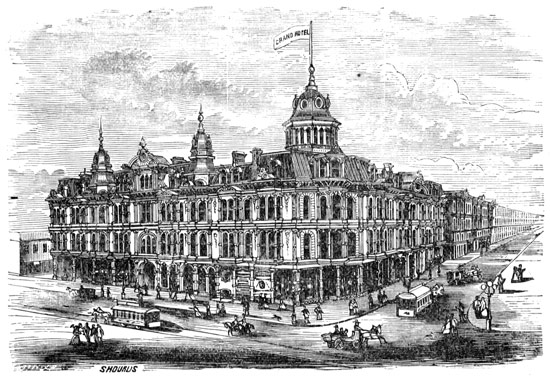
The Grand Hotel.—This magnificent hotel is the
newest of all. It stands on the south side of Market
street, occupying the whole block from New Montgomery
to Second street, and stretching southward
along new Montgomery, across Stevenson street to
Jessie. Its north front is 205 feet, its west front
335 feet, thus covering over one acre and a half of
ground. Its height is three stories, surmounted by
a Mansard roof, containing a fourth. Its style of
architecture may be called the "modern combination,"
highly ornamented. In method of construction,
it is a complete frame building, surrounded by
brick walls of unusual thickness. Its four hundred
rooms include chambers, parlors and suits of the
amplest dimensions and the richest furnishing.
The halls, corridors and stairways are spacious and
airy. Through all the halls, at intervals of every
few feet, hang coils of fire-hose, each attached to
full hydrants, and always ready for instant use.
Bath-rooms and toilets abound. Barber-shop, billiard
room, and the most elegantly frescoed bar-room
upon the coast, occupy the most convenient
portions of the basement and first floor. An amply-supplied
reading-room, with most luxurious chairs,
invites and detains all weary guests. Branch offices
of the leading telegraphs, postal delivery box,
and all needed facilities for correspondence, are at
hand. Hacks stand constantly at the three spacious
entrances, and four leading lines of horse-cars
radiate thence to every portion of the city and
suburbs.
The dining-hall accommodates three hundred.
Its tables are of moderate size, surrounded by
plenty of room, loaded with abundant "substantials,"
flanked with all the latest delicacies, and
served in the most attentive manner. Breakfast
rooms for private parties, and separate eating-rooms
for servants and children, immediately adjoin the
main dining-hall. A large and well-appointed
laundry promptly accommodates guests.
If there's anything else imaginable in the whole
list of first-class hotel accommodations, just mention
it to your obliging host Johnson, or his courteous
and efficient adjutant, Ridgeway, and it shall go
hard but they will furnish it for you at once, if it is
to be had within the limits of telegraph and express.
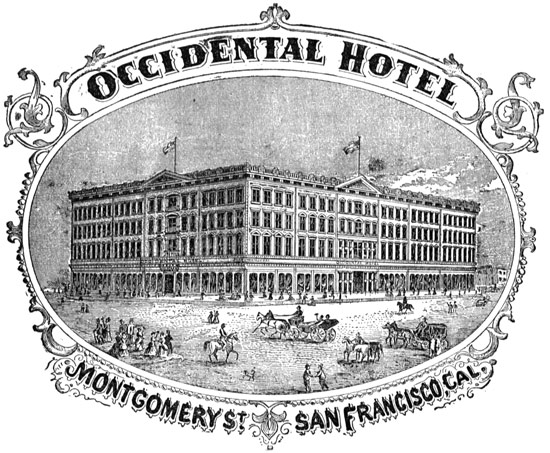
The Occidental.—This popular standard house
stands upon the east side of Montgomery; its west
front occupies the whole block from Bush street
to Sutter; stretches its north flank half a block
down Bush street, while its south flank goes a hundred
and sixty-seven feet down Sutter street. Vertically
it rises six stories into the sunshine. Four
hundred and twelve elegant single and double
rooms, with numerous suits having ample bathing
and other accommodations, besides ladies' parlors,
dining-halls, billiard-hall, convenient offices, broad
stairways, spacious halls, and roomy passages,
make up this truly magnificent mammoth establishment.
The carpets and furniture are of the most
elegant and costly description. A large and beautifully-fitted
patent safety elevator adjoins the grand
staircase near the main hall, and reading-room at
the Montgomery street entrance.
Near the main entrance is a telegraph-office—hacks
stand always in front, and four leading lines
of horse-cars pass the three entrances. A newspaper
and periodical stand, with post-office letter-box,
complete the conveniences of the reading-room.
The walls are braced with iron, and securely
anchored, besides being connected across the building
by heavy iron ties on every story. Manager,
Philip McShane.
Cosmopolitan Hotel.—This worthy compeer of
the two already described, occupies the southwest
corner of Bush and Sansome streets. Centrally-located,
elegantly-constructed, conveniently-arranged,
and well-furnished, this house is one of the
largest and newest first-class hotels. An extensive
addition, including some scores of single and double
rooms, richly furnished in the most modern style,
sufficiently indicate its prosperity. Tubbs & Patten,
managers.
Lick House.—West side of Montgomery, between
Sutter and Post streets. Its east front occupies
the entire block between these two streets, and
runs up between one and two hundred feet of each
of them. Whilst this house is excellently finished
and furnished throughout, it is especially celebrated
for its elegant dining-hall, which is probably
more artistically-planned and exquisitely-finished
than any public dining-hall in the world. Jno. M.
Lawlor & Co., managers.
Brooklyn Hotel.—Next to the elegant hotels
already named, one may reckon the "Brooklyn"—on
Bush street, north side, between Montgomery and
Sansome. This excellent house makes a specialty
of accommodating families, having an unusually
large number of suits of rooms especially designed
for their comfort. Its rates are about two thirds of
those before mentioned. Hotel coaches convey all
guests to the house free of charge. Messrs. Kelly
& Wood, proprietors.
Besides the "Brooklyn," the traveler not wishing
to stop at any of the grander and dearer houses,
may have his choice of the "Russ House," west side
of Montgomery, from Sutter to Pine, Messrs. Pearson
& Seymour, proprietors; the "American Exchange,"
Sansome street, west side, corner of Halleck,
Timothy Sargent, proprietor; the "Morton
House," formerly Orleans Hotel, 117 Post street,
south side, just above Kearny; and the "International
Hotel," Weygant & Partridge, 530-534 Jackson
street, north side, just below Kearny.
European Plan.—One fond of this style, may
suit himself at Gailhard's Hotel, Nos. 507 and 509
Pine street, Pereira & Co., proprietors. "What
Cheer House"—This famous hotel combines the
lodging-house and restaurant under one roof, with
a success of which no old Californian needs be told.
Besides the usual reading-room, it has also an extensive
library and museum, free to all guests; R. B.
Woodward, proprietor, 525-529 Sacramento
street.
Among these we name the "Nucleus" and the
"Clarendon" as equal to the best. The "Nucleus"
stands on the southeast corner of Third and Market
streets; David Stern, proprietor. The "Clarendon
House," John M. Ward, manager, 574 Folsom
street, northwest corner of Second, is new and
central.
Whether a man eats to live or lives to eat, he
can readily suit himself here. At present rates,
the traveler can get better food, greater variety,
and more of it for the same money, than in any
eastern city. Among the best restaurants, are
Saulmann's, 520 California street, north side, between
Montgomery and Kearny; Swain's Family
Bakery and Restaurant, 636 Market, north side,
between Montgomery and Kearny; Martin's, Commercial
street; Job's, 327 Kearny; and Lermitte's
Coffee Saloon, 530 Merchant street.
The hotels usually furnish first-class facilities without
the trouble of going out from under the roof.
Should anyone, however, wish a more extended application
of fresh or salt water, hot or cold, vapor
or steam, Turkish, Russian or Roman, he has come
to the very place where they have them even better
than in their original countries. If you doubt it,
ask Bayard Taylor.
Zeile's Baths, at 527 Pacific street, north side,
between Montgomery and Kearny, furnish more
natural facilities and improved artificial appliances
for the scientific application of Russian, Turkish,
and Roman baths, than any other establishment in
Europe or America. The visitor will be surprised
at the extent and completeness of every appointment
in Dr. Zeile's establishment.
No matter how busy you may be at home, you
are here for enjoyment. When evening comes you
want a good lecture, concert or play. We have
them all—the first occasionally, the last two regularly.
The newest, largest and finest play house
is the
California Theater, on the north side of Bush
street between Kearny and Dupont: John McCullough,
lessee and manager. If there's a good play
in the city, we generally find it here; if there are
comfortable chairs and luxurious boxes anywhere,
they are certainly here; and if there's an artist of
good taste and a successful manager combined in
one man, his name is John McCullough. The theater
is new and spacious, having comfortable seats
for over three thousand, one of the largest stages
in the United States, with complete mechanical appliances,
and finely-painted scenery and drop-curtain.
Metropolitan Theater.—Montgomery street, north
side, between Washington and Jackson. Occasionally
occupied for transient engagements, often presenting
excellent plays. Has fine acoustic properties;
seats two thousand.
Alhambra, 325 Bush street. This is a snug and
tasty combination of theater, minstrels and opera
house, usually presenting some popular and spicy
blending of wit, art and song.
Maguire's Opera House.—Washington street,
north side, between Montgomery and Kearny;
Thomas Maguire, proprietor. This is the famous
old theater in which Forrest, Kean and Booth delighted
the California audiences of earlier days.
Chinese Theater.—At No. 630 Jackson street the
curious visitor may witness the most curious medley
ever put upon a stage and called a play. An interminable
and unintelligible jargon of ding-dong,
clatter-clatter, tum-tum and rattle-rattle-rattle combined
with falsetto screeches, wonderful gymnastics,
graceful contortions, terrific sword combats,
and strange old oriental masqueradings, is what you
may see in the celestial play house. Half an hour
of it will fully satisfy you; but every eastern visitor
must needs endure at least so much.
Museums—Woodward's.—At Woodward's Gardens,
Mission street, between Thirteenth and Fourteenth.
This contains over ten thousand specimens
of zoology, ornithology, Indian relics, alcoholic collections,
natural curiosities, ancient coins, etc., besides
a beautifully arranged and finely lighted art
gallery, including several rare old pictures, and a
sort of floral museum in the shape of a charming
conservatory, wherein fragrance vies with beauty to
delight and detain.
Melodeons, Dance Halls, Beer Cellars.—We
hardly anticipate that the average tourist will care
to be "guided" into places under this heading, but
the philosophic student of human nature, as well as
the curious observer of social customs, cannot consider
his knowledge of any city complete until he
has personally seen and actually known, not only
the highest, but the lowest, amusements extensively
patronized by its people. Like all other large cities,
San Francisco has its share of low haunts in which
really modest, and sometimes meritorious, performances
blend with a much larger proportion of immodest,
meretricious and disgraceful ones.
Platt's Hall.—216 Montgomery, east side, just
north of Bush street, is one of the most popular in
the city. Popular concerts, literary lectures, religious
anniversaries, educational celebrations, magical
entertainments, military balls and social dances,
succeed each other so rapidly that there are few
nights, especially in the pleasure season, when
Platt's Hall does not offer something worth going
to see. Henry B. Platt, proprietor.
Union Hall.—South side of Howard, near Third.
This is the largest permanent hall in the city, and
a grand place for unusually large social parties, exhibitions,
political conventions and popular mass
meetings. It easily accommodates upwards of
three thousand.
Pacific Hall.—In the California Theater building,
north side of Bush, just above Kearny. This
is a centrally-located, tastefully-finished double
hall, that is, two connected so as to be used singly
or jointly according to need. Capacity, fifteen
hundred.
Mercantile Library Hall.—In the basement of
the Mercantile Library Association Building, north
side of Bush street, between Montgomery and Sansome.
Elegantly finished in pure white, with
paneled and ornamented walls and ceilings. Accommodates
eight hundred. The closeness of the
neighboring buildings gives it a bad light by day,
but no hall in the city lights up more brilliantly at
night.
Mechanics' Institute Hall.—Upon the lower
floor of the building of that association, south side
of Post street, between Montgomery and Kearny.
This is another newly-constructed, conveniently-planned,
well-furnished and centrally-located hall,
with a medium capacity of about six hundred.
Y. M. C. A. Hall.—Young Men's Christian Association
building, north side of Sutter, just west of
Kearny. A remarkably neat, well-proportioned,
lofty and well-ventilated hall, having its capacity
largely increased by a conveniently-sloping gallery
stretching across the whole of one side, and throwing
forward its flanks at either end. Capacity, six
hundred and fifty.
Dashaway Hall.—Dashaway Society's building,
south side of Post, between Kearny and Dupont.
This singular name belongs to the pioneer temperance
organization of the Pacific coast. Its origin
can hardly be better stated than in the brief sentences
of Tuthill, in his History of California: "A
company of firemen, Howard No. 3, sitting in their
engine house late at night, January 1st, 1859, celebrating
New Year's after the custom of the country,
fell to musing over their future prospects, and were
vouchsafed a vision of their probable fate. At last
they solemnly agreed to discontinue the use of intoxicating
liquor, or, as they phrased it, to "dash
away the cup." They accordingly organized a temperance
society of "Dashaways," with Frank E. R.
Whitney, chief engineer of the fire department of
San Francisco, as their first President, pledging
themselves to drink nothing intoxicating for five
and one half months. They kept their promise,
and liked it so well that, before reaching the limit
of their self-imposed pledge, they renewed it for
all time." Thus began the first temperance society
of California, which has enrolled thousands of
names, erected a fine building, founded a large
library, and maintains weekly lectures to this day.
In a country where wine is fast becoming a chief
production, and whose greatest present danger is the
social glass, the origin, efforts and success of the
pioneer temperance organization merit more than
passing notice.
Billiards.—Tournaments and champions of this
king of in-door games compel brief mention of this
popular amusement and the places where one may
best enjoy it. Every leading hotel has a fine billiard
room attached; those of the four first named
are palatial in the elegance and richness of their
finish and furniture.
Bowling Saloons and Shooting Galleries.—We
set these together, not because of any particular
affinity between the two, but because the city has
hardly enough of either to make an item of one
alone. At the southwest corner of Montgomery
and Pine, the enthusiastic bowler may probably
find as many pins as he can prostrate, with attendants
who can set them up as fast as he can knock
them down; while at 913 Kearny street, he can
keep up his practice, if already an expert, or "get
his hand in," if a novice, at
"Shooting folly as she flies."
Those wishing the longer range for rifle practice,
find it at Hermann's, near the Presidio, that is, on
one's way to Fort Point.
Although nominally a christian land, California
has yet many sturdy "musclemen" within her borders,
while her larger cities have several schools of
various kinds, for the training of young disciples
in "muscular christianity."
Chief among these in San Francisco, stands the
Olympic Club, the largest physical culture club in
the State. Founded in 1860, during its eleven
years of ceaseless and increasing activity, over five
thousand persons have availed themselves of its admirable
facilities for acquiring or perfecting one's
ability to "travel on his muscle." It is by no
means an association of boys, or of young men
only; some of the best known gray-beard pioneers,
with many of the leading merchants and professional
men, have enthusiastically enjoyed their daily
"play-spell" within its walls for many years, and
they do it still. At 35 Sutter street, south side,
just below Montgomery, one may find their spacious
and lofty hall, amply supplied with all the
paraphernalia of modern gymnastics, and adorned
with several large paintings in oil, by prominent
artists who are also Olympics, besides the photographs
of past and present leading members.
The San Francisco Turn-verein have their hall
and rooms on the north side of O'Farrell, between
Mason and Taylor. Organized in 1852, it is the
oldest association in the State, owns its premises,
and has an actual present membership of nearly six
hundred. It is, of course, conducted upon the
German plan.
Y. M. C. A.—Those who want a roll at the pins
upon strictly orthodox principles, or to punch each
other's heads under the sanction of christianity,
can escape, or at least modify, the censure of their
uncharitable spiritual superiors, by resorting to the
very neat and comfortable gymnasium in the basement
of the Young Men's Christian Association
Building, already described. This has the great
advantage and the unquestionable attraction of
providing for ladies also. It has all the necessary
conveniences of bath-rooms and dressing-rooms attached.
Skating Rinks.—Mercury, the fleet messenger of
the gods, is fabled to have had wings upon his feet.
Forbidden by gravity to emulate him, our modern
skaters fasten wheels to their feet, and make up for
their inability to fly by developing their power to
skate. The immense floor of the Mechanics' Institute
Mammoth Pavilion, on the west side of Stockton,
between Post and Geary, affords the largest
and smoothest rink to be found in the union. Two
or three others exist in the city, besides the very
large and fine new one in the pavilion at Woodward's
Gardens.
Base-ball and Cricket Grounds.—At the southeast
corner of Folsom and Twenty-fifth streets, an
entire block, inclosed by a high fence, leveled to
the necessary smoothness and overlooked by several
hundred well-sheltered spectators' seats, furnishes
fine accommodations for match games of
base-ball and cricket. Here the famous Red
Stockings, of Cincinnati, won fresh laurels, and
the officers and crew of H. B. M. ship Zealous,
played the crack cricket clubs of the State.
WOODWARD'S GARDENS
Are on the west side of Mission street, between
Thirteenth and Fourteenth. This famous resort is
both park and garden, and much more besides. Its
fences inclose nearly six acres, but its actual surface
considerably surpasses that area, from the fact that
the hill-slopes and terraces, with the various floors
and galleries of the different buildings really double
or even treble the original surface beneath, so that,
if spread upon one level, they would cover thousands
of square feet more. They thus rival any public
square in size and far surpass it in variety and
beauty.
We reach them, by the red cars of the City Railroad
Company, leaving the west front of the Grand
Hotel, at the junction of New Montgomery Avenue
and Market street, every five minutes—fare five
cents. Or we may go out by either the Market
street, Howard street, or Folsom street cars. The
first of these carry us within a little over a block of
the entrance—fare, five cents; the second within a
block, and the third within two blocks. Fare on
the last two, ten cents for a single ride, or four
tickets for a quarter. On sunny days and holiday
afternoons the City Railroad runs large, open-sided
excursion or picnic cars, newly constructed expressly
to be run to and from the Gardens. The
entrance is upon the west side of Mission, between
Thirteenth and Fourteenth, through an
elegant architectural gateway, or sort of façade,
surmounted by four colossal statues, or carved
figures. The two central figures resemble a combination
of Minerva and the Goddess of Liberty;
one might not go far wrong in letting them stand for
California and Oregon. The one upon either flank is
a notably well-carved grizzly; larger than life and
twice as natural, sitting erect upon his haunches,
supporting a flag-staff with his fore paws, and with
mouth slightly opened in an amiable grin of undisguised
pleasure at the prominence of his elevated
position, and of welcome to the visiting thousands
who constantly deposit their quarters and dimes
beneath his sentinel post.
Arrived within we seem to have suddenly left the
windy city and dusty streets far behind. Grassy
lawns surround beautiful gardens. Every variety
of flowery vine and blossoming shrub alternates
with rare trees interspersed here and there with
artificial clumps of imported trees, or stretching
along the border of the original grove native to the
spot, while gravel walks wind among the whole. Immediately
upon the right of the entrance, in the
gate-keeper's building, is a library of nearly two
thousand standard volumes, many of them rare and
costly. Directly in front of the gateway, stands
the
MUSEUM,
formerly Mr. Woodward's private residence—at
present occupied by a miscellaneous museum of
natural and artificial wonders, beasts, birds, fishes
and shells, with an occasional freak of nature in
the shape of a mammoth or a dwarf, or a still
more startling preservation of some double-headed
or six-legged specimens. The zoologist or ornithologist
would scarcely get beyond this building the
first day. Left of the Museum stands the
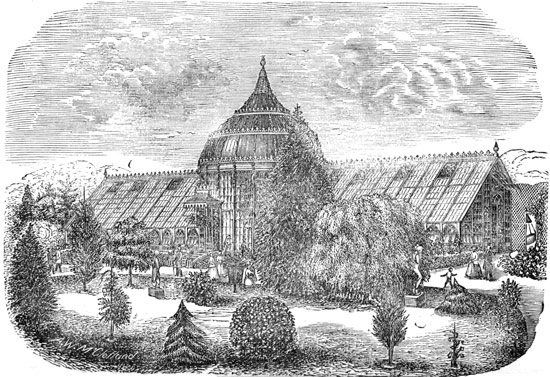
CONSERVATORY.
This is the principal one of five flower and plant
houses, having an aggregate length of three hundred
feet by one tenth that width. This is a really
elegant crystal palace in miniature, filled with the
beauty and fragrance of the rarest exotics. Through
this one may pass directly to the
ART GALLERY.
The vestibule or ante-room of the Art Gallery is
in fact another museum, containing two statues, an
extensive collection of birds and bird's eggs; upwards
of a thousand coins of all ages and nations,
curious idols and weapons, with hundreds of other
curiosities helpfully classified, and the whole enclosed
in an ante-room elegantly proportioned and
beautifully frescoed by Poldeman, in imitation of
Pompeii. Thence we enter the Art Gallery proper,
lighted from above—frescoed by the same artist—decorated,
in the corners, with allegorical representations
of Painting, Sculpture, Music and Architecture—while
over the door hang the two celebrated
bas-reliefs, "Night" and "Morning," by Thorwaldsen.
Niches on each side contain busts of
Schiller, Goethe, Tasso and Petrarch. Over sixty
rare old paintings or faithful copies cover the walls.
Raphael and Salvator Rosa appear in beautiful
copies; several gems from the best Dutch masters
furnish a transition to the modern school, of
which one or two pictures from Bierstadt, and two
or three views of California scenery by Virgil Williams,
stand as pleasing types.
Leaving the Art Gallery, by another exit, we
stand upon the margin of a lovely little lake, around
whose centre revolves the great attraction for the
young folks, and no small novelty to most adult
visitors, the famous
ROTARY BOAT.
This endless craft is a huge circular vessel, rigged
with fore and aft sails, and seating a hundred people,
who step in from the concave landing upon one
side as the radial seats successively come up. It
would puzzle the "cutest" old salt to find bow or
stern to this curious craft; the shrewdest countrymen
have to confess that they "can't make head
nor tail out of the thing," while the enjoyment
which the youngsters find in it, like the boat itself,
never comes to an end.
Between the lake and the conservatory, an outdoor
GYMNASIUM,
with ladders, bars, rings, swings and climbing-poles,
accommodates all who may wish to recreate
the body. From the lake flows a little stream,
along whose banks the pelican, the crane, the albatross,
the wild goose and the common gull, pompously
stalk or awkwardly waddle; while in its
water, two or three beavers, a pair of minks and a
seal or two, make their homes. Beyond this, the
HENNERY,
in which the admirer of fine poultry may see a large
variety of the choicest stock. An adjoining inclosure
presents a pair of ostriches, and another
has two or three beautiful deer and fawn. Near
the southwest corner of the garden, the
TUNNEL
carries the visitor through a heavily-timbered, securely
planked, cleanly-kept and well-lighted passage
under Fourteenth street, into the
ZOOLOGICAL GROUNDS
and the amphitheater. Here, ranged along the
north side, backed by a high and tight fence, and
fronting the south that they may have the warmest
possible exposure, are the animals of the menagerie.
Royal Bengal Tigers, Rocky Mountain Grizzlies,
Mexican Panthers, and South American Jaguars,
Australian Kangaroos, and a curious medley of
dissimilar animals known as the "Happy Family,"
make up the caged collection. The cages are
roomy, airy, cleanly and secure. The animals are
remarkably fine specimens, kept in capital condition,
and the keeper is intelligent and courteous.
Beyond the great cages is another range of smaller
ones, containing black and cinnamon bears, foxes,
badgers, raccoons, opossums, and mischievous
monkeys of all sizes. Esquimaux dogs, Siberian
reindeer and European elk, with many other animals,
more than we have space even to catalogue,
make up a collection of animated nature sufficient
to stock half a dozen ordinary traveling shows, and
still leave enough on hand to surpass any of them.
Besides these, spacious inclosures allow Arabian
and Bactrian camels a free promenade, while still
beyond, another yard is tenanted by the shaggiest,
sleepiest-looking, most patient and good-natured
donkeys that ever allowed a gang of roistering
youngsters to pack themselves upon their backs,
only to be incontinently and ignominiously pitched
over their heads into a promiscuous pile of dust-covered
and disgusted juvenile humanity. At the
extreme end of the Zoological Grounds the inclosure
on the right contains a genuine Rocky Mountain
Buffalo, while in the larger one upon the left, two
or three reindeer contentedly browse.
AMPHITHEATER.
In the center of the zoological grounds, a large
race-course, securely inclosed between inner and
outer circular fences, affords free scope for Roman
Chariot races, hurdle races, foot races, and equestrian
performances generally. Within the inner
fence, a level circle of some eighty feet diameter, accommodates
acrobatic performers; while a lofty pole,
rising from its center, furnishes ambitious youngsters
all needed facilities for flying swings or skillful
"shinning." Around this stadium are raised seats
for three thousand, with a covered portion sheltering
six hundred, not to mention standing room for
ten thousand more.
Returning through the tunnel we turn to the
left, ascend the hill and enter the
PAVILION.
This is the largest and strongest permanent
wooden building upon the coast. It has the form
of a parallelogram with the corners unequally cut
off, thus giving its ground outline the shape of an
irregular octagon. It is one hundred and fifty feet
long, by one hundred and thirty wide and fifty
high, surmounted by a water-tight roof, nearly an
acre and a half in extent. Half a dozen broad entrances
admit us to the spacious interior. Here we
have a central floor; one hundred and ten feet long
by ninety feet wide, as solidly laid, perfectly fitted
and smoothly planed as art could make it, and
furnishing the finest
SKATING RINK
imaginable, or the most capacious ball-room floor
to be desired. Around this floor, a sort of dress-circle,
fitted with easy seats, separated by broad
aisles and roomy spaces, rises gradually back to the
surrounding wall. This dress-circle accommodates
three thousand spectators. Above it is a broad
gallery of equal size, similarly fitted and holding as
many. The gallery windows command a fine view
of the underlying gardens, the meandering walks, the
lake, the conservatories, shrubbery and the museum;
of the zoological grounds and amphitheater
further away, and of the southwestern suburbs,
bounded by the Mission hills, beyond. This pavilion
has a seating capacity of six thousand, while
for any brief mass-meeting, four thousand more
could easily stand in the nine thousand nine hundred
square feet of space upon the floor. A commodious
and conveniently located music, or speaker's
stand, with broad stairways between dress-circle
and gallery, complete the appointments of this
mammoth building, whose workman-like finish and
enormous strength, fully equal its huge size and
immense capacity. Just west of the pavilion stands
a picturesque little
TURKISH MOSQUE,
whose exterior faithfully reproduces the oriental
original. Its interior is tastefully frescoed, while
its domed ceiling presents an astronomical fresco,
representing the starry heavens. Near the southeast
corner of the pavilion is the
RESTAURANT,
so that one need not leave the grounds, should he
find occasion to fill his stomach before he has sufficiently
feasted his eyes. Between the restaurant
and the mosque, occupying the highest point of
the hill, stands
THE OBSERVATORY,
formed by a secure railing and comfortable seats
inclosing and surrounding the circular top of a
huge reservoir, or tank. Until the recent erection
of the pavilion, this was the best point of view from
which to study the plan of the grounds and enjoy
their scenery; and even now, it well rewards ascent,
especially for those who hardly care to climb into
the pavilion gallery.
In various snug places among and under the
trees, and, in some places, surrounding their trunks,
are scattered scores of
LUNCH TABLES,
as a sort of out-post or picket-guard thrown out by
the restaurant proper. All about the top of the
pavilion hill, and for some distance down its sides,
these tables, of all shapes and sizes, round, ring-shaped,
triangular, octagonal, square, and "parallelogramical,"
and surrounded by an abundance
of comfortable seats, occupy the most romantic situations.
Descending the hill-slope by a winding
path, we pass a broad lawn upon the left, on which
the enterprising proprietor proposes the early erection
of a large, conveniently-arranged fire-proof
museum, for the better security of his valuable
collections and cabinets.
We have now completed the general tour of this
elegant park, with its delightful combination of the
beautiful in nature and the wonderful in art, with
the rarest curiosities of both. As a broad and airy
holiday play-ground for tired pupils, as a romantic
retreat for family picnics, as a pleasure-park for the
quiet promenades of old and young, as a varied
field of study for the naturalist, as one of the lungs
through which the tired and dusty city may draw a
cool, refreshing, healthful breath, and, finally, as a
grand union of park, garden, conservatory, museum,
gymnasium, zoological grounds and art gallery,
no eastern city offers the equal of Woodward's
Gardens.
On the south side of Twelfth street, stretching
from Folsom to Harrison, and running half a
block south. Entrance on the corner of Folsom
and Twelfth. Reached most directly by the Folsom
street cars. Admission, 25 cts.
The finest in the city is that already described in
the zoological department of Woodward's Gardens.
The only other is a small collection of bears,
monkeys and birds at North Beach.
The oldest and best finished public square is
Portsmouth Square, commonly called the Plaza, on
the west side of Kearny street, extending from
Clay street to Washington street, and directly fronting
the old City Hall. Besides these are Washington,
Union, Columbia, Lobos, Alcatraz, Lafayette,
Jefferson, Alta, Hamilton and Alamo Squares, with
Yerba Buena, Buena Vista and Golden Gate Parks.
The last named covers nearly 1,200 acres, (of sand
at present.) Of these, the Plaza and Washington
Square are the principal ones which have been sufficiently
improved to merit even passing notice.
To these one may add South Park, a small but
elegant private inclosure occupying the centre of
the block between Bryant and Brannan streets.
Montgomery Street.—This is the San Francisco
Broadway. Flanked on either side by many of
the largest and finest retail business houses, as well
as two of the leading hotels. During the forenoon
business monopolizes it almost exclusively;
afternoons fashion claims its sidewalks, and well-nigh
crowds business, not exactly to the wall, but
rather upon the curbstone, if not fairly into the
gutter. From three to five P.M. the tide of mammon
begins to ebb, and that of fashion swells in at
full flood. Fair women and frail, beauty and
ugliness—calicoes, silks, satins, velvets, broadcloths,
beavers and cashmere, make up the motley
throng, swaying and trailing up and down the
crowded thoroughfare. The faces are very fair, "as
far as we can see," and the forms equally graceful,
with the same limitation.
Masculine faces, broad-browed, clear-eyed, bronze-cheeked,
firm-mouthed or full-bearded, impress one
with the dash, the drive and the nerve which have
spanned the continent with rails and bridged the
Pacific with ships, ere yet the flush of full manhood
has fairly settled upon them. Too many, it is true,
show the full, uncertain lip, the flushed cheek and
dewy eye that tell of excessive stimulus too frequently
applied. Nowhere on earth is the temptation
to drink stronger than here. Business is
sharp, competition brisk, and the climate the most
stimulating anywhere to be found. So they drive
till nature falters or weakens and calls for rest.
But rest they cannot or will not afford; the stimulus
is quicker, it is everywhere close at hand—it
seems to save time. Business men die suddenly;
on the street to-day, at Laurel Hill to-morrow;
heart disease, apoplexy, congestion of the lungs, or
liver complaint, are among the causes most frequently
assigned to the inquiring public. The
causes of these causes, few stop to ask, or dare to
tell.
Kearny Street.—with Montgomery and
but a single block above, that is, west of it, runs
the rival, if not already the equal, business and
pleasure avenue, Kearny street. Though some single
buildings on Montgomery may be finer, the average
of the business blocks along Kearny street
already equals, if it does not surpass that of its
rival. The street itself is broader, the sidewalks
wider, while the press of vehicles and the throngs
of fashion are fully equal.
California Street.—At right angles with both
these streets, and intersecting them near their centre,
California street, the Wall street of San Francisco,
runs straight down from one of the highest
summits within the city limits, to within two blocks
of the water front, and there debouches into Market.
Its upper portion lies between elegant private
residences; half way down the slope stand two of
the leading city churches; below, the Alta office,
and leading telegraph offices; thence from Montgomery
down, the finest number of business blocks
the city presents. On this street below Montgomery,
the Bank of California, the Merchants' Exchange,
the Pacific Insurance Company's Building,
Hayward's, Duncan's, and Wormser's, with other
blocks and buildings, present a continuous front of
architectural beauty rarely equaled.
Market Street.—This broad, dividing avenue
which separates the older city from the newer,
offers a rare architectural medley to the exploring
tourist's eye. Some of the grandest business blocks
on the Pacific slope tower up between or stand
squarely opposite the frailest wooden shells that
yet survive the "early days." Running up from
the water, one encounters such noble blocks as
Treadwell's, not lofty but broad, deep and strong.
Harpending's whole-block front. The Grand
Hotel and Nucleus foretell the size and style of the
blocks which are yet to form continuous fronts
along this main artery of trade.
Second, Third and Fourth Streets.—South of
Market, these streets come nearer to fashionable
streets than any others; especially along the blocks
nearer to Market. They present several single
buildings of notable size and style.
The Best Time.—For any walk or drive within
the city limits, or on the entire San Francisco
peninsular, the most comfortable hours of all the
day, during the season in which the tourists commonly
visit us, that is from May to September, are,
unquestionably, the morning hours; the earlier the
better. If you would see men and women go
later; take the afternoon, face the wind and the
dust, be lifted bodily off your feet, round "Cape
Horn," as they call the southeast corner of Market
and Third streets, until you have quite enough of
that "free-soil" which may be a very fine thing in
politics, but is a "beastly disagreeable thing," as
our English friends might say, on a promenade.
The Cliff House Road.—Stretches westerly from
the city limits, now the west end of Bush street, to
the Pacific Ocean beach—originally a mere trail
over shifting sand hills. It has become the broadest,
hardest, smoothest and longest track in the
State. If you want an idea of California horseflesh,
and San Francisco turnouts, trot out this
way almost any day. The track has a fine, hard
surface wide enough, in places, for twenty teams
abreast, and is often nearly filled from side to side
with smooth-rolling or friendly racing teams, from
the natty single buggy to the elegant coach, or the
stately four-in-hand. A million dollars' worth of
legs and wheels flash by a man in a very few hours
on this fashionable drive, especially on a race-day.
Along this road are one or two wayside inns, which,
like the majority of California inns, are chiefly
drinking-houses under another name. At the end
stands the Cliff House, so named from its site,
the solid top of a precipitous rocky bluff or
cliff, overlooking the Seal Rocks, a few hundred
feet west; then a thirty-mile horizon of
the Pacific Ocean, broken only by the sharp
rocky points of the Farallones low down under the
western sky, visible only when fogs and mists and
haze are wanting. Attached to the house are long
horse sheds which shut off the wind from your
horse while his driver goes in to interview Foster,
mine host of the Cliff. South of the Cliff the road
goes down to and out upon the Ocean House,
which differs little from the popular eastern beach
drives, except that it is not as wide even at the
lowest of the tide, and that the ocean view thence
is far more seldom diversified with sails. The
beach and surf are good, however, and a brisk
drive of two or three miles upon it, seldom fails to
put the oxygen into the lungs—the iodine into
the blood, and the exhilaration into the spirits.
Some two or three miles south of the Cliff House,
the road bends east, leaves the beach and starts
back to the city by another way, known as the
Ocean House Road, named, like the other, from
the house standing near its seaward end. Approaching
the city by this route, one reaches a
greater height than by the Cliff House road, and
when about two miles from the city, enjoys a beautiful
view of the southern and western city, the shipping,
the bay, the opposite shore, the trailing cities
and towns, whose houses gleam between the trees
of Contra Costa and Alameda counties, with their
grassy foot-hills, the whole view backed and bounded
by old Mt. Diablo beyond. Returning by this
road, one enters the city suburbs upon the southwest
by Seventeenth, or Corbett street, passes directly
by the Mission with the famous old church
which named it, and pursues his way back to the
centre by Market, Mission, Howard or Folsom
streets. Between the Cliff House and Ocean House
roads, and nearer the latter, private enterprise has
recently constructed a third track, known as the
Central Ocean Drive.
Bay View Road.—Drive from Market street along
Third to the Long Bridge, cross that to the Potrero,
keep straight on through the deep cut, over the
Islais bridge, thence through South San Francisco,
up a little rise, from whose summit you look down
into a little valley or green bay of vegetable gardens,
between which and the water stands the Bay
View House, on one side of the Bay View race
track. From several points as you drive out, you
will readily understand why they used the phrase
"Bay View" so frequently in naming localities
hereabout. If you wish to return by another way,
drive half a mile beyond the track, where your way
runs into the older road of early times. If you have
time, drive on to the brow of the hill and look down
into Visitacion Valley; if not, at the acute angle
where the roads become one, you turn sharply
back, and after two miles of slightly uneven road,
enter the city between the eastern edge of the Mission
flats and the western foot of the Potrero hills.
The best time for all these drives, as already said
concerning the promenades, is morning, the earlier
the better. Besides the greater purity and freshness
of the air, everywhere accompanying the morning
hours, one then escapes the wind and dust
which, on nearly every afternoon, constitute the
chief drawback from the full enjoyment of outdoor
pleasure during those hours.
In these windy and dusty afternoons, when nature
seems to frown, art and literature invite you
within, and proffer quiet retreats with the best of
company—good books. For a city as young and
as distinctively absorbed in business, San Francisco
has amply provided for the gratification of scientific
research or literary taste. The chief libraries
are the Mercantile, the Mechanics' Institute, the
Odd Fellows', the Pioneers', and the Y. M. C. A.,
each of which is located in the building of the same
name, presently to be noticed. Besides these, at
the What Cheer House, and at Woodward's Gardens,
one finds two or three thousand well selected
standard volumes, free to guests and visitors.
FEDERAL.
Post-Office.—The first of these to every tourist
is, naturally, the Government building through
which his letters come and go. This is a moderately-sized
two-story building of stuccoed brick,
running parallel with the west side of Battery street,
between Washington and Jackson. One may enter
from any street of the three. The ladies' entrance,
which is also common, is from Washington street.
The principal business entrance is on the west front
of the building, through a cross street entered at
either end from Washington or Jackson. The
office opens daily at 8 A.M., and closes at 6:30 P.M.,
except Sundays, when its only open hour is from
9 to 10 A.M. The great overland mail for New
York, by the way of Salt Lake and Omaha, closes
every week day at 7:30 A.M., and on Saturdays at
3 P.M., N. B. Stone, P. M.
The Custom House is simply the upper floor of
the Post-office building. Entrance on Battery,
near Washington. Timothy G. Phelps, Collector.
U. S. Branch Mint.—The old building still occupied,
and likely to be for at least a year, stands on
the north side of Commercial, near Montgomery.
Office hours from 9 A.M. to 2 P.M. Visitors received
daily from 9 to 12. O. H. La Grange, Superintendent.
The New Mint, or what is to be that building,
stands on the northwest corner of Fifth and Mission
streets. Its ground dimensions are 221½ feet on
Fifth, by 166½ feet on Mission street. The basement
is already built of California granite. Above
the basement, which is 13¾ feet high, the walls are
built of blue-gray freestone, from Newcastle Island
in the Gulf of Georgia, between Vancouver's Island
and the mainland of British Columbia. Thus, Uncle
Sam is building his new Mint of British stone.
Two stories of 18½ feet each will surmount the
high basement. The lower of these is now nearly
completed. From the pavement to the crown of
the roof will be 70 feet. Two chimneys will tower
to the height of 150 feet.
The U. S. Marine Hospital stands at the northeast
corner of Harrison and Main streets, upon the
northeast slope of Rincon Hill. This is the old
building. The hospital also occupies the former
buildings of the Deaf and Dumb Asylum, on the
southeast corner of Mission and Fifteenth streets.
CITY AND COUNTY BUILDINGS.
Old City Hall.—This famous old brick and
stucco, two-story, earthquake-cracked, and iron-braced
structure, with the adjoining Hall of
Records, stretches along the east side of Kearny
street from Merchant to Washington, and extends
nearly a third of the block down each of those
streets. The police-offices and lock-ups occupy
the basement, while the usual District Court rooms,
with Judges' Chambers and municipal offices, Supervisors'
and Board of Education rooms, fill the
upper floors, and clamor for more room.
The New City Hall thus far exists only on
paper. The Commissioners have chosen an elaborate
plan for a costly edifice, which will far surpass
anything on the coast in architectural beauty; but
the execution of that plan has hardly yet completed
the excavation for the foundation walls. Hence it
is yet too early to tantalize the tourist with descriptions
of a beautiful building not yet visible, except in
the architect's drawing, or the lithographic copies.
If any tourist is curious to see the site, he may find it
by going out Market street till he reaches what was
known as Yerba Buena Park, corner of Market
and Seventh streets. The City Hall Commissioners
adopted the plans and specifications of Mr. Augustus
Laver, of New York, and elected him architect;
but, at the present rate of progress, it is hardly
probable that less than two or three years will
witness the completion of the urgently-needed and
magnificently-designed new City Hall.
Jail.—On the north side of Broadway, between
Dupont and Kearny, one desirous of inspecting
our penal institutions may find ample opportunity to
study the physiognomy of that class which inhabits
them, and learn the crimes which preponderate
in the Pacific metropolis. Sheriff, P. J. White.
Almshouse.—This asylum occupies one of the
healthiest locations in the State, near the Ocean
House, or San Miguel road, about four and one
quarter miles southwest of the City Hall. M. J.
Keating, Superintendent.
Industrial School.—This finely-constructed, conveniently-arranged
and well-managed reform school,
stands on the western slope of the peninsula hills,
about seven miles southwest of the city. Like the
Almshouse it has as healthful a location as can be
found in the State. It receives only boys, who are
regularly taught by competent teachers, and employed
in various indoor occupations or out-door
work. Present number of inmates, two hundred and
twelve. The order and discipline of this school
well repay a visit. Jno. C. Pelton, Superintendent.
Engine Houses.—In early days, before the establishment
of homes, the pioneer firemen seemed to love
their machine very much as the sailor loves his ship.
They built elegant and costly engine houses, which
became to many of them the only homes they ever
knew. Since the introduction of the improved
steam fire engines, and the organization of the paid
fire department, the glory of the old volunteer organizations
has well nigh departed. But their
houses yet remain, some of them converted to other
uses, while others still retain much of their earlier
attractiveness.
Eight first-class steamers, of the Amoskeag make,
weighing from three to four tons each, throwing
four hundred gallons a minute, each costing from
four to five thousand dollars in gold coin, and
manned by twelve men, make up the present paid
fire department. At a public trial a week since,
New York and Philadelphia witnesses voluntarily
and unanimously testified that they had never seen
machines reach the spot as soon and get a stream
upon the flames as quickly, as did the machines of
our fire department. This fact may conduce to the
sense of security with which the eastern tourist lies
down to sleep in his strange bed. For the benefit
of any extra nervous gentleman, we may add the
universal rule of conduct in regard to midnight
alarms of fire among us, is this: When waked by
a fire-alarm, place your hand against the nearest
wall. If it feels cold, lie still; if moderately warm,
order a different room at once; if positively hot,
leave for another hotel immediately.
CORPORATION AND SOCIETY BUILDINGS.
The Pioneer's Building.—A finely proportioned
building on the corner of Gold and Montgomery
streets, above Jackson. This building is not as noteworthy
as the society which built and chiefly occupies
it. The famous "Society of California
Pioneers" was formed in August, 1850. Its constitution
declares its object to be:
"To cultivate the social virtues of its members;
"To collect and preserve information connected
with the early settlement of the country; and
"To perpetuate the memory of those whose
sagacity, energy and love of independence induced
them to settle in the wilderness and become the
germs of a new State."
It includes three classes: 1st. Native Californians;
foreigners living in California before the
American conquest; and citizens of the United
States who became actual residents here before
January 1st, 1849—with the male descendants of
these.
2d. Citizens of the United States who became
actual residents of California before January 1st,
1850, and their male descendants.
3d. Honorary members admitted according to
the by-laws. The society has enrolled over 1,300
members. Its historical library and museum well
repay a visit. Charles D. Carter, President.
Merchant's Exchange.—This building, the commercial
headquarters of the mercantile army of the
Pacific, stands on the south side of California street,
between Montgomery and Sansome. It ranks
among the largest and finest architectural ornaments
of the city.
Bank of California.—Northwest corner of California
and Sansome. This elegant stone structure
is not remarkable for size; but for broad and deep
foundations, slow and strong construction, harmonious
proportions, convenient arrangements and
admirable finish within and without, it ranks
among the finest and most costly business buildings
in the Union. President, D. O. Mills.
Cashier, William C. Ralston.
Mercantile Library Building.—North side of Bush
street, between Montgomery and Sansome. This is
the building for which the great lottery paid. It
presents a noble front, a finely finished interior,
with library room containing over 30,000 volumes,
reading room, magazine room, reference room,
chess room, with a large ladies' room of remarkably
costly and tasteful furnishing. The hall in the
basement, has already been noticed. Ogden Hoffman,
President; Alfred Stebbins, Librarian.
Mechanics' Institute Building.—South side of
Post street, just below Kearny. A well-proportioned,
substantially built, sensible-looking building,
and so far truthfully indicative of the healthful
prosperity of the excellent organization which
owns and occupies it. A library of nearly 20,000
volumes, including many rare and costly scientific
works, a large and well-stocked reading room, a
sort of museum, including mineralogical cabinets,
mechanical models, scientific apparatus and works
of art, with a popular business college, occupy
this valuable building. The commodious hall upon
the lower floor, has been previously described.
Mechanics' Pavilion.—Union Square, between
Geary and Post streets on the south and north,
and Stockton and Powell streets on the east and
west. One of the largest, if not the largest, wooden
buildings now standing in America, covering two
and one half acres of ground; originally erected
by the Mechanics' Institute Association, for the
accommodation of their biennial fairs, and found
almost indispensably convenient for all grander
gatherings; it has since been retained, and successively
occupied by fairs, grand masquerade balls,
velocipede schools and skating rinks. The most
notable event occurring under its mammoth roof
was the Grand Musical Festival or Gift Concert, in
aid of the Mercantile Library Association, given
under the lead of Madame Camilla Urso. After
the approaching Mechanics' Fair, to be held this
summer, the building is to be removed.
Masonic Temple.—Upon the west side of Montgomery,
at the corner of Post; of peculiar and attractive
architecture, imposing proportions and
elegant finish, it justly ranks among the most
prominent buildings of the city.
Odd Fellows' Hall.—Montgomery street, between
Pine and California. Not particularly imposing
from without, but attractive from the unity,
strength and benificence of the Order which it
represents. Within are a library of nearly 20,000
standard and popular volumes, a well-supplied
reading-room, and a well-managed savings' bank.
Y. M. C. A.—This quartette of initials has now
become so well known throughout the larger cities of
the Union, that the visitor in any large city is disappointed
if he does not find the local habitation of
this fast-spreading bond of unity among all good
men. Here, upon Sutter street, just above Kearny,
he will be agreeably disappointed to discover a
large, new, stone-front building, unique in design,
and most pleasing in its general effect. Within are
library, reading-rooms, hall, gymnasium, and
several convenient lodging-rooms. Chas. Goodall,
President; H. L. Chamberlain, Librarian.
Alta California Building—On the south side of
California street, between Montgomery and Kearny.
Its comparatively great height, as related to its
width, give it a somewhat monumental appearance,
not inappropriate, however, when we remember that
the whole tasteful structure stands as the monument
of the enterprise, energy, perseverance and
success of the oldest and largest paper published
in the State. Fred. MacCrellish & Co., proprietors.
Bancroft's—South side of Market street, between
Third and Fourth. Few business buildings upon
the continent combine the colossal proportions with
the graceful details of this mammoth house of the
oldest and largest publishing firm upon the coast.
Donohoe, Kelly & Co.'s Building—Upon the
southeast corner of Montgomery and Sacramento
streets, deserves mention among the finest business
buildings.
Harpending's Block—On the south side of Market
street, between First and Second; the longest
and loftiest business front presented by any single
business block in the city.
Murphy, Grant & Co's. Building—Northeast
corner of Bush and Sansome. A large and handsome
building, as strong as iron, stone and brick
can make it.
Tobin, Dixon & Davisson's Building—Northwest
corner of Sansome and Sutter, can hardly be
omitted from the inspection of our finest business
houses.
Treadwell's Agricultural Warehouse—South
side of Market street, opposite Front. Not lofty,
but broad; not imposing, but extensive.
Tucker's—Northwest corner of Montgomery
and Sutter. Lofty, finely-proportioned, monumental,
and substantial; surmounted by a clock-tower,
which has become one of the landmarks of
the city. The main salesroom within is beautifully
frescoed and fitted throughout with extreme elegance
and at great cost.
The White House—Corner of Kearny and Post
streets. An elegant new iron and brick structure,
light, airy and ornamental in its general effect.
Receives its name from its color, which has hitherto
been an uncommon one in this city, but is daily
becoming less so. Occupied chiefly by the leading
dry goods firm of J. W. Davidson & Co.
Wells, Fargo & Co's. Building—Corner of
California and Montgomery streets. Who does not
know it? Solid granite blocks, dressed in China,
brought hither in ships, and piled in stern simplicity
upon that central corner to outstand all
earthquake shocks, and survive all business wrecks.
A pioneer building which has already become far
too small for its immense business, but ought never
to be taken down until the whole city goes with it.
Kimball Car and Carriage Factory.—Corner of
Bryant and Fourth streets. Eastern visitors call
this the largest establishment of the kind in America.
In immense extent, convenient arrangement, and
comprehensiveness of scope, it can hardly be surpassed.
Its latest triumph is the construction of a
magnificent Palace Car, built wholly of California
woods, undisguised by paint, carving, gilding, or
varnish—the most complete and superb palace
on wheels ever built. Thirty-five different woods
enter into its construction, displaying a variety of
structure and a range of harmonious tints hardly
imaginable by those who have seen only the poor
imitations of feeble art. The car is a triumph of
taste and skill, and is worth a half-day's time of
any tourist simply to study and enjoy it. It has
been proposed that the merchants of this city buy
it, and present it to the President of the United
States—to the office, not the incumbent—to be kept
at Washington, and used as the official car for all
Presidential tours. A better idea could hardly be
suggested. May the motion prevail!
The Pacific Rolling Mills stand upon the
point of the Potrero. They include all the massive
machinery of their ponderous business, and turn
out heavy castings, forgings, and railroad iron by
hundreds of tons daily.
The Mission Woolen Mills—Folsom street, corner
of Sixteenth. Here are made those wonderful
blankets of such marvelous fineness and thickness,
which have attracted so much attention, and received
even the World's Fair premium abroad.
Union Iron Works.—The oldest and largest in
California, employing three hundred and thirty
men, and turning out the heaviest and most perfect
mining and railroad machinery, locomotives, etc.
Located on the northeast corner of Mission and
First streets. H. J. Booth & Co.
Risdon Iron and Locomotive Works, southeast
corner of Howard and Beale streets. Has all
the latest mechanical improvements of the business.
Can turn out a shaft forty-eight feet long, and
weighing thirty tons. It employs two hundred and
seventy-five hands. John N. Risdon, president.
The Fulton, Miners', and Pacific Foundries, with
the Etna and Vulcan Iron Works, are the other
leading ones of the coast.
Corner of Howard and First streets. The pioneer
and, thus far, the only works upon the coast. The
tower is one of the most prominent and sightly
objects visible in all the water approaches to the
city.
The city has four: The San Francisco and Pacific,
Bay, California, and Golden Gate, turning
out twenty thousand tons of sugar annually.
At North Beach and at the Potrero are the principal
yards. They build mainly river steamers or
ferry boats, or smaller ocean craft, rarely constructing
anything above three hundred tons. For
larger craft it is cheaper to go north, where
immense forests of the finest ship-timber run clear
down to the ocean beach, and stand asking to be
built into ships.
Two: one in the city, on the south side of Townsend,
between Third and Fourth; and the other,
the Pacific Glass works, on the Potrero, at the
corner of Iowa and Mariposa streets. These confine
their works chiefly to bottles, telegraph caps,
etc.
Baptist.—This prominent denomination has six
church buildings in the city. The First Baptist
Church claims special space from the fact that it
was the first Protestant house of worship dedicated
in California. This was in August, 1849. The
present building of stuccoed brick, occupies the
original site of the first small, wooden pioneer
church—on the north side of Washington street,
between Stockton and Dupont. Rev. A. R. Medbury,
Pastor.
Congregational.—This denomination has the
honor of having furnished the first settled Protestant
chaplain in San Francisco, Rev. T. Dwight
Hunt. He held the rare position of "Citizens'
Chaplain," Nov. 1st, 1848, conducting Divine worship
every Sunday in the "Public Institute," (the
school-house) on Portsmouth Square—the Plaza.
The citizens unitedly invited him from Honolulu,
and paid him $2,500 a year. The denomination
has four church buildings—named by their order
of erection. The First Congregational Church is
on the southwest corner of California and Dupont
streets. The pastor is Rev. Dr. Stone, formerly of
the Park street church, Boston.
Episcopal.—This denomination has five church
buildings, of which Grace Church, corner of California
and Stockton streets, is the oldest and largest.
The building is 135 feet long, 62 feet wide
and 66 feet high. Its great size and sightly location
make it one of the prominent buildings in any
general view of the city. Rev. James S. Bush,
Rector. The four other Episcopal church buildings
are—Trinity, St. John's, Church of the Advent,
and St. Luke's.
Hebrew.—Synagogue of the Congregation
Emanu-el, Sutter street, between Stockton and
Powell. Of the five Jewish congregations, this has
"The Synagogue" par excellence—the one always
meant when one speaks of "The Jewish Synagogue."
It is an elegant and costly structure, built
of brick, not yet stuccoed, supporting two prominent
towers, and finished within in most appropriate
and artistic style. Total cost, including lot,
$185,000, gold coin.
Methodist.—This popular, powerful and rapidly
growing denomination has already erected eleven
church buildings in San Francisco—more than any
other Protestant Church, except the Presbyterians.
Its newest and most elegant church is the First
Methodist Episcopal Church, on the west side of
Powell, between Washington and Jackson. This
is one of the most elegant and really artistic
churches; within and without, any where to be
found. Rev. Dr. Cox, Pastor.
Howard Street M. E. Church.—South side of
Howard, between Second and Third. This is the
most substantial and valuable building owned by
the denomination. Value, including lot and parsonage,
$100,000. Its style is medieval gothic.
Pastor, Rev. L. Walker.
Presbyterian.—This recently united denomination,
no longer old and new school, has also eleven
church buildings; of these the two most noted are
the Calvary Presbyterian Church, corner of
Geary and Powell streets. This church is as capacious
and comfortable, even luxurious within, as the
most fastidious could desire. Its organ is the
largest and finest on the coast. Rev. J. Hemphill,
Pastor.
Howard Presbyterian Church, Mission street,
near Third; lately, Rev. Dr. Scudder's. This
building, with a plain and unpretentious exterior,
has greater seating capacity than any other
Protestant church in the city. It is of recent construction
and very convenient internal arrangements.
Temporary pastor, Rev. J. K. Kendall.
First Presbyterian Church—On the west side of
Stockton, between Washington and Clay. This
gothic building is one of the largest and finest—but
its chief claim to notice here, rests upon the
fact that the church which built it, organized May
20th, 1849, under the direction of the Rev. Albert
Williams, was the first Protestant church organized
in San Francisco.
Roman Catholic.—St. Patrick's Church, on the
north side of Mission, between Third and Fourth
streets. Although so new that it is not yet finished,
this church is set first, because it is the
largest in the State, being one hundred and sixty
feet long by eighty feet wide. Its spire is the
loftiest and most beautifully proportioned in the
city, height 240 feet. Rev. Peter J. Grey, Pastor.
St. Mary's Cathedral, California street, at the
northeast corner of Dupont. In age, cost and rank
this building is entitled to the first place. It is a
noble structure of Gothic architecture, which has
been carried out in every detail. The front extends
seventy-five feet on California street, from which
the cathedral runs back one hundred and thirty-one
feet on Dupont. The tower is at present one hundred
and thirty-five feet high, and is to be surmounted
by a spire rising sixty-five feet further.
The Most Rev. Joseph S. Alemany is the Archbishop.
Old Mission Church, on the southwest corner of
Sixteenth and Dolores streets. This was dedicated
Oct. 9, 1776, by Father Junipero Serra, the father
of the California missions. Aside from its age and
associations, the building is of little note. It is
built of the old adobes, which were simply unburnt
bricks dried in the sun, and formed a favorite building
material with the early Spanish and Mexican
inhabitants. The old custom-house, on Portsmouth
square, was built of this material. The roof was
covered with semi-cylindrical tiles of burnt clay,
laid in alternate rows, the first one having the concave
side up, and the next its convex side up. The
outside, generally, is very plain, though the front
shows some old-fashioned round columns, and a
few small bells suspended in square apertures under
the projecting roof. The interior is dark, cold and
comfortless. Rev. Thos. Cushing, Pastor.
Besides the three churches already named, the
Catholics have nine others in the city, in addition
to five or six chapels and asylums.
Swedenborgian.—First New Jerusalem Church.
This is a very neat Gothic building, on the north
side of O'Farrell, between Mason and Taylor
streets. Rev. John Doughty, Pastor.
A second New Jerusalem Church, of which Rev.
Joseph Worcester is pastor, having yet erected no
building, meets in the Druids' Hall, No. 413 Sutter
street.
Unitarian.—First Unitarian Church. This most
beautiful church edifice stands upon the south side
of Geary street, just below Stockton. Its front presents,
unquestionably, the finest specimen of church
architecture in the State, and can hardly be surpassed
in America. The interior is tastefully decorated
with a colored fresco of extreme beauty, and
most artistic harmony of tint. The organ, baptismal
font, and the pulpit, perpetuate the unique
taste of the lamented pastor, whose loved name the
public mind cannot dissociate from the beautiful
building, which, always known as "Starr King's"
church, has become his fitting monument.
This is the only church building of this denomination
in the city or the State.
Chinese Mission House.—This is a combination
church and school-house, new, neat and commodious,
fifty-six feet by seventy feet, and three stories
high. Adjoining school-rooms, readily thrown
into one, rooms for the Superintendent, Rev. Mr.
Gibson and family, and for his assistant, Rev. Hu
Sing Me, the native preacher, and his family, occupy
the various floors. School "keeps" every evening
in the week, except Saturday and Sunday.
Bible class at half-past ten every Sunday morning,
and Sunday school at seven P.M.
The entire property belongs to the Methodist
Church, who maintain it as a most efficient home
mission.
The Mariner's Church, northeast corner of Sacramento
and Drumm streets. It is a neat and commodious
wooden building, erected in 1867, by
contributions from merchants and other citizens of
San Francisco. Rev. J. Rowell, Pastor.
City and County Hospital.—Stands upon the
southwest corner of Stockton and Francisco streets.
French Benevolent Society.—Has one of the
finest hospitals of the State, a large and handsome
brick building, surrounded with pleasant gardens and
ornamented grounds, occupying the whole block on
the south side of Bryant, between Fifth and Sixth,
making a most agreeable and healthful home for
the invalid. Others besides French may receive
its benefits, by assuming membership and paying its
moderate dues.
German General Benevolent Society.—Admits
only Germans. It has over eighteen hundred
members. On Brannan street, near Third, this
society has a very large two-story brick building
with basement—furnished with every form of bath,
and looking out upon fine gardens and shrubbery.
Protestant Orphan Asylum.—On the West side of
Laguna street, between Haight and Waller. A
large and elegant building of brick and stone—one
of the ornamental landmarks of that part of
the city. It accommodates two hundred and fifty
little ones. Mrs. Ira P. Rankin, President; Mrs.
Lucy Stewart, Matron.
Roman Catholic Orphan Asylum.—Market street,
south side, between New Montgomery and Third.
A noble and capacious brick building accommodating
three hundred and twenty children,
and having a school of five hundred and fifty
day scholars attached. The Asylum is under the
sole management of Archbishop Alemany and the
Sisters of Charity.
San Francisco Female Hospital.—Corner of Clay
street and Prospect Place. Any woman who is
sick and poor, has a right to its benefits. It is
a genuine charity, regarding neither nativity, religion
nor social rank. Mrs. M. R. Roberts, President;
Dr. C. T. Deane, Physician.
Ladies' Protection and Relief Society.—Franklin
street, between Post and Geary. The main
object of the society is to furnish a real Home for
friendless or destitute girls, between three and fourteen
years old. Boys, under ten and over three,
may be received and provided for until furnished
with a permanent home in a christian family. It
has over two hundred inmates, nearly all girls.
Miss C. A. Harmon, Matron.
Nearly a hundred other public and private
benevolent societies attempt to make up, as well as
possible, the lack of friends and homes, always so
severely felt by strangers or temporary residents in
any large city, and especially so in one of as cosmopolitan
a character as ours.
Besides the larger public schools, which are
really the peoples' colleges—the city has sixty-five
colleges and private schools. The number of
pupils attending them in 1870 was 4,582, against
21,000 in the public schools.
City College.—Southeast corner of Stockton
and Geary streets. This institution has built and
furnished an elegant French Gothic building at
University Mound, some three miles southwest
of the city, which it will occupy early in '72. Besides
the usual studies, this college especially provides
the best facilities for obtaining a thorough
practical knowledge of Chemistry, in all its applications
to assaying, mining, medical manufactures
and mechanics. Rev. Dr. Veeder, President.
Heald's Business College.—College Building,
Post street, between Montgomery and Kearny.
Its design is to educate boys and young men, with
a special view to practical business. It is one of
the famous thirty-six Bryant and Stratton Business
Colleges, located in the leading cities of the United
States and Canada. Students, two hundred and
fifty. E. P. Heald, President.
St. Ignatius' College.—Occupies the noble brick
building on the south side of Market street, between
Fourth and Fifth. It is largely attended,
and is successfully conducted by the Jesuit
Fathers.
St. Mary's College.—On the old county road to
San José, four and a half miles southwest of the
city. Building, two hundred and eighty feet front,
by fifty feet deep—of excellent proportion and
fine appearance. Conducted by the Christian
Brothers. B. Justin, President.
Toland Medical College.—East side of Stockton
street, between Chestnut and Francisco. The
building is of brick, capacious, commodious, finely
located and admirably adapted to the purpose of
its construction. H. H. Toland, M. D., President.
Lincoln.—Fifth street—south side, near Market.
Brick structure, four stories high, 141½ feet long,
63½ feet wide; 20 class-rooms 129×34 feet, besides
eight wardrobes and teachers' rooms—wide halls,
and four broad stairways the whole height, with a
large hall in the upper story. It accommodates
twelve hundred grammar grade pupils, all boys.
In front stands a finely modeled statue of Abraham
Lincoln for whom the building was named. Cost,
$100,000, gold coin. B. Marks, Principal.
Denman.—Bush street, north side, corner of
Taylor. Brick stuccoed; length, 98¼ feet; width,
68 feet; height, four stories, including attic rooms.
Fourteen class-rooms, each 28×34, accommodating
eight hundred pupils, all girls. Cost,
$78,000, gold. This building was named in honor
of James Denman, one of the pioneer public school
teachers of the city—the founder of this school and
for many years, as at present, its principal. Few
cities in the Union can show school buildings as
elegant, convenient, substantial and costly as these
two noble monuments of public appreciation of,
and liberality towards, the system which must
underlie and sustain our free government if it is
to stand at all.
Tehama.—Tehama street, near First. Brick, undisguised;
111 feet long, 75 feet deep, three stories
high, besides spacious basement play-rooms—has
sixteen class-rooms, each 24×31, hall, 41×49, with
ample stairings, and convenient teacher's-rooms
and ample yards. Cost, $28,300, gold. It accommodates
one thousand primary pupils of both sexes.
Mrs. E. A. Wood, Principal.
Besides these, the city has several large and fine
wooden school-houses of modern structure. Of
these the most sightly, is the Girls' High School,
south side of Bush street, near Stockton—57×92,
three stories, ten class-rooms, 27×34, with an assembly
hall, 54×55; whose length can be increased
to 90 feet, by opening folding doors between it
and two adjoining class-rooms. It is the most conveniently
arranged, best ventilated, sunniest, most
cheerful and healthful school-house in the State.
Ellis H. Holmes, Principal. To these the Department
has recently added, and is now adding,
four or five 18 class-room buildings, of wood,
each accommodating one thousand pupils, now
occupying the old and small school-rooms of early
days or hived in unsuitable rented rooms.
It may appear like exaggeration to say that San
Francisco contains the largest and most complete
general Book and Stationery, mercantile and manufacturing
business in the world. Yet, such is the
fact. Not that the business, by any means, equals
that of Harpers' and Appletons', of New York, Hachette
of Paris, or the stationers of London. But,
between these houses and Bancroft's, there is no
comparison. The character of their trade is totally
different. One publishes books, another manufactures
paper, and so each is large in one thing,
whereas the Bancrofts, collecting from the manufacturers
of all the world, and manufacturing according
to the requirements of their trade, cover
under one management the ground occupied by all
others combined. In older and larger cities, one
house deals in law books alone; another, school
books, etc., while this San Francisco house—besides
a full stock of books in every department of literature,
and stationery from the manufacturers of Europe
and America, paper from the mills of New
England, pencils from Germany, pen-holders from
Paris—unite Printing, Book-binding, Lithography,
Blank-Book Making, Engraving, &c., every thing,
in short, comprised in all the business of all the
others.
The detail is necessarily very great. They buy
from a thousand sellers, and sell to many thousand
buyers. Over one hundred employés, divided into
nine departments, each under an experienced manager,
ply their vocation like bees in a hive of six
rooms, each 37 by 170 feet. To the latest improvements
of the finest machinery, driven by steam, apply
the highest order of skilled labor, and San
Francisco can do anything as well and as cheaply
as New York, London or Paris.
The retail department, occupying the first floor,
has the most magnificent salesroom on the Pacific
coast. Visitors are warmly welcomed, and strangers
politely shown through the premises.
For the convenience of the tourist, who may want
to see the homes of our city as well as her public
buildings and business blocks, we mention the
locality of the following, which are among the
finest of our private dwellings: Erwin Davis,
southwest corner of California and Powell streets;
Milton S. Latham, Folsom street, opposite Hawthorne,
on Rincon Hill; D. J. Tallant, corner of
Bush and Jones street; Richard Tobin, corner of
California and Taylor streets; John Parrott, 620
Folsom street. By making two trips—first, over
California street, and returning by Sutter or Bush
street; second, over Rincon Hill on Folsom street,
and returning by Harrison, the visitor may see the
finest of our private residences.
Telegraph Hill.—This notable natural landmark
stands at the head, that is, at the north end of
Montgomery street. The early settlement, the
pioneer hamlet from which the present city has
grown, was made in the hollow near the southwest
foot. Civilization has encircled it on the land side,
and crept two thirds the way up, while commerce
has claimed the water front along its opposite
base—but the summit still stands as free as
when the priestly fathers first looked thence upon
the glorious inland sea, which flashes between it
and the sunrise. Let us climb it—this way, straight
up the Montgomery street sidewalk, Slowly,
please; we have the day before us; exhausted lungs
impair one's sight. Stop at the corner of each
intersecting street, and glance either way, but especially
eastward—that is, downward toward the
Bay. Now, "Excelsior," again; up these stairs;
now along this natural surface—no asphaltum
walks or Stow foundation pavements up here yet,
you see—on, by these houses; turn to the left here;
now to the right, follow this winding way; patiently
please—that's it; only two or three minutes more—ah!
here it is—this is the highest point, where
the old observatory stood. Sit and breathe a moment;
slip on your overcoat, or put that extra
shawl about you; it's easy to take cold here, far
easier than to rid yourself of it in the city below.
For the sake of method in our survey, we may as
well begin at the northwest; thence "swing round
the circle," through north, east, south and west,
and return to the point of starting. Looking northwesterly,
then, we have first the elevated, undulating
plateau, which stretches along the flattened
summits of the northernmost spur of the broad
peninsular hills, and terminates in the precipitous
bluff known as Fort Point—the southern gate-post
of the far-famed Golden Gate. Through this we
gaze seaward along the further margin of the strait,
where it sends in a surging cove upon the rocky
beach, between Point Diablo and Point Bonita.
The projection of the latter point shuts off the
vision, which else might range up the northwesterly
trend of the coast, along the ocean-shore of Marin
county to Punta de los Reyes, (King's Point) which
projects southward between Bolinas bay and the
ocean. Between Point Diablo and Lime Point, a
slight northerly curve, in the shore line makes a
shallow cove, from whose edge the vision climbs the
successive hills or ridges which fill the ascending
space as it roughly rises toward the crowning point
of Marin county, Mount Tamalpais, two thousand
six hundred and four feet nearer heaven than the
beach line whence we set forth. Still following
round, we look up into Richardson's Bay; next the
southwestern end of Raccoon Strait, and then
Angel Island. We are now looking north. Alcatraz,
the rocky island which nature set just there to
support a commanding fortress; then, an eye-sweep
up over the northern part of San Francisco
Bay to that narrow strait which joins it with San
Pablo Bay; northeast the San Pablo shore of Contra
Costa county, and the hills which terminate the
Mount Diablo peninsular range. Nearer east,
the strangely monotonous hills, whose ridges and
gullies look as if plowed out by heavy rains, and
rounded by sweeping winds. Grassy or earthy,
they look, according to the time of year and kind
of season. Now, almost east, the vision falls. This
large island, off in the midst of the bay, is Yerba
Buena, or Goat Island. It rises three hundred and
forty feet above low water mark. Nearly in a line
over the island appears Berkeley, the site of the
University of California, of which one large building,
already two thirds raised, you may possibly
discern. A little further south—that is, to the
right, you can plainly see the State Asylum for the
Deaf and Dumb and Blind. This noble building
crowns a gently-sloping eminence just at the margin
between the broad and nearly level plain which
stretches between it and the bay, and the foothills
back of which the Contra Costa mountains bring
up the rear.
Almost due east lies Oakland, the tree-city of
the beautiful grove-dotted plain. Then Clinton,
San Antonio, Brooklyn and Alameda, snuggled in
together so closely that one can't tell "which is
which;" and, as far as the beauty of the view is
concerned, it doesn't matter either, for they are all
fair to look upon and lovely to behold. The clustering
trees shut out by far the larger portion of
the houses, so that we might hardly suspect the
size and population of the towns, whose scattered
roofs show here and there among the trees.
We are looking southeasterly now. That creek,
whose mouth you see just beyond Alameda,
leads into San Leandro bay; and right over it,
nearly hidden by intervening trees, lies the town of
the same name. A little further south, and too distant
to be plainly seen, is Hayward's. That depression
in the mountain summits beyond, marks
the opening of Livermore pass, through which the
Western Pacific Railroad finds its way.
Beyond Hayward's, further south, and thence
sweeping around to the right, toward the extreme
end of the bay, we dimly discern the northern end of
the beautiful Santa Clara Valley, where it widens
out and flattens down to the bay. We are now
looking almost due south. Only four miles down,
Hunter's Point shuts off our further view, and compels
us to look nearer home. A trifle west of that,
and half as far away, the Potrero presents its transverse
ridge, fast disappearing under the rapidly-growing
city, and showing a gap of daylight where
the deep cut of the Bay View horse railroad was relentlessly
dug and blasted through, in its stubborn
pursuit of a practicable grade. Between the cut
and ourselves, the Long Bridge shuts off the Mission
bay, and shows where the fast-filling mud-flats
will soon crowd back the bay, and make a new
water front. Still nearer, we have the western
slope or ridge of Rincon Hill, rising gradually to
the left, and packed all over with the huddled and
mostly wooden houses of the new and hurriedly-built
city. Along the inner base of the hill, and
stretching out westward, lies the old "Happy
Valley." That's just this side of where you see the
shot-tower, and runs thence four or five blocks to
the right. Between that and ourselves, coming
over this side of Market street, we have the oldest
and most densely-built part of the city, relieved
here and there—by the Occidental Hotel, Tucker's
tower, the Merchants' Exchange, Murphy, Grant
& Co.'s building, and half a dozen others. Now
let the vision range away southwest, again beginning
at the hills and coming in. The bounding
hills are Bernal Heights, west of which Fairmount
and the adjacent hills merge into the peninsular
range, and form a rude amphitheatre, within which
nestles the fast-growing southwestern precinct.
Coming up toward the west, the twin summits of
the Mission peaks slant the vision up against the
sky, or plunge it into the fleecy billows of in-rolling
ocean fog, which seldom survives the warmer air of
the inner basin long enough to roll far down their
western slope. Between them and us lies the Mission
Dolores, grouped around its century-old
church. Northward of the twin-peaks the hills
rise in "promiscuous prominence." A little south
of west, that irregularly conical hill, surmounted
by a gigantic solitary cross, is the famous "Lone
Mountain," about whose lower slopes, and around
whose base are grouped so many "cities of the
dead." Thence northerly, to the point whence our
survey began, little of note arrests the sight, more
than the broad reach of lower hills and sandy
dunes, which patiently wait the coming occupation
of the westward-growing city.
Although the point beneath our feet is but three
hundred feet high, the panoramic view is wider and
freer than from any other, even the highest hilltop
of the city.
Russian Hill.—About one mile west-southwest
from Telegraph Hill, on Vallejo street, between
Taylor and Jones street, Russian Hill rises nearly
sixty feet higher, but offers little additional prospect.
It was formerly surmounted by a sort of
cork-screw observatory, a skeleton structure of
open frame-work, surrounded by a spiral stairway,
whose summit afforded the loftiest lookout within
the city limits. West-northwest of this hill, and
about three-quarters of a mile from its summit, lies
the small lagoon, near which the founders of the
early mission first located.
Clay Street Hill.—Nearly south of Russian
Hill, and about three furlongs from it, rises this
hill, the highest within the city limits. It is
named from the street which runs just south of its
summit, or will do so when cut through. The hill
is 376 feet high, and is a little over a mile southwest
of Telegraph Hill. The view from its summit
differs only in having moved the point of sight
a mile southwest, and raised it about 80 feet.
California Street Hill.—This, too, takes its
name from that of the neighboring street. It is
hardly proper to call it a separate hill as it is but
two blocks south of Clay Street Hill, from which
only a slight hollow originally separated it.
Rincon Hill.—Three quarters of a mile southwest
of the City Hall. Its highest point reaches
hardly a hundred feet above the bay level. The
whole hill originally offered such sightly locations
for building that it is covered on nearly all sides,
and crowded upon its very height, by some of the
most comfortable and home-like residences in the
entire city. This fact makes it almost impossible
to get an unobstructed view, in all directions, from
any part of it. It was a favorite, and almost an
aristocratic site for residences, until the heartless
greed for gain procured legal authority to excavate
the famous "Second Street Cut;" 75 feet deep,
which needlessly ruined the beauty of the hill.
Lone Mountain.—This singularly symmetrical hill
stands two and one-half miles west of the City
Hall, at the head of Bush street. It is 284½ feet
high. From its summit rises a solitary cross
which, especially near sunset, stands forth against
the western sky with peculiar, beautiful effect. The
view hence is full of inspiration and suggestion.
None have caught more of these, or embodied them
in finer words than Bret Harte, in his favorite
lines:
As I stand by the cross on the lone mountain crest,
Looking over the ultimate sea,
In the gloom of the mountain a ship lies at rest,
And one sails away from the lea;
One spreads its white wings on a far-reaching track,
With pennant and sheet flowing free,
One hides in the shadow with sails laid aback—
The ship that is waiting for me!
But lo, in the distance the clouds break away,
The Gate's glowing portal I see,
And I hear, from the out-going ship in the bay,
The song of the sailors in glee;
So I think of the luminous foot-prints that bore
The comfort o'er dark Galilee,
And wait for the signal to go to the shore;
To the ship that is waiting for me.
Mission Peaks.—The double peaks already mentioned
in our panoramic eye-sweep from Telegraph
Hill, lying three miles southwest of it, sometimes
called the Twin Peaks. They are five hundred and
ten feet high, and stand four miles southwest of
the City Hall. They are the loftiest points in the
county; either summit commands a view which
well repays the time and labor expended in gaining
it.
Bernal Heights.—This name designates a short
range of hills nearly five miles west-southwest of
the City Hall. Starting near the bay, they run
transversely, that is, westerly, for about one mile
across the peninsula. Their highest point is two
hundred and ninety-five feet above the bay.
The highest point of the Potrero is three hundred
and twenty-six feet above low tide, and the
San Miguel Hills, near the southerly line of the
county, reach the height of about four hundred
feet. The Pacific Heights, near Alta Plaza, a mile
and a half west of the City Hall, are three hundred
and seventy-five feet high.
These are all the natural elevations of note within
the city and county. The best artificial outlooks
may be had from the roof of the houses standing
on or near the summits of those hills which rise
within the settled portion. The roof of Bancroft's
building, the cupola of the Grand Hotel, the U. S.
Military Observatory, on the southwest corner of
Third and Market streets, and the Shot Tower, if
you can persuade Mayor Selby to let you up, all
afford extensive and beautiful prospects.
Having thus told the tourist all we know about
the most feasible and temperate methods of "getting
high," we leave him to his own direction, only
adding that if he isn't satisfied with our efforts in his
behalf, he'd better go "up in a balloon," and view
our city as the Germans did Paris.
The universal, inexpensive, always-ready and
democratic way is by the ever-present Horse Cars.
Seven different companies have laid about fifty
miles of rail in and about the city, and carry one
either directly to or within a very short distance of
any desired point.
Lines, Routes and Colors.—The Omnibus and
North Beach and Mission R. R. Companies run
yellow cars through Third and Fourth, Sansome,
Montgomery and Kearney, the central blocks of
Stockton, and the northern ends of Powell and
Mason. They also run red cars from the centre of
the city to the southwestern limits, through Howard
and Folsom streets.
The Central R. R. Co. runs red cars from the
steamboat landings along the city front, through
Jackson, Sansome, Bush, and other leading streets
to Lone Mountain. Their cars are commonly called
the Lone Mountain cars.
The Front Street and Ocean R. R. Co. runs green
cars from the steamboat landings at the foot of
Broadway, up that street, along Battery, Market,
Sutter and Polk streets, by Spring Valley to the
Presidio, whence busses connect for Fort Point.
A branch of this road runs through Larkin street
across Market through Ninth to Mission; thus connecting
the western with the southwestern suburbs.
Within the year this company has also constructed
and put into operation another branch, carrying one
to Laurel Hill Cemetery and Lone Mountain.
The Market Street R. R., the pioneer, runs blue
cars from the junction of Montgomery and Market
street, opposite the Grand Hotel, through Market
by the San José Depot, and out Valencia to
Twenty-sixth. From the junction of Ninth and
Larkin street with Market, it sends a branch out
through Hayes Valley to Hayes Valley Pavilion.
The City R. R.—Lately built, and newly stocked,
runs from the west front of Grand Hotel, at the
junction of Market and New Montgomery, along
the latter to Mission, thence out Mission to Twenty-Sixth,
passing directly by the entrance to Woodward's
Gardens, and within one block of the San
José depot.
The Potrero and Bay View R. R.—Connecting
with the North Beach and Mission R. R., at the
south end of Fourth street, runs thence across the
Long Bridge over Mission Bay—through the Potrero
Deep Cut, over the Islais Creek bridge, through
South San Francisco to the Bay View Race Track
terminus, within half a mile of Hunter's Point and
the Dry Dock.
Times, Fares, etc.—Commencing at about 6 P.M.,
in summer earlier, the cars run at various intervals
of from three to seven minutes until 11 and
12 o'clock P.M., and on the City R. R., till 1.30
the next morning. Nearly all the roads sell tickets,
having four coupons attached, for twenty-five cents
each. Every coupon is good for one fare from one
end of the city to the other, and the coupon tickets
of one company are received by every other. For
single fares, paid without coupons, they usually
charge ten cents. Nearly a year ago the City R. R.
started the half-dime fare, asking but five cents
for a single ride, and the Market street R. R. has
also adopted it. "Children occupying seats, full
fare."
Several of the companies issue transfer checks
entitling the passenger to continue his ride upon
any intersecting line without extra charge.
Hacks and Coaches.—For the benefit of those
who have occasion to engage any of the above, for
the transient service of any excursion lying outside
of the regular routes, or beyond the legal limits
within which the fixed fare obtains, we subjoin
the following legal regulations also contained in
the order and section already quoted on a previous
page:
"For a hackney carriage, drawn by more than
one horse, for four or less persons, when engaged
by the hour, to be computed for the time occupied
in going and returning, including detention, $3 for
the first hour, and $2 for each subsequent hour.
"For a hackney carriage, drawn by one horse,
for two persons, when engaged by the hour, to be
occupied in going and returning, including detentions,
$1 50 for the first hour, and $1 for each
subsequent hour."
It is hardly necessary to remark, yet it may prevent
misunderstanding to add, that the above rates
pay for the service of the whole carriage, and may
be equitably divided among the occupants as they
agree.
Livery Service.—The livery stables of the city
are numerous, and well-stocked with animals of
blood and speed, and every form of two or four-wheeled
vehicles from the substantial, three-seated
thorough-braced wagon to the elegant or fancy
single buggy or sulky. The usual rates, at all
first class stables, are five dollars a day, or a drive,
for a single team, and ten dollars for a double one.
For a very short trip, and a very short time, they
frequently abate something, and when a team is
engaged for several days or weeks at once, commonly
make the rate lower. For saddle horses the
price is usually one half that of a single team, that
is $2 50 for a day or drive—subject to similar reductions
as above.
On Foot.—If you have the nerve and muscle of
a man, and are not sadly out of training, by all means
walk through or about the city and around its
suburbs. In several places, as, in climbing Telegraph
or any other hill, you will have to walk, and
then you can. Even our lady visitors might profitably
emulate the pedestrian performances of their
English sisters. Provide good easy, wide-bottomed,
low-heeled walking-shoes, boots or gaiters,
and take the beautiful, windless and dustless
morning hours for it and, unless your taste is fashionably
perverted or your physical energy hopelessly
exhausted, you will find it most delightful.
Among the Scottish Highlands, or in the Swiss
Alps, you would certainly do it, endure it, enjoy
it, and subsequently boast of it; why not try it
here?
We suppose the visitor to have fairly rested—to
have walked about a little through the more central
portion; to have somewhat studied the general
plan of the city, in view of the larger or shorter
time which he has to spend in the city, to have
made up his mind how much he will see, and what
it shall be. By way of helping his planning and
sight-seeing, we now catalogue and briefly remark
upon the more notable points, taken in regular
order from the most central starting point. We
offer the following pages as helpful suggestions to
those who cannot avail themselves of the personal
guidance of some resident friend, who can constantly
accompany them to direct their route, and
verbally explain the details which these printed
pages attempt. If one has not time, or does not
wish to see anything here set down, he can easily
omit it, and from the remainder select whatever he
may chose, transposing, combining, modifying
and adapting according to his own good pleasure.
GENERAL CIRCUIT OF THE CITY.
Commencing at the foot of Market street, thence
southward, along or over the water front, continuing
around the entire city and returning to the
point of starting. Also mentioning more distant
points visible to the spectator looking beyond the
suburbs:
The Lumber Yards, Wharves and Merchant Fleet,
first attract our notice. Millions of feet of boards,
plank and timber from the northern coast of this
State and from Oregon, ranged in immense piles on
broad and deep piers—alongside of which the
schooners, brigs and barks of the lumber fleet are
constantly discharging.
Thence along Stewart or East street, the latter
being nearer the water, by large lumber-yards,
boat-shops, blacksmithing and ship-chandling establishments,
we reach the California and Oregon
S. S. Co's wharves and slips. The Folsom street
cars run within five short blocks; nearer than any
others.
Black Diamond Coal Company's Pier.—Barges,
sheds and piles of coal, straight from the bowels of
Mount Diablo, corner Spear and Harrison streets,
P. B. Cornwall, agent.
Rincon Point, foot of Harrison street. The
wharves and filling have quite obliterated the old
shore line, which originally turning a short corner
here, received the name "Rincon," which, in Spanish,
means simply a corner.
U. S. Marine Hospital, northwest corner of Harrison
and Spear.
P. M. S. S. Co.'s Piers, Docks, Sheds and Slips.
Waterfront, foot of Brannan and Townsend streets.
Piers having a total front of 1200 feet, shed 600
feet long by 250 wide. Steamships over five thousand
tons register and docks built especially for
them. Capt. W. B. Cox, Superintendent.
Gas Works, corner of King and Second. The
other works of the same company, the San Francisco
Gas Co., are on Howard street, from First
to Beale.
C. P. R. R. Co.'s Freight Pier, Depot and Boat.
Foot of Second street.
Mission Bay. Foot of Second and Third streets.
The broad cove lying between South street and
Potrero; now fast filling in, especially beyond, that
is, south of the Long Bridge.
Mission Rock.—Off the foot of Third street. Has
a shanty on it. Used for fishing.
U. S. Ship Anchorage.—Between foot of Third
and the Mission Rock, and within a quarter-mile
radius of the latter. U. S. Revenue Cutters and
Coast Survey vessels, chiefly occupy it.
Steamboat Reserves.—In the docks between
Third and Fourth and the adjacent ones along the
south side of the bridge.
Long Bridge.—From the foot of Fourth street,
across Mission Bay to Potrero—one mile. Will
become Kentucky street, when the filling-in makes
a street of what is now a bridge.
Yacht Club Building.—East side of Long Bridge,
one third across. Yachts at moorings near.
Potrero.—The point at the south end of Long
Bridge. Spanish for pasture ground. Originally
a rocky ridge. Fast disappearing under houses.
Glass Works.—Pacific Glass Works, corner Iowa
and Mariposa streets, four blocks west of bridge.
Pacific Rolling Mill.—Potrero Point, water front,
east of bridge.
Deep Cut, is really Kentucky street, brought
down somewhere near the future grade, by cutting
through the solid rock, to an average depth of 75
feet for nearly a fifth of a mile.
Rope Walk runs under Kentucky street, near the
north end of the Islais Creek Bridge, which is the
same street continued across Islais Creek, now a
solidly planked bridge, seven eighths of a mile long.
Italian Fishing Fleet and Flakes, on the right of
the bridge, along the cove-beach just beyond the
rope-walk. Their Mongolian competitors have their
boats and beach a little further south.
South San Francisco is the rising land or ridge
south of Islais Creek. It is a pleasant suburb, rapidly
growing.
Catholic Orphan Asylum, that large, new wooden
building fronting on Connecticut street, nine
blocks west of the bridge.
Hunter's Point is the east end of South San
Francisco, a rocky point in which the Dry Dock,
dug out of the solid rock, four hundred and twenty-one
feet long, one hundred and twenty feet wide
at the top, and sixty feet wide at the bottom, which
is twenty-two feet below mean high water. With
the Floating Dock, near by, it cost two millions of
dollars.
Bay View Race Track, near Railroad Avenue, a
mile southwest of Islais Bridge. One mile around;
broad, smooth and hard. Bay View House at north
margin, near west end.
Visitacion Point and Valley, three quarters of a
mile beyond the race course; worth driving out to
see, if you have plenty of time.
San Bruno Road unites with this railroad avenue
about half a mile beyond the race course; brings
one back near
New Butchertown, corner of Islais Creek Canal
and Kentucky street.
Drive back this old San Bruno Road, until you
come to Twenty-sixth street; along that to Mission;
down Mission to Seventeenth, out which you may
drive until you find your way winding and climbing
up and over the east slopes of the peninsular hills
along the Ocean House Road, a broad, hard track,
leading over the hills to the house which names it.
Opposite Twenty-fourth street is the toll gate,
where you pay twelve and a half, or twenty-five
cents, according to your team. A mile beyond, a
side gate, free, admits you to a carriage-way through
the fields, leading down, three quarters of a mile,
to Lake Honda, the huge double-reservoir of sloping-sided
masonry, covered with cement, and holding
thirty-five million gallons. This well merits a
visit. The City Almshouse stands on the hill,
half a mile south of the lake.
The Small-pox Hospital is the small building standing
alone on the hill, a third of a mile north
of the Almshouse.
Returning to, and resuming the main road, a mile
southwesterly and then westerly, brings us to the
Ocean Race Course, securely enclosed, and having
the usual circuit and surface.
Opposite this, and half a mile south lies Lake
Merced, three quarters of a mile long by a fifth of
a mile wide. That part of it nearer to, and parallel
with the road, is a smaller, nearly separate lake
called simply "the Lagoon."
Ocean House, on a slight sandy knoll, half a
mile northwest of Lake Merced.
Pacific Beach.—This is the sandy shore of the
"ultimate sea," stretching almost exactly north two
miles to the base of the cliff, up which a well-built
road carries us a score of rods northwesterly to the
Cliff House, the grand terminus, or at least way-station
of all ocean drives. Its broad, covered
piazza, well-furnished with easy chairs and good
marine glasses, has been for years the popular observatory
whence fashion languidly patronizes the
Pacific, or gazes with momentary interest upon the
Seal Rocks—three hundred feet from the shore,
and dotted with lubberly seals, clumsily climbing
upon the lower rocks, or lazily sunning themselves
above.
Farallones—Twenty-five miles seaward from the
Cliff House—seven sharp-pointed islets break the
monotony of the western horizon. The highest of
these rises three hundred and forty feet, and has a
large lighthouse of the first-class, with the finest
Fresnel light on the coast.
Point Lobes, a precipitous coast bluff, a third
of a mile north of the Cliff House, chiefly noted
as the site of the Signal Station; provided with a
fine glass and the usual outfit of a marine observatory.
Thence along the beach, or the brow of the
bluff, if you like climbing, by the Helmet Rock,
whose shape hardly appears from the land, around
the curve of the shore, whose general direction here
is northeast, a full mile, to
Fort Point, where stands a doubly-strengthened
and heavily-mounted fort, yet unnamed, whose
chief interest founds upon its general resemblance
to the famous Fort Sumter.
Lighthouse.—The northwest angle of the fort
supports a substantial tower, showing a fixed white
light. From the walls of the fort, or better still,
from the lighthouse balcony, we look upon and
across the
Golden Gate, the connecting strait between the
Pacific Ocean and San Francisco Bay. It is between
three and four miles long, from one to two
miles wide, and over four hundred feet deep.
Lime Point, the northern inside gate-post—the
southeastern extremity of Marin county.
Point Bonita.—The outer or oceanward point of
the northern shore, nearly two miles west of the
fort, crowned with a lighthouse.
Mountain Lake—One mile south of the fort, and
sending a little rivulet called Lobos Creek westward
into the Pacific, which it helps to replenish.
Presidio—Spanish for garrison or barracks. This
is nearly a mile southeast of the fort, as we return
toward the city. Its main features are the extensive
barracks, accommodating several hundred U. S.
soldiers, who make this their point of arrival and
departure in going to or coming from the different
stations to which they may be ordered. Forming
the parallelogram front is the parade ground, a
broad, open field, gently falling toward the bay,
surrounded by the officers' quarters or the barracks,
and dotted with batteries here and there.
Black Point.—The water front at the foot of
Franklin and Gough streets.
Pioneer Woolen Mills—Corner of Polk and
Reade streets. Office, 115 Battery street.
North Beach—From the foot of Powell street
west to Black Point.
Angel Island, three and a half miles north of
Black Point, across the bay.
Alcatraces Island—A mile and a half north of
North Beach, off in the bay, heavily fortified, commanding
the Golden Gate.
North Point—Water front, foot of Kearny street,
corner of Bay street.
Sea Wall—Water front from the foot of Union
street, southward; a sloping bulkhead of rubble,
faced with heavier rock, costing $240 a linear foot,
and a mile and a half long.
Ferries.—Alameda—Corner of Davis and Pacific
street. City Front Cars.
Oakland—Same dock, next slip south. City
Front Cars.
Saucelito—Meiggs' Wharf, foot of Powell street.
North Beach cars.
San Quentin—Davis street, near Vallejo. City
Front or Sutter street cars.
Vallejo—Corner of Front and Vallejo. City
Front or Sutter street cars.
HOW TO SEE SAN FRANCISCO AND ITS SURROUNDINGS.
Brief trips, or short excursions, requiring but a
few hours each. Short skeleton tours in and about
the suburbs, suggesting the most interesting points,
with the walks, rides, drives or sails by which one
may reach them—the time required and the best
hours of the day, the amount of walking necessary,
with the conveniences and cost.
IN AND ABOUT THE CITY.
I. Walk up Montgomery street to Telegraph
Hill. If you don't feel like climbing clear to the
top, follow the foot-path which winds around about
two thirds up its east and northeast slopes. If
you go to the top you can go down into—or if you
take the lower path you will come round into, Lombard
street. Walk down that to Powell; turn to
your right and follow Powell north to the water
and Meiggs' wharf, down the wharf if you want
the bay breeze, and the bay sights from a lower
level; come back—take the South Park cars; ride
up Powell by Washington Square, up Stockton,
down Washington—get out at the upper corner of
the Plaza, walk diagonally across, notice the old
City Hall on your left, stroll up Kearny to California
or Bush, down which you descend one block
to Montgomery.
II. Chinese Quarters.—Sacramento street, from
Kearny to Dupont, along Dupont to Pacific, down
Pacific to Stockton, to Jackson, down Jackson
to Kearny; cast your eyes down the little alleyways
and courts which cut up the blocks along these
streets. Look at these signs! "Hop Yik, Wo
Ki, Tin Yuk, Hop Wo, Chung Sun, Cheung
Kuong, Hang Ki, Yang Kee, Shang Tong,
Shun Wo," that last wouldn't be a bad one
to go over the door of "civilized" rum-hole.
"Wing On Tsiang, Wung Wo Shang, Kwong On
Cheang," and scores of others. Most are personal
names, some are business mottoes. They are
generally phonographic, that is, you pronounce
them according to their spelling. Here and there
one suggests fun. For instance, "Man Li." Well,
why not a Chinaman as well as a white man? Has
the superior race the monopoly of lying? That
sign is certainly creditable to the Chinese female;
it says Man Li; not woman lie. Not far thence a
very appropriate successor finishes the logical sequence,
"Hung Hi." Certainly, why not? That's
what ought to be done to any merchant who will
lie. Any Man Li, should be "Hung Hi." These
celestials certainly have no bad idea of the eternal
fitness of things. What would happen to our
Melican merchants if that rule were rigidly applied?
It would'nt be much trouble to take the
next census. This is the out-door glance by daylight.
If you want a more thorough exploration by day or
by night, call on special officer Duffield, (George
W.) at 1,107 Montgomery street, who knows their
haunts and ways, and can show you all you'll care
to see. His long experience among them has also
acquainted them with him to such a degree, that
they allow him to enter and pass through their
houses and rooms whence another might be shut
out. In fact, he is their special officer, paid by the
Chinese merchants to guard their property, and is
emphatically the man to have for an escort. He
can take you into their gambling saloons, into their
pigeon-hole lodging houses where rag-pickers, beggars
and thieves fill the air with opium smoke, then
shove themselves, feet foremost, into a square box
of a pigeon-hole, more like a coffin than a couch.
He can guide you into crooked, narrow, labyrinthine
passages through which you can just squeeze,
and which you could never find nor enter without
guidance; into inner courts, around which, and in
the midst of which, stand old rickety, tumble-down,
vermin-haunted hives of wooden tenements which
rise through three or four stories, all alive with the
swarming lazzaroni, packed into the smallest and
dirtiest of rooms, and huddled into every dark and
filthy corner.
These are the lowest and worst of their race; the
infernal celestials, among whom the officer will not
take a woman at all, and where it would not be safe
for any man to attempt entrance alone. The approaches
are so ingeniously constructed and so artfully
disguised, and the passages wind among each
other so intricately, and intersect each other so perplexingly,
that not one in a thousand could ever
find the beginning, and hardly one in ten thousand
could discover the end.
"For ways that are dark,
And for tricks that are vain,
The heathen Chinee is peculiar;
Which the same I would rise to explain."
The stranger must not conclude, however, that
such as these make up the bulk of the Chinese who
come to us. On the contrary, these are the lowest
and vilest, the dregs and settlings of their social
system; no more fit to be taken as samples of their
nation than the low, whisky-drinking, shillaly-swinging,
skull-cracking, vote-repeating Irish, who
now govern New York, are to be taken as fair types
of the "finest pisantry undher the sun," or considered
as a representative of the educated Irishman,
than whom a warmer-hearted, freer-handed, more
courteous-mannered gentleman one can hardly meet
in a thousand miles.
So the middle classes of the Chinese are cleanly,
sober, industrious and honest, while their leading
merchants, of whom we have several fine representatives
in the city, are models of business integrity
and social courtesy. Enter one of their establishments,
with proper introduction, and you shall encounter
the most perfect politeness throughout the
interview, and carry away the impression that you
were never more heartily welcomed and generously
entertained, according to their custom, of course,
by any strangers, in your life.
And one very notable thing should also be said
of their street deportment; you may walk through
their quarter every day and night for a month, and
not see a single drunken man of their own race. If
you encounter one at all, he is likely to belong to
the "superior race."
Your survey of the Chinese quarter would be incomplete
without a visit to their temples or joss
houses. One of these stands off Pine, just above
Kearny. They are also used as hospitals.
Should you wish any souvenir in the shape of
their peculiarly ingenious manufacture, you may
find them at the Chinese or Japanese bazaars.
III. Third Street.—Five and a half blocks to
South Park; thence three blocks to the water;
along Channel street to Long Bridge. Here we
may take the Bay View cars, ride across the Mission
Bay, visit the Rolling Mills, or keep on through
the Deep Cut, over Islais Creek bridge, through
South San Francisco, to Bay View track, whence
'busses carry us to Hunter's Point and the Dry
Dock. Best time, morning, unless some ship is
going into dock on the high tide. Fare in 'bus,
twenty-five cents each.
IV.—Water Front—South of Market.—Walk along
East or Stewart St., by U. S. Marine Hospital, to P. M. S. S.
Co.'s ships and docks and C. P. R. R. Freight
piers and depot. Thus far no cars. At foot of
Brannan take cars, ride up that to Third, down
Third, by South Park, to Howard—along Howard
to Second, along Second to Market again. Or you
can walk from the water up Second to Market
again. Or you can walk from the water up Second
through the cut to Harrison, climb the bridge-stairs,
walk down Harrison to First or Fremont, turn left,
and come back by the Shot Tower, Foundries, and
Factories to Market.
V.—Water Front—North of Market.—No cars
here. Stroll northerly by the corners of the different
streets, along the heads of the different piers,
among the grain and produce boats, river steamer
docks and ferry slips, around to North Point, with
its bonded warehouses, iron clippers, and sea wall,
thence back Sansome to Broadway, whence cars
take you again to the centre.
VI.—Southwestern Suburbs.—From corner west
front of Grand Hotel, take city cars out Mission, by
fine new church, new Mint, to Woodward's Gardens;
thence to Sixteenth; up that three blocks,
westerly, to Dolores street, where stands the old
Mission Church, the site of the first permanent settlement
of San Francisco; out Dolores; south two
blocks, to Jewish Cemeteries; back by same way to
Sixteenth; down that to Mission Woolen Mills;
thence home by Folsom street or Howard street
cars, either of which brings you to Market street.
VII.—Western Suburbs and Beyond.—From
Montgomery up Sutter, by cars, or up Bush by feet
or wheels. Either street carries you westerly to
Laurel Hill, in which elegant monuments and
mausoleums merit more than passing notice; thence
east three blocks to Lone Mountain and the cemeteries
grouped about its base, and upon its lower
slopes—the Odd Fellows', west; the Masonic, south,
and the Calvary north and east. Out the Cliff
House Road—you'll need horse probably, or can
take the 'bus for 25 cents each way—by the Race
Track or Driving Park, to the Cliff House; look at
the Seal Rocks, Seals, Ocean and Farallones; thence
south along Pacific Beach to Ocean House, whence
in by Ocean Road or the new Central Road by
Lake Peralta and Lake Honda. The old Ocean
Road brings you back through the Mission; the
new one, in by Lone Mountain again.
VIII.—Northwestern Suburbs and beyond.—Up
Geary, Post or Sutter to Van Ness Avenue;
thence twelve blocks north through Spring Valley,
by cars from Broadway west to Harbor View, Presidio
and Fort Point. Returning from the Presidio,
keep towards the Bay; come around by Black
Point, whence, skirting the water-front through
five or six rough blocks, you reach the foot of Mason
or Powell street, and find other cars waiting to
bring you home.
The routes above suggested, are by no means
exhaustive, but will take one to or near the most
noted points. If the tourist can have the personal
guidance and escort of some well-posted friend, so
much the better. In the absence of such friend, or
even to accompany him, we respectfully submit our
little pocket substitute.