In early summer the trees stood still
under the blue sky, held their limbs outstretched
and received the direct rays of the sun. On the
shrubs and bushes in the undergrowth, the flowers
unfolded their red, white and yellow stars. On
some the seed pods had begun to appear again.
They perched innumerable on the fine tips of
the branches, tender and firm and resolute, and
seemed like small, clenched fists. Out of the earth
came whole troops of flowers, like motley stars,
so that the soil of the twilit forest floor shone with
a silent, ardent, colorful gladness. Everything
smelled of fresh leaves, of blossoms, of moist clods
and green wood. When morning broke, or when
the sun went down, the whole woods resounded
with a thousand voices, and from morning till
night, the bees hummed, the wasps droned, and
filled the fragrant stillness with their murmur.
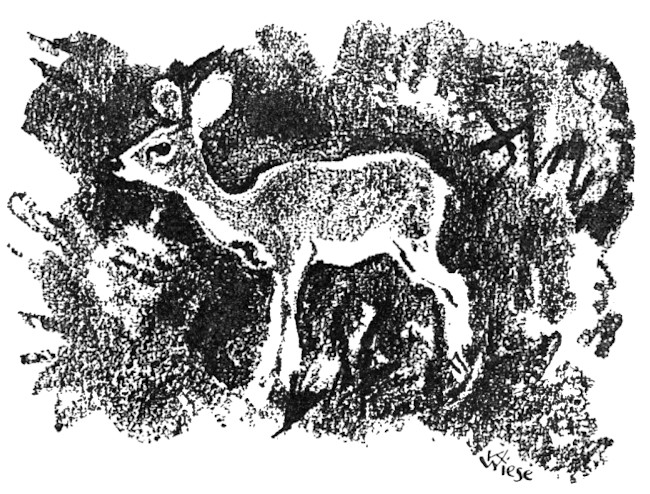
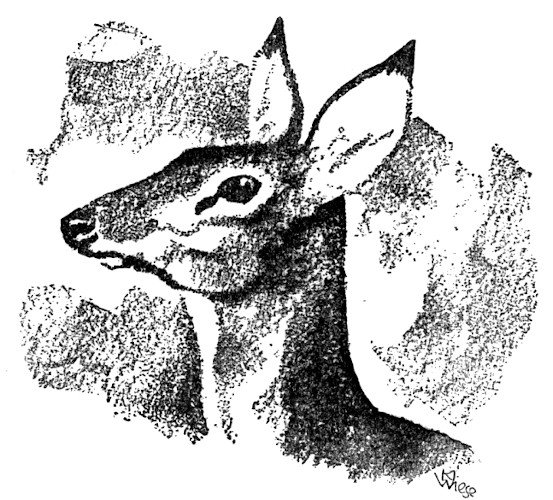
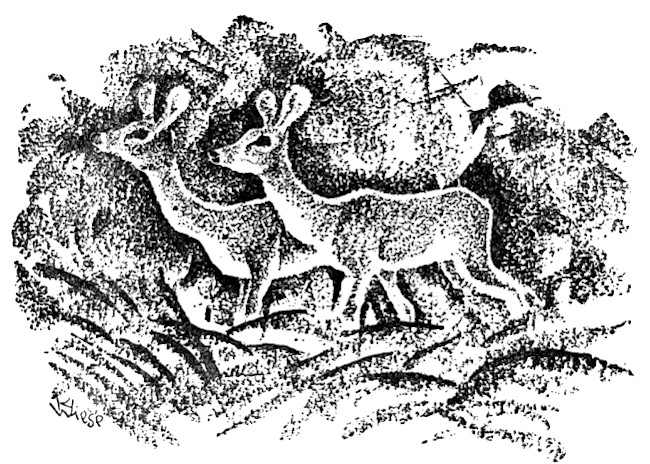
These were the earliest days of Bambi’s life.
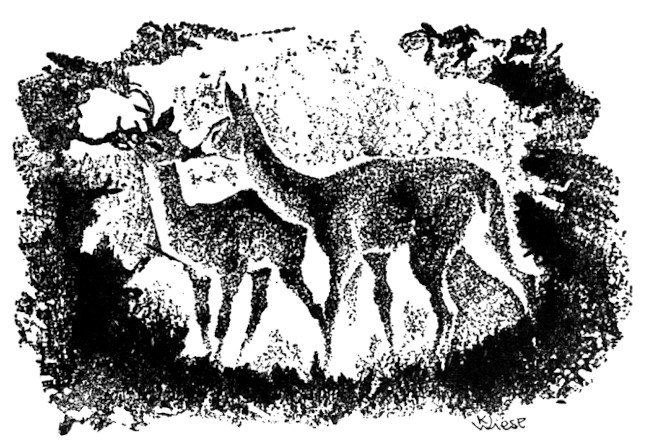
He walked behind his mother on a narrow track
that ran through the midst of the bushes. How
pleasant it was to walk there. The thick foliage
stroked his flanks softly and bent supplely aside.
The track appeared to be barred and obstructed
in a dozen places and yet they advanced with the
greatest ease. There were tracks like this everywhere,
running criss-cross through the whole
woods. His mother knew them all, and if Bambi
sometimes stopped before a bush as if it were an
impenetrable green wall, she always found where
the path went through, without hesitation or
searching.
Bambi questioned her. He loved to ask his
mother questions. It was the pleasantest thing for
him to ask a question and then to hear what answer
his mother would give. Bambi was never
surprised that question after question should come
into his mind continually and without effort. He
found it perfectly natural, and it delighted him
very much. It was very delightful, too, to wait
expectantly till the answer came. If it turned out
the way he wanted, he was satisfied. Sometimes
of course, he did not understand, but that was
pleasant also because he was kept busy picturing
what he had not understood, in his own way.
Sometimes he felt very sure that his mother was
not giving him a complete answer, was intentionally
not telling him all she knew. And, at first,
that was very pleasant, too. For then there would
remain in him such a lively curiosity, such suspicion,
mysteriously and joyously flashing through
him, such anticipation, that he would become
anxious and happy at the same time, and grow
silent.
Once he asked, “Whom does this trail belong
to, Mother?”
His mother answered, “To us.”
Bambi asked again, “To you and me?”
“Yes.”
“To us two?”
“Yes.”
“Only to us two?”
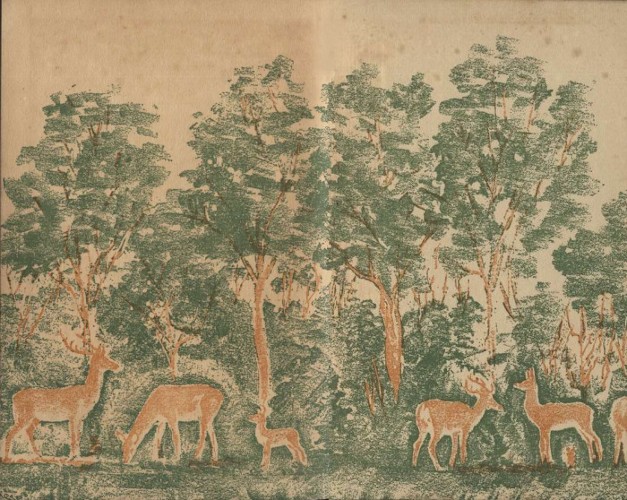
“No,” said his mother, “to us deer.”
“What are deer?” Bambi asked, and laughed.
His mother looked at him from head to foot and
laughed too. “You are a deer and I am a
deer. We’re both deer,” she said. “Do you understand?”
Bambi sprang into the air for joy. “Yes, I
understand,” he said. “I’m a little deer and you’re
a big deer, aren’t you?”
His mother nodded and said, “Now you see.”
But Bambi grew serious again. “Are there
other deer besides you and me?” he asked.
“Certainly,” his mother said. “Many of them.”
“Where are they?” cried Bambi.
“Here, everywhere.”
“But I don’t see them.”
“You will soon,” she said.
“When?” Bambi stood still, wild with curiosity.
“Soon.” The mother walked on quietly. Bambi
followed her. He kept silent for he was wondering
what “soon” might mean. He came to the
conclusion that “soon” was certainly not “now.”
But he wasn’t sure at what time “soon” stopped
being “soon” and began to be a “long while.”
Suddenly he asked, “Who made this trail?”
“We,” his mother answered.
Bambi was astonished. “We? You and I?”
The mother said, “We, we ... we deer.”
Bambi asked, “Which deer?”
“All of us,” his mother said sharply.
They walked on. Bambi was in high spirits and
felt like leaping off the path, but he stayed close
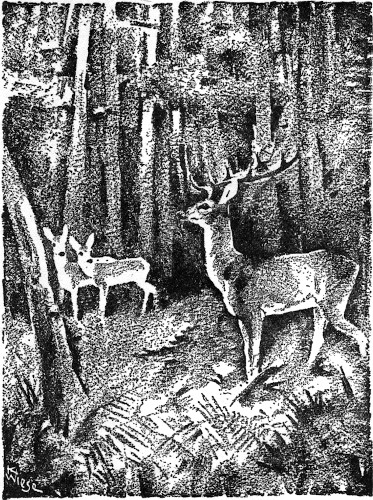
to his mother. Something rustled in front of
them, close to the ground. The fern fronds and
wood-lettuce concealed something that advanced
in violent motion. A threadlike, little cry shrilled
out piteously; then all was still. Only the leaves
and the blades of grass shivered back into place.
A ferret had caught a mouse. He came slinking
by, slid sideways, and prepared to enjoy his meal.
“What was that?” asked Bambi excitedly.
“Nothing,” his mother soothed him.
“But,” Bambi trembled, “but I saw it.”
“Yes, yes,” said his mother. “Don’t be frightened.
The ferret has killed a mouse.” But Bambi
was dreadfully frightened. A vast, unknown horror
clutched at his heart. It was long before he
could speak again. Then he asked, “Why did he
kill the mouse?”
“Because,” his mother hesitated. “Let us walk
faster,” she said as though something had just occurred
to her and as though she had forgotten the
question. She began to hurry. Bambi sprang
after her.
A long pause ensued. They walked on quietly
again. Finally Bambi asked anxiously, “Shall we
kill a mouse, too, sometime?”
“No,” replied his mother.
“Never?” asked Bambi.
“Never,” came the answer.
“Why not?” asked Bambi, relieved.
“Because we never kill anything,” said his
mother simply.
Bambi grew happy again.
Loud cries were coming from a young ash
tree which stood near their path. The mother
went along without noticing them, but Bambi
stopped inquisitively. Overhead two jays were
quarreling about a nest they had plundered.
“Get away, you murderer!” cried one.
“Keep cool, you fool,” the other answered,
“I’m not afraid of you.”
“Look for your own nests,” the first one shouted,
“or I’ll break your head for you.” He was beside
himself with rage. “What vulgarity!” he chattered,
“what vulgarity!”
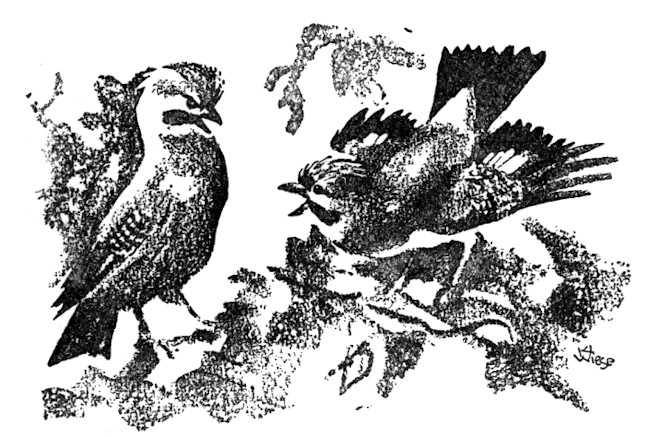
Overhead two jays were quarreling. “What vulgarity!” he chattered, “what vulgarity!”
The other jay had spied Bambi and fluttered
down a few branches to shout at him. “What are
you gawking at, you freak?” he screamed.
Bambi sprang away terrified. He reached his
mother and walked behind her again, frightened
and obedient, thinking she had not noticed his
absence.
After a pause he asked, “Mother, what is vulgarity?”
“I don’t know,” said his mother.
Bambi thought a while; then he began again.
“Why were they both so angry with each other,
Mother?” he asked.
“They were fighting over food,” his mother
answered.
“Will we fight over food, too, sometime?”
Bambi asked.
“No,” said his mother.
Bambi asked, “Why not?”
“Because there is enough for all of us,” his
mother replied.
Bambi wanted to know something else.
“Mother,” he began.
“What is it?”
“Will we be angry with each other sometime?”
he asked.
“No, child,” said his mother, “we don’t do such
things.”
They walked along again. Presently it grew
light ahead of them. It grew very bright. The
trail ended with the tangle of vines and bushes.
A few steps more and they would be in the bright
open space that spread out before them. Bambi
wanted to bound forward, but his mother had
stopped.
“What is it?” he asked impatiently, already delighted.
“It’s the meadow,” his mother answered.
“What is a meadow?” asked Bambi insistently.
His mother cut him short. “You’ll soon find
out for yourself,” she said. She had become very
serious and watchful. She stood motionless, holding
her head high and listening intently. She
sucked in deep breathfuls of air and looked very
severe.
“It’s all right,” she said at last, “we can go out.”
Bambi leaped forward, but his mother barred
the way.
“Wait till I call you,” she said. Bambi obeyed
at once and stood still. “That’s right,” said his
mother, to encourage him, “and now listen to
what I am saying to you.” Bambi heard how
seriously his mother spoke and felt terribly excited.
“Walking on the meadow is not so simple,” his
mother went on. “It’s a difficult and dangerous
business. Don’t ask me why. You’ll find that out
later on. Now do exactly as I tell you to. Will
you?”
“Yes,” Bambi promised.
“Good,” said his mother, “I’m going out alone
first. Stay here and wait. And don’t take your
eyes off me for a minute. If you see me run back
here, then turn round and run as fast as you can.
I’ll catch up with you soon.” She grew silent and
seemed to be thinking. Then she went on earnestly,
“Run anyway as fast as your legs will carry
you. Run even if something should happen ...
even if you should see me fall to the ground....
Don’t think of me, do you understand? No matter
what you see or hear, start running right away
and just as fast as you possibly can. Do you
promise me to do that?”
“Yes,” said Bambi softly. His mother spoke so
seriously.
She went on speaking. “Out there if I should
call you,” she said, “there must be no looking
around and no questions, but you must get behind
me instantly. Understand that. Run without
pausing or stopping to think. If I begin to run,
that means for you to run too, and no stopping
until we are back here again. You won’t forget,
will you?”
“No,” said Bambi in a troubled voice.
“Now I’m going ahead,” said his mother, and
seemed to become calmer.
She walked out. Bambi, who never took his
eyes off her, saw how she moved forward with
slow, cautious steps. He stood there full of expectancy,
full of fear and curiosity. He saw how
his mother listened in all directions, saw her
shrink together, and shrank together himself,
ready to leap back into the thickets. Then his
mother grew calm again. She stretched herself.
Then she looked around satisfied and called,
“Come!”
Bambi bounded out. Joy seized him with such
tremendous force that he forgot his worries in a
flash. Through the thicket he could see only the
green tree-tops overhead. Once in a while he
caught a glimpse of the blue sky.
Now he saw the whole heaven stretching far
and wide and he rejoiced without knowing why.
In the forest he had seen only a stray sunbeam
now and then, or the tender, dappled light that
played through the branches. Suddenly he was
standing in the blinding hot sunlight whose boundless
power was beaming upon him. He stood in
the splendid warmth that made him shut his eyes
but which opened his heart.
Bambi was as though bewitched. He was completely
beside himself with pleasure. He was
simply wild. He leaped into the air three, four,
five times. He had to do it. He felt a terrible
desire to leap and jump. He stretched his young
limbs joyfully. His breath came deeply and easily.
He drank in the air. The sweet smell of the
meadow made him so wildly happy that he had to
leap into the air.
Bambi was a child. If he had been a human
child he would have shouted. But he was a young
deer, and deer cannot shout, at least not the way
human children do. So he rejoiced with his legs
and with his whole body as he flung himself into
the air. His mother stood by and was glad. She
saw that Bambi was wild. She watched how he
bounded into the air and fell again awkwardly,
in one spot. She saw how he stared around him,
dazed and bewildered, only to leap up over and
over again. She understood that Bambi knew
only the narrow deer tracks in the forest and how
his brief life was used to the limits of the thicket.
He did not move from one place because he did
not understand how to run freely around the open
meadow.
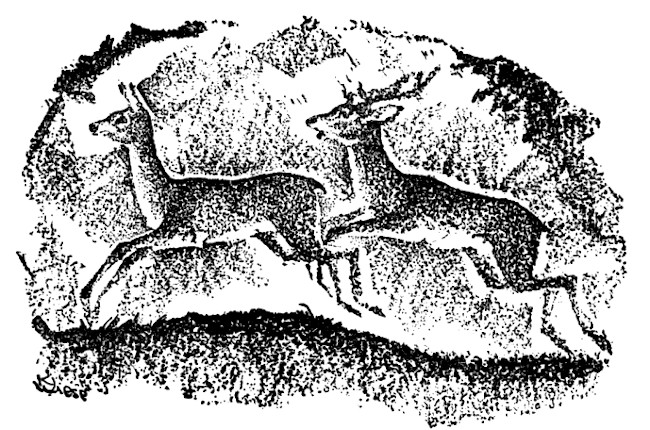
So she stretched out her forefeet and bent
laughingly towards Bambi for a moment. Then
she was off with one bound, racing around in a
circle so that the tall grass stems swished.
Bambi was frightened and stood motionless.
Was that a sign for him to run back to the
thicket? His mother had said to him, “Don’t
worry about me no matter what you see or hear.
Just run as fast as you can.” He was going to
turn around and run as she had commanded him
to, but his mother came galloping up suddenly.
She came up with a wonderful swishing sound
and stopped two steps from him. She bent towards
him, laughing as she had at first and cried,
“Catch me.” And in a flash she was gone.
Bambi was puzzled. What did she mean?
Then she came back again running so fast that it
made him giddy. She pushed his flank with her
nose and said quickly, “Try to catch me,” and
fled away.
Bambi started after her. He took a few steps.
Then his steps became short bounds. He felt as if
he were flying without any effort on his part.
There was a space under his hoofs, space under
his bounding feet, space and still more space.
Bambi was beside himself with joy.
The swishing grass sounded wonderful to his
ears. It was marvelously soft and as fine as silk
where it brushed against him. He ran round in
a circle. He turned and flew off in a new circle,
turned around again and kept running.
His mother was standing still, getting her
breath again. She kept following Bambi with her
eyes. He was wild.
Suddenly the race was over. He stopped and
came up to his mother, lifting his hoofs elegantly.
He looked joyfully at her. Then they strolled
contentedly side by side.
Since he had been in the open, Bambi had felt
the sky and the sun and the green meadow with
his whole body. He took one blinding, giddy
glance at the sun, and he felt its rays as they lay
warmly on his back.
Presently he began to enjoy the meadow with
his eyes also. Its wonders amazed him at every
step he took. You could not see the tiniest speck
of earth the way you could in the forest. Blade
after blade of grass covered every inch of the
ground. It tossed and waved luxuriantly. It bent
softly aside under every footstep, only to rise up
unharmed again. The broad green meadow was
starred with white daisies, with the thick, round
red and purple clover blossoms and bright, golden
dandelion heads.
“Look, look, Mother!” Bambi exclaimed.
“There’s a flower flying.”
“That’s not a flower,” said his mother, “that’s a
butterfly.”
Bambi stared at the butterfly, entranced. It
had darted lightly from a blade of grass and was
fluttering about in its giddy way. Then Bambi
saw that there were many butterflies flying in the
air above the meadow. They seemed to be in a
hurry and yet moved slowly, fluttering up and
down in a sort of game that delighted him. They
really did look like gay flying flowers that would
not stay on their stems but had unfastened themselves
in order to dance a little. They looked, too,
like flowers that come to rest at sundown but have
no fixed places and have to hunt for them, dropping
down and vanishing as if they really had
settled somewhere, yet always flying up again, a
little way at first, then higher and higher, and
always searching farther and farther because all
the good places have already been taken.
Bambi gazed at them all. He would have loved
to see one close by. He wanted to see one face to
face but he was not able to. They sailed in and
out continually. The air was aflutter with them.
When he looked down at the ground again he
was delighted with the thousands of living things
he saw stirring under his hoofs. They ran and
jumped in all directions. He would see a wild
swarm of them, and the next moment they had
disappeared in the grass again.
“Who are they, Mother?” he asked.
“Those are ants,” his mother answered.
“Look,” cried Bambi, “see that piece of grass
jumping. Look how high it can jump!”
“That’s not grass,” his mother explained, “that’s
a nice grasshopper.”
“Why does he jump that way?” asked Bambi.
“Because we’re walking here,” his mother answered,
“he’s afraid we’ll step on him.”
“O,” said Bambi, turning to the grasshopper
who was sitting on a daisy; “O,” he said again
politely, “you don’t have to be afraid; we won’t
hurt you.”
“I’m not afraid,” the grasshopper replied in a
quavering voice; “I was only frightened for a
moment when I was talking to my wife.”
“Excuse us for disturbing you,” said Bambi shyly.
“Not at all,” the grasshopper quavered. “Since
it’s you, it’s perfectly all right. But you never
know who’s coming and you have to be careful.”
“This is the first time in my life that I’ve ever
been on the meadow,” Bambi explained; “my
mother brought me....”
The grasshopper was sitting with his head lowered
as though he were going to butt. He put on
a serious face and murmured, “That doesn’t interest
me at all. I haven’t time to stand here
gossiping with you. I have to be looking for
my wife. Hopp!” And he gave a jump.
“Hopp!” said Bambi in surprise at the high
jump with which the grasshopper vanished.
Bambi ran to his mother. “Mother, I spoke to
him,” he cried.
“To whom?” his mother asked.
“To the grasshopper,” Bambi said, “I spoke to
him. He was very nice to me. And I like him
so much. He’s so wonderful and green and you
can see through his sides. They look like leaves,
but you can’t see through a leaf.”
“Those are his wings,” said his mother.
“O,” Bambi went on, “and his face is so serious
and wise. But he was very nice to me anyhow.
And how he can jump! ‘Hopp!’ he said,
and he jumped so high I couldn’t see him any
more.”
They walked on. The conversation with the
grasshopper had excited Bambi and tired him a
little, for it was the first time he had ever spoken
to a stranger. He felt hungry and pressed close
to his mother to be nursed.
Then he stood quietly and gazed dreamily into
space for a little while with a sort of joyous
ecstasy that came over him every time he was
nursed by his mother. He noticed a bright flower
moving in the tangled grasses. Bambi looked
more closely at it. No, it wasn’t a flower, but a
butterfly. Bambi crept closer.
The butterfly hung heavily to a grass stem and
fanned its wings slowly.
“Please sit still,” Bambi said.
“Why should I sit still? I’m a butterfly,” the
insect answered in astonishment.
“O, please sit still, just for a minute,” Bambi
pleaded, “I’ve wanted so much to see you close
to. Please.”
“Well,” said the butterfly, “for your sake I
will, but not for long.”
Bambi stood in front of him. “How beautiful
you are!” he cried fascinated; “how wonderfully
beautiful, like a flower!”
“What?” cried the butterfly, fanning his wings,
“did you say like a flower? In my circle it’s generally
supposed that we’re handsomer than flowers.”
Bambi was embarrassed. “O, yes,” he stammered,
“much handsomer, excuse me, I only
meant ...”
“Whatever you meant is all one to me,” the
butterfly replied. He arched his thin body affectedly
and played with his delicate feelers.
Bambi looked at him enchanted. “How elegant
you are!” he said. “How elegant and fine!
And how splendid and white your wings are!”
The butterfly spread his wings wide apart, then
raised them till they folded together like an upright
sail.
“O,” cried Bambi, “I know that you are handsomer
than the flowers. Besides, you can fly and
the flowers can’t because they grow on stems,
that’s why.”
The butterfly spread his wings. “It’s enough,”
he said, “that I can fly.” He soared so lightly
that Bambi could hardly see him or follow his
flight. His wings moved gently and gracefully.
Then he fluttered into the sunny air.
“I only sat still that long on your account,”
he said balancing in the air in front of Bambi.
“Now I’m going.”
That was how Bambi found the meadow.