No. 9.
JUST as the first half of the present century was expiring, an
invention was made that at once revolutionized the whole system of
hat-making. A machine was patented in the United States by H. A. Wells,
in the year 1846, which successfully accomplished the work of making
or forming a hat in a very short space of time, which heretofore had
required the slow, tedious and skillful labor of the hands, thus so
equally dividing the century that the first half may be practically
considered as following the old method, and the latter half as using
the new method.
So remarkable was this invention that its introduction quickly
produced a change in the character of hats by greatly reducing their
cost of manufacture, together with a change in the manner of
conducting the hat business. To show up the old method of
hat-making that existed prior to the use of the Wells machine is the
purpose of this chapter, the greater part of the information here
given having been gained from an article in "Sears' Guide to
Knowledge," published in 1844.
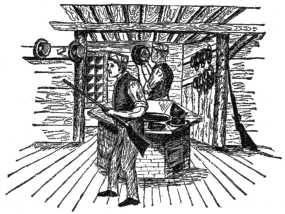
Let us enter a Baltimore hat "shop" of fifty years ago and watch the
making of a single hat. Fur and wool constitute the main ingredients
of which hats have always been made, because possessing those
qualities necessary for the process of "felting," the finer and better
class of hats being made of the furs of such animals as the beaver,
bear, marten, minx, hare and rabbit. The skins of these animals after
being stripped from the body are called "pelts"; when the inner side
has undergone a process of tanning the skins obtain the name of "furs"
in a restricted sense, and the term is still more restricted when
applied to the hairy coating cut from the skin.
The furs to which the old-time hatter gave preference were the beaver,
the muskrat, the nutria, the hare and the rabbit, of which the first
was by far the most valuable. These animals all have two kinds of hair
on their skins, the innermost of which is short and fine as down, the
outermost, thick, long and more sparing, the former being of much use,
the latter of no value to the hatter. After receiving the "skins" or
"pelts," which are greasy and dirty, they are first cleaned with soap
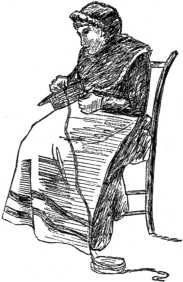
and water, then carried to the "pulling-room," where women are
employed in pulling out the coarse outer hairs from the skins, which
is done by means of a knife acting against the thumb, the fingers and
thumb being guarded by a short leather shield. The skins are then
taken and the fur cut or "cropped" from them, which is done by men
dexterously using a sharp knife, formed with a round blade, such as is
used now-a-days in the kitchen as a "chopping knife." By keeping this
knife constantly moving across the skin the fur is taken off or
separated without injury to the skin, which is to be tanned for
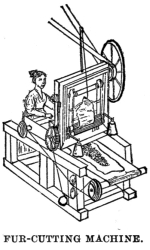
leather or consigned to the glue factory. The cutting of furs,
however, had become before 1844 a business in some measure conducted
by itself, and a machine had been invented to separate the fur from
the skin, which, though it might be considered now a simple affair,
was at that time looked upon as a wonder.
We have said the women in the "pulling-room" cut, tear, or pull out
the long, coarse hairs from the pelts, and that these hairs are
useless to the hatter. But it is impossible completely to separate the
coarse from the fine fur by these means, and therefore the fur, when
cropped from the pelt, is conveyed to the "blowing-room," finally to
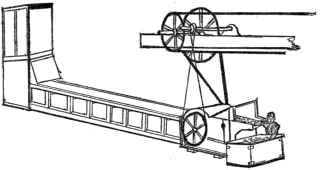
effect the separation. The action of the blowing machine is
exceedingly beautiful, and may perhaps be understood without a minute
detail of its mechanism. A quantity of beaver or any other fur is
introduced at one end near a compartment in which a vane or fly is
revolving with a velocity of nearly two thousand rotations in a
minute. We all know, even from a simple example of a lady's fan, that
a body in motion gives rise to a wind or draught, and when the motion
is so rapid as is here indicated, the current becomes very powerful.
This current of air propels the fur along a hollow trunk to the other
end of the machine, and in so doing produces an effect which is as
remarkable as valuable. All the coarse and comparatively valueless fur
is deposited on a cloth stretched along the trunk, while the more
delicate filaments are blown into a receptacle at the other end.
Nothing but a very ingenious arrangement of mechanism could produce a
separation so complete as is here effected; but the principle of
action is not hard to understand. If there were no atmosphere, or if
an inclosed place were exhausted of air, a guinea and a feather,
however unequal in weight, would fall to the ground with equal
velocity, but in ordinary circumstances the guinea would obviously
fall more quickly than the feather, because the resistance of the air
bears a much larger ratio to the weight of the feather than that of
the guinea. As the resistance of air to a moving body acts more
forcibly on a light than a heavy substance, so likewise does air when
in motion and acting as a moving force. When particles of sand or
gravel are driven by the wind, the lightest particles go the greatest
distance. So it is with the two kinds of fur in the "blowing machine,"
those fibers which are finest and lightest are driven to the remote
end of the machine.
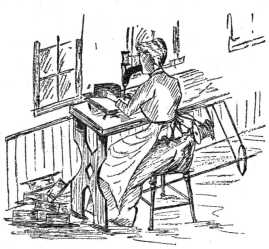
BLOWING ENGINE.
The "body," or "foundation," of a good beaver hat is generally made of
eight parts rabbit's fur, three parts Saxony wool, and one part of
llama, vicunia, or "red" wool. A sufficient quantity of these for one
hat (about two and a half ounces) is weighed out and placed in the
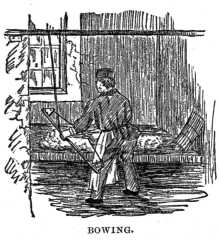
hands of the "bower." On entering the "bowing-room" a peculiar
twanging noise indicates to the visitor that a stretched cord is in
rapid vibration, and the management of this cord by the workman is
seen to be one of the many operations in hatting wherein success
depends exclusively on skillful manipulation. A bench extends along
the front of the room beneath a range of windows, and each "bower" has
a little compartment appropriated to himself. The bow is an ashen
staff from five to seven feet in length, having a strong cord of
catgut stretched over bridges at the two ends. The bow is suspended in
the middle by a string from the ceiling, whereby it hangs nearly on a
level with the work-bench, and the workman thus proceeds: The wool and
coarse fur, first separately and afterwards together, are laid on the
bench, and the bower, grasping the staff of the bow with his left hand
and plucking the cord with his right hand by means of a small piece of
wood, causes the cord to vibrate rapidly against the fur and wool. By
repeating this process for a certain time, all the original clots or
assemblages of filaments are perfectly opened and dilated, and the
fibers, flying upwards when struck, are, by the dexterity of the
workman, made to fall in nearly equal thickness on the bench,
presenting a very light and soft layer of material. Simple as this
operation appears to a stranger, years of practice are required for
the attainment of proficiency in it.
The bowed materials for one hat are divided into two portions, each of
which is separately pressed with a light wicker frame; the light mass
of fluffy fur, after being pressed with the frame, is covered with a
wet cloth, over which is placed a piece of oil-cloth or leather called
a "hardening skin," until, by the pressure of the hands backwards and
forwards all over the skin, the fibers are brought closer together,
the points of contact multiplied, the serrations made to link
together, and a slightly coherent fabric formed. These two halves, or
"batts," are then formed into a hollow cap by a singular contrivance.
One of the "batts," nearly triangular in shape, and measuring about
half a yard in each direction, being laid flat, a triangular piece of
paper, smaller in size than the batt, is laid upon it, and the edges
of the batt, being folded over the paper, meet at the upper surface,
and thus form a complete envelope to the paper. The two meeting edges
are soon made to combine by gentle pressure and friction, and another
"batt" is laid on the other in a similar way, but having the meeting
edges on the opposite side of the paper. The double layer, with the
enclosed paper, are then folded up in a damp cloth and worked by hand;
the workman pressing and bending, rolling and unrolling, until the
fibers of the inner layer are incorporated with those of the outer. It
is evident that were there not a piece of paper interposed, the whole
of the fibers would be worked together into a mass by the opposite
sides felting together, but the paper maintains a vacancy within, and
when withdrawn at the edge which is to form the opening of the cap, it
leaves the felted material in such a form as to constitute, when
stretched open, a hollow cone.
The "battery" is a large kettle or boiler open at the top, having a
fire beneath it, and eight planks ascending obliquely from the margin,
so as to form a sort of octagonal work-bench, five or six feet in
diameter, at which eight men may work; the planks are made of lead
near the kettle, and of mahogany at the outer part, and at each plank
a workman operates on a conical cap until the process of felting or
"planking" is completed. The "battery" contains hot water slightly
acidulated with sulphuric acid. The cap is dipped into the hot liquor,
laid on one of the planks, and subjected to a long felting process; it
is rolled and unrolled, twisted, pressed, and rubbed with a piece of
leather or wood tied to the workman's hand, and rolled with a
rolling-pin. From time to time the cap is examined, to ascertain
whether the thickness is sufficient in every part, and if any
defective places appear, they are wet with a brush dipped in the hot
liquor, and a few additional fibers are worked in. Considerable skill
is required in order to preserve such an additional thickness of
material at one part as shall suffice for the brim of the hat. When
this felting process has been continued about two hours, it is found
that the heat, moisture, pressure and friction have reduced the cap to
one-half its former dimensions, the thickness being increased in a
proportionate degree, assuming a conical shape.
The "cap" is then taken to the "water-proofing" or "stiffening" room,
where the odor of gum, resins and spirits gives some intimation of the
materials employed. Gum-lac, gum-sandrach, gum-mastic, resin,
frankincense, copal, caoutchouc, spirits of wine and spirits of
turpentine, are the ingredients (all of a very inflammable nature) of
which the water-proofing is made. This is laid on the cap by means of
a brush, and the workman exercises his skill in regulating the
quantity at different parts, since the strength of the future brim and
crown depends much on this process.
After another heating in a hot room, called "stoving," by which the
spirit is evaporated, the exterior of the cap is scoured with a weak
alkali, to remove a portion of the gummy coating, and thereby enable
the beaver fur with which it is to be "napped" or "coated," to adhere.
A layer of beaver fur is spread, and, by means of the "hardening
stick," is pressed and worked into a very delicate and light felt,
just coherent enough to hold together. This layer, which is called a
"ruffing" or "roughing," is a little larger than the cap-body, and to
unite the two, another visit to the "battery" is necessary. The cap
being softened by immersion in the hot liquor, the "ruffing" is laid
on it, and patted down with a wet brush, a narrow strip of beaver
being laid round the inside of the cap to form the underside of the
future brim. The beavered cap is then wrapped in a woolen cloth,
immersed frequently in the hot liquor, and rolled on the plank for the
space of two hours. The effect of this rubbing and rolling is very
curious, and may be illustrated in a simple manner: if a few fibers of
beaver fur be laid on a piece of broadcloth, covered with tissue
paper, and rubbed gently with the finger, they will penetrate through
the cloth and appear on the opposite side. So, likewise, in the
process of "ruffing," each fiber is set in motion from root to point,
and enters the substance of the felt cap. The hairs proceed in a
pretty straight course, and just enter the felt, with the substance of
which they form an intimate union. But if the rolling and pressing
were continued too long, the hairs would actually pass through the
felt, and be seen on the inside instead of the outside of the cap; the
workman therefore exercises his judgment in continuing the process
only so long as is sufficient to secure the hairs in the felt firm
enough to bear the action of the hat-brush in after-days.
At length the cap is to assume somewhat the shape of a hat, before it
finally leaves the "battery." The workman first turns up the edge of
the cap to the depth of about an inch and a half; and then draws the
peak of the cap back through the centre or axis so far as not to take
out the first fold, but to produce an inner fold of the same depth.
The point being turned back again, produces a third fold, and thus the
workman proceeds, till the whole hat has acquired the appearance of a
flattish circular piece, consisting of a number of concentric folds or
rings, with the peak in the centre. This is laid on the "plank," where
the workman, keeping the substance hot and wet, pulls, presses and
rubs the centre until he has formed a smooth flat portion equal to the
intended crown of the hat. He then takes a cylindrical block, on the
flat end of which he applies the flattened central portion of the
felt, and by holding a string down the curved sides of the block, he
causes the surrounding portion of the felt to assume the figure of the
block. The part which is to form the brim now appears a puckered
appendage round the edge of the hat; but this puckered edge is soon
brought to a tolerably flat shape by pulling and pressing.
The workman then raises and opens the nap of the hat by means of a
peculiar sort of comb, and then shears the hairs to a regular length.
Connoisseurs in these matters are learned as to the respective merits
of "short naps" and "long naps," and by the shearer's dexterity these
are regulated. The visitor recognizes nothing difficult in this
operation, yet years of practice are necessary for the attainment of
skill therein, since the workman determines the length of the nap by
the peculiar position in which the long, light shears are held. A nap
or pile as fine as that of velvet can be produced by this operation.
However carefully the process of "blowing" may be performed in order
to separate the coarse fibers of the fur from the more delicate, there
are always a few of the former left mingled with the latter, and these
are worked up during the subsequent processes. Women are employed,
therefore, after the hats have left the "finishers," in picking out
with small tweezers such defective fibers as may present themselves on
the surface of the hats.
Lastly, the hat is placed in the hands of a workman whose employment
requires an accurate eye and a fertile taste in matters of shape and
form: this is the "shaper." He has to study the style and fashion of
the day, as well as the wishes of individual purchasers, by giving to
the brim of the hat such curvatures in various directions as may be
needed. Simple as this may appear, the workman who possesses the
requisite skill to give the acceptable curl to the brim which is to
create the finishing touch for the hat is a desirable hand, and can
command a high rate of wages.
Thus, in our imaginary tour through an old-fashioned hat factory, we
have seen the many skillful manipulations then required to make a hat,
which, when compared with modern processes, awaken in our minds a
sense of wonder at the change.