So far in our story we have traced the origin
and progress of the balloon, showing how from
small beginnings it has grown to be an important
invention, of great use to the scientific
observer, the soldier, and the explorer, and the
means of teaching us much fresh knowledge.
But in spite of the high hopes of early
aeronauts, and the extravagant prophecies
made when the first balloons ascended into
the sky, it has long been evident that the
balloon alone has not solved the problem of
human flight or accomplished the conquest
of the air. An ordinary balloon is, in fact,
nothing more than a mere lifting machine,
no more capable of sailing the sky, in the
proper sense of the word, than a cork floating
in the water is capable of sailing the sea. It
has no movement of its own, but drifts simply
at the mercy of the wind, and quite beyond
control. By the discharge of ballast, or by
the letting out of gas, the aeronaut can indeed
cause it to rise or sink at pleasure, and sometimes
when two currents of air are blowing
aloft in different directions at the same time
he may, by passing from one to the other,
“tack” his balloon to some extent across the
sky. Otherwise he has no power of guiding
or directing it in the least degree, and should
he lose sight of the earth above the clouds,
has even no method of telling in which
direction he is travelling.
Early inventors thought they would be able
to steer balloons by means of sails, like a boat,
but they soon found that this was impossible.
The effect of hoisting a sail at the side of
a balloon was merely to swing the balloon
round until the sail was in front, while meantime
it continued its course unaltered. The
use of a rudder and other means were also
tried, but without success; nor can such
methods ever hope to succeed so long as a
balloon floats in the air at the same pace as
the wind that carries it forward. A balloon
travelling with the wind may be compared
to a boat drifting idly with the tide. As
long as she drifts she refuses to answer her
rudder, which swings idly. But presently the
boatman hoists a sail, and the wind carries the
boat onwards faster than the tide, and then
immediately the rudder comes into action.
Or should there be no wind, he may accomplish
the same thing by dragging an anchor
or other weight in the water, and so slowing
his boat down until it moves slower than
the current; he will then again find that his
boat will answer her helm.
To steer his course in a balloon, therefore,
the aeronaut must so arrange that he is
travelling faster or slower than the wind in
which he finds himself. To travel faster, he
must employ some sort of engine or motor
to drive his craft onwards. To travel slower,
he must trail something along the ground
beneath to act as a drag.
Part of the equipment of every balloon is
a long trail-rope, which, when the balloon
is aloft, hangs some 300 feet below the car.
The object of this rope is to break the force
of the fall when the balloon comes down to
the earth at the end of the voyage. In the
greater number of cases a balloon, in its final
swoop to the ground, falls the last few hundred
feet with considerable, and often uncomfortable,
speed. But when provided with a trail-rope,
as it descends more and more of the
heavy rope will lie along the ground, and so
lighten the weight of the balloon, and lessen
the shock of falling.
If then a trail-rope were used of such length
that it would sweep along the ground while
the balloon was flying in the air, the effect
would be to put a drag or brake on the
balloon, and so render it capable of being
steered to some extent with a sail; and this
is what has actually been done in all attempts
of the kind. But since a long rope dragging
rapidly across the country is a very dangerous
object, capable of doing great damage, and
also liable to catch in trees and other obstacles,
such experiments can only be tried with safety
over the sea, or, as in the case of Andrée’s
voyage, over desert or uninhabited country.
The best way of steering a balloon, therefore,
is to provide it with some mechanical
power which shall urge it onwards at a greater
speed than the wind; and when this is done,
it has ceased to be a balloon in the popular
sense of the word, and has become an “airship.”
There is a great deal of confusion between
the terms “airship,” and “flying machine,”
and the two words are often considered as
meaning the same thing. But while, strictly
speaking, neither word in itself has any very
definite meaning, it is gradually becoming
more general to apply them to two widely
different objects. According to this plan,
although both names stand for an aerial vessel
capable of travelling in the sky by its own
motion, an airship is a machine supported
in the air by reason of its buoyancy, while
a flying machine is kept aloft only by virtue
of its onward movement.
In other words, part of the construction of
an airship consists of a bag or balloon, filled
with gas or hot air, which causes the whole
to rise and maintain its position in the air.
This balloon part is quite independent of the
machinery which drives the airship forward,
and indeed if the engine ceases working, the
vessel becomes nothing more than an ordinary
balloon in its nature, and will behave like
one. An airship, therefore, is in principle
an apparatus lighter than air.
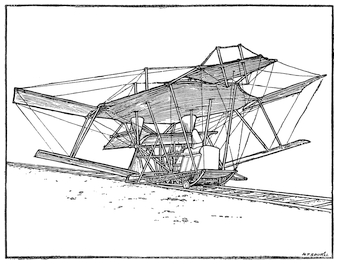
A flying machine, on the contrary, is
heavier than air, and maintains its position
aloft merely by the power it obtains from its
engines, assisted by its special construction.
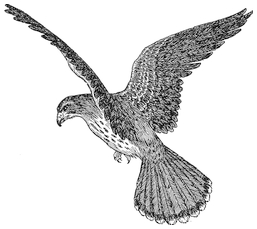
The inventors of flying machines take as
their analogy the flight of birds. Birds are
creatures heavier than air, which yet manage
to rise and fly by reason of the strength and
construction of their wings. In the same
way the heavy flying machine essays to fly
by the power of its machinery. And, as a
bird aloft, if its wings became disabled, would
instantly drop towards earth, so a flying
machine would immediately commence to
fall if its engine stopped or ceased to move
with sufficient power. The airship and the
flying machine, therefore, may be regarded
as rival aerial vessels, and their inventors and
advocates, sometimes known as “lighter-than-air-ites”
and “heavier-than-air-ites,” though
both working for the same end, are endeavouring
to accomplish their aim by widely different
methods.
Up to the present day the airship—to which
we will first turn our attention—has been
much more largely and successfully experimented
with than the flying machine. It is,
however, the opinion of many, including the
great authority Sir Hiram Maxim, that in the
future the flying machine will become the
more important invention of the two. “In
all Nature,” says Sir Hiram, “we do not find
a single balloon. All Nature’s flying machines
are heavier than air.” And from this he argues
that, as Nature is ever our best guide and example,
a flying machine heavier than air will
be in the end most likely to succeed.
One of the earliest airships which achieved
any success was invented by a Frenchman,
M. Giffard, about the year 1852. He made
his balloon of an elongated or cigar shape, a
form adopted by airship inventors as offering
less resistance to the air than the ordinary
globular or pear shape. To this balloon,
which was 104 feet long and 39 feet in
diameter, he attached a steam-engine of
three-horse power, weighing 462 lbs. and
working a screw-propeller, which, by its
rapid revolutions, urged the balloon onwards
through the air, even as the screw of a steamship
urges the vessel through the water.
With this apparatus he succeeded on one
occasion, for a very short while, in obtaining a
speed of six and a half miles an hour. Twenty
years later another Frenchman, M. Dupuy de
Lôme, constructed another airship; but fearing
to place an engine so near the gas of his balloon,
he used the strength of eight men to work
his screw. This was a very wasteful mode of
supplying energy, for the weight of the men
was very great in proportion to their strength,
and this machine, during its trial, did not
attain as great a speed as Giffard’s. Twelve
years after a third Frenchman, M. Tissandier,
took up the same experiments. His elongated
balloon was smaller than the two previous,
and his engine was an electric motor of one
and a half horse-power. On one occasion
a speed of nearly eight miles an hour was
attained.
By this time the French Government had
become interested in the work, and provided
money to continue investigations. The result
of this was that in 1885 two officers of the
French army, Captains Renard and Krebs,
brought out by far the most successful airship
yet constructed. It was 165 feet long, 27 feet
in diameter, and was driven by an electric
motor of nine horse-power. That this machine
proved itself perfectly capable of being guided
in the air is amply shown by the fact that
it returned to its shed five times out of the
seven on which it was publicly taken out.
It also attained a speed of fourteen miles an
hour, and indeed it would seem that Renard
and Krebs, although their names are now
almost forgotten, accomplished nearly as great
things twenty years ago as the popular airship
inventors of the present day.
One of the greatest difficulties with which
early inventors had to contend was the enormous
weight of their engines. The machinery
they were obliged to use to drive their airships
through the air weighed more than their balloons,
unless made of unwieldy size, had power
to lift. The same difficulty indeed exists at
the present time, though to a much less degree.
Of late years, and especially since the introduction
of the motor-car, great progress has
been made in the construction of light but
powerful engines, or motors, and the employment
of petrol vapour instead of coal or oil
has very greatly lessened the weight of the
fuel which has to be carried.
In consequence of this improvement many
airships have recently been made which have
met with varying success, and many more are
at the present moment in process of construction.
Among the host of inventors, whose
names it would here be impossible even to mention,
three stand out from the rest in special
prominence—Zeppelin, Santos Dumont, and
Stanley Spencer—all three the inventors of
airships which have, by actual experience,
proved their power of steering a course across
the sky.
Of these rival airships, by far the largest
and most elaborate was that built by the first
named, Count Zeppelin, a distinguished veteran
soldier of the German army. For many
years he had spent his time and fortune in
making experiments in aerial navigation, and
at length in 1900, having formed a company
and collected a large sum of money for the
purpose, he produced an enormous airship,
which, from its size, has been compared to a
man-of-war. In shape Count Zeppelin’s invention
resembled a gigantic cigar, 420 feet in
length, pointed at both ends. The framework
was made of the specially light metal
aluminium, covered over with silk, and though
from outside it looked all in one piece, within
it was divided into seventeen compartments,
each holding a separate balloon made of oiled
silk and absolutely gas-tight. The object of
this was to prevent the tendency the gas has
to collect all at one end as the ship forces its
way through the air. These balloons were
filled with pure hydrogen, the cost of the inflation
alone being £500. Beneath was slung a
long gangway, 346 feet in length, with two
cars, also made of aluminium, attached to it.
In these cars were placed two motor-engines
of sixteen horse power each, driven by benzine,
and working a pair of screw-propellers attached
to the balloon. A steering apparatus was
placed at each end, and the whole machine,
with five passengers, weighed about eleven
tons.
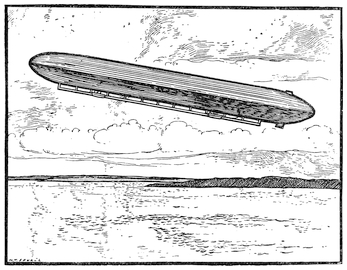
Zeppelin’s Airship over Lake Constance.
To lessen the effects of a possible fall, the
experiments were carried out over water, and
the great airship was housed in a shed built on
Lake Constance. The cost of this shed alone
was enormous, for it was elaborately constructed
on pontoons, and anchored in such
a way that it could be turned round to allow
the airship to be liberated from it in the best
direction to suit the wind. The trial trip was
made one evening in June 1900, when a very
light wind was blowing. The great machine
rose into the air, carrying Zeppelin and four
companions to a height of 800 feet. The
steering apparatus then being put into action,
it circled round and faced the wind, remained
stationary for a short while, and then sank
gracefully and gently upon the water. A few
days later another and more successful trial
was made. The wind at the time was blowing
at sixteen miles an hour, but in spite of
this the airship slowly steered its course against
the wind for three and a half miles, when, one
of the rudders breaking, it was obliged to come
down. On one or two other occasions also it
made successful voyages, proving itself to be
perfectly manageable and capable of being
steered on an absolutely calm day. The expense
of the experiments was, however, tremendous;
money fell short, and the great machine, the
result of many years’ labour and thought, has
since been abandoned and broken up.
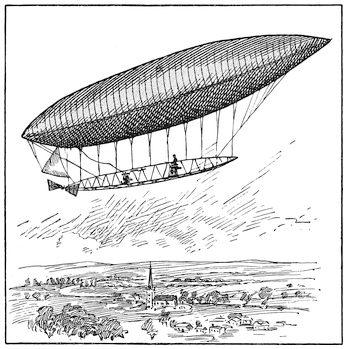
Santos Dumont’s Airship.
A far happier fate has so far attended the
efforts of the brave young Brazilian, Albert
Santos Dumont. The wealthy son of a successful
coffee-planter, he had always from his
boyhood been keenly interested in aeronautics,
and, coming to Paris, he constructed in 1898
an airship of a somewhat novel kind. His
balloon was cigar-shaped, 83 feet long, and
holding 6500 feet of pure hydrogen. Attached
to the balloon, and working a propeller,
was a small motor like those used for motor
cycles, and astride of this Santos Dumont
rode, bicycle fashion, steering his course with
a rudder. In this ingenious machine he
ascended from the Botanical Gardens in Paris
and circled several times round the large
captive balloon then moored there, after which
he made a number of bold sweeps in the air,
until an accident occurred to his engine and
he came precipitately to the ground. Though
shaken he was by no means discouraged, and
declared his intention of continuing his experiments
until he should have invented an
airship which, in his own words, should
be “not a mere plaything, but a practical
invention, capable of being applied in a
thoroughly useful fashion.”
Accordingly he constructed one machine
after another, gaining fresh knowledge by
each new experience, and profiting by the accidents
and failures which continually beset him
in his dangerous and daring work. Before
long also he received an additional incentive
to his labours. Early in the year of 1900 it
was announced by the Paris Aero Club, a
society of Frenchmen interested in aeronautical
matters, that one of its members,
M. Deutsch, had offered a prize of 100,000
francs—about £4000—to the man who, starting
from the Aero Club grounds at Longchamps
in a balloon or flying machine, should
steer his course right round the Eiffel Tower
and back to the starting-place—a distance of
three and a half miles—within half an hour.
If the prize were not won within a certain
time, his offer was to be withdrawn, and
meanwhile he promised a certain sum of
money every year for the encouragement of
aeronautical experiments.
The offer of this reward set many inventors
to work upon the construction of various
aerial vessels of all kinds, but from the beginning
Santos Dumont was well to the fore.
By the middle of 1901 he had completed what
was his sixth airship—a cigar-shaped balloon,
100 feet long, its propeller worked by a motor-car
engine of fifteen horse-power—and with it,
on July 15th, he made a splendid attempt for
the prize. Starting from the Club grounds,
he reached the Eiffel Tower in thirteen
minutes, and, circling round it, started back
on his homeward journey. But this time his
voyage was against the wind, which was really
too strong for the success of his experiment;
part of his engine broke down, and the balance
of the vessel became upset; and although he
managed to fight his way back to the starting point,
he arrived eleven minutes behind time,
and so failed to fulfil M. Deutsch’s conditions.
Again, on the 9th of August, having in the
meantime made further trials with his machine,
he embarked on another attempt to carry off
the prize. He chose the early hours of the
morning, starting shortly after six from the
Club grounds, where only a few friends, among
them the keenly interested M. Deutsch, were
present. The day was apparently perfect, and
when, after the lapse of five minutes only, he
had reached the Tower and swung gracefully
round it, every one was convinced that this
time the prize was certain to be won. But
the homeward journey was all against the
wind, which was blowing more powerfully
aloft than on the ground, and suddenly the
onlookers were horrified to see the fore part of
the balloon double right back. By so doing
the silken envelope became torn and the gas
began escaping. Rapidly the balloon appeared
to wither up and shrink together. The engine
was seen still to be working, though no progress
was now being made. Then the whole
apparatus collapsed utterly, and fell with sickening
speed upon the house-tops.
Deutsch and his companions watched the fall
horror-struck, and jumping into their motorcars
hurried to the spot, convinced that a fatal
accident must have occurred. But they found
that, although the airship was smashed to
pieces, its plucky inventor had almost miraculously
escaped unhurt. The wrecked machine
had fallen upon the roof of a house in such a
way that the keel had caught upon a corner,
and the car, which was fastened to it, hung at
a perilous angle down the side of a wall. Fortunately
Dumont was secured to his car by a
leather belt, and he managed to hold on,
though in considerable danger lest the keel
should break and let him fall, until rescued by
a fireman with a rope. His machine was
hopelessly ruined; but when asked what he
intended to do next he merely answered:
“Begin again. Only a little patience is necessary.”
A new machine, “Santos Dumont VII.,”
was ready in less than a month, and tested on
the 6th of September. It behaved beautifully,
and all went well until the trail-rope caught
in a tree. In liberating it the framework became
bent, and the airship was being towed
back to its shed when a sudden gust of wind
tore it away from those who held it. It immediately
rose into the air, and on Dumont
opening the valve the whole collapsed and fell
to earth with a great shock. Again the lucky
inventor escaped unhurt, though owning this
time that he had “felt really frightened.” Ten
days later, in another trial, the airship came
in contact with some trees, which pierced
the silk and let out the gas, so that it fell
precipitately twenty feet. But the aeronaut
appeared to bear a charmed life, for once more
he was none the worse for the fall. Several
other unsuccessful trials followed, and then,
on the 19th of October, Santos Dumont made
another grand attempt for the prize.
Starting with the wind in his favour, his
machine travelled at the rate of thirty miles
an hour, and rounded the Eiffel Tower in nine
minutes. But in the journey homewards the
airship had to struggle with a wind blowing
at thirteen miles an hour. In endeavouring
to “tack” the machinery became upset, and
Dumont, leaving his car, crawled along the
framework to the motor, which he succeeded
in putting in order again. But this naturally
occasioned some delay, and though he accomplished
the rest of his journey in eight minutes,
the Committee at first decided he had exceeded
the allotted time by forty seconds, and so had
lost the prize. Great popular indignation was
excited by this decision, for public sympathy
was all with the daring and persistent young
Brazilian, and M. Deutsch himself was most
anxious he should receive the award. Finally,
he was considered to have fairly won it, and
the money, which he afterwards divided among
the poor, was formally presented to him.
Early in the next year Santos Dumont continued
his experiments at Monaco, and on one
occasion came down in the sea, and had to be
rescued in the Prince of Monaco’s own steam
yacht. After this there was a talk of further
voyages being made in England, but the project
came to nothing, and although Dumont
made other ascents in Paris in the summer of
1903, he does not appear to have eclipsed his
previous record.
But although Santos Dumont came through
all his accidents and perils so happily, his
example led to terrible disaster on the part
of a luckless imitator. In 1902 M. Severo,
also a Brazilian, was fired with a desire to
share his fellow-countryman’s fame, and he
also constructed an airship with which he
proposed to do great things. But while
Dumont was a skilled aeronaut of large experience,
as well as a mechanician, Severo
knew scarcely anything about the subject,
and had only been aloft once or twice. Proof
of his ignorance is shown by the fact that his
motor-engine was placed only a few feet away
from the valve through which the gas from
the balloon would escape.
The ascent took place in Paris early in the
morning of the 12th of May, and was witnessed,
unhappily, by Severo’s wife and son.
Bidding them good-bye, he stepped into the
car, and, accompanied by an assistant, rose
above the town. The balloon rose steadily,
and appeared to steer well. Then Severo
commenced to throw out ballast, and when
the airship had risen 2000 feet it was suddenly
seen to burst into a sheet of flame.
A terrible explosion followed, and then the
whole fell to the ground a hopeless wreck,
and the two men were dashed to pieces in the
fall. It is believed that this dreadful disaster,
which recalls the fate of Pilâtre de Rozier, was
caused by the hydrogen gas, which escaped
from the valve during the rapid rise, becoming
ignited by the engine, which, as has been said,
was placed dangerously close.
Nor was this, unhappily, the only accident
of the kind in Paris during the year. Only
five months later, on the 13th of October,
Baron Bradsky ascended with an assistant in
a large airship of his own invention. Through
faulty construction, the steel wires which fastened
the car to the balloon broke, the two
became separated, the car fell, and its occupants
were killed on the spot.
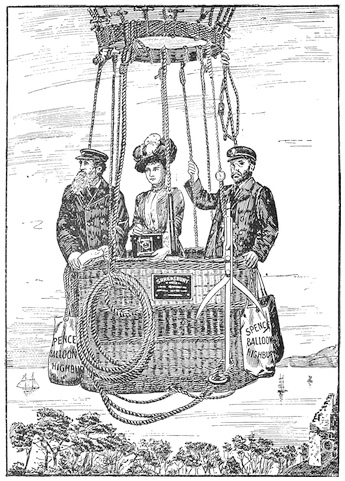
So far, the credit of the only English airship
which has yet flown rests with Mr.
Stanley Spencer, the well-known aeronaut.
Mr. Spencer comes of a race of aeronauts.
His grandfather, Edward Spencer, was the
great friend and colleague of Charles Green,
and shared with him some of his chief ballooning
adventures, notably the terrible voyage
when Cocking lost his life. Green stood
godfather to Edward Spencer’s son, who was
christened Charles Green after him. He also
grew up to be an aeronaut, and made several
inventions and improvements relating to balloons
and flying machines. His love of ballooning,
inherited from his father, has been passed
on to his children, and his three eldest sons,
Percival, Arthur, and Stanley, are chief among
British aeronauts, and indeed have practically
the monopoly of professional ballooning and
balloon manufacture in Great Britain. Nor
have they confined themselves to this country.
All three have taken their balloons and parachutes
to distant parts of the world, and
among their many hundreds of ascents, both
abroad and at home, have met with all manner
of exciting and perilous adventures, though
never yet with serious mishap. Their knowledge
of practical aeronautics, then, is unrivalled,
and Mr. Stanley Spencer had the
experience of three generations to guide
him when, in 1902, he set to work to
build an airship which he had long been
devising.
His first machine was a comparatively small
one, capable only of lifting a light man. It
took the usual form of a cigar-shaped balloon,
the framework of which was built of bamboo,
driven forward by a screw-propeller worked by
a small petrol engine. Warned by the fate
of the unfortunate Severo, Mr. Spencer placed
his engine far away from the valve. Profiting
also by Santos Dumont’s experience, he constructed
his balloon in such a manner that,
should it become torn and the gas escape, the
empty silk would collapse into the form of a
parachute and break the fall. Furthermore,
there was an arrangement by which, while
aloft, ordinary air could be forced into the
balloon to replace any loss of gas, and so
keep the silk always fully inflated and “taut”—a
very important factor in a machine that
has to be driven forward through the atmosphere.
With this airship Mr. Spencer, as also his
equally daring wife, made several highly successful
trials at the Crystal Palace, when it
was found to steer well and answer its helm
most satisfactorily. Mr. Spencer also made
two long voyages, from London and from
Blackpool, on both of which occasions he
found he could manœuvre his airship with
considerable success, make circular flights,
and sail against the wind, provided it was
blowing only at moderate speed.
Encouraged by his success, he next built a
similar but much larger machine, nearly a
hundred feet long, holding 30,000 cubic feet
of gas, and driven by a petrol motor of twenty-four
horse-power. In this case the propeller, instead
of being placed at the rear, as in general,
is at the front of the airship, thereby pulling
it forward through the air instead of pushing
it from behind. By this arrangement Mr.
Spencer thinks his balloon would have less
tendency to double up when urged against a
strong wind. The steering is done by a rudder
sail at the stern, and to cause his machine to
sail higher or lower, the aeronaut points its
head up or down by means of a heavy balance-rope.
This new airship was ready by the summer
of 1903, but the unfavourable weather of that
stormy season again and again interfered with
the experiments. On the 17th of September
Mr. Spencer announced his intention of sailing
from the Crystal Palace round the dome of
St. Paul’s, and returning to his starting-place.
The Cathedral was indeed safely reached, but
the increasing breeze, now blowing half a gale,
baffled all his attempts to circle round. Again
and again, till his hands were cut and bleeding
with the strain of the ropes, he brought his
machine up, quivering, to the wind, but all to
no purpose, until at length, abandoning the
attempt, he sailed with the current to Barnet.
More favourable results may doubtless be
looked for with better weather conditions.
In France during 1903 the brothers Lebaudy
made some successful trips with an airship of
their own construction. Many other airships
are now being built in all parts of the world,
in preparation for the aeronautical competitions
to take place in America on the occasion
of the St. Louis Exhibition of this year.