Manchester and Hamilton Park Races and Steeplechases.
2
Tu
Manchester and Hamilton Park Races and Steeplechases. Essex Club Coursing Meeting.
3
W
Gatwick Races and Steeplechases.
4
Th
Gatwick Races and Steeplechases.
5
F
Windsor Races and Steeplechases.
6
S
Windsor Races and Steeplechases.
7
S
First Sunday after Epiphany.
8
M
Birmingham Races and Steeplechases.
9
Tu
Birmingham Races and Steeplechases. Tendering Hundred Coursing Meeting.
10
W
Haydock Park Races and Steeplechases. Altcar Club Coursing Meeting.
11
Th
Haydock Park Races and Steeplechases.
12
F
Plumpton Races and Steeplechases.
13
S
Plumpton Races and Steeplechases.
14
S
Second Sunday after Epiphany.
15
M
Wolverhampton Races and Steeplechases.
16
Tu
Wolverhampton Races and Steeplechases.
17
W
Manchester Races and Steeplechases. Gravesend and Cliffe Coursing Meeting.
18
Th
Manchester and Wye Races and Steeplechases.
19
F
Hurst Park Races and Steeplechases.
20
S
Hurst Park Races and Steeplechases.
21
S
Third Sunday after Epiphany.
22
M
23
Tu
Windsor Races and Steeplechases.
24
W
Windsor and Tenby Races and Steeplechases.
25
Th
Tenby Races and Steeplechases.
26
F
Lingfield Races and Steeplechases.
27
S
Lingfield Races and Steeplechases.
28
S
Fourth Sunday after Epiphany.
29
M
Nottingham Races and Steeplechases.
30
Tu
Nottingham Races and Steeplechases. Rochford Hundred Coursing Club.
31
W
Gatwick Races and Steeplechases.
WORKS BY SIR WALTER GILBEY, BART.
Published by VINTON & Co., London.
Early Carriages and Roads
In this Publication, attention has been given to the early history of wheeled conveyances
in England and their development up to recent times. With Seventeen
Illustrations. Octavo, cloth gilt, price 2s. net; post free, 2s. 4d.
Thoroughbred and other Ponies
With Remarks on the Height of Racehorses since 1700. Being a Revised and
Enlarged Edition of Ponies Past and Present. With Ten Illustrations. Octavo,
cloth gilt, price 5s. net; post free, 5s. 4d.
Hunter Sires
Suggestions for Breeding Hunters, Troopers, and General Purpose Horses. By
I. Sir Walter Gilbey, Bart. II. Charles W. Tindall. III. Right Hon. Frederick
W. Wrench. IV. W. T. Trench. Illustrated, octavo, paper covers, 6d. net;
post free, 7d.
Riding and Driving Horses, Their Breeding and Rearing
An Address delivered in 1885, and Discussion thereon by the late Duke of Westminster,
Earl Carrington, Sir Nigel Kingscote, the late Mr. Edmund Tattersall,
and others. Price 2s. net; by post, 2s, 3d.
Horse-Breeding in England and India, and Army Horses Abroad
Seventeen Chapters, Horse-breeding in England; Eight Chapters, Horse-breeding
Abroad; Thirteen pages, Horse-breeding in India. Nine Illustrations. Octavo,
cloth, price 2s. net; by post, 2s. 3d.
The Great Horse or War Horse
From the Roman Invasion till its development into the Shire Horse. Seventeen
Illustrations. Octavo, cloth gilt, price 2s. net; by post, 2s. 3d.
The Harness Horse
The scarcity of Carriage Horses and how to breed them. 4th Edition. Octavo,
cloth gilt, 2s. net; by post, 2s. 3d.
Modern Carriages: Passenger Vehicles in the Victorian Era
The passenger vehicles now in use, with notes on their origin. Illustrations.
Octavo, cloth gilt, price 2s. net; post free, 2s. 3d.
Young Race Horses—suggestions
for rearing, feeding and treatment. Twenty-two Chapters. With Frontispiece
and Diagrams. Octavo, cloth gilt, price 2s. net; by post, 2s. 3d.
Small Horses in Warfare
Arguments in favour of their use for light cavalry and mounted infantry. Illustrated,
2s. net; by post, 2s. 3d.
Horses for the Army: a suggestion
Octavo, paper covers, 6d.; post free, 7d.
Horses Past and Present
A sketch of the History of the Horse in England from the earliest times. Nine
Illustrations. Octavo, cloth gilt, 2s. net; by post, 2s. 3d.
Poultry Keeping on Farms and Small Holdings
Illustrated, octavo, cloth, 2s. net; by post, 2s. 3d.
Animal Painters of England
from the year 1650. Illustrated. Two vols., quarto, cloth gilt, Two Guineas net.
Prospectus free.
Life of George Stubbs, R.A.
Ten Chapters. Twenty-six Illustrations and Headpieces. Quarto, whole Morocco,
gilt, price £3 3s. net.
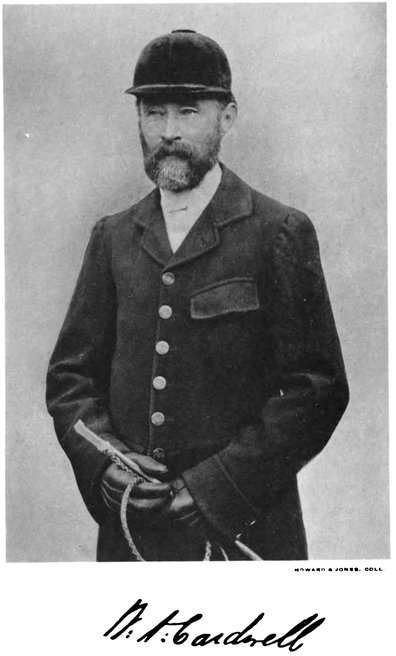
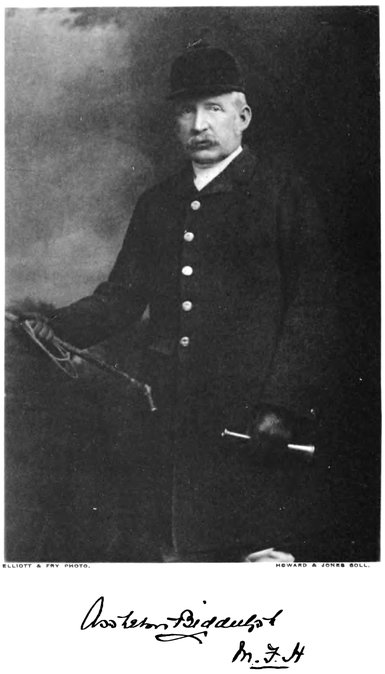
BAILY’S MAGAZINE OF SPORTS AND PASTIMES No. 551. JANUARY, 1906. Vol. LXXXV. — CONTENTS. — The Earl of Huntingdon, M.F.H. — A Christmas Dream on Sport. — Foxhounds. — The Development of the Modern Motor. — Becking. — Hunt “Runners.” II. David Swinton and Dick Baker. — Dick Baker. — Sport in the City. THE OLD YEAR AND THE NEW. — Half a Century’s Hunting Recollections. IV. — A Hundred Years Ago. — (FROM THE SPORTING MAGAZINE OF 1805.) — Extraordinary Steeple-Race. — Cricket Topics. — Is Foxhunting Doomed? — The Sportsman’s Library. — In Pursuit of the Pike. — A Gossip on Hunting Men. — Pheasant Shooting in the Himalayas. — “Our Van.” — RACING. — STAGHOUNDS. — HUNTING IN YORKSHIRE—A CAPITAL SUGGESTION. — SPANIEL TRIALS IN THE VALE OF NEATH. — THE CHRISTMAS SHOWS. — SPORT AT THE UNIVERSITIES. — GOLF. — THE LONDON PLAYING FIELDS’ SOCIETY. — “THE MOUNTAIN CLIMBER” AT THE COMEDY THEATRE. — “MR. POPPLE (OF IPPLETON)” AT THE APOLLO THEATRE. — Sporting Intelligence. [During November—December, 1905.] — TURF. — FOOTBALL.
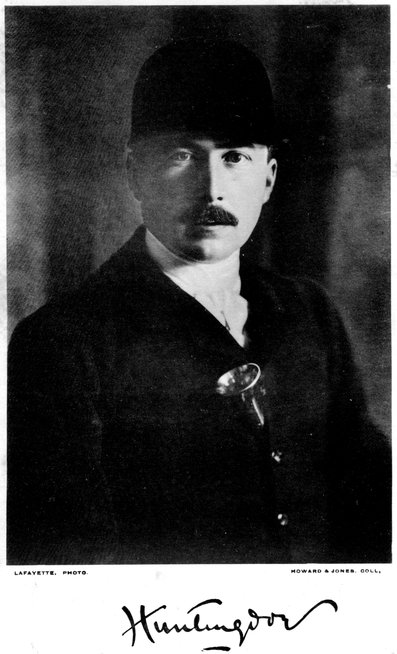
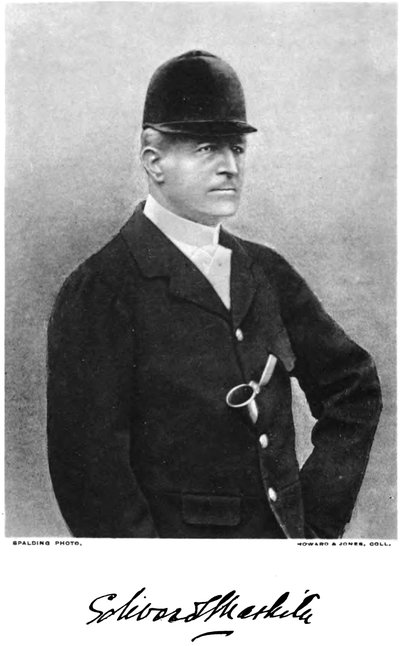
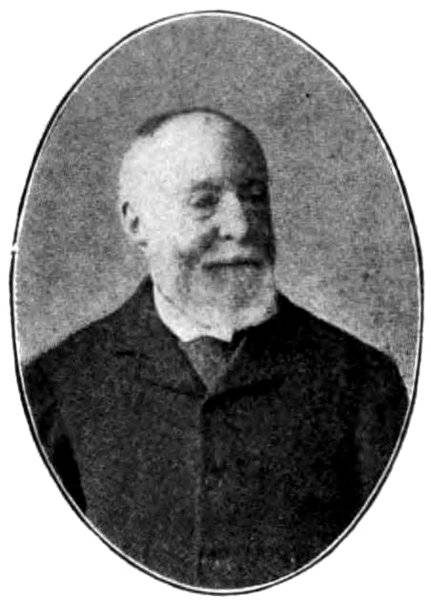
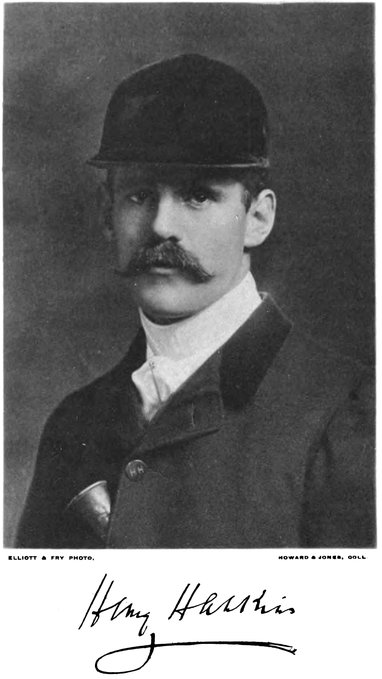
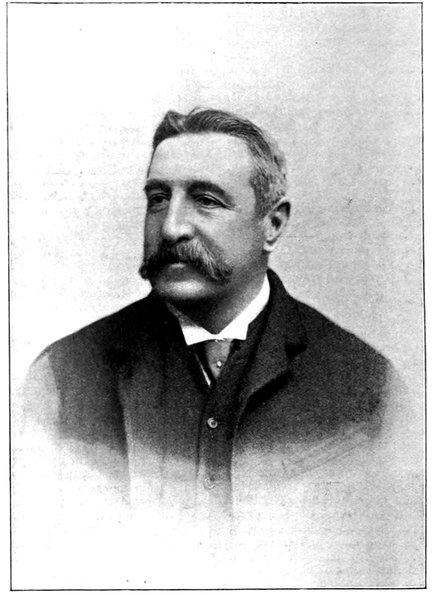
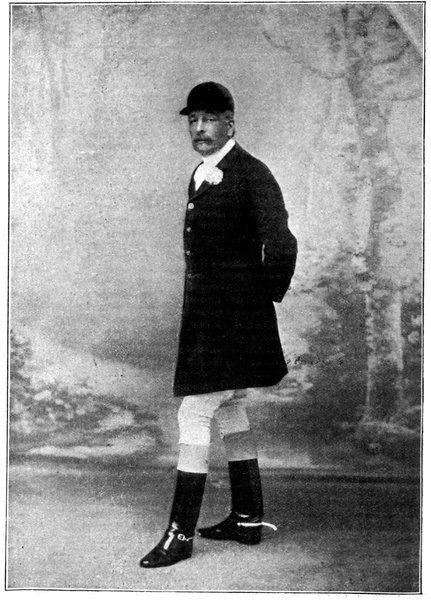
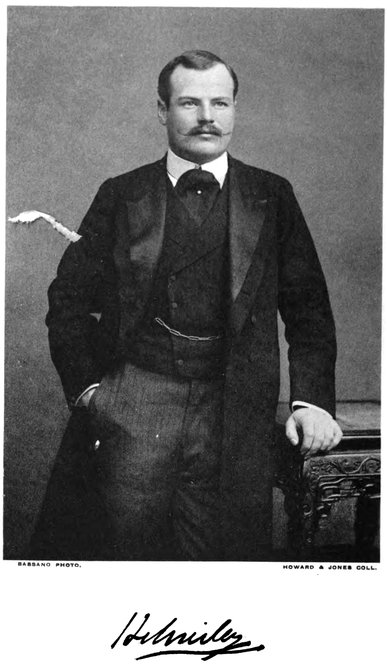
With Engraved Portrait of The Earl of Huntingdon, M.F.H.
Warner Francis John Plantagenet
Hastings, fourteenth
Earl of Huntingdon, was born in
the year 1868. His career as a
sportsman dawned three years
later, for at that, we trust appreciative,
age he was blooded with
the old “H. H.” in the County
Waterford, where his father,
then Lord Hastings, hunted a
part of the old Curraghmore country,
and what is now the territory
of the Coshmore and Coshbride
Hunt. The late Earl, it may be
observed, in 1872 became Master
of the Ormond and King’s County,
and held office until 1882.
The subject of our portrait was
reared in the atmosphere of sport
which is so peculiarly strong in Ireland;
indeed, so intimate have been
his relations with hounds and hunting
from his earliest days, that he
says he was “reared in the kennels.”
He lost no time in mastering
the art of handling a pack,
having owned and hunted beagles
at the age of fourteen. He kept
a regular pack of harriers in
1886, and showed good sport with
them. In 1897, being then twenty-nine
years old, he was asked to
accept the mastership of the
Ormond, in succession to Mr.
Asheton Biddulph, which he did,
carrying the horn himself, and
hunting the country to the great
satisfaction of field and farmers
alike until 1904. During the season
1900–1901 the Earl hunted
the East Galway twice a week in
addition to the Ormond, bringing
his hounds over from Sharavogue
by van. Though a veritable
“glutton for work” where hunting
is concerned, he confesses that
this was a very arduous season.
On one occasion he had to get
home forty Irish miles (which
is about fifty Statute miles) after
hunting: this, we imagine, must
be the record back home. He
was frequently out from 7 a.m.
till ten at night; and when it is
remembered that he was hunting
hounds five days a week, we
think it will be admitted that to
continue such work long would
have killed Squire Osbaldeston
himself.
During his first (1897–98) season
of mastership in the Ormond
country he also kept (and of
course hunted) a pack of harriers.
These, with the foxhounds, gave
him enough to do. One day he
had the bitch pack out cubbing
in the early morning; came home
to breakfast; took the dog pack
out cubbing till lunch time; came
home to lunch; had out the harriers
in the afternoon, and enjoyed
sport with all three. Had there
been light and another pack of
hounds convenient, we make no
doubt the indefatigable master
would have gone out again after
dinner; but the day’s work as it
stands probably occupies a unique
position in the annals of hunting.
In 1903, Lieut.-Colonel Harrison
acting deputy master for him in
the Ormond country, he came
over to England and acted as
huntsman of the North Staffordshire,
Messrs. Phillips and Dobson
being masters; and in
1904 he assumed the mastership
of the Hunt. We may here
remark that this is the twentieth
season he has carried the horn
with beagles, harriers, and foxhounds,
having hunted as well
deer and otter. As he has
hunted with no fewer than fifty-eight
different packs of all sorts
in his time, Lord Huntingdon’s
experience is probably about as
varied as that of any man now
living. He hunted much in
Leicestershire while still keeping
his harriers, Somerby being his
centre. Of good runs he has
borne part in many; he thinks
one of the best he ever saw was
that with the Belvoir from Harley
to Staunton on December 14th,
1892, one hour and thirty minutes.
Lord Huntingdon has played
polo for many years. He is President
of the King’s County Club,
also the Crystal Palace Polo Club,
and is a member of the Roehampton,
Ranelagh, and other clubs;
for many seasons he played back
in the King’s County Irish team
for the County Cup.
A first-class rabbit and rifle
shot, he is fond of the gun, and
since he took Madeley Manor
from Lord Crewe has begun preserving
there; this, however, is
his first season at Madeley, and a
few years later will no doubt see
a much larger head of game there
than now exists. He used to do
a little racing and also a little race-riding;
in 1898 he won the private
sweepstakes at Croxton Park,
on Captain Herbert Wilson’s
Sailor, in a good field of sixteen
starters.
He has twice visited the United
States, and has been in Canada,
Japan, and China, but has not
done much big game shooting.
Interested in yachting, he is Commodore
of the Lough Dearg
Corinthian Club. He fishes when
he has nothing else to do, principally
in the Shannon and Lough
Dearg; but with his numerous
occupations we gather that the
occasions when he has leisure to
use the salmon rod are somewhat
rare. He is a keen motorist, and
drives a great deal; the machine
he now uses is a 24–40 h.p. Fiat.
For some years he kept a stud
in Ireland and bred horses of
various breeds; he has now given
this up, but still breeds a few
half-breds at Sharavogue.
Lord Huntingdon, who is a
Deputy-Lieutenant of the King’s
County, retired last year as Lieut.-Colonel
of the 3rd Batt. Prince
of Wales’ Leinster Regiment.
He was unable to go to South
Africa, owing to an accident. He
succeeded his father in the earldom
in 1885. In 1892 he married
Maud Margaret, second daughter
of Sir Samuel Wilson, late M.P.
for Portsmouth, by whom he has a
son, Francis, born 1901, and three
daughters, who are very keen
sportswomen, and never so happy
as when riding to hounds. Lord
Huntingdon is also very fond of
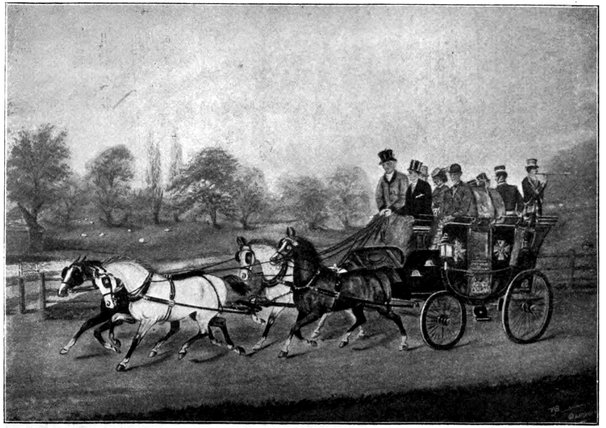
driving four horses, and until
motoring started made many
driving tours with his yellow
coach and team of greys. Lady
Huntingdon is also very fond of
hunting, and is out regularly with
the North Staffordshire. One of
Lord Huntingdon’s brothers is the
well-known gentleman rider, the
Hon. A. Hastings.
The family of Hastings is a
very old one. John of Hastings
was Seneschal of Aquitaine, and
a claimant to the throne of Scotland.
Sir William, who became
first Baron Hastings, was Master
of the Mint under King Edward
IV., and first coined the piece
known as a “noble.” The first
Baron became very powerful, and
was eventually beheaded by
Richard Duke of Gloucester.
The third Baron attended Henry
VIII. in his French wars, and
was present at the capture of
Tournay in 1513; it was this
ancestor who became the first
Earl.
In our school-boy days there were
very few of us who could resist
the opportunity of having a good
stuffing, especially at Christmas,
when the mince pies and plum
puddings were an extra attraction,
and when even the most austere
of mothers did not gainsay our
desires, although knowing full
well that our penalty would follow
in the shape of a black dose,
or something worse.
It is not, however, to boyhood
alone that Christmas has its
temptations, and its feasts have
their unpleasant accompaniments
of dyspepsia and derangement,
and we as in our boyhood lie
down only to indulge in dreams
and nightmares. The remembrance
of these phantasies of a
disordered stomach have a knack
of being difficult to shake off,
so much so, that I have determined
for this once to chalk down
some of the ideas that seem
this Christmas indelibly written
on my brain, and thus to rid
myself of them.
I was carried sometimes into
the near future, and then again
into remoter times, yet ever onwards,
wondering that there was
no finality, no halting place, no
respite from the excitement which
relentless time casts upon our
little world of sport.
I was bent on hunting, but I
looked in vain at my front door
for my hunter or hack. Instead,
I found a horseless machine,
which whirled me dizzily away
against my will, and landed me
amongst a throng of people with
like machines, and clad like Laplanders,
so much so that I turned
over in bed, and shouted vainly
for the sight of a horse and hound.
The scene changed, and I was in
a throng of gay horsemen and
women at the covert side, and the
odour of violets and nosegays
was not wanting. Positions were
continually shifting, chiefly through
the threatening heels of ill-tempered
horses, when on a sudden a
whistle sounded, followed by one
shrill blast of a horn, and away
went the throng, blindly as it
seemed, jostling and pushing,
each one thinking only of himself
or herself. Carried away as I
was, only a unit in this surging
crowd, I had little time to collect
my thoughts—all I know was that
I saw no hounds, only just indistinctly
heard them at starting.
Yes, before us were white flags at
regular intervals, and here and
there a red one, from which the
ever lengthening cavalcade in their
gallop turned aside, and I heard
the words “wheat,” “beans,” or
“seeds” growled out by our
leaders. Where the white flags
predominated in front of us the
hedges had been cut down and
levelled, as if for a steeplechase.
There were visions of that demon
barbed wire on either hand, but I
learnt that those white flags meant
safety. The jostling soon ceased,
but loose horses came as a fresh
trial to my troubled brain, and,
oh, the shaves I experienced to
keep clear of them. Then we
crossed a road, where a liveried
hunt servant stood sentinel over
the motor brigade, that but for
him would have barred our way.
After this all was confused galloping
and jumping, until the horn
sounded in a wooded hollow, and
there was a baying of hounds at a
hole, which betokened the end of
a twenty-five minutes’ gallop after
this supposed fox (if, indeed, it was
one), but it was several more
minutes before that strung-out
array of riders drew together
again, mopping and mud-stained,
yet masterful in their happiness.
They had had their gallop, the
motors were near at hand, grooms
were requisitioned from them, and
thus away went the majority of
that gay throng, back to their
cities and suburbs, leaving but a
few to work out the rest of the
day in the woodlands, when I can
distinctly swear that they found a
fox, for I saw him cross a ride—a
mangy little beggar was he—and
we revelled in no more green
fields that day. But, ah, I forgot
to say that before starting a hat
was thrust in front of me, whose
owner whispered, “For the
farmers’ field fund, please sir.”
Only gold was taken!
And I awoke finding myself in
a train, whose engine neither
puffed nor smoked—all went by
electricity.
And soliloquising, as I rubbed
my eyes, the interpretation meant
hunting in A.D. 1925. Again I
dreamt. I was on a racecourse
on a June day, when all was bright
and beautiful. Such gorgeous
stands, such crowds of fashionable
and unfashionable people, such an
array of motoring machines lining
the course opposite the stands,
such order and regularity, no
hoarsely-shouting crowd of betting
men, no Tattersall’s Enclosure.
What did it all mean? The numbers
were up in blazing letters of
the runners for the first race.
Was racing to be carried on in
dumb show? I looked again, and
beheld people like bees clustering
round some low buildings, pigeonholed
like enlarged telegraph
offices, and numbers and names of
horses figured here. There the
money flowed in with startling
rapidity. In some places only
cheques and notes were received,
in others gold, in others silver,
and all payers had a diminutive
numbered receipt. Then came
the race. Each horse accurately
numbered, and silence no longer
reigned. An electric gong proclaimed
the start, and thousands
of eyes and thousands of voices
bore witness to their excitement
as the horses swept towards the
winning post. What has won?
The judge has touched one of a
set of electric buttons that are in
his box, and the winner’s number
is simultaneously shown in half-a-dozen
conspicuous places. Soon
tinkles a bell on the top of the low
building, and thither fly the bees
to gather the honey that they have
won. But this time they find
their gains on the opposite side of
the building from which their
money was deposited. All the
takings have been counted like
magic, the winning number sweeps
the pool, after due deduction
made by way of percentage for
much that the country stands in
need of.
I noticed, too, that bright
liveried messengers plied amongst
the stalls and boxes of the stands,
doing the work of payment and
receipt for the brilliant company
sitting there. All this was repeated
again and again, until my brain
became accustomed to it. Presently,
as if to cast a shadow on
the gay scene, a red disc appeared
on the number-board. “Objection.”
The paying-out pigeonholes
were closed for that race,
and we held our breath; but not
for long, since the tribunal of
stewards had been chosen beforehand,
and unless the subject of
the objection had to be adjourned
unavoidably, the disc soon proclaimed
“Over-ruled” or “Sustained,”
and the pay-boxes for
that race were opened after the
last race of the day.
Here ready money ruled the
day. The welsher had been forgotten;
the bookmaker had turned
backer; the plunger could not
find himself below the bottom
of his purse; and roguery was
worsted.
The Jockey Club at that time
was no longer wholly self elective.
There was a certain proportion of
its members affiliated by election
to it, as representing the racecourse
interests and owners, outside
mere aristocratic connections.
It was to them that the reforms
in turf management were mainly
due. Can all this really come to
pass? It is but a dream, and
I am awake. Nevertheless, that
the totalizer or tote, as it is called
in Australia, or the pari mutuel, as
it is termed in France, or the
pool, as it is more likely to find
its name in this country, is
destined ere long to become here
also the rule of betting is my firm
conviction, and with it will come
aids to agriculture and assistance
to poverty, as well as in alleviation
of bodily suffering, such as will
recommend it to peer and peasant
alike.
Once again I dreamt, and my
dream was of the future. It was
shooting that filled my troubled
brain. A letter was before me
inviting me to a great battue, and
yet it could not be intended for
me, as a high rocketting pheasant
requires to be of haystack proportions
in order to suffer death at
my hands. Nevertheless, it ran
thus: “Dear ——, Will you do
me the honour of joining our party
for shooting my coverts during
the week beginning the —— day
of November? We hope to kill
at least 3,000 pheasants. My
land steward will send you full
particulars of the rules which
regulate my sport, to which I
hope you will find no objection.”
And this was what the steward
said: “Dear Sir,—I am directed
by Mr. —— to inform you that
the following are the regulations
which dominate his shooting, and
which it is my duty to see carried
out. No tips are allowed.
“Shooting will commence at
10.30 each day.
“A map will be furnished each
day to you showing the beats and
stands for the guns numbered in
the usual way. Everything will
be supplied you, except a loader,
and any excess above 1,000 cartridges.
Low flying birds may be
passed by. A whistle will sound
at the commencement of each beat.
“Lunch will be at 1 p.m., and
will be announced by a gong. In
case of rain, canvas covering will
be provided over the shooting
stands. A motor-car will meet
you on Monday on the arrival of
the train, and convey you to the
Hall, and a like conveyance on
Saturday will convey you back to
the station.
“Enclosed is a banker’s order,
which you will kindly fill up for
the sum of £5, and return same,
which goes to form the keepers’
fund.”
He might have added, but it
was not on the circular, that a
light dose of sal volatile will be
provided to allay the headache
which each day’s battue was
likely to cause. Yet the method
and completeness of arrangement
impressed me.
I turned in my bed thinking of
my spaniels and retrievers, and the
many enjoyable raids I had had
with them, when there appeared
before me an autograph circular
from a well-known London sporting
agent, and thus it ran. “The
Earl of ——— has arranged for
the coming season to invite five
approved guns to shoot over his
extensive Norfolk estate in company
with three guns of his own
choice. The sport will extend
over eleven days, six of which
will be partridge drives, and five
pheasant shoots. The bag should
amount to at least 3,000 partridges
and 4,000 pheasants. The appointed
days for shooting will be
fixed by the Earl. Terms, 300
guineas for each gun, to include
all expenses, to be paid me in
advance. All applications for this
exceptional offer must be made to
me on or before the —— day of
——— next, and guns will be
accepted in their order of merit.”
I awoke. And so this was the
shooting sport of A.D. 1925! Well,
perhaps by that time the people of
this country will for the most part
have become Daniel Lamberts,
and sitting or standing behind
butts, and having all the more
or less tame creatures for their
slaughter brought to them, will be
their only means of enjoyment.
Thank heaven that your scribe
will not survive to see these days,
although we are already becoming
very luxurious in our pursuit of
shooting. Perhaps our middle-aged
and older men will tell you
that they are able to get this
exercise in the enjoyment of golf,
and that this is a set-off against
the limited exercise that shooting
now exhibits, and this may save
them from falling a prey to fatty
degeneration of the heart.
These dreams are horrible phantasies
that we have to indulge in
whether we like them or not, and
seldom are they pleasant, nor will
they come at call. I tried to
dream into the future of fishing,
a sport I love so well. But, alas!
the spirit moved me not. Those
lusty trout and grayling, and those
sportive salmon, refused to be
allured by any new means; their
ways were just the same, and no
newly-defined artifices sufficed to
bring them to hand more easily
or with less practical skill. Only
the ranks of their enemies seemed
to have increased. More and
more fishermen came on the scene,
who sought them out farther and
wider throughout remote countries,
and more money and greater
artifice was employed to effect
their capture, so that their preservation
became a question of the
day, as it has, indeed, become so
to-day.
Your younger readers will perhaps
hail with delight these
halcyon days of sport, which, if
my dreams have any portent, are
destined to come upon us all the
more swiftly, seeing that riches as
they accumulate bring in their
train luxury and indulgence, and
that it is to wealth that our
landed estates must come, unless
they are destined to be swept
away by the flood of social
democracy, which, thank God,
does not come within the scope of
my dreams, for if so, “I had,” as
Shakespeare says, “passed a
miserable night, so full of ghastly
dreams.”
If perchance, however, my
dreams should prove ominous,
let me implore you who in the
radiance of youth have the opportunity
of guiding and shaping the
destiny of sport, to hold fast by
the truer principles which have
hitherto held sport so high in this
country, casting aside its meretricious
aids and surroundings,
which only sap its true vitality,
and would fain emasculate its
worth to us as a nation. Stand
fast by “the horse and hound,”
and maintain a deaf ear to the
tempter that whispers of the
gorgeous trappings and luxurious
surroundings, which are the death
role of genuine sport.
Shakespeare once more comes
to my mind when in “Troilus and Cressida”
he exclaims, “My
dreams will sure prove ominous
to-day.”
Borderer.
P.S.—Since writing the above
article, I read with pleasure that
the first blow has been struck at
the Gimcrack Dinner by Mr. Hall
Walker in favour of the Totalisator.
He is not only an extensive
owner of racehorses and a successful
breeder, but also a man
who has had ample opportunity of
thinking out this subject from a
national standpoint. This freely
expressed opinion of Mr. Hall
Walker’s on betting reform will,
let us hope, bear fruit, even if it
is after many days.
THEIR ANCESTRY.
It might raise a considerable
amount of discussion to assert
that the foxhound had a longer
line of ancestry than other breeds
brought under the fostering care
of Englishmen, but this much can
be said, that when public opinion
was turning towards the correct
methods for the attainment of
animal perfection, interest was
taken in foxhounds similar to
that taken in the racehorse,
the shorthorn, or the red
Devon. Could such a date be
accepted at about 1730?—which
was nearly a quarter of a century
before Eclipse was foaled. The
newly formed Ormesby stock of
shorthorns was then about to be removed
to Ketton, near Darlington,
and the Davys and Quartlys had
not commenced their improvements
on the Devons. But there
is evidence that foxhounds were
beginning to be thought of at the
time, and by 1750 a great many
noblemen and gentlemen were
very intent on hound breeding.
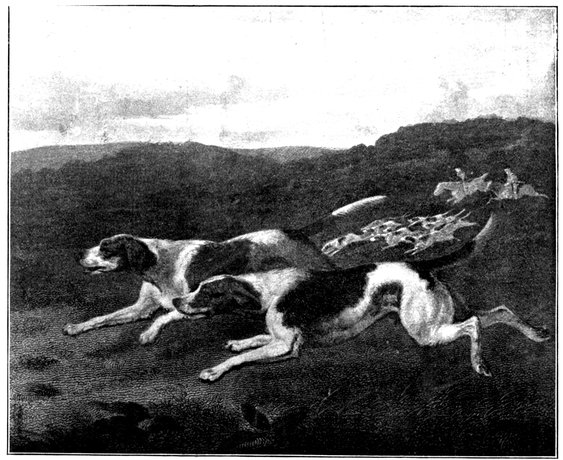
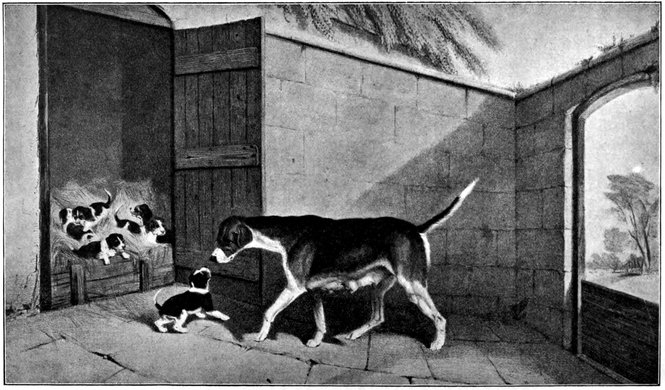
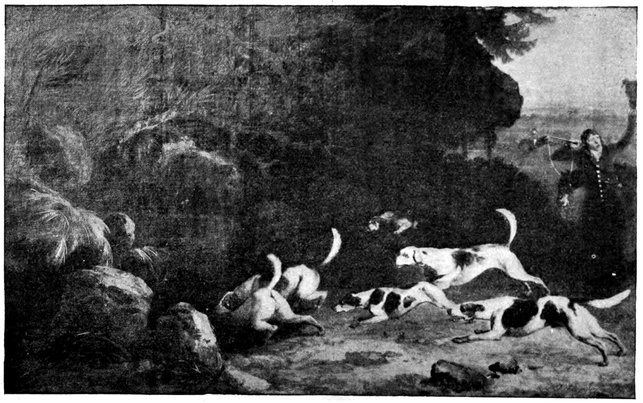
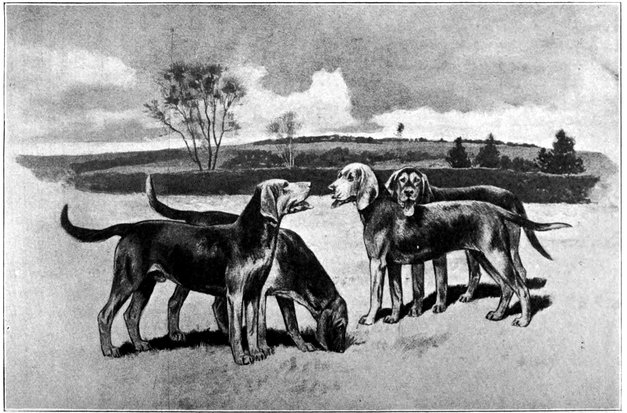
FOXHOUNDS
From the Painting by P. Reinagle.]
The Dukes of Beaufort had
hounds, bred and walked at Badminton;
the Pelhams had already
formed the Brocklesby; Mr.
Hugo Meynell had friends enough
to apply to for hounds to hunt
Leicestershire three or four days
a week; and there were North
country packs of fairly large
dimensions. It was, indeed, a
very interesting subject, and it is
not a little singular that the idea of
breeding hounds on scientific principles
commenced at almost the
same time as a change was taking
place in regard to the animal to be
hunted. Nearly half the eighteenth
century had passed away
before our forefathers had given
up the custom of hunting the wild
stag and the hare as almost the
only quarries to be hunted on a line
of scent. Just as the story of the
Silk Wood run relates that the
fifth Duke of Beaufort changed
from stag to fox, because the
latter gave the better burst, and
laid himself out for a more open
country, there was a general
consensus of opinion that the
time had come for a great breed
of hounds to be carefully bred
and trained for this special running.
The bold onward style
and cunning of the fox wanted
something with more dash than
was required for the short-running
deer, or the hare always wanting
to retrace her own foil. The fox
taught that exquisite forward
cast that almost sums up the
pleasure of hunting; and the faster
hounds will throw themselves on
a line that is always well ahead
of them, the more exhilarating is
the sport. That is what the old
pioneers of foxhunting lived for,
and one may suppose it was
brought about by selecting the
hounds of the day that possessed
the particular dash required. At
any rate, old letters and manuscripts
show that a vast number
of sportsmen became very keen
in regard to breeding such hounds.
Long journeys were taken to
secure their blood, and as one of
the pleasantest of sporting writers
has curtly put it, “the love of
foxhunting was well in the air.”
It is almost incredible what the
sportsmen of 1750 did do. As Mr.
Pelham, the ancestor of the Earls
of Yarborough lent a hound
called Jimper to Lord Percival
in 1760, and as he was stated to
be by one called Rockwood, there
is a suggestion of a back pedigree
at that time. In fact, there was
another of Mr. Pelham’s of 1760
called Marquis, by Rockwood a
son of Rattler, by Lord Monson’s
Mischief. Again, there is another
of Mr. Pelham’s in 1766, by
Tickler son of Ferrymann by
Twister out of Careful, a daughter
of Lord Granby’s Danger. Sir
Walter Vavasour appears to have
been in the thick of the hound
furore of the time, and so does
Sir Roland Winnes, Mr. Hassell,
Mr. Watson of Old Malton, Mr.
Lane Fox, Lord Middleton, and
the then Duke of Devonshire.
But for the fact that lists were
not generally kept in these early
days, there is every reason to
think that present hound pedigrees
could be traced from the hounds
of 1730 or 1740, but the registration
departments of many of the
great kennels could not have
been very perfect as although
Brocklesby can boast of records
to 1713, there must have been
some breaks up to 1745, when
Mr. Pelham—afterwards the first
Lord Yarborough—saw the necessity
of keeping such accounts of
breeding clearly and regularly,
and so kept his stud books in his
own handwriting. Whether this
practice lapsed or not is not
recorded, but when Mr. Tongue
(Cecil) formulated his stud book,
he could not go much further
back than 1787; or at least
that was the last date he gave
to a hound called Dover, by
Lord Monson’s Driver out of
Whimsey. Cecil was a most
industrious investigator, and he
would have gone back to the
Ark with sufficient evidence for
the undertaking. As a matter of
fact, my old friend, who gave
me most of his hound lists,
pulled up at something like
the years referred to, his very
latest date being 1779, when
mentioning a bitch called Rosamond,
by Mr. Meynell’s Roister
out of Lord Ludlow’s Tasty. Of
course, in making such researches,
the difficulties to overcome are
that many packs have been dispersed,
and so records have ended.
That really happened to Mr.
Meynell’s, Lord Ludlow’s, Mr.
John Muster’s, and Lord Monson’s,
to the detriment of perhaps
the hereditary packs that had been
indebted to them for blood.
Considering that several changes
have taken place in its history
during the past hundred and fifty
years, it is remarkable that so
much hereditary material is forthcoming
from Lord Middleton’s
pack, but this is partially due to
the fact that one man and his
son after him were the huntsmen
to it for nearly eighty years. These
were William Carter and Tom
Carter, the former being in office
when Sir Tatton Sykes took on
the country (with his brother, Sir
Mark Masterman Sykes), that is
now occupied by Lord Middleton.
That was in 1804, but William
Carter, who must have been an
intelligent fellow, and particularly
fond of dates and pedigrees, knew
all the hounds from 1764. The
book he compiled—and which is
at the present time in the possession
of Lord Middleton—was
really perfectly kept, and through
its pages some of the entries can
be most certainly traced up to
Cecil’s Stud Book, published in
1864, and so on to occupants of
the kennel benches to-day.
I have no doubt that several
lines can be taken, but I turn, for
example, to a bitch called Jointress,
who had quite a large family, in
different litters, numbering about
sixteen couples. She was out
of Rosamond, 1775, by Sir
William Vavasour’s Twister, out
of Doxey, and the line had still
greater extent, as Jointress had
a sister called Jessamy, who was
almost as prolific in producing
good ones. Amongst the daughters
of Jointress was Magic, and the
latter had a daughter called Prudence,
whose descendants came
into the pack that was transferred
by Mr. C. Duncombe to Sir
Masterman Sykes; but William
Carter, in his note to that effect,
declares that most of these
hounds were drafted. There is,
however, the strongest evidence
that Prudence produced a son
called Pillager, and he was the
sire of another Prudence, and in
like manner a dog called Fairplay—from
Famous, a daughter of
Jointress—was a notable sire, and
a son of his called Fairplay came
into the Sykes’ pack at the above-mentioned
date; he was the sire
of Brilliant and Blossom, entered
in 1805, and Brilliant was the sire
of Boaster and Blue-Cap, and
also of Blossom, Barrister,
and Barmaid. Blossom subsequently
produced in 1814 three
couples, named Bounty, Blue-Cap,
Beauty, Barmaid, Boundless
and Bloomy; and Blossom likewise
produced in another litter
Bachelor, Barrister, and Blameless.
Of these Blue-Cap certainly
became a sire of note, and
two and a half couples in two
litters were put on by him in
1823, and one couple the year
before. Sir Tatton Sykes appears
to have stuck to this line,
as Barrister, son of Blue-Cap,
was also bred from, and was
the sire of Brusher, Topper,
Blue-Cap, Bachelor, and Blossom,
and this last-named Blue-Cap
was the sire of Bellman
and Barrister of 1834. Then
Bonny Lass was by Brusher, and
she was the dam of Bellmaid.
However, the very best branch of
this family tree became noticeable
in 1832, when Blossom, the sister
to Blue-Cap, was mated to the
Osbaldeston Flagrant, and the
result was three couples of puppies
all put on in 1833; they
were Furrier, Ferryman, Finder,
Famous, Flagrant and Favorite.
Flagrant was possibly the best, as
he was bred from in his second
season, and produced Dreadnought,
Domo and Desperate for
the 1835 entry; but Famous in
1838 had a couple and a half in
the entry, and Desperate had a
daughter called Dainty entered in
1841. Primrose, a daughter of
Famous, was by Bondsman, one
of the family, and so Primrose
was inbred to it. It may be
thought that Bondsman was the
sheet anchor really of the sort,
as he must have lived to be a
nine-season hunter, and one of his
daughters, Music, and two of her
sons, Denmark and Vulcan, were
in the pack that the eighth Lord
Middleton took over from Sir
Tatton Sykes in 1853. There is
more of the blood besides in the
Birdsall Kennel at the present
time, and so with a clear pedigree
of a hundred and thirty years,
to the good bitch Jointress of
1778, and her descent is easily
traceable to 1764.
Lord Middleton has another
line, though that is quite as certain
in straining through the sixth
Lord Middleton’s Vanguard and
Darling to the famous Corbet
Trojan; and let it be known that
all the Oakley Driver sort—and
there are none better at the
present moment—trace to it
through the late Mr. Arkwright’s
Cromy by Lord Middleton’s
Chanticleer, and so on to Vanguard,
and his dam, Traffic, a
great-granddaughter of Trojan’s.
There has been a fortunate dependence
on the fame of many
noted hounds, such as Trojan,
Vanguard, and, a little later still,
to the Osbaldeston Furrier. The
great Squire was so celebrated for
everything that pertained to sport,
that his declaration of Furrier
being the very best hound he had
ever hunted in his life told immensely
with the great judges
who became his successors, Mr.
G. S. Foljambe, Sir Richard
Sutton, Lord Henry Bentinck,
and Mr. Nicholas Parry. They
made Furrier the corner-stone of
all their kennel-breeding operations,
and so it is not difficult
to-day to trace the excellence of
Lord Galway’s Barrister blood, the
Dorimont blood of the Blankney,
all that remains of the Puckeridge,
and the old Quorn Dryden
family to Furrier. The most
popular sire of to-day, the Belvoir
Stormer, hits, according to
my making out, thirteen times to
Furrier, and in Weathergage it
was certainly noticeable eight
times. In all the great hounds
talked of in the last quarter of a
century, such as the Fitzhardinge
Cromwell, the Belvoir Weathergage,
the Croome Rambler, the
Grafton Woodman, the Southwold
Freeman, or the Quorn Alfred,
there is the line to the little
black and white—some have said
shabby-looking hound—Furrier,
who was got by the Belvoir
Saladin in 1820, Saladin being by
Sultan, by Lord Sefton’s Sultan by
Mr. Hugo Meynell’s Guzman, of
1794, and Guzman was by German,
also belonging to Mr. Meynell.
On the female line Furrier
was related to the Badminton
Topper, and Sir William Lowther’s
Dashwood to a bitch called
Amorous, of 1791. This is as far
as “Cecil” thought it advisable
to go.
Mr. G. S. Foljambe, in the year
1835, had got some double hitting
to the Furrier family, as he bred
the brothers Herald and Harbinger,
by the Osbaldeston Ranter,
son of Furrier, out of Harpy
by Herald son of Hermit, son
of Saladin, the sire of Furrier.
From the brothers in
question Mr. Foljambe bred
almost a pack. His Layman of
1861 was by Nectar, son of Nectar
of 1849, and the latter’s dam
was Princess by Harbinger,
whilst the dam of the first-mentioned
Nectar was Conquest, her
dam Captive by Herald. Barrister
of 1860 hit twice to Layman, and
so again to the memorable
brothers, and their blood was
also in Sportsman and Forester,
and very much again in Lord
Henry Bentinck’s Contest, who
was by Comus, son of Mr. Foljambe’s
Herald, out of Sanguine,
by the same gentleman’s Sparkler,
by Singer, son of Streamer, by
the Vine Pilgrim out of Sybil,
by the Osbaldeston Ranter, son of
Furrier. This is all combined in
modern day pedigrees, and especially
through Sir Richard Sutton’s
Dryden, son of the Burton
Contest, as he was the sire of
Destitute the dam of the famous
Belvoir Senator, again through the
Croome Rambler, a descendant of
the above Contest on his sire’s side,
and through the Grove Barrister’s
on his dam’s. Also to the Belvoir
Weathergage, who was by Warrior,
son of Wonder, son of
Chanticleer, son of Chaser, son of
Brocklesby Rallywood, who traced
three times to Furrier, and then
there was Royalty, the dam of
Weathergage, got by Rambler,
brother to the third Rallywood.
It may well appear that the perfection
of hound breeding was gained
through their ancestry to the
Osbaldeston Furrier, and principally
by the means of four
hounds selected to perpetuate the
sort by probably two of the
greatest masters of hound breeding
ever heard of—Mr. G. S.
Foljambe, who relied on Harbinger
and Herald, and Mr.
Nicholas Parry, who chose Pilgrim
and Rummager. The last
line to old Furrier might have
been lost in the changes of time,
but it looks now as if it will be
stronger than ever through the
policy that has been pursued of
late by the Marquis of Zetland,
Mr. Edward Barclay, the present
Master of the Puckeridge, and
Captain Standish, the Master of
the Hambledon, through four and
a half couples of whelps purchased
in 1894 by the Hon. L. Baring at
the Puckeridge break-up sales.
Captain Standish is also breeding
from the present Puckeridge
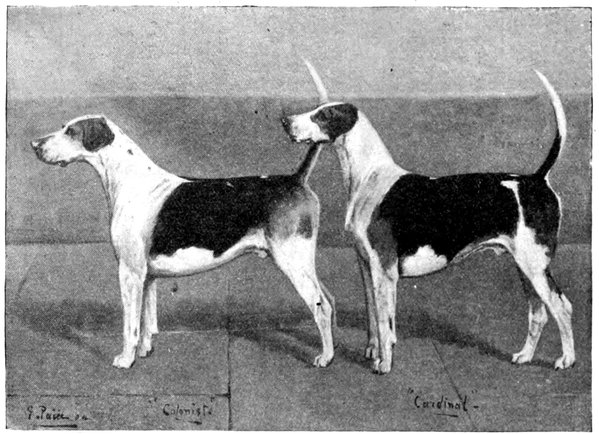
Cardinal, who inherits the old
strain from Gulliver. High breeding
and to follow in the steps
of the old master’s must do
a great deal, as after all is said
and done they must have known
much about it a hundred years
ago. The picture which accompanies
this paper is dated 1804,
and called “Foxhounds,” by
Philip Reinagle, R. A.; Sir
Walter Gilbey in his interesting
work on animal painters tells us
that Reinagle was born in 1749,
and that he commenced to paint
hunting scenes when about thirty-four
years old, in consequence of
his intense love of sport. He
must have known all about it by
the running of the pack in the
distance, and by the two hounds
with their heads at just the right
level for that exquisite pose
known as heads up, sterns down,
and racing.
G. S. Lowe.
When the difficulties confronting
the introduction and development
of the modern motor-car are
taken into consideration, the progress
made may be regarded as
remarkable. Although, as usual
in mechanical matters, this country
originated the idea, and had
steam road carriages in use nearly
a century ago, they succumbed to
popular prejudices, were virtually
interdicted, and the act of liberation
came only in 1896, when the
success of the internal combustion
engine had revived them in a
different form. Before they were
again permitted to be used in
England, France and other countries
had obtained a decided lead
in their design and construction,
and for the last nine years
British makers have been engaged
in a keen struggle to regain
what they lost by the tardy removal
of their prohibition. That
we have at last succeeded in holding
our own in the competition
was amply demonstrated by the
exhibition held at Olympia in
November last. Here the home
productions compared favourably
in every respect with the finest
specimens from abroad; indeed,
the show in Paris last month,
though its artistic setting was
superior, hardly afforded a better
display, and was less international
in character.
Automobilism may be regarded
as still in its infancy, and although
the late show introduced no revolutionary
methods in principle or
construction, it is impossible to
foretell what radical changes may
be brought about in course of
time. At present the explosion
engine carries all before it, but
the use of steam has by no means
been abandoned. Its advantages
in flexibility and facility of control
stand it in good stead, and although
it costs more in fuel, this
has become a matter of minor
importance. The steam car is
still engaging the attention of a
few firms, and it may yet become
a useful and acceptable type of
vehicle. During the past year
there has been a marked advance
in every detail of construction,
whilst the upholstering and appointments
of the more pretentious
cars have made them most luxurious
equipages, the coachbuilder’s
art being combined with the
highest mechanical skill.
In the electric car, it is possible
that those driven by petrol may,
at some future time, find a serious
competitor. The electric
broughams used in towns exhibit
the high state-of efficiency obtained
by the employment of this
propulsive agent, and the absence
of noise and smell. Their future,
however, depends upon the discovery
of much more efficient
accumulators or upon the establishment
throughout the country
of electrical charging stations,
and until such time as one or
other of these conditions is fulfilled
their use must be limited to
towns or the neighbourhood of
works where their supply of electricity
can alone be replenished.
The most important improvement
introduced of late in connection
with the motor is that of the
six-cylinder engine. This stands
to the credit of an English firm,
and although when it was first
brought out little was thought of
it, experience has proved it to be
of the greatest value, and it is
being adopted by some of the
best firms on the Continent. With
fewer cylinders there are longer
intervals between each recurring
explosion, and the severity of
each impulse has to be softened
by the use of a heavy fly-wheel,
which takes the jar off the driving
gear, to which it communicates
the power in a less violent and
more protracted form. By the
use of six cylinders a much greater
continuity of propulsive effort is
obtained, and to develop the same
amount of power the violence of
each explosion is diminished, with
the result that there is greater
smoothness in the running and
less strain on the mechanism.
Eight cylinders have been used
by another firm, but it remains to
be seen whether any advantage
will be gained commensurate with
the increased complication involved.
It is satisfactory to note that
serious attention is now being
given to the closing in of automobiles,
and the latest car built
for His Majesty the King is an
instance of the advance made in
this direction. No one would
voluntarily ride in an ordinary
open carriage in cold and wintry
weather, yet people become so
easily wedded to custom that they
will travel long distances in open
motor cars and expose themselves
to the rigours of the blast of air
that visits them with three times
the severity, by reason of the
speed at which they travel, that
it would in a horse-drawn carriage.
In the more commodious
cars there is no difficulty in complying
with a condition so essential
to the comfort of the
occupants; for, as it is, motoring
in winter is a trying ordeal to all
but the most robust. The motor
car has assumed the form of an
open conveyance owing to the
fact that it has been developed on
racing rather than utilitarian lines,
and to the diminution of wind
resistance being necessary to the
attainment of high speeds. This
is a factor of small account, however,
when the pace is kept
within legal or reasonable limits.
The dress of the motorist is
fashioned and designed with a
view to protect him from the
effects of exposure to the weather,
and in the more or less futile
attempt to keep him warm when
his journey is a long one and the
day chilly. With the covered-in
car the unsightly garments, masks,
and goggles with which he has
had perforce to bedeck himself,
and which have brought much
ridicule upon him, will be rendered
unnecessary, and ladies and
gentlemen when driving will be
able to adopt more rational costumes
than those which have
distinguished them in the past.
Pneumatic tyres, which constitute
the most costly item in the
upkeep of a car, have been greatly
improved, and retain their supremacy;
for it is only by their use
that high speeds are attainable
and endurable. Not only do they
conduce to comfort by their elasticity,
but they save the mechanism
from the severe shocks it
would otherwise sustain in passing
over rough roads. Metal-studded
bands are coming largely into use
for the double purpose of obtaining
a better grip on slippery
surfaces and preventing punctures,
while at the same time they save
the tyres from much wear and
tear. Solid rubber tyres are offered
as substitutes for pneumatics on
slower and cheaper cars, and for
various commercial vehicles, and
sundry attempts are being made
by the provision of springs to compensate
for the elasticity they lack.
Up to the present time there
are few signs of any appreciable
reduction in the prices of cars,
for, so far, improvements in
details and the additions to their
equipment have absorbed whatever
may otherwise have been
saved by economies in construction.
Some unpretentious but
serviceable little cars of limited
capacity may, however, be now
obtained at something over £100,
whilst those who are prepared to
spend double this amount will
have a wide choice. Not until
types become fixed and standardisation
of component parts
becomes possible can prices be
materially reduced.
E. T.
THE LAST SHOT AT THE GROUSE.
It has been the fashion to say
that since grouse driving became
a science the proportion of birds
killed and left upon the moors is
only a question of the will of the
occupier. This season, in Scotland
at any rate, has proved that
this is not the case. Although
there were not many moors perhaps
where more grouse ought to
have been killed, there were a
good many where it was attempted
to slay more than proved to be
possible. The fact is, when the
grouse take to the tops they are
practically safe; especially is this
the case when these tops are the
“march” between two shootings.
Then the grouse see the flankers
as King Louis of France saw the
figures of men in Tenier’s pictures.
They look “like maggots,”
and grouse are not afraid of those
immature insects, although they
do not eat them. It is the height
and the angle that make all the
difference in driving grouse that
have become wild enough to take
to the “tops,” for the very object
of resorting to these altitudes
seems to be the better to keep
watch and ward against the
arrival of the enemy.
As the season advances in the
Highlands, bags quickly sink from
hundreds of brace per day to
tens, and very soon after this they
would sink to units were it
thought worth while to organise
driving parties for the units; but
it is not, and consequently the
Highland grouse are growing to
be almost as difficult to regulate
in point of numbers, and more
difficult in point of sex, than they
were before driving came in. For
the latter practice has everywhere
increased the wild habit; it has
not merely taught existing birds
wildness for the time being, but
the habit of standing up to look
for danger instead of crouching in
the heather to hide from it, has
become hereditary and instinctive
where driving has been the longest
practised. Unless moors are very
hilly this habit does not much
matter, because, provided grouse
can be properly flanked and
flagged, they can also be driven,
but on the tops in Scotland this is
not possible, and the outcome is
unfortunately that too many of the
hens and the young males get
killed on the flat ground. The
old cocks are the first to take
possession of their fastnesses, the
tops, and there they remain until,
in the breeding season, they take
possession of the best breeding
sites and drive away all the
younger and more healthy birds.
The worst feature of this is that
these old cocks are like master
swans, and think they require a
kingdom for themselves, a kingdom
without subjects, for none of
their kind are permitted to live
near them. Consequently the
birds left to breed may be numerous,
and yet be of no use. They
have to move off at breeding time
because of the persecution of the
old birds. There is no much
employed method of getting rid
of these old cocks when driving
them fails in the hills. There was
one before the days of driving,
but it is almost a lost art. This
was called “becking.”
The practice of becking was
very simple and easy to learn,
indeed the grouse themselves
teach it better than any schoolmaster.
Any time in August,
when the shooting lodge is really
on the moor and not under it, one
has but to sleep with an open
window, and the first sound of
the coming day to greet the
awakening sleeper will be object
lessons in becking. It is a habit
of the proud old cock grouse to
challenge each other in the morning.
This they do by fluttering
up into the air vertically some
ten or a dozen feet and crowing.
Rarely is the challenge accepted
in the autumn, probably because
these old grouse have long ago
settled their differences, and one
no longer trespasses on the
ground of the other. Each is
king of his brood and ready to
defend his castle, but neither will
enter willingly into the domain of
another bird. Nature is at peace
with herself. But when the
moorland keeper arises before
light and gets upon the moor
before the grouse are awake,
when he hides in some peat hag,
or other shelter, and starts to
crow, every old cock grouse within
earshot becomes angry at the
unknown voice of an intruder,
and instantly the challenge is
accepted. The intruder not being
in a position to go out in search of
mortal combat the oldest inhabitant
comes to seek him, but
instead meets a charge of shot,
which unceremoniously, and in
revolt of sporting feeling, knocks
him over on the ground without
giving him the proverbial chance
for his life.
Before driving game came in, this
was the only way to find grouse for
the table, after the spirit of winter
wildness had entered into the
birds. Nobody thought of it as
sport, but the keepers knew of it
as a necessity in preserving, for
the reason that it killed off the old
cocks and none besides. It was
an automatic selection of the most
unfit, and had it been practised
beyond the necessity of the table
of the owner, would have done
much more for the stock than any
other thing could. But it was
confined and limited by the state
of the larder. Now even this
demand has stopped, because cold
storage supplies the table with
better birds, that is young ones,
killed perhaps on August 12th in
one year, and eaten on August
11th upon the next, and admirable
birds they are, too.
But not only has the necessity
of the table ceased to operate for
the good of the grouse stock, but
driving the birds has rendered
“becking” a lost labour in many
places.
It is no good going out to beck
on ground where the broods
once were, after they have all
united as one vast pack and gone
somewhere else. That is too
obvious almost to name, but suppose
the neighbourhood of a big
pack is found, and the “becking”
keeper attempts to call up the old
grouse, he soon finds out that the
voice of the charmer has ceased
to charm. What is the reason?
Well, when there are practically
one hundred challenges issued at
the same time from every direction,
and in voices unfamiliar to
the hearers, the grouse become so
used to the call to battle, that they
take no notice of the battle-cry.
If they did the attempt to find the
offender by his challenge, would
be like the attempt to flush a
land-rail by following his “croak.”
Voices resound on every side, and
an angry bird soon finds that the
only outlet to pent-up wrath is to
challenge too, but not to search
for challengers that are in as many
directions as echo itself.
Once I read somewhere how a
keeper had surprised himself in a
morning’s “becking.” Soon after
taking up position he was greeted
by a return challenge, and the
proud old cock soon appeared on
a little “knowie” not far off.
The keeper shot, but when the
smoke had cleared there stood the
bird as proud as ever, he shot
again, and the black powder smoke
hung in the still morning air, but
it cleared at last, and still the
bird was there to challenge. He
shot again, again, and yet again,
and at last, when the smoke
cleared, the bird had evidently
been killed. So he crept forth
from his hiding place to gather
this very refractory old cock. But
instead of finding him, he found
five fathers of broods which had
each heard the stranger, and
wanted to give him battle. Each
in turn had seen his predecessor
strutting on the “knowie,” and
thinking the strange voice belonged
to it, had arrived to do
battle exactly at the instant his
wished-for antagonist had “bitten
the peat.” But, as the keeper
probably knew very well, it would
have been quite natural had he
missed each of five birds in turn,
for grouse, standing in the heather,
require to be at least ten or fifteen
yards nearer the gunner than
when they are flying, and if they
are not that much nearer it is just
a little more easy to miss than to
kill. Probably the reason is that
the heather turns a good many
pellets that might have hit, and
also that when wings are closed,
and the birds are facing the
gunner, the only vitals are the
head and neck. The wings glance
a great many of the pellets.
I do not profess to be able to
call grouse, but I have done the
shooting while a keeper has
successfully called up grouse after
grouse. The puzzle is, why they
do not mind the shooting. Obviously
they are not troubled with
“nerves,” and are so much preoccupied
in their wish to make
the stranger “leave that,” that
they forget to enquire what made
the thunder.
On the occasion referred to, I
was provided with a very full
choke twelve bore, which killed at
least fifteen yards further away
than an ordinary game gun, so that
when a grouse appeared on a little
“knowie,” I was prompt to align
him and to pay no attention to
the keeper’s advice that it was
“beyont range.” I knew that
keepers usually took only very certain
chances, and that the cult of
the choke bore was not within my
companion, so I let off and my
grouse disappeared. I, too, was
evidently in for great good luck,
like the keeper quoted above, for no
sooner had one been knocked over
than another was up and seeking
for war; but not for five times,
only four. After this there was a
pause too long for patience, and I
went forward to gather my game,
and end the morning’s sport. The
first grouse I came to was only
wounded, he had an injured eye or
head, and sat bunched up with
the bad eye towards me. It ought
to have been an easy bird to
gather, but over confidence, or
want of care, made him suspicious,
and he flew away, and when I
pulled trigger at him I found that
I had not cocked my gun. There
was no other grouse to be found,
and it became obvious that I had
only had one quick change artist
to deal with all the time; he had
evidently been knocked off his
perch by shot that had not penetrated,
or had made him uncomfortable
enough for him to move
at each shot.
I am told that the principal
difference between a good shot
and a bad one at driven grouse is,
that the former knows how to
select the easy birds. Without
going as far as that I can say
with certainty that a grouse, five
yards too far off, becomes about
twenty times as difficult as he is
five yards nearer.
But although this experience of
mine was as far from a brilliant
success as could be thought of,
yet I believe that “becking” is
absolutely necessary to the highest
possible preservation wherever the
grouse do not pack. I should say
it was just as useful where they
do pack if it could be carried out,
but it cannot. When hunger
begins to harass the birds in the
winter months, they often divide
the sexes, like the high churches,
as Sir Fred Millbank observed
thirty years ago, and obviously
when the cocks are all in the
fellowship of the unemployed they
are not looking out for somebody
to have a row with. Nevertheless,
there is often much open
weather between the end of grouse
driving and the end of the season,
on December 10th, and where it
can be practised successfully, it
is well to remember, in the interests
of the breeding stock, that
“becking” is the only automatic
selection of old cocks that has ever
been practised, and had probably
something to do with the fact that
there were more grouse in Scotland
in 1872, and before, than
there are in these days of scientific
heather management and artistic
killing of grouse. On dog moors
it is particularly necessary, and
on them can be easily made successful.
One excellent sportsman of
Shropshire, who was not unknown
on the Chirk Castle moors, used
to tell me that it was quite wonderful
how well grouse kept, as
he often had them in March. He
explained that it was only the
cocks that kept so long; and this
was before cold storage was
thought of.
B.
Successive generations of Belvoir
Hunt followers will remember the
beaming countenance of old David
Swinton, the enthusiastic foot-hunter.
He always dressed in
black, with a clerical-looking
wideawake, and carried a stout
oak staff. Swinton takes us a
long way back into hunting history,
for his first day’s sport with
the Duke of Rutland’s hounds
was in the middle ’thirties, when
he was a lad at school. To-day,
as he sits by the fireside, approaching
his eightieth birthday,
he is still hale and hearty, though
not an active pedestrian, and is in
the unique position of one who
has enjoyed sport with the Belvoir
hounds under the mastership
of two Dukes of Rutland, Lord
Forester, and Sir Gilbert Greenall.
Though the classic pack can
boast of huntsmen who served
long tenures of office, Swinton has
reminiscences of five since 1836,
namely, Thomas Goosey, Will
Goodall, James Cooper, Frank
Gillard, and Ben Capell. Generations
of sportsmen have come
and gone in that time, and there
are not many of Swinton’s early
contemporaries left, though foxhunters
are a long-lived race.
Until a season or two ago we
still had with us Mr. John Welby,
the Squire of Allington, one of the
best that ever crossed a country,
Lord Wilton, and Sir Thomas
Whichcote, who were undefeated
horsemen in their day. Another
hardy old sportsman who rode up
to the last, and only joined the
great majority a few years ago,
was Mr. John Nichols, of Sleaford,
who, like Swinton, was
entered to sport by Thomas
Goosey, and would hunt with no
hounds other than the Duke’s.
The old runner had just the same
sentiment, and although he has
had a look at other hunts, he was
always loyal in his allegiance to
the ducal pack.
The Belvoir, so far as we know,
have never had a paid runner,
but Swinton became an institution,
and certainly during Frank
Gillard’s term of office was most
useful in performing many little
duties which help to keep the
internal machinery of a hunt in
smooth working order. Though
scarlet-coated runners are to be
seen with the Belvoir on the
Leicestershire side, dividing their
attentions between the packs that
hunt within distance of Melton,
they are never seen so far afield
as Lincolnshire. The reason for
this is that the area traversed is
very wide, and the going is so
much heavier that a man on foot
would have little chance of keeping
in touch with the hunt.
David Swinton dates back to
the days when there were active
pedestrians in the land, his keenness
to see a hunt carrying him
through a day’s fatigue such as
the rising generation would never
dream of. He thought nothing
of going on foot ten or twelve
miles to a fixture, and would
“shog” home at hound pace with
the pack at dusk, cutting corners
when possible, but often arriving
at his destination as soon as they
did. Until three seasons ago,
when in his seventy-sixth year, he
often came out to get a sight of
the sport he loved so well. His
last appearance was at a Caythorpe
fixture, where, he relates,
our present field master, Mr.
E. W. Griffith, found him out,
and noting that he looked tired
after walking, presented him with
some money, that he might drive
on the next occasion, and save his
energies.
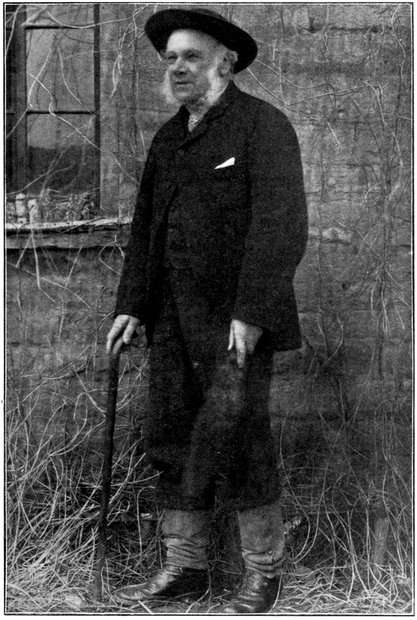
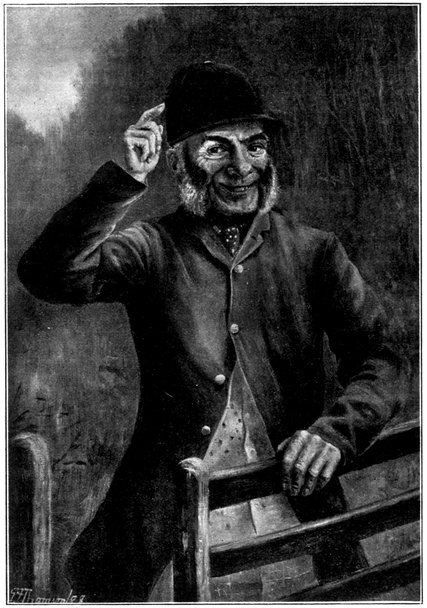
DAVID SWINTON. (Fifty Years Runner with the Belvoir.)
Photo by H. L. Morel.
The other day we found old
David in his cottage at Ancaster,
the unquenchable fires of the
chase burning brightly within
him as he revived memories of
many a happy day. “I enjoy
hunting as much as ever, though
now I can only read Mr. Tally-ho’s
letters in the Grantham Journal;
but I follow hounds, for I know
every yard of the country,” said
the old man, as he leaned on his
famous oak staff. “My first sight
of the Belvoir hounds I remember
as well as if it were yesterday.
I was a small boy, standing by
Fulbeck Gorse, which was a very
thick covert, and old Thomas
Goosey, the huntsman, told one
of his whips to go in on foot and
see to the earth. The sharp
gorse was not to his liking, and
laughing, I said, ‘Why, he can’t
half go through it!’ To which
old Goosey replied, ‘It would
fetch the bread and butter out of
your fat legs, you young rascal!’
That was in 1836. After that I
never missed a chance to run
with hounds. I was a tailor, and
had lots of work to do, but I
planned it to see as much hunting
as possible, my wife and I often
being up nearly all night stitching,
to get clothes finished off.”
Lord Forester held the mastership
of the Belvoir from 1831 to
1857, and Swinton reminds us
that he was “a tall, fine gentleman,
and a splendid horseman,
who rode right up to the
pack.” He used to stutter when
giving his huntsman orders. Will
Goodall carried the horn in those
days; he had been second whip
to Goosey, and was promoted over
Tom Flint, who had “developed
a thirst.” Those were long days
for hunt servants at Belvoir, for
the rule was to draw covert while
daylight lasted, no matter what
might be the distance back to
kennels.
Swinton in those days had a
tailor’s shop at Ropsley, where
they had a half-way kennel for
hounds when hunting the wide
fixtures on the Lincolnshire side
of the country between twenty
and thirty miles distant from
Belvoir. Thus he saw a good
deal of Goodall and his whips,
for after making the hounds comfortable
for the night, they used
to refresh at the Fox Brush Inn.
About eight o’clock at night
Goodall used to mount an old
brown hack mare, and gallop the
fourteen miles back to Belvoir in
the hour, to be ready to hunt a
fresh pack on the Leicestershire
side next morning. He always
took a whipper-in with him.
Goodall was a very daring horseman,
and he took his fatal fall
when only forty-one years of age
off a horse called Rollison; it
happened on the first of April,
and he died on the first of May.
“I made his last pair of breeches,
poor chap!” says David.
The next huntsman, James
Cooper, was a little fellow, sharp
as a needle, and a very fine horseman
who loved a good horse,
having one of his own called
Turpin. In those days David
used to work very hard making
liveries; this gave him the chance
to stay at villages on the far side
of the country for a week together,
and he managed to see
much hunting. He has been out
on foot four days in succession,
doing sometimes thirty miles in
the day; but of course that made
a hard week’s work. He did not
care how he got out so long as he
could go. For a time he had a
little white pony which could go
any distance, and he used to lead
through gaps and keep going on
the road to make his point, not
being very far behind at the
finish.
The most memorable day’s
sport he ever had was March
6th, 1871, when the Prince of
Wales, now King Edward VII.,
hunted with Squire Henry Chaplin
and the Blankney hounds. It was
a very rough morning, and David,
though doubtful if they would
hunt, walked from Ropsley to
Navenby, fifteen miles, on the
chance. He made for Wellingore
Gorse, where he met the Rev. —— Peacock,
rector of Caythorpe.
A few minutes later a fine old fox
came into the gorse with his
tongue hanging out, as if he had
been a bit dusted. So David
walked about, wide of the covert
to keep him there, and be sure to
see if he left. Not long afterwards
Charley Hawtin, the Blankney
huntsman, came up with hounds
hunting the line into the gorse.
Well, they got him away, and
ran for the best part of three
hours, although he returned to
the gorse twice. At last he got
to the end of his tether, and David
viewed him crawling into the
gorse dead beat. As Mr. Henry
Chaplin rode up with the Prince
of Wales and Lord Brownlow, the
smothered worry could be heard
going on. The gorse was very
thick, but David crawled in on
hands and knees and got the dead
fox away from the hounds, bringing
him outside. “You are a
rum fellow,” said the huntsman,
“not one in fifty dare do a thing
like that, you might have got
killed yourself.” “Its all right,”
said David, “naught never in
danger, but I should like one end
of the fox now I have rescued
him!” They gave him the mask,
which he had set up in memory
of the Royal day. Mr. Chaplin
asked him if he intended to eat
it.
It was a long spell of fine
sport they had during the twenty-six
seasons Frank Gillard was
huntsman, 1870 to 1896; he was
in touch with all the country side,
and people did all they could to
further a day’s sport. Many is
the half sovereign David had
from Gillard to see that earths
were stopped or gates shut after
hunting. When it came to digging
out a fox it always meant
five shillings to distribute amongst
those who worked at the job.
“Frank Gillard could always
trust me,” said David; “he used
to say when he heard my halloa,
‘There’s old Dave’s voice, true as
a clock!’ You know I never
barked false! What long days
Gillard did make to be sure, he
was never tired of hunting! I
have often spoken to him in Ancaster
Street, as he rode through
with his hounds at eight o’clock
at night, and often it was raining
hard. He had to get on to
Grantham where the three-horse
van was in waiting for the hounds,
and that meant reaching Belvoir
kennels at nine o’clock or after.”
After hunting three years on
foot without a ride, David was
given a mount by a friend on a
nice little horse, and as he rode up
to the meet, old Tom Chambers
and the whips shouted: “Hurray,
we’ve got old Dave mounted at
last! What are you doing up
there old friend, are you purchasing?”
“How the swells did
laugh to be sure!” adds David.
One of the hardest days he ever
did on foot was a hunt from Barkstone
Gorse. They found at twelve
o’clock, and never stopped going
until three o’clock. David thinks
he did not stand still five minutes,
and for an hour and a half he had
the Rev. —— Andrews, of Carlton,
running with him, till he said, “I
can’t stand it any longer. Swinton,
you’re killing me!” Hounds
kept running in big circles out
to Sparrow Gorse, and David
viewed the fox several times, and
never really lost sight of the hunt
for more than ten minutes at a
time, as he managed to keep
inside the circle. Well, hounds
hunted him right well, getting
him very tired, so that he returned
to Barkstone Gorse. He viewed
him again coming away, but
before hounds had run two fields
they threw up, and David could
not make head or tail of it, no
more could the huntsman, though
he did all he knew to help hounds
to recover the line. “Well,” I
said, “Gillard, he’s done you!”
To which he rejoined, “I think by
the looks of you he’s done you
twice over!” “No mistake, I did
have a doing that day.”
Times have altered since those
days, and since Sir Gilbert
Greenall became master nine
years ago. With Ben Capell
huntsman, a day’s sport is very
much faster, and David has got
very much older. He tells the
whips to-day that they live like
gentlemen, compared with what
the Belvoir hunt servants had to
do in the past, for everything now
is planned to save wear and tear
to horses and men.
The old runner’s experiences
give us an outline of two different
phases in the history of foxhunting,
which might be termed
the ancient and modern systems
of conducting a day’s sport.
Though there are some left to
tell us of the great changes that
have come over our sport, still
Swinton’s story goes to prove that
hunting people are as kind and
generous to-day as they were
seventy years ago, for the old
runner has many good friends to
help him in his declining days.
A man of cheerful, if somewhat
rubicund, countenance is Dick
Baker. His outlook upon life is
that of one who takes no thought
for the morrow, and can justify
this light-hearted attitude of mind
by the circumstance that the
world has always treated him
well in every sense of the word
“treat”; for Dick acknowledges
that he is “very fond of his
refreshment.” There are many
people who welcome their acquaintances
with a smile; Dick
goes one better, for he generally
starts laughing when any one
speaks to him; his risible faculty
is so delicately poised, that “good
morning” has been known to provoke
a jovial roar. He may be
said to have solved the great problem
set by some novelist-philosopher
a generation ago, “How
to be Happy on Nothing a Year.”
Dick Baker was born sixty-six
years ago. How he came to
adopt the career he has followed
since he was twenty-one years of
age, he can hardly explain. He
was always fond of horse and
hound, and he never took kindly
to discipline; running with hounds
therefore appealed to him as the
ideal occupation for an active and
hardy young man who liked to be
his own master. Fondness for
refreshment, notwithstanding,
Dick has reached a hale and
happy old age. He can still
“keep going” throughout the
longest day, and thanks to an
outdoor life and a sound constitution,
suffers from neither cold nor
rain. He dates his career as a
runner from about the year 1860,
and probably knows more about
the Essex, Hertfordshire, and
Puckeridge countries than any
man living, having spent forty-five
seasons running with those packs.
“DICK.”
From a Painting by G. F. Thompson.]
He was for several years under
Mr. Parry, when that gentleman
was master of the Puckeridge,
and he tells many anecdotes of
the various huntsmen he has
known, Dick Simpson, Hedges,
Allen, and Will Wells among the
number. Dick’s early ambition
was to be a hunt servant, but the
Fates denied him; he is, he now
admits, safer on his own legs than
in the saddle. Upon a day it fell
that Mr. Rowland Bevan gave
Dick his horse to lead home after
a hard gallop. Dick thought it a
pity not to try what he could do
as a horseman, and reflecting that,
inasmuch as the horse had had a
long day, it would at least be
quiet on this occasion, he mounted.
Before he got the horse home he
had taken three heavy falls on the
macadam; but seemingly he was
born a master of what some one
has called the “inexact science of
falling,” for he boasts that he was
none the worse. He has confidence
in his lucky star, and
expresses it in a fashion that has
the merit of originality.
“Why, Dick, I thought you
were dead,” said a member of the
Puckeridge on one occasion.
“No,” replied Dick, calmly;
“God never kills good-looking
people.”
How far Dick’s appearance justifies
his opinion of his personal
attractions our readers are able to
judge for themselves.
His master passion is anxiety
to be identified with the hunt; to
be recognised as a member of the
staff. To this end Dick, through
the good offices of an indulgent
member who at the time held
office as hon. secretary, took
advantage of the visit of a photographer
to the Puckeridge kennels
to get his portrait taken with a
couple of hounds; in character, as
it were. It is probable that this
was the proudest moment of his
life. That he possesses some
business capacity which might
have been profitably directed into
other channels, is proved by the
way he turned this opportunity to
account. He ordered a dozen
copies of the photograph at the
aforesaid member’s expense, and
retailed them to members of the
Hunt at two shillings apiece.
Dick acknowledges but one
enemy in this world, and for that
enemy he cherishes hate, the
deeper because he cannot be
avenged of the outrage it committed
upon him. This enemy is
the Great Eastern Railway Company,
which, with the heartlessness
peculiar to railway companies,
once “ran him in” for travelling
without a ticket. It was really
not his fault, he explains; he
finished a long day with hounds
many miles from home, and
thinking he had a shilling in his
pocket jumped into the train intending
to pay at the other end.
The fact that he was mistaken as
to the contents of his pocket does
not, in his well-considered opinion,
justify the Company in haling
him before the Bench, and getting
him fined ten and sixpence and
costs. It was the most costly
journey he ever made, and he is
unlikely to forget either it or the
sequel.
Entertaining, as already mentioned,
strong objections to anything
like discipline, a master of
hounds being, in his judgment, the
one mortal being who is entitled
to command his fellow-creatures,
Dick has rarely attempted permanent
work: and when he has
done so it has always proved temporary
after all; for what reason
it seems unnecessary to enquire.
In summer he is usually to be
found in attendance at cricket
matches, and in less exalted
cricket spheres rather fancies himself
as a bowler. He possesses
quite a remarkable instinct for
discovering occasions, show, celebration,
athletic meeting, or what
not, which will yield an odd shilling;
and will put in much more
and harder work to earn the odd
shilling than he could ever be
persuaded to do to earn the certain
half-crown. He has a family;
and it is in no spirit of reflection
upon a hard-working spouse that
he responds to enquiries with the
cheerful—always cheerful—assurance
that “the cubs are all
right.”
There are times when the tented
field is as still as death, times
when even the hub of the universe
is as dull as any Little Pedlington
in the Kingdom. We usually
make up for it, however, by a
great bustle of company meetings
in the concluding month of the
year, and these functions have
been characterised during the
past few weeks by a quite unwonted
show of animation. The
shareholder, as a rule, is a very
patient and long-suffering kind of
animal. He pockets his grievances,
passes the resolutions submitted
for his acceptance, and
goes away thankful, in most
cases, for very small mercies indeed.
When he does break out,
however, he is apt to be a very
ugly customer, and the lot of the
proverbial policeman is quite a
happy one in comparison with
that of the luckless wight whom
duty compels to face the music in
his capacity as a director. I do
not know whether it is the contagion
of heated political assemblies
that is spreading its virus in
the City, or whether we have
come under some malign planetary
influence; but certain it is that
there is a nasty spirit abroad, and
the shareholder goes to his meeting
prepossessed with the idea
that it is enough to be a director
to be either a fool or a knave.
For several years in succession it
was the fate of the Westralian
companies to furnish occasion for
these angry gatherings. They,
however, are at length vouchsafed
a well-earned rest, and the miserable
wretches who pull the labouring
oar in South African ventures
are being given their turn.
That, perhaps, is not altogether
surprising. Eldorado has become,
in the popular imagination, a veritable
Nazareth, out of which no
good can come, and since shareholders
cannot get out to Johannesburg
to vent their wrath upon the
heads on which it might with some
propriety descend, they are with
one accord taking it out of the
English companies operating in
South Africa which lie within
their reach. This is not in consonance
with strict justice, no
doubt; but it will serve its purpose
all the same, for it can
hardly fail to convey a hint to
quarters in which hints are greatly
needed that the time has come for
setting their houses in order, lest
a worse thing befal. It is probably
the case, as I have seen it
stated, that the noise is made in
inverse proportion to the stake.
The big shareholder is intelligent
enough to know something of the
difficulties which follow upon the
heels of a war and broad-minded
enough to make allowances. The
man with ten shares or twenty,
who gets no dividend, and sees
the market go steadily or unsteadily
against him, loses all
patience, and is fired with an
ardent longing to break somebody’s
head. What the small
man voices, however, the big man
feels, and the moral which these
merry meetings should convey
to Johannesburg is that shareholders
have not put their money
into South African ventures as an
erratic form of recreation, but
with the reasonable expectation
of getting in their own lifetime a
reasonable return. It is too much
the fashion out there to regard
the shareholder as a negligible
quantity. Everybody seems to
be bitten with the idea that the
thing to aim at is bigness of aggregate
return, bigness of mills, bigness
of expenditure, bigness of
everything except of the dividend
declared. Megalomania of this
description spells ruin to the proprietorial
interest, and it is not
compensated for by all the booby-talk
about prolonging the lives of
the mines. It is easy to understand
the advantage of this
prolongation to directors and
managers and secretaries and engineers,
and all the other hangers-on
of the industry; but where
the shareholder benefits from a
division of his dividend by two
and doubling the terms of years
in which it is paid, is more than
the average arithmetician can
understand. The wrong turn was
given to everything by Lord
Milner, who saw with his mind’s
eye a population of several millions
on the Rand, and laid his
lines accordingly. Lord Selborne,
who is apparently a man of sense
and moderation, is doing his best
to curb and correct the extravagant
ideas that had their genesis
in the time of his predecessor, and
there is much reliable information
to warrant the belief that 1906
will be attended with very different
results from 1905. It need
be, for only another such year as
the last is required, and South
Africa will be for ever and a day
undone so far as the British public
is concerned.
The change of Government
made no more difference in the
markets than if it had been a
change of footmen. The event
had, in City parlance, been already
discounted. To men who
had imagined to themselves the
vain thing that their exit would
shake the financial spheres, as
some of them doubtless did, it
must have been gall and wormwood
to see quotations actually
rise on the day when their resignation
became an accomplished
fact. This could only be due to
a sense of general relief, and to
the feeling that the Liberal bark
would prove far worse than its
bite, so far as the interests dear to
the City are concerned. It certainly
was not owing to the new
team being conspicuously strong
either in business or finance. It
is an anomaly, to say the least,
that the transformation should
result in a barrister being enthroned
as the Chancellor of
the Exchequer and a solicitor
installed as the President of the
Board of Trade; but Mr. Asquith
has shown himself quite at home
with figures and fiscal questions
during the past two years, and
Mr. Lloyd-George has the reputation
in the House of knowing
a thing or two besides the
wickedness of Mr. Chamberlain
and the clauses of the Education
Act.
Until the elections are over and
done with, it is not probable that
we shall witness anything very
theatrical in Throgmorton Street;
but the knowing ones are counting
upon a marked improvement of
gilt-edged securities when things
have settled down. Just as
Nature abhors a vacuum, so does
the Stock Exchange abhor stagnation,
and the one question on
everybody’s lips is what to go for
in the New Year. Yankees, too
dangerous; Home Rails, not to
be touched with a barge-pole;
Foreign Rails, quite high enough
already; Foreigners, not another
eighth to be squeezed out of
them; Breweries, wait a bit;
Copper stocks, a gamble for
lunatics. Such is the rough-and-ready
pronouncement of three out
of four of the old hands one meets.
What all are agreed upon is that
gilt-edged descriptions must advance
and that Kaffirs cannot, the
one owing to the plethora of
money they see looming in the
near distance, the other to the
alleged but scarcely demonstrated
fact that the public have spewed
out their mining stocks and will
not have them back at any price.
I always like to note these confident
predictions. They are so
often made and so seldom borne
out by the event. How easy it
would be to make fortunes if they
were! Except for the puff palpable—the
price of which is as
well known as that of a postage
stamp—the financial press is
shrewd enough for the most part
to refrain from prognostications
after the manner of the vaticinators
in the sporting journals;
but how much it would add to
the gaiety of nations if they made
selections for the rise and fall
after the fashion of their compeers
in Fleet Street! The only
thing that may always be predicted
with certainty of markets
is that what will happen will be
the unforeseen, and this is intelligible
enough. The calculable influences
are few in comparison
with the incalculable—something
occurs to upset the best-laid
schemes of mice and men—and
you will meet a dozen men who
have made their little pile out of
the short view for one who has
staked his fortune without regret
upon the long one.
I will not emulate, therefore,
the fame of Zadkiel. I shall not
prophesy because I do not know;
but it scarcely needs a prophet to
perceive that much in the coming
year, if not everything, turns upon
the course of events in the Empire
of the Czar. It is easy to see
how pregnant with possibilities is
the situation if one takes into
account that big dominating
factor, and rules out all the rest
as of minor account or of no
account at all; and it is equally
easy to perceive that we are at
the mercy of a chapter of accidents.
None will undertake to
say what the outcome will be,
least of all a Russian himself who
knows his people and the subtle
influences by which they are or
may be moved. I have had the
advantage during the past few
weeks of coming into contact with
several recent arrivals from that
unhappy country, and the accounts
they give are so confused
and so contradictory as to leave
one in a more impenetrable fog
than if one had never taken any
pains to learn the truth at all. On
some things, however, they are all
agreed. Russian news in the
newspapers, so they say, must be
taken with a liberal quantum of
salt. The Jews, not without
reason, hate Russia, or rather the
established order in Russia; they
control, directly or indirectly, the
bulk of the leading journals of all
countries, and the news agencies
as well; their mission is to set
down things in malice, to paint
everything in the blackest colours,
to ruin Russian credit abroad, and
to bring down upon the Russian
people the execration of the
civilised world. The fires of
revolution are alight, it is true,
but the conflagration is not so
widespread nor so all-consuming
as the enemies of Russia would
have the world believe, and a free
and purified Russia will emerge.
What will happen then is the
problem; and all my Russian
friends are at one in saying that
any representative Government
that may be established will set
before itself two objects of policy—a
better understanding with
England, based upon a solemn
renunciation of any designs
against India, and development
of the resources of the Empire
by the aid of foreign capital.
So far as the former of these
objects is concerned, it goes almost
without saying that any
English Government in power
would go more than half-way to
meet amicable and sincere advances;
and as to the latter—with
another entente cordiale once
established—the chances are that
British capital will flow into Russia
as it has flowed in turn into
America, North and South, into
Africa, into Australasia, into
India, and into every quarter of
the globe in which capital can be
freely and safely employed. It is
premature, perhaps, to say that
Russian ventures will be the
outstanding feature of 1906; but
the event is on the cards, and the
pioneer enterprises are already on
the stocks. The world has not
been standing still while the nations
have been at war and the
heathen have been raging furiously.
During the past year or
two, no end of little expeditions
have been poking their noses into
the recesses of the Ural region
and the vast areas of the Siberian
provinces, sending back
reports of riches, mineral and
agricultural, beyond the dreams of
avarice. It is difficult to believe
that resources of this description
still exist in their virgin state so
near comparatively to the Western
capitals; but the evidence, coming
as it does from so many capable
and unimpeachable sources, is
quite irresistible, and the inference
appears to be inevitable that the
exploitation of Russia is the next
big task to which the world of
finance and industry will direct
its attention. The exploitation
of China may wait, or be relegated
to our friends and allies,
the Japanese.
It must not be presumed from
our readiness to settle the affairs
of the nations that we have lapsed
into indifference in the City as
regards various little matters of
domestic concern with respect to
which agitation has been simmering
for some time past. The relations
of the House and the public
are being canvassed more freely
now than I have ever known,
from within as well as from without.
There is a consensus of
opinion that things are not quite
what they ought to be, as indeed
they never have been and never
will be even in this best of all
possible worlds; but the insiders
are afraid of pulling bricks about
lest they should bring the entire
edifice about their ears, while the
outsiders are wanting in the organisation
to give the old walls such
a shove as would be felt by those
within. It will not be long, however,
before events compel the
general overhaul which is recognised
as a prime essential to the
revival of business on such a
scale as will enable the Stock
Exchange man to live without
sapping the very vitals of his
clients. The complaints of the
latter go to the very foundations
of business as it is carried
on to-day. Why should one
pay brokerage when he buys?
In every other business, it is the
seller alone who pays. The
answer is that the buyer must
pay, or the broker, who deals
with a jobber, would get no benefit
from the transaction; to which
comes the rejoinder that the jobber
is the fifth wheel on the coach,
and should not be privileged if he
wishes to dispose of his wares.
The force of the argument for
dispensing with the middleman
is perceived by all who are not
hide-bound by tradition, use and
custom, while practical recognition
is being given to it in much
of the business that is being
transacted outside.
Then it is perceived that no
sort of logical justification exists
for the enormous difference made
in brokerage between one class of
goods and another, and between
one client and another. For
example, bonds are bought and
sold on a commission of 1 16 per
cent., mining shares on varying
scales which work out at an average
of ¾ per cent., which is enough
to kill the finest business in the
world. This excessive charge is
not defended; but it is explained.
When mining shares were first
introduced, the public were very
shy of them—and the House, too,
for that matter—and promoting
firms were ready to pay liberal
commissions in order to get them
placed, an operation often attended
with difficulty and risk.
Thus there came to be established
a standard of expectation, the
public paying whatever charge
the broker chose to exact, and the
mining market became the happy
hunting-ground of new recruits
by the thousand, who perceived
in it the opportunity of quickly
getting rich. Short cuts of this
kind, however, generally prove
the long way round in the end.
Brokers as a class cannot thrive
by bleeding their clients white by
excessive commissions and contangoes.
Either they make losses,
which wipe out their gains, and
more, or they kill the goose that
lays the golden eggs. They cannot
acquit themselves altogether
of some share in the collapse by
which speculation of this character
has been overtaken. Commonsense
and competition point with
unerring finger the direction of
amendment and reform, and I
expect to see established at no
distant date an almost universal
charge of ¼ per cent. upon the
money, whether shares are bought
or sold, or ½ per cent. if commission
be charged on sales alone.
Pending this concession, it is not
probable that speculation will
revive upon any considerable
scale in the market which has
been in the past the most attractive
of all markets, and may be
again if things are well and wisely
handled. The loss of it would
not be compensated for by rubber
trash and cab companies, over
which there will be some burning
of fingers before long. “Trash,”
did I say? Well, of course, that
is much too sweeping a generalisation.
As a fact, the great
majority of the rubber concerns
are moderately capitalised, and
the demand for their product is
going up with such leaps and
bounds that they can only be
regarded as sound and stable concerns.
That, however, is where
the trouble comes in. On the
back of every successful form of
enterprise kindred ventures are
too often floated without much
regard to the question whether
they contain the elements of
success or not. Like the razors
that were made to sell, and not
to shave, these undertakings are
launched for the sake of the promotion,
and for no other reason apparent
to the wit of man. Promotion
in the miscellaneous market
has seldom much behind it. The
shares once placed, those who are
in may whistle for the day they
will get out. There is but one
fitting inscription for that section,
regarded as a whole—“Abandon
hope all ye who enter here.”
Mining descriptions, with all their
drawbacks and all their dangers,
have as a rule at least the inestimable
advantage of a “shop.”
Mining promotions, I am given to
understand, are likely to be almost
nominal in the coming year; but
there are miscellaneous things
enough to stagger humanity
awaiting a favourable moment to
be launched.
G. P. F.
The mention of red deer reminds
me of roe. As all the sporting
world knows, Mr. Seymour
Dubourg, before he took the South
Berks country, was master of the
Ripley and Knaphill Harriers.
With these, at the end of the
season, he used to hunt an occasional
carted stag, but more frequently
the wild roe deer, which
were at that time to be found
(they were never plentiful) between
Windlesham, Bagshot, and Easthampstead,
also in the heath and
pinewood country south-west of
the River Blackwater. It was a
most interesting sport, and none
the less attractive as coming at
a time when foxhunting is practically
over. The hounds were
small foxhound bitches, I should
say rather under than over twenty
inches. With so accomplished a
huntsman as Mr. Dubourg, I
make no doubt that they did their
work, as harriers, as it ought to
the done. However that may be,
they were the best pack of staghounds
I ever saw. They went
the pace, and were not big enough
to kill a deer, bar accidents. With
roe they drove like furies, but, I
suppose from their harrier training,
hardly ever over-ran it.
It is the manner of a roe, when
first found, to make a point of 2 or
3 miles; then he returns almost to
the starting place, or anyhow to
its neighbourhood, and begins
“making work.” In the straight
part of his flight he is seldom far
in front of hounds. But having
begun his dodges, if he gets half a
chance he will steal away, and, as
likely at not, run the pack out of
scent. His resources are legion.
He can squat like a hare, swim
like a fish, meuse through a fence
like a rabbit, and jump over any
ordinary park palings. He is
most difficult to view, as he will
crawl up a ditch or drain, and
utilises every depression in the
ground, and of course every bit of
covert. He has the cunning of
fox and hare combined, but not
very much more stoutness than the
last named. In France, roe-hunting
packs are not uncommon, and
a friend of my own has one in
Belgium, which, however, hunts
hare as well. And a French friend
of mine once asked me to stay with
him for roe-hunting, promising to
mount me, and doubtless I should
have had a most enjoyable visit,
but I preferred to stay at Melton.
By the way, this gentleman valued
Belvoir blood above all else.
The objections to the roe as a beast
of chase may be gathered from
the above. It is pretty hunting,
but almost all in covert. The advantages
are that you can hunt
him all through the winter as you
do the fox, and also that you can
draw for him without any bother
of “tufting,” as you never find
more than a brace, or at most
three together. When the latter
is the case, it is a family party—buck,
doe, and kid. The latter
would stand but a poor chance
were it not for its squatting, when
the hounds dash away and settle
to the moving scent. When roe
are carefully preserved the woods
will be full of them, as the young
trees will soon tell you. I know
nowhere at present, even in
Scotland, where they are too
numerous, and in the country I
have described I should say that
they are all but extinct, although
some three years ago I saw a brace
when Mr. Garth was drawing St.
Leonard’s Forest.
With Mr. Dubourg’s hounds
one had to ride up to them,
if one wanted the venison. If
he happens to read this, he will
doubtless remember what happened
once near Black Bushes
Farm. Hounds had been running
some time, and we thought
“catching time” could not be far
off. They came to (for that country
at least) a very small wood. We
each took one side of the covert
(only the master and writer being
there), but to our surprise saw no
hounds away. To dive into the
wood was, for Mr. Dubourg, “the
work of an instant.” Arrived at
his pack, he found that in those
very few minutes they had not
only killed the buck but (not bad
judges!) had eaten the haunches,
&c., and left only the head, neck,
and forequarters. Unlike our
other deer, the roe is at his best as
venison, from the middle or end
of October to the end of the hunting
season. He sheds his horns
late in the autumn. Roe venison
has an undeservedly bad name, as
lessees of Highland shootings often
kill them in the grouse season.
As July and August are the
months in which most of them pair,
August for choice, côtelette de
chevreuil is best avoided until after
the stalking season. By the way,
the “stags” mentioned in the late
Colonel Anstruther Thomson’s
most interesting book were roe.
My kind old friend wrote to me
shortly before his death, to explain
that his South Country hunt
servants would call them stags,
hence he got in the way of it. Of
course, no red deer have been wild
in Fife since almost prehistoric
times. But some folks never can
learn the proper names of deer.
Once, in forest-hunting with our
late Queen’s hounds, I saw an
“instructor” from Sandhurst, who
told me that the deer had just
passed him, and that it was a
fallow deer! “Are you sure of
that?” said I (I never yet saw
one there, unless he had been put
there). “Oh, yes, it had no
horns!” was the startling reply.
A short time ago there was a
discussion in the Field as to
whether the progeny of hounds
hunting deer, or hares, should be
elegible for the Foxhound Stud
book. I think it was decided
against them, the theory being
that staghounds do not carry a
head. Now this is merely a question
of their quarry. After a few
days roehunting, Mr. Dubourg,
(by invitation), uncarted a stag
near Bracknell. Comins, at that
time the Royal huntsman (or acting
huntsman?), had been roehunting,
and we both remarked the
head these hounds carried then.
We had a good run and took
our stag safely, but from the
moment the hounds were laid
on, they went stringing along
(I do not mean “tailing,” a
very different thing) “just exactly
like my hounds,” as Comins said to
me. I saw the Queen’s hounds
once run a cub in Swinley Forest,
on a steaming, warm, wet October
morning, and as they crossed a
ride, close to the said cub, which
was dead beat, they carried a head
that neither Belvoir, Quorn, nor
Pytchley, could have beaten. They
were stopped just in time to save
young Reynard. It was in October,
as aforesaid, by which time a cub
should be pretty well able to take
his own part. Strange blunders
have found their way into sporting
history and been accepted as
facts merely for want of contradiction,
e.g., how often have we read
that, in the spring, Mr. Meynell
entered his young hounds to hare,
for want of woodlands.
The absurdity of entering young
hounds just in from walks, and
with all their troubles before them,
is obvious to any one who has
ever been within measurable
distance of a kennel. And as for
no cubhunting ground, what was
wrong with Charnwood Forest,
the best cubhunting district in the
world, and even better then than
now, in the days preceding the Enclosure
Act? Then, also, foxes
were not much outnumbered by
pheasants. Another victim of
misstatement is Mr. (“Flying”)
Childe, of Kinlet. I lately read
that he hunted the Ludlow
country after he left Leicestershire.
It was the other way about.
He and the first Lord Forester
went to Loughborough for the
Quorn together, Melton not
being invented when he gave
up the Ludlow country, and
set the fashion of pressing on
hounds. In fact, Mr. Meynell
describes Mr. Cecil Forester as
coming out of cover between the
fox and the pack! Again, the
name of Mr. Childe’s Arab was not
“Skim,” as we are told, but
Selim, corrupted into Slim.
His tail (grey) is still at Kinlet.
He left some good hunting stock
behind him, and I know where a
portrait of a chestnut son of his
is to be seen. Of Mr. Meynell
“Nimrod” says, “In chase no
man rode harder.” But he gave
his hounds room, which from all
accounts the immigrants from
Salop did not. Yet I have read
that he and his field merely
crawled over a country. Also
quite lately I have seen Mr. Edge,
the welter weight Nottingham
Squire, who refused a thousand
guineas for his two horses, Banker
and Remus, described as the “humble,
silent friend” of Mr. Assheton
Smith! Why on earth will
people write on subjects of which
they are ignorant? An outsider,
writing on sport, or soldiering,
is sure to make a spectacle of
himself. Though this is a hunting
subject, I cannot but call
attention to a masterpiece of
this kind in “Charles O’Malley,”
by the late Mr. Charles Lever.
In one of the Peninsula battles,
he tells us that a general
officer galloped up and gave the
word, “14th, threes about,
charge!” As this involved their
charging tail foremost, no wonder
that the French fled precipitately!
I am often asked whether hunting
has altered during my time.
I answer, “In the Shires little, if
at all, but provincial sport has, I
fancy, deteriorated. In bad scenting
countries nose should be more
thought of than looks, but is it so?
We hear a lot more about bad
scenting weather than we used to
do. No one would keep a throaty
hound, though no less an authority
than “the other Tom Smith,”
uncle, by-the-by, of my dear
friend “Doggie,” of that ilk, has
said that he never knew a throaty
hound without a good nose. The
greatest enemy to hunting, in
these days, is the shooting tenant.
He destroys the breed of good
wild foxes, and can only be disposed
of by the hunt renting shootings.
But for the railways, the
Quorn country would be more
easily crossed now than when I
first knew it. “Oxers” have
nearly all vanished, hand-gates
and bridges have replaced yawning
sepulchres—notably so at
John O’Gaunt, the bottom below
Wartnaby Pond, and at Sherbroke’s
covert, over the Smite,
which is the “march” ’twixt
Quorn and Belvoir. Also the
Twyford brook need no longer be
ridden at, unless one chooses.
The Whissendine brook, however,
retains its old fame. “Lady
Stamford’s Bridge,” over the
South Croxton and Queniboro’
brook, was just made in the
earliest of the sixties. As regards
dress, we are not very different
from the heroes depicted by old
H. Alken, in Nimrod’s “The
Chase.” “Snob, the tip-top
provincial,” appeared then in a
frock coat, and so he would now.
But I have always wondered why
the artist should have made the
fence which stopped “the little
bay horse” a high bank, suggestive
of Shropshire, or Essex, but
of a pattern non-existent in any
part of the county of Leicester,
and especially as the letterpress so
carefully describes the obstacle—ditch
from you, but the lower part
of the fence bristling towards you
after the fashion of the old “Prepare
to receive cavalry” of an infantry
square. In the old days the
master was dressed like other
people. He often wore a hat, and
so did many more. Mr. Tailby
always wore a cap. Lord Gifford
dressed like a hunt servant, ditto
Captain Percy Williams and
Colonel Thomson; but they did
not spoil the effect with a
moustache. One very dear friend
of mine, who dressed the character,
though “with a beard on him like
Robinson Crusoe,” was tipped a
sovereign by a stranger, who had
been impressed by the masterly
way in which he hunted and killed
his fox. I regret to say that it did
not profit him, as, on his return,
the predominant partner nailed it,
to keep as a curiosity, as (she said)
the only money that “Charlie”
had ever in his life honestly
earned! A master’s, as indeed a
huntsman’s and first whip’s second
horseman, used to be dressed like
yours or mine. Now most hunts
have, in servants alone, six
“scarlet and leathers” men.
This hardly makes for economy,
and we hear too much of expense.
Up to the end of the late Duke of
Rutland’s reign, the hunt servants
wore brown cords, “drab shags,”
as Mr. Jorrocks called them. I
think white cords look better, but
looks are not everything. No men
ever went better to hounds than
his late Grace’s servants, and what
do the breeks matter if their
wearer can, and will, give you a
lead over the Smite?”
As regards horses, I think,
speaking under correction, that we
have got them too high on the
leg; the result is that “boots”
form a predominant item in the
saddler’s bill. I have before remarked
that, in my young days,
there was about one roarer in a
hunt. Now, if there be only one
in a stud the owner is lucky. As
we breed our racehorses from
roarers, and as they are the sires
of our hunters, this is not wonderful.
In talking of dress, I ought
to have mentioned that, as a small
boy, visiting a schoolfellow in
Cornwall, I saw a pack of harriers
belonging to the last Lord Vivian
but one, with which every one was
in red coats, officials and all. A
similarly attired Yorkshire huntsman
of harriers told me that he
and his whip wore pink, as being
more easily distinguished on the
moors. This is a good reason.
I have omitted to mention a pack
of staghounds which, for some
seasons, showed excellent sport—I
mean the Collinedale. Mr.
George Nourse was master, and
hunted them himself. A better
staghound huntsman I never saw.
This was lucky, as he was not
well whipped in to.
The first time I ever saw these
hounds is worthy of mention. A
friend of mine asked me at the
club whether I should like a
mount with staghounds next day.
I gratefully accepted the offer, and
asked at what station I should
meet him. “Oh,” said he, “come
to my house to breakfast and
we’ll ride on to the meet.” I asked
no questions, but duly appeared
at my friend’s very charming
house; a little beyond the Swiss
Cottage station, and then nearly
in the country. We rode on
to the meet, which was at the
Welsh Harp, Hendon. We had
two stags, but they had hardly
got over their autumn dissipation.
One turned round and charged
the hounds, and the other went
over a fine country, the Harrow
Weald, but not far enough for me
to get on terms with my mount,
a hard-pulling four-year-old, with
a very light bridle. And the Berkhamsted,
which are still going,
deserve a word of chronicle. I only
saw them once, but thought them
a marvellously clever pack, and not
too big. Any possible deficiency
of size was made up for in the
person of their master, the late
Mr. R. Rawle. He was a keen
sportsman, a capital huntsman,
and as polite and kind as any
man could be. I was never impertinent
enough to ask him his
weight, but, crushing though it
was, he got wonderfully to his
hounds. He rode the right sort
to carry weight. None of your
seventeen-hand prize-winners in a
show ring, but steeds more on the
lines of the baby hippopotamus,
with well-bred heads; hence these
triumphs.
An old Suffolk M.F.H. told me,
in my youth, that Mr. R. Gurney’s
famous “Sober Robin” was only
15.2. He also remembered the
moonlight steeplechase from
Ipswich Barracks. Another fine
old sportsman told me that he
recollected the “orange” coats
worn with the Atherstone in Lord
Vernon’s time. He described
them as looking much like ordinary
“pink,” until you saw one of
each together, then the difference
was clearly marked.
F. J. King King.
(To be continued.)
A bet was made some time since
between Peter Mackenzie, Esq.,
of South Molton, and two brother
shots, for twenty guineas aside,
that the former gentleman did not
kill one brace of partridges every
day, Sundays excepted, for six
weeks in succession from the first
day of September last. This was
determined on Saturday, October
12th, when Mr. M. having completed
his engagement with apparent
ease was consequently
declared winner. This is looked
upon by the amateurs as one of
the first field exploits that has
been performed for many years.
On the last Wednesday in
November came on for decision
a match which had excited much
interest in the sporting world, and
which amongst that community is
denominated a Steeple-Race, the
parties undertaking to surmount
all obstructions and to pursue in
their progress as straight a line as
possible. The contest lay between
Mr. Bullivant, of Sproxton; Mr.
Day, of Wymondham; and Mr.
Frisby, of Waltham; and was for
a sweepstake of 100 guineas staked
by each. They started from
Womack’s Lodge at half-past
twelve o’clock (the riders attired
in handsome jockey dresses of
orange, crimson and sky blue respectively,
worn by the gentlemen
in the order we have named them
above) to run round Woodal Head
and back again—a distance somewhat
exceeding eight miles. They
continued nearly together until
they came within a mile and a
half of the goal, when Mr. Bullivant,
on his well-known horse
Sentinel, took the lead, and appearances
promised a fine race between
him and Mr. Day; but
unfortunately in passing through a
hand-gate, owing partly to a slip,
Mr. Day’s horse came in full contact
with the gate-post; the rider
was thrown with great violence
and, as well as the horse, was
much hurt. Nevertheless, Mr.
Day remounted in an instant, and
continued his course. Mr. Bullivant,
however, during the interruption,
made such progress as
enabled him to win the race
easily. The contest for a second
place now became extremely
severe between Mr. Day and Mr.
Frisby: the last half mile was run
neck and neck, and Mr. Day only
beat his opponent by half a neck.
The race was performed in 25 min.
35 sec.
Newmarket Jockies. Court of
King’s Bench, December 6th.
Irish v. Chifney.—The defendant
in this case is the celebrated Newmarket
jockey, the plaintiff is a
bit-maker. When the cause was
called on, Mr. Serjeant Best asked
whether or not the defendant was
ready to start? and being answered
in the affirmative, the learned Serjeant
led off in a superior stile. The
action was brought upon an agreement
signed by the defendant for
the payment of £15 which the
plaintiff claimed as his due, for
making a certain number of bits
for racers which Mr. Chifney conceived
were superior to any others,
and the principle of which originated
from his own fertile invention.
The agreement was proved by a
very respectable witness, and the
defendant’s counsel endeavoured
to cross the witness in order to
prove that these bits had been
exposed to sale contrary to the
orders of Mr. Chifney; but on
this point he failed, as the witness
would not take the bit; and
although he was finally rubbed
down, came in for the legal plate
without any competitor. There
was no kind of defence, and the
jury found a verdict for the plaintiff
for fifteen pounds.
The first two days of the Cattle
Show found the delegates of
County Cricket busy at Lord’s,
appointing on the Monday their
umpires, and on the Tuesday their
matches. In the absence of the
Australian team, the programme
has settled down very much on the
usual lines of a domestic English
cricket season. Mr. Lacey, the
head Secretary of the M.C.C.,
announced that he was arranging
fixtures for a West Indian team
that is desirous of playing a series
of matches in this country next
summer. Mr. Lacey is reported to
have said that as the West Indians
were coming for the purpose of
improving the standard of cricket
in the West Indies, and not with
the idea of making money, he
trusted that he would receive the
assistance of the counties in doing
all that was possible to make the
tour a success.
We have not seen an authentic
list of the matches arranged, but
we gather that our visitors will
play a very mixed card, commencing
at the Crystal Palace on
June 11th, against a London
County team of Mr. W. G.
Grace’s.
Other fixtures in chronological
order are against Essex, Middlesex,
Warwickshire, Wiltshire,
Hampshire, South Wales, Kent,
M.C.C., Derbyshire, “All Scotland”
at Edinburgh, and “All
England” at that great centre
of gate-money, Blackpool. Then
against Yorkshire at Harrogate,
and to finish with a burst of alliteration,
Norfolk, Notts, and Northampton.
This seems a fairly good
all-round sample of English
cricket, and our visitors ought to
get a good look at the game as
played in England; and we hope
that they will achieve their purpose,
insisted upon by Mr. Lacey,
of improving the standard of the
game in the West Indies.
In 1900, when a team visited us
from the West Indies, the Marylebone
Club did what they could to
discourage our guests and to lower
the standard of their play by a
proclamation that none of the
West Indian matches were to
count in the first-class averages.
We hope that this time Mr. Lacey
will advise his Committee to join
in the general note of encouragement
by permitting at any rate
some of their matches—for instance,
those against Surrey, Yorkshire,
and Kent, to rank as high
as, say, Somerset v. Hants.
There is nothing very interesting
about county cricket nowadays,
not even in regard to the arrangement
of championship matches.
It is worthy of notice that
Northamptonshire, who only just
wriggled into the first-class last
season, have had to struggle hard
to maintain their position there,
and have only just succeeded in
arranging sufficient matches to
again qualify. This came through
the agency of Notts, who have
dropped their matches with Kent,
and have taken on Northants
instead. For a long time Notts
and Kent have been regular antagonists,
and it seems almost a pity
that their matches should be
dropped; but even the best friends
amongst the counties sometimes
drift apart for a year or so, as has
been shown again this year in the
coy conduct of Surrey, who again
refuse to play with Somerset, the
county which has done so much
to encourage Surrey cricket, originally
by consistently beating her,
and then by paying her the compliment
of adopting and developing
her most promising young
players. Apropos of Somerset, we
read with regret that Mr. S. M. J.
Woods has announced his intention
of retiring from the captaincy
of the eleven at the end of next
season.
Certainly his twelve years of
office are very noticeable. In
1894 Mr. Woods took over a team
of mixed possibilities and impossibilities,
and has kept the
concern going up to to-day, with
most attractive and varying
vicissitudes, and probably “Great
Heart,” as he has been styled by
his friend Mr. C. B. Fry, is about
the only man who could have so
long stood the strain of so frequently
facing fearful odds.
Somerset have now fifteen years’
experience of first-class cricket
and have done many brilliant
things, but for the second year in
succession, and despite the fact
that the Australian matches
brought them in a nice profit,
the club is confronted with an
adverse balance well over four
hundred pounds. It would almost
seem as if cricket, the national
game, were a hybrid growth in
Somerset, where the natives do
not support the game very conspicuously
either by play or pay.
The dates of the big matches at
Lord’s are: Oxford and Cambridge,
July 5th; Gentlemen and Players,
July 9th; and Eton and Harrow,
July 13th. It will be seen that
these games follow one another as
closely as possible, so it is to be
hoped, for the sake of the Marylebone
Club finances, that the
weather for that fortnight may
prove favourable. For many
years the match between Oxford
University and M.C.C. and Ground
has been arranged at Lord’s as the
match to immediately precede the
Oxford and Cambridge match,
and in order to give the Oxonians
a day of rest before the stress and
strain of the ’Varsity match, the
game with the M.C.C. has been
limited to two days’ play, and in
an epoch of good wickets this
has taken much of the interest out
of the game. Common sense has
at length prevailed in this matter,
and now the Oxford v. M.C.C.
match has been moved forward
to a week before the Oxford and
Cambridge match, and the Monday,
Tuesday and Wednesday
preceding the ’Varsity match are
allotted to Middlesex against
Essex at Lord’s.
It seems a pity that the
Hastings Cricket Festival should
die out, but such would appear
to be the case, as no matches
have up to now been arranged
for it. We hear that the last
three years have each proved
disastrous financially, and the
promoters probably consider that
they will be justified in contenting
themselves with the week of
Sussex county cricket which has
been allotted to them by the
County Committee at the end of
August, when Warwickshire and
Essex are to be engaged.
Of benefit matches there are not
so many as usual. According to
custom, the Whit-Monday match
at Lord’s, between Somerset and
Middlesex, is given as a benefit to
a deserving member of the ground
staff of the M.C.C. V. A. Titchmarsh,
at one time the mainstay
of Herts, and nowadays one of the
most reliable of umpires, takes his
turn on June 2nd, 3rd, 4th, and
we wish him a bumper.
The great match of the year at
Old Trafford, is the August Bank
Holiday battle with Yorkshire,
and this is to be for the benefit
of John Tyldesley, who cannot
possibly get more from it than he
richly deserves, both from his
country and his county.
At the Oval, Walter Lees is to
have a benefit, and he too deserves
well at the hands of Surrey
cricketers, and was probably very
unlucky never to have actually
taken part in a Test Match, after
having so often last season been
amongst those selected to play for
England.
At Lord’s the programme is no
more interesting than is usually
the case at headquarters in the
absence of an Australian team.
Middlesex, of course, will play all
their home matches there, and,
apart from the three big-gate
matches already referred to, there
is nothing very attractive about
the fixtures arranged for Lord’s.
Yorkshire, Sussex, Derbyshire,
Kent, and Notts play the M.C.C.
and Ground, the latter county, as
usual, playing the opening match
at Lord’s, beginning on the first
Wednesday in May. They are
quite devoid of interest these three
days’ matches between some generally
moderate Marylebone amateurs,
pulled through by the
professional element, against a
county team from which the most
prominent members are for this
unimportant occasion taking a
rest.
We wonder if the management
at Lord’s will one day be able to
devise some better plan of disposing
of their dates and their
money. To our mind the game
between Actors and Jockeys
played last September might to
advantage be moved forward into
the season proper.
It has always been very difficult
to gain any reliable information
as to the personal profits
made by members of Australian
teams touring in this country.
Our enterprising contemporary
the Daily Mail, has endeavoured to
shed some light upon the profits
of the last tour, by the help of
some evidence given in the bankruptcy
proceedings of S. E.
Gregory. According to Gregory’s
evidence as reported, the members
of the team were to share
and share alike in the profits of
the tour. That was tacitly agreed
upon. All the members signed
an agreement on board the steamer
Majestic, between America and
London, by which they bound
themselves to keep order, to
abstain from writing for the
Press, and to observe minor conditions.
There had as yet been
no balance-sheet of the tour prepared,
but it was anticipated that
the gross proceeds would be
about £800 a man. Out of that
the players had to pay their
travelling expenses to and from
England, and while in England.
The Melbourne Cricket Club
advanced the necessary money
to players, and had it deducted
from each man’s share.
The players very seldom saw
one another except on the cricket
field or on the boat coming out.
One of the team had told him he
had about £50 still to come,
which would mean about £500
net for the tour. With regard to
his expenses in England, Gregory
said: “I had to go very slow not
to spend more than £150. That
amount went in cab fares, theatres,
return “shouts,” clothes, and
cricket bats, although most of our
bats were presented to us.”
These figures are in a way
interesting, and we cannot understand
how the Marylebone Club
was able to lose so much money
over their tour in Australia, when
Australian visitors are able to
carry away a profit of £800 per
head amongst fourteen of them,
besides enriching the coffers of our
counties to a very considerable
extent.
The English team in South
Africa succeeded in winning their
first match at Cape Town, against
the Western Province XI., by an
innings and 127 runs. Towards
the total of 365 compiled by Mr.
Warner’s team, the captain scored
56, Denton 78, Mr. Fane 60, and
Relf 61 not out. For the Western
Province Whitehead took six
wickets for 160 runs, but Kotze,
who made such an impression in
this country with his extra fast
deliveries, proved altogether unsuccessful.
The home team could only
accomplish 26 and 142 in their
two hands, Coggings with 20 and
43 being their most successful
batsman; whilst of the English
bowlers who were tried Haigh and
Mr. J. N. Crawford have the best
figures, getting five wickets each
for 31 and 5 runs respectively.
Against the country districts at
Worcester in Cape Colony the
visitors won by an innings and 52
runs, and apparently the country
districts batsmen cannot be of any
high calibre, since in their first
innings Mr. Hartley took nine
wickets for 26 runs, and in their
second Mr. Leveson-Gower had
five for 14; Mr. Leveson-Gower
also scored 82 runs, which
constituted quite a successful
first appearance for him in the
team.
We note from South African
Exchanges that Major R. M.
Poore, of Hampshire fame, is
again busy playing for his regiment,
the 7th Hussars, at Potchefstroom.
His scores of 44 not
out, and 115, prove him to be in
good form, so that he is likely to
render a good account of himself
when he runs up against the
English bowlers; as he did against
Lord Hawke’s team in 1896,
when he took more than one
century off the late George
Lohmann and some very fair
amateur bowlers.
The above question, though not a
very cheerful one to mention near
the commencement of the hunting
season, is one which has nevertheless
to be faced by all hunting men,
with whom the answer must chiefly
rest. The reply, as to most complex
questions, must be both “yes”
and “no.” Geographically and in
the very nature of things, hunting
is doomed in the ever-increasing
black countries of mines and factories,
of bricks and mortar, of
railways and canals, and with the
modern innovation of light railways
even crossing our fields.
When even Salisbury Plain has
become a military camp, who can
say that Dartmoor and Exmoor
will not in another generation
re-echo the sound of bugle and
trumpet instead of the horn of the
hunter?
Still, where estates are large,
the Master of Foxhounds, patient
and realising the changed conditions
of modern hunting and fox
preserving, and the farmers long-suffering,
as they will still be if
properly treated, foxhunting may
yet survive for another century at
least.
What hunting men must realise
and acknowledge is that, now that
the feudal system is as extinct as
the dodo, and scarcely one applicant
for a vacant farm can be
found where we used to have
twenty, hunting can only be carried
on through the goodwill of
the occupier of the land which is
ridden over, whether landowner
or tenant farmer. In the good old
times, before the disastrous season
of 1879 and the extension of
foreign competition, when farmers
were rich and the “fields” were
small and consisted chiefly of his
own friends and neighbours, the
farmer as depicted in Punch might
be the first to ignore the warning
cry of “’ware wheat!” on his own
farm, but now that times are permanently
bad but few farmers can
afford to hunt, and railway facilities—and
now that modern Juggernaut
the motor car (patronised
even by masters of foxhounds who
will probably soon adopt a motor-hound
van)—bring strangers by
the hundred who know not wheat
from grass nor seeds from bare
stubble, and care less, and spend
nothing in the neighbourhood, no
wonder the crushed farmer turns,
and some even insist on their
undoubted legal right of warning
off the trespasser, and if necessary
protecting their own property vi et
armis (with a pitchfork). Hunting,
formerly arising out of the
absolute rights of the lord over
his serf, continued through the
mutual good feeling between landlord
and tenant, but now that
many landlords are absentees and
scarcely know a single tenant by
sight, they cannot expect to let
their land while still retaining it
for sporting purposes without compensating
the tenant or recognising
the sacrifices which he endures
for sport. One who was “blooded”
by that best of sportsmen, the late
Sir Charles Slingsby, half a century
ago, at the early age of six
years, and has had a life-long
experience of every phase of
country life both as landowner
and farmer, while equally keen on
both hunting and shooting, can
see a good deal of both sides of
this question.
To begin at the top, though the
Master of Foxhounds, especially
nowadays, has of all men the
most need of tact and the patience
of Job, how many are there
in possession of those estimable
qualities?
Although James Pigg had his
prototype, dear old Jorrocks must
be regarded as somewhat of a
caricature; but Lord Scamperdale
and his bully, Jack Spraggon, were
taken from real characters, and the
race, I fear, is not now altogether
extinct. I have known a master,
an old country squire and no
ignorant upstart, abuse as a
vulpicide another poor crippled
squire in his carriage before the
whole field, with the not unnatural
result that he who for fifty
years had preserved foxes throughout
his vast extent of coverts
solely for the benefit of others,
as he could never hunt himself,
went home and ordered every fox
on his estate to be killed for two
years as an object lesson; thereby
quite ruining one day in every
week. One cannot approve of
such wholesale punishing of the
innocent with the guilty, but
cannot wonder at it. The same
master, before throwing off, abused
publicly on his own doorstep at
a meet another landowner from
whose five-acre covert I had
myself had the satisfaction of holloaing
away no less than seven
foxes while shooting the week
before. Another Master of Foxhounds
in my hearing slanged the
best of sportsmen and a keen fox
preserver because he himself in
a fit of temper had drawn blank
at a hard gallop two hundred
acres of coverts from which, to
my own knowledge, five foxes at
least had been halloaed away.
My own Master of Foxhounds, a
real good sort and an intimate
friend, once received me, until I
laughed him out of it instead of
taking offence myself, with unaccountable
coolness at Peterborough
Hound Show; though I
think he might have guessed that
the unpleasing present which he
had that morning received of the
pads of a litter of cubs was
scarcely likely to be sent by a
keen preserver of foxes for twenty
years with the well-known postmark
of his own parish. Obviously
I myself was the most
injured as well as insulted party.
Still, happily, these cases are
exceptions in an experience of
some scores of masters in every
part of England, and I may
especially mention the courtesy
shown to a stranger in days of old
in the Croome and Blackmore
Vale countries.
It is vain for a Master of
Foxhounds, not himself a landowner,
to state that foxes do no
harm to game, to me who have
counted eighteen nests, say one
hundred brace of partridges, destroyed
around a single field; not
that one grudged it, but one likes
sometimes to have one’s sacrifices
a little appreciated. We feel well
repaid for the hundreds of rabbits
consumed in the summer if only
one of the right sort is found in
our coverts when needed, and
the master cheerily shouts as he
dashes past, “I knew we could
always depend on you, old chap.”
Again, masters and fields, especially
non-subscribers from towns,
do not recognise the difficulty of
showing foxes when needed. A
good fox is not like a hand-reared
pheasant, a tame animal to come
when whistled for, but a wild
animal going far afield and lying
out in turnips or taking refuge in
the tops of pollard trees; coverts
may have been lately shot, timber
may have been felled, a strange
dog may have hunted them; worst
of all, a fox may have been chopped
there, or a score of things happened
of which the grumblers are
ignorant. A reputed millionaire
Master of Foxhounds in a grass
country brought his oats, hay
and straw from abroad, losing
hundreds of pounds of goodwill
from the aggrieved farmers for
every ten pounds saved. And now
for the average man, who hunts to
ride, or often only to sport pink
at dinners or balls, and actually
seems to believe himself that he
confers a favour on the poor
farmer by ruining his crops and
breaking his fences and leaving
his gates open, and whom he will
sometimes curse incontinently if
he is the least slow in throwing
open his gates to the trespasser, to
whom in rare cases he may throw
a copper as to a beggar, contemptuously.
Such an one buys
everything at a distance, not only
clothes, boots, saddlery and horse
clothing, and stable utensils, but
hay, corn and straw, while he
buys his horses from the London
dealer and not from the farmer.
The chief reason of this is not
only thoughtlessness but the fact
that too many masters are morally
the slaves of the servants who rob
them, and who, with an ignorant,
timid, or indifferent master, will
often represent local goods as inferior,
and even make them so
to secure the commissions, as the
cook does with eggs, poultry,
meat, &c. It always puzzles me,
too, why hunting men will pay
two to three hundred guineas to
a London dealer for a pig in a
poke rather than buy a hunter
from the breeder and trainer
whose animal they can see day
after day doing an excellent performance
with hounds, and of
which they may have any reasonable
practical trial in the field
before buying. The grooms can
make the purchase a failure if
they do not get substantial
“regulars,” and their master is
a duffer, and many men explain
that with dealers they can swap
and change, forgetting that it is
the dealer and not themselves
who is sure to benefit by each
exchange.
It astonishes me as a practical
breeder how valuable studs can
be reared as well as herds of
pedigree cattle and flocks of sheep
in the Shires, where on every day
in the week, Sundays only excepted,
any one of half a dozen
packs may stampede the lot, causing
laming, staking and slipping,
or casting their young; for it is
trouble and risk enough with
horses alone to have to round up
and shut up all one’s brood mares
and young stock rather than have
them excited and dispersed over
the adjoining parish through gaps
and gates left open. It is not the
fliers of the hunt who do the most
damage, as experience teaches
them to ride at the post or stiffest
part of a fence that a horse
will clear, instead of blundering
through, but the ignoble army of
skirters, who will tear down any
fence in their efforts to regain the
safety of the hard high road.
Fortunately, the boastful thruster
who shows off by turning a somersault
through a new gate when
hounds are not running is rare.
Much might be done by reducing
the quantity and improving the
quality of the second horsemen,
especially in the crowded Shires.
To sum up; the hunting man
would do well in his own interest
to show appreciation of the self-denial
of the farmer by buying
horses, forage and all that he can
in the country which he affects,
and avoid as far as possible all
injury to growing crops, especially
when hounds are not running or
scent is bad—the days are only
too few and choice when one must
go straight and fast or go home—and
then little harm results.
Fences need seldom be broken
nor gates left open where stock
is, and any man who can afford
to hunt can afford to pay a good
subscription to enable the Hunt
to compensate the farmer by removing
and replacing the barbed
wire, or, better still, supplying timber
for fencing instead, and tactfully
recouping Mrs. Farmer for
loss of her just perquisite, poultry,
even if, with the privilege of her
sex, she sometimes opens her mouth
a little widely and loudly. I have
heard masters of hounds explaining
to those who, like myself, have
seen “bold Reynard” (see Sponge)
carrying off fowls in broad daylight,
that foxes do not injure
poultry. Unfortunately the vulpine
instinct is to prepare for a
rainy day, and though we are
assured that foxes leave home
preserves alone as a reserve fund,
it makes little difference whether
neighbours or “travellers” clear
off and bury the feathered contents
of our henroost for future use,
whether hungry or not, as the best
fed dog will do with a number of
bones.
RETURNING FROM MARKET, 1838. (From Sir Walter Gilbey’s paper on “Farms and Small Holdings.” Live Stock Journal Almanac 1906.)
Photo by W. Shayer, Senr.
Still, fortunately, Mr. and Mrs.
Farmer are a good sort, the
former with an innate love of
sport and the latter not impervious
to soft sawder if laid on judiciously;
and if game preservers will unselfishly
remember the lines, even
if exaggerated, that
“One fox upon foot more enjoyment will bring
Than twice twenty thousand pheasants on wing;”
and if each Master of Foxhounds
will spend as much of the needful as
he can locally, and remember that in
the twentieth century men do not
come out to be d——d; and those
who take part in the pleasures of
the chase, would subscribe to the
great and increasing expenses of
the packs which they favour (?)
with their presence, observe the
courtesy which they would show
when “standing down,” and show
some consideration for farmers
and their gates, fences and crops,
I have no fear but that the farmer
will do his part as he has hitherto
done in the more prosperous past;
and to the question as to whether
hunting is doomed to extinction
or not, we may hopefully and
confidently respond, in the words
of the good old song:
Oh, perish the thought, may the day never come
When the gorse is uprooted, the foxhound is dumb.
J. J. D. J.
The “Live Stock Journal Almanac”[1]
for 1906 contains a great many
matters of interest. Sir Walter
Gilbey’s article on “Farms and
Small Holdings as Affected by
Enclosures, Markets and Fairs”
is full of information, and is particularly
opportune in respect of
the author’s remarks on small
holdings. It is made clear that
the oft-urged plea for the return
of the excess urban population to
rural pursuits cannot be acceded
to under existing conditions. It
was right of common that made
the small holding possible in old
days; and now that successive
enclosure acts have removed the
facilities the small holder enjoyed
for pasturing his stock, the situation
is radically altered.
Mr. G. S. Lowe contributes
a very entertaining paper on
“Horse Dealers Past and Present,”
a subject full of possibilities,
and of which he makes good
use. Mr. C. J. Cornish deals with
a topic that appeals to the naturalist
in “Animals’ Foster-Children”;
he reviews numerous
curious cases of adoption, the
strangest, perhaps, being the appropriation
of chickens by a cat;
the reverse, a hen taking possession
of kittens, has also been
recorded. All who wish to see
betting placed on a sound and
intelligible footing will be glad to
see that Sir Walter Gilbey is
heartily in favour of adopting the
pari mutuel, or totaliser system, in
this country; he makes out a
strong case for it in “How Betting
should Aid Agriculture.” The
advantages of the system are so
manifest that it is strange we
should not have accepted it in
England long since. Mr. C. B.
Pitman, as usual, writes on
“Thoroughbreds in 1905,” reviewing
the performances of the
more conspicuous horses of the
season, the sales at Newmarket
and Doncaster, and the show of
the Royal Commission. Mr.
Scarth Dixon writes on Cleveland
bays and Yorkshire coach horses,
and “E.” considers the Hackney:
we notice that he regards the
classes of Hackneys at the Royal
this year as much above the average.
The pony-breeding industry
continues to make progress.
Breeders of ponies for polo—all
interested in the game—should
read Mr. John Hill’s informing
article on “Ponies in 1905.” In
“Show Hunters of the Year”
the successes of various studs and
individual horses are reviewed;
a portrait of Mr. Stokes’ gelding,
Whiskey, accompanies the article.
Mr. Vero Shaw deals with “Harness
Horses”; old favourites, as
he observes, have been mostly to
the fore during the year. Passing
over the very instructive articles
on the heavy breeds of horses, we
come to an essay by Mr. Harold
Leeney, M.R.C.V.S., on “Brain
Diseases in Animals,” an obscure
subject to the lay reader. Mr.
Leeney, however, tells us that the
veterinary practitioner has to deal
with a good many cases of brain
and spinal cord trouble among
domestic animals. Mr. C. Stein
contributes an interesting article
on “The Jersey Cow at Home,”
while Mr. John Thornton’s comprehensive
review of Shorthorns in
1905 is full of interest as usual. All
the more notable varieties of cattle
and sheep are dealt with in turn
by acknowledged experts, but
space forbids us to glance at the
contents of these essays. Mr.
F. Gresham must be thanked for
his article on the “Working
Spaniel,” directly and closely appealing
to sportsmen who have
ever used spaniels. Mr. Tegetmeier’s
article on “The Management
of Farmyard Poultry”
contains many practical and useful
hints.
Admirably illustrated and full
of items of information indispensable
to the dweller in the country,
the Almanac seems to us to be
more complete than ever this
year.
We have received Part V. of
“George Fothergill’s Sketch
Book,” a work by this time well
known to sportsmen who can appreciate
clever drawings of hunting
subjects, as well as to a wider
circle of readers and picture-lovers.
A coloured portrait of
Mr. George Rimington, eldest
brother of the soldier who made
such a reputation in South Africa,
forms the leading feature: it is
faced by “Gone Away,” a set of
hunting verses which possess
spirit, rhythm and swing, recalling
“We’ll all go a-hunting to-day.”
The majority of the pages are
occupied by sketches of Haughton
le Skerne in co. Durham and its
environs. The career of William
Bewick, the artist-naturalist, furnishes
Dr. Fothergill with subject
matter for an interesting biographical
sketch.
Thomas’ Hunting Diary, edited
by Messrs. W. May and A.
Coaten, and published at the
County Gentleman and Land and
Water office, grows larger and
more complete every season. Mr.
A. E. Burnaby contributes a good
article on “The Art of Riding to
Hounds.” Mr. Richard Ord has
some very judicious observations
to make on “The Duty of the
Foxhunter towards the Farmer.”
“Maintop,” the pseudonym
adopted by a well-known Irish
sportsman and writer, discusses
“Knowledge of Hounds” in a
particularly practical spirit, and
incidentally touches lightly but
firmly on the “sins of some ladies”
in the hunting field. Then we
have some chapters on hunting
clothes and their care, and some
informing pages concerning the
packs of foxhounds abroad. It
will perhaps surprise some readers
to learn that foxhunting exists in
nearly every British Colony.
Gale’s Almanac, published at 12,
St. Bride Street, E.C., is full of
information indispensable to racing
men and to athletes, containing,
as it does, a mine of facts relating
to the turf, to cricket, football, billiards,
athletics, rowing, lawn tennis,
boxing and swimming. Racing
occupies the bulk of the Almanac,
and the information bearing on
horses, their performances, form
and prospects, is well worth careful
study. The “Racing Facts”
in particular appeal to us. The
Almanac is well illustrated with
portraits of owners, trainers,
jockeys and horses of note.
The ever-welcome Badminton
Diary, published at 43, Dover
Street, W., makes its appearance
this season in a new cover, which
makes it look somewhat larger
than the handy friend now so
familiar. The new issue contains
several new features, chiefly appealing
to the motorist and polo
player: the former will find a
“motor trip register,” a list of
motor records, motor road signs
and identification marks. The
lists of polo clubs, fixtures and
records are also new.
It is interesting to see how fully
those to whom is entrusted the
development of our colonies are
realising the value of game as an
attraction to settlers of the most
desirable stamp. We have received
from the Agent-General of
British Columbia a beautifully
illustrated pamphlet which contains
full particulars of the game,
beast, bird and fish of that colony,
with much helpful advice as to
ways and means. The vast areas
of virgin country offer great choice
of game to the shooting man:
three species of bear, four species
of mountain sheep; also wapiti,
caribou and deer. Various species
of grouse, wildfowl and snipe
are abundant, while every stream
and lake offers salmon or trout-fishing,
or both.
If anybody had the requisite industry
to compile a history of
modern pike-fishing, it would be
found that 1905 would stand out
very prominently in at least two
respects. In the first place, it has
been a remarkable year for the
number of heavy specimen fish
caught by honest angling with rod
and line; and in the second place,
the year has been noteworthy for
the number of curious stories which
have appeared in the sporting
prints dealing with what is commonly
called the “voracity” of the
pike. I have no wish to make this
article a mere epitome of the angling
reports which appear week
by week in the various fishing
journals, but as I have for many
years past compiled a diary of all
important catches, I am entitled
to say that 1905 was a specially
interesting year in the matter of
big pike hooked and landed. This
last reservation is needed, for we all
hook, but very rarely land, the biggest
fish in the waters wherein we
angle. For instance, it has been
my own ambition for years to
catch a 20 lb. pike, and I have
spent months and months at the
water side in its vain pursuit; yet
nothing bigger than a ten-pounder
has ever fallen to my lot, while I
have had the grim pleasure of
seeing comparative novices hook
and carry away with unconcern
fish I myself would almost have
given an ear to have played on my
own rod. Yet I verily believe I
have hooked fish of specimen size.
Thus, I have an old spoon bait
which is not merely indented with
numberless teeth marks, but is
even jagged and torn as though it
had been placed in a vice and
then wrenched. It was no ten-pounder
which did that! But this
and all other similar phantom fish
are for the moment excluded from
our chronicles. We will deal only
with pike whose capture and
weight are completely verified.
To deal with big pike is to open
the door for the weaver of fishing
yarns. A good deal of misconception
exists as to the weight of pike.
There is a boatman on Windermere
Lake who tells you, and possibly
believes it, that he knows of
a pike at the southern end of the
lake which must be 50 or 60 lb.
weight. He has seen it! He will
tell you how it pulls ducks beneath
the water, how it takes a spinning
bait and crumples rod and line ere
it breaks everything before it, and
he will solemnly warn novices not
to allow themselves to be pulled
out of their boat by this insatiable
monster. All this is moonshine.
The Lake district is favourable
to the growth of big pike. Lakes
ten, eight and six miles long,
swarming with trout and perch,
offer exceptional facilities for pike,
yet very big fish are rarely caught.
For many years past I have only
heard of one twenty-pounder,
though all the lakes are keenly
fished. The record is a pike of
34 lb., caught in Bassenthwaite
in 1861, on a spinning bait. The
fact is that only few pike reach
20 lb., and fish over that weight,
when caught, should be celebrated
by a dinner and a fitting glass case.
No, the modern pike is not the creature
of our youthful imagination. I
make it a point to verify all reported
fish of over 20 lb., and it
is curious how, after a few letters,
these monster fish dwindle away.
Thus, a 39 lb. pike from Ireland,
reported in The Field and Fishing
Gazette in 1904, turned out to be a
twenty-eight-pounder when my inquiries
were completed. All the
apology offered by the correspondent
for this most sinful deception
was that it was a “mistake.”
Then what is the biggest
pike of which we have any record
caught by angling? The honour
belongs to Ireland. A pike was
caught there in 1900, and sent to
the Fishing Gazette Office, and it was
made clear beyond doubt that it
weighed 40½ lb. But the fish was
caught in the spawning season, was
heavy with several pounds of
spawn, and in normal conditions
would probably not have weighed
more than about 35 lb. The fish next
to this should really come before
it, for it was caught in the early
part of this year, in the winter, was
free from spawn, and every ounce
of it seems to be honest weight.
It was caught in Lough Mask by
a water bailiff named Connor, and
its weight was verified by railway
officials who saw it weighed, as well
as by Williams and Son, the Dublin
naturalists, to whom it was
sent for preservation. It weighed
38 lb. Unhappily, we are not so
clear as to the method of its capture.
I wrote to Williams and
Son, and received a letter back in
which they lamented its inglorious
end. They told me it was netted.
I published this letter in the Fishing
Gazette, when lo, the Rev. Mr.
Curran wrote and denied it, and
affirmed most positively that Connor
caught it by fair fishing, on a
rod and line, with a Blue Phantom
as bait. Coming a little lower
in the scale, there is no doubt
at all about the next best fish
to this monster from the Mask.
The honour of catching the record
English pike belongs to Mr.
Alfred Jardine, who in 1879 caught
one in a private water of the weight
of 37 lb. He had already previously
captured one of 36 lb.
Since then that record has only
twice been beaten by the two
Irish pike mentioned above, and,
as I have shown, one of them
should be disqualified by reason of
being with spawn, and the other
is still invested with mystery as
to the method of its capture. If
we admit gaffed or netted fish into
our chronicles we must enlarge
our figures, for netting and gaffing
are purposely carried on when the
fish work into the shallows to deposit
their spawn, and they naturally
reach heavier weights then
than at other times. There are
authentic records of fish over
40 lb. thus caught.
In the early part of 1905, Major
Mainwaring verified in The Field,
two pike gaffed in Lough Mask—one
42 lb., the other 48 lb.; the
latter had just spawned; otherwise,
as the Major wrote, it might very
easily have brought down the
scale at 60 lb. Then there is a
record of a pike weighing 61 lb.
being caught in the River Bann
in Ireland, in 1894, measuring over
four feet, and containing over 7 lb.
of spawn; and we have English
records, mainly from the Norfolk
Broads and the Lincolnshire
Fens, of pike netted during the
spawning period and weighing full
40 lb. We are face to face with
the fact, therefore, that we can
verify the capture of a pike 37 lb.
by an English angler, and that by
netting or gaffing, pike up to
60 lb. or thereabouts have been
taken out of Irish waters.
It is necessary that these figures
should be stated, because they are
useful as a standard to compare
the pike caught in the early months
of 1905. The record for the season
weighed 33½ lb. Quite a number
over 30 lb. were caught, more so
than for a number of years past.
But, to my mind, the two facts of
greatest importance which emerge
from a study of my pike records
are these: first, that February is
the very best month of the year for
catching pike; and second, that
spinning is the deadliest method.
Take the first of these propositions.
In February last Mr. Oliver
Procter and two friends had a
day’s pike fishing on a private
water in Nottinghamshire. The
name of the place was not given,
but internal evidence in their narrative
tells me that it was the
private lake at Clumber, the Duke
of Newcastle’s place. In one day
these three rods caught, by spinning,
fifty-six pike, weighing 468½ lb.
The best fish weighed 31 lb. and
the smallest was actually 6 lb.
One rod got 32 fish, weighing
275 lb.; another rod had 17 fish,
weighing 119½ lb.; the other
rod, Mr. Procter himself, had
seven fish, weighing 74 lb. The
latter average is very high, but it
included the best fish of the day,
the 31-pounder. As each rod
could only keep three fish, all the
rest were safely returned to the
water. I have asked the reader
to note that this was a February
catch and that they were caught
spinning. A few days later, in the
same month, three Nottingham
anglers had a day on this same
water. By spinning they accounted
for 52 pike, weighing 425 lb. The
heaviest was 33½ lb., was the
record pike of the year, and was
caught by Mr. F. W. K. Wallis,
of Nottingham. I have not yet
done with February, nor with
spinning. In the same month two
Wolverhampton anglers, one of
them a clergyman, fishing a water
not named, caught 52 pike between
them, all by spinning. The total
weight was not recorded, but they
gave away over 2 cwt. to the
deserving poor of Wolverhampton.
Another February case was that
of Mr. R. C. H. Corfe and Mr. M.
R. L. White, of the Fly Fishers’
Club. Spinning, they caught 55
pike in a day’s angling. The
largest was only 18½ lb., but they
touched bigger fish, for as they
were landing a four-pounder it was
wrenched off the hooks and carried
away by a pike which Mr.
White estimated at 30 lb. or
thereabouts. They were all caught
by spinning dace or sprats on an
Abbey Mills spinner. Again, in
that same February, a college
student reported to The Field how,
in two hours’ spinning, during a
snow-storm, using a silver Devon
on the Wye near Hereford, he
caught four pike, 27½ lb., 15 lb.,
8 lb. and 6 lb. These records,
all from 1905, surely establish
February’s claim to rank as the
premier pike month of the year.
Going further back, I find that
other years substantiate this claim.
Mr. Jardine, in his book on pike-fishing,
gives a list of sixty record
fish, and thirty of them belong to
the end of January and the month
of February.
There can be no doubt, therefore,
that the angler who defers
his pike fishing till the winter is
nearing the end has the root of
the matter in him. There are
some waters in Lincolnshire, the
home of big pike, where you are
not thanked to go a-fishing till
near the Christmas holidays. The
old couplet about winter “driving
into madness every plunging pike”
was founded upon very close observation.
The dying away of
weeds and the consequent loss of
shelter to the pike, and the hibernation
of the small fish upon which
he preys, added to the frost, give
him a keen appetite, and it is then
that the angler has his best chance,
for, after all, you are likelier to
catch any fish when he is hungry
than when he is lazy and fat and
has no need to bestir himself to
find a meal. This very naturally
brings me to the second of my
propositions, that spinning is in
winter the deadliest method of capturing
pike. In the early autumn
live-baiting and paternostering are,
to my thinking, the more effective.
The pike is then in his lair. He
is lying up in his weed bed, grimly
watching all that goes on in the
watery world outside. You take
your live bait, either on float-tackle
or on a paternoster, and you drop
it right in front of his nose; and he
is a very sulky pike indeed who
allows it to pass him by without a
protest. If you are spinning you
may cover acres of water and never
have the luck to get near enough
to him to attract his attention, but
in winter the conditions are altogether
different. Cold and hunger
have driven him out of his summer
fastnesses. He is roaming hither
and thither in search of food.
Every faculty is on the alert, and
woe betide the hapless creature
that comes within the range of his
vision. It matters not whether it
is a rat swimming across to his
hole on the opposite bank, a dab-chick
aimlessly swimming about,
a water-hen or a duckling, it is all
the same to Master Pike. What
more natural, therefore, that a
well-spun bait drawn across his
very eyes should in a moment rouse
him to anger? All the records I
have already given were the result
of spinning. Now in the Badminton
volume on Pike Mr. Pennell,
who is a confirmed pike-spinner,
rather suggests that the
biggest pike are generally caught
with live-bait and not by spinning.
True, Mr. Jardine’s 37-pounder
was on live-bait, but the Irish
38-pounder, according to my clerical
correspondent, was on a
spinner. This year’s record, a
33½ pounder, was on a spinner,
and so was Mr. Procter’s best
fish, a 31-pounder. The record
of 1903, a 34-lb. pike taken in
the Wye, was caught by spinning
a dace on Abbey tackle, and in
February, it may be added. That
same year Canon Dyke, of Ashford,
Kent, wrote to The Field, saying
that spinning had always
brought him good results. He
instanced several pike up to 28 lb.
he himself had caught while spinning.
More conclusive than this,
however, was a remarkable diary
published in The Field in 1903.
In 204 days’ fishing the diarist
caught 1,665 pike, an average of
about eight fish per day. The
gross weight was 2 tons 10 cwt.
62 lb., and it works out at an
average of nearly 3½ lb. per fish;
but the most striking thing about
the record is this, that all were
caught by spinning. About a dozen
were taken on a spoon, the remainder
fell victims to spinning a
five-inch dace. The moral of this
is obvious. If you want to catch
large pike and many of them, you
must spin. If you merely want an
isolated fish, if you set your mind
on some monster whom you know
to inhabit a certain hole, you may
adopt the method of the dry-fly
man and stalk him with a lively
roach of ½ lb. weight, but if you
are in earnest and wish to make a
big bag, you most assuredly will
have to arm yourself with plenty
of spinning tackle. I can give
instances without end of good pike
which have fallen to the spinner.
Here are a recent few at random:
a 27-pounder, 1903, from the
Irish Blackwater, caught by spinning
a trout; a 34½-pounder,
caught with a spoon, by a Bolton
angler, in 1903, at Lochmaben,
near Dumfries, and so on. And
here are other fine records to the
credit of the spinner. In September,
1903, two members of the
Palmerston Angling Society, fishing
two days in a Cambridgeshire
water, landed 127 pike, all of them
falling to pickled sprats and dace.
Then there is a remarkable catch
by Mr. F. Shroeder, a York angler,
who, fishing Hornsea Mere, near
Hull, in 1902, caught 65 pike
in a day, weighing 348 lb. The
heaviest was 13½ lb. Another
day Mr. Shroeder tells me he
caught ten pike in the same water
before breakfast, weighing 110 lb.,
including a 23-pounder and a
20-pounder. I asked Mr. Shroeder
how he got them, and his reply
is, in the morning by spinning
a dead bait on an ordinary flight,
and in the afternoon by live-baiting,
but principally by spinning.
I have just tracked another
remarkable catch to the credit of
the spinner. Mr. Albert Shlor,
of Worksop, wrote in October this
year to the fishing papers, stating
that he had just caught twenty-one
pike, in a private lake, in five and a
half hours, of a total weight of over
149 lb., the heaviest being 13 lb.
11 oz. I wrote to Mr. Shlor, and
he tells me he caught them all
by spinning. Fifteen were taken
on a Colorado spoon. Then he
put on a dead gudgeon, on an
ordinary flight made by himself,
and having no flanges or spinning
arrangement, the spin being obtained,
as in Mr. Shroeder’s case
just mentioned, by bending the
tail of the fish. Well, out of
seven runs with this tackle Mr.
Shlor, who is only twenty years of
age, landed six pike. That is
something like fishing, and it is
something like spinning. For, as
Mr. Shlor tells me, his brother,
who was fishing with him and
using live bait, only landed two
fish, and only had three runs altogether!
But if this is not enough,
Mr. White, of the Fly Fishers’
Club, says in a letter that he has
frequently had up to forty-five pike
to his own rod in a single day by
spinning, and once, in company
with another, they took seventy-five
in a day’s spinning, though they
“shook off,” all under about 10 lb.
or so. Had they retained all, their
total would have been fully 100
pike for the day. And while this
is in the printer’s hands, I have
a letter from Mr. O. Overbeck, of
Grimsby, the champion carp fisher,
who tells me that it was spinning
dead roach that he caught, at
Clumber in 1903, thirty-one pike
in four hours, of a total weight of
187½ lb.
Now, if spinning is the deadliest
method, it is a fair question to
inquire which particular form of
spinner holds the field for the best
results. Every pike angler has his
favourite lure. Personally, I find
the spoon the most effective. In
an article in The Field once I gave
the tabulated results of my season’s
pike fishing. I used two artificial
baits, a Kill-devil Devon and a
common spoon, and pickled dace
on an Archer spinner. The spoon
easily came first, then the Kill-devil.
I obtained the worst results
with the natural bait, but the
local conditions and personal preference
count in this vexed question.
For instance, in the Lake
district a spoon is always the
most effective. Pike there feed on
perch every day of their lives. There
is nothing tempting or novel to
them in the sight of a spinning
perch. Put a spoon on, or a
Phantom, and you will be into good
fish almost immediately. There is
even room for taste in spoons.
You may fish half a day on
Esthwaite Lake with a plated
spoon and never touch a fish.
Change it for a Norwich spoon, on
which is painted the head and eye
of a fish, and you may catch half-a-dozen
good pike in the hour.
Who shall account for this? There
are other waters where the spoon
is never looked at by a fish. You
must have real fish for bait, or you
will do nothing at all. My own
observation leads me to this conclusion,
that in the North of England
the spoon is the best lure; in
the Midlands and the South natural
fish have the advantage as bait.
Finally, a word as to size. It
seems to me that in spinning for
pike the very reverse holds good
to the ascertained facts of live-baiting.
In the latter form of
fishing you must have large baits
to catch large fish. Mr. Jardine’s
37-pounder was caught with a
½-lb. roach. Some anglers—Mr.
Pennell is one—use and recommend
jack up to 2 lb. as lively
bait for their big brothers and
parents, but in spinning you must
use a small bait. If it is a spoon,
or an imitation fish, anything over
three inches and a half is a waste
of money and a menace to good
results. Pickled dace or roach
should never exceed five inches.
Mr. M. R. L. White has often
emphasised this point. He says
he has many times turned a bad
day into a good one by changing
to the smallest bait he had, and he
tells of one occasion where, obstinately
sticking to big bait, he
hardly got a fish, while his friend,
fishing the same water with him,
but using smaller bait, landed thirty-five.
A correspondent in the Fishing
Gazette last year drew attention
to the fact that the three
largest pike which had come
under his personal notice were
taken on small baits, one of
38 lb. on a spoon only an inch
and a half long; another of
32½ lb. on a roach of three and a
half inches, and a third of 30 lb.,
also on a very small roach. I am
entitled to claim, therefore, that
this rapid survey of some recent
records of pike fishing demonstrates
three facts which are worth
remembering: that February or
thereabouts is the best time to
catch pike, that spinning is the
deadliest method, and that a small
spinner, whether natural or artificial,
has undoubtedly all the advantages
on its side.
It is with some diffidence that I
approach the second half of my
subject. For years the angling
humorist has poked fun at what
the newspapers all agree in terming
the “voracity” of the pike.
Let me say at the outset that the
reader will find nothing here of
that pike which chased an angler
round a three-acre field in a snow-storm;
nor of that other pike
which leaped out of the water,
seized the angler’s pannier and
made off with its contents; nor of
that other which, when an unfortunate
rodsman fell into the
river, kindly took him in his mouth
and gently conveyed him to the
bank again. The recital of these
yarns must be sought for elsewhere.
Still, I cannot help recalling
the capital story told by
Lord Claud Hamilton at the last
dinner of the Fly Fishers’ Club.
An Irishman had caught a big
pike. Noting a lump in its stomach,
he cut it open. “As I cut it open
there was a mighty rush and a flapping
of wings, and away flew a
wild duck; and, begorra, when I
looked inside, there was a nest
with four eggs, and she had been
after sitting on that nest.” The
pike has always been fair game for
the yarn-spinner, and some of the
very best of his products have
naturally come from Ireland. The
most curious story of 1905 hailed
from Pickering, in Yorkshire. Dr.
Robertson, of that town, is its
author. He tells how he was sent
for by a farmer friend to see his
son, who, so ran the message, had
been bitten by a fish. On arrival,
the doctor found that the lad’s
foot bore unmistakable marks of
teeth, and the wound was so severe
it required stitching. The lad’s
story was that he had been bathing.
After leaving the river he
sat on the edge of the bank, with
his foot near the water, and while
there a pike jumped up and bit
him. His cries attracted a woman,
who bound his foot up and assisted
him home. To complete the
story, a local angler was shown the
spot, and on casting over it with
a spinning bait he hooked and
caught a 6 lb. pike. Now, there is
nothing improbable in this, though
a good deal of unkind fun was
poked at Dr. Robertson. But the
doctor was responsible for nothing
beyond telling the tale; and remember,
he had seen the lad and
stitched up the wound, he had seen
the woman who had carried him
home, and he had seen the angler
who subsequently caught a pike
at the very spot. What we know
of the propensities of the pike is
sufficient to make us believe anything
which throws light upon the
ferocity of his nature. Most
anglers have had their hands
gashed by the snapping brutes
during the operation of releasing
tackle on waters where most of the
fish have to be returned. I have
seen an oar deeply bitten by a
10 lb. pike; and one of my heavy
fishing boots has marks on the
heel where a small pike once caught
on like grim death. Indeed, my
companion had to kick him loose.
For my own part, I believe Dr.
Robertson’s story. He had no
motive to embellish it, and there
were so many parties to it that
exaggeration would sooner or later
have been discovered. As it is,
the incident is a striking corroboration
of the remarkable stories collected
by Mr. Pennell in the Badminton
volume on Pike.
Now, the orthodox stories of
pike “voracity” divide themselves
into two clearly-defined sections.
The first of these is concerned with
its gluttonous appetite—its onslaught
on smaller fish, its appetite
for rats, ducks and kindred morsels.
I have collected some thousands
of these incidents. But why
reproduce them? We all know
that the pike has a fearful appetite,
that his swallowing powers are
enormous, and that sometimes, to
use an expressive Americanism,
he bites off more than he can chew.
Thus, we read of a 3½ lb. pike
choked trying to swallow a 1¼ lb.
trout; of a 9 lb. pike containing a
1½ lb. perch; of a 28 lb. pike containing
a 6 lb. grilse; of a 2 lb.
pike taking a spoon when he was
so full that the tail of a pound
trout was protruding from his
mouth; of an Irish pike of 3½ lb.
containing a trout of 1¼ lb.; and
of others containing ducks, rats,
waterhens, and even stoats. The
plain fact is, of course, that the
pike is a creature of prey, and like
all creatures of prey, he is savage
and implacable. He eats till he
is full, and even then he takes
good care not to refuse any tempting
morsel which comes within
range of his fearful jaws. His destructiveness
can hardly be estimated
in figures. If he eats his
own weight per week, which is
surely under the estimate, he requires
a fish colony for his own
table purposes alone.
A pike of 25 lb. was this season
netted in the Lune, a first-class
northern trout-stream. By his
look he was an old fish, and he
was well fed. How many tons of
trout had he got through in his long
lifetime? It is bad enough when
they confine themselves to big fish,
but when they get among the fry
it is even worse, for they are destroying
the very sources of a
stream’s productiveness. And, alas,
they have a liking for young and
tender fish, as the keepers of our
best waters know to their cost.
Last year a pike of 4 lb. 11 oz. was
caught by a Birmingham angler,
and on opening it at the clubhouse
its stomach was found to contain
no fewer than 274 small fish of an
inch to an inch and a half long,
the fry of roach and bream. No
wonder that in trout and salmon
waters the pike is regarded as a
pest and is kept down by every
method the wit of the harassed
keeper can devise.
To my mind, the most interesting
pike stories are those which
centre round its capture. What
must Mr. White’s feelings have
been like when his 4 lb. pike
was snatched off the hooks and
carried away by a 30-pounder
just as he was about to gaff it?
Or that of the angler in Tyrone,
who, reeling in an 8 lb. pike, had
it attacked by a much larger pike,
which, though it could not pull
the fish off the hooks, scored it
with wounds five inches long, and
half an inch deep.
Most of us have had similar
experiences, if on a small scale.
In a trout stream where pike
abound, it is a common thing to
lose your trout just at the supreme
moment through a pike thinking
he has a greater right to him than
you have. But it is not often that
the angler is so fortunate as was
a correspondent who wrote to the
Fishing Gazette. His 2 lb. trout
was seized by a 5 lb. pike. The
pike held on while the angler
reeled in towards the boat; then
the attendant slipped his net beneath
them and landed the pair.
Thus was piracy adequately punished.
Sometimes, ignoring the
bait, a pike will seize the float or
the lead, and his teeth becoming
entangled in the line he will be
landed.
Once an account appeared in
The Field of a good-sized pike
caught in a most remarkable
fashion. A net of fish as bait was
hanging over the side of a boat.
A pike attacked these fish, and becoming
involved in the mesh was
drawn aboard and killed. I think
there can be no reasonable doubt
about the fact that pike do not feel
pain. Else why do they repeatedly
go for the same bait? I was once
minnowing for trout and hooked a
big pike. He broke me and sailed
away with a yard of gut, to say
nothing of three triangles somewhere
about his jaws. I put on
another minnow and resumed fishing.
Two or three times that pike
followed my bait to a yard of the
side, irresolute. At last he took it.
He was more than I could manage,
and again he broke me, and again
he sailed off with minnow, hooks,
and half my cast. He had now
two minnow tackles about him,
representing six triangles, or
eighteen hooks in all, and if they
caused no pain they at least must
have produced discomfort. But
note what happened. In my bag
I found by accident I had put in
an old spoon on gimp. I put this
on my trout line and cast again.
Would it be believed, that pike
came once more and took my
spoon. Surely, thought I, he is
mine this time. I played him ten
minutes and then drew him to the
side, but somehow, my line fouled
and we parted company, myself
minus a spoon and triangles.
Altogether that pike had twenty-four
hooks of mine in his possession.
I returned next day with a
pike rod and tackle, but he had
had enough. Now, although this
is an extreme case, it is almost
paralleled by other experiences.
An angler last season on Frensham
Pond, Surrey, using two rods,
hooked a pike and lost it on one
tackle, the line breaking. Within
five minutes the same pike took
the other bait and was landed on
the other rod, with the first tackle
securely fixed in his jaws. A very
curious instance was reported from
the Thames. In March, 1903, a
Mr. Wilton hooked a pike which
broke away and took his Archer
spinner with him. On February
28th, 1904, eleven months later,
Mr. Wilton and his nephew were
fishing in the same spot. The
nephew hooked a pike, and, on
taking it out of the water, Mr.
Wilton’s spinner was found in his
lower jaw. There was no doubt
about it being the same spinner,
as Brookes, the fisherman to the
Guards Club at Maidenhead, supplied
it and was there when it was
recovered, and identified it by his
wrappings. The lapse of a year
had dulled the pike’s memory of
the earlier encounter, but there are
innumerable instances of pike going
for bait twice within a few minutes.
Thus a Thames reporter tells how
a trout spinner, in March, 1905,
saw his bait taken and his line
broken by a pike. He put on
another bait and tackle. At the
very first cast he hooked and
landed the same pike, and thus
recovered intact his first flight.
Obviously the fish had felt neither
pain nor discomfort from his first
experience, otherwise he would
never have been rash enough to
repeat it five minutes later. One
other similar instance out of many.
In August of this year an angler
caught a pike of about a pound in
the Medway. He put it back, but
first cut off part of one of its fins
to test its rate of growth if ever
it were caught again. Then he
baited again, and in less than a
quarter of an hour caught that
identical pike a second time. So
I might go on telling of pike that
have gone for two baits at once
and been hauled in by a couple of
rods simultaneously; of pike that—but
hold, enough! Surely I have
fulfilled the purpose with which
I set out, and that was to demonstrate
the interest and excitement
of winter pike-fishing, and to show
that no branch of the angler’s art
is more surrounded by incident
and anecdote than the quest and
capture of the king of all the
coarse fish.
Ernest Phillips.
I do not suppose that William
Somerville, the poet of “The
Chase,” is much read nowadays,
though, doubtless, musty and dust-covered,
his poems lie among the
neglected classics in the libraries
of most country houses. Yet he
can lay better claim than any
other bard to the title of “Laureate
of the Hunting Field” and he
was a royal good sportsman to
boot. “A squire, well-born and
six foot high,” is his own description
of himself to his brother poet,
Allan Ramsay; and among the
squires of his native Warwickshire
he held a foremost place. For his
estates brought him in £1,500 a
year—a rental equivalent to at
least £4,000 in the present day.
A jovial soul he was, too, with a
heart as big as his body. Generous
to a fault, and freehanded in
his spending of money, William
Somerville, like many good sportsmen
of the same type before and
since, ran through his patrimony
before he was forty. His friend,
William Shenstone, another almost
forgotten poet, gives us a melancholy
picture of the latter days of
the sporting squire, whose verses
won the high commendation of
Johnson and Addison. “Plagued
and threatened by wretches that
are low in every sense, he was
forced to drink himself into pains
of the body, to get rid of the pains
of the mind.” He died in 1742,
and was buried at Wotton, near
Henley-in-Arden. In the churchyard
there is a monumental urn
erected to his memory by Shenstone,
but “Tempus edax rerum”
has made the inscription almost
indecipherable.
I am reminded of Somerville in
writing this rambling gossip on
hunting men, because no one has
depicted with more animation and
spirit than he the opening of the
hunting season; and there are at
any rate three lines of his which
are familiar to all educated sportsmen,
if only through Mr. Jorrocks’s
emendation:
“My hoarse-sounding horn
Invites thee to the Chase, the Sport of Kings,
Image of war without its guilt.”
It is to Somerville, then, that
we owe the phrase, “the sport of
Kings,” more often, with better
reason, nowadays, applied to the
Turf.
Indeed, the Chase no longer
merits the designation in its literal
sense, for Royalty is conspicuous by
its absence from the hunting field.
I note, too, that English statesmen
are no longer so keen to ride with
hounds as they once were. Golf
seems to have more charms for
Ministers than hunting. Time
was when Premiers and Secretaries
of State were as familiar
figures at a meet of hounds as at
a meeting of the Cabinet. Sir
Robert Walpole, the Duke of
Grafton, Lord Althorp, Lord Palmerston,
Earl Granville, were all
hard riders to hounds and loved
no sport better than the Chase.
Even Mr. Gladstone, though not
much of a sportsman in his later
life, was, I am told, in his earlier
days sometimes to be seen in Nottinghamshire,
mounted on his old
white mare, galloping after hounds
with his friend and Parliamentary
patron, the Duke of Newcastle.
And I have met those who remember
seeing the “Grand Old Man”
at a still earlier period of his
career, in Berwickshire, keeping
close up to Willie Hay, of Dunse
Castle, during a hard run.
And this, let me tell you, was
no mean feat, for Willie Hay,
when mounted on his famous
hunter, Crafty, despite his welter
weight, was hard to beat. In fact,
he nearly always led the field with
Crafty under him; and after a
bursting hour and twenty minutes
the horse seemed as little the
worse for the going as his master,
for both were thoroughbred ones.
Willie, to distinguish him from
others of his numerous clan, was
known as “Hay of Drumelzier.”
He came of an old Border stock—for
he was of the Tweeddale blood
on his mother’s side—and there was
a touch of the ancestral reiver about
him—the lawlessness, the recklessness,
the boldness of the Border
cattle-lifter, were latent in Willie
and found vent in the hunting
field. He was present at Waterloo
as a spectator, like the Duke
of Richmond, but tradition has it
that, unable to control himself at
the sight and sound of battle, he
dashed incontinently into the fray
and rode right through one of the
cavalry charges unhurt, more fortunate
than his younger brother,
an officer in a Highland regiment,
who was slain on the slopes of
Mont St. Jean.
The late Earl of Wemyss, then
Lord Elcho, was another Scotsman
of that time who had a reputation
for dare-devil riding.
Indeed, he was known all over the
country, not only as a splendid
horseman, but as one of the finest
all-round sportsmen of his day.
As a youngster he had gone the
pace and “made things hum” to
such a tune that his father found
it necessary to screw him up
tightly.
But this did not prevent him
from getting a pack of hounds together
in 1830. He had the misfortune
to lose his huntsman at
the commencement of his first
season—the man broke his leg and
died from the effects of the accident—and
Lord Elcho hunted the
hounds himself. In this capacity
he showed that he could combine
with hard riding a creditable
amount of Scottish canniness and
caution.
In Joe Hogg, moreover, he had
a capable first whip, a man who
would follow wherever the master
or the hounds led. One day the
fox made for a bog and crossed it,
the hounds, of course, following in
pursuit, while behind them came
Lord Elcho and Joe Hogg, the
latter entering as keenly into the
spirit of the adventure as his
master. Next day some one said,
“Joe, how did you feel when you
were following his Lordship over
the bog?” “Lord, sir,” he
replied, “I did expect to be
swallowed fairly up alive every
time my horse jumped, but nothing
else could be done, for the hounds
were running right into him.”
The bog was a mile and a half
across, and the frost was just
enough to make firm the driest
parts, which admitted of the horses
jumping from one tussock of grass
to another.
Lord Saltoun, again, was an
excellent rider, and with pluck
enough to ride down the jagged
steep of Berwick Law. He shone,
too, with equal light at the festive
board, where his rendering of the
“Man with the Wooden Leg,”
and other comic songs of the day,
always “brought down the house.”
He fought with his regiment at
Waterloo, where he greatly distinguished
himself in the defence
of Hougomont, and afterwards
remained in France with the army
of occupation. And thereby hangs
a tale.
While in quarters at St. Denis,
Lord Saltoun, Lord William Lennox,
Sim Fairfield, and one or two
more, when they got to their
billets in an hotel one night, found
all their beds occupied. A French
cavalry regiment had ridden up,
and the officers had taken possession
of every bedroom and
locked themselves in. What was
to be done? The Britishers were
by no means disposed to submit
tamely to this unceremonious invasion.
They held a council of
war. A bright idea suggested
itself to Lord Saltoun, he propounded
it to his comrades; it
met with their enthusiastic approval,
and they forthwith proceeded
to carry it into execution.
First, the waiter and ostler were
bribed to secrecy. Then the
conspirators went softly to work
and changed all the boots which
stood outside each door. When
this was done, Sim Fairfield, who
could play any instrument from a
Jew’s harp to a trombone, got
hold of a trumpet and sounded the
French “Boot and Saddle.” In
an instant every Frenchman was
out of bed—doors were opened,
boots eagerly snatched, and then—the
band began to play! Never
was there heard such scrambling
and swearing: the air reeked with
blasphemy. Men with large feet
had got hold of small boots, men
with small feet found themselves
lost in “jacks” a world too wide
for their shrunk shanks. Some
tugged and cursed, others stumbled
and swore, till they all got outside
and finally galloped off. Then
Lord Saltoun and his brother-plotters
quickly took possession
of the vacant beds, barricaded
their doors, and slept the sleep of
the just.
Another great Scottish foxhunter
was brought to my mind
not long since when I was skirting
the coast along the Sound of Kilbrannan.
About four miles from
Campbeltown, in the Mull of Kintire,
I passed the beautiful bay of
Saddell, the graceful sweep of
which attracted my attention, and
as I let my eye wander upwards
over the strip of creamy white
beach I was struck by the singular
charm of the landscape. Right
up into the heart of the wooded
hillside runs a lovely glen—in the
foreground among its trim lawns,
stands Saddell House; close by
are the ruins of a grim old castle-keep,
and one can trace the venerable
avenue of stately beeches
which leads to the ancient Abbey,
where the old monks of Saddell
enjoyed themselves six hundred
years ago. It is a place which
has a peculiar interest for sportsmen,
for it was the home of John
Campbell of Saddell, one of the
greatest foxhunters of his day,
whose hunting songs have won
for him in Scotland a reputation
as great as that of Whyte Melville
or Egerton Warburton in
England. A man, too, who could
not only write good songs, but
sing them as no one else could.
“Johnny” Campbell was a
welter-weight, scaling something
like sixteen stone, yet he was
always in the first flight. He
chose his horses more for strength
than appearance, and was seldom
seen on one over fifteen hands, but
they were all short-legged, well-bred,
steady and strong. He
thought a good deal more of the
safety of his horses than of his
own. When he was at Melton
Mowbray in 1832 English foxhunters
looked upon him as the
maddest of Scotchmen, because, in
trying to save his horses, he would
jump into the hedges instead of
over them, quite regardless of the
consequences to himself; for, like
Assheton Smith, the Laird of Saddell
did not mind how many falls
he got. He was a tall, fine, handsome
man, and when dressed at
night in his scarlet coat with green
facings and buff breeches (the
uniform of the Buccleuch Hunt),
his equal would have been hard to
find in the three kingdoms.
It is not often that the qualities
of poet, singer, bon vivant and
sportsman are found combined in
one personality as they were in
“Johnny” Campbell, and, consequently,
it is not surprising that
the Laird of Saddell was immensely
popular. Both in England and
Scotland he was voted the best of
good fellows, and was the life and
soul of the convivial parties to
which every host was eager to
invite him. He would sometimes
astonish and delight the company
by improvising a song, setting it
to an air and singing it the same
evening. One memorable feat of
this kind he achieved when he was
a guest at Rossie Priory, the seat
of Lord Kinnaird, in Perthshire,
in 1831. They had had a famous
run that morning with Mr.
Dalzell’s hounds, and, taking that
for his theme, he rattled off a
parody of “We have been friends
together.” Beginning with “We
have seen a run together,” he
described the run throughout, and
concluded with:
“By Auchter House we hied him
Still haunted by their cry;
Till in Belmont Park we spied him,
When we knew that he must die.
Through the hedge he made one double,
As his sinking soul did droop;
’Twas the end of all his trouble
When we gave the shrill Who-whoop!
Oh, now then let us rally;
Let us toast the joyous tally,
And a bumper to our ally,
The gallant John Dalzell.”
But there were times when
“Johnny” Campbell was not
altogether a desirable companion
to those who valued their lives
and limbs, for he had a strong
smack of Jack Mytton’s devilry
in him, and when the demon of
mischief possessed him he did not
care a rap for his own skin or that
of any of his companions. One
night—or rather dark morning—a
party of four gentlemen, including
“Johnny” Campbell and
Sir David Baird, who had been
dining at Marchmont House,
started to drive home to Dunse
in a post-chaise. After passing
through the park gates the post-boy
got down to close them.
Campbell thereupon leaned out of
the window, and with a terrific
“Who-oo-op awa’,” set the horses
off in a panic. There was an
open drain in front of them, a
big mound of earth to the left,
and a lake to the right. What
the fate of the chaise and its
occupants would have been had
not the post-boy, who was a particularly
smart young fellow,
sprinted to the horses’ heads and
stopped them just in time, one
shudders to conjecture. Campbell
laughed heartily, and thought
it was an excellent joke. Sir
David, who was a dare-devil himself
of a different kind, preserved
a saturnine indifference; but the
other two were scared almost out
of their senses. Never again
would either of them trust himself
in anything on wheels with
Campbell of Saddell, for, as one
of them remarked, “Johnny
Campbell is one of the most
agreeable companions—anywhere
but in a post-chaise.”
Lord Eglinton, who for five-and-twenty
years was, I suppose,
the most popular man in the
United Kingdom, was another
notable hunting contemporary of
Campbell of Saddell and Lords
Elcho and Saltoun. He was then
only twenty-four years of age, and
the classic triumphs of Blue Bonnet,
Van Tromp, and the immortal
Flying Dutchman were yet in
the future. But he had already
proved himself an exceptionally
bold and skilful horseman, both
across country and on the flat.
His half-brother, Charlie Lamb,
too, was another of the right sort,
who could hold his own with the
best on the racecourse or with
hounds. But Charlie had, what
Lord Eglinton lacked, a dry
humour, which gave a racy flavour
to his personality. An anecdote
of his earlier years will suffice for
a sample:—
“Why don’t you send Charlie
to sea?” an old friend and a right
honourable old maid one day said
to the Countess, his mother. “It
is very bad for a young man to be
idling away his time at home.”
After a short pause, Charlie,
who was present, furnished the
answer himself.
“Do you not think,” said he,
“the stomach pump would answer
as well?”
But enough of Scottish sportsmen
for the present; let me turn
to England and her foxhunters.
The name of John Warde is, of
course, familiar as a household
word to every one who takes the
slightest interest in hunting-lore,
for was he not one of the greatest
among the “Fathers of Foxhunting”?
Well, there are some stories of
John Warde which will, I dare
say, be new to many readers of
Baily. Richard Tattersall, the
then head of the famous house,
always gave a “Derby Dinner”
late in the week preceding Epsom,
to which some of the most distinguished
men of the day were
invited. John Warde never missed
this function; indeed, the festive
occasion would have been nothing
without him to represent foxhunting.
Sure as the dial to the
sun, a few minutes before six his
portly form would issue from his
yellow chariot, in his silver knee
and shoe buckles. The pipe of
port which the host and his brother
Edmund laid down annually had
to pay a heavy tax laid on it, for
each man had to drink “John
Warde and the noble Science” in
a silver fox’s head, which held
nearly a pint, and admitted of no
heel taps. None stood the ordeal
better than “glorious John” himself;
he would rise from the table
steady as a rock, and before he
left always made a point of going
up to the drawing-room in the
small hours to bid Mrs. Tattersall
good-bye, for that good lady never
went to bed till she had seen her
husband precede her.
His mother lived to a great age,
and became very deaf, but she
always had her page-boy in every
Sunday to say his Collect and
Catechism, and although she
could not hear a word he said, yet
from the earnest expression of his
face, and his never hesitating, she
took it for granted that he repeated
them properly, and invariably
gave him a shilling. John,
however, getting a hint that the
young rascal imposed upon the
good-natured lady, one Sunday
morning hid himself in the room.
As usual, young Buttons was
called up, and requested to commence
his religious exercise;
then, with a perfectly solemn
face, he began, “Hey diddle
diddle, the cat and the fiddle, the
cow jumped over the moon,” and
so on to the end of the old nursery
rhyme.
“There’s a good boy,” said the
old lady, putting into his hand a
shilling. But just as Master
Hopeful was departing, jubilant,
whack came a whip, with which
John had provided himself on
spec, down upon his shoulders.
The welting he got made him
remember Collect and Catechism
for many a day.
Warde attained the patriarchal
age of eighty-five. Like all
sportsmen of the “golden time,”
he was a bon vivant, but in his last
days he had to give up wine.
By a strange irony of fate, he
died of water on the chest.
“This is a pretty business,” he
said. “Here is a man dying of
water, who never drank but one
glassful of that nauseous liquid in
his life.”
Hunting has its enthusiasts—its
almost fanatical enthusiasts, I
may say—and probably most
readers of Baily have met with
one or more of them. For my
part I have come across many,
but neither in my experience nor
my reading have I encountered a
more thorough hunting enthusiast
than the hero of the following
anecdote.
Many years ago a Mr. Osbaldiston,
younger son of a gentleman
in the North of England, was
foolish enough to fall in love with
one of his father’s maid-servants,
and quixotic enough to marry her.
As soon as the news came to the
parental ears the imprudent Benedict
was turned out of doors, his
only worldly possessions being a
Southern hound in pup. He and
his partner in disgrace started for
London, and after a while the
young man succeeded in obtaining
a clerk’s situation in an
attorney’s office at £60 a year.
As time went on olive branches
gathered about him to the tune of
half-a-dozen, from which it may
be supposed he had enough to do
with his small pittance to keep
eight pairs of grinders in work.
Yet he not only discharged these
onerous domestic duties as beseemed
a good husband and
father, but he also enjoyed his
favourite sport, and kept a couple
of horses and two couples of
hounds!
But how in the name of wonder
could a young man with an income
of five and twenty shillings a
week and with a wife and family
to provide for, afford to keep
horses and hounds? Of course
he neglected his home and his
business, and ended his days in
the workhouse. Nothing of the
kind! His wife and children were
well fed and comfortably clothed,
he never ran into debt, and always
had a decent coat on his back.
And the way Mr. Osbaldiston
managed it was this:—
After office hours he acted as
accountant for certain butchers
in Clare Market, who paid him
in kind. The best of the meat
provided the daily dinner for
himself and his family, and the
scraps and offal fed the hounds
which he kept in his garret.
Having saved up sufficient to buy
his horses, he stabled them in a
cellar, fed them on grains from a
brew house close by and damaged
corn from a chandler’s—writing
letters, correcting bills, keeping
books, and assisting with legal information
the proprietors, and so
saving all expenditure of coin.
Down in the country where he
hunted in the season he gained
the good-will of the farmers by
giving them a hare now and then
and tipping them a legal hint,
while the gentlemen over whose
manors he rode were so delighted
with his enthusiasm for sport that
he could go almost where he
pleased. If any poor hunting
enthusiast of to-day were to keep
hounds in a garret and horses in a
cellar, he would meet with a very
different fate; he would promptly
be indicted as a nuisance and summarily
be suppressed by the Society
for the Prevention of Cruelty to
Animals. Times are indeed
changed!
The poet of “The Chase,”
whom I have already quoted, describes
hunting as the “image of
war without its guilt.” It is not
only the “image of war,” but it
is the finest possible training for
facing the perils and confronting
the crises of actual warfare. The
following anecdote of a once
famous Leicestershire hunting-man,
“Tommy” Yule, is one of
the best illustrations of this truth
that I have ever come across.
On the night of December 5th,
1857, the 11th Native Cavalry,
stationed at Jalpaiguri, 650 strong,
mutinied during the night, slew
their English officers, and galloped
off to meet the other portion of
the regiment, then encamped some
thirty miles off. Next day, having
effected a junction with their comrades,
they started to join the revolted
Sepoys at Dacca. They
rode in the direction of Purneah,
with the intention of plundering
that station on their way to the
North-West. But they left out of
their calculations a little man who
was John Company’s Commissioner
at Bhagalpur. Mr. Yule
was an old Leicestershire hunting
man, and was one of the most daring
riders to hounds ever seen even
in the Shires. He had ridden at
both Newmarket and Liverpool as
a gentleman jockey; he could box,
shoot, fence, and play cricket in
brilliant style—in fact, was a first-rate
all-round man. He knew very
little about soldiering, but he knew
too much for the Pandies.
Well, to “Tommy” Yule the news
was brought that the mutineers
were “on the rampage.” At Bhagalpur
he had with him fifty of
Her Majesty’s 5th Regiment, 100
sailors, and two guns. As Commissioner
of the district he was in
command. Off he started without
a moment’s delay to stop the game
of murder, plunder, and ravishment.
He came up with the rebels
just outside Purneah, and dashed
at them at once. They, however,
had no heart for fighting, bolted,
got round the station and made off
for Dacca. But Yule’s blood was
up. He had brought his stud of
hunting elephants with him. He
mounted fifty sailors and forty
soldiers on them, and pounded after
the flying foe. The little party
marched all day and night, and got
in front of their quarry the following
morning. Then the rascals had to
fight; ten Pandies to one Englishman,
these were odds that even a
modern Greek would face. They
could not charge; their horses were
fagged out. But Yule charged
them, with some of his men on the
elephants and some on foot, and
killed 111 without losing a man. And
the nerve, the pluck, the dash which
achieved that brilliant success had
been fostered and trained by hard
riding over the pastures and bullfinches
of Leicestershire.
I remember hearing Lord
Wolseley tell the following story,
which is a further proof of my
assertion that hunting develops a
man’s pluck and confidence.
“I once saw,” he said, “a Staff
officer, a man well known in the
hunting field, gallop with an order
to a column of cavalry which had
been drawn up in a sheltered position
behind the village to be
screened from the enemy’s fire.
As he drew near the column, a
round shot struck the ground
under his horse’s belly. The
horse made an effort to swerve,
which was checked by its rider,
without taking the cigar out of his
mouth. He galloped up to the
column, coolly gave his orders, and
cantered back over the open
ground, where the round shot were
striking pretty thickly, still smoking
his cigar as if he were taking
his morning exercise. A few shots
had previously plunged into the
column, causing some excitement,
which always happens when horses
get knocked over; but the jolly indifference
of this officer, and the
manner in which he appeared altogether
to ignore the existence of
danger, had a capital effect upon
the men.”
Lord Wolseley did not give the
name of the officer, but I have
been told that it was “Bob”
Wood, sometime Colonel of the 8th
Hussars.
Lord Roberts, too, paid a high
tribute to a noted foxhunter when
he declared, after his great campaign
in Afghanistan, that one of
the most valuable Staff officers in
the British Army was Lord Melgund
(the present Earl of Minto)
who had few equals in those days
as a cross-country rider.
The late Earl of Wilton, himself
one of the finest horsemen and most
enthusiastic followers of the chase
the Shires have ever seen, used to
say that he “had often heard the
great Duke of Wellington remark
that England would rue the day
when her field sports were abandoned,”
and that “amongst his
best Peninsular officers were those
who had most distinguished themselves
in the hunting field,” courage
and decision being the necessary
attributes of success in the chase.
The “Iron Duke” himself was a
keen lover of the sport. Mr. Larpent,
who was Judge-Advocate of
the British forces during the Peninsular
War, relates, in his private
journal, some anecdotes which
prove how hard a rider and good a
sportsman the conqueror of Napoleon
was. For his own personal
service Wellington kept fifteen
horses, and paid high prices for
them; and when one reads of such
galloping to and fro as Mr. Larpent
records, one is not surprised at the
number of the Duke’s stud.
Here is an extract from the
journal which illustrates both the
tireless energy and the keen sportsmanship
of the Duke:—
“Lord Wellington is quite well
again; was out hunting on Thursday,
and being kept in by rain all
yesterday, is making up for it to-day
by persisting in his expedition
to the Fourth Division. He was
to set out at seven this morning for
the review of General Cole’s division,
on a plain beyond Castel Rodriques,
about twenty-eight miles
from hence; was to be on the
ground about ten, and was to be
back to dinner to-day by four or
five o’clock. This is something
like vigour, and yet I think he overdoes
it a little; he has, however, a
notion that it is exercise makes
headquarters more healthy than
the rest of the Army generally is,
and that the hounds are one great
cause of this.”
Of these hounds Mr. Larpent
gives the following details: “We
have three odd sorts of packs of
hounds here, and the men hunt
desperately. Firstly, Lord Wellington’s,
or as he is called here,
‘the Peer’s’; these are foxhounds,
about sixteen couples;
they have only killed one fox this
year, and that was what is called
mobbed. These hounds, from want
of a huntsman, straggle about and
run very ill, and the foxes run off
to their holes in the rocks on the
Coa. Captain Wright goes out,
stops the holes overnight, halloes,
and rides away violently. From a
hard rock sometimes the horse gets
up to his belly in wet gravelly
sand; thus we have many horses
lamed and some bad falls. The
next set of hounds are numerous.
The Commissary-General, Sir R.
Kennedy, is a great man in this
way, and several others. And
thirdly, Captain Morherre, that is,
the principal man of this place,
has an old poacher in his establishment,
with a dozen terriers, mongrels
and ferrets, and he goes out
with the officers to get rabbits.
Lord Wellington has a good stud
of about eight hunters. He rides
hard, and only wants a good
gallop, but I understand knows
nothing of the sport, though very
fond of it in his own way.”
MONAUL PHEASANTS.
KOKLASS PHEASANTS.
The Duke, as most readers of
Baily are no doubt aware, was
a warm friend and admirer of that
great king of the hunting field,
Thomas Assheton Smith, whom
Napoleon introduced to his officers
as “le premier chasseur d’Angleterre.”
And it was always a subject
of regret to the hero of Waterloo
that Assheton Smith had not
joined the Army; “For,” said the
Duke, “he would have made one
of the best cavalry officers in
Europe,” and he frequently remarked
that many of his own distinguished
cavalry officers in the
Peninsular War owed their horsemanship
to the example of Assheton
Smith.
I have said that the Duke took a
keen interest in hunting, and I may
add that he gave practical proof of
his genuine love of the sport; for
when he was once asked to subscribe
to a pack which was in
financial difficulties, he said, “Get
what you can and put my name
down for the difference.” The
“difference” was £600 a year,
which the Duke cheerfully paid for
many years.
Thormanby.
There is grand sport to be had
in certain parts of the Himalayas
in the glorious autumn weather
peculiar to those mountain ranges.
For beauty of plumage and
dashing flight few game-birds can
compare to the monaul (Lophophorus
impeyanus), and his haunts
are among the wildest and most
magnificent scenery.
In the Himalayan districts I
am acquainted with, Kumaon and
Garhwal, monaul are seldom found
much below 8,000 feet altitude,
but from that elevation up to
about 12,000 feet are fairly plentiful.
On the southern and western
sides of the mountains, the forests
monaul inhabit are usually evergreen
oak, with a few spruce and
cypress trees scattered about. On
the northern and eastern slopes,
which are clothed with forests to
higher altitudes, monaul are found
in woods of pine, deodar, spruce
and birch. From the middle of
October till end of December the
weather is nearly always bright
and clear in the Himalayas. The
sun is not too powerful, and the
nights cold and frosty. The best
way to have sport with monaul is
for two shooters, who know each
other well, to go together, and
beaters from six to a dozen,
according to the nature of the
ground. The beaters should be
in charge of an experienced shikari,
who is also a “master in
language.” A local shikari will
point out the best places for monaul,
and the guns, one behind
the other, about fifty yards apart,
will walk slowly along the hillside,
on a path if possible. One gun
should be about sixty yards ahead
of the beaters, and the other in
line with them. The foremost
gun, in most cases, will get the
greatest number of shots.
The tactics of the beat, however,
must vary according to the
nature of the country, as ravines
are usually beaten straight downwards,
but in some cases, where
a path leads zigzag up a long
ravine, the beaters should get well
ahead of the guns, and beat upwards.
Monaul are exceptionally
strong fliers, and about the toughest
birds I know. If not hit well
forward they will not come down,
and the gun to use is a 12-bore
cylinder with a charge of 13 16 oz.
of No. 5, or 1¼ oz. No. 4 shot. I
always use Ballistite powder and
have never had a bad cartridge,
always finding this powder equally
good, whether in hot valleys at
low elevations, or up in the cold
at over 12,000 feet above sea
level.
A mature cock monaul, with
his plumage glistening in the sun,
is a grand sight, and sometimes,
especially early in the morning,
he will fly with a kind of soaring
motion, wings extended, as if to
show himself off, and come sailing
proudly overhead; at these times
they are comparatively easy to
shoot. Generally, however, they
give really good rocketting shots,
but at times will fly at a terrific
pace straight down the hillside,
keeping about the same distance
from the ground all the way.
These are difficult shots. A good
dog is required to retrieve—a big
dog—as monaul are heavy birds,
full-grown cocks often weighing
5 pounds and more.
Another grand bird is the koklass
(Pucrasia macrolopha), a beautifully-marked,
gamey-looking bird,
with a very quick flight. I believe
the koklass to be the fastest game-birds
that fly, and they get into
their flight as quickly as partridges.
Like monaul, too, they often dash
straight down a hillside, keeping
a few feet from the ground, and
with a curve in their flight. They
are found in the same forests as
monaul, but also at lower elevations.
In size they are about half
the weight of monaul and much
the same in shape. They are the
best of all birds for the table.
The cheer (Phasianus wallichii)
is, I believe, the only true pheasant
found in India. They do not give
as good sport as monaul and koklass,
but I have often enjoyed
myself with them. They frequent
very steep pine-covered slopes,
landslips, rocky scrub near precipices,
and uninviting-looking
places. Cheer shooting is about
the hardest work I know, toiling
about the steep hillsides among
long grass and scrub. These birds
lie very close, and after being
flushed and marked down, often
take a long time to rouse again.
Wounded birds are extremely
difficult to find, and your dog
should be a steady and persevering
retriever. Cheer are not
found at very high elevations,
from about 4,000 to 7,000 feet
being their usual haunt, but
occasionally, when the grass on
the pine-covered slopes has been
burnt, they will go into the oak
forests above, where there is a
thick undergrowth of ringalls. At
these times they are harder to
find than ever, and unless the
beaters keep well in line, or you
have a bustling spaniel to make
them get up, it is almost impossible
to bring any to bag.
Other so-called pheasants are the
hubwaul or snow-cock (Tetrogallus
himalayensis), the white-crested kalij
(Euplocamus albocristatus), and the
crimson tragopan (Ceriornis satyra).
The hubwaul is a fine bird, in
shape like a gigantic partridge,
found in coveys on the higher
ranges above the forest limit.
They are very wary and hard to
circumvent, as they run long distances,
and when put up often fly
in a different direction to that
expected. I have, however, often
got at them in big ravines by
sending a man to out-flank them
on each side, myself keeping well
out of sight behind boulders. I
have also defeated them with the
aid of a good bustling dog, and
when they do come over one’s
head give as good shots as any
birds I know. In the winter they
will come into wooded crags and
precipitous ground, when the
higher ranges are covered with
deep snow.
The kalij pheasants are really
more like jungle fowl than pheasants,
frequenting thick scrub and
undergrowth, near villages and in
the vicinity of cattle sheds. They
are great runners and fond of
flying up into trees when bustled
by dogs, but when they do fly
put on a good pace and nearly
always fly down hill. Plenty of
beaters are required to put them
up. Their flight is not high and
bold like that of the monaul and
koklass, and they are not found
at high altitudes; from 4,000 feet
to 8,000 feet being about the
elevations at which they occur.
The tragopan is a very handsome
bird, and rare, few being
shot. He is the hardest bird of
all to bring to bag, being a tremendous
runner and keeping to
the densest thickets, usually in
ringalls and creeping rhododendrons,
which are almost impenetrable
to man. A good dog will
flush them, when they will fly
downwards a few feet over the
undergrowth, taking long flights
and running again immediately
they alight.
In the autumn a varied bag can
be made, either singly or with a
boon companion. There is the
friendly rivalry, the jolly fellowship
of sportsmen, the chaff, the
mid-day lunch by some brawling
stream, the laze and smoke in the
sunshine and clear mountain air,
and the beat back to camp again
in the evening. Scolopax rusticola
is often to be found when beating
for pheasants, also a solitary snipe
or two; and two sportsmen who
pull well together can have a rare
time in the mountains, as besides
shooting birds together they can
often find room to separate and
go after big game in different
directions. Then there are the
yarns to be told round the campfire
after dinner, “sublime tobacco”
to refresh the memory, and
just “a dash” of good old Scotch
to lubricate the throat and loosen
the tongue.
A. P. Davis.
Reading about the Derby
autumn meeting in mid-winter is
not so inappropriate as it might
appear to be, for with sleet and
snow falling on the first day the
elements were more wintry than
autumnal. I have seen this meeting
celebrated with much more go
than on the present occasion. It
is essentially a meeting for hunting
folk, so far as the county
stand is concerned, and one seemed
to miss far too many of the familiar
faces. The impression conveyed
by the gathering was of the
lack-lustre order. Large fields of
nurseries have long been a feature
of the meeting, but of course the
winning or losing of them conveys
little merit or demerit. The fields
for them have been larger; but I
am not a worshipper of large
fields, not being a clerk of the
course or a holder of racecourse
shares. From one point of view
the field of twenty for the Gold
Cup was very satisfactory, for it
meant that twenty horses were
thought to have a chance in a
race of a mile and three-quarters.
Fields for distance races undoubtedly
have been looking up of late
years. Yet few of our courses are
less suitable for a race over such a
distance as that at Derby—a parallelogram
with rounded corners.
So soon as horses have begun
to stretch out along either of
the longer sides—long only in
comparison with the extreme
shortness of the other two—than
they have to steady for a
corner. In such circumstances
a mare like Hammerkop, who was
carrying 9st. 3lb., could stand but
little chance. At Newmarket she
would have been well fancied.
Yet there are people who grumble
at those fine, straightaway
stretches of turf, because the
horses start so far away. These
prefer courses of the circus order,
for the sake of the spectacle. Although
the regulation straight
mile has by no means met with
universal approbation, its introduction
has more method than
madness about it. In the formation
of a new course the laying
out of a straight mile must be associated
with a good deal of luck,
for, run in one direction, it might
prove popular and the reverse if
run the other way. At Gatwick
there is a rise of some 6 ft. from
start to finish of the straight mile,
and at Newbury, I understand,
the rise is much more than this.
Experience has taught us that
rising straight miles are not so
popular as falling ones, which may
be argued to show a tendency to
weakness in horse-flesh, the qualities
which take horses successfully
up the long hill at Sandown
being not often met with. Here
we have a hint at a clashing of
interests between such as like to
have things made easy for them
and those which may be regarded
as making for the higher interests
of the turf. This clashing of interests
we shall always have with
us, so we may take it by way of
our daily salt, with equanimity.
The Derby Gold Cup, as a
trophy, was a perfectly delightful
production, it being a gold tankard
in the 16th century style, and
no one would appreciate it more
than the owner, whose sideboard
it was destined to adorn, for the
race was won by Lord Rosebery’s
Catscradle. Her starting price of
20 to 1 was justified by her previous
running and when she made
the first bend nearly last of all 40
to 1 would not have been taken.
However, it was her day, and she
came through her field to win in
comfortable fashion by a couple
of lengths from Airship. She ran
practically unbacked by her connections.
The race for the King’s
Cup of two miles “did not fill.”
Bachelor’s Button, who had acted
as a spoil-sport at Lincoln, by
frightening away opposition for
the Jockey Club Plate, and walking
over for the £300 given by the
Jockey Club for the express purpose
of furthering sport at meetings
where such assistance would
be welcome, had not been started
for the Gold Cup. He was in
reserve for the King’s Plate, but
the race “did not fill,” so the
meeting saved their £200 instead
of increasing the winning
account of Bachelor’s Button by
that amount.
As season follows season the
Manchester meetings attract a
diminishing amount of attention.
It is a question of reaping what
you have sown. Large sums of
money were spent upon an unsuitable
site, much of the money
in the erection of buildings more
adapted to municipal purposes
than to racing. Except that the
big turn is one of the finest in
England, the course has proved
unsatisfactory, in consequence of
the rapidity with which the going
goes wrong under wet. In this
respect the course is not much
better than the old one, which it
will quite resemble when it has
undergone a course of protection
from frost by means of hay for
the same number of years. “Disappeared
in the main drain, I
assure you,” explained the late
Duchess of Montrose on the occasion
of one of her horses coming
to grief in the evil going of the old
course. People of the Turf standing
of the late Duchess do not find
themselves at the new course.
The better classes of Manchester
firmly decline to be attracted by
the races, despite the club stand,
the contrast with Liverpool being
remarkable. The weather rarely
fails to make the November meeting
a ghastly affair. In going
back to Castle Irwell the management
deliberately went to the
home of fog, and, in consequence,
most of the racing, as a spectacle,
is a farce. We are all aware that
the period at which the November
meeting is decided is too late for
good weather, but any attempt to
move the fixture forward, supposing
such a desire existed, of which
I have no knowledge, would
scarcely meet with success. If
the Stewards of the Jockey Club
regard the meeting as an unimportant
one they can claim to take
this impression from evidence supplied
by the meeting itself, the
average value of stakes not entitling
it to any standing. Eight
of the twenty races provide the
minimum £100 allowed to the
winner, for instance. There must
be some significance in the reduction
of the Whitsuntide meeting,
at which all the money is made,
from four days to three. This
year’s November meeting was
treated to continuous wet, the
going of each succeeding day
being worse than that preceding
it. The November Handicap was
run on the last day, and the field
of nineteen included some good
handicap horses. As at Derby,
form was knocked into a cocked
hat, the 25 to 1 Ferment gaining
a decisive victory. It is a pity
that the racing season is each year
brought to a close in this uncomfortable
manner, and if one cannot
quite go with those who recognise
no racing previous to that
taking place at the Newmarket
Craven meeting one can at least
see some plausibility in ending it
with the Houghton. If mudlarking
is to be done, one may as
well do it personally, to the tune
of hound music.
Although racing ends for the
year at Manchester, the curtain
cannot be said to fall until the
Gimcrack Club dinner has been
held. The function to which
custom has given such wholehearted
recognition sits well on
the shoulders of the York Race
Committee, which, as the Chairman
at the recent dinner very
properly pointed out, gives back
to the Turf everything that is
earned by the races. There are
not many race-meetings of which
this can be said; and what a
contrast to money-grabbing Doncaster!
Of course it is not wholly
and solely custom that assigns to
the Gimcrack dinner the importance
which attaches to it. We
have a trenchant way nowadays
of kicking overboard any custom,
however hoary, which has outlived
its utility. For the Gimcrack
dinner there is much need,
for it is the only occasion of the
year upon which Turf topics may
be publicly ventilated. As to the
kind of topics touched upon and
their treatment, those depend
upon the particular person who
may be called upon to ventilate.
When we consider that the guest
of the evening, to whom free rein
is given if he wants it, is the
owner of the winner of the Gimcrack
Stakes, we realise how very
uncertain must be the question of
oratory. It is possible to conceive
an owner of a Gimcrack
winner taking but little stock in
the higher interests of the Turf.
Mr. Hall Walker, whose filly,
Colonia, won him the Gimcrack
Stakes of 1905, is, however, not a
man of this sort. How it came
about I do not know, but some
people expected Mr. Hall Walker
to say “straight things” to the
Jockey Club; but nothing could
have been more exemplary than
his references to that body. He
was full of anxiety for the welfare
of the Turf as connected with the
welfare of the horse, and his
enthusiasm led him to propound
schemes some of us, I fear, will
be inclined to regard as Utopian.
Taking as his text the statement
that, “In all the leading
Continental States the production
and development of the
horse is made a subject of
governmental care and solicitude,”
Mr. Hall Walker proposed that
the British Government should
grant, if not funds, at least power
to the Jockey Club, who was to
embody amongst its functions
that of a society for the encouragement
of horse-breeding.
In order to accomplish the desired
ends, the Jockey Club was to
have the power to establish race-meetings
over all or any common
land free from interference by
local councils and the freedom
to acquire by purchase any existing
race-meeting. I do not
pause to consider the plausibility
of such a project or the probability
of the Jockey Club embarking
upon it, for I have used the
word Utopian; Mr. Hall Walker
next referred to the means by
which any shortage in funds was to
be made good. They were to be
provided by the introduction of the
pari-mutuel. He added—“The advantages
of the pari-mutuel are clear
and decided. In the first place,
it would provide large sums of
money for the end we have in
view, and it would practically
bring about the abolition of street
betting.” The writer’s views on
the subject differ from those advanced
by Mr. Hall Walker, but
space does not permit of a discussion
of the question raised.
Lord Downe in a speech, the
tone of which charmed every
one, maintained that the only
solution to the betting difficulty
was to license bookmakers and
making betting debts recoverable.
Of course his lordship does not
propose that the Jockey Club
should take the initiative, remembering,
as he does, that when the
anti-gamblers were last at work,
betting at Newmarket was disavowed.
The Club could not well
ask to have that legalised which
they claim does not exist. That
the licensing of bookmakers is a
desirable thing all sensible men
will gladly admit. Racing would
be all the better for it, but unless
the trend of thought takes an entirely
new channel, I cannot see
any form of Government legalising
gambling in the shape of wagering
on horse-races.
Viscount Helmsley, who added
to the nice things said by Lord
Downe about the Press, who came
in for a rough handling at last
year’s dinner, suggested the institution
of races for ponies up to
14.2, for the encouragement of the
breed. Racehorses in the past
have not always been the 16 hands
animals that are now so common.
Two hundred years ago Mixbury,
by Curwen’s Bay Barb, standing
only 13.2, was the most famous
galloway of his day. Pony and
galloway racing is no new thing in
the present generation, but it has
not taken kindly to the sport. An
experiment was made at Plumpton
on Whit Monday, 1903, which resulted
in complete failure, and it
is not quite clear what racing under
Jockey Club rules could do.
A race here and there would not
effect much, and it is an open
question whether enough thoroughbreds
of 14.2 and under exist to
fill many races. There are at
least a few clerks of the course
who are enterprising enough to
welcome any novelty, and if fields
could be assured a first step would
be taken. Without such assurance
he would be a bold man to
take the step of opening such a
race. It might be worth the while
of those interested in pony breeding
to provide the stake in the
first instance, and see how the
suggestion took with others. Experience
in India teaches us that
good sport is to be had out of
ponies.
Hind-hunting is at its best in
November and December. The
hinds are difficult to kill; they are
then stronger than stags. It is for
this reason that I record what
must be considered to be a notable
performance of the Devon and
Somerset from the Heathpoult
on December 3rd. The fixture
was for 10 a.m. You want all
the daylight there is to kill a
stout hind. There was a thick
fog and they had to wait some
time before it was possible to
hunt. At last Mr. Morland Greig
gave the word, and kennelling
the pack, tufters were taken to
Slowley. The run began almost
at once, and the chase was nearly
all over an enclosed country. The
pace was often good, and the
hunt lasted for two hours. But
the feature of it was that we never
got the pack, and that the whole
was carried on by the huntsman
with four or five couples of hounds.
The hind escaped, but not till
nearly four o’clock. A week later,
in thick fog and driving rain, Mr.
E. A. V. Stanley and the Quantock
hounds drove a hind straight
and fast from the same covert,
and killed her near the pier-head
at Minehead. Taking the weather
into consideration this was a noteworthy
gallop.
Two memorable runs have taken
place with foxhounds during the
past month. The week from
December 5th to December 10th
was perhaps the best of the
season, and there was sport in
every country. The Quorn was
stopped by fog and hindered
by absence of scent on the two
days in the week—Monday, Friday—they
were in the best country,
but as we shall see, made up
for it on Saturday. It is not the
least remarkable feature of these
waves of sport that they affect,
about the same time, countries of
different soils, climate, and contour,
often widely separated by
distance.
What I think may be called
the two historic hunts of the
month took place in Rutlandshire
with the Cottesmore, and in
Somersetshire with the West
Somerset, on December 5th and
7th, while on the latter date the
Pytchley had a good run, and on
the Friday several packs, including
the North Cotswold, enjoyed sport
better than ordinary.
The Cottesmore met at Tilton on
the first Tuesday in December.
There were some preliminary
chases which came to nothing, but
served to show that there was a
scent. The fox of the day was holloa’d
away on the side of Skeffington
Wood nearest the road. The
hounds, when they hit the line,
swung left-handed over the grass
fields between the covert and the
road. At Brown’s Wood, Thatcher,
no doubt fearing a change, held
the pack round outside. He was
right, his fox had gone on across
the road, but there was another
line, and part of the pack were
away. However, the huntsman
and his division worked out the
line over the road and into the
fields beyond, the hounds clearly
gaining confidence as they went.
The whipper-in, having stopped
the main body smartly, arrived in
the nick of time with the rest of
the pack. The hounds now settled
to work, and improving the pace
as they went, ran to Rolleston and
on to Noseley, held on still to
Glooston. At this, point the fox
began to turn, and the Ram’s
Head covert was reached and left
behind. Thence they dipped
down to the East Norton road,
which the fox ran for some distance,
and then turned left-handed
as though for Launde Park Wood.
By this time many good horses
were stopping, for the pace and
the severity of the country, which
is all up and down—some of the
hills are very steep—told on them.
In the early part of the run the
followers had been favoured by
convenient gates, but now the
pace improved, and it was not
easy to skirt and keep one’s place,
yet the fences, though fairly
practicable, took much of the
remaining steel out of the horses.
When hounds turned up to Prior’s
Coppice they began to run for
blood. Bending towards Owston
Wood the field thinned down,
and horses began to stop everywhere.
In the meantime hounds
ran from scent to view, and rolled
their fox over in the open close
to Cheseldyne Copse. The run
lasted one hour and forty minutes,
covered fourteen miles as hounds
ran, but as the course was a wide
curve the point is of course not a
long one. The run is remarkable
for the wise tactics of the huntsman
at the beginning, for extraordinary
excellence of the country
crossed, as well as for the steadiness
of hounds in a well-foxed country,
and the condition they showed in
hunting for so long a time, and
fairly running into their fox at
last. That the pace was fast is
shown by the number of horses in
the best-mounted field in England
that stopped by the way.
Into close connection with this
run we may bring the other great
hunt of the month. Although the
country was very different the
chase was not dissimilar. Indeed,
before we can admit a run to the
list of great chases it must fulfil
certain conditions, of which the
principal is that it must be fast
and continuous. If hounds are
merely hunting more or less for
two or three hours at a slow pace,
we often have an interesting day’s
sport, but we have not had a great
run. I should like to add that it
must be after a single fox, but that
would exclude so many famous
hunts, but if the fox that started
is the fox killed, then, no doubt,
the triumph is all the greater. The
West Somerset run was after one
fox, the time was an hour and
thirty-five minutes, the pace was
good, the distance covered as
hounds ran was fifteen miles, and
the point rather over seven.
The fox was found on Sir Walter
Trevelyan’s property and on
the shooting in the occupation of
Mr. Townsend Marryat, of Treborough
Lodge, who had been
keeping the Roadwater coverts
quiet for the Hunt.
The fixture was the “Valiant
Soldier,” Roadwater—a well-known
anglers’ house—on Wednesday,
December 7th. The fox
was afoot in ten minutes after the
start, and it was about twenty
minutes more before he was fairly
away. Once he was headed, but
he resolutely swung round to make
his point. Then the pace was
very fast, and indeed there was
need to gallop to keep on terms
with the pack in this rather
difficult country. The fox’s point
was up wind for a certain well-known
covert, but this he failed to
reach, turning away within sight.
Judging from the pace hounds
had brought him along he had no
choice but to turn or die. This
move saved him for the time, for
he gained ground and reached Sir
John Ferguson Davie’s covert at
Bittescombe Manor, within the
borders of the Tiverton Hunt.
Finding, however, no refuge there
the fox turned back and made for
Clatworthy Wood. Hounds were
now gaining. He was too hot to
stay in the covert and he broke
again. The pack turned him in a
big field, and catching a view rolled
him over. The fox was easily
identified as the one that started,
as he was curiously marked.
As a run it was a hound chase,
for the pack were not touched from
find to finish. They cast themselves
when necessary and twice
picked up the line on the roads.
They killed him unaided, as although
the Master saw the kill he
could not get to them, nor could
the huntsman. Every hound was
up—a great performance in a
rough country. The mask was
given to Miss Luttrell and will
find a place at Dunster Castle,
rightly enough, since the hounds
are lent to the country by Mr. G.
F. Luttrell.
While on the subject of historic
runs news reaches me of a run with
Sir John Amory’s staghounds
which is in every respect a record,
at all events, since the days of the
Rev. Jack Russell. The distance,
the pace and the line of country
taken by the deer were all alike remarkable
and interesting. This
wonderful stag-hunt took place on
Saturday, December 9th. The
fixture was Chawleigh, in the
Eggesford country, so long known
to foxhunters as Lord Portsmouth’s.
Seven deer were roused;
a young stag was chosen. The
hounds were laid on and the
stag began by making a wide ring.
He then ran by rather devious
ways to the River Taw, which stag
and hounds crossed. Those who
have seen this river in flood will
know that the ordinary fords are
then impassable. Some miles had
to be covered to reach a bridge and
return towards the place where
hounds were last seen. Luckily
the stag and hounds had not
vanished into space. The stag
probably meant to return to the
moors, but on reaching the railway
he was blanched by a passing
train, and this gave the field time
to come up. The quarry was now
driven clean out of his country,
and he ran straight forward, heading
for Torrington, near to which
place they took him at 4.15, having
been running for four hours
and a half. The hounds were left
at Eggesford, and the Master, Mr.
Ian Amory, his brother, and Mr.
de Las Casas made their way back
to Tiverton which they reached
about midnight.
In illustration of the fact that
hounds can run in distant countries
on the same day, the Quorn
and Cottesmore both had a scent
on the 9th, though the latter
were hindered by fog. The Quorn
were in that section of their
country in which Bunny Park
is a favourite covert. This part
of the country has some plough,
but grass and arable alike often
carry a good scent, and on
Saturday, 9th, hounds ran brilliantly
over both alike. Scent held
all day, but the fox was saved in
the first run by a timely rabbit-hole,
in the second by the darkening
twilight of a short winter day.
The Cottesmore, again, had a run
on Tuesday, 12th, which would
have been noteworthy had it been
possible to see it, but fog caused
many of the best followers to
miss the fun. I think a great run
should, especially in the grass
countries, have its glory and
pleasure divided between the
hounds and the horses. In that
most delightful country, Lord
Bathurst’s division of the V.W.H.,
a very noteworthy gallop came off
on November 24th. The point
was the best I have to record this
month, being nine miles in a
straight line, with a deviation making
up three more perhaps. Thus
it will be observed that the run was
unusually straight. This country
is somewhat heavy going in wet
weather, when it holds the best
scent. Somerford Common supplied
the fox. The pack started
at once and settled to run. There
was thenceforth small opportunity
to make up a bad start. There
was a short hesitation at Flisbridge,
then they went on through
Oaksey Wood, crossed into the
Duke of Beaufort’s country, and
arrived at Redmorton, where few
saw the end. The fox saved his
life here, as the covert was full
of foxes.
The North Cotswold bitches
are giving their master a brilliant
season to finish with. Nor can
we imagine a greater pleasure to
any one than to see a pack one
has built up one’s self gaining
triumph after triumph. I cannot
help thinking that the fact that
this pack kill their foxes is one
reason for their success.
Hounds that are successful become
so full of confidence in their
huntsman and in themselves, that
they make light of difficulties that
would daunt others. It looks as
if Belvoir blood needed a quick
huntsman to bring out its best
qualities, for I have heard people
say that they were not so fond of
the strains in provincial countries.
But facts are stubborn things,
and the Duke’s kennel seems to
be the true foundation on which to
build a fast and killing pack.
Of the other packs hunting in
fashionable countries, Mr. Fernie’s,
the Atherstone and the Pytchley
have all enjoyed good sport during
December without, so far, any
run above their usual level, which,
be it remembered, is very high.
It takes a very excellent gallop
indeed to be considered out of the
usual run of these countries.
Sometimes I think it possible that
farmers may wonder whether the
deeds of hunting people are in
proportion to their professions of
gratitude. At all events, the
Warwickshire Hunt are doing
their best to manifest the reality
of their regard. They have voluntarily
taxed themselves 10s. or £1
a-piece, according to their means,
one-half of the fund so collected
going to the “Royal Agricultural
Benevolent Society,” and the
other half to the relief of farmers
in distress within the limits of the
Warwickshire Hunt country.
This scheme will, it may be
hoped, find imitators in other
countries. This and the Hunt
Servants’ Benevolent Fund are
the charities which no hunting
people ought to neglect.
Rumours die hard, and the
report that Mr. Hubert Wilson
is going to resign the Cheshire is
still going about. The fact is
that he is willing to go on, and
the country most anxious to keep
him. The sport he has shown and
his popularity, together with that
of his huntsman Champion, should
promise and secure a long reign.
Frequent changes of mastership
are a disadvantage not only to
the individual country, but to
hunting at large. So far there
are but two countries likely to be
vacant, and I hear that there are
many applications for the North
Cotswold, the chance of possessing
that incomparable pack of bitches
being no doubt a great attraction.
The other pack is the Ledbury,
which it is expected Mr. Carnaby
Forster will resign before long,
and I fear that the state of his
health makes the report more than
probable. He will leave a fine
pack and a tradition of good sport
behind.
The most important event in
connection with hunting which
has taken place in Yorkshire since
the season begun—perhaps the
most important event in the hunting
history of the century so far—was
the cap which was taken at
the Habton fixture of the Sinnington
Hunt on December 7th
for the Hunt Servants’ Benefit
Society; for if Lord Helmsley’s
example is followed, as followed
no doubt it will be and should be,
that deserving Society will receive
such an access of income as will
enable it to fulfil all the duties of
a benefit society in a manner
which its founders in their most
sanguine moments never dreamed
of. Lord Helmsley’s happy inspiration
met with a cordial response
from those who threw in
their lot with his hounds on the
7th, and, as many anticipated,
annual subscribers to the Society
answered cheerily to the courteous
appeal of Mr. Alfred Pearson,
who stood at the gate with the
cap; the result was that a sum
of £21 was collected. Ever
prompt in anything which furthers
the interests of hunting and
those who hunt, Captain Lane
Fox announced that a cap would
be taken at Tockwith for the same
purpose on the 15th, and though
at the time of writing no account
is to hand of what took place,
there is no doubt that the response
from the Bramham Moor field
will be found as generous as that
of their Sinnington friends. If
this happy idea of Lord Helmsley’s
is taken up all over the
country and becomes an annual
institution, as there is no reason
that it should not, it would mean
an access of income to the Hunt
Servants’ Benefit Society of something
between £4,000 and £5,000,
and yet none would feel one penny
the worse for the trifle he had
given, whilst he would enjoy his
sport all the better for knowing
that he had done something to
assist a deserving body of men to
whom he owed so much.
The Bramham Moor have had
a succession of good sport. On
November 18th they had a capital
day from Hutton Hall. They did
little with their first fox, but with
number two they had a brilliant
forty-five minutes over the cream
of the Ainsty country. He was
an outlying fox, found in a turnip
field outside Robin Hood’s Wood,
and they raced him by Healaugh,
Duce Wood, Askham Grange,
and Ainsty Spring, and rolled him
over in Bilbrough Park. A
travelling fox was viewed as they
were breaking this one up, and
they ran him hard by Catterton,
and then round by Askham
Richard, and on to Healaugh,
where they rolled him over.
On the 24th they had another
good day. Finding a fox in
White Syke Whin they ran him
by Hutton Thorns, Rufforth and
Rufforth Whin, and a ring round
by the Harrogate railway, nearly
to Hutton Thorns again, and up
to Rufforth Village, where they
checked. Hitting off the line they
hunted on over the Boroughbridge
road and into Red House Wood,
where they marked their fox to
ground.
They had another good Friday
on December 8th, when they met
at Wighill Village. Curiously
enough, like the Hutton Hall day,
it was a day of outlying foxes. A
fox was viewed as hounds were
moving off to try Shire Oaks, and
for an hour hounds ran him very
cheerily by Duce Wood, New
Buildings and Wighill Avenue,
over the Thorp Arch road, and
on to the Carrs, below Esedike.
Thence they ran a very
similar ring by Shire Oaks and
back by Wighill Avenue and
Village, to the banks of the
Wharfe, where they marked him
to ground. Then came a fine
burst of twenty minutes from
Shire Oaks, by Tadcaster and
Catterton Spring to Healaugh
Church, near which the fox got to
ground just in front of hounds.
The day was brought to a conclusion
by a gallop with another
outlying fox, who jumped up in
front of hounds at Angram, and
they hunted him cheerily by
Askham Whin, Collier Hagg,
Healaugh and Normans to Askham
Whin, where he beat them.
The Sinnington had a capital
day from Habton Village on December
7th. They found their
first fox in Skelton Whin, and
had a good hour’s run with him
by Riseborough and back through
Skelton Whin up to Little Barugh,
whence they ran a ring back to
the whin and killed. They had
barely eaten their fox when
another went away, and they ran
him at a good pace by Riseborough
Hill and Normanby,
and past Hobground House to
Brawby Bridge, where a check
took place. The fox was thought
to have gone to ground, but he
had gone through, and it was
probably him that they killed
when they went back to Riseborough.
Wales seems to be popular
ground for the decision of spaniel
trials, for since the Sporting
Spaniel Society instituted working
tests for “the handy man” of
the varieties of dogs which are
used in field sports in the autumn
of 1898 the Principality has been
visited some four or five times.
In 1904 Sir Watkin Wynn’s unrivalled
coverts in Wynnstay
Park were placed at the service
of the Club, and a very successful
meeting was the result, but for
the gathering which was held
early in December the Vale of
Neath was revisited, Mr. A. T.
Williams, the President of the
promoting Society, having invited
the Committee to decide the competitions
on his shooting at Gilfach,
only a little over a mile from
the flourishing town of Neath.
It was to be regretted that the
entry was so meagre, only half-a-dozen
owners supporting the
stakes; for not since the trials
were started in Mr. Arkwright’s
park near Chesterfield had better
ground been visited, although no
fault could be found with that at
Ynisy Gerwn, on the other side
of the valley, when the Welsh
spaniels of Mr. A. T. Williams,
Mr. W. H. David, and other
local breeders, made so bold a
show at one of the largest supported
meetings of the series.
The poor entry, by the way, was
not caused by lack of interest in
the work of the Club, but, for one
reason and another, such men as
Mr. Winton Smith, Mr. J. Alexander,
Mr. Charles Watts, and
Mr. J. P. Gardiner, whose spaniels
had gained high honours at other
trials, were prevented from sending
dogs which had been broken
and thoroughly trained with a
view to competing. Then Mrs.
H. D. Greene, the wife of the member
for Shrewsbury, who is a great
admirer of the Welsh spaniel, had
to withdraw her entries because
one of her brace was shot only
the day before the trials when
being put through her final facings.
That was a great disappointment
to the Shropshire lady,
who had hoped to do well with
the representatives of the Longmynd
kennel. The conditions of
the competitions were the same
as usual, the spaniels being shot
over in the customary sporting
manner, while the principal points
which were considered by the
judges were scenting power, keenness,
perseverance, obedience,
freedom from chase, dropping to
shot, style, method of beating and
working to the gun, whether in
covert, hedgerow, or in the open.
In the single stakes the spaniels
were also expected to retrieve at
command, tenderly, quickly, and
right up to the hand. Additional
points, of course, were given for
dropping to hand and shot, standing
to game and flushing it at
command.
The trials were worked on very
sporting lines, and Mr. Williams
and his keeper had certainly
spared no trouble in preparing
the shoot for the meeting,
rides having been cut through
gorse and bracken, while on the
low-lying ground—which could
not be worked because of the
heavy rain on the first day—the
earths had been stopped. The
coverts swarmed with rabbits,
and at the top of the hill on open
fields a few hares were started
from their forms and gave the
shooters employment as well as
providing capital tests for the
spaniels.
As had been the case at all
recent meetings, the chief honours
were taken by the spaniels of
Mr. C. C. Eversfield, a Sussex
owner, and the best dog at the
trials was Velox Powder, a liver-and-white
dog of the old-fashioned
English springer type, bred by
Sir Thomas Boughey, and about
as useful a dog in the field as any
man could have. He took a positive
delight in working rough
ground to his owner’s command;
he was absolutely steady to both
shot and wing, while as to chasing
a legged or running rabbit,
nothing seemed to be further
from his thoughts. He quite outshone
all his kennel mates, and
in addition to winning the chief
single dog stake, he was awarded
the dog championship, that which
was offered for bitches being
taken by Denne Ballistite, a
daughter of Velox Powder. Brace
and novice honours also went to
Mr. Eversfield’s spaniels; in fact,
the only other single dog at the
meeting which showed anything
like form was Mr. Arkwright’s
Beni Hassan, an alert young
spaniel of the Sussex type, which
had been bred by Lord Tredegar.
She was very nicely handled by
Gaunt, who is so well known in
connection with the Sutton pointers
at the spring and autumn
trials. The pick of the teams
were the Welsh spaniels of Mr.
A. T. Williams, and no finer work
was seen during the meeting than
that which they put in on the
second day, when set the task of
beating a patch of young gorse.
They faced it unflinchingly, the
English team sent from Hampshire
by Mr. Warwick having to
be almost forced into it, and even
then it was all too evident that
their task was distasteful. In
rough covert it was once more
shown that Welsh spaniels are
unrivalled.
Further trials were held under
the management of the Spaniel
Club on Mr. Fydell Rowley’s
estate near St. Neots in Christmas
week. They promised to be a
great success, judged by the good
entry which was received by Mr.
John Cowell.
The brief series of Christmas
Shows which begin at Norwich,
are continued at Birmingham and
Edinburgh, and terminate at
Islington, have not presented any
feature of very special importance,
but the interest in them has
been well maintained and the
quality of the exhibits up to the
average. The Norwich Show
has for many years been the first,
and it is always a very pleasant
one, though it would be still more
so if the final phase of the judging,
when the champion prizes
are awarded, was not unduly prolonged,
a number of visitors being
obliged to leave the Hall to catch
their trains before the prizes have
been allotted. The exhibitors included,
as usual, His Majesty the
King, who sent several entries of
cattle from Sandringham with
which he was moderately successful,
and two or three pens of
Southdowns, with one of which
he won the championship for
the best pen of sheep in the
Show. This same pen of
Southdowns, it may be added,
went on to Birmingham, and,
after winning first prize in its
class, was given the reserve number
for the championship, the
actual winners being a pen of
Hampshire Down lambs from the
flock of Mr. James Flower, who
is almost invincible with this
breed. But the rubber game had
to be played at Islington, and the
King’s Southdowns came victorious
out of the contest, for they
were first in their class, first for
the cup given to the best of the
breed, first for the champion
plate given to the best pen of
short-woolled sheep, and finally
took the Prince of Wales’ challenge
cup for the best pen of
sheep in the whole Show. As His
Majesty won this cup last year
with another pen of Southdowns,
it has now become his absolute
property.
To revert to the Norwich Show,
in the contest for the champion
prize for cattle the issue was
narrowed down to Mr. E. T.
Learner’s cross-bred (Shorthorn
and Aberdeen Angus) heifer
Luxury and one of the many good
animals which Mr. R. W. Hudson
sent from Danesfield. The verdict
was given in favour of
Mr. Learner’s cross-bred. Mr.
Learner’s heifer and Mr. Hudson’s
exhibit both went on to Birmingham,
where, by the way,
the Norwich judgment was reversed,
Mr. Hudson’s beast being
greatly admired for its admirable
quality. The Norwich Show
always has three or four classes
for the red-polled breeds, and the
competition is not altogether confined
to the Eastern counties, for
Sir Walter Corbet generally sends
some of his Shropshire herd, and
he did so with marked success on
the present occasion, his principal
opponent being Lord Amherst of
Hackney.
Not a few of the Norwich exhibits
went on to Birmingham,
where the Show opened, as usual,
on the Saturday week following
Norwich, that is to say, on
November 25th, and there was a
notable gathering of Midland
agriculturists, though Lord Bradford,
the President for the year,
was not well enough to attend,
while by a melancholy coincidence
the late President, Sir Henry
Wiggin, had died a few days
before the Show. The most
salient feature of the Birmingham
Show was the unbroken success
of His Majesty the King, who
sent from Windsor ten entries
of Herefords, Shorthorns, and
Devons, and won with them four
first prizes, a second, and two
thirds, while in addition to this
he was awarded three special
prizes for the best of each breed,
and the President’s prize of £25
for the best of the exhibits in the
cattle classes. After all these
awards had been made the contest
for the three challenge cups
began, being presented by Messrs.
Elkington, Thorley, and Webb,
for the best animal in the Show;
but while the Elkington challenge
up has no restriction as to
breeder, it is stipulated in the
conditions of the two others that
they shall be given to animals
which have not passed out of
their breeders’ hands. This did
not prove any obstacle to the
King winning all three, for he
makes it a rule to exhibit only
home-bred stock, so that the
Hereford steer, the Shorthorn
heifer, and the Devon steer,
which had each been proclaimed
the best of its breed, were all
three in the ring to compete for
these valued trophies. They had
to meet two or three very fine
specimens of the Aberdeen Angus
and Shorthorn cross-breds, exhibited
by Mr. R. W. Hudson
and by Mr. Learner, to which
reference has already been made
in connection with the Norwich
Show. The judges, however,
gave the preference to the King’s
trio, and, after eliminating the
Devon, they dwelt for a long time
between the two others, their
ultimate decision being in favour
of the Hereford steer, which
scaled nearly 18 cwt., and was
preferred to the Shorthorn heifer.
Thus the King won all that was
possible in the cattle section at
Bingley Hall.
While it was in progress the
Scottish National Show was being
held in Edinburgh, and the principal
winner there was a heifer of
the Aberdeen-Angus breed, which,
as will be seen below, not only
carried all before her at Edinburgh,
but followed up this by
winning the Championship at
Islington. This heifer, bred, and
still owned, by Colonel McInroy,
C.B., of the Burn, Edzell, has a
remarkable record, and at the age
of two years nine months her live
weight was just over 16 cwt.,
which for an Aberdeen-Angus is
very good. Burn Bellona, as this
heifer was called, was much admired
at Edinburgh, but it was
scarcely to be expected that she
would secure so complete a triumph
at Islington, especially with such
a strong opposition to face as
she had in the Norwich and
Birmingham champions, to say
nothing of the King’s other representatives.
His Majesty, strongly
as he has been represented on
previous occasions, has never
had so many entries at Islington
as this winter, he having
sent nineteen head of cattle,
sheep, and pigs from Sandringham,
several cattle from Windsor,
two of Aberdeen-Angus from
Ballater. It was generally expected
that His Majesty would
follow up his Bingley Hall
triumph, an impression which
was strengthened when it was
seen that the Hereford and the
Shorthorn had won the Cup as
the best of their breeds. These
prizes had been won before
the arrival of the King, who had,
at considerable personal inconvenience,
arranged, upon the eve
of a political crisis, to come up
and see the Show. His Majesty
was received on his arrival from
Sandringham, shortly before three
o’clock, by Prince Christian of
Schleswig-Holstein, Lord Tredegar,
the President of the Smithfield
Club, Sir Walter Gilbey,
Chairman of the Royal Agricultural
Hall Company, the Earl of
Coventry, Sir R. Nigel Kingscote,
and Sir John Swinburne, and he
paid a visit to the avenues in
which the Devons, Herefords,
and Shorthorns were placed,
these being the classes in which
his most successful exhibits were
located. After he had inspected
them, his pens of Southdown
sheep, one of which had already
been awarded the Championship,
were brought out for the King to
see, and not the least interesting
feature of his visit was the presentation
of some of the New
Zealand football players, who had
been invited to lunch by the
Council of the Smithfield Club,
and who could scarcely have anticipated
being accorded such an
honour. His Majesty’s engagements
did not admit of his remaining
to see the championship
for cattle decided, the judges
having been so much retarded by
the even quality of the competitors,
and had he been able to stay,
he would not have had the satisfaction
of witnessing a repetition
of the Birmingham triumph, as
the Hereford steer and the Shorthorn
heifer were both beaten by
Colonel McInroy’s Aberdeen-Angus
heifer referred to above.
Moreover, the Hereford steer,
which had been placed in front
of the Shorthorn heifer, had lost
flesh a trifle since Birmingham,
and their respective positions
were reversed, the Shorthorn
heifer being the “runner up.”
There was a general meeting of
the Club on Tuesday, when Lord
Tredegar, whose elevation in the
peerage will give general satisfaction,
took the chair for the last
time, and will be succeeded by
the Prince of Wales, whose term
of office now begins, so that all
bodes well for the Smithfield
Club Show in 1906.
Unlike wild partridges after their
flight, it does not take Light and
Dark Blue athletes long to settle
down. Reinforced by an exceptionally
smart lot of all-round
Freshmen, they got to work betimes
this year, and with admirable
results. Rarely, if ever, have
the respective prospects been so
rosy in most departments of sport
at this stage. And October Term,
1905, will long be remembered for
the many fresh records accomplished
during the preliminary and
(so to speak) educational period of
preparation and practice. “Wet-bobs”
on both rivers have been
very busy. Magdalen (Oxford)
and Third Trinity (Cambridge)
carried off the Coxwainless Fours,
the last-named “for the sixth successive
year”—a record, by the
way. They won with great ease,
but Magdalen only just snatched
the Oxford race from New College,
after a magnificent finish.
Racing on the Cam for the Colquhoun
Sculls was of the sensational
order. In heat 1, President
R. V. Powell (Eton and Third
Trinity) won with great ease in
the grand time of 7 min. 49 sec., or
eight seconds better than R. H.
Nelson’s 1902 record. D. C.
Stuart (Cheltenham and Trinity
Hall) qualified to meet him in the
final, and the well-known L. R. C.
man only succumbed by one
second in the truly marvellous
time of 7 min. 46 sec. This record
is likely to stand for many a long
year. Both the Trial Eights races
were rowed on December 3rd, the
Dark Blues’ at Moulsford, and the
Light Blues’ at Ely. H. C.
Bucknall’s crew had an easy victory
on the Thames, and Lewis’s
crew even an easier on the Ouse,
but, individually, some promising
work was shown. It is probable
that Messrs. Kirby, Illingworth,
Wilson, Arbuthnot (Oxford), and
Cochrane, Donaldson, Lewis,
Shimwell (Cambridge), will receive
ample trial for the representative
eights early in the new
year. As several Old Blues and
Seniors otherwise are also available
this year, a stubborn fight is
thus early anticipated for either
March 31st or April 7th.
Athletes proper have been
equally busy. The Oxford Freshmen’s
Sports unearthed some
promising talent in Messrs. Lloyd
(Ramsgate), Stevens (an American
Rhodes Scholar), Hallowes
(a distance runner above the average),
Doorly (another Rhodes
Scholar, high jumper), and Darling
(the Old Winchester quarter-miler).
On the whole the performances
were fully average, as
proved later by the L.A.C. v.
O.U.A.C. meeting result. The
Dark Blues won by the odd
event, despite the fact that they
were mainly represented by junior
men. As President Cornwallis will
be assisted by numerous Old Blues
in the spring, he ought to put a
strong team against Cambridge
on March 30th or April 6th. The
Cambridge Freshmens’ performances
in toto were hardly so good,
but Messrs. Halliday (Harrow),
K. G. Macleod (Fettes), Horfield
(Harrow), and Just (St. Paul’s),
all shone out individually. Some
of the Old Blues have already been
giving a foretaste of later quality.
R. P. Crabbe (Corpus) created a
new half-mile record for Fenner’s
ground by running that distance
in the splendid time of 1 min.
56½ sec. on November 15th. Other
fine performances have been done
with the hammer, at long-jumping
and distance running. On November
29th, F. M. Edwards
(Queen’s) won the Sidney College
Strangers’ Three Miles Race in
14 min. 42⅖ sec., or only four
seconds outside H. W. Gregson’s
record. The Trinity College v.
Racing Club de France International
meeting at Fenner’s was
won by the Light Blues by 6
events to 3. For the Collegians,
Messrs. Welsh, Just, Ryle,
and the Hon. G. W. Lyttelton did
best. The latter’s “put” of
38 ft. 5½ in. was exceptional for this
early stage of the season. Messrs.
Soalhat, Molinie, and De Fleurac
showed fine form for the Frenchmen,
who, by the way, were not
at full strength.
Two Inter-’Varsity contests
have been decided before Christmas,
as usual, i.e., the cross-country
race at Roehampton on
December 9th, and the Rugby
football match at Queen’s Club
three days later. As generally
expected, the Cantabs excelled
at hare and hounds work,
winning by 23 points to 32. A. H.
Pearson (Westminster and Cambridge)
finished first, and in the
grand time of 41 min. 11 sec.,
which creates another record. The
previous best was A. R. Churchill’s
42 min. 17⅕ sec. last year. Although
beaten, the Oxonians made
a big fight of it, and F. O.
Huyshe, their captain, gets his
full Blue for finishing in the first
three, an honour also attained by
Pearson (Cambridge). The cross-country
records now read: Cambridge,
16 wins; Oxford, 10 wins.
Cambridge were very strong favourites
for the Rugby football
match, many critics anticipating
a record score for them. In the
result, however, Oxford put their
detractors to the blush by holding
their own splendidly from start to
finish. The Light Blues won by
15 points (3 goals) to 13 points
(2 goals and 1 try)—merely a
matter of place-kicking as will be
seen. It was a most interesting
game, full of incident, surprise,
and fluctuating fortune, in which
the Oxford forwards were always
in evidence. They beat their
heavier Cambridge rivals fairly
and squarely, and at half-back,
too, the Oxonians were the
smarter. The Cantab “threes”
line was vastly superior, but rarely
did they get the upper hand,
thanks to excellent generalship by
“Captain” Munro (Oxford) who,
personally, was a class by himself.
So far, Oxford claim 13 wins in
these matches, Cambridge 12, and
there have been 8 drawn games.
The records of the two clubs after
the match read:—
For.
Against.
P.
W.
L.
D.
G.
T.
P.
G.
T.
P.
Oxford
14
5
9
0
24
18
179
30
27
229
Cambridge
15
8
7
0
40
23
271
20
17
150
These emphatically show that records
of any sort are “a slender
plank to lean upon”—as Sterne
has it.
Appreciable progress has also
been made at Association football,
golf, hockey, boxing and fencing,
billiards, lacrosse, &c. Space will
not permit detailed comment, but,
so far, Oxford appear stronger at
“Soccer” football, billiards and
fencing. Both Universities are
strong in boxers this year, and
Cambridge appear smarter at golf,
in particular, and lacrosse. As at
present arranged, the dates of
next term’s Inter-’Varsity contests
read thus: Association football,
at Queen’s Club, February 17th;
Hockey match, at Surbiton, February
21st; Lacrosse match, at
Lord’s, March 3rd; Sports, at
Queen’s Club, March 30th or
April 6th; and Boat Race, from
Putney to Mortlake, March 31st
or April 7th. Of all-round progress
I hope to chat with readers
of Baily later. As in the last, so
in the present ministry, many ex-’Varsity
athletes of renown find
place, notably Sir Robert Reid,
the new Lord Chancellor. Other
prominent University athletes
have been honoured by the King
in various ways, and everybody
congratulates Mr. W. H. Grenfell,
M.P.—the modern Admirable
Crichton of Sport—upon his accession
to the peerage. Alas! that it
should be so, one has also to extend
the hearty sympathy of all
University sportsmen to that fine
old English gentleman and prince
of good fellows, Mr. Albert
Brassey, M.P., M.F.H., of the
Heythrop Hounds, upon the death
of his son. He was persona grata
at Oxford and Cambridge alike,
and played polo v. the Light
Blues at Hurlingham only last
year. His death at Huntingdon
came as a shock to hundreds of
his friends who will mourn him
long.
The course of the Royal St.
George’s Club at Sandwich has
been reconstructed on lines calculated
to meet the new conditions
brought about by the
rubber-cored ball. Large tracts
of new ground have been brought
into requisition, and several of
the holes have been greatly
changed, though the first and last
remain as of yore. It is expected
that when next a championship
meeting is held at Sandwich the
scores will be higher than heretofore.
The congestion on the golf
course at North Berwick is to be
relieved by the creation of new
links at the East end of the town.
The ground has been gone over
by James Braid and Bernard
Sayers, who have laid out a
course nearly 3½ miles in length.
At present the ground is rough,
but experts are agreed that it can
be put into excellent condition for
golf. If the new links prove a
success, they will increase the
popularity of North Berwick
vastly, for at present there is
great difficulty in getting a comfortable
game.
The Batty Tuke Cup has been
won this season by Edinburgh
University, who playing at North
Berwick defeated somewhat easily
St. Andrew’s University. Each
University has now won the Cup
twice.
Andrew and Jack Kirkaldy, of
St. Andrew’s, played a match
over the old course at Gullane
against Bernard and George
Sayers, of North Berwick, and
won by 8 up and 7 to play on the
two rounds.
The London Playing Fields’
Society, which already possess
permanent playing fields in the
south-west, north-west and south-east
of London, is endeavouring to
secure a permanent playing field
in the east, so that each district of
London may have its own field.
An opportunity now presents itself
of acquiring forty acres of
suitable land close to Fairlop
Station, on the Great Eastern
Railway. The sum of £6,000 is
required for the purchase and laying
out of the field, towards which
the M.C.C. have promised £200
and a member of the Society has
offered £1,000. An appeal is now
being issued for the balance of the
sum required. The scheme is
being warmly supported by many
influential men, and the G.E.R.
has already consented to make a
reduction in fares for cricketers
and football players using the
ground when it is completed.
Mr. Huntley Wright has so
often made us happy and merry
in his studies of musical comedy,
under the banner of Mr. George
Edwardes, that it was with feelings
of deep interest that we went
to see him play unmusically at the
Comedy Theatre.
“The Little Father of the
Wilderness,” a comedy in one act
by Messrs. Lloyd Osbourne and
Austin Strong, presents Mr.
Huntley Wright as Père Marlotte,
a Jesuit priest of the period
of Louis Quinze. He has done
enormously good work as a missionary
in North America, and
has been summoned to the Court
of the flippant monarch in connection,
as he presumes, with the
work of his life. It turned out
otherwise, however, and to his
sorrowful amazement, the Little
Father finds that his presence at
Court is only commanded in order
that he may decide a bet of the
merry monarch as to the height
of the Falls of Niagara. The
heart-broken little priest is disappearing
from the Court for
ever, but for the sudden appearance
of a most important Canadian
dignitary, who recognises in
the priest “The Little Father of
the Wilderness,” and explains to
the King some of the wonderful
services that Père Marlotte has
rendered to the world.
The sketch closes with Père
Marlotte, momentarily translated
to the See of Toulouse, blessing
the entire company, including the
King. Mr. Huntley Wright is extremely
good as the Little Father,
and it would be very difficult to
find another part less like those
in which we have been accustomed
to see him at Daly’s Theatre.
Of “The Mountain Climber”
we have not much to say, but all
that we have to say is in praise
of the performance. Any one in
search of a hearty laugh should
go to the Comedy Theatre “again
and again and again”; for Miss
Lottie Venne is playing there,
and she is always worth taking
a lot of pains to see, and
in this production she has much
to answer for. Mr. Huntley
Wright as the spurious “Mountain
Climber” is most actively
amusing, and a great source of
laughter throughout the play; but
to some of us his acrobatic antics,
expressive of mental distress, become
somewhat upsetting, and one
could have half wished that a
rest-cure could have been instituted
for this too highly strung
hero. Mr. Wright is always
funny, and we have no doubt but
that a short experience of what
we suppose we must style unmusical
comedy will bring him to
a stage of less restlessness. At
any rate, even if the entertainment
is now just the same as it
was upon the first night, we
can confidently recommend it to
readers of Baily as a most amusing
entertainment. And we have
been told it is better than that!
Mr. Paul Rubens is a young
gentleman of proved ability, and
he has accomplished a feat of
exceptional difficulty: he has produced
a new and original comedy
with music, in three acts, written
and composed entirely by himself.
That is a feat, but it need not be
exceptional—the exceptional part
of Mr. Paul Ruben’s performance
is that his comedy is drawing
crowded houses at every performance,
and competition for
stalls is quite fierce.
Mr. Popple is none other than
our valued friend Mr. G. P.
Huntley, very much at home in
clothes of country cut and material,
with fine pocket accommodation
for apples and such country
produce; in fact, at the finish of
the play we are disappointed that
he has not produced a ferret from
some pocket. Mr. Popple is at
home in his ulster and travelling
cap, but he is certainly not at
home either at the Hotel Blitz,
Piccadilly, nor at the flat in
Fount Street, kindly lent to him
by an eminent actress, La Bolero,
played by the charming Miss
Ethel Irving.
And here is another important
factor which makes for success,
and much of the popularity of the
production could be traced to the
personality and charming singing
of Miss Irving. Moreover, Miss
Marie Illington is here with that
artistic method of hers which
gives point to any lines she has
to speak. Miss Coralie Blythe
also is good as the maid to La
Bolero, and in the scene at the
Motor Carnival scores a success
with a song about “Bah! said the
Black Sheep.”
There is a definite story running
through the piece, and there are
some tuneful musical numbers of
the Rubens school. Probably the
majority of the admirers of the
author-composer would prefer
more of his composition, without
there being less of his authorship,
if such a consummation could be
arrived at. But at all events, so
long as Freddy Popple is none
other than Mr. G. P. Huntley,
we fancy that his stay in town is
likely to be a prolonged one.
And probably by the time he is
able to return to Ippleton he will
find an improved train service,
which will do away with that
tiresome change of trains at East
Wobsley.
Well done, Mr. Huntley, and
well done, Mr. Rubens.
We regret to record the death, from heart
disease, of Mr. Harvey Combe, which
occurred on November 27th. On the
death of his father, Mr. R. H. Combe, the
deceased took his colours and had since kept
some horses in training. Mr. Combe was
only 44 years of age.
The sad accident which happened to Mr.
Ralph A. Brassey whilst riding Carrigdown
at the Cambridge University
Steeplechases, on November 28th, we
regret to say terminated fatally on the
morning of December 4th, at the Huntingdon
Hospital, the unfortunate young
gentleman never having recovered consciousness.
He was the son of Mr. and
Mrs. Albert Brassey, and was only 22
years of age, whilst he had been four
years at New College, Oxford. The
deceased was Master of the University
Draghounds, and in other branches of
outdoor sports and pastimes was more or
less prominent, indeed, he for the two
past years represented his University against
Cambridge in the polo matches.
The Ystrad and Pentyrch Hounds had
a marvellous escape on November 28th.
While crossing the Great Western Railway
an express train dashed into the pack, but
fortunately only one hound out of seventeen
couples was killed.
As the result of injuries received while
riding his horse Wych Elm in the Open
Military Steeplechase at Aldershot, we
regret to record that Captain E. Meyricke
died on November 30th. The deceased,
who was only 30 years of age, was a good
all-round sportsman.
It is reported that Prince Edward and
Prince Albert of Wales had their first experience
with hounds during the month of
November, meeting the West Norfolk at
Herdman’s Barn, Massingham.
Mr. Charles Seymour died at his residence
at Fulham on December 3rd, aged
73 years. Mr. Seymour, who came of
old coaching stock, in his younger days
drove the London and Hatfield coach, and
was considered a fine whip.
The usual December sales were held at
Newmarket, by Messrs. Tattersall, from
Monday, the 4th, to Friday, the 8th
December. The attendance was good
and business throughout brisk; the total
realised during the week being close upon
£110,000.
The highest price obtained, on Tuesday,
was 7,500 gs., paid for Delaunay, who
goes to France, being purchased for M. de
St. Alary from Sir James Miller. M. F.
Brugmann bought Roquebrune, dam of
Rock Sand, for 4,500 gs., and she goes to
Belgium; Mr. Simons Harrison gave
2,500 gs. for La Sagasse from the same
owner. Mr. Basil Hanbury’s Desinvolture
made 1,000 gs.; from Mr. R. H. Henning’s
lot Sir E. Cassel bought Xeny for 1,650 gs.,
and the Marquis of Serramezzana secured
Best Light at 1,000 gs.
On Wednesday the Duke of Devonshire
purchased the St. Simon mare Grand
Prix at 3,000 gs.; Count Lehndorff took
Flor Fina at 1,300 gs., and Ladyland at
1,000 gs., both from Mr. Simons Harrison’s
contingent. Mr. Cleary gave 1,250 gs.
for Refusal, by Bendor; Mr. W. B.
Purefoy’s Nausicaa went to Sir E. Cassel
at 1,000 gs. On the following day Mr.
Cheri-Halbroun was a considerable purchaser,
and he secured Lord Clonmell’s
Galopin mare Dainty, at 2,000 gs., Sir
R. Waldie Griffith’s Vittel, 850 gs., Mr.
J. B. Joel’s Yola, 720 gs., and a number
of others. Lord Clonmell gave 650 gs.
for Mr. W. M. G. Singer’s Ladasia, and
Sir P. Walker took Therapia from Mr.
J. G. Baird Hay at 650 gs. The best
prices obtained for the Duke of Portland’s
were 880 gs. for Flete, Mr. Gurry, and
710 gs. for Raeburn, Baron Harkanyi.
On the concluding day Sir E. Cassel sold
Love Charm, Exchequer, and April Morn,
each making 500 gs.; Mr. James Joicey’s
Orpheus obtaining the same figure.
While hunting with the Atherstone
from Newbold Revel Park, on December
8th, Colonel Worsley Worswick, of Normanton
Hall, Hinckley, had a bad fall and
succumbed to the injuries received on the
following morning. It appears the horse
fell at a stiff fence. The deceased was
very popular in the country, and as a
tribute of respect hunting was suspended
for a week.
Mr. Alfred A. Stokes, Hon. Secretary
to the Ledbury Hunt, died at his residence,
The White House, Pauntley, Newent, on
December 10th, at the age of 67.
The huntsman to the Bexhill Harriers,
Carey Witherden, has been the recipient
of a testimonial in recognition of his services
with the pack during a period of
nineteen years and under seven masterships.
As a result of injuries received while out
hunting with the Essex Union Hunt six
days previously, Mr. Albert E. Clear, of
Maldon, died on December 13th. Mr.
Clear was well known as a breeder and
exhibitor of wire-haired fox-terriers.
The list of winning owners during the
past season is for the first time headed by
Colonel W. Hall Walker, M.P., whose
six horses have secured stakes to the value
of £23,687. Lord Derby occupies second
position with £18,524; the next best being
Mr. S. B. Joel with £17,944.
We regret to record the death of Mr. E.
D. Brickwood, which occurred in London
on December 14th, in his sixty-eighth year.
The deceased gentleman, who was a brilliant
oarsman in the late ’fifties and early
’sixties, was a well-known writer, and for
forty years had editorial charge of the rowing
department of the Field.
The famous stallion Diamond Jubilee,
bred by and the property of H.M. the
King, has been sold to the well-known
Argentine breeder, Senor Ignacio Correas,
at a high price, 30,000 guineas being stated
as the figure. Foaled in March, 1897,
Diamond Jubilee is by St. Simon, dam
Perdita II.; in 1900 he won the Two
Thousand Guineas, Derby, and St. Leger.
With reference to the several cases
reported of hounds being impaled upon the
spiked iron fencing in use in many parts
of the country, Mr. Henry O. Ll. Baker,
of Hardwicke Court, Gloucester, writes:
“Spiked railings are much on the increase
round new houses in the country. If
owners could see the many cases that I
know of, of unfortunate dogs being impaled
on this very un-English kind of fence, they
would do something to lessen the danger.
A strip of wood fixed on the top of the
spikes is all that is required. However
much any one may object to hounds or dogs
of any sort crossing their gardens, no one,
I am sure, wishes to torture them. What
is known as the bow-topped fencing
answers the same purpose, without the risk
of such terrible cruelty.”
Mr. R. W. McKergow, the Master of
the Southdown Hounds, has called attention
to a deterrent to the pleasure of
hunting which has arisen through the
inconsiderate behaviour of motor-car
drivers at meets. The complaint has, of
course, been lodged before now by other
Masters who have also suffered from the
same trouble, but the thoughtlessness, it is
probably nothing more, still goes on. As
Mr. McKergow points out, it is now a
usual thing for several motor-car drivers to
run right up to hounds and horses, continually
sounding the “hooter” and
keeping the machinery in motion, with the
result that horses are frequently upset, to
the great danger and discomfort of
pedestrians, horsemen, and hounds.
The Master of the Southdown, however,
has, says the Field, still another charge to
bring, for he adds that when hounds
move off the cars make for the
most convenient spot to view fox and
hounds, and so considerably interfere
with sport by heading the fox, and he
suggests as a remedy that if owners
of cars would give instructions to their
drivers not to get within, say, 200 yards
of horses and hounds at the meet and to
desist from following they would confer a
great favour on all lovers of hunting.
There is, unhappily, too little of the give
and take policy observed nowadays, but it
surely is not too much to expect motor-car
owners, who, of course, have every right
to attend an appointment, to observe these
“rules and regulations,” and so help to
make and not mar the enjoyment of their
mounted fellows.
Mr. Ernest Robinson, who held the
mastership of the disbanded West Surrey
Staghounds during the last two years of
their existence, was the recipient of a presentation
from the members and farmers at
the recent meet of the Ripley and Knaphill
Harriers at Knowle Hill Park. The gift
consisted of an illuminated address and a
handsome silver salver, which, on behalf
of the subscribers, were handed to Mr.
Robinson by Mr. C. E. Denny, who said
that this was a small expression of the
warm thanks and appreciation of some of
those who had enjoyed sport with the
West Surrey. Mr. Denny mentioned that
with the wind-up of the Hunt, after paying
other things, he had about £80 in hand,
which was to be handed over to the Royal
Agricultural Benevolent Institution in the
names of the farmers over whose land they
had hunted, giving them a life membership
of £10 10s. each.
At the recent Smithfield Club Show,
London, the St. Pancras Ironwork Co.,
Ltd., 171, St. Pancras Road, London,
N.W., so well known for their patent
stable fittings, made a new exhibit in the
form of a steam motor wagon and petrol
van, showing good design and workmanship
of the highest class.
LEICESTER AUTUMN MEETING.
November 13th.—The November Auction Nursery Handicap of 500 sovs.; five furlongs.
Sir E. Cassel’s br. g. Goldrock, by Bill of Portland—Goldlike, 9st.
W. Halsey
1
Mr. J. Perkins’ bl. c. Pescadero, 8st.
E. Wheatley
2
Mr. B. Gottschalk’s b. filly by Teufel—Ilfracombe, 7st. 3lb.
A. Templeman
3
10 to 1 agst. Goldrock.
The Atherstone Plate (Handicap) of 200 sovs.; one mile and a half.
Mr. R. J. Hannam’s b. c. North Deighton, by Kendal—Lady Liberty, 4 yrs., 6st. 2lb. (car. 6st. 6lb.)
J. Cockeram
1
Sir E. Cassel’s br. h. Exchequer, 5 yrs., 9st. 1lb.
W. Halsey
†
Lord Ellesmere’s br. c. Winwick, 3 yrs., 8st. 3lb.
W. Griggs
†
10 to 1 agst. North Deighton.
November 14th.—The Leicestershire November Selling Handicap Plate of 500 sovs.; one mile and a quarter.
Mr. S. Loates’ b. gelding by Buccaneer—St. Ange, 3 yrs., 6st. 8lb.
C. Heckford
1
Mr. C. P. B. Wood’s b. h. Prince Royal, 3 yrs., 8st. 9lb.
H. Jones
2
Mr. R. J. Hannan’s ch. colt by Ugly—Bramble Jelly, 3 yrs., 8st. 1lb.
E. Wheatley
3
100 to 8 agst. St. Ange gelding.
DERBY NOVEMBER MEETING.
November 15th.—The Markeaton Plate (Handicap) of 500 sovs.; the Straight Mile.
Mr. W. Dunne’s b. or br. c. Earla Mor, by Desmond—Weeping Ash, 4 yrs., 8st. 13lb.
H. Jones
1
Mr. W. Bass’s b. f. Royal Lass, 3 yrs., 6st. 2lb.
A. Vivian
2
Mr. Keswick’s b. h. Csardas, 6 yrs., 7st. 12lb.
W. Higgs
3
3 to 1 agst. Earla Mor.
The Chesterfield Nursery Plate (Handicap) of 1,000 sovs.; for two-year-olds; five furlongs, straight.
Mr. F. C. Pratt’s b. g. Sophron, by Janissary—Miss Chiffinch, 7st. 9lb.
W. Griggs
1
Mr. L. E. B. Homan’s b. f. Scotch Mistake, 8st. 2lb.
F. Hardy
2
Mr. W. Bass’s ch. filly by Bend Or—Wasp, 8st. 3lb
O. Madden
3
100 to 6 agst. Sophron.
November 16th.—Chatsworth Plate (Handicap) of 200 sovs.; five furlongs, straight.
Mr. Ned Clark’s b. g. Rising Falcon, by St. Issey—Magpie, 5 yrs., 10st. 2lb.
O. Madden
1
Lord Marcus Beresford’s ch. c. Rosemarket, 3 yrs., 6st. 7lb.
A. Templeman
2
Mr. C. Hibbert’s b. f. Snowflight, 3 yrs., 7st. 7lb.
C. Trigg
3
100 to 12 agst. Rising Falcon.
The Friary Nursery Plate (Handicap) of 200 sovs. for two-year-olds; five furlongs, straight.
Mr. G. Miller’s b. c. Lamb and Flag, by Wolf’s Crag—Royaume, 7st. 5lb.
A. Vivian
1
Mr. W. Goodchild’s b. c. Crusader, 7st. (car. 7st. 1lb.)
C. Trigg
2
Mr. J. T. Whipp’s ch. colt by Galloping Lad—Evelyn, 7st. 8lb.
E. Wheatley
3
10 to 1 agst. Lamb and Flag.
The Derby Gold Cup (Handicap) of 2,000 sovs.; one mile and six furlongs.
Lord Rosebery’s ch. f. Catscradle, by St. Frusquin—Catriona, 4 yrs., 6st. 7lb.
A. Templeman
1
Mr. R. H. Henning’s br. c. Airship, 4 yrs., 8st. 5lb.
W. Halsey
2
Lord Brackley’s ch. c. Imari, 4 yrs., 7st. 2lb.
W. Saxby
3
20 to 1 agst. Catscradle.
NOTTINGHAM DECEMBER.
December 2nd.—The Midland Handicap Steeplechase Plate of 400 sovs.; three miles.
Mr. B. W. Parr’s ch. m. Aunt May, by Ascetic—Mayo, aged, 12st. 4lb.
F. Freemantle
1
Mr. C. Bower Ismay’s b. h. Theodocion, aged, 11st. 6lb.
W. Morgan
2
Mr. J. E. Rogerson’s b. g. Wee Busbie, aged, 11st. 2lb.
D. Phelan
3
3 to 1 agst. Aunt May.
November 17th.—The Allestree Plate of 225 sovs.; one mile three furlongs.
Mr. G. A. Prentice’s br. c. Hong Kong, by Queen’s Birthday—Merry Wife, 4 yrs., 7st. 11lb.
O. Madden
1
Sir E. Cassel’s b. h. Love Charm, 5 yrs., 9st. 2lb.
W. Halsey
2
Mr. C. P. B. Wood’s b. h. Princess Royal, 5 yrs. 8st. 4lb.
W. Higgs
3
7 to 2 agst. Hong Kong.
The Osmaston Nursery Plate of 460 sovs.; seven furlongs.
Mr. A. Stedall’s b. g. Kolo, by Matchmaker—Cloon, 7st. 1lb.
C. Trigg
1
Mr. J. A. de Rothschild’s br. c. Beppo, 8st. 11lb.
W. Halsey
2
Mr. L. Neumann’s b. f. Scylla, 7st. 10lb.
Wm. Griggs
3
100 to 8 agst. Kolo.
The Chaddesden Plate of 225 sovs.; six furlongs.
Lord Dalmeny’s b. m. Caravel, by Pioneer—Kendal Belle, 5 yrs., 8st. 11lb.
W. Higgs
1
Mr. J. Osborne’s ch. f. Flamston Pin, 4 yrs., 6st. 2lb.
Flanagan
2
Major E. Loder’s b. h. Gold Lock, 5 yrs., 8st. 6lb.
W. Halsey
3
100 to 12 agst. Caravel.
HOOTON PARK.
November 17th.—The Autumn Hurdle Race of 400 sovs.; two miles and a quarter.
Lord Cholmondeley’s b. h. Salute, by Carbine—Festa, 5 yrs., 10st. 8lb.
Williamson
1
Mr. Deer’s Booty, 6 yrs., 11st.
Mr. I. Anthony
2
Mr. J. B. Joel’s His Lordship, 6 yrs., 11st.
Mr. Payne
3
10 to 1 agst. Salute.
November 18th.—The Cheshire Autumn Steeplechase of 400 sovs.; two miles and a half.
Mr. F. Bibby’s Wild Boer, by Victor Wild—Tati, 5 yrs., 10st. 11lb.
Mason
1
Mr. J. Purcell’s Woodsdown, 5 yrs., 10st. 11lb.
Mr. J. Manley
2
Mr. J. Edwards’s Mintstalk, aged, 10st, 10lb.
A. Taylor
3
4 to 1 agst. Wild Boer.
BIRMINGHAM NOVEMBER.
November 20th.—November Nursery Plate (Handicap) of 200 sovs., for two-year-olds; seven furlongs, straight.
Mr. C. O. Medlock’s br. g. Adversary, by Matchmaker—Wayward Aggie, 7st. 2lb.
W. Griggs
1
Mr. Wm. Johnston’s br. c. Dundreary, 6st. 10lb.
A. Vivian
2
Mr. H. S. Gray’s ch. f. Flowerer, 7st. 5lb.
A. Templeman
3
7 to 2 agst. Adversary.
Autumn Plate (High-weight Handicap) of 250 sovs.; one mile and five furlongs.
Mr. C. Mynor’s b. g. Thremhall, by Gonsalvo—Oubliette, aged, 8st.
O. Madden
1
Mr. C. Lythe’s ch. h. Leviathan, aged, 7st. 1lb.
A. Vivian
2
Mr. S. Loates’ b. gelding by Buccaneer—St. Ange, 3 yrs., 6st. 11lb.
C. Heckford
3
6 to 1 agst. Thremhall.
WARWICK NOVEMBER MEETING.
November 21st.—The November Handicap Plate of 500 sovs.; one mile and six furlongs.
Major Gordon’s br. h. Spinning Minnow, by Isinglass—Go Lightly, 5 yrs., 6st. 11lb.
J. Howard
1
Mr. F. Langstaff’s b. m. Debutante, 5 yrs., 6st. 6lb.
J. Cockeram
2
Lord Penrhyn’s br. g. Haresfield, aged, 8st.
H. Randall
3
100 to 7 agst. Spinning Minnow.
November 22nd.—The Midland Counties’ Handicap Plate of 500 sovs.; one mile.
Mr. W. Goodchild’s b. g. Schnapps, by Cherry Ripe—Muzzie, 5 yrs., 7st.
H. Blades
1
Mr. L. de Rothschild’s ch. h. Kunstler, aged, 6st. 8lb.
A. Vivian
2
Lord Dudley’s b. m. Mida, 5 yrs., 8st. 12lb.
O. Madden
3
100 to 15 agst. Schnapps.
The Warwick Nursery Handicap Plate of 300 sovs., for two-year-olds; five furlongs.
Mr. A. Bostock’s b. f. Ignorance, by Pride—Spellbound, 7st. 13lb.
O. Madden
1
Mr. P. Nelke’s br. f. Winnie K., 7st. 8lb.
W. Saxby
2
Mr. W. R. Wyndham’s b. or br. f. Nairobi, 8st. 9lb.
A. Vivian
3
8 to 1 agst. Ignorance.
MANCHESTER NOVEMBER.
November 23rd.—The Lancashire Nursery Handicap of 500 sovs., for two-year-olds; six furlongs, straight.
Mr. B. W. Parr’s ch. f. Naitooma, by Winkfield—Elissa, 6st.
C. Heckford
1
Mr. J. L. Dugdale’s br. c. Crathorne, 9st.
O. Madden
2
Mr. B. S. Strauss’s b. c. Zarifer, 6st. 6lb.
J. Plant
3
100 to 7 agst. Naitooma.
November 24th.—The Castle Irwell Handicap of 462 sovs.; one mile.
Mr. L. Robinson’s b. c. Roseate Dawn, by Enthusiast—Honeydew, 4 yrs., 8st. 9lb.
W. Halsey
1
Major E. Loder’s b. h. Gold Luck, 5 yrs., 11st, 9lb.
O. Madden
2
Lord Ellesmere’s b. or br. f. Koorhaan, 3 yrs., 6st. 7lb.
A. Templeman
3
100 to 8 agst. Roseate Dawn.
November 25th.—The Manchester November Handicap of 1,325 sovs.; one mile and a half.
Mr. A. Belmont’s b. f. Ferment, by Octagon—Felicia, 3 yrs., 6st. 2lb.
T. Jennings
1
Lord Brackley’s ch. c. Imari, 4 yrs., 7st. 5lb.
W. Saxby
2
Mr. G. A. Prentice’s b. h. Spinning Minnow, 5 yrs., 6st. 10lb.
J. Howard
3
25 to 1 agst. Ferment.
KEMPTON PARK.
December 1st.—The Kempton Park Hurdle Handicap of 218 sovs.; two miles.
Mr. H. Heasman’s b. h. Stephanas, by St. Serf—Lucky Lady, 5 yrs., 11st. 13lb.
T. Fitton
1
Col. R. L. Birkin’s b. c. Baron Crofton, 4 yrs., 11st. 4lb.
Mr. R. Payne
2
Mr. R. Campbell’s ch. g. St. Enogat, 6 yrs., 10st. 10lb.
Mr. H. M. Ripley
3
9 to 1 agst. Stephanas.
December 2nd.—The Middlesex Steeplechase Handicap of 250 sovs.; two miles.
Mr. P. Glesson’s Lord of the Level, by Mocheath—Mome d’Amour, 5 yrs., 10st. 7lb.
F. Mason
1
Lord Howard de Walden’s b. g. Centre Board, 5 yrs., 11st. 6lb.
H. Aylin
2
Mr. O. H. Jones’s b. g. Armature, 5 yrs., 11st. 2lb.
R. Chadwick
3
100 to 7 agst. Lord of the Level.
HAYDOCK PARK.
December 1st.—The Garswood Handicap Steeplechase of 200 sovs.; two miles.
Mr. T. O.’K. White’s ch. c. Mount Prospect II., by Wildfowler—Gretchen, 4 yrs., 12st. 1lb.
Mr. J. Widger
1
Mr. C. Bower Ismay’s b. h. Theodocian, aged, 12st.
Sewell
2
Mr. F. Straker’s ch. m. Consequence, 5 yrs., 11st. 6lb.
D. Phelan
3
7 to 2 agst. Mount Prospect II.
December 2nd.—The Haydock Park Steeplechase of 200 sovs.; two miles.
Mr. T. Clyde’s ch. g. Onward, by Red Prince II.—Cedula, 5 yrs., 10st. 10lb.
J. Walsh, jun.
1
Sir P. Walker’s ch. g. Flutterer, aged, 11st. 4lb.
E. Sullivan
2
6 to 5 on Onward.
GATWICK DECEMBER.
December 6th.—The Croydon Hurdle Race of 200 sovs.; two miles.
Mr. H. Heasman’s b. h. Stephanas, by St. Serf—Lucky Lady, 5 yrs., 12st. 4lb.
T. Fitton
1
Mr. F. Bibby’s ch. h. Wild Boer, 5 yrs., 11st. 3lb.
F. Mason
2
Mr. C. J. Habin’s bl. m. Bell Sound, aged, 11st. 6lb.
J. Barnard
3
4 to 1 agst. Stephanas.
December 7th.—The Stayers’ Selling Steeplechase of 200 sovs.; three miles.
Mr. R. W. Colling’s b. m. Eahlswith, by Freemason—Orxema, 5 yrs., 11st. 13lb.
Mr. R. Walker
1
Mr. D. J. Cogan’s br. or br. f. High Wind, 4 yrs., 10st. 8lb.
F. Mason
2
Captain H. F. Watson’s b. g. George Fordham, aged, 11st. 9lb.
A. Birch
3
2 to 1 agst. Eahlswith.
SANDOWN PARK.
December 8th.—The Grand Annual Steeplechase of 269 sovs.; two miles.
Mr. T. Clyde’s br. g. Sachem, by Noble Chieftain—Talavera, 4 yrs., 10st. 81b.
J. O’Brien
1
Mr. R. Jones’s ch. f. Silver Tyne, 4 yrs., 10st. 13lb.
T. Knight
2
Mr. R. Campbell’s ch. g. St. Enogat, 6 yrs., 10st. 4lb.
Mr. H. M. Ripley
3
4 to 1 agst. Sachem.
December 9th.—The Sandown Handicap Steeplechase of 269 sovs.; about 3½ miles.
Mr. T. Clyde’s ch. g. Dathi, by Enthusiast—Freshet, aged, 11st. 10lb.
J. O’Brien
1
Mr. E. Christie Miller’s b. g. Witney, 6 yrs., 10st. 11lb.
Mr. W. Bulteel
2
Mr. H. R. Taylor’s b. m. Libertie, aged, 12st. 2lb.
W. Dollery
3
4 to 1 agst. Dathi.
November 15th.—At Oxford, the University
v. Clapton; former won by
6 goals to 0.†
November 18th.—At Cambridge, the University
v. Clapton; latter won by 3
goals to 1.†
November 18th.—At Edinburgh, Scotland
v. New Zealand; latter won by
12 points to 7.*
November 18th.—At Richmond, Richmond
v. Oxford University; former
won by 8 points to 0.*
November 20th.—At Oxford, the University
v. Edinburgh Academicals; latter
won by 29 points.*
November 22nd.—At Oxford, the University
v. The Army; former won by
3 goals to 2.†
November 25th—At Dublin, Ireland v.
New Zealand; latter won by 15 points
to 0.*
November 26th.—At Cambridge, the
University v. Dublin University;
drawn, 10 points each.*
November 26th.—At Blackheath, Blackheath
v. Richmond; former won by
20 points to 3.*
November 27th.—At Oxford, the University
v. Edinburgh University; latter
won by 25 points to 13.*
December 2nd.—At Crystal Palace, England
v. New Zealand; latter won by
5 tries to 0.*
December 2nd.—At Leyton, Cambridge
University v. The Army; former won
by 10 goals to 1.†
December 2nd.—At Blackheath, Blackheath
v. Oxford University; latter
won by 13 points to 3.
December 9th.—At Queen’s Club, Oxford
v. Cambridge; latter won by 15 points
to 13.*
December 9th.—At Tottenham, Tottenham
Hotspurs v. Corinthians; former
won by 3 goals to 1.†
December 13th.—At Headingley, Yorkshire
v. New Zealand; latter won by
40 points to 0.*
December 16th.—At Cardiff, Wales v.
New Zealand; former won by 1 try
to 0.*
* Under Rugby Rules.
† Under Association Rules.
Baily’s Magazine
OF
Sports and Pastimes.
DIARY FOR FEBRUARY, 1906.
Day of Month.
Day of Week.
OCCURRENCES.
1
Th
Gatwick Park Races and Steeplechases. Partridge and Pheasant Shooting Ends.
2
F
Kempton Park Races and Steeplechases.
3
S
Kempton Park Races and Steeplechases.
4
S
Fifth Sunday after Epiphany.
5
M
Doncaster Hunt Meeting.
6
Tu
Doncaster Hunt Meeting.
7
W
Leicester Races and Steeplechases.
8
Th
Leicester Races and Steeplechases.
9
F
Sundown Park Races and Steeplechases.
10
S
Sandown Park Races and Steeplechases.
11
S
Septuagesima Sunday.
12
M
Manchester Races and Steeplechases.
13
Tu
Manchester Races and Steeplechases.
14
W
Windsor Races and Steeplechases.
15
Th
Windsor Races and Steeplechases.
16
F
Hurst Park Races and Steeplechases.
17
S
Hurst Park Races and Steeplechases.
18
S
Sexagesima Sunday.
19
M
Birmingham Races and Steeplechases.
20
Tu
Birmingham Races and Steeplechases.
21
W
Warwick Races and Steeplechases. Waterloo Cup.
22
Th
Warwick Races and Steeplechases.
23
F
Lingfield Park and Haydock Park Races and Steeplechases.
24
S
Lingfield Park and Haydock Park Races and Steeplechases.
25
S
Quinquagesima Sunday.
26
M
Southwell and Plumpton Races and Steeplechases.
27
Tu
Southwell and Ludlow Club Races and Steeplechases. Shire Horse Show at Royal Agricultural Hall (4 days).
28
W
Ludlow Club Races and Steeplechases.
WORKS BY SIR WALTER GILBEY, BART.
Published by VINTON & Co., London.
Early Carriages and Roads
In this Publication, attention has been given to the early history of wheeled conveyances
in England and their development up to recent times. With Seventeen
Illustrations. Octavo, cloth gilt, price 2s. net; post free, 2s. 4d.
Thoroughbred and other Ponies
With Remarks on the Height of Racehorses since 1700. Being a Revised and
Enlarged Edition of Ponies Past and Present. With Ten Illustrations. Octavo,
cloth gilt, price 5s. net; post free, 5s. 4d.
Hunter Sires
Suggestions for Breeding Hunters, Troopers, and General Purpose Horses. By
I. Sir Walter Gilbey, Bart. II. Charles W. Tindall. III. Right Hon. Frederick
W. Wrench. IV. W. T. Trench. Illustrated, octavo, paper covers, 6d. net;
post free, 7d.
Riding and Driving Horses, Their Breeding and Rearing
An Address delivered in 1885, and Discussion thereon by the late Duke of Westminster,
Earl Carrington, Sir Nigel Kingscote, the late Mr. Edmund Tattersall,
and others. Price 2s. net; by post, 2s. 3d.
Horse-Breeding in England and India, and Army Horses
Abroad
Seventeen Chapters, Horse-breeding in England; Eight Chapters, Horse-breeding
Abroad; Thirteen pages, Horse-breeding in India. Nine Illustrations. Octavo,
cloth, price 2s. net; by post, 2s. 3d.
The Great Horse or War Horse
From the Roman Invasion till its development into the Shire Horse. Seventeen
Illustrations. Octavo, cloth gilt, price 2s. net; by post, 2s. 3d.
The Harness Horse
The scarcity of Carriage Horses and how to breed them. 4th Edition. Octavo,
cloth gilt, 2s. net; by post, 2s. 3d.
Modern Carriages: Passenger Vehicles in the Victorian Era
The passenger vehicles now in use, with notes on their origin. Illustrations.
Octavo, cloth gilt, price 2s. net; post free, 2s. 3d.
Young Race Horses—suggestions
for rearing, feeding and treatment. Twenty-two Chapters. With Frontispiece
and Diagrams. Octavo, cloth gilt, price 2s. net; by post, 2s. 3d.
Small Horses in Warfare
Arguments in favour of their use for light cavalry and mounted infantry. Illustrated,
2s. net; by post, 2s. 3d.
Horses for the Army: a suggestion
Octavo, paper covers, 6d.; post free, 7d.
Horses Past and Present
A sketch of the History of the Horse in England from the earliest times. Nine
Illustrations. Octavo, cloth gilt, 2s. net; by post, 2s. 3d.
Poultry Keeping on Farms and Small Holdings
Illustrated, octavo, cloth, 2s. net; by post, 2s. 3d.
Animal Painters of England
from the year 1650. Illustrated. Two vols., quarto, cloth gilt, Two Guineas net.
Prospectus free.
Life of George Stubbs, R.A.
Ten Chapters. Twenty-six Illustrations and Headpieces. Quarto, whole Morocco,
gilt, price £3 3s. net.
BAILY’S MAGAZINE OF SPORTS AND PASTIMES No. 552. FEBRUARY, 1906. Vol. LXXXV. — CONTENTS. — Colonel W. A. Cardwell, M.F.H. — Collection of Indian Weapons. — What Next? — Foxhounds. — THE SIRES OF THE DAY. — Hunt “Runners.” III. “Harry” and Sellars. — Oxford and Cheltenham Coach. — The Broads as a Sporting Centre. — Notes and Sport of a Dry-Fly Purist. — THE TROUT SEASON, 1905. — A Hundred Years Ago. — (FROM THE SPORTING MAGAZINE OF 1806.) — Thornville Royal. — A Farewell to a Hunter. — The New Year at the Theatres. — Racing at Gibraltar, in 1905. — Half a Century’s Hunting Recollections. V. — Rugby Football. — The Thoroughbred. — DO WE MAKE THE BEST OF HIM. — Mr. Vyell Edward Walker. — “Our Van.” — RACING. — THE LATE MR. W. G. CRAVEN. — HUNTING. — HUNTING IN YORKSHIRE. — AMERICAN v. ENGLISH FOXHOUND MATCH. — THE NEW ARMY POLO COMMITTEE. — THE M.C.C. CRICKET TEAM IN SOUTH AFRICA. — GOLF. — THE WINTER EXHIBITION AT BURLINGTON HOUSE. — PELOTA AT THE WINTER CLUB. — FANCY DRESS BALLS AT COVENT GARDEN. — “CINDERELLA” AT THE EMPIRE. — BALLET AT THE ALHAMBRA. — Sporting Intelligence. [During December, 1905—January, 1906.] — TURF.
With Engraved Portrait of Colonel W. A. Cardwell, M.F.H.
Born in the year 1847, William
Alexander Cardwell was entered
to foxhunting when nine years old,
having been blooded with the
Southdown in the fifties when
Mr. Donovan held office. He
made his mark in the cricket-field
among his contemporaries, and
when he went to Harrow in 1862,
took with him a reputation which
gained for him the distinction of
being first choice for his House
eleven. Unfortunately his health
broke down while at school, and
in 1864 he had to leave and go
abroad under medical orders.
After a year or two on the Continent
he returned home to finish
his education at Oxford, where he
found time and opportunity to indulge
his taste for sport and
games. He was a member of
the Bullingdon Club, and in
1869–70 was master of the ’Varsity
draghounds. He also played
in his College (St. John’s) cricket
eleven, and coxed his college
eight. Colonel Cardwell was a
good lightweight in his young
days; he rode in all the College
“grinds,” and also in the inter-’Varsity
steeplechases at Aylesbury,
with a fair measure of
success. He was the possessor
of a mare named “The Kitten,”
in those days, and he cherishes
for her memory the affection
which is the rightful due of an
animal on which the owner won
his first race, for “The Kitten”
carried Colonel Cardwell successfully
in a good many steeplechases.
He hunted frequently
with the Quorn and the Bicester
in his younger days, and has also
seen much sport with the Badminton
and Vale of White Horse;
but residing, as he does, on the
south coast, he has of late years
done most hunting with the
Southdown and East Sussex,
after, of course, his own pack,
the Eastbourne, of which he has
been master since 1895. In
August and September he usually
hunts with the Devon and Somerset
and the Quantock staghounds
from Minehead. Sport in
Sussex is carried on under very
happy conditions; the farmers are
a thoroughly good lot of sportsmen
who always have a welcome
for the hounds, and do all they can
to further the interests of the
Hunt. Wire, that burning question
in so many more conspicuous
countries, is practically unknown
in the territory of the Eastbourne
Hunt. As there is a good deal of
game preservation in the country,
the Master has considerable difficulty
early in the season in arranging
meets to suit the convenience
of covert owners, who are also
shooting men, but his experience
is that consideration on the one
side is invariably responded to
by consideration on the other.
Foxes are fairly plentiful in the
Eastbourne country; mange gave
trouble at one time, but the Hunt
is now nearly free from it.
Colonel Cardwell has maintained
his interest in cricket since his
college days, and for twenty years
was captain of the Eastbourne
club. He was also captain of
the Eastbourne Polo Club.
Love of polo seems to have been
hereditary, for his son, Mr. H. B.
Cardwell, was captain of the Oxford
Polo Club, and played in the
winning team of the Eden Park
Club for the County Cup in the
years 1901 and 1902.
Colonel Cardwell has always
taken a great interest in Volunteer
Artillery. He raised the 2nd
Sussex R.G. Artillery Volunteers,
and commanded it for twenty-seven
years, having retired only
in June, 1903; he has also taken
great interest in horsing and training
the sixteen-pounder batteries.
In 1872 he married a daughter
of the late Sir B. C. Brodie, Bart., of
Brockham Warren, Betchworth,
by whom he has four daughters
and two sons, all of whom inherit
their father’s sporting proclivities,
and ride very straight to
hounds.
The eyes of the world have been
lately turned to the stately progress
which has been made by the
Prince and Princess of Wales
through the length and breadth
of our Indian Empire. In a sense
they may have had wider and
more instructive experiences than
fell to the lot of our King when,
thirty years ago, he undertook
the same Royal duty, and for the
first time made the peoples of
our great dependency personally
acquainted with a Shahzada. But
in some respects they have probably
found that, since that date,
something of the old glamour
has passed away from the East.
It has more and more assimilated
Western ideas, and the great
princes and feudatories have all
been anxious to show to their future
Sovereign how nearly they, their
subjects, their armies, and their
various public institutions, have
approached English models.
Practical value has been everywhere
in evidence as much as
possible, and as the old native picturesqueness
has been somewhat
dimmed, the ancient characteristics
of the land may have been less
sharply accentuated. In nothing
has this been more seen than in the
warlike equipment of the armies
of the semi-independent states.
All of these, with a view to
taking their share in the defence
of the peninsula, according to the
requirements of modern war, are
now trained, equipped and armed
like British Sepoys, and the
quaint bravery of mediæval
sword, spear, shield, and armour
has very generally disappeared.
It is worth while, therefore, to
say something about these time-honoured
arms before they have
become altogether things of the
past.
A quarter of a century ago
it was possible to find in India
many of the weapons with which
the natives had been provided in
the days before the Pax Britannica
secured the personal security
of every individual inhabitant
from raid and outrage,
before the disarming act had
been put in force in all districts
under British rule, and while the
military forces of semi-independent
states still preserved their
Oriental character. Now, I am
told that, though many weapons
may be bought, their genuineness
is in most cases more than doubtful.
The stock of old weapons
has been absorbed in various
ways, and there is no longer any
production of such things for
practical use. The tulwars and
daggers which are sold to the
globe trotters who, in their thousands,
sweep over India during
every cold season, are “bazaar
made,” i.e., they are made by
inferior workmen in the bazaar
for sale and not for strife, and
are very poor imitations of the
real arms once worn by the old
fighting men.
When I was serving in India,
not long after the King’s visit,
the country was still comparatively
free from the tourist, and
anybody who had a taste for
Eastern art in any form was able,
during his sporting excursions or
in his other peregrinations, to
meet men who still owned genuine
old articles and were not indisposed
to part with them, and
made acquaintance with English
officials and influential natives
who were good-natured enough
to assist him in his collections.
Many Europeans did not take
advantage of their opportunities,
but fortunately for myself I did
not altogether neglect mine, and
I now reap the reward by seeing,
hanging in my modest hall, such
a representative display of Indian
weapons as it would be very difficult,
if not almost impossible, to
procure nowadays without the aid
of great influence, much exertion,
and a very considerable expenditure
of money. Many of these
weapons have been used by
myself and friends in somewhat
feeble attempts to emulate the
feats performed with them by
natives, and I have therefore a
slight personal knowledge of their
qualities and characteristics, and
may at any rate claim that they
have always been to me things of
the greatest interest.
First let me notice the fact that
it is not every Indian sword that
can be handled and tested by a
European. Our Aryan brethren
have very small extremities, and
the hilts of their swords do not, as
a rule, give space for the more
massive and heavily-jointed hand
of an Englishman. It seems marvellous
indeed how the sometimes
ponderous weapons can have
been easily wielded by the slight
limbs for whose use they were
made, but it must be supposed
that well-trained wiry sinews may
have as much executive power
and endurance as bulging muscle,
and that the proper method of
using the individual weapon may
have drawn more upon dexterity
than upon the exertion of strength.
And here it must be pointed out
that, in all specially Oriental feats
of arms, success is by no means
to be attained by the exertion of
great force. It rather depends
upon accuracy of eye, perfect
coolness of nerve, and deftness of
hand. In the particular performance
which English soldiers have
most eagerly adopted from their
Indian comrades and made their
own, and has been found such an
admirable exercise for promoting
horsemanship and soldierly
efficiency—tent-pegging—no great
strength is required. And, in the
same way, the class of swordsmanship
for which Indian men-at-arms
have been so remarkable is
a matter of perfect mastery in
handling a blade rather than of
weightily applied blows. Probably
no more graphic description of the
difference which even to-day exists
between Eastern and Western
swordsmanship was ever written
than in the story, in Sir Walter
Scott’s “Talisman,” of Richard
Cœur de Lion and Saladin giving
each other proofs of the powers of
their swords. I would fain quote
the passage, but it would take up
too much space, and I can only
suggest that reference be made to
it, and, if the whole romance has
not before been studied, I congratulate
the person who has so
much available delight still untasted.
So many spectators have
watched, in England, illustrations
of tent-pegging at military tournaments
and other gatherings that
it is unnecessary to describe it,
but it may fairly be said that the
feat requires a higher form of skill
and more consummate horsemanship
than the old English exercises
of a like nature, tilting at the ring
or tilting at the quintain, neither
of which appeals either to the
performer or to the spectator as
an example of very formidable
fighting qualities.
The Oriental ideas about the
use of the sword differ so completely
from those of Western
peoples that they may be briefly
referred to. In Europe, the sword
has generally been used for a
trenchant cut, though the employment
of the point has also been
cultivated by some nations,
especially among the higher ranks.
About the only army in history
that has used the point alone was
that of Rome. The legionaries
did little or no cutting, and this
was the more remarkable because
the Roman broadsword was a very
short weapon, and all modern
experience has seemed to point
out that, if a sword is to be principally
used for pointing, it must
be of more than ordinary length.
But, in the East, the trenchant
cut, depending for its effect on the
weight and power with which it
is delivered, has never found
favour, and the use of the point
has equally been of very small
consideration. The Oriental
swordsman has always made use of
what may be called a drawing cut,
placing against the object that he
wishes to sever the edge of his
weapon, and either pulling it
towards him or pushing it away
from him, preferably the latter.
The action is not, of course, in
itself so instantaneous as that of
the trenchant cut, but the whole
time consumed by the swordsman
is no longer in one case than the
other, and may even possibly be
shorter, for there is no preliminary
swing of the arm and the drawing
cut can be delivered without
leaving a position of defence.
The curved shape of most Oriental
sword blades has been adopted for
the purpose of giving the greatest
effect to the drawing cut, as will
be apparent to any one who considers
the matter, for the curve
naturally follows the action in the
most complete manner, the keen
edge being in contact with its
object throughout the whole
length of its blade. How deep
an Oriental sword could bite in
the hands of a skilful man, when
used in the way that has been
described, has been proved from
time immemorial. On the battlefield
it was no unfrequent circumstance
to see heads and limbs
cut clean off, and the wounds
were generally of a terrible character.
So well known was the
deadly power of the Indian sword
that, in our Eastern wars, precaution
were often taken by our
soldiers to protect with chains the
shoulder and forearms (the places
at which the enemy most often
struck), and this modified form of
armour may still be seen in the
shoulder chains on one of the
many patterns of service coat that
have been issued to our cavalry in
recent years.
Among the most popular feats
of swordsmanship that are to be
seen even to-day in the East are
those that Saladin exhibited to
Richard Cœur de Lion, cutting in
two a down cushion or severing a
floating veil—feats absolutely impossible
of execution with a European
sabre—and these are done,
with many variations, not only
dismounted but on horseback at
full speed. Then there is the
well-known performance of cutting
a dead sheep in two. The
sheep is hung by its hind-legs
from the arm of a sort of gallows,
and the swordsman, galloping
past, delivers a back cut at it,
aiming between the ribs and the
haunch, and seldom failing to
sever it. This feat, as it is now
generally performed, is not so
difficult as it may appear from
description, for the carcase is
skinned, and the backbone, with
the slenderest portion of the body,
offer really small resistance to a
keen blade. But it is understood
that, in olden days, it was not
usual to skin the sheep, and the
presence of skin and wool must
then have made the swordsman’s
task hard indeed. Many English
officers have, with fair success,
tried to cut a sheep in two, but,
even though they used the curved
Eastern sword, they always
seemed to perform the feat by
main force, and not by the proper
use of the drawing cut, and I have
in my possession a tulwar with
a notch in the blade, showing
where, in the hands of a very
powerful man, it rent a sheep’s
backbone. If a native had handled
the weapon no such accident
could have happened, for the
drawing cut, depending only on the
keen edge and the way in which
it is applied, could not possibly
have chipped the blade, no sudden
shock being given by it to the
highly-tempered steel. Lemoncutting,
which is now often seen
in England, was introduced from
India, and here again neatness of
performance is much more likely
to be attained by the drawing cut
than by the swashing blow employed
by so many of our cavalrymen.
True, the swords generally
available for our competitions at
home are hardly ever sharp enough
to be used in the best way, and
indeed the clumsy weapon now
issued to English soldiers, with
its absurd steel scabbard that
quickly blunts a keen edge, is
ill adapted for any practical purpose
whatever.
So far, I have only talked about
the most common and characteristic
swords of India, which, with
many minor distinctions and under
the names of Tulwar, Selappa,
Tegha, &c., &c., are found everywhere
from Cape Comorin to the
Himalayas, but there are several
other swords, completely different,
which are peculiar to individual
tribes or nations among the vast
congeries of races united under
British rule or influence. First,
the long, straight, double-edged
blade, fitted into a gauntlet hilt
which, though found in the north
and south of India, is best known
in the Punjab, where the Sikhs,
in their sword play, still practise
its use. The generic name of this
sword is Pata, and it is said to
have been the principal weapon
used by the cavalry of the Great
Mogul. To a European eye, it
certainly appears a somewhat unwieldy
weapon and ill-adapted to
the purposes of a mounted man.
Its blade is over three feet long,
and it is fixed in a handle made
like a plate mail gauntlet, which
covers the arm nearly as far as
the elbow. On account of its
peculiar hilt, this sword is not
manipulated like others from the
wrist, but from the elbow; and, as
far as I know, it is the only
weapon known in the world which
does not in some degree demand
flexibility of wrist. Unlike the
curved Tulwar, which has a rigid
and rather narrow blade, the
blade of the Pata is broad
and flexible, and I have one
specimen before me in which
the point will almost meet the hilt.
The qualities of steel from which
the two kinds of swords are made
are in this respect very different,
but they are alike in that both
can take the finest of edges. And
all Eastern swords have this also
in common, that all have wooden
or leather sheaths, so that no risk
is run that the edge of the blade
shall ever be dulled from want of
care. To-day, the Pata is never
carried by Indian princes or
nobles, even on occasions of
state and ceremony, and it is
never seen in the hands of anybody
except the professional swordsmen,
who give exhibitions of their
skill at the great fairs and at
Mohammedan or Hindoo festivals,
such as the Mohurrum or the
Dussera. The performances of
any one of these men are wonderful.
He will show the keenness
of his weapon and his command
of its weight by cutting in two a
leaf laid flat on the outstretched
palm of a friend, or by severing a
cloth hanging loose in the air.
He will then squat down on his
hams and will slice from side to
side a small nut, which is tossed
on to the flat ground in front of
him. He will grasp a sword in
each hand and, so armed, will
spring from his feet and throw
somersaults backwards and forwards.
Again, with sword and
shield in his hands, he will leap head
foremost through the stretched-out
loop of a rope, held by two
men at the height of their heads,
as a circus-rider leaps through a
paper hoop, and alight safely on
his feet. These exhibitions are
extremely popular, and the harvest
of small change collected by the
plucky athlete from the crowd of
gaping spectators must do something
to prevent the knowledge of
the old sword-play from dying
out. I have never seen or heard
of a European essaying to handle
the Pata, and, indeed, I have
seldom seen a Pata whose gauntlet
hilt would admit the grasp
of even a small European
hand.
Another straight-bladed and
double-edged sword is the Khanda
of the Rajput, and as the
Rajputs are the most long-descended,
chivalrous, and warlike
of all the nations in India, so
was the Khanda held in the highest
honour and reverence, so was it
worshipped yearly at the festival
of the Karga S’hapna as a symbol
of Heri, the god of battle, and so
was an oath sworn upon it the
most binding of compacts. Even
to-day the Khanda, or indeed any
sword, is recognised as an offering
showing the profoundest
homage and the strictest fidelity,
by the universal Indian custom of
presenting the hilt to a superior,
who touches it in acknowledgment
of the implied loyalty. The
Khanda, like the Pata, is made of
flexible steel of various degrees of
excellence, though all blades are
of the most reliable description.
A rough test may be given, by
which the merit of any particular
straight blade may be approximately
gauged. If it has one
groove running down its length,
it is good; if it has two, it is
better, and if it has three, it is of
special worth. Sometimes the
Khanda has a long iron spike projecting
from the hilt, and this was
probably for the purpose of using
the sword double-handed in case
of need, and it could possibly also
serve as an additional weapon in
a close mêlée. It is to be remarked
that, in using the Pata,
Khanda, and other straight swords,
the drawing cut is still the
favourite, though the form of the
blade involves that it must be
somewhat modified.
Pass we to a class of swords
which demand special remark, on
account of their appropriateness
to the districts in which they
have originated, and of these
there are two especially which
attract our notice as being essentially
the same in character,
though they differ somewhat in
shape. The Kukri, the national
weapon of Nepal, is only eighteen
or nineteen inches in total length,
and has a blade of bright steel,
incurved, heavy, and widening
towards the point. It has more
the qualities of a good billhook
than anything else, and it was no
doubt originally devised to do
duty as a billhook as much as
for fighting purposes, for the
Gorkha had to clear his way
through the thickly growing vegetation
of the Terai forests. I
have often lent to my shikaris,
when shooting in the Western
Ghauts, a Kukri for use in the
jungle, and it always proved invaluable.
What a handy tool it
is in the grasp of its true proprietor,
the Gorkha, is well known—how
formidable it is as a weapon,
those who have been in action
with our Gorkha battalions can
emphatically testify, and this can
be the more clearly realised when
it is told that, with his Kukri,
the Gorkha can strike off the head
of a bullock at one blow.
Like the Gorkha Kukri, the
Ayda Katti, the big knife of the
Coorg mountaineer, derives its
shape from the daily requirements
of life in dense jungles. The
heavy monsoon clouds which, in
their course, first meet and void
their moisture on the hilly west
coast of India, nourish an extraordinarily
luxuriant vegetation,
and the tribesmen there found
the constant want of an implement
to cut a path through the
lush bamboos and creepers. The
Coorg knife is about the same
size as the Kukri, but is wider
and heavier. It has also an incurved
blade, and is equally useful
for all the services of peace.
The men of Coorg have had no
recent experience of war, but
legend tells that, sword in hand,
they were in old days dreaded for
their prowess in battle. The
army of Hyder Ali found the
Nairs (Coorg tribesmen) the most
redoubtable opponents that it had
to deal with before it had the
ill-fortune to be marched against
British battalions. The Coorg
knife has the peculiarity that it
alone, of all varieties of swords,
never has a sheath. It is so
constantly required on the west
coast that it is generally carried in
the hand ready for immediate use.
When, of necessity, it is put aside,
it is carried, still with the blade
uncovered, slung across the owner’s
hips.
No record of Indian swords
would be complete without some
mention of the Salawar Yataghan,
the Khyber or Afghan knife,
though perhaps it more properly
belongs to the frontier. This is
the weapon that in the hands of
the Ghazis, drunk with bhang
and lust of slaughter, has, in the
actions on the North-West
Frontier, done such stern work,
and has also been signalised as
the terrible instrument with
which the wounded, who fell
into Afghan hands, have ever
been bloodily dispatched and
mutilated. It has a broad, heavy,
single-edged, straight-backed
blade with a sharp point, and is
so balanced that its trenchant cut
is weighty indeed.
The Afghan gives no drawing
cut with his Yataghan, but cuts
like a European and, on occasion,
uses the point. The weapon
seems to be especially devised
for the use of desperate men who
wish to kill, without any thought
of protecting themselves, for its
handle being absolutely plain and
unguarded like that of an ordinary
carving knife, it can never be
used effectively for warding a
blow or parrying a thrust. The
blade is generally about two feet
and two or three inches long, and,
made of bright steel, seems to derive
its strength from its proportions
and its thickness rather
than from high temper. The
Salawar Yataghan cannot be
classed as a weapon adapted to
any of the scientific niceties of
swordsmanship, but must be
thought of rather as a murderous
knife, fit alone for purposes
of slaughter.
There are other forms of
swords to be found on the frontiers
of India, the Burmese Dha,
the Malay Kris, &c., &c., but
none of them have any special
merit as warlike weapons, and
they are really almost impotent for
attack or defence when opposed
to the more well-considered
weapons of more cultivated peoples.
All of them have their
limitations of value; they can inflict
injury, but from their form
they are essentially feeble in defence.
It was natural that swords, in
their hilts, their blades and their
sheaths, should, from the variety
and general elegance of their
shapes, have been the basis of
ornament to a very great extent.
The Monarch, the great Prince, or
the warlike leader of men has,
if he allowed himself ornament
at all (and here be it remarked
that the most potent individuals
have almost always been remarkable
for their personal simplicity),
generally lavished such ornament
upon his sword, the emblem of
his power. And when he sent a
gift to a brother potentate, or a
man whom he delighted to
honour, it was not infrequently a
sword of the most perfect quality,
adorned with jewels and workmanship
of notable value. The
ornamentation of swords gives to
us a strongly-marked and trustworthy
indication of the religion
and often of the nationality of the
men who fashioned them. There
is as much difference between the
artistic ideas of the north and
south of India as there is between
the delicate and graceful
architecture of the great Mohammedan
shrines and palaces, and
the heavy, massive and sometimes
grotesque construction of the old
Hindoo temples. To enter into
all the peculiarities of ornament
would take too long, but it may
shortly be said that, bearing in
mind that it is contrary to the
Prophets’ law to reproduce the
similitude of any living thing, a
sword ornamented with delicate
tracery and a floral pattern may
generally be supposed to come
from a Mohammedan race in the
North, while one bearing representations
of men, beasts or
birds, has probably been made in
the Brahminical South.
All kinds of materials have
been used in ornamenting swords.
Besides precious jewels, gold and
silver, a place has been found for
Jaipur enamel, Koftgari work,
Bidri work, &c., &c., and all
means have been taken to add
to artistic beauty, contrast of
colour and intrinsic value. If
any one would see how rich is
the effect thus produced, let him
take an opportunity of visiting
one of our great national collections,
those places full of articles
worthy to be “stored in some
treasure-house of mighty kings.”
There is one most invaluable
quality in which all Eastern
swords are well-nigh perfect.
They are all most admirably
balanced and can all be most
effectively employed with the minimum
of personal exertion. To
appreciate this transcendent
quality at its proper value, it is
only necessary to handle an
English cavalry sword, which is
as much lacking in true balance
as any Indian sword possesses
that most essential character.
The West has still some lessons
to learn from the immemorial
East.
To talk of the swords only of
India has exhausted all my
space, and yet but a very meagre
sketch has been accomplished.
Perhaps what has been written
may, however, induce some reader
to make an exhaustive study of
the subject. He would surely be
rewarded by learning much that
is of the highest artistic, historical
and practical value.
The other weapons of India,
and there are many, are of nearly,
if not quite, equal interest. Perhaps
I may some day be allowed
to say something about them.
Any one who has wielded his pen
with the independence which
you, Mr. Editor, have permitted
me to practise must expect
criticism, nor should he turn a
deaf ear to it. Critics, friendly or
otherwise, have passed judgment
on my Christmas dream of sport,
my hazy forecast of its future,
and some have thrown at me the
pertinent query of, “What next
would you have us believe, ‘you
veiled old prophet of Khorassan’?”
My only answer to-day
is that of the sucking dove.
“Wait and see.”
In this new year I do not stand
alone when the momentous question
is passed round of “What
next?” among sportsmen, politicians,
and populations. Hard
nuts to crack there are on every
side, and we envy not the jaws
whose lot it is to deal with some
of them.
Sportsmen, however, are for
the most part content to sail with
the breeze—contrary winds are
troublesome, and they do not like
losing sight of old landmarks,
albeit in times like the present
they are being wafted farther and
farther away from them. This
their compass, if they will only
stop to consult it, must tell them
only too truly. Ought they to
put back into harbour, or boldly
dash on towards other coasts and
new scenes, of which it may
profit them to know more? Does
it not behove them to live and
learn in a wider sphere of life
than when they started on their
life’s voyage; and, as politicians
would put it, to think Imperially,
even of their sports?
Thus they must ere long come
to see that in the unison of ideas,
the blending of nationalities, and
the gradual bridging over of our
insular position, we are fated to
learn, however unwillingly, that
the past and the future stand in an
entirely different relation to one
another than they have been wont
to do.
Sportsmen, I would appeal to
you. Is it not in your inmost
hearts a question of what next
all round the country? It was,
perhaps, a bold stroke on my part
to advocate even the partial extinction
of the bookmakers, the
reform of the Jockey Club, and
the use of the Totaliser, or pari-mutuel,
so strongly as I did last
month; yet common-sense, expediency
and profit seem to put this
in the forefront of reforms on the
Turf in reply to the question
which heads this article. Our
object-lesson on this subject is,
undoubtedly, France, where, since
September last, the bookmaker as
such has been totally excluded,
and we are indebted to a very
lucid and exhaustive letter from
a French backer, in the Sporting
Times, for a knowledge of the
results of its first two months’
working. He tells us that, taking
the race meetings of Longchamps,
Maison-la-Flite, Chantilly,
Auteuil, Colombus, St. Ouen,
St. Cloud, Compiegne and Enghien,
the sum of 5,927,318 francs
(£237,092) more were taken at
the mutuel than in 1904, the total
takings from September 3rd to
November 13th, 1905, being
66,917,515 francs (£2,676,700),
against, in 1904, 55,787,910
francs (£2,231,516), showing an
increase of over eleven million
francs. It follows that the deduction
of 8 per cent., which is made
for the benefit of horse-breeding,
agriculture and the poor of
France, has brought an increase
of 890,368 francs (£35,612)!
If the same ratio of increased
receipts is maintained through
next year’s racing, the Societé des
Courses alone will secure as its
share of the profit about one
million two hundred thousand
francs! Stubborn facts these,
which even the most inveterate
Radical voter may take to heart
in choosing his candidate for
whom to vote, although for this
election at least all votes will
have been cast ere this article is
published. If it were possible to
gauge the probable receipts in the
United Kingdom of the Totaliser
as compared with France, we
believe that the figures would
considerably exceed those of
France, seeing that the stakes
annually run for in the United
Kingdom, including steeplechasing
and hurdle-racing, amount to
not far short of a million pounds,
and that race-meetings in this
country are more widely distributed
than in France. I am
below the mark in calculating
that at least ten times the stakes
are made in bets, from which the
deduction of 8 per cent, would
produce a sum of eight hundred
thousand a year.
What would the poor, the sick
and the honest unemployed give
for a dole out of this fund?
What would oppressed agriculture,
unendowed horse-breeding,
or the poor Royal Agricultural
Society, say to the chance of a dip
into this lucky bag? In almost
every other country besides our
own where racing flourishes, such
an opportunity of effecting an
economic reform, without increasing
taxation, or interfering with
vested interests, has been hailed
with delight. In fact, we stand
alone as a civilised nation in our
abstention from its adoption, yet
we have not, as it would seem, the
motive power. If our conscientious
objectors could but be made
to see that by its adoption the
worst features of our gambling
pursuits would be checked, if not
abolished, and that true sport in
all its branches would thrive under
its ægis, perhaps our legislature
would throw no obstacles in its
way. Perhaps then our Jockey
Club, always so slow to lead the
way, would throw off their vis
inertia and become its disciples?
Perhaps, however, this important
question may remain buried in the
lap of the future, unless public
attention is called to it ever and
again with increasing vehemence,
and we are able to see more
clearly the bane of our insular
position, and the false pride
which blinds and prejudices us.
I have had the opportunity of
discussing this question with many
racing men, and with scarcely an
exception they have brought no
arguments forward antagonistic to
it, the majority indeed being its
advocates; yet there comes the
reiterated cry from those who call
themselves practical men: “My
dear fellow; how are you going to
act about it! What chance is
there of obtaining sanction from
the legislature?”
Supposing I were to suggest
the similitude of the bye-gone
Welsh remedy, which in its result
swept away the multiplication of
turnpikes in South Wales some
seventy years ago, which materially
hindered the traffic between
Wales and England. These
Welshmen donned the nightdresses
of women, calling themselves
daughters of Rebecca, who
was “not afraid to meet her
enemies in the Gate,” and on
swift cobs they swooped down at
night on all the gates, smashing
and burning them. Neither the
police nor military could catch
one of them, and very soon it began
to dawn on the Government
that a good reason underlaid this
lawlessness. A Royal Commission
was appointed, which was the
means of an Act of Parliament
being passed which swept away
the objectionable gates and placed
the roads under Government
supervision, and they then became
the best in the Kingdom.
And now to apply the simile.
The legislature has decided by the
Kempton Park case that a racecourse
is not such a public place
as stated in the last Betting Act,
where betting can be prohibited.
Why, therefore, should not the
Totalizer be erected there, and betting
by such means be allowed
just as much and as legally as it is
now carried on by bookmakers.
This cannot, to my thinking, be
considered as a lottery, pure and
simple, because it does not depend
upon your merely drawing out the
lucky number. You have all the
prowess of the horses and the
skill of their riders weighing in
the balance, and you stand in exactly
the same position as the man
that speculates in stocks, or insures
his risks. Why not, therefore,
erect the Totaliser on some
enclosures on our racecourses?
and even should they prove targets
for the attack of the police, or
possibly the bookmakers, at starting,
I believe that ultimately,
sooner indeed than later, their
case will prevail, and then the
greatest and most wholesome reform
in racing will take effect. It
will then be time for my critics to
exclaim, “What next?”
As regards hunting, I have only
to appeal to your correspondent
J. J. D. J.’s article in your magazine
of last month, “Is Hunting
Doomed?” to show that we cannot
hope to see it carried on in
many countries in the same haphazard
way as of old. Despite
the fact that its devotees are as
keen and as good as ever, its facilities
are narrowed year by year,
and its difficulties multiplied. Oh,
that it were not so, for as your
readers, especially your elder readers,
must know, in “Borderer’s”
heart as a true sport, where gain
or loss has no part, hunting stands
alone as the best, most ennobling,
and manliest sport that we can
enjoy. Cosmopolitan also it has
hitherto been. How long it will
remain so we dread to contemplate.
That also lies in the
lap of the future.
When the what next of shooting
is considered, I confess to
being completely carried off my
legs. Gunners have of late increased
so rapidly in numbers
and methods, that we know not
where we may not be within the
next few years, looking at the fact
that circumstances are annually
lending themselves to the extension
of game preserving, and that
the nouveaux riches can so easily
indulge in this taste, which requires
little learning, and short
practice. Its aids to introduction
into Society; its excuses for hospitality;
its Royal patronage—all
bring it immeasurably to the
front; and when we read, as we
did last month, of over 8,000
pheasants being slaughtered in
three days at Vater Priory, we
wonder what are the probabilities,
or possibilities, or the future of
shooting. Truly they can only
be measured by the depth of the
purse. All else can be thrown in.
I see that the Sporting League
have issued a manifesto, warning
sportsmen of dreadful things
which the change in the Government
is likely to bring
about. Lord Daney’s Betting
Bill is to be revived in its worst
phases, and the sporting correspondent
of Truth vouchsafes the
opinion that he will see the sun
and the moon drop from the sky
before ready money betting will be
legalised! This latter declaration
fills me with hope, knowing,
as we do, how often these truthful
prophecies turn out to be
fallacious!
Nor do I set much value on the
fears of the Sporting League,
because, if the vox populi is tested,
as we are given to understand
that it will be under Radical
dominion, the betting question is
much more likely to take a wider
range, and peer and peasant alike
will have equal rights of investing
their money under perfect
security on racecourses without
let or hindrance. This can only
be accomplished by means of the
Totaliser, and working men will
soon come to know that the
usages of our Colonies and other
neighbouring countries to their
own have come to appreciate the
benefits that it confers on them,
and thus they will demand a vote
in its favour at home.
It will take me a long time to
believe that the faddists and the
working men are destined to lie
down together in perfect peace.
Their ideas and methods are so
utterly opposed. Indeed, my
faith in the coming about of this
great reform rests in “the tail
wagging the head,” and that if the
Jockey Club are to be stirred up,
and the middle classes moved to
action, it will be done by the
progressive shoulder-to-shoulder
pressure of the people, when once
they appreciate the position, and
realise the advantages to be
gained, of which no small share
will fall to their lot.
Thus perhaps the answer to
“What Next?” will ring out.
Borderer.
There will always be a certain
amount of controversy in regard
to the choice of sires. Some people
are bigoted enough still in the
belief that good looks and a level
formation have nothing to do
with the success of hound-breeding,
and that attention only
should be paid to abilities in the
hunting field. If this had been
the dictum of the Dukes of Rutland
and Beaufort, or of Lord
Henry Bentinck, or Mr. G. S.
Foljambe, the breed would have
well-nigh died out; but the great
masters would have necks and
shoulders, intelligent heads, deep
ribs, straightness in fore-leg, and
the round, cat-like foot. There is
everything to charm one in the
well-bred foxhound, and is there
anything like him? The Peterborough
Shows have done good in
bringing the best-looking together,
and in giving opportunities for
seeing the best. There has been
everything to prove that the best-looking
are generally the greatest;
they are so in nineteen cases out
of twenty, and as they are picked
for appearances as puppies, there
should be nothing to offend the
eye at all in any well-regulated
pack. At Belvoir a moderate-looking
one even cannot be seen.
They are all beautiful hounds,
and the difficulty is to find fault.
This is the general high standard
of the country, and with masters
of hounds in great numbers who
will have perfect hounds in and
out of kennel, the conclusion must
be arrived at that there is no other
breed of animal so well looked
after. The winners of the Champion
Prizes at Peterborough during
the last twenty years have
been very great as sires. What
a deal of good can be traced now
to the Fitzwilliam Selim, and
what a magnificent hound he was;
and then there was the Warwickshire
Hermit and Harper, the
Oakley Rhymer, the Pytchley
Paradox and Potentate, the Craven
Vagabond, the Puckeridge Wellington,
the Cleveland Galopin,
and not to forget also the Quorn
Alfred, the champion of his time,
as did not Tom Firr lead him
back a winner? There have been
lots besides as either champions
or winners in the couples of
unentered ones, such as the Dumfriesshire
Resolute, who has replenished
half the Scotch kennels
with good hounds, and the Pytchley
Marquis, who stood in the
ring with Resolute for the Single
Puppy Cup, when the judges,
Lord Enniskillen and Mr. Austin
Mackenzie, eyed the couple for
five minutes before they could
decide that the Pytchley young
one was a shade the better.
Never have two young champions
done more for the cause of sport,
as to ask concerning all the good
that has been done by Marquis is
to set John Isaac on the pinnacle
of excitement.
Belvoir has never shown at
Peterborough or any other show.
Frank Gillard used graciously to
say that it was charity to give
other people a chance; but anyway,
the ducal kennel has always
had plenty of good mention at
Peterborough, as a great many
winners have been by its sires;
and it has become a practice also
amongst far distant masters of
hounds to visit Belvoir on the
day after the show, and thus to
extend their insight amongst all
exquisites of the foxhound family.
It is just thirty years ago (1876)
since Belvoir Weathergage was
entered, and what an enormous
amount of good has come from
this single hound. At home he
was the sire of Gambler and
Gameboy, besides others of
lesser note; and for other packs
there was the Brocklesby
Weathergage, the Fitzwilliam
Weathergage, the Grafton Why
Not, the Southwold Freeman, and
the Warwickshire Why Not, all
very noted hounds. One can
scarcely say how many more
famous sons of Weathergage
there were, but just as he was
spoken of by Frank Gillard as
the best hound he ever hunted,
Mr. Rawnsley, of the Southwold,
says the same of his son Freeman,
whilst very similar in character
must have been the Grafton
Why Not. In the next generation
the excellence was again well
continued; as where have better
hounds been seen than the sons
of Gambler, with Nominal and
Gordon at home, and Lord Middleton’s
Grimthorpe and Grasper,
Mr. Austin Mackenzie’s Rallywood,
Lord Galway’s Gambler,
and the Grafton General and
Gorgon. Gameboy, brother to
Gambler, brought more kudos
into the famous line, as he was
the sire of the Holderness Gaffer,
sire of their Steadfast, and the
latter has been very useful in
many packs. The line has apparently
got stronger in years and
generations, as from Watchman,
son of Nominal, comes Dexter, a
great sire certainly during the
last six or seven years, and his
son Stormer is the most fashionable,
if not the greatest, of the
day.
Belvoir Stormer (1899) is a very
grand hound of the Gambler type,
but a bit on the big side, good
twenty-four inches, but there is all
the quality in him of the Belvoir
hound, and he has beautiful legs
and feet. I make him out to have
as much or more Osbaldeston
Furrier blood in him than in any
other to be found in the Stud-book.
It came in through Weathergage,
of course, back to Senator, and he
got it through his dam Destitute,
by Sir Richard Sutton’s Dryden,
by Lord Henry Bentinck’s Contest.
But then there was so much
Senator blood in Gratitude, the
dam of Gambler, and again in
Needy, the dam of Nominal, as she
was by Syntax, son of the Grafton
Silence, son of Statesman by
Senator, by the Oakley Sportsman,
her dam Needless by Contest,
out of Novelty, by Senator.
The success of Stormer for other
packs than his own has been almost
extraordinary, and this can be
seen in Baily’s Directory, giving
the names and the pedigrees of
the prize puppies at the various
kennel puppy shows. They were
first in the Quorn, Tynedale,
Duke of Buccleuch’s (in bitches),
Pytchley (in bitches), Lord Middleton’s
(in bitches), and second
in the North Staffordshire (dogs),
the latter a remarkable puppy
called General (a present as a
whelp from Mr. R. Corbett, of the
South Cheshire, as he would persistently
join the pack when at
walk, and hunt like an old one before
he was entered).
It may be thought that there
was more honour attached to
Stormer in his earlier days, as the
sire of the Atherstone Struggler
and Streamer; of Lord Bathurst’s
Stentor, unfortunately dead, when
he promised to be one of the
pillars of the family, as besides
being the best puppy of his year
at Peterborough, he got some
very good stock, as seen by the
puppy shows. Then there is Lord
Yarborough’s Harbinger, exceedingly
good looking, and so good
in his work as to have been used
in his second season; and some
others in various kennels thought
very highly of. Stormer, though,
was in no degree more useful or
popular than his sire Dexter,
whose son, Daystar, was supposed
to have been the best-looking
hound bred at Belvoir since
Gambler, but he was unfortunately
killed by a kick in the hunting
field. Dasher, another son of
Dexter, met with a similar fate.
Both these hounds got beautiful
stock. But besides Stormer, there
was another son of Dexter of
the same age in Handel, almost
more bloodlike in outline than the
other, and as the sire of the Warwickshire
Traveller to be held
much in esteem. Both Stormer
and Handel are still in orders
at Belvoir. Lord Middleton
has a great opinion of his own
Dexter by the old Belvoir hound,
and he has used him freely. Some
very good sorts are brought in
through the Birdsall Dexter, as
his dam Woodbine was by the
Grafton Woodman, so on both
sides accounting for his excellence
in the field. There is really a
plentitude of the Belvoir Dexter
and Stormer blood throughout the
country, as through the former’s
son, Dasher, again comes in the
Rufford Furrier, with every
promise to become a great sire;
and there was a young hound in
the Bicester kennels last year
called Deemster, by Dasher, out
of a beautiful bitch called Bravery,
that looked like making a name if
he has gone on all right.
If a breeder of hounds commenced
his operations from the
Belvoir Weathergage (1876),
there are probably six distinct
lines to work upon, or most certainly
four, and he need hardly go
further afield for blood, but cross
from one to the other, just as old
Mr. Parry used to do with his
Pilgrims and Rummagers, and
Mr. G. S. Foljambe did from the
brothers Harbinger and Herald.
The subsequent occupants of their
kennel benches were not too
nearly bred, five generations off
was old Parry’s plan; but still,
they were all blood relations. To
speak with any certainty I should
take the four lines from the
brothers Gambler and Gameboy,
and the two others from the
Grafton Whynot (1882) and the
Southwold Freeman (1885). The
Gamblers I have pretty well
referred to above, but his brother,
Gameboy, was almost as
important as the sire of the
Holderness Gaffer, sire of their
Steadfast, and of Mr. Austin
Mackenzie’s Guider and Gambler.
Of these Gaffer occupies an important
page in the “Foxhound
Kennel Stud Book,” as he was
the sire of the Warwickshire
Sailor, the sire of the Brocklesby
Wrangler. Steadfast, again, was
the sire of two very good stud-hounds
of the present day,
namely, Lord Harrington’s Sultan
and Salisbury (brothers).
The Grafton Whynot was in no
degree less important than any of
the above, as he was the sire of
Workman, sire of Wonder, sire
of Woodman, whose good ones
throughout the country have
been almost legion, to include the
Craven or Old Berks Woodman,
the Vale of White Horse Worcester,
the Grafton Whynot (of
1897), the Puckeridge Chancellor
(1898), and the Badminton
Whipster (in orders five years).
In my most recent travels I
have heard of nothing but praise
of the Grafton Woodman’s
stock, splendid for nose, hard
workers, demons on a dying
fox, and always dependable for
season after season. The old dog
was thirteen years old before he
was put away last spring, and I
shall always regret not seeing him,
as, to judge him from every point,
he must have belonged to the very
greatest. His son, Worcester, in
Mr. Butt Miller’s kennels, enjoys
the same reputation so closely
associated with his sire, as there
could be no better foxhound on
the line of a fox, and he has got
good ones right and left for Lord
Bathurst’s, the Duke of Beaufort’s,
the Craven, the Morpeth, and
other packs all having representatives
by him, besides a big
following at home. The Craven
regretted that their litter by him
of three couples were all bitches,
as they were so good, and a dog
to have been a sire would have
been all too acceptable. However,
Lord Bathurst has got two
very good sons of Worcester in
Weathergage and Wellington,
who trace back on their dam’s
side also to some very telling
blood from Mr. Austin Mackenzie’s
Dexter, Belvoir Weathergage
again, Warwickshire Harper, and
Lord Coventry’s Rambler. Cooper
thought last year that Weathergage
might be the best foxhound
in England. He should not be
missed, therefore, by hound-breeders.
Mr. Butt Miller has
naturally several young Worcester
sires, the brothers Bandit and
Barrister striking me as about the
best when I saw them. It is
noticeable that the Morpeth’s
second prize puppy, Whynot, was
a son of Worcester’s.
The Bicester have had reason
to uphold the Grafton Woodman
line, as some of their best are by
Whynot, notably a grand third-season
dog called Wrangler, who
gave one the impression of becoming
a stud-hound of note some day.
There are two or three of Mr.
Heywood Lonsdale’s worth taking
a good journey to see, Conqueror
being one, and he is quite one of
Lord Chesham’s breeding, going
back into the Blankney sorts.
The second prize puppy of the
kennel last year was by Conqueror.
To turn again, though, to the
Grafton Whynot. I saw him last
May, with nine seasons marked
against him, and the rumour was
that he had been promised to
Squire Drake, who might breed
a pack again for the Old Berks
through this son of Woodman
alone, if he could keep the old
fellow in useful orders long
enough. He got rare stock for
the Grafton, and so did his son,
Wiseacre, who died too prematurely;
whilst another son called
Waggoner—still available, I expect—had
the reputation of being
the hardest driver in the pack.
Of the Grafton dogs, though, I
liked President the best, and he
was out of a Woodman bitch.
The next share of usefulness to
be credited to Woodman may
come from the Puckeridge, as
Mr. Edward Barclay bred from
him in 1897 with a bitch that
went back to old Mr. Parry’s
sorts, through Lord Portsmouth’s
Gainer, a very noted worker, as
I well remember, and got by Mr.
Parry’s Gulliver far back in the
sixties. Gainer was so good that
the late Lord Galway favoured
him extensively, entering three
couples by him from four litters
in 1873. Mr. Lane Fox was one
of his patrons, and also Belvoir;
but for the latter great
kennel he did not get them very
good about the knees.
The result of Mr. Barclay’s patronage
to the Grafton Wonder,
was Chancellor, and he was like
all the rest of them, quite A1 in
his work, and going on into his
eighth season, at any rate. He
has been bred from for the last
five years with bitches mostly of
Belvoir extraction, and in the
Puckeridge list of 1904 there
were eight couples by him in
different years; all very good,
so Mr. Barclay and his late huntsman,
Jem Cockayne, have stated;
but the best of all was Cardinal,
out of Dauntless, by Belvoir
Watchman, son of Nominal, son
of Gambler, son of Weathergage,
her dam Dahlia by Shamrock,
son of Dashwood by Founder,
belonging to the Fallible family.
A splendidly bred hound, therefore,
is the Puckeridge Cardinal,
entered in 1902, so now just in
his prime. He is a fine big hound
also, and so good in his work as
to have left a very strong impression
upon Jem Cockayne, who
was never happy unless Mr.
Barclay kept breeding from him
heavily, and about the first thing
he did when engaged for the
North Warwickshire was to get
Mr. Arkwright to do the same.
He told me he should like to have
a kennel full of Cardinals, and
really the puppy boxes at Brent
Pelham last year were full of them.
Another by Chancellor in the
Puckeridge Kennel is Colonist, a
year younger than Cardinal, but
with almost as great a reputation,
and bred very like his companion,
as he was out of Sarah, by Belvoir
Dashwood. Colonist took
second prize as a puppy at Peterborough.
Yet another line from the ever-telling
Belvoir Weathergage may
be traced from the Southwold
Freeman, who was thought by
Mr. Rawnsley to have been the
best hound he ever hunted in his
life, and for the last twenty years
this gentleman has shown a strong
determination to hold the line.
He had five and a half couples by
him before the good hound was a
five-year-old, and six couples and
a half were entered afterwards
from numerous litters. The same
line can be traced through several
channels at the present time, and
to Frantic, sister to Freeman.
Much of his has been crossed
again to the Grafton Woodman,
as Workable, a well-known Southwold
bitch, has been a great treasure
in the field and as a breeder
of good ones; and Valliant, possibly
Mr. Rawnsley’s best sire, is
by the Brocklesby Wrangler, one
of the sorts, as I have mentioned
in this paper, out of a Freeman-bred
bitch. To trace the branches
from the Belvoir Weathergage,
there is everything, then, to show
that the merit has been almost
inexhaustible, and that, if anything,
it has increased in intensity
by intercrossing: the Grafton
Wonder, with the Gambler line,
as instanced in the case of
the Puckeridge Cardinal, and
the Freemans, as shown by the
Brocklesby Wrangler and Vanity,
in their production of the Southwold
Valliant; and again in
the case of Worcester breeding
his best from Nominal- or Gambler-bred
bitches. It is a problem
of breeding, and all compassed
in thirty years. I can hardly believe
it to be so long ago, looking
back to 1873, when chatting to
Frank Gillard, on the old flags at
Belvoir, we admired Warrior, the
crack of the kennel, as I then
opined, and how Gillard told me
that the beautiful blood-like hound
before us was rather the result of
an experiment. He hardly dared
to breed from Wonder, on account
of his swine chap, but he was
tempted by his beautiful voice,
and his union with Susan produced
a perfect litter, to comprise
Woodman, Warrior, Woeful,
Welcome and Whimsey, all good-looking
enough to be put on, and
useful in producing subsequent
Belvoir beauties; but the star of all
was Warrior, the sire of Weathergage.
Nearly all the best foxhound
sires of the day trace to
the latter, and it would be no very
bad policy to breed from the older
ones of their generation as long as
they can be found—Belvoir Stormer,
Handel, Grafton Why Not,
Cricklade Worcester, Brocklesby
Wrangler and Badminton Dexter—but
still to remember that there
is a younger generation, or even
two, that is quite as good, and
maybe safer, when enumerating
the sires of the day, as the Warwickshire
Traveller, the Belvoir
Vaulter and Royal, the Atherstone
Struggler and Streamer, the Grafton
Waggoner and President, the
Birdsall Dexter, the Puckeridge
Cardinal, the Bicester Wrangler,
the Fitzwilliam Harper, the Southwold
Valliant, the Cricklade Bandit
and the Cirencester Weathergage.
G. S. Lowe.
No better tribute to the scope of
the runner’s usefulness could be
put forth than the fact that he is
running with us to-day. As might
be expected, quite a little band of
scarlet-coated runners live within
easy reach of Melton and Oakham,
a privileged area in which
sport with one or other of the
four Leicestershire packs may be
seen on six days of the week.
Theirs is a hard life at best, and
were they not thoroughly endued
with the spirit for sport, they
could not for long follow their
calling; but the runner of the
rising generation has not the enthusiasm
of a former generation.
As for reminiscences, his begin
and end with the week’s sport; as
for the future, he hopes the going
will not be any heavier in the
coming week.
LEICESTERSHIRE RUNNERS.
The journey to covert through
the characteristic Leicestershire
gates, across grass fields and cow
pastures, is the runner’s opportunity
to be useful; at the meet
the possession by the great
majority of hunting men of second
horsemen render his services less
in demand than they used to be.
The hunt runner is not the
character he was in our forefathers’
day; but there are still
uses for him in certain districts.
At the present time both the
Quorn and the Cottesmore have
recognised men to lead their
terriers, and perform other functions.
With the Belvoir a runner
may be seen joining the hunt on
a Leicestershire day, but he is
more or less “on his own”; for if
a terrier is out it is running with
the pack or led by a second horseman.
So far as the Lincolnshire
side of the Belvoir country is
concerned, it is no country for
runners; the area traversed is
very wide, and the going is much
too heavy to let a man on foot
keep in touch with a well-mounted
hunt. The same applies to the
Blankney country, where we
never remember seeing a runner
on any occasion; the Blankney
Hunt terrier is always carried by
one of the second horsemen,
slung in a game-bag so that he
can be brought on the scene at
the shortest notice.
When Lord Lonsdale instituted
his memorable reign as master of
the Quorn in 1893, he organised
every detail of his staff, from Tom
Firr in leathers and swan-necked
spurs, to the hunt runners carrying
the very latest pattern of bolting
apparatus. No commander-in-chief
of an army ever entered
on a plan of campaign better
found in every department, and
the result was entirely satisfactory
for sport, good runs, with a
fox at the finish, being the order
of things. On the opening day
of that season at Kirby Gate, we
had the good fortune to be one of
the field mounted by Mr. James
Hornsby, who then lived at Stapleford
Park. Amongst the crowd
at the meet, the figure of Harry
the runner came in for general
observation. He turned out in
scarlet coat of a texture not too
heavy; white flannel knickerbockers,
black stockings, and a
well-groomed hunting cap. He
led a couple of varminty wire-haired
terriers of the celebrated
Lonsdale breed, and strapped to
his back was a patent sapper’s
spade with pick, made of the best
steel. Thus equipped, Harry appears
in one of the Quorn series of
hunt pictures by Major Giles,
which depicts hounds marking to
ground in one of the characteristic
hills typical of the woodland side
of Leicestershire. With Harry
was another runner, a strong
athletic young fellow with a heavy
moustache, who carried a bolting
apparatus in the shape of thirty-five
feet of piping with a brush at
the end of it, not unlike that used
by chimney-sweeps. Known to
the hunt department as Sunny
Marlow, he has always worked
with Harry.
On the occasion before us, contrary
to custom, the first draw was
Welby Fishponds, instead of Gartree
Hill, and we were marshalled
by the field master, Mr. Lancelot
Lowther, a field away whilst
hounds drew covert. At last the
silver whistles proclaimed hounds
away on the back of a fox, and the
cavalcade swept down the hillside.
After a hunt of about an
hour, with a somewhat catchy
scent, and a blind line of country
that laid the field out like ninepins,
hounds marked to ground
over a drain between Old Dalby
Wood and Sixhills. Before we
had been there five minutes,
Harry was on the scene with his
apparatus and terriers. Unstrapping
the spade, he took off his coat,
and putting his back into the
work, he cut the sods out in
double quick time. It was a
characteristic shallow Leicestershire
drain, running across a grass
field, and crowning down into it,
a terrier was put in at the far end.
This moved the fox, and Alfred
Earp, the whipper-in, was ready to
seize him by the brush as he tried
to slip further up. Wriggling
like an eel at arm’s length, he was
flung adrift, and the pack coursing
the length of a field, rolled him
over—the first fox of the season.
An official Quorn runner must
be a good hand with the spade, for
he gets many a rough day’s work
in the off season digging out
badgers, which abound in high
Leicestershire. As most people
know, badgers are very untidy
neighbours for a fox covert, working
out the earths so that stopping
out becomes an increased difficulty.
Very often digging out a
badger earth may mean a week or
two of solid work, for badgers go
very deep, often among the roots
of trees. As a rule the soil is light
and sandy, working well; where
badgers have been imported into
clay soil districts to work out
earths for foxes, they have at first
opportunity migrated to districts
where the digging suited them
better. This last autumn one of
the hunt runners told us that after
some very hard digging they got
hold of three badgers whose combined
weight turned the scale at a
hundredweight, the largest measuring
3 ft. 10 in. in length. The
badgers are killed, and their skins
sent in to the Master of the Hunt as
trophies.
Since Captain Forester undertook
the mastership last season,
Harry has again, we understand,
become a paid member of the staff
as in Lord Lonsdale’s time. If
the two men are not seen running
with the Hunt on the same day,
the one is pretty sure to be stopping
earths in another district for
next day.
A runner with the Cottesmore
has to put a great deal of travelling
into a day’s hunting when
the fixture is wide of Oakham;
on Mondays and Thursdays an
average journey to the meet is
from twelve to fifteen miles, with
no chance of a lift by rail. Sellars,
who has been runner for the best
part of twenty seasons, tells us
that he frequently starts from
Oakham, with his terriers, at
eight o’clock in the morning, to
reach such fixtures as Castle
Bytham, Holywell Hall, Stocken-Hall,
or Clipsham, by eleven.
Fortunately at the end of the day,
hounds work back towards Oakham,
so that when they whip off the
runner is nearer his well-earned
supper. Sellars is a well-set-up,
active fellow, who relies on his own
energies to carry him through,
and where the heart is keen for
sport it is astonishing what a man
can accomplish. A younger runner
to-day of shorter build lessens
his labours by using a bicycle,
which certainly gives him an advantage
in districts where the
roads serve. But Sellars has
ridden to hounds in his time
second horseman, as far back as
when William Neil carried the
horn, and he is hardly likely to
adopt the “wheel.” In his cap,
scarlet coat and leggings, he is the
typical, sharp-featured runner, in
hard condition to go all day, perfectly
at home in the country,
which he knows by heart.
With the respectful manner of
one who has been in touch with
hunting all his life, Sellars is not
a great talker; he is a silent
admirer of all connected with the
Cottesmore Hunt, in which his
sun rises and sets. During the
hunting season there is plenty of
work to be had between times in
the shape of badger digging and
earth stopping, besides taking a
turn as beater when there is
shooting going on in the district.
The hay and corn harvest gives
every available hand the chance
of a fair day’s work for good pay,
the farmers then finding the Hunt
runners employment.
Sellars calls to mind the memories
of a long succession of brilliant
Cottesmore Hunt servants:
mentioning William Neil and his
famous first whip, Jimmy Goddard,
who was the beau ideal of a
horseman, and hung a boot better
than most. The long service of
George Gillson, as huntsman for
the best part of twenty years, was
remarkable for consistent and
good sport, very popular with the
countryside. A whipper-in who
had a long tenure of service at that
time was George Jull, who remained
on for a season or two
under Arthur Thatcher, and then
went to Ireland. Amongst the
many occasions that Sellars has
helped to extricate horse and
rider after a fall, he calls to mind
an incident when Jull came such
a crumpler, that he had to be
conveyed by the Hunt runner to
the nearest farmhouse.
Sellars was one of those who
rendered first aid when Colonel
Little took a bad fall this season,
his horse rolling over him with
serious consequences. A runner,
if he is worth his salt, must be
ready for any emergency, from
rendering “first aid” to handling
a fox or leading an unwilling
hound. Very often his duties are
in the track of the hunt, shutting
gates and collecting strayed stock,
so that he must be included
amongst those who further sport
by repairing mistakes of the careless.
To some who have read and
heard what a sight it was in the
old days to witness the coaches—both
mail and stage—coming into
and leaving Cheltenham, it may
be a matter of surprise to learn
that as late as 1862 a mail coach
was running daily between Oxford
and Cheltenham, an illustration of
which is given with this short
article, this being taken from a
water-colour drawing by Mr. Bayzand,
of Oxford, who has very
kindly given me some interesting
particulars of the coach and those
connected with it. And I am also
indebted to the courtesy of my
friend Mr. Hendy, of the G.P.O.,
for further information as to dates,
&c., &c.
OXFORD AND CHELTENHAM COACH.
It appears that the coach first
commenced to run in 1846–7, and
did not carry mails until 1848, from
which time till October 1st, 1855,
mails were carried by it free of
charge, i.e., merely in consideration
of freedom from tolls; but
from the date mentioned the sum
of £150 per annum was given to
the proprietors in addition to this
privilege. The original owners
were Mr. Waddell and Mr. Dangerfield,
of Oxford, but after three
or four years the concern was
taken over and worked by Isaac
Day, the trainer, of Northleach
(through which quaint, and to this
day remote, little town the coach
of course passed daily), John Mills,
of Burford, and Daniel Blake, of
Cheltenham; and a little later
still the last named took it over
entirely, ultimately disposing of
the business to Messrs. Edward
Allen and William Colee, of the
George Hotel, Cheltenham. Mr.
Allen died in 1854, and the coach
was then run by William Colee
himself till the summer of 1856,
when Mr. Richard Glover took
it over, Colee retiring. George
Colee, brother to William, is the
coachman shown in picture, he
used to drive from Oxford half the
journey, bringing the up coach
back, it being a day coach leaving
Oxford and Cheltenham respectively
at 11 a.m. Though starting
from the “Old Three Cups
Hotel,” Oxford, the coach was
kept and horses stabled at the
“Lamb and Flag,” St. Giles; the
horsekeeper’s name there was
Morgan. I am told that two
portraits in the picture are particularly
good—that of George
Colee, and the grey leader; this
mare was bought by Mr. Blake
from Isaac Day, and I fancy she
must have been a real good
animal, as it is still remembered
and recorded that her name was
“Skater,” and she was blind.
Isaac Day, by the way, was noted
for his liking for a good cob, and
no doubt during his connection
with the coach he horsed his stage,
or stages, well. The old trainer
died in 1859, just about three
years before the coach ceased to
run, as it made its last journey in
January, 1862, in which month the
Witney branch of railway was
opened. Though a mail the coach
was not a fast one, being timed at
from seven to eight miles an hour.
After it ceased to run George
Colee, I understand, contracted for
the Steventon Mail, and one or
two others local to Oxford, in
which city he died. To those
among the readers of these lines
who knew Oxford in the old days,
it may be of interest to note that
in the picture the coach is represented
on the Botley Road, passing
Morrell’s old rick yard and
the path leading to Ferry Hincksey,
now all built over.
S. A. Kinglake.
To the greater bulk of the thousands
who visit the Broads season
after season the great water-ways
of Norfolk and Suffolk are an
attractive summer holiday resort—that
and that only. The all-round
excellence and great variety
of sport obtainable throughout the
year is known only to a comparatively
small number, and is indulged
in by but few even of
those. Probably summer sailing
will remain the principal pastime—it
is possibly the most enjoyable—on
these waters for all
time. And with good reason.
Granted some knowledge of sailing
craft and decent care in
navigation, absolute safety is
assured for even the smallest
craft. The numerous regattas
offer opportunities for the more
skilful to prove their skill in
friendly competition before admiring
associates. Scores of miles
of rivers and acres upon acres of
broads are open to all—expert
and novice alike. Equally enjoyable,
in the opinion of many, is
a holiday spent on a wherry, and
not a few parties “swear by” the
keen pleasure associated with a
holiday under canvas, “camping
out.” Inseparable from all is
angling. And what a variety of
anglers one meets with on the
Broads! They fish from wherries,
from yachts, from boats, from the
bank, and, indeed, from any and
every point of vantage. They use
all sorts of tackling, from the
boy’s polished ash-wood rod
and ready furnished line—evidently
purchased merely for the
holiday and the fun of the
thing—to the perfectly tapered
roach pole and line of gossamer
fineness, greatly prized
tackling handled by an expert,
who means fishing in all seriousness.
Not infrequently a young
couple, “pegged down” in very
close proximity and evidently preoccupied
with some other matter
nearer and dearer than angling,
allow the rod at their feet to angle
for itself—which is, perhaps, the
very best thing they can do if
they really wish to catch fish.
CASTING A NET FOR SMALL LINE BAIT.
Photo by Clarke and Hyde.]
The artist, the botanist, and
entomologist are numbered among
the holiday seekers; and the indolent
individual, “come to do
nothing but lazy around,” is also
in evidence, of course. All alike
are happy as the days come and
go and the summer wears on.
Not the least enjoyable time is
the late evening, when the wherries
and yachts are moored for the
night and the canvas camps are
lit up. The solemn quietude of
Broadland reigns on all sides,
and than Broadland at night, can
anything be more quiet, more
peaceful, more soothing? The
distant barking of a dog, the
sound of song or music floating
on the air from some craft, the
splash of oars as a belated boating
party passes by on the smooth
surface of the stream, the flop!
of a big bream “priming”—all
these only go to accentuate the
actual and wonderful quiet. So
quiet is it, indeed, that as our
ardent angler, out fishing for the
night, lights his pipe, the scratch
of the match on the box may be
heard for some considerable distance.
Thus the summer wears
away; the end of the holiday
comes all too soon, and the
Broads lie neglected—or nearly
so.
Yet the opportunities for sport
after the holiday folk have departed
and before they return are
many. Those sportsmen are not
wanting who will tell you that
they prefer the room of the holiday
seekers to their company,
and that “sport on the Broads
has gone to the deuce since the
advent of hordes of cheap trippers
and big boys with boats.” This
is, however, too severe an estimate
of the character of those
who frequent the Broads during
the summer. Other and probably
more sound reasons could be
given for the falling off in sport
of late years; although it must
be acknowledged that the presence
of large crowds through the summer
must have a more or less bad
effect on sport all the year round.
That sport on the Broads has
declined is, unfortunately, beyond
doubt. Granted this, however,
there still remains satisfying sport
available if only the sportsman
will adapt his methods to the
altered condition of affairs.
A BROADLAND SPORTSMAN WITH HIS PUNT AND DOG.
Photo by Clarke & Hyde.]
Take, for instance, the rudd-fishing.
The bags of these fish
are considerably smaller now than
they were ten, aye, even five years
ago. It is quite possible that the
crowds of summer holiday folk
are partly responsible for this
falling off; but is it not also
probable that the gradual filling
up of some parts of the Broads,
mostly those parts where rudd do
love to congregate, is by far the
more important cause? Where
the angler used to find the rudd
in, say, two feet of water, there
is now but a foot—in many cases
barely that—yet the fish are still
there. It is rather amusing than
otherwise to watch the holiday
folk going for these wary fish in
such shallow water with the
orthodox tackle of years gone by,
i.e., a fine running line, float and
shotted bottom; it is surprising
to see a sportsman doing the
same thing. Now, the rudd is
essentially a summer-feeding fish,
and what is more he is, when
shoaling, a surface-feeding fish;
therefore, even while the summer
holiday folk are present, get you
an eleven-foot fly rod, attach to
the end of your taper line a two-yard
fine taper gut cast, armed at
the end with a fairly large crystal-bend
hook; fill the hook with
well-scoured gentles (half-a-dozen
is not too many), and casting as
you would with a fly, put this
bait among the rudd that are
shoaling in the shallow water,
and see what will happen! The
lid of your creel will constantly
creak a welcome to a lusty specimen,
and you will return to quarters
with a heavy bag and a light
heart, while the man with the
float and shots will most probably
return with a light bag, swearing
at the decadence of sport on the
Broads, and cursing the “cheap-tripper”
as the cause of his non-success.
So, too, with the bream-fishing.
The day has gone by
when you could pitch anywhere
and make sure of a big bag of
bream. This, also, is a summer-feeding
fish, principally. Yet you
have only to go about your work
in a methodical and common-sense
manner to command, at
any rate, a respectable bag.
Even while the crowd is in full
evidence, look you for a quiet
nook with a decent depth of
water. You should have no difficulty
in finding one; and having
found it, nurse it even as a
Thames or a Lea or a Trent
angler nurses his swim. Bait it
carefully, fish it as carefully with
decent tackling, and success shall
be yours clean in front of the man
who, following the orthodox
methods, follows also the “milky
way” over the broad waters that
are now continually disturbed by
passing craft of all descriptions.
The best of the pike-fishing is
to be had during the winter
months, when the greater bulk of
the weeds and rushes are rotted,
and a keen frost is in the air. If
you do not care to face the cold
winds that sweep over Broadland
at this time of year, then you must
rest content with the comparatively
indifferent sport with these
fish obtainable in more genial
weather conditions. But if you
do not mind the cold, give the
Broads a trial for pike during
December, January or February.
Certainly you will not be troubled
with a crowd through the winter
months! You will, as a matter
of fact, have miles of river and
acres of broad water to yourself.
You can spin, paternoster or live-bait
to your heart’s content, and
you will catch fish that will handsomely
reward you. No one who
has only killed pike in Broadland
during the late summer and early
autumn months would credit the
enormous increase in fighting
power one’s quarry develops during
the winter. The most successful
tackling in the rivers is the
paternoster, and for that matter it
is the best on the Broads also.
But spinning may be resorted to
in the latter waters, and where a
big fish is known to lie a live bait
on snap tackle will most probably
tempt him. You can catch your
own baits from the rivers, but it
is best to make sure of a
supply from some fishing tackle
dealer.
The ruthless destruction in the
past of rare birds (and, by-the-by,
the so-called “cheap-tripper”
was not responsible for the unsportsmanlike
slaughter) has rendered
it necessary to protect
many of them against utter extinction.
The best of the wildfowling
is strictly preserved.
There is, however, some very
good wildfowling to be had still
from November until February.
Here, again, the sportsman must
not expect the bags obtainable
years ago, but with careful stalking
he should do fairly well. Some
decent flight-shooting is also available.
The three things absolutely
necessary to success are, a handy
punt, a hard-hitting gun, and a
well-trained dog. The latter is the
most important of all.
Although at the present day,
more than ever before, fishing in
all its branches has an extensive
literature of its own, there is,
perhaps, no subject that requires
more careful handling by an
author anxious to interest his
readers than dry-fly practice in
general, and the sport obtained
by his own rod in particular,
during the long trout season.
Nor is it easy to condense within
the limit of a single article anything
like full details of, and the
actual incidents connected with,
his captures—and also combine
references to the delightful environment
in which he is wont to
pursue his fascinating art (the
most humane of all sports where
killing is concerned), and briefly
to other matters, to embellish his
descriptions. But I have done
my best in what follows, and I
hope the reader, all the better if
he be an expert himself, will in
imagination follow me through
the verdant, flower-decked water
meadows, and share the pleasures
of an angler’s quest.
Long weeks before the first of
April, which is the earliest date
dry-fly sportsmen commence fishing
in the Itchen, my preparations
were completed—the eleven-foot
“Perfection” split cane rod
overhauled by its makers, and
after many years’ hard work made
to look like new (a trusty weapon
as good as any angler need
possess), was more than once
taken from its case and within
doors lovingly waved about as if
casting a fly. An ample supply
of well-tied flies was duly received,
and on opening each
small box the contents made one
smile to look at because they
would certainly be killers, i.e.,
red quills with gold tags, olives
in three shades of colour as to
wings, Englefield’s green quill-bodied
flies with silver tags; gold-ribbed
hare’s ear, and Wickham’s
fancy, all dressed on sharp, full
barbed, sneck-bend hooks in
several sizes, and supplemented
by old flies left over from previous
seasons, which, when trout or
grayling are well on the feed, are
often accepted as readily as new
ones—which would seem to prove
that the fly is not of so much
consequence as some people
imagine. But beyond rod and
flies, I attribute my success to
always using a fine dressed
running line, and the finest of gut
collars, prepared by myself thus:
Four strands of 18-inch picked
refina natural gut knotted
smoothly together, and pointed
with two strands of 18-inch 4x
fine drawn gut, forming a length
of 2¾ yards, finer all through than
usually supplied from shops, and
yet strong enough to hold and
play to a finish any trout up to
4 lb. I mention all this for the
benefit of some men who I am
certain do not fish fine enough in
the clear Itchen.
All through April the river had
a winterly appearance, the fish
were not in condition, the weather
unpropitious, and those too
ardent anglers who did try met
with poor sport; nor were blank
days unknown.
For these reasons I did not
make a beginning until May 19th,
and it will somewhat simplify the
following details of my dry-fly
sport, and save much unedifying
repetition, if I state at the beginning
that all of it was obtained on
the prolific River Itchen (at present
as much deserving to be
called “the queen of Hampshire
rivers” as was formerly the Test),
namely, from two meadows on
the east bank above Winchester,
where I rent the exclusive right
ad medium flumen, but by the
usual tacit understanding between
owners of opposite banks, casting
all across was not interfered with;
in fact, it happened that no other
rod fished there. It is a great
advantage having even a small
length of well-stocked water all
to one’s self, and to watch it closely
for flies and fish rising during the
morning or evening, and take the
benefit of such knowledge by resuming
the rod at the nick of
time, thus avoiding over-fatigue,
and perhaps disappointment,
while waiting long hours by the
river-side to no purpose.
And by favour, annually granted
to me for many years past for a
liberal number of days after June,
I plied my rod in the three miles
of the main river, mill, and side
streams of the Abbot’s Barton
fishery between Durngate Mill
and Headbourne Worthy. Also
I was courteously offered sport in
the lower reaches at Twyford and
Shawford.
On my opening day, May 19th,
at Winnall, a leash of trout
weighing 5 lb. 2 oz. was killed.
The next time I tried was on
June 3rd, for only a quarter of an
hour after sunset, in the much
overfished public water known as
“The Weirs,” when a brace,
2 lb. 1 oz., came to hand. On
the 13th a brace was caught
before noon in my private fishing,
weighing 2 lb. 15 oz., and on the
22nd six, scaling respectively in
the order of capture—1 lb. 9 oz.,
1 lb. 5 oz., 1 lb. 5 oz., 2¼ lb.,
2 lb., and 1¼ lb.; aggregating
9 lb. 11 oz., and proving the best
day’s sport of the season, although
on one of its hottest days. Two
days after, in an hour while the
sunset glory was fading, a handsome
brace weighing 3¼ lb. was
brought to grass. And during
July, in the same limited extent
of water, nearly always about
sundown, the following were
creeled—i.e., on the 1st three
fish, 4 lb. 2 oz.; on the 3rd two,
2 lb. 3 oz.; on the 14th one,
1 lb. 14 oz.; on the 18th one,
1 lb. 2 oz.; and on the 29th one,
1 lb. 14 oz. Also on August 5th
one, 1 lb. 9 oz., and on the 8th
one, 1 lb. 5 oz.
On July 21st an early train
landed me at Shawford, and on
entering the beautiful park where
is the seat of Sir Charles E.
F., Bart., I turned short off to
the right, and through a tangled
undergrowth of wild flowers,
weeds, and nettles, prickly bramble
bushes and the trailing
branches of Rosæ canina, soon
reached the back stream, only to
find a large group of cattle standing
in it, tormented by flies, and
churning the water into the colour
of milk all the way down, spoiling
one’s chance of fishing. But at
the lower boundary of the demesne,
where the main river
mingles, it was clear and a few
flies floating on it. Directly I
knelt in the sedge a brace of
partridges sprang from it and
whirred away. Rooks were noisy
in the elms, and from trees on a
small eyot stock-doves told their
monotonously mournful tales. But
my eyes were watching a trout
under an overhanging branch opposite.
At length he rose and
took a small, pale-winged sub-imago
fly, and while I tied on to
my fine gut cast the nearest artificial
I could select in size and
colour to the natural flies on the
water, he dimpled the surface
several times, but at the first
wave of the rod down he sank to
the bottom. Nevertheless, after
a pause I threw my lure well over
him—a yard in front, so that he
might see it. At the first cast he
moved, at the second boldly came
up and snapped at it; was well
hooked, played, and netted out,
not much disturbing other trout
in view, one of which a few
minutes after shared the same
fate, the brace weighing over
2 lb. Large fish are scarce in
this fishery at present.
As I crossed over to the lower
reach of the chief stream, my
steps were stayed to admire the
surroundings: the various stately
trees in full foliage in solitary
grandeur, or in groups adorning
the emerald sward, which was
profusely embroidered with Flora’s
gifts. And on the river banks
were seen the familiar flowers an
angler loves, amongst them “love’s
gentle gem, the sweet forget-me-not,”
tall, graceful willow herb,
spiked purple loosestrife, meadow
sweet, mimulus reflected in the
glassy stream, yellow iris, hemp
agrimony, and a crowd of others.
The blazing sun was now near
the zenith, and the morning rise
of ephemeridæ at its best; fish
were feasting on them freely, not
only in their haunts at the sides,
but on the middle, over thick beds
of starwort and waving crowfoot.
For two hours I was almost constantly
at work hooking and returning
some ten- to eleven-inch
fish and killing a leash about a
pound each. It was very warm,
and as I neared the small waterfall
a clear space on the hard
chalky bottom hidden from view
almost tempted me to bathe; but
instead I wetted a leaf of butterbur,
and folding it inside my cap
to cool my head, laid the rod aside
and quietly sat on a prostrate tree
to rest awhile. But reflecting
that I had done fairly well, and
the 2.36 Great Western train was
available, I hastily put my tackle
together, interviewed the keeper
to show the sport, shouldered the
creel, and arrived at the station
just in time.
On July 31st I again had the
privilege of fishing in the park.
A gentle wind stirred the leaves
to whisper, and it was only pleasantly
warm. While I sat in the
garden reach making all ready to
begin sport, the gurgle of the
falling water through the six
hatches had a soothing influence
on one’s spirit, and taking Tennyson’s
“In Memoriam” from my
side pocket I read a few passages,
but as that was hardly in
form for a dry-fly fisherman with
the clear stream at his feet and
fish in view waiting to be caught,
I soon went above the hatches,
and from the cottage gardens on
the east side by 11.30 a.m. managed
to creel a brace, and above
Shawford Bridge from the west
bank, another brace by two
o’clock. Then, as before, I went
back by train, and resumed practice
in the evening; but there was
no rise until 7.45, when phryganidæ
were on or hovering over
the surface of the water, chiefly
in mid-channel, and trout, also
grayling, were eagerly on the
feed, making a splash, sometimes
“a boil,” as they seized a fly.
For a full hour with little cessation
I was casting over them,
hooking, unhooking, killing two
brace, or returning fish. Altogether
it was a fairly successful
and very enjoyable day; but the
four brace scaled only 7¾ lb.
By the courtesy of Alexander
P. R——, Esq., I had the choice
of a day’s fishing in his Twyford
preserves, and after waiting for a
favourable forecast of the weather,
a bright morning and a gentle
wind from the south tempted me
to try on August 17th. A survey
of the water showed it to be
choked with weeds, some in flower
standing out above the surface or
greenly covering the bottom, except
in a few places where the
force of the stream had cleared
spaces between, showing the
chalky bed. Many dry-fly fishermen
dislike such a dense mass of
weeds, because it is so difficult
to draw a hooked fish through or
over them; but for several reasons
I much prefer a fishery where
they are seldom cut to one where
they are shaved close by the chain
scythe or torn out by grappling
hooks, leaving little or no cover
for the piscine denizens, and
destroying their food; for young
weeds are the habitat of larvæ,
gammarus pulex, mollusca, &c.,
on which trout largely subsist.
There are several inviting seats
along the west bank on which
one can rest at ease and watch
for rises, or even cast one’s fly
from, and also to admire the
panoramic view along the bright
water meadows stretching away
to St. Cross, and beyond to historic
Winchester, and shut in by
undulating hilly downs on both
sides, which ages long ago were
probably the banks of a wide
river, an estuary of the sea.
Opposite is the church and pretty
village of Twyford, where the
remains of a Roman villa can be
visited, and in the churchyard is
a famous yew-tree.
From 9.30 a.m. until one o’clock
I fished persistently, using small
flies, but except one trout creeled
weighing 1¼ lb., only undersized
ones came to hand. There was
no evening rise until 7.30, and
very sparse then, but afterwards
three trout were landed and put
back, and one over a pound killed
to make up a brace. The keeper
then coming up to me, remarked
that there had been no May-flies
at Twyford this season.
On August 24th I made a good
although delayed beginning on
the Abbot’s Barton fishery. After
stalking along the east bank from
nine o’clock until nearly mid-day,
and casting without once having
a touch, hope waxed faint, and I
thought I had made a mistake in
choosing the day; but when the
last meadow opposite the new gasworks
was reached, a trout in
position close under the sedge and
sword-grass covered right bank
on which I stood, was rising and
sucking in large dark-winged olive
duns as they floated toward him.
I carefully drew back, and assuming
the kneeling and crouching
low down posture—also well
hidden from view—I saw with
satisfaction that I had not disturbed
him from continuing his
repast. But as I am not ambidextrous,
it was difficult to place
one’s fly by the right hand the
proper distance before him. Trial
after trial was made until he became
suspicious and sank to the
bottom, but was not scared away;
I could see him plainly. Anon he
rose again, but, fortunately for me,
not so close to the sedge. To have
made any bungle in casting now
would have been fatal, therefore I
felt it to be a crucial test of skill
to place the lure just right. At
the first presentation he took it,
and by a gentle turn of the wrist,
making a draw rather than a strike
(for my red quill fly was dressed
on a 000 hook), he was firmly
hooked, and instantly rushing up
stream ran out ten or fifteen yards
of line ere I durst attempt to restrain
him. And when I did so,
wound the line in, and played from
the bowed rod, he turned and
scurried down stream, leaping out
once only, but flouncing several
times on the surface, thus helping
to exhaust himself. Now was the
moment for masterful pressure to
be put on him; accordingly, when
I drew back the line by degrees,
and he felt the strain, he turned
and headed up stream in wild
affright, and it seemed some
minutes before his struggles were
over and he was safely netted out,
the gut cast several times twisted
tightly round his gills. He was
a splendid trout weighing 2 lb.
13 oz. Men from the adjacent
gasworks during the latter part of
their dinner-hour had been watching
behind me, but I was quite
unconscious of their presence until
they called out: “That is a
nice fish, Sir,” and crowded
round to admire it. About three
o’clock another chance offered
lower down at the first wide bend.
Two fish, both within reach of
where I knelt, were rising, but
only at long intervals—probably
their feast on flies was nearly
finished and they had become fastidious,
for when, at the second
throw my fly covered the nearest
one, he quietly sidled off under
horse-tail weeds. But the other
fish was not so shy, and after casting
over him several times he accepted
the fateful fly, was hooked
in the tongue, and immediately
bolting up stream made fast, for
an anxious minute, in a weed-bed
of water celery, from whence, however
he was drawn forth by taking
the line in the left-hand fingers
and using gentle but gradually increasing
force, while the right
hand held the rod sloping backward
from the vertical position,
ready to play him when released.
An excellent plan, but not fully
effectual until the unavoidably
slack line could be reeled in, the
quarry held taut from the bending
rod and drawn gasping into the
landing net—a well-conditioned
fish scaling 2 lb. 5 oz. The brace
weighing 5 lb. 2 oz. was shown to
the head keeper on my way back.
There was absolutely not a single
rise afterwards that I noticed.
And another rod had the same experience,
but not the same sport.
I have been particular in describing
some of the details of the
foregoing captures, as they are
typical instances of dry-fly practice,
and therefore, and also because
the space at my disposal is
necessarily limited, I may be excused
for shortening what follows.
On September 1st three trout
were killed, weighing 1 lb. 5 oz.,
1 lb. 9 oz., and 1 lb. 2 oz.
On the 4th two, weighing 1¾ lb.
and 1 lb. 10 oz.
On the 11th the vane stood due
west, the sky was lowering, and
rain fell at intervals, but a straight
stick umbrella sufficed to keep one
dry, and tied to the landing net
handle when not in use, is far
more convenient to carry than
heavy waterproofs, which at best
are heating and uncomfortable. I
recommend fly-fishers to try it.
Above the G.W. railway arch, on
the broad shallows and past the
“plantation,” grayling (only in
recent years introduced) seem at
last to have made their headquarters,
and from eleven o’clock
to three p.m. three were unavoidably
hooked and returned, for
the lessee of the fishery, Mr.
J. E. B. C——, wishes them not to
be taken at present, so that they
may live to increase and multiply.
But a leash of trout were caught
and creeled during the time. And
as the morning rise was nearly
over I slowly retraced my steps,
observant of any break of the surface
of the water; climbed the
steep railway bank, crossed over
the bridge, passed down the line
for a long distance to the stile,
and resumed the rod on the Winnall
side, where, from the last
meadow bounded by the ditch, two
more trout were killed, making up
2½ brace, scaling 6 lb. 6 oz. On
my way I noticed a profusion of
the coral-like hips of the wild rose,
haws on the hedges, scarlet viscid
berries on yew-trees, and beautiful
clusters or cymes of clear red
berries like currants on the water
elder; also amongst many other
wild flowers, scabious, candy-tuft,
corn cockle, yellow foxglove,
clover, ragwort, &c., and, standing
erect, Lysimachia vulgaris.
On the 16th a fine trout weighing
1 lb. 14 oz. was hooked and
landed when it was almost too
dark to see where one’s fly fell.
On the 19th the wind was northeast,
and therefore unfavourable;
added to which in the upper half
of the water mudding out was
being done by one man, while
another, in a ballast boat, poled
it up and down laden with chalk
to repair the banks. This not
only disturbed the stream, but
coloured it, and I was about to
forego fishing, in despair, when,
looking back as far as I could see
clearly, fish were rising. By a
wide détour I carefully got below
them, and at once noticed that
they were feeding on nymphæ
and sub-imago flies, and the water
there was less turbid, indeed
during the men’s dinner-hour it
cleared. By two o’clock two
trout, weighing 2 lb. 1 oz. and
1 lb. 6 oz., were tempted to their
fate by my red quill fly, and
another soon after, 1½ lb. In the
evening, after sunset, two more
were killed, 1 lb. 7 oz. and 1 lb.
9 oz.
On the 27th five were drawn to
net, and weighed by steelyard as
soon as landed, and in the order
of capture, 1 lb. 14 oz., 1 lb. 7 oz.,
1 lb. 2 oz., 1 lb. 9 oz., and 1 lb.
5 oz. As the shadows made by
the declining sun were lengthening
swallows were congregating
high in the air, looking like mere
specks, and also many were
swooping over the smooth river,
snatching with unerring sight
from its surface midges and black
gnats; and yet not so later on at
dusk, for a house-martin seized
my artificial fly as it was being
whirled in the air in the act of
casting, and was fast hooked at
the point of the beak, wildly fluttering
in alarm until wound in to
the top ring of the rod, there very
tenderly handled, caressed, and
released—not much pained or
damaged.
On the 29th, after a stormy
night, when a great number of
eels were caught in the large iron
grating trap at Durngate Mill,
through which the main stream
can be strained—a deadly device—I
made no attempt to fish until
after luncheon, when in no hopeful
mood as to sport (for thunderclouds
were gathering in the distance
as black as ink, and a few
premonitory big drops of rain
were falling) I waited on the east
bank watching for any movement.
A trout rose under the opposite
side and sucked in a natural fly.
Many times my lure was presented,
with occasional intervals
between. At last he rose to it
and fastened, fighting well, but
a losing battle, and was soon
brought to grass, weighing 1 lb.
7 oz. In the evening, when the
weather had somewhat cleared, I
went along the west side as far as
the Spring Garden lower hatch,
to make a last attempt to catch a
goodly trout I had often observed
and cast over. He fed close to a
mass of green tussock grass overhanging
the water, and under
which was his haunt when idle.
The set of the stream round the
wide bend of the river brought
floating ephemeridæ, trichoptera
and nocturnal lepidoptera to the
tussock, often touching and even
clinging to its blades trailing on
the surface; the wily fish therefore
invariably took up one and
the same position when hungry,
opening his mouth wide to receive
the tempting morsels. It was
difficult for a dry fly to be placed
in front of him by the most skilful
angler, for his hook so often
caught on the grass, which was
tough, and in pulling the gut
broke. I much coveted that fish,
and did not like to be beaten. I
had, therefore, a few days previously
resorted to the expedient
of having the huge tussock
grubbed up and taken away
entirely.
Approaching him now on tiptoe
with the utmost circumspection,
I knelt within a long casting
distance of where he was rising,
intently intercepting brown sedgeflies.
I changed the small fly I had
on for a red quill on No. 1 hook, and
sent it forward over him in a line
with the natural flies. No notice
was taken of it; nor again and
again, until, when a puff of wind
diverted it to the right, he moved
after it, and with an audible snap,
and instant spring out of water,
hooked himself. For several
minutes an exciting time for me
followed, and fatal for him, as he
was netted out and killed—a
beautifully marked fish, weighing
1 lb. 13 oz.
On the 30th, the last day of the
trout season of 1905, an excellent
finish was made in a few hours by
the capture of three trout, weighing
respectively 1½, 1¾ and 2¼ lb.
At foot is a concise statement
of the above described sport—not
so good as in many former seasons;
but to kill an excessive number of
fish, especially on a private fishery,
is no longer the object of a dry-fly
purist and sportsman. And it
will be noticed that on most days
I have only fished for a few hours,
yet quite enough for pastime and
recreation, and the full enjoyment
of Nature’s many attractions
while wandering by the peaceful
river.
Date.
No. of trout.
lb.
oz.
May
19th
3
5
2
June
3rd
2
2
1
June
13th
2
2
15
June
22nd
6
9
11
July
1st
3
4
2
July
3rd
2
2
3
July
14th
1
1
14
July
18th
1
1
2
July
21st
5
5
0
July
29th
1
1
14
July
31st
8
7
12
Aug.
5th
1
1
9
Aug.
8th
1
1
5
Aug.
17th
2
2
6
Aug.
24th
2
5
2
Sept.
1st
3
4
0
Sept.
4th
2
3
6
Sept.
11th
5
6
6
Sept.
16th
1
1
14
Sept.
19th
5
7
15
Sept.
27th
5
7
5
Sept.
29th
2
3
4
Sept.
30th
3
5
8
Total
65
93
12
Red Quill.
Wiltshire Hounds.—Saturday,
January 14th, a pack of foxhounds
met at Horkwood, and
soon after throwing in unkennelled
a fox in the first stile. After trying
the earths at Farmclose, Donhead,
&c.—which had been previously
stopped—he crossed the
Salisbury Road, through Charlton;
taking over Charlton fields
he went for Melbury, over the
heath, and then gallantly faced
the hills, leaving Ashmoor close
on the right and Ashcombe on the
left; came into Cranbourne Chase;
left Bussey Lodge far on the left,
came to Chettle Down; leaving
Chettle on the right, running
nearly up to Handly, at which
place he was headed; then running
up to Critchell he was run
into, attempting to cross the river
by Horton Farm. This chase lasted
an hour and thirty-five minutes,
and the distance could not be less
than twenty-five miles. It is supposed
to have been the severest
run ever remembered in this part
of the country.
This magnificent seat of princely
festivity and general hospitality,
for so many years in the possession
of Colonel Thornton, was on
Monday, January 6th, surrendered
to his successor, the present purchaser,
Lord Stourton; but not
until the Colonel who, determined
never to violate the charter,
had, according to annual custom,
thrown his doors open, filled all
his rooms and tables with his
friends, during a whole month
spent in unremitted cheerfulness
and good humour, passing the
days in various field sports, the
evenings in convivial harmonious
hilarity, inspired by the natural
urbanity of the Colonel’s manners,
and the choicest and oldest wines
now in Great Britain. Perhaps a
more splendid and brilliant Christmas
was never witnessed in this
country.
On New Year’s Day, the neighbourhood
were indulged with the
finest coursing possible in the
park; after which a grand dinner,
at which were wines—none under
thirty years old, and many at the
age of sixty. On this occasion
the house and the Temple of Victory
were illuminated in grateful
remembrance of the soldiers of the
York Militia.
After amusing the party and the
rustics in the neighbourhood
with seeing the upper lake let off,
where pike from five to twenty
pounds, carp from twelve to
fifteen pounds, tench from four to
six pounds, perch from two to
three pounds, were discovered, to
the great satisfaction of the
curious in lake fish; a few were
taken and one-half sent to the
present owner, Lord Stourton.
The Colonel then, attended by
his friends, proceeded to Falcover’s
Hall, carrying with him
the warmest wishes of all those
who have so long and so often experienced
the effects of his liberal
disposition.
Thus terminated his residence
at Thornville Royal, which for
sixteen years has been the scene
of every species of elegant mirth,
wit and amusement, and where the
prince and the peasant have been
alike gratified by that benevolence
and vivacity so peculiar to the
character of Colonel Thornton.
To no misfortune in the field
He bows, fit ending of the game;
No weight of years bids him to yield,
But swift disease that warps his frame.
So Mercy stepping in must break
The bonds that Love would fain hold fast,
And hand-in-hand we come to take
A look we know must be the last.
For ere to-morrow’s sun has died,
His keen bold spirit will have found
That refuge on the other side,
Where dwell the shades of horse and hound.
Farewell, old friend, farewell! and when
The last great leap is left behind,
And passing from the haunts of men,
By earthly limits unconfined,
You roam that strange mysterious land,
That vast beyond where travellers wait,
Where mortal foot may never stand,
Nor mortal vision penetrate,
Oh, let your thoughts drift back and dwell
On joys by memory roused from rest,
When scent was keen, when hounds ran well,
And Fortune gave us of her best.
Recall the pageant of the meet,
The snug gorse covert on the hill,
The good sound turf beneath your feet,
The glorious run, the glorious kill.
Nor think as year by year decays
In robes of russet, red, and gold,
That wanting you, November days
Can be to us as days of old.
B.
After establishing “Lights Out”
as a success at the Waldorf
Theatre, Mr. H. B. Irving proceeded
early in the New Year
to produce “The Jury of Fate”
at the Shaftesbury Theatre, the
house, by the way, in which Mr.
McLellan’s first great success was
first seen in London, “The Belle
of New York.”
“The Jury of Fate” is a lurid
story told in seven tableaux, and
its most obvious disability is that
since each tableaux must of necessity
be abbreviated, the story can
only be told in a spasmodic series
of impressions, and the players
have but a poor chance of getting
a hold of their audience. The
theme of the play is undoubtedly
a good one, that of the man who
at the early end of a misspent
career prays of the messenger of
Death that he may be allowed to
live another life on earth in which
he shall atone for his follies and
wickedness, and so gain a favourable
verdict from “The Jury of
Fate.”
This is the first tableau, and
the second tableau shows us
twenty-five years later René
Delorme at his old game again,
a voluptuary with a pretty talent
for drinking, who loses no time in
snatching from a most admirable
young worker his affianced bride,
the fair Yvonne.
A year later we find René with
his wife in the garden of an inn
near Paris; he has by this time
become a successful playwright,
an unfaithful husband, and an industrious
drunkard, and after an
unfriendly conversation with his
wife, he proceeds to inaugurate an
intrigue with the mistress of a
friend of his, who is unfortunately
lunching at the same inn.
This lady appears as a kind of
Public Prosecutor of Fate, and
openly sets to work to ruin and
destroy the too impressionable
René, and we are not surprised to
find a year later in the dining-room
of René’s house that her
unkindly influence has materially
assisted the fine champagne in making
a mess of the promising playwright.
This fourth tableau is perhaps
the strongest of all, and it concludes
with René, deserted by his
friends and his wife, the author
of a miserable failure just produced,
confronted in his solitude
by the ghostly figure of the
stranger—Death.
Two years later we find René,
at a low café in Paris, urging a mob
of his discontented workmen to
deeds of anarchy and pillage, and
not even the dignified advice of
David Martine, the workman of
tableau two, and the respected
and successful employer of labour
in the subsequent tableaux, can
save the degenerate from his degeneracy;
for upon that self-same
night René leads a disorderly attack
upon the Martine Bridgeworks,
and finding, as needs he
must, his wife on the premises,
most innocently conversing with
Martine, a pistol shot makes him
the murderer of his wife, according
to the dictum, that “All men
kill the thing they love.”
By this time “The Jury of
Fate” have agreed upon their
verdict, and it only remains for
René to lose himself in a wood,
accompanied only by a thunderstorm
of portentous severity and
ominous dread. To him arrives
the Stranger with the sword, and,
with only an unconvincing plea
in mitigation of sentence, René
falls prostrate before a very much
misplaced crucifix, having done
far more harm in his second effort
than was the case in his previous
conviction.
The part of René is in the very
capable hands of Mr. H. B.
Irving, and he plays it for all it is
worth.
Another piece of fine acting is
that of Mr. Matheson Lang, in
the double part of Pierre and
David Martine.
Miss Lillah McCarthy, whose
work at the Court Theatre has
given us so much pleasure, is
excellent as Therese, the courtesan
who causes René so much
worry, and the part of the injured
and slaughtered wife is well played
by Miss Crystal Herne, a recruit
from America.
The play is extremely well put
on, and admirably acted, whilst
the thunder and lightning and
other meteorological effects are
terrible in their perpetual and
impressive reality.
At the Garrick Theatre, Mr.
Arthur Bouchier had the courage
to stem the prosperous tide of
“The Walls of Jericho,” in order
to produce “The Merchant of
Venice” and the fine performances
of himself as Shylock
and Miss Violet Vanbrugh as
Portia, with the environment of
a beautiful production, have filled
the Garrick for well over a hundred
performances.
In our opinion Shylock is quite
one of the best things Mr.
Bouchier has done, most convincing
in its masterly restraint
and complex simplicity. And too
much praise cannot be given to
Miss Vanbrugh who is at her best
in the trial scene, when the charm
of her voice is heard to the utmost
advantage. That experienced
actor, Mr. Norman Forbes,
affords a splendid study of
Launcelot Gobbo, and is well
supported by Mr. O. B. Clarence
as Old Gobbo.
A happy memory of the early
days of the O.U.D.C. is afforded
by the fact that Mr. Alan Mackinnon
supervised this production,
and this carries our thoughts back
to 1886, when Mr. Bouchier first
dealt with Shylock at the then
new theatre at Oxford.
The Vedrenne-Barker management
at the Court Theatre continues
to enjoy its well-earned
prosperity. The plays are interesting
and exceptionally well
acted, and at present the name of
Mr. Bernard Shaw is one to conjure
with.
“Major Barbara” is his latest
achievement, and if one confesses
to a feeling of disappointment, the
probable reason for it is that Mr.
Shaw has led us to expect so
much from him in the way of
quality.
Mr. Shaw confesses in the prelude
to one of his books, that by
one of those little ironies of life
which sometimes beset even such
clever people as himself, he has
only won the right to be listened
to by the public after the vein of
originality which was once so rich
within him has been hopelessly
worked out. Of the truth of this,
there is in his new play, “Major
Barbara,” very conspicuous evidence.
The changes are once
more rung upon the old theme
which served Mr. Shaw in
“Widower’s Houses,” and to a
certain extent also in “Mrs.
Warren’s Profession.” In
“Widower’s Houses,” it is a
man whose belief in his own
honesty and usefulness is shattered
by the sudden discovery
that his income comes from a
polluted source; in “Major Barbara,”
the central figure, a woman,
is by very much the same process
suddenly thrust, as it were,
into a moral cul-de-sac; that is to
say, she is offered a sum of five
thousand pounds which she would
give her very soul to take, in order
to save the lives of hundreds of
starving folk, and at the same
moment discovers that this money
has been made by industries
which cause the very starvation
she is attempting to remedy. It
is this situation which Mr. Shaw
considers strong enough to justify
him in putting into his heroine’s
mouth some of the most sacred
words which have ever been
uttered—and it is at any rate a
satisfaction to feel that his critics
have for once drawn Mr. Shaw
into the honest confession that he
did himself consider that he had
here created a serious and tragic
situation. To be quite frank, there
cannot be the faintest question
but that the verdict in this little
dispute must be against Mr. Shaw
and with his critics. Mr. Shaw’s
idea of a play seems to be that you
can dive from the burlesque tosh
of “Cholly” from the pantomime
of the Greek Professor beating his
drum straight into the sublimest
realms of tragedy, much as a man
can go straight out of the hot
rooms into the plunge at a
Turkish bath; but, as Dr. Johnson
said of some contemporary
writer who was at the moment
attracting attention, “Sir, it does
not do to be odd; you will not be
read for long.”
At the Haymarket Theatre Mr.
Charles Hawtrey is as delightfully
vague as ever in “The Indecision
of Mr. Kingsbury,” a play adapted
from the French by Mr. Cosmo
Gordon Lennox. Mr. Hawtrey
is well supported by the author
who plays the part of a full-blooded
and voluble Frenchman;
by Miss Fanny Brough as a distressed
dowager; and Miss Nina
Boucicault as a much maligned
widow, who wins the hand of the
undecided Mr. Kingsbury. The
story is just strong enough to carry
four acts, and there is plenty of
fun in it, so that we may credit
Mr. Cosmo Gordon Lennox with
yet another success.
At the Imperial Theatre Mr.
Lewis Waller has replaced “The
Perfect Lover” by “The Harlequin
King,” a costume play of
mediæval romance, in which Harlequin,
having in a fit of jealousy
killed the heir apparent, proceeds
immediately to occupy the throne.
It is a very confiding court in
this eccentric kingdom, and the
only person who discovers the imposture
is a blind old lady, the
Queen Mother, who at once finds
it out, but for the good of the
country consents to crown the
Harlequin. As a reigning monarch
Harlequin cuts a poor enough
figure, and to us it is a great relief
when in due course the time
comes for him, in order to save his
skin, to confess his fraud, and fly
the country. Mr. Lewis Waller
does the best that can be done for
the wretched Harlequin, and Miss
Millard is good as Columbina, but
perhaps the best performance of
all is that of Miss Mary Rorke as
the blind Queen: as an example
of quiet dignity and perfect elocution
her performance is most
valuable.
We could wish that Mr. Waller
would once more produce a really
good play; he and his company
are well qualified to do full justice
to a good play, and it seems a
thousand pities that their abilities
and enthusiasm should be devoted
to nothing better than the
“Perfect Lover” and this most
recent production which, by the
way, is styled “A Masquerade
in four acts, by Rudolf Lothar,
adapted by Louis N. Parker and
Selwyn Brinton.”
The opening of the new Aldwych
Theatre fitly enough signalised
the return to London of Miss
Ellaline Terriss and Mr. Seymour
Hicks, after their triumphant tour
in the provinces. “Bluebell in
Fairyland,” that very successful
Christmas piece which, two or
three years ago, ran well into the
late summer months, was the
play selected for the opening, on
December 23rd, of Mr. Hicks’
beautiful new playhouse. With
the advantage of a large stage
and every latest modern appliance,
Mr. Hicks has been able to amplify
and develop his production
to a degree which was impossible
at the Vaudeville Theatre. There
are some two hundred performers
engaged in this musical dream
play, which is in two acts, of six
and seven scenes respectively.
Miss Ellaline Terriss is Bluebell,
as charming as ever, and one
can utter no higher praise than
that.
Mr. Seymour Hicks again
doubles the parts of Dicky, the
Shoeblack, and the Sleepy King,
and infuses marvellous vitality
into all that he does, even into
the snores and grotesque clumsinesses
of the Sleepy King.
There are many new-comers,
prominent among them being
Miss Sydney Fairbrother and
Miss Maude Darrell, whilst one
of the hits of the entertainment
is the song of Miss Barbara
Deane, in which she reproduces
popular comic songs of the day
with the method of a ballad-singer.
Miss Barbara Deane has
a charming voice, and as she has
youth on her side, she should
have a very distinguished future
before her. Miss Dorothy Frostick—now
almost “a grown-up”—and
Miss Topsy Linden do
some pretty dancing.
It was a marvellous tour de force
on the part of Mr. Seymour
Hicks, after less than a fortnight
for rehearsal, and with no dress
rehearsal at all, to have presented
such a gigantic production, without
a hitch, upon the very night
which he had promised some
months ago.
“Bluebell” is a delightful play,
and the Aldwych is a beautiful
theatre, and if Mr. and Mrs.
Seymour Hicks gain half the
success which they deserve, they
should have a signal triumph.
At the Royalty Theatre, that
delightful artiste, Mme. Réjane
and M. De Ferandy have been
giving a series of French plays,
prominent among them being
“Les Affaires sont les Affaires,”
which Mr. Beerbohm Tree has
shown us under the title of
“Business is Business,” and
“Décoré,” the amusing comedy
of M. H. Meilhac.
For Christmas Mr. Beerbohm
Tree deserted the popular “Oliver
Twist,” and put up a revival of
“The Tempest,” followed in
January by “Twelfth Night,”
which is to be supplanted, shortly
before these lines attain the dignity
of print, by one of the colossal
productions for which His
Majesty’s Theatre has become so
renowned. Probably by the time
these lines are read the version of
“Nero,” by Mr. Stephen Phillips,
will be the talk of the town.
Quid.
BY AN OWNER.
The Gibraltar racing season has
now come to an end, and but for
a probable Sky meeting the first
week or so in January, 1906, no
more racing will be held here till
March. In this article it is the endeavour
of the writer to say a few
words of interest regarding the
general racing on the “Rock” and
concerning the meetings during
the present year. On the whole,
the racing during the year has been
very satisfactory; more meetings
have been held and more patronage,
both by owners and the general
public, afforded to them than
has been the case for some time.
A certain portion of residents on
the Rock always keep racers.
The success, however, of “Gib.”
racing is, in the main, dependent
on the sport afforded to it by the
officers, naval and military, of the
garrison. This year there has happily
been no lack of support, and
a considerable number of officers
of the Gunners and of the three
line regiments stationed here own
racers. A few lines may be with
advantage devoted in explaining
how the racing is carried on in
the fortress.
The racer at “Gib.” is rather
hard to define. Owing to the
paucity of animals running in
comparison with the number of
races, it is impossible to have
open events for the ordinary animals
here, and the only method
which has been found to answer is
to have a system of classes. There
are no less than four of these classes
at present, and there is a rumour
to the effect that a fifth class may
shortly be formed. The classes
are as follows:—
Class I.—Thoroughbreds. Any
animal may, however, run in this
class if the owner so wishes.
Classes II., III., IV.—Those
animals classified as such by the
Classification Committee consisting
of six elected members of the
various clubs. In Class II. one
generally finds half-breds, English
galloways, and ponies. Classes III.
and IV. are confined to Barbs and
Arabs. In Class III. animals which
have been reduced from the second
class are often running, and also
those horses promoted by the above
Committee from the fourth class.
The Barb pony constitutes the
whole of Class IV., and naturally
this class holds by far the
greatest number of animals. Polo
ponies, hunters, and, in fact,
nearly all the general animals
seen on the Rock, are classified
as fourth class for the purpose
of racing. Every animal, before
being allowed to run in any race
confined to Classes II., III., and
IV., must be classified by the
Classification Committee. This
Committee records the animal’s
height, colour, breed, sex, markings,
&c., and places it in the
class the various members think
fit. As a general rule Barbs under
14.2 high are put in this class.
Arabs and Barb horses in Class
III., and half-breds in the second
class. Animals which prove in
their running to be too good for
the class which they are in are
promoted to the next higher one,
or if in Classes I., II., and III.,
reduced if necessary.
To make this system of classification
work properly, prizes
more valuable in proportion are
given to the higher classes. This
scheme also induces owners to
procure and race a better class
animal. Even with this classification,
so great is the difference
in speed between animals in each
special class, it is necessary to
make each race a handicap. In
fact, except for a few fourth class
maiden races and the weight for
age first class races, one may say
that every race is a handicap.
A fifth class has been asked for
by many, especially by officers of
the line regiments quartered in the
station. The point urged is that
unless they have a very good Barb
(and they are difficult to procure
now) it is useless to run him in
an ordinary race, as they cannot,
in the first place, gallop with the
majority of fourth class ponies
which are raced; and secondly,
owing to gentlemen riders only
being allowed in the lowest class,
capable light-weights for their
ponies are impossible to be found.
However, not being a member of
the advisory committee who manage
these matters, the writer will
not touch any more on the subject
of a lower class, beyond mentioning
the fact that the introduction
of this fifth class would give
pleasure to many subalterns, and
offer them an excellent chance of
riding their own ponies in public.
Stakes vary in accordance with
the class. No race above 100
dollars is allowed to be given in
the fourth class, between 150 to
200 dollars is the limit for the
third, and 200 to 300 dollars for
second. In first class races the
prize may be anything from 250
dollars upwards. Cups are sometimes
given in conjunction with a
money prize. A hundred dollars
may be taken to average £15 English
money, though the exchange
varies slightly from time to time.
Entrance fees are usually one-fifteenth
to one-twentieth of the
value of the stakes.
With reference to the above
remarks on classes it may be of
interest to readers to know where
these animals are procured from.
No animals being bred on the
Rock itself, all horses are imported
privately or by dealers
from Africa, Spain, England and
France. The thoroughbreds racing
in the first class come from
English and French stables, and
are not by any means the weedy
types of broken-down platers that
one would expect. Very few are
stabled and trained at “Gib.,” but
come down for the races from
Madrid and Andalusia; certain
well-known owners who are interested
in the racing here vying
with one another to bring down
a better type of animal each successive
meeting. During this
season it may safely be said that
a better lot of horses have run in
first class races than ever previously,
and there is every promise
in the future of the good
standard being upheld. The
other three classes of horses are
generally kept on the Rock itself
or in the immediate vicinity. A
second class horse is, as a rule, a
half-bred, and imported from over
the water or bred in the province
of Andalusia.
The third class contains Barbs
over 14.2, and the best class of
Barb ponies, with a few Arabs.
An owner wishing to procure a
third class animal has generally
to be content with buying a horse
which has run at “Gib.” previously,
owing to the fact of the classification
Committee nearly always
placing a raw horse (one just imported
on to the Rock) in either
the second or the fourth class.
Fourth class horses are imported
from Africa by the local dealer.
There is only one dealer here at
present, and he holds the monopoly
of selling raw animals, regulating
his supply according to the demand,
thereby keeping up a fixed
price. It should be mentioned
that in “Gib.” it is customary to
term all animals, whether 13 or
16 hands high, as horses. These
fourth class horses are practically
all Barbs of polo height (14.2 and
under), generally very handy, but
sluggish, and requiring an enormous
amount of driving. They
are nearly all stallions, very few
mares ever being imported. Prices
average about £30 for a raw
animal from the dealer—Sant,
senior, who is to be thoroughly
recommended—though regiments
buying a batch of seven or eight at
a time will get them considerably
cheaper. The element of luck is
brought largely into the business
of buying these animals raw, for
the worst-looking Barbs often
prove capable of beating those of
much better conformation.
A third class animal is, as has
been stated before, rather hard to
procure raw. An Arab may be
placed in this class, but the uncertainty
of the classification of
this class makes owners extremely
shy of importing or having imported
for them horses too good
for fourth class but not up to
second class form. A third class
horse which has shown good form
can be procured for £40 or £50,
but prices vary according to the
proximity of the meetings. A
second class half-bred coming
from Oran or Algiers may be
bought for about £70. Thoroughbreds
anything from £20 upwards.
All betting is done through the
means of the pari-mutuel, the unit of
investment being one dollar (about
three shillings) and five dollars.
The various clubs deduct 5 per
cent. on the turnover. Lotteries
are held the night previous to
racing, 250 dollars being the average
pool to the winner, though of
course pools vary considerably
according to the number of speculators
present.
Weights vary in handicaps from
12 st. 7 lb. downwards. Frequently,
however, 13 st. is top
weight, lowest weight being
seldom less than 8 st. Weight
for age races when held have a
scale of weights as follows:—
2 years
8 st. 7 lb.
3 years
9 st. 7 lb.
4 years
10 st. 7 lb.
5 years
11 st. 2 lb.
6 years and aged
11 st. 9 lb.
A new innovation has come
into force this year, to the effect
that gentlemen riders only are
allowed to ride in fourth class
races. In all other races professionals
may ride, gentlemen riders
(who must be members of the
Army or Navy or be given permission
to ride by the Jockey
Club) receiving a 5 lb. allowance
when competing against them.
The new rule above mentioned of
confining fourth class races to gentlemen
riders only and excluding
professionals has, in a way, done
good and been a success in bringing
forward new riding blood and
inducing more amateur jockeys to
figure in the pigskin, but on the
other hand, owners of horses handicapped
at a low weight find it impossible
to procure fit and capable
gentlemen riders. In many cases
this rule has curtailed entries
and caused some dissatisfaction.
Really capable professionals on
the Rock are very few in number,
and four of them stand out far
and above their confrères—Frank
Sant, Goodman, Aldorino and J.
Zammit being their names. These
four jockeys are all good and
naturally in great request, especially
the first named, who,
having every attribute of a first-class
jockey, could without doubt
hold his own in most parts of the
world. Five dollars (sixteen
shillings) is the fixed fee to a
losing jockey and 10 per cent. of
the stakes to the winning one,
though, as is always the case,
large presents are often given.
Of gentlemen riders there are
a number, though only a few are
really useful. Some new riders
have been performing lately, and
there are several the writer could
mention who with a little more
practice will soon be able to hold
their own with the second rank
of professionals without the 5 lb.
allowance. Mr. C. Larios, brother
of the M.F.H., and first whip,
Captain Taylor, R.G.A. (a veteran
heavy-weight, but still a very cool
rider), and Captain Salt, late of the
Lancashire Fusiliers, are perhaps
the pick of those riding at present.
A word about the various clubs.
In “Gib.,” perhaps unfortunately,
there are no less than three
racing clubs, the Gibraltar Jockey
Club, the Calpe Turf Club,
and the Civilian Racing Club.
The Gibraltar Jockey Club is the
senior club in the Gibraltar racing
world. It is composed mostly of
military and naval officers with a
few civilian representatives. This
club practically governs the
racing at “Gib.,” owning the
course and being under the
authority of the English Jockey
Club. The Calpe Turf Club,
founded and directed by the
Messrs. Larios, and the Civilian
Racing Club, managed by a civilian
syndicate.
These two latter clubs are composed
mainly of civilians with a
few military and naval members.
Both these two clubs conform to
the rules of the Jockey Club. A
movement is being set on foot by
certain influential personages, interested
in the welfare of the racing
here, to combine the three
clubs into one. This movement,
as may be understood, would be
in many ways beneficial. Owners,
and others, however, rather welcome
racing with different clubs,
as there is considerable competition
between them in the way the
meetings are conducted, each trying
to outdo the other in general
arrangements.
Until recently all starting has
been carried out by means of a
flag, but last May the gate was
first tried in five-furlong races.
At the last meeting it was used
at both the five- and six-furlong
starting posts, and next year will
probably be always adopted.
Other improvements have taken
place during the year, and it is
proposed to enlarge the stands
and premises, which will be
greatly to the advantage of every
one. Concerning the course, the
writer will give a brief description
for the benefit of those unacquainted
with “Gib.” It is
situated on the sandy isthmus
that connects the Rock with the
mainland of Spain. The course is
a mile in circumference, and oval-shaped,
while the going, though
nominally of grass, is for the
most part of a sandy nature.
The last two furlongs constitute
the straight, which is enclosed on
either side by the orthodox white
rails. The remainder of the
course is marked out by means of
large whitewashed stones dotted
round at three yards’ interval. On
the extreme outside is situated
the tan galloping track. A small
charge is made to all persons using
the same by the Jockey Club.
At the Autumn meeting of the
Jockey Club an objection was
raised to a horse for having gone
inside three of the stones marking
the course, and to prevent a
repetition of the occurrence the
authorities decided that at all
future meetings movable posts,
strung together with white tape,
should be used. It is, unfortunately,
impossible to rail the
course right round, owing to a
rifle range being situated in the
centre, and rails anywhere else,
except in the straight, would
interfere with the view of the
targets. Tapes being very dangerous
both to horses and riders,
a scheme for the construction
of permanent sockets holding
movable posts is being considered.
Altogether during this year
there have been sixteen days’ racing
in “Gib.,” not including nine
days at the neighbouring Spanish
Club at Campamento (four miles
off), with seven or eight races per
day, with an occasional steeplechase
for officers’ ponies. The
Spanish Club, which is really
another edition of the Gibraltar
Civilian Racing Club, holds its
meetings, as a rule, on Sundays, and
is run on pretty well the same lines
as those in force on the Rock,
except that the Club recognises a
fifth class with low stakes. The
course is a very good one, though
new, the going being nearly
always better than here. The
Club does very well in its own
way, and those not averse to Sunday
racing speak very well of it.
The King of Spain encourages
the Club, presenting money and
cups to help the prizes. The
sixteen days of racing above-mentioned
were taken up by the
various clubs as follows: The
Jockey and Calpe Turf clubs seven
days each, and the Civilian Racing
Club two days. All the
meetings were a success, but perhaps
the honours of the best
meeting held during the season
lie with the Civilian Racing
Club. This was the Royal Sky
Meeting, specially organised on
the occasion of the visit of Her
Majesty the Queen to “Gib.”
Saturday, May 6th, was the day in
question, and on the Thursday previous
no racing for the following
Saturday was contemplated. Her
Majesty, however, had expressed a
wish to see some racing, and with
very commendable promptitude
the Civilian Racing Club obtained
permission and organised
the meeting. In spite of such
short notice the entries were
exceptionally large, and wisely
confined to third and fourth class
horses, so as to allow of the officers
of the garrison being able to
participate in the meeting more
largely than usual.
Her Majesty very kindly gave
and presented a cup in one of the
races, which was won by Major
Labalmondiere’s (R.G.A.) black
Barb horse Dominico, carrying
top weight, and ridden by Captain
Taylor. Needless to say, both
owner and rider came in for
many congratulations in winning
the much coveted cup.
In every way the meeting was
a very great success, and it is
only to be hoped that on some
near future occasion Her Majesty
will again be a spectator at a
“Gib.” meeting.
The best race of the year as
regards the class of animal was
undoubtedly the first class weight
for age race at the Calpe Turf
Club Autumn Meeting. A field
of ten better class horses has
never been seen on the “Gib.”
course previously. A good finish
resulted in a win for that great
supporter of the higher class
racing at Gibraltar, Mr. Garvey,
through the medium of his chestnut
three-year-old English-bred
filly Bizantina, closely followed
home by Captain W. P. Salt’s
Chartres, ridden by owner.
On the whole the various clubs
have had an excellent season, and
a great improvement on previous
ones. The standard of horses
racing in the various classes has
improved, and the riding, especially
of the amateurs, has
been much better than formerly.
With the Gunners and the three
line regiments, the Yorkshire
Light Infantry, the Munster Fusiliers
and the Duke of Cornwall’s
Light Infantry, keen on the “Great
Game,” together with a large number
of civilian Turfites, the prospects
for the racing season of 1906
are very promising. Gibraltar and
Campamento racing clubs can
hardly expect to show such racing
as is seen at home, but the writer
doubts whether any stranger visiting
our racecourses will have any
cause to complain of the sport and
amusement shown to him.
Once in my life I have heard a
fox cry out when seized by a
hound; it was a cub, at Cream
Gorse, and Tom Firr jumped
down and saved it. The noise
was a sort of twang! As I said at
the time, it reminded me of the
snapping of a harp string. I
have more than once seen a fox
turn to bay and defy a hound, and
in such cases have been very sorry
for him if, later on, the end came.
By the way, in my last I was
made to say that the M.F.H.
often wore a “cap.” I wrote
a “hat”; not the same thing
quite.
Of fatal accidents—fatal on the
spot, I mean—I am happy to say
that I have had but little experience.
Both victims, however,
were friends of mine. The first
was Lord Somerville. We were
out with Mr. Tailby, and were
running from Manton Gorse; the
ground was greasy to a degree;
poor Somerville, Captain Smith,
and I, all rode, I may say, together,
at a low post and rails, but wide
of each other. I never knew that
any one had fallen, but Somerville’s
horse, a favourite mare
called Honesty, slipped, chested
the rail, and landed completely on
to him. Death must have been
instantaneous. The other unfortunate
was my dearest of dear old
friends, Captain David Barclay.
The accident happened just in
front of my second horseman, and
at a gap into the Sandy Lane, near
Gartree Hill. In this case my
poor friend’s mare, a star-gazing
little beast, slid into the ditch, a
deep one. The rider’s foot was
caught on the top of a stake, and
he was canted out of the saddle,
alighting on his head. From all
accounts he was dead when picked
up.
To talk of a less sad subject, I
may say that my old joke about
the Peterborough Show having
caused so much bad scenting
weather has become quite a stock
phrase. We have heard of going
back to the bloodhound and the
Welsh hound to regain the
“tender nose.” Pace “Borderer,”
the faults of the Welshmen
are riot, babbling, and a
disinclination to draw strong
gorse, at least this is my limited
experience. Whipcord might
improve the riot, but I should
fear that this class of hound would
sulk under punishment. A friend
of mine is trying the cross in his
kennel; I hope he will succeed
with it. As to bloodhounds, I
have mentioned the North Warwickshire
of 1861–2. They were
originally bloodhound and Belvoir,
and were first started in the Wheatland
country. They were all that
could be desired when I saw them.
There was a half-bred bloodhound,
called Bonny Lass, in the
Ludlow pack, in the days of my
youth. I remember she was none of
the stoutest with an afternoon fox;
but Mr. Sitwell bred from her,
and put forward at least one of
her daughters, Brilliant (I think,
by Harold). But the pure bloodhound
is a single-handed dog. I
worked one in a scratch pack, but
she never would go to cry, nor
believe a word that her comrades
said. I had a day once with the
bloodhound pack started by Lord
Wolverton, but then owned by
Lord Carrington. We met, by
invitation, at the White Hart,
Winkfield, and took the deer near
Reading, at “something” field.
The King, who was out, timed the
run at “the best part of three
hours,” but the hounds had very
little to do with it. I only saw
them run, as a pack, over one
grass park at Binfield. Lords
Carrington and Charles Beresford
“rode the deer,” or we should not
have known which way she had
gone. She was taken in a pond of
extra black mud. Beresford went
in to take her, thereby giving an
opening for some graceful badinage
about blue water, and other
hues. Except on the one occasion,
hounds never seemed to settle
even for one field, and there were
lots left behind. The Berkshire
yokels, who were only too fond of
catching up an amiable Ascot
staghound, with a view to bucksheesh,
on delivery, tried the same
game with some of the “Talbots,”
but with direful results. They
were savage, sulky brutes, and
murderously quarrelsome in
kennel. My bitch was good tempered
enough, and, though noisy
on any living scent, quite mute on
a drag, which—boys will be boys—I
occasionally ran.
Twice I have seen the haute école
with hounds, the Quorn each time.
The first time the owner of a
circus, then performing at Leicester,
came out on a trick horse.
While we were drawing he cantered
across the field and dropped
his handkerchief, then, dismounting,
sent his horse to fetch it,
which the animal did, retriever
fashion. Having thus advertised
himself, he, when we got away,
“took on” all the highest timber
which he could find, but was
caught by a blind ditch, “to him.”
My friend, Dakin, of the Carbineers,
offered the man £150 for
his horse, which was refused, the
price demanded being £300. As
I said at the time, I did not know
which of the two parties to this
transaction was most wanting in
wisdom. The horse was a weedy
thoroughbred; and, unless one
wanted handkerchiefs retrieved,
worth in a fair some £30 to £20.
The other time matters were more
serious. The venue was Scraptoft,
as before. But the impresario
brought out some half-dozen of
his lady riders. Their habits represented
all the colours of the
rainbow, and their behaviour was
most alarming. Their intention
seemed to be to wipe out all
Melton and Harboro’. Poor Fred
Archer’s half a length which he
allowed to Mr. Coupland at a
fence, was considered short
measure, but half a head was
more the form of these homicidal
houris. At length they received,
and took, a hint to the effect that
they should not over-fatigue themselves
in view of their evening
performance.
I have said but little of the
Belvoir, as Frank Gillard’s book
deals with the days in which I
knew them best. But, if I mistake
not, he confuses the late
Mr. Little Gilmour, an opulent
Scotsman, who was a great friend
of the late Duke of Rutland, and
who, by the way, was a competitor
in the Eglinton Tournament,
with Mr. (or rather Captain),
Parker Gillmore, the explorer,
big game shooter, and author
(“Ubique”). Mr. Little Gilmour,
Lord Gardner, and Lord
Wilton were the only ones I knew
of the heroes depicted in “The
Melton Breakfast,” of which meal
the late Sir Frederick Johnstone
seems to have had a monopoly.
The scene of this banquet is a
disputed point. Some say that it
is the dining-room at “The Old
Club” (which never was a “club”
in the ordinary sense of the word),
others that it is the coffee-room
at the “George.” My “key” describes
the servant as the waiter
at the “George Inn.” Concerning
the many remarkable men,
remarkable for other things besides
the chase, though of course
they were foxhunters, I may, perhaps,
be allowed to continue my
“havers” in the coming by and
by. Yet, two or three men I
must crave permission to mention.
One was the late Mr.
Ambrose Isted, who was mentioned
by “Nimrod” in his
“Hunting Tours.” Being born
deaf, he was also dumb, or
nearly so. He was, however, a
wonderfully good draughtsman;
and, when I stayed in a country
house with him, between pantomime
and pencils, we got on as
regular compadres. The engraving
of Mr. Osbaldeston and Sir Harry
Goodricke in “Silk and Scarlet”
is from a sketch by him. I must
really tell one tale about him.
His property was in the Pytchley
country, and I made his acquaintance
there in the spring of 1862,
when my “base” was Rugby.
A brother officer of mine, poor
Walter Bagenal, long since dead,
was riding at a fence, when Mr.
Isted, somewhere close by, made
a sound of some kind and held up
two fingers. I should never have
even guessed his meaning, and
should probably have got a
“crowner,” but the Irish intuition
of poor dear Bagenal rose
to the occasion. Perceiving that
the warning indicated a “double,”
he roused little “Aladdin” and
triumphantly cleared both ditches.
In another style Mr. Henley
Greaves was a wonderful man.
What his weight was no one ever
knew, but on foot he was a marvel
of activity. I once came down
with him to the Smite. The squire
hailed two yokels, jumped the
brook clean on foot, and then received
his horse. I tried to imitate
him, but “dropped my hind-legs.”
Once I, out of curiosity, tried to
follow him up a bridle road. He
absolutely lost me. The pace he
went between the gates, the way
they seemed to open spontaneously
for him, and the manner
in which he slipped away on
the further side, are beyond my
powers of description.
Another remarkable man in a
different way, and in his way a
hero, was Mr. Baldwin, “the
lion-hunter.” He had made so
good a business of a big game
shooting campaign in South
Africa, that, what between the
sale of his spoils, ivory, &c., and
of his book—a most clever and
amusing work, with no chronicle
of the long-bow in it—he managed
to have two or three seasons’
hunting in Leicestershire. I may
say that I should imagine him to
be the only man who has ever
taken up a lion for a ride behind
him! He confessed that the
lion had every reason for annoyance,
as he had been insulted
by having dogs set on
him. Anyhow, he did what I
am told that lions seldom do. He
not only charged his foe, but followed
him up, and, overhauling
him, jumped on to the horse’s
hindquarters. Naturally the steed
disapproved of this arrangement,
and then it became a mere question
as to whether the man or the
lion should be kicked off first.
Luckily it was the lion. Had
Mr. Leo put his claws into the
man’s back, it would have been
a case of stand or fall together!
Poor Baldwin lost an eye in a most
unlucky manner. He never cared
what he rode, though he rode them
all in the right place; but his
stud could not have been described
as animals “suitable to
carry a lady.” He was trying
to open a gate, which was
bushed up along the top bar,
as in those days many were. In
some inexplicable manner he got
a thorn into one eye, and, having
made up his mind to lose it, gave
away a chance, by not only not
consulting a specialist, but by
coming out hunting again, if not
the next day, at a suicidally early
date. I last heard of him as
hunting in Cheshire, and trust
that he is still pursuing the
chase.
I can just remember a certain
sportsman, who shall be nameless,
but who headed so many
foxes, that Sir Richard Sutton,
when Master of the Quorn, offered
to settle an annuity on him, on
condition of his leaving the country.
Mr. Surtees often stayed at
Quorn, and this offer is revived in
“Mr. Sponge’s Sporting Tour,”
as having been made to him by
Lord Scamperdale. The history
of the Quorn country is none too
complete. Even in your Hunting
Directory, Mr. Editor, there is no
mention of the Donnington Hunt
as carried on by the Marquis of
Hastings, the last but one. They
had very good sport, but I seem
to have heard that many of their
best things were with bagmen.
These were trained, so the story
goes, and even physicked. “I
know not how the truth may be,
I tell the tale as ’twas told to
me.” The Marquis, like his son,
was never a rider to hounds, but
“Nimrod” tells of him that
when buying horses from John
Potter, of Ashby-de-la-Zouche,
he took a delight in larking over
all the artificial fences which the
trial ground contained. He was
passionately fond of hounds, and,
judging from a sketch which he
made of what he considered a
perfect foxhound’s head, a pretty
good judge of them. At his death
the Hunt was carried on by Mr.
J. Storey, of Lockington (the “old
Jack Storey” of my youthful
days), and, I fancy, Sir Seymour
Blane; but to this I cannot swear.
Sir Richard Sutton retrieved this
country when he began to find the
miles rather long between Harborough
and Quorn, and put
“Young Dick,” grandfather of
the present Baronet, to represent
him at Billesdon; or was it Oadby?
No! I cannot help thinking that
Dick Sutton’s kennels were at
Skeffington. On this point I
must confess myself open to correction.
The men of old time were
not so particular about country
as the heroes of to-day.
Loughborough was the headquarters
of the Quorn Hunt under
Mr. Meynell, by no means in the
cream of the country. The late
Admiral Meynell once asked me
(in the early sixties) whether
Button (properly “Buddon”)
Wood, close to Quorn, was still
a crack covert. At that time I
should think that very few Meltonians
could have located the
place at all, and it certainly is
nasty to get away from. Still,
even in those days it was not all
beer and skittles. In the diary of
Jones, Mr. Meynell’s cork-legged
whip, appears this entry: “Found
in Mr. Kent’s Thorns” (now generally
called Cant’s Thorns). “The
gentlemen over-rode the hounds
at starting, and we lost him.”
I have seen something very much
like that happen at that place
myself. Certainly a Leicestershire
huntsman has not a bed of
roses. As poor Tom Firr once
said to me, at a check, “Most
huntsmen have to think where
their fox is gone, but I’ve also to
guess where my field is coming
to!” And of many men, riders
or not, it may be said that, the
longer they hunt the less they
know about the chase!
No doubt in old days, when
foxes were really wild and stout,
grand sport was had in rough
countries. Any one who has read
“Nimrod’s” “Hunting Tours”
must allow that. But the men of
old times worked harder than the
Agamemnons of to-day. “Nimrod,”
in his northern tour, mentions
the fact of the late Sir David
Baird having ridden fifty miles to
covert, and the same distance
home, after hunting. And I have
lived to see certain of the silver-gilt
go by train from Melton to
a meet at Brooksby, six miles. I
should have thought that the
bother of catching a train would
be far greater than getting on to
one’s hack, and cantering to the
meet, especially as there are good
grass sidings all the way. However,
“Chacun à son gout,” and this
is supposed to be a free country.
I have tried to remember all the
packs with which I have ever
hunted, not including harriers,
whose name would be legion. But
I have quite forgotten one, the
Surrey Union to wit. I was at a
“Crammer’s,” near Leatherhead,
and as Paidogogos liked a holiday
as well as I did, I got out as often
as a certain very tidy little hireling
could come. Colonel Sumner
was Master, and his kennels were,
I think, at Fetcham. He had a
hound called Falstaff, of which I
believe he thought highly, but I
do not remember much about the
pack. I do remember, though, a
meet at Epsom Windmill, and
also seeing a fox found on Box
Hill. I see an advertisement in
a Highland paper for “freshly
caught foxes.” They are to be
delivered in the Old Surrey country;
I presume that the advertiser
has shot his coverts. As he
is the son of an old schoolfellow
of mine, I will mention neither
name nor place.
I can safely say that, out of
Leicestershire, the most charming
line of country over which I ever
rode was with the Meynell. The
late Mr. Clowes and Lord Waterpark
were then joint masters. I
cannot say exactly where we ran,
but it was an eight-mile point, all
over grass. I only saw one bit of
arable, it was certainly not four
acres. But I remember it because
the fox crossed it (we had no need
to do so), and I noticed that the
hounds “said more about it” up
that furrow than they had been
doing over the grass. This was on
the Radbourne side, and I believe
the cream of the country, as well it
may be. The fences, though wanting
a hunter, were “nout to boggle
a mon,” to quote Mr. James
Pigg, and though we had a bit of
a brook, it was also of an inviting
nature. Lord Harrington
went gallantly on a three- or possibly
a two-year-old thoroughbred
one. He saw the run, at the expense
of two or three rolls! I
much admired the hounds, having
seen the dogs on one day, and the
ladies on the Radbourne side. I
thought the bitches had more
muscle on them than the dogs, but
that may have been fancy. One
has to see hounds on the flags before
one can pass a judgment of
this kind. We did not catch our
fox, which was a pity, as the
hunt, with a kill, would have been
perfect.
As droll an arrangement as I
ever saw was that by which,
with the late Sir Humphrey de
Trafford’s Harriers, every one was
mounted excepting the huntsman.
In a wired country one could
understand this, but in those
happy days wire had not made its
detestable appearance. However,
this man legged it to such good
purpose, that perhaps a horse
would have been thrown away
upon him! A certain M.F.H.
once gave as his reason for not
allowing his huntsman a second
horse, that this official took quite
enough out of one!
Mr. G. S. Lowe, in the January
number, seems under the impression
that Osbaldeston’s “Furrier”
was a mean-looking black and
white hound. I possess a portrait
of him, in oils, and must repeat
what I wrote about him elsewhere:
“Light of bone, and not straight,
but no better topped dog is now
in the Belvoir pack, and he is the
right colour too” (black, white
and tan). I do not like the custom
of not rounding the ears of foxhounds,
if only that the ears are a
distinction between a full-grown
puppy at walk, and a stray hound,
which may be a matter of moment
to a whip going back to look for
the latter. And I do not think that
hounds, in good kennels, have
improved at all in the last fifty
years. They certainly cannot go
faster than Bluecap and Wanton
did when, in 1762, they ran four
miles in, as nearly as possible,
eight minutes. I have always
thought that the Quorn couple got
“cut off” on that occasion.
Besides we all know that hounds,
running a drag, will often leave it
if they are pressed upon by horses.
Certainly they go fast enough for
most of us now. I once, some thirty
years ago, saw two Belvoir puppies,
outside Old Hills, fairly course
down and catch a hare in view.
Hares are not at their strongest
in October; but I said nothing,
and let them enjoy their prey, as
I admired their performance, illegitimate
though it was!
I fear that we have, as I hinted
before, seen the best of foxhunting.
New difficulties seem to crop up
daily, but the worst of them are
the pheasant and the wire fence.
Too many foxes are practically
bagmen, having been turned down
a day or two before the coverts
are drawn, and if a hunt is to
rent even half the shootings in
its limits, hunting will indeed be
the sport of the rich, and most
likely the nouveau riche at that.
Let us hope for the best, but ere
now Hope “has told a flattering
tale!” I have omitted to mention
Mr. George(?) Grey, of Dilston(?),
who not only when some 70 years
old cut down many of the young
Meltonians, but when totally
blind, rode over Northumberland,
after a pilot, who described the
fences as he came to them. Space
prevents my saying much about
the Cottesmore. At an interval of
over forty years, they ran from
Launde Wood to Kirby Park, killing
each fox, one under the park
wall, the other a bit farther on, by
the River Wreake. But as space
is wanting, good-bye, Brave Boys.
F. J. King King.
The recent invasion of England
by the all-conquering New Zealanders—who
established the
wonderful record of thirty-one
victories out of thirty-two matches
played—has arrested the attention
of a great many people who
hitherto have taken little or no
interest in Rugby football. The
game as played by these men
from over the sea was Rugby football
in its most attractive form,
and those who were privileged to
see their victories over Middlesex
or Blackheath, could not fail to
be delighted with their skill, nor
could they possibly deny the fascinating
charm of the game when
properly played. But with their
departure interest in Rugby is
likely to flag, and we are faced
with the question, “Why is Rugby
football not more popular;
how is it that a very large section
of the community take no interest
in football at all, whilst another
large section prefer the charms of
Association?”
From the point of view of the
player, it is easy to see that the
game is not quite suited to
every one. Though Rugby is
often wrongly considered a
rougher game than Association
football, it certainly lays a premium
on strength and size, whilst
there are few things—except perhaps
rowing—which make a
greater claim on a man’s stamina
and endurance. It is, therefore,
a game which requires certain
natural qualifications and a certain
amount of training; hence a
large number are excluded from
active participation. In Wellington,
one single town in New
Zealand, over twelve thousand
men play Rugby football every
Saturday afternoon during the
season; it is the national game
“down under,” and spectators
flock in their thousands to see the
matches, but in England a man
has so many interests, the open-air
life is not so general and the
weather conditions not so good.
Perhaps the greatest disadvantage
under which Rugby football
labours is the fact that it is a
winter pastime, and therefore often
played in miserable weather. A
greasy ball and slippery turf are
sufficiently trying to the players;
from a spectator’s point of view
the game is entirely spoilt, whilst
the accommodation provided for
the onlookers is frequently most
inadequate. At the best of times
a covered stand is a cold and
draughty place, but it is better
than the open field; yet with
Rugby clubs the covered stand is
often conspicuous by its absence.
Moreover, the approaches to so
many football grounds are so bad
that many people are deterred
from patronising the matches;
crowded trains followed by a long
drive or walk is very damping to
the enthusiasm.
Then again, a football match
can never be a social function like
a cricket match; it therefore loses
a great deal of feminine patronage.
Except for the small minority,
who really understand the game,
football is regarded by ladies as a
brutal trial of strength, and they
fail to see the attraction of grovelling
in the mud; but if there was
a little tea-party at half-time it
would put quite a different complexion
on the game. It must
also be borne in mind that three
of our greatest public schools play
a game peculiar to themselves,
whilst Charterhouse, Repton, Malvern,
Westminster, Radley, Bradfield,
Shrewsbury and other big
schools play only Association.
This means that a very large
section of the English youth take
absolutely no interest in Rugby
at all, though they may—if they
go to the Varsity—occasionally
watch a Rugby match in the same
way that the cricketer patronises
the river during Eight’s week.
But the unpopularity of Rugby
football as a spectacle is largely
due to the apparent complexity
of the rules, which makes it very
difficult for the uninitiated to follow
the game. It is largely due to
this that Association has a greater
hold on the affections of the
people, whilst the game is not
stopped by the continual blowing
of the referee’s whistle. An
elderly gentleman who, needless
to say, does not often attend a
football match, was heard, the
other day, at the Crystal Palace,
to exclaim, “There’s that referee
interfering again; how exasperating!”
This was probably the
feeling of a great many who were
watching Rugby football for the
first time, and they must have
carried away the opinion that the
whole game consisted in a succession
of scrummages and a vast
expenditure of useless energy. It
is, however, difficult to see what
could take the place of the scrummage,
which is formed whenever
the ball is thrown forward or
knocked on, or when the ball is
not thrown in straight out of
touch, or for any other unintentional
breach of the rules. It
must be remembered that the
scrummage was the essential
feature of the game some twenty
years ago, when the formation
was ten forwards, two half-backs,
two quarters and a full-back. In
those days little passing was seen,
and the ball was seldom heeled
out of the scrummage. It is
interesting to note how the game
has been changed. Fifteen years
ago, nine forwards, two half-backs,
three three-quarters and a
full-back was the rule, till the
Welshmen—who are generally
the pioneers of any progressive
movement in Rugby football—evolved
the system of eight forwards
and four three-quarters.
This year we see the scrummage
still further diminished, the New
Zealanders playing only seven
forwards with a winger—who
was nothing else than a half-back—one
half-back, two five-eights,
three three-quarters and a full-back,
whilst the Welsh team has
adopted practically the same disposition,
playing only seven forwards,
three half-backs, four
three-quarters and a full-back.
Thus in the course of about
twenty years the proportion of
forwards to outsides has been
reduced from ten forwards and
five outsides to seven forwards
and eight outsides. It is, therefore,
not difficult to see which
way the wind is blowing, and
there is food for speculation as to
what will eventually become of
the scrum. The abolition of
the “dead-ball” rule and the
necessity of playing the ball immediately
you are tackled has
done much to make the game
faster, but it is a matter of doubt
whether the game will be improved,
from the players’ point of
view—which is, after all, the
primary consideration—by the
reduction of the forwards to a
mere heeling machine. Undoubtedly
Rugby football, as it
has been played in the past, is
frequently most uninteresting to
watch; the delight of getting the
ball in the scrummage and of
heeling it out cleanly, or a well-executed
wheel when the forwards
break away with the ball
at their feet has little fascination
for the spectators, whilst the satisfaction
of grappling an opponent
or stopping a rush by falling on
the ball must appear very crude
and barbarous compared to the
admirable finesse of Association
football. The tendency at present
is to bring more skill into the
game; the heavy, lumbering forward
has given way to a quicker
and more active type, whilst every
effort is made to execute that
brilliant hand-to-hand passing
which is so attractive and generally
so effective. Yet there is a
danger that the increased number
of outsides may lead to
overcrowding and to “too many
cooks spoiling the broth,” and we
frequently see a centre three-quarter
boring his wing into
touch, or the ball being passed
along in a stereotyped fashion,
when an individual dash for the
line would spell ruin to the opposition.
The brilliant individual
run through a crowd of opponents
excites the admiration of the
spectators just as much as a perfect
round of passing, and, provided
it is not attempted too often,
is very deadly in its effectiveness.
In conclusion, it may be said
that the unpopularity of Rugby
football as a spectacle chiefly
results from the difficulty of getting
to the matches, the lack of
accommodation for the spectators,
the apparent complexity of the
rules, the somewhat peculiar
manner of scoring, by which a
try counts three points, a goal
from a try five points (in which
case the try does not count), a
dropped goal four points, and a
penalty goal three points, and,
lastly, the “exasperating interference”
of the referee, with the
continual scrummages which result
therefrom. A suggestion,
which has the support of several
great players, is that the numbers
should be reduced to thirteen a
side instead of fifteen, with the
formation of six forwards, two
half-backs, four three-quarters
and a full-back, or even twelve a
side with only three three-quarters.
At present the game is killed by
the number of the players, whilst
the packing of seven or eight forwards
in the scrum is very difficult.
With six forwards the
packing is simple, even for a
scratch team, whilst the fewer
players and greater space would
lead to more open play and brilliant
running. We might then
see one team winning by thirty
points to twenty-seven, and no
one could deny that this would be
highly interesting and exciting
from the spectators’ point of
view. Finally, more attention
should be paid to handling the
ball. The majority of present-day
forwards seldom handle a
football during the week except
in matches, and not always then;
hence it is not surprising that
many passes go astray, but it
should be considered just as
heinous a crime to pass forward,
or to fail to take a pass, as to miss
a catch at cricket, or to knock the
tail-feathers out of a pheasant. It
should be regarded as equally
heinous to pass when you have
a good chance of going through
yourself, or to hold on to the ball
when you ought to pass.
But Rugby football makes it its
boast—a boast of which it is justly
proud—that the player is the
first consideration. The Rugby
Union has always set its face
against the evils of professionalism
and the commendable and
unflinching attitude which it has
taken up has been reflected in
the players, who somewhat foolishly
have taken up an attitude
of “noli me tangere” towards
the spectators, and have resented
anything in the form of interference.
Anything like playing
to the gallery has been righteously
condemned, and the player who
takes more than ordinary care of
himself is often scoffed at. But
what is worth doing is worth
doing well, and players are now
waking up to the fact that
Rugby football can no longer
be played properly in the happy-go-lucky
way, but requires
great physical fitness and very
skilful use of both hands and
feet. Moreover, it is patent to
everybody that for a game to last,
however good it may be, it must
be popular. One often hears the
remark, “We don’t want the
spectators, and they have no right
to dictate to us; if we choose to
keep the ball in the scrummage,
why shouldn’t we do so,” but if
we do not want the spectators,
we should like their sons to be
brought up to play one of the
finest games in the world. The
enthusiasm in Wales for Rugby
football is unbounded, as a recent
incident at Cardiff serves to show.
When the Barbarians were playing
Cardiff before some ten thousand
spectators (the day before
there had been something like
forty thousand spectators, when
the home club were playing the
New Zealanders), there was an
interval of about five minutes at
half-time, which was turned to
account by some tiny little boys,
none of whom could have been
more than ten years old. They
seized the football, and were instantly
in the throes of an exciting
game, which culminated in one
little fellow dodging through
several opponents and dropping a
goal, amidst the applause of the
crowd. If, however, you fail to
interest the parent, you may fail
to interest the offspring. There
is no reason why the game should
not be made more interesting to
both the players and the spectators.
It is unfortunate that so
many people only go to watch
the big games, International and
Trial matches, which are seldom
productive of good or interesting
football, being for the most
part struggles between scratch
teams.
Wales, alone of the four countries,
places anything like a combination
of players in the field, and
hence the apparent superiority of
the Welshmen. Rugby football
should not be judged by the form
shown in International matches.
The New Zealanders showed us
what Rugby football could be like,
even with a wet ball and a sodden
ground, when played by a strong
combination of brilliant individuals
filled with a burning enthusiasm.
The whole question
resolves itself into this: Make
the game interesting, and it will
be popular; if it is popular, that
enthusiasm will be aroused, without
which nothing can succeed.
C. E. L. H.
The racing season of 1905 is a
thing of the past, and I think that
even the most optimistic will
scarcely look upon it with feelings
of unqualified satisfaction. There
has been a feeling of dulness at
many of the meetings which on
occasion almost became depression.
Many races which looked
so well upon paper have fizzled
out and been won by horses
which, if not moderate, were at
any rate not in the first class;
and there has undoubtedly been a
lot of very moderate horses indeed
running, and, what is worse,
winning races.
In these days it seems dangerous
to write or talk about the
thoroughbred horse. There are
some to whom the very name is
anathema, associated in their
minds only with short distance
racing and the routine of Turf
life. To them a thoroughbred
horse is full of every equine imperfection—light
in bone, faulty
in conformation, weak in constitution.
Others, again, see in the
thoroughbred nothing but good.
We have, say they, as good
horses as ever we had, and better,
and they are as extravagant in
their optimism as their opponents
are in their pessimism.
It is not my intention to take
sides with either of these parties.
They are quite able to fight their
own battles, with more or less acrimony,
without any interference
of mine. I purpose, however, to
mention a few things which have
come under my own notice, and
to make a few suggestions about
the horse, which at his best is
undoubtedly the best type of the
equine race the world has seen,
the English thoroughbred.
It has been customary of late
to speak of the sixties, seventies,
and eighties as the palmy days
of the English thoroughbred, and
it will, I think, be generally
admitted that we had a smaller
proportion of moderate horses and
more really good horses in the
three decades mentioned than we
have had since. That we have
had quite as good horses as the
best of them in the last fifteen
years I readily admit, and the
names of Common, Galtee More,
Flying Fox, Ard Patrick, Persimmon,
Sceptre, and Pretty
Polly come trippingly off the
tongue. But it is too true that we
have a lot of very inferior horses
running, and it is no argument to
say that a race takes more winning
than it used to do, as is
sometimes said when an attempt
is made to bolster up the reputations
of the moderate ones.
Before the argument will hold
water it is necessary to ask what
sort of a race it is.
That a certain amount of deterioration
has been seen during
the last few years is, I believe,
generally admitted. But there
have been lean years before now,
and the deterioration has only
been temporary. For instance,
that was not a very grand Derby
field in which Palmbearer ran
second. It is our concern to see
that the falling off to which I
allude is only temporary; there
is the material to work upon, of
that I am quite certain.
It is frequently stated that it is
early two-year-old racing and short
distance races which have brought
our thoroughbreds to the present
position. This I take leave to
doubt. Early two-year-old racing
did not affect the horses of the
sixties and seventies, and they
got plenty of it. Neither did
short distance racing hurt them,
for there were half-mile handicaps
in those days; and we have
to look farther than this for the
cause of the decadence. Let us,
for the sake of argument, say
that they are more delicate, and
that stayers are not so frequently
to be found amongst them. Let
us say this for the sake of argument
only, for it is the opinion of
the writer, based on experience,
that many a horse that is looked
upon as a non-stayer would stay
well enough if given the chance.
At any rate, if the proposition is
not true, there is a fear of it
becoming so. It is not to the
short distance racing that we
should look for a cause, but
rather to the absurd fashion for
persistent inbreeding in one line,
viz., to the Darley Arabian, to
the neglect of the Byerley Turk
strain (of which Herod stood out
as one of the best sires of all
time). Inbreeding, when carried
to the extent that it has been
carried with us, is sure to have
its effect upon the average members
of any breed. Occasionally,
it is true, there will be exceptionally
good individuals, but they
will be few and far between.
But the case is by no means
hopeless; there is no need to try
to evolve any other breed by
means of elaborate crossing. All
we have got to do is to use a
few vigorous out-crosses. These
might not answer for racing purposes
in the first cross, but then,
again, they might; but they would
be sure to come out in the second
cross. The Shorthorns are an
analogous case. The breed had
sunk low indeed through indiscriminate
inbreeding, but a few
generations have raised it to
greater heights than ever as a
general utility breed.
The temper and soundness of
our thoroughbred horses are
sources of considerable anxiety to
those who look upon them as
something more than mere instruments
of gambling or adjuncts to
a sport, and here there is cause
for concern. Never, probably, were
there so many rogues running as
there are now, and in the experience
of the writer never were there
so many horses with forelegs
which, to say the least of it, are
continually on the verge of unsoundness.
Nor is it difficult to see why
this is. The racehorse is not used
in accordance with Nature. In
his early days his growth is forced
by stimulating food, in order that
he may come into the sale ring
“a well-grown yearling.” Long
before he is two years old he is
broken and mounted and galloped,
and taught to face the starting-gate.
He is “jumped off” from
a stand with the whole of the
weight he is carrying in the wrong
place—in the place which ensures
the strain coming with undue force
on his forelegs. Be it understood
that I am not discussing the starting-gate
and its utility on a racecourse;
with that I have nothing
to do here. I am merely stating
that starting horses at top speed,
or as nearly top speed as is attainable,
from a stand, with all the
weight on the top of the shoulders,
so that the strain comes fully on
to their sinews, is quite sufficient to
account for the “dicky” forelegs
and feet which are so frequent
on our modern racecourses.[2]
The artificiality of our modern
racing, the multiplication of
meetings at one place, and the
gradual decay of the old country
meetings, combined with the immense
increase in the value of
stakes—an increase, by the way,
which owners principally provide
themselves—have all had an effect
on sport which is not altogether
advantageous. But where, it may
be asked, can these things have
any effect upon the breed of
horses as a breed? They have
more effect than at first sight
would appear. They tend to
bring racing into fewer hands—into
the hands of rich men.
They tend to increase the service
fees of stallions. They tend also
to shut out the small man and
the small breeder, because they
make racing more expensive.
The old country meetings encouraged
the small breeder. His
expenses for entry, &c., were small,
and if the stakes to be won were
small, his travelling expenses,
jockeys’ fees, &c., were on a similar
scale. He could, if fairly
well-to-do, afford to race for sport.
For him fashion had no charm.
A practical horse-breeder, he had
his own fancies as to how to mate
his mares; he ran his horses at
local meetings, was delighted
when he won a fifty pound
plate, and his horses travelled in
his neighbourhood and filled it
with a good half-bred stock.
It may be said that we cannot
go back, that gate-money meetings
have come to stay, and that the
country meetings can never be
revived. Perhaps this is so, but
if it is, it is all the worse for the
Turf, and for the thoroughbred,
the interest in which is undoubtedly
dying out in some parts
of the country.
So far I have endeavoured to
show how we fail to make the
best use of our thoroughbreds as
racehorses; how we breed them
injudiciously, feed them injudiciously,
and put too great a strain
upon them before their bone is set.
For there can be little doubt but
that the strain upon the young
thoroughbred in training is much
greater now than when the starting
gate and the modern seat were
unknown.
Now I will proceed to the other
side of the question—to the
thoroughbred as a general purpose
horse. It is obvious that the
value of the breed depends in a
great measure upon his qualities
of speed, pluck, and endurance
with a man of ordinary weight on
his back and doing ordinary or
extraordinary work. On the
qualifications of the thoroughbred
as a general purpose horse there
are wide differences of opinion
and some very bitter things are
said of his lack of stamina and
his unsoundness and many other
of his shortcomings which readers
can fill in for themselves. Notwithstanding
all these things
that are said about him my
own practical experience teaches
me that for any purpose,
what the late Whyte Melville
described as “a thoroughbred
with brains” is the best horse.
The best hunters I have ridden
and seen ridden have been
thoroughbred; the best harness
horse for work I ever sat behind
was bought out of a selling race
for £15, and the late Major
Dalbiac, than whom no better
horseman was to be found, told me
that the best charger he ever rode
in action was a thoroughbred that
had had little preliminary training.
This, of course, is a very
different thing to saying that all
thoroughbred horses, or that even
a very large percentage of them,
are good hunters, harness horses,
or chargers. But it shows that,
if they are fairly used and the
most made of them, there would
not need to be such an outcry
as there is now as to the scarcity
of good saddle horses.
An out-cross has been alluded
to, and unfortunately the famous
Herod line is nearly extinct.
But it is not quite extinct, and as
the line is not fashionable, what
stallions there are with the Herod
blood in their veins will not be
out of the reach of breeders who
do not breed for the sale ring.
An Arab out-cross might be very
valuable. It is true that the Arabs
have inbred for generations to as
great an extent as we have, but
they have not inbred on the same
line, and therefore an Arab cross
might be very valuable. It does
not necessarily follow that because
the Arab is undersized and light
in bone that the offspring of a
thoroughbred mare and an Arab
sire would be undersized and light
in bone. That it would be valuable
as a racehorse is perhaps open to
question, but the value of the
out-cross would be seen in three
or four generations, even for
racing purposes. It will probably
be urged that it would be an
expensive experiment to try, for
it is palpable that such an experiment
should not be tried with a
mare of inferior quality. That
may be admitted at once, and the
reason of its being expensive is
that, owing to the greatly increased
value of stakes in these
days, racehorses have come to
have a fictitious market price, and
especially stallions which have a
good winning record. But surely
there are to be found men who
would run the risk of a problematical
loss—in the North there
is a proverb to the effect that a
man cannot lose what he has
never had—for the sake of the
good which would result to the
thoroughbred as a breed. For
once establish the practical value
of an out-cross in the thoroughbred
and the result would be the
same as it was with the Shorthorn—every
one would hasten to
adopt it.
There is also another plan
which might be adopted, and it is
surprising that it has not been
adopted; and that is the establishment
of a small stud of
thoroughbreds, with the avowed
object of breeding them for
general purposes, and not for racing.
This did not succeed so very
badly in the past, and there is no
reason why it should not succeed
again. It is true that a possible
Derby winner might be found
carrying a man to hounds[3] or
about the country roads, but he
would not have cost much to
produce and breed, and would
doubtless have been sold at a
remunerative price.
The writer is convinced that a
stud of this kind, well managed,
would pay its way, from the way
he has seen several purchases at
the yearling sales turn out. It is
with some gentlemen a regular
custom to attend the yearling
sales, with the view of purchasing
youngsters that will develop into
hunters. They never give more
than an average of twenty-five
guineas for them, and very rarely
is that sum exceeded for an individual.
Care is, of course, taken
to pick a big bony, growing colt
or filly, and he or she leads a perfectly
natural life from the moment
of arriving at the new home,
running out the whole of the
winters, but getting shelter at
night and a little corn twice a
day. At three years old they are
mouthed, and at four they are
broken, and a large percentage of
those that have come under my
notice have turned out good
hunters up to from thirteen to
fourteen stone.
By doing away with inbreeding
on such an extensive scale as it is
now practised, and by treating
our horses more fairly in every
way—putting no undue strain on
immature young horses—we may
find those “careful steps” which
Professor Ridgeway urges should
be taken “to preserve our good
breeds and not permit them to
be contaminated and destroyed
by rash experiments in breeding.”
W. S. D.
On the early morning of January
3rd one of the greatest cricketers
this world has produced passed
peacefully away, after a brief
illness, in his sixty-ninth year.
Of all families associated with
the national game, the Walkers
of Southgate are pre-eminently
the most famous; all the seven
brothers were devoted to cricket,
and six of them took very high
honours at the game, whilst of
“V. E.” the universal opinion of
those best qualified to judge is,
and long has been, that whilst
W. G. Grace is the greatest
cricketer that ever lived, V. E.
Walker was the greatest cricketer
who preceded him.
Mr. Walker was born on
April 20th, 1837, at Southgate.
His earliest studies in the science
of cricket were pursued on the
common at Stanmore, where he
and his four elder brothers were
at school before proceeding to
Harrow. 1850 found him building
a big cricket reputation at
Harrow, and by the time he left
school in 1854 he was recognised
as one of the most promising and
prominent amateurs in the country,
so that it was only in the
natural order of events that he
should represent the Gentlemen
against the Players a year or
two later. From his Harrow
days up to the year 1877, when
he retired from the captaincy of
the Middlesex County eleven, his
was one of the most conspicuously
active figures in the world of
cricket during an epoch of over a
quarter of a century.
Lillywhite’s for the year 1859
pronounces Mr. V. E. Walker
to be “undoubtedly the best
all-round cricketer in the world,”
and in 1860 we find the same
writer affirming: “To Mr. V.
E. Walker we gave last season
the credit of being the best
all-round cricketer in the world.
We have no reason now to alter
our opinion, as the figures in the
batting and bowling departments
will justify the statement.”
In “The Cricketers’ Guide for
1860” we find the following:
“Bell’s Life in London considered
this gentleman to be A1 last
season altogether. It said of him:
‘In coming to the most useful
man in an eleven we should not
be far wrong in selecting Mr.
V. E. Walker.’ As a slow bowler
no one (with his fielding) can
touch him. A very dangerous
bat, and anywhere in the field he
is sure to save a vast number of
runs. Certainly England cannot
be well represented without him,
and we doubt whether such an
omission will for some years be
ever attempted.” It is interesting
to remember that at the time
all this high praise was justly
showered upon V. E. Walker he
was only twenty-one years of age.
It was in 1859 that he performed
his great feat at the Oval, when
he scored 20 and 108, and secured
the whole of the ten wickets in
the first innings. When Mr.
Walker had taken nine wickets,
and the last two men were together,
Julius Cæsar was missed
off his bowling, but after this he
got rid of Martingell, and so
accounted for the dismissal of
the entire side, whilst the not-out
man had actually been missed off
his bowling. There must have
been an exciting finish to this
match, for we read that “Surrey
were all disposed of in the last
innings for 39 runs! which lasted
over an hour and a half. 20 to 1
was repeatedly laid when England
was got out—half-past four on
the Saturday—that the match
was a drawn one. The day was
very dull, and therefore the light
was bad, which, coupled with
Jackson’s extra-pace bowling, will
account for the small innings.
Mr. V. E. Walker’s performances
in this match are unprecedented.
Upon two other occasions Mr.
Walker took all ten wickets in
one innings—for Gentlemen of
Middlesex against Gentlemen of
Kent in 1864, and for Middlesex
against Lancashire in 1865.”
Mr. Edward Rutter, who played
regularly with him, says: “He
was a most formidable customer
as a bowler, and he was the most
athletic fellow that I ever saw in
the cricket field. I have seen
him catch a man behind the
batsman’s wicket near short leg,
which shows as well as anything
that I can think of what a lot of
ground he covered. It did not
matter to him how hard the ball
was driven back to him; if it was
within reach, he made a catch of
it with either hand. His action
was peculiar; it was a sort of
‘half-cock’ action, for his hand,
which was higher than the hip
when the ball was leaving it, was
at some distance from the body.
He always bowled round the
wicket, so that the ball came at a
considerable angle. But, in my
opinion, the greatest reason for
his success in bowling was the
way in which he fielded it; he
was all over the place. How he
managed to get his spin I do not
know, but he had enough of it.”
Another interesting reference to
Mr. Walker’s method of bowling
comes from Canon McCormick,
of St. James’s, Piccadilly: “I
think that ‘V. E.’ was the best
slow bowler I ever played, after
old Clarke, who bowled as a rule
faster than ‘V. E.’ ‘V. E.’ and
W. B. Money were perhaps nearer
each other in style than any other
two bowlers of the time. I never
think that Money had full justice
done to him. ‘V. E.’ was better
than he in both judgment and the
way in which he fielded his own
bowling; they neither of them
tossed the ball in the air as much
as other bowlers. ‘V. E.’s’ difficulty
chiefly lay in his deceptive
variation of pace. He was a
splendid judge of a batsman’s
abilities, and very quickly found
out his weak spots. He did not
concern himself with averages,
his one leading idea was to get a
man out.”
V. E. Walker earned every distinction
and honour which the
world of cricket could offer.
Admittedly the greatest cricketer
of the age, he was asked to captain
any team representative of
England, the South of England,
or the Gentlemen, and indeed his
marked ability as captain of a side
was one of his most valuable
qualities.
Mr. C. E. Green says: “Teddy
was a splendid captain at every
point of the game, and was always
cheery under the most disheartening
circumstances. Even when
you had tried for a catch and
missed it, feeling that you were
a worm, you did not feel miserable
for long, for he would come
up to you and say, ‘Well tried,
old chap. No one else would
have got near the ball.’ The
result was that you began to think
you had done something rather
clever, and it would be a bad look-out
for any batsman who selected
you for a catch after that.”
He was one of the founders of
the Middlesex County Club in
the early sixties, and captained
the team until he gave up first-class
cricket in 1877. The history
of Middlesex cricket is
intimately associated with the
Walker family; they started the
Club, and supported it not only
by their brilliant cricket gifts, but
financially. In the early days of
Middlesex cricket their matches
were played on the old Cattle
Market ground at Islington.
When this site was handed over
to the builders Middlesex migrated
to Lillie Bridge, but quickly
moved on to the luxurious ground
of Prince’s Club, where Hans
Place now stands. When this
ground was built over Middlesex
accepted the invitation of the
Marylebone Club to make Lord’s
their headquarters, and during the
last few years it must have been
interesting to Mr. Walker, as
President of the Middlesex Club,
to see a handsome income rolling
in each year to the credit of the
Club, which he and his brothers
had for so many years supported
and financed. In 1866 Middlesex
were what would nowadays be
styled Champion County, winning
six out of their eight matches and
only losing one, when they were
beaten by Cambridgeshire.
It looks now as if the time
is remote when Cambridgeshire
will again beat Middlesex. When
a couple of years ago Middlesex
were again Champion County, Mr.
Walker and his brother, the celebrated
Mr. Russell D. Walker,
entertained the County team to
signalise the event. In the fifties
and sixties the cricket played at
Southgate was second to none in
the world. The Walker brothers
were in every sense of the word
hosts in themselves, and by the
addition of a few of their personal
friends they were able to get a
Southgate team fit to beat all
comers.
Here is a very interesting extract
from the “Cricketers’
Guide” with reference to the
match of the United All England
Eleven against John Walker,
Esq.’s, Sixteen at Southgate in
1859. “Grand preparations were
made in Mr. John’s usual liberal
manner. The betting was spirited,
especially when it was known
that the valuable services of Mr.
C. D. Marsham (which proved so
effective in 1858) could not be
obtained. The ground was in
first-rate condition, the usual
labour and attention having been
paid to it. The splendid band of
the 2nd Life Guards was in attendance,
and a very large assemblage
made their appearance each
day. Vehicles from all parts
lined the ground, and the Great
Northern Railway ran trains to
the Colney Hatch station about
a mile and a half from Southgate.
The eleven were most hospitably
entertained by this well-known
supporter, who, it will be noticed,
manages to get hold of sufficient
strength to always win. For the
United, Carpenter scored 9 and
27, J. Caffyn 124 and 30,
J. Grundy 56 and 1, Lockyer
20 and 37. For Southgate, Mr.
J. Chalkley 18, Mr. E. Dowson
21, Mr. V. E. Walker 88, Mr.
F. P. Miller 26, Mr. H. Perkins
60 and 4. Notwithstanding the
tremendous scores of the United
men, they could not pull it off—Southgate
winning in the most
plucky manner.”
What with Southgate and
Middlesex, with several matches
under the auspices of the Surrey
Club at the Oval, and occasional
matches for the Free Foresters
and other clubs, Mr. Walker was
able to fill up his cricket season
to the best possible advantage;
but we shall always regret that
his cricket career had just terminated
before the visit to this
country of the first Australian
team in 1878, so that he never
had an opportunity of playing in
an International match, although
to his wise judgment and that of
his brother, I. D., was entrusted
the selection of the first team to
represent England at the Oval in
1878.
V. E. Walker was always in
office at Lord’s; in 1891 he filled
the post of President, and afterwards
was one of the three
trustees of the Marylebone Club.
He was Chairman of the Wood
Green Bench of Magistrates, and
only a month or two ago he was
the recipient of a presentation
walking-stick from members of
the police force to commemorate
the services he had rendered to a
constable in dealing with a violent
ruffian. V. E. Walker was a
great philanthropist; he gave a
public recreation ground to Southgate,
he spent thousands of pounds
for public improvements in his
neighbourhood, and no one will
ever know the extent of his private
charities.
In every circle in which he
moved his death has created
void which cannot be filled.
The retro- and introspection
with which some indulge themselves
during the dead winter season
for flat-racing must leave in
the minds of such feelings of uneasiness.
One had but to read
the sporting papers very deeply
to realise that racing was not
being indulged in in the typical
spirit of give and take; and when
we found staring us in the face
the advertisement of the Racehorse
Owners’ Association, instituted
for the protection of owners’
interests, one realised clearly
enough that grievances were felt to
exist. Possibly in due course the
particular grievances which the
covenanting owners desire to see
redressed will be set forth, for of
course the trouble was not taken
to found the Association without
some ostensible reason. In the
meantime, the Jockey Club has
declined to take official cognisance
of the Association. So far as we
have gone, the state of affairs
seems to be that certain owners
have formed themselves into an
association, and have applied to
the Jockey Club for official recognition.
In effect the Jockey Club
asks the Association, “Who are
you?” Having so long ruled
supreme and unchallenged, the
Jockey Club no doubt feels it a
little abrupt when a body formed
outside itself suddenly appears,
and practically suggests that it
shall have a word or two to say
in the government of the Turf.
If it is not to have some sort of
say, then there seems to be no
reason for its advances towards
the Jockey Club, or for its existence
even. Enough has been
said in print during the past
twelve months to make the
Jockey Club aware that the advance
is not being made in a too
friendly spirit towards them;
therefore they practically reply,
“Thank you, we can get on very
well alone, and without your assistance,
as heretofore.” It does not
follow that an association of racehorse
owners cannot exist and do
good work without any reference
whatever to the Jockey Club.
Leaving outside the government
of racing as conducted by the
Jockey Club, there is plenty of
room for the operations of such
an association. Combination between
owners has been sadly
wanting. Now that there is some
sign of it, one would like to see
the body establish a right to its
existence by the carrying out of
measures of benefit to the owners
and, by consequence, to racing as
a whole. To the outsider it seems
a little premature for a body,
before it has won its spurs, so to
speak, to aspire to deal on equal
terms with the ruling powers.
There are several matters connected
with the practice of racing
with which progressive or reforming
owners might profitably interest
themselves in conclave.
Before a body can hope to be regarded
as a negotiable quantity it
must show some capacity for self-government
and for dealing with
questions of a kind that come naturally
within its scope. Owners,
as a whole, complain that their
interests are not sufficiently considered.
The complaint is not
here refuted, but so far there has
been lacking that combination of
action which alone can effect
changes. It is not too much to
say that an association of owners
can bring about that which
it is beyond the powers of the
Jockey Club to effect, because
outside their scope. The Jockey
Club can only be administrative;
and already it has been accused
of going too deeply into minutiæ.
Those details which concern the
owners should be settled by the
owners themselves. It does not
seem necessary for them to approach
the Jockey Club at all in
order to make their presence and
power felt. They have but to
agree amongst themselves how to
act and how not to act under certain
conditions, and the rest will
come. One can speak in this
way so long as one is in the dark
concerning the aspirations and
intentions of the new body, which
has yet to issue its propaganda.
When details appear it will be
possible to discuss them. For
the present, therefore, we must
wait in patience.
Amongst the most important
matters which a body of owners
coming together for the protection
of its interests can take in hand
is the jockey question. Despite
all that has been done the jockey
is still the master of the situation;
and this is bad for racing. A position
in which the jockey dictates
the terms is an intolerable one,
but that is the position in which
the Turf finds itself. It is not a
new state of things by any means.
The “It’s no use asking me what
will win; go and ask that long-legged
devil,” of Matt. Dawson
could be paraphrased to-day,
though the question of dishonesty
is not being trenched upon here.
What owners have to consider is,
whether the relative positions existing
between owner and jockey
are those of master and man, and
whether the reward given the
jockey is not altogether out of disproportion
to the service rendered.
The enormous issues that are at
times at stake, and the fatal power
for good or evil that is given into
the hands of the jockey, as forming
the last link in a chain every
other link of which has been
forged with scrupulous care and
disregard of cost, are what give the
jockey his advantage. And this
advantage he will always hold
so long as he is allowed to feel his
power, and not made to understand
that there is a master mind
over him. If the hard truth has
to be told, the master mind is what
is lacking. By slow stages at
first and then rapid ones, we have
passed from the times when the
jockey stood humbly upon the
mat awaiting the pleasure of his
lordship, to a day when it is the
owner who metaphorically stands
upon the mat. To put the matter
in a few words, the jockey is
enabled to make an income that is
not only far too large to be good
for him, especially when we consider
the lowly station from which
he usually springs, but, in addition,
is immeasurably in excess of
his deserts. Clearing ourselves of
the glamour of custom, it must
appear plain that it is a ridiculous
thing to give a jockey, say, £500
for winning a race, even be it the
Derby. How can a jockey ride
worth £500? Only on the supposition
that if he is not able to
anticipate some such guerdon of
victory he will not put in his best
work and so possibly lose the race;
in which case he will be a dishonest
jockey and should be dealt
with in a totally different manner.
The writer does not hesitate to
put it on paper that there is no
reason why a jockey should be
paid more for winning the Derby
than for winning any other race,
for the simple reason that it is
just as easy to win; and we do
not have to go back many years
to find a jockey who rode an indifferent
race, but won through
the merit of his horse, rewarded
in a manner that would have been
extravagant had he performed
some prodigy of horsemanship and
snatched the race out of the fire
by its means. The thing is so
glaringly disproportionate, that
one is driven to assume that the
giving of large presents to jockeys
for winning certain races is done
out of deference to a custom, the
courage to disregard which is lacking.
So much is the thing overdone,
that one almost comes to
applaud instances in which an
entirely diametrical course has
been pursued, in which the suggestion
of parsimony in the case
of meritorious riding has been
braved.
Even when we take the purely
commercial side of racing, in
which the sole object is to bring off
a betting coup, we see no reason
why the jockey should be made a
party to the pecuniary gains. It
is, of course, the common custom
to make him a party by putting
him on so much to win. But
why? Surely, looked at dispassionately,
five guineas is a very
nice reward for riding a race.
The question of trying or not trying
is, of course, quite outside the
question. The jockey who does
not try when he is being paid to
do so is a thief, pure and simple.
Consequently, when a jockey is
being bribed by promise of extra
reward to try, he is merely being
educated to be a thief. Why
should one be compelled to say,
as one practically is, “If you win
I will give you so and so?” The
assumption should always be that
when a jockey mounts a horse he
will do his utmost to win: whatever
the practice may be, this is
the only tenable theory. But we
may set aside the proposition of
trying and not trying, and come to
the position of a jockey not riding
at all except at a certain fee. This
position is one which the owners
themselves only can deal with,
and here, I fancy, the Racehorse
Owners’ Association, if ever they
come to consider the question, will
meet a serious stumbling block.
The strength of those owners,
racing chiefly for sport, whom,
purely for the sake of convenience,
I will call the Jockey Club
circle, is that they do not meet in
fevered competition for the services
of jockeys. Here we find
the distance between master and
man kept as wide as it should be,
and as it was in the past. The
two parties concerned do not meet
on the same plane as is the case
when mere money is at issue and
the end is considered justified by
any kind of means. For the state
of things at which we have arrived
owners must be considered
solely to blame, for they have the
remedy in their own hands. No fault
can reasonably be found with the
jockeys for making what hay they
can whilst the sun shines. Owners
are not unjustifiably complaining
of the heavy expenses of racing.
Is not the heavy expense of
jockeys an item worthy of consideration?
In this matter of over-paying
jockeys it seems as though the
trainer is not being treated with
justice. If, for the sake of argument,
it be right and proper for
the rider of a Derby winner to receive
a present of £500, how
much, in the name of equity,
should the trainer not receive?
He spends anxious months, even
years, with animals of enormous
value under his charge, which
must be kept well and brought to
the post trained to the hour.
Upon the successful exploitation
of the horses entrusted to his
charge he has to bring several
qualities to bear; and if outsiders
are apt to think £2 10s. per week
a considerable sum to pay for the
charge of a selling “plater,” it
becomes insignificant enough in
the case of a possible Derby
winner, even if the charge be as
high as three guineas. The owner
has yet to be met with who says to
his trainer: “You have a Derby
horse of mine. If he wins I shall
pay you £10 per week for his training
instead of £2 10s.” But this
would not be out of keeping with
the presentation of several hundreds
of pounds to a jockey for
riding a single race. The trainer,
of course, takes his chance, but so
should the jockey, and it is not at
all creditable that he should be
made the spoiled child of the Turf
that he is. The statement that
jockeys make more money than
anyone else is scarcely to be contradicted,
and such a state of
things is entirely wrong. So far
from the jockey of to-day doing
more work for his money, the contrary
is the case, as those in the
habit of watching morning gallops
can testify. It is a difficult thing
now to get a jockey who has
reached the stage of “fancying
himself” to trouble himself about
morning gallops. So much, at
least, English jockeys have condescended
to learn from the
Americans.
The National Hunt is still active
in its endeavours to devise a satisfactory
hurdle, but its latest effort
has by no means met with general
approval. The Clerk of the Course
at Hurst Park received instructions
from the Committee to supply
a hurdle, the foot of which was
to measure 16 in from the bottom
rail and be wholly inserted in the
ground. It was to be put in at an
angle so as to slope the hurdle,
the common method adopted by
the farm labourers who usually
undertake such work being to
ram the hurdle in straight and
then force it over to the required
slope. This is an abundant cause
of the swinging-back hurdle that
is so dangerous. So far so good;
but the Committee provided
further that the hurdles were to
be bushed in the middle part
only, the bottom and top rails
standing out clear. It was of
course the top rail that mattered,
for horses accustomed to bushed
tops might easily fail to see it.
The innovation came in for severe
criticism at the hands of trainers,
some horses being sent home
without competing. The very
reasonable objection was made
that it is scarcely fair to horses
to spring a surprise of this sort
upon them. It is one thing to
school a horse carefully at a new
kind of obstacle, and quite another
to ask him to race over it. A
further item of complaint, with
which, however the National
Hunt had nothing to do, was
against the too solid nature of the
end uprights of the hurdles, two
coming together, making quite a
formidable obstruction that suggested
risk to life and limb.
By the death of Mr. William
George Craven, which occurred
at his residence, 63, Curzon
Street, Mayfair, last month, the
Jockey Club has lost its oldest
member, with the exception of
the Earl of Coventry, who was
elected forty-six years ago, twelve
months prior to the election of
the late Mr. Craven. The deceased
gentleman was instrumental
in obtaining several
reforms in the Jockey Club which
were much needed at the time.
Born in 1835, the late Mr. Craven
was the eldest son of the late
Hon. George Augustus Craven.
He was educated at Eton, and
served a few years in the 1st Life
Guards. He was elected a member
of the Jockey Club at the
early age of twenty-six, and three
years afterwards was appointed a
Steward. He was again appointed
Steward in 1879, during which
period of office he was called
upon to deal with the memorable
objection to Bend Or after the
Derby of 1880. Mr. Craven
owned many good horses in his
time, and among his winnings
were the Gold Vase at Ascot in
1864, and the Great Metropolitan
Stakes at Epsom the following
year. Most of his horses were,
however, sold in 1866, since
which date his colours have been
seldom seen on the racecourse.
The past month will be remembered
by hunting people for the
number of long, well-sustained
hunts that have taken place.
Almost any one of them would be
entitled to take a place among the
historic runs recorded from time
to time in Baily. The most
remarkable was the run of the
Albrighton on Saturday, December
30th. It will be remembered
that this well-known Staffordshire
hunt started the season with a
new master, Lieut.-Colonel Goulburn,
and a new huntsman,
Morris, who had been first whipper-in,
under Tom Bishopp, with
the Grafton, and had succeeded the
latter as huntsman. The fixture
was at Dudmaston, in the Bridgnorth
district. This is a meet
which attracts few, for one of the
last lessons we learn in hunting is
that it is better to go to meets,
good or bad by reputation, if you
have a horse fit to go. We never
know where or when the great
run will come off. The first fox
went down to the Severn and
swam across. The next fox,
after a much longer hunt, also
ran down to the Severn, near
Apley Park, which river here
divides the Albrighton from the
Wheatland country. Without
hesitation he entered the river
and, followed by the pack, swam
across. This of course threw out
the huntsmen and field, but they
found a bridge, and Morris got
to his hounds in time, by a judicious
cast, to hit off the line.
Not without checks and difficulty,
but with hounds and huntsman
working well, the line was kept
until at last darkness set in, and
after two hours and a half hounds
had to be stopped.
The coming change in the
Blankney Hunt is a matter of
rejoicing, because once more a
Bentinck will be connected with
a hunt which Lord Henry Bentinck
did so much for. Readers
of Baily who will turn back to
their old volumes will learn easily
how much. Then Lord Charles
Bentinck, who is to become
huntsman and joint master, is a
well-known soldier and polo
player. He was one of the team
of the 9th Lancers, in their
best days a most brilliant regimental
team. Lord Charles will
no doubt make a good huntsman,
and keep up the Blankney record
of sport over what is probably
the best scenting and perhaps
the stiffest country in Lincolnshire.
On the other hand, I am
sorry that it should displace an
excellent hunt servant and old
friend in George Shepherd, who,
under three masters, has done so
well. It is not likely, however, that
so good a huntsman will be long
in want of a situation. He is one
of those instances where a first-rate
whipper-in has made an
excellent huntsman.
Among the packs that have had
noteworthy runs must be included
the Heythrop. Theirs took place
on Friday, December 22nd. They
met at New Barn, and found at
once. In the Bourton Vale
hounds ran well. The scent,
though not burning, was holding,
and hounds worked out the line
without much help. The finish
was a kill in Bruern Wood after
a fine hunt of two hours and a
quarter. The distance from point
to point is ten miles, but hounds
must have covered fifteen miles
or more. Captain Daly, Mr. and
Mrs. Cecil Lord, and Major Scott
were among those who saw it all.
As I write the news reaches
me that the North Cotswold have
found a master. This country, of
course, is neighbour to the Heythrop.
Mr. McNeill’s successor
is Sir John Hume Campbell, at
present Master of the Ormond,
where he has not found that foxes
are preserved as they ought to
be. In the North Cotswold there
is nothing to be desired. Sir
John intends to hunt the hounds
himself. It is not stated whether
Mr. McNeill’s wonderful pack of
Belvoir-bred bitches will be kept
in the country, but no doubt this
will be the case. Masters are
not scarce, for there were no less
than twenty-two candidates.
Melton condition seldom fails
to carry the sportsman to the end
of the day, but on Monday,
January 8th, the Quorn, having
met at Nether Broughton, hounds
led them such a dance in the
Belvoir Vale that many horses
could not reach the end. No
doubt the going was heavy, for
there has been a fall of rain which
has made up for the drought.
In Welby Osier Beds they found
their fox, and this covert is a key
to the best of the Belvoir. At
Bescaby Oaks, the traditional first
draw of the Belvoir on the opening
day, the fox saved his brush.
Even more remarkable was the
run the Woodland Pytchley had
on January 8th. The big woods
of this country are divided by
grass fields and big fences, and
it always seems to me that to be
practicable at all there are no
more formidable fences than some
of the boundary fences of this
country. During the early months
of the year, in a well-preserved
country with strong coverts, foxes
are on the move, and a stout
travelling woodland fox takes a
great deal of killing, even with
that sharp pack of bitches which
Tom Carr handles so well.
Hounds ran two wide rings from
Carlton Wood, and then perhaps
with a fresh fox hunted on to
Desbrough. Had there been a
kill, this run would have been
perfect in its way. In any case,
it adds one more to the many
old-fashioned runs we have to
tell of this month.
To this must be added the run
of the Blankney also on January
8th, which was one of the days
that have provided a good scent
in many countries. Mr. Edgar
Lubbock took his hounds, by
Sir Gilbert Greenall’s invitation,
to Aswarby. Sir George Whichcote
is such a careful fox preserver
that the Belvoir, with their wide
extent of country, cannot come
often enough. It was a gallant
old customer that they found in one
of the plantations. The line was
very straight, and that they travelled
a nine-mile point in fifty
minutes shows that the pace was
more than ordinarily good.
No country has, without adding
to our list of historic runs, had a
better average season than the
Atherstone under Mr. Munro
and Whitemore. But for a long
and sustained chase ending with a
kill the palm must be awarded to
the Fitzwilliam at Tillbrook. The
bitch pack dropped on to an out-lier.
Starting close to his brush,
the pack settled to hunt at a fair
pace, and, best of all, never left
the line till they reached Barnwell
Wood, through which good scenting
covert hounds ran furiously
for blood, and were not long in
catching their fox. This was one
of those runs not too fast for the
horses, with no checks, and hounds
doing their own with lots of drive
and merry music, that keep up
one’s love for foxhunting.
Still another long and good run
is to hand. There are people
who tell me, and I can well believe
it, that Dursley is an admirable
centre. Indeed, many West
country people migrate thither
after Christmas in search of sport,
and are seldom disappointed.
The Fitzhardinge, meeting on
January 9th, at Empney, on the
Gloucestershire side of their
country, drew Monkshill, and
found a fox which within a
radius of five or six miles knew
a lot of country. He stood up
for two hours. Several times
hounds went very fast, and the
fox was kept moving the whole
time. Nevertheless, he beat them
after all, fairly running hounds out
of scent. Then came a bright
scurry; but perhaps it is on a
working day the Fitzhardinge
pack are seen to the best advantage.
No “sleeping partners of
the chase” are allowed in the
Berkeley Castle kennels.
Foxes and stags choose strange
refuges, and this month has seen a
fox found on a lime-kiln and in a
coal-hole; a stag was hunted
through the streets of Lancaster
town. This season I saw a fox
run up a lane on the road, spring
on to the bank, and double back
along the top of the bank, and lie
down in the hedgerow. Naturally
the hounds hit it off in the lane, and
running up some distance, were
then cast on either side of the
road, but of course without effect.
It was late in the day, and the
Master had actually started for
home, when some one saw the
fox, which, however, deserved to
escape.
No pack has had a better season
on the average than the Duke of
Beaufort’s. Their country always
seems to me to hold a scent well,
and the Duke and his huntsman
are such masters of the science of
hunting that it is a pleasure to
see them handle hounds. Though
the day in question, January 6th,
at Hullavington, afforded nothing
extraordinary, yet if every day we
could hunt over a line as pleasant
and varied as this side of the
Duke’s country we should have
nothing to complain of. Foxes,
too, are always plentiful, and the
more I hunt and the more experience
of different countries I have,
the more fully do I appreciate
Beckford’s wisdom in liking plenty
of foxes.
I suppose that the present
season will be looked back on by
the followers of the three staghound
packs in the West as one of
the best hind-hunting seasons on
record. In the first place, the
inclement weather which often
makes hunting on Exmoor in the
winter months a doubtful pleasure
has this year not been endured. A
few days of frost, a few of fog, and
some wet days, but on the whole
the weather and the scent have
been in favour of the hounds, and
hounds have run very straight.
That is, they have made good
points, but a red deer hind generally
runs a ring or two, and then
just when you think she is beaten
away she goes straight and hard as
if she never meant to stop. Mr.
Stanley’s hounds, meeting by invitation
of the Devon and Somerset
at Slowley Wood, on Saturday,
December 30th, had a run
which was remarkable for straightness
and pace. It lasted about
three hours. There is always some
preliminary work with a hind.
Much depends on whether hounds
can be kept at her. This one had
little peace. She was found in the
open, and about half an hour later
the Master sent for the pack. He
was enabled to steal a march by
lifting hounds into the Avill valley,
where they took up the line by
the well-known farmhouse, and at
once climbed the hill at its steepest
part. Going up with them one
lost ground, as they ran well and
straight into a linhay behind Alcombe
Village. This seemed to
be the end, but some excited lads
frightened the hind out. She
dashed right through the pack
and then went straight away for
Dunkery Beacon. Those who had
ridden the run had been galloping
hard for two hours, and horses
climbed the steep sides slowly: far
more quickly did hounds reach the
top. Three-quarters of an hour
later this hind soiled in the stream
at Nutscale and, unable to leave
it, was killed. The first point to
Alcombe was five miles, the second
about seven, and the hind travelled
quite twice as far to make her
points. Allowing for the turns,
though the pace was very good,
hounds hunted beautifully, and
every one was up at the finish.
Perhaps even more remarkable
was the run of January.
The Devon and Somerset met
on Thursday, January 11th, at
Heathpoult—a geographical expression—near
the famous coverts
of Throatcombe and Chargot.
Three hinds were roused, and one
was quickly singled out. From
that moment till the hind was
killed hounds hunted continuously.
It was an exceedingly fine
performance on the part of the
hounds and huntsman. About
eight couple of tufters were out,
and on these fell most of the work.
One incident showing the control
of the huntsman over his hounds
and what can be done to make
foxhounds handy. These hounds,
be it remembered, are big doghounds
with a few large bitches.
Now doghounds, as we all know,
are apt to be self-willed and headstrong.
I may also note that the
heel-line of a red deer is often
very tempting. Well, the huntsman
was on one side of a valley,
and the hounds were working on
the other, when two or three
couple hit the heel-line and threw
their tongues eagerly. “Ware
heel,” said the huntsman, naming
the hounds. They stopped, looked
across, and as if seeing it was
their huntsman, left the heel-line
and drove forward, and picked
up the line of their quarry which
had gone on. Once again the
huntsman delighted me when
hounds divided, by going to fetch
those running on the fresh line.
He saved the situation in a most
difficult place. After a long, interesting
and intricate hunt, we
at last emerged on the heather,
and for some miles stretched over
the heather as far as Exford
Common. Twice the hind took
refuge among other deer, and
each time she was driven out.
Then at the nick of time the
Master (Mr. Greig) brought up
the pack, and we had a glorious
gallop right back to Annicombe.
Then away to Cloutsham,
and then the whole length of
Horner to the mill; then up
over the hill and across the
valley to West Luccombe, where
hounds took their deer. We ran
from about 10.30 to 2. Besides
the Master and hunt servants,
only three of those who had
started from Heathpoult were
present. Several joined us by
the way, and some good and
true followers were left on Dunkery.
The pace was good at
times, but formed an intricate piece
of hound-work, and an example
of how handy foxhounds can be
made, and how they can hold to
the line of their quarry; for we
saw at least thirty other deer on
the way. With this run may be
compared the very fine bit of
hound-work displayed by the
Cottesmore when they met at
Luffenham. Thatcher is another
huntsman who has made his big
doghounds as handy as beagles.
I believe with these the whole
secret is personal attachment to
the man who hunts. Self-willed
and sulky if knocked about or
rated, a dog-hound will do anything
for the man he loves.
The Cottesmore ran from Luffenham,
though in the first place
a hunt for the lover hounds, was
not without interest for the riding
man, since the line lay over that
wild and delightful tract of the
Cottesmore country which lies
round Wing and Manton. From
field to field hounds hunted,
always working forward, always
on the line, ever drawing nearer
to their fox. If the fox regulates
his pace, as I believe he does, by
the strength of the chorus behind
him, this fox could have had but
little rest, as the sustained roar of
the pack told him that they were
relentlessly pursuing. The end
came at Glaston Gorse, when a
thoroughly wearied fox succumbed
at last to the pack. During the
past week—Thursday, January
11th—the Cottesmore and Mr.
Fernie’s hounds met at East
Norton, which is on the border of
the two countries. Charles Isaac,
Mr. Fernie’s huntsman, handled
the combined packs, with his late
whipper-in, Thatcher, of Cottesmore,
to help him.
In consequence of the prolonged
ill-health of Mr. C. E. Green, the
Committee of the Essex Hunt
have decided to seek a new Master,
and the following advertisement
has appeared in the papers:
“As a Master will be required for
the Essex Hunt at the end of the
season, any gentleman wishing to
offer himself as Master is invited
to apply to the Hon. Secretary,
Mr. A. Waters, Coopersale Lodge,
Epping, Essex.”
Fine open weather continues,
and at the time of writing—the
day on which the mean temperature
is, on an average, the lowest
in the year—it is so mild that one
would almost think the season
would get through without any
lengthy stoppage. Whether sport
does not benefit by a little frost is
a question which is open to discussion,
and at any rate it cannot
be said that the most open seasons
have been distinguished by the
most historical runs.
Nor has there been a great
average of sport since I last
wrote, though there have been a
few runs the records of which are
worth preserving; the disposition
to fog, however, is decidedly
against sport, and we have had a
lot of fog this season, hounds having
been stopped by it several
times.
It should be noticed that the
good example set by Lord Helmsley
in the early part of last month
has been followed in many parts
of Yorkshire and the neighbouring
counties, and it is satisfactory
to see that the Hunt Servants’
Benefit Society is likely to benefit
to a considerable extent by the
plan which had such a happy
inception when the Sinnington
met at Habton Village early
in December. It may perhaps
interest some of my readers to
know that over £80 was collected
on the day the Bramham Moor
met at Tockwith. That same
day when they met at Tockwith
(December 15th) they had a good
day’s sport. White Syke Whin,
which has been a certain find this
season, and has now got to be a
very fine covert, provided a brace
of foxes to begin with, and with
one of these they had a brilliant
forty-five minutes by Marston
Whin, which they skirted, Bilton
Grange, Bickerton Village, and
Ingmanthorpe Willow Garth to
Lingcroft, where they rolled him
over. A second fox from the Rash
took them by the banks of the
Nidd, and over it to an osier-bed
near Kirk Hammerton Hall,
where they marked him to
ground; and a short but merry
burst from Hutton Thorns to
Collier Haggs, ending in a kill,
brought a good day’s sport to a
close.
On Monday, December 25th,
they had a very good hunting run
of a couple of hours. The fixture
was Woodhall Bridge, and as they
were moving off to draw, a travelling
fox was viewed near Addlethorpe.
Smith soon had hounds
on his line, and they ran fast by
Lund Head to Ingham’s Whin,
and through it by Parkin Wood
to Cocked Hat Whin. They
checked for a moment, but ran
on again cheerily over Barrowby
Hill to the Punchbowl. Then
came some slower hunting to
Leconfield Whin, and nearly to
Rudding Park; and then over the
railway, when the pace improved,
and they fairly raced over the
grass of Spofforth Haggs to Ingham’s
Plantation. Here they
checked, but they hit off the line
again over the Spacey Houses
road, and hunted nearly to Swindon
Wood, where the fox beat them.
They had a useful day’s sport
on Friday, January 5th, when they
met at Walton. Walton Wood,
as usual, held foxes, and one went
away without much pressing in
the direction of Thorp Arch.
Whether he was headed, or
whether it was a travelling fox
making for the wood, it is difficult
to say, but as Smith was taking
hounds to the holloa they met a
fox, and soon ran into him. Then
came a long draw before they
found again in New Spring,
whence they hunted at a holding
pace by Heslock Field Rash up
to Cowthorpe Village. A right-hand
turn took them thence
through Lingcroft, where the
pace improved, and past Bickerton
Village, and they finally
marked the fox to ground not far
from the York Road. Champagne
Whin held a fox, which
after half an hour’s ringing round
about the Igmanthorpe coverts
was killed in Hatfield’s Plantation.
They found again in Thorp
Arch Whin, and hunted with no
great scent over the park, and by
Walton to Walton Wood, where
the fox beat them.
The Bedale have been having
some good old-fashioned hunting
runs during the month. On
Friday, December 29th, they
met at Scorton, and found
in a small covert named Greenberry.
The fox had apparently
been gone some time, for
they hunted slowly at first by
Hewson Hill to Streetland. Here
the pace improved, and hounds
ran smartly, pointing for Pepper
Arden, and then by Rushwood to
the Hobden Hill Plantation at
Kiplin. They hovered for a
moment when they got through
this covert—it was scarcely a
check—and Freeman held them
over a sticky fallow on to the
grass, and away they raced again
nearly to Ellerton. Then they
turned along the Swale-side to
Loughton Village and Loughton
Hall. Then crossing the Swale a
little further on they pointed for
Kirby Fleetham. Then skirting
Scruton Wood they ran by Morton
Flats up to Morton Bridge. The
fox crossed the Swale again at the
bridge, and hounds ran on by
Morton Grange and Langlands,
and over the Howe-beck, and past
Greenhills and Low Sober, to the
Low Plain Plantation at Solberge,
within a couple of fields of which
they ran into their fox after a good
run of two hours. The point
would be from seven and a half
to eight miles, but hounds would
run over twice the distance.
On Monday, January 8th, they
met at Rudd Hall, and had
another good sporting run. They
found in Goskins, and ran first
by Tunstall Village, pointing for
Brough. Scotton Village was
next reached, and then they made
a wide circuit past Hawxwell
Hall and Garriston. A long
check took place at Garriston,
and then hounds hunted through
the Constable Burton coverts,
and then turned to the right over
Barden Moor. They hunted
steadily on by Laverock Gill, and
ran parallel to the Richmond Road
down to Hipswell coverts, where
they worked up to their fox, and
they rolled him over in the open
midway between the railway and
the River Swale, opposite Easby
Abbey, after a good hunting run
of two hours and three quarters.
The Cleveland had a capital
run on Monday, January 8th,
when they met at Marske
Station. They had a long draw,
all the low coverts being blank,
but they found a good fox on the
historic Briar Flat in Wilton
Wood, and ran him at a great
pace by Dunsdale and Court
Green to Guisbrough Park.
Thence they ran along the brow
of the hill to Osborne Rush, and
skirting Jackson’s Plantation,
passed Upsall, and ran by Hamilton
Hills and Marton Gill, where
they bore slightly to the left
and hunted with a much worse
scent by Grey Towers and Sunny
Cross to Seamer Whin, where
the fox beat them after a good
run of an hour and twenty-five
minutes. It was a seven-mile
point, and hounds crossed a lot of
country of varied kind.
Lord Galway’s had a capital
day’s sport from Gringley-on-the-Hill
on Monday, January 8th.
Finding in Gringley Gorse, they
raced over the grass to Pear Tree
Farm, where the fox was headed,
and crossing the Beckingham
Road, ran by Clayworth Wood
and Beckingham Village, and over
the Great Northern Railway to
Morton Point, where they turned
left-handed over the railway again
and ran by Walkeringham on to
Mr. Naylor’s farm, where they
ran him to ground in view after
forty minutes at top pace.
Another fox that had evidently
done some work was found in
Gringley Gorse, and killed after a
sharp short burst on Red Hills.
They found again in a patch of
gorse on the banks of the River
Idle, and ran by Drakeholes,
nearly to Everton, and then
crossed the Chesterfield Canal,
took a line by Prospect Hill to
Winton New Covert. Then recrossing
the canal they ran by Mr.
Otter’s thorns, and marked their
fox to ground between Hayton
and Clayworth after a good fifty
minutes.
This is the time of year when
changes in hunting establishments
begin to be talked about,
and an important change will
take place in Lord Galway’s
country, for Sam Morgan, who has
been at Serlby for twenty-nine
years, has resigned his appointment.
Morgan will have been
forty-one seasons with hounds at
the end of this season. His first
place was as extra whipper-in
under his father, Jack Morgan,
when the latter was huntsman for
the sixth Lord Galway. He held
this place for a year, and then
went to the late Lord Portsmouth,
with whom he stopped nine years,
two as second whipper-in and
seven as first whipper-in. From
there he went to the Percy, then
under the mastership of Major
Brown, as first whipper-in, and
from Northumberland he went to
Serlby again. Forty-one years as
a hunt servant, and only in three
places during that time, is indeed
an honourable record, and all
hunting men will be sorry to
learn that Morgan is leaving the
country with which his name and
the name of his family is so
closely associated. I also hear
that Freeman is leaving the
Bedale, and rumour has it that
he is going to hunt one of the
Midland packs.
The “Van Driver” is indebted
to an American correspondent for
particulars of the work done by
the competing packs in this unique
“match,” which took place in
the Piedmont Valley, Virginia,
during the first fortnight of November
last. The American pack
consisted of 6½ couple belonging
to the Middlesex Hunt and the
English of 18 couple belonging
to the Grafton Hunt. The
stakes were $1,000 a side, and
the test was to be the killing of
the fox. The English hounds
were hunted on five days by
Robert Cotesworth, and the
Americans worked on six days
hunted by the Master, Mr. H.
Smith. The only kill was scored
by the English pack, and as their
victim proved to be a tame fox,
accidentally released when the
hounds were near, this did not
count, and the judges had to
decide the question of merit on
the work they witnessed. It does
not appear to have been a very
satisfactory method of determining
relative merit, as when scent
served well either pack ran clean
away from the field, “held up”
by wire or by the occurrence of
land on which the farmers did not
desire the presence of horsemen.
The number of refuges open to a
hunted fox explains the lack of
blood obtained; stopping earths
seems to have been neglected.
The judges gave their award in
favour of the American hounds as
having “done the best work with
the object of killing the fox in
view,” but English sportsmen
will learn with astonishment that
on two occasions when the American
pack were at fault a judge
lifted them and got them again
on the line! Unfortunately the
account sent does not give any
information concerning the breeding
of either pack; beyond the
fact that the English were imported
hounds and the American
bred in the States we are left in
the dark. A picture from a
photograph in the Rider and
Driver, showing the American
pack on the kennel bench, suggests
that these are pure-bred
foxhounds.
It will be remembered that at
a meeting of senior Army officers
held last summer at Hurlingham,
it was unanimously agreed to
form a new polo committee, consisting
of the Inspector of Calvary
(President), cavalry brigadiers,
officers commanding regiments,
and representatives of corps,
interested in polo, and the three
members of the Inter-Regimental
Tournament Committee (with the
Secretary to act in a similar
position to the new committee).
The meeting agreed that the
objects of the new committee
should be: (1) To deal with
questions affecting principle in
the management of regimental
polo, especially with a view to
keeping down expenses, &c. (2)
To act as a consultative and
authoritative body on all questions
affecting Army polo. (3)
To receive from regiments any
suggestions, &c., regarding principle
or expenditure connected
with polo, &c.; and (4) to
strengthen the Executive Inter-Regimental
Tournament Committee,
but without interfering
with its management of the details
of the tournament. As a
result the following Committee
has been formed for 1906:—
Major-General R. S. S. Baden-Powell,
C.B., Inspector of Cavalry, President;
Major-General H. J. Scobell, C.B., 1st
Cavalry Brigade; Brigadier-General Hon.
J. Byng, M.V.O., 2nd Cavalry Brigade;
Brigadier-General M. F. Rimington, C.B.,
3rd Cavalry Brigade; Brigadier-General
E. H. Allenby, C.B., 4th Cavalry
Brigade; Major-General F. J. W.
Eustace, C.B., and Colonel E. J.
Phipps-Hornby, V.C., representing Royal
Artillery; Colonel G. F. Gorringe,
C.M.G., D.S.O., representing Royal
Engineers; Major-General Sir W. G.
Knox, K.C.B., Major-General A. H.
Paget, C.V.O., C.B., Brigadier-General
E. A. Alderson, C.B., A.D.C., and
Colonel A. J. Godley, Irish Guards,
representing Infantry; Colonel T. C. P.
Calley, C.B., M.V.O., 1st Life Guards;
Colonel C. F. Anstruther-Thomson,
M.V.O., D.S.O., 2nd Life Guards;
Colonel H. T. Fenwick, M.V.O., D.S.O.,
Royal Horse Guards; Colonel S. B.
Bogle-Smith, C.B., 1st Dragoon Guards;
Lieutenant-Colonel H. Mercer, 3rd
Dragoon Guards; Lieutenant-Colonel
C. W. Thompson, D.S.O., 7th Dragoon
Guards; Lieutenant-Colonel C. Williams,
Royal Scots Greys; Lieutenant-Colonel
H. W. G. Graham, D.S.O., 5th
Lancers; Lieutenant-Colonel E. A. Herbert,
M.V.O., 6th Dragoons; Lieutenant-Colonel
R. L. Walter, 7th Hussars;
Lieutenant-Colonel H. N. M. Thoyts, 8th
Hussars; Lieutenant-Colonel W. H.
Rycroft, 11th Hussars; Colonel E. D. J.
O’Brien, 14th Hussars; Colonel G. P.
Wyndham, 16th Lancers; Colonel P. S.
Marling, V.C., C.B., 18th Hussars;
Lieutenant-Colonel H. G. de Pledge, 19th
Hussars; Lieutenant-Colonel W. D.
Whatman, 20th Hussars; and Colonel J.
Fowle, 21st Lancers. Major Lord C.
Bentinck, (9th Lancers), Major G. F.
Milner, D.S.O. (1st Life Guards), Major
G. K. Ansell (6th Dragoons), and Major
S. L. Barry, D.S.O. (10th Hussars) (Hon.
Sec.), Inter-Regimental Tournament Committee.
The Committee will assemble at
Hurlingham the day of, and previous
to, the final of the annual
Inter-Regimental Tournament.
Two defeats out of the first
three eleven-aside matches was a
pretty bad start for Mr. Warner’s
team, a batting collapse against
the Transvaal being followed by a
defeat by one wicket in the first
so-called Test Match. One may
well ask, “Why Test Match, and
of what is the match supposed to
be a test?” If a test of anything
it is probably a test of the judgment,
or rather lack of judgment,
of those who selected the M.C.C.
team. If the South Africans,
who are paying the piper, had
called this tune and asked for a
nice easy team to beat, we could
better apprehend the position, but
we understand that the South
African cricket authorities took an
early opportunity of remonstrating
against the unrepresentative
quality of this team sent out
under the ægis of the Marylebone
Club. There may be many
points of resemblance between the
management of the War Office
and the Marylebone Club—at any-rate,
they seem to have been of
one mind in consistently and resolutely
under-rating the strength of
our opponents in South Africa.
In 1904, when a strong South
African team visited this country,
they modestly enough asked that
they might be allowed to play just
one match at the headquarters of
cricket against a team representative
of the strength of England.
Instead of this, the Marylebone
Club put “An England XI.” into
the field, and the South Africans
won with great ease a victory to
which they attached but little importance.
This slight has been
followed by this unfortunate selection
of a team to represent, not
the Marylebone Club, for some of
the players have nothing to do
with that institution, but probably
the authority and wisdom of
the M.C.C.; and for English cricket
and for Mr. P. F. Warner—the
Commander-in-chief of this at
present somewhat unfortunate
team—we much regret that
cricketers more representative of
English cricket should not have
been chosen. But still more do
we regret this error of judgment
from the point of view of South
African cricket. Here is a colony
which has beaten the Australians,
which has beaten most of our
counties, and triumphed over
“An England XI.,” at Lord’s,
asking for a good England team
to come out and teach her
cricketers something more; and
then comes this melancholy but
extremely probable downfall of a
moderate enough team in no way
representative of English cricket.
No doubt the difficulties in the
way of our best amateurs getting
away for a winter’s cricket tour
are very great; but if it is impossible
to get a really good side
to accept the hospitality of the
South Africans, it would be almost
better for the M.C.C. executive
to confess their inability to
organise a team than to send out
anything second-rate.
The Royal Liverpool Club has
come to arrangements with Lord
Stanley of Alderley, for a lease of
the ground at Hoylake, with the
loss of which it was threatened
some time ago. Considerable
addition of expense is entailed
upon the club, and to meet it the
club subscription and other
charges will have to be raised,
but the result of the transaction is
to preserve the round at Hoylake
in its entirety, a consummation
for which all golfers will feel
devoutly thankful.
It is announced that the Irish
Open Championship meeting will
be held this year in the first week
of September. Last year the experiment
was tried of holding it
a month earlier, but it did not
succeed, and it is hoped that reverting
to the old date may draw
to the meeting many of the best
golfers on this side of the Channel.
Portrush is the place of play on
this occasion.
The Cricketers’ Golfing Society
has set on foot an inter-county
tournament on the lines of the
County Cricket Championship.
The membership of the society is
confined to members of first and
second class county cricket teams
and to University Blues, and it
will furnish the teams for the golf
tournament.
Teams representing the Stock
Exchange and the Dramatic Profession
in London engaged in a
competition on the links of the
Burnham Beeches Club, the
former winning by 8¾ against 5½
points.
The Earl of Dudley has decided
to give a Challenge Cup for
competition each year among
members of the two clubs which
play on the links at Dollymount
and Portmarnock. This cup is
intended as a souvenir of the Lord
Lieutenancy of Ireland of Lord
Dudley.
The thirty-seventh Winter Exhibition
of the Royal Academy
opened on New Year’s Day, consisting
this year of a very excellent
and representative collection of
works by the old masters and
deceased masters of the British
School. The exhibition is particularly
strong in paintings by
Reynolds, Gainsborough, Romney,
and Turner; and among
more recent painters represented
are admirable examples of Millais
and Burne-Jones. Sporting and
animal subjects are not very numerous
on the walls. Attention
may be drawn to J. F. Herring’s
“Return from Deer-stalking”
(No. 40); to Sir Edwin Landseer’s
“The Catspaw” (No. 50),
which, it will be remembered,
furnished the late Sir John
Tenniel with a text for one of his
cleverest Punch cartoons; and
to Ralph Caldecott’s animated
“Hunting Scenes” (Nos. 240 and
243); “Rabbiting near Cromer”
(No. 51), by James Stark, deserves
notice, and so does James
Ward’s spirited picture of “The
Hetman Platoff on the charger
which he afterwards gave to
Hugh, Earl Percy” (No. 67).
The charger, a grey Arab, is a
singularly fine piece of work,
though it may be objected that no
horse, even an Arab, possesses
eyes so large as those in the head
of this otherwise perfectly drawn
animal. The Arabs or Barbs in
J. F. Lewis’s “Study of Horses”
(No. 246) are well worth close
examination as masterpieces of
equine anatomy.
Those who have organised the
new club at Olympia have left no
stone unturned to provide for the
increasing demand for all kinds of
games during the winter months.
There is something very novel in
seeing football played under cover
upon the huge grass carpet, provided,
we understand, at a cost of
some five thousand pounds, and
covering the entire floor of the
building. There are four or five
squash racquet courts, twice as
many billiard tables, a rifle range,
and sufficient space for several
games at croquet. But the
attraction which will probably
draw many visitors to Olympia
is the game of Pelota, the national
game of Spain, now played for the
first time in England by six pelotari,
drawn from the professional
champions from the Basque country.
The game is played on a
cement court eighty yards long,
by fifty broad, with a front wall,
but no side or back walls, though
in Spain we believe that some of
the best courts have back walls.
It is of the same nature as
racquets, only the ball—a rubber-cored
ball of the size between
a base-ball and a fives-ball—is
slung by the players against the
front wall after being caught in a
sickle-shaped basket-work scoop,
resembling more than anything
else the semi-circular mud-guards
held over the wheels of carriages
to prevent the soiling of ladies’
dresses. This scoop or chirista is
about two feet long, and the dexterity
with which the players
catch the ball in it, whether it
comes straight to them or they
have to take it back-handed or on
the half volley, is little short of
marvellous; the pace of the ball
from the back-handed swing is
simply terrific, and when it is remembered
that the line above
which the ball must strike the
front wall is of much the same
height as that in an ordinary
racquet court, it can easily be
realised that the server and the
front players, who are constantly
under fire from the slingers at the
back, require a skill which can
only be acquired by life-long habit
not merely to take their part in
the game, but to avoid being
seriously injured.
The fortnightly masquerades at
the Royal Opera House are more
popular than ever with light-hearted
Londoners. Now that
the autumn season of opera is
over, the whole of the large house
is available for the accommodation
of the merry throng of dancers
who flock to Covent Garden on
alternate Fridays, and the additional
space afforded by the stage
and its surrounding area is beautified
by scenery from the near
East. The competition for the
prizes for the best and most
original dresses is apparently more
keen than ever, and the march
past of competitors is certainly
one of the sights of London.
The name of Cinderella certainly
is just about now one to
conjure with. The phenomenally
successful “Catch of the Season”
is none other than our old friend
in modern dress; at Drury Lane
the most attractive pantomime
is “Cinderella,” and now the
management of the Empire have
produced a beautiful ballet in five
scenes, which present for more
than an hour twice a day a series
of some of the most beautiful and
striking effects that have been
seen for many a long day.
The one and only Mademoiselle
Adeline Gênée is the most delightful
and dainty Cinderella, and of
all her artistic triumphs she has
enjoyed none greater than the
present, and she is well supported
by Mademoiselle Zanfretta as the
fairy godmother, Mr. W. Vokes
as the décavé Baron, and Mr.
Fred Farren as the Baroness.
“Cinderella,” produced as a
matinée on January 6th, speedily
found herself in the evening bill
as well as in daily matinées.
The revue “Rogues and Vagabonds”
has proved a great attraction,
thanks to the extremely
clever mimicry of Mr. Arthur
Playfair and Miss Marie Dainton,
and the performance of Miss
Sibyl Arundale as Harlequin.
Miss Arundale has a genius
which seems to be incapable of
being misplaced, and whether she
play “Lady Molly,” “Nanoya,
the Cingalee,” “The Gipsy Girl,”
or Harlequin, she is invariably a
great artist.
With the revue written up to
date, there seems no reason why
it should not remain a prominent
feature of the Empire programme
for a long time to come.
The Barber-Ritchie cycling
trio is one of the cleverest
turns at the Empire, and certainly
it seems unlikely that proficiency
in cycling can well reach a much
higher development than this.
Unless our memory fails us, we
were thrilled some months ago
by seeing Mr. Barber loop the
loop on the Empire stage, and
Mr. Ritchie is, we hope, none
other than our old friend the
Tramp Cyclist, whose grotesque
disasters and stock of superfluous
collars caused us so much merriment
a little time ago. We hope
that the Barber-Ritchie combination
will be visible in London for
some long time to come.
The grand ballet “Parisiana”
now holds the stage at the
Alhambra, and a very magnificent
show it is, with its variety of
kaleidoscopic scenes ranging from
1760 down to 1906. The chief
scenes are by Menessier, representing
“Grand Magasins du
Printemps,” with a ballet of
peignoirs, parfumerie, corsages, and
so on, and the final scene, “La
Fête de Neuilly,” which is a fine
spectacle.
Mademoiselle Jane May, the
pantomimic success of “L’Enfant
Prodigue,” is to be found playing
a silently voluble Pierrot and
gamin, and perhaps there is almost
too much of her performance, as
the pantomime appears rather to
check the action of the ballet.
La Sylphe executes some of her
characteristic dances, and the
entire setting of the production is
very beautiful. “My Lady Nicotine”
still holds its place in the
programme of the Alhambra, in
which also La Sylphe and Miss
Edith Slacke are to be seen.
The other items of the programme
are good, but almost too fleeting
for us to mention in a monthly
notice, although “Urbanora,” or
“We put the world before you,”
is always with us, and very
amusing indeed are the pictures
of “Dolly Land” and “Noah’s
Ark.”
We have received from Messrs.
Lawrence and Jellicoe, Limited,
16, Henrietta Street, Covent Garden,
W.C., a set of four coloured
drawings by Mr. Leonard Ravenhill,
entitled “Bridge Problems.”
The drawings, which are published
by special arrangement with
the proprietors of Punch, depict
the humorous side of the game,
the expressions of the players’
faces being particularly well portrayed.
The set of four signed
proofs can be had from the publishers
at four guineas, the price
of a set of prints being one and a
half guineas.
Such elementary ideas as to the
correct management of foxhound
puppies as those possessed by
many by whom the youngsters are
walked must have frequently
given cause for anxiety to the
Master and his kennel huntsman,
who have entrusted their charges
to the tender mercies of the
walkers. Often a few hints are
all that are needed to enable the
well-meaning but inexperienced
walker to provide against the
mishaps to which puppies are
peculiarly liable. These hints
are supplied in a leaflet by an
M.F.H., which gives instructions
on walking hound puppies,
and which is being sold for the
benefit of the fowl fund of an
Irish hunt by Lady Coghill,
Glen Barrahane, Castletownshend,
co. Cork, at 2d. each, or
1s. 6d. per dozen. Directions as
to food, lodging, manners, and
illness are briefly given, which, if
intelligently followed, will prevent
avoidable illness, which so often
ends the career of a promising
puppy, and will make the huntsman’s
task of training them far
easier than is often the case when
the puppies have contracted
riotous habits while at walk.
On December 16th, Sir C. Courtenay
Knollys, K.C.M.G., Governor of the Leeward
Islands, died at Southsea. The
deceased was in his college days a very
fine sculler, and in 1872 won the Diamond
Sculls. In the following year he rowed in
the Oxford crew at Putney.
There was an interesting function in
connection with the meet of the Sinnington
Hounds at Douthwaite Dale, Kirby
Moorside, on December 16th. This was
the presentation to the late Master, Mr.
Sherbrooke, and Mrs. Sherbrooke, of a
large oil painting, representing Mr. and
Mrs. Sherbrooke, mounted, with hounds,
in charge of Mr. Robin Hill, breaking
cover at Riseborough Haggs. The presentation
was made by Lord Helmsley,
who followed Mr. Sherbrooke in the
mastership of the pack, and who paid a
warm compliment to the manner in which
hounds had been hunted during the ten
years Mr. Sherbrooke had held the mastership.
In his reply, Mr. Sherbrooke spoke
with deep satisfaction of the host of valuable
friends he and his wife had made
during the time hounds were under his
care.
We have to record the death of Captain
Hugh Browning, of Clapham Park,
Bedford, which occurred on December
18th, in his sixty-seventh year. Captain
Browning was Master of the Oakley Foxhounds
from 1888 to 1897, and showed
consistently good sport with the pack.
We regret to record a nasty accident to
Lord Chesham, which occurred while out
with the Pytchley Hounds on December
20th, and resulted in three fractured ribs,
through his horse falling in jumping a
fence.
At the meet of the Earl of Eglinton’s
Hounds on December 23rd there was a
pleasing incident, when Mr. and Mrs.
William Baird, of High Balsarroch, were
the recipients of a presentation from the
members and subscribers of the Hunt on
the occasion of the sixtieth anniversary of
their marriage. The presentation was made
on behalf of the subscribers by Lord
Eglinton, and consisted of a piece of plate
and a purse of sovereigns. His lordship
alluded to the assistance Mr. and Mrs.
Baird and their family had rendered to the
Hunt during their long residence in the
country. They have been at High Balsarroch
for twenty-six years, and occupied
the neighbouring farm of Mount Fergusson
for thirty years previously.
Mr. William Hanway, of Laragh, near
Maynooth, died from heart failure on
December 24th, in his seventy-first year.
Mr. Hanway, who was a well-known
rider across country and at the Kildare
and Punchestown meetings, rode at the
latter in April last, and was out with the
Kildare Hunt the day before his decease.
A banquet was given at the Blue Bell
Hotel, Belford, on December 28th, to
Mr. Richard Burdon-Sanderson, who relinquished
his pack of foxhounds last
season after a long period of office, when
a testimonial was given. The presentation
took the form of a dessert service of old
silver, and there was also given to Mr.
James A. H. Burdon-Sanderson a silver
tea-tray in recognition of his valuable services
as deputy master of his brother’s
foxhounds. The presentations were made
in the presence of a large company by the
Duke of Northumberland.
At the early age of fifty-one years, Mr.
Clervaux Morley Saunders, of Bovicott,
Devon, died at his residence on December
28th. Mr. Saunders was well known in
the West country as a keen sportsman,
and only a few years ago formed and
hunted the Bovicott Otterhounds. He
was also a breeder of horses, a member of
the Council of the Polo Society, and a
good supporter of agriculture.
While hunting with the Whaddon Chase
Hounds on December 30th, the Countess
of Orkney was thrown from her horse and
sustained concussion of the brain.
On January 4th there died at Tissington
Park, Derbyshire, the Rev. Sir Richard
Fitzherbert, Bart., who was in his day a
fine athlete and horseman. In the sixties
the deceased gentleman represented Cambridge
against Oxford at the hurdle race,
and he was always a very good man across
a country.
While out with the Duke of Buccleuch’s
Hounds on January 6th, Mr. John Clay,
of Chicago, who is hunting from Sunlaws,
Kelso, had the bad luck to break his
collar-bone.
Will Thompson, huntsman to Lord
Fitzhardinge’s Hounds, sustained a bad
fall on January 6th, through his horse
swerving and coming down at a gate.
On January 6th, the Hon. Ivor Guest
sold Pat 350 gs., Cotton 200 gs., Rarity
350 gs.; Captain the Hon. F. Guest’s Ireland
made 200 gs., Spade Ace 280 gs.,
Scotchman 150 gs., Limerick 200 gs.; the
Earl of Lonsdale’s Wallaby 300 gs., Fairy
Saint 120 gs.; the Hon. Gilbert Johnstone’s
St. Patrick 140 gs., Clansman
100 gs., and Call Boy 110 gs.
The Bedale Hunt has lost a prominent
member in Mr. R. Hutton-Squire, who
died suddenly at his residence, Holtby
Hall, Bedale, on January 10th.
The skeleton of Ormonde has been
received in England, to be added to the
relics of the many other famous British
racehorses now reposing at the Natural
History Museum. Mr. Macdonough, his
owner, having generously acceded to a
request of the British Museum that his
remains should be sent to this country to
be preserved in the national repository of
his native land. The skeleton will, it is
understood, soon be exhibited to the
public in the Gallery of Domesticated
Animals.
A really comfortable general purpose
glove, adapted equally well for use when
hunting, driving, riding, or walking is a
very desirable article to possess. The
“Pytchley Hunt” glove would almost
appear to fill the requirement. Manufactured
of tan cape, specially cut, hand sewn,
with Bolton thumb, it is claimed for it to
be the best all-round glove upon the market.
One feature is the fastening, a single
button, which is on the reverse side to the
ordinary use and undue pressure upon the
wrist is prevented by this arrangement.
The glove is one of the specialities of the
Barnard Glove Depot, 52 and 53, Cheapside,
London, E.C.
We regret to record the death of Mr.
W. N. Heysham, the Honorary Auditor of
the Hunt Servants’ Benefit Society. Mr.
Heysham was one of the originators of
this Society, and from its conception was
one of the most energetic workers on its
behalf. Mr. Heysham was an old contributor
to Baily.
Last year the only stallions to be represented
by two-year-old winners alone,
according to Horse and Hound, were
Balsamo, £475; Benvenuto, £100; Bertie,
£547; Catch the Wind, £141; Damocles,
£826; Diamond Jubilee, £3,999; Diplomat,
£973; Elopement, £100; Grebe,
£424; King’s Messenger, £1,246; Mackintosh,
£395; Galashiels, £2,723;
General Peace, £292; Glencally, £200;
Ninus, £196; Spook, £276; Tom Cringle,
£195.
The bay horse, Pietermaritzburg, foaled
1898 by St. Simon—Sea Air, by Isonomy,
has been sold by Mr. George Faber to go
to the Argentine for £16,000. As a four-year-old
he won the Jockey Club Stakes.
The sales of hunters during the past few
weeks include Colonel Grenfell’s Rogers
200 gs., Gimlet 175 gs.; Mr. Austin Carr’s
Electric and Duchess 135 gs. each; The
Slave 120 gs., Favourite 100 gs.; Mrs.
Barclay’s bay gelding 160 gs.; Colonel
Malcolm Little’s, C.B., Kuroki, 300 gs.;
Mr. Charles Jenkinson’s Mars 160 gs., Ladybird
180 gs., Ginger 130 gs., and Rattle
135 gs.
A celebrated oarsman lately passed away
in Mr. H. W. Schreiber, of Trinity Hall,
President of the C.U.B.C. in 1855. In
that year the long “Crimean” frost,
which did not break up till February 24th,
and which left Father Thames full of ice-floes
for much later, effectually preventing
any Putney matches being brought off.
But by consent the two U.B.C.’s met in
the Grand Challenge Cup at the ensuing
Henley Regatta, and Cambridge won somewhat
easily. Mr. Schreiber on that occasion,
says the Field of December 23rd,
rowed No. 3 at 11st. 5lb. In the following
year he was expected to take an oar in the
Cambridge Putney crew, but was prevented
from doing so by reason of examinations.
WINDSOR DECEMBER.
December 19th.—Clewer Handicap Steeplechase of 150 sovs.; three miles.
Mr. J. Carlin’s b. g. MacSweeny, 6 yrs., 10st. 8lb.
W. Morgan
1
Mr. C. E. Byrne’s ch. m. Strategy, 6 yrs., 11st.
Mr. Cullen
2
Mr. F. R. Hunt’s b. g. Sweetmore, aged, 10st.
W. Taylor
3
5 to 1 agst. MacSweeny.
December 20th.—The December Handicap Hurdle Race of 150 sovs.; two miles.
Mr. T. Clyde’s br. c. Sachem, 4 yrs., 11st. 12lb.
J. O’Brien
1
Mr. A. Gorham’s br. g. San Terenzo, 5 yrs., 10st. 11lb.
T. Fitton
2
Mr. J. Bancroft’s b. h. Exhilaration, 5 yrs., 10st. 13lb.
T. Dunn
3
2 to 1 agst. Sachem.
KEMPTON PARK.
December 26th.—The Christmas Hurdle Handicap of 200 sovs.; two miles.
Mr. H. Heasman’s br. h. Stephanas, by St. Serf—Lucky Lady, 5 yrs., 12st. 7lb.
T. Fitton
1
Sir S. Scott’s b. g. Series, 5 yrs., 10st. 12lb.
H. Aylin
2
Col. R. L. Birkin’s b. c. Baron Crofton, 4 yrs., 11st. 11lb.
Mr. Payne
3
4 to 1 agst. Stephanas.
December 27th.—The Sunbury Steeplechase Handicap of 200 sovs.; two miles.
Mr. B. W. Parr’s b. g. Orange Field, by Winkfield—Orange, 6 yrs., 10st. 9lb.
M. Lowe
1
Mr. R. Courage’s b. g. World’s Desire, 4 yrs., 12st.
T. Dunn
2
Mr. S. Jousiffe’s ch. f. Red Mantle, 4 yrs., 10st. 8lb.
F. Freemantle
3
5 to 2 agst. Orange Field.
MANCHESTER.
January 1st.—The New Year Handicap Hurdle Race of 200 sovs.; two miles.
Mr. G. Menzies’ b. h. Donatello, 6 yrs., 11st. 3lb.
S. Menzies
1
Mr. S. J. Bell’s ch. m. Cheriton Belle, 6yrs., 11st. 10lb.
G. Williamson
2
Sir Peter Walker’s b. g. Aultbea, 6 yrs., 10st. 11lb.
E. Sullivan
3
13 to 8 agst. Donatello.
January 2nd.—The Manchester Handicap Steeplechase of 200 sovs.; three miles.
Mr. John Widger’s ch. g. Royal Bow II., 5 yrs., 11st. 7lb.
Mr. T. Widger
1
Mr. J. E. Rogerson’s b. g. Wee Busbie, aged, 10st. 11lb.
D. Phelan
2
Mr. C. T. Garland’s br. g. Questionable, 6 yrs., 10st. 11lb.
F. Mason
3
11 to 8 on Royal Bow II.
WINDSOR.
January 5th.—The Eton Handicap Hurdle Race of 150 sovs.; two miles.
Mr. J. S. Morrison’s b. g. John M.P., aged, 12st. 7lb.
W. Terrell
1
Sir S. Scott’s b. g. Series, 6 yrs., 10st. 12lb.
H. Aylin
2
Sir H. Randall’s b. or br. c. Frisky Bill
J. Dillon
3
100 to 1 agst. John M.P.
January 6th.—The Castle Handicap of 150 sovs.; three miles.
Mr. G. Johnson’s b. h. Gladiator, 6 yrs., 11st. 3lb.
E. Driscoll
1
Mr. C. T. Garland’s br. g. Questionable, 6 yrs., 11st. 4lb.
F. Mason
2
Mr. T. Tyler’s br. g. Trueman, aged, 11st. 2lb.
W. Morgan
3
15 to 8 agst. Gladiator.
BIRMINGHAM.
January 9th.—The Grand Annual Handicap Steeplechase of 200 sovs.; two miles.
Mr. J. G. Houghton’s b. g. Desert Chief, aged, 12st. 12lb.
Mr. Fergusson
1
Lord Coventry’s b. g. Kepler, 6 yrs., 10st.
Mr. W. Bulteel
2
Mr. P. Gleeson’s b. h. Lord of the Level, 6 yrs., 11st. 4lb.
F. Mason
3
5 to 4 on Desert Chief.
HAYDOCK PARK.
January 11th.—The Haydock Park Handicap Steeplechase of 200 sovs.; two miles.
Sir Peter Walker’s ch. g. Flutterer, aged, 12st. 7lb.
E. Sullivan
1
Mr. C. W. C. Henderson’s b. m. Ashton, aged, 10st. 11lb.
J. Seymour
2
Mr. J. E. Rogerson’s b. g. Wee Busbie, aged, 11st. 8lb.
D. Phelan
3
10 to 1 agst. Flutterer.
FOOTBALL.
December 16th.—At Birkenhead, North
v. South, latter won by 16 points
to 10.*
December 16th.—At Inverleith, Edinburgh
Wanderers v. Cambridge University,
latter won by 21 points to 6.*
December 21st.—At Swansea, Glamorgan
v. New Zealand, latter won by 3 tries
to 0.*
December 26th.—At Cardiff, Cardiff v.
New Zealand, latter won by 2 goals
to 1 goal 1 try.*
December 28th.—At Everton, Northern
Nomads v. Corinthians, latter won by
4 goals to 3.†
December 30th.—At Swansea, Swansea
v. New Zealand, latter won by 4
points to 3.*
December 30th.—At Blackheath, Blackheath
v. Marlborough Nomads, former
won by 2 goals 2 tries to 1 goal
1 try.*
January 1st.—At Glasgow, Queen’s Park
v. Corinthians, latter won by 2 goals
to 1.†
January 1st.—At Paris, France v. New
Zealand, latter won by 38 points to
8.*
January 6th.—At Upton, Casuals v. Clapton,
latter won by 2 goals to 1.†
January 6th.—At Richmond, London
Scottish v. United Services, former
won by 27 points to 5.*
January 6th.—At Leyton, Casuals v.
Belgian Association, former won by
12 goals to 0.†
January 6th.—At Richmond, Richmond
v. Marlborough Nomads, former won
by 1 goal to 0.*
January 8th.—At Fulham, Amateurs v.
Professionals, latter won by 1 goal
to 0.†
January 13th.—At Richmond, England v.
Wales, latter won by 15 points to 3.*
* Under Rugby Rules.
† Under Association Rules.
Baily’s Magazine
OF
Sports and Pastimes.
DIARY FOR MARCH, 1906.
Day of Month.
Day of Week.
OCCURRENCES.
1
Th
Sandown Park Races and Steeplechases. Essex and Sussex County Clubs Coursing Meetings.
2
F
Sandown Park Grand Military Meeting.
3
S
Sandown Park Grand Military Meeting.
4
S
First Sunday in Lent.
5
M
Wolverhampton and Wye Races and Steeplechases.
6
Tu
Leicester Races and Steeplechases. Hackney Horse Show at Royal Agricultural Hall (4 days).
7
W
Leicester Races and Steeplechases. Gravesend and Cliffe and Hornby Castle Coursing Meetings.
8
Th
Warwick National Hunt Meeting.
9
F
Hurst Park Races and Steeplechases.
10
S
Hurst Park Races and Steeplechases.
11
S
Second Sunday in Lent.
12
M
Derby Hunt Meetings.
13
Tu
Derby Hunt Meeting. Plumpton and North Union Coursing Meetings. Royal Commission on Horse Breeding and Hunter Show at Royal Agricultural Hall (3 days).
14
W
Gatwick, Shincliffe and Chepstow Races and Steeplechases.
15
Th
Gatwick and Shincliffe Races and Steeplechases. Sussex County Coursing Meeting.
16
F
Kempton Park and Hooton Park Races and Steeplechases. Polo and Riding Pony Show at Royal Agricultural Hall (2 days).
17
S
Kempton Park and Hooton Park Races and Steeplechases.
18
S
Third Sunday in Lent.
19
M
Birmingham and Folkestone Races and Steeplechases.
20
Tu
Birmingham Races and Steeplechases.
21
W
Portsmouth Park Races and Steeplechases.
22
Th
Portsmouth Park, Rugby and Dunbar Races and Steeplechases.
23
F
Haydock Park and Lingfield Park Steeplechases.
24
S
Haydock Park and Lingfield Park Races and Steeplechases.
25
S
Fourth Sunday in Lent.
26
M
Lincoln Spring and Hawthorn Hill Races.
27
Tu
Lincolnshire Handicap, Hawthorn Hill Races.
28
W
Lincoln, Cheltenham and Atherstone Hunt Races.
29
Th
Liverpool Spring and Cheltenham Races.
30
F
Grand National Steeplechases.
31
S
Liverpool Spring Races.
WORKS BY SIR WALTER GILBEY, BART.
Published by VINTON & Co., London.
Early Carriages and Roads
In this Publication, attention has been given to the early history of wheeled conveyances
in England and their development up to recent times. With Seventeen
Illustrations. Octavo, cloth gilt, price 2s. net; post free, 2s. 4d.
Thoroughbred and other Ponies
With Remarks on the Height of Racehorses since 1700. Being a Revised and
Enlarged Edition of Ponies Past and Present. With Ten Illustrations. Octavo,
cloth gilt, price 5s. net; post free, 5s. 4d.
Hunter Sires
Suggestions for Breeding Hunters, Troopers, and General Purpose Horses. By
I. Sir Walter Gilbey, Bart. II. Charles W. Tindall. III. Right Hon. Frederick
W. Wrench. IV. W. T. Trench. Illustrated, octavo, paper covers, 6d. net;
post free, 7d.
Riding and Driving Horses, Their Breeding and Rearing
An Address delivered in 1885, and Discussion thereon by the late Duke of Westminster,
Earl Carrington, Sir Nigel Kingscote, the late Mr. Edmund Tattersall,
and others. Price 2s. net; by post, 2s. 3d.
Horse-Breeding in England and India, and Army Horses
Abroad
Seventeen Chapters, Horse-breeding in England; Eight Chapters, Horse-breeding
Abroad; Thirteen pages, Horse-breeding in India. Nine Illustrations. Octavo,
cloth, price 2s. net; by post, 2s. 3d.
The Great Horse or War Horse
From the Roman Invasion till its development into the Shire Horse. Seventeen
Illustrations. Octavo, cloth gilt, price 2s. net; by post, 2s. 3d.
The Harness Horse
The scarcity of Carriage Horses and how to breed them. 4th Edition. Octavo,
cloth gilt, 2s. net; by post, 2s. 3d.
Modern Carriages: Passenger Vehicles in the Victorian Era
The passenger vehicles now in use, with notes on their origin. Illustrations.
Octavo, cloth gilt, price 2s. net; post free, 2s. 3d.
Young Race Horses—suggestions
for rearing, feeding and treatment. Twenty-two Chapters. With Frontispiece
and Diagrams. Octavo, cloth gilt, price 2s. net; by post, 2s. 3d.
Small Horses in Warfare
Arguments in favour of their use for light cavalry and mounted infantry. Illustrated,
2s. net; by post, 2s. 3d.
Horses for the Army: a suggestion
Octavo, paper covers, 6d.; post free, 7d.
Horses Past and Present
A sketch of the History of the Horse in England from the earliest times. Nine
Illustrations. Octavo, cloth gilt, 2s. net; by post, 2s. 3d.
Poultry Keeping on Farms and Small Holdings
Illustrated, octavo, cloth, 2s. net; by post, 2s. 3d.
Animal Painters of England
from the year 1650. Illustrated. Two vols., quarto, cloth gilt, Two Guineas net.
Prospectus free.
Life of George Stubbs, R.A.
Ten Chapters. Twenty-six Illustrations and Headpieces. Quarto, whole Morocco,
gilt, price £3 3s. net.
BAILY’S MAGAZINE OF SPORTS AND PASTIMES No. 553. MARCH, 1906. Vol. LXXXV. — CONTENTS. — Mr. Edward Mashiter, M.F.H. — Distemper in Hounds. — Recollections of Seventy-five Years’ Sport. I. — The Education of the Puppy. — A few Cocks and some Rabbits. — Breeds of British Salmon. — The Foxhounds of Great Britain. [5] — Hind-hunting. — Famous Grand National Riders. — A Hundred Years Ago. — (FROM THE SPORTING MAGAZINE OF 1806.) — The Sportsman’s Library. — Two Noted Hunting Sires, Van Galen and Victor. — The University Boat Race. — Goose Shooting in Manitoba. — “Hunting Ladies.” — Some Theories on Acquiring a Seat. — “Our Van.” — RACING. — HUNTING. — HUNTING IN YORKSHIRE. — DEATH OF MR. E. A. NEPEAN. — THE GRAND PRIX AT MONTE CARLO. — GOLF. — “HIS HOUSE IN ORDER,” AT THE ST. JAMES’S THEATRE. — Sporting Intelligence. [During January—February, 1906.] — TURF. — FOOTBALL. — PIGEON SHOOTING.
With Engraved Portrait of Mr. Edward Mashiter, M.F.H.
Mr. Edward Mashiter, better
known in Essex under his old
name of Helme, was born in 1842,
and was entered to hounds at the
age of eight in Thoby Wood in the
Essex country, during the mastership
of Mr. Henley Greaves. His
love of hunting, which is as keen
now as in his youth, is inherited
from his father, Mr. Thomas
Helme, who hunted for many years
in Essex, residing at Thoby Priory.
Mr. Mashiter was educated at
Winchester, settled down in
Essex in 1861, and from that time
to the present has hunted with
the Essex and the Essex Union
Hounds. He became Secretary
to the Essex Union Hunt in 1878,
and held that office during Mr.
White’s, Captain Carnegy’s, and
part of Captain Kemble’s masterships.
On resigning the secretaryship
in 1891, he was presented
with a testimonial, consisting of
silver candelabra, by the members
of the Hunt. Mr. Mashiter resided
at Hornchurch Lodge, his
father’s place, from 1867 until
1890, subsequently living a few
years at Hou Hatch, Brentwood,
and in 1898 became Master of
the Essex Union Hounds, in succession
to Colonel Hornby, and
has continued Master to the present
time.
In the ’seventies Mr. Mashiter
twice narrowly escaped losing his
life in the hunting field. Whilst
hunting with the York and Ainsty
Hounds, during the mastership of
Colonel Fairfax, his horse was
carried off his legs when crossing
a ford of the River Nid, near Kirk-Hammerton,
with the result that
Mr. Mashiter had to swim across
the river, but got safely out with
a ducking. Some years afterwards,
when hunting with the
South and West Wilts, of which
his cousin, the late Captain Burchall
Helme, was then Master,
a collision with a runaway horse
in the village of Tisbury gave
him a fall which knocked him out
of time. The runaway broke its
shoulder in two places and had to
be destroyed.
Mr. Mashiter assumed the name
of Mashiter instead of Helme in
1899 in accordance with the will
of his great-uncle, Mr. Thomas
Mashiter, of Hornchurch Lodge.
On undertaking the mastership
of the Essex Union Hounds Mr.
Mashiter put on Arthur Thatcher,
who had been the first whipper-in
to Mr. Fernie for several seasons,
as huntsman, and very good sport
Thatcher showed. He left the
Essex Union after two seasons
to go as huntsman to the Cottesmore,
where he has made his
mark as one of the best huntsmen
of the day. George Tongue,
from the Blankney, succeeded
Thatcher and has given very
great satisfaction in every
way.
Mr. Mashiter is a magistrate
for Essex. He has also been a
director of the well-known Romford
Brewery for many years, but
has ceased to take an active part
in business since he became
Master of the Hounds. He
married, in 1867, Augusta, who
died in 1895, eldest daughter of
the Rev. Henry Annesley Hawkins,
of Topcliffe, Yorks, and a
niece of the late Captain Cooper,
known as “Billy Cooper,” well
known in the coaching world as
one of the best amateur whips
in England.
Mr. Mashiter now resides at
Gatwick, near Billericay, in order
to be near the kennels.
OPINIONS OF MASTERS OF HOUNDS.
With the view of collecting information
on the subject of distemper,
we addressed enquiries
to the masters of a number of
those hunts in whose kennels last
season the disease took an unusually
serious form, and also
to masters whose kennels had
escaped lightly. The replies received
are exceedingly full and
informing; and as the views of
the writers cannot fail to be of
interest, we propose in the following
pages to set out a selection of
opinions collected.
It will be convenient to give
the letters in the alphabetical
sequence of the writers’ names.
Mr. E. E. Barclay, master of
the Puckeridge, whose kennels
sustained very serious losses in
1904–5, writes:—
“Distemper is like ‘scent,’ the
more one sees of it the less one
knows about it. All I do know is
that it is a terribly fatal disease
amongst hounds of all sorts, and
in my experience almost invariably
seems to pick out and kill the
strongest and best of one’s entry.
I have kept hounds (harriers and
foxhounds) now for twenty-eight
years, and have always bred a
good many young hounds, so
necessarily have seen a good deal,
in fact, far too much, of distemper,
and have now come to the conclusion
that physic of any sort has
very little to do with getting a
hound through an attack. The
only thing one can do is to keep
them warm; don’t let the temperature
of the hospital fall below 60°
during the twenty-four hours,
with plenty of fresh air but no
draughts, and nurse them very
carefully, feeding them a little at
the time and often. Keep them
clean, often sponging their eyes,
nose, and lips with disinfectant
to keep the offensive discharge,
which usually accompanies bad
cases, from getting caked.
“In the form that attacks their
heads with twitching and blindness,
setons in the back of the
neck often help. In the more
fatal lung cases with pneumonia,
applications of mustard to the
chest and sides is the only thing
that may do good, but this form
often turns to double pneumonia
and the patients die in a few
hours. In some cases distemper
seems to turn to blood poisoning,
attacking especially the feet,
so that the feet almost rot
away.
“I have found that those hounds
that have frequent fits seldom recover,
and if by chance they do
pull round they are generally left
with ‘snatches’ or chorea.
Strychnine will often help
‘snatches’ at first, but if a hound
has got them badly he seldom
gets much better of them, though
he may recover from the distemper
itself.
“I only remember two summers
when we did not have distemper
badly in kennel, but in both these
years the young hounds went down
with it badly in the middle of
December and we lost several,
just when they were in hard
work; and of course those that
recovered were of little use for
that hunting season.
“A medical friend was telling me
one day of the way they now treat
bad cases of pneumonia by putting
the patient into an iced bath. This
is done, of course, to get the temperature
down, for what so often
kills in cases of pneumonia is the
collapse of the heart owing to
high fever. Just at this time I
had a very nice young dog-hound,
who had been ill with distemper
for a long time; it turned to
pneumonia and he was ‘blowing’
like a grampus. He had a temperature
of 105°,[4] and was apparently
as good as dead and would
have been so in an hour. We
carried him into the feeding room
and turned the cold water hose
on him—down his neck, back and
all over him. He very soon
began to revive and in a short
time stood up with his stern erect,
evidently enjoying the treatment;
he stopped ‘blowing’ after a
short time, and in about fifteen
minutes his temperature was
101½°. We carefully dried him
without rubbing him more than
we could help, and put him back
into hospital. He seemed quite
comfortable, the ‘blowing’ had
entirely ceased and did not return.
“That hound did well for the
next ten days, and we quite
thought we had saved him when
he suddenly died of heart failure.
I own this experiment was not
a success entirely, but here we
had a case of very bad pneumonia
in which the patient
after a long illness was at
the point of death, who through
our success in getting his temperature
down and completely
stopping the ‘blowing,’ lived on
and did well for ten days. I firmly
believe if his strength had not
been undermined by a long spell
of illness before we tried the experiment
that he would have recovered.
“I have tried all the so-called
‘cures’ for distemper, both old
receipts and new, in the form of
balls, powders, and liquid, and
have come to the conclusion that
they have little to do with a
hound’s recovery.
“You use someone’s ‘Distemper
Balls’ one year when you happen
to have a mild run of the disease,
and having very few fatal cases
that year, you at once think it is
this wonderful ball that has cured
them!
“Next year you use the same
‘cure’ and your young hounds die
like flies. I notice that puppies
at walk often get what seems to
be distemper and get over it, but
when they come in down they go
with the kennel distemper and
they die.
“We always keep going in the
hospital one or more Cresoline
lamps, such as are sold at
chemists, for burning in rooms of
children suffering from whooping
cough; this, I am sure, helps the
lung and throat cases, and at
any rate is a good disinfectant and
can do no harm. I am now erecting,
detached from the rest of the
kennel buildings, a large brick
hospital with a range of hot water
pipes round three sides of the room,
with Tobin ventilators to admit
fresh air without creating a
draught, and a good-sized lantern
skylight in the roof to let out the
foul air; and hope this may help
us to nurse a larger proportion of
distempered hounds through their
trouble.
“It is a curious fact, but I have
constantly observed that when, as
there often are, among the lot
‘down’ with the disease, a young
hound or two which, by reason of
size or some other cause, are useless,
and for that reason get no
extra attention and no physic;
these pull through without difficulty,
whilst the pick of the entry,
with every care bestowed upon
them, die off wholesale. I am
quite sure the distemper one gets
in hound-kennels is quite different
from that which the ordinary cur
dog gets.
“I have tried carefully for two
seasons Dr. Physallix’s inoculation
serum, under two different
veterinary surgeons, both clever
men; but all to no purpose, the
mortality being quite as high in
the inoculated cases as in the
whelps that had not been inoculated.”
Mr. Barclay holds that the subject
of distemper is one that
should receive the special attention
of the M.F.H. Association,
that it should be taken up in earnest
and researches pursued systematically.
Mr. Assheton Biddulph (King’s
County) holds that the strictest
care and cleanliness in the kennel
do much to minimise the consequences
of an attack of distemper.
In his kennels a very thorough
system of cleaning and ventilation,
combined with very free use of
disinfectants, is enforced. The
kennels are washed carefully and
often with disinfectants, and are
subjected to a weekly purification
with chloride of lime, which is
spread about under the benches;
moreover, they are washed out at
intervals daily with some carbolic
fluid. “For several years,” says
Mr. Biddulph, “I had no distemper
in my kennels, from the
time I began to follow the system
above mentioned; and I feel convinced
that it was neglect and the
omission to carry out my orders
that caused a sore visitation of it
some five years ago. Since then
I have had years without suffering
an attack at all, and when the disease
has appeared it has been in
the mildest form.”
Mr. Biddulph attributes the
immunity from illness enjoyed by
his horses to similar precautions.
Mr. A. Scott Browne, who
reported last summer that distemper
appeared in the worst form
known in twenty-five years’ experience,
states that the disease
took the form of septic pneumonia;
hounds attacked often died before
they lost condition, sometimes
within thirty-six hours of the first
symptoms of illness appearing.
Most of those that succumbed
had been inoculated with the
serum tried by Mr. Barclay,
“but,” adds Mr. Scott Browne,
drily, “I have no reason to suppose,
from a previous experiment,
that this caused them to contract
the disease in a more virulent
form.”
Mr. T. Butt Miller (V.W.H.,
Cricklade) is unable to express any
opinion; his experience is representative
of the mysterious and
fitful character of the disease. In
1904–5 he was very fortunate in
escaping lightly. This year he has
had it very badly, not only among
the puppies at walk, but also
among the young hounds that were
entered this season.
Captain H. A. Cartwright
(Wilton), writes as follows in explanation
of the comparative immunity
his hounds enjoyed in
1905:—
“I believe my walks on these
Wiltshire Downs are very healthy,
and being few, we only breed
from the very best bitches likely
to produce vigorous offspring,
and do not breed from inferior
bitches on the chance of getting
something good or having a draft
to sell. We are, however, handicapped
by the necessity for confining
the bitches in whelp, and
with whelps, to the paddock, as it
is near a big game preserve; and
although I have a couple of bitches
at a time on my own farm here,
it is dangerous, owing to the prevalence
of poison.
“As regards treatment, Sweetman,
my huntsman, relies more
on nourishment than physic, and
allows the sick puppies no water.
We lose more by yellows than distemper.”
Mr. A. W. Hall Dare (Wexford),
believes that all hounds
must have the disease some time
in their lives; he has found that
a really bad attack always leaves
some weakness. Most cures are
useful in some cases, according to
his experience, but none are infallible.
Mr. Henry Hawkins, whose
harriers suffered severely last
spring, attributes the numerous
deaths among his puppies chiefly
to the fact that there was a continuous
and cold east wind blowing
at the time of the mortality.
Mr. M. L. W. Lloyd-Price,
who has kept hounds for sixteen
years, and a great many other
dogs for over thirty years, having
usually reared from twenty to
thirty couples of whelps annually,
writes as follows:—
“I have taken great pains to try
to discover everything I could re
distemper. I can give you no
fresh idea for prevention of the
malady. I have been, I may say,
very lucky with regard to it, only
getting it on an average bi-annually,
and losing on an average
only 10 per cent. Of this fact I
feel confident, that the disease is
not so bad among hounds in Wales
as in England; possibly English
hounds are higher bred, and that
may be to some extent a reason.
Also, I believe, hounds in Wales
are more roughly brought up at
their walks than in England, and
allowed more liberty. This may
be a reason also, although, as
the farmer’s sheep-dogs get it very
severely and many succumb, this
is doubtful. I have been much
troubled by kennel lameness, and
a prevention for this would be
more valuable to me even than
one for distemper.”
Mr. R. W. McKergow (Southdown)
writes: “In answer to
your letter of yesterday, I cannot
give any definite reason as to why
we lost so many young hounds at
walk in 1904–5. I think we had
too many in some of the villages,
and when the distemper broke
out the whelps infected each
other. We found that puppies at
walk in more isolated districts
stood a much better chance of
recovery. I may add that this
year we have chosen our ‘walks’
rather more carefully, and I believe
we shall have a much better
return. We sent out about fifty
couple last year, and have, I
believe, about thirty-two or thirty-three
couple standing up and
doing well. I may add that
motor-cars were responsible for
the death of some three couples
last year, and during the last few
months we have lost a further
couple and a half from the same
cause.”
Colonel A. C. Newland
(Tivyside) says that although he
lost only one hound last season
the whole of the young entry
suffered from distemper, and
badly, too, in several cases. He
continues: “I can only attribute
our being fortunate enough to
lose but one to the fact that
every care was taken from the
moment distemper showed in
a hound to feed it up as much as
possible, port wine, eggs, and
beef tea being administered if
necessary.”
Mr. A. L. Ormrod (Aspull
Harriers), in course of an interesting
letter, says: “Two or three
of the puppies that came in from
walk in the spring of 1905, so far
as I can tell, have not suffered at
all from distemper. The change
of food and general conditions of
living on first coming into kennel
is always a trying period for
puppies, and any inherent weakness
in their constitution is likely
to make itself manifest then. I
should be interested to know how
the proportion of hounds received
back into kennels from puppy
walkers compares with the experiences
of breeders of other
classes of hounds or dogs, such as
greyhounds, sporting dogs, or
even terriers.”
Mrs. Pryse Rice, who last
summer was happy in her ability
to report “no losses, nor have
there been any for a number of
years,” writes: “I regret to say
I know of no prevention for distemper.
All our hounds have it
either at walk or when they come
in to kennel. In the last ten
years we have sent out to walk
115 couples, and the total losses,
as returned in our puppy register,
by distemper, have been two
hounds in kennel (when we had it
in a very bad form), and one of the
whelps now out at walk. This
year I think we have had distemper
in its very worst form, not only
having the puppies at walk down
with it, but also the whole of the
entry taken ill within three days
of one another in the middle of
the hunting season. Of the former
we have lost the one previously
mentioned; of the latter the
greater part are now hunting
again, and the others will be out
in a few days. I think the small
losses we have are, in the case of
the whelps at walk, due to the
very great interest taken in the
puppies by the walkers, who, immediately
a puppy seems out of
sorts, report to the kennels, and
on learning what to do take every
possible means to save it. The
reason we lose so few in kennel is,
I think, due to the fact that
neither we nor our men neglect
the slightest symptoms of distemper
in a hound that has not
had it, and even though it appears
to be but a slight cold, give at
once a distemper powder. The
cure for distemper I would sum
up in a few words—good nursing,
plenty of fresh milk, and use of
Heald’s distemper powders immediately
the slightest symptoms
declare themselves.”
Mr. E. P. Rawnsley (Southwold)
writes: “My losses of last
season were not serious, because,
instead of losing the best hounds,
the worst died, though all had it.
In the Southwold kennel we never
fail to have the disease badly,
though I have tried every sort of
prevention and cure. My own
idea is that it is almost an inevitable
complaint, but if hounds
could be separated, only a couple
being put together, and one experienced
man was told off to
each four couple to nurse them
night and day, with special cooking
for them and the use of every
modern antiseptic treatment, very
few would die; the amount of
room required and the expense
entailed would be enormous, as
thirty couple or more may be all
down with it.”
Mr. Thomas Robson (North
Tyne) attributes the virulence of
the disease to the kennels. “Although,”
he says, “we had no
loss when the puppies were at
walk, I lost some after they came
in—in fact, this place seems
fatal. I have lost as many as
nine puppies in a fortnight, the
only survivor being a collie which
lay outside in a straw stack and
got no attention whatever, while
the other patients were coddled
and got every attention; these,
however, were younger than the
collie. I lost seven greyhounds
out of nine in October, and it is
only an odd terrier I am able to
rear here. I have known a tame
fox die at the same time as terrier
and foxhound puppies.”
Mr. H. W. Selby Lowndes
(East Kent) writes: “There is no
doubt that distemper is contagious.
It assumes different forms at
different periods. I consider that
there is a difference in dogs as
regards their susceptibility. It is
noticeable that mongrels and
hardy dogs will escape, while
pure-bred dogs of a valuable
breed are most susceptible....
As a rule, dogs have distemper
but once, but I understand cases
are known of dogs having it three
and even four times. There are
several forms of the disease.
(1) That which is accompanied
by a nasty husky cough, sneezing,
increase of pulse, and temperature
irregular; sickness is an
early symptom, the animal soon
wastes away, and there is a discharge
of muco-purulent matter,
and weeping from the eyes.
(2) This form takes the shape of
fits, and is most fatal. (3) The
hepatic form, in which the leading
features are yellowness of the
skin and visible mucous membrane,
constipation, hard and
colourless fæces, urine deeply
coloured, with little wasting, no
cough, but symptoms of fever.
“As regards management, the
following are the methods adopted
in my kennel, which are fairly
healthy. I have a grass yard
and lodging which was used for
many years for young hounds that
came in from walk. During the
first two years of my mastership,
when the young hounds used the
grass yard, distemper broke out
very badly, and I lost a great
many. Since then young hounds
have not used the yard, and have
been kept, as far as possible, on
entirely fresh ground each year.
They are kept in an ordinary
kennel and flagged yard, but have
any amount of liberty and exercise,
and are taken where they
can eat fresh grass, the natural
physic of dogs. My kennels are
annually disinfected, and, above
all, the drains are carefully overhauled.
“When young hounds come in
from walk Benbow’s mixture is a
rare tonic for them. When seized
by distemper, in the first stage we
give an emetic—tartarised antimony
2 grs., and calomel 2 grs.,
followed up by a vegetable tonic
such as gentian, ginger, &c.,
10 grs., and in all cases good
nursing. If the hound rejects his
food and is sick, we give diffusible
stimulants, and as a tonic
1½ grs. of quinine and a little
port-wine three times a day.
When a hound’s brain is becoming
affected, as a rule any
discharge from the nostrils diminishes;
the animal begins to eat,
and appears to be doing well;
then suddenly he becomes excited,
and fits follow. When this
occurs a seton should be put in
between the ears, and if the
hound is constipated a mild purgative
should be given. Fits, as
said above, however, usually indicate
a fatal form of distemper.
“In cases of yellow distemper
give an ounce of Peruvian bark
and a glass of port-wine three
times a day.... Whatever
remedy of the many in favour is
used good nursing is most essential,
plenty of air during the day, and
warmth at night. Benbow’s mixture
gives an appetite, and thus
helps to keep the hound’s strength.
When the appetite is gone, the
patient should be given any
dainty morsel procurable. Artificial
heating in the hospital is a
mistake. In all cases tonics
should be the foundation of the
treatment, with good nursing.”
Captain Standish (West Hambledon)
remarks that distemper
varies in intensity from year to
year. The diaries kept by his
father during his mastership of
the Hursley, 1862–69, and the
New Forest Hounds, 1869–74,
show that he sustained heavy
losses: and this despite the fact
that in those days the absence of
motor-cars and less rigorous game
preserving made it possible to
give hounds at walk greater
liberty.
The Earl of Stradbroke
(Henham Harriers) writes:
“After enjoying freedom from
distemper for several years, it
broke out last November, having
been introduced by a retriever.
The disease attacked the older
hounds, none of the younger ones
being affected; possibly the latter
may have had distemper while at
walk. One hound died. The
disease seemed to be in the head
and lungs. The treatment I
adopted was to give a dose of
castor oil directly a hound showed
any sign of being amiss, and then
Spratt’s Distemper Pills, feeding
on milk or gravy, and avoiding all
solid food for some days. Several
of the hounds were very ill, the
strongest being the most severely
affected, but, with the one exception,
they all pulled round, and
none of them seem any the worse
now, though it took them some
weeks to recover condition.”
Mr. Hubert M. Wilson
(Cheshire) thinks that his small
losses of the spring of 1905 were
rather a matter of good fortune
than anything else. But he says:
“I certainly had the young hounds
put in couples as soon as they
came in from quarters, and regularly
exercised instead of being
turned loose into the kennel. I
also built a new kennel of wood,
with a very good cinder yard,
where they seemed to do very
much better than in former years.
These are all the precautions that
occur to me at the moment that
were taken. But I cannot help
thinking that the hounds that are
in-bred to certain strains are, if
not liable to distemper, certainly
less able to resist it.”
In answer to a further query,
Mr. Wilson says that his last
remark was meant to apply to in-breeding
to any strain too much,
and not to any particular strain
of blood.
Some interesting and suggestive
points are raised in the foregoing
letters; as these indicate the
necessity for further enquiry, and
as space forbids any adequate
review in the present number of
the information kindly furnished
by our correspondents, we propose
to return to the subject in a future
issue.
I saw a good deal of sport with
the Pytchley and Quorn and also
with Mr. Tailby’s hounds in old
days. I remember one season,
when I was staying with Mr.
Angerstein at Kelmarsh, the
Pytchley had been passing
through a phase of indifferent
sport, not having killed a fox for
several days. On one of these
days, after dinner, there was much
talk on the subject, and some
abuse of the huntsman, Charles
Payne, and the hounds; I had a
high opinion of both, and defended
them, saying that the fault
lay not with them, but with the
Northamptonshire squires and
the field. Mr. Vyse thereupon
said he should like to know what
I should do were I the master.
I told him I would not put meat
in my mouth until my hounds
had been fed upon fox.
The reply brought down a good
deal of chaff upon me. Next
day, as it happened, we had a
good run with an afternoon fox.
After passing Yelverton Gorse, I
felt sure that the main earth on
the Hemploe was his point, and
determined to give hounds a helping
hand if it could be done; so,
riding straight across the vale to
the Hemploe, I reached the main
earth barely two minutes before
the hunted fox arrived, and turned
him away. Hounds were coming
steadily along, but half-way up
the hill several foxes were afoot,
and the pack divided, only five
hounds sticking to the line of the
hunted fox. Payne blew his horn
to get them together, and the
second whipper-in, attempting to
stop the five, I told him they
would kill their fox if he left them
alone.
“What am I to do, Sir?” he
asked.
I said, “You hear the huntsman’s
horn?” and the man did
nothing. Very soon after Payne
came up, rather angry. The
whipper-in, however, disarmed
him by confessing that he had
done wrong; “But,” he added,
“I could not stop them, as Mr.
Fellowes said they were killing
their fox.” Whereupon Payne laid
the body of the pack on the line,
and killed in a few minutes.
I had the best of it that evening
after dinner.
I was in the famous Waterloo
run of February 22, 1866. Its
merits have been very much overrated,
for hounds were constantly
changing foxes, and were never
near catching any one of them.
It was only a journey.
One of the fastest runs I ever
saw in the Midlands was fifty-five
minutes, from Thorpe Trussels
to Rolleston. William Coke
(otherwise known as “Billy
Coke”), my old college friend,
Stirling Crawfurd, Little Gilmour,
and myself were alone with
hounds when they killed in Rolleston
Spinney; the pace had
beaten the rest of the field.
Another time I had a very fast
gallop from Parson’s Gorse up to
Bunny Park. The incident remains
in memory, as I had it all
to myself on a five-year-old horse,
The Kite (by Falcon, dam by
Julius Cæsar), belonging to Mr.
Crawfurd. The Kite’s portrait, by
Ferneley, now hangs at Buchanan
Castle.
I had some good horses in those
days. In a run from Crick Gorse
hounds crossed the Stamford and
Rugby Railway, then in process
of construction, and enclosed with
new double posts and rails. My
horse jumped them both, in and
out, and I was up when the fox
went to ground in the yard at the
back of Standford Hall.
The first man to come up was
that fine old fellow, Sir Francis
Head; I did not know him to
speak to. He, however, made
me a profound bow, saying he
“hoped I was satisfied with myself.”
I said my satisfaction was
less with myself than my horse,
as indeed it was, for that was my
first day on him.
The Wizard was one of the
best hunters I ever had. At the
finish of a fine run with the
Pytchley he jumped the Avon, in
spite of the fact that the flood water
was out on each side of him. It was
a big jump; Jim Mason, the steeplechase
rider, and many others,
failed to reach the other side.
Mason was so impressed with
The Wizard, that he offered to pay
me the value of the stakes of the
Liverpool Steeplechase before the
horse started, if I would lend him
for six weeks; but I refused. He
was well suited for the Liverpool
course: fast, good at water, and
also at banks—thanks to his training
in Norfolk.
Mason had a vein of originality
in him. Returning from hunting
to Market Harborough from
Langton one afternoon, he and
some others had to cross the
brook. Fog came on very suddenly,
and they could not find the
ford; they turned back, but it was
so thick they could not find the
gate. Mason then said there was
nothing for it but to cry “Murder,”
to bring some one to their aid,
and he did it lustily. Nobody
coming to help, he changed his
tactics. “Let’s be very jolly and
laugh,” he suggested. The rest
agreeing, they laughed so long
and loudly, that three labourers
came to see what the joke was.
The Coot, a chestnut, was
another good horse. On him I
had a grand gallop from Waterloo
Gorse, by Tally-ho Stick Covert
to ground near Cottesbrooke Park.
It was a very fast thing, and there
was nobody else in sight of hounds
during the latter half of the run.
The Coot was well known in
Leicestershire in his day. Visiting
the patients in the Leicester Infirmary
one day, a poor fellow, who
lay very ill in his bed, called to
me, “Squire, Squire,” as I was
leaving the ward. Going to his
bedside, I found that he wanted to
enquire after the health and well-being
of the Coot.
One morning, when staying at
Lamport Hall, I went to meet the
Quorn at Keythorpe Hall, and as
I came near, Charles Leslie (then
M.P. for Monaghan) came galloping
forward to meet me with a
message from Sir Richard Sutton.
It appeared that at a large party
which had taken place overnight
at Quorndon Hall there had been
much talk about various riders,
and Sir Richard had declared that
if I were out I should beat the
whole field. Leslie had sent his
best horse, Marmion, for me to
ride; but I preferred my own,
and did not regret it.
It was as well that hounds were
able to run that day, for there was
some pretty hard riding. They
found in Ram’s Head Gorse, and
ran fast, over a very strongly-fenced
country, to Stockerston
Wood. I led during the whole
run, jumping gates and whatever
else came in the way; and when
hounds entered the wood the only
other man in the field was Little
Gilmour. Lord Cardigan was
close up with him: he had put
his thumb out of joint in a bad
fall, and had to go home.
In talking over the riders he
knew with Lord Cardigan, he
paid Lord Wilton what I thought
a great compliment, saying he
thought nothing of his riding, “for
he would jump through the bars of
a gate.” It seemed to me to prove
the ease with which he crossed
country, and certainly few men
were often as near hounds as
Lord Wilton in a good run.
Sir Richard Sutton was always
very kind to me. I well remember
his gratification when I justified
his good predictions that I should
cut down the field. But on another
day I had the misfortune to
get into his bad books. He was
going to draw Norton Gorse, and
on the way we had to pass through
Ilston Spinney. Having had a hint
from a farmer, I made haste to
get through the spinney, and when
half-way heard a view halloo.
Away went the fox and away went
the hounds on a blazing scent—no
master, no servants, and a hard
riding field on the top of the pack,
with nobody to keep them in hand.
It was a regular scurry, and
many of them got falls, among
them Lord Wilton. At last hounds
checked, and the Baronet came
up. We had unduly pressed
hounds, and nobody had a word
to say when he spoke his mind
about it. We all caught it in a
strain we remembered, though Sir
Richard never allowed an abusive
word to pass his lips. Egged on
by others, I begged him to let us
off, promising to help kill the fox,
for I had seen him in the Norton
Brook while I was in the air.
Hounds were got on to the line,
and, settling to it, soon killed him.
“Now,” said Sir Richard, “I
will serve you all out; I’ll find my
next fox in Charnwood Forest.”
There was general dismay at
this announcement, for Charnwood
Forest was fourteen miles
off. Lord Gardner, recovering
the shock first, came up to
me.
“You must stop this!” he said.
“Go and apologise for us.” I
declined, feeling and saying that
I was no better than the worst
among the offenders; but on Lord
Gardner’s urging that “there was
nobody else he would listen to,”
I gave way, and Sir Richard, like
the really good, kind-hearted
master he was, let us off, and
found another fox close by.
There were two lively young
members of the Quorn who
habitually pressed hounds, Colonel
Forrester and Bromley Davenport,
whose shortness of sight may perhaps
be pleaded in extenuation.
On arriving at the meet in his
chariot, as the vehicle was called
in the ’forties, Sir Richard enquired
of his first whipper-in
whether these gentlemen were
out. He was told they were,
and forthwith the whipper-in was
ordered to draw some of the best
hounds, which were put into the
carriage and sent home!
Sir Richard Sutton had a strong
sense of the duty of a master and
the right way to discharge it. On
one occasion he killed his fox in
the shrubbery of a clergyman.
The place was very nicely kept,
and the hunt servants having
made, as was rather unavoidable,
rather a mess of the paths, &c., the
owner wrote to complain. Sir
Richard, instead of going to the
meet with a pair of horses next
morning, ordered out four, and
went a good deal out of his way to
call and apologise; to offer payment
also. The clergyman, a very
gentlemanly man, repented the
tenor of his complaint, and Sir
Richard’s anxiety to put matters
right quite disarmed him. He
apologised for having written,
would not hear of accepting compensation,
and expressed the hope
that he might see hounds in his
neighbourhood again soon! So
much for civility.
My acquaintance with Lord
Gardner, to whom I have referred
before, began in a way which
illustrates one phase of that good
sportsman’s character. One day,
when still fresh from college, I
was riding a five-year-old. Lord
Gardner took my place at a fence
and nearly gave me a fall. I
passed him in the next field, out
of which there was only one place,
and that beside an elm. He came
at it with a rush; I gave my horse
his head, and jumping side by side
with Gardner threw him heavily
against the tree. He reported
this to Mr. Little Gilmour, but
got little sympathy, Gilmour telling
him that if he meddled with
me he would probably get himself
killed. “Do you think so?” said
Gardner. “Yes I do,” replied
Gilmour. “Then please introduce
me to him,” said Gardner. We
became fast friends, and our
friendship continued all the time
he stayed in the country.
Rather a funny incident occurred
with the Quorn one day in
a scurry from Cream Lodge Gorse.
A sporting captain’s horse fell
over a large ant-hill, and the
soldier came down rolled in a
lump. I got down and stretched
him out in a furrow. It was
damp, and he soon changed his
position; so, remarking that if he
was able to look for a dry place
I thought he could take care of
himself, I jumped on my horse
again and went on. The gallant
soldier was grievously hurt by my
remark, considering it implied that
he was soft. His feelings suffered
more injury than his body.
In a good run with the Quorn
the fox crossed the canal. We
most of us rode for the bridge and
stood on it until the hounds were
well over. Cardigan and Wilbraham
Tollemache stuck to the
hounds and crossed the canal with
them, Cardigan exclaiming: “I
am in first, Wilbraham!” In a
minute his brother-in-law exclaimed,
“I am out first, Cardigan,”
and jumped on his horse,
leaving Cardigan struggling in the
water. A man on the bridge
called out: “Paddle with your
’ands, my lord; paddle with your
’ands.” There were not many feet
of water.
In those days there was scarcely
any wire, and the now familiar
warning to “ware wire,” was
rarely heard. In a gallop from
Masterton Oziers one large field
was fenced with it, and we made
for a gate. One man stuck to
the hounds, and falling head over
heels over the fence was a good
deal hurt. We had called out
“wire” repeatedly, and the more
we did so the faster he rode. His
reason for doing so, he said, was
that he saw it was a big jump,
and thought we were calling “fire,
fire,” for him to fire away at it,
with plenty of steam on! Mr.
Haycock, a hard-riding yeoman,
went head over heels in a bottom
and could not get out. Lord Macdonald
coming next pulled up.
Haycock called out “Come on,
my Lord, there is accommodation
for you here as well as for me.”
The Lord of the Isles declined
the invitation. Haycock sold a
nice horse to a Duke, who took
him to task for selling him such a
brute. “What’s the matter, your
Grace?” “He has been running
away with me all the morning.”
“If that is all I don’t care; when
he was mine I was always running
away with him.” Sir James Musgrave,
riding a nice horse, told
him he was slovenly at timber.
“Take him out on Sunday morning,
Sir James, and give him a few
heavy falls over timber,” was his
advice.
No fence is as nice as timber if
your horse knows his business,
but do not take liberties with it
with the sun in your horse’s eyes,
or be heard to call out “ware
horse”; it is always “ware
hound.” Another hint—do not
hunt in a cap, as it will not
give way in a fall, but your neck
may.
Gumley Wood was at one time
unintentionally spoiled as a covert
by the clergyman of Gumley.
He was a mighty collector of
moths; he so bedaubed with
treacle the trees in the wood that
the foxes would not lay in it; but
we always found in the gorse
close by. In the next parish
lived one of Whyte Melville’s
heroes, Parson Dove. Jogging
home after hunting one evening,
I asked him how he filled up his
spare time in the summer; he
said he gardened a good deal.
Enquiry elicited that there was
but one flower he cared for, and
that was a cauliflower.
Robert Fellowes.
(To be continued.)
Within a few short weeks the
unwelcome words, “To finish the
season,” will all too often appear
as the corollary to the weekly
newspaper announcements of
hunting fixtures, and already
“the stinking violet,” that is reported
to have been anathematised
by one of the greatest among
huntsmen of the past as the
means of smothering scent, is
filling the air with the perfume
of spring.
THE MOTHER.
At this season, when the trout
fisherman is rejoicing in the
warmer weather, that promises to
bring about a hatch of March
browns, and the shooting man is
thinking of the first eggs of early-laying
pheasants, when all the
world welcomes the balmy days
of spring, only the foxhunter is
heard to complain. He is forgetful
of the fact that he alone of
the army of sportsmen enjoys a
full six months of his favourite
pastime, a six months that may
be extended to eight, if he will
content himself with the sport
afforded by one or two of the
woodland packs which, beginning
cubhunting in the month of August,
never consider the season finished
until a May fox has been killed.
But even the discontented foxhunter,
if he be worthy of the
name of sportsman, can find something
to do in connection with the
“sport of kings” to while away
the weary months until the
dewy September morning, which
finds him once more revelling in
the music of hounds as they teach
the cubs their business.
For some weeks, at any rate
before his charges return to
kennels, he cannot find better
employment than the personal
supervision of the education of the
puppies, one or two of which, as
an enthusiastic hunting man, we
must take it for granted that
he is walking. True it is that
he will not have many weeks to
devote to them ere the spring
cart from the kennels makes its
appearance to carry them off,
loath though they may be to
undergo what will be to them
the most important part of their
training, or to be drafted into the
ranks of the unentered should
they not prove equal to the
standard, either in height, pace or
quality, required by the particular
hunt to which they belong.
Short although the time remaining
may be for what we can
term the preparatory schooling
of the puppies, the ardent foxhunter
may yet do much to make
the youngsters committed to his
care more fitted to take their
places in the public school to
which they are so soon to be
removed. During the busy hunting
season when their care has
been in the hands of his deputies,
our hunting man has probably
thought little of the education of
the puppies, which, maybe, will
later on contribute to his next
season’s enjoyment. But now
that he has perforce to remain
more at home he may discover
that his duty as a private schoolmaster
has been sadly neglected,
and the puppies that should have
been a credit to him have, from
lack of the proper attention,
grown up dunces, with all their
good manners yet to be learnt,
and many bad ones to be thrashed
out of them. Let him then take
them in hand at once, and endeavour
to repair some of the
mischief that his laxness has
brought about. The hours spent
in thus occupying himself will
not be wasted, and he will feel
the satisfaction of having done
something for the hunt that has
so often provided him with sport
in the past.
To judge by the accompanying
picture reproduced from a coloured
engraving of considerable antiquity,
the custom of sending
puppies out to walk is of very
long standing. It will be noticed
that the puppies are to be conveyed
to their destinations in
bags or panniers slung across the
saddle. The artist has depicted
the kennel huntsman, faultlessly
arrayed in scarlet, tall hat and
top boots, trimming with a pair
of scissors the ears of one of
a good litter of puppies about to
be sent to walk. The picture
is suggestive of a train of thought
that it may be well to give expression
to at the present time,
when the duty of puppy-walkers
to their charges is under consideration,
and possibly a few
thoughts upon puppy management
may induce the negligent
walker to exercise greater care
another season, even if it is too late
to put them into practice during
the time that remains before last
year’s puppies return to kennel.
“SENT TO WALKS.”
First and foremost comes the
thought of the comparatively few
who are really qualified to walk a
foxhound puppy. Many who undertake
the duty do not appear to
have their hearts in the work,
their main object being to keep
the puppies out of harm’s way—not
so much to save the puppy
from harm as to prevent him doing
harm. On the other hand, there
are some walkers who, in their
anxiety to do well by the puppy,
and give him enough exercise,
allow him to run wild and to
hunt hares. Of course, plenty of
exercise is essential for the well-being
of a foxhound, and in order
to ensure his getting it the puppy
should daily accompany some reliable
person, be he the groom
exercising horses or the tradesman
who has long country rounds to
make. The importance of his
being a trustworthy man, who
has his heart in the work, cannot
be overrated, far more harm than
good being done if, instead of
keeping his charges in order, he
encourages them to run wild. In
this connection it may be mentioned
that it does not always
follow that foxhounds entered in
their youth to hare are afterwards
useless for fox, for many instances
can be recalled of such puppies
having turned out to be thoroughly
reliable hounds, that would stick
to a cold line even with hares
jumping up in front of them; but
it is a risky proceeding to give
puppies exercise by allowing them
to hunt ground game, and may
lead to endless trouble.
As to the home treatment of
foxhound puppies, no better advice
can be given than that contained
in a leaflet recently noticed
in these pages. One thing to
which due attention is often not
paid is the accommodation provided
for young foxhounds. Too
many puppies are allowed to run
about all day picking up filth, disturbing
coverts, and doing all
kinds of mischief; and then are
left to find a damp, draughty bed in
a wood house. On really wet days
it is better to keep them shut up,
except for a short time, during
which they should have a sharp
run, care being taken that a good
bed of clean straw is afterwards
provided in which to dry themselves.
If allowed to remain wet,
and to lie on the damp ground,
evil results are bound to follow.
It is also of the utmost importance
that they should be shut up at
night, otherwise everyone is molested,
and bad habits, such as
cattle and sheep worrying, are
sure to be contracted.
A couple of puppies should always
be walked together. They
certainly thrive better, nor do they
fret so much when first sent out,
or when first taken back to
kennels, although it must be confessed
that where two or three are
gathered together the capacity for
mischief is not only doubled, but
perhaps quadrupled. But if it is,
the sport they will some day provide
will more than compensate
their walker for the few shillings
they will cost him. As companions
to children foxhounds
cannot be surpassed, and many an
hour will be whiled away in each
other’s company, each keeping the
other out of mischief.
A very sore point with puppy
walkers, and one to which more
attention might well be paid, is
the fact that they are often requested
to walk and do well for
a couple of puppies possibly for
six months, but when these
puppies are returned to the kennels
it is only to be destroyed, and
often their fate has been perfectly
evident for some months previously.
The walker naturally feels
aggrieved when such an ending
comes to hounds on which
he has spent time and money.
Now, to remedy this state of
affairs, it has been suggested that
the kennel huntsman or some
other responsible person should
always be in touch with all puppies
at walk, and should, as soon as
he can detect for certain the
worthlessness of a puppy, be entitled
to relieve the walker of it,
and thus save him unnecessary
expense and much disappointment.
In conclusion, every member of
a hunt, and everyone who has the
well-being of foxhunting at heart,
should feel himself under an
obligation to walk a couple of
puppies for his hunt, and thus
relieve the master of the necessity
for sending promising hounds
to unsuitable walkers. But,
quite apart from any obligation,
the pleasure to be derived from
seeing “puppies grow into
hounds” will well recompense
him, even if they never become
shining lights in the pack, or win
prizes at the Peterborough Show.
F.
The shooting season is drawing to
a close. One can almost fancy
that there is a touch of spring in
the air. The long frost has gone
at last, and the thoughts of bird
and beast are turning once more
towards love and war. Far above
us in the rocking elms, the rooks
are noisily putting their own
houses in order, and thievishly
beggaring their neighbours. The
partridges, no longer huddled
together in thinned coveys, their
feathers so fluffed out that they
look double their natural size,
have here and there already
paired off. Old George, the
keeper, reports that another
twenty or thirty cocks can be
spared, and that during the frost
the hungry rabbits have been
working havoc among the young
trees. They must be thinned, or
something is sure to be said
presently on the subject of
damages.
So a day is fixed for a last
shoot, and, making an early start,
four old friends walk across the
quiet fields towards the Big Wood.
Two guns are placed forward,
and two walk with the beaters. I
am one of the former, and, left to
myself, the mystery of the Big
Wood gets into my bones, and I
begin to dream dreams. The
silence is absolute. Presently, a
tinted cloud of long-tailed tits invade
the bushes round me, eager to
discover an atom of greenery, and,
if they do, quite prepared—if I
may be allowed a forlorn little
joke—to nip it in the bud. They
remind one of a troop of lesson-freed
children raiding the strawberry
beds, in the hope that some
early fruit may happily be found,
ripe enough, in their very liberal
interpretation of the term, to eat.
My covert is drawn blank, so the
tits are off, with a scolding complaint,
to try their luck elsewhere....
Two rabbits, unconscious
of impending fate, chase each
other far down the ride which
stretches before me. Silence
reigns once more. Then, long
before I can hear the beaters, pat,
pat, pat, come some halting footsteps
over the carpet of leaves. It
is a wary old cock pheasant,
already on the alert, and by no
means unconscious of trouble
ahead. He looks inky black in
the shadow. He runs forward a
few yards, then stops to listen;
on again to the right, but, not
satisfied, bustles back. An excursion
to the left, but scenting
danger there, he is back again.
Then, irresolute, he stands facing
me in the sunlight, with his
bright eyes and gorgeous coat of
many colours. He has played
this game many times, and so far
his head has kept his life. With
my back to a tree, I do not move
an eyelid, but he sees me, or smells
my pipe, and back for good and
all he scuttles, head down, with
the evident intention of executing
a flank movement to the rear.
There is a cry of “cock back,” in
the direction in which my friend
disappears, but no answering gun.
I like to think that the wicked old
rascal has once more out-manœuvred
us, and saved his skin. As the
beaters push on, all the guns become
busy. The bunnies are
hustled noisily forward, and in the
comparatively open space are
bowled over, or, bolting back,
have a shade of odds in their
favour, some of them, I am afraid,
being “picked off the beaters’
toes.” Hens come whistling over,
offering most tempting shots. B.,
on my left, crumples up a very
high one, because, he says, she had
a leg down. Beaters and the
other guns now emerge, and the
slain are laid out and counted.
Twenty-five rabbits, two cocks, a
hare, and B.’s hen. Old George
eyes her and B. suspiciously, and,
feeling her all over, mutters “he
didn’t see no leg down.” Nearly
all the cocks have run on, but will
be cornered presently. So the day
wears on, monotonously delightful,
one beat in the Big Wood
being very much like another.
But at lunch there seems to be
some mystery in the air. Our
host and old George are to be
seen whispering together like
conspirators; old George’s ribston
pippin of a face screwed up into
something as near a grin as it
ever wears, while our host looks
humorously perplexed. I notice
afterwards that we leave out a
certain beat, and call old George’s
attention to the omission. “Never
you mind Muster A., you go
where you’re told,” is all I get
for my pains. The old man still
treats me as if I were about ten,
the age at which he began to
teach me to shoot. The mystery
remained one until after dinner
that night, when our host let the
cat out of the bag, under solemn
vows of secrecy. That beat was
left out because in it lay a fine
dog fox, shot through the head by
the Master who was out with us,
and who had shot at a rabbit in
the thick undergrowth. Thus
was the blood of many a bunny
avenged, and poor “Charlie” met
an inglorious end in the house of
his friends. Old George, and no
one else, happened to see the
tragedy, and notwithstanding my
protest that it was much too good
a story to keep to ourselves, the
Master knows nothing of the
murder to this day.
As I have said, George and I
are very old friends, but we are
also very old antagonists. He is
a great politician; a Radical of
the Radicals, while of course with
him I am a Tory of the Tories.
To-day I manage to score off
him; no easy matter at any time.
He had picked up some early
primroses in the wood, and put
them into his button-hole, to keep
for a certain young lady, a prime
favourite of his, who, with our
hostess, is to join us at lunch.
Before he could give them to her
I caught him by the sleeve, and,
pointing to the flowers, cried:—
“Hullo, George, I’ve always
said that you would see the error
of your ways some day. So you’ve
actually joined the League. Who
captured you? Lady Mary?”
Now, Lady Mary is the energetic
wife of our Conservative Member,
and it is a matter of common
knowledge that there is no love
lost between her and George.
First game of the rubber to me!
But we were soon all square. In
the afternoon, coming through a
thick hazel copse, stooping and
worming myself along, half
blinded with the irritating blows
from the whippy twigs, a five-pound
note worked out of my
waistcoat pocket, into which I
had carelessly stuffed it. Old
George, whom nothing escapes,
picked it up, but said nothing.
When the beat was over, and,
before moving on again, guns and
beaters were gathered round the
game, he asked me, “Be you
dropped hanything, Muster A.?”
“Not that I know of, George,”
I replied. “Why?”
“’Cos I picked up this here,
which I think come out of your
pocket.”
“Yes, by jove, it’s mine,” I
cried.
“I reckon they lie a bit thicker
in Lunnon than down hereabout.
When I seed it fust I thought it
must be”—he paused for effect—“a
luv-letter.”
As my aspirations in a certain
quarter, not quite unconnected
with the aforesaid young lady,
were pretty well known, this sally
was greeted with a loud guffaw at
my expense, and the game was
“one all.”
Later in the day he won the
rubber. I was one of the forward
guns in the last beat, and having
placed my gun at safety against a
tree was lighting my pipe, when,
for the first time during the day,
there was a cry of “woodcock
forward,” and he flitted past me
in his usual silent, ghostly fashion,
quite close. I grabbed my gun,
covered him, and pressed, then
frantically pulled at the trigger.
Long before I realised what was
the matter, and had slipped up the
safety-bolt, the cock had placed a
thick tree between us, and my
shot hummed harmlessly through
Hampshire. I hoped against
hope that I had not been detected.
But as we gathered round I soon
realised that I was lost.
“Did you see that there woodcock,
Muster A.?” asked old
George.
“Yes,” I replied with assumed
carelessness. “I think I saw it:
wide of me on the right.”
“Oh!” grunted the old man,
“wide o’ you, was it? Where
might you be a-standin’, then?”
“Oh, somewhere over there,”
said I, waving my hand vaguely,
and, trying desperately to create
a diversion, added, “That was a
high cock to wind up with, B., a
regular clinker.”
“But,” persisted old George,
“wasn’t you a-standin’ by that
there hold hoak?”
“I believe I was, George,” I
yawned, “somewhere there....
What did we get this beat?”
The old scoundrel walked off to
my “hold hoak,” and picked up a
cartridge. I was the only gun
using a 16-bore.
“Bain’t this your cartridge?”
he asked.
“Yes, yes, George,” I said....
“Shall we make tracks, it’s getting
rather chilly.”
“Hout of range, was he,” said
the imperturbable old chap.
“Why, that there woodcock
comed out by that there holly,
and you could ha’ knocked ’un
down with a stick.”
I ran up the white flag, and
said humbly: “I was lighting a
pipe, George, and was at safety.”
“I knowed that,” replied my
tormentor, looking round in
triumph, “for I see’d yer.”
The stars are shining frostily
as we finish, and the full moon
rides above the tree-tops, “like
a rick a-fire.” Each beater gets a
couple of rabbits and an extra
shilling, as it’s the last day. Pipes
are lit, and we walk home out
of the Big Wood, more ghostly
than ever in the moonlight, across
the stubble and the plough, on
to the open road. Bag: 28
pheasants, 7 hares, 120 rabbits,
a couple of jays, and a rat.
A. H. B.
Having on a former occasion
advanced some reasons for discrediting
the theory that fish
hatched from the ova of autumn-running
salmon must immigrate or
run inland in autumn; and that,
similarly, the progeny of spring
salmon must regularly return to
the rivers in spring, in obedience
to inherited proclivities, we may
now be permitted to give additional
reasons, not less weighty
perhaps, for our disbelief. The
gist of our previous argument in
controverting the theory in question
was that since the strength
of the migration of grilse—and
fish-culturists and competent
observers have conclusively
proved that grilse are the adolescents
of spring and of autumn
salmon alike—is always evident
in summer, this fact alone completely
knocks on the head every
iota of what has been advanced
to prove the existence of two
different breeds of British salmon,
each inheriting an instinct for
ascending the rivers at a particular
time, irrespective of age,
sex, or condition. This theory of
transmitted instinct to obey a
seasonal duty may at first sight
appear plausible enough to some,
but those who give credence to it
cannot, we fear, do so from
ascertained facts. Why, for instance,
as already remarked, the
ascent of the grilse in summer
should alone be sufficient to demolish
such a theory, since,
when making their first ascent,
and while yet adolescents, they
are not obeying, as is perfectly
clear, an inherited instinct for
ascending during what may be
called the “parental ascending
season.”
From personal observation and
a mass of reliable data, we have
the strongest reasons for believing
that the spring salmon of the
Scottish rivers—not the winter
salmon, which, as a rule, are older
and larger—are the most vigorous
and active fish of all; that the
grilse are the young of spring,
summer, and autumn salmon
alike, ascending at a time when
the temperature of the fresh water
suits them, for though scarcely
less active, they are less vigorous
and certainly more sensitive than
the spring salmon; and that the
autumn salmon, generally, are
fish that have already been inland
as spawners, and from not going
back to the sea till late in spring
or early in summer, are therefore
later in reascending the rivers
than they were in ascending them
on the previous occasion, not returning
from the feeding grounds
till autumn, when they are heavy
with spawn, and consequently
unable to remain long in the fresh
water without injury to themselves.
Mr. J. A. Harvie-Brown,
F.Z.S., foremost and most versatile
of authorities upon the
salmon, entirely agrees with
what we have stated. “The
spring fish,” he says, “are
vigorous younger fish and reach
highest up the rivers, and can
stay longer in the fresh water
without hurt to themselves. The
autumn fish are older, larger fish:
and many begin to go out of condition
before they leave the
brackish, as they are less able to
stay long in the fresh.”
In his book on “The Salmon,”
the late Mr. Russell, of the Scotsman,
argues “that the facts are at
the least equally compatible with,
and indeed entirely suitable to, the
theory that the fish coming up all
the year are the adults of various
ages, and that those rushing up in
a body in summer are the young
of the same species. What are
those clean salmon that run up
the rivers in late winter or early
spring? Where have they been
in the preceding months? What
do they want now? They cannot
be wanting to spawn, for there
is no spawning for at least six
months to come. They cannot
have spawned early in the preceding
or rather present spawning
season, gone down, recovered, and
returned, for numerous experiments
show that the period of return
is about three months, and it
is only about three months since
the earliest fish had begun to
spawn in the rivers which these
are now ascending. They must
have passed the autumn or earlier
winter in the sea. Then they
must have passed the winter without
breeding.”
Briefly put, the views we hold
concerning the whole matter (as
regards long-seasoned rivers)
are: That the early running
salmon are fish that have not
spawned in the immediately preceding
season (the great majority,
which are small fish, females preponderating,
have passed their
girlshood in the sea); that the
late spring and early summer
salmon, for the most part, are fish
that have not been gravid in the
preceding spawning season; that
the salmon appearing later in the
summer, say from June, represent
the first-descended of the previous
season’s spawners returning again
to the rivers; that the grilse that
arrive inshore in summer seeking
the fresh water are the breeding
portion of the stock of grilse for
the year, as proved by their ova
and milt, and that the autumn
salmon, the great majority of
which are large fish, are those
that spawned latest in the previous
season, or, as kelts, were exceptionally
late in getting back to the
sea.
What we have stated and
emphasised above is expressly intended
to show how untenable is
the theory that spring and autumn
salmon (or, as we should call
them, if we are to speak accurately,
spring-run and autumn-run
salmon) are distinct and separate
breeds.
We now come to give other
strong reasons for discrediting
the notion, theory or hypothesis,
that there are different breeds of
salmon in the Scottish rivers.
Accordingly it is advisable to be
specific, necessary to select certain
rivers and state the facts.
Our choice is the Don and the
North Esk. Now as regards
these rivers, what are the facts?
First, that early every year
thousands of salmon are netted
at their mouths and in their tideways,
and many thousands more
above their tideways; second,
that owing to the severe river netting
plus the fixed obstructions
which no fish can pass as long as
the water has a low temperature,
not a score, perhaps not half-a-dozen,
pairs of so-called “spring
fish” survive, and eventually
reach the upper strath or glen sections.
These are strictly facts,
facts that cannot be disputed,
facts that the Fishery Board for
Scotland may conveniently verify.
Now we should like to ask, is it at
all likely that the many thousands
of salmon that are netted in these
rivers in spring are exclusively the
progeny of three, six, or even a
dozen pairs of spring-run salmon?
We answer that it is not likely.
We go farther and say it is impossible.
But some one will query:
Are there not in ten spawning
salmon more thousands of potential
salmon than the thousands
that are caught annually in spring
by the rods and nets conjointly?
Quite true—say fifty thousand in
a dozen fish of 8 or 9 lb. each (a
good average weight in spring).
But then the crucial question must
be asked? What percentage,
reckoning all the risks from frost,
drought, spates, and so forth,
hatches out? And what proportion,
considering the scarcity of
their food at recurrent periods,
and all the perils and all the
enemies to which they are exposed
during the years of their
growth in sea and river, survives
to reach the adult stage? Let us
suppose that 5 per cent. of the
whole hatched ova—and this is
a liberal estimate—advances
through all the stages—parr,
smolt, and grilse—till the adult
fish is reached. On this calculation
the mature progeny, resulting
from a dozen pairs of spring
salmon, would number two
thousand five hundred.
No, we cannot accept the theory
that spring salmon are a different
breed from autumn salmon; nor
can we agree with the dictum that
they are to be preferred for hatchery
purposes. No fish-culturist
who has devoted himself with
eminent success to the breeding
of salmon, would ever dream of
preferring the spawn of fish that
have been ten or eleven months
in the fresh water, to the spawn
of fish that have been in the rivers
only two. Numerous experiments
have proved that of the ova of
spring salmon about 75, and of
the ova of autumn salmon about
95 per cent. is the average that
hatches out and reaches the parr
stage; and that as a particularly
high percentage, 98 is more
common in the latter than 78
in the former case. How, then,
can it be contended that spring
salmon are to be preferred for
their ova? In conclusion, the
whole argument may be clinched
in a single sentence thus: If from
twelve pairs of spring salmon, the
maximum number of “escapes”
in Don and North Esk annually,
there survive to reach maturity a
progeny of two thousand five
hundred, are we not warranted in
assuming that the grand result
from the ova of the many thousands
of fine large fish that ascend
these rivers in autumn and early
winter would be millions on
millions of salmon, or more than
the pools could comfortably hold?
Enough! Enough! Informed
opinion is against the theory of
different breeds of British salmon
with different inherited migratory
instincts.
W. Murdoch.
VANGUARD RUNNING A FOX TO GROUND.
(From “The Foxhounds of Great Britain,” by permission of the publishers.) [From a picture at Birdsall.
A REVIEW.
History has been lavish in a
casual sort of way with hounds
and hunting during the last century.
“Nimrod” in early days
initiated descriptions of our most
fashionable and best countries, as
well as their denizens, and did a
leading part to bring sporting
literature into popularity; yet he
was in no sense a hound man—he
loved the horse and his rider,
and was, par excellence, their historian.
“Cecil,” who followed him,
was, on the contrary, a hound
man, his happiness lay in the kennel,
and in his descriptions of the
countries through which he toured,
his pen ever hung on the treasures
of the kennel, and its management
in breeding. “Druid,” in his
unique and gossiping way,
gathered his facts and hound-lore
from fireside chats with
huntsmen—the best of his day.
To him sketches of hunting
countries mattered little; he
simply delighted his readers with
fragmentary touches, so pithy and
telling, of men and hounds, and
their manners, which, however,
added little to the general history
of hounds or hunting throughout
the country. It has been left to
Sir Humphrey de Trafford in this
twentieth century to initiate the
idea, and carry it out, of gathering
together all the threads of bygone
days, and weld them together
in a comprehensive form,
showing what our foxhounds
throughout the United Kingdom
are at the present time—their
early history, their main features,
their chief supporters, and their
hound-lore. To bring all this
into the compass of one volume
was no easy matter, where so many
interesting facts had to be
garnered into a given space, and
that by those best versed in their
subject; yet the task has been
accomplished in a way which I
venture to think its readers will
appreciate as eminently practical
and useful.
Whether you take this historical
sporting book as a whole, or in the
light of individual packs and their
countries, you cannot fail to be
struck by the landmark that it is
for us to-day. Here we find one
hundred and ninety-nine English
packs of foxhounds in England
and Wales (and I have failed to
discover one that is missing),
twenty-four packs in Ireland,
and eleven in Scotland; and it
needs little research to see how
they have one and all grown and
flourished through good and bad
times, fighting and encompassing
difficulties, spreading, subdividing,
increasing in numbers
and in importance, ever onwards,
until it can hardly be said that
there is a square mile of country
outside large towns or manufacturing
centres where the foxhound
is not honoured and welcomed.
This is veritably a proud
thing to say in the year 1906, yet
it brooks no denial. It will surprise
many readers to find with
what authenticity some of our
great packs can carry back their
history to bygone centuries. Of
these the Berkeley bears the
palm, for did not a Lord of Berkeley
so far back as the fourteenth
century establish a metropolitan
pack with kennels at Charing
Cross? His descendants had so
fostered and spread their hunting
that in 1770 the then Lord Berkeley
held all the country from
London to Berkeley Castle, in
Gloucestershire, a distance of 124
miles, with kennels at Cranford,
Gerrard’s Cross in Bucks, Nettlebed
in Oxon, and at Berkeley
Castle. Thus arose the old Berkeley
Hunt, which became
a separate country in the year
1800, only to be since sub-divided
into an east and west pack. The
Berkeley also annexed at one
time nearly the whole of Gloucestershire,
and founded the Cotswold
when they built kennels at
Cheltenham. The noted Harry
Ayris was huntsman at Berkeley
from 1826 to 1857.
SIXTH VISCOUNT GALWAY IN 1875, WITH HIS FAVOURITE HOUNDS, BRIDESMAID AND RUBY.
(From “The Foxhounds of Great Britain and Ireland,” by permission of the publishers.)
The Belvoir also claim a very
old heritage, viz., from the reign
of James the First, and the first
Duke of Rutland hunted about
the year 1650. The Bramham
Moor pack was instituted in the
reign of Queen Anne, and will
ever be associated with the family
of Lane Fox. The Burstow owe
their origin to Sir Thomas Mostyn,
who migrated from North Wales.
The Burton will always be coupled
with the name of Lord
Henry Bentinck. The Badsworth
claims 1730 as its date of origin,
while the Badminton commenced
its unbroken reign of ducal mastership
and signal success in 1762,
including as it then did the present
Heythrop country and nearly all
Wiltshire. The long service of
their huntsmen has always been
phenomenal. Philip Payne served
as huntsman under four dukes, and
Will Long, who succeeded, served
as whip under him for seventeen
seasons; and now Will Dale is
continuing the rôle, in succession
to Charles Hamblin, although as
huntsmen themselves the last
three Dukes of Beaufort have had
no compeers.
The Bedale is inseparably associated
with Lord Darlington and
the dukedom of Cleveland; while
the Old Berkshire country is,
curiously enough, indebted to the
Church for its early history; the
Rev. John Loder being its founder
in 1760, only to be succeeded by
his son-in-law, Mr. Symonds,
another clergyman, in 1850. This
would seem to be a fitting history
for a pack kennelled so near Oxford
University; but indeed, as I
have had occasion to mention in
a former article in your Magazine,
foxhunting owes much to its patronage
by the Church from time
immemorial, and surely this is
not its most inglorious tradition.
We cannot help being struck
with the number of packs that
come under the letter B in this
volume, no less than twenty-three
of them, including the Duke of
Buccleuch’s, in Scotland; and the
letter C comes next with over
twenty.
The Earl of Yarborough has
the proud distinction of being the
owner of a pack that through
eight generations has been handed
down lineally as a private pack to
the present day, and from 1714
its kennel book has been maintained
carefully. It is, indeed,
hard to say how much foxhunting
owes to such splendid sportsmen
as the Pelhams have been in their
care and breeding of hounds.
The Yarborough pages in this
book are a revelation to sportsmen
who appreciate what a landowner
can do with 60,000 acres
within a ring fence, and able to
indulge to the full in hereditary
tastes.
Sir Watkin Williams-Wynn’s
pack, the Wynnstay, is another
instance of the success of a territorial
magnate successfully forming
an historic pack and country.
The Quorn, the head and front
of fashion, that has led the way
among the daring hard-riding
spirits of Great Britain for more
than 200 years, is most ably dealt
with in this volume. From the
days of John Boothby in 1700,
and of old Hugo Meynell, who
succeeded him in 1753 up to
1800, there have been twenty-five
masters of the Quorn who have
one and all handed down their
names to posterity as worthy of
note, and have earned the gratitude
of many thousands of men
who have in their time satiated
their ambitions over those Leicestershire
pastures, where the oxer
still holds its own, and wire is
treated as a noxious weed. The
picture of old Hugo Meynell
and his old huntsman, Jack
Raven, is inimitable; you can see
there the characters of those two
aged sportsmen discussing the
pros and cons of the day, and
can fancy how fully they are
entering into it. Let us leave
that Meltonian chapter with all
its particulars and prints to the
full appreciation of its readers.
The Cottesmore is scarcely a
less interesting chapter. Founded
by the Noel family at Exton Park
in 1753, that adjoins the village
of Cottesmore, from which it
takes its name, it soon came into
the Lowther family, and was
hunted for a long series of years
by the first Earl of Lonsdale.
Then we find Sir Richard Sutton
at the head of affairs, followed
by Sir John Trollope, afterwards
Lord Kesteven, and Mr. Henry
Greaves—always in high feather—with
its glorious sweet-scenting
country, its grand woodlands,
strong foxes, and expansive acreage
of upland pastures. Surely,
if any country in the world is
made for the sport of kings, that
country is the Cottesmore, which
now enjoys the acme of sport, and
worthily so.
We long to dwell on the
Atherstone, the Meynell, the
Oakley, the Grafton, Lord Harrington’s,
Lord Galway’s, and the
Rufford, did our space permit,
but are not their stories all faithfully
and succinctly told there?
Cheshire stands out well, and
the old Tarporley Hunt Club is
a lasting tribute to the hunting
instincts of that famed shire,
where every other sport stands
aside to make way for it. Shropshire
also is its goodly neighbour,
hunted as it is from end to end,
right up into its Welsh border, in
a style worthy of its best traditions;
and viewed from its grand
old Hawkstone on the north to
gaunt Clee Hill on the south, is
a fair domain of sport.
Yorkshire, of course, is another
leading feature in the book, as
well it must be, and so are our
southern, eastern, and western
counties; none, indeed, escape all
the notice that is their due; and
as it is not given to all sportsmen
to revel in the realms of pasture,
unalloyed by the drawbacks of
small enclosures, hills and dales,
crags and boulders, mud and
marshes, or impenetrable woodlands,
so we all accommodate
ourselves to locality, and are
happy in our less ambitious
surroundings and histories. To
these this book will not the less
be a treasure. Whether we
happen to be east or west, north
or south countrymen, we recognise
a friendly word, a well-known
and honoured portrait on every
page.
Neither Ireland nor Scotland
has been forgotten, as it is well
they should not be, for as far as
hunting is concerned, are we not
united in a bond of love and friendship,
which it will indeed be hard
to sever? For is it not to those
Irish horses that we owe our mainstay
over here, that so soon learn
to jump our flying fences as easily
as their native banks? And do not
we welcome some of our finest
riders from across the Irish
Channel?
In dealing, however, with the
historical side of our foxhunting
book, we must not overlook its
value as regards the foxhound
himself. Great pains have been
taken by the compiler of this
work to define the combination
of blood which has been diffused
into each individual kennel and
has contributed to its success.
To hound-lovers this book must
prove of especial value, and we
can picture the delight of our
old friend, Mr. Cecil Legard,—whose
portrait is to be found in the
introduction—when he scans its
pages, and the satisfaction he feels
at having spent many years in
perfecting the Foxhound Stud
Book. It would ill become me
to enter into much foxhound lore
in this short review, further than
to say that, from the days of
the old Corbet Trojan down to
those of Brocklesby Rallywood,
and so on through the Belvoir
celebrities and the Craven and
Warwickshire favourites, as well
as others in profuse plenty, not
only are they made mention of,
but the portraits of many of them
adorn the pages and speak for
themselves as to the symmetrical
beauty of the modern foxhound—a
fact that the success of the
Peterborough Hound Shows bears
ample evidence to. When I look at
these splendid specimens of hound
culture I cannot ever refrain from
picturing what natural perfection
there must be in the grand attributes
of that little animal the
fox, which for centuries right up to
to-day has been enabled to withstand
the onslaught of his foes,
and defy all their artifices.
A leading feature of this book
is its illustrations. It will be
evident to all who study it that
to gather such a collection of
portraits of men and hounds, as
well as innumerable hunting
groups and meets in almost every
country, has been a work that has
taxed the energies of all who have
had a hand in its compilation.
Such a thing has never been attempted
before, and its accomplishment
will suffice for many a
long year. Turn over page after
page as you may, you come across
old and young friends, the Nestors
of bygone days, and our best
young Nimrods of to-day. This
is in itself a theme on hunting,
which I long to go away “full
cry” on, were it not that you, Mr.
Editor, let fall the threatening
crack of the whip, warning me
homewards. It concludes with
tabulated pedigrees of some of
our most celebrated hounds that
have won the leading honours at
Peterborough, such as Fitzwilliam
Harper, V.W.H. Damsel, Belvoir
Dexter, Grove Druid, Puckeridge
Cardinal, Zetland Rocket,
and Lord Middleton’s Cheerful,
and winds up with a key plate of
the Quorn meet at Baggrave Hall.
Perhaps we ought to say a
few words in commendation of
those fourteen sportsmen whose
brains and pens have assisted
the Editor in bringing this great
work on foxhounds before the
public. They knew their subject,
and have striven hard and well
to draw together all the cardinal
points of interest in each country
with which they had to deal. How
far they have succeeded it will be
for readers or critics to say. Inasmuch
as I am myself a helpmate
in this matter to a small extent it
will not become me to say any
more than that it has been a
labour of love to me, and that I
feel sure that Sir Humphrey de
Trafford will, as the Editor, hand
his name down to posterity in
honour for this standard work.
Borderer.
For those who like to combine
hard riding with careful and interesting
hound work, there is no
sport to equal hind-hunting. It
is not easy work. Indeed, there
is no form of hunting which is
harder upon man and horse.
Patience, judgment and courage
are required in no small degree
by the man who would see a
red-deer hind fairly hunted on
Exmoor. In the course of a run
we may and often do cross moor
and fell, grass and plough. We
plunge into the recesses of deep
woods, clatter up the beds of
mountain torrents, climb up ascents
so steep that one wonders
the horse can ever face them, and
come down hills which seem more
fitted for sheep or goats than
horses. All this you must do if
you wish to see hounds at work.
You may do your best, and yet
lose the chase, to recover it again
later on, or perhaps be left alone
to find your way as best you
can. If the charm of hunting is
uncertainty, then hind-hunting
ought to be the most delightful
form of the chase, for in none
is there more. Sometimes the
hinds will not run at all, at
others they twist about so persistently
that do what you will
you cannot keep in touch with the
chase, and find and lose the
hounds half-a-dozen times in the
course of a run. The knowing
ones ride to points, cut off corners,
wait for hounds to come back to
them. But that is not the best
way to enjoy a hind-hunt; indeed,
taken in that form it might
be thought a tedious and unsatisfactory
form of hunting. I was
for some time rather inclined to
undervalue it. The whole secret
of the pleasure is to see as much
of hounds as you can. In doing
that the interest never fails; if
there is anything like a good run
you want to be ever pushing on,
always striving to get forward to
take advantage of every check,
and get the best of every turn. If
one is always galloping to catch
hounds, no horse could live
through a really fine hind-hunt,
a chase which may last for three
hours or more, and cover any distance
(as hounds run) from fifteen
to thirty miles. But so long as
you can keep near the pack, there
will be many opportunities of
easing the horse and nursing
him to the end of the run.
Let me tell the story of a
hunt with its moments of joy
and excitement and its times
of deep depression. It is a
clear, bright morning, with
not too much wind, so that one
can both see and hear. The air is
keen as we ride on to the meet,
fixed for some cross-roads near
the haunts of the deer. The first
few miles are along a commonplace
road enough, and then we
turn up a steep hill and gradually
come out on the higher land.
This is not the Exmoor of the
holiday stag-hunter, with its deep
leafy combes, its broad expanse of
purple heather. It is a study in
browns and russets, with the grey-purple
of Dunkery in the distance,
and here and there a golden
blossom of heather in the foreground.
The landscape is like a
chequer board, with the tiny
square enclosures which creep up
to the edge of the moorland.
There is one advantage about
hind-hunting, you know where to
look for your quarry, and they are
not seldom out in the open. The
Master takes with him four couple
of hounds, and goes to look for
the hinds. We all go, too, for
sometimes the best of the run
may come with the tufters. I
have known them to get away
with the hind, and the body of the
pack never to have a chance of
coming up.
Presently we hear the horn, a
hound challenges, and we know
the hunt is up. So closely do
hinds resemble the heather in its
winter brown, that it is not easy
to see them. At last we obtain a
glimpse of one as she comes stepping
high over the heather with a
free, easy and proud step. There
is nothing more beautiful than the
action of a hind; it is far more
graceful than the lumbering lollop
of a fat old stag with his mighty
weight of body and antlers. The
way she goes leads to a covert on
the side of a hill, and we make
for this point, arriving there before
she does. This is one of
those cases in which you cannot
ride to hounds—there is a bit of
impossible ground. We are now
on one slope of a deep valley cut
by a stream. On the opposite
side is a hanging wood, and along
its steep sides the hind is working,
the hounds hunting fitfully
behind. She dodges about, running
twice up to the boundary
fence, and twice turning back.
This is the critical spot, for it is
easy to be left here and very difficult
to keep touch with hounds.
The hind, moreover, comes straight
across, almost touching one rider;
the hounds stream after her, we
scramble up the slope, and down
she goes again. Galloping along
the top we find an impenetrable
beech fence, and by the time we
are clear hounds have gone.
This is one of the dark moments
of the chase. Though we do not
know the country well, we do
know that in front there are thick
and extensive coverts. We are
out of the fun unless we can pick
up the pack, which has not yet
been laid on. Luck favours us,
and after a long trot we find them
waiting in the heather on the open
moor, and what is also good, our
second horses. With hounds
now eager for the hunt and a
fresh horse, we canter easily over
the heather, which is far better
going now than in summer, soft,
springy and delightful. Watch
the hounds, how they try for the
line. Presently one hound bounds
over the heather and quickens its
pace, and then another and
another. “For’ard, for’ard!”
shouts the Master, and touches
his horn, then one and another of
the pack speak. There is none
of the dash, none of the clamour
of foxhounds hitting off a line.
The hounds are lobbing over the
heather, and we drop into a hand
gallop. Now one way they swing,
now the other, for the hind seldom
runs straight, but in a curious,
hesitating, wavering, sort of way.
This gives us many a turn.
But we need to keep close, for
hounds leave us in a moment if
we are slack. Downhill she has
run straighter, hounds pack more,
and speak to the line more freely.
This is a delightful gallop over
the heather, the horse going easily
as we turn down hill. Now catch
hold of him and pull him back,
and we stride down without
an effort, and economise the
strength we shall need later.
Somehow the hind doubles back,
aye, and nearly escapes, were it
not that two couple of hounds
hold to the line. This saves the
situation, though it is quite a
quarter of an hour or more, during
which we have scrambled
down a steep path and up another,
before hounds are really going
again. Then comes another
phase of the chase. The hind
has left the open moorland and
taken to the fields. A very
pretty hunt it is. The pastures
hold a scent, and we hunt on
merrily till a sharp turn nearly
throws us all out. The master’s
eye sees the pack at fault.
He gallops up the hill, fetches
his pack, and casts boldly and
quickly down hill. The hind has
taken to the water, and it would
not be wonderful if she was near
the end of her strength. We
have been running for about two
hours, and have made a seven-mile
point.
“This hind must have had
about enough,” remarks the
Master; but she is not, in fact,
near the end of her resources as
yet. As soon as hounds touch
the line she leaves the water, and
runs along the cover on the
wooded slopes above us. Suddenly
we see the leading hounds
turn, for a hind has as many
turns and twists as a hare. Now
comes an exciting time for us.
Hounds are running in an inaccessible
bottom, and we have to
ride a path about two feet wide
on the side of a hill, with tangled
cover and brushwood. A branch
bashes in one’s hat, another
almost sweeps a rider out of the
saddle; but the notes of the
hounds coming up fitfully and
always further on beckon us forward.
The going may be bad,
but we must get forward. What
a relief to find one self on the open
heather once more! The horse is
not done yet, and we work our
way back to hounds, which have
a long start.
But now a deep, dark wood
swallows them up, and we follow
the Master on trust. How he
knows or divines which way
hounds are going it is hard to
say; but it is all right, and we
find hounds running over a grass
field, and then comes a stretch of
most appalling ground. Frozen
turf, an outcrop of slippery rock, a
hillside broken up as though a
number of small earthquakes
had taken place; somehow we
scramble down. But the hind is
really beaten at last. We have
been hunting since 11 a.m., and
it is now long past three.
This is a good, but not an unusual
example of a hind-hunt in
the winter or spring, on a day
when the weather is fairly favourable.
When the weather is bad
on the moors it is very bad. For
example, the hind has gone up on
to the moor, but the hounds have
changed in the coverts. The
Master and one follower are sitting
with a couple or so of hounds
for half an hour waiting for the
whippers-in to bring on the
hounds, while pitiless rain-, hail- and
sleet-storms sweep over the
exposed hillside. At last the
hounds come, and what is wonderful,
they can still hunt, though
a storm has swept over the moor
and their deer is three-quarters of
an hour in front. We ride to them
a short distance, plunge into a deep
valley, and failing to hit the right
path where the hind turns up, lose
hounds altogether for the day.
Again, sometimes the hind
never runs at all, but dodges and
turns and twists until at last she
fairly beats off her pursuers.
These erratic courses of the hind
are, so far as we can tell, governed
by two motives. The first is to
lead hounds away from her calf—the
red-deer calves run with the
mother till they are nearly as big
as she is—and having shaken off
pursuit, to return to the place she
started from. There is no device
to this end she will not try. Sometimes
she lies down in the open,
and so well concealed is she that
it is impossible to distinguish her
from the heather. Again, she will
work her way down the middle of
a stream for a long distance, so
that the winter flood may carry
away the scent, or she will run
backwards and forwards in a
covert till the line is foiled.
Worst of all she will join a herd.
If a hunted stag endeavours to
join a band of stags, the others
will butt him out of their company.
They are not going to be
compromised by the presence of
an unlucky relative. But a bevy
of hinds seem to try to shelter
a distressed one, and by running
on with her in a bunch to puzzle
the hounds. Thus hind-hunting
stands very high in the estimation
of lovers of hound work. Hind-hunting
brings out many latent
hereditary qualities of the foxhound.
We are reminded that the
foxhound’s ancestors hunted stag
before they hunted fox. There
are, unluckily, very few foxes in
the west of England, but there
are still some, though mange,
traps and fox-sellers or stealers
have worked great havoc. Yet
hounds seldom run fox when
once entered to deer. These
staghounds soon develop a considerable
aptitude for distinguishing
the scent of the hunted animal,
so that amidst a multiplicity of
lines they hold to the line of the
hunted deer. A hound named
Tradesman, belonging to Mr.
E. A. V. Stanley’s pack, ran
a hind from Lype Common to
Cloutsham, right round Dunkery,
never changing and never losing
the line. When the pack were
astray, he held on by himself.
When they were with him he led
them, and was, no doubt, the
cause of the death of a stout hind
after a long chase. This is a
trait which is greatly valued in
France, but has been almost lost
in most foxhound packs in England,
since the huntsman is as
ready to change his fox as the
hounds are apt to run more
eagerly on a fresh line than a
stale one. Then the foxhound
often recalls his bloodhound forbears,
or at least those stately
white Talbots, so much favoured
by our ancestors, by his steady
tracking of the hunted deer.
Like bloodhounds, the staghound
runs silently, speaking for
a find, for the recovery of the
scent after a check, and in covert,
in order no doubt that the pack
may keep together, but when
working over the heather the
pack string out in a resolute,
silent and rather blood-thirsty
fashion, for a staghound means
and expects to have blood, and
there is quite a different note in
his voice as the chase begins to
draw to its finish. In most cases
in the last stages of a hunt the
hounds are close to their quarry,
and they know what it means.
A curious trait about a hunted
hind is that while pursued by
hounds she seems almost devoid
of fear of horses and men. It
seems as if the red deer, from having
been a hunted animal for so
many ages, was able to distinguish
between a real and
imaginary danger. A hind has
the reputation of being a timid
animal, but if you try to ride one
off from a point she is bent on
making you will soon find that
she cares nothing for you, but
will hold on obstinately, or perhaps
stop short and dodge behind
your horse and so make her point.
So, too, I have seen a hind spring
up almost in the middle of the
pack and endeavour to bother the
hounds by running in among the
horses. Not the least remarkable
thing is the unconcern with which
stags look on in the hind-hunting
season. I had heard of this, but
never saw so flagrant an instance
as during the winter of 1905.
There was a bevy of hinds on
the side of a hill. They were
moved by the tufters, which also
disturbed a big stag that was lying
in the heather. He sprang
up and trotted at his leisure up the
hill and watched the proceedings.
As soon as he understood that
hinds, not stags, were the quarry
of the day, he strolled quietly
back to his lair and laid down
again in the place from which he
had been disturbed. In the same
way bevies of hinds will wheel
round, apparently not the least
alarmed by the passing of a stag-hunt.
Most hind-hunts are long
and devious, but every now and
then a hind goes right away in a
straight line. This, I think, depends
a good deal on the cry of
the hounds. The red deer, like
the fox, regulates its pace by the
waxing or waning of the clamour
of the pack. As a rule I do not
think that Exmoor carries a very
good scent in the winter, and the
surrounding cultivation is chiefly
poor scenting ground. The Brendon
Hills, too, do not favour
hounds, so that they do not speak
much. It is only the sweet scent
and enduring foil of a red deer
that enables hounds to hunt as
well as they do. Of course here
as elsewhere there are days when
scent is good. With the hind, as
with the fox, a strong scent makes
a straight-necked quarry, and
hounds will drive a hind right
away and kill her in an hour and
a half or so, which for a hind-hunt
is quite a moderate run. It is a
very fine form of hunting, especially
if you treat it more as a foxhunt
than a stag-hunt. The
latter is to most people a series of
passing pictures of the chase, with
a glorious background of wild and
magnificent scenery. It is a holiday
recreation, rather than a serious
business like our winter fox-hunting.
But few people make a
serious attempt to ride to
hounds when hunting on Exmoor.
When first I went out
hind-hunting I did the same. But
I reflected that if one had two
horses that it ought to be as possible
to see most of the hunt as
for the master and the huntsman.
Even they cannot go everywhere.
Parts of the country are actually
impracticable, but they manage in
the main to be with hounds. Men
who know the country manage
with one horse, but the stranger
naturally goes further and works
his horse harder.
How do you get your second
horse? If you send him with
the master’s second horse, he is
pretty sure to come up with you
sooner or later. Of course you
can see a great deal with one, but
it is unsatisfactory not to be able
to see hounds hunt. To enjoy
hind-hunting, one ought to see
enough to have a general idea of
the working of the pack during
the whole hunt. Some idea of
the way hounds work may be useful,
and if, as not unusually happens,
the rider finds himself alone
with three or four couple of
hounds, he can be of use by stopping
them; or, if that is not
always possible, at all events by
keeping the leading hounds in
sight, so that when the pack
check he may be able to give useful
information.
After their second season staghounds
generally run mute, or
nearly so. Thus they are particularly
liable to slip away unseen
or unheard. Unfortunately,
these are the more experienced
members of the pack, which
are able to hold to the line
of the hunted hind amidst the
many temptations to change
which will meet them in the
course of a winter’s day on the
moor. Yet so staunch do the
older hounds become, that I have
known four couple of hounds to
carry the line through Lord Lovelace’s
coverts from Culbone
Stables (one of the most hind-haunted
places in Exmoor) and
kill the hunted hind after all in
one of the deep-cut combes many
miles away. These hounds hunted
themselves, but I had the luck to
pick them up. Coming over some
grass fields only one spoke at all;
the same hound with a peculiar
shrill note spoke again in the
covert when they came out on
the moor. The leading hound
wasted no breath on talking, but
just scoured away. The others
whimpered eagerly, but none
actually spoke till we touched the
wooded side of the hill. In the
valley where runs the stream to
which two-thirds of the stags and
hinds come to die, strangely
enough hounds would not speak,
though they were on moist grass
and the hind was close in front.
The leading hound plodded on,
always on the line, solemn, intent,
resolute, until we actually came
up with the hind cowering under
the bank by the bridge. She
was crouched into so small a
space that she was scarcely
visible, and her coat harmonised
with the brown stream, the
dead foliage on the banks, but
with the spirit of her race directly
a hound bayed her she stood up
and faced him as proudly as any
stag could have done. The odd
thing was how difficult it was to
get the hounds to see her, and the
old hound that had done all the
work seemed to take very little
interest in the subsequent proceedings.
The rest of the work
was done by a large black, tan and
white hound, who bayed the hind,
hunted her down the water, and
was in at the death. The others
may have done more, but the
silence of staghounds inclines one
to give them less than their due
credit. The hound, like the man
who talks much and loudly, gets
the most credit, and in the case of
the dog with justice.
If any one wishes to see this
fine but little-known sport he
cannot do better than go to
Minehead, and find a judicious
pilot; for it takes an apprenticeship
to learn how to ride
over the moor in winter. The
main principles which experience
has taught one, is that
heather is reasonably safe going,
and to be made the most of,
and that in this as in other
forms of hunting, the nearer
you can keep to hounds the
happier you will be.
A friend of mine who came
down asked me once for advice,
and the answer was: “never lose
sight of the hounds if you can
help it, and if you do, get back to
them again as soon as you can.”
A year later he told me, “I have
done my best to carry out your
advice, and have never seen
reason to regret it.” The other
matter to be borne in mind is that
somehow or another you must go
at a fair pace down hill, which to
the new-comer looks a great deal
more alarming than it really is
when you become accustomed to
the process. There is another
point of view which may be
touched on here, and that is that
it is not an expensive form of
hunting; three stout horses (any
will do that are well bred, temperate,
and have good shoulders)
would afford four and a half days
a week. Thus two would go out
hind hunting on Tuesday and
Friday. One would do a couple
of days with foxhounds and
harriers, and in most weeks one
of the two hind-hunters would put
in half a day with the harriers
besides. The early spring, March
and April, are good months, when
the mild western climate will be
appreciated. Hunting is slack at
home, and we want something
new. Well, you have heard of
autumn stag-hunting, now try
hind-hunting in the early spring.
Mr. Alec Goodman, 1852, 1866.
Tom Olliver, 1842, 1843, 1853.
Mr. Tom Pickernell, 1360, 1871, 1875.
John Page, 1867, 1872.
George Stevens, 1856, 1863, 1864, 1869, 1870.
Mr. J. Maunsell Richardson, 1873, 1874.
Mr. E. P. Wilson, 1884, 1885.
Arthur Nightingall, 1890, 1894, 1901.
Mr T. Beasley, 1880, 1881, 1889.
FAMOUS LIVERPOOL RIDERS.
To design a picture, and then be
able to write personally of the
subjects contained therein, is certainly
a pleasant phase of magazine
work; at least, in illustrating
this article and telling all I know
of those who hold the best riding
records in connection with the
still greatest of all steeplechases,
so I take it to be. Proud indeed
am I to claim either a friendship
or marked acquaintance with
those gone to the great majority,
as well as those remaining with
us. The former in my picture
consist of Tom Olliver, Mr. Alexander
Goodman, George Stevens,
and Mr. T. Beasley; of the latter
I am pleased to think that Mr.
Tom Pickernell, Mr. J. Maunsell
Richardson, John Page, Mr. E. P.
Wilson, and Arthur Nightingall
are very much in the land of the
living. I find that in riding in the
National my nine friends or acquaintances
can boast of accomplishing
feats which have not
fallen to the fortune of others
engaged in the chase. Men like
Lord Manners, Captain H.
Coventry, and Mr. F. G. Hobson,
it is true, were successful in their
first and only mounts, a great
thing to tell of; then Mr. J.
Maunsell Richardson certainly
goes one better in scoring two
wins on Disturbance and Reugny
in his only four efforts. But
to stand by my picture. Besides
Mr. Richardson, it contains
men who have triumphed twice
or more, and otherwise figuring
at the head of the Liverpool
riding records. In my table the
amateur, it will be seen, has just a
slight pull over the professional.
There are five of the one and four
of the other, but the professional
really comes out on the top, for
George Stevens out of fifteen
mounts won five, was third once,
and never met with a fall, while
Tom Olliver and Arthur Nightingall,
like Mr. Tom Pickernell
and Mr. T. Beasley, have won it
three times. It will be seen by
the little tabulated figures that
in attaining his three victories
Olliver rode no less than nineteen
times; that is in itself a
record.
Won
2nd.
3rd.
Unplaced
Total of Mounts
G. Stevens
5
0
1
9
15
T. Olliver
3
3
1
12
19
Mr. Thomas
3
0
2
12
17
A. Nightingall
3
1
4
7
15
Mr. T. Beasley
3
2
1
6
12
Mr. Richardson
2
2
4
Mr. E. P. Wilson
2
1
0
13
16
Mr. A. Goodman
2
1
1
7
11
J. Page
2
1
1
7
11
The space allotted to me for this
article naturally compels omission
of a wealth of detail I possess of
these splendid records, either left
by my father or since collected by
myself; indeed, it was my father
who introduced me to each of the
three riders at the head of the
table. Tom Olliver I never saw
ride, but it was in the early sixties
I first saw him at the side of Fairwater
as the winner of the Worcestershire
Stakes. He trained
the mare, and the portrait here
given of this hitherto famous
horseman recalls indeed other
happy times at Pitchcroft, and
of those who then, summer and
autumn, visited its races. Tom
Olliver must have been a wonderful
man. In 1839, the inauguration
year of the Liverpool
Steeplechase, he was second
to Jem Mason on the famous
Lottery, which belonged to Mr.
Elmore, who likewise owned
Gay Lad. The latter gave
Olliver his first win in 1842, and
the next season, the first year it
was transformed into a handicap,
he was on the back of the hero
Vanguard. His third win, in
1852, was on Peter Simple, in the
colours of Captain Little; and
when the latter won the chase on
Chandler in 1848, Olliver was
second on The Curate, half a
length dividing the pair. Another
of his three seconds, St. Leger in
1847, was only beaten a length,
but neither of his three victories,
it seems, were close fighting. In
his nineteen rides, he only came
to grief three times. The result
in one of these was a broken
collar-bone. The late William
Holman once told me that an
arm in a sling in later times
due to Olliver’s just-referred-to
Liverpool fall, prevented his piloting
Freetrader, the victor of
1856. Holman, who trained
the winner, likewise gave me
the information that in seeking
a fresh jockey the late
Fred Archer’s father was offered
the ride, and it was his refusal
that gave George Stevens the
first of his five Liverpool wins.
The last time Olliver, however,
rode in the Liverpool was in
1859, so in one-and-twenty years
he missed riding only twice.
Claudian his final mount, was unplaced;
Half Caste won. In or
out of the saddle mirth and wit
was characteristic of Black Tom,
as Olliver was often termed.
Indeed, many good stories of his
private and public life are recorded
in the earliest numbers of
Baily. To reproduce them here
would fill pages.
It was at Worcester, as I have
said, I made the acquaintance
of Tom Olliver, so at the “faithful
city” in those youthful days a
friendly relationship sprang up in
my home, and that which sheltered
Edwin Weever at Bourton-on-the-Hill,
and that of George
Stevens and the Holmans at
Cheltenham. Then again of my
picture: among my father’s
friends were Mr. Pickernell,
more publicly known as Mr.
Thomas, and Johnny Page. Mr.
Alex. Goodman I never shook
hands with until at a later
period, the veteran then loving to
chat of his recollections of Miss
Mowbray and Salamander. That
was in my early reporting days,
which likewise brought me into
contact with Mr. J. M. Richardson,
at those University grinds
some seasons before his most successful
Disturbance and Reugny
double was accomplished. He
was always most kind in imparting
information as to his
race riding to me. The same I
can say of Mr. E. P. Wilson, at
a period when he was associated
with now almost forgotten chasers
bearing names like Starlight,
Nebsworth, late Jacob, late
Titterstone, and so forth, all before
the great striding, but perhaps
non-staying, Congress gave
him his first four successive
Grand National rides. Then of
my two other portraits, associations
remain of more than
ordinary racecourse knowledge.
Mr. Beasley is the one, and
Arthur Nightingall the other.
Indeed, I was pleased to see the
last-mentioned put a cap and
jacket on for the first time, I think,
this season at a recent Kempton
meeting. Nightingall, well aware
of my being full of National
records, jocularly reminded me
of the fact that he was “still at
it,” only, as he said, “to pass
the winning score of Mr. Thomas,
Tom Olliver, and Mr. Beasley,”
even if he did not last long
enough to catch up George
Stevens’ five wins.
When George Stevens first
won the Liverpool on Freetrader,
he had only ridden once
previously. That was on Royal
Blue, who was unplaced in 1852,
and in the three year interim he
had no ride prior to his so-called
chance winning mount. But of
his other victories. When the
Colonel won the last of the five,
that was his hardest bit of riding,
and the only time onlookers in
the National saw him fight like
grim death and by a neck dispose
of his friend and saddle contemporary,
George Holman, on
The Doctor. On Freetrader I
have heard it said he was lucky
to win a length from Minerva, as
the latter badly over-reached herself
at the last jump. When he
piloted The Colonel to victory the
first time, he won by three lengths,
a distance by which he, singularly
enough, beat Arbury on Emblematic
in 1864. Emblem’s success
the year before was quite a runaway
victory. Even with her 10 lb.
penalty, Arbury there had less
chance than with Emblematic.
Stevens, of course, thought much
of the great double he accomplished
for Lord Coventry, but in
later years I am inclined to think
for “greatness” he leaned more
to the side of The Colonel’s repetition.
Be that as it may, he
was naturally very proud of both,
and unfortunately was not spared
very long to enjoy a well-earned
retirement. For Baron Oppenheim
he tried to surpass his
already earned record a third year
on The Colonel. The weight,
however, was too much, and in
the position of sixth the second
year The Lamb won Stevens
rode his last National mount.
It was indeed only a few months
after this that his life was cut
short by a fall from his cob
while riding to his cottage called
Emblem, outside his birthplace,
Cheltenham. Sad indeed is the
story, too long to repeat here, but
to commemorate his great Liverpool
name and fame, there still
exist of him at his native Cheltenham
certain mementoes. The
house he was born in I believe has
vanished, but on the footway by
the road-side where he met his
death there is a little stone with
the plain “G. S., 1871,” upon it to
indicate the spot of so sad an end.
Furthermore, there is another
mark of esteem in the public
cemetery. Here is a more conspicuous
erection in the shape of
a grey granite monument, included
in the inscription on which
are the names of the four horses
upon which he triumphed at Aintree.
He married the niece of
Mr. Mat. Evans, once part owner
of The Colonel. The widow is
no more, but I believe the only
son is alive and doing well at
Derby in a very different calling
from that of his father. Those
who remember Stevens when he
won the Liverpool twice for Lord
Coventry, will recall his face
beneath a cap he put on as a help
to the artist who painted him on
Emblem in Lord Coventry’s
famous picture. The vignette I
place in the centre of my group is,
in fact, the original, and was
kindly lent me by one of the deceased’s
friends, Alfred Holman,
who still keeps up the old family
training traditions at Cheltenham.
When George Stevens was
beaten on The Colonel in 1871,
the year proved, perhaps, the most
famous of Mr. Thomas’ three victories.
It was The Lamb’s second
success, and associated with this
beautiful little chaser was the fact
that Lord Poulett, his owner, had
dreamt in the previous December
he had seen his horse win with
“Tommy,” as he called Mr.
Pickernell, in the saddle: and he
at once asked the pilot of a previous
heroine, Anatis, to ride.
The original letter making mention
of this successful dream I
have seen in Mr. Pickernell’s
well-preserved scrap-book, containing
much of his riding and
other exploits. One of course
there finds a deal about The
Lamb. Besides the story of the
dream, one can glean much of
the many efforts of Anatis besides
her win. There is plenty, too, of
other sporting qualities of her
owner, Mr. C. Capel, who, only
about twelve months ago Mr.
Pickernell followed to his last
place of rest. I think Mr. Capel
lies in the same cemetery as George
Stevens. Now, concerning Mr.
Thomas’ third successful ride in
the National, well preserved in his
book is yet another letter. This
is not one of dreams; it is that of
congratulation in the hours of
Pathfinder’s glory, and is from the
pen of none other than the late
Admiral Rous. Mr. Pickernell
once told me he had few keepsakes
of his successful Nationals
except those two letters, and to
which he then added, “are they
not enough to be proud of.”
Only twice in nineteen years did
Mr. Thomas miss a ride in the
Liverpool. His first mount was
Anatis, the year before she
won; his last occurred in 1877,
when he was third to Austerlitz
on The Liberator, two years before
Mr. Garry Moore won on
the last named. The years Mr.
Thomas missed mounts in the
Liverpool were when Emblem and
Emblematic won; not through
spills or broken bones, or anything
of that sort. Just at
that time he became a benedict,
and it was family persuasion kept
him out of the saddle. Not for
long, however, for what he picked
up from Tom Olliver was well in
the flesh, and of one reception
he met with on his return to the
pigskin he is quite as fond of talking
of as of his three Liverpool
victories. And well he might be.
The calendar records tell that in
1866 he won all the three steeplechases
run at Aintree’s autumn
meeting, and they, of course, included
the Sefton on Sprite.
Here, with a broken stirrup
leather carried in his hand, by a
neck he beat Stevens on Lord
Coventry’s Balder amid great
enthusiasm. Mr. Thomas, who
lives at King’s Heath, near
Birmingham, last September attained
his seventy-first birthday,
and although if now never seen
on a racecourse, he enjoys fairly
good health. He likes to compare
the old with the new; he
knows, too, in his retirement
all about regulation obstacles.
Did he not give up the official
berth of inspector of fences before
the National Hunt placed Mr.
William Bevill in that position.
Mr. Bevill never knew what it
was to taste the sweets of a
Grand National victory. He
is, however, one of those named
in its records in connection with
many luckless efforts.
Pathfinder’s victory saw the
final National ride of another of
my subjects, Johnny Page. He
there was on the back of Baron
Finot’s La Veine, and the
French Baron being offended
with not a very pleasant greeting
at Bristol, curiously enough
never tried his luck in the National
again. Page, back in England
many years ago from France,
and down Henley-in-Arden way,
is still alive to tell of his experiences
of the Liverpool Steeplechase.
He won it on Cortolvin
and Casse Tête, was second on
the former to Salamander, and
third, as already said, to Pathfinder.
In 1871 he was fourth
on Pearl Diver to The Lamb, and
all in eleven rides. He had early
tuition as a jockey on the flat,
for as a lightweight he steered
First Lord (5 st. 8 lb.) when he
won the Northumberland Plate.
This, no doubt, assisted him in
being so fine a judge of pace
between the flags, and likewise
gave him the ability in a finish,
so much feared by his pigskin
contemporaries. For this most of
them gave him praise. One of
the number, however, is Mr.
Richardson, who, with Capt.
Machell, so well managed the
Disturbance and Reugny Limber
Magna coups. Indeed, at the
quiet little Lincolnshire nook even
their near neighbour, the late Sir
John Astley, according to his own
words, hardly reckoned on their
achievement. He tells us so in
his book, and if he did not participate
very much in their sweets he
got up a
Disturbance and no Row,
words “The Mate” had printed
on the invitation tickets to the
Grimsby Town Hall Dinner, prepared
in honour of Mr. Richardson’s
victory. After Reugny’s success
the rider of the latter and
Disturbance married the Countess
of Yarborough; and, long since
retired from the race saddle, now
amuses himself at golf in the
summer and hunting in the winter.
He comes racing occasionally,
and has for years had colours
registered. They were of a
different hue until the death of
Capt. Machell, when the white
and blue cap which he has
on in my picture was substituted.
The photo is a copy of a painting
in oil, a presentation to Mr.
Richardson after his two Liverpool
wins.
In Mr. E. P. Wilson’s sixteen
attempts to win the Grand
National, he was very near the
mark on Congress when Regal
beat him by a neck in 1876.
He travelled as far as 1884 before
scoring his first win on Voluptuary
and then followed it up
the next season on the uncertain
Roquefort, on which he
would probably have won a
second time had the horse not fallen
over the rails in the straight,
when Gamecock triumphed. At
any rate, in his long career, which
started in 1873 and terminated in
1890, he did remarkably well.
Congress, as before said, was his
first mount, Hettie the last, and it
was on the latter mare, although
unsuccessful, he had the honour
of wearing the colours of the King.
A portrait in the Royal racing
livery would no doubt be more
effective to my group, but is not
available, so one in hunting costume,
from a recent photo taken
by Frost, of Loughboro’, takes its
place. Mr. Wilson some time ago
changed his home from Ilmington
to Loughboro’, retiring first
from race-riding and then from
training. He has, however,
started a new career. At Loughboro’
I hear that he makes a
good host at the Bull’s Head
Hotel; when away from home
he sometimes is found wielding
the flag and officially despatching
the racer and steeplechaser he
loved so well.
Mr. Beasley’s death some
months ago, after retirement from
riding between the flags, caused
general regret, but yet recalled
a splendid Liverpool career. His
three winners, Empress, Woodbrook,
and Frigate, were all
praiseworthy triumphs, the last-named
being the most difficult,
but perhaps the most acceptable,
as the old mare had previously
tried there so often. But Mr.
Beasley was not without his disappointment
at Liverpool, for
fresh in my memory is that of the
1882 defeat of Cyrus, when Lord
Manners won on a former stable
companion, Seaman. That defeat
was a head, and on one other
occasion only has the judge ever
given a Liverpool by that distance.
Spahi in 1887 was also a
disappointment when he fell so
early in the race. Of Mr. Gubbins’
horse much more was expected.
Mr. Beasley, however,
knew how to take failures as well
as sweets. He came of a good
riding family, as the National of
1879 corroborates. Neither was
successful, but in connection with
the chase I think it is a record
to find Tommy, Harry, Willie,
and Johnnie, four brothers, all in
one Aintree battle. The Liberator
won that year. It is Mr. Harry
Beasley I have to thank for my
portrait of the brother with such
a splendid Liverpool score against
his name. Mr. Harry’s record is
not quite so good, but nevertheless
will bear inspection. One win
(Come Away) and three consecutive
seconds and a third is certainly
not so indifferent out of
thirteen mounts.
And last, but not least, Arthur
Nightingall is approached. He
began to ride in the Liverpool in
1886 on Baron de Tuyll’s The
Badger. He had no mount
through a mishap to his horse at
the eleventh hour last year, and as
I have said earlier he quite expects
to make another effort this
season. Nightingall is of opinion
that Ilex, the first winner he rode,
was the best, and his subsequent
running with such as Cloister, and
Come Away under big weights
corroborates the notion. His win
on Ilex, however, was far more
easily achieved than that on either
Why Not or Grudon; in fact,
when speaking of Why Not,
Nightingall has been heard to
say that he was glad when he
lifted the horse over the last
fence; furthermore, so beaten were
his opponents at the finish that
he thinks he could have won on
either of the other three who
followed him home. Why Not
did fairly well in his hands again
when Soarer scored.
Now I am at my journey’s end.
Space has not permitted me to tell
of the many riders of single
winners, but before I stay my pen
in this long story of National successes,
I must, indeed, indulge in
the old cry of “one for the losers.”
Plenty of good men and true, if they
have only ridden one winner, well
know the difficulty of accomplishing
success. In my researches
I find at Aintree fine horsemen,
professional or otherwise, like Mr.
Arthur Yates, Mr. W. Bevill,
Robert I. Anson, Richard Marsh,
the King’s trainer, Mr. Gordon,
Mr. W. R. Brockton, Capt.
W. Hope, Johnstone, Ben Land,
the Earl of Minto (then Mr.
Rolly), the brothers Holman,
James Jewitt, Mr. Lushington,
Capt. Smith, Col. Harford, and
many others I cannot now recall
are of the number. Many of these,
too, are still in the land of the
living.
Arthur F. Meyrick.
A notorious deer stealer, of the
name of Smith, was apprehended
by Hamilton and Lovett, officers,
on Thursday morning, January
30th, by virtue of a warrant issued
by the magistrates of Northamptonshire,
which was backed at
Marlborough Street office. The
charge against the prisoner was
for deer stealing in the park of
the Earl of Pomfret, in the county
of Northampton, where depredations
had been committed to a
considerable extent, as well as in
various other parks in that neighbourhood.
It was stated that a
white buck had been selected for
Christmas dinner in Earl Pomfret’s
park, but that he was discovered
to have been stolen when the
keepers sought to take him for
slaughter. The prisoner was
represented as belonging to a gang
of offenders some of whom were
in custody in the country. He
was the Robin Hood of the gang,
and when committing depredations
in the forests his bravado
and fierceness of temper struck
such terror into the minds of the
keepers that when he was known
to be poaching, even alone, no one
dared to approach him. The
prisoner, according to his own
account, had carried on a successful
trade in this way for many
years with impunity. He did not
consider deer stealing as any moral
offence, but merely sporting, which
he had been brought up to, and
which he could never desist from.
He was ordered to be committed to
the county gaol of Northampton.
A match of pigeon-shooting took
place at Heston on Thursday,
February 13th, for twenty-five
guineas, between J. Aaron, Esq.,
a gentleman of sporting celebrity,
and Mr. Dunford, who was considered
one of the first shots in
Hampshire. Fifteen pigeons were
allotted to each sportsman, and
Mr. Dunford commenced the
sport—which of these should produce
most dead birds in fifteen
shots. He killed the first nine,
but hit the tenth bird without
effect, and the eleventh he missed.
The other four birds were despatched,
making thirteen dead.
Mr. Aaron followed, and killed
eleven birds successively, when
betting was seven to four on his
performance. The twelfth and
thirteenth birds were hit without
effect, and the fourteenth he
killed, and missed the fifteenth,
by which he lost the wager.
Monday, the 10th, the stud of
the late Premier, Mr. Pitt, consisting
of nine saddle horses, was
disposed of by public auction at
Tattersall’s. The hon. gentleman
was not distinguished for the excellence
of his cattle, and in his
carriage he actually drove job-horses.
Of those brought to the
hammer a bay gelding, six years
old, by Pipator, fetched the greatest
price, and sold for 130 guineas.
It was put in at 40 guineas, and
when it had reached 50 a person
present, who had been in the employ
of the late proprietor, bid at
once 100 guineas, and it was ultimately
knocked down to him. A
gelding, by Grog, which Mr. Pitt
used as a charger, fetched 72
guineas, and the whole 438
guineas.
The forty-third edition of John
Wisden’s Cricketers’ Almanack[6] is a
bigger thing than ever, and now
the chronicle of the cricket of the
year consists of over 700 pages,
which fact demonstrates very
forcibly how the popularity of
cricket has increased since the
first issue of Wisden in 1864,
when 112 pages comprised the
whole work.
Now that the other cricket
annuals, the old green and red
Lillywhites, no longer appear, the
responsibility of chronicling the
history of the game falls upon Mr.
Sydney Pardon, the well-known
journalist, who has now for some
years so ably edited Wisden.
We agree with Mr. Pardon that
the task of preparing Wisden does
not become easier with the lapse
of years, so vast is the amount of
interesting matter which has to be
compressed into one volume.
The five cricketers of the year,
whose photographs form the
frontispiece, are Joe Vine, that
keenest of cricketers in Sussex,
who seems to enjoy nothing in
life more thoroughly than chasing
the ball all over the field, and if
required will cheerfully field in
the country at both ends.
He is a very good batsman, as
his many fine partnerships with
C. B. Fry for the first wicket
amply testify. But the most interesting
feature of Vine’s cricket
was his bowling, which for a year
or two nonplussed the best batsmen.
He was able to bowl the
leg-twisting ball at a quicker pace,
both through the air and off the
pitch, than any other English
bowler, and when he found his
length he was very deadly, reminding
one of the best ball of
Mr. G. E. Palmer, the Australian.
It is an interesting enough
historical fact with regard to
the greatest leg-twist bowlers,
that their careers have generally
been extremely brief. Mr. Palmer
seems to have lost his length
owing to his cultivation of the
leg-twist. Mr. R. C. Ramsay,
in 1882, was for Cambridge
University a terror for a few
weeks, and Messrs. C. L. Townsend,
the late E. A. Nepean, and the
brothers Steel, have all had great
successes by this method in their
time, but, somehow, no cricketer
seems to have succeeded in the
craft of bowling leg-twisters for a
very long time, with the notable
exception of Mr. Warwick Armstrong,
who, during the last
Australian tour in this country,
bowled no less than 1,027 overs,
of which 308 were maiden overs.
Joe Vine can point to a couple
of very fine bowling performances.
In 1901 he took sixteen wickets
at Nottingham—eight in each
innings—for 161 runs, and so
enabled Sussex to win at Trent
Bridge for the first time for forty
years. In 1902, at Hastings,
against the Australians, he took
7 wickets for 31 runs; but sad
to say, in 1905 the 21 wickets he
captured for his county cost over
41 runs apiece!
Mr. L. G. Wright, the
veteran Derbyshire cricketer,
justly enough, is one of the
selected five, and although he is
now over 44 years of age, he is
by common consent held to be
the best “point” amongst first-class
fieldsmen of to-day. He
stands close up to the batsman,
and his agility and quickness are
quite astonishing, for of recent
years perfect wickets and academic
batsmanship have rendered
the post of point proper all but
obsolete.
An interesting feature of Mr.
Wright’s cricket is, that like a
good vintage wine, it appears to
improve with age. He first played
for Derbyshire in 1883, and since
1887 he has been a regular member
of the team when he could
play, and last year, in his twenty-second
season, he came out easily
top of the county averages, with
an aggregate of 1,651 runs for 38
innings, giving an average of 43
runs per innings.
Amongst other big performances
he scored a century in each
innings against Warwickshire at
Birmingham. He scored 176 out
of 323 in the first innings and followed
on with 122 out of 197, in
first and out last.
We understand that a very influential
committee has been
formed to organise a testimonial,
and we wish the scheme every
success. Probably, Mr. Wright
holds the record of having played
upon the losing side in more
county matches than any other
cricketer, and so his sustained
good play for Derbyshire is all the
more commendable.
George Thompson is another
star cricketer who has lent much
importance to the doings of a
weak team, and it is not too much
to say that, but for Thompson,
Northamptonshire could not have
last year gained admission to the
first class. Since his first appearance
in 1895 he has put in consistently
good work both with ball
and bat, and, whether for his
county, or for the Players, or the
Marylebone Club, he is always
one of the most useful men on a
side, as he also proved himself
to be when, with Mr. Warner’s
team in New Zealand, he took
177 wickets at a cost of under
seven runs a-piece, and, in the
West Indies, with Lord Brackley’s
team, he took 126 wickets for ten
runs a-piece.
Those tried and valuable cricketers,
Walter Lees and David
Denton, complete the gallery of
five, and it may well be said of
them that if they had played more
often in the test matches of last
season no one would have been
surprised. In the absence of Mr.
MacLaren, Denton was included
in the England team at Leeds,
but it was not one of his lucky
days. Lees was reserve man on
each occasion, without actually
playing in any of the matches.
At the time of writing Denton is
the mainstay of the batting line of
Mr. P. F. Warner’s team in South
Africa, and it is just as well for
the party that the Yorkshireman
should find himself in luck.
There are some interesting personal
reminiscences of the late
Mr. R. A. H. Mitchell, written
by Mr. Russell Walker and another
old cricketer; and Captain
W. J. Seton contributes a very
complete article upon public
school cricket. The list of cricket
records is a rapidly increasing
feature of the general information
supplied by the editor, and now
extends to some twenty-two
pages, whilst no fewer than seventeen
pages are taken up by short
obituary notices of cricketers who
died in 1905, there being many
well-known names in the sad list.
The record of the year’s cricket
is more voluminous than ever,
and the full doings and analyses
of the Australian tour run into
sixty-two pages.
In the records of the Australian
wicket-keepers we are surprised
to notice that whilst Kelly caught
19 and stumped 7, Newland
caught 12 and stumped 7, and
yet Newland was regarded by
everybody as very considerably
inferior to Kelly, and kept wicket
upon comparatively few occasions.
Fig. 73.—Proportions of the Horse in Profile
From Goubaux and Barrier. (By permission of Messrs. Lippincott) (From “The Horse: Its Treatment in Health and Disease.”)
It is rather remarkable that of
the many cricketers who played
against the Australians only two
bowled more than 100 overs
against them, and these two, Mr.
W. Brearley and Wilfred Rhodes,
bowled 214 and 208 overs respectively.
The bowler who bowled
the highest number of overs next
to these two is Haigh, with 99·4
overs, so that he was only short of
100 overs by two balls.
Mr. Brearley, with 37 wickets,
got nearly twice as many Australian
wickets as any one else,
and Jack Hearne gets the best
average with 7 wickets for 67 runs.
Mr. J. N. Crawford, the Repton
and Surrey cricketer, supplies an
interesting page in cricket history.
Up to the end of July he was Captain
of the Repton XI., and scored
for his school 766 runs for an average
of 85·11, and took 51 wickets
at an average cost of 12·96. After
this he was able in the few remaining
weeks of the season to
play enough first-class cricket to
amass 543 runs, with an average
of 33·93, and to take 47 wickets,
his bowling average of 18·46
placing him eighth in the list of
English bowlers. We cannot call
to mind a parallel case of a
school-boy doing such an exceptional
amount of good work, both
in school cricket and county
cricket, in the same season. It
would appear that the only thing
to have prevented Mr. Crawford
from representing the Gentlemen
against the Players was that Repton
School had a prior claim upon
his services. This winter Mr.
Crawford is enjoying great success
in South Africa, both with
bat and ball, and his return to
this country will probably be
jealously awaited by the keenest
members of the Surrey Club. The
date of Mr. Crawford’s birth is
given as December 1st, 1886, so
he has time in his favour,
anyway.
The study of Wisden in the
winter months is a fascinating
pastime, but we have run on
long enough, and must leave our
readers to their own cogitations
and musings over the book itself.
The second volume[7] of Professor
Wortley Axe’s comprehensive
work is now before us, and
we may say at once that its contents
maintain in every respect
the high promise of its forerunner.
Section III., dealing with the
“Varieties of the Horse,” begun
in the first volume, is completed,
the majority of our breeds of
ponies, the heavy horses and the
foreign breeds most frequently
imported being reviewed. The
author regards the good representative
Welsh pony as “one of
the best and most serviceable
animals” among his kind. It is
unfortunately true that the Dartmoor,
Exmoor and New Forest
breeds, more especially the second,
have been made the subject of so
many experiments in crossing
that the original type is become
obscured, if not entirely lost.
Sir Walter Gilbey has set out the
history, or as much of it as can
be discovered by assiduous and
careful research, of our native
breeds of ponies in one of his
well-known books; and Professor
Wortley Axe’s observations
form a very able summary
of all that has been written of
the several breeds. The historical
sketch of the Shire horse is
also excellent; as regards the
debated question of “feather” on
the legs of the breed, the author
urges that the desirability or the
reverse of hair in quantity is a
matter which should be left to
practical men who are not likely
to allow sentimental considerations
to weigh with them. The
author is not able to throw any
fresh light on the origin of the
Clydesdale; it would be surprising
if he had, in view of the
researches which have been
undertaken with the object of
elucidating the matter; what is
known he epitomises with his
usual conciseness and point. The
Suffolk breed is hardly more
satisfactory as an historical subject;
it was certainly well-established
in the earlier decade of the
eighteenth century, and, without
the possibility of doubt, was so at
a much more remote date. The
author is a warm admirer of the
Suffolk, whose good qualities furnish
him with the theme for one
of his best chapters.
The Arab naturally leads the
way among the foreign breeds
noticed. The author adopts a
judicial attitude concerning the
merits of the breed; he appears
to share the opinion of those who
think the Arab susceptible of improvement,
while he recognises
the intrinsic qualities which render
an Arab so valuable for crossing
with our own light horses.
The greater portion of the
volume is occupied by the veterinary
chapters: those matters of
which the reader must acquire
knowledge as a condition of
understanding the descriptions of
symptoms, &c., which follow.
We have, always in simple and
lucid language to be understanded
of the layman, most valuable and
helpful chapters on the diseases
to which the mouth, throat,
stomach and intestines of the
horse are liable. The descriptions
are supplemented by excellent
drawings, which cannot fail to be
of service to the reader.
The illustrations, in colour or
from photographs, are exceedingly
good.
From the first part of “The
Horse: Its Treatment in Health
and Disease,” the following is
quoted:—
The Head as a Unit of Measurement.
Ever since the days of Bourgelat
the study of proportions in
respect to the various regions of
the horse has been vigorously
pursued, especially by French
hippotomists, and it is to the
founder of veterinary schools we
owe the first serious attempt to
“establish the relation of the dimension
which should exist between
the parts of the body,”
or, in other words, a law of proportion.
As a result of numerous
measurements, Bourgelat selected
the head as a basis of proportion
for all other parts, and the more
recent researches of the distinguished
savant, Colonel Duhousset,
led him also to adopt this, and
give it as a unit of measure.
The results of his observations
are recorded by Goubaux and
Barrier, from whose able work
on “The Exterior of the Horse,”
we extract the following list of
proportions:—
The length of the head almost exactly equals the distance—
1st.—From the back to the abdomen
N O, fig. 73 (thickness of the body).
2nd.—From the top of the withers to
the point of the arm H E (shoulder.)
3rd.—From the superior fold of the
stifle joint to the point of the hock J J.
4th.—From the point of the hock to the
ground J K.
5th.—From the dorsal angle of the
scapula to the point of the haunch D D.
6th.—From the xiphoid region to the
fetlock joint M I; above this latter in
large horses and race horses, below it in
small horses and in those of medium size.
7th.—From the superior fold of the
stifle joint to the summit of the croup
in subjects whose coxofemoral angle is
large; this distance is always less in other
cases (G and B).
Two and one-half times the head gives—
1st.—The height of the withers H,
above the ground.
2nd.—The height of the top of the croup
above the ground.
3rd.—Very often the length of the body
from the point of the arm to that of the
buttock, E F.
The length of the croup from the point
of the haunch to that of the buttock D F
is always less than that of the head; this
varies from 5 to 10 centimetres. As to its
width from one haunch to another, it
often exceeds only very little its length
(often it is equal to the latter), G and B.
The croup, D F, exists quite accurately
in length four times in the same horse.
1st.—From the point of the buttock to
the inferior part of the stifle joint F P.
2nd.—In the width of the neck at its
inferior attachment, from its insertion into
the chest to the origin of the withers S X.
3rd.—From the insertion of the neck
into the chest to the angle of the lower jaw
X Q, when the head is held parallel to the
shoulder.
4th.—Finally, from the nape of the
neck to the nostril n n or to the commissure
of the lips.
The measure of one half of the head
will also guide us very much in the construction
of the horse, when we know
that it is frequently applied to several of
his parts, namely:—
1st.—From the most prominent point of
the angle of the lower jaw to the anterior
profile of the forehead before the eye, R Q
(thickness of the head).
2nd.—From the throat to the superior
border of the neck behind the poll Q L (attachment
of the head).
3rd.—From the inferior part of the knee
to the coronet, T T.
4th.—From the base of the hock to the
fetlock, V U.
5th.—Finally, from the point of the
arm to the articulation of the elbow (approximate
length of the arm).
After the experiences of very
nearly a century it was singular
indeed that the Hunters’ Improvement
Society and the Royal
Commission on Horse-breeding
cold-shouldered the idea that like
has a tendency to get like. For
twenty years no clause appeared
in their schedules that the
thoroughbred horse eligible for
a premium should have been a
turf performer of some kind or
other, and so sires obtained
honours that were simply laughed
at by owners and trainers. Sam
Darling, John Porter, the late
J. Humphreys, and Mr. Ben
Ellam have had their jokes over
the things, as they have called
them, that have satisfied the
State. Humphreys used to
chaff a breeder about one that
he was certain could not have
gone fast to keep himself warm,
and yet he won three Queen’s
Premiums, and was sold as a
hunting sire for 500 sovs. The
conditions have now been
altered to a certain extent, as
turf performances are given in
the catalogues, and the judges
are invited to take notice of them.
A shorter and better plan would
be to admit no horse into the
entry that had not won a race
worth 100 sovs., or, to make it
still easier, one that had not been
placed in such a race. This
would make the franchise, so to
speak, sufficiently low, as there is
this to be taken into consideration,
that winners in these times
of any event that savours at all
of consequence are so terribly
expensive as to make hunting
sires, of great turf class, difficult
to secure. The great points to
be gained, though, from a racing
career is that they can go fast
enough to live with other horses,
and that they have stood the
exigencies of training to test constitution,
temper, and the strain
on limbs. The more proof of all
this the better, as, to quote the
late Lord Portsmouth’s views—and
there was no greater judge—the
best hunting sire has invariably
been the racing slave; the
horse that has commenced at two
years old and run everywhere
and often until he is six or seven.
Whether the best are those that
have won long-distance races, or
to have been simply the quick,
sharp sprinters, are other questions;
but it will be generally
allowed that gameness over any
course is a quality to be held
greatly in esteem.
The old-fashioned breeders of
hunters were, no doubt, imbued
with the idea that stoutness as
shown on the racecourse was the
essential quality to be looked for,
and they had plenty of examples
on their side down to quite 1840.
The Boston side of Lincolnshire
was filled with good hunters early
in the last century by a Cup
winner of Lord Egremont’s, who
had the misfortune to break his
leg in running for a race at Ascot.
When the gun was being brought
out to put an end to him, a sporting
blacksmith from Lincolnshire
begged the life of the noble steed,
and contrived a sling for him in
a building hard by. It took four
months to get the limb thoroughly
set, and then the blacksmith
walked the horse to Boston, where
he developed into the best hunting
sire of that quarter, and after
fifteen years’ service the grateful
farmers had the horse painted by
the senior Ferneley, and presented
the picture to the blacksmith.
Such were the feelings or sentiments
for great hunting sires a
hundred years ago, and perhaps
the country is indebted for the
good foundation in Yorkshire,
Lincolnshire, and Shropshire, to
such notable racers as Catton,
Lottery, Clinker, the sire of the
famous hunter of that name so
memorable in the Melton matches,
and the elder Clinker was second
in the St. Leger of 1808, and got
by Sir Peter the best horse of his
day. It was said that Clasher,
the successful rival in the great
match with Clinker, was by the
same sire, but other statements
showed him to be by Clasher,
another son of Sir Peter. Anyway,
the two were closely related,
and no two horses ever went over
a stiffer four miles of country.
Again, there was Cannon Ball, a
winner of four mile races in his
day, and the pride of the Quorn
country as a sire, and was not
Pan, the Derby winner of 1808,
doing duty amongst the commoners
of Shropshire in the days
of Jack Mytton?
There is good reason to think
that when the golden age of foxhunting
was at its zenith the
notable hunters were all by famous
turf performers, and that the
same views were taken in regard
to hunter-breeding for the next
five-and-twenty years. This would
comprise the days of Perion in
Yorkshire, Gainsborough in Devonshire,
Doctor Syntax in
Durham, Sir Peter Laurie in
Gloucestershire and Herefordshire,
and Arthur in Ireland—the
kind of horses, in fact, of proved
class that were used to get
hunters. After this the ready
materials became somewhat
mixed, though there were still
exceptionally good sires in the
’fifties, ’sixties, and ’seventies,
with such stock to their credit
that may well have been called
magnificent.
To select the best may be
difficult when such names as
Mogador, Lambton, Maroon,
Ugly Buck, North Lincoln, Pride
of Prussia, Allow-me, and Lord
Derby recur to memory, but
taking all into consideration, both
for England and Ireland, I should
say that preference could be
given to the two V.’s, Van Galen
and Victor. They were both
born within the same decade,
and just after the second half of
the century had commenced, as
Van Galen was foaled in 1853
and Victor in 1859. They were
both also bred in Yorkshire, and
it is possible that they became
hunting sires more by accident
than anything else. Van Galen
gave early indications of being a
good racehorse, as he was highly
tried as a two-year-old, and won
his first race, the Tyra Stakes, at
Newcastle in a canter. Then he
suffered defeat when 7 to 2 was
laid on him, and he ran forward
in the Champagne Stakes at
Doncaster. Through some accident,
he had to be thrown out of
training during the ensuing winter,
and early in life became a
hunting sire. He was just the
sort for that vocation—a big
brown horse, standing, when
grown to his best, rather over
16 hands, and his card used
to disclose at a glance a fine
old Yorkshire pedigree by Van
Tromp, winner of the St. Leger,
and got by Lanercost out of Barbelle
(all Yorkshire by Sandbeck),
the dam of the Flying Dutchman,
the dam of Van Galen, Little
Casino, by Inheritor, dam by
Waverley. To the best of my
recollection, Van Galen travelled
through, the country that comprised
Northallerton, Bedale,
Middleham, and Harmby—much
the same ground, in fact, that
was covered by Perion thirty
years before; and I bear in mind
staying near the last-mentioned
Village in 1867, and that the Van
Galen hunters were then the talk
of the country. Mr. Bruere, a
gentleman who kept a charming
little pack of harriers near Middleham,
had a beautiful hunter by
Van Galen called Charlie, for
whom, it was said, £700 had
been refused, and he was certainly
one of the best-looking and most
mannerly hunters I have ever
seen. He was in some of the
great hunt steeplechases of the
’sixties. So were many others of
the Van Galen family.
I bear in mind a horse called
Vanbrugh, of the same type, big,
weight-carrying, bloodlike horses
that were natural jumpers from
the time they were foals, and no
days were too long for them.
This is the character they gained
in Yorkshire, and Van Galen
hunters were sought after as
much as the Perions had been.
Like many other greatly patronised
hunting sires, the famous
son of Van Tromp had few opportunities
with thoroughbred
mares, but a chance union with
Sybil, a mare belonging to the
late John Fohert, the trainer of
the Flying Dutchman, produced
quite the stoutest horse of his
time as the winner of the Chester
Cup, and dead-heater for the
Ascot Cup with Buckstone, to
whom he gave a lump of weight.
Tim Whiffler was quite in the
family order, a big brown horse,
and pity it was that he was sold
to Australia after he had got
some very useful ones, including
Footman, who was backed heavily
to win a Grand National. If ever
there was one horse more than
another bred to get great cross-country
performers, it was Tim
Whiffler, as his dam, Sybil, was
by the Ugly Buck, whose fame
down Northamptonshire way as
a hunting sire was almost equal
to anything. It was in after
generations that Van Galen’s
name lived so long, as a second
visit to Harmby twenty years
afterwards gave strong evidence
that breeders had no intention of
dropping the line, and that his
daughters and granddaughters
were regarded in the highest
esteem as hunter producers.
Another son of Van Galen’s, too,
was Ploughboy, who was out of
a Stockwell mare, and he did
capital service for some seasons
when he stood at the Newbiggen
House stables, Beverley.
Victor left Yorkshire in very
early life, as he was bred by Mr.
R. Hunt, but for some reason not
explained, he was taken to Lincoln
as a two-year-old during the race
meeting. Mr. George Hodgman,
in his interesting book, called
“Sixty Years on the Turf,” relates
that having nothing to do
one morning he strolled through
the City, and passing the Saracen’s
Head, saw a rough sort of
countryman holding a horse in
the adjoining yard. He had not
the least idea of buying or dealing,
but taking stock of the animal
rather liked him, as he had good
quarters, and was well ribbed up;
his chief defect, so he thought,
being his fore legs as he stood
a bit over. “He don’t look much
like a thoroughbred,” Mr. Hodgman
remarked. “That’s just what
he is,” was the retort; “perhaps
you don’t know much about
horses.” “You are quite right,
I don’t,” said the now interested
would-be buyer, “but what’s he
by?” “By Vindex, Sir Charles
Monck’s horse.” “Ah, well, just
let the boy trot him about.” The
boy took hold of the halter string
and cantered him up the yard.
Mr. Hodgman was satisfied.
“How much do you want?”
“Eighty pounds.” “I suppose
he’s yours?” This suspicious
remark occasioned some bad
language, but then followed, “All
right, keep your temper.” “I
will give you eighty pounds, and
he is mine.” The countryman
pressed half-a-crown into Mr.
Hodgman’s hand for luck money,
and the deal was done. Victor
did not do much that season,
running twice, but unplaced, and
he ran again as a three-year-old
without distinction. At four he
was specially prepared for the
Royal Hunt Cup, Mr. Hodgman
spending a hundred pounds for
him to do his work on some ground
at Winchester, which was precisely
similar to the Ascot Royal
Hunt Cup course. Tried good
enough to win Mr. Hodgman
invested a thousand on him,
through Mr. George Herring,
the now famous philanthropist.
Victor started favourite at 3 to
1 in a field of twenty-eight and
won in a canter by four lengths.
In the same year he broke down
when running in the Cambridgeshire,
and ultimately Mr. Hodgman
sold him at Tattersall’s for
28 guineas, the buyer being Mr.
Simpson, of Diss, who some time
afterwards sold him to the late
Mr. George Arthur Harris, who
imported him to his own stud
farm in Ireland.
It was fortunate indeed for the
land of hunters that such a purchase
was effected, and Mr.
Harris used to tell the story, that
at the same time Mr. Simpson
would have sold him Vedette for
£40, but this was before the
latter had got Galopin. In his
new Irish home Victor was not
long in making his mark, as from
the very first he got beautiful
weight-carrying hunters that had
taken as naturally to jumping
as small ducks to water. By
about 1872 the dealers were
enraptured with them. The
five-year-olds had been seen in
England, and there was a demand
for as many as Ireland
could supply. The fashion to
get over a country on the Victors
spread far into the shires. In
Leicestershire, Yorkshire, with
the Heythrop and Bicester, I
was for ever hearing of them in
my travels, and a great many in
Ireland could not be purchased
for any money. It was shown in
later life that he could get steeplechase
winners out of cart mares,
and a great many winners of cross-country
events were credited to
young Victors. There had never
been such a hunting sire since
Arthur, and, like Van Galen in
Yorkshire, he got a great Turf
winner in Valour, the hero of the
Manchester Cup of 1881, and
certainly one of the best performers
of his time. There must
have been something in the blood
of Victor that hit with the Irish
mares, as no matter what they
were like, from the Connemara
pony to the cart mare, they all produce
hunters to him with beautiful
fore hands, galloping horses,
in fact, that could jump. He
really set people thinking as to
what kind of horse is likely to be
the best to get a hunter, as here
was a quick, sharp horse over a
mile that could slip a big field of
twenty-eight and win in a canter,
and the old-fashioned sire of the
Gainsborough stamp was not believed
in unless he had won over
four miles in heats. There was
no reason, though, why Victor
should not have been a stayer,
as he was by Vindex, son of
Touchstone, and Garland by
Langer, out of Caststeel, by
Whisker, her dam Twinkle by
Walton, the dam of Victor, the
Scroggins mare, out of Miss
Eliza, by Humphrey Clinker,
who was by Clinker, the old-time
sire above alluded to, out of
Romulus’s dam, by Fitzteazle, son
of Sir Peter. It is all the kind
of blood that has told before, but
not quite in racing pedigree, and
that was the opinion formed of
Valour, who was not a stud
success. However, Victor’s path
in life was that of a hunting sire,
and as such he will never be forgotten.
He lives still through his
daughters and granddaughters,
now the very best of hunting
brood mares. The late Mr.
Harris formed a stud for him, and
it will always be called the Victor
stud. A more prolific stallion
there has never been. For many
years his subscription list at
Kilmallock, county Limerick,
averaged from eighty to a hundred
and twenty-eight a season, and
when he was twenty-eight years
old he got fifteen foals from
twenty-five mares. He died in
1888, when he was in his thirtieth
year. His owner, Mr. G. A.
Harris, died in 1891, leaving
the Victor stud to his son, Mr.
John Harris, who is now also
manager of the Ballykisteen
stud, where court is held by
Santoi Vites, Uncle Mac, and
Wavelet’s Pride. There is something
very remarkable about such
horses as Van Galen and Victor.
They have contributed much to
the enjoyment of sportsmen, as
their sons and daughters have
made fox-hunting delightful.
There cannot be made hunters
without the material, and with
that guaranteed the trade in
hunters has increased; more
people want to hunt, and the very
breed of horses for the country’s
good is greatly improved and
advanced. How much is England
and Ireland indebted then
to the like of Van Galen and
Victor.
Simultaneously with the appearance
of Baily for March,
both the 1906 crews go into
strict training for their race of
April 7th. This date is certainly
late, but not unduly so. April
has been the month selected on
numerous occasions of recent
years, and Saturday, of course,
especially appeals to Londoners.
From the first, the Oxford President,
Mr. E. P. Evans (Radley
and University) has been in a
position to view the outlook with
a good deal of equanimity. For
one thing, he has been blessed
with a plethora of talent this
year. Quite an exceptional lot
of matured oarsmen are in residence
and available. For another,
he has had the valuable assistance
of Mr. W. A. L. Fletcher, D.S.O.,
as coach, from the very beginning.
This famous old Blue has
been dubbed the “Kitchener” of
coaches, and with a good deal of
reason. His co-operation has ever
been a potent factor towards victory
both ways. As last year, he
has given every aspiring Dark
Blue oarsman his chance, and,
thanks to his powers of discrimination,
fewer changes have been
made than usual. How rich in
aquatic material Oxford is this
season can best be gauged by the
fact that many notable oarsmen
have failed to find seats.
After his 1905 prowess, Mr.
H. C. Bucknall (Eton and Merton)
is very properly setting the
work again. He was the hero
of last year’s race, and is undoubtedly
a stroke of the nascitur
non fit order. If anything, he is
rowing longer and stronger this
season. No. 7 thwart has been
occupied respectively by Mr. E. A.
Bailey (Marlborough and Merton)
and Mr. A. C. Gladstone (Eton
and Christ Church), stroke of the
winning eight at Henley in 1905.
Mr. Bailey is the stronger oarsman,
but hardly so good a waterman
as the Etonian. Any sacrifice
of avoirdupois, therefore, will be
amply compensated for giving the
last-named’s permanent inclusion.
When once the machinery is seen
in motion any prejudice on this
score vanishes. The president
himself is at No. 6, backed at
Nos. 5 and 4 by A. G. Kirby
(Eton and Magdalen) and L. E.
Jones (Eton and Balliol). Mr.
Kirby is a freshman, who also
rowed in the Eton winning eight
at Henley last year, and Mr.
Jones an old Blue, who got his
colours in 1905.
All these heavy-weights are
rowing well and long thus early.
They not only possess great
strength, but know how to apply
it. Mr. J. Dewar (Rugby and
New College) has been rowing at
No. 3 thwart, and already in
capital style, but if Mr. Gladstone
remains at No. 7, Mr. Bailey may
supersede the old Rugbeian.
Mr. C. H. Illingworth (Radley
and Pembroke) makes a very fine
No. 2. He is an old Radleian
captain of boats, who has
figured at Henley on many
occasions. The old Blue, R. W.
Somers-Smith (Eton and Merton),
and G. M. Graham (Eton
and New College), have both
been tried at bow by turns.
Mr. Somers-Smith is the more
polished oarsman, but his rival is
much more powerful and effective.
And, since his permanent inclusion,
he has come on very appreciably.
Mainly composed of old Etonians
and old Radleians, this year’s
crew is exceptionally weighty,
three of the men scale over 13st.,
and Mr. Jones over 14st. Avoirdupois
is decidedly a feature, but,
even thus early, they make good
use of their weight. Mr. Fletcher
has certainly succeeded in inculcating
the theory of the right mode
of applying force. Individually
there is not a bad oarsman among
them; and there are no ugly
bodies. The blade-work is good,
the catch fairly so, while, on the
whole, the stroke is rowed right
home with excellent leg-work.
“As a crew,” they are just the
one for Putney, if not for Henley.
Perhaps their gravest fault at this
stage is a lack of combination in
swing and drive. The slides are
used up too soon—before the
hands are fairly into the chest; this
makes them rather short back,
and affects the finish. Altogether,
however, they are rapidly developing
into “a crew,” and a good
one at that. They go to Henley
for a fortnight’s practice within
the next day or so, and will be fully
ripe for the change. As the outcome,
better uniformity in swing,
sliding, and blade-work—so essential
to a fast crew—should speedily
obtain. Given such improvement,
they will migrate to Putney about
the middle of the month, distinctly
one of the most promising Oxford
eights sent out for many a long
year.
In lesser degree, the Cambridge
President, Mr. R. V. Powell (Eton
and Third Trinity) has also been
confronted with an embarras de
richesses this year; or, rather, he
has had to discriminate between
a large number of experienced
oarsmen much-of-a-muchness in
calibre. This, of course, has made
his task much more difficult. For
it is not enough that the men selected
should separately be good,
each must fit into his proper
place, or the whole plan may be
ruined. Mr. F. J. Escombe, the
famous old Blue and coach, has
assisted him from the first, which
has meant a very great deal. Like
Mr. Fletcher, he is nothing if not
“observant,” while he is a past-master
in the art (for an art it is) of
gauging an oarsman’s real abilities.
A lot of changing about has necessarily
been imperative this year,
and, as at Oxford, many notable
oarsmen have failed to find places.
For some weeks President Powell
himself set the work, but his right
place is at No. 6, by common
consent. He is now rowing with
remarkable power and polish at
that thwart, and Mr. D. C. R.
Stuart (Cheltenham and Trinity
Hall) is at stroke.
This gentleman will be remembered
as the famous London
Rowing Club oarsman and sculler,
who has figured prominently at
Henley and Putney of recent
years. He is not only a strong
man physically, but applies his
strength scientifically and keeps a
good length. Even at full racing
pace he appears easy to follow.
He is admirably backed up at
No. 7 by Mr. E. W. Powell (Eton
and Third Trinity), brother to the
president and a freshman
this year. While the younger
Powell is a stylist above all things,
he puts a lot of power into his
work and is very effective. So
also is Mr. B. C. Johnstone
(Eton and Third Trinity), the old
Blue and C.U.B.C. Secretary, at
No. 5. He and Mr. M. Donaldson
(Charterhouse and First Trinity)
at No. 4, are the heavy-weights of
the crew, and splendid specimens
of manhood. Both have improved
hand over hand during the last
three weeks, and, with President
Powell, are the backbone of the
crew. Mr. M. M. Goldsmith
(Sherborne and Jesus) and Mr.
J. H. F. Benham (Fauconberge
and Jesus) are rowing at Nos.
3 and 2, respectively, up to date.
They showed promising form in
this year’s trial eights, and have
gone on improving subsequently.
As generally expected, Mr. G. D.
Cochrane (Eton and Third
Trinity), the reserve man last
year, is seated at bow. He has
recovered much of his best school
form, and works as hard as any
man in the boat. His colours are
assured and deserved.
As will be seen, individually,
the crew is somewhat heterogeneously
composed. “As a
crew,” however, the men have
long since settled down to a very
pleasing, effective, and uniform
style. Taken individually, they
are as good a set of men in a boat
as the Oxonians. It is collectively
that they fail to hit it off so well
as their rivals at present. There
is a smart recovery, a fair catch,
and a fairly clean feather in evidence
so far. But (by comparison)
the less ostentatious but firmer
and more vertical entry of the
Oxford oars in the water produces
more lift on the boat and
more pace in the long run. A
much improved leg-drive is now
observable, but even yet the Cantabs
do not make the best use of
their weight. These and other
irregularities will doubtless be
rectified “bit by bit”—as Mr.
Ashton Dilke puts it in another
direction—as both Mr. Escombe
and his charges are in deadly
earnest. They also will migrate
to upper Thames waters within
the next day or so. A fortnight’s
work on the livelier Bourne-End
reach will do them all the good
in the world, and prepare them
gradually for their later Putney
experiences. Oxford’s chances of
success appear the rosier at this
stage, but there is plenty of time
for Cambridge to equalise matters.
Oftener than not the last few
weeks’ practice has sufficed to
dash the cup of certainty from
the lips of assurance. Will it
this year? Under this heading
I may have something to say
to the readers of Baily next
month.
W. C. P. F.
Perhaps there are some of your
readers, especially those devoted
to the sport of wildfowling, who
may like to have an account of
rather a good day’s sport I enjoyed
amongst these birds in a country
where they are very plentiful.
It was a lovely day, early in
the fall of the year, that I and
a friend started out from the little
town of Boissevain in our four-wheeled
Canadian buggy, bound
for Lake Whitewater, some fifteen
miles across the prairie,
where we had heard the most
wonderful reports of the countless
number of wild geese that
frequented it. We were both
armed with 10-bores, as a 12-bore
is not very effective against
these birds, owing to the great
thickness of the down with which
they are covered. As we drove
along through the vast fields of
stubble (the grain having been
all cut, threshed, and safely
stowed in the vast elevators by
this time) we encountered numerous
flocks of prairie chicken (a
bird not unlike a greyhen, and of
the grouse tribe), and managed
to secure two or three brace of
these birds from the buggy, the
horses not minding the report of
the guns at all.
In the distance we could see
the shimmer of a large piece of
water surrounded by tall rushes,
which we rightly took to be our
destination. It seemed to be
only two or three miles away, but
as a matter of fact we still had
ten more miles before us. The
air was so wonderfully clear and
transparent that we could see
the people walking in the main
street of the little town of Whitewater,
which stands at the north
shore of the lake from which it
takes its name. As we drew
nearer the lake we could hear a
noise something like a vast crowd
cheering at a football match, and
we both looked at each other and
exclaimed, “Can those really be
geese?”
It was now 10 a.m., about the
time that the geese return to the
lake after feeding on the stubble
since daylight. As far as the
eye could reach (and the country
being perfectly flat for miles we
could see a tremendous distance)
there were countless flocks of
these birds, all bound for the
same destination, each flock in the
shape of a triangle, with a leader.
Some flocks must have had from
three to five thousand in them,
others only a few hundred,
some less. They looked like a
vast army in battle array, some
quite white (the Wavey), others of
a darker colour (the Honker),
and some were cross-bred, with an
occasional flock of Brants. But
they were all too high and out of
range of our guns, so all we
could do was to sit there and
gaze in open-eyed amazement at
that vast throng, wondering if it
could be real, as we are only accustomed
to seeing these birds in
singles and pairs in our native
Wales, and then but very seldom.
We were now fast approaching a
farmhouse close to the shores of
the lake, where we intended to
make our headquarters for the
day, and, if necessary, stay the
night, so as to be on the spot
for the early morning flight out
on to the feeding ground (generally
the best flight of the day).
The owner of the farm, an
Englishman, needless to say, received
us hospitably, the more so
when he heard we had not forgotten
the demijohn of rye whisky,
so much appreciated by the
Englishman in Canada; this is
really much better than the
average Scotch whisky, after being
kept seven years in bond by
the Canadian Government before
it is allowed to be sold.
After lunch we decided that the
day was too still to get near the
geese, as they only fly low when
there is a wind; so we hid ourselves
in the rushes, the water
being up to our middles, and
there to wait for any duck, &c.,
that should come our way. This
belt of rushes, which is about
half a mile broad and surrounds
the lake, is noted for all kinds
of duck and teal. In half-an-hour
I counted six different kinds,
including Mallard, Pintail, Canvass
Back, Grey Duck, Blue- and
Green-winged Teal, and I managed
to secure five of the latter;
but they are very hard to find
when dropped in the thick rushes.
By six we had each shot a score of
ducks and my friend had also a
snipe to his credit, so we trekked
back to the farm to supper, and
after turning to with the milking,
&c. (or “chores,” as they
are pleased to call all small jobs
round the house, and I believe
the word is derived from the
French word choses) we had a
pipe and a glass of grog and
turned in, as we had to be up by
4 a.m. the next morning. For
a long time I lay awake listening
to the “honk, honk” of the geese
returning to the lake, till at last
they settled down for the night,
and all was still except for the
croaking of the frogs.
By 4.30 next morning we were
lying in the long grass on the
shore of the lake, opposite a large
sand-bank, on which we could dimly
see dusky forms stalking about.
There was a stiff breeze from
the north, and everything augured
well for our day’s sport, if only
they would come low enough and
in our direction. Gradually the
sun rose like a golden ball in the
east and the birds seemed to be
getting uneasy. All at once there
were shrill cries, and we knew the
morning flight had begun. My
heart was beating like a sledgehammer,
as I had never yet shot
a goose.
We had both taken the precaution
to bring cartridges loaded
with No. 1 shot, and I had also
a few loaded with B.B. shot, as
they were said to be more effective.
I raised myself gently on my
elbows, and peeping over the top of
the grass, I saw thousands upon
thousands of grey and white forms
circling in the air above the sand-bank.
The noise by this time
was deafening, and although we
were only lying twenty yards
apart we could not hear each
other speak. The noise suddenly
seemed to grow louder, and looking
up I saw a large flock making
straight for the spot where we
were lying, and only about forty
yards high. We crouched lower
and lower and waited breathlessly.
The leader was a large white
Wavey, and I made up my mind
to have him somehow. Just as
he got directly over my head I
turned on my back, and let drive
both barrels at him. For a
moment he seemed to hesitate,
the whole flock being thrown into
confusion, and then he gradually
fluttered down almost on my head.
I rushed upon him for fear he
should escape, and after wringing
his neck madly, I danced a pas de
seul round him for some minutes,
quite forgetful of the hundreds of
geese streaming over my head.
But my friend recalled me to my
senses quickly, and in language
not quite parliamentary told me
to lie down again and not be a fool.
So I got down in the grass again
on my back just as another flock
came over, and out of which we
got four apiece: it being a large
flock we had time to reload and
get in two barrels at the tail end.
The great object is to shoot the
leader, and that throws the whole
flock into confusion, and you
secure more time to reload, as they
never go on till they have chosen
another leader. An American told
me a yarn of a countryman of his
that used to ride along on horseback
under the flock killing off
the leader time after time, until
he had exterminated the whole
flock, but I give you this for
what it is worth.
It was now about 5.30 a.m., and
they were coming over us in one
long stream all the time, evidently
following the same flight which
the first flock had taken, which I
believe is their general custom.
By the time the last flock had
disappeared on the horizon there
were fourteen dead geese lying on
the grass around us, and five
wounded birds had flown back to
the lake to die. A farmer living
on the north shore of the lake told
me he always went out directly
the lake froze up and gathered
in all the wounded geese
that had been unable to fly and
got frozen in with the ice. He
said he often got from forty to
fifty in this way.
By this time we were getting
very stiff with the long wait, and
were very glad to get up to stretch
our legs, and congratulate each
other on our excellent luck that
the flight should just have come in
our direction and within range.
We heard afterwards that more
than a dozen sportsmen (amongst
whom were two well-known Wall
Street brokers who had travelled
2,000 miles for a week’s sport at
this well-known Eldorado for
wildfowlers) had that day lined
the west shore with the hope of
their taking that course, and they
never saw a goose all day.
We now began to wonder how
we were going to get our bag
back to the farm, about a mile
and a half distant, as fourteen
geese are no light weight, and
they were all fine fat birds (the
stubble holding lots of feed for
them that year, the crop having
been a good one). Eventually we
tied them all round our shoulders
and waists and thus managed to
stagger back to the farm, quite
ready for our breakfast.
After breakfast we hitched up
the horses, and bidding our host
farewell, leaving him a few geese
for his trouble, we started on our
fifteen miles back to the little town
of Boissevain. It was one of
those glorious mornings with a
lovely deep blue sky overhead that
one only sees in North America
at this time of year. We saw
numerous flocks of prairie chicken,
and added three brace of these
birds to our bag.
At 12.30 we pulled up before
the hotel from which we had
started two days before, and were
received with eager enquiries as
to what luck we had had, or
whether we had returned because
the whisky had run out. Thus
ended my first experience of
goose shooting, and I have often
wondered since why people use
the expression “a silly goose,”
for nobody could ever accuse a
wild goose of being at all stupid.
In case any of your readers
should ever find themselves in the
neighbourhood of this lake I will try
to give them some particulars of
its situation and the best time of
year to go there.
The wild goose is the only bird
in Manitoba that is not protected
by the Game Laws, and you can
shoot him all the year round if
you can get him. About the
second week in April they come
north from Mexico and Florida,
and remain on Lake Whitewater
till the first week in May, when
they go north to the shores of the
Hudson Bay to breed, coming
south again in the fall of the year,
remaining till the lake freezes up,
when they go south as far as
Mexico for the winter. I have
known keen sportsmen, to whom
time and money are no object,
follow them thus through
North America. Lake Whitewater
is about fifteen miles
long and six miles across, and
not more than 5 ft. deep in
the deepest part, with about 1 ft.
of mud on the bottom. The water
is alkali, and no fish are able to
live in it. Its bottom is covered
with small shells and this is the
only reason I can think why the
geese are so partial to it. They
can feed on the bottom of the lake
with ease, and being in the centre
of a splendid wheat country they
can quickly get out on to the
stubble, and they feel they can
sleep safely on the lake at night.
The latest reports I had from this
neighbourhood were very bad.
It appears that there is an
American syndicate armed with
a swivel-gun that comes over
the line (the lake being close to
the American border), and shoots
the geese down in hundreds as
they lie peacefully on the surface
of the water at night, and, of
course, they have hitched up and
driven over the border with their
spoil before daylight.
The local Game Guardian is
evidently afraid to tackle them
by himself, and the Western
Canadian farmer is not sufficiently
a sportsman to lend a hand. But
it is a standing disgrace to the
district that they should allow
such a resort for geese to be ruined
by a handful of Yankees, who
have no legal right to shoot there
whatever. Besides, the lake is
quite a source of income to the
little town which adjoins it,
where the sportsmen who frequent
this spot year after year
buy all their provisions, ammunition,
&c. If the citizens would
only band together and make up
their minds to catch the marauders
red-handed, it could easily be done
at a small cost, and this splendid
resort for the wildfowler preserved
for the future, whereas
under the present conditions the
birds will soon either be exterminated
or driven to choose some
other spot for their abode.
Borderer, Junior.
So much has it become an accepted
fact that ladies in the hunting
field, like motor cars, are there
to stay, that it is perhaps unnecessary
to trace the evolution of the
modern sportswoman, or note
her gradual development from
the timid heroine of former days
to the Diana of the present time,
who is capable of holding her own
with some of our best men across
the stiffest country, of selecting
her own hunters, and who possesses
a thorough knowledge of
all the details of stable management.
“Hunting ladies,” says a well-known
contemporary, “drop into
two classes, the industrious apprentice
and the lotus eater,” and,
without entirely endorsing such a
sweeping assertion, there is much
truth in the statement.
“The industrious apprentice”
knows all about stable management
and the price of forage, can
identify a vixen with the tail of her
eye, and may be followed with
confidence in a big wood. She
rides to the meet, knows all the
bridle-roads, and three or four
times during the season spends a
Sunday afternoon on the flags.
Have we not all met her prototype?
The “lotus eater” will ride
nothing but the best, has a preference
for long-tailed horses with
plaited manes, drives to the meet
in a brougham, rides home at an
inspiriting canter, and devotes the
evening to the care of her complexion,
the repose of her person,
a Paquin tea-gown, and the infatuation
of her latest admirer!
Possibly some may think this
an exaggerated picture; still, many
women in hunting countries go
out because they are bored at
home, because they see their
friends and can talk scandal, because
the hunt uniform is becoming;
in short, for every conceivable
reason, save and except a true
love of sport.
It is, however, with the different
types of the genuine sportswoman
that we are now principally concerned,
and though comparisons
are always odious, yet we must
acknowledge that it is only by
comparing our own talents and
performances with those of others
that we can obtain a true estimate
of their merit.
There is perhaps no more wholesome
or profitable lesson for either
man or woman than to be transplanted
from the small provincial
pack, where they have been considered
a “bright and particular
star,” to a fashionable hunt in the
Shires, there to find themselves
pitted against other stars whose
light is considerably stronger than
their own.
No doubt the good man or
woman in an indifferent country
will soon come to the front in
any hunt, but competition is
very severe, and whereas it is
comparatively easy to make your
mark in a field of forty, it is undoubtedly
difficult to obtain a like
distinction amongst the flower of a
Leicestershire field.
Hunting is almost the only
national sport in which men and
women meet on really equal terms,
and of late years women’s horsemanship,
and perhaps we may say
capacity for self-help, has increased
so enormously that it must be a
selfish man indeed who could
truthfully declare that the presence
of the average hunting woman in
the field is now any real detriment
to sport.
Also beauty in distress is a rarer
object than in former days. Some
few years ago, taking a lady out
hunting practically meant an entire
sacrifice of the day’s sport; now
we seldom see Mr. B. off his horse,
in a muddy lane, doing his frenzied
best to improvise a breast-plate
from a piece of string and the
thong of his hunting crop for Mrs.
G.’s horse, who possesses that intolerable
fault in a lady’s hunter,
a lack of “middle.” Self-girthing
attachments have also obviated
the irritating and incessant demand,
“Would you be so kind as
to pull up the girths of my saddle?”
And ladies are undoubtedly much
more helpful about mounting themselves.
We often hear it stated by the
last generation that, since women
invaded the masculine domain and
took to cultivating field sports so
enthusiastically, men have become
less chivalrous and considerate in
their manner and behaviour to the
weaker sex.
Of course, now all intercourse
between men and women is on a
completely different footing to
what it was fifty years ago, nevertheless
there is no reason to suppose
that a man respects a woman
less because he does not address
her in the language of Sir Charles
Grandison, and there is still ample
opportunity for the ordinary attentions
and courtesies which
women have a right to expect,
and which we must own, in strict
justice, it is usually their own fault
if they fail to receive.
As far as horsemanship is concerned,
we think men and women
may be considered to divide the
honours of the hunting field fairly
evenly.
Even Surtees, who was by no
means an advocate of hunting
women, pronounced that when
women did ride “they generally
rode like the very devil,” they
know no medium course, and are
undeniably good or seldom go
at all.
Every one will allow that with
the long reins entailed by their
position in the saddle, their firm
seat and light hands, women are
singularly successful in controlling
a fidgety or fretful horse, and, in
fact, are capable of riding any
good hunter, provided he is not a
determined refuser and puller; but
if we analyse those qualities in
which even good horsewomen fail,
an eye for country and an ability
to go their own line are unquestionably
absent.
We once heard an enthusiastic
sportsman declare that, in his
opinion, no one who could not go
their own line should be allowed to
wear the Hunt button, but if all
M.F.H.’s agreed with him upon
this point, the greater percentage
of their field would go buttonless.
Whyte Melville used to entreat
lady riders “not to try to cut out
the work, but rather to wait and
see one rider at least over a leap
before attempting it themselves”;
still, with all deference to such a
well-known authority, we cannot
agree upon this point, as riding
one’s own line entails that combination
of valour and judgment
which is the test of a really first-rate
man or woman to hounds.
It is wonderful in a large field of
horsewomen how remarkably few
can live even three fields with
hounds without a pilot; the path
of glory may be said to lead, if not
to the grave, at least to loss of
hounds and frequent falls, yet, perhaps,
there is no such intense rapture
experienced as the bit of the
run which we can truthfully assert
we rode entirely “on our own.”
She had kept her own place with a feeling of pride,
When her ear caught the voice of a youth alongside,
“There’s a fence on ahead that no lady should face;
Turn aside to the left—I will show you the place.”
* * * * *
To the field on the left they diverted their flight;
At that moment the pack took a turn to the right.
If a lady is unable to go her own
line and selects a pilot, she should
remember that she is conferring
no honour or pleasure upon her
chosen victim, rather the reverse,
as in most cases her company is
“neither asked nor wanted.”
In return for his good offices,
therefore, she should at least refrain
from reproaches, if his judgment
is not always infallible,
neither should she weary him with
unnecessary and tiresome questions,
such as, “Can Tally-ho
jump a really big place?” or, as
we once heard while a whole field
were waiting, strung up at the
only available place, in the fence,
“Bertie, Bertie, ought I to jump
on the beans?”
Many women ruin their nerve
and limit their amusement by
persistently riding only one or two
especial horses; whereas, if they
made an occasional change in their
stud and rode as many fresh mounts
as they could possibly obtain, it
would be an incalculable advantage
to both their courage and their
horsemanship.
If there is one point more than
another in which the modern
horsewoman triumphs over her
prototype of the last generation, it
is in the matter of economy. Up
to a few years ago, in addition
to the chaperonage of a male relative,
it would have been considered
quite impossible for any lady to
hunt unless she had a groom especially
told off to dance attendance
upon her, a necessity which added
very considerably to the expenses
of hunting.
Now that both this custom and
the also old-fashioned idea that a
horse required special training to
render him fit to carry a lady have
died away, women can mount
themselves both better and cheaper
than formerly, and, thanks to their
good hands and light weights, are
able to make use of the many good
little horses which fetch such comparatively
small prices at Tattersalls’
and elsewhere.
Those who regard hunting as a
luxury to be reserved exclusively
for the wealthy would possibly be
surprised to find upon how very
small a sum many keen sportswomen
obtain their season’s
amusement; and certainly in this
department, at all events, the “industrious
apprentice” triumphs
over her “lotus-eating” sister.
We have read in sporting novels,
and even come across an isolated
case in real life, of a lady who professed
to act as her own groom.
Yet here we must draw the line,
for it must be an exceptional
woman indeed who can turn to
and strap a horse after the exertion
a day’s hunting entails. The
majority of ladies in such circumstances,
we feel sure, would agree
with the ethics of an old “teakettle”
groom, who was wont to
observe that he did not “’old with
all that they cleaning and worriting
’oss, after ’unting; guv ’im a good an
bid o’ straw and let ’im roll and
clean hisself!”
Still, without actual manual
labour, the eye of a mistress who
knows how things ought to be
done is a valuable adjunct to the
efficacy of stable management; and
when this is the case, old Jorrock’s
precept may be laid down as
correct, namely, “Hunting is an
expensive amusement or not, jest
as folks choose to make it.”
Finally, do men admire ladies in
the field, or do they prefer to find
their womenkind daintily attired
by the fireside awaiting their return
from the chase?
We all have our fancies and
ideas as to what is most pleasant
and agreeable, and like many things
in this world, the key of the situation
probably lies in the identity
of the lady who hunts.
If she is pretty everyone welcomes
her; if the reverse, they wonder
“What brings her out?” As
Surtees, again, justly remarks, “dishevelled
hair, muddy clothes and
a ruddy and perspiring face, are
more likely to be forgiven to the
bloom of youth than to the rugged
charms of maturer years.”
Some men think mounting themselves
quite as much as they can
manage in these hard times, and
would rather have a wife looking
after the house than tearing across
country in hot pursuit of hounds;
also (but let us whisper such a
terrible suggestion), the lady might
have the temerity to ride in front
of her lord; and then, indeed,
would come the end of all domestic
peace and concord.
Most close observers, however,
will have noticed that the real good
sportswoman is a success in almost
every relation of life, for she brings
to bear upon the situation both
courage, pluck and endurance,
learnt amongst a host of other useful
and valuable qualities in that
best of all schools, “The Hunting
Field.”
M. V. Wynter and
C. M. Creswell.
He is a bold man, indeed, who
presumes to write on the art of
horsemanship. The very attempt
is, as it were, a challenge to a
host of critics—some competent,
many otherwise, but all blessed
with a keen eye to detect the incompetencies
of the writer. And
though the latter, in warming to
his subject, may write with an
air of final authority on what he
thinks are incontravenable truths,
still he is always open to a very
different conviction, if only these
said critics can contradict him to
his own satisfaction. But in the
art of horsemanship there is
always one great drawback, that
only those can thoroughly understand
a comprehensive treatise
thereon who are, and save the
expression, expert themselves.
For this reason the writer confines
himself to one or two aspects of
the art, only at the same time he
must confess that if what follows
is understood and successfully
practised—well, then, the foundations
are laid, the walls are
built, and the sod before long
tumbles naturally into its place.
Now riding is essentially a
sleight of hand, and though we
may all be clowns to a limited
extent, yet no one has achieved
the status of a perfect clown
without hard work. And so the
suggestion is thrown out here that
no one ever became a perfect
horseman without assiduous practice.
On the other hand, no one
has achieved the status of a perfect
clown—or shall we say acrobat—who
is not naturally endowed
with certain india-rubber characteristics.
And here, again, no
one ever became a perfect horseman
who was not naturally the
possessor of an active and elastic,
though not necessarily india-rubber,
body. From this we may
infer that practise can make a
good rider, but that natural bodily
activity as well is essential to the
making of a first-class rider. It
is a misfortune that there is no
tyro more jealous of instruction
than the tyro in horsemanship.
I have seen so many young
riders, and it is they alone who
concern me, who have really had
latent possibilities, but who, from
an original faulty position in the
saddle, and, alas, a deaf ear, have
not made the progress they
should. Still, if they do not
listen to the counsels of wisdom,
and yet aspire to go straight, they
will find sitting astride on their
saddle that hard-bitten dame,
Experience. She rides with us
all. She likes hunting—is seen
to play polo, and is known to go
racing. Those, therefore, who
like to find out all for themselves,
can listen indefinitely to this good
lady, and so take it first hand.
And now to get to the point, I
would say to every tyro, watch
carefully all good riders and compare
them with yourself, and
remember that in your present
state of inefficiency you cannot
judge for yourself. You must
take them on trust.
And here let us marshal what
might well be axioms of a textbook
on horsemanship, namely:—
(1) That riders are made, not
born.
(2) That an active, pliable body
is the foundation of horsemanship.
(3) That in as far as the pliable
body is born so is the horseman
born.
(4) That pliability can be largely
developed.
(5) That a really good seat is
never seen without really good
hands.
(6) That, therefore, hands and
seat are an indivisible term.
(7) That a merely stick-fast
seat, without ease, is not a good
seat, and is always minus hands.
(8) That a really easy seat is a
firm seat and goes with hands.
(9) That the really easy seat is
due to balance, and balance is due
to a correct position and great
flexibility.
(10) That a proper grip, i.e.,
a non-fatiguing grip, is founded on
balance and not balance on grip.
(11) That a true balance not
dependent on grip alone gives a
free, quick, strong leg—the mark
of a “strong” rider.
(12) That a true balance is
founded on a proper length of
stirrup, which alone can ensure
the rider sitting really on his
saddle.
(13) That the true balance,
founded on a proper length of
stirrup and pliability of body
alone, gives the long free reins
which is half the problem of
hands.
(14) That to ride with too long
a stirrup is a very common fault.
It means too forward a seat, hence
too short a rein, and consequently
bad hands.
(15) That to ride with too short
a stirrup is an uncommon fault,
and only interferes with the hands
in as far as it affects security of
seat.
(16) That there is little variation
between the seats of six first-class
horsemen, a great deal between
the seats of six secondary
horsemen.
And so on with postulates ad infinitum,
but to tabulate thus may
make for lucidity.
Take No. 1. Many hunting
men must constantly have seen a
useless hand ride himself into
a higher sphere of horsemanship,
must have seen him by
constant practice change from
a stiff automaton at variance
with his horse into a quick,
pliable, strong rider; and Experience
has been the mistress.
But real experience means riding,
firstly, many different horses; secondly,
horses nice-tempered, but
beyond him; thirdly, unbroken,
hot and bad-tempered horses, and
last, but not least, a “slug.” No
man will learn to really ride if he
always rides what he can manage;
for that is not experience.
But to make a rider into a first-class
man, to make him acquainted
with the power of the leg, to
teach him how absolutely essential
it is, and how the automatic
and non-fatiguing use of it alone
makes the “strong” rider, and is
half the battle in keeping to
hounds, check-mating refusers,
ensuring a perfect bridling of the
horse and getting the uttermost
jump out of him at a fence, then
let him finish his education,
which, by the way, never is
finished, by riding a well-bred
slug for a whole season on the
top of hounds.
The remaining postulates more
or less speak for themselves.
They are all part of a whole, for
it is hard to believe, if a man is
to go in unison with his horse,
that he can divide his equestrian
body into parts. Hands and
seats, as the writer understands
hands and seats, are one, if horse
and rider are to be one.
Take, however, No. 14. What
is the chief mechanical fault that
lies at the bottom of bad and
second-rate horsemanship, the
mechanical foundation upon which
all the subtleties of horsemanship
rear their intricate selves? Unquestionably
too long a stirrup.
This is the common fault, every
potentiality is nullified by it. It
is a fatal bar to riding, but, alas,
its cure does not necessarily mean
horsemanship. It is easy to
shorten the stirrup. It is far
harder to acquire flexibility; but
with too long a stirrup real
riding pliability and the hands
that accompany it are unattainable.
Every good rider must
remember the time when he rode
with too long a stirrup. He must
remember, too, how the gradual
shortening was followed by an
immediate improvement in his
riding, and the greater enjoyment
thereof.
Probably he went to the other
extreme and used too short a
stirrup, and nearly, or perhaps
quite, lost his seat.
Now, how is the rider to find a
proper length of stirrup? Not,
it is quite certain, by an absurd
comparative measuring of legs
and arms; individual proportions
differ. No, it is a matter of experience.
It is certain at first to be
overdone, or underdone, but there
comes a time when a rider can
attune his stirrups, according to
the difference in the width of
horse or size of saddle he bestrides,
with automatic readiness.
Now the first sensation of a
rider who has been riding too
long is that he is now riding
too short, and it requires a great
deal of firm persuasion on the
teacher’s part, and docility on the
pupil’s part, to keep him at the
proper length.
Now, why does he feel too short
and insecure when his double may
be rejoicing in the security of the
same seat? In the first place,
with too long a stirrup he has
been relying unduly on their support
for his balance. He has
also, to negative the action of the
horse, been rising far too strongly
on them. Now let him watch
first-class riders. He will notice
that they rise but little in their
stirrups, the motion of the horse
is mainly taken in an easy motion
of the loins and shoulders; and,
owing to the fact that they are
sitting on the horse and not standing
in too long a stirrup, they
show but little daylight, and their
feet are not dangling toe downwards
for a support a good seat
does not require.
Let the young rider, then, shorten
his stirrups and sit down on his
horse. He will gain the rudiments
of balance without as yet much
grip. For some time he may feel
bumpy, insecure—in short, like a
man who is trying to float on his
back for the first time.
Still it is the only way to acquire
the flexible body, and lose
the yearning for excessive stirrups.
The mere fact that he will at first
still sit too much over his shortened
stirrups and will try to rise on
them as of old, will tend to
raise him out of the saddle and
give a great sense of insecurity.
To lessen this unpleasant feeling,
he must for self-protection sit
further back, when he will shortly
find a balance, this time founded
on a real seat. The knees will
find themselves where they grip
the best. The new position is
also in that spot which is best
calculated to set up that rhythmic
ease of body which not only means
hands, but by taking up the
motion of the horse reduces
rising in the stirrups to a minimum.
This will leave the actual seat
undisturbed—free to grip, to sit
easy, what it will.
It stands to reason the motion
of the horse must be transmitted
to its rider, but it must not be
transmitted to the gripping
machinery nor the seat. It must
be transmitted to that part of the
body best built to bear it, namely,
the loins and sliding shoulder
blades, which act as springs,
buffers, or cushions. It is possible,
of course, and in bare-back
riding essential, for the loins and
shoulder blades to take all the
motion and the stirrups none.
But the stirrups are there for
reasonable assistance only; they
are aids, not necessities.
We know if a loose marble was
placed against the end of a fixed
iron rod, and the other end of the
rod was smartly tapped, that the
marble would move. In the same
way, if we substitute the action of
the horse for the tap and the
immovable iron bar for the rider’s
grip, we shall find in the lively
marble the pliable loins and
shoulders of a good rider, which
are far more seat than that part of
the rider which is in actual contact
with the horse.
The foregoing, then, is the secret
of a firm seat and an easy one.
From such a seat spring fine
hands, long reins, and the whole
bag of subtle tricks, which are
otherwise, to mix one’s metaphors,
a closed book. In the above it
should have been said that it
is taken for granted the rider
rides “home” in the stirrup.
Few real horsemen ride otherwise,
except in hacking. Using the
stirrup in a limited degree, they
prefer to have it where it requires
no attention, and is not liable to
be lost. It would mean a hole
longer in the leathers, and of
course a rider can ride that way.
But where a rider says he rides
thus for the sake of the spring it
is a confession at once of too long
a stirrup and inferior riding. He
is dependent on his stirrup a great
deal too much. His stirrup is
taking far too much of that
motion which should be finding
expression in the motion of the
body. The leg, that is to say, is
doing a duty which has very little
to do with it. It cannot, therefore,
properly discharge its own,
which, as a free member, independent
of seat, is to squeeze and
encourage the horse at will.
A toe in the stirrup, then, is
often, but not always, an indication
of too long a stirrup, resulting
in bad hands and all its host of
attendant evils.
X. Y. Z.
Quite a fillip, which was very
welcome, was given to racing
under National Hunt Rules during
the week which included the last
days of January and the first days
of February. Gatwick began it,
and, with two stakes of £500 each,
and the minimum of £100 only
once not reached, success was well
deserved. One doubts whether
much profit can accrue from a
meeting run on these liberal lines
in winter. The meeting had
been brought forward from March
with the view of steering clear of
the whirlpool which, later on,
draws everything that can jump
into the Grand National. The
experiment must be deemed successful,
for horses were numerous
on each of the two days, whilst
the public turned up in good
numbers in anticipation of sport
that was not denied them. One
felt almost as though attending at
a revival, so mediocre and tame
had been much of the racing
earlier in the jumping season. On
the first day the chief item was the
Tantivy Steeplechase, and in this
the five-year-old Sachem, who had
shown ability over hurdles, winning
two hurdle races at the
Sandown Park December Meeting,
one of them the Grand
Annual Hurdle Handicap, came
out as a steeplechaser for the first
time in public. He did so with
conspicuous success, for he was
carrying 11st. 10lb. and won in
excellent style. By far too many
people knew that he had been
fencing in good form at home for
the price about him to be long,
and only the presence of Rathvale
prevented him from starting
favourite. On the second day
came the International Hurdle
Handicap, and in this Isinglass’
son, Leviathan, did well by carrying
home 11st. 12lb. to victory.
Kempton Park followed on in
the same liberal style, and met
the same degree of success. The
£500 race on the first day was
the Middlesex Hurdle race, in
which that expensive purchase,
Sandboy, who had won a couple
of hurdle races, was running,
weighted the same as The Chair.
The last-named always had the
foot of Sandboy, being sent on a
pace-making mission which he
carried out with such effect as to
lead to within twenty strides of
the post. A sudden dash by
Therapia, however, gave her the
race by a neck; and whether the
rider of The Chair was caught
napping is a question upon which
no agreement is likely to come
about. On the second day, John
M.P. created a great impression
by the way he won the Coventry
Handicap Steeplechase, named
after the Earl of Coventry, carrying
12st. 2lb. The way he strode
along and jumped made one think
of Aintree, but two miles over
ordinary fences is a very different
story to four and a half miles of
the Grand National staggerers.
If John M.P. proves to be a genuine
stayer, then he must have a great
chance. The only previous outing
this season of John M.P. was
a hurdle-race under 12st. 7lb.
Sandown came in for some icy
weather for its February Meeting.
Over the three miles of the Burwood
Steeplechase Ranunculus
did a very smooth performance,
but had nothing to push him,
much less beat him. In winning
the Sandown Grand Prize, a
Handicap Hurdle Race, under
12st. 7lb., Rassendyl showed himself
improved out of all knowledge,
and scored his fourth consecutive
win out of four times out. Mr.
Stedall is persevering enough to
deserve a good one now and then.
At Hurst Park the next week
a splendid entry was obtained for
the Open Steeplechase, but the
race fizzled out to a field of three,
and of these Kirkland was as fat
as the proverbial pig, though looking
extremely well. John M.P.
gained a very easy win from
Desert Chief, who, besides chancing
his fences in a way that
spells grief at Aintree, altogether
failed to get three miles.
It is not unlikely that some
clerks of courses will, in the
future, make a slight alteration
in the distance of some of their
handicap steeplechases, so as to
escape the action of the new conditions
for the Grand National,
one of which penalises a winner
of a handicap steeplechase over a
distance exceeding three miles
6 lb. extra. Winners of any two
steeplechases of three miles or
over are penalised 4lb.
For the sport of the month
past we have nothing but praise.
It has been one of those months
which live in the memory of
hunting people. The principal
chases of which we have to
write are notable alike for pace
and for duration, the Cottesmore
on three consecutive weeks
having enjoyed runs which were of
the kind which for want of a better
word we must call “old-fashioned,”
in that they lasted over an hour
and covered a great variety of
country.
I may repeat here, because it is
a remark which cannot be gainsaid,
and is not without its moral,
that those countries have much the
best sport which have the largest
stock of foxes. The reasons for
this are clear and I think easy
to see on reflection, that where
foxes are numerous hounds have
plenty of blood, and there is a
wider field for natural selection
in improving the breed of foxes.
Sport, as might be expected,
steadily improves as the season
goes on, the bad foxes are
weeded out, and their places are
often taken by more mature
animals from other countries.
Whether foxes are or are not
bred in a covert it will never
want foxes if suitable in the
shelter and food it affords. The
best of the Cottesmore runs
which must be placed on record,
was the one from Prior’s Coppice
on Tuesday, January 23rd. There
have been longer points and
straighter runs than this, but
none where a better pace was
sustained over a beautiful but not
easy country for a prolonged
time.
Many days have threatened
fog or frost in the mornings, and
yet have been pleasant enough
before the day was over. So it
was on January 23rd. The morning
fog was cold and discouraging.
How true is Whyte Melville’s
saying, that “Courage is a question
of caloric.” Prior’s Coppice
was reached, and though hounds
left some at least of their followers
at a disadvantage, yet
when once clear of the covert it
was clear that hounds were bending
left handed. By the time
Cole’s Lodge was reached the
pack had started to hunt at a
good pace, and the field were in
their places. Those who had
galloped to reach hounds had now
to sit down to ride to keep with
the pack. A slight turn helped.
Then came a climb that made one
feel the advantage of after-Christmas
condition. Before Christmas
a horse that had climbed the
Hog’s Back would have needed a
pull, now we can ask him to
gallop freely.
The fox worked as if Wardley
Wood was his point, but his
strength began to fail, and he
turned away before he crossed the
road. Hounds swung round with
him, and it was the pressure they
exercised that defeated him. Now
he began to turn and twist, but
still keeping out of the way of
hounds in the most gallant
fashion. He was actually in the
brook with the hounds, and at
last crawled into Manton Gorse,
from which he came out to die.
An hour and three quarters of
the best country, and at a pace
that found out the weak points of
many horses. Those who rode it
fairly on one horse knew that they
had to quote Whyte Melville
once more, “not merely a good
hunter, but a good horse.”
To find any run equal to this
we have to go back to the Pytchley
hunt after a meet at Weedon
Barracks, on Friday, January
12th. In this case hounds hunted
a fox which has, it is believed,
run before them once at least
before this season. This great
hunt lasted at least for two hours,
and there was just that amount
of difficulty and hindrance for
followers in the early stages that
enabled hounds to settle down to
their work. There was much
heavy going, too; horses began to
stop before, near Ashby Ledgers,
hounds on the grass began to
run away from them. Near
Daventry wire cut the huntsman
off from hounds, and with a
beaten fox crawling in front
hounds lost him after all.
The best Wednesday was at
Yelvertoft. The fox an out-lier,
hounds laid on in a grass field
over which the fox had run a
minute or two before. Fences
that held up the boldest, while
hounds settled down, made a
hunt a certainty. There were a
good many casualties at the
flooded streams.
Never touching a covert and
running fairly straight hounds
ran on by Naseby Covert; there
were two lines here, and hounds
no doubt took up the fresh one.
An eight-mile point in an hour
tells of a first-rate hunting run.
Another half-hour and the fox
that intervened paid the penalty
with his life. One of the great
events of the hunting season is
the Quorn Hunt Ball. This year
more than 300 people gathered in
the Corn Exchange at Melton,
a gathering which included hunting
people from many parts of the
world and all parts of England.
It often happens that show days
are below the average of the
sport usually shown. But Captain
Forester, who was hunting
the hounds, was fortunate in
finding a fox which, if it made
no great point, showed to the
visitors a fine selection of the
famous riding grounds of the
Quorn hunt.
The fixture after the ball, on
Friday, February 2nd, was at
Egerton Lodge, which has been
with so many generations the social
centre of the hunting world. This
was appropriate, and so was the
drawing of the Hartopp coverts
at Gartree Hill, and the visit of
the fox to the Punch Bowl, his
timely excursion over the Burton
Flats, which is, perhaps, to the
stranger the simplest form of
Leicestershire. After running
through Adam’s Gorse the fox
led the visitors into an almost
perfect region of grass and
fences.
Altogether it was a day of
which one could remark that
anyone who rode the line faithfully
would have a fair idea of
what hunting with the Quorn
meant.
On Saturday, February 3rd,
Tom Bishopp once more carried
the horn after being laid by with
influenza. The Normanton Hill
coverts held a traveller. For an
hour and forty minutes hounds
drove their fox over a country
which is for Leicestershire rather
given over to arable. But scent
and a fairly straight line helped
them, and when the end came at
Broughton Station they were
nearly eleven miles from their
starting point, and had been
going for an hour and three
quarters. Thus the pace must
have been good. This was the
straightest run of the whole week
if we except the Duke of Beaufort’s
two gallops after meeting
at Cherrington on February 2nd
in the Tetbury country. Hounds
dashed away for four miles.
They were stopped and brought
back. A third fox proved equally
good, for he led them right away
into the choicest of the V.W.H.,
the followers enjoying a variety
of fencing, beginning with stone
walls, and including the rough
hedges sometimes set on banks,
and the wide ditches of the vale
country. The Duke’s country
and the V.W.H. ride deep in
wet weather, but they also carry
a scent under such conditions.
Hounds had come some nine miles
in a direct line before they
turned and came back by Charlton
Park. But in point of distance
the run of the month was in
the remote district of East Cornwall,
where hounds are hunted
by Mr. Connock Marshall, and
Mr. Philpotts Williams controls
the field. It was in Torr Brake
the fox was found, and a ring
was worked out without any extraordinary
promise. On leaving
the covert again the scent improved,
and from that point onwards
hounds were well served.
Even supposing, of which there
is no certainty, that they came
away from Torr the second time
with a fresh fox, it was a marvellous
run and a wonderful
instance of endurance for fox and
hounds. It was not till two
hours and a half were over that
hounds began to run for blood,
and near Berry Tor the leaders
caught a view, and ran into a
most gallant fox that struggled
to the very last. It is said that
twenty-five miles was covered as
hounds ran, and if this is correct
the pace was fast, as the run
lasted under two hours and three-quarters
from find to finish.
The Woodland Pytchley had
what may be described rather as
a very excellent day’s hunting
(on Feb. 5th) than as a great
run. They were stopped at the
end of five hours, having been
hunting all the time. But there
were several changes, how many
it would be difficult to say, since
such fox-haunted coverts as Rushton,
Pipewell, Brampton, and
Dingley Warren, were some of the
coverts visited during the day.
It was a remarkable performance
for the hounds, and, like the run
last mentioned, speaks volumes
for the kennel management of the
pack.
Staghounds have, like the foxhounds,
had a capital month.
Mr. Stanley brought off a notable
performance on the Brendon
Hills. He found a hind, and
hunted her for four hours with a
moderate scent. The hounds
worked well, and their admirable
condition carried them through.
But we know, of course, that
much in these cases depends on
the combination of patience and
promptness in the man who
hunts them. The point was that
there was no change in spite of
the danger of this on the moorland
at this time of year. That
the chase of the carted deer has
some points of resemblance with
that of their wild kindred, is
shown by the experience of the
Surrey Staghounds when visiting
the Kentish side of their country.
They had two admirable runs,
and in both the quarry ran into
herds of park deer, the second
one having to be left in Knole
Park after a fine chase of two and
a half hours. It seems as if there
was no limit to the powers of a red
deer hind in the winter, so that as
the old huntsman used to say,
“She can run so long as she have
a mind to.”
The changes among masters
which January brings are not very
numerous. None of the leading
hunts are vacant, and some of
those which were in want of new
masters have succeeded in finding
them. The latest resignations are
from Hampshire, where Mr. F. L.
Swindell and Mr. Yorke Scarlett
are resigning the Hursley and
the Tedworth. In no county are
shooting and hunting more likely
to clash than in Hampshire.
Moreover, the county is a difficult
one to hunt, yet the various
packs, including the Hambledon,
the H.H., and the Vine have had
a good season on the whole. No
doubt the plentiful rain has helped
to bring about this result. But
good masters and huntsmen such
as Hampshire has throughout its
hunting history had quite its share
of having helped this result greatly.
Mr. Long, the grandson of a former
master of the Hambledon, will,
it is said, take the Hursley. In the
north Mr. J. B. Pease succeeds Mr.
Alec Browne with the Percy. In
the Midlands, Sir J. Hume Campbell
buys Mr. McNeill’s famous
bitch pack with which to hunt
North Cotswold, to the great
satisfaction of the country.
Among huntsmen the changes
are neither few nor unimportant.
It is said that Gosden will leave
the Meynell; it is certain that
John Isaac retires from the
Pytchley after twenty-six years
of faithful and efficient service
with that pack. He will be succeeded
by Frank Freeman, a son
of the Will Freeman whom I
recollect with the South and West
Wilts. Gillson, a son of George
Gillson of the Cottesmore, who
has been hunting the last-named
pack with great success,
is to follow Freeman in the Bedale
country. I can recollect him a
mere lad as second whipper-in to
Shepherd, so long with the South
Oxfordshire. Gillson has not
forgotten, I dare say, the queer-tempered
horse he used to ride,
and the kicking matches which,
though unpleasant when he
wanted to turn hounds, no doubt
helped to make him the horseman
he is.
The death of Charles Littleworth,
formerly huntsman to the
fifth Earl of Portsmouth, removes
from hunting circles one of the
best judges of foxhounds and
terriers, and a most admirable
woodland huntsman. Of those I
have known in a lengthening experience
none were better than
the late Lord Macclesfield and
Charles Littleworth at hunting a
fox in strong woodlands. Both, I
think, liked a big dog-hound for
the work. The blood of the
Eggesford kennels, as it was in
Lord Portsmouth’s time, runs in
the veins of many of the best
packs of the present day, the
Badminton and the Four Burrow
each owing something to the
Eggesford kennel. Then the
famous pack with which Sir
Richard Glyn and John Press
hunted the Blackmore Vale owed
much to the lucky cross of the
Portsmouth Commodore with Mr.
Villebois’ Matchless. But this is
too large a subject for such notes
as these. As a breeder of working
terriers Charles Littleworth
had no superior and few equals,
as those who have had the luck
to own one of his strain will bear
witness.
The death of Lady Howe
removes one who as a sportswoman
stood among the first.
It is only as a rider to hounds
that I have to write of her in
these columns. It has been my
good fortune to see all the leading
riders to hounds of the last
twenty years, and among them
there was none better than Lady
Georgiana Curzon. It used to
be said that there were five
ladies who stood out as riders to
hounds, and the late Lady Howe
was one of the best of these.
We have had an open January,
hounds having only missed an
odd day here and there, and it is
not till the day that these notes
are written that we have had any
real wintry weather, though for a
few days previous keen northeasterly
winds and flying showers
of hail and sleet have shown that
there was frost and snow coming.
Should the stoppage be a short
one, sport will undoubtedly benefit,
and there will be a good tale
to tell in the April number of
Baily. Sport, on the whole, has
not been great since I last wrote,
though there have been a few
runs which stand out, notably a
moorland run with the Cleveland,
in which a good point was made
and a lot of difficult country
covered. Before proceeding, however,
with a record of the sport,
some coming changes should be
referred to. Fred Freeman, who
leaves the Bedale, will hunt the
Pytchley next season, and I am
told that his uncle, Dick Freeman,
who has shown such excellent
sport in the North Durham
country for so many years, will
retire at the end of the season.
An item of news which will
please all his many friends is that
Tom Smith, of the Bramham
Moor, has returned from his short
visit to Blackpool fully restored
to health.
Lord Fitzwilliam’s had a
famous day’s sport on Wednesday,
January 10th, when they
met at the Oaks, Norton, on the
Derbyshire side of their country.
In Whenacre they found a strong
show of foxes and hounds divided,
one lot running by Sicklebrook
to Troway, where they
marked their fox to ground. With
this lot were Bartlett and the bulk
of the field. The other lot ran
through the Norton Coverts, and
turning to the right from Gleadless
Toll Bar, they rattled on to
Hazelhurst, where Bartlett came
up with the rest of the pack, and
they ran on at a good pace past
Lightwood to Charnock Hall.
Some foot people on the hill
headed the fox and brought
hounds to their noses, and they
hunted slowly down the valley
and through the Royal Wood,
where they worked up to their
fox, and rolled him over near
Ford, after a fine hunting run of
an hour and a half. A capital
forty-five minutes from Hanging
Lea by Hackenthorpe Church
and Birley Spa, and the Beighton
Gorse to Beighton Village, where
they marked their fox to ground,
made up a good day’s sport.
The Bramham Moor had some
fine hunting in the cream of their
country on Friday, January 12th,
when they met at Hutton Hall.
There was a brace of foxes in
Hutton Thorns, with one of
which they went away to Collier
Haggs with a rare rattle, but the
fun was soon over, for he went to
ground near where they met. The
other fox was viewed at Marston
Village, and Smith went to the
hollow. Of course he was a long
way ahead, but hunting with the
perseverance for which they are
so famous, hounds hunted him
slowly back to Hutton Thorns
and over the Marston Road, and
a couple of wide rings round to
Hutton Thorns again, where he
beat them. They ran a second
fox from White Syke Whin, leaving
Wilstrop Wood on the right,
up to Skewkirk Bridge, and along
the Nidd Banks for half a mile,
where hounds were stopped, as
the fox had crossed the river into
the York and Ainsty country.
They had another good day on
Thursday, January 18th, when
they met at Deighton Bar, the
day of the fixture being changed
on account of the Barkston Ash
election. They had rather a long
draw for the country, for they did
not find till they got to Igmanthorpe
Willow Garth. They ran
hard by Bickerton and Minster
Hagg up to the Cowthorpe and
Tockwith road, where the first
check took place. Hitting off the
line over the road, they ran down
to the Nidd, which they crossed
midway between Cattail Bridge
and Hunsingore. No sooner had
they crossed the river than they
recrossed it, and they hunted
down the banks of the Nidd with
a failing scent to Thornville Old
Hall. Thence they swung round
in the direction of Tockwith, and
finally were run out of scent between
Minster Hagg and Bickerton.
A heavy snowstorm drove
them home as they were about to
draw the Thorp Arch coverts.
The Hurworth had a rare day
from Crathorne on Saturday,
January 13th, running over some
of the finest country in the north
of Yorkshire. They found in
Trenholme Bar Whin, and ran
by Crathorne and Mr. Dugdale’s
coverts to Leven Banks, and on
to Crathorne Mill, where they
crossed the Leven and pointed for
Hutton Rudby. Leaving Rudby
Wood on the right, they skirted
Windy Hill, and with a right
hand turn below Seamer Village,
they ran by Tame Bridge, and
over the Stokesley Road up to
Busby, finally marking their fox
to ground in Carlton Bank in the
Bilsdale country. This is the
second time the Hurworth have
run into the Cleveland west
country, and it recalls old days
when visits were constantly paid
to each other’s countries by the
neighbouring packs, and the best
of sport was shown by the stout
foxes for which both districts
were then famous.
The great moorland run with
the Cleveland took place on
Monday, January 22nd, when
hounds met at Kilton. The morning
was dull, and there was a
little fog about, and at times the
mist hung thick on the moor,
and getting to hounds over the
rough country crossed was no
easy matter. They found under
Howson’s Nab, and ran sharply
up to Liverton Lodge, where
they turn right-handed up
Church Gill to Liverton Village.
They left Porritt Hagg to the
right, and ran up Moorsholme
Gill and on to the moor. Then
crossing the Peat Bogs and the
Castleton Road, they pointed for
Skelton Warren, but swung left-handed
before reaching Lockwood
Head, and crossing Commondale
Moor they ran by North
Ings and Sleddale Bog, and
through Percy Cross Plantation
into Nanny Howe, where the
fox probably got to ground, and
hounds went away with a fresh
fox over Ayton Banks and into
Brown’s Intake, where they divided.
One lot ran to the top of
Roseberry where there were open
earths, but they did not mark the
fox to ground. A holloa for’ard
at Langbarough Ridge, took
hounds into the low country, but
this was evidently a fresh fox,
and the rest of the pack ran a
very tired fox by Pinchinthorpe
Hall and Ward’s Farm, but he
was a long way ahead, and they
had to give it up. Only four
men got to the end. I should
add that I never remember
hounds running from Kilton to
Cook’s Monument, nor do I remember
coming across any record
of the same line being crossed.
On January 20th, after a brief
illness, the cause of death being
influenza followed by pneumonia,
this celebrated cricketer passed
away at Clarence House, Windsor.
Mr. Evan Alcock Nepean was
the eldest son of Sir Evan Nepean,
at one time Director of Army
Contracts; he was born in 1865,
and educated at Sherborne School
and University College, Oxford.
He went up to Oxford from a very
moderate school with something
of a reputation as a steady batsman
and an eccentric bowler, with
not much length and a curl from
leg.
This was in 1886, and Mr.
Nepean playing for his college
eleven had to endure the mortification
of standing about in the field
during long afternoons watching
the chastisement of very moderate
bowlers by moderate enough
batsmen.
Mr. Nepean was an early
apostle of the twisting methods
which have since won such renown
for Warwick Armstrong,
Braund, and many another; but
in the dark ages of the middle
’eighties he had to plead hard to
be allowed to bowl an over or
two, so great was the contempt
inspired by his so-called “Donkey
Drops” or “Cock-a-doodles.”
But sometimes his frequent request
to be allowed to bowl was listened
to, and historically was this the
case in 1887 in the Parks at
Oxford, when he was playing in
a trial match for the Etceteras
against the Perambulators. The
academic and fast-footed methods
of the, for that day, at any
rate, much miscalled Perambulators
led to their downfall at the
fingers of the leg-twister, and in a
brief summer afternoon Mr. Evan
Nepean had fully established his
claim to be regarded as a bowler
to be reckoned with, although but
for his batting ability it is possible
that he would never have had an
opportunity of bowling an over in
first-class cricket.
The success of his methods, at
that time regarded as barbaric
and unfashionable, led to his
gaining a trial for the ’Varsity
team, and it was found that the
best professional batsmen did not
relish the task of fencing with his
insidious deliveries. “It may be
awful tosh, but it gets them out,”
was the verdict of the Oxonians;
and so Mr. Nepean having twisted
himself into the Oxford eleven of
1887, took five Cambridge wickets
at a cost of 83 runs, and going in
first scored 58 not out, when the
Dark Blues went in to get the
runs and won by seven wickets.
The astute intelligence which at
that time controlled the fortunes
of Middlesex cricket speedily
retained the eccentric bowler for
county purposes, and from 1887
regularly until 1889, and after his
call to the Bar intermittently for
a few years, Mr. Nepean rendered
great service both with bat and
ball to the cosmopolitan county.
The season 1889 was the most
successful Mr. Nepean enjoyed;
he headed the Middlesex averages
with 41 wickets, at an average
cost of just over 18 runs apiece,
and in that year he played for the
Gentlemen against the Players at
Lord’s, Kennington Oval, and
Hastings. It was against professional
batsmen that he had his
most marked successes, and the
great Notts batsmen of that day,
including Arthur Shrewsbury and
William Gunn, at the top of their
form, would often fall a prey to
his insidious twisters; in fact, his
record for Middlesex against
Notts in 1889 was 12 wickets
for 88 runs, at a time when Notts
was one of the strongest batting
sides in the country. To a batsman
quick on his legs the bowling
of Mr. Nepean presented few
terrors, but to the academic
player accustomed to stand fast-footed
in his ground and play
gracefully forward or back, the
Shirburnian proved a severe
thorn in the flesh. As a batsman
he displayed little of the enterprise
associated with his bowling
methods, but his stolid defence
often realised a good score, for he
was never in any hurry, and did
not believe in sacrificing his
wicket.
Mr. Nepean was an industrious
barrister, with a good and growing
practice, and had for some
years held the post of revising
barrister for one of the Metropolitan
divisions.
By his death a distinguished
cricket career was terminated,
and a most promising professional
career was cut short.
Mr. Mackintosh, the Australian,
was once more favourite for
the £1,100 and Trophy, which
entitles its holder to claim to be
the best shot in the world.
The accident of England being
the only country in the world
which makes driving more fashionable
than walking up game, has
taught young shooters here that
pigeon shooting is not now good
practice for game killing. On the
other hand, clay-bird shooting at
the clubs is good practice for
pigeons, and so it happens that
the man who seemed to have the
only chance of winning for England
at the end of the seventh
round of the Grand Prix was a
clay-bird shooter of pronounced
success, viz., Mr. Cave. This
was also true of the last Englishman
to win the trophy, viz.,
Captain Pellier Johnson.
On the other hand, the most
successful Englishman in the
present season at Monte Carlo
has been a regular Hurlingham
and Gun Club pigeon-shooter
for many years. This is Mr.
Hodgson Roberts, who took the
Prix Journu Handicap from the
extreme range of 30 metres with
15 straight kills on January 9th,
and on January 30th won the
Grande Poule d’Essai, an even
distance event, with 19 consecutive
kills. Nevertheless, the
betting for the bigger event
favoured Mr. Mackintosh all
through the season, although in
the last-named event he had
killed but four birds, and had
not been either lucky or great
during the season. His principal
triumph was the Prix Myosotis
Handicap, which he divided from
the 31 metres mark, but with
only 7 kills; the famous French
shooter, M. Journu, being in with
him from the 29½ metres distance.
On January 15th Mr.
Roberts and Mr. C. Robinson
(the latter representing America)
had won the Prix H. Grasselli,
with a run of eight kills each.
This prize is named after the
victor in 1902 and 1905, and
should have its amount multiplied
by three in future years, as
an honour to the Italian shooter
who has become the first three-times-victor,
who also has won
twice consecutively, for, in spite
of the penalty distance, he has
now won a third time. Surely
where pigeon shooting counts as
a proof of marksmanship he must
be held to be the greatest shot in
the world. The triumph of Italy
was almost a foregone conclusion
when Mr. Cave failed for England
at his eighth bird, but it was not
Signor H. Grasselli who the
Italians backed then, but his
runner-up last year. This was
Signor Marconcini, who, having
killed his eleventh bird without a
a miss, went to the traps with
£1,100 and the trophy trembling
in the balance against the life of
one pigeon. Nerves were on the
side of the latter, which was,
however, an easy bird and
feathered by both barrels, but
fell dead just the wrong side of
the boundary, which made all the
difference to Signor Marconcini,
who was not even amongst the
six victors in the end. The
betting at the start was 100 to 7
Mackintosh, 20 to 1 against
H. Grasselli, last year’s victor,
and then 25 to 1 was obtained
about Roberts, Robinson, and P.
Thellusson. The first named of
these three missed his first bird,
and the last named his second.
Probably the betting really indicates
the status of the shooters
quite as much as the chances of
war and eventual victory, and for
that reason it may be added that
33 to 1 was to be had against
Journu, Marconcini, Wilder, Lazzara,
Habite, Moore, Huet, and
F. Thellusson, and 50 to 1 each
against Chiannini, Bruce, Moncorge,
Hans, Marsh, H. Cave,
C. Cave, Webb, Horadetski and
Rosslyn, and 66 to 1 against any
others. As there were 175 shooters,
it cannot be said that the odds
were upon the liberal side. The
strength of the birds and some
wind soon settled the chances of
more than three parts of the competitors,
but those who had the
luck to get to the last day had no
wind to contend with, although
the birds were of the best throughout.
Of course the entry was
the record, for in spite of our
insular prejudice the event grows
in importance. Signor H. Grasselli
won with 19 kills in 20
birds; Signor Bordoni killed 18
out of 20 birds and took second,
and Dom Luro, from Brazil, with
16 out of 18 obtained third place.
The fourth prize was secured by
15 out of 16 shots by three
shooters, who divided, these were
two Italians and one Frenchman,
so that there were four Italian
victors out of six. The fourth
men were Signor Chirericati,
Signor Schianini, and Count
Lazzana. The victories are now
twelve times for England, all but
three of them in the first half of
the competitions, twelve for Italy,
all but three of these being the last
half of the annual events. Four
times Frenchmen won. Three
times Austria and Hungary have
taken the trophy. Twice it has
been won by Belgium, and Spain
has taken it once, as also has the
United States, which was in the
year of its initiation. America,
for different reasons to England
(for game driving is unknown
there) seems to have dropped
almost out of the competition,
although it is probable that the
best pigeon shots are to be found
in that country. At any rate,
the best clay-bird shots are, and
the ease with which they overthrew
the English team in which
Mr. Cave shot a few years ago
will hardly be forgotten, and
they did it with one barrel against
the English two.
The General Election took from
the membership of the House of
Commons several good golfers,
including Mr. Arthur Balfour,
Mr. Gerald Balfour, and Mr.
Alfred Lyttelton, and made only
one notable addition, namely, Mr.
Frank Newnes, the new member
for the Bassetlaw Division of
Notts. The two best players at
Westminster, Mr. Eric Hambro
and Mr. H. W. Forster, retained
their seats.
The Walton Heath Club has
inaugurated a competition which
promises to excite much interest
among London golfers. The
competition is for a challenge
trophy presented by the club, and
is confined to clubs whose headquarters
are within thirty miles of
Charing Cross. Each club will
provide a professional and an
amateur player, or two amateurs,
and the couple will play a two-ball
foursome on a neutral green,
until the final round is reached,
when the play must take place
on Walton Heath. If the response
to the invitation for entries is at
all general there will be fine play,
for the London clubs include some
of the best players, amateur and
professional, in the country. The
latter include Harry Vardon,
James Braid, J. H. Taylor, Jack
White and Rowland Jones; while
among the former are Mr. H. H.
Hilton, Mr. Harold Beveridge,
Mr. W. Herbert Fowler, and Mr.
T. R. Pinkerton.
Four professionals from this
country, Jack White, Alexander
Herd, Andrew Kirkaldy and Rowland
Jones, went to Mexico and
took part in the championship
meeting there. They, however,
found the conditions far from their
liking, and made an indifferent
show. The championship was
won by Willie Smith, an old
Carnoustie player, who has been
some time in America, and can
play on sand greens. A team
competition was arranged, but in
this the home professionals did
no better than in the championship
play. Andrew Kirkaldy had
for opponent Bernard Nicholls,
the young professional who beat
Harry Vardon twice in America.
Nicholls on this occasion defeated
Kirkaldy by two holes.
Harry Vardon is staying at
La Touquet this winter for his
health, and has distinguished
himself by making a record score
for the course of 68. This indicates
surely that his health is
mending.
A scheme has been started for
the laying out of a full golf course
at Cowes, in the Isle of Wight,
and the conversion of Norris
Castle into a clubhouse, with
bedrooms for the accommodation
of golfers as well as yachtsmen.
Following the great success of
“Nero” comes the marked success
of Pinero, and Mr. George
Alexander is to be congratulated
upon the reception which his recent
production has received from
public and critics alike.
Mr. Pinero rising, phœnix-like,
from the ashes of “The Wife
without a Smile,” has, according
to many intelligent playgoers,
soared to a greater height than
ever before, and people have not
hesitated to declare “His House
in Order” to be a finer play than
“The Second Mrs. Tanqueray.”
A few years ago Mr. Pinero
was reported to have said, upon
some public occasion, that what a
dramatist requires is praise. Our
leading playwright ought just now
to be like the little boy in the advertisement,
“He is happy now
he has got it.”
With everybody loud in their
praises of the play, we have to
ask for sympathy in the disappointment
we suffered on seeing it.
We have always been full of
admiration for Mr. Pinero’s genius,
and having been told to expect so
much of his latest work, we were
discontented with what we saw
and heard. To begin with, we
could not find in the play one
single character with whom we
could sympathise or whose cause
we could espouse with any enthusiasm.
Nina is presumably meant to
appeal to the sympathies of the
audience, but, after all, her only
claim to this appears to be that
she is mortified and distressed by
the brutality of the relatives of the
first wife of her husband. Nina
Jesson seems to be just a middle-class
little thing who, entering
the Jesson household as governess,
marries Jesson on the death of his
first wife.
She is devoted to ill-mannered
dogs, which she would love to encourage
about the house; she is a
confirmed cigarette-smoker, having
been instructed in this accomplishment
by her father, the
clergyman, and she appears to
be untidy, unpunctual, and generally
impossible; whilst she is
sneak enough to read other people’s
letters and to use them for
her own ends. And so to keep Jesson’s
house in order, the deceased
wife’s sister acts as hostess instead
of the unpractical Nina—and that
is the grievance. She and the
other three members of the
Ridgeley family do not hesitate
to enlarge on the shortcomings of
the second Mrs. Jesson, and hence
our tears are invoked on behalf of
the ex-governess.
We may say, however, that for
Miss Irene Vanbrugh, who plays
Nina, we have nothing but the
warmest admiration. She plays
the part for all that it is worth,
and her performance is the finest
feature of the play.
The members of the Ridgeley
family are, to our mind, like
nothing in the world except themselves,
and they certainly are so
much like one another that Nina
might have drawn them at any
time by saying: “There are not
four Ridgeleys but one Ridgeley.”
Mr. Pinero has probably met a
Ridgeley somewhere, but we hope
there are not many of them about.
Hillary Jesson, in one of his
flights of declamation, denounces
the Ridgeleys as “individually
and collectively one of the pests
of humanity,” and this line got
the most hearty applause of the
evening. Obviously the Ridgeleys
never go in front at the St. James’s
Theatre, and it is not at all a bad
device of stage-craft to direct all
your slings and arrows against a
class of people who, if not absolutely
non-existent, are certainly
never to be found amongst the
audience in a theatre. The middle-class
Puritanical goody-goody
must always be a safe butt for the
player and playgoer.
But there are much worse
people than the Ridgeleys in the
play. There is a Major Maurewarde
who seduces the wife of his
friend, sneakingly claims the only
offspring of that marriage as his
own natural son, and after the
death of the lady contrives to
enjoy the hospitality of the cuckold
and the affection of the bastard—a
nice specimen of an officer
and a gentleman!
Then there is a British Minister
to some foreign republic, unfortunately
home on leave, who must
have a finger in every pie and put
the whole world straight. He
espouses the cause of Nina, but
when she is going to use the compromising
letters of her predecessor
in the affections of Jesson,
Hillary Jesson, his brother, the
meddler, prevails upon her to do
no such thing, but to hand over
the compromising documents to
his safe keeping, with the result
that he loses little time in handing
them himself to his brother, the
deceived husband.
As a reward for having nearly
talked her to death, her self-elected
champion asks Nina to
present him with her cigarette
case that he may add it to a
very bizarre collection of curiosities
he has made, including
“the blood-stained handkerchief of
a matador, and a half-smoked
cigarette that has been pressed by
the lips of an empress—one of the
noblest of her sex.” To our mind,
the man who can talk such rot as
this is likely to be a much more
troublesome creature than any of
the despised Ridgeleys.
Then the husband Jesson would
not be everybody’s choice; he certainly
treats his second wife very
unkindly, and as far as we can see
the only reason for his kicking out
the Ridgeleys, and allowing his
wife to resume the proud privilege
of keeping house for him, is
that he becomes aware of the
infidelity of his first wife and
wreaks his vengeance upon her
relatives.
We are told that two wrongs
cannot make one right, and there
seems no reason why the accidental
revelation of the infidelities
of a dead woman should suddenly
transform a bad housekeeper into a
good one, as probably Mr. Jesson
soon discovered.
Upon the theme of this interesting
play one might wander
on indefinitely, but space fortunately
forbids our saying more
now, except that everybody
should go and see “His House in
Order,” and everybody should be
interested by it; but we cannot
think that anybody ought to call
it Mr. Pinero’s masterpiece, for
Mr. Pinero has written some very
fine plays indeed.
On January 17th Her Majesty the
Queen attended the meet of the West
Norfolk Foxhounds, at Rougham Hall, in
a motor car; the Princess Victoria, and
the Princes Edward and Albert of Wales
were present on horseback. The Queen
showed great interest in the pack, and
photographed the hounds.
While out hunting with the Woodland
Pytchley Hounds, on January 17th, Mr.
John Thornton, of Pilton, Northamptonshire,
when jumping a high fence, was
thrown from his seat and came down on the
point of the saddle, sustaining severe internal
injuries, to which he succumbed on
the following day.
Mr. J. G. Blanshard, who had been for
some thirty years secretary of the Wetherby
Steeplechase Meeting, died at his residence,
Walton, near Wetherby, on January
18th, at the age of seventy. Mr.
Blanshard was a well-known judge of
horses, and bred many good hunters in his
time.
On January 18th there died at his residence,
Wynnstay Gardens, Kensington,
Mr. Thomas Hughes, aged eighty-three
years. Mr. Hughes was, in his day, a well-known
personage on the turf, and so far
back as 1859 he did well when The Brewer
won the Liverpool Autumn Cup; and in
1864 he won the Chester Cup with the
eight-year-old Flash-in-the-Pan.
The Croome Hounds had a good run on
January 20th, during which the pack got
upon the railway and had the misfortune
to lose a hound.
At the early age of forty-two years, Sir
James Percy Miller, Bart., died at Manderston,
Duns, Berwickshire, on January
22nd, as the result of a chill taken while
out hunting the previous week. The deceased
baronet had a very successful
career on the Turf, and in 1903 won the
Derby with Rock Sand; he was also well
known in the hunting-field, and had been
from 1897 Master of the local pack.
Owing to the death of Sir George
Shiffner, which occurred on January 23rd,
in his eighty-sixth year, at his residence,
Coombe, Lewes, the Southdown Foxhounds
did not meet for several days.
A painful incident occurred with the
Meynell Hounds on January 25th. The
meet was at Brailsford Bridge, and
Captain Frederick Livingstone Campbell,
superintendent of the Sheerness Dockyard,
who was out, suffered a seizure just as the
fox was killed, and fell from his saddle, dislocating
his neck; hounds were at once
called off.
The death occurred at Mython House,
near Shrewsbury, of Mr. Alfred Roqueir
Candon. The deceased, who was an old
member of the Cotswold Hunt, was this
season hunting with the Shropshire hounds.
On January 30th, while exercising a
hunter, after taking several fences the
horse bolted and threw its rider at a gate:
Mr. Candon broke his neck, death being
almost instantaneous.
One of the best-known writers on
natural history and country life subjects,
Mr. Charles John Cornish, died at Worthing
on January 30th, aged forty-seven
years. The deceased was a keen lover of
field sports and wildfowling, and his experiences
were most agreeably related in
many books and articles contributed to
the Spectator and other periodicals.
Lord Newlands, who was in his eighty-first
year, died at Maudslie Castle,
Lanarkshire, on January 30th. For many
years he was a keen supporter of coaching,
and was a member of the Four-in-Hand
and also of the Coaching Clubs, being
elected President of the last-named in
1902. Lord Newland was a prominent
supporter of the Lanark Races.
On January 30th the death occurred of a
well-known Yorkshire sportsman and ex-M.F.H.,
Mr. John Hill. He was in his
eighty-fifth year, and passed away suddenly
at the Low Hall, Brompton, Yorkshire.
Mr. John Hill and his father before him,
Mr. R. Johnson Hill, hunted the country
around Scarborough, now known as Mr.
Sherbrooke’s, from the year 1808. Mr.
John Hill took over the Mastership upon
the death of his father in 1855, but sold the
hounds in 1862 to the Duke of Grafton.
Frank Beers was well pleased with the
pack, and their blood is to be found, says
Horse and Hound, in the Grafton Hounds
to-day. Mr. Hill was succeeded in the
Mastership of the Scarborough country by
Mr. Harcourt Johnstone (the present Lord
Derwent), for whom he hunted them for
many seasons, and another member of the
family, Mr. Robin Hill, is at present acting
as amateur huntsman to Mr. Sherbrooke.
Mr. John Bell Irving, of Whitehill,
Dumfriesshire, died on January 31st in his
ninety-fourth year. The deceased was the
oldest Justice of the Peace in Scotland,
having been on the commission for sixty
years. He was a famous breeder of
stock and a prominent coursing man,
having owned many well-known greyhounds,
and was the only survivor of a
band of county gentlemen which started
the Dumfriesshire Foxhounds. Last year,
at the age of ninety-three, he was present
at the annual races. His wife, who predeceased
him eighteen months ago, was
the sister of the late Sir Robert Jardine.
On February 3rd Charles Littleworth
died at his residence at Crediton, aged
seventy-six years. The deceased, who
was born in Hampshire, entered hunt service
in 1854, when he became second
horseman to the Earl of Portsmouth, then
Master of the Vine; later he went with
Lord Portsmouth to Devonshire as first
whipper-in to the Eggesford, and was soon
after promoted to huntsman. He remained
on active service in the country for nearly
forty years. In 1890 he was presented
with an illuminated address and a purse of
200 guineas. Charles Littleworth took a
great interest in the breeding of fox-terriers,
and often acted as a judge at
shows.
On February 3rd there passed away
Major T. H. Preston, of Moreby Hall,
near York, in his eighty-ninth year. Very
keen to hounds and a fine shot, Major
Preston was one of the few survivors of
the disaster to the York and Ainsty
Hounds on February 4th, 1869, when Sir
Charles Slingsley, the Master, and other
members of the Hunt lost their lives
through the capsizing of the ferry-boat on
the River Ure.
Mr. John Arkwright, who was for many
years Hon. Secretary to the North Warwickshire
Hunt, died on February 12th
at his residence, Hatton House, near
Warwick, aged eighty-two years. Mr. Arkwright
was presented with his portrait a
number of years ago, when there was a
great gathering of hunting men at Stoneleigh,
and the late Lord Leigh made the
presentation on behalf of the subscribers.
The present Master of the North Warwickshire,
Mr. J. P. Arkwright, is elder son of
the deceased gentleman.
A veteran Irish sportsman has passed
away in the person of Mr. Philip Blake,
who died at his residence, Ladyrath
House, Navan, aged eighty years. He
was well known with the Meath and the
Louth Hounds, and in the sixties was
Master and owner of the Meath Union
Harriers.
Some good prices for hunters have been
obtained at the Leicester Repository.
Lord Chesham sold three: Patrick, 160 gs.;
Goodman, 170 gs.; and Dulcimer, 230 gs.
Three sent up by Captain G. E. Belleville
sold as follows: St. Maur, 210 gs.; Oatmeal,
185 gs., and Samuel, 150 gs. Mr.
Alex. Browne, M.F.H., realised an
average of £283 10s. for eleven hunters;
The Dub, 600 gs.; Daly, 500 gs.; Silver
Cloud, 400 gs.; Galway, 350 gs.; Ludlow,
260 gs.; Grantham, 200 gs.; Leicester,
175 gs.; The Chef, 160 gs.; Tinker,
130 gs.; Benjamin, 125 gs., and Jedburgh,
70 gs. Other properties included Bay g.
125 gs.; Hall Weston, 200 gs.; Lady
Sissie, 120 gs.; Nimrod, 100 gs.; Princess
Osra, 180 gs., and Buller, 110 gs.
Amongst the more important sales by
Messrs. Tattersall at Albert Gate during
the last few weeks may be mentioned:
Mr. E. W. Bradbury’s Starlight, 105 gs.;
Imperial, sent up by a lady, 130 gs.;
Major Sherston’s bay, 110 gs. From Mr.
H. Thompson, Crossgar, the following
made three figures: Nine Pins, 100 gs.;
Mullingar, 140 gs.; Gentleman, 105 gs.;
The Stag, 120 gs.; Ebony, the property
of Mr. J. Blackburn, realised 130 gs.
Owing to her great age and increasing
infirmity, it was found necessary to destroy
the famous old mare, Mowerina, at the
Hunciecroft Paddocks, Welbeck. Herself
and her children have won just over
£87,000 in stakes, the offspring including
Modwena and her brother Donovan, a very
good horse indeed, who won £55,154 in
two years’ racing. Mowerina’s daughter,
Semolina, was a good early two-year-old;
she won the Brocklesby Stakes; and Semolina’s
brother, Raeburn, was the only
horse to ever beat Isinglass, and is now
in Hungary, having been purchased at the
last Newmarket December Sales by Baron
Harkanyi.
Harvester, by Sterling-Wheatear, who
ran a dead heat with St. Gatien in the
Derby of 1884, when the stakes were
divided for the first time, recently died at
the Zabola Stud, in Hungary. Bred
by Lord Falmouth in 1881, Harvester
won as a two-year-old the Thirty-sixth
Triennial at Newmarket, and the Clearwell
Stakes, and in the spring of 1884 was
sold to Sir John Willoughby, for 8,000 gs.
Ship-building Surgery.—The steamship
Forth, one of the Carron fleet running
between London and Scotland for passenger
and goods traffic, is at present laid up for
an extraordinary operation which will
lengthen the boat by 40 feet. She was
hoisted on a large cradle and cut right
through just forward of the bridge deck.
The cradle was also sawn asunder, and the
two parts with their respective portions of
the ship were drawn apart to a distance of
40 feet, which space was then built in.
The alteration will enable the Forth to
carry about 200 tons more cargo, and her
steaming capabilities will not be impaired.
On the contrary she will now rank amongst
the finest steamers on the East Coast.
MANCHESTER SECOND JANUARY.
January 17th.—The Manchester Handicap Steeplechase of 200 sovs.; two miles.
Mr. C. Bower Ismay’s b. h. Theodocion, by Marcion—Minthe, aged, 12st. 3lb.
A. Newey
1
Mr. C. R. Hodgson’s b. m. Do be Quick, 6 yrs., 11st. 13lb.
Mr. Payne
2
Mr. A. Coats’ b. m. Felspar, 6 yrs., 11st. 6lb.
R. Cowe
3
3 to 1 agst. Theodocion.
January 18th.—The Cheshire Hurdle Race of 200 sovs.; two miles.
Sir Peter Walker’s b. g. St. Evremonde, by St. Frusquin—Ejector, 6 yrs., 11st. 11lb.
E. Sullivan
1
Mr. J. Tait’s br. m. Adelia, 5 yrs., 10st, 11lb.
E. Driscoll
2
Mr. F. Straker’s ch. m. Consequence, 6 yrs., 11st. 8lb.
M. Phelan
3
9 to 2 agst. St. Evremonde.
HURST PARK.
January 19th.—The New Year Handicap Hurdle Race of 150 sovs.; two miles.
Mr. A. Stedall’s b. g. Rassendyl, by Loved One—Princess, aged, 11st. 9lb.
J. Dillon
1
Mr. H. Rich’s ch. g. Hopeless II., 6 yrs., 10st. 11lb.
G. Williamson
2
Mr. E. Christie Miller’s br. h. St. John’s Wood, 6 yrs., 11st.
Mr. W. Bulteel
3
5 to 1 agst. Rassendyl.
January 20th.—The Middlesex Handicap Steeplechase of 150 sovs.; two miles.
Mr. P. Gleeson’s b. h. Lord of the Level, by Macheath—Mome d’Amour, 6 yrs., 11st. 8lb.
F. Mason
1
Col. R. L. Birkin’s b. g. Springbok, 5yrs., 11st. 5lb.
Mr. R. Payne
2
Mr. T. W. Blenkiron’s b. f. Queen’s Scholar, 5 yrs., 10st. 9lb.
J. Dillon
3
2 to 1 agst. Lord of the Level.
NOTTINGHAM JANUARY MEETING.
January 30th.—The Nottinghamshire Handicap Steeplechase of 400 sovs.; two miles.
Mr. J. Gordon Houghton’s b. g. Desert Chief, by Spahi—Genista, by Exminster, aged, 12st. 12lb.
R. Chadwick
1
Mr. F. Bibby’s ch. h. Wild Boer, 6 yrs., 10st. 8lb.
F. Mason
2
Mr. P. Cullinan’s b. m. Little May II., aged, 10st. 3lb.
Mr. Walker
3
13 to 8 on Desert Chief.
GATWICK SECOND JANUARY.
January 31st.—The Tantivy Steeplechase of 500 sovs.; two miles.
Mr. T. Clyde’s br. g. Sachem, by Noble Chieftain—Talavera, 5 yrs., 11st. 10lb.
J. O’Brien
1
Sir Henry Randall’s b. c. Frisky Bill, 4 yrs., 10st. 10lb.
J. Dillon
2
Prince Hatzfeldt’s ch. g. Rathvale, 5 yrs., 12st. 1lb.
W. Morgan
3
9 to 4 agst. Sachem.
The Surrey Steeplechase (Handicap) of 209 sovs.; two miles.
Mr. C. Hibbert’s b. h. Royal Rouge, by Florizel II—Red Enamel, aged, 11st.
J. Nightingall
1
Prince Hatzfeldt’s b. g. Cossack Post, aged, 12st. 1lb.
Hon. A. Hastings
2
C. T. Garland’s b. or br. m. Sudden Rise, 6yrs., 11st. 12lb.
W. Morgan
3
8 to 1 agst. Royal Rouge.
February 1st.—The Stewards’ Steeplechase Handicap of 200 sovs.; three miles and a half.
Mr. C. R. Hodgson’s b. m. Do be Quick, by Speed—Danska, 6 yrs., 12st. 1lb.
Mr. R. Payne
1
Major M. H. Tristram’s Shaun Aboo, aged, 11st. 6lb.
Mr. W. Bulteel
2
Prince Hatzfeldt’s Deerslayer, aged, 11st. 5lb.
Hon. A. Hastings
3
2 to 1 agst. Do be Quick.
The International Hurdle Race (Handicap) of 500 sovs.; two miles.
Mr. Thompson’s ch. h. Leviathan, by Isinglass—Galiana, aged, 11st. 12lb.
G. Wilson
1
Mr. Robert Campbell’s ch. g. St. Enogat, aged, 10st. 9lb.
F. Mason
2
Sir S. Scott’s b. g. Series, 6 yrs., 10st. 11lb.
H. Aylin
3
8 to 1 agst. Leviathan.
The Brook Hurdle Race of 200 sovs.; two miles.
Lord Londonderry’s b. g. St. Florentin, by St. Simon—Wise Flower, 4 yrs., 10st.
T. Fitton
1
Mr. Edmund Lamb’s b. g. Ancaster, 6 yrs., 11st.
M. J. Harty
2
Capt. F. Bald’s b. g. Rosebury, 5 yrs., 10st. 10lb.
F. Mason
3
9 to 4 agst. St. Florentin.
KEMPTON PARK.
February 2nd.—The Middlesex Hurdle Race of 500 sovs.; two miles.
Sir Peter Walker’s b. f. Therapia, by Tarporley—Rosemount, 4 yrs. 10st. 4lb.
E. Sullivan
1
Mr. F. W. Phillips’ ch. h. The Chair, 6 yrs., 11st. 11lb.
W. T. Morgan
2
Mr. Imber’s b. h. Sandboy, 6 yrs., 11st. 11lb.
J. Hare
3
100 to 12 agst. Therapia.
February 3rd.—The Coventry Handicap Steeplechase of 500 sovs.; two miles.
Mr. J. S. Morrison’s b. g. John M.P., by Britannic—Guiding Star, aged, 12st. 2lb.
W. Taylor
1
Mr. F. Bibby’s b. g. Comfit, aged, 11st.
F. Mason
2
Capt. Michael Hughes’ b. g. Vaerdalen, 5 yrs., 11st. 8lb.
M. Harty
3
3 to 1 agst. John M.P.
SANDOWN PARK.
February 9th.—The Sandown Grand Prize of 300 sovs.; two miles.
Mr. A. Stedall’s b. g. Rassendyl, by Loved One—Princess, aged, 12st. 7lb.
J. Dillon
1
Mr. W. J. Crook’s b. g. Henley, 5 yrs., 11st. 1lb.
L. Sherwood
2
Mr. C. Bower Ismay’s Theodocion, aged, 11st. 4lb.
A. Newey
3
4 to 1 agst. Rassendyl.
The February Four-year-old Hurdle Race of 200 sovs.; two miles.
Sir H. Randall’s ch. g. Magic Lad, by Common—Grammarge, 10st. 10lb.
J. Nightingall
1
Mr. R. Combe’s b. g. Cadwal, 10st, 10lb.
H. Aylin
2
Major E. Loder’s b. c. Maggio, 10st. 2lb.
A. Anthony
3
100 to 12 agst. Magic Lad.
February 10th.—The Prince of Wales’s Steeplechase of 172 sovs.; three miles and a half.
Lord Sefton’s b. g. Canter Home, by Retreat—Canterbury, aged, 10st. 12lb.
E. Driscoll
1
Mr. Hamilton Langley’s bl. g. Brian Born, aged, 11st. 1lb.
Mr. P. Whitaker
2
7 to 4 agst. Canter Home.
MANCHESTER FEBRUARY.
February 12th.—The February Handicap Steeplechase of 200 sovs.; three miles.
Mr. John Widger’s b. m. Northern Light IV., by Blairfinde—False Dawn, aged, 10st. 11lb. (car. 11st.)
Mr. J. Widger
1
Sir Peter Walker’s bl. g. Royal Drake, aged, 12st. 41b.
E. Sullivan
2
Mr. S. Pickering’s b. m. Johnstown Lass, aged, 10st. 10lb.
H. Aylin
3
7 to 4 agst. Northern Light IV.
The Broughton Hurdle Race (Handicap) of 200 sovs.; two miles.
Mr. R. B. Henry’s ch. g. Moonstruck, by Massacre—Diana, 6 yrs., 11st. 10lb.
F. Mason
1
Sir Peter Walker’s b. g. St. Evremonde, 6 yrs., 11st. 12lb.
E. Sullivan
2
Mr. J. Croxton’s b. g. Rapt, 5 yrs., 10st. 9lb.
G. Knowles
3
9 to 4 agst. Moonstruck.
ROYAL WINDSOR FEBRUARY.
February 14th.—The Bracknell Handicap Hurdle Race of 200 sovs.; two miles.
Mr. E. J. Percy’s bl. f. Black Mingo, by Cherry Tree—Calista, 5 yrs., 10st. 2lb.
F. Mason
1
Mr. A. Hamblin’s ch. c. Orison, 4 yrs., 10st. 5lb
A. Birch
2
Major Joicey’s ch. h. Plum Pecker, 6 yrs., 10st. 1lb
E. Driscoll
3
6 to 1 agst. Black Mingo.
February 15th.—The Royal Handicap Steeplechase of 200 sovs.; three miles.
Mr. G. Auckland’s b. h. Drumkerrin, by Speed, dam by Castlereagh—Sister to Rufus, 6 yrs., 11st.
Mr. W. Bulteel
1
Mr. F. White’s br. g. Shaun Dhuv, aged, 11st. 4lb.
E. Driscoll
2
Mr. J. W. King’s ch. m. Countenance, aged, 10st. 3lb.
J. Simms
3
4 to 1 agst. Drumkerrin.
January 20th.—At Cambridge, the University
v. London Scottish, latter won by 30 points to 8.*
January 20th.—At Richmond, Richmond
v. Blackheath, latter won by a try to 0.*
January 22nd.—At Oxford, the University
v. Woolwich Arsenal, latter won by 4 goals to 0.†
January 22nd.—At Leeds, North v. South,
latter won by 2 goals to 0.†
January 24th.—At Oxford, the University
v. Casuals, former won by 4 goals to 2.†
January 24th.—At Cambridge, the University
v. Tottenham Hotspur, former won by 3 goals to 1.†
January 27th.—At Cambridge, the University
v. Casuals, former won by 3 goals to 0.†
January 27th.—At Richmond, Richmond
v. Oxford University, latter won by 4 goals to 2 goals 1 try.*
January 27th.—At Richmond, London
Scottish v. Harlequins, former won by 2 tries to 1.*
January 27th.—At Cardiff, Cardiff v.
Blackheath, former won by 2 goals 2 tries to 0.*
January 27th.—At Queen’s Club, Corinthians
v. Oxford University, former won by 4 goals to 0.†
January 29th.—At Oxford, the University
v. Oxford City, latter won by 3 goals to 2.†
January 31st.—At Oxford, the University
v. Guy’s Hospital, former won by 16
points to 15.*
February 3rd.—At Oxford, the University
v. Lennox, former won by 24 points
to 9.*
February 3rd.—At Cardiff, Wales v.
Scotland, former won by 9 points
to 3.*
February 3rd.—At Queen’s Club, Corinthians
v. Manchester City, former
won by 4 goals to 1.†
February 3rd.—At Richmond, Richmond
v. Cambridge University, latter won
by 3 goals 3 tries to 1 try.*
February 3rd.—At Leyton, Old Reptonians
v. Oxford University, latter
won by 1 goal to 0.†
February 3rd.—At Blackheath, Blackheath
v. Harlequins, former won by
2 goals 3 tries to 3 goals.*
February 3rd.—At Richmond, London
Scottish v. London Welsh, latter won
by 7 points to 0.*
February 5th.—At Oxford, the University
v. The Navy, former won by 5 goals
to 0.†
February 7th.—At Queen’s Club, Old
Malvernians v. Oxford University,
latter won by 7 goals to 0.†
February 10th.—At Leicester, England v.
Ireland, latter won by 2 goals 2 tries
to 2 tries.*
February 10th.—At Oxford, The University
v. West Norwood, former won
by 2 goals to 0.†
February 10th.—At Blackheath, Blackheath
v. London Irish, former won by
1 goal 1 try to 1 try.*
February 10th.—At Cardiff, Cardiff v.
Moseley, former won by 4 goals
4 tries to 0.*
February 10th.—At Richmond, Richmond
v. Rosslyn Park, latter won by 1 goal
1 try to 1 try.*
February 12th.—At Cambridge, The
University v. North of Ireland, former
won by 6 placed goals 1 penalty goal
and 4 tries to 0.*
* Under Rugby Rules.
† Under Association Rules.
January 30th.—At Monte Carlo, the Grande
Poule d’Essai, Mr. H. Roberts won
the gold medal, and divided first and
second with Count Chiericati.
February 8th.—At Monte Carlo, the
Grand Prix du Casino, Signor H.
Grasselli won.
February 10th.—Mr. Greig won the Prix
de Monte Carlo Handicap.
Baily’s Magazine
OF
Sports and Pastimes.
DIARY FOR APRIL, 1906.
Day of Month.
Day of Week.
OCCURRENCES.
1
S
Fifth Sunday in Lent.
2
M
Warwick, Usk and Retford Hunt Races.
3
Tu
Warwick Races.
4
W
Newbury, Monmouth, Ipswich, North Warwickshire Races. and Melton Hunt Races.
5
Th
Newbury, Monmouth, Croxton Park and Eglinton Hunt Races.
6
F
Derby Spring, Hooton Park, Banbury and Eglinton Hunt Races.
7
S
Derby Spring, Hooton Park and Eglinton Hunt Races.
8
S
Palm Sunday.
9
M
Nottingham, Hawthorn Hill and Folkestone Races.
10
Tu
Nottingham and Hawthorn Hill Races.
11
W
Leicester Spring, Maiden Erlegh and Grindon Hunt Races.
12
Th
Leicester Spring Races.
13
F
Good Friday.
14
S
Plumpton Races.
15
S
Easter Sunday.
16
M
Manchester, Cardiff, Torquay, Newcastle Spring, Portsmouth Park, Kempton Park, Hamilton Pk., Birmingham, Market Rasen and Herefordshire Hunt Races.
17
Tu
Manchester, Cardiff, Torquay and Wolverhampton Races. Royal Dublin Society’s Spring Show, Balls Bridge (4 days).
18
W
Newmarket Craven and Brocklesby Hunt Races.
19
Th
Newmarket Craven, Catterick Bridge, Cowbridge and Hambledon Hunt Races.
20
F
Newmarket Craven, Catterick Bridge and Royal Artillery (Aldershot) Races.
21
S
Alexandra Park Races. Football Association Cup (final).
22
S
First Sunday after Easter (Low Sunday).
23
M
Southdown Hunt and Quorn Hunt Races.
24
Tu
Epsom Spring, Bungay, Bridgnorth and United Border Hunt Races.
25
W
Epsom Spring, Bungay, Pontefract and Northumberland Hunt Races.
26
Th
Sandown Park, Pontefract and Ludlow Park Races.
27
F
Sandown Park, Ludlow Park and Stockton Races.
28
S
Sandown Park and Stockton Races.
29
S
Second Sunday after Easter.
30
M
Lingfield, Hawthorn Hill and Midland Hunt (Nottingham) Races.
WORKS BY SIR WALTER GILBEY, BART.
Published by VINTON & Co., London.
Early Carriages and Roads
In this Publication, attention has been given to the early history of wheeled conveyances
in England and their development up to recent times. With Seventeen
Illustrations. Octavo, cloth gilt, price 2s. net; post free, 2s. 4d.
Thoroughbred and other Ponies
With Remarks on the Height of Racehorses since 1700. Being a Revised and
Enlarged Edition of Ponies Past and Present. With Ten Illustrations. Octavo,
cloth gilt, price 5s. net; post free, 5s. 4d.
Hunter Sires
Suggestions for Breeding Hunters, Troopers, and General Purpose Horses. By
I. Sir Walter Gilbey. Bart. II. Charles W. Tindall. III. Right Hon. Frederick
W. Wrench. IV. W. T. Trench. Illustrated, octavo, paper covers, 6d. net;
post free, 7d.
Riding and Driving Horses, Their Breeding and Rearing
An Address delivered in 1885, and Discussion thereon by the late Duke of Westminster,
Earl Carrington, Sir Nigel Kingscote, the late Mr. Edmund Tattersall,
and others. Price 2s. net; by post, 2s. 3d.
Horse-Breeding in England and India, and Army Horses
Abroad
Seventeen Chapters, Horse-breeding in England; Eight Chapters, Horse-breeding
Abroad; Thirteen pages, Horse-breeding in India. Nine Illustrations. Octavo,
cloth, price 2s. net; by post, 2s. 3d.
The Great Horse or War Horse
From the Roman Invasion till its development into the Shire Horse. Seventeen
Illustrations. Octavo, cloth gilt, price 2s. net; by post, 2s. 3d.
The Harness Horse
The scarcity of Carriage Horses and how to breed them. 4th Edition. Octavo,
cloth gill, 2s. net; by post, 2s. 3d.
Modern Carriages: Passenger Vehicles in the Victorian Era
The passenger vehicles now in use, with notes on their origin. Illustrations.
Octavo, cloth gilt, price 2s. net; post free, 2s. 3d.
Young Race Horses—suggestions
for rearing, feeding and treatment. Twenty-two Chapters. With Frontispiece
and Diagrams. Octavo, cloth gilt, price 2s. net; by post, 2s. 3d.
Small Horses in Warfare
Arguments in favour of their use for light cavalry and mounted infantry. Illustrated,
2s. net; by post, 2s. 3d.
Horses for the Army: a suggestion
Octavo, paper covers, 6d.; post free, 7d.
Horses Past and Present
A sketch of the History of the Horse in England from the earliest times. Nine
Illustrations. Octavo, cloth gilt, 2s. net; by post, 2s. 3d.
Poultry Keeping on Farms and Small Holdings
Illustrated, octavo, cloth, 2s. net; by post, 2s. 3d.
Animal Painters of England
from the year 1650. Illustrated. Two vols., quarto, cloth gilt, Two Guineas net.
Prospectus free.
Life of George Stubbs, R.A.
Ten Chapters. Twenty-six Illustrations and Headpieces. Quarto, whole Morocco,
gilt, price £3 3s. net.
VINTON & Co., Ltd.,
9, NEW BRIDGE STREET, LONDON, E.C.
Vinton & Co., Ltd., 9, New Bridge St., London, April, 1906.
ELLIOTT & FRY PHOTO. HOWARD & JONES, COLL.
BAILY’S MAGAZINE OF SPORTS AND PASTIMES No. 554. APRIL, 1906. Vol. LXXXV. — CONTENTS. — Mr. Henry Hawkins. — Recollections of Seventy-five Years’ Sport. II. — In Memoriam. THE LATE CAPTAIN J. T. R. LANE FOX. — Spring Trout and Spring Weather. — The Towered Bird. — Hunt “Runners.” IV. Butler of the North Cotswold. — “The Old Horse.” — Some Novelties in the Laws of Croquet. — True Fishing Stories. — A Hundred Years Ago. — (FROM THE SPORTING MAGAZINE OF 1806.) BOXING. D. Mendoza and H. Lee. — The Borzoi. — Some Sport in the Transvaal in 1878. — A Song of Homage. — Herod Blood. — The Last of the Bitterns. — The Spring Horse Shows. — The Hackney Show. — The Royal Commissions—Thoroughbred Stallions. — The Sportsman’s Library. — “Our Van.” — RACING. — HUNTING. — HUNTING IN YORKSHIRE. — AMERICAN v. ENGLISH FOXHOUND MATCH. — BREEDING OF THOROUGHBREDS. — POLO IN THE UNITED STATES. — THE M.C.C. CRICKETERS IN SOUTH AFRICA. — DEATH OF RICHARD HUMPHREY. — DEATH OF MR. E. H. BUCKLAND. — THE OXFORD AND CAMBRIDGE BOAT RACE. — CROSS-COUNTRY RUNNING. — GOLF. — “THE VOYSEY INHERITANCE” AT THE COURT THEATRE. — Sporting Intelligence. [During February-March, 1906.] — TURF. — RACQUETS. — COURSING. — FOOTBALL.
The subject of our portrait, Mr.
Henry Hawkins, of Everdon Hall,
near Daventry, was born at Kegworth,
Leicestershire, in the year
1876. All his life he has been
devoted to field sports of every
description, and has played cricket
seriously since he first captained
the eleven of his preparatory
school at the age of ten years.
Since 1901 he has played for the
county of Northamptonshire, and
was one of those selected to play
against the Australians in August
last; he also plays for M.C.C.,
Warwickshire Gentlemen, and
other clubs.
For some years he went in for
racing with no small amount of
success, owning Alpha, Hottentot,
Bellamina, Stella III., and
other well-known steeplechase
horses, but he has nothing in training
at the present time.
It was in the year 1901 that
Mr. Hawkins purchased his pack
of harriers from Mr. Horsey, and
he has now hunted them at his
own expense for more than five
seasons over the beautiful vale
which surrounds Everdon. In
the Pytchley, as in every other
country, much depends on the
good-will of the farmers, and
with the farmers Mr. Hawkins
is a great favourite. He is a
thorough good all-round sportsman,
and is, in fact, immensely
popular with every one with whom
hunting brings him into contact.
He has brought his pack, which
consists of thirty couple of
hounds, all in the Stud Book,
to a fine state of perfection,
and has taken the highest
honours at Peterborough. Last
season they accounted for more
than twenty couple of hares,
and this year bid fair to exceed
the average, for they have
been showing most continuous
and wonderful sport.
I seldom brought home a tired
horse or had a fall. My good
fortune in the latter respect I
attribute much to the practice
adopted early in life of riding
steadily at fences other than
water. Only men without nerve
go fast at their fences. One day
with the Pytchley, jumping a
fence uphill, the ground broke
away on the take-off, and my horse
fell back on me in the ditch. We
had to be dug out. I had the
misfortune to lose a very fine
horse close to Thorpe Trussels.
Jumping quite a small fence,
he dropped his hind-legs in a
grip on landing and broke his
back. I lost another good one (a
mare) by a somewhat unusual
accident. Alighting on rotten
ground over a very ordinary fence,
she snapped a fore-leg, and of
course had to be destroyed.
One can take liberties with a
sensible horse. In a run with the
Pytchley one day hounds crossed
the Welland, and a man tried to
ride over a board footbridge.
When he got to the middle one of
the planks broke and he and his
horse fell into the river. Riding
a horse of the sensible sort, I gave
him his head to follow; he stepped
nicely across the open space, and
we had the rest of the run up to
Loatland Wood to ourselves.
The Leicestershire farmers were
rare good sportsmen. Once during
a gallop with Mr. Tailby’s across
the oxers near Market Harborough
my horse, a young one, fell and
broke the curb bit. While I was
putting matters to rights a yeoman
came up, slipped off his horse,
and seizing mine by the head put
his own double bridle on it, saying,
“Look at my horse, he don’t want
a bridle!” Certainly the horse
had had enough for one day, but
the fact does nothing to qualify
the kindly thought that prompted
his owner. The man was a tenant
of Lord Willoughby de Broke’s;
few but a Leicestershire yeoman
would have done such a thing.
Another anecdote to illustrate the
same spirit:—
Riding along the Leicester and
Uppingham road to draw the
Billesdon Coplow one morning,
“Cap.” Tomlin, the rough rider,
pulled up and exclaimed, “Look
here, gentlemen, you talk about
riding; this fence (an ox fence)
has been jumped into the road.”
“Yes,” said Sir Walter Carew,
“it has; and the man who jumped
it is close to you.” The yeoman
who owned the land, a good friend
enough to hunting, made his
fences very strong. On hearing
who had jumped his ox fence he
sent me a message, saying he
hoped I would never come within
the parish without coming to lunch
with him. Most of the Leicestershire
farmers gloried in the chase
in those days. The enthusiasm
of the people for a good horse was
shown in a rather unusual way on
one occasion. In a gallop up to
Gumley Gorse the fox was headed
by the foot people. I happened
to arrive alone, and they seized
my horse and kissed his face!
It is many years ago that our
King, then Prince of Wales, while
staying at Althorp, came to the
meet of the Pytchley at Holmby
House. Lord Spencer, thinking
the horse His Royal Highness
rode was rather too small for the
big fences, offered him a nice one
of his own, which was graciously
accepted. In the course of the
run the horse, to Lord Spencer’s
horror, came down. The Prince,
however, was up in a twinkling,
and regaining his saddle was
going again well in front, to the
great delight of the Northamptonshire
farmers.
Lord Cardigan was a very bold
rider, and got some heavy falls.
In a gallop with Sir Richard Sutton
from Walton Holt, I jumped
the white locked gate on Gumley
Hill, and had the run to myself.
Lord Cardigan and Colonel Steel,
of the Guards, had very bad falls.
Lord Cardigan told me afterwards
that the whole front of his
body was as black as coal. On
another day, near the same place,
he had a nasty fall in a ditch, his
horse lying on him. Lord William
Beresford, seeing his plight,
stopped, and called on the Hon.
and Rev. Robert Wilson to come
and help, shouting, “He is not
half a bad fellow, and it would
be a pity if he died in a ditch.”
They got to work, but Beresford
found he could not get hold of
Cardigan, and said so. “Pull me
out by the nose if you like,” said
the victim. The water was trickling
over him, and without help it
is very probable that he would
have been drowned in the ditch.
Apropos of falls, there was a
little man with a very wry neck
who used to bring some nice horses
to hunt in Leicestershire. One
day he had a fall, and was
stunned. There were plenty of
people at hand to help, and one
man, who did not know him, took
him by the head and began to
pull at it in the kindly but mistaken
endeavour to straighten his
neck. This usage brought the
poor man to his senses just in time.
“Born so! Born so!” he exclaimed,
feebly. Another pull
would have broken his neck.
Among the good runs I call to
mind are two in which, thanks to
my horse, I had the fun all to
myself. One was a splendid
gallop across the Vale of Dunchurch
without a check to ground
on Barley Hill in the Pytchley
country. I was entirely alone
with the pack; and the field were
so long coming up that I went
home before any one arrived. It
was several days before they discovered
who it was had been
with the hounds.
Another fine run was with the
Cottesmore, when the hounds
ran their fox without a check to
mark him to ground in Horninghold
Lordship, quite out of sight
of the field. The earth being in
the Quorn country, the fox had to
be left.
When I lived in the Atherstone
country I had a small stick covert
at Bitteswell, a very sure find.
Anstruther Thomson said I had
made it too strong, but I told him
it was my business to have a fox
and his to get him out. As a
matter of fact, foxes never hung
there, though they seldom afforded
good runs; the old foxes used to
lie out in the hedgerows.
I told Jack that he would have
better sport if he hunted the country
thoroughly. He enquired
what I considered would be “hunting
it thoroughly,” and on my
saying, “Drawing it blank,” he
replied that he would draw me
blank next season. I said I should
be ready for him.
He came once a fortnight—no
blanks.
The truth was, I had three
earths, one natural and two artificial,
and Jack never found out
the latter. I always stopped the
one most used, and put the others
to in the morning. The last day
of that season I stopped all three,
which rather confused him and his
hounds. This covert was very
full of rabbits, which were caught
in a pitfall, one side of it being
wired in. I have known a fox to
be caught in it.
One day, when hounds drew my
stick covert, I lost my usual good
start, as I was looking after the
foot people. There was a good
scent over the grass, and hounds
ran hard, but being on a very fast
horse I soon got up to them. Just
in front of me a youth was going
well till he came to a rough fence
with daylight in only one place,
where an ash tree had been cut
down. His horse slipped on the
roots and turned over into the
ditch on the other side, heels
uppermost. “For goodness
sake,” he cried, when I asked him
to let me come, “don’t ride over
my horse.” There was no help
for it; my horse cleared the inverted
animal nicely, and I went
on with hounds.
The young gentleman, however,
thought he had a grievance, and,
when the fox was killed, reported
me to his uncle.
The uncle was a near neighbour
of mine, and a good sportsman.
He told me that his nephew over
night had been “crabbing” the
Atherstone men as the slowest set
in all England, and thanked me
for what I had done. “He will
have a different tale to tell to-night,”
he concluded.
In a run with the Pytchley a
lady following me had a fall;
hounds were running hard, but
as she did not get out of the ditch
I felt bound to go and help her.
As I got near she jumped on to
her horse, and I asked what she
had been about. She said, “I
don’t mind telling you, my hair
came off.” She had beautiful hair
of her own, and added the plaits
which were commonly worn in
those days.
In the Northampton race week
there was a very early meet with
the Pytchley at Cottesbrooke.
The same lady came up to me
and said, “I reckon you will
get a good start this morning.”
I said, “Yes, certainly,” and
that with the wind where it was
we should have to cross the
stream, which was unjumpable.
There was a bridle-gate
in the middle of the ford, and I
told her I meant to be in first, and
if she was close up would hold the
gate open for her. When we
reached the gate I looked round;
she was there, but without her
hat. “Dear me, Mrs. A.,” I said,
“What have you done with
your hat?” “Lost it following
you under that tree; and
if this sort of thing goes on I shall
soon lose my head,” she responded.
The acting master, the Hon. C.
Cust, made a turban for her out
of his neck wrapper, and she
hunted in it the rest of the day.
The gate in the ford became
blocked, and we had an enjoyable
gallop.
If there was nice hunting
weather at Assize time there was
often difficulty in collecting a
grand jury, and the judges threatened
to fine us. Going to the
meet one morning I fell in with a
pompous old neighbour who was
on his way to Assizes, and asked
him, if my name should be
called, to respectfully address the
judge, and say that I regretted
my non-attendance. “Some domestic
affliction, no doubt,” said
his lordship, and he passed me
over, and fined several others.
One London season I took up a
pretty young horse; he was always
full of vitality and a pleasant
mount in the country, but not
suited to Rotten Row, as he used
to strike with his fore-feet at
other horses cantering towards
him and frightened several young
ladies. He seemed just the horse
for a charger. I offered him to a
vet, who had a commission to
buy a chestnut horse for an officer,
telling him he was more suited to
a younger man than myself. He
went on nicely for a while, and
became the crack horse of the
regiment. The day of inspection
arrived. As he was passing the
general at the head of his troop,
with the view of making a proper
display on the solemn occasion
his rider touched him with the
spur. He plunged violently, and
hoisting his heels exuberantly, cast
his rider at the feet of the general,
amid the applause of the assembled
multitude.
It was in 1831 that I bought
the small pack of pure harriers
kept at Shotesham. I hunted
them for about twenty-five years
at my own expense, and then
sold them to the Earl of Albemarle
and Colonel Unthank.
The latter crossed the lot he purchased
with the foxhound, and in
my opinion spoilt them. I kept
as clear of foxhound blood as I
could, having only one or two old
bitches from Sir Thomas Boughey
all the time I hunted them. They
were fast, but close hunters; mine
was the silent system, rarely going
to halloas, and the hounds were
not too closely whipped in; extra
work was the cure for unruly ones
instead of whipcord. They were
a capital working lot, and a good
hare had not much chance if I
wanted to kill her. The country
is flat, consequently the hares
made better points than they do
where there are hills. They were
scarce but stout, as only those
that outstripped the greyhounds
and lurchers were left alive in the
greater part of my country.
At Sexton Wood, a fine covert
hired by some farmers for shooting,
a fox was constantly seen.
One February, when the shooting
season was over, I went to look
for him. A large field was out,
some in scarlet from Suffolk. I
was a little chaffed, the men asking
what I was going to do with
the fox. I said I would make him
ask for mercy before sunset, or, if
the wind had anything to do with
it, perhaps hunt him on to the top
of one of their houses. As the
wood was full of hares I had the
fox driven out by men. He went
away directly, but was headed
back into the wood. I trotted to
the other end at about the pace I
thought he would travel, and he
broke again near me. I got a
good start with him up wind, and
ran hard for a mile and a half,
when he turned down wind; first
check, thirty-five minutes. He
ran down the middle ride of Earsham
Wood with hares constantly
crossing, but not a hound left the
line. He crossed the river Waveney
into Suffolk, was headed in
Flixton Park, and turned back
up wind over grass to the Waveney,
fox and hounds all swimming
the river together, and got into a
boathouse. I waited till the field
arrived, and they asked me if I
had done with their fox. I told
them to look in the boathouse,
where the fox was hiding in the
boat. They wanted me to kill
him, but I refused, and had him
turned into a coppice close by.
After releasing the fox I asked the
field to come and see hounds run
a hare, as I must kill one to steady
them for another day. They told
me there was a splendid hare close
by, often hunted by Mr. Chaston.
As I was some miles out of
my own country, I felt a difficulty
about hunting her; but as
they promised no harm should
come of it, I gave way. As we
entered the field she ran out at the
far end; the hounds settled at
once, and killed and ate her in
twenty-one minutes. The field
were well satisfied. They wanted
me to keep some foxhounds, and
I said I would if they would promise
me foxes, which they failed
to do.
I had several first-class gallops
after outlying stags, almost always
running up to them, but not trying
to take them.
You ask about my shooting
recollections. I have repeatedly
killed 40, 50, and once over 60
couples of snipe on the Langley
Marshes, by the side of the River
Yare. In August, 1846, with Mr.
Everard, of Gosberton, I killed
164 brace of grouse, and on
the 27th of that month 103
brace by myself. As regards the
match between Mr. Stirling Crawfurd
and Mr. Osbaldeston, I
“managed” for the former, Sir
Richard Sutton performed the
same office for the “Squire,” as
he was called.
The match came off at Rufford
Abbey, between the two Newmarket
October meetings. Stirling
Crawfurd gave him ten brace of
partridges each day, on account of
his being somewhat older. They
shot two days, changing beats the
second day. They tossed for
choice of beats, both of which
were good, but one not so good as
the other. I won the toss and
took the worst beat for the first
day. Shooting began at eight
o’clock, and the men shot till dark.
We were beaten by a few brace
on the first day, but on the second
Crawfurd won the match by
several brace to spare. Osbaldeston
wanted to shoot it over
again for a larger sum, on the condition
they changed managers.
Crawfurd was to walk all day, and
Osbaldeston, if he liked, to ride;
no driving. Sir Richard had some
of the Duke of Rutland’s keepers,
from Derbyshire, and some of his
own keepers from Lynford, and
his whippers-in from Quorn. He
overdid it. I had only the head
keeper’s son and walkers off the
Rufford estate. Mr. Crawfurd
gave the value of the stakes
among them.
My pointers were bred from two
animals given me when I was at
college, by the then Lord Lonsdale,
from his and another kennel,
crossed with Mr. Moore’s, of
Appleby. When I gave them
up I sold every dog I had to the
late Lord Wilton for £25 apiece.
Harking back to my athletic
days when at college, I once
jumped Mr. Rhodes, of Trinity, a
match over water by the side of
Trumpington Road and beat him.
I believe, but am not quite sure,
that my opponent was the father
of the famous Cecil Rhodes.
When at Melton, years ago,
Count Hugo Nostitz asked me to
jump a match. Six jumps, each
to choose three, and go first. If
he did not clear it the other not to
follow on. First jump both got
over. I cleared all of Nostitz’s
choosing. My second was the
Melton Brook, with mud thrown
out on the far side; I cleared
brook and mud. Nostitz cleared
the brook, but, to save falling
back, had to put his arms up to
his elbows in the black mud.
My third pick was the brook
again with a rail in front of it.
The late Lord Lonsdale, mischievously
inclined, told Nostitz
to jump high enough (the worst
advice he could give). He
cleared the rail well, but alighted
up to his armpits in the water.
Once he had rather a bad fall
with hounds. We went to help
him, as he did not get up, and
asked him if he was much hurt.
He said, “No, only a little more
than usual.” He tried to get up,
but could not for a while. He was
as charming a young fellow as ever
entered the town.
Robert Fellowes.
A sportsman has been taken
from amongst us last month in
the person of Captain J. T. R.
Lane Fox, the Master of the
Bramham Moor Hounds, who
could ill be spared; and in whose
memory it is fitting that a few
words should be said in your
pages.
Captain Lane Fox was the
second son of the late Mr. George
Lane Fox, for many years master
of the Bramham Moor pack,
whose strong personality gave
him a foremost place in Yorkshire
and throughout the world
of sport, as well as among English
country gentlemen. Captain Lane
Fox had therefore handed down
to him a heritage of no mean
character, when he succeeded
his father ten years ago.
Having acted as his father’s
deputy in the hunting field for the
last few seasons of the old Squire’s
life, his transition to the mastership
came almost as a matter of
course, and was universally welcomed
by the most loyal set of
sportsmen that we are acquainted
with. Few such elegant yet determined
horsemen are to be
found nowadays as was the late
Dick Lane Fox (as his familiars
delighted to call him). From the
day he left Eton and joined the
Grenadier Guards, serving in
Canada and riding many races
and steeplechases there, until, on
his retirement from the army, he
settled down, on his marriage, in
the confines of Bramham Park as
his father’s right-hand man, he
was the idol of all his friends and
neighbours.
Unfortunately, he had experienced
a bad fall whilst in Canada,
which told upon his health and
constitution ever afterwards.
Indeed, this would have been
the cause of banishing many less
ardent sportsmen altogether from
the hunting field, yet with the
subject of our memoir it was
not so. There were times when
I have witnessed with admiration
the pluck with which he
seemed to triumph over his constitutional
weakness. It was then
a treat to see him go to hounds;
such a superb seat, hands, and
judgment as his made him conspicuous
even in a large hard-riding
field like the Bramham,
and demonstrated his superb
talents as a sportsman. It may
well be said of Dick Lane Fox
that from old Eton days, when I
first enjoyed his friendship, down
to the sad event of last month,
that he never made an enemy
but cemented many a friendship.
He had above all a natural
aversion to obtrusiveness, which
prevented him often from doing
himself justice; yet the shrewd,
true-hearted Yorkshiremen knew
him too well not to appreciate
him as a country gentleman
as well as a sportsman. He
lived to see his eldest son
George take his place in the
hunting field in a way that he
could not fail to be proud of; the
veritable likeness of his grandfather;
and beyond this, in spite
of one defeat, he rejoiced to see
him elected as M.P. for the Barkston
Division of Yorkshire, after
as big a fight as ever aroused the
political feelings of that district.
Mrs. Lane Fox was a Milmay,
of excellent sporting blood, and
a devoted wife, who survives him,
so that on both sides of the family
the present inheritor of Bramham
(one of the finest estates
in broad Yorkshire) combines the
makings of all that is best in the
life of a country gentleman and a
sportsman.
Personally I mourn, in conjunction
with innumerable others,
over the loss of a life-long friend,
yet our sadness is tempered by
the glad reflection that such an
unsullied name, such a bright
example, and such an ennobling
compeer, should have gone to his
rest so peaceably, and have left
behind him a splendid well cared-for
estate, and a descendant in
every way worthy of upholding
the fame of Bramham and its
famous “25 couple,” and likely to
fill yet another niche in the temple
of fame amongst Yorkshire
worthies.
Borderer.
Surely the spring trout-fisher is
the most hopeful of all the sanguine
and long-suffering brotherhood!
How many bitter
disappointments and how much
bitter weather is required to
convince one spring fly-fisher
that he had better defer his
attempts at sport till the blizzards
are over?
Last spring was no worse than
usual, but the feel of that cutting
east wind still haunts my dreams,
and, worse than all, the trout
taken were both fewer and smaller
than in the previous July on the
same water.
Two days only out of six were
really good, and even then the
trout, though numerous and lively,
averaged but little over the quarter
of a pound. Certainly they
took the blue upright with a will,
and did not require much stalking,
and now and then a nice half-pounder
gave a really satisfactory
bit of sport.
I see by my diary that the
“coch y bondu” was almost as
successful as the “blue upright,”
and that dry-fly fishing was nearly
useless so early in the season,
though fish could often be seen
rising on the smooth glides.
Sometimes not a fin could be
stirred for hours, so that one had
plenty of leisure to note the exceptional
beauty of the budding
woods, and to listen to all the
love-notes of the birds. When
sport is lively all these things
are only dimly felt, as heightening
enjoyment. When trout are
sulky, then we feel the difference
between the silence and comparative
gloom of late summer woods,
and the joyous choruses of early
spring; and nowhere is this more
marked than among the lovely
sylvan scenes on the banks of
Somerset streams.
Among other advantages, water
is generally plentiful and not too
clear. In the wild uplands on
the borders of the moor the
bushes and brambles which line
the streams are not yet developed
into the impenetrable thickets
that bar one’s progress in the
summer, and many a spot then
unfishable, even with the aid of
waders, can now be reached at
small cost of scratches.
I must confess that these inner
sanctuaries did not yield me many
victims, my basket on the day
I went up the hills being the
lightest of the week, and the fish
the smallest.
Nevertheless, I think the Horner
Woods stream, near Porlock,
a charming spot, and worth
another trial; for adverse winds
may have been responsible for
the poor sport. It is easy, I
believe, for the fly-fisher to get
leave on this water, and it is
within a mile or two of Porlock.
I cycled from Washford, the
other side of Minehead, and found
it a delightful ride. I think all
anglers will find a cycle convenient
in this district, as roads
are fairly good, and distances
from stream to stream often considerable.
It is rather monotonous
to fish one stream continually,
and the change of scene and
novel exercise heighten one’s
pleasure. It also enables the
angler to choose more comfortable
quarters than might always
be obtainable close to the fishing;
for a run of a mile or two is of
hardly any consequence, and it is
not always that such rooms as
were secured for us (within the
precincts of Cleve Abbey) can be
had.
This old ruin is close to the
stream, and can be examined by
the wandering angler at very little
cost either of time or money. It
is well worth a visit. Washford
is the station, but it is within an
easy ride of Minehead, where
comfortable rooms and good attendance
can always be had, and
from whence excursions, by coach
and boat, are continually going on
to many of the loveliest parts of
Somerset and Devon.
One disappointment experienced
during this spring visit was
perhaps not due to the time of
year. A large and deep pool,
formed by the stream right down
on the seashore, had sometimes
yielded capital sport in July, fish
being large and plentiful, though
very shy. Some shifting of the
sands had now greatly reduced its
depth, and the trout had almost
deserted it, only two half-pounders
falling to my flies. Last year
several of the fish taken here were
¾ lb. or more, and the novelty of
landing good trout (and not sea-trout)
on the sands added to the
charm. I have only done so once
before, and that was hundreds of
miles away, at the mouth of
Crocket’s celebrated “Skyreburn,”
in the north.
As it is possible that this sea-pool
may have improved again
this spring, I advise any angler
who finds himself near to give it
a careful trial, especially if there
is a strong wind blowing; for
this greatly increases one’s
chances. Curiously enough, a
little black gnat is the best fly
here, but it is worth while to try
larger flies if weather is rough.
I think that many of the mouths
of trout-streams might be fished
carefully with good effect, the
trout being often larger and better
fed than those in the stream itself.
Probably they often go a little
way out to sea, and get shrimps,
&c., in certain states of the tide.
At the worst it is a pleasant
change to cast a long line over
broad water, after being somewhat
cramped and hampered in
a narrow and much bushed stream.
It must be remembered that permission
is required from the local
landowners for these parts of the
streams, as well as for the upper
waters.
J. Paul Taylor.
For upwards of twenty years it
has been asserted that no towered
bird has been hit only in the head.
It has become quite an article
of faith with some people that
every towered bird is stifled by
wounds or blood in the organs of
respiration. Quite lately it has
been stated that it has often been
said that towering has been caused
by a shot on the head, but that this
is never the case.
The writer has often fallen into
this supposed error himself, and
has gone very fully into the subject.
It is not only a very interesting
question in itself, but
one that sportsmen should not be
misled about. At the last retriever
trials there was reported to be a
“towered bird,” and upon the dog
being sent for it a field away he
found it quickly, but the towered
bird rose again and flew away,
followed by the keeper’s remark,
that it was “a very lively dead
bird.”
This shows that not all keepers
are aware that towerers are not
always dead birds when they fall;
for this keeper was surprised when
the towerer rose again; but I
noticed that the judges were quite
satisfied that the escaped partridge
was identical with “the towerer.”
They did not set the dog to hunt
again, but turned their backs on
the scene of action, and credited
the dog (which happened to win
the stake) with the find.
That bird had been hit in the
head, not in the lungs, and he
towered in consequence. If he
had been also wounded in the
lungs he would have died at the
apex of his flight—they always do.
It may be asked how I know this,
and my reply must be that I know
it from the examination of many
towered birds of different kinds.
Of course, I make no claim to be
telling experienced sportsmen anything
they do not know already.
I am well aware that very many
do know it, because I have gone
out of my way to ask them; but
I think there is occasion for dealing
fully with a subject that has been
misunderstood for twenty years.
This being so, I propose to
glance, briefly, at the varying behaviour
of game when struck in
different parts of the body; and
this seems to be all the more
necessary, as wrong information
is sure to cause many a fruitless
search, much loss of time,
and perhaps some muttered
thunder directed against the supposed
Ananias who saw the bird
tower.
Young shooters are often confident
that a towered bird is
dead, and can be picked up if
looked for long enough. Probably
they have read it, and
have confirmed the statement
with a few observations of their
own. The partridge that is struck
in the head usually falls at once,
whether the shot has actually
pierced the brain or not, but this
is by no means invariable, as I
have suggested above.
The several kinds of towerers
behave as follows: A rap on the
head from a glancing shot may or
may not damage the sight, but if
it does not completely stun the bird
he will rise up and tower from the
place where the shot struck him;
his is usually a very strong flight,
and he is likely to fly a good way,
towering all the time, until the
loss of strength forces him to
come down; he will not collapse
at the apex of his flight, but as
he falls continue to beat his
wings, more or less slowly, nearly
or quite to the ground. When he
reaches the earth he may die, or
he may sit muffled up in a dazed
condition. Generally he can be
approached and killed with a
stick, but sometimes he will have
a blind side and a wideawake
one; and it is not difficult to
approach him by selecting his
dark side. In no case is such a
bird likely to fly until his enemy
is within a yard or two of him.
Often he makes no attempt to
save his own life, and many times
I have allowed a retriever to pick
up such a bird, having the gun
ready in case of his blunder. On
several occasions, probably not
more than three, the towered bird
on being disturbed has towered
again; but generally if he is able
to fly at all he is able to see where
he is going to and to get away.
Many birds of this kind have no
shot in them whatever, as I have
proved by post-mortem examination;
others have proved the same thing
by being as lively as ever upon
being approached. Once, a few
years ago, when a controversy on
this subject raged, X-ray photographs
of three towerers were
published, but shot pellets could
only be traced in two of them, and
consequently both sides claimed
the victory. It is very likely that
laboratory examination never will
find a shot pellet in the head of a
towerer, but that only proves that
when a shot enters the head it is
generally enough to bring the
bird down at once. It is quite
another matter when a shot pellet
strikes the head and does not enter.
Then the state of towering is
frequently instantly produced.
This kind of wound, then, may
be recognised by the towering of
the bird from the instant it was
struck, also by some movement
in its wings in descent, and lastly,
by its attitude of squatting when
found upon the ground.
A bird struck in the lungs or
stifled by blood in the windpipe
behaves very differently. On receiving
the shot it generally, but
not always, drops its legs as if
they were broken; that will generally
prove not to have been the
case. Then it flies on, from fifty
to five hundred yards, with nothing
apparently the matter, except the
dropped legs, then it suddenly
begins to rise or tower. This
towering appears from the shooter’s
position in the rear, and far behind,
to be straight up, but that is
optical deception, caused by the
position of the shooter directly in
the rear. The angle of elevation
is really about the same as that of
the head-struck bird, although, as
the latter rises from only forty or
fifty yards away, his angle of
elevation looks more oblique than
that of the bird a quarter of a
mile away.
The stifled bird rises in spite of
the fact that his head does not
point upwards like that of a pheasant
rising to top the trees. The
partridge rises without any appearance
of change of angle in his
body, and when he reaches the
apex he does not turn over backwards,
as has been said of him,
but starts to fall from the position
of ordinary horizontal flight. You
will generally find him dead upon
his back, but the reason of this is
that the resistance of his outstretched
wings in falling turns him
over, and they cease to resist the
air when he is on his back. It is
a case of movement in the direction
of least resistance.
A bird which is brought down
instantly by a shot in the head
generally jumps about or flaps his
wings when on the ground; one
would think that he could not
do this if he was entirely unconscious,
but if he has any degree
of consciousness the head-struck
towerer must have very much more,
just as the stifling bird has, so there
must be many degrees of semiconsciousness
in wounded partridges.
It very often happens that the
most experienced will mistake the
dead bird’s fall for that of a runner,
and a runner’s for that of a dead
bird, but the latter is less frequent.
The runner generally flaps a wing
as he falls, shows the white of the
other one and holds his head up;
but all these signs taken together
do not prove him to be a runner,
because he may have had a lung
shot as well, and then he will die
upon the ground. Again, a runner
may deceive in the other way, he
will sometimes fall as if unconscious
and then recover and run
away. The runner which is just
wing-tipped and can fly a long
way, sinking slightly until he
touches the ground, will not fly
again, but generally proves to be
a very strong pedestrian indeed.
Several different kinds of hits
cause birds to drop their legs instantly,
and I fancy that when
this happens they are always found
where they fall, near or far. The
most common of these is the lung-shot
bird, then there is the back-broken
bird, which does the same,
and may also be known by the
wobble of his flight—an up-and-down
movement, like a boat in a
heavy sea. Then there is the leg-broken
bird which is likely enough
to fly again, but not to run, that
day at least. A broken-legged
bird generally only has one leg
down, whereas a dead bird generally
drops both, no matter how
far he is to fly before he dies.
I think a bird very seldom bleeds
to death from a shot wound in
the neck vein, but probably this
must happen sometimes. I am
inclined to think that when the
only wound is in the blood-vessels
of the neck the bird would
fly so far, losing blood all the way;
that when he was picked up the
cause of death would not be recognised,
and I think this is the
reason why this kind of wound
is so seldom seen. It does not
follow that it infrequently occurs.
A shot which breaks the spinal
cord is as instantaneous in effect
as one which enters the brain, and
brings the bird down at once, but
not with what is called a broken
neck, for I never saw a broken
neck in grouse, partridge, or
pheasant, unless the keepers had
wilfully done it in order to kill a
wounded bird. It is a very bad
plan to kill any game this way,
and especially grouse, for without
the bone of the neck to suspend
them on the stick the weight often
causes the body to drop and be
lost in the heather. The skin
alone is not strong enough to carry,
at any rate, the young birds, especially
when boys drag their feet and
bodies through the tall heather.
It has been said that the reason
partridges “tower” is that they
are obliged to lift their heads upwards
in order to get their breath,
and that their bodies follow where
their heads point. This can hardly
be the reason, because we have
two kinds of “towerers” to deal
with, and besides, many a blackcock
on taking wing and going
away horizontally, nevertheless
holds up his head and looks at
his disturber over his back, but
he does not go upwards in consequence.
I do not believe that the
upward flight is caused either by
any rudder-like action of the tail,
although that is, perhaps, possible.
Probably the wings are so set
by Nature that their beats not only
counteract gravity, but something
more than this, and it possibly
requires the will of the bird in
steering to make him keep a horizontal
course. The concave undersurface
offers more resistance
to the air than the upper convex
surface. Hitherto I have considered
that this arrangement was
meant to negative gravity when
the bird was urging its forward
course, but when one remembers
that young birds with half the
power of flight of the old ones
nevertheless can rise quite easily,
and seem to maintain a horizontal
course quite comfortably—that
is, their inferior wings in ordinary
up-and-down beats are equal to
the resistance of gravity—consequently,
it appears almost certain
that the ordinary beats of better
wings are much more than equal
to the resisting of gravity. Or, in
other words, if partridges in a
state of health did not wilfully
hug the ground they would rise
up like “towered” birds.
I wonder whether this is the
reason that day birds (which appear
to migrate in their sleep, and
certainly cannot travel by night
at any other time than when the
instinct is upon them) migrate at
great altitudes. That is to say,
whether they go up because they
cannot help it. If so, there would
be a certain altitude for each kind
of bird where the wing beats influence,
on the more rarified air,
in sending the bird up, and the
lessened power of gravity, would
become equal, and at that altitude
the bird would travel forward
without the will being called into
request to keep a horizontal course.
Balloonists tell us that at great
heights birds thrown out fall like
stones, so that there must be an
altitude where ordinary wing
action ceases to overcome gravity.
In any case the partridge goes
upward, whether either head or
lungs deprive him of part of his
senses, probably of all the sense
of direction except that one of
keel downwards, that no bird ever
seems to lose as long as he is alive.
Another reason for believing
that the natural up-and-down
wing beats would take any healthy
bird upwards as well as forwards
is to be found in the necessity of
the moult. If the full wing beats
only kept the horizontal course
then it would probably happen that
the loss of a single flight feather
would have the effect that gravity
would gradually overcome the horizontal
tendency and pull the bird
downwards; but that does not
appear to be true, and this is
additional reason for believing
that the up-and-down wing beats
with a horizontal keel much more
than overcome gravity, and that
consequently when a bird cannot
direct its own course it goes upwards,
because it is built to do so,
and to overcome the downward
drag of gravity by the mere up-and-down
wing action and a level
“keel.”
G. T. Teasdale Buckell.
There are few more picturesque
hunting scenes than the country
around the Cotswold Hills in the
fair county of Worcestershire,
which is hunted by Mr. Charles
McNeill and his famous pack of
Belvoir-bred bitches. This Eden
of foxhunting is a much sought
after possession, wild and rugged
with variety of scene on hill and
dale, pasture and woodland. It
has often been said that farmers
are the backbone of foxhunting,
and these Worcestershire sportsmen,
bred and born to it, are
a community whose fame for
staunchness to sport is known far
and wide. The majority of them,
or their sons, ride to hounds, and
wire is practically unknown in
their country, whilst foxes are preserved
as they ought to be, the
best of good feeling prevailing between
sport and agriculture. All
the same, we did not expect to find
a farmer in the capacity of runner
to the hunt.
Many countries are going begging
for a master, but not so the
North Cotswold, which has been
so successfully presided over by
Mr. Charles McNeill for the past
five seasons, the announcement of
whose retirement was received
with universal regret. When it
became known there was a
vacancy for next season, twenty-two
applicants for the mastership
came before the Hunt Committee;
showing how hunting men appreciated
a community of farmers
who plump solid for sport. Sir
John Hume Campbell is to be
congratulated that he has been
chosen to succeed Mr. McNeill.
Butler, the runner to the Hunt,
wearing the cap and scarlet coat
of office, is a typical Worcestershire
dairy farmer. Born in the
Heythrop country close by, he has
followed the hounds on foot for the
past twenty years, which occupies
the reign of three masterships—Mr.
Algernon Rushout, Captain
Cyril Stacey and Mr. Charles
McNeill. Before that time he
had five years in the saddle making
young horses, “hunting
oftener than his master did,” as
he put it, and a coachman’s place
for six months in the heart of Birmingham
was the last straw that
compelled him to give up domestic
service, and take to the wild, free
life of a runner, with farming as a
mainstay. On a hunting morning
Butler is up before daybreak
to get his cows milked, pigs and
poultry attended to, so that the
institution of a bicycle to ride
the long distances to and from
covert has been a great saving of
time and exertion.
Our first sight of the North
Cotswold Hunt in the field was at
a picturesque fixture, Cheevering
Green, in the hill district, and
there we made Butler’s acquaintance
when he stood holding open
the gate as horsemen drew up
from far and near. A middle-aged
man, with a dash of grey in
his side whiskers, and keen, penetrating
brown eyes, foxhunting is
written in every line of a face evidently
intended by Nature for a
hunting cap. Sporting the primrose
collar of the Hunt, and the
coronet on his button dating back
to Lord Coventry’s mastership,
Butler, with his sturdy black and
white terrier, makes a pleasing
adjunct to a Hunt which is appointed
in Leicestershire style.
There is no gainsaying the fact
that the countryside appreciates
a Hunt that is well found in all
departments, and a scarlet coat is
still a passport which will admit
its wearer where others would be
less welcome. It was the late
Duke of Beaufort who used to say
that every man who goes hunting
ought to pay the chase the compliment
by putting on his best clothes,
even if it be his Sunday suit.
Though the North Cotswold is a
Hunt far distant from Leicestershire,
yet Mr. McNeill has aimed
at perfection in every department,
and by doing so won everybody’s
gratitude; for, after all, the pomp
and pageantry of the chase tends to
its popularity in a marked degree,
which more sterling qualities can
hardly boast. When the Master-huntsman
rode up in the middle
of his pack of seventeen and a
half couple of bitches there was a
cheery word all round, and expectancy
which preludes a good day’s
sport. As usual, the Hunt runner
had a quiet word for the ear of
the Master, news of an outlying
fox which a neighbouring farmer
had viewed every morning for the
last week. These North Cotswold
bitches, for Mr. McNeill has
no doghounds in his pack, have
done well this season, killing
seventy-two foxes up to the middle
of January, in a country that is
fourteen miles long and eight miles
wide in the middle, being a good
deal less top and bottom. All
Belvoir in colour and type, they
are triumphs of breeding, proving
their worth by winning prizes on
the flags at Peterborough, and
golden opinions in the field, where
they are remarkable for tongue
and drive, a pack that mean catching
their fox at the end of a gallop.
Mr. McNeill is a Leicestershire
man, who acquired the greater
part of his skill as a huntsman
studying the methods of Tom
Firr, and he is as quick as lightning,
inspiring hounds and followers
with confidence.
For the first draw we commenced
hill-climbing to the larch
plantations up above, an experience
that made one appreciate the
sagacity of a well-trained hunter.
These hill districts must require
a considerable amount of stopping
before a day’s hunting, but it is
not a duty now performed by the
runner. Butler’s mission is to
bolt the foxes when they get to
ground, and for this he receives
half-a-crown on every successful
occasion. Years ago he carried
a big, white buck-ferret, and
worked him on a line when foxes
sought the shelter of stone drains.
Unfortunately, the ferret came to
an untimely end; making a hole in
the bag in which he was being
conveyed home one wet night, he
escaped and, perishing of cold, was
found dead next morning.
From the hill-top we were rewarded
with a beautiful view of a
far-stretching panorama of country
in the vale beneath, and
quickly the sonorous music of the
big-framed bitches lent enchantment
to the scene. A second or
two later the whipper-in’s silver
whistle was ringing out the glad
“Gone away,” and Butler, with a
smile of satisfaction on his face,
was holding up his cap; there
were no confusing halloas. Though
the North Cotswold country is
anything but a good scenting one,
except when there is a bite of east
in the wind, the bitches rattled
their fox out of covert, and keeping
his head up wind as they
slipped down into the vale, spread-eagled
their field in a hunt of
thirty minutes to the Croome
country on the opposite hillside.
It was a ride full of new experiences,
giving us, alas, but a distant
view of the Master and
hounds as they skimmed over the
stone walls that divide the seventy-acre
pastures. A rain-cloud
blotted us out at the finish, enveloping
the hillside in a dense
wall of fog, robbing the pack at
a critical moment of well-earned
blood.
WITH THE NORTH COTSWOLD.
Stone-wall jumping is a characteristic
of the North Cotswold
country, and it is surprising how
well hounds’ legs and feet stand
the trial, proving the worth of
good bone and breeding, which,
like first-class machinery, can go
at the highest pressure and last.
In the vale there is a beautiful
line of grass with upstanding
fences, equal to anything to be
found in Leicestershire, so that a
hunt is seen under all sorts of
conditions, and a pack that can
do well here is fit for any
country.
Talking of runs brings up a
wealth of reminiscences, for it is a
district in which the keenest interest
is taken in the doings of
hounds by the non-hunting fraternity,
who are sportsmen to
the very core. To set the runner
and his friends talking hunting
is like putting a match to gunpowder,
and two brilliant bursts
we noted down would make the
fortune of a season’s sport. Finding
a fox near Hyatt’s Spinney,
the bitches, with tuneful chorus,
drove him along into the open
country of large acred fields surrounded
by stone walls. There
was a burning scent, and so good
was the pace that hounds could
keep their fox travelling up wind,
whilst Mr. McNeill was viewing
nearly the whole of the journey in
a hunt of twenty minutes.
It was a regular Belvoir burst,
and the pilot had to go straight in
the race for his life, losing no
time over the walls, he ran up the
middle of each field in a desperate
effort to gain on his pursuers.
Such a high state of tension could
not last for long, and the huntsman
at last saw the fox miss his
footing at a stone wall and fall
back from distress. Though the
mistake only made a matter of a
few seconds, it cost a gallant fox
his life, for before he could clear
in a second attempt, a bitch called
Housemaid dashed up, and seizing
hold of his brush, pulled him
back, but herself went over the
wall, where she lay, knocked out.
An electrifying cheer from the
master put a finish to the fastest
burst of this season, under the wall
near Springhill.
Another good gallop this season,
both from a thruster’s point of
view as well as the huntsman’s,
was from Gallipot Gorse in the
Vale. An old customer, who had
on several occasions led the pack
a dance, always to save his brush
by getting to ground, was not so
fortunate on this day.
Getting away close at him, they
drove along to Toddington without
touching a cover, and running
by Worrington Village they
crossed the new railway below
Laverton. It was evident to
those with hounds that the pilot
meant the earths on the hillside
in Burrill Wood, but two fields
from that point the pack suddenly
viewed their fox. Up went their
hackles, and giving utterance to
that cry of delight which proclaims
the death-knell, their
language seemed to convey its
meaning to the hunted one. A
curious incident occurred at the
finish, which was witnessed by
several members of the Hunt. In
the last field, a grass one, when
this gallant fox knew the end had
come, he turned round and met
the pack with his hackles up, and
made the best fight he could, a
game old warrior, indeed. With
gleaming ivories shining defiantly,
he died facing the foe, his teeth
meeting in a death-grip directly
the leading hound seized him. So
good a fox was honoured with full
funeral rites, all wanting a bit of
him, and the Master would not
have been half sorry if he had just
managed to beat them at the
finish.
When it comes to dislodging a
fox, Butler is not the first man
with the spade, for the staff has
one better in Padison, the first
whip, who is determined, in the
saddle or out of it. Where there
is any chance of handling a fox
he goes to work with the fire and
dash of a fox terrier, stripping to
his shirt in the effort to get under
ground. The kennel huntsman
is old Dan Reid, who looks quite
classic in appearance, riding a
long-tailed black thoroughbred;
and being of Irish extraction, he
has the dry humour of that race.
On one occasion when they were
out a badger, some one
remarked that Mr. Brock was
scratching in faster than they
were digging him out. Dan replied:
“No, but he’s not, for I’ve
put a tarrier dog in to keep him
amused.”
One story more about the runner
and we have done, for there is always
chaff flying about with the
wheat, and this belongs to the
lighter quality. After a mark to
ground in a drain, the runner was
left with instructions to get the
fox out, whilst hounds went on to
draw elsewhere. Unfortunately,
it occurred to him to give the
neighbouring villagers a little
entertainment on his own, and
soon tremendous holloaing was
heard in the distance. To the
master’s horror he saw a crowd of
village women round a red-coated
figure who was wheeling a barrow,
in which was a cider barrel containing
the unfortunate fox in a
bag. All the party were halloaing,
delighted at the prospect
of making a Roman holiday of
the arch enemy. It was a moment
when the Master showed his royal
displeasure, and the fox was at
once enlarged, such a mistake
never happening again.
Yes, taken all round, he was, without
doubt, the best horse I ever
owned. Good at every kind of
fence; bold, yet clever as a cat;
never sick or sorry after the
hardest day; and nothing too big
for him. Oh, yes, I had a few
falls off him. For myself, I have
always thought the horses that
never fall rather mythical animals.
It has always seemed to me that
the hunter of whom the fond
owner proudly says: “He doesn’t
know how to fall,” can scarcely
know how to jump. For a horse
that can cross a difficult country
without sometimes making a mistake
must really be somewhat
uninteresting, like the good people
who always do and say the absolutely
correct thing.
That is his picture just above the
mantel-piece. Made all over like
a hunter; blood, bone—and look
at his girth. Ewe-necked? Just
a trifle; but he put on a lot of
muscle there after the picture was
done, and I have noticed that a
horse with that formation, or
fault, is often a real stayer.
Perhaps so; those good bits of
the past always look a good deal
brighter than when they made
our present; but still, I will insist
that the old horse—he will always
be “the old horse” to me—was
the very best I ever rode. He
had a little temper; but, then, the
best horses and men have that—and
women? rather!—and when
they are, all through, the right
sort, and generous, it improves
them. And the old horse was
generous! Why, if he had been
a man, I always thought he
would have made an ideal one.
It is just ten years ago to-night
since I lost him. Bless me!
how time does go. I had returned,
well pleased, after a good
day’s hunting. We had had one
of those real old-fashioned sporting
runs in which hounds hunt
steadily on, though nothing very
brilliant in the way of pace occurs.
I had dined, my coffee had been
slowly sipped, my cigar had been
under way some fifteen minutes,
and was being enjoyed with that
feeling of extraordinary contentment
which a long day in the
open air gives to the sportsman. I
had tried several favourite books,
and found all impossible, as usual
after a hard day’s hunting;
Baily’s had just dropped from
my hand, and I had given way to
a reverie on the performances of
my friends and myself during the
day. The wind had been rising
gradually, and now blew in strong
and fitful gusts, and again, with
faint moaning “sough” through
the trees. I must have been
dozing; but a tap at the door suddenly
roused me, and Stablem
entered the room and said:
“Please sir, the old ’oss ain’t
nearly so well to-night.” I was
alert then. The old horse! He
had not been well for some time;
indeed, latterly, he had been failing
fast. I had bought him as a
four-year-old, and had ridden him
for twelve seasons, but only two
or three days at the beginning of
this. He had suddenly seemed to
lose all his form, and got listless,
and then he became, all at once—old.
He had since been given
only gentle exercise, and passed
his time in his box; and the
“vet.” said he could not do very
much for him. So, very sadly,
I rose and followed my man
to the stables. The old horse
was lying curled up in a corner,
more in the way one sees a dog
lie. He was moaning, in a low,
crooning key, which to me seemed
terribly human. When I spoke
to him he raised his head and
tried to prick his ears. I stroked
his muzzle and looked into his
eye, once so prominent and bright,
now so sunk and dull. Yet I felt
he was glad to see me. Ah, he
and I had ever been on the best
of terms. Other friends had
sometimes been far from true.
We had found them—those whom
we had trusted—mean, and not
running straight; but the old
horse, he had ever been the same—brave,
generous, and cheery.
He stretched himself out, and lay
stiff and flat. Poor fellow! He
looked so small and “gone”; his
once rich coat, a mahogany chestnut,
was dry and colourless. He
was the mere shadow of his former
self—the slashing, sixteen-hand
hunter had shrunk to this.
A hundred memories rushed
through my brain of the halcyon
days he and I had spent together.
The best runs I had ever ridden
had been on his back. The
longest day had never been too
long for him. Of course, you
know he was thoroughbred, and
up to fourteen stone, and I ride
only a little over twelve, and
how game he was! He only refused
once, and we found there
was a great quarry hole behind
that fence! He was always so
flippant and free, and now—and
the thought struck me like a knife—he
would never hunt again.
In perfect health the thought
seldom occurs to us that we may
never do this or that thing again;
never again see some loved face,
nor hear our friends’ cheery chaff,
nor again gaze on some familiar
scene. If we could know, how
miserable we should be long
before our misery comes. So it
was with the old horse and me,
I had ridden him so long that I
somehow seemed to think I should
go on riding him. Nothing much
had ever happened him; a few
slight cuts, but nothing serious,
in all the years we had been together.
A fine feeder, he had
gone on like clockwork; but, at
last, the wheels had run down;
and I realised, with a grief that
some may consider out of place
when only a horse is the object,
that our friendship was being
severed. It seemed so strange
that we should part; we who had
only parted in our falls; we who
had galloped through so many
brilliant bursts and struggled on
to the end of so many long runs.
It was hard indeed; but the very
strangeness of it seemed greater
than my grief. I had never
known how fond I was of the old
horse.
To watch a dumb animal die
is, in one sense at least, more
pathetic than in the case of a
human being. In a way it seemed
harder, more cruel, than if a man
lay dying, for then there would be
some consciousness of the coming
change or end of things; and, if
not, humanity has all along been
educated for this inevitable termination.
This is the looked-for
goal, which lies—always far off,
of course, but still ever there—at
the further side of life; a something
to be seldom thought or
spoken of. But the old horse did
not know these things. He did
not know that life was slipping
from him. The future, at any
rate, had no terrors for him,
and the past brought no remorse.
He was even hardly unhappy in
the present; and of pain he had
little or none. With him it was
almost an euthanasia. If he thought
at all, it was probably of finer
and happier hunting grounds
than any he had ever seen;
fields that he would cross without
tiring, and where “the going”
was all grass and no plough.
Perhaps he dreamt of this as he
feebly neighed. I hoped he did.
I hoped that, in some vague,
mysterious fashion, the old horse
felt that he was going to be at
rest. For surely one who had
been so dear to me could never
be allowed to die—to go out—unaware
like that he was going
to something better? And, as
I watched him, I thought that
he was one of the few hunters
who never seemed to have “bad
days.” Poor fellow! What
pleasure I owed him! For what
pleasure in life is there to be
compared to that which we owe
to our hunters? And this union,
wherein lay so many exquisite
memories, was to be dissolved.
I would still have the memories,
but the old horse was
going. He even now seemed
suddenly to get further away
from me. A stupor had fallen on
him, and, once or twice, I fancied
that he thought he was galloping
hard in the same field as the flying
pack. I hoped he did, for it
seemed good and right that he
should be there in spirit, as he
passed away from me. A few
minutes more and I was alone,
for the old horse had gone.
Hugh Henry.
The Committee of the Croquet
Association metaphorically, at
any rate, do not let the grass grow
under their feet, and the new
edition of the “Laws of Croquet,”
recently issued by the governing
body of the game, will be studied
with interest by the ever-increasing
army of croquet players.
It was certainly a good move
on the part of the members of the
Croquet Association in January,
1905, when the Associates vested
the authority to alter and add to
the laws of the game in the hands
of the Committee of the Association,
instead of leaving reform, as
before, to the hurry and disorder
of a general meeting of the Association.
On January 26th and February
8th last, the Committee for the
first time exercised their legislative
authority, and in accordance
with Rule xxi. several alterations
in and additions to the laws of
croquet were passed by a two-thirds
majority of those present
and voting, the necessary quorum
of sixteen being present.
Perhaps one of the most important
matters is the alteration
to Law 8, which now reads: “In
commencing, each ball shall in
turn be placed on the central line
of the ground within three feet of
the spot marked A in the diagram
of the setting.”
The central line of the ground
is, of course, an imaginary straight
line passing through both pegs
and extending to the boundary,
and the spot marked A is on the
boundary immediately behind the
winning peg.
Now this appears to be a great
improvement, for the old method
of starting the game with the balls
a foot in front of the first hoop
was not satisfactory. It required
a great effort of clumsiness for a
player not to run his first hoop to
start with, although many a good
player has been “had” once at
least over the tricky opening
credited to the fertile mind of Mr.
Eveleigh, which consisted in playing
one’s ball back into the first
hoop, so that the following player
was compelled to take croquet
before running the hoop.
A great merit of the new starting
point is that it will do away
with the wear and tear of the
ground in front of the first hoop,
and the holes and “rabbit-scrapes”
which have disfigured
the ground in front of the first
hoop should be things of the past.
Moreover, the hoop itself used to
suffer damage from the attacks
made upon it at the point-blank
range of a foot (and frequently
less) not only by the ball, but too
often by the mallet of an impetuous
player.
It will be very interesting to see
what openings will be adopted by
the experts under the altered
conditions, and at all events the
start of the game is likely to be
more interesting than before, and
for the makers of breaks there
is the likelihood of occasionally
including another point. But
obviously in the case of very
moderate players, the game might
be considerably prolonged by this
method of beginning the game.
According to the laws for
1906, however, there is no need
for moderate players to play the
full and most arduous setting, for
Law 6 authorises two shorter
settings, which may be used at
discretion; and these should be
most welcome to mediocre
players, and in fact to all who
would like to shorten the game.
With the standard setting, the
game of course consists of fourteen
points for each ball.
DIAGRAM No. 3.
DIAGRAM No. 4.
(From the “Laws of Croquet.”)
A modification which has now
been made optional is to
play with this same setting, but
after the fourth hoop has been
made, instead of going down “the
ladies’ mile,” through the two
hoops in the middle, the new
plan is to take the turning peg
next, and then take the penultimate
and rover hoops up to the
winning peg as usual. Now here
is a pretty little game of just
eight points per ball, every hoop
once and each peg once. The
rough diagram, No. 3, will explain
itself.
But the most interesting short
setting is, to our mind, the one
with no turning peg, and the
winning peg in the middle of the
ground.
As will be seen from diagram
No. 4, on the opposite page,
this setting entails the shifting
of the penultimate and
rover hoops farther apart from
one another, each of them being
about three and a half yards
distant from the spots which
under the standard setting would
be occupied by the two pegs.
The game here is as usual until
after the fourth hoop has been
run, and then the player has to
come up through the penultimate
and rover hoops, and afterwards
back to the winning peg in the
middle of the ground. Here there
are only seven points to be made
by each ball, and the presence of
the winning peg in the middle of
the ground seems to us an excellent
idea, because not only will
it require some skill on the part of
the players to avoid embarrassment
from this in the course of
a break, since the peg will be
exactly where the middle ball
should be found in the academic
four-ball break, but also the finish
of the game has to take place
in the middle of the ground.
Now this is likely to make a
great difference to the game.
To the ordinary player the end
of the game is about the most
difficult part of it. Obviously no
one has had so much practice in
finishing a game of croquet as he
has in beginning it, for although
two people begin a game, only
one finishes it, and it is by no
means easy to win the game even
when you have got both balls at
the rover stage or hoop, with the
winning peg at the end of the
ground. With the winning peg
in the middle of the ground, it
will be more important than ever
that a player should win the game
as soon as ever he can, without
any delay in the centre of the
ground in the middle of his adversary’s
game.
The Croquet Association Gazette
draws attention to three great
advantages offered by these short
settings:—
(1) They will enable managers
of tournaments to arrange for the
“best of three” games to be
played in cases where, with a
longer setting, there would be
time for single games only. The
final could be either the best of
five (short setting) or best of three
(long setting.)
(2) The monotony of long
breaks will be abolished.
(3) The shorter the game the
larger the proportion of start to
finish—the two most interesting
periods of the game.
One of the worst features of the
game of croquet as practised at
tournaments of late years has
been the practice of close wiring,
by leaving the next player stuck
in the middle of a hoop or up
against the wire. A usual finish
up to a break was to leave the
next player tight in the blue hoop
after the player had himself run it,
and many a first-rate player has
been beaten by 26 points without
ever getting an open shot throughout
the game. Last season some
of the leading players, notably Mr.
Arthur Gilbey, at Swakeleys,
adopted a system which should
defeat the methods of the close
wirer, and this system has now
been incorporated in the laws of
the game. The new law reads as
follows:—
“If at the commencement of a turn the
striker’s ball is “wired” from all the other
balls, either through the interposition or interference
of any hoop or peg, such ball
being distant less than one yard from that
hoop or peg and having been placed there
by the stroke of an adversary, the striker
may at his option lift his ball and play it
from any spot within a yard of where it
lies. A ball is “wired” when (1) any
part of it cannot be driven in a straight
line towards every part of the ball aimed
at; or (2) a wire or peg so interferes with
the backward swing of the mallet that the
striker cannot freely aim at every part of
the ball.”
The Croquet Association Gazette
points out four drawbacks to this
law, viz., two measurements, lifting
the ball, and the problem of
deciding whether a ball be wired
or not.
Also the definition of wiring demands
careful attention. The whole
target presented by the ball must
be open; if the left-hand edge of
the striker’s ball cannot be driven
in a straight line so as to hit the
right-hand edge of the object ball
then the balls are wired. So this
law gives the open shot to everyone
who is not wired by his own
mallet or that of his partner,
should his ball be placed within
three feet of a hoop or peg by an
adversary. There still remains
the chance of safely “masking”
the balls from the shot of an opponent
who is left in the open, and
the leading players were quite
equal to doing this last season.
But “masking” the balls requires
considerable ability, whilst
any fool could jam an adversary’s
ball in a hoop.
The law with regard to “taking
off” without moving both balls
has now been remodelled, and
now that part of Law 17 reads:
“In so doing (i.e., taking off) he
must move or shake each ball
perceptibly, should he fail to do
so the balls are to remain where
they lie or be replaced at the
option of the striker, and the turn
ceases. The striker, if challenged,
must be prepared to assert definitely
that he saw both balls move
or shake, and in default of such
assertion the balls shall not be
considered to have been perceptibly
moved or shaken. If the
two balls do not touch before and
in the act of taking croquet the
adversary may require the stroke
to be played again. In taking
croquet the striker’s ball shall
not be in contact with more than
one ball.”
The result of this law is that
this offence is no longer regarded
as a foul stroke, but is treated
much the same as the offence of
driving one of the balls over the
boundary in a croquet stroke;
except that in the case of not
moving the balls the offender can
elect whether he will replace the
balls as they were before the
stroke was made, or whether he
will leave them where they are at
the end of the stroke.
It is quite right to make the
penalty for non-moving or shaking
less severe than formerly, for
since it must generally be a
matter of rather close observation
to determine whether a ball has
moved or no, and since the striker
is obviously in the best position to
observe this, it was difficult
enough for some strikers to confess
that they had not moved the
ball, and it is to be hoped that
the lightening of the punishment
may lead to more pleas of guilty.
Of a verity there seems to be
no end to the laws of croquet, and
it requires quite a gifted head to
carry them all, with their various
alterations and additions; and the
edition of the “Laws of Croquet”
for 1906 is likely to revive
the industry of the painstaking
man who learns up the laws by
heart as well as he can, and always
carries a copy of the book in his
pocket with a view to winning an
occasional bet over some well-engineered
discussion about the
laws of croquet.
An interesting feature of the
plans of the Croquet Association
for next season is that the Committee
have decided to use composition
balls in all Association
tournaments instead of wood,
which up to this year has been the
standard ball for tournaments.
Certainly the composition balls
are in every way more satisfactory
than wood: they are absolutely
accurate as to shape, weight
and size, the colour does not come
off, and they are impervious to wet,
whilst they are more durable and
cleaner in all weathers than the
wooden balls. Composition balls
are, moreover, easier for running
hoops than are those made of
wood, they have greater resiliency
and more drive about them; on
the other hand, their resiliency is
so great that it is very difficult
to “roll up” two balls together
across the ground. But since
this rolling-up is nine times out of
ten a foul stroke, to the extent
that the mallet has more than one
contact with the ball during the
stroke, the more the roll-up is discouraged
the better for the game.
It is a counsel of perfection, but
we know some players who go so
far as to say that under favourable
conditions the composition
balls make the game of croquet
too easy.
Quid.
Some years ago an acquaintance
of mine solemnly assured me that
he had once, when fly-fishing for
trout, hooked a rabbit on the
bank behind him, and with his
forward stroke brought it over his
head and dumped it down among
the trout he was seeking to capture.
Possibly he was using a
“hare’s lug,” and let his imagination
do the rest. Of course, I
was too polite to question the
performance. It is surprising
what a good fly-rod will stand in
this way. Fishing in wooded
streams you now and then get
very fast in a branch behind, and
you do not find it out till the full
force of your cast comes into
action, and then the tree seems to
be almost coming up by the roots,
while rod and tackle do not give
way, and are not a bit the worse.
This reminds me that one day a
few years ago I lent my rod for
the afternoon to a man, a more or
less distant cousin, who had come
without one. He was a fisherman
of long experience, so I had
no misgivings about it. When I
came in towards evening I found
that he had been unfortunate
enough to catch up in a tree and
break the top just at the ferrule,
and had had it mended by the
village joiner. Accidents will
happen in the best regulated
families, but I did wish he had
let the joiner alone. He then
proceeded to add insult to injury
by telling me that it was my fault
for having such a “rotten” rod,
and a good deal more in the same
strain. I have had worse rods
and I have had better ones in my
possession, but I had caught a
great many trout with it at one
time or another, and it was the
only one I had with me. No
doubt it is a good thing we are
not all turned out of the same
mould, but had the positions been
reversed I am certain that I should
have absolutely grovelled abjectly
in my desire to avert his wrath
and obtain his forgiveness.
But to go back to the rabbit.
The nearest approach I ever made
to this feat was when on a certain
occasion I was fishing just above
the town bridge at Marlborough,
and my pal was standing on the
bridge looking on. I suddenly
heard a yell from him, and—well
I did not throw him over my head
impaled on the hook of a “red
quill,” but only a piece of his
nose! It was at this very same
place, possibly the same day, that
I was drawing in a fish of quite a
respectable size, when a small boy
in the gallery sung out “Whoi
don’t cher chuck down the rod
and ketch ’old o’ the string?” I
daresay the method might have
been quite as successful. I know
it is not, or was not then, a
very attractive spot to be fishing.
It is an unsavoury place, but I was
there all the same, and some one
ate the trout: I did not. Then
here is another incident bearing
on the subject. When I was at
Winchester, alas! many years
ago, I was down “Water meads,”
and saw a cow tearing along at
full tilt, pursued at a distance of
about thirty yards by a youth
with outstretched arm, and a rod
presented horizontally in the
direction of the animal, also going
for all he was worth, and he
looked as if he soon would be
worth very little. He had hooked
“the coo,” which not unnaturally
took to its heels, and he was no
doubt anxious to save some of his
cast, or haply his fly, or even land
the coo. I do not remember how
it ended, but possibly in after
years he may have related to his
sons, who I hope are also Wykehamists,
how he once threw a coo
over his head with a “Hammond’s
guinea rod” into the
Itchen!
Many of your readers have
probably occasionally hooked a
swallow or martin; on the two
or three occasions on which this
has happened to me the bird has
not been hooked in the mouth,
but round the neck, the fly forming
a running noose on the gut.
But I do not think many will
have bagged a duck with a fly.
It was a large bushy fly, and the
wind caught it as I cast, and instead
of its falling under the
opposite bank, about two yards of
gut stood straight up out of the
water, and then fell over up
stream just in time to meet an old
Aylesbury duck with a brood of
ducklings paddling down stream.
It fell by the side of her, and
though 1 tried to pick it up before
she got it, she was too quick for
me and snapped it up. There
was “such a row as never was.”
She quacked and splashed, and
beat with her wings, and dived
and did all she knew. This time
I did “chuck down the rod and
ketch ’old o’ the string” for fear
of breaking my top joint. I hand-played
her and landed her, and
she was no worse for her adventure,
being only just held by
the skin of the mouth.
I lately saw a note in the Field
about a trout which had been
hooked twice in the same day,
having got the fly the first time,
both flies being found in its
mouth. I once came across a
good trout rising in a still mill-tail;
the wheel was at rest and
all the water going round the
other way; I rose him and left
my fly in his mouth. As I observed
that he did not seem to
have taken much interest in the
proceeding I put another fly on as
quickly as I could, cast over
him, hooked and landed him,
and took both flies out of his
mouth. His size, so far as I can
remember, would have been
somewhere about 1½ lb. Evidently
he could have suffered no
pain, and there can be little
doubt that when the hook gets
hold of just the skin of the mouth,
which happens the most frequently
in fly-fishing, though
sometimes painful places are
pierced, the fish feels only the
resistance and the pull which tells
him he has to fight for his life.
One would think that a trout of
about ¾ lb. could hardly swallow a
pebble 2 inches across without, if
not pain, at least some inconvenience.
Yet it took my fly and
appeared fairly healthy. One
wonders why or how it came to
get such a thing inside it. Last
spring I twice caught in a north
country river, in the same pool
but not on the same day, a
trout weighing 6 oz. or 7 oz., with
a big stone loach jammed
tight down its throat, and the
tail sticking out of its mouth.
It was quite a question whether
the loach could be pulled out
without breaking. Yet both of
these trout took the fly with a
dash, and made a gallant fight
in the rather swollen stream, considering
their inches. Those who
know the Broad Water at Wansford
in the East Riding are aware
that the field on the west side
slopes abruptly down considerably
below the level of the water. I
was once casting over a rising
fish some distance out, and in
drawing in for a fresh cast my
line had to travel back over the
edge of the bank itself, so that the
fly might very easily get hung up
tight on a snag or plant: this was
what I supposed had happened,
so I began pulling to see if it
would come away without my
having to go and release it and so
scare the fish, when to my astonishment
the line flew off in the
direction of the opposite bank. I
had actually hooked in the belly a
fish lying under the bank, which
was played and duly brought into
the net.
I one day hooked a fish in
Foston Beck, which dived straight
into a bed of weeds from which no
persuasion could move it. I tried
hand-lining, but could do nothing;
then an idea occurred to me: I
spiked the rod in the ground,
reeling up the line till it was just
taut without any strain on, and
strolled a couple of hundred yards
down the bank to where my
friend was fishing. I told him
what had happened and stayed
with him a bit, and then by-and-by
returned to my place. Nothing
was changed; the line stretched
straight from the top ring to the
weed as if purposely fastened
there. I picked the rod up very
carefully, and putting on a sudden
strain hauled down stream, when
out came the trout before he
knew what was up, to be towed
over the weeds into the net, and
finally the basket.
Foston Beck reminds me of an
incident which I would have gone
a long way to see, but which I
had the good fortune to witness
while I was sitting on the bank
under a thorn-bush eating sandwiches.
I suppose I must have
been very quiet, for a kingfisher
came and pitched on a twig of the
thorn, and remaining there a short
time presently quitted it, hovered
a moment over the water, pounced
down, and came up with a little
fish in his bill, just steadied himself
on the twig, and then flew
off. It was a pretty sight, and
one that it is not often given to
an angler to see, although he sees
many pleasing things which no
one else does. And now I must
bring my rambling paper to an
end; but just one more story
first.
Every one knows what a bore
it is to have to seem amused at
sallies of wit which do not appeal
to one, but a bit of unconscious
humour from one who would be astonished
to be thought funny makes
one sometimes want to shout with
laughter. On a certain day I was
counting the spoil preparatory to
going home. I do not think the
bag was anything very striking,
but there was a long, black, unwholesome
fish among the others,
which I suggested to the keeper
had better be thrown away. “Oh,”
said he, “there’s a gentleman there
who has come a long way and has
not got anything; I think he
would be rather glad to have it
to take home.” So he took it off
and entered into negotiations with
the said angler who was taking
down his rod close by. I did not
hear what went on, but just
caught one sentence, viz., “H’m,
the gentleman must be an ‘eepi-kewer,’”
and he put it in the bag.
Gammel Man.
P.S.—Since writing the foregoing
notes there has recurred to
my mind another amusing fish
story. A friend of mine, he,
forsooth, whose nasal organ I
hooked on Marlborough Town
Bridge, having had a day given
him on a very fine stretch of preserved
water, killed with dry fly a
nice basket of trout from about
1¼ lb. up to 2 lb., which I saw and
much admired. The best of these
fish he sent to his old father by
the hands of a man who had just
come home from India, and who,
to distinguish him from his
brother, was spoken of as Mr. ——
from India. They were duly
delivered, but with the message
that a gentleman had brought
some fish from India! Whereupon
my friend’s father, who
would have greatly appreciated
such trout, promptly ordered them
to be thrown away. And thrown
away they were, to the sore
vexation of the successful and
dutiful fisherman when he heard
thereof.
Friday, March 21st, 1806, being
appointed for the above pugilists
to exhibit themselves in a pitched
battle for 50 guineas, the same
took place at Grinstead Green,
three miles and a half through
the town of Bromley in Kent.
The combatants met in a 25-feet
roped ring, formed on the Green
soon after one o’clock, attended by
their seconds, Bill Ward and Bill
Gibbons for Mendoza, and the
Game Chicken and Gulley for
Lee.... Current betting in
the ring was 3 to 1 on Mendoza....
The battle was continued until
the fifty-second round, very much
to the disadvantage of Lee, who,
however, showed himself game
by the very severe beating he had
received. In the fifty-third round,
which ended the fight, he fell
without a blow, and Mendoza’s
seconds did not choose to give
away a chance as they had done
several times in the course of the
battle; and the matter being referred
to two gentlemen who acted
as umpires, they declared Mendoza
the winner, after a sharp contest
of one hour and ten minutes.
Observations.—In this contest,
which it was supposed would
be the most hollow thing ever attempted,
the spectators were very
agreeably surprised. Lee, although
he did not act the part of
a game man in the strict sense of
the word in falling without a blow,
yet he was not deficient in skill
and resolution so as to disenable
him to rouse the admiration of the
amateurs. He never had a chance
of winning, although he made a
very good fight; for the odds, to
nearly the end of the contest, were
treble against him to what they
were at the commencement, and
at the end, when Mendoza became
weak, they were never less than
four to one. He got himself
miserably beaten in the former
part of the fight by making play,
but his seconds did not suffer him
so to act at the latter part. He
had the advantage in stature
and length of arm, and he fought
with his left hand extended, constantly
sawing. Mendoza had a
decided advantage over his opponent
in the knowledge of bruising,
which the beating Lee received
will most fully demonstrate. Dan
stopped most admirably, and he
seldom hit with his right hand
without the desired effect. With
his left he sometimes led himself
into an error, for he generally hit
over his man and left his right
side exposed. He showed himself
a pleasing fighter, as he always
has done, and his fatigue at the
end of the fight was no more than
momentary, for he was quite
fresh after the contest was over,
and his only suffering was a blow
he had on the left eye and another
on the nose, which was broken in
a fight many years since.
Another account says the contest
between Mendoza and Harry
Lee was much more serious to
the former than has been generally
described. About the thirtieth
round the odds changed from five
to even betting; and though Lee
declared himself compelled at last
to give in, on which his seconds advised
him to drop without receiving
a blow, which decided the
battle, Mendoza was so severely
beaten that he was immediately
put to bed with both eyes closed
and his face mangled in a shocking
manner.
BORZOI SANDRINGHAM MOSCOW. Winner of First Prize. Property of Her Majesty Queen Alexandra.
Photo by Dexter & Son.]
It is almost incredible the
number of spectators that were
present.... The following were the
leading amateurs: Lord Albemarle,
Lord Sefton, Count Beaujolaise,
Sir Watkin W. Wynn,
Sir John Shelley, Sir Edm Nagle,
Captain Halliday, Mr. Thornhill,
General Keppel, Mr. Buxton, Mr.
Fletcher Reid.
Of the several breeds of foreign
dogs that have been introduced
into England, the Borzoi has obtained
a considerable amount of
popularity. It is, however, not
more than fifteen years ago that
the breed was first seen in any
numbers, and was accorded a
separate classification in the Stud
Book. He is the most aristocratic
in appearance of all the canine
race, but, although so gracefully
and slenderly built, has a most
powerful jaw, and is very muscular,
as he needs to be, when he is
required on occasions to tackle a
wolf single-handed.
The Borzoi is the favourite of
Royalty. He is to be found in
the Imperial kennels of Russia,
and also in those of the Grand
Dukes and others of high degree,
and among the first seen in this
country were a brace that were
presented, upwards of thirty years
ago, to the Prince of Wales (now
King Edward VII.), which hounds
were occasionally exhibited on the
show bench, and were bred from;
but as there is no record of their
names appearing in the pedigrees
of the present generation of Borzois,
they and their produce seem
to have been lost sight of. Still,
now and again in the years which
intervened between that period
and the time when the breed became
firmly established here, a
specimen or two then known as
the Siberian or Russian wolfhound
appeared in the classes
confined to foreign dogs, but these
were very indifferent representatives
of the breed when compared
with the beautiful animals that were
afterwards imported by her Grace
the Duchess of Newcastle, who at
the present time owns the largest
and most successful kennel that
has probably ever been seen out
of Russia, or with Alex, who was
presented in 1895 to the Princess
of Wales (now Queen Alexandra).
A more magnificent animal than
the Borzoi Alex has scarcely
ever been seen.
With the advent of Alex the
breed, which has already been recognised
by the Kennel Club, and
for which a specialist club had
been formed to look after its interests
some three years before,
quickly took a prominent position
amongst our show dogs, and now
large classes of Borzois are to
be seen at all the principal shows;
and Her Majesty was successful
in winning a first prize in a
group of thirty-two at the Crystal
Palace, and also at Birmingham,
with a young dog bred at the
Royal kennels at Sandringham.
That the Borzoi has now become
thoroughly nationalised in England
is proved by the fact that the
whole of the animals shown on
these occasions were home-bred. In
addition to Her Majesty and her
Grace the Duchess of Newcastle,
Mrs. Borman, of Billericay, has a
large kennel of these dogs, and
other prominent breeders of them
are Princess Sophia Duleep Singh,
Mrs. Kilvert, Mrs. E. A. Huth,
of Wadhurst, and Miss Robinson,
of Tewkesbury. Mr. H. Murphy,
of Padiham, also has a few valuable
specimens, and so has Mrs.
Aitchison, whose kennels are at
Wallsend-on-Tyne.
BORZOI PUILAI. Winner of First and Champion Prizes. The Property of Mrs. Ebsworth.
Photo by Bowden Brothers.]
Although largely used for coursing
the wolf in his native land,
the Borzoi is only kept as a companion
in England. He is useless
for coursing the hare, as he is not
so fast, nor can he turn so quickly
as the greyhound. At work with
the wolf, however, the Borzoi has
no equal, as he holds on much more
tenaciously when he has seized his
prey than either greyhound or
Scottish deerhound, both of which
have been tried in Russia. When
wolves are to be coursed, the dogs
(generally two or three) are held
in slips by a keeper on horseback
at the corner of a covert whilst the
latter is being drawn by foxhounds.
On the wolf breaking covert he is
given a start of two hundred yards,
when the hounds are slipped, who
before they have gone a mile, and
sometimes considerably less, are
up with their quarry, which they
seize on either side by the neck.
The wolf is then powerless, and
the rider, after dismounting, either
muzzles the animal, if it is a large
one, or dispatches it with a knife,
if it is small and not of any use to
be kept for the purpose of practising
the young dogs. During the
muzzling operation the seasoned
dogs keep fast hold of the wolf,
but young hounds, when first
entered, will sometimes seize the
wolf by the back or leg, when they
run the chance of being terribly
mauled. They, however, soon
learn the fact that the only safe
place to get hold of is the neck,
and that they must not let go their
grip till the wolf is muzzled.
An occasional hound can take a
wolf single-handed, but it is only
the most practised hunters that
are allowed to do so. When one
dog only is sent in pursuit of the
foe, on the latter being caught the
two roll over together, but the dog
always comes up at the top, and it
is quite the exception for the latter
to receive any injury. Sometimes,
in places where difficulty is expected
in finding, bagged wolves
are brought into requisition, but
the quarry that is disturbed from
his native haunts generally shows
the best sport. Under any circumstances
the pastime is most
exhilarating, travelling to the
scene of action on the snow at
break-neck speed, over hill and
dale, and sliding down the sides
of miniature mountains on the
sledges, the atmosphere so cold
that unless the sportsmen are well
wrapped up in furs there is a considerable
chance of their getting
frostbitten.
There are two varieties of the
Borzoi, one with flat, the other
with rougher coat; but the latter
is the favourite, and is certainly
the more handsome. Those in the
Imperial kennels being chiefly of
the rough-coated variety, they are
exactly the same in general contour,
the only difference being in
the texture of coat. A representative
of the greyhound tribe, the
formation of the Borzoi is characteristic
of great speed, endurance,
and strength. As already stated,
associated with the snake-like head
is a most powerful jaw; a perfect
specimen has immense depth of
chest, but perhaps the most
noticeable feature is the power
that is to be observed in his loins
and quarters. He is a much
bigger dog than the greyhound or
deerhound. In height he will
sometimes measure as much as
31 inches, and Korotai, a well-known
winner in the last decade,
drew the scale at 110 lbs. The
largest dogs are not, however, always
the best workers, as those
that are an inch or two less in
stature are generally more sturdily
built.
Colour in the Borzoi is an important
item, as it naturally would
be in an animal that is made on
such graceful lines. On the body
white predominates, with patches
of orange, fawn, or blue, sparsely
distributed, and the hair is soft
and silky to the touch. Black-and-tan
is an objectionable colour.
Others that are self-coloured are
also equally objectionable, as also
are black markings of any sort.
Patches of brindle with white
ground, on the other hand, are admissable.
The winner at the show
of the Imperial Gun Club at Moscow
was so marked.
As regards the foot of the
Borzoi, opinions appear to differ.
We in England prefer the cat foot,
the same as that of the greyhound
and other sporting dogs, but in
Russia many of the chief winners
have the hare foot, which is considered
in that country to be better
adapted for galloping on the snow.
The following are some of the
other points that are characteristic
of the breed: In general appearance
he should show a combination
of nobility and elegance, and
his every movement should be
graceful. The head should be
very long and snake-like, the skull
narrow and flat, but not receding;
the muzzle tapering from the eye
to the nose, and slightly arched
when viewed in profile; the eyes
dark hazel in colour, and almond
shaped; the ears thin and small,
and carried like those of the greyhound;
the teeth level (an overshot
mouth is a great defect).
The neck is somewhat short for a
dog of his size, and the chest narrow;
but there should be plenty
of heart room, as seen by his
great depth of brisket; the forelegs
straight and rather fine in
bone; the back arched, with flanks
cut up; the loins muscular, with
broad quarters and strong hind-legs;
the hocks not quite so much
bent nor close to the ground as
those of the greyhound; and he
has the peculiarity of appearing to
be rather higher behind than in
front, but this is probably caused
by his arched loins.
Fredk. Gresham.
By Lieut.-Colonel Alsager Pollock.
Before proceeding to describe
the pleasant little trip which will
furnish the principal subject of
the narrative that follows, it may
be as well to explain, briefly, the
conditions under which I had
found my way into the Transvaal
and what I was doing there.
During 1876 and 1877 the Transvaal
Republic had been at war
with Sekukuni, and by the close
of the former year had become
hopelessly bankrupt. The operations
against Sekukuni had been
the reverse of successful; the
Zulus were said to be restless,
and a large proportion of the
Transvaal Boers declared themselves
in favour of annexation by
Great Britain. Sir Theophilus
Shepstone—“Somsteu” as the
Kaffirs named him—went up to
Pretoria, as Special Commissioner,
in January, 1877; and in
March my regiment (the 1st
Battalion 13th Light Infantry),
with two guns and a small detachment
of Royal Engineers,
marched up country. A halt was
made at Newcastle, pending the
result of the negotiations at Pretoria;
but eventually we reached
the latter place, where the British
flag was hoisted on the Queen’s
birthday. The march, as a
military movement, was uneventful,
and the opportunities for
sport as a rule scanty. We had
some excellent duck shooting near
Newcastle, and just beyond
Standerton we saw what can no
longer be seen, but what those
who have seen it can never forget,
the annual migration of all kinds
of game from the “High Veldt”
to the “Bush Veldt.” From as
far westward as the eye could
reach the great procession kept
coming, whilst its head was
beyond the horizon in the east.
All kinds of antelopes, quaggas,
&c., were to be measured not by
hundreds or thousands, but by
miles. It may here be mentioned
that the animal which the Boers
call a “quagga”—pronounced
“quaaha”—is really Burchell’s
zebra. To me it has always
seemed a shame to shoot these
beautiful creatures, except when
scarcity of meat demands the
sacrifice.
At first, after our arrival at
Pretoria everything was quiet,
but very soon it became necessary
to send four companies to Utrecht,
on the Zulu border, and in the
absence of this detachment a
party of some 1,500 Boer malcontents
assembled, armed, at
Pretoria, where they held an indignation
meeting under our
noses. Our strength was limited
to about 350 men, lusty old
soldiers indeed, yet a mere handful.
Luckily, however, the local
military authorities were neither
clever enough to understand the
danger nor foolish enough to
provoke a contest. We had no
entrenchments of any sort; our
camp was within 300 yards of the
town, and probably about ten
minutes’ fighting would have
sufficed for our extinction. Perhaps
the Boers assumed from our
attitude of calm indifference that
a trap had been set? At all
events no trouble ensued, and the
assembly dispersed.
Round Pretoria there was very
little shooting to be had, but by
trekking northwards, to Warm
Baths and Nylstroom, in the
Waterberg district, some fair
sport was met with; and there a
party of four of us spent a most
enjoyable month.
Meanwhile the 80th Regiment
arrived in Natal, and a detachment
having been sent up to
Utrecht relieved our four companies,
which rejoined headquarters
at Pretoria, March 28th,
1877. On April 16th, three companies,
of which my own was one,
marched off to Middelberg and
Lydenberg. Sekukuni had broken
out once more, and it had been
decided to send up an expedition
to suppress him. Our three companies
were not to go at once to
the front, but to afford some protection
until an expeditionary
force could be assembled. Thus
it was that on July 16th, T., W.
and myself had the good fortune
to start on a trip to the district
about the Sabie River, some sixty
miles distant from Lydenberg.
Operations against Sekukuni were
already imminent, and we were
lucky in obtaining even a fortnight’s
leave under the circumstances.
Indeed, it was only three weeks
after our return, namely, on August
22nd, that we actually entered
upon the campaign.
During our stay at Lydenberg
we had been lucky enough to
make friends with a Mr. G., of
Krugerspost, a British settler, a
great sportsman, and a right good
fellow. Mr. G. had been in the
habit of shooting on the Sabie
every season for many years, and
upon this occasion very kindly
permitted us to join him, he
providing everything—waggons,
Kaffirs, &c., whilst we merely
paid our share of the expenses.
Our party consisted of T. and
myself, who were already at
Lydenberg, and W., who arrived
by post-cart from Pretoria the
day before we started. In order to
economise time the waggons had
been sent on three days in advance,
but in consequence of a
breakdown they had failed to
reach their destination, with the
result that we caught them up
about five miles east of the Spitzkop
Goldfields, and about thirty-five
from Lydenberg. The waggons
were still trekking when
we reached them and we continued
with them to the outspan
about six miles further on. During
this last part of the day’s trek W.
achieved a reputation as a shot
by killing a paauw as it flew
overhead about one hundred
yards up. W. fired from his
horse’s back with an ordinary
service Martini-Henry rifle, and
the feat was therefore a notable
one.
During the next two days we
found ourselves rather unprofitably
employed in crossing a wide belt
of country that had been burned
by a party of Boers just before our
arrival. We met with lots of
spoor of rhino, giraffe, buffalo,
&c., but saw nothing except
small buck and quaggas, and one
troop of hartebeeste. Of these we
shot a few, as we wanted meat.
During the time we were out on
Friday 19th, an old Boer who had
attached himself to our party,
whilst walking along about a mile
from camp, suddenly came upon
the fresh spoor of a buffalo, which
he proceeded to follow in hopes
of a shot. All at once, however,
he heard “pooph, pooph” behind
him, and in a moment the buffalo
had tossed him clean over a
small mimosa bush on to another
beyond. In the confusion the old
man’s rifle went off, and the
buffalo, tail on end, sailed away
without taking any further notice.
The Boer got off without any
broken bones; but, as may easily
be imagined, not with a whole
skin. Mimosa thorns are somewhat
retentive, and the descent
from that tree, which took some
considerable time, was a painful
process. Next morning, whilst
searching for buffalo, we passed
over some of the ground that had
been visited the day before in
pursuit of the quagga, and found
that two carcases had been appropriated
by lions, but of the
lions themselves we saw nothing,
nor did we meet any buffaloes;
later, to our great satisfaction, we
came upon the fresh spoor of a
considerable troop—too late in the
day, however, to follow it up.
Starting from camp at daybreak
on Sunday, with niggers and dogs,
we took up the spoor, and after
about two hours reached the spot
where a lion had killed a cow buffalo
during the night. Jackals or
hyenas had had the leavings, and
the horns, bones and skin were all
that remained. At last, about
10 a.m., the herd was sighted on
the other side of a big donga,
into which any number of smaller
ones ran from both sides. It
was a very bad bit of country
from every point of view, and the
bush in parts was inconveniently
thick. However, after a good
deal of riding about we got the
herd on the move towards the
more open veldt—not, indeed until
after they had given us a good
deal of excitement, sometimes
running in view, but more often
lost in the bush. Once they had
their opportunity, and had they
taken advantage of it they might
have bagged the whole lot of us,
as we crossed a donga in single
file not more than a dozen yards
from where they were all standing.
Having allowed us to cross
in safety, the buffalo made off in
the opposite direction.
During this time some three or
four of the buffalo had fallen
before our rifles, and at last out
they came across a fine stretch
of decently good ground, beyond
which was a wet donga with thick
bush on the other side. Midway
was a small “pan.” I happened
to be on the left, and in the best
place, with the result that I
arrived first over a swell of the
ground and saw below me the
buffalo in the act of lying down
in the pan to cool themselves.
My appearance caused a wild
commotion, during which, however,
I fired one shot off my
horse into the back of a big bull
just as he was rising, and down
he went to my great delight. But
I had been very foolish not to
dismount: my horse was excited
and so was I, with the result that
I missed my second barrel. The
bull I had hit was struggling
below, and just as I was about
to get off my horse and give him
the coup de grace G. came galloping
up. He cried, “don’t finish
him, he is quite safe, his back is
broken, come on after the others.”
I complied, but looking round
after I had gone about half a mile
I saw my bull on his legs and
commencing to make tracks. The
donga was only a couple of hundred
yards from him, and slowly
as he went he was right on the
top of it before I came up with
him, when he promptly turned to
bay. Thirty yards from a wounded
buffalo I was discreet enough to
take my chance of a shot from
the horse’s back. Just as I raised
my rifle the bull gave a “pooph,
pooph,” and came at me. My
horse shook his head and I missed
clean. The reins were on the
animal’s neck, and before I could
gather them he had gone a
couple of hundred yards. The
bull charged only a very short
distance, turned and made for the
donga. I returned quickly and
jumped off on the bank. I could
just see the bull going through
the reeds and bush, and whether
I hit him or not I cannot say. At
all events, I never saw him
again. I got another soon afterwards,
but this did not comfort
me for the loss of a far finer pair
of horns. We bagged nine bulls
altogether, but none of them so
good as the one I had failed to
secure. The Kaffirs afterwards
tracked that bull for a long way,
but eventually lost his spoor in
that of the rest of the herd.
Probably the poor brute died
later on. My shot must have
been close to the spine, since it
crippled him for the moment, and
may or may not have penetrated
his body. Possibly it glanced off
his ribs, but at a distance of only
about twenty yards this does not
seem likely. At all events, he was
not brought to bag, and except to
the poor bull himself the nature
of his wound was therefore of
very little consequence.
Meanwhile we had killed a lot
of meat, and it took us some time
to go round and make all the
carcases safe against jackals,
vultures, &c. Mr. G. wanted to
make biltong, for which purpose
he left the Kaffirs on the ground
whilst we all rode slowly home to
camp.
Next morning we found that
both of Mr. G.’s horses had got
loose during the night, so that in
addition to sending a waggon for
the meat, the recovery of the
horses—assuming neither to have
been eaten by lions—had to be
attended to. Mr. G. borrowed
one of our horses, and with all
remaining Kaffirs, except one,
started off; we three staying to
guard the camp. It was well that
we had not persisted in setting
forth ourselves; for had we done
so the whole camp would have
been burned by a veldt fire.
Working frantically, it was all
that we could do, after burning the
grass behind us, to carry or drag
the whole of our belongings to a
place of safety. Scarcely had we
finished, when the fire came up
and went past like an express
train. Fortunately the grass in
the donga close at hand was
green, and therefore escaped, but
we had much difficulty in keeping
the horses and oxen in it; had
they broken away they would of
course have galloped for miles
before the fire, and some not
impossibly have been caught by it.
In the evening Mr. G. returned
with his horses, and the waggon
also came in laden with meat;
the greater part of the latter,
however, was useless, owing to
the intense heat of the sun and
the distance that had been covered
in bringing it to camp. Mr. G.
regretted much that instead of
sending for the meat we had not
shifted camp to where the
buffalo had been killed.
The following day we had
some excellent sport with a troop
of wildebeeste which gave us a
rare gallop. One of my horses
was a grey half-bred Arab and
rather fast; the ground was fairly
good going, and I made up my
mind to try whether I could get
alongside for a shot off the horse’s
back. To my great delight, after
about three miles as hard as we
could go, I raced up alongside the
bull I had selected, and, firing
from the hip, bowled him over
like a rabbit, shot through the
heart. All things considered, I
am certain that next after a fast
forty minutes with hounds at
home there is nothing to touch
a gallop after antelopes in South
Africa. With a reasonably good
horse it is fairly easy to get
within fifty yards, and then jump
off and shoot, but only a very
smart horse can actually bring
you alongside anything except a
fat bull eland. The last I believe
is easy to catch up with, but I
cannot speak of this from personal
experience. Riding homewards
on the evening of the day I have
just mentioned I met T. As a
rule, from the moment we started
galloping after the first troop of
buck we met with, we seldom
saw anything more of each
other until we had reached the
camp. Every man rode his own
line towards any point of the
compass, and it was long odds
against any two of the party
afterwards falling in with each
other. Well, as we were riding
slowly along, T. suddenly exclaimed,
“Lions!” and scrambled
off his horse. In a moment I was
off too, but being a second behind
was just late. What I saw as I was
about to dismount was a magnificent
great lion, accompanied
by two lionesses, on the edge of a
donga about 120 yards to our left.
As I hastily put up my rifle they
had turned round and were just
disappearing. I pulled the trigger
at the lion, and I always think
that I was dead on him and must
have got him. But, horrible to
relate, the rifle was on half-cock!
The chance was gone! T. meanwhile
had missed. We jumped
on to our horses and galloped
hard to the donga, but not a sign
was to be seen. The lions were
no doubt lying down. T. had
but one cartridge left, and I had
only three; otherwise by shooting
at random here and there amongst
the tall reeds we might have
moved the game. We were only
about a mile from camp, and the
wind was blowing in that direction,
so we were afraid to set fire to the
grass. There was, therefore, only
one thing to be done, and this we
promptly did. We galloped home
as fast as we could to fetch Kaffirs
and dogs, and get more cartridges.
The dogs picked up the line at
once, but after following it for
about a couple of miles we were
obliged to whip off, as it was
nearly dark. These were the
only lions we saw during the trip.
Spoor of them was plentiful and
their voices could be heard in
the night, but that was all. Lions
are very shy and very clever. To
get a lion one must, as a rule, trust
to the chapter of accidents; looking
for them, as we often did
upon this and other occasions, a
chance seldom comes. Upon the
other hand, when game is not
plentiful, it is well known that
lions make themselves a great
nuisance prowling round the
camp at night looking for a
chance to bag man, horse, or ox,
and to keep them off a good fire is
very necessary.
A few days afterwards we made
an excursion to the border of the
“fly” country. Several specimens
of the murderous insect
settled on various horses, but as
we took care to sheer off whenever
a fly was seen, no harm was
done. A few bites are of no
consequence. Here we stumbled
upon the camp of a Mr. S. whom
we had seen at Pretoria months
before, but not since. He had
been trekking all over the place,
and it was rather remarkable our
meeting with him. He had had
good sport in the “fly” country,
into which he had gone with a
light kit and a few Kaffirs to carry
it. Finally, after a number of
quite enjoyable days’ sport, during
which, however, nothing really
remarkable took place, the time
came for us to return to Lydenburg.
We had for the last three
days been working towards home,
and in the end had only some
sixty miles to ride. Leaving the
waggons to follow, we started at
daybreak, and reached Lydenburg
in good time for dinner.
There is one matter to which it
is worth while to call attention, in
reference to life on the veldt. It
is wonderful how quickly and
accurately the “homing instinct”
becomes developed. Every morning
Mr. G. would explain to us
that the waggons would trek
during the course of the day to the
banks of a certain river, or to a
pool of water, say twenty miles
distant, in a direction that he
pointed out. There might or
might not be some guiding landmark.
Within a couple of
hours it would certainly have
happened that no two of the party
were together. All would have
ridden in various directions,
wherever the game led them.
Yet throughout the trip not one
of us ever failed to find the waggon
in the evening! The nearest
approach to any one being lost
was when W., actually heading
straight for camp, was overtaken
by the darkness when still about
a mile distant. He was just
about to light a fire when, becoming
anxious about him, we
began to fire shots to attract his
attention; he replied, and twenty
minutes later walked in. Of
course, I must admit that this was
not our first trip, and that we had
all of us ridden about the veldt a
good deal during the previous two
years. Yet this power of finding
the way from a place that one had
necessarily but slight knowledge
of to another, fifteen or twenty
miles distant, that one had never
seen at all, and there find, in the
bush, a waggon, is sufficiently
remarkable. Clearly the result
was not dependent upon reasoning,
not upon ordinary “lump of
locality,” but simply upon instinct.
It should be remembered
that this was not a case of riding
straight for a point; upon the
contrary, one had been galloping
hither and thither, and not until
the afternoon was the horse’s head
directed homewards, where, as a
rule, all arrived before dark.
At the risk of being tedious I
will quote an example of “homing
instinct” that in my opinion is
rather curious. A year before the
trip which I have been writing
about, I was one of a party of
four shooting in the Waterberg
district. The ponies belonging to
F. and myself were both in need
of a day’s rest, and F. and I
walked with the others to a place
where some game had been killed
the day before, in order to get the
horns and send them to camp,
carried by Kaffirs. This done, F.
and I took a line through the bush
with the idea of looking for
guinea-fowls, and after shooting a
few to walk home. We had been
about two hours on our way
when I was seized with a conviction
that we had arrived close
home, and I said so. F. instantly
replied that he had been just
about to make the same remark.
The bush was very thick, and it
was impossible to see more than
fifty yards. We agreed that F.
should stand where he was whilst
I made a cast to the right. Two
hundred yards brought me to the
open ground, and there by the
waterhole, a hundred and fifty
yards away, was the waggon! This
find was clearly due to instinct
and nothing else; we were
neither of us prompted in the
very least by any familiar feature.
All around us was bush of precisely
the same character.
Perhaps even more remarkable
was the power of finding next day
the carcase of a buck killed during
the course of the previous day,
perhaps ten miles from camp, and
covered where it lay with a few
branches to keep off the vultures
and jackals. We ourselves, I
admit, sometimes failed in this,
but G. never; nor did a Boer
called B. who guided our party to
the Waterberg. Yet how strange
it is that men who have been on
the veldt more years than we
spent months, and who year after
year have been doing as I have
described, have yet been lost
hopelessly and died miserably of
thirst! In a word, however
practised the instinct, it must not
be trusted always. The golden
rule, I have been told, to follow
when lost is to sit down, light a
fire, discharge your rifle from time
to time, if you can spare the cartridges,
and there wait until some
of your party find you. To
advance, once you have ceased to
feel certain that you are going the
right way, is fatal. To attempt
walking in the dark when not
absolutely sure of the direction
almost always ends in wandering
in a circle.
South Africa in the seventies
was not a bad place for sport,
but what must it have been in the
fifties! A certain Colonel B.,
late of the 45th Regiment, told us,
in Maritzburg in 1876, that twenty
years before he had shot elephants
within a day’s ride of Durban. In
our day there was just one
elephant south of the Zambesi; it
was in Zululand, and poor Guy
Dawnay, one of the best fellows
and one of the best sportsmen that
ever lived, killed it in 1875 or
1876—I cannot remember which.
Ten years later poor Dawnay was
himself killed by a wounded
buffalo. This rather disjointed
yarn has now reached the useful
limit, and must therefore end.
Along the country lanes I bear her gaily,
Between deep hedgerows where the wild flowers spring,
Where hawthorn blooms, where trees grow greener daily,
And mounting skylarks sing.
Nature thus decked in glorious robes, forgetting
The sombre weeds of winter laid aside,
Makes for my mistress but a proper setting
When she goes forth to ride.
For she so young and fair, yet never thinking
How fair, gives promise of more wondrous grace,
With kind grey eyes from wells of sunshine drinking,
Set in a perfect face.
I, Blacky, am her slave, well-groomed and sightly,
Who loves—nay life without it were a blank—
The feeling of her habit flapping lightly
Against my shining flank.
I am her willing slave; in doing blindly
Her smallest pleasure lies my pleasure too,
Content because she ever treats me kindly
As friend and comrade true.
How could I be a rogue with her or idle?
Nay, how could horse do aught except rejoice
To feel a hand so gentle on the bridle,
To hear so sweet a voice?
And often when I stand at leisure feeding,
Shut in my box, from all excitement barred,
I catch the sound of welcome footsteps speeding
Across the stable-yard.
“Blacky,” she calls; I whinny as she presses
Her face to mine with words I understand,
While, mingling with the sweets of her caresses,
Comes sugar from her hand.
Blacky.
During the last few years there
has been a great deal written on
this subject. It has been put
forward that the necessity exists
in England for the resuscitation
of the male line of Herod; that
this blood is gradually declining in
prominence not only in England
but in all other countries where
thoroughbreds exist; and that, if
breeders do not tackle the question
seriously, the probability will be
that Herod in the male line will
become extinct.
Now, although it is an undoubted
fact that the male line of
Herod is gradually being pushed
on one side by the descendants of
Eclipse, it does not seem that that
fact alone is a sufficient argument
in favour of an attempt to reinstate
the blood in the position
which it once held. It is a curious
fact that although the male line of
Herod is slowly dying out, while
the male line of Eclipse is becoming
so prominent, yet that if the
pedigree of any horse of the present
day be carefully examined it
will be found that the blood of
Herod predominates in the most
marked degree. For instance, the
pedigree of St. Simon contains
ninety-one crosses of Eclipse, and
no less than one hundred and
forty-six of Herod, and there is not
a single thoroughbred horse living
to-day which does not possess
a greater number of Herod crosses
than of Eclipse. And this is true
not only of the horses of to-day
but of the horses of one hundred
years ago.
Yet, in spite of this, the male
line of Eclipse since the year 1800
has been successful in seventy
Derbies as compared with twenty-five
won by representatives of the
Herod male line. In the Oaks
sixty-two winners are sired by
direct male descendants of Eclipse,
while only twenty-eight can be
claimed by Herod during the same
period. Nor is the superiority
confined to the winners of these
races themselves. If we take the
pedigree of the dams of Derby winners
we find that the dams in fifty-five
instances are got by Eclipse
horses, and in only thirty-six cases
by Herod horses. Putting the
same test to Oaks winners, we
find fifty-nine of them got by
Eclipse horses and thirty-five by
Herod horses.
Derbies
Oaks
St. Legers
Total
St. Simon (E)
2
5
4
11
Sir Peter (H), 1784
4
2
4
10
Stockwell (E), 1849
3
1
6
10
Highflyer (H), 1774
3
1
4
8
Melbourne (M), 1834
2
3
2
7
Waxy (E), 1790
4
3
–
7
Touchstone (E), 1831
3
1
3
7
Isonomy (E), 1875
2
1
3
6
Pot-8-os (E), 1773
3
1
1
5
Sorcerer (M), 1796
1
3
1
5
Birdcatcher (E), 1836
1
1
3
5
King Tom (E), 1851
1
3
1
5
Lord Clifden (E), 1860
–
1
4
5
Eclipse, 1764
3
1
–
4
Herod, 1758
–
3
1
4
Florizel (H)
2
–
2
4
Whalebone (E), 1807
3
1
–
4
Adventurer (E), 1869
1
2
1
4
Buccaneer (H), 1859
1
2
1
4
Emilius (E), 1820
2
1
1
4
Hermit (E), 1864
2
2
–
4
Hampton (E), 1872
3
1
–
4
Scud (E), 1804
2
1
–
3
Bay Middleton (H), 1833
2
–
1
3
Justice (H), 1774
2
1
–
3
Tramp (E), 1810
2
–
1
3
Phantom (H), 1808
2
1
1
3
Orville (E), 1799
2
–
1
3
Newminster (E), 1848
2
1
–
3
Whiskey (E), 1789
1
2
–
3
Selim (H), 1802
1
2
–
3
Velocipede (E), 1825
1
1
1
3
Muley (E), 1810
1
1
1
3
Sultan (H), 1816
1
2
–
3
Volunteer (E), 1780
1
2
–
3
Blair Athol (E), 1861
1
–
2
3
Voltaire (E), 1826
1
–
2
3
Sweetmeat (H), 1842
1
2
–
3
Barcaldine (M), 1878
1
1
1
3
Woful (E), 1809
–
2
1
3
King Fergus (E), 1775
–
–
3
3
Priam (E), 1827
–
3
–
3
Beninghough (E), 1791
–
2
1
3
Petrarch (E), 1873
–
2
1
3
Macaroni (H), 1860
–
3
–
3
Gallinule (E), 1884
–
1
2
3
The above table shows a list
of the horses that have sired three
or more classic winners, i.e.,
Derby, Oaks, and St. Leger.
The letters E, H, and M after a
horse’s name denotes whether it
is of (E) Eclipse, (H) Herod, or
(M) Matchem descent in the male
line.
This list, which covers a period
from the birth of Herod to the
present day, contains forty-six
names, of which thirty-one are
male descendants of Eclipse, and
only twelve of Herod.
The following horses have headed
the list of winning stallions
since 1850:—
Epirus (H), Orlando (E), Birdcatcher
(E), Melbourne (M),
Touchstone (E), Newminster (E),
Stockwell (E), Buccaneer (H),
Thormanby (H), King Tom (E),
Blair Athol (E), Adventurer (E),
Lord Clifden (E), Speculum (E),
Flageolet (E), Hermit (E), Hampton
(E), Galopin (E), St. Simon
(E), Kendal (E), Orme (E), Persimmon
(E), St. Frusquin (E),
Gallinule (E).
From this it will be gathered
that Herod horses have headed
the list in three years, Matchem
one year, while Eclipse horses
monopolise all the other years.
So we now have the following
facts, that although Eclipse horses
have won the Derby, Leger, and
Oaks nearly twice as often as
Herod horses, and have sired the
dams of the winners of these races
in about the same proportion, and
have further headed the list of
winning sires almost without break
for the last fifty years, yet in the
pedigree of every one of these
Eclipse horses mentioned above
the name of Herod occurs oftener
than that of Eclipse.
Now, surely it is very significant
that although all our thoroughbred
horses of the present day possess
more crosses of Herod blood than
Eclipse blood, yet the Herod male
line is being slowly and surely
pushed out by the Eclipse male
line. One might almost regard it as
a logical consequence that the extra
crosses of Herod should give the
Herod male line an increased
strength and prepotency, but, as
a fact, we find the exact opposite
to this is the case.
A few illustrations taken from
contemporaneous sires will best
explain the force of this. For
instance, let us take Whalebone
and Phantom, winners of the
Derby in consecutive years, 1807
and 1808. Whalebone, a direct
descendant of Eclipse in tail
male, contained one cross only of
Eclipse and two crosses of Herod.
Phantom, a descendant of Herod
in the male line, contained four
crosses of Herod and two of
Eclipse. Phantom to-day has
very few tail male representatives
at the stud, while Whalebone is
represented by the whole of the
Newminster and Stockwell line,
backed up by the Isonomy line in
later days. A comparison between
Birdcatcher and his nearest
Herod contemporary, Bay Middleton,
works out with much the
same result. Birdcatcher’s pedigree
contains four crosses of
Eclipse and nine crosses of Herod;
Bay Middleton six of Eclipse and
thirteen of Herod. Yet we have
to go to France to find any prominent
representatives of the Bay
Middleton male line; while two
Birdcatcher horses (Isinglass and
Gallinule) are top of the list of
winning sires to-day.
All these facts would seem to
go to prove that in spite of the
preponderance of Herod blood in
our horses, in spite of the occasional
prominence of individual
members of the Herod male line,
there is some natural force which
is always working to place the
Eclipse male line on top. It is
quite evident that the male line of
Eclipse cannot be “swamped,”
and that the blood gets stronger
and stronger the older it grows.
Many contemporary writers on
the history of thoroughbred horses
have commented on this ascendancy
of the Eclipse male line, and
some have attempted to account
for it by ascribing it to chance and
fashion. Mr. W. Allison, in his
interesting book, “The British
Thoroughbred,” devotes a whole
chapter to the subject, and is quite
satisfied that the “great success
of Eclipse is due to Sir Hercules,
Camel, and fashion.” He also
points out the necessity which
seems to exist of reviving the
blood. But just how this revival
is to be effected is what is puzzling,
and always will puzzle, breeders.
Perhaps the most feasible explanation
of why the Herod blood
in the male line is dying out, and
why the Eclipse male line is so
preponderant, can be found in a
close analysis of the pedigrees of
the two horses, and by comparing
the results with the conditions
which prevail among horses in
their natural state. It will then
be found that the dying-out of the
Herod line is more a working out
of the laws of Nature than anything
else, and is probably beyond
human control.
Let us first take the pedigree of
a wild horse, and see how he is
made up. It may seem an anomaly
to talk of the pedigree of a wild
horse, but every animal has a
pedigree if we could but trace it.
The horse in a state of Nature is a
gregarious animal, living in herds
or groups, each group having its
premier stallion, who is literally
“lord of the harem.” A stallion
remains at the head of his group
until he gets too old to be effective,
and he is then driven away by one
of the younger stallions, probably
one of his own sons. In a wild
state the mare breeds young,
dropping her foal when about
three years old. A wild stallion
will probably remain vigorous and
capable of holding his own until
ten or twelve years old. He will
then probably be breeding with
his own daughters and possibly
granddaughters. When he is
ousted and his son reigns in his
stead, he in his turn will be cohabiting
with his sisters, aunts,
and cousins, until eventually you
have the whole herd very much
in-bred. In fact, the wild horse
is a very much more in-bred
animal than the tame horse, and
Nature evidently intends the horse
to be an in-bred animal.
Now let us take the pedigrees of
Herod and Eclipse, and analyse
them. Without going too deeply
into detail, which might be bewildering
to those unskilled in pedigree
lore, it will be sufficient to
state broadly that Herod is a
cross-bred or out-bred horse;
while Eclipse is an in-bred one.
We have to go back six generations
in Herod’s pedigree before
we get the same name occurring
twice, as that of Spanker, and the
same name occurs in the seventh
and eighth generations. Herod,
therefore, has four crosses of
Spanker, and no other instances
of in-breeding. Eclipse, on the
other hand, has crosses of Hautboy
at his fifth, sixth, seventh,
eighth, ninth, and tenth removes—nine
of them in all—while
he also possesses seven crosses of
Spanker.
A curious point about the pedigrees
of both Herod and Eclipse
is that this same Spanker blood
has been handed down to us
through only one channel, and
that by the incestuous mating of
Spanker and his dam. The produce
of this mare was the grand-dam
of Betty Leedes, who in her
turn was the dam of the two
Childers. This piece of incestuous
breeding seems to have been the
rock on which the British thoroughbred
was built, for it will be
found, on examining all the old
pedigrees, that their strength lies
in their in-breeding to the two
Childers (the No. 6 family).
We have already seen that the
wild horse is incestuously in-bred,
and we know that, of Herod and
Eclipse, the latter was the more
incestuously in-bred of the two.
Does it not seem, then, a simple
working out of the laws of Nature
that the Eclipse male line should
be more prepotent than the Herod
male line, bearing as it does,
though artificially produced, a
closer resemblance to the breeding
of the horse in a state of Nature?
The fact that Herod’s name
occurs more often than that of
Eclipse in modern pedigrees would
seem to go to strengthen this
theory, for the Herod blood is
more diluted, so to speak, than
that of Eclipse, and seems unable
to resist the concentrated force
of the more incestuously in-bred
Eclipse line.
S. C. Burke.
Although the hawthorn in the
valley was opening its leaves and
disclosing the rosy-tipped buds of
May, there were but few signs of
returning spring on the marshlands
of the mountain slope. The
scanty grass was withered with
the searching winds of winter, and
the wild thyme had scarcely yet
begun to creep over the lichened
stones; but through the entanglement
of beaten-down reeds and
rushes by the waterside fresh
green spikes were pushing their
way up to the light. Here and
there some flecks of gold enlivened
the whin bushes, and, far away in
the distant valley, a thrush was
singing. The song floated up the
still air of the valley as the blue
mists of the late afternoon paled
into the evening grey; the last
flush of sunset faded over the
rugged mountains of the west, and
the melancholy marshland sank
into the shadows of the coming
night. Then the thrush’s song
died in the gathering darkness,
and all was still, save for the bark
of some shepherd’s dog in the
distance and the faint murmur of
a trout stream—sounds that only
seemed to intensify the quietude.
Suddenly the desolate marsh
was awakened by a ringing, booming
voice that pierced the misty
darkness and vibrated in the still
air. No echo followed that weird,
mysterious call, that deep metallic
ring, “as when a bell no longer
swings,” but the desolation of the
moors seemed the more desolate as
I listened and wondered what the
sound might be. The night hugged
the silence, Nature held her
breath, until again that lonely
booming voice broke the stillness
and died in a tone of despairing
lament. Passion was in the voice,
and love; a challenge was there,
yet a sublimity and a loneliness
that haunted the very breath of
spring. Once more the vibrating
tones were swallowed up by the
darkness, but once again they
pierced the night air and rang in
a cadence of passionate, deep-toned
booms that shook “the
sounding marsh” and awakened
the desolate places of the sleeping
earth. Even as the lightning
smites the heavy laden cloud and
disperses it in drops of rain, so
that penetrating voice struck the
brooding darkness of the moor, and
the abiding peace, in little fragments,
was shattered and forgotten
in a multitude of thoughts.
Those who are acquainted with
the bird-life of our islands need
not be told that the deep-toned,
booming cry of the last of the
bitterns was heard a very long
while ago. Marshes have been
drained and rough lands cleared,
cornfields and rich pastures cover
the earth which once swayed
and rustled with bulrushes and
tasselled reeds, and the birds and
flowers—the aborigines of the
marshlands—have been driven
away from their old haunts. Yet
one would not stay the cultivator’s
hand that the secluded retreat of
the bittern might be left undisturbed.
Time brings many
changes, and the well-cleared
dyke, the uprooted reeds and
willows, the burning of scrubby
wastes, were inevitable, and once
the nesting place—the home of a
species—is taken away extinction
becomes a matter of years. So
the noble bittern that stalked
heron-like in the shallow pools
and streams of the fens and
marshes, whose pencilled plumage
of rich browns of varying shades
blended so beautifully with the
surroundings, and whose weird
notes resounded in the spring
nights of long ago, year after
year, became a less frequent
visitor. It is probably twenty-five
years or more since the last
love-song of the bittern was
answered, and some eggs were
laid, in the land that it had inhabited
for so long. Now some
few stragglers drift into our shores,
but the booming note—the love-song
only uttered at nesting time—is
no longer heard, and those lonely
migrants that casually seek refuge
here only too quickly fall a prey to
the loafer’s gun.
But there is no reason to
suppose why, if suitable places—
Not where along unlovely ways
The roaring tide of trouble flows—
but secluded tracts of land, such
as still exist in many counties of
Wales particularly, were protected,
many of our partially
extinct birds would avail themselves
of the opportunity of
breeding again in the old home of
their ancestors. In these days of
cheap cartridges, few birds that
are not catalogued as common,
are suffered to exist, and the rarer
the species so much the less
chance has it of surviving.
Speaking generally, the sportsman—I
mean the man who is
fond of a gun and who protects
rather than exterminates those
birds and animals not really
destructive—is the friend rather
than the foe of our wild life, but
the class of gamekeeper who,
often against his employer’s instructions,
kills anything that his
imagination can conceive to be
harmful or uncommon is responsible
for much of the extinction
now going on. The loafer
who “pots” seals and swallows on
Sundays, and earns his beer by
selling skins of kingfishers (for the
kingfisher is yet another that must
now be considered rare) and other
rarities to local “naturalists” is
a tyrant of the meanest order, a
parasite upon his own kind and a
terror to all things beautiful and
rare. In speaking upon this
subject one wishes to refrain from
any sickly sentiment, of which
there has already been a super-abundance.
The effect of much
that has been written and spoken
on the extinction of our wild birds
has been neutralised on account
of the rabid and ultra-sentimental
way in which enthusiasts have
expressed their views and feelings,
and, as in the case of
“vivisection,” many people who
might have been workers for good
have been reluctant to join forces
with those who have clamoured
and preached so extravagantly.
Owing to the efforts of private
individuals and the various societies,
a great deal has been
done to protect the wild life that
is annually becoming scarcer; but
much remains to be done, and
most particularly in the case of
those few straggling remnants of
our avifauna, viz., the bitterns
and bustards, hen-harriers and
marsh-harriers, eagles and kites,
hoopoes and ravens, and others of
that sad, long list of birds, the
most beautiful and noblest that
ever gave lustre to our avian
population.
It is strange, too, that all, or
nearly all, these declining races
were denizens of the marshlands
or the mountain where the voice
of a bird is ever such a welcome
sound, and to-day when
the chilly winds of a March
evening drive through the lank,
dry grass with a whistling sound,
or surge and whisper in the
heather, to which still cling last
year’s faded flowers, when the
curlew and the plover break the
solitude with their wild, yet plaintive
cries, when the last dipper
has shot like a black dart round
the bend of the stream, and the
skylarks, that have been joyously
singing far up in the sky the day
long, have sank silently into the
beds of rushes, then, when the
wind sinks away into the still dark
valley below, one feels that Nature
is still waiting and listening for
the ringing boom of the bittern to
herald the birth of the marshland
spring. But only the shepherd’s
dog barks intermittently in the
darkness, and a voice like that of
some belated sheep falls dreamily
upon the air of night. Up there,
where the club moss stands
sturdily in the crisp snow, the
grim old rocks that have witnessed
man’s coming, and will, perchance,
witness his passing, look down
upon these “haunts of ancient
peace,” and we ponder over the
changes that time has wrought in
the solitary spot.
A. T. Johnson.
At no other times, perhaps, have
there been such opportunities to
obtain lessons in almost everything
that concerns horses than
at the three shows, for the Shires,
the Hackneys, and the hunters.
For the last quarter of a century
the right roads have been taken
to develop and improve the
English breeds, and in that comparatively
short space of time the
effects of sensible and scientific
breeding have been quite wonderful
on materials existing years,
almost centuries, ago, but neglected
by past generations, and often
enough nearly lost. Now it happens
again that everything is in
its pristine excellence, but even
better, and presenting really a
great British industry in which
no rivals can be feared, and one
that might help the ever difficult
problem of what to do with young
England, the over-population that
want new lands for farming, and
more especially for breeding and
rearing horses. Englishmen can
do it better than others, as has
been seen at these shows, but
they want lands that are not
over-rented, rated and taxed, and
under such conditions thousands
might leave these shores with
altogether unsurpassed stock to
breed horses for the mart of the
world. Will South Africa, Canada,
or other territories at present belonging
to the Empire, be made
available? But that is a political
question; governments must see
to it. All the public has to think
about is that the English breeds
are now perfection; and, to begin
with, there is nothing greater
than those known far and wide as
The Shires.
MESSRS. FORSHAW’S PRESENT KING II. 19948. Champion Stallion at the London Shire Horse Show.
Photo by F. Babbage.]
It was not so much in regard to
the numbers as the quality that
made the show of these farmers’
friends so great, and it may be
that the development of this element
is so noticeable in the Shire
as to make it a very satisfactory
occupation to breed him; it has
specially fascinated many great
personages and sportsmen, from
His Majesty the King downwards,
the exhibitors now including the
Duke of Westminster, the Duke
of Marlborough, Marquis Campden,
Earls Ellesmere, Egerton of
Tatton, Bathurst, M.F.H., Spencer,
M.F.H., Beauchamp, Lords
Middleton, M.F.H., Southampton,
M.F.H., Rothschild,
M.S.H., Iveagh, Winterstoke,
Hothfield, Sir Berkeley Sheffield,
Bart., Sir Walter Gilbey,
Bart., Sir William Cooke, Bart.,
M.F.H., Sir Edward Stern, Sir
Albert Muntz, Bart., the great
welter of the Midlands, the Hon.
R. P. Nevill, M.F.H., and others
of rank and wealth. The extension
of the movement in regard
to improvement is indeed very
marked. That the patrons of foxhunting
should ally themselves so
closely with the Shire interest is
possibly owing to the desire to
see the noble pastime identified
with agriculture. It is doing
good to promote such a breed,
both for the cause of the landlord
and the tenant.
From the yearling colts to the
oldest of the stallions it was all
quality, and although the examples
are bigger to-day than they have
ever been, they have more agility
in their movements, are cleaner
cut about their heads and jowls,
and more majestic in carriage.
For the enormous class of sixty
yearling colts it was an honour
indeed to take the first, which fell
to Mr. Frank Farnsworth from
a great hunting district for the
promising young son of Lockinge
Forest King hailed from Tooley
Park, Hinckley, within easy access
of the Quorn and Atherstone.
Leicestershire appears to be the
land for Shires, as besides Mr.
Farnsworth’s stud, which must
be of great fame to include such
colts as Ratcliffe Conquering King
and Ratcliffe Forest King (the
latter very nearly the winner of
the two-year-olds, as he was second
in a class of seventy), there were
several others from the hunting
county. In Warwickshire also they
seem to thrive, as few more beautiful
exhibits were seen at the
show than those of Sir Albert
Muntz from Dunsmore, his
three-year-old mare winner, Dunsmore
Fuchsia, being quite a model
of her sort; all Sir Albert’s ten
exhibits were in the money or
amongst the commendations.
Lord Egerton of Tatton sent
up some very notable entries from
the old Cheshire cheese country;
the defeat of the grand six-year-old
stallion, Tatton Friar, was
much regretted by many onlookers:
but it followed a very
notable victory in the two-year-old
class of 70, in which Tatton
Dray King was the winner: it is
something for one stud to take the
two-year-old colt and the two-year-old
filly class, for the latter
fell to Lord Egerton with Tatton
May Queen, a great beauty.
MR. RAMSAY’S DIPLOMATIST, 7043. Champion at London Hackney Show.
Photo by F. Babbage.]
His Majesty, who goes in for
everything useful on his Sandringham
estate, was an exhibitor of
five, and a popular success was
that of Ravenspur, the thickest of
horses on the shortest of legs;
and here again it was Leicestershire
soil that claims credit for
this success, as the winner was
bred by Sir Humphrey de Trafford
at Hill Crest, Market Harborough,
making good the saying that
where bullocks can fatten and
hounds can run, is the ground for
the Shire. Lincolnshire, though,
is always a likely quarter, and the
champion of the show hailed from
this county in the shape of Present
King II., a very remarkable horse;
although eight years old this
grass, he has been unknown to
the general public until now, and
it says something for Mr. James
Forshaw’s judgment to have found
him. He was bred by Mr. Joseph
Phillipson, of Hainton, Lincoln,
and as he is a coal-black horse,
with very little white about him,
and his dam is by Black Prince,
he is living evidence of the old
Black horse reported to have been
almost lost in its purity. Anyway,
he is a very bold, fine horse of
quite the biggest size.
Lord Rothschild was not in
the same lucky vein as he was
last year, in that the defeat of
his champion, Girton Charmer,
by an unknown quantity like
Present King II., was irritating;
that the hitherto unbeaten Childwick
Champion should be beaten
for the Special Cup by the two-year-old
winner, Tatton Dray
King, was hardly expected. The
great Tring Park stud, though,
won in other classes amongst the
mares. It was, in all, a very great
show, though not without its disappointments,
as horses previously
undefeated went down before new-comers.
Among the mares, as
among the others, Mr. James Forshaw
had found another in the
grey, Sussex Blue Gown, to win
in her class, and she beat Lord
Rothschild’s Princess Beryl for the
Champion Cup, the famous Nottinghamshire
stallion owner thus
taking both cups for the horses
and the mares. The sales were
good but not sensational, the only
exception being when Lord Beauchamp
gave 510 guineas for the
champion mare alluded to.
MR. W. SCOTT’S MENELLA 16799. First and Champion in Harness at the London Hackney Show.
Photo by F. Babbage.]
The same view must be taken
in regard to success of the Hackneys.
The progress made with
this breed is perhaps more noteworthy
than that made with the
Shires, as in the absence of so
much patronage from the greatest
people in the country, the breed
has been brought to a wonderful
state of perfection, and evidence
of the same sensible and scientific
breeding can be easily traced.
Moreover, signs were not wanting
to show that the foreigners are
keener in their endeavours to get
possession of our Hackneys than
they are at present to purchase
our Shires. Two large Government
commissions were noticeable,
at any rate, namely from France
and Germany, for the purchase
of a goodly number of stallions,
and Holland took the champion
of the Show for 1,000 guineas.
This desire to get the best of
English sorts is not due entirely
to the demands for cavalry
breeding, but the wise councils
of other European countries
consider that an industry to
give the means of prosperity to
thousands of subjects is well worth
cultivating. This, too, on circumscribed
lands with little or no
colonial extension; but England,
with her millions of acres in all
parts of the globe, possessing
better animal stocks than all the
rest of the world put together,
is neglectful of her opportunities.
Why cannot her sons be set up in
far-off lands to breed horses for
the world? But to these magnificent
Hackneys: It cannot be
denied that the Dutch have got
possession of a very grand specimen
in Diplomatist, whose lot it
must have been to do good in a
variety of countries. He was first
of all shown at the Hackney
Society’s Show as a yearling;
then, after doing some service in
England, he was sold to America,
where he got some stock of note
before Mr. Heaton brought him
back to England and sold him to
Mr. Ramsey, of Kildalton, Port
Ellen, Islay, N.B. And here let it
be said that Scotch breeders have
done uncommonly well at this
Show. Mr. Ramsey, a prominent
breeder in the northern country,
won the Champion Cup last year
at the London Show with Diplomatist,
and now repeated the
victory before selling the dual
champion to Holland. Diplomatist
is a very beautiful horse
of about 15.2, with extraordinary
action; his pedigree contains some
of the best blood in the Hackney
Stud Book, for he is by His
Majesty out of Garton Birthday,
by Garton Duke of Connaught.
There were several fights in the
Show between the North and the
South. Sir Walter Gilbey equalised
the pretensions of Yorkshire
and Norfolk, when he brought
Danegelt down South, at a cost
of 5,000 guineas. Since then the
champions of Essex and Norfolk
have held their own with those
of the many-acred county. Sir
Walter has won the championship
twice with Royal Danegelt, a son
of Danegelt, and it looked as if
the Essex baronet might score
again in another generation, as
Bonny Danegelt stood in a long
time with Langton, a grand
twelve-year-old horse by Garton
Duke of Connaught, and many
thought should have won. It was
not to be though, and this particular
prize went to the north, Langton
being the property of Mr.
E. C. McKibbin, of the Heaning,
Windermere, though bred by Mr.
Thomas Hall, of Copmanthorpe,
the owner of the great Garton
Duke of Connaught, who was
summed up to me last year at
the Yorkshire show as the
greatest hackney sire in the world.
He was certainly in the full order
of success now, as the Messrs.
Hall, father and sons, showed
some beautiful stock by the
veteran, including the two-year-old
colt winner, Copmanthorpe
Performer, a truly symmetrical
animal with singularly beautiful
action. There was also Administrator,
owned and exhibited by
Mr. Walter Burnell Tubbs, another
son of this Duke of Connaught,
a wonderfully handsome horse
who showed grandly in harness.
Last year and the year before he
won the Champion Cup for his
then owner, Mr. Galbraith. He
is nearly, if not quite, as good as
Diplomatist.
MR. T. SMITH’S PINDERFIELDS HORACE. Champion Hackney Pony Stallion at the London Show.
Photo by F. Babbage.]
The points that struck one
throughout the whole show was,
that breeders have got to a type
that comes down quite as regularly
as in the thoroughbred horses
of the General Stud Book. Royal
Danegelt was the copy of his sire,
Danegelt, and the former at this
Show had a number in precisely
the same form in shape and
action. They are getting a bit
bigger, as in Class 8, for horses
over 15.2, there were sixteen in
the ring, and several must have
been very close on 16 hands. It
is notable that the foreign buyers
were very interested in this class,
and made two important purchases
from it in Forest Star, who
was placed third, and the above-named
Diplomatist. A suggestion
is given here that the size attained
in the Hackney is a useful
element in regard to success. It
was generally thought that the
horses made a better show than
the mares; and, in truth, there
were fewer mares than usual, but
whether from the fact that a great
many were sold last year, or that
breeders are chary about sending
their valuable breeding stock to
shows in the spring, it is difficult
to say. Many of those that were
seen though, were beautiful
animals. Sir Gilbert Greenall’s
Colleen Rose, by Garton Duke of
Connaught, could scarcely be excelled
as a fine carriage mare of
quality, and Menella, the champion
harness mare, was a great
beauty with action of a most
superb order. An extraordinary
horse must be her sire, Mathias,
as, to judge him from a photograph
he gets all his stock exactly like
himself, and with the same wonderful
movement. Another as remarkable
in this respect is Sir
Gilbert Greenall’s Sir Horace,
under 14 hands, as he had nine
winners at the Show all looking
the exact types of perfection—bloodlike
heads, beautifully laid
shoulders, round barrels, moulded
quarters, and limbs set under them
in the same stamp. What has
the breed come to from the shapely
Diplomatist and Bonny Danegelt,
to the ponies, Pinderfields Horace
and Little Woman, for all these
and many more the word beautiful
cannot be misapplied—and the
Show might well have been
watched for the full four days to
see by the pedigrees, the make
and shape and the action more
real now than artificial, and to
wonder whether the present conditions
of the so-called Hackney
can ever be surpassed.
The progress so noticeable in
regard to the thoroughbred
stallions forms an important
feature of the great spring shows.
There was first of all a better
entry than those of the past three
years, and it would appear that
the owners of horses have been
educated into the exact ideas in
respect to the requirement. It
was a movement in the right
direction certainly to give some
evidence in the catalogue as to
what horses had done on the turf,
and still more to empower the
judges to act upon the information
provided. The net result of
all being, that there was hardly
a stallion exhibited that was not
perfectly suitable for the purposes
of the Commission. With but
the fewest exceptions the horses
had all been winners; some that
had been known on the racecourse
for over seven years, and
others that had won very important
events. There were
107 in all, and as this did not include
any from Ireland, we have
the satisfaction of knowing that
we are very well off for useful
sires at the present time.
LORD MIDDLETON’S STALLION WALES. Winner of a King’s Premium in District Class E (Yorkshire).
Photo by F. Babbage.
There were some splendid
classes brought into competition on
March 13th, the one scheduled D
perhaps being the best, as here
was the beautiful horse Battlement
by Enterprise, out of Ivy
Mantle by Mask. He is the
winner now of four premiums,
and has done a great deal of good.
When the property of Mr. A. O.
Haslewood, of Buxton, he travelled
in Derbyshire and Staffordshire,
and since his owner has been
Colonel Jago Trelawny he has
done service in Cornwall and the
South of Devon. The farmers of
these western counties swear by
him already, and there will be
great rejoicing round Plymouth,
as, besides Battlement, there was
a very good four-year-old called
Rockaway, by the good Australian
Trenton, son of Musket, belonging
to Mr. Bickell, of Tavistock.
So clever did the judges think
Rockaway that they gave him one
of the four premiums. Mr. Bickell
also showed the well-bred Mon-Roy,
by Orme, out of Mon Droit
by Isonomy. And another Devonshire
candidate was Flaxby, quite
a hunter-getting sort by Barcaldine,
out of a Palmer mare. So
Devonshire is evidently well off
in hunting stallions. Then, still
in this D class, too much cannot be
said of Rightful, improved into
quite a charming horse. Rightful
comes from such a handsome
family by Rightaway, out of
Repletion by Satiety. He is one,
too, for whom racing merit can be
claimed. Kano, another Trenton,
and a good winner, had also
much to admire about him, and
as one of the reserved, he became
available for one of the
classes not so overstocked with
merit. It is always well to see
Yorkshire to the front, and really
there was little to surpass the
magnificence of Wales in the
whole show. Big and powerful,
with plenty of timber, and blood-like
withal, besides the knowledge
that he was a right-down good
horse on the flat and over a country.
To show what he can get,
too, Lord Middleton made a great
hit in the group of young hunters
by Wales; they were quite away
from the stock of other stallions,
albeit very good ones by Red
Prince II. and Pantomine were
shown. But to the Yorkshire
class: There was also Frobisher,
a very nice horse by Mr. H.
Waring’s Buccaneer, made a
premium winner: and although
he did not quite get into honours,
save a reserve, I thought there
were few better than the Manchester
Cup dead-heater, Roe
O’Neil, by Sweetheart, who used
to get almost as many jumpers as
Victor, out of a Ben Battle mare.
The Yorkshiremen are sure to take
to Roe O’Neil. Garb d’Or was
also unlucky to get a reserve only,
as he is a very handsome son of
Bend Or, and quite in the family
type, Birdcatcher spots and all. In
the Gloucestershire, Herefordshire,
Warwickshire, Worcestershire,
&c., Class it was a treat to
see the long, low level Curio win
again, after knowing full well the
good he has done in Warwickshire;
and a charming young
horse was shown here by Mr.
Haslewood, of Buxton, and that
gentleman invariably picks up the
best, as Red Eagle once belonged
to him, then Battlement, and now
Landsman, a son of Ladas, and
a Gallinule mare; and so what
blood for a hunter! Another
that kept haunting me with his
blood-like outline and quick, sharp
action, was Mr. C. M. Prior’s
Rathburne, a winner of the Brighton
Stakes in his time, and the
judges rightly took to him. The
executive was very wise to get
Sir Charles Nugent and Mr. J. M.
Richardson on their bench of
enquiry, as they were not likely
to make any mistakes.
MR. DRAGE’S KING EDWARD. First and Champion at the Hunters’ Improvement Society’s Show.
Photo by F. Babbage.]
After much had been seen in
regard to the hunting sires themselves,
it was all the more interesting
to follow in the steps of the
Hunters’ Improvement Society,
and at no show has the results, in
the shape of produce, come out so
satisfactorily. The four-year-old
winner, Splasher, bred and shown
by a tenant farmer, was by Burnock-Water,
four times a King’s
Premium taker, and the three-year-old
filly, and champion of all
the young hunters, namely, Watercress,
belonged to the same owner,
and was by the same sire. This
was precisely what the Royal
Commission has aimed at, to enrich
the tenant farmer. There
were many other results to observe
in the same direction, notably
in the case of Battlement,
presented with two Premiums in
the past career for Staffordshire,
Shropshire, Warwickshire, South
Wales, &c., and from Shropshire
came the beautiful Bandetta, by
Battlement, who was unlucky not
to have won in her class. Then
there was Havoc, well known at
the Royal Commission Shows, and
the sire of Destruction, a winner
in this; and the second to the
champion filly, Watercress, was
Paleface, by Ringoal, who was introduced
into Huntingdonshire by
the Royal Commission. Added
to this also, there was stock of
great value seen by Wales, including
four in the group, and the
second and third in the three-year-old
class, won by Destruction.
The champion of the show, Mr.
Drage’s (now Mr. Cory Wright’s)
King Edward, had unfortunately
no pedigree given, though doubtless
extremely well bred, and the
question arises as to whether all
the societies now are not strong
enough to insist on pedigrees at
entry pro bono publico.
One might go on writing in
Baily for ever about these shows,
as they have taught us a great
deal in the last few weeks; and
something might be said to the
Government about the horse-breeding
industry, and of its vast
importance to the British empire.
G. S. Lowe.
Mr. Rawdon Lee’s work established
its claim to place as the
best and most comprehensive
book published on dogs when it
first appeared. The third edition
of “Modern Dogs (Sporting
Division)”[8] is now before us,
and the contents bear evidence of
exercise of all those qualities
which stamped the earlier issues:
wide and intimate knowledge,
patient and exhaustive enquiry.
The title may be said to fall short
of the scope of the work; for the
author’s pages contain much relating
to the history of the older
breeds which lends additional
interest to his remarks on their
modern descendants, and additional
value to the work as
one of record.
KERRY BEAGLES.
From the drawing in “Modern Dogs (Sporting Division).” (Reproduced by permission of the Publisher, Mr. Horace Cox.)
Certain new features are
noticeable in the third edition.
The portraits of those famous
greyhounds Master M’Grath and
Fullerton were well worth inclusion,
the more so as given on
one plate which, as Mr. Lee
observes, affords opportunity
to compare the remarkable
dissimilarity in build and conformation
between the two most
celebrated dogs of their respective
periods, the seventies and the
nineties. Admirers of the Welsh
foxhound will appreciate the inclusion
of Mr. Wardle’s clever
drawing of two couples of representatives
of this breed, famed as
far back as the tenth century, if
the hounds appraised in the Laws
of Howel Dha were the ancestors
of the modern animal. The
author believes that the Ynysfor
pack, owned by Mr. Jones, of
Penrhyn Deudraeth, is the one
which boasts the greatest purity
of Welsh blood, but he does not
think there exists in Wales or
elsewhere “an entire pack of the
pure Welsh hound, either of
harrier or of foxhound stamp (for
there are two varieties) with the
wire-haired crisp coat.” The
hounds which furnished Mr.
Wardle for his portraits were
from the otterhunting establishments
of Mr. Wynn, of Rug,
now given up, and from that of
Mr. E. Buckley. The value of
the Welsh hound for otterhunting
has long been appreciated in
the Principality. Mr. Buckley
considers those he possesses
better than the otterhound, as
they feel the cold less, and their
shorter coats dry more quickly.
Summing up all the evidence for
and against the Welsh hound,
Mr. Lee holds that a capital
case in his favour has been made
out. Another new illustration is
that of examples of the Kerry
beagle; this breed survives, so
far as is known, only in the kennels
of Mr. Clement Ryan (the
Scarteen). In that of Mr. Aubrey
Wallis, Master of the recently
established Millstreet Harriers,
the blood of the Scarteen black
and tans has been used. The
Kerry beagle’s origin has been
traced to the south of France,
whence Mr. John Ryan brought
them some time during the latter
half of the eighteenth century.
Among the new matters which
has been added to the gun-dog
section we must notice the Welsh
springer, which in 1902 was accepted
as a distinct variety, and
allotted separate classes by the
Kennel Club.
The author reviews the evidence
advanced by the advocates for
this step, and the Welsh spaniel
takes his place among modern
dogs; deservedly, for this is a
hardy, courageous, docile dog, and
possesses excellent nose. The
Welsh variety stands out much
higher on the leg than other
spaniels, and Mr. Wardle’s picture
gives the idea of a dog at
once sporting and handsome. The
third edition of Modern (Sporting)
Dogs is in every way a
worthy successor to its forerunners.
Higher praise could
not be given.
The building of cottages in the
country is a matter that has attracted
much attention latterly,
and this little work,[9] though it
embraces the erection of buildings
other than the labourer’s cottage,
will be found of practical assistance
to all who may contemplate
building as a business. The
authors display practical knowledge
of their subject, from foundation
to roof, if we may use the
expression, and they show up in
a lurid light the wanton absurdity
of the building laws now in force
in some localities. This is a
subject to which public attention
was drawn by the public-spirited
action of Sir William Grantham
not very long ago; and in the
interests of the poorer classes it
is much to be hoped that the
more unreasonable clauses of
these bye-laws will be revised to
make cottage building possible.
All classes of small dwellings,
from that which costs £1,000
downwards to erect, are considered;
and most of the materials
in general use are dealt with. An
exception occurs in the clay
blocks, which, protected by
weather boarding, Sir Walter
Gilbey has so successfully employed
on his Essex property.
This method of construction,
cheap, efficient, and picturesque
as it has proved, deserves to be
more widely known. The pictures,
drawings, and photographs are
admirable, and the plans are
clearly and well drawn.
Bridge is said to be losing some
of its vogue, but the appearance
of a fifth edition of the work[10] by
“Cut Cavendish” seems to contradict
the assertion. As the
author observes, “unfortunately,
with many people it has developed
into a form of disease.”
This is true, but the regrettable
fact that bridge takes the shape
of monomania with some enthusiasts
does not affect the merit
of the game, which, pursued in
moderation, deserves all the praise
bestowed upon it. The author
has, as in previous editions, made
a point of giving counsel and explanation
in the most lucid form,
and his book may be cordially
recommended to all who wish to
improve their play. We had
been about to say “who are
learning the game,” but hesitate
to use a phrase which should
imply the existence of any one
who has failed to master it! A
welcome addition to the work is
an exposition of “Misery bridge.”
Not only is this form of the
game an excellent one for two
players, infinitely superior, in our
judgment, to double dummy
bridge, it is a capital education
for the four-handed game. It
may safely be said that any
player who has attained to proficiency
in misery bridge may take
a hand in the parent game without
fear of incurring those silent
anathemas which befall the incompetent
player who ventures
into skilled company.
Half-a-dozen short stories are
included in this little book,[11]
the title of which promises a
Turf atmosphere. Two of the
collection, however, deal with
racing, the others having scarcely
a bowing acquaintance with the
course. All are readable, nevertheless,
and may be recommended
as suitable to while
away the tedium of a railway
journey.
It was with a certain zest that
we turned to the Sandown Park
meeting that occupied the first
three days of March, for the
racing of the preceding fortnight
or more had been sadly lacking
in interest. The first of the three
days was denominated the Sandown
Park March Meeting, the
Grand Military occupying the
next two days, and the sport, on
the whole, was of an interesting
character. On the Club day the
appearance of John M.P. in the
Liverpool Trial Steeplechase was
an event in itself sufficient to account
for the distinctly large
attendance. It was a weight-for-age
race, and the winning of it
did not entail any penalty for the
Grand National, save in the case
of a horse that had already won a
steeplechase of three miles or
over since the date of closing.
John M.P. had already won such
a race when he beat pointless
Desert Chief and the untrained
Kirkland, at Hurst Park; but the
penalty entailed would not signify
very much, the weight assigned to
John M.P. in the Grand National
entitling him to a deduction of
half the penalty, in his case 4 lb.,
so that only 2 lb. extra would
have to be carried. A strong impression
was also abroad that
John M.P would not start for the
Liverpool race, but be reserved
for the valuable steeplechase at
Auteuil in June. That he would
win this race seemed to be taken
for granted, since 3 to 1 had to be
laid on, which was holding the
other Grand National horses in
the race somewhat cheap; but of
course the weight-for-age conditions
made all the difference. The
three and a half miles did not
worry John M.P. in the least.
Nothing else could go fast enough
to make him really gallop, and
a loud exclamation of admiration
from the stands burst forth spontaneously
when at the water the
second time he gained a matter of
three lengths from the then leader,
Wolfs Folly, in front of whom he
cantered home. What he had in
hand it was impossible to say.
That any one of the old-time
functions is a patch upon what it
was formerly is naturally not
admitted by the old brigade,
whose opinions are, of course, expressed
in the usual manner upon
the Grand Military. That gentlemen
riders of forefront ability are
scarce is not to be disputed, and
possibly the winner of the Grand
Military Gold Cup of the day
could not compare in class with
many of his predecessors; but the
old sporting spirit is still there,
and the Gold Cup is coveted as
much as ever. Two or three
months previous to the meeting a
vigorous quest was in progress
with a view to securing a potential
winner of this race, and in this
way Royal Blaze was purchased
for, it is said, £500. The purchase
proved to be a happy one,
for Royal Blaze won the cup for
Mr. R. F. Eyre. It was a lucky
win, perhaps, but one that was
well deserved, Royal Blaze being
sent to make the best of his way
home from the mile post, whereas
Prizeman, whose rider lacked experience
between the flags, left
matters so late that, although he
was going two yards to the one
of Royal Blaze and Prince Tallyrand
in the last hundred and fifty
yards, he had to put up with
third place, two heads behind the
winner. It was a desperately exciting
finish, and when the post
was passed the race was not over,
for Mr. R. C. de Crespigny, the
owner of Prince Tallyrand, laid
an objection to the winner on the
technical ground that a contingency
had not been properly
registered. Such an objection
had been forestalled by an application
at Weatherby’s, where
everything was declared to be in
order. The stewards, on the
second day, over-ruled the objection,
but Mr. de Crespigny did
not let the matter drop, pressing
for an appeal. The laying of
technical objections in such races
was formerly not thought of, and
possibly the breaking of this
chivalrous custom gives the old
brigade a genuine opportunity for
pointing their moral.
On the second day we saw
a remarkable performance over
hurdles on the part of Rassendyl,
the hurdle-racer who has so
rapidly made a name for himself
this season. He was carrying the
nice little steadier of 13 st. 3 lb.
and, what was so astonishing, all
but carried it home. Such was
the confidence in him that his
jockey did not hesitate to make
running. When half the distance
of two and a half miles had been
covered, Rassendyl was dispossessed
of the lead, but lay by
handy, and took command again
at the first of the two flights in
the straight, in spite of having
been carried out wide at the bend.
He led to the run-in, where, however,
Bellivor Tor challenged and
won by a neck. We English are
hoping that Rassendyl will be
sent to Auteuil and further the
entente by winning the big hurdle-race
there. The success of an
English horse in France is by no
means necessarily unpopular with
the French betting public, which
means a few tens of thousands,
for, if he be a good one, national
pride goes into the pocket, and
they are on him to a man, to say
nothing of the women. The numbers
of frugal Frenchwomen who
slave all the week, but have five
or ten francs on every race on
Sundays, is astonishing to the
stranger from this side of the
Channel. But on the Continent
there is less fear of Mrs. Grundy
than here.
The racegoer, as manufactured
by the modern “park” meeting,
is unable to understand the interest
that is taken in the annual
National Hunt Steeplechase.
Here we have £1,000 given for
a race for five-year-olds and over,
the primary condition of which
is that no runner shall have previously
won a steeplechase or
hurdle-race, or a flat race of any
description; point-to-point races
not counting as steeplechases.
This, at one fell swoop, abolishes
all notions of “class,” a feature
which we find emphasised by last
year’s winner, Miss Clifton II.,
who for years had tried to win
this race and several others, without,
of course, succeeding. When,
during a dark period of mistaken
policy, the National Hunt Committee
apportioned the race to
Metropolitan enclosed courses,
bearing no sort of resemblance to
the real thing, the Londoner had
perforce tried to grasp the inwardness
of the race, but failed.
Such form as there was puzzled
him, which means that the betting
was not to his liking; and that is
the only side of racing which
interests him. How so many
people could take the interest
they did—and as just as many
still do—in the doings of such
mediocre public performers was
always beyond him, as it always
will be. To enjoy the National
Hunt Steeplechase in the way it
has been presented in more recent
times at Warwick and Cheltenham,
one must have been educated
amongst hunting surroundings.
To such this class of racing talks
a language utterly incomprehensible
to the others referred to,
who, understanding nothing of
the niceties of cross-country
riding and unable to appreciate
the qualities of a cross-country
horse, have no interest whatever
in a race beyond the position
occupied at the finish by the
animals they have backed.
If one were called upon to
decide between the Cheltenham
and Warwick courses, one might
be inclined to vote for Warwick,
although there is not so much in
it so far as the actual course is
concerned, each presenting a neat
assortment of grass-land and
plough. But at Warwick we
possess the not insignificant advantage
of being able to see
nearly every yard of the four
miles, the hill, from which outsiders
obtain such an excellent
view, being all there is in the
way of those in the stands, where
the accommodation, although not
precisely up to date, is much
better than that at Cheltenham.
The meeting at which the race
takes place is one concerning the
success of which no doubt has to
be entertained. The county people
could not be made to stay
away by any sort of weather, so,
although rain was threatening on
Thursday, the 8th ult., the county
stand, from the condition of which
I should judge of the success of
this particular meeting, was
crowded with the right sort.
So far as owners were concerned
there was every evidence of the
popularity of the race in the large
field of twenty-eight that ran.
This number has rarely been exceeded,
a notable occasion being
the race of 1860, in which year, I
fancy, the event was inaugurated,
and when thirty-one ran. One
can have but little sympathy with
those who suggest that two-thirds
of the number might as well
have stayed at home, for all the
chance they had of winning. If
sport were always looked at thus
there would soon be very little of
any kind to look at all, and
what was left would scarcely be
deserving of the name of sport.
Of the twenty-eight, Glenrex and
Portlight II. had filled places in
previous contests, Glenrex having
run second last year, and, being
also mentioned in the Grand
National betting, started favourite.
Glenrex came down in the plough
a mile or more from the finish,
the running having been made
from about half-way by Count
Rufus, by Wise Count out of
an Arraby dam. The same plough
which proved fatal to Glenrex
seemed likely to also settle the
chance of Count Rufus, for he
was passed by Portlight II., but
on the good going on the racecourse
Count Rufus quickly
asserted himself and won very
easily in the end. In finishing
second Portlight II. is possibly
merely following the lead of Miss
Clifton II., to eventually win outright.
Count Rufus had cost £300,
and had won some point-to-point
races, which made his starting
price of 25 to 1 so surprising.
Comfort, who won the National
Hunt Steeplechase in 1903, the
year the race was last run at
Warwick previous to Cheltenham
getting it for two years, did
something towards bettering the
none too good reputation of winners,
who seldom do much afterwards,
by winning the Warwick
Handicap Steeplechase, after a
good tussle with Royal Drake,
who broke down rather badly,
although finishing second. On
another occasion something should
be done to prevent the landing side
of the water from becoming a
quagmire. More than one horse
failed to keep its footing in consequence
of this, the fault being,
apparently, an overflow from the
water.
John M.P. made another taking
appearance at Hurst Park on
the Saturday in this week in
the Open Steeplechase, which
proved in practice to be the gift
it seemed on paper. The odds
on were of course practically
prohibitive.
It is by no means certain that
foxhunting has any more enemies
now than in earlier times. The
great danger seems to be from
the lukewarmness or injudicious
action of its friends. Probably
Mr. Charles Brook, of the Holderness,
pointed to the real danger
when he complained of the want
of knowledge of hunting in those
who follow the sport. For this
there is a real reason, in that
hunting people nowadays have
so many other occupations and
amusements. Hunting is only
one of them. People hunt in
greater numbers, but they do not
see so much of the sport itself as
we did in the days when we lived
more in the country, hunted from
home, and took the good and the
bad days as they came. In very
popular hunts there are fewer
good days, for the simple reason
that unless hounds can go fast
enough to keep out of the way of
the field, it is not easy to see a
hunt when there is a crowd.
Second horses, though, a great
addition to one’s pleasure, have
this disadvantage, that if we have
to make one horse go through the
day we shall be more likely to
succeed if we know what hounds
are doing, so as to gain all we can
by the turns in our favour. Thus
it is obvious that a knowledge of
hunting keeps us out of mischief
and enables us to do less damage.
But every now and then we read
attacks on hunting which are
obviously based on sentimental
ignorance.
The latest subject is the treatment
of hounds by the hunt servants.
Now I have had, and have
still, a great many friends among
a class of men who are notable
for their good qualities, their
ability, and their integrity. Of
course, young men are sometimes
a little too rough with hounds,
but the most successful huntsmen,
and whippers-in, too, are those
who have the gift of attaching
hounds to them. I think we may
take it as an established fact that
hounds never do their best for a
man who cannot win their affections.
It is too funny to read of
hounds escaping from kennel and
dying miserably in a ditch because
they were afraid to return.
1 wonder if people have any idea
of the value of a well-bred foxhound.
Perhaps they think because
they are numerous, therefore
they are cheap, and, like
Beckford’s auctioneer, think a pack
would be dear at a shilling a head.
Some kind friend has been sending
me curiosities of literature in
the way of hunting correspondence;
two I think are worthy of
being remembered. One of the
writers, wishing to say that at
a particular juncture of a hunt
the field refreshed themselves,
wrote that a considerable number
took St. Paul’s advice to Timothy,
evidently not holding with the
temperance lecturer who accounted
for this by saying he
supposed it was meant for outward
application only. The other
reported that a well-known pack
ran a stag to earth.
When sport has been so good
and the weather so bad, if we say
that a particular pack has had
sport, we do not mean to suggest
that others have not, but only
that it has come under our notice.
Yet, when the weather is such that
frosts make hunting uncertain, I
do think the Belvoir have a little
the best of it, so few are the days
in the season when they cannot
hunt in some part or other of their
wide territory.
On a cold morning they met at
Landyke Lane, on Friday, February
23rd. Scent was at first only
moderate, but as the hours went
on matters improved, and the day
ended with a brilliant Belvoir burst
from Hose Thorns. Hounds seemed
to be catching their fox all the way
to Clawson Thorns, the pace and
drive growing greater as the field
bustled along on the track of the
flying hounds. It was almost
twenty minutes from the start to
the time when the fox escaped,
owing to the number of fresh lines
in the covert. Mrs. Clayton Swan’s
horse slipped on the greasy turf
and she had a nasty fall. Ash
Wednesday is no longer a hunting
day with the Belvoir, but in any
case the ground was impossible
for riding in the Midlands.
Thursday was possible enough,
but a most unpleasant day, and
the pack I hunted with did little,
and I confess to coming home
early, fairly driven off by weather.
In the Belvoir country things improved
as the day wore on. The
smallest field of the season, and a
riding one, found themselves with
a stout fox and a racing pack in
front of them. It is a hilly country,
and the fences held the field in
check so that hounds could run
without interference. The fox
went straight into Freeby Wood.
Ben Capell, taking a leaf out of
the late Sir Charles Slingsby’s
book, held the pack right round
the wood. Then an advantage
was gained and the pace became
hotter than ever as the end drew
near.
Not so fast, but even better as
a hunt, was the run of Wednesday,
March 7th! The Belvoir met at
Sproxton, and went on to draw
Lord Dysart’s coverts at Buckminster.
These proved to be
blank, but—Coston covert is only
just outside—a fine clean fox,
springing up, was driven across
to Buckminster. With their fox
running up wind, hounds drove
right on to Gunby Gorse, which,
it is needless to say, is in the Cottesmore.
When they came away it was
clear that they had changed, for
whereas the original fox had a full
brush, the new quarry was a bobtailed
one, but in time this one
was changed for a well-known
out-lier that has hitherto defied
Thatcher, and which, by accident
or design, choosing a line over
some plough, defeated Capell also.
A curious day was March 3rd,
when the Cottesmore met at
Somerby Hall. The events threw
some light on the habits of foxes
in a much-hunted country. The
hounds spoke in the first covert,
but it was clear the fox had
taken the hint and left some
time before. A second fox from
another covert slipped away unseen
as hounds were thrown in,
and his line, too, failed; lastly, a
third fox was discovered in the
tree in Stapleford Park; which has
become quite a sure find. This
causes one’s interest in the curious
limitations of a fox’s mind. The
two mentioned first were perhaps
scared by the clatter of horses’
hoofs, and, it may be, the hoots
of a motor-car, which must, one
would suppose, in the Shires be
quite a familiar sign of a coming
meet. At all events, they were
sharp enough to take a hint and
make themselves scarce, but the
tree-haunting fox or foxes of
Stapleford have not yet found out
that their enemies know of their
hiding-place, and come straight
for it.
What some people say was the
fastest gallop of the season took
place with the Quorn on March
5th, from Grimstone Gorse to
Sleaford. The pace, the country
covered, and the going were all
good, yet there were, in fact, only
four or five men really in it. The
rest of the large field were practically
out of it. It seems as if
John Isaac, who is to have a
well-deserved testimonial, was
having good fortune in his last
season. The Pytchley Wednesdays
since Christmas have been
unusually good, although, when
one casts one’s mind back on
them, it does not seem that any
day rises above the level of good
sport. Two points, however, we
notice, that the bitch pack was
worked well, and that, in conjunction
with their huntsman, they
made the best of whatever scent
there is. So, Wednesday after
Wednesday, the Pytchley followers
have had a glorious day
of sport to look back to, in the
cream of their country. Another
huntsman who retires at the
end of the season, George Shepherd,
has shown very good sport
lately, his best run probably being
from Sleaford, on Thursday,
March 8th. Lord Charles Bentinck
has been out to study the
country, the run of the foxes, and
to make acquaintance with the
members of the Blankney Hunt.
To return to Sleaford, the fox was
lying out, but, once afoot, returned
to Sleaford Wood. For an hour
and a half, always at a fair pace,
this gallant fox held on, and, with
hounds close to his brush, found
an impregnable refuge at last.
Fortunately the line was not
straight; had it been so, few
indeed would have seen it.
Imagine Lincolnshire riding
deep in this part of the country,
where hairy fences and such
ditches as they know how to dig
hereabouts, abound. As it was,
with the aid of a little luck and a
great deal of perseverance, a fair
number reached the end. It was
a very enjoyable sort of hunt, an
interesting bit of hound-work, and
the huntsman intervened just at
the critical moment with a most
timely and well-judged cast.
If we are to search for a characteristic
of this season it might almost
be found in the readiness of foxes
to take to the water. I should
be afraid to say how many times
foxes have swum across flooded
rivers during the late hunting
season. The River Nene, in the
Northamptonshire country of the
Fitzwilliam, has been crossed
several times. The last fox that
braved its swollen waters was
one of three found at Lilford
on March 10th. After running
the fox right round the park,
scent on the grass proved too
good, and he boldly swam the
River Nene at Wadenhoe. The
object of this manœuvre was
successful, since, as once before,
he gained so much that eventually
he ran his pursuers out of the
scent. The Fitzwilliam country is
just now the best hunted country
in England. It is probably the
only country in England that could
or would supply foxes and sport
to four packs of hounds. First,
there is the historic Milton pack,
then Mr. Fernies’ is given some
woodland days; Lord Exeter,
with the help of occasional days
in the Belvoir country, finds work
for his pack there; and for a fortnight
Lord Fitzwilliam took his
hounds (bitch pack) to Milton,
and hunted on alternate days
with his cousin’s pack.
Lord Fitzwilliam’s have also
had a good month, in spite of
rough weather.
On March 1st they manifested
their remarkable power of holding
to their hunted fox in a strong
woodland country. The fixture
was at Blatherwycke, Mr. Stafford
O’Brien’s place on the borders of
the Woodland Pytchley and the
Fitzwilliam countries. Finding
in Hostage Wood, they hunted
partly over the open, and a rough
country it is hereabouts, and partly
in the big coverts. There has been
no such woodland hunting as this
anywhere, hounds stuck resolutely
to their fox with a most inspiring
chorus—the Fitzwilliam are
famous for their music—for an
hour and a quarter, and rolled
the fox over at last. Nor was
this all. A second fox was roused.
He slipped away some distance
ahead of hounds, but they drove
along to such purpose for twenty
minutes, making the best of the
scent, that by the time the fox
had reached the wide woodlands
known as the Bedford Purlieus
they were close to his brush. A
half-beaten fox in a most carefully
preserved wood—these
coverts belong to Lord Fitzwilliam—has
several chances in his
favour, and at least one other fox
was afoot, but once more hounds
held to the hunted one and proved
themselves, as indeed they have
done all this season, a most killing
pack.
On Ash Wednesday the Old
Berkeley West had rather a remarkable
day’s hunting. They
met at Hartwell. The bag for the
day was one fox killed from Kimblewick
after an hour’s good hunting;
one badger hunted to ground
in the open, and another one
killed.
I think, however, that the run
of the Warwickshire on February
22nd, from Shuckburgh, will remain
as the best gallop of the
month, and perhaps, all things
considered, the greatest foxhunt
of the season. The run was divided
in three portions. The
first an eager scurry of three miles
or so over grass pastures and flying
fences. Then came a period of
hunting with a check of some
length. Horses had to gallop for
part of the time, but it was possible
to choose one’s places in the
fences. Lastly, there was a very
stiff bit of country, with hounds
running into their fox all the way.
We expect to hear of hunt
changes in April, and there are
plenty in prospect, but it shows
the vitality of foxhunting that the
countries which are vacant fill up
so readily. On the courteous principle
of ladies first, we may note
that Mrs. Burrell has arranged to
hunt the part of Northumberland
held by the late Sir J. Miller two
days a week at her own expense.
This has been heartily accepted
by the hunting folk of that section
of the old N.B.H. country. The
Cambridgeshire, an old county
pack with a long record of sport,
have a new master in Mr. Crossman.
Colonel Sprot takes Captain
Gilmour’s place with the
Fife. He has promised so far as
the circumstances of the country
permit, to hunt three days a week.
That charming bit of Irish-like
hunting ground in the far west,
known as the Four Burrow,
though it makes no change—Mr.
J. Williams has been Master for
twenty-eight years—is to increase
its hunting days from two to three
a week. This is the direct consequence
of the way foxes are preserved,
and is worth noting, because
in Cornwall the trapping
which has formed so formidable a
difficulty in some west country
hunts has not here done any
material damage.
A gloom was cast over Yorkshire
hunting last month by the death
of Captain J. R. Lane Fox, the
much respected Master of the
Bramham Moor. Captain Fox
had been in failing health for
some months, but no immediate
danger was anticipated. On Sunday,
February 25th, he had a
seizure and he died the next
morning, a couple of days before
completing his sixty-fifth year.
It is just ten years since he succeeded
his father as Master of the
Bramham Moor Hounds, and it is
unnecessary to say that during
his tenure of office the old traditions
of the Hunt were well
maintained. Captain Lane Fox’s
amiable temper and unfailing
courtesy gained him a host of
friends in all classes of society,
and he will long be a missed man
in the country with which the name
of Lane Fox is so closely and
honourably associated.
A biographical notice of the late
Captain J. R. Lane Fox appears in
another column.
The Bramham Moor had a nice
hunt on Monday, February 12th,
from Beckwithshaw Bar. After
rather an unusually long draw for
the country, they found in the
Boar Holes and pointed for Swarcliffe,
but a blinding storm came
on, caused the fox to swing round
at Penny Pot lane, and they
hunted back slowly by Birk Crag
and Ruddocks Wood, and finally
marked the fox to ground in the
quarry at Thirkell’s Whin. They
found again in the Lake Plantation
at Farnley, and at a good
pace hounds rattled along over
the Washburn, pointing for
Leathley. Then they ran on by
Riffa Wood, but bore left-handed
for Stainburn Gile. Before reaching
this stronghold the fox was
headed, and, turning short back,
hounds left Riffa Wood on the
right and ran on by Bailey’s Whin
and across the Stainburn road,
where they got on good terms
with their fox. He was viewed here
and headed, and hounds checked
and did no more good. Up to the
check it was a sporting run over a
sporting country.
The Holderness had a good gallop
on Monday, February 19th,
when they met at Brandesburton
Moor. Nunkeeling Whin provided
a stout fox, and hounds
were scarcely in covert before
they were away close at his brush.
They streamed away to Billings
Hill and thence by Dunnington to
Dringhoe. Here they checked
momentarily, but they righted
themselves and ran on at a fine
pace to Nunkeeling Whin, finishing
the ring in a little under the hour.
The fox was only just in front
of them and had no time to dwell
in covert, and they rattled along
cheerily by Frodingham Grange,
North Frodingham and Trickett’s
Whin to Beeford Grange, where
they rolled their fox over in the
open.
The Sinnington commenced the
month of March well. They met
at Bowforth on the 1st, and, after
a run from Muscoate’s Whin and
round by Mr. Martin’s Farm,
which ended in the fox giving
them the slip, they went on to
Jack Slater’s Plantation, where
they found a straight-necked hill-fox,
such as the Sinnington
country is famous for. They ran
first over a charming low country
over the Ness road, and nearly to
Nunnington, and then, twisting to
the right, they ran on over the
Riccal Beck and across the end of
Riccal Dale. Then, at a famous
pace, they ran by Con Howe,
nearly to Carlton Village, where
they swung to the left into Ashdale.
They ran close past the
main earths and over Birk Dale
to the Griff Farm, where they
checked at the road, but, recovering
the line in an instant, they ran
right up to the railings at Rievaulx
Terrace. Here, unfortunately, the
field halloaed them on to another
fox, and the run came to an end,
after a famous gallop of an hour
and three minutes.
The York and Ainsty had quite
an useful day’s sport on Tuesday,
March 6th, when they met at
Rufforth Village. According to
arrangement, they went to draw
the Bramham Moor Friday’s
country, and found a brace of
foxes in White Skye Whin. Unluckily,
hounds divided, and seven
couple went away with a fox in the
direction of Bickerton Spring, and
were soon stopped. The body of
the pack ran on cheerily for a
little short of a mile, pointing
for Marston Station. Then the
fox was headed, and they hunted
him slowly back to White Skye
Whin, where he beat them. They
drew Wilstrop Wood blank, but
found in the Rash hard by a brace
of foxes, which they took across
into Wilstrop Wood, and with
one of which they went away
slowly to Hutton Thorns, where
scent failed. Then came rather a
cheery run from the Crow Wood,
by Rufforth Village into Rufforth
Whin, whence they hunted back
by the Crow Wood into Collier
Stagg, and through it to Fairy
Carrs, where they marked their
fox to ground. They went to
draw Collier Hagg, but, before
hounds were in covert, a fox was
halloaed away at the other side,
and they ran at a good pace by
Rufforth Village into Rufforth
Whin. After a turn or two round
the covert they went away again
and hunted slowly back to Collier
Hagg. Thence they took a line
out on the Marston side, and, with
a left-hand turn, pointed for Healaugh,
and worked up to the fox
and rolled him over on the Askham
and Healaugh road, so making a
satisfactory finish to a day in
which there was a lot of hard
work for hounds.
It appears that some errors crept
into the account of this event,
published in Baily’s for February,
The Grafton Hunt has American-bred
hounds and the Middlesex
imported hounds. Each pack
hunted on six days, and the
strength of either was: American
hounds, 6 couple; English, 18½
couple. Mr. Harry Smith, Master
of the Grafton, has been kind
enough to put us right on these
points: he adds that the English
hounds are drafts, principally
from Mr. Fernie’s, and that the
American pack, as the “Van
Driver” conjectured, are pure-bred
foxhounds, descended from
imported English hounds. The
American-bred hounds stand
about twenty-two inches high, and
are lighter in build than their imported
relatives. Mr. Smith observes
that “in America, where
the scent is bad and the sun is
hot, it is absolutely necessary to
have a pack able to take up a cold
trail from the night before, work
it to the kennel and start the fox
themselves. If they lose it on a
dusty road or wall the same faculty
for cold trailing is necessary.”
The American method, in fact, is
that in vogue on the fells, where
hounds unkennel their fox in
much the same way. Mr. Smith
tells us that though his pack did
not kill during the match, they
killed three red and two grey
foxes in the open during the two
following weeks, hunting the same
country.
Captain W. Tower Townshend,
Derry, Roscarberry, co. Cork,
writes as follows: I have just
read with much interest your
article on “The Thoroughbred,”
in Baily’s for February, which
any man who has endeavoured to
breed a good all-round thoroughbred
must agree with, save that
your correspondent does not include
change of soil and air—to
my mind a powerful factor in improving
the race of pure-bred
horses. We see during the last
racing year what Irish-bred
horses have done on the English
Turf, and I need not tell you we
have not a tithe of the fashionable
blood over here that you
have in England. While the late
Duke of Westminster’s celebrated
Bend Or was alive, the
“Special Commissioner” of the
Sportsman was constantly advocating
that he should be sent to
Ireland, when he predicted he
would probably have sired
another Ormond. I have no
doubt, judging from my own
experience, had the Duke done as
the Sportsman advised, he would
have done so. Some years ago
I imported Town Moor, by Doncaster—Euxine,
who, you will
remember, ran third in Iroquois’
Derby, and then stood in the
Queen’s stud at Hampton Court,
where he got every chance with
the very best mares, but never
got any horse of exceptional
merit. But during his first season
in this country, when an old
horse of 18 years, with the slenderest
of chances, he bred Gogo
to Endocia,[12] a mare belonging to
Lord Fermoy, that was generally
acknowledged to be the best two-year-old
in Ireland. Town Moor
unfortunately died two years after
reaching these shores, or no doubt
after Gogo’s fame there would
have been a great run on his services.
I wish more of the big
English breeders could be persuaded
to send brood mares over
here, and try the experiment of a
complete change. I am convinced
it would tell most advantageously
on the vigour and
stoutness of the coming young
stock, as both the climate and
soil of Ireland seem fitted by
Nature for horse-breeding; the
winters being so mild the mares
can be left out all day and night
till they foal, and the best of grass
can be hired far cheaper than it
can in England.
“Transatlantic” writes from
New York as follows: Although
there were not sufficient entries
in 1905 to give a contest for the
championship of polo, that game
is advancing in the United States,
not only in the number of players
and of clubs, but in the excellence
of methods. The repeal of
the law against, and thus allowing
of, crooking of mallets has proved
popular. In this association there
are now 542 players rated as
active, and 54 players penalised
as much as 4 goals, what might
be the “Recent Form” list.
Dr. Milburn, of Boston, has been
advanced from 5 to 6 goals, and
Dr. Chauncey, of New York, from
4 to 6 goals. The three highest
handicaps at 9 goals are R. L.
Agassiz, Foxhall Keene, and
Larry Waterbury. In the class
at 8 goals are only John Cowdin,
Monty Waterbury, and Harry
Whitney. The only one at 7
goals is Thos. Hitchcox. There
are 35 clubs listed. Regular
play has been going on during the
winter at Burlinghame, California,
and at Camden, South Carolina;
and tournaments in the north
will begin at the Lakewood New
Jersey Club in March.
Despatches from the front have
not been very reassuring, and
the second so-called Test Match
was lost by Mr. Warner’s team
by the large margin of nine
wickets.
The Englishmen lost because
they did not score a sufficient
number of runs; and their chief
trouble throughout this unfortunate
tour appears to come from
the fact that their batting is extremely
unreliable, and they are
without the help of steady batsmen
of the stamp of Tom Hayward
or Quaife, who would go in
first and stay there. Certainly
Mr. Warner can go in first, but
in South Africa he cannot always
stay there, and on more than one
occasion his side has had two
wickets down with but a small
score on the board, and this is
always a demoralising state of
affairs for a moderate batting
side.
We understand that in their
minor matches at home against
clubs and schools it has been the
policy of the M.C.C. to send a
team which shall, more or less,
and often enough less, be of relative
strength or weakness to the
other side, in order that the game
may not be too one-sided. So
that an error of judgment in estimating
the strength of the
opponents may cost the match.
It appears to us that in organising
this team for South
Africa, the M.C.C. authorities
greatly underrated the strength
of their opponents, and so from
the point of view of the South
Africans the tour has rather failed,
since they have proved themselves
a better lot of cricketers than the
visiting team.
On the other hand, an English
team touring in Africa has, for
mercenary considerations, to play
several games against odds in
up-country places where the
standard of cricket is very low
indeed, and where, probably, the
first-class African cricketers would
never be seen. And for these
purposes the more powerful the
visiting team the more futile
becomes the burlesque of cricket.
As proof of this we need only
refer to a week’s work of Mr.
Warner’s by no means powerful
team. They beat fifteen of King
William’s Town by an innings
and 296 runs, the Englishmen
scoring 415 runs for eight wickets
against 75 and 44 by the fifteen.
In the next match eighteen of
Queenstown were beaten by an
innings and 176 runs; the scores
being 400 for eight wickets, as
against 111 and 113 by the
eighteen. For such a performance
as this it would obviously
not be worth the while of a first-rate
cricketer to travel from England
to King William’s Town,
and yet for the games against All
South Africa it is equally not
worth while for a moderate
cricketer to travel from England
to Johannesburg.
Until recently the same difficulty
beset the path of English
teams touring in Australia, that
they were sent to play ridiculous
matches against battalions of bad
players, and probably the M.C.C.
in organising this tour found it
difficult to persuade the best
amateurs to devote so much
time to a campaign which,
roughly speaking, includes so few
first-class matches. And so Mr.
Warner apparently finds himself
in the uncomfortable position of
taking round a team too good for
the country players and not good
enough for the town players.
In the second Test Match the
scoring was singularly low for a
good matting wicket at Johannesburg.
The Africans won with
scores of 277 and 34 for one
wicket, as against 148 and 160 by
the M.C.C. team; and in the
M.C.C. second innings eight men
made only 16 runs between them,
which reads like disappointing
batting. On the other hand, eight
of the Africans scored double
figures.
The third Test Match found
Africa starting well enough with
385, every one scoring double
figures except Mr. Hathorn, who
made 102. Thanks to a fine
innings by Mr. F. L. Fane, who
made 143, the Englishmen got to
within 90 runs of their formidable
opponents at the end of the
second day’s play, but in this
innings six men only scored 17
runs between them.
The third day of the third Test
Match was good business for
the Africans, who hit up 349 runs
for the loss of only five wickets,
and then dismissed Messrs.
Warner and Hartley before the
call of time, leaving the Englishmen
425 run to the bad with only
eight wickets in hand. The English
bowling was clearly to the
liking of their opponents, for
again, with the exception of the
not-out men, all scored double
figures. White 147, Tancred
73, Nourse 55, and Sinclair 48,
doing most of the damage. Mr.
Crawford could not get a wicket,
and Hayes was not put on to
bowl in the whole course of the
match, and Lees with nine out of
the fifteen wickets that fell was
the most successful of our
bowlers.
The last day’s play brought
the match to its logical conclusion,
and the M.C.C. team were
easily beaten by 243 runs. Denton
61 and Crawford 34 being the
only two men to score more than
20 runs.
An odd feature of the game
was the success of the cricketers
whose names begin with S. It is
needless to say there were none
on the English side, but the five
who played for South Africa got
all the wickets between them,
and caught all the catches, bar
two; for Shalders, Sinclair,
Schwartz, Snooke, and Sherwell
are the only African names which
appear in the score of M.C.C.
except Vogler and White, who
made three catches between them.
Snooke took twelve wickets in
the match, and Sherwell caught
five men at the wicket.
So the first three of the so-called
Test Matches were all
lost, each one by a bigger margin
than its predecessors.
There can be but little interest
left now in the tour of this M.C.C.
team, which went to Africa practically
asking for defeat, and has
certainly suffered it. Probably
the next time the South Africans
desire to entertain a good cricket
team they will invite an Australian
team to come over and give them
a good game, for the Australians
can be trusted to bring their best
men upon such an occasion, and
that is the way to set about International
cricket.
The recent headings in the
newspapers, “England v. South
Africa. Crushing Defeat of England,”
are not very pleasant
reading, and are not calculated to
advance the prestige of English
cricket, and it is our sincere hope
that in future, should the Marylebone
Club be ever again invited
to organise a team to visit our
cricket-playing Colonies, those
who are entrusted with the selection
of the players will send either
the best or none at all.
It is unfair to the men themselves
and to their Colonial hosts,
and especially to English cricket,
that a team such as the one at
present touring in Africa should
by any misnomer be regarded as
representative of England.
It was a melancholy end which
closed the career of Richard
Humphrey, the famous Surrey
batsman of the seventies. He
was found drowned in the River
Thames near Waterloo Bridge on
February 24th, having been missing
from his home for nearly a
month.
“Dick” Humphrey was in his
fifty-seventh year, and from the
time that he first gained a place
in the Surrey eleven he was
always closely associated with
cricket, at first as a very good
batsman and afterwards as a
coach and umpire. Tom Humphrey,
the elder brother, made the
family name famous in the cricket
world, and the many long partnerships
for the first wicket between
Tom Humphrey and
Harry Jupp made the fame of
“the two Surrey boys.”
Unlike many of the mainstays
of Surrey cricket, Dick Humphrey
was a bona fide product of
the county, and learned his cricket
in common with many another
great player at Mitcham. In
1870 he gained his first trial for
Surrey, but, with the exception of
a score of 82 against Cambridge
University, his performances
scarcely justified his promise.
Next year he was much more
successful, as his scores of 70
against Gloucestershire, 80 against
Yorkshire, and 116 not out against
Kent, bear ample evidence.
The year 1872 found Dick
Humphrey at the top of his game,
and in the very front rank of professional
batsmen. He did well
both at Lord’s and the Oval for
the Players against the Gentlemen,
and at the Oval, going in
first, he was ninth man out for a
score of 96. Towards the end of
that season he scored 70 in each
innings against the formidable
bowling of Yorkshire when Tom
Emmett and Allen Hill were at
their best. Considering the difficulty
of making runs in those
days as compared to present day
first-class cricket, we may well
regard these two seventies as
a much bigger performance than
some of the double centuries
which have been not infrequent
in recent years. Unless we are
mistaken, he scored over 1,000 runs
in that season, with an average
of something like 24 runs for
forty-five innings.
Richard Humphrey never
gained such a high measure of
success again, although he continued
to be a useful member of
the Surrey team, for whom he
played his last match in 1881.
He also visited Australia with
the team taken out by Mr. W. G.
Grace. He was a batsman of
the academic and steady school,
and, like most of that school, paid
chief attention to careful defence,
combined with some strokes on
the off side. After his retirement
from the active pursuit of the
game he did a good deal of coaching,
and amongst others some
generations of boys passed under
his notice at Clifton College. He
also umpired very regularly, and
for years was in the list of
umpires for the county championship,
and, but for his untimely
death, he was to have acted as
umpire in the second-class counties’
competition for next season.
Dick Humphrey was an
amiable and pleasant companion,
and his melancholy death comes
as a shock to his many old
friends.
On February 10th last Mr.
Edward Hastings Buckland died
at his residence, Southgate House,
Winchester, after a long and
most trying illness, which he
had faced throughout with the
most cheerful and patient courage.
He was born on June 20th,
1864, the youngest son of the
Rev. Matthew Buckland, of Laleham;
one of his brothers being
Mr. F. M. Buckland, who scored
a century for Oxford against
Cambridge in the late seventies.
“Teddy” Buckland, as he was
known to a wide circle of friends,
was educated at Marlborough and
New College, Oxford. His all-round
cricket was of great service
to his school, and in 1883 for
Marlborough against Cheltenham
he discarded his usual style of
slow round-arm bowling for fast
under-hand deliveries, by which
he wrought great havoc and won
the match.
His first year at Oxford found
him a member of the very strong
team, which, under Mr. M. C.
Kemp, beat both the Australians
and Cambridge. For four years
Mr. Buckland did good work
both with bat and ball for his
University, his best seasons being
1886–87.
The ’Varsity match of 1886 is
memorable for the large
score made by Messrs. Key and
Rashleigh for the first wicket in
Oxford’s second innings, the
former scoring 143 and the latter
107. The rest of the Oxford
eleven were advised to get out as
soon as possible, and so the score-sheet
does not record any double-figure
score in that innings, the
third highest score being 9.
Cambridge, with 340 to make,
were sent in for a quarter of an
hour on the second evening,
and played out that time for the
loss of no wicket, and the gain
of no run except an extra.
On the last day of the match
the Light Blues offered a dogged
defence, and late in the afternoon
of the third day it looked as if
Cambridge would save the game,
as they had 196 on the board
for the loss of but four wickets.
Then it was that Mr. Buckland
carried all before him, for, going
on with the score at 170 and a
drawn game imminent, he took
the last five wickets for only 14
runs, and Cambridge were out
for 206 or so. This must rank as
one of the most useful bowling
performances ever done at Lord’s.
In 1887 Mr. Buckland had a
great match for Oxford at the
Oval, when he scored 148 and
took seven wickets against
Surrey at their best; and as a
fitting crown to his good ’Varsity
career he was selected to represent
the Gentlemen against the
Players at Lord’s.
It is sad to think that of the
Oxford eleven of 1887, Mr. E. A.
Nepean predeceased his colleague
by only a few weeks.
Mr. Buckland played some
matches for Middlesex after
coming to London, where for
a time he followed up his degree
in the honour school of jurisprudence
by the study of law.
But fortunately for Winchester
College and Wykehamists it was
not long before he found himself
appointed assistant master at that
ancient foundation, with charge
of the school cricket, and in this
sphere his genius for the game
and his irrepressible enthusiasm
soon had a marked effect upon
the fortunes of Winchester cricket.
All his spare time was spent upon
the cricket ground, and when he
was not bowling at the nets he
would be umpiring or taking part
in a game, and the boys knew
that his critical but encouraging
eye was always upon them.
In the early nineties the
fruit of his teaching was seen in
some very fine teams that represented
Winchester, and such
distinguished cricketers as J. R.
Mason, H. D. G. Leveson-Gower,
Vernon Hill, the Cases, C.
Wigram, and H. C. McDonell
are only examples of the players
he turned out.
Mr. Buckland was also a very
good racquet player, one of the
best public school players of his
day, and at racquets he was able
to assist considerably the Wykehamists.
He was one of the first young
cricketers to turn his attention
to the royal and ancient game of
golf, and at this he speedily
attained great proficiency, being
quite in the front rank of cricket-golfers,
with a low handicap at
the best meetings.
Who will win the Boat Race?
This is the all-engrossing topic
in sporting circles just now, for
the furore for the great “Water
Derby” of the year appears more
pronounced than ever in 1906.
From the beginning of practice it
has been obvious that Oxford
would be quite as strong as their
winning 1905 crew, at least, while
the Cambridge crew would be
faster than their last year’s combination.
Exigencies of the press
only enable comment to be made
during their intermediate stage of
work on the Upper Thames, and,
so far, the Dark Blues are deservedly
favourites. They are
better together than their rivals,
and therein lies their merit. Their
greater uniformity consists not
only in the rise and fall of the
blades, but also, even more, in
the action of the slides. It may
sound heresy to say so, but the
fact remains that of two crews—one
with blades entering the
water in unison, but slides worked
at irregular times, and another
crew with oars visibly irregular in
some places, but slides all driven
with one simultaneous kick—the
latter will be faster in these days
(ceteris paribus, as to physique and
as to boats). The irregular time
of the Cantab oars, or some of
them, is a handicap; but a still
greater drawback, so far as prolonged
speed is concerned, is
their want of uniform action in
sliding. When paddling they work
better together, and even when at
full speed do not get ragged at once.
It is after some eight or ten
minutes the uneven sliding tells
most. Their reach shortens, the
swing fails, and pace falls off.
Taken individually, they are as
good a set of men in a boat as
the Oxonians. It is “as a crew,”
that is to say, collectively, that
they fail to hit it off so well.
Were their throw back of the
bodies for the first catch backed
by a more timely leg-drive, and by
a more vertical drop of the blades
into the water, it would be much
more effective. As it is, the less
ostentatious, but firmer and more
vertical entry of the Oxford oars
in the water produces more lift
on the boat, and more pace in the
long run. For these reasons
Oxford ought to outstay Cambridge,
and repeat their 1905 victory.
The complaint that the
Dark Blues have nearly three
stone more weight on bow side
than on stroke is futile. This
does not affect the trim of a racing
ship if all catch together. Otherwise,
such crack pair-oars as
Messrs. Warre and Arkell and
Messrs. Edwards-Moss and Ellison,
&c., would not have immortalised
themselves for pace and
style at Henley. Oftener than
not, however, the last fortnight’s
practice has sufficed to upset the
“voice of the prophets.” And it
must be remembered that up to
the time of writing neither crew
has yet done any tidal-water work.
Cambridge are just the crew to
fall into shape at the right moment
after looking rough for a
long while, and their stroke, a
well-known London R.C. man, is
highly experienced over the historic
reach. But the Oxonians
will also attain a good deal more
polish at Putney, hence their
success appears the more probable.
The crews will face the
starter (Mr. F. I. Pitman)
thus:—
Oxford: (Bow), G. M. Graham
(Eton and New College), C. H.
Illingworth (Radley and Pembroke),
J. Dewar (Rugby and
New College), L. E. Jones (Eton
and Balliol), A. G. Kirby (Eton
and Magdalen), E. P. Evans
(Radley and University), A. C.
Gladstone (Eton and Christ
Church), H. C. Bucknall (Eton
and Merton) (Stroke); L. P.
Stedall (Harrow and Merton),
(Cox).
Cambridge: (Bow), G. D.
Cochrane (Eton and Third
Trinity), J. H. F. Benham
(Fauconberge and Jesus), H. M.
Goldsmith (Sherborne and Jesus),
M. Donaldson (Charterhouse and
First Trinity), B. C. Johnstone
(Eton and Third Trinity), R. V.
Powell (Eton and Third Trinity),
E. W. Powell (Eton and Third
Trinity), D. C. R. Stuart (Cheltenham
and Trinity Hall) (Stroke);
R. Allcard (Eton and Third
Trinity), (Cox).
As Mr. Allcard is rapidly putting
on flesh, however, another
coxswain may be necessitated for
Cambridge this year.
With the close of March the
cross-country running season came
to an end. It has been a highly
successful one, and it is now more
than ever evident that the pastime
is highly popular with young athletes,
more particularly as a means
of training for outdoor summer
pastimes. Unfortunately, several
of the old courses have had to be
abandoned or altered owing to the
spread of population and the consequent
overgrowth of our larger
cities. Yet we have still left to us
a greater part of the old national
course at Roehampton, and it was
over a portion of this that the inter-university
race, the first important
contest of the season, was decided.
With their traditional courtesy,
the Thames Hare and Hounds,
the pioneers of cross-country running,
placed their headquarters at
the disposal of the competitors,
and their members also superintended
the arrangements. The
Light Blues were in great form
and won very easily, A. H. Pearson,
of Westminster and Queen’s,
being first man home, and establishing
a record of 41 mins. 11
secs. for the course. To the credit
of A. R. Churchill, of Cambridge,
stood the previous best, he having
won last season in 42 mins. 17
secs. Churchill was not in residence,
and did not run this season,
but the Light Blues were strongly
represented.
Marked improvement was shown
by the Thames Hare and Hounds,
whose running against the Universities
was very meritorious, and
whose membership has considerably
increased. The old club
stands aloof from all cross-country
competitions, and now only takes
part in friendly inter-club runs.
It strives to maintain the true
amateur spirit, and in doing so
sets a worthy example to the
younger clubs. Close by its headquarters
are those of the Ranelagh
Harriers who, like many of the
older clubs, does not now hold
open competitions, but yet always
sends a team to take part in the
Southern Counties Cross-country
Championship. That of this season
was held on new ground.
Lingfield and Wembley Park have
been favourite spots for the contest,
but Imber Court, Thames
Ditton, was this year selected. It
is admirably suited for the purpose,
for there is plenty of open
country all round, and inside is a
spacious half-mile track. As none
of the competitors had run over
the course before, it served as an
admirable test of comparative
ability. The entry was a best
on record, no fewer than twenty-four
clubs having been entered.
A. Aldridge, of the Highgate
Harriers, who was first man home
in 1905, did not take part, while
Alfred Shrubb was, of course, disqualified
by his removal outside
the pale of amateurism. Highgate
Harriers again proved successful,
and also had the honour
of getting first man home, this
being G. Pearce, whose fine running
made him somewhat of a
favourite for the National Championship
at Haydock Park a few
weeks later. In the North, the
district championship was again
won by the Crewe Harriers, but
the Sutton Harriers, who finished
second, had first man home. The
Birchfield Harriers secured the
Midland District Championship,
and the Northampton Alpine Harriers
supplied first man in G. W.
Dunkley, who also won the previous
year.
The meeting of Straw and
Pearce in the National Championship
proved most exciting, and
Straw only won by five seconds,
after a great race. In the last few
yards Straw was almost done up,
and had Pearce made his spurt a
little earlier, the London runner
might have won. Straw, however,
struggled on to the finish,
and by his victory, and the close
placing of his fellow-members,
scored a win for the Sutton Harriers.
Highgate Harriers, who
had held this important championship
since 1902, were without the
services of A. Aldridge, and were
placed second. In this race 163
competitors, representing seventeen
clubs, took part. The record
number is 164 in 1895, when
S. Cottrell, of the Thames Valley
Harriers, was first man home, and
the Birchfield Harriers proved the
winning club. After the race a
team was selected to represent
England in the annual international
cross-country race at
Newport, the following Saturday.
Straw and Pearce were naturally
among the chosen team, and they
again made a magnificent struggle
for victory. On this occasion, however,
Straw won more easily, the
difference in time being thirteen
seconds. England won the championship,
which she has held since
its institution in 1903, when, at
Hamilton Park, Glasgow, she
beat Ireland, the second team, by
53 points. This year she defeated
Ireland by 62 points, the last-mentioned
country being 20 points
in front of Scotland, and 42 ahead
of Wales. Among the individual
runners who distinguished themselves,
beside Pearce and Straw,
were J. J. Daly, of the Galway
Harriers, who came in fourth to
Straw, and S. Stevenson, of the
Clydesdale, who was tenth. T.
Hughes, of the Newport Harriers,
was first home for Wales.
The players who go to Muirfield
in East Lothian to take part in
the Open Champion Meeting are
to be provided with competitions
in other parts of Scotland. There
is to be a tournament at Musselburgh,
which used to be a
championship green before the
Honourable Company of Edinburgh
Golfers changed its quarters
to Muirfield. In addition, a professional
tournament is being
arranged for the course on the
Braid Hills, Edinburgh.
The foursome tournament
among London clubs obtained
an entry of thirty-two clubs, and
is already in a forward state.
Most of the clubs play their professional,
but several are content
with two amateurs, and it is quite
on the cards that the tournament
may be won by a club of the
latter class. Neutral greens are
used until the final round, in
which the play must take place
on the links of the Walton Heath
Club.
In the preliminary matches the
Oxford University team is giving
a good account of itself. At
Oxford it beat by 26 to 17 holes
a strong team got together by Mr.
W. M. Grundy, while it was
successful also against a combination
of Huntercombe players,
which included Mr. Cecil K.
Hutchison and Mr. R. E. Foster,
the place of play being Huntercombe.
The Cambridge University
team, which includes Mr.
A. G. Barry, the amateur champion,
played a match over the
Royal Worlington and Newmarket
Club course with the Oxford and
Cambridge Golfing Society, and
were defeated in the singles by
seven matches to three, and in
the foursomes by three matches
to two.
The golfing season in the South
of France attracted several of the
best players in this country. The
annual match play tournament
under handicap at Pau was won
by Mr. Charles Hutchings, of the
Royal Liverpool Club, who carried
the heavy handicap of plus
four strokes. At Cannes the
Gordon-Bennett Challenge Cup
was won by Mr. A. J. Stanley,
of the Littlestone Club. The
Biarritz Club has elected the
Earl of Dudley captain for the
ensuing year.
The Vedrenne-Barker management
at the Court Theatre has
become one of the most interesting
institutions in the dramatic
world of London, and a very
interesting feature of their enterprise
is the production of “The
Voysey Inheritance,” a play in
five acts by Mr. Granville Barker.
Mr. Granville Barker has made
a big reputation as an actor, and
he seems in a fair way to gaining,
it may be, still greater honours
as a writer of plays. Certainly
“The Voysey Inheritance” is
full of merit and promise of
greatness for the author. The
story deals with the affairs of Mr.
Voysey, a fraudulent solicitor,
who has for years been living in
luxury upon the funds which his
confiding clients have entrusted
to his hands for investment. His
method is simple enough, and
consists of paying the annual
interest out of the capital and
financing himself with the funds
so long as they last. His son
and partner, Edward Voysey,
discovers this, and, being a conscientious
solicitor, remonstrates
with his father. The speculative
and peculative parent, however,
explains that this is the traditional
method of business in the
office of Voysey and Son, and is
really the best in the interests of
the clients, since it is more comforting
for them to draw their
interest as regularly as can be
managed than to learn the sad
news that their capital is gone.
In the second act we see the
Voysey family chez eux at Bramleyfield,
Chislehurst, ten of them
altogether; and in their varied
personalities Mr. Barker has
given us a remarkably clever
study of the later Victorian upper-middle
class. The Voyseys may
be distantly connected with the
Ridgeleys, whom Mr. Pinero has
recently introduced to London;
but we think they are a very
much more interesting family,
for whereas one Ridgeley is very
like another, each member of the
Voysey family is full of individuality.
The third act shows the Voysey
family in solemn conclave after
the funeral of their father, who
has been sent to his last resting-place
by a sudden chill. Edward
explains the unfortunate financial
position of the house of Voysey,
and indeed he is in a position
deserving of the greatest sympathy
as sole surviving partner
malgré lui in an old-established
and fraudulently flourishing solicitor’s
office.
To please his people and to do
the best he can for his clients,
Edward accepts the Voysey inheritance,
and devotes his life to
an attempt to put things right.
This is difficult enough, and
when some creditors become
anxious and ask for their capital
to be paid off the Voysey business
is in a worse way than ever.
However, the greatly harassed
Edward is consoled by an avowal
of love from the young lady to
whom for a long time he had been
accustomed to offer his hand without
success, and the end of the
play leaves him engaged to be
married, although still weighed
down by the inheritance. The
play is like all productions under
the Vedrenne-Barker management,
admirably acted throughout.
Mr. Fred Kerr gives an
excellent study of Voysey père, so
plausible in his defence of his
grave irregularities, and so benevolent
when we see him in the
bosom of his family. Mr. Charles
Fulton is at his best as Major
Booth Voysey, a very flamboyant
and truculent warrior who commands
attention whenever he
speaks. The author himself plays
Edward Voysey, and his interpretation
of the part must be
correct, although for ourselves we
would have felt more sympathy
for a hero who seemed a little
less like a model boy from
the Y.M.C.A. With all his
nobility of nature we must
not forget that Edward Voysey
is a solicitor of some years’
standing.
The ladies of the company are
all admirable, and the performance
of Miss Florence Haydon,
the dear deaf old mother of the
Voyseys, is simply charming.
And a proof of the merit of
“The Voysey Inheritance” is
that people generally seem to
want to see it again.
At a largely attended meeting held at
the Royal Agricultural Hall on February
13th, Mr. J. Sidney Turner, the Chairman
of the Kennel Club, presented Mr. E. W.
Jaquet, who has been the Secretary since
1901, with a cheque for 400 guineas, an
address on vellum, and a silver tea and
coffee service, together with a tray, which
had been subscribed for by over 400 members
of dog clubs and ladies and gentlemen
who are interested in the exhibition and
the breeding of dogs.
According to the Reading Mercury and
Berks County Paper, the South Berks on
February 15th had an exciting and unpleasant
experience. Hounds met at Woodley,
and hunted a fox on to Bulmershe Lake,
then covered with ice of very unequal
thickness. The fox apparently ran across
in safety, but two of the pursuing pack,
going over thin ice, went through and were
at once in imminent danger. The couple,
however, managed to get their fore-feet on
the ice, and the Hon. Secretary, Mr. W. J.
Henman, with some assistance, launched
an old boat and proceeded to smash
through with the aid of crowbars. Proceedings
were, naturally, somewhat slow,
but, happily, the hounds were reached in
time and taken ashore.
We have to record the death of the
Right Hon. A. F. Jeffreys, M.P., which
occurred on February 14th at his residence,
Burkham House, Alton, Hants. Mr. Arthur
Frederick Jeffreys was born in 1848. At
one time Vice-President of the Central
Chamber of Agriculture, and President of
various agricultural societies, Mr. Jeffreys
was recognised in the House as an authority
on topics connected with the land.
The deceased gentleman was a good all-round
sportsman; at Oxford he played in
his college eleven (Christ Church), and later
for the M.C.C., and also for the Hampshire
team in the seventies. He gained
his blue at Oxford for athletics, and won
the quarter-mile against Cambridge in
1869; he was a good shot, fond of hunting,
and a keen preserver of foxes.
At the Leicester repository on February
17th, twelve hunters, formerly the property
of the late Sir James Miller, were sold;
Cave 450 gs., Nipper 430 gs., Nobbie
340 gs., The General 260 gs., Sans Loi
125 gs., and Merry Boy 100 gs., were the
principal prices, the average for the twelve
being £175. On the same day Mr. Hugh
Owen sold Bentinck, 350 gs.; Toffy,
250 gs.; and Caliban, 200 gs. There was
a large gathering at the same establishment
on February 24th, when Lord Hamilton of
Dalzell sent up a number of hunters. The
chief prices were: Stokes, 430 gs.;
Phillip, 380 gs.; Pickpocket, 200 gs.;
Governor, 180 gs.; Hamos, 120 gs.; and
Warwick, 100 gs. Captain E. York
(Royal Dragoons) sold the following:
Warwick, 135 gs.; Cheesecake, 105 gs.;
The Professor and Diana, 100 gs. each.
Fulmen, by Galopin, bred by the late
Prince Batthany in 1880, died at the Gorlsdorf
Stud on February 18th. Sold to
Count Redern in 1889, Fulmen was taken
to Germany, and proved a very successful
sire, his stock having won over £150,000
between 1893 and the end of last season.
A well-known sportsman in the Shires
passed away on February 26th, when Mr.
Hutchinson Dalby Hunt died at Caldecott
at the advanced age of 91 years. A keen
hunting man, Mr. Hunt attended the meets
of hounds until within four years ago; he
was a good all-round supporter of sports
and pastimes, and in his time had bred
and trained some successful horses; Playfair,
winner of the Grand National in 1888,
being bred by him.
We have to record with regret the death
of Captain James Thomas Richard Lane
Fox, which occurred at Bramham on
February 26th, after a brief illness. The
deceased, who was born in 1841, was
Master of the Bramham Moor Foxhounds
and a Deputy Lieutenant for the West
Riding of Yorkshire. A portrait with
biographical sketch appeared in Baily
for February, 1906.
A correspondent, writing to the Field of
March 3rd, says: “An interesting incident
happened on Monday, when the
Garth Hounds ran a fox into the ice-house
in Mr. Garth’s park. The house is
thatched with straw, and a bitch called
Gaylass sprang on to the thatch, tore it
open, seized the fox, and brought him with
her down to the ground into the middle
of the pack.” Gaylass is by Cheshire
Partner out of Mr. Mackenzie’s Gratitude,
and was bought by Mr. Gosling at Mr.
Pennefeather’s sale.
For the nineteenth successive year the
forage arrangements at the London Spring
Horse Shows at the Royal Agricultural Hall
have been carried out in the most expeditious
and satisfactory manner by Messrs.
Nickolls and Baker, 18, Mortimer Street,
London, W. The work was performed with
all the regularity and efficiency that come
from long experience and personal attention
to the details.
During the Council meeting of the Football
Association, held on March 12th,
Mr. C. W. Alcock, who was for many
years Hon. Sec. and subsequently elected a
Vice-President, was presented by his colleagues
with a handsome gold watch as a
small token of esteem on the occasion of
the fortieth anniversary of his unbroken
service to Association football. The presentation
was made by Lord Kinnaird in
an admirable speech, and was supported
by Messrs. J. C. Clegg (Chairman) and
C. Crump. Mr. Alcock, in his reply,
referred to the good football had done
to millions of people, inducing them to
spend their time in the open air and away
from possibly squalid surroundings.
Captain W. G. Smyth, J.P., of South
Elkington Hall, Louth, Lincolnshire, had,
says the Sportsman, his 150th ride to
hounds this season on March 10th. He
has hunted with five different packs.
Writing to the Field from the Frensham
Pond Hotel, Mr. G. A. W. Griffiths gives
the following: An extraordinary find here
last Saturday (March 10th) may perhaps interest
many of your angling readers. My son,
seeing, as he thought, a dead duck floating
on the water took boat and went for it,
but found, to his great surprise, two pike
locked together by the jaws—of course
dead. Naturally the incident has caused
much local interest, and several persons
came along yesterday to see for themselves
the strange partnership. The fish weigh
about 2 lb. and 4 lb. respectively, and the
very curious part is that the head of the
larger is crammed into the mouth of the
smaller to its utmost holding capacity,
rendering a further extension of the latter’s
jaws impossible. The general theory is
that a desperate fight (certainly to a finish)
was the cause of so singular an incident.
We regret to record the death of the
veteran huntsman, Frank Goodall, which
occurred at the residence of his son, at
Acton, on March 16th. Goodall was
seventy-five years of age.
The Duchess of Sutherland had an
alarming experience at the meet of the
Quorn Hounds on March 16th, at
Frisby-on-the-Wreake. Just as hounds were
moving off to draw Cream Gorse, her
grace’s horse slipped up, and fell on its
side, and the duchess was thrown right
into the midst of a crowd of motor-cars,
carriages and horses. She sustained some
injury to one leg, and could take no part
in the day’s sport, being conveyed in her
motor-car to her hunting quarters, Pickwell
Manor.
In the unavoidable absence of the Duke
of Westminster, the Earl of Shrewsbury
made a presentation to Mr. W. Brown, of
Nantwich, in recognition of an act of gallantry
displayed during a recent run of the
South Cheshire Foxhounds. Mr. Reginald
Corbet, the Master, had endangered his
life in attempting to save three hounds
from a deep and flooded stream in the
neighbourhood of Nantwich, when Mr.
Brown plunged in and rescued the exhausted
Master. The presentation consisted
of a handsome silver tray with tea
and coffee service.
Major Deacon, the Master of the East
Essex Foxhounds, sustained a nasty accident.
While taking a high hedge, his horse
fell back upon him. The muscles of
his leg were strained and bruised, and
he was otherwise injured. It is feared
he will be unable to hunt again this
season.
The inhabitants of Goosnargh (Lancashire)
organised a hunt after a fox, which
they assumed was responsible for the disappearance
of many prize poultry lately.
The thief, however, says the Sportsman, was
found to be a fine dog badger, weighing
nearly 28-lb., which was trapped in his
hole, together with his family, at Blake
Hall.
Among the stands at the Horse Shows
at the Royal Agricultural Hall we notice,
as usual, that of the Molassine Co., Ltd.,
of 36, Mark Lane, London, E.C. This
firm has the pleasure of counting the
owners of many of the prize-winning horses
among its customers, a good testimony to
the value of the food. The champion mare
at the Shire Horse Show, Sussex Bluegown,
we understand has been fed on
Molassine Meal.
HURST PARK.
February 16th.—The Molesey Handicap of 250 sovs.; two miles.
Mr. C. Hibbert’s b. h. Royal Rouge, by Florizel II.—Red Enamel, aged, 11st. 5lb.
J. Nightingall
1
Mr. A. Stedall’s Gavel, 5 yrs., 10st.
J. Dillon
2
Prince Hatzfeldt’s Cossack Post, aged, 12st.
Mr. Hastings
3
10 to 1 agst. Royal Rouge.
February 17th.—The February Maiden Hurdle Race of 250 sovs.; two miles.
Mr. Imber’s b. h. Sandboy, by Ravensbury—Sandblast, 6 yrs., 12st. 3lb.
J. Hare
1
Mr. George Edwardes’ ch. c. Knight of the Garter, 4 yrs., 10st. 7lb.
F. Mason
2
Mr. A. Stedall’s bl. c. Leopold, 4 yrs., 10st. 7lb.
J. Dillon
3
5 to 4 on Sandboy.
WARWICK CLUB MEETING.
February 22nd.—The Leamington Grand Annual Handicap Steeplechase of 200 sovs.; three miles.
Lord G. Grosvenor’s br. h. Noble Lad, by Noble Chieftain—The Lady, aged, 10st. 12lb.
J. Conway
1
Mr. H. Hardy’s b. g. Tom West, aged, 10st. 10lb.
H. Murphy
2
Mr. Cotton’s ch. g. Phil May, aged, 12st. 7lb.
J. Owens
3
2 to 1 agst. Noble Lad.
HAYDOCK PARK MEETING.
February 24th.—The Great Central Handicap Steeplechase of 200 sovs.; three miles.
Mr. John Widger’s b. m. Northern Light IV., by Blairfinde—False Dawn, aged, 11st. 11lb.
Owner
1
Sir Peter Walker’s br. g. Royal Drake, aged, 12st. 4lb.
J. O’Brien
2
Mr. P. E. Speakman’s bl. g. Buckaway II., aged, 11st. 9lb.
A. Newey
3
6 to 4 on Northern Light IV.
SANDOWN PARK MEETING.
March 1st.—The Liverpool Trial Steeplechase of 200 sovs.; about three miles and a half.
Mr. J. S. Morrison’s br. g. John M.P., by Britannic—Guiding Star, aged, 11st.
W. Taylor
1
Mr. A. Gorham’s ch. g. Wolf’s Folly, aged, 10st. 9lb.
T. Fitton
2
Mr. J. W. Philipps’ br. g. Crautacaun, aged, 10st. 9lb.
I. Anthony
3
3 to 1 on John M.P.
March 2nd.—The Grand Military Gold Cup of 445 sovs.; three miles.
Mr. R. F. Eyre’s ch. g. Royal Blaze, by Royal Exchange—Searchlight, 6 yrs., 12st.
Capt. L. Denny
1
Mr. R. C. de Crespigny’s b. g. Prince Tallyrand, aged, 12st.
Capt. de Crespigny
2
Capt. C. Cradock’s b. h. Prizeman, 6 yrs., 11st. 9lb.
Owner
3
100 to 8 agst. Royal Blaze.
March 3rd.—The Grand Military Handicap Steeplechase of 200 sovs.; two miles and a half.
Mr. C. Bewicke’s b. c. Ticket o’ Leave, by Prisoner—Primula, 5 yrs., 10st. 12lb.
Mr. A. Fitzgerald
1
Gen. Hamilton’s b. m. Olive, aged, 10st. 11lb.
Capt. Stacpoole
2
Capt. L. S. Denny’s b. g. Matchboard, 6 yrs., 11st. 7lb.
Owner
3
100 to 8 agst. Ticket o’ Leave.
The United Service Steeplechase of 150 sovs.; two miles.
Mr. C. Bewicke’s b. g. Glamore, by Eglamour, dam’s ped. unknown, aged, 12st. 7lb.
Owner
1
Mr. C. Bewicke’s br. c. John Shark, 4 yrs., 10st. 7lb.
Capt. Stacpoole
2
Mr. Hugh Ashton’s ch. g. Sanctimonious, 5 yrs., 12st.
Mr. Forsythe
3
7 to 4 agst. Glamore.
NATIONAL HUNT AND WARWICK.
March 8th.—The National Hunt Steeplechase of 1,000 sovs.; four miles and about 150 yards.
Mr. W. Charter’s ch. g. Count Rufus, by Wise Count, dam by Arraby, aged, 12st. 3lb.
Mr. A. Gordon
1
Mr. C. W. Wadsworth’s b. h. Port Light II., aged, 12st. 3lb.
Hon. A. Hastings
2
Capt. James Foster’s ch. h. Lara, 5yrs., 11st. 8lb.
Capt. R. H. Collis
3
25 to 1 agst. Count Rufus.
The National Hunt Juvenile Steeplechase of 500 sovs.; for maiden four-year-olds; 11st. 7lb. each; two miles and a quarter.
Mr. B. W. Parr’s ch. f. Nanoya, by Winkfield—Elissa
Mr. H. Persse
1
Mr. J. Chamberlin’s br. c. English Oak
Mr. Watson
2
Mr. Owen J. Williams’ ch. f. Irish Poplin
Mr. Fergusson
3
7 to 1 agst. Nanoya.
The Warwick Handicap Steeplechase of 200 sovs.; two miles and three-quarters.
Mr. F. Bibby’s b. g. Comfit, by Butterscotch, dam by Clanronald—K.T., aged, 12st.
F. Mason
1
Sir Peter Walker’s br. g. Royal Drake, aged, 11st. 11lb.
E. Sullivan
2
Lord Howard de Walden’s b. g. Centre Board, 6 yrs., 11st. 11lb.
J. Cain
3
6 to 4 agst. Comfit.
HURST PARK.
March 10th.—The New Century Steeplechase of 437 sovs,; two miles.
Mr. C. T. Garland’s br. g. Oatlands, by Waterford—Blanche Nef, 6 yrs., 12st.
H. Aylin
1
Mr. T. Clyde’s br. g. Sachem, 5 yrs., 12st.
J. O’Brien
2
Sir Henry Randall’s b. or br. c. Frisky Bill, 4yrs., 10st.
Mr. Rollason
3
100 to 7 agst. Oatlands.
March 9th.—At Prince’s Club, the Military
Championship Doubles; 2nd Batt.
Highland Light Infantry (Lieut. H.
Balfour-Bryant, M.V.O., and Lieut.
P. Bramwell-Davies, the holders)
beat 4th. Batt. King’s Royal Rifles
(Major S. F. Mott and Lieut. G. T.
Lee) by four games to one.
March 17th.—At Prince’s Club, the Military
Championship Singles: Major
S. H. Sheppard, D.S.O. (Royal
Engineers), beat Lieut. H. Balfour-Bryant,
M.V.O. (2nd Batt. Highland
Light Infantry), the holder, by three
games to two.
February 23rd.—The Waterloo Cup, Mr.
H. Hardy’s f. d. Hoprend, by Forgotten
Fashion—Heirloom, beat Mr.
S. S. Death’s w. bk. d. Dividend
Deferred, by Grampus—Dark Dame.
February 23rd.—The Waterloo Purse,
Mr. R. J. Hannam nom. (Mr. A.
Forster’s) f. b. Formula, by Pateley
Bridge—Forest Fairy, and Mr. W.
Ward nom. (Mr. T. Graham’s) Game
’Un, by Tara—Glenvera, divided.
February 23rd.—The Waterloo Plate, Mr.
H. Birkbeck’s bd. b. Neolithic, by
Father Flint—Filagree, and Mr.
R. H. Whitworth nom. (Mr. H.
Hardy’s) bd. d. p. Howtown, by
Father Flint—Heirloom, divided.
February 17th.—At Queen’s Club, Oxford
v. Cambridge, latter won by 3 goals
to 1.†
February 17th.—At Belfast, Ireland v.
England, latter won by 5 goals to 0.†
February 24th.—At Dublin, Ireland v.
Scotland, latter won by 13 points
to 6.*
March 3rd.—At Edinburgh, Scotland v.
Wales, latter won by 2 goals to 0.†
March 3rd.—At Aldershot, Corinthians v.
Army, drawn, 1 goal each.†
March 7th.—At Oxford, the University v.
United Services, former won by 5
goals 3 points to 1 goal 1 try.*
March 10th.—At Queen’s Club, Royal
Navy v. The Army, Army won by 5
goals to 2.†
March 10th.—At Belfast, Ireland v. Wales,
former won by 8 points to 3.*
March 10th.—At Exeter, Devon v. Durham
(County Championship final),
former won by 11 points to 0.*
* Under Rugby Rules.
† Under Association Rules.
Baily’s Magazine
OF
Sports and Pastimes.
DIARY FOR MAY, 1906.
Day of Month.
Day of Week.
OCCURRENCES.
1
Tu
Newmarket First Spring, Worcester and United Hunt (Lingfield) Races.
2
W
Two Thousand Guineas, Worcester and Hexham Races.
3
Th
Newmarket, Hexham, Thirsk, Isle of Wight, and Newport (Mon.) Races.
4
F
One Thousand Guineas, Thirsk, Isle of Wight and Newport (Mon.) Races.
5
S
Windsor Races.
6
S
Third Sunday after Easter.
7
M
Folkestone, Shirley Hunt and Pershore Races.
8
Tu
Chester, Aldershot and Pershore Races.
9
W
Chester Cup, Aldershot, Newton Abbot and Shincliffe Races.
10
Th
Chester and Newton Abbot Races.
11
F
Kempton Park, Ripon and Keele Park Races.
12
S
Kempton Park (Great Jubilee Stakes), Ripon and Keele Park Races.
13
S
Fourth Sunday after Easter.
14
M
Southwell and Wye Races.
15
Tu
Newmarket Second Spring and Southwell Races.
16
W
Newmarket Stakes and West Somerset (Crewkerne) Races.
17
Th
Newmarket and West Somerset Races.
18
F
Gatwick, Haydock Park and Hamilton Park Races.
19
S
Gatwick, Haydock Park and Hamilton Park Races.
20
S
Rogation Sunday.
21
M
Nottingham Hunt Races.
22
Tu
York and Bath Races.
23
W
York and Bath Races.
24
Th
Doncaster, Salisbury and Hamilton Park Races.
25
F
Doncaster and Salisbury Races.
26
S
Harpenden Races.
27
S
Sunday after Ascension.
28
M
Southwell Races.
29
Tu
Epsom Races.
30
W
The Derby.
31
Th
Epsom Races.
WORKS BY SIR WALTER GILBEY, BART.
Published by VINTON & Co., London.
Early Carriages and Roads
In this Publication, attention has been given to the early history of wheeled conveyances
in England and their development up to recent times. With Seventeen
Illustrations. Octavo, cloth gilt, price 2s. net; post free, 2s. 4d.
Thoroughbred and other Ponies
With Remarks on the Height of Racehorses since 1700. Being a Revised and
Enlarged Edition of Ponies Past and Present. With Ten Illustrations. Octavo,
cloth gilt, price 5s. net; post free, 5s. 4d.
Hunter Sires
Suggestions for Breeding Hunters, Troopers, and General Purpose Horses. By
I. Sir Walter Gilbey, Bart. II. Charles W. Tindall. III. Right Hon. Frederick
W. Wrench. IV. W. T. Trench. Illustrated, octavo, paper covers, 6d. net;
post free, 7d.
Riding and Driving Horses, Their Breeding and Rearing
An Address delivered in 1885, and Discussion thereon by the late Duke of Westminster,
Earl Carrington, Sir Nigel Kingscote, the late Mr. Edmund Tattersall,
and others. Price 2s. net; by post, 2s. 3d.
Horse-Breeding in England and India, and Army Horses
Abroad
Seventeen Chapters, Horse-breeding in England; Eight Chapters, Horse-breeding
Abroad; Thirteen pages, Horse-breeding in India. Nine Illustrations. Octavo,
cloth, price 2s. net; by post, 2s. 3d.
The Great Horse or War Horse
From the Roman Invasion till its development into the Shire Horse. Seventeen
Illustrations. Octavo, cloth gilt, price 2s. net; by post, 2s. 3d.
The Harness Horse
The scarcity of Carriage Horses and how to breed them. 4th Edition. Octavo,
cloth gilt, 2s. net; by post, 2s. 3d.
Modern Carriages: Passenger Vehicles in the Victorian Era
The passenger vehicles now in use, with notes on their origin. Illustrations.
Octavo, cloth gilt, price 2s. net; post free, 2s. 3d.
Young Race Horses—suggestions
for rearing, for feeding and treatment. Twenty-two Chapters. With Frontispiece
and Diagrams. Octavo, cloth gilt, price 2s. net; by post, 2s. 3d.
Small Horses in Warfare
Arguments in favour of their use for light cavalry and mounted infantry. Illustrated,
2s. net; by post, 2s. 3d.
Horses for the Army: a suggestion
Octavo, paper covers, 6d.; post free, 7d.
Horses Past and Present
A sketch of the History of the Horse in England from the earliest times. Nine
Illustrations. Octavo, cloth gilt, 2s. net; by post, 2s. 3d.
Poultry Keeping on Farms and Small Holdings
Illustrated, octavo, cloth, 2s. net; by post, 2s. 3d.
Animal Painters of England
from the year 1650. Illustrated. Two vols., quarto, cloth gilt, Two Guineas net.
Prospectus free.
Life of George Stubbs, R.A.
Ten Chapters. Twenty-six Illustrations and Headpieces. Quarto, whole Morocco,
gilt, price £3 3s. net.
VINTON & Co., Ltd.,
9, NEW BRIDGE STREET, LONDON, E.C.
Vinton & Co., Ltd., 9, New Bridge St., London, May, 1906.
ELLIOT & FRY PHOTO. HOWARD & JONES COLL.
BAILY’S MAGAZINE OF SPORTS AND PASTIMES No. 555. MAY, 1906. Vol. LXXXV. — CONTENTS. — Mr. Assheton Biddulph, M.F.H. — Englishmen’s Sport in Future Years. — A Plea for the Hare. — Pelota. — Jack Shepherd. — The Preparatory School. — The Late Mr. John R. Gubbins. — Dressing Flies. — Navicular Disease. — The Beech as a Commercial Tree. — The Hermit Family — Sport at the Universities. — Foxhunting in France. — South African Policy of the Marylebone Cricket Ministry. — Mr. Lacey’s Opinion. — Some Fables on Horses. — The Advent of the Otter-hunting Season. — A Hundred Years Ago. — (FROM THE SPORTING MAGAZINE OF 1806.) — The Sportsman’s Library. — Polo in 1906. — TOURNAMENTS, 1906. — “Our Van.” — RACING. — FRENCH RACING. — HUNTING. — SOME SPRING PRODUCTIONS AT THE THEATRES. — GOLF. — Sporting Intelligence. [During March-April, 1906.] — TURF. — SHOOTING. — FOOTBALL. — RACQUETS. — ROWING.
With Engraved Portrait of Mr. Assheton Biddulph, M.F.H.
Mr. Assheton Biddulph, Master
of the King’s County Hounds,
whose portrait we give in this
number, was born in the year
1850. He is the second surviving
son of the late Francis M. W.
Biddulph, of Rathrobin, in the
King’s County, now the residence
of the Master’s elder brother,
Lieutenant-Colonel M. W. Biddulph,
late 5th Fusiliers.
Mr. Francis Biddulph, from
whom his son inherits his love of
hunting, was a well-known sportsman
in his day. The late Mr.
O’Connor Morris, in his book
“Memini,” remarks that he was
“one who knew as much as most
men about horses of all sorts,
hounds, hunting, racing, &c.; in
fact, he was an encyclopædia of
sport, and could ride to perfection.”
There are not now living many
who remember the sad period,
sixty years ago, when Ireland was
devastated by famine. Speaking
of this time, an old hunting man,
long since gone to his rest, said
to the writer, “I never made such
preparation for hunting as I did
that year, but before a third of
the season was over there was
scarcely a pack of hounds in
Ireland.” Hunting was only kept
going in the King’s County by
some energetic gentlemen, as the
country began to recover, keeping
small private packs and hunting
in their own neighbourhood. Of
these Mr. Biddulph was one. He
was at the same time a staunch
patron of the Turf, and owned
many good racehorses. It was
thus with his father’s pack the
present Master was entered to
hounds.
In 1869 Mr. Assheton Biddulph
was gazetted to the 57th Regiment,
the old “Diehards” (now
1st Battalion Middlesex), with
which he was stationed for some
time in Devonport, where, whenever
free from duty, he devoted
his spare time to the chase of fox,
deer, and otter. Here, too, he
made the acquaintance of Squire
Trelawney and Mr. Jack Russell,
the sporting parson. The regiment
afterwards moved to Ireland,
and thus gave him the opportunity
of again hunting in his native
country. In 1873, the battalion
being about to proceed to Ceylon,
and the outlook seeming to offer
but little opportunity of active
service, Mr. Biddulph sent in his
papers, and began devoting his
energies to his favourite sport.
For two or three seasons he
hunted principally in Galway as
the guest of the famous Burton
Persse, of whom he always speaks
as his principal tutor in the art.
At the same time he confesses to
dipping stealthily into authorship;
as “Vagrant” he used regularly
to write hunting sketches in the
Irish Sportsman for his old pedagogue,
W. J. Dunbar.
Previous to this the late Earl
of Huntingdon, then Lord Hastings,
had undertaken the task of
reviving sport in the district, and
hunted both the original King’s
County and also the country now
occupied by the Ormond Hunt, in
Tipperary, till the year 1876. The
countries were then separated,
the latter being taken over by
Mr. W. T. Trench. They were,
however, again united in 1879
under Lord Huntingdon, an
arrangement which lasted till
1882; and during this period Lord
Huntingdon received the greatest
assistance from Mr. Biddulph,
who acted as both hunt secretary
and first whipper-in.
In the beginning of the season
1881–82 political troubles stopped
hunting in the district; the hounds
were sold, the country was broken
up and left derelict for two seasons.
In 1884 Mr. Assheton Biddulph
faced all obstacles, and, with
hardly a fox left in the country,
finding hounds, horses, and everything
for himself, started to resuscitate
the fortunes of the
Ormond and King’s County Hunt.
Those who know Ireland understand
how difficult it is to keep
clear of politics in that country.
Mr. Biddulph, however, determined
from the first to avoid
contentions, and the wisdom of
this resolution, though not wholly
approved by those with whom he
was most strongly in sympathy,
has been fully proved by his
success. Thus for thirteen years
he hunted the great district occupied
by both hunts, until in 1897
the countries were again separated,
the Ormond being taken over by
the present Earl of Huntingdon.
Mr. Assheton Biddulph’s success
during this period is best testified
by the following resolution, passed
at the annual meeting of the Hunt
on May 5th, 1895:—
“That his many friends and
the members of the Hunt accord
a cordial vote of thanks to Mr.
Assheton Biddulph for his unceasing
zeal and untiring energy
during his past eleven seasons of
mastership, and that they take
this public opportunity to express
a deep sense of their appreciation
of the grand pack of hounds he
has bred in the country, the able
manner he has managed and
hunted them, the fine sport he
has shown, the tact with which
he has in troublous times overcome
many and various difficulties,
thus raising to a high position
amongst the Hunts of Ireland the
standard of the Ormond and
King’s County Hunt, over which
they sincerely hope he may be
spared to preside for many years
to come.”
In 1898, on the division of the
country and on the occasion of
the Annual Puppy Show at
Monyguyneen, Mr. and Mrs.
Biddulph were the recipients of
a very valuable presentation of
plate, accompanied by the following
address in an illuminated
album, which also contains the
signatures of about three hundred
subscribers, members of every
class in the country:
“Your numerous friends in the
King’s and adjoining counties in
recognition of the lengthened
period during which you have
hunted the country at very considerable
expense, and kept up
sport in trying and difficult times
when it was abandoned in so
many other places, beg your acceptance
of the accompanying
pieces of plate, and trust that the
inscription which they bear (embracing
Mrs. Biddulph’s name as
well as your own) will show how
thoroughly we appreciate the
admirable manner in which she
has always seconded your efforts
to popularise sport by her constant
presence and prowess in the
field. It will also, we feel assured,
gratify you to know that this testimonial
has been subscribed to
over a very large area, and we all
most heartily and warmly unite
in hoping that you and Mrs.
Biddulph will be spared for
many years to maintain the best
traditions of the hunt over which
you so well preside.”
Since that time Mr. Biddulph
has added to the King’s County
a large portion of the Queen’s
County, which was unoccupied,
hunting three days a week with
a splendid pack of hounds bred
by himself from the best blood in
the kingdom. Many of his fine
stud of hunters are also home-bred.
Among the latter must be
mentioned Billy Boy, a gallant
grey who carried his master for
thirteen seasons. Never was a
horse so well known over so large
a district. Latterly Mr. Biddulph
had given him to his children to
ride, and he often carried the
Master’s eldest daughter, Miss
Kathleen Biddulph.
During all the years he carried
Mr. Biddulph any place Billy
Boy and his master did not get
over or force a passage through
no one else attempted. In the
dining-room at Monyguyneen
hangs a fine oil painting, by Lynwood
Palmer, of the Master on
Billy Boy, while Mrs. Biddulph,
in the same picture, is portrayed
on her own favourite of so many
years, “Noirine,” now a pensioner,
and half sister to Billy
Boy.
Outside his own district Mr.
Biddulph takes great interest in
all hunting matters; he was the
originator of puppy shows in
Ireland, the first having been held
at Monyguyneen in 1887. He was
also one of the originators of the
Irish Hound Show, at first intended
to be held in Mullingar,
but the scene of which, in consequence
of difficulties, was changed
to Clonmel, where it is still held.
In his spare time he is a keen
angler. He is fond of shooting
over dogs, which he always trains
himself, but does not care for
the modern systems of shooting.
A noted walker, no day is too long
nor hillside too difficult.
Besides personally looking after
all details of his kennel and management
of his pack, which he, of
course, hunts himself, Mr. Biddulph
manages a large farm, from
the produce of which the stable is
principally supplied.
The family descends from the
ancient one of the same name in
Staffordshire, which is derived
from one Ormus le Guidon, Lord
of Darlaveston, Buckinghall, Biddulph,
&c., who lived in the time
of “Doomsday,” as mentioned
by Erdeswick in his history of
Staffordshire.
Mr. Biddulph married in 1880
Florence Caroline, younger daughter
of the late Rev. Cunningham
Boothby, of Holwell Rectory,
Burford, Oxon. Mrs. Biddulph
is as well known in the hunting-field
as the Master himself. The
family sporting traditions are
carried on by their son, now a
boy at Harrow, who must inherit
the sporting instinct, descended
as he is on his mother’s side from
Thomas Boothby, who, as history
records, was in the eighteenth
century the first man to keep
hounds for the purpose of hunting
foxes only. Thomas Boothby’s
horn is at present preserved as a
treasured heirloom in the Corbet
family, of Cheshire, into whose
possession it passed through intermarriage.
We should add that
Mr. Biddulph is the second oldest
Master in Ireland, having carried
the horn for twenty-two
seasons.
It is an almost universally acknowledged
fact that the passion
for sport in its wildest and least
artificial forms, which is inherent
in the Anglo-Saxon race, has contributed
not a little towards
putting that race in the position
which it now occupies in the
world. It is the love of sport
which makes it possible for Englishmen
of good birth to endure
long years of exile in the wilderness
while doing the empire’s
work, without suffering that
mental, moral and physical deterioration
which is so painfully
apparent in men of Latin race in
tropical Africa and America. It
is the influence of sport, to which
he is bound not only by individual
taste but by the ties of heredity
and tradition, which brings the
English gentleman to the fore in any
enterprise requiring nerve, independence,
resolution and stamina,
a cool head and a strong hand. It is
the sportsman’s training which has
made British officers the best
officers in the world.
The question occurs to one,
what will future generations do
for their sport? If the British
empire is to maintain her place
and fulfil her destiny, it is absolutely
necessary that the young
men of the upper and upper-middle
classes should have that
sportsman’s training which is now
happily within reach of most of
them. The sports which are
probably the most useful in the
mental, moral and physical
training which they give are
hunting, the pursuit of large
game, and in a lesser degree
game shooting in the British
Isles. And these three sports
are all in danger, if not of extinction,
at any rate of eventual
restriction to the few and the
rich.
It is obvious that other sports
and games have their uses in the
training of the youth of the
nation, and most of them are
likely to flourish as long as
Britons remain Britons. Racing,
for instance, was probably never
more prosperous than now in
England and Australia, and the
sport has taken a good hold in
South Africa; the class of horses
run was never better, and the
standard of turf morality, low as
it undoubtedly is, shows signs of
eventual improvement under the
stern hand of the Jockey Club.
And while it may be doubted
whether “following the meetings”
does a young man much good,
except in so far as it teaches him
which is the most foolish way of
spending his money, yet, if he
goes racing regularly and be not
quite an idiot, he must pick up
some little knowledge of horse-flesh
and of mankind.
Polo is altogether admirable so
far as it goes. It calls for nearly
all the qualities which we are
wont to approve of in our fellow
countrymen. But it is too expensive
an amusement and too
limited as to the number of men
who can join in it to be really
useful as a training school.
Cricket, football and rowing are
very well in their way, but they
are games as opposed to sports,
and do not from their nature
appeal to the wild pagan instincts
which we have inherited from our
Saxon, Norse, and Briton forefathers.
Foxhunting and the chase of
the wild red deer undoubtedly
head the list of British sports.
But how long will they continue
in their present state? The
growth of London and other large
towns is pushing hunting further
and further away. The increase
of population and the growing
wealth of the middle class is
dotting the countryside with
villas, “week-end residences”
(odious phrase), and fruit and
flower farms. Much of the South
of England which a generation
ago was good wild hunting
country is now completely spoilt,
from that point of view, by bricks
and mortar. Foreign competition
and the lack of agricultural
labour are forcing the farmer to
practise the strictest economy
and to fence his land with barbed
wire. The leasing of shootings
to rich men from the towns
tends to make fox-hunting a less
natural and more artificial sport
every year, and to limit its scope.
Every year more men and women
want to hunt, and ought to hunt,
and every year there is less room
for them. A melancholy sign of
the times is apparent in the
number of masters of hounds who
find “the game not worth the
candle,” and resign. It appears
that fox-hunting in a generation
or two will be an amusement for
the rich only, and for comparatively
few of them, and it
can never again be the glorious,
wild, unartificial sport which our
forefathers enjoyed.
Numbers of men find healthy
and wholesome amusement in
shooting; but shooting under
the influence of the plutocrat
has become terribly artificial, and
its conditions are too carefully
“cut and dried.”
To find true wild pagan sport,
such sport as stirs the blood and
brings to the top the hardiest and
manliest instincts in human
nature, one must go to the hills
of Northern India or the wildernesses
of tropical Africa. And
even in these areas, vast as they
are, the wild game is quickly
disappearing. Much of the best
shooting ground in Kashmire is
“shot out,” and nothing short of
very drastic remedies can enable
the game to live in its original
haunts. In South Africa the vast
herds of antelope, the elephants
and rhinoceros, which roamed at
will in the highlands of the
Transvaal and the valleys and
forests of Zululand not so many
years ago, have disappeared
before the rifle of the Dutchman,
or, more destructive still, the rifle
of the nigger, supplied to him for
some paltry gain by Dutch or
Portuguese trader.
In Mashonaland and Matabeleland
much of the game has been
cleared off by rifle and rinderpest.
The British South Africa Company’s
Authorities (all honour to
them for it) have established
game preserves and a stringent
game law, but still the game
decreases every year. The reserves
are not large enough and
the precautions against infringement
of the law not strict enough.
Not so long ago a Dutchman in
Matabeleland killed five kudu
bulls in one day, and left them
lying where they fell. It is true
that he was detected and punished,
but for every law-breaker who
meets with his just reward quite
twenty go free. It is a mistake
to suppose that English sportsmen
are responsible for the extermination
of the game, for the
amount which they kill is as dust
in the balance compared with the
wholesale slaughter committed by
Dutch and Colonial settlers and
traders and by natives.
The British East Africa
Authorities (who, by the way,
have reserved a strip of country
alongside the Uganda Railway
which is full of game) have
decreed that a “sportsman’s
license” shall be issued to a
visitor to the country for £50,
whereas a “settler’s license”
may be had for £10. A law on
the same lines, though the
amounts are smaller, has just
come into force in North-west
Rhodesia. This seems to me
manifestly unjust. A man goes
out from England to shoot for the
sake of the sport alone. So that
he obtains good specimens for his
collection and kills enough meat
to keep his boys he is content,
and wanton slaughter is probably
repugnant to him. It would be
useless for him to shoot more than
his allowance of each kind of
game, for an attempt to take the
heads out of the country would
lead to instant detection. Dutchmen,
on the other hand, and, alas,
many “English” colonials, are,
like natives, hampered by no
sportsmanlike considerations whatever.
They kill game so that they
may sell the hides for a few
miserable shillings, and they kill
it in season and out of season,
bulls, cows and calves alike,
careless of whether they can use
or keep the meat or not. Moreover,
they are not likely to run
any risk of punishment for this
wanton and indiscriminate slaughter,
for the tell-tale heads are left
upon the veldt. This kind of
thing has been going on for years
in Southern Rhodesia, and with
the advance of “civilisation” it
will proceed merrily in the
territories to the north of the
Zambesi, until all South and
Central African big game has
been either killed off or driven
away to the fastnesses of the
Bechuanaland deserts and the
equatorial swamps. More
ominous than anything else for
the future of the great game is
the fact (which the British South
African officials may deny if they
like) that the natives in their
Northern territories have many
rifles and plenty of ammunition.
I have attempted to show that,
to my way of thinking, there will
arise during the next few years
two very pressing needs:—
(1) To find a new sporting
training-ground for Englishmen.
(2) To save the great game of
Africa and India from final extinction.
And I think if the
British, Colonial and Indian
Governments be sufficiently enterprising
and large-minded, these
two objects might be effected
conjointly, without much real
difficulty and without great
outlay.
My scheme is:—In the mountains
of Northern India, in the
Northern Transvaal, in Zululand,
Mashonaland, Matabeleland,
Bechuanaland, Northern
Rhodesia, Uganda, British East
Africa and Somaliland, there
exist thousands of square miles of
country, either mountain ranges,
poor veldt, sandy desert, forest,
bush, or swamp, which can never
be used for either agricultural or
pastoral purposes, but which are
the natural homes of the great
game.
Let enormous reserves be
formed in these places, the larger
the better, in which no game at all
may be shot for market purposes.
Rangers may be appointed, these
being Government officials, and
these rangers would have power
to grant licenses to kill game to
any approved British subject. The
applicant would have to produce
proofs that he was a respectable
individual, and would have to
make a statement upon oath that
he wished to kill game merely for
sport—for the sake of the trophies—or
for scientific purposes, and not
with any idea of making money
out of it. He would have to pay
for his license, the amount varying
according to where he wished to
go and what he wished to shoot.
These licenses could be granted
by the home or Colonial Governments
for particular districts,
subject to the approval of the
local rangers, which of course
would not be withheld except for
good reason.
The money paid for the licenses
would go towards the necessary
expenses of maintaining the
reserves.
The duties of a ranger would
be:—
(1) To prevent unauthorised
persons from shooting in the
reserve; this should not be difficult,
for news travels with amazing
rapidity in savage countries, and
a ranger would be sure to hear of
any white man shooting within
fifty miles of his camp.
(2) To prevent as far as possible
the killing of game by
natives, either with firearms, pits
or deadfalls. This would be far
more difficult.
(3) To check the sale of guns
and ammunition to the natives
by Dutch, Portuguese, or Arab
traders.
(4) To see that no one is
allowed to trade for ivory or skins
within the reserves, and as far as
possible to see that the natives
are not in possession of these
commodities.
(5) To keep himself acquainted
as far as possible with the amount
of different kinds of game in his
reserve.
Sportsmen would be licensed to
kill only a certain number of
certain animals, at the discretion
of the ranger. The latter would
then be able to make sure that no
particular kind of game was being
unduly persecuted. For instance,
if he thought the stock of kudu,
let us say, on his reserve was
getting too low, he would issue no
licenses to kill kudu until he
thought fit.
No white settlements would be
allowed within the reserve, except
the camps of the ranger and his
assistants, and no trading would
be allowed except by special
permit from the ranger.
I am afraid my scheme will
seem Utopian to most people.
At the same time, I am convinced
that only by some such drastic
measures as I have outlined can
the destruction of great game by
traders and market hunters be
checked, and the wild places of
the empire be maintained for the
enjoyment of British sportsmen.
Blackthorn.
I never see a hare when out for
a country walk or ride—it is
different, I fear, when I have a
gun in my hand or am following
beagles—without thinking to
myself, “Poor devil!” For here
is an animal, one of the few
mammals remaining to us in
England, which is the essential
to one branch of sport, and which
plays a leading part in two others,
absolutely unprotected by law
even at the breeding season of the
year, when all but the vilest vermin
should enjoy immunity from
persecution. “Unprotected by
law,” however, is too mild a term,
for the iniquitous Ground Game
Act even goes so far as to actually
sanction the destruction of hares
the whole year round. I do not
propose herein to deal with the
manifold objections to this Act
beyond what I may call this “all-the-year
round” principle and
the fact that it is framed without
any knowledge of the natural
history of the animal it professes
to deal with. For though in some
parts of Norfolk and elsewhere
the enormous number of hares
may possibly offer some defence
for its perpetration, other localities
in England are naturally so
denuded of hares that the creatures
demand almost as much
protection as would a pair of
golden eagles in Hyde Park.
There is, in fact, just about as
much common-sense in allowing
this Act to have indiscriminate
power all over our country as
there would be in allowing the
indiscriminate persecution of partridges
all over Europe just
because they happen to be especially
numerous in Hungary!
To quote a case in point. I
spent the first twenty years of my
life in a part of Surrey which, if
not very prolific in game, certainly
produced a fair quantity.
I never saw a hare in that district
except on occasions when I was
following the harriers, whereas in
Norfolk I have over and over
again counted ten or a dozen in
one field; and yet the same law
of extermination reigns supreme
in either county. But if we feel
aggrieved with those legislators
who gave us the Ground Game
Act, and whom no one in their
wildest flights of imagination
would accuse of being sportsmen,
how much more indignant ought
we to be with those who claim
this title, and in that guise continue
to persecute the hare long
after the legitimate period of
winter well into the months of
spring? Opinions may differ as
to the usual time for the appearance
of the first litter of leverets;
or perhaps I should leave out the
word “litters,” as does often produce
only a single youngster at a
birth. I do not think, however,
that I shall be unjust if I claim
that naturalists will hold to the
theory that young hares have in
mild winters been found in January
and February, and very commonly
in March, while only those
who wish to continue hunting or
coursing through the mad month
will advance the somewhat convenient
idea that it is unusual to
see leverets much before the end
of April.
This very winter, on January
19th, I watched several groups of
hares busily occupied in the pursuit
of love-making. Assuming
that their courtship lasted a full
week, which is extremely unlikely,
and that the period of
gestation is anything between four
and five weeks, it is fair to expect
that several of the hares which I
saw produced young ones early
in March, and for at least the
last ten days of February were
in a totally unfit state to run
before greyhounds, harriers, or
beagles. And although the
month in which I write is March,
and in less than a week April
will have arrived, I find in my
copy of the Field the fixtures of
no less than ten packs of harriers
and beagles announced for the
next seven days, and some of
these without the welcome words,
“to finish the season.” I hope
the omission is accidental. From
the same source I gather an
account of a coursing meeting
held as late as March 22nd, and
it is quite safe to infer that many
other less reputable clubs are
still gaily continuing their season,
and that there are a few packs of
hounds still hunting puss who
do not advertise their meets.
And all through this time, which
should be held sacred to the rites
of love, in addition to coursing
and hunting, the farmer continues
to pump lead into the hind quarters
of this unfortunate bundle of
timidity.
I have mentioned as briefly as
I could what we have done for
the hare, let us now consider
what she has done for us, and
will continue to do, if we will only
permit her. Out shooting we all
know her charm. She may not
be a very satisfactory animal to
shoot at or even to kill, but the
bag is not complete when we
cannot add her to the total we
gather round the covert-side or
behind the hedges. Chiefly when
partridge-driving we could least
spare her cheery and monotony-breaking
presence, that confiding
way she has of sitting in the
hedge opposite us and almost
entering into conversation with
us, and then her maddening habit
of preferring the society of the
beaters to our own. And, too,
what a test of skill and quickness
she affords in covert to the walking
guns; and let us not forget
how once—an all unconscious
humourist—she beguiled an unfortunate
M.F.H. into shooting a
fox in mistake for her russet self!
But it is not in the shooting-field
that her chief business—her raison
d’être, so to speak—lies; she plays
a bigger part in the world of
sport than that. There are, I
believe, in England no less than
one hundred and nineteen packs
of harriers and forty-eight packs
of beagles, making in all a total
of a hundred and sixty-seven
packs of hounds kept simply and
solely to hunt the hare. Some of
these, it is true, contain a considerable
quantity of foxhound
blood, but many are free from any
taint of it whatsoever, and are as
separate and distinct from foxhounds
both in themselves and in
their ancestors for all times as
chalk is from cheese. These
hounds exist chiefly in Lancashire,
and also in Wales and
Devonshire. But whether a
hound is a true harrier, a diminutive
foxhound, or a cross-bred, is
of little importance in illustrating
my point, so long as he is kept
only for the purpose of pursuing
the hare.
If we will consider the number
of servants that each hunt has to
employ, the quantity of food and
fodder consumed by hounds and
horses, where these latter are
necessary, and multiply that result
by a hundred and sixty-seven, we
shall gain a rough estimate of the
hare as an employer of labour
and as a virtual principal in
necessary purchases from farmers
and various dealers.
I have not been able to accurately
ascertain the number of
coursing clubs existant in this
country, but though they have
diminished somewhat from the
“good old days,” there are quite
sufficient remaining to admit the
claim that the cult of the greyhound
resembles in a less degree
the cult of the racehorse. The
hare and the greyhound are quite
inseparable; it is safe to say that
without the former the latter
would never have existed, nor
would, even at this late stage of
his evolution, continue to exist.
If then, again, we will make a
mental note of the quantity of
kennels throughout the country,
the work entailed by the Waterloo
Cup and other less important
meetings, the various employees
of the Barbican Repository and
Aldridge’s—though these places,
of course, have other functions—we
shall be bound to admit that
in this branch of sport, again, the
hare indirectly gives scope for a
vast amount of labour. And she
makes the money change hands,
too, as witness the large prices
now paid for greyhounds and the
railway fares of spectators to
various coursing meetings.
It is possible to gather from
these rough facts something of
the economic importance of this
sandy mistress of the woods and
fields; it is quite impossible to
estimate how much health-giving
pleasure she gives to the devotees
of sport or to what enormous
numbers she gives it. This point
I can safely leave to the imagination
of the reader. I have explained
that the hare is entirely
responsible for the existence of
greyhound, harrier, and beagle,
and to these three species I would
add the Norfolk lurcher, an
animal of unenviable reputation,
but sometimes of extraordinary
beauty, and an incalculable and
perfectly legitimate assistance to
the warrener. It remains only
for me to touch lightly on her
culinary value, to call to mind
how she may be jugged, roasted,
braised, hidden away in soups
and game-pies, served as an entrée
in a dozen different forms, and I
have finished an extraordinary
catalogue of virtues for one little
animal. The sporting kings that
came before us, the Richards, the
Williams, and the Georges, knew
her worth, and with divers pains
and penalties forbade her indiscriminate
destruction. Their
actions gave us a goodly heritage
of hares; and for what? That
we should treat her with as little
consideration as we show to a
stoat or a rat, although she is less
defenceless in her habits than
these; that we should ruthlessly
proceed to exterminate the goose
that lays so many golden eggs.
Hunted and coursed till far too
late in the season, shot and snared
all the year round, without a hole
or burrow wherein to hide her
inconveniently large body, how
long will she survive these
methods save in the sacred precincts
of the large game preserves
whose owners—good luck to them!—drive
a motor-car through the
Ground Game Act? The Hare
Preservation Act, the only legislation
in her favour at present
existant, is not worth the parchment
the precious document is
written on; for it only prohibits
the sale of English hares during
March, April, May, June and
July. Of foreign hares it says
nothing, and many foreign hares
differ so little from the English
ones that no one can tell the
difference! And poor puss does
not ask for much, she would like,
as would all her friends, the abolition
of the Ground Game Act;
but, failing this, she only wants
one little Act to give her immunity
from death or danger
from February 28th—or a little
earlier if possible—to September
1st; and does she not deserve it?
Alan R. Haig Brown.
To the ball-playing English, the
introduction to their notice of the
ball-game of some other nation
appears but in the light of a fulfilment
of its natural destiny.
Sooner or later all games come to
England, on approval, as it were.
In this way the vigorous Italian
game of pallone was many years
since exhibited in London, without
any expectation of its being
adopted by the English; whilst in
1875 lacrosse, the rough-and-tumble
game of the Red Indian,
put into playable shape by the
Canadian, made its appearance to
take up a permanent residence. It
was inevitable that Pelota, the
game of the Basques, should some
day be brought to England, and
the event duly took place in January
last. I should have regarded
it as little short of a calamity had
I been deprived of a sight of the
spectacle, but, although at the
very time that the imported players
were exhibiting their skill at
Olympia I was travelling out of
England, I was, strange to say,
on my way to the Basque country
and Northern Spain, where the
game is assiduously played,
though not more so than in those
countries of the American continent
which have been peopled by
the Spaniards.
The derivation of the name of
the game is the simplest. “Pelota”
merely means “ball,” and the
ball game of the Basques became
“pelota,” just as the Canadian
Indians, in the language of one of
their tribes, designated what we
now call lacrosse, “bagattaway,”
i.e., the ball-game. The French
Basques call the ball pelote, and
the game pelota. Goya, in one of
his many delightful pictures to be
seen in Madrid, depicts a game of
pelota in which the players, in
the open, are using battledores.
Goya (1746–1828) depicted the
scenes of his own day. If he lived
at the present time he would have
to be satisfied with a couple of
errand boys snatching a furtive
game at hand-ball against a back
wall or gateway. That is called
“pelota” nowadays, just as was
Goya’s picnic game, and on the
walls of public buildings in Spain
we read that the playing of pelota
against them is forbidden. It is
as well to insist upon the universality
of the meaning of the word
“pelota,” for quite recent visitors
to Spain have recorded it as evidence
of the avidity with which
the game, meaning the scientific
one of the courts, is played
throughout Spain, that even the
walls of churches would not be
sacred to players but for these prohibitory
notices. The error reminds
one of the man who, seeing
on the front at Hove, Brighton, a
notice prohibiting hawking, took
it to refer to some bygone practice
of illegal falconry. If he was
a foreigner, then he would be in
precisely the same position as the
flitting Englishman taking “pelota”
to mean the court game,
not being aware of its wide application.
The statement has been made
more than once that pelota is the
national game of Spain, numbers
of Spaniards themselves being of
this opinion. Pelota is the national
game of the Basques, and
it appears in Castilian and Catalonian
towns, through their paid
agency, as a spectacle, much after
the manner of bull-fighting, although,
in places where courts are
established, the amateur is to be
met with. Better informed Spaniards
call the game the “Sport
Vasco,”[13] giving a Spanish rendering
of the word “Basque,” but
“El juego de pelota” (the game of
pelota) is of universal application.
The game is played in three ways—with
the bare hand, with the
pala (battledore) and with the
chistera, the long, curved, wicker
implement, strapped to the hand,
wherein the ball is caught, and
wherewith it is propelled against
the wall. The tactics bear the usual
family likeness belonging to all ball
games that include the use of a wall
or walls. With certain restrictions,
the wall struck, the ball must
be taken and returned on or before
the first bound; failure to do so, or
to keep it within the limits of the
court, losing a stroke. The scoring
at present adopted is the
simple one of points, so many up,
and everything that goes wrong
scores against the wrong-doer.
It was not always played thus, for
a quarter of a century since tennis
scoring was in vogue in places,
the game itself being also more
intricate than that at present
adopted. The pace at which the
game is played is sufficient to preclude
all else beyond mere service
and return. The extreme resilience
of the ball, whose solid
rubber core supplies about three-fourths
of the weight of the whole,
is probably largely responsible for
the pace, without which the game
would not count for much. No
definite dimensions are laid down
for the court, and it is tolerably safe
to say that no two will be found
exactly alike. The Basque game
of the Pyrenees is played in the
open air against a single wall, and
this was the original game, bearing
much the same resemblance
to the indoor game with three
walls that the old-fashioned single
wall racket-court, common enough
around London a generation since,
does to the indoor court with four
walls. The Basques are fond of
declaring that the old single wall
game is the best, but in this I
venture to join issue. Physically,
outdoor play at any game is
superior to indoor, but the addition
of a side-wall, or walls, entirely
changes a game by reason
of the variety introduced. The
front wall, called frontis, has, or
should have, a face of smooth
stone, cement being sometimes
substituted. The height will vary,
from the Pyrenean village court
with seven or eight metres, to the
indoor court with eleven metres
or more. The floor will vary also,
some open-air courts sufficing
with cement in front for a few
metres, the rest being gravel.
But whatever the characteristic
of the court may be, one feature
belongs to all, and that is the pace
at which the ball travels. In the
case of the open court it will be
understood that the ball is kept
going until one player fails to
secure it in his chistera on its return,
or returns it out of court,
which may be below the line, in
pelota taking the form of a metal
strip that rings on being struck.
The large enclosed courts, such
as one sees at Madrid and Barcelona,
are commercial affairs and
admirably arranged for spectators.
The best is probably at Barcelona.
The length of the cement floor
there is sixty-eight metres, with a
width of eleven metres. The
front wall is the same width as
the court and eleven and a half
metres high. On the left, extending
the whole length of the court,
is a wall of the same height, and
there is an end wall the full width
of the court, nine metres high.
Statements to the effect that the
front wall should be sixty feet
high, must be made on a misconception.
The wall of the building
may approach that height, but the
playing wall is as stated; and
surely about thirty-six feet is high
enough for anything. Let any
one look at a wall sixty feet high
and wonder what a ball could be
doing at the top of it. The end
wall is called the rebote (hence jeu
de rebote), and it is probably this
feature to which the Basques refer
as being inferior, since it does
away with fine length strokes
played to keep an opponent on the
back line; with the end wall he
can take his time, waiting for the
ball to come back. Such is the
power put into the stroke that the
ball frequently bounds from front
to back wall, without touching the
floor, and rebounds half way back
again, although the end wall is not
a quick one like the frontis. The
ball for the game with the chistera
must weigh between 118 and
122 grammes, and of this the
rubber core must weigh between
90 and 94 grammes. The pace at
which this missile can be propelled
out of the chistera is terrific, it
being greater than the hardest
“force” ever seen at tennis, which
is only reasonable, the one being
the result of percussion, the other
of a centrifugal motion, so to
speak. The side wall introduces
difficulties into the catching and
also some very attractive corner
play, necessarily absent from
the single wall game. Appreciation
of this fact is shown in
the case of some open air courts
to the front wall of which a short
side wall has been added. Balls
secured at short range, and fired
into the corner just over the line
(at Barcelona one metre twenty
centimetres from the floor) are
nearly always fatal, so sharp is
the angle at which they come off,
but if the ball be gathered—and
to see this done on the rise at the
pace the ball is travelling is a
fine thing—then the boot is on the
other leg. It is by the corner
shot that most “won” points are
secured, many more points being
“lost” by failure to catch, or by
returning out of court. In this
direction rackets makes a far
superior game; and although not
cheap in the matter of balls, pelota
would not have any advantage
here. A split ball is useless, and
a considerable number are required
in each match. Balls are
divided into “extra fina,” “fina,”
and “renovado,” i.e., renovated,
and a player must name which he
is using and also the maker before
commencing. The ball is bounced
behind the service line decided
upon and the server, dashing forward,
“swishes” it, with one
movement, against the frontis. It
must rebound so as to touch the
floor, if it is allowed to do so by
the striker-out, between the fourth
and sixth chase lines, called
cuadros, of which there are seventeen
at Barcelona, each four metres
apart from the other. The indoor
game is nearly always four-handed—a
game at singles being a poor
affair—two playing back and
two forward. The back play is
really very fine, for the ball has to
be kept out of the reach of the
forwards ready to pounce upon a
short one.
JACK SHEPHERD ON WHITETHORN.
From the painting by A. F. Lucas Lucas.]
In the extreme unlikelihood of
pelota being introduced into England,
seeing that the much more
economical open air rackets has
been allowed to die, it may hardly
be worth while to consider its
suitability. But the suggestion
has been put forward, so it may
be mentioned that all with whom
I came into contact who had
knowledge of the game spoke of
its extreme severity. A game of
fifty or sixty points can last along
while, and a ball is commonly returned
twenty or thirty times in
deciding a single point. The keynote
to the game is severity, and
from this there is no rest from
start to finish, the opportunity for
finessing with a slow one coming
perhaps only once in a game, or
not even once. The effect of the
stroke with the chistera is very
different from that effected with
the racket, and exceedingly trying
to the player.
As a spectacular game pelota is
a great success, one side of the huge
building being available for spectators,
and the galleries at Barcelona
will hold some thousands. The
ground floors are occupied by the
bettors, who are catered for by
regular bookmakers and the pari-mutuel.
Such an arrangement
would no doubt answer well in
England, but we need not think
about that.
E. T. Sachs.
AN OLD HUNT SERVANT.
The accompanying portrait of
Jack Shepherd, who for fifty-three
years was so familiar a figure with
the Fife Hounds, is reproduced
from a photograph of a picture
recently painted by Mr. A. F.
Lucas Lucas as a companion to
that of old Tom Carr, a former
huntsman of the Bentley Harriers,
also the work of Mr. Lucas Lucas.
Jack Shepherd has a great record
as a hunt servant. Born in 1835,
he was very early entered to the
work of the kennel, for at the age
of 8 years he went to assist his
father, who for thirty-five years
held the office of feeder to the
Fife Hounds. During the fifty-three
years that Jack Shepherd
was with the Fife there were
naturally many changes in the
Mastership of the pack; and as
kennel huntsman he served under
the late Colonel Anstruther
Thompson and Colonel Cheape,
Colonel Babington, Sir Arthur
Halkett, Mr. R. Wemyss, and
Major Middleton. In commemoration
of his fifty years’ service
with the Fife Hounds, Jack
Shepherd was presented with a
silver horn and a purse of gold
subscribed by nearly two hundred
of his admirers in Fifeshire. Last
year he went as kennel huntsman
to the Bentley Harriers, of
which Mrs. Cheape is “Master.”
It will be remembered that Mrs.
Cheape, well known as “The
Squire,” hunted the Bentley herself
for many years; in fact, until
she met with an accident last
season. The picture, which was
painted for Mrs. Cheape, represents
Jack on his favourite mare,
Whitethorn, with three and a half
couple of the Bentley Harriers—Willing,
Racket, Wanderer, Butterfly,
Demon, Druid, and Lancelot
by name.
The last half century has seen a
very great increase in the number
of preparatory schools. As demand
and supply always depend
on each other, it is not difficult to
see from this that the practice of
sending boys to preparatory
schools is becoming yearly more
customary, and it must be admitted
that this is of the greatest
value in laying the foundations of
a sound education and healthy
constitution.
It is impossible to overrate the
important effect which the preparatory
school may have upon a
boy’s life. It is the gradual substitution
of school discipline for
the unfettered liberty of home-life,
and a gradual hardening process
whereby the weakling gathers
strength. At the age of eight and
a half or nine the bitterness of
leaving home is very great, and
those who have the misfortune to
be sent to a big school at that
tender age find the plunge very
cold indeed. The preparatory is
a sort of half-way house between
home and the public school, and
not only in the matter of work but
in every department of school life
it has the greatest influence. The
intellect of the average boy, when
first he goes to school, is frequently
quite frozen, and it sometimes
requires several weeks of
untold patience and individual
attention before the thaw sets
in. But not only is the mind
of the small boy often in the
most primary stages of development,
but his physical strength
is sadly deficient: and to plunge
him suddenly into the midst of a
number of boys far bigger and
stronger than himself may very
likely cause him to overtax his
forces and to do himself real
physical injury. Further, neither
in the class-room nor in the playing
field can he hope to have the
same individual care and attention
which is part and parcel of
the preparatory curriculum. It is
obvious, for instance, that the
ordinary day at a public school is
too long for most boys under fourteen
years of age, and it is interesting
to note that the headmaster
of Eton is advocating more sleep
for growing boys. Neither is the
average boy under fourteen physically
strong enough to rough it in
the same way as older boys; he
has no idea of taking care of himself,
and would no more think of
voluntarily changing his stockings
because they were wet than of
voluntarily going to bed because
he was tired. When first a boy
goes to school he cannot, as a
rule, think for himself, and the
first service which a preparatory
school does for him is to teach
him how to think, and the necessity
of so doing. It may be argued
that a boy will learn to think and
act for himself far quicker if he is
sent at once to a big school, but
this is akin to the argument that
throwing a man overboard is the
best way to teach him to swim.
It must be admitted, however,
that there is a tendency nowadays
to do too much for the boy, and
that feeling of responsibility—which
always has such a steadying
and beneficial effect upon a
boy’s character—is not sufficiently
stimulated, owing to the overanxiety
of parents and masters.
Perhaps the most charming
and fascinating of God’s creations
is the manly little boy of three or
four years of age, and when first
a boy goes to a preparatory school
he retains much of this innocent
charm. He is, as a rule, simplicity
itself, and credulous to a
degree, whilst probably at no time
in his career is he so impressionable.
It is, therefore, not difficult
to see that, at no time in his life,
is the influence which is brought
to bear on him of more vital importance.
After four or five years
at a preparatory a boy has, or
should have, a certain feeling of
self-reliance, and a strong feeling
of self-respect—two very essential
attributes to his character when
he enters the larger field of the
public school. An excellent
feature in the education of the
modern boy is that he is continually
rising to the top, and having
to begin at the bottom again;
when he is just beginning to feel
a bit big for his boots at the preparatory,
he goes on to the public
school, where he is nobody, and
has to start climbing up again.
Arrived at the top he goes, or may
go, to the ’Varsity, where again—for
a time, at any rate,—he is
nobody. Many a man’s character
has been spoilt through the rise
and fall not being sufficiently pronounced,
and it is no uncommon
thing to hear it said of a man that
he was not kicked enough at
school. Whilst a boy’s self-reliance
is trained and stimulated, he
learns continually that he is not
the only person in the world, and
that self-assertion is not the golden
road to success. It is, however,
in the nature of things that the
home estimate of a boy should be
somewhat different to that which
is formed of him at school, and
thus a boy frequently fails to realise
the expectation of his fond
parents. The state of mental
ignorance in which some boys
come to school is quite phenomenal,
and it is no uncommon thing
to find a new boy who actually
cannot spell his own name or add
three and four together. His
very ignorance has led him to
make droll remarks at home,
which have, of course, been regarded
as the soul of wit, and by
mistaking instinct for intelligence,
an entirely false estimate of his
capabilities is frequently arrived
at. So many small boys dislike
reading, but are quite content to
be read to—one of the primary
causes of backwardness—the result
being that when they come
to school they have the greatest
difficulty in keeping up with the
others. It is most unfair, both to
the master and to the boy, to send
a child to school in this lamentable
state of ignorance, and a
great deal of valuable time has to
be devoted to teaching a boy the
most elementary things which are
so easily learnt at home. A boy
of this description could have
little or no chance at a big school
with forms of twenty or thirty
boys in them, as it would be quite
impossible for the master to give
him the necessary amount of individual
attention, whilst even at
the preparatory, his progress is
sadly hampered. The effect of
this is that he fails to reach the
higher forms of the preparatory
school, and some of that essential
grounding has to be hurried over
or skipped altogether.
If, on the other hand, he has
learnt to read and write well,
and knows his arithmetic tables
thoroughly—quite an unusual
accomplishment—and has also a
slight idea of what is meant by a
substantive or an adjective, he
has a fair chance of being in the
swim, and at the end of his four
or five years at the preparatory
he will have passed through the
different forms, each with their
fixed standards, and will have
received a thorough grounding
which is of the most vital importance
to his subsequent work. The
usual number of boys in a form
being nine or ten, it is easy to see
that a master will be able to give
each boy a considerable amount
of individual attention, and will
insist upon his work being very
thorough. It is a mistake for
boys to be kept at home too long,
nine years of age being quite the
limit, for unless a boy is exceptionally
quick he will not get
through the work necessary to
enable him to take a good form at
his public school, the advantage
of which cannot be overrated,
as he may otherwise vegetate in
the lower forms, and lose all
chance of getting to the top of the
school.
Next in importance to his mental
training, comes the physical
development of the boy. That
more attention is being paid nowadays
to the health and strength
of small boys is generally admitted.
To quote from a paragraph
in the Field of February 10th:
“The modern preparatory schoolmaster
has for more than a generation
introduced greater comforts
and more liberal diet for small
boys, and the physical effect of it
is visible to the eye that can recall
and compare the average size of
the twelve-year-old school-boy
half a century ago with his
modern representative.”
The old Spartan idea of hardening
boys by a system of roughing
it can be carried too far
and may have the most detrimental
effects. Montesquieu was
not far from the mark when he
advocated a liberal diet and
moderate exercise till the age of
twenty-one, by which time a man
is fully formed and more fitted
to undergo a stricter diet and
more violent physical exertion.
Till recent years, however, the
reverse has been the case; school
fare was synonymous with the
bare necessities of life, plus the
unwholesome concoctions which
were eaten at all times of the day
at the tuck-shop, whilst most violent
exercise was taken immediately
after dinner, the one square
meal of the day. It is a popular
fallacy that a boy has a digestion
like an ostrich, but there are many
men whose health has been permanently
impaired by the trials to
which their digestions were subjected
when they were boys at
school. One has memories of
what, in school-boy parlance, were
called “stodgers” (being square
slabs of warm dough made palatable
by a covering of burnt sugar),
to say nothing of ices and sweetmeats
and such like unwholesome
things. Needless to say, the tuck-shop
is a thing unknown at the
preparatory school.
The ordinary day at the preparatory
generally begins at about
7.30 a.m. At some schools the
boys are taken for a short walk of
about twenty minutes’ duration,
with a sprint of a hundred yards
about half way to warm them up
and fill their lungs with fresh air,
but this has the disadvantage of
being somewhat dependent on the
weather, and therefore liable to be
irregular, when it ceases to be
beneficial. At other schools it is
the custom to do half-an-hour or
an hour’s work before breakfast,
which, in summer, at any rate, is
no hardship, and this has the
advantage of lengthening the play
hours later in the day. If, however,
small boys are to do much work
before breakfast, they should have
a cup of cocoa or milk before they
begin. Breakfast, which should
be a liberal meal, is generally at
eight or half-past, and in winter
this should always begin with a
plate of well-cooked porridge. A
doctor in the north was once heard
to complain that he got nothing to
do because “all the inhabitants
began the day by putting themselves
outside a big poultice of
porridge.” If this is followed by
either fish, eggs, bacon, or sausages,
with plenty of marmalade,
there is little danger of colds or
chills. Weather permitting, the
boys go out for half-an-hour after
breakfast in the grounds, or there
are classes with easy exercises in
the gymnasium—a very necessary
adjunct to every preparatory,
especially in wet weather. From
two and a half to three hours is
the usual amount of work done in
the morning, leaving an interval
of three-quarters of an hour or
an hour before lunch. At some
schools an interval is taken in the
middle of the morning, and work
then goes on till dinner time; but
the hour or three-quarters of an
hour before dinner is very useful,
especially in the summer, when
the senior boys have cricket practice
in the nets and are individually
coached by the masters; whilst
some of the boys have boxing,
fencing, carpentry, or music lessons.
Most preparatory schools
possess swimming baths, and
those boys who are not otherwise
employed are generally permitted
to bathe before dinner, under the
supervision of a master, and nearly
every boy learns to swim before he
leaves school. The bathe seldom
is allowed to exceed five or six
minutes. Dinner is always a
liberal meal, with plenty of vegetables,
milk puddings, and so forth.
In the summer it is sometimes
found advisable to work for an
hour or an hour and a-half after
dinner, leaving the cooler part of
the day for cricket, which is continued
till tea time. In the winter,
on the other hand, the boys change
fairly soon after dinner, and play
football for an hour (generally
Association, which is more suitable
for small boys), after which
they are free to carpenter, play
racquets, or, at some schools, play
golf. If the grounds are fairly
large, a small nine-hole golf course
is very easily laid out, and affords
a vast amount of amusement and
gentle exercise, and teaches a boy
to keep his eye on the ball. Several
schools are making little rifle
ranges, which should serve a most
useful purpose. The training of
the eye cannot be begun too young,
and every boy should be taught to
handle a rifle. Work in the gymnasium
should be as light as possible,
heavy exercises having a
tendency to develop the larger
muscles at the expense of the
smaller ones, and boys should
never be in the gymnasium without
someone in attendance. In
winter, afternoon school generally
begins at 4.30 and continues till 6
p.m., the usual hour for tea all the
year round. At some schools the
boys do an hour’s preparation after
tea, but it is generally found that
at this early age they are, for the
most part, unable to concentrate
their attention on one thing without
assistance for any great length
of time, and very frequently school
continues from 6.30 or 7 till 8 p.m.
After evening prayers or chapel
they have a light supper of milk
and buns, going off to bed about
half-past eight. As most boys
“live every minute of the day,”
they are generally ready for bed
and sleep without rocking. To
quote from the Field again:
“Nine hours between the sheets
is not a moment too much for
growing boys who have been taxing
mind or muscle, or both, from
réveille to tattoo, barring interludes
of meal times. Among
luxuries for the young few are
greater than sleep, and none does
less harm even when bountifully
conceded.”
Every attempt is made at the
preparatory to discover and foster
any hobby which a boy may have,
and the school library will probably
contain many books on
natural history, engineering, locomotion,
electricity, shooting, fishing,
sailing, and so forth, in
addition to the usual novels. Perhaps
no books are in greater
demand than those of William J.
Long, “Beasts of the Field,”
“Fowls of the Air,” “School of
the Woods,” and of Seton Thompson;
though Rider Haggard,
Conan Doyle, Stanley Weyman,
and Max Pemberton are great
favourites. Kingsley, Merriman,
and R. L. Stevenson are mostly
read by the bigger boys. Some
schools have a small natural history
museum, with collections of
birds’ eggs, fossils, moths and
butterflies; but the small boy has
not, as a rule, sufficient patience
and perseverance to make him a
good collector. Stamp-collecting
has many devotees, but by far the
commonest hobby is photography,
though good results are seldom
obtained by the majority. It is
also a common idea for boys to
have little plots of garden, over
which they spend no end of time
and trouble; although their industry
has frequently little to
show for it, a love for flowers and
an interest in gardening is often
engendered. Anything, in fact,
which serves to occupy boys’
minds, and which makes them
think, is of the utmost value.
The boy who can amuse himself
is quite the exception, and it is
one of the objects of the preparatory
school to teach him how to
do so.
In conclusion, it may be said
that the chief functions of the
preparatory school are the gradual
substitution of school discipline
for the liberty of home, the gradual
training of a mind, generally
quite unaccustomed to think, till
it is able to understand and think
for itself; the gradual development
of the body, the encouragement
in every form of manly
pastimes and interesting hobbies;
last, but not least, the engendering
of that spirit of self-reliance and
self-respect which are the safest
armour a boy can have in the
battle of life.
Magister.
At no time can we afford to lose
a good sportsman, least of all at
present, when the old type, once
common, is now scarce.
That the late Mr. John Gubbins
was a sportsman of the truest
old Irish type, no one who ever
came in contact with him can for
a moment deny, and one more
generous or open-hearted was seldom
met.
The youngest of a large family,
son of Mr. Joseph Gubbins and
his wife Maria, daughter of Mr.
Thomas Wise, of Cork, he was
born at the old family seat, Kilfrush,
in the county Limerick, in
1839. On Tuesday, March 20th,
Mr. Gubbins died suddenly of
bronchitis at Bruree House, in the
same neighbourhood, having for a
long time suffered from general ill-health.
He was J.P. and D.L.
for his county for many years,
was High Sheriff in 1886, and
Master of the Limerick Foxhounds
for five years previously. In
1899 he married Miss Edith Legh,
of the well-known Cheshire family.
Mrs. Gubbins died some years
ago and left no family.
Settling at Bruree, hunting,
coursing and salmon fishing were
the sports which “Jack Gubbins,”
for so he was always called,
first enjoyed, and though always
a heavy man, no one in Ireland
went better to hounds. He was
also a prime judge of the weight-carrying
hunter. Some of the
best horses the late Marquis of
Waterford ever rode came to
Curraghmore from the Bruree
stable. In the early seventies he
was owner of some useful steeplechasers,
which were trained by
Mr. Harry Lindé at Eyrefield
Lodge; and it was pleasing to see
how with the best of good feeling
these horses were sent to meet in
friendly rivalry those of his elder
brother, Captain Stamer Gubbins,
of Crimean fame. Captain Gubbins
at that time had the strongest
stable in Ireland and trained at
Mountjoy Lodge, with old Dan
Broderick as head lad.
Captain Gubbins, who died soon
after from the effects of a broken
leg sustained in a fall taken while
schooling a horse, left most of
his property to “Jack.” This
included not only the racehorses,
but the brood mares and youngsters
which he had at his own
place, Knockany, a few miles from
Bruree, on the best managed and
most extensive stud farm then in
Ireland.
Reserving a few, John Gubbins
sold most of the stud by auction;
but there was a small, mean-looking
chestnut yearling by Zenophon
from Lina Rivers which
he kept back, not caring that so
miserable a little animal should
appear in the sale room. This
colt was eventually known as
Seaman, who, after winning the
Conyngham at Punchestown, the
Grand Hurdle Race at Paris, and
other great races for Mr. Gubbins,
won the Grand National in 1882
for Lord Manners, who paid 2,000
guineas for this quondam cast-off
yearling!
Beginning at once, Mr. John
Gubbins improved both Bruree
and Knockany out of recognition,
setting up at the former a second
stud farm superior even to the one
he inherited from his brother; and
it was not long before kennels to
accommodate fifty couple of hounds
were built on the best possible plan,
and therein he started a pack of
staghounds. After showing extraordinarily
good sport for some
seasons, he gave these up in 1881
to take the mastership of the
County Limerick Foxhounds,
which office he held for five years,
giving the greatest satisfaction all
round. But Land League troubles
being imported into that previously
peaceful county, the hunting had
to be given up in 1886; the
big establishment at Bruree was
broken up, all but the stud farm,
and Mr. Gubbins in disgust came
to England.
THE LATE MR. JOHN R. GUBBINS.
Photo by Walery, 164, Regent Street.]
Leaving with Lindé an increased
stud of steeplechasers, including
Spahi, Ashplant, Seaman and
Usna (the two latter being the
best Harry Beasley ever rode),
he began hunting in the Shires.
To show how he acquitted himself
it may be mentioned that after
a brilliant forty-five minutes with
the Belvoir and a kill in the open,
Frank Gillard, on the part of the
Duke of Rutland and members of
the Hunt, welcomed the Irishman
to the country, and presented him
with the brush, which from find
to finish he had truly earned.
This brush, with inscription under,
now hangs at Bruree.
Inheriting another large fortune
from an uncle in Cork, the subject
of this notice soon after started to
race on the flat in England, giving
up hunting through increasing
weight and continued attacks of
gout. It is impossible here to enter
upon the achievements of John
Gubbins on the Turf—besides,
are they not matters of general
knowledge? Suffice to say, they
were brought about at first from
the stable of Jousiffe at Lambourne
by such horses as Stars
and Stripes, John Morgan, Bruree,
Marietta, Toffey, Kinsale, Improver,
Holycross, Palace Gate
and others, all bred at the home
farms. But it was not till the
horses were sent to Sam Darling,
at Beckenham, that the summit
of this sportsman’s ambition was
reached. From that stable were
sent, amongst other good ones,
Blairfinde (own brother to Galtee
More), Kendal Boy, St. Jacques,
St. Valentine II., Revenue, and
Port Blair. While there also were
prepared the great Galtee More
and the still greater Ard Patrick,
whose names, by the way, are
taken from those of the highest
peaks of the Galtee Mountains,
which overlook their paddocks.
It may be recorded that the
race for the Eclipse Stakes at
Sandown in July, 1903, when Ard
Patrick, ridden by Otto Madden,
beat at sex allowance the mighty
Sceptre, both of them leaving that
year’s Derby winner, Rock Sand,
lengths in the rear, ranks amongst
the finest contests ever witnessed
on a racecourse.
These horses, one the “triple-crown”
winner of 1897, the other
the Derby of 1902, after winning
in stakes £27,019 and £26,616
respectively, were sold, the former
to the Russian Government, the
latter to the German, for £21,000
apiece. And it may be stated that
when in May, 1898, representatives
of the Russian Government
came to this country purposely
to buy a really high-class
thoroughbred stallion, after looking
over every one that was for
sale (and others which were not,
such as St. Simon, Carbine,
Cyllene, and Galtee More), they
came to the conclusion that not
one could compare with the Irish
horse. It was with the utmost
difficulty Mr. Gubbins was persuaded
to sell the celebrity.
Knowing that Kendal had on
two occasions beaten Ormonde in
trials, Mr. John Gubbins bought
him at a good price from the Duke
of Westminster in the early nineties,
and sending him to his stud
at Bruree, the son of Bend Or and
Windermere got winners with
quite phenomenal success. After
a few years he was sold to Mr.
Platt for £18,000, with free service
of mares, which brought the
amount to nearly £20,000. So
with the income he earned as a
sire in Ireland at a fee of £200,
Kendal must have done as well for
Mr. Gubbins as did either his son
Galtee More or Ard Patrick, who
was from Galtee More’s dam,
Morganette, but by St. Florian,
the horse bought to take the place of
Kendal. In fact, besides being one
of the most successful owners ever
known on the Turf with regard to
stakes won, he was one of the
most successful breeders, for almost
all his horses were bred at
home, except the stallions, Morganette
herself coming from his
mare, Lady Morgan. With the
sum of £22,739 he headed the
winning owners in 1897, and as he
always backed his horses he had
reason to be grateful to the Parnellites
for driving him out of
Ireland!
The good nature of this fine old
Irish gentleman was such that
never would he refuse information
to any one as to his horses, the
absolute stranger being as welcome
to ask it as the dearest
friend. It is not surprising, therefore,
that no more popular colours
were than the never-to-be-forgotten
“violet with crimson buttons
and crimson cap.” And when
Ard Patrick won for him his second
Derby, the generous owner not
only made suitable presents to
those directly concerned with the
horse, but gave double wages for
a month to all the employees he
had at home, while he remitted
a half-year’s rent to all his
tenants.
In his young days he was himself
a good man between the
flags, winning the Downshire at
Punchestown, on Fairyland, in
1870, carrying 13 st. 8 lbs., as he
did the Welters at both Cork and
Downpatrick, on a horse of his
own, D. P. S. But it was with
one of the brothers Beasley as
jockey (generally poor Tom) he
won nearly all the big steeplechases
in Ireland and several in
England; while if Usna, with
Harry Beasley, had not met with
the accident at the canal turn,
through over-jumping, the Grand
National of 1888 might have been
won by Jack Gubbins’ horse.
Seamen, also with Harry Beasley,
won the Grand Hurdle Race at
Paris in 1881; and when Whisper
Low won the Grand Steeplechase
there the year after, steered by
Tom Beasley, Gubbins was half
owner.
Strange to say he did not care
much for racing in itself unless he
had a horse engaged, and had
been known to go salmon fishing
in preference to visiting Punchestown;
while in July, 1903, rather
than go and see Ard Patrick win
the Princess of Wales’ Stakes of
£10,000 at Newmarket he went
to the Gordon-Bennett Motor
Race in Kildare. He was a good,
practical yachtsman, and fond
of coursing, but did not care for
shooting.
Owing to failing health and
more frequent attacks of gout
Mr. Gubbins retired from racing
after the sale of Ard Patrick; and
at the Newmarket Second July
Meeting of 1904, his horses in
training were sold, the twenty-seven
lots fetching 14,920 guineas.
Last autumn, however, finding
himself better, he sent a batch of
yearlings to his friend, Sir Charles
Nugent, at Cranbourne, and so
promising were some that nominations
were freely taken; but now,
alas, their sportsman-owner is no
more, and these become, through
a curious rule, null and void.
At Punchestown, at the end of
April, four Irish sportsmen will
be missed, than whom four better
never visited there—the late Baron
de Robeck, John Hubert Moore,
Tom Beasley, and Jack Gubbins.
P.S.—Just as the foregoing was
sent to the printer news came of
the death, on April 4th, of the
greatest friend and life-long comrade
of Mr. Gubbins, his brother-in-law,
Wray Bury Palliser, of
Annestown, County Waterford,
J.P., D.L. He was the same
type of old-time sportsman, and a
genial, jovial companion; loved
racing, but never owned racehorses,
and in his day was a first-rate
man to hounds, well-known
in the halcyon days of Curraghmore.
H. S.
Cocking may be (I do not say it is)
a thing of the past, but what possibly
may not be generally known
is the keen interest fly-fishermen
still have in the preservation
and continuation of certain
varieties of the old fighting breeds
of English game. Many find it
adds pleasure to the delights of
catching fish to capture them
with flies of their own making,
and several of these (all amateurs)
can and do turn out at the present
day better work than has ever
before been seen. But to achieve
this the right material must be to
hand, and from the start difficulty
will be experienced in procuring
hackles of the right colour, texture,
and—most important in the
case of chalk-stream fishermen—size.
For frequently the July and
August trout is not to be beguiled
in the mid-day heat by anything
bigger than a 000 hook, and the
barnyard fowl wears no feathers
that will hackle this; its fibres
are much too long. Dyeing is
largely resorted to to obtain with
less trouble the exact hues required,
but this does not entirely
get over the difficulty, as the commoner
red and ginger hackles will
not serve as the groundwork for,
say, a pale olive, and the blue, the
honey and other light-coloured
duns are just the ones that are
most difficult to lay hands on. So
it comes about that to mention
blue dun game in the presence
of a fly-tier produces much the
same effect as the word “rats”
does on any well-brought-up
terrier.
At the present time, if the dun
game varieties are wanted the
best localities to search are the
West of England, from Cornwall
and Devon, through Wales to
Cumberland, a circumstance
which it is somewhat tempting to
endeavour to connect with the
driving into these parts of the
British, amongst whom, as we
know, the Romans introduced
cocking, but this must be left to
the antiquarians; probably it is
only a coincidence due either to
the presence of many fishing
waters in those districts, or to the
fact that in out-of-the-way England
old customs died hard, and
the law against cock-fighting
was not so stringently carried out
as in the counties more immediately
under the eyes of the lawgivers,
whereby the breeds have
lasted longer there.
Gervase Markham, who wrote
in the early part of the seventeenth
century, had a poor opinion of the
duns, but his strictures on their
merits as fighting birds are not upheld
by Robert Howlet, himself
an author of an angling book, who
writes, in 1807, that as to colour of
cocks “there is nothing in it, for the
world affords no better birds for
the game than many of your duns
and whites prove.” However, in
most lists made out in order of
merit this colour comes at the
bottom, which perhaps accounts
for the little space devoted to it
in the literature so far consulted.
I quote Mr. Harrison Weir’s
description of the breed as far as
regards plumage: “The truest
and most rare” (of the duns) “is
the blue dun, and these are sub-divided
into light and dark. The
hackle of the cock bird should be
of an intense indigo-blue, and
very bright, also the back and the
tail-coverts; the wing having a
distinct bar; the breast and
thighs, as well as the tail, of a
beautiful blue dun colour; the
face red, with a dark rim round
the eye, or dark eyelid; comb
and wattles a brilliant vermilion.”
By diligent search specimens of
these birds may still be found and
procured, though in most instances
only at the expenditure of much
diplomatic skill and suasion, including
that which is not allowed
at election times, for if the owner
supplies the trade he naturally is
interested in limiting the supply
and keeping intact a little “corner”
of his own; if, on the other
hand, he is a breeder by family
tradition, money is little likely to
induce him to part with his best.
Still, perseverance does wonders,
and either by getting sittings of
eggs, or by picking up individual
cockerels and pullets at prices
such as are asked from hunt
secretaries and treasurers of
poultry funds, several enthusiastic
fishermen are just now making a
beginning at breeding on their
own account.
It must not be thought that this
is a new departure, for within the
last thirty years two poultry
shows, one at the Crystal Palace
in 1871, and another at the Westminster
Aquarium in 1892, have
been held, at which prizes were
offered both for hackles suitable
for fly-dressing and for the birds
which yielded them; but at this
moment fresh interest seems to be
aroused, more and more men are
learning to tie, and thereby induced
to breed, so that it should
not be long ere such prizes shall
be again competed for at the big
poultry shows, which will by this
means attract a visit from many
to whom otherwise a fowl presents
no points of interest except at
meal-times.
Many of those engaged in poultry
breeding know nothing—have
never heard—of the blue dun
game or of the demand for it and
the kindred varieties, though they
might do worse than run a pen or
two of them, only bearing in mind
that, though at present the demand
is not met by the supply, at
no time will it ever be very large
or of a size to make game fowl
breeding by itself a profitable
commercial undertaking.
Besides shortness of fibre the
other peculiar merits of the game
hackles are their brilliancy, hardness,
and ability to shoot the
water. They are best obtained
from a mature cock in the pink of
condition (in cocking days this
would have been the eve of a
match), during the last two
months of the year, except in the
case of dun hackles, which are
blue at Christmas, but before the
autumn moult have golden tints.
Of course, now that paraffin is
used by the waterside, hen
hackles are by no means to be
despised, indeed, some tiers care
little which they use provided
they come off a game
bird.
One and not the least advantage
of being able to tie his own flies
himself is that it enables the
fishermen to judge of the work
put into those he buys, and to put
his finger on the exact material
that is wrong when patterns
are not copied accurately. This
is not infrequently the case,
and a good fly gets a bad
name, most undeservedly, in
consequence.
H. L. T. P.
By Professor J. Wortley Axe.
There is no disease which so
seriously affects the feet of our
horses as “navicular disease.” Its
commencement is subtle and its
progress so insidious that it is
only when the malady has reached
a dangerous condition that it becomes
known to the ordinary
horseman. At this stage veterinary
aid is usually sought, with the
result that the owner has to be
told that nothing can be done in
the way of cure and very little towards
stemming its onward progress.
Why, it may be asked, do
we occupy the pages of this
Magazine with a subject so absolutely
devoid of matter to which
attention can be profitably directed.
Our reply is that if little
can be done in these directions we
are not without hope of ministering
to its prevention, and for this
we claim some justification for so
far imposing on our readers.
Before the days of Moorcroft
and Turner navicular disease,
although much in existence, was
not recognised by the profession,
and the lameness arising out of it
was referred to the shoulder, with
no other reason, save that indications
of disease were not detected
or detectable in other parts of the
limbs. Then, as now, the feet of
horses were noticed to contract,
and when this condition was
found to exist the lameness was
attributed to it, and it alone. No
one seems to have thought to
look for the cause of contraction,
and thus to trace the fons et origo
mali, but all remained satisfied
that the lameness arose from the
pinching of the sensitive structures
of the foot by the contracting
hoof.
No doubt in some measure this
was true, for it is impossible to
think of a normal state of the sensitive
parts of a structure like the
foot being enclosed within a small
and contracted hoof. As a secondary
cause, therefore, contraction
would be sure to make itself felt
sooner or later by diminishing the
size of the foot and interfering
with the play of the parts within.
The peculiar stilty action which
this disease induces brought into
use the term “chest founder.”
This term was meant to convey
the idea of pain in the muscles of
the chest, where the disease giving
rise to it was supposed to exist,
and it was not until Moorcroft and
Turner traced the disease to the
navicular bone that these meaningless
terms ceased of employment,
and the much more rational
one, “navicularthritis,” came to
be used in their stead. Whether
this term is an appropriate one or
not may be open to question, but
it locates the disease, and in this
respect it is distinctly useful.
Causes.—We cannot speak of
the cause of navicular disease without
referring to the influence of
heredity. There can be no doubt
that the property of transferring
to the offspring the weakness inherited
by the parent is just as
marked in this as in any other affection,
and the writer, in a long experience,
has seen numerous instances
of the disease handed
down from the latter to the former.
It must be understood that the
transmission of hereditary taint or
predisposition is what is understood
here by hereditary disease.
It is not that the disease in an
active state is born with the
animal, but that the parts are in
that condition in which the disease
may be easily excited in them by
causes which would not affect an
animal who was not the subject of
hereditary weakness. It must not
however, be stated that because a
horse inherits a predisposition to
navicular or any other disease
that he should necessarily contract
it. A good deal will depend
upon the degree of intensity of the
inheritance on the one hand, and
the severity of the cause which
acts upon it on the other. If it
exists in such form as to be easily
excited into action, it is not unlikely
to appear, but where the
hereditary predisposition is only
possessed in a mild measure the
animal may not meet with a cause
sufficiently severe by which the
predisposition can be made to
assume an active state.
Exciting Causes.—They are
numerous and varied. Conformation,
action, shoeing, weight of
body and general management, all
play their respective parts in causing
the disease.
Side View of Healthy Foot.
Side View of Diseased Foot.
Back View of Healthy Foot.
Back View of Diseased Foot.
As to conformation, it would
seem that the more upright the
parts below the fetlock joint, the
less elasticity they present, and the
more do they assume a mere
column of support. In this case
the weight of the body falls more
directly upon the navicular bone,
and the absence of that elastic recoil
afforded by the oblique pastern
tends to excite disease in it.
Action.—This will commend itself
as an exciting cause to anyone
who will watch the movement of
different horses. The animal who
lifts his limbs high in the air and
brings them down again almost in
the place from which he took them
is much more likely to contract
the disease than the horse whose
movements are less exalted and
more progressive. Especially is
this the case if the body is loaded
with flesh and the horse is in soft
condition.
Shoeing.—Notwithstanding the
very great benefits which have resulted
to shoeing smiths from
recent efforts in their behalf by
Agricultural Societies and County
Councils, there still remains much
to be done ere we can claim to
have placed the shoeing of horses
outside the causes of navicular
disease.
It is perfectly true that the impression
left on the mind of a
visitor to agricultural shows where
shoeing competitions are in evidence
is usually assuring, but it
gives no idea of the general
unfitness of the great bulk of the
craft to follow the chosen calling
of their lives. This is said in no
want of respect for the shoeing
smith, but rather with the object
of drawing attention to him as a
much-neglected individual, and
one who is always thankful for
anything that may be done for him
in the way of education.
Paring the sole, the frog and the
bars are all still in evidence both
in town and country, but it is not
always the wish of the shoeing
smith that it should be so; too
often it is the wish—nay, the will—of
the owner or the coachman
that the feet shall look smart, and
in order to do this the smith
abandons his better knowledge to
“oblige.”
Nothing tends so much to lay
the foundation for navicular disease
as the repeated mutilation of
these parts in shoeing. The sole,
the frog and the bars are together
designed among other things to
keep the heels apart and protect
the sensitive structures within,
and notwithstanding this there are
still those who for reasons of their
own continue to disregard this very
obvious truth and to insist on their
horses’ feet being cut out of shape
and weakened to the last degree. It
is never given a thought that thickness
of sole and frog is a defensive
quality, and to cut them is to
weaken them and to expose the
parts within to pressure from without.
Apart from bearing their
share of the weight of the body,
the bars are specially intended
to keep the heels open and
to maintain a healthy state
of the foot, which cannot possibly
exist where they are repeatedly
cut away in the act of
shoeing.
Navicular Bone.| Showing Small Ulcers invading its Structures.
Calks, and such means as are
adopted to remove the frog from
the ground, operate unfavourably
on the feet, and especially where
mutilation is part of the operation
of shoeing.
Contraction of the foot not infrequently
results where the hoof
is allowed to grow unduly long and
the frog is removed from the
ground, or where, as the result of
injury to some part of the limb, the
foot is rested for a long period.
Whether the result of the one
cause or the other, it is a condition
which, if not carefully rectified by
shoeing, may excite navicular
disease.
It is comparatively seldom that
navicular disease is found to exist
in the hind feet, and the preference
which it shows for the fore
ones may possibly be found in the
difference which exists in the conformation
of the limbs. The
straight fore-leg allows the weight
to fall directly on to the feet, while
in the hind one it is first broken
and diffused in passing through the
angle forming the hock, so that by
the time it reaches the foot the
sharp edge of concussion is removed
and the foot escapes the injury
which is inflicted through the
straighter column in front.
Prevalence of the Disease.—As to
the horses which suffer from this
affection, it may be somewhat difficult
to say in which particular
variety it is most prevalent. Between
the light and heavy horses
there is a great difference in favour
of the latter, although since they
have been called upon to do so
much trotting work the malady
has increased in the same proportion.
There is a much greater
number of cases among harness
horses than any other description,
but it must not be forgotten that
they are the more numerous. And
on this account we should look for
more cases than are to be found in
the other varieties.
Hunters are frequently found to
be affected by navicular disease,
although their work is for the most
part over soft, yielding ground.
These animals suffer most when
made to jump from high banks into
roads, especially when the
muscles are tired and have lost
much of their power. In these circumstances
the full weight of the
body falls upon the feet, with the
result that the navicular bone may
suffer by impact with the ground
and become the seat of disease.
But apart from these special accidents,
hunters become subjects of
the malady as the result of constant
wear.
The racehorse, as such, is comparatively
seldom the victim of this
affection. So long as he is in training
he is constantly on the turf, and
at an early period is relegated to
the stud, and ceases to be exposed
to the causes by which the disease
is excited. If, however, he does
not himself contract the malady,
his peculiar habits of life have a
tendency to weaken the feet and to
predispose his stock to contract the
disease. In this way he becomes
a factor in its propagation. His
constant absence from the hard
road does little to encourage the
secretion of a thick, strong horn,
and to impart to the feet that
flinty hardness so much to be admired
in a sire. “No foot, no
horse,” is an axiom as true to-day
as it was when first formulated by
Lafosse. This is not said to prejudice
the thoroughbred, for which
the writer has a very high regard
as a sire both of hunters and harness
horses, but rather to hold out
the caution to those who use him.
Symptoms.—There are few diseases
in which the symptoms are
so obscure and ill-defined in the
earlier stages as they are in navicular
disease.
The situation of the injured part
forbids that inspection and manipulation
which we may readily
apply to other diseases, and there
is too frequently no visible effects
of the injury to guide the expert,
but only an insidious and slowly
progressive lameness.
It is more than probable that for
some time the owner will be in
doubt as to whether there is any
defect at all. The only change
observable to him is an uneasy
sensation experienced when the
horse is ridden in his fast paces.
Soon, however, the defect becomes
obvious in one leg or the other, and
later in both.
At this time careful search may
or may not discover visible contraction
of the diseased foot. This
condition, however, soon follows
on by resting the foot in the stable
or relieving it when at work. In the
former case it is partially flexed and
advanced more or less so as to take
it away from the bearing, and in the
latter the heel is kept as far as possible
from the ground, and the weight
is thrown on to the front part of the
foot. All the changes which follow
upon this are in the direction of contraction
of the heels, and as this
takes place the foot narrows
behind. With the progress of
the disease and the constant use
of the sound foot it also begins to
show signs of trouble, and the
lameness which had hitherto been
confined to the one now appears
in the other. Knee action becomes
defective, the step is short
and “proppy,” or, as it is commonly
expressed, “groggy.” On
leaving the stable the horse is
very lame, but as he continues to
move the lameness in great measure
passes away. The fore limbs
are now upright, or he stands over
at the knees, a fulness appears in
the hollow of the heel, the foot
becomes blocky, and the crust
thick and dense, the sole is unusually
concave, the frog wasted,
and may be affected with thrush.
Treatment.—It may be accepted
as true that once the disease is
started its progress continues, and
sooner or later brings its victim to
the knacker’s.
In some horses the malady
makes slow progress, but in others
it is rapid and destructive. If
the disease cannot be cured by
the adoption of palliative treatment,
much useful work may be
obtained from an animal affected
by it. When navicular disease is
known to exist, special attention
will, of course, be given to the
shoeing. Here much may be
done to keep the disease in check.
We see by the concavity of the
sole and the contraction of the
heels that the latter have not been
allowed to come to the ground in
the ordinary way. This is the
keynote to which attention must
be directed in regard to treatment.
The heels must be defended by
slightly thickening the shoe at
this point, and the introduction of
a leather or india-rubber band to
break the jar on concussion.
The crust must not be allowed
to grow unduly, but must be kept
down by occasional rasping. By
doing this, contraction of the foot
is to some extent prevented, and
the conditions of its elasticity
preserved.
When in the stable a cold wet
swab should be worn; it softens
the hoof, prevents contraction,
and enables the animal to work
with comparative ease. Horses
with navicular disease, especially
those advanced in years, should
be kept at work. Of all occupations
none suit these animals like
working on the land, where the
feet meet with the least resistance.
Mild counter-irritants to the coronets
while still working may be
applied, but on no account should
the animal be allowed a “long
rest,” during which he loses condition,
and with it all the courage
by which he has been enabled to
“suffer and to work.”
The last and final act in the
treatment of navicular disease is
division of the plantar nerves.
THE BEECH.
The effect of this operation is
not to cure the disease, but by
severing all connection with the
brain, to prolong his working
powers. This done, the animal
ceases to feel the pain which
troubled him before, and commences
to use the diseased foot
without giving it the slightest
protection. The lameness, which
was evidence of the care he bestowed
upon it, passes away, and
the foot, weakened by disease,
resumes the work it did when in
a sound condition. This tends
to aggravate the mischief, and
sooner or later to bring him to
the hands of the knacker.
There can be no doubt that the
oak takes precedence of all our
forest trees, both on account of
its place in English hearts, and its
visible expression of strength and
durability. The lover of Nature,
too, sees in it the emblem of all
that is grand and beautiful, its
mighty trunk, great spread of
branches, and dignity of age.
Nevertheless, the beech takes a
firm hold of our sympathies, and,
as an ancient writer has observed,
it may be looked upon as the
Venus among trees. There are in
the tree a few characteristics
which belong to no other, and
which lend a charm all its own;
the lovely canopy of green, the
high columnar trunk, standing grey
among the greenery, and the great
open space beneath, broken only
by the lovely green of the holly
bushes which almost invariably
attend it. The view through the
forest glade is unobstructed by
coppice growth, for no bushes but
the holly will grow beneath its
spread of branch.
What can be more beautiful
than the open glade, carpeted
with the brown leaves of the late
autumn, the dark glossy holly
leaves and the tall grey columns?
Commercially, too, when in
quantity and well grown, it is universally
valuable; and the quantity
which an acre, well stocked, will
produce is very great.
The tree, though the fact is
questioned by many old writers,
is doubtless indigenous, though
not confined to these small islands;
for it is found throughout
Middle and Southern Europe,
Western Asia, and elsewhere.
The beech belongs to the
natural order Amentaceæ, or Cupuliferæ,
as some prefer to call it,
and to the genus Fagus. It is
monœcious, leaves simple and
deciduous, and its fruit is known
as mast. From the mast, or nut,
may be extracted a valuable oil,
used for culinary purposes, and
also a flour or meal, used in some
countries as food for man. In this
country it is used only as pig food,
and it is from this that the term
“masting” is derived.
The leaves, enormous in quantity,
decay rapidly, and soon become
incorporated in the soil, thus
providing the food which the tree
requires. Beneath this natural
carpet the seeds lie, and with the
admission of light and air, soon
grow and develop. There is no
British tree which lends itself so
completely to natural reproduction;
neither can any artificially
planted beech compare with these
natural offspring for rapid growth
and quality of timber.
It is not necessary to point out
to the owners of beech estates
the importance of managing the
natural thicket from infancy to
maturity, because such is known
already and recognised; and if an
example of sound British forestry
be wanted, it is to these areas we
should turn. Nevertheless, there
are many estates with few or no
beeches growing upon them which
are naturally suitable to their full
development.
Under these conditions it is
necessary to resort to artificial
stocking, and here lies the difficulty,
for the beech is by no
means a tree which lends itself to
rapid establishment. Whether
such is best performed by the
sowing of seed, planting of seedlings,
or of nursery trees of more
advanced age, is a question for
foresters. Again, is it well to
plant pure and close together, or
to plant with Scots pine, larch, or
other trees? Opinions vary, and
no decisive advice seems requisite.
As a natural seedling the beech
will find its way through almost
any tangle and force its way to the
light, hindered only by the thick
canopy of the parent, but as a
transplant its vigour is defective.
The beech may be divided into
two classes—the beautiful wide-spreading
tree of the park, with
its branches sweeping the sward;
and the tall, straight column,
topped with a canopy of lovely
green—branchless for, perhaps,
fifty feet and more.
It is to the latter that the merchant
looks for his supply of
timber, and to which the owner
looks for his revenue. The former,
through its charm, lends to the
estate a value by no means inconsiderable;
but the latter, under
favourable conditions, yields so
regular a return that it may be
reduced to a yearly revenue.
Under proper management there
should be a continual cutting and
a continuous and progressive
growth: there should be no periods
of vacancy.
If some of the schemes for the
planting of waste lands—many of
them wild and impractical—should
reach ripeness, it is to be hoped
the beech will be planted on soils
suitable to its development—and
these are calcareous loams resting
on a rocky bottom—because there
is likely to be a demand at a fair
price, this class of timber not being
much affected by foreign imports.
Beech reaches a useful and
commercial value in from forty
to sixty years when growing naturally
close together, and under
proper and judicious thinning;
but if such be left until decay sets
in, the value per cubic foot is
greatly diminished. Trees will, of
course, live and grow for a much
longer period; but after, say, eighty
years, it is doubtful economy to
let them stand.
Another feature in the beech is
that when decay once sets in it is
rapid in its progress, and the tree
dies as a whole. The oak will live
for centuries in a decayed and
dying condition, but not so the
beech; and it is only when the
timber is sound that the best price
can be obtained. It is, too, a
timber which soon stains if exposed,
so that conversion should
follow cutting.
What is necessary for the successful
growing of beech may be
summed up in a few words: A
suitable soil, close contact, felling
when commercially ripe, and
speedy conversion.
C. E. Curtis.
Greater excitement was never
noticeable on Epsom Downs than
on May 22nd, 1867. The public
had gone dead for the Two
Thousand winner, Vauban. He
had won the Newmarket race in
great style by two lengths, and
he belonged to the popular Duke
of Beaufort. Every third man
you met declared for Vauban, and
in the enormous field of thirty the
son of Muscovite was backed
down to 6 to 4. The ring naturally
fielded heavily, and there
were stout partisans of Sir
Joseph Hawley’s stable, as the
Kentish baronet was known to be
exceedingly fond of The Palmer.
There was also a strong party
behind Van Amburgh, and those
who invariably followed the boy
in yellow stood Marksman. If he
could quite stay home was the
question about The Rake, who
had broken a blood-vessel, as also
had Hermit. But it was altogether
a magnificent collection of
horses on the Derby day, and
amongst others there was the
handsome d’Estoarnel, the shapely
Julius, the useful Uncas, and the
light-coloured bay from France,
Dragon.
It was a tremendous race as
they swept round Tattenham
Corner; Vauban, Van Amburgh,
Marksman, The Palmer, and
Hermit were all in it, and shouts
in turn proclaimed Van Amburgh
and Vauban as the winner by the
time they had reached the Bell,
when Grimshaw brought out
Marksman with a rush. He would
win, or he would not; a pink
jacket was creeping on him; it
was Hermit. The race was a
terrible one, but Johnny Daley
had timed his effort to a hair’s
breadth, and the verdict was by
a neck. Owing to the breaking
of a blood-vessel ten days before,
Hermit’s starting price was 1,000
to 15; Mr. H. Chaplin, it was
said, taking £100,000 out of the
ring, and that the Marquis of
Hastings had lost as much; but
figures may have been exaggerated
in the excitement of the
time, and, at any rate, it was a
most popular victory. The great
Middle Park Stud was a gainer
by it, as it had bred both Hermit
and Marksman, the Squire of
Blankney expending 1,000 gs.
for the possession of the former
in his yearling days. Mr. Chaplin
has been heard to say that Hermit
was his best friend, as, besides
the Derby coup, he bred him some
great winners, made the Blankney
Stud, and became the greatest
sire of his day.
The writer had a close inspection
of Hermit in the winter of
1873, when he had been at the
stud some three or four years,
and a good two-year-old was
much talked of by him in the
Rev. Mr. King’s Holy Friar,
only beaten once in his seven
attempts, and thought to be about
the smartest of the season. There
was also the speedy Trappist,
Per-se, Brenda, St. Agatha and
Maravella to give early promise
of his stock, and from that time
he never looked back. A very
impressive horse was Hermit.
Perhaps I was rather more taken
with Rosicrucian the year before,
but that was in June, and the
glorious little brown had his
summer coat on. When I looked
over Hermit it was the end of
December, and so there was
scarcely the same brightness apparent.
He looked then a ruddy
chesnut, with no white bar or
small streak down his face. A
model in head, shoulders, back
and loins, and his quarters were
very remarkable, so full and thick,
and coming down to a noticeable
second thigh. This gave him,
perhaps, the cobby appearance he
had, and made him look smaller
than he really was. One would
not have thought him more than
15.2, but I believe he was always
reckoned to be 15.3. Very beautiful
he was, his outline quite
perfect, and so blood-like.
His advancement in fame was
very rapid, as by the time he was
eleven years old he stood very
high indeed in the list of winning
stallions, and he became absolutely
at the head a few years
later, and then for several seasons
in succession. His son Trappist
was considered the speediest of
his day until “aged” was appended
to his name; and then there was
Peter, Devotee, Hermia, Out of
Bounds, Trapper, Remorse, and
St. Hilda, all of one year, with
Charon running as a four-year-old,
when he won the Brighton Cup
as if he was one of the stoutest
horses in England.
That classic races would quickly
follow the Blankney champion’s
other stud successes was certain
enough, and his batch of 1878,
when he was just fifteen, brought
him into this distinguished order,
as the Duchess of Montrose’s
Devotion, a daughter of Stockwell’s,
seemed to hit exactly with
Hermit. Her third produce was
by him, foaled in 1878, and as
Thebais was destined to win the
One Thousand and Oaks of 1881,
being unquestionably the best
filly of her year. There was then
quite a spell of great doings to
the credit of the Hermit family,
as in 1879 were foaled his
daughters Shotover and St. Marguerite,
who between them took
the Two Thousand, One Thousand
and the Derby. A singularly fine
mare was Shotover, bred by Mr.
Chaplin, and the style in which
she won the Derby under Tom
Cannon made her a worthy successor
in honours to Eleanor and
Blink Bonny. St. Marguerite,
who beat Shotover in the One
Thousand, was still more beautiful.
In the Plantation at Newmarket,
when saddling for her
first race, someone said, “What
a beautiful filly!” and Mr. Chaplin
replied, “That does not describe
her. Has anyone ever seen
anything more perfect?”
To follow up the series of great
successes, there was dropped, in
1880, a colt afterwards known as
St. Blaise, and he was the winner
of the Derby in 1883. Another
Oaks winner was seen two years
afterwards in Lonely, and soon
afterwards granddaughters of
Hermit swelled the classic rank,
as, in 1888, Seabreeze, daughter of
St. Marguerite, won the Oaks and
St. Leger, and the following
season L’Abbesse de Jouarre, a
daughter of Trappist, was the
heroine of the ladies’ race. Other
great winners by Hermit, and
their descendants again, have been
almost legion. There was Timothy,
winner of the Ascot Cup and
Alexandra Plate in 1888; Gay
Hermit the Royal Hunt Cup in
1887; and Peter ditto seven years
before; St. Helena, second in the
Oaks to Lonely, and winner of
the Coronation Stakes at Ascot;
Philosophy, winner of the Great
Whitsuntide Plate at Manchester,
and many other valuable
races; Friar’s Balsam, probably
the best of his day; with Marden,
Nautilus, Gordon, Raffaello, Ste-Alvere,
Grey Friars, Tristan,
Queen Adelaide, Melanion, Whisperer,
and really a host of others
too numerous to mention.
It is in subsequent generations,
though, that the greatness of
Hermit has been so solid and
remarkable. There is all the
Devotion family, the Sailor
Prince family, through the mare
Hermita by Hermit. This is
largely distributed through
America, and there has been a
return of it into this country—the
Amphion family, through Suicide
by Hermit; the Gallinules, including
Pretty Polly, through
Moorhen by Hermit; the Marco
line through Novitiate, the Orion
branch through Shotover, the
Solimans through Albeche, the
Father Confessors through the
Abbot, the coming produce of
Black Sand, the Cesarewitch
winner of 1902, and a very likely
sire, by Melanion, son of Hermit;
the very numerous descents
through the daughters of Peter;
and then there has been Mark,
Torpedo, Retreat, Whitehall,
Zealot, Swillington, Southampton
and Exile II. In sons there is
now, naturally, a dearth, as the
old horse has been dead seventeen
years, and I have regretted
that one of his youngest, Baron
Rothschild’s Heaume, died much
too early, as he was a beautiful
horse, a shade bigger than his
sire, but made like him, and
in his action the same. It was a
pity also that Melanion left
these shores when quite in his
prime, but still there was much
usefulness in many that escaped
the foreign buyer. His son
Exile II., for instance, got a
better horse than himself in
Aborigine, the winner of the
Ascot Stakes and the Alexandra
Plate at the same meeting. The
Turf has shown, in fact, that the
next generation in male tail has
possessed, if anything, more
stamina than the immediate sons
of Hermit, as, besides Aborigine
being stouter than his sire Exile
II., there has been Black Sand
stouter than Melanion, and Whitefeather
a better stayer than Retreat;
whilst in the case of Piety,
who was out of a Hermit mare,
there was possibly nearly the
greatest glutton over a distance of
all times.
So much, though, for the Turf
proper, but there is another arena
in which Hermit’s name will be
honoured for ever. Many by the
Blankney chesnut were very
good jumpers and cross-country
performers of considerable ability,
but with his fee at 250 guineas
for many years his offspring were
rather too expensive for the jumping
game generally. However,
such names as Bridget, second in
the great hurdle race at Kempton,
Anchorite, Stylites, Spinster
and Xavier recur to one’s memory,
and Mr. J. C. Hill and Mr. Brockton
will still declare that there was
no safer conveyance over a country
than Moorhen. It was through
his sons in the next generation,
though, that this particular excellence
came out, as the best part
of Retreat’s stock were his jumpers,
if one excepts Alice, a great
mare over a distance of ground,
and perhaps Whitefeather. There
was no greater honour taker
though than Father O’Flynn, the
gallant winner of the Grand
National in 1892, under the
popular Captain “Roddy” Owen.
At that time also there were four
or five first-class steeplechasers
by Retreat. One of Hermit’s
first sons must have been Ascetic,
as he was foaled in 1871, and was
out of Lady Alicia, a Melbourne
mare, at the time nineteen years
old. She had produced a few to
run, such as Rapparee, winner of
an Ascot Stakes, Ratcatcher, Ribbon,
and Ratcatcher’s Daughter.
She could run a bit herself, too,
among other performances winning
the Champagne Stakes at
Stockbridge (Bibury Club) as a
two-year-old, it being a notable
race, as she won by a short head
from Saucebox, the winner of the
St. Leger in the following year, and
Lambs wool, who ran a dead-heat
with Saucebox, whilst the fourth,
Redemption, was not beaten
more than a neck. Lady Alicia
also won a race at Egham as a
three-year-old. She was a very
fine bred mare by Melbourne out
of Testy by Venison, her dam
Temper by defence, and dropped
at the Causton Paddocks; she first
of all belonged to Lord John
Scott. When turned out of training
Mr. W. H. Brook had her
for four or five years, and sold
her to the Rev. Mr. King (or Mr.
Launde, to speak of him in his
racing name). This accounts for
her being allied to Hermit in her
old age, as Mr. King’s well-known
establishment was not far
from Blankney. The owner of
Apology had, therefore, the honour
of breeding Ascetic, but he does
not appear to have kept him very
long, as he was brought out as a
two-year-old at Newmarket by a
Mr. T. Smith, running but
moderately in the Exning Plate
at the second spring meeting.
This was his only performance in
public as a two-year-old, and he
was brought out three times the
year following, but without gaining
any success. He was regarded,
however, with a certain
amount of respect, as his weight
in the Lincolnshire Handicap was
6 st. 12 lb., the winner, The Gunner,
also four years old, carrying
6 st. Then he ran in the Stewards’
Cup at Goodwood at 7 st. 4 lb.,
and also in the Chesterfield Cup
at 7 st. 1 lb. He was second in
the Champagne Stakes at Brighton,
six furlongs, beaten by the
Master Fenton filly; with eight
others behind him. He ran third
also in the Newal Stakes at
Lewes, but in all, his performances
were nothing remarkable,
excepting to show that he was
the sort of racehorse that so frequently
develops into the high-class
sire to get the best of
steeplechasers and hunters. Victor’s
best distance was thought to
be a mile, and under a very light
weight, 5 st. 13 lb., as a four-year-old,
he spread-eagled a large field
for the Royal Hunt Cup at Ascot.
Ascetic was thought best of for
the six furlongs in the Stewards
Cup at Goodwood and about his
best race was over the easy six
furlongs at Brighton. The sharp
quick horse to be into his bridle
in a moment, as the saying goes,
seems to be the most likely horse
to get jumpers.
In due course the clever Irish
breeders secured Ascetic, and for
a great number of years his home
was at Mr. John M. Purdon’s,
Cloneymore, Athboy, co. Meath.
From this quarter he proved himself
to be a second Victor, or even
more, as the latter never got a
Grand National winner, and four
of these events have been credited
to sons of Ascetic. Those who
have looked over Cloister will
have retained the impression, as I
have done, that he was one of the
grandest hunters ever seen. I
saw him take one of his victories
at Aintree, but it was not the
most important, as he won, or was
placed eight times over the course,
and it was in the autumn, when he
won the Sefton, that I saw him.
Standing over 16 hands, with tremendous
power everywhere, wonderful
in front of the saddle, with
quite Leicestershire shoulders,
and immense depth through the
girth. Had he a lean loin, or was
it that his back ribs and big quarters
made it look light? I thought
him one of the best-looking horses
I had ever seen, and what a performer!
His second victory in
the Grand National was certainly
the greatest performance ever
heard of, as, against a good field
he galloped everything down when
carrying 12 st. 7 lb., giving the
second horse, who finished forty
lengths off, 31 lbs. To have got
a dual winner of the Grand National
is a great boast, but Ascetic
has done a deal more. In 1903
there was another Grand National
hero to take the posthumous
honour for Ascetic, and a very
great horse, no doubt, is Mr.
John Morrison’s Drumcree; there
being this to note also in his victory,
that he beat, amongst others,
a grandson of Ascetic’s in Drumcree
by Royal Meath, one of the most
beautiful of Ascetic’s sons, and a
brilliant performer over a country.
This year comes more
honour to the memory of Ascetic
(the old horse died in August,
1897), as Ascetic’s Silver won his
Grand National in quite the
Cloister style, and the third Aunt
May was a daughter. Then there
has been Roman Oak who did
about everything but win a Grand
National, Royal Meath, West
Meath, Breemont Oak, Æsthetic,
Hermit, Midnight, Noiseless,
Leinster, Fairland, winner of the
Great Lancashire Steeplechase,
Hidden Mystery, Aunt May,
Nickel Jack, and a host of others
to make up over a hundred steeplechase
winners, so it is said.
There are other Hermit sires
that have had this extraordinary
gift of getting jumpers,
though perhaps in less degrees.
Cassock got some very good ones,
and so has St. Honorat, Nautilus,
Bookworm, Bold Marshall, Edward
the Confessor, The Abbot,
Hawkstone, and Peter, but Ascetic
and Retreat brought in the
Grand National records. It must
not be forgotten, also, that the
hunters by the sons of Hermit
have been quite unique. If any
one enquires about Birdsall or
Malton, as to how the best hunters
have been bred of late in Yorkshire,
they will hear nothing but
praise of the Gordons, and the
Whisperers, Marks and Homilies
have all done their meed of good
in hunting quarters. It would
seem that Hermit’s mission in life
was to create an extraordinary
family to be the very mainstay of
sport in every branch that has
anything at all to do with horses.
It is estimated that three millions
have been won by Hermit and his
descendants, and yet it is barely
forty years since the scene at Epsom
was enacted. One recalls the
suspense and excitement of the
crowd, the yellow in apparent
command; then like a flash there
is a pink streak, as it were, closing,
and the little interval, scarcely
perceptible to any but the judge,
has made all the difference. Other
Derbies have followed in its wake—Ascot
Cups, Goodwood Cups,
many Oaks, St. Legers, Alexandra
Plates and Grand Nationals, have
shaken the very sporting world
in widespread interest, and the
thread of it all is from Hermit.
G. S. Lowe.
So far Cambridge leads in the
great fight for all-round sporting
supremacy this year. Twelve
Inter-’Varsity competitions have
been already decided, Cambridge
boasting seven victories, and Oxford
five. Ten contests were
brought off during Lent Term,
just past, and during that period
honours were “easy.” Both
Universities won five events. The
Light Blues started well by winning
the Association football and
hockey matches during February.
Oxford, however, were unfortunate
in losing several of their best
men either at the eleventh hour
or during the actual fray. But
for bad mishaps to O. T. Norris
(the Oxford captain) and other
Dark Blues, Cambridge would
hardly have won the “Soccer”
match by 3 goals to 1. They
would probably have won the
hockey match in any case, yet
the enforced absence of Messrs.
Round and Butterworth made all
the difference to Oxford’s play.
At boxing and fencing and
billiards Oxford asserted superiority
early in March. In the
first-named competition their
victory was most pronounced
(7 events to 1), and some
really fine science was shown
both with the gloves and the
foils. Although played at Cambridge,
the Dark Blues repeated
their 1905 billiards triumph by
2 games to 1, but shortly afterwards
Cambridge beat their
rivals somewhat easily at lacrosse
by 10 goals to 3.
The Inter-’Varsity “Grind”
was again won by Oxford (56
points to 45), Mr. H. W. Aston’s
Aughamore (owner up) beating
Mr. Fred Cripp’s Ballycraigy by
a neck for first place. Mr. Atkinson’s
Dandy Dan (the Hon.
B. B. Ponsonby up) finished third
for Cambridge. A course between
Aylesbury and Leighton
Buzzard was utilised this year,
and a very large and fashionable
crowd was en evidence. Lord Orkney
was judge, and Mr. Leopold
de Rothschild and Mr. W. Selby
Lowndes, M.F.H. Stewards.
Oxford also retained the Chambers
Shield by winning the Inter-’Varsity
sports by the big margin
of 7 events to 3. The Cantabs
only accounted for the 100 yards,
one mile, and weight items. The
salient features of the meeting
were the running of President
Cornwallis (Oxford), who won
the “Quarter” in 51 secs., and
the “Half” in 1 min. 56⅖ secs.,
and the mile running of Mr. A. R.
Welsh (Cambridge), who completed
the distance in 4 min. 21⅕
secs. On the sodden track and
under most wretched conditions
all these performances were remarkable.
Other notable feats
were the hammer-throwing of Mr.
A. H. Fyffe (Oxford), who created
a fresh Inter-’Varsity record by
hurling 136 ft. 3 ins., the jumping
of Mr. P. M. Young (Oxford),
who won the long jump at 22 ft.
3 ins., and the high jump at 5 ft.
7¼ ins., the weight-putting of
President G. W. Lyttelton (Cambridge),
38 ft. 3¾ ins., and the
hurdling of Mr. E. R. J. Hussey
(Oxford), who beat Mr. F. H.
Teall (Cambridge), the 1904–05
winner, in the fine time of 16½ secs.
Cambridge again won the golf
competition at Hoylake by the
excellent margin of 30 holes to 7.
The play on the whole was somewhat
disappointing, nor did Mr.
A. G. Barry (amateur champion)
do all that was expected for the
Light Blues. “As a team,” however,
the Cantabs were overwhelmingly
superior, the best
form for Oxford being shown by
the captain (Mr. Grundy) and
Mr. H. J. Ross. The annual
chess match produced some sound
all-round play, and, in the result,
Oxford repeated their last year’s
victory by exactly the same margin
(4½ games to 2½). Shortly
before this, the combined Oxford
and Cambridge teams had drawn
with the American Universities
in their periodical contests for the
Rice trophy. The play was per
cable telegraph, and, in the main,
was worthy the occasion. The
trophy still remains on this side
of the Atlantic. So far Oxford
had drawn nearly level with
Cambridge, and the Boat Race
excited exceptional interest. How
Cambridge won a very one-sided
race, leading from start to finish,
in the fine time of 19 min. 26 secs.,
is now a matter of history. They
finished comparatively fresh, while
four, at least, of the Oxonians
were much distressed.
I quite agree with a distinguished
Old Blue that the history
of the 1906 practice, culminating
in the race of April 7th, will ever
stand as the most paradoxical on
record. Before the crews left
home waters Oxford were vastly
superior “as a crew.” They
could have given the Cantabs a
dozen lengths over the championship
course. Upon the crews’
arrival at Henley and Bourne
End respectively, Cambridge improved
out of all knowledge. In
a flash, as it were, they became a
crew, and subsequently beat all
records over the Cookham course
and every part of it. Nor were
the Oxonians idle. They, too,
advanced in appreciable fashion,
greatly pleasing such sound judges
as Sir John Edwards-Moss,
Messrs. Fletcher, Harcourt Gold,
Dr. Bourne, &c. Then followed
the crews’ advent at Putney.
Cambridge went on improving,
and were visibly fit enough to row
the race a week before the eventful
day. Oxford were clearly in
the rough, yet showed the longest
and steadiest swing of any Oxford
eight since 1897. Most experts
expected a repetition of last year’s
procedure, when the Dark Blues
trained on and were fit to row for
their lives on the morning of battle.
But something was lacking
during the last week. And that
something never came. The
spectacle was afforded on April
7th of this fine crew being outpaced
and out-rowed from pillar
to post. To most it was a perfect
enigma. Some blame the boat,
others their lack of fitness, and
others again their over-doing matters.
In any case the fact remains
that one of the most powerful
crews of modern years were
pulverised by a Cambridge eight,
whose great merit was uniformity
and speed. Theirs was a sculling
style pure and simple, while
that of Oxford at their best was
that of a first-rate oarsmanship.
Does this mean a new theory in
the matter of future make-up,
training, and coaching?
Several other Inter-’Varsity
contests have to be decided during
the Summer Term, now in
full swing. These include the
polo match (June 25th) and the
cricket match (July 5th, 6th, and
7th). Cricket prospects are rosy
enough both ways. Mr. W. S.
Bird (Malvern and New College)
is the new Oxford captain, and
Mr. E. L. Wright (Winchester
and New College) hon. sec. Other
old blues available are Messrs. G.
N. Foster, E. G. Martin, N. R.
Udal, G. T. Branston, and O. T.
Norris, while many well-known
senior men will be again in residence.
These include Messrs.
A. O. Snowden, P. T. Lewis,
H. H. Worsley, H. M. Butterworth,
B. Cozens-Hardy, E.
Cripps, C. A. L. Payne, and the
Hon. C. N. Bruce. Mr. C. H.
Eyre (Harrow and Pembroke) is
the Cambridge captain, and Mr.
M. W. Payne (Wellington and
Trinity) hon. sec. No fewer than
eight old blues are available,
viz.: Messrs. R. A. Young, C. C.
Page, F. J. V. Hopley, K. P.
Keigwin, L. G. Colbeck, G. C.
Napier, P. R. May, and A. F.
Morcom. With only one vacancy
to fill up, competition for places
will be exceptionally severe this
year. The best known senior
men available include Messrs.
W. P. Harrison, C. Palmer,
R. E. H. Baily (all county players),
C. B. W. Magnay, R. S.
Preeston, A. P. Scott, E. A.
Smythies, G. C. Humphreys,
C. S. Rattigan, and G. Belcher.
MR. C. HENRY RIDGWAY, Master of the Pau Hunt.
Photo by F. P. Subercaze.]
The best of the Oxford freshmen
appear to be Messrs. J. H.
Gordon and A. C. L. Clarke
(Winchester), Lord Somers and
H. E. L. Porter (Charterhouse),
H. K. Gould and V. Eberle
(Clifton), C. Hurst (Uppingham),
G. C. Barnardo (Repton), O. H.
C. Dunell (Eton), R. O. Morris
(Harrow), E. B. Carpenter
(Winchester), and H. A. Gilbert
(Charterhouse). One or two
above-average bowlers are included.
Of the Cambridge
“freshers,” Messrs. J. N. Buchanan
(Charterhouse), K. G.
Macleod (Fettes), N. S. Cornelius
(Malvern), H. Hosken (Leys),
and J. Reunert (Harrow), boast
splendid public school credentials.
For the rest, about the best appear
to be Messrs. J. H. Wakefield
(Repton), E. Hoffmeister
(Brighton), H. W. Priestley (Uppingham),
and H. P. Webb (of
the same school). The trial
matches commence simultaneously
with this month’s issue of Baily,
and the outcome means a good
deal to Oxford. On paper form
at least the Light Blues have a
decided pull this year. Capital
fixture lists have been arranged
both ways. Oxford play home
matches against the Gentlemen of
England, Lancashire, Yorkshire,
the M.C.C., and the Free Foresters,
and foreign matches against
Sussex, the M.C.C., Worcestershire,
and Surrey. The Cantab’s
home fixtures are v. Yorkshire,
Northamptonshire, Surrey, the
Gentlemen of England, Middlesex,
Gloucestershire, and their
foreign fixtures v. the Gentlemen
of England, Sussex, Surrey, the
M.C.C., and Liverpool and District
(after the Inter-’Varsity
match). Another period of all-round,
fast and furious, is thus
assured at the Sister Universities.
Later on I shall have something
to say of the results.
W. C. P. F.
Mr. C. HENRY RIDGWAY, MASTER OF THE PAU HUNT.
One is apt to associate the noble
science of foxhunting with the
United Kingdom alone, and certainly
to partake of this most fascinating
sport in its perfection the
United Kingdom must be visited.
But foxhunting, good, bad, and
indifferent, is to be found in many
quarters of the wide world. A
“Gib.” reynard is pursued
amongst the rocks and cork trees;
in Belgium there is more than one
“equipage au reynard”; and in
Virginia, Maryland, and other
states of the Union foxhunting has
flourished for centuries.
In France there are “equipages”
innumerable, but the object
of their pursuit is the stag, the
roedeer, the wild boar, or the
hare; and reynard is looked upon
as vermin, except in the little far-off
corner of the Republic which,
till the days of Henri IV., although
its sovereign bore the
more ambitious (if empty) title of
King of Navarre, composed the
tiny kingdom of Bearn. Here,
with its headquarters at the ancient
capital, “La bonne ville de
Pau,” foxhunting has flourished
for over fifty years, and at the
present time is pursued with the
greatest vigour and success.
The earliest record of hunting
around Pau dates from 1840,
when Sir Henry Oxenden brought
a pack of foxhounds, and a numerous
stud, to the Chateau of Aureilham,
near Tarbes, and found
active employment in hunting the
wild fox for four days a week.
Three years after, on Sir Henry’s
resignation, Messrs. Cornwall and
Standish, then residents at Pau,
established kennels at Bordes, not
quite half way between Pau and
Tarbes, and carried on the sport.
The mastership has, in the
course of the long period that has
elapsed since the hunt was started
by Sir H. Oxenden, passed
through many hands, Mr. J. Alcock,
Mr. W. G. Tiffany, Mr. J.
Stewart, Major Cairns, Mr. T.
Burgess, the Earl of Howth, Mr.
J. Gordon Bennett, Mr. Frederick
Maude, Sir Victor Brook, Baron
Le Jeune, Baron D’Este, being
amongst those who have presided
over affairs. The Mastership is
now held by Mr. C. Henry Ridgway,
who is in his sixth season,
and the unvarying good sport he
has shown has seldom been
equalled and never surpassed.
Mr. Ridgway, although born in
France, is of American parentage.
He was educated at Oxford, and
for several seasons hunted from
Market Harboro. His sixty
couple of hounds are all drafts
from the best English packs,
and his hunters all come from
the shires. The whole equipment
would do credit to any country,
and the sport he has shown
has never been equalled. An
all-round sportsman, his racing
colours have often been to the
front on French turf, whilst he
is a finished whip, a capital shot,
and the captain of the golf club.
The hounds are divided into
three packs—the “ladies,” the
dog pack, and a mixed pack. All
three packs have shown great
sport; but for drive, quickness
and looks the bitches are unsurpassed.
Mr. Ridgway has a
guaranteed subscription of 50,000
francs, and hunts always four
days a week, and sometimes five
days.
In January of this year, at a
large complimentary dinner held
at the English Club, he was presented
by Mr. W. Forbes Morgan,
on behalf of the members
and subscribers of the Pau Hunt,
with a beautiful two-handled
Queen Anne Cup, and an address
of thanks for the rare sport shown
during his Mastership. Pau is
fortunate in possessing, in addition
to the foxhounds, a good pack of
drag hounds, which meets once or
twice a week, and which provides
a fast gallop for those who prefer
this kind of sport. In former
years the drag was by far the
more popular branch of the sport,
but foxhunting has become more
and more popular, and the drag
has suffered in consequence.
The horn is carried by Walter
Smethurst, who has been over ten
years as huntsman with the Pau
hounds. The fields, after the
new year, number fifty and upwards,
consisting principally of
American and French sportsmen,
and there are at least half a dozen
ladies who hunt and go well. The
number of English who hunt is
very limited, although in former
years there were a good many
members of this nationality.
The Pau country may be said
to resemble parts of Ireland, consisting
of wide tracts of moorland,
and small enclosures, fenced with
bank and ditch, the former bearing
very often a thick hedgerow,
and the latter being very blind,
with gorse and briar. In the
Oloron Valley, to which the drag
goes once or twice a season, stone
walls and hedges are met with,
and the going is all grass. The
Garderes district—about ten or
twelve miles from Pau—is a fine
open country with clean fences
and sound going; and the Auriac,
in the other direction—to the east
of the Bordeaux high road—is a
grand country with high banks
that take a deal of doing.
Good hunters can be hired at
Pau, and stabling can be easily
procured in the town. The Hon.
Secretary to the Hunt, Mr. J.
Barron, will always supply any
information that may be required
with regard to hunting in the
neighbourhood.
“England v. South Africa,”
“The Fifth Test Match,”
“An Innings Defeat for England.”
“Mr. Warner, interviewed, said South
Africans were undoubtedly the superior
side, especially on their own wickets. It
was a good thing that they had won the
Test matches, as it had given a fillip to
the game in South Africa.”—Reuter’s
Special Service, April 2nd, 1906.
In the course of an interview at Lord’s
yesterday afternoon (April 2nd) Mr. F. E.
Lacey, the M.C.C. Secretary, said (the
Star states) in response to an inquiry regarding
the reason that the M.C.C. eleven
should have been so unaccountably beaten
in four of the five Test matches: “Not
unaccountable at all. It is a case in which
the better side has won.
“There is little doubt that the South
Africans have improved wonderfully, but
certainly M.C.C. should have done better.
“I believe the chief cause of our defeat
has been poor fielding. Then again, such
really great batsmen as P. F. Warner and
Hayes have not done themselves justice.
“A great many judges of the game
attribute the apparent failure of our team
to the fact that our men are playing on
matting, but I can scarcely agree with
them. I have practised a lot on matting
wickets, and, judging from my own experience,
it should hold no terrors for a
really good batsman.
“I can only attribute the defeat of our
eleven to inferior play. The fielding has
been poor, the bowling only moderate,
and the batting, with one or two exceptions,
second-rate.
“Of course, it is very difficult to judge
when one is sitting in the pavilion at
Lord’s and the games are being played in
South Africa, so perhaps I may be wrong.
“I am very pleased with the success of
Crawford, who is, in my opinion, the
finest all-round man on the side.
“It was never intended to send a representative
eleven of England, but I
thought we had chosen a side quite worthy
of upholding the cricket honour of the
country. Apparently we were wrong.
“Our defeat cannot do any harm; in
fact, it may lead to a lot of good, and if
the South Africans visit us in 1907 they
should command a great amount of respect
from all the first-class counties, as, judging
by the improvement in their play, they
will give us some good games, and may
even be a hard nut to crack for a representative
English team.”
These quotations are taken
from the columns of the Sportsman,
April 3rd, 1906, and to them
it is desired most earnestly to
invite the attention of those
patriots who wish to see English
cricket maintain its supremacy.
Let one regard for the moment
these two gentlemen individually
as Mr. F. E. Lacey, Secretary
of the Marylebone Club, Prime
Minister of Cricket, and Mr.
P. F. Warner, captain of English
teams sent to play against the
Colonies, Colonial Secretary of
the Marylebone Club, which up
to the present time has, without
any Opposition, assumed and
carried on the Government of
Cricket.
The position in which they find
themselves at the time of making
these disclosures to the Press is
as follows:—
For some years past, since 1888,
the cricket associations of South
Africa have from time to time
invited English cricketers to visit
South Africa in order to assist in
the development of the game in
that country. The team under
Mr. Warner’s captaincy is the
fifth that has visited South Africa,
the preceding ones having been
under the private management of,
1888–9, Major Wharton; 1891–2,
Mr. W. W. Read; 1895–6, and
again in 1898–9, Lord Hawke; and
now, 1905–6, under the management
of the Marylebone Club, with
Mr. P. F. Warner as captain.
Major Wharton’s team was in
no sense a powerful one, and included
some amateurs of obscure
cricket origin; and they lost four
matches in the course of their
travels. Mr. Read’s team was a
strong one, and lost no matches.
Lord Hawke lost two matches on
his first visit to Africa, but, profiting
by this experience, returned
in 1899 with an unbeaten record.
An opportunity was afforded to
South African cricketers of trying
their skill against English cricketers
in the summer of 1904, when
a team of South Africans came to
England to play a comprehensive
programme, which included
twenty-two first-class matches,
against the Counties, ’Varsities,
M.C.C., and so on, with a special
match, by request, against England
at Lord’s. Our visitors were
modest, and without suggesting
a series of so-called Test matches,
asked as a favour that upon one
occasion, and that at Lord’s, the
headquarters of cricket, they
might be allowed to meet the full
strength of England in order that
they might learn an important
lesson in the game of cricket.
This match was played in the
middle of July, and the Africans
brought their best eleven to
Lord’s, and gained a decisive
victory by 189 runs. But they
were unable to exult in their
triumph, for the management of
the Marylebone Club took so
little pride in the team they had
selected to represent England
that the match was chronicled as
“South Africans v. an English
Eleven,” and all cricketers know
that the words, “An English
Eleven,” applied to a team condemn
the team in one’s mind
before one has read the names.
So little enough credit was given
to the Africans for winning the
one match they had arranged
against England at Lord’s;
although anyone who, in common
with the writer, watched carefully
the whole course of the match
from start to finish, must have
realised that as they played then
our visitors might on their day
have beaten the pick of England.
The result of that tour worked
out: matches played 22, won 10,
lost 2, drawn 9, tied 1. The first
match they lost was the second of
their tour, at Worcester, and of
this game “Wisden’s Almanack”
says: “The South Africans had
all the worst of the luck, as, after
holding their own on the first day,
they had on the second to bat on
a ruined pitch.”
So there was not much disgrace
about this defeat. The other
match lost was against Kent at
Canterbury, where the home team,
for some reason or another,
always show to advantage. Kent
batted first, and we read that:
“Helped by the condition of the
wicket, which had never been
perfect, Blythe was very difficult
at the finish.” And so the Africans
lost by 104 runs. To an
unbiassed observer it would seem
that if upon the two occasions
when they suffered defeat the
Africans had happened to have
won the toss, they might well have
added a couple of wins to their
record instead of losses.
These three matches—namely,
the two first-class games lost by
the Africans in 1904 and the Test
match won by them at Lord’s—have
been dwelt upon at some
length in order to remind readers
that the performances of that
team were the performances of
fine cricketers, and any intelligent
student of the game who
saw Mr. Mitchell’s men in the
field must have realised that it
was no fool’s job to find a team to
beat them.
Now let us see what happens
afterwards. Affairs settle down
after the war in South Africa, and
the time arrives when the Colonies
are prepared to try their
strength against the mother
country.
South African cricketers are
anxious to receive a visit from an
English team, to treat all the
members as their guests, and to
pay the salaries of the professionals.
In a spirit of the most
confident loyalty, African cricket
places herself in the hands of the
Marylebone Club.
Africa is to pay the piper, the
Marylebone Club is to call the tune.
The tune has been played to its
dismal end, and of the five Test
matches four have resulted disastrously
for soi-disant England,
the one win for the M.C.C. team
being by a narrow enough margin.
Without committing oneself to
any criticism of the composition
of the team which was sent under
the auspices of the Marylebone
Club to Africa to render an account
of English cricket, it may
be sufficient for present purposes
to suggest that if that team had
been advertised to play at one
of the gate-money carnivals of
cricket at Blackpool or Bournemouth,
and labelled according to
custom “An Eleven of England,”
there would probably have been
no unseemly rush of trippers hustling
for a shilling seat to watch
their performances. Yet, according
to this contention, what Blackpool
would not afford in the way
of extravagance, South Africa had
to endure to the end.
An endeavour has been made
to be very moderate in the premises,
and now it is time to turn
to the remarks made respectively
by Mr. Warner, whom we have
styled Chief Secretary for the
Colonies, and Mr. Lacey, the
Prime Minister of Cricket.
In the hour of disastrous rout
and defeat they have been interviewed
each “on his own,”
separated from one another by
thousands of miles. Let us see
what they say.
Mr. Warner says “the Africans
were undoubtedly the
superior side, especially on their
own wickets. It was a good thing
they had won the Test matches,
as it had given a fillip to the game
in South Africa.”
So Mr. Warner says it is a
good thing that the side styled
“England” has lost the matches
styled Test matches, for that will
give a fillip to cricket in South
Africa. One wonders if it will!
It might have seemed obvious
that South African cricket
“filliped” itself when its representatives
swept the field in 1904,
and one must bear in mind that the
Australians—who, at all events,
can always be depended upon to
send their best—have met with
more than one reverse when they
have taken on a South African
team. One might ask a good
sportsman like Mr. Warner
whether it is likely to give a
fillip to a good shot to have to
give the coup de grace to a wounded
hare or to go through the dull
routine of killing a low-flying
pheasant? Or, perhaps, to get
back to his freehold, the popping-crease,
to ask him would he
prefer to score 128 runs against
Africa or against XVIII. of
Middleburg.
Mr. Warner is the most courteous
of guests and opponents,
and can be depended upon to say
the right thing upon all occasions,
but somewhere at the back of his
head one suspects that there lurks
the polished idea that it would
have been better for African
cricket, better for English cricket,
and especially better for himself,
if he had been enabled to be in the
company of the best of English
cricketers in this African campaign,
and to have firmly asserted
the supremacy of the Old Country
at our national game.
One or two of our general
officers suffered defeat in South
Africa a few years ago, but we
never heard of any of them exulting
in the idea that it was a
“good thing, as it had given
a fillip to fighting in South
Africa.” And we may be sure
that Mr. Warner, over this unfortunate
tour in Africa, has been
throughout as keen as any general
officer. But he had not got the
men!
Now, what is to be said of “Mr.
Lacey’s opinion,” as reported in
the Star newspaper, when he consented
to be interviewed upon the
“unaccountable defeat of the
M.C.C. team in four Test matches
out of five.” The Secretary of the
Marylebone Club is stated to have
said, “Not unaccountable at all.
It is a case in which the better
side has won.”
Later on Mr. Lacey is reported
as saying: “It was never intended
to send a representative
eleven of England, but I thought
we had chosen a side quite worthy
of upholding the cricket honour of
the country. Apparently we were
wrong.”
Now here is an important statement.
Mr. Lacey seems to imply
that he could have sent a more
powerful team to South Africa
if he or the management of the
Club had been able to realise
that the Africans, whom they
had seen winning at Lord’s in
1904 against their own Eleven
of England, were an extremely
good side of cricketers.
According to the Star, Mr.
Lacey has now no good word
for the side of which he says,
“I thought we had chosen a
side quite worthy of upholding
the cricket honour of the country.”
He says: “I can only attribute
the defeat of our eleven to inferior
play. The fielding has been poor,
the bowling only moderate, and
the batting, with one or two
exceptions, second-rate.”
“I believe the chief cause of
our defeat has been poor fielding.
Then again, such really great
batsmen as P. F. Warner and
Hayes have not done themselves
justice.” Further, he says, “A
great many judges of the game
attribute the apparent failure of
our team to the fact that our
men are playing on matting,
but I can scarcely agree with
them. I have practised a lot
on matting wickets, and judging
from my own experience, it should
hold no terrors for a really good
batsman.”
The great want of the team
appears to have been a really
good batsman, and it seems a
thousand pities from the point of
view of the cricketing public that
Mr. Lacey did not personally conduct
this team.
But “All’s well that ends well,”
and the final paragraph of the
opinion of Mr. Lacey upon South
African cricket states that:—
“Our defeat cannot do any
harm; in fact, it may lead to a lot
of good, and if the South Africans
visit us in 1907, they should command
a great amount of respect
from all the first-class counties”
(not yet, even, is the Marylebone
Club pledged to extend any more
respect to South Africa than was
the case in 1904), “as judging by
the improvement in their play,
the South Africans will give us
some good games, and may even
be a hard nut to crack for a representative
English team.”
Yes! they probably will be all
that Mr. Lacey predicts, because,
unless we are mistaken, the South
African team so long ago as 1904
came up to that form, and it would
have been as well if Mr. Lacey
and those who assist him in the
management of the Marylebone
Club had realised this obvious
fact a few months ago, before they
organised this Majuba of cricket
which has caused so much disappointment
to cricketers in the
two hemispheres.
Mr. Lacey and Mr. Warner are
agreed that “the better side has
won.”
Cricketers are almost entitled,
respectfully, to ask upon this point
whether a better team could have
been sent by the M.C.C. than this
team which Mr. Lacey now runs
down. And if the answer to this
be in the affirmative, then the
next question is, why was not
a better team sent to represent
England?
The Africans asked to meet the
strength of England, and they
have handsomely beaten the team
put into the field against them.
They have performed their part
of the bargain, and it seems almost
ungenerous of the Secretary of the
Marylebone Club to assume this
air of patronage and to talk of the
South African team as if they were
a lot of schoolboys undergoing an
Easter course of coaching on
the matting practice wickets at
Lord’s.
A result of this unfortunate
business is that the Africans are
already knocking at the gate again,
and we are informed that immediately
at the conclusion of the tour
a cable was despatched asking
that a South African team should
be received in England in 1907 on
the same lines as an Australian
team, which appears to signify
a programme including five test
matches, which may mean, according
to Mr. Lacey, five hard
nuts “to crack for a representative
English team.” But why
not have sent the nut-crackers
to South Africa first?
Cricketer.
Probably, for research and
widely diffused knowledge, spread
over a long and laborious life, the
work of that celebrated octogenarian,
Dr. Cobham Brewer,
who, at the age of eighty-five,
brought out his new edition of
“Phrase and Fable,” is, to my
thinking, unique in its way, teeming
as it does with interest to
every class of both reader and
writer.
As a sportsman, it appeals to me
in many a page, and in culling a few
tit-bits from it I may help to enlighten
and enliven your readers on
things not generally known.
Longchamps is, as we know, to-day,
the scene of one of the most
fashionable French racecourses,
yet history tells us that every
Wednesday, Thursday and Friday
in Passion week, the Parisians
went there in procession in private
carriages and hired cabs, all the
smartly dressed men and women
who wished to display their spring
fashions. The origin of the custom
being that there was once a famous
nunnery there, noted for its
singing. In Passion week all who
could went to hear these religious
women sing the Psalms. This
custom grew into a fashion,
although the nunnery no longer
exists, the procession is as fashionable
as ever, and so is the racecourse.
Lose the horse and win the saddle.
A man made a bet of a horse that
another could not say the Lord’s
Prayer without a wandering
thought. The bet was accepted,
but before half-way through, the
person accepting the bet looked
up and said, “By the bye, do you
mean the saddle also?”
A horse is worthy of especial
notice here. A good horse is said
to have fifteen points. He should
have three properties of a man,
three of a woman, three of a fox,
three of a hare, and three of an
ass—of a man, bold, proud, and
hardy—of a woman, fair-breasted,
fair-haired, and easy of movement—of
a fox, a good tail, short ears,
with a good trot—of a hare, large
eyes, a dry head, and good running—of
an ass, a big chin, flat
legs, and a good hoof.
Neptune is supposed to have
created the horse. When Athene,
the goddess of wisdom, contended
with Neptune as to which
should give the name to Athens,
the gods decided that it should be
called by the name of that deity
which bestowed on men the most
useful boon. Athene created the
olive tree, and Neptune created
the horse. The vote was given in
favour of the olive tree, and the
city was called Athens.
The first person that drove a
four-in-hand was, Virgil tells us,
Ericthonius.
On the death of Smerdis, King
of Persia, the competitors for the
throne agreed that he should be
king whose horse neighed first
when they met the day following.
The groom of Darius showed his
horse a mare on the day appointed,
and immediately it arrived at the
spot on the following day the horse
began to neigh, and won the crown
for its master.
A horse in the catacombs was
an emblem of the swiftness of life.
In Christian life the horse is the
emblem of courage and generosity.
The horses of Diomed, Tyrant
of Thrace, were flesh-eaters, and
were fed on the strangers who
visited his kingdom. Hercules
vanquished the tyrant, and gave
his carcase to the horses to eat.
In the British Army we have
Elliot’s Light Horse, Paget’s Irregular
Horse, The Black Horse,
The Blue Horse, The Green
Horse, The Royal Horse Guards,
and The White Horse, as applied
to particular regiments.
Both in mythology and history
we have a multitude of celebrated
steeds. Thus:—
Akabar.—A hot one. Was one
of the horses of Sunna.
Abaster.—Away from the stars—belonged
to Pluto.
Abraxus.—Was one of the horses
of Aurora.
Actæon.—Effulgent, was one of
the horses of the sun.
Æthon.—Fiery red. Was
another horse of the sun.
Acton.—Swift as an eagle. Was
a horse of Pluto’s.
Aligero Clavileno.—The wooden
pin-winged horse on which Don
Quixote mounted to effect the deliverance
of Trifaldi and her companions.
Amathea.—No loiterer. Was one
of the horses of the sun.
Aquiline.—Like an eagle. Raymond’s
steed, bred on the banks of
the Tagus.
Arion.—War horse. Hercules’
horse, given to Adrastos. Brought
out of the earth by Neptune with
his tridents. Its right feet were
those of a human being; it spoke
with a human voice, and ran with
incredible swiftness.
Arundal.—Swift as a swallow.
The horse of Bevis of Southampton.
Babicca.—The simpleton. The
Cids’ horse. He survived
his master two and half years,
during which time nobody was
allowed to mount him, and he
was buried before the gates of
the Monastery of Valencia, and
two elm trees were planted to
mark the spot. This horse’s
name arose because Roderigo in
his youth was given the choice
of a horse by his god-father, and
chose a rough colt, and his donor
called him Babicca, a fool, for
doing so, but Roderigo transferred
the name to his gift horse.
Barjado was Ronaldo’s horse,
of bay colour, once the property
of Amadis of Gaul. He was
found in a cave guarded by a
dragon, which the wizard slew.
He is said to be still alive, but
flies at the approach of man, and
no one can hope to catch him.
Babico.—Swift, like Zanthos,
his sire was the West Wind, and
his dam Swiftfoot the harpy, and
was given by Neptune to Peleus.
Bayard.—A bright bay. He
belonged to the four sons of
Aymon, and grew larger or
smaller as one of these four
mounted him.
Bevis.—The swift. The horse of
Lord Marmion.
Black Agnes.—Belonging to
Mary Queen of Scots, given her
by her brother Moray, and named
after Agnes of Dunbar.
Black Saladin.—Warwick’s
famous horse. Coal black. His
sire was Malek, and it was said
of him that when the race of
Malek failed the race of Warwick
would fail also, and so it came to
pass.
Borak.—The lightning. The
horse that conveyed Mahomet
from earth to the seventh heaven.
He was milk white, had the
wings of an eagle, and a human
face with a horse’s cheeks. Every
pace he took was equal to the
furthest range of human sight.
Brigliadoro.—Golden bridle.
Orlando’s famous charger, second
only in swiftness and wonderful
powers to Bayardo.
Bronte.—Thunder. A horse of
the sun.
Brown Hal.—A model pacing
stallion.
Bucephalus.—Ox-head. The
celebrated charger of Alexander
the Great, who was the only person
that could mount him, and he
always knelt down to receive his
master. He was thirty years
old when he died, and Alexander
built a city as a mausoleum,
which he called Bucephala.
Capilet.—A grey horse of Sir
Andrew Aguecheek, spoken of in
Shakespeare’s “Twelfth Night.”
A capilet signifies a small wen on
a horse’s neck.
Celer.—Swift. The horse of
the Roman Emperor Verus, that
was fed on almonds and raisins,
covered with purple, and stalled
in the Imperial palace.
Cæsar.—A model Percheron
stallion.
Copenhagen.—The Duke of Wellington’s
charger that he rode at
Waterloo. Napoleon’s favourite
charger was called Marengo, and
was represented in the famous
picture by Vernet of Napoleon
crossing the Alps. His remains
are now in the United Service
Museum in London.
Cyllaros.—Named from Cylla
in Troas, a celebrated horse of
Castor and Pollux.
Dinos.—The Marvel. Was Diomed’s
horse.
Doomstead.—Was the horse of
the Fates.
Ethon.—Fiery. Was one of
the horses of Hestor.
Fadda.—Was Mahomet’s white
mule.
Fiddleback.—Was Oliver Goldsmith’s
unfortunate pony.
Galathé.—Cream coloured. Was
a horse of Hector’s.
Grané.—Grey coloured. Was
Seigfried’s horse of marvellous
swiftness.
Grizzle.—Grey coloured. Was
the skin-and-bone animal that
carried Dr. Syntax.
Haizum.—Was the horse of
the Archangel Gabriel.
Harpagos.—A rapid carrier.
One of the horses of Castor and
Pollux.
Hippocompés.—A horse of Neptune
that had only two legs, his
hindquarters being a dragon’s
tail.
Incitatus.—The Roman Emperor
Caligula’s horse, which he
made a priest and a consul. Its
manger was of ivory, and it drank
out of a golden pail.
Jenny Geddes.—Was Robert
Burn’s mare.
Kantaka.—The white horse of
Science.
Ganhama of India.—Mentioned
by Budda.
Kelpie.—The colour of seaweed.
The water horse of fairy mythology.
Lampos.—Shining like a lamp.
One of the horses of the
Sun.
Lamri.—The curvetter. King
Arthur’s mare.
Morocco.—Bank’s famous horse.
Its shoes were of silver, and one
of its exploits was to mount the
steeple of St. Paul’s.
Molly.—Sir Charles Napier’s
mare that died at the age of 35
years.
Orelia.—The charger of Roderick,
the last of the Goths. Noted
for its speed and symmetry.
Pale Horse.—On which Death
rides.
Pegasos.—Born near the source
of the ocean. The winged horse
of Apollo that Perseus rode when
he rescued Andromeda.
Phæton.—The shining one. A
steed of Aurora.
Phlegon.—The blazing one. One
of the horses of the mid-day sun.
Phrenicos.—Intelligent. The
horse of Hiero of Syracuse that
was the winner of the Olympic
prize for single horses in the
seventy-third olympiad.
Rubicon.—With a dark tail and
some white hairs. Astolpho’s
horse in Orlando Furioso. Its
dam was Fire, and its sire Wind,
and it fed on unearthly food.
Ronald.—Was Lord Cardigan’s
thoroughbred chestnut horse, with
white stockings on the near fore
and hind feet, that carried him
through the charge at Balaclava.
Rosabelle.—Mary Queen of Scots’
favourite palfrey.
Rosignol.—Was the palfrey of
Madame Ghatalet, of Crecy, the
lady with whom Voltaire resided
for ten years.
Shinfaxe.—Shining mane. The
steed which draws the car of day.
Sleipnor.—Odin’s grey horse,
that had eight legs, and could
traverse either land or sea. He
typifies the wind, which blows
over land and water from eight
principal points.
Sorrel.—The horse of William
the Third, that used to catch his
foot in a mole-trap, and ultimately
caused his death. He was blind
of one eye and mean of stature.
Is ill-fitted to carry a king.
Strymon.—Named from the River
Strymon in Thrace, and immolated
by Zerxes before he invaded
Greece.
Vegliantino.—The famous steed
of Orlando, meaning “the little
vigilant one.”
Zanthos.—The chestnut coloured.
One of the horses of Achilles that
announced his approaching death
when unjustly chidden by him.
O’Donoghue’s White Horse.—Denotes
the waves, which come on
a windy day, crested with foam.
The spirit of the hero appears
every May-day, and glides to
sweet yet unearthly music over
the lakes of Killarney on his white
horse, preceded by groups of
young men and maidens, flinging
spring flowers in his path.
We have the phrases: “A dark
horse”—one whose merits are unknown.
“Flogging a dead horse.”
“Riding the wooden horse”—a
military punishment, a sort of
flogging stool, now abolished. “I
will win the horse or lose the
saddle”—neck or nothing.
“They cannot set horses together.”
That is, they cannot
agree.
“The Trojan horse” is a deception,
a hidden danger.
“It is a good horse that never
stumbles.” Every one has his
faults.
“To get upon his high horse.”
To give one’s self airs.
“To set the cart before the
horse.” To reverse the right
order of things.
“When the horse is stolen lock
the stable door.”
“Working on a dead horse.”
Doing work which has already
been paid for.
I could continue to play on this
horsey fiddle almost ad infinitum,
thanks to old Dr. Brewer, who
very clearly illustrates how from
the most ancient days the horse
came to the forefront in mythology,
history, poetry, and romance.
The one quadruped created for the
benefit of man, and honoured with
the first place from the earliest
ages in man’s affections. Notwithstanding
the fact that in these
last days man has devised sundry
inventions aimed at his dethronement,
such as steam and motor
power, let us hope that he may
long survive those machinations.
In the illustrious days of Roman
greatness it is worthy of note that
the horse was promoted almost
to divine worship, as, indeed, he
had been in Grecian mythology.
The Emperor Caligula made him
a priest and a consul. We have
come to regard horses as of some
value, when we are not afraid of
appraising one of them at nearly
£40,000, and selling our casts off
at £20,000 and upwards.
The fables which I have ventured
to string together here may
have their transient interest, and
help owners of racehorses with a
few appropriate names for their best.
This will aid to prove the truth
of their worth, and show that although
the world has grown older,
and the age of romance and love
of mythology has passed away, the
horse in all his beauty and perfection
is with us still, and we trust
that he ever will be so.
Borderer.
HOT ON THE TRAIL.
THE WORRY.
Photos by T. C. Bristow Noble.]
Never, perhaps, was otter-hunting
more popular than it is to-day,
though it is one of the
oldest sports in existence. Even
as far back as the reign of King
John otters were hunted with
hounds throughout the summer
months. But until comparatively
late years the sport seems to have
always been that of the few
rather than, as now, that of the
many. In a great measure it owes
its increasing popularity to the
more generous spirit that happily
now prevails among sportsmen.
The member of the angling
society and the owner of the private
fishery are no longer at war
with the interesting little quarry,
that is, on those rivers which are
visited by otterhounds, and on
many that are not. Indeed, it is
more than probable that in a few
years’ time it will be considered
as discreditable an action for a
private person to shoot or otherwise
destroy an otter, as it is to
secretly kill a fox in the Midlands.
During the season that is slowly
commencing there will be twenty-four
packs of otterhounds hunting
in the United Kingdom, as was
the case last year. The first meet
took place on April 6th, when
the Essex Otterhounds, which
Mr. L. Rose still continues to
hunt, met at Witham Station.
This was an early start indeed.
The water must have
been very cold, and the hounds in
consequence could have shown no
great keenness. The truth is,
April is too early a month in
which to make a commencement.
It is wiser by far to wait till
about the middle of May before
bringing the hounds from their
kennels. By this time the countryside
is putting on her most
resplendent mantle, the water is
growing warm at last, and followers
and hounds alike can
thoroughly enjoy the sport.
It is not a sport that only the
rich can indulge in. Almost any
and everybody can afford to follow
it, whilst rarely has the
agriculturist occasion to complain
of damage being done to either
his crops or fences by the followers.
It is gratifying to notice
that masters are determined to
put a stop to the increasing practice
of riding to otterhounds.
Apart from it being quite unnecessary
to be mounted, horse
people are often a danger and
always a nuisance among the
legitimate following.
There is, moreover, a growing
inclination to utilise the rough-coated
hound to a greater extent
than hitherto. But one of the
most pleasant features of modern
otter-hunting is the large number
of ladies that follow and subscribe
to the various packs, coupled
with which must be the fact that
there are now two lady “masters”—Mrs.
Walter Cheesman,
the Master of Crowhurst Otterhounds,
and Lady Mary Hamilton,
who owns the Hamilton pack,
which, as we write, was given to
her a few days ago by Mr. R.
Carnaby Forster.
The two photographs that we
reproduce herewith were taken
during a recent run and kill with
Mrs. Cheesman’s hounds.
Cockings. Royal Pit, Westminster.
Monday, April 15th.—The
grand main of cocks, between
the Hon. George Germaine
(Potter, feeder) and Mr. Wilson
(Lester, feeder), consisting of
twenty-seven main and twenty
byes, commenced fighting. The
following is a statement:—
Lester M. B.
Potter M. B.
Monday
3
3
1
0
Tuesday
2
4
2
0
Wednesday
1
0
3
4
Thursday
3
0
2
3
Friday
2
1
3
1
Saturday
4
1
1
1
15
9
12
9
Setters.—Walters for Mr.
Wilson and young Potter for Mr.
Germaine.
Before fighting, 11 to 8 on Potter;
after Monday’s fight, 6 to 4 on Lester;
after Tuesday’s fight 7 to 4 on
Lester; after Wednesday’s fight,
11 to 8 on Potter; after Thursday’s
fight, 12 to 10 on Lester; after
Friday’s fight, even betting.
The whole of the fighting was remarkably
good, and did much credit
to both the feeders and setters.
In the short space of two hours
in the afternoon of the 19th ult.
[March] Mr. Isaac Pearson, of
Poolbank, near Kendal, killed ten
woodcocks at eleven shots on
the woody grounds at Whitbarrow.
The following curious circumstance
happened on Monday, the
17th ult. The Allendale Foxhounds
pursued a fox for some
time on Staward banks and the
grounds adjacent, until at last
poor reynard was under the
necessity of taking shelter in the
crags; and the sportsmen, with
greatest difficulty, opened the hole
and secured their prey, which,
upon examination, was found to be
a large bitch-fox. She was taken
to Bishopfield, where, to the great
surprise of the keeper, on the
Thursday following, she brought
forth six fine young cubs, which
are at this time with the mother,
and are all likely to live.
Home Circuit.—Brown v.
Boxall. At Kingston, March 27th,
this action was brought against
the defendant for having in his
possession a tunnel net for catching
partridges, contrary to the
statute of Queen Anne. The fact
of finding the net at the defendant’s
house was proved by one of the
Duke of York’s gamekeepers. The
net was produced, and it appeared
to have been recently used, as a
great many partridges’ feathers
were sticking to it. No defence was
made, and the plaintiff had a verdict
for the penalty of five pounds.
Otter-hunting.—On Thursday,
April 24th, the hounds of
Andrew Corbet, Esq., of Acton
Reynald, in the county of Salop,
threw off at Ternhill, and, opposite
Fordall, hit on a drag which led
them to a covered drain between
the two pools at Buntings-dale,
from which an otter was immediately
bolted into the lower pool,
where he showed excellent sport
for forty minutes, and was killed
in high style. On Friday, the
same hounds resumed the sport,
throwing off at Brook’s Mill, near
Combermere, in Cheshire, where
they were again successful in finding
and killing a large dog otter.
On Saturday, this famous pack
threw off at Norton, above Drayton,
and came down water to
Peetswood pools, where they
found a remarkable large otter,
weighing 23 lbs., which was
speared by Mr. Davies, after a
chase of two hours.
The latest addition to the popular
“Fur, Feather and Fin Series”
of monographs is Mr. T. F. Dale’s
contribution on the fox.[14] A most
entertaining volume he has put
together, for he combines practical
knowledge with much
reading; and the preparation of
the work has evidently been a
labour of love. There is not a
phase of interest relating to the
fox upon which the author has not
touched, from the secrets of the
animal’s normal life to the part he
plays in fable and legend. He
opens his first chapter with the apt
remark that “the survival of the
fox is the most notable fact in his
natural history”; and of the
British fox this is especially true:
it was Ralph Holinshed, if we
mistake not, who in Queen Elizabeth’s
time offered the explanation
of the fox’s survival in the suggestion
that he must long ere then
have been exterminated but for
the indulgence shown him by the
farming classes out of goodwill to
the sporting tastes of their landlords.
In course of his remarks
on the species and varieties of
foxes the author touches upon the
disputed question of fox-dog
hybrids, and clearly leans to the
belief that such crosses do occur
under favourable circumstances.
He will have the weight of expert
opinion with him in his observations
on scent. It is, we think,
generally accepted as a fact that
the scent of individual foxes differs,
at least in degree; but is it certain
that Asiatic foxes leave no
scent? We may grant that absence
of this quality would be of
distinct advantage to a weak
animal in countries where beasts
of prey occur; but does not scent
confer an advantage on the owner
as well as a disadvantage? We
should be inclined to think that
the heat of the sun was largely
accountable for the lack of scent
noticeable in Indian foxes.
Mr. Dale puts forward a theory
to account for the preference
often shown by the breeding
vixen for a badger’s cete which
commends itself; he suggests
that the presence of the badger
offers a measure of protection
against the invasion of terriers—an
advantage which perhaps
would be fully appreciated by an
animal so intelligent as the fox.
True, not every badger has a
welcome for the fox which takes
up its quarters in the cete, as
witness the cubs killed by badgers,
after the method which makes the
cause of death unmistakable; but
we must allow for the varying
temperament and disposition of
individual members of any given
species.
“WHEN ALL IS QUIET.”
From “The Fox”: “Fur, Feather and Fin” Series. (By permission of the Publishers.)
An excellent and suggestive
chapter is that on the “Education
of the Fox,” and one that greatly
tempts us to quotation; one
remark only we reproduce, however,
for the benefit of the
soft-hearted people who see nothing
but “cruelty” in foxhunting:
“Hunting is his life: being
hunted, but an episode.” There
is the whole history of fox-life in
a sentence. Early in the next
chapter, on “The Mind of the
Fox,” however, Mr. Dale hazards
the conjecture that “it is not
certain that he (the fox) is in
reality more intelligent than other
wild animals.” Flat treason this,
Mr. Dale! Does not nearly every
page of this most readable and
thoughtful book of yours plead
for a verdict in the contrary
sense? We grant the cunning of
hunted deer and hare, we accept
their wiles as proof of high intelligence;
but we cannot have it
that the fox, the most assiduous
of hunters and the most assiduously
hunted, does not excel these
in sagacity and resource. We
would base our contention on the
principle that a beast of prey
which owes his existence to his
skill and talent for circumventing
other wild creatures, must of
necessity develop higher mental
faculties, more acute reasoning
powers, if you will, than one
which finds food ever ready to his
mouth; and we would urge that
your own wide knowledge of fox
habit and wile fully justify your
subsequent observation that the
“intelligence which is necessary
for the survival of the race is very
marked.”
When he comes to such matters
as fox preservation and the home
and haunts of the fox, the author
of necessity is on much trodden
ground, but nevertheless he has
the art of putting familiar facts in
a new and entertaining form. Incidentally
it may be noted that
the old-time method of dragging
up to the fox’s kennel is still
followed by the Fell packs as
well as on Exmoor. Those who
know not the coastline of Somerset
and Devon will find much to
interest them in the author’s
remarks on the cliff-haunting
foxes and the difficulties of killing
them; but Mr. Dale does not believe
that foxes which settle in a
covert inland ever, of their own
will, return to the cliffs. This,
we imagine, is highly probable;
the advantages of covert life
appear to compare more than
favourably with those of a cliff
existence.
In the chapter on “The Hunted
Fox” we again naturally encounter
the question of fox intelligence,
and here we find ourselves in
complete accord with our author.
“If there were none but clever
foxes we should soon give up
hunting; if there were none but
simple ones we should soon have
no more foxes to hunt. The
variability of the fox (as regards
his intelligence) is an advantage
to the race and to the sport.”
The suggestion that one cause
of the degeneracy of foxes is that
more of the straight-running (i.e.,
simple-minded) are killed than of
the cunning foxes which use their
wits to beat hounds, deserves
notice. The dodging fox lives
longer to reproduce his kind,
endued with his qualities of
cunning and wile.
When considering the “Fox as
Outlaw,” Mr. Dale gives some
very interesting figures relating to
expenditure on hunting. He calculates
that in a certain country the
money spent by the master and
members of the hunt on horses,
hounds, food, and wages, represents
£36 per head spent on each
fox killed. It would not be difficult
to prove the expenditure
much larger, but the argument will
serve as it stands. Passing over the
“Fox in Fable”—proof, surely,
of the superiority of wisdom attributed
to the fox from very early
times—and a very interesting
chapter on jackal-hunting in India,
we have a few pages on what we
may call the economic aspects of
the fox, as represented by the
pelts of his foreign relatives. The
work concludes with a chapter on
the congenial topic of hunting.
The ethical view of the matter is
boldly faced, and the gist of the
case is simply that foxes must be
killed, and if not fairly killed by
hounds, would meet their fate in
some other way, probably more
painful. The fox fulfils his mission
in this country as a medium
for the distribution of cash where
it is most wanted, and as a source
of pleasure; and all hunting men
will heartily agree with the writer
of this charming book when he
says that “hardly any animal has,
in the long history of its race, been
of more importance in the literature
and life of man, or is more
interesting as a study of animal
life and mind.” Mr. Archibald
Thorburn’s drawings are most
admirable.
The polo season of 1906 commenced
at Rugby and Leamington
early in April, and has been
continued up to the time of writing
in the most glorious weather,
which reminds one more of the
middle of June than the beginning
of April; it is only to be hoped
that we shall not have to pay for
it later on. Warwickshire seems
to start polo before the other
clubs, and in greater numbers
than any other county; on April
9, there were 17 players at Rugby
and 16 at Leamington.
The prospects of the London
season never were brighter, and
the only difficulty for polo
managers will be to satisfy their
clients with the number of matches
that they are able to allot them,
provided only the weather is
favourable.
The great difficulty for polo
players, who have not already
mounted themselves for the
season, will be to supply themselves
with handy, easy ponies
that they can play on; for I think
it will be found more than ever
this year that the supply is not
equal to the demand.
The great increase in the all-round
demand for good ponies
and the improvement of polo in
England is, I think, due in a large
measure to the number of civilian
teams that have been started in
London during the last few years;
it is not only due to the fact that
the players in these teams improve
their own play through
playing constantly with the same
men against other good teams,
but after playing in a team they
are never again satisfied with
members’ game polo, and they go
away to their county clubs and
teach these what they have themselves
learnt in London, to the all-round
betterment and benefit of
the game.
I append a list of the probable
civilian combinations this season,
in addition to which there will be
teams representing Worcester
Park, the Crystal Palace, and
Kingsbury, and probably Hatfield
and Essex.
American Freebooters.
I. Bell, J. I. Blair, R. J. Collier, F. J.
Mackey.
Beavers.
W. Roylance Court, Capt. Phipps
Hornby, A. M. Tree, F. Barbour.
Eden Park.
H. Bucknall, F. Rich, P. Bucknall, P.
Bullivant (F. C. Nash, Secretary).
Ireland.
A. Rotherham, S. Watt, P. O’Reilly,
C. O’Hara.
Magpies.
C. Grenfell, R. Grenfell, Capt. Gosling,
Duke of Roxburgbe, Duke of Westminster,
Capt. Long, F. Bellville.
Moonlighters.
J. Pearce, N. Baring, J. B. Dale, J.
Lawson.
Moreton Morrell.
C. Garland, Lord Wodehouse, I. Bell,
W. S. Buckmaster, C. P. Nickalls.
Parthians.
Capt. F. W. Barrett, Lord Kensington,
Capt. Mathew Lassowe, Capt. C. Hunter,
W. B. Burdon, G. R. Powell.
Roehampton.
M. Nickalls, C. P. Nickalls, Capt. H.
Wilson, Capt. H. Lloyd, P. W. Nickalls.
Rugby.
Lord Shrewsbury, Walter Jones, G. A.
Miller, C. D. Miller, Capt. E. D. Miller.
Tiverton.
M. de Las Casas, J. C. de Las Casas, L.
de Las Casas, A. de Las Casas.
Ranelagh.
Capt. H. Jenner, Hon. A. Hastings,
Capt. de Crespigny, Capt. Hon. F. Guest,
F. A. Gill.
Rokeby.
Capt. Dunbar, Capt. A. Harman, Capt.
Lee, Comte J. de Madre.
Three of the best of the London
players will be much missed this
season. Mr. F. M. Freake has
temporarily retired from the
game, and Captain Heseltine has
joined his regiment in India, which
has caused Mr. Buckmaster to
abandon the attempt to produce
an old Cantab team. They will
be much missed in London, as
they were a very fine team, and
for the last eight years have
always been either runners up or
winners of the Champion Cup.
Another great loss to London
polo will be Mr. U. O. Thynne,
who has decided to give up the
game for a time. He has run the
Magpie team for a number of
years, and his place will be hard
to fill.
The great attraction of the
London season will be the visit of
the Irish team, who distinguished
themselves so much last autumn
by winning the Irish Open Cup
and the International match in
Dublin. They are engaged to
play exhibition matches at Roehampton,
on June 9th and 13th,
against Rugby and Roehampton,
and on June 6th at Hurlingham.
The International match, England
v. Ireland, will take place at
Hurlington on June 16th, and the
team is also expected to play in the
Champion Cup.
As regards regimental polo prospects
are fairly bright, but some
of the regiments labour under
great disadvantages.
The 7th Hussars are at Ipswich,
and find themselves without a
ground to play on; they have,
however, one squadron at Weedon,
where they can get plenty of play,
and though they have only just
come home they have every intention
of producing a useful team at
the Tournament. The 7th Hussars,
like the 9th Lancers, no
matter how the regiment changes,
are always formidable. The 9th
has just proved the truth of this
in India, by defeating the hitherto
(for four years) invincible 15th.
Indeed, their most formidable
opponents turned out to be the
17th, of whom the same may be
said as of the 7th and 9th.
The Inniskillings will probably
be without the invaluable services
of Major Haig, who has had a
serious illness, but is, I am glad
to say, on the high road to recovery.
The 20th Hussars will probably
lose Captain Lee, whose broken leg
has taken a very long time to mend,
and he is not in the saddle yet.
The 8th Hussars had some very
good players last year, and the
transfer of Major Wormald from
the 7th should strengthen them
and enable them to produce a
really good team.
The 11th Hussars were so near
the Inniskillings last year that
with very slight improvement they
should prove themselves dangerous
competitors for any regiment.
The Household regiments will
be represented probably by much
the same teams, except that the
Blues may find themselves
stronger by the inclusion of Lord
A. Innes Kerr, who has joined
them from the Royals. In fact,
the prospects of a most interesting
Regimental Tournament are of the
best.
The Champion Cup is sure to
produce a good contest with such
teams as Roehampton, Ireland,
Rugby, Ranelagh, and Moreton
Morrell competing for it, and the
County Cup should be very
even between Rugby (last year’s
winners), Cirencester, Eden Park,
and the best of the Yorkshire
clubs.
I append a list of the tournaments
that will probably take
place, with the dates.
April 16–21
Warwickshire
(Leamington) Spring Tournament.
April 23–28
Eden Park
Members’ Tournament.
May 2–5
Ranelagh
Handicap Tournament.
May 7–11
Roehampton
Handicap Tournament.
May 7-11
Eden Park
Open Tournament (Tues. to Sat.).
May 14–19
Ranelagh
Hunt Cup.
May 21–26
Roehampton
Public Schools’ Cup.
May 28–June 2
Hurlingham
Social Clubs’ Tournament.
May 28–June 2
Middlewood
County Cup Northern Ties (Tues. to Sat.), and Handicap Tournament.
June 4–9
Ranelagh
Army Cup.
June 4–9
Paris
International Tournament.
June 18–23
Hurlingham
Champion Cup.
June 18–23
Ranelagh
Novices’ Cup.
June 25–30
Ranelagh
Open Cup.
June 25–30
Roehampton
Junior Championship.
June 25–30
Hurlingham
University Match (Mon.).
July 2–7
Hurlingham
Inter-Regimental Tournament (semi-finals, Wed. and Thurs.; Final, Sat.).
July 2–7
Roehampton
Cup.
July 9–14
Hurlingham
County Cup (semi-finals, Wed. and Thurs.; final, Sat.).
July 9–14
Ranelagh
Subalterns’ Cup.
July 9–14
Roehampton
Ladies’ Nomination Tournament.
July 9–14
Otter Vale
North Devon Tournament.
July 9–14
Ostend
Tournaments commence.
July 16–21
Hurlingham
Handicap Tournament.
July 16–21
Ranelagh
Hunt Tournament.
July 16–21
Blackmore Vale
Junior Championship.
July 16–21
Ostend
Tournaments continued.
July 24–29
Stratford-on-Avon
Tournament.
July 24–29
Blackmore Vale
Country Clubs’ Junior Championship.
July 24–29
Co. Westmeath
Tournament.
July 24–29
Ostend
Prix des Dames.
July 30–Aug. 4
Warwickshire
Tournament.
July 30–Aug. 4
Eden Park
Invitation Tournament.
Aug. 6–11
Rugby
Tournament.
Aug. 6–11
York
Hunt Tournament.
Aug. 6–11
Co. Wexford
American Tournament (probably Thurs. to Sat.).
Aug. 13–18
Cirencester
Tournament.
Aug. 13–18
Eaton, Chester
Tournament.
Aug. 13–18
All Ireland
County Cup.
Aug. 13–18
Deauville
International Tournament (probably).
Aug. 20–25
Blackmore Vale
Tournament.
Aug. 20–25
Catterick Bridge
Open Handicap Tournament.
Aug. 20–25
All Ireland
County Cup.
Aug. 27–Sept. 1
North Wilts
Tournament
Aug. 27–Sept. 1
All Ireland
Open Tournament.
Sept. 4–9
All Ireland
Regimental Tournament.
Sept. 17–22
Rugby
Autumn Tournament.
Oct. 1–6
Rugby
October Handicap Tournament.
E. D. Miller.
With quite a flourish of trumpets
the flat-racing season began
simultaneously with the going
out of steeplechasing. I do not
hesitate to attribute this to the
weather, which was exceptionally
fine for the first week of flat
racing. It can be, and usually
is, exceedingly bitter at Lincoln;
and those who grumbled at
the wind either had no previous
experiences to fall back upon, or
were troubled with poor memories.
The Carholme has so bleak a
situation that we are bound to
catch any wind there is, and, unfortunately,
at this season of the
year it blows either into or along
the enclosures. There is a meeting
between North and South
owners and trainers, and
the special train from London on
the first day bore with it quite as
many well-known figures on the
Turf as one expects. Amongst
them was our amateur owner-jockey—a
description which
differentiates decidedly from
jockey-owner—Mr. George
Thursby, not long returned from
a winter sojourn in Jamaica. The
climate there is so conducive to
indolence that Mr. Thursby
found himself 19 lb. over weight,
10 lb. of which was got rid of on
the way home by the drastic
method of assisting the stokers.
The keen racing brigade was well
represented, and it is as well that
the persevering army of backers
should be so, for we cannot too
soon begin taking notes for future
use against the bookmakers. The
greatest enthusiasm was aroused
by the Batthyany Stakes, in
which Rising Falcon, last year’s
winner under 9 st., was trying
again with 9 lb. more. Even
under this burden he started
joint favourite with Canty
Bay, the fact that he was ridden
as usual by Madden, thus making
a pair that well understood one
another, not being without influence.
As matters turned out
Madden was wanted. He did not
hesitate to push Rising Falcon for
all he was worth, and his winning
was not in doubt until he
was within a hundred yards of
the post. There Golden Gleam
and Early Bird drew upon him
so rapidly that he was all but
caught, for he had a short head
only to spare from Golden Gleam
when he passed the post. The
next two, Early Bird and Golden
Coin, were also separated by short
heads, so the finish may be
imagined. Madden came in for
quite an ovation, and was actually
seen to smile.
ASCETIC’S SILVER.
Photo by W. A. Kouch and Co.]
The Lincolnshire Handicap
day, upon which the pecuniary
success of the meeting mainly
depends, was very disappointing
to the executive, the attendance
being quite poor for the occasion.
The field, which consisted of
twenty-four, has been described
as a poor one for quality, but
it seemed to me to strike the
average. We cannot have a
Bendigo or a Clorane every year;
as a matter of detail, a horse of
this class appears about once
every ten years. According to
the papers, certain horses were at
the top of the betting quotations,
but as a visit to the
leading club five days previous to
the race revealed precisely three
bookmakers, representing only
two firms, seated at the fire, it is
probable that the volume of betting
was not great. There was
some on the day of the race, however;
and in these days of
degenerate wagering it was interesting
to learn that one layer
stood £30,000 against M. Ephrussi’s
Ob. It was not difficult
to lay that amount, for the lowest
price at which the French horse
was quoted was 20 to 1, plenty of
smaller money being got on at 25
to 1. Ob had won three races in
France under good weights as a
four-year-old; but probably his
failure to make any show in last
year’s City and Suburban made
the greater impression. The
English money was chiefly for
Roseate Dawn, upon whom Newmarket
pinned its faith, and Dean
Swift, the last-named coming with
such a rush in the betting as to
oust Roseate Dawn from favouritism.
The public were not far
out, for if the race had been run
over again Dean Swift would
probably, and Roseate Dawn possibly,
have been returned the
winner. The delay at the start
was something terrible, but a
very good one took place. Dean
Swift and Roseate Dawn, however,
began so badly as to look
quite out of it in the earlier stages
of the race, whereas Ob was
amongst the leading lot; the
actual first being the last Cambridgeshire
winner, Velocity,
and Catty Crag. Each in turn
fell away, and Ob was left in
command. Dean Swift bore
down upon him, with great effect,
a very exciting finish resulting.
Dean Swift actually got his head
in front, but Ob finished the
straighter and won by a head,
Roseate Dawn making up some
lengths from the distance, and
finishing a length behind Dean
Swift.
For the Brocklesby it was
elected to plump for the St.
Simon—Satirical filly, chiefly on
the strength of a trial at home
with a stable companion that won
the day before. In appearance
she justified the comparisons that
were made to a hare and a whippet
respectively, but she was all
the more thought likely to win
over the four-furlong scramble so
early in the year, better furnished
ones in Luisis, a bay filly by
Orvieto—Filipena, and a colt by
Galashiels—Brenda, being looked
upon as likely to be seen to advantage
later on. No doubt they will
be, but as they were they were
more than equal to the Satirical
filly, who had every chance to
win, for she was once in front,
but was beaten fair and square.
Lincoln itself has not gone
with the times in keeping the town
clear of thieves and similar undesirables.
One of the hotels
greatly frequented by racing
people was “gone over” to some
purpose. Until recently “till
frisking” was a favourite pastime
of these gentry at Lincoln, but
hotel-keepers have learned to protect
themselves by means of pugilistic
looking barmen more at home
at the East End of London, probably.
In the meantime the need
of the town is a chief constable
such as we have at Chester and
Brighton. Brighton, at race times,
is a place completely changed from
what it was a few years since,
when it was not safe to walk the
streets in the evening.
“Of course there will not be so
many present this year, because
the King is not coming.” This,
with variants, was a frequent remark
made anticipatory of the
Liverpool Spring Meeting. But
the prophets were wrong, for the
crowd on the Grand National day
was greater than ever. On each
of the three days the paddock was
a sight, and it is palpable that with
the better classes of Liverpool the
races have become more popular
than ever. The weather that prevailed
on all three days left no
excuse for non-attendance, there
being plenty of sunshine and a
splendid light for seeing the racing,
this being no small matter on a
course measuring two miles and a
quarter in circuit. On the first
day the Union Jack Stakes for
three-year-olds and the Liverpool
Spring Cup were the chief events
of a card containing eight races,
the unusual number being necessitated
in order to bring the programme
within the conditions.
The Union Jack Stakes might,
on occasion, serve as an early
public trial for the Derby, and, as
a matter of fact, Mr. L. de Rothschild’s
Radium had actually been
nibbled at for the Epsom race,
although his connections were
under no illusions as to his lack
of quality. But the public thought
they knew better and took even
money about Radium, whereas
another de Rothschild, Mr. J. A.,
from the Continent, really owned
the pea in Beppo, who won in
nice style from Bridge of Canny,
Radium third, well beaten. In
the Spring Cup, Ypsilanti was expected
to carry his 9 st 2 lb. first past
the post. But there were others
too much for him; Flax Park,
who is one of those that dislike
the look of the starting-gate, leading
from end to end. A bay colt
by Isinglass—Queen Fairy, named
Gnome, showed good form in the
Molyneux Stakes, getting away so
badly as to appear out of it, but
mowing down the others in fine
style in the end.
It has been the fate of thousands
to attend Aintree for the purpose
of witnessing the Grand National
and see little or nothing of it,
but snow has been the cause.
This year, however, in the finest
weather there were several who
saw nothing of the race, the reason
being the simple one that the
stands were overcrowded with
those that came. An hour before
the race was due prudent spectators
took their seats on the roof,
and those who dallied over the
horses in the paddock arrived aloft
to find the passage to the top
choked with waiting people. For
some time previously the racing
world had been divided into two
sections, one section declaring that
John M.P. would not get the
course—not half of it, said a subdivision
of this section—the other
section believing that he would
make light of the jumps and win
with ease. But the unexpected
is always lying in wait upon competitors
in the Grand National.
That those who believed in
John M.P. were largely in the
majority was shown by his being
made a strong favourite at 7 to 2,
the second favourites being at 10 to
1. A judge of a steeplechaser could
scarcely do otherwise than declare
for John M.P., for he is about the
ideal of what a chaser could be,
and nothing better has been seen
at Aintree. Then it was difficult
to see which of his twenty-two
opponents possessed sufficient
class to be entitled to win in his
place, for they all had flaws in
their credentials for winning over
such a country. Given that John
M.P. was to fall, which of the
others was to stand up all the
way?
That was the difficult problem
to be solved. Drumcree, the winner
in 1903, would probably get
the course, but he had been on the
shelf for two years, and his appearance
at Kempton Park did not
suggest sufficient go to win again,
even with the best of them on the
floor. The sequel spelt catastrophe
for John M.P. He did
not fall, but what he did do
amounted to the same thing, so
far as his chance of winning was
concerned. He travelled exceedingly
well for over a mile, and
when he went some lengths clear
between Becher’s and Valentine’s
brooks, it seemed as though his
natural speed was carrying him to
the front without an effort. At
the jump before Valentine’s, the
course takes a curve to the left.
Just here enormous numbers of
spectators are always assembled,
and much enthusiasm is displayed,
the appearance of John M.P.
leading clear being naturally productive
of an extra amount. It is
reasonably thought that the cheering
distracted the horse’s attention.
He was certainly not minding
his business, and before he
was aware of it he was at the
fence, under the guard rail of
which he slipped, going into the
ditch. For the rest, Aunt May,
getting the course for once in a
way, showed momentarily in front
a mile from home, and Ascetic’s
Silver, Oatlands, Gladiator, Timothy
Titus, Red Lad, and Pierre
were all in the hunt. One by one
they fell out till only Ascetic’s
Silver, Red Lad, and Aunt May
were left. Ascetic’s Silver was
the only one to jump the remaining
fences cleanly, and he did so
in a way that was worthy of his
jumping blood. He raced away
from the other two, who bungled
the last fence and gained a most
meritorious victory. Whilst one
cannot win without the horse,
much of the merit must be given
to Mr. Aubrey Hastings, trainer
and rider of the winner. The
time has gone by when the gentleman
trainer was an object of commiseration
with the profession,
for he is now quite a power in the
Turf world, and the circumstance
is a remarkable one. Too much
credit cannot be given to Mr.
Hastings in thus consummating a
long period of patience, not unaccompanied
by some personal
inconvenience.
To continue the story of John
M.P., the circumstances of his
mishap were such that he was
started on the following day for
the Champion Steeplechase, again
being a good favourite. His jumping
soon became a subject of remark,
for he screwed badly at three
fences. The distance is three
miles, and more than half a mile
from home John M.P. was a beaten
horse. He jumped the remainder
of the fences, but he passed the
post very tired.
The thing was inexplicable, and,
in one respect, though certainly
not in another, it was a relief to
learn later on that John M.P. had
strained himself badly on the
first day on the occasion of his
mishap, and that, on the whole, it
was a wonderful thing that he got
the course in any shape or form.
The Champion Steeplechase
had a painful sequel. Apollino
had won the race last year, and
by reason of penalties for winning
four races over £100 each, should
have carried 12 st. 4 lb. The fact
was as clear as noonday to any one
perusing the conditions, and the
correct weight duly appeared on the
card. The jockey was weighed
out in accordance with this,
but eventually started carrying
only 12 st. After a meritorious
display Appolino repeated his last
year’s victory, and, apparently,
another 7 lb. would have made no
difference. Alas, on returning to
scale an objection was lodged on
the score of wrong weight, and the
stewards had no alternative to
disqualification. Plenty of people
in the ring, be it remarked, had
worked out the matter for themselves
and shouted their readiness
to back the second, who was
Royal Bow II., as soon as he had
passed the post.
With Northampton already forgotten,
it was a pleasure to take
one’s way to Newbury, which
reigns in its stead, and appears
likely to do so for some time, if
appearances go for anything. By
means of a chart the Great Western
Railway show how very
simple it is to reach the course
from anywhere else in England.
Going from London, last year’s
experiences were repeated, trains
doing the 53 miles from Paddington
under the hour. The
meeting was lucky in having lovely
weather, and the drying winds
had made the going quite firm,
dust even flying on the course.
Fields were large, one totalling
thirty, and there seemed to be
plenty of people. Large attendances
will be necessary if the
system of good stakes is to be persevered
in, for simple arithmetic
showed that these were far from
paying their way. This is a little
difficulty from which no racecourse,
however popular, can be
exempt, and the question of
finance will crop up at Newbury,
as elsewhere. What strikes one
at Newbury is the absence of
much of the stress and worry that
attend most meetings. In the
members’ enclosure are seen many
faces that are not familiar on the
metropolitan courses, and the feeling
of being locally supported is
prominent. The lovely surroundings
and ample space give the
place a freedom that is very welcome.
Mr. John Porter, in his
position of Managing Director, is
always on the spot, rendered
quite young again with new duties.
He had introduced a novelty from
Australian racecourses in the
shape of a stewards’ observation
stand, a skeleton structure of considerable
elevation designed to
enable stewards to see for themselves
what has transpired during
a course of bumping or crossing.
The stand was placed forty yards
or so above the winning post, and
it is thought that it would be more
serviceable at about the distance.
Whether stewards would care to
walk this distance for each race
may be doubtful. Stipendiary
stewards would, of course, do so
as a mere matter of routine duty.
We can imagine the berth being
an exceedingly cold one during
spring and autumn racing.
On the first day we had the
Newbury Spring Cup of £1,250,
distance a mile. The Thrush
looked splendid, and Ob’s Lincoln
penalty giving him the same weight
of 9 st., he was practically out of it
with Thrush, who had won over
this very course at the opening
meeting in splendid style. Roseate
Dawn and Velocity were running;
Roseate Dawn doing well, though
not well enough to beat Succory,
who won rather easily. On the
second day the Kingsclere Stakes
of £1,000, distance a mile and a
quarter, saw Colonia making her
essay as a three-year-old. She
ran badly, but not more so than
many anticipated, from her appearance
in the paddock, although
she was lively enough in the
canter, and was beaten when a
mile had been covered. The race
was won in sensational fashion,
Madden on the Gressoney colt,
having made the best of his way
home to such purpose as to appear
to have the race at his mercy.
Bridge of Canny, Maher up, came
on the scene at the distance, however,
and gained rapidly. Still,
his getting up did not seem feasible,
but a terrific finish, which
took us back to the old times
when electric rushes on the post
were the rule rather than the
exception, gave Bridge of Canny
the race by a head. This success
gave Maher his five hundredth
winning mount in England.
The French racing season
always begins on March 15th and
closes on November 15th, the four
intervening months being occupied
with cross-country sport, which is
often of the highest interest, as
there are so many valuable prizes
to be won that it answers the purpose
of owners to pay very high
prices for horses that have figured
to advantage on the flat. Thus,
there is a steeplechase of £5,000
representing genuine added money,
while, in addition to this one, there
is another (the Grand Prix de
Nice) of £4,000, and there are
several others that range in value
from £2,000 to £1,500 each. No
wonder, therefore, that cross-country
sport in France is very
prosperous, and that the class
of horse running is much better
than it is in England; but,
none the less, genuine sportsmen
hail the advent of the flat-racing
season, which has begun
auspiciously enough, so far as
actual sport is concerned, though
a shadow has been cast across its
track by the additional misfortunes
which have befallen M.
Edmond Blanc. It will be remembered
that his formidable
stable was visited last year by an
epidemic which struck down all
his best three-year-olds (Val d’Or,
Jardy, Adam, and Genial), and
deprived them of their best races,
notably of the Derby, which
Jardy or Val d’Or could either
have won, and of the Grand Prix
de Paris, which Val d’Or had “in
his pocket.” It is true that Val
d’Or recovered his form after the
Grand Prix, and beat Cicero, at a
difference of 3 lb., in the Eclipse
Stakes, but he went amiss again
after that, and nothing more was
seen of him or of Jardy, the latter
of whom nearly died after running
when unfit in the Derby. But it
was hoped that the mischief had
been stamped out of the stable,
so that we should see Val d’Or,
Adam, Jardy, and Genial coming
out as four-year-olds in their best
form, and that two of them would
be sent over to England to compete
for the £10,000 prizes in
which they were engaged. But
this hope has to be abandoned, at
all events so far as Val d’Or and
Adam are concerned, for they
have both gone amiss, or rather
have met with an accident which
has made it necessary to remove
them from all their engagements.
The mishap to Val d’Or is all the
more provoking, because it is
understood that he was doing remarkably
well, and it is, comparatively
speaking, a slight compensation
to M. Blanc that he should
have since sold Val d’Or to an
Argentine-Republic breeder for
over £20,000, as he would have
fetched that and more after his
racing career was over. The case
of Adam is not less vexing, for
this brother to Ajax was always
regarded in the stable as being
better than either Val d’Or or
Jardy, and he, too, had done well
since last season, until he met with
the accident which has brought
his racing career to an abrupt
conclusion. Adam has not up to
the present found a purchaser, and
he has gone to M. Blanc’s famous
stud, where he will rejoin his
brother Ajax and his sire, Flying
Fox.
Whether M. Blanc will do as
well this season with his three-year-olds
as he did last year and
the two preceding ones remains
to be seen, but the odds are that
he will not, and if he gains a
victory in one or other of the
French classic races it will probably
be with one or other of his
two fillies, Blue Fly and Belle
Fleur, while the former may possibly
come over to England and
run for the Oaks at Epsom,
though she would have powerful
opponents to quash in Flair
and Waterflower, both of whom
would have the advantage of
being on their own ground. It is
a great handicap for a horse to
have to make the journey across
the Channel, as we have so often
seen, but there will be no representative
of the French stables in
the Derby this year. Whether
Jardy will come over later for the
Gold Cup at Ascot, or the Princess
of Wales’ and the Eclipse
Stakes, will depend, of course,
upon the progress he makes between
now and then, but there is
another good race in which Jardy
can run at home, there being the
Prix de President de la Republique
of £4,000, with no penalties
or allowances, which is run for at
Maisons-Laffitte, and in which
such English celebrities as Pretty
Polly and St. Amant are engaged.
It will be remembered that Pretty
Polly’s sole defeat was sustained
in France, when she was beaten
by a French colt that ought never
to have finished in front of her,
and it will be interesting to see
how he fares when he meets her
again in July, always provided
that the encounter does not take
place a month before at Ascot.
The three-year-olds in France
this season do not appear, with two
or three exceptions, to be more
than moderate, the best of them
all being Mr. W. K. Vanderbilt’s
Prestige, a colt by le Pompon
(bred by M. Edouard Blanc) who
has won all his engagements, seven
as a two-year-old and four this
spring, in most decisive fashion,
but he is not, unfortunately, engaged
in any of the “classic”
races at home or abroad; the best
of the others being M. Edmond
Blanc’s Blue Fly who ran second
to him upon one occasion, and
who is in the French Derby, the
Epsom Oaks, and the Grand
Prix de Paris. She would be
favourite for the Chantilly Race
were there any betting on future
events, and she is well bred enough
for anything, being by Flying Fox—Bluette,
dam of that good horse
Omnium II. The best of the
colts engaged in the French Derby
are Organiste, the property of M.
de Brémond, whose colours were
carried at Epsom seven years ago
by the ill-fated Holocauste, who
fell and broke his leg, and Ganelon
II., who is owned by Count
de Moltke; the latter colt is a
grandson of St. Simon, his sire,
Lauzun (by St. Simon—Merrie
Lassie) having been bred by the
King at Sandringham, and having
won a good race or two before
being sold to a French breeder.
Ganelon II., who is one of the
first of his get, looks like being a
credit to his sire, for he has now
won all his three engagements in
a canter (beating, in one of them,
Organiste), and gives one the impression
of being a colt of high
class, though Organiste may have
made more improvement from two
to three, as he was very backward
when he finished second to Ganelon
II. last autumn.
There are but a few words
needful to wind up the story of
the season of 1905–6. It has been
one of the most open ever known.
Sport has varied, since scent has,
of course, not been equally serviceable
everywhere, and accounts
range from the Heythrop, which
has had a notably bad scenting
season, up to the Badminton, the
Cottesmore, the Fitzwilliam, and
the Albrighton, all of which packs
have had extraordinarily good
seasons. The last named, hunting
over a country not generally
remarkable for carrying a scent,
have had an unusually good season.
The Master, Colonel Goulburn,
and the huntsman, Morris,
are new to the country, so that
the record of kills—sixty-five brace—accounted
for is all the more
creditable, especially as it represents
a number of quite remarkable
runs. There must be a certain
feeling of regret in the thought
that the Quorn hounds will
leave their old kennel this season.
The new establishment at Pawdy
Cross Roads may have more convenience,
but it cannot have the
associations of the old one, which
invited the admiration of our
grandfathers. “The kennels and
stables at Quorn are superb,”
wrote one who saw them in Mr.
Meynell’s time; “they are within
easy reach of the forest of Charnwood,
and we hunt there long
after the good country is shut
up, in fact, until May-day.” Men
make shorter seasons in the Midlands
now than they did in Mr.
Meynell’s day, but we kill more
foxes; as in the five years from
1791 to 1796 the Quorn Hounds
only averaged 36½ brace of foxes.
The new kennels have every convenience,
and we may be sure
that Captain Forester and Tom
Bishopp will not fail to have an
always improving pack to live in
them. No country has afforded
more sport than the Fitzwilliam,
which has found foxes for three
other packs besides the Milton.
Mr. Fernie’s hounds had a final
day in the woods near Colly Weston
on April 10th. There were
plenty of foxes, seven being viewed
in one covert, but there was not
much scent to hunt them with.
Such a show of foxes at the close
of the season makes it clear what
honest and careful preserving can
do, since no less than four different
packs have been in these coverts
during the season. The ideas of
people on fox preserving differ in
an amusing way. I was discussing
the other day the prospects of
a certain country whose very existence
hangs in the balance with
two men. The hunting man
thought there were very few foxes.
The shooting man assured me
there were plenty. But I think,
perhaps, the late masters would
differ from him.
The season of 1905–6 has been
remarkable for the small number
of changes of mastership, and
the ease with which vacancies
have been filled up. The two
most important alterations do
not, indeed, arise out of vacancies
at all, but from the
masters being joined by partners.
Thus Lord Charles Bentinck
becomes joint master of the
Blankney, and Lord Algernon
Percy returns to his former post
with the North Warwickshire as
joint master with Mr. J. P. Arkwright.
Among the new masters’ appointments
since I wrote last are
Mr. Swire to the Essex, and Mr.
Neven du Mont to the East
Sussex. The last-named gentleman
is not an Englishman, but he
is a very good sportsman, and he
is to have the support of Sir
Anchitel Ashburnham-Clement,
to whom Sussex foxhunters owe
so much. But if masters have
not changed, many huntsmen and
whippers-in are shifting. Gillson,
who has been for some years with
Mr. Preston Rawnsley in the
Southwold country, has been appointed
to succeed F. Gosden
with the Meynell. Gillson’s
brother goes to the Bedale from
the South and West Wilts, with
which pack he has shown good
sport. There was no huntsman
more respected and admired than
the late George Gillson of the
Cottesmore, and it is pleasant to
see his two sons doing so well.
An excellent servant, too, is
George Shepherd, who is to be
kennel huntsman to Lord Southampton
with the Grafton. He
has just finished a most enjoyable
season with the Blankney.
That pack has scarcely missed a
single day. A promising man,
too, is J. Baker, who has been
first whipper-in to the Fitzwilliam,
and is said to be going
to the Cambridgeshire, a country
where a good man can show much
excellent sport. Then Freeman
goes to the Pytchley in place of
John Isaacs, who retires with a
testimonial after twenty-six years
in service with the Pytchley.
Exmoor stag-hunting closed on
April 11th, after an unusually
brilliant season. The final fortnight
after spring stags was a
most successful close to the sport.
The best run was on Friday, 6th,
from Venniford Cross. Sir Thomas
Acland’s coverts, as usual, when
this fixture is on the card were
drawn, and at one o’clock a stag
was found, or rather two, but one
soon disappeared, while the other
went on. There had been just a
sprinkle of rain the day before,
and in spite of an east wind and
brilliant sunshine hounds ran
well, even over the plough. The
first part of the run from Selworthy
to Venniford Cross was
bright and full of dash, and
hounds swept on to Tivington
Plantations, hard on their stag,
which by this time had shed one
antler. Then he laid down and
allowed the field to go close to his
lair, till hounds were too near to
be pleasant, then he sprang up
with a tremendous crash and
literally hurled himself through
the bushes and trees. He
did not stop again till he
reached Stonley Wood, some
seven or eight miles from the
start. Twice he came down to
the stream below Monkham Wood,
and we all thought the end had
come. But in the course of the
hunt in Monkham he shed the
other horn, and thus lightened
climbed the steeps of Langridge,
and taking a line past Treborough
Church, one of the highest
placed buildings on the Brendon
Hills, he went down to the water
in Haddon coverts. Strange to
say all trace of him was lost here,
and he was given up. As hounds
ran they covered about fifteen
miles, and the pace was good.
The field, including a good many
strangers, was scattered, and only
a few got to the end—the Master,
the hunt servants, and one lady
from Minehead, Mrs. Blofield.
For my part, I could not get beyond
Stonley, and not a few were
left here. The day was warm, the
pace was good, and fourteen stone
riding the line honestly was bound
to come to the end of the horse.
I am able on good authority to
assure the readers of Baily that
there are plenty of stags and
hinds for next season and for
many more after that. This
season was better than last, and
the next will be even better if the
weather is favourable. There
are, as I have said, plenty of stags
for sport, and not so many as
to interfere with hounds. They
have been thoroughly and systematically
hunted, and thus are
more likely to run. Mr. R. A.
Sanders remains Master of the
Devon and Somerset, Mr. E. A.
Stanley and Sir John Amory provide
the subsidiary packs, and in
these three masters are three men
who can hunt a red deer with a
skill, keenness and science well
worthy of the sporting traditions
of Exmoor.
The close of the season has
been clouded by several rather
serious accidents and one fatal
one (Mr. Bovill was killed while
hunting with the Warnham Staghounds).
The cause of this last
fall was said to be wire. At all
events, the summer is the time to
try to lessen this scourge. I am
firmly convinced that wire should
never be marked in countries
where the use of this fencing
prevails. There is sure to be
some place where there are no
warning signs, and it is here
that fatal accidents so often
happen. There is one step that
might be taken and ought to be
taken. Men who hunt and are
favourable to hunting should remove
all the wire that is under
their control from their own properties,
whether they themselves
hunt in the country or not. Then
those who have influence with
their tenants should endeavour to
reduce the quantity on land they
own but do not occupy. There
is nothing more certain than that
if all the wire was taken down by
hunting men and hunting landlords
on land in their own occupation
it would greatly reduce the
quantity and would set an example
sure to be followed.
Mr. David Ker, who has held
the mastership of the County
Down Staghounds for two seasons,
has retired, much to the regret
of his followers. Captain Hugh
Montgomery, only son of Mr.
Thomas Montgomery, D.L., of
Ballydrain, co. Antrim, has been
elected as Mr. Ker’s successor,
and he should do well, as he is
popular, a keen sportsman and
fine horseman.
At the Adelphi Theatre Mr.
Otho Stuart is scoring heavily
with his series of Shakesperian
productions. Miss Lily Brayton
and Mr. Oscar Asche are the aptest
pupils of the Benson school, and
the immortal Bard in their hands
shows to very great advantage.
“The Taming of the Shrew”
made a great hit, and “A Midsummer
Night’s Dream” was delighting
the town when it was
withdrawn to make room for
“Measure for Measure.” It
seems rather a bold venture to
put up this play, as the original
text makes it a play to which
every young girl might not like
to take her mother. But as arranged
and produced by Mr.
Oscar Asche there is slight risk,
and the comedy runs along through
its ten scenes in the nicest way.
To Miss Lily Brayton belong
the chief honours of the evening,
and her study of Isabella, sister
of the guilty Claudio, is as charming
as is her appearance in the
white uniform of the probationer.
Mr. Oscar Asche is as virile as
ever in the part of Angelo, the demoralised
deputy, with a passion
and beard happily reminiscent of
Mr. Pinero’s Maldonato—who
gave the cheque book to Iris and
finally smashed the furniture of
the flat. Who shall say that
Maldonato was not a lineal descendant
of the determined
Deputy of Vienna?
Mr. Walter Hampden presents
a Duke full of dignity, considering
that the conduct of Vincentio
in lurking about his city disguised
as a friar, when he is supposed
to be out of town, is as undignified
an act for a potentate as one can
well imagine.
Miss Frances Dillon makes the
best of the ungrateful part of the
slighted Mariana, who in the
gloomy shades of the “Moated
Grange” brings off a coup of
which Monte Carlo might well be
proud.
“Measure for Measure,” written
by Shakespeare, is undoubtedly
strong meat, as produced by Mr.
Oscar Asche it is in every way a
digestible, and better still, a most
palatable dish.
“The Beauty of Bath” at the
new Aldwych Theatre is probably
the most successful show in
London at the present time, and
our thanks are due to Mr. Seymour
Hicks for a most delightful
entertainment.
It is all against the canons
of so-called musical comedy that
either the music or the comedy
should be too fresh or original,
and probably any adventurous
spirit who attempted to deal
in such dangerous goods as an
entirely new and original comedy-opera
would speedily find himself
amongst the registrars and
receivers in Carey Street, W.C.
And Mr. Seymour Hicks is at
the head of his profession, and
knows what his public wants.
From the story of Cinderella he
fashioned the phenomenally successful
“Catch of the Season,”
and now from an idea in “David
Garrick,” and the marked resemblance
in personal appearance of
his brother, Mr. Stanley Brett, to
himself, Mr. Hicks has evolved
the story the “Beauty of Bath,”
who comes to town, falls in love
with a prominent actor, and finds
herself at the end of the play
engaged to marry his double, a
dashing naval officer.
Miss Ellaline Terriss makes a
perfect beauty from Bath, Mr.
Stanley Brett is the distinguished
actor, and Mr. Seymour Hicks
is breezy Dick Alington the
sailor hero of the story, with a
large fortune and a long and
exacting and admirably played
part. Mr. Hicks is at his best
in a pathetic scene between Dick
and his mother upon the return
of the former from China. And
in the second act his scene of
pseudo-drunkenness au David
Garrick is very well done.
In “Bluebell” he was not on
the stage nearly enough to satisfy
his admirers, who, in the present
production, are delighted to see
more Hicks. Amongst other
members of a long cast, that accomplished
actress, Miss Rosina
Filippi, does wonders with a part
which seems scarcely good enough
for her; and Master Valchera as a
call-boy, adds to the popularity he
won as Bucket, the page-boy,
in the “Catch of the Season,” and
Miss Barbara Deane sings as
charmingly as ever.
Beautiful ladies in beautiful costumes
form a prominent and most
attractive feature of the entertainment,
and the Twelve Bath Buns,
as they are styled, might any of
them challenge the “Judgment of
Paris.”
The two scenes, representing
the foyer of a theatre and a ballroom,
are very fine, and reflect
the greatest credit upon Mr. W.
Hann, the painter: and altogether
there seems to be nothing but
praise for everyone concerned in
this handsome production.
Why the Comedy should not be
a more lucky theatre is a problem
which we have never heard solved
in a satisfactory way. It is very
conveniently placed and is a nice
enough house, and yet a long run
there is more or less a rarity.
Following the short run of “The
Alabaster Staircase,” a revival of
“A Pair of Spectacles” presented
those consummate artists, Messrs.
John Hare and Charles Groves,
in their original parts, but even
this did not fill the bill for long,
and upon April 5th, Mr. Chudleigh
reverted to an old-time
method of his at the Court Theatre,
and put up a triple bill. The
first piece is by Mr. Austin Strong,
the author of “The Little Father
of the Wilderness,” which a few
months ago afforded Mr. Huntley
Wright a good opportunity of displaying
his ability as a pathetic
actor.
“The Drums of Oude” deals
with an incident in the Indian
Mutiny, where a small body of
English troops are in peril and
it is a question of death before
dishonour when, at almost the last
desperate moment reinforcements
spell rescue. The chief feature of
this little drama was the very telling
performance of Mr. Matheson
Lang as the resolute Captain
Hector Macgregor. The rest of the
evening was devoted to two pieces
by Mr. J. M. Barrie—“Punch,” a
toy tragedy in one act, and
“Josephine,” a revue in three
scenes.
“Punch” deals with the misfortunes
and ruin of the senior
dramatists before the growth of
Superpunch. Besides Punch
and Judy, the other two characters
in the tragedy are ὁ χαριεις a
fishmonger’s boy, who announces
that he represents the voice of the
public. Mr. Barrie is such a profound
and elaborate jester that one
looks closely for a joke in his
every word, but this ὁ χαριεις is
too perplexing for us, unless, indeed,
the explanation offered by
a super-Scotchman be the correct
one, that a fishmonger’s boy would,
of course, carry ice. This is bad
enough, but we would rather
adopt that view than believe Mr.
Barrie to have put up a fishmonger
or butcher’s boy to represent
δι χαριευτες the Attic “men of
culture and taste.” However
that may be, the other character
in the tragedy is not so involved,
and before Superpunch had come
on the stage we were prepared for
the notorious Bernard Shaw
beard, and for the complete
triumph of the new man. We
should think it improbable that
“Punch” will enjoy such a long
run as is usually the case with
anything from Mr. Barrie’s fertile
pen.
“Josephine” is called on the
programme “a Revue,” but this
is unfair to a distinguished institution
which belongs to Paris, and
we prefer to call “Josephine” a
political skit. The story is of the
household of sleepy Mr. Buller,
where his three Scotch sons take
it in turns to play at being eldest
son, and mismanaging everything,
with flirtations with Mavourneen
Blarney to pass the time, and
more serious engagements with
Josephine. Bunting is a youngest
son, representative of the growing
Labour Party, and Fair and Free
are two beautiful ladies who each
claim to assist in the housekeeping,
with disastrous results.
The three scenes are made up
of personalities at the expense
of Lord Rosebery, Mr. Balfour,
Sir Henry Campbell-Bannerman,
and, of course, Mr. Joseph Chamberlain,
who is represented in
woman’s clothes by a male actor.
This might be regarded as an
error of judgment, were it not
that Mr. Dion Boucicault plays
this difficult part with the best of
taste and discretion; at the same
time we see no reason why the
part should not have been played
by a lady, as is the case with
Mavourneen Blarney, who is admirably
represented by Miss Eva
Moore. We cannot find much to
say in praise of “Josephine,” but
there is much to be said in praise
of the company who play it.
As we have said, Mr. Dion
Boucicault does wonders for the
part of Josephine. Mr. Graham
Browne is excellent as James,
whose golf-clubs and dilettante
attitudes proclaim him the late
Prime Minister; and Mr. Kenneth
Douglas and A. G. Matthews
are excellent respectively as C. B.
and Lord Rosebery.
Mr. Louis Calvert is nicely
sleepy as John Bull, and Miss
Grace Lane and Miss Mabel
Hackney, as Fair and Free, look
very charming, and indulge in
some Grigolati work on a wire, although
we cannot quite make out
why they should. It seems impossible
that Mr. Barrie’s jokes
should ever be anything but successful,
so probably these will
enjoy a long vogue, but personally
we would prefer to see such
an excellent company of actors
and actresses playing in something
in which they have a chance
of showing to better advantage.
At the Haymarket Theatre the
welcome revival of “The Man
from Blankley’s” is proving a great
success, and eight times a week
Lord Strathpeffer has been dining
with the Tidmarshes and
their strange acquaintances.
Mr. Anstey’s story of how his
lordship found his way into the
wrong house in Bayswater, and
being mistaken for the hired guest
from Blankley’s emporium, spent
a perplexing evening amongst
strangers, is extremely funny.
And it is made funnier still by
the fine company playing at the
Haymarket. Mr. Charles Hawtrey
is immense in his original
part of Strathpeffer, and Messrs.
Henry Kemble and Aubrey Fitzgerald
as the pompous uncle,
Gilwattle, and the brainless
Poffley are inimitable. Moreover,
Mr. Arthur Playfair resumes his
part of the hired butler, out of
which he extracts any amount of
undignified fun. Mr. Weedon
Grossmith now plays the host,
and fits the part to perfection.
Of the ladies Miss Fanny Brough
is as humorous as ever in the
rôle of the worried hostess, and
Miss Dagmar Wiehe, a new-comer,
is very charming and natural
as the Governess.
“The Man from Blankley’s” is
just about the most amusing unmusical
entertainment in London
nowadays, and is a very prominent
example of the success which
can attend a revival of a popular
play done by a first-class company.
We were interested by the remark
of a very wise woman who
traced a great similarity between
“The Man from Blankley’s” and
that great masterpiece, “His
House in Order.”
In each case there is a girl very
much out of her element amongst
the strangest beings that imagination
could depict, and in each case
there comes to her rescue a man
of distinction. The Tidmarshes
live in Bayswater, and Mr. Jesson
lives in the provinces. It was
amusing to hear the comparison
of the two plays, but we have no
space now to do more than make
a passing reference to the ingenuity
of our wise friend.
At the Lyric Theatre, Mr. H.
B. Irving is to be complimented
upon his good work as the adaptor,
producer, and interpreter of a
very interesting play.
“Jeunesse” is the name of the
work by Mr. André Picard, as
produced at the Odéon Theatre,
but since the title “Youth” has
already been appropriated for an
English play, Mr. Irving has been
well advised to call his production
by the name of the heroine,
“Mauricette,” for she is the keynote
of the whole composition.
It is a pathetic little story, this,
which comes, unlike most French
successes, healthily enough into a
London theatre without any excision
or operation of the scalpel of
the censor.
Roger Dautran is a senator in
the prime of life—that is, from the
point of view of a man of fifty—he
has a most devoted wife, past the
prime of life—from the point of view
of the man of fifty—and childless.
Dautran has a large heart and a
great yearning for sympathy from
the other sex, and he frankly
admits that if ever he has made a
telling speech in debate, his only
inspiration has been the presence
of a sympathetic spirit in the
ladies’ gallery. So the impressionable
senator, finding home-life
somehow incomplete, has drifted
into the habit of consistently dining
out, and leaving his devoted
wife to the desert, of tedium of an
improving book to read in nice
large print.
On the first night of our acquaintance
with the restless Roger, he
is just off to dine at a restaurant,
when his wife presents to him a
girl whom she suggests she shall
retain in their household as companion
for them both, to lend a
fragrance of youth to their dull,
middle-aged menage. Mauricette
is a beautiful child, eighteen years
of age, and so soon as Dautran has
seen her he elects to dine at home
that very evening, and for the
next six weeks it would be good
betting that he never dined out.
After six weeks we find the
party very much united at Dautran’s
country house; to the delight
of his wife, the senator has become
quite redomesticated, but the pity
of it is that this has only come
about at the expense of the heart
of poor Mauricette, who has fallen
in love with her elderly admirer,
who in his turn can think of
nothing but her and himself.
The second act is full of good
things; a doctor, the type of youth
in the district, and a protégé of
Dautran, thinks it would be a very
good thing for Mauricette and
himself if they married, and tells
the girl so with the full approbation
of Mme. Dautran, who by
this time is getting a little tired
and doubtful of her scheme for
the re-domestication of her husband.
Mauricette has no room
in her heart for the doctor, and
asks for time to consider his offer,
but closely following upon this
she is exposed to an offer of a less
honourable nature from a visitor
to the house, and in less time than
it takes to tell there is a terrible
storm raging in the drawing-room,
and Dautran is inadvertently but
obviously proclaiming his love for
the girl. Mauricette, to put matters
right, agrees to marry the
doctor, and forthwith leaves the
house, to the grievous distress of
Dautran.
In the last act we find, six
months later, Mauricette married
to the doctor and the best of
friends, but Roger still holds her
heart. He is bent upon again
seeing her, and so an interview is
granted by permission of the doctor.
At first Mauricette talks affectionately
to Roger without looking
at him, until in a very dramatic
moment she looks up, sees his
grey hair and careworn face, and
recoils from the man who had
taught her to love him. And so
youth mates with youth, and the
doctor is made happy.
Miss Dorothea Baird is a charming
Mauricette, and deserves the
highest praise for her performance.
Since her great success as “Trilby,”
she has not, in our opinion, had
such a good part, and she certainly
makes the most of it. Mr. H. B.
Irving gives us an extremely
clever study of Roger Dautran,
especially in the last act, where
the senator is made to realise that
he is beaten by the clock.
Mr. Leslie Faber has an unsympathetic
task in playing the
doctor, who is the representative
of youth, but he succeeds in his
difficult task. Miss Marion Terry
supplies a large share of the success
of the evening, her study of
the loving wife, who, in her anxiety
to please her husband, introduces
a very pronounced element of discord
into the home, being extremely
clever.
“Mauricette” is altogether
charming.
The annual match between the
Universities of Oxford and Cambridge
was played this year at
Hoylake, this being the first time
a northern green was chosen for
the contest. In accordance with
custom the match was decided by
holes, and Cambridge won by no
less than 30 holes against 7.
Oxford only won a single match,
and halved another. Her captain,
Mr. G. E. Grundy, played Mr.
A. G. Barry, the amateur champion,
and, after playing two
rounds of the course, they had a
tie. Mr. Barry’s brother played
a good match with Mr. R. H.
Hill, whom he defeated by two
holes.
The Mid-Surrey Club won the
first foursome tournament for
London clubs. Its representatives
were Mr. S. H. Fry and J. H.
Taylor, who, in the final tie, beat,
by 9 up and 8 to play, Mr. W.
Herbert Fowler and James Braid,
of the Walton Heath Club. The
latter couple showed poor form,
much to the disappointment of
their friends.
The Inter-county Tournament,
arranged by the Cricketers’ Golfing
Society, was won by Yorkshire,
which in the final round, played
at Walton Heath, defeated Sussex
by 3 points to nothing. The winning
county was represented by
Mr. Ernest Smith, the Hon. F. S.
Jackson, and Mr. T. L. Taylor;
and Sussex by Mr. G. Brann, Mr.
W. H. Dudney, and Mr. C. A.
Smith. Each of the former trio
won his match. This was the first
Inter-county Tournament, and it
was considered necessary to play it
under handicap, but it is to be
hoped that on a future occasion
it may be possible to put the competitors
on their merits.
Muirfield witnessed some good
play at the spring meeting of the
Honourable Company of Edinburgh
Golfers. Mr. Charles L.
Dalziel carried off the club medal
with a score of 80, while Mr. John
E. Laidlay, tied for second place
with Mr. A. W. Robertson-Durham
with 83. Mr. Laidlay
won when the tie was played
off. Mr. Leslie M. Balfour-Melville,
another ex-amateur
champion, took 89 for his round.
The course is reported in splendid
condition for the Open Championship
in June.
Last year eight of the Edinburgh
clubs possessing private greens
inaugurated a foursome tournament,
and this year they repeated
it. On this occasion play took
place on the links, at Duddingstone,
of the Insurance and
Banking Club. The local club
was the fancied winner, but in the
final round it was defeated by the
Murrayfield Club, which, with four
strong representatives, won by a
single hole.
Newcastle in County Down saw
the first of the championship
meetings of the year. There the
ladies of Ireland held their annual
meeting, and they showed their
interest in it by turning out in
very large numbers. For the
second year in succession Miss
May Hezlet and her sister, Miss
Florence Hezlet, competed in the
final round, and again the former
won by 2 up and 1 to play. Miss
May Hezlet has now won this
championship on four occasions,
and the Ladies’ Open Championship
twice.
Following an operation for appendicitis,
Colonel Stanley Arnold, of Barton
House, Moreton-in-Marsh, died on March
14th. A prominent member of the Warwickshire
Hunt Club and of the Heythrop
Hunt, the deceased was a good preserver
of foxes.
At the meet of the Quorn at Frisby-on-the-Wreake,
on March 16th, the Duchess
of Sutherland met with a mishap. As
hounds were moving off to draw, her horse
slipped up, and the Duchess was thrown
into the midst of a crowd of horses, carriages,
and motor cars. Her Grace sustained
some injury to one leg, and had to
be conveyed to her hunting quarters at
Pickwell Manor.
At the age of 74 years, Mr. Hopton
Addams Williams succumbed to an attack
of pneumonia and pleurisy, on March 25th,
at his residence, Penarth, Llangibby. The
deceased, who joined the late Mr. John
Lawrence in the mastership of the Llangibby
in 1897, had since the decease of
Lawrence continued in office. He
was always fond of outdoor sports, and it
is said he had not missed the New Year’s
Day meet of the hounds for close on
sixty years. According to Baily’s Hunting
Directory, we find the family had been
closely connected with the Llangibby for
many years, Mr. W. Addams Williams
being the first Master, 1790–1814, while
other members held office until 1856,
when Mr. John Lawrence took over
office.
On March 29th the Rev. Sir William
Hyde-Parker was presented with a handsome
silver centrepiece and a silver
hunting horn in recognition of his services
for four seasons as Master of the Newmarket
and Thurlow Foxhounds, which
he is giving up. The presentation took
place at Brinkley Hall, at the closing meet
of the season, in the presence of a large
number of hunting people belonging to
Cambridgeshire, Essex, and Suffolk.
While out hunting with the Cheshire
Foxhounds, on March 29th, the Marquis
of Linlithgow met with a serious accident,
sustaining fracture of several ribs, injury
of the lung, and dislocation of the collar-bone.
His lordship was removed to his
hunting quarters at Higginsfield, Cholmondeley,
and makes satisfactory progress.
The Grand National course of four miles
and 856 yards was covered on March 30th
by Ascetic’s Silver in 9 min. 34⅖ sec., the
previous best being 9 min. 42⅖ sec. by
Cloister, also a son of Ascetic.
Writing to the Field of March 31st,
Mr. W. B. Thornhill, Castle Cosey, Castle
Billingham, gives the following account of
the remarkable capture of a salmon:
“The following may be of interest to your
readers, and I shall be glad to hear if such
a thing has ever occurred before to your
knowledge. On Wednesday, March 21st,
I was with a certain noble lord trying
for a salmon in this neighbourhood; he
only had a trout-line with him, and put up
a single gut trace and a blue phantom; he
got into a fish, but his trout-line broke,
and the fish got away with phantom, trace,
and a small piece of line. I was fishing
the same water on Monday, 26th, with a
single hook and worm for a salmon. I
got what felt like a nibble and then a run.
I raised my point slowly, as I did not
wish to break in a stone, when to my surprise
my hook came out of the water with
a bit of gut attached. At first I thought,
of course, of the lost fish, and supposed
that the gut would slip off my hook when
it became tight, but it did not. My hook
had got into the loop of the broken trace,
two feet behind the fish. I saw the position
then, and played and landed the fish,
which scaled 15 lb. As this seems such a
tall story, I may add that I can produce
half a dozen eye-witnesses to the fact if
necessary, and vouch for it myself.”
In the following issue of the same paper
Mr. Caryl Ramsden, writing from White’s,
relates another strange experience. “It
is with no desire to ‘cap’ your correspondent’s
story that I relate the following
true story, which can be vouched for by
a salmon-fisher of much experience. On
a well-known beat on a Welsh river a
salmon was hooked on a prawn. The
angler had a long line out, and the line
broke. Standing at the time far back on
a long slab of rock, the angler had time to
seize the broken piece, and after hand-lining
the fish, joined it again to the line
on the rod. Again he broke the line, and
the fish was apparently gone for ever with
prawn, hooks, wire trace, and line. While
he had luncheon he told his gillie to try
down again with a prawn, and although it
may seem incredible, the barb of one of
the gillie’s hooks fastened itself in the
small eye of one of the swivels of the trace
which was still fixed in the lost fish. The
gillie played and landed the lost salmon,
and then this remarkable discovery was
made. Compare the size of the eye of a
swivel and the loop of a gut cast, and the
deduction as to which is the greater chance
is clear.”
There was a large attendance of polo
men at Albert Gate on April 2nd, when
Messrs. Tattersall sold the polo pony stud
of Messrs. E. D. and G. A. Miller.
Twenty-nine lots were catalogued, and
sold without reserve, yielding an average
of 137 gs., the total being 3,992 gs.
Heartsease made top price, 380 gs.
Others: Mavourneen, b., 200 gs.;
Sobriety, b., 240gs.; Dolly Grey, gr., 210
gs.; Quickstep, ch., 130 gs.; Free Trader,
b., 135 gs.; Miss Gordon, ch., 110 gs.;
Tintack, bk., 135 gs.; Wallflower, br., 200
gs.: The Cub, br., 200 gs.; Miss Doris, b.,
105gs.; Number Four, ch., 91 gs.; Lady
Dorothy, br., 115 gs.; Sylvia, gr., 160
gs.; Country Girl, br., 80 gs.; Winsome,
b., 150 gs.; Rose, b., 150 gs.; Miss
Robinson, br., 110 gs.; Melayer, ch.,
125 gs.; Blair, br., 86 gs.; Socialist, br.,
150 gs.; Radical, br., 120 gs.; Ladysmith,
ch., 100 gs.; Butterfly, b., 54 gs.; Rake,
b., 76 gs.; Swift, br., 145 gs.; Life Buoy,
ch., 81 gs.; Pretty Boy, br., 54 gs.;
Pretty Girl, ch., 160 gs.
The members and supporters of the
Taunton Vale Fox Hunt and the Taunton
Vale Harriers, at a dinner held at Taunton
on April 2nd, presented Sam Brice, the
retiring huntsman of the Harriers, with an
illuminated address and a cheque for £150.
Brice has for some time past been the
oldest active harrier huntsman in England,
and has held his position with the Taunton
Vale pack for thirty-two years.
As the result of injuries received when
riding Seymour in the Lydd Steeplechase
at the Folkestone Meeting, on April 9th,
Richard Woodland died at the local infirmary
on the following Saturday.
Mr. James S. Darrell, of West Ayton,
Scarborough, died at his residence on
April 10th, aged 75 years. Mr. Darrell
was a prominent Yorkshire sportsman, a
well-known breeder, exhibitor, and judge
of hunters.
The executors of the late Sir James
Miller have sold the famous horse Rock
Sand to Mr. A. Belmont, U.S.A., for
£25,000. The son of Sainfoin and
Roquebrune, Rock Sand was bred by his
late owner and foaled April 17th, 1900.
He won the Derby, Two Thousand
Guineas, and the St. Leger in 1903, and
the Jockey Club Stakes in 1904. Of the
twenty races he started for he won sixteen,
the value of the stakes being £45,618.
Mr. Henry Lockwood, Master of the
Colne Valley Harriers, has received a
presentation from the followers of his pack
on the Saddleworth side. This took the
form of a silver cup, bearing the following
inscription:—“Colne Valley Harriers.
Presented to H. Lockwood, Esq., Master
of the Hunt, by Lancashire friends.”
It is stated in the Field that last year,
on Archduke Frederic’s Belize estates,
the following were killed: 32,895 hares,
16,502 partridges, 12,611 rabbits, 10,367
pheasants, 7,112 crows and magpies,
4,137 dogs and cats, 4,048 squirrels and
hedgehogs, 2,104 hawks and falcons, 1,959
duck, 1,725 weasels, 944 polecats, 696
hinds and young deer, 672 roebuck and
397 does, 478 snipe, 410 woodcock, 404
quail, 378 foxes, 264 stags, 126 herons,
85 martins, 84 wood pigeons, 74 wild boars,
57 hazel hen, 47 kites, 46 bustards, 43
capercailzie, 34 waterhens, 28 badgers, 17
otters, 13 eagles, 12 wild geese, 7 wild
cats, 4 owls, 3 cormorants, 1 black game,
1 eagle owl, and 2,152 various. Grand
total, 99,537 head.
KEMPTON PARK.
March 16th.—The Rendlesham Hurdle Handicap of 212 sovs.; two miles.
Major Joicey’s ch. h. Plum Pecker, by Persimmon—Ornis, 6 yrs., 10st. 4lb.
E. Driscoll
1
Mr. F. Phillips’ ch. h. The Choir, 6 yrs., 11st. 4lb.
E. Morgan
2
Mr. W. J. Crooks’ b. g. Henley, 5 yrs., 11st. 5lb.
L. Sherwood
3
5 to 1 agst. Plum Pecker.
March 17th.—The Spring Handicap Steeplechase Plate of 250 sovs.; two miles and a half.
Mr. Cotton’s ch. g. Phil May, by Milner—Sister May, aged, 11st. 10lb.
J. Owens
1
Mr. B. W. Parr’s ch. m. Aunt May, aged, 12st. 7lb.
Mr. Persse
2
Mr. P. Danby’s b. m. Miss Tessie, 6 yrs., 10st. 4lb.
G. Clancy
3
9 to 2 agst. Phil May.
HOOTON PARK.
March 16th.—The Great Cheshire Steeplechase of 825 sovs.; two miles and a half.
Mr. W. M. G. Singer’s b. g. Bellivor Tor, by Wolfs Crag—Belle Haine, aged, 10st. 10lb.
D. Morris
1
Mr. T. Ashton’s b. g. Seisdon Prince, aged, 10st. 10lb.
J. O’Brien
2
Sir Peter Walker’s ch. g. Flutterer, aged, 10st. 10lb.
E. Sullivan
3
10 to 1 agst. Bellivor Tor.
March 17th.—The Hooton Park Hurdle Race of 1,000 sovs.; two miles and a quarter.
Mr. Thompson’s ch. h. Leviathan, by Isinglass—Galiana, aged, 10st. 10lb.
G. Wilson
1
Mr. J. Buchanan’s ch. h. Vril, 5 yrs., 10st. 8lb.
J. O’Brien
2
Capt. F. Bald’s b. g. Rosebury, 5 yrs., 10st. 8lb.
F. Mason
3
5 to 2 agst. Leviathan.
LINCOLN SPRING MEETING.
March 26th.—The Batthany Plate (Handicap) of 500 sovs.; five furlongs, straight.
Mr. Ned Clark’s b. g. Rising Falcon, by St. Issey—Magpie, 6 yrs., 9st. 9lb.
O. Madden
1
Mr. Arthur James ch. c. Golden Gleam, 4 yrs., 7st. 7lb.
R. Jones
2
Mr. A. H. Ruston’s b. g. Early Bird, 6 yrs., 7st. 2lb.
E. Charters
3
5 to 1 agst. Rising Falcon.
The Chaplin Stakes of 300 sovs.; one mile and a quarter.
Mr. A. Stedall’s b. f. Olitzka, by Ocean Wave—L’Excepcion, 8st. 2lb.
O. Madden
1
Mr. L. de Rothschild’s b. c. St. Amadour, 8st. 5lb.
K. Cannon
2
Mr. R. Dalgleish’s b. c. Buckminster, 9st.
W. Griggs
3
8 to 1 agst. Olitzka.
March 27th.—The Lincolnshire Handicap of 1,000 sovs., added to a sweepstakes of 15 sovs. each; the Straight Mile.
M. Ephrussi’s b. c. Ob, by Bocage—Glave, 5 yrs., 8st.
G. Bellhouse
1
Mr. J. B. Joel’s ch. g. Dean Swift, 5 yrs., 7st. 11lb.
H. Randall
2
Mr. L. Robinson’s b. c. Roseate Dawn, 5 yrs., 8st. 5lb.
W. Halsey
3
20 to 1 agst. Ob.
The Hainton Plate (Handicap) of 400 sovs.; one mile and a half.
Mr. S. Loates’ b. c. Mr. Whistler, by Velasquez—Chantres, 4 yrs., 6st.
C. Heckford
1
Mr. J. F. Appleyard’s ch. c. Given Up, 5 yrs., 7st.
A. Templeman
2
Mr. L. Robinson’s b. f. Laveuse, 5 yrs., 7st. 2lb.
W. Saxby
3
8 to 1 agst. Mr. Whistler.
March 28th.—The Brocklesby Stakes of 200 sovs., added to a sweepstakes of 10 sovs. each, for two-year-olds; four furlongs and fifty yards, straight.
Mr. G. M. Inglis’ b. f. Luisis, by Orvieto—Philopena, 8st. 7lb.
B. Dillon
1
Mr. J. B. Joel’s bay colt by Galashiels—Brenda, 8st. 10lb.
H. Randall
2
Mr. Arthur James’ bay or brown filly by St. Simon—Satirical, 8st. 7lb.
H. Jones
3
20 to 1 agst. Luisis.
The Doddington Plate (a welter handicap) of 250 sovs.; one mile and a quarter.
Mr. N. H. Scott’s b. c. Brettanby, by St. Simonmimi—Assiduity, 5 yrs., 8st. 6lb.
J. Murray
1
Mr. C. Mynors’ b. c. Alresford, 5 yrs., 7st. 9lb. (car. 7st. 10lb.)
H. Randall
2
Mr. G. H. Freeman’s b. h. Santa Claus, 5 yrs., 7st. 8lb.
J. W. East
3
100 to 8 agst. Brettanby.
The Kesteven Plate of 200 sovs.; one mile and three furlongs.
Mr. L. de Rothschild’s b. f. Quinade, by St. Frusquin—Blade, 3 yrs., 6st. 3lb.
T. Jennings
1
Mr. B. Kilmer’s ch. c. Devereux, 4 yrs, 9st. 2lb.
E. Wheatley
2
Mr. W. H. Schwind’s b. c. Fraxinus, 4 yrs., 9st. 2lb.
W. Higgs
3
100 to 8 agst. Quinade.
LIVERPOOL SPRING MEETING.
March 29th.—The Liverpool Spring Cup of 1,000 sovs.; Cup Course (one mile and three furlongs).
Mr. P. Cullinan’s b. c. Flax Park, by Bushey Park—Flax, 4 yrs., 7st. 4lb.
F. Hunter
1
Sir J. Thursby’s ch. c. Standen, 4 yrs., 7st. 7lb.
J. H. Martin
2
Mr. L. Robinson’s ch. c. Glenamoy, 5yrs., 8st. 3lb.
W. Halsey
3
100 to 8 agst. Flax Park.
The Molyneux Stakes of 10 sovs. each, with 200 sovs. added, for two-year-olds.
Mr. J. Wallace’s b. c. Gnome, by Isinglass—Queen Fairy, 8st. 7lb.
J. Jarvis
1
Mr. J. B. Joel’s br. c. Diary, 8st. 7lb.
H. Randall
2
Lord Derby’s bay filly by Melange—Jolly Jenny, 8st. 4lb.
O. Madden
3
6 to 5 on Gnome.
The West Derby Stakes of 200 sovs., for three-year-olds; seven furlongs.
Capt. J. G. R. Homfray’s b. or br. c. Land League, by Desmond—Combine, 9st.
W. Higgs
1
Mr. L. de Rothschild’s b. c. Guise, 8st. 7lb.
K. Cannon
2
Sir E. Cassel’s br. g. Goldrock, 9st.
W. Halsey
3
5 to 4 agst. Land League.
March 30th.—The Sefton Park Plate of 459 sovs., for two-year-olds; straight half-mile.
Col. W. Hall Walker’s ch. c. Polar Star, by Pioneer—Go On, 8st. 6lb.
B. Lynham
1
Mr. E. Barlow’s br. f. Quaver, 8st. 6lb.
H. Randall
2
Sir R. W. B. Jardine’s b. f. Edict, 8st. 6lb.
E. Wheatley
3
2 to 1 on Polar Star.
Grand National Steeplechase (a handicap) of 2,750 sovs.; Grand National Course (about four miles and 856 yards).
Prince Hatzfeldt’s ch. h. Ascetic’s Silver, by Ascetic—Silver Lady, 9 yrs., 10st. 9lb.
Mr. A. Hastings
1
Mr. E. M. Lucas’s ch. g. Red Lad, 6 yrs., 10st. 2lb.
C. Kelly
2
Mr. B. W. Parr’s ch. m. Aunt May, 10 yrs., 11st. 2lb.
Mr. H. Persse
3
20 to 1 agst. Ascetic’s Silver.
March 31st.—The Liverpool Hurdle Handicap of 500 sovs.; two miles.
Capt. C. P. B. Wood’s ch. c. Amersham, by Marco—Shardeloes, 4 yrs., 10st. 13lb.
F. Morgan
1
Mr. S. M. Nolan’s bl. h. The Arrowed, 5 yrs., 11st. 8lb.
R. Morgan
2
Capt. F. Bald’s b. g. Rosebury, 5 yrs., 10st, 9lb.
G. Goswell
3
7 to 2 agst. Amersham.
The Earl of Sefton’s Plate (handicap) of 500 sovs.; Anchor Bridge Course (six furlongs).
Mr. H. Barnato’s ch. c. Auriform, by Cyllene—Auricula, 4 yrs., 6st. 10lb.
J. Howard
1
Lord Derby’s b. g. Persinus, 4 yrs., 7st. 3lb.
W. Saxby
2
Capt. F. Bald’s b. h. Gold Lock, 6 yrs., 7st. 8lb. (car. 7st. 9lb.)
O. Madden
3
10 to 1 agst. Auriform.
The (Twenty-sixth) Champion Steeplechase of 1,000 sovs.; about three miles.
Mr. John Widger’s ch. g. Royal Bow II., by Royal Meath—Bow Legged Bet, 5 yrs., 11st. 5lb.
Mr. J. Widger
1
Mr. W. Welch’s b. g. Mahratta, aged, 11st.
A. Newey
2
Capt. M. Hughes’ b. g, Vaerdalen, 5 yrs., 11st.
M. Harty
3
100 to 8 agst. Royal Bow II.
WARWICK CLUB MEETING.
April 2nd.—The Kineton Two-Year-Old Stakes of 5 sovs. each for starters, with 100 sovs. added; four furlongs and a half.
Lord Wolverton’s b. colt by Orme Perleonie, 9st. 2lb.
H. Jones
1
Mr. M. Gurry’s b. f. Geoffros, 8st. 8lb.
W. Griggs
2
Sir E. Cassel’s ch. f. Komombos, 8st. 8lb.
W. Halsey
3
11 to 10 agst. Perleonie colt.
April 3rd.—The Grove Park Two-Year-Old Plate of 200 sovs.; four furlongs and a half.
Sir M. Fitzgerald’s ch. c. The Cherub, by Cherry Tree—Sister Angela, 8st. 11lb.
J. H. Martin
1
Mr. John Bremer’s ch. c. Never Beat, 9st.
A. Templeman
2
Mr. R. McCreery’s ch. c. Paso Robles, 8st. 11lb.
H. Pike
3
4 to 1 agst. The Cherub.
NEWBURY SPRING MEETING.
April 4th.—The Newbury Spring Cup (a handicap) of 1,250 sovs.; one mile, straight.
Mr. T. E. Liddiard’s br. c. Succory, by Symington—Bi-Metallism, 3 yrs., 6st. 5lb.
J. Plant
1
Mr. L. Robinson’s b. h. Roseate Dawn, 5 yrs., 8st. 9lb.
W. Halsey
2
Capt. J. Orr-Ewing’s b. c. Thrush, 4yrs., 9st.
H. Randall
3
100 to 8 agst. Succory.
The Spring Three-Year-Old Maiden (at entry) Stakes of 300 sovs.; one mile, quite straight.
Lord Dalmeny’s br. c. Ramrod, by Carbine—Esk, 9st.
W. Higgs
1
Mr. E. A. Wigan’s br. g. Æolus, 8st. 11lb.
B. Dillon
2
Capt. J. G. R. Homfray’s b. c. Marlow, 9st.
W. Halsey
3
6 to 5 agst. Ramrod.
The Thatcham Long Distance Handicap of 200 sovs.; one mile and a half.
Mr. O. W. Rayner’s ch. c. Feather Bed, by Ravensbury—Bed of Roses, 4 yrs., 7st. 2lb.
A. Templeman
1
Lord Penrhyn’s br. g. Haresfield, aged, 8st. 13lb.
H. Randall
2
Mr. F. Gretton’s b. f. Zelis, 4 yrs., 6st. 3lb.
J. Howard
3
9 to 2 agst. Feather Bed.
The Chieveley Handicap of 300 sovs.; five furlongs, straight.
Capt. Greer’s ch. c. Rocketter, by Gallinule—Volante, 3 yrs., 8st. 5lb.
W. Higgs
1
Mr. A. Stedall’s ch. c. Melane, 3 yrs., 7st. 1lb.
C. Trigg
2
Mr. T. Worton’s b. c. Scrambler, 4 yrs., 8st. 10lb.
Wm. Griggs
3
7 to 2 agst. Rocketter.
The Kingsclere Stakes of 1,000 sovs., for three-year-olds; one mile and a quarter.
Lord Derby’s b. c. Bridge of Canny, by Love Wisely—Santa Brigida, 8st. 3lb.
D. Maher
1
Mr. W. Bass’s ch. colt by Love Wisely—Gressoney, 8st 8lb.
O. Madden
2
Mr. J. B. Joel’s br. c. Prince William, 8st. 9lb.
H. Randall
3
2 to 1 agst. Bridge of Canny.
The Carnarvon Stakes of 200 sovs., added to a sweepstakes of 10 sovs. each; five furlongs, straight.
Mr. J. B. Joel’s br. c. Diary, by Diakka—Supplement, 8st. 10lb.
H. Randall
1
Mr. R. McCreery’s ch. c. Paso Robles, 8st. 10lb.
H. Pike
2
Lord Villiers’ b. c. Hawthorn, 8st. 10lb.
A. Templeman
3
2 to 1 agst. Diary.
The Marlborough Handicap of 400 sovs.; seven furlongs straight.
Sir R. Waldie Griffith’s b. f. Charis, by Cyllene—Sweet Duchess, 4 yrs., 7st. 7lb.
Wm. Griggs
1
Mr. F. J. Benson’s b. h. Morgendale, 6 yrs., 8st. 7lb.
G. Manser
2
Mr. L. F. Craven’s ch. c. Sir Daniel, 4 yrs., 8st. 12lb.
G. McCall
3
10 to 1 agst. Charis.
EGLINTON HUNT MEETING.
April 5th.—The Scottish Grand National Steeplechase Handicap of 500 sovs.; three miles and a half.
Col. M. Lindsay’s b. g. Creolin, by Arklow—Creosote, aged, 9st. 13lb.
A. Newey
1
Mr. C. R. Hodgson’s b. m. Do be Quick, 6yrs., 11st. 8lb.
T. Dunn
2
Mr. H. Allison’s b. h. Hackett, aged, 9st. 9lb.
G. Goswell
3
10 to 1 agst. Creolin.
April 7th.—The Derbyshire Plate (a High-weight Handicap) of 250 sovs.; one mile and a half.
Mr. Lionel Robinson’s b. f. Laveuse, by Laveno—Irish Girl, 5 yrs., 8st. 5lb.
W. Halsey
1
Major Edwards’ br. c. St. Kevin, 4 yrs., 7st. 8lb.
W. Griggs
2
Mr. George Faber’s b. h. Mountain Rose, 6 yrs., 9st. 1lb.
H. Jones
3
6 to 4 agst. Laveuse.
The Osmaston Plate of 200 sovs., for two-year-olds; four furlongs, straight.
Mr. J. B. Joel’s ch. c. Earlston, by Love Wisely—Monday, 8st. 8lb.
W. Griggs
1
Mr. Vyner’s ch. f. Saucy Queen, 8st. 5lb.
B. Dillon
2
Mr. R. Sherwood’s b. f. Tacitan, 8st. 5lb.
W. Halsey
3
2 to 1 agst. Earlston.
NOTTINGHAM SPRING MEETING.
April 9th.—The Nottingham Spring Handicap of 500 sovs.; one mile and a quarter.
Mr. L. Robinson’s b. c. Challenger, by Isinglass—Meddlesome, 5 yrs., 9st.
W. Halsey
1
Mr. J. Barrow’s b. c. Gallinago, 4 yrs., 7st. 1lb.
A. Templeman
2
Mr. Vyner’s ch. h. Killigrew, 5 yrs., 7st.
W. Saxby
3
100 to 7 agst. Challenger.
April 10th.—The Newark Plate (Handicap) of 200 sovs.; the Straight Mile.
Mr. E. Foster’s b. f. Rolandine, by Ravensbury—Queen Marguerite, 3 yrs., 6st. 4lb.
J. Howard
1
Mr. J. Milnthorp’s ch. f. Meelagh, 3 yrs., 6st. 5lb.
A. Vivian
2
Mr. C. B. L. Fernandes’ b. c. Ripon, 4 yrs., 7st. 2lb.
J. Cockeram
3
7 to 2 agst. Rolandine.
LEICESTER SPRING.
April 11th.—The Billesden Plate (Handicap) of 200 sovs.; one mile, straight.
Mr. G. Parrott’s b. g. Truffle de Perigord, by Perigord—Bit of a Devil, 4 yrs., 8st. 2lb.
B. Lynham
1
Mr. J. T. Wood’s Filippo, 4 yrs., 8st. 4lb.
O. Madden
2
Mr. Jersey’s b. c. Sea Lion, 3 yrs., 6st. 9lb.
J. Plant
3
100 to 8 agst. Truffle de Perigord.
The Melton Plate (Handicap) of 200 sovs.; five furlongs, straight.
Mr. A. Stedall’s ch. c. Melane, by Freemason—Melanie, 3 yrs., 7st. 4lb.
C. Trigg
1
Mr. A. H. Ruston’s b. g. Early Bird, 6 yrs., 8st. 7lb.
E. Charters
2
Sir H. E. Randall’s ch. c. Sir Edwy, 3 yrs., 6st. 7lb.
J. Howard
3
5 to 2 agst. Melane.
April 12th.—The Leicestershire Spring Handicap of 300 sovs.; one mile and a quarter.
Mr. C. S. Newton’s b. h. Extradition, by Prisoner—Panama, 5 yrs., 8st. 4lb.
O. Madden
1
Mr. L. Robinson’s b. m. Laveuse, 5 yrs., 8st. 4lb.
W. Halsey
2
Mr. L. de Rothschild’s ch. h. Kunstler, aged, 7st. 3lb.
J. Plant
3
9 to 2 agst. Extradition.
March 15th.—At Monte Carlo, Prix des
Roses Handicap, Count Luca Gajoli
and Mr. Asplen divided first and
second.
March 21st.—At Monte Carlo, the Prix
des Palmiers, Mr. Roberts, Mr. C.
Robinson, and Herr Hans Marsch
divided first, second and third.
March 27th.—At Monte Carlo, the Grand
Prix du Littoral Handicap, Count
Luca Gajoli won the gold medal, and
divided first and second with Signor
Fortunio.
March 17th.—At Edinburgh, England v.
Scotland, former won by 3 tries to 1.*
March 17th.—At Dublin, Ireland v. Scotland,
latter won by a goal.†
March 19th.—At Cardiff, England v.
Wales, former won by 1 goal to 0.†
March 22nd.—At Paris, England v.
France, former won by 4 goals 5 tries
to 1 goal 1 try.*
April 2nd.—At Wrexham, Wales v. Ireland,
drawn, 4 goals each.†
April 7th.—At Glasgow, England v.
Scotland, latter won by 2 goals to 1.†
April 21st.—At the Crystal Palace, Football
Association Cup Final, Everton
v. Newcastle United, former won by
1 goal to 0.†
* Under Rugby Rules.
† Under Association Rules.
March 31st.—At Queen’s Club, the Amateur
Championship (singles), Major
S. H. Sheppard beat P. Ashworth in
the final.
April 6th.—At Queen’s Club, the Amateur
Championship (doubles), F.
Dames—Longworth and E. H. Miles
beat Major S. H. Sheppard and P.
Ashworth in the final.
April 7th.—Oxford v. Cambridge (the
University Boat Race). Putney to
Mortlake. Cambridge won by 3½
lengths. Time 19 min. 24 sec.
Baily’s Magazine
OF
Sports and Pastimes.
DIARY FOR JUNE, 1906.
Day of Month.
Day of Week.
OCCURRENCES.
1
F
Epsom Races. The Oaks.
2
S
Kempton Park Races.
3
S
Whit Sunday.
4
M
Hurst Park, Redcar, Wolverhampton, Hooton Park and Hexham Races.
5
Tu
Hurst Park, Redcar and Wolverhampton Races. At Lord’s, Middlesex v. Somerset.
6
W
Birmingham Races.
7
Th
Manchester Races.
8
F
Manchester and Brighton Races.
9
S
Manchester and Brighton Races.
10
S
Trinity Sunday.
11
M
Lincoln Races. At Lord’s, Middlesex v. Notts. At Oval, Surrey v. Sussex.
12
Tu
Lincoln and Lingfield Races.
13
W
Lingfield and Beverley Races.
14
Th
Beverley and Lewes Races. At Lord’s, Middlesex v. Yorks. At Oval, Surrey v. Kent.
15
F
Lewes Races.
16
S
Hurst Park Races.
17
S
First Sunday after Trinity.
18
M
At Lord’s, Middlesex v. West Indians.
19
Tu
Ascot Races.
20
W
Ascot Royal Hunt Cup.
21
Th
Ascot Gold Cup. At Lord’s, M.C.C. & Ground v. Worcestershire. At Oval, Surrey v. Oxford University.
22
F
Ascot Races.
23
S
Windsor Races.
24
S
Second Sunday after Trinity.
25
M
At Lord’s, M.C.C. & Ground v. Cambridge University. At Oval, Surrey v. West Indians.
26
Tu
Gatwick and Newcastle Races.
27
W
Gatwick and Newcastle Races. Royal Agricultural Society’s Show at Derby (4 days).
28
Th
Newcastle and Folkestone Races. At Lord’s, M.C.C. and Ground v. Oxford University.
29
F
Sandown Park and Birmingham Races.
30
S
Sandown Park and Birmingham Races.
WORKS BY SIR WALTER GILBEY, BART.
Published by VINTON & Co., London.
Early Carriages and Roads
In this Publication, attention has been given to the early history of wheeled conveyances
in England and their development up to recent times. With Seventeen
Illustrations. Octavo, cloth gilt, price 2s. net; post free, 2s. 4d.
Thoroughbred and other Ponies
With Remarks on the Height of Racehorses since 1700. Being a Revised and
Enlarged Edition of Ponies Past and Present. With Ten Illustrations. Octavo,
cloth gilt, price 5s. net; post free, 5s. 4d.
Hunter Sires
Suggestions for Breeding Hunters, Troopers, and General Purpose Horses. By
I. Sir Walter Gilbey, Bart. II. Charles W. Tindall. III. Right Hon. Frederick
W. Wrench. IV. W. T. Trench. Illustrated, octavo, paper covers, 6d. net;
post free, 7d.
Riding and Driving Horses, Their Breeding and Rearing
An Address delivered in 1885, and Discussion thereon by the late Duke of Westminster,
Earl Carrington, Sir Nigel Kingscote, the late Mr. Edmund Tattersall,
and others. Price 2s. net; by post, 2s. 3d.
Horse-Breeding in England and India, and Army Horses
Abroad
Seventeen Chapters, Horse-breeding in England; Eight Chapters, Horse-breeding
Abroad; Thirteen pages, Horse-breeding in India. Nine Illustrations. Octavo,
cloth, price 2s. net; by post, 2s. 3d.
The Great Horse or War Horse
From the Roman Invasion till its development into the Shire Horse. Seventeen
Illustrations. Octavo, cloth gilt, price 2s. net; by post, 2s. 3d.
The Harness Horse
The scarcity of Carriage Horses and how to breed them. 4th Edition. Octavo,
cloth gilt, 2s. net; by post, 2s. 3d.
Modern Carriages: Passenger Vehicles in the Victorian Era
The passenger vehicles now in use, with notes on their origin. Illustrations.
Octavo, cloth gilt, price 2s. net; post free, 2s. 3d.
Young Race Horses—suggestions
for rearing, feeding and treatment. Twenty-two Chapters. With Frontispiece
and Diagrams. Octavo, cloth gilt, price 2s. net; by post, 2s. 3d.
Small Horses in Warfare
Arguments in favour of their use for light cavalry and mounted infantry. Illustrated,
2s. net; by post. 2s. 3d.
Horses for the Army and Horse Breeding for Military
and General Purposes
in France, Germany, Hungary, Austria, Russia, Italy and Turkey. New and
Revised Edition. Illustrated. Octavo, paper covers, 6d.; post free, 7d.
Horses Past and Present
A sketch of the History of the Horse in England from the earliest times. Nine
Illustrations. Octavo, cloth gilt, 2s. net; by post, 2s. 3d.
Poultry Keeping on Farms and Small Holdings
Illustrated, octavo, cloth, 2s. net; by post, 2s. 3d.
Animal Painters of England
from the year 1650. Illustrated. Two vols., quarto, cloth gilt, Two Guineas net.
Prospectus free.
Life of George Stubbs, R.A.
Ten Chapters. Twenty-six Illustrations and Headpieces. Quarto, whole Morocco,
gilt, price £3 3s. net.
BAILY’S MAGAZINE OF SPORTS AND PASTIMES No. 556. JUNE, 1906. Vol. LXXXV. — CONTENTS. — Viscount Helmsley, M.F.H. — Sport at Westminster. — Education at the Public Schools. — Successful Steeplechase Sires. — The Billiard-Cue. — A Country Fair. — The Judging of Polo Ponies. — Sport and Animal Life at the Royal Academy. — Notes and Sport of a Dry-fly Purist. — THE GRAYLING SEASON, 1905. — Hound Sales, Past and Present. — The Olympic Games. — “A Clever Shot.” — Cricket Notions. — The Salmon’s Visual Apparatus. — Is the Salmon Colour-blind? — A Hundred Years Ago. — (FROM THE SPORTING MAGAZINE OF 1806.) — The Sportsman’s Library. — George Hirst. — “Our Van.” — RACING. — POLO. — GOLF. — THE HUNT SECRETARIES’ ASSOCIATION. — ASCETIC. — FIELD TRIALS OF POINTERS AND SETTERS IN SHROPSHIRE. — THEATRICAL NOTES. — Sporting Intelligence. [During April-May, 1906.] — TURF. — CRICKET. — TENNIS.
With Engraved Portrait of Viscount Helmsley, M.F.H.
Charles William Reginald
Duncombe, Viscount Helmsley,
was born on May 8th, 1879, in
London. In due course he went
to Eton, where he found his most
congenial occupation on the
river; he was one of the crew of
the “Dreadnought,” a “lower”
boat, and would probably have
made his mark as an oarsman had
health permitted; but, under
medical advice, he was obliged to
give up rowing. From Eton he
went to Christ Church, Oxford,
where he found time to officiate
as whipper-in to the draghounds
one season, and where he played
a good deal of polo; he was a
member of the University team
for the two seasons 1900 and 1901.
Indulgence in sport did not prevent
his distinguishing himself
in the schools, as witness his
Honours degree in History
before leaving.
After leaving Oxford he made
a tour round the world, visiting
India, Burmah, Ceylon, China,
and Japan, and returning home
through Canada. While in India
he was fortunate enough to enjoy
some tiger-shooting as the guest
of the Maharajah of Kuch
Behar, the keenest among native
princes where big game is concerned.
On his return home Lord
Helmsley made his entry into
public life as Assistant Private
Secretary to Lord Selborne, acting
in that capacity from 1902 to
1904. He found time to hunt a
good deal during this period,
running down for week ends
from London to Melton, whence
he hunted about two days a week.
He had been entered to hounds,
when only six years old, with the
Sinnington, and remembers being
“blooded” by old Jack Parker,
who for many years carried the
horn, and was a famous character
in Yorkshire. He was always
devoted to hunting and had his
full share of “spills” when, as a
boy, he went out with hounds in
the holidays; but tosses notwithstanding,
he saw some great
sport with the South Durham
from Wynyard, and the Sinnington.
On Mr. Penn Sherbrooke’s
resignation of the mastership of
the Sinnington in 1904, Lord
Helmsley was asked to succeed
that gentleman. There were
obvious and excellent reasons for
his appointment; not only was
the Viscount known as a keen
sportsman, with a sound knowledge
of foxhunting, but the Sinnington
country includes the
greater part of the large estates
of the Earl of Feversham, whose
grandson and heir Lord Helmsley
is. Practically all the family
property is hunted by the Sinnington,
with the exception of
part of the woodland districts
which are within the borders of
two neighbouring hunts—the
Bilsdale and the Farndale. His
family connection with the country,
therefore, with his sporting
qualifications, clearly indicated
Lord Helmsley as the right man
for the office; and the two
seasons of his mastership have
been conspicuously successful.
The farmers in the Sinnington
country are very keen about
hunting, and they, the majority
of them tenants of the Earl of
Feversham, compose the field to
a great extent. A good many of
the Sinnington farmers are horse
breeders; and still more of them
make a business of buying young
ones and making them for sale.
Thus possessing a practical interest
in sport to add to their
natural appreciation of it they are
to a man good fox-preservers
and warm supporters of the
Hunt.
The Sinnington consists of hill
and vale country, and the former,
locally called the “high”
country, has been the scene of
some very good runs during the
past season. During the last
fortnight they had an excellent
day; two runs each of an hour,
finishing with a kill in the open.
Another run from Muscoates up
to Rievaulx earlier in the season
is also to be remembered. The
Master was not out on the former
day, being, unfortunately, detained
by his recently adopted Parliamentary
duties.
Lord Helmsley is very fond of
shooting; he prefers grouse-driving
to any other form of
sport with the gun, and after
that, walking up partridges. He
is also a stalker.
He is not a great fisherman,
but sometimes throws a fly on
the Rye, which trout-stream runs
through Duncombe Park. He
has not played much polo since
he left Oxford, having had many
demands upon his time; and an
occasional game is all he has been
able to play during the last three
seasons.
Lord Helmsley takes a great
interest in every department of
horse breeding, more especially
in the breeding of hunters and polo
ponies; he is greatly interested
in the work of the Polo and Riding
Pony Society. He represents the
Thirsk and Malton Division of
Yorkshire in the Conservative
interest, having been elected at
the General Election of 1906.
“When George the Third was
King” used to be a favourite expression
amongst my elders when
I was a boy, as denoting
the many wonderful events
which occurred during the first
twenty years of the last century,
and which terminated that long
and glorious reign. Since then
the Victorian Era has come and
gone, eclipsing in every way the
glories of its longest predecessor,
and handing down to this twentieth
century a record which, as
regards sport alone, is vastly in
advance of all others, so much so
that although we of the elder
generation naturally are wont to
enlarge occasionally on the greatness
of the past, it has to be admitted
in our candid moments
that our ideas and ideals have
been swept away, and can never
again be used, except as ancient
milestones on the road to Parnassus.
It would seem, however, that
thus early in our twentieth century
it is destined that a halt
should be cried. The why and
the wherefore of which it is not
befitting that your pages should
discuss, except in its one aspect,
that of sport, yet, in truth, even
sport cannot wholly be dissevered
from the growth of democracy,
which, for good or evil, has come
like a March wind, untempered
by sunshine, obliterating bright
prospects of spring and summer
happiness, foreboding a season of
disappointment.
We many of us remember when
on the last Tuesday in May, the
Prime Minister rising in his place
in Parliament moved the adjournment
of the House of Commons
over the Derby day, and the
motion was agreed to nem. con.
Our annual classic race at Epsom
was a recognised holiday for our
legislators. Lord Palmerston
was never happier than when, as
Premier, he was shaking off the
cobwebs of office on this occasion;
his horses more than once being
competitors in the great race, and
once he was second for it. Lord
Derby also led his faithful Commons
to Epsom, and almost carried
off the Blue Ribband. Lord
Beaconsfield, when Mr. Disraeli,
followed the same practice, and I
think it was Mr. Gladstone who
first encountered dissentients to
this motion. At first the
minority of “noes” was an insignificant
one, yet it grew, and
Gladstone himself not being a
sportsman, he soon gave way, and
joined the “noes.” Thus the
House of Commons has long
come to disregard the call of “off
to the Derby!” and who in the
present Parliament would be bold
enough to even raise the question?
In France the President of the
Republic leads the way in pompous
style to see the great Prix
de Paris contested, and most
popularly is he welcomed there
by citizens of all classes. Why
have we as a national community
fallen away from a traditional
custom?
More Parliamentary days are
wasted in almost useless discussion
than were wont to be claimed
and given to this one day of distinguished
sport. Our Gracious
King is always present, the noblest
patron of all. He must
feel the enforced absence of his
elected legislators. Painful as it
is to admit the fact, we are now,
nationally, handed over to people
who not only decry sport, but
rejoice in its possible overthrow.
Some call them “faddists,” but
they are worse, they are, many of
them, at heart socialists—social
democrats, whose aim and object
it is to crush or set at naught the
pleasures of those whom they are
pleased to think are the class that
stand between them and the enjoyment
of advantages which all
should enjoy alike, whether they
have legitimately become entitled
to them or not.
I am not going to dissect this
problem any deeper. It is far
too nasty a job for any one except
a professional politician to attempt,
but in order to prove our case let
us see what are the component
parts of the present House of
Commons as regards sport.
There is only one member of
the Cabinet who is a member of
the Jockey Club—the Earl of
Crewe—as against four in the
last ministry.
There is only one Member of
Parliament who is also a member
of the Jockey Club, and he is
Mr. C. D. Rose, representing the
Newmarket Division.
There are only eleven Members
of Parliament, as far as I can
ascertain, who are owners of racehorses,
and they are Colonel Hall
Walker, Lord Dalmeny, Sir S.
Scott, Mr. F. Lambton, Sir J.
Jardine, Mr. G. H. Faber, Mr.
C. D. Rose, Mr. Bottomley, Mr.
E. Lamb, Mr. J. W. Phillips and
Mr. John Barker. Hunting testifies
to its popularity in spite of
the change of opinions which have
come over us. There are four
M.F.H., in the assembly—Mr.
Lane Fox, Lord Helmsley, Mr.
Pike Pease and Mr. D. Davies—and
four ex-M.F.H., in Lord
Valentia, Colonel Legge, Mr.
Rowland Hunt, and Mr. Vaughan
Davies, backed up by at least a
dozen well-known hunting men,
such as Lord Castlereagh, Sir P.
Muntz, Messrs. Mildmay, Tomkinson,
Brocklehurst and Butcher,
Sir Clement Hill, Mr. Long and
Mr. Meysey Thompson; and, en
passant, we can congratulate ourselves
on the fact that in the
hunting field all political opinions
are forgotten, and that, although
hunting M.P.’s so often
vote in opposite lobbies they are
none the less of one opinion as
regards hunting.
Cricket seems poorly represented,
although we find a Hornby
or a Cobbold on the roll. For
fishermen we will not answer, and
of golfers there are galore—every
man that has arms and legs in
these days essays golf. It is
alluring and easy until you try to
excel in it—then follows disappointment.
Probably I am
old-fashioned, but I hang lovingly
to the test of a public school
education when seeking for reliable
men, whatever be their walk
in life. In classing them, this
standard, to my thinking, comes
before that of the Universities.
Taking this test, I find Eton men
in the House number 73, Harrow
21, Rugby 18, Cheltenham 9,
Marlborough 7, Winchester 6,
Charterhouse 4, Shrewsbury,
Wellington and Repton, 2 each.
Allowing for a few more men
that claim their place as public
school men at the smaller schools,
we may take it that less than 200
of the total 670 members are
public school men. This is not
the worst point of our analysis in
seeking for the germs of sport in
our present House of Commons,
for there are sixteen members who
claim to be self-taught. In their
case they must have either been
beyond the age of boyhood before
compulsory school education became
law, or the school attendance
officers must have, in their
cases, neglected their duties—and
yet these men, whose names it
will serve no good purpose to give
in these pages, have no mean
influence in the Council of the
Empire to-day.
If we made a comparison on
the same lines between the Parliament
of 1900 and the present one
of 1906, I fear that our figures
would tell of a disastrous change
in the whilom aristocracy of the
House of Commons. It has been
called a billycock House, but,
forsooth, it is only by its actions
that we must judge it; and let us
hope that its bark will be worse
than its bite when the realm of
sport is on the tapis. If only
the present Parliament would
approach legislation on sport
without malice, we are far from
thinking that they may not be
benefactors to its true interests,
and they may dare to attack
abuses which our friends would
let severely alone. For instance,
why should they not put down
their foot on spurious sports, if
it so pleases them? So many
self-styled sportsmen are trying
to spoil sport by artificial means—hunting,
shooting and coursing
semi-tame animals, and calling it
sport. We, in my humble judgment,
have the greatest need to
uphold true, honest, genuine sport
rather than its counterfeits, which
only go to make our enemies
blaspheme at us with some cause.
Perhaps I shall be electrocuted
for saying that the days of the
carted deer are numbered, and
that the trapped pigeon and
bagged rabbit should be done
away with.
Probably still more dreadful
things will happen to me if I say
that Dives, who turns his farms
into pheasantries and his uplands
into hare or rabbit warrens,
should be liable for the waste
thus created of what would otherwise
be profitable to mankind;
and should pay rates accordingly,
and damage to tenants who took
their holdings without the knowledge
of the use to which their
land, or that adjoining them,
would be put.
It may also strike them that
the gambling laws may be reasonably
amended in such a way as
to make betting profitable to the
State, as it is now in almost every
other country in Europe, as well
as in the Colonies, and at the
same time to do away with the
evil and temptation which besets
the working man in what is
termed street betting.
To abolish betting altogether,
as some faddists would have you
attempt, is known by all practical
people to be impossible. You
may just as well pass a law to
close the Stock Exchange, and all
the other Exchanges, and make
contracts in “futures” illegal.
To abolish bookmakers or betting
on the “nod,” as it is termed, or
not permit it anywhere except on
a racecourse under certain conditions,
would be a reformation
of which even the most Radical
Government might be proud, and
at the same time add to the prosperity
of the country by compelling
a percentage on all betting
transactions to be paid over to
the Board of Agriculture and the
Local Government Board in equal
proportions, for the benefit of the
stock breeders and the poor of
the country. This sum would
amount to at least a million in
the year, and would come out of
the pockets of the wealthy and the
unthrifty, without any injury to
the State—as has been proved in
the practice of the system of the
Totaliser or Pari mutuel in other
countries. I have more than once
ventilated this subject in your
pages, and it has been discussed
and advocated in the Press,
although, as yet, the country at
large does not appear to appreciate
its importance, and very
few Members of Parliament have
given it a serious thought. There
seems to be a holy horror of
legalising betting, of which this
savours, and this seems to make
it impracticable; yet many good
and wise people seem to forget
that betting is not in itself illegal,
and never has been so. The
system which we advocate would
make no difference in the law.
It would only regulate it, with
immense advantage to the State
and the community.
Parliament very strictly regulates
the drink traffic, and I have
never, for the life of me, understood
why it should not in a
similar way regulate the betting
business, because it appears to
me that they stand on the same
footing from a moral and legal
standpoint.
However, I fear this subject
will descend on deaf ears at
Westminster at the present crisis,
where anything in the nature of
sport is likely to be tabooed, if
possible, unless the independent
party choose to take it up, in
defiance of the somewhat elastic
consciences of many of their
confrères.
It is, nevertheless, a fact which
no Government or Parliament
can lose sight of, that sport plays
an important part in Great
Britain’s life as a nation; and
that any serious interference with
its material interests will be detrimental
to the country, and if attempted
will be seriously resented
by the people in the future. Let
us trust, therefore, that although
we now deplore the absence from
the House of Commons of so
many men whose friendship to
sport could be reckoned upon,
yet that there are sufficient left
to ensure an absence of legislation
which will be inimical to the true
sporting instincts of the people.
Borderer.
Perhaps the moment is hardly
auspicious for dealing with the
present subject, when the very
word “education” has the ring
of a challenge, but happily the
Public Schools remain in a kind
of secluded backwater, sheltered
from the whirling eddies of political
strife. Rightly or wrongly,
they hold a sort of privileged
position which no Government is
likely to assail. In speaking of
“education” at the Public Schools
we employ the word in its widest
significance, being not merely the
assimilation by the boy of so
many facts and figures, but his
mental, moral and physical training.
These three branches of a
boy’s education are so closely
connected together, acting and
reacting on each other so continually
that it is difficult to deal with
them separately.
The first and foremost care of
the school—the one in which it
takes most pride—is the “tone”
of its members. This word serves
to describe the general behaviour
and opinions of the boys, their
religious beliefs, relations to their
masters and to one another, the
ideals, aspirations and traditions
which every school holds dear.
When a boy goes to his Public
School for the first time, he is
overawed by the mass of customs
and unwritten laws which insist
upon his doing one thing and forbid
him to do another. Although
some of them may strike him as
absurd, being merely survivals of
a practice of which the use no
longer exists, he will come to learn
that the life of a school is bound
up in its traditions, and will cherish
them accordingly. He will first
discover that the home estimate
and school estimate of his capacities
are very different, that he
is, in fact, a nonentity. When he
has recovered from the shock of
this discovery, he will set himself
to find out—or more probably he
will learn instinctively—what is
or is not sanctioned by the public
opinion of the school, what he
may do or say. As the “tone”
of the place largely depends upon
the discipline, which is shared by
the masters with the bigger boys,
who—from their position in the
school or from their athletic and
other qualifications—are chosen
as præfects, monitors or præpostere,
it is easy to perceive how
essentially bound up together are
these various branches of school
training.
As regards education in its more
restricted sense, many would have
us believe that too great prominence
is given to games, and that
the school-boy’s great ambition is
to get into the Eleven or Fifteen,
whilst success at work is, in his
opinion, of very secondary importance.
It is argued—with some
justification—that it is of no use
in the battle of life to be a good
cricketer or a good footballer;
that education needs to be more
practical and scientific; that it
must, in fact, move with the
times; and although it may be
highly edifying to be able to write
good Latin verses, or to read
Greek plays at sight, such things
have little real value in the
twentieth century. Shakespeare,
indeed, tells us that he had “small
Latin and no Greek,” yet his education
does not seem to have
materially suffered. It may be of
more practical use to a boy to
have a thorough knowledge of
French and German, for example—a
knowledge which may be
more easily acquired by a sojourn
of two or three years in France
or Germany—than the somewhat
elementary acquaintance with the
Classics which frequently represents
the sum total of school education;
but to say that the British
boy—as boy—would be improved
by spending the last two or three
years of his school-life abroad is
something amounting to sacrilege.
It must not be forgotten that at
all the big Public Schools there
is an adequate “Army Side,”
where boys are coached for Woolwich
or Sandhurst; here, at least,
the teaching is eminently practical
for the end in view. There is,
moreover, a “Modern” or “Civil
Side,” where the theoretical work
is often supplemented by practical
work in the laboratories and
workshops. Those parents, therefore,
who cavil at the classical
education, have only to put their
boys on the Modern side, where
the time devoted to Classics is
more in proportion to the other
subjects.
In the matter of education, the
Public Schools labour under this
disadvantage, that the parents
have frequently not decided what
their boy is to be, or what particular
line his studies are to follow.
Most parents are naturally anxious
that the boy should choose his
own career for himself, whilst the
majority of boys are quite unable
to do any such thing, never quite
knowing their own mind for more
than two days together. But in
these days of competition it is
essential that a boy should
specialise, almost from the beginning;
and the sooner his mind
is made up, either by himself or
by those responsible for him, the
better it will be for his studies.
It is no uncommon thing for a
boy to learn Greek for a few
terms, then drop it and go on the
Modern side, and subsequently
take it up again in order to pass
Responsions or Little Go, after
which he frequently drops it
again. The human faculty of
forgetting being far more highly
developed than the power of remembering,
it is obvious that this
sort of “see-saw” learning can
have little educational value, but
it is through no fault of the Public
Schools that such things occur.
Most parents are convinced that
their boy or boys must have a
deal of latent talent, which they
consider it the duty of the master
to discover; hence, the latter are
often faced with the problem of
making bricks without straw, and
the result is that the boy acquires
a smattering of endless subjects
without attaining a thorough
knowledge of anything. If, on
the other hand, the course of a
boy’s studies has been decided
upon, his mind need not be
hampered with useless and imperfectly
acquired information,
and much valuable time can thus
be devoted to the subjects which
are necessary for his purpose.
There are subjects, it is true,
which do not seem to be of any
practical value, yet which cannot
well be dispensed with. Many
boys cry out about geometry, for
example, forgetful of the fact that
this is a form of mental exercise
which, in the majority of cases,
must have the most beneficial
effect, although they are glad
enough to waste hours in the
laboratories, doing what is euphemistically
called “Practical Chemistry,”
a branch of study to which
the old adage about “a little
knowledge” most emphatically
applies. If it is intended that
a boy shall follow a scientific
career, let him, by all means,
make a good use of the excellent
laboratories which all the big
schools possess; but for the ordinary
boy it is advisable to limit
his subjects as much as possible.
There are subjects with which
some boys can never grapple. It
is useless, for example, for a boy
who has no mathematical capacity
to struggle with the difficulties
of higher mathematics; and
whereas one boy may have the
“ear” for foreign languages,
another is probably wasting his
time in attempting to learn them.
It is, therefore, advisable that as
few subjects as possible should
be made compulsory, and that a
boy’s whole energy should be
concentrated on those subjects for
which he shows some aptitude or
which are essential to the end he
has in view; and that the system
of general education—which theoretically
develops the mind by a
diversity of study, but which practically
leaves the boy a “Jack of
all trades, master of none”—should,
in certain cases, give way
to a more special treatment.
This is not meant to advocate a
system of cramming, which is
foreign to the principles of the
Public Schools, but is rather a
suggestion that the system of
education should be adapted to
the somewhat limited capabilities
of the average school-boy.
At most Public Schools a full
day’s work is about six and a half
or seven hours in school, with an
hour or an hour and a half for
preparation. At some schools,
Harrow and Rugby, for example,
all the boys are provided with
studies, but at the majority of
schools these are reserved for the
privileged few. At Eton it has
been the custom to divide the
day’s work up into a variety of
short periods, in order that boys
may not be compelled to sit at
their books for too long a time.
This enables boys, for example,
to play football in the morning,
which is quite a common practice
at some of the schools in Scotland,
whilst at Winchester and
Clifton football is played in the
morning on whole school days;
but the majority of schools prefer
to break the back of the work
before dinner. Wednesdays and
Saturdays are usually half holidays,
though Tuesday and Thursday
are “half remedies” at
Winchester, whilst Thursday is
frequently a whole holiday at
Harrow. At a few schools, red-letter
Saints’ Days are observed
as whole holidays. Sunday at
the Public School is not a day of
rest. Perhaps with the idea that
the only way to keep boys out of
mischief is to keep them employed,
they do not have a great deal of
time to themselves. It is no uncommon
thing for boys to have
Chapel three and, occasionally,
four times on the Sunday, with a
scripture lesson in the course of
the day, whilst at some schools,
where walks are permitted, the
boys have frequently to return for
“call-over” in the middle of the
afternoon. The late headmaster
of one of our greatest Public
Schools stated that, although he
had received many letters referring
to the boys’ work and games,
he had never had any with reference
to religious training. This
may have been due to indifference
on the part of the parents, but
more probably to the certain
knowledge that there was no
danger of this side of the boy’s
education being neglected. Nearly
every big school has its chapel.
Rugby Chapel has been immortalised
by Matthew Arnold, whilst
many persons are familiar with
the Chapel at Eton. Winchester
Chapel, once a gem of Gothic
architecture, has been deprived of
almost every claim to beauty by
the hand of the restorer. In
the choir are the eighteen old
“Miserere” seats, so contrived
that, if the occupant went to sleep,
they tilted over and deposited
him on the ground. At Charterhouse
the Chapel is built of white
stone, like the rest of the school.
The seats face north and south,
and the choir seats are in the
centre of the building, which is
peculiar. Clifton College is very
proud of the reredos in its chapel,
which is a very fine mosaic. The
first of the “School Laws” at
Winchester refers to behaviour in
Chapel:—
Deus colitor.—Worship God.
Preces cum pio animi affectu
peraguntor.—Say your prayers in
a pious frame of mind.
Oculi ne vagantor.—Let not
your eyes wander about.
Silentium esto.—Keep silence.
Nihil profanum legitor.—Read
nothing profane.
We thus see that the moral
training of the boy is the first
consideration at the Public School.
Carlyle would have us believe
that work is the only guarantee
of happiness for a man, but for a
boy it is different. He must have
so many hours enjoyment every
day to keep his mind and body in
a healthy condition; and so it is
that every Public School encourages
and fosters those games and
pastimes which take such a prominent
place in our national life,
and which contribute so enormously
to the physique of our
boys. Space, forbids anything
but a passing mention of these
games and customs, which play
such an important part in the life
of the English school-boy. Suffice
it to notice that with the increased
interest which has been taken in
athletics and in the physical development
of the boys, more attention
has been bestowed upon their
feeding and general health, and
thus one of the greatest reproaches
has been removed from the Public
Schools. Nevertheless, the “tuck-shop”
still figures large at most
big schools, and the average boy
prefers the dainties there supplied,
however unwholesome, to the
simple but wholesome food with
which he is now provided. It is,
however, worthy of notice that
the “tuck-shop” has advanced
with the times. At Harrow, hot
sausages and boiled eggs are supplied,
whilst at Haileybury loaves
of bread, with the most delicious
fresh butter, were obtainable.
Except from the smaller boys,
there is less demand for sweets
and confections than there used
to be. The old idea of large
dormitories, with twenty or thirty
boys in them, though it has much
to recommend it from a disciplinary
point of view, has generally
given way to smaller rooms with
three or four beds in them. Thus
if any epidemic arises there is less
fear of infection. At Harrow the
boys sleep in their studies, the
beds and bedsteads being folded
back into a kind of cupboard
during the day. At some schools
boys are allowed to “brew” in
their studies, which therefore may
be differently regarded as workroom,
bedroom, or kitchen, according
to the hour of the day or the
occupation of the owner.
In conclusion, it may be said
that the average parent does not
send his or her boy to school
simply and solely to learn his
books, but to make a man of him.
It is this side of Public School
education which calls forth our
greatest admiration. The constant
companionship of other boys,
the hardening effect of games and
sports, the observance of custom
and the discipline of the school,
these and other things help to rub
the corners off a boy, to “lick him
into shape,” and—if he has anything
in him—to make a Briton
of him. The Public Schools have
justified their system of education
in the past by the men whom
they have educated and sent out
into the world; and although they
are, for the most part, very conservative
bodies, they are doubtless
fully alive to the needs of the
moment, and will continue to perform
their indispensable service
to society by producing a class of
men of which any nation might
well be proud, with possibly, in
the future, a little more practical
knowledge than the majority of
Public School boys have hitherto
possessed.
Magister.
A steeplechasing season somewhat
lacking in interesting features
has just about concluded at
the time of writing. After the
Liverpool Grand National the
average racegoer says farewell to
National Hunt racing with no
poignant feelings of regret; but the
season is by no means ended at
that point for owners and others
immediately concerned in steeplechase
horses. The multitudinous
Easter gatherings keep them
tolerably busy, and jumpers which
have gone the dreary round of the
small winter meetings are brought
out again in April and May in the
hope of adding another race or two
to the winning record. For the
better-class horses there is the
Manchester Meeting, with a stake
second only in importance to the
Grand National, while in Ireland
steeplechasing cannot be counted
as finished until the Punchestown
Races have been run.
This season there was a fairly
satisfactory influx of good-class
flat-racers to the National Hunt
arena, among them being Sandboy,
Rydal Head, Amersham,
Prince Royal, Vril, Lancashire,
Therapia, and Crepuscule. In
the long run, the action of the
National Hunt Committee rather
more than a year ago in raising
the value of stakes at meetings
claiming several dates on the
fixture list, is bound to assist the
progress of winter racing. Those
who have read previous articles in
these pages by the present writer
will remember that he has invariably
joined sides with those who advocate
that no event under National
Hunt Rules—with the exception
of races at the genuine hunt meetings,
claiming only a single day
each season—should be of smaller
value than £100. The suggestion
has invariably encountered a great
deal of opposition, the chief objection
usually being that only the
best enclosure meetings could
afford to frame their programmes
on these lines, and, consequently,
sundry country gatherings that
provide sport for many people
would be obliged, figuratively
speaking, to put up their shutters
owing to lack of funds.
In reply to this argument, one
can only urge that the steeplechase
fixture list is greatly overcrowded,
and if some of the less
substantial meetings did go to the
wall, so much the better for sport.
This, I must grant, is a ruthless
line of reasoning, but I hold that,
if steeplechasing is to prosper, it
is necessary to maintain the public
interest, and that can never be
done by a lot of twopenny-halfpenny
meetings, whose importance—such
as it is—is purely
local. More quality, and fewer
leather-flapping meetings, should
be the object of all interested in
the future of steeplechasing. It is
only reasonable to assume that
the more races there were worth
running for, the more would high-class
horses be put to jumping.
New owners would take up winter
racing with the knowledge that
there were plenty of good stakes
to be won, and the public would
be attracted, in far greater numbers
than at present, to see an
improved type of steeplechaser
and hurdle-racer. The National
Hunt Committee have gone some
way towards bringing about this
improvement by the introduction
of the rule regulating the amount
of stake-money at certain meetings,
and I hope for further legislation
in the same direction within
the next few years.
RED PRINCE II.
Photo by W. A. Rouch and Co.]
The day may dawn, as I have
suggested before, when breeders of
blood-stock may consider it worth
their while to breed specially for
National Hunt racing, but at present
there is not a great deal of
encouragement to do so. It is
interesting, nevertheless, to see
how the best steeplechase winners
each season are bred, and breeders
of hunter stock can always learn
something from a study of the
pedigrees of prominent performers
under National Hunt Rules. They
know by this time, for example,
that if you want to breed a jumper
you are tolerably safe in using a
suitable stallion with plenty of
Newminster blood in his veins.
They know, too, that the descendants
of Birdcatcher, particularly
through the Stockwell and Sterling
channels, can get valuable steeplechasing
stock; while the Blacklock
blood, so powerful nowadays on
the flat, has also claimed its share
of cross-country successes, though
we have yet to see a stallion of
the Galopin tribe sire a Grand
National winner. In this connection,
it is worthy of note, the
Birdcatcher line has claimed a
Grand National winner four times
during the last decade, namely,
Manifesto (twice), Drogheda, and
Ambush II., while the Touchstone
line has had only two successes,
Drumcree and Ascetic’s Silver.
But while the Ascetics continue
to show such remarkable form in
the steeplechases calling for the
best qualities of stamina and
courage, and the Hacklers keep on
winning many races every season,
the Newminster line or Touchstone
must still be regarded as
the best for producing jumping
stock.
On May 11th I drew out a list
of the first twenty-four winning
steeplechase stallions as they
stood at that date, the lead being
taken by Ascetic and Hackler,
and this is how they came out in
the male line:—
Touchstone.—Hackler, Ascetic,
Marciòn, Bushey Park,
Royal Meath, and Speed (through
Newminster); Noble Chieftain
(through Scottish Chief); and
Victor Wild (through Marsyas);
total, 8.
Birdcatcher.—Red Prince II.,
Juggler, and Laveno (through
Stockwell); Isinglass, Enthusiast,
Ravensbury, and Common
(through Sterling); total, 7.
Blacklock.—St. Frusquin,
Buckingham, Florizel II., St.
Simonmimi, St. Serf, Childwick,
and Donovan (all through Galopin);
total, 7.
Melbourne.—Marco and
Wolfs Crag (through Barcaldine);
total, 2.
Tracing these two dozen stallions
still further back in male
line, one perceives that the descendants
of Eclipse are no less
successful in steeplechasing than
in flat-racing. There is not a
single Herod among the twenty-four,
Eclipse claiming all save
two, these exceptions belonging
to the Matchem tribe, through
Melbourne. The cry for Herod
blood is often repeated nowadays,
but the majority of our breeders
of blood-stock are scarcely likely
to desert the Eclipse line in the
face of this and much other evidence
of its pre-eminence.
When is the last word on Ascetic
as a sire of jumpers to be written?
For years the praises of the old
horse have been sounded in regard
to new and repeated triumphs. As
far back as August, 1897, the son
of Hermit died at the advanced
age of twenty-six, yet nine years
later we find him still among
the most successful steeplechase
sires, and represented, moreover,
in the Grand National by the first
and third horses, with still another
of his progeny among the select
few who completed the course.
The majority of the Ascetics now
in training have won races, all
adding their quota in testimony
to the marvellous capacity of the
horse. During the past season
Ascetic claimed ten winners of
sixteen races, value £3,253, the
chief contributors having been
Ascetic’s Silver, Aunt May, Hill
of Bree, and Æsthetic Anne. The
winner of the Grand National is
thoroughbred, and how the statement
came to be made a few days
ago that he is not so is surprising,
seeing that the horse is registered
all right in the “General Stud
Book.” He has good jumping blood
on both sides of the house, being
out of Silver Lady by Ben Battle
(sire of Ambush II., and grandsire
of Manifesto), out of Lady
Pitt by Plum Pudding. The
combination of Ascetic and Ben
Battle is enormously strong, and
Mr. P. J. Dunne surely had his
eyes on the highest honours of
steeplechasing when he put Silver
Lady to Ascetic in three successive
years.
Unfortunately, Mr. Dunne did
not live long enough to see his
judicious methods of breeding
crowned with the best possible
success, but it was in his colours
that Ascetic’s Silver won the
Irish Grand National in 1904,
thus foreshadowing his greater
victory at Liverpool.
In the light of subsequent events,
Prince Hatzfeldt got an extremely
cheap horse in Ascetic’s Silver at
850 guineas at the sale of Mr.
Dunne’s stud in October last. He
was lucky, indeed, to secure him
at that price. I know one sportsman
who went from England to
the sale with the fixed intention
of buying the horse. He was prepared
to go to 1,200 guineas for
the son of Ascetic, and was so
confident of getting him that he
took his groom with him to Ireland
to bring the horse back.
Alas! on the morning of the sale
my friend was unfortunate enough
to listen to the counsel of one
who should have been in a
position to know all about the
animal in question. “Don’t touch
Ascetic’s Silver,” implored this
adviser, for reasons he gave. And
so the would-be buyer, having
got the “straight tip,” would
make no higher bid than 500
guineas. It is not difficult to
imagine his chagrin when Ascetic’s
Silver cantered away with the
National; though it is only fair to
mention that he had experienced
a corresponding feeling of delight
on his “escape” when the
horse went somewhat amiss at
Sandown Park early in February.
It is certain that Ascetic’s Silver
would have started at a much
shorter price than 20 to 1 had it
not been for this incident. But
it is possible that the mishap at
Sandown Park was mainly due
to lack of condition, because
when he was properly wound up
the horse had no trouble in
accomplishing the immeasurably
more difficult task.
I am not in possession of the
complete figures relating to
Ascetic’s career at the stud, but
the following table should prove
interesting, being a record of the
doings of his progeny under
National Hunt Rules for ten
seasons past:—
Season.
No. of Winners.
No. of Races Won.
Value. £
1896–7
6
12
966
1897–8
10
12
1,094
1896–9
12
25
2,381
1899–1900
18
33
6,099
1900–1
18
29
3,246
1901–2
13
26
4,686
1902–3
19
45
6,985
1903–4
21
45
4,894
1904–5
10
15
1,421
1905–6
10
16
3,253
Total
276
£35,025
Last year a photograph of
Hackler was reproduced in these
pages, and this time Red Prince
II. is presented as being one of
the best sires of steeplechase and
hunter stock now standing in Ireland.
This son of Kendal is out
of Empress, who won the Grand
National in the hands of Mr. T.
Beasley twenty-six years ago,
and that he is able to transmit to
his progeny much of his mother’s
excellence across country is
beyond question. Red Prince II.,
a grand-looking horse himself,
gets some handsome stock, and
his own important successes in
the show-ring have been frequently
repeated by his youngsters.
A stallion who can win the Croker
Challenge Cup at Dublin and sire
the winner of the Irish Grand
National is one of whom his
owner may justifiably be proud,
and that Mr. Pallin is proud of
Red Prince II. goes without saying.
Red Lad has brought him
into prominence on this side of
the St. George’s Channel by
finishing second in the Grand
National, and it is not a little
curious that the first and second
horses for that race this season
were both former winners of the
Irish Grand National.
Hackler, champion steeplechase
stallion in several seasons,
was at the head of the list this
year until Ascetic’s Silver’s success
in the Grand National, value
£2,175, gave his sire the advantage.
But Hackler has many
more of his stock now running
than Ascetic, and was not long
before he regained the position
of supremacy. Hackler claims
nearly twice as many winners as
any other stallion, and during
the past season fifty races have
been won by his get, which
include Hack Watch, the promising
Old Fairyhouse, Wild
Fox, Crautacaun (fourth in the
Grand National), Conari, Hackett,
Armature, Loughmoe and Clonard.
I have given some figures showing
Ascetic’s work as a successful
steeplechase sire, and it is entertaining
to compare them with the
following table of Hackler’s winnings
under National Hunt Rules.
The son of Petrarch had his first
steeplechase winner in 1897–8, so
that the list is shorter by one year
than that given of Ascetic:—
Season.
No. of Winners.
No. of Races Won.
Value. £
1897–8
5
7
900
1898–9
7
12
1,996
1899–1900
17
26
2,843
1900–1
10
24
3,587
1901–2
6
14½
1,028
1902–3
16
29
2,436
1903–4
21
32
2,332
1904–5
23
45½
2,863
1905–6
19
50
3,427
Total
240
£21,412
Isinglass, who was at the head
of the stallions on the flat last
year, takes a leading place among
the steeplechase sires, Leviathan
having been by a long way the
best winner for this magnificent
thoroughbred. Marciòn, too,
ranks high on the list by virtue
of Theodocion’s success in the
valuable Lancashire Handicap
Steeplechase. Enthusiast, for
many seasons well represented on
the steeplechase list, comes close
behind Isinglass. Sleep, Dermot
Asthore, Dathi, Agony, and
Dependence have been the Irish
horse’s best representatives. Noble
Chieftain, who stands now in the
south of Ireland, has been brought
to the front by the smart work of
his son Sachem; whilst Marco,
although lacking the assistance of
Mark Time, has done well with
Amersham, Marcova and Black
Mark.
Arthur W. Coaten.
The cue plays such an important
part in the game of billiards that
no excuse need be made for discussing
briefly, but fully, its essential
points. Every amateur
who takes more than a passing
interest in the game should possess
a cue, or cues, of his own, since
the habitual use of a well-made,
well-balanced cue goes far to
engender the confidence which is
so desirable an attribute of the
billiard player.
First of all, the player should
select an English hand-made cue.
In a long article which appeared
in the World of Billiards, February
7th, 1906, to which readers may
be referred, the details of cue
manufacture were fully explained
by the present writer. Here it will
suffice to point out a simple,
yet infallible, method of distinguishing
at a glance an English
hand-made cue from the foreign
machine-made article. In the
English cue the ebony “points,”
where they dovetail into the ash
shaft, are slightly rounded, whilst
in the French machine-made cue
they run to a fine, sharp point
(fig. 1).
Fig. 1.
For the shaft of the cue no
wood is better than good English
ash, which must be naturally, not
artificially, seasoned. This shaft,
which should be stiff, yet full of
vibration, should be as “true”
and straight as possible, and
straight in the grain.
The length of the cue, including
the tip, should not be less than
4 ft. 8 in., nor need it, even for
very tall men, exceed 4 ft. 10 in.
Nineteen men out of twenty will
be best suited by a cue of from
4 ft. 8½ in. to 4 ft. 9½ in. in length,
4 ft. 9 in., as given by so many
writers on billiards, being the
best average length for the cue.
When wear and tear has made
the cue too short, it should be
sent to a good firm of billiard-table
makers to be “spliced,”
particulars of the length and size
of tip required being given.
The size of the cue-tip is another
nice point. Cue-tips (fig. 2) are
made in five sizes, measuring respectively
9, 10, 11, 12, and 13
millimetres in diameter.[15] A very
fine tip is altogether a mistake,
and one of from 10 to 12 mm.
is recommended, 11 mm. (about
7 16 in.) giving an ideal tip. To
affix the cue-tip, a process fully
described in the writer’s book,
“Hints on Billiards,” and other
works, cue cement, liquid glue,
or wafers, which last are handy
and easily used, may be employed.
Glass-paper, it may be
added, should never be used to
clean the cue, or to “rough up”
the surface of the cue-tip, whilst
coarse sand-paper should never be
seen in a billiard-room. The cue,
when it needs cleaning, should be
well rubbed, first with a damp
cloth, and then, to polish it, with
a dry one. The best way, again,
of preparing a new tip for play,
or of renovating an old smooth
one, is to tap it well with a fine,
heavy file; a rough file would tear
the upper leather all to pieces.
Fig. 2.
The ideal weight for a cue is
15½ oz., but a player may suit
his own fancy in the matter within
an ounce or so, either way, of this
weight, whilst a cue of 14 oz.
or 14½ oz. is heavy enough for
a lady.
In connection with cues chalk
may find appropriate mention,
and no better chalk can be obtained
than Spinks’ green chalk,
sold by Messrs. Burroughes and
Watts. This firm may, in particular,
be mentioned as turning
out a first-rate billiard cue, and
they put plenty of wood into their
cues in just the right place, viz.,
just above the butt.
Finally, mention may be made
of travelling cues, made in two
joints, which, packed in a handy
leather case, are extremely convenient.
They may, it is true,
possess a slight tendency to warp
out of perfect truth, whilst, too,
the connecting screw must, however
slightly, affect the balance,
but these are almost infinitesimal
drawbacks. With one of these
cues a spare top joint, already
tipped, will be found a friend in
need on occasion.
J. P. Buchanan.
The picture by Jacques Laurent
Agasse, from which the illustration
has been taken, affords us a
glimpse of an ancient English
institution which is fast passing
away. The work was painted in
the year 1819, when the country
fair or market held a very important
place in the economy of
rural England, and this picture
has special interest for stock
breeders, since its most conspicuous
figure is a grand example
of the old English breed of Black
Shire horses.
In Sir Walter Gilbey’s work
on “The Great Horse,” a letter
is quoted from Oliver Cromwell
offering “sixty pieces for that
Black you won (in battle) at Horncastle,
for my son has a mind to
him.” In those days the “Black”
was before all things a war horse,
and there is ample evidence to
prove that it was regarded as the
best strain among the heavy
breeds. Agasse’s picture refers
to a more peaceful era; but the
Black Shire horse was still the
breed most prized in England.
William Marshall, writing in 1790,
tells us that the Black Carthorse
in his day was extensively bred
in the Midlands; and though he
personally preferred a smaller and
more compact horse, on short,
clean legs, and was, moreover, a
convinced advocate of the ox-team
for the plough and draught
work, he could not deny that the
breeding of Black Shires was
profitable. As showing how the
best authorities differ, it is worth
noticing that Arthur Young, at
about the same period, mentions
the “large Black old English
horse” as one of the only two
varieties of carthorse deserving
of mention. The other was the
sorrel-coloured Suffolk Punch.
A COUNTRY FAIR IN 1819.
J. L. Agasse
The Black Shire, according to
Wm. Marshall, had a somewhat
chequered working career. The
breeders brought their yearlings
to certain markets or fairs—Ashby,
Loughborough, Burton-on-Trent,
Rugby, and Ashbourne—where
they were sold to graziers,
the prices ranging from £10 to £20.
The graziers kept them until they
were about two years and a half,
and then brought them to the fairs
to sell to the farmers and dealers;
the markets at Rugby and
Stafford being noted for this business.
Their purchasers now were
farmers. At two years old or two
off heavy horses are capable of
doing gentle work, and the object
of the buyer being to prepare
them for the London market, he
took good care not to overtax the
youngsters. They were not expected
to do more than earn their
keep, and it was very usual in
the home counties to see a team
of four drawing a plough which
was easily within the strength of
two much lighter animals; but
the object of the farmer was thus
accomplished. The young horses
learned to pull steadily, and the
light plough work was, in point of
fact, their education for the career
before them. At four, or four off,
they were sent to London, fully
developed, conditioned, and ready
for the brewer’s dray or the heavy
waggon. The brewers of those
days took peculiar pride in their
dray horses, and spared neither
pains nor money to procure the
largest and finest Shires for the
purposes of their trade.
The Ashby Black Stallion Show,
which enjoyed the distinction of
being the only event of its kind in
England, still flourished in George
III.’s time. It took place at
Eastertide, and was the occasion
for selling and letting stallions of
this breed. The word “show,”
it should be added, is a complete
misnomer; there was no show or
anything remotely resembling one.
The breeders brought in their
stallions and stabled them at the
inns, and when a possible purchaser
or hirer appeared a horse
was pulled out and shown off in
some convenient back street or
open space. Such an incident we
need not doubt afforded Agasse
the idea for his picture; the lad in
the smock frock has been running
the great stallion up and down to
show off his paces and carriage
before the well-to-do farmer who
stands under the tree on the left,
and the other critics who stand on
the near side of the horse. Marshall
was present at the Ashby
Black Stallion Show of 1785,
when some thirty horses—two,
three, and four-year-olds, for the
most part—were offered for sale
or hire. The prices paid for
Black Shire stallions at this so-called
“show” ranged from fifty
to two hundred guineas; the hire
for a season ranged from forty to
eighty guineas. Breeders sometimes
held private shows of stallions
where similar business was
transacted.
These horses were largely bred
in Lincolnshire: they were, indeed,
so closely identified with the
county that they were locally
known as “Black Lincolnshires.”
In the fens they grew to their
greatest size; few of them at two
and a half, says Youatt, were
under seventeen hands. Neither
the soil nor the pasture of these
districts is better calculated to
meet the horse-breeder’s needs
than the soil and pasture of other
regions of England; but the situation,
climate, and conditions of
life were in some way peculiarly
favourable to the growth of horses,
and the Blacks grew bigger there
than they did anywhere else.
Marshall refers to them disparagingly
as the “elephants of Lincolnshire.”
All the brood mares
seen by Arthur Young on his tour
in this county (“General View of
the Agriculture of Lincolnshire,
1799”) were Blacks. They were
regularly worked in the farm
teams by the “arable yeoman,”
who kept them for stud purposes.
It was popularly believed in the
Midlands that the Black horse
originated from half a dozen Zealand
mares, which Lord Chesterfield,
when ambassador at the
Hague, sent over to England.
These mares were stabled at
Bretby, in Derbyshire, about
1755 or 1760, and no doubt were
instrumental in improving the
breed. It is stated that for some
time after Lord Chesterfield imported
these mares Derbyshire
“took the lead” among the counties
in which Blacks were bred.
But while we need not doubt that
these mares were the best of their
kind, and as such did much in the
way of improvement, it is impossible,
by the light of the
historical evidence, to which reference
has been made, to regard
them as the foundation stock.
Whatever Marshall’s opinion
of the Black, it certainly found
great favour all over England,
even in Norfolk, a county famous
for the small, active carthorses,
with which the farmers, as the
author points out in “The Harness
Horse,” used to run their
curious “team races.” The
greater popularity which the
Black enjoyed a century ago seems
to have contributed to the disappearance
of the brown-muzzled
Norfolk horses. Farmers in those
days were not more governed by
sentiment in the management of
their business than they are now,
and we may rest assured that if
they turned their attention to the
breeding of Blacks, it was because
they proved the more profitable
stock. Their great weight would
suffice to recommend them for
heavy draught work on the deep
and miry country roads of a past
generation. A writer in the
Sporting Magazine of 1796, says
that “there are instances of
single horses that are able to draw
a weight of three tons.”
Not the least interesting fact
concerning the picture which furnishes
occasion for these remarks
is the fact that the painter of a
scene so typically English in subject,
so purely English in spirit
and in mode of treatment, should
have been a foreigner. Jacques
Laurent Agasse was a Swiss by
birth; he came to this country
when about twenty years of age,
and his works show how completely
he became imbued with
a love of the land of his adoption.
By Walter Buckmaster.
The above subject, in my opinion,
is a very difficult one to write on,
for the simple reason that there
are so few men who are capable
of occupying the position of a
judge of polo ponies. A man
must be blessed with a large
number of capabilities to act in
this position. He must be, firstly,
a judge of the horse in the abstract,
of its formation, building,
&c., he must be a hunting man
and a judge of hunters; he must
be, in a minor degree, a judge of
a racehorse; he must be a fine
horseman in himself, and he must
be a polo player, and an active
one, at the time he is occupying
the position of judge.
In these days when the game
of polo is taking such a strong
hold of the world at large, when
county shows all over England
and elsewhere reserve classes
for polo ponies, polo pony mares,
polo pony stallions, young stock,
or ponies likely to make polo
ponies, the office of judge of these
classes is a very important one.
Often one sees that a judge
who is officiating in that position
in the hunter classes is deputed
to judge polo ponies also, and
I have even known the hackney
or carthorse judge put
into this position. Probably the
official in question is a fine
judge of a hunter and of a horse
in all respects, and yet he may
be quite the worst judge one can
have of made polo ponies. He
does not know what is expected
of them, how he is to test them,
or what they are expected to do.
Of their make and shape he is
probably quite capable of judging
the class; he will know a good-shaped
pony from a bad one.
Naturally, as a judge of a horse, he
will know a good “ride” from a
bad one; he will know true action
from cramped action, but I very
much doubt whether he knows a
good polo pony from a bad one.
There may be a large number of
ponies in the class, he will only
be able to spare a minute or so to
sit on each pony. During the
short space of time he has to
make up his mind very quickly as
to whether the pony is a good
ride to start with; whether it
has a good and natural mouth;
whether it is tractable or otherwise;
whether it turns easily or
otherwise; whether when turning
it does so on its hind quarters or
its forehand, and whether when
turning it does so on the proper
leg both behind and in front. The
majority of ponies, however partially
they may be schooled, usually
change their legs in front, viz.,
when turning to the right have
their right leg in front, and vice
versâ, but how many men can tell
in a second when the pony has
changed its leg in front, whether
it has, at the same time, changed
its hind legs similarly? To do
this a judge must have great and
constant experience.
When writing on this all-important
subject I propose stating
my opinion and ideas on the made
polo pony, or pony likely to make
a polo pony, as the judging of
young stock, mares likely to breed
polo ponies, stallions, &c., comes
rather under a different category
than the actual judging of the
article that is to be ridden and so
judged by the official.
Allow me to give a few hints
to judges who are setting out for
the first few times in this important
position. They must remember
that the time for them
to make up their minds is limited,
therefore they must come to their
decision quickly, and having made
it must abide by it. They will
probably have to judge two riding
classes: (1) polo ponies; and (2)
ponies likely to make polo ponies.
Let us consider these two classes
separately. When made polo
ponies come into the ring let the
judge carefully watch them walking
round; he must then make up
his mind as to what is a good
made pony, a pony, pure and
simple, and what is not; he will
see how they walk and how they
carry themselves, and here he
will make his first impressions,
and these first impressions are, in
my opinion, the best. Then they
will trot round the ring. This
will show him little except that,
as a rule, a good walker is usually
a good trotter; however, many of
the best polo ponies are poor
trotters, and often will not trot
at all. In my opinion, little is
learnt from a polo pony trotting
except the fact as to whether it is
sound or not. Next the ponies will
canter round. Then the judge
will see a free goer from a short,
stilty-actioned one. He should
then proceed to draw the ponies
into the centre of the ring, placing
the good ones, or what he imagines
are the good ones, on the one side
and the rubbish on the other. He
should then proceed to look the
animals over quickly when standing
still; whether they stand
straight on their legs, whether
their joints are true, and so forth.
He should then ride each pony
himself, bending and twisting
them himself as much as the show-ring
will allow him, letting them
go top pace as far as is possible.
As soon as the judge is on the
ponies’ backs he will quickly alter
his ideas formed when watching
the ponies on foot. He will find
that what he fancied as being a
good-looking pony rides all wrong
when he is on its back; probably
bad mouths, or badly trained,
change their legs in front but not
behind, a most common fault in
polo ponies, and a very bad
one, as no pony can turn with the
safety and speed that he should
do unless he changes his legs
behind as quickly as in front.
Again, as soon as a judge gets on
a pony, I advise him to back the
pony, just for three or four yards,
quickly; all good polo ponies rein
back almost as quickly as walking
forwards, and if they do not do
so they are not high-class polo
ponies.
I also advise a judge to ride
every pony in the class, whether
his first impression of it be good
or otherwise; many a pony is
missed over that may not favourably
impress the judge at first
sight, but be a remarkably fine
ride.
By this time the judge must
have made up his mind; he may
have to forgive a fault here and
one there, in order to arrive
at a proper order of placing the
ponies in their class, as no pony
is perfect in every respect.
When judging “ponies likely
to make polo ponies,” the judge
must not be quite so exacting.
He must lay greater stress on the
good made pony when standing
still and the true-actioned and
balanced one. He will probably
have to judge ponies at very different
states of their education,
and will find it hard to bring a
good young green pony with very
little education into competition
with a pony that has been well
and carefully trained. In this
class he must carry in his mind
which pony is going to be the
most valuable in a year’s time.
There are certain faculties a
pony must have, whether he be
a made polo pony or a young
green pony; he must be built on
true hunter lines, short legs, short
back, compact, good sloping
shoulders and a well set on neck
(a pony with a bad neck seldom
has a good mouth), his hind-legs
and hocks must be well underneath
him, and straight. Hind-legs
standing away from a pony
are a great fault, and generally
denote a pony slow at jumping
off the mark. He must have
essentially a perfect temper, and
also a good mouth by nature;
this latter is to a large extent
a matter of breaking, and a pony
badly broken, in my opinion,
never gets over it.
Above all, let a judge go for
quality; a square underbred pony
well trained may ride really well
in a show-ring, but how will he
manœuvre and ride after playing
ten minutes in a fast game of
polo; he becomes tired and beat;
then his action, mouth, and training
all go to the wall, and he is as a
sailing ship amongst torpedo boats.
Works of the character that
appeal more directly to us are
more remarkable for quality than
for number this year; if shooting,
yachting and angling pictures are
conspicuous by their absence,
hunting and hound works are,
by comparison with previous exhibitions,
numerous and generally
excellent. As regards angling,
Mr. Frederick Yates’ picture, “A
Bite” (32), a boy stretched on the
bank of a woodland beck, fishing
with a wand cut from the hedge,
can hardly be regarded as an
angling work, though admirable
in composition and drawing; the
fox terrier who sits by his master
is taking quite a human interest
in the proceedings. In the same
room hangs Mr. Peter Graham’s
“Morning” (40), one of this
Academician’s familiar studies of
sea-girt rocks with gulls; the sky
on the horizon is dark and forbidding,
suggestive of a stormy
night passed. Mr. C. E. Swan’s
“The Day of Reckoning” (59)
gives us pause. His tiger drinking
in the foreground is excellently
well drawn; but would a tiger
stop to drink when the elephant
in the background is so near at
hand? And what are the two
gesticulating coolies doing well in
advance of the sportsman’s elephant,
among the tall grass?
They are, moreover almost in the
line of fire from the howdah; we
doubt much if the “day of
reckoning” has come! “Elizabeth
at Wemmergill” (78), by
Miss Annie L. Swynnerton is a
charming picture of a little girl
in blue, astride a rough pony,
both well painted. In this room
we find Mr. John M. Swan’s diploma
work (129) “Tigers Drinking,”
boldly painted, with less
finish than usual; we like it much.
The place of honour in the
Academy is occupied by Mr.
Abbey’s remarkable work,
“Columbus in the New World”
(143). Columbus, in armour,
kneels on the seashore, priests in
their robes kneeling a few paces in
rear. The air is thick with scarlet
flamingoes—the brilliant Florida
species—in flight. The blaze of
vermilion dazzles and bewilders
the eye, and the indifference of
the Discoverer, and his followers
to the marvel of bird-life strikes
one as unnatural. A very fine
piece of work is Mr. James
Beadle’s “Les Braves Gens”
(150), a scene of the Franco-Prussian
War; the horses of the
cavalry are cleverly modelled, and
the grouping, bound by military
conditions, is very artistic. Mr.
S. J. Solomon (R.A.-elect) has
a pleasing picture (151) of a little
girl in pink with a horn, astride
a pony, with a couple of frisking
terriers, which he entitles “The
Field.” Mr. Arthur Wardle
takes us to different scenes in “A
Sylvan God” (157); the lithe
suppleness of the leopard in the
foreground is beautifully rendered.
Mr. Briton Riviere’s portrait of
Professor Frank Clowes (161)
comes within our purview, inasmuch
as the artist has represented
the Professor with his golf
clubs. “Winter’s Victim” (189)
is the title of Mr. Edwin Alexander’s
picture of a dead stag
stretched on the snow, with a
carrion crow about to begin its
meal. The stag is in rather
better condition than might be
expected of one that has been
starved to death, but this, perhaps,
is a concession to artistic requirements.
Mr. Max Bohm’s “Nearing
the Bar” (226) is skied, but
its merits are too striking to be
overlooked; in the stern of a fishing
boat rushing before the wind
an old man sits, tiller in hand, his
gaze fixed on the unseen “bar.”
The intentness of the man’s
visage compels admiration, and
not less the mingling of excitement
and apprehension on that of
the boy by his side; a very clever
picture. Mr. Edmund Brock in
“The Spring-time of Life” (245)
has a portrait group, a young man
pulling two girls in a skiff, restful
and pleasing. In the same room
Mr. H. W. B. Davis, R.A., has
one of his pictures of Highland
Cattle in “Ben Eay, Ross-shire”
(279). Mr. Charles E. Stewart’s
“Fire!” (285) is a powerful piece
of horse painting; the pair of
greys harnessed to the engine,
approaching the foreground at the
gallop, are beautifully modelled;
the action is at once vigorous
and correct. Good, too, are the
horses in Mr. W. B. Wollen’s
“The Sun of Austerlitz” (321).
Mr. Edgar Fischer has two tigers
in “Dawn” (331), one drinking
(why is the tiger drinking so
popular with the brethren of the
brush?), the other growling at
some invisible foe across the pool.
We might find some minor defects
in the equine anatomy in
Miss Eleanor Wigram’s “Water
Jump at Sandown” (349), but
regarded as a whole it is a very
successful attempt to represent
horses in attitudes difficult to
catch, save by instantaneous
photography; one horse has landed
over the water, the rest are in air
or rising to the fence. There is a
freedom of handling in the composition
which entirely satisfies.
In this gallery we find the most
striking and successful horse picture
of the year in Miss Lucy
Kemp-Welch’s great canvas,
“The Joy of Life” (356), a small
mob of horses careering about the
open fields in the utter abandonment
of vitality. They are splendidly
modelled, and the work is
instinct with vigorous movement.
Mr. Simon Vedder’s “King of the
Desert” (369) is not very easy to
see, being skied. The lion is
roaring, with his head up, and
the crouching lioness has apparently
paused in drinking to cast
an enquiring look at him from
her baleful green eyes. Mr.
Ernest Spence has a good portrait
of “Sir John Wallington,
K.C.B.” (385), in the uniform of
the Badminton Hunt, and hard
by is Mr. Alfred Munning’s
“Ponies at a Horse Fair” (416),
half a dozen cheap animals tied to
a low hedge; the blemished piebald
on the right is not the class
of nag that satisfies the artistic
eye, and the painter deserves
much credit for the unflinching
accuracy with which he has treated
a rather sordid equine subject.
“Newcastle Fair” (410), by Mr.
John Atkinson, a group of gipsy
vans with their worn-out horses,
is treated in much the same spirit.
Miss Mabel Hollams has chosen
a rather depressing subject in
“His Last Fence” (468); the horse
has evidently broken his back
over the rather insignificant hedge
and lies prone, with his owner
kneeling at his head. The coats
of the hunting men are rather too
bright, but otherwise the picture
is a good one. Miss Maud Earl’s
“End of the Trail” (477) is a
study of wolf-like sledge dogs on
a desert of snow; the texture of
the coat of the principal figure is
equal to anything Miss Earl has
ever given us. Mr. William
Wall’s “Death of the Roebuck”
(504) satisfies as far as the greyhound
is concerned; the dog,
panting from his exertions, has
evidently pulled down the roe
single-handed; it is, perhaps, an
open question whether a greyhound
could do this in the woodlands
affected by these deer. Mr.
John Charlton has a large and
admirably composed picture in
(520) “Gone to Ground”; the
earth is under a sandy bank
among tree roots, and the hounds
are grouped round it, their interest
in the fox having, it would
seem, evaporated. The grouping
of the hounds is excellent and the
whole work satisfies the eye.
“Recuperation” (531) is a clever
study of hounds in kennel by Mr.
J. Walter Hadland; the grouping
here is also good and the artist
has been particularly successful
with the heads of his hounds.
Mr. Munning’s “Meet at the
Bell” (540) has merit, but is too
crowded; or perhaps it were
more accurate to say the figures
are too large for the canvas; a
pity, as the horse ridden by the
master is the true hunter stamp
and is admirably painted, while
the artist knows how to put a
man in the saddle. Mr. Charlton’s
other work in the same room,
a lady reining in a good-looking
chestnut in a woodland glade,
“Hark! Back!” (557) shows the
artist at his best as a painter
of horse-flesh. Miss Margaret
Collyer calls her clever and
vigorous little picture (594) of two
Irish terriers fighting, “Home
Rule”; the prophecy political
may be overlooked in appreciation
of the merit of the drawing. Miss
Florence Jay’s “Run to Earth”
(637) shows once again that she
has studied foxhounds closely and
can paint them with fidelity.
Mr. Harold Pearson, M.P., was
formerly Master of the Oxford
Drag, and it is hunting dress
that Mr. Glazebrook has elected
to portray him in No. 695. Mr.
Sanderson Wells’ coaching picture
“Rushing the Hill, Derby
Day” (714), is a strong and vigorous
piece of work; the whip is
springing his cattle up the slope
almost directly at the spectator;
it was no means an easy point of
view from which to paint a team,
but the action of Mr. Sanderson
Wells’ browns is most lifelike.
Mr. Charles Ward’s “A Coombe
in the Quantocks” (821) will
appeal to followers of the staghounds
on Exmoor.
There are in the Water-colour
Room some pictures which
should not be missed; notably
Miss Lucy Kemp Welch’s
“Horse Drovers” (925); the
scene a country lane, with half
a dozen carthorses in varying
attitudes. The horses in Mr.
Sheldon Williams’ “Labourers”
(951) are well done. In the
Black and White room we find
Mr. John Emm’s clever hound
study, “The Pride of Belvoir”
(1284), and Mr. Victor Focillon’s
very successful engraving of Mr.
Napier Henry’s yachting picture
of a year or two ago, “Youth.”
Mr. A. D. Greenhill Gardyne’s
“Captain S. C. Crawfurd and
a Giraffe” (1356) shows the
sportsman resting against the
body of the great beast which
has fallen to his rifle. “Coaches
at Ascot leaving the Course,”
by Mr. Arthur J. Gough, also
deserves praiseworthy mention.
There is little in the sculpture
room that calls for notice from us.
Miss Geraldine Blake’s statuette
“The Stock Rider” (1706) is a
good piece of modelling, and Miss
Katherine Wallis has been successful
with her bronze statuette
of a dachshund (1753). So animated
and clever is the figure of
a little girl delightedly but fearfully
holding out a frog by the
hind-leg (La petite grenouillière),
we cannot forbear to draw attention
to it. Herr Paul Hüsgen
must be congratulated on the
success with which he has caught
the likeness in his bronze medallion
of Sir Walter Gilbey.
During the past season I enjoyed
the privilege of fishing for grayling
in the very best stocked portions
of the Itchen at Twyford and
Shawford.
On August 11th, 5 brace were
killed; on the 12th, 3½ brace; on
the 19th, 4 brace; on the 23rd, 4
brace; on the 26th, 1 brace—their
weights varying from 14 oz. to 1¼
lb. On August 28th the evening
was stormy, and until seven
o’clock no signs of flies or of fish
breaking the surface of the swollen,
breeze-rippled, and strongly running
stream could be noticed. I
was standing near the swampy
margin of the west bank above
Shawford Bridge, and with little
hope of the prospect for sport
improving, when a single dark
olive dun floated down, and just
as its struggles to dry its wings
seemed effectual it rose, but fell
on the water again, and instantly
a grayling flashed up and took it.
Well hooked and played from the
bended rod, it was felt to be a
heavy one; nor could it be much
restrained without risk until it
had drifted to the ford, where I
was in the act of trying to draw
it over the shallow side to dry
land, not intending to use the
net, when a man watching from
the bridge, a black retriever at
his side, called out, “Shall I
come and land him for you, sir?”
At that instant his dog rushed
round to the shallows, and wildly
jumping about, repeatedly tried
to seize the fish—in fact, to retrieve
it as he would a moorhen.
The chance of hooking the dog
was so likely, and the consequent
breakage of my tackle, perhaps
losing the fish also, that I promptly
used the net handle to beat him
off, and as I landed and unhooked
the grayling (afterwards found to
weigh 1 lb. 7 oz.), the dog looked
on, wagging his tail and barking
excitedly—possibly he expected
praise rather than a beating.
For the next half hour, at
intervals, a few dark-winged
Ephemeræ were seen to emerge on
the surface. I knotted on to the
fine-drawn gut point of my cast
a red quill dressed on a cipher
hook, and after many attempts,
baffled by the wind, to present it
just right, a grayling that could
plainly be seen in a clear run
close under my bank rose to it
and was hooked and brought to
net, weighing 15 oz. Another an
ounce heavier soon followed.
Afterwards, about 8 p.m., when
the wind had lulled, some sedgeflies
hovered over the surface in
mid-channel, occasionally dipping
on to it as they dropped their
eggs. A larger red quill on a
No. 2 hook was therefore tried,
as it was similar in size to the
natural sedges, and, presented by
the horizontal back-handed casting
method, it sailed lightly down
over the ring of a feeding fish,
and when he rose again and
snatched at it he hooked himself,
giving three minutes of
exciting sport ere the landing-net
secured him, a grayling of 14 oz.,
making up two brace weighing
4½lb.
On the 30th, after the total
eclipse of the sun in the afternoon,
the evening was dull, and
low clouds threatened rain. I
fished in the same place as last.
The river was clear but brimful;
indeed, here and away overflowing
its banks, and running so
wildly that a dry fly cast up
stream in the usual manner immediately
dragged, and if thrown
across, the line sagged or bellied,
and consequently, whenever a fish
took my fly, it was most difficult,
on the slack line, to strike and
hook him. To let the fly drift
was easier and the only alternative,
and in this way 2½ brace of
grayling, from 10 to 13 inches in
length, were creeled by 8.10 p.m.
At which time, having lost my
fly in an overhanging branch, it
was too dark to see to tie on
another, and I reluctantly had to
leave off. It was particularly
provoking, for the fish were then
rising in that reckless way they
often do for a brief time at dusk.
Next evening my practice was
between the bridge and the lower
boundary of the Twyford fishery
on the west side, and for once in
a way all the conditions an angler
wishes for were favourable: the
smooth, clear, and sun-lighted
stream reflected white cumuli
clouds and the azure sky; flies
were in the air, which the Hirundinidæ
in graceful curves of flight
and with unerring sight were intercepting,
while olive duns, in
straggling, intermittent groups,
were floating down, and fish
taking them eagerly. And to
complete one’s satisfaction, a
gentle breeze from the west made
casting easy. The successful fly
of yestereve, a red quill on a
000 hook, was again used, and
from 6.30 to a little after 8 p.m.
four brace of grayling, scaling
from 12 oz. to 1 lb. 5 oz., were
hooked, played, and brought to
grass, besides several returned.
And a larger grayling escaped by
the small hook working out just
as the net was nearly in position
to thrust under him. There is
no necessity to further describe
this evening’s very good sport
than to say that for the one and a
half hours I was almost constantly
at work, and that the fish rose
and fastened to my artificial fly
as readily as they did to the
naturals; but with so good a rise
of duns there were, of course, ten
chances to one against the red
quill. Bearing this in mind, the
sport could scarcely have been
better.
On September 2nd sport was
greatly interfered with by horses
drawing carts, vans, &c., passing
through the ford, and as it was
Saturday night, the drivers sometimes
stopped midway to refresh
their horses, wash wheels, &c.
At another time a boy on the back
of a tired horse that had done his
week’s work was made to stand
awhile in the ford for the benefit
of his legs, and now and again
the boy, evidently delighted to be
riding, would take a turn from
shore to shore, and once he began
to splash up stream until I remonstrated.
And twice a lumbering
watering-cart was slowly
filled from a bucket dipped into
the river. With all these interruptions
one’s patience was much
tried, as I had no chance of fishing
until about 7.30 p.m. I
should have gone elsewhere had
I not noticed that within a few
minutes after each disturbance
had temporarily ceased a shoal of
about a dozen grayling came on
to the churned-up gravelly bottom
to feed, probably on crushed
or crawling larvæ, snails, &c. I
resolved, therefore, to bide my
time, and when all was quiet
again fish began to rise, freely
taking Trichoptera as they
touched or floated on the surface
of the smooth stream, and at
intervals my counterfeit fly, each
time with fatal effect, for when I
left off a leash of beautiful 11 to
13-inch grayling, as bright as
silver, lay on the grass at my
feet. And while they were being
arranged in the creel for presentation
to a friend, embellished
with the wild flowers, mimulus
and willow-herb, the clock of
Twyford church slowly tolled out
the hour of eight. Twilight was
passing into darkness; Mars, the
evening star, low down in the
south-western sky, showed large
and luminous; birds were mute—the
silence was oppressive.
The evening of September 12th
was bright, rather cool and windy,
but at 6.40 black gnats were
dancing in mazy groups under
the boughs of trees and pale
midges around my cap as I stood
near the poplar-tree above Shawford
Bridge. The river was very
full and flowing swiftly, but
smooth and favourable for dry-fly
practice. Many small trout
were unavoidably hooked and
time was lost in putting them
back, but one weighing 1½ lb. was
kept, because an invalid friend
wanted it, and I was not likely to
fish in this part of the river again
until the trout season would be
over. Half an hour afterwards
grayling were rising to dark-winged
olive duns; I changed my
fly for the Englefield quill pattern
with silver tag, dressed on
0 hooks, and by a little after
eight o’clock it had tempted to
their fate three brace, measuring
10 to 11½ inches, when I had to
hurry away to catch my train.
It was very pretty sport, and a
good wind-up of the foregoing
ten evenings’ sport and pastime,
on each occasion obtained within
two hours, and aggregating 30½
brace.
On October 3rd, at noon, many
large grayling had worked up to
the shallows under the pretty
little weir over which the water
from the Shawford House garden
reach was falling in a glassy
cascade. The overhanging trees
prevented overhand casting, but,
by kneeling and crouching low,
my fly could be sent forward over
them. It was not noticed at first,
but at the third essay it was
snatched at, and the grayling
hooked: fortunately he turned,
and rushing zigzag down stream
without disturbing the others, was
followed and netted out. After
prudently waiting a time, the
weir was again quietly approached,
and still the grayling
were seen there, but now, more
on the alert, rising to olive duns.
My very poor imitation was nevertheless
taken at the first throw as
it lightly dropped in the white
froth and among the air-bubbles
under the waterfall, and a grayling
well hooked and landed—his
desperate struggling causing the
other fish to scurry away out of
the pool. It was satisfactory to
know, while consuming an al fresco
luncheon which followed, that a
handsome brace was already in
the creel—indeed, it gave a zest
to appetite.
Lower down, where the broad
water is divided by the first islet,
the narrowed channel is a favoured
feeding place for grayling. They
were now darting up to the surface,
taking floating flies—iron
blues they looked like—but to pass
along the bank would disturb
them. I therefore several times
let my dry fly drift down, and at
last it was effective in bringing
another fish to hand. About 4 p.m.
the sparse rise of Ephemeræ was
over, nor did they come on again
until an hour after sunset, when
dark-winged olives in considerable
numbers were on the wind-rippled
stream under the low-branching
trees at the upper end
of the mill race, where casting
was almost impossible, but in an
eddy one grayling could be tried
over, and he came to grief, the
two brace for the day scaling
4 lb. 2 oz.
The morning rise on November
3rd did not begin until about
11.30, and only lasted for two and
a half hours. On the lower reach
of the main stream in the park
several small rings and splashes
were seen on the glide above the
second island, such as denote
grayling busily taking surface
food, but they were many times
cast over before my 00 red quill
was taken and a fish hooked, who
instantly furrowed along the top
of the water to the opposite side,
and made vain attempts to rub
the hook out in a shallow weed-bed;
then when held firmly from
the rod and played he repeatedly,
as if in wrath, turned wildly over
and over on the surface (grayling
seldom or never spring out of
water as trout do), and being thus
exhausted and before he could
take another turn, as they sometimes
do when apparently dead
beaten, was drawn near enough
to be netted out. Almost under
similar conditions another grayling
was shortly after lured by
the same fly and killed—the brace
weighing 2¼ lb.
Higher up, twenty yards in the
rear of the first islet, a large grayling
was observed in a clear bay
behind weeds, and, save for the
gently waving movement of his
tail to maintain his equipoise,
showing no signs of life—“Glued
to the bottom and very little use
to cast over him,” an angler
would say. Nevertheless, in a
desultory sort of way I did send
my red quill over him, and his
head slightly moved up. Again
my fly was floated over, and this
time he came to inspect it, paused,
and retired. I also retired some
thirty or forty yards lower down,
and under the dry sedge bordering
my bank managed to hook
and land an 11-inch grayling.
Then I quietly worked up again
to the beforementioned big one,
and by a long throw deftly placed
my fly a yard in front of him.
Like a shadowy flash he boldly
rose, touched the fly, and drowned
it, no doubt seizing it submerged
unknown to me, for in the act of
recovering my fly it firmly hooked
him, and after a well-fought battle
he was safely landed, and, held
on a steelyard, weighed 1 lb. 5 oz.
Then at the extremity of the park
where the two streams meet a
grayling could be seen quiescent
under the opposite branches, but,
as before, an experimental cast
tempted him to rise from his
lethargy and snap at my fly,
when, well hooked, and after
giving exciting sport, he was
brought to bank, under 1 lb. in
weight.
On four other days in November
my sport aggregated 15½
brace, and on seven days in
December to finish the season,
19½ brace.
Red Quill.
The more closely hounds are
studied the stronger must grow
the conviction that no animal can
excel the well-bred foxhound as
an example of perfect conformation.
It is permissible to think
also that the man whose eye is
accustomed to the points of the
foxhound is pretty certain to be
a judge of horses, the “points”
of either being in a sense nearly
identical. To take the high-bred
foxhound, the lay of his shoulders
are perfect for movement, the
blades meeting well into the back,
the fore ribs very far down or deep
in proportion to the frame, the
brisket below the elbow, the back
also level shaped, muscles united
to a loin wide for the size of the
hound, the quarter very full, and
the hock straight. Then we have
the make-up of the beautiful
neck that must mean ease in
stooping for a line, and the legs
and feet, over which some people
differ, the majority of good judges
wanting a big bone down to the
toes, and others being content with
less bone, and less inclined to be
critical about the straightness of
the fore limb. The late Lord
Macclesfield and Mr. G. Lane Fox,
both excellent judges, thought
more of necks and shoulders than
legs and feet, and Mr. H. Chaplin,
great on both horses and hounds,
thinks more of the quality of bone
than the quantity. But, allowing
for these slight divergencies of
opinion, it must be acknowledged
that the judgment of many has
brought the foxhound to an
extraordinary standard of perfection.
His pace is very wonderful,
and, unlike that of the greyhound,
it is lasting. In the Great Wood
run of the Badminton Hunt of
three hours and forty minutes’
duration, all but three hounds out
of seventeen and a half couples
were up at the finish when the
horses were all settled, most of
them an hour before, and yet the
hounds were comparatively fresh.
They all fed well the same night,
so Charles Hamblin told the
writer, and were right enough the
next day. There have been
many other examples in which
longer runs have been quoted,
but the Great Wood was perhaps
the greatest in regard to pace.
Three hours and three quarters’
hard galloping in a twenty-seven
mile point is like seven Grand
Nationals thrown into one. The
development of such powers in
the foxhound must be regarded
as the work of past masters in
the selection always of the fittest,
and the great sales of the last
century have proved most conclusively
the individuality of
those masters. To take Mr.
John Corbet, of Sundorne, in
the very earliest days of the century.
He had seen all the qualities
above alluded to compressed,
as it were, in Trojan, who could
race to the front of the pack, stay
the longest runs, hunt a colder
scent than others, jump higher and
cleaner than any hound ever seen,
and was able to run in his eighth
and ninth seasons. His fitness
was so great for the hunting field
that Mr. Corbet absolutely bred
a pack of hounds from him, and
when he sold that pack to the
sixth Lord Middleton for £1,500
the latter wrote, when enclosing
his cheque, that he thought them
remarkably cheap. This they
turned out to be, as they gave
Lord Middleton a vast amount
of pleasure in hunting and hound-breeding
for many years. It
enabled him to breed a second
Trojan in Vanguard, and such
Masters, as Mr. Foljambe, Lord
Henry Bentinck and Mr. Arkwright,
of the Oakley, in a measure
continued the line to the days of
present hound-lovers. There was,
again, Osbaldeston with his Furrier.
The Squire would believe
in nothing else, and consider what
tremendous sales he had from the
progeny of the old hound, to
count those he sold, which some
say he lent, to the late Mr.
Harvey Combe; and the ten
couples of bitches he sold for
£1,000 to the Master of the
Pytchley.
Other sales by auction, though,
have perhaps been more famous
in illustrating the judgment of
both buyers and sellers, as, for
instance, the great sale at the
Bicester kennels in 1851, through
the retirement of Mr. Tom Drake.
The latter had been a very noted
master of hounds for twenty-one
years, and possibly long before
that, in a less ostensible way, than
in governing the Bicester. At
any rate, he had taken a lot of
trouble in his search for hound
blood, and every hound in the sale
catalogue had been bred by himself.
He had bred from the
Brocklesby Herald, and a great
deal from Mr. Foljambe’s Stormer,
so full of the Osbaldeston
Furrier blood. His Duster had
been used at Belvoir, but the
latter celebrity was not in evidence
on the sale day, although he
might have been as he was then
only seven years old. Lord
Henry Bentinck was the most
notable buyer on that May afternoon;
he bought lot 2 of four
couples for 200 gs., lots 5 and 6 for
respectively 91 and 135 gs., and
lot 10 for 165 gs. In all he bought
twenty couples, and that must
have helped to make his Burton
pack, as, although he had been
building it up for eight years from
hounds he got from Lord Ducie,
the latter were not so good as
Mr. Drake’s. The first Drake
sale, though, led up to another of
still greater importance, as Mr.
Tom Tyrwhitt Drake, better
known to a later generation of
sportsmen, took on his father’s old
country, the Bicester, in the year
of the sale, 1851, and he bought
a few lots of the old pack, eight
couples of entered hounds in all,
and three brood bitches in whelp.
Here was the nucleus of another
pack, but Tom Drake, as he was
familiarly called by his friends,
must have been an extraordinary
good judge, as he bred from
such bitches as Melody one of
the hereditary stock for whom he
gave 18 gs. in whelp to Duster;
and Skilful, by Mr. Foljambe’s
Stormer. He bought a lot of drafts
also from Belvoir, Lord Henry Bentinck’s
and Badminton, and before
the sixties his hounds were very
much talked of. He had, in fact,
formed a beautiful pack in eleven
years, as it was in 1862 that he
decided to sell it, and once more
the Messrs. Tattersall journeyed
to the Bicester kennels, by this
time at Stratton Audley, to dispose
of another Drake pack. Albeit
a large proportion of the
hounds were not home-bred, I
have always put this sale down
as the most important on record,
as such famous results can be
traced from it and the hunting
public expressed such confidence
in Mr. Drake, as shown by the
capital prices made. Moreover,
some of the best hound judges
living were amongst the buyers
and bidders, including Mr. Tailby,
Mr. John Chaworth Musters,
Lord Middleton, Mr. Villebois,
the Hon. E. Duncombe, afterwards
Lord Feversham, and Sir
John Trollope. The largest buyer
was the late Lord Eglinton, then
just commencing his career as a
master of hounds—his lordship,
taking three lots, twelve couples in
all, for 420 gs., and they furnished
foundation stock for the
splendid pack now at Eglinton
Castle. Mr. Tailby got two high-priced
lots for 230 and 185 gs.,
but there were four in them by
grandsons of Duster, and a five-year-old
dog by old Lucifer,
bought at the first Drake sale and
almost as famous as Duster himself.
Mr. John Chaworth Musters,
with much discrimination,
took lot 13, as, although there were
in it some that were ostensibly
drafts from Belvoir, they were
pretty good ones. Good they
turned out to be, as the four
couples included Sportly, almost
the ancestress of the future South
Notts pack, and some say, of the
Warwickshire as well. This
famous daughter of Mr. Foljambe’s
Sportsman and the Duke
of Rutland’s Rampish made the
lot of four couples exceedingly
cheap at 225 gs. It has been
well said, too, that the Bedale pack
was made by the purchases here
of the Hon. E. Duncombe; and
Lord Middleton’s two lots that
cost 310 gs. must have done
the Birdsall pack some good, as
there was much Belvoir, Stormer,
Singer and Comus blood included
in them, all, in fact, Drake
classic blood so to speak, as Singer,
the sire of Senator, was by Comus
out of Syren, by the Drake Duster.
In all, and perhaps before
the most distinguished audience
ever brought together by a hound
sale, Mr. T. T. Drake’s hounds
realised 2,911 gs., whereas the
senior Mr. Drake’s pack eleven
years before had only made
1,728 gs.
The next greatest sale of public
importance, according to my view,
was that of the Rufford, held in
1860, two years before Mr.
Drake’s. Captain Percy Williams,
one of the finest foxhound judges
ever known, had been exactly
twenty years making the pack,
beginning with drafts; but by
careful breeding from quality—both
for good looks and work,
with the advantages also of capital
walks—he had got together a
beautiful pack of hounds that were
the talk of the country. The late
Lord Fitzwilliam, who was very
thorough as a hound man, had a
strong belief in these Rufford
hounds, and nobody could outbid
him for some of the lots,
which were all in five couples,
and so the prices do not seem so
extraordinary. Lord Fitzwilliam
gave 310 gs. for one lot, 300 gs.
for another, 240 gs. for a third,
and in all bought a little over
1,300 gs. worth of hounds during
the afternoon. What they might
have done was never quite tested,
for two years afterwards hydrophobia
broke out in the Wentworth
kennels and most of these
hounds were destroyed. The Hon.
Mark Rolle gave the highest price
of the day, viz., 370 gs., for five
couples that included Telegram,
who was a host in himself, and
270 gs. for another lot, the Devonshire
M.F.H., altogether expending
775 gs. on three lots; and a
beautiful pack of hounds he bred
from such purchases, with several
other West Country packs getting
beholden to Telegram.
A sale that had much to do in
adding lustre to the Foxhound
Stud Book was that of Sir Richard
Sutton’s, at the death of that
popular sportsman, December
13th, 1855. Lord Stamford had
taken on the Quorn and was
naturally anxious to get as much
of the pack as possible, but there
were hounds in the pack for
which the connoisseurs of blood
sought very eagerly, and Mr.
Richard Sutton, Sir Richard’s
son, who had taken on the Billesdon
side of Quorn Country, was
determined that some of the lots
should not slip through his hands
for any money. He outbid everyone
when coming to lot 13, that
included three couples from
which certainly a great pack could
have been formed. There was the
stallion hound Dryden, then only
six years, and thought by a very
able huntsman to have been the
best hound ever seen in Leicestershire;
he was by Lord Henry
Bentinck’s Contest, which made
him all the more valuable; and
he had already been the sire of
Destitute, the dam of the ever-celebrated
Belvoir Senator. Then,
amongst his companions in lot 13
were Vaulter, a son of the Drake
Duster; Lounger, a second season
son of Dryden; and Doubtful, an
unentered daughter of the same,
besides a dog called Roderick
by the Brocklesby Roderick.
The bidding was very keen, but
Mr. Sutton silenced everyone at
260 gs., and reports at the time
said he would have gone on. Mr.
Sutton’s pack, however, came to
the hammer again in less than
six months after the above date,
and once more Dryden was put
up, but with a different result, as
in a lot of four couples he was
sold for 85 gs. to the Duke of
Cleveland, then Master of the
great Raby and Hurworth country,
who paid in all 240 gs. for twelve
couples. The sensation of the
sale, though, was when Lord
Stamford completely outbid everyone
for lot 2, and never left
them until his reckoning with
the Messrs. Tattersall was 470 gs.
for the four couples, or over 58 gs.
a hound, the odd part of it being
that two couples were first season
hounds. Lord Henry Bentinck
was a big buyer also, as he
started the sale by giving 200 gs.
for five couples.
Another sale much talked of
in 1858 was that of Mr. James
Morrell’s hounds, as the Old
Berkshire pack at that time had
a great reputation; and the Badminton
is said to have been improved
immensely by the purchase
of eight couples of hounds for 400
gs., and two brood bitches for,
respectively, 50 gs. and 25 gs.,
the acquisition of the five-season
hunter, Fleecer, by Lord Fitzhardinge’s
Furrier, in one of the
200 gs. lots being of the greatest
value, as shown in after years.
The greatest sale of the century,
in regard to prices, was Lord
Poltimore’s in the spring of 1870,
when twenty-two couples of dog
hounds made 3,170 gs.; two of
the lots, one of three couples, and
the other of three couples and a
half, made 600 gs. each, or, in one
case, 100 gs. a hound. Another
lot went for 500 gs. and others
for 460 gs. and 400 gs. Whether
they were worth it has been a
matter of discussion amongst experts
in hound-lore; but this much
can be said, that Lord Poltimore
was an exceptionally good judge,
and he had a splendid adviser in
Lord Portsmouth. I saw the bitch
pack and had a day’s hunting with
them shortly after the sale, and I do
not think I have ever seen anything
more beautiful out of Belvoir.
Then for the good they have done!
Whipster by Woldsman, purchased
in a 600 gs. lot by Sir
Algernon Peyton, proved a tower
of strength to the Bicester pack,
and several bought by Major
Browne did an immense amount of
good to Lord Eglinton, and other
masters of the North had good
reasons to recollect them. Woldsman,
who was not amongst those
sold, will ever do honour to the
hound judgment of Lord Poltimore,
as, besides being the sire
of the above-named Whipster, he
had Lord Zetland’s Wanderer to
his credit as well, and the latter has
been the corner-stone of the Aske
kennel. I could mention five or
six other descents from Woldsman
and also from Lexicon, Latimer,
Roman and Limner, all but
the last-named of the 100 gs.
order.
The above reference to hound
sales in these days of the past may
be lessons to those inclined to pursue
the very enchanting pleasures
of hound-breeding. If fewer packs
have come into the market of late
years than formerly, owing to so
many counties now possessing
their own packs, such as the two
Warwickshires, Pytchley, Grafton,
Southwold, Cotswold, Meynell,
Rufford and others, prices have
been kept up to former standards,
as instanced by the valuation put
on the Quorn at 3,000gs., the North
Warwickshire at 2,500 gs., and
the Atherstone at 3,500 gs. The
Messrs. Tattersall made a capital
move at quite the right time when
they established their sales at
Rugby, as it gave them opportunities
of selling entire packs
outright, but more especially for
the drafts, which, however, may
be of very different material from
that suggested by such a conventional
term. The great Knightsbridge
firm have erected most
convenient kennels just outside
Rugby station, and the little saleyard,
surrounded by comfortable
stands, is admirably arranged to
permit hounds to be seen at
their best. There have been
many good results already from
the Rugby sales. In 1888 the
late Lord Bathurst bought a lot
from the Chiddingfold that included
a bitch called Buttercup,
and the present Lord Bathurst
considers she was the corner-stone
of his beautiful pack. Then
Lord Zetland bought Rockwood
at the break-up Puckeridge sale,
and his Lordship acknowledges
a great deal of good from him.
Such recollections were bound to
occur at the Messrs. Tattersall’s
first sale of the season, on April
20th, when excellent opportunities
were offered by Mr. J. R. Rawlence,
who always occupies the
Rugby rostrum, and is reckoned
to be the greatest arbitrator in the
kingdom on hound values. Two
entire dog packs, sold for no fault
whatever, were in the catalogue;
those from the Woodland Pytchley,
owing to Mr. Wroughton’s reduction
of his days hunting, and the
Northumberland and Berwickshire,
through the lamented death
of Sir James Miller. Most of
Mr. Wroughton’s were veritable
stallion hounds of the most telling
blood, and Mr. Pollok, the new
Master of the Kildare, made no
mistake in getting the biggest portion
of them. They must make
his Irish pack, for it is the blood
of all others to perpetuate long
generations of workers, being the
cream of Mr. Austin Mackenzie’s
kennel, that was formed out of
Mr. Longman’s and the Blankney,
with the most judicious breeding
from the Belvoir, Warwickshire,
Fitzwilliam and Pytchley. Mr.
Pollok will probably have the best
pack of hounds in Ireland. He
just missed one lot of useful ones
in Nelson, Harold, Shiner, and
Wicklow, which sold cheaply
enough, I thought, for 85 gs.
It was history repeating itself
to see a son of the famous Mr.
Tom Drake picking out the gems
of the Southwold, a rare pack, to
get good hounds from; it looks as
if judgment in the kennel is hereditary,
as did he not get one good
enough to make a pack when he
secured a lot that included the
little bitch Guilty, by the Brocklesby
Wrangler? The present
Squire of Shardloes, Mr. W.
Tyrwhitt-Drake, who is an old
hand in all that pertains to foxhounds,
will have another great
pack to hunt the Old Berks country
with, if he will only stay long
enough. Another buyer of the
Southwold was Mr. Isaac Bell, of
the Galway Blazers, and he will
have nothing to regret in the six
couples he secured; and with Mr.
Nigel Baring, of the Duhallows,
snapping up the Brocklesby
stallion hound, Sandow, for 45
gs., it may have been called almost
an Irish day. Some English
packs, though, will be the gainers,
as it will be astonishing if Captain
Kinglake, of the Taunton Vale,
does not do some good with two
couples he got from Sir James
Miller’s pack; most certainly
Dashwood, Catcher, Trampler and
Wayward are grand workmanlike-looking
foxhounds, and almost
ridiculously cheap at 58 gs. The
sale of the Dowager Lady Craven’s
pack a fortnight later, for nearly
1,100 gs., has been a feature in the
disposal of hound property, but I
expect they were very cheap, as
they were bred by Mr. C. B.
Wright, who has no superior in
Stud-book lore and as a judge of
hounds.
Features of the hound sales
throughout the spring have been
the numerous purchases by Mr.
Pollok and Mr. Isaac Bell
for the Kildare and Galway
Blazers, and, by the way these
gentlemen bought, it is very evident
that hound breeding in
the Sister Isle will be very much
improved. Besides his purchases
on the first day’s sale, Mr. Pollok
got a nice lot of entered bitches
from the Atherstone that might
breed anything, and two unentered
lots from the Heythrop
that might do a deal of good. Mr.
Isaac Bell was buying several
very racing-like bitches from the
South Cheshire, including a couple
one noticed by the Warwickshire
Traveller, which give a denial to the
idea that the beautiful son of Belvoir
Handel and Tragedy was no
use at the stud. Doubtless there are
some more of his get at Kineton,
or a couple of his unentered
daughters would not have been
missed. I shall be curious to
know how these young Travellers,
Credible and Captious, do in their
new Galway home. Apart from
the Irish efforts in the cause of
improvement, it was seen that
Lord Southampton was intent on
keeping up the standard of the
Grafton, as his lordship expended
210 gs. for five couples of choice
bitches from Lady Craven’s pack,
or 21 gs. a hound; no gs. going
for the couple and a half, Fabulous,
Grenadine and Roundelay. Lord
Leconfield also gave 110 gs. for
one lot as an addition to his
Goodwood pack. At the third
sale, on the 11th of the month,
Lord Southampton was again
buying some dog hounds from
the Burton pack, but as they
have been hunting in Suffolk,
they may have become a little
sticky for a country like the
Grafton. For that reason, perhaps,
they did not make much
money. The Atherstone were
voted the best of all at this final
sale, and a great bargain was
made by Mr. W. Drake, when he
took Stormer for a fourth of 17
gs., and both Lord Huntingdon
and the York and Ainsty are to be
congratulated on the bargains
they got amongst the young
hounds, that made about twice as
much as any unentered drafts
have ever made before, and this
says much for Atherstone breeding.
In all, more than thirty
countries will be benefited by the
Messrs. Tattersall’s sales this
season, besides help to the
Dominion of Canada and far-off
India, with a few examples also
of what England can boast of to
Russia. May the Rugby sales
continue and prosper.
G. S. Lowe.
International encounters, in
sport as in most else, are rarely
attended with perfect success, and
the second great meeting of the
revival of the classic games at
Athens has furnished no exception
to the rule, for such was the number
of entries that competitors suffered
considerable discomfort in the
matter of hotel accommodation.
As to the sport itself, whilst the
British team cannot be said to
have acquitted themselves badly,
one must candidly confess that
more was expected from them.
That America should win the 100
and 400 metres was generally
anticipated, as it sent out a
peculiarly strong team which had
the advantage of a manager,
trainer and doctor, and had, possibly,
the most complete organisation—excepting,
perhaps, that of
the Swedes—of any team which
has ever left a country to defend
that country’s honour and pride.
The 100 metres race they did win
in the good time of 11⅕ sec. by
Hahn (America), with Moulton
(America) second, and Barker
(Australia) third. But that, even
with Lightbody, America’s present
one and half-mile champion,
magnificent runner as he is, they
should win the 800 and 1,500
metres, was open to the greatest
doubt. Even in the regrettable
absence of Hawtrey, owing to a
swollen ankle, the result of his
great five mile race, it was thought
that Crabbe and Halswell in the
former, and Crabbe and MacGough
in the latter, were capable enough
of beating our oversea cousins,
who at long distance events are
proverbially weak. Yet none of
these were sufficiently good to
hold Lightbody and Pilgrim, the
former of whom won the 1,500
metres in 4 min. 12 sec., whilst
both of these men put up such a
splendid race in the 800 metres
that Pilgrim, who had previously
beaten Halswell in the 400 metres
in 53⅕ sec., only gained the verdict
on the tape by a breast in
2 min. 1½ sec. Halswell, who
does not seem so good at a half as
a quarter, was third, and Crabbe
fourth, whilst the latter in the mile
could do no better than fifth,
MacGough taking pride of place
for Britain with second. This
race was completely thrown away
by MacGough not showing to the
front and making the pace, for
the four American representatives
ran the race as they pleased, and
Lightbody proved faster than
MacGough in the straight. The
five miles provided us with our
only athletic victory, and in this
Hawtrey showed what a strong
runner he is, as, making the pace
all the way, he finished little the
worse for the journey in the good
time of 26 min. 11⅘ sec. Perhaps
one should chronicle as an English
victory—certainly as a British
one—the win of Sherring, of
Canada, in the Marathon Road
race. This, the great event of the
meeting, was looked on by the
Greeks as of the supremest importance,
for ten years ago it was
won for them by Louis, their
kinsman, and they felt quietly
confident of repeating that success.
However, Sherring, who
had been training on the road for
seven weeks, ran superbly, and
after twelve miles out had no one
near to cause him a moment’s
doubt, and in consequence he
almost walked the last five miles.
His time showed what a great
performance it was, being returned
as 2 hrs. 51 min. 23⅗ sec.,
beating Louis’ time of ten years
ago by over 3½ min. Being of
athletic build he is an ideal
man for the journey, weighing
but 9 st. 4 lbs., and he
finished remarkably strongly,
whereas a heavy man like Daly
was in a woe-begone condition,
footsore, weary, and in a complete
state of collapse, eight miles from
home, where he retired, being
taken with several others to the
hospital there, which was soon in
a crowded condition, as very few
of the competitors got beyond
this point. The performance of
Svanberg, a Swede, who ran
second to Hawtrey in the five-mile
race, was excellent, he being
but 7 min. behind the winner,
and Franc, the American—who
would have stood a better chance
but for forcing the pace at the
commencement when it was made
inexcusably hot—third, two minutes
later. The three first places
in the Marathon cycle race were
gained by Frenchmen, whilst
Britain won the Tandem by
Matthews and Rushen; the 12½
miles through Pett; and secured
second in the mile and lap against
time by the aid of Crowther, and
in the 1,000 metres with Bouffler.
These last two men found their
master in Verri, of Italy, a rider
of immense pluck and resource.
Leahy won the high jump with
5 ft. 11 in., and was second to
O’Connor in the hop, skip and
jump with 13 metres 98. The
latter’s jump was 14 metres 7½,
but he completely failed in the
long jump, and had to be content
with second place to Prinstein, of
America. The walking race was
rather a fiasco, owing to disqualifications—Wilkinson,
our representative,
was the first to go—and
ended in a win for Bonhag, of
America, whilst a beautiful
walker in Linden, of Canada, was
second. The 110 metre hurdle
race fell to Leavitt, of America,
in 16⅕ sec., with Healey second,
though if the first race, which
was unfortunately stopped by
some official, had been permitted,
Healey, whose damaged foot was
paining him badly, could probably
have won. In swimming, we won
the mile through Taylor, with
Jarvis second, and in fencing the
Englishmen were exceedingly unfortunate
and only robbed of a victory,
after a draw, by the strange
award of the jury. Max Decuglis,
for France, won the tennis singles,
and with his wife the mixed doubles;
whilst Gouder also credited
his country with first position for a
capital pole jump of 11 ft. 4 in.
The great success for the Greeks
was the putting the stone, won by
Georgantas. Sheridan (America)
won the discus throwing (free
style) with approximately 137 ft.,
beating his own record, and
Jaervinem (Finland) the restricted
style (35 metre 17).
PUNT GUNNING.
The shores of the Wash, on the
coast of South Lincolnshire, are
bounded by a large expanse of
mud-flats, where hosts of waders
collect soon after the close of the
breeding season and inhabit the
innumerable creeks of salt water
that form a network over the foreshore.
In August, as soon as the
season for shooting wildfowl has
commenced, very fair sport may
be had walking the salt marsh
with a 12-bore in quest of the red
shank, knot, or golden plover that
feed amongst the pools and creeks
in the day-time; there are a good
number also of curlew, and the
miniature curlew, or “curlew-jack,”
as it is called in this part
of the world. As a good many of
these are young birds they may
be stalked occasionally with success,
or will approach within gun-range
sometimes if flying over—a
thing that the parent birds, especially
curlew, will never do unless
you are under good cover.
Some grey duck, too, are about at
the early part of the season, sometimes
singly, or in small lots; later
on in the autumn birds come
from oversea that join our home-bred
birds and augment their
numbers; then, also, come widgeon,
pochard, and sea-fowls of
various kinds in the hard winters.
These shallows, when covered at
high tide, offer a splendid field for
punting. I knew a doctor, of
sporting proclivities, living in that
neighbourhood, who kept a two-handed
punt at the foreshore,
driving down from the village
where he lived sometimes for a
shot at the ducks, if there was a
prospect of sport. These excursions
in many cases were attended
with poor success, for, unless you
are a professional gunner, living
on the spot and always ready, you
miss most of the chances that
offer, though, of course, any one
experienced in wildfowling knows
well the uncertainties of the sport
and is prepared for disappointments;
occasionally, however,
there were red-letter days, as that
afternoon in December, when
Ted L., the doctor’s son, and I
were out together, proved.
It was a bitterly cold day, with
a blizzard from the east, bringing
with it snow-squalls every half
hour or so, and afterwards a lull, in
short, a capital day for sport,
though the intense cold, exposed
as we were in the punt, was most
trying.
Besides the stanchion gun,
taking a charge of ¾ lb. of shot
and breech-loading, we took two
shoulder guns, a heavy 8-bore, and
a stout 10-bore, the latter intended
chiefly as a “cripple-stopper” if
we had a successful pull with the
big gun. It was about two o’clock
in the afternoon as we launched
the punt, the tide was rising and
beginning to fill the creeks nicely.
We cruised about, keeping to the
large creeks where we could find
shelter from the piercing wind
that came from the sea directly in
our teeth. Crouching low in the
boat and taking the punt into
sheltered coves as much as possible
we found it more bearable,
though in raising our heads to
look round every now and then,
the wind brought the sleet into
our eyes and faces stinging like a
whip. I had two or three shots
into golden plover with the 10-bore,
and fetched down over a
score of birds, though unable to
gather two-thirds of the number,
as they often fell on the soft mud.
or, wounded, quickly made their
way to the water, out of reach.
Now and again as the snow-squalls
came over us, the flakes
falling so thickly as to make the
air quite dark all round, we could
hear a muffled sound of geese
calling out seawards, and wisps
of widgeon or grey duck came
past, often within shot, but lost
again too quickly in the murky
atmosphere to give much chance
of bringing any down; I had one
or two pulls at them, but it was
impossible to say if I killed or not,
what with the bad light and the
gale in our faces. In about half
an hour the wind dropped a little,
and the tide beginning to ebb, we
paddled out from our shelter and
began to keep a sharp look-out on
the mud-banks for ducks and
other fowl that would be dropping
down to feed as the tide receded.
“There’s a nice bunch yonder,”
said Ted, as he pointed out a
black mass on a point of mud
some two hundred yards ahead,
and taking out my binoculars I
looked and saw that it was a company
of widgeon with grey duck
amongst them feeding away
greedily.
Losing no more time, I commenced
paddling in their direction.
Ted having already prostrated
himself forward, to manage the
punt gun, opening the breech and
inserting a shell with No. 1 shot.
I had all my work cut out with
the paddles, as the water was very
choppy, and it required all my
strength to keep the punt’s head
in the right direction whilst keeping
my body as flat as possible; at
any rate, I had to keep down after
the first quarter’s distance was
passed, as the birds, hungry as
they were, might have taken
alarm. We were getting on well,
and the air having become clear
again, could see the ducks with
heads together and necks stretched
out as they gobbled hungrily at the
weeds that floated in the shallows;
we seemed now to be not much
over 100 yards away, though it
might be more, as the distances
over water are so deceptive and
always appear less than they
really are. Ted now gave me a
warning kick to go steady, so I
took the short paddles and “set”
to the birds, hoping to get inside
of eighty yards’ range, if possible;
the tide running out helped us
somewhat, and presently another
kick from Ted gave me the cue to
stop paddling, as we had approached
near enough, and he prepared
to take the shot. Raising
my head an inch or two, I could
just see above the coaming that
the birds, apparently, were undisturbed,
as they were still feeding.
Ted was waiting for them to
gather together more before he
fired.
Now they are in closer formation
and Ted slightly elevates his
gun, and, with his hand ready to
strike the trigger, gives a loud
whistle. Up spring a cloud of
widgeon and the half hundred or
so grey duck that were amongst
them, but they hardly clear the
mud when Ted’s gun booms
forth. The shot charge at that
distance, between seventy and
eighty yards, opened beautifully
and cut a lane through the black
mass; birds dropped like hail on
to the spot where they had but
just risen from feeding, as the
shot was perfectly timed, only
allowing the flock to get on the
wing and with no time to rise or
spread themselves out. Making
vigorous use of the paddles we
soon had the punt up against the
mud bank and proceeded to gather
the slain; the mud, without the
cumbersome mud-boards on,
would just bear us, and I got out
with the 10-bore and stopped two
or three very lively “cripples”
that were fast making good their
escape towards the creeks. Ted
knocked over one or two others
that were swimming around with
wings broken, with a punting pole,
and as soon as these were disposed
of we began to turn our
attention to the main lot of dead
or nearly so, strewn over the foreshore.
Ted was delighted and so was
I when we realised what a pretty
shot he had made, and we forgot
the numbing cold that we had so
grumbled at a short time before,
and thought our sport worth all
the discomfort. We picked up
seven mallard and nineteen widgeon
altogether, or twenty-six
head as the result of the shot, and
no doubt there would be some
others in the flock hit very hard
having strength to fly some distance
but would afterwards drop.
These were out of count, but we
were well satisfied, and felt compensated
for many previous
failures, when, after laboriously
setting up to birds we had the
mortification of seeing them rise
just as we were on the point of
getting within range.
This time it had “come off”
and our show of fine plump mallard
and widgeon made quite a
sensation when we returned to the
village that evening.
Herbert Sharp.
There is a movement afoot to
present a testimonial to Mr. S.
M. J. Woods upon his retirement
from the captaincy of the Somerset
County Cricket Club, and it
is to be hoped that a very substantial
compliment will be paid
to this great athlete.
Certainly the debt which his
county owes to him is immeasurable,
for ever since he first played
for Somerset, whilst still a school-boy
at Brighton College, he has
been the mainstay of the team,
and it is scarcely too much to
say that without “Sam” Woods,
Somerset could never have for
even a brief season escaped from
mediocrity.
His first appearance for his
county was in 1887 against Warwickshire
upon a new and rough
wicket at Birmingham, which
caused his very fast bowling to
create quite a sensation, and Mr.
Woods will always remember the
game, from the fact that for the
first, and probably only, time in
his life he failed to score a run in
either innings. During his four
years at Cambridge he was a perfect
terror to Oxonians, and his
side proved thrice victorious, the
other game being drawn, through
rain. The combination of Mr.
Woods bowling and Mr. Gregor
MacGregor keeping wicket was
an exceptional feature for a ’Varsity
team, and one that was frequently
seen also to great advantage
for the Gentlemen against
the Players. Mr. Woods, by right
of birth, played for Australia
against England in a memorable
match at Lord’s in 1890, when his
side won a fighting match on a
sticky wicket, and upon other
occasions his compatriots were
only too anxious to seek his assistance.
Indeed, the range of Mr.
Woods’ cricket career is probably
the widest of any man. He has
played for Australia, for Brighton
College and Cambridge, Somerset,
the Gentlemen, the South, the
West, and in every other sort of
match; whilst he has twice visited
America and Canada, and toured
in the West Indies and South
Africa. A winter or two ago,
moreover, he was in his native
country and taking part in some
Australian cricket.
As a footballer, too, Sam Woods
has attained the very highest
honours. At Brighton College the
Association game is played, and
it was not long before the young
Australian ran into county form
at the dribbling code, as it used
journalistically to be described in
those days.
At Cambridge he turned his
energies to Rugby, and speedily
became one of the greatest exponents
of the modern forward game.
He has repeatedly played for England,
and captained the English
fifteen. And now that he has
retired from the active pursuit
of the ball, he is recognised as
one of the greatest authorities on
the game that the Rugby Union
possesses.
“Whatsoever thy hand findeth
to do, do it with thy might.” Mr.
Woods has always been loyal to
this precept, and since he has been
playing cricket and football in
this country for the last twenty
years, he must have afforded very
great pleasure and happiness to
the crowds of people with whom
he has played or before whom he
has played, and we hope that none
of these will grudge the pains of
sending a subscription to emphasise
the compliment which it is
proposed to pay to this great
athlete.
Another great cricketer, Mr. A.
C. MacLaren, was on May 10th the
recipient of a testimonial from his
admirers, which amounted to a
sum over £1,200, and as the presentation
was made by Mr. A. N.
Hornby, the President of Lancashire
cricket, on the steps of the
pavilion at Old Trafford, during
the luncheon interval, it must have
been a great occasion for the Manchester
crowd to cheer their two
great captains.
Lancashire literally came within
an ace of being beaten by
Leicestershire in the very
first week of the season.
It was a match of the genuine
old-fashioned interest, where the
highest total was 159 and the
lowest 112. The highest individual
score was 56, and there
were seven “ducks eggs,” including
two “pairs of specs,” and
plenty of catches missed.
Very good sport for everyone,
and Lancashire won by just one
run.
If there were more games of
this description, what good fun
cricket would be again!
Whilst Lancashire were going
through this thrilling experience
at Leicester the great rivals from
Yorkshire were trying conclusions
with a not very powerful side of
the M.C.C. and Ground at Lord’s,
who beat the champions by 40
runs. It was an interesting game,
and was lost by Yorkshire when
they all got out for 132 runs in
their first innings, after M.C.C.
had made 218.
Mr. Gilbert Jessop showed
signs of a busy season by brushing
up scores of 63 and 65, and
in each innings he was out to
Rhodes’ bowling. It is interesting
to note how often the great
hitter gets out to Rhodes’ bowling;
he seems to be hitting him for
fours all the time, and then something
happens and down goes the
wicket or up goes the hand of
the umpire, which is just as bad.
In Rothery, Yorkshire have a
good man to go in first. He appears
to have great defensive
powers and can cut with dexterity,
and he brought off some fine hook
strokes at Lord’s in his scores of
32 and 88. He will be a better
bat when he scores more runs in
front of the wicket.
Yorkshire with a more pronounced
“tail” than they have
shown of late years did not start
the season with such an appearance
of solidity as usual. On the
other hand, Surrey, rejuvenated
under the inspiriting leadership
of Lord Dalmeny, began in fine
style against some not very
strong opponents, such as Hants,
Northamptonshire and Leicestershire,
and up to the time of our
writing this the Surrey batsmen
all seem to be at the top of their
game and the Surrey bowlers
seem to be unplayable. Against
Northamptonshire, Tom Hayward
scored 219, as against 136 and 79
by the whole of Northamptonshire,
so that he alone beat them
by an innings and 4 runs, a great
and unusual performance.
On this occasion Mr. J. N.
Crawford took nine wickets at a
cost of 46 runs, so it looks as if
he and Hayward, with a boy or
two to field, might beat Northamptonshire
comfortably enough on
their own. Surrey look like being
well in the running for the championship
this year, as many of
their men, including their captain,
seem to improve every day; and
Tom Hayward, whose long and
invaluable services to his country
entitle him to the endearing term
of veteran, has been hitting away
with all the vigour of a kicking
colt.
The Surrey team remind us
of the sheep of Bo Peep, and with
the warnings of past muddles in
our memory we feel inclined to
quote to the Surrey Committee
the invaluable and slightly altered
advice of the poet, “Leave them
alone and they’ll come home, and
very likely bring the championship
behind them.”
Quid.
There has been no end of speculation
on salmon flies, for every
angler has his favourite patterns
in which he professes to have
implicit faith. After all, these
personal predilections, however
strong, do not carry us very far.
They are merely individual experiences,
certainly of interest,
but not founded on any scientific
principle. Before assuming that
the salmon has a liking for a
particular colour, it would be
more scientific to settle, if possible,
whether the salmon is sensitive
to colour, to discover the
range of his colour perception and
the effects of the refraction of
water upon objects presented to
his eye. Such an enquiry involves
the science of anatomy as
well as the science of optics; but
granted an investigator adequately
equipped in both departments and
endowed with a little constructive
imagination, we see no reason why
the problem of the salmon’s vision
should not be solved. There is no
doubt that the proper way to go
about the enquiry is for the observer
to examine the salmon’s
optical apparatus in comparison
with man’s, to project himself in
imagination to the bed of the
river and applying his knowledge
of optics to the refracting effect
of water, to try to construct a
picture of any object as it would
appear to the human eye under
such circumstances. When this
is done it proves a very illuminative
method. The two following
papers show a laudable attempt
to apply such principles,
and if they do not say absolutely
the last word on the subject, they
are uncommonly suggestive, and
make a valuable contribution to
the solving of the problem. It is
often assumed that the salmon
sees a fly merely as a dark silhouette
against the sky. That is
now shown to be a very rare
occurrence. He would seem to
be sensitive to colour, and under
certain circumstances has a distinct
sense of the gaudiness of the
lures presented to his observation.
The investigation is not without
its bearing on trout-fishing, for it
brings home to the angler the
conditions under which, in clear
water, the trout may behold him
and his rod from the bank; it
explains, perhaps, why, in certain
conditions of air and water, the fish
miss the fly, and it throws indirect
light on many other mysteries that
trouble the angling mind.
Has a fish’s eye any sense of
colour? Does it see a worm, a
fly, or a minnow in all the varied
colours that these creatures present
to us? Are these colours
blurred by the medium in which
the fish lives, or are they equally
brilliant below water and above,
just as a cathedral window shows
its tinted panes no less gorgeous
in the evening light than in the
noonday brightness? Or is it
that the fish is colour-blind, and
sees only a monotone, a grey of
varied depth. Is the picture one
of mere shading and devoid of
colour?
These are problems worthy
of an answer, especially in regard
to such a fish as the salmon, to
which our subsequent remarks are
directed. Some fishes, we know,
are blind, and their eyes are rudimentary;
but such fishes live in
dark caves and have no need of
eyesight. On the other hand, the
salmon—a denizen of both salt
and fresh water—requires great
keenness of vision, not only for the
obtaining of its food, but for its
protection from the numerous
dangers that surround it.
When we ask, “Is the salmon’s
eye sensitive to colour, as the
human eye is?” we have brought
home to us the difficulty of the
question. Human perception may,
for all we know, be quite different
from the perceptions of fishes.
The anatomist will say that we
associate certain retinal structures
in the human eye with the perception
of colour; and if the same
structures are found in the eye of
a fish the conclusion is that the
fish is anatomically capable of perception.
This, however, although
carrying great weight, is by no
means conclusive, and must be
supplemented from other quarters.
There are various theories of
colour perception. Thomas Young
developed the theory that three
primary sensations of colour, red,
green, and violet, can be excited
in the eye by light, and that the
colour of an object depends on the
proportion in which each of these
sensations is excited. This may
or may not be true, but the experiments
of Clerk-Maxwell prove
that almost any colour can be
matched by a combination of three
colours in varying proportions.
That is, so far as our perception
goes, the colours are matched.
Our perception, however, is somewhat
imperfect. We can match
the yellow of the spectrum, with
red and green in combination; but
while the pure tone of the spectrum
cannot be broken up by the
prism, the matching colour of our
own creation can be broken up
into its elements red and green.
Our own colour perception, therefore,
though quite adequate to our
needs, is by no means perfect. It
follows that perfect colour perception
is not necessary in a fish. If
the fish can discriminate between
three separate wave lengths, or
even two separate wave lengths,
it will have a certain graduated
perception, equivalent to what we
recognise as colour sense. It
would not see a monochrome, but
a scale of colour, which, although
possibly very incomplete, is still a
gradation of colouring. If it has
the same retinal structures that
are present in the human eye, it
has probably the same scale of
colour sensation as man. But
even if its retinal structures be
inferior to those in man, the fish
may still be able to discriminate
the difference in wave length between,
say, the blue and the red,
and will have a scale of colour
incomplete perhaps, but still infinitely
superior to colour-blindness,
in the fish significance of
that term. Many human beings
are partially, few totally, colour-blind.
Although nothing of a conclusive
kind can be proved by the
microscopic anatomist, yet with
the help of many circumstances
that may be brought forward, a
strong case can be made out for
colour perception in the salmon.
We propose to examine the
salmon’s eye, to enquire how far
it is adapted to the medium in
which the fish lives, what effect
that medium has on the transmitted
light, and what conclusions
may be legitimately drawn therefrom.
The first thing that strikes an
observer in looking at the head of
a salmon, more especially from
above, is, that its outline is a
parabolic curve, in which the
eyes are placed pretty well back
from the snout, but so placed
that they can see objects in front,
on each side, and backwards till
the elliptical form of the body
cuts off the view. The eyes can
also look downward, but the upward
view is cut off to some extent
by the eyebrow or bone
cavity holding the eye. The eye,
although flush with the head, can
be rolled to some extent in its
socket, as any one who has watched
a fish in an aquarium can testify.
The salmon, then, has an all-round
vision, as well as a downward
vision, but directly overhead
the range of vision is restricted.
As to structure, there is no cornea
proper, a clear more or less flat
membrane taking its place. The
pupil is large in proportion to the
crystalline lens; in other words,
the eye is so constructed as to
admit the maximum of light. The
crystalline lens is the means
whereby the rays of light are
brought to a focus on the retina.
In the human eye this lens is bi-convex.
The power of a lens is
increased by deepening its convexity
or by adding to the density
of the materials. Refraction or
bending of light varies with the
density of the medium through
which the light passes. Refraction,
as a general rule, is proportionate
to density, and the
amount of refraction depends on
the difference in density between
the two media. The salmon lives
in a medium of great density, and
therefore of high refractive index.
Hence, to focus the rays of light
on the retina the crystalline lens
in the salmon’s eye has a very
deep convexity, is, indeed, almost
a sphere. A spherical lens gives
a sharp image, quite as sharp as
a bi-convex lens. The salmon’s
eye is, therefore, admirably suited
to the element that surrounds it.
If the fish be taken from the
water it is immediately afflicted
with short sight. It has been
transferred from a dense to a rare
medium and the refraction is disturbed,
so that the rays come to a
focus almost on the posterior side
of the lens and form the image
there instead of on the retina.
To sum up, a salmon can, without
moving, see in every direction
except behind and directly overhead.
It can see clearly with a
small amount of light, and its eye
is so constructed as to ensure a
clear image on the retina, while the
fish is in the water. The medium
in which the salmon lives is of
considerable density, and has a
high refractive index. If pure
and in small quantity the water
is perfectly clear: in large mass
it is blue. In a river it is more
or less contaminated with mud,
peat, or other matter. When the
water is very muddy the fish is
lost in a fog, and has only touch
and smell to guide it, but when
the water clears somewhat, although
much light is still cut off,
the fish will see within a limited
area. Of course the colour of all
objects will be affected by the
hue of the water, white becoming
brown, yellow becoming orange,
and so on. The experiment
described by an American writer
of looking at an artificial fly in a
tank through a bit of plate glass
in its end, gave a very good idea
of what the fly looked like
through the light-absorbing water;
but it did not take into account
that the fish can see with less
light than we can. Moreover, it
altogether failed to realise the
position of the fish, whose eye is
immersed in the water. The
observer, therefore, did not see
the object under the same conditions
as the fish.
Fig I
Fig II
Fig III
Fig IV
Fig V
We cannot admit that the
salmon sees the fly against the
bright light of the sky. This
does happen at times, but such
moments are the exception, not
the rule. If the salmon saw
the fly against the background
of bright sky, the fly would undoubtedly
appear black, a dark
silhouette on a white ground. In
that case it might well be
argued that as the fish sees no
colour, colour perception, being
useless to the fish, is not one of
its possessions. But the refraction
of the light, owing to the
density of the water, entirely alters
the case. When a ray of light
enters a body of greater density
it becomes bent, and the bending
always takes place in the dense
body towards a line drawn perpendicular
to the surface at the
point of contact. This bending
of the light follows a fixed law.
In whatever direction the light
strikes the body the sine of the
angle of incidence is to the sine
of the angle of refraction in a
constant ratio. In the refraction
from air to water the ratio is very
nearly four to three. To explain
more fully (see fig. I), a ray of
light AC strikes the water at C
and is refracted to B. With the
centre C describe a circle, cutting
the ray of light at A and B,
and from these points draw lines
perpendicular to the surface of
the water AF and BG. The
distance CF is to the distance CG
as 4 to 3. If CF be 4 ft. then
CG is 3 ft. Again, suppose the
ray of light comes from a point
say, near the surface (see fig. 2),
then CF will be almost equal to
the radius of the circle. But if
CF is 4 ft. then CG is 3 ft., therefore
the point G must be a foot
from D, however small the angle
the ray of light makes with the
surface of the water at C. The
converse holds true. A ray of
light from B will be refracted to
A; but if the ray comes from H
it will not be able to get out at
C, and will be reflected to K.
One can always see into a dense
body, but it is not always possible
to see out. The angle at
which one ceases to see out of
a dense medium is called the
critical angle. Therefore, if a fish
in the water looks towards the
surface so that its line of vision
makes an angle with the surface
somewhat less than 45°,
say 42°, the fish cannot see out
(see fig. 3). Now, if we take into
account that when light strikes
water at a very small angle with
the surface a large part is reflected
and, comparatively speaking,
very little refracted to the
fish’s eye, a fairly reasonable
angle for a fish to see out of the
water at is 45° or more. What
follows? If our salmon is at a
depth of 4 ft., then if right above
its eye we describe a circle (see
fig. 4) 4 ft. in radius, within this
circle lie the only points in the
whole river from which it is possible
for the fish to see the sky.
Where does the fish see the banks
of the river? The line in which
light enters the eye is that in
which the object is seen. The
banks B will be seen as if at B.
All the landscape and sky will be
seen within the circle, that is,
within the cone whose apex is
the fish’s eye, and base the circle
on the surface. It may not be
out of place to point out that a
fish at some distance from the
bank in a quiet pool may be
seen distinctly by an observer,
while the fish may not be able to
discern him. The man on the
bank sees the fish lit by all the
light of the sky above and reflected
to his eye. The fish, on
the other hand, sees the observer
only by the light reflected by his
body, much of which light never
reaches the fish’s eye at all,
being reflected at the surface of
the water. Referring to fig. 3, if
the fish look at a point X outside
the magic circle, it will not see
out of the water. The surface
acts as a reflector and all the fish
can see in this direction is a picture
of the bed of the river at Y.
We are not considering the point
whether a fish can see an object
in the water at X, but whether the
fish can see the sky there; all the
sky that the fish can see is within
the circle already mentioned. We
have remarked that the fish cannot,
while in its normal position,
see directly above its head, therefore
even in part of this circle the
sky will be invisible. Suppose
an object is only 3 ft. above the
fish, then the area in which the
fish can see it against the sky
will be a circle only 6 ft. in
diameter. It is only when anything
drifts within the cone
already described that the fish
can see it against the sky. This
may be illustrated in the following
striking manner. Take a
glass globe (see fig. 5) and fill it
exactly half full of water, paint
the part filled by the water any
dark colour, leaving a small clear
space at AB and Y. Now, if a
ray XC falls on the centre C it
will be refracted to Y, and then
come out into the air without
further refraction. If we look
through Y towards C we are in
the position of the fish in the
water. This is true for a small
pencil of light. If, however, we
look towards C through the opening
A, we see out of the whole
surface, and can see an object
above the surface. If we look
from B towards C, our line of
vision makes an angle of less than
45° with the surface and we cannot
see out of the surface, for
it then becomes a mirror and
reflects the painted side of the
vessel and nothing more. Drop
a fly at C, and from B you will
not see the fly till it actually
enters the water, and you will
see only that part of it which is
immersed in the water, together
with its reflection. The photograph
(fig. 6) shows what happens.
Fig. VI.
We think we have made it
perfectly clear that it is only in
exceptional circumstances that the
fish can see its prey against the
brightness of the sky. The normal
case is only where the background
is the bed of the river, the
reflection of that bed or a blackness,
depending more or less on
the mass of water between the
fish and the object. The object
itself is invariably lighted by rays
from the surface, which rays are
reflected to the eye of the fish.
The amount of light reaching the
fish depends on the depth of the
object under the surface and on
its distance from the fish as well
as on the clearness of the water.
The fish has, it is true, an eye
suitable for a weak light, but if
the fish be colour-blind, and the
object be of the same tone and
relative lighting as the background,
how can the fish perceive the object?
A pike will rush twenty
feet at a fly in a piece of water
only three feet deep; he cannot
have seen the fly against the sky.
That could happen only if the
pike were at the bottom and the
object not more than five feet
from him. Whereas, in the case
supposed the fish is near the surface
and the fly is seen by reflected
light. The form is probably
not seen distinctly but the
“colour” is certainly attractive.
It is conceivable that various
states of light, and various states
of water favour a particular colour
and make it more alluring—at one
time black, at another blue, or
yellow, or red, or even white. We
do not assert that a fish can see
colour as we see it, but we hold
that a fish can hardly be colour-blind
when we consider the conditions
under which it lives and
moves. For the salmon to see its
prey against the brightness of the
sky is, as we have shown, exceptional,
so that the argument which
insists on the uselessness of colour
to a creature which sees only dark
silhouettes falls to the ground.
We conclude that the salmon has
a colour perception; whether the
scale is like that of human beings
we cannot say, but it is enough
that the fish recognises one colour
as different from another. Further
than this we cannot go as yet, but
to that conclusion we think we
are certainly entitled.
J. Allan Stewart, M.A.
In the case of any of the lower
animals an enquiry regarding its
power of appreciating different
colours is usually conducted by
making experiments calculated to
show whether or not the animal
in question behaves as if it had
this power. Whether it actually
sees colours as we do, or is even
conscious of seeing them at all, is,
necessarily, beside the question.
So far as this method of investigation
carries us in the case of
the salmon, there would seem,
from what is mentioned elsewhere,
to be trustworthy evidence that it
is influenced by differences in the
colour of the artificial fly. But
there remains a considerable
difference of opinion, I understand,
as to the value of these
practical observations.
That the different colours and
light intensities of an object, situated
within a definite area of the
water surface, are theoretically
visible by the fish’s eye, has been
clearly shown by Mr. J. Allan
Stewart, who has thus answered
those who argued that any body on
the surface of the water would
only be seen as a dark object
against the bright sky-ground.
The fact of an animal choosing
one part of the spectrum in preference
to another can only be
accepted as evidence that it recognises
some difference. Now, it is
only from the facts known regarding
human vision that we can
draw comparative conclusions.
Judging from these facts we find
that certain parts of the spectrum
affect us differently from other
parts, not only by virtue of their
colour, but also of their brightness.
We find, indeed, that we have
two distinct visual sensations
dependent on light, colour and
brightness, both influenced by differences
in wave-rapidities or wave-lengths.
Thus, if we gradually
reduce the intensity of the spectrum,
the colours all finally cease
to be recognisable. In this colourless
spectrum the brightest part is
slightly to the violet side of the
line E (corresponding to green),
so that it is quite possible that
this part of the spectrum would
appear distinct from the rest, even
in the case of an animal destitute
of all colour perception. (In
proof of this it may be mentioned
that in a case of total congenital
colour-blindness in man, this part
of the spectrum is found to be
recognised as different from the
rest by its brightness alone.)
From arguments which I have
adduced elsewhere, there is good
evidence in favour of the view
that light perception (brightness)
is the more primitive of these two
sensations, and that it is dependent
upon changes induced by light
in the retinal pigment epithelium.
Also, it is practically proved, so
far as the human retina is concerned,
that this light impression
is communicated to the rod-cells of
our retinal neuro-epithelium and
so transmitted by conducting
channels in retina, nerve and
ganglion, to the sight centre in the
brain. In the case, therefore, of
an animal with a low form of
retina, in which the above-named
cells are alone represented, any
differences in its behaviour on exposure
to different parts of the
spectrum may be presumed to be
explained by the amount of
brightness or light effect thereby
induced.
But, on the other hand, we now
believe that the finer gradations
of differences in stimulation due
to variations in wave-length which
we recognise as colours are dependent
on the presence of another
kind of retinal element called
cone-cells. It is sufficient here
merely to say that these cone-cells
seem to derive the initial
stimulus through some effect produced
on the pigment epithelium,
and that they also transmit the
impulse by conducting paths to
the brain in a similar fashion to
that above-mentioned.
Accordingly, should the retina
of an animal contain, not only
pigment and rod-cells, but also
cone-cells, we must admit that,
so far as we know, it is anatomically
and physiologically capable
of being influenced by colour in a
similar way to the human retina.
Now, the retina of the salmon does
undoubtedly possess all these
anatomical elements—pigment
epithelium, fine rod-cells, well-marked
cones.
The whole argument for the
existence of colour perception in
the salmon is, therefore, undoubtedly
a strong one.
(1) It behaves as if it sees differences
in colour.
(2) It is possible for its eye to
get a proper view of an object
within a certain area on the surface
of the water.
(3) Its retina is of a sufficiently
highly developed type to admit of
its being differently influenced by
different parts of the colour spectrum.
R. Marcus Gunn, F.R.C.S.
The writer of this paper, Mr.
Marcus Gunn, is an acknowledged
expert as an oculist. His opinion,
therefore, on the subject of the
salmon’s visual apparatus is of no
ordinary value and should be duly
pondered. Perhaps we ought to
inform our readers that the eyes
of the two salmon which he examined
with a view to this paper
were extracted from two large
fresh run fish caught in autumn
by the undersigned—one on the
Ythan and the other on the Dee.
The eyes were extracted immediately
after capture and placed, in
one case in chloral, in the other
in formalin. Mr. Gunn was thus
enabled to make sections of both,
with the results embodied in his
authoritative paper.
W. Murdoch.
Foot Race.—The foot race
between Lord Edward Somerset
and the Hon. Edward Harbord
took place on Friday morning the
16th (May) in Lord’s Cricket
Ground. The space to be run
was nearly one hundred yards.
Lord Edward had the start of
Mr. Harbord, and maintained the
advantage for about sixty yards,
when Mr. Harbord gained upon
and crossed him. In passing they
ran against each other, and in
consequence, as it was supposed,
of the rencontre, Lord Edward fell.
Mr. Harbord came in first, of
course, but a dispute arose respecting
the cause of Lord
Edward’s fall, which was not decided
till after a long conference
between three gentlemen to whom
the matter in question was referred.
Lord Frederick Beauclerk
was chosen umpire, and his
decision was as follows: That on
account of the accident which
happened the race was void; but
Mr. Harbord is allowed the power
of calling upon Lord Edward to
run the race over again any time
within the next six months, upon
giving his lordship six weeks’
notice. The bets were six to four
in favour of Mr. Harbord.
Epsom Races.—On Thursday,
Friday, and Saturday the metropolis
poured forth an incredible
number of its inhabitants to
Epsom Races, nor was the surrounding
country less liberal in
contributing to the aggregate of
visitors. The gradation of rank
in those from London was from
the Prince of Wales down to the
donkey racer; and from the country,
the peer to the ploughboy.
The Derby Stakes on Thursday
was won by Sir F. Standish’s
Paris, bought by Lord Foley,
beating Lord Egremont’s b. c.
Trafalgar, Lord Chichester’s gr. c.
and several others. Very severe
running by the three named;
Paris won by half a neck. The
£50 Plate on the same day was
won by Mr. Ladbroke’s Prospero.
On Friday the Oak’s Stakes was
won by Mr. B. Craven, who
named the Duke of Queensberry’s
b. f. Bronze, which beat Lord
Egremont’s b. f. Jerboa, Mr.
Lake’s b. f. Rosabella, and Sir F.
Standish’s b. f. by Sir Peter
Teazle. There were eight others
started, but the judge could only
place the first four. A young man
who was run over by one of the
horses during the race for the
Oaks on Friday, died on Saturday.
That woodcocks breed in this
country is now ascertained beyond
any possibility of doubt ... a
couple of young ones about half-grown
were caught by a countryman
in a wood called Shrub
Wood, in the parish of Caversham,
Oxon, and exhibited as a
curiosity to many inhabitants of
Reading; a third was seen, but
could not be taken. The plumage
exactly resembled that of the old
birds, and the bill was proportionate
to their growth. A
gentleman very liberally and
handsomely rewarded the countryman
for carrying them back, and
turning them loose into the wood
from which they had been taken,
as there was not the least probability
of their being raised by any
other means.
Extract from a Letter from
York, April 30th: “This day
a long-depending match against
time was decided between Mr.
Harrison and Mr. Ray. Four
hundred guineas to one hundred
that Mr. H. did not drive one of
his horses, with himself and
another person, in a chase from
London to York in forty-eight
successive hours. This he performed
with apparent ease in
forty-six hours and fifty minutes,
having started from London at
six o’clock on Monday morning,
and arrived at York ten minutes
before five on Wednesday. He
offered to take the same bet, to
go from York to London in the
same time, and start this day
week, with the same horse.”
Sir Walter Gilbey has issued
a new and revised edition of the
suggestive pamphlet[16] which appeared
soon after the close of the
South African War, when the
enormous losses sustained among
the horses were still fresh in the
mind of the country. The main
objects of Sir Walter’s scheme
are, to secure a sufficiency of the
best of the three-year-old horses
that come into the market each
year for the Army, and house
them in specially organised depôts,
to be handled and trained until
old enough to be issued as cavalry,
artillery and transport remounts;
and to create the nucleus of a
staff of officers to whom the difficult
and delicate task of buying
horses may be entrusted in time
of emergency. The scheme suggested
appears to us eminently
feasible, and also one that could
be put to the test of practical
experience at insignificant cost
to the national exchequer. Sir
Walter does not urge that his
scheme in its entirety, involving
the creation of ten depôts near
various selected centres in the
kingdom, should be adopted at
once. He suggests that three or
four of these depôts, each capable
of receiving 400 horses, should be
established and given a few years’
trial. This is sound business,
and inasmuch as the capital cost
of each depot is only £25,000,
while the Army estimates each
year, nowadays, fall little short
of thirty millions of money, there
is nothing in the scheme that
need alarm the most economically
minded war minister. As Sir
Walter points out, recent years
have seen a vast increase in mechanical
traction, whereby great
numbers of horses of a very useful
class for military purposes
have been done away with; the
sources of supply formerly made
accessible by the registration
system have been thus much reduced;
and the question of Army
remounts, always a difficult one,
is likely to become even more
difficult in the future. We are
quite of Sir Walter’s opinion that
the step taken by the authorities
in paying “market price” for
horses means little more than a
reduction in the standard of
quality. Five-year-olds, fit to
carry our cavalry and draw our
guns, are not to be had for an
average price of £43 16s. 8d.
If our troops are to be properly
mounted we must give them the
best; and Sir Walter’s scheme,
whereby young horses may be
bought and kept at the public
charge for a year or two, is, in
our judgment, the best means of
getting the best that could be
devised.
Few men in England have wider
experience of hounds and hunting
than Mr. Richardson; he mentions,
incidentally, in his brief
preface, that he has learned what
he knows in “nearly half of the
English hunting countries.” He
has, therefore, strong claims to be
heard when he puts pen to paper.
His book[17] is a small and unassuming
production, but it contains
a vast amount of sound
advice, delivered in a straightforward,
sportsmanlike fashion
that lends it weight. The tone of
the whole book appeals to us;
the author has the gift of writing
in a direct and intimate strain
which conveys to the mind of the
reader that he personally, and he
only, is being addressed. And
inasmuch as the book was penned
for the guidance of boys, girls,
and hunting novices of larger
growth, this method is peculiarly
appropriate. Mr. Richardson
seems to have kept an eye on the
rising generation as it appears at
the covert-side and in the wake of
hounds, and his observations on
conduct and deportment are very
much to the point. The chapters
headed “Threefold Duties” and
“Duties to the Field” might fitly
form a sort of Saturday Catechism
in which indulgent parents should
require their offspring to be letter
perfect before they are allowed to
go out with hounds. Admirably
practical, too, are the observations
on “Costume and Equipment.”
Mr. Richardson is a martinet in
the matter of hunting dress, and
requires that “every boy and girl
and every man and woman who
hunts should be as neat as a pin
all over.”
We also find ourselves very
much in accord with him concerning
the observance of hunting etiquette
in the so-called “provinces”
by comparison with the
more fashionable shires. In the
latter we have more than once
seen the man who, for the public
weal, dismounted to open a gate,
left behind, if not nearly carried
away by the crowd while endeavouring
to regain his saddle, and
we have never seen a similar proceeding
in a “provincial” country.
Again, we are in accord with
him when he affirms that “four-fifths
of the hunters in the kingdom
are, when in really good
condition, quite fit enough to hunt
twice a week.” Of course, as the
incipient solicitor said, “It all
depends,” but we are of Mr.
Richardson’s opinion that the
large majority of hunters could
not only do more than they are
usually asked to do, but would be
much better off with more work
than they get in the orthodox three
days a fortnight—always provided
they are fit.
COCKER SPANIELS.
By permission of the publishers of “The Sporting Spaniel.”
The whole book is that of a
wise and thoughtful hunting man,
who not only knows his subject
from the very bottom, but can use
his knowledge for the benefit of
others in direct and convincing
language. Masters of Hounds
who suffer from the perennial
Christmas school-boy and the cocksure
hunting novice should rise up
as one man and bless Mr. Richardson
for that he has in a small half-crown
book put forward lucidly
the whole duty of the hunting
man towards himself, his neighbour,
and the hounds. We most
cordially recommend it to the
notice of the parent, guardian,
and to the family coachman who
may be entrusted with the duty of
escorting the young master or
mistress out hunting.
We have received a copy of
“The Polo Annual (for) 1906.”[18]
This handy little work is now so
well known that we need hardly
do more than mention the fact of
its timely publication. It contains
the Hurlingham Recent Form
List, rules and bye-laws, information
about measurement of ponies,
committee lists, details of tournaments,
club directory, information
about the conveyance of ponies
by rail, and various other matters
connected with the game. It is
a book indispensable to the polo
player.
CLUMBER SPANIEL.
By permission of the publishers of “The Sporting Spaniel.”
There is a decided “boom” in
dog books just at present. Messrs.
Phillips and Cane have added to
the large library of these a small
but comprehensive and well-written
volume[19] on the spaniels,
a class of sporting dog which of
late years has again received a
meed of the attention it deserves.
We say “of late years,” as the
authors in their very interesting
and suggestive first chapter show
us how important a part the
spaniel played in the sport of our
ancestors two and three centuries
or more ago. They are probably
right in their assertion that there
is no variety of dog which can
claim higher antiquity than the
spaniel. The Irish water, English
water, springer, cocker,
coloured field, Clumber, black
field and Sussex breed is dealt
with in turn; the cocker and
black field varieties receiving the
greatest attention. The springer
is the oldest of the several breeds,
and from him we derive our field
spaniels of the present day. The
cocker, for which Mr. Phillips
appears to have a preference, is
one of the oldest recognised
breeds, and he is of opinion that
the modern type more nearly approaches
the old-fashioned dog
than its progenitor of twenty
years ago; a circumstance
traceable perhaps to the increased
attention its growing popularity
has earned for it. The same
would seem to be true of the
Clumber, whose history, so far as
England is concerned, is traced to
the presentation by the Duc de
Noailles of a number of spaniels
to Henry, second Duke of Newcastle,
about the end of the
eighteenth century. No variety
has been more carefully bred
than the Clumber, and its antiquity
is proven by the fidelity with
which the characteristics of the
breed perpetuate themselves. The
authors are well known as
authorities on spaniels both at
field trials and on the show
bench; the former, instituted
in 1899, have proved a great
success, and we share the confidence
of Mr. Cane that their
influence will be in every way
beneficial. The book, which is
well and straightforwardly written,
contains a mine of information
concerning the best individual
dogs of the day which have come
under the notice of the authors.
The illustrations, from old pictures
and from photographs, are both
interesting and helpful.
The third divisional volume of
Professor Wortley Axe’s great
work[20] is now before us, and the
contents maintain in every respect
the standard of merit established
by the two preceding volumes.
This volume deals with certain
classes of disease to which
equine flesh is liable, namely,
diseases of the urinary organs, the
nervous system, the absorbent
system, organs of circulation and
respiration, very few of which the
horseowner should attempt to
treat on his own responsibility.
Perusal of the professor’s pages
will be of assistance to him in
describing symptoms; but this
section of the work appeals more
especially to the veterinary surgeon.
It needs no knowledge of
the surgical art, however, to appreciate
the remarkable clearness
of the diagrams and drawings
with which the work is illustrated.
Professor Wortley Axe’s book
gives fair promise of being, when
complete, the most comprehensive
work on the horse in the language.
From the Gresham Publishing
Company we have received a
“Dissected Model” showing in
ingenious and convenient shape
the development of the teeth of
the horse from early foal-hood to
advanced age. The coloured
drawings show the mouth at
various ages, and individual teeth,
whole and in section, to show the
effect of wear at different ages.
A most useful publication, from
which the young horseowner may
learn how to correctly age a horse
after half an hour’s attentive
study.
The fox furnishes the text for
the next book[21] on our table.
Mr. F. W. Millard, as Secretary
to the Gamekeepers’ Association,
approaches the animal in a spirit
different from that exhibited by
Mr. Dale in the work noticed last
month, but his aim is the praiseworthy
one of showing that the
protection of foxes is quite compatible
with the preservation of
game. There are people, we fear,
to whose minds it is not possible
to carry this conviction, but, if it
were within the region of possibility,
Mr. Millard’s temperate
and well-balanced arguments
would accomplish it. The author
is a naturalist, and has made the
habits and ways of foxes a special
study; and while we find in his
pages no single word against
which the fox-preserver might
protest, we find a very great deal
of which he must cordially approve.
The protection of sitting
birds, naturally, is a matter to
which prominence is given, and for
this purpose Mr. Millard suggests
numerous methods—conspicuously
the use of renardine and discs
painted with luminous paint—the
latter, of course, are open to the
objection that they may attract
human poachers while scaring the
fox; but with the gamekeeper
must remain the onus of keeping
these at a distance. His methods
of protecting the pheasant-rearing
field seem to us also very sound,
as do his suggestions for the management
of hand-reared pheasants
when turned out. He is resolute
in his opinion that the mangey fox
is the worst foe of winged game.
“Its affliction permits it little rest
and it is constantly on the hunt,
day and night”: his advice to the
keeper to retain the carcase of a
mangey fox, if he destroy one, and
show it to some responsible person
is judicious. We may particularly
recommend to the notice of
those who seek to promote hunting
the chapter on the management
of a vixen and her cubs.
Mr. Millard’s system entails a
certain amount of trouble, it involves
some study of the habits of
the individual vixen, but we cannot
doubt that the plan of ascertaining
her favourite foraging
direction, and putting down food
for her at the farthest point she is
likely to reach when on her nightly
hunt excursion, should be distinctly
beneficial to all concerned.
The author maintains that “a
steel trap can be used without the
slightest danger to foxes,” and he
sympathises with the keeper who
is expected to preserve game in a
hunting country without using it.
The use of steel traps in such
wise that they shall be innocuous
to foxes is one of the minor
sciences, and Mr. Millard’s advice
on the subject is well worth careful
study. His book is that of
a practical man who knows his
subject thoroughly, and the game-preserver
will be well advised to
present a copy of it to his keeper,
with injunctions to “read, mark,
learn, and digest.”
A man who has fished for
seventy years, and that in the
best salmon and trout waters of
Scotland and England, with occasional
visits to Germany, must
have something to say worth the
telling; and Mr. Barrington’s
book[22] is one of the most enjoyable
on angling we have read for
a long time. The capture of an
undersized trout in his eighth year
was the predisposing cause of his
affection for the rod, and he has
been a fisherman ever since, devoting
to the sport, as we gather,
every day he could escape from
the toils of the Foreign Office.
His book is somewhat discursive,
but this only adds to its attractions:
he ranges from the Ilm in
Germany to the Tay, thence to
the Hampshire Avon, from the
Findhorn to the Tweed, Garry, or
Costello in Connemara; but whereever
he takes us he is always the
same entertaining and instructive
companion full of reminiscence
and idea, of helpful suggestion and
useful hint. His long experience
enables Mr. Barrington to institute
comparisons between the
salmon and trout-fishing to be
obtained in his early days and the
present time, and notwithstanding
the wonderful days of sport he has
enjoyed in comparatively recent
times on the Tweed, he is of the
opinion that our fathers had better
sport in all departments than is
vouchsafed to us, save in salmon-fishing;
he believes that bigger
fish are killed nowadays than used
to be taken half a century ago.
No doubt he is quite right; on
streams where salmon and trout
are less numerous than they used
to be within easy memory, they
run larger. Mr. Barrington is a
member of the broad-minded
school of anglers. He recognises
the superiority of the dry-fly
method for trout, as he prefers the
fly for salmon; but he does not on
that account disdain the worm or
minnow for the one, nor the prawn
for the other, and is at pains to
make clear his conviction that one
method may, under given circumstances,
be quite as sportsmanlike
and demand every whit as much
skill as another. The circumstance
that the author has, during
his long career, known many
famous public men adds much to
the interest of his pages. The late
Duke of Roxburghe, he tells us,
threw a better and longer salmon
line than any man he ever knew.
A quaint anecdote is that of Lord
Palmerston, who was not an
angler. He once asked the
author how he “managed to direct
the fly into the mouth of a grayling
and not into that of a trout”;
but we dare not begin quotation
from a work so tempting. There
is a very great deal in this book
which is well worth careful study,
for Mr. Barrington has been interested
in the work of restocking
and stream management, and has
much to say on these subjects.
The reader may open the book
anywhere in the comfortable certainty
of finding amusement, he
will not find it an easy one to put
down.
Mr. Roscoe has done well to
publish this new edition of his
very readable little work.[23] Like
Mr. Barrington, he makes the rod
his constant holiday companion,
and as it has accompanied him on
visits to Switzerland, the Black
Forest, Tyrol and Normandy, as
well as to more familiar waters in
Scotland, Wales and Ireland, his
“rambles” lack nothing of variety.
His observations of the methods
of the local sportsmen encountered
are entertaining, if not particularly
helpful; guidance, however,
is not what the British angler
abroad expects from the local expert.
On the contrary, the local
expert, so far as our experience
goes, invariably reckons on the
visitor for advice, which, perhaps,
is not much to be wondered at.
Anglers who cannot, for domestic
reasons, make indulgence in their
favourite the sole raison d’être of
the summer holiday will do wisely
to possess themselves of this work,
which contains many and useful
suggestions concerning the choice
of resorts where the trout-rod
may be brought into use. These
are really far more numerous than
the average Continental visitor is
aware; and, under Mr. Roscoe’s
guidance, some very attractive
streams may be discovered.
Messrs. Hardy Brothers, of
Alnwick, send us a copy of their
“Angler’s Guide” for the current
year. This work contains many
useful hints on fishing, and indexed
lists of every conceivable
requirement in the shape of tackle
and gear. We must give a word of
praise to the very admirable
coloured plates of trout and
salmon flies.
The name of George H. Hirst
is one of the greatest in contemporary,
or, in fact, any cricket, and
it is with much pleasure that we
present his portrait as a frontispiece
to Baily’s Magazine.
At the present time if one were
asked the question “who is the
greatest all-round cricketer in
England?” it is probable that the
names of George Hirst and Mr.
F. S. Jackson would at once
occur to the mind, and no one
could be very far wrong in suggesting
that these two champions
of Yorkshire respectively represent
the best of the professional
and amateur strength of English
cricket. George Hirst was born
at Kirkheaton on September 7th,
1871, and his earliest association
with public cricket was properly
enough with his village club, and
it was mainly through his efforts
that the Lumb Challenge Cup
was won by them before he
reached his eighteenth birthday.
The lad devoted himself to cricket
as a calling, and in 1892 his association
with the Huddersfield
Club proved a secure stepping-stone
to a great cricket career:
early in that season he made
his first appearance at Lord’s for
Yorkshire against M.C.C. At
that time he was played simply
as a bowler, but although he
batted number eleven he scored
20 and 43 not out.
However, it cannot be said
that Hirst displayed in his earliest
days any full promise of the success
in store for him. Indeed, towards
the end of the season of
1892 he was left out of the Yorkshire
first eleven, and in August
of that year, upon the occasion
when Messrs. H. T. Hewett and
L. C. H. Palairet scored 364 for
the first wicket for Somerset
against Yorkshire, George Hirst
was walking round the Taunton
ground, a twelfth man, watching
with impotent indignation the unsuccessful
efforts of his colleagues.
Zeal and earnestness, coupled with
a Herculean frame and great
natural advantages, were sure to
bring Hirst to the front, and for
many years now his name has
been a household word throughout
the cricket world. Originally
a fast left-handed bowler with a
long pounding run he was always
able to take full advantage of a
rough wicket, and in the early
nineties the Yorkshire team had
to be experts upon rough wickets,
so bad were some of the grounds
upon which they were condemned
to play. But with a general improvement
of cricket pitches,
even in Yorkshire, bowlers found
it more and more difficult to
bump their way to glory, and
Hirst was one of the first of the
new school of swerving bowlers
who have developed a deliberate
curl in the air, which in the case
of Hirst has been phenomenal,
especially with a new ball. The
traditional setting of the field for
a fast left-hand bowler formerly
placed nine men on the off-side,
including several “slips,” and
one man to look after the “on-side,”
a sort of casual mid-on,
usually the oldest man in the field.
So to the elderly mind it appears
strange enough to see Hirst bowling
away as hard as he can pelt,
with only two or three men on
the off-side, with no slip, but with
a crowd of eager earnest men
swarming on the leg-side. It is
a quaint disposition of the field,
but one rendered essential when
the ball delivered left-arm round
the wicket curves in until at the
finish it is sometimes almost a
wide to leg.
If George Hirst had never
bowled a ball in his life he would
probably never have been heard
of in first-class cricket, but his
abilities as a batsman are now so
great that if he were never to
bowl a ball again, he would probably
still be selected to play for
England. His batting is full of
power, and he is just about the
finest exponent of “the hook-stroke”
that we have. Indeed,
his talent for despatching anything
like a short ball to the square-leg
boundary has sometimes led to
his downfall, for on his day almost
every description of ball appears
short to the appreciative bat of
Hirst, who has been known to
meet his fate with his right foot
planted close to the off-stump and
his sturdy frame-before-wicket
gallantly but remotely hooking
at a shooting half volley. We
are half inclined to believe that
George Hirst is one of those
cricketers who prays for rain, for
he is probably the most effective
batsman of the day upon a slow
wicket, when he appears to be
able to pull any ball anywhere he
pleases. Moreover, a good fast
wicket means a longer working
day for him, as his record of last
season so clearly shows. At
Leicester he batted for seven
hours for a score of 341, the
highest ever played for Yorkshire,
of which no less than 218 runs
were made by boundary hits.
When Hirst went to the wicket
Yorkshire had lost three men for
22 runs, and when after seven
hours’ batting he was last man
out for a score of 341, all his
partners had only made 132 runs
between them. Later in the
season he followed this up by 232
not out against Surrey, a performance
he supplemented by
taking five Surrey wickets for
43 runs. Hirst’s record for last
season’s work was 2,266 runs
with a batting average of 53, and
110 wickets at an average cost
of 19·94 runs. And this great
season’s work came after an injury
to his leg in May, which was
only remedied by the skill of Sir
Alfred Fripp, and a considerable
modification of his run up to the
bowling crease.
Considering his heavy build
and the very hard work he does
in the cricket field, it is remarkable
that Hirst has not been more
often “crocked.” It is now ten
years since he first attained the
distinction of the double feat
of scoring over 1,000 runs and
taking more than 100 wickets,
and ever since then he has been
quite the busiest cricketer of the
day. He is also one of the most
popular, as the phenomenal success
of his benefit match, a year
or two ago, clearly demonstrated;
and from the skill and agility he
displayed at Lord’s early in May
he appears to have before him a
future which may equal in brilliancy
his past. And we can wish
him nothing better than that.
[The photograph from which
our portrait is engraved, is by
E. Hawkins and Co., Brighton.]
Quid.
If Newmarket looms largely in
this month’s budget it is not
necessarily because of any phenomenal
success attained, for if
any conclusion could be formed
upon the proceedings of the
Craven and First Spring Meetings
it would be to the effect that
things are by no means too flourishing.
We may take it that,
nolens volens, the old conservative
idea that the public are not wanted
at Newmarket, which I have
heard expressed by several of the
old school of owners and habitués
(also by officials) has had to undergo
some modification in recent
years. No doubt, amongst the
Newmarket old-timers there are
still some who would be prepared
to put their hands in their pockets
and pay for the exclusiveness of
their hearts which is denied them.
But that kind of person, nowadays,
forms but a small and still decreasing
class; the majority are
bred to get as much as they can
for as little as possible. Amongst
such bargains the entry to the
Jockey Club enclosure holds a not
unimportant position, for, in return
for a payment of £12, commutable
into a payment of £5 down and
ten shillings for each day’s attendance,
one is entitled to twenty-nine
days’ racing. What a bargain
this is we realise when we consider
that the visitor to Tattersall’s
who attended on each day’s
racing for a season, as members
do, would be mulcted in the sum
of £29, not counting an extra ten
shillings for the paddock on certain
days, which those in the
Jockey Club do not pay. I am
quite prepared to hear that some
would gladly pay double the £12
demanded if they could once more
have the place to themselves; but
the process of popularisation, if
that be the correct expression,
has already been long in progress.
Whatever may once have
been the case, and however the
public, judging from the only
available data, may have been induced
to think the contrary, the
Jockey Club, regarded as a purveyor
of racing, is by no means indifferent
to its patronage. Indications,
mere straws blown by the
prevailing wind though they be,
are not lacking of a desire to
ameliorate the public lot, and it
has even been realised at last that
visitors to Tattersall’s are civilised
enough to appreciate the provision
of something else to sit upon than
the hard and dirty beams of which
the stand is constructed. Half a
dozen garden chairs have created
a departure from Newmarket
traditions that might well make
some of the old stagers wonder
whether they dreamt; and it is
not necessary to dwell upon the
fact that the seats fulfil another
purpose than that of affording
seating accommodation by interfering
with the operation of
“runners” who dash about the
rings in a manner discomposing to
others anxious to take things more
quietly. There are those who
insist that the convenience of the
public was far from being the sole
consideration in pulling down the
Old Cambridgeshire stand. There
were even a few leather cushions
on Tattersall’s stand for the use of
the public.
GORGOS.
Photo by W. A. Rouch.]
When the time comes to race
on the July course, strong evidence
of the desire of the Jockey Club
to attract the public will be found
in the shape of an entirely new
stand, so large that the best wish
I can offer it is that the Club may
live to see it filled. What the attraction
is to be that is to accomplish
this is, however, not clear. I
do not suppose that the Jockey
Club have a surprise in store in
the shape of reduced ring charges.
So long as meetings, presenting
very indifferent programmes, are
able to demand £1 per day, Newmarket
cannot very well lower its
prices; not that I ever heard of any
intention in this direction, or that
I should think it wise. If it were
desirable to have our race meetings
all of a pattern it could only
be on the lines of a general levelling
up.
But, within limits, it is convenient
and proper that there
should be different grades of race
meetings, and Newmarket, I
affirm, will be best served by
always aiming at the highest.
The “ifs” that contribute to
schemes for the resuscitation of
Newmarket as a popular racing
resort, are numerous.
“If” the railway company
would only reduce the fares, is
one, for instance. With Newmarket
69½ miles from London
by rail, cheap fares do not seem
compatible, and I doubt whether
a slight reduction in price would
make any difference. What we
want and expect at Newmarket
is good racing; but although
horses in plenty are trained on
it, some people say—the racing
for the heath—more than is good
often falls far below the desired
standard.
When we reassembled at the
Craven Meeting, the attendance
in the town was very small.
Delightful, of course, for those
who were there, and one could
desire nothing better, from the
point of view of personal comfort,
but, as evidence of the popularity
of racing at headquarters, depressing
enough. The customary cards
were gone through, and on the
first day M. Ephrussi, stealing a
march by more than three months
on his racing compatriots, who
may not run two-year-olds in their
own country before the first of
August, won the Fitzwilliam
Stakes with a very nice bay filly
by War Dance, out of Illusion,
named Ile (not Isle as one wanted
to write it at first) de France, who
beat the hare-like Satirical filly by
three-quarters of a length, with
something to spare, besides.
Melayr failed by a neck to carry
home 9 st. in the Crawford Handicap;
Challenger, carrying 9st. 5lb.,
failing by the same distance in the
Babraham Handicap, on the
second day. Gingal, whose running
was watched with a view to the
Two Thousand Guineas, won the
Wood Ditton Stakes easily enough,
but had nothing to beat. The
appearance of Cicero on the third
day in the Forty-Sixth Biennial
made up for much. He was
giving 10 lb. to his only opponent,
Shilfa, and not more than 5 to 1
on had to be laid. Cicero, looking
the picture of health and spirits,
romped home.
Five-and-twenty years ago anything
in the shape of fault-finding
with Epsom would have been regarded
as rank sacrilege against
Turf traditions. We took things
as we found them there because
we knew of nothing better, but
racing comforts have so increased
that we now find people either
wondering why they ever go to
Epsom, or congratulating themselves
that the meeting is over.
FLAIR. Winner of the One Thousand Guineas.
Photo by W. A. Rouch.]
Visitors to Epsom divide themselves
into two great parties, those
that enter the stand and those
that stay outside. To the frequent
racegoer not much satisfaction
is derivable from either
course, but no doubt those who
rarely visit a racecourse may derive
amusement from the novelty
of the scene on the hill, provided
one does not take too much note
of the conglomeration of hopeless
ne’er-do-weels and do-no-works
that assemble on the occasion,
although, to their credit be it said,
they are merely passively and not
actively objectionable. The contrast
between the thousands that
spread themselves over the hill
or range themselves several deep
along the rails, from Tattenham
Corner to winning post, and the
attendance one meets with on
Doncaster Town Moor is great,
for in the north the vast concourse
is composed mainly of factory
hands and other genuine workers
enjoying a holiday with money
that has been honourably earned,
whereas at Epsom we find gathered
together the scum of the metropolis,
attired mostly in rags, enjoying
one phase of the existence of
the drone. This is the crowd which
the police officials would have us
believe they cannot control to the
extent of keeping them off the
course during the intervals between
races. Any one who has
been caught on the course at the
moment when the police have had
orders to clear it have had ample
experience of the thoroughness
with which the constables do their
duty. One might as well be a
midnight brawler as a belated
strayer upon the fairway. The
question one naturally asks is,
Why have the police the power
to clear the course at one moment
and not at another? It may be
as well to premise that the divine
right of the public to do as they
please on Epsom Downs does not
exist, although the wisdom of the
expediency with which the Lord
of the Manor, and those paying
him rent, hide away their rights,
need not be doubted. If the Lord
of the Manor had no rights to sell,
it is not likely that an astute body
like the directorate of the Epsom
Grand Stand Company would pay
him £20,000, as they did not long
since, for another lease of ninety-nine
years. What the police
authorities are so squeamish about
I cannot imagine. It would surely
be much to their advantage if
they prevented people from congregating
upon the course in the
first instance, instead of having to
clear them off six or seven times
in an afternoon. It is not the
police one thinks of in this connection,
but of the course, which
starts a meeting as second to none
in England, but by the second
day is trodden into a brown adamantine
substance, an army of
boys having to be employed to
clear up the paper, orange-peel,
and other rubbish that is distributed
between each race. Another
evil that arises from the alternate
action and inaction of the police
is the unpunctuality that is
so much a feature at Epsom.
People, knowing no better, naturally
blame the Clerk of the Scales,
or the jockeys, or both, when the
horses are late in coming out, but
in the majority of cases the police
are to blame, for the police refuse
to allow the horses to emerge from
the paddock until, in their opinion,
the course is clear. The prevention
of accident is a good cause,
but if people were not allowed
upon the course there would be
nothing to clear. It is not as
though, in being kept off the
course, the rabble were being deprived
of anything. As a matter
of fact, what there is to be seen,
such as the return of the horses to
weigh in, could be very much
better seen on a clear course than
on one covered by thousands of
people, through whom the horses
find it difficult to pass.
As a spectacle much would be
gained; and there is no reason
whatever why the racing should
not be kept up to time.
The course was in almost perfect
condition when racing began
for the Spring Meeting, thanks to
the care that is expended upon
the turf during the entire twelve
months. Harmony Hall should
have won the Great Metropolitan
Stakes, but he made such a display
of his inveterate dislike to
begin as to lose many lengths at
the start, and, pluckily as he ran
the race, he just failed to make
up the ground, Whinbloom, purchased
out of a Selling Plate, beating
him by a neck. In the City
and Suburban Dean Swift at
last put an end to a series of
defeats with an almost easy
victory. Rightly or wrongly, he
has been credited with the faint
heart which just fails when the
supreme effort is required, but on
this occasion he was not pushed
at all, coming right away in the
straight. Certainly he had never
looked so well as now. In the
sprinting department Melayr won
the Tadworth Handicap under
st. 12 lb.
Perhaps the most interesting
event at Sandown was the Stud
Produce Stakes, still worth a
considerable sum in spite of the
rule as to added money; the
winner netting £1,763 on this
occasion. It was won by Auber,
a bay or brown colt by Islington
out of Umbrosa, which cost Sir
Edgar Vincent only 165 gs. at
Doncaster in September. He
may or may not have beaten anything
of merit, but what struck
me was the way he won. After
showing a bold front he appeared
beaten to the world, but a hundred
and fifty yards or so from
the finish Maher brought him
with such a rush that he won by
a length. The sensational finish
may have been due to Maher,
who did something very similar
at Newbury when he brought up
Bridge of Canny in the nick of
time to catch the Gressoney colt
in the Kingsclere Stakes. This
kind of finish was common
enough a few years since, but it
has apparently gone out of
fashion, jockeys having learned
to win their races all the way
from the fall of the flag. The Cobham
Two-year-old Maiden Plate
introduced a youngster that will
be heard of again in Slieve Gallion,
a black colt by Gallinule
out of Reclusion, whose appearance
made a very great impression.
Crossed soon after the
start, he made hay of the opposition
when once set going. Slieve
Gallion is one of Captain Greer’s
breeding, and is, of course, trained
by Sam Darling.
Although more people went
to the First Spring Meeting at
Newmarket than to the Craven,
the attendance was really much
below par, that on the Two Thousand
Guineas day being the
smallest I can remember. That the
three-year-olds are very ordinary
had been agreed for some time.
Black Arrow was the paddock
king amongst the dozen for the
Two Thousand. For him he behaved
not so badly at the gate,
although unruly enough to disturb
more than one of his opponents,
and it seems clear that
he and his kidney should be made
to stand behind the others at the
start. He got away well and ran
generously for six furlongs, when
he was beaten. Moral: Black
Arrow cannot stay. The charges
of cowardice against him are
resented by his jockey and others
who know, and henceforth he must
be regarded merely as a sprinter.
Black Arrow beaten, we saw such
as Gorgos, Ramrod, Beppo and
the Dame Agneta colt by Diamond
Jubilee, fighting out the
issue, Gorgos, despite a bad
swerve, getting the best of it.
With a man on his back The
White Knight ran very differently
in the Three-year-old Handicap
from what he did in the
City and Suburban, winning quite
easily. Pretty Polly’s appearance
in the March Stakes on the
third day was a very welcome
interlude in a poor day’s racing.
Had she not won she would
have been more or less disgraced;
as it was she cantered home in
her own well-known style, and as
she left the weighing-in enclosure
the people streamed home.
It was strange that Flair’s
running last year had not created
a greater impression, for on last
year’s form it was difficult to see
what could possibly beat her.
Only slight odds had to be laid
on, and after the Bushes there
was only one in it, Flair coming
away at will. Melayr did another
good thing in winning the Bretby
Handicap under 9 st. 7 lb. The
Ely Plate, the evening before,
resulted in a catastrophe, it being
too readily taken for granted that
Xeny had lost his form and so
could be no match at even
weights for Imperial II.: 6 to 1
was laid on Imperial II., who,
however, was always second best,
Xeny beating him by a length.
Chester has been so phenomenally
successful since it became an
enclosed meeting that a little adversity
could be put up with, and
it came this year in the shape of
a wet first day. The second, or
Cup day, made amends, however,
and with a crowd about midway
between 40,000 and 50,000 a few
thousands decrease of the previous
record could be endured.
No fault could be found with the
result of the race which was quite
in accordance with anticipations,
Feather Bed having shown double
winning form at Newbury, which
made his chance second to none.
Favoured by nothing, he won in
handsome style. The jockey of
Torpoint, the second, had got off
a matter of 4 lb. overnight, and
one has yet to be convinced that
this policy is a good one. There
is no meeting in the Calendar
more redolent of life than Chester
or one which gives visitors greater
pleasure. An innovation was the
appearance on the inner portion
of the Roodee of motor omnibuses
bringing visitors from distant
places, vice the horse vehicle.
Not since the Cambridgeshire
has His Majesty been on an English
racecourse until he made a
welcome reappearance on the
first day of the Kempton Park
Jubilee meeting, this being the
popular sub-title of the more
formal Spring Meeting. We did
not see much, for there was little
interest in knowing that the
moderate, though good-looking
Ramrod was from 5 lb. to 7 lb.
better than Gingal who, not
beaten before the start, as he was
in the Two Thousand, now had a
fair chance of showing what he
is not. The Jubilee itself was a
triumph for the “horses for courses
theory,” for Donnetta followed
the footsteps of Avington and
Sirenia in adding this race to the
Duke of York Stakes. It had
already been acknowledged that
Donnetta is one of the truest-running
animals ever trained.
Her limitations were shown in
the City and Suburban, but at
Kempton she and Ambition ran
that race over again to a pound,
so far as they were concerned,
Ambition being beaten a couple
of lengths at the same weights.
There were fewer shilling people
than usual, but the attendance in
the members’ enclosure was very
large.
The polo season commenced in
anything but cheerful weather,
but in spite of climatic conditions
a number of good games were
witnessed during the first week.
Better weather and more summerlike
surroundings were enjoyed
during the second week, when
several important events were
decided. At Hurlingham, on May
5th, the Royal Horse Guards beat
Hurlingham by 4 goals to 3. The
Guards’ team consisted of Lord
Ingestre, Lord Herbert, Captain
Fitzgerald, and Captain H. Brassey;
their opponents being Captain
Lockett, Mr. F. C. G.
Menzies, Major Egerton Green,
and Mr. E. B. Sheppard. The
same evening a Roehampton
team consisting of Mr. Nigel
Baring, the Hon. Ivor Guest,
M.P., Mr. A. R. Leys, and Mr.
A. de Las Casas drew with Hurlingham,
represented by Captain
Rose, Mr. F. Belville, Captain S.
Gosling, and Mr. H. Scott Robson,
the score being 5 goals all. Other
notable games played at Hurlingham
during the first fortnight of
the month were Aldershot v. Hurlingham
and Eaton Hall v. Hurlingham,
both of which were won
by Hurlingham; the Cavalry
Club v. Hurlingham won by the
Cavalry; and the match between
the Beavers and Hurlingham,
which resulted after an exciting
game in a draw of 7 all.
At Ranelagh, the handicap
tournament concluded with the
game between C team, made up
of the Earl of Harrington, Mr.
R. Fleming, Mr. A. R. Dugdale
and Mr. N. Furlong, and B,
comprising Mr. E. Barbour, Lord
Longford, Mr. J. C. Las Casas,
and Mr. T. B. Drybrough. A
good game resulted in B team
finally winning by 5 goals to 2.
Matches were played by the Club
against the Wanderers (Mr. F.
Barbour, Lieut.-Colonel W. S.
Sparkes, Mr. G. A. Lockett, and
Major A. M. Pirie), ending in a
draw; the Parthians (Mr. R. J. L.
Ogilvy, Mr. E. B. Horlick, Mr.
B. P. Schreiber, and Captain M.
Lannowe), won by the Parthians
by 4 goals to 1; the Magpies,
won by Ranelagh by 7 goals to 5;
Aldershot, won by Ranelagh by 8
goals to 2; and the 2nd Life
Guards (subalterns), won by
Ranelagh by 6 goals to 3. In the
match between Moreton Morrell
and a Ranelagh side, the teams
consisted of Mr. C. P. Nickalls,
Mr. E. B. Sheppard, Mr. W. S.
Buckmaster, and Lord Wodehouse
for the former, and Mr. A.
Las Casas, Mr. F. A. Gill, the
Hon. F. Guest, and Mr. H. Scott
Robson for the latter. A fast
game ended in the Moreton
Morrell team being victors by
10 goals to 4.
The chief event at Roehampton
during the first fortnight of
the season was the match played
by teams representing England
and Rugby, which took place on
May 12th. The England four
consisted of Mr. C. R. Nickalls,
Mr. M. Nickalls, Mr. W. S.
Buckmaster, and Mr. P. W.
Nickalls, and Rugby of Mr.
Walter Jones, Mr. G. A. Miller,
Captain E. D. Miller, and Mr.
C. D. Miller. A magnificent exhibition
of polo was seen, and
although England won by 6 goals
to 1, it looked at one time as if
it would have been a close finish.
Roehampton drew with the 21st
Lancers, the teams being represented
by Mr. D. W. Godfrey,
Mr. C. N. Reynolds, Mr. C. H.
Delmege, and Major A. M. Pirie
for the soldiers, and Mr. E. C.
Robson, the Duke of Westminster,
Mr. E. B. Horlick, and
Mr. H. Scott Robson for the
Club. Other teams that were
beaten early in May by a Roehampton
combination included
Eaton Hall and the Wanderers.
The Royal Horse Guards met and
defeated Roehampton by 6 goals
to 5, after the England and
Rugby match was finished.
The London and Stoke D’Abernon
Clubs have begun the season
well, and many of the provincial
clubs show plenty of life and
vigour.
The spring meeting of the Royal
and Ancient Club of St. Andrew’s
was less well attended than usual
this year, and the scores were
somewhat higher than on recent
occasions, but the meeting excited
its accustomed interest, and was
productive of several excellent
contests. Mr. Edward Blackwell
carried off the medal with a score
of 82, while for second place there
tied with 83 strokes Mr. Robert
Maxwell, Mr. J. Stuart Paton,
and Mr. W. Herbert Fowler.
When the tie was played off
Mr. Maxwell won with a score of
81, which proved the best of the
meeting. Among the notable
absentees were Mr. A. G. Barry,
the Amateur Champion, the Hon.
Osmond Scott, John E. Laidlay,
and Mr. Cecil K. Hutchison. For
the captaincy of the Club Mr.
Balfour-Melville has been nominated.
The Southern Section of the
Professional Golfers’ Association
held a successful prize meeting
on the Ashford Manor Club’s
course at Ashford, Middlesex.
There were seventy-two competitors,
including Jack White,
Rowland Jones, James Kinnell,
and A. H. Toogood. Neither
Braid nor Taylor was, however,
able to play. The Tooting Bee
Challenge Cup was won by
W. R. Lonie, of Warlingham,
whose score was 77 and 75 = 152,
while Robert Thomson, of Romford,
won the prize for the best
single round with a score of 74,
which constitutes the medal record
of the course. The high wind
which prevailed affected the
scores. At the spring meeting of
the Midlands Section of the Association
at Derby the first prize
was carried off by J. W. Fulford,
of Birstall, with a score of 76 and
77 = 153.
Mr. Cecil K. Hutchison distinguished
himself during the Easter
holidays by doing the full round
at Sandwich in 69 strokes.
The Oxford and Cambridge
Golfing Society sent a strong team
to Ireland during the Easter holidays.
Three matches were played,
and of these two were won by the
Society, while the third resulted
in a tie. The links played over
were Dollymount and Portmarnock.
In a professional tournament at
Radlett, in Herts, first place was
taken by J. Bradbeer, while Tom
Vardon and J. H. Taylor tied for
second place, and James Braid
came last.
At Westward Ho, J. H. Taylor
and James Braid played a 36-holes
match. The former led
most of the way, and at one time
stood 7 up, but Braid towards
the finish played magnificently,
and succeeded in halving the
match.
A new combination of scratch
players called the Edinburgh
Twenty Club played a match at
Leven, in Fifeshire, with the
Leven Thistle Club, and won by
9 matches against 7. The defeated
club is one of the strongest
in Scotland.
The annual match between the
Bar and the House of Commons
was played at Woking. The
former won by 7 points against 4,
being successful both in singles
and foursomes.
Mr. Philip Barnett, Hon. Secretary
of the Association, informs
us that an annual meeting will be
held on the Monday of Derby
week, at Tattersall’s Rooms. Mr.
Barnett has changed his residence,
and his new address is Yewden
Manor, Henley-on-Thames.
A correspondent kindly informs
the writer of the article on Hermit
in last month’s number
that although the Stud Book
is responsible for the statement
that the Rev. J. King (Mr.
Launde) was the breeder of
Ascetic, it is not quite correct;
Mr. King gave the mare Lady
Alicia to one of his tenants, Mr.
Charles Clark, of Ashby, as he
could not get her to breed for
several seasons. Mr. Clark sent
her to a half-bred horse, and that
was successful. Subsequently
Mr. H. Chaplin gave her a free
service to Hermit, and the result
was Ascetic. Mr. Clark was,
therefore, the breeder of the
famous sire of steeplechasers, and,
as a good old sportsman, and for
long years a follower of the Belvoir
and breeder of horses, he is
very proud of it. He has retired
from farming, and some few years
back his friends subscribed a
£1,000 testimonial for him, as a
proof of their goodwill and esteem.
It is rather singular that Ascetic
was absolutely Hermit’s first produce.
Following the very successful
meetings of the International Gun
Dog League and the Kennel Club,
which were held on the Orwell
estate of Mr. E. G. Pretyman
early in April, the spring trials
of pointers and setters were resumed
at the end of the month
at Aqualate, and finished the
first week in May on the Duke
of Sutherland’s fine preserves at
Lilleshall, in the same neighbourhood,
near Newport, Salop.
Aqualate had been visited more
than once by the English Setter
Club. Sir Thomas Boughey (who
made the Albrighton pack of foxhounds
what it is) is a staunch
supporter of working trials, and,
although he was unable to superintend
the beating arrangements
as he had done at the earlier
meetings, because of serious illness,
the best of the Aqualate
and Forton ground was placed at
the service of the stewards; no
trials could have been more
thorough. A drawback, in a certain
sense, as regards Sir Thos.
Boughey’s ground is that it
swarms with hares; and, although
they were not so numerous at
the recent meeting as they had
been in 1901, when the Club last
visited the estate, they proved to be
troublesome, and one which was
caught in its form by the Derby
winner, Colonel Cotes’s Pitchford
Carol, was the downfall of
the latter. Although he is a
thoroughly broken puppy, he is
self-willed, and it would have
been almost unnatural had he not
pinched the hare, although the
proceeding meant his dismissal
from the stake. Colonel Cotes,
however, had other strings to
his bow, for he won the first
and second honours in the Setter
Puppy stake with Pitchford Dear
and Dorothy; and later the former
beat the winning pointer, Mr. W.
L. Nicholson’s Factor, in a competition
for a special prize. This
finished the first day’s work on
the Aqualate side of the estate.
As the brace competition and
all-aged stake were the only events
which were left on the card,
there seemed to be a chance of
our getting away early in the
evening of the second day; but a
snowstorm put a stop to all work,
and the judges decided to postpone
operations until the following
morning. Then the card was
quickly run through, although,
with the exception of the performance
of Mr. Herbert Mitchell’s
Lingfield Beryl in winning the
all-aged stake, the work done was
very moderate indeed. Mr. Mitchell’s
Beryl and Linda also won
the brace competition; the judges,
however, declared that no single
item of brace work had been done,
the dogs having worked independently
instead of assisting one
another. The meeting was a
great triumph for Mr. Mitchell,
but a greater one awaited him, for
the next week his bitch, Lingfield
Beryl, won the Champion
Stake on the Lilleshall ground,
and then with Linda won another
brace competition, the third they
had secured during the campaign.
Beryl was, undoubtedly, a little
stale towards the finish, but she
won easily enough, and brought
her owner’s winnings to £256 in
three weeks. Colonel Cotes, with
a mixed team, won more money,
his puppies being a very choice
lot, and a contest between his
Derby winner, Pitchford Carol,
and Mr. Abbott’s Bold Alice, the
winner at Lilleshall, would have
been very interesting could it have
been brought off. The Duke of
Sutherland’s ground was excellent,
a lot of the work being done on
the old Lizard racecourse, where
Sir Hugo was galloped by Wadlow
in his training for the sensational
Derby of 1892, when he won
classic honours for Lord Bradford,
with odds of 40 to 1 freely
betted against him.
We must reluctantly confess to
finding ourselves in the sorry
plight of the pitcher that went too
often to the well. When we saw
“Captain Brassbound’s Conversion”
we realised that we have
been just once too often to the
well of humour at the Court
Theatre, of which Mr. Bernard
Shaw is the copious spring.
Generally one of the most attractive
features of the productions at
the Court Theatre is the happy
way in which the parts appear to
fit the artistes to whom they are
given. But in the case of Captain
Brassbound we have sustained
a disappointment in this
respect. The only lady in the
caste is Miss Ellen Terry, and
for her saving presence we are
most thankful, and we consider it
one of her greatest triumphs that
she should galvanise Lady Cecil
Waynflete into a very attractive
human being. Mr. Fred Kerr is
seldom found in a misfit part, but
the title rôle of the play, Captain
Brassbound, the modern but still
bold buccaneer, is scarcely worthy
of his art; and a still greater disappointment
to us was to see Mr.
Edmund Gwenn, who in “Man
and Superman” was the very
prince of chauffeurs, playing the
part of Felix Drinkwater, the
prolix cockney adventurer, who
to our mind possesses no semblance
of humanity. There are a variety
of foreign characters in the play
uninteresting enough, and altogether
we can only hope that
Captain Brassbound is an
early effort of Mr. Bernard Shaw
which we may use as an example
to point the advance he has
shown in his more recent works,
and not as an instance of his
present ability.
Having fortified for many a
day and night the Garrick
Theatre with “The Walls of
Jericho,” the fertile pen of Mr.
Alfred Sutro was called upon to
provide a fresh theme for Mr.
Arthur Bouchier and his talented
company.
“The Fascinating Mr. Vanderveldt,”
a comedy in four acts, is
a skit upon a phase of Society—with
a big S, when so many
members of the peerage are
concerned. The motive of this
smartly written play is that of an
adventurer, who in order to force
a lady into marriage endeavours
to compromise her by compelling
her to pass, unchaperoned, a
night at a village inn, at which
he also is staying. You can all
take your choice about the play.
If you are serious you may regard
it as a melodrama of the
motor-car; if you are flippant
you may laugh at the farce of
the sparking-plug; but however
you take it, you must regard yourselves
and the play as very chic
and up to date, and then everybody
will be pleased. Mr. Vanderveldt
is labelled “fascinating”
in the promiscuous fashion that
some eggs are labelled “new
laid,” perhaps with just as slight
veracity, and in this matter much
depends upon faith. To some of
us he appears to be a colossal
cad, but to the ladies in the play
he is made to appear irresistible,
although even to some of them,
may be, highly ridiculous.
There are a couple of dull old
gentlemen suing the Lady Clarice
for her hand, and there is a very
proper colonel who has the cheek
to give her good advice, but not
the nerve to keep on asking her to
marry him, and there is the
fascinator who can do more with
a lady in ten minutes than many
a man in a lifetime. And greatest
and most novel creation of the
author’s brain, we have the Deus
ex machinâ in the proper person of
the clergyman who drives the
motor and saves the reputation
of the light-hearted lady, by his
ready adaptation of the sparking-plug.
And so the alleged fascinator
is left in the parlour of
“The Cow and Calf Inn” to the
novel experience of drinking a
bottle of champagne to his own
solitary cheek, and the tongues of
the gossips are silenced, and there
is a prospect of wedding bells in
honour of the alliance of the coldblooded
colonel with the laughing
Lady Clarice.
This same Lady Clarice is
played by Miss Violet Vanbrugh,
and that, to our mind, is the best
of the play, for she gives a very
charming rendering of what cannot
be regarded as a very great
part.
Of so-called musical plays
there are just now a large variety
in London, no less than eight
West End theatres being devoted
to that form of entertainment.
Mr. George Edwardes has in
“The Little Michus” at Daly’s
Theatre what appears to be a
perennial success, and certainly
the charm of Miss Denise Orme,
the music of Messager, and the
mirth-compelling humour of Mr.
George Graves, with a fleeting
appearance of the great Genée,
combine to provide a delightful
evening’s amusement. At the
Prince of Wales’ Theatre “The
Little Cherub” has grown into
“A Girl on the Stage,” with
much the same company as
before, including those very
funny men, Messrs. Willie Edouin
and W. H. Berry. Miss Ruth Vincent
is a valuable recruit with
her charming voice, and Miss
Zena Dare and Miss Gabrielle
Ray are as beautiful as ever.
Wyndham’s Theatre now finds
itself the home of “The Girl
behind the Counter,” a musical
comedy by Leedham Bantock
and Arthur Anderson, with
music by Howard Talbot. It
affords us an opportunity of welcoming
back to the stage that
popular singer, Mr. Hayden
Coffin, who is great in the part of
a millionaire miner just returned
to London society in full mining
kit, and an imperial arm tattooed
with the Union Jack. He is supported
by Mr. J. F. McArdle, who
supplies most of the comic element
in a manner pleasantly
suggestive of Mr. George Graves.
Mr. Horace Mills as an office boy
apparently has based his methods
upon those of Mr. Edmund Payne,
and there is a family likeness
between the work of Mr. Laurence
Grossmith and his brother Mr.
George Grossmith, junior. Moreover,
Mr. Hayden Coffin always
seems to us to be imitating himself,
so that a mind keen upon
imitations can revel in its fancy
at Wyndham’s Theatre just now,
although about the best mimic of
them all, Miss Marie Dainton, who
brightens the caste, did not,
when we saw the piece, give any
of her celebrated imitations. Miss
Isabel Jay sings and masquerades
charmingly as the girl behind the
counter, and Miss Coralie Blythe
is once more at her best in a
soubrette part. There are several
good musical numbers and some
amusing lines, and altogether we
can recommend “The Girl behind
the Counter” as a capital entertainment.
Another amusing entertainment
is “The Dairymaids” at the
Apollo Theatre, with those charming
ladies, Miss Carrie Moore and
Miss Agnes Fraser, disguised first
as dairymaids and then as athletes.
They have a half-sister in Miss
Florence Smithson, and as Miss
Phyllis Broughton and Miss
Gracie Leigh are also in the
caste, it will be seen that there
is no lack of fair ladies in “The
Dairymaids.” Mr. Walter Passmore
supplies some fun, although,
personally, we dislike his dressing
up as a woman; but the hit of the
evening was made by Mr. Dan
Rolyat, who, we believe, is a new-comer
to London. As a comic
sailor-man he at once won the
hearts of his audience by his
funny methods and agile clowning,
and probably by this time
his part has been expanded to
allow him better opportunities
than he at first enjoyed.
The last scene of the play
takes place in a ladies’ gymnasium,
which is a clever set, and
bids fair to make “The Sandow
Girl” very popular.
The international match for the tennis
championship of the world (professional)
and £250 a side was played at Prince’s
Tennis Club at Brighton on April 22nd,
25th, and 28th. The match was between
C. Fairs (champion), and Ferdinand Garcin
(challenger). The conditions of the match
were the best of thirteen sets, played on
three separate days, four sets to be played
each day. The match was exceedingly
well fought, but terminated in a victory to
Fairs by 7 sets to 4, 56 games to 47, 373
strokes to 332.
The final round of the amateur tennis
championship was played between Mr.
E. H. Miles, the holder, and Mr. Jay
Gould, amateur champion of America, on
May 7th, at Queen’s Club. The holder
retained the championship, defeating Mr.
Gould by 6 games to 3, 36 strokes to 33.
We regret to record the sad end of
George Jones, huntsman of the Whaddon
Chase Foxhounds, who was found dead in
a barn at the kennels. It appears that
owing to a change in the mastership Jones
was leaving, and this so preyed on his
mind that he took poison, which caused his
death.
Gamekeepers have sustained a very real
loss by the death of the Earl of Mansfield,
who was one of the most active supporters
of the Gamekeepers’ Benefit Society, and
who took a great interest in all questions
relating to the gamekeeper’s profession.
Lord Mansfield was the owner of some
forty-six thousand acres in Dumfriesshire,
Perthshire, and Clackmannan, in addition
to Ken Wood, near Hampstead. The late
peer was succeeded by his brother, the
Hon. Alan David Murray.
A remarkable sale of shorthorn cattle
was witnessed last month, when Messrs.
John Thornton and Co. dispersed the well-known
herd that had belonged to the late
Mr. Philo L. Mills, Ruddington Hall,
Nottingham. The sale of 115 head reached
the great total of £17,930, an average of
nearly £157 each. The highest price was
1,100 gs., paid by Mr. F. Miller for the
two-year-old bull Ruddington Prince Christian;
his half-brother, the famous King
Christian of Denmark, being bought by
Mr. A. W. Hickling at 900 gs. The dam
of these two bulls, Countess Farewell 5th,
realised 600 gs., and her six-weeks-old
heifer calf 400 gs., both going to Mr. E. N.
Casares, a noted Argentine buyer; whilst
yet another of her sons, a yearling, realised
200 gs., the total for the five being 3,200
gs., an average of 640 gs. each. Three
representatives of the Dainty tribe sold at
500 gs., 420 gs., and 130 gs., respectively,
and nine descendants of the Duchess tribe
made an average of £250. Five calves,
averaging eight and a half weeks old, and
all of them by the 900 guineas bull, averaged
£230 a piece. The herd was widely
distributed, thirty-four head going to South
America, sixteen to Scotland, two to Ireland,
the remainder finding new homes in
twenty-three English counties.
Mr. S. Laing Moffat, the Secretary of
the Hunt Servants’ Benefit Society, states
that the following amounts have been received
as the result of caps: The Croome,
£36 1s. 9d.; Eridge, £35; Badminton,
£30; Surrey Staghounds, £26; Burton,
£20 15s.; South Staffordshire, £19 14s. 7d.;
Cotswold, £18 4s.; Fife, £17 17s. 6d.;
and the Warnham Staghounds, £17 15s.;
while a collection made at the South Hereford
Foxhounds and Ross Harriers’ Point-to-Point
Races realised £10 16s., the total
amount equalling £232 3s. 10d.
The trade for really first-rate Hackneys
and harness horses appears to be unaffected
by the presence of the ubiquitous motor
car. Thus Mr. W. Scott’s mare Menella,
the winner of two firsts, the gold medal and
special prize at the last show of the Hackney
Horse Society, was sold at the Thornholme
sale to Messrs. Carr and Co. for
1,175 gs. The black gelding Gay Mathias
was sold at the same sale to Mr.
A. Gemmell for 650 gs. The average
price paid for ten Mathias mares and geldings
was fully £319; whilst the twenty
animals sold averaged nearly £185, against
£108 at last year’s sale. Since the sale
Menella has been exported to the United
States.
Much regret is expressed in the Hursley
country at the decision of Mr. F. C. Swindell
to resign the mastership. Mr. Swindell
has hunted hounds since 1883, commencing
with a pack of French hounds
given him by the Marquis of Anglesea,
with which he hunted part of Cannock
Chase. From 1885 to 1894 he was Master
of the Puckeridge, and from the latter year
until 1898 of the Old Berks. He then went
for two seasons to the Taunton Vale, taking
over the Hursley in 1903.
Knowle Halma, the champion mare at
the recent Hackney Horse Society’s Show,
was sold to Sir Lees Knowles, Bart., at
Mr. R. W. Jay’s sale, for 650 gs. At the
same sale the two well-known show geldings
Southport Performer and Towthorpe
Performer realised 395 gs. and 250 gs. respectively,
both being purchased by Mr.
T. Mathieu, of Brussels. The sale was a
very successful one, an average of nearly
128 gs. being obtained for twenty-four
lots.
During the last month good prices have
been paid at Tattersall’s on several occasions
for polo ponies. Mr. U. Thynne
disposed of Ariel at 150 gs., and Mr.
Dennis of Toko at 110 gs., Nettle at 103
gs. and Glisten at 100 gs. Colonel Godley
received 110 gs. for Black Nancy, Mr.
McCreery 125 gs. for Sunset, and Mr.
Dixon 105 guineas for Dolly. Major Neil
Haig’s ponies sold well; Ardaghhowen
made 290 gs.; Bluey, 128 gs.; Alcibiades,
90 gs.; and Mrs. O’Shea, 88 gs. The
hunters and polo ponies belonging to the
officers of the 14th Hussars were all sold
and realised good prices. A gold medal
polo pony from Captain Walker made
175 gs., and Seddington, from Captain
Campbell, 165 gs.
A great loss has been sustained by the
Zoological Society owing to the death of
Daisy, the fine female specimen of Ward’s
giraffe, obtained from Mr. C. Reiche in
1895. The loss is the more to be regretted
since Daisy was in calf to the young male
presented to the Society by Colonel Mahon
in 1901. The immediate cause of death
was tuberculosis of the lungs.
The first important sale of blood stock at
Newmarket was that of the horses in training,
thirteen in number, belonging to the
late Sir James Miller, and they fetched
very good prices, considering that all their
racing engagements are voided by the
owner’s death. The total realised was
7,475 gs., making an average of 575 gs.
each, and three of the thirteen reached four
figures. The highest price was 2,500 gs.
for Roquette, a two-year-old filly by Chaleureux-Roquebrune,
who went to M.
Edmond Blanc’s stud in France; and another
two-year-old, a colt by Sainfoin-La
Sagesse, winner of the Oaks, was sold to
Mr. W. Raphael for 1,650 gs.
KEMPTON PARK EASTER.
April 16th.—The Queen’s Prize (Handicap) of 1,000 sovs.; one mile and a half.
Duke of Devonshire’s b. c. Burgundy, by Isinglass—Burgonet, 5 yrs., 7st. 7lb.
W. Higgs
1
Mr. L. de Rothschild’s br. g. Falconet, 4 yrs., 6st. 10lb.
J. Plant
2
Mr. David Faber’s b. g. d’Orsay, 6 yrs., 8st.
H. Randall
3
9 to 4 agst. Burgundy.
The Richmond Park Easter Handicap of 200 sovs.
Mr. J. Craig’s filly by Enthusiast—Maranta, 3 yrs., 6st. 4lb.
J. Howard
1
Mr. A. E. Bowen’s ch. h. Half Holiday, 5 yrs., 7st. 12lb.
O. Madden
2
Mr. J. Musker’s b. or br. h. Lord Toddington, 5 yrs., 7st.
Saxby
3
100 to 30 agst. Maranta filly.
NEWMARKET CRAVEN MEETING.
April 18th.—The Long Course Selling Plate of 400 sovs.; one mile and a half.
Mr. W. Nightingall’s ch. g. Wild Alarm, by Marco—Veldt, 6yrs., 9st. 2lb.
C. Trigg
1
Mr. H. J. Newman’s br. h. Cock of the Roost, 6 yrs., 9st. 5lb.
W. Griggs
2
Lord M. Beresford’s b. g. St. Florentin, 4 yrs., 8st. 13lb.
H. Jones
3
4 to 1 agst. Wild Alarm.
The Crawfurd Stakes (Handicap) of 15 sovs. each, with 300 sovs. added; six furlongs.
Mr. L. de Rothschild’s ch. f. Croisette, by Ocean Wave—Bonnie Lena, 3 yrs., 6st. 2lb.
T. Jennings
1
Col. R. Kincaid Smith’s ch. c. Melayr, 5 yrs., 9st.
H. Jones
2
Mr. F. Cobb’s b. g. Morny, 5 yrs., 7st. 13lb.
J. W. East
3
10 to 1 agst. Croisette.
Newmarket Biennial Stakes of 25 sovs. each, with 500 sovs. added, for three-year-olds.
Duke of Westminster’s b. c. Troutbeck, by Ladas—Rydal Mount, 8st. 7lb.
H. Jones
1
Mr. W. R. Wyndham’s b. c. Machakos, 8st. 7lb.
W. Halsey
2
Lord Rosebery’s b. c. Hortensius, 8st. 7lb.
D. Maher
3
5 to 1 agst. Troutbeck.
April 19th.—The Column Produce Stakes of 20 sovs. each, with 400 sovs. added, for three-year-olds.
Mr. Reid Walker’s br. c. Dingwall, by Dinna Forget—Red Virgin, 7st. 12lb.
W. Griggs
1
Mr. J. B. Joel’s br. c. Prince William, 8st. 6lb.
H. Randall
2
Mr. W. Raphael’s br. f. Lovania, 8st. 3lb. (car. 8st. 4lb.)
D. Maher
3
11 to 8 agst. Dingwall.
The Babraham Plate (Welter Handicap) of 1,000 sovs.
Sir Edgar Vincent’s b. f. Renaissance, by St. Serf—Rinovata, 4 yrs., 7st. 6lb.
H. Blades
1
Mr. L. Robinson’s b. c. Challenger, 5 yrs., 9st. 5lb.
W. Halsey
2
Mr. L. de Rothschild’s br. g. Falconet, 4 yrs., 7st. 11lb.
W. Higgs
3
100 to 8 agst. Renaissance.
Three-year-old Handicap of 300 sovs.; Rowley Mile.
Mr. C. S. Newton’s b. c. Round Dance, by Perigord—Bailarina, 8st. 10lb.
W. Halsey
1
Mr. E. Dresden’s Gala Wreath, 7st. 12lb.
W. Higgs
2
Lord Derby’s Victorious, 8st. 12lb.
D. Maher
3
7 to 1 agst. Round Dance.
Craven Stakes of 500 sovs., added to a sweepstakes of 10 sovs. each; Rowley Mile.
Lord Howard de Walden’s b. c. His Eminence, by Royal Hampton—Altesse, 8st. 13lb.
M. Cannon
1
Lord Derby’s Bridge of Canny, 9st. 3lb.
D. Maher
2
Sir E. Cassel’s Venetian, 8st. 5lb.
W. Halsey
3
7 to 2 agst. His Eminence.
Newmarket Biennial Stakes of 25 sovs. each, with 500 added, for four-year-olds; last 1½ miles Cesarewitch Course.
Lord Rosebery’s ch. c. Cicero, by Cyllene—Gas, 10st.
D. Maher
1
Sir R. Waldie-Griffith’s Shilfa, 9st. 4lb.
W. Halsey
2
5 to 1 on Cicero.
ALEXANDRA PARK.
April 21st.—The Southgate Handicap of 300 sovs.
Mr. J. Barrow’s b. c. Gallinago, by Gallinule—Verte-grez, 4 yrs., 7st.
J. Plant
1
Mr. J. F. Appleyard’s ch. c. Given Up, 5 yrs., 7st. 13lb.
O. Madden
2
Mr. T. F. Smith’s b. or br. g. Rubini, 4 yrs., 6st. 5lb.
C. Heckford
3
2 to 1 agst. Gallinago.
EPSOM SPRING.
April 24th.—The Great Metropolitan Stakes (Handicap) of 1,000 sovs.; about two miles and a quarter.
Mr. N. J. Wood’s b. m. Whinbloom, by Galeazzo—Furze Bush, 5 yrs., 6st. 12lb.
A. Templeman
1
Mr. W. M. G. Singer’s b. h. Harmony Hall, by Freemason—Queenwood, 6 yrs., 8st. 3lb.
O. Madden
2
Mr. J. Cannon’s b. h. Alderman, by Isinglass—Butterfly, 6 yrs., 6st. 7lb. (car. 6st. 9lb.)
H. Blades
3
100 to 8 agst. Whinbloom.
The Great Surrey Handicap of 500 sovs.
Mr. A. Bostock’s b. f. Ignorance, by Pride—Spellbound, 3 yrs., 6st. 13lb.
H. Robbins
1
Mr. A. Bailey’s br. h. Camp Fire II., 6 yrs., 8st. 13lb.
H. Randall
2
Mr. A. James’ ch. c. Golden Gleam, 4 yrs., 7st. 13lb.
R. Jones
3
8 to 1 agst. Ignorance.
The City and Suburban Handicap of 2,000 sovs.; about one mile and a quarter.
Mr. J. B. Joel’s ch. g. Dean Swift, by Childwick—Pasquil, 5 yrs., 7st. 11lb.
H. Randall
1
Mr. J. Buchanan’s ch. c. Golden Measure, by Florizel II.—Fairy Gold, 4 yrs., 7st.
H. Blades
2
Sir Edgar Vincent’s b. m. Donnetta, by Donovan—Rinovata, 6 yrs., 8st. 2lb.
O. Madden
3
15 to 2 agst. Dean Swift.
The Hyde Park Plate of 10 sovs. each, with 200 sovs. added, for two-year-olds; five furlongs.
Mr. A. Bailey’s b. f. Orwell, by Matchmaker—Queen of the Rivers, 8st. 9lb.
H. Randall
1
Mr. E. Dresden’s b. c. Elvington, 9st. 3lb.
W. Higgs
2
Mr. J. Baird Thorneycroft’s Erriff, 8st. 9lb.
W. Halsey
3
5 to 4 agst. Orwell.
SANDOWN PARK SECOND SPRING.
April 26th.—The Trial Selling Plate of 200 sovs.; seven furlongs.
Mr. P. Gleeson’s b. or br. g. Snowberry, by Ayrshire—Perce-Neige, aged, 8st. 7lb.
S. Walkington
1
Lord Ilchester’s br. f. Lauda, 3 yrs., 6st. 9lb.
H. Blades
2
Mr. H. Barnato’s b. g. Jaguar, 3 yrs., 7st.
J. Plant
3
20 to 1 agst. Snowberry.
The Cobham Two-year-old Maiden Plate of 200 sovs.; five furlongs.
Capt. Greer’s br. or bl. c. Slieve Gallion, by Gallinule—Reclusion, 9st.
W. Higgs
1
Lord Villiers’ b. f. Painted Lady, 8st. 11lb.
A. Templeman
2
Mr. E. Barlow’s b. f. Quaver, 8st. 11lb.
J. H. Martin
3
13 to 8 on Slieve Gallion.
The Esher Plate (a Three-year-old Handicap) of 1,000 sovs.; one mile.
Mr. A. Stedall’s b. g. Kolo, by Matchmaker—Cloon, 7st. 5lb.
C. Escott
1
Mr. L. de Rothschild’s ch. f. Croisette, by Ocean Wave—Bonnie Lena, 7st. 7lb
W. Higgs
2
Mr. J. B. Joel’s b. c. Carnock, by Ayrshire—Cerisette, 7st. 5lb.
W. Saxby
3
100 to 6 agst. Kolo.
The Twickenham Handicap of 500 sovs.; one mile and a half.
Mr. W. Bass’s ch. c. King Duncan, by Ayrshire—Amphitheatre, 4 yrs., 6st. 7lb.
J. Plant
1
Mr. A. P. Cunliffe’s ch. h. Lord Rossmore, 6 yrs., 7st. 13lb.
H. Blades
†
Mr. V. P. Misa’s br. h. Long Tom, aged, 8st. 9lb.
C. Escott
†
5 to 4 on King Duncan.
April 27th.—Tudor Plate of 1,000 sovs., for three-year-olds; one mile.
Mr. E. Dresden’s b. or br. c. Gala Wreath, by Gallinule—Daisy Wreath, 9st.
B. Lynham
1
Mr. F. S. Watts’ Sweet Rosalind, 8st. 11lb.
C. Trigg
2
Sir E. Vincent’s Black Auster, 9st.
H. Blades
3
5 to 1 agst. Gala Wreath.
Princess of Wales’ Handicap of 500 sovs.; five furlongs.
Mr. A. Stedall’s b. g. Gold Coin, by The Tinman, dam by Janissary, 3 yrs., 6st. 5lb.
J. Plant
1
Mr. S. Joel’s Imperial II., 6 yrs., 10st.
D. Maher
2
Mr. F. Pratt’s Sophron, 3 yrs., 7st. 3lb.
A. Templeman
3
100 to 7 agst. Gold Coin.
LINGFIELD PARK.
April 30th.—The Victoria Plate (Handicap) of 300 sovs.; six furlongs, straight.
Mr. A. E. Clerk’s ch. c. Kazan, by Tartar—Shrew Mouse, 4 yrs., 7st. 6lb. (car. 7st. 8lb.)
J. East
1
Mr. W. G. Stevens’ ch. c. Desespoir, 4 yrs., 7st. 11lb.
H. Randall
2
Mr. T. Worton’s b. c. Scrambler, 4 yrs., 7st. 10lb.
T. Redding
3
3 to 1 agst. Kazan.
The Felbridge Welter Handicap of 250 sovs.; one mile and a half.
Mr. H. Escott’s b. g. Cadwal, by Martagon—Imogene, 4 yrs., 8st. 12lb.
H. Escott
1
Mr. W. Hall Walker’s b. f. Gondolette, 4 yrs., 8st. 5lb.
B. Lynham
2
Mr. W. Dawes’ b. c. Rifleite, 4 yrs., 8st. 7lb.
H. Blades
3
2 to 1 agst. Cadwal.
NEWMARKET FIRST SPRING.
May 1st.—Two Thousand Guineas Trial Plate of 200 sovs.; one mile.
Mr. Heinemann’s br. c. Tongue Tied, by Father Confessor—Muzzle, 3 yrs., 7st. 7lb.
W. Higgs
1
Mr. Sol Joel’s ch. c. Horn Head, 4 yrs., 8st. 10lb.
D. Maher
2
Mr. W. Clark’s b. c. St. Day, 5 yrs., 8st. 12lb.
W. Halsey
3
6 to 1 agst. Tongue Tied.
First Spring Two-year-old Stakes of 10 sovs. each, with 200 sovs. added; four furlongs.
Sir Maurice Fitzgerald’s ch. c. The Cherub, by Cherry Tree—Sister Angela, 9st. 3lb.
J. H. Martin
1
Mr. J. B. Joel’s b. colt by Galashiels—Brenda, 8st. 12lb.
H. Randall
2
Mr. Arthur James’ b. or br. filly by St. Simon—Satirical, 9st.
H. Jones
3
6 to 1 agst. The Cherub.
Hastings Plate of 500 sovs., added to a sweepstakes of 10 sovs. each; one mile and a quarter.
Mr. C. S. Newton’s b. c. Slavetrader, by St. Serf—Shady, 8st. 3lb.
D. Maher
1
Captain Laing’s b. c. Paddington, 8st. 3lb.
W. Higgs
2
Sir E. Cassel’s b. c. Salomon, 8st. 3lb.
W. Halsey
3
6 to 5 on Slavetrader.
May 2nd.—Heath High-weight Handicap of 10 sovs. each for starters, with 200 sovs. added; five furlongs.
Mr. P. Nelke’s ch. h. St. Luke, by Isosceles—La Niche, aged, 8st. 4lb.
D. Maher
1
Mr. A. H. Rushton’s b. g. Early Bird, 6 yrs., 8st. 4lb.
E. Charters
2
Sir E. Cassel’s ch. g. Sermon, 6 yrs., 9st. 3lb.
W. Halsey
3
6 to 1 agst. St. Luke.
Wilbraham Plate of 200 sovs.; four furlongs of the Rous Course.
M. Ephrussi’s b. f. Ile de France III., by War Dance—Illusion, 9st. 2lb.
D. Maher
1
Mr. J. B. Joel’s b. filly by Jaquemart—Pet, 8st. 7lb.
H. Randall
2
Sir E. Cassel’s ch. f. Komombos, 8st. 12lb.
W. Halsey
3
7 to 4 on Ile de France III.
Two Thousand Guineas Stakes of 100 sovs. each; one mile.
Mr. Arthur James’ br. c. Gorgos, by Ladas—The Gorgon
H. Jones
1
Mr. W. Bass’ b. or br. colt by Diamond Jubilee—Dame Agneta
O. Madden
2
Lord Dalmeny’s br. c. Ramrod, by Carbine—Esk
W. Higgs
3
20 to 1 agst. Gorgos.
Three-year-old Handicap of 400 sovs.; one mile and a quarter.
Col. Kirkwood’s b. c. The White Knight, by Desmond—Pella, 8st. 4lb.
W. Halsey
1
Capt. M. Weyland’s b. f. Cofferdam, 6st. 2lb.
J. Howard
2
Duke of Devonshire’s b. c. Burnisher, 7st. 5lb.
W. Higgs
3
5 to 1 agst. The White Knight.
Mildenhall Plate of 200 sovs.; second receives 20 sovs.
Mr. L. de Rothschild’s b. c. St. Amadour, by St. Frusquin—Lady Loverule, 3 yrs., 7st. 6lb.
W. Higgs
1
Sir E. Cassel’s b. f. Transfer, 4 yrs., 8st. 11lb.
W. Halsey
2
Lord Rosebery’s b. c. Vasco, 4 yrs., 9st.
D. Maher
3
Evens St. Amadour.
May 3rd.—Brinkley Welter Handicap Plate of 200 sovs.
Mr. L. de Rothschild’s b. c. Chicot, by Galeazzo—Grig, 3 yrs., 6st. 9lb.
T. Jennings
1
Mr. Sol Joel’s ch. c. Horn Head, 4 yrs., 8st. 12lb.
D. Maher
2
Lord Derby’s br. c. St. Faustino, 4 yrs., 7st. 3lb.
J. Plant
3
6 to 1 agst. Chicot.
Newmarket Two-year-old Plate of 200 sovs.; five furlongs.
Sir R. Waldie Griffith’s b. colt by St. Simon—Sweet Marjorie, 8st. 10lb.
W. Griggs
1
Sir E. Cassel’s b. c. Freeboon, 9st. 1lb.
W. Halsey
2
Mr. J. B. Joel’s br. c. Diary, 9st. 1lb.
H. Jones
3
100 to 8 agst. Sweet Marjorie colt.
March Stakes of 25 sovs. each for starters, with 500 sovs. added; one mile and a quarter.
Major Eustace Loder’s ch. m. Pretty Polly, by Gallinule—Admiration, 5 yrs., 9st. 7lb.
B. Dillon
1
Mr. D. Baird’s b. or br. c. Mondamin, 4 yrs., 8st. 4lb.
W. Higgs
2
Lord Derby’s ch. c. His Majesty, 5 yrs., 9st. 7lb.
D. Maher
3
1,000 to 35 on Pretty Polly.
May 4th.-Chippenham Plate of 500 sovs., for three-year-olds; last mile and a half of Cesarewitch Course.
Mr. E. A. Wigan’s b. c. Sarcelle, by Gallinule—Croceum, 8st. 10lb.
B. Dillon
1
Mr. J. L. Dugdale’s Picton, 8st. 10lb.
Mr. G. Thursby
2
Mr. L. de Rothschild’s Radium, 8st. 10lb.
K. Cannon
3
13 to 8 agst. Sarcelle.
May Plate of 200 sovs., for two-year-olds; five furlongs.
Mr. W. H. Walker’s ch. c. Polar Star, by Pioneer—Go On, 9st. 3lb.
B. Lynham
1
Mr. W. R. Wyndham’s Maya, 8st. 2lb.
W. Halsey
2
Mr. E. Dresden’s Galleot, 8st. 5lb.
W. Higgs
3
6 to 5 agst. Polar Star.
One Thousand Guineas Stakes of 100 sovs. each, for three-year-old fillies; Rowley Mile.
Sir D. Cooper’s b. or br. f. Flair, by St. Frusquin—Glare, 9st.
B. Dillon
1
Mr. W. M. G. Singer’s Lischana, 9st.
W. Higgs
2
Duke of Portland’s Paid Up, 9st.
H. Randall
3
11 to 10 on Flair.
Bretby Handicap of 300 sovs.; Bretby Stakes Course (six furlongs).
Sir E. Cassel’s ch. c. Albert Hall, by Amphion—Albertine, 3 yrs., 6st. 9lb.
C. Heckford
1
Mr. S. J. Unzue’s Mida, 6 yrs., 7st. 13lb.
H. Blades
2
Mr. R. Sherwood’s Wolfshall, 6 yrs., 6st. 12lb.
J. Keeley
3
100 to 6 agst. Albert Hall.
WINDSOR SPRING.
May 5th.—Royal Castle Handicap of 500 sovs., winners extra; one mile and a quarter.
Mr. Lionel Robinson’s b. h. Challenger, by Isinglass—Meddlesome, 5 yrs., 9st.
H. Jones
1
Mr. H. S. Mitchison’s b. h. Bibury, 6 yrs., 7st. 9lb.
H. Robbins
2
Mr. F. R. Hunt’s br. h. Exchequer, 6 yrs., 8st. 11lb.
W. Halsey
3
6 to 4 agst. Challenger.
CHESTER.
May 8th.—Wynnstay Handicap Plate of 500 sovs.; one mile and a half.
Mr. O. W. Rayner’s br. g. Brauneberg, by Ladas—Memoir, 6 yrs., 6st. 13lb. (car. 7st.)
W. Saxby
1
Mr. Owen J. Williams’ br. c. Giulan, 3 yrs., 6st.
J. Howard
2
Mr. J. F. Appleyard’s ch. c. Given Up, 5 yrs., 7st. 13lb.
H. Robbins
3
10 to 1 agst. Brauneberg.
Prince of Wales’ Welter Handicap Plate of 200 sovs.; second receives 20 sovs., and the third 10 sovs.; five furlongs.
Lord Lonsdale’s b. c. A Skipper, by Merman—Trilby, 4 yrs., 7st. 6lb.
A. Vivian
1
Mr. J. W. Larnach’s ch. c. Simonson, 3 yrs., 7st. 10lb.
W. Griggs
2
Duke of Westminster’s b. f. Eageress, 4 yrs., 7st. 12lb.
H. Blades
3
6 to 1 agst. A Skipper.
Chester Cup (Handicap) of 2,550 sovs.; nearly two miles and a quarter.
Mr. O. W. Rayner’s ch. g. Feather Bed, by Ravensbury—Bed of Roses, 4 yrs. 6st. 8lb.
A. Templeman
1
Mr. W. M. G. Singer’s b. or br. h. Torpoint, by Trenton—Doncaster Beauty, 6 yrs., 7st. 11lb.
B. Lynham
2
Mr. J. Croxton’s b. g. Rapt, by Ravensbury-Mosul, 5 yrs., 6st. 4lb.
C. Heckford
3
11 to 4 agst. Feather Bed.
May 10th.—Combermere Handicap of 300 sovs.; seven furlongs.
Mr. P. Nelkes’ b. g. Snatch, by Eager—Salop, 3 yrs., 7st. 5lb.
W. Saxby
1
Lord Howard de Walden’s br. c. Marozzo, 5 yrs., 8st. 8lb.
M. Cannon
2
Lord Dalmeny’s br. c. Ritchie, 4 yrs., 9st. 8lb.
W. Higgs
3
11 to 4 agst. Snatch.
Great Cheshire Handicap Stakes of 500 sovs.; one mile and 120 yards.
Sir Henry Randall’s b. or br. c. Borghese, by Avington—Pauline, 4 yrs., 7st. 7lb.
W. Griggs
1
Mr. C. J. Blake’s b. c. Landgrave, 4 yrs., 7st. 13lb.
C. Aylin
2
Mr. F. Alexander’s br. c. Andover, 5 yrs., 9st. 11lb.
B. Lynham
3
4 to 1 agst. Borghese.
Ninety-fourth Year of the Dee Stakes of 20 sovs. each, with 500 sovs. added; one mile and a half.
Duke of Westminster’s br. c. Troutbeck, by Ladas—Rydal Mount, 9st. 6lb.
H. Jones
1
Mr. W. Bass’ c. Sella, by Love Wisely—Gressoney, 9st.
W. Higg
2
Mr. J. L. Dugdale’s br. c. Crathorne, 9st. 6lb.
Mr. G. Thursby
3
7 to 4 agst. Troutbeck.
KEMPTON PARK MEETING.
May 11th.—Stewards’ Handicap of 1,000 sovs.; 6 furlongs.
Mr. A. James’ ch. c. Golden Gleam, by Bend Or—Fascination, 4 yrs., 7st. 2lb.
C. Tagg
1
Mr. T. S. Jay’s Marconigram, 3 yrs., 6st. 4lb.
J. Plant
2
M. Ephrussi’s La Petite Dame 5 yrs., 7st. 5lb. (car. 7st. 7lb.)
W. Higgs
3
11 to 2 agst. Golden Gleam.
Manor Maiden Plate of 500 sovs.; 1¼ miles.
Lord Dalmeny’s br. c. Ramrod, by Carbine—Esk, 3 yrs., 7st. 13lb.
W. Higgs
1
Mr. W. Clark’s Gingal, 3 yrs., 7st. 9lb.
W. Saxby
2
Mr. L. de Rothschild’s Minos, 3 yrs., 7st. 9lb.
A. Templeman
3
5 to 4 on Ramrod.
April 16th.—At Oval, Surrey v. Gentlemen
of England, former won by eight
wickets.
April 30th.—At Oxford, Oxford University
Seniors, drawn.
May 2nd.—At Lord’s, M.C.C. and Ground
v. Notts, won by latter by forty-four
runs.
May 3rd.—At Cambridge, Cambridge University
Seniors, Magnay’s side won by
eleven wickets.
May 3rd.—At Oval, Surrey v. Hampshire,
former won by 337 runs: Surrey,
178 and 331; Hampshire, 68 and 104.
May 3rd.—At Cardiff, South Wales v.
Yorkshire, drawn: South Wales 50;
Yorkshire 268 for nine wickets.
May 10th.—At Oval, Surrey v. Leicestershire:
won by former by an innings
and 270 runs.
May 10th.—At Southampton, Hampshire
v. Yorkshire: won by latter by 7
wickets.
April 28th.—At Prince’s Club, Brighton,
the Championship, C. Fairs (champion)
v. F. Garcin; Fairs won by
7 sets to 4, 56 games to 47, 373 strokes
to 332.
May 7th.—At Queen’s Club, the Amateur
Championship, E. H. Miles (holder),
v. Jay Gould; won by former 6 games
to 3, 36 strokes to 33.
2. Race-riding, except incidentally, has nothing
to do with the subject of this article; but it may
be pointed out that if the Stewards at other meetings
a few years ago had acted as promptly in
disqualifying horses that interfered with others in
a race as did the Stewards at Warwick in the case
of Gun Boat, we should never have seen the
“American” seat get the hold that it did.
Wheatley, who rode Gun Boat, is a well-behaved
jockey, whom no one would suggest would ride
foul of malice prepense, or take any undue advantage
of his fellows. But with the modern racing
seat a horse can practically go where he likes. If
any reader doubts it, let him stand in the straight
when there is a field of a score or more running
for a five-furlong selling handicap.
3. Thormanby was nearly sold to the late Mr.
Walter Melrose, of York, for a hunter. There
was only £10 between the breeder and him, and
neither would give way.
4. The normal temperature of the dog is 101·4°.—Editor.
5. “The Foxhounds of Great Britain.” Edited
by Sir Humphrey de Trafford, Bart., and published
by Walter Southwood and Co., 30, Craven
Street, Strand, London. Price, £5 5s.
6. John Wisden’s Cricketers’ Almanack for
1906. Edited by Sydney H. Pardon. Forty-third
edition. London: Published and sold by John
Wisden and Co., 21, Cranbourn Street, W.C.
Price 1s.
7. “The Horse: Its Treatment in Health and Disease.”
Edited by Professor J. Wortley Axe,
M.R.C.V.S. Divisional Volume II. The Gresham
Publishing Company.
8. “Modern Dogs (Sporting Division).” Two
Volumes. Third Edition. By Rawdon B. Lee.
(Horace Cox.)
9. “The Country Cottage.” By Geo. H.
Morris and Esther Wood. 3s. (John Lane.)
10. “The Complete Bridge Player.” By “Cut
Cavendish.” Fifth Edition. (T. Werner Laurie,
Clifford’s Inn, Fleet Street, E.C.)
11. “Through Race Glasses.” By F. E. Vincent,
1s. (T. Werner Laurie.)
12. Endocia by Philammon—Lady Superior by
Thunderbolt.
13. A club bearing this title has recently been established
in Madrid by amateurs.
14. “The Fox.” By Thomas F. Dale. (Longmans,
Green and Co.) 5s. (“Fur, Feather and
Fin Series.”)
15. Tips are made in France, and so are sized by
the Metric System. A millimetre is as nearly as
possible one-twenty-fifth of an inch.
16. “Horses for the Army, and Horse Breeding for Military and General Purposes in France, Germany, Hungary, Austria, Russia, Italy and Turkey.” By
Sir Walter Gilbey, Bart. (Vinton and Co., Ltd.)
17. “Practical Hints for Hunting Novices.” By
Charles Richardson. (Horace Cox.) 2s. 6d.
18. “The Polo Annual, 1906.” Edited by L. V. L.
Simmonds. (Alston Rivers Ltd.) 1s.
19. “The Sporting Spaniel.” By C. A. Phillips
and Claude Cane. (“Our Dogs” Publishing Co.,
Ltd., 10, Gore Street, Piccadilly, W.)
20. “The Horse: Its Treatment in Health and Disease.” By Professor J. Wortley Axe,
M.R.C.V.S. Divisional Vol. III. (The
Gresham Publishing Company.)
21. “Game and Foxes.” By F. W. Millard. (Horace
Cox.)
22. “Seventy Years’ Fishing.” By C. G. Barrington,
C.B. (Smith Elder and Co.) 10s. 6d.
23. “Rambles with a Fishing Rod.” By E. S.
Roscoe. Second edition. (Geo. A. Morton,
Edinburgh.)
TRANSCRIBER’S NOTES
Changed “be done prevent” to “be done to prevent” on p. 323.
Silently corrected typographical errors.
Retained anachronistic and non-standard spellings as printed.