BAD DRAINS; AND HOW TO TEST THEM: WITH NOTES ON THE VENTILATION OF SEWERS, DRAINS, AND SANITARY FITTINGS, AND THE ORIGIN AND TRANSMISSION OF ZYMOTIC DISEASE.
Transcriber’s Note:
The cover image was created by the transcriber and is placed in the public domain.
BY
R. HARRIS REEVES.
E. & F. N. SPON, 125, STRAND, LONDON.
NEW YORK: 35, MURRAY STREET.
1885.
INTRODUCTION.
iii
The impetus given to improvements in sanitary
matters by the conferences held during last year at
the Health Exhibition, as well as the desire shown
by engineers and others to improve the sanitary
condition of towns, has induced me to publish the
following system of detecting defects in drainage
and sanitary fittings.
It must be admitted that grave errors have been
committed by engineers, architects, and builders,
both in planning the fittings of houses and in
laying drains to the main sewers, during the last
twenty years. These errors have been found to
have produced serious effects on the public health.
They have also been the means of establishing
throughout the country a number of Sanitary
Protection Societies.
These institutions have been the means of saving
many useful lives, but I trust that the day is not far
distant when these societies will cease to exist, and
ivsuch terms as “scientific plumbers” and “sanitary
arrangements carried out on the most scientific
principles” will be a thing of the past.
To my mind it is a national disgrace to know that
in this nineteenth century architects and builders
fixed fittings to houses, and laid drains from houses
to sewers, which affected the health of the occupants
to such an extent that it was necessary to establish
insurance offices to protect persons from being killed
by workmen or their employers. What a page for
future historians!
The work or purpose of drains and sanitary fittings
is to carry off by water the soil and dirt from our
houses, and it is lamentable to think that this cannot
be done without injury to life.
What should we say if the same precautions were
necessary to test or examine the work of other professions
or trades?
To many the system described in these pages may
appear new, but it is by no means so, as it was discovered
and used by me in 1880, and was then the
means of finding out serious defects in a supposed
perfect drainage system.
From that time up to the present it has proved of
considerable value in determining any defect in the
vconstruction of drains and fittings. With the
detector and anemometer I have been enabled to
discover the cause of so many failures in sewer ventilation,
and to trace the origin and transmission of
many cases of zymotic disease.
The object of this work is to place the same
knowledge in the hands of every person connected
with sanitary work.
“Bad Drains.” How often has this term been used
during the last few years? By the medical profession
alone, thousands of cases have been attributed
to this cause. To the honour and credit of that
profession its members have thought out and worked
out the cause of innumerable cases of disease under
their charge, and rightly fixed their origin to be due
to “bad drains.”
In many cases it has been but a fashionable term
to describe cases which had the appearance of gas
poisoning, but did not owe their origin to drains;
but rather to the heated and impure atmosphere of
rooms, late hours, and the sudden change from heat
to cold. If there have been a few hundred cases
where “bad drains” were supposed to have caused
2the illness and such was not the case, there have
been thousands of others where the disease originated
from them, but was taken as a matter of course,
or as one of the frailties of the human frame, when
undoubtedly the cause was “bad drains.”
It is a most remarkable thing, that whilst on the
one hand we have the medical profession energetically
working to find out defects in the planning
of drains and sanitary fittings, and writing articles
on them, we have on the other hand surveyors and
others who have treated the matter as a doctor’s fad.
During the last five years scarcely a medical conference
has been held without the question of “bad
drains” forming one of the principal subjects discussed.
Medical officers of health have made stirring
speeches and reports to Local Boards; but where is
the surveyor who has had the energy to do the same
unless it has been actually forced upon him? It is
a curious but noteworthy fact, that nearly the whole
of the evils of badly constructed drains, and the principal
improvements in them, have been forced on
surveyors, builders, and plumbers by the medical
profession and the public.
The reticence shown by surveyors in dealing with
“bad drains” may be attributed to their unwillingness
to acknowledge the errors and defects in works
already executed. These works were, at the time,
executed according to the theories adopted by the
3most eminent engineers in the profession, and it
would be considered unprofessional to admit errors.
There is scarcely a district (excepting where drains
have been laid within the last three years) where the
branch drains are trapped into the main sewers with
an efficient water-seal. Surveyors feel that to acknowledge
this would be tantamount to acknowledging
a want of professional knowledge or neglect of
duty on their part.
Now, strictly speaking, this could not be the case,
and a surveyor (placed in such a position where he
knows that there are defects in his drainage system,
and probably these errors were made by himself,)
could say that these now known defects were not
previously known by the most eminent engineers,
and especially with regard to sewer-gas, its treatment,
and action on the public health. Boldly facing the
matter and advocating that the drainage under his
charge should be so perfected that no medical man
could point to it as being detrimental to health, if it
entailed an unusual expenditure, coming from the
surveyor he would carry the Board with him, and
in doing so would make his position at the Board
doubly secure.
To prove this we have only to refer to reports
made by engineers during the last fifteen years
on drainage schemes, compare the results of the
theories laid down, and note the instances in which
4they have failed, especially those in connection
with sewage farms and the ventilation of sewers.
I will quote a few extracts from these reports:—
“No injury to health can possibly take place from
gas issuing from properly constructed gratings fixed
in the middle of the road, and if one is a nuisance,
dig down and put in others until the nuisance is
removed.”
This has certainly not been the case. You may
dig as many holes as you like, and put in as many
gratings, yet some will be injurious to health.
In describing sewage farms, they were described
as being (if adopted) the means of securing a large
revenue to the Local Board by the excellent crops
grown, one engineer stating that persons could walk
through them with as much pleasure as through a
flower or kitchen garden; but practical experience
has proved this to be incorrect: and although these
statements were made in good faith, they have not
been realised.
You may regulate the irrigation of a sewage
farm to such a nicety that no odour from the
sewage is perceptible in the district; yet the atmosphere
will contain poisons which will have a very
detrimental effect on the health of those living
there.
For a few years after sewage farms have been laid
out, they pay, and you get good crops from them,
5but after that the ground becomes so soured that the
farm is almost useless.
In face of these facts no surveyor should hesitate
to bring forward known improvements to his Board.
Many owners of property have recognised the importance
of adopting the best sanitary measures for
their houses, although in some cases it is only a plea
to let or sell their property. As an instance of this,
some time ago I was in search of a house in the
suburbs, and met with one described as standing on
good gravelly soil, with good drainage and perfect
sanitary arrangements. The builder and owner took
me over the house, and on reaching the kitchen
pointed out with some degree of pride that the
sink was cut off from the drains, and stated that
the drains were constructed on the most “scientific
principles.”
Now although scientific plumbers have done good
work in making our dwellings more healthy, they
have in many cases overdone the matter. The fact
of their displaying conspicuously, on signs and billheads,
“Sanitary work executed on the most scientific
principles,” is not always a guarantee that a
healthy house can be received from their hands.
In the house above referred to, everything to the
eye appeared sound and good, but on the house being
occupied, a disagreeable odour was noticed in the
kitchen, and in some of the lower rooms. The sink-pipe,
6which was pointed out by the builder as being
“cut off,” ran from the sink trough without a trap or
water-seal of any kind, and through this pipe, when
the doors were shut, the air was supplied to the building
at the rate of 180 feet per minute. The back
of the W.C. was ventilated from the outside to give
free ventilation to the space under the seat, and
through the ventilators (which were working as inlets)
the air came into the house, which supplied
the bedrooms, passing over the pan, between it and
the seat.
The above is an illustration of a house where the
sanitary arrangements were supposed to be on the
most scientific principles! Fresh air being supplied
to bedrooms by passing over the closet-pan, and in
the kitchen and rooms below by passing through a
2-inch sink-pipe. This is one of the many cases that
may be mentioned to show the necessity of testing
any system of drainage and sanitary fittings.
This is not an unusual occurrence, as thousands
of similar cases exist, where the principal air supply
passes over sanitary fittings or through apertures
which bring it in contact more or less with decomposed
matter. In a building where a number
of fireplaces exist, a constant current of air is passing
in from the outside, which after mixing with the
air in the building escapes up the chimney. An
ordinary chimney extracts from the room from 60
7to 120 cubic feet of air per minute, thus in a ten-roomed
house you have going out of the chimneys at
least 1000 cubic feet of air per minute. When the
house is closed this large volume of air is drawn
into it through apertures offering the least resistance,
whether it be ventilators in the w.c., kitchen
sinks, or drains in the basement (which traps may
have been siphoned), over sanitary pipes or through
doors and windows. Whichever point offers the
least resistance, there the supply to feed the
chimneys will come.
The injurious effects on the health of persons who
occupy buildings that take in their air supply
through unclean apertures are too well known to
those medical men and others who have had experience
in sanitary matters, and it can be only
estimated by results. I could enumerate cases
where the health of the inmates and the death-rate
were conclusive evidence to prove the disastrous
effects produced by air being supplied through such
inlets. One case in particular, which consisted of
eight blocks of buildings planned exactly alike.
The drains were cut off on the outside at the foot
of all soil-pipes, and a second disconnection about
50 feet from the building. In one building the
basement was drained into the branch drain with
a trap in the inside, and from the quantity of water
and soil which flowed through this branch drain
8the basement trap was constantly being siphoned,
leaving a 6-inch air supply into the building through
50 feet of drain. This, combined with 200 feet per
minute through the W.C., had the effect of causing
an unusual depression of spirits in the occupants of
this building, and more deaths occurred in this one
block than in the whole of the others.
It does not require a large amount of scientific
knowledge to ensure a healthy building. What is
required is sound pipes, the area of them in proportion
to the work they have to do, tight joints, and a knowledge
of ventilation. Nothing must be left to theory.
A pipe either leaks and lets out the soil, or it is sound.
If it is sound, sewage matter can be carried through
it anywhere without the slightest injury to health or
unpleasantness of any kind. Pipes can be ventilated
without traps being siphoned, and the gases from
sewers and soil-pipes treated so as to ensure healthy
buildings at a moderate cost.
As a rule, the first intimation of any defect in the
drainage system of a town or the sanitary fittings of
a building is given by the medical officer of health
or the medical attendant of the family, whose attention
has been forcibly drawn to it by the serious
illness of the inmates.
It is no unusual occurrence, that after the medical
officer, surveyor, and inspector of nuisances have made
a minute inspection of a building, they leave it without
9discovering defects which exist in pipes carefully
cased over, or in the sanitary fittings.
To detect the manner in which poisons from
drains are thrown into a building and inhaled by
the occupants, is oftentimes not an easy matter. In
many cases the drains have been so cut about and
additions made to them, that to trace defects or
even the number of drains which are attached to
the branch drains or sewers, a considerable amount
of excavating is necessary.
The system described in these pages is intended
to prevent in a measure this excavating, and to
enable a person above the ground to determine the
number, capacity, and state of the drains underneath
the surface, as well as to more readily discover any
imperfections in soil-pipes and sanitary fittings.
When sewers are laid to a town or district, it
is the practice of the authorities to let the work by
tender, the lowest tender being oftentimes accepted;
consequently it is in the interest of the contractor
to get the work done as quickly and cheaply as
possible.
It is impossible for the engineer, or clerk of
works, to see the whole of the work done, and the
result is that a large quantity of bricks which form
the sewer are not properly bedded. Liquid sewage
finds its way through the joints of the brickwork and
percolates through the soil, in some cases to a very considerable
10distance, contaminating the water it mixes
with on its course, and oftentimes it forms a putrid
mass under the basement of buildings which happen
to be of a lower level than the sewers. To prevent
this, a clause should be inserted in the contract that
each length of drain or sewer should be tested by
atmospheric pressure, say 5 lb. to a square inch.
The top of the sewer should be as tight as the
bottom to prevent any gas escaping through the
sandy soil or rubble which may be filled in around
the sewers or drains.
Leaky sewers and badly-jointed pipes under the
soil should never be allowed, yet the danger is not
so great in them as in those pipes laid above the
ground. Joints to these pipes so often leak that
without testing them thoroughly when laid, one
leaky joint would cause an unpleasant odour in a
building for years without its source being discovered.
The reason of this is, that the current of
air passes through buildings in a thousand different
ways. I have known a sickly odour to come from a
cupboard on the first floor of the wing of a building
some 60 feet from any soil-pipe or grating; one case
in particular, that of a nursery cupboard. This
occurred through a leaky soil-pipe from the closet in
the basement of the building.
From the planning of the building the chimney
near the cupboard had the greatest draught of air
11in the house, and the air which supplied this
chimney came principally from the basement. The
sewer gas from the leaky joint, being of a heavier
gravity than the atmosphere of the house, was
carried along the floor unobserved to this particular
room, filling at night, when the fire was not burning,
this cupboard, which contained linen, and this held
the impurities given off from the leaky joint in the
pipe.
Many cases of a similar nature could be mentioned,
where families will never recover the loss
sustained by them through similar leaky joints in
the soil-pipes.
Insufficient fall to sewers does not often occur in
those laid under the supervision of engineers, but it
is in the branch drains connected to them where so
many blunders are made. Oftentimes one part of a
drain is laid almost level, whilst another part is laid
with a steep gradient. This facilitates the choking
of drains, and the siphoning of traps.
Some persons lay drains from houses to the main
sewer or to branch drains which are altogether out
of proportion to the work they have to do.
The smaller the drain is kept the better, but the
diameter should be regulated according to the
quantity of water and soil flowing into it, taking
into consideration the possibility of additional inlets
being added.
12The best plan is to collect the number of inlets
or supplies to the drain, compare them with the
gradient to which they are laid, and put in a drain
which, if all the inlets are supplying water at the
same time, would not fill more than nine-tenths of
its area.
In some cases I have seen a 9-inch drain laid
from a house having only two closets, sink and bath
outlet attached. If the whole of these were used at
the same time, the area of the flow into the drain
would only be 7·696 inches, but in the 9-inch drain
the area would be 63·617 inches, or nearly nine
times the size required to carry off the water and
soil.
The whole space not occupied by water and soil
is filled with gas, which extracts poisons from sewage
and distributes them at outlets according to the
displacement caused by the water and soil entering
and flowing through the drain.
Architects and builders laying drains to houses or
buildings should discard the theories of any persons
who do not keep to this rule: that the smaller the
drain is, the better, providing it does not fill; and the
least quantity of gas there is in the drain, the less
dangerous will be the poison in the gas when discharged
through openings or gratings. The reason
of this is, that in a small drain only a small
quantity of the sewage is exposed to the action of
13the gas in transit; whereas in a large drain the
greater portion of the sewage is exposed, thus increasing
its decomposition.
When storm water from houses or land enters
drains, great care should be taken to form openings
or inlets near where drains are likely to fill, as the
injurious effects of trap siphoning are of serious
consequence to health.
In many cases the construction of new drains and
sewers in a district have been simply a waste of
money as regards improving the health of the
inhabitants, and numerous cases of zymotic disease,
and in some cases an epidemic has occurred where
previously such diseases were almost unknown.
This is caused principally by connecting old drains
(some of which are disused ones and connected
with old cesspits) to the new drains leading to the
sewers.
In cesspits and old drains the soil and putrid
matter have been for years allowed to accumulate,
and the poison from such matter, when distributed
into the open air through gratings in the new sewers
or into houses, is, when inhaled into the system, the
cause of these zymotic outbreaks. In tracing these
old drains and in preventing stagnant gases from
remaining in any portion of the drain, the engineer
or architect cannot pay too much attention, as
confined gases when charged with poisons from
14putrid matter are the principal factors in producing
disease.
Many persons place a well-constructed trap
at the inlet, and another some distance along the
drain, say at the end of a building or grounds,
without any ventilation between the two traps. In
fact this used to be a common occurrence; but it
should never be done. If the drain should be a
6-inch one, and the traps 50 feet apart, the amount of
gas between the two traps would average 9 cubic feet,
and this gas would in the ordinary working of the
drain remain for years, getting more poisonous the
longer it remained undisturbed. The owner of the
house, knowing that he had a good trapped drain
connected to sewers, would feel himself safe, and
naturally think his house healthy. Far better for
him if the house were drained into a ventilated cesspit,
as when the gases in the drain became released,
which may occur by the siphoning of the traps at
the house-connection, the danger would be equal to
the emptying of a disused cesspit, and carrying the
contents through the house. The more a person
tests the working of gas in sewers or drains the
more he will find that branch drains from their
construction supply the poisons which render the
gases in the sewers themselves so noxious.
In 1880, whilst engaged in tracing the course of
an outbreak of typhoid, I made a series of experiments
15with a view to trace the source from which
the disease emanated, and every experiment proved
that the origin of the disease lay in the gases
which were in contact with putrid sewage matter,
existing in old drains and cesspits attached to the
sewers as well as in the gases which were confined
between traps. The distribution of the disease was
due to the imperfect construction of the sewers,
drains, and sanitary fittings.
The most successful experiment, and the one from
which the greatest result was obtained, and which I
have ever since most successfully used, was in determining
the state, size, and condition of the drains underground,
and also that of the house or buildings,
by measuring by compression the gas contained in the
sewer or sanitary fittings. The principal cause of its
distribution was the compression of the gas between
the water-traps, the siphoning of house-traps leaving
at times a free passage for the gas to enter the
house.
The amount of compression or displacement
necessary to force the gas in bulk through the traps
has been accurately measured, to know what quantity
of liquid was required to be thrown into a
drain or sewer of any size to force the gas in bulk
through the water-trap. The lifting power of the
gas on the water by compression was found to be
1 300 part of its bulk. Thus, if a drain perfectly
16sound, and sealed with a water-seal each end, held
300 feet of gas, 1 cubic foot of water thrown into
the drain would force the gas in bulk through the
water-seal.
It became evident, that if both ends of any drain
were sealed with a water-trap or otherwise for testing,
the capacity of the drain or leaks of any kind
could be determined without excavating.
As it was inconvenient to watch the working of
the drain through the traps, I constructed an instrument
called a detector[1] to observe the working of
the atmosphere in the drain. This instrument, or a
gas-pressure gauge, when attached to the drain, will
denote by the rising of the liquid the amount of
compression in the drain. This, when compared with
the quantity of water thrown into it, will give the
size and capacity of the drain, and will also indicate
any siphoning of traps or leaks which exist in any
of the sanitary fittings of the house.
1. This instrument with instructions as to reagents can be obtained
from E. Cetti, Meteorological Instrument Maker, 36, Brooke Street,
Holborn, price 12s. 8d. It is cheaper and more convenient than
the pressure-gauge, and registers any pressure during the testing of
drains.
The following table will show the amount of gas
in every 100 feet of circular pipe or drain, from
4 to 30 inches in diameter, also the amount of
water thrown into a trap to produce the necessary
pressure of gas to lift the liquid 1 inch in the
detector or pressure gauge: the quantity being
as near as possible 3⅓ ozs. of water to 1 cubic foot of
gas space.
Plate 1.
17
Diameter of Circular Pipe or Drain.
Cubic Contents of Gas in each 100 feet length of Drain Pipe or Sewer.
Amount of Water to produce 1 inch rise of Liquid in Detector.
Area of Pipe 1728 = 1 cubic foot.
ins.
cub. ft.
gals.
pts.
ozs.
4
81255 1728
0
1
7
12·566
6
191096 1728
0
4
0
28·274
9
44308 1728
1
1
2
63·617
12
78932 1728
2
0
5
113·097
15
1221242 1728
3
1
6
176·715
18
1761234 1728
4
5
0
254·469
19
1961546 1728
5
1
1
283·529
20
218288 1728
5
5
7
314·160
21
240913 1728
6
2
1
346·361
22
2631695 1728
6
7
0
380·133
23
288917 1728
7
4
2
415·476
24
314276 1728
8
1
6
452·390
25
3401530 1728
8
7
0
490·875
26
3681212 1728
9
4
13
530·930
27
3971063 1728
10
2
14
572·556
28
4271147 1728
11
1
12
615·753
29
4581201 1728
11
7
8
660·521
30
4901512 1728
12
6
9
706·860
The method of testing drains and fittings by compression
of gas is as follows:—When the drainage
18plan of a building exists, the work of testing by
compression of gas in the drain will be a very
simple matter.
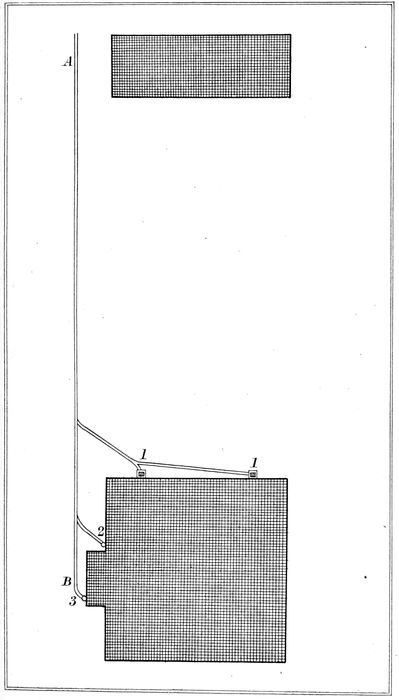
Plate 1 shows the drains as laid to a semidetached
villa, with two inlets from sinks marked
1, one from bath overflow marked 2, and two from
the soil-pipes of closets in the basement and first-floor
marked 3. The drain from A to B is a 6-inch
stoneware pipe, and its length is 100 feet. The
amount of gas in it would be 191096 1728 cubic feet.
The branch drains from the other inlets are 4 inches
in diameter, and the collected lengths are 50 feet,
and the quantity of gas in them would be 4627 1728
cubic feet, giving a total in the whole of the drain
of nearly 24 cubic feet.
If the indiarubber pipe to the detector or pressure
gauge is placed in either of the traps marked 1,
and the glass tube filled with liquid up to the data
line, 5 pints of water poured into either of the traps
marked 1, will produce a rise of 1 inch in the liquid
of the detector, that is if all the drains are clear and
joints tight, the drains being stopped off for testing
at A.
Should a trap be fixed anywhere between A and
B a lesser quantity will be required to lift the liquid,
and the position of the trap can be determined by
comparing the exact quantity of water used with
the capacity or quantity of gas in the drain.
19If a trap should be fixed or a stoppage formed in
any part of the drain A B, the flushing of a closet
or sink would, by the compression of the gas, force it
in bulk through the weakest trap, or the one having
the least dip or seal. The quantity which would
pass through would depend on the amount of water
used in the flushing and the fall of the drain.
The drains to the building having been tested, and
their defects ascertained, it will be necessary now to
test the soil-pipe.
On this plan it is fixed on the outside of the
house, having a trap with an open grating just
beyond the basement closet, and a ventilating pipe
carried above the eaves of the roof. Whether the
soil-pipe be fixed inside or outside of the building it
should be perfectly gas-tight, and in this testing a
person cannot be too particular.
In testing the soil-pipe shown on plan, the easiest
method is to put the detector or pressure-gauge at
the grating of the trap 3, placing the indiarubber
tube over the grating, and making a tight joint
with clay. Then close the top of the ventilating
pipe and pour water in the top closet, when, if
the joints are tight, the liquid in the detector will
rise suddenly, and then lower itself as the water
leaves the trap, indicating that the soil-pipe is tight,
but if it is not tight, no rising of the liquid will
take place. Should there be no trap at the bottom
20of the soil-pipe, it will be necessary to excavate
down to the drain to take out a length of pipe, to
seal the mouth of the drain with clay for testing.
If there should be leaky joints or holes in the soil-pipe,
a little sulphur burnt in the pipe, or a little
pungent essence thrown into it, will clearly denote
where the leaks are.
Having tested the soil-pipe and proved it tight,
or effectually stopped all leaks as the case may be,
no gas can be given off in these drains or fittings
except through the ventilators (under ordinary
circumstances) as no trap has been siphoned in
the testing.
As before stated, the ventilating pipe runs to the
top of the building of the same diameter as the
soil-pipe, in fact this is a plan of drains to a house
recently built in the suburbs of London, and the
planning of them would be considered perfect by
many sanitary men, but before we testify them as
perfect, let us carefully analyse the working of the
ventilation.
The ventilating pipe being carried above the roof
is strictly in accordance with the bye-laws of the
Local Board, although it spoils the appearance of
the house. One reason why it was put there is to
prevent the siphoning of the closet trap, and its
height is to carry out the recommendations of
medical writers in the Lancet who have so often
21insisted that these tall pipes, carried some feet away
from chimneys or bedroom windows, were necessary.
Let us test this theory.
We will flush the closet by throwing down slops
and giving the closet the regular flush, carefully
testing what takes place. The result is that the
soil-pipe, instead of carrying off the odours from the
top, only forms an air inlet, and 2¼ cubic feet of air
has been sucked in at the top of the pipe, and the
same quantity of gas discharged through the grating.
As this grating on the plan is only 2 feet from the
passage door which leads into the kitchen, the least
that occurs is that a portion enters the house, and
the cook has a slight headache when preparing the
meals for the day.
To be more certain of this let us test the working
of the ventilation by a dozen flushings of the closets,
and the same results are obtained by measurement,
27 cubic feet of air entered the top of the pipe, and
has been driven out at the grating below. This
proves that it is unnecessary to spoil the appearance
of our houses by the erection of these pipes, or of
carrying them above the soil-pipe or closet level.
It would not be consistent for me here to state
how these unsightly pipes could be avoided, but I
am confident that ere long they will become obsolete,
although they have been erected by thousands in
various parts of the country.
22We will now test the working of the ventilation
in drains A B, and those in branch drains to traps
marked I. As they are clear, we find that the
gases in them are not so poisonous as in the sewers
to which they are connected.
A manhole grating exists in the sewer some
40 yards from the back of the building, and through
this grating the gas which is driven by the flushing
escapes, and its density depends on the nature of
the soil passing in the sewer. Its density is lessened
by diffusion, or the mixing of the gas which takes
place at the grating, but the time it takes for the
gas which is in the drain near the traps I, to mix
with the fresh air at the grating in the street is a
problem that I will leave others to solve. We are
certain that no gas in bulk can pass through the
trap under ordinary circumstances.
We can now certify that the drains are tight,
well trapped and ventilated, they are laid strictly
in accordance with the bye-laws of the Local Board,
and we can quote that similar plans were exhibited
last year at the Health Exhibition, as models for
country architects and builders to copy; and ninety-nine
out of every hundred sanitary inspectors would
sign the certificate that the sanitary arrangements
were carefully tested, and found perfect.
Plate 2.
23Experience in working the detector will not allow
me to do this. Although for months not the
slightest particle of sewer gas has entered the
building, until one evening about eight o’clock a
sickly smell is observed in the kitchen, and this is
attributed to a change in the weather, heavy rain
having fallen during the day, and no notice was
taken of it before retiring to rest. In the morning
the house is unbearable. The inspector of nuisances
is sent for, who cannot detect anything wrong in the
drains. The surveyor to the Local Board visits the
house with the same result, and it is not until the
middle of the day before the nuisance has abated,
its cause still a mystery to the sanitary officials and
to the owner of the house, who is a medical man of
great experience in sanitary matters, and a sanitary
writer.
Now what really did occur was this. The sewer
at the back nearly filled with water and soil caused
by the heavy rains, and when this was rising, about
2 cubic feet of gas was forced from the drain B
through the grating at the bottom of the soil-pipe.
The junction where the drain at A joined the sewer
was made as usual about two-thirds the height of
the sewer, consequently the drain from A to B filled
some 20 feet during the storm. When the storm
abated, the water leaving the drain at A sucked the
trap at the bottom of the soil-pipe 3. The seal
being gone, the gas from the sewer at once came
through the trap, the current being estimated at
24from 80 to 200 feet per minute; so that the quantity
of gas given off at the trap, which is 2 feet from the
door, would be about 2000 cubic feet from the time
the trap was sucked until it was filled again by the
flushing of the closet.
This is by no means an exceptional occurrence,
two similar cases occurred in the suburbs last year.
In one case the owner of the house was seriously ill
for several days, and was for some weeks obliged to
neglect his business and seek a change of air. In
the other case the daughter was taken ill with a
zymotic disease which nearly cost her her life, and it
was months before she regained her strength.
The easiest method of preventing this siphoning
of the traps is to fix a small mica valve at the most
convenient part of the drain between A and B, fixing
it above the ground. You can also prevent it as
well as the gas coming near the house by putting in
a trap at A and having an open grating between A
and B. This would not prevent the 2000 cubic feet
of gas before referred to from escaping from the
drains, but would cause it to be discharged some
distance from the house. You would also have
about 23 cubic feet of gas in the drain always
mixing with the atmosphere of the garden at this
point when the traps are full and tight.
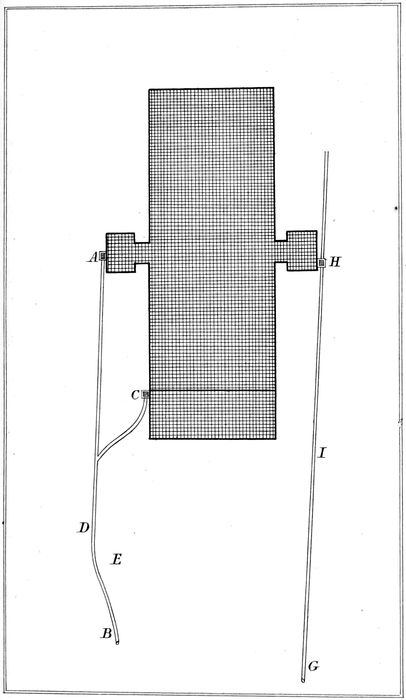
Plate 2 shows the plan and drains of a hospital
which I tested by this system in 1880. As it
was an old building the testing was somewhat
different to that described in Plate 1.
Plate 3.
25For years a sickly smell was observed in the ward,
and more especially when the heating apparatus
was at work, and it was thought to arise from the
number of bad cases in the ward. A good system
of ventilation was adopted by the introduction of
fresh air through flues which ran under the floor to
the whole length of the building, and in winter the
air was warmed by passing over hot-water pipes in
the flues, and was distributed at various parts of the
ward through open gratings in the floor, with a good
extraction in the roof, which was open to the ward,
but ceiled over the rafters.
Double the amount of fresh air was admitted,
warmed, and extracted, with a view to improve the
atmosphere of the building, but with no better
results. I then decided to test the drains which
were shown on the plan of the building as on
Plate 2, the drain marked A B being tested first
by stopping it off and fixing the detector at B.
This being a 9-inch drain pipe and the length
130 feet, gave 57600 1728 cubic feet as the contents of
gas in it. Adding 6 cubic feet for the branch
drain at C, making a total of 63600 1728 cubic feet.
The amount of water required to be thrown into
the trap A would be 1 gal. 5 pts. 3 ozs. to produce
the necessary pressure of gas in the drain to lift the
26liquid 1 inch in the detector. Instead of taking
1 gal. 5 pts. 3 ozs., it took 7 gals. 6 pts. 9 ozs.,
giving an additional 237 cubic feet of gas space to
be somewhere attached to the drain. This could
not be leaks, if it had been the liquid in the
detector would not have risen at all.
The ground was opened at D, the drain sealed,
and the detector fixed, and the total quantity of
gas in the drain by measurement from the seal to
trap A was found to be 46 cubic feet, and by testing
this was found to be correct, consequently the
additional gas space was between B and D.
I particularly noticed that the gases in these drains
were more poisonous than they should have been,
considering the nature of the sewage flowing through
them, and by using a reagent as a liquid in the
detector, its discoloration indicated that the gas was
in contact with a large quantity of putrid matter
which was of a different character to that of the
sewage flowing in the drain.
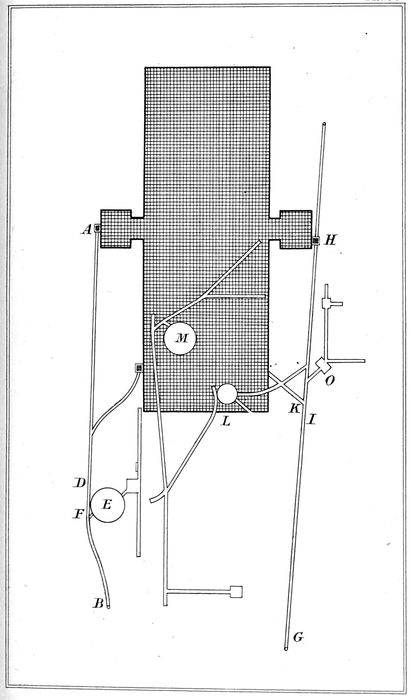
A drain searcher, or pointed rod was used, and
after driving it into the ground a few times, it struck
the large cesspit E, and by the sound given it was
clear that a drain was underneath, when, on excavating,
the old cesspit and drains shown on Plate 3
were discovered, containing more than 60 cubic
yards of black putrid sewage.
The junction at F was cut off and the drain
27made good, when a second testing by fixing the
detector at B gave the quantity of gas in the drain
to be 63600 1728 cubic feet.
The cleaning out of 60 cubic yards of sewage and
the removal of the old drains did not in the slightest
degree diminish the nuisance inside the building,
consequently the 15-inch drain on the opposite side
of the building was stopped off at G and H, and in
testing the detector was placed at G. This length
of drain being 140 feet contained 1751098 1728 cubic feet
of gas, and 4 gals. 4 pts. 8 ozs. of water thrown into
the trap H should have lifted the liquid to the
usual height in the detector. This and a similar
quantity of water did not indicate any compression,
but the discoloration of the reagent in the detector
was much quicker than on the drain which was first
tested.
The drain was then opened at I, dividing it into
two sections, that from G to I containing 93 cubic
feet. Testing this by 2 gals. 3 pts. 6 ozs. of water
gave the exact rise in the detector, consequently
the leaks and bad gas must be in the section from
I to H. This was tested by a fresh reagent in
the detector, when the speedy discoloration of the
liquid indicated that the source of the poison was
very near.
By a few piercings of the ground at K, by the
iron rod or searcher, the drain was found, and by
28following the old drain the two cesspits and additional
drains shown in Plate 3 were discovered, and about
150 loads of old putrid sewage had to be excavated
and cleared away. The leaks which prevented the
rise of the liquid in the detector were in the crown
of the old sewage tank M, and the hot-water pipes
of the heating apparatus running in an air-shaft
just over it, the heat extracted the poisons from the
sewage and distributed them into the ward.
The connections at K and N having been stopped
up, the drain from I H was again tested, when it
gave 36 cubic feet more gas space than there should
have been in the drain. A few piercings of the soil
at O led to the excavating of those old drains which
are shown attached, and these being excavated and
cleared away, and the connections to drains K, N,
and O being stopped, the drain was again tested
from I to H, when compression in the detector took
place in comparison to the exact quantity of gas
that should be by measurement in the drain.
In describing the method of testing drains as
shown on Plates 1, 2, and 3, nothing has been
mentioned as to the level to which branch drains to
houses should be laid, or the method of testing them
to ascertain their fall.
The fall given to branch drains should not be less
than 1 in 100, but 1 in 80 is far preferable, and if
the drains are laid to this level, water will flow easily
29through them, but should any part be laid out of
a level the water would lay in them and thus give a
less quantity of gas. Then when tested by compression
to the capacity of the drain the lesser
quantity would denote the nature of the dip.
When a plan of drains exists, as in the two cases
shown on Plates 1, 2, and 3, the difficulty of testing
them and proving their defects will not be as
great as when no plan has been made. If no plan
has been made or no record kept of them, it is best
to make a rough plan of the building, fixing the
positions of all inlets, their sizes and lengths, of
branches to the drains on the premises, and also to
lay down on the plan the length and size of this
drain to where it reaches the extent of the property
or joins the main sewer, opening the ground for
testing in a similar manner to that described in
Plate 1.
In testing pipes or sanitary fittings of any kind,
leaks can be easily found by attaching the detector
or pressure gauge to the most convenient part of
the pipe or fitting, and when everything is sound
care should be taken to flush all inlets at the same
time, to ascertain whether the rush of water has
any effect on the traps or water-seal. If the vibration
in the detector or pressure gauge exceeds 2/10ths
of an inch, a freer gas space must be provided, or the
action of the water checked in some manner. Pipes,
30whether sanitary or otherwise, can be tested as to
tightness in a similar manner.
Some modification may be necessary in testing
large sewers or the drains of a district, but if the
testing is performed in a similar manner to that
adopted in the above case the condition of the
drains and fittings can be accurately ascertained.
The least pressure or suction on the traps of drains
or fittings will be shown by the vibration of the
liquid in the detector or pressure gauge when the
water passes through the pipes with flushing.
The term “bad drains” is not exclusively
confined to those drains that have leaky joints, or
have an insufficient fall, or traps which siphon
during the passage of the water, but may also be
applied to systems of sewers in general. There are
two points in almost every system of drainage that
call for some improvement. The first is having the
inlets at junctions where small drains join sewers
at the side of the sewers. Thousands of traps are
being continually siphoned by this cause as soon
as the water fills the sewer above the inlet of the
branch drain, as this, when filled with water only
a short distance, forces gas through the weakest
trap, and on the water and soil lowering itself in
the sewer, this water acts exactly as the plunger of
a pump and draws the water out of the weakest
trap. This is often the one in the area or basement
31of the building, and to avoid this all inlets at
junctions should enter the top of the sewers, not for
the soil to drop down so as to cause the sewers to
silt, but in an oblique direction with the sewage
flow. The second point is in the ventilation of
sewers, which is not an easy subject to handle.
SEWER VENTILATION.
32
The question of ventilation is a very difficult one,
whether it is in connection with sewers or buildings.
The ventilation of buildings has received more
attention than that of sewers, excepting within the
last three years.
In the ventilation of buildings we have the work
and experience of Mr. Haden, Captain Galton, Dr.
Parkes, Messrs. Howarth, Tobin, Boyle, Banner, and
others, who have not only made the ventilation of
buildings their principal study, but have also spent
large sums of money in carrying out experiments
with a view of getting a system of ventilation
applicable to any building. I have no doubt that
each of the above authorities in house ventilation
would candidly admit that some of the most favourable
experiments they had made, and from which
at the time they expected the greatest results, had,
when they had been practically applied in different
localities and under different circumstances, proved
their worst failures in providing a regular supply of
fresh air to and the extraction of foul air from any
building.
If in the ventilation of buildings so many failures
to get a perfect and universal system can be recorded,
it is quite natural that the same will be the case in
the ventilation of sewers.
33The most eminent engineers of the present day
will admit that vast improvements must be made in
sewer ventilation before they can say of a district
where a quantity of drains are laid and a large bulk
of sewage matter is carried through them, that the
atmosphere of that district is as pure as that of one
where no drains are laid or where no sewage matter
can be found.
It was not until 1840 that the question of sewer
ventilation received very much attention, and it is
in the reports to the City Commissioners of Sewers
and to the Metropolitan Board of Works that the
earliest results are recorded.
The report of Colonel Hayward to the City
Commissioners of Sewers, dated 18th March, 1858,
contains some of the earliest and most valuable
information as to sewer ventilation.
In that report it is stated that, previous to 1830,
“the sewers were ventilated by the gulleys, which
were large open shafts or shoots connected with the
sewers without traps of any description: they were
connected with gratings of large size, the bars of
which were farther apart than those at present in
use; there were no ventilating shafts rising to the
centre of carriageways, nor were there any side
entrances by which access to the sewers could be
had. Whatever ventilation took place therefore
was effected by the gulleys, and if a sewer required
34to be cleansed or examined the mode adopted was to
open holes in the centre of carriageways down to
what are technically called manholes, or working
shafts, and perform these operations from these
apertures, the shafts being left open a sufficient
length of time to ensure ventilation before the men
descended, and if there was fear of an accumulation
of gas or mephitic vapour, which sometimes was the
case near the heads of sewers, but at few other
points in them.”
Complaints of the effluvium from these gulleys
were made before the year 1830, and are stated to
have grown louder and stronger after that date.
Here we have the first experience and results of
free and open ventilation to sewers. As regards the
number of these gulleys in proportion to the sewers
we have no evidence in these reports, but judging
from their being specified as large open shafts, the
area for the inlet and outlet of air to the sewers
would be if anything greater than that of the present
day. Yet this report states that the ill odours
which escaped from the gulleys, although they
might not be pestilential, became more repulsively
offensive, and the attention of the Commissioners of
Sewers was drawn to the evil, and it was felt that
some remedy or palliative ought to be devised.
The means taken to obviate this evil may be
termed the first experiment in sewer ventilation.
35“A gulley trap was devised and fixed in the Pavement,
Finsbury, in 1834, and in 1840 nine hundred of
the gulleys had been trapped with a view to remedy
the evil, with the following results.
“It became apparent even before that number was
fixed, that the sewers were becoming dangerous to
workmen to enter, and the gases generated found
vent by the house drains (then generally untrapped)
into dwellings.”
[It is quite evident that the compression of gases
which takes place in the sewers by the rising and
falling of the liquid and sewage flowing in them was
not then known, or this experiment by closing the
gulleys and ventilating the sewers through the house
traps would not have been attempted.
At any rate the first experiment in sewer ventilation
in the City cannot be said to have been a
successful one, as it left matters worse than before.]
“To obviate this, ventilating shafts connecting
directly with small iron gratings in the centre of
the carriageways were formed: this mode of ventilating
was also first adopted in the City, and the
system of trapping (with numerous modifications in
manner) and ventilating the sewers in the centre of
the carriageways spread through the length of the
metropolis.”
Can it be said that this alteration was an improvement
in sewer ventilation?
36The noxious or pestilential vapours that were so
repulsive in 1840 when escaping through the gulleys
were not rendered less poisonous by being given off
in the middle of the road or carriageways, but the
constant passing of carriages over the gratings had
the effect of mixing the gases of the sewer more
quickly with the atmosphere of the street. Thus
their noxious qualities were not so much observed,
but the effect of these gases on the public health by
this arrangement has not been as satisfactory as many
imagine.
When the carriage traffic is suspended during the
night, the effluvium from these gratings is now similar
to that experienced from the shoots or gulley shafts
in 1830. This opinion is formed by comparing the
report with testings taken at the gratings last year.
The last improvement suggested to give a better
system of sewer ventilation in the City is the erection
of shafts at the sides of the buildings where possible.
A resolution was passed last year by the City
Commissioners of Sewers to erect these shafts where
practicable. The effect of this alteration will be to
remove the nuisance from the street and carry it to
a higher level. If it is intended to work these shafts
in conjunction with the open gratings, the effect will
be that in some streets the whole of the gas from the
sewers adjoining will be pouring out of one shaft.
In the summer time its density will be increased by
37the friction in the shafts, and the high temperature
of the atmosphere will cause a more rapid decomposition
in the sewage.
In low buildings or warehouses there is nothing
to prevent the poisons from the sewers from being
conveyed down the chimneys into the buildings,
and the employés taking a zymotic disease whilst
engaged in their work and at night taking it to
various parts of the suburbs.
It is better to let the gas escape at a low level,
where it could be purified when it is a nuisance,
and especially in the case of an epidemic, than discharge
gas with a greater density at a higher level.
The General Board of Health in 1848 issued the
following minutes of information with reference to
sewers and house drains—
“Make proper provision for the ventilation of
sewers and drains in such a manner that there may
be a free current of air in them in the direction of
the sewage flow.”
It was also recommended “that the stack pipes
should be connected with the sewers without the
intervention of traps, in order to assist the ventilation,
and there should be no trap between the trap at the
inlet and the sewer.”
This system was found far worse than the open
gulleys or shoots in the City in 1830, as at Croydon
(which was one of the first towns to carry out works
38of sewage under the General Board of Health) no
sooner had the sewers been in use before an outbreak
of fever took place.
Dr. Niell Arnott and Mr. T. Page, C.E., were
appointed by the Home Secretary to report on the outbreak
at Croydon, and Mr. Page in his report states—
“Whenever a water-closet even with the best form
of siphon trap is introduced into a house, it will
be well to provide an escape into the open air.
When several soil-pans or sinks from the apartments
of a large house are discharged into a common soil-pipe
or vertical main, the main should be continued
up to the roof and to the open air, and if practicable
it should be carried near the chimney. Pipe sewers
must also have ample ventilation provided at all
available points. If the air is confined it is most
dangerous when it breaks forth, which sooner or
later it will do, such evils would have been avoided.”
It is quite evident by these remarks that the
system of ventilating the City sewers in 1830 was
more perfect than at Croydon, and had Mr. Page
tested the sewers and sanitary fittings by the compression
of gases in them, he would have found that
the action of the water in the pipe prevented the
gas from being confined.
In 1858, Mr. Goldsworthy Gurney made experiments
in the neighbourhood of the House of
Commons by connecting a number of the sewers
39near with the furnace of the clock-tower, and this
was reported on by Sir Joseph Bazalgette as follows:—
“I find that the furnace of the clock-tower of the
House of Parliament was supposed to have been connected
with the adjoining district to the extent of
about a quarter of a square mile, and with about
6½ miles of sewers, but that the ventilation had
in reality been intercepted by a flap so that the
benefit supposed to be derived therefrom was purely
imaginary. Having come to that conclusion, the
next thing I directed my attention to was, supposing
the whole of the air extracted by that furnace was
produced from the sewers, and supposing that all the
intermediate channels could be stopped, and that it
could be directed from the most remote ends of each
of the sewers, and distributed over those sewers with
the most perfect theoretical accuracy, so as to have
uniform currents passing through each of the sewers
towards that chimney, still the effect on those sewers
would be nothing, and the way in which I prove my
statement is this: the total area of the 6½ miles of
sewers now connected with the furnace is 713 feet,
the total area of the channel through which the air
has to be brought from them is 8 feet, that is about
the ninetieth part of 713; the air was passing at
the rate of 542 feet per minute through the 8 feet
area. Therefore, if I could divide that over the
40whole district, the velocity in all those sewers would
be 6 feet per minute or ⅕ of a mile per hour.
But we have shown already that there exist in the
sewers from other causes velocities amounting to
100 feet per minute and upwards; and 6 feet per
minute is practically speaking stagnation and not
ventilation.”
This experiment was undoubtedly one that if it
had been continued (instead of being abandoned),
and the errors corrected, would have led to a more
practical result. The area of the air space to the furnace
was 8 feet, and the current 542 feet, or equal to
6 miles an hour. If this current had been the same
in the sewers as in the channel, the suction produced
on the water-traps of the small drains attached
would lift the water in each trap a little more than
3 inches. But as the ordinary trap has only an
average 2-inch dip, the weakest would have been at
once sucked and the experiment a failure. Had the
dips of the traps been 4 inches, the drains would
have remained sealed except at the intended inlets.
The air being supplied at the ends would have gone
through the sewers without breaking the water-seal,
providing that the air space between the crown of
the sewer and the sewage was not in any way
blocked. If the current in the sewers had been
less than 200 feet per minute, the ordinary trap
would have effectually sealed the various inlets.
41Had the average area of gas space above the sewage
been 8 feet, the whole of the 6½ miles of sewers
would have been emptied of its gas and supplied
with fresh air in about an hour. The different areas
should not have been considered, but the total quantity
of gas taken.
The velocities of 100 feet here mentioned, is accounted
for as follows. Should the sewage in any
part of the sewers lower itself, causing an additional
gas space in that part of the sewer, the rush of gas
in the sewer to fill the space would cause this 100
feet per minute current.
These hitherto unaccountable currents in sewers
and drains are produced by the variation of the gas
space above the sewage, the result of water being
thrown in at the various inlets.
The gases of a sewer may be passing backward
and forward in currents varying from 100 to 300
feet per minute, and not any ventilation would take
place except at the gratings, and this would be very
little indeed when the gas in the sewer was of a
heavier gravity than the atmosphere.
Speaking on the same subject, Colonel Haywood
says, “a down draught so complete as to be superior
to the diffusive power of the gases, you cannot start
with a velocity of less than 2 miles an hour, and suppose
the whole district has been so arranged as to have
a sufficient exhaustive power, the mere opening of
42a water-closet, or the enlarging or the putting in of
a new drain into a sewer, or the making of a hole a
foot square, or a servant taking up a bell trap in a
sink, or a sewer-man lifting a side entrance covering,
would very much destroy the power of the furnace,
and unless you had a gigantic power sufficient to
guard against these casualties the system could only
be a failure.”
What is here meant is, suppose that if the
whole of the 6½ miles of sewers were emptied of
their gas at a velocity of 2 miles an hour, the poisons
from the sewage would not be noticeable or injurious
in the atmosphere of the drain. If each inlet to the
sewer was trapped, the opening of a water-closet or
the opening of a bell trap in the sink would not have
affected the 2 miles an hour current in the sewers.
Had the currents in the sewers near the furnace
of the clock-tower been kept at 2 miles an
hour, the traps being tight, and attention been paid
to the compression of the gases in the sewers by the
water entering them, the experiment would have
been in a measure a successful one.
From 1855 to 1872, Sir R. Rawlinson, C.B.,
Dr. A. Miller, and Sir Joseph Bazalgette were
carrying out experiments with charcoal trays and
screens, and a committee of the Metropolitan Board
of Works in their report, say:—
“The results were sufficiently favourable to warrant
43the use of charcoal ventilators in connection
with such air-shafts as were sources of annoyance
and complaint, but their adoption had also the effect
of diminishing the upward current of foul air through
the shafts and of confining it to the sewers, thereby
endangering the safety of the men working in them,
so that it is necessary that such ventilators should
be cautiously and not generally applied.”
These experiments in sewer ventilation were the
most valuable of any yet made to solve the question,
but their failure could be attributed to the following
results.
The working of charcoal in the extraction of
poisons given off from sewage in its transit through
the sewers, and which poisons become mixed with
the gas, and the placing of charcoal in layers or
baskets so that the gas should pass through the
interstices of the charcoal, is without a doubt the
best method of dealing with charcoal as an agent
in arresting or picking up the poisons from putrid
matter which is contained in the gas. But the
obstacle this gives to the supply or exhaust of air to
the sewer is greater than the power of the water-trap:
consequently traps are sucked or forced, and the inlet
of fresh air takes place through them into the sewers.
The gas from the sewer escapes through the
weakest trap into the house, thus nullifying the
effects of the charcoal trays and rendering them
44almost useless. The passing of the gas over the
tray would prevent this, but experiments prove that
charcoal has not the power to attract and retain the
poisons from the sewage, and which is retained in
the gas. Thus these poisons pass over the charcoal
through the grating into the street.
These experiments prove that if the poisons from
the gas are extracted at the outlets, and the drains
into sewers trapped with a water-seal, and the
siphoning or forcing of traps are prevented, sewers
can be ventilated without being a nuisance or prejudicial
to health. But it must be borne in mind
that the instant the current of air in sewers, drains,
soil-pipes, or sanitary fittings exceeds a velocity of
3 miles an hour, even if they have open ends, no
trap with a 2-inch seal is safe from being siphoned.
Many surveyors state that sewer gas is uncontrollable.
This is an error. The gases of a sewer are
as controllable as the atmosphere of a room. It is
the compression of the gas caused by an increase of
water in the drain, and the temperature of the
atmosphere on the surface of the ground at the
various points where the gratings are fixed, which
makes the currents of gas in drains so uncertain.
The sudden lowering of the sewage in a drain will
stop the nearest gratings or shaft from working as
inlets.
What led engineers to form this opinion was the
45failure of experiments with motive power to get
certain results in ventilating sewers, the same as in
a building. It is impossible to get ventilation to
sewers through open gratings except the inlets from
the house drains are sealed with a water-seal.
The unsatisfactory results obtained from many
experiments in sewer ventilation have not been the
fault of the plan or the appliances used, but arose
from the wretched manner in which house drains
have been connected to the sewers.
I shall never forget the testing of some sewers
with a view of improving the ventilation of them.
They were public sewers and almost new ones, and
as far as the sewers themselves were concerned you
could not have had better, both as regards a good
fall and tight joints. But the manner in which the
connections were made to them was something
astonishing. Untrapped gulleys at the sides of the
streets, drains from the sewers into the kitchens of
houses without a single trap. In some cases two or
more traps were fixed according to the whim of the
owner of the house. Rain-water pipes from the
flats of windows on the ground floor were connected
to sewers without traps, closets with no ventilating
pipes, and a dozen other imperfections were found
on the branch drains and fittings.
Before completing the tests of these drains and
fittings, I suggested that all faults and errors found
46in connection with the branch drains should at once
be remedied, and each drain be connected to the
sewer with a trap, or else it would be of little use
to improve the ventilation of the sewers. I was
quietly informed that this could not for one moment
be entertained, as where these evils were the worst
was on property belonging to members of the Local
Board, and any attempt to pass a resolution to
compel this to be done would be futile, and the
necessity of doing it attributed to the zeal of local
sanitarians.
I am glad to say that cases like this are exceptional,
but there are many towns where similar evils
will remain until an epidemic breaks out and the
authorities are compelled to have them remedied.
The amount of air passing through the sewer is no
indication of the ventilation or the amount of air
that is being admitted, or the quantity of gas
charged with poisons that is given off. I have
tested the gas in a sewer and at the ventilating
shafts, and have repeatedly found the gas in the
sewer flowing at a high velocity whilst the air in the
open ventilating shaft was perfectly stagnant.
I have not been able to make experiments to
know how long gas will remain in a sewer, but from
observations of its gravity and working in different
localities I believe that the poisons from sewage
matter are retained in the lower strata of the air of
47sewers in some cases for months, and when open
gratings are only 50 yards apart. The quantity of
air taken in at the gratings at this time is a little
more than the displacement caused by the water, and
when gases are released to any extent it is through
atmospheric influences.
If you measure the amount of air going in and
out of say twenty open gratings in the same locality,
the small quantity would astonish those who had
not previously tested it.
Repeatedly has it been written and said that if
you put a shaft or grating at the top of a hill, or
sewer, it will take off the impure gas of a district,
but I have had men working for days at the top of
a sewer 150 and 200 feet higher than the lowest
grating, and no trap intervening, yet during this time
not a particle of gas left the drain at this the highest
opening, but at times a good inlet current would
take place down the drain.
I find that one of the most fatal mistakes to
make in sewer ventilation is to introduce a large
quantity of fresh air into a sewer at a high temperature.
An atmosphere at from 90° to 100° thrown into
a sewer will rapidly decompose sewage matter and
produce results exactly opposite to that intended.
It is when the hot atmosphere of a summer’s day
comes in contact with the sewage in the sewers that
the worst poisons are generated and given off, and
48the gases which come from the gratings are the
most noxious. This rapid decomposition is more
particularly felt in the suburbs, where the drains are
of stoneware and the sewage has to be carried through
them for a considerable distance.
Common sense teaches us that all matter of a
nature like that passing through sewers will decompose
more rapidly and reach a higher state of putrefaction
in an atmosphere of a high temperature,
even above ground, than in any other condition.
Experiments confirm this to be the case whether it
be applied to matter in sewers, vaults, or tanks.
The best experiments that I have made in sewer
ventilation is in keeping the temperature as low as
possible, admitting into the sewer sufficient air to
prevent any action taking place on the water-seal,
and what gas came out of the sewer by compression
to purify it at the gratings, extracting the poisons
that it had taken up from the sewage.
Many gases which are found in sewers have an
affinity to water, and will make their way to the
water-seal and become absorbed in the water of the
trap to some extent, but not to the extent many
persons imagine, or to become detrimental to health.
When a disinfectant having a greater attractive
power than the water is used in connection with the
ventilation, this attraction to the water-seal will not
take place.
49If necessary, in hot weather or in large sewers, or
those of an easy gradient, cold air of a very low
temperature could be introduced, which would prevent
decomposition taking place to any extent
during the transit of the sewage. If the whole area
of a system of sewers was charged four times a day
with air at a temperature of 30° we should have no
complaints of sewer gas.
The details of such plans would be out of place
here as they are the subject matter of several patents,
but sewage can be carried through districts without
its gases being injurious to health or without sewage
being subjected to rapid decomposition almost as
easily as meat is now transmitted from New Zealand
to England without any decomposition taking place
during its transit.
Before leaving the question of sewer ventilation it
will be well to note the results obtained by the valuable
experiments I have quoted, and which have been
made from time to time by the City Commissioners
and the Metropolitan Board of Works. One cause
of the failure of these experiments has been conclusively
proved to be due to the wretched condition
of branch drains and house connections attached to
the sewers on which the experiments were made, and
these are in a measure out of the control of the
officers of these Boards; and until a proper survey of
branch drains and house connections has been made,
50and traps placed in proper positions, the ventilation
of these sewers will be almost as imperfect as in 1830.
The sanitary survey which is now being made in
this country by the Local Government Board will
fail in one of its most important objects unless it
insists on every surveyor knowing the condition of
drains under the surface of the ground. A cursory
glance at the plans of a district, or a surface
sanitary survey will not do very much in arresting
zymotic disease, and the staff stated to be employed
on this survey is totally inadequate for the
work.
To successfully deal with sewer ventilation it
should be divided into two sections: (a) That of the
sewers and branch drains which are directly under
the control of the officers of the various Boards,
(b) Those drains immediately attached to houses,
including the soil-pipes.
The necessity for ventilating a sewer is, that in an
unventilated sewer or drain the instant a compression
of the air in a sewer, between the sewage and
crown of the sewer, takes place to 1 300 part of its
bulk, gas is forced through the weakest trap according
to the displacement of water, and as the water
is lowering in the drain fresh air will be admitted
into the drain through this trap. Thus if a drain or
sewer is not ventilated it will ventilate itself.
Should a sewer be ventilated with open gratings in
51the centre of the roads, the placing of gratings at a
moderate distance apart would diffuse the gas
equally in a flat district if the temperature on the
surface of the ground at each grating were the same,
but the variation of the temperature in streets
is such that the heat of the street at one grating
will be a sufficient motive power to extract the gas
from many sewers through this one grating, the
others only forming inlets while the increased heat
lasts.
In hilly districts, where the drains are of
necessity of a steep gradient, the quick flow of the
sewage will cause the gas to pass more rapidly when
much sewage is flowing in the drain, the worst gas
coming out at the lowest grating, generally a grating
before a junction, or where two drains meet of
different gradients: but when scarcely any sewage
is flowing, the gas will flow to the highest grating.
Thus, in putting gratings on steep gradients (if no
method of purifying the gas is used), the gratings
should not be placed in regular distances apart, but
where the gas can be discharged in the most open
space.
In hot weather, although ten times the amount of
air passes through sewers of steep gradient than in a
flat district, the gases from sewers on a steep gradient
are far the most noxious. If open gratings only are
used on a system of sewers, the gas but not the
52sewage should be trapped off into districts, not
only as the means of preventing the gas rushing in
volumes to certain points, but for preventing germs
of disease travelling in the gas of a sewer from an
unhealthy to a healthy district, which is the case
under the present system, by leaving sewers for
miles without any gas check.
We have in sewers and drains a power created
by the influx of the sewage which is greater than
any mechanical means that can be used in the
ventilation of them, and it is to get the best method
of applying this power that sanitary engineers must
direct their attention.
The difficulties that are met with in ventilating
sewers with open gratings are so great, that I am
convinced that as soon as engineers study the question
more fully, the system will be abandoned.
The method of carrying off the soil by water
through sewers has proved a good and convenient
one, and scarcely any defect can be found in any
drainage scheme except that of the ventilation, which
is at present one that is condemned by the inhabitants
of most towns as a nuisance, especially in hot
weather, and by the medical profession as being most
prejudicial to health.
As a remedy for this, we must profit by the experience
of the early experiments I have quoted, which
points conclusively to the fact that if we extract
53from the gas (which by compression must of necessity
leave the sewers at openings) the noxious and
disease-producing poisons contained in it, at the
gratings, and by those means prevent a rapid decomposition
of the sewage taking place, and without
putting any undue pressure on the water-seals to
houses, we have overcome the greatest difficulty in
the work.
In old drains or sewers it will be the work of some
time for the surveyor to know that each drain from
the house to the main sewer is trapped with a good
water-seal, yet this is the most important factor in
providing good ventilation.
Some persons have hastily condemned the water-trap,
having found out that they have been siphoned
by the transit of the sewage. This is a mistake. A
properly constructed water-seal or trap that clears
itself at each flushing is the best seal for sewer gas.
It will not keep out gas if it is forced in bulk by
excessive pressure, any more than coal gas can be
kept out of houses if a greater pressure is put on
at the works than the resistance of the trap in the
chandelier. In manufacturing gas, either experimentally
or otherwise, water is the seal always used,
but we do not attach anything to break that seal
when dealing with gas for illuminating purposes,
the same as is done in many cases with sewers.
Where new drains are laid, no difficulty in getting
54a good seal to branch drains need be experienced,
and no drain from the house to sewers should be
laid without its being completely disconnected or
cut off as near the soil-pipe as possible.
In dealing with the ventilation of soil-pipes or
vertical drains, many improvements can in future be
made. The idea of carrying tall ventilating pipes to
the tops of houses was to carry off gas that was
forced in bulk through the trap at the bottom of the
soil-pipe from the sewer, but in well-laid drains this
should never occur. If the drain be disconnected it
would leave at the point of disconnection.
The velocity of the water rushing down the pipe,
as proved in the previous chapter on drain testing,
carries the gas out at the bottom of the pipe, the
top of the pipe forming the inlet when odours are
given off from the passing soil, but as soon as the
flushing is over a return current takes place and
fresh air ascends the pipe.
If you do not use any method of purifying the gas
which escapes through the pipe, the best plan is to
have the pipe as open as possible at the top and
bottom, and at all bends, for ventilation. These
openings need only be just above the level of the
water flow to prevent splashing, and by following
this rule those unsightly pipes (which give buildings
more the appearance of a distillery or chemical
works rather than a dwelling-house or home) can be
55avoided and erected so as to form one of the ornaments
in the architecture of the building.
There is at present too much theory in sewer
ventilation, without paying any attention to results
gained, or to the laws which control the atmosphere
and its action on sewage matter.
THE ORIGIN AND TRANSMISSION OF ZYMOTIC DISEASE.
56
Whilst making experiments and taking observations
five years ago, to trace the origin and transmission
of some cases of zymotic disease, I formed an
opinion that the theory as regards the transmission
of zymotic disease by contagion was to a certain
extent an erroneous one.
I mentioned this to some of my medical acquaintances
at the time, but as it was so opposite to the
prevailing ideas, I was advised not to publish or
hold out such opinions, as they were contrary to the
theories accepted by the medical profession.
Now that these theories have been severely shaken,
and in many cases reversed by medical men themselves,
during the past year, I shall plead no excuse,
but insert them for the guidance of those engaged in
sanitary work.
The source of zymotic diseases may be traced to
persons inhaling or taking into the system poisons
from putrid sewage matter, and those poisons are
conveyed into the body, either in the food they eat,
the water they drink, or the air they breathe.
Whether they are organic or inorganic, they poison
the blood, which becomes more or less diseased,
according to their density or vitality, or whether
57each of the zymotic diseases is produced by distinct
organic germs grown and developed from
putrid matter under different atmospheric influences,
it matters not to my mind in proving the true method
by which zymotic diseases are transmitted.
On the origin or source from which these diseases
are produced, I do not think there are two opinions,
viz. that of poisons from putrid matter, and the question
to be solved is in what manner these poisons
are conveyed into the system. To do this it will be
necessary to quote some cases of zymotic disease
and the circumstances which surrounded them.
In a small district, a girl thirteen years of age was
taken with diphtheria, and in two days after the
younger brother was taken and the other children
appeared sickly. From investigation it was certain
that the poison had not been conveyed into the system
by food or water. The children generally took their
meals in the kitchen, the door of which opened into
the yard, which was about 10 feet long by 8 feet wide,
in the corner of which was the W.C. I tested the
atmosphere entering the room at the bottom of the
doorway, and found that it contained poisonous
matter, and on testing the closet and drains I found
a hole 3 inches by ¼ inch in the closet trap. Here
was the source of poison which produced the disease.
The gas in the drain was confined between two traps
and in contact with putrid sewage matter, and when
58it was removed no poison from any other source
could be detected. The first child that was taken
ill died, but the other recovered.
Now it is quite evident that the second child did
not take the disease from the first, as it had not time
to develop. The atmosphere of the room and the
breath of the child were not as poisonous as the
atmosphere of the kitchen in a line between the
kitchen fire and the door, and it was on this line
both children sat at their meals, and thus inhaled
the poison with their food. Had the gases in the
other drains of the district been of the same density
as in this one, and similar leaks existed in the
sanitary fittings, diphtheria would have spread, and by
the popular theory its transmission would have been
attributed to contagion from this family, which in
face of the above facts would have been incorrect.
Another case. In a large town diphtheria broke
out, and some hundreds were attacked and over two
hundred died. The source of the disease was not in
the food or water, and the only disease-producing
poison that could be found was in the gas issuing
from the sewer gratings and sanitary fittings.
Schools were closed and the usual remedies used
to prevent contagion, but all to no purpose. The
sewers being of an easy gradient had silted,
forming at intervals masses of putrid matter, and in
the best houses, where the disease was most prevalent,
59poisons from the sewers were laid on to them
by the badly-constructed drains and sanitary fittings.
The authorities at last took the matter vigorously
in hand, cleansed and sweetened the sewers as much
as possible, and then the disease abated and died
out. Had contagion been the means by which the
disease was transmitted, it would have continued as
it existed in the town under almost every kind of
atmospheric temperature.
Here we have evidence showing that putrid
matter did exist from which poisons were given off
and their mode of transit into the body, but not
the slightest evidence to prove the poison passed
direct from one person to another.
These poisons in the gas can be destroyed by
washing the gas in a chemical solution on leaving
the grating, and since this has been done medical
men have cured the disease by washing the throat
in a similar solution.
Numbers of typhoid cases could be mentioned
where poisons from putrid matter were conveyed into
the system by water, milk, and impure food, but I
have never heard of a case where the poison was
detected leaving one person for another.
If in 1883 a person had stated that cholera was
not contagious, they would have been ridiculed, yet
the principal physician and those in charge of the
cholera hospitals of Paris last year, certified to the
60representative of one of our daily papers that cholera
was not contagious. The cholera epidemic of last
year proves that cholera poisons are produced by
heat and atmospheric influences on putrid matter,
and circumstances favour the theory that they are
inorganic, and when inhaled into the system poison
the organisms of the blood to such an extent as to
produce the disease. Cases of cholera broke out in
different parts of the Continent at the same date,
clearly showing that contagion had nothing to do
with producing or transmitting the disease. In
England our ports were jealously watched to prevent
any case from being landed. Had a case been
landed, the excreta from that one case might, when
mixed with the sewage of a large town, have been
the means of spreading the disease through the
whole district, as miles of sewers are so laid that
poisons in the gases can be effectually distributed
through the district in a very short time. Open
ventilation to sewers would greatly assist this, and
especially when the gases in the drains and the fresh
air admitted into them were of a high temperature.
It is very improbable that cases if imported would
break out in two towns at the same time, or that the
poison could be conveyed in the atmosphere which
divides us from the Continent.
Fortunately, when the continental outbreak was
known, the authorities in the metropolis and other
61towns used disinfectants on all known putrid matter,
and especially at the sewer gratings. This was an
expensive process, but it had the effect of preventing
the atmospheric influences (which were similar to
those on the Continent) from developing the poison
to a vitality necessary to give the disease.
It would be an excellent preventive if the authorities
of towns would thoroughly examine every
part of their districts, and know for a certainty
whether in their sewers, cesspits, vaults, or dust-bins
there existed putrid matter, or gases from them
similar to those which produced the disease on the
Continent. The expense of such an examination and
for remedying the evils cannot be an excuse for not
doing this work, as the monetary loss experienced by
the residents of those continental towns and cities by
the outbreak was enormous. What the loss would
be to the residents of the metropolis if a cholera
epidemic were to occur, it is difficult to imagine, and
yet in many of the districts cholera-producing
elements exist from which in all probability the
heat and atmospheric influences experienced during
several weeks of excessive dry weather during the
summer months will produce poisons of a similar
vitality to those produced on the Continent during
the past year.
Previous to the cholera epidemic, small-pox was
very prevalent in London, and I very carefully noted
62the cases as they were reported, and visited the
districts where the disease was most prevalent, for
the purpose of testing the nature of the gases in the
sewers, and observing how the sewers and sanitary
fittings were constructed.
In many of these districts, and especially those of
Homerton, Hackney, Bow, and Bromley, the drains
are so laid and the fittings so constructed that a
supply of sewer gas is pumped into the houses, and
it is impossible for persons to live in the houses of
these districts without inhaling gases that have been
for a long time in contact with sewage matter.
Whether the small-pox poison is an organic one
(which I believe it is), and is produced from a collection
of matter in a high state of decomposition, with
or without being mixed with the excreta of persons
suffering from the disease, or whether it is of an
inorganic nature, the poison is derived from this
source rather than from the impurities thrown off
through the skin of persons suffering from the
disease. As a proof of this, as soon as the cholera
broke out last year on the Continent, almost every
gulley and grating in the metropolis where sewer
gas passes was charged more or less with a disinfectant,
which minimised the poison in the gas.
The result was that small-pox abated in an epidemic
form although the temperature of the atmosphere
increased.
63The disinfectants so placed could not, naturally,
affect the gas in branch drains to houses, or putrid
matter in various parts of the sewers, or if it had,
judging from its beneficial effects at the outlets,
small-pox would have disappeared.
If contagion were the means by which this disease
was distributed, disinfectants at sewer gratings would
not have prevented the disease continuing in an
epidemic form.
Take the adjoining districts of Fulham and
Putney. During the epidemic, the gases from the
sewer gratings in the Fulham district were more
dense than those at Putney. Fulham had many
cases of small-pox, but Putney none, although persons
from each district were in daily contact with
each other; but the houses were not connected by
the same system of sewers.
It must not be thought that I wish to advance the
theories of the anti-vaccinationist. I have had my
children vaccinated because it is the law, and in the
opinion of medical men a preventive against the
disease, but viewing the change of medical opinion
with reference to cholera during last year, and comparing
tests and observations that have been made,
they will soon be convinced that vaccination is a
futile remedy to use with a view of stamping out
the disease.
At present the question is (with medical men) one
64of theory, but ere long I am certain that they will
take a more practical view of the case and definitely
fix the origin of this disease and its distribution.
Previous to vaccination being introduced, putrid
matter in vaults, cesspits, and drains was allowed
to reach a higher state of putrefaction, and thus the
poisons from them became more virulent and produced
the disease of a more virulent type.
If modern systems of drainage and sanitary
arrangements were the means of preventing this
high state of putrefaction, and of reducing the
disease to a milder form, perfecting these arrangements
should be the means of stamping it out
altogether and rendering vaccination useless.
Unless it can be proved that poisons given off
through the skin and from the lungs of persons
suffering from the disease are as virulent as those
from putrid matter alone, or from the excreta from
those suffering from the disease, the theory of
contagion[2] cannot be entertained.
2. The word contagion as here used is not intended to apply
to cases where persons not affected sleep in the same bed, or
wear the same clothes, or handle things from, or persons suffering
from this disease, as this would be inoculation.
Many medical men will say that the facts to prove
that small-pox is transmitted by contagion are so
positive that there is no chance of disputing them.
Let us examine two cases to support this theory.
65Small-pox is prevalent, say, in the north of London;
a man is in business there from seven to eight hours
each day, but his home is in the S.W. district. He
is taken ill, and remains at home, calling in his
medical attendant, who on his second visit pronounces
it a case of small-pox, and orders his removal to the
hospital. In a few days other members of the
family are taken and removed, and similar cases
occur in the neighbourhood.
The theory of the medical man would be that his
first patient had contracted his disease in his place
of business in the N.W. district and had conveyed
it to the S.W. district, distributing it in the neighbourhood
in which he lived. This is only theory,
and the only thing the medical man has to rely on
to prove his case is, that the man first taken was
engaged three-fourths of each day where small-pox
was prevalent. Against this theory, assume that
the disease originated by the whole of these persons
inhaling poisons from putrid matter in their own
locality or at their own doors, or in their homes,
but that the atmospheric influences to develop the
poison was a few days longer completing its work in
the S.W. district than in the north. Then test the
sanitary conditions of both localities, and you will
find similar matter producing poisons. These are
facts that will support this view of the case, as well
as the following evidence which cannot be contradicted.
66When sewage matter is allowed to remain
in bulk undisturbed, and in connection with a
system of sewers, it forms retorts for the generation
of these poisons, and they are conveyed for miles
in drains by atmospheric and other influences; and
where these people lived the gases would probably
be discharged with a greater facility than at any
other point.
Take another case. A man leaves London for the
country, and a day or two after his arrival he is
taken ill with small-pox. There is no system of
drains to the house in which he is located. People
living in this and other houses are affected with
the disease, and the medical officer of health in his
report states that the disease was conveyed from
London to the district by this man. He was
certainly the first one affected, and at first sight
this case appears to be conclusive in favour of
contagion, for if he did not contract the disease in
London and bring it into the country how was it
that he was first affected?
It is certain that putrid matter from which the
poisons are derived exists in villages similar to that
in towns, consequently the poisons are there, and
medical men agree that when a person leaves one
locality for another, for what is commonly called a
change of air, the system undergoes a change. This
change had such an effect on the system of this
67man that the poison from the putrid matter of the
village had a greater effect on him and poisoned the
blood more quickly, than on those who were inhaling
the poison during its various stages of development:
but when it was fully developed by atmospheric
influences the disease appeared in those other
persons who were in contact with the poison.
The action of sewer poison on the system is
similar to that experienced by persons taking cold.
Persons occupied in rooms which have an equal
temperature, or are not subjected to cold chilly
winds, take colds and contract all sorts of complaints
on being exposed to currents of cold air even for
a short time. The draught from a window only,
when a cold stream of air is playing upon it,
will do this: the blood is chilled, hence the cold,
fever, or one of the many complaints follow; but on
persons used to exposure it has no effect. In the
same way sewer poisons act on those who suddenly
inhale them, only the blood becomes poisoned
instead of chilled; but on those who are in constant
contact with them they have not such an effect,
yet on these persons the effect of them can be traced.
The medical profession have hitherto placed too
much reliance on isolation as the sole means of
stamping out this disease.
The Metropolitan Asylums Board have had ample
means at their disposal since 1867 to test the soundness
68of this theory, yet after spending something
like 480,000l. per annum, small-pox has increased
100 per cent. since that date! This fact alone is
sufficient evidence to prove that other means than
those of isolation must be used to effectually stamp
out this disease.
It is of little use to have elaborate arrangements
in hospitals and camps to minimise the effects on
persons who have taken the disease, and at the same
time allow the source from which it emanates to
remain undisturbed. I admit that it is a question
too complicated to be exhaustively dealt with in a
work on the testing of drains and sanitary fittings,
but it is inserted to show what a power those who
are engaged in designing or executing sanitary
works hold for good or evil in affecting the health
of the community.
Experience proves that ninety-nine zymotic cases
out of every hundred are caused through imperfect
sanitary works and appliances.
LONDON: PRINTED BY WILLIAM CLOWES AND SONS, LIMITED, STAMFORD STREET AND CHARING CROSS.
69
BOOKS RELATING
TO
APPLIED SCIENCE
PUBLISHED BY
E. & F. N. SPON,
LONDON: 125, STRAND.
NEW YORK: 35, MURRAY STREET.
A Pocket-Book for Chemists, Chemical Manufacturers,
Metallurgists, Dyers, Distillers, Brewers, Sugar Refiners, Photographers,
Students, etc., etc. By Thomas Bayley, Assoc. R.C. Sc. Ireland, Analytical
and Consulting Chemist and Assayer. Third edition, with
additions, 437 pp., royal 32mo, roan, gilt edges, 5s.
Synopsis of Contents:
Atomic Weights and Factors—Useful Data—Chemical Calculations—Rules for Indirect
Analysis—Weights and Measures—Thermometers and Barometers—Chemical Physics—Boiling
Points, etc.—Solubility of Substances—Methods of Obtaining Specific Gravity—Conversion
of Hydrometers—Strength of Solutions by Specific Gravity—Analysis—Gas Analysis—Water
Analysis—Qualitative Analysis and Reactions—Volumetric Analysis—Manipulation—Mineralogy—Assaying—Alcohol—Beer—Sugar—Miscellaneous
Technological matter
relating to Potash, Soda, Sulphuric Acid, Chlorine, Tar Products, Petroleum, Milk, Tallow,
Photography, Prices, Wages, Appendix, etc., etc.
The Mechanician: A Treatise on the Construction
and Manipulation of Tools, for the use and instruction of Young Engineers
and Scientific Amateurs, comprising the Arts of Blacksmithing and Forging;
the Construction and Manufacture of Hand Tools, and the various
Methods of Using and Grinding them; the Construction of Machine Tools,
and how to work them; Machine Fitting and Erection; description of
Hand and Machine Processes; Turning and Screw Cutting; principles of
Constructing and details of Making and Erecting Steam Engines, and the
various details of setting out work, etc., etc. By Cameron Knight,
Engineer. Containing 1147 illustrations, and 397 pages of letter-press.
Third edition, 4to, cloth, 18s.
70On Designing Belt Gearing. By E. J. Cowling
Welch, Mem. Inst. Mech. Engineers, Author of ‘Designing Valve
Gearing.’ Fcap. 8vo, sewed, 6d.
A Handbook of Formulæ, Tables, and Memoranda,
for Architectural Surveyors and others engaged in Building. By J. T.
Hurst, C.E. Thirteenth edition, royal 32mo, roan, 5s.
“It is no disparagement to the many excellent publications we refer to, to say that in our
opinion this little pocket-book of Hurst’s is the very best of them all, without any exception.
It would be useless to attempt a recapitulation of the contents, for it appears to contain almost
everything that anyone connected with building could require, and, best of all, made up in a
compact form for carrying in the pocket, measuring only 5 in. by 3 in., and about ¾ in. thick,
in a limp cover. We congratulate the author on the success of his laborious and practically
compiled little book, which has received unqualified and deserved praise from every professional
person to whom we have shown it.”—The Dublin Builder.
Tabulated Weights of Angle, Tee, Bulb, Round,
Square, and Flat Iron and Steel, and other information for the use of
Naval Architects and Shipbuilders. By C. H. Jordan, M.I.N.A. Fourth
edition, 32mo, cloth, 2s. 6d.
Quantity Surveying. By J. Leaning. With 42 illustrations,
crown 8vo, cloth, 9s.
Contents:
A complete Explanation of the London Practice.
General Instructions.
Order of Taking Off.
Modes of Measurement of the various Trades.
Use and Waste.
Ventilation and Warming.
Credits, with various Examples of Treatment.
Abbreviations.
Squaring the Dimensions.
Abstracting, with Examples in illustration of each Trade.
Billing.
Examples of Preambles to each Trade.
Form for a Bill of Quantities.
Form for a Bill of Credits.
Form for a Bill for Alternative Estimate.
Restorations and Repairs, and Form of Bill.
Variations before Acceptance of Tender.
Errors in a Builder’s Estimate.
Schedule of Prices.
Form of Schedule of Prices.
Analysis of Schedule of Prices.
Adjustment of Accounts.
Form of a Bill of Variations.
Remarks on Specifications.
Prices and Valuation of Work, with Examples and Remarks upon each Trade.
The Law as it affects Quantity Surveyors, with Law Reports.
Taking Off after the Old Method.
Northern Practice.
The General Statement of the Methods recommended by the Manchester Society of Architects for taking Quantities.
Examples of Collections.
Examples of “Taking Off” in each Trade.
Remarks on the Past and Present Methods of Estimating.
A Practical Treatise on Heat, as applied to the
Useful Arts; for the Use of Engineers, Architects, &c. By Thomas
Box. With 14 plates. Third edition, crown 8vo, cloth, 12s. 6d.
A Descriptive Treatise on Mathematical Drawing
Instruments: their construction, uses, qualities, selection, preservation,
and suggestions for improvements, with hints upon Drawing and Colouring.
By W. F. Stanley, M.R.I. Fifth edition, with numerous illustrations,
crown 8vo, cloth, 5s.
71Spons’ Architects’ and Builders’ Pocket-Book of Prices
and Memoranda. Edited by W. Young, Architect. Royal 32mo, roan,
4s. 6d.; or cloth, red edges, 3s. 6d.Published annually. Eleventh edition.
Now ready.
Long-Span Railway Bridges, comprising Investigations
of the Comparative Theoretical and Practical Advantages of the
various adopted or proposed Type Systems of Construction, with numerous
Formulæ and Tables giving the weight of Iron or Steel required in
Bridges from 300 feet to the limiting Spans; to which are added similar
Investigations and Tables relating to Short-span Railway Bridges. Second
and revised edition. By B. Baker, Assoc. Inst. C.E. Plates, crown 8vo,
cloth, 5s.
Elementary Theory and Calculation of Iron Bridges
and Roofs. By August Ritter, Ph.D., Professor at the Polytechnic
School at Aix-la-Chapelle. Translated from the third German edition,
by H. R. Sankey, Capt. R.E. With 500 illustrations, 8vo, cloth, 15s.
The Builders Clerk: a Guide to the Management
of a Builder’s Business. By Thomas Bales. Fcap. 8vo, cloth, 1s. 6d.
The Elementary Principles of Carpentry. By
Thomas Tredgold. Revised from the original edition, and partly
rewritten, by John Thomas Hurst. Contained in 517 pages of letter-press,
and illustrated with 48 plates and 150 wood engravings. Third
edition, crown 8vo, cloth, 18s.
Section I. On the Equality and Distribution of Forces—Section II. Resistance of
Timber—Section III. Construction of Floors—Section IV. Construction of Roofs—Section
V. Construction of Domes and Cupolas—Section VI. Construction of Partitions—Section
VII. Scaffolds, Staging, and Gantries—Section VIII. Construction of Centres for
Bridges—Section IX. Coffer-dams, Shoring, and Strutting—Section X. Wooden Bridges
and Viaducts—Section XI. Joints, Straps, and other Fastenings—Section XII. Timber.
Our Factories, Workshops, and Warehouses: their
Sanitary and Fire-Resisting Arrangements. By B. H. Thwaite, Assoc.
Mem. Inst. C.E. With 183 wood engravings, crown 8vo, cloth, 9s.
Gold: Its Occurrence and Extraction, embracing the
Geographical and Geological Distribution and the Mineralogical Characters
of Gold-bearing rocks; the peculiar features and modes of working
Shallow Placers, Rivers, and Deep Leads; Hydraulicking; the Reduction
and Separation of Auriferous Quartz; the treatment of complex Auriferous
ores containing other metals; a Bibliography of the subject and a Glossary
of Technical and Foreign Terms. By Alfred G. Lock, F.R.G.S. With
numerous illustrations and maps, 1250 pp., super-royal 8vo, cloth,
2l. 12s. 6d.
72A Practical Treatise on Coal Mining. By George
G. André, F.G.S., Assoc. Inst. C.E., Member of the Society of Engineers.
With 82 lithographic plates. 2 vols., royal 4to, cloth, 3l. 12s.
Iron Roofs: Examples of Design, Description. Illustrated
with 64 Working Drawings of Executed Roofs. By Arthur T.
Walmisley, Assoc. Mem. Inst. C.E. Imp. 4to, half-morocco, £2 12s. 6d.
A History of Electric Telegraphy, to the Year 1837.
Chiefly compiled from Original Sources, and hitherto Unpublished Documents,
by J. J. Fahie, Mem. Soc. of Tel. Engineers, and of the International
Society of Electricians, Paris. Crown 8vo, cloth, 9s.
Spons’ Information for Colonial Engineers. Edited
by J. T. Hurst. Demy 8vo, sewed.
No. 1, Ceylon. By Abraham Deane, C.E. 2s. 6d.
Contents:
Introductory Remarks—Natural Productions—Architecture and Engineering—Topography,
Trade, and Natural History—Principal Stations—Weights and Measures, etc., etc.
No. 2. Southern Africa, including the Cape Colony, Natal, and the
Dutch Republics. By Henry Hall, F.R.G.S., F.R.C.I. With
Map. 3s. 6d.
Contents:
General Description of South Africa—Physical Geography with reference to Engineering
Operations—Notes on Labour and Material in Cape Colony—Geological Notes on Rock
Formation in South Africa—Engineering Instruments for Use in South Africa—Principal
Public Works in Cape Colony: Railways, Mountain Roads and Passes, Harbour Works,
Bridges, Gas Works, Irrigation and Water Supply, Lighthouses, Drainage and Sanitary
Engineering, Public Buildings, Mines—Table of Woods in South Africa—Animals used for
Draught Purposes—Statistical Notes—Table of Distances—Rates of Carriage, etc.
No. 3. India. By F. C. Danvers, Assoc. Inst. C.E. With Map. 4s. 6d.
Contents:
Physical Geography of India—Building Materials—Roads—Railways—Bridges—Irrigation—River
Works—Harbours—Lighthouse Buildings—Native Labour—The Principal
Trees of India—Money—Weights and Measures—Glossary of Indian Terms, etc.
A Practical Treatise on Casting and Founding,
including descriptions of the modern machinery employed in the art. By
N. E. Spretson, Engineer. Third edition, with 82 plates drawn to
scale, 412 pp., demy 8vo, cloth, 18s.
Steam Heating for Buildings; or, Hints to Steam
Fitters, being a description of Steam Heating Apparatus for Warming
and Ventilating Private Houses and Large Buildings, with remarks on
Steam, Water, and Air in their relation to Heating. By W. J. Baldwin.
With many illustrations. Fourth edition, crown 8vo, cloth, 10s. 6d.
73The Depreciation of Factories and their Valuation.
By Ewing Matheson, M. Inst. C.E. 8vo, cloth, 6s.
A Handbook of Electrical Testing. By H. R. Kempe,
M.S.T.E. Third edition, revised and enlarged, crown 8vo, cloth, 15s.
Gas Works: their Arrangement, Construction, Plant,
and Machinery. By F. Colyer, M. Inst. C.E. With 31 folding plates,
8vo, cloth, 24s.
The Clerk of Works: a Vade-Mecum for all engaged
in the Superintendence of Building Operations. By G. G. Hoskins,
F.R.I.B.A. Third edition, fcap. 8vo, cloth, 1s. 6d.
American Foundry Practice: Treating of Loam,
Dry Sand, and Green Sand Moulding, and containing a Practical Treatise
upon the Management of Cupolas, and the Melting of Iron. By T. D.
West, Practical Iron Moulder and Foundry Foreman. Second edition,
with numerous illustrations, crown 8vo, cloth, 10s. 6d.
The Maintenance of Macadamised Roads. By T.
Codrington, M.I.C.E, F.G.S., General Superintendent of County Roads
for South Wales. 8vo, cloth, 6s.
Hydraulic Steam and Hand Power Lifting and
Pressing Machinery. By Frederick Colyer, M. Inst. C.E., M. Inst. M.E.
With 73 plates, 8vo, cloth, 18s.
Pumps and Pumping Machinery. By F. Colyer,
M.I.C.E., M.I.M.E. With 23 folding plates, 8vo, cloth, 12s. 6d.
The Municipal and Sanitary Engineer’s Handbook.
By H. Percy Boulnois, Mem. Inst. C.E., Borough Engineer, Portsmouth.
With numerous illustrations, demy 8vo, cloth, 12s. 6d.
Contents:
The Appointment and Duties of the Town Surveyor—Traffic—Macadamised Roadways—Steam
Rolling—Road Metal and Breaking—Pitched Pavements—Asphalte—Wood Pavements—Footpaths—Kerbs
and Gutters—Street Naming and Numbering—Street Lighting—Sewerage—Ventilation
of Sewers—Disposal of Sewage—House Drainage—Disinfection—Gas and
Water Companies, &c., Breaking up Streets—Improvement of Private Streets—Borrowing
Powers—Artizans’ and Labourers’ Dwellings—Public Conveniences—Scavenging, including
Street Cleansing—Watering and the Removing of Snow—Planting Street Trees—Deposit of
Plans—Dangerous Buildings—Hoardings—Obstructions—Improving Street Lines—Cellar
Openings—Public Pleasure Grounds—Cemeteries—Mortuaries—Cattle and Ordinary Markets—Public
Slaughter-houses, etc.—Giving numerous Forms of Notices, Specifications, and
General Information upon these and other subjects of great importance to Municipal Engineers
and others engaged in Sanitary Work.
74Tables of the Principal Speeds occurring in Mechanical
Engineering, expressed in metres in a second. By P. Keerayeff, Chief
Mechanic of the Obouchoff Steel Works, St. Petersburg; translated by
Sergius Kern, M.E. Fcap. 8vo, sewed, 6d.
A Treatise on the Origin, Progress, Prevention, and
Cure of Dry Rot in Timber; with Remarks on the Means of Preserving
Wood from Destruction by Sea-Worms, Beetles, Ants, etc. By Thomas
Allen Britton, late Surveyor to the Metropolitan Board of Works,
etc., etc. With 10 plates, crown 8vo, cloth, 7s. 6d.
Metrical Tables. By G. L. Molesworth, M.I.C.E.
32mo, cloth, 1s. 6d.
Contents:
General—Linear Measures—Square Measures—Cubic Measures—Measures of Capacity—Weights—Combinations—Thermometers.
Elements of Construction for Electro-Magnets. By
Count Th. Du Moncel, Mem. de l’Institut de France. Translated from
the French by C. J. Wharton. Crown 8vo, cloth, 4s. 6d.
Electro-Telegraphy. By Frederick S. Beechey,
Telegraph Engineer. A Book for Beginners. Illustrated. Fcap. 8vo,
sewed, 6d.
Handrailing: by the Square Cut. By John Jones,
Staircase Builder. Fourth edition, with seven plates, 8vo, cloth, 3s. 6d.
Handrailing: by the Square Cut. By John Jones,
Staircase Builder. Part Second, with eight plates, 8vo, cloth, 3s. 6d.
Practical Electrical Units Popularly Explained, with
numerous illustrations and Remarks. By James Swinburne, late of
J. W. Swan and Co., Paris, late of Brush-Swan Electric Light Company,
U.S.A. 18mo, cloth, 1s. 6d.
Philipp Reis, Inventor of the Telephone: A Biographical
Sketch. With Documentary Testimony, Translations of the Original
Papers of the Inventor, &c. By Silvanus P. Thompson, B.A., Dr. Sc.,
Professor of Experimental Physics in University College, Bristol. With
illustrations, 8vo, cloth, 7s. 6d.
A Treatise on the Use of Belting for the Transmission
of Power. By J. H. Cooper. Second edition, illustrated, 8vo,
cloth, 15s.
75A Pocket-Book of Useful Formulæ and Memoranda
for Civil and Mechanical Engineers. By Guilford L. Molesworth,
Mem. Inst. C.E., Consulting Engineer to the Government of India for
State Railways. With numerous illustrations, 744 pp., Twenty-first
edition, revised and enlarged, 32mo, roan, 6s.
Synopsis of Contents:
Surveying, Levelling, etc.—Strength and Weight of Materials—Earthwork, Brickwork,
Masonry, Arches, etc.—Struts, Columns, Beams, and Trusses—Flooring, Roofing, and Roof
Trusses—Girders, Bridges, etc.—Railways and Roads—Hydraulic Formulæ—Canals, Sewers,
Waterworks, Docks—Irrigation and Breakwaters—Gas, Ventilation, and Warming—Heat,
Light, Colour, and Sound—Gravity: Centres, Forces, and Powers—Millwork, Teeth of
Wheels, Shafting, etc.—Workshop Recipes—Sundry Machinery—Animal Power—Steam and
the Steam Engine—Water-power, Water-wheels, Turbines, etc.—Wind and Windmills—Steam
Navigation, Ship Building, Tonnage, etc.—Gunnery, Projectiles, etc.—Weights,
Measures, and Money—Trigonometry, Conic Sections, and Curves—Telegraphy—Mensuration—Tables
of Areas and Circumference, and Arcs of Circles—Logarithms, Square and
Cube Roots, Powers—Reciprocals, etc.—Useful Numbers—Differential and Integral Calculus—Algebraic
Signs—Telegraphic Construction and Formulæ.
Spons’ Tables and Memoranda for Engineers;
selected and arranged by J. T. Hurst, C.E., Author of ‘Architectural
Surveyors’ Handbook,’ ‘Hurst’s Tredgold’s Carpentry,’ etc. Fifth edition,
64mo, roan, gilt edges, 1s.; or in cloth case, 1s. 6d.
This work is printed in a pearl type, and is so small, measuring only 2½ in. by 1¾ in. by
¼ in. thick, that it may be easily carried in the waistcoat pocket.
“It is certainly an extremely rare thing for a reviewer to be called upon to notice a volume
measuring but 2½ in. by 1¾ in., yet these dimensions faithfully represent the size of the handy
little book before us. The volume—which contains 118 printed pages, besides a few blank
pages for memoranda—is, in fact, a true pocket-book, adapted for being carried in the waistcoat
pocket, and containing a far greater amount and variety of information than most people
would imagine could be compressed into so small a space.... The little volume has been
compiled with considerable care and judgment, and we can cordially recommend it to our
readers as a useful little pocket companion.”—Engineering.
A Practical Treatise on Natural and Artificial
Concrete, its Varieties and Constructive Adaptations. By Henry Reid,
Author of the ‘Science and Art of the Manufacture of Portland Cement.’
New Edition, with 59 woodcuts and 5 plates, 8vo, cloth, 15s.
Hydrodynamics: Treatise relative to the Testing of
Water-Wheels and Machinery, with various other matters pertaining to
Hydrodynamics. By James Emerson. With numerous illustrations,
360 pp. Third edition, crown 8vo, cloth, 4s. 6d.
Electricity as a Motive Power. By Count Th. Du
Moncel, Membre de l’Institut de France, and Frank Geraldy, Ingénieur
des Ponts et Chaussées. Translated and Edited, with Additions, by
C. J. Wharton, Assoc. Soc. Tel. Eng. and Elec. With 113 engravings
and diagrams, crown 8vo, cloth, 7s. 6d.
Hints on Architectural Draughtsmanship. By G. W.
Tuxford Hallatt. Fcap. 8vo, cloth, 1s. 6d.
76Treatise on Valve-Gears, with special consideration
of the Link-Motions of Locomotive Engines. By Dr. Gustav Zeuner,
Professor of Applied Mechanics at the Confederated Polytechnikum of
Zurich. Translated from the Fourth German Edition, by Professor J. F.
Klein, Lehigh University, Bethlehem, Pa. Illustrated, 8vo, cloth, 12s. 6d.
The French-Polisher’s Manual. By a French-Polisher;
containing Timber Staining, Washing, Matching, Improving,
Painting, Imitations, Directions for Staining, Sizing, Embodying,
Smoothing, Spirit Varnishing, French-Polishing, Directions for Repolishing.
Third edition, royal 32mo, sewed, 6d.
Hops, their Cultivation, Commerce, and Uses in
various Countries. By P. L. Simmonds. Crown 8vo, cloth, 4s. 6d.
A Practical Treatise on the Manufacture and Distribution
of Coal Gas. By William Richards. Demy 4to, with numerous
wood engravings and 29 plates, cloth, 28s.
Synopsis of Contents:
Introduction—History of Gas Lighting—Chemistry of Gas Manufacture, by Lewis
Thompson, Esq., M.R.C.S.—Coal, with Analyses, by J. Paterson, Lewis Thompson, and
G. R. Hislop, Esqrs.—Retorts, Iron and Clay—Retort Setting—Hydraulic Main—Condensers—Exhausters—Washers
and Scrubbers—Purifiers—Purification—History of Gas
Holder—Tanks, Brick and Stone, Composite, Concrete, Cast-iron, Compound Annular
Wrought-iron—Specifications—Gas Holders—Station Meter—Governor—Distribution—Mains—Gas
Mathematics, or Formulæ for the Distribution of Gas, by Lewis Thompson, Esq.—Services—Consumers’
Meters—Regulators—Burners—Fittings—Photometer—Carburization
of Gas—Air Gas and Water Gas—Composition of Coal Gas, by Lewis Thompson, Esq.—Analyses
of Gas—Influence of Atmospheric Pressure and Temperature on Gas—Residual
Products—Appendix—Description of Retort Settings, Buildings, etc., etc.
Practical Geometry, Perspective, and Engineering
Drawing; a Course of Descriptive Geometry adapted to the Requirements
of the Engineering Draughtsman, including the determination of
cast shadows and Isometric Projection, each chapter being followed by
numerous examples; to which are added rules for Shading, Shade-lining,
etc., together with practical instructions as to the Lining, Colouring,
Printing, and general treatment of Engineering Drawings, with a chapter
on drawing Instruments. By George S. Clarke, Capt. R.E. Second
edition, with 21 plates. 2 vols., cloth, 10s. 6d.
The Elements of Graphic Statics. By Professor
Karl Von Ott, translated from the German by G. S. Clarke, Capt.
R.E., Instructor in Mechanical Drawing, Royal Indian Engineering
College. With 93 illustrations, crown 8vo, cloth, 5s.
The Principles of Graphic Statics. By George
Sydenham Clarke, Capt. Royal Engineers. With 112 illustrations.
4to, cloth, 12s. 6d.
Dynamo-Electric Machinery: A Manual for Students
of Electro-technics. By Silvanus P. Thompson, B.A., D.Sc., Professor
of Experimental Physics in University College, Bristol, etc., etc. Illustrated,
8vo, cloth, 12s. 6d.
77The New Formula for Mean Velocity of Discharge
of Rivers and Canals. By W. R. Kutter. Translated from articles in
the ‘Cultur-Ingénieur,’ by Lowis D’A. Jackson, Assoc. Inst. C.E.
8vo, cloth, 12s. 6d.
Practical Hydraulics; a Series of Rules and Tables
for the use of Engineers, etc., etc. By Thomas Box. Fifth edition,
numerous plates, post 8vo, cloth, 5s.
A Practical Treatise on the Construction of Horizontal
and Vertical Waterwheels, specially designed for the use of operative
mechanics. By William Cullen, Millwright and Engineer. With
11 plates. Second edition, revised and enlarged, small 4to, cloth, 12s. 6d.
Tin: Describing the Chief Methods of Mining,
Dressing and Smelting it abroad; with Notes upon Arsenic, Bismuth and
Wolfram. By Arthur G. Charleton, Mem. American Inst. of
Mining Engineers. With plates, 8vo, cloth, 12s. 6d.
Perspective, Explained and Illustrated. By G. S.
Clarke, Capt. R.E. With illustrations, 8vo, cloth, 3s. 6d.
The Essential Elements of Practical Mechanics;
based on the Principle of Work, designed for Engineering Students. By
Oliver Byrne, formerly Professor of Mathematics, College for Civil
Engineers. Third edition, with 148 wood engravings, post 8vo, cloth,
7s. 6d.
Contents:
Chap. 1. How Work is Measured by a Unit, both with and without reference to a Unit
of Time—Chap. 2. The Work of Living Agents, the Influence of Friction, and introduces
one of the most beautiful Laws of Motion—Chap. 3. The principles expounded in the first and
second chapters are applied to the Motion of Bodies—Chap. 4. The Transmission of Work by
simple Machines—Chap. 5. Useful Propositions and Rules.
The Practical Millwright and Engineer’s Ready
Reckoner; or Tables for finding the diameter and power of cog-wheels,
diameter, weight, and power of shafts, diameter and strength of bolts, etc.
By Thomas Dixon. Fourth edition, 12mo, cloth, 3s.
Breweries and Maltings: their Arrangement, Construction,
Machinery, and Plant. By G. Scamell, F.R.I.B.A. Second
edition, revised, enlarged, and partly rewritten. By F. Colyer, M.I.C.E.,
M.I.M.E. With 20 plates, 8vo, cloth, 18s.
A Practical Treatise on the Manufacture of Starch,
Glucose, Starch-Sugar, and Dextrine, based on the German of L. Von
Wagner, Professor in the Royal Technical School, Buda Pesth, and
other authorities. By Julius Frankel; edited by Robert Hutter,
proprietor of the Philadelphia Starch Works. With 58 illustrations,
344 pp., 8vo, cloth, 18s.
78A Practical Treatise on Mill-gearing, Wheels, Shafts,
Riggers, etc.; for the use of Engineers. By Thomas Box. Third
edition, with 11 plates. Crown 8vo, cloth, 7s. 6d.
Mining Machinery: a Descriptive Treatise on the
Machinery, Tools, and other Appliances used in Mining. By G. G.
André, F.G.S., Assoc. Inst. C.E., Mem. of the Society of Engineers.
Royal 4to, uniform with the Author’s Treatise on Coal Mining, containing
182 plates, accurately drawn to scale, with descriptive text, in
2 vols., cloth, 3l. 12s.
Contents:
Machinery for Prospecting, Excavating, Hauling, and Hoisting—Ventilation—Pumping—Treatment
of Mineral Products, including Gold and Silver, Copper, Tin, and Lead, Iron,
Coal, Sulphur, China Clay, Brick Earth, etc.
Tables for Setting out Curves for Railways, Canals,
Roads, etc., varying from a radius of five chains to three miles. By A.
Kennedy and R. W. Hackwood. Illustrated, 32mo, cloth, 2s. 6d.
The Science and Art of the Manufacture of Portland
Cement, with observations on some of its constructive applications. With
66 illustrations. By Henry Reid, C.E., Author of ‘A Practical
Treatise on Concrete,’ etc., etc. 8vo, cloth, 18s.
The Draughtsman’s Handbook of Plan and Map
Drawing; including instructions for the preparation of Engineering,
Architectural, and Mechanical Drawings. With numerous illustrations
in the text, and 33 plates (15 printed in colours). By G. G. André,
F.G.S., Assoc. Inst. C.E. 4to, cloth, 9s.
Contents:
The Drawing Office and its Furnishings—Geometrical Problems—Lines, Dots, and their
Combinations—Colours, Shading, Lettering, Bordering, and North Points—Scales—Plotting—Civil
Engineers’ and Surveyors’ Plans—Map Drawing—Mechanical and Architectural
Drawing—Copying and Reducing Trigonometrical Formulæ, etc., etc.
The Boiler-maker’s and Iron Ship-builder’s Companion,
comprising a series of original and carefully calculated tables, of the
utmost utility to persons interested in the iron trades. By James Foden,
author of ‘Mechanical Tables,’ etc. Second edition revised, with illustrations,
crown 8vo, cloth, 5s.
Rock Blasting: a Practical Treatise on the means
employed in Blasting Rocks for Industrial Purposes. By G. G. André,
F.G.S., Assoc. Inst. C.E. With 56 illustrations and 12 plates, 8vo, cloth,
10s. 6d.
Painting and Painters’ Manual: a Book of Facts
for Painters and those who Use or Deal in Paint Materials. By C. L.
Condit and J. Scheller. Illustrated, 8vo, cloth, 10s. 6d.
79A Treatise on Ropemaking as practised in public and
private Rope-yards, with a Description of the Manufacture, Rules, Tables
of Weights, etc., adapted to the Trade, Shipping, Mining, Railways,
Builders, etc. By R. Chapman, formerly foreman to Messrs. Huddart
and Co., Limehouse, and late Master Ropemaker to H.M. Dockyard,
Deptford. Second edition, 12mo, cloth, 3s.
Laxton’s Builders’ and Contractors Tables; for the
use of Engineers, Architects, Surveyors, Builders, Land Agents, and
others. Bricklayer, containing 22 tables, with nearly 30,000 calculations.
4to, cloth, 5s.
Laxton’s Builders’ and Contractors’ Tables. Excavator,
Earth, Land, Water, and Gas, containing 53 tables, with nearly
24,000 calculations. 4to, cloth, 5s.
Sanitary Engineering: a Guide to the Construction
of Works of Sewerage and House Drainage, with Tables for facilitating
the calculations of the Engineer. By Baldwin Latham, C.E., M. Inst.
C.E., F.G.S., F.M.S., Past-President of the Society of Engineers. Second
edition, with numerous plates and woodcuts, 8vo, cloth, 1l. 10s.
Screw Cutting Tables for Engineers and Machinists,
giving the values of the different trains of Wheels required to produce
Screws of any pitch, calculated by Lord Lindsay, M.P., F.R.S., F.R.A.S.,
etc. Cloth, oblong, 2s.
Screw Cutting Tables, for the use of Mechanical
Engineers, showing the proper arrangement of Wheels for cutting the
Threads of Screws of any required pitch, with a Table for making the
Universal Gas-pipe Threads and Taps. By W. A. Martin, Engineer.
Second edition, oblong, cloth, 1s., or sewed, 6d.
A Treatise on a Practical Method of Designing Slide-Valve
Gears by Simple Geometrical Construction, based upon the principles
enunciated in Euclid’s Elements, and comprising the various forms of
Plain Slide-Valve and Expansion Gearing; together with Stephenson’s,
Gooch’s, and Allan’s Link-Motions, as applied either to reversing or to
variable expansion combinations. By Edward J. Cowling Welch.
Memb. Inst. Mechanical Engineers. Crown 8vo, cloth, 6s.
Cleaning and Scouring: a Manual for Dyers, Laundresses,
and for Domestic Use. By S. Christopher. 18mo, sewed, 6d.
A Handbook of House Sanitation; for the use of all
persons seeking a Healthy Home. A reprint of those portions of Mr.
Bailey-Denton’s Lectures on Sanitary Engineering, given before the
School of Military Engineering, which related to the “Dwelling,”
enlarged and revised by his Son, E. F. Bailey-Denton, C.E., B.A.
With 140 illustrations, 8vo, cloth, 8s. 6d.
80A Glossary of Terms used in Coal Mining. By
William Stukeley Gresley, Assoc. Mem. Inst. C.E., F.G.S., Member
of the North of England Institute of Mining Engineers. Illustrated with
numerous woodcuts and diagrams, crown 8vo, cloth, 5s.
A Pocket-Book for Boiler Makers and Steam Users,
comprising a variety of useful information for Employer and Workman,
Government Inspectors, Board of Trade Surveyors, Engineers in charge
of Works and Slips, Foremen of Manufactories, and the general Steam-using
Public. By Maurice John Sexton. Second edition, royal
32mo, roan, gilt edges, 5s.
The Strains upon Bridge Girders and Roof Trusses,
including the Warren, Lattice, Trellis, Bowstring, and other Forms of
Girders, the Curved Roof, and Simple and Compound Trusses. By
Thos. Cargill, C.E.B.A.T., C.D., Assoc. Inst. C.E., Member of the
Society of Engineers. With 64 illustrations, drawn and worked out to scale,
8vo, cloth, 12s. 6d.
A Practical Treatise on the Steam Engine, containing
Plans and Arrangements of Details for Fixed Steam Engines,
with Essays on the Principles involved in Design and Construction. By
Arthur Rigg, Engineer, Member of the Society of Engineers and of
the Royal Institution of Great Britain. Demy 4to, copiously illustrated
with woodcuts and 96 plates, in one Volume, half-bound morocco, 2l. 2s.;
or cheaper edition, cloth, 25s.
This work is not, in any sense, an elementary treatise, or history of the steam engine, but
is intended to describe examples of Fixed Steam Engines without entering into the wide
domain of locomotive or marine practice. To this end illustrations will be given of the most
recent arrangements of Horizontal, Vertical, Beam, Pumping, Winding, Portable, Semi-portable,
Corliss, Allen, Compound, and other similar Engines, by the most eminent Firms in
Great Britain and America. The laws relating to the action and precautions to be observed
in the construction of the various details, such as Cylinders, Pistons, Piston-rods, Connecting-rods,
Cross-heads, Motion-blocks, Eccentrics, Simple, Expansion, Balanced, and Equilibrium
Slide-valves, and Valve-gearing will be minutely dealt with. In this connection will be found
articles upon the Velocity of Reciprocating Parts and the Mode of Applying the Indicator,
Heat and Expansion of Steam Governors, and the like. It is the writer’s desire to draw
illustrations from every possible source, and give only those rules that present practice deems
correct.
Barlow’s Tables of Squares, Cubes, Square Roots,
Cube Roots, Reciprocals of all Integer Numbers up to 10,000. Post 8vo,
cloth, 6s.
Camus (M.) Treatise on the Teeth of Wheels, demonstrating
the best forms which can be given to them for the purposes of
Machinery, such as Mill-work and Clock-work, and the art of finding
their numbers. Translated from the French, with details of the present
practice of Millwrights, Engine Makers, and other Machinists, by
Isaac Hawkins. Third edition, with 18 plates, 8vo, cloth, 5s.
81A Practical Treatise on the Science of Land and
Engineering Surveying, Levelling, Estimating Quantities, etc., with a
general description of the several Instruments required for Surveying,
Levelling, Plotting, etc. By H. S. Merrett. Third edition, 41 plates
with illustrations and tables, royal 8vo, cloth, 12s. 6d.
Principal Contents:
Part 1. Introduction and the Principles of Geometry. Part 2. Land Surveying; comprising
General Observations—The Chain—Offsets Surveying by the Chain only—Surveying
Hilly Ground—To Survey an Estate or Parish by the Chain only—Surveying with the
Theodolite—Mining and Town Surveying—Railroad Surveying—Mapping—Division and
Laying out of Land—Observations on Enclosures—Plane Trigonometry. Part 3. Levelling—Simple
and Compound Levelling—The Level Book—Parliamentary Plan and Section—Levelling
with a Theodolite—Gradients—Wooden Curves—To Lay out a Railway Curve—Setting
out Widths. Part 4. Calculating Quantities generally for Estimates—Cuttings and
Embankments—Tunnels—Brickwork—Ironwork—Timber Measuring. Part 5. Description
and Use of Instruments in Surveying and Plotting—The Improved Dumpy Level—Troughton’s
Level—The Prismatic Compass—Proportional Compass—Box Sextant—Vernier—Pantagraph—Merrett’s
Improved Quadrant—Improved Computation Scale—The Diagonal Scale—Straight
Edge and Sector. Part 6. Logarithms of Numbers—Logarithmic Sines and
Co-Sines, Tangents and Co-Tangents—Natural Sines and Co-Sines—Tables for Earthwork,
for Setting out Curves, and for various Calculations, etc., etc., etc.
Saws: the History, Development, Action, Classification,
and Comparison of Saws of all kinds. By Robert Grimshaw.
With 220 illustrations, 4to, cloth, 12s. 6d.
A Supplement to the above; containing additional
practical matter, more especially relating to the forms of Saw Teeth for
special material and conditions, and to the behaviour of Saws under
particular conditions. With 120 illustrations, cloth, 9s.
A Guide for the Electric Testing of Telegraph Cables. By
Capt. V. Hoskiœr, Royal Danish Engineers. With illustrations,
second edition, crown 8vo, cloth, 4s. 6d.
Laying and Repairing Electric Telegraph Cables. By
Capt. V. Hoskiœr, Royal Danish Engineers. Crown 8vo, cloth,
3s. 6d.
A Pocket-Book of Practical Rules for the Proportions
of Modern Engines and Boilers for Land and Marine purposes. By N. P.
Burgh. Seventh edition, royal 32mo, roan, 4s. 6d.
The Assayer’s Manual: an Abridged Treatise on
the Docimastic Examination of Ores and Furnace and other Artificial
Products. By Bruno Kerl. Translated by W. T. Brannt. With 65
illustrations, 8vo, cloth, 12s. 6d.
The Steam Engine considered as a Heat Engine: a
Treatise on the Theory of the Steam Engine, illustrated by Diagrams,
Tables, and Examples from Practice. By Jas. H. Cotterill, M.A.,
F.R.S., Professor of Applied Mechanics in the Royal Naval College.
8vo, cloth, 12s. 6d.
82Electricity: its Theory, Sources, and Applications.
By J. T. Sprague, M.S.T.E. Second edition, revised and enlarged, with
numerous illustrations, crown 8vo, cloth, 15s.
The Practice of Hand Turning in Wood, Ivory, Shell,
etc., with Instructions for Turning such Work in Metal as may be required
in the Practice of Turning in Wood, Ivory, etc.; also an Appendix on
Ornamental Turning. (A book for beginners.) By Francis Campin.
Third edition, with wood engravings, crown 8vo, cloth, 6s.
Contents:
On Lathes—Turning Tools—Turning Wood—Drilling—Screw Cutting—Miscellaneous
Apparatus and Processes—Turning Particular Forms—Staining—Polishing—Spinning Metals—Materials—Ornamental
Turning, etc.
Health and Comfort in House Building, or Ventilation
with Warm Air by Self-Acting Suction Power, with Review of the
mode of Calculating the Draught in Hot-Air Flues, and with some actual
Experiments. By J. Drysdale, M.D., and J. W. Hayward, M.D.
Second edition, with Supplement, with plates, demy 8vo, cloth, 7s. 6d.
Treatise on Watchwork, Past and Present. By the
Rev. H. L. Nelthropp, M.A., F.S.A. With 32 illustrations, crown
8vo, cloth, 6s. 6d.
Contents:
Definitions of Words and Terms used in Watchwork—Tools—Time—Historical Summary—On
Calculations of the Numbers for Wheels and Pinions; their Proportional Sizes,
Trains, etc.—Of Dial Wheels, or Motion Work—Length of Time of Going without Winding
up—The Verge—The Horizontal—The Duplex—The Lever—The Chronometer—Repeating
Watches—Keyless Watches—The Pendulum, or Spiral Spring—Compensation—Jewelling of
Pivot Holes—Clerkenwell—Fallacies of the Trade—Incapacity of Workmen—How to Choose
and Use a Watch, etc.
Notes in Mechanical Engineering. Compiled principally
for the use of the Students attending the Classes on this subject at
the City of London College. By Henry Adams, Mem. Inst. M.E.,
Mem. Inst. C.E., Mem. Soc. of Engineers. Crown 8vo, cloth, 2s. 6d.
Algebra Self-Taught. By W. P. Higgs, M.A.,
D.Sc., LL.D., Assoc. Inst. C.E., Author of ‘A Handbook of the Differential
Calculus,’ etc. Second edition, crown 8vo, cloth, 2s. 6d.
Contents:
Symbols and the Signs of Operation—The Equation and the Unknown Quantity—Positive
and Negative Quantities—Multiplication—Involution—Exponents—Negative Exponents—Roots,
and the Use of Exponents as Logarithms—Logarithms—Tables of Logarithms
and Proportionate Parts—Transformation of System of Logarithms—Common Uses of
Common Logarithms—Compound Multiplication and the Binomial Theorem—Division,
Fractions, and Ratio—Continued Proportion—The Series and the Summation of the Series—Limit
of Series—Square and Cube Roots—Equations—List of Formulæ, etc.
Spons’ Dictionary of Engineering, Civil, Mechanical,
Military, and Naval; with technical terms in French, German, Italian,
and Spanish, 3100 pp., and nearly 8000 engravings, in super-royal 8vo,
in 8 divisions, 5l. 8s. Complete in 3 vols., cloth, 5l. 5s. Bound in a
superior manner, half-morocco, top edge gilt, 3 vols., 6l. 12s.
83In super-royal 8vo, 1168 pp., with 2400 illustrations, in 3 Divisions, cloth, price 13s. 6d. each; or 1 vol., cloth, 2l.; or half-morocco, 2l. 8s.
A SUPPLEMENT
TO
SPONS’ DICTIONARY OF ENGINEERING.
Edited by ERNEST SPON, Memb. Soc. Engineers.
Abacus, Counters, Speed Indicators, and Slide Rule.
Agricultural Implements and Machinery.
Air Compressors.
Animal Charcoal Machinery.
Antimony.
Axles and Axle-boxes.
Barn Machinery.
Belts and Belting.
Blasting. Boilers.
Brakes.
Brick Machinery.
Bridges.
Cages for Mines.
Calculus, Differential and Integral.
Canals.
Carpentry.
Cast Iron.
Cement, Concrete, Limes, and Mortar.
Chimney Shafts.
Coal Cleansing and Washing.
Coal Mining.
Coal Cutting Machines.
Coke Ovens. Copper.
Docks. Drainage.
Dredging Machinery.
Dynamo-Electric and Magneto-Electric Machines.
Dynamometers.
Electrical Engineering, Telegraphy, Electric Lighting and its practical details, Telephones
Engines, Varieties of.
Explosives. Fans.
Founding, Moulding and the practical work of the Foundry.
Gas, Manufacture of.
Hammers, Steam and other Power.
Heat. Horse Power.
Hydraulics.
Hydro-geology.
Indicators. Iron.
Lifts, Hoists, and Elevators.
Lighthouses, Buoys, and Beacons.
Machine Tools.
Materials of Construction.
Meters.
Ores, Machinery and Processes employed to Dress.
Piers.
Pile Driving.
Pneumatic Transmission.
Pumps.
Pyrometers.
Road Locomotives.
Rock Drills.
Rolling Stock.
Sanitary Engineering.
Shafting.
Steel.
Steam Navvy.
Stone Machinery.
Tramways.
Well Sinking.
84NOW COMPLETE.
With nearly 1500 illustrations, in super-royal 8vo, in 5 Divisions, cloth.
Divisions 1 to 4, 13s. 6d. each; Division 5, 17s. 6d.; or 2 vols., cloth, £3 10s.
SPONS’ ENCYCLOPÆDIA
OF THE
INDUSTRIAL ARTS, MANUFACTURES, AND COMMERCIAL PRODUCTS.
Edited by C. G. WARNFORD LOCK, F.L.S.
Among the more important of the subjects treated of, are the
following:—
Acids, 207 pp. 220 figs.
Alcohol, 23 pp. 16 figs.
Alcoholic Liquors, 13 pp.
Alkalies, 89 pp. 78 figs.
Alloys. Alum.
Asphalt. Assaying.
Beverages, 89 pp. 29 figs.
Blacks.
Bleaching Powder, 15 pp.
Bleaching, 51 pp. 48 figs.
Candles, 18 pp. 9 figs.
Carbon Bisulphide.
Celluloid, 9 pp.
Cements. Clay.
Coal-tar Products, 44 pp. 14 figs.
Cocoa, 8 pp.
Coffee, 32 pp. 13 figs.
Cork, 8 pp. 17 figs.
Cotton Manufactures, 62 pp. 57 figs.
Drugs, 38 pp.
Dyeing and Calico Printing, 28 pp. 9 figs.
Dyestuffs, 16 pp.
Electro-Metallurgy, 13 pp.
Explosives, 22 pp. 33 figs.
Feathers.
Fibrous Substances, 92 pp. 79 figs.
Floor-cloth, 16 pp. 21 figs.
Food Preservation, 8 pp.
Fruit, 8 pp.
Fur, 5 pp.
Gas, Coal, 8 pp.
Gems.
Glass, 45 pp. 77 figs.
Graphite, 7 pp.
Hair, 7 pp.
Hair Manufactures.
Hats, 26 pp. 26 figs.
Honey. Hops.
Horn.
Ice, 10 pp. 14 figs.
Indiarubber Manufactures, 23 pp. 17 figs.
Ink, 17 pp.
Ivory.
Jute Manufactures, 11 pp., 11 figs.
Knitted Fabrics—Hosiery, 15 pp. 13 figs.
Lace, 13 pp. 9 figs.
Leather, 28 pp. 31 figs.
Linen Manufactures, 16 pp. 6 figs.
Manures, 21 pp. 30 figs.
Matches, 17 pp. 38 figs.
Mordants, 13 pp.
Narcotics, 47 pp.
Nuts, 10 pp.
Oils and Fatty Substances, 125 pp.
Paint.
Paper, 26 pp. 23 figs.
Paraffin, 8 pp. 6 figs.
Pearl and Coral, 8 pp.
Perfumes, 10 pp.
Photography, 13 pp. 20 figs.
Pigments, 9 pp. 6 figs.
Pottery, 46 pp. 57 figs.
Printing and Engraving, 20 pp. 8 figs.
Rags.
Resinous and Gummy Substances, 75 pp. 16 figs.
Rope, 16 pp. 17 figs.
Salt, 31 pp. 23 figs.
Silk, 8 pp.
Silk Manufactures, 9 pp. 11 figs.
Skins, 5 pp.
Small Wares, 4 pp.
Soap and Glycerine, 39 pp. 45 figs.
Spices, 16 pp.
Sponge, 5 pp.
Starch, 9 pp. 10 figs.
Sugar, 155 pp. 134 figs.
Sulphur.
Tannin, 18 pp.
Tea, 12 pp.
Timber, 13 pp.
Varnish, 15 pp.
Vinegar, 5 pp.
Wax, 5 pp.
Wool, 2 pp.
Woollen Manufactures, 58 pp. 39 figs.
85Crown 8vo, cloth, with illustrations, 5s.
WORKSHOP RECEIPTS,
FIRST SERIES.
By ERNEST SPON.
Synopsis of Contents.
Bookbinding.
Bronzes and Bronzing.
Candles.
Cement.
Cleaning.
Colourwashing.
Concretes.
Dipping Acids.
Drawing Office Details.
Drying Oils.
Dynamite.
Electro-Metallurgy—(Cleaning, Dipping, Scratch-brushing, Batteries, Baths, and Deposits of every description).
Enamels.
Engraving on Wood, Copper, Gold, Silver, Steel, and Stone.
Etching and Aqua Tint.
Firework Making—(Rockets, Stars, Rains, Gerbes, Jets, Tourbillons, Candles, Fires, Lances, Lights, Wheels, Fire-balloons, and minor Fireworks).
Fluxes.
Foundry Mixtures.
Freezing.
Fulminates.
Furniture Creams, Oils, Polishes, Lacquers, and Pastes.
Gilding.
Glass Cutting, Cleaning, Frosting, Drilling, Darkening, Bending, Staining, and Painting.
Glass Making.
Glues.
Gold.
Graining.
Gums.
Gun Cotton.
Gunpowder.
Horn Working.
Indiarubber.
Japans, Japanning, and kindred processes.
Lacquers.
Lathing.
Lubricants.
Marble Working.
Matches.
Mortars.
Nitro-Glycerine.
Oils.
Paper.
Paper Hanging.
Painting in Oils, in Water Colours, as well as Fresco, House, Transparency, Sign, and Carriage Painting.
Photography.
Plastering.
Polishes.
Pottery—(Clays, Bodies, Glazes, Colours, Oils, Stains, Fluxes, Enamels, and Lustres).
Scouring.
Silvering.
Soap.
Solders.
Tanning.
Taxidermy.
Tempering Metals.
Treating Horn, Mother-o’-Pearl, and like substances.
Varnishes, Manufacture and Use of.
Veneering.
Washing.
Waterproofing.
Welding.
Besides Receipts relating to the lesser Technological matters and processes
such as the manufacture and use of Stencil Plates, Blacking, Crayons, Paste
Putty, Wax, Size, Alloys, Catgut, Tunbridge Ware, Picture Frame and
Architectural Mouldings, Compos, Cameos, and others too numerous to
mention.
86Crown 8vo, cloth, 485 pages, with illustrations, 5s.
WORKSHOP RECEIPTS,
SECOND SERIES.
By ROBERT HALDANE.
Synopsis of Contents.
Acidimetry and Alkalimetry.
Albumen.
Alcohol.
Alkaloids.
Baking-powders.
Bitters.
Bleaching.
Boiler Incrustations.
Cements and Lutes.
Cleansing.
Confectionery.
Copying.
Disinfectants.
Dyeing, Staining, and Colouring.
Essences.
Extracts.
Fireproofing.
Gelatine, Glue, and Size.
Glycerine.
Gut.
Hydrogen peroxide.
Ink.
Iodine.
Iodoform.
Isinglass.
Ivory substitutes.
Leather.
Luminous bodies.
Magnesia.
Matches.
Paper.
Parchment.
Perchloric acid.
Potassium oxalate.
Preserving.
Pigments, Paint, and Painting: embracing the preparation of
Pigments, including alumina lakes, blacks (animal, bone, Frankfort, ivory,
lamp, sight, soot), blues (antimony, Antwerp, cobalt, cœruleum, Egyptian,
manganate, Paris, Péligot, Prussian, smalt, ultramarine), browns (bistre,
hinau, sepia, sienna, umber, Vandyke), greens (baryta, Brighton, Brunswick,
chrome, cobalt, Douglas, emerald, manganese, mitis, mountain, Prussian,
sap, Scheele’s, Schweinfurth, titanium, verdigris, zinc), reds (Brazilwood lake,
carminated lake, carmine, Cassius purple, cobalt pink, cochineal lake, colcothar,
Indian red, madder lake, red chalk, red lead, vermilion), whites (alum,
baryta, Chinese, lead sulphate, white lead—by American, Dutch, French,
German, Kremnitz, and Pattinson processes, precautions in making, and
composition of commercial samples—whiting, Wilkinson’s white, zinc white),
yellows (chrome, gamboge, Naples, orpiment, realgar, yellow lakes); Paint
(vehicles, testing oils, driers, grinding, storing, applying, priming, drying,
filling, coats, brushes, surface, water-colours, removing smell, discoloration;
miscellaneous paints—cement paint for carton-pierre, copper paint, gold paint,
iron paint, lime paints, silicated paints, steatite paint, transparent paints,
tungsten paints, window paint, zinc paints); Painting (general instructions,
proportions of ingredients, measuring paint work; carriage painting—priming
paint, best putty, finishing colour, cause of cracking, mixing the paints, oils,
driers, and colours, varnishing, importance of washing vehicles, re-varnishing,
how to dry paint; woodwork painting).
87JUST PUBLISHED.
Crown 8vo, cloth, 480 pages, with 183 illustrations, 5s.
WORKSHOP RECEIPTS,
THIRD SERIES.
By C. G. WARNFORD LOCK.
Uniform with the First and Second Series.
Synopsis of Contents.
Alloys.
Aluminium.
Antimony.
Barium.
Beryllium.
Bismuth.
Cadmium.
Cæsium.
Calcium.
Cerium.
Chromium.
Cobalt.
Copper.
Didymium.
Electrics.
Enamels and Glazes.
Erbium.
Gallium.
Glass.
Gold.
Indium.
Iridium.
Iron and Steel.
Lacquers and Lacquering.
Lanthanum.
Lead.
Lithium.
Lubricants.
Magnesium.
Manganese.
Mercury.
Mica.
Molybdenum.
Nickel.
Niobium.
Osmium.
Palladium.
Platinum.
Potassium.
Rhodium.
Rubidium.
Ruthenium.
Selenium.
Silver.
Slag.
Sodium.
Strontium.
Tantalum.
Terbium.
Thallium.
Thorium.
Tin.
Titanium.
Tungsten.
Uranium.
Vanadium.
Yttrium.
Zinc.
Zirconium.
Aluminium.
88JUST PUBLISHED.
In demy 8vo, cloth, 600 pages, and 1420 Illustrations, 6s.
SPONS’
MECHANIC’S OWN BOOK;
A MANUAL FOR HANDICRAFTSMEN AND AMATEURS.
Contents.
Mechanical Drawing—Casting and Founding in Iron, Brass, Bronze,
and other Alloys—Forging and Finishing Iron—Sheet-metal Working—Soldering,
Brazing, and Burning—Carpentry and Joinery, embracing
descriptions of some 400 Woods, over 200 Illustrations of Tools and
their uses, Explanations (with Diagrams) of 116 joints and hinges, and
Details of Construction of Workshop appliances, rough furniture.
Garden and Yard Erections, and House Building—Cabinet-Making
and Veneering—Carving and Fretcutting—Upholstery—Painting,
Graining, and Marbling—Staining Furniture, Woods, Floors, and
Fittings—Gilding, dead and bright, on various grounds—Polishing
Marble, Metals, and Wood—Varnishing—Mechanical movements,
illustrating contrivances for transmitting motion—Turning in Wood
and Metals—Masonry, embracing Stonework, Brickwork, Terracotta,
and Concrete—Roofing with Thatch, Tiles, Slates, Felt, Zinc, &c.—Glazing
with and without putty, and lead glazing—Plastering and
Whitewashing—Paper-hanging—Gas-fitting—Bell-hanging, ordinary
and electric Systems—Lighting—Warming—Ventilating—Roads,
Pavements, and Bridges—Hedges, Ditches, and Drains—Water
Supply and Sanitation—Hints on House Construction suited to new
countries.
London: E. & F. N. SPON, 125, Strand.
New York: 35, Murray Street.
TRANSCRIBER’S NOTES
Silently corrected typographical errors and variations in spelling.
Anachronistic, non-standard, and uncertain spellings retained as printed.