From the very beginning I had had an overwhelming desire to go to
Belgium. Somehow that country has gripped the imagination of the world
and mine as well. Neither did I think of any of the drawbacks, but
simply said, "I'm going to Belgium for relief work." I had not been
successful in being assigned to any unit before I left the States, so I
started for France en route for Belgium on my own initiative. Mr. Bryan
gave me a passport, but when I arrived in France Ambassador Sharp urged
me to remain and serve there, as he thought it would be extremely
difficult to get into Belgium when men were needed in France, and while
I did as he advised, I never gave up the idea of going to Belgium. I had
seen enough of German Kultur to whet my appetite and change my
peaceful views, but now I wanted to get the evidence from the Huns
themselves in the country which they were governing. Consequently it was
this, which at the time impelled me to ask for a leave of absence and
to apply for a pass out of France. I wanted to go to Belgium, but now
for a different purpose than formerly.
I got a ten days' leave, but the only possible way of going was by way
of England, thence to Holland, and from there over the Belgium border. I
had my troubles. Of course I kept pretty mum as to where I intended to
go. I went to the American Consul and got my passport visé, that is,
stamped or O. K.'d. I then had to go to the French Consul and ask him to
visé my passport. Inasmuch as I was going to England, which was an
allied country, it was not very difficult to persuade the French Consul
to let me go. I then had to go to the English Consul and get his consent
to enter England. He did not seem very formidable and I finally got past
him also. My reason for going to England I told him, was "en route to
Holland." You have to have a reason for doing everything. But since
England was not my destination, but only "en route," my reason did not
need to be very definite and was accepted.
When I got to Dieppe, a British soldier or young officer I believe he
was, who had had several "Bass' Ales," took me under his wing and
undertook to see me through. He told the customs man that I was one of
their boys from the front and all right, as I was going home to Blighty.
Consequently I had little difficulty there. I was still wearing my
ambulance uniform, which much resembled theirs, although I had a
civilian suit in my grip. I wore the uniform so as to get the benefit of
the special rate on the railroad, namely, one-fourth fare. As I sat down
to have a chat with this Englishman he was so good to me that I got
quite confidential. We had been talking about the brutalities of the
Germans in Belgium. I said, "I'm on my way to Belgium now, I'm going
around behind the German lines to see the Huns as they are." "You don't
say so!" said he. "Yes," I said, "I'm going over to Belgium to see with
my own eyes the picture of devastation." He didn't take it well. He got
a little excited and said, "Well you better not, in fact I'll see to it
that you don't go over to the German lines. I'll have you know that
we're not funnin' in this business." I saw that I had got in bad. I
always did have trouble in that way. I couldn't keep my mouth shut and
whenever I opened it I put my foot in it. I began to back up. I don't
remember just what I said, but I suddenly became very conciliatory and
gave him to understand that I'd far rather take his judgment on the
matter, and if he thought I had better not go, why, of course, I
wouldn't do it. I think he almost forgot it after a bit, but to make
sure I opened up my grip and took out half a pound of smoking tobacco
which I had drawn gratis at the Ambulance, contributed by his own
countrymen, the Overseas Club, and with all the ceremonies, presented it
to him.
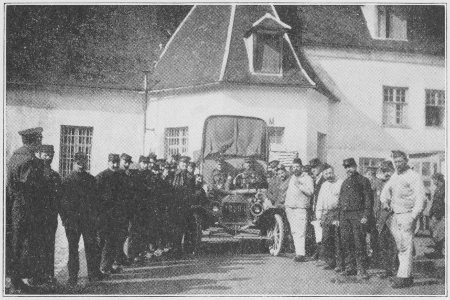
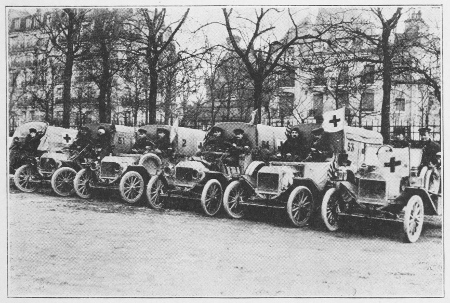
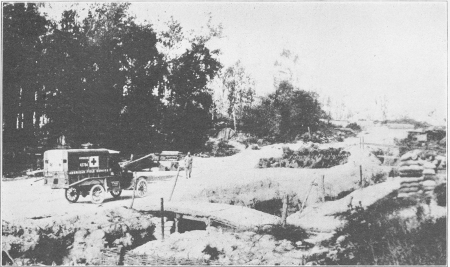
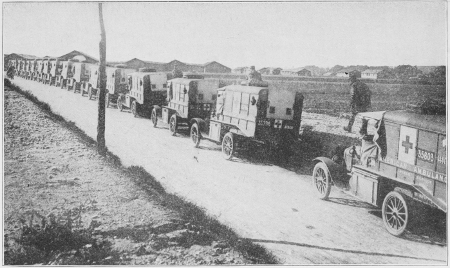
A HURRY CALL. "CLEAR THE TRACK."
"JUMBO," THE BIGGEST AMBULANCE ON THE WESTERN FRONT.
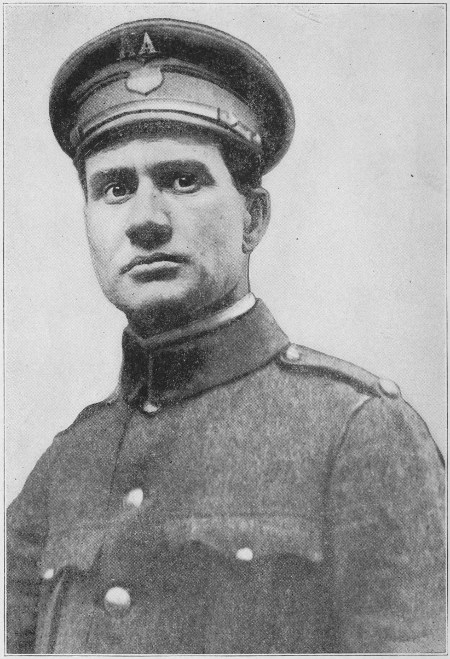
The author is the second man on the left.
That tobacco (added to the ale) caused him to completely forget my
purpose, and as the boat whistled off from the dock, he waved me a merry
"Best 'o Luck."
But I thought many a time how close I came to being balked, by my
tongue. A word from him to headquarters would have cooked the whole game.
On the water the night was very stormy. I guess all nights are on the
English channel, but this one was particularly so. It rained all the
way. It was a four-hour trip, and while I am an excellent sailor and had
never been sick in crossing the ocean, I was fearfully sick that night.
The next day I was in London.
What was the procedure? I was told by somebody, that wherever I was
going I would surely be held three days in England. I went to the
American Consul. I wanted my passport visé for Holland. My reasons?
Well, I couldn't say "en route" anymore because they don't approve of
people going through Holland to the enemy. Going to Holland, what for?
Why, naturally, to see my old friend and professor, Doctor Henry Van
Dyke, American Minister there. Of course the doctor didn't know I was
coming, and wouldn't have remembered me anyway. But nevertheless I had
conceived a sudden and irresistible desire to visit him.
A young fellow by the name of Ripley Wilson, about my own age, was
vice-consul. He waited on me, but he did not seem satisfied with my
explanations, or my reasons for wanting to go to Holland. He talked and
argued and hemmed and hawed, and finally said, "What is your real object
in going to Holland, Mr. Benson?" I answered, "I have told you that I am
going over to visit my old professor, Doctor Van Dyke." Then he tried to
trap me. He said, "Oh, did you go to Harvard?" I said, "No, sir." He
said, "Then where did you know him?" I said, "Dr. Van Dyke never taught
in Harvard. I knew him at Princeton, naturally, the place where he
taught." This kind of floored him, but still he persisted. "But, Mr.
Benson, what would anybody say about such a reason as you give, 'going
to Holland to visit a friend in war time?'"
I saw the situation. Ripley Wilson just needed a little domineering, and
for the first time in my life I was a little saucy to a diplomatic
officer. I said, "Mr. Wilson, I have told you what I am going to Holland
for, and furthermore what would anybody say about you asking me so many
petty questions? Wouldn't they say it was none of your business?" It worked.
In a few minutes I had his signature and stamp on my passport, and we
bade each other a good-natured good-bye. Then I had to go to the British
foreign office to get their permission to leave, and that was not so
easy. The young fellow who first handled the case asked me a lot of
similar questions and I answered them in the same way. Then he asked me
if I was going to try to go to Belgium when I got to Holland. "Why, I
hadn't thought of it," I replied. All the time with a straight face.
After a while he went into another room and presently returned and asked
me to come back at four o'clock, as I had better have a personal talk
with the colonel.
I went up to Trafalgar Square and saw the military demonstrations and
then went up the Strand and looked about a bit, and at four o'clock went
back to Whitehall. I was ushered into the presence of the colonel. He
was in all his glory. Trappings of every kind adorned his person,
shoulder straps and all. But surprising as it was to me, he was not at
all officious and I had a very pleasant hour with him. At first he was a
little curious. He wanted to know my reasons for going to Holland and so
forth, but after a little he became very cordial and said, they simply
wanted to be careful, as people going to Holland were getting very near
the enemy and might tell something even unwittingly which would hurt the
cause. He then said he would get me a special permit to go that night on
a certain boat on the Zelande Line at eight o'clock. He called Mr.
Haldane-Porter on the telephone and told him he was sending me over, and
also gave me a letter to him requesting him to give me his special pass.
I later figured out that it wasn't any special honor at all that he was
favoring me with, but that his words and actions meant I was to go at
the hour he said and on the boat he indicated and have every movement I
made thoroughly known to Scotland Yard.
Nevertheless I felt fortunate and glad. Then I had to go to the Dutch
Consul in London and get his permit to enter his country. He was neutral
and didn't give a rap where I went, so I didn't have to spend much time
on him, but only ninety cents. My khaki uniform I checked at the North
London Railway. I didn't care to have any khaki about me when I went to
Germany. They don't like it over there. I stuck the check in a safe
hiding place in the back of a book of cigarette papers which a poilu had
given me as a souvenir. Then I caught my boat and sailed for Holland. On
the boat I noticed a sign saying that no letters were to be carried
across, on pain of summary justice. It scared me, as I had several
letters that I did not want to part with. Two were addressed to Brand
Whitlock, the American Minister in Brussels, and one to a woman who is
the mother of one of my ecclesiastical flock in America. Nevertheless, I
kept them.
When I got to Holland I went straight to The Hague. The first thing I
did was to have two photographs taken, one with my arm band on my
sleeve, and the other without it. Doctor Van Dyke I found in his office,
and his son also, who remembered me in college. However, the doctor
said that he had serious doubts whether I could get into Belgium. He
recently had received word from Mr. Whitlock to be very careful about
letting people come over from Holland, as there was not much for them to
do and they often made a lot of trouble.
The Doctor suggested that I write Mr. Whitlock and ask him if he had
something for me to do in the relief work. Well, as a matter of fact, I
did not want to do this. There were two reasons. One was that I knew it
would take a week to get a reply, and I did not want to wait. The other
was I was afraid he might say no, thus effectually blocking my plans and
hopes. I wanted to get to Belgium above all things. At last, Dr. Van
Dyke said he did not feel he should be the one to visé my passport,
but I had better go down and have a talk with Colonel Listoe at
Rotterdam. He was the real official who should do it, being the closest
to the border, but the Doctor was doubtful if he would do it. I gathered
from the conversation that he and the Colonel were very intimate
friends. I then went to a hotel, l'Américain, on the Wagonstraat and
went to bed to sleep over it. The next morning a happy thought struck
me. I said to myself, "I'll try some diplomacy on these diplomats."
Again I went over to Dr. Van Dyke's office, and said, "Doctor, I haven't
much identification, and I wonder if you would be willing to give me a
note saying that I am the person I purport to be, and an American
citizen. He said, "Why certainly," and wrote me such a note on the
official stationery. I put the note into my pocket, gleefully. I forgot
to tell him that I had come all the way from France and England to have
a visit with him, but nevertheless I had had it. I now thanked him and
bade him good-bye. I hastened by electric to Rotterdam, and hunted up
the American Consulate. I knocked on the door and asked, "Is Colonel
Listoe in?" "Yes, the name, please?" "Mr. Benson." A man rose and
stepped cordially forward to greet me. I said, "Colonel Listoe, I
believe, I just came down from my old friend, Doctor Van Dyke; I was
under him at college, and his son was in my class. I have a letter from
him here and I am going over to Belgium."
"Oh, oh, Dr. Van Dyke; well, well, to be sure!" He took my passport and
had the vice-consul visé it before ever he looked at the note. Then
while I was getting out the letter I explained that it was just a formal
note of identification; but my passport was already fixed and
everything was fine.
I chatted with him for an hour, smoked one of his fine black cigars and,
of course, found him a delightful man. Then I said, "Colonel, is there
anything else I need to do before I can go to Belgium?" "Oh, by George!"
he said, slapping himself upon the knee, "I almost forgot the most
important part. Sure, you must go over to the German Consuls and get
their consent, and go before four o'clock." Ah! there was the rub. I
knew it. But I went. And I had some whale of a time getting their
consent, too. When I went into the room there were six of them sitting
behind the table. I went up to the first one and told him I wanted to go
to Belgium. I was now in my civilian clothes and I had put the set of
photographs with the Red Cross arm band on, in my left pocket and the
set without the arm band in my right pocket. The man asked me, "What do
you want to go to Belgium for?" I replied: "Relief work." "What kind?"
"Red Cross." "Are you a Red Cross man?" "Yes, sir." "Have you a
commission?" "N-n-no." "How do you prove you are a Red Cross man?" I
began fumbling for my photographs. For the life of me I couldn't tell
which kind were in which pocket. I reached and shuffled, and turned red,
and pulled out—the wrong one! Well, it didn't make much difference. I
said, "That's just a civilian picture for putting on my passports, but
here is my Red Cross picture." Then I pulled the other on him. He seemed
satisfied. That Red Cross on the sleeve seemed to do the business. He
said "You will offer yourself to the Red Cross in Belgium?" I said,
"Yes, sir." When he was about finished, another consul passing by became
curious. He said, "What is it this man wants?" And about the time I had
satisfied him, still another came. And if you don't think it is some job
to convince six Germans to be of the same mind at the same moment, try
it sometime. The man finally said, "I shall write it on your passport
that you will offer yourself to the Red Cross in Belgium?" I knew that
he meant business, and if it was written on there it meant for me to do
it, but I was ready to do anything. I wanted to get into Belgium. I had
been five days making the trip up to the doors of Belgium, a trip that
would take ten hours ordinarily, and I did not want to be balked. I
said, "Yes, sir, you may write it on my passport." He did it, too. He
then said, "Eight marks!" and I fished out two dollars. That passport
is one of my valued souvenirs today. I was now getting poor, as every
consul had been bleeding me both to leave and to enter his country. The
Americans were the only ones whose stamp was free. My pass was given me
to Brussels and the next morning I embarked. When we crossed the border
a mile or two in, the train stopped at Esschen. Most of the cars were
locked and the passengers, a few at a time, were taken out and searched.
I was among them, and it was not a pleasant sensation. But I was in
Belgium, had come from the enemy and had literally bluffed my way through.