NODS AND BECKS.
"'Haste thee, Nymph, and bring with thee
Jest and youthful jollity,
Quips and Cranks, and wanton Wiles,
Nods and Becks, and Wreathèd Smiles,
Such as hang on Hebe's cheek,
And love to live in dimple sleek.'"
quoted Mary Flannagan. "There is a name for
our magazine, right there in sober-sided old Milton."
"Why, that's as hackneyed as can be," objected
Dum. "It seems to me that every school
magazine I ever read was called 'Quips and
Cranks.' Let's get something real original and
different and try to make the mag the same way."
"Of course I didn't mean 'Quips and Cranks.'
I mean 'Nods and Becks.' I think that would
be a bully name."
And so did all of us, and "Nods and Becks"
was unanimously elected as the name for the
school paper that we were striving to get out before
Christmas.
I was chosen editor-in-chief, much to my astonishment.
It seemed to me that one of the Tuckers
should have had that job, with their father a
real live editor. They must have inherited some
of his ability; but the Lit. Society would have
me and I had to turn in and do the best I could.
I didn't mind the writing end of it so much as the
part I had in turning down some of the effusions
that were handed in by members of the society.
Our object in the publishing of this magazine was
to make it as light and gay as possible.
We had chosen Christmas as our season for
publication and that meant getting very busy after
our Thanksgiving jaunt. We really had intended
to use the little holiday we were to have
at that time to get our magazine in shape. We
called it a magazine for dignity, but it was really
more of a newspaper.
I am going to publish the whole thing just to
show what girls can do at school. Every one
thought it was very creditable. We had lots of
ads from the tradespeople at Gresham and a few
from Richmond firms, enough to pay for the
printing.
CHRISTMAS NUMBER OF
NODS AND BECKS.
GRESHAM, VA.
Sonnet to Santa Claus.
BY PAGE ALLISON.
Pan may be dead, but Santa Claus remains,
And once a year he riseth in his might.
Oft have I heard, in silences of night,
Tinkling of bells and clink of reindeer chains
As o'er the roof he sped through his domains,
When youthful eyes had given up the fight
To glimpse for once the rotund, jolly wight,
Who in a trusting world unchallenged reigns.
Last and the greatest of all Gods is he,
Who suffereth little children and is kind;
And when I've rounded out my earthly span
And face at last the Ancient Mystery,
I hope somewhere in Heaven I shall find
Rest on the bosom of that good old man.
BEAUTY HINTS AND ANSWERS TO CORRESPONDENTS.
By Mary Flannagan.
Dear Editor:
I have cut two sleeves for the wrong arm in
trying to make my new velour coat out of half a
yard less goods than the pattern called for.
I can't match the goods now. What must I do?
(signed) Agitated Kate.
Dear Kate:
Put one sleeve in hind part before and then get
a Teddy Bear or a plush monkey matching your
coat as near as possible or in pleasing contrast to
it if you can't get it to match, and tack it under
your arm. It will hide the discrepancy and at
the same time give a chic, stylish punch to your
costume. It would be better to sew it as you
would find it something of a strain on bargain
days to have to hold it and you might forget.
(signed) Editor of Beauty Hints.
Dear Editor:
I am losing my good figure. What can I do to
keep it?
(signed) Sylvia.
Dear Sylvia:
Pin it on tighter. Try black safety pins, they
seem to be stronger than white.
(signed) Editor of Beauty Hints.
FACTS ABOUT FATIMA.
It is the style to be tall and slender. Assume
a virtue if you have it not and you who are
short and fat, don't grow any shorter and fatter.
The following obesity rules will prove very
helpful to my correspondent who signs herself,
Miss Rosy Round:
Stand up for twenty minutes after meals (if
you must have meals).
Eat no potatoes.
Eat no bread.
Avoid all starchy food.
Avoid meats of all kinds.
Fish is fattening.
Never touch sweets or pastry.
Eat no fruit for fear of uric acid.
Never drink water with your meals, but between
meals do nothing but drink water, all the
time that you can spare from the gymnastics that
must be kept up to keep down the disfiguring
fat.
Always leave the table hungry, but take a
pickle with you, a large dill pickle is the best for
your purpose. Eat a great deal of pickle; it may
ruin your complexion but a good complexion is
only skin deep while fatness goes straight
through.
Sleep in your stays if you can, but if you can't
just don't sleep. Sleep is a fattening habit at
best. Keep a pickle under your pillow and take
a bite when you think of it.
Lose your temper on all occasions, as nothing
is more conducive to stoutness than placidity.
Stop speaking of yourself as a Fatty, and begin
to speak of yourself as slender. Remember
the power of Mind over Matter. Lead a lean
life and think thin thoughts; dress in diaphanous
gauze; make hair-splitting distinctions; talk and
think much of your slender purse; walk the narrow
way and have ever in your mind the eye of
the needle through which you shall finally have
to pass.—Before you know it you will lose pounds
and pounds of flesh.
RECIPES TRIED IN MY OWN KITCHEN (NIT).
By Caroline Tucker.
A Gresham Club Sandwich.
Take two tender new pupils (Freshmen preferred,
Juniors out of the question), stick them
together in a corner, with a thin slice of reserve
between them, season to taste with some spicy
gossip and a little lollapalusser. After a year in
a cool place they will be fit to eat.
* * * * *
Brown Betty à la Faculty.
Take two crusty members of the faculty and
let them grate against each other until both are
reduced to crumbs. Place in baking dish a layer
of crumbs and a layer of tart apples of discord
well chopped. Sweeten well with high-toned politeness,
veiled with sarcasm. Serve piping hot
with the same kind of sauce you give to the gander.
* * * * *
French Dressing as Served at Gresham.
Let the ingredients stay in bed until ten minutes
before breakfast, then in a wild scramble
cover with a thin layer of clothes without the
formality of bathing or even taking off nightgown
when breakfasting en famille. Do hair
with a lick and a promise and beat all the other
girls to the table.
* * * * *
FASHION NOTES.
By Virginia Tucker.
The newest fad among the women who know
and know they know, is to have their perfume
harmonize with their costumes. An up-to-date
society woman would no more wear a blue dress
and smell of lavender sachet than she would wear
a lavender hat with said blue dress. Vera Violet
must go with a purple dress; Attar of Roses with
a pink; New Mown Hay with green,—and so on.
One very smart grande dame at a fine function,
given lately at Gresham, gowned in a biscuit-coloured
broadcloth, had a faint, delicious odour of
hot rolls.
* * * * *
Hats are still worn hind part before and veils
are put on to stay with no visible opening. One
wonders sometimes "how the apple got in the
dumpling."
Some of the newest veils have a sliding dot, to
be worn over or near the mouth. This can be
opened by one knowing the combination and then
a small aperture is discovered that will admit of
a straw. The soft drink drugstore man need not
despair.
* * * * *
It is not considered good taste to wear more
than three shades of false hair at one time, and a
similarity in the texture of the material used
should be aimed at. The puffs must be of one
shade and material although it would be too much
to expect of a woman to have them match absolutely
with the switch, rat, pompadour and
bun.
Rats are no longer in vogue but traps are now
considered the sanitary and proper things. This
steel construction lowers the fire rates, which is
much in its favour. If we keep on with this false
hair craze what will we come to? Perhaps to
the fate of:
"This old man with a very long beard,
Who said: ''Tis just as I feared,
A lark and a wren,
Two owls and a hen
Have builded a nest in my beard.'"
If you have not hair enough of your own to
cover the springs, there are plenty of kinds, colours
and materials resembling human hair to be
bought for a song. Goat hair is used a great deal
as it is very durable and strong,—too strong in
one sense, as:—
"You may break, you may shatter
The vase as you will,
But the scent of the roses
Will cling 'round it still."
* * * * *
JOKES AND NEAR JOKES.
Nancy Blair, Editor.
The son of an eminent preacher was greatly
interested in the story of Adam and Eve. One
night the child seemed very restless, tossing and
turning in his crib. The father leaned over him,
asking: "My child, what is the matter? Why
don't you go to sleep?"
"Oh, Father, I can't! I've got such a pain in
my ribs. I'm awful 'fraid God is sending me a
wife."
* * * * *
Little Anne, aged five, was asked what she was
fasting on during Lent. She answered, "Washing
my hands."
* * * * *
A little girl who had never been to a wedding
was greatly excited when one was going on across
the street. She was especially interested in the
little flower girls as they tripped out of the carriage
in their dainty white frocks.
"Mother!" she exclaimed. "If Daddy dies,
will you marry again?"
"No, my dear! Never! Why do you ask?"
"'Cause, Mother, I do so hope you will and let
me be your little flower girl."
* * * * *
Customer—That was the driest, flattest sandwich
I ever tried to chew into!
Waiter—Why, here is your sandwich! You
ate your check.
* * * * *
One of the Sophomores wants to take Psychology
because she says she understands that a
course in it teaches you to do your hair up in a
lovely Psyche knot—A Psychic Phenomenon!
* * * * *
Jean Rice has burst into poetry, viz.:
"Come to my arms,
You bundle of charms!
With the greatest enthusiasm
I will clasp you to my bosiasm."
Lines written to Miss Polly Kent:
There was a young lady named Kent,
Who declared she had not a cent,
She remembered a quarter
She had hid in her garter,
But on looking found that, too, had went.
* * * * *
A touching poem addressed to Miss Grace
Greer, of Chicago, Ill.
Miss Greer is the champion gum-chewer of
Gresham.
There was a young maid from the West,
Who chewed gum with such marvelous zest,
That they named a committee,
Both tactful and witty
Who suggested she let her jaws rest.
* * * * *
THE CORRESPONDENCE CURE.
By Page Allison.
CHAPTER I.
"That's just what I'll do for you, Hal. I'll
write to this Uncle Sam person and get him to
give you one of his letter treatments," said Mr.
Allen, Hal's daddy.
Jo Allen was so young that his incorrigible
young son called him by his first name and regarded
him as "one of the fellers" instead of a
father; consequently he thought his own judgment
as reliable as his Dad's and paid as much
heed to his orders and requests as he would to one
of the "fellers."
"Thunder! I ain't sick. What I gotter have a
treatment for?"
"I didn't mean anything like paregoric, or milk
and eggs and a teaspoonful of this in half a glass
of water after meals. It seems to be something
like this: an old man, calling himself 'Uncle Sam,'
advertises in the Times that he will write fatherly
letters to difficult boys for $50.00 a course."
"Aw, Jo! I swear, I bet it's a lot of stuff about
'do unto others.'" Hal always objected to other
people's suggestions.
"Well, we'll take a chance on it. You don't like
my methods, if you can call 'em that. You are
my first and only offspring and I don't seem to
have much maternal instinct and no judgment
where you are concerned. Son, it is as hard for
you not to have your mother as it is for me not
to have my wife."
"It's all right, Jo, you know more 'bout being
a father than I do 'bout being a son. But bring
on your Uncle Sam and we can see what will happen.
I don't have to read the letters if he writes
a lot of rot."
"Nine o'clock! I ought to be at the office and
and you ought to be at school. Don't play hookey
again to-day," Jo Allen said as he reached for
his hat.
Jo was a corporation lawyer and when he
told the other members of his firm about his
latest plans for bringing up his son, they all
laughed.
"What next, Jo? 'Sons put on the right path
by mail.' It's a joke all right and so are you and
Hal. You can't do a thing with that kid! When
he stole the preacher's white horse and painted
'Hell' on it you just laughed. Why don't you
beat him up a little?" inquired Jones good-naturedly.
"But he is not downright bad, he is just mischievous
and full of life. I can't do anything to
him because it is all just what I used to do when
I was a kid,—behold the monument!"
"He looks so much like you that I always think
something has happened to the clock and it is
twenty years ago whenever I see him. He's got
your snappy grey eyes and black hair and Sally's
Greek instead of our honored partner's 'Roaming.'"
Jo was always pleased when it was said that
his son looked like him, for he knew that they
were both of them extremely goodlooking. And,
too, he was secretly proud of his slightly Roman
nose, which did add a certain air of distinction
to such a young man.
He dictated a letter to Uncle Sam and two days
later Hal got the first installment.
"Dear Hal:
"When I was a boy of twelve, just your age, I
had just about the reputation you have. But my
father had a family of seven children, of which I
was the youngest, so when I cut up he knew just
what to do with me. He realized that I had a
great deal of surplus energy and having no good
way of working it off, I always got into mischief
and sometimes into rather serious trouble.
"Your Dad told me about your stealing the
minister's horse and putting a large red 'Hell'
on one of his sides. When I was a boy I remember
that I made a bomb out of a little powder
and an old sock and put it under the porch of a
Negro church (Hal, as man to man, I trust you
not to try this stunt). Of course I stayed to
watch the fun. I thought the fuse was longer
than it was and came closer to adjust it—Bang!
and I was left with no eyebrows. I was too
scared to run and the darkeys began to pour out,
threatening darkly as to the future welfare of
my soul. They caught me and took me to the
county lockup. That evening my brother came
and bailed me out. My father asked me where
my eyebrows were, and I said, 'I reckon part of
them are by the Nigger church.' Of course he
gradually got the details and a very thick silence
followed. Then he told me just what I am going
to tell you. But first,—Hal, don't you think it's
funny what a passion all boys have to torment the
parsons of both the white and black race? I do.
"Dad said that I needed to be kept busy and
with something that gave me pleasure. He was
never strong on punishment and he suggested
something that pleased me mightily. He said
that if I would build a canoe and a pair of paddles
by the last of May he would give me and three of
my friends a camp for two weeks by the river.
I was glad my eyebrows were gone, for who
doesn't like to camp?
"Now, Son, you ask your dad if he won't make
this same agreement. You have a month to do
it in and I reckon you can have a dandy canoe
made by that time.
"Let me know what Mr. Allen says.
"Sincerely,
"Uncle Sam."
Hal looked over the letter at his daddy and
thought a minute. Then he said: "Jo, this here
Uncle Sam ain't so worse. Here's a pretty decent
thought that rattled out of his head." Mr.
Allen took the letter and read it and then he, too,
thought a minute.
"I'm on, Son," he said, "and you can have your
friends to help you."
"All right! Then shall I write and tell our
darling Unkil that it's a go?"
And this was the letter Uncle Sam got from
the "wayward youth he was trying to straighten
out":
"Mr. Uncle Sam,
—— Building,
New York.
"Dear Uncle S.:
"Yours of the inst. rec'd., first. Jo—that's
my dad and He's a peach too let me tell you—says
your idea suits him fine and anyway he always
goes to New York the first two weeks in June
on business and then I have to stay with Aunt
Maria at Sunny Glen and I hate it because she
is so clean. I hate to milk too and she is so afraid
I'll get drowned when I swim in the icepond. She
is a terrible nut because I can swim fine. I've
got a monogram for my sweater for swimming
at the Y. M. C. A. pool and that's bigger and
deeper than old spit-in-the-fire Aunt Maria's
dinky little icepond. Daddy took me in the roadster
over to the next town to order the stuff for
the canoe. What do you think would be a good
name for her after we finish it? We've put up
part of the skeleton already. Sometimes on a
straight road Jo lets me run the roadster—it's a
Mercer. Do you like Mercers? I like them the
best and so does Jo. I can't change gear very
good yet and I am too young to get a license but
I am strong enough to crank it. I've got right
much muscle. Did you like to fight when you
were a boy? I love my black eyes on other people.
Jo says it is tough to fight, so he boxes with
me. He can box fine, too. He can beat me swimming
and diving all to pieces, too. I've got to
stop now because Pete is whistling for me to
come catch with him.
"Rept. Hal Allen."
CHAPTER II.
"Jo, I wish you would bring me a Remington
rifle from New York. I'm old enough to have a
good one now, and tell my reformer I named the
canoe 'Uncle Sam'. I like that old man so much
I wish he'd come down here to live."
"So long, Son! I hope you will have a peach of
a time at your camp. Oh, yes! Aunt Maria told
me to be sure and tell you not to go swimming but
once a day, but I always lived in my bathing suit—at
least we will say I had a bathing suit—and
you can do the same."
It was only an hour's trip to New York and Jo
was busy thinking about the change in Hal and
wondering if Uncle Sam would consider it
strange for him to invite him to go home on a
visit. He decided he would go by Uncle Sam's
office and speak to him and make an engagement
for the theatre that night.
Jo Allen stopped a minute in front of Uncle
Sam's office door to get out a card and then he
rang the bell. A very handsome, auburn-haired,
green-eyed girl answered his ring and he gave
her his card with a rather bewildered smile, for
he wondered why such an old man as Uncle Sam
kept such a darned good-looking female to tickle
the keys.
"May I see Uncle Sam?" he asked.
"Why, certainly!" she said. "Please come in."
Her "Certainly" sounded Southern to Jo. He
might have thought some more but he was interrupted
by the girl.
"You will sit down, won't you?" she smiled
at him from her swivel chair.
"Thank you! Will Uncle Sam be along soon
do you think?" he queried.
"Oh! I thought you understood. Why, Mr.
Allen, I am Uncle Sam."
"Ohgoodlord!" Jo said it very loud and as
though it were all one word. Then after a minute,
"What the devil will Hal say when he finds
his Uncle Sam is a woman?"
"I see no reason why he should know." Uncle
Sam was very calm and unconcerned.
"But you see I swore I'd bring Uncle Sam back
on a visit. I had it all planned out that Uncle
Sam and I would take in a show to-night...."
"I don't reckon Uncle Sam would mind going
to the theatre, Mr. Allen. You might ask him,"
said the girl very frankly.
"Good for you, Uncle Sam,—you are a peach,
after all. Hal may be disappointed, but, believe
me, I am not. I wish you would tell me your
name."
Jo was looking much happier now. He had
forgotten what Hal would say when he got home
Uncle Samless,—but really her hair and eyes
were enough to make him forget and her voice
was very musical with its Southern accent.
"Page Carter," she told him, "and I suppose
you want to know the whys and wherefores of
Uncle Sam's business. Well, you can probably
tell from my name that I am a Virginian and
from my occupation that I am poor, and if you
could see my brain at work or my poor attempts
at sewing, you would see why I had to choose this
way of making a living. Yes, I had to do it.
You see, my mother and father are dead and I
could not accept my friends' kind invitations to
come and be their barnacles."
"Miss Carter, you need not worry about the
workings of your brain. That was a dandy bluff
you put up. I could see you with white hair,
seated at a desk, writing Hal about your boyhood
scrapes. Let's make it a supper before the theatre.
Are you game?"
"Sure," she said.
Jo noticed she did not have to look in a mirror
to make her hat becoming.
"Mr. Allen, your son has written me so much
about you that I feel as though I knew you. That
is very bromidic, but it is so."
Jo never knew what they had for dinner and
Page Carter did not get many of the lines of the
play. She had always been strong for black hair
and grey eyes. She knew, too, that he was successful
from his clothes and Hal's remarks about
the Mercer, and he surely was an amusing companion.
Hal interested her. New York wasn't
much when you were in it by yourself and it was
very evident that Jo liked her and his grey eyes
were beginning to look....
The play was over; and she had promised to
meet him for lunch and afterwards to pick out a
rifle for Hal.
A week later Hal jumped out of the canoe and
rushed up to the boys in camp and waved a yellow
slip of paper before them. "Listen," he
yelled, "'Be home to-morrow. Got rifle. Uncle
Sam with me. Dad.'"
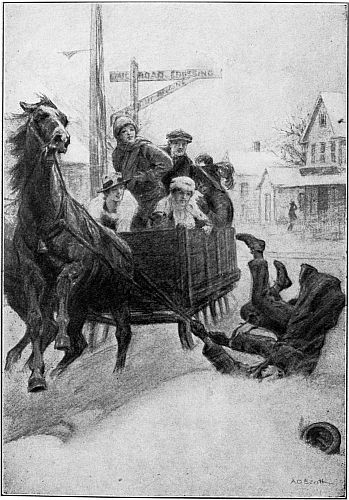 Zebedee lost his balance and shot over our heads into the soft snow.—Page 190