Matthew Passion. First performed, 1729. English edition,
Novello.
St John Passion. Probably written at Cöthen, and much
altered before it received its present form. English
edition, published by Novello.
St Luke Passion. Of doubtful authenticity. English edition,
Novello.
Mass in B minor.
„ F.
„ A. Written in 1737. Partly borrowed from other works.
Mass in G minor.}
„ G major.} Adapted from cantatas.
These four “Missæ breves” contain the Kyrie and Gloria, the
only part of the Mass retained in the Lutheran Service in
Latin.
Magnificat in D. Written for the Christmas Festival at St
Thomas’ Church, and sung at vespers after the sermon.
Edition with English words, Novello. It is for five voices,
three trumpets, two flutes, two oboes, strings and organ.
Sanctus in C. }
„ D. } Sung after the morning sermon, as an introduction to the Communion Service.
„ D minor.}
„ G. }
The numbers refer to the Bachgesellschaft Edition.
2 Ach Gott vom Himmel sieh darein. Second Sunday
after Trinity. Chorale Cantata.
3 Ach Gott, wie manches Herzeleid. Second Sunday after
Epiphany. Chorale Cantata.
58 Ach Gott, wie manches Herzeleid. Second Sunday after
Christmas. Solo Cantata for soprano and bass.
135 Ach Herr, mich armen Sünder. Third Sunday after
Trinity. Chorale Cantata, Leipsic.
162 Ach, ich sehe, itzt, da ich. Twentieth Sunday after
Trinity.
114 Ach, lieben Christen, seid getrost. Seventeenth Sunday
after Trinity. Chorale Cantata.
26 Ach wie flüchtig, ach wie nichtig! Twenty-fourth
Sunday after Trinity. Chorale Cantata.
33 Allein zu dir, Herr Jesu Christ. Thirteenth Sunday
after Trinity. Chorale Cantata.
72 Alles nur nach Gottes Willen. Third Sunday after
Epiphany.
68 Also hat Gott die Welt geliebt. Tuesday in Whitsun-week.
English edition, “God so loved the World,” Novello.
42 Am Abend aber desselbigen Sabbaths. First Sunday
after Easter (Quasimodogeniti).
186 Arg’re dich, o Seele nicht. Seventh Sunday after Trinity.
128 Auf Christi Himmelfahrt allein. Ascension Day.
131 Aus der Tiefe rufe ich, Herr, zu dir. Composed for Dr.
G. C. Gilmar, Pastor of Mühlhausen.
38 Aus tiefer Noth schrei ich zu dir. Twenty-first Sunday
after Trinity. Chorale Cantata.
131 Aus tiefer Noth schrei ich zu dir. Composed at Mühlhausen
about 1707.
185 Barmherziges Herze, der. Fourth Sunday after Trinity.
132 Bereitet die Wege, bereitet. For no special season.
Weimar, 1715. Words by Salomo Franck.
87 Bisher habt ihr nichts gebeten in meinem Namen. Fifth
Sunday after Easter.
6 Bleib’ bei uns, denn es will Abend. Tuesday in Easter
Week. English edition, “Bide with us,” Novello.
39 Brich dem Hungrigen dein Brot! First Sunday after
Trinity.
148 Bringet dem Herrn Ehre. Seventeenth Sunday after
Trinity.
63 Christen, ätzet diesen Tag. Christmas.
4 Christ lag in Todesbanden. Easter Day.
121 Christum wir sollen loben schon. Christmas. Chorale
Cantata.
7 Christ unser Herr zum Jordan kam. St John’s Day.
Chorale Cantata.
95 Christus, der ist mein Leben. Sixteenth Sunday after
Trinity.
141 Das ist je gewisslich wahr. Third Sunday in Advent.
122 Das neu gebor’ne Kindelein. First Sunday after Christmas.
Chorale Cantata.
40 Dazu ist erscheinen der Sohn. Christmas.
195 Dem Gerechten muss das Licht. Wedding Cantata.
15 Denn du wirst meine Seele nicht in Hölle lassen. Monday
in Easter Week. Composed at Arnstadt, probably in
1704. See p. 27.
157 Der Friede sei mit dir. Purification; also for Easter.
196 Der Herr denket an uns. Wedding Cantata.
112 Der Herr ist mein getreuer Hirt. Second Sunday after
Easter (Misericordias).
31 Der Himmel lacht, die Erde jubiliret. Monday in
Easter Week. One of the few cantatas containing a
chorus for five voices. The instrumental introduction
is called “Sonata.”
75 Die Elenden sollen essen. First Sunday after Trinity.
76 Die Himmel erzählen die Ehre. Second Sunday after
Trinity.
116 Du Friedensfürst, Herr Jesu Christ. Twenty-fifth Sunday
after Trinity. Chorale Cantata.
104 Du Hirte Israel, höre. Second Sunday after Easter
(Misericordias). English edition, “Thou Guide of Israel,”
Novello.
77 Du sollst Gott, deinen Herren, lieben. Thirteenth Sunday
after Trinity.
23 Du wahrer Gott und Davids Sohn. Quinquagesima
(Estomihi).
Ehre sei dir Gott gesungen. Part V. of Christmas
oratorio. English edition, Novello.
Ehre sei Gott in der Höhe. Christmas. Incomplete.
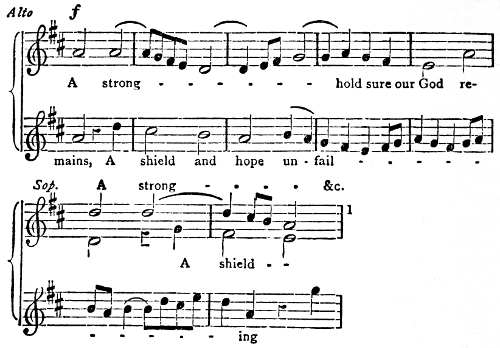
80 Ein feste Burg ist unser Gott. Reformation Festival,
English edition, “A Stronghold Sure,” Novello. Composed
1717, when Bach went to Cöthen. This was the
first cantata published in the nineteenth century. It
was also arranged to Latin words, beginning, “Gaudete,
omnes populi.”
134 Ein Herz, das Seinen. Wednesday in Easter Week.
Cöthen, between 1717 and 1723.
24 Ein ungefärbt Gemüthe. Fourth Sunday after Trinity.
136 Erforsche mich Gott, und erfahre. Eighth Sunday after
Trinity. Leipsic, 1737 or 1738.
66 Erfreut euch, ihr Herzen! Tuesday in Easter Week.
83 Erfreute Zeit im neuen Bunde. Purification.
126 Erhalt’ uns, Herr, bei deinem Wort. Sexagesima.
Chorale Cantata.
173 Erhöhtes Fleisch und Blut. Tuesday in Whitsun-week.
The music was originally written for a Serenade for the
birthday of Prince Leopold of Cöthen. The MS.
Serenade is in the Royal Library at Berlin.
175 Er rufet seinen Schafen mit. Wednesday in Whitsun-week.
Solo Cantata for tenor and bass.
172 Erschallet,ihr Lieder. Whitsunday.
184 Erwünschtes Freudenlicht. Wednesday in Whitsun-week.
19 Es erbub sich ein Streit. Michaelmas Day.
9 Es ist das Heil uns kommen her. Sixth Sunday after
Trinity.
45 Es ist dir gesagt, Mensch, was gut ist. Eighth Sunday
after Trinity.
176 Es ist ein trotzig und verzagt Ding. Trinity Sunday.
108 Es ist euch gut, dass ich hingehe. Fourth Sunday after
Easter (Cantata).
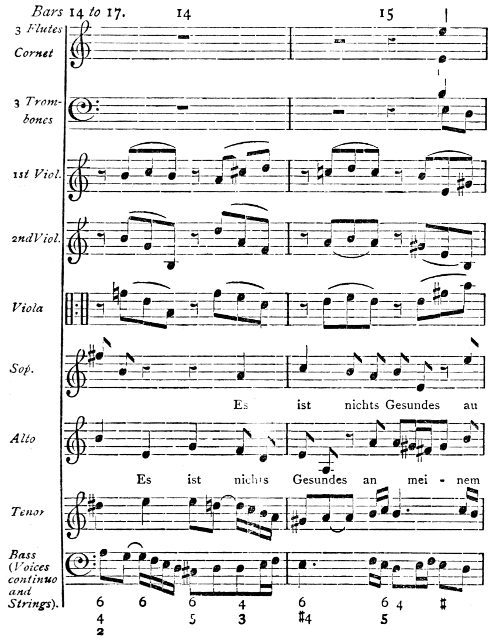
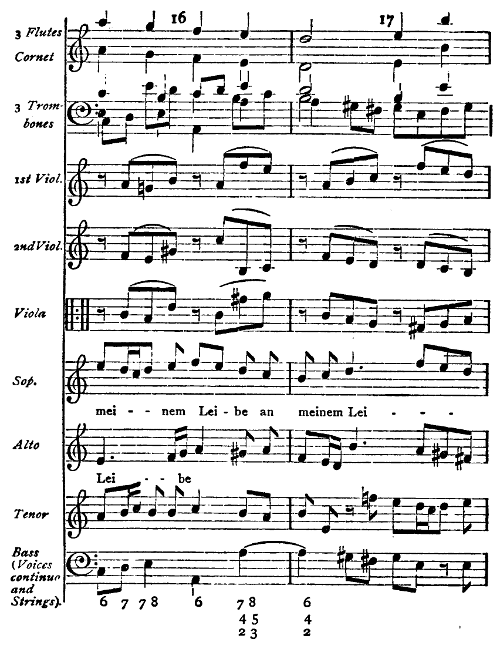
25 Es ist nichts Gesundes an meinem Leibe. Fourteenth
Sunday after Trinity. Edition with English words, “Lo,
there is no soundness within my body.” Rieter-Biedermann.
90 Es reifet euch ein schrecklich. Twenty-fifth Sunday
after Trinity.
187 Es wartet Alles auf dich. Seventh Sunday after
Trinity, 1737. Music is used for Mass in G minor.
Fallt mit Danken. Part IV. of Christmas oratorio.
English edition, Novello.
52 Falsche Welt, dir trau. Twenty-third Sunday after
Trinity. Solo Cantata for soprano.
30 Freue dich, erlöste Schaar. St John’s Day, originally a
“Dramma per Musica” in honour of the Saxon Minister,
Von Hennicke. Composed in 1737, and arranged as a
church cantata, 1738, after Bach had received the title of
Court Composer. It is in the “Lombardic” style introduced
by Vivaldi, consisting of frequent syncopation.
35 Geist und Seele wird. Twelfth Sunday after Trinity.
129 Gelobet sei der Herr, mein Gott. Trinity Sunday.
91 Gelobet seist du, Jesus Christ. Christmas. Chorale
Cantata. Words by Martin Luther.
18 Gleich wie der Regen und. Sexagesima. The orchestration
is unusual, consisting of four violas, fagotto,
violoncello and organ.
191 Gloria in excelsis Deo. Christmas. Rearranged from
the B minor Mass.
79 Gott der Herr, ist Sonn’ und Schild. Reformation Festival.
106 Gottes Zeit ist die allerbeste Zeit. For no special season.
English edition, “God’s time is the best,” Novello.
Called “Actus tragicus,” probably a funeral cantata.
Mühlhausen about 1708.
43 Gott fähret auf mit Jauchzen. Ascension Day. English
version, “God goeth up with shouting,” Novello.
71 Gott ist mein König. Election of Town Council at
Mühlhausen, 1708. See p. 36.
191 Gott ist uns’re Zuversicht.. Wedding Cantata.
28 Gottlob! nun geht das Jahr. First Sunday after
Christmas.
120 Gott, man lobet dich in der Stille. Election of Town
Council at Leipsic. In the score the letters J.J. (Jesu
juva) frequently occur.
169 Gott soll allein mein Herze. Eighteenth Sunday after
Trinity. For alto solo.
171 Gott, wie dein Name, so ist auch dein Ruhm. Circumcision.
The first chorus occurs with modifications as
part of the “Credo” of the B minor Mass.
67 Halt’ im Gedächtnis Jesum Christ. First Sunday after
Easter (Quasimodogeniti). Edition with English words,
“Hold in remembrance Jesus Christ,” Rieter-Biedermann.
96 Herr Christ, der ein’ge Gottes Sohn. Eighteenth Sunday
after Trinity. Chorale Cantata. Words by Elizabeth
Creutzinger.
102 Herr, deine Augen sehen nach dem. Tenth Sunday after
Trinity.
105 Herr, gehe nicht in’s Gericht. Ninth Sunday after
Trinity.
Herr Gott, Beherrscher aller Dinge. Wedding Cantata.
Incomplete.
130 Herr Gott, dich loben alle wir. Michaelmas Day.
16 Herr Gott, dich loben wir. Circumcision. Chorale
Cantata.
113 Herr Jesu Christ, du höchstes Gut. Eleventh Sunday
after Trinity. Chorale Cantata.
127 Herr Jesu Christ, wahr’r Mensch und Gott. Quinquagesima
(Estomihi). Chorale Cantata.
Herrscher des Himmels. Part III. of Christmas oratorio.
English edition, Novello.
Herr, wenn die stolzen Feinde schnauben. Part VI. of
Christmas oratorio. English edition, Novello.
73 Herr, wie du willt, so schick’s mit mir! Third Sunday
after Epiphany.
147 Herz und Mund und That und Leben. The return of
Mary from Egypt.
182 Himmelskönig, sei willkommen. Annunciation. Originally
composed for Palm Sunday.
194 Höchst erwünschtes Freudenfest. Dedication of the
organ at Störmthal.
55 Ich armer Mensch, ich Sündenknecht. Twenty-second
Sunday after Trinity. For tenor solo.
85 Ich bin ein guter Hirt. Second Sunday after Easter
(Misericordias).
84 Ich bin vergnügt mit meinem Glücke. Septuagesima.
48 Ich elender Mensch wer wird mich. Nineteenth Sunday
after Trinity.
133 Ich freue mich in dir. Christmas. Chorale Cantata.
Leipsic, 1737.
49 Ich geh’ und suche mit. Twentieth Sunday after Trinity.
109 Ich glaube lieber Herr, hilf meinem. Twenty-first
Sunday after Trinity.
82 Ich habe genug. Purification.
188 Ich habe meine Zuversicht. Twenty-first Sunday after
Trinity. The copyist directs that the “organ concerto”
of “Wir müssen durch viel Trübsal” in D minor (arranged
from the Clavecin Concerto in that key) is to be used as
an “introduction.” Words by Picander.
92 Ich hab’ in Gottes Herz und Sinn. Septuagesima.
Chorale Cantata. Words by Paul Gerhardt.
21 Ich hatte viel Bekümmernis. “Per ogni tempi,” “For all
times.” English edition, “My spirit was in heaviness,”
Novello. Composed on his being made concert-meister
at Weimar, and performed there on the third Sunday
after Trinity, 1714.
162 Ich, ich sehe, jetzt da ich zur Hochzeit gehe. Solo Cantata
for soprano, alto, tenor, bass.
158 Ich lasse dich nicht, du segnest. Purification. Solo
Cantata for tenor and bass. The violetta occurs in the
score.
174 Ich liebe den Höchsten von ganzem. Whitsunday. Solo
Cantata for alto, tenor, bass.
177 Ich ruf zu dir, Herr Jesu Christ. Fourth Sunday after
Trinity. Chorale Cantata.
156 Ich steh’ mit einem Fuss im Grabe. Third Sunday after
Epiphany.
160 Ich weiss, dass mein Erlöser. Monday in Easter Week.
56 Ich will den Kreuzstab gerne tragen. Nineteenth Sunday
after Trinity. For bass solo.
164 Ihr, die ihr euch von Christo. Thirteenth Sunday after
Trinity. Solo Cantata for soprano, alto, tenor, bass.
167 Ihr Menschen, rühmet Gottes. St John’s Day. Solo
Cantata for soprano, alto, tenor and bass.
193 Ihr Pforten zu Zion. Election of Town Council.
103 Ihr werdet weinen und heulen. Third Sunday after
Easter (Jubilate).
97 In allen meinen Thaten. For no special season. Words
by Dr Paul Flemming.
Jauchzet, frohlocket. Christmas oratorio. Part I.,
English version, Novello.
51 Jauchzet Gott in allen Landen. Fifteenth Sunday after
Trinity. Solo Cantata for soprano.
78 Jesu, der du meine Seele. Fourteenth Sunday after
Trinity. In this cantata the ground bass of the “Crucifixus”
of the B minor Mass is used. Edition with English
words, “Jesu, Saviour, who by dying,” Rieter-Biedermann.
41 Jesu, nun sei gepreiset. Circumcision. Chorale Cantata.
English edition, “Jesus, now will we praise Thee,”
Novello.
22 Jesus nahm zu sich die Zwölfe. Quinquagesima (Estomihi).
Bach’s test piece for the Leipsic post after the
death of Kuhnau. Performed there, February 7th, 1723.
81 Jesus schläft, was soll ich hoffen? Fourth Sunday after
Epiphany.
161 Komm du süsse Todesstunde! Purification; also for the
Sixteenth Sunday after Trinity.
Kommt, eilet, lauft. Easter oratorio.
181 Leicht gesinnte Flattergeister. Sexagesima.
8 Liebster Gott, wann werd’ ich sterben. Sixteenth Sunday
after Trinity.
123 Liebster Immanuel, Herzog der Frommen. Epiphany.
Chorale Cantata.
32 Liebster Jesu, mein Verlangen. First Sunday after
Epiphany. Called “Dialogue.” Solo Cantata for soprano
and bass.
137 Lobe den Herren, den Mächtigen. Twelfth Sunday after
Trinity. Leipsic, between 1742 and 1747. Words by
Joachim Neander.
69 Lobe den Herrn meine Seele! Twelfth Sunday after
Trinity.
143 Lobe den Herrn meine Seele. New Year’s Day.
11 Lobet Gott in seinen Reichen. Ascension Day. Called
by Bach “oratorium festo ascensionis Christi.” Part of
this cantata is used in the B minor Mass.
115 Mache dich, mein Geist, bereit. Twenty-second Sunday
after Trinity. Chorale Cantata.
149 Man singet mit Freuden vom Sieg. Michaelmas Day.
124 Meinen Jesum lass’ ich nicht. First Sunday after Epiphany.
Chorale Cantata.
10 Meine Seel’ erhebt den Herren. Return of Mary from
Egypt. Chorale Cantata.
189 Meine Seele rühmt und preist. For no special season.
13 Meine Seufzer meine Thränen. Second Sunday after
Epiphany. Solo Cantata for soprano, alto, tenor and
bass voices, accompanied by wind instruments and organ,
no strings being used.
155 Mein Gott, wie lang’. Second Sunday after Epiphany.
154 Mein liebster Jesus ist verloren. First Sunday after
Epiphany.
125 Mit Fried’ und Freud’ ich fahr’ dahin. Purification.
Chorale Cantata.
150 Nach dir, Herr, verlanget mich. For no special season.
101 Nimm’ von uns Herr, du treuer Gott. Tenth Sunday
after Trinity. Chorale Cantata.
144 Nimm, was dein ist, und gehe hin! Septuagesima.
192 Nun danket alle Gott. For no special season.
50 Nun ist das Heil und die Kraft. For no special season.
61 Nun komm, der Heiden Heiland. First Sunday in
Advent. First composition in A minor. Inside the
cover of this cantata Bach has written the order of the
service for the morning of Advent Sunday, 1714, at
Leipsic. See p. 44.
62 Nun komm, der Heiden Heiland. First Sunday in
Advent. Chorale Cantata. Second composition in B
minor.
163 Nur Jedem das Seine! Twenty-third Sunday after
Trinity. Solo Cantata for soprano, alto, tenor and bass.
34 O ewiges Feuer, o Ursprung der Liebe. Whitsunday.
English edition, “O Light Everlasting,” Novello.
O ewiges Feuer. Wedding Cantata. Incomplete.
20 O Ewigkeit du Donnerwort. First Sunday after Trinity.
60 O Ewigkeit du Donnerwort. Twenty-fourth Sunday after
Trinity. Solo Cantata for alto, tenor and bass.
165 O heil’ges Geist- und Wasserbad. Trinity Sunday. Solo
Cantata for soprano, alto, tenor, bass.
118 O Jesu Christ mein’s Lebenslicht. The accompaniment
is for two litui, cornet and three trombones; no strings
or organ. It was probably intended for the open air
(perhaps for a funeral) as it is the only cantata with no
continuo part.
119 Preise Jerusalem den Herrn. Performed in the Nicolai
Church on August 30, 1723, at the election of Town
Council. It was also performed by Mendelssohn on the
unveiling of the Bach Memorial at Leipsic, April 23, 1843.
46 Schauet doch und sehet. Tenth Sunday after Trinity.
153 Schau’ liebe Gott wie meine Feinde. Second Sunday
after Christmas.
53 Schlage doch! gewünschste Stunde. Funeral Cantata
for alto solo.
180 Schmücke dich o liebe Seele. Twentieth Sunday after
Trinity. Chorale Cantata.
36 Schwingt freudig euch empor. First Sunday in Advent.
64 Sehet welch’ eine Liebe. Christmas.
159 Sehet, wir geh’n hinauf. Quinquagesima (Estomihi).
117 Sei Lob und Ehr’ dem höchsten Gut. For no special season.
57 Selig ist der Mann. Christmas. Solo Cantata for
soprano and bass.
88 Siehe ich will viel Fischer. Fifth Sunday after Trinity.
179 Siehe zu dass deine Gottesfurcht nicht. Eleventh Sunday
after Trinity.
65 Sie werden aus Saba alle kommen. Epiphany. Edition
with English words, “They all shall come from Saba,”
Rieter-Biedermann.
44 Sie werden Euch in den Bann thun. Sunday after
Ascension Day (Exaudi).
183 Sie werden Euch in den Bann thun. Sunday after
Ascension Day (Exaudi).
190 Singet dem Herrn ein neues Lied. Circumcision. Incomplete.
Performed 25th of June 1730, at the second
Jubilee celebration of the Augsburg Confession.
145 So du mit deinem Munde bekennest. Easter Day, and
Wednesday in Easter Week.
151 Süsser Trost, mein Jesus kömmt. Christmas.
168 Thue Rechnung Donnerwort. Ninth Sunday after
Trinity. Solo Cantata for soprano, alto, tenor, bass.
152 Tritt auf die Glauben’s Bahn. First Sunday after Christmas.
Und es waren Hirten auf dem Felde. Part II. Christmas
oratorio. English edition, Novello.
110 Unser Mund sei voll Lachens. Christmas.
142 Uns ist ein Kind geboren. Christmas.
170 Vergnügte Ruh’ beliebte. Sixth Sunday after Trinity.
For alto solo.
140 Wachet auf, ruft uns die Stimme. Twenty-seventh
Sunday after Trinity. Leipsic, 1742. Words by P.
Nicolai.
70 Wachet, betet, seid bereit allezeit. Twentieth Sunday
after Trinity.
86 Warlich ich sage euch. Rogation Sunday.
14 Wär’ Gott nicht mit uns diese Zeit. Fourth Sunday after
Epiphany.
138 Warum betrübst du dich mein Herz. Fifteenth Sunday
after Trinity. Leipsic, 1737. Words by Hans Sachs.
94 Was frag’ ich nach der Welt! Ninth Sunday after
Trinity. Chorale Cantata.
98 Was Gott thut das ist wohlgethan. Twenty-first Sunday
after Trinity.
99 Was Gott thut, das ist wohlgethan. Fifteenth Sunday
after Trinity.
100 Was Gott thut, das ist wohlgethan. For no special
season. Words by S. Rudigast.
111 Was mein Gott will das g’sche all’ zeit. Third Sunday
after Epiphany. Chorale Cantata.
89 Was soll ich aus dir machen. Twenty-second Sunday
after Trinity.
107 Was willst du dich betrüben. Seventh Sunday after
Trinity.
12 Weinen, klagen, sorgen, zagen. Third Sunday after
Easter (Jubilate). The opening chorus is on the same
ground bass as the “Crucifixus” of the B minor Mass.
37 Wer da glaubet und getauft wird. Ascension Day.
17 Wer Dank opfert der preiset mich. Fourteenth Sunday
after Trinity. Edition with English words, “Whoso
offereth praise,” Reiter-Biedermann.
59 Wer mich liebet der wird mein. Whitsunday.
74 Wer mich liebet der wird mein. Whitsunday. Solo
Cantata for soprano and bass.
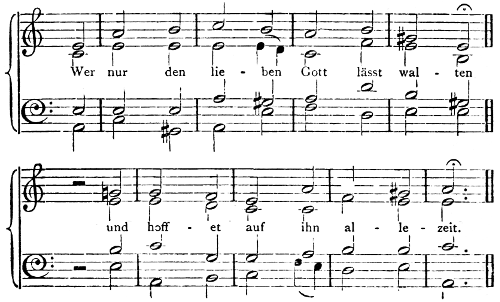
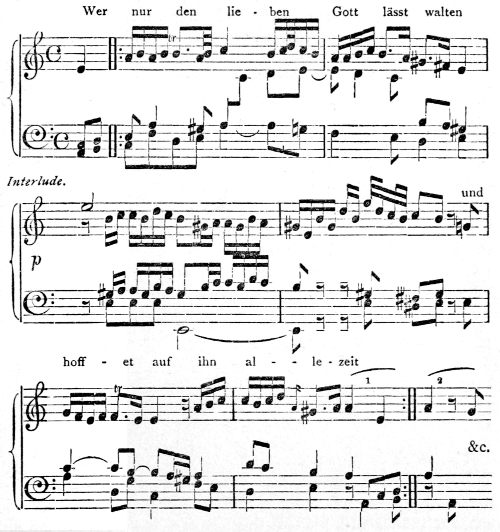
93 Wer nur den lieben Gott lässt walten. Fifth Sunday
after Trinity.
47 Wer sich selbst erhöht der soll. Seventeenth Sunday
after Trinity.
27 Wer weiss wie nahe mir mein Ende. Sixteenth Sunday
after Trinity. English edition, “When will God recall
my spirit,” Novello.
54 Widerstehe doch der Sünde. For no special season.
Alto solo.
1 Wie Schön leuchtet der Morgenstern. Annunciation.
Chorale Cantata.
29 Wir danken dir, Gott, wir danken dir. Election of Town
Council at Leipsic, 1737.
146 Wir müssen durch viel Trübsal. Third Sunday after
Easter (Jubilate).
166 Wo gehest du hin? Fourth Sunday after Easter (Cantate).
Solo Cantata for alto, tenor, bass.
178 Wo Gott der Herr nicht bei uns hält. Eighth Sunday
after Trinity. Chorale Cantata.
139 Wohl dem der sich auf seinen Gott. Twenty-third
Sunday after Trinity. Chorale Cantata, Leipsic, between
1737 and 1744.
5 Wo soll ich fliehen hin. Nineteenth Sunday after
Trinity. Chorale Cantata.
Lass, Fürstin, lass noch einen Strahl. Called “Weeping
Leipsic.” Written for the death of Princess Christiane
Eberhardine, wife of Augustus the Strong.
Jesu meine Freude. Five voices. English edition, “Jesu,
priceless treasure,” Novello. A hymn by Franck in six
stanzas.
Der Geist hilft unsrer Schwachheit auf. Eight voices. Written
for the funeral of the Rector Heinrich Ernesti, 1729.
The composer added a figured bass for the organ. English
edition, “The Spirit also helpeth us,” Novello.
Furchte dich nicht. Eight voices. English edition, “Be not
afraid,” Novello.
Komm Jesu, komm. Eight voices.
Lob und Ehre und Weisheit und Dank. Eight voices. English
edition, “Blessing, Glory and Wisdom,” Novello.
Singet dem Herrn ein neues Lied. Psalm 149, eight voices.
English edition, “Sing ye to the Lord,” Novello.
Ich lasse dich nicht. Eight voices. This motet is by some
attributed to Joh. Christoph Bach. English edition, “I
wrestle and pray,” Novello.
A Latin motet for two choruses heard by J. L. Gerber at
Christmas, 1767, is lost.
Lobet den Herrn, alle Heiden. Psalm 117. Four voices.
Drama: Geschwinde, ihr wirbelnden Winde. The contest
between Phœbus and Pan.
Weichet nur, betrübte Schatten. For soprano voice.
Amore traditore. For bass voice, accompanied by cembalo
only.
Drama: Zerreisset, zerspringet, Zertrümmert die Gruft. For
the name-day of Dr A. F. Muller. Leipsic, Aug. 3, 1725.
Drama: Schleicht, spielende Wellen. For the birthday of
Augustus III.
Drama: Vereinigte Zwietracht der wechselnden Saiten. For
a University celebration, Leipsic, 1726.
Was mir behagt, ist nur die muntre Jagd.
Non sa che sia dolore. For soprano solo.
O holder Tag, erwünschte Zeit. Wedding Cantata for soprano
solo.
Schweigt stille, plaudert nicht. In praise of coffee.
Mer hahn en neue Oberkeet. Complimentary Cantata to Carl
Heinrich von Dieskau.
Mit Gnaden bekröne der Himmel die Zeiten.
O angenehme Melodei. Soprano solo.
Durchlauchster Leopold. Serenade for two solo voices and
orchestra.
Schwingt freudig euch empor. For the birthday of a teacher.
Die Freude reget sich. For the birthday of Professor Rivinus.
Drama: Lasst uns sorgen, lasst uns wachen. Complimentary
Cantata to a Saxon Princess. The opening chorus from
Christmas oratorio.
Tönet ihr Pauken! erschallet Trompeten! For the birthday
of the Queen of Saxony, December 1733. See p. 145.
Drama: Preise dein Glücke. For the anniversary of the election
of Augustus III. as King of Poland, 1734.
Drama: Angenehmes Wiederau. Persons represented—Fate,
Happiness, Time, and the river Elster. The opening
chorus from the cantata “Freue dich erlöste Schaar.”
Drama: Auf schmetternde Töne der muntern Trompeten. For
the name-day of King Augustus III.
Three Passions. It is known that Bach wrote five Passions,
from information given by his son C. P. Emanuel, and his
pupil Agricola in Mizler’s Necrology.
A great funeral ode on the death of Prince Leopold of
Cöthen.
Several Cantatas.