Of all the precious, bright-eyed
fairies I ever knew, little
Lillie was one of the very first
and foremost. She was always
doing or saying something
charming or funny; and sometimes,
of course, she was mischievous;
but if you were ever
so much provoked at her mischief
and its effects, one look at
her sweet, innocent face, so unconscious
of wrong meaning,
with the long golden curls
floating round it, one look, and
the great frown on your brow
would soften into a little one;
another look at the dimpled
cheeks, and imploring blue
eyes, and the little frown would
disappear entirely; but when
the sweet voice said, "Mamma,
shall I put myself in the corner?
I ought to go," why, one, two,
three, presto!! all the angry
feelings would come right out
of your heart, and fly away up
the chimney! and a very good
riddance they were!
Don't you wish, little reader,
that angry feelings of all sorts
and sizes against everybody,
would adopt the fashion of flying
up the chimney, and never
come back again? I do.
Lillie was five years old.
She had two sisters older than
herself. One had already gone
"home," and was now a little
white-robed angel in heaven,
safe forever in Jesus' arms,
from the temptations and dangers
of this sorrowful life. The
other was a dark-haired, dark-eyed
little maiden, five years
older than Lillie, and the grave
dignity of all these years caused
Annie to be impressed with a
lively sense of the great necessity
that rested upon her, of
setting a good example to her
sister, and brother Willie, a
curly headed little fellow, not
quite three years of age. I
will tell you how Annie came
to feel this responsibility so
deeply.
One day her mother asked
her to go down stairs, and get
a book that she wanted; but
Annie was very busy with her
paper dolls, and she answered
in a low voice, for she hardly
meant her mother to hear her,
"I shan't do it." When, what
was her amazement and sorrow,
to hear her little Lillie say,
right after her, "Mamma, if
you tell me, I sant do it, too."
Oh! my dear little reader,
this was worse than the most
dreadful punishment to Annie,
to think that she had been so
naughty, and that her example
had caused Lillie to be naughty
too, and her heart sank, as she
looked up and saw her kind
mother sitting there, the great
tears falling one by one upon
her clasped hands, and her sorrowful
eyes fixed upon
her children.
With a grieved cry, Annie
rushed to her mother and threw
her arms around her neck, and
kissed her, and wiped the tears
away, and said, "Hush! hush!
dear mother. Oh! do stop crying!
and I will never, never do
so again," and little Lillie, who
was only three years old then,
and hardly knew how wrong
she had acted, in her desire to
imitate her sister, in everything,
clung to her mother and said,
"What for you ki, mamma?
don't ki," and so it came to
pass that Annie never forgot
this terrible lesson, but strove
with all her might to set her
sister and brother a good example,
and begged her good and
pious mother to make a little
prayer for her, that she might
be strengthened from above.
This is the prayer her mother
made, which Annie said every
night and morning, with her
other prayers, and Aunt Fanny
who is writing this, begs you,
dear little readers, to learn this
prayer; if you only say it from
your heart, I know it will help
you.
"O God, my Heavenly Father,
send thy Holy Spirit to
help me to be good myself, and
to set a good example to others.
Take all the wicked disobedient
thoughts out of my heart. Make
me a comfort and a joy to my
dear parents, and prepare me
to live with Thee and my dear
little sister now in Heaven.
For Jesus, my Saviour's sake,
Amen."
You have no idea how good
and lovely Annie became after
this. God answered her prayer.
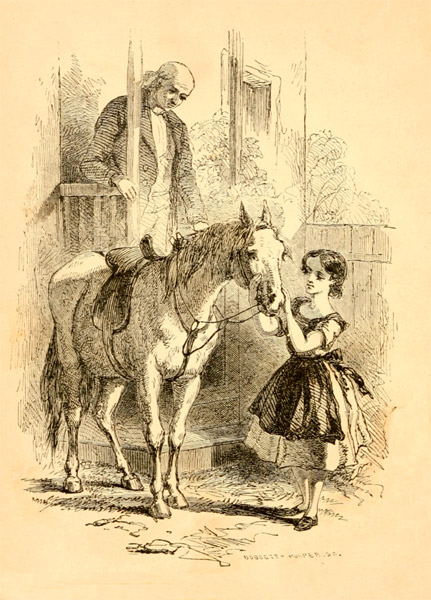
In the summer time Lillie
and the rest would go into the
country to see her grandfather,
of whom she was very fond,
and well she might be, for he
was one of the best and dearest
grandfathers in the whole world.
He was a gentleman of the old
school, and treated even children
with a stately courtesy;
but while, at the same time, the
children nestled to him with
the most fearless confidence and
love, they would as soon have
thought of cutting their heads
off, as of giving him one disrespectful
word or look.
In the very next house to
Lillie's grandfather's, lived "little
Alice," about whom you have
heard in "Nightcaps."
Alice always knew when
Lillie had arrived. Every
sweet summer morning Alice
would jump out of bed, and her
mother would throw the window
open, letting in the delicious
perfume from the strawberry
bed next door, and the
joyous morning hymns of the
little birds, and then, if Lillie
had come all at once, 'midst the
songs of the birds, a small clear
musical voice would be heard,
singing (for she made a little
song of it)—"Al—lie! Al—lie!"
Then Alice would give
a jump, and answer, imitating
her song, "What—ee! What—ee!"
and then the bird outside
would sing, "Where's you?
Where's you?" and Alice would
answer, "Here's I, Here's I!"
and that would finish the duet,
for Alice would run to the window,
and there, just below,
would be Lillie, standing on the
daisy-spangled grass-plot, looking,
in her white dress and
golden curls under that blue
sky, fairer and lovelier far, than
any lily ever looked, in any
earthly gardener's conservatory.
It is true, that God made them
both, but this Lillie was a flower
blooming for immortality,
while the others would perish
in one short summer.
Then Alice would run down
stairs, and out of the house, and
scramble through a little hole
in the fence at the back of the
house, and rush up to Lillie,
and Lillie would rush up to
Alice, and they would knock
each other down, without meaning
to, on the soft grass, and
roll over together, and jump up
again, as good as new, and
laugh! you never heard any
thing sweeter! and report themselves
ready for any play that
Annie might propose.
Lillie was very fond of singing.
She could sing most delightfully,
"Old Dog Tray," "I
want to be an Angel," "Pop
goes the Weasel," and many
other beautiful airs. She had
taught Willie to sing "Pop—go—a—dee—sell,"
as he called it,
and was unwearied in her efforts
to amuse him, for he was
a delicate little fellow, and had
been sick a great deal. In this,
Lillie was imitating her sister
Annie, (do you see the importance
of a good example?) and
it was perfectly beautiful to observe
the care she took of him:
she would tie the bib round his
neck, when he was to eat his
dinner, so tight, as almost to
choke him to death, but with
the most loving intentions, and
would comb his soft curls down
on his face, and nearly scratch
his eyes out with the comb, but
Willie never cried; not he!
because he knew perfectly well,
baby as he was, from the sweet
affectionate expression beaming
from Lillie's blue eyes, that she
did it all in love, and it is really
amazing what a deal of knocking
about, children will stand
and laugh at, if they know it to
be done in love or play, when a
slight touch in punishment will
set them crying.
One pleasant morning, just
before last Christmas, Lillie was
conversing with Willie while
they were eating their breakfast
with the family; for Willie had
been promoted to the dignity
of a high chair, and had commenced
the business of feeding
himself, and did it very well,
considering. About once in
five times he would stick the
spoonful of hominy in the middle
of his cheek, or on the tip
of his chin, expecting to find an
extra mouth or two, I suppose;
so that in a little while his face
would be ornamented with a
variety of white patches, which
made Lillie laugh, and Willie
laugh back; so upon the whole
he fed himself in what might be
called an entertaining manner,
and began to grow fat upon it.
Lillie was older, and of course
ate her breakfast like a dainty
little maiden, as she was, in the
neatest possible way, but for all
that, she liked plenty to eat, and
presently she held out her plate
for some more cakes.
"Why, Lillie!" said her father,
pretending to be astonished,
"more cakes? you're just
like Oliver! I am sure you
must be full up to here," and he
pointed to his throat.
"Oh! no, papa, you are mistaken,
only look here, how loose
my skin is," and she grasped
the skin of her white neck,
and pulled it up, and cried,
"see papa, quite a big room
left."
Her father laughed, and gave
her the cakes, and while she
was enjoying them, she cried to
Willie:
"I'm learning to spell and
read, Mr. Willie."
"Is you?" answered Willie,
"why for?" and in his earnest
attention to this announcement,
he forgot the way to his mouth
again, and landed a spoonful
of hominy on the end of his
nose.
Lillie laughed, and polished
his nose with her napkin; and
rubbed it so hard, that it made
Willie wink, and said:
"Because people must learn
to read and spell, and you must
learn too—I'm going to teach
you; come, spell 'cat.'"
"But I tant," said Willie.
"But you must," said Lillie,
"you must spell 'cat,' and you
must learn to read the Bible;
and you and I will read the
Bible every single morning, and
a great many times besides."
"Come, begin: spell 'cat.'"
Willie looked gravely down,
with very large eyes, at the cat,
as if he thought that she might
tell him; then lifted his mug,
on which was elegantly painted,
with about twenty-seven
flourishes, the words, "For
Willie," to his lips, and took a
long drink of milk, staring over
the top of it at the cat the
whole time, but the blinking
old tabby only dozed away
with one eye opened, and slapped
her tail on the carpet as if
to say, "you'll find no spell in
me," so Willie put his mug
down, and drawing a long
breath, lisped again, "But I
tant."
"Well," said Lillie, a little
provoked, "if you can't spell
'cat,' spell 'kitten:' that's littler."
This made a great laugh
round the table, and finally
Lillie had to teach Willie how
to spell this difficult word, and
she repeated the lesson so often,
and so kindly, that before an
hour, Willie could spell "cat"
just as well as Mr. Appleton
himself! think of that! and he
(Willie, not Mr. Appleton) was
so proud of his new accomplishment,
that he took an opportunity
to run away, and his nurse
went hunting after him, and
found that he had scrabbled
down the stairs backwards,
which was his way of getting
down in the world, (and I'm
sure it is better than plunging
headlong, as some people do,)
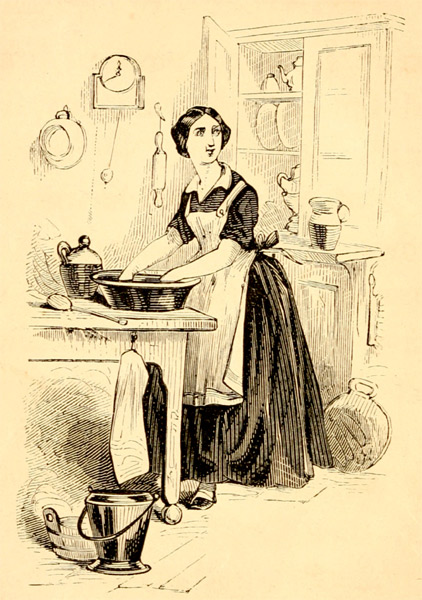
and trotted into the kitchen to
teach the cook and a little butcher
boy who had just brought
in the dinner, to spell "cat," and
asked her in return for this
kindness, to make him a "turnover
pie," which you may be
sure she did.
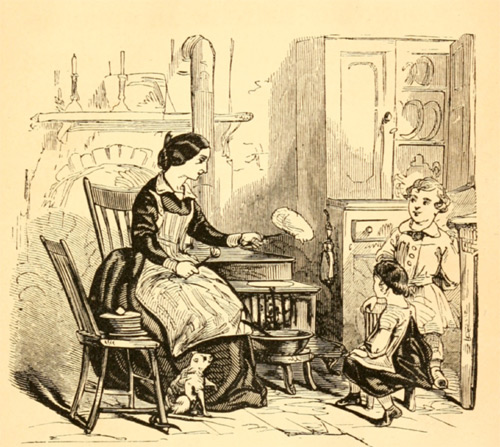 Willie teaching the Cook to spell Cat.
A few days after this, the
joyous Christmas came, the day
on which our blessed Saviour
was born, when everybody
ought to be grateful and joyful,
if they possibly can.
On this day, Annie, Lillie, and
Willie were in perfect ecstasies,
so many kisses, and so many
presents poured in upon them,
and all tokens of so much love;
that made the charm.
Lillie, especially, was enchanted
with two rings she received;
a pretty gold ring, and one of
red cornelian. Only think! the
grandeur and dignity of two
rings at once, on her little white
fingers! the very idea set her
singing and skipping with joy.
"Dear me," she said, "two wedding
rings! how delightful! I
shall begin a play 'mediately.
Come, Annie and Willie, let's
play I was a grand lady dressed
in two rings, coming to make
you a visit." Accordingly, Annie
spread herself out as wide
as she could, and Willie, as he
didn't happen to wear a hoop,
concluded to spread himself up
as high as he could, which he
effected by putting on a "sojer
cap" with a long feather, and
they sat up in state to receive
the company, and had a splendid
time, when the two rings,
and the lady, walked majestically
in.
The next day, a lady called
upon Lillie's mother, and said,
"How did Annie like the ring I
sent her?"
"Annie? Lillie, you mean."
"Oh, no," said the lady, "I
sent the cornelian ring to Annie."
This announcement troubled
Lillie's mother. She knew her
little girl thought more of this
cornelian ring, than of all the
rest of her presents; but she
promised the lady, who was
their cousin, it should be given
to the rightful owner.
Now, this good mother would
gladly have bought another ring
for Annie, and let Lillie keep
her treasure, but that would
not have been the right thing;
so she took Lillie out walking
with her, and as the little girl
skipped and danced along, (for
a little happy creature like that,
scarcely ever walks,) she began
her painful duty by saying,
"Lillie, what is the golden
rule?"
"I know," said Lillie, "Do as
you would wish to be done
by."
"Well, do you understand
what it means?"
"Why, yes, mamma; papa
says the golden rule means,
that I must be good and kind
to everybody, because I always
want everybody to be good and
kind to me."
"Well, Lillie," said her mother,
in a very kind tone, "I must
tell you about a mistake I have
made. I am very, very sorry
for it. I gave you two rings
on Christmas day, and your
cousin tells me, that she meant
the cornelian ring for Annie.
Now, Lillie, what will you
do?"
"Oh, mamma!" exclaimed
Lillie, and then she stopped,
while a painful flush came all
over her face, her little breast
heaved, and her large and lovely
blue eyes filled with tears.
She felt very miserable, for a
moment, then checking a rising
sob, she said, softly—
"Mamma, you made two
'steaks. You said Christmas
day, that I had too many presents;
that was one 'steak, and
Annie had too few, that was
two 'steaks. I—I must give
this ring to sister Annie. It is
her ring. I shall only have one
ring, but, never matter," and
she sighed——and then she
smiled.
"That is right, my darling,"
answered her mother, "that is
doing just as you would wish to
be done by."
So Lillie, with her great resolution
filling her noble little
heart, said not a word more,
but hastened home with her
mother, and walked straight up
to Annie, with such a heaven-sent
smile illuminating her
sweet face, and took the precious
ring off her finger, and
said, "Here, Annie; this is your
ring, take it; it was meant for
you all the time, but mamma
didn't know it," and here the
rosy lips began to tremble, and
Lillie was silent.
"Would you rather I should
take it?"
"Yes," said Lillie.
"Well, then, I will. If I had
got the two rings by mistake, I
should have given one to you
right away! indeed I would,
Lillie."
"Would you?" answered
Lillie, brightening wonderfully,
"well, then, I am glad I have
given it to you," and the painful
shadow passed away from
her face, and Willie was so impressed
with this interesting
scene, that he forthwith brought
out one of his dearest treasures,
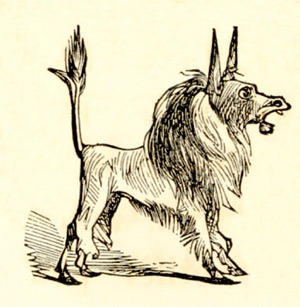
a horse with a tail like a water-spout,
drawn for him by his
father, which he had painted
such a bright apple green, that
it set your very teeth on edge
only to look at it, and bestowed
it then and there upon Lillie,
with a hug and a kiss, that was
worth all the green horses, and
brown ones too, in the universe;
and thus happiness was restored
to the hearts of these three
lovely children, and Lillie got
along like other people, with
only one wedding ring, and
came to think it quite enough;
but that I believe is the general
opinion, though I am not absolutely
certain.
And now, if you little folks
cannot see by this story, the
good effects of setting a good
example, and how great the
responsibility even little children
incur in their relation to
each other, Aunt Fanny will
have a heart-ache, and she will
be brought to wish, that instead
of writing stories that do no
good, she had taken to growing
pumpkins or hard-hearted cabbages,
and that's all.
 I'll tell you all about it in my next book.