At Arcachon there is an old Chapelle
miraculeuse de Notre Dame, adjoining the
newer church, founded about 1520 by Thomas
Illyricus. It contains many of the fishermen's
votive offerings, such as life-belts,
stilts, pieces of rope, and boats and wreaths.
I noticed, too, a barrel, on which were the
words "Echappé dans le golfe du Méxique,
1842." These offerings are hung up near the
chancel, and give a distinct character to it.
As we came into the little church, a child's
funeral was just leaving it, the coffin borne
by children. We waited by the door till the
sad little procession had gone by, and before
me, as I write, there rises in my memory the
expression on the father's face. It had something
in it that was absolutely unforgettable.
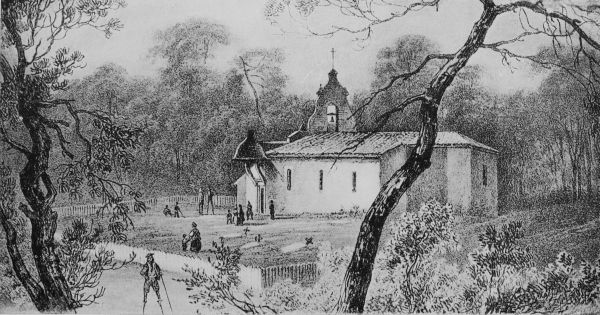
ARCACHON, MIRACULOUS CHAPEL, 1722.
[Page 40.
As we passed down the village street, we
passed another little procession; two acolytes in
blue cassocks and caps, bearing in their hands
the vessels of sacred oil, a priest following
them in biretta, surplice and cassock, and by
his side a server. I noticed that each man's
cap was instantly lifted reverently, as it
passed him. As they turned in at a cottage,
the whole street down which they had passed
seemed full of the lingering fragrance of the
incense carried by the acolytes.
Arcachon, at one time, must have been
exceedingly quaint and picturesque, but since
then an alien influence has been introduced
which has—for all artistic purposes—spoilt it.
Facing the chief street—dominating it, as it
were—is the Casino; an ugly, flashy, vulgar
building, out of keeping structurally with
everything near it. It resembles an Indian
pagoda, and when we were there in November
its huge, bleary eyes were shut as it took its
yearly slumber, deserted by Fashion. It was
like an enormous pimple on the quiet, picturesque,
unpretending countenance of this village
of the Landes which had been subjected to its
obsession, and that of the two hotels in immediate
attendance.
The people, however, appear unspoilt and
unsophisticated. At each cottage door sit the
women knitting; and, as one passes, they
pass the time of day, or make some remark or
other, with a pleasant smile.
When we were at Arcachon telegraph poles
were being put up. The method of setting
up these eminences was distinctly curious,
to the English eye. There was an immense
amount of propping up, and many anxious
glances bestowed on the poles before anything
could be accomplished. The men on whom
this tremendous labour devolves have to wear
curious iron clasps strapped on to their boots,
so that they should be able to dig into the
bark as they swarm up the poles for the poles
are just trunks of pine trees stripped of their
branches, and many of them look very crooked.
In many of the gardens poinsettias were
flowering, and hanging clusters of a vivid red
flower which our hotel proprietress called
"Songe de Cardinal." It was the same tint
of scarlet as the berries called "Archutus"
or "Arbousses," which grow here in abundance
by the side of the road on bushes, and are like
a large variety of raspberry, a cross between
that and a strawberry. It has a very pleasant
flavour when eaten with cream: this our
waiter confided to me, and, after tasting the
mixture, I quite agreed with him, although the
proprietress had treated the idea with scorn.
In November the roads, in places, are
red with the fallen fruit of this plant. There
are also curious long brown seed cases which
had dropped from trees something like acacias,
but which have a smaller leaf than our English
variety. The tint of the pods is a warm
reddish brown; they are about the length of
one's forearm, the inner edges all sticky with
resin.
In the village street the inevitable little
stream, which is encouraged in most French
towns, runs beside the roadside, and is
fed by all the pailfuls of dirty water that
are flung from time to time into its midst.
The plage at Arcachon is not attractive
in autumn, and it is difficult to understand
how it can be a magnet at a warmer time of
the year to the hundreds that frequent it.
An arm of land stretches all round the little
inland pool—for it is not much more than a
pool—in which in summer time the bathers
disport themselves. In November, of course,
it requires an enormous effort of imagination to
picture it full of sailing ships and pleasure boats.
Murray mentions a particular kind of boat,
long, pointed, narrow and shallow, which was
much to the fore in 1867, and which he
imagined to be indigenous to the soil, so to
speak. But, apparently, they have changed
all that. I only saw one that was built as he
describes, and this was green and black in
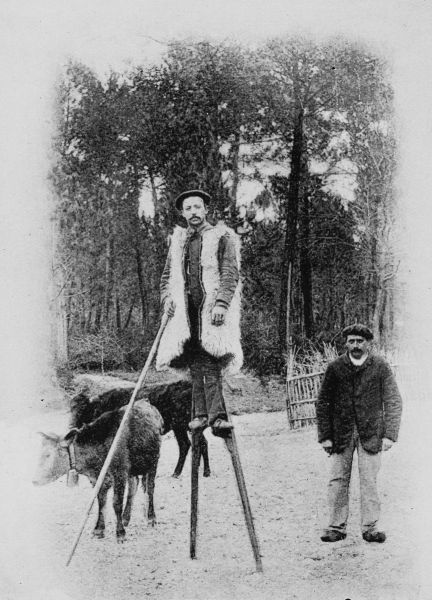
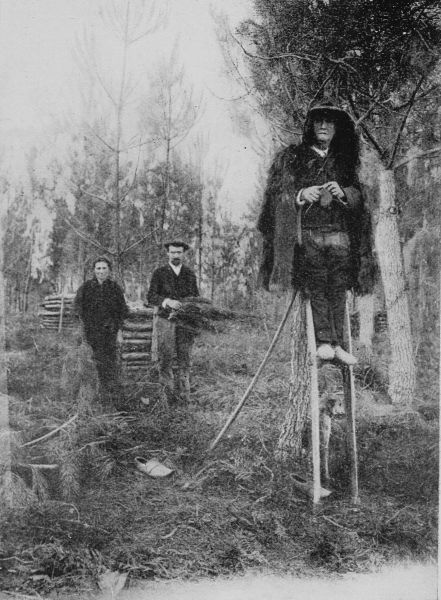
colour. He also mentions stilts being worn
by the peasants at Arcachon and the neighbourhood
near the village, but of these we
saw few traces. There were pictures of them
in an old print of the chapelle built in 1722,
and in a photo of the shepherds of the plains.
The photos, indeed, are numerous in the
whole country of the Gironde of anciens
costumes, but when one sets oneself to try and
find their counterparts in real life, evidences
are practically nil. All that remains of them
in these matter-of-fact, levelling days, in which
so much that is quaint, characteristic and
peculiar is whittled down to one ordinary
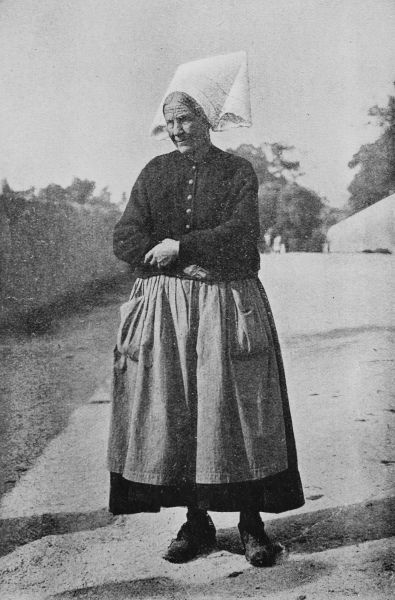
dead level of alikeness, are the stiff white
caps, varied in shape and size, according to
the district, and the sabots. Some of the
peasants here often go about the streets in
woollen bed-slippers, but most of them use
wooden sabots—pointed, and with leathern
straps over the foot.
One gets quite used to the sight of two
sabots standing lonely without their inmates
in the entrance to some shop, their toes pointing
inwards, just as they have been left (as if
they were some conveyance or other—in a
sense, of course, they are—which is left outside
to await the owner's return). Continually
the women leave them like this, and proceed to
the interior of the shop in their stockinged feet.
Sometimes the countrywomen go about
without any covering at all to their heads,
and it is quite usual to see them thus in
church as well as in the streets. The men
wear a little round cap, fitting tightly over the
head like a bathing cap, and very full, baggy
trousers, close at the ankles, dark brown or
dark blue as to colour, and very frequently
velveteen as to material.
At La Teste, a village close to Arcachon,
the women much affect the high-crowned
black straw hat, blue aprons and blue knickerbockers.
At most of the cottage doors were
groups of them, knitting and chatting; and,
as we passed, the old grandmother of the
party would be irresistibly impelled to
step out into the road to catch a further
glimpse of the strangers within their borders—clad
in quite as unusual garments as
their own appeared to ours.
There are no lack of variety of occupations
open to the feminine persuasion: the women
light the street lamps; they arrange and
pack oysters; fish, and sell the fish when
caught. They work in the fields; they tend
the homely cow, as well as the three occupations
which some folk will persist in regarding
as the only ones to which women—never
mind what their talents or capabilities—can
expect to be admitted, viz: the care of
children and needlework and cooking! I saw
one quite old woman white-washing the front
of her cottage with a low-handled, mop-like
broom, very energetically, while her husband
sat by and watched the process, at his ease.
La Teste stands out in my memory as a
village of musical streets, though of course in
the Gironde it is the exception when one does
not hear little melodious sentences set to some
street call or other. As we passed up the
village street, a woman was coming down
carrying a basket of rogans, a little silvery fish
with dazzling, gleaming sides, and crying,
"Derrr ... verai!" "Derrr ... verai!"
with long sustained accent on the final high
note. "Marchandise!" was another call
which sounded continually, and its variation,
"Marchan-dis ... e!"
Passing through Bordeaux, I remember a
very curiously sounding street-hawk note: it
did not end at all as one expected it to end.
I could not distinguish the words, and was
not near enough to see the ware.
But the human voice was not the only
street music, for as we sat on one of the
benches that are so thoughtfully placed under
the lee of many of the cottages at La Teste,
there fell on our ears a sound from a distance
which somehow suggested the approach of a
Chinese procession: "Pom-pom-pom-pom-pom-pom!"
mixed with the sharp "ting-ting"
of brass, and the duller, flatter tone of wood,
sweet because of the suggestion of the trickling
of water which it conveys.
A procession of cows turned the corner of
the long street and moved sedately towards
us, their bells keeping time with their footsteps,
their conductor, as seems the custom
in these parts, leading the detachment. It
was followed by a little cart drawn by two
dogs, in which sat a countrywoman, much too
heavy a weight for the poor animals to drag.
La Teste itself is a picturesque little
village, and larger than it looks at first sight.
Each cottage has its own well, arched over.
Up each frontage, lined with outside shutters,
is trained the home vine, while little
plantations of vines abound everywhere.
The women travel by train with their heads
loosely covered with shawls, when not wearing
the stiff caps or hats, and it is very usual
for them to carry, as a hold-all, a sort of little
waistcoat buttoning over a parcel; a waistcoat
embroidered with some device or other.
THE GIRONDE SHEPHERDS.
[Page 51.
Coming back to Arcachon, we met a typical
old peasant woman, with two huge straw
baskets—one white and one black, a big
stick, and a black handkerchief tied over
her head, and a most characteristic face,
crumpled, seamed and lined with all the
different hand-writings over it that the pencil
of Fate had drawn during a long lifetime.
When young, the peasant women of the
Landes are not striking. The peculiar
characteristics of the face are unvarying; you
meet with them everywhere all about the
Gironde and Bordeaux. The faces are
sallow, low-browed, with dark hair and eyes.
They are brisk-looking, but just escape being
either pretty or noticeable. Most of the
women, too, that we saw, were of small
stature and insignificant looking. It is when
they are old that the beauty to which they
are heir, is developed. The women of the
Landes are evening primroses: the striking
quality of their faces comes out after the heyday
of life is over. It seems that the face of
the Gironde woman needs many seasons of
sun and heat to bring out the sap of the
character. The autumn tints are beautiful
in faces, as in trees. Theirs is the beauty
that Experience—that Teacher of the Thing-as-it-is—brings;
and it is in the clash of the
meeting of the peculiar personality with the
experience from outside, that character springs
to the birth. You see—if you can read it—their
life, in the eyes of the dweller by the
countryside. In a more civilised class one
can but read too often, what has been put
on with intention, as a mask. Civilisation
and convention eliminate individuality, as
far as possible, and they recommend dissimulation,
and we, oftener than not, take
their recommendation.
So in all countries, and in all ages, Jean
François Millet's idea is the right one—that
to find life at its plainest, at its fullest, one
should study it, au fond, in the lives of the
sons and daughters of the soil. Their open-air
life prints deep on their faces the divine
impress of Nature, obtainable, in quite the
same measure, in no other way; they have
become intimate with Nature, and have lived
their everyday life close to her heart-beats.
What she gives is incommunicable to others:
it can only be given by direct contact, and
can never be passed on, for only by direct
contact can the creases of the mind, caused
by the life of towns and great cities, be
smoothed out, and a calm, strong, new breadth
of outlook given.
I remember a typical face of this kind.
We had been out for a day's excursion from
Arcachon, and, coming home, at the station
where we took train, there got into our
carriage, a mother and daughter. After getting
into conversation with them—a thing they
were quite willing to do, with ready natural
courtesy of manner,—we learned that the
mother was eighty-one years old and had
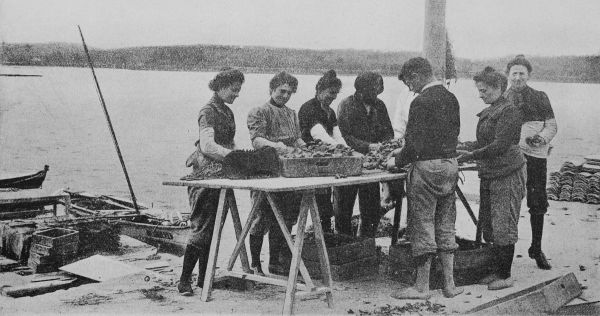
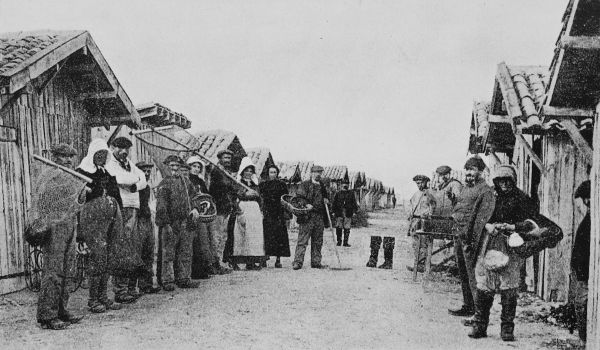
worked as a parcheuse in her young days. She
had a fine old face, wrinkled and lined with a
thousand life stories. Kindly, pathetic, had
been their influence upon her, for her eyes and
expression were just like a sunset over a
beautiful country: it was the beauty that is
only reached when one has well drunk at the
goblets of life—some of us to the bitter dregs—and
set them down, thankful that at last it is
growing near the time when one need lift
them to one's lips no more.
The mother told me that the women
parcheuses could not earn so much as the
men, three francs a day—perhaps only thirty
centimes—being their ordinary wage. She
turned to me once, so tragically, with such a
sudden world of sorrow rising in her eyes.
"I have worked all my life in the fields, and
at fishing, and now, one by one, all whom I love
have left me, and I am so lonely left behind."
"Ah, c'est malheureux!" exclaimed the
daughter, turning sympathetically to her.
We parted at Arcachon station, but how
often since, have I not seen the face of the
old mother looking sadly out of our carriage
window, the tears gathering slowly in her
eyes as she remembered those with whom she
had started life, and whom death had distanced
from her now, so far.
There are two distinguishing characteristics
of the villages of the Landes as we saw
them, and these are the absence of beggars
and of drunkenness—I didn't see a single
drunken man. As one knows, it is somewhat
rare to meet with them in other parts of
France, and one remembers the story of the
English barrister who was taken up by the
police and thought to be drunk (so seldom had
they been enabled to diagnose drunkenness),
and taken off to the lock-up! It turned
out that he was only suffering from an
over-emphasised Anglicised pronunciation
of the French language, studied (without
exterior aid) at home, before travelling
abroad.
Thrift and sobriety are two virtues which
generally go in company—they are very much
in evidence in the country of the Gironde to-day.
Happy the land where this is the case!
Unfortunately it is not the case in England
now, nor has been indeed for many a long year.
Think of the difference too there is in manner
between the countrymen of our own England
and that of France. One cannot travel
in this part of France without meeting
everywhere that simple, native courtesy which
is so spontaneously ready on all occasions.
It is a perfect picture of what the intercourse
of strangers should be.
As a nation, we are apt to be stiff and awkward
in our initial conversation with a stranger.
We require so long a time before we thaw
and are our natural selves; our introductory
chapters are so long and tiresome.
But to the Frenchman, you are there! that
is all that matters. You do not require to
be labelled conventionally to be accepted;
there is such a thing, in his eyes, as an intimate
strangership, and it is this very immediateness
of friendliness and smile, that makes the
charm of those unforgettable day-fellowships
of intercourse which are so possible in France
and—so difficult in England. How many
such little cordial acts of camaraderie come
back to my mind, perhaps some of them only
ten minutes in duration, perhaps even less
than that, and consisting solely in some
spontaneous sympathy during travelling incidents;
in the kindly, ready recognition of a
difficulty, in the quick appreciation maybe of
the humour of some idyll of the road. Whatever
it is, you are at home and in touch at
once for a happy moment, even if nothing
more is to come of the brief encounter.
In a garden near the post-office at Arcachon
we came upon this startling notice: "Beware
of the wild boar!" Then there followed
an injunction to the wild boar himself:
"Beware of the snare," in the same sort
of way as "Mind the step" is sometimes
written up! Making inquiries later at the
hotel, I found that there were plenty of
wild boars in the forest of Arcachon, and
that in winter time they often ventured
into the town. Hunting parties, for the
purpose of limiting family developments, are
organised from time to time throughout the
winter.
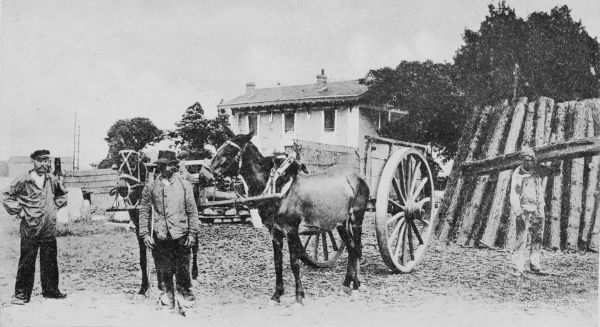
SHEPHERD AND WOODSMEN, ARCACHON.
[Page 57.
As regards the forest of Arcachon, we
were struck specially by the fungi of all sorts
and colours, that grow at the foot of the trees,
and on the vivid green branching, long-stalked
moss that envelops the surface of the ground:
deep violet, orange, soft blue, brilliant yellow,
scarlet and black spotted, dingy ink-black
were some of the colours that I noted. Indeed,
I did more than "note" them, for I picked a
fair-sized basket full, took them back to the
hotel, did them up carefully and despatched
them to the post-office, where they refused
to send them to England, saying that,
owing to recent stipulations, they were not
allowed to send such commodities by parcel
post any longer. Crestfallen and disappointed,
I had to unpack that gorgeous paint-box
of colours again, and left them on my
window ledge to enjoy them myself before
they deliquesced.
In the forest here is no sound of birds. Too
many have been shot for that to be possible
any longer, and consequently a strange, eerie
silence prevails over everything. Alas! I saw
no birds at all, except a few long-tailed tits.
The sunlight lay roughly gleaming on the
red-brown needles below the dark pine trees,
and grey and soft on the white, silvery sand.
No other colour broke the sombre, olive green
of the foliage overhead, but here and there
flecks of vivid yellow, from the heather growing
sparsely in clumps, spattered like a flung
egg upon the banks. The stems of the pines
are a rich red-brown, flaked and covered in
places with soft, green lichen.
The hotel was not a place where one got
much change in the matter of guests, but
people came in for lunch now and again en
route for somewhere else; and I shall never
forget one such party. It consisted of a father,
mother and two small infants of about one and
a half and two and a half years of age. The
children fed as did the parents. I watched with
interest the courses which were packed into
these children's mouths. Radishes, roast
rabbit, egg omelet, vin ordinaire and milk,
mixed (or one after the other, I really forget
which!) From time to time they were attacked
by spasms of whooping-cough, which
rendered the process of digestion even more
difficult than it would otherwise have been.
One of the children had a cherubic face, and
each time a doubtful morsel was crammed into
his mouth he turned up his eyes seraphically
to heaven as he admitted it, but—if he
disliked its taste—only for time enough to
turn it over once in his mouth previous to
ejecting it! The parents never seemed to be in
the least deterred from pressing these morsels
on him, however often they returned.
The concierge at our hotel, (he who knew
four words of English), was a distinct character.
He would often come up to our room
after table d'hôte for a chat, on the pretence of
making up our already glowing log fire. But
whenever a bell rang he would instantly stop
talking and cock his ears to hear if it were two
peals or one, for two peals were his summons,
and one only the chambermaid's. Before we
left we added to his stock of English, and it
was a performance during the hearing of
which no one could have kept grave. "Ah,
c'est difficile," he exclaimed after trying
ineffectually to achieve a correct pronunciation:
"Pad-dool you-r-y-owe carnoo!"
He told us that, as a rule, a concierge was
paid only fifty francs, but sometimes he got
as much as 250 francs a month in pourboires
from the guests in the hotel. A femme de
chambre would make twenty-five francs a
month at a hotel. Neither concierge nor femme
de chambre would be given more than eight
days' notice if sent away. At this hotel he had
no room to himself, no seat even (we often
found him sitting on the stairs in the evening)
and up most nights until half-past twelve, and
yet he had to rise up and be at work, each
morning by half-past five.
In the summer months it seemed the
custom to go further south to some hotel or
other, guests spending half the year at one
place, and half at another.
GUJAN-MESTRAS,
Huts of the Fishermen, and "Parcheurs" (Oyster Catchers).
[Page 61.