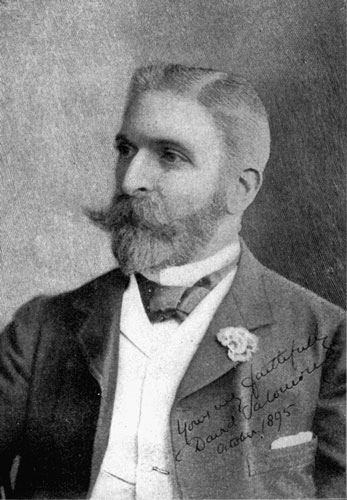
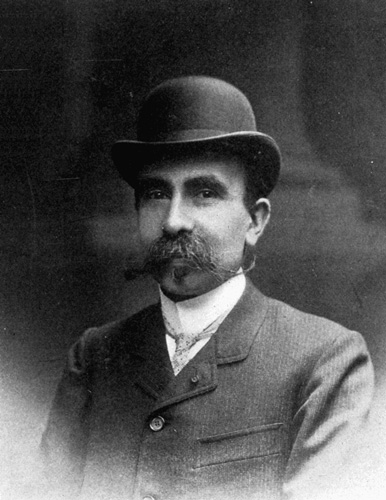
PIONEER INVENTORS
Nicholas Joseph Cugnot,
William Murdock,
Oliver Evans,
William Symington,
Nathan Read,
Richard Trevithick,
David Gordon,
W. H. James,
Goldsworthy Gurney,
Thomas Blanchard,
M. Johnson,
Walter Hancock,
W. T. James,
Francis Maceroni,
Richard Roberts,
J. Scott Russell,
W. H. Church,
Etienne Lenoir,
Amédèe Bollèe,
George B. Selden,
Siegfried Marcus,
Carl Benz,
Gottlieb Daimler,
M. Levassor,
Leon Serpollet. |
Nicholas Joseph Cugnot
Born at Void, Lorraine, France, September 25, 1725. Died in Paris, October
2, 1804.
Concerning the early life of Cugnot, little is known. He was educated for
the engineering service of the French army, and gained distinction as a
military and mechanical engineer. He also served as a military engineer in
Germany. Soon afterward he entered the service of Prince Charles of
Lorraine, and for a time resided at Brussels, where he gave lessons in the
military art. He did not return to his native land until 1763, and then
invented a new gun, with which the cavalry were equipped.
This brought him to the attention of the Compte de Saxe, and under the
patronage of that nobleman, he constructed in 1765 his first locomotive.
This was a small wagon. On its first run it carried four persons, and
traveled at the rate of two and a quarter miles an hour. The boiler,
however, being too small, the carriage could go only for fifteen or twenty
minutes before the steam was exhausted, and it was necessary to stop the
engine for nearly the same time, to enable the boiler to raise the steam
to the maximum pressure, before it could proceed on its journey. This
machine was a disappointment, in consequence of the inefficiency of the
feed pumps. It has been stated that while in Brussels he had made a
smaller vehicle, which, if so, was soon after 1760.
Several small accidents happened during the trial, for the machine could
not be completely controlled, but it was considered on the whole to be
fairly successful and worthy of further attention. The suggestion was made
that provided it could be made more powerful, and its mechanism improved,
it might be used to drag cannon into the field instead of using horses for
that purpose. Consequently, Cugnot was ordered by the Duc de Choiseul,
Minister of War, to proceed with the construction of an improved and more
powerful machine. This vehicle, which was finished in 1770, cost twenty
thousand livres. It was in two parts, a wagon and an engine. The wagon was
carried on two wheels and had a seat for the steersman; the engine and
boiler were supported on a single driving-wheel in front of the wagon. The
two parts were united by a movable pin. A toothed quadrant, fixed on the
framing of the fore part, was actuated by spur gearing on the upright
steersman’s shaft in close proximity to the seat, by means of which the
conductor could cause the carriage to turn in either direction, at an
angle of from fifteen to twenty degrees. In front was a round copper
boiler, having a furnace inside, two small chimneys, two single-acting
brass cylinders communicating with the boiler by the steam pipe, and other
machinery. On each side of the driving-wheel, ratchet wheels were fixed,
and as one of the pistons descended, the piston-rod drew a crank, the pawl
of which, working into the ratchet-wheel, caused the driving-wheel to make
a quarter of a revolution. By gearing, the same movement placed the piston
on the other side in a position for making a stroke, and turned the
four-way cock, so as to open the second cylinder to the steam and the
first cylinder to the atmosphere. The second piston then descended,
causing the leading wheel to make another quarter of a revolution, and
restoring the first piston to its original position. In order to run the
vehicle backwards, the pawl was made to act on the upper side, changing
the position of the spring which pressed upon it; then, when the engine
was started, the pawl caused the driving-wheel to turn a quarter of a
revolution in the opposite direction with every stroke of the piston.
This machine was first tried in 1770 in the presence of a distinguished
assembly, that included the Duc de Choiseul; General Gribeauval, First
Inspector-General of Artillery; the Compte de Saxe, and others.
Subsequently, other trials of it were made, with satisfactory results
generally. The heavy over-balancing weight of the engine and boiler in
front rendered it difficult to control. On one of its trips it ran into a
wall in turning a corner and was partly wrecked. Further experiments with
it were abandoned, and in 1800 it was deposited in the Conservatoire des
Arts et Metier, Paris, where it still remains.
At a later period of his life, having lost his means of support, Cugnot’s
public services were considered to entitle him to a reward from the State.
Louis Fifteenth gave him a pension of six hundred livres, but the French
Revolution coming on, he was deprived even of that pittance, and he lived
in abject misery in Brussels. His carriage was then in the arsenal, and a
revolutionary committee, during the reign of terror, tried to take it out
and reduce it to scrap, but was driven off. When Napoleon came to the
throne, he restored the pension and increased it to one thousand livres.
In addition to his inventions, Cugnot wrote several works on military art
and fortification.
William Murdock
Born in Bellow Mill, near Old Cumnock, Ayrshire, Scotland, August 21,
1754. Died at Sycamore Hill, November 15, 1839.
Murdock was the son of John Murdoch, a millwright. He was modestly
educated, and brought up to his father’s trade, helping to build and put
up mill machinery. A curious production of the father and son, at this
period, was a wooden horse, worked by mechanical power, on which young
Murdock traveled about the country. When he was twenty-three years of age
he entered the employment of the famous engineering firm of Boulton &
Watt, at Soho, and there remained throughout his active life.
Watt recognized in him a valuable assistant, and his services were
jealously regarded. On his part he devoted himself unreservedly to the
interests of his employers. In 1777 he was sent to Cornwall to look after
the pumps and engines set up by the firm in the mines, and for a long
period he lived at Redruth. For some five years after 1800 he was engineer
and superintendent at the Soho foundry. While living at Redruth, in 1792,
he began a series of experiments on the illuminating properties of the
gases of coal, wood, peat, and other substances, and in 1799 put up a
gas-making apparatus at Soho. In 1803 he fitted the Soho factory with a
gas-lighting system. Other inventions that are credited to him are models
for an oscillating engine and a rotary engine, a method of making steam
pipes, an apparatus for utilizing the force of compressed air, and a steam gun.
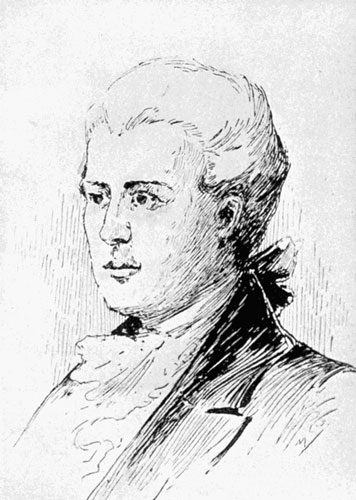
WILLIAM MURDOCK
His early training and all his surroundings naturally and inevitably
interested Murdock in the subject of steam locomotion, and before 1784 he
began to experiment on these lines. That he made definite progress is
shown in a letter that Thomas Wilson, agent in Cornwall of Boulton & Watt,
wrote to his employers in August, 1786, saying, “William Murdock desires
me to inform you that he has made a small engine of three-quarter-inch
diameter and one and one-half inch stroke, that he has applied to a small
carriage, which answers amazingly.” He had made and run this model in
1784, and it is still in existence, and in the possession of the Messrs.
Richard and George Tangye, England.
This model was on the high-pressure principle, and ran on three wheels,
the single front one for steering. The vertical boiler, nearly over the
rear axle, was heated by a spirit-lamp, and the machine stood only a
little more than a foot high. The axle was cranked in the middle and
turned by a rod connected to a beam moved up and down by the piston-rod
projecting from the top of the cylinder. Yet it developed considerable
speed. It is interesting to note that the use of the crank for converting
the reciprocating motion of the steam engine into rotary was patented by
Pickard in 1780, and Murdock’s was probably its first application to
self-propelled carriages.
The first experiment with this little engine was made in Murdock’s house
at Redruth, when the locomotive successfully hauled a wagon round the
room, the single wheel, placed in front of the engine, fixed in such a
position as to enable it to run round a circle.
Dr. Smiles, in his work on inventors, tells an amusing story concerning
this machine. He says: “Another experiment was made out of doors, on
which occasion, small though the engine was, it fairly outran the speed of
its inventor. One night, after returning from his duties at the mine at
Redruth, Murdock went with his model locomotive to the avenue leading to
the church, about a mile from the town. The walk was narrow, straight and
level. Having lit the lamp, the water soon boiled, and off started the
engine with the inventor after it. Shortly after he heard distant shouts
of terror. It was too dark to perceive objects, but he found, on following
up the machine, that the cries had proceeded from the worthy vicar, who,
while going along the walk, had met the hissing and fiery little monster,
which he declared he took to be the Evil One in propria persona!”
But Murdock was too useful a man to Boulton & Watt to be allowed to have
free rein, and his inclination toward steam locomotion invention was
apparently curbed, though it would appear Watt thought the roads of that
time an insurmountable obstacle to the development of road vehicles, and
wanted Murdock to devote his time to mechanical matters more ripe for
success. Boulton, writing to Watt from Truro, in September, 1796, tells
how he met Murdock on his way to London to get a patent on a new model,
and how he persuaded him to turn back. This model was for a steam carriage
that was afterward shown as able to travel freely around a room with a
light load of shovel, poker and tongs upon it. His was probably the first
high-pressure steam-engine vehicle run in England. Though only a small
model, it did its proportionate work well.
Watt continued to oppose Murdock’s scheme, but on one occasion suggested
that he should be allowed an advance of five hundred dollars to enable him
to prosecute his experiments, and if he succeeded within a year in making
an engine capable of drawing a post chaise, carrying two passengers and
the driver, at four miles an hour, it was suggested that he should be
taken as partner into the locomotive business, for which Boulton and Watt
were to provide the necessary capital. This proposition was never carried
out. Again, in 1786, Watt said: “I wish William could be brought to do as
we do, to mind the business in hand, and let such as Symington and Sadler
throw away their time and money in hunting shadows.” Murdock continued to
speculate about steam locomotion on common roads, but never carried his
ideas further. He retired from the employment of Boulton & Watt in 1830,
and practically retired from all work at the same time.
Murdock seems to have had a very clear idea of the possibilities of steam
propulsion on the common roads. Had circumstances permitted he might well
have been expected to have solved the problem in 1796 quite as completely
as his successors did in 1835. But he was a quarter of a century ahead of
the time. Even the moderate public interest that existed later on had not
manifested itself at all in his day and the condition of the English
highways offered almost insuperable obstacles to steam vehicular travel.
Personally his lack of self-assertiveness and his feeling of dependence
upon Boulton and Watt also held him back. So he remained simply one of the
pioneer investigators pointing the way for others.
Oliver Evans
Born in 1755 or 1756, in Newport, Del. Died in Philadelphia, April 21,
1819.
Little has been preserved respecting the early history of Oliver Evans,
who has been aptly styled “The Watt of America.” His parents were farming
people, and he had only an ordinary common-school education. At the age of
fourteen he was apprenticed to a wheelwright or wagonmaker, and continued
his meager education by studying at night time by the light that he made
by burning chips and shavings in the fireplace.
While yet an apprentice his attention was turned to the subject of
propelling land carriages without animal power. But the lack of definite
knowledge in regard to steam power compelled him to abandon his plans,
although his experiments were continued for a long time. Soon after
attaining his majority he was engaged in making card-teeth by hand, and in
connection therewith developed several labor-saving improvements. He also
invented improvements in the construction of machinery of flour mills that
effected a complete revolution in the manufacture of flour. These
improvements consisted of the elevator, the conveyor, the hopper-boy, the
drill and the descender, which various machines were applied in different
mills so as to perform mechanically every necessary movement of the grain
and meal from one part of the mill to the other, causing a saving of fully
one-half in the labor of mill attendance and manufacturing the flour
better. These improvements were not accepted by the mill owners at the
outset, and Evans spent many discouraging years before he could finally
persuade the manufacturers of the utility of his inventions. In the
end, however, he lived to see his inventions generally introduced, and he
profited largely thereby.
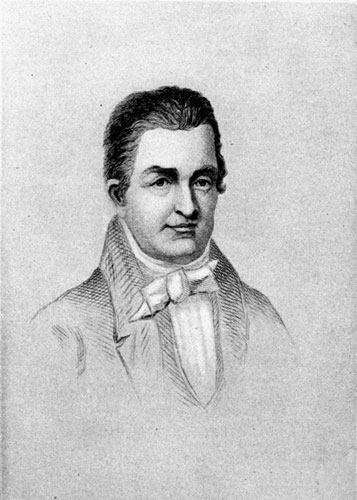
OLIVER EVANS
In the year 1786, Evans petitioned the Legislature of Pennsylvania for the
exclusive right to use his improvements in flour mills and steam carriages
in that State, and in the year following presented a similar petition to
the Legislature of Maryland. In the former instance he was only successful
so far as to obtain the privilege of the mill improvements, his
representations concerning steam carriages being considered as savoring
too much of insanity to deserve notice. He was more fortunate in Maryland,
for, although the steam project was laughed at, yet one of his friends, a
member, very judiciously observed that the grant could injure no one, for
he did not think that any man in the world had thought of such a thing
before, and therefore he wished the encouragement might be afforded, as
there was a prospect that it would produce something useful. This kind of
argument had its effect, and Evans received all that he asked for, and
from that period considered himself bound in honor to the State of
Maryland to produce a steam carriage, as soon as his means would allow
him.
For several years succeeding the granting of his petition by the
Legislature of Maryland, Evans endeavored to obtain some person of
pecuniary resources to join with him in his plans; and for this purpose
explained his views by drafts, and otherwise, to some of the first
mechanics in the country. Although the persons addressed appeared, in
several instances, to understand them, they declined any assistance from
a fear of the expense and difficulty of their execution.
In the year 1800, or 1801, Evans, never having found anyone willing to
contribute to the expense, or even to encourage him in his efforts,
determined to construct a steam carriage at his own expense. Previous to
commencing he explained his views to Robert Patterson, Professor of
Mathematics in the University of Pennsylvania, and to an eminent English
engineer. They both declared the principles new to them, and advised the
plan as highly worthy of a fair experiment. They were the only persons who
had any confidence, or afforded encouraging advice. He also communicated
his plans to B. F. Latrobe, the scientist, who publicly pronounced them as
chimerical, and attempted to demonstrate the absurdity of Evans’
principles in his report to the Philosophical Society of Pennsylvania on
steam engines. In this he also endeavored to show the impossibility of
making steamboats useful.
Evans commenced and had made considerable progress in the construction of
a steam carriage, when the idea occurred to him that as his steam engine
was altogether different in form, as well as in principle, from any other
in use, a patent could be obtained for it, and then applied to mills more
profitably than to carriages. The steam carriage was accordingly laid
aside for a season of more leisure, and the construction of a small engine
was commenced, with a cylinder six inches in diameter and a piston of
eighteen inches stroke, for a mill to grind plaster of paris. The expense
of its construction far exceeded Evans’ calculation, and before the
engine was finished he found it cost him all he was worth. He had then to
begin the world anew, at the age of forty-eight, with a large family to
support, and that, too, with a knowledge that if the trial failed his
credit would be entirely ruined, and his prospects for the remainder of
life dark and gloomy. But fortune favored him, and his success was
complete.
In a brief account, given by himself, of his experiments in steam, he
says: “I could break and grind three hundred bushels of plaster of paris,
or twelve tons, in twenty-four hours; and to show its operations more
fully to the public, I applied it to saw stone, on the side of Market
Street, where the driving of twelve saws in heavy frames, sawing at the
rate of one hundred feet of marble in twelve hours, made a great show and
excited much attention. I thought this was sufficient to convince the
thousands of spectators of the utility of my discovery, but I frequently
heard them inquire if the power could be applied to saw timber as well as
stone, to grind grain, propel boats, etc., and though I answered in the
affirmative, they still doubted. I therefore determined to apply my engine
to all new uses; to introduce it and them to the public. This experiment
completely tested the correctness of my principles. The power of my engine
rises in a geometrical proportion, while the consumption of the fuel has
only an arithmetical ratio; in such proportion that every time I added
one-fourth more to the consumption of the fuel, its powers were doubled;
and that twice the quantity of fuel required to drive one saw, would
drive sixteen saws at least; for when I drove two saws the consumption was
eight bushels of coal in twelve hours, but when twelve saws were driven,
the consumption was not more than ten bushels, so that the more we resist
the steam, the greater is the effect of the engine. On these principles
very light but powerful engines can be made suitable for propelling boats
and land carriages without the great encumbrance of their weight as
mentioned in Latrobe’s demonstration.”
In the year 1840, Evans, by order of the Board of Health of Philadelphia,
constructed at his works, situated a mile and a half from the water, a
machine for cleaning docks. It consisted of a large flat or scow, with a
steam engine of five horse-power on board, to work the machinery to raise
the mud into the scows. This was considered a fine opportunity to show the
public that his engine could propel both land and water conveyances. When
the machine was finished, he fixed, in a rough and temporary manner,
wheels with wooden axletrees, and, of course, under the influence of great
friction. Although the whole weight was equal to two hundred barrels of
flour, yet his small engine propelled it up Market Street and round the
circle to the waterworks, where it was launched into the Schuylkill River.
A paddle-wheel was then applied to its stern, and it thus moved down that
river to the Delaware, a distance of sixteen miles, leaving behind all
vessels that were under sail.
This demonstration was in the presence of thousands of spectators, which
he supposed would have convinced them of the practicability of steamboats
and steam carriages. But no allowance was made by the public for the
disproportion of the engine to its load, nor for the rough manner in which
the machinery was fixed, or the great friction and ill form of the boat,
and it was supposed that this was the utmost it could perform. Some
individuals undertook to ridicule the experiment of driving so great a
weight on land, because the motion was too slow to be useful. The inventor
silenced them by answering that he would make a carriage propelled by
steam, for a wager of three thousand dollars, to run upon a level road,
against the swiftest horse that could be produced. This machine Evans
named the Oructor Amphibolis.
On the 25th of September, 1804, Evans submitted to the consideration of
the Lancaster Turnpike Company a statement of the costs and profits of a
steam carriage to carry one hundred barrels of flour, fifty miles in
twenty-four hours; tending to show that one such steam carriage would make
more net profits than ten wagons, drawn by five horses each, on a good
turnpike road, and offering to build one at a very low price. His address
closed as follows: “It is too much for an individual to put in operation
every improvement which he may invent. I have no doubt but that my engines
will propel boats against the current of the Mississippi, and wagons on
turnpike roads, with great profit. I now call upon those whose interest it
is to carry this invention into effect. All of which is respectfully
submitted to your consideration.” Little or no attention was paid to this
offer, for it was difficult at that day to interest anyone in steam
locomotion.
Evans’ interest in the steam carriage forthwith ceased, but in his
writings, published about that time, he remarked: “The time will come when
people will travel in stages moved by steam engines from one city to
another, almost as fast as birds fly, fifteen or twenty miles an hour.
Passing through the air with such velocity, changing the scene in such
rapid succession, will be the most rapid exhilarating exercise. A carriage
(steam) will set out from Washington in the morning, the passengers will
breakfast at Baltimore, dine at Philadelphia, and sup at New York in the
same day.” To accomplish this he suggested railways of wood or iron, or
smooth paths of broken stone or gravel, and predicted that engines would
soon drive boats ten or twelve miles an hour. In the latter years of his
life, Evans established a large iron foundry in Philadelphia.
Although Evans’ distinct contribution to the problem of steam locomotion
on the common roads was not particularly practical it was at least
important as being the first suggestion of anything of the kind in the
United States. Road conditions in this country at that time were worse
than they were in England and yet under more discouraging circumstances he
was as far advanced in ideas and plans as his great contemporaries,
Trevithick and others across the water. To Evans must be given the credit
of perfecting the high-pressure, non-condensing engine, and even
Trevithick, “the father of the locomotive,” was largely indebted to him
for his progress in the lines he was working on in England, his plans and
specifications having been sent abroad for the English engineers to
inspect in 1784.
William Symington
Born at Leadhills, Scotland, October, 1783. Died in London, March 22,
1831.
More fortunate than most of the English inventors of the seventeenth and
eighteenth centuries, with whom he was associated, William Symington came
of a family that was able to give him a good education. His father was a
mechanic who had charge of the engines and machinery at the Warlockhead
lead mines, and the son gained his first knowledge of mechanics and
engineering in the shops with his father. Intended for the ministry, he
was sent to the University of Glasgow and the University of Dublin to
pursue his studies. But the ministry had slight attractions for him, and
when the time came for him to choose a profession, he adopted that of
civil engineering.
In 1786 he worked out a model for a steam road-car. This was regarded very
highly by all who saw it. It is said that Mr. Meason, manager of the lead
mines at Warlockhead, was so pleased with the model, the merit of which
principally belonged to young Symington, that he sent him into Edinburgh
for the purpose of exhibiting it before the professors of the University,
and other scientific gentlemen of the city, in the hope that it might lead
in some way to his future advancement in life. Mr. Meason became the
patron and friend of Symington, allowed the model to be exhibited at his
own house, and invited many persons of distinction to inspect it. The
carriage supported on four wheels had a locomotive behind, the front
wheels being arranged with steering-gear. A cylindrical boiler was used
for generating steam, which communicated by a steam-pipe with the two
horizontal cylinders, one on each side of the firebox of the boiler. When
steam was turned into the cylinder, the piston made an outward stroke; a
vacuum was then formed, the steam being condensed in a cold water tank
placed beneath the cylinders, and the piston was forced back by the
pressure of the atmosphere. The piston rods communicated their motion to
the driving-axle and wheels through rack rods, which worked toothed wheels
placed on the hind axle on both sides of the engine, and the alternate
action of the rack rods upon the tooth and ratchet wheels, with which the
drums were provided, produced the rotary motion. The boiler was fitted
with a lever and weight safety valve. Symington’s locomotive was
abandoned, the inventor considering that the scheme of steam travel on the
common roads was impracticable.
Henceforth, Symington gave his attention to the study of boat propulsion
by steam. In 1787 he got out a patent for an improved form of steam
engine, in which he obtained rotary action by chains and ratchet-wheels.
This engine, with a four-inch cylinder, was used to work the paddles of a
pleasure boat on Dalswinton Loch, in 1788, the boat steaming at the rate
of five miles an hour. This boat is now in the South Kensington Museum,
and it has been termed “the parent engine of steam navigation.” The
experiment with this method of boat propulsion was so successful that a
year later larger engines, with eighteen-inch cylinders, were fitted to
another boat, which attained a speed of seven miles an hour. In 1801,
Symington took out a patent for an engine with a piston rod guided by
rollers in a straight path and connected by a rod with a crank attached
directly to the paddle-wheel shaft—the system that has been in use ever
since. Although the perfect practicability of this method of boat
propulsion was fully demonstrated by a trial on the tugboat Charlotte
Dundas, in March, 1802, the plan for steam power on canals and lakes was
not carried further. The Forth and Clyde Company, and the Duke of
Bridgewater, who were backing Symington, gave up the project and he could
get help from no other sources. His inventions and experiments are
generally regarded as marking the beginning of steam navigation. It is
interesting to note that among those who were guests on the Charlotte
Dundas, on the occasion of this trial trip, was Robert Fulton, who wrote a
treatise on steam navigation in 1793, tried a small steamboat on the river
Seine, in France, in 1803, and in 1807 launched his famous steamship, the
Clermont, on the Hudson River.
Symington, disappointed and discouraged, gave up his work and went to
London. The rest of his life was for the most part thrown away, and he
became one of the waifs and strays of London. In 1825 he received a grant
of one hundred pounds from the privy purse, and later on fifty pounds
more, in recognition of his services for steam navigation. He died in
obscurity and although he was unquestionably the pioneer in his country of
the successful application of steam to navigation on inland waters his
name is only a bare memory.
Nathan Read
Born in Warren, Mass., July 2, 1759. Died near Belfast, Me., January 20,
1849.
Graduated from Harvard College in 1781, Read was a tutor at Harvard for
four years. In 1788 he began experimenting to discover some way of
utilizing the steam engine for propelling boats and carriages. His efforts
were mainly directed toward devising lighter, more compact machinery than
then generally in use. His greatest invention at that time was a
substitute for the large working-beam. This was a cross-head beam which
ran in guides and had a connecting-rod with which motion was communicated.
The new cylinder that he invented to attach to this working-frame was
double-acting. In order to make the boiler more portable he invented a
multi-tubular form, and this he patented, together with the cylinder,
chain-wheel, and other appliances.
The boiler was cylindrical and was placed upright or horizontal, and the
furnace was carried within it. A double cylinder formed a water-jacket,
connected with a water and steam chamber above, and a water-chamber below.
Numerous small straight tubes connected these two chambers. Read also
invented another boiler in which the fire went through small spiral tubes,
very much as it does in the present-day locomotives, and this was a
smoke-consuming engine. For the purpose of acquiring motion he first used
paddle-wheels, but afterward adopted a chain-wheel of his own invention.
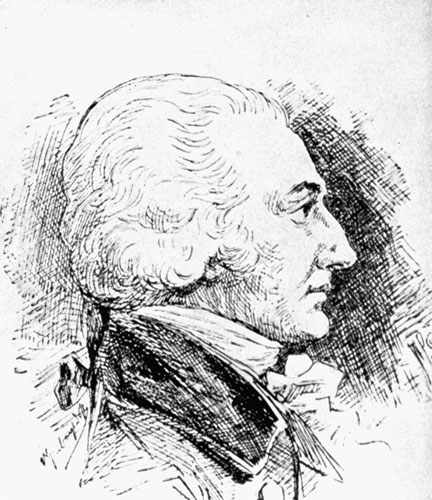
NATHAN READ
Read planned a steam-car to be run with his tubular boiler, and it is said
that this vehicle, when laden with fifty tons weight, could make five
miles per hour. The model which was completed in 1790 had four wheels,
the front pair being pivoted at the center and controlled by a horizontal
sheave and rope. The sheave was located back near the boiler, and in
guiding the machine it was operated by a hand-wheel placed above the
platform, within easy reach of the engineer. A square boiler with Read’s
multi-tubular system, overhung at the rear of the carriage. Two
driving-wheels were forward of the boiler, and in front of these were two
horizontal cylinders on each side of the engine. On the inside of each
wheel were ratched teeth that fitted into corresponding teeth on
horizontal racks above and below the hub. The piston, moving back and
forth from the cylinder, engaged these teeth and caused a revolution of
the wheel. There were two steam valves and two exhaust valves to each
cylinder, the exhaust being into the atmosphere. Although this was the
first conception of propulsion by steam on land in America, Read went no
further in creating this model, inasmuch as he received no encouragement
from financial sources.
In 1796, Read established at Salem, Mass., the Salem Iron Foundry, where
he manufactured anchors, chain cables, and other machinery. In January,
1798, he invented a machine to cut and head nails at one operation. He
also invented a method of equalizing the action of windmills by
accumulating the force of the wind through winding up a weight; and a plan
for harnessing the force of the tides by means of reservoirs which, by
being alternately filled up and emptied, created a constant stream of
water. Among his other inventions were a pumping engine and a threshing
machine.
Richard Trevithick
Born in Illogan, in the west of Cornwall, England, April 13, 1771. Died in
Dartford, Kent, April 22, 1833.
Richard Trevithick had meager educational advantages. His father was
manager of the Dolcoath and other mines, and shortly after the birth of
his son moved to Penponds, near Camborne, where the boy was sent to school
to learn reading, writing and arithmetic, which were the limits of his
attainments. Early in life he showed the dawning of remarkable inventive
genius, was quick at figures and clever in drawing. He developed into a
young man of notable physique, being six feet two inches high, and having
the frame and the strength of an athlete. He was one of the most powerful
wrestlers in the west country, and it is related of him that he could
easily lift a thousand-weight mandril.
At the age of eighteen young Trevithick began to assist his father as mine
manager, and at once proceeded to put his inventive faculty to practical
test. His initial success, in 1795, was an improvement upon an engine at
the Wheal Treasury mine, which accomplished a great saving in fuel and in
power, and won for him his first royalty. Before his father died, in 1797,
he had attained to the position of engineer at the Ding Dong mine, near
Penzance, and had already set up at the Herland mine the engine built by
William Bull, with improvements of his own. His earliest invention of
importance was in 1797, when he made an improved plunger pump, which, in
the following year, he developed into a double-acting water-pressure
engine. One of these engines, set up in 1804, at the Alport mine, in
Derbyshire, was run until 1850.
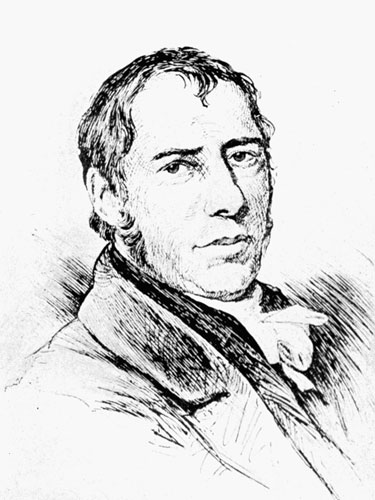
RICHARD TREVITHICK
In 1780 he built a double-acting high-pressure engine with a crank, for
Cook’s Kitchen mine. This was known as the Puffer, from the noise that it
made, and it soon came into general use in Cornwall and South Wales, a
successful rival of the low-pressure steam vacuum engine of Watt.
As early as 1796 Trevithick began to give attention to the subject of
steam locomotion, and a model constructed by him before 1800 is now in the
South Kensington Museum. He busied himself in designing and building a
steam vehicle to travel upon the common highways. The work was done in a
workshop at Camborne, and some of it in the shop of Captain Andrew Vivian.
It was Christmas Eve of 1801 when this steam locomotive was completed and
was brought out for trial.
The following account of the first trial was made by one who was present:
“I knew Captain Dick Trevithick very well. I was a cooper by trade, and
when Trevithick was making his steam carriage I used to go every day into
John Tyack’s shop at the Weith, close by here, where they put her
together. In the year 1801, upon Christmas Eve, towards night, Trevithick
got up steam, out on the high road, just outside the shop. When we saw
that Trevithick was going to turn on steam, we jumped up, as many as
could, maybe seven or eight of us. ’Twas a stiffish hill going up to
Camborne Beacon, but she went off like a little bird. When she had gone
about a quarter of a mile there was a rough piece of road covered with
loose stones. She didn’t go quite so fast, and as it was a flood of rain,
and we were very much squeezed together, I jumped off. She was going
faster than I could walk, and went up the hill about half a mile further,
when they turned her and came back again to the shop.” The next day the
engine steamed to Captain Vivian’s house, and a few days subsequently,
Trevithick and Vivian started off for Tehidy House, where Lord
Dedunstanville lived, some two or three miles from Camborne. On this
journey they met with an accident, the engine being overturned in going
around a curve; but they got back safely.
This carriage presented the appearance of an ordinary stage coach on four
wheels. The engine had one horizontal cylinder which, together with the
boiler and the furnace-box, was placed in the rear of the hind axle.
The-motion of the piston was transmitted to a separate crank-axle, from
which, through the medium of spur-gear, the axle of the driving-wheel,
which was mounted with a fly-wheel, derived its motion. The steam cocks
and the force-pump, as also the bellows used for the purpose of quickening
combustion in the furnace, were worked off the same crank axle. This was
one of the first successful high-pressure engines constructed on the
principle of moving a piston by the elasticity of steam against the
pressure only of the outside atmosphere.
In the following year Trevithick went to London with his cousin, Andrew
Vivian, and secured a patent. Early in 1803 he made his second steam
carriage. This was built at Camborne and taken to London, via Plymouth,
for exhibition. Its journey along the highways thoroughly alarmed the
country people. Coleridge relates that a toll-gate keeper was so
frightened at the appearance of the sputtering, smoke-spitting thing of
fearsome mien that, trembling in every limb and with teeth chattering, he
threw aside the toll-gate with the scared exclamation, “No—noth—nothing
to pay. My de—dear Mr. Devil, do drive on as fast as you can. Nothing to
pay!”
The engine in this carriage had a cylinder five and one-half inches in
diameter, with a stroke of two and one-half feet, and with thirty pounds
of steam it worked five strokes per minute. In every way it was superior
to its predecessor. It was not so heavy; and the horizontal cylinder,
instead of the vertical, added very much to its steadiness of motion;
while wheels of a larger diameter enabled it the more easily to pass over
rough roads which had brought the Camborne one to a standstill. The boiler
was made entirely of wrought iron, and the cylinder was inserted
horizontally, close behind the driving axle. A forked piston-rod was used,
the ends working in guides, so that the crank axle might be brought near
to the cylinder. Spur gearing and couplings were used on each side of the
carriage for communicating motion from the crank shaft to the main driving
axle. The driving-wheels were about ten feet diameter, and made of wood.
The framing was of wrought iron. The coach was intended to seat eight or
ten persons, and the greater part of the weight came on the driving axle.
The coach was suspended upon springs.
The London steam carriage was put together at Felton’s carriage shop, in
Leather Lane, and after its completion, Vivian one day ran the locomotive
from Leather Lane, Gray’s Inn Lane, on to Lords’ Cricket Ground, to
Paddington, and home again by way of Islington, a journey of ten miles
through the streets of London. Several trips were made in Tottenham Court
Road and Euston Square, and only once did they meet with accident.
Finally, however, the frame of the carriage got twisted, and the engine
was detached and set to driving a mill.
Trevithick’s next experiment was made in 1803-4, while he was engineer of
the Pen-y-darran iron works, near Merthyr Tydvil, where he built and ran
on a railway a locomotive that was fairly successful. In 1808 he built a
locomotive for a circular railway or steam circus that he and Andrew
Vivian set up in London, near Euston Square. This ran for several weeks,
carrying passengers at the rate of twelve or fifteen miles an hour around
curves of fifty or one hundred feet radius. One day a rail broke and the
engine was overturned, which ended the exhibition.
Subsequently, Trevithick applied his high-pressure engine to rock-boring
and breaking, and dredging. He laid out a system of dredging the Thames
River, planned a tunnel under the Thames, invented a high-pressure steam
threshing engine in 1812, constructed iron tanks and buoys, and modeled an
iron ship. He was one of the first to conceive the practical use of steam
in agriculture, declaring that the use of the steam engine for this
purpose would “double the population of the kingdom and make our markets
the cheapest in the world.”
In 1814, Trevithick became interested in a plan to work the silver mines
of Peru by Cornish methods, and nine of his high-pressure engines were
sent to South America in charge of Henry Vivian and other engineers. He
himself followed in 1816, and remained in that country ten years, making
and losing several fortunes during that time. Finally, in a revolution,
the mining plants were destroyed, and he was forced to leave the country,
penniless. For a time he was prospecting in Costa Rica, where he planned a
railroad across the Isthmus from the Atlantic to the Pacific. In 1827 he
returned to England, still a poor man, and settling in Dartford, Kent,
devoted himself to new inventions, unsuccessfully endeavoring to secure
the help of the government in his work. His later years were spent in
poverty, and when he died, the expense of his burial was borne by his
fellow-workmen of Dartford.
Undoubtedly, Trevithick was one of the foremost English engineers of his
day, a period that was rich with strong men of distinction in his
profession. By many he has been considered as having contributed more even
than James Watt to the development of the steam engine and its broader
adaptation to practical uses. In his early years he was restrained in
putting his ideas and experiments to practical test by the restrictions of
Watt’s patents. Finally when that difficulty was removed he at once took a
leading position in his profession. Especially in the development of the
high pressure engine he is entitled to at least as much credit as any man
of his day. His genius was fully recognized in his generation and his
impoverished old age was the result of financial reverses in business
operations and not from the lack of substantial rewards for his inventive
achievements.
David Gordon
The first experiments of David Gordon, who in 1819 was working with
William Murdock, in Soho, were for the purpose of using compressed air for
common road locomotives. He also invented a portable gas apparatus, and
originated a society of gentlemen, with the intention of forming a company
for the purpose of running a mail coach and other carriages by means of a
high-pressure engine, or of a gas vacuum or pneumatic engine, supplied
with portable gas. Alexander Gordon, his son, states that “the committee
of the society had only a limited sum at their disposal, nor were there to
be more funds until a carriage had been propelled for a considerable
distance at the rate of ten miles an hour.” David Gordon then tried to
prevail upon the committee to make use of a steam engine, but evidently
without success.
In 1821 he took out a patent for improvements in wheel carriages, and his
locomotive is fully described in the interesting Treatise on Elemental
Locomotion, by Mr. Alexander Gordon. The machine consisted of a large
hollow cylinder about nine feet in diameter and five long, having its
internal circumference provided with a continuous series of cogged teeth,
into which were made to work the cogged running wheels of a locomotive
steam engine, similar to that of Trevithick. The steam power being
communicated to the wheels of the carriage, caused them to revolve, and to
climb up the internal rack of the large cylinder. The center of gravity of
the engine being thus constantly made to change its position, and to throw
its chief weight on the forward side of the axis of the cylinder, the
latter was compelled to roll forward, propelling the vehicle before it,
and whatever train might be added.
Gordon’s next attempt to construct locomotive carriages for the common
road was in 1824. The means proposed was a modification of the method
invented by William Brunton. But instead of the propellers being operated
upon by the alternating motion of the piston-rod, as in Brunton’s vehicle,
Gordon contrived to give them a continuous rotatory action and to apply
the force of the engines in a more direct manner. The carriage ran upon
three wheels, one in the front to steer by, and two behind to bear the
chief weight. Each of the wheels had a separate axle, the ends of which
had their bearings upon parallel bars, the wheels rolling in a
perpendicular position. This arrangement, by avoiding the usual
cross-axle, afforded an increased uninterrupted space in the body of the
vehicle.
In the fore part of the carriage were placed the steam engines, consisting
of two brass cylinders, in a horizontal position, but vibrating upon
trunnions. The piston-rods of these engines gave motion to an eight-throw
crank, two in the middle for the cylinders, and three on each side, to
which were attached the propellers; by the revolution of the crank, these
propellers or legs were successively forced outwards, with the feet of
each against the ground in a backward direction, and were immediately
afterwards lifted from the ground by the revolution of another crank,
parallel to the former, and situated at a proper distance from it on the
same frame. The propelling-rods were formed of iron gas-tubes, filled with
wood, to combine lightness with strength. To the lower ends of these
propelling-rods were attached the feet, in the form of segments of
circles, and made on their under side like a short and very stiff brush of
whalebone, supported by intermixed iron teeth, to take effect in case the
whalebone failed. These feet pressed against the ground in regular
succession, by a kind of rolling, circular motion, without digging it up.
The guide had the power of lifting these legs off the ground at pleasure,
so that in going down hill, when the gravity was sufficient for
propulsion, nothing but a brake was put into requisition to retard the
motion, if necessary. If the carriage was proceeding upon a level, the
lifting of the propellers was equivalent to the subtraction of the power,
and soon brought it to a full stop. When making turns in a road the guide
had only to lift the propellers on one side of the carriage and allow the
others to operate alone, until the curve was traversed.
Gordon got fair results from this locomotive, but the speed was not
satisfactory. In his first trials he found the power insufficient. He
afterwards fitted one of Gurney’s light boilers in the hinder part of the
carriage, though even after this improvement had been added the
experiments were disappointing. Gordon was convinced that the application
of the power to the wheels was the proper mode of propulsion, and his
project was abandoned after six or seven years had been spent in
inventing, constructing, and carrying out experiments with four distinct
carriages.
William Henry James
Born at Henley, England, March, 1776. Died at Dulwich College Alms House,
December 16, 1873.
The father of William Henry James was William James, of Warwickshire, the
great railway projector of his time. He was a solicitor in early life, but
became wealthy, worked a colliery in South Staffordshire, and in 1815
removed to London, where he had a large land agency business. He became
interested in tramways in 1806, and from that date on devoted most of his
energies and fortune to projecting railways in the United Kingdom. He had
an interest in one of George Stephenson’s patents, made numerous railway
surveys, and by many has been considered to have done more than any single
individual in laying the foundations of the English railroad system.
William Henry James assisted his father in his railway surveys in early
life, and then began business independently as an engineer, in Birmingham.
He made experiments in steam locomotion on common roads, and took out
patents for locomotive steam engines, boilers, driving apparatus, and so
on. His patent for a water-tube boiler for road locomotives was secured in
1823, and his first car was built in 1824. This was a twenty-passenger
steam coach. Each rear wheel had a double-cylinder engine, and the pistons
were worked at a pressure of two hundred pounds per square inch. Separate
engines to each driver gave each wheel an independent motion, so that
power and speed might be varied for turning corners, the outer wheel
travelling over a much greater space than the inner wheel. When the front
wheels were so placed that the carriage proceeded in a straight line an
equal amount of steam was admitted to each pair of cylinders, but when the
front wheel was in the lock the engine driving the outer wheel received a
greater amount of steam and thus developed more power and traveled faster
than the inner wheel. This arrangement was said to be so efficient that
the carriage could be made to describe every variety of curve, repeatedly
making turns of less than ten feet radius. The whole of the machinery was
mounted upon laminated carriage springs. This arrangement caused the
engines and their framework to vibrate altogether upon the crank-shaft as
a center, at the same time connecting these engines to the boiler by means
of hollow axles moving in stuffing boxes. Each engine had two cylinders of
small diameter and long stroke; to these separate engines steam was
supplied from the boiler by means of the main pipe, which moved through
steam-tight stuffing boxes to the slide valve-boxes by small pipes. The
locomotive was entirely distinct from the passenger carriage.
Sir James C. Anderson became associated with James, and in 1829 they built
another carriage. This weighed nearly three tons, and the first trials
were made round a circle of one hundred and sixty feet in diameter. When
it was finally ready to be brought out it was loaded with fifteen
passengers and driven several miles on a rough gravel road across Epping
Forest, with a speed varying from twelve to fifteen miles an hour. Steam
was supplied by two tubular boilers, each forming a hollow cylinder four
feet six inches long. The tubes of which the boilers were composed were
common gas pipe, one of which split on one of the trips, thus letting the
water out of one of the boilers and extinguishing its fire. Under these
circumstances, with only one boiler in operation, the carriage returned
home at the rate of about seven miles an hour, carrying more than twenty
passengers—at one period, indeed, it is said, a much greater number;
showing that sufficient steam could be generated in such a boiler to be
equal to the propulsion of between five and six tons weight. In
consequence of this demonstration that the most brilliant success was
attainable, the proprietors dismantled the carriage and commenced the
construction of superior tubular boilers with much stronger tubes.
Shortly after Anderson and James commenced to build another steam
carriage, which was ready for use in November, 1829. This engine was not
intended to carry passengers, but to be employed for drawing carriages
behind. Four tubular boilers were used, the total number of tubes being
nearly two hundred. These boilers were enclosed in a space four feet wide,
three feet long, and two feet deep. The steam from each boiler was
conducted into one main steam pipe one and one-half inches in diameter,
and the communication from any one of the boilers could be cut off in case
of leakage. Four cylinders, each two and one-quarter inch bore and nine
inch stroke, were arranged vertically in the hind part of the locomotive,
and two of them acted upon each crank-shaft as before, giving a separate
motion to each driving wheel.
The exhaust steam was conducted through two copper tanks for heating the
feed water to a high temperature, and thence passed to the chimney. The
steering-gear consisted of an external pillar containing a vertical shaft,
at the upper end of which small bevel-gearing was used, giving motion to
the vertical shaft, whose bottom end carried a pinion gearing into a
sector attached to the fore axle. The motion of the crank-shafts was
communicated to the separate axles of the driving-wheels by spur-gearing
with two speeds.
In experiments made with this carriage, the greatest speed obtained upon a
level, on a very indifferent road, was at the rate of fifteen miles an
hour, and it never ran more than three or four miles without breaking some
of the steam joints. The Mechanic’s Magazine, reporting one of these
trials, said: “A series of interesting experiments were made throughout
the whole of yesterday with a new steam carriage belonging to Sir James
Anderson, Bart., and W. H. James, Esq., on the Vauxhall, Kensington, and
Clapham roads, with the view of ascertaining the practical advantages of
some perfectly novel apparatus attached to the engines, the results of
which were so satisfactory that the proprietors intend immediately
establishing several stage coaches on the principle. The writer was
favored with a ride during the last experiment, when the machine proceeded
from Vauxhall Bridge to the Swan at Clapham, a distance of two and a half
miles, which was run at the rate of fifteen miles an hour. From what I had
the pleasure of witnessing, I am confident that this carriage is far
superior to every other locomotive carriage hitherto brought before the
public, and that she will easily perform fifteen miles an hour throughout
a long journey. The body of the carriage, if not elegant, is neat, being
the figure of a parallelogram. It is a very small and compact machine, and
runs upon four wheels.”
W. H. James patented another steam carriage in August, 1832. This varied
much from his earlier engines in the working parts, and it was not
generally considered to be as satisfactory as the others. Sir James
Anderson was not able, for pecuniary reasons, to continue to back James in
his experimenting, and it does not appear that these plans of 1832 were
ever consummated in a completed vehicle.
James was a man of strong mind, an original thinker and thoroughly
well-trained by his apprenticeship with his father. He spent a good part
of his life in experimenting with common-road steam propulsion, but he had
not monetary resources or financial ability commensurate with his
mechanical genius. When the support of Anderson was withdrawn from him he
seems to have been compelled to give up. Little has been recorded
concerning the latter years of his life, and his death in the almshouse
sufficiently indicates the poverty in which his last years were spent. His
father also sacrificed his life to the cause of railroad advancement,
losing his entire fortune and dying a poor man.
Goldsworthy Gurney
Born at Treator, near Padstow, Cornwall, England, February 14, 1793. Died
at Reeds, near Bade, February 28, 1875.
The son of John Gurney, Goldsworthy Gurney received a good elementary
education at the Truro Grammar School, and then studied medicine. He
settled at Wadebridge as a surgeon, but although very successful,
gradually turned his attention to scientific and mechanical
investigations. He constructed an organ, studied chemistry and mechanical
science, and removing to London in 1820, delivered a series of lectures on
heat, electricity and gases at the Surrey Institute. His investigations
resulted in the invention of the oxy-hydrogen blowpipe, and the discovery
of the powerful lime-light known as the Drummond light, and he engaged in
other experiments in this field of research.
In 1804, while on a holiday at Camborne, he saw a Trevithick engine on
wheels. Recalling this in after years he began experimenting on steam
locomotion in 1823, and soon abandoned his surgical and medical practice
for this new pursuit. His first efforts were toward the construction of an
engine to travel on the common roads. The weight of the steam engines that
were then being built seemed to him to offer great objections to their use
for this purpose, but he succeeded, with his first machine, in reducing
weight from four tons to thirty hundredweight. Then he secured a
sufficiency of power by the invention of the high-pressure steam jet. This
invention differed from those of Stephenson and Trevithick, who sent their
waste steam up through the chimney instead of utilizing it. The Gurney
jet was applied to the Stephenson Rocket engine on the Liverpool and
Manchester Railway, in October, 1829, and also to steamboats and steam
carriages.
In 1823, Gurney made his first experiments with a model steam carriage, on
which propellers or feet were used. Two years later, in 1825, he completed
a full-size carriage on the same plan, and in May of that year he took out
his first patent for this vehicle. The carriage was impelled by these legs
being alternately drawn forwards and pressed backwards by a steam engine
acting upon them through movable oblong blocks, to which they were
attached. As a first experiment this carriage was driven up Windmill Hill,
near Kilburn. Another trip, between London and Edgeware, demonstrated the
inefficiency of these propellers, and led to the discovery that there was
sufficient friction between wheels and the ground to insure propulsion.
In 1826 he constructed a coach about twenty feet long, which would
accommodate six inside and fifteen outside passengers, besides the
engineer. The driving-wheels were five feet diameter, and the leading
wheels three feet nine inches diameter. Two propellers were used, which
could be put in motion when the carriage was climbing hills. Gurney’s
patent boiler was used for supplying steam to the twelve horse-power
engine. The total weight of the carriage was about a ton and a half. In
front of the coach was a capacious boot, while behind, that which had the
appearance of a boot, was the case for the boiler and the furnace, from
which it was calculated that no inconvenience would be experienced by the
outside passenger, although in cold weather a certain degree of heat might
be obtained, if required. In descending a hill, there was a brake fixed on
the hind wheel, to increase the friction; but, independently of this, the
guide had the power of lessening the force of the steam to any extent by
means of the lever at his right hand, which operated upon the throttle
valve, and by which he could stop the action of the steam altogether and
effect a counter vacuum in the cylinders. By this means also he regulated
the rate of progress on the road. There was another lever by which he
could stop the vehicle instantly, and in a moment reverse the motion of
the wheels.
This carriage traveled up Highgate Hill to Edgeware, and also to Stanmore,
and went up both Stanmore Hill and Brockley Hill. In ascending these hills
the driving-wheels did not slip, so that the legs were not needed. After
these experiments the propellers were removed.
Gurney obtained another patent in 1827, and under this worked a steam
carriage resembling the common stage coach, with the boiler in the hind
boot. This carriage was run experimentally to Barnet, Edgeware, Finchley,
and other places, and in 1828 it was said that a trip was made from London
to Melksham, thirteen miles from Bath, a distance of nearly two hundred
miles. On the return trip the rate of speed was about twelve miles an
hour.
Gurney’s carriage so fully established its practicability, that in 1830,
Sir Charles Dance contracted for several, and ran them successfully from
London to Holyhead, and from Birmingham to Bristol. In the following year
he ran over the turnpike road between Gloucester and Cheltenham for four
months in succession, four times a day, without an accident or delay of
consequence. The distance of nine miles was regularly covered in from
forty-five to fifty-five minutes. Nearly three thousand persons were
carried, and nearly four thousand miles traveled.
A strong public sentiment against the use of the common roads by these
vehicles sprang up, and Parliament was prevailed upon to impose upon steam
carriages heavy highway tolls that were in effect prohibitory. Sir Charles
Dance suspended his operations. Gurney petitioned the House of Commons for
relief. Several committees in 1831, 1834 and 1835 investigated the subject
and reported strongly in favor of steam carriages, but no legislation
could be secured, and Gurney was forced to give up further introduction of
steam carriages.
He continued his experimenting in other directions, invented the stove
that bore his name, introduced new methods of lighting and ventilating the
Houses of Parliament, and was otherwise active in scientific pursuits. He
was a magistrate for Cornwall and Devonshire, and in 1863 was knighted in
recognition of his discoveries and inventions.
By writers of that period Gurney received a great deal of credit and an
abundance of advertising for his work. He was especially conspicuous in
the Parliamentary investigations regarding steam carriages. On the whole,
however, it is generally considered that he was proclaimed far beyond his
merits, especially in comparison with such rivals as Hancock, Maceroni and
others.
Thomas Blanchard
Born in Sutton, Mass., June 24, 1788. Died, April 16, 1864.
Blanchard received a common school education, and before he had entered
his teens his mechanical genius began to show itself. At thirteen years of
age he invented a machine for paring apples, and shortly after, a machine
for making tacks. His great work was the invention of a machine for
turning out articles of irregular form from wood and metals. His lathes
for this purpose were put in operation by the United States Government in
the armories at Harper’s Ferry, Va., and Springfield, Mass.
Becoming interested in the subject of steam propulsion he made, in 1826, a
steamboat that was successfully tried on the Connecticut River, running
from Hartford, Conn., to Springfield, Mass. Afterward, he built a boat of
larger size, that drew eighteen inches of water, and ran this up the
Connecticut River, from Springfield, Mass., to Vermont. He also built
other boats for use on the Alleghany River.
The subjects of railroads and locomotive power on land interested him for
a short time, and in 1825, after he had completed his engagement with the
United States armories, he built, at Springfield, Mass., a carriage driven
by steam for use on the common road. This was the first real steam
carriage constructed in this country, the Philadelphia machine of Evans
being but a rude affair, although it involved the essential principles of
steam propulsion. The Blanchard carriage was perfectly manageable,
could turn corners and go backwards and forwards with all the readiness of
a well-trained horse, and on ascending a hill the power could be
increased. Its performance on the highway was altogether satisfactory, and
a patent was issued to its inventor.
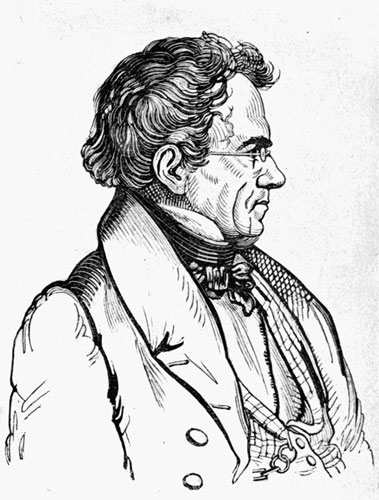
THOMAS BLANCHARD
Blanchard endeavored to secure support to build a railroad in
Massachusetts, and the joint committee on roads and canals of the
Massachusetts Legislature, in January, 1826, endorsed the model of his
railway and steam carriage, and recommended them “to all the friends of
internal improvements.” Notwithstanding this report, capitalists viewed
the project as visionary, and Blanchard met with no greater success when
he subsequently applied to the Legislature of New York. Giving up his
plans he thenceforward devoted his attention to the subject of steam
navigation.
Blanchard was a prolific inventor, having taken out no less than thirty or
forty patents for as many different inventions. He did not reap great
benefit from his labors, for many of his inventions scarcely paid the cost
of getting them up, while others were appropriated without payment to him,
or even giving him credit. His machine for turning irregular forms was his
most notable work, and even of that, others sought to defraud him. To
defend himself he was forced to go to the courts and even to Congress,
before he succeeded in establishing his rights. After the success of this
machine he made other improvements in the manufacture of arms,
constructing thirteen different machines that were operated in the
government armories.
Johnson
Two brothers Johnson had a small engineering establishment in
Philadelphia, in 1828. They put upon the streets in that year a vehicle
that J. G. Pangborn, in his The World’s Rail Way, says was “the first
steam wagon built, and actually operated as such, in the United States.”
The same writer, describing this wagon, says that it had a single cylinder
set horizontally, with a connecting-rod attachment with a single crank at
the middle of the driving-axle. Its two driving-wheels were eight feet in
diameter and made of wood, the same as those on an ordinary road wagon.
The two forward or guiding wheels were much smaller than the others, and
were arranged in the usual manner of a common wagon. It had an upright
boiler hung up behind, shaped like a huge bottle, the smoke-stack coming
out through the center of the top. The safety-valve was held down by a
weight and lever, and the horses in the neighborhood did not take at all
kindly to the puffing of the machine as it jolted over the rough streets.
Generally it ran well, and could take without difficulty reasonable grades
in the streets and roadways. During its existence, however, it knocked
down a number of awning-posts, ran into and broke several window fronts,
and sometimes was altogether unmanageable. Like all others of their day,
however, the Johnsons were ahead of their time. There was no demand for
their steam wagon, road conditions made it unavailable and the machine
itself was, despite much merit, really not much more than a suggestion of
better things three-quarters of a century later.
Walter Hancock
Born in Marlborough, Wiltshire, England, June 16, 1799. Died May 14, 1852.
The father of Walter Hancock was James Hancock, a timber merchant and
cabinet maker. Walter received a common school education, and then was
apprenticed to a watchmaker and jeweler in London. The bent of his
inclination, however, was toward engineering, and he turned his attention
to experimenting along the lines that were at that time absorbing the
thoughts and efforts of those men of England interested in mechanical and
scientific subjects.
He was foremost among those who in the early part of the nineteenth
century were engaged in trying to solve the problem of steam carriage
locomotion on the common highways. The story of his work in this direction
is fully told by himself in his Narrative of Twelve Years’ Experiments,
1824-36, Demonstrative of the Practicability and Advantage of Employing
Steam Carriages on Common Roads, a book published in London, in 1838. This
volume contains a full account of his labors, and descriptions of all the
carriages that he built and ran. The following extract from the
introduction of the book shows in what esteem Hancock regarded himself and
what estimate he placed upon the value of his work:
“The author of these pages believes he should offend alike against truth
and genuine modesty were he to yield to any of the steam carriage
inventors who have appeared in his day, in a single particular of desert;
he began earlier (with one abortive exception) and has persevered longer
and more unceasingly than any of them. He was the first to run a steam
carriage for hire on a common road, and is still the only person who has
ventured in a steam vehicle to traverse the most crowded streets of the
metropolis at the busiest periods of the day; he has built a greater
number of steam carriages (if not better) than anyone else, and has been
thus enabled to try a greater variety of forms of construction, out of
which to choose the best.”
In 1824, Hancock invented a steam engine in which the ordinary cylinder
and piston were replaced by two flexible steam receivers, composed of
several layers of canvas firmly united together by coatings of dissolved
caoutchouc, or india-rubber, and thus enabled to resist a pressure of
steam of sixty pounds upon the square inch. This engine he tried to adapt
to steam carriages, but found that he could not get the requisite degree
of power for locomotion, although it worked very well as a stationary
engine of four horse-power at his factory in Stratford. Next he invented a
tubular boiler with sixteen horizontal tubes, each connected with each
other by lesser tubes, so that the water or steam might circulate through
the entire series. This boiler was subsequently changed by arranging the
tubes vertically, and a patent was taken out in 1825.
After further experiments and improvements, Hancock finally made a vehicle
to travel on three wheels, getting power from a pair of vibrating or
trunnion engines fixed upon the crank-axle of the fore wheels.
Experimental trips of this carriage were made from the Stratford shop to
Epping Forest, Paddington, Hounslow, Croydon, Fulham, and elsewhere. Some
changes were made in the vehicle, and finally the trunnion engines were
put aside and fixed ones substituted.
This improved carriage, the first in a long series built by Hancock, was
named the Infant. The body was in the form of a double-body coach, or
omnibus, with seats for passengers inside and out. The bulk of the
machinery was placed in the rear of the carriage, a boiler and a fire
being beneath it. Between the boiler and the passengers’ seats was the
engine and a place for the engineer. A pair of inverted fixed engines
working vertically on a crank-shaft furnished the power. The steering
apparatus was in front. The whole carriage was on one frame supported by
four springs on the axle of each wheel. The carriage was capable of
carrying sixteen passengers besides the engineer and guide. Its total
weight, including coke and water, but exclusive of attendants and
passengers, was about three and one-half tons. The wheel tires were three
and one-half inches wide, and the diameter of the hind wheels four feet.
In February, 1831, the Infant began to run on regular trips between
Stratford and London. In 1832 a second carriage, similar to the Infant,
was built, and called the Era. It was constructed for the London and
Brighton Steam Carriage Company, to ply between London and Greenwich. The
following year a third carriage, the Enterprise, was completed, for the
London and Paddington Steam Car Company, and was run between London and
Paddington.
Hancock took the Infant on a long trip from Stratford to London and
Brighton, in October, 1832. Eleven passengers were carried, and the
carriage kept a speed of nine miles an hour on the level, and six to eight
miles an hour up grade. On the return one mile up hill was made at the
rate of seventeen miles an hour. Another trip to Brighton was made in
September of the next year at an average speed of twelve miles an hour
actual traveling. At Brighton the new carriage attracted much attention,
and was exhibited for several days on trips in and around the town. After
the Enterprise, the Autopsy came from the Hancock shops, in September,
1833. This carriage was run on trial about Brighton and in London streets,
and for about a month was run for hire between Finsbury Square and
Pentonville.
A small steam drag or tug to draw an attached coach or omnibus was the
next production of the Hancock establishment, which had already attained
more than local fame. This was built for a Herr Voigtlander, of Vienna,
and on one of its trial trips it carried ten persons and an attached
four-wheeled carriage with six persons in it. With this load a speed of
fourteen miles an hour on the level was attained, and eight to nine miles
an hour on up grades.
Beginning in August, 1834, the Era and the Autopsy were run daily in
London between the City, Moorgate and Paddington. During the ensuing four
months over four thousand passengers were carried. Each coach carried from
ten to twelve passengers, and the trip from Moorgate to Paddington, five
miles, was made in a half hour, including stops. On the trial trip a speed
of twelve miles an hour, exclusive of stops, was maintained.
Later in the same year the Era, with its name changed to the Erin, was
sent to Dublin, Ireland, where it was exhibited and run in and about the
city, by Hancock, for eight days, before it was reshipped to Stratford.
Next in turn came a drag of larger size than any before built, with an
engine of greater capacity. On the trial trip this drew, on a level road,
at a speed of ten miles an hour, three omnibuses and one stage coach with
fifty passengers. In July, 1835, the trip to Reading, a distance of
thirty-eight miles, was made in three hours forty minutes twenty-five
seconds; actual running time, exclusive of stops, three hours eight
minutes ten seconds, at a moving rate of over twelve miles an hour.
Subsequently, this drag was made over into a carriage, like the others of
the Hancock type, fitted for eighteen passengers, and named the Automaton.
In August, 1835, the Erin ran from London to Marlborough, a distance of
seventy-eight miles, in seven hours forty-nine minutes, exclusive of
stops, averaging nine and six-tenths miles an hour. The return from
Marlborough to London was accomplished in seven hours thirty-six minutes,
exclusive of stops, an average of nine and eight-tenths miles an hour. In
the same month the Erin made the run from London to Birmingham at the rate
of ten miles an hour.
In 1836, Hancock ran all his carriages on a regular route on the Stratford
and Islington roads for a period of twenty weeks, making in that time
seven hundred and twelve trips, covering four thousand two hundred miles,
and carrying twelve thousand seven hundred and sixty-one passengers.
After running his carriages for several years dissensions in the companies
that were promoting the new means of travel, and the increasing efficiency
of railways, led to the discontinuance of Hancock’s energy in this
direction. Thereafter he built only a steam phaeton for his personal use;
this had seats for three, and was used about the City, Hyde Park and the
London suburbs. Hancock’s steam vehicles were ten in number—the
experimental three-wheeler, the trunnion-engine Infant, the fixed engine
Infant, the Era, afterward the Erin, the Enterprise, the Autopsy, the
Austrian drag, the Irish drag, the Automaton, and the phaeton.
Hancock turned his attention in the later years of his life to developing
the use of india-rubber, in connection with his brother, Thomas Hancock,
who was one of the foremost rubber manufacturers of England. He secured
several patents for improvements in manufacturing rubber.
At the time when Hancock was at work upon his steam carriages, Gurney was
also in the front and there was considerable jealousy between the two. Dr.
Lardner and others were active in exploiting Gurney, while Hancock was
supported in controversies by Alexander Gordon, Luke Hebert and others.
That Hancock achieved most in the way of definite results and that his
experimenting and accomplishments were more markedly along thoroughly
intelligent and conservatively practical mechanical lines than any of his
rivals is now generally conceded. His carriages were admirable productions
as road vehicles, well-built, attractive and comfortable.
William T. James
An engineer of New York, who was engaged in experimenting about 1829 James
made, in his shop in Eldridge Court, several small models of vehicles that
proved sufficiently satisfactory. His first engine had two-inch cylinders
and four-inch stroke. This ran around a track on the floor of his shop,
and drew a train of four cars, carrying an apprentice boy on each car.
James’ second locomotive was mounted on three wheels, two drivers in the
rear and a steering wheel, and it ran on the floor or sidewalk.
In 1829, James, satisfied with his experimenting, built a steam carriage
capable of carrying passengers, and with this he made very good time over
the streets and roadways in and about the metropolis. He then adopted the
rotary cylinders instead of the reciprocating, in his engine, which had
two six-inch cylinders, and was supported on three wheels. On each
cylinder were two fixed eccentrics, one for the forward and one for the
backing motion. The slide valve of one cylinder had a half-inch lap at
each end, and exhausted its steam into the other.
In 1830, James made his fourth full-size steam carriage. This was a
three-wheeled vehicle, the rear wheels being drivers three feet in
diameter, and the third the front or steering wheel. In 1831, in a
competition for the best locomotive engine adapted to the Baltimore and
Ohio Railroad Company, James built his fifth locomotive, and the first one
to run on rails. His engine did not secure the prize, but the company,
thinking his machine contained valuable ideas, entered into an arrangement
with him for further experimenting.
Francis Maceroni
Born in Manchester, England, in 1788. Died in London, July 25, 1846.
The father of Francis Maceroni was Peter Augustus Maceroni who, with two
brothers, served in a French regiment in the American Revolution. After
that conflict was ended he went to England and settled in Manchester,
where he was Italian agent for British manufacturers.
Francis Maceroni was educated in the Roman Catholic school, in Hampshire;
at the Dominican Academy, in Surrey, and at the college at Old Hall Green,
near Puckerbridge, Hertfordshire. During a period of ten years, from 1803
to 1813, he lived in Rome and Naples as a young gentleman of elegant
leisure. In 1813 he began the study of anatomy and medicine, but had not
gone far in those pursuits before his vagrom disposition took him in
another direction. He became aide-de-camp to Murat, King of Naples, with
the rank of Colonel of Cavalry. His service with Murat took him on
missions to England and France, and for a time he was a prisoner of the
French authorities.
After two years of this military service, he returned to England, and
retained his residence there for the rest of his life. He did not remain
at home long, however, for he was with Sir George MacGregor at Porto
Bello, in 1819; became a brigadier-general of the new republic of
Colombia, and in 1821 saw service in Spain with General Pepe.
Returning again to England, he came before the public as an advocate of a
ship canal across the Isthmus, between the Atlantic and Pacific oceans,
and also promoted a company, called The Atlantic and Pacific Junction and
South American Mining and Trading Company, with a capital of one million
pounds sterling. The company collapsed in the commercial panic of 1825,
and this soldier of fortune in 1829 went to Constantinople to assist the
Turks against the Russians. In London again in 1831, Maceroni was engaged
for the rest of his life in the cause of highway steam locomotion, in
which he accomplished a great deal.
Maceroni was second only to Walter Hancock as an inventor and builder of
steam road carriages and as a promoter of travel by those vehicles. From
1825 to 1828 he was with Goldsworthy Gurney in London, but his real
activity did not begin until 1831, when he became associated with John
Squire. In 1833, Maceroni and Squire took out a patent for a multi-tubular
boiler, which they applied to a steam carriage that one writer of that day
described as “a fine specimen of indomitable perseverance.” It often
traveled at the rate of from eighteen to twenty miles an hour. The engines
were placed horizontally underneath the carriage body, the boiler was
arranged at the back, and a fan was used to urge the combustion of the
fuel, the supply of which was regulated by the engineman, who had a seat
behind. The passengers were placed in the open carriage body, and their
seats were upon the tops of the water tanks. There were two cylinders
seven and one-half inches in diameter, the stroke being fifteen and
three-quarter inches. The diameter of the steam pipe was two and
one-quarter inches, and that of the exhaust pipe was two and three-quarter
inches.
The carriage attracted a great deal of attention, and much was written
about it in the newspapers of the time. Once the trip was taken to
Harrow-on-the-Hill, a distance of nine miles, in fifty-eight minutes,
without the full power of steam being on at any time. For several weeks in
the early part of 1834 the carriage was running daily from Oxford Street
to Edgeware. Several trips were made to Uxbridge, when the roads were in
very bad condition, but the journey from the Regent’s Circus, Oxford
Street, a distance of sixteen miles, was often performed in a little over
an hour. A trip to Watford was made, and one of the passengers thus
described the experience from Bushby Heath into the village of Watford:
“We set off from the starting place amid the cheers of the villagers. The
motion was so steady that we could have read with ease, and the noise was
no worse than that produced by a common vehicle. On arriving at the summit
of Clay Hill, the local and inexperienced attendant neglected to clog the
wheel until it became impossible. We went thundering down the hill at the
rate of thirty miles an hour. Mr. Squire was steersman, and never lost his
presence of mind. It may be conceived what amazement a thing of this kind,
flashing through the village of Bushy, occasioned among the inhabitants.
The people seemed petrified on seeing a carriage without horses. In the
busy and populous town of Watford the sensation was similar—the men gazed
in speechless wonder; the women clapped their hands. We turned round at
the end of the street in magnificent style, and ascended Clay Hill at the
same rate as the stage coaches drawn by five horses.”
Maceroni made two steam carriages, but in 1834 he separated from Squire,
and becoming short of funds fell into the clutches of Asda, an Italian
Jew, who persuaded him to let the two carriages go to the Continent. One
was sent to Brussels, where it ran successfully, and the other went to
Paris. The performance of the latter was thus described in the columns of
a Paris journal: “The steam carriage brought to perfection in England by
Colonel Maceroni, ran along the Boulevards as far as the Rue Faubourg du
Temple. It turned with the greatest facility, ran the whole length of the
Boulevards back again, and along the Rue Royale, to the Place Louis XV.
This carriage is very elegant, much lighter, and by no means so noisy as
the one we saw here some months ago, and it excited along its way the
surprise and applause of the astonished spectators. All the hills on the
paved Boulevard were ascended with astonishing rapidity. One of our
colleagues was in this carriage the whole of its running above described,
and he declares that there is not the least heat felt inside from the
fire, and that conversation can be kept up so as to be heard at a much
lower tone than in most ordinary carriages.”
Asda sold the carriage and the patent for a large sum of money, and
swindled Maceroni out of all his share. For years the inventor was in the
direst extremes of poverty. In 1841 he succeeded in securing the support
of The General Steam Carriage Company to construct and run carriages under
his patent. Disagreement between the directors and the manufacturing
engineer again brought to Maceroni disaster, from which he was never able
to recover.
Richard Roberts
Born in 1789. Died in March, 1864.
Roberts was best known as a Manchester, England, engineer, of the firm of
Sharp, Roberts & Co. He built a steam road locomotive that was first tried
in December, 1833. Three months later the machine was subjected to a
second trial. The carriage went out under the guidance of Mr. Roberts,
with forty passengers. It proceeded about a mile and a half, made a
difficult turn where the road was narrow, and returned to the works
without accident. The maximum speed on the level was nearly twenty miles
an hour. Hills were mounted easily. No doubt existed of the engine being
speedily put in complete and effective condition for actual service.
During another experimental trip in April of the same year, the locomotive
met with an accident caused by some of the boiler tubes giving way,
allowing the steam to escape and the fuel to be scattered about. No one
was seriously injured, and none of the passengers was hurt.
Roberts invented the compensating gear that he first used on his steam
carriage. This gear superseded claw clutches, friction bands,
ratchet-wheels, and other arrangements for obtaining the full power of
both the driving-wheels, and at the same time allowing for the engine to
turn the sharpest corner. In 1839, Roberts invented an arrangement for
communicating power to both driving-wheels at all times, whether turning
to the right or left. During the latter years of his life this famous
engineer lived in exceedingly straitened circumstances, and he died in
poverty.
John Scott Russell
Born at Parkhead, near Glasgow, Scotland, May 8, 1808. Died June 8, 1882,
at Ventnor.
The father of John Scott Russell was David Russell, a Scottish clergyman,
and the son was originally intended for the church. His mind was more
inclined toward mechanics than theology, and he entered a workshop in
order to learn the trade of engineering. Studying at the Universities of
Edinburgh, St. Andrews and Glasgow, he was graduated from Glasgow when he
was sixteen years of age. In 1832, upon the death of Sir John Leslie,
Professor of Natural Philosophy at Edinburgh University, Russell was
elected to fill the vacancy temporarily. Shortly after that he began his
celebrated investigations into the nature of the sea waves, as a
preliminary study to improving the forms of ships. As a result of these
researches he developed the wave-line system for the construction of
vessels. In 1837 he received a gold medal of the Royal Society of
Engineers, and was elected a member of the Council of that Society for a
paper that he read “on the laws by which water opposes resistance to the
motion of floating bodies.” At that time he was manager of the
shipbuilding words at Greenock, and under his supervision and according to
his designs several ships were built with lines based on his wave system.
Among these were four of the new fleet of the West India Mail Company.
Russell removed to London in 1844, and became a Fellow of the Royal
Society in 1847. He was vice-president of the Institute of Civil Engineers
and secretary of the Society of Arts. For many years he was a shipbuilder
on the Thames, and supervised the construction of the celebrated steamship
Great Eastern. He was one of the promoters and vice-president of the
Institute of Naval Architects, and a pioneer in advocating the
construction of iron-clad men-of-war. He published many papers,
principally upon naval architecture.
It was while he was residing in Edinburgh that he took out a patent for a
steam locomotive to be used on the common roads. The boiler that he
invented was multi-tubular, with the furnace and the return tubes on the
same level, and similar to a marine boiler. The boiler everywhere
consisted of opposite and parallel surfaces, and these surfaces were
connected by stays of small diameter. The copper plates of the boiler were
only one-tenth of an inch thick. When put to actual test the weakness of
the boiler thus constructed was fully demonstrated.
The engine had two vertical cylinders, twelve inches in diameter and with
twelve inches stroke. The engine was mounted upon laminated springs,
arranged so that each spring in its flexure described, at a particular
point, such a circle as was also described by the main axle in its motion
round the crank shaft. This arrangement was intended to correct any
irregularities in the road so that they would not interfere with the
proper working of the spur gearing. Exhaust steam was turned into the
chimney to create a blast. Water and coke were carried on a separate
tender on two wheels, coupled to the rear of the engine. Spare tenders,
filled, were kept in readiness at different stations on the road. These
tenders, mounted upon springs, had seats back and front for passengers. To
work the locomotive three persons were required, a steersman on the front
seat, an engineer on the back seat outside above the engines, and a
fireman stationed on the footplate in front of the boiler.
On the order of the Steam Carriage Company, of Scotland, six of these
coaches were built by the Grove House Engine Works, of Edinburgh. They
were substantially constructed and very elaborately fitted up. As was said
at the time, they were “in the style and with all the comfort and elegance
of the most costly gentleman’s carriage.” They ran very successfully for
some time, during 1834, between St. George’s Square, Glasgow, and Paisley.
There was a service of six coaches once an hour. Each carriage
accommodated six passengers inside and twenty outside, and sometimes drew,
in addition, a dogcart laden with six passengers, and the necessary fuel
and water. These dogcarts were used as relays on the road, being kept
ready constantly. Public opposition to these coaches developed here as it
had done in London about the same period. Road trustees objected to them
on the ground that they wore out the roads too rapidly. Obstructions of
stones, logs of wood, and other things were placed in their way, but the
coaches generally went on in spite of these. Ordinary horse-drawn road
carriages were more damaged and hindered than the Russell coaches, and
even heavy carts were compelled to abandon travel on the obstructed roads
and take roundabout courses, greatly to the discomfiture of the drivers.
One day, however, a heavy strain, unusually severe, caused by jolting over
the rough road, broke a wheel, and the weight of the coach falling on the
boiler caused an explosion. Five persons were killed, and as a result of
this accident the Court of Session interdicted the further travel of these
carriages in Scotland. The Steam Carriage Company brought an action for
damages against the trustees of the turnpike road for having compelled
them to withdraw the carriages from the Glasgow and Paisley road by
“wantonly, wrongfully and maliciously accumulating masses of metal, stones
and rubbish on the said road, in order to create such annoyance and
obstruction as might impede, overturn, or destroy the steam coaches
belonging to the plaintiffs,” but nothing seems to have come of this
action.
No longer used in Scotland, two of Russell’s coaches were sent to London.
There they were engaged in running with passengers between London and
Greenwich, or Kew Bridge. Several trips were made to Windsor. After about
a year they were offered for sale, and, on exhibition preparatory to sale,
they started every day from Hyde Park Corner to make a journey to
Hammersmith. But they remained unsold, and were shortly forgotten.
Had conditions been more encouraging Russell might have achieved as great
success in his land as in his water vehicles. He was a man of rare
scientific attainments, and his work in ship designing and building put
him in the front rank of naval architects and builders of his day. In
addition to his work, already mentioned, he built a big steamer to
transport railway trains across Lake Constance.
W. H. Church
A physician of Birmingham, England, Dr. W. H. Church gave many years to
the study of steam locomotion. Several patents were secured by him between
1832 and 1835, and in the latter year a common road carriage, built
according to his plans, was brought out.
The Church vehicle had a framework of united iron plates or bars, bolted
on each side of the woodwork to obtain strength. Well trussed and braced,
this framework enclosed a space between a hind and fore body of the
carriage, and of the same height as the latter, and contained the engine,
boiler, and other machinery. The boiler consisted of a series of vertical
tubes, placed side by side, through each of which a pipe passed, and was
secured at the bottom of the boiler tube; the interior pipe constituted
the flue, which first passed in through a boiler tube, and was then bent
like a syphon, and passed down another until it reached as low or lower
than the bottom of the fireplace, whence it passed off into a general flue
in communication with an exhausting apparatus. Two fans were employed, one
to blow in air, and the other to draw it out; they were worked by straps
from the crank shaft. The wheels of the carriage were constructed with the
view to rendering them elastic, to a certain degree, in two different
ways: First, the felloes were made of several successive layers of broad
wooden hoops, covered with a thin iron tire, having lateral straps to bind
the hoops together; second, these binding straps were connected by hinge
joints to a kind of flat steel springs, somewhat curved, which formed the
spokes of the wheels. These spring spokes were intended to obviate the
necessity, in a great measure, of the ordinary springs, and the elasticity
of the periphery was designed so that the yielding of the circle should
prevent the wheel from turning without propelling.
Church also proposed, in addition to spring felloes, spring spokes, and
the ordinary springs, to employ air springs, and for that purpose provided
two or more cylinders, made fast to the body of the carriage, in a
vertical position, closed at top, and furnished with a piston, with
packing similar to the cap-leather packing of the hydraulic press. This
piston was kept covered with oil, to preserve it in good order, and a
piston rod connected it with the supporting frame of the carriage. Motion
was communicated by two oscillating steam cylinders suspended on the steam
and exhaust pipes over the crank shaft. The crank shaft and driving-wheel
axle were connected by means of chains passing about pitched pulleys.
To introduce the Church coach, the London and Birmingham Steam Carriage
Company was organized. The first carriage built for the company was an
imposing vehicle, something like a big circus van, elaborately ornamented
and with a large spheroidal wheel in front. It carried about forty
passengers on top, in omnibus fashion, and the driver sat on a raised seat
near the roof. A fair rate of speed was maintained, fifteen miles on the
level, but the boiler was damaged, and horses hauled the engine back to
the factory. Other carriages were subsequently brought out, but they all
failed to meet the requirements of travel on the rough roads that existed
at that time in England.
Jean Joseph Etienne Lenoir
Born at Mussy-la-Ville, Luxembourg, January 12, 1822. Died, July, 1900, at
La Varnne Chemevieves, near Paris.
When Lenoir came to Paris in 1838 he had but an ordinary education and was
without resources. For a time he served as a waiter in order to earn money
to become an enameler and decorator. In 1847, he invented a new white
enamel and four years after invented a galvano plastic process for raised
work. Many other inventions were made by him, among them being an electric
motor in 1856, a water meter in 1857, an automatic regulator for dynamos,
the well-known gas motor that bears his name, and a system of autographic
telegraphing.
It is claimed that in September, 1863, Lenoir put a gas engine of his
non-compressor type, of one and a half horse-power, on wheels and made an
experimental run to Joinville-le-Paris and back. The motor, running at one
hundred revolutions, it is said, took them there in one and a half hours.
He thereupon abandoned such trials, and tried his engines in a boat, and
in 1865 put a six horse-power in one, but the insignificant speed possible
with his engine caused him to abandon that also.
The Academy of Science of Paris decorated M. Lenoir and the Society of
Encouragement gave him the grand prize of Argenteuil, amounting to twelve
thousand francs. For his patriotic services at the siege of Paris, during
the Franco-Prussian war, he was made a naturalized Frenchman. In 1880, he
published in Paris a work treating of his researches into the tanning of
leather.
Amedèe Bollèe
In April, 1873, Amedèe Bollèe, of Le Mans, France, the noted French
engineer, filed a patent for a steam road vehicle and two years later he
built the steam stage that he named Obeissante. Toward the end of that
year this stage was run in and about Paris, where it created something of
a sensation. It was even chronicled in the songs of the day and was made a
topic of amusement at the variety theatres. This steam omnibus made
twenty-eight kilometers in an hour. It is claimed to have been the first
creation of the man to whose family much credit is due for the modern
French automobile.
Between 1873 and 1875, Bollèe made several carriages. In 1876, he worked
with Dalifol and made a tram-car that would carry fifty passengers. This
vehicle was put into the steam omnibus service in Rouen. Two years later
he made another steam omnibus that he called La Mancelle. This vehicle, in
June of that year, was run from Paris to Vienna and developed a speed on
level roads of twenty-two miles an hour. In Vienna this vehicle was the
subject of much talk and was largely caricatured.
In 1880, Bollèe built another omnibus, La Nouvelle. This vehicle was
entered in the Paris-Bordeaux competition in 1895, and was the only steam
carriage that covered the course in that race. Bollèe has been a
conspicuous exponent of the steam carriage in France from the time he
commenced as far back as 1873. The vehicles that he has built were in many
instances pioneers in their class, and have been exceedingly serviceable
and successful. They have made the name of Bollèe notable.
George B. Selden
Born in the fifties, George B. Selden came of a family of jurists, whose
ancestors were early Connecticut settlers. Among them were several eminent
scientific men. His father, Henry Rogers Selden, was born in Lyme, Conn.,
October 14, 1805, and died in Rochester, N. Y., September 18, 1885; was
Judge of the Supreme Court of the State of New York, and is still
remembered by men of that generation as one of the most accomplished
lawyers and jurists who occupied that bench in the last century.
George B. Selden attended Yale University, and while equipping himself for
his legal career, following in the footsteps of his father, indulged his
natural predilection for scientific work. While practicing law in
Rochester, N. Y., he devoted much time to the problem of self-propelled
vehicles on common roads, in which, as early as the sixties, he was then
interested. The study of this art led to a very full analysis of the
possibilities of different means of propulsion, with, as a result, the
conclusion that the light, liquid hydro-carbon concussion engine must
eventually fill the exacting requirements of road vehicles. His further
experimenting that was carried on during the seventies, and the actual
constructing, so convinced him in his deductions that the record is found
in the United States Patent Office of his filing an application for patent
in May, 1879, with a Patent Office model of his gasoline vehicle. For more
details, reference must be made to his patent, No. 549160, subsequently
issued in November, 1895. Thereafter in a general report treating of
important and leading inventions in various fields this was referred to
by the Commissioner of Patents as the pioneer patent in its class.
Of Selden’s voluminous and persistent work and his many engines and models
more detailed information cannot be here given. His fundamental patent at
present is involved in extensive litigation, although it is recognized by
manufacturers of gasoline vehicles who, to-day, are producing from eighty
to ninety per cent of the output of the United States. Of his work along
the lines of improvements in details of his main invention, the gasoline
automobile per se, and kindred matters all of which have or will have a
great bearing upon automobile construction and operation, it is not at
this time possible to dwell at length.
Selden is known as an exceedingly able attorney in his specialty, while
his active connection with the extensive reaper and binder litigation, in
all of which he appeared prominently, established for him an enviable
reputation. Those who have had the privilege of a closer personal
acquaintance know of his great fund of scientific knowledge in various
arts, as well as his most interesting accumulations of data as a result of
his personal researches.
Selden is a patentee in other fields beside that of the gasoline
automobile and his achievements have been numerous and of exceeding
importance. He is also a chemist of more than ordinary ability and has
applied himself as a close student to this line of scientific
investigation. As a result he has made notable discoveries that, although
not yet given to the world, will, it is confidently believed by those
acquainted with them, prove to be of the greatest scientific value.
Siegfried Marcus
Marcus was an ingenious mechanic. In early life he made dental instruments
and apparatus for a magician in Vienna. For his construction of a
thermopile he received a prize and to his further credit as an inventor
are placed an arc lamp, Rhumkoff coil carbureter, a high candle-power
petroleum lamp, magneto-electro machines, a microphone and various other
things in many branches of science.
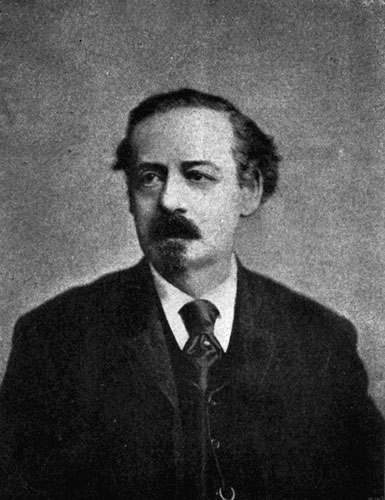
SIEGFRIED MARCUS
It is claimed that about the middle seventies of the last century he
carried on experiments with a gas engine that had a spring-connected
piston rod. He mounted this vertically on an ordinary horse vehicle and
connected it directly with a cranked rear axle, carrying two flywheels in
place of the regular road wheels. He is said to have made trials of this
vehicle at night in Vienna. If this was so he was apparently trying to
keep his plan secret and succeeded very well. Aside from general
references nothing of importance revealed itself concerning this vehicle
and Marcus’ experiments with it, until very recently when interest in the
historic development of the automobile has stimulated anew investigation
into the endeavors of the early inventors.
In 1882 the motor work of Marcus was principally preparatory to his new
engine construction. It included experimenting with an Otto engine run
with petroleum and a vaporizer and electric ignition with magneto. In 1883
he constructed a closed or two-cycled motor and thereafter had engines
made in Budapest and elsewhere. One of these motors he put on wheels, but
this was abandoned for other ideas that came from his fertile mind.
Carl Benz
Born, November 26, 1844, at Karlsruhe, Baden, Germany.
The early education of Carl Benz was acquired at the Lyceum until his
seventeenth year and then at the Technical High School of his native city
for four more years. This was followed by three years of practical work in
the shops of the Karlsruhe Machine Works. When he was twenty-eight years
of age, in 1872, after further experience in Mannheim, Pforzheim and
Vienna, he opened workshops of his own in Mannheim.
In 1880 he began to commercialize a two-cycle stationary engine. In 1883
he organized his business as Benz & Co., and produced his first vehicle in
1884. In the beginning of 1885 his three-wheeled vehicle ran through the
streets of Mannheim, Germany, attracting much attention with its noisy
exhaust. This was the subject of his patent dated January 29, 1886,
claimed by him to be the first German patent on a light oil motor vehicle.
This embodied a horizontal flywheel belt transmission through a
differential and two chains to the wheels; but it is noteworthy primarily
as having embodied a four-cycle, water jacketed, three-quarter horse-power
engine, with electric ignition.
In 1888, the Benz Company exhibited their vehicles at the Munich
Exposition, where they attracted wide attention. This was followed by the
exhibition at the Paris show in 1889, by the engineer Roger, of another
vehicle made under license that Roger had acquired from Benz and
constructed by Panhard and Levassor.
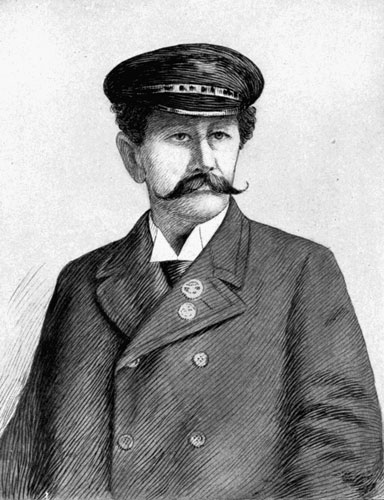
CARL BENZ
While in 1899 the firm was converted into a stock company of three million
marks capital, and then employed three hundred men, Carl Benz remained the
leading spirit of the concern, technically, while the commercial work came
under the direction of Julius Ganz. The able co-operation of these two has
established the world-famous automobile enterprise looked upon by many as
the pioneer producing works of its kind in Germany. Of late years motor
boats have also been made by them, but their automobiles and those of
their affiliated companies or licensees in other countries still stand in
the first rank.
Gottlieb Daimler
Born at Schorndorf, Wurtemburg, March 17, 1834. Died at Cannstadt, near
Stuttgart, March 6, 1899.
After receiving a technical and scientific training at the Polytechnic
School at Stuttgart, 1852-59, Daimler spent two years, 1861-63, as an
engineer in the Karlsruhe Machine Works, becoming foreman there. In 1872
he entered the Gas Engine Works at Deutz, near Cologne, and became
director of that establishment. Within ten years that shop, better known
as the Otto Engine Works, grew from a small place into a large,
well-organized and famous establishment. In 1882 he removed to Cannstadt
to give his entire attention to the light-weight internal-combustion auto
motor, with which his career was so completely identified, and the
successful application of which earned for him the title, “the father of
the automobile,” in Germany, though that is, in fact, contested by those
familiar with the work of Benz.
Instead of using the uncertain-acting flame with the inconvenient speed
limitations, Daimler invented and introduced in 1883 the so-called
hot-tube ignition. This consisted of a metal or porcelain tube attached to
the compression space of the cylinder in such a manner that the interior
of the tube was in continual communication with the compression space. A
gas flame, continually burning under the tube, maintained it at a glowing
red heat, so that the mixed charge of air and gas, when compressed into
the tube, became fully and effectively ignited. Experience showed that by
a proper regulation of the temperature of the hot tube the ignition could
be made to take place at any desired point in the compression, and thus
the complicated, slow and uncertain slide flame ignition was replaced by a
simple device, without moving parts, altogether satisfactory and reliable.
The especial feature of the hot-tube ignition, however, was soon found to
be the increased speed which it permitted. By its use the rotative speed
could be increased eight to ten times over the older motor, and hence the
weight could be reduced in nearly the same proportion.
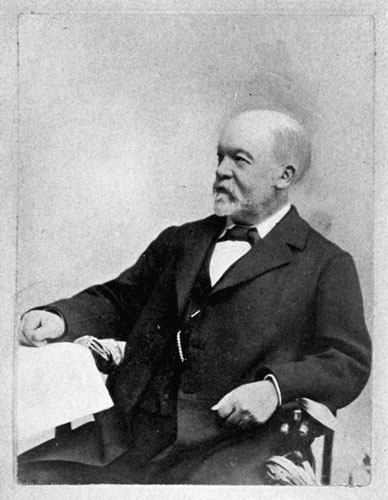
GOTTLIEB DAIMLER
This fact at once showed Daimler that the application of the
internal-combustion motor to mechanically propelled vehicles had become a
possibility, and that, with the use of hydro-carbon vapor as fuel, and the
high-speed hot-tube motor, the petroleum automobile might become a
practical possibility. He therefore severed his connection with the Otto
Engine Works at Deutz, and returning to Cannstadt, near Stuttgart, his
early home, he devoted his entire time and attention to the design of a
light petroleum motor and motor vehicle. The result was the production, in
1885, of a motor-bicycle, in which the motor was placed directly under the
seat, between the legs of the rider. The petroleum was drawn from a tank,
the supply being regulated by the valve. The motor was first set in motion
by lighting a lamp and turning the crank a few times, the discharge
passing through the chamber into an exhaust-pipe. After the motor had been
fully started, the vehicle was set in motion by moving a lever, which drew
a tightening pulley against the belt, and so caused the power to be
transmitted from the shaft pulley to the wheel pulley. Changes of speed
were attained by using pulleys of different sizes, similar to the cone
pulleys on a lathe. This machine was put into successful action at
Cannstadt on November 10, 1885.
An interesting feature in connection with the Daimler motor is the
arrangement of the cooling-water circulation for the cylinder jacket. The
water is contained in a tank, from which it is circulated in the cylinder
jacket by means of a small rotary pump. From the jacket it passes to the
cooler. This consists of a system of several hundred small tubes over
which a blast of air is driven by a fan operated from the motor shaft.
Since the speed of the fan increases with the speed of the motor, the
cooling is proportional to the production of heat in the cylinder.
In addition to gas, which is applicable for stationary motors only, the
fuel may be benzine of a specific gravity of sixty-eight or seventy
one-hundredths, or ordinary lamp petroleum. The consumption varies
according to the size of the motor, ranging from thirty-six to forty-five
one-hundredths kilograms per horse-power hour for vehicles, or somewhat
less for boats. He adapted these light motors to vehicles of many styles,
and his persistent work in this connection has made the world-wide
reputation of the Daimler Motoren Gesellschaft, now flourishing at
Cannstadt, Germany.
In 1888-89 the French interest in the light motors led to their adoption
by Panhard and Levassor. The type then developed and known as Phenix
motors, were soon copied in part at least by many other French makers,
resulting in a modified form there known as the Pygmée. Work at Cannstadt
progressed steadily, however, and many pleasure vehicles were made as well
as small boats.
The able assistance of William Maybach brought further credit to the
company, particularly in view of the aspirating carbureter which, with
such details as clutch and transmission mechanism, helped to perfect the
Cannstadt automobiles. In the latter nineties the prominence of the
Daimler Works as vehicle makers, distinguished from motor makers, again
began to be noticed and soon their now famous Mercedes cars appeared. In
recent years these machines have made remarkable records in races and all
other branches of the sport. With a magnificent refinement of details in
construction they are to-day looked upon as the pleasure vehicles par
excellence.
They have had a large vogue in all parts of Europe and are accepted there
as among the most satisfactory vehicles in their class that are now made.
Many of them have been brought to the United States, where they have been
and still are in great demand.
Levassor
Born at Marolles, in Hurepoix (Seine and Oise), January 21, 1843. Died,
April 14, 1897.
Levassor was graduated from the Central School of Arts and Manufactures,
Paris, in 1864. He was employed as an engineer at the Cockerill Works at
Seriang, Belgium, and also with Durenne at Courbevoie, near Paris. In 1872
he entered the firm of Perrin & Panhard, the name of the concern being
changed to Perrin, Panhard & Co. Upon the death of M. Perrin, he became
the junior partner and the name of Panhard & Levassor was adopted. When
Levassor died in 1897, the corporation of Panhard & Levassor was formed.
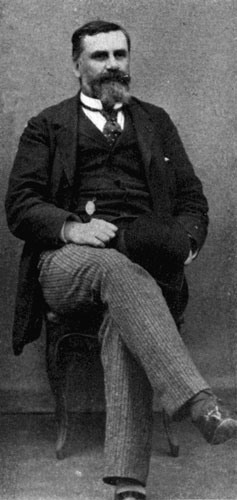
LEVASSOR
Levassor made many improvements in the machinery and output of Panhard &
Levassor. Especially he perfected machines for wood-working and made
important changes in the processes used for the cold cutting of hard
metals. On the first appearance of gas motors he undertook their
construction in France. It was in the establishment of Panhard & Levassor
that the first motors were constructed under the system of Otto and Langen
with atmospheric pressure, then the four-cycle engine of Otto and finally
the two-cycle system of Benz and Ravell.
In 1886, when the Daimler petroleum motor appeared, he recognized the
great part that it would play in practical application to the propulsion
of vehicles and boats. He acquired the right to use it in France, and in
1887 exhibited, in Paris, a boat thus propelled. After several years he
put forth the first automobile vehicle with motor in front.
Leon Serpollet
Serpollet is noted in France to-day as the champion of the steam
automobile. In 1887, he appeared in Paris with his three-wheeler, two rear
drive and one front steering wheel. With its light and safe generator his
machine attracted much attention, but its use in the streets of the
capital was temporarily prohibited, until the granting to him in 1891 of
the first unrestricted license for such use resulted from his initiation
of the prefect of police by driving that important personage in the
steamer.
His generator, known as the “flash boiler,” has been developed to a high
state of perfection. The tubes of his boiler were heavy, flattened tubing,
strengthened in that form by being transversally bent or grooved. He was
helped doubtless to no small extent, in his work, by his association,
about 1897, with a wealthy American, F. L. Gardner, who made possible the
development of the large Gardner-Serpollet establishment in the Rue
Stendhal, Paris.
While Serpollet has achieved a brilliant and well-deserved reputation in
his native land, he is also recognized in other countries as one of the
greatest living promoters of the steam branch of the automobile industry.
His adherence to steam as the motive power in self-propelled road vehicles
has been unremitting and energetic. Few men have done more than he to
improve carriages in this class.
In 1900, Serpollet was made a Chevalier of the Legion of Honor. His sales
to that date of five machines for the Shah of Persia and landaulets for
the Maharajah of Mysore and other notables had given him much prominence
at that time.
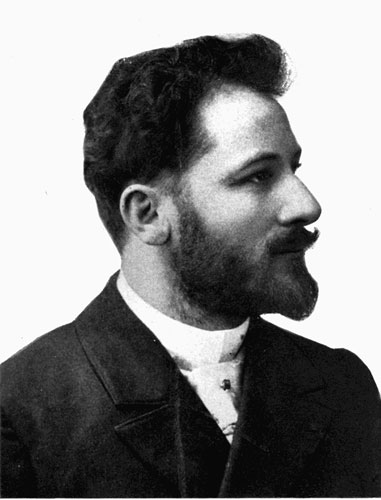
LEON SERPOLLET
Louis and Marcel Renault
Born in Boulogne, France, the Renault Brothers, with general technical
education, perseverance and ability, entered the field of automobile
manufacturing only some six years ago, although they earlier gave to the
subject much attention and study.
Having appreciated through personal experience the shortcomings of the
gasoline tricycle, Louis Renault in October, 1898, manufactured, in his
private shop, a small two-passenger vehicle, with a one and three-quarters
horse-power motor, which eliminated the pedalling for starting, but was
otherwise small and light as a tricycle. In January, 1899, he brought out
a small four-wheeler with one and three-quarters horse-power motor in
front, three speeds and chainless, or as now called propeller drive. The
demand was immediate and large and resulted in the establishment of the
works of Renault Frères, who began to make the first lot of these small
vehicles in March of the same year. These won prizes in the
Paris-Trouville, the Ostende and the Rambouillet runs, and one completed a
three thousand six hundred kilometer tour through different parts of
Europe and over the Alps.
The new model of 1900 had a three and one-half horse-power motor and
thermo-syphon cooling system. Many honors were won with these, and notably
that of Louis Renault’s most successful use of one in the grand army
maneuvers. But the output of three hundred and fifty showed the necessity
for larger works. With the increased facilities of 1901, the product was
doubled and the model increased to four and one-half horse-power, while
eight and nine horse-power were winners in the Paris-Bordeaux and
Paris-Berlin races.
In 1902 came another addition to the Billancourt works of Cloise to four
thousand square meters area, and the Renault Brothers then changed their
models to voiture légère, six to eight horse-power, steel tube frame and
wood wheels—a full-fledged vehicle. They succeeded in the Circuit du
Nord, organized by the Minister of Agriculture, for alcohol-motored
vehicles. Then came the triumph of their twenty horse-power four-cylinder
type in the great Paris-Vienna race, where it was pitted against forty and
even seventy horse-power vehicles. The result was a great impetus
commercially, and new shops accommodating a thousand workmen and covering
thirteen thousand square meters, which produced one thousand four hundred
vehicles in the following year.
Both brothers, who had always been at the wheel of their own cars in the
years of racing, entered the memorable “race-of-death,” Paris-Madrid, in
May, 1903. Louis arrived first at Bordeaux, but his unfortunate brother
Marcel, while close to victory, was killed with the overturning of his
machine only a few kilometers from the goal. In memory of Marcel Renault a
simple monument was unveiled at Billancourt May 26, 1904, on ground
contributed by the municipal council; a bronze plate on one side of this
perpetuates his triumphant entry into Vienna, showing his arrival at the
finish.
Louis Renault, since continuing the business, has now produced larger
machines, including the sixty to ninety horse-power made for the
Vanderbilt race in America, October, 1904.
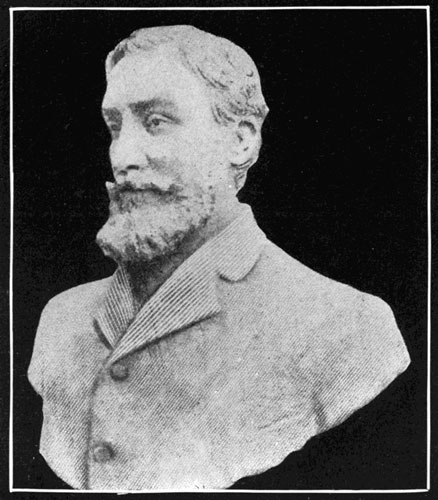
MARCEL RENAULT