How long, O gracious God! how long,
Shall power lord it over right?
The feeble, trampled by the strong,
Remain in slavery’s gloomy night?
In every region of the earth,
Oppression rules with iron power;
And every man of sterling worth,
Whose soul disdains to cringe or cower
Beneath a haughty tyrant’s nod,
And, supplicating, kiss the rod
That, wielded by oppression’s might,
Smites to the earth his dearest right,—
The right to speak, and think, and feel,
And spread his uttered thoughts abroad,
36To labour for the common weal,
Responsible to none but God,—
Is threatened with the dungeon’s gloom,
The felon’s cell, the traitor’s doom,
And treacherous politicians league
With hireling priests, to crush and ban
All who expose their vile intrigue,
And vindicate the rights of man.
How long shall Afric’ raise to thee
Her fettered hand, O Lord! in vain,
And plead in fearful agony
For vengeance for her children slain?
I see the Gambia’s swelling flood,
And Niger’s darkly rolling wave,
Bear on their bosoms, stained with blood,
The bound and lacerated slave;
While numerous tribes spread near and far,
Fierce, devastating, barbarous war,
Earth’s fairest scenes in ruin laid,
To furnish victims for that trade,
Which breeds on earth such deeds of shame,
As fiends might blush to hear or name.
I see where Danube’s waters roll,
And where the Magyar vainly strove,
With valiant arm and faithful soul,
In battle for the land he loved,—
A perjured tyrant’s legions tread
The ground where Freedom’s heroes bled,
And still the voice of those who feel
Their country’s wrongs, with Austrian steel.
I see the “Rugged Russian Bear,”
Lead forth his slavish hordes, to war
Upon the right of every State
Its own affairs to regulate;
To help each despot bind the chain
Upon the people’s rights again,
And crush beneath his ponderous paw
All constitutions, rights, and law.
37I see in France,—O burning shame!—
The shadow of a mighty name,
Wielding the power her patriot bands
Had boldly wrenched from kingly hands,
With more despotic pride of sway
Than ever monarch dared display.
The fisher too whose world-wide nets
Are spread to snare the souls of men,
By foreign tyrants’ bayonets
Established on his throne again,
Blesses the swords still reeking red
With the best blood his country bore,
And prays for blessings on the head
Of him who wades through Roman gore.
The same unholy sacrifice
Where’ere I turn bursts on mine eyes,
Of princely pomp, and priestly pride,
The people trampled in the dust,
Their dearest, holiest rights denied,
Their hopes destroyed, their spirit crushed:
But when I turn the land to view,
Which claims, par excellence, to be
The refuge of the brave and true,
The strongest bulwark of the free,
The grand asylum for the poor
And trodden down of every land,
Where they may rest in peace, secure,
Nor fear the oppressor’s iron hand,—
Worse scenes of rapine, lust, and shame,
Than e’er disgraced the Russian name,
Worse than the Austrian ever saw,
Are sanctioned here as righteous law.
Here might the Austrian butcher
[13] make
Progress in shameful cruelty,
Where women-whippers proudly take
The meed and praise of chivalry.
38Here might the cunning Jesuit learn,
Though skilled in subtle sophistry,
And trained to persevere in stern
Unsympathising cruelty,
And call that good, which, right or wrong,
Will tend to make his order strong:
He here might learn from those who stand
High in the gospel ministry,
The very magnates of the land
In evangelic piety,
That conscience must not only bend
To everything the church decrees,
But it must also condescend,
When drunken politicians please
To place their own inhuman acts
Above the “higher law” of God,
And on the hunted victim’s tracks
Cheer the malignant fiends of blood,
To help the man-thief bind the chain
Upon his Christian brother’s limb,
And bear to slavery’s hell again
The bound and suffering child of Him
Who died upon the cross, to save
Alike, the master and the slave.
While all the oppressed from every land
Are welcomed here with open hand,
And fulsome praises rend the heaven
For those who have the fetters riven
Of European tyranny,
And bravely struck for liberty;
And while from thirty thousand fanes
Mock prayers go up, and hymns are sung,
Three million drag their clanking chains,
“Unwept, unhonoured, and unsung;”
Doomed to a state of slavery,
Compared with which the darkest night
Of European tyranny,
Seems brilliant as the noonday light.
39While politicians void of shame,
Cry this is law and liberty,
The clergy lend the awful name
And sanction of the Deity,
To help sustain the monstrous wrong,
And crush the weak beneath the strong.
Lord, thou hast said the tyrant’s ear
Shall not be always closed to thee,
But that thou wilt in wrath appear,
And set the trembling captive free.
And even now dark omens rise
To those who either see or hear,
And gather o’er the darkening skies
The threatening signs of fate and fear;
Not like the plagues which Egypt saw,
When rising in an evil hour,
A rebel ’gainst the “higher law,”
And glorying in her mighty power,—
Saw blasting fire, and blighting hail,
Sweep o’er her rich and fertile vale,
And heard on every rising gale
Ascend the bitter mourning wail;
And blighted herd, and blasted plain,
Through all the land the first-born slain,
Her priests and magi made to cower
In witness of a higher power,
And darkness like a sable pall
Shrouding the land in deepest gloom,
Sent sadly through the minds of all,
Forebodings of approaching doom.
What though no real shower of fire
Spreads o’er this land its withering blight,
Denouncing wide Jehovah’s ire
Like that which palsied Egypt’s might;
And though no literal darkness spreads
Upon the land its sable gloom,
And seems to fling around our heads
The awful terrors of the tomb;
40Yet to the eye of him who reads
The fate of nations past and gone,
And marks with care the wrongful deeds
By which their power was overthrown,—
Worse plagues than Egypt ever felt
Are seen wide-spreading through the land,
Announcing that the heinous guilt
On which the nation proudly stands,
Has risen to Jehovah’s throne,
And kindled his Almighty ire,
And broadcast through the land has sown
The seeds of a devouring fire;
Blasting with foul pestiferous breath,
The fountain springs of moral life,
And planting deep the seeds of death,
And future germs of deadly strife;
And moral darkness spreads its gloom
Over the land in every part,
And buries in a living tomb
Each generous prompting of the heart.
Vice in its darkest, deadliest stains,
Here walks with brazen front abroad,
And foul corruption proudly reigns
Triumphant in the Church of God,
And sinks so low the Christian name,
In foul degrading vice and shame,
That Moslem, Heathen, Atheist, Jew,
And men of every faith and creed,
To their professions far more true,
More liberal both in word and deed,
May well reject with loathing scorn
The doctrines taught by those who sell
Their brethren in the Saviour born,
Down into slavery’s hateful hell;
And with the price of Christian blood
Build temples to the Christian’s God,
And offer up as sacrifice,
And incense to the God of heaven,
41The mourning wail, and bitter cries,
Of mothers from their children riven;
Of virgin purity profaned
To sate some brutal ruffian’s lust,
Millions of godlike minds ordained
To grovel ever in the dust,
Shut out by Christian power and might
From every ray of Christian light.
How long, O Lord! shall such vile deeds
Be acted in thy holy name,
And senseless bigots o’er their creeds
Fill the whole world with war and flame?
How long shall ruthless tyrants claim
Thy sanction to their bloody laws,
And throw the mantle of thy name
Around their foul, unhallowed cause?
How long shall all the people bow
As vassals of the favoured few,
And shame the pride of manhood’s brow,—
Give what to God alone is due,
Homage, to wealth, and rank, and power,
Vain shadows of a passing hour?
Oh for a pen of living fire,
A tongue of flame, an arm of steel!
To rouse the people’s slumbering ire,
And teach the tyrants’ hearts to feel.
O Lord! in vengeance now appear,
And guide the battles for the right,
The spirits of the fainting cheer,
And nerve the patriot’s arm with might;
Till slavery, banished from the world,
And tyrants from their power hurled,
And all mankind from bondage free,
Exult in glorious liberty!
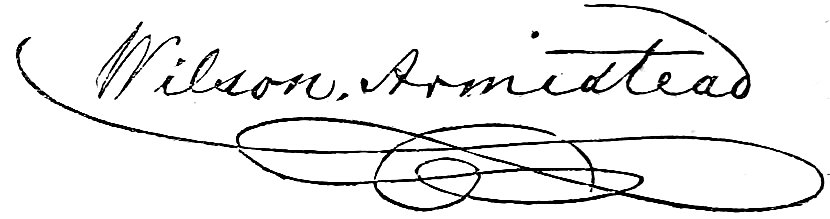
LETTER FROM MR. WILSON ARMISTEAD TO THE SECRETARY OF THE SOCIETY.
42
My dear Friend,—In responding to thy welcome communication,
I may say that I rejoice in the cause of the interruption
of our correspondence, so far as it concerns thyself;
thy time and talents being so increasingly occupied, in union
with other of humanity’s advocates, in assisting to overturn the
monster iniquity of our age, that crowning crime of Christendom,—negro
slavery!
Go on in this good work! and may God’s blessing abundantly
attend, till the eternal overthrow be effected of a system
so fraught with every evil, so abhorrent to the rights of
nature, and so contrary to the spirit of the Gospel;—till the
galling chain be broken off the necks of America’s three million
slaves; till its victims be raised from the profoundest depths of
ignorance and woe, to which they are now degraded.
’Tis a marvel to me, that a system like that of negro slavery,
which admits of such atrocities, can be tolerated for a single
hour! Ought not every one who has a spark of humanity, to
say nothing of Christianity, in his bosom,—ought not all the
sound part of every community in which slavery exists, to
rise up en masse, and declare that this abomination shall exist
no longer?
Who gave to any man the right to enslave his fellow-man?
Can any enactment of human legislators so far sanction robbery,
as lawfully to make one man the property of another?
Has God poured the tide of life through the African’s breast, and
animated it with a portion of his own Divine spirit, and at the
same time deprived him of all natural affections, that he alone
is to be struck off the list of rational beings, and placed on a
level with the brute? Is his flesh marble, and his sinews iron,
or his immortal spirit of a class condemned, without hope, to
penal suffering, that he is called upon to endure incessant toil,
and to be subjected to degradation, bodily and mental, such as
no other portion of the family of Adam have ever been destined
43to endure, without the vengeance of Heaven being signally
displayed upon the oppressors? Does the African mother feel
less love to her offspring than the white woman? or the
African husband regard with less tenderness the wife of his
bosom? Is his heart dead to the ties of kindred,—his nature
so brutalized, that the sacred associations of home and country
awaken no emotions in his breast?
History unanswerably demonstrates that the negro does feel,
keenly feel, the wrongs inflicted upon him by his unrighteous
enslavers, and that his mind, barren as it has been rendered by
hard usage, and desolated with misery, is not unwatered by
the pure and gentle streams of natural affection. Yet the
lordly oppressors remain unmoved by the sad condition of the
negro, contemplate with indifference his bodily and mental
sufferings, and still dare to postpone to an indefinite period the
termination of his oppression and of their own guilt.
But thanks be to God! there is some counteracting influence
to this feeling, and that it is on the advance. The night has
been long and dark,—already the horizon brightens; the day
of freedom dawns.
Go on, then, my friend; I say, go on! in the good cause
thou hast espoused. Labour, and faint not. “Whatsoever thy
hand findeth to do, do it with all thy might.” My kind
regards to Frederick Douglass; may he, and all others also, be
strengthened and encouraged to labour in the great work of
human freedom; that so, by gradual increase, like the mighty
surge, they may become strong enough to overpower and
drown the oppressor, and be enabled to devise and execute
measures of mercy and justice, which may avert the judgments
of the Almighty from their guilty land. For surely some
signal display of Divine displeasure must await America
unless she repent, and undo the heavy burdens of her THREE
MILLION SLAVES.
Are not the signs of the times calculated to remind us forcibly
of this language of Isaiah, “Behold, the Lord cometh out
of his place to punish the inhabitants of the earth for their
iniquity: the earth also shall disclose her blood, and no more
cover her slain.” Do we not hear already—
44“——the wheels of an avenging God,
Groan heavily along the distant road?”
Assuredly, he comes to judge the earth. “Who shall abide the
day of his coming; who shall stand when he appeareth?”
OUTLINE OF A MAN.
103
In some of those castle building day-dreams, in which, like
all youth of an imaginative turn, I was wont, in my early days,
to indulge; a favourite image of my creation was an Africo-American
for the time,—a coloured man, who had known by
experience the bitterness of slavery, and now by some process
free, so endowed with natural powers, and a certain degree of
attainments, all the more rare and effective for being acquired
under great disadvantages,—as to be a sort of Moses to his
oppressed and degraded tribe. He was to be gifted with a noble
person, of course, and refinement of manners, and some elegance
of thought and expression; by what unprecedented miracle
such a paragon was to be graduated through the educational
appliances of American slavery, imagination did not trouble
herself to inquire. She was painting fancy-pieces, not portraits.
Having thus irresponsibly struck out upon the canvas her
central figure, she would not be slow to complete the picture
with many a rose-coloured vision of brilliant successes and
magic triumphs won by her hero, in his great enterprise of the
redemption of his people. A burning sense of their wrongs
fired his eloquence with an undying, passionate earnestness,
and as he alternately reproached the injustice, and appealed to
the generosity of his oppressors, all opposition gave way before
him; the masses, as one man, demanded the emancipation of
his long-degraded, deeply-injured race; and millions of regenerated
men rose up, upon their broken chains, and called him
blessed.
Years rolled away, and these poetic fancies faded “into the
light of common day.” The cold, stern, pitiless reality remained.
The dark incubus of slavery yet rested down upon more than
three millions of the victims of democratic despotism. But the
104triumphant champion of the devoted race had melted away, with
the morning mists of my boyish conjuring.
One morning in the summer of 1844, walking up Main-street
in the city of Hartford, I was attracted by the movements of a
group of some twenty-five or thirty men and women, in a small
recess, or court, by the side of the old Centre Church. They
appeared to be organized into an assembly, and a tall mulatto
was addressing them. I drew near to listen. The speaker was
recounting the oft-enacted history of a flight from slavery.
With his eye upon the cold, but true north star, and his ear ever
and anon bent to the ground, listening for the “blood-hound’s
savage bay,” sure-footed and panting, the fugitive was before
me! My attention had been arrested; I was profoundly interested.
The audience was the American Anti-slavery Society,
then just excluded from some of the public halls of the city, and
fain to content themselves, after an apostolic sort, with the next
best accommodations. The orator was Frederick Douglass,
the most remarkable man of this country, and of this age; and—may
I not dare to add—the almost complete fulfilment of my
early dream!
Since that day, through assiduous application, and a varied
experience, he has continued to develop in the same wonderful
ratio of improvement, which even then distinguished him as a
prodigy in self-education. Unusually favored in personal
appearance and address, full of generous impulse and delicate
sensibility, exuberant in playful wit, or biting sarcasm, or stern
denunciation, ever commanding in his moral attitude, earnest
and impressive in manner, with a voice eminently sonorous and
flexible, and gesture full of dramatic vivacity, I have many times
seen large audiences swayed at his will; at one moment convulsed
with laughter, and the next bathed in tears; now lured
with admiration of the orator, and now with indignation at the
oppressor, against whom he hurled his invective. But in my
boyhood’s quasi-prophetic fancy of such a man and his inimitable
success, I had not counted upon one antagonist, whose reality
and potency, the observation of every day now forces painfully
upon me. I mean the strange and unnatural prejudice against
mere colour, which is so all-prevalent in the American breast, as
105almost to nullify the influence of such a man, so pleading; while
his dignity, his urbanity, his imperturbable serenity and good
nature, his genuine purity and worth all fail, at times, to secure
him from the grossest indignities, at the hands of the coarse and
brutal. Nobody who knows him will be inclined to question
our estimate of his character, but it still comports with the intelligence
and refinement and piety of a large proportion of
American society to label him “nigger,” and the name itself
invites to safe contumely, and irresponsible violence.
I have spoken of Frederick Douglass as an interesting man—a
wonderful man. Look at him as he stands to-day before this
nation, and then contemplate his history.
Begin with him when, a little slave-child, he lay down on his
rude pallet, and that slave-mother, from a plantation twelve
miles away, availed herself of the privilege granted grudgingly,
of travelling the whole distance, after the day’s work, (on peril
of the lash, unless back again by sunrise to her task,) that she
might lie there by his side, and sing him with her low sweet
song to sleep. “I do not recollect,” says he, “of ever seeing
my mother by the light of day. She was with me in the night.
She would lie down with me, and get me to sleep, but long
before I awaked she was gone.” How touching the love of that
dark-browed bondwoman for her boy! How precious must
the memory of that dim but sweet remembrance be to him, who
though once a vassal, bound and scourged, and still a Helot,
proscribed and wronged, may not be robbed of this dear token
that he, too, had once a mother! Her low sad lullaby yet warps
his life’s dark woof—for she watches over his pathway now
with spirit-eyes, and still keeps singing on in his heart, and
nursing his courage and his patience.
Follow him through all the tempestuous experience of his
bondage. His lashings, his longings, his perseverance in possessing
himself of the key of knowledge, which, after all, only
unlocked to him the fatal secret that he was a slave, a thing to
be bought and sold like oxen. Imagine the tumult of his soul,
as standing by the broad Chesapeake, he watched the receding
vessels, “while they flew on their white wings before the
breeze, and apostrophized them as animated by the living spirit
106of freedom;”[20] or when reading in a stray copy of the old
“Columbian Orator,” (verily, all our school-books must be
expurgated of the incendiary ‘perilous stuff’ in which they
abound,) the “Dialogue between a Master and his Slave,” and
Sheridan’s great speech on Catholic Emancipation.[21] See to
what heroic resistance his proud heart had swollen, when he
turned outright upon his tormentor—pious Mr. Corey, the
107“nigger-breaker”—and inflicted condign retribution on his
heartless ribs; “after which,” says he, significantly, “I was
never whipped again; I had several fights, but was never
whipped.” Attend him in his exodus from our republican
Egypt. Witness his struggles with poverty; his vain attempts
to find employment at his trade, as a coloured man, in the free
North. Behold him at last emerging from his obscurity at the
Anti-slavery Convention in Nantucket. Somebody, who is
aware of his extraordinary natural intelligence, invites him to
speak. Tremblingly he consents. “As soon as he had taken
his seat,” said Mr. Garrison, after describing the tremendous
effect of his remarks upon the audience, “filled with hope and
admiration, I rose and declared that Patrick Henry, of revolutionary
fame, never made a speech more eloquent in the cause of
liberty, than the one we had just listened to from the hunted
fugitive.”
That was just eleven years ago,—and what is Frederick
Douglass now? I would fain avoid the language of exaggeration.
It is ever a cruel kindness which over-praises, exciting
expectations, which cannot but be disappointed. But when, in
view of the fact that the subject of this sketch was but thirteen
years ago A SLAVE, in all the darkness and disability of Southern
bondage, I affirm that his present character, attainments, and
position constitute a phenomenon hitherto perhaps unprecedented
in the history of intellectual and moral achievement,
none who know and are competent to weigh the facts, will
account the terms extravagant. It is not to be expected but
that his mental condition should betray his early disadvantages.
His information, though amazing, under the circumstances,
will not of course bear comparison, in fulness and accuracy,
with that of men who have been accumulating their resources
from childhood. In his writings, the deficiency of early discipline
is most manifest, rendering them diffuse and unequal,
though always interesting, and often exceedingly effective. He
is properly an orator. His addresses, like those of Whitfield,
and many other popular speakers, lose a large proportion of
their effect in reading. They require the living voice, and the
magnetic presence of the orator. But even in this respect,
108Douglass is not uniform in his performance, but is quite dependent
on his surroundings, and the inspiration of the moment.
But when, all these consenting, he becomes thoroughly possessed
of his theme, and his tall form—six feet high and straight
as an arrow,—his bearing dignified and graceful,—self-possessed,
yet modest,—his countenance flexible, and wonderful in
power of expression, and his voice, with its rich and varied
modulation, are all summoned to the work of enchantment,
many a rapt assembly, insignificant in neither numbers nor
intelligence, can testify to the witchery of his eloquence.
And, after all, the moral features of this interesting character
constitute its principal charm. The integrity and manliness of
Frederick Douglass, potent and acknowledged where he is at
all known, have much to do with his influence as a popular
orator. It has been customary, with a certain class of Shibboleth-pronouncers
to class him with infidels, but this is only
the appropriate and characteristic retort of a certain sort of
“highly respectable” Christianity to his uncompromising
denunciations of its hollow and selfish character. I think
Frederick Douglass is a Christian; he is a gentleman, I know.
There are few white men of my acquaintance, who could have
borne so much adulation, without losing the balance of their
self-appreciation. Nobody ever knew Frederick Douglass to
over-rate himself, or to thrust himself anywhere where he did
not belong, or upon anybody who might by any possibility
object to his companionship,—unless, in the latter case, when
he deemed necessary the assertion of a simple right. Whence
he got his retiring and graceful modesty, and his nice sense of
the minute proprieties,—unless it be somehow in his blood,—is
a mystery to me. Can it be possible that such refinements
are scourged into men “down South?” An illustration of this
may be seen in his response to those gentlemen of Rochester,
who, by way of gratifying a grudge against the Anti-slavery
faction of their party, nominated Douglass for Congress in
derision.
“Gentlemen:—I have learned with some surprise, that in
the Whig Convention held in this city on Saturday last, you
109signified, by your votes, a desire to make me your representative
in the Legislature of this State. Never having, at any
time that I recollect, thought, spoken, or acted, in any way, to
commit myself to either the principles or the policy of the
Whig party; but on the contrary, having always held, and
publicly expressed opinions diametrically opposed to those held
by that part of the Whig party which you are supposed to
represent, your voting for me, I am bound in courtesy to
suppose, is founded in a misapprehension of my political
sentiments.
“Lest you should, at any other time, commit a similar
blunder, I beg to state, once for all, that I do not believe that
the slavery question is settled, and settled for ever. I do not
believe that slave-catching is either a Christian duty, or an
innocent amusement. I do not believe that he who breaks the
arm of a kidnapper, or wrests the trembling captive from his
grasp, is ‘a traitor.’ I do not believe that Daniel Webster is
the saviour of the Union, nor that the Union stands in need of
such a saviour. I do not believe that human enactments are
to be obeyed when they are point-blank against the law of the
living God. And believing most fully, as I do, the reverse of
all this, you will easily believe me to be a person wholly unfit
to receive the suffrages of gentlemen holding the opinion and
favouring the policy of that wing of the Whig party denominated
‘the Silver Grays.’
“With all the respect which your derision permits me to
entertain for you,
“I am, gentlemen,
“Your faithful fellow-citizen,
“Frederick Douglass.”
The perpetrators of the wanton and gratuitous insult which
elicited this beautiful rebuke, would be sadly outraged were we
to insist on withholding the title of “gentlemen” from those
who could, on any pretence, trample on the feelings of such as
they esteem their inferiors. If they half begin to comprehend
the meaning of the term, much more to feel its power, their
cheeks must have crimsoned with shame, when they saw their
110own unprovoked assault, contrasted with, the calm and self-respectful
serenity of this reply.
Another instance of this dignity under circumstances of
peculiar trial, may be found in his own account—in the columns
of “Frederick Douglass’ Paper”—of a rencontre with a hotel
clerk in Cleveland. It is as follows:—
“At the ringing of the morning bell for breakfast, I
made my way to the table, supposing myself included in the
call; but I was scarcely seated, when there stepped up to me
a young man, apparently much agitated, saying: ‘Sir, you
must leave this table.’ ‘And why,’ said I, ‘must I leave
this table?’ ‘I want no controversy with you. You must
leave this table.’ I replied, ‘that I had regularly enrolled
myself as a boarder in that house; I expected to pay the same
charges imposed upon others; and I came to the table in
obedience to the call of the bell; and if I left the table I must
know the reason.’ ‘We will serve you in your room. It is
against our rules.’ ‘You should have informed me of your rules
earlier. Where are your rules? Let me see them.’ ‘I don’t
want any altercation with you. You must leave this table.’
‘But have I not deported myself as a gentleman? What have
I done? Is there any gentleman who objects to my being
seated here?’ (There was silence round the table.) ‘Come,
sir, come, sir, you must leave this table at once.’ ‘Well,
sir, I cannot leave it unless you will give me a better reason
than you have done for my removal.’ ‘Well, I’ll give you
a reason if you’ll leave the table and go to another room.’
‘That, sir, I will not do. You have invidiously selected me
out of all this company, to be dragged from this table, and have
thereby reflected upon me as a man and a gentleman; and the
reason for this treatment shall be as public as the insult you
have offered.’ At these remarks, my carrot-headed assailant
left me, as he said, to get help to remove me from the table.
Meanwhile I called upon one of the servants (who appeared to
wait upon me with alacrity), to help me to a cup of coffee, and
assisting myself to some of the good things before me, I quietly
and thankfully partook of my morning meal without further
annoyance.”
111Whatever may have been the duty of Mr. Douglass, (and
none who know him can for a moment doubt what his inclination
would have been,) in case the proscriptive “rules of the
house” had been previously made known to him, the justice,
as well as the gentlemanly self-possession of his bearing, in
relation to this public outrage, must, I think, be sufficiently
obvious.
THE HEROIC SLAVE-WOMAN.
112
It was my privilege to see much of Edward S. Abdy, Esq.,
of England, during his visit to our country, in 1833 and 1834.
The first time I met him was at the house of Mr. James Forten,
of Philadelphia, in company with two other English gentlemen,
who had come to the United States, commissioned by the British
Parliament to examine our systems of prison and penitentiary
discipline. Mr. Abdy was interested in whatsoever affected the
welfare of man. But he was more particularly devoted to the
investigation of slavery. He travelled extensively in our
Southern States, and contemplated with his own eyes the manifold
abominations of our American despotism. He was too
much exasperated by our tyranny to be enamoured of our
democratic institutions; and on his return to England, he published
two very sensible volumes, that were so little complimentary
to our nation, that our booksellers thought it not worth
their while to republish them.
This warm-hearted philanthropist visited me several times
at my home in Connecticut. The last afternoon that he was
there, we were sitting together at my study window, when our
attention was arrested by a very handsome carriage driving up
to the hotel opposite my house. A gentleman and lady occupied
the back seat; and on the front were two children, tended by a
black woman, who wore the turban that was then, more than
now, usually worn by slave women.
We hastened over to the hotel, and soon entered into conversation
with the slave-holder. He was polite, but somewhat nonchalant,
and defiant of our sympathy with his victim. He
readily acknowledged, as slave-holders of that day generally
did, that, abstractedly considered, the enslavement of fellow
men was a great wrong; but then he contended that it had
113become a necessary evil, necessary to the enslaved, no less than
to the enslavers; the former being unable to do without masters,
as much as the latter were to do without servants. And he
added, in a very confident tone, “you are at liberty to persuade
our servant-woman to remain here, if you can.”
Thus challenged, we of course sought an interview with the
slave; and informed her that having been brought by her
master into the free States, she was, by the laws of the land, set
at liberty. “No, I am not, gentlemen,” was her prompt reply.
We adduced cases, and quoted authorities to establish our assertion
that she was free. But she significantly shook her head,
and still insisted that the examples and the legal decisions did
not reach her case. “For,” said she, “I promised mistress
that I would go back with her and the children.” Mr. Abdy
undertook to argue with her that such a promise was not binding.
He had been drilled in the moral philosophy of Dr.
Paley, and in that debate seemed to be possessed of its spirit.
But he failed to make any visible impression upon the woman.
She had bound herself by a promise to her mistress, that she
would not leave her; and that promise had fastened upon her
conscience an obligation, from which she could not be persuaded
that even her natural right to liberty could exonerate her. Mr.
Abdy at last was impatient with her, and said, in his haste, “Is
it possible that you do not wish to be free?” She replied with
solemn earnestness, “Was there ever a slave that did not wish
to be free? I long for liberty. I will get out of slavery, if I
can, the day after I have returned, but go back I must, because
I promised that I would.” At this, we desisted from our endeavour
to induce her to take the boon that was, apparently to us,
within her reach. We could not but feel a profound respect for
that moral sensibility which would not allow her to embrace
even her freedom, at the expense of violating a promise.
The next morning, at an early hour, the slave-holder with
his wife and children drove off, leaving the slave-woman and
their heaviest trunk to be brought on after them in the stage-coach.
We could not refrain from again trying to persuade her
to remain and be free. We told her that her master had given
us leave to persuade her if we could. She pointed to the trunk,
114and to a very valuable gold watch and chain, which her mistress
had committed to her care, and insisted that fidelity to a trust
was of more consequence to her soul even than the attainment
of liberty. Mr. Abdy offered to take the trunk and watch into
his charge, follow her master, and deliver them into his hands.
But she could not be made to see that in this there would be no
violation of her duty. And then her own person, that, too, she
had promised should be returned to the home of her master;
and much as she longed for liberty, she longed for a clear conscience
more.
Mr. Abdy was astonished, delighted at this instance of heroic
virtue in a poor, ignorant slave. He packed his trunk, gave me
a hearty adieu, and, when the coach drove up, he took his seat
on the outside with the trunk and the slave—chattels of a
Mississippi slave-holder—that he might study for a few hours
more the morality of that strong-hearted woman, who could
not be bribed to violate her promise, even by the gift of liberty.
It was the last time I saw Mr. Abdy,—and it was a sight
to be remembered,—he, an accomplished English gentleman, a
fellow of Oxford or Cambridge University, riding on the
driver’s box of a stage-coach, side by side with an American
slave-woman, that he might learn more of her history and
character.
“Full many a gem, of purest ray serene,
The dark unfathomed caves of ocean bear;
Full many a flower is born to blush unseen,
And waste its sweetness on the desert air.”
KOSSUTH.
115
You ask me what I think of Kossuth. The history of
Kossuth is but partly told. An opinion of him now, is, of course,
founded on the past and present. But so decisive have been
the manifestations in regard to his abilities and aims, that we
may confidently say he is the great man of the age. I don’t
mean that there is no other man who is responsible for as great
or greater physical and intellectual endowments and education.
We measure men by what they do, not by what they are able
to do. He is great because he has manifested great thoughts
and corresponding deeds. In this regard he has no superior.
When I speak of Kossuth as great, I mean that the divine
elements of power, wisdom, and goodness are so mixed in him,
as to qualify him to embrace the largest interests, and attract
the agencies to secure those interests. That his eye sees, and
his heart feels, and his philanthropy embraces a larger area, and
is acknowledged by a larger portion of the human family than
any other living man. I do not say there are not men living
whose hearts are as large, whose abilities are as great, and
whose virtues are as exalted as Kossuth’s. Men, too, whose
great qualities under like contingencies would, and by future
contingencies may, brighten into a glory as large as his. Nor
would I say it does not often require as great, or even greater,
talents and virtues to accomplish deeds of humanity or patriotism,
on a theatre vastly less dazzling and imposing. It is not necessary
to my argument to exclude such conclusions. When God
decrees great events, he brings upon the stage and qualifies the
human instrumentalities by which such events are accomplished;
and that, too, at the very time they are needed. We don’t know
the future; but if we are to measure the present and the past in
the life of Kossuth, leaving alone the shadows which coming
116events cast in the path of our hopes, we must rank Kossuth with
the greatest, and if we couple his heart with his deeds, with the
best of mankind.
I am aware that the opinion I here give of the great Magyar,
is widely different from the opinions of some others for whom
I have very high respect. Gerrit Smith honors Kossuth; but he
honors him only as a patriot, a Christian patriot. Professor
Atler, of McGranville College, in an oration that does him credit
as a philosopher and orator, says, that “he who thinks the
largest thought is the ruler of the world,”—and yet he dwarfs
the character of Kossuth to the simple patriot of Hungary. To
my mind, these are strange conclusions. It is the greatest
thought illustrated by corresponding action that denotes the
ruler of the world. It is the external manifestation of the
mighty spiritual that demonstrates the right to rule mankind.
Apply that rule to Kossuth, and I maintain his right to the
sceptre of the world.
The brotherhood of nations is an idea to which philanthropy
only could give birth. Its home is in the hearts of all good men,
and yet, until Kossuth came before the world, that idea had been
esteemed so vast in its circumference, so out of the reach of
means, so far beyond the grasp of present experience and possibility,
that he would have been thought a fanatic or a fool who
attempted it. He, indeed, by power strictly personal, not only
seized upon it as a practical thought, and nobly argued it, but
has actually and bravely entered upon the experiment, and
forced it upon the conceptions of the world, and organized, not
in our country only, but in Europe, plans and parties for its
realization. Here is not only a great thought, but a great deed.
To gather up the philanthropic minds or the patriot minds of
the world to embrace such an enterprise as not only a dutiful
but practicable scheme, is an achievement that leaves out of
sight any other achievement of eighteen hundred years.
It is not the development of abstract principles in science, in
philosophy, or in religion, that establishes the highest claim to
the world’s gratitude and admiration. It is the successful
application of those principles to human life and conduct, the
setting them to work to restore the world to the shape and
117aspect which God gave it, that demonstrates the God-like in
man. It is the manifestation of a great idea upon the external,
as God’s great thoughts are manifested by the landscape, the
ocean, and the heavens, by which we arrive at the spiritual
power that conceived them. A patriot indeed! The great
Hungarian did attempt to link America to his great purpose by
appeals to her patriotism. It was the only common sentiment
between our country and him. It is America’s loftiest thought.
Her beau-ideal of public virtue. I don’t mean that there was no
Christianity or philanthropy in the United States when Kossuth
came amongst us: but I do mean that, as a nation, we had
none of them. He came on an errand of practical philanthropy;
to appeal to our national heart, and cause the only chord of
humanity in it that could be touched, to vibrate in unison with
his own in behalf of the down-trodden nations of the world. He
wished to engage its organic power in behalf of national law.
Had Kossuth appealed to any higher principle, he would have
overshot his mark. Love of country is common to the Christian
and to the mere patriot. In the latter it is only selfishness, in
the former genuine philanthropy. American patriotism was
the only aperture through which he could reach our nation’s
heart, to raise it to the higher region of philanthropy, and place
it in his own bosom, and impregnate it with his own holy sentiments,
that their sympathies might circulate together for a
common brotherhood. He represented Hungary. He appeared
at our door as an outraged brother, to enlist us in behalf of a
brother’s rights and wrongs. He sought to excite in the nation’s
bosom the activity of a common principle, due at all times, and
from nations no less than individuals. It is the core of Christianity,
described in these words, “do unto others as you would
have others do unto you.”
Our Washington had told us “to cultivate peace with all
nations, and form entangling alliances with none.” Our sensual
and short-sighted statesmen construed the sentiment as the rule
of active power. Instead of adopting it as Washington probably
intended it, as a rule of temporary policy, they inculcated the
notion that we were to cut ourselves clear from the family of
nations, and live only for ourselves. The large patriotism of
118Washington they had shrunken to the merest selfishness. We
may well thank God for the providence which sent Kossuth
among us, to relieve his fame from the suspicion of having
begot, and our country from the sin of cherishing, so weak and
dishonouring a delusion. Heaven-assisted man only could have
dreamed of believing a nation so securely blinded. Like the
prophet of God, whose lips were touched with celestial fire, he
breathed upon the spell, and it vanished. The nation’s eyes were
opened. It saw, and all true men admitted, that the sentiment
was designed and adapted only to our infancy, and, to use his
own figure, no more fitting our manhood, than the clothes of an
infant are fitting the full grown man.
Now I admit we had philanthropists, wise men, orators, and
some statesmen, who asserted the doctrine of the human brotherhood,
yet we had no Kossuth to dissolve (if I may so speak) this
Washingtonian delusion. Kossuth touched it and it disappeared.
The nation seemed to have come to a new birth. Its heart, like
the rock in the desert which was touched by the staff of the
prophet opened, and its imprisoned waters poured over the
world. We all felt as the bondman feels who is set free by a
strong man. From that moment we grew larger, saw farther,
and felt our hearts moving over an unlimited area of humanity.
From that moment we felt that a new day was dawning. From
that moment the principle of the human brotherhood struck its
deep roots in our soil, as immovable as our mountains, as irradicable
as our religion. Nor was it in America alone that this
sentiment was then awakened. Touched by his notes, it trembled
in the bosom of Europe. The heart of humanity throbbed
with a common sympathy throughout the civilized world.
Kossuth and Mazzini, crushed from beneath, ascended above the
despotisms of the world in the clear upper sky, and, in sight of
heaven and earth, reflected God’s light and curse upon them;
and called into being the activities which we hope is to tumble
them into a common ruin, as the precursor of the holy compact
which shall secure all human rights.
It is objected that Kossuth did not denounce our slavery. The
same objection has equal strength against the philanthropy of
Paul and Jesus. I shall not dwell on this point. He did
119denounce American slavery. The presence of Kossuth was a
killing rebuke, his words a consuming fire to it. The former is
still felt as an incurable wound, and the latter still scorches to
the very centre of its vitality. I have it from high authority,
when Kossuth first came upon the soil, and into the atmosphere of
American slavery, his soul was so shocked and disgusted by its
offensiveness, that he proposed to abandon his mission in those
States where it existed, and denounce it specifically; and was
only deterred from doing so, by his sense of the more comprehensive
claims of that mission, which embraced the utter
destruction of all human oppression. I drop this topic with the
remark, that this objection, and all objections to his philanthropy,
within my knowledge, were made antecedent to his inimitable
speech in New York city, in behalf of his mother and sisters, a
short time before he took his departure for Europe. If there is
not Christianity, philanthropy, anti-slavery in that speech, we
may despair of finding it in earth, or even in the heavens. I
have never read anything so representative of heaven’s mercy,
or angel’s eloquence, as that. Oh! I wish the world knew it by
heart. Methinks if it did, all wrong and oppression would
disappear from among men.
I was going to speak of the future, and of Mazzini, the twin
apostle of liberty, whose exile was wrung from the heart of poor
Italy. But the subject exceeds the brevity which must govern
me. These rulers of the world are linked with the mighty
events which are fast becoming history. From their hiding-places
in London, they are moving and controlling the passions
which seem ready to break forth and obliterate every cruel code
under the sun, and hasten the time when all men shall feel as
brethren, and mingle their hearts in anthems of gratitude and
love.
THE HEROIC SLAVE. — PART I. — PART II. — PART III. — PART IV.
120
Oh! child of grief, why weepest thou?
Why droops thy sad and mournful brow?
Why is thy look so like despair?
What deep, sad sorrow lingers there?
The State of Virginia is famous in American annals for
the multitudinous array of her statesmen and heroes. She
has been dignified by some the mother of statesmen. History
has not been sparing in recording their names, or in blazoning
their deeds. Her high position in this respect, has given her
an enviable distinction among her sister States. With
Virginia for his birth-place, even a man of ordinary parts, on
account of the general partiality for her sons, easily rises to
eminent stations. Men, not great enough to attract special
attention in their native States, have, like a certain distinguished
citizen in the State of New York, sighed and repined
that they were not born in Virginia. Yet not all the great
ones of the Old Dominion have, by the fact of their birth-place,
escaped undeserved obscurity. By some strange neglect, one
of the truest, manliest, and bravest of her children,—one
who, in after years, will, I think, command the pen of genius
to set his merits forth, holds now no higher place in the
records of that grand old Commonwealth than is held by a
horse or an ox. Let those account for it who can, but there
stands the fact, that a man who loved liberty as well as did
Patrick Henry,—who deserved it as much as Thomas Jefferson,—and
who fought for it with a valour as high, an arm as
strong, and against odds as great, as he who led all the armies
of the American colonies through the great war for freedom
and independence, lives now only in the chattel records of his
native State.
121Glimpses of this great character are all that can now be
presented. He is brought to view only by a few transient
incidents, and these afford but partial satisfaction. Like a
guiding star on a stormy night, he is seen through the parted
clouds and the howling tempests; or, like the gray peak of a
menacing rock on a perilous coast, he is seen by the quivering
flash of angry lightning, and he again disappears covered
with mystery.
Curiously, earnestly, anxiously we peer into the dark, and
wish even for the blinding flash, or the light of northern skies
to reveal him. But, alas! he is still enveloped in darkness,
and we return from the pursuit like a wearied and disheartened
mother, (after a tedious and unsuccessful search for
a lost child,) who returns weighed down with disappointment
and sorrow. Speaking of marks, traces, possibles, and probabilities,
we come before our readers.
In the spring of 1835, on a Sabbath morning, within hearing
of the solemn peals of the church bells at a distant village,
a northern traveller through the State of Virginia drew up
his horse to drink at a sparkling brook, near the edge of a
dark pine forest. While his weary and thirsty steed drew in
the grateful water, the rider caught the sound of a human
voice, apparently engaged in earnest conversation.
Following the direction of the sound, he descried, among
the tall pines, the man whose voice had arrested his attention.
“To whom can he be speaking?” thought the traveller. “He
seems to be alone.” The circumstance interested him much,
and he became intensely curious to know what thoughts and
feelings, or, it might be, high aspirations, guided those rich
and mellow accents. Tying his horse at a short distance
from the brook, he stealthily drew near the solitary speaker,
and concealing himself by the side of a huge fallen tree, he
distinctly heard the following soliloquy:—
“What, then, is life to me? it is aimless and worthless,
and worse than worthless. Those birds, perched on yon
swinging boughs, in friendly conclave, sounding forth their
merry notes in seeming worship of the rising sun, though liable
to the sportsman’s fowling-piece, are still my superiors. They
122live free, though they may die slaves. They fly where they
list by day, and retire in freedom at night. But what is freedom
to me, or I to it? I am a slave,—born a slave, an abject
slave,—even before I made part of this breathing world, the
scourge was platted for my back; the fetters were forged for
my limbs. How mean a thing am I. That accursed and
crawling snake, that miserable reptile, that has just glided
into its slimy home, is freer and better off than I. He escaped
my blow, and is safe. But here am I, a man,—yes, a man!—with
thoughts and wishes, with powers and faculties as far as
angel’s flight above that hated reptile,—yet he is my superior,
and scorns to own me as his master, or to stop to take my
blows. When he saw my uplifted arm, he darted beyond my
reach, and turned to give me battle. I dare not do as much
as that. I neither run nor fight, but do meanly stand,
answering each heavy blow of a cruel master with doleful
wails and piteous cries. I am galled with irons; but even
these are more tolerable than the consciousness, the galling
consciousness of cowardice and indecision. Can it be that I
dare not run away? Perish the thought, I dare do any thing
which may be done by another. When that young man
struggled with the waves for life, and others stood back
appalled in helpless horror, did I not plunge in, forgetful of
life, to save his? The raging bull from whom all others fled,
pale with fright, did I not keep at bay with a single pitchfork?
Could a coward do that? No,—no,—I wrong myself,—I
am no coward. Liberty I will have, or die in the attempt
to gain it. This working that others may live in idleness!
This cringing submission to insolence and curses! This living
under the constant dread and apprehension of being sold and
transferred, like a mere brute, is too much for me. I will
stand it no longer. What others have done, I will do. These
trusty legs, or these sinewy arms shall place me among the
free. Tom escaped; so can I. The North Star will not be
less kind to me than to him. I will follow it. I will at least
make the trial. I have nothing to lose. If I am caught, I
shall only be a slave. If I am shot, I shall only lose a life
which is a burden and a curse. If I get clear, (as something
123tells me I shall,) liberty, the inalienable birth-right of every
man, precious and priceless, will be mine. My resolution is
fixed. I shall be free.”
At these words the traveller raised his head cautiously and
noiselessly, and caught, from his hiding-place, a full view of
the unsuspecting speaker. Madison (for that was the name
of our hero) was standing erect, a smile of satisfaction rippled
upon his expressive countenance, like that which plays upon
the face of one who has but just solved a difficult problem, or
vanquished a malignant foe; for at that moment he was free,
at least in spirit. The future gleamed brightly before him,
and his fetters lay broken at his feet. His air was triumphant.
Madison was of manly form. Tall, symmetrical, round, and
strong. In his movements he seemed to combine, with the
strength of the lion, a lion’s elasticity. His torn sleeves disclosed
arms like polished iron. His face was “black, but
comely.” His eye, lit with emotion, kept guard under a brow
as dark and as glossy as the raven’s wing. His whole
appearance betokened Herculean strength; yet there was
nothing savage or forbidding in his aspect. A child might
play in his arms, or dance on his shoulders. A giant’s
strength, but not a giant’s heart was in him. His broad
mouth and nose spoke only of good nature and kindness.
But his voice, that unfailing index of the soul, though full
and melodious, had that in it which could terrify as well as
charm. He was just the man you would choose when hardships
were to be endured, or danger to be encountered,—intelligent
and brave. He had a head to conceive, and the
hand to execute. In a word, he was one to be sought as
a friend, but to be dreaded as an enemy.
As our traveller gazed upon him, he almost trembled at
the thought of his dangerous intrusion. Still he could not
quit the place. He had long desired to sound the mysterious
depths of the thoughts and feelings of a slave. He was not
therefore, disposed to allow so providential an opportunity to
pass unimproved. He resolved to hear more; so he listened
again for those mellow and mournful accents which, he says
124made such an impression upon him as can never be erased.
He did not have to wait long. There came another gush
from the same full fountain; now bitter, and now sweet.
Scathing denunciations of the cruelty and injustice of slavery;
heart-touching narrations of his own personal suffering, intermingled
with prayers to the God of the oppressed for help
and deliverance, were followed by presentations of the dangers
and difficulties of escape, and formed the burden of his
eloquent utterances; but his high resolution clung to him,—for
he ended each speech by an emphatic declaration of his
purpose to be free. It seemed that the very repetition of this,
imparted a glow to his countenance. The hope of freedom
seemed to sweeten, for a season, the bitter cup of slavery, and
to make it, for a time, tolerable; for when in the very whirlwind
of anguish,—when his heart’s cord seemed screwed up
to snapping tension, hope sprung up and soothed his troubled
spirit. Fitfully he would exclaim, “How can I leave her?
Poor thing! what can she do when I am gone? Oh! oh! ’tis
impossible that I can leave poor Susan!”
A brief pause intervened. Our traveller raised his head,
and saw again the sorrow-stricken slave. His eye was fixed
upon the ground. The strong man staggered under a heavy
load. Recovering himself, he argued thus aloud: “All is
uncertain here. To-morrow’s sun may not rise before I am
sold, and separated from her I love. What, then, could I do
for her? I should be in more hopeless slavery, and she no
nearer to liberty,—whereas if I were free,—my arms my own,
I might devise the means to rescue her.”
This said, Madison cast around a searching glance, as if
the thought of being overheard had flashed across his mind.
He said no more, but, with measured steps, walked away, and
was lost to the eye of our traveller amidst the wildering
woods.
Long after Madison had left the ground, Mr. Listwell (our
traveller) remained in motionless silence, meditating on the
extraordinary revelations to which he had listened. He
seemed fastened to the spot, and stood half hoping, half fearing
the return of the sable preacher to his solitary temple.
125The speech of Madison rung through the chambers of his
soul, and vibrated through his entire frame. “Here is indeed
a man,” thought he, “of rare endowments,—a child of God,—guilty
of no crime but the colour of his skin—hiding away
from the face of humanity, and pouring out his thoughts and
feelings, his hopes and resolutions to the lonely woods; to
him those distant church bells have no grateful music. He
shuns the church, the altar, and the great congregation of the
Christian worshippers, and wanders away to the gloomy
forest, to utter in the vacant air complaints and griefs, which
the religion of his times and his country can neither console
nor relieve. Goaded almost to madness by the sense of the
injustice done him, he resorts hither to give vent to his
pent-up feelings, and to debate with himself the feasibility
of plans, plans of his own invention, for his own deliverance.
From this hour I am an abolitionist. I have
seen enough and heard enough, and I shall go to my home in
Ohio resolved to atone for my past indifference to this ill-starred
race, by making such exertions as I shall be able to
do, for the speedy emancipation of every slave in the land.”
126
“The gaudy, blabbing and remorseful day
Is crept into the bosom of the sea;
And now loud-howling wolves arouse the jades
That drag the tragic melancholy night;
Who with their drowsy, slow, and flagging wings
Clip dead men’s graves, and from their misty jaws
Breathe foul contagions, darkness in the air.”
Five years after the foregoing singular occurrence, in the
winter of 1840, Mr. and Mrs. Listwell sat together by the
fireside of their own happy home, in the State of Ohio. The
children were all gone to bed. A single lamp burned brightly
on the centre-table. All was still and comfortable within;
but the night was cold and dark; a heavy wind sighed and
moaned sorrowfully around the house and barn, occasionally
bringing against the clattering windows a stray leaf from the
large oak trees that embowered their dwelling. It was a
night for strange noises and for strange fancies. A whole
wilderness of thought might pass through one’s mind during
such an evening. The smouldering embers, partaking of the
spirit of the restless night, became fruitful of varied and
fantastic pictures, and revived many bygone scenes and old
impressions. The happy pair seemed to sit in silent fascination,
gazing on the fire. Suddenly this reverie was interrupted
by a heavy growl. Ordinarily such an occurrence
would have scarcely provoked a single word, or excited the
least apprehension. But there are certain seasons when the
slightest sound sends a jar through all the subtle chambers
of the mind; and such a season was this. The happy pair
127started up, as if some sudden danger had come upon them.
The growl was from their trusty watch-dog.
“What can it mean? certainly no one can be out on such a
night as this,” said Mrs. Listwell.
“The wind has deceived the dog, my dear; he has mistaken
the noise of falling branches, brought down by the
wind, for that of the footsteps of persons coming to the house.
I have several times to-night thought that I heard the sound
of footsteps. I am sure, however, that it was but the wind.
Friends would not be likely to come out at such an hour, or
such a night; and thieves are too lazy and self-indulgent to
expose themselves to this biting frost; but should there be
any one about, our brave old Monte, who is on the look-out,
will not be slow in sounding the alarm.”
Saying this they quietly left the window, whither they
had gone to learn the cause of the menacing growl, and
re-seated themselves by the fire, as if reluctant to leave the
slowly expiring embers, although the hour was late. A few
minutes only intervened after resuming their seats, when
again their sober meditations were disturbed. Their faithful
dog now growled and barked furiously, as if assailed by an
advancing foe. Simultaneously the good couple arose, and
stood in mute expectation. The contest without seemed
fierce and violent. It was, however, soon over,—the barking
ceased, for, with true canine instinct, Monte soon discovered
that a friend, not an enemy of the family, was coming to the
house, and instead of rushing to repel the supposed intruder,
he was now at the door, whimpering and dancing for the
admission of himself and his newly-made friend.
Mr. Listwell knew by this movement that all was well;
he advanced and opened the door, and saw by the light that
streamed out into the darkness, a tall man advancing slowly
towards the house, with a stick in one hand, and a small
bundle in the other. “It is a traveller,” thought he, “who
has missed his way, and is coming to inquire the road. I am
glad we did not go to bed earlier,—I have felt all the evening
as if somebody would be here to-night.”
The man had now halted a short distance from the door,
128and looked prepared alike for flight or battle. “Come in,
sir, don’t be alarmed, you have probably lost your way.”
Slightly hesitating, the traveller walked in; not, however,
without regarding his host with a scrutinizing glance. “No,
sir,” said he, “I have come to ask you a greater favour.”
Instantly Mr. Listwell exclaimed, (as the recollection of
the Virginia forest scene flashed upon him,) “Oh, sir, I know
not your name, but I have seen your face, and heard your
voice before. I am glad to see you. I know all. You are
flying for your liberty,—be seated,—be seated,—banish all
fear. You are safe under my roof.”
This recognition, so unexpected, rather disconcerted and
disquieted the noble fugitive. The timidity and suspicion of
persons escaping from slavery are easily awakened, and often
what is intended to dispel the one, and to allay the other, has
precisely the opposite effect. It was so in this case. Quickly
observing the unhappy impression made by his words and
action, Mr. Listwell assumed a more quiet and inquiring
aspect, and finally succeeded in removing the apprehensions
which his very natural and generous salutation had aroused.
Thus assured, the stranger said, “Sir, you have rightly
guessed, I am, indeed, a fugitive from slavery. My name is
Madison,—Madison Washington, my mother used to call me.
I am on my way to Canada, where I learn that persons of my
colour are protected in all the rights of men; and my object
in calling upon you was, to beg the privilege of resting my
weary limbs for the night in your barn. It was my purpose
to have continued my journey till morning; but the piercing
cold, and the frowning darkness compelled me to seek
shelter; and, seeing a light through the lattice of your window,
I was encouraged to come here to beg the privilege
named. You will do me a great favour by affording me
shelter for the night.”
“A resting-place, indeed, sir, you shall have; not, however,
in my barn, but in the best room of my house. Consider
yourself, if you please, under the roof of a friend; for such I
am to you, and to all your deeply injured race.”
While this introductory conversation was going on, the kind
129lady had revived the fire, and was diligently preparing supper;
for she, not less than her husband, felt for the sorrows of the
oppressed and hunted ones of the earth, and was always glad
of an opportunity to do them a service. A bountiful repast
was quickly prepared, and the hungry and toil-worn bondman,
was cordially invited to partake thereof. Gratefully he
acknowledged the favour of his benevolent benefactress: but
appeared scarcely to understand what such hospitality could
mean. It was the first time in his life that he had met so
humane and friendly a greeting at the hands of persons whose
colour was unlike his own; yet it was impossible for him to
doubt the charitableness of his new friends, or the genuineness
of the welcome so freely given; and he therefore, with
many thanks, took his seat at the table with Mr. and Mrs.
Listwell, who, desirous to make him feel at home, took a cup
of tea themselves, while urging upon Madison the best that
the house could afford.
Supper over, all doubts and apprehensions banished, the
three drew around the blazing fire, and a conversation commenced
which lasted till long after midnight.
“Now,” said Madison to Mr. Listwell, “I was a little surprised
and alarmed when I came in, by what you said; do tell
me, sir, why you thought you had seen my face before, and by
what you knew me to be a fugitive from slavery; for I am
sure that I never was before in this neighbourhood, and I
certainly sought to conceal what I supposed to be the manner
of a fugitive slave.”
Mr. Listwell at once frankly disclosed the secret; describing
the place where he first saw him; rehearsing the language
which he (Madison) had used; referring to the effect which
his manner and speech had made upon him; declaring the
resolution he there formed to be an abolitionist; telling how
often he had spoken of the circumstance, and the deep concern
he had ever since felt to know what had become of him; and
whether he had carried out the purpose to make his escape, as
in the woods he declared he would do.
“Ever since that morning,” said Mr. Listwell, “you have
seldom been absent from my mind, and though now I did
130not dare to hope that I should ever see you again, I have often
wished that such might be my fortune; for, from that hour,
your face seemed to be daguerreotyped on my memory.”
Madison looked quite astonished, and felt amazed at the
narration to which he had listened. After recovering himself
he said, “I well remember that morning, and the bitter
anguish that wrung my heart; I will state the occasion of it.
I had, on the previous Saturday, suffered a cruel lashing; had
been tied up to the limb of a tree, with my feet chained together,
and a heavy iron bar placed between my ankles. Thus
suspended, I received on my naked back forty stripes, and was
kept in this distressing position three or four hours, and was
then let down, only to have my torture increased; for my
bleeding back, gashed by the cow-skin, was washed by the
overseer with old brine, partly to augment my suffering, and
partly, as he said, to prevent inflammation. My crime was
that I stayed longer at the mill, the day previous, than it was
thought I ought to have done, which, I assured my master
and the overseer, was no fault of mine; but no excuses were
allowed. ‘Hold your tongue, you impudent rascal,’ met my
every explanation. Slave-holders are so imperious when their
passions are excited, as to construe every word of the slave
into insolence. I could do nothing but submit to the agonizing
infliction. Smarting still from the wounds, as well as from
the consciousness of being whipt for no cause, I took advantage
of the absence of my master, who had gone to church, to
spend the time in the woods, and brood over my wretched lot.
Oh, sir, I remember it well,—and can never forget it.”
“But this was five years ago; where have you been since?”
“I will try to tell you,” said Madison. “Just four weeks
after that Sabbath morning, I gathered up the few rags
of clothing I had, and started, as I supposed, for the North
and for freedom. I must not stop to describe my feelings on
taking this step. It seemed like taking a leap into the dark.
The thought of leaving my poor wife and two little children
caused me indescribable anguish; but consoling myself with
the reflection that once free, I could, possibly, devise ways and
means to gain their freedom also, I nerved myself up to make
131the attempt. I started, but ill-luck attended me; for after
being out a whole week, strange to say, I still found myself on
my master’s grounds; the third night after being out, a season
of clouds and rain set in, wholly preventing me from seeing
the North Star, which I had trusted as my guide, not dreaming
that clouds might intervene between us.
“This circumstance was fatal to my project, for in losing
my star, I lost my way; so when I supposed I was far towards
the North, and had almost gained my freedom, I discovered
myself at the very point from which I had started. It was a
severe trial, for I arrived at home in great destitution; my
feet were sore, and in travelling in the dark, I had dashed my
foot against a stump, and started a nail, and lamed myself. I
was wet and cold; one week had exhausted all my stores; and
when I landed on my master’s plantation, with all my work
to do over again,—hungry, tired, lame, and bewildered,—I
almost cursed the day that I was born. In this extremity I
approached the quarters. I did so stealthily, although in my
desperation I hardly cared whether I was discovered or not.
Peeping through the rents of the quarters, I saw my fellow-slaves
seated by a warm fire, merrily passing away the time,
as though their hearts knew no sorrow. Although I envied
their seeming contentment, all wretched as I was, I despised
the cowardly acquiescence in their own degradation which it
implied, and felt a kind of pride and glory in my own desperate
lot. I dared not enter the quarters,—for where there
is seeming contentment with slavery, there is certain treachery
to freedom. I proceeded towards the great house, in the hope
of catching a glimpse of my poor wife, whom I knew might be
trusted with my secrets even on the scaffold. Just as I reached
the fence which divided the field from the garden, I saw a
woman in the yard, who in the darkness I took to be my wife;
but a nearer approach told me it was not she. I was about to
speak; had I done so, I would not have been here this night;
for an alarm would have been sounded, and the hunters been
put on my track. Here were hunger, cold, thirst, disappointment,
and chagrin, confronted only by the dim hope of liberty.
I tremble to think of that dreadful hour. To face the deadly
132cannon’s mouth, in warm blood unterrified, is, I think, a small
achievement, compared with a conflict like this with gaunt
starvation. The gnawings of hunger conquers by degrees, till
all that a man has he would give in exchange for a single
crust of bread. Thank God, I was not quite reduced to this
extremity.
“Happily for me, before the fatal moment of utter despair,
my good wife made her appearance in the yard. It was she; I
knew her step. All was well now. I was, however, afraid to
speak, lest I should frighten her. Yet speak I did; and, to
my great joy, my voice was known. Our meeting can be more
easily imagined than described. For a time hunger, thirst,
weariness, and lameness were forgotten. But it was soon
necessary for her to return to the house. She being a house-servant,
her absence from the kitchen, if discovered, might
have excited suspicion. Our parting was like tearing the flesh
from my bones; yet it was the part of wisdom for her to go.
She left me with the purpose of meeting me at midnight in
the very forest where you last saw me. She knew the place
well, as one of my melancholy resorts, and could easily find it,
though the night was dark.
“I hastened away, therefore, and concealed myself, to await
the arrival of my good angel. As I lay there among the
leaves, I was strongly tempted to return again to the house of
my master and give myself up; but remembering my solemn
pledge on that memorable Sunday morning, I was able to
linger out the two long hours between ten and midnight. I
may well call them long hours. I have endured much hardship;
I have encountered many perils; but the anxiety of
those two hours, was the bitterest I ever experienced. True
to her word, my wife came laden with provisions, and we sat
down on the side of a log, at that dark and lonesome hour of
the night. I cannot say we talked; our feelings were too great
for that; yet we came to an understanding that I should
make the woods my home, for if I gave myself up, I should be
whipped and sold away; and if I started for the North, I
should leave a wife doubly dear to me. We mutually determined,
therefore, that I should remain in the vicinity. In the
133dismal swamps I lived, sir, five long years,—a cave for my
home during the day. I wandered about at night with the
wolf and the bear,—sustained by the promise that my good
Susan would meet me in the pine woods at least once a week.
This promise was redeemed, I assure you, to the letter, greatly
to my relief. I had partly become contented with my mode of
life, and had made up my mind to spend my days there; but
the wilderness that sheltered me thus long took fire, and refused
longer to be my hiding-place.
“I will not harrow up your feelings by portraying the
terrific scene of this awful conflagration. There is nothing
to which I can liken it. It was horribly and indescribably
grand. The whole world seemed on fire, and it appeared to
me that the day of judgment had come; that the burning
bowels of the earth had burst forth, and that the end of all
things was at hand. Bears and wolves, scorched from their
mysterious hiding-places in the earth, and all the wild inhabitants
of the untrodden forest, filled with a common dismay,
ran forth, yelling, howling, bewildered amidst the
smoke and flame. The very heavens seemed to rain down
fire through the towering trees; it was by the merest chance
that I escaped the devouring element. Running before it,
and stopping occasionally to take breath, I looked back to
behold its frightful ravages, and to drink in its savage magnificence.
It was awful, thrilling, solemn, beyond compare.
When aided by the fitful wind, the merciless tempest of fire
swept on, sparkling, creaking, cracking, curling, roaring, outdoing
in its dreadful splendour a thousand thunderstorms at
once. From tree to tree it leaped, swallowing them up in its
lurid, baleful glare; and leaving them leafless, limbless,
charred, and lifeless behind. The scene was overwhelming,
stunning,—nothing was spared,—cattle, tame and wild, herds
of swine and of deer, wild beasts of every name and kind,—huge
night-birds, bats, and owls, that had retired to their
homes in lofty tree-tops to rest, perished in that fiery storm.
The long-winged buzzard and croaking raven mingled their
dismal cries with those of the countless myriads of small birds
that rose up to the skies, and were lost to the sight in clouds
134of smoke and flame. Oh, I shudder when I think of it! Many
a poor wandering fugitive who, like myself, had sought among
wild beasts the mercy denied by our fellow men, saw, in helpless
consternation, his dwelling-place and city of refuge reduced
to ashes for ever. It was this grand conflagration that
drove me hither; I ran alike from fire and from slavery.”
After a slight pause, (for both speaker and hearers were
deeply moved by the above recital,) Mr. Listwell, addressing
Madison, said, “If it does not weary you too much, do tell
us something of your journeyings since this disastrous burning,—we
are deeply interested in everything which can throw
light on the hardships of persons escaping from slavery; we
could hear you talk all night; are there no incidents that you
could relate of your travels hither? or are they such that you
do not like to mention them?”
“For the most part, sir, my course has been uninterrupted;
and, considering the circumstances, at times even pleasant. I
have suffered little for want of food; but I need not tell you
how I got it. Your moral code may differ from mine, as your
customs and usages are different. The fact is, sir, during my
flight, I felt myself robbed by society of all my just rights;
that I was in an enemy’s land, who sought both my life and
my liberty. They had transformed me into a brute; made
merchandise of my body, and, for all the purposes of my flight,
turned day into night,—and guided by my own necessities,
and in contempt of their conventionalities, I did not scruple to
take bread where I could get it.”
“And just there you were right,” said Mr. Listwell; “I
once had doubts on this point myself, but a conversation with
Gerrit Smith, (a man, by the way, that I wish you could
see, for he is a devoted friend of your race, and I know he
would receive you gladly,) put an end to all my doubts on
this point. But do not let me interrupt you.”
“I had but one narrow escape during my whole journey,”
said Madison.
“Do let us hear of it,” said Mr. Listwell.
“Two weeks ago,” continued Madison, “after travelling all
night, I was overtaken by daybreak, in what seemed to me an
135almost interminable wood. I deemed it unsafe to go farther,
and, as usual, I looked around for a suitable tree in which to
spend the day. I liked one with a bushy top, and found one
just to my mind. Up I climbed, and hiding myself as well as
I could, I, with this strap, (pulling one out of his old coat-pocket,)
lashed myself to a bough, and flattered myself that
I should get a good night’s sleep that day; but in this I was
soon disappointed. I had scarcely got fastened to my natural
hammock, when I heard the voices of a number of persons,
apparently approaching the part of the woods where I was.
Upon my word, sir, I dreaded more these human voices than
I should have done those of wild beasts. I was at a loss to
know what to do. If I descended, I should probably be discovered
by the men; and if they had dogs I should, doubtless,
be ‘treed.’ It was an anxious moment, but hardships
and dangers have been the accompaniments of my life; and
have, perhaps, imparted to me a certain hardness of character,
which, to some extent, adapts me to them. In my present
predicament, I decided to hold my place in the tree-top, and
abide the consequences. But here I must disappoint you;
for the men, who were all coloured, halted at least a hundred
yards from me, and began with their axes, in right good
earnest, to attack the trees. The sound of their axes was like
the report of as many well-charged pistols. By-and-by there
came down at least a dozen trees with a terrible crash. They
leaped upon the fallen trees with an air of victory. I could
see no dog with them, and felt comparatively safe, though I
could not forget the possibility that some freak or fancy might
bring the axe a little nearer my dwelling than comported with
my safety.
“There was no sleep for me that day, and I wished for
night. You may imagine that the thought of having the tree
attacked under me was far from agreeable, and that it very
easily kept me on the look-out. The day was not without
diversion. The men at work seemed to be a gay set; and
they would often make the woods resound with that uncontrolled
laughter for which we, as a race, are remarkable. I
held my place in the tree till sunset,—saw the men put on
136their jackets to be off. I observed that all left the ground
except one, whom I saw sitting on the side of a stump, with
his head bowed, and his eyes apparently fixed on the ground.
I became interested in him. After sitting in the position to
which I have alluded ten or fifteen minutes, he left the stump,
walked directly towards the tree in which I was secreted, and
halted almost under the same. He stood for a moment and
looked around, deliberately and reverently took off his hat,
by which I saw that he was a man in the evening of life,
slightly bald and quite gray. After laying down his hat carefully,
he knelt and prayed aloud, and such a prayer, the most
fervent, earnest, and solemn, to which I think I ever listened.
After reverently addressing the Almighty, as the all-wise, all-good,
and the common Father of all mankind, he besought
God for grace, for strength, to bear up under, and to endure,
as a good soldier, all the hardships and trials which beset the
journey of life, and to enable him to live in a manner which
accorded with the gospel of Christ. His soul now broke out
in humble supplication for deliverance from bondage. ‘O thou,’
said he, ‘that hearest the raven’s cry, take pity on poor me!
O deliver me! O deliver me! in mercy, O God, deliver me
from the chains and manifold hardships of slavery! With
thee, O Father, all things are possible. Thou canst stand and
measure the earth. Thou hast beheld and drove asunder the
nations,—all power is in thy hand,—thou didst say of old, “I
have seen the affliction of my people, and am come to deliver
them,”—O look down upon our afflictions, and have mercy
upon us.’ But I cannot repeat his prayer, nor can I give you
an idea of its deep pathos. I had given but little attention
to religion, and had but little faith in it; yet, as the old man
prayed, I felt almost like coming down and kneel by his side,
and mingle my broken complaint with his.
“He had already gained my confidence; as how could it
be otherwise? I knew enough of religion to know that the
man who prays in secret is far more likely to be sincere than
he who loves to pray standing in the street, or in the great
congregation. When he arose from his knees, like another
Zaccheus, I came down from the tree. He seemed a little
137alarmed at first, but I told him my story, and the good
man embraced me in his arms, and assured me of his sympathy.
“I was now about out of provisions, and thought I might
safely ask him to help me replenish my store. He said he
had no money; but if he had, he would freely give it me.
I told him I had one dollar; it was all the money I had in
the world. I gave it to him, and asked him to purchase
some crackers and cheese, and to kindly bring me the
balance; that I would remain in or near that place, and
would come to him on his return, if he would whistle. He
was gone only about an hour. Meanwhile, from some cause
or other, I know not what (but as you shall see very wisely),
I changed my place. On his return I started to meet him;
but it seemed as if the shadow of approaching danger fell
upon my spirit, and checked my progress. In a very few
minutes, closely on the heels of the old man, I distinctly saw
fourteen men, with something like guns in their hands.”
“Oh! the old wretch!” exclaimed Mrs. Listwell, “he had
betrayed you, had he?”
“I think not,” said Madison, “I cannot believe that the
old man was to blame. He probably went into a store, asked
for the articles for which I sent, and presented the bill I gave
him; and it is so unusual for slaves in the country to have
money, that fact, doubtless, excited suspicion, and gave rise to
inquiry. I can easily believe that the truthfulness of the old
man’s character compelled him to disclose the facts; and thus
were these blood-thirsty men put on my track. Of course I
did not present myself; but hugged my hiding-place securely.
If discovered and attacked, I resolved to sell my life as dearly
as possible.
“After searching about the woods silently for a time, the
whole company gathered around the old man; one charged
him with lying, and called him an old villain; said he was a
thief; charged him with stealing money; said if he did not
instantly tell where he got it, they would take the shirt from
his old back, and give him thirty-nine lashes.
“‘I did not steal the money’, said the old man, ‘it was
138given me, as I told you at the store; and if the man who gave
it me is not here, it is not my fault.’
“‘Hush! you lying old rascal; we’ll make you smart for
it. You shall not leave this spot until you have told where
you got that money.’
“They now took hold of him, and began to strip him;
while others went to get sticks with which to beat him. I
felt, at the moment, like rushing out in the midst of them;
but considering that the old man would be whipped the more
for having aided a fugitive slave, and that, perhaps, in the
melee he might be killed outright, I disobeyed this impulse.
They tied him to a tree, and began to whip him. My own
flesh crept at every blow, and I seem to hear the old man’s
piteous cries even now. They laid thirty-nine lashes on
his bare back, and were going to repeat that number, when
one of the company besought his comrades to desist. ‘You’ll
kill the d—d old scoundrel! You’ve already whipt a dollar’s
worth out of him, even if he stole it!’ ‘O yes,’ said another,
‘let him down. He’ll never tell us another lie, I’ll warrant
ye!’ With this, one of the company untied the old man, and
bid him go about his business.”
The old man left, but the company remained as much as
an hour, scouring the woods. Round and round they went,
turning up the underbrush, and peering about like so many
bloodhounds. Two or three times they came within six feet
of where I lay. I tell you I held my stick with a firmer
grasp than I did in coming up to your house to-night. I
expected to level one of them at least. Fortunately, however,
I eluded their pursuit, and they left me alone in the
woods.
“My last dollar was now gone, and you may well suppose
I felt the loss of it; but the thought of being once again free
to pursue my journey, prevented that depression which a
sense of destitution causes, so swinging my little bundle on
my back, I caught a glimpse of the Great Bear (which ever
points the way to my beloved star), and I started again on
my journey. What I lost in money I made up at a hen-roost
that same night, upon which I fortunately came.”
139“But you didn’t eat your food raw? How did you cook
it?” said Mrs. Listwell.
“O no, Madam,” said Madison, turning to his little bundle;—“I
had the means of cooking.” Here he took out of his
bundle an old-fashioned tinder-box, and taking up a piece of
a file, which he brought with him, he struck it with a heavy
flint, and brought out at least a dozen sparks at once. “I
have had this old box,” said he, “more than five years. It is
the only property saved from the fire in the dismal swamp.
It has done me good service. It has given me the means of
broiling many a chicken!”
It seemed quite a relief to Mrs. Listwell to know that
Madison had, at least, lived upon cooked food. Women have
a perfect horror of eating uncooked food.
By this time thoughts of what was best to be done about
getting Madison to Canada, began to trouble Mr. Listwell;
for the laws of Ohio were very stringent against any one
who should aid, or who were found aiding a slave to escape
through that State. A citizen, for the simple act of taking
a fugitive slave in his carriage, had just been stripped of all
his property, and thrown penniless upon the world. Notwithstanding
this, Mr. Listwell was determined to see
Madison safely on his way to Canada. “Give yourself no
uneasiness,” said he to Madison, “for if it cost my farm, I shall
see you safely out of the States, and on your way to a land of
liberty. Thank God that there is such a land so near us!
You will spend to-morrow with us, and to-morrow night I
will take you in my carriage to the Lake. Once upon that,
and you are safe.”
“Thank you! thank you,” said the fugitive; “I will commit
myself to your care.”
For the first time during five years, Madison enjoyed the
luxury of resting his limbs on a comfortable bed, and inside
a human habitation. Looking at the white sheets, he said to
Mr. Listwell, “What, sir! you don’t mean that I shall sleep
in that bed?”
“Oh yes, oh yes.”
After Mr. Listwell left the room, Madison said he really
140hesitated whether or not he should lie on the floor; for
that was far more comfortable and inviting than any bed to
which he had been used.
We pass over the thoughts and feelings, the hopes and
fears, the plans and purposes, that revolved in the mind of
Madison during the day that he was secreted at the house of
Mr. Listwell. The reader will be content to know that
nothing occurred to endanger his liberty, or to excite alarm.
Many were the little attentions bestowed upon him in his
quiet retreat and hiding-place. In the evening, Mr. Listwell,
after treating Madison to a new suit of winter clothes, and
replenishing his exhausted purse with five dollars, all in
silver, brought out his two-horse waggon, well provided with
buffaloes, and silently started off with him to Cleveland.
They arrived there without interruption a few minutes before
sunrise the next morning. Fortunately the steamer Admiral
lay at the wharf, and was to start for Canada at nine o’clock.
Here the last anticipated danger was surmounted. It was
feared that just at this point the hunters of men might be on
the look-out, and, possibly, pounce upon their victim. Mr.
Listwell saw the captain of the boat; cautiously sounded
him on the matter of carrying liberty-loving passengers,
before he introduced his precious charge. This done, Madison
was conducted on board. With usual generosity this true
subject of the emancipating Queen welcomed Madison, and
assured him that he should be safely landed in Canada, free
of charge. Madison now felt himself no more a piece of
merchandise, but a passenger, and, like any other passenger,
going about his business, carrying with him what belonged
to him, and nothing which rightfully belonged to anybody
else.
Wrapped in his new winter suit, snug and comfortable, a
pocket full of silver, safe from his pursuers, embarked for
a free country, Madison gave every sign of sincere gratitude,
and bade his kind benefactor farewell, with such a grip of the
hand as bespoke a heart full of honest manliness, and a soul
that knew how to appreciate kindness. It need scarcely be
141said that Mr. Listwell was deeply moved by the gratitude
and friendship he had excited in a nature so noble as that
of the fugitive. He went to his home that day with a joy
and gratification which knew no bounds. He had done
something “to deliver the spoiled out of the hands of the
spoiler,” he had given bread to the hungry, and clothes to
the naked; he had befriended a man to whom the laws
of his country forbade all friendship,—and, in proportion
to the odds against his righteous deed, was the delightful
satisfaction that gladdened his heart. On reaching home, he
exclaimed, “He is safe,—he is safe,—he is safe,”—and the
cup of his joy was shared by his excellent lady. The following
letter was received from Madison a few days after:—
“Windsor, Canada West, Dec. 16, 1840.
My dear Friend,—for such you truly are:—
Madison is out of the woods at last; I nestle in the mane
of the British lion, protected by his mighty paw from the
talons and the beak of the American eagle. I am free, and
breathe an atmosphere too pure for slaves, slave-hunters, or
slave-holders. My heart is full. As many thanks to you,
sir, and to your kind lady, as there are pebbles on the shores
of Lake Erie; and may the blessing of God rest upon you
both. You will never be forgotten by your profoundly
grateful friend,
142
——His head was with his heart,
And that was far away!
Just upon the edge of the great road from Petersburg,
Virginia, to Richmond, and only about fifteen miles from the
latter place, there stands a somewhat ancient and famous
public tavern, quite notorious in its better days, as being the
grand resort for most of the leading gamblers, horse-racers,
cock-fighters, and slave-traders from all the country round
about. This old rookery, the nucleus of all sorts of birds,
mostly those of ill omen, has, like everything else peculiar to
Virginia, lost much of its ancient consequence and splendour;
yet it keeps up some appearance of gaiety and high life, and
is still frequented, even by respectable travellers, who are
unacquainted with its past history and present condition.
Its fine old portico looks well at a distance, and gives the
building an air of grandeur. A nearer view, however, does
little to sustain this pretension. The house is large, and its
style imposing, but time and dissipation, unfailing in their
results, have made ineffaceable marks upon it, and it must, in
the common course of events, soon be numbered with the
things that were. The gloomy mantle of ruin is, already outspread
to envelop it, and its remains, even but now remind
one of a human skull, after the flesh has mingled with the
earth. Old hats and rags fill the places in the upper windows
once occupied by large panes of glass, and the moulding
boards along the roofing have dropped off from their places,
leaving holes and crevices in the rented wall for bats and
143swallows to build their nests in. The platform of the portico
which fronts the highway is a rickety affair, its planks are
loose, and in some places entirely gone, leaving effective
man-traps in their stead for nocturnal ramblers. The
wooden pillars, which once supported it, but which now hang
as encumbrances, are all rotten, and tremble with the touch.
A part of the stable, a fine old structure in its day, which has
given comfortable shelter to hundreds of the noblest steeds of
“the Old Dominion” at once, was blown down many years
ago, and never has been, and probably never will be, re-built.
The doors of the barn are in wretched condition; they will
shut with a little human strength to help their worn-out
hinges, but not otherwise. The side of the great building
seen from the road is much discoloured in sundry places by
slops poured from the upper windows, rendering it unsightly
and offensive in other respects. Three or four great dogs,
looking as dull and gloomy as the mansion itself, lie stretched
out along the door-sills under the portico; and double the
number of loafers, some of them completely rum-ripe, and
others ripening, dispose themselves like so many sentinels
about the front of the house. These latter understand the
science of scraping acquaintance to perfection. They know
everybody, and almost everybody knows them. Of course,
as their title implies, they have no regular employment.
They are (to use an expressive phrase) hangers on, or still
better, they are what sailors would denominate holders-on to
the slack, in everybody’s mess, and in nobody’s watch. They are,
however, as good as the newspaper for the events of the day,
and they sell their knowledge almost as cheap. Money they
seldom have; yet they always have capital the most reliable.
They make their way with a succeeding traveller by intelligence
gained from a preceding one. All the great names of
Virginia they know by heart, and have seen their owners
often. The history of the house is folded in their lips, and
they rattle off stories in connection with it, equal to the
guides at Dryburgh Abbey. He must be a shrewd man, and
well skilled in the art of evasion, who gets out of the hands of
these fellows without being at the expence of a treat.
144It was at this old tavern, while on a second visit to the
State of Virginia, in 1841, that Mr. Listwell, unacquainted
with the fame of the place, turned aside, about sunset, to pass
the night. Riding up to the house, he had scarcely dismounted,
when one of the half-dozen bar-room fraternity
met and addressed him in a manner exceedingly bland and
accommodating.
“Fine evening, sir.”
“Very fine,” said Mr. Listwell. “This is a tavern, I
believe?”
“O yes, sir, yes; although you may think it looks a little
the worse for wear, it was once as good a house as any in
Virginy. I make no doubt if ye spend the night here, you’ll
think it a good house yet; for there ain’t a more accommodating
man in the country than you’ll find the landlord.”
Listwell. “The most I want is a good bed for myself,
and a full manger for my horse. If I get these, I shall be
quite satisfied.”
Loafer. “Well, I alloys like to hear a gentleman talk for
his horse; and just because the horse can’t talk for itself. A
man that don’t care about his beast, and don’t look arter it
when he’s travelling ain’t much in my eye anyhow. Now, sir,
I likes a horse, and I’ll guarantee your horse will be taken
good care on here. That old stable, for all you see it looks so
shabby now, once sheltered the great Eclipse, when he run
here agin Batchelor and Jumping Jemmy. Them was fast
horses, but he beat ’em both.”
Listwell. “Indeed.”
Loafer. “Well, I rather reckon you’ve travelled a right
smart distance to-day, from the look of your horse?”
Listwell. “Forty miles only.”
Loafer. “Well! I’ll be darned if that aint a pretty good
only. Mister, that beast of yours is a singed cat, I warrant
you. I never see’d a creature like that that wasn’t good on the
road. You’ve come about forty miles, then?”
Listwell. “Yes, yes, and a pretty good pace at that.”
Loafer. “You’re somewhat in a hurry, then, I make no
doubt? I reckon I could guess if I would, what you’re going
145to Richmond for? It wouldn’t be much of a guess either; for
it’s rumoured hereabouts, that there’s to be the greatest sale
of niggers at Richmond to-morrow that has taken place there
in a long time; and I’ll be bound you’re a going there to have
a hand in it.”
Listwell. “Why, you must think, then, that there’s money
to be made at that business?”
Loafer. “Well, ’pon my honour, sir, I never made any
that way myself; but it stands to reason that it’s a moneymaking
business; for almost all other business in Virginia is
dropped to engage in this. One thing is sartain, I never see’d
a nigger-buyer yet that hadn’t a plenty of money, and he
wasn’t as free with it as water. I has known one on ’em to
treat as high as twenty times in a night; and, ginerally
speaking, they’s men of edication, and knows all about the
government. The fact is, sir, I alloys like to hear ’em talk,
becase I alloys can learn something from them.”
Listwell. “What may I call your name, sir?”
Loafer. “Well, now, they calls me Wilkes. I’m known
all around by the gentlemen that comes here. They all knows
old Wilkes.”
Listwell. “Well, Wilkes, you seem to be acquainted here,
and I see you have a strong liking for a horse. Be so good as
to speak a kind word for mine to the hostler to-night, and
you’ll not lose any thing by it.”
Loafer. “Well, sir, I see you don’t say much, but you’ve
got an insight into things. It’s alloys wise to get the good
will of them that’s acquainted about a tavern; for a man don’t
know when he goes into a house what may happen, or how
much he may need a friend.” Here the loafer gave Mr. Listwell
a significant grin, which expressed a sort of triumphant
pleasure at having, as he supposed, by his tact succeeded in
placing so fine appearing a gentleman under obligations to
him.
The pleasure, however, was mutual; for there was something
so insinuating in the glance of this loquacious customer,
that Mr. Listwell was very glad to get quit of him, and to do
146so more successfully, he ordered his supper to be brought to
him in his private room, private to the eye, but not to the ear.
This room was directly over the bar, and the plastering being
off, nothing but pine boards and naked laths separated him
from the disagreeable company below,—he could easily hear
what was said in the bar-room, and was rather glad of the
advantage it afforded, for, as you shall see, it furnished him
important hints as to the manner and deportment he should
assume during his stay at that tavern.
Mr. Listwell says he had got into his room but a few moments,
when he heard the officious Wilkes below, in a tone of
disappointment, exclaim, “Whar’s that gentleman?” Wilkes
was evidently expecting to meet with his friend at the bar-room,
on his return, and had no doubt of his doing the handsome
thing. “He has gone to his room,” answered the landlord,
“and has ordered his supper to be brought to him.”
Here some one shouted out, “Who is he, Wilkes? Where’s
he going?”
“Well, now, I’ll be hanged if I know; but I’m willing to
make any man a bet of this old hat agin a five-dollar bill, that
that gent is as full of money as a dog is of fleas. He’s going
down to Richmond to buy niggers, I make no doubt. He’s no
fool, I warrant ye.”
“Well, he acts d——d strange,” said another, “anyhow. I
likes to see a man, when he comes up to a tavern, to come
straight into the bar-room, and show that he’s a man among
men. Nobody was going to bite him.”
“Now, I don’t blame him a bit for not coming in here.
That man knows his business, and means to take care on his
money,” answered Wilkes.
“Wilkes, you’re a fool. You only say that, bekase you hope
to get a few coppers out on him.”
“You only measure my corn by your half-bushel, I won’t
say that you’re only mad becase I got the chance of speaking
to him first.”
“O Wilkes! you’re known here. You’ll praise up any
body that will give you a copper; besides, ’tis my opinion
147that that fellow who took his long slab-sides up stairs, for all
the world just like a half-scared woman, afraid to look honest
men in the face, is a Northerner, and as mean as dish-water.”
“Now what will you bet of that?” said Wilkes.
The speaker said, “I make no bets with you, ’kase you can
get that fellow up stairs there to say anything.”
“Well,” said Wilkes, “I am willing to bet any man in the
company that that gentleman is a nigger-buyer. He didn’t
tell me so right down, but I reckon I knows enough about
men to give a pretty clean guess as to what they are arter.”
The dispute as to who Mr. Listwell was, what his business,
where he was going, &c., was kept up with much animation
for some time, and more than once threatened a serious disturbance
of the peace. Wilkes had his friends as well as his
opponents. After this sharp debate, the company amused
themselves by drinking whisky, and telling stories. The latter
consisting of quarrels, fights, rencontres, and duels, in
which distinguished persons of that neighbourhood, and frequenters
of that house, had been actors. Some of these stories
were frightful enough, and were told, too, with a relish which
bespoke the pleasure of the parties with the horrid scenes they
portrayed. It would not be proper here to give the reader
any idea of the vulgarity and dark profanity which rolled, as
“sweet morsel,” under these corrupt tongues. A more brutal
set of creatures, perhaps, never congregated.
Disgusted, and a little alarmed withal, Mr. Listwell, who
was not accustomed to such entertainment, at length retired,
but not to sleep. He was too much wrought upon by what he
had heard to rest quietly, and what snatches of sleep he got,
were interrupted by dreams which were anything than pleasant.
At eleven o’clock, there seemed to be several hundreds
of persons crowding into the house. A loud and confused
clamour, cursing and cracking of whips, and the noise of chains
startled him from his bed; for a moment he would have given
the half of his farm in Ohio to have been at home. This uproar
was kept up with undulating course, till near morning.
There was loud laughing,—loud singing,—loud cursing,—and
yet there seemed to be weeping and mourning in the midst of
148all. Mr. Listwell said he had heard enough during the forepart
of the night to convince him that a buyer of men and
women stood the best chance of being respected. And he,
therefore, thought it best to say nothing which might undo the
favourable opinion that had been formed of him in the bar-room
by at least one of the fraternity that swarmed about it.
While he would not avow himself a purchaser of slaves, he
deemed it not prudent to disavow it. He felt that he might,
properly, refuse to cast such a pearl before parties which, to
him, were worse than swine. To reveal himself, and to impart
a knowledge of his real character and sentiments would,
to say the least, be imparting intelligence with the certainty
of seeing it and himself both abused. Mr. Listwell confesses,
that this reasoning did not altogether satisfy his conscience,
for, hating slavery as he did, and regarding it to be the immediate
duty of every man to cry out against it, “without compromise
and without concealment,” it was hard for him to
admit to himself the possibility of circumstances wherein a
man might, properly, hold his tongue on the subject. Having
as little of the spirit of a martyr as Erasmus, he concluded,
like the latter, that it was wiser to trust the mercy of God for
his soul, than the humanity of slave-traders for his body.
Bodily fear, not conscientious scruples, prevailed.
In this spirit he rose early in the morning, manifesting no
surprise at what he had heard during the night. His quandam
friend was soon at his elbow, boring him with all sorts of questions.
All, however, directed to find out his character, business,
residence, purposes, and destination. With the most
perfect appearance of goodnature and carelessness, Mr. Listwell
evaded these meddlesome inquiries, and turned conversation
to general topics, leaving himself and all that specially
pertained to him out of discussion. Disengaging himself from
their troublesome companionship, he made his way to an old
bowling-alley, which was connected with the house, and which,
like all the rest, was in very bad repair.
On reaching the alley Mr. Listwell saw, for the first time
in his life, a slave-gang on their way to market. A sad sight
truly. Here were one hundred and thirty human beings,—children
149of a common Creator—guilty of no crime—men and
women, with hearts, minds, and deathless spirits, chained and
fettered, and bound for the market, in a Christian country,—in
a country boasting of its liberty, independence, and high
civilization! Humanity converted into merchandise, and
linked in iron bands, with no regard to decency or humanity!
All sizes, ages, and sexes, mothers, fathers, daughters,
brothers, sisters,—all huddled together, on their way to
market to be sold and separated from home, and from each
other for ever. And all to fill the pockets of men too lazy to
work for an honest living, and who gain their fortune by
plundering the helpless, and trafficking in the souls and
sinews of men. As he gazed upon this revolting and heartrending
scene, our informant said he almost doubted the
existence of a God of justice! And he stood wondering that
the earth did not open and swallow up such wickedness.
In the midst of these reflections, and while running his eye
up and down the fettered ranks, he met the glance of one
whose face he thought he had seen before. To be resolved,
he moved towards the spot. It was Madison Washington!
Here was a scene for the pencil! Had Mr. Listwell been
confronted by one risen from the dead, he could not have
been more appalled. He was completely stunned. A thunderbolt
could not have struck him more dumb. He stood,
for a few moments, as motionless as one petrified; collecting
himself, he at length exclaimed, “Madison! is that you?”
The noble fugitive, but little less astonished than himself,
answered cheerily. “O yes, sir, they’ve got me again.”
Thoughtless of consequences for the moment, Mr. Listwell
ran up to his old friend, placing his hands upon his shoulders,
and looked him in the face. Speechless they stood gazing at
each other as if to be doubly resolved that there was no mistake
about the matter, till Madison motioned his friend away,
intimating a fear lest the keepers should find him there, and
suspect him of tampering with the slaves.
“They will soon be out to look after us. You can come
when they go to breakfast, and I will tell you all.”
Pleased with this arrangement, Mr. Listwell passed out of
150the alley; but only just in time to save himself, for, while
near the door, he observed three men making their way to
the alley. The thought occurred to him to await their
arrival, as the best means of diverting the ever ready suspicions
of the guilty.
While the scene between Mr. Listwell and his friend
Madison was going on, the other slaves stood as mute spectators,—at
a loss to know what all this could mean. As he
left, he heard the man chained to Madison ask, “Who is that
gentleman?”
“He is a friend of mine. I cannot tell you now. Suffice
it to say he is a friend. You shall hear more of him before
long, but mark me! whatever shall pass between that gentleman
and me, in your hearing, I pray you will say nothing
about it. We are all chained here together,—ours is a common
lot; and that gentleman is not less your friend than
mine.” At these words, all mysterious as they were, the
unhappy company gave signs of satisfaction and hope. It
seems that Madison, by that mesmeric power which is the
invariable accompaniment of genius, had already won the
confidence of the gang, and was a sort of general-in-chief
among them.
By this time the keepers arrived. A horrid trio, well
fitted for their demoniacal work. Their uncombed hair came
down over foreheads “villainously low” and with eyes,
mouths, and noses to match. “Hallo! hallo!” they growled
out as they entered. “Are you all there?”
“All here,” said Madison.
“Well, well, that’s right! your journey will soon be over.
You’ll be in Richmond by eleven to-day, and then you’ll have
an easy time on it.”
“I say, gal, what in the devil are you crying about?” said
one of them. “I’ll give you something to cry about, if you
don’t mind.” This was said to a girl, apparently not more
than twelve years old, who had been weeping bitterly. She
had, probably, left behind her a loving mother, affectionate
sisters, brothers, and friends, and her tears were but the
natural expression of her sorrow, and the only solace. But
151the dealers in human flesh have no respect for such sorrow.
They look upon it as a protest against their cruel injustice,
and they are prompt to punish it.
This is a puzzle not easily solved. How came he here?
what can I do for him? may I not even now be in some way
compromised in this affair? were thoughts that troubled Mr.
Listwell, and made him eager for the promised opportunity
of speaking to Madison.
The bell now sounded for breakfast, and keepers and
drivers, with pistols and bowie-knives gleaming from their
belts, hurried in, as if to get the best places. Taking the
chance now afforded, Mr. Listwell hastened back to the
bowling-alley. Reaching Madison, he said, “Now do tell me
all about the matter. Do you know me?”
“Oh, yes,” said Madison, “I know you well, and shall
never forget you nor that cold and dreary night you gave me
shelter. I must be short,” he continued, “for they’ll soon be
out again. This, then, is the story in brief. On reaching
Canada, and getting over the excitement of making my
escape, sir, my thoughts turned to my poor wife, who had
well deserved my love by her virtuous fidelity and undying
affection for me. I could not bear the thought of leaving her
in the cruel jaws of slavery, without making an effort to rescue
her. First, I tried to get money to buy her; but, oh! the process
was too slow. I despaired of accomplishing it. She was in
all my thoughts by day, and my dreams by night. At times I
could almost hear her voice, saying, ‘O Madison! Madison!
will you then leave me here? can you leave me here to die?
No! no! you will come! you will come!’ I was wretched.
I lost my appetite. I could neither work, eat, nor sleep, till I
resolved to hazard my own liberty, to gain that of my wife!
But I must be short. Six weeks ago I reached my old master’s
place. I laid about the neighbourhood nearly a week,
watching my chance, and, finally, I ventured upon the desperate
attempt to reach my poor wife’s room by means of a
ladder. I reached the window, but the noise in raising it
frightened my wife, and she screamed and fainted. I took
her in my arms, and was descending the ladder, when the
152dogs began to bark furiously, and before I could get to the
woods the white folks were roused. The cool night air soon
restored my wife, and she readily recognized me. We made
the best of our way to the woods, but it was now too late,—the
dogs were after us as though they would have torn us to
pieces. It was all over with me now! My old master and
his two sons ran out with loaded rifles, and before we were
out of gunshot, our ears were assailed with ‘Stop! stop! or
be shot down.’ Nevertheless we ran on. Seeing that we gave
no heed to their calls, they fired, and my poor wife fell by
my side dead, while I received but a slight flesh wound. I
now became desperate, and stood my ground, and awaited
their attack over her dead body. They rushed upon me,
with their rifles in hand. I parried their blows, and fought
them till I was knocked down and overpowered.”
“Oh! it was madness to have returned,” said Mr. Listwell.
“Sir, I could not be free with the galling thought that my
poor wife was still a slave. With her in slavery, my body,
not my spirit, was free. I was taken to the house,—chained
to a ring-bolt,—my wounds dressed. I was kept there three
days. All the slaves, for miles around, were brought to see
me. Many slave-holders came with their slaves, using me
as proof of the completeness of their power, and of the impossibility
of slaves getting away. I was taunted, jeered at, and
be-rated by them, in a manner that pierced me to the soul.
Thank God I was able to smother my rage, and to bear it
all with seeming composure. After my wounds were nearly
healed, I was taken to a tree and stripped, and I received
sixty lashes on my naked back. A few days after, I was
sold to a slave-trader, and placed in this gang for the New
Orleans market.”
“Do you think your master would sell you to me?”
“O no, sir! I was sold on condition of my being taken
South. Their motive is revenge.”
“Then, then,” said Mr. Listwell, “I fear I can do nothing
for you. Put your trust in God, and bear your sad lot with
the manly fortitude which becomes a man. I shall see you
153at Richmond, but don’t recognize me.” Saying this, Mr.
Listwell handed Madison ten dollars; said a few words to
the other slaves; received their hearty “God bless you,” and
made his way to the house.
Fearful of exciting suspicion by too long delay, our friend
went to the breakfast table, with the air of one who half
reproved the greediness of those who rushed in at the sound
of the bell. A cup of coffee was all that he could manage.
His feelings were too bitter and excited, and his heart was
too full with the fate of poor Madison (whom he loved as
well as admired) to relish his breakfast; and although he sat
long after the company had left the table, he really did little
more than change the position of his knife and fork. The
strangeness of meeting again one whom he had met on two
several occasions before, under extraordinary circumstances,
was well calculated to suggest the idea that a supernatural
power, a wakeful providence, or an inexorable fate, had
linked their destiny together; and that no efforts of his
could disentangle him from the mysterious web of circumstances
which enfolded him.
On leaving the table, Mr. Listwell nerved himself up and
walked firmly into the bar-room. He was at once greeted
again by that talkative chatter-box, Mr. Wilkes.
“Them’s a likely set of niggers in the allay there,” said
Wilkes.
“Yes, they’re fine looking fellows; one of them I should
like to purchase, and for him I would be willing to give a
handsome sum.”
Turning to one of his comrades, and with a grin of victory,
Wilkes said, “Aha, Bill, did you hear that? I told you I
know’d that gentleman wanted to buy niggers, and would bid
as high as any purchaser in the market.”
“Come, come,” said Listwell, “don’t be too loud in your
praise, you are old enough to know that prices rise when
purchasers are plenty.”
“That’s a fact,” said Wilkes, “I see you knows the ropes—and
there’s not a man in old Virginy whom I’d rather help to
make a good bargain than you, sir.”
154Mr. Listwell here threw a dollar at Wilkes, (which the
latter caught with a dexterous hand,) saying, “Take that for
your kind good will.” Wilkes held up the dollar to his right
eye, with a grin of victory, and turned to the morose
grumbler in the corner who had questioned the liberality
of a man of whom he knew nothing.
Mr. Listwell now stood as well with the company as any
other occupant of the bar-room.
We pass over the hurry and bustle, the brutal vociferations
of the slave-drivers in getting their unhappy gang in motion
for Richmond; and we need not narrate every application of
the lash to those who faltered in the journey. Mr. Listwell
followed the train at a long distance, with a sad heart; and
on reaching Richmond, left his horse at an hotel, and made
his way to the wharf, in the direction of which he saw the
slave-coffle driven. He was just in time to see the whole
company embark for New Orleans. The thought struck him
that, while mixing with the multitude, he might do his
friend Madison one last service, and he stepped into a hardware
store and purchased three strong files. These he took
with him, and standing near the small boat, which lay in
waiting to bear the company by parcels to the side of the
brig that lay in the stream, he managed, as Madison passed
him, to slip the files into his pocket, and at once darted back
among the crowd.
All the company now on board, the imperious voice of the
captain sounded, and instantly a dozen hardy seamen were in
the rigging, hurrying aloft to unfurl the broad canvas of our
Baltimore built American Slaver. The sailors hung about the
ropes, like so many black cats, now in the round-tops, now in
the cross-trees, now on the yard-arms; all was bluster and
activity. Soon the broad topsail, the royal and top gallant
sail were spread to the breeze. Round went the heavy
windlass, clank, clank went the fall-bit,—the anchors
weighed,—jibs, mainsails, and topsails hauled to the wind,
and the long, low, black slaver, with her cargo of human
flesh, careened, and moved forward to the sea.
Mr. Listwell stood on the shore, and watched the slaver
155till the last speck of her upper sails faded from sight, and
announced the limit of human vision. “Farewell! farewell!
brave and true man! God grant that brighter skies may
smile upon your future than have yet looked down upon
your thorny pathway.”
Saying this to himself, our friend lost no time in completing
his business, and in making his way homewards, gladly
shaking off from his feet the dust of Old Virginia.
156
Oh, where’s the slave so lowly
Condemn’d to chains unholy,
Who could he burst
His bonds at first
Would pine beneath them slowly?
——Know ye not
Who would be free, themselves must strike the blow.
What a world of inconsistency; as well as of wickedness,
is suggested by the smooth and gliding phrase, American
Slave Trade; and how strange and perverse is that moral
sentiment which loathes, execrates, and brands as piracy and
as deserving of death the carrying away into captivity men,
women, and children from the African coast; but which is
neither shocked nor disturbed by a similar traffic, carried on
with the same motives and purposes, and characterized by
even more odious peculiarities on the coast of our MODEL
REPUBLIC. We execrate and hang the wretch guilty of this
crime on the coast of Guinea, while we respect and applaud
the guilty participators in this murderous business on the
enlightened shores of the Chesapeake. The inconsistency
is so flagrant and glaring, that it would seem to cast a doubt
on the doctrine of the innate moral sense of mankind.
Just two months after the sailing of the Virginia slave
brig, which the reader has seen move off to sea so proudly
with her human cargo for the New Orleans market, there
chanced to meet, in the Marine Coffee-house at Richmond, a
157company of ocean birds, when the following conversation,
which throws some light on the subsequent history, not only
of Madison Washington, but of the hundred and thirty
human beings with whom we last saw him chained.
“I say, shipmate, you had rather rough weather on your
late passage to Orleans?” said Jack Williams, a regular old
salt, tauntingly, to a trim, compact, manly-looking person,
who proved to be the first mate of the slave brig in question.
“Foul play, as well as foul weather,” replied the firmly
knit personage, evidently but little inclined to enter upon a
subject which terminated so ingloriously to the captain and
officers of the American slaver.
“Well, betwixt you and me,” said Williams, “that whole
affair on board of the Creole was miserably and disgracefully
managed. Those black rascals got the upper hand of ye
altogether: and in my opinion, the whole disaster was the
result of ignorance of the real character of darkies in general.
With half a dozen resolute white men, (I say it not
boastingly,) I could have had the rascals in irons in ten
minutes, not because I’m so strong, but I know how to manage
’em. With my back against the caboose, I could, myself,
have flogged a dozen of them; and had I been on board, by
every monster of the deep, every black devil of ’em all would
have had his neck stretched from the yard-arm. Ye made a
mistake in yer manner of fighting ’em. All that is needed in
dealing with a set of darkies, is to show that yer not afraid
of ’em. For my own part, I would not honour a dozen niggers
by pointing a gun at one of ’em,—a good stout whip, or
a stiff rope’s end, is better than all the guns at Old Point to
quell a nigger insurrection. Why, sir, to take a gun to a
nigger is the best way you can select to tell him you are
afraid of him, and the best way of inviting his attack.”
This speech made quite a sensation among the company,
and a part of them intimated solicitude for the answer which
might be made to it. Our first mate replied, “Mr. Williams,
all that you’ve now said sounds very well here on shore, where,
perhaps, you have studied negro character. I do not profess to
understand the subject as well as yourself; but it strikes me,
158you apply the same rule in dissimilar cases. It is quite easy
to talk of flogging niggers here on land, where you have the
sympathy of the community, and the whole physical force of
the government, state and national, at your command; and
where, if a negro shall lift his hand against a white man, the
whole community, with one accord, are ready to unite in
shooting him down. I say, in such circumstances, it’s easy to
talk of flogging negroes and of negro cowardice: but, sir, I
deny that the negro is, naturally, a coward, or that your
theory of managing slaves will stand the test of salt water. It
may do very well for an overseer, a contemptible hireling, to
take advantage of fears already in existence, and which his
presence has no power to inspire; to swagger about, whip in
hand, and discourse on the timidity and cowardice of negroes;
for they have a smooth sea and a fair wind. It is one thing
to manage a company of slaves on a Virginia plantation, and
quite another thing to quell an insurrection on the lonely billows
of the Atlantic, where every breeze speaks of courage
and liberty. For the negro to act cowardly on shore, may be
to act wisely; and I’ve some doubts whether you, Mr. Williams,
would find it very convenient, were you a slave in Algiers,
to raise your hand against the bayonets of a whole
government.”
“By George, shipmate,” said Williams, “you’re coming
rather too near. Either I’ve fallen very low in your estimation,
or your notions of negro courage have got up a buttonhole
too high. Now I more than ever wish I’d been on board
of that luckless craft. I’d have given ye practical evidence of
the truth of my theory. I don’t doubt there’s some difference
in being at sea. But a nigger’s a nigger, on sea or land;
and is a coward, find him where you will; a drop of blood
from one on ’em will skeer a hundred. A knock on the nose,
or a kick on the shin, will tame the wildest ‘darkey’ you can
fetch me. I say again, and will stand by it, I could, with half
a dozen good men, put the whole nineteen on ’em in irons, and
have carried them safe to New Orleans too. Mind, I don’t
blame you; but I do say, and every gentleman here will bear
me out in it, that the fault was somewhere, or them niggers
159would never have got off as they have done. For my part I
feel ashamed to have the idea go abroad, that a ship-load of
slaves can’t be safely taken from Richmond to New Orleans.
I should like, merely to redeem the character of Virginia
sailors, to take charge of a ship-load on ’em to-morrow.”
Williams went on in this strain, occasionally casting an
imploring glance at the company for applause for his wit, and
sympathy for his contempt of negro courage. He had,
evidently, however, waked up the wrong passenger; for
besides being in the right, his opponent carried that in his
eye which marked him a man not to be trifled with.
“Well, sir,” said the sturdy mate, “you can select your
own method for distinguishing yourself;—the path of ambition
in this direction is quite open to you in Virginia, and
I’ve no doubt that you will be highly appreciated and compensated
for all your valiant achievements in that line; but,
for myself, while I do not profess to be a giant, I have
resolved never to set my foot on the deck of a slave ship,
either as officer, or common sailor again; I have got enough
of it.”
“Indeed! indeed!” exclaimed Williams, derisively.
“Yes, indeed,” echoed the mate; “but don’t misunderstand
me. It is not the high value that I set upon my life that
makes me say what I have said; yet I’m resolved never to
endanger my life again in a cause which my conscience does
not approve. I dare say here what many men feel, but dare
not speak, that this whole slave-trading business is a disgrace
and scandal to Old Virginia.”
“Hold! hold on! shipmate,” said Williams, “I hardly
thought you’d have shown your colours so soon,—I’ll be
hanged if you’re not as good an abolitionist as Garrison
himself.”
The mate now rose from his chair, manifesting some excitement.
“What do you mean, sir,” said he, in a commanding
tone. “That man does not live who shall offer me an insult
with impunity.”
The effect of these words was marked; and the company
clustered around. Williams, in an apologetic tone said,
160“Shipmate! keep your temper. I meant no insult. We all
know that Tom Grant is no coward, and what I said about
your being an abolitionist was simply this: you might have
put down them black mutineers and murderers, but your
conscience held you back.”
“In that, too,” said Grant, “you were mistaken. I did all
that any man with equal strength and presence of mind could
have done. The fact is, Mr. Williams, you underrate the
courage as well as the skill of these negroes, and further, you
do not seem to have been correctly informed about the case
in hand at all.”
“All I know about it is,” said Williams, “that on the
ninth day after you left Richmond, a dozen or two of the
niggers ye had on board, came on deck and took the ship
from you;—had her steered into a British port, where, by-the-bye,
every woolly head of them went ashore and was free.
Now I take this to be a discreditable piece of business, and
one demanding explanation.”
“There are a great many discreditable things in the world,”
said Grant. “For a ship to go down under a calm sky is, upon
the first flush of it, disgraceful either to sailors or caulkers.
But when we learn, that by some mysterious disturbance in
nature, the waters parted beneath, and swallowed the ship
up, we lose our indignation and disgust in lamentation
of the disaster, and in awe of the Power which controls
the elements.”
“Very true, very true,” said Williams, “I should be very
glad to have an explanation which would relieve the affair of
its present discreditable features. I have desired to see you
ever since you got home, and to learn from you a full statement
of the facts in the case. To me the whole thing seems
unaccountable. I cannot see how a dozen or two of ignorant
negroes, not one of whom had ever been to sea before, and all
of whom were closely ironed between decks, should be able
to get their fetters off, rush out of the hatchway in open daylight,
kill two white men, the one the captain and the other
their master, and then carry the ship into a British port,
161where every ‘darkey’ of them was set free. There must have
been great carelessness, or cowardice somewhere!”
The company which had listened in silence during most of
this discussion, now became much excited. One said, I agree
with Williams; and several said the thing looks black
enough. After the temporary tumultuous exclamations had
subsided,—
“I see,” said Grant, “how you regard this case, and how
difficult it will be for me to render our ship’s company
blameless in your eyes. Nevertheless, I will state the fact
precisely as they came under my own observation. Mr.
Williams speaks of ‘ignorant negroes,’ and, as a general rule,
they are ignorant; but had he been on board the Creole, as I
was, he would have seen cause to admit that there are
exceptions to this general rule. The leader of the mutiny in
question was just as shrewd a fellow as ever I met in my life,
and was as well fitted to lead in a dangerous enterprise as
any one white man in ten thousand. The name of this man,
strange to say, (ominous of greatness,) was Madison Washington.
In the short time he had been on board, he had
secured the confidence of every officer. The negroes fairly
worshipped him. His manner and bearing were such, that
no one could suspect him of a murderous purpose. The only
feeling with which we regarded him was, that he was a
powerful, good-disposed negro. He seldom spake to any one,
and when he did speak, it was with the utmost propriety.
His words were well chosen, and his pronunciation equal to
any schoolmaster. It was a mystery to us where he got his
knowledge of language; but as little was said to him, none
of us knew the extent of his intelligence and ability till it
was too late. It seems he brought three files with him on
board, and must have gone to work upon his fetters the first
night out; and he must have worked well at that; for on
the day of the rising, he got the irons off eighteen besides
himself.
“The attack began just about twilight in the evening. Apprehending
a squall, I had commanded the second mate to
162order all hands on deck, to take in sail. A few minutes before
this I had seen Madison’s head above the hatchway, looking
out upon the white-capped waves at the leeward. I think I
never saw him look more good-natured. I stood just about
midship, on the larboard side. The captain was pacing the
quarter-deck on the starboard side, in company with Mr.
Jameson, the owner of most of the slaves on board. Both were
armed. I had just told the men to lay aloft, and was looking
to see my orders obeyed, when I heard the discharge of a
pistol on the starboard side; and turning suddenly around, the
very deck seemed covered with fiends from the pit. The nineteen
negroes were all on deck, with their broken fetters in
their hands, rushing in all directions. I put my hand quickly
in my pocket to draw out my jack-knife; But before I could
draw it, I was knocked senseless to the deck. When I came
to myself, (which I did in a few minutes, I suppose, for it was
yet quite light,) there was not a white man on deck. The
sailors were all aloft in the rigging, and dared not come down.
Captain Clarke and Mr. Jameson lay stretched on the quarter-deck,—both
dying,—while Madison himself stood at the helm
unhurt.
“I was completely weakened by the loss of blood, and had
not recovered from the stunning blow which felled me to the
deck; but it was a little too much for me, even in my prostrate
condition, to see our good brig commanded by a black murderer.
So I called out to the men to come down and take the ship, or
die in the attempt. Suiting the action to the word, I started
aft. You murderous villain, said I, to the imp at the helm,
and rushed upon him to deal him a blow, when he pushed me
back with his strong, black arm, as though I had been a boy
of twelve. I looked around for the men. They were still in
the rigging. Not one had come down. I started towards
Madison again. The rascal now told me to stand back. ‘Sir,’
said he, ‘your life is in my hands. I could have killed you a
dozen times over during this last half hour, and could kill you
now. You call me a black murderer. I am not a murderer.
God is my witness that Liberty, not malice, is the motive for
this night’s work. I have done no more to those dead men
163yonder, than they would have done to me in like circumstances.
We have struck for our freedom, and if a true man’s heart be
in you, you will honour us for the deed. We have done that
which you applaud your fathers for doing, and if we are murderers,
so were they.’
“I felt little disposition to reply to this impudent speech.
By heaven, it disarmed me. The fellow loomed up before
me. I forgot his blackness in the dignity of his manner,
and the eloquence of his speech. It seemed as if the souls
of both the great dead (whose names he bore) had entered
him. To the sailors in the rigging he said: ‘Men! the
battle is over,—your captain is dead. I have complete
command of this vessel. All resistance to my authority
will be in vain. My men have won their liberty, with no
other weapons but their own BROKEN FETTERS. We are nineteen
in number. We do not thirst for your blood, we demand
only our rightful freedom. Do not flatter yourselves that I am
ignorant of chart or compass. I know both. We are now only
about sixty miles from Nassau. Come down, and do your duty.
Land us in Nassau, and not a hair of your heads shall be hurt.’
“I shouted, Stay where you are, men,—when a sturdy black
fellow ran at me with a handspike, and would have split my
head open, but for the interference of Madison, who darted between
me and the blow. ‘I know what you are up to,’ said
the latter to me. ‘You want to navigate this brig into a slave
port, where you would have us all hanged; but you’ll miss it;
before this brig shall touch a slave-cursed shore while I am on
board, I will myself put a match to the magazine, and blow
her, and be blown with her, into a thousand fragments. Now
I have saved your life twice within these last twenty minutes,—for,
when you lay helpless on deck, my men were about to kill
you. I held them in check. And if you now (seeing I am
your friend and not your enemy) persist in your resistance to
my authority, I give you fair warning, YOU SHALL DIE.’
“Saying this to me, he cast a glance into the rigging, where
the terror-stricken sailors were clinging, like so many frightened
monkeys, and commanded them to come down, in a tone
from which there was no appeal; for four men stood by with
164muskets in hand, ready at the word of command to shoot them
down.
“I now became satisfied that resistance was out of the question;
that my best policy was to put the brig into Nassau,
and secure the assistance of the American consul at that port.
I felt sure that the authorities would enable us to secure the
murderers, and bring them to trial.
“By this time the apprehended squall had burst upon us.
The wind howled furiously,—the ocean was white with foam,
which, on account of the darkness, we could see only by the
quick flashes of lightning that darted occasionally from the
angry sky. All was alarm and confusion. Hideous cries came
up from the slave women. Above the roaring billows a succession
of heavy thunder rolled along, swelling the terrific din.
Owing to the great darkness, and a sudden shift of the wind,
we found ourselves in the trough of the sea. When shipping a
heavy sea over the starboard bow, the bodies of the captain
and Mr. Jameson were washed overboard. For awhile we had
dearer interests to look after than slave property. A more
savage thunder-gust never swept the ocean. Our brig rolled
and creaked as if every bolt would be started, and every thread
of oakum would be pressed out of the seams. To the pumps!
to the pumps! I cried, but not a sailor would quit his grasp.
Fortunately this squall soon passed over, or we must have been
food for sharks.
“During all the storm Madison stood firmly at the helm,
his keen eye fixed upon the binnacle. He was not indifferent
to the dreadful hurricane; yet he met it with the equanimity
of an old sailor. He was silent, but not agitated. The first
words he uttered after the storm had slightly subsided, were
characteristic of the man. ‘Mr. mate, you cannot write the
bloody laws of slavery on those restless billows. The ocean,
if not the land, is free.’ I confess, gentlemen, I felt myself
in the presence of a superior man; one who, had he been a
white man, I would have followed willingly and gladly in any
honourable enterprise. Our difference of colour was the only
ground for difference of action. It was not that his principles
were wrong in the abstract; for they are the principles of
1651776. But I could not bring myself to recognize their application
to one whom I deemed my inferior.
“But to my story. What happened now is soon told. Two
hours after the frightful tempest had spent itself, we were
plump at the wharf in Nassau. I sent two of our men immediately
to our consul with a statement of facts, requesting
his interference on our behalf. What he did, or whether he
did anything, I don’t know; but, by order of the authorities,
a company of black soldiers came on board, for the purpose,
as they said, of protecting the property. These impudent
rascals, when I called on them to assist me in keeping the
slaves on board, sheltered themselves adroitly under their instructions
only to protect property,—and said they did not
recognize persons as property. I told them that, by the laws
of Virginia and the laws of the United States, the slaves on
board were as much property as the barrels of flour in the
hold. At this the stupid blockheads showed their ivory,
rolled up their white eyes in horror, as if the idea of putting
men on a footing with merchandise were revolting to their
humanity. When these instructions were understood among
the negroes, it was impossible for us to keep them on board.
They deliberately gathered up their baggage before our eyes,
and, against our remonstrances, poured through the gangway,—formed
themselves into a procession on the wharf,—bid
farewell to all on board, and, uttering the wildest shouts of
exultation, they marched, amidst the deafening cheers of a
multitude of sympathising spectators, under the triumphant
leadership of their heroic chief and deliverer, Madison
Washington.”

A PLEA FOR FREE SPEECH.
166
Give me leave to speak my mind.
The clamorous demand which certain patriotic gentlemen
are just now making for perfect silence on the slavery question,
strikes a quiet looker-on as something very odd. It might pass
for a dull sort of joke, were it not that the means taken to
enforce it, by vexatious prosecutions, political and social proscriptions,
and newspaper assaults on private reputation, are
beginning, in certain quarters, to assume a decidedly tragic
aspect, and forcing upon all anti-slavery men the alternative of
peremptorily refusing compliance, or standing meanly by to see
others crushed for advocating their opinions.
The question has been extensively, and I think very naturally
raised, why these anti-agitation gentlemen do not keep silent
themselves. For, strange as it may seem, this perilous topic is
the very one which most of all appears to occupy their thoughts
too, and is ever uppermost when they undertake to speak of the
affairs of the country. They are in the predicament of the poor
man in the Eastern fable, who, being forbidden, on pain of the
genie’s wrath, to utter another cabalistic syllable, found, to his
horror, that he could never after open his lips without their
beginning perversely to frame the tabooed articulation. But
not, as in his case, does fear chain up their organs. They speak
it boldly out, proclaim it “the corner-stone” of their political
creed, and do their best in every way, by speeches and articles,
Union-safety pamphlets and National Convention platforms, to
“keep it before the people.” And the object always is, to keep
the people quiet! Surely, if the Union is not strong enough to
167bear agitations, the special friends of the Union have chosen a
singular way to save it.
I would by no means infer, that they are altogether insecure
in their professions of anxiety. The truth appears to be, however,
that in so far as these professions are not a sheer pretence,
got up by political men for political effect, our estimable fellow
citizens have, all unwittingly, been obeying a higher law than
that which they would impose on their neighbours,—a law,
written in the very nature of the free soul. On this, the subject
of the age, they must think, and cannot refrain from uttering
their thoughts. “They believe, and therefore have they
spoken.” And it is a sufficient reply to their unanswerable
demand for silence on the other side. “We also believe, and
therefore speak.” Pray, why not?
A certain ardent conservative friend of mine, to whom I once
proposed this inquiry, made a short answer to it after this
fashion:—“The abolitionists are all fools and fanatics. Whenever
the idea of anti-slavery gets hold of a man, he takes leave
of his common sense, and is thenceforth as one possessed. I
would put a padlock on every such crazy fellow’s mouth.” My
friend’s rule, it will be seen, is a very broad one; stopping the
mouths of all who speak foolishly. Who will undertake to see
it fairly applied? or who could feel quite free from nervousness
in view of its possible operation? Under an infallible administration,
I apprehend, many—some, perhaps, even of the
most strenuous advocates of the law—might find themselves
uncomfortably implicated, who at present hardly suspect the
danger. “By’rlakin, a parlous fear! my masters, you ought to
consider with yourselves!” I am constrained to confess, that in
the very midst of my friend’s aforesaid patriotic diatribe against
folly and fanaticism, and his plea for a summary fool-act, I
could not keep out of my mind some wicked recollections of
Horace’s lines:
Communi sensu plane caret, inquimus. Eheu!
Quam temere in nosmet legem sancimus iniquam!
It must in all candour be confessed, that there is something in
the subject of slavery which, when fairly looked at and realized,
is a little trying to one’s sanity. Even such intellects as John
168Wesley’s and Thomas Jefferson’s seem to stagger a little under
a view of the appalling sum of iniquity and wretchedness which
the word represents, and vent their excitement in terms not
particularly measured. What wonder, then, if men of simpler
minds should now and then be thrown quite off the balance, and
think and say some things that are really unwise. I think,
indeed, it will have to be confessed, that we have had fools and
fanatics on both sides of the slavery question; and it is altogether
among the probabilities, that such will continue to be the case
hereafter. Still, until we have some infallible criterion to distinguish
actual folly from that which foolish people merely think
such, I fancy we must forego the convenience of my friend’s
summary process, and, giving leave to every man to speak his
mind, leave it to Time—great sifter of men and opinions—to
separate between the precious and the vile.
It may be the kindness bred of a fellow feeling, but I must
confess to a warm side towards my brethren of the motley tribe.
While on the one hand I firmly hold with Elihu—who seems to
have represented young Uz among the friends of Job—that
“great men are not always wise.” I rejoice on the other hand
in the concession of Polonius,—chief old Fogy of the court of
Denmark,—that there is “a happiness which madness often hits
on, that reason and sanity could not so prosperously be delivered
of.” Folly and craziness, quotha! Did it, then, never occur
to you, O Worldly Wiseman, that even your wisdom might be
bettered by a dash of that which you thus contemptuously
brand? Or does the apostle seem to you as one that driveleth,
when he says, “If any man among you seemeth to be wise in
this world, let him become a fool, that he may be wise?”
I have often admired the sagacity of our mediæval forefathers,
in the treatment of their (so called) fools. They gave them a
special licence of the tongue; for they justly estimated the
advantages which the truly wise know how to draw from the
untrammelled utterances of any honest mind, especially of
minds which, refusing to run tamely in the oiled grooves of
prescriptive and fashionable orthodoxy, are the more likely, now
and then, (where if only by accident,) to hit upon truths which
others missed. Hence they maintained an “Independent
169Order” of the motley, whose only business it was freely to
think and freely speak their minds. “I must have liberty
withal,” says Jaques, aspiring to this dignity,
—“as free a charter as the wind,
To blow on whom I please: for so fools have.”
And he adds, in a strain of admonition which certain contemporaneous
events might almost lead one to consider prophetic—
“They that are most galled with my folly,
They most must laugh. And why, sir, must they so?
The why is as plain as way to parish church.
He that a fool doth very wisely hit,
Doth very foolishly, although he smart,
Not to seem senseless of the bob. If not,
The wise man’s folly is anatomised
Even by the squandering glances of the fool.
* * What then? Let me see wherein
My speech hath wronged him. If it do him right,
Then he hath wronged himself; if he be free,
Why then, my taxing like a wild goose flies,
Unclaimed of any man.”
Now if there be “fools in the nineteenth century,” as I
devoutly hope there be,—men possessed with the belief of a
Higher Law, Inalienable Rights, Supremacy of Conscience, and
such like obsolete phantoms, and passing strange judgments on
the deeds of men, and nations in the light thereof,—I beg to put
in a similar plea for them. Give them leave to speak their
minds. Now and then, it may be worth the pondering, and,
heeded betimes, may, peradventure, save from calamity and ruin.
If not, an attempt to enforce silence on fools—and is it not much
the same with freemen?—is likely to produce, not silence at all,
but a greater outcry. And as for our great and wise men, when
hit, let them conceal the smart, and profit by the lesson. But,
for their own greatness’ sake, and the honour of their wisdom,
whether hit or not, let them never fall into a passion at the freedom
of men’s speech, and cry, This must be put down. For it
will not down at their bidding.
But the subject refuses to be treated lightly. The vast
interest at stake on both sides, and the immediate urgency of
crisis, compel the mind to sobriety and solicitude in the
170contemplation of it. No truly wise man will look upon the anti-slavery
doctrine as mere folly, or on the promulgation of it as idle
breath. It is the measureless power of that sentiment, and all
its power lies in its truth—that wakens this alarm; and it is the
consciousness of holding such a weapon in their hands, that
makes the anti-slavery masses at the North pause, lest, in
attempting to use it for good, they should, unwittingly, do harm.
For such a sentiment, who can fail to feel respect? Who would
not despise himself if his own bosom were destitute of it? But,
by as much as I respect it in others, and would cherish it in
myself, by so much will I resent all playing upon it by political
men for party or personal ends, and fear lest it betray me into
pusillanimity and inertness where the times demand action for
humanity and God. It is a serious question for all honest anti-slavery
men throughout the land, in what way they can most
wisely and hopefully quit them of their responsibility in
relation to this thing. Their actions as citizens should, unquestionably,
be restricted by the just limits of their civil
responsibility; as men by those of their moral responsibility.
Even within those limits, they should act with a wise moderation,
and in a generous spirit of candour and kindness. But one
thing is abundantly certain, that by ignoring the responsibility,
they do not get rid of it; by turning their backs on the obligation,
they will not get it discharged. Still the terrible fact remains.
Still the tears and blood of the enslaved are daily dropping
on our country’s soil. Throw over it what veil of extenuation
and excuse you may, the essential crime and shame remains.
Believe as kindly as you can of the treatment which the slaves
receive of humane and Christian masters; it is only on condition
that they first surrender their every right as men. Let them
dare demur to that, and their tears and blood must answer it.
That is the terrible fact; and our country is the abettor, the
protector, and the agent of the iniquity. Must we be indifferent?
May we be indifferent? It is a question of tremendous
import to every freeman in the land, who honestly believes that
the rights he claims as a man are common to the race.
We used to be told, and are sometimes still, that this is a
matter which belongs to our Southern brethren exclusively, and
171that when we of the Free States interfere with it, we meddle
with that which is “none of our business.” And there was a
time, when this might be urged with a show of consistency. It
was when slavery claimed only to be a creature of State legislation,
and asked only of the national Government and the Free
States to be let alone. Even then, it had no right of exemption
from the rational scrutiny to which all human institutions are
amenable, nor from the rebuke and denouncement which all
men may, in Heaven’s name, utter against all iniquity done in
the face of Heaven. But the special right of republican citizens
to demand the correction of wrongs done by their own government,
attached in the matter of slavery only to the citizens of the
slave States.
But a wonderful change has been passing before our eyes.
The attitude of slavery is entirely altered. It now claims to be
nationalized. It demands a distinct recognition and active protection
from the general government, and indirect, but most
effectual support from every State in the Union, and from every
citizen thereof! The government has acknowledged the validity
of the claim; and our great political leaders—some on whom
we have been wont to rely as stalwart champions of freedom—have
turned short round in their tracks, and require us to believe
that we are under constitutional obligations to help maintain the
accursed thing,—yea, through all future time, to do its most
menial work! Nor is the doctrine to be left in the dubious
region of speculation. It is already “a fixed fact,” terribly embodied
in a penal law. It enters the home of every Northern
freeman, and announces in thunder-tones this ancestral obligation,
which had so strangely faded from the recollections of men.
It tolerates no dulness of apprehension, no hesitancy of belief.
It bids us all, on pain of imprisonments and fines, to conquer
our prejudices, to swallow our scruples, to be still with our nonsensical
humanities, and, “as good citizens,” to start out at the
whistle of a United States’ constable, to chase down miserable
negroes fleeing from the hell of bondage!
Slavery, then, has become our business at last; and, as such,
does it not behove us to attend to it? I think, in the language
of honest Dogberry, that “that is proved already, and will go
172near to be thought so shortly.” The thing lies in a nut-shell.
Millard Fillmore is not our master, but our
servant. It is not his to prescribe duties, but ours; and his to
perform them. What he does, in his own person and by his
subordinate executive officers, he does for us, and on our responsibility.
What he does or they do, in other words, WE do;
and we must abide the reckoning. In this responsibility, the
humblest citizen bears his share, and cannot shirk it if he would.
When, then, I see the ministers of my country’s law consigning
men with flesh and blood like my own, with homes and business,
with wives and children,
As dear to them, as are the ruddy drops
That visit their sad hearts,
men unaccused of crime, and eating the daily bread of honest
labour—consigning them, I say, and their posterity to hopeless
vassalage, and degrading chattelhood, by a process, too, which
tramples under foot the most ancient and sacred guarantees of
my own and my neighbour’s rights. When I see this great nation
lay its terrible grasp upon the throat of a feeble, unoffending man,
and thrust him back to worse than a felon’s fate for doing that
which no casuistry can torture into a crime, I am compelled to feel
that it is myself engaged in this atrocious business; and no one
but myself can rid me of the responsibility. I can no longer be
silent; I dare no longer be silent; I will no longer be silent.
I will remonstrate and cry, shame! I will refuse to obey the
law; I will demand to be released, and to have my country
released, from its odious requirements. I will vote, and influence
voters, and use every prerogative of freedom, to throw
at least from off my conscience a burden that it cannot bear.
And who that is worthy to be free himself, will blame me? To
speak is no longer a mere right; it has become a religious
duty.
Let no man tell me, that this law is a mere dead letter. The
old Fugitive Law, had, indeed, become so; and so would any
other be likely to become, which, while grasping after the slave,
should pay a decent respect to the rights of the free. But slavery
cannot subsist on any such condition; and this law was framed
173to supply the deficiencies of the old law, and to accomplish the
thing. It is based on the assumption that the government of the
United States is bound to effect the rendition of fugitives, if
possible at all, at whatever cost. And, if this law is insufficient,
the assumption is equally good for still more stringent measures.
But I repeat it, let no man tell me it is now a nullity. Have we
not seen it executed in our streets, and at our very doors? I
chanced to be in the city of New York at the time when, I think,
its first victim, Henry Long, was torn from his family, and from
a reputable and profitable business, and sent back,—limbs, and
brain, and throbbing, loving heart—the husband, father, friend,
the peaceful and industrious member of society, all, to be the
property of a fellow-mortal in a hostile land. Could I look upon
this crimeless man, thus in the grasp of the officers of my country’s
laws, my own representatives, and hurried unresisting to
that dreadful doom; and ever be able to believe the law
innocuous, and myself guiltless while I acquiesced in silence?
The rabble followed him along the streets, shouting in exultation
at the negro’s fate. Them I must acknowledge as my fellows
and brethren, but him—on him I must put my heel, with theirs,
to crush him out of manhood! And the morrow’s papers, edited
by professed Christians, heralded the occurrence, with not even
a decent pretence of pity and regret, but as a triumph of LAW,
(O sacred name profaned!) in which all good men should
rejoice. That day I felt a stifling sensation settling down upon
me, of which my previous experience had afforded no precedent,
and with an oppressive weight which no language can describe.
I felt that I no longer breathed the air of liberty; that slavery
was spreading her upas branches athwart my sky also. The
convenient apology that the sin was not mine, but another’s, no
longer stood me in stead; and I have wondered ever since to
hear any honest Northern man employ it. There are Northern
men, from whom nothing could surprise me.
And what have we since witnessed? The inferior officers of
the law prowling throughout the North for victims on whom to
enforce it. Their superiors, even to the highest, labouring by
speeches and proclamations and journeyings to an fro in the
land (is it too much to say?) to dragoon the people into its
174support. The national treasury thrown wide open to meet its
“extraordinary expenses.” Fanueil Hall hung in chains, to
ensure its execution. Presidential candidates vieing with each
other in expressions of attachment and fidelity to it. Able men,
in Church and State, spotted for proscription for no other sin
than hating that law, and daring to declare that hatred. And to
crown the whole, the wisdom of the nation, in Baltimore Conventions
once and again assembled, pronouncing the new doctrines
of constitutional responsibility, with the law that embodies it, not
only a certainty, but—(hear it, O heavens!) a finality! A new
word in the political vocabulary, and verily a new thing in the
earth! “Finality,” in the legislation of freemen! A finality,
that for ever precludes reconsideration, amendment, or repeal!
When such things are said, and gravely said, by men professing
to be American statesmen, I can almost imagine the fathers of
my country turning painfully in their graves. And can it be
possible, that in the same breath with which men assume to roll
political responsibilities on freemen, they dare require perpetual
silence and unconsidering submission thereto? Then, what is it
to be free?
But let no one dream that these formidable pronouncements
have any enduring force. It is natural, that Southern statesmen
should seek, by every possible expedient, to keep out the flood of
discussion from a system which can so illy bear it. And it is
not strange, that Northern politicians should, for temporary
purposes, assist them in the effort. This is for a day; but the
great tide of human thought flows on for ever, and there is no
spot from which it will be shut out. I remember when the right
of petition was denied by our Southern brethren, in respect to
this subject; and they found compliant tools enough from the
North to work with for a season. But was the right of petition
sacrificed? Of course not. And is the right of free discussion,
the right to make and (if we please) unmake our laws less
precious? This subject will be agitated. This law will be reconsidered;
and, if it is not repealed, it will be for the same reasons
that ensures the continuance of other laws, namely, because it is
able to sustain severe and ever recurring scrutiny.
But what is to become of the Union meanwhile? One thing
175is very certain. If it deliberately places itself in competition
with those “blessings of liberty,” which it was created to “secure,”
it ought to fall. Shall the end be sacrificed to preserve
the means, to which the end alone gives value? And what are
we to think of the statesmanship of those, who, to effect that
preservation, would force such an issue on a people nursed at the
breasts of freedom? I would rather die than live a traitor to
my country; but let me die ten thousand deaths before I prove
treacherous to freedom and to God. “If this be treason, make
the most of it.”
But it is worse than idle to talk so. There is no such issue
before the nation. We are not compelled to choose between
disunion and slavery; a slavery, too, that would not only hold
the black man in its remorseless gripe, but put its fetters on the
conscience of the white man, and its gag into his mouth. Our
Southern brethren themselves, even to save their cherished
institution, would not dare, would not desire to press such an
alternative. Were it so, who would not be ready to surrender
the Union as valueless to him, and to part company with Southrons
as men unworthy to be free? But it is not so. There are
Hotspurs, doubtless, enough of them at the South; and Jehus,
too many, at the North. And there are cunning politicians to
stand between the two sections, and play upon the prejudices
of both, and into each other’s hands, for selfish ends. But the
great heart of the nation, North and South, on the whole and
according to the measure of its understanding, beats true alike to
freedom and the constitution,—true to that immortal sentiment
which, as long as this nation endures, shall encircle its author’s
name with a halo, in whose splendour some later words that have
fallen from his lips will be happily lost and forgotten: “Liberty
and Union, now and for ever, one and inseparable.” Whatever
differences there may be as to the nature, conditions, and obligations
of freedom, or as to the intent and meaning of the constitution,
no party among the people will refuse to submit them
to the ordeal of discussion, and the arbitrament of the appointed
tribunals.
While this is so, let him be deemed the traitor, who stands up
before the world, and belies his country by declaring it to be
176otherwise. And let every man prepare to enter into those discussions
which no human power can now stave off, in a spirit of
intelligent candour and kindness, but, at the same time of inflexible
fidelity to God and man.
PLACIDO.
177
The true wealth and glory of a nation consist not in its gold
dust, nor in its commerce, nor in the grandeur of its palaces, nor
yet in the magnificence of its cities,—but in the intellectual and
moral energy of its people. Egypt is more glorious because of
her carrying into Greece the blessings of civilization, than because
of her Pyramids, however wondrous, her lakes and labyrinths,
however stupendous, or her Thebes, though every square
marked a palace, or every alley a dome. Who hears of the
moneyed men of Athens, of Rome? And who does not hear
of Socrates, of Plato, of Demosthenes, of Virgil, of Cicero?
Are you in converse with him of the “Sea-girt Isle,” and
would touch the chord that vibrates most readily in his heart?—then
talk to him of Shakspeare, of Milton, of Cowper, of Bacon,
of Newton; of Burns, of Scott. To the intelligent son of the
“Emerald Isle,” talk of Curran, of Emmett, of O’Connell.
Great men are a nation’s vitality. Nations pass away,—great
men, never. Great men are not unfrequently buried in dungeons
or in obscurity; but they work out great thoughts for all
time, nevertheless. Did not Bunyan work out a great thought
all-vital and vitalizing, when he lay twelve years in Bedford jail,
weaving his tagged lace, and writing his Pilgrim’s Progress?
The greatest man in all America is now in obscurity. It is he
who is “the Lord of his own soul,” on whose brow wisdom has
marked her supremacy, and who, in his sphere, moves
“Stilly as a star, on his eternal way.”
A great writer hath said, “Nature is stingy of her great
men.” I do not believe it. God doeth all his work fitly and
178well; how, therefore, could he give us great men, not plentifully,
but stingily? The truth is, there are great men, and they are
plentiful,—plentiful for the times, I mean,—but we do not see
them, because we will not come into the sun-light of truth and
rectitude where, and where only, dwelleth greatness.
Placido was a great man. He was a great poet besides. He
was a patriot, also,—how could he be otherwise? Are not all
poets patriots?
“Adios Mundo,” cried he, as with tear-bedimmed eyes he
looked up into the blue heavens above him, and upon the green
earth beneath him; and upon the portals of the universe read
wisdom, majesty, and power. Was there no poetry in this outburst
of a full heart, and in this looking upward to heaven?
“Adios Mundo,” cried he, as now beholding, for the last time,
the home of his love,—he bared his bosom to the death-shot of
the soldiers.
Great was Placido in life,—he was greater still in death. His
was the faith which fastens itself upon the EVERLASTING I AM.
Call you that greatness which Pizarro achieved when, seizing
a sword and drawing a line upon the sand from east to west, he
himself facing the south, he said to his band of pirates—“Friends,
comrades, on that side are toil, hunger, nakedness, the
drenching storm, desertion, and death; on this side, ease and
pleasure. There lies Peru with its richness; here Panama with
its poverty. Choose each man what best becomes a brave Castillian.
For my part I go to the south;”—suiting the action to
the word? So do I,—but look ye, this is merely the greatness
of overwhelming energy and concentrated purpose, not illuminated
by a single ray of light from the Divine. See here, how
Placido dwarfeth Pizarro when he thus prayeth,
“God of unbounded love, and power eternal!
To Thee I turn in darkness and despair;
Stretch forth Thine arm, and from the brow infernal
Of calumny the veil of justice tear!
· · · · ·
179O, King of kings!—my father’s God!—who only
Art strong to save, by whom is all controlled,—
Who giv’st the sea its waves, the dark and lonely
Abyss of heaven its light, the North its cold,
The air its currents, the warm sun its beams,
Life to the flowers, and motion to the streams:
All things obey Thee; dying or reviving
As Thou commandest; all apart from Thee,
From Thee alone their life and power deriving,
Sink and are lost in vast eternity!
O, merciful God! I cannot shun Thy presence,
For through its veil of flesh, Thy piercing eye
Looketh upon my spirit’s unsoiled essence,
As through the pure transparence of the sky;
Let not the oppressor clap his bloody hands,
As o’er my prostrate innocence he stands.
But if, alas, it seemeth good to Thee
That I should perish as the guilty dies,
Still, fully in me, Thy will be done, O God!”
Placido had a symmetrically developed character. All great
men have this. His intellectual and moral nature blended harmoniously
as
“Kindred elements into one.”
An ancient philosopher hath said that the passions and the soul
are placed in the same body, so that the passions might have
ready opportunity to persuade the soul to become subservient to
their purpose. A terrible conflict. And yet through it Placido
passed triumphantly.
Placido was born a slave on the island of Cuba, on the plantation
of Don Terribio De Castro. The year of his birth I am
unable to give, but it must have been somewhere between the
180years 1790 and 1800. He was of African origin. But little is
known of his earliest days save that he was of gentle demeanor,
and wore an aspect which, though mild, indicated the working
of great thoughts within. He was allowed some little advantage
of education in his youth, and he evinced great poetic genius.
The prayer just quoted was composed by him while he lay in
prison, and repeated on his way from his dungeon to his place of
execution.
The Heraldo, a leading journal of Havanna, thus spoke of him
after his arrest:—
“Placido is a celebrated poet,—a man of great genius, but too
wild and ambitious. His object was to subdue Cuba, and make
himself the chief.”
The following lines, also, were found inscribed upon the walls
of his dungeon. They were written on the day previous to his
execution.
“O Liberty! I wait for thee,
To break this chain, and dungeon bar;
I hear thy voice calling me,
Deep in the frozen North, afar,
With voice like God’s, and vision like a star.
Long cradled in the mountain wind,
Thy mates, the eagle and the storm:
Arise; and from thy brow unbind
The wreath that gives its starry form,
And smite the strength, that would thy strength deform.
Yet Liberty; thy dawning light,
Obscured by dungeon bars, shall cast
A splendour on the breaking night,
And tyrants, flying thick and fast,
Shall tremble at thy gaze, and stand aghast.”
In poetic feeling, patriotic spirit, living faith, and withal
in literary beauty, these lines are not surpassed; and they
cannot fail to rank Placido not only with the great-hearted,
181but with the gifted men of the earth. A tribute to his
genius is recorded in the fact, that he was ransomed from
slavery by the contributions of slave-holders of Cuba.
Placido was executed on the 7th of July, 1844. On the
first fire of the soldiers, no ball entered his heart. He looked
up, but with no spirit of revenge, no aspect of defiance,—only
sat upon his countenance the desire to pass at once into the
region where no death is.
“Pity me,” said he, “and fire here,”—putting his hand
upon his heart. Two balls then entered his body, and
Placido fell.
As Wordsworth said of Touissant, so may it be said of
Placido,—
“Thou hast left behind thee
Powers that work for thee; air, earth, and skies.
There’s not a breathing of the common wind
That will forget thee; thou hast great allies,
Thy friends are exultations, agonies,
A love, and man’s unconquerable mind.”
The charge against Placido was, that he was at the head of
a conspiracy to overthrow slavery in his native island.
Blessings on thee, Placido! Nor didst thou fail of thy mission.
Did the martyrs, stake-bound, fail of theirs? As the Lord
liveth, Cuba shall yet be free.
That Placido was at the head of this conspiracy there is
not a doubt; but what his plans in detail were, I know not;
the means of acquiring them are not within my reach.
Nevertheless, from the treatment throughout of the Cuban
authorities towards Placido, we may safely conclude that
Placido’s plan in detail evinced no lack of ability to originate
and execute, nor of that sagacity which should mark a revolutionary
leader. Placido hated slavery with a hatred
intensified by the remembrance of wrongs which a loving
and loved mother had borne. The iron, too, had entered into
his own soul; and he had been a daily witness of scenes
such as torment itself could scarcely equal, nor the pit itself
182outdo. Call you this extravagance? You will not,—should
you but study a single chapter in the history of Cuban
slavery.
Do you honour Kossuth?—then forget not him who is
worthy to stand side by side with Hungary’s illustrious son.
What may be the destiny of Cuba in the future near at
hand, I will not venture to predict. What may be her
ultimate destiny is written in the fact that,—“God hath no
attribute which, in a contest between the oppressed and the
oppressor, can take sides with the latter.”
This sketch, though hastily written, and meagre in detail
as it must necessarily be, will show, at least, by the quotations
of poetry introduced, that God hath not given to one race
alone, all intellectual and moral greatness.
TO THE FRIENDS OF NEGRO EMANCIPATION.
183
The following powerful Appeal, reprinted from the “Uncle
Tom’s Cabin Almanack,” will not, it is hoped, be deemed an
inappropriate termination of this most interesting Volume:
Many of the interpreters of prophecy consider that England
is one of “the ten horns” of the beast, or Roman power, referred
to by the Apostle John. It is also allowed that, in the
highly figurative and varied language of Scripture, the monster
of the Apocalypse is the same as the image of Daniel,
whose feet were partly strong and partly fragile. In a being
that has to stand, walk, fight, and run, very much depends
upon the lower members. The physical man of Louis XVIII.
was very kingly as far as his hips, but his extremities were
feeble, and it was a poor affair when he attempted to walk.
Now this is the very spirit of Daniel’s description of the Roman
power. It had no good legs and feet to stand upon, for they
were part of iron and part of clay, partly strong and partly
fragile. As a limb of old Rome, we are at present in this very
predicament. Thank God, we have a great deal of “iron”
among us, both metallic, mental, and moral; but we have an
enormous quantity of the old Pagan “clay,” and hence our
strength and our weakness.
Passing over a host of subjects which might illustrate what
we have just stated, we now refer only to the slavery question.
Here we are strong, and we are also feeble. The twenty
millions we paid for the emancipation of our slaves in the
West Indies was one of the most generous acts of the nation,
especially if we consider the burden of taxation under
which we were then groaning. Such a sacrifice at the shrine
of cupidity, for the noble and glorious object of bursting
the yoke of the captive, exhibited no small degree of moral
principle and power. But some beheld in this munificent
price the “clay” blended with the “iron.” Not a few of the
anti-slavery labourers were growing tired of the agitation.
The task had been an arduous one—had demanded considerable
184toil and incurred much odium. The philanthropists were stigmatised
as “the saints,” as “canting hypocrites,” and by other
terms equally expressive of the ire and malignity of their opponents;
and while there were numbers among us who were
willing to suffer any kind of martyrdom in this good cause,
there was a still greater multitude who had been galvanised,
rather than vitally quickened into activity, and longed, from
the inert characters of their hearts and benevolence, to relapse
again into their wonted apathy. The money therefore was
paid down quite as much to release these worried philanthropists
from travail, as to meet any supposed equitable claim of
the slave-holder; and no sooner was the contract of emancipation
sealed than these soldiers of humanity threw off their
armour, and retired from the fray; and hence, though slavery
has been abolished in our colonies, it has been allowed to vegetate
and grow in the United States and elsewhere.
Now all this showed that we were not sound at heart.
Because the negroes perishing under the iron sceptre of the
American Republican were just as much “our bone and our
flesh” as the victims of West Indian bondage. It is true we
had more control over the condition of the one than the
other, because the one was our fellow-subject, and the other
was not; but still this very fact, instead of being a reason for
inactivity, ought to have furnished a motive for more energetic
operations. Even the brutish horse puts forth extra
strength when the burden increases, or when a hill is to be
climbed; and we need scarcely add that generally among
beasts and men the greater the foe the more vigorous the
effort to overcome him; but, strange to say, in the anti-slavery
cause, we reversed this common mode of proceeding,
and, because the enemy was powerful, our exertions to vanquish
him became proportionably feeble! We know that
many will ask what could we have done? But then the
very question betrays the state of their hearts. True philanthropy
is never at a loss for expedients to accomplish her
benevolent purpose, and therefore never retires because there
is a lion or a mountain in the way. Its faith can stop the
mouth of the one, or slay him altogether, and remove the
other into the midst of the sea. Before we close this paper,
we shall, perhaps, show that if we had not been weary in
well doing, we might have brought an immense amount of
influence against American slavery, which, long before this,
would have produced the most happy results.
There was one circumstance which especially contributed
to paralyse our efforts for the emancipation of American
185slaves. Just about the time that we liberated our brethren
in the British colonies, we heard a great deal about revivals
of religion in the United States, and we were told that the
Spirit from on high was poured out on transatlantic churches
and congregations in almost Pentecostal abundance; and
what was more astonishing, the slave-holders were said to be
remarkably favoured with these supposed tokens of Divine
favour. The writer remembers that in those days, when he
was about to offer some remarks at an anti-slavery meeting,
he was called aside by a minister of religion, and especially
reminded of the great piety of many of the slave-owners, and
therefore exhorted to be very tender in his animadversions!
He was allowed to be as severe as he pleased on the poor
ignorant, blind, dead, unconverted traffickers in human flesh!
but the enlightened, pious, spiritual holders of slaves were,
forsooth, to be treated with the utmost lenity!! Our Saviour’s
rule was thus to be reversed; for he who knew his Lord’s
will and did things worthy of stripes, was to be beaten with
few stripes! but he who knew not his Lord’s will, was to be
beaten with many stripes!!
That the people of England should have allowed themselves
to be duped in this manner, is almost equal to an eighth wonder
of the world. Why, there is as great probability that the Holy
Spirit will be poured out upon Satan as upon men and women
who for “paltry pelf” hold their brethren in bondage. Had
such a phenomenon taken place, the very first fruit would have
been the breaking “of every yoke.” Strange that people who
read the New Testament should have supposed that the Holy
Ghost could have been granted to the worst of tyrants without
destroying their tyranny and rendering them abolitionists. A real
Christian man never “confers with flesh and blood.” Poverty,
dungeons, racks, losses, and tortures of every kind, are cheerfully
endured in the cause of humanity, justice, liberty, and religion,
and therefore a slave-holder endued with the special influences
of the Holy Spirit would instantly have braved penury and
death rather than have continued to retain in bondage his poor
brethren and sisters.
The sum and substance of all true religion is love to God and
love to man, and when the Spirit is poured out on any individual
or body of individuals, he sheds abroad the love of God in the
heart; and this invariably exhibits itself in benevolence of life.
The apostle John is plain even to what some would call bluntness
on this matter. “If a man say ‘I love God,’ and hateth his
brother, he is a liar: for he that loveth not his brother whom he
hath seen, how can he love God whom he hath not seen? And
186this commandment have we from him, that he who loveth God,
loves his brother also.” Now the negro is both “neighbour” and
“brother” to his master, and unless his owner loves him as he
loves himself, he has no real religion, and not one particle of
evidence that the Spirit has been poured out upon him, or that
the love of God has been shed abroad in his heart by the Holy
Ghost. It was therefore the height of absurdity to talk of a
revival of religion in the heart of any one so long as he held his
brother in bondage; because he does not love him as he loves
himself, and consequently is a stranger to the love of God and to
vital Christianity. Love to our brother, prompting us to give
him equal rights and blessings with ourselves, whatever may be
his colour or country, is a perfect window to the soul, and renders
the heart transparent. On the contrary, the plain language of
John, which we have just quoted, assures us that every individual
who professes to love God while he does not love his brother, is
“a liar.” And it must be remembered that the love of which
John speaks is not that sickly sort of charity which will bestow
a few pence or privileges on a brother while we rob him of
liberty and his natural rights, but it is that “perfect love” which
loves every human being as we love ourselves, and will make
any sacrifice for the purpose of developing this love.
We may congratulate the real friends of emancipation on
the progress of public opinion in this affair. Our churches
refuse communion with slave-holders. We deny their
Christianity. Their deeds show that they are strangers to
the love of God. They have not learnt the A B C of the
Gospel: they sacrifice everything to gain. Mammon is their
god, and to enrich themselves and their families they traffic
in human flesh and blood. They do violence to every natural
affection which Jehovah has implanted in the human soul,
and thus offer one of the greatest insults to the Majesty of
Heaven. The great curse of the slave is that God has
created him a human being. He suffers severely from the
chain, the scourge, and other instruments of cruelty; but the
greatest of all torments is his possession of a heart. Slaves,
to be happy, ought to be created without any susceptibilities.
Love is the cement of society, and the angel which blesses all
the relations of life. A world of love would be a second
paradise, and the bright reflection of heaven and of the
Deity. “God is love.” No tongue can tell, no heart can
conceive the unspeakable blessings and joys which spring
from the tender affections of parents, children, husbands,
wives, brothers, sisters, and friends. What would life be
without these? God has so constituted us that there can
187be no real happiness without love; and yet this precious
feeling, which comes to us fresh from the heart of the Deity,
constitutes the Negro’s hell upon earth. Talk of racks,
dungeons, thumb-screws, and other tortures of the Inquisition,
slavery embodies them all. To tear relatives from relatives,
and friends from friends; to sever the brother from the sister,
the husband from the wife, and the child from its mother,
inflicts far more suffering on the soul than any outward
scourge can lay on the body. Consequently slavery is the
monster of monsters, and the slave-holder is the head and chief
of all tyrants who have ever cursed the world. He shall
therefore no longer stand before us in the garb of Christianity,
but shall be exhibited to the world as the lowest, worst, and
basest of all criminals, and as such he shall be refused the
right hand of fellowship, and expelled from the pale of the
Christian Church.
Nothing has ever augured better for the cause of emancipation
than the popularity of “Uncle Tom’s Cabin.” The
benevolent authoress has thrown so many bewitching charms
into her narrative, that she has fascinated every one, and may
justly be called the Enchantress of the age. She is read by
all ranks and classes. We are amused everywhere by the
sight of “Uncle Tom’s Cabin.” We meet the little British
National Schoolboy going home and reading his “Uncle Tom,”
as affording him greater amusement than his hoop, his top, or
his marbles. And we find the grave divine and scholar, in
the first-class railway carriage, with his more costly “Uncle
Tom.” We see the lady in her chariot, who has gone out for
a ride to enjoy the scenery, and taste the breeze of heaven,
beguiled from surrounding objects by the touching pages of
Mrs. Stowe. We have witnessed a whole family of children to
turn from every other pursuit and amusement to enjoy this
mental and moral treat. It has come with them to their
meals, and yielded them such a repast that the luxuries of
the table were almost unheeded. And then the servants also
sought it at every interval, and read it with avidity by
stealth. In a word, it is the favourite of the saint and the
sinner, the sage and the frivolous, the believer and the unbeliever,
the young and the old, the grave and the gay, the
learned and the illiterate, the rude and the polished, the sad
and the cheerful. And nothing could be more opportune for
the cause of humanity. Mrs. Stowe must hereafter take her
stand by the side of Clarkson, Wilberforce, and others, as one
of the chief instruments raised up by Providence to burst
the fetters of the slave, and let the oppressed go free.
188We trust, indeed we feel sure, that the slumbering embers
of anti-slavery zeal will, by means of this volume, be kindled
into active power. We have influence enough among us to
move the world on this topic, and all that we require is cooperation
and union. The pulpit, the press, and the platform
must speak out once more, and by its thunders shake
the whole world of slavery. Already the old theme is firing
the British heart. Week after week the Morning Advertiser
appeals and instructs and arouses. Nor has it laboured in
vain. Far and near the friends of the slave look to it as
their tower of strength. In America we have a goodly number
of abolitionists as our fellow-helpers, and “Uncle Tom’s
Cabin” will increase them a thousandfold. The book speaks
to the intellect, the reason, and the heart. Women are said
to possess an innate power of arriving at truth, without employing
the tedious metaphysics of men, and here we have a
glorious example. In “Uncle Tom’s Cabin” we have logic
stripped of its dryness, and clothed with all the charms of
romance. We would as soon believe in the power of the
planters to reverse the revolutions of the planets as to resist
the influence of Mrs. Stowe. The voice of humanity is the
voice of God, and is essentially omnipotent. As a punishment
for not having listened to this divine oracle, the slave-holders
must have the humiliation of being vanquished by a
woman. And, after all, what more natural than that the
woes of our race should owe their softest, sweetest, and consequently
most powerful, utterances to the heart of the sex
which was created to bless the world with its tenderest
sympathies.
We are thus placed on a vantage ground from which it would
be base to retire, especially as we have been raised thus high by
the talent and benevolence of a female. Christian chivalry has
now open before it a race of glory, compared with which the
tilts and tournaments of the olden time are the veriest trifles.
The whole country is baptised with anti-slavery zeal, just ready
to burst forth in every possible way to emancipate the slave. We
must have public meetings everywhere.
The “braying of Exeter Hall,” like the ass of Balaam, has, in
ten thousand instances, rebuked the madness of our modern false
prophets, who, from love of filthy lucre, have gone forth to curse
God’s Israel, because they have left the house of bondage. It
is only for the friends of humanity once more to gird themselves
for their work, and in a few years there will be another and more
extensive triumph over the foes of liberty and the negro.
We can also expostulate. The life of William Allen shows
189how powerful the voice of an unofficial individual may be, when
that voice is the voice of reason, justice, and philanthropy. He
brought the tyrants of Europe on their knees before the Majesty
of Heaven, and there constrained them to ameliorate the laws
which oppressed their subjects. Why should not the diplomacy
of England be christianised? If this had been done years ago,
we might have converted Napoleon into a man of peace, and
saved the nation a thousand millions of taxation. Humanity is
the genius of economy. Christian diplomacy would long ago
have burst the fetters of the continent, and could now effect
wonders in every part of the globe. It is left with the electors
to say, whether foreign ambassadors, consuls, &c., shall continue
to be the mere minions of mammon, or become the missionaries
of justice and philanthropy. But supposing we failed here, there
is power beyond that of bureaucratic officials; the denunciations
we utter against the rulers of the slave will be carried by the
birds of the air to the ears of these tyrants, and make their
hearts quiver and knees shake like those of Belshazzar. The
words of justice require no patent from courts to render them
authoritative. The stamp of Heaven is upon them, and though
spoken by a Paul in chains, they pierce the hearts of despots and
make them tremble. We mistake if we suppose that conscience
is altogether dead in the souls of slave-holders. Heaven has
decreed that the wretch who is deaf to the small still voice of
duty and mercy, shall be horrified by the thunders of guilt, and
feel a hell within. “Haley,” hoping to cheat the devil when he
has made his fortune; and “Legree” trembling for fear of
ghosts and hobgoblins, are no creatures of fiction, but the truthful
delineations of the conscious degradation and forebodings of
the trader in human blood.
And further, cannot consistency utter a plea? There is
nothing, perhaps, at which men labour more earnestly than
to appear consistent. But what fellowship can there be
between liberty and slavery? Slavery is a foul blot on the
escutcheon of the United States; and every patriotic American
feels it to be so. Here, in the land of liberty, Freedom
receives her deepest wound in the house of her vaunting
friends. The enemies of tyranny over the world are taunted
with the despotism of the American democrat. The infidel
of our day draws his most potent arguments from the vices
and faults of professing Christians; and the advocates of
despotism act in the same manner, and procure their artillery
from the barbarism of American slave-holders. We must
then assail this inconsistency until the guilty parties blush
and are ashamed. The continual dropping of water will wear
190away stones, and the persevering reiterations of truth shall
eventually prevail, and make even slave-holders relent and
listen to the voice of consistency and humanity.
We have had among us glorious specimens of what the
slave can be. To those who talk of his inferior powers and
limited rights, we point to such men as Frederick Douglass,
Wells Brown, Henson, Garnett, and Dr. Pennington. It was
our privilege to enter the hall at Heidelberg, just as the
academy conferred on Dr. Pennington his diploma. And is
this the man that the slave-holder would sell as he would a
horse or bullock? What is the reply of humanity to this
question? I need not dwell on the mind, talents, and piety of
Brown, Henson, or Garnett. The country has long since
borne witness to these. Exeter-hall has often resounded with
the loftiest strains of eloquence, but never has it listened to a
more intellectual, eloquent, and soul-stirring tongue, than
that of Frederick Douglass, and yet this is the man, on whose
head the planters have set a price, because he obeyed the
voice of nature and of God in running away from the horrors
of slavery. But why advance these examples? There is not
a field of slaves, a slave-market, or a negro cabin, but proclaims
the equality of the African with the rest of the human
family. The tears, cries, and broken hearts which every
separation by the dealer occasions, proclaim that the sympathies
of the slave are equal to those of the rest of mankind.
Every argument used by these sons and daughters of bondage,
every prayer they offer, every speech they make, and every
sermon they preach, prove that all the essentials of soul
belong to them in as much native richness as to us. ’Tis true
everything has been done to degrade them. The cruelties
practised by Simon the cobbler to deprave and demoralise the
Dauphin of France, and which awakened the execration of
the world, are every day being followed by the planters of
America. What if any of us had had the sphere of our
knowledge contracted to the smallest span, and our language
confined to a few words of the most outlandish patois, is there
one man among us that would surpass them in their present
condition? Where would Milton, Shakspeare, or Newton
have been under such training? Considering the debasing
education to which they have been doomed, the slaves are
our equals, if not our superiors; every part of their history
shows the truth of the words of our poet—
“Fleecy locks and black complexion,
Cannot forfeit Nature’s claim;
191Skins may differ, but affection
Dwells in black and white the same;
Deem our nation brutes no longer,
Till some reason ye shall find,
Worthier of regard and stronger
Than the colour of our kind.
Slaves of gold, whose sordid dealings
Tarnish all your boasted powers,
Prove that you have human feelings
Ere you proudly question ours.”
The passing of “The Fugitive Slave Bill” adds strength to
our cause. This measure has shocked every human heart;
it has libelled humanity; it has sunk the Republican below
most of the tyrants that have ever scourged society; it has
insulted the world, and blasphemed the Eternal. It commands
and compels free men to become informers and kidnappers,
and thus degrades them below the meanest of our
race. It is an attempt to render freedom the slave of slavery.
A viler law has never degraded any statute book. However,
its iniquity and its cruelty have aroused thousands to action
who before were asleep; and when the history of the emancipation
of American slaves shall be written, the narrator
will triumphantly relate that the infamous “Fugitive Slave
Bill” very greatly hastened this glorious consummation.
We have also another material aid in the clerical teachings
of pro-slavery priests and preachers. We shall hereafter
have to thank Dr. Spring, of New York; Dr. Parker, of
Philadelphia; Dr. Stuart, of Andover; Dr. Spencer, of
Brooklyn; the Right Rev. Bishop Hopkins, of Vermont;
and a host of other reverends; for their advocacy of the
cause of slavery. This outrage on Christianity by its own
ministers has shocked the whole Christian world. Even the
planters despise these sycophants. To hear men in the sacred
desk, and in the name of the Redeemer of the world, advocate
a system which cherishes ignorance, vice, debauchery,
dishonesty, and murder, out-Herods anything that was ever
taught by the most depraved heathens and infidels. Even
Pagans had their dark groves and other midnight recesses
for their sensual orgies. No atheist or barbarian has yet
taught that the infant should be torn from the breast of its
mother, and sold like a swine to the murderous dealer in
human flesh. It was left for the 19th century, and doctors
of divinity in a Christian garb, to arrive at this decree of
192blasphemy, impiety, and immorality. Well, we thank them
for their teachings, we congratulate them for their boldness
in iniquity, and we will repeat their sayings until we make
every ear in Christendom tingle with their presumption and
inhumanity.
We have thus briefly shown that the friends of the slave
have every thing on their side, and may now make a noble
stand in the cause of liberty. Providence is remarkably
appearing on their behalf, and pointing out the path of duty
and victory. “Is not the Lord gone up before us.” As far
as England is concerned, the odium of an anti-slavery movement
has passed away. “Uncle Tom’s Cabin” has rekindled
the zeal of the lukewarm, and baptized with holy fire myriads
who before cared nothing for the negro. Let us only
do our duty, and this foul blot on humanity and daring insult
to the Deity shall ere long become the history of a by-gone
age; and a few years hence the system shall be deemed too
monstrous to be believed but as a myth of some misanthrope
who felt a malignant pleasure in libelling his species.
[ENTERED AT STATIONERS’ HALL.]
John Cassell, Ludgate-hill.
WORKS ISSUED BY JOHN CASSELL,
LUDGATE HILL, LONDON.
THE BOOK FOR EVERY FAMILY
Now ready, the First Volume of
THE POPULAR EDUCATOR,
The most comprehensive Educational Work ever issued from the Press.
The ordinary Edition, with the usual Weekly Headings, price 3s. 6d.
neatly bound; the Fine Paper Edition, without the Weekly Headings,
price 4s. 6d. well bound in cloth.
The Popular Educator includes a regular course of instruction in
English and English Grammar, French, German, Latin, Geometry,
Arithmetic, Geography, Geology, Natural History, Botany, Biography,
Ancient History, Architecture, Music, Physiology, Drawing, Phonetic
Short-hand, &c.
The Lessons in Geography will be accompanied by a Series of Twelve
Maps, engraved on Copper (measuring 11 inches by 9). These Maps
will appear at regular intervals, and will be printed so as to admit of being
separated if necessary, and studied along with the description of the different
countries to which they belong.—Europe, Asia, Africa, and South
America have already appeared.
The Popular Educator is published in Weekly Numbers—the Common
Edition, 1d.; the Fine Paper, 1½d. each. Also, in Monthly Parts—Fine
Edition, without the Weekly Headings, 7d., or if Five Numbers,
8½d.; Common Edition, with the Weekly Headings, 5d., or when Five
Numbers, 6d. each.
IMPORTANT ANNOUNCEMENT TO THE READERS AND STUDENTS OF THE “POPULAR EDUCATOR.”
A Series of Lessons on Drawing has just been commenced,
which in their course will include the numerous branches of this beautiful
art, namely, the Human Figure, Architecture, Landscape, Animals,
Machinery, &c. The publication of these Lessons will entail a considerable
weekly cost; as it will include not merely the engagement of an
eminent artist and teacher to furnish the Lessons, but a heavy outlay for
Engravings and Diagrams to illustrate those Lessons. John Cassell
can confidently appeal to the readers of the Popular Educator as to the
liberality with which this work has hitherto been conducted. The contributions
by the eminent gentlemen who furnish the various Lessons,
coupled with the editing, involves a weekly outlay, the mention of the
amount of which would excite the astonishment of readers and students.
And to this outlay must be added, still further, the Maps, and the
numerous Engravings with which the Lessons are illustrated.
We are not disposed to utter one word of complaint; but we do trust
that while we are thus labouring to place within the reach of our students
and readers, every branch of valuable instruction, regardless of cost—including
several that could not be obtained but at a heavy expense for
books, &c.—we do hope, we say, that our friends will strengthen our
hands by using every possible means of enlarging the circle of our patrons.
There is not one of our Subscribers who does not possess influence sufficient
to obtain at least one additional Subscriber; let that influence be
exerted, and he will not only strengthen and enrich the medium of instruction
for himself, but will be the means of diffusing the blessings of
education to others. We confidently look forward to a considerable increase
of Subscribers from the date of this announcement.
Price 1s. in stiff covers, or 1s. 6d. neat cloth.
THE ELEMENTS OF GEOMETRY;
Or the FIRST SIX BOOKS, with the ELEVENTH and TWELFTH,
of EUCLID. From the Text of Robert Simson, M.D., Emeritus Professor
of Mathematics in the University of Glasgow; with Corrections,
Annotations, and Exercises, by Robert Wallace, A.M., of the same
University, and Collegiate Tutor of the University of London.
Price 3d., in a convenient size for the Pocket,
THE SELF AND CLASS EXAMINER IN EUCLID;
Containing the Enunciations of all the Propositions and Corollaries in
Cassell’s Edition. For the use of Colleges, Schools, and Private Students.
Price 1s. in stiff covers, or 1s. 6d. neat cloth,
CASSELL’S ELEMENTS OF ARITHMETIC,
BEING A COMPANION TO CASSELL’S EUCLID,
Leading the Student from Simple Numeration through all the Elementary
and Practical Rules required for Mathematics and the Counting-house.
Edited by Professor Wallace, A.M., of the University of London.
Twenty-first Thousand.—Price Sixpence, in a neat wrapper.
A SERIES OF LESSONS IN FRENCH,
On an entirely Novel and Simple Plan, by means of which a Knowledge
of the French Language may be acquired without the Aid of a Teacher.
Reprinted in a revised form from The Working Man’s Friend.
⁂ By special permission of Her Majesty’s Postmaster-General, this
Work may be transmitted through the Post-office, and will be sent to
any address on the receipt of Seven Postage Stamps.
A New Guide to the French Language.
Price Three Shillings.
A COMPLETE MANUAL of the FRENCH LANGUAGE.
By Professor De Lolme.
This will form one of the most simple, practical, and complete Guides
to the knowledge of the French Language which has hitherto been published.
A LIBRARY IN ITSELF.
THE WORKING MAN’S FRIEND AND FAMILY INSTRUCTOR.—Old Series.
Volumes I., II., III., IV., V., VI. and VII. (each Volume containing
13 Weekly Numbers), price 1s. 6d. per Vol., neatly bound in cloth.
⁂ This completes the original Series of this highly-interesting and
popular work.
THE LITERATURE OF WORKING MEN:
Being the Supplementary Numbers of “The Working Man’s Friend.”
With Introductory Essays. In Two Volumes, neatly bound in cloth, price
1s. 6d. each.
Preparing for immediate publication, price 2s. 6d. neatly bound,
ATHEISM CONSIDERED THEOLOGICALLY AND POLITICALLY.
A SERIES OF LECTURES,
By LYMAN BEECHER, D. D. (Father of Mrs. Beecher Stowe.)
Price One Shilling, printed in Super-Royal 8vo, The
UNCLE TOM’S CABIN ALMANACK;
OR,
THE ABOLITIONIST MEMENTO FOR 1853;
With Splendid Illustrations by G. Cruikshank, Esq.; J. Gilbert,
Esq.; W. Harvey, Esq.; H. K. Browne, Esq. (“Phiz”); and other
eminent Artists.
The most complete Work on the Question of Slavery that has hitherto been published.
☞ Everybody who has read “Uncle Tom’s Cabin,” should possess
themselves of a copy of this Book, which more than verifies all the statements
in Mrs. Stowe’s thrilling narrative.
This Almanack, while affording all the information common to
Almanacks, furnishes abundant demonstration of the truth of the statements
made in Mrs. Harriet Beecher Stowe’s popular Work, “Uncle
Tom’s Cabin,” and includes Narratives of the most striking Incidents in
the Lives of Negro Slaves, such as Frederick Douglass, Rev. J. Pennington,
D.D., Lewis Clarke, W. Wells Brown, Rev. J. Henson, M. Clarke,
Gustavus Vassa, Ignatius Sancho, Toussaint L’Ouverture, &c.; Important
Phases in the Working of the Slavery System and the Fugitive Slave Law;
Statistics of Slavery in the United States of America; Opinions of various
Christian Ministers in favour of Slavery and Slaveholding; Visits to the
Fugitive Slaves in Upper Canada; Comparative Results of Free and Slave
Labour; Prospects of the Abolitionists; Appeal against Slavery, &c. &c.
Among the Illustrations are the following, in the production of which
no expense has been spared:—Scene on the Coast of Africa—Rev. J.
Henson, when seven years old, separated from his Mother, and Sold at a
Slave Mart—Frederick Douglass, when a lad, whipped by Covey, the
Slave-breaker—Frederick Douglass, the Escaped Slave, on an English
platform, denouncing Slaveholders and their Religious Abettors—Slaves
proceeding to the South to be Sold; from the Life of Wm. Wells Brown—Flight
of Fugitives, guided by the North Star—The Fugitive Preston
carried off by the Slave-hunters—Landing of the Fugitives in Canada—Rev.
Dr. Pennington received by W. W. on his escape from Slavery—The
Fugitive Seized while Happy in the midst of his Family—The Fugitive
Slave Flying from the Slave-hunters and their Bloodhounds—Mrs. Banton’s
Treatment of her Young Slaves; an Incident in the Life of Lewis
Clarke—Chase of a Slaver at Sea—Interior of a Slave Ship, &c. &c.
⁂ Between 40,000 and 50,000 of this Almanack have already been sold,
and the demand still continues.
LONDON: JOHN CASSELL, LUDGATE HILL;
AND ALL BOOKSELLERS.
Now publishing, in Monthly Parts, each containing 64 Pages, demy quarto, price One Shilling,
THE ALTAR OF THE HOUSEHOLD:
A SERIES OF
Services for Domestic Worship for every Morning and Evening in the Year;
SELECT PORTIONS OF HOLY WRIT,
AND
PRAYERS AND THANKSGIVINGS FOR PARTICULAR OCCASIONS;
With an Address to Heads of Families.
EDITED BY THE REV. JOHN HARRIS, D.D.
Principal of New College, St. John’s Wood; Author of “The Great Teacher;” “Mammon;” “Pre-Adamite Earth,” &c. &c.
ASSISTED BY EMINENT CONTRIBUTORS.
The desirableness of such a Publication is too obvious to need remark. Even
amongst those in whose hearts the spirit of devotion is pure and ardent, a difficulty
of expression, or a desire to avoid day after day the repetition of the same phrases
while referring to common occurrences—acknowledging “every-day blessings,” or
praying for their daily renewal,—frequently produces considerable embarrassment;
while others—as, for instance, females, in the absence of the head of the family—in
consequence of nervousness or timidity, are prevented from leading the devotions of
the household. To such persons The Altar of the Household will prove a
valuable boon, whether used in the precise form in which it appears, or as suggesting
a suitable train of thoughts and expressions. In these respects it may also greatly
aid the private devotions of the closet.
It will be seen that, in addition to the distinguished Editor, numerous Ministers
are engaged in the preparation of this Work. This may be regarded as a guarantee
for its Scriptural character, and its acceptableness to all sections of the Christian
Church—to “all who love the Lord Jesus Christ in sincerity.” At the same time, this
provides for a rich variety in the modes of expression, whether of adoration, thanksgiving,
or petition. Thus, languor and formality will be prevented, while the
moderate length of each service will be security against “weariness of spirit” in any
of the worshippers.
The following are among the Ministers engaged in the preparation of The Altar
of the Household:—
The Rev. J. SHERMAN,
The Rev. W. URWICK, D.D.,
The Rev. W. H. BUNTING, M.A.,
The Rev. R. FERGUSON, LL.D.,
The Rev. F. A. COX, D.D., LL.D.,
The Rev. Professor LORIMER,
The Rev. NEWMAN HALL, B.A.,
The Rev. B. S. HOLLIS,
The Rev. W. CHALMERS, A.M.,
The Rev. J. BEAUMONT, M.D.,
The Rev. SAMUEL MARTIN,
The Rev. WILLIAM BROCK,
The Rev. JOHN KENNEDY, A.M.
The Rev. WILLIAM LEASK,
The Rev. CHARLES WILLIAMS,
The Rev. W. W. EWBANK, A.M.,
The Rev. J. STOUGHTON,
The Rev. W. REID,
The Rev. GEORGE SMITH,
&c. &c.
The Publisher, therefore, confidently promises, as the result, a Work of singular
ability, adapted to every Family where such aid in Domestic Worship is occasionally
or regularly desirable.
The Work will be completed in Twelve Parts, one to appear on the First day of
each successive month; the whole forming One Handsome Volume; with Frontispiece
engraved on steel by a first-rate Artist.—Parts I. and II. are now ready.
JOHN CASSELL’S LIBRARY COMPLETE.
This Series consists of Twenty-six Monthly Volumes, 7d. each, in paper covers;
or the whole bound in cloth, forming the complete Library, 19s. 6d.; or arranged
in a Library Box, 25s. The Works may be had separately, as follows:—Neatly
bound, 1s. 6d. per Double Volume, or 2s. 3d. when Three Volumes
in One, as in the History of France, and History of Ireland.
THE HISTORY OF ENGLAND, by Robert Ferguson, LL.D., in Four
Volumes, 7d. each, or in Two Double Volumes neatly bound in cloth, 1s. 6d.
each; or the whole bound together in One Thick Volume, 3s., or on fine paper,
with Portrait of the Author, 3s. 6d.; with gilt edges, 4s.
THE HISTORY OF SCOTLAND, by Robert Ferguson, LL.D., in Two
Volumes, 7d. each, or One Double Volume, neatly bound in cloth, 1s. 6d.
THE HISTORY OF IRELAND, in Three Volumes, 7d. each, or the Three
neatly bound in One, 2s. 3d. This is pronounced, by competent judges, to be the
most impartial history of the sister kingdom ever published.
THE HISTORY AND SOURCES OF THE GREATNESS OF THE BRITISH
EMPIRE. By Benjamin Parsons. In Two Volumes, price 7d. each, or neatly
bound in One, price 1s. 6d.
THE HISTORY OF FRANCE, from the Earliest Period to the Present
Time; with numerous Portraits. In Three Vols., 7d. each, or neatly bound in One,
2s. 3d.
THE PEOPLE’S BIOGRAPHICAL DICTIONARY. By J. R. Beard, D.D.
Two Double Vols., 3s.
THE NATURAL HISTORY OF MAN; OR, POPULAR CHAPTERS ON
ETHNOGRAPHY. By John Kennedy, A.M. In Two Volumes, 7d. each, or
neatly bound in One, 1s. 6d.
THE WONDERS OF THE HEAVENS. By Frederick S. Williams. With
Diagrams. In One Volume, price 7d.
THE HISTORY OF THE STEAM-ENGINE, from the Second Century before
the Christian Era to the Time of the Great Exhibition, with many Engravings.
By Professor Wallace. One Volume, price 7d.
☞ The last Two Vols. bound together, price 1s. 6d.
SAILINGS OVER THE GLOBE; or, the Progress of Maritime Discovery,
East, West, South, and North; including the Early Discoveries of the Portuguese;
the Voyages of Vasco de Gama, Mendez Pinto, and Magellan; Eastern Enterprises
of the English, and First Circumnavigation of the Globe; the Four Voyages of
Columbus; Cortez and the Conquest of Mexico; Pizarro and the Discovery of Peru.
In Two Volumes, 7d. each, or the Two neatly bound in One, 1s. 6d.
FOOTPRINTS OF TRAVELLERS, in Europe, Asia, Africa, and America; including
Capel de Brooke’s Travels in Norway, Sweden, and Lapland; Lyall’s Travels
in the Crimea, the Caucasus, and Georgia; Inglis’s Travels in the Tyrol; Travels
among the Tartars, by the Ambassador of the Pope, and also by Zivick and Schill;
Heber’s Travels in India; Burne’s Travels in Bokhara. In Two Volumes, 7d.
each, or the Two neatly bound in One, 1s. 6d.
London: JOHN CASSELL, Ludgate Hill; and all Booksellers.
THE HALF-YEARLY SECTION OF
THE HISTORY OF THE PAINTERS OF ALL NATIONS.
Beautifully bound in cloth, price 14s., including—
Part 1.—Murillo.
Part 2.—Teniers the Younger.
Part 3.—Rembrandt.
Part 4.—Ruysdael.
Part 5.—Valentin.
Part 6.—Albert Durer.
The “History of the Painters” is published in Monthly Parts, price 2s.,
each containing a Life, Portrait, and choice specimens of each Painter’s
Works, printed on separate Plate Paper.
Elegantly bound in cloth, gilt, price 7s. 6d.; or handsomely bound in extra cloth, gilt edges, 8s.,
THE ILLUSTRATED EXHIBITOR FOR 1851;
A TRIBUTE TO THE WORLD’S INDUSTRIAL JUBILEE.
This really National Work will enable every Family to possess, at the
cheapest possible cost, a monumental record of one of the most remarkable
events in the world’s history. The Volume contains upwards of 600 Pages,
and more than 1,000 Engravings, giving the most perfect and compendious
view of the Great Exhibition—its History, Construction of the Building,
and Historical and Moral Associations, besides comprising Engravings of
the most noticeable objects in Machinery, Manufactures, Natural Produce,
and Works of Art.
Containing full Instructions for every kind of Ladies’ Work, in Point
Lace, Knitting, Embroidery, Crochet, &c., forming the most splendid
Book for the Work-table ever issued. This Work will contain an immense
number of the Newest Designs for Ladies’ Work, of every description,
and will be produced in a style perfectly unique. Price 2s. 6d.
THE LADIES’ DRAWING-ROOM BOOK;
In which will be introduced the choicest Engravings from the “Illustrated
Exhibitor and Magazine of Art,” and the “Ladies’ Work Table;”
the whole forming a beautiful Book for the Drawing-room. A more
handsome Book for a Christmas Present will not be published. The whole
Work will be printed on the finest Plate Paper, and got up in the first
style of art. Price 10s. 6d.
THE PATHWAY: A Religious Magazine.
Published on the First of each Month. Consisting of Thirty-two Pages
octavo, handsomely printed on good paper, enclosed in a neat Wrapper,
price Twopence per Number.
This is a Magazine of deep interest to Families, to Sabbath-school
Teachers, and to the Youth of England generally. Writers of known
talent furnish articles for the various departments, which include:—The
Bible and its Claims—Biblical Geography—History, Sacred and Profane—Christian
Philosophy—Biography—Miscellanies, and Select Poetry. Each
article is distinguished no less by its nervous and manly style than by the
directness and force of its truth.
Vols. I., II., and III., neatly bound in cloth, with Title-page and Table
of Contents, complete, price 2s. 3d. each. The Third Volume contains
interesting Papers on various Modes of Spending the Sabbath, by Mrs.
Harriet Beecher Stowe, authoress of “Uncle Tom’s Cabin.”
J. CASSELL, LUDGATE HILL; AND ALL BOOKSELLERS.
THIS DAY IS PUBLISHED, PRICE ONE SHILLING,
Enclosed in an Ornamental Wrapper,
THE FIRST MONTHLY PART OF
THE ILLUSTRATED MAGAZINE OF ART,
BEING A MUCH-IMPROVED SERIES OF
THE ILLUSTRATED EXHIBITOR & MAGAZINE OF ART.
For the information of those who have not seen previous announcements, the character
of the changes introduced may be thus stated:—
First—as to the Title of the Work. This will be, in future, The Illustrated
Magazine of Art. The title, “The Illustrated Exhibitor,” &c., led many persons to
suppose that it was a description of the objects deposited at the Great Exhibition of
1851; whereas it is, as its new title will more clearly explain, a rich repository of choice
Specimens of Painting, Sculpture, Architecture, Ornamental Design, Natural History,
Portraits, Machinery, Manufacturing Processes, &c. &c.
Secondly—as to the character of the Contents. The Articles will appear in a more
continuous and perfect form, with few or none of those breaks and interruptions which
gave the Series just concluded somewhat too much of a fragmentary form. Due regard
will be paid to an interesting variety; and, where the entire subject cannot be disposed
of in one Part, it will be so arranged as that each portion shall be complete in itself.
Thirdly—as to the Price. Instead of the Monthly Parts varying in price,—at sometimes
9d., and at other times 11d.,—the Parts will be published at the uniform price of
One Shilling each. For this slight advance in price the Purchasers will have a valuable
equivalent. Besides the profusion of Engravings throughout the Work, each Part
will contain at least Four principal Engravings, worked off separately upon superfine
Plate Paper. In order to compete the Half-yearly Volumes, the Parts for June and
December will contain Thirty-two Pages extra of illustrated matter, and Two separate
first-class Engravings, worked on Plate Paper. The price of these Parts will be 1s. 6d.
each. As has been already announced, the Weekly Sections will consist of Sixteen
Pages, with a number of Engravings in the Text, and a first-class Engraving, printed
separately on fine Plate Paper; the whole stitched in a neat Wrapper, price Threepence.
A feature of considerable interest will be introduced in the Pictorial Department,
namely, The Works of the Great Masters. One entire Work will be given in each
Monthly Part, including a Memoir of the Master, with his Portrait, and a Selection of
Six of his principal Works, beautifully engraved, and accompanied with appropriate
descriptions.
The Literary Department of the Work, also, will undergo considerable improvement.
Not the least interesting of the improvements will be a course of Papers entitled, “The
Men and Women of the Age,” not only of this but of other countries, with exquisitely
engraved Portraits, and Original Biographical Sketches, obtained from the most authentic
sources. Nor will the taste for lighter Literature be overlooked. The Illustrated
Magazine of Art will contain a Series of Original Historical and other Tales; including
several by Anna Maria Howitt, entitled, “The School of Life;” and an Historical
Novel, “The Dead Bridal,” illustrative of one of the most interesting periods in the
history of the Venetian Republic, by “Jonathan Frere Slingsby,” of the Dublin
University Magazine, which will be commenced in the next Part; also contributions
from William and Mary Howitt, Percy B. St. John, and other distinguished
Writers. In other respects, too, The Illustrated Magazine of Art will be decidedly
superior to its predecessor, upon which such high eulogiums have been pronounced by
all portions of the Public Press.
London: JOHN CASSELL, Ludgate Hill; and all Booksellers.
- Moved the initial book listings from before the Title Page to between the
Colophon and the continuation of the lists.
- P. 172, changed “Millard Fillmore is not our master, but our master, but our
servant” to “Millard Fillmore is not our master, but our servant”.
- Silently corrected typographical errors and variations in spelling.
- Archaic, non-standard, and uncertain spellings retained as printed.
- Footnotes were re-indexed using numbers and collected together at the end of the last
chapter.