One morning when I was west, working for the Southern Pacific
machinists, I read in the paper that the Paint Creek Coal Company would
not settle with their men and had driven them out into the mountains.
I knew that Paint Creek country. I had helped the miners organize that
district in 1904 and now the battle had, to be fought all over again.
I cancelled all my speaking dates in California, tied up all my
possessions in a black shawl—I like traveling light—and went
immediately to West Virginia. I arrived in Charleston in the morning,
went to a hotel, washed up and got my breakfast early in order to catch
the one local train a day that goes into Paint Creek.
The train wound in and out among the mountains, dotted here and there
with the desolate little cabins of miners. From the brakemen and the
conductor of the train I picked up the story of the strike. It had
started on the other side of the Kanawha hills in a frightful district
called “Russia,”—Cabin Creek. Here the miners had been peons for
years, kept in slavery by the guns of the coal company, and by the
system of paying in scrip so that a miner never had any money should
he wish to leave the district. He was cheated of his wages when his
coal was weighed, cheated in the company store where he was forced to
purchase his food, charged an exorbitant rent for his kennel in which
he lived and bred, docked for school tax and burial tax and physician
and for “protection,” which meant the gunmen who shot him back into
the mines if he rebelled or so much as murmured against his outrageous
exploitation. No one was allowed in the Cabin Creek district without
explaining his reason for being there to the gunmen who patrolled the
roads, all of which belonged to the coal company. The miners finally
struck—it was a strike of desperation.
The strike of Cabin Creek spread to Paint Creek, where the operators
decided to throw their fate in with the operators of Cabin Creek.
Immediately all civil and constitutional rights were suspended. The
miners were told to quit their houses, and told at the point of a gun.
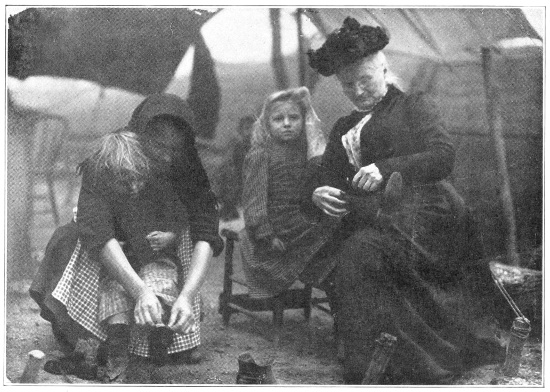
They established a tent colony in Holly Grove and Mossey. But they were
not safe here from the assaults of the gunmen, recruited in the big
cities from the bums and criminals.
To protect their women and children, who were being shot with poisoned
bullets, whose houses were entered and rough-housed, the miners armed
themselves as did the early settlers against the attacks of wild
Indians.
“Mother, it will be sure death for you to go into the Creeks,” the
brakeman told me. “Not an organizer dares go in there now. They have
machine guns on the highway, and those gunmen don’t care whom they
kill.”
The train stopped at Paint Creek Junction and I got off. There were a
lot of gunmen, armed to the teeth, lolling about. Everything was still
and no one would know of the bloody war that was raging in those silent
hills, except for the sight of those guns and the strange, terrified
look on everyone’s face.
I stood for a moment looking up at the everlasting hills when suddenly
a little boy ran screaming up to me, crying, “Oh Mother Jones! Mother
Jones! Did you come to stay with us?” He was crying and rubbing his
eyes with his dirty little fist.
“Yes, my lad, I’ve come to stay,” said I.
A guard was listening.
“You have?” says he.
“I have!” says I.
The little fellow threw his arms around my knees and held me tight.
“Oh Mother, Mother,” said he, “they drove my papa away and we don’t
know where he is, and they threw my mama and all the kids out of the
house and they beat my mama and they beat me.”
He started to cry again and I led him away up the creek. All the way
he sobbed out his sorrows, sorrows no little child should ever know;
told of brutalities no child should ever witness.
“See, Mother, I’m all sore where the gunmen hit me,” and he pulled down
his cotton shirt and showed me his shoulders which were black and blue.
“The gunmen did that?”
“Yes, and my mama’s worse’n that!” Suddenly he began screaming, “The
gunmen! The gunmen! Mother, when I’m a man I’m going to kill twenty
gunmen for hurting my mama! I’m going to kill them dead—all dead!”
I went up to the miners’ camp in Holly Grove where all through the
winter, through snow and ice and blizzard, men and women and little
children had shuddered in canvas tents that America might be a better
country to live in. I listened to their stories. I talked to Mrs.
Sevilla whose unborn child had been kicked dead by gunmen while
her husband was out looking for work. I talked with widows, whose
husbands had been shot by the gunmen; with children whose frightened
faces talked more effectively than their baby tongues. I learned how
the scabs had been recruited in the cities, locked in boxcars, and
delivered to the mines like so much pork.
“I think the strike is lost, Mother,” said an old miner whose son had
been killed.
“Lost! Not until your souls are lost!” said I.
I traveled up and down the Creek, holding meetings, rousing the tired
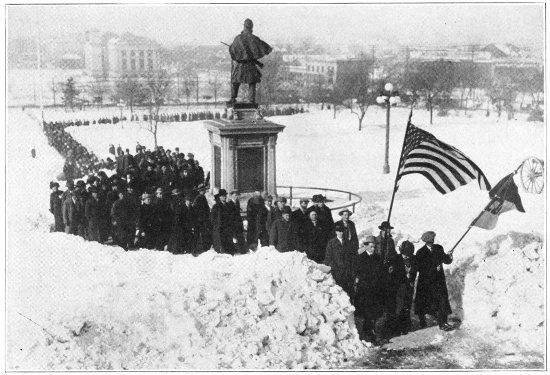
spirits of the miners. I got three thousand armed miners to march over
the hills secretly to Charleston, where we read a declaration of war
to Governor Glasscock who, scared as a rabbit, met us on the steps of
the state house. We gave him just twenty-four hours to get rid of the
gunmen, promising him that hell would break loose if he didn’t. He did.
He sent the state militia in, who at least were responsible to society
and not to the operators alone.
One night in July, a young man, Frank Keeney, came to me. “Mother,” he
said, “I have been up to Charleston trying to get some one to go up to
Cabin Creek, and I can’t get anyone to go. The national officers say
they don’t want to get killed. Boswell told me you were over here in
the Paint Creek and that perhaps you might come over into the Cabin
Creek district.”
“I’ll come up,” said I. “I’ve been thinking of invading that place for
some time.”
I knew all about Cabin Creek—old Russia. Labor organizer after
organizer had been beaten into insensibility, thrown into the creek,
tossed into some desolate ravine. The creek ran with the blood of brave
men, of workers who had tried to escape their bondage.
“Where can we hold our meetings?” I asked.
“I don’t know, Mother. The company owns every bit of dust for twenty
square miles about. And the guards arrest you for trespassing.”
“Is there an incorporated village anywhere near?”
“Eksdale,” said he, “is free.”
“Bill a meeting for me there Tuesday night. Get the railway men to
circulate the bills.”
Monday night, a fellow by the name of Ben Morris, a national board
member came to me and said, “Mother, I understand you are going up to
Cabin Creek tomorrow. Do you think that is wise?”
“It’s not wise,” said I, “but necessary.”
“Well, if you go, I’ll go,” said he.
“No, I think it is better for me to go alone. You represent the
National office. I don’t. I’m not responsible to anyone. If anything
happens and you are there, the operators might sue the Union for
damages. I go as a private citizen. All they can do to me is to put me
in jail. I’m used to that.”
He left me and went directly to the governor and told him to send a
company of the militia up to Cabin Creek as I was going up there. Then
he got the sheriff to give him a body guard and he sneaked up behind
me. At any rate I did not see him or the militia on the train nor did I
see them when I got off.
In Eksdale a sympathetic merchant let me stay in his house until the
meeting began.
When I got off the train, two or three miners met me.
“Mother,” they said, “did you know there is a detective along with you.
He’s behind you now ... the fellow with the red necktie.”
I looked around. I went up to him.
“Isn’t your name Corcoran?” said I.
“Why, yes,” said he, surprised.
“Aren’t you the Corcoran who followed me up New River in the strike of
1902? You were working for the Chesapeake and Ohio Railroad and the
coal company then.”
“Why, yes,” said he, “but you know people change!”
“Not sewer rats,” said I. “A sewer rat never changes!”
That night we held a meeting. When I got up to speak I saw the militia
that the national organizer had had the governor send. The board
member was there. He had made arrangements with the local chairman
to introduce him. He began speaking to the men about being good and
patient and trusting to the justice of their cause.
I rose. “Stop that silly trash,” said I. I motioned him to a chair. The
men hollered, “sit down! sit down!”
He sat. Then I spoke.
“You men have come over the mountains,” said I, “twelve, sixteen
miles. Your clothes are thin. Your shoes are out at the toes. Your
wives and little ones are cold and hungry! You have been robbed and
enslaved for years! And now Billy Sunday comes to you and tells you to
be good and patient and trust to justice! What silly trash to tell to
men whose goodness and patience has cried out to a deaf world.”
I could see the tears in the eyes of those poor fellows. They looked up
into my face as much as to say, “My God, Mother, have you brought us a
ray of hope?”
Some one screamed, “Organize us, Mother!”
Then they all began shouting.... “Organize us! Organize us!”
“March over to that dark church on the corner and I will give you the
obligation,” said I.
The men started marching. In the dark the spies could not identify them.
“You can’t organize those men,” said the board member, “because you
haven’t the ritual.”
“The ritual, hell,” said I. “I’ll make one up!”
“They have to pay fifteen dollars for a charter,” said he.
“I will get them their charter,” said I. “Why these poor wretches
haven’t fifteen cents for a sandwich. All you care about is your salary
regardless of the destiny of these men.”
On the steps of the darkened church, I organized those men. They raised
their hands and took the obligation to the Union.
“Go home from this meeting,” said I. “Say nothing about being a union
man. Put on your overalls in the morning, take your dinner buckets and
go to work in the mines, and get the other men out.”
They went to work. Every man who had attended the meeting was
discharged. That caused the strike, a long, bitter, cruel strike.
Bullpens came. Flags came. The militia came. More hungry, more cold,
more starving, more ragged than Washington’s army that fought against
tyranny were the miners of the Kanawha Mountains. And just as grim.
Just as heroic. Men died in those hills that others might be free.
One day a group of men came down to Eksdale from Red Warrior Camp to
ask me to come up there and speak to them. Thirty-six men came down in
their shirt sleeves. They brought a mule and a buggy for me to drive in
with a little miner’s lad for a driver. I was to drive in the creek bed
as that was the only public road and I could be arrested for trespass
if I took any other. The men took the shorter and easier way along the
C. and O. tracks which paralleled the creek a little way above it.
Suddenly as we were bumping along I heard a wild scream. I looked
up at the tracks along which the miners were walking. I saw the men
running, screaming as they went. I heard the whistle of bullets. I
jumped out of the buggy and started to run up to the track. One of the
boys screamed, “God! God! Mother, don’t come. They’ll kill....”
“Stand still,” I called. “Stand where you are. I’m coming!”
When I climbed up onto the tracks I saw the boys huddled together, and
around a little bend of the tracks, a machine gun and a group of gunmen.
“Oh Mother, don’t come,” they cried. “Let them kill us; not you!”
“I’m coming and no one is going to get killed,” said I.
I walked up to the gunmen and put my hand over the muzzle of the gun.
Then I just looked at those gunmen, very quiet, and said nothing. I
nodded my head for the miners to pass.
“Take your hands off that gun, you hellcat!” yelled a fellow called
Mayfield, crouching like a tiger to spring at me.
I kept my hand on the muzzle of the gun. “Sir,” said I, “my class goes
into the mines. They bring out the metal that makes this gun. This is
my gun! My class melt the minerals in furnaces and roll the steel. They
dig the coal that feeds furnaces. My class is not fighting you, not
you. They are fighting with bare fists and empty stomachs the men who
rob them and deprive their children of childhood. It is the hard-earned
pay of the working class that your pay comes from. They aren’t fighting
you.”
Several of the gunmen dropped their eyes but one fellow, this Mayfield,
said, “I don’t care a damn! I’m going to kill every one of them, and
you, too!”
I looked him full in the face. “Young man,” said I, “I want to tell you
that if you shoot one bullet out of this gun at those men, if you touch
one of my white hairs, that creek will run with blood, and yours will
be the first to crimson it. I do not want to hear the screams of these
men, nor to see the tears, nor feel the heartache of wives and little
children. These boys have no guns! Let them pass!”
“So our blood is going to crimson the creek, is it!” snarled this
Mayfield.
I pointed to the high hills. “Up there in the mountain I have five
hundred miners. They are marching armed to the meeting I am going to
address. If you start the shooting, they will finish the game.”
Mayfield’s lips quivered like a tiger’s deprived of its flesh.
“Advance!” he said to the miners.
They came forward. I kept my hand on the gun. The miners were searched.
There were no guns on them. They were allowed to pass.
I went down the side of the hill to my buggy. The mule was chewing
grass and the little lad was making a willow whistle. I drove on. That
night I held my meeting.
But there weren’t any five hundred armed men in the mountains. Just a
few jack rabbits, perhaps, but I had scared that gang of cold blooded,
hired murderers and Red Warrior camp was organized.
The miners asked me to come up to Wineberg, a camp in the Creek
district. Every road belonged to the coal company. Only the bed of the
creek was a public road. At that time of the year—early spring—the
water in the creek was high.
I started for Wineberg accompanied by a newspaperman, named West, of
the Baltimore Sun. We walked along the railroad track.
Again I met the gunmen with their revolvers and machine guns. Mayfield
was there, too.
“You can’t walk here!” he growled. “Private property!”
“You don’t mean to say you are going to make that old lady walk that
creek in that ice cold water, do you?” said the reporter.
“It’s too damn good for her! She won’t walk it!” he laughed.
“Won’t I?” said I. I took off my shoes, rolled up my skirt and walked
the creek.
At Wineberg the miners, standing in the creek and on its edges, met me.
With our feet in water we held a meeting. Holding their shoes in their
hands, their trousers rolled up, these men took the obligation to the
union.
I was very tired. A miner stepped up to me and asked me to come to his
cabin and have a dish of tea.
“Your house is on private property,” yelled a gunman. “She cannot go.”
“I pay rent,” he protested.
“Private property, just the same. I’ll arrest her for trespassing if
she steps out of the creek.”
The struggle went on with increasing bitterness. The militia disarmed
both gunmen and miners but they were of course, on the side of the
grand dukes of the region. They forbade all meetings. They suspended
every civil right. They became despotic. They arrested scores of
miners, tried them in military court, without jury, sentenced them to
ten, fifteen years in the Moundsville prison.
I decided to call the attention of the national government to
conditions in West Virginia. I borrowed one hundred dollars and went
out and billed meetings in Cincinnati, Columbus, Cleveland, and from
these cities I came to Washington, D. C. I had already written to
Congressman W. B. Wilson, to get up a protest meeting.
The meeting was held in the armory and it was packed: senators,
congressmen, secretaries, citizens. It is usual to have star orators
at such meetings, who use parlor phrases. Congressman Wilson told the
audience that he hoped they would not get out of patience with me, for
I might use some language which Washington was not accustomed to hear.
I told the audience what things were happening in West Virginia,
proceedings that were un-American. I told them about the suspension of
civil liberty by the military. Of the wholesale arrests and military
sentences.
“This is the seat of a great republican form of government. If such
crimes against the citizens of the state of West Virginia go unrebuked
by the government, I suggest that we take down the flag that stands for
constitutional government, and run up a banner, saying, ‘This is the
flag of the money oligarchy of America!’”
The next day by twelve o’clock all the military prisoners but two were
called down to the prison office and signed their own release.
From Washington I went to West Virginia to carry on my work. The day
before I arrived, an operator named Quinn Morton, the sheriff of
Kanawha County, Bonner Hill, deputies and guards drove an armored train
with gatling guns through Holly Grove, the tent colony of the miners,
while they were sleeping. Into the quiet tents of the workers the guns
were fired, killing and wounding the sleepers. A man by the name of
Epstaw rose and picked up a couple of children and told them to run
for their lives. His feet were shot off. Women were wounded. Children
screamed with terror.
No one was arrested.
Three days later, a mine guard, Fred Bobbett, was killed in an
altercation. Fifty strikers and their organizers were immediately
arrested, and without warrant.
I went to Boomer where the organization is composed of foreigners, and
I went to Long Acre, getting each local union to elect a delegate who
should appeal to the governor to put a stop to the military despotism.
I met all these delegates in a church and told them how they were to
address a governor. We took the train for Charleston. I thought it
better for the delegates to interview the governor without me, so after
cautioning them to keep cool, I went over to the hotel where they were
to meet me after their interview.
As I was going along the street, a big elephant, called Dan Cunningham,
grabbed me by the arm and said, “I want you!” He took me to the
Roughner Hotel, and sent for a warrant for my arrest. Later I was put
on the C. and O. train and taken down to Pratt and handed over to the
military. They were not looking for me so they had no bullpen ready.
So a Dr. Hansford and his wife took care of me and some organizers who
were arrested with me. The next day I was put in solitary in a room,
guarded by soldiers who paced day and night in front of my door. I
could see no one. I will give the military of West Virginia credit for
one thing: they are far less brutal and cold blooded than the military
of Colorado.
After many weeks we were taken before the judge advocate. The court
had sent two lawyers to my bullpen to defend me but I had refused to
let them defend me in that military court. I refused to recognize the
jurisdiction of the court, to recognize the suspension of the civil
courts. My arrest and trial were unconstitutional. I told the judge
advocate that this was my position. I refused to enter a plea.
I was tried for murder. Along with the others I was sentenced to serve
twenty years in the state penitentiary. I was not sent to prison
immediately but held for five weeks in the military camp. I did not
know what they were going to do with me. My guards were nice young
men, respectful and courteous with the exception of a fellow called
Lafferty, and another sewer rat whose name I have not taxed my mind
with.
Then from California came aid. The great, lion-hearted editor of
the San Francisco Bulletin, Fremont Older, sent his wife across the
continent to Washington. She had a talk with Senator Kearns. From
Washington she came to see me. She got all the facts in regard to the
situation from the beginning of the strike to my unconstitutional
arrest and imprisonment. She wrote the story for Collier’s Magazine.
She reported conditions to Senator Kearns, who immediately demanded a
thorough congressional inquiry.
Some one dropped a Cincinnati Post through my prison window. It
contained a story of Wall Street’s efforts to hush up the inquiry. “If
Wall Street gets away with this,” I thought, “and the strike is broken,
it means industrial bondage for long years to come in the West Virginia
mines.”
I decided to send a telegram, via my underground railway, to Senator
Kearns. There was a hole in the floor of my prison-cabin. A rug covered
the hole. I lifted the rug and rang two beer bottles against one
another. A soldier who was my friend came crawling under the house to
see “what was up.” He had slipped me little things before, and I had
given him what little I had to give—an apple, a magazine. So I gave
him the telegram and told him to take it three miles up the road to
another office. He said he would. “It’s fine stuff, Mother,” he said.
That night when he was off duty he trudged three miles up the road with
the telegram. He sent it.
The next day in Washington, the matter of a congressional inquiry in
the West Virginia mines came up for discussion in the Senate.
Senator Goff from Clarksburg, who had stock in the coal mines of West
Virginia, got up on the floor and said that West Virginia was a place
of peace until the agitators came in. “And the grandmother of agitators
in this country,” he went on, “is that old Mother Jones! I learn from
the governor that she is not in prison at all but is only detained in a
very pleasant boarding house!”
Senator Kearns rose. “I have a telegram from this old women of
eighty-four in this very pleasant boarding house,” said he. “I will
read it.”
To the astonishment of the senators and the press he then read my
telegram. They had supposed the old woman’s voice was in prison with
her body.
“From out the military prison walls of Pratt, West Virginia, where I
have walked over my eighty-fourth milestone in history, I send you the
groans and tears and heartaches of men, women and children as I have
heard them in this state. From out these prison walls, I plead with
you for the honor of the nation, to push that investigation, and the
children yet unborn will rise and call you blessed.”
Then the senate took action. A senatorial commission was appointed to
investigate conditions.
One hour after this decision, Captain Sherwood of the militia, a real
man in every sense of the word aside from the uniform, said to me,
“Mother, the governor telephoned me to bring you to Charleston at once.
You have only twenty-five minutes before the train comes.”
“What does the governor want?” said I.
“He didn’t say.”
When I got to the governor’s office, I had to wait some time because
the governor and the mine owners were locked behind doors holding
a secret conference as to how they should meet the senatorial
investigation.
Governor Hatfield had succeeded Governor Glasscock, and he told me,
when he finally admitted me, that he had been trying to settle the
strike ever since he had been elected.
“I could have settled it in twenty-four hours,” said I.
He shook his head mournfully.
“I would make the operators listen to the grievances of their workers.
I would take the $650,000 spent for the militia during this strike
and spend it on schools and playgrounds and libraries that West
Virginia might have a more highly developed citizenry, physically and
intellectually. You would then have fewer little children in the mines
and factories; fewer later in jails and penitentiaries; fewer men and
women submitting to conditions that are brutalizing and un-American.”
The next day he attended the convention of the miners that was in
session in Charleston. I saw him there and I said to him, “Governor, I
am going out of town tomorrow.”
“Where are you going?”
“I’m going to consult a brain specialist. My brain got out of balance
while I was in the bullpen.”
“Didn’t you know I was a doctor?” said he.
“Your pills won’t do me any good!” I said.
Shortly after the miner’s convention, Governor Hatfield set aside all
the military sentences, freeing all of the prisoners but eight. The
operators recognized the union and many abuses were corrected.
The working men had much to thank Senator Kearns for. He was a great
man, standing for justice and the square deal. Yet, to the shame of
the workers of Indiana, when he came up for re-election they elected a
man named Watson, a deadly foe of progress. I felt his defeat keenly,
felt the ingratitude of the workers. It was through his influence that
prison doors had opened, that unspeakable conditions were brought to
light. I have felt that the disappointment of his defeat brought on his
illness and ended the brave, heroic life of one of labor’s few friends.
One day when I was in Washington, a man came to see me who said General
Elliott had sent him to me. General Elliott was the military man who
had charge of the prisoners sentenced to the penitentiary in the court
martial during the strike. Never would I forget that scene on the
station platform of Pratt when the men were being taken to Moundsville;
the wives screaming frantically; the little children not allowed to
kiss or caress their fathers. Neither the screams nor the sobs touched
the stone heart of General Elliott.
And now General Elliott had sent a friend to me to ask me to give him a
letter endorsing him for Congress.
“And did General Elliott send you?”
“Yes.”
“Then tell the general that nothing would give me more pleasure than to
give you a letter, but it would be a letter to go to hell and not to
Congress!”