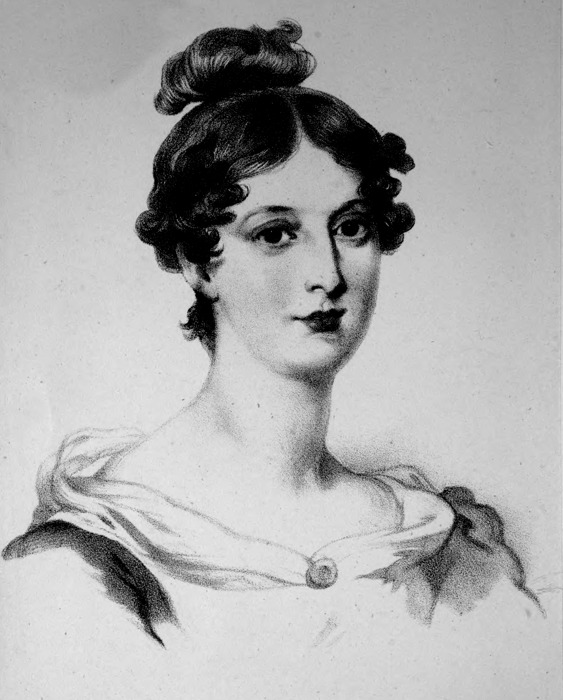
PARENTAGE OF MISS KNIGHT—ANECDOTES OF HER FATHER—HER EARLY
DAYS—EDUCATION—SOCIETY—SIR JOSHUA REYNOLDS—BURKE—GOLDSMITH—BARETTI—ANECDOTE
OF DR. JOHNSON—DEATH OF ADMIRAL
KNIGHT.
My ancestors, on my father’s side, lost a very considerable
landed property from their attachment
to the cause of royalty, during the unfortunate
reign of Charles the First. My grandfather had a
trifling employment in Cornwall, where my father,
his youngest son, was born. The latter entered the
naval service of the Crown at the age of fourteen,
on board a ship of war, commanded by his brother.
He had previously received a good education, and
had attained as much classical knowledge as could
be expected at so early a period of life; and what
is very remarkable, though constantly and almost
exclusively engaged in the duties of his profession,
he never forgot his Greek and Latin.[2]
2That singular character, Wortley Montagu,[3] was
on board my uncle’s ship, and, of course, became
much acquainted with my father, insomuch that
when my uncle was appointed to the command
of another ship, and took his brother with him,
Montagu would stay no longer, and suddenly
disappeared. This was the commencement of his
wanderings, as I was told by an old gentleman
who had been his tutor, and who was struck by my
resemblance to my father at nearly the same age as
that at which he had known him.
During half a century my father served his king
and country with unremitting zeal and attachment.
He was present at most of the memorable sieges and
engagements of his time, and died at the age of
sixty-six, a rear-admiral of the white squadron and
a knight.
Unassuming, disinterested, and possessing the
nicest sense of honour, he never received a reprimand
from a superior officer, and never injured the
character of one under his command by a complaint
3to the Board of Admiralty. Strict in the
performance of his own duty, he exacted the same
from others. He was known to be kind, as well as
just; he was beloved, and he was obeyed.
When very young, he had married a lady, by
whom he had a son and two daughters. His son
died a captain in the army before my father married
his second wife, my mother, a lady of an Essex
family, whose crest was a tortoise, while that of
my father was an eagle on a spray. This contrast
of the slow and the swift is not more remarkable
than that of the histories of the two families. As
the ancestor of my father, Sir Joseph Knight, lost
his estates in Cheshire and part of Whittleby
Forest on account of his supporting the cause of
Charles the First, so Sir Anthony Dean,[4] one of
my mother’s family, a warm partisan of the Commonwealth,
having exchanged one of his Essex
estates with Colonel Sparrow for Hyde Park, was
deprived of the latter at the Restoration, and without
receiving what he had given up, was obliged to
relinquish the property belonging to government.
My mother was, however, no friend of revolutions;
and her principles in that respect perfectly
agreed with those of my father. She had great
4quickness of perception, wit, and vivacity, a happy
facility in conversation, and a singular frankness of
temper. I never knew any one who better combined
economy with the most disinterested generosity,
or the most affectionate warmth of heart
with the keenest satirical penetration. She was
feared by some, but loved by many. She had read
much, but having lost her mother at her birth, and
having been brought up in the country at a time
when education had not made general progress, she
was resolved that I should not labour under the
same disadvantage, and her ideas on the subject
were very extensive. Had I possessed half her
acuteness of mind, firmness of character, and buoyancy
of spirits, there is nothing that I might not
have attained, from the pains that she took with
my education.
The first event which I can recollect was the
return of my father from the West Indies, where
he had been left for some time after the conclusion
of peace, with the command at the Havannah, until
that place was restored to Spain by the new treaty.
I remember being carried up the ship’s side, when
I was taken by my mother to Portsmouth to meet
him. The height of the ship and the waves of the
sea left a strong impression on my mind.
My father liked the Spaniards, as I afterwards
heard him say, and as my mother used to tell me
in later times. He was friendly and kind to them,
5and they are not forgetful of benefits, nor, alas! of
injuries.
One of the Judges of the Havannah, hearing
Captain Knight called by his christian as well as
his family name at a dinner-party, sprang from his
chair and flew into my father’s arms, calling him
his preserver, his benefactor. It seems, that when
this Spaniard was very young, and on his first
voyage to the West Indies, he had been taken
prisoner by an English ship of war, on board of
which my father was a lieutenant. Seeing the
distress and fright of the youth, who, having just
left his parents, loaded with valuable gifts, relics,
and keepsakes, trembled for his treasures, and who,
having been used to every comfort at home, was
wretched in his present situation, my father gave
him up his own cabin, took care of his property,
and made him perfectly easy and happy.
Remembering all this with the most grateful
feeling, the Spaniard, then in one of the highest
offices of the Havannah, pressed my father to come
to his house, and offered him every attention; but
he declined it, for, as he said, he knew the man
would want him to accept valuable presents, and
he might offend him by refusing. He, indeed, constantly
refused what might be called remuneration
of any kind; and was of opinion that no man in a
public situation could be just or independent unless
he kept clear of such obligations.
6On the day of my completing my fifth year I
was taken to the school of Mesdames Thompets, four
sisters from Switzerland, to which I was to go as a
parlour day-boarder, three times a week, for the
purpose of learning to dance and to speak French.
This was certainly no hard injunction, and I had
some young friends there; but it was long a great
distress to me, and I dreaded the three unfortunate
days to a degree not to be described.
On the intermediate days I had masters at home.
One of these was M. Petitpierre, who had been a
pastor of the Swiss church of Neufchatel, and had
been dismissed by the synod of that place for
having preached a doctrine which was not approved.
He, it seems, pleaded that he had only,
when ordained, promised to interpret the Scriptures
to the best of his knowledge and comprehension;
but the heads of his Church said that his doctrine,
which implied the non-eternity of punishments,
might not be dangerous for themselves, who were
enlightened men, but would be greatly so for their
wives and servants.
Frederick, King of Prussia, as in some measure
sovereign of Neufchatel, interfered in behalf of
Petitpierre, but without success; and he is said to
have finished by remarking, “Eh bien! si messieurs
de Neufchatel veulent être damnés à toute éternité,
ainsi soit-il!”
M. Petitpierre had a great number of scholars in
7London, and was certainly an excellent master. He
taught me French, Latin, the elements of Greek,
and of the mathematics, with geography and history.
He was a man of great simplicity of manners, and
I had a sincere regard for him. He was the protector
and comforter of all the Swiss who wanted
his assistance, and generally esteemed by those who
were settled in our country.
At length, the sister of one of those, who had
chiefly caused his banishment, happened to be in
great difficulties, from which he extricated her; and
she wrote to her brother, saying that the man whom
the synod had exiled was the guardian angel of his
countrymen and countrywomen in England.
Petitpierre was, in consequence of this, and,
perhaps, other letters of similar import, recalled to
Neufchatel, by a solemn deputation of the synod, to
his brother’s house. He went and paid a visit to
his friends, but did not settle in his native country
till after the death of his wife.
The too famous Marat was a Swiss physician,
and used to visit at the school. All that I can recollect
of him were his person and countenance,
which were very repulsive.
The dancing-master was Novere, brother of the
celebrated ballet-master of that name. It is, I believe,
impossible for any one to have been a more
proper instructor—graceful without affectation, a
good time-ist, and, I believe, a good domestic character
8in private life. As he had many scholars—he
and Gallini being the dancing-masters the most
in fashion—he made some money, and bought, as
he said, “an estate for himself and his ancestors.”
Sir Joshua Reynolds was, during my childhood,
the painter in fashion, and his house was the resort
of the men of letters most known at that time. He
had living with him an unmarried sister (Miss
Frances Reynolds), for whom my mother had a
real friendship. She was an amiable woman, very
simple in her manner, but possessed of much information
and talent, for which I do not think
every one did her justice, on account of the singular
naïveté which was her characteristic quality, or defect,
for it often gave her the appearance of want
of knowledge. She was a good painter and musician,
and I have seen some of her poetical compositions,
which have appeared to me very pleasing, and in
good taste.
I used often to pass the day with her, when she
would give me instructions in drawing, and as I
was very intimate with her younger niece,[5] we used
to pass much time in rooms where the portraits of
most of the celebrated beauties, men of letters, and
politicians of the time, were exposed to view.
Sir Joshua Reynolds was a very popular person.
9All seemed satisfied with their portraits, and he had
the art of rendering the costume picturesque, without
departing from the mode of the time so as to
make the resemblance less striking. There was in
his paintings a fascination which still, in great measure,
prevails, though many are faded; and the
drawing was always correct. I believe he was
good, friendly, and benevolent in a high degree.
His pronunciation was tinctured with the Devonshire
accent; his features were coarse, and his outward
appearance slovenly, but his mind was certainly
not inelegant, and the graces which he did
not himself possess he could confer on his pictures.
Sir Joshua loved high company, and wished his
house to be considered as a Lyceum. In this
he had Rubens and Vandyke in view. He was,
indeed, surrounded by the wits and men of learning,
and their society was harmonised by the goodness
of his disposition, and the purity of his sister’s character
and manners.
Johnson, Burke, Goldsmith, Baretti, Langton,[6]
Beauclerk,[7] and Mrs. Montagu, were often his
guests. As President of the Royal Academy, the
speeches of Sir Joshua Reynolds were admired for
the style, though probably not for the matter of
them. He was, I suppose, assisted by his literary
10friends, and more particularly by Johnson. Michael
Angelo was his idol. Sir Joshua had been at Rome
while young, but before he left England he had
painted several portraits of sea officers, friends of
Lord Edgecombe, which portraits are, I imagine,
still to be seen at that most beautiful place Mount
Edgecombe. I recollect seeing at Devonport the
portrait of an old lady of ninety, of the same date,
and I think it is one of his best performances. The
colours, too, had not faded, as in many of his later
works.
I recollect being delighted with the conversation
of Mr. Burke, amused by the buffoonery of Goldsmith,
and disgusted with the satirical madness of
manner of Baretti,[8] whose work, entitled “Frusta
Literaria,” had, I believe, been the principal cause
of his leaving Piedmont. He was, however, a great
favourite in this society, and was warmly supported
when he had to take his trial for having stabbed a
man who insulted him one night in the street. He
was acquitted, because it was considered to have
been done in self-defence. Being a foreigner, he
was probably more frightened than he might have
been had he known our country better, and he
used, therefore, a weapon not common with us,
though it might be in Piedmont. I was then a
11child; but I remember being so shocked at his
shaking hands with me, that I said to my mother
at night, “Did I ever think I should shake hands
with a murderer!” It is certain that Baretti was a
man of great learning and information.
Goldsmith was, I feel sure, very good-natured,
and though neither his features, person, nor manners
had anything of grace to recommend them, his
countenance, as far as I can recollect, was honest
and open, and in his behaviour there was something
easy and natural, removed from vulgarity no
less than from affectation. His buffoonery, of
which I have spoken, was a sort of childish playfulness,
such as drinking off a glass of water reversed
on the table without spilling a drop, and
similar tricks. On some occasion—I forget what—he
was told that he must wear a silk coat, and he
purchased one second-hand, which had been a nobleman’s,
without observing that there was visible on
the breast a mark showing where a star had been.
He was beloved, and his death was truly lamented.
The observations of so young a child as I then
was can be of no consequence, but of all these
personages the one whom I liked best was Mr.
Burke, perhaps because he condescended to notice
me. Of Mrs. Montagu,[9] all that I can remember
is that she called me “a stupid child,” because I
12did not find out the puzzle of a gold ring which she
wore.
As to Johnson, he was always kind to me, but he
was very intimate at our house, had a high opinion
of my father, and conversed willingly with my
mother, who never failed to contradict him when
she was not of his way of thinking, and yet never
received from him a disagreeable reply.
An elderly lady, named Williams,[10] who had
been a friend of his wife, lived with him. Though
blind, and suffering very much from a pain in the
head, she acted as his housekeeper, and managed all
the affairs of his domestic life. Born in a respectable
station, she had been well educated, but had no fortune.
She had high principles, great strength of
mind, and a sound judgment. Her manners were
perfectly good, and her taste in literature correct.
She was of a Welsh family, and had lost her sight
irrecoverably when a young woman; but it was
wonderful to see how little trouble she gave; she
worked well, and even made her own gowns. My
mother had a great regard for her, and she often
passed the day with us.
I remember going with Mrs. Williams and Mr.
and Mrs. Hoole to see the tragedy of “Cyrus,”
written by Mr. Hoole,[11] in imitation of the “Ciro”
13of Metastasio, Mrs. Yates taking the part of Mandane.[12]
The King of Denmark[13] was at that time on a
visit to England, and gave a masquerade ball at
the Opera House, for which, of course, everybody
was anxious to get tickets. In the epilogue to
“Cyrus,” amongst other satirical strokes, as usual,
on the habits and customs of the times, were the
following lines:
With us what griefs from ills domestic rise,
When now a beau, and now a monkey dies!
In this our iron age, still harder lot,
A masquerade—no tickets to be got!
On the following morning, after the first hearing of
this epilogue, tickets were left at the door of Mrs.
Yates.
This, I have been told, was the first masquerade
given in London after the death of George the
Second, who was very fond of them, and seldom
missed them at the theatre. George the Third did
not approve of an amusement which he thought
might lead to much that was wrong. He did not,
however, refuse his brother-in-law, though he endeavoured
to persuade him to give a fête of another
description, and all he could afterwards do was not
to encourage masquerades by his presence.
To return to Mr. Hoole. I was captivated by
14his translation of Tasso’s “Jerusalem,” which certainly
has great merit. To translate from Italian
into any other language is more than difficult;
whereas the Italians can translate any author, not
only of the dead but of the living languages, with
the greatest facility, and with a correctness delightfully
intelligible to the readers of their own country—an
advantage also enjoyed by the Germans in
a high degree.
When I first knew Dr. Johnson, I was a little
afraid of his deep tone of voice and great wig; but
when I had reached my seventh or eighth year,
I was accustomed to all this, and felt grateful for
his indulgence.
He was introduced to George the Fourth, then a
child, in the library at St. James’s. He asked the
young prince some questions about his studies, and
when he took leave of him, said, “God bless you,
sir! and make you as good a man and as great a
king as your father.”
The ideas of Johnson on social order were carried
so far, that when he wanted to send for his favourite
cat he would not order his servant, who was a
negro, to procure it, saying that it was not good to
employ human beings in the service of animals; he
therefore went himself on the errand. When I
went abroad, Dr. Johnson gave me his blessing,
and exhorted me not to become a Roman Catholic,
adding, that “if I extended my belief, I might at
15length turn Turk.” I was insensible of the goodness
of the advice, because I knew it to be unnecessary,
and was therefore hurt at the supposition.
Indeed, I still think, that if Dr. Johnson had possessed
as much discrimination of character as learning,
he would rather have advised me to remember
I was a Christian, and never allow vanity or the
love of pleasure to lead me into follies unworthy of
that sacred character. I should have felt that I
wanted such advice, and, probably, should have
often thought of it, at least with gratitude.
Johnson was a sincere lover of equal justice,
and though feeling great respect for the distinctions
of rank and lawful authority, he was far from
being servile, or what is called a courtier.
He had a great respect for men who served their
country by sea or land, and was heard to say that,
let a man be ever so distinguished for rank or
abilities, he could not help thinking that he must,
when in company with an officer of long and
splendid services, feel himself his inferior.
He was very curious to see the manner of living
and the discipline on board a ship of war, and when
my father was appointed to the command of the
Ramilies, of seventy-four guns, and to sail with the
command of a squadron for Gibraltar, at the time
when a war with Spain was expected, Johnson
went to Portsmouth, and passed a week on board
with my father. He inquired into everything, made
16himself very agreeable to the officers, and was much
pleased with his visit.
When he was conveyed on shore, the young
officer whom my father had sent to accompany
him, asked if he had any further commands.
“Sir,” said Johnson, “have the goodness to thank
the commodore and all the officers for their kindness
to me, and tell Mr. ——, the first lieutenant,
that I beg he will leave off the practice of swearing.”
The young man, willing, if possible, to justify, or
at least excuse, his superior, replied that, unfortunately,
there was no making the sailors do their
duty without using strong language, and that his
Majesty’s service required it. “Then, pray, sir,”
answered Johnson, “tell Mr. —— that I beseech
him not to use one oath more than is absolutely
required for the service of his Majesty.”
Among the persons of talent whom we knew, I
must not forget Gainsborough. He might be said
to be self-taught. I have heard my mother, who
knew all about Essex and Suffolk people, say that
his father kept a shop, and he was obliged to pink
shrouds, &c. Every spare moment he gave to
drawing. He studied every tree in the counties in
which he lived, and was never out of England.
Had he studied in Italy, he would not only have
been the first of English painters, but probably
would have formed a school in this country. His
17genius was very great. His landscapes are Nature
itself, and his portraits, though perhaps not so
fascinating as those of Sir Joshua, were correct
likenesses. He had an almost equal talent for
music as for painting, and I never saw an artist
who had less presumption or vanity.
My father sailed for Gibraltar with a convoy of
troops for that garrison; but, peace being settled,
he brought back others in exchange. On his return,
he was ordered to pay off the ships of war then
at Chatham, and afterwards appointed to the command
of the Ocean, of ninety guns, a guard-ship at
Plymouth.
Thither we removed, and had a house in the
square of what was then called Plymouth Dock.
Admiral Spry commanded the fleet there; but as
he was in Parliament, and often absent, my father,
who was senior officer, had the duty of commander
to perform during three-fourths of the year. Spry
had an estate in Cornwall, and was a great friend
of my father, in whom he placed the highest confidence,
otherwise I do not believe that he would
have made such frequent and long absences, for he
was a sensible man and a good officer, though not
fond of being confined to a seaport.
Whatever was duty was preferred by my father
to every other consideration; and he not only took
the greatest pains to acquit himself of that which
18was his portion at Plymouth, but was most hospitable
and kind to the officers under his command,
and to all the foreigners who either came on service
or were recommended to him on visits of pleasure
or curiosity. Among the latter were several Russian
noblemen, and the Duc de Guignes, the French
ambassador at our Court.
It was my father who despatched a frigate, under
the command of Captain Macbride, to convey the
unfortunate Queen Matilda[14] from Copenhagen to
Germany; and on that occasion he acted with a
dignity similar to that shown by our minister Sir
Robert Keith; for he would not allow any of the
Danish noblemen to hand the Queen into the barge,
saying, “No, gentlemen, her Majesty is now under
the protection of England.”
Sir Edward Hughes, Captain Barrington, Captain
Fielding, and other officers commanding guard-ships,
were constantly at our house. Captain Vandeput,
who commanded a frigate, hearing that my
father had a girl who was learning Italian, lent me
his library, during a long cruise. It consisted of
several books in that language, as well as in French.
I had a few lessons in Greek from the chaplain
of the dockyard; but, in most respects, I had not
here much assistance in continuing my studies;
19and from the circumstances in which we were
placed, I was thrown more into society than was
expedient at so early a period of my life; but, at
the time, I was, of course, pleased with it to a
certain degree, though I can now remember little
that was interesting during our residence at Devonport.
No man, I think, was more generally beloved
than Captain Barrington. His eldest brother, Lord
Barrington, was long Secretary to the War Department,
and had considerable influence; but Captain
Barrington, who was unassuming and unambitious,
seemed never to avail himself of this circumstance,
unless by being the first to get his ship out of dock,
or any other exigency of service, not perhaps being
even conscious that his situation in life gained him
this advantage with the persons on whom the business
depended.
He was an enemy to all ostentation, kept a good
table on board his ship, but without magnificence,
that he might not hurt the feelings of his brother
officers, who were not in circumstances as easy as
his own. He was very charitable, and he paid for
all the letters which came to the seamen under his
command. It was remarked that there never was
a dinner at which eight or ten sea officers were assembled
without Barrington’s health being drunk.
One of his lieutenants, Mr. Blenkett, had been
long known to my mother. He had wit and talent,
20knowledge of the world, and literary acquirements.
When abroad, he used to correspond with my mother,
and his letters were very amusing.
Bath was at that time a very fashionable place,
and Mr. B., having leave of absence for two or three
weeks, sent to my mother from thence the following
lines, which he had composed doubtless in imitation
of the “Bath Guide:”[15]
Miss Dolly Dapperlove to Miss Biddy Blossom.
I am all in a flurry! would you think it, my dear,
That sweet little creature, Bob Jervis, is here?
There is no alteration, except that he’s older,
And has got a small beard, which makes him look bolder.
He’s so smiling and nice, so neat and so trim,
That the ladies can look at no mortal but him;
When he enters the rooms the girls giggle and flirt,
While my hero, Bob Jervis, remains quite unhurt;
For he knows that his figure must charm every fair,
And to conquer their hearts he need only appear.
So ladies no longer your charms try in vain,
’Tis for me that Bob Jervis has come back again.
These lines were inserted in a newspaper, and they
were the portrait of a Mr. D——, chaplain to one
of the guard-ships, who was also on leave of absence
at Bath. He was a very little man, and a great
dandy. The officers made a great joke of his attention
to his person and dress; and one evening at
the Assembly, when he was about to dance with a
very tall young lady, Captain M—— ran and pushed
him a stool, desiring him to mount on it. He took
21all this very good naturedly, and, notwithstanding
this little weakness in his character, he was a man
of learning and taste in literature.
On our return to town, my father asked for the
Newfoundland command; but received a very flattering
letter from Lord Sandwich, First Lord of the
Admiralty, implying that he deserved everything,
but that the appointment was already promised.
He was already in a very indifferent state of health,
and lived but a few months after he was promoted
to the rank of Rear-Admiral of the White. He died
at Harwich, whither he had gone that he might
have sea-bathing, and was interred in the family
vault of my mother in the Chapel Royal, where I
have since erected an humble monument to his
memory and to that of my mother. His last meal
consisted of a little fruit and a glass of wine, which
I gave him, and which he drank to the health of
his king, “wishing him out of all his trouble,” for
the American business was then the theme of all
politicians.
After this he begged my mother to read to him
“The Sermon on the Mount”—a part of Scripture
which he particularly loved. While she was reading,
he expired. Nearly all the inhabitants of Harwich
followed him to the grave, and many wore
mourning for some days.
After this irreparable loss, we passed the winter
in London. My mother applied for a pension, and
22a memorial of my father’s services, which she presented
to the king at St. James’s, was drawn up by
Dr. Johnson. It was graciously received, but Lord
Sandwich having observed that she was not in absolute
want, the request was not granted.
My mother, then finding that she could not live
in London with that propriety which she had at
heart, made up her mind to go abroad, with the intention
of remaining three years on the Continent—a
plan very congenial to my own wishes. She offered
to take my sister with us, but she preferred remaining
in England with a very amiable woman, an old
friend of my mother. This lady was the widow of
a clergyman, and my sister had already passed some
years with her to finish her education, as she was
not more than twelve years old when my father
married for the second time. She afterwards
married the Rev. Maurice Mosely, and died without
children.
My mother’s first cousin, Sir Philip Staples, was
at that time Secretary to the Admiralty. He was
a man of talent and information, fond of the arts,
and agreeable in society; but, for some years, we
had seen little of him, on account of a dispute between
a sister who lived with him and my mother.
He was always on good terms with my father, and
was present at the opening of his will.
CHAPTER II.
23
PARIS—LALANDE AND BOSCOVICH—TOULOUSE—ARCHBISHOP DE BRIENNE—HIS
CHARACTER AND CONDUCT—THE EMPEROR JOSEPH II.—FLORAL
GAMES—A PHILOSOPHICAL KNIGHT OF MALTA.
In the spring of 1776,[16] we embarked at Dover
for Calais, and arrived at Paris with letters for
Lord Stormont (but he was absent), for Colonel
St. Paul (secretary of embassy), &c., and for
Lalande and Boscovich, two famous scientific men.
The Faubourg St. Germain was at that time the
part of the town to which all strangers resorted. I
was struck with the contrast between London and
Paris. The houses, of which there are so many,
particularly in that part of the town, entre cour et
jardin, appeared to me to be immense—a Swiss
porter with a splendid costume at every door, and
carriages sweeping in and out with gold coronets,
and coachmen driving with bag-wigs. The ladies
24full dressed in the morning; gentlemen walking
with bags and with swords; and children in dress-coats
skipping over the kennels I had seen in the
country towns; but in Paris they were not trusted
to walk in the bustle of the streets.
We went to see everything during the fortnight
of our stay at Paris that could well be seen, and
were often accompanied by the astronomer royal,
M. de Lalande, for whom Dr. Shepherd, an old
friend of my mother, who was Professor of Astronomy
at Cambridge, had given her a letter.
M. de Lalande was a man of great scientific
knowledge, and had also published a “Voyage
d’Italie,” of which it is said that when he asked a
Venetian senator how he liked it, the answer was,
“Monsieur de Lalande nous désirons tous que vous
fassiez un second voyage.” It is so long since I read
it, and when I did I was very young, and did not
know Italy, that I cannot say whether the skilful
evasion was or was not a fair criticism; but it is
probable that Lalande, like many others of all
nations, was not just to a country which is so much
visited and so little known—from whom, however,
I am happy to except Eustace.[17]
To return to Lalande. I must do him the justice
to say that I do not recollect his making any remark,
or using any expression, which might denote
25a disrespect for religion, though he had the reputation,
unfortunately, of being an atheist. I think it
difficult, if not impossible, that an astronomer
should be one, but I have heard that, when delivering
a lecture on this science, he happened to
say, “Providence directed so and so,” and that he
corrected himself, adding, “I beg pardon; I mean
Nature.” However this may have been, I believe
it is certain that, having been brought up at a
college of Jesuits, he wished to become one of that
order, but was prevented by his father, for which
many years after he expressed some regret. “For,”
said he, “if I had become a Jesuit, I should have
had better health, deeper knowledge, and some religion.”
Boscovich was an ex-Jesuit, a Dalmatian of the
city of Ragusa, so famous for its men of learning
and science. He was not only a good mathematician
and astronomer, but also a good Latin poet;
he had the talent, which many others of his countrymen
have possessed, of composing with great
facility extempore verses in Latin.
Two lines of his epigram on the planets may be
thus translated:
’Twixt Mars and Venus as this globe was hurled,
’Tis plain that love and war must rule the world.
In the present time (1835), I should change or
correct it thus:
So Boscovich has sung, but now ’tis plain,
That fear of war and love of money reign.
26There was something so natural and good natured
in his manner it was impossible not to like him.
On his first visit to us, as he was going away he
mistook the door, and opened that of an inner
room. Finding his mistake, he said to my mother,
“No doubt you have heard that the Jesuits are
capable of all that is bad, but do not think I was
going to commit a robbery.”[18] He composed an
extempore distich in verse, and I am sorry I did
not ask him to write it down.
His place at Paris was “Inspecteur de l’Optique
de la Marine,” a place created for him by his friend
M. de Vergennes, then Prime Minister. He lived
there in the best society, and was generally
esteemed.
On the second Sunday after our arrival at Paris
we went to see the court and gardens of Versailles,
and took our stand among many others in the
great gallery to see the King and Queen and their
attendants pass to their chapel.
I was not so much struck with the beauty of
Marie Antoinette as with the gracefulness of her
person, and the very pleasing smile with which her
salutation was accompanied, for she noticed us as
she passed. Louis XVI. appeared grave and rather
melancholy.
We saw the Comte and Comtesse d’Artois at
27dinner, and it was impossible not to be charmed
with the liveliness and elegance of figure which
characterised Charles X., who was then a “winged
Mercury,” and whose open-hearted, benevolent
countenance still retains a charm which neither
years nor misfortunes can ever destroy.
At the door, talking to some one of her acquaintance,
stood the Princesse de Lamballe, handsome
and distinguished in her appearance. How painful
it is to recur to scenes which recal to the mind the
dreadful events which occurred a few years afterwards.
We left Paris for Toulouse, taking the road of
Orleans and Limoges, a long and tiresome journey,
with little interesting or picturesque.
Montauban I thought prettily situated, and it
put me in mind of Rinaldo, Bradamante, and other
personages with whom Ariosto had made me acquainted.
At length, after six days’ posting, we reached the
Palladian City, as Toulouse was called in old
times, and it still, in some measure, deserved the
appellation, as it could boast of three academies—des
Sciences, des Beaux Arts, and des Belles Lettres—the
last of which is so well known by the name
of les Jeux Floraux.
We spent the winter in this capital of Languedoc,
were well lodged, and had no want of society. At
that time many of the first families of the province
28went rarely to Paris. They had large and handsome
houses at Toulouse, where they spent the
winter, as they spent the summer on their estates.
There was no Chambre des Pairs or des Députés to
take them to the metropolis, and unless they had
employment at Court, or business to call them
thither, they preferred remaining where they were
both honoured and valued.
Toulouse was an archbishopric, and also at that
time the seat of one of those Courts of Justice now
abolished, which were called Parliaments.
That of Toulouse had the reputation of being
corrupt and prejudiced, an accusation which in
many respects was unfair. The affair of Calas,
whose father was executed for supposed murder,
had made a great noise. The liberals and philosophers
had taken it up warmly; but, after all the
inquiries we could make of unprejudiced persons,
we never could decide whether the sentence was
just or unjust.
From the time of the wars of the Albigenses,
religious intolerance has unfortunately been prevalent
on both sides of the question, and has been
constantly productive of bloodshed and discord.
The Protestants were violent Calvinists, and many
of their antagonists bigoted Jansenists. The first,
on account of their republican ideas, were often
supported by the revolutionary party, which was
then forming, and making great progress.
29The high clergy were very tolerant, very charitable,
and very delightful in society; perhaps not
always sufficiently strict to the rules of that exact
morality which is expected in the profession to
which they were devoted. But it may be said of
many of its members, who were afterwards victims
of their loyalty and principles, what the celebrated
Duke of Marlborough said of himself, “that he
could more easily die a martyr than live a
saint.”
In this number we cannot include M. de Brienne,
who was at that time Archbishop of Toulouse. It
was not his fate to die a martyr. He became Archbishop
of Sens and Prime Minister; but his success
in that post did not come up to the expectations
which had been formed from his talents in the administration
of his diocese and in society. He had
a sensible countenance, an active person, and great
facility of expression. By all accounts his quickness
of comprehension was such as hardly to give time
to others to explain themselves, for he seemed to
understand every subject more clearly than the
person whom it chiefly concerned.
It was said that Louis XVI. would not allow
Monsieur de Brienne to be Archbishop of Paris on
account of his connexion with a certain lady, and
that the archbishop parodied on this occasion a song
in the “Chasse d’Henri Quatre:”
30Si le roi Louis
Voulait me donner
Paris, sa grande ville,
Et qu’il me fallût quitter
L’amour de ma mie—
Je dirais au roi Louis:
Reprenez votre Paris,
J’aime mieux ma mie, o gué!
J’aime mieux ma mie.
Whether Monsieur de Brienne said or sang these
lines, I know not; but I have heard he had no
taste for music, for, being at the Sistine Chapel
at Rome in the Holy Week, he had allowed that the
singing was very fine; on which a friend said to
him, “I see you begin to like music.” He is reported
to have answered, “No, I cannot go so far;
but I can now comprehend that a person may be
fond of music without being either a fool or a madman.”
It is a pity he did not write more, for his
preface to the “Memoir of Monsieur de Brienne,”
who was a page of Louis XIV., is very good, and
the style excellent.
He visited his diocese every year, but did not
remain long at a time. He was there while we were
at Toulouse to receive the Emperor of Germany,
Joseph II., who travelled in the most unostentatious
manner, under the title of Count Falkenstein.
At his departure he thanked the archbishop for his
hospitality, but declined his offer of accompanying
him to the next place whither he was going, saying,
“I cannot think of taking you from a city where
your duty requires your presence.”
31The emperor knew very well what he was saying,
and the archbishop answered with a bow.[19]
In one of the little towns of Languedoc through
which Joseph passed, a lady of the place heard some
one complain that the “empereur n’a point de
cortége,” on which she wrote the following lines:
La bienfaisance le précède
La modeste vertu se tient à son côté.
A la vertu l’humanité succède,
Et la marche finit par l’immortalité.
To which she annexed the title of “Cortége de
l’Empereur.” I believe the original history of “The
Maid and the Magpie,” which has given occasion to
such pretty operas, was a circumstance that happened
at Toulouse. A lady missed her jewels, and
knowing that it was impossible that any one but
her own maid could have entered the room at the
time, the poor girl was imprisoned, tried, and executed.
The jewels were afterwards found on the
roof of the house, and a magpie was discovered to
have been the thief. In one of the chapels of the
cathedral there was always a lamp burning for the
repose of her soul, on this account, and the family
of the lady used to pray there.
32The inhabitants of Toulouse had a taste for
poetry, and many agreeable compositions in different
kinds of metre were often read at the
academy of the “Jeux Floraux,” an institution
which is said to have owed its commencement to
a lady named Clémence Isaure, of whose history,
unfortunately, nothing more is known, to the great
annoyance of whichever academician has the task
of pronouncing an eulogium on this their benefactress,
as is done regularly once a year. The prizes
distributed on these occasions for the best compositions
are flowers, in silver gilt (vermeil), appropriated
to each different species of poetry. This
institution dates from the early times of the Troubadours.
The patois of Languedoc is an offspring
of their language, and in some respects it resembles
the Spanish.
One of these discourses, at the Floral Games,
was read by the Chevalier d’A——, a knight of
Malta, and a man of some little taste in literature.
He was excessively lively, though not young; and
he had many Italian books. We were not at the
ceremony of pronouncing his vows, which took
place while we were at Toulouse; but he told us
that when he rose from this awful renunciation of
the world, the first person he saw was Lady L——,
a person very different in appearance from most of
her countrywomen, for, though an Irishwoman, she
was remarkably plain. “My first thought,” added
33the Chevalier d’A——, “then was, ‘Well, if all
women are like Lady L——, there will be no
great sacrifice in renouncing them.’” There was
a convent of ladies, of the Order of Malta, which
he took us to see. It was built in an elegant style
of Italian architecture, and the ladies received us
with great politeness. This Order dated from the
time of the Crusades; and they had to make the
same proofs of gentle blood for the same number
of generations as the knights.
CHAPTER III.
34
MONTPELLIER—THE ARCHBISHOP OF NARBONNE—LIBERAL VIEWS OF
COMMERCIAL POLICY—SOCIETY AT MONTPELLIER—DEPARTURE FOR
ITALY.
About the middle of November we left Toulouse.
The weather was lovely, with a clear frosty sunshine.
We embarked on a large boat belonging to
the province, in company with the “Inspecteur des
Travaux,” who was on his way to Montpellier, to
make his annual report to the Assembly of the
States. The canal of Languedoc, one of the greatest
benefits which France derived from the reign of
Louis XIV., and which forms an inland communication
between the ocean and the Mediterranean,
is really interesting. In one place it passes through
a mountain, by an excavation some eighty fathoms
in length, and in another goes over a bridge, under
which flows a river. We halted every night, and
slept in the boat, as there were three rooms, while
the men-servants slept on shore. At Béziers, which
is situated on a considerable eminence, it is reported
that there is in every house a chamber,
35called “La Camerette,” reserved for the mad members
of the family, there being always at least one
in that condition. The inhabitants of this town
are said to be the liveliest people in France, and it
is probably that circumstance which gave rise to
this ridiculous story. My mother’s carriage having
been sent on before us to this place, we now pursued
our journey by land, and proceeded by the
high road to Montpellier, a city very famous for the
purity of its air, and on that account the resort of
strangers in search of a better climate than their
own. Hence it has given its name to so many
places in England as a recommendation of the air.
“Mais tout passe, tout lasse, et tout casse!” Montpellier
is no longer in fashion, though its situation
remains the same, its air is as good as ever, and
the same medicinal virtues reside in its waters. It
has, not unhappily, been called a “magazine of
houses,” for the streets are neither wide nor regular,
though the houses are generally good, and
some of them very handsome, particularly in what
was called “la Grande Rue.”
We were present at the opening of the Assembly
of the States on the 27th. It was held in a great
hall in the Hôtel de Ville. At the upper end was
a throne, under a canopy of crimson velvet. Long
benches were ranged on each side, and parallel
rows in front below, with a table covered with
green cloth. The galleries and the rest of the hall
36were filled with spectators. First entered the Archbishop
of Narbonne, at the head of the clergy; the
bishops, in their violet robes, covered with fine lace;
and the “grands vicaires” representing the prelates
who were absent, in black cassocks. They took
their places on the right hand of the throne, which
was occupied by the Comte de Périgord as soon as
he came in, followed by the barons and by the gentlemen
who acted as representatives of the absent
nobles. The count and barons were robed in black
velvet mantles lined with gold stuff, hats with
long feathers hanging over them, and their hair
dressed with two queues. The barons took their
places on the left, and below sat the “tiers état,” consisting
of deputies from the towns. The “greffiers”
and lawyers were at the table. On the left hand
of the count, and above the barons, sat the intendant
of the province, M. de St. Priest, and two
treasurers of France, in black, with black caps,
surmounted by a tuft. A greffier having read the
commission which the Count de Périgord, as commandant
of the province, had received from the
king to hold the States, the count made a speech,
complimenting the intendant, the barons, and the
bishops, and particularly the Archbishop of Narbonne,
whom he characterised as “a prelate who
supported the interests of the people at court without
flattery, and the interests of the court with the
people without ostentation.” The Assembly now
37became very attentive, for the archbishop was to
speak, and his eloquence was much admired. He
began his discourse[20] by dwelling on the utility of
commerce, in all nations and ages, towards the
civilisation of mankind. Industry was the only
true road to improvement. In old times it was
through commerce and industry that the Phœnicians
and their colonists, the Carthaginians, had
risen to eminence. The Romans, indeed, disdained
to acquire riches except by conquest, but they protected
and encouraged commercial pursuits in their
tributary provinces, and by this policy supported
their state, and enabled themselves to pursue their
astonishing career. And when the Roman empire
was overthrown by the Goths, a small number of
fugitives settled on the little islands in the bosom
of the Adriatic, and a flourishing republic arose
out of this refuge for a few unfortunate exiles.
But this republic fell into insignificancy, because
the people became ashamed of the honourable industry
of their ancestors, and preferred an inglorious
pomp and idleness. The example, however,
had not been lost upon England and Holland, as
witness the flourishing state of the English navy,
and the tranquil riches and peaceful security of the
Dutch in the midst of powerful and envious nations.
The speaker then lamented that France,
38which possessed so many and such superior advantages,
situated between two seas, in the centre of
Europe, under the most favourable sky, and inhabited
by a people of the most active disposition,
was yet by no means so commercial as she ought
to be. Louis XIV., he said, would have afforded
encouragement to the commerce of his kingdom,
had he not been hurried away by an ill-judged
ambition, and thus compelled to leave that essential
duty to the care of his minister, the great Colbert.
That statesman, however, signally erred in
laying restraints upon commerce, for it would have
been far better to have suffered the trifling inconveniences
resulting from certain commodities leaving
the country and being useful to foreign nations,
than to renounce the great advantages which arise
from the communication of new discoveries and
inventions, or from superior perfection in those
already made. Instead, therefore, of laying the restraint
he intended upon abuses, Colbert fostered
the worst of all, monopoly. The archbishop then
reverted to the unhappy fanaticism which had
driven so many industrious citizens to seek refuge
in the open and liberal arms of England and Holland,
which nations were amply repaid for their
generosity by the stimulus given to their commerce,
and the improvements introduced into all
useful arts, by those grateful exiles. Louis XV.
had proper views on these subjects, but was prevented
39from carrying them into execution by the
troubles of the times and the narrow-mindedness
of his ministers. Under the present government,
however, everything might be hoped for from the
known good disposition of the king towards his
people, and especially in this province, where his
Majesty’s gracious intentions were so well understood
and seconded, &c. &c.
At the close of this speech, which had a very
good effect, the governor, the intendant, and the
treasurers, as commissaries for the king, left the
Assembly, and were accompanied to the door by
the archbishop and bishops, who then returned to
their seats, the archbishop occupying the throne.
The hour of the next meeting having been fixed,
mass was said by the archbishop’s almoner, and
served by his grace’s footmen in livery. The
prelates, the intendant, the treasurers, and barons
afterwards dined with the governor in their robes,
with their hats on, which, however, they took off
while they stood up to drink the health of the king,
the queen, and the royal family. We went to see
this ceremony, which was called “le Dîner du Roi.”
At six we went dressed to the governor’s, who received
the visits of the ladies, and afterwards to
Mme. l’Intendante’s, where a supper was laid out
for all who chose to stay.
On the 2nd of December the Assembly met, that
the king’s commissaries might ask for the “don
40gratuit” from the province. The demand was
made by the intendant, in what struck me as being
a very authoritative style. The Archbishop of Narbonne
replied in a manner equally pathetic and
spirited. He lamented that, at a season dedicated
to joy and festivity, the misfortunes of the province
should cast a cloud over the public cheerfulness.
He remarked, that after a long and severe winter
the distress of the inhabitants had not been mitigated
by a genial spring and summer, in the
happiest country as to situation that could be
imagined, inhabited by a people endowed with the
most industrious activity, and enjoying a climate
which drew so many illustrious strangers from less
favoured lands. He pointed out in the most lively
colours the losses sustained by the province from
the frosts, which had destroyed nearly all the vines,
and from the failure of a most promising harvest.
Nor could the unhappy people hope for any alleviation
of their distress while subjected to such heavy
imposts. It was dreadful, he said, to find, after
fifteen years of peace, that the taxes were still the
same as in time of war, though it was right to
expect that they should be taken off. The province
was, therefore, in no state to give any further testimony
of duty than what they had already afforded.
Then, with respect to commerce, if the unhappy
laws, dictated by rigour rather than by prudence,
were allowed to prevail, Languedoc would be
41utterly ruined, as the manufacturers, deprived of
all power of extending their views, would necessarily
give up all emulation and desire of improvement.
He then observed that, although the neglect of
public statutes was injurious to a country, even
that perhaps was a less evil than the observance of
pernicious ones. As an example, he mentioned the
manufacturers of woollen cloths, who, perceiving
that the dyes of France were inferior to the texture
while the reverse was the case in the Levant, had
acquired and introduced into this province the
beautiful hue which is in use among those nations.
This, strictly speaking, was contrary to law, but it
had been of infinite benefit to France.
This archbishop was of a commanding figure,
and had a fine open countenance. By birth he was
an Irishman, being brother to Lord Dillon, but he
was brought up in France, and, while still very
young, was present at the battle of Fontenoy. Subsequently
he went into the Church, and became
possessed of great benefices and considerable influence.
He belonged to that class of prelates
called “Evêques Administrateurs,” but he was
liberal-minded and charitable. At a later period
he behaved in a very proper and dignified manner,
when the revolution broke out, and at length retired
to England, where he died at an advanced
age in 1803 or 1804. We were introduced to him at
Montpellier, and he invited us to dinner, when his
42conversation was lively and agreeable, intermixed
with sallies of wit and pleasantry in the best taste.
The Comte de Périgord was a truly worthy man;
and, what is singular, was free from the prejudice
at that time general in France in favour of America.
He could not bear the idea of being at peace with
England, and yet supporting rebels against their
sovereign. The Comtesse de Périgord was dead.
She was a beautiful woman, and Louis XV. fell in
love with her, which made her persuade her husband
to leave the Court. He never knew her reason
till the king gave him the distinguished post he still
held in 1777, at the same time telling him that he
owed it to the virtue of his wife, for that he could
not bear it should be supposed that so worthy a
nobleman had left the Court in disgrace. When we
were at Montpellier an English gentleman, named
Langlais, was staying with the count, which compelled
the latter to enter his deceased wife’s dressing-room,
as it was occupied by his guest. Though
several years had passed since her death, he had
never before ventured to look into it. His suppers
were splendid, attended by guards, and his liveries
magnificent. His parties were also very pleasant
and cheerful. It is painful to add, that this excellent
man, who was equally loyal to his king and beneficent
to the poor, was uncle of the Bishop of Autun,
M. de Talleyrand. The Comte de Périgord was
not possessed of such brilliant talents as his nephew,
43but was distinguished rather for plain sense and
rectitude of principles. In person he was dignified
and elegant. I have since become acquainted with
his descendants, and I must add that they have
inherited his virtues.
The intendant, M. de St. Priest, and the treasurers
also had parties, at which my mother usually
played whist, while I sat by her side at the corner
of the table, finding plenty of idlers to chat with,
for which I sometimes received from my mother
very proper lectures. It might be said to be my
first entrance into the world; and, excepting two
or three of my fellow-countrywomen, there were
no young unmarried women at these parties, as it
was not the custom in France. We supped once
with the treasurer of the province. His house was
not large, but well furnished, and the supper, I
remember, was thought to be remarkably fine, with
respect both to the eye and the palate. The place
of treasurer gave nobility, and of course the treasurers
were rich, expensive, and not in the list of
“good company,” though visited by everybody at
these seasons. I believe the post was always purchased.
To the honour of Montpellier it must be observed,
that, although there were many Calvinists
in the place, there was not that dissension and
hatred between the followers of the two religions
that always existed at Nismes, and evident proofs
44of this were given during the revolution. I am
sorry to say that M. de St. Etienne, who was a
pastor here, did not do credit to his cloth in this
respect, for he was very violent, and worthy to
have belonged to Cromwell’s Independents. But
many Roman Catholic priests were saved by the
Protestant inhabitants of Montpellier. I remember
we were much struck by the showy dress and
variegated plume of feathers worn by a young
woman at a concert at which we were present, and
we were told that she was the wife of a Protestant
minister—in fact, of M. de St. Etienne himself.
It was not without regret that we quitted Montpellier
on the 13th of December, and arrived the
same afternoon at Nismes. Here we inspected the
various Roman remains, under the guidance of M.
Séguier, the naturalist and antiquary, and on the
16th we reached Marseilles. At this seaport we
were detained by the bad weather until the 29th
of January (1777), when we embarked on board a
“Senau,” which my mother had hired to convey us
to Civita Vecchia, as we had been told at Montpellier
that that was the quickest mode of conveyance,
and that probably we should not be above
a day or two on our passage. We started with a
fine north-west wind, which shifted in the course
of the evening to the east, and we were obliged to
put back and run into La Ciotat, a safe little port,
seven leagues distant from Marseilles by the road.
45It was late in the evening of the 3rd of February
before our captain would again venture out to sea,
but next day we were glad to run for shelter into
Toulon Roads. Fortunately, we happened to be
acquainted with two French naval officers who
were stationed there, and who showed us every
attention. The command of ships in the French
navy did not depend on rank in the service as with
us. An “enseigne de vaisseau” might command a
sloop, but they had many more steps, and were
longer in getting on than our officers at that time.
In general, the French navy was composed of men
of fashion, belonging to the highest families, and
great interest was required to support them in the
service. They had, by a recent order, destroyed
the places of commissioners, and all was in the
hands of sea officers, by which change many abuses
were stopped, and their navy was in a much better
condition than it had been for many years, or
perhaps ever before.
We remained at Toulon until the 10th, when we
made another attempt to reach the Italian shores,
but on the following afternoon again found ourselves
in our old lodgings. As the wind continued
very high and unfavourable, we stayed here till the
17th, and on the previous day went to a “piquenique”
at a little country-house not far from the
town. We were about fifty in number, of whom
fifteen were ladies. We dined early, and afterwards
46danced. Most of the company were of the
first families of Provence, all good humoured and
well bred. Their dancing was excellent, and their
cheerfulness unwearied.
At last we got fairly under weigh, and were
within eight leagues of Civita Vecchia on the 19th,
when a contrary wind sprang up, and we were
miserably tossed about all night, the weather very
bad, the people praying to St. Anthony, and the
ship under little government. Late in the afternoon
of the 20th we succeeded in landing at a
wretched little place in Tuscany, belonging to the
King of Naples, in what was called “i Presidj di
Toscana.” Its name was Santo Stefano, a small
village, with a castle and an insignificant garrison
to keep off ships coming from the Levant. Next
day, the 21st, we went on shore, but could find no
house where we could get a bed. We were afraid
to sleep on board, because we heard that the Moorish
pirates sometimes came here and cut vessels
out of the harbour. We were, therefore, very
anxious to get away, and having received flowers,
salads, and civil messages from the governor, we
at length summoned up courage to call upon him
and inquire if there were any means of reaching
Rome, for we were still fifteen leagues by sea from
Civita Vecchia.
The governor, an elderly man named Latil, a
Provençal, was very obliging, but kept his hands
47in a muff, and apologised for not having called
upon us, because he had unfortunately caught a
complaint in his hands which rendered him unfit
for society. He told us we must go by Orbitello,
the capital of the Presidj, and there procure horses
for our journey. A Walloon officer, who happened
to be at the governor’s, obligingly offered to accompany
us, and accordingly, in the afternoon of
the 28th, we embarked in a small felucca, another
following in tow with our carriage. We rowed
about three miles, when we arrived at a neck of
land, and were taken ashore on the men’s shoulders,
the carriage being put into a cart with all our
baggage. We walked across this sandy neck of
land to the Lake of Orbitello, where we embarked
as before, and happily arrived at the town, situated
in the midst of the lake, and much resembling a
fish in water.
Captain Sougnez, the Walloon officer, offered us
the use of his house, but we went to the inn, which
was not a very bad one, considering the unfrequented
situation of the place. The beds had
muslin curtains, but there were no glass windows
in the room, only shutters, and the adjoining apartment
was a great hall, which served as the public
ball-room every night during Carnival. As far as I
recollect, the price of entrance was the value of
twopence; the company consisting of all ranks of
people, but chiefly of soldiers and their wives. They
48danced till three or four in the morning, but neither
intoxication nor indecorum of any kind appeared
amongst them.
On the 1st of March the officers of the garrison
invited us to a ball. They danced minuets for five
hours of the time. The manners of the ladies were
quiet and proper, though not elegant, and their
dress no very happy imitation of the French. On
the following day we went to see a comedy, entitled
“Il Napolitano a Parigi,” acted in a barn by
soldiers. The sergeants and corporals, for distinction,
acted the female parts, and hid their moustaches
as well as they could. They looked oddly,
but they really were good comedians.
The four horses which we had been obliged to
send for from Viterbo having at length arrived, we
were enabled to resume our journey on the 7th, accompanied
by Captain Sougnez, who was so good
as to give us his protection for the first day’s
journey. We finally reached Rome late in the
afternoon of the 9th of March, on the fortieth day
after our departure from Marseilles, and engaged
apartments in the Piazza di Spagna.
CHAPTER IV.
49
ROME—CARDINAL DE BERNIS—ROMAN SOCIETY—ROMAN MORALS—ANECDOTES
OF CARDINAL DE BERNIS, M. DE CHOISEUL, THE DUC DE CRILLON,
AND OTHERS.
During the first two years after our departure
from England, I attended so little to political occurrences
that they found no place in my journal;
yet it was an eventful period, for although war
with France had not commenced, the assistance
given by the French to the Americans, then in arms
against our Government, rendered it inevitable.
While we were at Marseilles the news arrived
of Lord Cornwallis being made prisoner; and
while at Toulon great preparations were making
for the war with England, which was then imminent,
and which soon afterwards broke out.
There, however, we heard no illiberal remarks
against England.
At the time of year when we arrived in Rome
50that city was full of strangers. Amongst others,
there were the Prince of Saxe-Gotha, Mr., Mrs.,
and Miss J. Pitt, Mr. and Mrs. Swinbourne, Sir
Thomas Gascoyne, Sir Francis and Miss Holbourn,
Mr. Henderson, Lord Lewisham, Justice Welsh
and his daughter, Lord Duncannon, Comte Dillon,
Comte Edouard Dillon, and Mr. T. Dillon, Chevalier
Jerningham, Mr. and Mrs. O’Reilly, Sir Robert
and Lady Smith, Lady Euphemia Stewart, Lady
Margaret Gordon, Mr. Stuart Mackenzie and Lady
Betty, Mrs. Gibbs and Miss Stevens, Sir William
Molesworth, Mr. Rooke, Mr. Perry, the Rev. Mr.
Sherlocke, Mr. and Mrs. Petty, Mr. and Mrs.
Craddock Hartopp, Mrs. Chantrey, Mr. and Mrs.
Gore, Miss and Miss Emily Gore, Sir Carnaby and
Mrs. Haggerstone, the Bishop of Derry, Mrs. and
Miss Louisa Hervey, Mr. Curzon, Mr. Slade, Sir
Edward Hales and son, the Abbé Preston, &c. &c.
We had letters to several persons, and more particularly
to Cardinal de Bernis,[21] the French ambassador,
51who at that time had his amiable niece,
the Marquise du Puy-Montbrun, and her married
daughter of sixteen, the Vicomtesse de Bernis, with
her husband and his brother, the Abbé de Bernis,
staying in his house. From his rank, influence,
and fortune, the Cardinal de Bernis made the most
splendid figure at Rome. He was then about sixty-two
years of age, and still more celebrated for
his writings and the elegance of his manners than
for having been prime minister of France. He inhabited
the Palazzo de Carolis, a very considerable
building, opposite the church of San Marcello, on
the Corso. We were invited there to a conversazione,
which began at half-past seven, or one
hour of the night, according to the Italian dial. At
this period of the year twenty-four o’clock is at
about half-past six; it is never earlier than five or
later than eight, but it is regulated by the sunset.
The “conversazioni di prima sera” were without
cards, while those of “seconda sera,” at which cards
were played, began at two hours of night, and the
52company were all assembled by three; that is,
about half-past nine. After passing through the
hall of the Palazzo de Carolis, filled with servants
in livery, and the first ante-room, filled with attendants
of a higher order, we found the cardinal in
one of the first rooms, which was called the “Stanza
dei Boccetti,” on account of a sort of billiard-table
at which he used to play, where the balls are thrown
by the hand (similar tables were in all the great
houses in Rome). We passed on through a suite
of fine rooms, and in the farthest, which is a noble
gallery, with columns of “giallo antico,” we found
the Marquise du Puy-Montbrun, some ladies, and
many gentlemen. Ices, lemonades, &c., were served,
but no cards. A few nights afterwards we were introduced
by the marchioness to the Princess Santa
Croce at her conversazione, which was one of those
“di seconda sera,” where some people played, but
more looked on.
The Palazzo Santa Croce was full of fine pictures,
and the company numerous, though, owing
to the size of most of the fine houses at Rome,
there was never any crowding at an assembly;
for the Roman nobility, the corps diplomatique,
and strangers who were well recommended, could
alone be admitted to the conversazioni; and at the
most forty ladies were to be seen there, the nobility
not being numerous, and as the old ladies did not
go, and no unmarried ones, unless engaged or on
53the point of becoming nuns, the men were in much
greater strength; for, besides the heads of families,
the younger brothers, cardinals, prelates, officers,
&c., amounted to a considerable number. People
began to come about nine, and went away about
half-past eleven.[22]
When a lady went to a conversazione, her servants
called out “Torcie!” and two servants of the
house would come down, each with a torch, to
light her up the stairs. Sometimes at very great
assemblies, or at a fête, the court and the whole
staircase were as light as day with torches placed
everywhere. At such times they were not called
for. Great order was observed to prevent all confusion
of carriages, which drove in at one gate and
out at another, generally through a colonnade, or
at least a covered portico. When any particular
occasion rendered it necessary, from fear of a
crowd, soldiers were stationed to regulate the approach
to the house, and to keep the coachmen in
order. The master or mistress of the house always
remained near the door, and the groom of the
chambers announced the visitor, who had been before
announced to him through the different rooms
by the footmen, valets, &c., according to their
several degrees. Everybody was full-dressed, and
54this formality of entrance saved people from trouble,
who otherwise would not know whither to go, or
where to find the person to whom they were
going.
Great propriety of manner, with much wit and
cheerfulness, characterised the Roman society. The
ladies sat still till they engaged in cards, and the
men stood round and chatted with them, or sat
down beside them if there was a vacant chair. The
system of regularity prevailed to such an extent at
Rome, that the ladies usually went to the same part
of the room, and almost to the same chair, so that
it was very easy for their acquaintance to find
them. The Romans, more than any people I have
ever known, followed the maxim of never interfering
with the habits and customs, the pleasures,
or even the prejudices of others. “Live and let
live” was their practice no less than their principle,
and this had a happy influence in staying the progress
of scandal, which was certainly less prevalent
at Rome than in most places.
I cannot deny that the custom of having “cavalieri
serventi” was pretty general. Some ladies went
alone, some with their husbands, and some with
their brothers-in-law; but these were comparatively
few. Yet I firmly believe that many of those intimacies,
which are so much criticised in other
countries, were perfectly innocent, and it was very
usual to go into company attended by two, sometimes
55by three, gentlemen. Very respectable young
women did this, and it was certainly the safest
way. These made her party at cards; and when
she left the assembly she wished them “good
night,” and went home with her husband. Light
characters were thought ill of at Rome, as they are
everywhere, though they were not so much pulled
to pieces. Women never went together to parties
unless for the purpose of a presentation or a
masquerade: if a lady was invited to a dinner
party, her husband also was asked.
But what I particularly admired in the society
there was, that character was so justly estimated.
The Romans had wonderful tact and penetration
in discovering and appreciating the merit of their
fellow-citizens, and also of strangers whom they
had an opportunity of knowing, either personally,
or from their works or actions. They weighed
everything, and their judgment was very correct.
The theatres were open only during Carnival,
that is to say, between Christmas and Easter. No
women were allowed to appear upon the stage. All
conversazioni, except those of old ladies or of cardinals,
were suspended during Carnival, unless on
a Friday, when there was no opera. For the first
four nights it was the custom that everybody should
go dressed, and even those who had boxes of their
own liked, on these occasions, to go to the ambassadors’
boxes, where they were more in sight, and
56certainly had the best view. The Governor of
Rome had the middle box on the second tier, which
was counted the best, and the ambassadors of
France and Spain were on each side of him, the
other ambassadors following. These and the governor
were alone permitted to have lights in
their boxes, and for the first four nights the latter
used to send ices and biscuits round to all the
boxes of the three lower tiers—there were, in all,
six tiers—beginning with the corps diplomatique.
We frequently accompanied Madame du Puy-Montbrun,
and the society in our box usually consisted
of the old Prince of Palestrine, the Abbé de
Bernis, and the Chevalier du Theil, “un savant très
caustique,” whom the Court of France had sent to
examine certain manuscripts in the Vatican, and
who lived at Cardinal de Bernis’. We had also
occasional visitors from the corps diplomatique.
Madame du Puy-Montbrun was correct and serious,
handsome, sensible, and only thirty-six. I was
very young and very animated, but vainly would
any of the gay prelates or young travellers have
endeavoured to effect a comfortable entrée. Madame
du P. was reserved, and the old prince and
the chevalier were immovable, and the only prelate
who was not old but very agreeable, was Monsignor
la Somaglia, belonging to a noble family of Parma.
He was a man of elegant learning and manners,
but by the gay was accused of too much devotion.
57I shall here insert a few anecdotes and bons mots
which I collected during our lengthened residence
in Rome.
M. de Choiseul, when he was ambassador of
France at Rome, used to say there were only two
ways of managing the Italians, “danaro o bastone.”[23]
One day he addressed the Pope (Lambertini), at an
audience, in such an authoritative tone, that his
holiness rose from his chair, and said, “Mi faccia
la finezza di mettersi quà, signor ambasciadore.”[24]
This same Pope once asked a lady how she liked
Rome, and whether she had seen all the ceremonies,
&c. She answered that she had seen everything
except a “sedia vacante;”[25] whereupon the Pope got
up directly from his chair, and said, “There is one,
madam.”
A cardinal, in conversation with a prelate whose
whole study was how to obtain promotion, happened
to remark that he himself had very good
health. “Ah,” said the other, “how do you
manage that? For my part, I am always ailing.”
“Why,” replied the cardinal, “the reason is, that I
wear my hat on my head, but you have it in your
heart.”
The Abbé G., who is said to be the son of
a shoemaker, was one day complaining that he
could not go to the Constable Colonna’s because
58his carriage was not ready; a bystander remarked,
that he was not surprised, for, as the Abbé’s father
was dead, his shoes might probably want mending,
and that consequently he could not walk. A very
elegant Grand Vicaire once asked a physician from
what stock this Abbé G. was derived. The physician
took him into a shoemaker’s shop, and striking
his hand on the block—in French called “souche”—upon
which they cut the leather, he answered,
“Voici, monsieur, la souche dont sort la famille de
l’abbé.”
The French farmers-general adopted many ingenious
contrivances for advancing their fortunes. A
certain chancellor of France having lost a dog of
which he was very fond, one of these individuals
procured another very like it, and dressing himself
up in a wig and gown like that worn by the chancellor,
he accustomed the animal to take sweetmeats
from his hand, but to fly at every one else.
Having sufficiently trained him, he carried him to
the chancellor, and declared that he had found the
dog that was lost. The chancellor was delighted,
and an acquaintance was thus formed which largely
contributed to the advancement of the dog-trainer.
Another of this worthy’s schemes was to serve mass
to Cardinal de Fleury, and instead of the usual
wine to give him Madeira or Malaga.
The Cardinal de Bernis remarked to M. le Duc
de Crillon that his head was filled with poetry, and
59that he remembered all the agreeable poets he had
read forty years ago as if it were yesterday. “Your
eminence has only to remember yourself,” said the
duke. “That is the very one I would choose to
forget,” replied the cardinal. The Spanish ambassador
once asked this same duke of what country
he was; for, said he, “you are a lieutenant-general
in the service of Spain, a lieutenant-general in the
service of France, and an Avignonese duke.” “Sir,”
answered M. de Crillon, “I am everywhere a subject
of the Pope; I am a Frenchman at Madrid,
and a Spaniard at Paris.”
The Marchesa Lepri received company four days
after her husband’s death. The Abbé de Bernis
went, among others, and found her in bed, suffering
from a cold, with her hair full dressed, and
nothing over it, and reposing on the pillow. The
bed was in the middle of the room, and without
curtains. The ambassadress of Bologna was one
of the guests, and many gentlemen were there.
M. Amelot, they say, was advised by his friends
to retire, and ask for a dukedom. He did so, and
received for answer: “Ce n’est pas la saison pour
faire du camelot (Duc Amelot).”
The Duc de Crillon, of whom I have already
made mention, asked of the Bishop of Mirepoix a
benefice for his brother. The bishop refused, saying,
“Sir, I repent of having given him the last one, for
he was not a Grand Vicaire, as you pretended that
60he was; and,” added he, “vous êtes un imposteur,
et le Pape le sait.” The duke, angry at being called
an impostor, replied, “Monseigneur, vous êtes un
sot, et Dieu le sait.”
Cardinal de Bernis once observed that he wondered
how any person could fear death, for, said he,
“ce n’est rien de fort difficile, car je vois que chacun
s’en tire.”
CHAPTER V.
61
RESIDENCE AT ROME—CEREMONY AT ST. PETER’S—MIDSUMMER MADNESS—ANECDOTE
OF M. CLERMONT—THE AMBASSADOR AND THE ACTRESS—POPE
GANGANELLI.
On the 28th of June, 1780, being St. Peter’s-eve,
we went to a house near the bridge of St. Angelo
to see the Constable Colonna conveying the tribute-horse,
which was annually presented to the Pope
by the King of Naples. The procession commenced
with the Pope’s light horse, sent to escort
the constable. Then came the servants of several
cardinals and princes in their liveries, in attendance
upon some of their gentlemen on horseback
with black mantles. The constable’s were the last,
with their mantles turned back with gold stuff.
Next followed the horse, richly caparisoned, the
present—a silver flower—being carried on his back.
Behind the animal came the constable, preceded by
his pages in lilac and silver, and by his first gentlemen.
He was dressed in light brown, with a
62mantle, and was mounted on a beautiful horse: he
himself was a pretty figure. His state carriages
followed him. The first was a chariot, which belonged
to his uncle, Cardinal Pamfili, when he was
nuncio in France, and the second one was a coach,
richly ornamented, belonging to the King of Naples,
whom he represented as ambassador; the rest were
of various colours, but all drawn by fine horses.
When they arrived at St. Peter’s, the guns of St.
Angelo were fired, and after them a volley of
musketry. We entered St. Peter’s a few minutes
before the Pope came in to receive the constable.
He was carried on men’s shoulders down the body
of the church, attended by the cardinals. The
horse was then brought in and led up to the altar,
when he received a slight tap with a wand, and immediately
knelt down, and the Pope gave him his
benediction. The statue of St. Peter was dressed
in gold stuff, with a ring on its finger, rare jewels
on its breast, and a tiara on its head. Large candle-sticks
with lighted tapers were placed in front, and
a guard of soldiers stationed to check the indiscreet
devotion of the saint’s votaries; but the
black face and hands of the statue had a comical
effect. The church was hung with crimson velvet
and gold, the great altar finely arranged, and
festoons of artificial flowers hung round the silver
lamps that surrounded it. The throne of the Pope
was set out for next day’s mass, and the whole
63building in perfect “fiocchi.”[26] The constable returned
in his state coach, drawn by six horses.
During the great heats of July, 1781, many
people went mad. Amongst others, a bricklayer,
in his madness, killed a priest near St. Pietro in
Vincoli, and then went to his work. His master,
observing that his hands were bloody, told him he
looked as if he had been killing somebody. He
said, so he had; that he had just killed a priest.
On this his master, being frightened, gave him
some money, and advised him to run away. He
went towards the Coliseo, where he killed, at one
stroke, a very beautiful woman, then broke in two
places the arm of another woman who was walking
with her, and wounded a priest who came to
her assistance. In short, they say he killed, or
wounded, seven persons. He was at last secured,
and thrown into prison. Many other madmen have
tried to fight, but people were put on their guard,
and precautions taken to prevent any violence.
One of the madmen, meeting the Pope in St.
Peter’s, said he would confess to him, and tell him
all the evils the poor experienced from bad bread
and dear oil. Another beat the statue of St. Peter;
it was reported he had beaten that of Pasquin.
Four barbers, also, counterfeited madness, but were
64taken up, and two of them sent to the galleys for
ten years, and the others sentenced to be hanged.
A story is told of M. Clermont, ambassador of
France at the Court of Naples, that he became very
attentive to an actress known as “La Balduzzi.”
M. de Bièvre, calling upon him one morning, found
him in his garden gathering flowers. So he asked
him what he was doing; when the ambassador replied
that he was gathering “garofolis” for the Balduzzi.
“Ah, monsieur,” exclaimed the other,
“gare aux folies!” This M. de Bièvre complained
one day that Colonel Chrysti was very tiresome.
“He is a very honest man,” remarked a gentleman
who was present, “he is a Swiss.” “Eh bien, donc,”
cries M. de Bièvre, “il faut le mettre à la porte.”
Mr. Jenkins, our banker, having remarked that
he didn’t know what Mr. Pigot would think of the
race on the Corso, he who had been so celebrated
on the turf: “Well,” said Mr. Hodges, “he can
now be celebrated on the pavé.”
When Pope Ganganelli died, who had made a
great favourite of Padre Buontempi, a monk of his
own order, some one put an umbrella up over Pasquin’s
statue, with a writing, “E finito il buon
tempo.” At another time, a wag wrote on this
statue, in answer to the question, “Che fa Roma?”
“Opera di misericordia. Veste i Gnudi ed arrichisce
gli Onesti.”[27] Gnudi was the name of a person
65who came from Cesena with Don Luigi Onesti,
the Pope’s nephew, and was previously in the
greatest poverty. In the chapel, too, of the new
sacristy, where an inscription testified that it was
built in consequence of the vota publica, a paper was
affixed with these lines:
Publica! mentiris, non publica vota fuêre,
Sed tumidi capitis vota fuêre tui.
His Holiness was so much offended, that it was
said he would have put the author to death for his
impertinence, if he could have found him. The
Italians used to say of the Pope’s arms, in which
were stars, an eagle, and the wind blowing on
fleurs-de-lys: “L’Aquila è andata in Germania, i
Gigli in Francia, le Stelle sono tornate nel cielo, e
non gli è rimasto altro che il Vento.”[28]
The Cavalier Guglielmi, about this time, asked
the Cardinal Secretary-of-State to promote his
brother to a better post. The cardinal, taking
snuff, replied, negligently, with the common proverb,
“Chi sta bene, non si muova.” The cavalier
took no immediate notice of this answer, but after
a little while, imitating the cardinal’s action, he
said: “Vostra eminenza, mi ricordo, era nunzio
a Bruxelles, e stava bene, ma voleva qualche cosa
di più, e fu fatto nunzio a Napoli; stava benone,
ma voleva qualche cosa di più, e fu fatto cardinale;
66stava ottimamente, ma voleva qualche cosa di più,
e fu fatto segretario di stato; vedo chi sta a maraviglia,
ma chi sa se ancora non vuole qualche
cosa di più.”[29] The cardinal felt the rebuke,
and gave the desired post to Cavalier Guglielmi’s
brother.
It was also some time in the year 1781 that I
became acquainted with the following instance of
gratitude on the part of a Turk, and which was
then of quite recent occurrence. The commander
of a merchantman of Leghorn was taken by an
Algerine corsair, after making a gallant defence.
He was carried to Algiers, and exposed for sale in
the market-place, where he was soon observed by
a Turkish merchant, who bought him immediately,
without further inquiry. While he remained between
hope and fear of his future situation, the
Turk asked him whether he knew him. He replied
that he could not recollect ever having seen
him. The Turk then said: “I have not bought
you for your harm, but for your good. I am the
man you took prisoner some years since, and whom
you treated with such humanity, and afterwards
set at liberty. I mean, therefore, to make you
free, and will give you a ship larger than that you
67have lost, and will freight it with corn, which is
here at a very low price. And when you return
to Leghorn you will make what profit you can
upon it, only restoring to me the original price of
the corn; all the rest, together with the ship, is at
your service.” The grateful and generous Turk
fulfilled his promise; and the man returned to
Leghorn, and disposed of his cargo to great advantage.
Mr. Jenkins told us of a curious affair that happened
at Urbino. The governor of that town,
Monsignor Lucchesini, whose power was almost
absolute, being offended with the nobility of the
place because they had beaten one of his servants,
searched through the records for some obsolete
law with which he could plague them. He
found an obsolete ordinance, which forbade the
nobility of Urbino to stir out at night without
carrying torches, which all Italians have a great
aversion to doing. So he insisted upon this law
being put in force, and, when they refused to obey,
he ordered the barigel[30] to compel them to do so.
That officer, however, told him that he dared not
act against all the principal families of the town;
but the prelate still remained obstinate. Whereupon
all the families of the nobility assembled, and
agreed to go with their torches to the door of a
lady’s house, whom monsignor visited every evening
68by stealth. Accordingly, they posted themselves
at the door just at the time he usually went
away, and he had the pleasure of being escorted
home in the full light of all their torches.
One day in September, as the Pope was talking
to his nephew, he observed that he made no answer,
and asked him the reason. The latter made
signs that there was somebody listening at the
door. The Pope instantly got up, went to the
door, and, flinging aside the curtain, found there
Monsignor di Spagna, whom, it is said, he beat
pretty handsomely for his impertinent curiosity—others,
however, deny the latter part of the story.
On the 23rd of December, 1783, we met the Emperor
Joseph II. at the Princess Santa Croce’s conversazione.
His Majesty was travelling incognito
as Count Falkenstein. As we entered the grand
apartment we saw him standing near the door with
Cardinal de Bernis by his side, and surrounded by
all the men in the room, which was very full. He
was in a plain uniform, blue with red lappels, and
had much the look of a military man. His figure
was good, and his eyes very fine. We had not,
however, a good opportunity of observing him, as
the apartment was so crowded in the part where
he stood. The cardinal told him who we were,
and he made us very polite bows, after which we
went off in search of seats. The emperor talked
a good deal to those near him, and stayed about
69half an hour, but he had been there some time
before we entered, and had made a previous visit
to the Princess Doria.
His Majesty had arrived that morning from
Florence a little before noon, without having given
any notice to the Pope. About one, his Holiness was
sitting with Don Luigi, his nephew, and the Bailli
Antinori, his familiar friend, and finding that he
had still some time to spare before his usual hour
for going out, he went into his closet to write a
letter. Just then a favourite valet-de-chambre ran
into the room, and told Don Luigi that Cardinal
Hertzan, the emperor’s representative, was ascending
the staircase, and demanded an immediate
audience. Greatly agitated by this announcement,
Don Luigi knocked at the door, and informed
Pius VI., who was not less disconcerted. Presently,
the valet again hurried in, and said that the
emperor also was there. Don Luigi thereupon told
his uncle, who threw open his closet door just as
the emperor and the cardinal entered the apartment
through the opposite door. When his imperial
visitor rose to take leave, Pius VI. conducted
him through the apartments of the Countess Matilda
into St. Peter’s. The Pope then proposed
that they should offer up a prayer together, and
invited the emperor to kneel by his side on a prie-Dieu,
with two cushions, but the latter flung aside
the one intended for himself, and knelt down on
70the bare floor. “Then,” said Pius, “I, too, must
kneel on the floor: I cannot take this place.”
“You may do as you please,” replied the emperor,
“but I always kneel so.” He made a very short
prayer, and, wishing the Pope good morning, went
to see the Museum, and at four o’clock dined
with Cardinal Hertzan, at whose house he had
alighted.[31]
On the following day he dined with one of the
generals who accompanied him, at a lodging-house
in the Piazza di Spagna, and, according to his usual
custom, sent down a large fish from the table to
the mistress of the house. As he was going away,
an immense number of the populace, who had collected
round the door, began to cry aloud, “Viva
l’imperadore!” “Viva Cesare!” His Majesty
stopped a moment, and made them a sign to be
quiet, and then jumped into his carriage and drove
off. In the evening the emperor was present at
the Duchess Bracciano’s, and afterwards at Princess
Altieri’s, who had lighted up her house, of which
he complained, as he does not permit the slightest
ceremony, not even torches on the staircase.
On Christmas-day, Joseph II. and Gustavus III.,
King of Sweden, who had arrived at a late hour of
71the previous evening, attended high mass at St.
Peter’s. The behaviour of the emperor was particularly
decorous, without any affectation or hypocrisy.
The king at first hesitated about kneeling,
and asked the emperor what he should do. “Do
as I do,” replied Joseph. “But I am not of your
communion,” rejoined the other. “Well,” resumed
the emperor, “believe what you will, but as you
came here of your own choice, you should act so as
not to scandalise others.” Gustavus took the hint,
and knelt down.
The next evening we went to Cardinal de Bernis’,
who had illuminated his house, and was to give a
concert in honour of the King of Sweden. The
day before he invited the emperor, who said that, if
the concert were given as a compliment to the king,
he would certainly come, as he had no objection to
partake of fêtes, provided they were not offered to
himself. But, he added, if his eminence sent a
single torch to him on the stairs, he should instantly
retire. There was a vast deal of company assembled
on the occasion, and it was remarked that it was
like the East Indies—all heat and diamonds.
About seven o’clock the King of Sweden, who
was travelling under the title of the Comte de
Haga, came in, followed by two gentlemen. The
Princess Santa Croce[32] took him by the hand, and
72introduced him to everybody in the room. His
Majesty was dressed in a satin coat, wearing his
order, &c.; but there was nothing remarkable in
his figure or address, except an air of levity and
affectation. Very different in this from the emperor,
of the perfect ease and propriety of whose conduct
too much cannot be said in praise. The latter talks
to all around him with the utmost politeness, but
carefully avoids giving any trouble to others, and
never suffers any one to take liberties with himself.
A Roman gentleman went up to him at Cardinal
de Bernis’, and said that he had the honour of
being acquainted with his Majesty. “What majesty?”
asked the emperor, looking around. “There
is no majesty here.” “Oh!” insisted the gentleman,
“my family is too much attached to the
House of Austria for me not to know that I must
address you as your Majesty.” “If you speak to
the Comte de Falkenstein,” said Joseph, “he will
answer you. But if you speak to the emperor, it
is taking a great liberty to address him first.” At
this concert his Majesty stayed rather less than an
hour, and heard Marchesi[33] sing one song, after
which he ran off in great haste.
The King of Sweden, however, remained to
supper, and did not leave till two in the morning.
He had also dined at the cardinal’s, and professed
73himself wholly attached to the Court of France. At
supper his Majesty was seen to scratch his head with
his fork, and also with his knife, and afterwards to
go on eating with them. Before his departure from
Rome for Naples, the emperor had a very satisfactory
interview with the Pope, who appeared
more cheerful afterwards. It is said that his Holiness
reminded his Majesty that his ancestors had
more than once been indebted for their crown to
the See of Rome. The emperor’s munificence was
much spoken of. He gave five hundred sequins to
the mistress of the lodging-house in the Piazza di
Spagna where he used to sleep, and bestowed upon
her husband an employment in the Milan post-office.
At the Museum he left fifty sequins, and a
similar sum at the library, &c., and scattered a
great deal of money among the populace. On one
occasion the emperor asked several questions of a
footman, who answered him readily, in ignorance
of his rank, and so much pleased his Majesty that,
on leaving the man, he gave him three sequins for
his company. At another time he sent for a dish
of coffee from the coffee-house, and laid a baiócco[34]
and a half on the saucer to pay for it, but gave a
sequin to the boy who brought it. In this respect
he was very different to the King of Sweden, of
whom it was said:
Il Conte de Haga tutto vede, e niente paga.
[35]
74As he was returning from Naples, the postilions
contrived to upset his imperial Majesty’s carriage;
whereupon he gave each of them three sequins to
comfort them under their mishap. Everybody
agreed that Joseph II. had conducted himself so as
to win the hearts of all Rome, and this without the
slightest derogation to his own dignity. Several
anecdotes were told of his Majesty, illustrating his
kindly disposition and dry humour. When he was
attending mass at St. Peter’s, some one remarked
that Cardinal Orsini had so bad a voice that he
could not intone the Gospel. “Se non intona,”[36]
replied the emperor, “non stuona.” Seeing the
Pope’s niece seated near the door, he asked her,
“Lei sta quà per mangiar il prossimo?”[37] As she
did not appear to understand him, he added,
“Perchè prende il fiato di tutti quelli che entrano.”[38]
At the Duchess Bracciano’s the emperor was
standing in the middle of the room, engaged in
general conversation, when some ladies who had
followed him and the King of Sweden about everywhere,
again came up to him. He took a snuff-box
out of the Venetian ambassador’s hand, and
showed them the lid; on it was painted the portrait
of the Grand Signor. At Vienna his Majesty
used to dismiss all the soldiers from the palace at
ten o’clock. Not a single sentinel was stationed in
75the imperial apartments. Even at the camp he
had never more than two guards, and those he
chiefly employed as messengers. In driving about
the streets of his capital he was attended by only
one servant, and not unfrequently he accompanied
ladies in their private carriages. If he happened
to be unwell, he would invite every evening four
or five ladies of the first distinction to keep him
company. A horse was always kept ready saddled,
so that if he heard of a fire he was almost immediately
upon the spot. While at Rome, his Majesty
went to see the caves of the Capucins, where human
bones and skulls were arranged in a very
fanciful manner. Looking round him, he asked:
“What will these good people do at the day of
judgment, now that you have mixed their bones
so?” An old Capucin, who was kneeling close by,
and who, though at prayer, overheard the emperor,
made this reply: “Ci pensa chi l’ha fatti.” One
day the emperor, while walking about the Villa
Medici, inquired of the guarda-roba what he meant
to do with his children. The man answered, that
he intended to bring two of them up as priests, if
they would study. The emperor then said that
their studying was of no great consequence, for, if
they could barely read and write, they might hope
to become prelates, cardinals, the Pope himself.
His majesty entertained a very poor opinion of
the Roman clergy. On his return to Vienna, after
his first journey into Italy, his mother, the Empress
76Maria Theresa, asked him to give her some account
of Rome. “I can do it in a few words,” he replied:
“great luxury, little religion, and much
ignorance.” While visiting the hospital of Santo
Spirito, the emperor remarked that it was a great
expense. “Yes,” said a bystander; “but your
Majesty is at a still greater expense for the maintenance
of three hundred thousand soldiers.”
“You may add sixty thousand to that number,”
replied Joseph; “but the money is all spent in
the State, and, by keeping up so large an army,
I save the lives of many of my subjects, who would
otherwise perish in the wars my powerful neighbours
would raise up against me if I were not so
well prepared.” He was out hunting one day
with the King of Naples, when the latter expressed
a wish to see Count Falkenstein at the head of a
hundred thousand men. “Well,” answered the
other, “if you like, I will send a hundred thousand
of my troops here, and come and command them.”
Upon this the king exclaimed, in the lazzaroni
dialect, which he generally used: “Malora, ci vuoi
assassinar.”
When the Emperor Joseph was at Florence, he
thought to give the fourth son of the Grand-Duke
of Tuscany the colonelcy of a regiment that was
just then vacant, and called to him to approach, in
the presence of his father and mother. Taking a
paper out of his pocket, he said that he had just
returned from Rome, and brought him a brief from
77the Pope for a cardinal’s hat. The boy, who was
not eleven years of age, reddened with indignation,
and presently burst into tears. The emperor then
embraced him, and told him it was a colonel’s commission,
whereupon the little prince danced about
the room with the greatest delight, much to the
satisfaction of his uncle.[39]
At Milan, a poor woman petitioned the emperor
on behalf of her husband, who had been kept
in prison seventeen months by order of Count
Belgiojoso, for having killed a hare on his estate.
The same evening his Majesty happened to meet
the count in company, and telling him he was sorry
to hear that he preferred his game to the good of
his fellow-creatures, ordered him to set the man at
liberty immediately, and make his family amends
for the sufferings they had sustained through his
absence, by giving them a florin a day for the time
the poor fellow was in prison. “And,” continued
the emperor, “to avoid all temptation to play the
tyrant, do away with your game preserves.”
There was much ill-natured gossiping this year
on the subject of the Countess of Albany[40] and
78Count Alfieri. The moment the countess heard
that the Pretender was lying at the point of death,
she forwarded the news to Cardinal York,[41] at
Frascati, who instantly hastened to Florence to see
his brother. On his return to Rome, he spoke
only a few cold words to the countess, but informed
the Pope that it was his brother’s wish that his
wife should either dismiss Count Alfieri and return
to him, or go into a convent. The countess thereupon
wrote a letter to the Pope, in which she
cleared her own character, and declared that if
Count Alfieri’s visiting her gave his Holiness any
displeasure, she was quite sure she could prevail
upon that gentleman to leave Rome. The Pope
replied that he approved of her conduct, and had
no doubt of its correctness, but as the cardinal
disapproved of the count’s visit to her house, it
might be as well to request his absence, taking
care, however, to do it in such a manner as not to
offend him, or any other gentleman who visited
her. The cardinal, it is said, told every postilion
on the road from Florence to Rome the bad opinion
he had of his sister-in-law and Count Alfieri, and
79he held the same discourse with all the shabby
people about Frascati. It was generally believed
that the Grand-Duchess of Tuscany was the
originator of all this disturbance, from jealousy of
her husband, who was partial to the cause of the
unfortunate lady. The count informed the Countess
de Château-Dauphin that he had good reason to believe
that the Pretender meant to have him assassinated.
He afterwards consented to quit Rome for
a time, and travelled through France to England.
The countess’s mother, the Princess de Stolberg,
arrived in Rome soon after this with her youngest
daughter, a chanoinesse. The cardinal offered them
apartments in his house at Frascati, which they declined,
but they consented to dine with him one day
when he came into the town. In April, 1784,
through the mediation of the King of Sweden and
Baron Sparr, articles of separation were agreed
upon and signed by the count and countess, the
former fully vindicating his wife’s reputation. She
entered very fully with us into the details of the
sufferings she had undergone during the twelve
years of her married life. The count, she said, was
constantly and madly drunk, and seldom had a moment
of reason. He was ever talking about his restoration,
or abusing the French and the Pope. He
was equally covetous and extravagant. His own
table was always sumptuously provided, but he
would grudge the countess a little mutton broth in
80the morning. She acknowledged he had one good
quality—he never betrayed a secret, and never disclosed
who had belonged to his party until after
their death; nor would he ever listen to any ill-natured
things said of people. He once crossed over
into England after the rebellion, and was in London,
but he never would mention in what year;[42] the
countess, however, was pretty sure that it was in
the year after the rebellion. She spoke of him
with great calmness and compassion, and thought,
drinking apart, that he was a less despicable character
than Cardinal York.
About this time I gathered some anecdotes about
preachers. The Marquis de Montreuil told me of
a preacher who, in the year of the Jubilee (1775),
exhorted the people to repentance in such forcible
terms, that a woman stood up on a chair and confessed
publicly all her sins. A moment afterwards, a
man got up and declared that she was his wife, and
a very good woman, but she was a little mad, so
they must not believe what she had said. Several
other women at the same time made public confession,
and were sent by the cardinal-vicar to religious
houses, where they were clothed and fed for
some months.
81The Cardinal de Bernis gave me two anecdotes of
missionary preachers in Languedoc. One of them
said to his hearers that they were not ashamed
to live in the mud of their sins, but were ashamed
to confess them publicly. If it were not so,
why did they not hide their heads in the mud in
token of repentance? It so happened that they
were just then standing in a very muddy place, and
in obedience to the preacher they all plunged their
heads into the mire, standing with begrimed faces
to hear the remainder of his discourse. The other
missionary used to carry a death’s head about with
him, which he dressed up in the cap and ornaments
then in fashion among ladies of rank. This skull
he would throw down on the floor of the pulpit, and
talk to it, answering himself in a low voice, to
imitate that of a woman. “Qui êtes-vous?” “Je
suis une marquise.” “Êtes-vous dame de la cour?”
“Oui, monsieur, je suis dame de la reine.” “Où êtes-vous?”
“Dans l’enfer, monsieur.” “Et pourquoi
cela?” To this last question he used to give answers
that embodied satirical allusions to the doings of
the most celebrated women of fashion.
One of the missionaries, at that time preaching at
Santa Maria, in Trastevere, also took a death’s
head about with him, which he tossed up and down
like a ball. When the Duke de Bracciano opened
the box which he had held for the missions, in the
garb of a penitent, he found scarcely any money in
82it, but plenty of bits of wood, buttons, &c. &c. At
first he flew into a violent passion, thinking it to be
an impertinence levelled at himself personally, but
he was soon pacified on discovering that all the
other gentlemen employed in the same business had
been treated in a similar manner.
The Duke of Parma used frequently to clothe
himself in a friar’s robe and live ascetically. One
day he remarked to the duchess that her head-dress
was not becoming. “Oh!” said she, “è bello e
buono per un frate.” For her part she spent much
of her time in hunting, and loved to wear man’s
attire. The Emperor of Austria told the duchess,
his sister, if she would come to Rome while he and
the King of Sweden were there, they might have
great luck at a game much played at Vienna, in
which the best hand consists of two kings and a card
called “la matta” (the fool).
The King of Sweden remained in Rome till the
middle of April, 1784. The night before he set out
for Naples he presented the Cardinal de Bernis with
a snuff-box, on which was his portrait, set in brilliants,
valued at sixty thousand livres.[43] He also
gave one to the Chevalier de Bernis, estimated at
fifteen thousand livres, and a similar one to the
83major-domo, besides leaving five hundred sequins
for the cardinal’s servants. A few days before his
majesty’s departure, he was received at the Arcadia
by the name of Anaxander, and verses were composed
in his honour, after the fashion known as a
Corona, the last line of each piece being the first of
the following one. Most of these effusions referred
chiefly to Queen Christina, the great patroness of
the Arcadia, but some of them also eulogised the
king, and alluded to his assumed name as King of
Men. I don’t think his Majesty understood these
allusions, for he told me in the evening that his
name was “Anaxamandre.” He seemed, however,
much gratified by the compliments paid to him, but
remarked that he did not deserve them. What he
had done, he added, might make some figure in
history, but not in poetry.
The King of Sweden also presented to the Pope
three caskets, containing Swedish medals, ninety of
which were of gold and one hundred and fifty of
silver. His Holiness made a handsome return by a
present of two large mosaics and two pieces of
tapestry, besides some prints by Piranesi. One of
the mosaics alone was worth more than the whole
of the Swedish medals, but the king set down on
a piece of paper the cost of his own and the Pope’s
presents, and made out that the latter was not
worth half as much as the former.
One night, at Monsignor de Bayane’s, an air
84balloon[44] was sent up to gratify his Swedish Majesty,
whose arms were painted upon it, with the motto:
“Ce n’est pas un conte.” The king amused himself
with making all kinds of ridiculous experiments
with Naples biscuits, in concert with the Princess
Santa Croce.
Being at supper once with the King and Queen
of Naples, the latter asked Gustavus a number of
questions about his revolution (in 1772), which he
answered in monosyllables, with evident reluctance.
At last she inquired what the Queen of Sweden
was doing all that time. “Why,” said he, “she
remained shut up in her own room, awaiting the
event. What have women to do with political
affairs?” However, he kissed the queen one
evening as he was taking leave of her, in the presence
of the king, her husband, who exclaimed:
“Malora! in faccia mia!”
About this time I made the acquaintance of
Lieutenant Koehler, General Elliott’s aide-de-camp
during the siege of Gibraltar. He said that the
general used to rise every morning at four, but
scarcely ever went to bed before twelve or one, and
even then was continually awakened to hear the
reports from the different batteries of every circumstance
that happened in the enemy’s camp. While
85the floating batteries were burning, he exclaimed:
“They will make us pay for them; for they have a
hundred thousand witnesses to prove that it was we
who set them on fire.” As he walked up and down,
watching the conflagration, he caught himself humming
one of his favourite airs: “Le matelot brûle
au milieu des flots.”
While General Elliott was planning the great
sortie that destroyed the Spanish works, he did not
speak of it to any one. But when he had arranged
and decided upon every part of the manœuvre, he
sent for the commanding officers, and explained his
intentions to them, appointing each to a particular
duty. He then ordered all the suttling-houses to be
closed, in order that the men might be quite sober,
and even when they were under arms he kept them
waiting for four hours, so that if any of them
should happen to have been drinking they might
have time to recover from the effects. He then said
he should accompany them to the gate, but no one
knew that he meant to go any further, though his
aide-de-camp had observed that his great-coat—which
he wore with a belt, and called his “kitchen
fire”—stuck out more than was usual over his
ordinary small sword. But when he arrived at the
gate he threw off his coat, and ordered some one to
carry it home, and it was then seen that he had his
fighting sword on, slung by a belt over his shoulder.
As the path was exceedingly difficult, many of the
soldiers offered their arm to steady him, but he told
86them that they would have enough to do to take
care of themselves, and so contented himself with
leaning on his aide-de-camp’s shoulder. When they
reached the Spanish lines he exclaimed: “We have
had a run for it, but it has been the right way.”
After having completely destroyed the enemy’s
works, he walked with the slowest pace and most
majestic demeanour. If any man happened to be
wounded, the general always inquired closely into
the circumstances of the case, and severely rebuked
any officer who did not take good care of the lives
of his men. If any man was killed, he always asked
if he had left a wife or family, and made it his
business that they should be provided for. Every
morning he visited the hospital, to see that it was
kept perfectly clean, and the patients properly attended
to. The first lemons in his garden were
always sent there, and whatever else was likely
to contribute to the comfort of the sick and
wounded.
Whenever he wanted to propose some new scheme
which he had designed in his own mind, General
Elliott used to go to the persons to whose department
it belonged, and mention the matter to them
as if asking their opinion. By degrees he would
insinuate his own idea into their heads, and then
applaud them for it, as if it were their own, and invite
them to carry it out immediately. They would
thus set about the performance with greater alacrity,
87and the general never claimed any merit for his
original idea, but generously relinquished the credit
to others. He likewise banished all libertinism and
dissipation from the garrison, setting himself a good
moral example, as he did of activity and industry.
At the same time, he was particularly attentive to
procure for his officers every comfort in his power,
and his own table[45] was remarkably elegant and
agreeable. At dessert he always had vast quantities
of natural flowers, and in the spring, when he gave
the grand dinners after reviewing the regiments,
he used to raise columns of hoops covered with
canvas, all wreathed round with natural flowers.
He had a good library, and passed a portion of
every evening in reading the works of ancient
authors, particularly Cæsar’s Commentaries.
In the early part of the siege there was a great
dearth of firewood, until a violent storm drove towards
them almost an entire forest, which the
Spaniards had cut down. The garrison was occupied
for three days in getting it in, and when this
supply was nearly exhausted, some old fire-ships
sent against them by the enemy were secured, which
lasted them for the rest of the time.
An officer was walking one day in his garden,
which was a very beautiful one, and had been of
great service to the men, and he thought with sorrow
88how soon everything in it must perish from want of
water. He was a remarkably devout man, and
began praying for rain. Suddenly a shell from the
enemy flew over his head, and struck the rock at a
few yards’ distance. Instantly a plentiful stream of
water gushed forth, which sufficed for the entire
garrison, and never failed them.
At another time, General Elliott was walking in
his own garden with two of his aides-de-camp. It
was a few nights before the affair of the floating
batteries, and a little after midnight. He was conversing
with his companions about these expected
ships, wondering where they would be moored, and
calculating the means of destroying them, when a
ball of fire sprang from behind a certain part of
the rock and fell into the sea. Raising his hand
with characteristic vivacity, he exclaimed, like a
Roman of the ancient times, “I accept the omen.”
It was afterwards ascertained that the spot where
the meteor first appeared was the site of the
batteries that destroyed the ships, and that the spot
where it fell was the exact part of the bay in which
those ships were moored.
The general encouraged the country people to
bring in provisions, by telling them to sell their
things as dear as they could. In consequence of
which, they would run any risk to supply the garrison.
He used to say that it made his heart ache
to see the great dinners that were carried to the
89batteries for the officers, while the children were
dying of hunger in the streets. To set an example
of abstinence, he himself lived for several days on
six ounces of rice per diem.
The following parody on the old song of The
Vicar of Bray was a great favourite with the
general:
And this is law I will maintain,
My tune it ne’er shall alter,
That whosoe’er is King of Spain,
We will keep Gibraltar.
[46]
In the course of this year I picked up also the
following anecdotes. Captain Bonapace said that
there was an old gentleman, seventy-five years of
age, living at Venice, whose father still allowed him
only a very small weekly sum for pocket money.
One day a beggar asked him for alms. “Come
volete,” he exclaimed, “che il figlio del padre
eterno vi dia qualche cosa?”[47]
A Turk, who had been converted to the Roman
Catholic religion, being rebuked for eating fowl on
a Friday, sprinkled a little water upon it, saying:
“As a drop of water turned me into a Christian,
why should not a drop of water turn that fowl into
a fish?”
90Sir James Hall told us, that when Sir Robert
Keith introduced Mr. Trevelyan and Mr. Lemon to
Count Kaunitz, the latter asked: “Ces messieurs
parlent-ils Français?” “Fort bien, fort bien, monsieur,”
replied Mr. Lemon. “Pour moi,” said the
count, “j’aimais mieux ces Anglais qui venaient
autrefois, et qui parlaient mal le Français.” “Dans
ce cas-là,” answered Sir Robert, “vous serez très
content de ces messieurs-ci.”
The Pope sent to the Grand-Duke of Tuscany,
and asked him, as a favour, to change one hundred
thousand crowns’ worth of “cedules.” The grand-duke
expressed his readiness to do so if his Holiness
would allow him to buy as many oxen as he
pleased in the Papal territories without paying the
usual tax. To this the Pope agreed, and the grand-duke
bought up an immense quantity of cattle, for
which he paid in the “cedules” he had just been
changing.
CHAPTER VI.
91
NAPLES—THE KING AND QUEEN—NISMES—VIENNE—THE EMBASSY PROM
TIPPOO SAHIB—GENOA—ROME—THE REVOLUTION AND THE PAPACY—ARRIVAL
OF THE FRENCH TROOPS.
We left Rome on the 2nd of May, 1785, and
reached Naples in the afternoon of the 5th. The
dress of the common people was very slight, though
very often exceedingly picturesque. The women
wore their hair in the style of antique statues, and
none of them had any stays. Ladies even of the
highest rank went about with only a ribbon tied
round their head, and seemed by no means scrupulous
as to etiquette. Many of them kept running
footmen, but these were very dirty. A black petticoat
and a mantle that covered the whole figure
were generally worn by all women, except those of
the lowest orders.
A few days after our arrival we witnessed the
funeral of an infant. The corpse was dressed in
red and silver, and laid upon an immense and
magnificent bier borne by eight young men, in
fancy costumes, with plumes of feathers on their
92heads to represent angels, but much more resembling
stage figurants. Two persons walked in
front, carrying gold vases filled with flowers. The
priests were in their usual place, and last of all
came the coffin, decorated with yellow and silver.
Refreshments were handed round at the house, and
sugar-plums thrown out of the window into the
street, as it is considered a matter for rejoicing
that the child should have died before it could
have committed sin.
We were presented to the queen by the Duchess
d’Andria. Her Majesty stood beside a great table
in a large room, and with only two candles lighted.
She asked us two or three common-place questions,
and then made us a civil curtsey, whereupon we
took our leave. Her Majesty was not at all well
dressed, nor was she at all graceful. She is said
to have a fine hand and arm, which she leaned
upon the table. She spoke to us in French. Many
other ladies were presented at the same time, the
duchess calling their names in order from a list she
held in her hand.
The queen used to be subject to fits of devotion,
at which times she stuck short prayers and pious
ejaculations inside of her stays, and occasionally
swallowed them. The king used to pass our house
on his way to the lake where he caught the gulls
that he sold to the fish-dealers. He weighed the
birds with his own hands, and was very careful to
be paid in good money.
93We remained at Naples till the latter part of
May, 1786, when we proceeded to Marseilles in a
small sailing vessel. On our arrival at that port
the custom-house officers came on board, and were
very troublesome, though we had nothing contrary
to their laws. It was impossible, indeed, not to
remark a change in the manners of the French
since we last resided in that country. The revolutionary
spirit had made great progress during the
few years that had elapsed, though it had not yet
reached its acme. Injurious reflections were just
beginning to be cast upon Marie Antoinette, and
all sorts of reports were being spread abroad of a
character to bring the “haute société” into discredit.
After staying a few days at Marseilles we went
for a week to Avignon, and thence to Nismes,
where we remained for nearly a year. The larger
portion of the inhabitants were Calvinists, but the
bishop was kind and liberal to all who stood in
need of his assistance, and never omitted to send
invitations to the higher order of Protestant gentlemen.
Individuals, however, of the two persuasions
were not equally tolerant. If a Catholic were invited
to dine with a Protestant on Friday or Saturday,
he was certain not to find anything he could
eat; and if a Protestant happened to dine with a
Catholic on a fast day, there was never anything
but fish and vegetables. Nevertheless, the society
of Nismes was very agreeable, and there were
94good families residing in the neighbourhood who
were very sociable.
In the following spring we removed to Vienne,
with which we were so well pleased that we resided
there until the beginning of May, 1789.[48] An embassy
from Tippoo Sahib passed through Vienne in
July, 1788, on its way from Marseilles to Paris.
The ambassadors consisted of a warrior dressed in
white, said to be the king’s son-in-law, with his
two sons who were learning French, and of a man
of letters and a man of law. They travelled only
from eleven to four, fearing the cold of the morning
and evening. The whole town turned out to
see them. The warrior laughed much on seeing
abbés and ladies standing together, and said that
the latter took a great liberty in touching persons
who were sacred. He was also much grieved for
the women who were not married, and thought
they were not fairly treated.
From Vienne we descended the Rhône to Avignon,
and thence proceeded by way of Aix to
Toulon. The country was filled with soldiers, and
the townspeople were breaking out into riots by
reason of the heavy taxes and the high price of
95bread. We were detained at Toulon several days
waiting for a French felucca from Antibes, as there
was a nest of Barbary corsairs among the Iles
d’Hyères which rendered Italian vessels unsafe. As
it was, we crept along the coast, and landed at
Nice, Frejus, and Savona,[49] being greatly delayed
by contrary winds. However, on the eighteenth day
after our departure from Toulon, we reached Genoa
in safety. Society was then on a very magnificent
footing in that aristocratic republic. Both men
and women of the higher classes were familiar with
both French and Italian, though they generally
used the Genoese dialect. Many of them were
also well acquainted with English, and, as in other
parts of Italy, most of the men were good classical
scholars. They were not, perhaps, so fond of music
and painting as in the south, and yet the noble
pictures in their churches and palaces bore evidence
to the taste of the nation for the latter art.
All the nobility dressed in black, the men invariably,
and the ladies when at the Doge’s palace
and the large parties called the “Quarante.” It
was considered their court dress, and was rarely
worn for mourning. Indeed, it was the custom for
the nobles to mention in their wills that they desired
no mourning should be worn for them. The
assemblies derived their name of “quarante” from
their having been originally given by forty of the
96principal families in succession. There were not
nearly so many families of distinction when we
were at Genoa, but these parties were nevertheless
very splendid, the houses being brilliantly illuminated
within and without, and sumptuously adorned
with choice tapestry and costly furniture. The
nobility seldom gave grand dinners, but when they
did it was in the very best style. They were for
the most part engaged in commerce, and very keen
in business matters.
I remember that after one of their great dinners
a servant, who was carrying coffee round, let the
tray fall, and broke a very valuable service of china.
The master of the house took no further notice of
the accident than to tell the man to bring some
more coffee. One of the guests, who came from
another part of Italy, remarked how patiently he
bore this loss, although he had been so angry only
the day before because his people were burning two
small candles, instead of one, in the office. The
host smiled, and said: “O! questa è altra cosa: qui
si spende, là si guadagna.”[50]
It was a rare circumstance for Genoese noblemen
to enter a foreign service, nor was the military profession
generally held in high regard. One evening
I was sitting by a lady at one of the parties of the
“quarante,” when a young officer came up and
spoke to my companion. After conversing a little
97while he moved away again, when she whispered to,
me: “Though he is in uniform, I can assure you
that he is a gentleman.” Very few of the Genoese
noblemen cared to enter the army, but many Corsican
noblemen still remained in the service, though
that island no longer belonged to the Republic.
The generalissimo, or rather the secretary-at-war,
was a senator, and wore the black “toga” of his
order. I saw him once review the troops in that
dress, with a very fine lace braid. He sat in an arm-chair
at a table, with pens, ink, and paper before
him—his secretaries standing by the side of the
table—while the soldiers were performing their
military evolutions.
With respect to the naval service, however, it was
very different—the frigates and galleys being commanded
by young men of the highest families. For
the same reason that the Genoese nobles would not
serve in the army, they refused to be sent as
ministers to foreign courts—ambassadors they had
none. Every noble was “a sovereign,” and as such
could not be a servant, even of the government, so
simple citizens, or gentlemen from provincial towns,
were employed as envoys of the republic.
There was one inconvenience, of a singular kind,
which we never quite got over. The money of
many different countries was current in Genoa, but
changed in value every week. This at first puzzled
us not a little, but a gentleman of our acquaintance
98afterwards used to call upon us every Saturday at
noon, and tell us the rates of exchange for the following
week. Still it was a matter of some trouble
in paying a bill to calculate the different values of
Austrian, Papal, Piedmontese, Tuscan, and French
coins, all of which were mixed together in the
money we received from our banker. The coin
of the Republic was rare, and much sought after.[51]
We liked Genoa much, but were compelled to
leave it when the intrigues of the revolutionary
government of France rendered this city an undesirable
residence for English families. On our way
to Rome we stayed a few days at Parma, the sovereign
of which was greatly beloved by his subjects,
for, it was said, he had never refused a petition, and
never imposed a new tax. There was no appearance
of poverty in his states, and I never saw a more
happy people. How he and his country were treated
by the French republicans is matter of history.
Both Parma and Piacenza were free cities.
A few years after this visit I became acquainted
with a regular canon of the great church of Piacenza,
and who, according to custom, had his own
confessional box. One day, after the French occupation
of the country, he entered the church, with
the intention of taking his own seat, but was surprised
at not finding the confessional in its proper
99place. After looking about for it in all directions,
he found it in a gallery lying on its side, and on
the top of it the dead body of a French soldier,
which three surgeons, or surgeon’s mates, of that
army were busily skinning. Horrified at the sight,
he asked the meaning of this ghastly proceeding,
and was told that some scientific men had discovered
that the human skin made excellent leather.
It had, therefore, been ordered that all dead bodies
should be skinned, for the purpose of providing
boots and shoes for the soldiers.
From the Duchy of Parma we proceeded to Bologna,
and thence to Florence, which we greatly
admired. The Tuscans, of all classes, appeared to
me to be a very polished people, as if still retaining
traces of their early civilisation. The peasants were
far superior in every respect to those of other countries,
and fewer crimes were at that time committed
in Tuscany than in any other part of Europe.
On the 30th of April, 1791, we once more found
ourselves in Rome.
The two French princesses, Madame Adelaide
and Madame Victoire, aunts of Louis XVI., were
lodged at Cardinal de Bernis’. The cardinal having
declined to take the oath of allegiance to the republic,
was no longer ambassador; but he still kept
up his Friday evenings’ conversazioni, at which the
princesses appeared, and were very courteous and
affable. Madame Adelaide still retained traces of
100that beauty which had distinguished her in her
youth, and there was great vivacity in her manner,
and in the expression of her countenance. Madame
Victoire had also an agreeable face, much
good sense, and great sweetness of temper. Their
dress, and that of their suite, were old-fashioned,
but unostentatious. The jewels they brought with
them had been sold, one by one, to afford assistance
to the poor émigrés who applied to the princesses
in their distress. They were highly respected by
the Romans; not only by the higher orders, but
by the common people, who had a horror of the
French revolution, and no great partiality for that
nation in general.
It was in January, 1793,[52] that the revolutionary
propagandism first came into actual collision with
the Pope’s government. A Frenchman named Basville,
who had been secretary to Lafayette in America,
had been sent from Paris to induce Pius VI.
to acknowledge the republic, and permit the republican
arms and three-coloured cockades to be publicly
101displayed in Rome. The Pope, however, resolutely
refused to recognise any government in
France but that of the king.
The students at the French Academy, who were
nearly all democratical, then took down the statue
of Louis XIV., the founder of that institution, and
gave a banquet in honour of the occasion. Every
one present wore a red cap on his head, or had a
small one suspended from a ribbon round his
neck.
On the 12th of January, Major Flotte arrived
from Naples, and went straight to the Cardinal Secretary-of-State,
whom he informed that his orders
were to give the Pope only twenty-four hours to
decide whether he would, or would not, recognise
the republic; and that if his Holiness did not, within
that space of time, allow the republican insignia to
be put up, it would be considered as equivalent to
a declaration of war. The Pope desired the Cardinal
Secretary-of-State to intimate to M. Flotte
that his resolution was already taken, and that if
the republican insignia were placed up anywhere in
public, he would not be answerable for the insults
his countrymen might receive from the Roman
people. On being told this, M. Flotte replied in a
loud voice, that if any insults were offered, five
hundred thousand Frenchmen would come to
avenge them, and would leave not a single stone
upon another.
102In the afternoon of the following day a great
crowd assembled in the Corso near the Academy of
France, and after it was dark set fire to it. For
some hours they promenaded the streets, shouting
“Viva il Papa!” “Viva la Santa Chiesa!” We
opened our windows to look at the people as they
walked past in a very orderly manner. They
looked up, and in a cheerful tone desired us to cry
“Viva il Papa!”[53] which we did very willingly, and
added “Viva mille anni!” for which they applauded
us. One of them, however, a well-dressed young
man, said, with an air of drollery, “But will you
cry ‘Viva la Santa Chiesa?’” “Vivan tutte le
Chiese!” cried I; to which he replied, “Brava!
bravissima!”
Early in the afternoon of the 14th, Basville and
Flotte drove out of the French Academy with republican
cockades in their hats, and in those of the
coachman and footman. Basville’s little boy was
in the carriage with them, and kept waving out
of the window a three-coloured flag, while they
shouted to the people, “Romani, viva la libertà!”
“Giù la cocarda!” was the only reply they received.
But as they would neither take the cockades
out of their own hats, nor allow the coachman to remove
his, the crowd became furious, and ordered
the driver to turn the horses’ heads homewards.
103A pistol being fired from the carriage, whether by
Flotte or Basville was never known, the people
threw a volley of stones at them, and pursued them
to the house where Basville was staying. The
latter received a mortal wound, after having slightly
wounded some of the populace. Flotte jumped out
of a window when the mob rushed into the house,
and took refuge with an old Roman marchioness.
The furniture was broken into fragments and flung
into the streets, but nothing whatever was stolen.
Basville’s wife and child fell upon their knees and
begged for their lives, upon which the people
turned away in disgust, and indignantly asked,
“If they thought they were going to hurt women
and children?” Flotte and Madame Basville were
afterwards sent off by night to Naples, the Pope
giving each of them forty-five crowns to pay their
travelling expenses.
In the course of the next few days it was estimated
that nearly three thousand Frenchmen fled
from Rome, some in carriages, others on horseback,
and others, again, on foot. Basville died of the
injuries he had received, and among his papers
was found an unfinished treatise in his handwriting,
the object of which was to prove that the
monarchical form of government was the only one
suited to the French nation.
For several days after this disturbance the people
used to stop all carriages in the streets, and make
104their inmates cry “Viva il Papa!” Among others,
they stopped that of Prince Augustus,[54] but some
dragoons rode up, and told them it was a son of
the King of England. The prince, however, said
that he would very willingly cry “Viva il Papa!”
to which they responded with “Viva il Rè d’Inghilterra!”
A few houses were attacked, and some
windows broken, but order was soon restored, beyond
an attempt to attack the Ghetto, the Jews’
quarter, which was prevented by the soldiers, assisted
by several noblemen of influence. The mob
went first to St. Peter’s, and asked for the Pope’s
benediction, before proceeding to vent their fury
upon the Jews; and this gave time for the adoption
of measures of repression.
It is not my intention, however, to write a history
of the political events which occurred during
our residence at Rome. We remained there unmolested
until the occupation of that city by the
French troops under General Berthier in February,
1798, when with some difficulty we effected our
escape to Naples.
CHAPTER VII.
105
SIR WILLIAM HAMILTON—EXPECTED ARRIVAL OF A BRITISH SQUADRON—STATE
OF FEELING AT NAPLES—THE KING AND QUEEN—ARRIVAL OF
NELSON—HIS RECEPTION—EXCITEMENT AT NAPLES.
On the 4th of June (1798), the birthday of our
good and gracious sovereign George III., Sir William
Hamilton[55] gave a grand dinner, to which he
invited all the English then residing at Naples. As
soon as the dessert was placed upon the table he
rose to propose the king’s health, after which he
announced what, he said, was certain to afford the
greatest satisfaction to the assembled company—the
speedy arrival of a British squadron in the
Mediterranean. This intelligence, he added, had
been communicated to him in a letter from the
Earl of St. Vincent, off Gibraltar, informing Sir
William that he would immediately despatch this
106squadron, under the command of Sir Horatio
Nelson, to oppose the French fleets and protect
the states of our allies.
It would be vain to attempt to describe the sensation
produced by this speech. Week after week,
month after month, had our eyes been directed towards
the sea without ever discovering a friendly
sail, unless it were some little privateer with a still
smaller prize. I remembered the praises and civilities
bestowed upon a Ragusan commanding a
“letter of mark,” who had displayed considerable
bravery and seamanship in capturing a French
vessel. But now we considered ourselves perfectly
safe under the protecting shield of a British admiral,
and that admiral a Nelson, with a Troubridge
for second in command, and under his
orders a Saumarez, a Hood, and others who had so
gallantly distinguished themselves as to be commonly
called “the fire-eaters.” Daily did we look
out for our destined protectors, and an excellent
telescope we possessed was placed at the window
every morning, and never removed till after sunset.
At length we perceived a group of lofty masts
and sails between the Island of Capri and the
furthest point of the coast beyond Posilippo. A
sloop was sent forward in advance, bringing the
commodore, to obtain, if possible, intelligence of
the French fleet under Admiral Brueys, conveying
107General Bonaparte and his army. Malta had already
surrendered to the enemy, but whither they
had since directed their course could not be positively
ascertained. Many and various were the
conjectures hazarded on the subject, but Sir William
Hamilton had entirely failed to gain any reliable
information as to their movements. The
sloop then returned to the squadron, and before
morning not a mast was in sight.
Our conversation by day and our dreams by
night had for their sole and only subject the expected
meeting of the hostile fleets. The Court of
Naples had not publicly renounced its neutrality,[56]
though its dislike of the common enemy, and its
wishes for the success of the allies, on which, indeed,
its own safety depended, were well known to
all parties. The common people generally agreed
with the Court, but many of the young nobles were
infected with the revolutionary spirit. Endowed
with more imagination than judgment, and greatly
addicted to dissipation, they were anxious to throw
off all inconvenient trammels; or, if led by their
genius to nobler pursuits, they were captivated by
the false theories of the philosophers then in fashion,
and who had been among the first victims to the
revolution they had evoked.
It must also be borne in mind, that at that time
108there existed two opposite national parties. Although
the war of 1745 had placed the Spanish
branch of the House of Bourbon on the throne,
the Queen herself was an Austrian, and was supposed
to be partial to her native country.[57] The
Spanish families established in the kingdom of the
Two Sicilies, and the adherents of Spain, were
secretly, if not avowedly, her enemies. Spain had
taken part with France, and many Neapolitans and
Sicilians of high rank were in the Spanish service.
It is but just, however, to remark, that amongst
those who were warmly attached to this party,
there were many who, disgusted by the system of
cruelty and irreligion then prevailing in France,
felt a natural horror in the presence of the revolutionary
agents, and heartily wished for their expulsion
from the country. The Italians in general
were at that time well affected towards the English,
and certainly the majority of the inhabitants
of Naples anticipated with pleasure the arrival of a
British fleet.
The impatience of our naval heroes to discover
the French fleet was scarcely greater than that
109which we felt to hear of their success. We knew
that they had touched at Syracuse, and we hoped
that they might follow the directions they would
probably receive there, for the Sicilians, an acute
people and sworn enemies of the French, were the
most likely to obtain correct information as to the
movements of the latter.
Our telescope was constantly directed towards
the entrance of the beautiful bay, the prospect of
which we so perfectly enjoyed from our windows.
At length, one morning, while I was reading to
my mother, I happened to turn my eyes towards
the sea, and thought I discerned a sloop of war in
the offing. I consulted the glass, and found that I
was not mistaken. I also plainly saw that a blue
ensign was hoisted, but this was no proof that the
vessel belonged to the squadron of Sir Horatio
Nelson, for blue was also the colour of Lord St.
Vincent’s flag. My attention was instantly distracted
from my book, and my dear mother was
rather displeased with my evident preoccupation,
for I did not venture to confess my hopes lest I
should raise hers too high, and cause her the pain
of disappointment.
I forget what I was reading, but it was something
that peculiarly interested my mother, and
she began at last to think that I could not be so
negligent without a cause of some importance. She
rose from her seat, and went to the telescope. The
110sloop was now approaching nearer and nearer to
the land. The book was laid aside, and we alternately
kept an eye at the glass. Presently we saw
a boat put off from the shore, and pull out to the
ship. Two officers were on deck, and drew near
to the side. We clearly distinguished a gold
epaulet on the shoulder, and this was quite sufficient
to convince us that one was the commander
of the sloop and the other a captain going home
with despatches. News of a victory, no doubt.
We observed the gestures of the officers while they
were conversing with the persons in the boat, Englishmen
resident at Naples. We fancied we could
see them, with the commotion natural to sailors,
and particularly on such an occasion, depict by
their action the blowing up of some ships and the
sinking of others.
Our conjectures were soon happily realised. The
vessel was the Mutine, to which Captain Hoste,[58]
who had distinguished himself as lieutenant on
board the flag-ship, had been appointed in the
room of Captain Hardy, who had been posted to
succeed Captain Berry, sent home with the news
by another route. Captain Hoste had been sent
by Sir Horatio to Naples with despatches for Sir
William Hamilton, and to convey Captain Capel,[59]
111who was to proceed to England.[60] The battle of the
Nile had been fought and won. Never, perhaps,
was a victory more complete. What a deliverance
for Italy! What a glory for England! The cause
of religion, of justice, of humanity had triumphed!
Old General di Pietra, one of the few survivors
of the gallant band who had assisted in the conquest
of Naples during the war between Spain and
Austria, lived in a house adjoining our hotel, and
there was a door of communication between them.
He had been very attentive to us, and we met excellent
society at his table, for he delighted in
giving dinner parties. We knew his anxiety to
receive the earliest accounts of the meeting of the
two fleets, and my mother desired me to give him
the first intelligence. I ran to the door, and the
servant who opened it, and to whom I delivered
my message, uttered exclamations of joy, which
were heard in the dining-room, where the general
was entertaining a large party of officers. The
secretary was instantly sent to me, and I was
obliged to go in and tell my story. Never shall I
forget the shouts, the bursts of applause, the toasts
drank, the glasses broken one after another by the
112secretary in token of exultation, till the general,
laughing heartily, stopped him by saying that he
should not have a glass left to drink Nelson’s
health in on his arrival.
The first care of Sir William Hamilton was to
take Captain Capel to the palace. The king and
queen were at dinner with their children, as was
their custom, for they dined very early. As soon
as the king heard the good news, he started up,
embraced the queen, the princes, and the princesses,
and exclaimed, “Oh, my children, you are now
safe!”
Cardinal York was then at Naples, having fled
from Rome to avoid falling into the hands of the
French. Sir William Hamilton, on his return from
the palace, met him in his carriage, called to the
cardinal’s coachman to stop, and, getting out of his
own carriage, he went up to the cardinal’s, and
said: “I beg pardon of your eminence for stopping
your carriage, but I am sure you will be glad to
hear the good news which I have to communicate.”
The cardinal, rather surprised, asked, “Pray, sir,
to whom have I the honour of speaking?”
“To Sir William Hamilton.”
“Oh! to the British minister,” rejoined the cardinal.
“I am much obliged to you, sir; and what
is the news?”
Sir William then gave an account of the victory
as succinctly as he could. The cardinal, agitated
113and rejoiced, said, “But may we depend on the
truth of this great affair? There are so many false
reports.” Sir William then introduced Captain
Capel, saying, “This gentleman, a brother of Lord
Essex, was in the action, and is going home immediately
with the despatches.”
“In that case, sir,” said the cardinal to Captain
Capel, “when you arrive in England, do me the
favour to say that no man rejoices more sincerely
than I do in the success and glory of the British
navy.”
The effect produced by this event was instantaneously
perceptible. The French consul, M. de
Sieyès, brother of the celebrated Abbé Sieyès, did
not venture to show himself on his balcony, and
even Madame Sieyès and her pug were seldom
visible. The joy was universal, and the impatience
for the arrival of the victors daily increased in
intensity. Two ships of the line at length appeared
in sight. The weather was particularly
calm, and a great number of boats went out to
meet them, conveying not only English residents,
but many of the natives likewise. The king himself
went in his barge, followed by a part of his
band of music in another, and several of the foreign
ministers and others joined in the glad procession.
I was with Sir William and Lady Hamilton in
their barge, which also was followed by another
with a band of musicians on board. The shore
114was lined with spectators, who rent the air with
joyous acclamations, while the bands played “God
save the King” and “Rule Britannia.”
As we approached the two ships we made them
out to be the Culloden, Commodore Troubridge;[61]
and the Alexander, Captain Ball.[62] We first rowed
up to the Culloden, which had suffered considerably
from running aground in the Nile, and was going
to Castellane to be repaired. Commodore Troubridge
came into our barge, and we then pulled on
to the Alexander, on board of which we found
several French prisoners, and among others Admiral
Blanquet du Cayla, a man of good family,
but an enthusiastic republican. He had fought
his ship the Franklin most bravely, for there was
scarcely a gun left undismounted when he consented
to surrender, and he himself was wounded.
Captain Ball, one of the most gentlemanly men
breathing, was very courteous to his prisoners;
and as his ship was nearest, and chiefly instrumental
to the blowing up of L’Orient, the flag-ship
of Admiral Brueys, he and his officers and men
were peculiarly anxious to save as many of the
enemy’s people as possible, and at the hazard of
115their own lives rescued a great number from the
flames and from the sea.
The King of Naples did not go on board either
of the ships, but from his barge saluted the officers
on deck. His Majesty had expressed his desire to
be incognito, so as not to give the trouble of paying
him the usual honours. Sir William Hamilton,
observing some of the seamen looking earnestly
out of the portholes, said to them, “My lads! that
is the king, whom you have saved, with his family
and kingdom.” Several of the men answered,
“Very glad of it, sir—very glad of it.”
Two or three days later (September 22) the Vanguard,
with the flag of Sir Horatio Nelson, came in
sight; and this time the concourse of barges, boats,
and spectators, was greater than before. The Vanguard
was followed by two or three ships of the line,
which had been in the engagement. It would be impossible
to imagine a more beautiful and animated
scene than the bay of Naples then presented. Bands
of music played our national airs. With “God save
the King” they had long been familiar, but for the
present occasion they had learned “Rule Britannia”
and “See the conquering hero comes.” No Englishman
or Englishwoman can hear those airs without
emotion in a foreign land, however trifling may
be the effect they produce in our own country;
but under such circumstances as these they create
a powerful excitement.
116We rowed out to a considerable distance, following
the king, who was anxious to greet his deliverers,
as he did not scruple to call them.[63] Sir
Horatio Nelson received his Majesty with respect,
but without embarrassment, and conducted him
over every part of the vessel, with which he seemed
much pleased, and particularly so with the kindness
and attention shown to the wounded seamen, of
whom there were several on board. The king afterwards
sat down with us to a handsome breakfast,
at which I remarked a little bird hopping about on
the table. This bird had come on board the Vanguard
the evening before the action, and had remained
in her ever since. The admiral’s cabin was
its chief residence, but it was fed and petted by all
who came near it, for sailors regard the arrival of a
117bird as a promise of victory, or at least as an excellent
omen. It flew away, I believe, soon after the
ship reached Naples.
Just before we sat down to breakfast the Bailli
Caraccioli[64] made his appearance, and congratulated
Sir Horatio on his victory with seemingly genuine
sincerity. That unfortunate man, however, had
before this conceived a jealous resentment against
the hero of the Nile. We had been in the habit of
meeting him at General di Pietra’s, and some days
before the arrival of the Vanguard he told me that
in the engagement off Corsica, in which he as commander
of a Neapolitan frigate had joined the
squadron under Admiral Hotham, Nelson had
passed before him, contrary to the directions previously
issued. This he thought very unfair, because
British officers had frequent opportunities of
distinguishing themselves, which was not the case
with his own service. He was a man of noble
family, about fifty years of age, a Bailli of the Order
of Malta, and a great favourite at Court, being
charged with the nautical education of Prince
Leopold, the king’s second son, then nearly nine
years old.
After the king had taken his leave, Sir William
Hamilton asked the admiral to make his house his
head-quarters, and accordingly Sir Horatio accompanied
118us ashore. In the evening the minister’s
house was illuminated in the most splendid manner,
and many of the English residents followed the example.
Every imaginable honour was paid by the
Court to Admiral Nelson. General Sir John Acton,[65]
who was commander-in-chief, prime minister,
&c., was very zealous in the cause of the allies,
and at a dinner-party which he gave, the young
Prince Leopold was sent by the queen, accompanied
by the bailli, with a very gracious message from her
Majesty to Sir Horatio, regretting that she had not
yet been able to see him, as for some days she had
been very unwell.
A grand ball was also given in honour of the
British admiral by Count Francis Esterhazy, and
on the 29th of September Sir William Hamilton
celebrated Nelson’s birthday by a splendid fête.
At the extremity of the saloon where we danced
was a rostral column, on which were inscribed the
119names of the heroes of the Nile, while a profusion
of flowers and a magnificent illumination added to
the brilliancy of the entertainment. Nothing could
be more gay than Naples at that period. All anxiety
and fears were forgotten. Nor was the homage
paid to our admiral confined to the higher classes.
It was impossible for him to appear in the streets
without being surrounded and followed by crowds
of people, shouting out “Viva Nelson!” Indeed,
our officers and men were invariably treated with
the utmost respect and cordiality, and were hailed
as the deliverers of the country. Not a dissentient
voice was ever heard. It was also very gratifying
to hear the praises bestowed in society upon the
firmness of our excellent sovereign, and on the
sagacity of his ministers.
The French being in possession of Rome were
masters of the post-office, and thus in a great measure
enabled to prevent the communication of any
exact intelligence as to the progress of the war.
The Romans, however, are a people not easily
duped. So, when they were commanded to illuminate
their houses for a pretended victory gained
by the French navy at the Nile, they guessed the
truth, and hung out lanterns, representing St. Michael
subduing the enemy of mankind. The authorities
at Paris were rather more modest than their
subordinates at Rome, and contented themselves
with describing the affair as a drawn battle. I
120remember that one day when we were rowing round
some of the ships that had been taken in the engagement,
Sir William Hamilton remarked, “Look at
these, and ask how they can call it a drawn battle.”
Nelson answered: “They are quite right; only they
drew the blanks and we the prizes.”
The foreigners who were obliged to remain at
Rome were naturally anxious to obtain correct accounts
of what was passing elsewhere. Of this
number was the excellent Angelica Kauffman, who
was civilly treated, however, by the French, as they
rather paid court to artists, though one of their
generals and his aide-de-camp made her paint their
portraits gratuitously,[66] and all the pictures they
found in her house belonging to Austrians, Russians,
or English, were carried off by them. These
were tolerably numerous, as there had been for
some time past no means of forwarding them to
their respective destinations. I used to send her
the news in terms of art, calling the French
“landscape painters,” and the English “historical
painters.” Nelson was Don Raffaell; but I recollect
being puzzled how to inform her that our fleet
was gone to Malta, until I thought of referring her
for the subject of “the picture” to a chapter of the
Acts of the Apostles, well knowing that the Book
121in which that island was mentioned was not likely
to be opened by the inspectors of the post. To
another lady I was in the habit of writing in the
millinery style, giving descriptions of gimps and
ribands; and to Monsignor Maretti, who was with
the Pope in his confinement at Valence,[67] I conveyed
intelligence, as fragments of ancient Greek
tragedies found amongst the MSS. in the library of
Capo di Monte. He had lately translated into
Italian verse the “Seven against Thebes,” and the
“Agamemnon” of Æschylus; and these were subjects
that had very little interest for our enemies.
It is with pleasure that I reflect upon the comfort
which these pretended fragments afforded to our
friend and his venerable master, who bore his captivity
with wonderful fortitude. Lord St. Vincent
had issued orders to all his cruisers that in case
they fell in with the Pope at sea—for it was reported
that he was to be sent to Spain or elsewhere—they
were at once to set him at liberty, and
escort him whithersoever he pleased to go, deferring
the performance of every other duty to the accomplishment
of this one. I communicated this order
to Monsignor Maretti in the manner above described,
and it excited the most lively gratitude in the breast
of the aged sovereign. His last brief, as I afterwards
learned from Monsignor Maretti, was addressed
122to the Roman Catholic bishops and clergy
then in England, exhorting them so to conduct
themselves as to show their gratitude to the king
and people of that country for the protection and
hospitality they enjoyed.
“God save the King” was, of course, often sung
amongst the English at Naples, and the following
stanza was added to the national anthem:
Join we great Nelson’s name,
First on the roll of fame,
Him let us sing;
Spread we his fame around,
Honour of British ground,
Who made Nile’s shores resound—
The French officers of rank who had been made
prisoners were permitted to return to France on
their “parole.” When Admiral Blanquet du Cayla[69]
left the Alexander, he called on the French consul,
whose apartments adjoined ours. As he entered
the room, we heard M. Sieyès exclaim, “Oh! how
delighted I am to see you, my dear admiral, out of
the hands of those abominable Englishmen!” Du
Cayla instantly replied: “Say nothing against the
English, consul. They fight like lions, and they
have treated me and my officers and men most
kindly.” Without any intention to listen, it was
impossible to avoid hearing much that was said in
123the adjoining room. I have no doubt our neighbours
listened when Sir William Hamilton brought
the officers to give us an account of the victory, for
their child made a prodigious noise with his drum
at the door which communicated with both apartments.
It was natural enough they should be
grieved, but it was an odd way of showing their
vexation.
In the midst of all this festivity, however, the
Neapolitan government soon became aware of the
necessity of raising an army to check the further
progress of the French arms in Italy. With this
object in view, they applied to Austria for a general
to organise and command their troops. Mack was
the general solicited for this purpose, and the king
invited Sir William Hamilton and Lord Nelson—for
he had been created a peer in honour of his
victory of the 1st of August—to be present at the
review, which was to take place at a short distance
from the capital. They went, and on their return
reported favourably of the appearance of the soldiers,
though they seemed surprised that General Mack
should have said that he only regretted such a fine
army would not have to encounter an enemy more
worthy of its prowess. This boastful security appeared
to them very extraordinary, for there was
no doubt that the French were still just as formidable
as in their more chivalrous times.
The Neapolitan army soon afterwards marched
124to Rome, and took possession of that city, after its
evacuation by the French. The King of Naples
entered in triumph, and appointed some members
of the Roman nobility to form a provisional government
during the absence of their sovereign. Their
tenure of office, however, was very brief. The
French returned in such force that the Neapolitans
had barely time to secure their own retreat, leaving
the provisional governors to shift for themselves.
Fortunately they had still a few blank passports
left, and having filled them up with their own
names, they sought safety in instant flight.
Like a dark cloud announcing a tremendous
storm, the enemy kept gradually approaching. A
very indifferent understanding existed between the
Austrians and Russians in those parts of Italy where
they were acting in assumed co-operation. The
populace of Naples, and many of the higher orders,
indeed, stoutly affirmed that they would never suffer
their king and his family to fall into the hands of
the enemy; but still it was thought more prudent
to make preparations for departure. Unfortunately,
there was no English ship of war then in the bay,
except that which bore the flag of Lord Nelson,[70] and
a frigate with a Turkish ambassador on board,
125attended by a numerous suite. A Portuguese
squadron, however, was lying there, and also a
fine Neapolitan man-of-war, commanded by Prince
Caraccioli, and likewise another ship of the line;
but it was the opinion of the Court, that although
the bailli himself was trustworthy, the same reliance
could not be placed in his crew. It was
therefore resolved that the royal family should go
with Lord Nelson.
How far these suspicions were well founded I
cannot say, but I have no doubt that this step
hastened the desertion of Prince Caraccioli. We
met him about this time at a dinner-party at
General di Pietra’s, and I never saw any man look
so utterly miserable. He scarcely uttered a word,
ate nothing, and did not even unfold his napkin.
However, he took the ships safe to Messina, where
they were laid up in ordinary.
Notwithstanding the secrecy observed with respect
to the intended departure of the king and the royal
family, his Majesty’s intention was generally known
and lamented. We were informed of it by Sir
William Hamilton, but with injunctions of strict
secrecy, and permission was even refused us to give
a hint to the Roman exiles who were staying in the
same hotel as ourselves. We packed up everything
126as quietly as possible. We dared not venture out,
as we knew not at what time we might be sent for
to embark, and we were equally ignorant of the
destination of our voyage.
The populace had become very riotous, crowding
about the king’s palace, beseeching his Majesty not
to leave them. It was even unsafe for strangers
to be in the streets, unless well known; for all
foreigners were liable to be mistaken for Frenchmen.
Day after day passed away in anxious expectation,
until one evening, just as we were retiring
to rest, an officer from Lord Nelson’s ship, attended
by some seamen, made his appearance, and told us
that a boat was waiting to take us on board. We
hastily paid our bill, and sent an ambiguous message
to our Roman friends, which would put them
on their guard. We then accompanied the officer
to the shore. Both he and his men were armed.
The night was cold, for we were in the month of
December (21st), and it was between twelve and one
before we were in the boat. There were several
persons already in it, and an English child fell into
the water, but was taken out unhurt. We had a long
way to go, for the ships had cast anchor at a great
distance from the city, to be beyond the range of
the forts in the event of treachery or surprise.
When he came alongside the admiral’s ship, the
captain, Sir Thomas Hardy, stepped into the boat,
and told my mother that the ship was so full there
127was no room for us. In vain we entreated to be
taken on board. The thing was impossible. We
must take our passage in a Portuguese man-of-war,
commanded by an Englishman, who had formerly
been a master in our navy, but had now the rank of
commodore. There was no alternative; but we
were some time before we reached the ship to which
we had been consigned. The young midshipman
who conducted us was constantly jumping about in
the boat to keep himself from falling asleep, for
during the last forty-eight hours he had been unceasingly
engaged in getting the baggage and numerous
attendants of the royal family on board.
We reached our destination about two in the
morning, and were ushered into the chief cabin,
where we found many ladies of different countries.
One only—a Russian lady of high rank and great
wealth—had a bed to sleep in, the others being
obliged to content themselves with mattresses laid
on the floor. We now learned that we were bound
for Palermo, and it was a great satisfaction to us to
receive this confirmation of our previous hopes.
The manners of the commodore were by no means
prepossessing, but he was apparently annoyed at
having his ship so crowded with helpless passengers.
All the ships of the Portuguese squadron were commanded
by Englishmen, except the flag-ship, the
captain of which was a French emigrant nobleman.
The admiral himself was a well-bred, good-natured
128man, much liked by all his acquaintances, and on
the best terms with Lord Nelson and all the officers
of our fleet.
After an uncomfortable night, we rose to witness
so violent a storm that no communication could
take place between the ships. We obtained, however,
a small cabin for our exclusive use, which was
an unspeakable comfort.
On the following morning, the weather being
more calm, we perceived on Lord Nelson’s ship the
signal for sailing; but none on the other ships.
Our feeling of “desertion” is not to be described,
and the murmurs and animadversions we were constrained
to overhear, added not a little to the painful
sensations we ourselves experienced. Presently,
however, we perceived a barge making towards us.
It was that of Captain Hardy, whom Lord Nelson
had sent with a message to my mother, expressive
of his concern that he could not take us on board
his own ship, and informing us that the Culloden,
Captain Troubridge, was shortly expected from
Leghorn, and would, if we wished it, convey us to
Palermo. Captain Hardy then returned to his
ship, and soon after we saw the anchor weighed,
and Lord Nelson, with the king and queen and
royal family of Naples, sailed out of the bay. It is
impossible for any one who has not been in similar
circumstances to imagine the feeling of helpless
abandonment which I then experienced. Accustomed
129to look up to our squadron as our sole protection,
having little or no confidence in the persons
with whom we were left, and hearing of nothing
but revolutionary horrors, I was really miserable,
though perhaps very silly for being so.
By-and-by we were joined by two cardinals, both
men of excellent family, and far advanced in life.
The Portuguese admiral had given orders that they
should be treated with the utmost attention, and
one of the ship’s officers was obliged to resign his
cabin to them. By all accounts it was a miserably
dirty hole, and smelt so strongly of rotten apples
that it was impossible to sleep in it. The valet
of one of the cardinals, however, threw the apples
overboard, and by so doing grievously offended the
officer whose property they were, and drew from
him expressions by no means respectful to the dignitaries
of the Church. But the entire crew was a
strange medley of negroes, mulattoes, and people of
different nations, without order, discipline, or cleanliness.
On the 24th December, 1798, Captain Wilmot,[71]
of the Alliance, came into the bay from a cruise,
and kindly invited us the same evening to go on
board. He told us that he was to sail on the following
morning for Palermo, and offered us a passage
in his ship. My mother, however, from a
130motive of delicacy towards Lord Nelson, who had
arranged for our going in the Portuguese vessel,
declined his offer, but after his departure, observing
how uncomfortable the two cardinals were, she gave
them a note for Captain Wilmot, who at once took
them, on board, and showed them every possible
kindness. Not being gifted with my mother’s fortitude,
I passed the night in misery, anticipating
every imaginable misfortune, until at last she took
compassion on my nervous feelings, and consented
to change, if the Alliance should not have sailed
before the morning.
As the next day was Christmas, we were obliged
to wait until the first mass was said before we
could get a boat to take us off. At length we
reached the Alliance, and were heartily welcomed
by Captain Wilmot. We found our two good cardinals
most grateful for the comforts that had been
provided for them, and much pleased with the
change from the Portuguese man-of-war. We
weighed anchor about dinner-time, and Captain
Wilmot begged me to explain to the cardinals how
sorry he was that he could not do the honours of
his table. He came down for a moment, however,
and drank their health, and expressed his good
wishes for the season. They returned the compliment,
and both of them were so much affected by
his kindness that they could scarcely utter their acknowledgments.
Captain Wilmot afterwards begged
131me to order anything they might like to have, in
case they wished to keep a fast-day during the
voyage. “How different is this treatment,” said
one of them, “to what we experienced on board a
ship belonging to persons of our own religion.”
A violent storm came on during the night, and
early in the morning Captain Wilmot knocked at
the door of our cabin to say that we were safe, but
that he had found it necessary to return to our old
moorings. The storm had, indeed, been tremendous,
and we were, not without reason, uneasy about the
admiral’s ship, for the wind was contrary, and the
sea running very high.
When the Portuguese admiral, who was also
commander-in-chief on this station, heard of our
return, he sent orders to Captain Wilmot to assist
in saving the stores in the dockyard that had not
been sent to Sicily, and in destroying what could
not be removed, so that the enemy might find as
little as possible that was likely to be of any service
to them. Count de Thurn, an officer of distinction
in the Neapolitan service, though an Austrian by
birth, brought these instructions, and lent his aid
in carrying them out. He afterwards received despatches
for the king, and accordingly took his
passage with us, as did also the Russian minister, a
man of considerable information, and a great lover
of antiquities. We also picked up Lord Nelson’s
chaplain, who had been accidentally left behind.
CHAPTER VIII
132
PALERMO AND THE SICILIANS—EVENTS AT NAPLES—DEATH OF LADY
KNIGHT—THE HAMILTONS AND LORD NELSON—EXECUTION OF CARACCIOLI—ARRIVAL
OF SIR ARTHUR PAGET—DEPARTURE FOR MALTA.
At last we got fairly off, and, after a voyage of
thirty hours, arrived in sight of Palermo. Accustomed
as I had been to the lovely and magnificent
scenery of Italy, I was not less surprised than delighted
with the picturesque beauty of the Sicilian
coast. Then, when the prospect of the city opened
upon us, with the regal elegance of its marble
palaces, and the fanciful singularity of its remaining
specimens of Saracenic architecture, it was like
a fairy scene, and would have charmed me beyond
measure had not my poor mother fallen seriously
ill in consequence of her long exposure in the boat
on the night we left Naples.
On our arrival we heard sad accounts of Lord
Nelson’s voyage. Exposed to all the fury of the
133storm which we had escaped, the flag-ship had been
in the greatest danger, and had suffered considerably
in her masts and rigging. Prince Albert, the
king’s youngest son, had died of sea-sickness, and
his funeral was the first welcome which this noble
island could give to the royal personages who now
took refuge on its shores.
It was, I think, on the 1st of January, 1799,
that we landed, and went to the only hotel then in
Palermo, the same that is mentioned by Brydone[72]
in his Travels, and being shown into the only tolerable
room, if such it might be called, we observed
the portrait of the mistress of the house in the costume
which he describes.
We were, in all, about two thousand persons who
left Naples at that time. The French entered the
city about a fortnight after the king’s departure,
134and took possession of the castles, but they seldom
ventured into the streets except in large parties, as
the lazzaroni were greatly irritated against them.
The environs, too, swarmed with armed peasants,
under the command of Cardinal Ruffo, a man of
singular ability and decision of character, and endowed
with every advantage of mind and body that
is sought for in a military leader. Though a cardinal,
he had never taken holy orders, and, previous
to his elevation to the purple, had been treasurer
to the Pope.
It was some time before I could remove my
mother from the miserable hotel in which we were
lodged, and opposite to which was the principal
gaol of the town. As the street was narrow we
could hear the groans and lamentations of the
wretched creatures all through the night. One of
the prisoners, however, used to stand at his grated
window with his guitar, on which he played exceedingly
well.
At length we took apartments on the Marino, a
magnificent promenade of considerable length. It
consisted of a row of good houses, some of them
really handsome buildings, a wide road for carriages,
and along the sea-shore a terrace for foot
passengers, with statues of the kings of Sicily at
regular intervals. The Marino led to a beautiful
garden named the Flora Reale, for in Sicily all
gardens are called Flora, and in the summer-time
135bands of music used to play there for the entertainment
of the company. The garden belonged to the
king, and near it was a very pretty villa, which Sir
William Hamilton occupied until he moved to a
larger one near the Mole.
The Sicilians appeared to me to be an active and
intelligent people. It was wonderful to see the
improvements and resources which started up in
Palermo after the arrival of so many strangers. It
seemed as if the inhabitants wanted nothing but
encouragement for their industry. There was something
in the shape and colour of their eyes, in the
regularity of their features, and in the expressiveness
of their countenances, that indicated their
Grecian origin, while the curious vestiges of Moorish
architecture, and many other reminiscences of that
nation, added to the interest which they inspired.
Traces of the Norman conquest, too, were observable
in the fair complexions and light hair which, so
rare in Southern Italy, were here by no means uncommon.
The Sicilian dialect, also, has caught something
of the different languages spoken by the various
peoples who have successively inhabited the island,
though softened by the poetical genius of the natives,
and rendered suitable for verse. The peculiarity
of Sicilian music is mentioned by Dr. Burney[73]
136in his history of that science. It was delightful to
hear it on fine moonlight nights from the vessels
and boats that entered or crossed the bay. The
sailors used to sing many of those hymns which
afterwards had such great success in England.
Of flowers they were particularly fond, and cultivated
them with great care. They also displayed
great taste in arranging flowers to decorate their
rooms, and in the adjustment of drapery. The
rocky ground and coast of Palermo were covered
with the Indian fig, or prickly pear as we call it.
The leaves are very large, and the fruit, which the
common people devour greedily, is said to be remarkably
wholesome. The Sicilians generally enjoyed
excellent health, and I suppose there is hardly
any civilised country where so little medicine is
taken. Cold water was the usual prescription for
bruises and abrasions, and it always worked a
speedy cure, after more scientific applications had
failed.
A grand dinner was given on the 4th June,
1799, at our minister’s, and there was a ball at
Court in the evening. About this time I remarked
a very singular phenomenon. I observed a little
island opposite to us, of a picturesque form, and
apparently not much more distant than Capri is
from Naples. Whenever there were a few light
clouds in the horizon I could clearly distinguish it,
but if the sky happened to be entirely cloudless, I
137could see nothing of it. In answer to my inquiries,
I was told that there was no such island visible, and
that I must have mistaken a cloud for one. Still I
persisted in my belief, because it had always the
same shape, and at last I sketched it. On showing
this drawing to some of our officers, they said that
it resembled one of the Lipari islands which lies at
a short distance from the rest of the group. The
image of this islet had been reflected on the light
clouds when they were at a certain angle to its
image in the sea, something in the way of the fairy
palaces at Messina of which so much has been
said.
Soon after our king’s birthday most of our ships
sailed for Naples, where Captain Foote, in conjunction
with Cardinal Ruffo, had already succeeded in
checking the progress of the enemy. A capitulation
had been accepted, which was not sanctioned by the
Court, and afterwards became the cause of much animadversion.
Commodore Troubridge very wisely
forbore interfering with the political concerns of
the Neapolitan government. He had the command
of the ships which were now despatched for the recovery
of that kingdom, and proved completely
successful. The islands were retaken, and the
fortresses surrendered, with the assistance of a very
few regular troops, Neapolitans and Russians. The
commander of the Russian troops had said that the
Castle of St. Elmo could not be taken in less than
138three months, and by an army some thousands
strong. The commodore, however, captured it in a
fortnight, with a few hundred seamen and others.
The Sicilians would have it, that it was through the
help of Santa Rosalia, whose festival occurred about
that time.
The king then went with Lord Nelson to take
once more possession of his capital, where he established
a council of regency, and afterwards returned
to Palermo, where the queen and the royal
family had remained.
It was during the absence of our fleet and of Sir
William and Lady Hamilton, who had accompanied
the king, that my mother’s lengthened sufferings
came to an end, and that I was deprived of her
enlightened judgment for my protection and guidance,
and of her animated and instructive conversation
for my comfort and delight. She had sustained
many trials with fortitude and dignity. Her
mind was clear and penetrating, and her heart
warm and generous.
When Sir William Hamilton and Lord Nelson
came to take leave of her before their departure for
Naples, she had particularly commended me to
their care, and, previous to their embarkation, Sir
William and Lady Hamilton had left directions
with Mrs. Cadogan[74] that, in case I should lose my
139mother before their return, she was to take me to
their house. That lady came for me, and I went
with her to our minister’s, knowing that it was my
mother’s wish that I should be under his protection;
and I must say that there was certainly at
that time no impropriety in living under Lady
Hamilton’s roof. Her house was the resort of the
best company of all nations, and the attentions paid
to Lord Nelson appeared perfectly natural. He
himself always spoke of his wife with the greatest
affection and respect; and I remember that, shortly
after the battle of the Nile, when my mother said
to him that no doubt he considered the day of that
victory as the happiest in his life, he answered,
“No; the happiest was that on which I married
Lady Nelson.”
It is painful to reflect on the scenes that passed
at Naples; and no one can have a greater dislike
than myself to political executions, because, however
legally just they may be, they are revolting to
humanity, and do no good to the cause which they
are meant to uphold. On the contrary, they create
a feeling of exasperation, and excite compassion in
140favour of the guilty. But it is only right to say
that Caraccioli was taken in arms against the forces
of his sovereign, that he was tried by a court-martial
of Neapolitan officers, and executed on
board of a Neapolitan ship. I grieved for his fate,
and still more for his defection, but many strange
misrepresentations have been circulated on this
subject.[75] The queen, who has been accused of so
much vindictive cruelty, was, to my certain knowledge,
the cause of many pardons being granted.
And there was one lady in particular whom she
saved, who was her declared enemy, and at the
head of a revolutionary association.
There was for many months a Spanish squadron
at Palermo, that being a neutral port, but it dared
not venture out to sea for fear of being taken by
our ships, which kept a sharp look-out after it.
The officers seemed to be quite domiciliated at
Palermo, and the commodore appeared to be a
very good-natured, obliging man, though, from
etiquette, he could not visit the English.
Lord Keith,[76] who had the chief command in the
Mediterranean, arrived one day, with his lady, on
board the Queen Charlotte, a noble three-decker.
He often slept on shore at our minister’s, and
always brought with him his flag-lieutenant and
141secretary. He expressed himself glad to see me,
from having known and esteemed my father, and
he was very civil to everybody, though, from his
desire to restore the discarded queues, he afforded
not a little embarrassment to many of the younger
officers. Lord William Stuart used to tie a few
hairs together, and, whenever he met Lord Keith,
made him the drollest bow imaginable, twisting his
head round to show the attempt at a pigtail. Lord
William had great comic humour, and was an excellent
dancer, but as commander of a ship of war,
the Lion, he was strictly exact to his duty, and
never made a difficulty or complained of a hardship.
And at that time our officers had much to contend
with, for, notwithstanding the good intentions
and wise regulations of Lord Spencer, who was
First Lord of the Admiralty, the demands upon
him were so numerous and extensive from our
various squadrons employed in every part of the
globe, that great delay sometimes occurred in sending
off stores and provisions. Many of our captains,
to my knowledge, did not spare their own
purses that their men might be supplied with such
wine, and food as were required for the preservation
of their health. It is no less worthy of remark
that I cannot recal to mind a single scandalous
story relating to any of our officers serving in that
gay and fascinating latitude. There were no duels,
142no rioting. Our people were beloved and respected
by the inhabitants, and maintained the reputation,
which they had acquired by their victories, of being
the guardians and preservers of Italy and her
islands.
The Généreux, a French ship of the line, which
had escaped from the battle of the Nile, and taken
refuge in the port of La Valetta, in Malta, was captured
by our cruisers while endeavouring to gain
Toulon. When Lord Nelson heard the good news,
he exclaimed, “Ah! she knew that she belonged
to us, and her conscience would not let her stay
away any longer.” This affair was also the occasion
of another additional stanza being inserted in
the national anthem.[77]
While thus we chant his praise,
See what new fires blaze!
Nelson! thy task’s complete;
All their Egyptian fleet
Bows at thy conqu’ring feet
To George our King!
The William Tell was also taken, after a sharp
conflict, and the sea was cleared of the enemy.
Sir Charles Stuart, having been sent into Sicily
143with a few troops under his command, drew up a
plan for the defence of the island in case of attack.
This paper, at the request of Sir William Hamilton
and Lord Nelson, I translated into Italian, as I did
many papers in that language into English. As
they were confidential, I have, of course, kept no
copies.
Previous to the French invasion, Sir William
Hamilton had applied for leave of absence to visit
his property in Wales, adding that if he could not
obtain this favour, for which he had asked more
than once, he should be obliged to tender his resignation.
No notice whatever was taken of this
application at the time, but, at a moment when he
least expected it, he received a letter from the Foreign
Office, informing him that his request was
granted, and that Sir Arthur Paget was to succeed
him as minister. He was, I believe, very sorry,
but made no complaints, candidly admitting that
he did once say he must give up his post.
When Sir Arthur[79] arrived, nothing could be more
amiable than his conduct towards Sir William, who,
on his part, showed him every attention, and gave
him much confidential information likely to be of
great service to him in his new situation. Sir
William also took care to inform the Court of
Naples, and all persons of influence, of the family,
144connexions, and political principles of the new minister,
so that proper respect should be paid to him.
I am convinced, however, that Sir William himself
felt great regret at leaving the Two Sicilies. Mount
Vesuvius, Pompeii, the antiquities of all descriptions
which he had made his study, the climate, the
mode of life, all this was hard to leave. He was
truly beloved by the people of the country, and I
heard a sensible Neapolitan nobleman make the
remark, that during the thirty years Sir William
Hamilton had resided at that Court, he had never
injured any one, but had always employed his
influence to benefit the deserving.
Sir William had a well-selected, though not large,
collection of paintings, vases, and other works of
art. He was fond of music, and had an excellent
taste. His first wife was an admirable performer
on the pianoforte. The second one, not having enjoyed
the same advantages of education, had no
scientific knowledge of music, but an ear and a
voice that left nothing to be desired. She was possessed,
indeed, of great natural genius, which, added
to her beauty, had completely fascinated Sir William.
She made herself very useful in public affairs
during the distressing circumstances which took
place in consequence of the French Revolution.
Altogether, she was a singular mixture of right
and wrong.[80]
145Lord Nelson’s presence being much needed at
Malta, to direct the operations of the blockading
squadron, Sir William and Lady Hamilton decided
on accompanying him. At first I declined being
one of the party, but when I heard that it was the
admiral’s intention to visit Syracuse, and perhaps
other parts of the island, I could not resist the
temptation, nor was I disappointed in my expectations.
CHAPTER IX.
146
DEPARTURE FROM PALERMO—LEGHORN—JOURNEY HOMEWARDS—ALFIERI—HAYDN—KLOPSTOCK—RECEPTION
OF NELSON—ENGLAND—SOCIETY
THERE—LORD AND LADY NELSON.
We sailed from Palermo on the 23rd of April,
1800, on board the Foudroyant, of eighty guns,
with the flag of Lord Nelson, and commanded by
Sir Edward Berry. The party consisted of Sir
William and Lady Hamilton, another English lady
and gentleman, an old Maltese nobleman, and myself.
The officers of the ship were in their turns
invited to dinner: the table was good, but unostentatious.
In the great cabin were many new publications,
sent from England by Lady Nelson to the
admiral. A carving in wood of an immense three-coloured
plume of feathers, which ornamented the
cap of the figure of William Tell, when the ship so
named struck to the Foudroyant; four muskets,
taken on board the San Josef, by Nelson, in the
147battle off Cape St. Vincent, and the flag-staff of
L’Orient,[81] saved from the flames when that ship was
blown up in the battle of the Nile, formed the chief
ornaments of the cabin, and gave occasion to the
following lines, which were sung by one of the
company, to the old tune of “Hearts of Oak.”
They were addressed to a lady who was leaving
Sicily with great reluctance.
Come, cheer up, fair Delia!
[82] forget all thy grief;
For thy shipmates are brave, and a Hero’s their chief.
Look round on these trophies, the pride of the Main;
They were snatch’d by their valour from Gallia and Spain.
Behold yonder fragment: ’tis sacred to fame;
’Midst the waves of old Nile it was saved from the flame—
The flame that destroy’d the new glories of France,
When Providence vanquish’d the friends of blind Chance.
Those arms the San Josef once claim’d as her own,
Ere Nelson and Britons her pride had o’erthrown.
That plume, too, evinces that still they excel—
It was torn from the cap of the famed William Tell.
Then cheer up, fair Delia! remember thou’rt free;
And ploughing Britannia’s old empire, the sea,
How many in Albion each sorrow would check,
Could they kiss but one plank of this conqu’ring deck.
Owing to the contrary winds, we experienced
some difficulty in threading the Straits of Messina,
but on the 1st of May we landed at Syracuse, and
spent two days in seeing all that is interesting in
that ancient city.
148Late in the evening of the 3rd we joined the
blockading squadron off Malta, on which island we
remained till the 20th, occasionally dining at the
governor’s, Captain Sir Alexander Ball’s, and sometimes
at the quarters of General Graham, afterwards
Lord Lynedoch.
On the last day of May we were again in the
harbour of Palermo, but on the 8th of June we
sailed for Leghorn, having on board the Queen of
Naples, her three unmarried daughters, and the
young Prince Leopold. The Duc de Berri accompanied
the royal party on board, and shed tears as
he took leave of them. It was said that he had
come to Palermo in the hope of marrying the
eldest princess, but I know not how the affair came
to be broken off. On the anchor being weighed,
her Majesty exclaimed with delight, “Leghorn!
Leghorn!” no doubt as being on the way to her
native land (Austria). But, for my part, I left
Sicily with great pain, for it was also severing myself
from Italy, where I had spent so many years
of happiness.
Before landing at Leghorn the queen presented
Lord Nelson with a medallion, on one side of which
was a fine miniature of the king, and on the other
her own cipher, round which ran a wreath of laurel,
and two anchors were represented supporting the
crown of the Two Sicilies, designed by her Majesty
herself. This device was executed in large diamonds,
149and was therefore of great pecuniary value.
The queen also gave a very handsome snuff-box,
set with diamonds, to Sir Edward Berry, and was
always very liberal in her presents to our officers.
While the queen was yet undecided as to the
route she was to take, news arrived of the battle
of Marengo, and of the consequent surrender of
Genoa. Our situation soon became very alarming,
for the French army, under General Bonaparte,
kept steadily advancing, and at last occupied
Lucca, whence one night’s march might have
brought them to Leghorn. It must be owned, to
the credit of the inhabitants of that city, and especially
of the common people, that they were
most anxious to take up arms against the French,
and repeatedly solicited the Austrian governor to
allow them to do so. They also pressed him to
permit the disembarkation of General Abercrombie
and the English troops from Minorca, but he
would not give his consent, as the Austrians had
concluded a truce with the French after their defeat
at Marengo. The enemy, however, did not
scruple to pass the limits assigned to him; but the
Emperor of Austria was at that time very ill
served, and the consequences were fatal to Italy.
The people after a while became infuriated at
not being suffered to defend their city, and, breaking
into the arsenal, got possession of a quantity of
muskets and other arms. They also called upon
150Lord Nelson to place himself at their head, but at
length he succeeded in pacifying them, and then
caused the queen’s jewels and other valuables to
be carried on board the Alexander, to which he
had transferred his flag on the departure of the
Foudroyant.[83] Our whole party soon afterwards
embarked, with the intention of sailing round the
peninsula to Trieste; but this plan was given up,
and it was resolved that we should travel by land
to Ancona, and thence proceed in an Austrian
vessel to that port.
My dismay was now great, for we had to pass
within a mile of the advanced posts of the French
army; and even the officers and crew of the Alexander
were shocked at the idea of the danger to
which their admiral was going to expose himself.
However, we again landed, and pushed on through
the heat and dust of the day to Florence, which
we reached in the afternoon of the 12th of July.
The following day I passed in the company of the
Countess of Albany and Count Alfieri.
The latter showed me some of his unpublished
manuscripts. It was only within the last few years
151that he had studied the ancient Greek literature,
and his style was, in consequence, wonderfully improved.
He also showed me his “Miso-Gallo,” a
satire on the French, which he was desirous of publishing
in England, and asked me to take it thither
for that purpose. But when I asked for it next
morning he appeared greatly agitated, and said he
could scarcely forgive himself for having proposed
such a thing. If we happened to be stopped by
the French, and this MS. were found among my
baggage, nothing, he was certain, could save me
from being imprisoned, if not guillotined. He
further declared that he had not been able to sleep
all night through the reproaches of his conscience,
and he positively refused to give it to me.
After a tedious, fatiguing, and somewhat hazardous
journey, we at length reached Ancona in
safety, and found there a Russian squadron on the
point of sailing to Corfu. The commanding officer,
however, consented to take the queen and all her
party to Trieste, and on the 2nd of August (1800)
we landed at that port.[84]
Great curiosity was expressed to behold the hero
of the Nile at every place on the road to Vienna.
I cannot say that I enjoyed the journey, for I was
dreadfully fatigued, far from well, and uneasy on
many accounts, besides being a good deal injured
152by the carriage being overturned in which I was
travelling. At Vienna, whenever Lord Nelson appeared
in public, a crowd was collected, and his
portrait was hung up as a sign over many shops—even
the milliners giving his name to particular
dresses—but it did not appear to me that the English
nation was at all popular. The people generally
were opposed to the war with France, which
had proved so unfavourable to them, for, although
the troops were brave and loyal, they were not well
commanded.
We had often music, as the best composers and
performers were happy to be introduced to Sir William
and Lady Hamilton. I was much pleased
with Haydn. He dined with us, and his conversation
was modest and sensible. He set to music
some English verses, and, amongst others, part of
an ode I had composed after the battle of the Nile,
and which was descriptive of the blowing up of
L’Orient:
Britannia’s leader gives the dread command;
Obedient to his summons flames arise:
The fierce explosion rends the skies,
And high in air the pond’rous mass is thrown.
The dire concussion shakes the land:
Earth, air, and sea, united groan.
The solid Pyramids confess the shock,
And their firm bases to their centre rock.
Haydn accompanied Lady Hamilton on the piano
when she sang this piece, and the effect was grand.
He was staying at that time with Prince Esterhazy,
153and presided over the famous concerts given by
that nobleman at his magnificent palace in Hungary.
At one time the prince had an intention of
giving up these concerts, and told Haydn that the
next one would be the last. It was a very fine
one. Towards the conclusion, Haydn composed a
finale so melancholy, so touching, that it drew
tears from many of the audience, and he had given
orders that while it was playing the lights should
be gradually extinguished. All of which made
such an impression upon the mind of the prince,
that he abandoned his intention of discontinuing
these concerts.
Prince Stanislaus Poniatowski, whom I had
known at Rome, and who quitted that city when
the French took possession of it in 1798, was then
living at the Château of Lichtenstein, near Vienna,
and came to see me. He invited us all to dine
with him, and he received us with great cordiality,
and showed us his magnificent collection of jewels,
with some of the largest pearls ever seen. This
prince possessed every advantage which nature and
fortune could bestow. A fine person, an immense
fortune, the faculty of speaking every language,
and a distinguished rank in life. He declared himself
an enemy to all melancholy, and yet I never
saw a person whom I thought less happy. It was
said that he had been disappointed with regard to
the crown of Poland, a hope of obtaining which
154had been held out to him by the Empress Catherine.
On the 27th of September we proceeded on our
travels,[85] and on the morrow arrived at Prague,
where the hotel at which we alighted was splendidly
illuminated in honour of Lord Nelson—the host,
however, not forgetting to charge for the lights in
his bill. On the 1st of October we embarked on
the Elbe at Lowositz, and reached Dresden the following
evening. Mr. Elliot, brother of Lord Minto,
was at that time British minister in Saxony. He
was very fond of Dresden, and said it was a good
sofa to repose upon, for, of course, there was not
much diplomatic business to be done. We dined
with him at a very pretty villa, where he and his
family were passing the summer months, and where
his beautiful children were running about the
garden like so many Cupids and Psyches. He
was much beloved at Dresden, and I believe all
strangers who were willing to be sociable were sure
of being kindly treated in that capital.
We again embarked on the Elbe on the 10th for
Hamburg. The fine bridge was crowded with
spectators to see Lord Nelson depart, as was the
shore, and every window that commanded a view
of the river. As we stopped every night, we
155were eleven days in reaching our destination, and
latterly we were sometimes rather short of provisions,
as our caterer—our “jackal,” as we called
him—was not always able to procure sufficient
supplies for the party.
At Hamburg we found many remarkable persons
of different nations, all of whom seemed
anxious to become acquainted with the hero of
the Nile. The Baron de Breteuil,[86] so well known
in the annals of French diplomacy, was living in
an elegantly furnished villa, with his grandson-in-law,
M. de Montmorency. He invited us to breakfast,
and we there met the Duc de Guignes, who
was ambassador in England when my father commanded
as senior officer at Plymouth, and whom
the latter had entertained on board his ship, the
Ocean. All these were men of the highest rank,
and of the most elegant manners of the vieille cour.
After breakfast came General Dumouriez, who had
been very curious to see Lord Nelson, though he
did not wish to show too much empressement. However,
these two distinguished men took a great
fancy to one another, and we saw much of the
general during our stay at Hamburg.
Dumouriez was in person short, and far from
handsome, though his appearance was prepossessing
and his manners very natural. There was an
156apparent frankness in his conversation, which could
not fail to please, and he possessed the art of saying
agreeable things without descending to flattery,
and seemed perfectly to understand the character
of those with whom he associated, after a very
short acquaintance. He had been both a lawyer[87]
and a soldier, and I used to fancy that I could trace
in him the distinctive features of both professions.
He was at that time regarded as a decided Royalist,
and was said to be in correspondence with
Louis XVIII. He had, however, no objection to
talk of the battle of Jemmapes, and showed us a
box, with the portrait of a lady on it, which he
said was presented to him, just after the victory,
by an officer who came with despatches, and who,
after congratulating him upon his success, produced
this box, and added, “General, voilà votre récompense.”
With this lady[88] he was then living at a
little village near Altona. She was a widow, and
had a son in the Danish service. Dumouriez, at
that time, maintained himself by his writings, and
Lord Nelson forced him to accept a hundred
pounds, telling him that he had used his sword
too well to live only by his pen. He was said to
be very poor, and his poverty did him honour, as
it proved that he had not abandoned the revolutionary
party from motives of private interest.
157The celebrated German poet Klopstock was
also settled at Hamburg. We went to visit him,
which seemed to give him great pleasure. While
there, the door opened, and a grave-looking personage,[89]
in canonicals, entered the room with a
Bible in his hand. He walked up to Lord Nelson,
and asked him to write his name on a blank page
of the book. With this request Lord Nelson willingly
complied, and the clergyman gave him his
blessing and withdrew. Mrs. Cadogan and I supped
one evening with Klopstock[90] and his wife, a pleasing-featured,
fat, fair woman, much younger than
himself, and a good musician. He read to me
some passages of his “Messiah,” and his room was
hung with drawings by Füger,[91] of subjects taken
from that poem. At that time Klopstock was
chiefly engaged in writing odes, very sublime, but
too metaphysical to be easily understood.
The magistrates of Hamburg must have exercised
great vigilance and good sense to keep their
city in such good order, for it was filled with such
strange characters that I could compare it to nothing
but the banks of Lethe.
158On the 31st of October we went on board the
King George mail-packet, and, after a stormy passage,
landed at Great Yarmouth on the 6th of November,
having crossed the bar just in time to avoid
a tremendous gale, which must at least have driven
us out to sea again for several days. Lord Nelson
was received with all due honours, which were rendered
still more interesting to the good people of
the town from his being a native of Norfolk. He
was drawn in his carriage to the hotel[92] by the
populace, and the Mayor and Corporation came to
present him with the freedom of the city.
At his own request public service was performed
in the church, to return thanks for his safe return
to his native country, and for the many blessings
which he had experienced. As he entered the
church the organ struck up “See the Conquering
Hero comes.”
When we arrived in town, Sir William and Lady
Hamilton went with Lord Nelson to dine with his
father and Lady Nelson, and I, with Mrs. Cadogan,
to an hotel in Albemarle-street. In the evening
Sir Thomas Troubridge called upon me. He was
at the point of starting for Torbay, being appointed
captain of the Channel fleet, under Lord St. Vincent.
He advised me to go to my friend Mrs.
Nepean, whose husband was Secretary to the Admiralty,
and who, on the following day, made me
159take possession of a room in her house till her
children came home for the holidays. Sir William
and Lady Hamilton also left the hotel to occupy a
house in Grosvenor-square, which had been lent to
them by Mr. Beckford, whose wife, Lady Margaret,
had been a relative of Sir William.
Nothing could exceed the kindness I received
from Mr. and Mrs. Evan Nepean, in whose house
I resided more than three weeks, and was afterwards
a constant guest at their dinner-parties,
where I had the advantage of meeting the most
celebrated persons of the time. The two statesmen
whom I found most agreeable in society were
Mr. Windham and Lord Castlereagh. One day I
heard Mr. Pitt give an account of what had passed
in the House of Commons on the preceding evening,
and was astonished at the oratorical energy
and correctness of expression with which he rendered,
and perhaps embellished, every speech, without
having the slightest intention of doing more
than relating what had actually passed.
Some of the official gentlemen appeared to me
conceited and coldly satirical, as I have since observed
to be the case with many amongst our men
of letters. There is something in the southern
Italians, and indeed in most of the men and
women of that country, so natural and unaffected,
that it is impossible not to remark the artificial
manners of some great capitals. I observed that
160in morning visits, for example, it was not only the
same style of dress, but that nearly the same topics
of conversation, the same time of staying, and the
same expressions would be used by almost every
lady who made her appearance. It was in vain
that I tried to feel at home in my own country;
but what surprised me most of all was the general
cry of poverty, distress, and embarrassment.[93] I
had been accustomed to see foreign nations look up
to England as the most flourishing and potent of
countries, and to regard it as the laurel-crowned
island, the safeguard of Europe. And now that I
was arrived in this highly favoured land, I heard
nothing but complaints of the impossibility of
going on any longer, with wishes for peace, &c. &c.
Then, the darkness and the shortness of the days
seemed to me so strange. “How do you like
London?” said I, one day, to my old Italian friend,
Andrea Plaudi. “I dare say, madam,” he answered,
“that I shall think it a very fine city when it
comes to be daylight.” He had heard of northern
countries where, in the middle of winter, there was
no daylight for weeks together, and he fancied that
was the case in London. I myself felt rather surprised
161at returning from a round of morning calls
by lamplight, and at dining about the time when I
had been used to see supper served up. The
months of November and December are certainly
not the most favourable season for a stranger to
visit London, and a stranger I felt myself to be after
having resided so long in other countries.
However, I must say that I was most kindly received
by many who had known me in early youth,
or whom I had met in Italy. It was there I had
become acquainted with Lord Macartney, and now
his amiable and excellent wife—a daughter of Lord
Bute, George the Third’s first minister—came to
see me, with Lady Aylesbury,[94] a most delightful
person, from whom I afterwards received every
mark of friendship and good will. Lady Macartney
was also constantly obliging and good to me. The
first party to which I went in London was a concert
at her house, where I saw the Prince of Wales
hand in Mrs. Fitzherbert[95] in the most respectful
manner imaginable.
I dined one day with Sir William and Lady
Hamilton in Grosvenor-square. Lord and Lady
162Nelson were of the party, and the Duke of Sussex
and Lady Augusta Murray[96] came in the evening.
Lord Nelson was to make his appearance at the
theatre next day, but I declined to go with the
party. I afterwards heard that Lady Nelson
fainted in the box. Most of my friends were
very urgent with me to drop the acquaintance,
but, circumstanced as I had been, I feared the
charge of ingratitude, though greatly embarrassed
as to what to do, for things became very unpleasant.
So much was said about the attachment of
Lord Nelson to Lady Hamilton, that it made the
matter still worse. He felt irritated, and took it
up in an unfortunate manner by devoting himself
more and more to her, for the purpose of what he
called supporting her. Mischief was made on all
sides, till at last, when he was appointed to the
command of the squadron in the Downs, which
was to sail for Copenhagen—his brother[97] and
sister-in-law, with Sir William and Lady Hamilton,
being with him at Deal—he wrote to Lady Nelson,
giving her credit for perfectly moral conduct, but
announcing his intention of not living with her
any more. This was certainly not in his thoughts
before he returned to England, for I remember his
163saying, while we were at Leghorn, that he hoped
Lady Nelson and himself would be much with Sir
William and Lady Hamilton, and that they would
all very often dine together, and that when the
latter couple went to their musical parties, he and
Lady Nelson would go to bed. Even at Hamburg,
just before we embarked, he purchased a
magnificent lace trimming for a court dress for
Lady Nelson, and a black lace cloak for another
lady who, he said, had been very attentive to his
wife during his absence.
CHAPTER X.
164
SOCIETY IN ENGLAND—ELIZABETH CARTER—ARRANGEMENTS AT COURT—MISS
KNIGHT ENTERS THE QUEEN’S SERVICE—STATE OF THE KING’S
HEALTH—DEATH OF THE PRINCESS AMELIA.
At the change of administration in February,
1801, the king appointed Earl St. Vincent First
Lord of the Admiralty, intimating to him that it
was in consequence of his great victory in 1797.
Mr. Addington succeeded Mr. Pitt as First Lord of
the Treasury and Chancellor of the Exchequer, and
preliminaries of peace[98] were signed with Napoleon
Bonaparte, First Consul of the French Republic.
Mr. Nepean continued Secretary to the Admiralty,
and Sir Thomas Troubridge and Admiral Markham
became two of the new Lords, with apartments at
the Admiralty. To be near my friends I took
apartments close to Whitehall, and passed much of
my time with them, going frequently to the Opera
165with Sir Philip and Miss Stephens, and to the
Concerts of Ancient Music with Lady Macartney.
Lord[99] and Lady Bruce, whom I had known in
Italy, came to town in the spring, as did also
Lord and Lady Rolle, all of whom were very kind
to me. The Prince and Princess Castelcicala—the
former was the Neapolitan minister—likewise
showed me every attention.
Mr. Pitt and his friends, who had quitted office
because the country was clamorous for peace, had
promised to support Mr. Addington’s administration;
but the harmony that existed between the
two parties was not of long duration. The reform
of abuses in the Navy-office and dockyards excited
a loud outcry against Lord St. Vincent and his adherents,
and even Mr. Nepean took part against
him. Sir Philip Stephens, however, like a prudent
man long used to office, kept on good terms with
all parties. He was the oldest member of Parliament,
having represented Sandwich fourteen
times.
About this time I became acquainted with Lady
Macartney’s sister, Lady Lonsdale, a very agreeable
person, and a great favourite with everybody. It
was remarked, that if you had to invite to a dinner-party
some who were intimate with one another
and others who were not, and a lady were wanted
to complete the arrangement, Lady Lonsdale was
166the person to be asked, as she was certain to be
agreeable to all parties. I was likewise introduced
by Lord Abercorn to the well-informed, mild, and
amiable Dr. Howley, afterwards Archbishop of
Canterbury. Early in 1802 I was presented to
their Majesties at a drawing-room by Lady Aylesbury,
and was received very graciously.
The people of England had been very desirous to
have peace, but they soon perceived how little they
had gained by it. It is the custom of the nation
every now and then to be seized with a violent
mania, but its good sense speedily recals it to a
proper understanding of its real duties and interests.
The war was, therefore, renewed, and carried
on with vigour, though nothing was spoken of for
some time but the threatened invasion. A gentleman,
who was fishing in a sequestered spot not far
from London, was accosted by an old woman of
the neighbourhood, who entered into conversation
with him on various matters. After a little he
asked her if she were not alarmed about Bonaparte’s
landing on the island. “Oh dear, no!”
she answered. “I am up to all that. He was expected
here when I was a young woman, and he
nearly came. At that time they called him the
Pretender, and now they call him Bonaparte.”
In the course of the following winter I frequently
called upon Mrs. Elizabeth Carter, the
167translator of “Epictetus.” She was a person of
excellent principles and solid good sense. She used
to say, “There are two men of great talent who
now govern the world: the one, Bonaparte, with
his sword; and the other, Mr. Pitt, with his
money.” With respect to women, she once remarked:
“It is thought that men have all the
advantage over us in this world, but I think we
have one invaluable advantage over them—we are
not obliged to be politicians.” She used to dine
out every day with different friends while in
London, though far advanced in years, and I
often met her at Lady Charlotte Finch’s.
Of that charming person it would be difficult to
say enough. She was the daughter of the Earl of
Pomfret, and passed the early part of her youth at
Florence, with her mother, whose correspondence
with the Duchess of Somerset has been published.[100]
They had destined her in marriage to the son of
the duchess, but he died before the ceremony could
take place, and she afterwards married Mr. Finch,
a brother of the Earl of Winchilsea. As soon as
the Prince of Wales was born she took her station
by his cradle, on being appointed governess to the
royal infant and his future brothers and sisters.
She had continued in the exercise of that duty till
168they were all grown up, and never was any one in
a similar employment more sincerely or more justly
esteemed and beloved. Her judgment was clear,
and her manners perfect. I have always thought
it equally honourable to her royal pupils and to
herself, that, however differing in pursuits and disposition,
they were all warmly attached to Lady
Charlotte Finch, and never varied in their affection
for her. It might truly be said of her that
she was “formed to make virtue amiable.” I spent
many pleasant hours with her, her daughters, and
grand-daughters, and indeed the whole month of
October, 1804, at her son Lord Winchilsea’s seat,
in Rutlandshire.
One morning in March, 1805, Lady Aylesbury
communicated to me the queen’s wishes with regard
to myself. Her Majesty had been pleased to
express a desire that I should be attached to her
person without any particular employment, but
that I should be lodged at Windsor, in a house belonging
to her Majesty, and with a maid in her
service to do the work of the house. Her Majesty
added, that she would allow me three hundred
pounds a year, and that I should be present at her
evening parties, when invited, and always on Sundays
and red-letter days, and be ready to attend
upon her in the morning when required to do so;
but that I should have leave to visit my friends,
particularly when their Majesties were at Weymouth,
169where my services would not be wanted.
This proposal I accepted gratefully, and the more
so that it was quite unsolicited on my part.
A short time before it had been reported, and
even in the public prints, that Lady Aylesbury was
to be governess to the Princess Charlotte, who was
then nine years of age, and that I was to be sub-governess,
but nothing of the kind was ever mentioned
to me. Since then, indeed, I have had
reason to believe that Mr. Pitt wished it should
be so, but Lady Aylesbury declined, on account
of the employments she held about the queen, as
she was one of the senior ladies of her bedchamber.
Lady Aylesbury and the Dowager Lady Ilchester
shared this service between them, while the king
and queen were stationary at Windsor, but both
accompanied their Majesties to Weymouth. The
former, as I have already said, was a most agreeable
and amiable person. She was the eldest sister
of Lord Moira, afterwards Marquis of Hastings,
and was perfectly well-bred and natural in her
manners, and to myself the kindest of friends. She
took me one morning to the queen, after the arrangement
had been made, and in June I received
my first summons to Windsor. I stayed there for
a fortnight before their Majesties and the princesses
removed to Weymouth, where they had been in
the habit of passing two or three months every
summer. But this was their last visit to that
170watering-place, for the king was now losing his
eyesight very fast.
In December I became a resident at Windsor.
The unmarried princesses, who were still at home,
were very kind and gracious to me. The Dukes of
Cumberland and Cambridge were often at the
Castle in the evening, but the Dukes of York and
Clarence seldom, if ever, slept there. The queen
had her ladies and those of the princesses to dine
with her, and the king came in at the dessert, for
he dined at an early hour. The aides-de-camp,
and other gentlemen on service, dined at the Upper
Lodge. It is difficult to form an idea of a more
domestic family in any rank of life, or a house in
which the visitors—for those on duty were considered
as such—were treated with greater attention.
The queen used often to call for me between ten
and eleven on her way to Frogmore, where she
liked to spend her mornings. She was fond of
reading aloud, either in French or English, and I
had my work. Her library there was well furnished
with books in those languages and in German,
and she was so good as to give me a key,
with permission to take home any that I liked.
Sometimes we walked in the gardens of that pleasant
place, Princess Elizabeth being usually of our
party, and not unfrequently Princess Mary. The
Princesses Augusta and Sophia rode with the king.
The Princess Elizabeth had a pretty cottage and
171garden at Old Windsor, where she would sometimes
in summer give little fêtes. It was at Frogmore
that the queen generally celebrated the birthdays
of the Prince of Wales and the Duke of York,
as they were both in August, while Princess Elizabeth
did the same for the Duke of Clarence’s birthday,
which was also in that month. And in November
the queen gave a fête for those of the
Princesses Augusta and Sophia.
[At this point the autobiography breaks off suddenly,
and a blank also occurs in the rough diaries.
The former recommences in October, 1809, and
the latter some months earlier, but the entries are
wholly devoid of interest until the end of May,
1810.]
The year 1810 was a very melancholy one at
Windsor. The attempt to assassinate the Duke of
Cumberland caused great disquietude. Then followed
the afflicting illness which ended in the death
of the amiable Princess Amelia. And, lastly, the
malady that overwhelmed our excellent sovereign
cast a gloom over the Castle, which was never removed
during the remainder of my stay in its
neighbourhood.
It was only a few days[101] previous to the king’s
172birthday that the Duke of Cumberland was awakened
by an assassin. He defended himself, but
received several wounds. One of his people, a
Piedmontese, named Sellis, was found with his
throat cut in his bedroom, which was not far from
the duke’s. Another page, an Irishman, who used
to sleep in a closet adjoining the room of his royal
highness, was not forthcoming at the moment,
though it was the duke’s orders that every one
should be at home by eleven o’clock. His excuse
was, that he had gone to sup with his wife on some
dainty that had been sent to her. A pair of slippers,
with the name of Sellis inside, was found in a closet
within the duke’s room, and the result of the inquest
was a verdict that Sellis had been the assassin,
and had afterwards committed suicide. Still there
were some circumstances that threw a doubt upon
his guilt. The slippers were old, and the name
written in them appeared to be in French, whereas
Sellis was a Piedmontese, and there were reasons
for supposing that it was a greater person who had
counselled the crime. Sellis was left-handed, but
173one of the physicians who examined the body said
that a left-handed man could not have cut his
throat in the manner indicated by the wound; another
surgeon, however, said that he could. The
duke gave a pension to his Irish page, and dismissed
him. This man had a brother who had a
good appointment in Windsor Castle, and a family,
but he resigned, and went away. The duke was
removed to Carlton House by the orders of the
Prince of Wales, who watched over him with great
tenderness until he was perfectly recovered, although
from difference of political views they had
not been on the best terms previous to this sad
affair. It was the fashion to go and see the duke’s
apartments, which for several days were left in the
same state as when he was removed. The visitors
discovered traces of blood upon the walls, &c. &c.,
but, for my part, I did not join the crowd whose
curiosity led them to this horrid scene.
I come now to a most melancholy time. Dear
Princess Amelia,[102] who had derived no benefit from
a lengthened visit to Weymouth, was removed to
Windsor, and inhabited a lodge near the Castle.
Day by day she sank more and more under her
great sufferings. Though pale and emaciated, she
174still retained her beauty. She wished to live, but
was thoroughly resigned when she found there was
no hope of her remaining long upon earth. Her
sentiments of piety were pure, enlightened, and
fervent. I saw her a few days before her death,
when, taking off her glove, she showed me her
hand—it was perfectly transparent.
She was particularly fond of music, but latterly
could not bear the sound of a pianoforte even in
another room. The Princess Augusta thereupon
gave her a bird which sang very sweetly, and with
a very soft note, and she took pleasure in listening
to it. When the king saw his beloved daughter
for the last time, she said to him, “Remember me,
but do not grieve for me.” Alas! the king was
soon no longer himself. Her illness and the loss of
Hanover preyed sadly upon his mind.
I shall never forget the last evening of my seeing
him. It was the anniversary of his accession. The
whole family, except the Queen of Würtemberg[103]
and dear Princess Amelia, were present when he
entered the room, the queen holding his arm. As
he went round the circle as usual, it was easy to
perceive the dreadful excitement in his countenance.
As he could not distinguish persons, it was the
custom to speak to him as he approached, that he
might recognise by the voice whom he was about
to address. I forget what it was I said to him, but
175shall ever remember what he said to me: “You
are not uneasy, I am sure, about Amelia. You are
not to be deceived, but you know that she is in no
danger.” At the same time he squeezed my hand
with such force that I could scarcely help crying
out.[104] The queen, however, dragged him away.
When tea was served, I perceived how much alarmed
I had been, for my hand shook so that I could
hardly take the cup.
When the king was seated he called to him each
of his sons separately, and said things to them
equally sublime and instructive, but very unlike
what he would have said before so many people
had he been conscious of the circumstance. I never
did and never will repeat what I then heard, and I
sincerely believe that all present felt as I did on
that occasion. His Majesty had a long conversation
with Count Munster on the affairs of Hanover,
so that it could only be understood by those who
were acquainted with the German language. I
was then convinced of the very deep impression
made on him by the fate of that country. On the
following evening I was not at the Castle, and it
was the last on which he appeared in society.
176Princess Amelia expired on the birthday of the
Duke of Kent, who had had some dispute with the
Duke of York, then commander-in-chief. I was
told, however, by Lady Aylesbury, who was in
waiting, and had dined quietly with the melancholy
party of the royal family, that the Duke of
York said to her, in a whisper: “Though this is a
sad day, I must drink the health of poor Edward.”
Two days afterwards Princess Augusta sent for
me, and as I was sitting with her, one of her
dressers entered the room with a birdcage in her
hand, and her fingers in her eyes. “Princess
Amelia,” she said, “gave orders before her death
that this bird should be returned to your royal
highness; but not on the day she died, nor the day
after, that it might not afflict you too much in the
first hours of your grief. But she wished you to
know how much she was obliged to you for giving
it to her, and what a comfort its sweet voice had
been.”
Two ladies sat up with the corpse every night
until the time of the funeral. I was directed to
perform this duty one night with Lady George
Murray.[105] We were in a room adjoining that in
177which was the coffin, with the doors open. On
the table was a book, which had been a favourite
with Princess Amelia. It was Tillikeper’s
“Thoughts on Religious Subjects,” and many of
them had a pencil mark. The passages thus distinguished
testified to the feelings and judgment of
the Princess, and I asked leave to transcribe them
into the copy of that work which she herself had
given to me.
The King recovered sufficiently to be told of her
death, and he arranged everything relating to the
ceremony of the funeral. It appeared, indeed, that
before his late serious attack he had made some
preparations for this event, although, in the wanderings
of his imagination, he could not think her
in danger. However this might be, the matter
was settled very properly. One of the Queen’s
ladies was to go as chief mourner,[106] followed, of
course, by others belonging to the Princesses; but,
although I had no engagement of that kind, the
King chose that I should have a place in the procession,
knowing how sincerely I was attached to
178the Princess. I also heard that when lying on her
death-bed, that the two persons whom the Princess
most warmly recommended to her father, were
Mrs. Williams—who had been her nurse, and was
then attending her—and myself. I was also named
amongst the few persons to whom she desired that
remembrances should be given.
For the anthem the King had selected a passage
from the sixteenth Psalm, which used to be often
sung by the Princess and her father. The conclusion,[107]
“In thy presence is gladness, and fulness of
joy,” raised my spirits from the depression into
which they had fallen; and, when I returned home,
gave me a better night’s rest than I had enjoyed
for some time.
CHAPTER XI.
179
STATE OF THE COURT—THE REGENCY—PRINCESS OF WALES—PRINCESS
CHARLOTTE—ARRANGEMENTS FOR THE EDUCATION OF THE PRINCESS—MISS
KNIGHT BECOMES LADY COMPANION.
The amendment in the state of the King’s mind
was only temporary. From this time he was lost
to his family and to his subjects; but his name was
still held sacred—he was still beloved and respected.
Among the aberrations of his mind there was one
which must greatly have contributed to his comfort.
He fancied that Princess Amelia was not
dead, but living at Hanover, where she would
never grow older, and always be well. He endeavoured
to impart the same consolation to one of his
physicians, who was lamenting the loss of his wife,
by telling him that she was not dead, but living at
Hanover with Amelia.
I did not quit Windsor even for a day during the
remainder of the winter. The drawing-rooms were
180suspended, and even at the Castle the Queen only
received her family, and the persons attached to
her service, in her private apartments. Very early
in the spring her Majesty, perceiving that I had
a very bad cold and cough, insisted on my going
into Devonshire, where I was invited to stay with
Lord and Lady Rolle till they came to town. The
weather was beautiful, and my health was gradually
restored.
The autumn of 1811 was particularly fine. The
comet[108] made a magnificent appearance, and seemed
to clear the atmosphere from storms and rain.
The year 1812, remarkable in history on many
accounts, was the last which I passed at Windsor.
The Regency was now established, fêtes were given
at Carlton House, and the Queen and Princesses
went occasionally to town. Several birthdays also
were kept at Frogmore, and at Princess Elizabeth’s
cottage at Old Windsor.
Princess Charlotte was now in her seventeenth
year, and was for some time a visitor at the Castle.
Her governess,[109] Lady de Clifford, having gone to
181town on account of illness, the Queen commanded
me to be present at her Royal Highness’s lessons;
or, I should rather say, asked me to be present
when her sub-preceptor, Dr. Short, read to her.
She was at that time allowed to dine once a fortnight
with the Princess of Wales, her mother, at
Kensington Palace. I was appointed to accompany
her, and received my instructions accordingly.
I was not to leave Princess Charlotte one
moment alone with her mother, nor prolong our
stay beyond a certain hour. When we arrived, the
Princess of Wales proposed our seeing the state
apartments in Kensington Palace, which occupied
our time till dinner was served; after which, Lady
Charlotte Campbell,[110] who was in waiting on the
Princess of Wales, played and sang to Princess
Charlotte. The Princess of Wales made me sit by
her side on the sofa, and was very gracious.
I must say that I neither saw nor heard anything
extraordinary during this visit. Her Royal
Highness desired me to give her duty to the Queen,
with her thanks for having allowed her daughter to
come that day. Of course I executed this commission
when I attended Princess Charlotte to the
Castle, where we arrived before the party was over.
On our way from Kensington to Windsor the carriage
stopped, and Lord Yarmouth, who was at
182that time the most intimate friend of the Prince
Regent, came up to the door to speak to the
Princess. He, no doubt, afterwards informed the
Prince that all was right.
Towards the end of this year I had leave from
the Queen to go to town in consequence of a message
from Lady Charlotte Rawdon, who wished me
to assist her in watching over the sick-bed of her
excellent sister, Lady Aylesbury, who had long been
in a sad state of health, and was now extremely
ill. Lady Aylesbury had been to me more than a
sister, and her death was a heavy blow to me. I
was standing with Lord Hastings beside her bed
when she expired,[111] with a calmness that had never
forsaken her during all her sufferings.
During the time I was tending Lady Aylesbury’s
sick-bed, I had frequent letters from the Royal
Family, and wrote daily accounts to her Majesty.
She came to town one day, and sent for me. I
think it was the day before Lady Aylesbury died.
Her Majesty, after inquiring whether any hope remained,
told me that a change was about to take
place in Princess Charlotte’s establishment, that
Lady de Clifford had resigned, and that the Duchess-Dowager
of Leeds was to be governess; besides
whom, there must be a lady or two. She asked
me whether I thought Lady Charlotte Rawdon
would be a proper person; but desired I would
183not say a word to her on the subject. I stated
some difficulties which I thought would render this
choice inconvenient, and, at the same time, hinted
what Lady Aylesbury, I knew, wished, and what I
thought might do very well, namely, that Miss
Rawdon[112] should be about the Princess Charlotte.
The Queen seemed rather embarrassed: and dismissed
me, as she was going out. I had some
hours before received a letter from Princess Mary,
hinting to me the same question about Lady C.
Rawdon, which I had communicated to Lady
Aylesbury, whose sentiments on the subject I therefore
knew.
In my other letters from the Castle I had learned
the scene which had taken place. Princess Charlotte,
having nearly attained her seventeenth birthday
(which took place on the 7th January, 1813),
had written a letter to Lord Liverpool, expressing a
desire that, as she understood Lady de Clifford had
resigned, she might have no other governess, but
an establishment of her own, and ladies in waiting.
As I did not hear this from Princess Charlotte herself,
or see the letter, I cannot exactly say how it
was worded, but I believe she wrote it by the advice
of Miss Mercer Elphinstone,[113] her old and intimate
friend, with whom she was not at that time
allowed any communication, on account of opposition
184principles, which, since the change of the
Prince’s politics, he had forbidden. The resignation
of Lady de Clifford, and the consequent arrangements,
had been studiously kept from her Royal
Highness, and she was terrified as to what was to be
her lot when she discovered these circumstances.
How she found means to write to Miss Elphinstone,
or hear from her, I know not, but imagine it
was through the Princess of Wales. I have always
thought that the advice was suggested to Miss
Elphinstone chiefly by Lord Erskine. However
this may be, the Prince was violently angry when
he heard of the letter, and took Lord Eldon (the
Chancellor) down with him to Windsor, where, in
the Queen’s room, before her Majesty, Princess
Mary, and Lady de Clifford, in a very rough manner
the learned Lord explained the law of England
as not allowing her Royal Highness what she demanded;
and on the Prince’s asking what he would
have done as a father, he is said to have answered,
“If she had been my daughter, I would have
locked her up.” Princess Charlotte heard all this
with great dignity, and answered not a word; but
she afterwards went into the room of one of her
aunts, burst into tears, and exclaimed, “What
would the King say if he could know that his grand-daughter
had been compared to the grand-daughter
of a collier?”[114]
185Things were in a most uncomfortable state after
this scene, when Sir Henry Halford told me what
arrangements were intended. To soften matters
with the Princess, yet not entirely to yield to her
demands, he said the Duchess of Leeds was only to
have the name of governess, and that her Royal
Highness was to have two ladies, to be called “ladies
companions;” the first title they had thought of,
“ladies assistants,” looking too much like governance.
That at first they had thought of Miss
Vernon, but it would not do; next of the two Miss
Townshends, sisters of Lord Bayning, and nearly
related to Lord Cornwallis. At least, he said the appointment
was or would be offered to one of them.
I then mentioned Miss Rawdon, desired he would
call on her, as she was then ill, and expressed my
sentiments as to her understanding and accomplishments.
This Sir Henry did, and, I believe, spoke to
the Queen on the subject; but soon after, on the
12th, as I was at dinner at Lord Moira’s, I had a note
from him hinting a wish that I would myself be one
186of Princess Charlotte’s ladies. I answered this note
in very positive terms, by saying that nothing short
of an absolute command of her Majesty, to whom
I was bound by gratitude and attachment, could
allow me to accept it.
Sir Henry called next day, and told me the
Prince, in his visit to the Duchess of Leeds, which
had lately taken place, concurred with her in
anxiously wishing me to be with Princess Charlotte,
and added, that my accepting the situation would
facilitate the appointment of Miss Rawdon as my
colleague. I could only repeat, as an answer, what
I had written in my note to him. He went to
Windsor next day, and in the evening of the 14th
I received a most pressing letter from him, desiring
that I would come to Windsor as soon as possible,
stating that the Prince was to be there next day
with the Duchess of Leeds (who with great difficulty
had been persuaded to accept the office), that
nothing was wanting to quiet the mind of Princess
Charlotte but my presence, that I must take the
rank of honourable to dine with them, that I might
write a letter to the Queen expressing concern at
leaving her, but that she might have the comfort of
considering that, when the year of governance was
over, I should remain in the family, &c. &c. &c.
There was a postscript, in which it was said that
the hope of Miss Rawdon coming in should not be
given up.
187With this letter came two from Princess Elizabeth,
one of which was written by the Queen’s desire
to give me a hint that the Prince wished I should
come forward to assist him, with many flattering
expressions on her own (Princess Elizabeth’s) part;
but adding that the Queen would not bias me either
way. The other letter was a private one, in which
she urged me to write a letter to the Queen, showing
an inclination to accept, and offering to consider
myself still as in her service, or terms to that
effect, which letter Princess Elizabeth wished me to
enclose to her. There was also a letter from Princess
Sophia, and one from Princess Mary, the first to
persuade me to accept the employment from the
unhappy persecuted state of Princess Charlotte,
and the regard she had for me; the second, adding
to these motives the fullest promises of support
from the Prince and the national benefit, which Sir
Henry had also pleaded. All I could resolve was
to write a few lines to the Queen, telling her Majesty
I should be at Windsor next day (January 13), at
three, to take her pleasure on the subject of Princess
Elizabeth’s letter.
At the appointed hour, at which the Regent and
Duchess of Leeds were also to arrive, I reached
Windsor, and found waiting for me at my own
door a servant of Madame Beckersdorff with a
letter from the Queen, which was to have been sent
to town, but which her Majesty, finding I was
188coming to Windsor, desired Madame Beckersdorff
would get conveyed to me before I came to the
Castle. The first part of this letter was relative to
the Queen’s pecuniary affairs, which were embarrassed,
and on which she desired I would consult
Mr. Claridge, her man of business, more particularly
as the death of Lady Aylesbury, and the advanced
age of Lord Aylesbury, rendered it essential
they should in some measure be settled, but insinuating
that, instead of paying off her debts entirely,
when the arrangement was made, and that
interest was settled for money borrowed, a sum
might be applied to further improvements at Frogmore
and the farm; the last page of the letter was
relative to what she was pleased to call a more important
subject, the desire of the Prince, as hinted
by Sir H. Halford, that I should be about the Princess
Charlotte. In this she said she would not bias
me, but she doubted whether my health was equal
to it; and, after intimating some displeasure at Sir
Henry for the proposal, and great affection for me,
she evidently showed that she wished me to remain
with her till death. One of the expressions was,
that Lady Aylesbury was the first, and I was the
second.
This letter, the receipt of which I was not to
own, hurt me excessively. I saw that the Queen
wished me to take the refusal on myself, that she
might not offend the Prince. I recollected Lady
189Aylesbury having owned to me that she was obliged
to refuse in a similar manner (putting it on Lord
Aylesbury’s unhappiness if she was much away
from him), when the King wanted her and myself
to be about Princess Charlotte in 1805. In consequence
of which she remained, and I became a
member of the Queen’s family. I thought of a letter
I had received from her Majesty just after Lady
Aylesbury’s death, in which she enclosed one for
Lord Bruce, desiring he would be reconciled to his
sisters, and at the same time saying, as I had lost
so good a friend, she would do everything to make
my life comfortable.
In all this there seemed to me much difficulty to
encounter. I could not find it in my heart to devote
myself till death to the Queen’s service, sacrificing
the pleasing idea of rendering happy the life
of a persecuted young creature whose talents and
disposition appeared to me worthy of a better lot
than as yet had fallen to her share. Perhaps also
my pride had been somewhat hurt, by the Queen not
always, as I thought, feeling properly my situation,
and I will not say that I had not some wish for a more
active and more important employment than that
which I held at Windsor, dull, uninteresting, and
monotonous. Every year more and more confined,
and, even from the kindness of the Royal Family,
condemned to listen to all their complaints and
private quarrels. I certainly hoped to get honourably
190out of it, but I did feel attachment for the
Queen, and even this letter which annoyed me excited
my gratitude.
I therefore went with a heavy heart, after an
hysterical fit, to the Castle, and entering Madame
Beckersdorff’s room, requested she would inform
the Queen that I was there. This she would not do,
but said the Queen would ring for me when she
wanted me, as she knew I was coming. I waited
till past five, when the bell rang. Madame Beckersdorff
went, and returned with a message from the
Queen, to say that it would be better both for her
and myself that we did not meet till next morning
at eleven.
In the evening Sir Henry called, on his way to
town, and said the Prince was just gone, and had
desired him to tell me that all was settled, and that
next day I should receive the formal proposal. I
told him I feared it would not do, for that I knew
the Queen wished me to refuse, but that I would
write next day.
On the 16th, at eleven, I went to the Queen, who
was in bed with a severe cold. She was evidently
embarrassed, asked me several questions relative
to Lady Aylesbury’s illness and death, and the
affairs of the family. She inquired how Lord
Bruce had taken the letter she wrote to him. I
could not say he was pleased, and she said I might
191have kept it back, as she sent it open to me with
that design, and had expressed herself so in her
letter to me. I answered, that I could not feel myself
authorised to do that, and our conversation was
very gênante, till at last we got on the subject of
Princess Charlotte. The Queen spoke of her with
all the prejudice and enmity which she had for
years imbibed against her, related to me all that had
passed between her Royal Highness and the Chancellor,
and considered her dignified behaviour as
hardness of heart. Before she dismissed me, she
said I should receive a letter from the Duchess of
Leeds, to propose the employment to me.
I then requested to be informed positively what
was her Majesty’s pleasure on the subject, hinting,
at the same time, that I thought Princess Charlotte
would do all her family could reasonably wish, if
she were made happy and treated with confidence,
and I might be able to do good and promote harmony,
but that I wished to act as her Majesty most
desired. The Queen inquired if I could recommend
anybody, a sufficient proof that she was resolved, if
possible, I should not be that person. I said I
could only recommend Miss Rawdon, and repeated
poor Lady Aylesbury’s wishes on the subject. The
Queen said she had spoken to the Prince, but was
fearful it would not do, and then said she would get
the Duchess to write to Lord Cornwallis, to urge the
192Miss Townshends to accept. When I left the room,
I said I would send her Majesty a copy of my answer
to the Duchess of Leeds when I received the
letter.
In the ante-room this letter was given me by
Madame Beckersdorff. It was a very handsome one,
and expressed the united wishes of the Queen,
Prince Regent, and Princess Charlotte, as well as
her own. I took it home with me, and after some
debate with myself, I wrote an answer, declining
the proposal, from the sole motive of not thinking
myself at liberty to leave her Majesty’s service. It
was worded in the most respectful terms relative to
the Prince and Queen, and expressed my attachment
to Princess Charlotte. I sent a copy of this letter
to the Queen, and at the same time wrote to the
Duchess of Leeds, to ask when I might call on her
at the Lower Lodge, where she was already settled
with Princess Charlotte.
My letter to the Queen went at five, and at half-past
six I took my refusal to the Duchess, who
expressed the greatest concern, and said all in her
power to persuade me to accept the situation, not
having entertained the smallest suspicion of any
difficulty remaining. I left her, and at the bottom
of the stairs found the page, who desired I would
walk into the library, where I found Princess Charlotte.
I had seen her for a moment when I went
193in, and was received by her with all the warmth of
affection; but she was anxious to learn what had
passed between the Duchess and me, and was in an
agony of grief and resentment when she found I
had been obliged to refuse, though she assured me,
when I took leave of her, that I was fully justified
with her. I did not name to her the Queen’s letter
to me, but only said I could not leave her Majesty
without an absolute command.
I returned home, and heard nothing from the
Queen. Next morning (17th) I received a very
urgent letter from Princess Mary, who was beyond
measure hurt at my refusal, and used every possible
argument to induce me to retract it. She said the
Queen had never treated me as she ought, had never
placed me in my proper situation, that the Prince
was most desirous to do this, and intended that I
should become one of his family; that I should
always dine with him when Princess Charlotte did,
whether the Queen was there or not, and that the
whole family would support me through everything.
I heard, likewise, from Princess Sophia, whose arguments
were of a different nature, being chiefly
addressed to my feelings with respect to Princess
Charlotte, and wishing to see me, though not urging
it if I felt it improper.
I had informed her Majesty the preceding morning
that with her permission I should go to Town at
194one, having other papers of Lady Aylesbury’s to
destroy. I went to the two Princesses who had
written to me, and told them that if the Regent,
after my refusal (which they said would throw him
into the greatest difficulties), still condescended to
wish that I should be with Princess Charlotte, I had
thought of a plan which might succeed, and set
things to rights with the Queen. My mind was
made up as to the letter I would write to her
Majesty, but what I suggested to the Princesses was
that the Regent should send Lord Moira to me to
renew the negotiation, and then apply to the Queen
to lay her commands on me. To this Princess Mary
most cordially and thankfully acceded, and I left
her room without seeing the elder Princesses.
I called on Madame Beckersdorff, to inquire after
the Queen’s cold, and to ask if there were any commands
for me, but received none. I had no answer
whatever to my letter, but only heard that her Majesty
had announced the night before, at the party,
my refusal of the appointment about Princess Charlotte.
At one I went to Town, and dined with Lady
Bruce. Soon after dinner, Sir Henry Halford
called, and asked to speak with me. He came from
the Regent, and said his Royal Highness was grieved
and disappointed beyond measure at my refusal, but
that he intended next morning to send Lord Moira
to me to remove my scruples, and to assure me of
195the pains he would take to settle the mind of her
Majesty on the subject.
On the 18th, Lord Moira came and told me how
very anxious the Regent was for my coming into his
service, and how embarrassed he would feel himself
if I continued to refuse. He offered to go himself,
or send a messenger if he was prevented from
going, to persuade the Queen to lay her commands
on me to accept, and should not be easy until the
affair was settled. Lord Moira, however, agreed
with me that it would be more fair, as well as more
respectful, for me to write, at the same time, to the
Queen, and give her the reasons for my listening
once more to the proposals made me. The Prince,
likewise, wished me to write to the Duchess of
Leeds, informing her of my willingness to accept,
for fear she might have orders to make fresh applications
to the Miss Townshends, or to propose the
employment to others. This I did; but although
my letter was directed very properly, she did not
receive it till six days after date, and it was said
that it went by mistake to the young Duke of Leeds
in Yorkshire.
In my letter to the Queen I gave her my opinion
with respect to her affairs, assuring her that I had
copied that part of her letter which related to them,
and had afterwards destroyed the whole; that I
should speak to Mr. Claridge as soon as he came to
196Town on the subject she desired; and I also offered
some arrangements which I thought would serve to
free her Majesty from embarrassment, and particularly
the loan of one thousand pounds, without interest,
a sum which I knew the Queen was at that
time very desirous to procure, and which, added to
the salary I gave up, and the house which she
might let, would set her completely at her ease in
respect to Frogmore and the farm. To this letter I
received, next day, two answers: the one, relative
to my offer, of course private; and the other, respecting
my acceptance of the employment. Both
were resentful and bitter to a high degree. I was
at Lady Bruce’s when they arrived, and I was hurt
beyond expression. I immediately wrote a short
note to Lord Moira, expressive of my feelings, and
giving up both situations. I took it to his house,
where I found Lady Loudon[115] and Lady Charlotte
Rawdon, and afterwards himself. The ladies approved
of my feelings; but Lord Moira did not.
He thought my nerves ought to be braced against
marks of resentment which he did not think I had
deserved. I did not mention to them the pecuniary
part of the correspondence, nor is it known to any
human being except one friend, who will never repeat
it. On the 20th and 21st I remained ill at
home; I was rendered so miserable by the Queen’s
197letters that I would not receive Lady Loudon, who
called, or listen to the suggestions of Sir Henry,
who strongly pressed me to retract, or at least suspend,
my resolution. I had letters from all the
Princesses, written in the kindest and most urgent
terms, to move me to accept the offered place; but
I resisted.
On the 22nd, Lord Moira called and informed
me of the result of a letter which the Prince had
written to the Queen, enclosing one from himself to
the Prince. There was a positive command, as he
said, contained in her Majesty’s answer (which he
had read) that I should accept the place offered
me; and he said that, when the Prince saw him, he
had embraced him with the greatest joy, and said
that it was to his Lordship that he owed whatever
was agreeable to him. Every promise of support
and of remaining in the family was repeated, as it
was in a letter which Lord Moira wrote to me on
the 20th, when I was ill.
On the 23rd, in the evening, I went to Warwick
House, where I was to meet Princess Charlotte on
her arrival in Town. She came about nine, attended
by the Duchess of Leeds, having dined with the
Princess of Wales at Kensington, and received me
in the most gracious and cordial manner.
The last thing I did before I left my old lodgings
to enter on my new duties, was to write a respectful
198letter to the Queen expressive of the deepest
regret at having offended her, and of the sincerest
attachment. This letter was never answered.[116]
CHAPTER XII.
199
LIFE AT WARWICK HOUSE—A ROYAL DINNER-PARTY—PRINCESS CHARLOTTE’S
COMPANIONS—DINNER AT THE DUKE OF YORK’S—BALL AT
CARLTON HOUSE—TREATMENT OF THE PRINCESS CHARLOTTE.
Warwick House,[117] in which Princess Charlotte
and I, with an excellent family of old servants, were
now the only residents, was an old moderate-sized
dwelling, at that time miserably out of repair, and
almost falling to ruins. It was situated at the extremity
of a narrow lane with a small court-yard
and gates, at which two sentinels were placed. On
the ground floor was a hall, dining-room, library,
200comptroller’s-room, and two very small rooms, with
a good staircase, and two back staircases much the
reverse. Above was what was called the waiting-room,
of very moderate dimensions, where Princess
Charlotte took her lessons in the morning; a good
drawing-room, her Royal Highness’s bedroom and
dressing-room, or closet off it for a maid; my sitting-room
adjoining, and my bedroom, both small,
the latter particularly so. Yet, for a private family,
it was far from being uncomfortable, though anything
rather than royal. The drawing-room and
Princess Charlotte’s bedroom, with bay-windows,
looked on a small garden with a wall, and a road
which divided it from the gardens of Carlton House,
to which there was a door of communication.
Nothing could more perfectly resemble a convent
than this residence; but it was a seat of happiness
to Princess Charlotte compared with the Lower
Lodge at Windsor, and she was anxiously desirous
to remain in Town as much as possible. It was announced
to us that we were to be one week in
Town and one at Windsor; that when in Town we
were to dine at Carlton House, to go to the Play and
Opera, and to have a party at Warwick House, besides
balls and great parties at Carlton House. Invitations
were already sent out for a ball, which
was to take place on the 9th of February, previous
to which there was to be a Drawing-room.
On the 24th, which was Sunday, we went to the
201Chapel Royal, the Duchess of Leeds and I attending
her Royal Highness; and we found the Duke of
Cambridge there. We were told that the Prince
would come in the course of the morning to Warwick
House, and dressed early to receive him. He
came not; the Duchess dined with us; and Sir
Henry Halford came in the evening with a message
from the Prince, to say that we were to dine with
him next day. On the 25th we went at seven, and
I was presented to the Regent in form. There was
no lady to meet us but Miss Goldsworthy.[118] The
Dukes of York, Cumberland, and Cambridge were
there; Lord Yarmouth, the Chancellor, Sir Thomas
Tyrwhitt, and Colonel Bloomfield. The royal Dukes
were all very gracious, and promised their support,
which I asked; the Duke of Cumberland only saying,
I wanted no support but that of my own
talents and merits. The Princes showed off; learning
and information were the order of the day.
Lord Yarmouth was very attentive, and sarcastically
answered the Chancellor’s exaggerated delight
in the sufferings of Bonaparte’s army, and the
cruelties of the Russians. At ten we were ordered
into the next room to take coffee, and then went
home.
The lower apartments of Carlton House, in which
we dined, were close, and too warm. They were
202fitted up with great splendour and elegance, and
contained some good pictures, and much ornamental
decoration of bronze and china. The Prince’s
table was well served in every sense of the word,
and he did the honours of his house well, though
not with sufficient ease, and rather with assumed
than real self-possession. He talked but little to
Princess Charlotte, and not with the manner or
voice of affection. His greatest attentions were for
Miss Goldsworthy, which, in one point of view, was
amiable, but which, from subsequent circumstances
and conduct, proves what were the ideas and intentions
of the Prince at that early period of the new
arrangements. Every consideration was to be sacrificed
to the plan of keeping the Princess Charlotte
as long as possible a child; and, consequently, whoever
belonged to her was to be thought a nurse or
a preceptress, inferior, of course, to the nurses and
preceptresses of the Princesses her aunts.
On the 27th we returned to Windsor, which was
at that time considered as the chef-lieu; but Princess
Charlotte had a very troublesome cold, and the
Lower Lodge was so damp, that Sir Henry Halford
seemed disposed to listen to her remonstrances, and
willing to persuade the Prince to let her remain in
Town when she next went thither (which was to be
on the following Monday, 1st of February), at least
until her cold should be perfectly removed. She
was indeed by no means well; for, besides her cold,
203she had a little nervous fever, occasioned by all she
had gone through, and particularly the scene with
the Chancellor.
At Windsor we found Lady Catherine Osborne
and her governess, who were allowed to live in the
house with us. The good Duchess of Leeds was a
Miss Anguish,[119] daughter of a Norfolk lawyer, and,
with her sisters, had been noticed for singing agreeably
Handel’s music. The late Duke of Leeds
married her, when Lord Carmarthen, having been
divorced from his first wife, by whom he had the
present Duke and other children, one of whom was
married to Lord Chichester, a friend of the Regent,
and employed by him to negotiate with his stepmother
the present arrangements, though Sir Henry
Halford was the principal agent. The Duchess had
two children of her own, Lord Sidney Osborne, who
has the Beaulieu estate; and Lady Catherine, an
elegant little girl of fifteen,[120] who danced well, could
play a little on the pianoforte, and speak a little
French. She was to be a companion to Princess
Charlotte, and it was proposed she should have,
when in Town, parties of young ladies not presented—that
is to say, children’s balls.
All this was evidently pursuing the plan of protracted
infancy, and was to be grafted on the education
of a schoolboy, which had been the King’s
204plan, to a certain degree, and to which the Prince
had added lessons of politics from Mr. Fox’s school,
and had ordered that Mr. Adam and Dr. Short
should give her instruction in the laws of England,
of which she was to make an abstract. But
when the Prince’s politics changed, and Princess
Charlotte, in understanding, penetration, and stature,
was become a woman, desirous to acquire more
knowledge of public affairs and general society, alive
to everything, and capable of forming a judgment
for herself, the new plan of sending her back to the
nursery was adopted, and everything was done to
promote it.
Such was the situation of affairs into which I
perhaps heedlessly had plunged myself, and I was
romantic enough to think I could be of use; and
when Lord Moira was endeavouring to persuade me
to accept the place offered me, I told him my sole
motive then was to assist in rescuing a noble young
creature from surrounding persecution, to give her
room to show what she really was, misunderstood as
she appeared to be, and certainly capable of becoming
a blessing to her country, or the reverse.
For her character was such, I said, as not to promise
mediocrity, and much must depend upon the
discipline of the next year or two. Measures such
as had recently been pursued with her must drive
her, I urged, to despair, and spoil her disposition,
if not counteracted by affection and tenderness.
205Talents and genius must be encouraged to become
useful. If endeavours are made to lower or extinguish
them, what must be the result? As I spoke,
I saw the tears roll down the cheeks of Lord Moira,
and he said, “This is what I felt for her father; he
was everything that was amiable, and still I cannot
help loving him.”[121]
It was necessary that I should be presented to the
Queen in my new capacity, but the Duchess of
Leeds was ill. Lady Harcourt, the Queen’s lady in
waiting, was also not well, and it was not till Sunday,
the 31st, that it was decided Lady Isabella
Thynne, in waiting on the Princesses, should present
me. This was necessary, as we were to dine
next day with the Princess of Wales, on our way
to Town, and it was right I should first pay that
respect to the Queen.
Nothing could be more disagreeable. Her Majesty,
however, spoke to me, for she inquired after
Princess Charlotte, but added, she did not believe
she was very ill. I was soon dismissed, and went
round to all the Princesses, who received me very
kindly, and lamented the coldness with which I was
treated.
Soon after I returned to the Lodge, the Queen
and Princesses came to visit Princess Charlotte.
206The Duchess being in her room, not ready, I received
them at the door, and followed them up-stairs.
The Queen did not command me to be seated,
and as soon as the Duchess made her appearance I
left the room. Princess Elizabeth afterwards said,
that when Miss Goldsworthy was their sub-governess
the Queen never let her sit down when talking to
them as children. I said that that was not a case
in point, for that I was not a sub-governess, nor was
Princess Charlotte a child; that as I was always accustomed
to sit in her Majesty’s presence, it was
evident she resented my leaving her, but that whatever
the Queen chose to do I should never lose the
respect and attachment I had for her. I found,
however, from general conversation, that the object
was to consider me as a sub-governess, and a paragraph
of that nature was put in the papers,[122] which
I insisted on Sir H. Halford mentioning to the
Prince, and getting it contradicted in the same
paper, which was done—the Prince remarking they
might as well call me Lord Chancellor.[123]
207On the 1st of February we went to dine with the
Princess of Wales at Kensington Palace, and I was
presented to her. She would not let me kiss her
hand, but embraced me. She was civil, but rather
cool, to the Duchess of Leeds. The Duke of Brunswick[124]
dined with us. Lady Charlotte Campbell
and Miss Hayman were in waiting, and Lady Carnarvon
also dined. The Duke of Kent’s band was
in attendance. The Duke of Brunswick appeared
grave and reserved, but very civil. The Princess
talked much to me about Princess Charlotte, seemed
anxious for her welfare, and expressed great satisfaction
at my appointment.
On the 3rd of February, Princess Charlotte was
invited to dine at the Duke of York’s, to meet the
Queen and Princesses, and I was asked for the evening,
with the very fair excuse that the dining-room
was so small that it would not hold even the Princesses’
or Duchess’s ladies. I dined at Lord Moira’s,
who, with Lady Loudon, was also asked to the
evening party. The apartments were, indeed, all
very small, and very unfit for a royal Duke or Commander-in-Chief.
Lady Anne Cullen Smith (sister
of Lord Wellesley, and formerly married to a brother
of Lord Southampton, by whom she has two
daughters, the Miss Fitzroys) was the Duchess’s only
lady in waiting. Her manners were elegant, and
her daughters accomplished and agreeable. I had
208seen them one morning at Warwick House, for they
had formed an intimacy with Princess Charlotte at
Oatlands.[125] The Prince, when he came up to shake
hands with me, whispered to me that he supposed
Mary had said something to me which I would remember.
I asked Princess Mary, in the course of
the evening, what the Prince meant, and she answered,
“Oh, nothing; he is only afraid lest Charlotte
should like the Duke of Gloucester; and there
is no danger. He wanted me to set you on your
guard.”[126]
While I was talking to the Miss Fitzroys and
others, the Chancellor[127] came up to me, and began to
shake me violently by the hand, which rather surprised
me, as we had never been introduced to each
other. He was not quite sober. He said he hoped
I did not believe all the nonsense about his ill-treatment
of Princess Charlotte, of which no doubt
I had heard a lamentable story; and was going on,
when I stopped him by saying that Princess Charlotte
had not conversed with me at all on the subject,
and that if any one had mentioned it to me it
was the Queen. Not content with this, he came up to
me in the same manner after the Royal Family had
209gone down to supper, and entered again on the subject,
in a very confused tone. I put him off by
saying that really it was not my business to interfere
in the Princess Charlotte’s concerns, that I had
only the honour of attending her, and that the
Duchess of Leeds was the person who had the responsibility.
This I said in a good-humoured way,
and got rid of him at last.
On the 4th I went with Princess Charlotte to the
Duke of Cumberland’s apartments at St. James’s,
where she was to meet the Queen and Princesses,
previous to the drawing-room, to which she was not
to go. I left her there, and went to the drawing-room.[128]
As soon as I had been seen by the Queen,
for I was not spoken to, I returned to her Royal
Highness, who in the mean while was left with the
Duchess of Leeds, and she took her turn of going into
the drawing-room. Princess Charlotte was greatly
hurt by being thus treated as a child, but made no
complaints, and was good natured with her family.
She met them that day at dinner at the Duke of
Cambridge’s, and I was asked for the evening party
there. His house,[129] though not very large, is handsome
and comfortable. There was a little music in
the evening, and everything passed in tolerable
210good humour. Next day, the 5th, we dined quietly
tête-à-tête to prepare for the ball in the evening.
Princess Charlotte’s spirits were worn out with
anxiety respecting her mother. She had heard
that her visits at Kensington were to be less frequent
in future, and her mind was harassed by
various things. She felt nervous when the hour of
dressing approached, but came out looking beautiful,
and with proper self-possession. Her dress was
white and silver, and she wore feathers for the first
time. The Duchess and I[130] were in white and gold.
When we arrived at Carlton House, her Royal Highness,
with the Duchess of Leeds, went into the
room where the Royal Family were assembled, and I
joined the Princess’s and Princess Sophia of Gloucester’s
ladies till the company was assembled, when
we all entered the ball-room.
The state apartments at Carlton House were certainly
magnificent, and everything well regulated.
They were well lighted, and were superior to anything
I had seen in England; but the classical taste
and sober dignity of Italy, with the grandeur of its
spacious habitations, eclipse in my mind all I have
seen elsewhere, and render Carlton House nothing
more than a nobleman’s dwelling expensively furnished.
The best part of the fête appeared to me
the respect paid to the Royal Family of France. Indeed,
211the Regent, ever since he came into power, has
invariably shown the most independent and honourable
feeling. Princess Mary opened the ball, and
danced with the Duke d’Angoulême. Princess Charlotte
stood next her with the Duke of Clarence.[131]
The dresses were splendid, and the supper, in the
apartments below, all that it should be. The Queen
seemed to enjoy it, and retired, apparently unfatigued,
at five or six in the morning.
That day Princess Charlotte dined at Carlton
House, and I went in the evening. I found her
looking very unhappy, and she told me there was
something going on to vex her—that she had overheard
a conversation about the Duchess of York,
who had invited herself to dine with her on the
following day—and that she was sure something
had gone wrong. I comforted her as well as I
could; but I soon found from Princess Mary that
she was blamed for “having invited” the Duchess,
and asked whether she chose to have Lady Anne
and the Miss Fitzroys to meet her. Princess Mary
said that it was wrong to do this without consulting
the Duchess of Leeds, and also that the Duchess of
York did not wish to meet Lady Anne, for that,
though she was her lady, she did not like her, and
that it would be better to get rid of this dinner
party.
The Prince took me aside this evening, and talked
212to me for a long while against the Princess of Wales,
and the little regard she had shown for Princess
Charlotte when a child, and how by her negligence
there was a mark of the small-pox on Princess
Charlotte’s nose, having left her hands at liberty;
whereas he used continually to watch beside her
cradle. He said very severe things of the Princess
of Wales in every way, and even accused her of
threatening to declare that Princess Charlotte was
not his daughter. I really had not remarked this
little blemish on the smooth and beautiful skin of
my young Princess, and should have had great difficulty
in forbearing to smile at the seriousness with
which that important misfortune was mentioned, if
I had not been horrified by the rest of the conversation.
The Prince also warned me against Lady
Jersey, whom he had observed talking to Princess
Charlotte the night before at the ball, and said he
did not choose she should be too intimate at Warwick
House, but did not give any particular reasons
for it.
All this appeared to me the more extraordinary,
as really the Regent can speak well, rationally, and
with eloquence—or, at least, with great plausibility.
What could I think of such a mixture of
serious and frivolous complaint, when I might
have expected discrimination of character to guide
me in what advice I was to give the Princess—views
for the future and regulations for the present,
213which the important station she was one day to fill,
and the very delicate situation in which she was
placed for the time present, seemed to render essentially
requisite? I really knew not what to answer,
and could only assent to his wishes or remarks in
general terms.
When we returned home, Princess Charlotte was
greatly agitated, and insisted on knowing the whole
of Princess Mary’s conversation with me. She had
heard most of it, and I concealed nothing from her
in that respect; but I was less communicative with
respect to my lesson from the Regent. I told her
what he said about Lady Jersey, and I hinted that
he had expressed his regard for her in preference to
her mother, because he had insisted on my so doing.
Princess Charlotte said she had of late received
much more kindness from her mother than from
the Prince, but that their unfortunate quarrels with
each other rendered their testimonies of affection to
her at all times very precarious. As to Lady
Jersey, she said she knew not what the Prince had
against her. He had been the first to urge her
visiting his daughter, and Lady Jersey declared
she would come unless she heard from his own lips
a positive revocation of the order. Lady Jersey
was now going out of town, so that all difficulties
on that subject were suspended.
The affair of the Duchess of York and Lady
Anne Smith hurt Princess Charlotte exceedingly;
214she had a great regard for the Miss Fitzroys, and
she thought the Duke and Duchess of York two of
her best friends. She therefore resolved to clear up
the point with the Duchess, and therefore wrote her
a note on the subject, desiring her to put off the
party if she thought it more prudent so to do.
What the Duchess had or had not said I cannot
determine, but that trifling circumstance made a
“tracasserie” of long duration. The Duchess wanted
to exculpate herself with Lady Anne, who, scandal
said, was jealous of her. Lady Anne wrote to
Colonel Taylor at Windsor, he told it to Princess
Mary, and she wrote me a letter, complaining I
had betrayed confidence, after a friendship of so
many years.
At last, however, the Duke of Cambridge called
on me, and, I believe, set all to rights as far as I
was concerned; for I not only told him that I
could not deceive Princess Charlotte, whose ears
were very quick, and who insisted on knowing the
whole, but that I had promised never to deceive
her; and that also I had not the slightest idea that
Princess Mary wished what she said to me on the
subject of the Duchess and Lady Anne to be a
secret kept from Princess Charlotte; that I had
rather considered it as a warning which it was my
duty to repeat; and that the whole would have
ended quietly if the Duchess had left it where it
was. The Duke said that it had better have rested
215with the Princess Charlotte’s being to blame in not
consulting the Duchess of Leeds. That, I said, had
no effect; for her Royal Highness would not be persuaded
to consider her as more than a nominal
governess, and I had some difficulty in making
things go on as well as they did in that quarter.
Sir Henry Halford, however, who was the person
always employed at that time, settled the business
of putting off the dinner party, by coming to say
from the Queen, that as the Princess Charlotte was
not well enough to go back to Windsor, she could
not be well enough to see company at dinner, and
the Duchess of York prudently declined it. The
Prince Regent was supposed not to know anything
of this affair, and perhaps really did not. I feel
almost ashamed of spending ink and paper on such
trifles, but they show the style of treatment adopted
towards the future Queen of England.
CHAPTER XIII.
216
THE LETTER IN THE “MORNING CHRONICLE”—THE PRINCE AND PRINCESS
OF WALES—PAINFUL POSITION OF THE PRINCESS CHARLOTTE—FATHER
AND DAUGHTER—THE PRINCESS IN RETIREMENT—THE DELICATE
INVESTIGATION—BEHAVIOUR OF THE PRINCESS CHARLOTTE.
A very few days after this first fête, at which
Princess Charlotte made her appearance, the Morning
Chronicle exhibited a letter[132] from the Princess
217of Wales to the Regent, complaining of her daughter
not being allowed to join in society, to acquire knowledge
of the world, &c. Another complaint was her
not being permitted to see her oftener; and the
most serious one, that she was not confirmed. This
letter had been sent to the Prince a month before,
and a copy of it to Lord Liverpool. That to the
Prince had been returned unopened, and had it
rested there it would have been very well, but it
was injudicious to print it in the papers, and more
particularly at a time when Princess Charlotte had
just appeared in public, and had been allowed to
visit her mother twice in the space of eleven days,
instead of once a fortnight, which had been the rule
for some time past. I have no doubt that these
two last visits had been so contrived on account of
the letter; but that the world could not know, and
with many people it put the Princess of Wales in
the wrong. It produced a visit to me from Colonel
Mac Mahon, with a command from the Prince to
write a note to the lady in waiting of the Princess
of Wales, to say that, “in the absence of the Duchess
of Leeds, I was commanded to inform her that Princess
218Charlotte could not dine at Kensington that
day, as had been intended.”[133]
Poor Princess Charlotte was thrown into agonies
of grief by all these discussions, and always remarked
that she could not have three days’ peace,
and trembled continually for what was to come
next.
The Prince Regent had, I think, made one or two
visits to Warwick House since I came into office;
but soon after that message through Colonel Mac
Mahon, he called one morning with Lord Liverpool,
and desired I would go down to the latter while he
spoke to Princess Charlotte, as Lord Liverpool[134]
would explain to me on what business they were
come.
I found Lord Liverpool, as I thought, very uncomfortable.
He seemed too much embarrassed to
begin the conversation, and I said the Prince Regent
had told me his Lordship would explain to me the
business on which they were come, which, as far as
I could comprehend, related to the Princess of
Wales. Lord Liverpool said it did, and that it
gave him great pain, that it was altogether a most
unfortunate business, and that no one could feel it
more unpleasantly than he did. He did not appear
willing to say more, and I had no desire to ask
questions. Our conversation, therefore, turned on
219Lady Liverpool for a few minutes, when the page
came in to say that the Prince Regent desired we
would both walk up-stairs.
I found the Regent and Princess Charlotte standing
near the chimney. She looked penetrated with
grief, and spoke not a word. The Prince said he
wished Lord Liverpool, as his confidential servant,
and me, as Princess Charlotte’s friend, to hear him
repeat what he had been saying to her, namely, that
an investigation was being made with respect to the
conduct of her mother, on the result of which
depended her ever being allowed to visit her again,
and that in the mean while her usual visits must be
suspended. He added, that it was a very serious
investigation, and most probably would end in a
manner most painful; but that, whatever way it
ended, his treatment of Princess Charlotte would be
equally kind and considerate, as he should not consider
her accountable for the faults of her mother.
Princess Charlotte was dreadfully overcome when
he addressed this to Lord Liverpool and me, and
her behaviour sufficiently indicated how painful it
was to her that family dissensions of so delicate a
nature should be brought before a minister and an
attendant. The Prince dismissed Lord Liverpool,
saying that he would not detain him, as he knew
he had much to do; and I saw Princess Charlotte
in such distress, that I ventured to say I hoped the
Prince would allow her to lie down. On this she
220roused herself, and with great dignity said she was
not ill. However, the Prince soon after took his
leave, and desired I would come with him.
I followed him into the library, where he told me
that he was surprised at Charlotte’s behaviour; for
that she had taken everything he had said to her,
while they were alone, perfectly well. I answered,
that the Prince’s own feelings would suggest to him
that what her Royal Highness could bear from him,
she could not support to hear mentioned before
subjects and persons unconnected with the family;
that I was sure of her attachment to him, but that
if she did not feel for her mother (however faulty),
she could not have the proper sentiments of a
daughter for him. He took this remarkably well,
and said he certainly felt for her; but it was better
not to deceive her, and that the business would end
very seriously. He added, that he had promised to
communicate to her the result of the investigation,
and would call on her the next day, or the day
after.
Many days passed, and no visit from the Prince.
He sent one or two messages to excuse himself, and
we heard that every one talked of this unhappy
affair. Sir John and Lady Douglass[135] had lodgings
in Pall-Mall, or St. Alban’s-street, and were constantly
221with the inhabitants of Carlton House, as
we were told. At length Princess Charlotte grew
so very anxious that she wrote an affectionate note
to the Prince, requesting to see him, which he
answered very kindly, but said it was better they
should not meet for the present, as when all was
settled they might afterwards meet constantly with
pleasure. Many more days elapsed, during all
which time Princess Charlotte never went out.
Lady Liverpool came one day, and was very
anxious she should be amused by little parties at
Carlton House, or asked to go to the play or opera.
But Princess Charlotte constantly replied, that it
would ill become her to appear in public while her
mother was under a cloud of so tremendous a
nature. At length the Miss Herveys, daughters of
Mrs. Fremantle, and very intimate at Windsor
Castle, called one morning and told her that if she
did not appear in public her character would be
lost, for that the most injurious stories were circulated
about her and Captain Fitzclarence.[136] This
had its effect with Princess Charlotte, and she resolved
to take an airing in the Park.
This was on the 22nd of February, and we afterwards
went almost every day for an hour or two
up and down the road where only royal carriages
222are allowed to go. What mischief was intended by
this story of Captain Fitzclarence it is impossible to
learn; but it is certain that he neither came to
Warwick House, nor sent a letter, during all the
time I was with Princess Charlotte, nor do I believe
he ever had, or that she had ever entertained
a partiality for him. He left his name at the door,
as others did, before he went abroad, and when he
returned.
But Sir Henry Halford had, before Miss Hervey’s
visit, taken great pains to persuade Princess Charlotte
to go out, on the score of her health; and it
was evident to me that the great anxiety was to
prevent the world from thinking that she took
much interest in her mother’s concerns.
At length, one day, the Duchess of Leeds remained
at Warwick House while we went for our
drive in the Park, and at our return we learned
that she had been sent for to Carlton House. When
she came back, she told me that the Princess’s affair
had finished dreadfully, and that the paper would
be sent at eight o’clock to be read to Princess Charlotte,
before her and me. Princess Charlotte wished
we should be alone, and appointed the Duchess to
return at eight, declaring that if Lord Liverpool or
the Chancellor came to read the paper she would
not listen to it, for that in her eyes her mother must
be innocent.
223At eight the paper came, sealed and directed to
the Duchess of Leeds, who arrived a moment after,
and who, with great delicacy, put it into the hands
of Princess Charlotte. This conduct on her part
had great weight with Princess Charlotte, and from
that moment she always treated her with more cordiality
than she had before done, though she was
never uncivil to her, and very kind to Lady Catherine.
Her Royal Highness ran over the paper, and then
said, “I have no objection to any one hearing this.”
She read it then aloud, and it implied nothing more
than the result of the former investigation in 1806,
and the consequent advice that Princess Charlotte
should only be allowed to see her mother with the
same restrictions as before.[137] This very extraordinary
termination of the business, after all that
had been said, was a great comfort to Princess
Charlotte, but did not increase her affection for the
Prince. Addresses were now pouring in on all sides
to the Princess of Wales, congratulating her on
“having escaped a conspiracy against her life and
honour.” Mr. Whitbread spoke in the House as
her champion, and she became exceedingly popular.
On the 23rd of March the Duchess of Brunswick[138]
died. Sir Henry Halford brought the news to me
224at eleven at night. Princess Charlotte was much
affected, and lamented not having lately visited
her. But she had kept away from delicacy, on
account of the painful affairs relative to the Princess
of Wales. She wrote immediately to the Prince,
to the Princess, and to the Duke of Brunswick.
Next day she wrote to Princess Sophia of Gloucester,
who was particularly attached to the Duchess; and
the Duke of Gloucester sent a gentleman to me to
inquire after Princess Charlotte. It was wonderful
to see the kindness and energy with which this
young person of seventeen acted on this occasion.
She wished to have gone to see the Duchess, her
grandmother, after her death, for her mind was not
easy at having kept away from her during the last
month or two; but Lady Anne Smith and the
Duchess of Leeds—particularly Lady Anne—persuaded
her not to go.
I must own that I had rather encouraged this
idea when she started it, for I thought it proceeded
from the best of motives, and I considered that
royal personages are in general less prepared for
the troubles of this life, because they are spared
almost all painful and disagreeable scenes. Everybody,
however, chose to interfere with respect to
Princess Charlotte, under pretence of excessive
anxiety for her happiness and welfare.
On the 25th the Prince called, and offered to
225Princess Charlotte that she should visit her mother
at Blackheath.[139] She went, attended by the Duchess
and myself, on the 26th, and we passed a very quiet
and comfortable day. The Princess of Wales looked
better than I ever saw her. She appeared to be
affected and subdued, and was particularly so when
we came away, saying how uncertain it was when
she should be allowed to see her daughter again.
Lady Charlotte Lindsay was in waiting.
About this time Miss Mercer Elphinstone came
to Town, and Princess Charlotte wrote to ask the
Regent’s permission for seeing her; which was
granted. It was evident that this had been arranged
beforehand, and that the conditions were
that Miss Mercer, who had more influence than
any one with Princess Charlotte, should open her
eyes to her mother’s imprudence, and break the
confidential intimacy between them. That this
intimacy must in some degree be prejudicial to
Princess Charlotte there were reasons enough to
prove; but great delicacy was requisite on this subject,
and perhaps not quite sufficient was observed,
which gave room for false rumours amongst some
Opposition people (particularly the violent ones)
that Princess Charlotte was won over by fêtes and
balls, and had given up her mother. These rumours
226were, I believe, underhand, seconded by the agents
of Carlton House, who had before spread the most
infamous falsehoods about Captain Fitzclarence, &c.
I soon perceived the change, and also some difference
of conduct towards myself. Princess Charlotte
left off shaking hands with me when we met
in the morning and parted at night—a circumstance
trifling in itself, and unnecessary where people live
in the same house together; but it was accompanied
by hints that when she had an establishment her
ladies should be kept at a distance, and a short time
after that her ladies ought to be Peeresses, or of the
highest connexions. I could easily guess whence all
this was derived, but I said nothing.
One evening, however, Lady Anne Smith speaking
very kindly of the advantage she thought Princess
Charlotte had reaped from my being with her,
her Royal Highness seemed embarrassed, which upset
me; I burst into tears, and was obliged to remain
in my room that evening. Next day Princess
Charlotte hinted something about jealousy, of which
I took no notice; but I perceived her mind had
been poisoned.
I resolved, however, to go on doing my duty, and
could not blame her for preferring the advice of a
person whom she had known intimately for many
years, who was shrewd, had talents, and a decision
of character often very useful. It appeared to me an
amiable trait in Princess Charlotte’s character, and,
227as she did not treat me ill, I could not bring myself
to be angry with her, though it necessarily changed
my mode of proceeding. I could no longer be as
open as I had been; and though I did not deceive
her, and, when necessary, told her exactly what I
thought, I was obliged to be on my guard, and to
wait sometimes for days before I could hint anything
which I was anxious for her to know. Miss
Mercer appeared shy of me; and things were in
this state when we were asked one day to dinner at
Carlton House. It was just after the discovery of
the body of Charles I. in the subterranean chapel
at Windsor,[140] and the Prince was acting the manner
of decapitation on my shoulders. He was in good
humour, and had given to Princess Charlotte the
centre sapphire of Charles’s crown, which he had
received with the papers of the Stuart family from
Rome. This dinner party was very dull. It consisted
of Miss Goldsworthy and the Duke of Clarence
(both of whom fell asleep after the second
course), the Duke of Cambridge and Colonel Bloomfield.
About a week after, on the 11th of April, we
were sent to Windsor for a fortnight, as Easter was
approaching. Princess Charlotte, whose real goodness
of heart could not be entirely warped, took me
in the carriage with her straight to the Castle, where
228the Duchess was to meet us. I was anxious to take
my leave when I had accompanied her into the
room, and I had written to Miss Roberts[141] to say I
would dine with her, but it was agreed that as the
Queen and Royal Family were just going into the
dinner-room, Princess Elizabeth should ask whether
I was to dine there. To me nothing could be so
disagreeable. The answer of the Queen was, that
as I was there I might stay; but I was afterwards
told that she had said to the Duke of Cambridge, as
he handed her in, that she now did more for the
Prince’s daughter than she had ever done for her
own children; for that she never sat down with
their sub-governesses. This being repeated to me
by the Princesses, I found it necessary to write the
following letter to the Prince on the subject, more
particularly as other affronts of a similar nature
were put upon me:
MISS KNIGHT TO THE PRINCE REGENT.
Sir,—As I am well aware of the many and important
occupations which engross the time of your Royal Highness,
I am sincerely concerned at being under the necessity of
arresting your attention for a few moments; but I am convinced
that your Royal Highness would think me unworthy
of the situation in which you have been pleased to place me,
if I could tamely submit to the treatment which I have
experienced since my arrival at Windsor.
As it was past five when we reached the Castle on Sunday,
the Queen said that I might remain to dinner, but that in allowing
this she did more for your Royal Highness’s daughter
than she had ever done for her own, as she was not used to
229sit down with their sub-governesses. This, I understand,
was not only said at that moment, but had also been her
Majesty’s expression at other times when speaking of me;
and if reminded that I had the honour of being one of the
ladies companions, and not sub-governess, to the Princess,
her Majesty had always said that she considered it as the
same thing.
Since the dinner of Sunday, I have not been admitted
into her Majesty’s presence, and while I make this representation
to your Royal Highness, as explaining the reason
why I am thus prevented from doing my duty in attending
Princess Charlotte, I by no means wish to force myself into
the Queen’s society; and I beg leave to remark that were
Princesses alone, or the daughters of Peers, allowed to dine
with her Majesty, I perhaps, individually, should have no
reason to complain; but that, as your Royal Highness well
knows, is far from being the case. I must therefore remember
that my father was a gentleman, descended from
an ancient family; that he served his King and country
with uninterrupted loyalty, zeal, and distinction; that he
died an admiral, and had, some years before, received the
honour of being made a knight banneret under the Royal
standard, and of dining with his Majesty.
I must therefore consider that neither my birth nor my
situation about her Royal Highness Princess Charlotte
render me unworthy of being admitted to her Majesty’s
table and parties, and I must look on the exclusion as proceeding
from personal displeasure, which I lament having
incurred, notwithstanding my dutiful and respectful attachment.
I therefore fully confide in the honourable feelings
of your Royal Highness, under whose protection I am proud
of considering myself, and whose promises of support are
indelibly engraved on my memory. I trust I shall never
be undeserving of them either in conduct or gratitude, nor
of the happiness I feel in belonging to her Royal Highness
the Princess Charlotte.
I am, Sir, &c.
April, 1813.
230Princess Charlotte wrote two letters to her father
on the same subject; but some persons, anxious to
complain of the Queen, and to make her proceedings
appear in a worse light, advised her to add that the
Queen was not civil to the Duchess of Leeds, and
other complaints, which rendered my grievances
only a part of the whole.
Whatever the Regent might think, he sent no
answer to me either by letter or word of mouth,
and he made Sir Henry Halford answer Princess
Charlotte in a manner very unsatisfactory. Towards
the end of the fortnight Lady Catherine and I had
two invitations to the evening parties, but it was
altogether very odious and uncomfortable, and I
was not less pleased than Princess Charlotte to return
to town, which we did on the 29th.
CHAPTER XIV.
231
LIFE AT WARWICK HOUSE—THE PRINCESS CHARLOTTE’S ESTABLISHMENT—HER
WARDROBE—THE DUCHESS D’ANGOULÊME—A DINNER AT CARLTON
HOUSE—THE DUKE OF GLOUCESTER—THE DUKE OF DEVONSHIRE.
The life we led at Warwick House was exactly
that of a child and her nurse. Dr. Short, her
Royal Highness’s sub-preceptor, a good sort of Devonshire
man, with some classical knowledge, very
little taste, an honest heart, but over-cautious temper,
fearful of offending, used to come every morning
and read English to her Royal Highness from eleven
to twelve, at which hour he was succeeded by Mr.
Sterkey, minister of the Swiss church, who read
French to her; a man of good manners for his
station, and of a pliant disposition, ready to do
anything not actually wicked, and, I believe, an
excellent husband and father. As to Küper, the
German preceptor, I could not get her to let him
give his usual lessons. She thought him a spy, and
232perhaps not entirely without reason; but he might
have been useful with respect to information, for he
was a learned man, and did not want judgment
with regard to Greek and Latin, as well as the
German language. Mrs. Miles, her music mistress,
used frequently to give her lessons in the evening;
and she had instructions on the guitar, first from
Ventura, a Venetian, who sang prettily, and had
practical facility, and afterwards from Vacari, a
scientific professor of music, and an excellent player
on the violin, who had left the band of the King of
Spain, and whose wife was a Spaniard, and taught
Princess Charlotte the wild Spanish manner of
playing, which the Miss Fitzroys also imitated very
happily.
The Bishop of Salisbury used to come three or
four times a week, and “do the important” as
her Royal Highness’s preceptor. He had expressed
great satisfaction at my coming into her service,
and had, I know, wished it many years before; but
however willing I was to be on the best terms with
the Bishop, and to induce Princess Charlotte to
treat him with attention, I could not but see how
narrow his views, how strong his prejudices, and
how unequal his talents were to the charge with
which he had been entrusted by the good old King,
much against the Prince’s inclination. The Bishop’s
great points were to arm Princess Charlotte against
the encouragement of Popery and Whig principles
233(two evils which he seemed to think equally great),
and to appear himself a man of consequence. His
best accomplishment was a taste for drawing, and a
love of the fine arts. I have often put him in
a good humour by showing him a drawing, or forwarding
his proposals of accompanying Princess
Charlotte to exhibitions. Indeed, though she was
not fond of the Bishop’s company at any time, and
more particularly after two o’clock, when it had
been decided by the Prince that he had nothing
more to do at Warwick House, she would good
naturedly allow him to be our cicerone on these
occasions, and nothing could gratify him more, except
a Garter ceremony, on which occasion he never
failed to make his appearance at Warwick House in
his dress as Chancellor of the Order.
The Bishop having been preceptor to the Duke of
Kent, and living much at Windsor, where he was
formerly a canon, had imbibed the bad style of
manners belonging to that place, and as it was not
grafted on any natural or acquired elegance, he was
in that respect also unfit for his situation; added to
which, his temper was hasty, and his vanity easily
alarmed. His disputes with Lady de Clifford had
been terrible, and he seemed now to bless himself
that things went on so well and so quietly. Indeed,
I thought it important they should do so, and the
good Duchess of Leeds had no inclination to quarrel
with anybody. Provided that she might ride two
234or three times a week at Hall’s—a second-rate
riding-school—on an old quiet horse for exercise,
get into her shower-bath, and take calomel when
she pleased, dine out, and go to all parties when
invited, shake hands with everybody, and touch
her salary, she cared for nothing more, except when
mischievous people to plague her, or curious gossips
to find out what was going on, talked to her about
Princess Charlotte’s petticoats being too short,[142] of
her Royal Highness nodding instead of bowing, or
talking to the maids of honour at chapel between
the prayers and the sermon.
On these occasions the poor Duchess became
bilious, cried in her sleep, and begged and prayed
me next day to talk to Princess Charlotte, for she
did not like to venture on anything herself, unless
driven to the last extremity. The financial department
being wholly in her keeping, this was a very
sore subject. Princess Charlotte had been, until
just before Lady de Clifford left her, allowed ten
pounds a month for pocket money; more than
which she lost at cards at Windsor, for her Royal
Highness was not fond of play, and still less of the
practice of having her hand made for her to the
detriment of others; therefore she, of course, seldom
won a pool at commerce, and Lady de Clifford was
235obliged, to furnish her with money for her little charities
out of the eight hundred pounds a year allotted
for her wardrobe. Before she left her Royal Highness
she increased the monthly allowance to fifteen
pounds, saying they could not lessen it; and this
was all Princess Charlotte had absolutely at her
own disposal; and now that balls and birthdays
necessarily took up so much money for dresses,
which the Prince and Royal Family expected should
be new and splendid, the difficulties were great.
Mrs. Louis, a German, Princess Charlotte’s second
dresser, and now the only one capable of exertion
(for Mrs. Gagarin was in a dying state), possessed
taste and economy superior to anything I ever saw,
added to excellent principles of religion and morality,
and a constant cheerfulness of temper. She
was invaluable from all points of view. Her contrivances
with respect to her Royal Highness’s wardrobe,
to which she gave the appearance of novelty
at a very trifling expense, were truly praiseworthy
in a situation where extravagance and airs are so
apt to characterise the menial servants of Princesses.
But with all this economy, eight hundred pounds a
year could not do more than dress her Royal Highness
with propriety.
Fortunately, she was not desirous of sacrificing
either time or treasure on her toilette, but she liked
pictures, and specimens of the fine arts of every
description; and she loved nothing so much as
236making presents of valuable trinkets to her young
friends, who were ready enough to accept them, and
the poor Duchess had really sufficient cause for
crying in her sleep when quarter-day came about.
Yet it is astonishing to think with what propriety,
order, and regularity the house went on, with such
small funds as were allowed. Fourteen thousand
pounds was the average expense, from which pensions
to the amount of nearly two thousand pounds
a year, and salaries which could not amount to less
than four thousand pounds more, were to be subtracted,
a steward, page, two dressers, and a proportionate
number of servants to be maintained,
carriages and horses kept, and, in short, all the
expenses of a family paid, excepting her Royal
Highness’s saddle horses, which were kept at Carlton
House stables.
Mrs. Gagarin, who had lived with Princess Charlotte
from her infancy, was an excellent person;
she was an Englishwoman, but in her youth had
been unfortunately married to a Russian Prince,
whom she afterwards discovered to be the husband
of another, and whom she therefore left without
even claiming a provision. This was told me in
confidence by Princess Charlotte, who had almost
a filial regard for her. Mrs. Gagarin had one
daughter, whom she had placed, after giving her a
good education, as governess in a Scotch family,
where she became acquainted with a worthy clergyman
237named Wightman, and was engaged to him.
Some months before I came to Princess Charlotte,
Mrs. Gagarin had fallen into a bad state of health,
and her daughter came to stay with her. Why I
cannot tell, but the Queen and Princesses had been
much displeased with this, and with the notice
which Princess Charlotte took of her; and after
giving up the plan of dismissing all the servants,
which had been their intention when the Duchess
and I came into office, they at least took care that
Miss Gagarin should be married as soon as possible,
and sent away with her husband to a small living
near Bath, given him by the Bishop of Salisbury,
whither Mrs. Gagarin was also sent, on pretence of
change of air being beneficial to her health, but in
fact hoping she would not return, for this was confessed
to me. However, though far from recovering,
she was most anxious to return as soon as the
weather allowed her to travel; and we had her back.
Every care, every attention which the kindest and
most considerate affection could suggest were bestowed
on her by Princess Charlotte. While she
was capable of taking airings, her Royal Highness
constantly sent her out in a carriage, and when she
grew so weak as to be confined to her room, visited
her two or three times a day, carried her in her
arms to the window, and exerted every faculty to
soothe and comfort her. Indeed, Princess Charlotte
was kind and benevolent to all her servants,
238yet never condescended to any unbecoming familiarity
with them, or treated them with more confidence
than could be justified by their stations and
conduct. They all idolised her.
On the 5th of May I went in the evening to the
Duchess d’Angoulême, who had sent the Duke de
Sérent to say she was in town, and desired I
should be presented to her, as I had been to the
King, Monsieur, and the Duke d’Angoulême at Carlton
House. I went about eight, and found her in
a small house in South Audley-street, belonging to
Monsieur. She received me very graciously, and
placed me beside herself; the room was full of
French emigrants, a foreign minister or two, and
two or three other strangers. Her profile was good,
and she would have been beautiful had not early
misfortune nipped the blossom. Her figure stooped,
but it was rather a good one. Her dress particularly
plain and unassuming; her manner perfectly
unaffected; her voice rather too loud, and her articulation
rather too quick to be pleasing, otherwise
than by a tone of sincerity, which was very striking.
The manners of Monsieur were perfect, and his
countenance still very pleasing. The Duchess de
Coigny struck me as singularly well bred and agreeable.
The Queen and Princesses came to town pretty
often, and at those times we went to Carlton House,
239usually the Princess and Duchess to dinner, and all
of us in the evening.
On the 12th there was a ball there, and also on
the 1st of June. The next day, the Duchess being
ill, I had to accompany Princess Charlotte to dinner
at Carlton House. The Queen, two of the Princesses,
and a small party dined there. The Hertfords, Liverpools,
Cholmondeleys, Hampdens, and Lord St.
Helens, were the usual set, and were there that day.
The Prince was uncommonly gracious to me, and it
was settled that I was to go to Windsor with Princess
Charlotte on the 4th of June (the King’s birthday),
dine at Frogmore, and come back the next
day. We went, and the Prince was again all courtesy.
He seemed very anxious that the Duchess of
Leeds should send the Queen a letter[143] of mine, which
she had never seen, and which he and good Princess
Augusta thought would restore me to her favour.
At all events, he desired I would not be uneasy, and
that although the Queen might be angry with me
herself, he was sure she would be much more angry
240with any one who should speak against me. He
was in high good humour, but in the midst of it,
tapping me on the shoulder, said, “Remember, however,
my dear Chevalier, that Charlotte must lay
aside the idle nonsense of thinking that she has
a will of her own; while I live she must be subject
to me as she is at present, if she were thirty, or
forty, or five-and-forty.” This, of course, I did not
repeat to her Royal Highness.
The Prince had desired Princess Charlotte to
make him a present of her portrait, and she had
for some time been sitting to Sanders for that purpose.
He is an excellent painter, but uncommonly
slow. She wished it should be finished against the
12th of August, as a present to her father on his
birthday; and we used to go very often to his
study for these sittings. Sanders is a very particular
man, very correct, very religious. So far from
taking the liberty of admitting any one when her
Royal Highness was there, it was with great difficulty
we could prevail on him to let in Miss Mercer,
Lady Tavistock, Lady Jersey, or the Miss Fitzroys,
when the regent particularly desired it; and it certainly
was an annoyance to a nervous man, peculiarly
anxious for the success of this picture, to have
a set of women come and give their opinions, and
afterwards talk over the balls and parties of the
night before. Princess Charlotte, however, could
not sometimes resist letting in these tormentors of
poor Sanders; and she had so little amusement in
241general, that anything of this kind was an object to
her. She listened with avidity to all the accounts
her friends gave of the assemblies and other amusements
of which she could not partake; and they
would sometimes come for a little while in the
evening, before they went to their gayer parties.
Our only other entertainment was driving in the
park, and when that was objected to, on the road.
On the 17th of May we had visited the Princess
of Wales on her birthday, but were not allowed to
dine there.
On the 30th of June there was a magnificent
ball at Carlton House, and the evening before we
had been at the Duke of York’s. The Duke of
Gloucester was there, sat down by Princess Charlotte,
and talked to her. This displeased the Prince,
and there was much conversation with Lady Liverpool,
who walked up and down the room, and was
at last sent to desire that her Royal Highness would
change places with Lady Bathurst, who sat on the
other side of her. This she would not do, but
walked into the next room. The Duke was greatly
offended, and his sister much hurt. After the Queen,
Prince, and Princesses were gone, Princess Charlotte
apologised to the Duke and Princess Sophia of Gloucester
for what had passed. This gave occasion to
the Duke, who had been only talking to her before
on indifferent subjects, to say that he meant to take
no liberty, but that she might consider him as devoted
242to her, and ready to come forward whenever
she would cast her eyes on him. Princess Charlotte
came home indignant and hurt at having been
watched and worried, and the ball was not so
pleasant to her as it otherwise would have been.
The Duke of Devonshire used alternately to dance
with Princess Charlotte and Princess Mary, not less,
and generally more, than two dances at every ball.
The Prince encouraged this, on account of his rank,
and also from a regard for him on his late mother’s
account; and ministers were supposed to encourage
it, because they hoped the attractions of Princess
Charlotte might attach him to Carlton House, and
so to the Prince, and so on to their side of the
House in Parliament.
The Duke was by no means insensible to the
charms of his future Queen. Followed by all the
mothers and all the misses in London, because he
was the yet unmarried Duke of Devonshire, it is
probable that he might wish to be liked for himself
alone, and this must be the case if Princess Charlotte
liked him. His ambition, also, might be
roused, and he might, and perhaps unfortunately
did, feel really attached to her. A good young
man, of a benevolent heart, moderate abilities, and
romantic turn (which I understand was the case
with him), might easily fall into such a snare. He
was very attentive, and Princess Charlotte’s friends
were, almost all, very intimate with him. Miss
243Mercer Elphinstone was supposed to like him, to
wish to marry him, and to be playing a deep game,
so that when he was disappointed of Princess
Charlotte, he might take her, out of gratitude for
her good offices. This ill-natured story was too
ridiculous to be believed; for if Miss Mercer
wished to marry him, she could not at the same
time wish to encourage his attachment to a beautiful
young Princess of seventeen, who was generally
thought the handsomest woman in the ball-room
(for dress became her particularly), and who must,
at all events, eclipse a woman of twenty-eight,
whose great fortune would be no attraction to the
Duke. I heard this story from every one, but did
not believe it. The Duke of Devonshire paid great
attention to all Princess Charlotte’s friends, and
also to the Duchess of Leeds. As to myself, I was
not acquainted with him, and rather avoided being
so, that I might not be suspected of carrying on
any intercourse between him and Princess Charlotte.
CHAPTER XV.
244
FESTIVITIES AT CARLTON HOUSE—COMPLAINTS AND ACCUSATIONS—LETTER
TO LADY LIVERPOOL—VISIT TO SANDHURST—ARRIVAL OF THE PRINCE
OF ORANGE—A SUITOR FOR THE PRINCESS CHARLOTTE—ROYAL MATCH-MAKING—LETTER
TO THE PRINCESS CHARLOTTE.
On the 6th of July we were at the magnificent
breakfast given at Carlton Gardens, followed by a
ball. The news of the battle of Vittoria added
splendour to the fête, and the letter[144] of the Prince
to Lord Wellington, with the marshal’s staff which
he was to send him, and that taken from the
enemy, were the lions of the day. It was a fine
245day, and the gardens really looked very gay, but
Princess Charlotte had just before, on the 1st of
the month, lost poor Mrs. Gagarin,[145] and was deeply
affected by her loss. She might be said to have
known no other mother; and her fortitude as well
as tenderness, on this occasion, showed itself in
every possible way, to the great honour of her
heart and head. Mrs. Wightman arrived too late
to see her mother alive. Princess Charlotte saw
her after her death; it was the first corpse she had
seen; she took with her into the room an intimate
friend of the deceased, and to her, and to all who
were attached to Mrs. Gagarin, she was invariably
affectionate and beneficent. She was very low for
a long time afterwards, though she endeavoured
to suppress and conceal her feelings.
We continued to visit Sanders, as the time approached
for going into the country; and Princess
Charlotte was anxious that the picture should be
finished. We also took long airings before and
after dinner, and everything that could divert her
thoughts from the loss she had sustained was, I
thought, necessary to be done, and her life was so
monotonous, that any other young person must
have felt it excessively dull.
246About this time, the middle of July, her Royal
Highness being really by no means well, wrote a
letter to her father, to request that she might be
allowed to go to the sea-side which was recommended
by Sir Henry Halford, and which all the
medical people said she ought to visit every year
till she was five-and-twenty, as she had been accustomed
to do till she went to Windsor in 1812. She
sent for Mr. Adam, Miss Mercer’s uncle, and the
Prince’s chancellor,[146] on this business. The request
was not granted; the Prince was much displeased,
and said that she was quite well. He also sent
Sir Henry to me, to complain of our having been
seen driving twice one day on the Chiswick road,
when the Duke of Devonshire was giving a great
breakfast there. I said the fault was mine, as I
had proposed to drive that way that Princess Charlotte
might see the carriages; that her life had so
little variety in it, and her health and spirits were
at that time so indifferent, that I was anxious to do
anything that could cheer her. The Prince scarcely
called once in two months, and she saw none of
her family except at the Carlton House parties.
Another heavy complaint was our going to the
painter’s. I agreed that it would have been better
if he could have painted at Warwick House, but
the light would not have suited him for a large
picture, and I desired Sir Henry to assure the
247Prince how scrupulously careful Mr. Sanders was
as to quiet and privacy, insomuch that he would
not let in his friend and patroness Lady Charlotte
Campbell, and I added that the picture was for the
Prince, as Lady Liverpool well knew, for she had
discovered that such a picture was painting, had
been to see it, and we had told her its destination.
In the midst of all this sudden fit of ill humour we
were ordered to Windsor, and arrived there on the
31st, to the great displeasure of Princess Charlotte.
The next day, 1st August, her Royal Highness
and the Duchess of Leeds dined at the Castle, and
the Duchess came home to me crying at night,
having been severely reprimanded by the Queen
and Prince Regent for her own conduct and mine.
The stories of the Duke of Devonshire, with exaggerated
circumstances, were called up, and, as far
as I could understand from the Duchess’s mutilated
account, I was more blamed than herself. As I
found there was no possibility of my justifying
myself with the Prince, and still less with the
Queen, I was so shocked that I really became quite
ill, and I wrote the following letter to Lady Liverpool,
in which I defended both Princess Charlotte
and myself:
Lower Lodge, Windsor, August 3, 1813.
My dear Lady Liverpool,—I am convinced no apology
is necessary for the trouble I am about to give you,
when I consider the length of time in which I have had the
248honour of being known to you, the respect I entertain for
the memory of your respected mother, whose good opinion
of me when I was young, and you were a child, was always
particularly flattering to me, and, more than all, the good
sense and delicacy of principle for which you are distinguished.
I confess I have been extremely hurt since my arrival
at Windsor, on finding that my conduct with respect to
Princess Charlotte has been blamed by her Majesty and
the Prince Regent. I have had no opportunity of justifying
myself with the latter, as he left this place without seeing
me; and with the former I can have no explanation, as her
Majesty does not speak to me, and has declared she will
have no further communication with me since I left her
service for that of her grand-daughter. It is needless to recapitulate
why I did so, how much I was urged to it, or what
promises of support were made me. I must, however, confess
that I made no conditions, except that I could not be a
spy on Princess Charlotte; and I will only say that I have
had no other support than the great good sense, the excellent
disposition, and affectionate heart of this young
Princess, who, providentially, being a very superior creature
to what girls of seventeen generally are, has not taken advantage
of the circumstances in which I was placed, but has
acted in such a manner as to convince me I was perfectly
right when I said that reliance might safely be placed on
her honour and nobleness of temper, and that the only
control under which she could properly act was that of confidence
and affection.
As to myself, the various and often very difficult trials I
have had to encounter through life, have, I trust, made
known to my friends that I have always at least wished to
act with propriety, and it is certainly not now that I should
begin to adopt an opposite plan of conduct. What false
reports, or exaggerated statements may, from idleness or
envy, have been carried to the Prince Regent, or to the
Queen, I know not, and therefore do not condemn them
249for what they said; but this I can solemnly declare, that
since I have had the honour of belonging to Princess Charlotte,
I have seen no impropriety of conduct which could
have justified a complaint on my part, and that had I seen
any, such was my confidence in her candour and condescending
kindness to me, and such was my strong sense
of duty, that I should undoubtedly have made proper,
though respectful, representations to her Royal Highness on
the subject; but, deprived as she is of those domestic comforts
and amusements which girls of her age in a less
elevated station enjoy, and which even the Princesses her
aunts have always enjoyed with their Royal parents, I must
have had a heart of a very strange composition if, amidst
all her privations (and some of them it is to be remembered
of the most trying nature), I could have contradicted her
for trifles innocent in themselves, and by so doing have lost
that confidence which could alone give me a shadow of
authority over her actions and proceedings.
I have for the last six months given up all visits to my
friends, all avocations connected with my duty at Warwick
House, and, in short, everything that could deprive me of
the power of saying that I had done my duty, and that I
could answer for the conduct of Princess Charlotte at every
hour and moment of the day and night.
You will not think this an intrusion on your time, my
dear Lady Liverpool. The subject is in itself of sufficient
importance; and the temperate conduct of Lord Liverpool,
as well as the moral propriety and domestic happiness which
secure to you both the esteem of the public, are so many
reasons for making me desirous of standing well in your
opinions, that I cannot deny myself the satisfaction of explaining
what I feared might be misinterpreted to his lordship
and to you.
Believe me, &c.
Lady Liverpool wrote a courteous answer, but
which, in one respect, was unsatisfactory, as it implied
250that my justification depended on Princess
Charlotte’s conduct, whereas I endeavoured to
prove that the want of support I had experienced,
contrary to all promises made me, rendered it not
only difficult, but even impossible, to be of any
other use than what Princess Charlotte’s confidence
and good nature might allow. I showed her my
letter before I sent it, and afterwards the answer.[147]
Miss Mercer came about this time to stay two or
three days at Windsor, on a visit to Princess Charlotte;
but not having leave to sleep in the house, I
got a room for her at Mrs. Hallam’s, who was
absent. She was evidently annoyed at my having
written to Lady Liverpool, her friend Lady Bathurst
and Lady L. being dear friends and great
enemies—at least, according to Miss Mercer’s representations;
and perhaps it was really the case, but
251I felt I had done right, and I told Princess Charlotte
there was no dependence to be placed on any
of these people, hinting to her that most probably
their only reason for paying court to Miss Mercer
was to make her useful, and that everybody said
the consent for her Royal Highness seeing Miss
Mercer again had only been given to detach her
from the Princess of Wales. Of course Princess
Charlotte repeated this to Miss Mercer, and the
effect it had was to make that young lady particularly
attentive to me. She wrote to me after
her departure in the most confidential and flattering
manner, particularly explaining a circumstance
in which it appeared that the Princess of Wales
had acted very imprudently with respect to
Princess Charlotte, and in which she (Miss M.)
interposed in the properest manner. I was pleased
with this, and from that time Miss Mercer and I
were on the best terms, and, as I thought, in
common with her Royal Highness, treated every
subject in the most confidential manner.
The Prince Regent’s birthday, 12th August, was
kept at the new Military College at Sandhurst,
where the Queen was to present new colours to the
Cadet Battalion. All the Royal Family, the ministers
and their wives, and a few others, were present.
The Bishop of Salisbury had previously consecrated
the chapel, and Sir Alexander Hope,[148]
252whose heart seemed quite devoted to this interesting
colony, was all attention and propriety. His
sister, the Dowager Lady Melville, lately appointed
one of the Ladies of the Bedchamber to the Queen,
assisted Lady Hope in doing the honours; as did
the sister of the latter, Lady Hampden. The Prince
did not speak to Princess Charlotte, the Duchess,
or me, but looked as if he wished to annihilate us.
However, the day in other respects passed very
well, and the establishment was highly deserving
of praise. The Royal Family dined in the house,
the rest of the company under tents in the garden,
and in the evening there was a little dance of five
or six couples, promoted by the Duke of Clarence.
The day had been remarkably hot, and the evening
was a beautiful moonlight. When the Queen was
about to depart, the Prince Regent was not to be
found, and we afterwards learned that he, with the
Duke of York, Prince of Orange (the father),[149] and
many others, were under the table. The Duke of
York hurt his head very seriously against a wine
cellaret. In short, it was a sad business. We went
home very quietly in an open carriage by the lovely
moonlight.
On the 16th, the Duke of York’s birthday, arrived
the hereditary Prince of Orange with the
account of a great victory gained by Lord Wellington
over the French army, commanded by
253Soult. A large party dined that day at Frogmore,
of whom I was one, and we expected to see the
hereditary Prince, but the Regent did not bring
him. The Regent was in no better humour than
on the 12th, but Lord Yarmouth paid great court
to the Princess Charlotte, to the Duchess, and to
me. The Prince Regent would not come to see
the Princess Charlotte at the Lower Lodge, and
gave, as an excuse, that he could not bear to see
those d—— ladies, meaning the Duchess and myself—so,
at least, we were told. Had I been the
Duchess I think I should have resigned; but perhaps
not, as I thought this species of conduct,
without any real ground, was possibly meant to
force us to this step by making our lives disagreeable.
I told Sir H. Halford so, and he asserted
the contrary.
Soon afterwards, we had an invitation to dine at
Lord Liverpool’s, at Coombe Wood, to meet the
Queen and Princesses. Lady Liverpool sent the
invitation to the Duchess, and next morning I received
a private letter from her, mentioning the
company we were to meet, and particularly all the
young ladies, who, she hoped, might be pleasant
society for Princess Charlotte, recommending to
my notice a young person, a relation of hers, whose
timidity would require support. The Oranges were
not mentioned, neither was it said at the Castle
that they were to be there; but Princess Charlotte
254had private information to that effect, and, I believe,
it was to have been so. On which account
her Royal Highness availed herself of the excuse of
not being well, put on a blister a day sooner than
she had intended, and did not go.
I was sorry for this, because, if it was a trick, it
was one easily foiled by dignity of conduct; and I
was more sorry for her Royal Highness’s going very
soon after to the Egham races, though she was not
well enough to do more than sit in her carriage.
Her mind was worried, she had a pain in her side,
and her health always suffered from the climate
and water of Windsor, as well as the constant
worry.
Sir H. Halford was at this time continually at
the lodge, a great favourite of the Duchess, and
constantly charged with messages from the Castle.
One of his affairs there was to negotiate a marriage
between the Duke of Brunswick and Princess
Mary, of which it was to be understood the latter
knew nothing. Poor Princess Charlotte was most
willing to do all she could to persuade her uncle[150] to
255this step, but it would not do, and, I dare say, was
never forgiven by the Prince, if he knew it; which
most probably he did. For neither Princess Mary
nor Sir H. Halford would have ventured without
being sure of his approbation, and the subsequent
conduct of the Prince Regent to the Duke manifestly
proved his displeasure. Hints were given
with great caution of wishes in favour of the Prince
of Orange, but Princess Charlotte had shown so
great a dislike to that business, that nothing was
said openly.
At last, in consequence of a confidential conversation
between Princess Charlotte and Princess
Mary, I found the latter had warmly recommended
marriage to the former, and next evening there
was a long interview with Sir Henry; after which
Princess Charlotte told me she had brought him
round with respect to one person. I could not
guess whom she meant, but thought it might be
the Duke of Kent. She said, “No, it was the
Duke of Gloucester;” and in the evening she told
me that they all wanted her to marry, and that
she saw they wished for the hereditary Prince of
Orange, but that she would never marry him,[151] and
256had told Sir Henry that the Duke of Gloucester
was the most eligible person, and the one she would
prefer.
I felt rather hurt that she should have committed
herself in this manner, more particularly as
I was sure she had no partiality whatever for the
Duke; but I answered that it certainly was a marriage
which in the eye of reason could not be disapproved,
but that I was convinced neither the
Regent nor any of the family would hear of it, the
Duke’s politics being a sufficient bar, added to the
want of birth on his mother’s side. Besides, I
could not help reminding her of the difference of
age, and, I added, I never saw anything to make
me believe she liked him. Princess Charlotte answered
that all this was perfectly true, but that she
could never expect to marry from inclination, and
that the Duke’s character and temper were so good
that she might reasonably look forward to being
treated with kindness, and to see her husband
esteemed by the nation.
In all this I heartily concurred, but still I felt
exceedingly surprised at her having started it so
suddenly, and augured nothing good from the
proceeding. I expressed my astonishment to Sir
Henry, and, at the same time, my total ignorance
257of the measure until it had taken place. When
Sir Henry returned next time from town, he said
that the Prince had taken it more calmly than he
had expected, and that he would come very soon
to Windsor and talk it over with Princess Charlotte,
but that he could not give hope that the
result would be favourable. I begged only that
the Prince would see his daughter at the Lower
Lodge, as she always felt hurt at being only sent
for to the Castle for the purpose of seeing him in
her aunt’s room.
The Prince came, and to the Lower Lodge.
Princess Charlotte was desirous that I should see
him first, and I met him on the stairs. He at
first looked displeased, but I entered into an explanation
with him on the former grievances, and
cleared up the falsehoods. I heard what he chose
to say on the present subject with proper respect,
and he became very good-humoured towards me;
but when Princess Charlotte came in, although he
did not raise his voice, and said he would be very
calm and very affectionate, he was certainly as
bitter as possible on the Duke of Gloucester, and
not a little so to Princess Charlotte. He positively
refused giving his consent to this union, but added,
what I thought most important, that so far from
ever wishing to control her inclinations, he would
not even urge her to comply with any proposals by
recommendatory means. He said he was himself
258too severe a sufferer to wish any other person, and
especially a child of his own, to know the misery
of an ill-assorted marriage; that he would invite
over many of the Princes of the Continent (for that
a subject of England she could not marry), and she
might then have her choice; that with respect to
the hereditary Prince of Orange, whom she seemed
to apprehend being forced on her, he would not
bring him to Frogmore on the Duke of York’s
birthday, that she might not think he meant to recommend
him (he took occasion, however, to praise
him several times during this visit); and he ended
by saying that her happiness and her honour were
the wishes nearest to his heart.
When he took leave of her, and remained with
me, he expressed great displeasure, and hinted a
suspicion of her doing all this as a blind, and of
her being attached to the Duke of Devonshire. I
defended her on that point, but said that I regretted
her having proposed the marriage with the
Duke of Gloucester in the manner she had done,
and that I wished to prevent her having such long
conferences with Sir Henry, farther than medical
advice might render them necessary, as I was mindful
of his Royal Highness’s injunction of not leaving
her alone with gentlemen; an injunction which my
own sense of propriety rendered unnecessary. The
Prince said that Sir Henry was the friend of the
family, and that he had not the slightest objection
259to her being left alone with him; on the contrary,
he had often sent messages by him.
I could never discover who had advised Princess
Charlotte to this step, but I am convinced it was
brought on by Princess Mary and Sir Henry urging
the necessity of her marrying. I was very uneasy
about it, but I wished to impress on her mind that
she had so far gained a great point in having the
Prince’s promise that he would never force her inclinations,
and that she could always refer to this promise
in case of necessity. But the fact was, they were
using every means to bring about a marriage with
the Prince of Orange, without choosing to appear
in it, or to give her the merit of consenting from a
feeling of duty. Underhand means of all sorts
were put in practice, and Lady Anne Smith and
her daughters, while staying at Oatlands, came over
to make a visit, and warmly advocated the cause.
About this time her Royal Highness, by the advice
of Miss Mercer, with whom she constantly communicated,
entered into another correspondence,
which promised great utility. Politics were not
concerned in it, and nothing could be more correct
than the advice given with respect to her filial
duty, as well as other points of her conduct. To
this friend she communicated what had passed with
her father, and the advice was, if possible, to comply
with his wishes with regard to the Prince of
Orange, but if resolved to marry the Duke of
260Gloucester, to wait patiently until the age of
twenty-one, when more efficacious measures might
be pursued. This adviser professed himself the
friend of the Duke, but certainly was fair and impartial
in the manner in which he wrote.
As she was to be eighteen on her next birthday,
she was very anxious about the establishment which
she doubted not then to obtain, and as it evidently
appeared to me, from her conversation, that she
had been advised to have none but people of high
rank about her, and young people, I thought it
necessary to write her the following letter, which
I gave into her own hand, expressing my wish to
leave her entirely at liberty with respect to myself.
MISS KNIGHT TO THE PRINCESS CHARLOTTE.
My dearest Madam,—There is a subject on which I
have for some time wished to speak to your Royal Highness,
but finding that my feelings will not allow me to mention
it without being completely overcome, I think it best to
trouble you with a few lines of explanation, as I am sensible
it is not right to defer it longer.
The time for your Royal Highness having a new establishment
is rapidly approaching, and I know your way of thinking
is not only so just and honourable, but also so kind and
considerate, that you may perhaps feel embarrassed with
respect to me. I therefore wish that you should consider
yourself perfectly at liberty.
It is needless to repeat what passed when I entered into
the service of your Royal Highness. Had I not been assured
that it was your particular desire, I should not have yielded
261to the Prince’s entreaties. I thought I saw a noble disposition
misunderstood, great talents unperceived or discouraged,
and strong feelings so harassed as to be rendered
dangerous to their possessor. I flattered myself that I
might at least be a negative comfort, and by perhaps soothing,
certainly not tormenting, give scope for the display of
those amiable and exalted qualities which vexation and contradiction
might tarnish. Thus far I trust I may have succeeded;
and I shall therefore retire in some measure satisfied
with what I have done, and with the most ardent and
fervent prayers for the happiness of my ever-dear Royal
mistress. I am no longer young; my spirits have been
broken by the vicissitudes and sorrows of a life of disappointments.
I have no connexions, and few friends left
who can promote the interests of your Royal Highness, or
give support to me in the slippery path which I have already
found so difficult to tread. It is therefore perhaps better,
both for your Royal Highness and myself, that I should
retire, even if you wished me to remain, and also that, when
I retire, I should withdraw myself entirely. The pang will
be dreadful when I am obliged to leave you; for the
romance of my life has been attachment, and I feel for
your Royal Highness an interest of which, after various
afflictions I had experienced, I no longer thought myself
capable; that interest I shall still feel, but it will occasion
me less pain at a distance than were I to see you only now
and then, after having passed so many months constantly in
your society.
I trust I need not add that every confidential communication
with which you have been pleased to honour me
shall be sacred, and that the very few friends with whom I
shall associate for the remainder of my life will hear nothing
from me but expressions of gratitude for your goodness.
I shall also for ever feel grateful to the Prince for having
placed me with you; but should he (from a recollection of
the promise he made Lord Moira never to give me up)
262urge you to retain me in your service, I beg you will not
think yourself under any necessity to comply with his
request. I may be proud, but I do not think that I am
either interested or ambitious. I will stay while I can be of
any the slightest service to your Royal Highness, but I will
never be a burden to you, or prevent you from filling a
place about you more worthily.
I trust your Royal Highness will not consider what I
have said as a liberty. I feel it as an urgent though a very
painful duty, and must therefore risk the consequences.
That every blessing may attend you, will be to my latest
hour the prayer of,
My dearest madam,
Your Royal Highness’s
Most dutiful and most devoted servant,
Ellis Cornelia Knight.
Lower Lodge, Windsor, Oct. 27, 1813.
I was much overcome, and ill for two days after
writing this letter, which I believe hurt her; but
she said nothing to me on the subject, and we went
on as usual at Windsor, never so comfortable as
in town, but no disputes. We had Vacari there
and Vitalba (the drawing-master). I persuaded
her to invite the Queen and Princesses, with their
own society, to some music, and it succeeded very
well.
CHAPTER XVI.
263
RETURN TO WARWICK HOUSE—THE PRINCE OF ORANGE—MANœUVRING—THE
PRINCESS CHARLOTTE BETROTHED—FEELINGS OF THE PRINCESS—THE
GREAT FROST.
After Princess Augusta’s birthday, the 8th of
November, we returned to town, and the Princess
Charlotte seemed to feel happy and comfortable in
being restored to the quiet life of Warwick House.
This quiet did not last long. Towards the end
of the month Sir Henry Halford urged the business
of the hereditary Prince of Orange, insomuch
that Princess Charlotte came up much annoyed,
after a long interview with him; but Lady
Anne Smith was, I believe, more successful, and
after a very long conference with her, on the 29th
of November, I heard Princess Charlotte say that
the Prince of Orange was certainly adored in the
army, and that not only Lord Wellington, but all
his brother officers, particularly John Fremantle,
264spoke most highly of him. I saw something was
passing in her mind, but I never pressed to obtain
her confidence.
Miss Mercer was still at Plymouth; the Miss
Herveys, i.e. Lady Knightley and Miss Hervey,
daughters of Mrs. Fremantle, had, no doubt,
worked hard, as far as their influence would go, in
favour of the Prince of Orange, but the aversion
of Princess Charlotte, till the evening I have been
just mentioning, was so great, that nothing could
persuade her even to speak of him with patience.
On the 1st and 2nd of December the Queen and
two Princesses being in town, we passed the evening
at Carlton House. A print of the hereditary
Prince was placed on a chair to be looked at, and
Princess Charlotte thought it not ugly. The Prince
was mighty busy and good humoured. He made
Princess Charlotte a present of a belt sent him
from Turkey, to which he had added a diamond
clasp. The belt was studded with rose-diamonds.
I heard him joke about a ring, and I saw little
Lord Arran hold up his hand in a mysterious way
to one of the Princesses, and heard him say, “It
will do, it will do!” All this convinced me of
what was going on, and I heard that despatches
had been received from Lord Wellington, stating
that the Prince of Orange was to come over to see
his father, who shortly before had returned to Holland,
and was proclaimed Prince of the Netherlands.
265On the 4th,[152] after Princess Charlotte had seen
Sir Henry Halford for a quarter of an hour, she
told me she was to dine next day at Carlton House.
I asked if the Queen and Princesses were come back
to town. She said no; that she was to go attended
by the Duchess, and to meet only a very small
party. I said then I supposed the Prince of
Orange was to be there. She said, Yes, he was
just arrived. I was shocked at the suddenness and
want of confidence in all this; but I felt I had no
right to interfere. She was complying with the
wishes of all her family; and I only said that I
thought she did right to see the Prince of Orange,
and to see him without prejudice; but that I also
hoped she would take time for consideration in a
case where the happiness of her life was concerned.
She seemed agitated and unwilling to speak on the
subject; in short, not daring to trust herself. She
said she expected the Prince, and must write a note
to say so. He came, and saw her alone; after
which, I asked whether there were any orders for
me the next day. She said, none. I then said
that I should not go in the evening, as I was
always ordered to do when she dined there; but
that I begged, if I were missed, that her Royal
Highness would tell the Prince that I would not
intrude on what appeared to be so private a party.
Next morning, the 5th, we went to chapel, as
266usual, and I told the Duchess of Leeds that a print
of the Duke of Devonshire,[153] which had been hanging
up with other portraits, for some time, in one of
the rooms (a print which the Duchess of Leeds had
herself brought from the Duke of Devonshire, as it
was a private plate, and wanted, she thought, like
many others, for the History of England which
we were illustrating)—that this print was taken
down and given to Lady Anne Smith, and that
of the Prince of Orange placed in its room. The
Duchess rejoiced at this, as also that she was to
meet the Prince of Orange at dinner.
When we came home, Princess Charlotte, contrary
to custom, shut herself up in her own room,
and only came out of it dressed for dinner.
Her toilet was by no means recherchée. She was
dressed in violet satin, trimmed with black lace, and
looked pale and agitated. I sat up for her return,
which was about one in the morning, and she told
me in confidence she was engaged to the Prince of
Orange. I could only remark that she had gained
a great victory over herself. She answered, “No,
you would not say so if you were to see him; he
is by no means as disagreeable as I expected.” She
mentioned his having spoken very handsomely at
dinner of the old liberties of Holland, and said that
267in the evening the Regent took them both into a
room, where they walked up and down together
for some time; after which he took her apart, and
said, “Well, it will not do, I suppose?” That she
answered, “I do not say that. I like his manner
very well, as much as I have seen of it.” Upon
which the Prince was overcome with joy, and
joined their hands immediately. She told me the
Prince of Orange had praised the Fitzroys very
much at dinner, as also Colonel Hervey, Mrs. Fremantle’s
son, and had said that he had promised
to ask for his being made aide-de-camp to the
Regent.
Next day the Prince of Orange came to make his
visit with Lord Bathurst, the Regent being busy.
He shook hands with me very good humouredly
when I was introduced by Princess Charlotte. I
thought him particularly plain and sickly in his
look, his figure very slender, his manner rather
hearty and boyish, but not unpleasant in a young
soldier. The day after, the 7th, he came with the
Regent, who left them together, and sat down with
me by the fire in the adjoining room (with only a
passage, at least, between us). He told me in confidence
that the Princess Charlotte was engaged to
the young Prince of Orange, but that he would
not have her inform anybody, not Miss Mercer,
nor her uncles, till he should give her leave; that
he should acquaint the Queen and Princesses with
268it; that the marriage would not take place till
spring, as the young Prince was now going to join
his father for the settlement of the Dutch affairs,
and that, as I remained now the friend of Princess
Charlotte, no new arrangements being to be made
until the marriage, he desired I would give her
good advice, particularly against flirtation. He
said she should go to Windsor for a week towards
Christmas to be confirmed, and afterwards to take
the sacrament with the family, and he should meet
her there; but that he could not give her any
dance on her approaching birthday, as no one
would be in town, and he himself was going to the
christening of the young Marquis of Granby at
Belvoir Castle. I asked if it was his pleasure that
I should go to Windsor with her Royal Highness,
and he said, “Most certainly.”
While we were talking, we heard Princess Charlotte
break forth into a violent fit of sobs and
hysterical tears. The Prince started up, and I
followed him to the door of the other room, where
we found the Prince of Orange looking half-frightened,
and Princess Charlotte in great distress. The
Prince Regent said, “What! is he taking his leave?”
She answered, “Not yet,” and was going to her
own room; but the Prince took him away, said it
was time for him to go to the great City dinner,[154]
for which he had stayed, and they parted.
269When they were gone she told me what was the
cause of her sudden transport of grief. He had
told her it was expected she should reside every
year two or three months in Holland, and even,
when necessary, follow him to the army; that the
Prince and his ministers had not thought it advisable
to tell her this, but that, as he always
wished they should be open and fair with each
other, he was resolved to tell her; that he was
quite an Englishman himself, and hoped she would
invite over what friends she liked, and that, with
respect to her ladies, he only recommended one,
which was one of the Fitzroys, and should himself
prefer Georgiana. This pleased poor Princess Charlotte,
but she had never entertained the slightest
suspicion that she should be obliged to leave England.
I reminded her of a conversation I had related
to her a few days before, when Mrs. T.[155] told
me she had heard “the Regent and his daughter
were on bad terms because she would not marry
the Prince of Orange,” and I had answered that it
was not true, as he had never been proposed to
her. On which Mrs. T. said she should be sorry
for one reason, as I should then probably go with
her to Holland.
As Princess Charlotte had, however, consented
270to these temporary absences, I endeavoured to
make the best of it to her, and on her saying she
would not ask any one to go with her, I volunteered
my services, which she accepted with great
feeling and pleasure, and, I afterwards heard, expressed
herself with great satisfaction at my having
made the offer. She seemed, however, by no
means pleased at the idea of going over for a short
time, and said I had lived so much abroad that I
could not have the same feelings on the subject as
she had.
When the Duchess came to dinner, we repeated
to her what had passed, and I gave her the Regent’s
message. She offered to go as much as her family
duties would admit. Before Princess Charlotte
was to go to Windsor to be confirmed, she was
really mortified by a letter of Princess Mary, hinting
that it would be better I should not come. I
begged she would not think of it, and told her I
was sure of the Queen never forgiving my having
left her; that it was better I should not go. However,
I was hurt by this as well as by several other
similar circumstances, but I availed myself of the
opportunity of passing two days with Lord St.
Vincent at Rochetts, and on my return found a
very flattering letter from Princess Elizabeth, and
a very kind one from Princess Augusta, with an
account of all that had passed. Soon after the
return of the Princess Charlotte to town on the
27127th, came on one of the thickest, most oppressive,
and lasting fogs[156] I ever witnessed; I was ill all the
winter with a violent cold and cough, and actually
I found it scarcely possible to breathe. Thus ended
the year 1813.
CHAPTER XVII.
272
THE GREAT FROST—DOMESTIC AMUSEMENTS OF THE PRINCESS CHARLOTTE—PROJECTED
MARRIAGE WITH THE PRINCE OF ORANGE—THE QUESTION
OF RESIDENCE—ANXIETIES OF THE PRINCESS—TORTUOUS NEGOTIATIONS.
On the 1st January, 1814, Princess Charlotte
went to dine at Windsor, attended by the Duchess,
and the fog was so thick that I could not go to
Lord Bruce’s, where I had promised to dine. Her
Royal Highness returned the next day, and on the
7th, which was the anniversary of her birthday,
her eighteenth birthday, to which she had looked
forward in hope of an establishment and comparative
liberty, she had only permission to make a
morning visit to her mother, to which she was accompanied
by the Duchess of Leeds; and in the
evening we had Vacari and Dizzi, who gave her
lessons on the harp, for the purpose of having
a little music. The upper servants, and the tradespeople
and their wives, had a dance in the dining-room.
273The Dukes of Kent and Sussex called in
the evening to see her.
The fog, which had disappeared on the 6th, was
succeeded by very severe frost and snow, which
lasted for many weeks, and at last rendered the
roads almost impassable. We scarcely saw anybody
except the masters, the Duchess and Lady
Catherine, and the Miss Fitzroys, who arrived in
town soon after the 7th. We took airings in the
park when the weather permitted, read, drew, &c.
Music was also a great resource to Princess Charlotte,
and we went one evening (the 29th) to the
Duchess of Leeds’, who gave a ball for children.
Princess Charlotte was very kind to the young
Princes of Brunswick, whom her uncle, when he
left England, had particularly recommended to her.
She had them to dine with her that day, and took
them with us in the evening.
In the beginning of February the Prince Regent,
who had been far from well since his return from
the Duke of Rutland’s,[157] and other places where he
274had been visiting, sent for me one morning. He
was sitting on a sofa in his bedroom, looking very
ill and weak. He said there was an unpleasant circumstance
had happened, but nothing that he was
so angry at as to make Princess Charlotte or me
uneasy. The Duke of York, he said, had shown
him a paragraph in the papers[158] about a fine carriage
building for Princess Charlotte at Birch the
coachmaker’s, and, out of friendship for him, being
the brother nearest his own age, had told him all
about this Birch, who was a protégé of the Duke
of Kent, &c. &c. I explained to him the circumstance
as well as I could, for it was, of course,
the Duchess who had ordered this carriage when
the three years’ job of the former one had expired,
which was while we were at Windsor, and, as I
understood, the Duke of Kent was consulted previously
by Lady de Clifford on similar affairs. I
also told the Prince the account of the new carriage
275had been misstated in the papers if it was said to
be green, as it was yellow, like all the carriages
belonging to his Royal Highness, and I could not
think it was put in by Birch himself, as the description
was not correct.
The Prince said that his coachmaker, who had
served him for many years, had made heavy complaints,
&c. &c. He spoke much of the Duke of
Kent, and also of the Duke of Sussex, but attached
more deceit and deep-laid plans to the former. He
read one part of a letter he was writing to the Duke
of Cambridge, promising to visit Hanover in the
course of the summer, and seemed to have perfectly
forgiven the Duke of Cumberland for having made
his appearance at Hanover before Bernadotte,
which had been much criticised, and had, it was
said, excited his displeasure. In short, he seemed
willing to talk, and kept me a long while; spoke of
the King as having always done justice to his honourable
principles, even when they were at variance
on some points; complained of being much
exhausted from having been kept low for many
days, and really, I must say, he affected me. He
mentioned Princess Charlotte spending too much
with jewellers, and said it was fruitless to conceal
anything from him, for tradespeople would talk,
and it came to his knowledge. He thought it very
shameful in young ladies of immense fortunes to
take valuable presents from Princess Charlotte.
276I took this opportunity to say I had made an
agreement with her Royal Highness, as I had done
with Princess Amelia, that no presents should be
made to me, as, where confidence was placed, it
would hurt me if one human being could suppose
I availed myself of it for interested motives. He
burst into tears when I mentioned Princess Amelia,
and regretted he could not more fully comply with
her last wishes, seemed embarrassed, and excessively
overcome. At last he let me go, saying that
Charlotte must be content without amusements that
spring, as he could not give any entertainments
under present circumstances. I said her Royal
Highness’s music and drawing, with her books,
made the time pass, and that I was endeavouring
to amuse her by little musical proverbs and entertainments.
He said all that was very well, but
she must not now think of frivolity; she was to be
married, and must think of the duties of a wife.
On my return to Warwick House, I found Princess
Charlotte very uneasy to know what had
passed, and why I had been kept so long.
That evening she acted with Lady Catherine and
the Miss Fitzroys, a little French proverb I wrote
for her; and this amusement was continued for
some time. I wrote two others, and, as she was
beginning to sing with Lindley, they were of
use in that respect, and still more so in giving her
more facility for speaking French. Only the
277Duchess and I, with the upper servants and masters,
were the audience. The weather was very
severe; we scarcely saw any one, but the days
passed quietly and not uncomfortably. I wrote
Italian songs, which she set to music, or got
Lindley or Vacari to set them. She composed
waltzes, &c. Sometimes, when all other resources
failed, we sent for old Vitalba, the drawing-master,
to come in the evening, and she would
make drawings with him, with stumps burned in
the candle, which had a very good effect.
The Prince was much worse after I saw him;
indeed, I believe in imminent danger for a day or
two. When he got a little better, the Queen and
Princesses came to see him, and the Duke of York
came over to fetch Princess Charlotte, who made
him a half-hour or an hour’s visit; but was not
asked to dine with the family. The Prince was in
bed.
On the 2nd of March, Princess Charlotte and
I were sent for to Carlton House. The Prince was
better, but had his leg on a chair. The object of
our coming was for her Royal Highness to see the
letters from the sovereign of the Netherlands and
his son to ask her (formally) in marriage: they
were brought over by Baron Van der Duyn de
Maasdam,[159] who was said to be the principal agent
278in the Dutch counter-revolution, and he was also
the bearer of a portrait of the Prince of Orange.
The following day was appointed for Lord Liverpool
to introduce him and M. Fagel, the Dutch
Ambassador, to Princess Charlotte.
They came, and the Duchess and I were present.
They did not bring the picture to Warwick House,
but afterwards gave it to the Duchess. Fifteen
thousand pounds were sent by the House of Orange
for jewels, which the Prince said Princess Charlotte
herself should choose, and Bridge was accordingly
sent to receive her orders, the Regent having announced
that when he knew what she chose he
should order his own present for her.
Parliament was to meet on the 21st (of March),[160]
and it was supposed the intended marriage would
be then announced.[161] It had been announced to
the States of Holland, which seemed irregular; but
279that was attributed to the pressure of circumstances,
and it was evident that ministers had been
most anxious to obtain Princess Charlotte’s consent
at the time they did, to strengthen the means
of executing their plans in Holland and the Netherlands.
Miss Mercer came to town, and Lady Anne and
the Fitzroys faded before her. Princess Charlotte
grew uneasy with respect to the article of residence,
and explained her sentiments on that subject to the
hereditary Prince with great frankness. He answered
in the same manner, and appeared to wish
that their residence for a considerable portion of
the year should be fixed (by Parliament) in England.
He did not appear[162] himself to like Holland,
but at length his letters showed that he could do
nothing to prevent their residing there, and by the
arrangements making for houses there, and none
here, it was clear enough what the intentions
were.
Affairs began to take the most favourable turn
on the Continent. Ministers, particularly Lord
Liverpool, had evidently wished to make peace
with Bonaparte; but it was said the Prince never
did, and his gentlemanly, noble conduct to the
280Bourbons during their adversity makes me willing
to believe he was sincere in wishing their restoration.
News arrived of the defeat of the French
army by Lord Wellington, and of Bordeaux opening
its gates and declaring for the Bourbons.
On the 23rd and 24th we were at Carlton
House, the Queen and two Princesses being in
town, and a small party meeting them there. On
the 29th the Queen came again, and we were that
evening at Carlton House, the next at the Duke of
York’s, and the 31st at Carlton House, where the
party was rather larger. That day arrived the
Grand-Duchess Catherine, widow of a Prince of
Oldenburg,[163] and sister of the Emperor of Russia.
This was the lady who had been so much talked of
last spring for the Prince Regent, in case he could
have got a divorce from the Princess; and as
Count Munster was shut up with him many hours
every day at that time, it was supposed he was
managing the affair. However that might be,
there was great bustle between Lady Liverpool
and Princess Elizabeth, about arrangements for
her reception. Count Lieven, the Russian Ambassador,
was closeted in another room, and word was
at last brought that she was gone to bed, but would
be introduced to the Queen next day, and would
afterwards dine and spend the evening at Carlton
House.
281Princess Charlotte was ordered to be present at
this audience, attended by the Duchess of Leeds,
and the Grand-Duchess afterwards called to leave
her name at Warwick House. In the evening
there was a large party at Carlton House, and a
concert, which annoyed the Grand-Duchess so much
that she left the room abruptly. It seems that
music overcame her nerves. She was said to have
frequent faintings, and to have scarcely slept at all
since the death of her husband.
This sentimentality in a great politician, not to
say intrigante, appeared to me very extraordinary.
Her figure was slight and well-formed, her
complexion good, her eyes fine, and her manners
dignified, called graceful, but I think not gracefully
feminine, at least not when she spoke, her
nose Calmuck, and, altogether, I thought her very
like what I remembered her father, only I liked
his manners better. She had with her a Prince
Gagarin and a Princess Volkonskoi, apparently a
good kind of woman, daughter of the famous
Prince Repnin,[164] and a Mademoiselle Aladensky,
who had been her governess—a sensible woman,
282who did not appear to me very good natured;
both were elderly, and plain in their dress.[165]
Princess Charlotte was much pleased with the
Grand-Duchess, and returned her visit very soon,
stayed a long while, and returned enchanted[166] with
her. The Duchess of Leeds had accompanied her
Royal Highness, but had not been admitted into the
private room. She sat with the ladies. Princess
Charlotte told me the Grand-Duchess had complained
of the assiduities of the Duke of Clarence,
of his vulgar familiarity, and of his want of delicacy,
had called the Prince Regent “un voluptueux,”
and had talked very confidentially to her.
I was shocked at all this, but at the same time
knew not how to prevent mischief. The Prince
sent Sir Henry Halford to me to desire I would
keep Princess Charlotte from going too often to the
Grand-Duchess, but I could not prevent her coming
to Warwick House, nor could I well blame Princess
Charlotte for being pleased with the conversation
of a sensible woman of a rank similar to her own.
The Grand-Duchess hinted to her that she thought
of marrying the Archduke Charles, and Princess
Charlotte told her that many persons had supposed
283that she was to marry the Regent if he could have
found cause for a divorce. She answered that she
was so much attached to her brother the Emperor,
that for his sake and the public good she would
have done whatever he wished, but that now she
had seen the Regent she could never think of
marrying him. She expressed great esteem and
even preference for the Duke of Sussex, and he
was so much pleased with it that he conceived the
highest opinion of her.
On the 5th (of April), while she was making a
visit to Princess Charlotte, I received a note from
Lord Bathurst, to inform the Princess that the
allies had entered Paris on the 31st of March. This
delightful intelligence was soon followed by that of
Bonaparte’s defeat and abdication, and the restoration
of the Bourbons to the throne of their ancestors.
A general illumination took place, and
joy and good order reigned throughout the metropolis.
Poor Princess Charlotte was far from happy.
On the 16th of this month (April) she wrote a
letter to her father, humbly requesting to see the
marriage contract, a sketch of which she heard
from the Prince of Orange had been shown to
him; she expressed her uneasiness at not hearing
of a house or establishment, and begged that insertion
might be made in the contract of an article to
prevent her being taken or kept out of England
284against her inclinations. To this the Prince returned
no answer, but on the 18th sent for me, and
appeared greatly enraged, but promised forgiveness
if she would withdraw her letter; otherwise,
he said he must bring the matter before his Cabinet,
declared that he had no intention to banish
her, but that the duty of a wife was to follow her
husband; that perhaps he might have to build a
house for her, and that in the mean while, when
she came to England, she might be at Carlton
House. He said that neither her Royal Highness
nor the hereditary Prince had any business to see
the contract; that it had been sent to the sovereign
of the Netherlands because it was a matter to be
settled by fathers, but that the great provision of
50,000l. a year which was to be made, and the
clause that her eldest son was, as the future Sovereign
of England, to be sent when between three
and four years of age over for education here,
proved that no harm was intended her; that the
second would be Sovereign of Holland, and educated
there. He insisted on my repeating all this,
and desired I would come back at twelve next day
with her answer.
The answer which I took next day was not such
a one as to procure me a favourable reception, for
Princess Charlotte adhered firmly, though respectfully
and very affectionately, to the purport of her
first letter. However, I found the Prince less violent
285than the day before, but very uneasy. He recapitulated
all that, he said, had passed with respect
to Princess Charlotte’s engagement with the
Prince of Orange, declared that he had not the
slightest idea himself of the Prince of Orange being
arrived, until Sir Henry brought him Princess
Charlotte’s message, desiring to meet him at dinner
next day, &c. &c. I was kept a long while, and
at length dismissed, with the arrangement that the
Duke of York would be sent to talk to Princess
Charlotte on the subject.
When I returned, her Royal Highness positively
denied having given any such message to Sir
Henry Halford. The Duke of York and Mr. Adam
came on the following day, and the Duke wished
me to leave the room, though Princess Charlotte
was desirous I should stay. When they were gone
she seemed hurt and agitated, and said the Duke
was to come next day for her answer, but that she
would write to prevent it, as it was very painful
to her, from her affection for him, to disagree with
him. Mr. Adam soon after came back, and asked
for me. He told me the Prince did not mean I
should leave the room; that, on the contrary, he
wished me to be present, and had now sent him to
repeat to me all the arguments they had used with
Princess Charlotte, that I might impress them on
the mind of her Royal Highness, but that he could
not stay now, as he was expected on business, and
would return in the evening.
286He came, and recapitulated what he had said in
the morning with respect to Princess Mary, daughter
of James the Second, and the Prince of Orange,
&c. &c. He remarked, it was supposed Princess
Charlotte must have legal advisers, as her letters
were not those of a woman. I said that he must
recollect, she had gone through a course of study
on the laws of England, and by his own observation
to me one evening at Carlton House, was
allowed to be mistress of the subject. He smiled,
and said her Royal Highness turned his arms against
himself. He was in the midst of this when Princess
Charlotte entered the room with the letter which
she had been writing, as she said she would, to the
Duke of York, and put it into Mr. Adam’s hand
that he might read it; after which she sealed it and
left the room. He conjured me to follow her and
prevent its going; but before I arrived at the
drawing-room it was gone. Miss Mercer was with
her all the time. Her Royal Highness had been
reading the passage in Burnet, where he mentions
the provision made by the Peers to prevent Queen
Mary the First from being taken out of the kingdom
by Philip of Spain, &c. &c.
Next day the Duke of York came and desired to
speak with me. He repeated to me all the arguments
before used, and added that Princess Charlotte
laboured under a great mistake, for that she
seemed to consider herself as heir-apparent, whereas
287she could hardly be considered as presumptive
heiress. He was very anxious to see her; but she
refused it in the most peremptory manner, and
was displeased with my pressing it, as she said I
knew the pain it gave her.
After this, several letters passed between her
Royal Highness and the Duke of York on the subject
of their conversation, but without producing
any change of sentiments on either side.
During this time the King and Royal Family of
France, who had remained in England (for Monsieur
and his two sons were gone) came to town in
the Prince Regent’s carriages, accompanied by himself
in state.[167] We saw the procession from the
Grand-Duchess’s apartments at the Pulteney Hotel,
where Princesses Elizabeth and Mary were invited.
The Prince and Royal Family had taken no notice
of Princess Charlotte on this occasion. The Grand-Duchess
had called on her that morning, and it
was by chance, or, rather, because we could not get
through the crowd, that we stopped at the Pulteney
Hotel, for we were going to see the procession in the
Park. However, the Grand-Duchess was very civil
to Princess Charlotte, and asked her in. We found
the Duchess of Leeds and Lady Catherine there,
brought by Mrs. Robinson and Princess Volkonskoi.
This neglect pressed hard on Princess Charlotte’s
spirits, and her aunts appeared cool. After the
288procession was gone by a breakfast was served, and
on our way home the acclamations and throng of
the populace would scarcely allow us to get on.
Whenever Princess Charlotte appeared this was
now the case, though she by no means sought it.
The Duchess d’Angoulême, attended by the old
Duchess de Sérent, came the day before the procession
to visit Princess Charlotte, and the day
after it her Royal Highness, attended by the Duchess
of Leeds and myself, went to take leave of this excellent
and interesting Princess. I could not have
formed an idea of such self-command and composure
as I saw in her behaviour at both these interviews,
and at so trying a moment. The Royal
Family of France left England, and as soon as the
Regent returned from Dover, whither he accompanied
them, he sent for me, and expressed violent
displeasure at Princess Charlotte having made the
acquaintance of Madame Tatischeff, a Polish lady,
the wife of a Russian, who was going Ambassador
to Madrid. He said that not only she was a
woman of slight character, but, with her husband,
was caballing to marry her Royal Highness to one
of the Russian Princes.
In April, the Prince asked if I knew what was
the object of Tatischeff’s mission to Paris (whither
he was gone to join the Emperor)? I said I knew
nothing of it, except that he had asked my commands,
and I had given him a letter to an old
289friend, M. de B., at Carlton House, where there
had been a great party to take leave of the Bourbons.
The Prince said he was gone to settle this
marriage with one of the Emperor’s brothers; that
he knew Princess Charlotte had given the commission
to Madame Tatischeff. I said it was impossible,
for that I was always present; that Count
Woronzow[168] introduced Madame Tatischeff, who
was married to his nephew, to Princess Charlotte,
at Carlton House, and that when I heard reports
against her character, I also heard that Lady Pembroke,
who is remarkably correct herself, had made
inquiries and found them to be false; that I saw no
harm in her, and that her intimacy at Warwick
House had been much less than was represented.
The Prince said that it was the morning we were
at the Pulteney Hotel to see the Bourbons pass,[169]
that the Princess Charlotte had given the commission
to Madame Tatischeff; that she had also
written her letters, which Madame T. had sent to
Russia, and that one of his Ministers had informed
him of all this. He held a letter in his hand, but
did not show me the name. I assured him her
Royal Highness had written no letters to Madame
T., that I had written one to that lady while she
was at Brighton, and several notes in town; but
290that there was one circumstance which might appear
suspicious, and I would tell him fairly what it
was. Princess Charlotte had, as his Royal Highness
knew, a wish to obtain the order of St. Catherine,
and he had said that she could not have
it till she was married. On being engaged to the
Prince of Orange she had expressed this wish to
Madame Tatischeff, whose principal intercourse was
with respect to bonnets and gowns; but Madame
T. had written to me from Brighton, asking
whether the Princess would really like to have this
order, and whether I thought his Royal Highness
would permit her to accept it, if offered by the
Emperor. I answered, that I was sure it would
please the Princess, and considering the friendship
between his Royal Highness and the Emperor, I
did not think he would disapprove of it. As secrecy
was recommended, I had expressed myself in
such and such terms, which I repeated. I saw that
Count Lieven, or rather Madame de Lieven, who
hated Madame Tatischeff, and was hated in return,
had a hand in this mischief; but I took the
Prince’s orders, which were to forbid Madame T.
the house; and when I returned home I wrote to
Count Woronzow explaining the circumstance to
him, and begging, in the most delicate manner I
could, that he would prevent Madame Tatischeff’s
further visits.
Shortly afterwards, I was called down stairs
291early one morning to a Captain St. George,[170] who
said he was just arrived from Holland, and sent by
Lord Bathurst. I found it was the Hereditary
Prince of Orange, and apologised for having made
him wait, and for his having been shown into the
Comptroller’s room. He asked to see Princess
Charlotte, who was not up. She was not well, and
greatly annoyed by this arrival. However, at last
she consented to see him, and received him in a
very friendly manner, assured him she had no
complaint to make against him, and promised he
should see copies of all her letters on the subject of
residence, which were sent to him the same day at
292Lord Bathurst’s. He said he had not seen[171] the
Prince Regent, and went from us to Carlton House.
An hour or two afterwards he flew back, said the
Prince desired they should both go over, and that
all would be forgiven. To this Princess Charlotte
would not consent, as she was now fearful of being
taken by surprise, and most earnestly entreated to
be left quiet for the rest of the day. I prevailed
with the young Prince to settle this with the Regent,
and except a note in the evening to urge her
to say what were her demands, that he might write
them to his father, nothing more was done that day
by the Hereditary Prince. A correspondence now
took place between them, and he used to come
daily to see me in the library, and to talk over the
letters and answers, as Princess Charlotte did not
think proper to see him till it should be settled
whether she should have security or not for remaining
in England, save for temporary absences
at her own choice. As soon, however, as he received
an answer to a letter which he said he had
written to his father on the subject, he asked leave
to show it to Princess Charlotte, as it was favourable
to her conditions, and from that time he came
293every evening. Lord Liverpool, after several fruitless
attempts to persuade her Royal Highness to
give up her demands, at length consented to the
insertion of such an article as she wished,[172] and nothing
was now required but the formal assent of
the Prince of the Netherlands. In the mean
while, the Princess of Wales, with whom Princess
Charlotte had had very little communication this
year, enclosed to her a note from the Queen, who
was about to hold two Drawing-rooms at Burlington
House, excluding her from coming to them, on
the plea that the Prince did not choose to meet her
anywhere.[173] This hurt Princess Charlotte exceedingly;
294and she at first doubted whether she would
go to the Drawing-room in case it were intended she
should: indeed, the order for her going to it did
not arrive till two days before, and she had scarcely
time to have a proper dress made up. She was not
allowed to dress at home, lest it should be considered
that she was going in state, and though she was
then lame, having hurt her knee, it was proposed
she should dress in Princess Elizabeth’s apartments
at the top of the Queen’s house. To this the surgeons
Keate and Clive objected; but we had to go
at twelve, and a room on the second floor was given
her to dress in.[174] The day before this Drawing-room
arrived the answer of the Prince of the
Netherlands, consenting to her remaining in England.
The young Prince showed her his father’s
letter to that effect; but by that letter it plainly
appeared that there had been instructions given
him from England.
CHAPTER XVIII.
295
THE ALLIED SOVEREIGNS—RUPTURE WITH THE PRINCE OF ORANGE—PRINCE
LEOPOLD—FAMILY SCENES—LETTER OF THE PRINCESS CHARLOTTE—HER
ESCAPE FROM WARWICK HOUSE—SCENE AT CARLTON HOUSE—THE
PRINCESS IN DURANCE.
Soon afterwards arrived the Emperor of Russia
and the King of Prussia, with the Hereditary Princes
of Prussia, Würtemberg, and Bavaria; Prince William,
second son of the King of Prussia; his two
brothers, Prince Henry and Prince William; Prince
Augustus, cousin to the King and Lieutenant-General
of the Artillery; Prince Anthony de Radzivil,
the husband of Princess Louisa of Prussia;
the Prince of Oldenburg;[175] Prince Frederick,
nephew of the King of Prussia, and many general
officers; amongst the rest, Blücher and Platoff.
London was out of its senses, and nothing but
amusement was going on. Princess Charlotte was
at one dinner at Carlton House to meet these royal
296personages; but at no other of the parties, either
there or at Lord Stafford’s, Lord Cholmondeley’s,
or any other house where they and the Regent
were invited.
The Regent came one morning with the Bishop
of Salisbury: seemed greatly out of humour, and
wished Princess Charlotte to relinquish, as a mark
of civility to the House of Orange, the insertion of
the article. This she respectfully declined. The
Queen bought her wedding clothes, and told her
she need have only one court dress, as hoop petticoats
were not worn in Holland. This, and a letter
which she received from Princess Mary just before
the Sovereigns were about to leave England, saying
that as soon as they should be gone it was the intention
of the Prince to send for the Orange
family, and to have the wedding immediately,
threw her into great alarm, and induced her to
resolve on having an explanation with the Prince
of Orange. He amused himself very well all this
time, danced at all the balls, went to Oxford, and
everywhere. At his return from Oxford the explanation
took place, and it finished by a rupture
of the marriage.[176]
297All the Princes visited Princess Charlotte, and I
was particularly pleased with the manners of the
Russians. There appeared to be great information,
dignified affability, and no affectation amongst
them. Their appearance was also highly in their
favour, for most of them were handsome and fine
figures. The Emperor of Russia came three or four
times with his sister to Warwick House. They
became violent advocates for the Prince of Orange,
after the rupture of the marriage, and, I believe, in
consequence of a long conversation the Regent had
with the Grand Duchess, in which he is thought to
have painted his daughter in no very pleasing
colours. However that might be, when we went
to take leave of these Russians, the day before their
departure, at five o’clock, by the Grand Duchess’s
appointment, she took Princess Charlotte into a
private room, and afterwards came out of it leaving
her alone with the Emperor, having herself
to receive the visits of the Duke d’Orleans, the
Duke of Gloucester, and Princess Sophia Matilda.
To this I respectfully objected, and requested I
might be allowed to join Princess Charlotte. This
298she at first refused, and said she was very safe
with the Emperor; but I said it was the Regent’s
order that she should not be left without the
Duchess of Leeds or myself, even when her own
uncles visited her.
She then unwillingly let me go, and I had some
difficulty in getting past the Russian servants, who
stood at the door of the room, where I found the
Princess Charlotte with the Emperor. She seemed
agitated, and he was persuading her to see the
Prince of Orange, who was in the house;—I should
rather say endeavouring to persuade her, for she
had no inclination to give way. A newspaper lay
on the table. He went up to it, and pointing to
the name of Mr. Whitbread, he said she was giving
up an excellent marriage, one essential to the interests
of her country, and all to be praised by “a
Mr. Whitbread.” As he addressed this speech to
me, I answered that his Majesty was much mistaken
if he supposed that gentleman or any
other had influenced Princess Charlotte’s conduct.
“Really?” he replied. I repeated the assertion,
which Princess Charlotte herself confirmed, and
the Emperor then asked me to persuade her Royal
Highness to see the Prince of Orange, and renew
the acquaintance. I answered that I had no right
to interfere, and that a matter of such importance
and delicacy could only be decided by her Royal
Highness herself and the Regent. The Emperor,
299finding at last that he could gain nothing, took his
leave on the entrance of his sister, and said he
must join the Duke of Gloucester and the Prince of
Orange. She did not renew her solicitations, but
took an affectionate leave of Princess Charlotte,
and kissed me.
After the Sovereigns were gone, we heard that
the King of Prussia had insisted on the Prince of
Orange (who had remained incognito) leaving the
country, and had expressed himself with great
moderation and propriety on the subject of the
marriage being broken off. Prince Radzivil stayed
some time longer, and we saw him twice or thrice.
His friend, Prince Adam Czartorisky, a Pole of
great influence in his own country, and who had
been Prime Minister of Russia, had been introduced,
and called to take leave. We heard nothing
from Carlton House; and Princess Charlotte’s knee
still suffering from the hurt it had received, increasing
in pain from the sleepless nights she endured
and the agitation of her mind, which also
had an effect on her general health, Baillie, Clive,
and Keate, who attended her, gave it in writing as
their opinion that she ought to go to the sea-side
for two or three months. About this time the
Bishop, who often saw the Chancellor and Lord
Liverpool, and was also, I believe, employed by
the Regent, who formerly disliked and despised
him, hinted to Princess Charlotte in a private conversation,
300and to me on paper, as I wrote to him
on the subject, that unless Princess Charlotte would
write a submissive letter to her father, and hold
out a hope that in a few months she might be induced
to give her hand to the Prince of Orange,
arrangements would be made by no means agreeable
to her inclinations. Her Royal Highness wrote
to the Regent a most submissive and affectionate
letter, but held out no hope of renewing the treaty
of marriage.
This letter was sent on Saturday, the 9th of July.
We heard various reports of the intentions of the
Regent: it was said that I and the servants were to
be dismissed, and that an apartment was being fitted
up for Princess Charlotte at Carlton House. Prince
Leopold of Saxe-Coburg, a handsome young man, a
general in the Russian service, brother-in-law to the
Grand-Duke Constantine, and a great favourite with
the Emperor of Russia, told Miss Mercer Elphinstone
many of these particulars. He had been once
at Warwick House, the Duchess of Leeds and myself
being present. Miss Mercer Elphinstone, who was
intimately acquainted with him, came in while he
was there. He paid many compliments to Princess
Charlotte, who was by no means partial to him,
and only received him with civility. However,
Miss Mercer evidently wished to recommend him,
and when we drove in the Park, he would ride
near the carriage, and endeavour to be noticed.
301There were reasons why this matter was by no
means agreeable to Princess Charlotte. However,
he certainly made proposals to the Regent, and,
though rejected, found means to get into his
favour. In the mean while, it was reported that
he was frequently at Warwick House, and had
even taken tea with us, which not one of the
Princes had done except Prince Radzivil, whom we
invited to sing and accompany himself on the guitar.
We heard that Lady Ilchester and Lady Rosslyn
were talked of as being about Princess Charlotte,
and I had hints from some of my friends, particularly
from Lady Rolle, that a change was about to
take place.
However, the letter of the 9th remained unanswered
till the 11th, on which day the Bishop
was detained almost the whole morning at Carlton
House, and at five Princess Charlotte and I were
ordered to go over. Her Royal Highness was too
ill to obey; but I went, and found the Regent very
cold, very bitter, and very silent. I, however, took
the opportunity of contradicting any false reports
he might have heard relative to the Prince of Saxe-Coburg,
and he answered that this Prince was a
most honourable young man, and had written him
a letter which perfectly justified himself, and said
that he was invited by Princess Charlotte; but
that it was Prince Augustus of Prussia, and not he,
who was in the habit of going to Warwick House.
302I justified Prince Augustus, as he well deserved;
and apologised for Princess Charlotte’s not coming
over to Carlton House. The Prince said she must
either come the next day, or Baillie must come to
say she was not capable of walking over.
With this melancholy prospect I returned to my
anxious Princess, whom I found with Miss Mercer,
and told all that had passed. Miss Mercer expressed
considerable displeasure at the conduct of Prince
Leopold of Saxe-Coburg; and that evening Princess
Charlotte told the page that it was possible all the
servants might be sent away, but that she would
never forget them, and would take them again
whenever it was in her power. She also wrote the
following most energetic letter to the Bishop, asserting
her own innocence and mine:
FROM PRINCESS CHARLOTTE TO THE BISHOP OF SALISBURY.
Monday night, July 11, 1814.
My dear Lord,—As I saw your carriage for some
time this evening in my yard, I had hoped you would have
come through Warwick House, and that I should have
been able to have spoken to you, as I gave orders in case
you did to show you into the drawing-room.
Being disappointed in this, I take up my pen to say that
you cannot but suppose Miss Knight informed me of all
that passed, which, as it relates more to her than to myself,
I still more deeply feel.
I believe your Lordship has known me long enough to
know that severity of any kind rather injures than does a
cause good with me, whereas kindness may do a great deal;
303at all events is more difficult to withstand. Anything but
my friend’s or my character being aspersed I may submit
to quietly; but this I neither can nor will do, as I owe it to
myself positively to declare the whole allegation to be false
and a base lie, to answer some very deep design which I
cannot guess, as I am far from entering into any cabals.
My word has as yet been doubted by no one, and as likely,
therefore, to be believed as any foreigner, or native. Feeling
the consciousness as I do of innocence, both as to myself
and Miss Knight, I feel in the most lively manner the
scene of to-day, and what I have to expect to-morrow.
But I can assure you no such violent accusations or measures
will have any effect on me, but have the most fatal
upon their inventors and advisers, as I do not see why my
character or Miss Knight’s should be aspersed with impunity
any more than any one’s else. I shall therefore
never cease till I have discovered and brought to light who
are my base calumniators with the Prince. I regret exceedingly
your having been partaker of so unpleasant a
scene, and still more of the little influence you have with
the Prince to vindicate a person you have brought up from
childhood, or those attached to her. Either Miss Knight
or myself will inform the Prince of Mr. Keate’s visit tonight,
who is coming to examine my knee, with which I
am suffering more than I have done for some time owing
to the highly anxious morning I have passed.
(Signed) Charlotte.
Next day, Baillie said she was quite capable of
going over, and advised her so to do, but she was
really so ill and so much affected, that it was impossible.
Her Royal Highness, therefore, wrote to
the Regent, entreating he would come to her. The
Duchess of Leeds, who, unfortunately, had been
ordered to send in her resignation some time before,
304but still came as usual to Warwick House, called
that morning, but I could not persuade her to stay
till the Prince’s arrival, as she said he might think it
improper her being there. About six he came, attended
by the Bishop only (as I supposed), but he
came up alone, and desired I would leave him with
Princess Charlotte. He was shut up with her three-quarters
of an hour, and afterwards a quarter more
with the Bishop and her Royal Highness. The
door then opened, and she came out in the greatest
agony, saying she had but one instant to speak to
me, for that the Prince asked for me. I followed
her into her dressing-room, where she told me the
new ladies were in possession of the house; that I
and all the servants were to be dismissed; that she
was to be confined at Carlton House for five days,
after which she was to be taken to Cranbourne
Lodge, in the midst of Windsor Forest, where she
was to see no one but the Queen once a week, and
that if she did not go immediately the Prince would
sleep at Warwick House that night, as well as all
the ladies. I begged her to be calm, and advised
her to go over as soon as possible, assuring her that
her friends would not forget her. She fell on her
knees in the greatest agitation, exclaiming, “God
Almighty grant me patience!” I wished to stay
and comfort her, but she urged me to go to the
Prince, for fear of greater displeasure.
I went to him, and he shut the door; the Bishop
305was with him. He told me he was sorry to put a
lady to inconvenience, but that he wanted my room
that evening for the ladies, repeating what Princess
Charlotte had already told me. I asked in what I
had offended, but he said he made no complaint,
and would make none; that he had a right to
make any changes he pleased, and that he was
blamed for having let things go on as they had
done. He repeated his apology for putting a lady
to the inconvenience of leaving the house at so
short a notice, and I replied that, my father having
served his Majesty for fifty years, and sacrificed his
health and fortune to that service, it would be very
strange if I could not put myself to the temporary
inconvenience of a few hours. He then said that
in the arrangements at Carlton House there was a
room which I might have for a night or two, if I
had nowhere to go. This I declined, thanking him,
but saying that I had lodgings, which fortunately
were now vacant; and that Lord and Lady Rolle,
who seemed to know much more of the business
than I did, had, to my great surprise, offered me
their house for the last fortnight. I then made a
low curtsey to him, and left the room.
What was my astonishment when I could not
find Princess Charlotte anywhere, and when at
length Miss Mercer and her maid, who had come
(as was often the case) to dress her before dinner,
appeared from my bedroom, the latter crying, and
306Miss Mercer saying she supposed Princess Charlotte
was gone to her mother!
The Prince came forward when I returned to the
dressing-room, and I brought Miss Mercer, who desired
I would do so, that she might not be suspected
of anything clandestine. She told him, that as she
was dressing herself in Princess Charlotte’s bedroom,
she heard her say she would go to her mother
(Lewis, the dresser, thought when she took her
bonnet she was going to Carlton House), and before
they could prevent it she had disappeared. The
Prince was very cool, and rather seemed pleased,
saying he was glad that everybody would now see
what she was, and that it would be known on the
Continent, and no one would marry her. Miss
Mercer cried, and said she hoped he did not think
her to blame. I was indignant at the abuse cast
upon Princess Charlotte. The Bishop and Miss
Mercer offered to go and look for her, and proposed
my accompanying them, which I refused, saying I
should wait, for that I did not wish to be in that
house—meaning the Princess of Wales’—but that if
I went, and Princess Charlotte asked me to stay
with her, I could not refuse remaining with her
there or in a prison.
They went off, and I withdrew to my own room,
whence I sent to Lady Salisbury, requesting she
would lend me her carriage, which she promised to
send me when it had taken her to the Opera at nine.
307About that hour the Bishop returned. He did not
come to me, but I heard he was gone over to Carlton
House; that he had found Princess Charlotte, but
had not brought her with him. I therefore went
immediately to Connaught-place, and asked to see
Princess Charlotte alone. Lady Charlotte Lindsay,
in waiting on the Princess of Wales, came out to
me and told me that her Royal Highness was with
her mother, Miss Mercer Elphinstone, and Mr.
Brougham, in the next room, and the Princess of
Wales desired I would walk in. She added how
much the Princess had been surprised when she
heard by a messenger despatched from the house to
Blackheath (whither she had gone on business) that
Princess Charlotte was there, and not finding Mr.
Whitbread and another member—I forget whom[177]—to
advise with, had sent for Mr. Brougham, and
that before she got home Princess Charlotte had
sent for the Duke of Sussex. I still begged to see
Princess Charlotte alone, to which Lady Charlotte
Lindsay seemed willing to consent; but Miss
Mercer, who came in, said she had promised the
Regent not to leave her alone with any one. I
said, rather stiffly, that she might with me, and
her Royal Highness withdrew with me into the part
of the room separated by columns, where I gave her
her seals, to which was annexed a key, and a letter
which had come during her absence. She met me
308with great joy, and told me I was to stay with her,
for she had written offering to go to her father on
that condition, and that she should retain her maid,
and receive the visits of Miss Mercer.
We waited some time for the return of the Bishop
with the answer to these proposals, and at length I
offered to go to Carlton House, and endeavour to
see the Prince. I did, but could not see him. I
was told I might see the Chancellor or Lord Liverpool.
I answered I was ready to see either of them,
when I was ushered into a room where the Chancellor
and Lord Ellenborough were seated at each
end of a long table. The former informed me the
Bishop was returned with the answer that her
Royal Highness must submit unconditionally, on
which I replied that I had nothing more to do, but
return to her, and take her maid and night-things,
as she might be obliged to remain that night in
Connaught-place. Lord Ellenborough said I should
do better to remain, as it would be a comfort to her
to find me there. I told him he was not aware of
my dismissal, and of the order given me not to remain
that night in the house, at which he seemed
surprised, and I afterwards learned from one of his
friends that he had been taught to believe all these
coercive measures were only in consequence of
Princess Charlotte’s escape to her mother.
I went back to Princess Charlotte, taking with
me Mrs. Lewis, her dresser; and when I arrived, I
309found the Bishop had stated she must submit to
return to her father unconditionally, holding out
the hope that Miss Mercer would be allowed to
visit her. I saw the letter she had written. It was
very flattering to me; but I did not wish to have
been made an object of controversy between her
and her father. It was two in the morning before
the Duke of York arrived to take her away. I was
too much affected to follow her down stairs. I fell
into hysterics; but when I went down to the
Princess of Wales, Miss Mercer, the Duke of
Sussex, and Mr. Brougham, who were assembled
below, I learned it was with difficulty the Princess
of Wales had persuaded the Duke to take Mrs.
Lewis in the carriage. He had a paper in his hand
when he came in, but did not unfold it; and I
afterwards heard from the Duke of Sussex that a
hackney-coach followed him with the Chancellor
and two other lawyers in it, as also that when dear
Princess Charlotte arrived at Carlton House, she
was made to remain in the court-yard for more
than half an hour, while they were debating within
how they would receive her. The ladies appointed
to be her attendants were, Lady Ilchester, Lady
Rosslyn, Mrs. Campbell,[178] who had formerly been
her sub-governess, and the two Miss Coates, nieces
310of Lady R. Miss Mercer took me home between
three and four, and next day I called at the gate of
Carlton House, and sent up a message to inquire
after her Royal Highness’s health. Lady Rosslyn
sent down a very civil message to say she was well,
and sent her love to me. A few days after, before
she was taken to Cranbourne[179] Lodge, which was on
the Monday, she found means, through Miss M., I
believe, to send a letter written (on paper she had
stolen) with a pencil, to be forwarded by me to the
Duke of Sussex. His Royal Highness called and
read it to me, and it contained a melancholy description
of the manner in which she was confined
and watched night and day. I wrote a note the
day before her departure to Lady Ilchester, which
was very civilly answered by Lady Rosslyn.[180] Mine
only contained good wishes for her Royal Highness’s
recovery, and a request that she might be assured
of them.[181]
DR. JOHNSON AND MRS. WILLIAMS—LORD NELSON’S JOURNEY HOME—THE
PRINCESS CHARLOTTE AND HER MOTHER—OPENING OE THE COFFIN OF
CHARLES I.—THE ORANGE MATCH—FLIGHT OF THE PRINCESS CHARLOTTE.
APPENDIX. — DR. JOHNSON AND MRS. WILLIAMS. — LORD NELSON’S JOURNEY HOME. — THE PRINCESS CHARLOTTE AND HER MOTHER. — OPENING OF THE COFFIN OF CHARLES I. — THE ORANGE MATCH. — FLIGHT OF THE PRINCESS CHARLOTTE.
313
In Croker’s Edition of Boswell’s Life of Johnson, chap, x.,
there is an extract from a letter addressed by Lady Knight
to Mr. Hoole, referring to the incident narrated at pages
14-15 of the Autobiography:
“Dr. Johnson’s political principles ran high, both in
Church and State: he wished power to the King and to the
heads of the Church, as the laws of England have established;
but I know he disliked absolute power: and I am
very sure of his disapprobation of the doctrines of the
Church of Rome, because, about three weeks before we
came abroad, he said to my Cornelia, ‘You are going where
the ostentatious pomp of Church ceremonies attracts the
imagination; but if they want to persuade you to change,
you must remember that by increasing your faith you may
be persuaded to become Turk.’ If these were not the words,
I have kept up to the express meaning.”
With reference to Dr. Johnson’s visit to a man-of-war,
an account of which is given at pages 15-16, Mrs. Piozzi
says, at p. 285 of her “Anecdotes,” &c., that “the
roughness of the language used on board a man-of-war,
where he passed a week on a visit to Captain Knight,
disgusted him terribly. He asked an officer what some
place was called, and received for answer that it was where
the loplolly man kept his loplolly: a reply he considered,
not unjustly, as disrespectful, gross, and ignorant.” On
this Croker remarks: “Captain Knight, of the Belle Isle,
74, lay for a couple of months of 1762 in Plymouth Sound,
314and may have been visited by Reynolds and Johnson; but
it is unlikely they passed a week on ship-board.” (Note to
chap. liii. Boswell’s Johnson.) But it was the Ramilies off
Portsmouth, not the Belle Isle off Plymouth, that was
visited by the great lexicographer.
The following reminiscences of Mrs. Williams were
sent by Lady Knight, from Rome, to Mr. John Hoole, and
by him contributed to the European Magazine for October,
1799:
“Mrs. Williams was a person extremely interesting; she
had an uncommon firmness of mind, a boundless curiosity,
retentive memory, and strong judgment: she had various
powers of pleasing; her personal afflictions and slender
fortune she seemed to forget when she had the power of
doing an act of kindness: she was social, cheerful, and
active, in a state of body that was truly deplorable. Her
regard to Dr. Johnson was formed with such strength of
judgment and firm esteem that her voice never hesitated
when she repeated his maxims or recited his good deeds,
though upon many other occasions her want of sight had
led to her making so much use of her ear as to affect her
speech. Mrs. Williams was blind before she was acquainted
with Dr. Johnson: her account of Mrs. Johnson was, that
she had a good understanding and great sensibility, but
inclined to be satirical. Her first husband died insolvent:
her sons were much disgusted with her for her second
marriage; perhaps because they, being struggling to get
advanced in life, were mortified to think she had allied
herself to a man who had not any visible means of being
useful to them. However, she always retained her affection
for them. While they resided in Grough-court, her son, the
officer, knocked at the door and asked the maid if her
mistress was at home. She answered, ‘Yes, sir; but she
is sick in bed.’ ‘Oh,’ says he, ‘if it is so, tell her that her
son Jervas called to know how she did,’ and was going
away. The maid begged she might run up and tell her
mistress, and, without attending his answer, left him. Mrs.
315Johnson enraptured to hear her son was below, desired the
maid to tell him she longed to embrace him. When the
maid descended the gentleman was gone, and poor Mrs.
Johnson was much agitated by the adventure: it was the
only time he ever made an effort to see her. Dr. Johnson
did all he could to console his wife; but told Mrs. Williams,
‘Her son is uniformly undutiful; so I conclude, like many
other sober men, he might once in his life be drunk, and in
that fit nature got the better of his pride.’
“Mrs. Williams was never otherwise dependent on Dr.
Johnson than in that sort of association which is little
known in the great world. They both had much to
struggle through, and I verily believe that whichever held
the purse, the other partook what want required.
“She had many resources, though none very great: with
the Miss Wilkinsons she generally passed a part of the year,
and received from them presents, and from the first who
died a legacy of clothes and linen. The last of them, Mrs.
Jane, left her an annual rent; but from the blundering
manner of the will, I fear she never reaped the benefit of
it. That lady left money to erect an hospital for ancient
maids; but the number she had allotted being too great for
the donation, the Doctor said it would be better to expunge
the word maintain, and put in, to starve such a number of
old maids. They asked him what name should be given it.
He replied, ‘Let it be called Jenny’s Whim’ [the name of
a place of popular entertainment].
“Lady Phillips made her a small annual allowance, and
some other Welsh ladies, to all of whom she was related.
Mrs. Montagu, on the death of Mr. Montagu, settled on her
ten pounds per annum. When the first ten were sent her,
they were accompanied with a letter telling her that, before
she sent her that sum, she had taken care that the future
payments should not depend upon her own precarious life,
for that it was fixed to her by deed. Mrs. Williams’s
gratitude was great and sincere: and on showing the letter
before the Doctor to the present writer, and my testifying
316my joy at it, ‘Ah!’ said he, ‘the good lady has given Willy
a treasure here, and is laying up one for herself.’
“As to her poems, she many years attempted to publish
them: the half-crowns she had got towards the publication,
she confessed to me went for necessaries, and that the
greatest pain she ever felt was from the appearance of defrauding
her subscribers: ‘But what can I do? the Doctor
always puts me off with, “Well, we’ll think about it;”
and Goldsmith says, “Leave it to me.”’ However, two
of her friends, under her directions, made a new subscription
at a crown, the whole price of the work, and in a very
little time raised sixty pounds. Mrs. Carter was applied to
by Mrs. Williams’s desire, and she, with the utmost activity
and kindness, procured a long list of names. At length
the work was published, in which is a fine-written but
gloomy tale of Dr. Johnson. The money Mrs. Williams
had various uses for, and a part of it was funded. As near
as I can calculate, Mrs. Williams had about thirty-five or
forty pounds a year. The furniture she used was her own;
her expenses were small; tea and bread-and-butter being at
least half of her nourishment. Sometimes she had a servant,
or charwoman, to do the ruder offices of the house;
but she was herself active and industrious. I have frequently
seen her at work. Upon remarking one day her
facility in moving about the house, searching into drawers,
and finding books without the help of sight, ‘Believe me,’
said she, ‘persons who cannot do these common offices without
sight, did but little while they enjoyed that blessing.’
Scanty circumstances, bad health, and blindness, are surely
a sufficient apology for her being sometimes impatient; her
natural disposition was good, friendly, and humane. She
was in respect to morals more rigid than modern politeness
admits; for she abhorred vice, and was not sparing of
anger against those who threw young folks into temptation.
Her ideas were very just in respect to the improvement of
the mind, and her own was well stored. I have several of
her letters; they are all written with great good sense and
317simplicity, and with a tenderness and affection that far excel
all that is called politeness and elegance. I have been
favoured with her company some weeks at different times,
and always found her temper equal, and her conversation
lively. I never passed hours with more pleasure than when
I heard her and Dr. Johnson talk of the persons they
valued, or on subjects in which they were much interested.
One night, I remember, Mrs. Williams was giving an account
of the Wilkinsons being at Paris, and having had
consigned to their care the letters of Lady Wortley Montagu,
on which they had bestowed great praise. The Doctor
said, ‘Why, Madam, there might be great charms to them
in being entrusted with honourable letters; but those who
know better the world, would have rather possessed two
pages of true history.’[182]
“One day that he came to my house to meet many
others, we told him that we had arranged our party to go
to Westminster Abbey, would not he go with us? ‘No,’
he replied, ‘not while I can keep out.’ Upon our saying
that the friends of a lady had been in great fear lest she
should make a certain match for herself, he said, ‘We that
are his friends have had great fears for him.’
“He gave us an account of a lady, then lately dead, who
had made a separate purse from her husband, and confessed
to the sum in her last moments; but before she
could tell where it was placed, a convulsion finished her.
The poor man said he was more hurt by her want of confidence
in him than the loss of his money. ‘I told him,’
said he, ‘that he must console himself, for perhaps the
money might be found, and he was sure his wife was
gone.’
“I talked to her (Mrs. Thrale) much of dear Mrs. Williams.
She said she was highly born; that she was very
nearly related to a Welsh Peer; but that though Dr. Johnson
318had always pressed her to be acquainted with her, yet
she said she could not; she was afraid of her. I named
her virtues: she seemed to hear me as if I had spoken of a
new-discovered country.
“I think the character of Dr. Johnson can never be
better summed up than in his own words in ‘Rasselas’,
pp. 246, 247. He was master of an infinite deal of wit,
which proceeded from depth of thought, and of a humour
which he used sometimes to take off from the asperity of
reproof. Though he did sometimes say very sportive
things, which might be said to be playing upon the folly of
some of his companions, and though he never said one that
could disgrace him, yet I think, when the man is no more,
the care should be to prove to steady uniformity in wisdom,
virtue, and religion, and not to add those matters
which could be of no force but as the occasion called them
forth. His political principles ran high, both in Church
and State: he wished power to the King and to the Heads
of the Church, as the laws of England have established,
but I know he disliked absolute power; and I am very sure
of his disapprobation of the doctrines of the Church of
Rome; because, about three weeks before we came abroad,
he said to my Cornelia, ‘You are going where the ostentatious
pomp of Church ceremonies attracts the imagination;
but if they want to persuade you to change, you
must remember that by increasing your faith you may be
persuaded to become Turk.’ If these were not the words,
I have kept up to the express meaning.
“I have no patience of the manner in which Mrs. Williams
is mentioned, with insinuations of the great weight
she was on Dr. Johnson. (By Mrs. Piozzi, in her ‘Anecdotes.’)
She was of a very good family: her Welsh
friends made her a constant allowance, and the Miss Wilkinsons
were liberal to her. She got a hundred and fifty
pounds by her poems. I well remember her saying one
day that she would have bought some tea, but wanted the
money. The Doctor replied, ‘Why did you not ask me?’
319She replied, ‘I knew you had none.’ He answered, ‘But
I could have borrowed it.’ She, who knew him better than
any person living, once said that ‘He never denied his advice
or his purse to any one that asked.’ She had strong
sense, excellent principles, and a cheerful mind; but, oppressed
with blindness, pain, and poverty, her temper
might be soured. But who would have borne such heavy
afflictions so well as she did, or have been so useful as she
really was? But please to consider, when you come to
narrate particulars, how, without intention, you lessen
fame. You will find in some lines I have writ, that I
expose the poverty of my friend, and the weaknesses that
only proceeded from a state of mortality.”
[The following are the extracts from Miss Knight’s correspondence
with Sir E. Berry, referred to at p. 151:]
“Leghorn, July 2, 1800.
“Dear Sir,—The very great, indeed, I may say, fraternal
care you had the goodness to take of me while I was on
board the Foudroyant, and the very sincere esteem I shall
always have for Sir Edward Berry, induces me to trouble
you with these few lines, as you will be desirous to hear of
Lord Nelson, and the plan proposed for the party. The
Queen wishes, if possible, to prosecute her journey. Lady
Hamilton cannot bear the thought of going by sea; and,
therefore, nothing but impracticability will prevent our going
to Vienna. Lord Nelson is well, and keeps up his spirits
amazingly. Sir William appears broken, distressed, and
harassed.
“July 16th.—It is, at length, decided that we go by land;
and I feel all the dangers and difficulties to which we shall
be exposed. Think of our embarking on board small
Austrian vessels at Ancona, for Trieste, as part of a land
journey! to avoid the danger of being on board an English
320man-of-war, where everything is commodious, and equally
well arranged for defence and comfort; but the die is cast,
and go we must. Lord Nelson is going on an expedition
he disapproves, and against his own convictions, because he
has promised the Queen, and that others advise her. I pity
the Queen. Prince Belmonte directs the march; and Lady
Hamilton, though she does not like him, seconds his proposals,
because she hates the sea, and wishes to visit the
different Courts of Germany. Sir William says he shall
die by the way, and he looks so ill, that I should not be surprised
if he did. I am astonished that the Queen, who is a
sensible woman, should consent to run so great a risk; but
I can assure you that neither she nor the Princesses forget
their great obligations to you. If I am not detained in a
French prison, or do not die upon the road, you shall hear
from me again.
“Ancona, July 24, 1800.—As I find delays succeed each
other, and England still recedes from us, I will not omit at
least informing you of our adventures. We left Leghorn
the day after I wrote to you by Mr. Tyson, and owing more
to good fortune than to prudence, arrived in twenty-six
hours at Florence, after passing within two miles of the
French advanced posts. After a short stay, we proceeded
on our way to this place. At Castel San Giovanni, the
coach, in which were Lord Nelson and Sir William and
Lady Hamilton, was overturned; Sir William and Lady
Hamilton were hurt, but not dangerously. The wheel was
repaired, but broke again at Arezzo—the Queen two days’
journey before them, and news of the French army advancing
rapidly, it was therefore decided that they should
proceed, and Mrs. Cadogan and I remained with the broken
carriage, as it was of less consequence we should be left
behind, or taken, than they. We were obliged to stay three
days to get the coach repaired; and, providentially, Arezzo
was the place, as it is the most loyal city in Tuscany; and
every care, attention, and kindness that humanity can
dictate, and cordiality and good manners practise, were employed
in our favour.... Just as we were going to set
321off, we received accounts of the French being very near the
road where we had to pass, and of its being also infested
with Neapolitan deserters; but at the same moment arrived
a party of Austrians, and the officers gave us two soldiers
as a guard. We travelled night and day; the roads are
almost destroyed, and the misery of the inhabitants is beyond
description. At length, however, we arrived at Ancona,
and found that the Queen had given up the idea of going
in the Bellona, an Austrian frigate, fitted up with silk
hangings, carpets, and eighty beds for her reception, and
now meant to go with a Russian squadron of three frigates
and a brig. I believe she judged rightly; for there had
been a mutiny on board the Bellona, and, for the sake of
accommodation, she had reduced her guns to twenty-four,
while the French, in possession of the coast, arm trabaccoli
and other light vessels that could easily surround and take
her. This Russian squadron is commanded by Count Voinovitsch,
a Dalmatian, who, having seen his people ill-treated,
and their colours destroyed by the Germans last year at the
siege of Ancona, made a vow never to come ashore, and
keeps it religiously, for he has not returned the Queen’s
visit. I fancy we shall sail to-morrow night or the next
morning. Mrs. Cadogan and I are to be on board one of
the frigates, commanded by an old man named Messer, a
native of England, who once served under Lord Howe, and
has an excellent reputation. The rest of our party go with
the Queen, and say they shall be very uncomfortable. Lord
Nelson talks often of the Foudroyant, whatever is done to
turn off the conversation; and last night he was talking
with Captain Messer of the manœuvres he intended to make
in case he accepted of another command. In short, I perceive
that his thoughts turn towards England, and I hope
and believe he will be happy there. The Queen and her
daughters have been very kind to me, especially when I was
ill; and poor Sir William suffered much when he left me
at Arezzo. The Queen speaks of you often, and always
with the highest esteem. Our party is very helpless; and
though it is their own fault that they have brought themselves
322into these difficulties, I cannot help pitying them, and
have the comfort to be of some use to them. Lord Nelson
has been received with acclamations in all the towns of the
Pope’s States. Success attend you. Where shall we be on
the 1st of August? The Queen asked me for the christian
and surname of all the captains of the Nile. I am ashamed
of the length of this letter, but it is pleasant to forget oneself
for some moments, and renew a quarter-deck conversation.
Our cots are ready, and the carriages on board, or I
should not have had spirits to write so much.
“Trieste, August 9th, 1800.—As I know you will be
anxious to hear how Lord Nelson proceeds on his journey,
and as new delays continually occur, I will not refuse an
opportunity offered me by Mr. Anderson, the Vice-Consul.
Perhaps I am a little interested in the affair; for, as I have
small comfort in my present situation, my thoughts willingly
recur to the Mediterranean, where there were always resources
to be found. I told you we were become humble
enough to rejoice at a Russian squadron conveying us
across the Adriatic; but had we sailed, as was first intended,
in the imperial frigate, we should have been taken by eight
trabaccoli, which the French armed on purpose at Pisaro.
Sir William and Lady Hamilton and Lord Nelson give a
miserable account of their sufferings on board the Commodore’s
ship (Count Voinovitsch). He was ill in his cot;
but his First Lieutenant, a Neapolitan, named Capaci, was,
it seems, the most insolent and ignorant of beings. Think
what Lord Nelson must have felt! He says a gale of wind
would have sunk the ship. I, with Mrs. Cadogan, came in
another ship, commanded, as I believe I told you, by an
Englishman, a Captain Messer, a plain, good man, who
behaved with distinguished bravery last year at the siege of
Ancona, and who was kind and attentive beyond description....
Poor Sir William Hamilton has been so ill
that the physicians had almost given him up: he is now
better, and I hope we shall be able to set off to-morrow
night for Vienna. The Queen and thirty-four of her suite
323have had fevers: you can form no idea of the helplessness
of the party. How we shall proceed on our long journey
is to me a problem; but we shall certainly get on as fast as
we can; for the very precarious state of Sir William’s
health has convinced everybody that it is necessary he
should arrange his affairs.... Poor Lord Nelson, whose
only comfort was in talking of ships and harbours with
Captain Messer, has had a bad cold, but is almost well, and,
I think, anxious to be in England. He is followed by
thousands when he goes out, and for the illumination that
is to take place this evening, there are many ‘Viva
Nelsons!’ prepared. He seems affected whenever he
speaks of you, and often sighs out, ‘Where is the Foudroyant?’”
[The following is the letter alluded to at page 216:]
The Princess of Wales to the Prince Regent.
“Sir,—It is with great reluctance that I presume to obtrude
myself upon your Royal Highness, and to solicit your
attention to matters which may, at first, appear rather of a
personal than a public nature. If I could think them so—if
they related merely to myself—I should abstain from a
proceeding which might give uneasiness, or interrupt the
more weighty occupations of your Royal Highness’s time. I
should continue, in silence and retirement, to lead the life
which has been prescribed to me, and console myself for the
loss of that society and those domestic comforts to which I
have so long been a stranger, by the reflection that it has
been deemed proper I should be afflicted without any fault
of my own—and that your Royal Highness knows it.
“But, Sir, there are considerations of a higher nature than
any regard to my own happiness, which render this address
a duty both to myself and my daughter. May I venture to
say—a duty also to my husband, and the people committed
324to his care? There is a point beyond which a guiltless
woman cannot with safety carry her forbearances. If her
honour is invaded, the defence of her reputation is no
longer a matter of choice; and it signifies not whether the
attack be made openly, manfully, and directly, or by secret
insinuation, and by holding such conduct towards her as
countenances all the suspicions that malice can suggest. If
these ought to be the feelings of every woman in England
who is conscious that she deserves no reproach, your Royal
Highness has too sound a judgment, and too nice a sense of
honour, not to perceive how much more justly they belong
to the mother of your daughter—the mother of her who is
destined, I trust, at a very distant period to reign over the
British empire.
“It may be known to your Royal Highness that, during
the continuance of the restrictions upon your royal authority,
I purposely refrained from making any representations
which might then augment the painful difficulties of
your exalted station. At the expiration of the restrictions
I still was inclined to delay taking this step, in the hope
that I might owe the redress I sought to your gracious and
unsolicited condescension. I have waited, in the fond indulgence
of this expectation, until, to my inexpressible
mortification, I find that my unwillingness to complain has
only produced fresh grounds of complaint; and I am at
length compelled either to abandon all regard for the two
dearest objects which I possess on earth—mine own honour
and my beloved child—or to throw myself at the feet of
your Royal Highness, the natural protector of both.
“I presume, Sir, to represent to your Royal Highness that
the separation, which every succeeding month is making
wider, of the mother and the daughter is equally injurious
to my character and to her education. I say nothing of the
deep wounds which so cruel an arrangement inflicts upon
my feelings, although I would fain hope that few persons
will be found of a disposition to think lightly of these. To
see myself cut off from one of the very few domestic enjoyments
left me—certainly the only one upon which I set
325any value, the society of my child—involves me in such
misery as I well know your Royal Highness could never
inflict upon me if you were aware of its bitterness. Our
intercourse has been gradually diminished. A single interview
weekly seemed sufficiently hard allowance for a mother’s
affections. That, however, was reduced to our meeting once
a fortnight; and I now learn that even this most rigorous
interdiction is to be still more rigidly enforced.
“But while I do not venture to intrude my feelings as a
mother upon your Royal Highness’s notice, I must be
allowed to say that, in the eyes of an observing and jealous
world, this separation of a daughter from her mother will
only admit of one construction—a construction fatal to the
mother’s reputation. Your Royal Highness will also pardon
me for adding, that there is no less inconsistency than injustice
in this treatment. He who dares advise your Royal
Highness to overlook the evidence of my innocence, and
disregard the sentence of complete acquittal which it produced,
or is wicked and false enough still to whisper suspicions
in your ear, betrays his duty to you, Sir, to your
daughter, and to your people, if he counsels you to permit
a day to pass without a further investigation of my conduct.
I know that no such calumniator will venture to recommend
a measure which must speedily end in his utter confusion.
Then let me implore you to reflect on the situation in which
I am placed without the shadow of a charge against me—without
even an accuser—after an inquiry that led to my
ample vindication—yet treated as if I were still more
culpable than the perjuries of my suborned traducers represented
me, and held up to the world as a mother who
may not enjoy the society of her only child.
“The feelings, Sir, which are natural to my unexampled
situation might justify me in the gracious judgment of your
Royal Highness, had I no other motives for addressing you
but such as relate to myself: but I will not disguise from
your Royal Highness what I cannot for a moment conceal
from myself—that the serious, and it soon may be, the
irreparable injury which my daughter sustains from the
326plan at present pursued, has done more in overcoming my
reluctance to intrude upon your Royal Highness than any
sufferings of my own could accomplish; and if, for her
sake, I presume to call away your Royal Highness from the
other cares of your exalted station, I feel confident I am not
claiming it for a matter of inferior importance either to
yourself or your people.
“The powers with which the constitution of these realms
vests your Royal Highness in the regulation of the Royal
Family I know, because I am so advised, are ample and unquestionable.
My appeal, Sir, is made to your excellent
sense and liberality of mind in the exercise of those powers;
and I willingly hope that your own parental feelings will
lead you to excuse the anxiety of mine for impelling me to
represent the unhappy consequences which the present
system must entail upon our beloved child.
“Is it possible, Sir, that any one can have attempted to
persuade your Royal Highness that her character will not
be injured by the perpetual violence offered to her strongest
affections—the studied care taken to estrange her from my
society, and even to interrupt all communication between
us? That her love for me, with whom, by his Majesty’s
wise and gracious arrangements, she passed the years of her
infancy and childhood, never can be extinguished, I well
know; and the knowledge of it forms the greatest blessing
of my existence. But let me implore your Royal Highness
to reflect how inevitably all attempts to abate this attachment,
by forcibly separating us, if they succeed, must
injure my child’s principles; if they fail, must destroy her
happiness.
“The plan of excluding my daughter from all intercourse
with the world, appears to my humble judgment peculiarly
unfortunate. She who is destined to be the Sovereign of
this great country enjoys none of those advantages of society
which are deemed necessary for imparting a knowledge of
mankind to persons who have infinitely less occasion to
learn that important lesson; and it may so happen, by a
327chance which I trust is very remote, that she should be
called upon to exercise the powers of the Crown with an
experience of the world more confined than that of the most
private individual. To the extraordinary talents with which
she is blessed, and which accompany a disposition as singularly
amiable, frank, and decided, I willingly trust much;
but beyond a certain point the greatest natural endowments
cannot struggle against the disadvantages of circumstances
and situation. It is my earnest prayer, for her own sake as
well as her country’s, that your Royal Highness may be induced
to pause before this point be reached.
“Those who have advised you, Sir, to delay so long the
period of my daughter’s commencing her intercourse with
the world, and for that purpose to make Windsor her residence,
appear not to have regarded the interruptions to her
education which this arrangement occasions; both by the
impossibility of obtaining the attendance of proper teachers,
and the time unavoidably consumed in the frequent journeys
to town, which she must make, unless she is to be secluded
from all intercourse, even with your Royal Highness and
the rest of the Royal Family. To the same unfortunate
counsel I ascribe a circumstance in every way so distressing
both to my parental and religious feelings, that my daughter
has never yet enjoyed the benefit of confirmation, although
above a year older than the age at which all the other
branches of the Royal Family have partaken of that
solemnity. May I earnestly conjure you, Sir, to hear my
entreaties upon this serious matter, even if you should listen
to other advisers on things of less near concernment to the
welfare of our child?
“The pain with which I have at length formed the resolution
of addressing myself to your Royal Highness is such
as I should in vain attempt to express. If I could adequately
describe it, you might be enabled, Sir, to estimate the strength
of the motives which have made me submit to it: they are
the most powerful feelings of affection, and the deepest impressions
of duty towards your Royal Highness, my beloved
328child, and the country, which I devoutly hope she may be
preserved to govern, and to show by a new example the
liberal affection of a free and generous people to a virtuous
and constitutional monarch.
“I am, Sir, with profound respect, and an attachment
which nothing can alter, your Royal Highness’s most devoted
and most affectionate consort, cousin, and subject,
(Signed) “Caroline Louisa.
“Montague House, January 14, 1813.”
[The following is the text of the official report referred
to at page 223:]
“The following members of his Majesty’s Most Honourable
Privy Council, viz.:
“His Grace the Archbishop of Canterbury, the Right
Hon. the Lord High Chancellor, his Grace the Archbishop
of York, his Grace the Lord Primate of Ireland, the Lord
President of the Council, the Lord Privy Seal, the Earl of
Buckinghamshire, the Earl of Bathurst, the Earl of Liverpool,
the Earl of Mulgrave, the Viscount Melville, the
Viscount Sidmouth, the Viscount Castlereagh, the Right
Hon. the Lord Bishop of London, the Right Hon. Lord
Ellenborough, Lord Chief Justice of the Court of King’s
Bench, the Right Hon. the Speaker of the House of
Commons, the Right Hon. the Chancellor of the Exchequer,
the Right Hon. the Chancellor of the Duchy, his
Honour the Master of the Rolls, the Right Hon. the Lord
Chief Justice of the Court of Common Pleas,[183] the Right
Hon. the Lord Chief Baron of the Court of Exchequer,
the Right Hon. the Judge of the High Court of Admiralty,
the Right Hon. the Dean of the Arches;
“Having been summoned by command of your Royal
Highness, on the 19th of February, to meet at the office of
Viscount Sidmouth, Secretary of State for the Home Department,
329a communication was made by his Lordship to
the Lords then present, in the following terms:
“‘My Lords,—I have it in command from his Royal
Highness the Prince Regent to acquaint your Lordships that
a copy of a letter from the Princess of Wales to the Prince
Regent having appeared in a public paper, which letter
refers to the proceedings that took place in an inquiry instituted
by command of his Majesty in the year 1806, and
contains among other matters certain animadversions upon
the manner in which the Prince Regent has exercised his
undoubted right of regulating the conduct and education of
his daughter the Princess Charlotte; and his Royal Highness
having taken into his consideration the said letter so
published, and adverting to the directions heretofore given
by his Majesty, that the documents relating to the said inquiry
should be sealed up, and deposited in the office of his
Majesty’s Principal Secretary of State, in order that his
Majesty’s Government should possess the means of resorting
to them if necessary, his Royal Highness has been pleased
to direct that the said letter of the Princess of Wales, and
the whole of the said documents, together with the copies
of other letters and papers, of which a schedule is annexed,
should be referred to your Lordships, being members of his
Majesty’s Most Honourable Privy Council, for your consideration;
and that you should report to his Royal Highness
your opinion, whether, under all the circumstances of
the case, it be fit and proper that the intercourse between
the Princess of Wales and her daughter, the Princess
Charlotte, should continue to be subject to regulations and
restrictions.’
“Their Lordships adjourned their meetings to Tuesday, the
23rd of February; and the intermediate days having been
employed in perusing the documents referred to them, by
command of your Royal Highness, they proceeded on that
and the following day to the further consideration of the
said documents, and have agreed to report to your Royal
Highness as follows:
330“In obedience to the commands of your Royal Highness,
we have taken into our most serious consideration the letter
from her Royal Highness the Princess of Wales to your
Royal Highness, which has appeared in the public papers,
and has been referred to us by your Royal Highness,
in which letter the Princess of Wales, amongst other matters,
complains that the intercourse between her Royal Highness,
and her Royal Highness the Princess Charlotte, has been
subjected to certain restrictions.
“We have also taken into our most serious consideration,
together with the other papers referred to us by your Royal
Highness, all the documents relative to the inquiry instituted
in 1806, by command of his Majesty, into the truth
of certain representations respecting the conduct of her
Royal Highness the Princess of Wales, which appear to
have been pressed upon the attention of your Royal Highness
in consequence of the advice of Lord Thurlow, and
upon grounds of public duty, by whom they were transmitted
to his Majesty’s consideration; and your Royal
Highness having been graciously pleased to command us to
report our opinions to your Royal Highness, whether, under
all the circumstances of the case, it be fit and proper that
the intercourse between the Princess of Wales and her
daughter, the Princess Charlotte, should continue to be
subject to regulation and restraint.
“We beg leave humbly to report to your Royal Highness,
that after a full examination of all the documents before
us, we are of opinion that, under all the circumstances of
the case, it is highly fit and proper, with a view to the
welfare of her Royal Highness the Princess Charlotte, in
which are equally involved the happiness of your Royal
Highness in your parental and royal character, and the
most important interests of the State, that the intercourse
between her Royal Highness the Princess of Wales and her
Royal Highness the Princess Charlotte should continue to
be subject to regulation and restraint.
“We humbly trust that we may be permitted, without
331being thought to exceed the limits of the duty imposed on
us, respectfully to express the just sense we entertain of the
motives by which your Royal Highness has been actuated
in the postponement of the confirmation of her Royal Highness
the Princess Charlotte, as it appears, by a statement
under the hand of her Majesty the Queen, that your Royal
Highness has conformed in this respect to the declared will
of his Majesty, who had been pleased to direct that such
ceremony should not take place till her Royal Highness
should have completed her eighteenth year.
“We also humbly trust that we may be further permitted
to notice some expressions in the letter of her Royal Highness
the Princess of Wales, which may possibly be construed
as implying a charge of too serious a nature to be
passed over without observation. We refer to the words—“suborned
traducers.” As this expression, from the manner
it is introduced, may, perhaps, be liable to misconstruction
(however impossible it may be to suppose that it can have
been so intended), to have reference to some part of the
conduct of your Royal Highness, we feel it our bounden
duty not to omit this opportunity of declaring that the
documents laid before us afford the most ample proof that
there is not the slightest foundation for such an aspersion.”
(Signed)
“C. Cantuar,
Eldon,
E. Ebor,
W. Armagh,
Harrowby, P. C.
Westmoreland, C. P. S.
Buckinghamshire,
Bathurst,
Liverpool,
Mulgrave,
Melville,
Sidmouth,
J. London,
Ellenborough,
Charles Abbott,
N. Vansittart,
C. Bathurst,
W. Grant,
A. Macdonald,
W. Scott,
J. Nicholl.”
[Subjoined is the reply of the Princess of Wales to the above:]
“Montague House, March 1.
“The Princess of Wales informs Mr. Speaker that she has
received from Lord Viscount Sidmouth a copy of a report
made to his Royal Highness the Prince Regent by certain
members of his Majesty’s Privy Council, to whom it appears
that his Royal Highness was advised to refer certain documents
and evidence regarding the character and conduct of
the Princess of Wales. This report is of such a nature, that
her Royal Highness is persuaded that no person can read it
without considering it to contain aspersions on her character,
though its vagueness renders it impossible to be precisely
understood, or to know exactly with what she is charged.
The Princess of Wales feels conscious of her innocence,
and considers it due to herself, to the two illustrious Houses
with which she is connected by blood and marriage, and to
the people of this country, in which she holds such a distinguished
rank, not to acquiesce for a moment in the reflections
which have been cast upon her honour. The
Princess of Wales has not been permitted to know on what
evidence this report has been founded, nor has she had any
opportunity of being heard in her own defence. What she
knew on the subject was only from common rumour, until
she received the report; nor does she know whether it proceeded
from persons acting together as a body, to whom she
could make her appeal, or only as individuals. Her Royal
Highness throws herself upon the wisdom and justice of
Parliament, and desires the fullest investigation of her conduct
during the time that she has resided in this country.
She fears no scrutiny, provided she be tried by impartial
judges, in a fair and open manner, consistent with the laws
of the land. Her Royal Highness wishes to be treated as
innocent, or to be proved guilty. She desires Mr. Speaker
to communicate this letter to the Hon. the House of
Commons.”
333
[The following is the passage from Sir H. Halford’s
narrative referred to at page 227—note:]
“On removing the pall, a plain leaden coffin, with no appearance
of ever having been enclosed in wood, and bearing
an inscription, “King Charles, 1648,” in large legible characters,
on a scroll of lead, encircling it, immediately presented
itself to view. A square opening was then made in
the upper part of the lid, of such dimensions as to admit a
clear insight into its contents. These were, an internal
wooden coffin, very much decayed, and the body carefully
wrapped in cerecloth, into the folds of which a quantity of
unctuous or greasy matter, mixed with resin, as it seemed,
had been melted, so as to exclude as effectually as possible
the external air. The coffin was completely full; and from
the tenacity of the cerecloth, great difficulty was experienced
in detaching it successfully from the parts which it enveloped.
Wherever the unctuous matter had insinuated itself, the
separation of the cerecloth was easy; and when it came off,
a correct impression of the features to which it had been
applied was observed in the unctuous substance. At length
the whole face was disengaged from its covering. The
complexion of the skin of it was dark and discoloured. The
forehead and temples had lost little or nothing of their
muscular substance: the cartilage of the nose was gone;
but the left eye, in the first moment of exposure, was open
and full, though it vanished almost immediately, and the
pointed beard, so characteristic of the period of the reign of
King Charles, was perfect. The shape of the face was a
long oval; many of the teeth remained, and the left ear, in
consequence of the interposition of the unctuous matter between
it and the cerecloth, was found entire.
“It was difficult at this moment to withhold a declaration,
that notwithstanding its disfigurement, the countenance did
bear a strong resemblance to the coins, the busts, and
334especially to the pictures of King Charles I. by Vandyke,
by which it had been made familiar to us. It is true that
the minds of the spectators of this interesting sight were
prepared to receive this impression: but it is also certain
that such a facility of belief had been occasioned by the
simplicity and truth of Mr. Herbert’s narrative, every part
of which had been confirmed by the investigation, so far as
it had advanced; and it will not be denied that the shape
of the face, the forehead, and eye, and the beard, are most
important features by which resemblance is determined.
“When the head had been entirely disengaged from the
attachments which confined it, it was found to be loose,
and, without any difficulty, was taken up and held to view.
It was quite wet, and gave a greenish red tinge to paper, and
to linen which touched it. The back part of the scalp was
entirely perfect, and had a remarkable fresh appearance;
the pores of the skin being more distinct, as they usually
are when soaked in mixture; and the tendons and ligaments
of the neck were of considerable substance and firmness.
The hair was thick at the back part of the head, and in appearance
nearly black. A portion of it, which has since
been cleaned and dried, is of a beautiful dark brown colour;
that of the beard was a redder brown. On the back part of
the head, it was not more than an inch in length, and had
probably been cut so short for the convenience of the
executioner, or perhaps by the piety of friends soon after
death, in order to furnish memorials of the unhappy King.
“On holding up the head to examine the place of separation
from the body, the muscles of the neck had evidently
retracted themselves considerably; and the fourth cervical
vertebra was found to be cut through its substance, transversely,
leaving the surfaces of the divided portions perfectly
smooth and even, an appearance which could have been
produced only by a heavy blow, inflicted with a very sharp
instrument, and which furnished the last proof wanting to
identify King Charles I.
“After this examination of the head, which served every
335purpose in view, and without examining the body below the
neck, it was immediately restored to its situation, the coffin
was soldered up again, and the vault closed.
“Neither of the other coffins had any inscription upon
them. The larger one, supposed on good grounds to contain
the remains of King Henry VIII., measured six feet ten
inches in length, and had been enclosed in an elm one two
inches in thickness; but this was decayed, and lay in small
fragments near it. The leaden coffin appeared to have been
beaten in by violence about the middle, and a considerable
opening in that part of it exposed a mere skeleton of the
King. Some beard remained upon the chin, but there was
nothing to discriminate the personage contained in it.
“The smaller coffin, understood to be that of Queen Jane
Seymour, was not touched; mere curiosity not being considered
by the Prince Regent as a sufficient motive for disturbing
these remains.”
[The following extract from the Duke of Buckingham’s
“Court of the Regency” may be read with interest in illustration
of the seventeenth and eighteenth chapters of the Autobiography:]
“The Grand-Duchess of Oldenburg contrived to obtain
considerable influence over the Princess Charlotte, and persuaded
her to reject the Prince of Orange. The object of
this was not suspected at the time; but it was a Russian
intrigue that, shortly afterwards, fully explained itself. Some
amusing speculations respecting this Russian Princess are
indulged in by the authoress of the ‘Diary of George IV.,’
vol. iii. p. 48. The Prince Regent is stated to have kept her
under strict espionage to make her marry one of his brothers—the
Grand-Duchess had already (had) one husband—and
to prevent her having any communication with the Princess
336of Wales, which was possible any day during her stay in
England through a third party. The real object of the visit
of the Duchess of Oldenburg could not have been suspected,
or the Prince Regent would not have placed her exactly in
that position in which she could succeed with the greatest
ease. The writer especially adds in a subsequent page:
‘The Regent evidently wished his daughter to take the
Prince of Orange; otherwise, why should he, who was so
careful in excluding from Princess Charlotte’s society any
one inclined to encourage her in independent principles,
have permitted her to be intimate with this cunning
Russian lady, whose very eyes betrayed the wily nature of
her character?’
“It was said that the Princess Charlotte’s insurmountable
objection to the union arose from repugnance to quitting
her own country; but Lord Clancarty was commissioned
to propose her constant residence in England, should the
marriage take place.
“Some amusement may be found in tracing the course of
this Russian intrigue. In January, 1814, the Emperor expressed
to Lord Castlereagh the strong interest he felt in
the proposed marriage of the Princess Charlotte and the
Prince of Orange, and was extremely desirous that himself
and his sister, the Grand-Duchess Catherine, should be
permitted to visit England. A month or two subsequently,
Russia exhibits much solicitude to obtain a direct interest in
the affairs of Holland. A little later this Grand-Duchess
precedes the Emperor as a visitor to England, and immediately
endeavours to obtain the confidence of the Princess
Charlotte, who thenceforth becomes intractable on the subject
of the proposed alliance. Lord Castlereagh wrote to
Lord Clancarty on the 26th of June: ‘The circumstances
attending the rupture of the marriage are still mysterious;’
but the mystery, shortly afterwards, began to unfold itself.
The Emperor returned to his own dominions by way of
Holland, and immediately a marriage was rumoured between
its hereditary Prince and the Grand-Duchess Helen.
337‘Connected with this,’ writes Mr. George Jackson, at
Berlin, ‘is the expectation affected to be entertained of
Russia procuring East Friedland for the Duke of Oldenburg.’...
In September the Czar allowed it to be
known at St. Petersburg, as a secret, that a marriage was
contemplated between the Prince of Orange, who had been
invited to Russia, and the Grand-Duchess Anne. The following
summer they were married.
“The Duchess of Oldenburg was also suspected of being
a means of communication between the Princess Charlotte
and her mother, and was evidently regarded by the latter
with more than ordinary admiration.... Encouraged
by a such a friend and such a mother, the young Princess
proceeded on a course that her warmest friends regarded
with deep concern.
“The intrigue that was going on at last became known to
the Prince Regent, and his Royal Highness, accompanied
by the Bishop of Salisbury, suddenly presented themselves
(sic) at the residence of the Princess Charlotte, Warwick
House, and announced their intention of taking her with
them to Carlton House. The Princess having obtained
leave to retire—probably to prepare for her journey—at
once hurried down a back-stairs into the street, called a
hackney-coach, and drove to her mother’s town residence,
Connaught House. Her escape having transpired, her
retreat was soon ascertained, and the Duke of York and
the Lord Chancellor were sent to bring her back. It so
happened that the Princess of Wales was then secretly
negotiating with the Government for the means of travelling
abroad, and feared that this step of the Princess
Charlotte might compromise her, and prevent the fulfilment
of her desire to leave the country, she therefore not only
did not give her daughter a cordial reception, but absolutely
persuaded her to go back before the arrival of the deputation
sent for her by the Prince Regent. This advice was
very far from agreeable. But we must allow Lord Eldon
to relate the curious sequel. ‘When we arrived, I informed
338her a carriage was at the door, and we would attend her
home. But home she would not go. She kicked and
bounced, but would not go. Well, to do my office as gently
as I could, I told her I was sorry for it; for, until she did
go, she would be obliged to entertain us, as we would not
leave her; at last she accompanied us.’
“Such an event could not pass without exciting much observation,
and exaggerated accounts were circulated. The
House of Lords, on the 18th of July, was startled with a
violent speech from the Duke of Sussex, which included a
variety of questions,[184] referring to this transaction, addressed
to Lord Liverpool, who did not think proper to answer
one of them, but insisted on the Prince Regent’s right to
control his own child, and the impropriety of any interference
on the part of the House of Lords. The Duke, not
being satisfied, gave notice of a motion. The Lord Chancellor
followed with some stringent observations to the same
purpose as that of his colleague, and there the discussion
terminated. On the 25th his Royal Highness made another
speech, in which he withdrew his motion, as Lord Grey acknowledged,
by his advice.”
339
[With reference to the events narrated in the last chapter
of this volume, Lord Brougham observes, after contradicting
Lord Eldon’s statements:]
“When the Princess’s escape became known at Carlton
House (for it is not at all true, as stated by Mr. Twiss,
that the Prince and Bishop went to see her at Warwick
House to inform her of the new constitution of her
household, and that she asked leave to retire, and escaped
by a back staircase), the Regent sent notice to the heads
of the law, and of his own Duchy of Cornwall establishment.
Soon after these arrived, each in a separate
hackney-coach, at Connaught-terrace, the Princess of
Wales’s residence. These were the Chancellor, Lord
Ellenborough, Mr. Adam, Chancellor of the Duchy of
Cornwall, Mr. Leach, the Bishop of Salisbury, and afterwards
the Duke of York. There had already come to join
the Princess Charlotte, Miss Mercer, now Lady Keith and
Countess of Flahault, who came by the Regent’s express
desire as his daughter’s most confidential friend; Mr.
Brougham, for whom the young Princess had sent, as a
person she had already often consulted; the Duke of
Sussex, whose attendance he had taken the precaution of
asking, knowing that he happened to dine in the immediate
neighbourhood; the Princess of Wales, too, had arrived
from her villa at Blackheath, where she was when Mr.
Brougham and Miss Mercer arrived; her Royal Highness
was accompanied by Lady Charlotte Lindsay, then in waiting.
Dinner had been ordered by the Princess Charlotte,
and the party, except the Duke of Sussex, who did not immediately
arrive, were at table, when from time to time the
arrival of the great personages sent by the Regent was
announced as each of their hackney-coaches in succession
came into the street. Some were suffered to remain in
these vehicles, better fitted for convenience than for state;
but the presumptive heiress to the Crown having chosen
340that conveyance, it was the humour of the party which she
now delighted with her humour, and interesting by her
high spirits, like a bird flown from a cage, that these exalted
subjects should become familiar with a residence which had
so lately been graced with the occupancy of their future
Sovereign. Exceptions, however, were made, and the Duke
of York immediately was asked into a room on the ground
floor. It is an undoubted fact that not one of the persons
sent by the Regent, not even the Duke of York, ever was
in any of the apartments above stairs for one instant until
the young Princess had agreed to leave the house and return
home. The Princess of Wales saw the Duke of York
for a few minutes below, and this was the only communication
between the company above and those below, of whom
all but the Duke and the Bishop remained outside the
house. After a great deal of discussion, the Princess Charlotte
asked Mr. Brougham what he, on the whole, would
advise her to do. He said, ‘Return to Warwick House, or
to Carlton House, and on no account pass a night out of it.’
She was exceedingly affected, even to tears, and asked if he
too refused to stand by her. The day was beginning to
break; a Westminster election to reinstate Lord Cochrane
(after the sentence on him which abolished the pillory, and
secured his re-election) was to be held that day at ten
o’clock. Mr. Brougham led the young Princess to the
window, and said, ‘I have but to show you to the multitude
which in a few hours will fill these streets and that park—and
possibly Carlton House will be pulled down—but in an
hour after the soldiers will be called out, blood will flow,
and if your Royal Highness lives a hundred years it will
never be forgotten that your running away from your home
and your father was the cause of the mischief; and you
may depend upon it the English people so hate blood that
you will never get over it.’ She at once perceived the truth
of this statement, and, without any kind of hesitation, agreed
to see her uncle below, and accompany him home. But she
341told him she would not go in any carriage except one of her
father’s, as her character might suffer; she therefore retired
to the drawing-room until a royal coach was sent for, and
she then went home with the Duke of York.”—Law Review,
No. XI., 280, as quoted in Lord Campbell’s “Life of Lord
Eldon,” p. 314.
END OF VOL. I.
C. WHITING, BEAUFORT HOUSE, STRAND.