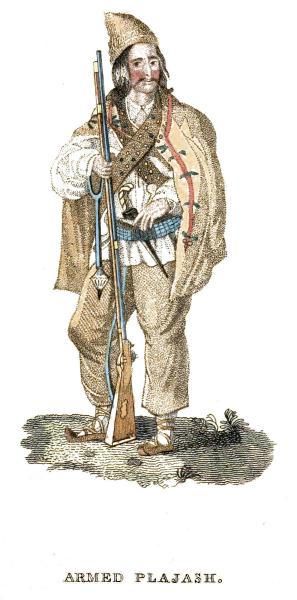
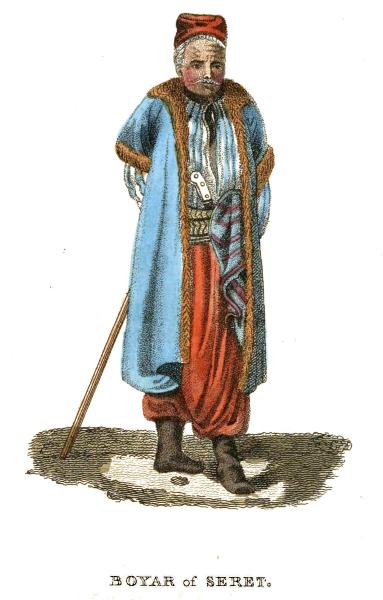
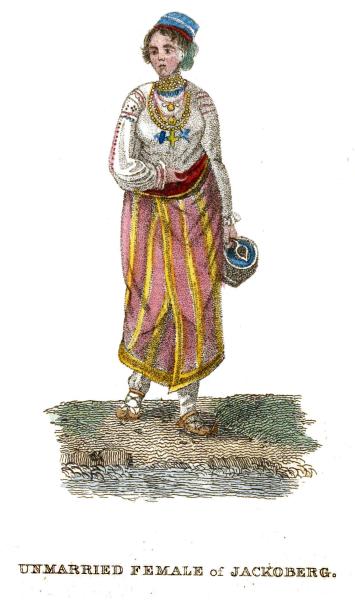
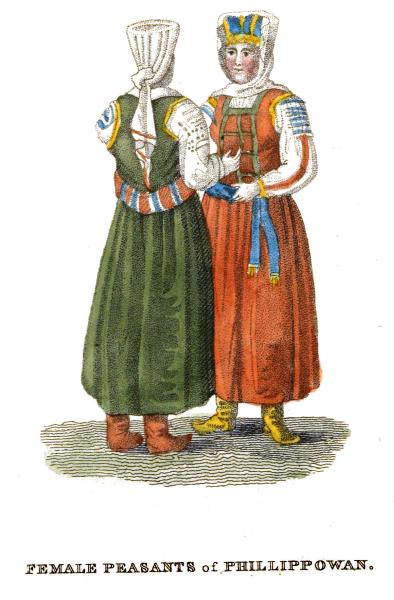
EXTENT—DIVISION—CONSTITUTION—VAST ESTATES OF THE
MAGNATS—STATE OF THE PEASANTRY—THEIR INDOLENCE—THIEVISH
DISPOSITION OF THE HERDSMEN—PUNISHMENTS—HUNGARIAN
PRISON—GENERAL APPEARANCE OF THE PEASANTS AND THEIR HABITATIONS
IN DIFFERENT COUNTIES—HORNED CATTLE—SHEEP—VILLAGE
HERDSMEN—RAVAGES OF WOLVES—GRANARIES—COSTUMES.
The kingdom of Hungary, the superficial area of which exceeds four
thousand German square miles, and which contains nearly nine millions
of inhabitants, is a highly interesting country both in a geographical
and a moral point of view. If the observer cannot help admiring the
abundance and extraordinary variety of its natural productions,
neither can he behold without astonishment the diversity of the races
composing its population, and the differences which prevail in their
manners, customs, and religion. The variety in costume is not less
striking, as we shall hereafter have occasion to show.
Civil Hungary, Croatia and Slavonia, are divided into four districts
comprehending fifty-two counties.
Hungary is an hereditary but limited monarchy, the crown of which has
been held since 1527 by the house of Austria. The king possesses many
important rights and prerogatives, but at the same time the rights and
privileges of the Hungarian nobility also are numerous and extensive.
The nobility alone are designated in the language of the state by the
appellation of the Hungarian people, and they are distinguished in a
peculiar manner from the nobles of all other European nations by the
circumstance, that the grants of their privileges have suffered least
from the changes of time, and that the characteristic features of
these rights, now in the nineteenth century, approach nearer than any
to those of the nobles in the days of the crusades.
This constitution bears a nearer resemblance to our own in its earlier
periods, as it regards the king, the magnats or grandees, and the
deputies in diet assembled, than that of any of the northern nations:
yet it differs widely from it in all that relates to the lower order
of the people, whose interests have been completely overlooked, and
who are still in nearly the same state of villanage that prevailed in
most parts of Europe during the feudal ages.
The country in general is parcelled out among the magnats, some of
whom possess estates of immense extent. In considering a Hungarian
property, says Dr. Bright, we must figure to ourselves a landed
proprietor possessing ten, twenty or forty estates, distributed in
different parts of the kingdom, reckoning his acres by hundreds of
thousands, and the peasants upon his estates by numbers almost as
great; we must remember that all this extent of land is cultivated,
not by farmers, but by his own stewards and officers, who have not
only to attend to the agricultural management of the land, but to
direct to a certain extent the administration of justice among the
people; we must farther bear in mind, that perhaps one-third of this
extensive territory consists of the deepest forests, affording a
retreat and shelter not only to beasts of prey, but to many lawless
and desperate characters, who often defy for a great length of time
the vigilance of the police—we shall then have some faint conception
of the situation and duties of a Hungarian magnat.
The same writer, in his interesting Travels in Hungary, describes
the singular manner in which land is possessed and distributed in this
country. No man can possess land who is not a noble of Hungary: but as
all the family of a nobleman are also noble, it is calculated that one
out of every twenty-one individuals in the nation is of this class.
The lands descend either entire to the eldest son, or are equally
divided among the sons, or in some cases among the children of both
sexes: so that many of the nobles become by these divisions extremely
poor, and are obliged to discharge all the duties of the meanest
peasant. If any of these nobles wish to sell an estate to a stranger,
however high in rank, even to a noble of the Austrian empire,
application must first be made to the surrounding proprietors to learn
whether they wish to purchase at the stipulated price. If they
decline, a stranger may purchase it for a period of thirty years, at
the end of which time any branch of the family which sold it, however
distantly related, may oblige the stranger to surrender his bargain.
This system is carried so far, that in many cases though the purchaser
be a Hungarian noble, the family of the former possessor can reclaim
it after thirty years, on payment of the original price, together with
expenses incurred in the buildings and improvements made during that
period. The litigation, ill-will and evils of every kind to which such
laws give rise are beyond calculation.
The peasants on these estates were formerly bound to perform
indefinite services, on account of supposed grants and privileges,
likewise little understood. The empress Maria Theresa put the whole
under certain regulations, which left less arbitrary power in the
hands of the lord. She fixed the quantity of land upon each estate
which was to remain irrevocably in the possession of the peasantry,
giving to each peasant his portion called a session, and defining
the services which he should in return perform for his lord. The only
points determined, however, were, the whole quantity of land assigned
to the peasants; and the proportion between the quantity of land and
the quantity of labour to be required for it. The individual peasants
are not fixed to the soil, but may always be dismissed when the
superior finds cause; nor is it of necessity that the son should
succeed the father, though usually the case. The peasant has no
absolute claim to a whole session; if the lord pleases he may give but
half or a third of a session, but in this case he cannot require more
than one-half or one-third of the labour. The quantity of land
allotted to a whole session is fixed for each county. In the county of
Neutra, for instance, it varies, according to the quality of the soil,
from twenty to thirty joch, each equal to nearly an English statute
acre and a half; and of these sixteen or twenty must be arable and the
rest meadow.
The services required of the head of the family for the whole session
are one hundred and four days’ labour during the year, if he work
without cattle, or fifty-two days if he bring two horses or oxen, or
four if necessary, with ploughs and carts. In this work he may either
employ himself, or if he prefer and can afford it, may send a servant.
Besides this he must give four fowls, a dozen eggs and a pound and a
half of butter; and every thirty peasants must give one calf yearly.
He must also pay a florin for his house; must cut and bring home a
klafter of wood; must spin in his family six pounds of wool or hemp
provided by the landlord; and among four peasants the proprietor
claims what is called a long journey, that is, they must transport
twenty centners, each one hundred pounds weight, the distance of two
days’ journey out and home; and besides all this, they must pay
one-tenth of all their products to the church, and one-ninth to the
lord.
Such are the services owed by the peasant, and happy would he be were
he subject to no other claims. Unfortunately, however, the peasant of
Hungary has scarcely any political rights, and is considered by the
government much more than by the landlord, in the light of a slave. By
an unlimited extension of the aristocratical privilege, the noble is
free from every burden, and the whole is accumulated on the peasant.
The noble pays no tribute, and goes freely through the country,
subject to neither tolls nor duties; but the peasant is liable to
tribute, and though there may be some nominal restrictions to the
services due from him to government, it may safely be asserted, that
there is no limit in point of fact to the services which he is
compelled to perform. Whatever public work is to be executed, not only
when a road is to be repaired, but when new roads are to be made, or
bridges built, the county-meeting gives the order and the peasant
dares not refuse to execute it. All soldiers passing through the
country are quartered exclusively upon the peasantry. They must
provide them without recompense with bread, and furnish their horses
with corn, and whenever required by a particular order, they must
provide the person bringing it with horses and means of conveyance.
Such an order is always employed by the officers of government, and
whoever can in any way plead public business as the cause of his
journey, takes care to provide himself with it. In all levies of
soldiers, the whole falls upon the peasant, and the choice is left to
the arbitrary discretion of the lord and his servants.
This system is not calculated to satisfy either the landlord or the
peasant. The benefit derived by the latter is by no means
proportionate to the sacrifice which the former is obliged to make.
The quantity of land appropriated to the peasant is enormous: still he
labours unwillingly, and of course ineffectually, under the idea that
he works from compulsion and not for pay. In order to do all the
farming work upon a given estate by the peasants, nearly one-half of
the land capable of cultivation is portioned out among the labourers;
nay there are estates every acre of which is occupied by the peasants,
the landlord receiving nothing but the tenths and other casual
services, unless he has occasion to send them to labour on some other
of his estates. On other properties again there are no peasants—and
this appears to be the state of things most desirable to the
proprietor—so much so, that there are instances even where peasants
have been on an estate, in which the lord has almost neglected to
require their services, finding his labour better performed by hired
servants.
If, however, the landlord have little reason to be satisfied, still
less can the peasant be supposed to rejoice in his situation. On a
failure of his crops, the latter, who has nothing but his field,
starves or becomes a burden to his lord. Though the lord can legally
claim a certain quantity only of labour, yet there are numberless
pretexts on which he can demand more and be supported in those
demands. The administration of justice is in a great degree vested in
his own hands. There are many little faults for which a peasant
becomes liable to be punished with blows or fines, but which he is
often permitted to commute for labour. In fact, these things happen so
frequently, and other extorted days of labour, which the peasant fears
to refuse, occur so often, that, instead of estimating his labour at
one hundred and four days, we should come much nearer to the truth
were we to double that amount. Should, however, the lord or his agents
have too strong a sense of justice to transgress the strictness of the
law, still they can at any time call upon the peasants to serve for
pay, and that not at the usual wages of a servant, but about one-third
as much. Add to all this the services due to the government; the cases
in which a peasant is obliged to be six weeks together from his home,
with his horses and cart, carrying imperial stores to the frontier,
and it will be evident how dearly he pays for the land which he holds
as the only return for his labour.
After this explanation we cannot be surprised to learn that a marked
feature in the character of the Hungarian peasant is indolence. This
observation applies particularly to those of the counties around the
Platten Lake. The equality and the savage life to which the people are
here accustomed when pasturing their cattle in the forests are
probably the chief causes of the frequent robberies that occur. Though
robbers by profession, subsisting entirely on the fruits of their
depredations abroad, still far the greater number are cattle-keepers
under the various names of Tsikos, Gulyas, Juhasz, or Kanasz.
The latter are particularly notorious, and scarcely one person worthy
of trust is to be found among them. The herdsmen are usually mere
thieves, stealing cattle when they can, and plundering travellers when
good opportunities present themselves. Those on the contrary who have
no other occupation than to seek booty, and live constantly in the
forest, steal cattle only when driven by necessity; the plunder of
the traveller, whom they frequently murder, being their principal
object. Jews and butchers are more particularly exposed to their
attacks: the officers of the crown and the nobles are safe from a
dread of the inquiry which in such cases would not fail to be
instituted. They generally hail a carriage with a demand of money,
styling themselves szegeny legeny, or poor fellows. The little
solitary public houses suffer much from them, for when they can obtain
nothing elsewhere they enter them and eat and drink without paying.
Such houses are in consequence extremely unsafe, and the more so
because the innkeepers are frequently connected with the robbers
either as receivers or accomplices. In order to put a stop to this
evil, pursuits are often instituted by the county, when some of the
offenders are generally taken, but the extent of the county and the
insufficient strength of the police prevent their total extermination.
In slight offences rather against good order than against law, the
hofrichfer, or steward of a magnat, may at all times punish a
peasant with stripes. For this purpose he is provided with a machine
like a low table, on which the culprit lies, with two iron cramps at
one end for confining the wrists, two at the other for securing the
ankles, and a large one in the middle to pass over the back. Stretched
out in this helpless situation, the culprit receives a certain number
of stripes on the bare back with a stick. A notorious robber taken in
the act may be put to death. When the case is not so clear, and
confession cannot be obtained from the accused by examination,
recourse is had to the discipline just described; and should this
expedient also fail, and there be strong presumption of guilt, the
prisoner is brought to trial before a court composed of servants of
the lord and a few respectable freemen. From the decision of this
court, which is completely under the influence of the magnat, appeals
indeed lie to higher courts, and capital punishment cannot be
inflicted without the sanction of those courts and also of the king.
Dr. Bright draws a striking but most revolting picture of a Hungarian
prison. The place chosen for the confinement of prisoners, says that
writer, is usually close adjoining to, or forms part of the dwelling
of the lord: and as they are generally employed in labour, the
traveller seldom approaches the house of a Hungarian noble who
possesses the jus gladii, without being shocked by the clanking of
chains and the exhibition of these objects of misery loaded with
irons. The prison itself is never concealed from the curiosity of
strangers; I should almost say that it is considered a boast, a kind
of badge of the power which the lord possesses. One of the best I saw
was at Keszthely. It forms an insignificant part of a large low
building immediately opposite to the entrance of the castle, in which
are the residences of several inferior officers of the estate. Under
the guidance of the keeper of the prison I entered by a door well
barred and bolted. Instantly seventeen figures all in the long
Hungarian cloak, rose from the ground on which they were sitting.
Besides themselves, the room, which was not above twelve feet square,
presented no one object—no table, bed or chair. It was ventilated and
lighted by several small grated windows high up in the sides of the
walls. The prisoners were most of them young men: some had been tried,
others had not; and some had been confined seven or eight years. Their
crimes were very different; but no difference was made in the mode of
treating them, excepting as to the number of lashes they were to
receive at stated times, or the number of years they were to be
imprisoned. Such was their residence in the day-time when they did not
go out to work. We next proceeded to the dungeon in which they are
confined during the night, the gaoler taking the precaution to
disguise unpleasant smells by carrying a fumigating pot before us. On
opening an inner door we entered a small room, in the corner of which
lay two women on beds of straw. In the middle of the floor was an iron
grate. This being opened by my guide, he descended first by means of a
ladder, with a lamp in his hand, by the light of which I perceived
that we were in a small antichamber or cell, from which a door opened
into the dungeon, the usual sleeping-place of all the male prisoners.
It was a small oblong vaulted cave, in which the only furniture was
two straw mattresses. A few ragged articles of dress lay near the
place where each prisoner was accustomed to rest upon the naked floor.
In one corner of the room was a large strong chain, and about a foot
and a half from the ground round the whole vault were rings let into
the wall. The prisoners at night having laid themselves upon the
ground, the chain is put through the irons which confine the ankles of
three of them and is passed into a ring in the wall: it is then
attached to three more, and is passed through a second ring, and
continued in this way till a complete circuit of the room is made. The
ends of the chain are fastened together by a padlock, by which the
whole is firmly secured. It was painful to reflect that in this state
some of these wretches had already passed their nights during seven
years.
The general appearance of the peasants and of their habitations in the
vicinity of Presburg, is thus described by the same intelligent
observer:—
No one peasant has proceeded in the arts of life and civilization a
step farther than his neighbour. When you have seen one you have seen
all. From the same little hat, covered with oil, falls the same matted
long black hair, negligently plaited or tied in knots; and over the
same dirty jacket and trowsers is wrapped on each a cloak of coarse
woollen cloth or sheep-skin still retaining its wool. Whether it be
winter or summer, week-day or sabbath, the Slavonian of this district
never lays aside his cloak or is seen but in heavy boots. Their
instruments of agriculture are throughout the same, and in all their
habitations is observed a perfect uniformity of design. A wide muddy
road separates two rows of cottages which constitute a village. From
among them there is no possibility of selecting the best or the worst:
they are absolutely uniform. In some villages the cottages present
their ends, in others their sides to the road: but there is seldom
this variety in the same village.
The interior of the cottage is in general divided into three small
rooms on the ground-floor, and a little space in the roof destined for
lumber. The roof is commonly covered with a very thick thatch: the
walls are whitewashed, and have two small windows toward the road.
The cottages are usually placed a few yards distant from each other.
The intervening space, defended by a rail and gate or a fence of
wicker-work towards the road, forms the farm-yard, which runs back
some way and contains a shed or out-house for cattle.
The cottages of the peasants of a village belonging to Count Hunyadi,
in the county of Neutra, are thus described:—
The door opens in the side of the house into the middle room or
kitchen, in which is an oven constructed of clay, and various
implements for household purposes which generally occupy this
apartment fully. On each side of the room is a door, communicating on
one hand with the family dormitory, in which are the two windows that
look into the road. This chamber is usually small but well arranged:
the beds in good order, piled upon each other, to be spread on the
floor at night, and the walls covered with a variety of pictures and
images of our Saviour, together with dishes, plates, and vessels of
coarse earthenware. The other door from the kitchen leads to the
store-room, the repository of the greater part of the peasant’s
riches, consisting of bags of grain of various kinds, both for
consumption and for seed, bladders of tallow, sausages and other
articles of provision, in quantities which it would astonish us to
find in an English cottage. We must, however, bear in mind, that the
harvest of the Hungarian peasant anticipates the income of the whole
year, and that, from the circumstances in which he is placed, he
should be compared with our farmer rather than with our labourer. The
yards or folds between the houses are generally much neglected, and
dirty receptacles of a thousand uncleanly objects. Light carts and
ploughs with which the owner performs his stated labour; his meagre
cattle; a loose rudely-formed heap of hay, and half a dozen ragged
children, stand there in mixed confusion, over which three or four
noble dogs, of a breed somewhat resembling the Newfoundland, keep
faithful watch.
The habitations of the peasantry in the villages in the vicinity of
Keszthely, in the county of Szalad, are built of clay, not regularly
thatched, but covered with straw held down by poles laid upon it. The
inclosures round the houses and yards are formed of reeds, and the
village bell is raised upon a pole in a case like a pigeon-house.
In the district between the Drave and the Muhr, called the Murakös,
the houses are larger and higher, having a complete upper floor. The
roof generally projects four or five feet beyond the wall in the
front, where it is supported by wooden pillars which rest upon large
beams of timber, and thus a gallery is formed the whole length of the
house. This passage, slightly raised above the ground, is usually much
wider about the centre of the front, where the building recedes: and
here the females of the family often sit at a table working. The walls
of this part of the cottage are covered on the outside with shelves,
upon which the dishes and household utensils are arranged. Such is the
habitual honesty of the people of this district, that these articles
remain there in perfect security, without the protection of the
numerous watch-dogs which guard the most insignificant cottage in
other parts of Hungary. In some cases the passage is much larger, and
the house being built in the form of an L, it is continued along the
end and the two internal fronts. Between the pillars of this rude
piazza a shelf is constructed and a cupboard fixed containing a vessel
of water for domestic use.
All the fences toward the road and those of the yards are of strong
wicker-work thatched on the top with straw and reeds. In the yards
stand several small buildings of the same materials, intended as
houses for poultry, or as drying places for maize, together with large
wooden hutches for pigs and an oven of clay and stone covered by a
penthouse. The cottage kitchen is unusually convenient, and most of
the cookery is carried on by means of the ordinary hearth-fire of
Germany, to which is added an oven as part of the kitchen furniture.
Many of the roads in this part of the country are bordered on each
side with mulberry trees, which have been planted as common property,
with a view to the breeding of silk-worms. Considerable pains have
here been taken to encourage that branch of industry, which
nevertheless is not very flourishing.
The native Hungarian breed of horned cattle bears much resemblance to
the wild white species which was formerly found in Britain. They are
large, vigorous, and active, of a dirty white colour, with horns of
prodigious length, exceeding in this respect even the long-horned
breed of Lancashire. The oxen are admirably adapted for the plough,
uniting to all the qualities of the ordinary ox, a very superior
degree of activity.
Buffaloes are bred in Hungary for the same purposes as other horned
cattle. The milk which they give is richer than other milk and the
quantity considerable. As beasts of labour they are excessively
strong, but slow and unmanageable. The number kept in Hungary and
Transylvania is estimated at 70,000.
Bredetzky, a Hungarian writer, observes that Buffaloes are extremely
valuable for their skins, which are employed at Rhonasech in forming
the bags in which salt is raised from the mines. He also speaks of
their ferocity and the difficulty of killing them in terms which would
almost lead us to suppose them to be in a state of nature in that part
of the country. The operation of shooting the Buffalo, says he, is
curious but extremely dangerous, for in no other way can they be
secured on account of their wildness. It is not possible to kill them
with an axe like other cattle. They are first driven with great care
from the inclosure in which they have been kept, and a shot is
levelled by a person concealed exactly at the forehead. If he misses
his aim, the animal with the most tremendous fury darts away so
swiftly that dogs can scarcely overtake him, and any one who stands in
his way is inevitably killed.
The original breed of Hungarian sheep is the real Ovis Strepsiceros
of naturalists, covered with very coarse wool and bearing upright
spiral horns. Improvement on this stock by crosses with other
varieties, and the Spanish in particular, is become so general, that a
flock of the native race is seldom to be met with, excepting on the
estates of the clergy. The wool is now an important object of
commerce. It was calculated that in 1802, above twelve million and a
half pounds (each pound being equal to one pound and a quarter of our
weight) was exported from Hungary. A large portion goes to Austria,
and is manufactured there or sent to more distant markets; and much of
the wool sold in England as Saxon wool, is actually the produce of
Hungary, exported in spite of the heavy duty which it pays on leaving
the Austrian dominions.
Some idea of the extraordinary care bestowed by the great landed
proprietors on the improvement of their flocks may be formed from the
following brief sketch of the system pursued by Count Hunyadi, who
possesses about seventeen thousand sheep.
At each of the head-quarters for these animals, there are well-built
sheds having brick pillars at certain distances, which leave about
half the side open, and thus admit a free circulation of air during
summer, and afford easy means of excluding the cold in winter. The
height of the sheds is about seven feet to the springing of the roof,
and they are divided by little racks into such spaces as are necessary
for the division among the flocks. Racks are also arranged round the
whole, so that all the sheep can conveniently feed at them. The floor
is covered with straw, and the upper layer being continually renewed,
a dry, warm bedding is obtained. In these houses the sheep are kept
almost incessantly during the winter, that is, from November till
April, and are then fed three times a day upon dry food. They are
watered twice a day from a well close at hand. Even in summer the
sheep are driven under cover every evening, and they are conducted
home in the day-time, when it rains or the heat is oppressive. They
always lamb in the house; the ewe being placed on this occasion in a
little pen by herself, where she remains unmolested. These pens, about
three feet long and two wide, are made of hurdles. Owing to this care
they never lose a lamb. The number of persons employed is about one
man to every hundred sheep, and each of them considers his flock as
his family and pride.
The result of all this attention has been a success which could
scarcely have been anticipated. A conception can hardly be formed of
flocks more uniformly excellent. It is of course the wool and not the
carcase, which is the great object in a country so poor and so thinly
peopled as Hungary. The sheep are strong and healthy, and for the
Spanish cross large; their fleeces perfect, and even the tail and legs
covered with good wool. Three pounds, (about three pounds and three
quarters of our weight) is the average produce of each sheep: but
some, and particularly the rams, yield six or seven. The whole of the
wool, without any separation, and only washed on the back of the
sheep, is sold at the rate of from three shillings to four shillings
and sixpence sterling for each Hungarian pound; and the consequence is
that from flocks, which, if covered with the ordinary wool of the
country, might be expected to yield fifteen or twenty thousand gulden,
not less than fifty thousand is now annually produced.
Count Hunyadi has also taken great pains to improve the breed of his
horses at his estate at Urmeny, in the county of Neutra; and with a
view to ascertain the progress which he makes, and at the same time
from a desire of exciting the country to exertion, he has instituted
races on the English model. Solicitous to infuse into his own
peasantry a spirit of improvement in this particular, he appoints a
day on which their horses alone run, and gives rewards to the
successful competitors. His stables are a fine range of buildings,
with wooden floors, and contain from thirty to forty horses, chiefly
crosses of the Arabian and Transylvanian breeds. His breeding stud is
kept at a farm a few miles distant. Other proprietors of estates are
beginning to understand the object and to appreciate the advantages of
the plan of this spirited nobleman.
It is the custom throughout all Hungary, for the inhabitants of each
village to commit their cattle to the care of a herdsman who, at a
certain hour in the morning, drives them to the common pasture and
brings them home at night. He carries a wooden trumpet, nearly four
feet in length, exactly resembling the instrument usually put by
artists into the hand of Fame. With this trumpet, the sound of which
is harsh, he gives notice of his approach, and the peasants turn their
cattle out of their yards that they may join his drove. In the evening
when he conducts his motley crew of horses, cows, sheep, and goats
back to the village, each individual finds, as it were instinctively,
the cottage of his master, and quietly retires to his accustomed
stall. The peasants pay the herdsman a small sum for each animal, but
part of this remuneration is always made in grain or bread.
The ravages of wolves among the cattle, especially in the
neighbourhood of woody mountains, are extremely serious. In all the
frontiers these animals are much dreaded. In the hard winter of 1803,
no fewer than 1533 head of cattle were devoured by them in the single
district of the Wallacho-Illyrian regiment, which gave rise to some
attempts to destroy them by poison, as the Turks are known to do by
means of the aconitum napellus. The nux vomica was here employed,
and not without success.
When much distressed for food, the wolves will sometimes attack the
cottages of the peasants. An instance of this kind is related by Dr.
Bright to have occurred not long before his visit at Leutschau. A
woman who had two children, the one about twenty years of age, the
other much younger, had just quitted her cottage in the morning, when
a wolf rushed upon her and tore her face dreadfully: then leaving the
first object of its rage, the animal fixed upon the child, and in an
instant lacerated its head and deprived it of both eyes. The elder son
alarmed, flew to the spot, and seizing the wolf by the throat, held it
at bay for some moments; but being unable to maintain the unequal
conflict, became himself the object of attack: the hungry beast fixed
his fangs deep in his neck. The cries of the unhappy victims brought
some assistance to the spot, and the wolf made his escape. As soon,
however, as the necessary aid had been afforded to the sufferers, an
active pursuit was instituted and the animal was discovered in a
thicket. A young man levelled his piece: it missed fire, and the wolf
was in the very act of springing on its pursuer, when it was brought
to the ground by a well aimed blow of a cudgel.
The mode of storing wheat generally adopted in this country is very
objectionable. After being beaten out, often by the feet of horses and
oxen, it is deposited in holes in the ground, where it is kept during
the winter. There it acquires a strong mouldy smell, which, indeed,
goes off in some degree by exposure to the air. These holes are dug of
a circular form and about three feet deep; and an excavation is made
of such dimensions that a man can sit in it to stow away the grain and
assist in bringing it to the surface when required. This done, a fire
is kindled in it to harden the sides, which are afterwards lined with
straw. When the grain is thus stowed, straw is placed upon the top,
and earth thrown in to fill up the entrance hole, which forms the
neck, as it were, of the cave, and a little heap of earth remains
pointing out the spot; or a piece of wood is stuck in it as a mark.
There is scarcely a village near which a number of such hillocks are
not to be seen.
We shall now present the reader with an account of the costumes
prevailing in different parts of the country.
The figure in the annexed engraving represents the costume of the son
of a wealthy Hungarian peasant of the county of Weszprim in his Sunday
apparel. He has just filled his pipe, but is supposed to have been too
deeply engaged in conversation to light it. The nosegay in his hat was
probably snatched from the bosom of some pretty girl in coming from
church, and this is the usual prelude to a more intimate acquaintance.
The leathern tunic of a light colour hanging loosely from his
shoulders, adorned with curious patterns and trimmed with fur, is the
ordinary costume of a wealthy rustic.
The costume of the noblemen of Hungary, which partakes largely of that
here exhibited, is described as being singularly picturesque. It
consists of a large broad-brimmed hat, slouched behind, an
ornamental jacket and light pantaloons of bright blue, with a number
of silver buttons, Hessian boots, a girdle round the waist, from which
hangs a tobacco-pouch, and a green mantle descending from the
shoulders.
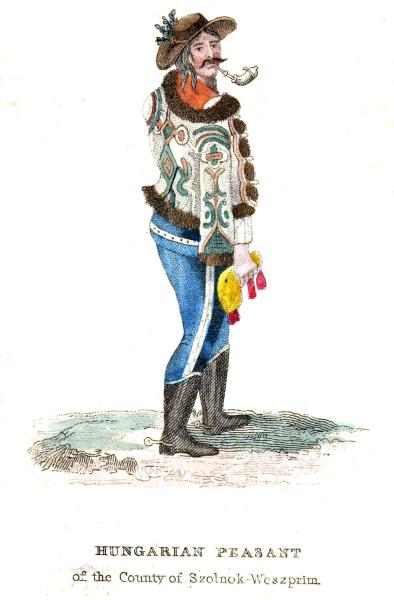
HUNGARIAN PEASANT
of the County of Szolnok-Weszprim.
To the dress of the unmarried daughter of an opulent peasant of the
county of Weszprim, when decked out in her holiday finery, the
flowered corset and numerous necklaces essentially belong. Her red
shoes, which have frequently white heels, are rendered still more
conspicuous by the work in front, and the blue stockings are adorned
with red and white clocks. Her head is uncovered, and merely encircled
with a bandeau of black velvet.
The matrons are less studious of ornament: their corset, shoes, and
stockings, are generally quite plain. When they go abroad, they cover
the head with a white cloth, which hangs down over the back and
shoulders, and wear over their other garments a blue cloth jacket with
long sleeves, open in front and bordered with fur.
The women of the county of Neutra dress nearly in the same manner:
wearing short pelisses of blue cloth lined and bordered with fur or
wool, and white handkerchiefs closely bound about their heads.
In the Hungarian language, the term Czikos or Tsikos, signifies a
keeper or tender of horses.
Mezöhegyes is an imperial domain in the county of Csanader, where,
during the reign of the emperor Joseph II. in 1785, a stud of horses
was established. This institution is unrivalled in Europe both for its
magnitude and value. The establishment, when complete, consists of
nearly 17,000 horses and upwards of 700 men, of whom 238 are Csikoses.
They are a handsome, not very tall, but robust and muscular race of
men, inured to all sorts of privations, and enduring them with the
greatest ease, owing to the small number of their wants. These are
almost confined to bread, bacon and tobacco, which is with them a
necessary of life. If to these the Csikos can add a pudding of
maize-flour and a bit of fresh pork, he has nothing more than a pint
of wine to wish for.
The dress of these men is as simple as their fare. A wide shirt and
loose trowsers of coarse linen, a high felt cap, and convenient boots
of horse hide, a leathern girdle, a curiously worked tobacco-pouch of
sheep-leather, with its accompaniments, are all that they need,
besides a sheep-skin with the wool on, which serves both for garment,
tent and bed. The linen garments become extremely dirty from long
wearing, for when once on they are never taken off till they drop to
pieces and are replaced by new ones. The reader will not be surprized
at this, when he knows that these men are obliged to pass
three-fourths of the year on the moors, without any other shelter than
the firmament of heaven, and therefore cannot possibly be provided
with a wardrobe.
Their dexterity and strength, and the courage which they display in
their vocation are truly astonishing. In order to be able duly to
appreciate these qualities, it is necessary to have witnessed the
scene which takes place, when the owner of a herd of wild horses
orders some of them to be caught. The animals are first driven very
adroitly into a large inclosure. Here the owner or purchaser points
out which of them he wishes to have caught, on which some of the
Csikoses go with long ropes having nooses at the end, among the
horses, and endeavour to fling the nooses over their heads. In this
attempt the Csikos generally succeeds at the first trial. He then
throws the animal upon the ground, where he is held down by his
comrades, and in this state a bridle is quickly put on him. The
conqueror places it between his legs; the rope is loosed, the horse
springs like lightning from the ground, with the Csikos on his bare
back, and holding by the mane. The furious beast darts off at full
speed: the undaunted rider lets him run and even applies his whip from
time to time, till his steed, weary with the length of his course,
slackens his pace. The Csikos then begins to exert himself and to make
use of the bridle. Man and horse return home exhausted with hunger,
thirst and fatigue; the latter is conducted for the first time into a
stable, where the operations of breaking commence while the former
relates to his comrades over the smoking board the adventures of his
hazardous journey, on the steed winged by rage and terror.
Besides the Csikoses there are other classes of herdsmen denominated
from their particular occupation Gulyas, cowherds; Juhasz, shepherds;
and Kanasz, swineherds.
The mode of life of these herdsmen, who are brought up from childhood
to this occupation, and during the summer seldom approach the
habitations of men, appear to have debased them so much, that even in
this country, uncivilized as it is, they are considered as a tribe of
savages.
The dress of these cattle-keepers in the county of Schümegh,
consisting of a shirt and wide trowsers of coarse linen as already
described, is rendered stiff and of a dark dirty colour by the grease
with which it is purposely imbued. Their object in thus besmearing the
clothes is to render them more durable, and to prevent vermin from
harbouring in them, as well as to defend the person from the bites of
gnats: but whatever the object may be, they are seldom changed before
they are ready to fall in pieces. The feet are enveloped in wool, over
which they fasten on the sole a piece of leather by straps. Besides a
round hat, frequently ornamented with a ribbon, and a large mantle of
thick coarse woollen cloth, for here they seldom use sheep-skin
cloaks, they are provided with a leathern pocket, hanging by a broad
belt over the shoulder, and carry, for offence and defence, a small
axe with a long handle. The broad belt by which the pocket hangs is
generally adorned with two or three rows of shining metal buttons, for
which these herdsmen are so eager, that they have been often known to
fall upon travellers for the sake of them alone. The axe serves them
in place of a stick, and in time of need becomes a formidable weapon
against man or beast. They understand the management of this
instrument so well, that at the distance of twenty or thirty paces
they seldom miss a mark set up against the trunk of a tree. Their
skill in this exercise is derived from constant practice while their
flocks are feeding.—These men are still more careful in besmearing
the hair of their head with grease than even their dress, and they
then tie it up in knots hanging on each side below the ear.
The county of Marmaros forms a strong contrast with the rest of
Hungary. In regard to situation it might justly be denominated the
eastern Highlands, the principal valley alone being conveniently
habitable. The rest of the country consists of bare mountains and
forests: hence the population bears no proportion to the extent of
this country. It is chiefly remarkable for its rich salt-works, which
furnish 30,000 tons of salt annually, and its numerous mineral
springs.
The woodcutter of Bocsko in the county of Marmaros, whose axe is his
only companion, frequently abides for weeks together in the immense
forests, to earn wherewithal to satisfy his scanty wants, partly by
cutting wood for fuel, which he conveys at a very moderate rate to
Szigeth, the capital of the county, and partly by furnishing timber
for salt-rafts.
His apparel is of coarse hempen stuff; in winter he dresses rather
warmer, but even then his bosom is uncovered and icicles may be seen
hanging from it, without prejudice to the health of this hardy
Highlander. His shoes consist of a piece of tanned ox-hide, which is
fastened on the foot with a leathern thong, and just serves to keep it
from the ground.
The unmarried female appears in all her finery. Her head is encircled
with a metal hoop adorned with beads and flowers. Round her neck she
wears several necklaces of coral, and a black and red silk
handkerchief covers her bosom. Over this she sometimes throws another
of larger dimensions, which, from the variety of its colours and
forms, resembles a piece of patchwork. The red boots are worn only on
extraordinary occasions, and the owners generally carry them in their
hands to church, to protect them from the wet which would stain them
indelibly. It is well known that the same practice prevails among the
females in the Highlands of Scotland.
The married woman is more simply clad: yet the embroidery on her loose
jacket without sleeves, trimmed with fur, and on the short sleeves of
her chemise, drawn tight round the arm below the elbow, show that the
cares of a family have not rendered the matron wholly negligent of
personal decoration. Her head-dress consists of a handkerchief tied
under her chin, and she goes according to the custom of the country on
ordinary occasions, without shoes or stockings.
The women of this part of Hungary are remarkable for their industrious
disposition: they are never idle, but even in their walks carry with
them a portable distaff, and ply the spindle without intermission.