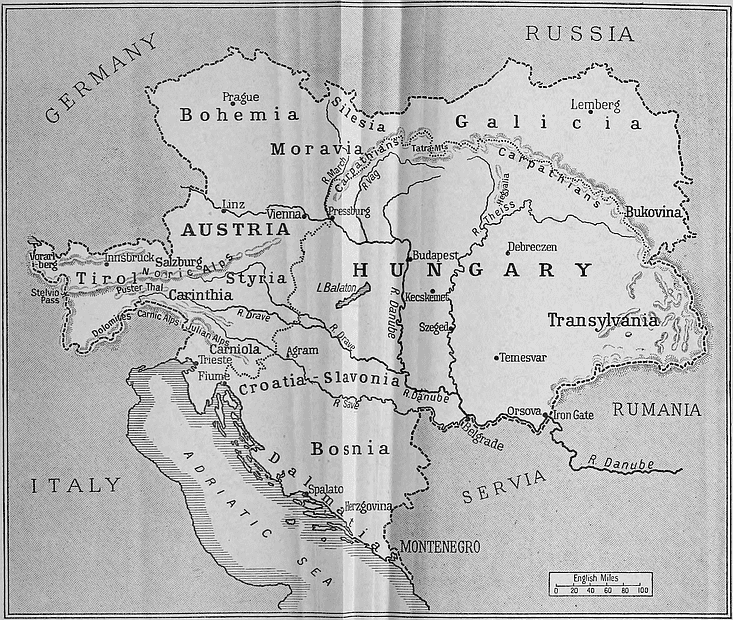
Larger versions of most illustrations may be seen by right-clicking them
and selecting an option to view them separately, or by double-tapping and/or
stretching them. An even larger, higher-resolution version of the
map at the end of the book may be seen by clicking
"Larger".
Below the musical score on page 38 are links
to let you listen to a digitized (mp3) version of the music or to download
the editable MusicXML that was used to create the mp3 file. These links
work in Browsers, but may not work with ereaders using .epub or .mobi files.
AUSTRIA-HUNGARY
In the same series
ENGLAND
FRANCE
ITALY
SWITZERLAND
No one can rightly enjoy a visit to a country unless
he knows something of its history and its heroes;
otherwise much that is seen remains meaningless.
It is a common saying among oculists that we see
with the brain and not with the eye, and the saying
is fulfilled when we pass by, as without meaning,
this or that magnificent statue embodying in concrete
marble or bronze an epoch of vital action in
the history of a nation.
But besides what we miss from want of that
observation whose roots are embedded in knowledge,
there are other things duly noted, and but
half comprehended, with a vagueness that is irritating.
Especially is this the case in a country
of such an amalgamate nature as Austria-Hungary,
where at every turn something unexpected challenges
query. How comes it, for instance, that
having left behind a Parliament House in Vienna
we find another in Budapest though both own
allegiance to the same sovereign? Why should
Hungarians be so much exasperated if their country
is spoken of as part of an empire when they acknowledge
an Emperor as their ruler?
To gain some grip of these matters a short
historical introduction is undoubtedly necessary.
I do not think, however, that history should always
begin at the beginning, though many people have
a passion for delving into the past and groping
after the roots of a subject, which often prove,
when unearthed, to be exceedingly dry. The same
tendency may be observed in writers of biography,
who are rarely content to begin with the man or
woman whose life they are undertaking, or even
with their parents, but frequently go back through
many centuries, dwelling at dreary length upon
tedious details which occupy half the book before
the pith and core of the matter is reached.
Hence in this very cursory sketch of the Dual
Monarchy only so much as is essential to give
colour and life to the whole book in all its aspects
shall be dealt with.
At the present time Austria and Hungary are
governed by Francis Joseph, Emperor of Austria
and King of Hungary. The two countries are
united for the purposes of Defence, Foreign Affairs,
and Finance, including the Post Office, but have
separate Houses of Parliament, an Upper and a
Lower, in each capital, namely Vienna and Budapest.
The respective Houses of Parliament are
for common purposes represented by two Delegations,
each composed of sixty members, and convened
by the Emperor once a year alternately at
Vienna and Budapest. These members, of which
twenty are chosen from each Upper House and
forty from each Lower one, are only appointed for
one year.
As a composite State, Austria-Hungary plays a
forceful part in the concert of the great European
nations and wields authority which neither half
could achieve alone. The very first necessity of
power among modern nations is preparedness for
war, and in spite of the curiously differing races
and nationalities represented in the Austro-Hungarian
army with its two and a half millions of
soldiers, the army owns solidarity and force enough
to make itself respected.
Hungary is the inner part of this composite
country, the core, so to speak, and she lies in the
arms of Austria somewhat after the fashion that
the “old” moon may be seen lying in the arms of
the “new” one; for the provinces included in the
Empire ring her round on the north and west in
what is more or less a semicircle.
In some particulars we may draw a parallel
between the Dual Monarchy and the United
Kingdom of Great Britain, for in both cases the
union was effected by the fact of the countries
concerned having the same reigning house. The
differences, however, are manifold. It was by
inheritance that the Scottish Stuarts came to the
English throne on the dying out of the elder
branches; it was by election the Austrian Hapsburgs
were chosen for the Hungarian monarchy. Again
there has been between Austria and Hungary no Act
of Union, though the Pragmatic Sanction of 1723
formed a more “personal” union than before. It is
the tie of the Royal House alone which unites them,
and it is expediency only which dictates the amalgamation
of the military power and finance in the
two countries. Even here there are sore jealousies.
It is obviously necessary that the same words of
command should be used for the whole army, or
disaster would result on the field of battle. These
words are given in German, a foreign language to
the rawly-joined Hungarian recruit, and Hungarian
national pride is sorely wounded thereby. The
dilemma is a difficult one, and this question remains
ever an open wound. The Hungarians have besought
the King that their own language might
supersede German, but though he has proved
kindly to his Hungarian subjects in many other
ways, he remains adamant on this.
The greatest difference, however, between the
Dual Monarchy and the United Kingdom is the
difference brought into high relief by the above point,
namely the racial and linguistic diversity between
Austria and Hungary. The inhabitants of the two
countries are not men of one blood and one tongue
as the English and Scots are, but are separated by
lines of deep cleavage. And this main cleavage is
repeated in numerous smaller fractures, so that the
kingdom is split and cracked in many directions.
Fiercely as the Hungarians demand full play for
their own nationality, yet they would stamp it out
in the lesser races within their borders, who just as
eagerly demand their own rights. Never was any
country so split up and divided, and the difficulty
is increased by the fact that the political boundaries
are not coterminous with the national ones, but in
many cases the frontiers run through the middle of
the same race, so that half of it lies within and
half without the territory owning Francis Joseph
as sovereign! Insurrections outside the borders
naturally set aflame the sympathies of those of
similar blood within, and disturbances are chronic.
It is natural enough therefore that, even setting
aside her own desire to snatch an outlet to the sea
as the result of the resettling occasioned by the
Balkan War, Austria-Hungary should be aroused
and shaken to the core by the fighting between
races to whom many of her own subjects are blood-brothers.
The Hungarian, Dr. Julius de Vargha, thus sums
up the situation; he says:
However strong the specially Austrian traditions may
be, the Germans (in Austria-Hungary) stand under the
alluring influence of the splendour and power of the great
German Empire. The Italians long to join Italy; the
Slovenians, Croatians and Servians dream of the establishment
of a great southern Slav Empire; the Roumanians
are drawn toward the independent kingdom of Roumania.
The Hungarians alone (Magyars) are possessed of no
dreams of disintegration; their past, present and future
binds them to their present home; and they are consequently
the firmest pillar in the monarchy of the
Hapsburg.
He further says that the Magyar nation stands
between the Germanic and Slav worlds “like an
insulator between two opposing electric currents.”
This is of course a bit of special pleading, and we
fancy the Austrian would hotly disclaim any leaning
toward Germany; but it is interesting as
showing how the matter appears to the Hungarian
mind.
The Dual Monarchy is split into numerous small
territories, each with its own history and its own
importance. There are no less than eleven languages
in this polyglot country, and over all rules the one
German-speaking monarch. Part of the Tyrol, one
of the best known of the European playgrounds, lies
in Austria, but part is in Italy. Bosnia and Herzegovina,
the latest acquisitions, do not seem, geographically
speaking, to belong to Austria at all,
yet they are now included in her territory. Dalmatia,
with its Italian population, is another
outlying district, and it is vitally important because
of its sea-coast. The smaller districts of Carinthia,
Carniola, and Moravia lie northward, and above
them again is Bohemia, once a kingdom by itself,
with a stirring history. North of Hungary is the
huge and little known Galicia, not to be confounded
with Galicia in the north-west corner of Spain,
though the name is spelt precisely in the same way.
To the east of Hungary is Transylvania, and south
of it Slavonia and Croatia. Still we have only
named the best-known divisions.
The whole comprises an immense area; a line
drawn round it runs to over 5000 miles and encloses
a territory larger than that of any other European
country except Russia.
One quarter of the population is German, another
quarter Magyar (or Hungarian) and Roumanian,
whilst the remaining half is made up of Italians
together with Slavs, namely Poles, Croatians,
Czechs, Slovaks.
The Magyars, a wild and interesting gipsy race,
live in the centre of Hungary, more or less, while
the Slavs, of the same blood as the Servians, are
ringed round to the north and south, and outside
them again on the German side come the Germans.
How did such diverse elements come to be
included in one empire?
As might be supposed the centre of Europe took
long to settle down. In the case of a country so
happily situated as Great Britain the boundaries
are natural ones. As for Spain (including Portugal)
any child could rule off a line across the Pyrenees
and say that the territory beyond would make a
compact kingdom. France again is favoured by
nature, though on one side she lies open. But when
you come to the middle part of Europe there is
nothing to indicate where one country should end
and another begin, and the friction over boundaries
never dies down; as a fact, it seems pure chance
that the matter for the moment remains as it is.
It might just as well have been the Austrian Empire
which comprised the whole of the middle of Europe
as the German one, had not the “luck” of the
Austrian Emperor been adverse when the moment
was ripe. Indeed, it is but a short time since the
map gained its present outlines, and who can say
it will remain stable?
The Holy Roman Empire included the present
Austria-Hungary, with all that is now Germany.
It was only about the beginning of our era that the
name Austria arose, meaning the Ost-land or East-land;
before that time the country was a dependency
of Bavaria. About the same date Hungary
emerged into a recognised kingdom under St.
Stephen (997–1038), who was to that nation what
King Alfred was to England. He endowed the
church with great liberality, and was cultured far
beyond the measure of his contemporaries. He
advanced civilisation and trade, and was one of
those enlightened souls which are now and then
born out of due time to give light and leading to
their fellows. The 20th of August is consecrated
to him, and on that day a great procession is formed
to carry through the capital his right hand embalmed
and enclosed in a golden casket. To this
day the Kings of Hungary are crowned with the
crown presented by the Pope to the first King of
Hungary. This forms the upper part of the present
diadem, which stands on a new base. Once at
least in its history this glorious and ancient crown
was lost in the mud! When Otto the Bavarian
came to be King of Hungary in 1301 he brought
with him the sacred crown, which had before been
taken away by the Germans, his allies. But the
crown, in the confusion of the entry, was lost, and
was only found at length in the deep mud of the
hill tracks through which the party had passed.
In 1301 Stephen’s dynasty, the House of Arpad,
became extinct, after giving to the nation many
good kings, besides the two canonised, St. Stephen
and St. Ladislas. Hungary had later as well good
kings of other blood, including Louis the Great
(1342–82), King of Poland also, when it was for
a while the most powerful nation in central
Europe.1
1 The national poet Bajza says that at this epoch “the shores of three
seas formed the frontiers of the kingdom.”
The Turks were always a thorn in the side of
their northern neighbours, and their endless incursions
and alarms were shared almost equally by
Austria and Hungary, and in the end were the
means of uniting the two countries. In his
warfare with the Turks the great general, Janos
Hunyadi, proved amazingly valiant and gained
victories against desperate odds. Unluckily in one
such combat the reigning King, Ladislas, was slain,
and his head, raised aloft by his enemies, inspired
panic among his own people and ensured their
defeat. Nothing daunted, Hunyadi pursued his
successes in the reign of the next King, and in 1456
scattered a Turkish host under the walls of Belgrade.
It is said that 40,000 of his men were killed, and
just in the hour of victory the great commander
himself died. Besides being a notable general he
was a wise statesman and a strong unselfish man.
His son, Matthias Corvinus Hunyadi (1458–1490),
who was only fifteen, was afterwards elected
King, and his name is one of the most remarkable
in the whole roll of the Hungarians. From his
youth up he had been accustomed to take care of
himself in the midst of danger, and he developed
into a resolute and strong soldier; what was perhaps
more remarkable was that he was a patron of the
arts and learning. His library was his chief pride,
and in an age when reading was scorned he spent
hours daily in this favourite resort. Here is a
description of it taken from Hungary by Arminius
Vambery (The Story of the Nations).
The library was in the castle of Buda, and the place
assigned to it comprised two large halls, provided with
windows of artistically stained glass opening into each
other. The entrance consisted of a semi-circular hall
commanding a magnificent view of the Danube. Both
halls were provided with rich furniture. One of them
contained the king’s couch, covered with tapestry embroidered
with pearls, upon which he spent his leisure
hours reading. Tripod-shaped chairs, covered with carpet,
were placed about, recalling the Delphian Apollo. Richly
carved shelves ran along the walls and were curtained with
purple velvet tapestry, interwoven with gold. It would
be difficult to describe properly the magnificence of the
books themselves. They were all written on white vellum
and bound in coloured skins, ornamented with rose diamonds
and precious stones, and with the king’s portrait or his
arms. The pages are illuminated with miniature paintings
and ornaments, vying with each other in excellence, and
the work of some of the most famous illuminators of the
age.
The palace of Matthias was enriched by the work
of the best sculptors of the time, and his library
was continually increased by the labour of copyists,
whom he employed to transcribe manuscripts in
Italy. It was the Golden Age in Hungary, and the
chivalrous and strong monarch attracted to himself
poets, painters, and literary men from all the
civilised countries of Europe. Among other things
he founded an academy of letters. These indications
of a scholarly mind would have been of no
avail in that rude age unless there had been strong
physical prowess behind them; a weakling, whatever
his intellectual calibre, would have been scorned.
King Matthias, however, was one of those unusual
men who combine mental and physical qualities
of the highest order. He was as much a soldier as
a scholar, and he asked no luxury in the camp or
on the battlefield, content to share in all the hardships
imposed upon his men. His courage was proverbial,
and his heedlessness of danger so great that
he was supposed to bear a charmed life, though not
invulnerable, as numerous scars testified.
In person Matthias was tall and broad, with a
massive head and keen eyes. He gave the most
scrupulous and impartial justice to all his people
alike, so that he was surnamed “The Just,” and
when he died there was a current saying, “King
Matthias is dead and justice is no more.” His
death was due to apoplexy, and he left no legitimate
son to succeed him.
By this time the House of Hapsburg had come
to the fore. They had originally held possessions
in Switzerland and later gained position and power
as Dukes of Austria, Styria, Carniola, etc. When
the German Emperor Conrad died in 1254 there was
no successor until Rudolph of Hapsburg was elected
to fill the vacant place. The German Emperor, or
“King of the Romans,” as he was called, was
always elected, and the honour was not hereditary,
hence it did not pass of right to Rudolph’s descendants,
though some of them were subsequently
chosen for the position.
While Matthias was on the throne of Hungary
Frederick III. of Hapsburg was ruling in Austria.
Matthias attacked him and drove him out of Vienna;
but Matthias was short-lived, dying at the age of
forty-seven, and his successors were feeble and
unable to hold what he had gained.
For generations back the Turks had been a
thorn in the side of Hungary and had worried the
kings by their constant incursions. They persecuted
the land much as the Danes harried Britain,
and thirty-six years after Matthias’ death the
culmination came in a terrific battle fought at
Mohács, where the Turks, in prodigious force and
fury, almost wiped the Hungarian nation off the
face of the map. The reigning King, Louis II., was
but a boy, and his army of 25,000 men was practically
annihilated by one twelve times as great,
under Suleiman the Turk. Seven archbishops and
bishops and thousands of nobles laid down their
lives on the field that day, and the defeat was to
the nation as poignant and humiliating as the
battle of Flodden Field was to Scotland. The
Turk has always stood out conspicuously as the
only Mussulman power in Europe, and in our time
we have seen slice after slice cut away from his
territory and set up as independent kingdoms.
The time is surely not far distant when the Ottoman
power will be pushed across into Asia, to which it
so much more fitly belongs; in fact, only the
jealousies of the great nations adjacent have so long
delayed this consummation.
The Hungarians, driven frantic by their disasters,
appealed to the Kings of the House of Hapsburg
for help, and accepted them as rulers, alien though
they were in blood and race. The solution was
accepted loyally by the majority of the people, but
it led to little relief, for even the Hapsburgs could
not hold back the savage Turks, who overran the
great plain of Hungary, and were accepted as
suzerains by the people of Transylvania. For a
century and a half before the year 1686 the Hungarian
capital was in the hands of the Turks. Such
divisions and dissensions tore the nation in pieces,
and there was nothing but misery for the people.
“But,” writes the distinguished Hungarian, Dr. Julius
de Vargha, already quoted, “it was the national disaster
that displayed the heroic valour and ardent patriotism of
the Hungarian nation. Such splendid instances of intrepid
bravery, undaunted self-sacrifice and chivalrous virtues
brighten these dark pages of our history, that we may justly
call this period the heroic age of the Hungarian nation. But
it was not only military prowess that preserved the national
character of this country, torn, as it was, to pieces and
bleeding from a thousand wounds. It is remarkable that
just at this very period a rich and flourishing national
literature sprang into being. During the reign of Matthias
humanistic literature and culture took deep root in the
country; its tongue however was not Hungarian but
Latin. The intellectual movement of the Reformation
made the soil of Hungary, that had already been cultivated,
bring forth a national literature, which the struggle evoked
by the anti-Reformation succeeded in fostering to a higher
development.”
Successive rulers of the Austrian House of
Hapsburg were chosen as German Emperors too,
and the effect of this was to make Hungary seem
to them insignificant, and they tried to incorporate
it as a part of their dominions without recognising
the Hungarian people as a strong nation which had
freely invited them to rule.
However, when the Turks were driven out of
Buda, and the nation had time to settle her internal
affairs, things began to look better. The Hungarians
voluntarily gave up their right of election
in the case of their kings, and settled the succession
in the House of Hapsburg; unfortunately, it was
only a short time after this that the then reigning
monarch, Leopold I., treated them with such
disdain that they arose against him in fury, and
made war on him, a struggle which continued for
eight years and was ended by an honourable peace
in 1711, when the constitutional independence of
Hungary was fully confirmed.
In 1740 the Emperor, Charles VI., died, and left
an only daughter, but before his death he had done
his best to secure her inheritance to her by inducing
the Pragmatic Sanction in 1723 to extend the right
of succession to the female line. She was only
twenty-three at the time of her accession, and had
four years before married Francis Stephen of
Lorraine, who became Grand Duke of Tuscany.
Though the way had been cleared for her, yet on
her father’s death a host of claimants for the
inheritance sprang up. The Prussian, Bavarian,
French, Saxon, Spanish, and Neapolitan rulers all
wanted what she had got! The chivalry of the
Hungarians was called to the surface by her position,
and when she appeared at Pressburg (called by the
Hungarians Pozsony), then the capital, with her
infant son in her arms she was greeted by the loyal
and splendid cry, “Moriamur pro reges, Maria
Teresa,” which has rung down the ages. Her
accession welded the nations together as nothing
else could have done. She proved a popular
monarch and conciliated the Hungarians with
womanly tact; she had sixteen children, of whom
her eldest son Joseph succeeded her as Joseph II.
and became also Emperor. One of her daughters
was the beautiful and unfortunate Marie Antoinette.
CHAPTER II THE MAKING OF MODERN AUSTRIA
Others of Maria Teresa’s descendants, besides
Joseph, held the title of Emperor, but as the
Germanic states grew more united among themselves
this tended to become an empty dignity. It was
dropped at last by Francis II., who ascended the
throne in 1792. But before that, Francis had gone
through the terrible wars of the Napoleonic era,
and had been shorn of all his dominions beyond
Austria and its immediate dependencies. The first
of his outlying dominions to be taken by the French
was the Netherlands, in the same year that he
became sovereign.
At that time Francis ruled also in Lombardy,
and it was not to be supposed that Buonaparte
would allow any country so near France to remain
untouched; he spread his tentacles over it in 1796,
and it became the Cisalpine Republic. The
Austrians did not give up without a struggle; they
made a strong resistance but were outplayed at
every turn. This laid the way to Vienna open to
the French, and they immediately took advantage
of it, marching through the Tyrol. Austria thereupon
concluded peace, giving up all idea of recovering
her possessions in the Low Countries, and
agreeing to recognise the Cisalpine Republic, in
return for which she received the Venetian territory.
But the greatest advantage Austria received for
thus declaring herself on the side of the conqueror
was the province of Dalmatia, which gave her access
to the sea and had long been coveted by her.
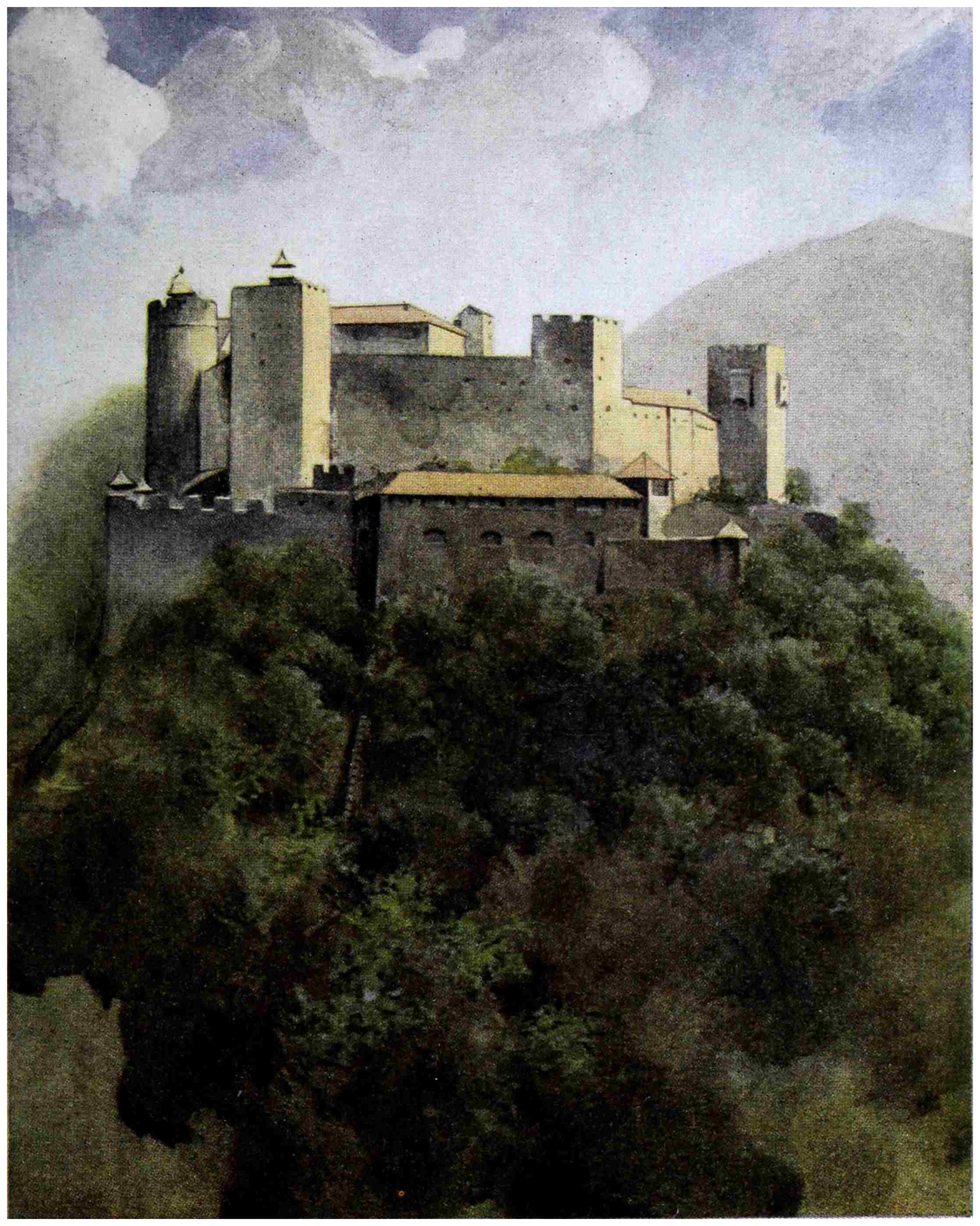
HOHENSALZBURG
The people of Austria, however, had to be
reckoned with, and this peace was altogether
opposed to their wishes; after violent uprisings they
broke through the neutrality, and joining Russia
and Prussia declared war on France. This led to the
disastrous defeats of Marengo and Hohenlinden in
1800, and on the latter occasion between four and five
thousand Austrians were left dead on the field and
seven thousand were taken prisoners. Austria once
again cried out for peace and abandoned the Tyrol
to the French without the consent of the Tyrolese
themselves, who had very different views on the
subject. It was in 1804 that Francis II. dropped
the title of Emperor of the Holy Roman Empire,
which had become an empty form, and adopted
instead that of Emperor of Austria, which he made
hereditary; no one seems to have objected, and as
Buonaparte had a few months before declared
himself Emperor of the French, the two newly
created emperors agreed to recognise each other’s
titles. Very shortly after Austria was again drawn
into opposition to her temporary ally by England
and Russia, and took up arms once more against
the French. This was followed by the disastrous
field of Ulm, with a humiliating capitulation on the
part of the Austrians. The Archduke Charles then
succeeded General Mack, who had been deprived of
his command and condemned to ten years’ imprisonment.
Napoleon entered Vienna and established
his headquarters in the Imperial palace. The
Russians and Austrians together met him once
more in full fight at Austerlitz, where they were
again badly beaten, losing fifteen thousand killed,
and ten thousand prisoners. This was called the
battle of the Three Emperors, for they were all
present in person.
Austria now lay under the heel of the French, and
a peace was signed at Pressburg in December 1805.
By this Austria agreed, among other things, to give
up her recent possession of Dalmatia; she ceded the
Tyrol to Bavaria, and received instead Salzburg,
which lay on her frontier and had been ever coveted.
We shall see in the chapters on the Tyrol how the
Tyrolese regarded this generosity at their expense!
It was not till 1809 that the struggle, as a national
struggle, was again renewed and war once more
declared against France. The result of this was
that for a second time the French entered Vienna
as conquerors and Napoleon established himself
there. The terrible battle of Aspern, in which neither
side could claim a victory, left the Colossus with
more respect for the fighting powers of his enemies,
for it is said that he remarked once, “He who has
not seen the Austrians at Aspern has seen nothing.”
The fate of the empire hung on the next move,
which was accomplished at Wagram on July 5,
1809. The Archduke Charles had placed himself
in a fine strategic position on the hills above Vienna,
and waited for the French to cross the river, yet
in spite of this the Austrians were smashed to pieces.
Their bravery is evinced by the fact that forty
thousand dead and wounded were left on the field,
but nothing could withstand the genius of the Man
of War who had let loose his hounds upon them.
The peace of Schönbrunn, signed in October, gave
up to the conqueror over forty-three thousand
square miles of territory, including the Tyrol, which
the Austrians had once again attempted to save.
Austria lay prone, and it is greatly to her credit
that after an interval she once again agreed with
the allies, Prussia and Russia, to make another
desperate struggle for liberty, even though Napoleon
had married the daughter of Francis II.
This princess, Maria Louisa, was of a despicable
character, and did not deserve a better fate. She
was the mother of the boy afterwards known as the
King of Rome and the Duke of Reichstadt. She
died at Vienna in 1847.
Metternich, the celebrated Austrian minister,
played a large part in affairs during this unhappy
time; he was born in 1773 and was not in reality
an Austrian, having first seen the light in the
Rhenish provinces, at a small village from which
he took his name. The European nations, by now
banded together in resistance to their common foe,
met in consultation; three great armies were
formed, one in the Netherlands of English, Dutch,
and Prussians, with Wellington and Blücher in
command; another on the Rhine, of Austrians,
Russians, and Germans; and a third in Italy, chiefly
of Austrians. This was in 1815, and the result was
made known in the world-famous battle of Waterloo,
at which no Austrian happened to be present.
At the end of the war Austria had indeed been
deprived of her Netherlands possessions, but she
had instead Dalmatia, and also Venetia,—which
was not finally reft from her until 1866,—and her
hereditary dominions in the Tyrol and in Carinthia
and Carniola were secured to her. She was compact
and welded together, and instead of suffering
from the long protracted trials which she had
endured, she came out the stronger from them.
In 1835 Francis II. died and was succeeded by
his son, Ferdinand IV., who in 1848 abdicated in
favour of his nephew, Francis Joseph, the present
ruler of the Dual Monarchy. However, Francis
Joseph did not come to an easy inheritance, for
Hungary was racked with the strain of trying to
burst the limits imposed on her, in order to give
her nationality free play. It was in this struggle
that the great leader Kossuth came to the front,
and in 1848 laws were passed allowing to Hungary
a responsible ministry, parliaments to be held
annually in Budapest, popular representation and
freedom of the press; but nevertheless Hungary
was soon again in the throes of revolution. The
Croats, Serbs, and the Wallachs of Transylvania rose
against her. The turmoil ended in a war between
Austria and Hungary, in which Kossuth was the
moving spirit on the Hungarian side. But when
Russia joined her might to that of Austria, Hungary
was ground between two mills and had no chance.
Kossuth fled to Turkey, and thence later journeyed
to England and the United States, preaching his
cause. He died in exile in Italy in 1894, at the age
of ninety-two.
In 1867 Hungary was granted a separate constitution
and recognised fully as a separate kingdom.
It was then ratified by Act of Parliament “That
Hungary in the spirit of the constitution is an
independent country and does not belong to the
countries included in the Austrian Empire.”
The titles of the present Austrian ruler are
extraordinarily numerous; besides being Emperor
of Austria and King of Hungary he is King of
Bohemia, Galicia, Croatia, Slavonia, Illyria, and
Dalmatia; Prince of Transylvania; Margrave of
Moravia; Duke of Upper and Lower Silesia, of
Lorraine, of Salzburg, of Styria, Carinthia, Bukowina,
and Carniola; Count of the Tyrol, Graditz,
and Gradiska, and even this does not exhaust the list
of titles. Among them is the purely fanciful one of
King of Jerusalem and that of Count of Hohenhembs,
under which, as Countess, the unfortunate Empress
was travelling incognito when murdered.
The two chief powers in the Germanic states
were the Emperor of Austria and the King of
Prussia, and it was recognised by all the smaller
states that the Presidency of the Diet, as it was
called, must fall to one of these two. In 1865
Prussia and Austria came to grips over the question
of Schleswig-Holstein, and in “The Seven Weeks’
War” the Austrians were decisively beaten. So
important was this war in the history of modern
Europe that it must be described somewhat more
at length, as it settled for our own time the question
of the power of the German and Austrian
monarchs.
In 1864 Austria and Prussia together wrenched
from Denmark the provinces of Schleswig-Holstein
and the Duchy of Lauenburg, and almost immediately
thereafter difficulties ensued regarding the
administration of them. After a while it was
agreed that Austria should take over the administration
of Holstein and Prussia that of Schleswig, but
when mischief is brewing between two nations who
have for years been rubbing up against each other’s
sore points, any settlement can only be temporary,
and this arrangement ended in a further quarrel.
Almost before the other states had realised what
was happening, Prussian troops had invaded
Austrian territory by way of Saxony and Bohemia.
This was in June 1866, and no amount of reasoning
on the part of Austria could have averted it, the
Prussians were ripe for a fight, and under the
leadership of their great general, Von Moltke, were
confident of victory. On paper indeed Austria
seemed to have quite as good a show as her aggressive
neighbour, for many of the smaller states, such
as Bavaria, Wurtemberg, Saxony, Hanover, Baden,
and the two Hesses were on her side, but Prussia
had secured the alliance of Italy, always in a state
of irritation against Austria on account of her
coterminous border. She now intervened, with the
effect of causing a dispersal of Austrian troops
through the necessity of being on guard in the
south. The Prussians advanced almost without
opposition through Saxony, and were careful to
treat the inhabitants of the country fairly so as to
secure their co-operation.
In Bohemia the Austrians made some resistance
but the luck was against them. The action at
Podoll, where the river Iser is 100 yards wide, was
an instance of this. The Austrians held the village
and were determined to make a stand. The
Prussians were better armed, however, and particularly
had an advantage in the rapid fire of their
needle-guns or breech-loading rifles, then just coming
into use, while the Austrians still carried muzzle-loaders.
The Prussians had arrived just as night was
closing in, and though the Austrians had the shelter
of the houses in which they were entrenched, they
were pressed back, and mercilessly outplayed by
the German Jägers.
The contest ended in a clear victory for the
Prussians. Close on five hundred unwounded
Austrian prisoners were next morning marched up
to headquarters, and the Austrian loss in killed
and wounded was very considerable. The medical
officers officially reported the proportion of wounded
Austrians to wounded Prussians as five to one.
Besides the great strategist, Von Moltke, the
Prussians possessed an able leader in Prince Frederick
Charles, the brother of the King, to say nothing of
the Crown Prince.
The Austrian cavalry, consisting of the Hussars
and Dragoons, especially the Windischgrätz Dragoons,
were among the most famous in the world,
but again and again in desperate hand-to-hand
encounters, sometimes in narrow streets, hemmed
in, they met their match in the Prussian Uhlans and
the Dragoons of their enemies.
On June 29 the King left Berlin and on July 1,
arriving at the army headquarters in Bohemia, he
assumed supreme command of the three Prussian
armies then engaged in the war.
Two days later was fought the supreme action
of the war in the battle of Königgratz or, as it is
better known, Sadowa, which settled for ever the
leadership of the Germanic states. At first the
Austrians were stationed in the village of Sadowa,
but being driven out by a rush, they retired into
the wood above, and held it strongly, and here a
fierce struggle with the bayonet followed.
The Prussians advanced against the nearest trees,
but did not at first make much impression, for the
Austrians being here again concealed, the fire of the
needle-gun did not tell, and a whole battery placed
at the far end of the wood fired through the trees,
and told on the Prussian ranks with awful effect.
But the assailants fought on and at last broke
down the obstacles at the entrance, and then
dashed in.
Affairs did not apparently go more favourably
for the Prussians in the centre. The whole of the
First Army was severely engaged, with the exception
of eight batteries of artillery and cavalry, which
were still held in reserve.
When Chlum was taken the Crown Prince
advanced to the help of his generals against Lissa
wood, and encouraged by this reinforcement, which
had so unexpectedly turned the tables on the foe,
the Prussians of the First Army leapt to the charge
and made for the Austrian batteries, which had
previously done them so much damage. The
Austrians, thus cornered, attempted to escape and
made their way down to the hollow ground on the
other side. But even then, though mowed down by
the needle-guns, the Austrians were not beaten.
Even when the Prussian artillery was brought up
and sent its shells bursting over the heads of the
retreating soldiers the retreat never became a rout.
Terrible fighting followed, as the Austrians took up
their position in the valley and played their batteries
on the pursuers. The manner in which the Austrians
worked their artillery on this occasion provoked the
admiration of their enemies and passed into a proverb.
The cavalry on both sides met in a tremendous
collision, but for the Austrians the day was lost,
and thenceforth they retreated, and the pursuit was
continued to the Elbe.
One hundred and seventy-four guns, twenty
thousand prisoners, and eleven standards, fell into
the hands of the conquerors. The total loss of the
Austrian army amounted to almost forty thousand
men, while that of the Prussians was not ten
thousand.
Worse equipped, worse generalled, but equally
brave, to the point of foolhardiness, the Austrians
lost none of their morale in such a battle.
This was not the end of the war, but it practically
decided it. There were many other actions of less
importance, but none to equal Sadowa. Thenceforth
the Prussian army steadily advanced on
Vienna.
An armistice was proclaimed when the Prussians
were already in sight of Vienna, at Wagram, where
Napoleon had won his victory. Here, on July 25,
they were drawn close together, “like a crouching
lion ready to spring upon the Danube should the
negotiations for peace fail.”
This was what they saw: On the right lay the
rounded hill of the Bisamberg studded with vineyards,
cornfields, and woods, among which vain
search with glasses was made to discover any signs
of hostile batteries. Beyond the Bisamberg could
be seen the narrow gorge from which the Danube
issues, and further still the rough, rugged recess of
the hills above Klosterneuberg, rising steeply up
from the water’s edge, with their summits capped
with heavy masses of dark green foliage, and their
sides sprinkled over with fir trees. A little to the
left and at the foot of the hills the city of Vienna
lay sparkling in the sun; the tops of the steeples
and the roofs of the houses glittered in the bright
flood of light. Far away on the left front spread
the Marchfeld, beyond which could be seen the dim
blue line of hills which gird the valley south of the
Danube, while directly to the left the dark Carpathians
towered up to the sky.
Those who know Vienna will recognise the unchanged
contours of the country, even fifty years
after that summer day when the tired way-worn
German soldiers lay panting in the heat, watching
the great city as a cat watches a mouse, and waiting
the word of command. Would it come in time?
The armistice had but two days more to run! And
they who had at one time thirsted to get at their
enemy’s capital and so to seize the nation by its
throat were now wearied of war, they were many
leagues from home, and had had their fill of bloodshed.
On the evening of the 26th the welcome
news arrived, peace had been made, and there was
but one feeling throughout the whole army,—the
feeling contained in the word “home.”
The victory left Prussia supreme among the
German states for, included in the terms of peace,
among other things, was the condition that Austria
should retire from the Germanic confederation,
leaving her great rival undisputed master.
It was during this war that Hanover made so
brave an attempt to play up to Austria, and not
being backed properly by the other smaller states,
found herself in a pitiable position at the mercy of
Prussia. It was then that the kingdom of Hanover
was absorbed by Prussia and never restored to the
King, though he was allowed to live elsewhere in
Germany. The feud thus begun is in the way of
being healed at the present time by the marriage
of the German Emperor’s only daughter with the
ex-heir of the House of Hanover.
The relations between Austria and Italy were
also changed by this war, though that must be
further considered when we come to the Tyrol.
The Prussian King was undisputed lord of the
German confederation, but he aimed at more than
that, and by the brain and audacity of his counsellor
Bismarck he attained his aim, for in 1871 he was
hailed as German Emperor, reigning as an hereditary
ruler over the Germanic states, and thus began the
second German Empire.
In 1888 the Triple Alliance was formed, between
Italy, Germany, and Austro-Hungary, each nation
pledging itself to assist either of the others if
attacked.
CHAPTER III THE EMPEROR
Few monarchs have waded through such deep
waters of sorrow as the venerable Emperor of
Austria, who was born on August 18, 1830, and
succeeded to the throne on the abdication of his
uncle, the Emperor Ferdinand, and the renunciation
of all rights by his own father. To the good-looking
high-spirited lad of eighteen the world probably did
not seem difficult to conquer, even though his dual
inheritance was torn by inward throes of dissension.
It was when he was twenty-three that he met his
beautiful cousin Elizabeth, the second of the five
daughters of the Duke Maximilian Joseph of
Bavaria, at Ischl, and immediately fell in love
with her, though she was only sixteen. Though
negotiations had already been entered into for his
marriage with her elder sister, he declared he would
marry her and no one else, and in spite of her
surprised exclamation as to why he should choose
one so insignificant, when told of this prospect by
her mother, he carried through his project and
they were betrothed in three days, though not
married till eight months after. The young couple
were first cousins, their mothers being sisters. On
that large family of sons and daughters of the house
of Bavaria many sorrows have fallen. The tragic
end of the Empress is described below; one of her
sisters, the Duchess of Alençon, was burnt to death
in the terrible fire at the charity bazaar in Paris
a few years earlier. Another, having married the
Crown Prince of Naples, was driven from the throne
with him.
The Imperial marriage did not turn out a success.
Elizabeth shared to the full in the eccentric tendencies
of her family, an eccentricity which developed
in the elder and reigning branch of her house into
madness. She was of a melancholy temperament,
and entirely without the power of adapting herself.
Young as she was, her tastes were formed, and the
somewhat wild out-of-door life she had led as a girl
had imbued her with a hatred of functions and ceremonies.
She was suddenly elevated to a supreme
position in one of the most conventional courts in
Europe. Small wonder was it that, in spite of her
unquestioned beauty, she alienated the hearts of
her courtiers by her want of tact and obvious
dislike of court life.
Two daughters were born to her before the
longed-for son, and one of them died. This increased
her unhappiness, but when at length a
prince appeared it was hoped things would go
better. Unfortunately the Empress’s eccentricity
increased rather than diminished. She took umbrage
at the Emperor’s love affairs, which might
have been condoned in one in such a position of
temptation, and at last she left her home and
children and wandered over Europe for many
years.
Reconciliation was at length effected over the
new Hungarian constitution, when the Emperor
and Empress travelled in state to Budapest, there
to be crowned King and Queen of Hungary. The
ceremonies were magnificent. All the various races
of the dominions were represented, as the writer of
The Martyrdom of an Empress, says:
The escort of one hundred and eighty-two aristocrats
was an especially magnificent sight. Twelve pairs of
cavaliers, whose horses were led by armour-bearers in
Magyar dresses, were followed by eight mounted Magnates,
each of whom carried a banner. The others all came in
pairs, each horse being led by one or two armour-bearers.
All the nobles wore the splendid dress of the Hungarian
Magnate, adorned with gold embroidery and precious
stones from the kalpak—or head-covering, which is surmounted
with heron’s feathers—down to the high boots.
The reins, gilt stirrups, and the shabracks and golden
scabbards of the scimitars were covered with diamonds
and jewels, many of them being worth a fortune.
The Emperor has always been personally greatly
beloved by his subjects, and Prince Bismarck once
said, “Whatever dissensions the different nationalities
of Austria may have among themselves, as
soon as the Emperor Francis Joseph gets on horseback
they all follow him with enthusiasm.”
The Empress always got on better with the
Magyars than with her Austrian subjects, and was
more loved by them. Her wonderful skill as a
horsewoman endeared her to the Magyars, every
one of whom is born with the love of horses in
his veins. After the coronation the Empress
set herself to master the Hungarian language,
and though it is notably difficult, she became
so proficient in it that the patriot Deak told her
she was the noblest Hungarian of them all. Her
openly expressed sorrow at the death of Deak
was another link between her and the Hungarians,
who grew to love her as they had loved no queen
since Maria Teresa. The Empress Elizabeth’s
knowledge of foreign languages was something
exceptional; she spoke and wrote German, Hungarian,
Czech, Polish, Roumanian, Italian, Modern
Greek, English, and French. She was very fond of
Byron, who, after Heine, was her favourite poet.
The youngest child of the Imperial couple, the
Archduchess Valerie, was born the following year.
In 1879 the Empress visited Great Britain,
where her firm and graceful seat as a horsewoman
attracted as much admiration as in Hungary; she
returned many times in later years, and rode to
hounds with the Pytchley, Royal Meath, and in
Cheshire, and no mount was too spirited for her to
manage. She stayed also at the Isle of Wight,
which she greatly appreciated, and her clever feats
of swimming were only second to her horsemanship.
The Emperor, meantime, having borne first the
burden of internal dissensions, and then the trial
and humiliation of the war with Germany, grew old
before his time and became grave and quiet.
Prince Rudolph married the Princess Stephanie
of Belgium in 1881, and in 1883 their only child, a
daughter, was born to them. She was about six
years old when the terrible death of Rudolph fell
as a heavy blow on his parents. The hot-headed
young man was mixed up in intrigues unsuitable
to his responsible position, with the result that he
took his own life by shooting himself, and was found
dead in a shooting-box at the end of January 1889.
It is said that the Empress was never known to
laugh again.
In the following year her youngest daughter, the
Archduchess Valerie, married, and from that time
the unhappy Empress travelled about a great deal
incognito on the Continent, and staying at her
palace Achilleion on Corfu. On this she spent
thousands of pounds. Since her death it has been
purchased by the German Emperor.
The end came on Sunday September 11, 1898,
at Geneva, whither she had gone over for a few
days from Territet where she had been staying.
Accompanied only by a lady-in-waiting the Empress
was walking along the quay between one and two
in the afternoon to rejoin the boat which was to
take her back to Territet, when a man rushed
forward and struck her violently over the heart.
It was thought at first he had only stumbled against
her and caused her to fall, and though he was
secured no great apprehension was raised by his
strange conduct. The Empress recovered herself
and went on board, where she fainted. It was then
discovered that he had pierced her heart with a
triangular file resembling a stiletto, which had
inflicted only a small wound but bled internally.
Brought back to Geneva she died in half an hour.
The assassin, who had been arrested, turned out to
be an Italian anarchist named Luccheni, who seemed
to have no special motive for his dastardly crime
beyond a general vendetta against crowned heads.
Thus died the Empress Elizabeth in her sixty-first
year, adding one more heart-rending sorrow to her
husband’s darkened life. There is hardly any grief
in the range of human relationships that the Emperor
has not known. It was in the very year of
his wife’s death, in the month of December, that he
was preparing to celebrate his jubilee. Up to the
present time he has reigned longer than any other
European sovereign of whom we have record,
having even out-distanced Queen Victoria.
There is loyalty of a very deep and true kind
amongst all classes of his subjects; it is not the
Austrians alone, but the Slavs and Tyrolese and
Hungarians, who look with tender reverence on the
aged man, now in his eightieth decade, who has
lived far beyond the allotted span of man’s life.
Loyalty it is none the less because it does not seek
avidly the tittle-tattle as to royal doings so eagerly
sought in Great Britain, nor does it lead to mobbing
the Emperor in his capital when he goes among his
subjects.
In character the Emperor is free from vanity and
simple in his tastes. He has suffered so much that
even had he not had dignity and courage as inborn
qualities he must have gained them, otherwise he
could never have survived the repeated blows of
fate. He is sparing of words, but his thought
penetrates below the surface. “His calm placidity
enables him to see through the transparent motive
of the self-seeker, the charity-mongering toady—a
rare gift of kingship. An indulgent smile perhaps,
but few stars and crosses are to be had for incense-burning
to this Habsburg.” In spite of being a
constitutional ruler, it is the personality of the
Emperor that counts in a way that is felt in no
other country. Perhaps it is because he forms the
only link among so many nationalities, so many
jarring, turbulent, and opposed aspirations, that his
person is so strongly revered. Whatever else divides
the Magyar from the Austrian and the Slav from the
Magyar, here they are all at one. Quiet, reserved,
shrewd, and kindly, he has learnt by many bitter
experiences to play his hard part to perfection.
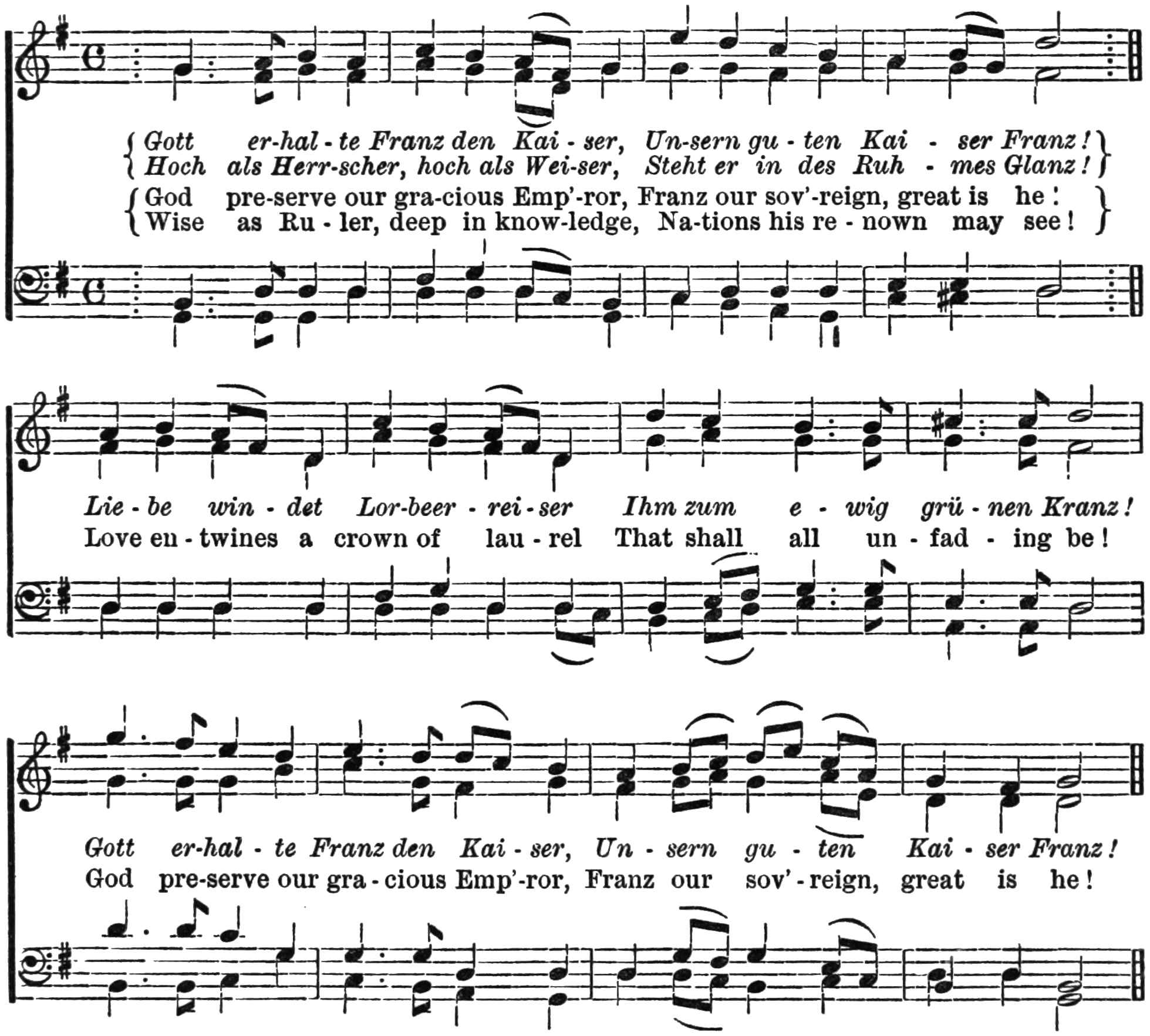
The Austrian National Anthem evokes as much
feeling as in more homogeneous countries.
Since the Salic law runs in Austria the Emperor’s
grand-daughter cannot succeed him, any more than
his own two married daughters.
The latest, and in some ways the most terrible,
tragedy of all that have fallen on the royal house is
yet fresh in the minds of every one, for the assassination
of the heir to the throne, the Archduke Francis
Ferdinand, and his wife, in the streets of Serajevo
took place on June 28, 1914. The Archduke was
born in 1863, and was the son of the Emperor’s next
brother. He was thus past middle life, and was a
man of strong personality. His wife was of noble,
but not of royal, blood, and had been lady-in-waiting
to the Archduchess Isabella. At the time
of the marriage the Archduke had to agree to
give up all rights of succession for any children of
this union, and therefore his two sons are now set
aside in favour of their cousin, the Archduke Charles
Francis Joseph, son of their father’s brother, the
late Archduke Otto, who becomes Heir-Apparent.
He was born in 1887, married in 1911 the Princess
Zita of Bourbon-Parma, and has already a little son.
All the Emperor’s brothers have passed away before
him. The Archduke Maximilian, his favourite,
suffered an unhappy fate. He was offered the crown
of Mexico by Napoleon III. He accepted, and in
1864 sailed for the “Kingdom” thus bestowed
on him, but his army abandoned him and the
republicans captured and shot him, thus adding
another sorrow to the heart of the aged Emperor.
CHAPTER IV THE COUNTRY OF HUNGARY
Running round fully two-thirds of Hungary are the
Carpathian ranges of mountains. Hungary has
been called the land of “three mountains and four
rivers,” and the emblem of these form the chief
feature in the coat-of-arms of the country. The
mountains are supposed to be the Tátra, Fátra, and
Mátra, and the rivers the Danube, Theiss or Tisza,
Drave, and Save. But this, in regard to the
mountains at all events, is misleading, for the
country is surrounded by mountains on three sides,
a great chain of 900 miles long reaching round north,
east, and south to the Iron Gates of the Danube, and
to mention only three peaks out of so many but
little inferior does not give a true notion of the
country.
The north-western Carpathians are divided
into several ranges; one separates Hungary from
Moravia, Silesia, and Galicia. There are passes of
great grandeur leading through the Carpathians at
many points, and the way in which the heights rise
sheer on the Hungarian side greatly adds to the
impressiveness. A good deal of the mountains is
thinly populated, and the villagers are often very
primitive in their habits.
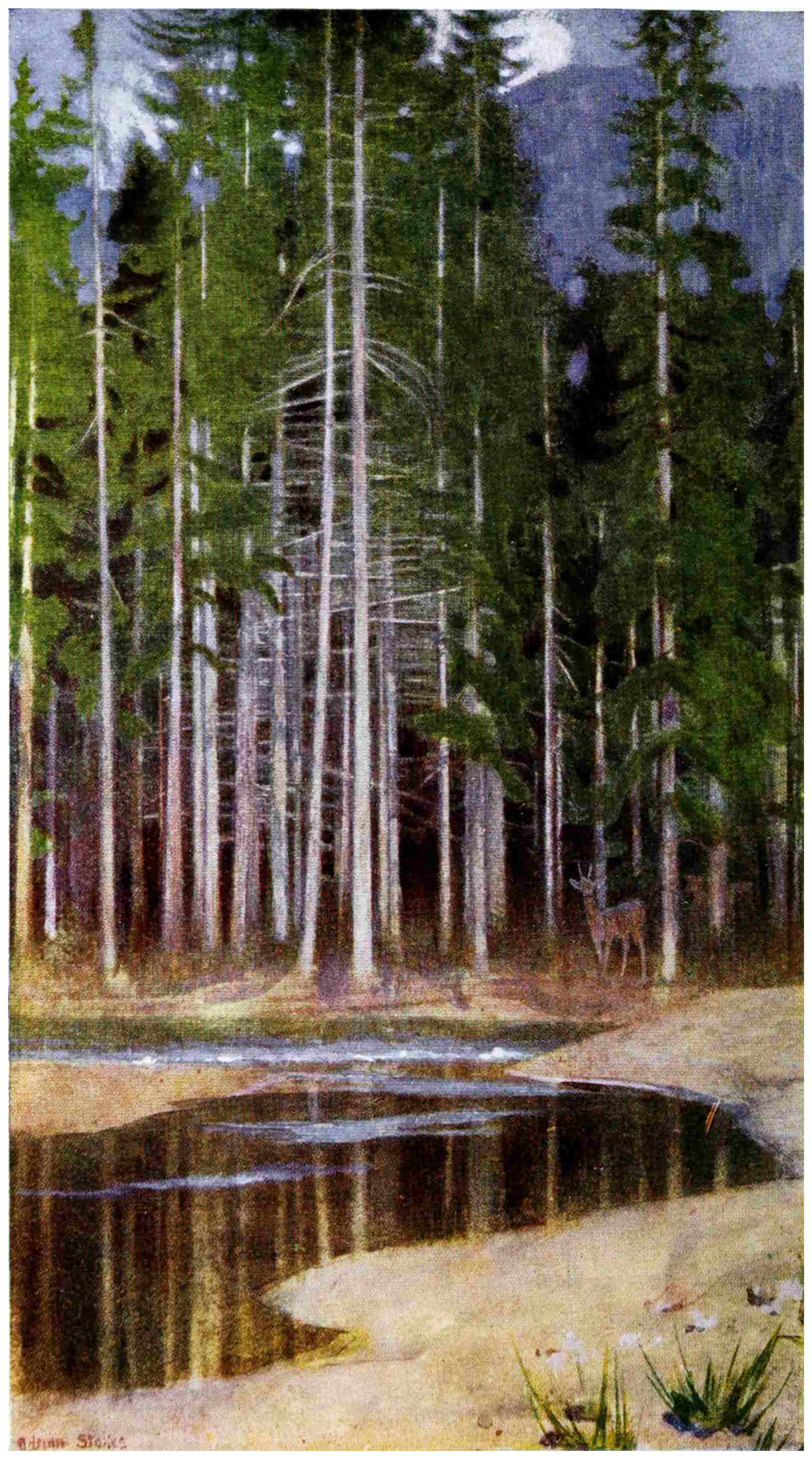
A PINE FOREST IN THE TÁTRA
The Carpathians are of great bulk and breadth,
and are covered with trees. The highest peaks are
above the perpetual snow-line, and rise grandly
from the evergreen forests. In the higher parts
pine and fir predominate, but in the lower ranges
oak, beech, and ash are common. Vast armies of
pigs, led by little swineherds, seek their chief food
under the trees, where they find abundance of beech-mast
and acorns. The sight of a swineherd leading
forth his flock in the morning from a village is a
quaint one. He stands and calls or whistles, and
from almost every cottage one or more pigs joyfully
run grunting to join him; many of them are
horrible creatures to our notions, with matted long
hair and covered with fleas; nevertheless he lets
them rub up against him, he fondles them, and
allows them to rest their heads on his lap!
The chief features of the health resorts in the
Carpathians are the wonderful mineral waters
which gush out abundantly almost everywhere, and
the glorious air and grand scenery. The springs
and baths alone are enough to make the fortune
of any place, but when added to these are endless
diversity of walks through forest scenery, wonderful
panoramas of wind and rock-scarred precipices,
stretching on one behind the other and backed up
perhaps by a mantle of glittering snow, it is remarkable
the world at large has not yet “discovered”
this playground fully.
There are also little lakes lying in hollows.
These are the work of glaciers, and are of a deep
blue or green colour. On a still day the scenery is
reflected as in a mirror. They are called by the
poetic name of “sea-eyes.” The terrific falls of water
streak the precipitous heights with white ribbons.
For those who can afford it there is chamois-hunting,
though it gets yearly more difficult as the
animals are driven further and further by the
intrusion of men; and even bison-hunting, though
this has to be arranged with a private owner who
only grants the privilege to his guests. The
resorts are greatly sought by invalids in the winter,
and also by a totally different class of pleasure-seekers,
those who delight in ice-sports and pastimes.
The two seasons are from the middle of June to
the end of September, and from the middle of
December to the end of February.
All through the Tátra runs a fine road, made by
the Hungarian Carpathian club to link up the
principal places; this is 21 miles in length and
reaches from Csorba to Barlangliget.
The railway line to the Tátra passes by the river
Vág for the most part, and as every height is
crowned more or less by a ruined castle, it is inevitable
that the route has been compared with the
Rhine valley. But there is no steamer on the
Vág on account of its rapids, and those who wish
to come down it will have to do so on a native-made
raft, which is piloted with great skill by the peasants
through seemingly impassable turmoils of water.
The rail goes past Poprad, and it is near here that
the first real view of the Carpathians is had, the
central range, stretching grim and grey about
thirty miles due east and west, and rising apparently
straight from the plain.
From Poprad can be visited the extraordinary
Ice Cave at Dobsina, one of the wonders of the
world, where skating is possible in the summer even
when the air outside is at a high temperature. The
perpetual chill in the cavern is accounted for by
the fact that it lies at a lower level than the outer
ground, and that the cold air, having once entered,
hangs heavily, so when the warmer air of summer
seeks to displace it, it cannot find entrance. The
cave is to-day planed and smoothed and rendered
easy of access in the way universally considered
necessary with any work of Nature’s, until it
resembles a piece of man’s architecture; nevertheless
the beauty is still great, even though the gleam
from the crystals is that reflected by electricity,
which gives an artificial aspect to everything. The
ice-columns and pendants are constantly changing
in bulk and form, and the floor of the lower cave,
a mass of ice, the cubic content of which can hardly
be estimated, is so smooth that skating is possible
at any time of the year.
From Poprad again one can go to Csorba,
where a small cog-wheel railway runs to a lake
thus described by one who is an artist in words:
“Magnificently situated among mountains and
forest. Lines and patches of snow flecked the
heights, and were mirrored in the still waters.
Against the sunset the mountains became a warm
plum colour, and, with the dark forests, plane
behind plane of purply green, were all perfectly
reflected in the glowing water, save where the
evening breeze cut level silver lines.” Strange
tales are told of some of these lakes, the depths of
which are unmeasured, and the notion that they
are connected with the sea by some subterranean
caverns is still believed by the peasants. The
hotel here belongs to the Sleeping-Car Company.
The massive granite range of the High Tátra is
about 18 miles long by 9 or 10 broad, its highest
summits are Francis Joseph, Lomnitz, and Ice-Valley
Peaks, rising to about 9000 feet.
The best known of all the Tátra watering-places
is Tátra Füred, called the mother of them all. This
holds its season in July and August, and consists
of three settlements, New Smecks, Old Smecks, and
Lower Smecks, with numerous hotels, concert halls,
restaurants, and every sort of convenience for the
visitor. Only 4½ miles away is Tátra Lomnitz,
where there is a large hotel and golf-links, but no
village. This is the terminus of a loop-line from
Poprad. At another of the watering-places in the
neighbourhood, Barlangliget, there are wonderful
caves with stalactite formations. This stands higher
than Tátra Lomnitz on the road leading to Poland.
One of the most wonderful and best developed
of all these places is Pöstyén situated at the foot of
the Lower Carpathians near the Vág. The hot
springs of Pöstyén have been known for generations,
and are even referred to in the twelfth century.
As is often the case they have occasionally shown
some vagaries, the mud-source shifting about erratically
from time to time on either shore of the river,
and after a tremendous inundation in 1730 they
disappeared, but not for long, for a few years after
the bathing was going on in full swing, and since
then the springs have been stationary. They are
sulphurous and exceptionally hot, the natural
temperature being 140° F. Their upspringing causes
an overflow which runs down into the river and
shows itself in mighty rolling clouds of steam rising
from the surface. The constant flow causes a deposit
of silky sulphurous mud, and it is this that makes
the fame of Pöstyén. It is a wonderful cure for
rheumatism in all its many manifestations, which
is borne witness to by a museum filled with the
crutches discarded by patients who have recovered
the full use of their limbs. The springs are also
rich in radium, and radiograph photos have been
taken in a dark room by the agency of the
mud alone! Besides rheumatism, gout, neuralgia,
fractures, sprains, and bone diseases are treated
here, and the thermal water is taken internally
as well as in the form of baths. The air is dry
and the situation sheltered from the north. Many
of the hotels are open all the year round, and
though the summer season is the principal one the
treatment can be carried on at any time. One of
the largest and newest of the many hotels is the
“Thermia,” which is near the huge Irma bath,
itself a revelation of what can be done in this
direction. The bath is built right over the springs,
and its vast floor, 126 feet in diameter, is of mud.
There are corridors and lifts and dressing-rooms
enough for an army, and private baths can be had
here too. It is one of the latest and most complete
buildings of its kind in the world. There is another
bath-house too bearing the name of the monarch.
The Kur Salon, adjoining the Kur Hotel, contains
reading-rooms, music and dining-rooms, besides a
beautiful ballroom. There are recreation grounds,
a theatre, a fine park with magnificent trees and
promenades by the river. Here special home-industry
articles of needle-work peculiar to the
district are on sale. Boating can be indulged in
safely, and there are endless beautiful walks into
the hills around. The proprietor of Pöstyén is
Count Emmerich Erdody, and he lets the Spa
on lease.
At a little known place on the Mátra mountains
called Párad, the waters are a combination of iron
and alkaline, and also there is a spring of arsenic
water which achieves astonishing results in certain
cases. So numerous are the springs in these parts
that in spite of the up-to-date development of such
places as Pöstyén and Tátra Füred, there are many
places where the peasants still indulge in primitive
baths as the pigs used the pools before Bath was
built. Owing to their open-air life and the constant
dampness of their clothes the poor people suffer
greatly from rheumatism, and while bathing they
preserve their bodies from the extreme heat of the
pits where the water lies, by lining the sides with
branches of trees as was done in the old days at
Pöstyén itself.
Far the most intimate picture of homely life
among the various peoples of the Carpathians
which has yet been written in English, is Mrs.
Phillimore’s In the Carpathians, giving an account
of a leisurely tour made by herself and her husband
with a cart all around the great encircling heights.
Poles, Slovaks, Ruthenians, Czechs, Saxons, all
passed before them in review, and they even came
across the dreaded Wallachs, held up by the
Slavs as bogey men. The Wallach is akin to the
Roumanian, and proved himself on acquaintance
much less formidable than painted.
They started from Zakopane in High Tátra
Mountain, and here they picked up the Polish boy,
Milak, who went the greater part of the way with
them to drive the cart. They slept out for the most
part, had a total absence of adventures of any kind,
and the chief difficulty was the lack of food. They
were on the border line between Hungary and
Galicia, crossing into one or the other as the road
wended. Bread, bacon, and sausages, honey and
fruit, and sometimes cheese and milk, were the
staple diet, and oft-times they were thankful to
get anything. Many of the villages were extremely
poor. They passed through a watering-place at
Bardfield, where baths, cafés, restaurants, and large
hotels make it exceedingly popular with the German
element who take up all the rooms weeks ahead for
the season. But for the most part they shunned
the frequented resorts and passed only through
little-known districts where the people were very
poor.
The writer sums up the races she met in this
sentence:
Poles and Slovaks we decided were amongst the lovable
races of the world; Ruthenians and Jews were to be
esteemed but not beloved; while gipsies were too flighty
and flippant to be recipient of any responsible emotion.
We knew little of Magyars; Wallachs, Szeklers and
Roumanians proper, we had yet to meet, and beyond
innumerable suggestions that they were “dangerous
people” had no knowledge of them.
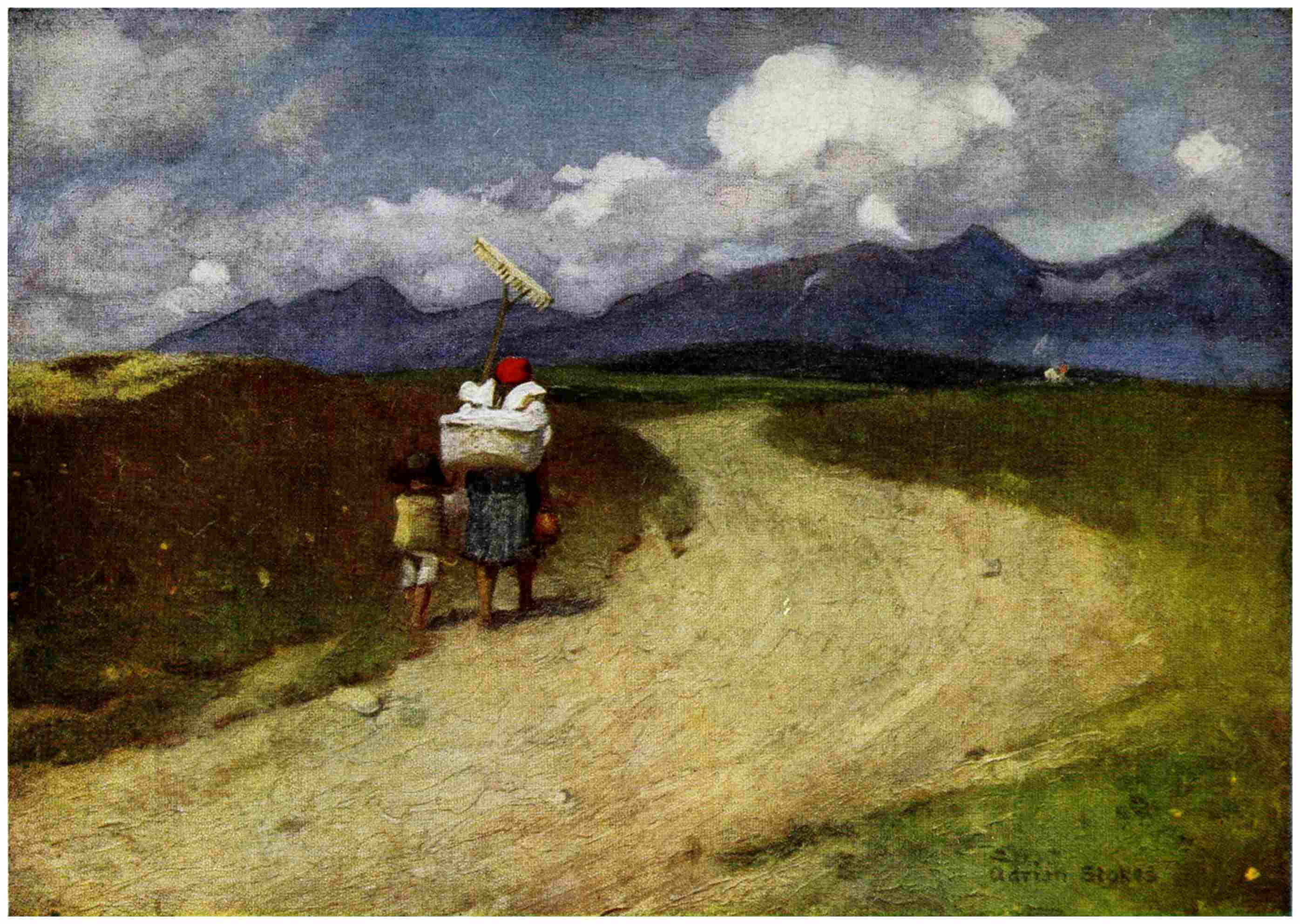
A ROAD IN THE CARPATHIANS
It is a record of beech woods, and many streams,
of quiet bad roads, and wide maize fields, of poor
and dusty villages with kindly villagers, who,
though curious, were usually innately well-mannered.
After completing the semicircle they returned
again to the plain, and here is a striking little
description:
Up the broad high road came a cart full of peasants
and a string of thin light-footed horses. Far off in the
distance rose a cloud of dust, and from out of it came a
herd of white cattle, followed by a crowd of black buffaloes.
The great golden plain striped with brown ploughed land,
the groups of corn-stacks, the threshing-machine and
the teams of buffaloes and oxen with their drivers in white
and red, and on the road the herds returning slowly homewards—this
was our last clear picture of Hungary.
A book to read, though it does not encourage one
to “go and do likewise.”
The north-eastern Carpathians include the
Wooded Carpathians and a range of low hills where
the much admired wine of Tokay is produced.
The town of Tokay nestles at the base of these
hills, called Hegyalia, and is itself disillusioning, its
population consisting almost entirely of wine-growers
and wine-buyers or middlemen, so that a
constant chaffering spirit spoils the romance. The
essence of Tokay is made of the juice which runs
out of the ripe grapes pressed down by their own
weight. This is produced by putting the grapes in
a cask with holes bored in the bottom through
which the juice runs. This essence is so scarce
that it is hardly ever offered for sale to outsiders,
who, indeed, get very little chance of pure Tokay
at any time. The other two kinds are made by
mixing juice, pressed artificially out of fresh grapes,
with some of the pulp, and these two are known
as “ausbruch” and “maslas.” Tokay varies from
pale yellow to rich gold in colour, but red wines
are produced in Transylvania and elsewhere.
Many are the drinking songs of Hungary, but
very difficult to translate in the spirit of the original.
Here is a characteristic one:
WINE SONG
Away with grief, away with pain,
Let us bathe our throats in wine,
And quaff it to a tuneful strain.
Wine for me—the joyous wine,
Whose sap can make one strong.
Who drinks not wine, the Magyar name
To him may not belong!
The fish loves water for its part,
No fish’s shape is mine!
For me the wine that warms the heart
Born beside Tokay’s vine.
What’s water unto me?
Whoever drinks not wine
No Magyar can be.
Cold beer the Germans swill,
We quaff the grape with song,
For beer from water they distil,
Two pints a penny strong—
Wine to me bring here,
Who drinks it not, the Magyar name
He holds not ever dear.
Hungary ranks high among wine-producing
countries, at least a million acres being under
cultivation of the vine, while the Tokay wine is
limited to that grown within an area of about
twenty square miles.
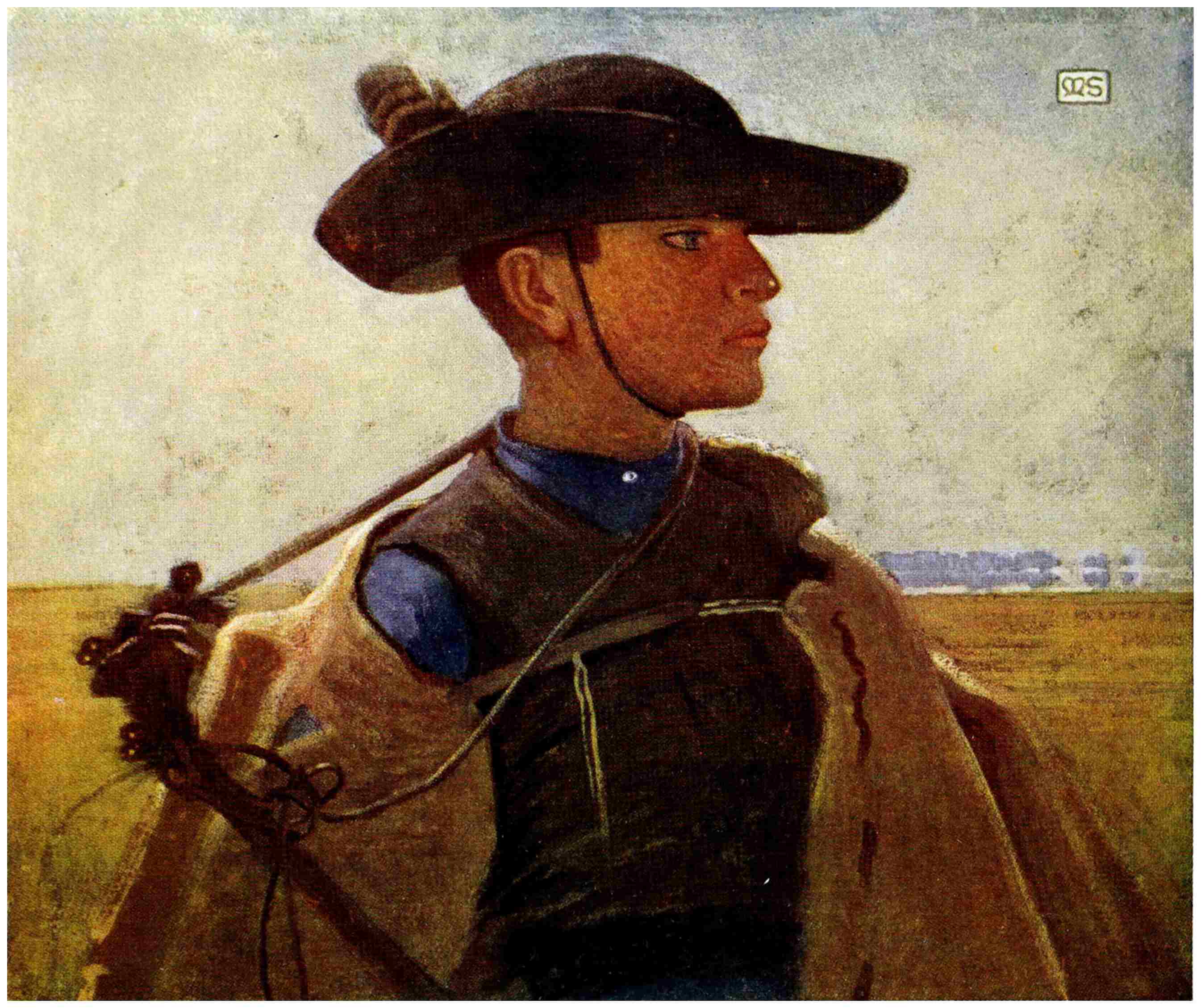
A YOUNG MAGYAR CSIKÓS
In contrast to the stern heights of the mountains
the Great Plain of Hungary, the Alföld, which has
been called the “heart and brain and soul” of
Hungary, is a startling contrast. It is 35,000
square miles in area, and the soil is rich, so that it
lies like an oasis amid the encircling heights. It is
the greatest plain in Europe and is at an average
height of 350 feet above the sea. Quantities of
corn are grown here, but in some places the ground
is still too swampy for such cultivation, and the
people live by gathering the reeds and rushes with
which to make mats, and osiers for baskets.
On the far-reaching Alföld it is the majestic Nothing
that awes and impresses you. There are neither trees nor
pastures, neither hills nor dales, neither flocks nor people.
Simply miles and miles of nothing, arched over by the blue
of heaven, but if you look closely you will find on the sand
the tiny traces of fairy footsteps. It has its own peculiar
fairies as well as its own peculiar grasses, flowers, birds
and insects. Fata Morgana is the sovereign who queens
it over them there; but she shows herself more rarely
every year. Silence broods over all, and subtle fitful
shadows chase each other across the “large neglect” of
this broad expanse, where patches of long knotted grass
and charming water weeds wave and toss feebly in the
balmy breeze. Wild ducks and moor-hens share the
shelter of “withied” swamps with the heron, the crane
and the stork, and gaze without a sign of fear or trepidation
on the rare passer-by.
But this was written many years ago, and much
of the area has been drained since then.
Any one familiar with the prairie can well
picture the Alföld with its undying fascination, and
will be able to see it in the mind’s eye as it lies with
miles and miles of yet unripened corn like a vast
ocean brushed into small waves by the wind. There
is hardly a tree, and the sky-line, unbroken in its
tremendous semicircle, sweeps on ever infinitely.
It is difficult to give any idea of the Alföld, unless
the characteristics of the people who dwell in it are
taken into account as throwing light upon it. This
great plain, once an inland sea, contained at one time
a gigantic marsh of 100,000 acres, and the rivers
Theiss (or Tisza) and Danube overflowed their banks
occasionally, making it impossible for any one to live
near them in safety. Now a great part of the marsh
has been drained, the rivers are confined to their
channels, and their backwaters and islets form a
breeding-place for thousands of geese, which at times
may be seen in such numbers that it seems as though
the land was covered with large snowflakes.
Here is a translation of an old national song:
THE ALFÖLDER
I dwell on the heath through sunshine or snow,
And on holidays I with my dear one can go;
But far on the Hortobagy plain,
In vain to God’s house would I hie—in vain.
Flat is the heath where no trees do grow,
The high steeple-top in the sunshine doth show,
The tall church spire to the heath is plain;
But far from God’s house I must still remain!
I’d pray, but no prayer at all do I know,
And never to school in my life did I go.
My mother would thither have sent me fain,
But ah! long, long in the grave has she lain.
Pray thou to good God, my dovelet, go—
Come after church thy kiss to bestow—
Thy prayerful sweet lips I’ll devour again,
And more than a fortnight from oaths I’ll refrain!
The Hungarians were ever a wild and warlike
people, and as the country became more settled
they found their chief delight in tending horses,
being born horsemen. The name csikos, which
really means horseman, now includes shepherd or
herdsman. Horse-breeding goes on largely to this
day. The csikos live a primitive wild life still, and
round up their horses with the skill of an American
cowboy. The horses in the herd are half-wild,
and are rounded up by the use of the karikas, a
short-handled long-lashed whip, with which the
herdsman, going at full speed, can single out any
animal and touch it up in any part of its anatomy
he desires with the unerring aim of a brilliant
marksman with a bullet. His own special mount
is generally as dear to him as the Arab’s horse is to
its master. It shares his shelter and will come at
his call, and eat out of his hand. The name Hussars
applied to troops of soldiers comes from Hungary,
and the Hungarian Huszar is still the best rider on
the continent, a veritable part of his beast.
The Hungarian horses are as a rule hardy
spirited little creatures, descendants of the race
which came with their masters from the east. The
government has improved horse-breeding, introducing
English and Arab blood, and there are two
large government studs for the purpose.
MAGYAR SHEPHERDS
The Hungarian loves the boundless spaces of
the plain; it has been said that he shares in its
qualities, “the same absolute straightness, the same
taciturnity characterise both.” Here in the sweltering
summer heat he works all day uncomplainingly,
to gather in the fruits of cultivation; here, when
the white mantle of winter lies over the silent icy
spaces he wanders in his sheepskin. The horseherd
or csikos, once the aristocrat of the plain, now is
hardly distinguishable from the shepherd or cow-herd
whose avocations he shares. The far-famed
white horned cattle of Hungary are tended and
reared on the Alföld. It is a sight to see them
yoked as a four-in-hand with their spreading horns
and splendid hides gleaming in the sun. Beneath
an acacia, the Hungarian tree, or a willow, both of
which are plentifully found, the shepherd pitches
his rude wattled tent. Possibly he has with him
one of the native dogs, great snow-white shaggy
fellows, who are, alas, growing fewer every year.
Storms and clouds, heat and rain, affect not the
man who meets them all calmly. The great black
cloud of hail which bursts in masses of ice is met
with stoical patience. At evening, maybe, he sees
far off across the plain what appears like a sheet of
blue water, and yet there is none; it is a mirage
raised by the refractive power of the air. The wild
duck and water-hens and even the herons have now
migrated elsewhere, but there is still fishing to be
had, and the herdsman is often a keen angler.
There are many flourishing towns to be found in
the Alföld, of which Debreczen, Szeged, Kecskemét,
and Temesvar are perhaps the best known. In
these towns there are electric lighting, asphalt
paths, a good water supply, and other comforts
of civilisation.
A recent writer has said:
In general the towns we saw throughout Hungary
looked new; and indeed we were more than once—until
we became wary—sent to places said to be most interesting,
only to find that new municipal buildings, new banks, new
schools, streets in course of construction, electric trams
and electric lighting, were their chief attraction. But
there were towns that well repaid a visit, and of these one
was Löcse (German Leutschau), chief town of the Zips
country, near to the Tátra. Sometimes called the Nuremberg
of Hungary.
The largest lake in Hungary is Lake Balaton,
which may well be described as an inland sea, for it
is 47 miles in length. It is difficult to describe what
Lake Balaton means to a country like Hungary
deprived of a seashore. Though the lake has no
tides the levels are so constantly changing that
monotony is impossible; this is no dead sheet of
water. Its very size makes room for the breakers
the storm-wind sweeps before it, and storms are
by no means lacking. For many years there has
been a railway line along the southern shore, but
only recently another, completed in 1909, carries
people also along the northern shore, which is the
more popular, and the health resorts and bathing
places which have sprung up are innumerable.
All Hungarians who can afford it carry their
families to this charming resort, there to bathe and
dabble and fish, or to voyage by steamer or yacht.
The lake is divided into two by a long peninsula which
stretches out from the north side almost to the
opposite shore. On the north side, there are hills
rising in vine-clad slopes, with white houses nestling
in them, and at the foot many a town, of which
Balaton-Füred is the principal one. The lake is
rather shallow, though varying enormously with the
feeding it receives from springs and streams, but it
is deepest on the north side, where bathing is easier
than on the sandy shore of the too shallow south.
Long wooden piers with huts at the end of them
are constantly available, and every one bathes.
Many a pretty picture can be seen of a peasant
woman, her face alight with fun, her wet hair
thrown back, dipping a pink innocent babe in the
fresh water.
Balaton-Füred is not only a seaside place but
has wonderful alkali springs and baths which are
excellent as cures. There are many excursions to
be made. Steamers run the whole length of the
lake. The walks and drives are innumerable.
For other interests there are yacht races and
fishing. In winter the lake freezes easily because
of its general shallowness, and then the whole of
the 600 square kilometres are available for skating
and winter sport. When the ice breaks up, which
it does with cracks like pistol-shots, and piles itself
in masses, glittering with every colour of the
rainbow like gigantic prisms, happy are they who
are there to see it!
THE ÖRTLER SPITZE
At the western end there are curious basaltic
effects, great cones rising from the vine-covered
slopes like sugar-loaves, or hills which appear to
be built up of columns of basalt, as in the far-famed
Fingall’s Cave of Scotland. There are ruined castles
artistically arranged on hills, piled up by the
gradual forces of nature, not by art; and there is
the magnificent seat of Count Tassilo Festetics at
Keszthely near the western end. Balaton well
deserves the place it holds in popular estimation in
Hungary.
If time is limited, and it is desired to see something
of the two great attractions of Hungary, the
rich lowland and the mighty hills, in a short time,
no one could do better than take a ticket from
Budapest to Orsova. Railway travelling in Hungary
is cheap compared with other countries; it
is run according to zone system, and the farther
you go the less you pay proportionately. The
management is extremely enterprising, and deserves
much credit for it in a country where the national
spirit is inclined to dwell on the past rather than
to work for the future.
The very large towns passed through will
astonish those who think that the peasants still
live in little rough villages. At a place like Kecskemét,
for instance, there is a magnificent town hall,
and as the town is truly Hungarian the quaint
costumes of the people seen in the imposing streets
have all the piquancy of contrast with their modern
surroundings. Kecskemét lives to a large extent by
agriculture. The suburbs are one mass of fruit
orchards, and at the time of the “peach market”
the smell of the exquisite fruit is radiated far and
wide. Cucumbers—which are eaten by the children
like bananas—grapes, and apricots, are grown in
quantities, and there are a number of vineyards.
Willows and acacias are frequently seen, both being
planted along the roads in avenues.
A very large town on the banks of the Tisza is
Szeged, with over 100,000 inhabitants. Szeged
has suffered much in times past from the Tisza’s
unruly manners, and in 1879 was subject to a very
terrible inundation, when hundreds of people were
drowned. The river is now properly embanked.
The wide squares, the well laid out gardens, the
artistic architecture, will be a revelation to many
people. The town has a busy industrial life with
steam-mills, timber-works, flax industries, also
paprika-mills. This is a special industry. The
hot red pepper called paprika is used in quantities
by every Hungarian, and dished up on all occasions.
Formerly it used to be ground by hand, but now
steam-driven mills have taken up the task. There
are distilleries too, and Szeged soap is renowned,
while its silk slippers are famous. The river is
responsible for shipbuilding and fishing industries.
Another large town is Temesvar, also industrial,
with clean straight streets, electric tramways, and
an extraordinary amount of open space. Its
chief interest is that here stood the original castle
of the great patriot, John Hunyadi, now marked by
a later castle in a square of that name. Tobacco
and mosaic, bricks and textile goods are turned out
from Temesvar, and not far off is a fine watering-place
called Buzias. Northward lies another large
town called Arpad, the centre of a rich vine-growing
district.
It is only after leaving Lugos we begin to see the
hills, which we are soon to enter.
To the east lies a country of mining and factories,
smelting furnaces, and other disagreeable evidences
of industrial prosperity. The smelting is carried on
by charcoal made from the splendid fir and beech
forests. Iron and coal are found in quantities, and
it will be news to most people that Hungarian steel
goes to England as well as to other European
countries.
Road, rail, and river run together through a
narrow mountain defile, and finally the railway
goes through a tunnel which is at the summit level
of the line. Then the line is wonderfully engineered
in and out along the hillsides, across valleys, and
over bridges. In one of these valleys is the oldest
health resort in the country, the famous Baths of
Hercules, not far from the Iron Gates of the Danube.
Herculesfürdo, to give it its native name, was
established by the Romans two thousand years
ago. The springs are sulphur and salt, and the
cures of rheumatism, skin disease, and other ailments
still wrought by them are almost miraculous.
The river Cserna runs through the valley. The
place is under State management, and there are now
many good hotels, and the walks through the
steeply-rising wooded cliffs are well planned and
laid out. It is visited in the season by hundreds
of people, a large number being foreigners. From
the top of the hills, which rise to over 3000 feet,
there are charming views. In these hills there are
caves, one of which is full of hot vapours and used
by many people as a vapour bath.
Beyond this we reach Orsova, which is on the
Danube and is mentioned elsewhere.
This little glimpse of the Alföld with its wheatfields
and vineyards, its flourishing towns and large
rivers, will give an excellent impression in miniature
of the whole of its extent, while the grim scenery
of the Southern Carpathians forms a striking
contrast.
So much for the northern and eastern parts of
the Dual Monarchy, but the south-western part has
a character quite its own, and in the Empire of
Austria the Alps play a larger part than the Carpathians.
The Rhaetian or Tyrolese Alps form the
highest range, many topping 12,000 feet, the highest
point, the Orteler Spitze, attaining 12,814. These
Alps are subdivided into three chains, of which the
above-mentioned peak is to be found in the most
southerly; the middle chain extends to the
borders of Salzburg and Carinthia, and the northern
one lies above it again. The Noric Alps are those
in Salzburg, Styria, and Carinthia, and they are
also broken into chains. The Carnic or Carinthian
Alps are another range in the north of Carniola, and
the Julian Alps lie in a south-easterly direction,
running through Carniola to Dalmatia.
All the beautiful mountainous scenery in this
part of the Empire, including the Tyrol, is known
to those who love natural scenery, and the Tyrol
itself, with the Dolomites, rivals Switzerland in the
number of holiday-makers attracted by it. The
country about Salzburg is less known outside the
inhabitants of Austria themselves, but the enterprise
of the Austrian State railways is opening it
up. All this is dealt with in another part of the
book.
CHAPTER V THE PEOPLE
A very interesting race is that of the Magyars who
people Hungary. The word Hungary is of course
derived from the Huns, who are described in their
earliest descent into Europe from Central Asia as a
“fierce Tartar people of dwarfish figure, great
strength and ugly beardless faces.” They penetrated
far, under their great leader Attila, but his
defeat and death in 453 broke their dominion, and
they retreated again, leaving only traces of their
influence on the nations of modern Europe. The
Magyars came over from the direction of the Ural
Mountains in the ninth century; their chief, Arpad,
founded a dynasty, of which St. Stephen was the
first king. Arpad bears a name comparable with
Attila and other great chiefs of bygone days. Mr.
Whitman, in his book The Realm of the Habsburgs,
says:
The first authentic mention of the dominant race in
the Hungary of to-day, the Magyars, dates from the year
836, when the Greek writer, Leo Grammaticus, styles them
successively by the three distinct names of “Hungarians,”
“Turks” and “Huns.” They are then referred to as
encamped on the banks of the Lower Danube. Their
origin and early history are alike shrouded in mystery.
Nothing is more difficult than to describe the exact type
of the Magyar race. In fact there is no exact type, the
Magyars of the present type being a conglomeration of all
the numerous tribes that came into the land at the time
of the wars of the “home-making.” Several types exist,
but which is the true Magyar it would be difficult to say.
If there were a clue to this it would be known with absolute
certainty whether the Hungarians were descended from
the Fin-Ugor or Turko-Tartaric races. Among the different
types there is the somewhat round head, very broad cheek
bones and square jaw of the Mongol type—mostly to be
found in the southern and midland districts—called purely
Hungarian. Then again, there are other types which have
a resemblance to the Kirgiz living in Asia to this day.
The majority are not tall—rather under middle size—especially
in the working classes. They are very broad
in the chest, square-shouldered, long of body, short of
limb, very active, with sinews of steel—the true horsy
race, the greater part of their life having been spent on
horseback in olden times. The language is a mixture of
the Turko-Tartaric and the Fin-Ugor, but much changed
by time. They are seldom very dark, brown from the
lightest shade to the darkest being the prevailing colour,
with dark or brown eyes; but blue eyes are often to be
seen. Red, yellow, or flaxen hair is not a Hungarian type.
A fighting nation par excellence, who, through circumstances,
had to give up war, sought and seek to fight in other ways;
the great predisposition for duels even at the present day
has its origin in the ever-existing and only half-dormant
desire to fight.
The Magyars are one of the few peoples in
Europe who do not belong to the Aryan race.
Among the others are the Finns and Lapps, the
Basques and the Turks. To the Finns the Magyars
are closely related by speech as well as blood.
The old song says:—
Eyes of neither grey nor blue
But of tawny velvet hue,
Head with nut-brown tresses laden
Is the real Magyar maiden.
A PAPRIKA-SELLER, KALOCSA
Warlike the Magyar still is, and proud as
Lucifer, yet with a strange mingling of Oriental
calm. None others are so philosophic as the
dwellers in the great plain of Hungary, the Alföld,
where they follow their occupations as shepherds or
wheat-growers. They take the good with the bad
and are resigned to evils they cannot cure. We
have already noted the special characteristics of the
Alfölder in connection with his boundless home.
But others of the nation share some of his qualities.
Those who have been most among the Hungarians
speak of their simplicity; they are in all things
natural. If when at table with them you want
more food, you must ask for it; they will not force
it on you. It is there; they take for granted that
you know they are only too glad for you to have it.
If therefore you want it you have only to say so;
anything else is affectation. Their hospitality is
proverbial and resembles that of the East. Never
is any one allowed to pass without being fed or
lodged if need be, and however lowly the accommodation
there are no pretended apologies; this is the
best they have and they give it you, and they don’t
consider that it needs any apology. In the words
of another traveller, “You are made to feel that
your presence among them is a genuine piece of
good luck.”
Though much alive and of an artistic and musical
temperament, and ready to go half-mad when
worked up in the national dance, the csardas, the
Magyar is generally quiet and philosophic. Dancing
is the favourite pastime all over the land, and
every man, woman, and child can dance to admiration.
Men and women both marry young, and the
unmarried of either sex are almost unknown;
marriage is as natural and universal an act as birth
or death.
Like all proud high-spirited races, who allow for
other people’s dignity as well as their own, the
Magyars have excellent natural manners; it has
been said of them that they are a nation of gentlemen.
A very strange being indeed is the Magyar
peasant, mysterious as his country’s history; he
has sympathy with gloom and melancholy reveries,
and is fond of brooding in a seeming lethargy when
his heart is ready to kindle with all the fire of a
crusader. When free from his daily labour, in his
happiest moments, he is marked by sudden transitions.
Apparently happy, he quickly becomes sad,
soon to burst forth into exultation, only to plunge
again into grief, which always marks the end of his
frolicsome episodes. He is not easy to cheer by
incitements which put heart into other people, for
he does not readily respond to this sort of thing.
There is a saying that the “Hungarian enjoys life
with weeping eyes,” just as the Britishers are supposed
to take their pleasures sadly, and it is true
that a vein of melancholy runs through the folk-songs
and ballads of Hungary. The gipsy who
wants to rouse the Hungarian peasant has to begin
plaintively and rise into gaiety if he wishes to catch
his attention.
As is perhaps natural considering that his life
was passed fighting for his country’s nationality,
Petöfi’s poems strike mostly a wailing note such as:
A cloud o’er my country there hangs,
That tells of a storm approaching;
My soul in foreboding its pangs
Gains strength to resist its encroaching.
The harp of my fingers is weary,
Too long have I struck it with pain;
Well knows it my heart has been dreary,
In wearing its strings out in vain.
Or:
TO THE STORK
The winter time is over and the fields are growing green,
And thou once more art here, bird so good,
To build thy nest again where it before hath been,
To hatch therein again thy feathery fledgling brood.
Away! Away! Be cheated not
By the sunbeam’s glittering quiver,
By the babbling of the river;
Away! Spring comes not to the spot,
Life is benumbed and frozen up for ever.
Oh! walk not through the fields, there is nothing there but graves;
Oh! roam not by the lake-side, blood-crimsoned are its waves;
Oh! fly not to the house-tops, all there that thou shalt find
Are but the reeking embers that ruin left behind.
* * * * *
We are dying—
We are scattered far and wide
Like a sheaf by storm untied.
Some lie within the tomb,
Some in the prison’s gloom,
Others wander in their sadness dumb with woe.
Some with a start arise,
Terror gleaming in their eyes,
To seek another fatherland beyond the Atlantic’s flow.
It is of course difficult to give any idea of originals
when they are translated into a tongue alien from
that in which they were written, and especially is it
impossible to judge of the pathos of these national
songs without the wild melancholy tunes to which
they are sung.
In spite of his tendency to melancholy the
Magyar can be cheerful enough and is a good
fellow; he makes a particularly good husband and
father.
The women are treated well and take their full
share in all that goes on. Hungary has from time
immemorial given women equal rights with men in
regard to property. If a woman marries she is
entitled to half her husband’s property in addition
to her own, and in case of divorce takes it with her.
A man must, by law, leave half his property to his
wife.
Ten years ago it was unusual to find any girl of
good class working for her living, but now the
universal receipt for happiness is allowed freely to
women as well as men. In the universities all
courses are open to them except theology and law,
the last with a reason maybe, as law is one of the
requirements expected from a man entering the
public service. Medicine, however, is thrown open,
and there are even women doctors employed by the
State.
Almost all Hungarian women are excellent cooks,
and make an abundance of the highly seasoned
tasty dishes in which their nation delights. The
little strips of bacon, rolled in the national paprika
or red pepper, are universally enjoyed. Strangers
find the Hungarian cooking a little too rich for their
taste, as a rule.
Black coffee and tea made with tepid water are
to be met everywhere; buffalo milk is preferred by
the peasants, when they use any, to cow’s milk,
which is considered thin. Sheep’s milk cheese is to
be met with in almost every cottage, and bread
sprinkled with carraway seeds is as ubiquitous as
in Germany. Otherwise mutton and pork are
generally procurable, beef less frequently, and skinny
chickens if demanded. Rich cream sauces, smoked
sausages and red pepper form ingredients of a large
number of dishes. Eggs and butter are cheap, and
boiled butter is used largely as hair oil.
The Slavs, who form a full half of the peoples of
the Austro-Hungarian Monarchy, are of another race
altogether. Whether or no their ancestors were the
original inhabitants of Eastern Europe is a disputed
point, but certainly they have peopled vast tracts
of it; the whole of Russia for instance, Bulgaria,
Illyria, Poland, Silesia, Pomerania, Bohemia, and
Croatia are all occupied by Slav peoples to-day.
They are held to be a branch of the Aryan race, and
are peaceful and agricultural in their habits, not
warlike as the Magyars are. In the north part of
the Empire they are usually fair, with blue eyes,
and the children have a bleached appearance.
Those who live up in the mountains exist chiefly on
potatoes and cabbage or maize bread, and are often
desperately poor. They are generally Catholics,
Roman Catholicism being the dynastic religion of
the Emperor. Numbers of the Slavs emigrate to
America, in the hope of making enough money to
return to their wild fastnesses in comfort.
Among the Slavonic races the Czechs are the
most advanced, in spite of their difficult and unpronounceable
language. They have behind them a
national history, coherent and full of stirring
incident. This tends to give them racial self-respect,
and though they have succumbed to pressure
and become an integral part of the Austrian
Empire the spirit of nationality is gaining rather
than losing in vitality.
The Roumanians are numerically the next in
order in the Empire, and they are different again,
having a touch of Latin blood, and being tall and
dark-eyed and generally possessing very black hair.
They tend sheep and work in the forests as their
principal avocations. The Roumanians of the
Empire live chiefly in Transylvania adjoining their
own country, though separated from it by the
Southern Carpathians.
Mr. Drage in Austria-Hungary says:
The Slavonic races occupy an unfavourable geographical
position in Hungary, which, together with their internal
feuds, weakens their influence. The Slovak, who lives
chiefly in the north-west, is “poor, hard-working, honest
and superstitious,” full of curious beliefs; but the epithet
“stupid” cannot be applied to a race which, apart from
Pan-Slavist writers like Kollar and Stur, produced the
great Magyar poet of the revolution, Alexander Petöfi,
and the great Magyar national hero, Louis Kossuth. The
Ruthenian also is poor and backward; his holdings are
minutely subdivided, and he lacks education. Croat and
Serb are on a somewhat higher plane, and in spite of their
intestinal quarrels they are by no means a factor to be
neglected. The Wallachs or Roumans again, in spite of
their numbers, are plunged into depths of ignorance and
superstition, from which their Popes are unable to rescue
them owing to their own ignorance and lack of moral
influence over their flocks. The Magyar looks down upon
the Wallach with an amused contempt, while the Saxons
regard them very much as the Boers regard the Kaffirs.
While speaking of the races of the Dual Monarchy
we must not forget two important, though scattered,
divisions of the people to be found all over Austria
and Hungary. These are the gipsies and the Jews.
The gipsies, in Hungarian “csigany” or “tsigane,”
are an integral part of the nation, and the Hungarians
would be hard put to it to know how to do
without them, as they appear at all festivities of a
social kind and play to the dancing or singing of the
merry-makers. There is a gipsy quarter in every
village, and its inhabitants are generally very poor,
the children often running about without a strip of
clothing on their little bodies. Both men and
women are very dark, with gleaming white teeth
and wild black hair. They are crafty, wheedling,
and dishonest, and not averse from horse-stealing,
but passionately fond of music. They are as a rule
a fine upstanding race, and pride themselves on
their small hands and feet; they can endure great
fatigue and are practically weather-proof. Childishly
light-hearted and vain, quick-tempered and with
their hand against every man, to them the races
who are not gipsies are dull and heavy-witted,
stupid and slow, made to be taken advantage of.
The gipsies develop quickly, and grow old, especially
the women, before middle life, but the old
gipsy crones seem even more able to wile the
money from the pockets of the Gentiles than the
younger members of the race, and their skill
in fortune-telling is certainly remarkable. Their
origin is disputed, but the common idea that they
are somehow connected with Egypt is erroneous,
though gipsies are found in Egypt as well as in
almost every other country in the world, and they
are there celebrated for their skill in snake-charming.
Like the Jews they are a race apart, and they
preserve their own characteristics in a most extraordinary
way considering that they live amidst
alien peoples.
The women have a knack of wearing even rags
in such a queenly style that they appear more like
draperies than made-up clothes, and they have an
almost royal carriage which seems to be natural to
them. Living in the midst of dirt and squalor,
sometimes by preference, yet when they come to
the towns and villages to play the young men get
themselves up in dandyish fashion, and their command
of their instruments is marvellous. In most
cases they play by ear and can pick up anything.
The Jews are found all over Hungary also and
are looked upon with almost as much scorn as the
gipsies, with the difference that they are feared.
The great distinction between Jew and gipsy lies
in the money-making and money-saving aptitude of
the former, his reticence, and the fact that he
rarely lets himself go.
Taking Hungary by itself we find the races at the
present day number:—Magyars, 9,000,000; Wallachians,
3,000,000; Slovaks, 2,000,000; Germans,
(including Saxons), 2,000,000; Serbo-Croatians,
1,700,000; Servians, 1,000,000; Ruthenians,
400,000. Besides these there are Wends, Poles,
Bulgarians, Armenians, Jews and gipsies, and some
Italians in and around Fiume.
The diversity of tongues in a comparatively
small area is appalling, and that they are tongues
carrying their speakers nowhere out of their own
country is a hardship. Many men are met who
speak German, Polish, Hungarian, and Roumanian,
and others with other varieties of speech. Yet the
Hungarians do not like you to address them in
German; they prefer French, which many of them
understand imperfectly, or even English. To begin
in German is to imply that you classify them as
Austrian subjects and that is resented as a subtle
insult. Latin used to be the language for official
and religious uses all over the country until well
into the nineteenth century. It took the place as
the general medium of communication for well-bred
people that French played in England in the
Middle Ages.
Everywhere, as means of travel increase, the
men and women of different races tend to become
more alike in their dress, and in so doing lose much
of their charm for other nations. When one travels
one does not want to see familiar clothing, dull and
uniform as Western civilisation can make it, but
glowing pictures that stimulate the imagination and
carry one back to the Middle Ages. Peasants, however,
quite naturally, as they go into the towns
from their quiet sheepfolds and hillsides and valleys,
consider it more “fashionable” to dress as the
townsfolk do, and the townsfolk who visit other
countries soon drop anything peculiar in their garb
which marks them out for unpleasant notice, and
so the chain goes on. Only in far-away places, as
a rule, with few railway facilities and no civilised
comforts, is the national dress preserved in proud
integrity. Of all the countries in Europe, Hungary
probably preserves the most singular and picturesque
peasant costumes, and as her railway system
is excellent and her comforts for travellers reasonable
(in places first-rate), more and more do those
who want a complete change from their usual
surroundings gravitate there. The purity of the
air in most parts still permits white to be worn for
daily use and in some districts the women, and even
the men, dress still almost completely in white.
But this is not, and cannot be, universal, though
almost everywhere may be seen the “bishop’s
sleeves” of snowy muslin or linen coming out from
a sleeveless jacket richly embroidered. This jacket
varies much in shape and size, most often being like
a zouave, and the embroidery work upon it is a joy
to behold, for every peasant woman, be she Magyar
or Slav, can embroider to perfection. It is not only
her jacket of velvet or cloth or silk that receives this
tender attention but the waistcoats of her men-folk,
and more curious still, the top-boots of soft leather,
often crimson, without which at one time no
Hungarian costume was considered complete. They
even appear in the peasant’s songs, such as:
With csarda hat set jauntily,
And decked with perfumed rosemary,
I’ll stroll adown the village street.
How all the girls will smile on me!
Wrinkled my top-boots are and long,
Upon their heels gilt spurs shine bright;
They’ll clank the time to dance and song.
How all the girls will smile to-night!
WOMAN’S WORK-DAY COSTUME IN KALOCSA
Pieces of metal are put upon the heels of the
boots in order to make them clank and attract
attention. These top-boots, so valued and well-cared
for, are still seen far and wide. It has been
said of them by a Hungarian writer, “that they
may be taken as the most distinctive feature of
Hungarian dress, the ornamentation of which, a
veritable flower-garden, embroidered with leather,
braid and silk, is a treasure of the Magyars unique
of its kind.”
If this treasure was handed on from one generation
to another difficulties might occur, as, even in
the same family, striking discrepancies in the sizes
of feet appear. The Hungarian girl, with her smart
top-boots, necessarily wears short skirts to show
them off, and if there is one feature which is observable
in the peasants’ costumes, in widely-separated
districts, it is the sensible short skirt usually reaching
just below the knees. Now when some of the
girls in the towns are finding it easier and more
economical to wear slippers and brilliantly-coloured
stockings, leaving the top-boots for special occasions,
the shortness of the skirt has been slightly modified,
and it sometimes reaches even to the heels. The
next point is its voluminousness. It is made
immensely full and pleated into the waistband with
as many pleats as it can be made to take. The
more skirts a girl can put on, one over another, the
more is she to be envied and admired of her companions.
She sometimes bears a burden of ten or
twelve, which, all being trained to stand out as far
as possible, give her the appearance of a rather
substantial ballet-girl.
It is in some of the towns of the Alföld such as
Szeged that the everyday peasant costumes can be
seen best. Here slippers are to be observed at
every turn, for slipper-making is one of the most
popular industries of the busy town.
Imagine the peasant woman then with white
sleeves, short sleeveless coat, full skirts and soft top-boots,
and you have the outlines. But upon them
what a variety of detail! The head may be tied up
in a handkerchief, or with a shawl sometimes of
sombre colour, but in certain districts certain hues
seem to predominate; there is one where a real
vivid orange-yellow, the colour of a mandarin’s robe,
appears at every turn, here in a simple handkerchief,
there in a shawl folded crosswise over the
bosom, and even in a pair of long stockings rising
in serene contrast from green or purple shoes.
The quaintest costumes of all are to be seen on
high days in the little town of Zsdjar, up in the
Carpathians, not far from Barlangliglet. The chief
feature is a flat plaque of tomato-coloured satin,
fastened to the knot of hair at the back, and falling
down like a back-board set horizontally. It is
fixed into the waist, and below the waist comes out
as three streamers hanging down the skirt. It
must be very uncomfortable, as, if loose enough to
allow the head to bend, it must push it forward
when upright, and if tight when the owner is erect,
to bend must produce a strain on the already
tightly drawn hair, plastered with boiled butter to
make it lie flat. The plaque is often fastened by a
brooch, and completely conceals all the hair except
that enveloping the head like a hood. When a
number of girls so clad are seen from the back on an
open road, the effect is like a flock of odd flamingoes,
especially if the skirts are white. Gold and silver
braid and much ornamentation are displayed on
the bodices.
At Toroczko in Transylvania some of the most
elaborate and expensive costumes are worn. The
girls wear white many-pleated skirts bordered with
decorations of red and black silk or coloured thread,
sometimes embroidered with beads, and they have
red top-boots. The men wear white cloth trousers
with stripes of red tape, Hungarian top-boots, overcoats
of foxskin and black felt hats.
The handkerchief or shawl is however only the
simplest form of headgear, and for more important
occasions, jewelled embroidered caps, which receive
almost as much attention as the boots, are worn,
while every bit of finery a girl can pick up, incongruous
or not, she puts into her cap with the
assiduity of a bower-bird adorning its nest. Every
girl makes her own bridal veil and the little cap she
is to wear with it on that great day, which, in a
country where the sexes are pretty equal in numbers,
is sure to arrive if she is not too particular. Some
of the caps are only a groundwork for the curious
and elaborate head-dresses which rise from them—head-dresses
with wings of stiffened velvet or silk
and carrying veils recalling the wimples of the days
of the English Edwards in the thirteenth and
fourteenth centuries. The appearance of these is
sometimes so grotesque when seen in some far-away
little church in a village among the mountains as to
suggest a fancy ball; and the trimming, which looks
picturesque at a distance and outside, seems tawdry
when seen near at hand in a mass within four walls.
Even the babies wear caps, and the quaintest
little objects they sometimes are, with these glittering
and fantastically worked adornments constituting
their sole clothing, their naked little bodies
looking almost too small for their millinery.
For smaller matters, every peasant woman loves
jewellery, and no girl is seen without a string of beads
around her neck, and she often wears several of
different colours.
SUNDAY COSTUME, ZSDJAR
The apron is a very important adjunct, and is not
worn merely to preserve the clothing but as an
ornament in itself. There is generally a plain one
for the house and a decorated one for festivals and
public functions. It is seen of all sizes, materials
and colours, from tiny scraps of lace or silk to huge
coloured ones, maybe purple with orange stripes, or
scarlet and black such as the Roumanians wear.
The Roumanians are peculiarly rich and choice in
their dress, and some of the most beautiful costumes
of all are found in this part of the country. The
sleeve all made in one with the bodice, now so
popular in England under the name of “Magyar,”
has been adopted from the Hungarians.
The Wallach women living in Transylvania wear
voluminous white chemise-like garments, and their
immense puffed sleeves are embroidered in designs
of red and blue. Their skirts may be a long piece
of cloth clasped by silver ornaments made in curious
massive patterns, which are repeated in their large
earrings and in chains slung across their chests,
while often the scarlet corals at their necks carry
out the note of colour started in the crewel-work.
The married women among them wear a kind of
turban, generally of white, wound around their
heads, while the younger ones as often as not go
bareheaded, though they sometimes wear a handkerchief.
They age very quickly, and the peachlike
complexions and velvety dark eyes, which are most
alluring, soon wither and dim.
The men of Hungary are not far behind their
gay mates. In certain parts of the highlands
they dress entirely in white, wearing short jackets
and trousers of white felt and huge brass-studded
leather belts. The felt and wool and linen in all
the costumes was formerly home-made, and warranted
to stand any amount of wear. Alas! now
cheap imported cotton goods are quickly being
substituted with disastrous results.
The sleeveless waistcoat, with its fancy embroidery,
and the top-boots run parallel to these
articles of the women’s attire, but one thing peculiar
to the Hungarian men is the curious habit of
wearing a top-coat without putting the arms into
the sleeves. This is frequently seen in widely
different parts of the country. The coat is a coat
and not a cloak, and why sleeves should be fashioned
at all if never for use is a problem that the Hungarian
himself would find it hard to solve. The
adoption of this singular mode is to be seen in the
uniform of some of the British Hussar regiments.
Possibly the custom has arisen from the beloved
and indispensable sheep-skin of the dweller in the
plains, which no Magyar shepherd would dream of
going without. It is just a great loose cover-all of
sheep’s-wool, and it is worn skin side out in fine
weather and wool side out in the wet. It is the
home, the companion, the comforter of the Alfölder:
when the sun scorches down he makes a tent of it
to shield him from the rays; when the icy winds of
winter roam like wolves howling over the plateau
he snuggles into it warm and safe. The skin side
of this even does not escape the attentions of the
Magyar girl’s nimble fingers, and it is often embroidered
in elaborate and quaintly gay patterns.
Another curious feature of the costume of the
men is found in the extraordinarily wide and many-folded
linen trousers, so full and ample and short
that they resemble a kilt and are the next step
to the well-known Albanian skirt of pleated linen.
These end in top-boots and make a very strange
and noticeable item in the dress, especially when
many of the men are seen at work together in the
cornfields.
The head-gear is various, but often takes the
form of a felt hat with saucer brim and ribbons not
unlike that of the Breton peasant. This is for
summer; in winter a kind of cap of lamb-skin
replaces it.
It must not, of course, be supposed that in such
a town as Budapest these gay costumes will be
seen everywhere. It is necessary to get out into
the towns of the Alföld, to Temesvar or Debreczen,
or into Transylvania to see them, elsewhere up in
the Carpathians far beyond the well-known pleasure
resorts of the High Tátra, and even then, though the
dress may be in essentials as described, it is only
on high days and holy days all the best materials,
ribbons, laces, and gay colours are to be seen in
their glory.
CHAPTER VI THE AUSTRIAN DANUBE
The Danube is the second largest river in Europe,
its only superior being the Volga. Out of its whole
course of some 1750 miles about half may be claimed
by Austria-Hungary. Not only are the capitals
of both kingdoms situated on it, but the largest
rivers in the Dual Monarchy are its tributaries.
The general trend of the Danube in its course is
fairly well known. It enters Austria near Passau,
and flows irregularly eastward to Vienna, then, in
something the same direction, on to Budapest,
above which it turns exceedingly sharply, almost
at a right angle, and continues due south.
On receiving the waters of the Drave on its right
bank it reverts once more to its original direction,
continuing south-eastward. The Drave is the
northern boundary of Croatia-Slavonia, dividing it
from Hungary proper, of which at present it forms
an unwilling part. The Theiss or Tisza, which has
crossed Hungary from the north in a roughly
parallel course to the Danube after Budapest, but
with a much more irregular course, now comes in on
the left bank.
The Save shortly after runs in on the same side
as the Drave, having for the greater part of its
course performed the useful function of marking
the boundary between the south of Croatia-Slavonia—which
thus lies between two rivers—and Bosnia,
and then the reinforced Danube, itself now the
boundary between Hungary and Servia, flows to
Orsova and the world-famous Iron Gates, before
passing on between Roumania and Bulgaria to the
Black Sea.
The Danube Steam Navigation Company, to say
nothing of others, runs an excellent series of steamboats,
with reasonable fares, for all who care to see
something of the fine scenery through which the
Danube passes in part of its course. In winter the
higher reaches are often frozen and traffic is
interrupted, but in summer the whole trip, from
Passau to the Iron Gates, is a delightful one, giving
an insight into the heart of the country. The
danger from floods has been commented on, but
this is caused by melting snow and is not to be
feared in summer. At one time rapids made parts
of the passage so dangerous that the sensation
surpassed mere excitement and became something
worse, but by a steady policy of clearing away
difficulties and blowing up rocks much has been
done to render the passage safe without spoiling its
fine effects.
Not the least interesting point of the trip is the
strange medley of nationalities one is sure to meet
on the boat; Austrians, Germans, Turks, Dalmatians,
Jews, Slavs, and Hungarians are mingled in odd
disorder, and the clamour of tongues produces a
veritable Babel. This indeed gives a variety of
life and colour often absent from other trips which
may have as much to offer in the way of scenery.
Passau itself, a quaint, old-fashioned, irregular
place, is in Bavaria, but as it is only a short distance
from the Austrian border, it is usually made the
starting-place by those who wish particularly to
traverse Austria-Hungary. The river Inn, which
flows into the Danube at Passau, greatly increases
its volume and gives another reason for starting
here. Not far below Passau, in mid-stream, standing
out more or less according to the state of the
water, is the great rock which breaks the current
in twain and marks the meeting-place of the
two countries. This is called the Jochenstein, or
Joachim’s stone. The respective Governments have
been careful to impress their insignia on their own
sides of it. There is something more impressive
about an unusual barrier like this, with the fugitive
water speeding past it from Bavaria into Austria
at the rate of tons every second, than about the
more prosaic landmarks usually found.
The scenery, taken generally, is varied and
beautiful; there are sometimes stern cliffs standing
out at an angle, so that the current winds round to
pass them, and sometimes they form a grand
defile. Many are bare and rocky, others fir-clad,
and constantly the grey ruins of an ancient castle
may be seen perched on some boss, worn by age and
weather to a likeness of the rock on which it stands,
an unconscious manifestation that “protective”
colouring is found elsewhere than in living species
and an argument against the theory associated
with it!
Every castle has its own tradition, readily
repeated and religiously believed, like that of
Schneiderschlossel, where a bishop and a goat and
a tailor are mixed in equal proportions, making up
a capital story.
The unfortunate tailor attempted to throw a dead goat
over a precipice, but lost his balance and fell himself instead.
His mangled body, smashed up by the razor-edged rocks,
was washed down the stream. The country folk asserted
that the goat was no animal at all but the fiend himself
playing the part of a dead goat to tempt the tailor to his
doom. To confirm this it appeared that several of them
had seen the goat leaping up the precipices alive after the
catastrophe. The bishop’s chaplain thereupon sprinkled
holy water over the precipice. Now it happened that the
tailor had been doing some work for the bishop, and after his
death it was discovered that he had stolen at least a third
of the glorious brocade which had been given him to make
the robe. Now, of course, the judgment which had fallen
on him was explained, for it was his impious theft which
had given the evil one this power over him. The offerings
of the pious to the bishop that year were doubled!
Englehardzell is the Austrian frontier house, for
the real boundary of the countries, otherwise than
in the Danube, is marked by a small stream a little
below the Jochenstein.
Abrupt and steep, from either shore
The pine-clad precipices soar;
While oft, emerging from the wood,
In foam descends the mountain-flood.
At one point the river is contracted to half its
usual width and accordingly rushes onward with
greater velocity than before; the hills rise in varying
heights from 600 to 1000 feet, and the turnings and
windings of the river are so complicated that one
moment the steamer heads north and some time
later south, boxing the compass in her ordinary
course.
After the castle of Neuhaus, the original home
of the Counts of Schaumberg, the channel opens out
and shows an entirely different character, with
numerous wooded islets and a more peaceful style
of beauty. We soon run past Mt. Calvary, the
favourite pleasure-ground of the people of the clean,
prosperous, modern-looking town of Linz, connected
with an iron lattice bridge with the sister city of
Urfahr. Linz, however, is not by any means really
modern, whatever its looks, as its annals include
the fact of its destruction by the Huns! It is the
chief town of Upper Austria, and was made a
centre of occupation by Napoleon in his octopus-like
attempt to draw all Europe beneath his sway.
The great features of the neighbourhood are the hill
of Pöstlingberg, which can be reached by tram, and
the massive castle overlooking the Danube. It is
interesting now in connection with the observation
cars put on to the Innsbruck-Salzburg-Linz-Vienna
line as an experiment in 1912.
The scenery below Linz, though attractive, lacks
grandeur, and is chiefly of the willow and lowland
order, numerous osier-covered islands appearing in
every reach. The river Enns gives its name to the
town situated on it, and flows into the Danube
nearly opposite to the ancient castle of Spielberg.
Before this we have passed the castle of Tillysberg
and the monastery of St. Florian—the former
called after Marechal Tilly, the terrible soldier who,
before he was defeated at Leipsic, used to boast he
had never been in love, never been drunk, and never
lost a battle!
St. Florian, who lived in the time of the Emperor
Diocletian, was put to death by being flung into
a river with a stone tied round his neck, hence his
peculiar fame for assistance in putting out fires.
The invocation to him ran, “O Florian, martyr
and saint! Keep us, we beseech thee, by night and
by day from all harm by fire or other casualties
of this life!” The monastery dedicated to him is
very large; the greater part of it was rebuilt in the
eighteenth century, but some of it dates from the
thirteenth.
Before reaching Grein, the scenery once more
grows grand, and the town itself lies above the
Strudel and Wirbel, once places of great dread
owing to the rocks and rapids. But much of
the danger has been done away by blasting the
rocks; though necessarily some picturesque effects
have vanished at the same time, still the increased
safety has not been too dearly bought. The real
variety and beauty of the scenery cannot be
properly understood by those who merely rush
through.
The island of Worth splits the channel into two.
It has a ridge of rock on the north side and this
rises in contrast to the base of soft white sand which
forms a “silver strand” when the current is not
swollen unduly. The chief pinnacle is of course
adorned by the inevitable ruin, and this is further
signalised by a large crucifix, at sight of which the
peasants cross themselves.
The tremendous task of cutting or blowing away
masses of rock from the river channel took about
eight years, and during the winter the workmen
occupied Worth Island. The Horse-Shoe water-course,
built of freestone, skirting the north side of
the island, was planned by the engineer Liske, and
the great undertaking was completed by blowing off
tons of the Kellerrock, a length measuring over 160
feet. The second terror, the Wirbel, has now altogether
disappeared. It was a whirlpool occasioned
by the meeting of the two streams which flowed
fast around a long tongue of rock 18 feet or
so above water normally and 150 yards long by a
third as broad. This was less than three-quarters
of a mile below the Strudel, and boats and rafts
just recovered from the one had to plunge into the
eddies and whirlpools of the other at very great
risk of being swamped altogether. The cause was
in reality simple enough and easily to be understood,
being that one stream came up against
the impetuous force of the other almost at right
angles, but the peasant mind, revelling in the supernatural,
invested it with all the mystery of the
unknown, and strange tales of weird wraiths rising
from unfathomable depths added to the terrors of
the passage, and the great circles of the eddying
water, reaching sometimes to 50 feet in circumference,
were looked upon as a kind of trap peopled
by sirens. This was hardly wonderful, as at times
the inside vortex was 5 feet deep like a funnel or
cup.
RUMANIAN CHILDREN BRINGING WATER TO BE BLESSED IN THE
GREEK CHURCH, DESZE
The railway which we met at Linz took a
curve to the south, and it is not until after the
junction with the river Ybbs we meet it again.
The white castle of Persenbeug stands up conspicuously
near, with the town of the same name
close at hand. The castle of Weiteneck, the monastery
of Mölk, are both wonderful, but the latter
compels the greatest attention. It is huge and completely
eclipses the little town attached to it. The
grandeur of its lines, the splendour of its interior
finish, mark it out as a palace among monasteries.
Its cupolas and long ranges of windows give it
an individual note. Inside, the library is a truly
princely room, no less in its adornment than the
valuable books and manuscripts it contains.
Enough has been said to show that the stretch
of the Danube between Passau and Vienna fairly
bristles with scenic and historic interest, but two
more castles at least must be mentioned, that of
Aggstein, standing aloof and remote on its towering
pinnacle of rock, and that of Dürrenstein, where
Richard Cœur de Lion was imprisoned.
In the good old days, when might was right
and opportunity justification, these robber barons,
perched on their mountain tops, commanded the
reaches of the river and levied toll to their liking on
the luckless men whose business compelled them to
pass by water.
As to Dürrenstein, it has special claims to
attention. Richard had managed to offend Leopold
of Bavaria in the crusades in the Holy Land,
and on his way home, being shipwrecked near
Trieste, wandered through his enemy’s country
until he was seized, imprisoned, and held to ransom.
None of his unfortunate subjects knew where he
was, and the story goes that his minstrel Blondin,
wandering for many months in disguise, at length
found him out by singing the first verse of a song
Richard had himself composed, to which the
monarch responded by the second verse. Whether
this happened at Dürrenstein or at Trifels, where
he was afterwards removed, remains in doubt.
If Aggstein is fine, Dürrenstein is more so, because
the crumbling ruins, mounted on a peak and surrounded
by torn and precipitous fragments, appeal
more peculiarly to English-speaking people owing
to the halo of romance. The walls are fast falling
to pieces, the stones and pinnacles that stand are
hardly distinguishable from the curiously vertical
and narrow lumps of rock which rear themselves
at all heights around; the railway has driven a
wedge through the very rock in which the building
was founded, yet a granite mass is pointed out still
as the chamber in which Richard was confined for
fifteen weary months!
With the considerable market-town of Krems
we end the bit of the Danube known as the Wachau,
which began at Mölk, and is the favourite “short
trip” of the citizens of Vienna, who are carried
thence by rail and river in hundreds during the
fine-weather season. Happy they to have such
delightful scenery within such easy reach.
After Krems the scenery is again tame to Vienna
and calls for no special comment, except for the
castle of Greifenstein with its romantic story.
From this castle there is a fine panorama of forest
and plain and of the island-bestudded Danube itself.
Before reaching Vienna, pass Klosterneuberg,
and finally see the branch of the river, known as
the Danube canal, going off, only to rejoin the main
stream below the city.
CHAPTER VII VIENNA AND THE VIENNESE
The exclusiveness of the Court of Vienna has become
a byword; so strictly is the right of entry criticised
that few indeed of those who pass through the
country ever gain a glimpse of the highest circles
of all. The nobles of Austria-Hungary rigidly keep
within their class limits; they do not meet and
mingle with the upper middle class as is the custom
in so many countries; there is no overlapping, no
exchange of social courtesies; marriages are confined
to their own class, and a girl who marries
outside it is considered an outcast. The aristocracy
suffer therefore from a lack of fresh blood in their
veins; they are not constantly recruited either by
marriages or by the ennobling of commoners as in
England, where—though it may be a source of
merriment to see the tide of peerages setting in
this or that way according to the political party in
power—at all events there is always a constant
stream of new life flowing toward the upper classes.
And the aristocrats do not suffer. There is a
marvellously refining influence in place and state
and dignity, and the third generation of the soap-earl
or the brewer-baron takes his place as naturally
and easily in gentle society as the son of a hundred
earls.
The Austrian nobles, however, would never
receive recently ennobled peers. The sixteen
quarterings are to them a necessary passport to
friendliness. It is said that on one occasion when
an Austrian noble had been setting forth the
impossibility of associating with those he did not
consider his equals, the Emperor rebuked him by
saying, “If I, like you, wished to confine myself
to the society of my equals, I should have to go
down into the Capuchin vault [where the Hapsburgs
are buried] to find them.”
Not only by the want of new blood do the nobles
of the Dual Monarchy suffer, but also from an
exclusiveness in regard to the occupations that they
consider it dignified for their sons to follow. In
England not so very long ago there were only three
openings for the sons of gentlemen—Law, the
Church, or the Services—and the Austrian nobleman
has not arrived even so far as that. To him politics
and the army are the only openings, and by this
narrowing and stultification of interests originality
and initiative are deadened. All the healthy energetic
life that might be his is monopolised by the
upper middle classes, who prosper accordingly, and
have an upper class or aristocracy of their own.
Though the government of the country is in reality
an oligarchy, very different from the autocracy of
its great neighbour Germany, yet at the same
time it is the class below that of the nobility which
gets the most fun out of life and is most in evidence.
The Austrians are naturally bright and pleasure-loving,
for on the basis of their German ancestry,
which gives them a certain simplicity, are implanted
the livelier qualities of the French and Italians,
with which races their own has mingled. It is to
this mingling with other nations that the noble
classes have survived at all and not died out
enfeebled by marriages with too near kin. Mr.
Whitman sums up some of the foreign alliances thus:
The Princes Rohan point to Brittany; the Princes
Mensdorf-Pouilly, the Counts Dampierre, the Bouquoy to
France; the Hoyos to Spain; the Princes Croy, the
Counts Fiquelmont to Belgium; the Dukes of Beaufort-Spontin
to Lorraine; the Princes Odescalchi, Clasy,
Montenuovo, the Counts Palavacini, Bianchi, Paar, Montecuculli,
and many others to Italy. Moreover, the aristocratic
population of Austria itself has long had nearer
home, in the Hungarian, the Polish, the northern Italian
aristocratic element, a large variety of noble blood with
which to renovate itself, and thus to counteract the ill
effects so often seen in princely houses of too close intermarriage.
The sorrows which have fallen on the royal house,
and the great age of the Emperor have thrown a
shadow over the nobility. But the middle-class
people are not affected by it. A gayer, brighter,
and withal more orderly crowd is rarely to be found
in the capital of any kingdom. The Austrian takes
his pleasure lightly, sipping his national wines
beneath the avenues of trees in the wide boulevards.
He revels in good music and fine acting. He is not
extravagant and keeps wonderfully early hours.
As is natural in such a cosmopolitan country, every
race may be found represented on the boulevards
and in the cafés. Greeks, Turks, Jews, Czechs,
Germans, Slavs, and Magyars are to be met
everywhere.
Oddly enough it is the Hungarian noblemen
who are chiefly responsible for the exclusiveness of
the Court at Vienna. It is they who, in acknowledging
the Hapsburgs as their rulers, have imbued
their fellow-subjects, the Austrians, with their own
haughty temper. It is impossible to help mentioning
here, rather than under the heading of their own
capital, Budapest, the names of some of the princely
Hungarian families such as the Esterhazys, whose
castles stud the country in the neighbourhood of
Buda. The estates of this one family alone cover
an area equal to Ireland in extent, and include
sixty towns and between 400 and 500 villages.
Stories are told of the hauteur of the earlier Esterhazys,
as when one of them remarked, “Below the
rank of Baron no one exists,” and another who
happened to be present at one of the famous Holkham
sheep-shearings said casually to his host, the
Earl of Leicester, that he possessed as many shepherds
as the earl had sheep! Travel and mingling
with the aristocracy of other countries has widened
the views of later Esterhazys as to their own importance,
and more than one of them is a welcome
visitor to the English Court. It would be impossible
indeed for any visitor not peculiarly favoured by
introductions to get a glimpse of the interior of any
of their feudal castles which still exist, such as that
of Fraknó in the county of Sopron, the property of
Prince Nicholas Esterhazy, which stands high on
an outcrop of rock and has fortified walls all round.
There are twenty-one country seats belonging to the
Esterhazys, ranging from a specimen such as this,
through fine palaces, to huge modern buildings.
There are acres of gardens, miles of forest, a famous
racecourse and parks without end attached to
these mansions. There are other names also rivalling
that of Esterhazy, such as that of the
Prince Festetics, and many another. But we have
wandered far from Vienna.
The town itself consists of a rather small kernel
enclosed by the celebrated Ringstrasse, a tree-lined
boulevard, built over the old fortifications removed
in 1858; beyond this an immense outer ring of
suburbs is cut by a second promenade. The old
saying that “Vienna is the least part of itself” is
true more than ever now when it overflows farther
and farther on to the broken vine-clad slopes which
surround it.
VIENNA: CASTLE SCHOENBRUNN
It has little left of ancient interest, if we except
the Cathedral of St. Nicholas, and the situation
lacks any sort of charm. The town lies in the flat
plain beside a canal. This canal is as a bow to the
string of the river Danube, and was made in order
to bring water facilities to the capital. The difficulty
is to imagine why this particular place was
chosen as a site rather than any other. On one
side at a distance of a mile or so are the heights of
Kablenburg and Leopoldsburg, which can be reached
by rail, and from which the whole place can be
seen lying unfolded like a map. The canal with its
many bridges curves round at one’s feet, and at
the outermost rim of its bow is the town with many
fine buildings, including the Cathedral, standing up
conspicuously out of the mass of lower ones. Away
to the south is the lumpy hill of Wagram where
Napoleon won a hard-fought battle. The city has
tasted not once but many times in its history the
bitterness of capture and was twice occupied by
the all-conquering Napoleon.
But if the site shows little to attract attention,
the town itself is full of charm, which is felt at once
by any foreigner visiting it. Though the architecture
shows Italian influence, yet it is characteristic
and different from anything seen elsewhere; it
carries its own stamp and is Viennese. Then there
is a peculiar lightness and brightness in the streets
for which it is difficult to account; it is somewhat
the same atmosphere as that of Paris, but again has
its own distinctive flavour. Everywhere in the
boulevards, the shops, the cafés, one meets the same
willingness to help, the same cheerful courtesy,
the same attractive simplicity of manner; there is
nothing over-elaborated or forced. There is plenty
of light and air, and if Vienna cannot boast the
attractions of ancient buildings, she can boast all
the advantages of a modern city.
The chief features of the town are the Cathedral
of St. Stephen, the Royal Palace of Schönbrunn,
and the Prater.
The Cathedral, founded in 1144, is in an ornate
style of Gothic, and its soaring spire, seen far and
wide over the country, is balanced and finished by
the pointed lesser towers, the gables and the windows,
so that the principal note is one of uplifting.
At one time the building, like most old churches,
was encumbered by a mass of houses, hovels, etc.,
which clung to its sides like barnacles, but these
were all swept away, and the glorious architecture
is now seen to advantage. The celebrated tomb
of Frederick IV. in the choir is of red marble ornamented
by more than 300 figures and subjects.
The whole building is one of the finest existing
monuments of old German architecture in existence.
The lofty vaulting of the nave is supported by
eighteen pillars. Anton Pilgram’s chancel is particularly
deserving of study, and the visitor should
not miss the thirty-eight altars of sculptured
marble. Most notable is the High Altar with the
sculpture of the Stoning of St. Stephen.
Not far from the Cathedral is the Church of the
Capuchins with its royal vault wherein are buried
many of the Hapsburg line, including Maria Teresa
and her husband. Noteworthy also are the Italian
National Church, containing the monument of
Metastasio, the Church of St. Ruprecht, founded in
the eighth century, the remains of the Burgkapelle,
or Court Chapel, and the Salvator Chapel in the
former town hall.
The Schönbrunn Palace, which lies outside Vienna,
has been added to and altered by many succeeding
sovereigns and is especially celebrated for its beautiful
gardens. It is rather formal in architecture,
and is best seen from the “Gloriette,” standing on
rising ground, and affording splendid views all
round, either from the terrace or the roof. The
Imperial residence in Vienna itself is called the
Hofburg, a conglomeration of buildings of various
ages.
Even those who have never been to Vienna have
heard of the Prater, the public park, comparable
with the Row or the Champs Elysées, which covers
many miles in extent and stretches to the Danube.
Here the fashionable Viennese ride and drive. The
entrance to the Prater is usually rather surprising, as
the first part is a veritable fair dedicated to shops
and book-stalls. At festival times with the flaring
illuminations, the noise and fun and jollity, it
resembles nothing else, but has an atmosphere
peculiarly its own. The open-air cafés and seats
and bands are much patronised by the lower
middle classes in the evening on ordinary occasions.
In his most interesting book, The Realm of the
Habsburgs, Mr. Whitman says:
Unlike many other towns, even Berlin, where festivity
among the lower orders frequently degenerates into
rowdyism, there is something strikingly pleasurable and
Austrian about merry-making here. Even in places of
amusement of a more or less boisterous kind, such as
music-halls and dancing-saloons, if there is anybody who
misbehaves himself, it may be an intoxicated aristocratic
Trottel who has returned from the races, but it will hardly
ever be a true Viennese.
The fine Imperial Opera House is noted all over
Europe. As a musical nation the Dual Monarchy
ranks second only to Germany, and the Blue
Hungarian band or the Austrian band are now
essential parts of every gay gathering in lands far
beyond the bounds of Europe. How many a young
couple has floated in realms of an ideal delight to
the strains of an Austrian waltz! Music is part of
the life of the Austrian, and the opera house is a
national concern, as are also the chief theatres.
The names of Austrian composers are legion, for
the national genius seems to take this direction
more easily than that of literature. Among them
is that of Johann Strauss, composer of waltzes,
blessed in many countries, many climes; from
torrid to Arctic zones his lilting music moves the
feet and no less the hearts of those in youth’s spring-time.
He was born at Vienna in 1804, and is not
the only one of his name to win fame with his
music. His playing was only second to his gifts of
composition, and when he visited England at the time
of Queen Victoria’s coronation he won the favour
of all music-lovers. He died of scarlet fever at
Vienna in 1849. His three sons all inherited his
musical talent, though in less degree.
The University at Vienna takes high rank and
there are good schools in abundance. Altogether
Vienna is a gay, self-respecting, pleasant town,
which attracts those who have visited it to repeat
their visits year after year.
No account of Vienna, however curtailed, could
be complete without reference to Baden, which,
though some distance away, is linked up by a good
railway service with the capital, and is so much
patronised by the citizens as to constitute a suburb.
The very name carries its own explanation, for it is
the natural mineral baths that have made the fame
of Baden, though it must not be confused with the
greater Baden-Baden in Germany. The only drawback
to the place is its excessive popularity, which
causes it to be submerged beneath waves of trippers
at holiday times. The hot sulphur baths are equal
to any in existence, and the music and dancing and
entertainments of all kinds draw many who have
no desire to improve their health to the gay watering
place.
CHAPTER VIII A MIGHTY QUARTETTE
In music Austria has ever taken a foremost place,
and numbers among her sons some of the names
that have become part of the world’s history.
Perhaps the greatest of all is that of Mozart, the
little Wolfgang, born in 1756, first of “musical
prodigies,” who, as an innocent curly-haired
child, sat up in his little night-shirt, lost in the
melody which overflowed every corner of his being.
His father was a violinist of some repute, and so
his case followed the well-known law that geniuses
are often the sons of those who have talent in the
same direction. At three years of age the baby
Mozart played on the harpsichord. He was born at
Salzburg, a beautiful city, situated amid glorious
scenery, and often compared with Edinburgh or
Stirling. Neither Edinburgh nor Stirling, however,
have the snow-mountains immediately behind, providing
a backing for the castle on its boss of tree-grown
hill, which rises abruptly from the plain.
The snow-capped Alps rise around, in tier after
tier, deep pellucid lakes lie in the shadows of the
hills, and thick forests clothe the slopes. As the
sunlight wanders from peak to peak living beauties
are revealed, and the contrast of the glittering snow
shining through the blue-black sharp-pointed firs
is one to stir the artist soul to life. Small wonder
that the spirit of music found her son in this ideal
spot!
Salzburg has not always been the possession of
Austria; indeed at the time of Mozart’s birth it was
not so, but being incorporated in the Empire during
the Napoleonic wars, it has since remained an
integral part of it. The town is at the present
time a peculiarly desirable centre for any visitor,
as it stands on the line between Innsbruck and
Vienna over which the Observation Cars run, and
is also the terminus of that other line, similarly
favoured, passing from here to Trieste.
At five Mozart performed in public, with his
little sister of ten. All the crowned heads of
Europe took note of him, but he remained unspoilt,
being of a gentle and sensitive disposition. At
Paris in 1763 he published his first compositions.
In the following year the family, still very poor in
spite of his genius, visited England, where they
remained for some time. They eventually returned
home, and at fourteen Mozart was not only
a finished musician but a noted composer. He
travelled widely, making a tour throughout Italy,
and being everywhere received with recognition and
applause. The Empress Maria Teresa, at that time
reigning in Austria, gave him a watch set with
diamonds and enamelled with her own portrait.
The boy was appointed by the Archbishop of
Salzburg, concert-meister, a merely honorary appointment.
Indeed, nothing is more astonishing
than the fact that during his whole life Mozart
never was comfortable in regard to money matters,
and in spite of the astonishing number and excellence
of his compositions, in spite of his world-wide
fame and the great favour in which he was
held by crowned heads, he was always poor. In
1772 a new archbishop was appointed in place of
the first one, who had died, and this man was of a
temperament not, unfortunately, uncommon among
those who are in positions of supreme authority in
the church, the precepts of whose Founder they set
utterly at variance with their lives. He was a bully,
and did his best to make the life of the simple-natured
musician a torment to him. Mozart, who
had poured out concertos, masses, symphonies,
cantatas, and even operas, had apparently received
very little payment as the result of all this work,
which indeed came as naturally to him as warbling
to the birds. He asked leave of his nominal
employer to go on another tour with his mother.
The tyrannical archbishop refused, with insult, and
apparently kept the young musician by him for the
sole purpose of insulting and annoying him. His
irony went so far as to forbid the young man leave
to resign his honorary appointment, to which under
pressure a little later he attached a small salary,
but only apparently for the purpose of binding the
young musician more firmly in the toils. He was
treated like a servant by the archbishop, was not
allowed to play anywhere but in the palace, and
was left to pay his own expenses. Mozart did
after a struggle get away temporarily, but the tour
was not a success; he fell in love unhappily, and
when he returned his mother died. In 1782 he
married the sister of his first love, and this step
proved disastrous; his wife was in no way his
equal, and became a confirmed invalid. He produced
some of his greatest pieces in Vienna, but
without winning the applause they deserved, and
when he was at length appointed Kammermeister
to the Emperor it was with what seems a ludicrously
inadequate salary. King Frederick William
of Prussia offered him five or six times as much, and
when Mozart unwillingly informed his own sovereign
of the prospect thus opened to him he was accused
of ingratitude and, with his usual sensitiveness,
abandoned the idea.
VIENNA: MOZART’S HOUSE
He died in 1791 at the early age of thirty-five,
and his last work was the magnificent Requiem,
which had a strange origin, for it had been commissioned
by a man who appeared incognito, offering
to pay for the work in advance. Mozart firmly
believed that this stranger was a messenger from
the other world sent to warn him of his own death.
He accepted the commission and began to carry it
out, but in the meantime undertook other work
which occupied his time. The stranger called again
and urged him on, and he made further headway,
but when the stranger came a third time the great
composer was dead. The Requiem was completed
by Süssmayer, and the stranger who had commissioned
it turned out to be Count Walsegg.
It is almost incredible to relate that this genius,
whose work has given his country an imperishable
name, was buried in a pauper’s grave, and that even
the three “friends” who had set out to follow the
coffin turned back because it rained, and so the
body was taken to its resting-place unhonoured
and alone.
During the lifetime of Mozart there was living
also in Austria another of the first-class stars whose
appearance in the firmament of music is so rare.
Joseph Haydn was born in 1732 and was thus
already a man of twenty-four when little Wolfgang
came into the world. Haydn was born at Rohrau
in Lower Austria, and was the second of the twelve
children of a wheelwright. The boy had a beautiful
voice and evidently much musical talent, so that a
relation rescued him from a life of drudgery and
sent him to school, and he afterwards obtained an
appointment among the choir boys of St. Stephen’s
Cathedral in Vienna—a very different beginning
from that of Mozart, who was accustomed to be
familiarly petted by crowned heads almost from his
infancy. When his voice broke Haydn kept himself
by giving music lessons, and after following
this profession for some time, he brought out his
first compositions. He was fortunate enough to
find several patrons who recognised his talent, and
chief among them the head of the great family of
Esterhazy, who made him chapel-master with an
independent salary. He never broke his connection
with the Esterhazys, even to the day of his
death.
Haydn, like Mozart, married the sister of his
first love, and like him also had an unhappy disillusionment.
However, while he lived with the
Esterhazys, and particularly when he was at their
princely country seat, he was free from his wife’s
unwelcome society. His compositions were very
various, and he lived always in the sunshine of
his patron’s encouragement. After the death of
this prince his successor did away with the orchestra,
but treated Haydn handsomely as to money, and
the composer resolved to visit England. This he
did in 1790, and he was well received. It was on
his return to Vienna that the great Beethoven came
to be his pupil. Haydn was never so successful
in opera as in his symphonies and oratorios, and
the name of “father of instrumental music” is
sometimes given to him on account of his special
works for the orchestra. He died in 1809 at the
age of seventy-seven. His life was much less
troubled and disturbed than Mozart’s, and his work
is of a different genre altogether—a difference fully
appreciated by those who understand music.
But greatest of the mighty trio is Ludwig van
Beethoven, who was not a native of Austria, being
born in Bonn in Germany in 1770. When he was
only seventeen he went over to Vienna to receive
a few lessons from Mozart, returning there again in
1792. Beethoven was not a prodigy as a child,
though he early displayed a great aptitude for
music. His master does not seem to have inspired
him with any particular reverence; in fact, in after
years he is said to have refused him the title of
master, as he said he never learned anything from
him. So greatly, however, did the Austrian capital
appeal to him, and so warm was the reception
accorded to him there, that he made it his headquarters,
and afterwards never left it for long.
His first compositions, rendered to an Austrian
audience in 1795, placed him in a secure position,
and among his greatest admirers was his pupil
the Archduke Rudolf. Beethoven’s genius was of a
different kind from that of Mozart, being far less
spontaneous and owing much more to hard and
painful labour. His originality was greater than
that of Haydn, and in spite of abstruseness and
that incomprehensibility which must ever remain
to all but the few in some of the works of a master-spirit,
he was always appreciated and understood.
However, in 1797, when only twenty-seven years
of age, a terrible calamity fell upon him for he began
to be deaf, an infirmity which rapidly increased;
this did not prevent his still carrying on the noble
compositions, which by a terrible irony of fate he
himself could never hear, but it darkened his life
and took from him much of the joy of living. He
never married, and died in 1827.
Beethoven’s compositions, 138 in number, comprise
all the forms of vocal and instrumental music, from the
sonata to the symphony—from the simple song to the opera
and oratorio. In each of these forms he displayed the
depth of his feeling, the power of his genius; in some of
them he reached a greatness never approached by his
predecessors or followers. His pianoforte sonatas have
brought the technical resources of that instrument to a
perfection previously unknown, but they at the same
time embody an infinite variety and depth of emotion.
His nine symphonies show a continuous climax of development,
ascending from the simplest forms of Haydn and
Mozart to the colossal dimensions of the choral symphony,
which almost seems to pass the possibilities of artistic
expansion, and the subject of which is humanity itself
with its sufferings and ideals. His dramatic works, the
opera Fidelio, and the overtures to Egmont and Coriolanus—display
depth of pathos and force of dramatic characterisation.
Even his smallest songs and pianoforte pieces
reflect a heart full of love, and a mind bent on thought of
eternal things (Ency. Brit., 9th edition).
Six years after the death of Mozart, but while
Haydn and Beethoven were still living, the former
a man of sixty-five and the latter twenty-seven (the
year when first the shadow that was to eclipse his
life fell over him), there was born in Vienna a little
lad called Franz Peter Schubert, son of a master
at Leopoldstadt. His beautiful voice and perfect
ear soon procured him a place among the choristers
in the Imperial chapel. No one seems to have
taught him composition, but his genius was of the
kind that will out, and as other lads with the fervour
of the writer in their blood spoil ink and paper
from an absurdly early age, so young Franz spent
all his spare time composing. When he was
eighteen he composed in one year two symphonies,
five operas, and one hundred and thirty-seven songs,
besides many other things of less importance! He
was at this time helping to teach in the same school
as his father and all this was done in his unoccupied
moments. Wishing to devote himself still more to
the art which absorbed him, he applied for a position
as teacher in a Government music school, but was
told he was “imperfectly qualified!”
The Esterhazy family, who had done so much for
music already, accepted him as teacher for one of
the daughters of the house. The post was poorly
paid and, like Mozart, Schubert suffered from poverty
all his life. His industry was amazing; he literally
poured out compositions, one of his best-known
songs, “Hark! Hark! the Lark,” being written on
the back of a bill of fare in a beer-garden! His
symphonies never received recognition in his lifetime,
and he never enjoyed that applause which fell
to the lot of Beethoven. His lack of early training
in the technique of music told heavily on him, for
the prodigality of his genius had no adequate base
to rest on. He died very young, being barely
thirty-two, and he is buried close to Beethoven.
That Austria should have produced three such
marvellous geniuses, all practically at the same
time, and been a foster-mother to a fourth, greater
than any, is a surprising record, which will probably
never be eclipsed in the annals of history. Many
other musical children she has had, but all stand
below these great masters. Among them, Johann
Strauss, born in 1804, and so a member of the same
galaxy, has already been noted. It is impossible to
describe exhaustively all of Austria’s musicians who
have enriched the world of men with their melodies
and their marvellous execution. She stands in the
forefront of musical countries, and none will grudge
her the position.
CHAPTER IX VIENNA TO BUDAPEST
Following the course of the river onward,
there is not much to remark on after leaving
Vienna until we reach the boundary of Hungary.
The first Hungarian town is Dévény, otherwise
known as Theben, and at the mouth of the river
March the spurs of the North-West Carpathians can
be seen.
THE HOUSES OF PARLIAMENT AND MARGIT BRIDGE, BUDAPEST
It is tiring to repeat the same things about
castle after castle, but the situations chosen for
these ancient relics are, in almost all cases, so
remarkably fine that it is impossible to pass them
by without comment. Even among such a profusion
of rocky heights crowned with keeps that
at Dévény stands out as something exceptional.
The marvel is how the workmen, with no steam to
help them, contrived to get the mighty stones
planted so enduringly on the great boss of rock,
which falls precipitously to the water below. Even
in its extreme ruin Dévény is strong, and strong it
had need to be as a border fortress always in the
thick of a continuous struggle between two nations.
It withstood the Turks, but was ruined by the
French in 1809. The most conspicuous object
about it now is the Millenary column, planted there
to commemorate the 1000th anniversary of the
Hungarian Kingdom. These columns have been
scattered broadcast over Hungary and are met with
at every turn.
Next is reached Pressburg, the Pozsony of the
Hungarians and at one time their capital.
The first impression of Pressburg is dominated by
the square fortress on the top of the hill and the
spire of the cathedral. The fortress is in ruins, but
the cathedral has been restored. Part of its tower,
however, is said to date from the time of the Romans,
and some of the building of the thirteenth century
survives. There are one or two splendid private
dwellings, such as those of the Archduke Frederick
and Count Esterhazy, while the fine tower of the
town-hall stands so high that it dwarfs the houses
near. In the cathedral the kings of the House of
Hapsburg from Ferdinand I. to V. were crowned.
It is a fine town with exceptionally fine environs,
and those who have time would do well to visit it.
One of the new universities founded in Hungary in
1912 is at Pressburg and the other at Debreczen.
It was at Pressburg the touching scene took place
when the young Queen Maria Teresa appeared with
her baby boy in her arms to appeal to the various
orders of the State for their support against those
neighbouring sovereigns who wished to tear it
from her.
In the new constitution of 1848 the coronation
place of the kings was removed to Budapest with
the Houses of Parliament, and henceforth this city
became the capital.
The splendid equestrian statue of Maria Teresa
at Pressburg is most fittingly placed near the old
Coronation Hill.
Not far below Pressburg the Danube is split by
a long island called Schütt or Csallókoz, sixty miles
long by thirty broad, with about a hundred villages
on it. It is very fertile, and has a great future in
agriculture. At the village of Csúny another arm
of the Danube branches off.
When we come to Komárom (Komorn), the first
stream rejoins the main river, and the current is
difficult and unruly, continually changing its bed.
It will be remembered that Maurus Jókai, the
great Hungarian novelist, was born at Komorn.
The town is partly hidden from view by Elizabeth
Island, but its neighbour, Ujszöny, on the right
bank, now united to it by a long iron bridge, is well
seen. Here the other branch of the Danube,
reinforced by the Vág, comes in again.
Before reaching Esztergom or Gran the scenery is
rather flat, but thence it becomes fine, as the river
once more winds round among hills, past several
interesting places, one of which is Viségrad
crowned by the ruins of the ancient castle, and on
by another of the numerous islands to Vácz (Waitzen).
Before Vácz it makes a curious right-angled
turn, flowing due south to Budapest. Old Buda is
the part of the town first reached, and we see the
shipbuilding yards of the Steam Navigation Company,
and also Margaret Island, with its beautiful
grounds, before landing at the wharf.
Budapest is one of the most wonderful cities in
Europe, and the third in point of size, ranking after
London and Vienna. It is formed from the combination
of three towns, O-Buda, Buda, and Pest,
which were united under the present name in 1873.
The first of these is the oldest.
Its magnificent situation on the Danube gives it
a majesty which could be attained in no other way.
The best approach is by steamer, when outlined
against the sky the Castle Hill, Mt. Gellért, and
the Royal Palace on the heights can be seen on one
side and the domes and pinnacles of the Houses of
Parliament, the gables and roofs of all the remaining
fine buildings on the other. If the first view of it is
in the evening, then the whole city seems alive with
points of fire, and jewels and diadems of lights are
flung along the Esplanade and the outlines of the
principal streets.
The river varies greatly in breadth, being 700
yards wide a little above the town and less than
half that distance opposite Mt. Gellért. It is
now spanned by five bridges. The oldest of
these is the chain bridge, built in 1849 by Count
Stephen Széchenyi, one of the national heroes, to
replace an ancient bridge of boats. The others
include the Francis Joseph and the Elizabeth
Bridges, named out of compliment to the present
ruler and his late consort. The highest point on
the Buda side is St. John’s Mount, about 1300 feet,
but most noticeable are the bare and craggy outlines
of Mt. Gellért, rather more than half as high.
There are innumerable ferry-boats, steamers, and
barges of all kinds on the water, which presents a
lively scene. On the Buda side are the oldest
remains and the quaintest street vistas. Here is
the Church of St. Matthias, which, though so much
restored as to be practically rebuilt, dates from the
thirteenth century. It is here the kings of Hungary
are crowned.
In Buda also is the Royal Palace, used far too
seldom by the king, according to Hungarian ideas,
for the people would rejoice to have their sovereign
among them more frequently. There is nothing old
about it, for it was ruthlessly razed to the ground
during the Turkish occupation. The Throne Room,
St. Stephen’s Room, the Hapsburg Room, and the
Chapel Royal are all worth seeing. In the last is
the embalmed hand of St. Stephen, one of the
nation’s greatest treasures. It must be remembered
that the State religion is Roman Catholic; the
reigning monarch must adhere to that faith, and
the people in the capital of Hungary are almost
overwhelmingly of the same creed. The coronation
insignia, strongly guarded, are also in the Royal
Palace. There are several very fine groups of
sculpture in the vicinity of the building. What will
interest visitors most, however, are the splendid
hanging gardens overlooking the river.
Buda stands on the site of the Roman settlement
which was the capital of the province of
Lower Pannonia. At O-Buda, on the same side,
which, by the way, is the right bank of the river,
are found Roman remains, including a Roman
amphitheatre, aqueduct, baths, and dwelling-houses,
and excavation is still going on. In O-Buda there
are numbers of one-story houses, built irregularly,
and at certain places it is possible to get quaint
peeps. One might linger long here before passing
over to the more modern side.
In great contrast is the town of Pest, which,
though in its origin almost as old as Buda, has
nothing left to carry back its date. It is in all ways
a large and splendid town, with wide streets enlivened
by beautiful sculpture, fountains, and trees;
it has magnificent buildings, and the streets show
splendid vistas, especially where they lead down to
the bridges. Everywhere run electric trams, and
there are electric railways underground. The principal
street is that of Andrassy, a name honoured in
Hungary’s political life. Here is the National Opera
House, subsidised, as are also the theatres. The
public buildings will bear comparison with the most
up-to-date of modern cities. Among them is the
National Academy of Science, founded by the same
Count Stephen Széchenyi who is mentioned above.
His statue stands in front. The building is designed
to encourage science and literature. There is in it
a room devoted to Goethe. Another most interesting
building is the Museum of Fine Arts at the
entrance to the Town Park. Here specimens of
architecture and sculpture are found, as well as
paintings. One of the best known of present-day
artists outside his own country is Philip Laszlo,
lately ennobled as De Lombos, a rare honour for
the exclusive Austrian ruler to give to one who has
made his name by work!
A museum, quite peculiar to Hungary, and very
appropriate, as many of her sons live by agriculture,
is the Agricultural Museum. This stands by a lake
in the Town Park and is built in imitation of a
Transylvanian fortress of the Middle Ages.
We have not yet mentioned the Academy of
Music, a very important place to such a music-loving
people. It was opened in 1875, and the first
director was Franz Liszt.
Liszt was born in 1811 at Raiding in Hungary.
His father was a steward of the Esterhazy estates
and had himself considerable musical talent.
Young Liszt played in public at the age of
nine, and attracted so much attention that his
musical education in Vienna was paid for by
patrons. He soon visited France and England
and Switzerland, and everywhere his playing was
well received. When he was only sixteen his father
died. It was the young man’s great admiration for
the violinist Paganini which fired him with the
ambition to do for the piano what Paganini had
done for the violin. At the age of twenty-four he
formed a connection with Mme la Comtesse d’Agoult,
friend of George Sand, and herself a literary woman,
who wrote under the pseudonym of Daniel Stern.
Of the three children resulting from this association,
one became the wife of Von Bülow and afterwards
married Richard Wagner.
Liszt is equally well known as a performer,
conductor, and composer, but in the latter rôle he
takes a lower place than the Austrian musicians of
the Mighty Quartette. As will be seen by comparison
of dates, he was contemporary with Beethoven
and Schubert. Liszt died in 1886, leaving behind
him an immense mass of work, songs, cantatas,
oratorios, pianoforte pieces, etc., which are of unequal
merit.
The Opera House at Budapest has been mentioned.
There are also the concerts of the Philharmonic
Society every second week from November
to March.
There are numbers of theatres, besides the
National one, and the collective life of the people
is gay and bright.
The town is particularly rich in libraries, chief
among them is that in the Hungarian National
Museum, already mentioned. This contains over a
million and a quarter volumes, and among them
many Corvin codexes from the library of King
Matthias Corvinus, which was rifled by the Turks
and the contents carried away to Constantinople.
It is to the credit of Turkey that a good many
have been restored as a graceful act of courtesy
to the nation from time to time. The University
library, a splendid building in Franciscan Square,
owns 300,000 volumes, and the library of the
Academy of Sciences, 200,000.
The University has departments for theology,
law, political science, medicine, and philosophy.
On the Embankment, which forms a favourite
promenade, is a statue of Petöfi, the Hungarian poet
best known to the world at large.
Everywhere in Hungary excellent groups and
figures of statuary are to be met with, many of
them full of spirit and life, and none so bad as many
constantly found in England.
The Houses of Parliament include the two
chambers and each is in horseshoe shape.
Budapest is very much up to date in every way.
There are the three large termini of the main railways,
the eastern, western, and southern, besides
smaller stations. There is also a “Strangers’
Enquiry Office and Travel Bureau,” which is an
invaluable help to any one entering the country for
the first time, comparing with the offices of the
celebrated Messrs. Cook elsewhere. The most
original feature of the town is a talking newspaper,
which distributes news by means of the telephone
verbally!
Among pleasure-grounds, the Town Park, which
is well kept and beautiful with flower-beds, smooth
green lawns, and plenty of trees, is a favourite resort,
but in spite of its “zoo” it is rivalled by Margaret
Island, already mentioned, lying about two miles
up the river. The island is now connected by an
outstretched arm with Margaret Bridge, itself
crossed by electric trams, so that it is very accessible.
It is traversed by a horse-tram, and has on
it hotels, restaurants, baths, and every kind of
attraction. Birches and willows grow freely, and
in summer the flowers are really beautiful. It was
formerly Crown property and belonged for a long
time to the late Archduke Joseph, but since 1908
it has been taken over by the city. The baths on
the island are extensive and well built, and are
naturally warm. Indeed, Budapest is pre-eminent
among cities in the number and variety of her
healing springs; those on the Buda side were known
to the Romans and much appreciated by the Turks,
by whom the two finest, the Imperial and the
Rudas, were built. Besides sulphur and hot baths,
there are bitter salt baths and, on the Pest side,
artesian baths. The water in some of these is of
too high a temperature to be used in a natural state
and must be cooled. In summer temporary sheds
and rafts appear all along the river-side, and the
water-loving population resorts to wholesale swimming
and bathing. Besides the baths, the healing
waters of Budapest are renowned all over the
world, chief among them the Hunyadi Janos, so
named after one of the greatest Hungarians—a
rather doubtful compliment!
The river, which is such an asset to the city
in its milder moods, shows sometimes another side.
The ice, which accumulates in the winter, is often
the cause of much damage, for when it breaks up it
comes down in huge blocks, which grind and crash
against the piers of the bridges and do an infinity
of mischief. Not less terrible are the floods, which
in the past have caused inundations, the most fearful
of which spelt ruin to the city of Pest. In
March of 1838 the river, which was frozen solid to
three feet in thickness, began to groan and crack
and heave, so that a dyke was thrown up to guard
against it. Count Stephen Széchenyi, who was
alive at that time, built a barge or sort of little ark,
for which he suffered much ridicule. However,
during the thirteenth day every citizen was at
work strengthening and piling up the dyke, until,
at eight in the evening, the river broke forth and,
carrying masses of ice on its surface, beat down the
dyke and overwhelmed the crowd. The crashing of
the ice, the screams of the women and children, the
rush of the waters, made up an appalling orchestra,
more especially as the whole scene was plunged in
darkness. It was a time of horror as awful as the
judgment day to those concerned in it! The
whole of the next day the river continued to rise,
carrying away on its broad flood hundreds of
drowned human beings. Those who survived had
fled to the highest ground, and as the water reached
the foundations of the streets and sapped them, they
saw whole rows of buildings totter and reel and fall.
The heavy barges and other things carried along by
the water dashed into the streets and smashed up
what remained standing. There was nothing to
eat and many of the miserable wretches were thinly
clad and in extreme cold; the fifteenth day was
the worst of all, for many died of hunger and exposure,
and corpses lay about on what remained
of the land as well as floating on the water. The
city had literally crumbled to pieces! Those who
were in Buda were better off, for they had the hills
to climb up, and the flood did not reach them to the
same extent; but to convey help across that raging
torrent was not a task to be lightly attempted.
Count Széchenyi was among the foremost to help
others with his ark, and another hero was Baron
Nicholas Wesselenyi, who performed prodigies of
valour. Those who visit Pest must go to see the
bas-relief on the wall of the Franciscan Church
commemorating this disastrous epoch. The city
rose again on the ruins of its former self, and
to-day numbers four or five times as large as it
was then.
COTTAGES IN THE ALFÖLD
CHAPTER X THE DANUBE BELOW BUDAPEST
Almost directly after leaving the city to continue
the voyage southward, we find ourselves close to
the island of Csepel, very like others passed above,
only more so! The Danube seems to have a
peculiar facility in dividing itself into two branches,
which run almost parallel and rejoin after a longer
or shorter course. The islands thus formed are
celebrated for the fertility of their alluvial soil and
are eagerly taken up by peasant agriculturists.
Csepel is a strip of 38 miles or so with an average
breadth of 3 miles, on each side of which the arms
of the divided river run almost straight. There are
at least a dozen villages planted along the island
and some 20,000 inhabitants live there.
Apart from this curious feature of the landscape,
any one who has come down from the higher reaches
of the Danube may feel disappointed at the scenery;
he has had his fill of variety and grandeur, of precipitous
rocks and sudden turns, and he finds himself
instead in the midst of flat land bounded only
on the far horizon by hills. The great stillness,
the monotony, the evidences of the simple agricultural
life of the dwellers in the plain, all contrast
with the rush of rapids, the endless change of scene
and the suggestions of war and brigandage presented
by the stern ruins of the keeps perched defiantly
on their high bosses. Nevertheless, in the plain is
to be found the true Hungarian life and glimpses of
the peasantry. The Hungarian is not a mountain-man
like the Transylvanian or Tyrolese. In the
long-gone ages it was the boundless plain which
tempted his forefathers to settle here, and at the
present time it is the boundless plain which holds
his heart in captivity.
The great soda lakes lying flat like mirages are
deserted by birds in the winter but become the
resting-place of numerous flights of geese in spring
and autumn. The little villages are half-buried in
vineyards and show only the steeple of a church or
the white walls of the tiny houses. Great water-mills
float placidly everywhere, even though their
numbers have been reduced by the adoption of
steam. The vast reaches of cultivated land looking
rich in the sunlight are varied by the flocks of sheep
being watered at a primitive trough and well; just
so did Jacob water the flocks when he met Rachel.
The immediate banks of the river are mostly sand-hills
and reeds, fringed by straggling willows which
give scanty shade, and the bed of the stream, ever
varying in depth, needs careful navigation.
Kalocsa is the seat of an archbishop, and contains
a famous college and an astronomical institute in
which observations of value and importance to the
whole world have been made. A branch line joins
this town with Kiskaros, the birthplace of Alexander
Petöfi.
Then we come to Mohács, ever memorable as the
scene of the disastrous battle when the Turks so
completely overwhelmed the Hungarians that the
nation was ground beneath the heel of the conqueror
for generations. This was in 1526, and out of
30,000 Hungarians only 6000, it is said, were left
alive.
WASTE LANDS NEAR KALOCSA
Shortly after we come to the Francis Canal,
connecting the Danube with the Tisza, Hungary’s
second river. It was opened in 1802 but became
choked and useless. By the energy of Zürr
Stephen, who enlarged it and cut two new canals
connected with it, it was once more turned into
a useful waterway. When joined by the Drave,
the river gains in size and importance, but it is
not until we pass into the spurs of the Carpathians
that the scenery once again grows grander, and after
seven or eight miles we find a steam ferry where a
whole train is carried bodily across the Danube.
Ruined forts and towering crags now spring up
once more, and on a lump or rock 200 feet high is
the fortress of Peterwardein, with the little town
at the foot; this was called after Peter the Hermit,
whose birthplace it is supposed to be. Not far off
the little town of Karlovicz nestles among its vineyards;
it is renowned for its vermouth.
Where the Theiss or Tisza flows into the larger
river the larger plains on each side are broad and
level. This is a well-loved river and carries with it
the hearts of the Hungarians, more even than the
Danube, which has such a cosmopolitan character.
The Tisza belongs to Hungary, from source to outlet,
and traverses the great plain which so embodies
the Hungarian’s ideas of his country. It runs
across such flat ground that the fall is very small,
consequently the windings are absurdly exaggerated,
and the river has the appearance of a twisted bit
of ribbon falling in heaps.
With the junction of the Save on the right bank
the Danube forms the southern boundary of Hungary
itself, separating it from Servia, whose capital,
Belgrade, is just at this corner, which appears a
most dangerous situation for a capital. After this
the navigation gets more difficult, and many fortified
places on the hills which have played a share in the
relentless wars against the Turks stand up conspicuously
on their isolated promontories. There is
endless diversity of scenery, endless variation in the
swiftness of the current as the bed of the river
widens or contracts.
The river Temes flows into the Danube which,
once more bifurcating, forms another island nearly
4 miles in length. The Kubin then joins it from
Servia, and from Bazias the Lower Danube begins.
The island of Moldava, 3 miles long, lies in the midst
of an area of shifting sand-banks. At the far end
the Danube is over 2000 yards broad, contracting
with startling suddenness to a quarter of that
width. At the end of this wedge is the pinnacle-like
rock of Babakhai, standing out in midstream
near two islands. It has an interesting legend
connected with it.
The next place of interest is the castle of Kolumbacz.
The scenery presents characteristics of wild solitary
grandeur, beetling cliffs, shooting up into the sky, the
exclusive domain of eagles and other birds of prey; vast
interminable forests that climb the highest mountains
and descend into the deepest gorge; cataracts roaring and
leaping from rock to rock; majestic trees, with the soil
washed from under them, and ready to be hurled by the
next blast into the river; others, stript of their bark,
white and mutilated, dashing along with the current.
This fine description is still as true as when it
was written many years ago.
The Kolumbacz fly, a peculiarly virulent kind of
mosquito, is known and dreaded far and wide.
Tradition says that in a cave in these rocks St.
George slew the dragon and that the swarms
originated in its putrefying carcase, an explanation
which does not incline one to endure the torments
meekly.
Finest of all the defiles through which we go is
the Kazan Pass, where the river-bed narrows to
400 feet, and the towering cliffs rise to a height of
2000 feet, and fall so sheer to the water that without
artificial means not even a goat could pass along
their base. But no less than two roads can be seen,
one on each side; one is clear and well-kept, the
other fallen to ruin. The first was that made by
the Romans in the time of Trajan, and wonderfully
they did their work. In the absence of gunpowder,
they made a way by fixing great baulks of timber,
cut from the primeval forests of oak which clothed
the cliffs, into niches or sockets cut in the living
rock. These they further supported by hewing out
a terrace or platform for part of their length, and
then by filling in the projecting part with other
timber; thus they formed a kind of hanging
gallery broad enough for men to march along.
Part of the rock was smoothed and an inscription
recording the date of the work was made, but wind
and weather have done their part, and it became
almost indecipherable. Stimulated by this fine
example, Count Széchenyi followed it in the nineteenth
century, and made a road all along the river,
which will endure for all time, because, having the
use of gunpowder, the solid rock was blasted to
make it. At the entrance to the Pass a smooth
tablet cut in the rock records his work.
At Orsova Servia and Hungary, which have
marched with the Danube, meet Roumania, so that
the famous “Iron Gates” are the concern of all
three rulers equally.
The term Iron Gate leads one instinctively to
expect a defile as stern as that of Kazan or many
another further upstream; as a matter of fact, the
term gate is more appropriate than it would be to
a mere defile, which, however narrow, would be open.
The gate consisted of ridges of rock in the river-bed,
forming quite as great an impediment to river
traffic as any iron barrier reared vertically. These
rocks have been removed by blasting and now,
though the channel requires navigation, it is quite
practicable at any state of the water. The “Gate”
was declared open by the rulers of the three countries
which meet at this point in 1896, though the
work had been completed by Hungary alone. The
length of the rapids is 1700 yards more or less, and
the drop is considerable. This is the end of our
special subject in this direction, though a continuation
of the trip to the Black Sea may be recommended.
CHAPTER XI BOHEMIA AND OTHER LANDS
There is a kingdom in the Austrian Empire which
arose at one time to such a height of power that it
might well have been the one eventually to overshadow
the others and assume, as Prussia did, the
leading position in the German confederation. This
is Bohemia, at first a duchy, which became a
kingdom about the thirteenth century. At one
time its king had so extended his dominions by
purchase and conquest that they included almost
all the Empire of Austria as at present known, the
kingdom of Poland, and more besides, and reached
from the Adriatic to the Baltic Sea.
It is well known that Shakespeare in The
Winter’s Tale gives Bohemia a sea-coast, a thing
which at the present time, when many countries
intervene between Bohemia and the sea, seems
absurd. There is, however, no real absurdity
in it. The date of the play is not fixed, and the
traditions of Bohemia’s ancient dominions existed
long in the minds of those who had known them.
It is true that even in the “long ago” the
sea-coast can hardly be described as Bohemia
itself, but it was under the rule of the king,
and therefore the “absurdity” at all events
disappears.
The word “Bohemian,” which has become so
deeply rooted in our language as a synonym for
those who despise convention and live careless
artistic lives, has nothing to do with the real
Bohemians, who, artistic as they undoubtedly are,
especially in the direction of music, cannot be
described as unconventional in any unusual way.
It arises from the fact that certain wandering
gipsies were supposed to have come from Bohemia
in the Middle Ages, whether with truth or not
seems unascertainable, and “Bohemian” was
thenceforth used as a synonym for gipsy.
There is another point which tends to make
Bohemia known even to those who have no taste
for European geography, and to whom the middle
of Europe is for the most part only a confused
welter of nationalities, usually German-speaking,
and at any rate quite uninteresting. This
is the fact that the motto of the English Prince
of Wales, “Ich dien,” with its proud humility,
and the crest of three feathers were taken from
those of the blind king of Bohemia, who was killed
at the battle of Crécy in 1346 while fighting for his
ally, King Philip of Valois. The Black Prince, his
conqueror, adopted as his own the crest and motto,
which have been held by successive Princes of
Wales ever since.
This compact little land of Bohemia, lying surrounded
on three sides by mountains, now forms
the north-western corner of the Austrian Empire.
It contains much beautiful scenery and is more
varied than many other parts of the Empire, being
hilly and level, wooded and cultivated in different
places, so that every kind of landscape is met with.
Bohemia has always had a struggle to preserve its
national unity, for it was surrounded on the one
side by the German-speaking peoples of Bavaria
and Saxony and on the other by the Magyars of
Hungary, and it had to sway into alliance with one
or the other accordingly as the opposite one attacked
it. Moravia has always been closely associated
with it, and Poland and Hungary have frequently
in the course of history been ruled by the same
king.
Many times before the ruler of Bohemia adopted
the title of king had it been offered to him by the
Emperor of “The Holy Roman Empire.” Once
this was in the reign of Ottakar II. one of the best
remembered and most loved of the rulers of Bohemia.
He was of the Premsyl dynasty and succeeded to
the throne in 1253.
The ancient tradition of the origin of this
dynasty, which gave a long line of rulers to Bohemia,
beginning before authentic history and continuing
to 1306, is too picturesque to pass over. One of
the semi-mythical rulers of Bohemia, Krok, is said
to have left no sons but only three daughters, the
youngest of whom, Libussa, a woman of intrepid
spirit and masculine force, succeeded him. However,
in spite of her fine qualities, her subjects
disliked being ruled by a woman and some of them
questioned her judgments. At length, to satisfy
them, she agreed to select a husband, and standing
in the midst of her nobles she pointed to the hills
and told them to go to such and such a place where
they would find a man ploughing with two oxen;
him they must bring and him only would she
marry. His name was Premsyl. The peasant was
found as described, and readily took up the rôle
allotted to him, becoming the husband of Libussa,
ruler of Bohemia, and founder of the greatest
dynasty in his country’s annals.
Ottakar, his descendant, brought the fame of
Bohemia to its highest pitch, for he possessed
himself of the dukedom of Austria, and became
lord of all the territories now included in the
Austrian Empire on the western side, with the exception
of the Tyrol. Mr. James Bryce, in his Holy
Roman Empire, speaks of him as “the rampart
of Christianity, a lion in bravery, an eagle in
goodness.”
Ottakar was offered the dignity of Emperor
when it became vacant, but refused, and Rudolph
of Hapsburg, whose domains lay in Switzerland,
and who until that time had been comparatively
unknown, was chosen instead. Curiously enough
this man was to found a dynasty ruling not only
over all the lands held by Ottakar, but also over
Hungary, which had not even acknowledged his
lordship. It seems almost as if Ottakar must have
had some intuitive dread of this new candidate for
the high honour, for he protested violently against
his election, basing his protest on the ground that
he himself, though an elector, had not cast his vote.
He appealed to the Pope, but was overruled on the
ground that even had he cast it he would have been
in a minority. His fears were quickly justified, for
Rudolph was no sooner in firm possession of the
Imperial dignity than he attacked Ottakar, claiming
that Austria, Styria, Carniola, and Carinthia
should be restored to the German Empire, of which
they had formerly been a part. When his claims
were refused he made war on Ottakar, and quickly
got the best of it, using the forces of the German
confederation to enforce his claim. Ottakar was
compelled to yield up his latest acquired provinces
on condition of being allowed to keep his older
dominions of Bohemia and Moravia, and Rudolph
made the Austrian lands hereditary in his own
family, even though they had been won at German
expense.
Rudolph had a numerous family of daughters,
and he was accustomed to cement peace or buy
over a foe by offering one of them in marriage as a
prize. As Ottakar had already been married more
than once, his present wife being a daughter of the
King of Hungary, it was on behalf of his son, then
a child, that the bribe was offered. It seemed for a
while as if peace might be secured, but not so; there
was between the two men a deadly and ineradicable
antipathy, and it was not long before the smouldering
flame burst out again. With the fire of despair
Ottakar collected his troops and flung himself into
a contest with the conqueror and was slain at the
battle of Marchfeld.
Rudolph did not act vindictively; he arranged
that the dead king’s son should succeed to the
Bohemian throne, ruling in subordination to himself
as overlord, and that when he was old enough
he should still marry the promised bride. But
Queen Kunegunda, his mother, restless under this
submission, called in help from outside in the
person of Otto of Brandenburg, who promptly
repaid her by grinding Bohemia into misery and
carrying away her and her son as prisoners. The
Queen, however, managed to escape, and the young
King Wenceslaus was at length ransomed, and
returned to Bohemia in 1285 as a boy of twelve
to begin his reign. Two years later he married
Rudolph’s daughter.
King Wenceslaus became King also of Poland
and eventually, when the male line of the Hungarian
kings died out, he was offered the crown of Hungary
as well. He accepted it for his son, who succeeded
him, but who turned out to be a weak and dissolute
man, and with his death ended the male line of the
house of Premsyl.
PRAGUE: THE HRADSCHIN, FROM WALLENSTEINSTRASSE
Various experiments in rulers followed, more or
less unsatisfactory, including John of Luxembourg,
who became blind, and was killed at Crécy, as mentioned
above. His son Charles held the dignity of
Emperor (as Charles IV.), as well as that of King of
Bohemia. Charles founded the first German university,
that of Prague, and was the originator of
the Golden Bull, a charter which settled—so far
as it could be settled—the difficult question of the
right of election to the position of emperor. He
was succeeded in turn by his two sons. In the
reign of the second, named Sigismund, arose the
celebrated reformer John Huss, or Hus, a Bohemian,
whose fame is second only to that of Wyclif in
England. He was born in 1369 at the village of
Huss, from which, as was common in those days,
he derived the surname which distinguished him
from other Johns.
The people of Bohemia are the Czechs, the most
important branch of the Slav race, and they have a
burning sense of their national dignity, which seems
to be centred more in the preservation of their
language than in anything else. Up to the Middle
Ages Latin had everywhere been the language of
communication in Bohemia for all official and
religious purposes, as it had in Austria and Hungary,
but when John Huss came into prominence it was
chiefly because he fanned the flame of nationalism,
and was the first to bring out in Czech books and
pamphlets stirring up patriotism and appealing
everywhere to the strong sense of nationality in
the people. Consequently he was adored by them.
He was a disciple and follower of Wyclif, who was
a little senior to him. Mr. Geoffrey Drage, in his
interesting book Austria-Hungary, thus sums him up:
The Wyclif of Bohemia, like his English forerunner,
embodied all that was required to satisfy the moral needs
of the time. A priest, he preached the reform of the
Church; a scholar, he popularized the Divine Word in
the common language; a patriot, he tried to rescue the
Bohemian nationality from the intellectual oppression of
the German minority.
Huss denounced the abuses then to be found
in the Church strenuously and at all times. Papal
wrath was aroused against him. He was summoned
to the Council of Constance, and went under a safe-conduct,
but was imprisoned and, after some time,
burnt to death on July 6, 1415, his birthday, a
fate which fell also on his fellow-citizen and follower,
Jerome of Prague. The end of these two earnest
men aroused a storm of wrath in their native
country and the doctrines of the Reformation
swept over the land. Civil war followed, and continued
until the demands of the Hussites were
granted. The great leader of the Hussites was
Zizka, who showed admirable judgment and courage.
His name is held in little less reverence than those
of Huss and Jerome themselves.
Though the kings of Bohemia were nominally
elective, yet as a rule the crown descended from
father to son as smoothly as in countries where the
dignity was hereditary. That is to say, when there
was a son to succeed, but it very frequently happened
that, as in the case of other titles when heirs are
earnestly desired, heirs very often failed to put in an
appearance. As Sigismund had no sons, he managed
to secure the succession of the throne to Albert,
Archduke of Austria, who had married his daughter.
Albert, however, reigned a very short time. A
posthumous son was born to him, and after considerable
debate, he was crowned king at the age of
fourteen, only to die unmarried five years later, as a
result of the terrible plague which acted as such a
scourge in the Middle Ages.
The Bohemians were therefore once more in the
unenviable position of having to choose a king, and
the influence which the Reformed doctrines had by
this time gained is shown in the choice of the first
“heretic” king, a national leader called George of
Podebrad. After Podebrad’s death thirteen years
later, there was great rivalry for the vacant place,
numberless claimants starting up in the persons of
the rulers of the small kingdoms adjoining Bohemia,
but at length the son of the King of Poland was
selected, as there was a very close community of
interest between Poland and Bohemia. He eventually
became King of Hungary also, and was succeeded
in all three kingdoms by his son Louis.
Louis was the unfortunate monarch who perished
in the debacle at the battle of Mohács in Hungary,
when the Turks swept in like a tidal wave and submerged
the unhappy country for generations. So
fearful an impression did this disaster make upon
the minds of the Hungarians that even to this day,
when a man loses house or land or parents or
children, it is a saying, “More was lost on Mohács
field.”
On the death of Louis the same strenuous competition
for the vacant throne was aroused as
before his father’s accession, and this time the
Archduke Ferdinand, brother of the reigning Emperor,
Charles of Austria, was chosen. Ferdinand
became also King of Hungary and Archduke of
Austria, thus uniting in the person of a common
ruler three kingdoms inhabited by different nationalities.
This settled the matter as to the succession
for a while, for the throne passed from Ferdinand’s
son to his grandson Rudolph. Rudolph was eventually
deposed in favour of his brother Matthias.
During all this time the ceaseless warfare between
the Roman dominion and the Reformed doctrines
went on, and the rival parties were ever striving
to gain power and to swing the balance over to
their side. The country was restless, families were
divided against themselves, and no one felt safe.
It was during the reign of Matthias that the
curious incident about throwing the councillors out
of the window of the council-chamber took place,
a scene unequalled in any other assembly in any
age.
The soreness between Protestants and Catholics
had reached a head in regard to the succession to
the throne, for King Matthias was another of the
many childless monarchs. The Catholic councillors
had therefore arranged that he should be succeeded
by Archduke Ferdinand of Styria, a determined
persecutor of the Protestants. The Protestants
took immediate action in protesting, but were
checkmated by a royal message prohibiting the
meeting of their “Estates” or council. Their
leader was Count Thurn, who had been Burgrave
of the Karlstyn, but had been superseded by a
Catholic called Martinic. The Estates usually met
in the Hradcany Palace at Prague, but when they
issued a manifesto attacking the royal councillors
they were forbidden to meet there any more.
Accordingly they met elsewhere secretly. Count
Lutzow, in his charming little book The Story of
Prague, thus describes what followed:
Besides Thurn, a few other leaders, Colonna of Fels,
Budova, Ruppa, two nobles of the Kinsky, and two of
the Rican family were present. Ulrich of Kinsky proposed
that the royal Councillors should be poniarded in
the Council chamber [where they were to meet next day],
but Thurn’s suggestion that they should be thrown from
the windows of the Hradcany Palace prevailed. This
was in Bohemia the traditional death-penalty for traitors.
As the Estates afterwards quaintly stated, “They followed
the example of that which was done to Jezebel, the tormentor
of the Israelite people and also that of the Romans
and other famed nations, who were in the habit of throwing
from rocks and other elevated places those who disturbed
the peace of the commonwealth.”
Early on the morning of the memorable 23rd of May
the representatives of Protestantism in Bohemia proceeded
to the Hradcany; all of them were in full armour and
most of them were followed by one or more retainers. They
first proceeded to the hall where the Estates usually met.
The address to the king which the defenders had prepared
was here read to them. All then entered the hall of the
royal Councillors, where a very stormy discussion arose.
Count Slik, Thurn, Kinsky, and others violently accused
Martinic and Slavata, the two principal Councillors, of
being traitors. Slik particularly accused Martinic of
having deprived “that noble Bohemian hero, Count
Thurn,” of his office of Burgrave of the Karlstyn. He
added that “as long as old men, honest and wise, had
governed Bohemia, the country had prospered, but since
they (Martinic and Slavata), worthless disciples of the
Jesuits, had pushed themselves forward, the ruin of the
country had begun.”
What now happened can best be given in the words of
the contemporary historian, Skala Ze Zhore:
“No mercy was granted them, and first the lord of
Smecno (i.e. Martinic) was dragged to the window near
which the secretaries generally worked; for Kinsky was
quicker, and had more aid than Count Thurn, who had
seized Slavata. Then they were both thrown, dressed in
their cloaks and with their rapiers and decorations, just
as they had been found in the Councillors’ office, one after
the other, headforemost out of the western window into a
moat beneath the palace, which, by a wall, was separated
from the other deeper moat. They loudly screamed,
‘Ach, ach, Ouve!’ and attempted to hold on to the
window-frame, but were at last obliged to let go, as they
were struck on their hands.
“It remains to add that neither of the nobles, nor
Fabricius their secretary, who was also thrown from the
window, perished, a circumstance that the Catholics afterwards
attributed to a miracle.”
About a year after this incident King Matthias
died and was succeeded by Ferdinand of Styria,
who was not recognised by the Protestants. They
chose instead Frederick, the Elector Palatine, who
had married the daughter of James I. of England.
About two months after his coronation in Prague
his wife Elizabeth gave birth to a son called Rupert;
he lived to be known as the dashing Prince Rupert,
who played such a gallant part in the English Civil
Wars. He and his brother Maurice both died without
children, and it was through their sister Sophia
that the Hanoverian kings of England came to
the British throne after the unhappy termination
of the Stuart line. Sophia’s son was George I. of
England.
The Elector Frederick is known as “the Winter
King,” because hardly had he assumed the crown
than the forces of the Austrian Empire met the
Bohemians in a severe battle, called the Battle of
the White Mountain, near Prague, in which the
Bohemians were completely routed and their newly
made king was forced to fly. His brief reign therefore
extended only over a few winter months. The
battle was followed by wholesale executions and
confiscations among the Protestants; in the market-place
at Prague, on June 21 in the same year,
twenty-six leading Protestants, headed by Count
Slik, were executed.
After this, national aspiration was crushed, and
the country was Germanised by its rulers; the
House of Hapsburg was in the ascendant and
became the reigning hereditary rulers of Bohemia.
It is only since the settlement of 1867 that there has
been a revival, and the Czechs have once more been
warmed into animation in the desire to keep alive
their national tongue within the Empire.
PRAGUE · CARL’S BRIDGE
Prague is a mediæval town and one of the most
interesting existing, in spite of some very unsatisfactory
buildings dating from the seventeenth and
eighteenth centuries. Though it has been again and
again the scene of conflict, there is still enough
remaining from the past to afford a rich feast to the
lover of antiquities. The castle of Vysehead, built
of the stones of a still older fortress, stands high
above the city, and is a monumental chapter of
history in itself if properly studied. The town is on
the river Moldau, and overlooking this is the Hradcany
Palace of the ancient kings, dating mainly from
the fourth century, but since greatly rebuilt and
added to. The fine bridge of Charles IV., fourteenth
century, has a high ornamental tower at one end,
a very leviathan of its kind, rich in decorative
effects, though simple in general style. The Cathedral
of St. Vitus is only one of numerous religious
buildings well worth seeing. Many of the houses are
quaint and irregular, but the modernisation of the
town, and the inevitable arrival of trams, has given
a certain veneer which sits oddly on the ancient
framework.
Bohemia has produced many musicians, and at
the present day the leading professor Sevcik attracts
pupils from all over the world; while Kubelik, with
his melodious violin, was a pupil at the conservatoire
and is the son of a Czech. The best-known
Bohemian composer is Dvorak, and rather less
known, but little inferior in merit, is Smetaud.
Many other names might be added. Anton Dvorak
was born in 1841 at Nelahozaves and was the son
of an innkeeper, and from the first was wild to
follow music as a career. He went to Prague, and
as a mere boy kept himself by his violin, playing in
orchestras. He married, and as a means of adding
to his small earnings took pupils. He was very
energetic, and turned out a multitude of compositions.
At the age of thirty-four he was lucky
enough to secure a position which relieved him from
the fear of want, and from thenceforth gave himself
up to producing larger works, symphonies and
operas. He visited England frequently, and for
three years lived in America, holding the post of
head of a conservatoire in New York. He died in
1904. His best-known works are the Stabat Mater,
Symphony in D, and the opera Jacobin.
The political history of Moravia is so bound up
with that of Bohemia that it does not need telling
separately. Since 1029 the country has been incorporated
with that of Bohemia and has shared its
fortunes. The people are Slavs, and are generally
known as Slovaks or Moravians, but are really very
much like the Czechs. There is also a strong
German element, and the German and Slav
electors choose their deputies separately, voting
according to their nationality. The country sends
forty-nine deputies to the Austrian Parliament.
The Moravians are very industrious, and their
commerce and manufactures compare favourably
with the rest of the Empire. Linen, cotton, and
woollen goods are manufactured in the capital,
Brunn; and beet-sugar, leather, and brandy are
also reckoned in the output. The name is derived
from the river March or Morava, which runs through
the country.
The principal idea which has reached the mind
of the world at large in connection with Moravia
is the use of the word Moravian to distinguish the
sect of an extreme evangelical type started in the
times of Huss, which has since spread far and wide.
The Moravian Church has no formal creed, but
believes in simplicity of life and above all in missionary
effort.
The country is cut off from Hungary by the
North-West Carpathians, which form a high ridge
between, and several of the spurs of these mountains
run down into Moravia.
CARINTHIA: MARIA-WÖRTH, ON THE WÖRTHERSEE
The three duchies, with beautiful poetic names,
Carniola, Carinthia, and Styria, are comparatively
unknown to strangers outside the borders of the
Empire. Seamed by ranges of the Alps, cut by
torrents, and clothed in rich forests, they include
some of the most glorious parts of the country,
and as they get better known will probably be as
popular with tourists as the Tyrol or Switzerland.
The two first-named average about 4000 square
miles each, and the last over twice as much.
In Carinthia the largest proportion of the inhabitants
are Germans, and in Carniola all but 5 per
cent are Slavs, known as Slovenes. In both
countries the bulk of the people are of the Roman
Catholic religion.
The title Duke of Carinthia first appears in the
tenth century and is to be found in the chronicles
of many of the local disturbances throughout succeeding
centuries. The celebrated Margaret Maultasche,
mentioned in the account of the Tyrol,
received the province as part of her patrimony
from her father the Duke, but it was taken from
her by the King of Bavaria and handed over to the
Austrian princes. On the death of Ferdinand of
Austria in 1564 his third son, Charles, became Duke
of Styria, Carinthia, and Carniola. When Buonaparte
created the province of Illyria, these three
countries were incorporated in it.
Carinthia is cut in two by the river Drave. Its
capital is Klagenfurt. Carniola, which has always
been closely connected with it, is traversed by the
river Save. Its capital is Laibach.
The Slovenes of Carniola are very near akin to
the Croatians, and the two languages are sufficiently
alike for the people to understand one another
without much difficulty. In uniting these provinces
as Illyria, Buonaparte aroused national aspirations
which still linger.
Carniola is desperately anxious to preserve alive
her nationality and to cultivate her own tongue.
The writer in the tenth edition of the Encyclopædia
Britannica says:
German influence in the province is now very slight
and is still declining. Energetic efforts are being made
to cultivate literature, science and the drama in the Slovene
language. The Dramatic Association has brought out
over a hundred original and translated pieces, many of
which have been produced in the subsidized Slovene
theatre at Laibach. The national Literary Association,
which numbers over 46,000 members, distributes a quarter
of a million volumes annually, while its encouragement
promotes and maintains a national periodical press, which
calls forth a succession of talented young writers. The
anti-German and anti-Italian feeling is very strong, and
has found expression in violent demonstrations of fraternity
with the Czechs, and in an abortive effort to make the
Russian language a subject of instruction in the public
school, preliminary to elevating it to the rank of the
Panslavist medium of intercommunication.
In both these provinces the mountains are honey-combed
by caves, grottoes, and subterranean passages.
The grottoes of Adelsburg are among the
most remarkable in the world. The Terglou peak
in Carniola rises to a height of 10,000 feet. The
celebrated Tauern line, already mentioned as being
one of the most recent of the State enterprises,
runs through both countries. It leaves the main
east and west line at Schwarzach. Its construction
was the result of the law of 1901, which secured to
the State the construction of a number of new lines
and the linking up of others. Nine years passed
before this particular line, which presented enormous
difficulties, was completed; it pierces no less than
three of the ranges of Alps. It may not be generally
realised, we may remark in passing, how very
large a portion of the Alpine system is included
in Austria. Nearly one-quarter of the Austrian
dominions is embraced by these mountains. They
extend through the Rhaetian, Noric, Salzburg,
Carnic, Dinaric, and Julian, and other chains, and
the new railway traverses no less than three, the
Tauern, Karawanken, and Julian chains. The
tunnels cutting these mountains are respectively
8520 metres, 7976 metres, and 6399 metres in length.
Any one traversing this route would do well to
spend some days at Salzburg, in order to see the
town itself with its cathedral and fortress, and also
to visit the Salzkammergut with its galaxy of lovely
lakes, including the Attersee and Mondsee, or
Gmunden, where is the Duke of Cumberland’s
summer residence, and Ischl, where the emperor
himself lives at the best season of the year. The
railway after leaving Schwarzach passes by many a
gorge and viaduct and embankment, across precipices
and around hills, to Badgastein, the famous
health resort, with its hotels and bathing establishments
and wonderful scenery, at the foot of the
Tauern range. It is after traversing this range
that the railway descends into Carinthia, which can
show some scenery as beautiful as any in Austria.
The line touches at Mallnitz and runs high above
the Möll valley dotted with huts and cottages,
which show up like toy dwellings from the heights
above. From the station Obervellach climbers can
ascend the Great Glockner. Once again by tunnels
and viaducts, and an ever-changing panorama of
mountain and valley, it reaches Spittal-Millstättersee,
the station for Millstättersee, a lake which
bathes the wooded hills of the Millstätteralps.
From Spittal to Villach the trains run over the
lines of a private company, the Sudbahn. This
railway deserves a special note. It is part of the
line from Vienna to Trieste, and was engineered
by Karl von Ghega, an Austrian who had visited
America to study the problems connected with his
craft. It was built at a time of great commotion
and disturbance in the monarchy, 1848–50, and is
amazing in itself with its tunnels and viaducts
and cuttings and embankments even at this time,
but when considered as a feat performed in the
early days of railway-making is a positive marvel.
Sixteen thousand men were employed on the
making, and the blasting of rock-work was mistaken
at Vienna for the cannon of an army of insurgents!
STYRIA: THE GRIMMING, FROM PÜRGG
Villach is a town which forms an excellent
centre, being on the lines connected with Vienna,
Venice, Botzen, and Meran. From here there are
views of the glacier-covered Ankogel and other
mountains in the Seebach valley. Through the
Karawanken Alps we come down into the atmosphere
of the Mediterranean, and find everything
more advanced and smiling than on the northern
side. Here we are in Carniola. The line crosses
the Save valley by a viaduct 165 metres long, runs
through a tunnel, and eventually reaches Veldes—another
health resort—with a castle standing high
above a lake. Other tunnels follow, and at last
we come to the Wocheiner See, lying in a deeply cut
cleft and most wonderfully situated. This gives its
name to the last of the Alpine tunnels, that through
the Julian Alps, and then we arrive at the most
difficult and impressive part of the new railway,
where the engineering feats make us hold our breath.
Through the Isonzo valley we pass, with the river
of that name flowing deep-green and curiously
bright among water-carved white rocks. The river
is crossed by a viaduct not once only, but again,
and the second time by what is the largest stone
railway bridge in the world at Salcano, 36 metres
above the water. Tunnel after tunnel follows, until
we reach Gorz, the capital of the principality of
Gorz and Gradiska, the houses are grouped round
the castle on its hill, and the place enjoys renown as
a winter resort on account of the mildness of its
climate. It is not until we are through the Opcina
tunnel that we emerge to see the panorama of the
Adriatic.
Styria lies to the east of Carinthia and Carniola
and is no whit less interesting. It is traversed by
the range of the Carnic, here called the Styrian or
Karawanken Alps. Of these, the highest peak is
the Stou, 7346 feet, but higher still is the Hochgolling,
9392 feet, in the prolongation of the Tauern
range. The whole country is mountainous, and in
consequence it is, like so much else of the Empire,
rich in minerals; its iron mines are well worked
and produce a large quantity of ore annually.
There are also numerous mineral springs, of iron, of
alkali, and of brine. Gratz, which is the capital
town, has a population of over 100,000. There is
a university here, and the inhabitants are almost
all Roman Catholic; about two-thirds of them are
German. The industrial side of Styria is worked
much better than most parts of the Dual Monarchy.
There is a good manufacture of iron tools and
agricultural implements. The country also produces
linen, paper, shoes, glass, and many other
things. It was at one time held by Hungary, but
has generally shared the fate of the two adjacent
provinces. Styria shared in the Reformation, but
was re-Catholicised by the determined efforts of
the Archduke Charles in the sixteenth century.
He settled the Jesuits in Gratz and set up a Catholic
printing-press there. “A university for Jesuit
instruction was founded in 1586. The nobles were
obliged under pain of disgrace and even punishment
to send their children to this university, and no
one was allowed to attend the heretical schools of
Germany.” When Charles died his work was
carried on by his successor Ferdinand, who “began
by driving all the Protestant preachers from Gratz
and other towns; he then took possession of their
schools, burnt their books, and forced the members
of the Reformed churches to sell their property
and quit the country. The Capuchins were sent for
to help the Jesuits to bring back the people to the
right way, and liberty of conscience was stifled for
long years to come” (History of Austria-Hungary,
by Louis Leger).
CHAPTER XII THE TYROL AND ITS HEROES
It certainly would be no exaggeration to say that
the best-known part of Austria, to other nations at
all events, is the Tyrol. That strange, mountainous,
beautiful corner of the empire is now as much a
playground for the nations of Europe as Switzerland
is. One of the first men to make a map of the
Tyrol was Burghlechner in 1603, and, with the
licence of the time, which allowed strange vagaries
in the way of imagination, he drew it to resemble
an eagle clutching with one of its claws the lion of
Venice and with the other the native ibex. The
resemblance, however, is not one that the practical
Briton can trace, any more than he can see bears
and human figures in the scattered constellations;
to him the Tyrol, the Austrian part of it, is just a
peninsula stretching out westward from the rest of
the country and expanding at the two outermost
corners.
There are several ways of reaching this delightful
land by rail, one is by way of Vorarlberg from
Lake Constance to Innsbruck, its capital; another
from the north by way of Munich and Kufstein;
another from the south by the railway over the
remarkable pass known as the Brenner, the most
famous of all the Alpine passes in the Tyrol.
One enterprising plan of the Austrian state
railways certainly deserves encouragement from all
lovers of beautiful scenery. In 1912 the Railways
made arrangements with the Canadian Pacific
Company to put upon their lines some of the
famous observation cars with which all western
travellers are familiar. These cars are constructed
so as to give the traveller the fullest opportunity
for seeing the panorama passed without obstacles,
and besides the large plate-glass windows there is a
platform where the view is as free as from a motor
car. They are being built in Austria, and differ a
little from the Canadian ones, having observation
platforms at both ends, and these platforms are
covered-in on account of the very numerous
tunnels to be traversed in this hilly country. In
connection with the cars a typist, an up-to-date
library, and a free medicine-chest are carried!
They have been made at Prague and in Moravia.
Services have been put on from Buchs to Innsbruck,
from Innsbruck to Vienna, and, as already explained,
from Salzburg to Trieste, and places are
available to first or second-class passengers on payment
of five kronen in addition to the usual fares,
a krone being equal to tenpence. These two routes
have been chosen to cross the country from west
to east and from north to south. Approaching from
the west we get the first view of the Tyrol after
passing through the Arlberg tunnel,—the fourth
largest in Europe. All the valleys are crowned by
gleaming peaks, the pastures look vividly green, and
the little huts and farms absurdly neat. Through
towering mountains 6000 feet or more, over the
mighty single arch of the Tresanna bridge we pass
to Landeck and the upper valley of the Inn. To
the south glisten the glaciers of Wildspitze and
Weisskugel, rising above the Oetztal valley before
we sweep downward to Innsbruck.
Innsbruck is generally the first objective of the
man who visits the Tyrol, and only when he has
arrived there does he begin to think how he is going
to jump off. Innsbruck is in itself a fascinating town,
with picturesque streets ending in mountain heights
crowned with glittering snow and appearing near
enough to be reached with a well-directed stone.
The town stands in a cross-stream of continental
traffic, for it is on the Berlin-Rome and the Paris-Vienna-Constantinople
lines, and most people who
have penetrated Europe at all have come across
it on one or the other. Though the capital of such
a mountainous land, and itself surrounded with
mountains, it stands on a plain, with the river
Inn winding along through it close to its junction
with the Sill. Like so many other places, Innsbruck
is the daughter of one of its own suburbs, a little
place called Wilten, which is far older as a burgh,
but has now sunk to comparative insignificance in
the growth of its mighty offspring. Innsbruck is
now well supplied with trams and funiculars, and
hotels on the heights as well as in the streets; and
when one wanders up the mountain-sides one comes
on the little kiosks and beer-houses so dear to the
Germans, but in spite of all this Innsbruck remains
unspoilt.
Italian influence is very noticeable in the architecture,
especially in the old quarter, where many
houses have arcades, and are covered with frescoes.
The name of the town means “Bridge of Inn,” but
the old wooden bridge, which saw desperate fighting
between the Tyrolese and Bavarians, has been
swept away, and there is now only an iron “structure,”
identical with many a hundred others. A
curious item pointed out to visitors is the bow-window
of a palace, covered with copperplates,
heavily gilt, and known as the “Golden Roof.”
The monarch called “Frederick of the Empty
Purse” built this freak in order to demonstrate the
injustice of his popular nick-name!
A more important monument, from a material
point of view at all events, is that of Maximilian I.
This is one of the best known of its kind on the
continent, and is visited by hundreds every year.
It shows the emperor kneeling in prayer, and around
him are twenty-eight colossal figures in bronze, like
warriors guarding his repose. Among these are
Clovis of France, Theodoric the Goth, the British
King Arthur, many of the Austrian rulers and their
wives. There are no less than twenty-four bas-reliefs
in fine Carrara marble on the sides of the
sarcophagus, depicting scenes in the emperor’s life.
His marriage, his battles, his sieges, his marches, his
councils are all given with especial care; the dress
and arms of the figures introduced are true to life,
and the cities which come in as backgrounds have
evidently been represented as truly as possible.
This was done by Alexander Colin of Malines, who
finished it in 1565, excepting the four last plaques,
which show quite another hand. Notwithstanding
the magnificence of this monument, Maximilian is
not buried here but at Neustadt, near Vienna. He
passed a fortnight every winter in a cell in the
monastery of the Capuchins at Innsbruck, cooking
what food he wanted and attending to his own
needs. The story accounting for this strange custom
tells of a day when the Archduke was hunting
chamois in the neighbourhood of Innsbruck and lost
his footing on a giddy precipice. He caught on
some projecting forked branch, and there he swung.
His followers, who seem to have made no attempt
to rescue him, gave him up for lost, and having by
some means brought a priest to the foot of the
precipice persuaded him to extend the holy Sacrament
in the direction of the king, as a softening of
the terrible end before him. But a chamois hunter
passing along the top of the rock risked his life on
the face of the cliff and succeeded in saving the
monarch. The precipice where this is said to have
occurred is Martinwand (the wall of St. Martin),
and is nearly 800 feet high. In memory of his
deliverance Maximilian became a hermit every
winter thereafter.
From the very earliest times there must have
been some sort of a fort to guard the entrance to
the Brenner Pass, one of the best known ways
through the Alps in this region. The Romans, of
course, seized upon this strategic position, and
fortified it.
It was in the twelfth century that the Counts of
the Tyrol first began to be noticed, and Meinhard,
who ruled at the end of the thirteenth century,
consolidated the country, and held all the land
within the limits as at present known. He held at
the same time Carinthia and Styria. His grand-daughter
Margaret, known through the ages as
“Pocket-mouth,” the equivalent of the “Muckle-moued”
Meg of Scottish history, inherited the
country on the death of her father, Henry of
Carinthia, in 1335. But on the death of her only
son, ten years later, she ceased to take any interest
in public affairs, and made over all her possessions
to the House of Hapsburg, and the land has been
since held as the personal property of that house; and
the people have displayed astonishing loyalty to their
rulers, so much so, that, on account of this and its
position and impregnable hills the Tyrol has been
called “The Shield of Austria.” But there was an
interregnum in the rule of the Hapsburgs in the time
of Buonaparte. The name of Andreas Hofer stands
out in the Tyrol as that of the supreme patriot
which national history seldom lacks. He was one
of the few men who dared to defy the Colossus who
bestrode Europe and terrified men into submission
by his invincibility even before they had met him.
Andreas was the son of an innkeeper in the Passeir
valley, and innkeepers in those days, especially in
country places, played an important part. It was
the innkeeper who collected and disseminated all the
news from the surrounding district; his house was
a focus for any common cause, and he himself, by
reason of his position and authority, was looked up to
and respected. In these circumstances an innkeeper
must be a strong man, mentally and physically, to
succeed, for if he cannot rule his own passions, and
is too weak to enforce his authority, he will soon go
under. The Passeir or Pusterthal valley, in which
young Hofer was brought up, is one of the most
important in the country, extending from Lienz to
Mulbach, a distance of nearly ten miles. It is best
known in these days under the name of Pusterthal.
Margaret Maultasch, or Pocket-mouth, peculiarly
favoured this valley, and only a very short time
before the country became subject to Austria, gave
to the inhabitants the privilege of pasture on both
sides of the river Etsch as far as Eisach, and also
the right to carry salt, venison, and wine over the
Gaufen. A large trade in horses was the consequence,
and Hofer senior took part in it, bringing up
his son to it. Andreas was born in 1767, and thus
was twenty-nine when the war broke out with the
French in 1796, but it was many years later before
he came prominently to the front. He is described
as having been of Herculean make, with black eyes
and brown hair; he stooped considerably from
having been accustomed to carry heavy burdens
over the hills before he had come to his full strength.
His voice was soft and pleasing and his smile good-natured.
His long black beard was a very noticeable
feature of his appearance reaching to his waist.
He had been one of the representatives of Pusterthal
to the Diet of 1790, which shows that he had
travelled a little and was educated. The traffic he
had carried on in wine and horses had led to his
meeting people of many races, and he spoke Italian
fluently though in the Venetian dialect. He wore
the dress of his country, a large black hat with a
broad brim, adorned with black ribbons and a
black curling feather, a short green coat, red waistcoat,
over which were green braces, a broad black
girdle with a border, short black breeches with red
or black stockings, and occasionally boots. Such
are the details which have come down to us from
his contemporaries.
INNSBRUCK (TYROL)
In 1797 Buonaparte, having frightened Italy
into submission, crossed the Alps and advanced on
Vienna. The Austrian monarch thereupon sued
for peace, and for the moment gained it, but as is
invariably the case, weakness defeats its own end,
and he was made to yield more and more as he gave
way. The whole map of Europe was disorganised
and remade to suit the conqueror’s will without
regard to justice or right, and in the beginning of
the new century worse followed, for Buonaparte,
having meantime been over into Egypt, returned to
Europe and marched upon Vienna, entering it as
a victor. This time he snatched away again the
Venetian territory he had previously granted to
Austria as payment for her compliance, and handed
over the whole of the Tyrol to Bavaria.
This infamous transaction was endorsed by the
Treaty of Pressburg. The Tyrolese, however, had
not been idle during the quiet years, but had
organised and trained their forces and were not
in the least disposed to acquiesce. Austria had
treated them shamefully, but they, for their part,
were willing to fight for the rights so iniquitously
reft away. Terrible fighting ensued between the
Bavarians and their allies the French, who entered
the Tyrol, and the natives under the leadership of
Hofer and his comrade Speckbacher, with the support
of Haspinger the Capuchin, who did not fight
but inspired others to do so. The Tyrolese began by
inflicting an overwhelming defeat on the invaders
at Sterzing, where they made every use of narrow
passes and their knowledge of the country. When
the battle raged in the passes, the peasants, who had
stationed themselves on the heights, hurled down
masses of rock, tree-trunks, and stones upon their
enemies beneath, and speedily disorganised them.
Innsbruck was next the scene of a wild fight,
where, with tremendous bravery, the natives repulsed
the foe, though many of them had no better
weapons than axes and pitchforks and other implements
of agriculture. But without arms, money,
or support, it was impossible to keep up such an
unequal contest, the Tyrolese were inevitably beaten
at Worgl, and afterwards the Bavarians occupied
Innsbruck. The persistence and tenacity of the
mountaineers were never shown to better advantage,
for even while the enemy occupied their capital
with a force it would have been foolhardy to attack,
they posted themselves all round on the heights,
and with eye and finger skilled by the chase of the
native chamois, picked off every enemy who ventured
within range of their unerring rifles. Fortune
once more favoured the weaker side, and at Berg-Isel
in May, and again in the autumn, the mountaineers
defeated the Bavarians with great loss. After this
Hofer became the head of the government of his
native land. He took up his quarters at the
imperial castle in Innsbruck, and on October 4 a
great festival was held in his honour, when he was
formally invested with a medal at the foot of the
tomb of the Emperor Maximilian. The Austrians,
who by this time were once more at war with France,
supported the Tyrol. The Bavarians only waited
to gather up fresh forces before again hurling
themselves on their foe, insignificant in numbers
but formidable in courage. The Tyrolese were
driven in from the frontiers, and had the worst of it
whenever they met the tide of advancing soldiers.
In the midst of these calamities they heard that
peace had been finally concluded between France and
Austria, and that their own monarch had handed
them over definitely to the Bavarians. After this
hundreds of the peasants threw down their arms and
submitted, and Eugène Beauharnais, Buonaparte’s
stepson, was sent to take command. Hofer did not
give in but made a despairing attempt to renew his
defence, though he was forced to evacuate Innsbruck.
He retired to the mountains and a price was
set on his head. It was now the end of November,
and snow lay thick in the passes; in his solitary
hut far up on the mountain-side he was dependent
for supplies on his friends, and one of them, a
treacherous priest named Douay, gave away his
whereabouts to the enemy, who marched upon him
with a large force, and with every precaution. They
took him and his wife, as well as his son—who was
only twelve—and his daughter, prisoners to Botzen,
and carried them afterwards on to Mantua, where
Hofer was accorded the farce of a trial by court-martial,
and was by Buonaparte’s orders executed
twenty-four hours after.
On the broad bastion, at a little distance from the
Porta Ceresa, the commanding officer halted his men.
The grenadiers formed a square open in the rear; twelve
men and a corporal stepped forward, while Hofer remained
standing in the centre. The drummer then offered him
a white handkerchief to bind his eyes, and told him that
it was necessary to kneel down, but Hofer declined the
handkerchief, and peremptorily refused to kneel, observing
that he was used to stand upright before his Creator, and
in that posture he would deliver up his spirit to Him.
He cautioned the corporal to perform his duty well, at the
same time presenting him with a piece of twenty kreuzers,
and having uttered a few words by way of farewell, expressive
of his unshaken attachment to his native country,
he pronounced the word Fire! with an unshaken voice.
His death was not instantaneous, for at the first shot he
sank only to his knees; a merciful shot, however, at last
despatched him. The spot on which he fell is still considered
sacred by his countrymen and companions in arms
(Memoirs from the German, 1820).
His wife and children were allowed to return to
Austria, and Buonaparte gave them a pension and
afterwards permitted the widow, at her earnest
wish, to go back to the valley where she had lived.
The conqueror behaved generously enough, now
that the man who had given him so much trouble
was out of the way.
In 1823 Hofer’s body was brought back to the
Tyrol, and now a marble monument in Innsbruck
commemorates this brave and upright man. It was
after the fall of Buonaparte that the Tyrol reverted
to its ancient rulers, the House of Hapsburg.
CHAPTER XIII THE MOUNTAIN PASSES
The Tyrol, which is not much more than half as
large as Switzerland, is an extraordinarily mountainous
country, and these mountains are divided by
one or two deeply marked valleys, so that the
character of the country is different from that of
the Republic, where mountains and valleys and even
plains are mingled inextricably. The Tyrol is a
paradise for rock climbers from all over the world,
and in fact as soon as the Bavarian border is crossed,
near Kufstein, some rock pinnacles and precipices are
seen not unlike the Dolomites on a small scale, which
so tempt the adventurous novice that he is apt
to think he can tackle them without a guide, one
peak, the Todtenkirchel (Death’s Chapel), being thus
known from the number of accidents which have
occurred to the reckless in attempting it. Any
traveller who does not intend to climb mountains
and get off beaten tracks, must in the Tyrol be
prepared to follow certain well-defined routes.
Of the entrances to the country we have already
spoken. One of the main passes is that of the
Brenner, running north and south, along which
the Berlin-Rome line passes. This goes down to
Roveredo, and soon gains the plains of Italy.
Another great valley, roughly crossing this at right
angles, is the valley of the Inn, which runs from
Switzerland to Kufstein, and so out to Bavaria.
The third main artery is that crossing from east to
west, having the Pusterthal as its eastern wing, and
another from Botzen to Glurns as its western, but
as the two run across the main axis they may be
considered as one. In connection with the latter
must be mentioned the famous Stelvio Pass over
the Alps, from Switzerland to the Tyrol, a little
south of Glurns. This is the highest pass crossed
by a carriage-road in Europe, attaining a height of
over 9000 feet. It is only open for three months in
the year, and is so marvellously graded that the
tremendous ascent is comparatively little felt, and
it rises over the shoulder of the Ostler Alp, the
highest in the Tyrol. There are, of course, many
smaller ones, but these are the great highways
marked out by nature. The valley of the Inn
stands apart from the rest of the Tyrol, shut in by
mountains and having only one outlet to the south,
the Brenner Pass. In the midst of this valley is the
capital of the country, Innsbruck. There are many
other extremely interesting places in the valley of
the Inn, including Hall, where there is a celebrated
salt manufactory which has been carried on since
the beginning of the fourteenth century. “A path
leads up the ravine towards the mines, which lie
about eight miles further in the heart of the mountain.
The grandeur of the views, and the ruggedness
of the objects, in traversing a gorge which penetrates
so many miles into the recesses of the mountain,
may be imagined. Enormous masses of overhanging
rock seem to be suspended above almost by a
miracle; old pine forests hang upon the rugged
cliffs; the torrent rushing by is spanned by bridges
of snow, while huge unmelted avalanches lie in its
bed below, cascades tumble from a hundred heights,
while peaks, some dark, some snowy, many thousand
feet high almost close overhead, and seem to
jut into the sky.” The valley of the Inn is bounded
by lofty mountain ranges on both sides, and is of
an average breadth of two to six miles. It is highly
cultivated, and a good deal of Indian corn is grown,
the little patches of agricultural land pushing up
the slopes of the steep ground as they overflow the
valley.
KUFSTEIN (TYROL)
The Brenner Pass, as one of the gateways of
the Alps, is known by name to many who could
not place it geographically did their lives hang on
the chance. Numberless military expeditions have
wound their way through these precipices and crags,
beginning with the wild tribes of the ages before
history has detailed records, on to the days of the
Romans, who made the road through the pass.
Theodoric, Odoacer, and Attila all made use of this
pass, and some attribute the origin of the name to
Brennus, the Gaul who harried the city of Rome.
Not only was the pass the highway for armies, but
for trade and bands of merchants, whose lives indeed
in the Middle Ages were seldom less adventurous
than those of recognised men of war. They poured
their caravans with rich freight through this defile.
Traversed now by a railway, the modern traveller
has the advantage of being able to sit at ease and
enjoy the scenery while the powerful locomotives
(often two) do the straining and panting to the
highest altitude at 4600 feet, for here there is no
tunnel to mar the view or choke the traveller with
briquette-smoke, as on so many Italian railways.
The railway curves and curves again in its ascent
up the incline, only having recourse to very brief
tunnels and rock cuttings. The line is part of that
from Berlin to Rome and is owned by a private
French-Italian company. The station at the summit
level is called Brenner, and to the south of it is
Sterzing. The ascent from Innsbruck to Brenner
strikes any one who sees it for the first time as fine,
but when he has penetrated further, and explored
the descent from Brenner to Brixen, he forgets all
about it in the much grander scenery unrolled
before him. Sterzing is celebrated in the annals
of the Tyrolese for the desperate fight for liberty
in 1806. The little town stands high and is situated
in an open place. It is overlooked by a castle, and
it may be remarked that castles, mostly ruined, are
seen in inaccessible and desolate spots all over the
Tyrol. Their number is legion and hundreds may
be counted.
The valleys of the Eisach and Adige, lying south
of the Brenner mountain are quite different, and,
as is natural, the Germanic influence is most strongly
felt on the north of the great barrier, and the
Italian on the south. The River Eisach joins the
Rienz south of the Brenner, and afterwards meets
the Adige at Botzen, whence it is known by the last
name for the rest of its course to the Adriatic.
Botzen, Meran, and Brixen are the most important
places in this central zone. On the heights of the
Brenner pass little produce can be grown, but in
descending one comes again on fruitful fields of
Indian corn, walnut trees growing luxuriantly,
fruit trees of every kind, especially cherries, and
lastly, vineyards plentiful and promising as we get
on to the lowlands near the Lago di Garda. It
fulfils the Biblical estimate of a prosperous land
with its cornfields and vineyards and olive groves.
The other valley, the Pusterthal, has already
been spoken of in connection with Hofer, whose
native place it was. This runs between the Carnic
Alps and the Great Glockner which is 12,464 feet
high. The River Rienz runs down from the Carnic
Alps through the Pusterthal, and the mighty River
Drave begins here as a tiny streamlet.
The Great Glockner can be ascended from
Heiligenblut, a little Alpine village nestling on
its slopes, surrounded by deep ravines, fringed
with woods, which carry downward foaming torrents,
while behind all and dominating all are the
flanks of the huge mountain.
INN VALLEY IN WINTER (ENGADINE)
If such is the nature of their country, what is the
character of the people? Like all mountain folk,
they are hardy, adventurous, and brave. They also
cherish a high sense of independence. They live
moderately and are frugal and sparing, but there is
not much real poverty. A large class of the men
still remain peasant-farmers, tilling their own land
in much the same way as their fathers and grandfathers
tilled it before them, by means of unremitting
personal toil. Some, it is true, have learned
easier ways of making a living, at all events during
the tourist season, as guides, hangers-on to hotels,
and so forth, but in the out-of-the-way valleys and
off the beaten track the people are unspoiled, and
tip-hunting is unknown. Roman Catholicism is the
religion of the country and the peasantry are devout
and simple-minded, sharing in the superstitions of
their kind. Their chief amusements are social
events, such as weddings and funerals, and they
“enjoy” a funeral as much as the lower classes in
England. Rough dancing to the tune of home-made
instruments plays a large part in their lives,
and the people are mostly musical. The peculiar
jodelling of the mountains requires a trained ear
and melodious voice, and the young lads learn to
practise this art from their earliest years. They
sing a good deal too, and singing and dancing go
together. The men are born sportsmen and know
the ways of their own wild hills almost as well as
the chamois which grows yearly more shy and
difficult.
The name of the Tyrol in the ears of Europeans
is synonymous with all that is picturesque and
daring, with feats of hardihood and sport without
equal elsewhere, and this reputation is not a reputation
only but rests on solid fact even to our own
times. The men and girls are accustomed to hard
work and difficult ascents from their childhood, and,
owing to the emigration of the men, much of the
hardest work, such as timber-felling, hut-building,
and the carrying of heavy weights, falls on the
women. Mr. Baillie Grohman, who knows the
Tyrol as few men know it, speaks of “rows of women
with short pipes in their mouths, and elbows leaning
on the table, drinking their pint of Tyrolese wine
[in the village inn] after their hard work.”
In the early spring-time, when the snow draws
upwards on the mountain-tops, there is an annual
migration to the higher levels in search of fresh
pasturage for the herds, and those in charge of them
gradually rise higher and higher as the summer
waxes, living in the simple huts beside the feeding
grounds, and cut off from all their relations for
several months at a time. In very many cases
these herd-keepers are women and girls, as the men
have gone off to America or elsewhere to earn the
money with which they may return in comfort to
their native land.
The young men are of a lively and untameable
disposition, extremely proud and as ready to fight
as two stags. The well-known black-cock feather
is as significant of the Tyrol as the plaid is of the
Highlands, and sometimes when the young man
wearing it is in a pugnacious mood he tips it over
contrary to the usual way round, thus indicating
that he is seeking trouble. It is often not long
before he gets it! Even in their dancing a rough
exuberance of spirits and strength, sometimes almost
frightening to those accustomed to more civilised
methods, is shown. The men career and caper and
kick up their heavy boots and even raise themselves,
resting with their hands on the shoulders of some
strapping lass, and dance with their feet on the
ceiling!
The chamois plays no less notable a part in
identifying a Tyrolese to a tourist than the black-cock’s
feather. It would not be Tyrol without
some reminder of the chamois, and innkeepers have
been known to prop up a stuffed animal of this
species on an almost inaccessible height for the
edification of their customers! The marvellous
agility of the animal has long passed into a proverb,
also his wonderful power of balance which enables
him to leap on to a tiny pinnacle of rock and stand
there with all four hoofs bunched together. He is
generally about three feet long and two feet high
at the shoulders, and his long tapering horns run to
about eight inches and are black and polished. The
hair is dark brown and longer on the back than elsewhere;
this is called the “beard” and is the coveted
trophy of the hunter. The hoofs are higher at the
edges than on the soles and thus give the animal
its grip on slippery ground. Its sight is remarkably
keen, and its powers of running and leaping
incredible. It is altogether wonderfully equipped
by nature for its habitat, and the sport which seeks
its life is fair because the animal has a good chance
of outwitting its pursuer. The chamois live in
herds and are usually guarded by a sentinel who
gives the alarm at the faintest disturbance; they
feed in summer on flowers and herbs, and in winter
on the young shoots of the pines and firs. There
are large preserves in the Tyrol kept by wealthy
men for their own hunting.
CORTINA AND MTE. CRISTALLO
After the black-cock’s tail and the chamois,
wood-carving comes next as a subject of admiration
for the visitor to the country, and truly the skill of
the people in this art is surprising; during the long
dark winter nights, when there is but little to do,
many a delicately-carved work has been turned out
that would do credit to the greatest artist. These
works can be bought in Innsbruck and most of the
towns, and though the prices are “put up” for the
stranger, yet, after all, it is work of a skilled kind
and the sale is not either certain or large.
CHAPTER XIV THE DOLOMITES
The Dolomites occupy the south-eastern corner of
the Tyrol. They are partly in Austria and partly
in Italy, and may be concisely described as bounded
by the cities of Brixen, Trient, Belluno, and Lienz
as four corners of a rectangle. The ground lying
between these towns is for the most part the country
of the Dolomites, or at any rate is dominated by
them. The best known and highest mountain, the
Marmolata, rises almost in the centre. The valleys
in this remarkable region run generally from north-east
to south-west; one great valley beginning near
Trient extends for nearly eighty miles, and forms
the bed of the river Avisio; this valley is one of the
usual approaches to the mountains. Another is
from Belluno, and then there is the valley of Ampezzo,
passing Cortina, which is a very favourite
route; these three valleys are like main clefts or
divisions, giving comparatively easy access to the
knots of mountainous country. The name dolomite,
as applied to the particular formation of these
curious rocks composed of carbonate of lime and
magnesia, was derived from that of the French
geologist, Dolomieu, who was born at the town of
that name at Isère in France, and was known by it
instead of his own, De Gratet. He first “discovered”
this stone, and the name, which, perhaps
from association, sounds so appropriate, has become
closely associated with this region where the rocks
of this formation spring up in greater masses than
elsewhere.
When we come to describe the scenery of the
Dolomites it is difficult to do it justice. Chief
among the weird attractions of these amazing freaks
of nature is the curious red colouring which is seen
when the sunset lights the high peaks and the
valleys lie in blue-grey shadow. Many and many
an artist has been fascinated and enthralled by the
difficulty of putting this extraordinary light on his
paper or canvas, and more than one has given up
the task in despair. The peaks look like nothing
on earth so much as red-hot glowing masses of iron
fresh from the forge and casting out a rose-red
glow. Yet the rocks themselves are not red, far
from it, their usual colour is a grey or deep indigo;
it is only here and there they are stained with
patches of umber and madder, and only in the light
of sunrise or sunset that they assume that amazing
glowing red like burning iron.
Their serrated peaks are of a variety indescribable
and have been compared with alligators’ teeth,
while the huge isolated pinnacles or needles of rock,
split off, have tempted climbers to vain feats.
KING LAURIN’S ROSE GARDEN, FROM THE SCHLERN
The first Englishmen to penetrate this region in
a holiday spirit were Josiah Gilbert and G. C.
Churchill, who wrote a book called The Dolomite
Mountains. They went for the first time in 1856,
returning again and again in subsequent years, long
before holiday-makers or tourists had ever thought
of so doing. These adventurous souls approached
the region at first from the Danube by way of
Carinthia and were accompanied by their no less
adventurous wives, and, as they remark, “we were
deprived of the abundant aids which surround the
traveller in Switzerland, and other frequented
routes, in the shape of guides, horses, side-saddles,
etc., ... moreover our stock of German at that time
was very limited.” Mules for the ladies, with springless
carts as an alternative occasionally, were the
means of conveyance; sometimes goats’ milk cheese
and bread with coffee were the only food after a
tremendous day’s climb; yet these things were taken
lightly as all in the day’s work. And that the age
had its compensations none can doubt, for when the
party arrived in the Tyrol we read:
Tyrol is a pleasant country for its roadside inns;
spacious, cool, and clean, they welcome the traveller with
old-fashioned hospitality. On the large upper landing
on which the bedrooms open they usually spread your
table, if you are “quality.” Flowers in pots adorn the
wooden balconies, and the landlord’s daughter will
present you with pretty bouquets when you leave, a
finishing touch to the little bill, which is hardly a bill at
all in any sense; it is chalked on the table in items so small
as to convince you these people possess every virtue under
heaven; the best bedrooms even at unlikely places are as
comfortable as need be—beautifully kept, and without
any of that frowzy look so common in an English inn.
The furniture is often walnut-wood; neatly-framed prints
are on the walls, and crimson coverlets on the beds. But
the Tyrolese country inn, in its charming and kindly
simplicity, will probably not long survive.
A few of these inns do indeed still exist but they
are far in the recesses of the country, and on the
beaten track have been replaced by “hotels” of
the usual type in every district.
On this the first journey the travellers did not
really make acquaintance with the Dolomites, they
only saw them from afar; the first group they saw
in the distance, “needle-pointed, pale and altogether
weird-looking, soaring into the evening sky,” bewitched
the party, and they never rested till they
came again and yet again at intervals of years and
grew to know them familiarly.
Returning alone in 1860, Mr. Churchill was able
to penetrate the very heart of the district, approaching
from the Botzen side. He gives a word-picture
of the famous Marmolata peak as he first saw it:
This mountain—which might be compared in general
form to one of those mahogany cases for stationery which
are to be found in most counting-houses of the present day—has
its slope, a very steep one, to the north. To the
south, east, and west it is perfectly precipitous and presents
nothing but walls of bare rock. Glaciers cover the greater
part of the slope, and their melting supplies the springs of
the Avisio which takes its rise immediately below them;
... its height, variously estimated, but which may be taken
at 11,200 feet, raises it far above its loftiest neighbours.
It stands in a line of ridge that runs from north to
south through the western Dolomite district and marks
the point where the divergent valleys of the Avisio and
Cordevole originate.
MARMOLATA, FROM VERY HIGH ABOVE CANAZEI
Seeing it from the other side later he adds:
From this side the Marmolata presents the most striking
contrast to the smooth glacier and rock-slopes and bosses
which are seen on its northern aspect. Not a particle of
slope except the profile of the flattish snowy dome is
visible; all else is sheer precipice, presented cornerwise
to the eye, while its jagged edges retreat foreshortened to
the north-west and east till lost to view.
Another of the most famous peaks, the Rosengarten,
thus struck him:
Imagine a gigantic amphitheatre of jagged cleft precipices,
shooting 3000 feet above the spectator, out of a
depth far below him, and reaching, in the Rothewand
Spitze, to the height of 10,200 feet above the sea. Let the
arms of this amphitheatre stretch forward so as to embrace
nearly one-half of his horizon, shutting him up to the one
view of a stern desolate barren face, that presents itself
on all sides. Let successive masses of débris descend from
the base of this long line of precipices through the whole
sweep of its circuit, and threaten to occupy the entire
basin below, while still leaving a small patch of bright green
pasture on which a dark spot is identified as a châlet.
The Rosengarten is a much more typical Dolomite,
with its jagged needle points, than Marmolata
with its flatter masses. “The most prominent impression
left on the mind by these Seisser Alp
Dolomites was that of complete separateness and
isolation, not only in relation to each other but to
the green slopes on the summits of which they are
placed.”
Among the very early travellers to this part was
Miss Amelia B. Edwards, the authoress, who, in
1872, with a woman friend actually had the temerity
to leave behind Switzerland with its luxurious
hotels and “travel made easy” and penetrate into
the wild and unknown regions of the Dolomites,
greatly to the disgust of their comfortable well-fed
courier. Writing in the following year she says:
Even now the general public is so slightly informed
upon the subject that it is by no means uncommon to find
educated persons who have never heard of the Dolomites
at all, or who take them for a religious sect, like the Mormons
or the Druses.
Such a reproach could hardly be levelled at any
one now. The difficulties encountered by Miss
Edwards and her friend may be concisely summed
up in the remark that there were only two side-saddles
at that time in the whole country, and of
these only one was for hire. It was necessary,
therefore, for the ladies to bring their own. Sometimes
for days together the friends travelled without
meeting a single stranger to the country either
at the inns or on the roads, and they met only three
parties of English during the whole time between
entering the country on the Conegliano side and
leaving it by Botzen. And, even now, over forty
years after, the solitary places of the Tyrol are unspoiled
by a crowd of tourists, though fully appreciated
by many a nature-lover.
One of the most remarkable rocks that Miss
Edwards saw was the Sasso di Ronch, which attracts
annually hundreds of visitors. This extraordinary
isolated peak stands
... apart and alone, like a solitary remnant of outer
battlement left standing beside a razed fortress; it rises
to a height of at least 250 feet above the grass at its base.
Seen thus in profile, it is difficult to believe that it is the
same Sasso di Ronch which one has been looking at from
below. It looks like a mere aiguille or spire, disproportionately
slender for its height, and curved at the top as
if just ready to pitch over. Some one has compared the
Matterhorn to the head and neck of a war-horse rearing up
behind the valley of Zermatt; so might the Sasso di
Ronch from this point be compared to the head and neck
of a giraffe. Standing upon its knife-edge of ridge—all
precipice below, all sky above, the horizon one long sweep
of jagged peaks—it makes as wild and weird a subject as
ever I sat down to sketch before or since. (A Midsummer
Ramble in the Dolomites, Amelia B. Edwards.)
The wild confusion of some parts of the Dolomites,
their rent and torn spires, cannot be attributed
to volcanic origin, for limestone is not volcanic;
the greater part of the gigantic carving must have
been done by the slow agencies of wind and weather
and rain working on silently through age after age,
and in some cases by earthquakes, which have overthrown
the precariously-balanced needles and solid
blocks of stone. One curious peak, which, though
attaining to no great height (9833 feet) is well
known owing to its odd form, is the Drei Zinnen or
Three Peaks, rising like three pointing fingers of a
giant hand. Miss Edwards’ description can hardly
be improved upon. She says:
As for the Drei Zinnen, they surpass in boldness and
weirdness all the Dolomites of the Ampezzo. Seen through
an opening between two wooded hills, they rise abruptly
from behind the intervening plateau of Monte Piana, as
if thrust up from the centre of the earth, like a pair of
tusks. No mere description can convey, to even the most
apprehensive reader, any correct impression of their outline,
their look of intense energy, of upwardness, of bristling
irresistible force. Two barren isolated obelisks of pale
sulphurous orange-streaked limestone, all shivered into
keen scimitar-blades and shark-like teeth toward the
summit, they almost defy the pencil and quite defy the
pen.
THE DREI ZINNEN, FROM THE HIGHEST RIDGE
Those who have spent an exhilarating holiday
among these enchanting hills will know the freshness
of the pure air, the stillness of the vast solitudes—home
of the eagle and chamois—also the comfort of
the rude huts provided by the Alpine Club, where one
may shelter and find warmth and food, paying as he
deems right; they will remember days spent on the
glittering glaciers with their treacherous slopes, in
view of the ever-changing ever-new outlines of the
tempestuous peaks in their grotesque formations.
No place on earth will ever draw them back as does
the Dolomites, no other can evoke quite the same
sensations as when they gaze on those startling
contours or catch their breath to see the fiery
glow rising over a foreground of blue-black firs.
One of the most important of the later improvements
is the Dolomitenstrasse of which the last
part was opened in 1909. It leads through beautiful
mountain scenery and over three passes from Botzen
to Cortina, and thence from Cortina to Falzarego.
From Botzen it follows the Brenner road to Kardaun,
and then turns into the magnificent gorge of the
Eggental which separates the Latemar group from
the Rosengarten group. This is now one of the
most frequented parts of the Dolomites, with the
beautiful blue-green lake of Karer, over which the
Latemar towers with its slender peaks. The road
ascends over the green Alps of the Karer Pass.
There are large hotels in all these places now, and
the Tyrolean red wine, at about twopence for a
half-pint, is served in them, also home-brewed beer
as well as the familiar Munich or Pilsener.
CHAPTER XV THE ILLYRIAN STATE
The name Illyria is a very ancient one, going back
to centuries B.C., when the lands bordering the
Adriatic on the eastern side were thus known.
The boundaries of this state are uncertain and
indeterminate, and varied greatly from time to
time. Strabo, the ancient historian, mentions the
country, saying that the coast-line was fertile and
well supplied with harbours but that the people
were barbarous and warlike. They are also described
as tattooing their bodies and offering human
sacrifices to their deities, but in a year given at
various dates B.C. Illyria was made a Roman
province and even became one of the four chief
divisions of the Empire. The fine qualities of the
men made the country a good recruiting-ground
for the Roman army, and many of the Illyrians
rose to the purple, Claudius, Aurelian, Probus,
Diocletian, and Maximian all being among the
number. With the fall of the Empire the province
lost its hold and was ravaged by the Goths. Then
the Slavs and Huns began to occupy the northern
land and push further and further south, and as
the small Slavonic states became consolidated, they
fell off from the central authority.
CLISSA: A STUDY IN GREY ROCK
Shakespeare, who had a taste for placing his
scenes in this part of the world, lays here the action
in Twelfth Night. In 1809 Buonaparte revived
the ancient name, and included in it many of the
more northern states such as Carinthia, Carniola,
Istria, and Croatia. As a matter of fact this was a
statesmanlike plan, as most of these peoples were
Slav, and the fact of being united under the ancient
name roused enthusiasm among them. There was
a newspaper established called The Illyrian Telegraph.
The poet Vodnik wrote an ode called
“Risen Illyria,” part of which is given in the translation
of Louis Leger’s History of Austria-Hungary:
Napoleon has said: “Awake! Arise Illyria!” She
wakes, she sighs. “Who calls me to the light? Oh
great hero, is it thou who wakest me? Thou reachest to
me thy mighty hand, thou liftest me up.
“Our race shall be glorified, I dare to hope. A miracle
shall take place, I dare to prophesy.”
“Napoleon penetrates into the land of the Slovenes, a
whole generation springs from the earth.
“Resting one hand on Gaul, I give the other to Greece
that I may save her. At the head of Greece is Corinth;
in the centre of Europe is Illyria. Corinth is called the
eye of Greece; Illyria shall be the jewel of the whole world.”
Even when in 1816 these provinces were restored
to Austria she retained the name of Illyria for some
time, but it was dropped in 1849.
The two provinces, districts, countries—call
them what you will—of Croatia-Slavonia fall within
the bounds of Hungary, and the rest here described
within the empire of Austria. It is since the rearrangement
of 1867 that the first-named Dual
province has been incorporated with Hungary, and
it cannot, under the present constitution, deal
directly with the monarch, but only approach him
through the Hungarian minister. It shares, as do
all the little countries of the Dual Monarchy, in the
common army, the post-office, and the financial
dealings of the whole, yet it has a measure of independence,
for it is governed internally by its own
Ban, which odd name signifies its head man, who
would be called President elsewhere. The Ban is
nominated by the Hungarian Prime Minister, though
appointed by the monarch, and Croatia-Slavonia
sends deputies to the Hungarian House, and has also
its own Diet with ninety members for the transaction
of provincial matters.
The state claims to be the oldest complete one
included in the Dual Monarchy, and dates its
independent history back to 924, when Tomislav
welded the country together under his own leadership,
and became king. Since that date the
Croatians have shared kings with Hungary more
than once, and the present system of a monarch
in common is not at all novel; but, whereas the
Croatians look upon the situation as embracing
two equal nations joined by the tie of a common
monarch, the Hungarians are apt to regard Croatia-Slavonia
as a province under Hungary. It is
obvious that both parties will constantly find
grievances to discuss when their views are so diametrically
opposite.
At any rate Croatian is the official tongue, and it
resembles Servian more than Hungarian. Public
instruction, legislation, and the commands in the
territorial army are carried out in this tongue, and
the national spirit can thereby find outlet. But it is
a sore point that taxes are imposed by the Hungarian
parliament, even though forty Croatian
representatives go to the Lower and three to the
Upper house of Hungary. A certain proportion of
the money collected in taxes is handed back for
local purposes, and this amount is constantly being
revised.
The country, which occupies such an invidious
position politically, lies between the two rivers
Drave and Save, and it falls naturally into two parts—the
plain between these rivers, and the mountainous
country stretching along by the Adriatic.
It might be imagined that the plain would be rich
and the most valuable part of the land, but on the
contrary it is the mountains which bring in the
revenue, for they are thickly covered with trees,
such as the pine and beech and chestnut, and the
narrow valleys between are astonishingly fertile.
In these forests herds of swine are fed, and in the
valleys and the plain there is a good deal of mixed
agriculture. The people are not idle, and the breeding
of cattle and horses is one of their principal
occupations. A very large number of the inhabitants
are continually migrating to America, but the
land holds them nevertheless and calls them back,
when they have made money, often by the hardest
toil in the mines; they nearly always return to
spend their little fortune in their native land, which
remains in their minds as the ideal of all that is
beautiful and desirable.
We have so far spoken of the joint provinces as a
whole, but in reality it is Slavonia that occupies the
rather featureless interior plains and Croatia that
includes the rich and varied scenery along the coast,
where the mountains are probably as rich in minerals
as those of Transylvania, were they properly worked.
The Croatians have not shown themselves amenable
to industrial work, they have hardly as yet got
beyond the first stage in the history of a nation,
when agriculture or the supply of man’s natural
needs from the soil is the prime work. In Southern
Croatia the climate is often beautiful, and warm
enough for the growth of the vine as well as
lemons and oranges, but the winds sweep sorely
over the northern plains and the temperature thus
varies in extremes.
The capital of the country is Agram, and the
only port that Hungary boasts, namely Fiume, lies
in Croatia, though it is not of it, for the port was
presented to the Hungarians by Maria Teresa, and
has ever since enjoyed autonomy. When it is
realised that this is Hungary’s only outlet to the sea,
its importance may be realised, even though it has
in many ways been overshadowed by the Austrian
port of Trieste.
Fiume has 40,000 inhabitants of a curiously
mixed blend; the majority, between 17,000 and
18,000, are Italians; there are only about 3000
Hungarians and between 7000 and 8000 Croatians,
while Illyrians, Germans and Wends form the
surplus. The town is governed by a royal Hungarian
governor, and is described as corpus separatum
of Hungary. It possesses picturesque, narrow, and
irregular streets in the old part and a fine new
quarter also. There are relics of Roman occupation,
especially well seen in a triumphal arch dating from
Roman days; and it has also a cathedral dating
from 1377. Millions have been spent on the harbour,
which has a breakwater about 4000 feet in length.
The chief factories and works in the town are the
Whitehead torpedo factory, paper-mills, paraffin-refining
works, and shipbuilding yards.
Beyond the bridge over the Fiumara, on Croatian
territory, adjoining Fiume, is the Croatian town of
Susak, well-built and pleasant. In the mountain
heights above, through which the train has wound
down to the coast there are many tunnels and vast
precipices. The terrible wind called the Bora,
which rages around here at times, is so violent that
trains have had to be protected by the building of a
high stone wall along the side of the line. Before
this was done they were sometimes actually caught
up by the whirling force of the wind, swept from the
lines and dashed into the depths below the embankment
on which they traversed the mountain side.
The western slopes of the tableland, which here
drops to the sea, are called the Karst, and differ
from the pleasant wooded heights inland already
described. The Karst is in three terraces, formed
of gigantic blocks of stone heaped on each other in
irregular masses, and it is only in the crevices and
deep hollows that any sort of vegetation, and
then only scraggy and stunted bushes, will grow.
Forests used to extend over these heights, but their
exposure to the full force of the terrible Bora, and
their wanton destruction by man during the Venetian
occupation, has stripped the rocks bare, and
they stand ugly and ragged, vast and lonely, as a
rampart to the ocean.
To the south of Croatia-Slavonia lies another
composite country, namely Bosnia-Herzegovina,
which by the Treaty of Berlin in 1878 was henceforward
to be administered by Austria, a cession
bitterly resented by Servia and Montenegro, as it
drove a wedge between them. They knew well
that once the Austrian foot was there in military
occupation never again would it be withdrawn, and
the future proved them right, for in 1908, when the
Turk was in no position to protest, the whole control
passed into the power of Austria, and the composite
country became as much a part of the Dual Monarchy
as those further north. Both countries
which compose it are mountainous, many of the
peaks rising to 6000 feet, and for the most part
covered with forest. Lying so far south crops can
here be raised which would not be attempted elsewhere.
Those boxes or bottles of prunes, which so
delighted our youth, come in large quantities from
Bosnia, and are simply dried plums, though the
flavour is so different from the fresh article. The
vine, olive, fig, and pomegranate flourish in Herzegovina,
but the chief product is tobacco. Mr.
Geoffrey Drage says:
Tobacco is to the inhabitants of Herzegovina what the
plum is to the inhabitants of Bosnia, the one all-important
crop and article of commerce. Tobacco is a government
monopoly, but a monopoly which has proved a boon, and
given a great impetus to this branch of agriculture. The
peasants know they have a certain market for all the
tobacco they can grow, and, though the price paid to
growers had diminished by 1904, the peasants still find it
worth while to grow a crop, and the cultivation is actually
increasing.
The names of Bosnia-Herzegovina are translated
by some as “the land of salt” and “the land of
stones,” but in regard to Bosnia “the land of coal”
would be more appropriate, for it is said that the
whole country is one vast coal-field, and if ever the
time comes that our present supplies have run out
and we have not yet learned to substitute petroleum,
it is probable that here will be found the supplement.
There is plenty of pasture-land in the country,
and cattle, sheep, and goats are raised in large
numbers, but the drawback to it all is that there is
no coast-line or seaport, and therefore produce is
turned inland for want of ready access by the coast,
where the way is barred by Dalmatia. When the
Austrians annexed Bosnia-Herzegovina one of the
reasons they gave for doing so was that Dalmatia
had no hinterland, that it stood in the air so to
speak, a thin strip without support, but the reason
seems somewhat frail; if it had been the other way
and the Austrians had owned Bosnia-Herzegovina
and sought an outlet to the sea-coast, as many
another restless nation is now seeking to do, their
object could have been more sympathetically considered.
The costume of the Bosnians is peculiar and
picturesque; the men wear the red Turkish fez
and their nether garments are fashioned in many
and complicated folds around the seat, ending in
extremities as tight as putties. This garment is
secured by a wide sash or cummerbund, and above
it is a white shirt covered by a sleeveless waistcoat
richly embroidered. A Bosnian gentleman in full
dress is a very beauteous object.
Dalmatia is a long narrow strip, forming practically
the only sea-board of Austria, and therein lies
its value. The only Austrian seaport, Trieste, is
at the northern end. The people show strongly
their connection with the Italians, to whose country
theirs was so long joined. It belonged to the
Venetian republic for the greater part of its career,
but in 1796, by the Treaty of Campo-Formio, fell into
Austria’s hands. Dalmatian history is a long
series of see-saws between the Slav and Italian
power, the country falling sometimes under the
dominion of the one and sometimes under that of
the other. The Croatians consider that Dalmatia
ought to be incorporated into their state, and as the
population is of the same race as themselves,
Serbo-Croatians being in an overwhelming majority,
against about 3 per cent of Italians, there is something
to be said for this view. Dalmatia, however,
is part of the Austrian empire, and sends eleven
members to the Reichsrath, while Croatia, as we
have seen, is included in Hungary. Cattle-breeding,
the growing of vines and olives, fishing and shipbuilding,
chiefly occupy the inhabitants of this
coast-land, and any one who visits Dalmatia cannot
fail to be struck by the enormous number of goats
kept by the peasantry.
By far the best-known town in Dalmatia is
Spalato, famous by reason of the magnificent ruin
of the palace of the Roman Emperor, Diocletian.
This was built in 303 A.D., and a good deal of it is
still standing. The little town is situated at the
head of a bay backed up by a line of low hills, and
the Emperor showed taste and judgment when he
selected this site. His palace covered about eight
acres of ground, and the south front facing the
harbour was 521 feet in length. The palace was
built in a quadrangular form, and each side faced
one point of the compass. The building was more
of a camp than what we are accustomed to associate
with the word palace, and enclosed within its walls
many buildings, divided by regular streets running
from the four gates in the outer walls. Here the
Emperor Diocletian retired in the full prime of life,
for he was only fifty-nine, to cultivate his garden
and live in peace. Few men nowadays can shake
themselves free from the fetters of business, and
many postpone the enviable day of freedom simply
because they have run so long in harness, they fear
to fall without it. Yet this vigorous man laid aside
power and responsibility and grandeur with firm
determination. His action was the more wonderful
in that he was born of slave parents, and might
therefore have been expected to cling more closely
to the purple robe than those whose lives have
always been lapped in it.
In the town, compressed into a space at one time
sufficient only for the palace of one man, the houses
are high and jammed together, the streets mere
alleys, the buildings are entirely irregular and placed
anyhow, the sunshine hardly penetrates the long
narrow slits between. The city is now the See of a
Bishop, and has an extensive trade in wine and oil.
In its best days it was one of the most important
ports on the Adriatic.
SPALATO: A DOOR IN DIOCLETIAN’S PALACE
That Spalato has a strong rival in Ragusa, the
capital, is shown by Mr. Geoffrey Drage’s remarks:
Ragusa, the Athens of Illyria, perhaps the most interesting,
and certainly one of the most beautiful, towns in
Austria. The ancient city is still surrounded by the
massive walls and frowning towers and bastions which
defended it in the days when Richard Cœur de Lion was
so hospitably entertained there. A great trading centre
in the Middle Ages, dating its origin to Roman times,
Ragusa has not only a long vista of historical memories,
but she has also long been eminent in the world of literature.
One of Ragusa’s special glories was the right of asylum,
and her humanitarian ideals were further shown by her
ordinance, the first of the kind on the Continent, forbidding
participation in the slave trade on pain of fine and imprisonment;
furthermore she has the honour of being the first
town in Europe to establish a foundling hospital.
To this we add the delightful little word-picture
in Mrs. Russell Barrington’s book, Through Greece
and Dalmatia:
The road reminds us of the Riviera—a low wall on the
side of the sea, vegetation among the rocks going down
to the water’s edge; while on our left are hillsides covered
with olive trees and bushes, topped by bare stony summits.
As we approach Ragusa, villas in gardens appear on either
side of our route, and oleander bushes in masses. Evidently
the oleander is the flower of Ragusa as the Campanula
pyramidalis is of Cattaro, and September is its special
month. In various shades we see the delightful bunches
of blossom everywhere. What can be more beautiful!
The delicate pink, the deep carnation red, the creamy,
and the pure white, the pale buff and carmine scarlet,
thrown so lavishly in clusters from slender stalks and
pointed grey-green leaves. As we turn into the garden of
the Hotel Imperial, we find ourselves in a veritable bower
of oleanders.
* * * * *
Ragusa is an ancient republic and stood independent
of the rest of Dalmatia until united thereto
by Napoleon in 1809. The history of Ragusa is
exceedingly interesting. The rich seaport, established
since the seventh century, was coveted by
many of the nations around, and from time to time
for safety’s sake the inhabitants had to submit
nominally, at least, to one or another in order to
preserve their real independence. In this way they
came under the sway of Venice, they bowed subsequently
to Hungary and even paid tribute to the
Turks, but they managed nevertheless to keep their
plums unfingered. In the fifteenth century 300
ships traded from the port, Ragusa boasted 40,000
inhabitants, and had agents and consuls at all
known Mediterranean ports. But in 1667 a cruel
earthquake tore the town to pieces, killing over
5000 people, and the town never completely recovered
from the blow. After having been joined
to Dalmatia it came into the possession of Austria.
Even now, though containing but a few thousand
inhabitants, it is known as a centre of Slav literature,
and the reminiscences of the early days, when
in the Middle Ages it was the seat of a school of
Slav poetry which produced works still considered
classics, hang around it. Ragusa has brought
forth many famous sons including the mathematician,
Bos Kovic.
Trieste occupies the proud position of being
Austria’s only port, and supports the burden easily.
Through a long and chequered history the city has
generally managed to retain control of its own
affairs, and the inhabitants look on themselves as a
race apart. Standing on the debatable ground
between Italy and Austria, ground so often drenched
in blood, coveted as a jewel beyond price by the
Venetians, Trieste is scarred with war. She carries
the traffic, necessitated by her being the outlet for
the empire, without difficulty, and holds her own
in political affairs. As a writer in the Times
(December 13, 1912) says:
Austrian shipping has developed greatly during recent
years. In 1901 the Commercial Marine consisted of 211
steamers of a net tonnage of 190,000. By the end of 1911
the steamers numbered 330 and the net tonnage was
367,785. During the same period the number of sailing
vessels decreased and their net tonnage fell from 30,000
to 19,607. In appreciating this development it must be
remembered that Austria is unfavourably situated for
maritime trade. In spite of the length of the Dalmatian
coast and its good natural harbours, Dalmatia is one of the
poorest districts in Europe, and is without a developed
interior or railway communication. Trieste thus remains
for Austria, like Fiume for Hungary, the only considerable
port. Trieste suffers, however, from the lack of an inland
region with navigable rivers and developed industrial
districts. Such districts exist only in the north of Austria
and their products gravitate naturally towards Hamburg
by way of the Elbe, notwithstanding the reductions of
Austrian railway tariffs. In view of this circumstance
the growth of Austrian shipping since the beginning of
the century is the more remarkable, especially as it proceeds
less from trade with the Levant and Asiatic harbours
than from trade with South America, for which Genoa is
more favourably situated, and with North America, to
which Northern and Western Europe enjoy shorter access
by sea.
RAGUSA: THE PLOČE ROAD FROM SAN GIACOMO. MORNING
Trieste is connected with Villach and Salzburg
by rail, and this is one of the routes on which the
Austrian government has agreed to place the
Canadian observation cars. The steamers of the
Austrian-Lloyd line sail from here, and it is the
point of departure for India, China, and Japan.
Quite recently the Canadian-Pacific Railway Company
have put on a service of steamers to link up
Austria with Canada, a fact of which numbers of
emigrants are taking advantage. A voyage of four
and a half hours lies between Trieste and Pola, the
Austrian naval base. The principal government
dockyard is at Pola, but at Trieste there are two
building slips capable of receiving dreadnoughts.
CHAPTER XVI TRANSYLVANIA AND GALICIA
On the west of Hungary lies that mountainous
land, rich in minerals, namely Transylvania, which
so long stood alone and even now is possessed of a
spirit of independence, which is likely to give trouble,
though for the time in full legislative and political
union with Hungary. The Magyar name for the
country is Erdely, meaning forest-land, and is akin
to the Latin one with its obvious signification
“beyond the woods.” The country contains about
21,000 square miles, and on account of its rugged
heights resembles a great natural fortress. The
chief peoples, the Wallachians, Saxons, and Roumanians,
different as they are among themselves,
are united in common discontent against the
attempts of Hungary to impose her own language
and ideas on the land they share. They cannot
forget that for nearly two centuries, from 1538,
they were an independent kingdom under a king
of their own choosing, and it was not till 1699 that
the influence of Austria as suzerain was allowed.
The support of the Turks alone rendered this independence
possible, it is true, but, however obtained,
it gave the people a taste for freedom. In 1849
Transylvania became an Austrian crown-land, but
since the settlement of 1867 it has been an integral
part of Hungary. The university founded at
Klausenburg or Kolozsvar in 1872 is Hungarian,
and Magyar is the official language.
The hardy race of men called Wallachs are as
different from the Magyars as the Magyars are from
the Austrians. Besides the Wallachs and Roumanians,
which are the two dominant races, there are
also Jews, Armenians, Saxons, and Szeklers, who
are descended from early Magyar settlers, and have
developed on different lines from their brothers in
the plain. The Transylvanians are as restless, and
as great a thorn in the side of Hungary as she is
in that of Austria, and the complete Magyarisation
of the country can never be carried out
with these opposing elements behind. The State
schools teach in Magyar, but in opposition to
these a large number of elementary voluntary
schools are kept up where Roumanian is the principal
tongue.
There are passes into the country from the
Hungarian side, but toward Russia the mountains
are so precipitous and steep that they give the
appearance of artificial escarpments made for defence
on a giant scale. The highest peaks attain a
height of over 8000 feet. The climate varies greatly,
the summers being very hot and the winters intensely
cold.
HARVEST-TIME IN TRANSYLVANIA
Transylvania is completely hemmed in by the
South-Eastern Carpathians, besides being cut up by
them, and its people are mountaineers, looking with
disdain on the dwellers in the level plain. To them
life without heights and hollows, and the constant
sense of watchful grandeur given by rising peaks,
would be tame and colourless. The mountaineer’s
muscles are wrought to india-rubber by continual
change of action. His spring is as light as that of
a roebuck. To look down into the blackness of a
crevasse, to see the roaring torrent filled by the last
downfall of rain or by the melting of the pure white
peaks far above, is an everyday experience with
him, as little noticeable as the passing of wheeled
vehicles to a townsman. He has to work hard to
gain a scanty living, but the fatness of the plains
covered with waving cornfields would seem to him
suffocating. The roar of the landslide hurtling
down the mountain-side in the night and the crack
of a falling tree are sounds that cause him no fear;
he has been accustomed to them from childhood.
Transylvania is a very rich country, though the
greater number of its inhabitants are poor. The ores
to be found in its mountains are wonderful, quite
the richest in Europe, and many people, especially
the gipsies, earn a livelihood by desultory washing
for gold in the rivers. There are plains bordering
the rivers where flocks and herds may be fed.
Horses are bred and exported annually in thousands.
Salt occurs in large quantities both in solution and
sometimes in complete hills. Every one who gets
the chance should visit one of the salt mines, some
of which have been worked over a thousand years.
The salt is so pure that it can be hewed out in great
blocks and cubes, and the air is full of the dust
which settles down in a fine white powdered frost
like the artificial frosting of a Christmas card.
Maize, wheat, rye and other cereals are grown in
the valleys of Transylvania, also vines, while fruits
are abundant. A most interesting land it is, both
as to its peoples, its scenery, and its products, and
a land that is not half so much known as it deserves.
Any one with hardihood enough to explore Transylvania,
knapsack on back, in the simplest manner,
would be well rewarded for the risks he ran.
A Hungarian writer says:
Those who travel on Transylvanian soil look with bated
breath on the fabulous colouring of the bewitching picture
which water, rocks, forest, mountain and valley, Alps
gleaming white with snow, present at every step, every
phase of beauty being represented, from the idyllic to the
awe-inspiring majestic, and with wonder they gaze at the
wealth of natural treasures and natural phenomena, some
of which are wonderful both as sights and as marvels of
the cunning of nature. It is in the Transylvanian Alps
that we find the sources of the two mighty rivers of that
country, the Maros and the Olt, as well as of the Szamos,
the Kukullo, and the Aranyos.
It was in Kolozsvar that King Matthias was born,
and there is in his native town a magnificent
equestrian statue of this one of the best-loved of
Hungarian kings, executed by John Fadrusz. The
birthplace of the King is now the Museum of the
Transylvanian Carpathian Society.
Among the attractions of Transylvania are the
Torda Glen, composed of split rocks forming gigantic
precipices falling down to a narrow stream scarce
six yards wide; the Government salt mines, from
which 50,000 tons of salt are excavated every year;
the forest resort of Borszék, hundreds of feet above
sea-level, with its mineral spring, from which three
million bottles are annually exported, and its
healing baths; the Gyilkos-tó (Murderous Lake)
not far distant:
A smooth sheet of water about 600 metres long, and
nowhere exceeding 200 metres in breadth. The water is
crystal-clear and in places thirty to forty metres deep.
The surroundings of the lake are enchanting. To the east
the Gyilkos-havas with its mantle of dark green pines, to the
north the huge rocky pile of the Nagy-Czohárd stretches
gleaming in red; while to the south the Nagy-Hagymás
lifts heavenwards its rocky head. The Lake is a favourite
haunt of trout. On the banks there is a tourists’ shelter.
The salt hill of Parajd is another sight.
It is steep and precipitous, its sides as white as snow,
bright as the finest polished marble of Carrara.
There are many other watering-places with
mineral springs; one of the most curious is at
Kovásna, which stands at the foot of the wooded
hills separating Hungary and Roumania.
In the square a fine towered building attracts our
attention. Even if not pointed out to us the front of the
structure would tell us that this is one of the great natural
wonders of Transylvania. It is the Pokolsár (hell-mud).
Within the building a strange murmur is heard, like that
of boiling water. On entering a peculiar pungent smell
greets us. A basin divided in half by a plank wall stands
before us, it is the Pokolsár with its spouting, whirling,
wheeling, boiling water. From the wall of the basin with
terrific force and in huge volume, carbon dioxide pours
forth and not only keeps the water in continual undulation,
but softens and crushes the clayey slate that constitutes
the wall of the basin and turns its colour to an ashen grey.
The water of the Pokolsár, like some heaving volcano, at
times overflows its basin and threatens to inundate the
surrounding country. It tears up the wooden floor of
the basin, vomits forth heavy stones and discharges
volumes of vapour, the development of gas is so large and
rapid that the choking fumes render it impossible to enter
the building, while birds flying above the bath fall lifeless
into the water. The water has a wonderful effect, especially
in the case of rheumatic disorders. It is an alkaline
mineral water. There are many mineral springs of the
kind in the neighbourhood.
Another beauty spot is the lake of St. Anne, in
the crater of an extinct volcano, which is in circumference
1800 metres.
It can be seen that Transylvania is a country
for those to visit who love natural beauty and the
wonders of nature and want to get off the ordinary
tourist track. The Circular Railway, which now
traverses it under State direction, makes this comparatively
easy, and the civilisation of the towns
will astonish those who think of Transylvania as
still primitive.
In the north-east corner of the Dual Monarchy,
to the north of Transylvania, lies the large and
important country of Galicia, a slice of the now
vanished kingdom of Poland, wiped off the map by
the three great powers surrounding her. Galicia
is larger than Bohemia but lacks picturesqueness of
scenery, and is the least known of all the provinces
of the Austrian Empire. It is nearly all mountainous,
the land falling down from the Carpathians,
which form the southern boundary, toward Russia.
The highest peaks are the Woman’s Mountain,
5648 feet, and the Waxmundska, 7189 feet. The
Vistula and the Dniester both rise in this country,
which lies outside the system of the Danube, to
which so great a part of the dominions of Franz
Joseph belongs. There is a good deal of traffic in
light boats down the Dniester to Odessa. The
people are divided between Ruthenians (Red Russians)
and Poles, the latter being in the western
part.
By the end of the eighteenth century Poland was
in a miserable state of decay and helplessness, and
the proposal for her partition came from Prussia.
Catherine II., ruling in Russia at the time, was
quite ready to agree, Maria Teresa of Austria was
doubtful and had many scruples but was at length
over-persuaded, and the treaty was signed in 1772.
Frederick II. of Prussia is said to have remarked of
Maria Teresa, “She is always weeping, but she is
always taking,” which was cynical. But the real
truth is that Maria Teresa was unable to help
herself. Unless she had been in a position to fight
her two powerful neighbours single-handed she
could hardly have prevented the spoliation, and she
may have thought by taking her share in Galicia
she ensured at least good government and justice
for some of the unhappy Poles. However, of all
three nations it is Russia in reality who has done
most for her acquired subjects, and she has treated
the peasants fairly well. Probably the strong kinship
of race and tongue, stronger than in the case
of either of the other nations, has helped to cement
this fragment. In Germany the native tongue is
strenuously suppressed, and grinding poverty reigns
in many districts.
Up to the end of the eighteenth century Poland
was still a powerful kingdom and had a long history
of worthy exploits behind her. The name is derived
from polé, meaning plain or field, as the greater
part of the kingdom lay low and flat. There is no
place here to go into the history of that kingdom,
of which only a small part belongs to Austria.
But it may be shortly said that her kings have
ruled often well and wisely, and made a name for
themselves in other fields than that of war or administration.
Her literary men, in spite of the
peculiarly difficult language which had to be used
as a medium, have made themselves known beyond
the borders of their own country. Of all her sons,
John Sobieski is the one who stands out most clearly
in the sight of other nations. He was one of the
best generals Poland ever had, and in 1674 was
elected king under the title of John III. His most
famous successes were against the Turks, and when
in 1683 the Turkish armies advanced on Vienna and
Leopold the Emperor fled ignominiously, it was
Sobieski who rallied his troops together and proceeded
to the rescue. The Turks were besieging
the city and assaulted it no less than eighteen times
while it was held by Count Strahrenburg. Sobieski
co-operated with Charles Duke of Lorraine, brother-in-law
of the Emperor, and appeared on the heights
of Kablenburg. The two armies met in a terrific
encounter, and the Turks were badly beaten, leaving
twenty thousand men behind them. When all was
safe Leopold returned to his capital, but was
jealous of the success of Sobieski, and showed it.
In a letter to his wife Sobieski speaks of this treatment:
Our people have been much annoyed and have loudly
complained because the emperor never deigned to thank
them not even by a bow for all their troubles and privations.
They give us neither forage nor provisions; our
sick are lying on dunghills and our many wounded cannot
obtain a single boat to carry them down to Pressburg,
where I could more easily provide for them at my own
cost.... Many of our men, finding that they were
dying of hunger in the country, hurried to the town to find
food; but the commandant of Vienna had given orders
that they should not be allowed to enter, and that they
should be fired on. After this great battle in which we
have lost so many members of our most illustrious families,
we are treated like plague-stricken men, whom everyone
must avoid.
The downfall of the Turks was the more crushing
because they had been accustomed to consider
themselves invincible and appeared rather as a
conquering cavalcade than as those who were
fighting their way through a hostile country. One
of their leaders on this occasion, the Vizier Kara
Mustapha, had a tent made of green silk, worked
with gold and silver and set with precious stones.
The holy standard was carried inside it. After
the battle Sobieski sent the golden stirrup of the
Grand Vizier to his Queen, and the standard to the
Pope. It is one of the minor ironies of history that
Leopold, who after this marvellous delivery was
chiefly occupied with minute points of etiquette,
such as whether he ought to receive the elected King
of Poland on the right or left side, should have been
surnamed the Great!
CRACOW: BARBARAKAPELLE
The chief reasons given for the fall of Poland
are that she had no natural boundaries of mountain
or river, and that the three powerful nations around
her all wanted something she had got. This was
particularly the case with Prussia, who greatly
coveted the outlet to the sea by way of Dantzig.
Another reason is that there was in Poland no
middle class, only the nobility, and the serfs far
below them, and out of touch; and it has been
rightly said that the middle class is the backbone
of a nation.
The town of Cracow was exempted from the
1772 arrangement when Poland was partitioned,
and made a free town, but it was found to be a
focus of disturbance for all the dispossessed Poles
who retained ideals of liberty, and it had to be
firmly stamped upon more than once. Russia at
first undertook the stamping, but as the town
was in the Austrian dominions this duty eventually
fell to Austria, and she did it effectually by annexing
the rebellious town in 1846. This was not,
however, until she had had some trouble, having
sent troops to quell disturbances there, and having
had the humiliation of seeing them beaten off by
the nobles of the Polish aristocracy. So cordially
did the serfs hate their masters that they even
sided with the Austrians against their own high-born
countrymen, and it was by their help that
Austria maintained her position. In consequence
of this the Emperor abolished compulsory cartage
and forced labour during harvest to reward the
peasants. The Galician peasants have by no
means an easy time. In very many cases they
are paid by a proportion of the harvests reaped
and not in money. The place occupied in most
countries by a stable middle class is here filled
up by large numbers of Jews, who have bought
the estates as they came on the market, and
now grind down the remuneration of the workers
to the lowest figure. Were it not that the peasants
very often migrate into Germany for the summer
months and there earn enough to keep body and
soul together for the winter, their position would
be worse than it is. Horse-breeding is a large
industry here, as in many other parts of the composite
kingdom; petroleum is found in great
quantities, and there are salt and coal mines which
give occupation to many.
By the settlement of 1867 Galicia was given
Home Rule, though deputies are still sent to the
Austrian Parliament. Cracow and Lembert are the
two principal towns. Cracow is a seat of a famous
university, and a statue of its greatest pupil, Copernicus,
stands in the courtyard. Copernicus received
his education here, though he was a native of
Prussia. Lemberg also has a university.
The Ruthenians, who form so large a proportion
of the Galicians, are a Slav race; they mostly
belong to the Greek church and so suffer doubly
under the domination of the Jews.
Punctuation, hyphenation, and spelling were made
consistent when a predominant preference was found
in the original book; otherwise they were not changed.
Simple typographical errors were corrected; unbalanced
quotation marks were remedied when the change was
obvious, and otherwise left unbalanced.
Illustrations in this eBook have been positioned
between paragraphs and outside quotations. In versions
of this eBook that support hyperlinks, the page
references in the List of Illustrations lead to the
corresponding illustrations.
The index was not checked for proper alphabetization
or correct page references.
In the original book, the lyrics below the musical score on page 38
were shown side-by-side (German / English). Here, depending on the width and
capabilities of your reading device, they may be shown side-by-side or
consecutively.
Possible spelling/diacritical errors (none were changed):