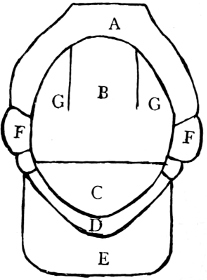
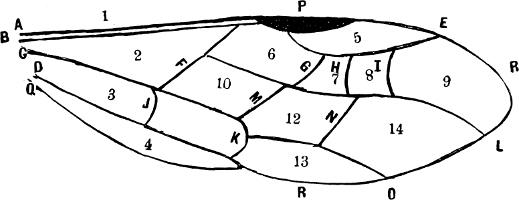
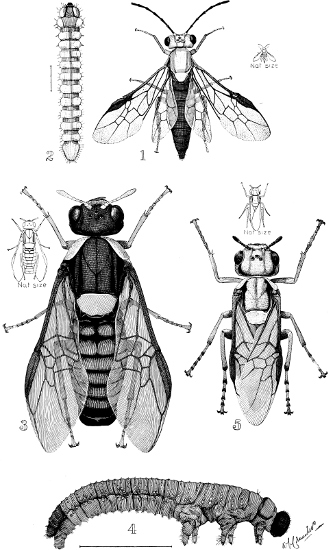
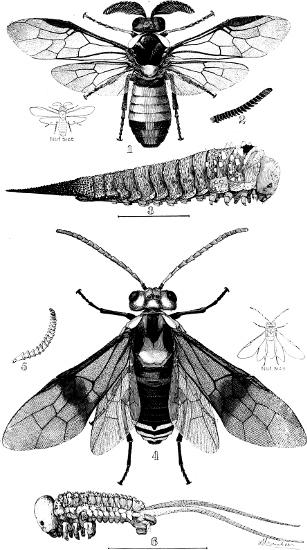
Member of the Association of Economic Entomologists, U.S. America;
Member of the Société Entomologique de France; Member of Council,
Linnean Society of N.S. Wales, and N.S. Wales Naturalists’ Club.
With 37 Plates, containing 270 Figures, also
180 text-blocks.
Sydney:
WILLIAM BROOKS & COMPANY, LIMITED, Printers and Publishers,
17 Castlereagh Street.
PREFACE.
There have been so many enquiries from people in all parts of
Australia, as well as from visitors from other countries, for a book
dealing with our insects, that the writer thinks that the time has come
when a Text Book dealing exclusively with Australian Entomology will be
well received, both at home and abroad, by all those interested in this
subject.
The difficulty has been to write in a popular style so as to interest
the general reader, and induce him to further follow his studies of
the wonders of Natural History, yet at the same time to define the
characteristics of the insects described and give some idea of their
classification, so that it will not lose its value as a Text Book to
the student while enlarging the circle of its readers.
Since the year 1770, when Sir Joseph Banks captured the first diamond
beetle on the sandy shores of Botany Bay, the majority of our insects
have been described in rare old English or foreign publications, the
Zoology of Voyages and Travels, or the Transactions and Proceedings of
Scientific Societies consisting of many hundreds of volumes written in
many different languages.
Many of these original descriptions, written in English or Latin,
are so brief and obscure that without seeing the type they are quite
unintelligible even to the trained entomologist, and therefore are
absolutely of no value to the beginner.
Most of the earlier describers of Australian insects confined their
attention to beetles, moths, and butterflies. Among the few exceptions
are Westwood, who has identified himself with insects in nearly all the
orders, and as he figured many of them (often in colours), there is no
trouble in determining his species; and Walker, who also described many
unique Australian insects (chiefly in the British Museum Catalogues);
but his often vague descriptions, without details or figures, have
puzzled all entomologists who have not had access to his types.
During the last decade, however, as specialists have taken up the
work of monographing the more neglected orders, and as large general
collections of insects have been obtained from what were, at one time,
inaccessible parts of Australia, a writer can now obtain satisfactory
data as to the classification and number of Australian insects hitherto
wanting.
With these views the present text book has been prepared.
The chief drawback to the study of entomology by the outsider has
been, until modern times, the dry-as-dust technical terms used in the
descriptive work, and the formidable names attached to many of the
interesting little creatures, without any information about their
habits or life histories. This is not surprising when we know the
methods of some of the writers, and the material on which they often
worked; namely, specimens obtained from abroad, often in a more or less
damaged condition, discoloured and aborted from being squeezed among
spirit collections, and with a brief or no record of their native home.
This has been all changed since trained students like Darwin, Wallace,
Bates, and many others have spent years in the wilds studying zoology
under natural surroundings, recording their observations while they
made collections, and, with this wealth of material and accurate
knowledge, gave such descriptions, that they have led into many new
fields of investigation, one of the most important of which is economic
entomology.
The Economic Entomologist has become more necessary and important every
year. His investigations, carried on in the field and insectarium,
have not only done much to popularise entomology, but have saved the
countries interested untold wealth by the discovery of methods for
checking the spread and ravages of injurious insects. The technical
description of an insect is not sufficient to satisfy a practical man;
he wants to know where it passes the earlier stages of its existence,
what it feeds upon, and its place in the insect world.
In the open-air study of God’s tiny creatures many pleasant and
profitable hours may be spent, and dwellers in the country need never
feel time hang heavily on their hands, after they have once had their
eyes opened to the wonders of Nature around them. It is the writer’s
privilege to know and correspond with a great many busy men and women,
scattered all over Australia, who are doing valuable work in collecting
specimens, making notes, and seeing both with eyes and brain—true bush
naturalists in every sense of the word.
In acknowledging my obligations to friends who have helped me in the
course of this work, I desire to express my thanks to Mr. Masters
for notes on the habits and range of insects, and the examination
of specimens in the Macleay Museum; to Messrs. Sloane, Lea, Lyell,
R. Turner, Tillyard, Tepper, Kershaw, Dun, Dr. Jefferis Turner, Dr.
Goding, and Rev. T. Blackburn for various notes, specimens, and help
generally. From Mr. C. French and C. French, Jr., I have had the loan
of papers, books, and specimens unobtainable in Sydney, and from Mr. J.
J. Fletcher suggestions and references to works in the N.S.W. Linnean
Society’s library.
Many other correspondents have greatly assisted me in examining and
determining specimens—Dr. Horvath, Dr. Forel, M. André, Dr. Sharp,
Mr. W. F. Kirby, Mr. C. C. Green, Dr. Silvestri, Dr. Howard, Mr. W. M.
Ashmead, and Mr. D. W. Coquillett.
I am indebted to Mr. Maiden for the identification of the native food
plants of many insects.
I am also greatly indebted to Mr. W. S. Campbell for permission to
use the drawings of Messrs. Grose, Burton, and Chambers, which have
previously appeared in the pages of The Agricultural Gazette
of N.S.W., and which for beauty and accuracy have rarely been
surpassed. To Mr. Burton and Mr. Gurney my thanks are also due for
their care in arranging and photographing other specimens. To the other
friends who have kindly aided me in this undertaking in any way I beg
here to offer my best thanks.
CLASSIFICATION.
AUSTRALIAN INSECTS.
In considering the classification of our insects, I have on the
whole followed that adopted by Sharp in his “Insects” (vol. v.,
vi., 1895, 1899), Cambridge Natural History, but at the same time
have considered it advisable, in a work of this kind, to leave out
whenever possible the definition of the smaller sub-divisions. I have
also made one important alteration in his scheme of classification
by placing the Termitidae after the Blattidae, following on with the
Embiidae and Psocidae, as I consider that these are nearer primitive
Orthoptera than Neuroptera in their wing structure; we thus do away
with Pseudo-Neuroptera that has always appeared to be an unnecessary
division; and we should have the courage of our convictions and place
them on one side or the other.
In zoological classification, the sub-kingdom Arthopoda, comprising
creatures whose bodies are composed of rings or segments, and jointed
legs, contains four large groups: (1) Arachnidae, spiders, mites,
ticks, and scorpions; (2) Crustacea, crabs, shrimps, wood lice, &c.;
(3) Myriapoda, centipedes, millepedes, &c.; (4) Insecta, insects; and
a fifth group, Onychophora, containing the Peripatus, is now
included. Though these creatures are broadly related, insects are
readily distinguished from the members of the preceding groups.
The word Entomology is derived from two Greek words, Entomos,
an insect; and Logos, a discourse. Insects are arranged by
entomologists in Orders, Families, Genera, and Species. The first
clearly-defined classification was published by Linnaeus in his
“Systema Naturae,” 1758, where he divided them up into seven great
orders; namely, Coleoptera, Hemiptera, Lepidoptera, Neuroptera,
Hymenoptera, Diptera, and Aptera, distinguished by the number and
structure of the wings. Later on (1778) Fabricius founded another
classification, based on the structure of the organs of the mouth, but
this artificial arrangement soon became obsolete.
In 1815, Kirby and Spence issued the work in four volumes entitled
“An Introduction to Entomology or Elements of the Natural History of
Insects,” a second revised edition coming out in 1816. This was the
first attempt in England to popularise entomology, and to give the
ordinary reader an idea of classification. In it will be found a great
deal of general information that all young entomologists should read.
In Westwood’s “Introduction to the Modern Classification of Insects,”
published in 1839, a great advance was made, and the science placed on
a sound footing; this has been a great help to all workers. He divided
the insects into thirteen orders; but, though the tendency of American
and European writers has been to increase these divisions, we have
reduced them, and in Kirby’s “Text Book of Entomology” only seven are
used. In the last work, “Insects” (Cambridge Natural History, 1895), by
Sharp, the same seven orders are used, though in a somewhat different
manner, with the addition of an eighth, Thysanoptera, to contain the
single family Thripidae.
The correct naming of insects is based on the following rules: First
comes the Order, which may contain a number of Families, all with
certain peculiarities; as, for example, the straight-winged insects,
Order Orthoptera, of which we will take the Family Acridiidae,
“locusts.” This Family is again subdivided into smaller divisions or
groups, called Genera; all the individuals comprised in the Genus have
some well-defined external characters that form a common link binding
them together: the individuals are known as Species. Therefore each
insect when it has been described has a generic or group name, and a
specific or individual name. The generic name should be based on some
Greek or Latin root, preferably the former, but it cannot of course be
compounded from both languages; it should on translation give some clue
to the general distinctive character of the group. The specific name
should be derived from Latin, and give the student some idea of the
locality, markings, colour, or shape of some part of the insect under
observation; thus, Locusta australis, Brunner, is the southern
locust or grasshopper. As a matter of convenience to students, the name
or abbreviated name of the entomologist who first described the insect
follows the name when mentioned in scientific articles or catalogues,
but is not usually done in general work.
The rules here laid down, however, are much more observed in the breach
than in the observance. In former times most descriptions of insects
were written in Latin, but at the present time they are being described
not only in English, French, and German, but many other languages
difficult for the ordinary English student to translate, such as
Russian, Bohemian, Hungarian, &c., so that it is very difficult in many
instances to find out whether some generic names have any meaning.
The difficulty of creating generic names with pure roots that are not
preoccupied by previous writers is always increasing, and to save the
trouble of going through the lists of genera already in use, many
zoologists use the names of other naturalists, names of localities, or
“nonsense” names compounded of a jumble of letters. Then, again, when
the genus is an extensive one containing many species, the describer
gives it the Latinised name of the collector or some friend he wishes
to honour, so that we may come across both a generic and specific name
that throws no light on the identity of the insect. As an example,
Grabhamia curriei; Coquillett named this mosquito in the first
instance Culex curriei, Currie’s mosquito, which was consistent,
but Theobald found on subsequent examination that it belonged to his
Genus Grabhamia, dedicated to Dr. Grabham.
Even without these drawbacks, a beginner naturally finds the
classification of insects a serious task, and the simple committing to
memory of the scientific names a big undertaking; but when he has once
grasped the rudiments, the system will soon appear to him.
One of the most difficult things the popular writer meets with in
scientific work is to find a suitable vernacular name to fit a common
insect; a beetle may be bright yellow, with a brown head; the first man
comes along and calls it the “Yellow-bodied Beetle,” another passes
by and says it is the “Brown-headed Beetle,” yet neither would be
quite accurate or define its main peculiarities. Again, we often find
a popular name that designates a particular insect in one district is
used for quite a different species in another part of the State: quite
recently I asked several correspondents for specimens of the beetle in
the Maitland district known as the “Jackeroi,” and had four distinct
species of weevils forwarded under that name. The “Dicky Rice” is
the name given to a tiny grey weevil (Prosayleus phytolymus)
by the orchardists about Windsor, but in other districts it is used
indiscriminately for a number of other weevils.
Should any one take up a box full of unnamed and unclassified insects,
he will feel like a stranger in a picture gallery without a catalogue;
for, while everything is very beautiful, how much more interesting
if he only knew something about the subject; for the same reason,
each insect named and arranged has an individuality that it did not
previously possess.
DISTRIBUTION.
The insect fauna of Australia is as remarkable and distinctive in its
peculiarities as the flora, and probably for the same reason,—the fact
of its isolated position from the larger continental areas, and the
configuration of the continent. If we take away the eastern mountain
range running north and south from Cape York to Gippsland, we find an
immense tract of almost level country with hardly a river of any size
except the Murray and its tributaries, covered with thick scrub or open
forest, great flat unbroken plains in the south; rolling downs towards
the north; sand-hills, and low timbered ranges in the interior. It is
half the year without any permanent water for hundreds of miles at a
stretch; scorched with a blazing sun and fierce hot winds in summer,
bleak and cold in the winter. Yet there is no desert country of any
extent in the strict sense of the word in the most arid portion; for
given a good fall of rain, the country, apparently parched beyond
recovery, soon puts on a coat of green, wild flowers shoot out, insects
and little creatures of all kinds emerge from their hiding places, and
birds appear as if by magic.
Naturally our fauna, and the insects in particular, have had to adapt
themselves to these extremes, and we find them with many curious habits
without parallel in more normal countries.
Our fauna is extremely rich in gall-producing insects in many different
orders; there are about 50 different species of coccids that form
well defined galls upon their host plants, yet the only record of a
gall-making coccid outside Australia is a single species in Mexico.
Numbers of Thripidae produce galls in the leaves or flower
buds of our native shrubs, while the galls of Psyllidae,
Diptera, and Hymenoptera are very abundant.
Ants, Formicidae, swarm in the driest parts of the interior;
and flies, of all kinds, blow flies, blue bottle, and the small house
flies, are a perfect pest all through the summer months.
All our coastal scrubs are rich in flowering shrubs which provide food
or hunting ground for a large insect population. The flower wasps,
Thynnidae, (in which the males are large and handsome with well
developed wings, but the females are diminutive and wingless,) comprise
several hundred described species; the only other countries in which
they are represented are the west coast of South America, and a few in
the Pacific Islands. The allied ant-like Mutillidae with their
wingless females are more numerous in the interior. Though our country
is very rich in Sawflies, Tenthredinidae, they all belong
to genera peculiar to Australia; the members of the typical genus
Cimbex extending its range as far east as Japan do not reach us.
The low stunted flowering shrubs covering large patches of both the
eastern and western coasts support an immense number of Jewel-beetles,
Genus Stigmodera, also peculiar to this continent. We appear to
have few forms allied to North or South America; our affinities are
with Africa, and the Malay Peninsula; insects of well sustained flight,
as the Orthoptera, are found here identical with species found in
Africa and Asia.
Many insects abundant in the eastern coastal districts are very limited
in their range; but on the western watershed others may be found
ranging right across to the Indian Ocean.
STRUCTURE. — FOSSIL INSECTS
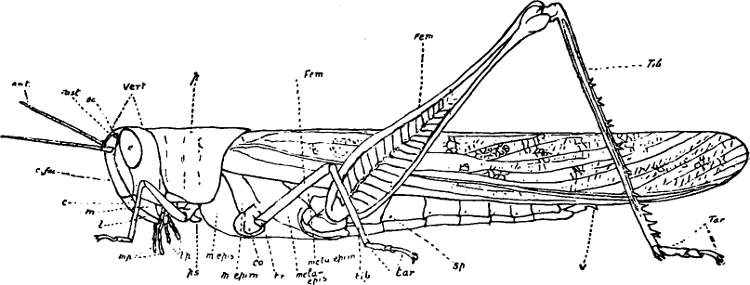
The imago or perfect insect is encased in a more or less perfect horny
integument composed of a substance called chiten, which forms in many
a regular box containing all the vital organs. Every insect can be
divided into three primary divisions: first, the head, to which is
attached the mouth parts, antennae, and eyes; second, the thorax or
chest, sometimes forming a solid mass, but properly composed of three
segments, namely, the prothorax, mesothorax, and metathorax, to which
are attached three pairs of legs, and two pairs of wings (there are,
however, many exceptions to the last, as some have only one pair,
and others are wingless); third, the abdomen or body, consisting of
a number of segments variously estimated from five to eleven, the
normal number being ten, which enclose the digestive, breathing, and
reproductive organs.
Every insect in the first instance comes from an egg or living larva
produced by the female, and though, even to the naturalist, it seems
very hard to account for the countless millions of some of the smaller
insects such as aphids and scale insects which suddenly swarm as if by
magic over plants, there is no such thing as spontaneous generation;
insects cannot come out of the ground from nothing, or be produced
from the crystalline dew upon the foliage as we have sometimes found
stated in newspapers. Again, a grain weevil cannot change into a flour
moth, or vice versa, as many of our farmers will say in all
good faith. In some groups the insects are produced as living larvae,
and commence to feed at once; but in the majority, eggs are deposited
in or upon the food, in which state they may remain without hatching
but a few days, or more than a year. As soon as the little caterpillar
or grub emerges, it starts upon its food, spending the whole of this
stage of its existence in eating and growing, moulting at intervals by
casting off the outer skin to accommodate its increasing bulk; when
full-grown and ready for the final moult, it stops eating, crawls away
into a suitable place, and forms a cocoon, cell, or shell, in which it
pupates. It is now a chrysalis or pupa, quiescent, without any movement
except a slight twitching of the tip of the abdomen when disturbed.
Under the pupal covering the different organs of the perfect insect
become gradually defined, until one bright day the last evolution is
completed, and with a few convulsive movements the perfect insect
bursts out of its enveloping swaddling clothes and appears in all its
beauty and perfection.
Some groups, however, undergo a much more simple or incomplete
metamorphosis; emerging from the egg a baby insect ready to eat, (like
the grasshopper,) the same food as its mother; it undergoes a series
of moults, and after casting its skin every time, becomes more nearly
perfect without any true pupal stage, and finally after the last moult
comes forth with well-developed wings, a perfect insect.
The typical insect is furnished with a large compound eye on either
side of the head composed of a number of small sections called facets,
varying in number from sixteen to several thousands in some of the
more highly developed families, and two or three simple eyes forming
bright shining dots between the compound pair called ocelli. In some
groups these ocelli are wanting; in others both eyes and ocelli, so the
insects are therefore blind.
The mouth parts are composed of several hard plates; in chewing or
biting (mandibulate) insects, they consist of a pair of stout jaws,
in front of which lies the labrum, and behind the maxillae; again
behind the maxillae follows a second pair fused together to form the
labium. Both labium and maxillae are provided with a pair of slender
jointed appendages known as labial and maxillary palpi; these are used
as fingers to assist in drawing food into the mouth. In those groups
with sucking (haustellate) mouths these various parts are coalesced
into a simple sucking tube ending in a sharp style-like tip, which
is buried in the tissue of the plant when the insect is feeding. The
antennae when well developed consist of a number of distinct rings
or segments, standing out on either side of the head, and generally
attached to the front of the head between the eyes; they serve as
organs of touch, smell, and probably hearing. The legs contain five
distinct joints; first, the coxae or hips; next, the trochanters, small
joints with a ball and socket-like action from which the femora or
thighs move backward and forward; to these are attached the tibiae or
shanks terminating in the tarsi or feet at the extremity. Most insects
are also furnished with a pair of tarsal claws, between which may be a
small pad, called the pulvillus or empodium.
The wings of insects vary considerably. Some are membranous and smooth;
others are covered with down or scales; while in many the fore pair
are solid chitinous wing-cases, useless for flight, and chiefly acting
as protective covers to the hind pair, which, when the insect is at
rest, lie folded up beneath them. The flying wings are traversed with
branching tubes called nervures, which, while strengthening them, also
perform an important function in the breathing of the insect, and are
pierced with small openings; these openings are very distinct in some
of the hymenoptera.
Insects breathe by means of openings situated along the sides of the
thoracic and abdominal segments called spiracles, opening out into
branching air vessels called trachea, which pass into the interior,
ramifying throughout the body and extending into every part and
appendage, even to the tips of the antennae. The nervous system, the
life and movement of the insect, consists of a double chain of ganglia,
(ganglion, a knot,) nerve cells, which are connected with finer
encircling nerve tissues, that radiate in all directions, returning
to the ganglia, the latter regulating the nerve sensation. Therefore,
as their perceptions are so much less confined to the brain than in
vertebrate animals, they cannot feel to the same extent. Thus, you
can frequently find a locust, beetle, or ant that has escaped from a
bird, minus its abdomen, still crawling about, quite able to move all
its remaining organs. You can even remove the long slender body of
a dragon-fly, and carefully insert a bit of grass stalk of the same
length and weight to balance the wings, and it will fly off quite
readily; but of course they will not live long after such injuries.
We know that many insects must have very keen perceptions of sound, or
the movement of the air around them, for they will drop to the ground
at the least alarm, before the bush upon which they are resting has
been touched. Very little is understood about the organs of hearing,
except in the case of grasshoppers and locusts where the ears have been
located at the base of the abdomen or on the front leg; these in some
species can be detected with an ordinary lens. It is considered by some
writers that the hairs and spiracles upon the different parts of the
body may transmit sound and act as ears. The organs of sound are very
interesting, but can be better treated when dealing with the different
groups.
Usually, there are only two sexes of insects, males and females; but
among those living in social communities, like the bees, ants, wasps,
and termites, the majority of the inhabitants are neuters. These
neuters are usually aborted females, which do all the work in the
construction of the nest and look after the food supply of the rest of
the community.
In comparison with other countries, fossil remains of insects are
scarce; only ten species have been described and named. My information
on this subject is obtained from Messrs. Etheridge and Olliff’s Memoir
of the Geological Survey, (Palaeontology No. 7,); “The Mesozoic and
Tertiary Insects of New South Wales,” 1890. The first record of fossil
insects was made by Moore in the Quarterly Journal of the Geological
Society, 1870, entitled “Note on a plant and insect bed on the Rocky
River, N.S.W.” “These insects were obtained from a chocolate-coloured
micaceous laminated marl, forming a bed ten feet thick, at a depth of
about one hundred feet from the surface, and forming a portion of the
Tertiary drift worked at the above locality. The latter are probably of
Pliocene age.” (E. & O.)
Jack obtained the wing of a dragon fly in the Cretaceous beds of
the Flinders River, N. Queensland, which was described and figured
by Woodward under the name of Aeschna flindersensis in the
Geological Magazine, 1884. It was entombed in a dark chocolate
limestone.
The insects described and figured by Messrs. Etheridge and Olliff
consist of a cicada (C. lowei) from the “Taeniopteris-bearing
beds of the Talbragar River in New South Wales, and of Lower Mesozoic
age”: a fly, Chironomus venerabilis: and a mayfly, Ephemera
culleni: and a beetle larva belonging to the Lampyridae,
under the name of Palaeolycus problematicus, from the Tertiary
beds at Emmaville, New England.
From the Ipswich Coal Measures of Queensland comes the fossil wing
of a Buprestid beetle, allied to existing Stigmodera, which they
called Mesostigmodera typica. Among the insect remains from
this locality the authors note several wings that appear to belong to
weevils and other beetles allied to existing species.
Mr. W. S. Dun informs me that insect remains have been found at
Narellan N.S.W. in Wianamatta shales, and also in the brick pits at St.
Peters near Sydney.
Order I.—APTERA. Spring-tails and Silver-fish. — Family 1. Spring-tails. COLLEMBOLA. — Family 2. Silver-fish. THYSANURA.
These tiny little creatures are wingless in all stages of their
existence, with only six segments in the abdomen; they are active
little creatures of very delicate structure, found in all kinds of
situations. We have many indigenous species, but on account of their
small size and retiring habits they have been seldom noticed, and a
wide field awaits some future entomologist who undertakes the study of
these interesting insects.
Very little systematic work had been done with these insects until
Lubbock’s “Monograph of the Collembola and Thysanura” was published
by the Ray Society in 1873. In this work not only are a large number
described, but observations made upon their habits and life histories
are recorded.
These are among the smallest insects, for the largest does not measure
more than ⅓ of an inch in length, and most of them are very much
smaller. They are chiefly found in damp situations among loose soil,
decaying vegetable matter, and such like material, and can stand a very
cold temperature. They are easily distinguished from the silver-fish by
the few joints in the antennae, and the great powers of jumping they
possess by means of their long jointed tail appendages.
Our common species, Lipura sp., is at times very abundant in
the loose soil; after a sudden thunderstorm they are often washed out
in such numbers that, carried into the little pools along the road
side, they form a dull blue scum on the surface of the water. They
measure ⅓ of a line in length; are of a dull blue colour, and have
short, thickened antennae and legs; the body is distinctly segmented
and rounded at the tip. Resting on the surface of the water they are
constantly in motion, springing up every moment like little rubber
balls.
Another species belonging to the Genus Smynthurus, allied to
S. viridis, a European form, but probably an undescribed native
species, appeared in great numbers in lucerne paddocks in S. Australia
in 1896, where they did a great deal of damage by eating the surface of
the leaves, swarming over the fields in countless millions.
It is a member of this genus (Smynthurus lutus) that Lubbock has
described in such an entertaining manner when recounting the courtship
of these queer little creatures.
The silver-fish are divided into two distinct groups: those clothed
with fine loose silver-like scales, and those in which the scales
are absent and are replaced by fine hairs. The abdomen contains ten
segments; their bodies are elongated, furnished with long, slender,
many jointed antennae tapering to the extremities, and the tip of the
abdomen carries two or three slender thread-like tail appendages.
Though the group has been divided into four divisions, there are not
many species described; they frequent warm, dry, dark situations.
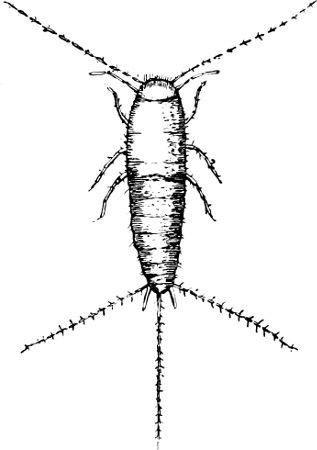
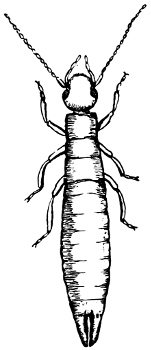
Fig. 1.—Lepisma saccharina (Linn.).
The common Silver-Fish.
(Redrawn from Marlatt’s “Household Insects.”)
Lepisma saccharina, the Common European Silver-fish, measures
up to ½ an inch in length, and is covered with delicate lead-coloured
scales that give it a dull metallic lustre. They are great pests in
libraries, where they eat the glaze on papers or clothbound books,
pasted labels, or even the surface of etchings and engravings. Our
common species was generally supposed to be this insect; but Dr.
Silvestri, to whom I submitted a number of specimens caught in Sydney
houses, says that it is Lepisma longicaudata, the common African
species unknown in Europe.
There is another tiny, little, dull yellow species found under stones
in ants’ nests that Silvestri has named Lepisma cursitans. In
the dry western scrubs of the interior under stones, hiding in the
dust, I collected Lepisma producta. In a natural open cave among
the sandstone cliffs on the sea shore near Gosford N.S.W. I found
a number of a very large species resting on the bare rock, with a
striking resemblance to small dried shrimps; for this peculiar species
Silvestri proposes the name of Allomachilus froggatti.
Order II.—ORTHOPTERA. Cockroaches, Grasshoppers, Termites, &c. — Family 1. Earwigs. FORFICULIDAE. — Family 2. Cockroaches. BLATTIDAE. — Family 3. White Ants. TERMITIDAE. — Family 4. Web-spinners. EMBIIDAE. — Family 5. Book Lice. PSOCIDAE. — Family 6. Mantids. MANTIDAE. — Family 7. Stick or Leaf Insects. PHASMIDAE. — Family 8. Short-horned Grasshoppers. ACRIDIIDAE. — Family 9. Long-horned Grasshoppers. LOCUSTIDAE. — Family 10. Crickets. GRYLLIDAE.
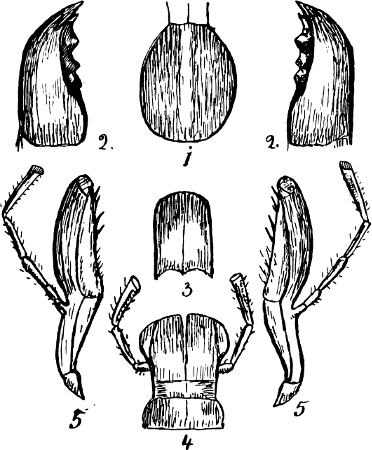
Fig. 2.—Mouth Parts of a Grasshopper, Showing
the different parts.
1. The labrum, or upper lip.
2. Mandibles.
3. Jaws.
4. The lower labrum.
5. Tongue.
(Redrawn from Duncan’s “Transformations of Insects.”)
The members of this order are known as straight winged insects, because
the narrow membranous fore wings (elytra) are usually laid flat along
the sides of the body, covering the fan-shaped hind wings that are
folded up beneath them. In some of the families we find groups or
individuals with the wings rudimentary or so modified in structure as
to be useless for flight, and in a few the perfect insects of one or
both sexes are wingless. In some, like the typical grasshoppers, the
hind legs have the thighs greatly developed and adapted for springing
or jumping; in the Mantids the two hind pairs of legs are simple, but
the front pair are produced into curved, spined tibiae and femora,
weapons well adapted to capture their prey. The mouth parts are
composed of a rounded upper lip, with two stout mandibles, and a pair
of jaws to which are attached jointed appendages (maxillary palpi),
the labrum or hind lip bearing similar appendages called the labial
palpi; besides these they have a stout spade-shaped tongue, so that
they both bite off and chew up their food.
Though the majority are vegetarian in their habits, one group, the
mantids, are carnivorous, and in these insects the mouth parts are
produced into a sharp point to the tip of the jaws.
They emerge from the eggs that are deposited singly or in masses in or
upon the ground or attached to the twigs of their food plant; as baby
insects they are much like the adult, undergoing a series of moults
without any true pupal stage, until in the last moult they emerge with
fully developed wings and reproductive organs.
The Orthoptera comprise a number of very different looking insects,
among them some giants of the insect world like the stick and leaf
insects. I have placed the earwigs, cockroaches, termites, embids, book
lice, grasshoppers, crickets, mantis and phasmids together, though
there is some difference of opinion among entomologists as to the exact
position of the termites, embids, and book lice. The latest list of
the Orthoptera is W. F. Kirby’s “Synonymic Catalogue of Orthoptera,
vol. I.,” containing all the named species of the Forficulidae,
Hemimeridae, Blattidae, Mantidae, and
Phasmidae. This work was published by the Trustees of the
British Museum, 1904: a second volume (not yet published) dealing with
the locusts, grasshoppers, and crickets will complete this work. The
latter were catalogued by F. Walker 1869–1870 in five parts, (Catalogue
of the Specimens of Dermaptera, Saltatoria, and Supplement to the
Blattariae in the British Museum), which this work of Kirby’s when
finished will supersede.
Among the chief specialists on Orthoptera may be mentioned
Henri de Saussure, who besides his monographs in the “Biologia
Centrali-Americana,” has published many papers in scientific journals,
of which the most important (containing descriptions of Australian
species) is his “Melanger Orthopterologiques” in the Memoirs de la
Societe de Physique et d’Histoire Naturelle de Geneve 1863–4, and
in subsequent volumes. Brunner von Wattenwyl has described other
Australian species in different German publications, and in 1893
published his “Révision des Système des Orthoptères” in the Annali del
Museo Civico di Storia Naturale di Genova.
Kirby described other of our species chiefly in papers contributed to
the “Annals and Magazine of Natural History,” and the Transactions of
the Zoological and Entomological Societies.
These insects are slender in form, with somewhat rounded heads bearing
two large facetted eyes, but no ocelli; and long slender antennae
composed of short oval joints. The elytra, very short, usually not
extending beyond the hind margin of the thorax, cover the hind wings
when at rest. These hind wings are short but broad, somewhat resembling
a human ear when expanded for flight, but neatly folded up beneath
the abbreviated elytra at other times. In many groups however both
elytra and wings are absent, the insects trusting to their legs and
powers of burrowing to get out of danger, and even those with well
developed wings seldom use them. The thorax is narrow; the legs stout,
well adapted both for digging and running; and the abdomen, tapering
to the extremity, terminates in a pair of callipers or pincer-like
processes, sometimes curved and toothed into remarkable shapes. It is
the possession of these curious anal appendages that has led to the
earwig being popularly credited with all kinds of evil propensities;
but though they certainly look very formidable they can only give
one’s finger a harmless pinch if handled carelessly, and are otherwise
perfectly harmless.
Fig. 3.—Labidura truncata (Kirby).
The common Earwig found in the sand along river banks.
(Original W. B. Gurney.)
Earwigs are met with chiefly in damp situations; some of the smaller
ones can be collected by pulling the rotten bark off dead trees; others
are to be found under stones or logs; and in summer time many will be
found in burrows in the damp sand on the water’s edge after the manner
of mole crickets. In point of numbers this is not a large family, only
about 520 species being described from all parts of the world; and only
about 20 from Australia, so that they are poorly represented in this
country.
The Genus Labidura contains 15 described species from all parts
of the world; Labidura riparia, a cosmopolitan species ranging
from Europe to Asia and Africa does not reach Australia; but we have a
typical species in Labidura truncata, which has similar habits,
living in burrows in the sand along the edges of lagoons and creeks.
It measures an inch in length, and is of a general reddish brown tint
mottled with dull yellow; and the dorsal segments of the abdomen are
deeply barred with reddish black almost confluent down the centre. The
head is large; the prothorax small, with the elytra and wings well
developed; the abdomen, rather narrow at the base, is broadest behind
the large callipers, which are slender, furnished with two blunt teeth
on the inner edge and meet at the extremities. It differs from L.
ripara in having the apical edge of the last abdominal segment
truncate, and not scalloped as in the former.
The next large Genus Anisolabis is also world wide in its
range and contains 36 described species, 3 of which are recorded from
Australia, 2 from Tasmania, 1 from New Zealand, and 1 from Norfolk
Island. Anisolabis colossea, our largest common wingless
species, also recorded from New Caledonia, was described by Dohrn (Ann.
Museo Genov. 1879), and a second variety by Burr under the name of
A. minor in 1902; but it is most variable in size, ranging from
over 1½ inches in length to less than half an inch. It is of a uniform
dull reddish brown colour, with a rounded head, truncate thorax, and
elongate broad abdomen terminating in a pair of short stout finger-like
appendages fitting close together and turned up slightly at the tips.
A second species of Anisolabis common in Tasmania and recorded
from the top of Mount Wellington is black, somewhat broad and flattened
on the dorsal surface, with the anal appendages short, slender, and
twisted over to the left side as if they had been damaged. It was
described by Bormans (C.R. Soc. Ent. Belg. 1880) under the name of
Anisolabis tasmanica.
Fig. 4.—Anisolabis colossea (Dohrn).
The large wingless earwig.
(Original W. W. Froggatt.)
Labia grandis described by Dubrony (Ann. Museo Genov. 1879)
comes from North Australia. The genus contains 47 described species;
several undetermined species in my collection are small dark brown
earwigs with well developed elytra, and anal appendages very narrow at
the base, small, and curving over at the sharp tips.
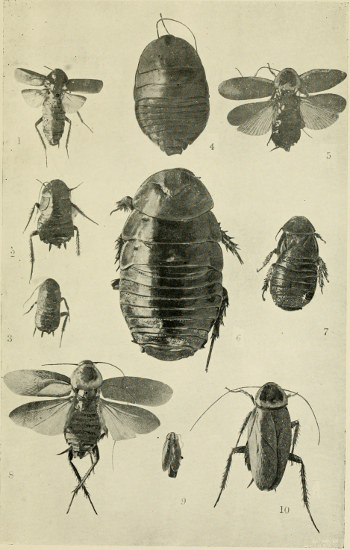
Plate I.—ORTHOPTERA.
Family Blattidae.
1. Blatta orientalis ♂ (Linn.).
2. Blatta orientalis ♀ (Linn.).
3. Blatta orientalis Larva (Linn.).
4. Polyzosteria limbata (Burm.).
5. Periplaneta australasiae (Fabr.).
6. Geoscapheus giganteus (Tepper).
7. Panesthia laevicollis (Sauss.).
8. Periplaneta americana (Linn.).
9. Phyllodromia germanica (Linn.).
10. Periplaneta americana (Linn.).
Plate I.—ORTHOPTERA.
Apterygida arachidis, a cosmopolitan species recorded from
all parts of the world, is found in Australia; and the common
European typical species, Forficula auricularia, which is
widely distributed over the old world and America, is not recorded from
Australia in Kirby’s Catalogue, but I have specimens in my collection
given me by Mr. J. J. Walker taken in New Zealand, who told me he had
also captured it in Tasmania, so that it is more than probable it will
be found on the mainland.
The typical cockroach is a shield-shaped insect, with stout horny
plates covering both the dorsal and ventral surfaces of the thorax and
abdomen. The head, tucked under and hidden, when viewed from above by
the rim of the prothorax, is furnished with two large compound eyes
placed well in front; in some groups there are also two ocelli; the
antennae springing from below the eyes are very long and slender,
composed of a great number of short ringed segments. The jaws are well
adapted for their vegetarian habits, though some among the domestic
species are almost omnivorous in their tastes. Tepper considers that
several species destroy the grubs and caterpillars of injurious
cut-worms, but this wants further confirmation. Their legs are long and
stout, covered with spines, and in the species living under stones and
logs the legs are usually thickened. Many species are provided with
two pairs of stout membranous wings, while the front pair (elytra)
are thickened, opaque and coarsely veined; the hind wings, though
frequently small, are fan-shaped, membranous and well adapted for
flight.
The cockroach is one of the most ancient of insects, and roaches are
common in fossil beds both in Europe and America, many of them allied
to our still existing forms.
The female has a curious habit of carrying her keeled egg capsule
protruding from her abdomen for some time before she deposits it in a
suitable situation.
A number of cosmopolitan species might be called domestic insects
as they are only found about houses or the haunts of man; in London
Blatta orientalis is commonly known as the “black beetle,”
swarming in cellars and kitchens. In Sydney the large yellow roach
that comes flying round the room to the light is Periplaneta
americana, an introduction from America, which has almost driven
the smaller indigenous Periplaneta australasiae out of our
houses; while in some of the southern and eastern States of America
our Australian roach has been introduced and become the common
domestic pest. The little German Roach, or “Croten Bug” of America,
Phyllodromia germanica, is sometimes found about the Sydney
wharves. Many of these bush and household roaches are provided with
glands at the tip of the abdomen, from which they can discharge (when
disturbed) a foetid odour as a means of defence. The cockroaches are
a very extensive family; Marlatt estimates that at least 5,000 occur
all over the world; about 212 species are given by Kirby (Catalogue
Orthoptera vol. I. British Museum 1904) as Australian. Most of our
typical forms are wingless, and live under rotten logs or stones; some
of the largest species are to be found in the dry interior.
Saussure has described a number of our species (Mem. Soc. Geneve
1863–4–9): Walker many others, (Brit. Mus. Catalogue Blattidae 1868):
and Tepper has been a constant worker at this group in South Australia
for some years; descriptions of most of his species will be found in
the Transactions of the Royal Society of S. Australia between 1893–95,
and the Zoology of the Horn Expedition 1896.
The Genus Panesthia contains 44 described species ranging from
India to Australia, of which 7 are peculiar to this country.
Panesthia laevicollis is common in forest land, where it is
found burrowing in damp rotting logs. It is a wingless black insect,
measuring nearly 1½ inches in length, with the thorax narrow and
flattened above the head, the latter furnished with comparatively short
antennae; the legs short but very spiny; and the dorsal surface of the
abdomen covered with irregular punctures.
Cosmozosteria coolgardiensis is a very distinctive, wingless,
dull yellow species broadly marked with black on the thoracic segments,
and finely barred with the same colour on the upper edges of the
abdominal segments. It measures about 1¼ inches in length, and ranges
from South Australia to the central parts of Western Australia.
Polyzosteria limbata is a large dark brown cockroach margined
on the outer edge of the dorsal plates with yellow; it is common in
the vicinity of Sydney, and may be often noticed in the neighbourhood
of Botany resting on stumps and fences; it has the habit, like several
other species, of discharging a most offensive liquid when disturbed.
Polyzosteria pubescens is an allied but much larger insect,
measures up to 2 inches in length and 1½ inch in breadth; it is of a
uniform dull brown tint, and is common about Kalgoorlie W.A., and will
be probably found to range over a large portion of the interior.
Polyzosteria mitchellii is a variegated, dull metallic green
cockroach ranging over the same country, but not more than 1½ inches in
length. It has the upper surface margined on the edges with yellow, and
is mottled on the legs and under-surface.
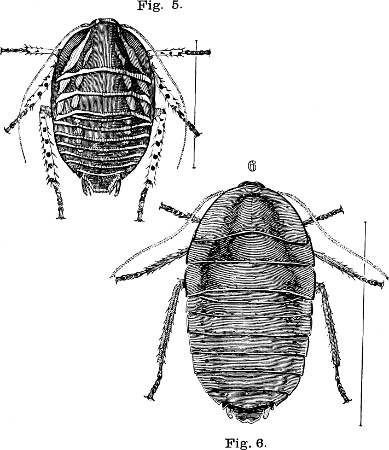
Figs.5 and 6.—Desert Cockroaches.
5. Polyzosteria mitchellii (Angas). The green-banded
cockroach.
6. Polyzosteria pubescens (Tepper). The Pubescent
cockroach.
(“Agricultural Gazette,” N.S.W.)
Geoscapheus giganteus is our giant cockroach, measuring 2½
inches in length and 1½ across the middle of the body. Like the last
three it is wingless, with the large prothoracic shield overlapping the
head. In colour it is bright reddish brown, crenulated and very rugose
in the centre of the dorsal surface. In the same year (1895) that
Tepper obtained this fine species, Saussure described another large
roach under the name of Macropanesthia rhinoceros, forming a
new genus for its reception and adding a second species which he named
M. muelleri.
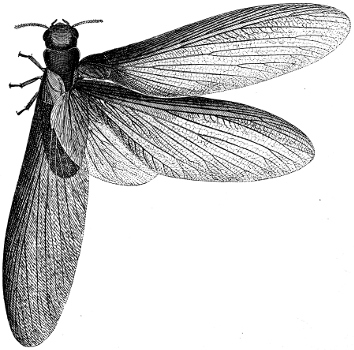
Fig. 7.—Mastotermes darwiniensis
(Froggatt).
The giant termite of Northern Australia, showing the structure of the
wings of the male.
(“Agricultural Gazette,” N.S.W.)
The exact position of these insects in every scheme of classification
has been more or less vague, and while some writers place them in the
Orthoptera, more include them in the Neuroptera; others again to get
over the difficulty have formed a halting ground between the two and
called them Pseudo-Neuroptera. In the “Genera Insectorum,” Desneux has
followed Brullé and Comstock and placed them in a distinct order as
Isoptera. Grassi, one of the greatest living authorities on the anatomy
of insects, considers they are allied to the Neuroptera: but taking the
broad ground of outward structure upon which the Orders were formed,
and comparing the perfect termites, especially my giant species from
North Australia, Mastotermes darwiniensis, with other families,
I consider they are closely allied to the cockroaches, and therefore
place them here. Take the wing away from some of the larger species and
they have a striking resemblance to earwigs, and one of our greatest
authorities on the family (Hagen) actually described a damaged earwig
from Japan as a termite.
Termites are widely distributed over all the warmer regions of the
world, though most numerous in tropical countries; and a number of
fossil species have been described from Europe and America.
When Hagen’s “Monograph of the Termitidae” was published in 1858, only
seven species were recorded from Australia and Tasmania, and one or
two of these are very doubtful. In my “Australian Termitidae” (Pro.
Linn. Soc. 1896–1897) the number was brought up to 35, and there are
probably many more to be discovered, so that the family is very well
represented in this country. Our species have been subdivided into nine
genera placed in six sub-families, which are chiefly formed on the wing
structure.
Broadly speaking their habits are very similar, and each nest or
community consists of the same castes. First in order come the dark
brown perfect winged male and female insects, only found in the regular
nests in the early summer months; for soon after their wings are
developed, the workers cut openings in the clay walls of the nest, and
they fly out in a continuous stream, generally just before sunset, and
when all have left the workers again close up the openings for another
year. In the winged state they are known as “flying ants,” and on a
warm summer night sometimes come in such numbers round the lights,
dropping their easily detached wings all over the table, that they are
a regular nuisance.
These perfect termites have well developed eyes; slender antennae
composed of short, rounded, bead-like joints standing out in front of
the rounded flattened head; and a short stout thorax fitting close
against the elongate rounded abdomen. They are furnished with two pairs
of similar, elongated, narrow wings of uniform width rounded at the
tips, with primitive parallel neuration; these are loosely attached to
the basal wing-flap by a cross suture, where they readily tear them
across; when at rest they are laid flat over each other down the back,
extending well beyond the tip of the body: the legs are short and stout.
Their flight is feeble, and of the millions that swarm out and flutter
away from the nest, probably not more than halfa-dozen couples are
fortunate enough to get into a suitable place to found a fresh colony.
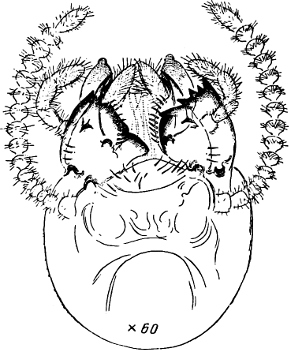
Fig. 8.—Diagram of head of worker termite.
Dorsal view, showing the jaws and mouth parts. Coptotermes (Termes)
lacteus (Froggatt).
(“Agricultural Gazette,” N.S.W.)
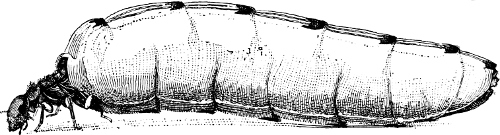
Fig. 9.—Coptotermes (Termes) lacteus
(Froggatt). Fully developed female or Queen.
(“Agricultural Gazette,” N.S.W.)
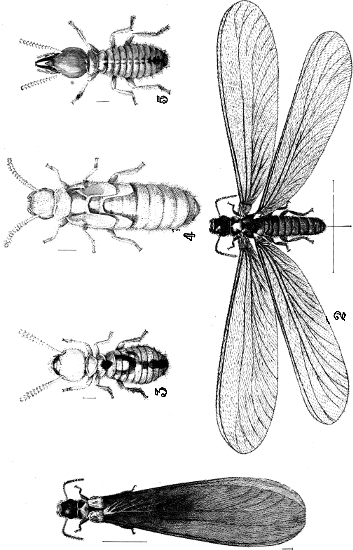
Plate II.—ORTHOPTERA.
Family Termitidae.
Coptotermes (Termes) lacteus (Froggatt).
1. Male (wings closed).
2. Male (wings expanded).
3. Worker.
4. Nymph.
5. Soldier.
Plate II.—ORTHOPTERA.
The next caste, that form the bulk of the life of the nest, are the
workers, delicate soft white creatures with pale yellow, rounded,
flattened heads; blind, but furnished with slender antennae; and a pair
of short stout toothed jaws hidden by the labrum, and which in the
course of their labours do such immense damage to all kinds of both
native and imported timber. The third caste, also always present, are
the soldiers, that simply act as guards for the whole nest, leaving
all the work of building, feeding the young, and gathering supplies to
the workers. In the fourth we have the Queen, which was originally one
of the winged forms; after casting her wings she is impregnated, and
while the head, thorax and appendages remain as before, the abdomen
swells into a white cylindrical sack as thick as one’s little finger;
the chitinous plates that once fitted close together are now widely
separated and appear as narrow black bands. She is simply a mass
of egg tubes; and, looked after and fed by the attendant workers, she
devotes her life to laying eggs, which, like grains of sugar, are
carried away and piled up by the workers in adjacent chambers under
the nursery. From these eggs develop tiny white specks of matter that
gradually develop by a regular series of moults into workers, soldiers,
and immature winged forms; the latter have large rounded bodies and
rounded wing pads representing the future wings. Supplementary Queens
are sometimes found that have never gone through the winged stage; they
have the general structure and large corrugated bodies of the mature
queens. The typical white ants’ nest, known as a Termitarium, usually
consists in the first instance of a mass of woody laminated material
that might be likened to papier-mache, originally a stump or portion of
a log that has been chewed up and voided in the form of a mortar-like
substance. This termitarium is full of irregular galleries running like
a network all through the mass, with the means of exit running out
under the nest; a mass of stout terraced structure above the ground
level surrounds the Royal Chambers, which might be likened in size
and shape to an inverted saucer, from which the enclosed Queen cannot
escape, but the attendant workers can pass to and fro. Above this is
a rounded oval mass often as big as a child’s head, which resembles
stiff brown paper folded round and round, full of fine openings, and
is easily crumbled up; this, for want of a better word, I call the
nursery, as it contains all the minute larvae as they emerge from the
eggs. The formation above the nursery is more irregular, and terminates
in a rounded cap. The whole of this woody structure is covered with a
stout enveloping wall of fine clay, which, carried up grain by grain,
has been cemented together into a firm earthy wall in contact with the
woody structure at the base of the nest, but often with a cavity at the
apex.
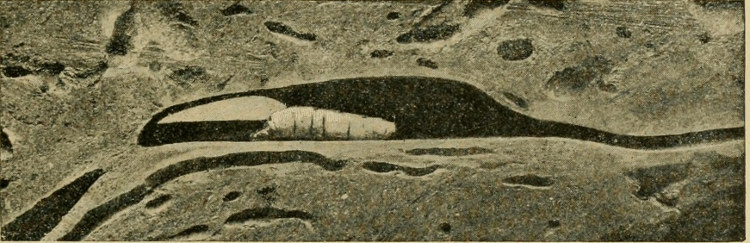
Fig. 10.—Queen Termite (C. (Termes)
lacteus) (Froggatt). Showing her in the Royal Cell or Queen’s
Chamber.
(“Agricultural Gazette,” N.S.W.)
The nests of the Eutermes are sometimes built over stumps, but
more often on the branches or trunks of trees, where they form rounded
or oval masses a foot or two in diameter, with covered galleries
leading down to the ground. In these nests there is no distinct outer
earthy sheath; when near the ground, earth and wood are blended
together in a very compact mass, full of small galleries running at
every angle, and have no distinct structure like the first group. When
the nest is placed on a tree trunk or branch away from the ground it
consists almost entirely of woody matter, and may be quite soft and
papery beneath the outer crust. In the West Indies these nests are
popularly known as “Negroheads.”
Other groups are never known to construct true nests, but form chambers
and galleries under the bark of trees, in banks, or simply under logs
and stones. Some in the interior are said to disappear underground from
their nests in the dry summer time, returning with the first rains and
mending up the dilapidated walls.
The members of the two genera Mastotermes and Calotermes
have the wings much more thickly veined than the more simple
Termes and Eutermes.
Mastotermes darwiniensis is the largest common species taken
flying round the lights at night in North Queensland and Port Darwin.
It is very dark brown, with thickly veined wings, and measures 1⅓
inches in length from the front of the head to the tip of the folded
wings. Nothing is known of its nests or the other forms of this
species. It is the sole representative of the sub-family. I have,
through the observations of Mr. N. W. Christie of Port Darwin, good
reasons for believing that Termes errabundus, described from the
soldiers and workers only, is identical with this giant termite. He
informs me that at Point Charles he finds the nests in every old post
or stump in the wet season.
Calotermes longiceps is the common Sydney species of this
group, of which we have six described from Australia, and one from New
Zealand. The soldier measures ½ inch in length, with a long broad head
armed with blackish projecting jaws, which are irregularly toothed on
the inner edges. The Calotermes live in logs and trees in small
communities; they form no regular nest; this species is found in logs
of firewood about Sydney. In some species the soldiers are very rare,
the community consisting of immature winged forms and workers.
Plate III.—ORTHOPTERA.
Family Termitidae.
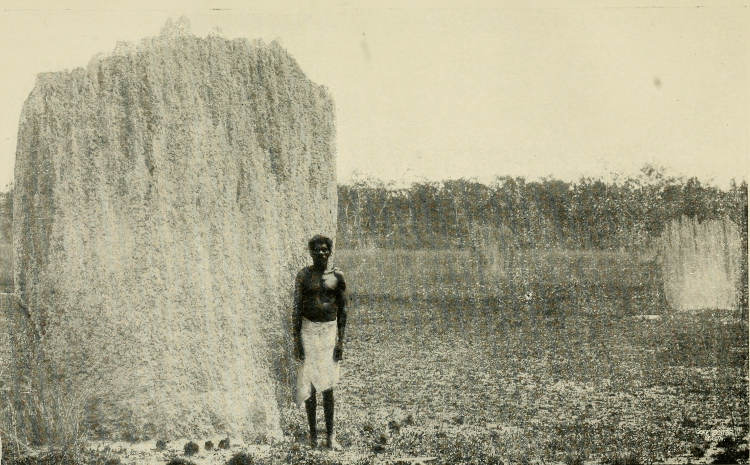
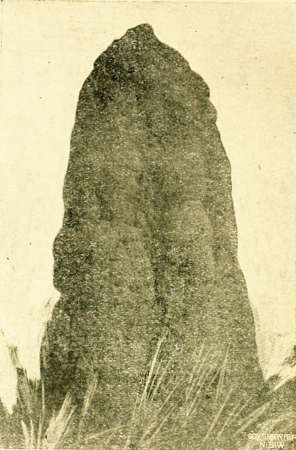
Termitarium of the Meridonial White Ant, Termes meridionalis
(Froggatt).
“The Magnetic Nest,” Palmerston, Port Darwin, N. Australia.
(Original photo. N. Holtz.)]
Plate III.—ORTHOPTERA.
In the Rhinoterminae we have two species, differing from the
former group in having the wings very finely wrinkled or reticulated;
and also in having two distinct forms of soldiers, one much larger
than the other, but both with pear shaped heads and pointed
finely-toothed jaws. Rhinotermes intermedius is not uncommon in
old stumps about Sydney; the winged forms are of a light reddish brown
colour with delicate wings; both the workers and soldiers of the major
type have large yellow heads, the latter armed with curved jaws; while
the heads of the small form of soldiers are much more slender.
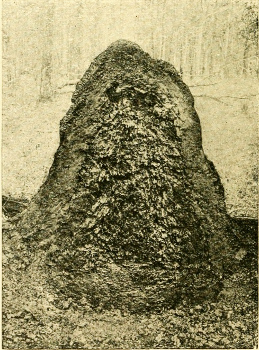
Fig. 11.—Typical Domed Termitarium or “White
Ants’ Nest” from the coastal districts of New South Wales. Formed
by Coptotermes (Termes) lacteus (Froggatt).
(“Agricultural Gazette,” N.S.W.)
Fig. 12.—Vertical section of nest of the same species shewing
the structure of the woody interior, with the outer clay covering.
(“Agricultural Gazette,” N.S.W.)
The typical Termitinae comprise nearly all the species that
build regular mounds, containing countless thousands of individuals.
Termes lacteus is the common species that does so much mischief
to buildings about Sydney, and though not a mound builder about the
city, yet from Colo Vale to Victoria and also northward it forms tall
rounded nests up to six feet high and very regular in structure. The
soldier is about ¼ inch long, with a bright, yellow, pear shaped head,
and a pair of curved jaws; it also has an opening in the front of the
head above the jaws from which it can discharge a globule of milk-like
fluid when disturbed. This species with several allied forms has been
placed in the genus Coptotermes. Termes meridionalis has
a small soldier, almost white, with a rounded yellow head armed with
two slender curved jaws, and an incurved tooth in the centre of the
inner margin; it measures a little over ⅙ of an inch in length. It has
a world wide reputation on account of building what is known as the
“Magnetic Nest,” built like a brick wall and always pointing north and
south, with the wall facing east and west. Jack (Pro. Royal Society,
Queensland, 1897) considers that this is done by the termites always
building towards the rising sun; so that, as they work at night, the
clay will dry rapidly. They are found in several localities on Cape
York and near Port Darwin. Several very distinct species are found in
the interior. Termes perniger ranges from Kalgoorlie W.A. to
Western Queensland; the soldier is a very dark coloured insect with
a very large head furnished with large powerful toothed jaws, and
is very savage. T. rubriceps is found in small colonies in
Central Australia, forming their nests at the roots of the tussocks of
spinifex grass. T. krisiformes, a species in which the soldier
has slender irregular jaws like a Malay kris, makes tiny little mounds
about Bulli N.S.W. or forms colonies under the shelter of a log.
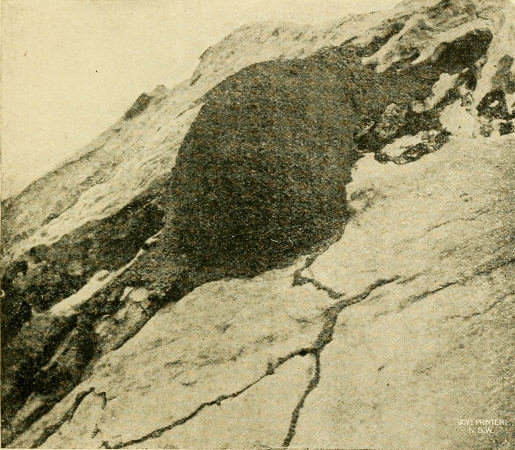
Fig. 13.—Nest of White Ant (Eutermes
fumipennis) (Walker), upon the summit of a rock where a small stump
had been situated. Manly, near Sydney, N.S.W.
(Original photo. W.W.F.)
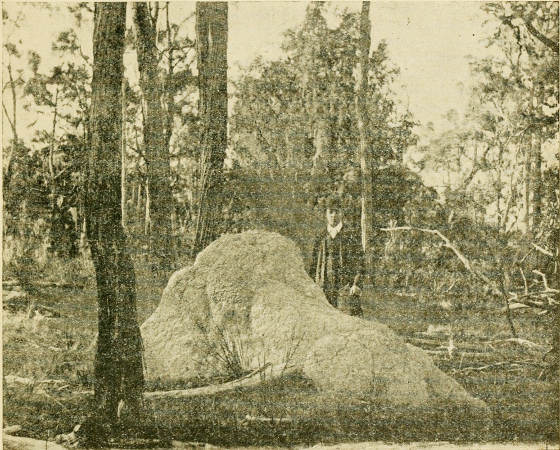
The members of the genus Eutermes are common all over Australia;
they construct hard woody nests seldom more than a foot or two high;
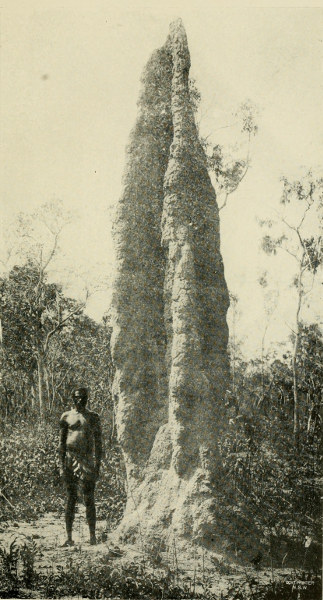
though at the same time, the largest known termitarium is also built
by one species, Eutermes pyriformis, pillar shaped and often 18
feet in height, probably in the first instance commenced over a dead
tree trunk.
The soldiers are very curious looking creatures; the peculiar oval or
rounded heads produced into an awl-like point in front, the centre
being filled with a clear honey-like fluid; this is discharged down the
projecting snout and smothers their enemies, because they have no true
jaws above the mouth: most of them are much darker brown insects than
the other termites. The two species, Eutermes fumigatus, the
darker, smaller species, and E. fumipennis, the lighter tinted,
are common in the vicinity of Sydney.
Fig. 14.—Typical nest, of the Spinifex termite (Eutermes
triodiae) (Froggatt), about 14 feet high. Hall’s Creek, Kimberley, W.A.
(Original photo. Mansbridge.)
These rare and curious little chocolate brown creatures are elongate in
form, not unlike a slender adult termite after it has shed its wings,
and they form another group that has puzzled entomologists in regard to
their classification. Only twenty species are known from all parts of
the world; but from their affinities to prehistoric insects they have
been carefully studied. Grassi worked at the life-history of a species
found in Southern Europe under stones: Wood-Mason has figured and
described Indian forms and placed them in the Orthoptera: Perkins says
that the species in Hawaii is common on tree trunks where they conceal
themselves under a fine web like spiders.
Plate IV.—ORTHOPTERA.
Family Termitidae.
Termitarium of the Great Mound-nest White Ant, Eutermes
pyriformis (Froggatt).
Palmerston, Port Darwin, N. Australia.
(Original photo. N. Holtz.)
Plate IV.—ORTHOPTERA.
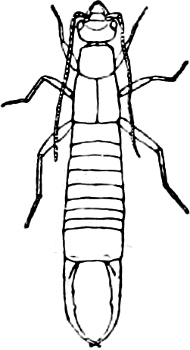
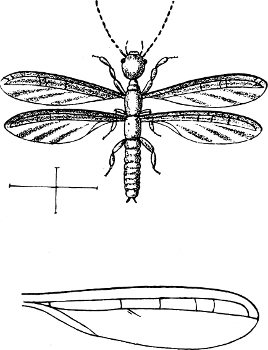
Fig. 15.—Oligotoma gurneyi (Froggatt). The web spinning
embiid. With a diagram showing the primitive structure of wing.
(Proc. Linn. Soc. N.S.W.)
They measure up to about ½ an inch in length; are elongate in form
with large globular heads, small toothed jaws, and long, slender
antennae composed of 20 or more bead-shaped joints which they are
constantly moving when they run about. The thorax is formed of three
very elongated segments, so that each pair of legs is very wide
apart; and in the winged forms the slender oar-shaped wings with very
primitive nervures are so far from each other that they have quite
a comical look; the abdomen is short, cylindrical, composed of 10
segments, rounded at the tip, with large anal appendages (cerci). The
legs are curiously thickened, with the tarsi of the front pair shaped
somewhat like a weaver’s shuttle. Until last year they were unknown
in Australia, when I described two species (Proc. Linn. Soc. 1904);
the first Oligotoma agilis, is a wingless form, of which I
found two specimens while turning over granite boulders at Bomen near
Wagga N.S.W. The second, Oligotoma gurneyi, was obtained by Mr.
Gurney in a lighted room one evening in a suburb of Sydney; it had well
developed wings. Soon afterwards Mr. Steel had his attention called to
what one of the men in the Colonial Sugar Co.’s refinery at Pyrmont
called a “white fungus” under one of the windows. This Mr. Steel found
to be a mass of white web matted with excrement and full of slender
brown insects, which he collected into a bottle and handed to me.
Though most of them were mature, only a few showed regular wing pads,
but otherwise they appear to be O. gurneyi; in captivity they
spun a great quantity of delicate white web among which they hid, but
when wet sugar was placed on the cork they ate it readily.
These are very delicate little creatures that run about on moss grown
fences, tree trunks, among foliage, or hide in boxes, old baskets and
other litter. In some groups, while the larvae and pupae are wingless,
the perfect insects have two pairs of delicate wings with curious
curved transverse nervures and very few cross veins, so that the cells
are few. In other groups the perfect insects are wingless, or if
present, aborted and useless for flight. They are all furnished with
long slender antennae consisting of from 11 to 25 joints; the head is
large, rounded in front, with convex eyes, and three ocelli (wanting in
the wingless forms).
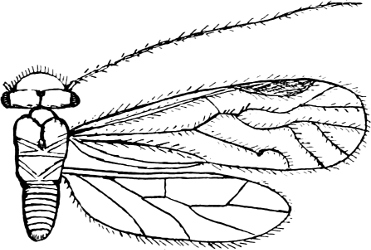
Fig. 16.—Philotarsus froggatti (Enderlein). A typical
specimen of the Psocidae found near Sydney, N.S.W.
(Redrawn from Enderlein’s figure,—W.W.F.)
They can be collected into a small tube on fences or tree trunks, or
shaken into a net or umbrella; but they must be handled very gently,
and are best placed in dry tubes, and killed and mounted at home. Many
handsome species are found in Australia, and some probably have a wide
distribution, as they are easily introduced into a new country with
many kinds of produce. One dull winged species is very common on the
foliage of the orange trees, where it lays its metallic green eggs in
patches of 9 or 12 on the midrib of the leaf, covering them over with a
delicate white silken sheet.
A number of species were obtained in Australia by the Hungarian
entomologist L. Biro, collecting for the Royal Museum of Hungary,
chiefly captured in the neighbourhood of Sydney. In 1903 Dr. Enderlein
classified and described these (Die Copeognathen des Indo-Australischen
Faunengebietes), published in the Annals of the above Museum, and
illustrated with many fine drawings. In this monograph he divides the
family into 16 sub-families, 39 genera and 115 species, 15 of which are
described from Australia.
Philotarsus froggatti, a tiny creature 2⅓ millimetres in length,
with clear wings, is found on the Blue Mountains.
We have no exact popular name for these peculiar insects; some of the
bush children call them “Forest Ladies,” on account of the dainty form
and graceful motion of several of our smaller species, which is rather
appropriate; but unfortunately several lace-wings go under the same
fanciful name. In the United States the common species are called “Rear
Horses” from the way they stand at rest with raised fore legs. The
Romans called them “Soothsayers;” and at least two species are known
as “Praying Mantis,” namely Mantis religiosa in Europe, and
Mantis carolina in the United States, from their pious attitudes.
They are most numerous in tropical countries, and are well represented
in Australia; Westwood in his “Synopsis of the Species of Mantidae,”
published in 1889, records 624 described species, only 30 of which come
from this country. Kirby’s Catalogue (1904) brings the list up to about
843, and adds 5 more to our list of described species.
With the exception of some curious little neuroptera (Mantispa),
which can be easily distinguished by their lace-like wings, the members
of this family cannot be confused with other groups. The long slender
prothorax, supporting a very flexible narrow head, forms an elongate
neck, to which are attached, well in front, the formidable spined fore
legs, which are seldom used as means of progression, but as weapons of
offence to capture other insects upon which they prey, for they are
tigers of the insect world, lying in wait, perfectly motionless, with
their colouration adapted to the foliage among which they hunt. The two
apical portions of the thorax, and slender body, which in the ordinary
type is covered with two pairs of wings, the first pair narrow like
that of a grasshopper and the hind pair fan-shaped, with the two pairs
of slender legs, are orthopterous; while the front portion, consisting
of the narrow head turned down in front into a pointed mouth, with
large projecting eyes, and thread-like antennae, show its carnivorous
habits. The female deposits her eggs upon the twigs or bark of trees
in an almond-shaped mass, consisting of regular rows of elongate eggs
piled above each other, with the tips all pointing outward, and which
are covered with an enveloping coat of a sticky brown secretion that,
as it hardens in the sun, becomes dry and papery. When the baby mantids
emerge from the eggs they are attached to them by two slender threads
fastened to the anal appendages (cerci); they hang head downward, like
a mass of tiny squirming caterpillars, until they cast their first
larval skin, when they fall to the ground, soft, wingless, little
stick-like creatures, ready to hunt for themselves. These egg masses
are very conspicuous objects in the bush and orchard, and are often
received from my correspondents with enquiries as to what they are, and
whether they should be destroyed. As each is the home of some hundreds
of little creatures that destroy thousands of smaller injurious
insects, they should never be disturbed by the gardener.
The commonest species in our gardens is the “Thick shouldered green
mantis,” Orthodera ministralis better known under the name of
Orthodera prasina, but as it was described many years before
under the first name, the latter has become a synonym. It is about 1½
inches in length, somewhat stout and thickset, the front portion of
the neck-like prothorax as wide as the head, fitting up close against
it, and narrower where it joins the mesothorax. It has well developed
wings and flies very well, but it usually remains immovable and alert,
resting on a leaf as green as its own bright coat, its treacherous
deadly fore-legs are raised, ready to lash out and seize any incautious
moth or butterfly that comes within reach, and it will often secure
one larger than itself. It ranges from Tasmania round to North-west
Australia, and has been recorded from New Zealand, into which place it
could have been easily introduced from Australia with foliage plants.
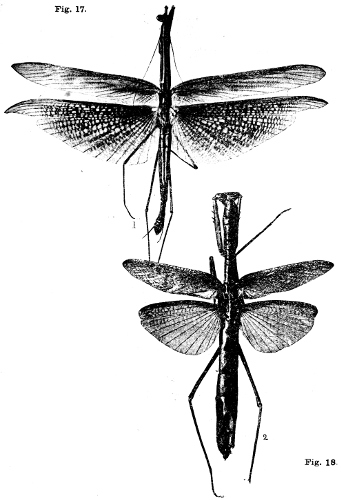
Figs.17 and 18.—Australian Mantidae.
17. Tenodera australasiae (Leach), the long-winged mantis.
18. Archimantis latistylus (Serv.), the short-winged mantis.
(Original photo. Burton.)
The Genus Archimantis contains five species described from
Australia, of which Archimantis latistylus is the commonest
species about Sydney. It measures 4 inches in length, is furnished
with large well developed wings, and varies in colour from dull green
to brownish yellow; the female is smaller, with more thickened body
and shorter wings. The fore-wings, or more properly elytra, are brown,
rounded at the tips, often marked in the centre with a dark spot;
the hind wings are semitransparent. It hides among the dull-coloured
foliage of the Leptospermum and Melaleuca bushes, which assimilate well
with its own uniform tint. This species will be found, figured, in
colours in McCoy’s “Zoology of Victoria, Decade xiii.”
Archimantis montrosa, a slightly larger species, comes from
Victoria River, North Australia; the type was taken by Elsey,
naturalist to the Gregory Exploring Expedition in 1856. A.
armatus, a smaller brown species, from the same district, has the
prothorax curiously spined on the outer margins, and the under-surface
covered with coarse tubercles.
Tenodera australasiae is another of our best known species, not
uncommon about Sydney in the summer months on the low scrub. It was
first described, and figured in colours, by Leach in his “Zoological
Miscellanies” 1815; and Westwood states that the type is in the
Banksian Collection in the British Museum. It has a wide range over
Australia, and is also a native of New Caledonia, New Guinea and
Ceram. It is a more brightly-tinted insect, 3½ inches in length, of a
general yellowish brown colour; the apical edge of the elytra striped
with green, followed with a stripe of pale salmon colour, and the rest
semitransparent; the wings are tinged with pink along the front margin,
the whole mottled with black and brown, thickest towards the body.
There are a number of active, little, black or dark brown mantids
with curiously shaped bodies that run about on the dull coloured tree
trunks, seldom flying, (though many of them are winged), but trusting
to their imitative tints to escape observation; several of our species
belong to the Genus Paroxypilus.
These are sometimes in general appearance not unlike mantids, but the
distinctive characteristics are well defined; for though the prothorax
is more or less elongated into a neck, and the abdomen, wings, and hind
legs long, it will soon be noticed that the fore pair of legs are not
spined, but are regular walking or clinging legs like the hind ones.
The head is oval or rounded, with a somewhat simple mouth adapted for
chewing foliage; smaller eyes; and large, thicker jointed antennae.
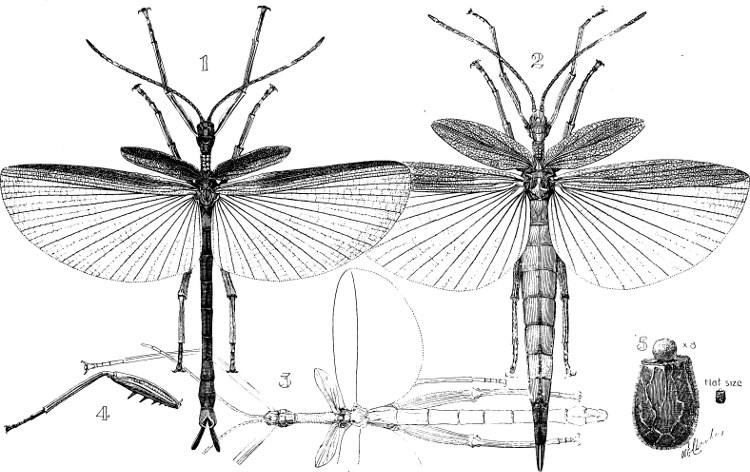
Plate V.—ORTHOPTERA.
Family Phasmidae.
Podacanthus wilkinsoni (Macleay).
1. Male.
2. Female.
3. Immature male.
4. Showing structure of hind legs of immature male.
5. Egg (enlarged).
Plate V.—ORTHOPTERA.
They in the matter of colouration also adapt themselves to their
surroundings, and are usually green or brown when at rest, though when
the wings are expanded they exhibit some brilliant tints. In some
groups the species are winged in both sexes; others have only winged
males; and one group is wingless in both sexes, the latter generally
long, slender, and stick-like.
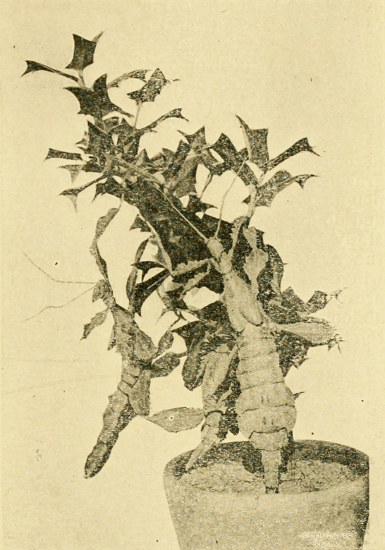
This family contains some of the giants of the insect world; specimens
of several of our Australian species measure 12 inches in length; while
supposed closely allied fossil forms unearthed in the Carboniferous
deposits of Europe measure up to 19 inches and were supplied with
immense wings. The female while crawling about among the foliage drops
her eggs singly on the ground beneath, where, protected in their hard
shells among the litter, they sometimes remain over a year before the
baby phasma comes out. The remarkable form and texture of these hard
oval egg cases has attracted the attention of entomologists in many
countries, and Sharp has figured and described some from New Britain.
Just as the Mantis has adapted its colour and shape to catch its prey,
so the phasma to protect itself from its many enemies has evolved
wonderful leaf-like processes upon the wings and legs, agreeing in
style with the surrounding foliage. It is noticeable that the larger
bodied female is often more leaf-like than her slender mate, probably
because more helpless; this is particularly so in the gravid or
egg-laying condition.
G. R. Gray described a number of our species in the Transactions of the
Entomological Society 1836, and others in the “Entomology of Australian
Phasmidae” 1833, and later in his “Synopsis Phasmidae”; Westwood in
his “Catalogue of the Orthopterous Insects in the British Museum” 1859
describes some; a few have been described by Macleay, Leach, McCoy and
Rainbow, bringing our list up to about 60 species. In Kirby’s Catalogue
95 species are listed from all parts of the world, but no additions are
made to our list.
The members of the Genus Bacillus are slender, wingless,
stick-like creatures of which 5 species are recorded from Australia.
The Great Brown Phasma, Acrophylla titan, is the type of one
of our groups, containing 11 species described from this country.
The female measures 8 inches to the tip of the body, and is slightly
broader across the outspread wings; the general form of head and thorax
to base of tegmina is slender; the abdomen is thickened; the legs and
mesothorax are spiny. The general colour is greyish brown; the tegmina
light brown, but thickly blotched with blue-black so that it is often
more black than brown; the wings are very large with the costal area
broad and similar in colour to the tegmina, but shaded with red at
base, the hind membranous part of them light chocolate irregularly
mottled with dull greyish brown. The male is more slender in form,
about an inch shorter, the smaller tegmina mottled with greenish
yellow; the front of the wings, which are proportionately small, are
of the same colour, and the hind portion dark chocolate finely mottled
with light brown. This large stick-insect used to be common about
Sydney before the scrub was cleared away, and ranges northward up the
coast. Gray says: “It is found on low scrubs about Port Jackson where
the inhabitants call it “Walking Straw” or the “Animated Stick.”
Fig. 19.—Group of Gregarious Phasmids, Podacanthus
wilkinsoni (Macleay) resting upon denuded eucalyptus foliage.
(“Agricultural Gazette,” N.S.W.)
The Genus Podacanthus is represented by 3 fine species. The
large pink winged phasma, P. typhon, has a wide range from
Victoria to Queensland. When resting with closed wings it is of a
uniform rich green tint, but when the wings are opened out, the
upper surface of the abdomen and the wings behind the frontal stripe
are bright rose red. The female measures 5 inches to the tip of the
body and over 7 inches across the outspread wings. In this genus the
mesothorax is short, the dorsal surface covered with short spined
bosses and the metathorax swelling out into a thickened body tapering
to the large boat shaped ovipositor. The male is smaller and much more
slender.
P. wilkinsoni is a gregarious species, appearing in the summer
in the New England forests in countless thousands, stripping every
leaf off the eucalyptus bushes as they travel along to the south-east,
so that all the trees look as if they had been killed by ringbarking,
from which habit they have received the name of “Lourie’s Ringbarkers,”
Mr. Lourie being the owner of Noundoc Station, where they are very
numerous. The female measures about 3½ inches to the tip of the body,
which is broad and thickset from the shoulders, of a general uniform
bright green tint on the dorsal surface, with the ventral somewhat
blackened and roughened. When the wings are expanded the front margin
shows the basal part pale orange yellow, and the membranous part behind
varying from rich rose red to pink. The male is a more slender insect
of a dull olive green tint, about the same length, with the broad wings
delicate purple. They appear with well developed wings about New Year,
and are depositing their eggs toward the end of February, the first
frost killing the last of them off.
Didymuria violescens was described and figured in Leach’s
“Zoological Miscellanies 1815” as our typical Australian Phasma; Gray
again figured it in colours in his “Entomology of Australia” under the
name of the “Violet-winged tailed Spectre.” It is a slender species
not unlike the last, of a brownish yellow colour, with wings of a deep
violet almost red tint; and it has 3 large spines on the thighs of the
hind legs.
The Genus Tropidoderus contains four species according to the
latest catalogue, though there is some doubt whether one or two should
not be defined as only varieties of T. childreni described by
Gray.
T. rhodomus is figured and described by McCoy; it measures 6
inches in length and 9 across the outspread wings. With closed wings
it is a rich green, but when they are expanded, the basal portion of
the wings is bright red, with the apical portion green, and the rest
semitransparent. The tegmina is short, leaf-like, green above, but
shaded with red on the under-surface. This is one of the short-necked
broad-bodied forms, and while the fore-legs are long and slender, the
thighs of the mid and hind pair are dilated into flattened leaf-like
forms; it is found, clinging among the foliage of the gum trees, from
Victoria to Queensland. The typical T. childreni differs from
this form in having the basal portion of the apical area of the wings
yellow instead of red, and the hyaline wings tinged with yellow. McCoy
has figured another under the name of T. iodomus: and Rainbow
a fourth from the neighbourhood of Sydney under the name of T.
decipiens which also comes very close to the typical species; it
has the basal portion of the apical area of the wings purple.
Fig. 20.—The Spiny Green Leaf Insect. Extatosoma
tiaratum (Macleay).
(“Agricultural Gazette,” N.S.W.)
Extatosoma tiaratum is remarkable for the great difference in
the sexes; the male is a rare insect, about 4 inches long; is a dull
dark green, with small tegmina; the wings are large, rounded at the
tip, the apical margin green with the rest semiopaque, dark brown,
mottled with whitish bands; the head is conical, coming to a point at
the summit and cleft in the centre, covered with fine tubercles.
The female measures about 5 inches, is of a similar colour, large and
swollen in proportion; the tegmina are represented by two flaps, and
the wings are wanting. The head is of the same conical shape as that
of the male, but larger; neck short and stout; the legs produced into
dilated spiny leaf-like processes, cut out and arcuate like the leaves
of holly; and the lower segments of the abdomen are fringed with spiny
leaf-like appendages. Often the large body is mottled with white specks
and smutty blotches, giving it a wonderful resemblance to the foliage
among which it hides. It has a very wide range from Tasmania to New
Guinea.
Fig. 21.—A group of Spiny Green Leaf Insects,
Extatosoma tiaratum placed on a Japanese Holly bush to
show protective mimicry.
(“Agricultural Gazette” N.S.W.)
Clemacantha regale is a large, handsome, very long phasma over
9 inches in length, of a combined yellow and green tint; the head is
striped with parallel green and pale yellow. The leaf-like tegmina are
striped with white; wings have the apical area green shaded with pink
at base; rest semitransparent with a blue tint. It ranges from N.S.
Wales to Queensland.
These are insects with the thighs of the hind legs swollen or enlarged,
much longer than the fore legs, and adapted for jumping. The tarsi
are composed of three distinct segments. The antennae are short,
containing less than 30 joints; the ovipositor of the females is not
sabre-shaped, but composed of short plates adapted for boring into the
ground; and the organs representing ears are placed on the sides of the
first abdominal segment. This group of the Orthoptera may be described
as the short-horned locusts or grasshoppers in contradistinction to
the tree or grass dwelling green grasshoppers with long thread-like
antennae. All the true plague locusts that ravage many of the warmer
countries and do an immense amount of damage belong to this division.
Many species have a wide range; our locusts are allied to the African
and Indian forms. Most of the species are winged, and many are capable
of long sustained flight; these are furnished with air sacs in the
interior of the thorax and abdomen; these when distended with air
assist in lightening the otherwise heavy body. The remarkable shrill
notes produced by some of these insects are caused by rubbing the inner
edge of the hind thigh against the outer surface of the wing covers
which are frequently furnished with ridges or raised veins for this
purpose. The so-called ears consist of a membrane covering a small
opening on the abdomen, and are of a somewhat different structure in
different groups.
Fig. 22.—Diagram of Grasshopper.
Cyrtacanthacris exacta (♀) (Walker).
ant, antennae; e, eye; vert, vertex; oc,
ocellus; fast, fastigium; c. fac, costae facialis;
c, clypeus; m, mandible; l, labrum; mp,
maxilliary palpi; lp, labial palpi; ps, prosternal
spine; p, pronotum; m. epis, meso-episternum; m.
epim, meso-epimeron; co, coxa; tr, trochanter;
meta-epis, meta-episternum; meta-epim, meta-epimeron;
fem, femur; tib, tibia; tar, tarsus; sp,
spiracle; v, ventral valves of ovipositor.
(Original W. B. Gurney.)
The reproductive organs of the female consist of several anal plates
that are used after the manner of an auger to cut a circular pit in the
hard soil, the abdominal segments being extended while the operation is
going on; the eggs are deposited at the bottom of the hole, enclosed
in a similar exudation as that which encloses the eggs of the mantis,
and some of the plague locusts deposit two or more egg masses before
they die. These grasshoppers have been studied by many entomologists,
who have subdivided them into different groups. Brunner von Wattenwyl
places them under nine sub-families or tribes chiefly based on the
structure of the head. Saussure has described some of our species;
Walker, Stoll and Blanchard others.
Fig. 23.—Locusta danica (Linn.) The
Yellow-winged Locust.
(“Agricultural Gazette,” N.S.W.)
The Yellow-winged Locust, Locusta danica, is common in open
forest country all over Australia, and usually makes a rustling noise
as it flies up; it is too well known to need describing; with its
wings closed it is a mottled, dull brown and green insect up to 2
inches in length, with a short broad head and crested thorax; when the
wings are opened it shows a large patch of rich yellow banded with
black. The male is often fully a third smaller than the female. It has
been described under a great number of different names, but is now
considered the same insect as found in the South of Europe, Africa and
Asia.
The Blue Mountain Locust, Oedaleus senegalensis, might easily
be mistaken for a smaller dull coloured specimen of the last one, but
the yellow tint, when present, is very slight, and the wings have
the tips blackened as well as the inner band. It has a wide range
over Australia, and is also found in Africa from which place it was
described by Krauss.
Fig. 24.—Chortoicetes pusilla (Walker). The small
Plague-locust of the interior of Australia.
(“Agricultural Gazette,” N.S.W.)
Fig. 25.—Chortoicetes terminifera (Walker). The
larger Plague-locust.
(“Agricultural Gazette,” N.S.W.)
The Large Coast Locust, Acridium maculicollis, is sometimes
found in gardens; it measures 3 inches to the tip of the wings, and
is greyish brown with darkly mottled elytra. Locusta australis
is like the Yellow-winged Locust, with more regularly mottled elytra,
and clear transparent wings. The small plain Locust, Chortoicetes
pusilla, is under 1 inch in length; the male is of a general
bright yellow colour, and the female, somewhat larger, of a general
greyish brown tint. It is the species that for the last few years has
done so much damage to our grass and crops in the Western country.
C. terminifera is one-third larger, and is of a general light
brown mottled colour, with the wings semitransparent, tipped with
dull brown; it at times is one of our plague locusts. The Rose-winged
Locust, Hyalopteryx australis, is one of our small but very
noisy locusts, about 8 lines in length; when at rest it is light brown
mottled with darker tints, the expanded hind wings are brightly shaded
with rose pink and clouded with black. It is found in open grass lands,
and when disturbed rises with a very shrill screech. The Red-legged
Locust, Cirphula pyrocnemis, is a short broad insect about 1
inch long; is of a general dark brown tint, with the expanded wings
dark yellowish brown: the head and thorax are roughened; the abdominal
segments are dull yellow with several black bands on the sides: it is
common on the open flats about Sydney in summer. The common “Great
Striped Locust,” Cyrtacanthacris exacta, measures nearly 3
inches; it ranges all along the Eastern coast and is often seen in
secluded gardens; it has a broad dorsal stripe down the centre, varying
from yellow to dull green.
Fig. 26.—Cirphula pyrocnemis (Stäl). The
Red-legged Locust.
(“Agricultural Gazette,” N.S.W.)
Figs. 27 and 28.—Australian Grasshoppers.
27.—Tryxalis rafflesii (Blanchard). The Slender Narrow-headed
Grasshopper.
28.—Goniæa australasiae (Leach). The Ridge-backed Grasshopper.
(“Agricultural Gazette,” N.S.W.)
The Long-nosed Locust, Tryxalis rafflesii, is very common in
open grassed flats; the female is nearly 3 inches long, with a slender
pointed head, and long pointed body, varying from all shades of grass
green to pale salmon colour. It is easily recognised by its curious
finger-like antennae, and grotesque head. The male is a very slender,
much smaller insect. The pink-winged Tryxalid, Atrastemorpha
crenaticeps, is much smaller; it has a pointed head of a uniform
pale green tint; the wings are brightly tinted with red, deepest at the
shoulders. The Ridge-backed Grasshopper, Goniaea australasiae,
is a large, stout, reddish brown insect about 2 inches long, which
lives on the hills in open forest; the male is a much smaller hopper,
but both sexes have the head, thorax, and closed wings forming a
sharp ridge down the back. In similar open forest country we find
Coryphistes cyanopterus, which usually rests on the tree trunks,
with its slightly roughened head, thorax, and mottled elytra closely
resembling the bark. It measures 2½ inches in length, but though it
is very variable in size and outward colouration, the wings when
expanded always show a rich blue tint. The Crested Locust, Ecphantus
quadrilobis, is one of our western forms that rests among the dry
grass on the plains; it is dull green to yellow, short and thickset;
is 1½ inches long; with the back ridged, and the crested thorax formed
into 4 lobes. The spotted locust, Stropis maculosa, is another
of our western forms; it is broad and thickset; about 2 inches long;
of a uniform dark brown tint, with the thorax barred, and the elytra
mottled with large patches of light yellow.
Fig. 29.—Coryphistes cyanopterus (Charpentier).
The Blue-winged Locust.
(“Agricultural Gazette,” N.S.W.)
Fig. 30.—Stropis maculosa (Stäl). The Spotted
Ground-locust of the interior.
(“Agricultural Gazette,” N.S.W.)
There are also many other curious forms of wingless, short-horned
locusts in the interior, belonging to several genera, and probably some
fine things that have never reached our museums.
These grasshoppers are found not only among the grass but on low
shrubs, or in tree tops, feeding upon the foliage; while others, many
of them wingless, live underground after the manner of crickets. Among
those that frequent trees are some that, like the phasmids, have the
legs and wing-covers so wonderfully veined and spotted that they
are an exact imitation of the leaves of their food plant. They are
easily distinguished from the previous group by their long, slender,
thread-like antennae composed of a number of fine joints; in most cases
the body is softer; and in the female furnished with a sabre-like
ovipositor with which she generally deposits her eggs in rows along the
side of a leaf or twig, though others place them on the ground. The
basal portion of the thigh of the hind leg is generally thickest, and
most of the species have four jointed tarsi, with the ear process not
upon the base of the abdomen, but on the knees of the fore-legs. Some
are said to be carnivorous, and I have twice seen a large green species
which comes to the flowers of the stunted angophora devouring honey
bees, but probably more for the honey they contain than the blood of
the bee.
Brunner von Wattenwyl has written a great deal about these insects
and described a number of Australian species. Tepper is one of the
few Australian entomologists who has taken up this group, describing
some in the Transactions of the Royal Society of S. Australia: in the
Locustidae of the world Sharp groups them into fifteen tribes. Most of
these Orthoptera are solitary or found in pairs; some too have a very
musical note.
The Mountain Grasshopper, Acridopeza reticulata, is such a
curious looking creature that it has been figured and noted by many
naturalists. Both sexes are of a uniform dull brown colour, but very
different in structure; the male measures 2 inches; has long pointed
elytra, and well developed wings; the head is small; the antennae
slender and thread-like; the eyes stand out on the side of the head,
and the thorax is saddle shaped. The female is furnished with a very
short, rounded body richly mottled with blue, white, and red, covered
with a pair of rounded, short, shell-like elytra, but the wings are
wanting. When disturbed she stands on tiptoes, arches her body, raises
her elytra exposing all the bright tints of her body, which probably
act as a warning to her enemies.
Plate VI.—ORTHOPTERA.
Family Locustidae.
1. Acridopeza reticulata (Guérin), ♀.
1a. Acridopeza reticulata (Guérin), ♂.
1b. Acridopeza reticulata (Guérin), eggs.
2. Alectoria superba (Brunner).
3. Ephippitytha 32-guttata (Serv.).
4. Pseudorhynchus lessonii (Serv.).
Plate VI.—ORTHOPTERA.
Another remarkable grasshopper is Alectoria superba, found
in the dry western country among the grass; it is a long, slender,
green insect, measuring 2½ inches; the elytra and legs are richly
mottled with bright reddish brown; the thorax is produced into a
large circular crest edged with bright red, a large boss below on
either side, and another projecting above the head. The female has
a very small lance-like ovipositor. The Speckled Green Grasshopper,
Ephippitytha 32-guttata, is about the same length as the last,
of a somewhat lighter green tint, and has the elytra mottled with a
double row of black spots varying from 32 to 44 in number. The head
is small, the thorax short and somewhat saddle-shaped. It is found
about Sydney on flowering shrubs; and there is a darker variety which
has a wide range over the interior, to which Tepper has given the
name of E. quadrigesima-guttatus. The Small Green Grasshopper,
Caedicia valida, is one of our dainty, slender, green species
found in the gardens, where it sometimes damages the young fruit by
gnawing patches off the skin, or nibbles holes in the foliage; it
produces a sharp musical note uttered three times in succession.
The Large Green Leaf Grasshopper, Locusta vigentissima, figured
by McCoy, is also found on low shrubs in the summer; it measures
nearly 3 inches, and is of a uniform dull green colour, with the
head, legs and antennae more or less yellow: the head is broad; the
thorax stout; the legs long and spiny; the elytra long, tapering to
the tips; the wings large, semitransparent; the abdomen short, in the
female furnished with a long sabre-like ovipositor. The Lance-headed
Grasshopper, Pseudorhynchus lessonii, has a wide range along
the eastern coast among the long grass; it is green, with the tips
of the elytra marked with yellow; the wings are small, and the front
of the head produced into a lance-like point. Among the foliage of
the eucalypts in Southern Australia there is a very handsome large
grasshopper with the head small, the thorax very square, and the elytra
very leaf-like in form; it has a curious bloom upon it like that upon
many of the gum leaves, and is a very fine case of mimicry.
The Genus Anostosoma comprises a number of reddish brown
wingless locusts more like crickets in many ways, for they live chiefly
in holes in the ground, have long thread-like antennae, and stout spiny
legs. Anostosoma australasiae is a very formidable looking
insect with immense head and jaws, originally described from Moreton
Bay; it is sometimes found about Sydney, measuring 3 inches in length;
it has antennae over 4 inches long. The smaller species, Anostosoma
erinaceus, is of a similar colour and form, but not more than 1½
inches in length; it is not uncommon in gardens.
Paragryllacris combusta lives in hiding during the day under
a curled leaf spathe of a palm frond, or in a cavity in a tree trunk;
if in the last it often forms a white tough substance of a net-like
structure over the front, and if disturbed will snap at a grass blade
or straw and shake the net, making a distinct sharp sound. It is of a
uniform, yellowish brown tint, measuring about 2 inches to the tip of
the large curled wings closely folded over the body.
The curious Cave Locust, Pachyrhamma sp., with its small oval
body, and long slender antennae and hind legs, is always found in
caves. It is a dull brown wingless creature, whose slender thread-like
antennae are many times longer than the body.
These are the black field and house crickets which are so well known by
their shrill note; this is caused by the insect rubbing the stout wing
covers or elytra together; those of the males have a distinct circular
wavy neuration forming distinct ridges for this purpose.
Crickets are easily distinguished by their slender thread-like
antennae, short rounded heads, black wings folded down the back, and
spiny hind legs adapted both for creeping through the grass or jumping
out of the road of their enemies. The abdomen is furnished with a
pair of slender spined appendages on the sides, and the female with a
stiletto-like ovipositor composed of two grooved pieces by which the
eggs are deposited in the ground.
We have a number of field crickets in this country; Walker in his
catalogue of the family gives 12 species, of which Gryllus
servillei is our common field cricket, sometimes swarming out
in sufficient numbers to do a great deal of damage to field crops
and vegetable gardens. It is of a uniform black tint, with a short,
shining, round head; it measures about 1 inch in length, and has a wide
range over Australia. The Mole Cricket, Gryllotalpa coarctata,
is found all over the interior, forming underground tunnels in the
sand along the edges of watercourses; it was collected in the Horn
Expedition in Central Australia, and is also found about Sydney. It
is of the usual dull brown tint, with hooded thorax and spade-shaped
fore-legs. Another curious little black cricket is common about the
edges of watercourses, and when disturbed often jumps in and swims
about on the surface; it belongs to the Genus Nemobius, and is
only ⅙ of an inch in length.
Plate VII.—ORTHOPTERA.
Family Gryllidae.
1. Gryllus servillei (Sauss.).
1a. Gryllus servillei (Sauss.). (Elytron ♀.)
2. Gryllotalpa coarctata (Walk.).
3. Pachyrhamma sp.
4. Nemobius sp.
5. Paragryllacris combusta (Germ.).
6. Anostostoma erinaceus (Gray).]
Plate VII.—ORTHOPTERA.
Order III.—NEUROPTERA. Lace-winged Insects. — Family 1. Stone-flies. PERLIDAE. — Family 2. Dragon Flies. ODONATA. — Family 3. May-flies. EPHEMERIDAE. — Family 4. Alder Flies and Snake Flies. SIALIDAE: — Family 5. Scorpion Flies. PANORPIDAE. — Family 6. Ant-lions and Lace-wings. HEMEROBIIDAE. — Family 7. Caddis Flies. TRICHOPTERA.
After excising the families usually treated as Pseudo-Neuroptera
from this order, these insects can be defined as the “lace wings,”
furnished with two pairs of delicate gauzy wings reticulated with a
network of fine transverse and parallel veins forming a great number
of more or less irregular cells. The head is furnished, with a few
exceptions, with stout jaws adapted to their carnivorous habits; large
eyes; and antennae of many different forms, sometimes short, thickened,
or clubbed, but in others long, slender, and filiform. The legs, suited
to their clinging habits when at rest, are generally slender, and the
body more or less elongate.
Most of them undergo a complete metamorphosis; the active larvae are
furnished with large sucking or biting jaws; in the terrestrial forms
they live among foliage or on the ground, and feed upon aphids, mites,
ants, &c., and when full grown pupate in regular cocoons. While some of
the aquatic forms go through a pupal stage in cells in the mud or under
stones, others, like the dragon flies, have no true pupal form, simply
going through a series of moults, and changing from an aquatic life to
an aerial one by crawling out of the water and emerging from the pupal
case, leaving it attached to the water plant.
Sharp places the Neuroptera in eleven families, further divided
up into a number of sub-families under five tribes. In excising
the Pseudo-Neuroptera seven families remain, though the
Hemerobiidae includes a number of sub-families that by some
writers are ranked as families.
The Neuroptera are represented in Australia by many very handsome
and curious insects, of which the dragon flies are probably the most
typical and well known.
The Stone-flies are not an extensive group, and though the European
and American forms have been studied, very little is known about our
species. In England several species are much prized by fishermen as
tempting bait for fly-fishing.
The perfect insects have oblong, flattened bodies of uniform width
to the tip of the abdomen, terminating in a pair of long slender
tails or setae. The head is long, provided with large prominent eyes,
three ocelli, slender thread-like antennae, and weak mouth parts; the
fore-wings are slightly longer than the hind ones, which are very
broad and folded down the middle when closed. They are generally found
about watercourses in early summer, and lay an immense number of eggs
(5,000 to 6,000 some authorities state are laid by each female); these
eggs are dropped on the surface of the water. The larvae are very like
the perfect insects except that they have no wings; they are active
carnivorous creatures living in the bottom of swift running streams,
crawling under the stones, and feeding chiefly on the larvae of
mayflies.
Only four or five species have been described from Australia; I had
a number of specimens sent me from Hobart, Tasmania, the larvae of
which were said to be damaging the woodwork down a well. It has been
identified as Eusthenia spectabilis. This insect was named by
Westwood, and is figured in Griffith’s “Animal Kingdom,” (page 348,
plate 72). It measures about 2 inches across the outspread wings; its
general colour is dark brown, with the fore wings lighter, mottled
with brown at the base and the lower half dull red; the hind pair
brighter red with the tips blackish. The head is flattened, with long
slender many jointed antennae tapering to the tips. The thorax is
slender, flattened on the upper surface; the legs stout; and the tip
of the abdomen bears two slender jointed tails (setae). This insect is
also found in Australia. A second species, Eusthenia thalia,
is described from Tasmania by Newman; I have one from Gippsland
Victoria probably a new species. Several species have been described
by Walker (Brit. Mus. Catalogue, Neuroptera 1852) in the typical Genus
Perla from Tasmania.
Members of the Genus Cupnia are often found upon the snow in
Northern Europe.
Plate VIII.—NEUROPTERA.
Family Odonata.
1. Tramea loewii (Brauer).
2. Synlestes weyersii (Selys).
3. Ischnura delicata (Selys).
4. Rhyothemis graphiptera (Ramb.).
5. Orthetrum nigrifrons (Kirby).
6. Diplacodes (Diplax) bipunctata (Brauer).
Family Sialidae.
7. Chaulcodes guttatus (Walk.).
(Original photo. Burton.)
Plate VIII.—NEUROPTERA.
Everyone has noticed dragon flies that sail and dart about over swamps
and rivers, the embodiment of grace and beauty in flying creatures. In
England and Australia they are popularly known as “horse-stingers,” a
very misleading name, for they cannot sting, and if they frequent the
vicinity of horses it is for the sake of the flies or gnats they can
capture. In America the country folk know them under the still more
peculiar name of “Devil’s Darning Needles,” while the French children,
who recognise their beauty and dainty form, call them “demoiselles.”
Westwood places the dragon flies in the family Libellulidae; but
both Kirby and Sharp call them Odonata; the former again divides
them into the Libellulidae and the Agrionidae, and the
latter subdivides them into groups with the same characters, namely the
Anisopteridae and Zygopteridae.
The members of the first group are those with the hind pair of wings
slightly larger than the front pair, and the second with wings of equal
size or the hind pair smaller. Specialists have further subdivided them
into seven smaller sub-families containing about 300 genera.
Dragon flies are widely distributed over the world, but are most
plentiful in the warmer zones; about 2,000 have been described from all
parts of the world, of which 107 species are recorded from Australia;
but as Billinghurst was able to collect 41 species in one circumscribed
district in Victoria (Victorian Naturalist No. 1, 1900), systematic
collecting would certainly add many more to our list.
In the early stages of their life dragon flies are aquatic; the female
deposits her eggs on the foliage of water plants, sometimes dipping
into the water to be sure they are submerged. The slender larvae with
wing pads in place of the future wings have somewhat the form of the
adults, and are carnivorous, feeding upon all kinds of smaller water
insects.
The dragon flies form a very distinct division of the Neuroptera; every
organ is beautifully adapted for their aerial life, their immense eyes
giving them an outlook on all sides, while the slender cylindrical
body does not impede their flight; and the great oar-shaped wings
strengthened with many stout nervures enable them to twist and turn in
the air with wonderful ease and rapidity.
The Libellulidae are thick-bodied dragon flies of medium size,
and comprise a number of fine species. The larvae are short broad
creatures with wide heads; they live in the mud on the bottom of ponds.
Rhyothemus graphiptera belongs to a genus containing over 30
species ranging from Africa to China, and the Eastern Archipelago to
the New Hebrides. It measures 2½ inches across the wings, which are
yellowish brown, beautifully mottled with darker tints; the front pair
are blotched at the base, a slender stripe in front running into the
first of 2 irregular transverse bands about the centre and tip; in the
hind pair the two apical bands have basal markings consisting of three
small irregular blotches: it is found in the northern parts of N.S.
Wales.
Fig. 31.—Diagram of a Dragon Fly.
a, antenna; ar, arculus; b.s, basilar
space; c, costal nervure; s.c, sub-costal nervure;
e, eye; f, front; m, median nervure (or
radius); s.m, sub-median; m.s, median sector;
m, membranule; n, nodus; n.s, nodal
sector; o, occiput; p, pterostigma; p.s,
principal sector; s.s, short sector; s.t, sector
of triangle; t, triangle; i.a, inferior appendage;
s.a, superior; a.n, antenodals. The numerals refer
to the segments of the abdomen.
(Original R. J. Tillyard.)
The Genus Diplax contains a number of more delicate,
short-winged insects, of which Diplax rubra, a typical form,
is common both along the rivers and in the open scrub, often quite a
distance from water. It is a moderate-sized dragon fly, tinted with
pale yellow at the base of the hind wings, and has a distinctive
bright red body. Diplacodes (Diplax) bipunctata has much the
same habits, and a wider range over the country; it is common about
Sydney, and is slightly smaller than the previous species, and of a
general yellow tint. Orthetrum nigrifrons is a more thickset
dragon fly about 2 inches across the wings; the head and front of
thorax are black, with the hind portion of the latter and body deep
blue; it is a very distinctive species along the watercourses and in
the open bush. Orthetrum villosovittatum is a slightly larger
form found in Southern Queensland, with slightly clouded wings,
blotched close to the body with yellowish brown: the head and thorax
are brown, and the body is red.
The Aeschnidae contain the giants among the dragon flies:
Petalura gigantea is our largest species, and varies much in
different localities; most of ours on the Blue Mountains measure about
5 inches across the wings, but Tillyard captured them at Cairns N.Q.
6½ inches. It is a very robust insect of a dull brown tint, with a
single, broad, pale stripe on the sides of the large square thorax, and
when viewed from the side seems to have the abdomen attached to the
under-side of the thorax. The pterastigma of the wing is long.
Hemianax papuensis is typical of one of our large species, often
flying in numbers about Sydney hawking for gnats high up in the air
before a storm. It measures 4 inches across the wings, which have a
slight smoky tint.
Aeschna brevistyla is about the same size as the previous
species, but the wings are clear, and the abdominal segments are marked
with two angulated white blotches, one on either side of the dorsal
stripe. The larvae are curious, elongate, oval creatures, with large
heads, living in the mud at the bottom of stagnant ponds and are common
about Sydney.
The Agrionidae are the delicate slender-bodied dragon flies
with oar-shaped wings, and narrow heads with the eyes standing out
on either side. Lestes analis is our common type of the large
genus; it is of the usual slender form, with the body nearly as long
as the expanse of wings, and is of a general reddish brown colour.
Synlestes weyersii is a very beautiful slender creature nearly
3 inches across the wings, and over 2 inches from the front of the
head to the tip of the body. It has transparent wings with an oval
whitish pterastigma toward the tips, and the whole head and body is
deep rich metallic green. It flies in a very graceful manner up and
down the edges of the watercourses, resting every now and then on a
reed or overhanging twig, and is very easily captured. Ischnura
heterosticta is our tiny, little, banded, blue and brown dragon
fly, with the female of a more sombre brown tint: Tillyard has recorded
two forms of females in this species, one taking on the garb of the
bright-coloured male.
Ischnura delicata, very similar in size and form, has the basal
two-thirds of the abdomen red and the apical portion blue. The larvae
of both these species are common in the ponds about Sydney in the early
summer. Tillyard (Pro. Linn. Soc. N.S.W. 1905) has recently added three
new species of the Genus Austrogomphus collected in the Cairns
district N. Queensland.
These delicate gauze-winged insects were named Ephemera from the old
idea that their life as perfect insects lasted only for a day; they
were born in the morning and died at the fall of day. Though their span
of life is short, as they possess only rudimentary mouths incapable of
absorbing food, and only live a short time after the eggs are laid, it
is generally a matter of a few days.
They have large prominent eyes; three ocelli; and minute antennae
consisting of two thickened joints surmounted with a needle-like hair
or bristle: the prothorax is small, the middle portion large; and the
somewhat small body, generally composed of ten segments, is provided
with a slender articulated hair-like tail on either side. The wings are
broadest at the base, rounded at the extremities, with the hind pair
small, in some genera the hind pair absent. The larvae live in burrows
in the mud at the bottom of ponds or watercourses, and when full grown
climb up the stalks of grass or plants and cast their pupal coverings.
Most of our species are only found in odd pairs, and do not assemble
in swarms as they sometimes do in England; but in 1885, in the Royal
Geographical Society’s Exploring Expedition in New Guinea, when
ascending the Fly River we met with great clouds of the large white
Mayfly, Palingenia papuana, flying along over the surface of
the water just as described by D’Albertis in his work on New Guinea;
specimens I collected are now in the Australian Museum.
The commonest species about Sydney is Atalophlebia australasica,
a small chocolate brown insect marked with black; the wings are
vitreous with black markings on the veins, the front margin tinged with
umber brown on the cross veins. It was described by Pictet in his
“Natural History Neuroptera” (1843–45): Walker has described another
from Tasmania: Eaton three more from different parts of the mainland:
and Burmeister one in his “Handbook of Entomology” as far back as
1839. The members of this genus have a wide range from South America
through Africa, Japan, and Ceylon. A single species of the Genus
Coloburiscus has been described from Melbourne.
The chief work on these insects is Eaton’s “Revisional Monograph of
Recent Ephemeridae or May-flies,” Parts I.-V. (Transactions of the
Linnean Society 1883–87;) in this work he subdivides them into three
groups containing 55 genera and 270 species.
This small division contains two groups that Westwood treated as two
distinct families, the Sialidae and the Raphidae; but
Sharp points out, that in general structure and habits they are very
closely related to each other,—the latter chiefly differing from the
former in the remarkable elongation of the prothorax, and he thus only
ranks them as sub-families.
The Alder Flies have two pairs of broad wings, wide at the base, the
hind pair slightly smaller and capable of being folded behind; they
are all traversed by numerous veins forming irregular cells. They
are slow in their movements, and are to be found clinging to bushes
in the vicinity of water. Our commonest species is the Chauliodes
guttatus, described by Walker; it is a large, dull brown insect
with an elongated thorax and body; the head is furnished with long,
slender, annulated antennae, large prominent eyes on the sides, and
three ocelli on the summit. The wings are semiopaque, the fore pair
finely spotted with black, thickest on the front margin; the broader
hind pair are only lightly spotted at the extreme tip, with from 4 to 5
larger rounded spots about the centre. It measures over 3 inches across
the outspread wings, and 1¼ inches from the head to the tip of the
abdomen; it has a wide range from Victoria to Queensland.
The larvae are remarkable for having fringed filaments on the sides
of the abdomen; they crawl about in the mud or among the weeds in
water-holes, and are carnivorous, feeding upon other aquatic insects;
when ready to transform, the pupae come out of the water and crawl
under stones, or sometimes under the loose bark on tree trunks.
The Snake Flies are curious looking creatures with elongated necks, and
the female is provided with a very curious, long, curved ovipositor.
They are found under bark on tree trunks, both in the perfect and
larval state; they are unknown in Australia, but Howard states that an
attempt was made some years ago to send living Raphidians from
California to destroy codlin moth grubs, but that nothing has been
heard of them since.
These insects have the head turned down in front with the mouth parts
forming an elongate beak; large projecting eyes; and slender antennae.
The prothorax forms a slender neck to the larger mesothorax; the
wings are narrow and somewhat oar-shaped, traversed with a network of
veins; the legs are long and slender, except the hind pair, which are
thickened on the thighs and stoutly spined; the tarsi are large and
coated with a sticky membrane, which assists it in catching flies.
At first sight many of them might be taken for crane-flies of somewhat
clumsy build; in the European Panorpa the males are furnished
with a peculiar anal appendage from which they take the popular name
of Scorpion Flies. Members of the Genus Boreus are wingless and
resemble tiny grasshoppers; in America they are often found on snow.
The family is represented in Australia by Bittacus australis,
which has a wide range from Tasmania to Queensland, and is very
abundant in the early summer, hanging about the leptospermum and
ti-tree bushes. It rests among the foliage, with the large hind legs
hanging loosely down below but ready to strike out the moment an
incautious fly comes within range. The long flexible tarsi fold round
the captive with the stout spines transfixing it, while the Bitticus
draws its leg round under the head so that it can press its sharp beak
into the victim and suck up its blood. Its general colour is reddish
brown marked with black; the wings are clouded, narrow, rounded at
the tips, and reticulated with fine nervures. Nothing is known about
the earlier stages in the life-history of this insect, but specimens
in captivity laid a number of flattened bun-shaped eggs which did not
hatch out.
Plate IX.—NEUROPTERA.
Family Hemerobiidae.
1. Nymphes myrmeleonides (Leach).
7. Porismus strigatus (Burm.).
Family Myrmeleonidae.
2. Glenurus erythrocephalus (Leach).
4. Glenurus falsus (Walker).
5. Glenurus circuiter (Walker).
6. Glenurus pulchellus (Kirby).
Family Mantispidae.
3. Mantispa strigodes (Westwood).
(Original photo. Burton.)
Plate IX.—NEUROPTERA.
This interesting division of the Neuroptera comprises a number of
smaller groups, ranked by some entomologists as families, but now
generally regarded as sub-families. Westwood divided them into two
families, the first containing the true ant-lions; both Kirby and Sharp
treat them as one, but the latter places them in seven well defined
sub-families.
They come naturally together from the fact that all the larvae are
provided with large, curved, hollow, sucking jaws, and are carnivorous
in their habits, while the perfect insects have simple biting jaws.
They all have, in the perfect state, long slender bodies, provided with
two pairs of finely reticulated wings, folded over each other when at
rest; the head is short, with large projecting eyes; ocelli generally
wanting; and the antennae are composed of many short annular joints.
The Myrmeleonides are the true ant-lions, whose larvae in many
species construct funnel shaped pits in soft sandy soil an inch or
two in depth, at the bottom of which, buried in the loose soil, with
only the tip of their large jaws visible, they lie in wait for any
ant or other small insect that may happen to slip over the edge and
tumble to the bottom, where it is immediately seized in the ant-lion’s
powerful jaws and devoured; when however, as often happens, the trapped
visitor manages to regain its footing and nearly succeeds in clambering
out, the ant-lion presses its head downward like a spade and throws
a quantity of sand right at its prey, generally bringing its quarry
within reach again. It generally excavates its pit under the shelter
of a log or rock so that it is protected from the rain, and when full
grown pupates at the bottom of its shaft. The larva is a short thickset
little brown creature covered with tufts of short stout bristles; the
head is broad and rounded behind, attached to the heart-shaped body by
a neck-like thorax. They are easily captured by slipping a knife blade
under them and throwing them out when they are intent on catching a
struggling ant. In captivity they are easily kept in a saucer full of
sand, and have the power of going for weeks without food; when placed
on a smooth surface they always arch their heads and crawl backwards.
Most of our described species belong to the Genus Glenurus, all
slender elongated insects resting with their long narrow wings folded
over their backs against a twig or grass stem, and when disturbed
flitting away in a very awkward manner; they are very easily captured.
Glenurus pulchellus is the commonest species about the coast,
with a wing expanse of about 2½ inches; its general colour is chocolate
brown, mottled and marbled with lighter tints; the fore wings are
speckled with black; the apical portion of the hind pair deeply
blotched with chestnut brown, encircling a white patch, with a second
smaller one nearer the extremity. Glenurus falsus is a shade
smaller; the fore wings darker; and a single dark patch on the hind
wings. Glenurus striola is a slightly larger species with
semitransparent wings, marked on the posterior margin of the hind pair
with a narrow light brown stripe. I found this species very plentiful
in some swampy flats near Brisbane, Q., in October, where they were
resting on the rushes. Glenurus fundatus is our largest species,
often measuring up to 4 inches across the wings, and is of a general
uniform mottled grey tint spotted with brown; it is common along
the coast in North Queensland. Glenurus circuiter is easily
recognised from all the others by the shape of the fore wings, which
are broadened to the tips, cut out behind at the extremities, and
both pairs are irregularly blotched and spotted dark brown, giving
it a very handsome appearance. Glenurus erythrocephalus has
semitransparent wings, elongate and rounded at the tips, the fore
pair thickly covered with spots and blotches of dark brown, the hind
pair usually only marked with three spots, but the spotting is very
irregular and variable. It comes from the more northern parts of N.S.
Wales and Queensland.
The Ascalaphides are all moderate-sized, clear-winged insects
with a stigma toward the tip, and curious long slender antennae clubbed
at the tips; they might be likened to dragon-flies with butterflies’
heads. Suphalasca sabulosa measures about 2½ inches across the
wings; the head and thorax are fringed with fine hairs, the stigma
on the wings black. It is generally found on bush land clinging to a
grass stalk or twig, with the wings folded down, and the slender body
sticking out at right angles. I have found the larvae living under the
dry bark attached to dead tree trunks, their short hairy bodies covered
with tufts of stout bristles, their large jaws pointing upward; and
from their situation they probably capture the large sugar ants. In
captivity they would remain for days resting against the side of the
box without any movement, and lived for several months without taking
any food, and finally formed a round cocoon.
The female places her eggs in a double row along the edge of a blade of
grass, and the young ones, when they hatch out, sit in the bottom of
the eggshell, all head and jaws, waiting for something to turn up, and
must often undergo long fasts.
Stibopteryx costalis is a stout bodied insect with a wing
expanse of 3 inches, a large, dragon-fly-like head, and narrow rounded
wings banded with parallel bands of chocolate brown. It ranges from
Sydney right round Australia.
The Nemopterides are a very curious group of lace-wings, which
have the hind pair of wings produced into slender or clubbed appendages
of most peculiar form. Kirby (Annals and Magazine of Natural History
1900) has listed all the known species from all parts of the world, 33
species in 7 genera.
Chasmoptera hutti, described by Westwood from Western Australia,
has a wing expanse of 1½ inches, and the hind pair are produced into a
spoon-shaped tail. Croce attenuata is a smaller, dull coloured,
brown insect, with the fore wings like those of a mayfly, and the hind
pair forming a pair of antennae-like processes longer than the body.
It was taken by my correspondent, Mrs. Black, round a lamp, and comes
from North Queensland. It is described by me in the Proceedings of the
Linnean Society 1904.
The Mantispides are lace-wings that in general form, imitate
the orthopterous mantis; with the same elongate neck, spined fore legs
and broad head, but the structure of the wings soon shows its affinity
to the lace-wings. We have some very fine species in Australia, which
are usually found hiding among the foliage of trees, and are generally
captured when beating the bush for beetles. Nothing is known about the
earlier stages of any of our species, but Brauer studied the larval and
pupal forms of the European Mantispa, and found that the eggs
were stalked; the larvae are long slender creatures with large jaws.
Westwood has figured and described a number of our species (Trans. Ent.
Soc. 1852).
Mantispa biseriata, one of our largest species, measures up
to 2½ inches across the outspread wings. Its general colour is dull
reddish brown; the wings are mottled with very fine black dots, and
the stigma on the fore wing forms a dull red blotch. It has a wide
range from Victoria to North Queensland. Mantispa strigipes is
a smaller darker species, with no distinct stigma but a stripe of dull
red along the front margin of both pairs of wings, thickest toward the
extremities. It ranges over Victoria and N.S. Wales.
The Hemerobiides are well represented in Australia by some
very beautiful insects, which when at rest are recognised by the way in
which their wings are folded against each other, forming a ridge above
the back; the antennae, generally long, consist of a number of short
annular joints. The eggs are laid upon the food plant; the larvae feed
upon small insects.
Fig. 32.—Croce attenuata (Froggatt). The
Thread-winged Nemopteron.
(Pro. Linn. Soc. N.S.W.)
Nymphes myrmeleonides, described and figured by Leach in 1814,
has a somewhat robust body, long slender antennae and narrow head; the
wings, which have an expanse of 3 inches, are large, of equal size, and
semitransparent, except the tips, which are ornamented with an elongate
brownish blotch enclosing an irregular white spot in the centre. It is
a very ungainly insect when flying, with its large oar-shaped shining
wings; it has a very wide range along the eastern coast. The larvae
live under the shelter of logs hiding among the dust and dirt with only
their jaws projecting; specimens obtained near Armidale, N.S.W., lived
for some time in captivity, forming the usual spherical parchment-like
pupal case, from which the insect emerged about a month later.
Fig. 33.—Psychopsis illidgi (Froggatt). The
Painted Lace-wing.
(Pro. Linn. Soc. N.S.W.)
Fig. 34.—Psychopsis coelevagus (Walker). The
small Metallic Lace-wing.
(Pro. Linn. Soc. N.S.W.)
The Genus Psychopsis was formed by Newman in 1840 (Newman’s
Entomologist p. 415) to contain the curious creamy white moth-like
insect Psychopsis mimica. It has broad rounded wings covered
with fine hairy veins shading from buff to grey or creamy white,
spotted with red on the base of the fore wings and a dull brown spot
on the centre of the hind pair; the head is turned down in front when
resting. It measures about 1½ inches across the outspread wings and
is found from South Australia to Queensland. I figured and described
all our known species (Notes on the Genus Psychopsis Newman, with
descriptions of new species) in the Proceedings of the Linnean
Society N.S.W. 1903, where I added two new species. Psychopsis
coelivagus is our smallest species, measuring 1 inch across the
outspread wings, which are creamy white thickly mottled with a central
band of metallic coppery brown; it comes from S. Queensland.
Psychopsis illidgi is one of the most remarkable looking of all
our Neuroptera, with its large rounded buff fore wings with confluent
ochreous yellow markings crossing them, and the usual dull spot in
the centre of the smaller hind wings. It measures about 2¾ inches
across the wings, and is a rare insect. Illidge has taken several
specimens that came flying in to the light at night on the top of Mount
Tambourina in South Queensland.
Fig. 35.—Larva of Psychopsis mimica (Newman).
Bred from the egg (much enlarged).
(Original W.W.F.)
Psychopsis insolens and P. meyricki are both dull
coloured smaller insects, the first found about Sydney and Brisbane,
the latter on the top of Mount Kosciusko, resting on the rocks.
The eggs are not stalked but are attached to the food plant; the young
elongated larva, furnished with stout projecting jaws, crawls upon the
foliage and feeds upon aphids. This Genus was considered peculiar to
Australia, until in the last few years two species have been described
from Africa and a third from Burmah.
The curious black mottled lace-wing, Porismus strigatus, has a
narrow red head furnished with long slender antennae and large rounded
eyes; the front portion of the thorax forms a regular neck. The narrow
elongate black wings, blotched and tipped with pale yellow shading into
white, are folded over the back forming a ridge when at rest on a tree
trunk. They are sometimes met with about Sydney, and are common in New
England toward the end of summer. I found larvae and eggs under logs in
that district which I believe to be those of this insect; the former
were stalked and deposited in a narrow semicircle attached to each
other; the larvae, of the usual tick-shaped form, covered themselves
over with bits of burnt ashes, and clung to the surface of the log,
where they easily escaped notice with their protective covering.
Fig. 36.—Larva of Porismus strigatus (Bohem). The
adult Lace-wing is shown in Plate VI., Fig. 7.
(Original W.W.F.)
The Genus Osmylus contains a number of slender insects with
longer, semitransparent, spotted, brown wings, and fine antennae
clothed with short hairs. The larvae, active little creatures, feed
about among the leaves destroying aphids. Osmylus tenui measures
about 1¼ inches across the outspread wings, is of the usual dull brown
tint, and is found in Victoria.
In the Genus Drepanopteryx the fore wings are short, broad,
rounded in front at the shoulders, and arcuate on the hind margin; the
hind pair are rounded, semitransparent, with a darker costal margin;
when resting upon a twig they tuck the head down under the thorax, and
turn the wings upward, almost standing on their heads; they could be
easily passed over from their resemblance to a brown leaf.
Drepanopteryx binocula and D. instabilis are found in
N.S. Wales and Victoria; the first has dark fore wings and measures
about ¾ of an inch; the second is somewhat smaller and lighter coloured.
Figs. 37 and 38.—Life History of the Brown Lace-wing.
37.—Micromus Australis (Froggatt).
38.—Larva.
(“Agricultural Gazette,” N.S.W.)
The Chrysophides comprise the lace wings known as “Ruby Eyes”
from their rich metallic tint, or “Aphis Lions” on account of the
voracious habits of their larvae. They hide among the foliage in the
day time, and in summer often come buzzing round the lamp, several
species giving out a most objectionable smell when handled. They are
generally slender-bodied green or yellow insects with large delicate
glassy wings, folded over the back. They attach their eggs to the
foliage on long slender stalks, probably a means of protection against
other larvae that might otherwise find and devour them. The larvae are
active little creatures with large heads furnished with scythe-shaped
jaws; their rounded backs are covered with short stiff hairs, by means
of which they hold bits of dirt, sand, or wood, with which they cover
themselves when feeding upon the aphids or scale. If when in captivity
these bits are brushed off they run round and replace them bit by bit;
pushing the bits into the jaws with their fore legs, then turning their
heads backward, they drop each bit upon their backs, repeating the
operation until they are again completely covered. When full-grown they
spin a white hemispherical cocoon composed of fine white threads and
the longer hairs of the body, from which in summer the perfect insects
will emerge in a fortnight.
Fig. 39.—Chrysopa ramburi (Schiner). The
Green Golden Eye.
(“Agricultural Gazette,” N.S.W.)
Fig. 40.—Life history of Chrysopa ramburi
(Schiner).
Larva; stalked egg; and pupa enclosed in hemispherical cocoon
covered with the remains of the aphis upon which it has fed
during the larval stage.
The Green Lace Wing, Chrysopa ramburi, is our common orchard
friend; and where plentiful they soon clean the trees of aphid and
scale insects. Its general colour is bright green fading into yellow
after death; the large golden eyes are so bright that they can be seen
through the cocoon some time before it emerges. The Brown Lace Wing,
Micromus australis, is common among dead bushes, and also in
summer in orange orchards; it is much smaller than the last, only
slightly over ¼ of an inch across the expanded wings; is of a general
light brown colour mottled all over the wings with darker tints. The
broad head is furnished with large bronzy eyes, and slender hairy
antennae composed of 44 very short annular joints. Both the slender,
brown, ferret-like larvae and the perfect insects are very active
little creatures, always on the move. This species was described by me
in the Agricultural Gazette N.S. Wales, 1904.
The larval forms of these interesting little creatures are common in
our creeks and water-holes, encased in their cocoons or sacks formed
of silken strands covered with bits of sticks, leaves, sand or small
stones; they may be often noticed floating on the surface or crawling
about under the water among the weeds and mud. These are protective
coverings, for though the head and front of the thorax, that are
projected in front when the larva is moving along, are hard and
leathery, the abdominal segments are covered with a thin integument,
and would soon fall a prey to the many carnivorous water insects in the
ponds if it were not for their case-bearing habits. These cases, unlike
those of the terrestrial case moths, are open at both ends, so that the
water can flow right through when the creature is crawling about.
They are known in England as “water moths,” or “caddis-flies,” and
are much sought for by anglers as bait for fly-fishing. The perfect
insects have two pairs of membranous wings with fewer cross veins
than other members of the Neuroptera; the hind pair are broadest and
folded when at rest; most of them are clothed with fine hairs instead
of scales. The head is small, with very long, slender, thread-like
antennae composed of many short indistinct joints, and the biting
mouth is rudimentary; the prothorax is short, with an elongate body
rounded at the extremity; and the legs are well developed, and more
or less provided with spines. The female deposits her eggs, enveloped
in a gelatinous mass, in the water, often carrying them about with
her attached to the tip of the abdomen for some time before they are
dropped.
Some of the smaller species are so wonderfully like small tinead moths,
that it takes an experienced eye, aided with a good lens, to pick them
out of a box when mixed up with small microlepidoptera; and from their
delicate form and small size most of my specimens have not been taken
as caddis-flies, but obtained from the leavings of insect boxes of moth
collectors.
Between the years 1874–80 McLachlan published his fine “Monograph of
the European Trichoptera,” illustrated with a great number of very fine
drawings; over 500 species are identified and described in this work.
According to Howard, about 150 species have been described from North
America.
McLachlan treats them as an Order in his work, dividing them into a
number of families, chiefly based upon the number of spines on the
legs, the joints of the palpi, and the ocelli.
Judging from my own collection of caddis-flies I should think that
Australia is rich in species, but they are a much neglected family
and I do not know of a single named specimen in any of our Museum
collections.
In the British Museum Catalogue of Neuroptera published in 1852, Walker
gives only four species from Tasmania and Australia: Leptocerus
magnus and L. oppositus, which he describes from Tasmania,
and Plectrotarsus gravenhorsti, described by Koller from
Australia; the latter measures nearly an inch across the wings, and
⅓ of an inch in the body, and is of a general yellow tint, thickly
clothed with yellow and black hairs; the fore wings are bluish black
marked with white, yellow at the base and along the fore border; the
hind wings are yellow but blackish toward the tips.
Monopseudopsis inscriptus, described by Walker, is a larger fly,
of a general black colour, with pale wings spotted with yellow, the
hind pair clouded. The locality of this species is given as Australia.
Order IV.—HYMENOPTERA. Bees, Ants and Wasps. — Family 1. Stem-Sawflies. CEPHIDAE. — Family 2. ORYSSIDAE. — Family 3. SIRICIDAE. — Family 4. Sawflies. TENTHREDINIDAE. — Family 5. Gall-flies. CYNIPIDAE. — Family 6. Parasitic Wasps. CHALCIDIDAE. — Family 7. Micro-hymenoptera. PROCTOTRYPIDAE. — Family 8. Larger Parasitic Wasps. ICHNEUMONIDAE. — Family 9. Small Ichneumons. BRACONIDAE. — Family 10. Ruby Wasps. CHRYSIDIDAE. — Family 11. Hatchet-bodied Wasps. EVANIIDAE. — Family 12. Long-tailed Wasps. MEGALYRIDAE. — Family 13. Ants. FORMICIDAE. — Family 14. Solitary Ants. MUTILLIDAE. — Family 15. Flower Wasps. THYNNIDAE. — Family 16. Hairy Flower Wasps. SCOLIIDAE — Family 17. Sand Wasps. POMPILIDAE. — Family 18. Smaller Sand Wasps. SPHEGIDAE. — DIPLOPTERA. — Family 19. Solitary Wasps. EUMENIDAE. — Family 20. Social or Paper-nest Wasps. VESPIDAE. — Family 21. Shining Wasps. MASARIDAE. — Family 22. Bees. ANTHOPHILA or APIDAE.
This division contains an immense number of very interesting insects
which, though generally known as bees, ants, and wasps, comprise many
other just as important families; some are unfortunately popularly
called flies, such as saw-flies, gall-flies, and ichneumon-flies, but
all true flies have only one pair of wings. Hymenoptera are, with a
few exceptions, furnished with two pairs of semitransparent membranous
wings, sometimes shaded with black or yellow tints, devoid of hairs or
scales, but traversed by stout nervures forming irregular cells; the
hind pair are the smaller, and are furnished with a row of spines along
the front margin capable of hooking into the hind edge of the fore
pair, thus adding to their powers of flight.
Fig. 41.—Diagram of the Head of a Wasp.
a, eyes; b, clypeus; c, labrum; d,
mandibles; e, ocelli; f, insertion of the antennae.
(Redrawn from Cresson’s “Hymenoptera of North America.”)
Fig. 42.—Diagram of the Thorax of a Wasp.
a, prothorax; b, mesothorax; c, scutellum;
d, postscutellum; e, metathorax; f,
tegulae; g, parapsidal grooves.
(Cresson’s “Hymenoptera of N. America.”)
In a few anomalous groups we find the females wingless, such as
Thynnidae, Mutillidae and others; in some like the fig
insects Blastophaginae, the males are wingless and blind; in the
ants, while the males and females are winged, the bulk of the community
consists of wingless workers forming a third sex or caste.
Fig. 43.—Diagram of Fore-wing of a Bee
(Mellinus).
1, Costal cell; 2, median or externo-medial cell; 3, sub-median
cell; 4, anal cell; 5, marginal or radial cell; 6, first
sub-marginal or cubital cell; 7, second s.-m. or cubital cell;
8, third s.-m. or cubital cell; 9, fourth s.-m. or cubital cell;
10, first discoidal cell; 11, second d. cell; 12, third d. cell;
13, first apical cell; 14, second a. cell. a, Costal
nervure; b, sub-costal nervure; c, externo-medial
nervure; d, anal nervure; e, marginal or
radial nervure; f, basal nervure; g, first
transverso-cubital nervure; h, second t.-c. nervure;
i, third t.-c. nervure; j, transverso-medial
nervure; k, discoidal nervure; l, cubital nervure;
m, first recurrent nervure; n, second r. nervure;
o, sub-discoidal nervure; p, stigma; q,
posterior margin; r, apical margin.
(Cresson, “Hym. N. America.”)
These insects are furnished with well developed antennae; large
compound eyes, in some groups composed of an immense number of facets;
usually 3 simple eyes or ocelli, but these are sometimes wanting; a
more or less tubular mouth adapted for sucking up food (commonly called
the proboscis), though mandibles are always present. The thorax is
stout and broad; the three primary portions, prothorax, mesothorax and
metathorax, are distinct on the upper surface with well defined lateral
or ventral plates. The legs are generally large, with spined tibiae,
and slender tarsi terminating in a double claw or hook, but varying
much in size and shape in the different families. The abdomen takes
all kinds of remarkable forms, from the thickened sessile body of the
sawfly to the slender stalked abdomen of the sand-wasp, and the female
is furnished with an ovipositor, sting, or saw at the extremity.
The Hymenoptera are considered by naturalists to be one of the most
highly developed or specialised orders of insects, on account of the
social habits of some of the chief families, and the care they display
in providing for the safety and food supplies of their larvae.
They undergo a complete metamorphosis: from the egg is hatched out a
soft, generally legless larva which when full grown, if in a protected
cell, is simply enveloped in a thin skin, but otherwise forms a stout
silken or parchment-like cocoon; the larva usually takes a considerable
time to change into the pupa; the change is not rapid as that of a
butterfly.
Australia is very rich in hymenoptera; most of the typical families are
well represented, and we also have a few very distinct groups peculiar
to this country.
There have been many schemes of classification and sub-divisions of
these insects proposed by various authors, and the present idea among
specialists seems to tend to a still closer definition of the families,
as exemplified in Ashmead’s recent Classification running through the
pages of the Canadian Entomologist; but in a book of this kind, I can
only deal with the most important divisions and refer my readers to the
work of such specialists.
Westwood divided the first section, Terebranti, in which the
females are provided with a more or less projecting instrument for
depositing their eggs, into two sub-sections, Phytiphaga, in
which the abdomen is sessile, and Entomophaga, in which the body
is stalked. Some of the French entomologists had previously suggested
dividing them up into five large families defined by the peculiarities
of the ovipositor or borer. Kirby used the same terms as Westwood, but
I have followed Sharp, who uses the names Sessiliventres instead
of the first, and Petioliventres for the second, for they
certainly express more clearly the form of the body of the groups under
observation. The first group contains four families.
The first group comprises what Sharp terms “Stem-Sawflies,” which are
not represented in Australia. They are slender little insects with
long antennae; the larvae feed in the stems of plants; one damages
wheat stems in Europe, another infests willows in America, a third is
recorded from Japan; but they are unknown in Australia.
Plate X.—HYMENOPTERA.
Family Tenthredinidae.
1. Phylacteophaga eucalypti (Froggatt).
2. Phylacteophaga eucalypti (Froggatt), Larva.
3. Perga dorsalis (Leach).
4. Perga dorsalis (Leach), Larva.
5. Perga lewisii (Westwood).
Plate X.—HYMENOPTERA.
This family consists of the single Genus Oryssus, of which only
20 species are known. They are remarkable for the curious situation
of the antennae on the under-surface of the head, the cylindrical
rounded abdomen, and the exposed needle-like ovipositor. Turner
has described one from Mackay, Queensland, in the Proceedings of the
Linnean Society N.S.W. under the name of Oryssus queenslandicus.
It is a small black insect measuring ½ an inch in length; with mottled
brown wings, and typical shape of the genus.
These handsome Sawflies are common in Europe and America, the larvae
living in timber; the members of the typical Genus Sirex
have long cylindrical bodies rounded to the apex; the borer of the
female extends beyond the tip of the abdomen. One species, Sirex
australis, has been described from Australia by Kirby (List of
Hymenoptera 1882). I have never heard of another specimen being found,
and believe the type is unique.
These are the typical stoutly built Sawflies, with the pronotum narrow,
and the thorax generally broader than the head; the abdomen sessile,
and provided in the female with a beautiful saw-like instrument
on the under-surface of the tip of the abdomen, with which she
slits the leaves to deposit her eggs in the tissue. The larvae are
caterpillar-like creatures usually furnished with three pairs of legs;
they feed upon the foliage of many plants.
Our species all belong to genera peculiar to Australia: Klug described
several in the Berlin Magazin in 1814; Leach figured and described
others in his “Zoological Miscellanies 1817”; Westwood described and
figured a number in an important paper in the Proceedings of the
Zoological Society 1880, others in his “Arcana Entomologica 1841”; and
Kirby added to them in his List of Hymenoptera, B.M. Catalogue 1882.
The Genus Perga contains about 50 of our largest Sawflies, broad
thickset insects, with reddish or light brown opaque wings, and short
antennae forming an elongate club at the extremity. The larva is black
or brown clothed with short scattered shining bristles, black head,
three pairs of short stout legs, broad thorax, and abdomen tapering to
a rounded tip. They feed gregariously upon the foliage of eucalypts,
often stripping off all the leaves of the young bushes; they rest
in the day time clustered together in a bunch of 50 or more round a
branch, holding on with the legs; when disturbed they raise and rap the
tip of the abdomen against the leaves, at the same time discharging
a sticky yellow fluid from the mouth smelling strongly of eucalyptus
extract. They are very subject to the attacks of dipterous and
hymenopterous parasites, which these means of defence may keep away.
When full grown they bury themselves in the soil, and form elongate,
oval, parchment-like cocoons clustered together.
The Steel Blue Sawfly, Perga dorsalis, is slightly over 1 inch
in length; is of a deep metallic blue, marked on face and thorax with
bright yellow, and has stout reddish brown wings; the smaller male
has the upper surface of the abdominal segments clothed with silvery
pubescence. Perga kirbyi is dark reddish brown, similar in form
and size to the last species; Perga lewisii, a much smaller
yellowish brown insect, flattened on the dorsal surface, is common
about Sydney upon the foliage of the “blood-wood” (Eucalyptus
corymbosa), where she lays her eggs in the leaf in a double row,
and stands over them until the tiny larvae hatch out and are able to
move away; while thus occupied you can pick her up, but she will not
move away, but raise her wings and fight like a hen over her chickens.
Though this is our commonest species, and I have taken hundreds of
females, I have never seen a male. Perga cameronii is like the
last species, but larger, with more distinct markings on the back; it
is found on the Blue Mountains.
In the Genus Pterygophorus about 10 species are described; they
are much smaller insects, with bright metallic blue colours marked
with reddish yellow; the male has the antennae produced into a comb or
feathery structure, those of the female are formed of short rounded
joints. The larva is a dull olive green creature covered with small
warty tubercules; the head is broad, and the abdomen tapers off into a
slender pointed tail; it has seven pairs of abdominal legs. It feeds
upon the foliage of Leptospermum, wild dock and other plants,
and when full grown bores into dead wood, pupating in a rounded oval
cell.
The Ringed Sawfly, Pterygophorus cinctus, ½ an inch in length,
is dark blue marked with deep reddish orange on the thorax, with a ring
round the centre and tip of the abdomen of a similar colour; the wings
are marked and clouded with black.
Plate XI.—HYMENOPTERA.
Family Tenthredinidae.
1. Pterygophorus cinctus (Klug).
2. Pterygophorus cinctus (Klug), Antenna ♀.
3. Pterygophorus cinctus (Klug), Larva.
4. Philomastix glaber (Froggatt).
5. Philomastix glaber (Froggatt), Antenna.
6. Philomastix glaber (Froggatt), Larva.
Plate XI.—HYMENOPTERA.
The Pale Coloured Sawfly, P. interruptus, slightly larger, has
the thorax marked with orange yellow, and the abdomen deeply blotched
with the same colour, forming interrupted bands on the sides; both
these species are taken upon flowers in the summer months.
Philomastix glaber has very curious larvae that feed upon the
wild bramble on the northern rivers of N.S. Wales; they have large
heads, no abdominal legs, and two slender rat-like tails on the tip
of the body. The sawfly measures 1 inch in length; the general colour
is shining yellow, mottled with dull metallic blue on the thorax and
abdomen; the semiopaque wings are barred with dark brown; the male
has shorter antennae composed of short funnel shaped segments. There
are a number of small species, belonging to the Genera Eurys,
Euryopsis and Polyclonus, found chiefly upon flowers;
Polyclonus atratus, sole representative of the Genus, has 18
jointed antennae, each joint furnished with a hairy finger turning
inward at the tips. The Blister-leaf Sawfly, Phylacteophaga
eucalypti, punctures the leaves of small gum trees; the larva
feeds in the tissue, and when full grown pupates in a chamber in the
centre, forming a distinct blister in the leaf: in the pupal state it
has power to bend the body and rap against the side of the chamber.
The sawfly measures ¼ of an inch in length; the male is black with a
red head; the slightly larger female has the head and thorax reddish
brown; the antennae have eight joints, long and slender. They have long
stout legs, and are very active when they first emerge from the leaves,
making a loud buzzing sound as they run about and try to escape.
This is the first group of the Petiolata, which are often known
from their small size as Micro-hymenoptera. They are all small
creatures, differing from the succeeding families in that they are
broadly speaking plant eating, usually forming galls in which they live
and pupate. However, there are some that live upon the gall-making
forms; others live only upon the tissue of their cousins’ galls without
disturbing their host; and again some that are known as inqualines
(visitors that dwell in the cavity with the true gall-maker); so that
their life histories are somewhat complicated.
The typical gall-fly deposits her eggs in the tissues of the selected
plant by means of her ovipositor, which is beautifully adapted for the
purpose; she injects in some cases a fluid that keeps the wound from
closing up at once and so destroying the delicate egg. Most of the
Cynips galls are rounded woody excrescences. The Gall Wasps have wings
with few cells and no stigma; the front portion of the thorax is joined
to the second; the ovipositor is concealed; the antennae straight,
containing from 13 to 15 joints. I described three hymenopterons
forming galls on wattles (Proc. Linn. Soc. N.S.W. 1892), but these
insects submitted to Dr. Mayr some years afterwards proved to belong
to another family. The only species described from Australia are 3
named by Ashmead (Pro. Linn. Soc. N.S.W. 1900), which were collected by
Koebele without any exact locality being given; and Hypodiranchis
aphidis described by me as a parasite of the common peach aphis in
the Agricultural Gazette N.S.W. 1904.
This is a very extensive family, the members of which differ from the
other small wasps in having the antennae elbowed, the first segment
often as long as all the others combined; the antennae may be simple,
but are often clubbed at the tips, and in the males of some groups
with the segments or joints feathered or furnished with slender
branching fingers. The delicate gauze-like wings are traversed by
very few veins, and the abdomen is produced into all sorts of curious
shapes, ornamented sometimes with remarkable anal appendages; and the
ovipositor of the female, though often short, is sometimes much longer
than the whole insect, and is usually prominent. These tiny little
creatures deposit their eggs in the eggs, larvae, and pupae of other
insects, wood galls, and excrescences produced by other insects, though
a few groups are plant feeders and even produce galls.
Most of them are very minute, and can only be collected by keeping
infested galls, leaves, eggs and cocoons in jars and breeding them out,
so that the majority of them escape the eye of the ordinary collector,
though among the most beautiful of all insects in rich colours and
delicate structure.
Walker described a number of Australian species in the British Museum
Catalogue, Hymenoptera 1846, others in his Monograph of the family
1839, and the Proceedings of other Journals (1863, &c.); but his usual
locality is simply “New Holland,” and without access to the types
one would have some difficulty in determining any species. Westwood
obtained and figured some of our largest; and Haliday others in the
“Entomologist” 1842; while the few others described are those obtained
by the zoologists on the various scientific expeditions visiting this
country. Ashmead has contributed the only modern paper (Pro. Linn.
Society N.S.W. 1900) on these and other parasitic hymenoptera collected
by Mr. Koebele and myself. The species in the Genus Leucaspis
are large thickset chalcids, with the ovipositor curving round and
fitting into grooves in the dorsal surface of the abdomen. Leucaspis
darlingi was obtained by Westwood from the Darling Downs Queensland
(I have specimens from Mackay Q.): it is black mottled with yellow,
and has brownish wings; the hind legs are swollen: the antennae
thickened; and it measures ½ an inch. L. australis was obtained
by Walker from S. Australia. Nothing is known about their habits,
but Leucaspis gigas in Europe lays its eggs in the nests of
mud-dauber wasps, piercing the clay walls with its stout ovipositor.
Trichoxenia cineraria, a slightly smaller black insect, is
deeply punctured all over the dorsal surface of the head and thorax;
the wings are clouded at the apex; and the upper surface of the body
is thickly clothed with dense yellow down, thickest toward the apex.
Specimens in my collection were taken about Sydney.
The typical Genus Chalcis contains a number of short stout
insects, generally black, sometimes marked with yellow and brown; they
are easily distinguished by the globular form of the thighs of the
hind legs, which are sometimes nearly as large as the abdomen. These
insects are chiefly parasitic upon the larvae of small leaf-rolling
moths: Chalcis vicaria is black, with the base of the tibiae
and tarsi yellow; it is common about Mackay Queensland. I have bred
numbers of Chalcis phya, a small black species with white
mottled hind legs, from the chrysalids of the lucerne moth (Tortrix
glaphyriana). Another undetermined yellow legged species has been
bred from the codlin moth pupa. Eurytoma binotata, a tiny black
insect clothed with a white pubescence, has the pronotum spotted
with yellow, and the antennae and legs marked with reddish brown; it
can be bred from the galls on the twigs of the turpentine gum. E.
eucalypti, a smaller black species, slightly over ⅛ of an inch,
comes out of eucalyptus galls collected at Uralla N.S.W. The members
of the extensive Genus Megastigmus are all obtained from galls;
they are more elongate in form, with broad globular heads, the males
with short cylindrical bodies, but the larger females furnished with
bristle-like ovipositors turning upward often longer than the whole
insect. Megastigmus brachyscelides measures ¹⁄₁₂ of an inch, and
is black to dark brown marked with yellow; it is bred from the large
galls of Brachyscelis crispa. M. iamenus, originally
described from Tasmania, I have bred from another gall coccid (B.
pileata); also a larger light yellow species bred from dipterous
galls on the Snow-bush (Aster ramulosus) has been named by
Ashmead M. asteri; M. brachychitoni, ⅙ of an inch,
reddish brown and yellow, is common in the large fleshy galls on the
Kurrajong tree.
Fig. 44.—Hypodiranchis aphidis
(Froggatt). A cynips parasitic upon the peach aphis.
(“Agricultural Gazette,” N.S.W.)
Stilbula peduncularis is a remarkable looking insect, with
broad, rich metallic coppery red head and thorax; the basal portion of
the abdomen forms a slender stalk with the apical tip produced into
a small oval club. I have had a closely allied form out of the pupal
cocoon of the red bull-dog ant.
The Perilampinae comprise some of the largest and most
remarkable chalcids: Thaumasura terebrator has been described
and figured by Westwood; my specimens came from S. Australia, and were
sent by Mr. Blackburn. It is a slender, rich metallic purple insect,
about ¼ of an inch in length to the apex of the flask-shaped body,
which is continued in a long jointed tail three times the length of
the whole insect. T. femor-rubra is a smaller insect with
a tail not so long as the body, and of a general black colour with
transparent wings and reddish legs. Dinoura auriventris is a
very curious, metallic tinted species ¼ of an inch in length, with
the apical portion of the attenuated abdomen produced into four
flanges. I have bred a number of these wasps out of the large wood
galls of coccids (Brachyscelinae), chiefly B. pileata.
Pteromalus puparum is an introduced parasite of butterfly pupae,
and is common about Sydney, where it infests that of the orange feeding
butterfly (Papilio erectheus). Another tiny little metallic
tinted chalcid, Eupelmus antipoda, infests the eggs of our
common mantis.
Fig. 45.—Pteromalus puparum (Linn.). ♂ and ♀.
Parasitic Chalcids that destroy the pupae of many species of
butterflies.
(“Agricultural Gazette,” N.S.W.)
About twenty species of the cosmopolitan Genus Tetrasticus
are described by Walker, chiefly from Tasmania. The allied
Tetrastichodes froggatti is a very tiny creature, described by
Ashmead from shot-like galls on the leaves of eucalypts. Euryischia
lestophoni, a larger black insect with mottled wings, is
interesting to economic entomologists, as it is a secondary parasite of
the Cottony Cushion Scale (Icerya purchasi), feeding on the fly
parasite.
The Blastophaginae are remarkable little creatures, for there
is a very great difference in the sexes of the same species; the
males, yellow or brown, wingless, and blind, are more like white ants
in general appearance than chalcids. They breed in the interior of
figs, and are numerous in Australia. Saunders (Trans. Ent. Soc. 1883)
described our common species (Pleistodontes imperialis), found
in the fruit of the Moreton Bay fig about March. The tiny male, ¹⁄₁₂
of an inch in length, is of the typical form and colour; the elongate,
shining black female (which is figured) is so different a looking
creature that it would never be taken for the opposite sex of the
insect. Their life history and remarkable habits have been described
in the Agricultural Gazette (June 1900). Idarnis australis,
described in the same paper, is a slender, bright, metallic green wasp,
with a long tubular ovipositor nearly twice the length of the whole
insect, which she also uses by pressing it down against the fig to jump
like an acrobat, as well as for puncturing the skin of the fruit. The
insect I described as the supplementary male of P. imperialis,
is, Dr. Mayr tells me, the wingless male of this species. Mayr in
“Neue Feigen-Insekten 1906” states that he finds that my
identification is wrong and this is not the one named by Saunders but a
new species which he calls Pleistodontes froggatti, and places
my Idarnis in his Genus Sycoryctes.
Fig. 46.—Dinoura auriventris (Ashmead).
A parasitic Chalcid that destroys the gall-making coccids
(Brachyscelinae) by devouring the females and pupating in
the cavity.
(Original, W.W.F.)
Plate XII.—HYMENOPTERA.
Family Chalcididae.
1. Branch of Moreton Bay Fig (Ficus macrophylla).
2. Immature fig attacked by Pleistodontes froggatti
(Mayr), which are cutting their way into the fig. A female
Idarnis australis on the right-hand side of the fig.
3. Section of fig, showing insects in the centre.
4. Pleistodontes froggatti (Mayr). ♀.
5. Cutting plate (mandibular appendage) used by the insect to
cut into the fig.
6. Point of head, showing beak-like extremity, and the base of
the mandibular appendage where attached to the head.
7. Wings of Pleistodontes froggatti (Mayr).
8. Pleistodontes froggatti (Mayr). ♂.
9. Idarnes australis (Froggatt). ♂.
10. Idarnes australis (Froggatt). ♀.
11. Idarnes australis (Froggatt), Wings.
Plate XII.—HYMENOPTERA.
Additional species of Chalcididae have been added to our fauna
by the researches of Messrs. Perkins and Koebele (Bulletins 1, pts.
6 & 8 Hawaii 1905). In the Encryritinae he describes 12 new
species, most of them bred from the pupae of the Dryinids collected
in Queensland, but a few from more southern regions. Chalcerinys
eximia is only ¹⁄₂₅ of an inch in length; is of a rich metallic
green tint marked with black and brassy-yellowish tints, and is
furnished with long antennae. It ranges from Bundaberg to Sydney. In
the Eupelminae he describes one new species parasitic
upon the parasite fly, Pipunculus cinerascens, under the name of
Anastatus pipunculi. It is a bright metallic green and purple
little creature about ¹⁄₁₂ of an inch in length. One species of the
Tetrastichinae, which he calls Ootetrastichus beatus,
has been bred from the eggs of leaf-hoppers from both Queensland and
Fiji, while another parasite on the eggs of a Jassid embedded in the
branchlets of a Eucalyptus was bred in Southern Queensland. Perkins
describes it under the name of Pterygogramma acuminata, a tiny
creature not ¹⁄₂₅ of an inch in length, of general brown and yellowish
tints.
Fig. 47.—Megastigmus brachychitoni (Froggatt) ♀.
A yellow and brown Chalcid, bred from the large fleshy galls on
the kurrajong trees.
(“Agricultural Gazette,” N.S.W.)
Fig. 48.—Coelocyba viridilineata (Froggatt). A
pale yellow and green Chalcid infesting the large fleshy galls
on the kurrajong trees.
(“Agricultural Gazette,” N.S.W.)
Five species of the parasitic wasps belonging to the Mymaridae
are described from Queensland. They are all tiny little creatures
with slender feathered wings and long legs. They deposit their eggs
in the eggs of different species of leaf-hoppers, and some species
are very abundant. Four species of the more robust parasites
belonging to the Genus Aphanomerus are also described as egg
parasites from Queensland. After studying the galls and insects from
the wattles which I described in the Proceedings of the Linnean
Society 1892, as belonging to the Cynipidae, Dr. Mayr finds that
the insects will not fit into any known genera, so he has formed
the Genus Trichilogaster to contain T. maideni, which
forms galls on the branchlets of Acacia longifolia, and T.
a-longifoliae, which aborts the flower buds of the same wattle into
oval or rounded red and yellow galls as big as marbles. He describes a
third species I sent him, T. pendulae, forming rounded galls on
Acacia pendula, and has made the remarkable discovery that the
tiny wasp deposits a female egg, which forms the central cavity on the
gall with a second male egg in a small cavity on the side of the same
gall, so that a male and female wasp is always produced from each gall,
and he thinks this will be the case with our two common species when
they are examined.
Fig. 49.—Ceraphron niger (Curtis) ♂. A
tiny black parasitic Chalcid that infests the pupae of the leaf-mining
fly (Phytomyza affinis). 49a.—Head of Female.
(“Agricultural Gazette,” N.S.W.)
In general appearance these tiny creatures, some of the smallest
in the insect world, would seem to be almost identical with those
of the previous family; but Ashmead says: “If the anomalous group
Mymarinae are removed there will be no difficulty in
distinguishing at a glance a Proctotrypid from a Chalcid,” and defines
them thus: “In all true Proctotrypidae the pronotum extends back to the
tegulae, and the ovipositor issues from the tip of the abdomen, the
sheaths in a few abnormal cases being conjoined and forming a more or
less cylindrical tube or scabbard for the reception of the two spiculae
and the ovipositor proper.”
Sharp on the other hand considers that this is one of the most
difficult groups of the Hymenoptera to define; to a specialist of
course they can be easily separated, but anyone who first takes up the
study of these Micro-hymenoptera (and bear in mind that we are talking
about insects, so small that when a collector breeds them out in jars
he has to liberate them upon a window pane that he may see them against
the light), he will I think endorse Dr. Sharp’s decision. Besides the
peculiarities of the abdomen previously noted, the antennae, sometimes
twice the length of the whole insect, are composed of from 7 to 15
joints, and in the typical groups, though the first joint may be long,
it is not elbowed as in the Chalcids, and is seldom branched. The
wings are delicate, without any nervures, except in a few small groups
where the veins are somewhat like those of small ichneumon wasps. The
hind legs are generally longer than the others, and though some have
the thighs swollen as in the Chalcids, they are as a rule much more
slender, and the abdomen is usually pointed.
They can be bred from galls, particularly those of small Gall-flies
(Cecidomyia), the eggs of all kinds of insects, and the larvae
of small beetles, moths, and other wasps.
In Ashmead’s “Monograph of the Proctotrypidae of North America” nearly
600 species are described, and a number have been added since these
were recorded in 1893. The Australian species are probably numerous,
judging from my own observations when studying gall-making insects; but
very few have been described. Westwood described four in his “Thesaurus
Entomologicus, Oxford 1874,” belonging to the Bethyllides, the
peculiarities of which he defines, and figures with coloured plates.
Ashmead describes another (Pro. Linn. Soc. N.S.W. 1900) under the name
of Ateleopterus longiceps, obtained by me in a hollow twig of
a wattle tree; a shining black ant-like creature about ⅙ of an inch
in length, rusty red legs, and transparent wings clouded at the base,
probably parasitic on the larva of some wood boring beetle. Sierola
antipoda was bred from the curious bract-like gall of Cecidomyia
frauenfeldi on the twigs of Melaleuca bushes. A second species of
this genus was collected by Webster, and forwarded to Ashmead, who
named it after the sender.
In 1890 Riley described “An Australian Hymenopterous parasite of
the fluted scale” in “Insect Life” which he named Ophelosia
crawfordi; it is a tiny reddish brown wasp with a shining black
body, and the wings obscurely barred with smoky brown; it is easily
bred from this mealy bug, which it greatly keeps in check. Goniozus
antipodum, described by Westwood from S. Australia, is a little
shining black ant-like wasp which has been lately discovered destroying
the grubs of codlin moth both in S. Australia and N.S. Wales. The
larvae feed upon the outside of the grub, burying their heads in the
tissue, and when full grown spin a loose silken cocoon.
Perkins has recently added a number of new species to this family
belonging to the Dryinidae. In his Bulletins Hawaii 1905,
Nos. 1 & 10, “Leaf Hoppers and their Natural Enemies,” he describes 45
new species, chiefly collected by Koebele in Queensland, but some from
the neighbourhood of Sydney. These curious little proctotrypids are
parasitic upon the larvae and pupae of the small homopterous insects
commonly known as Leaf or Frog-hoppers (Families Jassidae and
Fulgoridae). The adult wasp captures the insect, holding it
with its curious clawed feet while it deposits its egg in its body;
when full grown the larva spins a white silken cocoon, from which the
active winged insect emerges in about 18 days.
Gonotopus australis is a tiny wingless ant-like creature
about ¹⁄₁₂ of an inch in length, which attacks jassids and fulgorids
feeding upon grass and low herbage. This species comes from Bundaberg
Queensland; but Koebele has bred a second species about ⅛ of an inch
in length, of a general brownish colour, from a Jassid collected near
Parramatta. The curious little sacs or larval bags of these parasites
can be readily noticed projecting from the sides of the thoracic
segments. Most of these insects have well developed wings, but,
according to Koebele’s observations, they stalk their prey when looking
for the host for their egg.
These are commonly known as Ichneumon Flies, and the family is a very
extensive one. They play an important part in the economy of Nature in
destroying thousands of the moth and other larvae that would otherwise
strip our fields and forests of their grass and foliage, and they
are therefore useful allies to the agriculturist; though they also
often destroy other beneficial insects as well as pests, and thus
discount their usefulness. Ichneumon Flies are moderately sized insects
furnished with long slender antennae composed of from 16 to upward of
60 joints, with the basal one often thickened, but never elbowed. The
wings are well developed, with a distinct stigma and numerous nervures
forming regular cells; a few species are wingless in both sexes, but
these exceptional ones have not been recorded from this country.
The legs are long, generally slender, and well adapted for running
about; the abdomen is usually long, rounded or cylindrical, joined
to the thorax on the under side, and more or less stalked, while the
ovipositor of the female is characteristic of the group and adapted or
modified for laying the eggs in or upon the different hosts they prefer
to adopt for their offspring; when they infest wood boring caterpillars
that are somewhat out of reach, the ovipositor is correspondingly long
and the sheath and “tails” produced so as to guide the eggs to their
resting place on the grub, out of the sight of the parent ichneumon.
When the species lays its eggs on the back of leaf-eating insects with
no protective covering, the ovipositor is generally short and stout,
the tip sometimes so stiff and sharp, that several species are credited
with stinging people when handled. The little wasp-grub, hatching from
the egg either deposited on the back or placed beneath the skin, feeds
upon the substance of the body of its victim without touching the vital
organs, so that in most instances where the caterpillar of a moth is
infested, it yet has the power to form its cocoon and pupate before
the wasp-grub has finished growing; the latter thus finishes its final
transformation in the destroyed moth pupa, and cuts its way out through
the side of the cocoon when ready to emerge. Usually, if it is a large
species, the ichneumon deposits only one egg in its victim, but in some
of the smaller ones half a dozen can be bred from a single cocoon. Over
6,000 species of these insects have been described from all parts of
the world, and in many countries, such as this, the native species are
still hardly known, and much confusion exists in their classification
on account of their parasitic habits and the number of different
hosts that the same species may infest; but now that so many economic
entomologists are at work all over the world, it will probably not be
long before they will have many admirers, and a rich field awaits the
entomologist who takes up the study of Australian ichneumons.
Cresson in his “Synopsis of the North American Hymenoptera” lists over
1,100 described species, while in Australia up to the time when Brullé
published his “Histoire Naturelle des Insectes, Hymenopteres,” in 1846,
only one or two had been described, to which he added eighteen species;
Kirby, Smith, Cameron and several foreign entomologists have added a
few more; and in Ashmead’s recent paper ten more Australian species are
described, which makes a very meagre list.
The Spotted Black Ichneumon, Pimpla intricatoria, is one of our
largest common species, having a wide distribution over Australia,
and it breeds in a number of different moths. It measures nearly 1
inch in length to the tip of the short ovipositor, and is of a uniform
black colour with red legs and antennae; the thorax and abdomen are
ornamented with pale yellow spots, those on the latter oval, forming a
row on either side.
The Dark-winged Ichneumon, Rhyssa semipunctata, is a more
slender species of about the same length; is of a uniform dull red
colour except the basal half of the abdomen, which is black with white
markings on the sides; the wings are clouded with brown, darkest on
the inner portion. These wasps always follow up the cut worms and
caterpillar plagues, and destroy immense numbers in the pupal stage.
The Spotted Ichneumon, Mesotenus albopictus, is somewhat
smaller, with slender stalked abdomen and the slender ovipositor turned
downward: the general colour is black, with the antennae marked with
yellow toward the apical portion; the head, thorax and abdomen are
richly marked with light yellow; light brown wings and red legs mottled
with black and yellow. This ichneumon breeds in a great number of
different cocoons, and frequently emerges from the oval cup-like ones
of the “Stinging Caterpillars” (Doratifera and Limacodes).
The Ophioninae comprises a number of genera, of which
the typical species are reddish brown insects, with clear wings
and curiously curved, laterally flattened bodies, broadest at the
extremity. They are frequently noticed in numbers among the low scrub
in the day time, and in the summer evenings often fly into the house
round the lighted lamp. Six species of the typical Genus Ophion
are described from Australia; but none of the Genus Anomalon
have been recorded.
Fig. 50.—Bassus laetatorius (Fabr.). An Ichneumon
wasp that destroys the pupae of Syrphid flies.
(“Agricultural Gazette,” N.S.W.)
Bassus laetatorius is a well known Ichneumon which has a very
wide range over the globe, and is not a useful species, for it lays
its eggs in the larvae of Syrphid flies, which feed upon different
kinds of plant lice (Aphis) and are very useful insects to the
gardener. It measures about ¼ of an inch in length, with the head,
thorax, tip and base of the abdomen black, the rest reddish brown with
yellow markings on the head. The tibiae of the hind legs are very
distinctly banded with white, black, and reddish brown, giving it quite
a distinctive character.
These are insects with very similar habits but easily separated from
the large ichneumon wasps by the structure of the fore wings, as they
have the outer cross veins wanting, thus showing two long outer cells,
which in the former are divided into two cells. The antennae are always
composed of more than fifteen joints, and the segments of the abdomen
are more soldered together. Many of them, like the Microgasters,
are very small, others are as large as many of the smaller true
ichneumons. This country is probably very rich in indigenous species,
while we have a considerable number that have been introduced with
their host insect; but hardly anything has been done in describing our
species. As far back as 1775 Fabricius named 4 species of the typical
Genus Bracon, to which only three other species have been added,
though over 500 species are listed in Dalla Torre’s Catalogue in the
cosmopolitan Genus Bracon from other parts of the globe.
The typical Braconid is usually very small; many of them are no larger
than some of the Chalcids. Wherever the cabbage aphis or other plant
infesting insects such as caterpillars are to be found, these little
wasps can be observed hovering round, waiting for an opportunity to
deposit their eggs. They differ from the large ichneumons, in that
while the latter only deposit a single, or at most a dozen eggs upon
a victim, these often place hundreds in a large caterpillar, which,
emerging when full grown, form little white oval silken cocoons on the
top of the remains of their hosts, that are sometimes surrounded with
a mass of white fibre exactly like cotton wool. After a plague of cut
worms has passed over a paddock it is quite common to find clusters
of these little cocoons attached to the grass stalks; these have been
often sent to me from the country with the information that they were
the eggs of the plague caterpillars or cut worms.
Fig. 51.—Ephedrus persicae (Froggatt). A Braconid
wasp that lays its eggs on the bodies of aphids.
(“Agricultural Gazette,” N.S.W.)
Bracon limbatus, one of our larger typical species, is found in
Tasmania, and has a wide range over Australia. It measures about ½ an
inch from the front of the head to the tip of the abdomen, and is of
a general black colour on the upper surface, with dusky almost black
wings, and a red head. The under-surface is marked with brown, with
the thorax, thighs, and tibiae of the front and middle legs black;
the three slender curled hair-like tails forming the ovipositor being
longer than the whole insect. Eight other species of Bracon are
described, several of which are also recorded from New Guinea and New
Zealand. Among the introduced species is Lepolexis rapae of
Curtis, which is parasitic upon the cabbage aphis in Europe; it can be
collected in gardens about Sydney. Aphids containing these parasites
are always swollen, round, and apparently dead skins through which each
braconid eats its way.
Five species of the Genus Agathes are described; they are
remarkable for their showy particoloured wings, and large size in
comparison with other members of this family. Ashmead has described a
tiny black species marked with yellow bred by me from the larva of a
Noctuid Moth, an undetermined species of Agrotis, under the name
of Apanteles antipoda; and a second larger one as Apanteles
australasiae. In his Genus Microbracon he has described a
dainty little black and yellow creature that infests the larvae of our
scale-eating moth (Thalpochares coccophaga) under the name of
Microbracon thalpocaris.
The popular and scientific names of these insects refer to the
brilliant metallic blue, green, golden or copper coloured tints
of their armour-plated bodies, which are also covered with coarse
punctures, finest upon the abdomen. They are stout thickset wasps with
short curled antennae and large eyes; the thorax is broad and closely
attached to the abdomen, the latter composed of from three to five
segments, the first generally much shorter than the second, with the
last toothed along the hind margin, and characteristic of the different
species; the under-surface of these plates is concave, with the tip of
the abdomen produced into a tubular process, so that when alarmed the
wasp can curl her body round into a ball, protected on all sides by
the armour-like integument; and as she lays her eggs in the nests of
other wasps and bees, and is sometimes caught in the act, this habit
is probably a wise provision of Nature which enables her to resist the
sting of the lawful nest maker.
Some of the earlier observers called them “Cuckoo Wasps,” under the
impression that their larvae, when hatched out in the nests of hunting
wasps or bees that filled the cells with insects or bee bread, fed
upon the stored food supplies, but later researches show that, though
the egg of both the lawful occupant and the intruder may be deposited
in the cell, the latter does not hatch until the former has devoured
all the food placed there by his mother and is ready to pupate; then
the ruby wasp baby comes out, attaches itself to the full fed larva
beside it, and sucks him dry, pupating in his skin.
Most of our species that I have bred out are parasitic in the clay
nests of the smaller Mason Wasps, Odynerus and Alastor,
though in Europe many species live in the nests of bees. The perfect
insects are generally found crawling over or flying round old fences
or stumps and dead trees in the hottest part of the day. Our species
were described by F. Smith in 1874 in his revision of the family, in
the Transactions of the Entomological Society of London; a few others
have since been added to the list by Mocsáry, who monographed the
Chrysididae in 1889; and Gribodo in the Annals of the Mus. Geneva, 1879.
No member of the typical Genus Cleptes common in Europe and
America is recorded from Australia; but two well defined species
of the beautiful ruby wasps of the Genus Stilbum that has a
world wide range are described, Stilbum splendidum confined to
Australia and New Caledonia, and Stilbum amethystinium, found
also in Asia, Africa and America. The great Genus Chrysis, which
contains over 600 described species, is represented here by about 27
species.
Under the recent classification of this family it now comprises three
very well defined genera, which have moderately thick antennae, not
elbowed, consisting of thirteen or fourteen joints; the nervures of
the wings not so well defined as those of the Ichneumons; and the
stalked abdomen attached to the upper part of the metathorax. They are
well represented in this country, and have been chiefly described by
Westwood and Schletterer.
Plate XIII.—HYMENOPTERA.
Family Megalyridae.
1. Megalyra fasciipennis (Westwood). ♀.
Family Ichneumonidae.
2. Pimpla intricatoria (Fabr.). ♀.
Family Evaniidae.
3. Gasteruption sp.
Family Mutillidae.
4. Mutilla formicaria (Westwood). ♀.
Family Chrysididae.
5. Stilbum splendidum (Fabr.).
Family Thynnidae.
6. Diamma bicolor (Westwood).
10. Thynnus variabilis (Kirby). ♀.
11. Thynnus variabilis (Kirby). ♂.
Family Scoliidae.
7. Trielus zonata (Smith). ♀.
8. Discolia verticalis (Fabr.). ♂.
9. Discolia soror (Smith). ♀.
Family Sphegidae.
12. Bembex tridentifera (Smith).
(Original photo. Burton.)
Plate XIII.—HYMENOPTERA.
The members of the typical Genus Evania are generally shining
black insects, sometimes variegated with dull red markings; the head
and thorax are short and broad; the abdomen has the first segment
produced into a slender stalk, and the remaining ones forming a
vertically compressed hatchet-like body. They are parasitic upon the
egg cases of cockroaches; some with a very wide range have been
introduced in all probability with their cosmopolitan hosts, while they
are often found in the house flying on the window panes, evidently
introduced in the same manner. In the bush the perfect insects are
commonly found on flowering shrubs in the summer time. About 20 species
are described from Australia and Tasmania. Evania princeps is
of a uniform black colour with dusky wings, and is recorded from most
parts of Australia, Woodlark Island and New Guinea. It is one of our
largest species, measuring ½ an inch in length, broad in proportion,
and furnished with very long spined legs.
The Genus Gasteruption, which takes the place of the Genus
Foenus in the earlier catalogues, contains 36 described species
from Australia; as they are rare insects, there are probably many more
to be discovered. Nothing is known about their habits for certain,
but they are supposed to be parasitic upon the larvae of wood boring
insects; I have generally found them flying round the trunk of a dead
or burnt tree. They differ from the former genus in having the head
almost globular, with antennae standing out straight in front, and
large oval eyes on the sides; the thorax is more elongate, rounded in
front, so that the insect appears to have a slight neck. The abdomen
springs from a rounded node on the thorax, with the basal segments
slender, swelling out gradually, and broadest at the tip; the females
bear a very long hair-like ovipositor. The legs are slender, the hind
pair longest, with both the thighs and apical half of the tibiae
thickened in a very distinctive manner. Ten species are described from
Sydney; and one, Gasteruption pedunculatum, is also common to
New Zealand.
The Genus Aulacus contains ten described species of smaller
insects. Aulacus apicalis is parasitic upon the larvae of a
longicorn beetle (Piesarthrius marginellus). I have found as
many as fifty, each enclosed in a thin parchment cocoon, all matted
together in a single cavity. This little wasp has a long extended
ovipositor, and measures about ½ an inch in length; the head and
greater portion of the abdomen is black, the rest reddish brown, with a
blotch of yellow on the upper surface of the base of the abdomen; the
hyaline wings are tipped with black.
These remarkable parasitic wasps, peculiar to Australia, are comprised
in a single genus containing 16 species, none of which are very common.
They are all shining black insects; the head short, broad and almost
rounded, the thorax broad and stout, both very rugose and clothed
with fine silvery hairs on the sides; the eyes large, circular, and
very prominent; ocelli small; the antennae composed of irregular wiry
joints; the wings semitransparent, generally banded with black, and
the transverse nervures wanting in the apical half; legs long, with
the thighs thickened. The abdomen is closely attached to the thorax,
cylindrical, tapering to the extremity, and in the females furnished
with an ovipositor often more than three times the whole length of the
insect, looking exactly like three black horse-hairs. These elongated
ovipositors are used for depositing their eggs in the wood-boring
larvae of longicorn beetles belonging to the Genus Phoracantha,
and probably others of like habits, which feed under the bark in the
sap wood of different eucalypts. The perfect insects are generally
found about flowers on low shrubs in summer.
Megalyra shuchardi is of the usual black colour with silvery
pubescence; the wings are pitch black and opaque: the whole insect
measures slightly under 1 inch in length, with the ovipositor over
three inches. It is found in Victoria and New South Wales, and
also recorded from Melville Island on the North Coast. Megalyra
fasciipennis was described by Westwood when he founded the genus,
in the Transactions of the Entomological Society 1841; and it is again
figured in Griffith’s Animal Kingdom, Insects, Vol. II. It is much
smaller than the previous one, of similar form, the legs and ovipositor
reddish brown, the wings hyaline, barred across the centre and clouded
at the extremities with blackish brown. The male is much smaller than
the female, with similar wings, but the body is more slender and comes
to a point at the tip, furnished with a curious bifid anal appendage.
This is the species we have found breeding from the longicorn larvae.
Six other species have been described, some by Schletterer (Berliner
Entom. Zeitschrift 1889); one, Megalyra melanoptera, closely
allied to Westwood’s dark winged species. In 1902 Szepligeti (Termes Z.
Fuzetek, xxv.) monographed the family and added one more; and Bradley
last year, describing the last new form (Trans. Ent. Society of London
1905) appends a translation of the former’s tabulation of all the
known species, seven in number. I have (Pro. Linn. Soc. N.S.W. 1906)
since added 8 new species to the list.
The ants are among the first insects that attract one’s notice in a
new country; civilization seems to agree with many species which form
their nests in the lawns or gardens, and even take up their quarters
in the house. Within the last decade a small introduced species has
appeared in the heart of London, and the small red ant, Monomorium
pharaonis, is a world wide pest in houses from Europe to Australia.
Ants live in communities forming nests in the ground, under logs or
stones, or in dead trees, and sometimes among the foliage of plants.
These communities consist of winged males and females, and wingless
aborted females known as workers, the bulk of the family consisting of
the latter; in some groups there are several varieties of workers, that
are often called soldiers on account of their great size and swollen
heads. In those species that are furnished with a sting both the
workers and winged females should be handled with care.
They are divided into five sub-families, based on the difference in
the structure of the segments of the body, absence or presence of
a sting, and a few other minor characters. The leading specialists
differ somewhat in the sequence of these groups; I follow Forel in
placing the Ponerinae at the head of the family; and for a good
classification and definition of the genera would refer my readers
to Emery’s paper in the “Annales de la Societe Entomologique de
Belgique,” Vol. xl., 1896. All our species described before 1858 are
listed in Smith’s British Museum “Catalogue of the Formicidae,” where
he described a number of new species: Lowne described a number of new
species collected in the neighbourhood of Sydney in the Entomologist,
Vol. ii., 1865: Mayr in several papers, chief of which are
“Myrmecologische Studien,” “Neue Formiciden,” and “Die Australischen
Formiciden” added many up to 1876. Emery, Forel, and others have
since added to the list; and in Dalla Torre’s great “Catalogue of the
Hymenoptera,” published in 1893, all species described up to that date
are recorded. I have lately (1905) published a list of Australian
species (Miscellaneous Publications No. 889, Dep. Agr. N.S.W.),
including all Forel and others have added to our fauna, in which
nearly 400 species are recorded, without counting the large number
of races and varieties into which some of them are divided. From my
own researches I think a great many more will be found when they are
systematically collected in the tropical scrubs and the dry districts
in the interior, which as yet have hardly been touched.
The sub-family Ponerinae includes many large or medium sized
ants with elongated bodies furnished with only one constricted segment
or node at the base of the abdomen, and the latter terminating in a
powerful sting. The larvae are enclosed in stout silken cocoons. The
Genus Myrmecia contains most of our largest typical species
peculiar to Australia, popularly known as “bull-dog ants,” “inchmen,”
or “jumpers”; about 34 species have been described, some of which have
a very wide range. The “Jumper,” Myrmecia albo-cincta, forms
its nest under the shelter of a low bush; it is a low mound with an
opening on the summit, and another on the side level with the ground;
when disturbed these ants come rushing out like a pack of dogs with
a series of short jumps, and attack everything they meet. It is one
of the smaller species, about ½ an inch in length, of a uniform black
colour, with only the front and hind portion of the thorax brownish
red to yellow. Myrmecia forficata is our large red and black
“bull-dog ant,” with a very extended range like the previous one from
Victoria to Queensland. They measure up to 1 inch in length, and are
of a uniform dull red, except the eyes and abdomen, which are black.
They live in rather large colonies up to 200 in number, digging deep
circular shafts or irregular chambers under logs; when away from the
latter, they form regular domed mounds over the nests, which in summer
contain the large, elongated, oval, brown sacks enclosing the pupae,
and often a number of winged males and females; the former with small
heads and jaws, the latter with jaws as large or larger than those of
the workers. Myrmecia gulosa is of a lighter red colour, with
the tip of the abdomen black. M. tarsata is our common black
bull-dog ant, with yellow jaws, and antennae and tips of the legs
reddish brown; it has a great habit of hunting up and down the larger
tree trunks, and drops to the ground at the least alarm; when disturbed
in the nest, if the first two or three are captured, the others will
usually retreat down their burrows, and not show fight like the other
species. Sharp notes the bull-dog as forming large mounds (Cambridge
Natural History); but I think he was misinformed, as the nests of the
Mound Ant, Iridomyrmex detectus, are often confounded with
these ants. The Genus Odontomachus contains a number of curious
slender black ants with large heads and long projecting jaws; they are
more tropical in their range, but O. ruficeps and its varieties
are found from the Darling River N.S. Wales through Queensland to North
Australia.
The “Green-head,” Ectatomma metallicum, is a common ant of
medium size that lives in small communities under stones or logs, and
often makes nests in the dry banks of lawns in our gardens. Though
somewhat sluggish, they sting sharply if they crawl on one when resting
on the grass. About 28 species and many varieties of this genus occur
in Australia; one in New Zealand; and 3 in New Caledonia. The members
of the Genus Ponera are remarkable for their extended range;
we have several species or varieties in Queensland closely allied to
species from South America, Borneo, Europe, and Africa, while three are
recorded from New Zealand; Euponera lutea, a slender pale yellow
ant with the abdominal segment constricted, lives in small communities
under stones or roots. It ranges from Sydney to Fremantle, round to N.
Queensland. Pachycondyla piliventris is a large, hairy black
ant with large head and rounded body, roughened, and clothed with fine
rusty down. They are generally found under stones in communities of a
dozen or so, and when exposed or disturbed pretend to be dead, with
their legs folded up under the body; they are common about Sydney.
Six species of the Genus Sphinctomyrmex are found chiefly in
the North. They are somewhat rare ants; I have found two species, both
small, slender, dull brownish yellow insects living under stones;
S. froggatti in a vineyard near Sydney; and the second, S.
hednigae, in the New England district under large stones.
The second sub-family, Dorylinae, comprises ants with the
antennae placed close together in the front of the head, the abdomen
elongated, with the first segment forming an irregular node. This
group contains some very remarkable ants in Africa and America, but is
only represented in Australia by two species belonging to the Genus
Ænictus, both of which are described from specimens collected by
Turner at Mackay, Queensland.
The third sub-family, Myrmicinae, is well represented here;
they are all small or medium sized ants, with the base of the abdomen
formed into two small nodes, and the sting rudimentary; the pupa
naked and not enclosed in a cocoon. Many of them live in very large
communities.
The members of the Genus Meranoplus are tiny little brown ants
with rounded heads and bodies, resembling some of the small wingless
female Mutillid in shape and habits, for though they form irregular
galleries under stones or in dry banks, they are generally found
running up and down tree trunks; when touched they curl up the body
and sham death. Meranoplus oceanicus, reddish brown, is common
in N.S. Wales; M. pubescens has a very wide range right round
Australia.
Monomorium pharaonis is our tiny red house-ant introduced
from Europe, now world wide in its range; and when once it becomes
established in a house is a difficult pest to destroy. M.
rubriceps, a much larger species but under ¼ of an inch in
length, is bright reddish brown, with the nodes very small and the
apical portion of the abdomen black, and broadly rounded. It is found
crawling upon the trunks of trees, and has a wide range from Sydney
to Cape York. The typical tree-trunk ants included in the Genus
Podomyrma are much larger ants, sluggish in their habits,
forming their nests in tree stems and always found crawling about
the trunks. They are broad-headed ants with short stout jaws toothed
at the tips; the thorax is widest in front, tapering to the narrow
pedicle of the broadly rounded abdomen; the thighs of the legs are
thickened in the centre. Podomyrma gratiosa, under ½ an inch
in length, is bright reddish brown, rugose and spined on the front
margin of the thorax, with the abdomen black, smooth, and shining; it
is widely distributed over Australia from Adelaide to Cape York. P.
adelaidae is a smaller species with black legs, and a distinct oval
brown blotch on either side of the black abdomen; it is common in South
Australia and Victoria. P. bimaculata is still smaller, with
the blotches on the abdomen smaller and more oval; I have had it from
Kalgoorlie W.A., and Wagga N.S. Wales.
Plate XIV.—HYMENOPTERA.
Family Formicidae.
1. Iridomyrmex detectus (Smith).
2. Polyrhachis semi-aurata (Mayr).
3. Myrmecia gulosa (Fabr.).
4. Ectatomma metallicum (Smith).
5. Iridomyrmex rufoniger (Lowne).
6. Camponotus nigriceps (Smith).
Plate XIV.—HYMENOPTERA.
The Genus Pheidole is well represented in Australia by 22
species and many varieties found in all parts of the country, forming
irregular chambers and galleries under stones and logs; they are tiny
reddish brown ants, with a very large headed form of soldiers often
four or five times the size of the ordinary workers. The winged forms
are also very large in proportion. Pheidole bos is dark reddish
brown, the soldiers furnished with very large swollen heads; it ranges
from Western Australia to Victoria. P. anthracina is a darker
coloured form, ranging from the northern portion of N.S. Wales into
Queensland. The members of the Genus Cremastogaster are very
small black, brown, or dull yellow coloured ants with longer legs, and
heart-shaped bodies; they live in large communities in nests under logs
and stones. C. fusca is black with reddish tarsi, and a reddish
tint on the thorax; it comes from Queensland. C. pallipes
and C. ruficeps are lighter coloured, found under stones
about Sydney.
Sima laeviceps is a very curious elongated shining black ant
with reddish brown antennae and tarsi, which ranges up the Queensland
coast to N.W. Australia, and is found crawling about on tree trunks,
when touched curling its body up like a wasp and shamming death.
The sub-family Dolichoderinae comprises a number of
small or medium sized ants living often in very large communities
and having naked pupae. The base of the abdomen consists of a
single small node with no constriction between the two following
segments; sting practically wanting (rudimentary). The typical Genus
Dolichoderus is represented here by five species widely
distributed. D. doriae is common about Sydney living in large
communities under logs, often clustered over each other like a swarm
of bees; they collect on the leaves of eucalypts, upon which the sugar
lerp psylla, (Spondylaspis eucalypti) constructs its larval
scales, and suck or lick up the sugary exudation. This ant measures
¼ of an inch in length; the head and thorax are black and roughened;
the legs reddish brown, and the flattened heart-shaped abdomen clothed
with a silvery pubescence. Leptomyrmex erythrocephalus might
well be called the “Silly Ant” from the aimless manner in which it
rushes about with its head stuck up in the air, and its abdomen curled
over its back. They live in underground nests sometimes deep down, but
others live under stones; they are slender-bodied, long-legged black
ants under ½ an inch in length, with an oval red head, rounded behind
with long slender antennae, and the front of the thorax produced into a
slender neck. In some varieties the whole of the thorax, legs, and head
are yellowish brown.
The typical Genus Iridomyrmex contains 18 distinct species, some
of which have been subdivided into three or four varieties or races;
most of them are small, except our “Mound Ant,” sometimes known as the
“Meat Ant,” Iridomyrmex detectus, which is the commonest and
most widely distributed ant in Australia. They construct large mounds a
couple of feet above the surface of the ground, and two or three yards
in diameter; they are formed of the soil excavated from beneath when
forming their network of irregular open galleries; the upper surface is
pierced with numbers of rounded vertical shafts, up which they swarm
in countless thousands and attack any intruder, biting savagely with
their stout sharp jaws and making things generally unpleasant for the
stranger. When a mound is situated in open grassed country, one can
trace regular bare roads leading off from the nest, worn smooth by the
regular stream of ants passing backward and forward day after day. It
is too well known to need description, but measures about ⅓ of an
inch in length, and is of a general brownish purple tint, with the
head light reddish brown. Smith described the worker under the name of
Formica purpurea, and the male as F. detectus, so in most
Museum collections it will be found under the former specific name.
Forel has made a new variety, which he calls Var sanguineus, of
the coastal form found in North Queensland, with the head and thorax
light reddish brown.
Most of the other species are small black ants: Iridomyrmex
rufoniger is very common in the bush and in the gardens; a variety
which Forel has called domesticus is the common black ant
that comes into the house in Sydney, and is a regular pest in the
summer in many districts. Tapinoma minutum is about as large
as the “Mound Ant”; black; the head and thorax deeply pitted and
corrugated; the abdomen slightly constricted in the centre, smooth
and shining. It comes from Townsville, N.Q.: a second species, T.
melanocephalum, taken in Cairns, is also found in Samoa and the
Tonga Islands.
The last sub-family, Camponotinae, is a large division well
represented in Australia; they live in more or less large communities,
and with a few exceptions have the pupae enclosed in cocoons. The
base of the abdomen forms a single node, and there is no constriction
between the second and third abdominal segments; the sting is wanting,
and the anal orifice is fringed with hairs. In the works of early
entomologists a number of our ants were described under the Genus
Formica, but they have been gradually identified and placed
in their proper genera, until we only have about half a dozen still
remaining in this genus, probably more on account of the difficulty of
identifying them than because they really belong here.
The Genus Acantholepis is represented by four species all
described by Forel from specimens I have collected and sent him from
N.S. Wales, so that their range seems to be restricted. They are all
small, reddish brown, smooth, shining ants; A. bosii was found
under stones at Cooma, N.S.W.
The Green Tree-ant, Oecophylla smaragdina, found in tropical
Africa, India, and New Guinea, is common in the tropical scrubs on the
coast of North Queensland. They live in large communities among the
foliage of the trees, in nests formed by webbing the leaves together
into an irregular mass varying in size from a cricket ball to a man’s
head. The material with which they make these nests is obtained by the
workers, by squeezing the pupae and using the secretion they discharge.
The winged female measures nearly ¾ of an inch in length, has a broad
thorax and large oval body; the worker is only about ¼ of an inch,
and slender in proportion, but for his size is the most pugnacious
creature in the insect world; if one damages a nest pushing through the
scrub, down tumble a swarm of green tree ants on one’s head and neck,
and wherever they drop they stick their jaws in and hang on, and each
one has to be picked off in detail. In these forests they destroy an
immense number of insects, catching the little bees as they come out
of their nests in the tree trunks, and dragging the small beetles off
the twigs by main force. I have often seen half a dozen hanging on to
the legs of a stout weevil, apparently trying to wear him out, for they
would remain for hours in the same position, and probably succeeded in
the end.
The great Genus Camponotus contains about 400 described species
from all parts of the world, of which about 60 are recorded from
Australia. Most of them are found in open forest country, forming
their nests in the ground, under logs or stones, or near the butts
of trees. Several of our common species are known as “sugar ants,”
as they come about at night and invade the pantry and store room in
search of sweets; but they are omnivorous in their tastes, and will
often come round the camp fire at night, prowling about for the small
moths that flutter round, often rushing right into the edge of the
ashes to capture a moth when it falls with singed wings. Camponotus
intrepidus is one of our largest species, varying from black to
reddish brown in tint, and is thickly clothed with short hair. They
form nests in the open sandstone country about Sydney, sometimes
raising a little mound or producing a fragile funnel-shaped structure
above the opening leading into the nest. The Sugar Ant, Camponotus
nigriceps, is the commonest house species; it forms large chambers
under stones or logs in which they all cluster together. The general
colour is black, with all the abdomen except the base dull yellow, but
the variations of the yellow and black are common; it measures to ¾ of
an inch in length.
Camponotus inflatus is the curious “honey ant” of Central
Australia figured and described by Lubbock in his “Bees, Ants, and
Wasps.” The naturalists on the Horn Exploring Expedition obtained a
number of this and other species, described by me in the Zoology of
this Expedition. The ordinary members of the “honey pot ants” are of
the usual normal form, but certain individuals of each nest of these
species are crammed with a honey secretion (probably obtained by the
workers from aphids or psyllids), until the abdomen swells out of all
proportion to the rest of the ant; the honey pot ants remain hanging
about in the bottom of the nests like a number of bottles of honey,
incapable of leaving the nest; the supply is probably used as food
for the larvae. Spencer says that the blacks dig up these nests and
look upon the “honey pots” as great luxuries. The honey is sweet with
an acrid taste like the honey of our native bees. They are apparently
common in Central Australia; Miss Ormerod sent me some from England
which she had received from a correspondent at Kalgoorlie; and recently
Mr. Field of Tennant’s Creek sent me a fine red species from the far
north.
Camponotus claripes, a smaller pale coloured species, generally
makes its galleries at the base of a tree trunk, and has a very wide
range from Victoria to North Queensland. I found the cocoons of this
species in a nest at Howlong infested with full grown red velvet mites
(Trombidiidae), which occupied the whole space.
The Genus Polyrhachis contains a number of black ants of fair
size, most of which build their nests in dead logs, and live in rather
large communities, but others form small nests by matting the foliage
of trees together; the latter are confined to Queensland, and are
generally smaller shining black forms. The true “wood ants” are more or
less covered with bright metallic pubescence and fine hairs, and with
the hind portion of the thorax and the node of the abdomen ornamented
with a pair of slender spines.
Polyrhachis ornata is black, with the thorax and base of the
spines richly tinted with gold; it comes from Queensland. P.
ammon, ranging from Victoria to Queensland, is clothed with pale
golden pubescence lightest on the head and thickest on the abdomen.
P. semi-aurata has both the head and thorax golden, with the
abdomen smooth, black and shining. P. laevior is one of the
smaller tree nesting forms, and is smooth and shining without any
metallic tints, and the thoracic and abdominal spines are very small.
P. turneri, also a northern form, has the head golden, and large
well developed spines.
Though these interesting little creatures were once placed in the
Formicidae, and are still popularly known as “Solitary Ants” in Europe
and “Cow Ants” in America, they are now classified as the first family
of the fossorial wasps. Unlike the true ants, they are solitary in
their habits and probably all parasitic in other insects’ nests. Until
quite recently they were all placed in the Genus Mutilla,
in which about 1,000 species have been described from all parts of
the world, and about 130 from Australia; the earlier ones by Messrs.
Westwood and Smith, the later ones by Andre, who has had the great
advantage of obtaining a great many specimens from Mr. Gilbert Turner,
who was able to sex the species, add valuable notes about their habits,
and give the exact locality of the specimens collected. Turner, who
was a most careful observer, after some years of collecting was not
positive where they passed the earlier stages of their existence, but
told me that he believed that some of them were parasitic in the nests
of ants. Several of the European Mutillidae are known to be
parasitic in the nests of bees: I have on several occasions dug the
females of the smaller species out of moss at the foot of tree trunks,
and our two largest species are generally found under stones in open
chambers, while on hot summer days both sexes of Mutilla cordata
and several other species are found running up and down the tree trunks.
The males are furnished with two pairs of dark or semiopaque wings.
The head is rounded; the antennae curving round; with large eyes and
ocelli; the thorax broad, but showing the segmental divisions, and the
abdomen rather short and rounded, without any pedicle; the legs stout,
and spined on the middle pair. The whole insect is rugose and deeply
punctured or roughened, and more or less clothed with pubescence and
longer hairs. The females are wingless, with shorter curled antennae,
very different in size, sculpture, and even colouration to the males
of the same species; with the body more elongated and terminating
in a long powerful sting. Andre remarks upon the brilliant metallic
colouration of many of the Australian species, which is much more
pronounced than in those from other parts of the world. He also says
that they resemble the American species in the fact that they can be
divided into two groups by the configuration of the eyes.
Within the last few years specialists have subdivided the Genus
Mutilla into a number of new genera; and Andre places nearly
all the Australian species in the Genus Ephutermorpha, but for
simplicity I retain the old name.
Mutilla rugicollis, described by Westwood many years ago, is
our largest species, measuring in the larger female over ¾ of an inch
in length. She is black, very deeply punctured, thickly clothed with
black and silvery white hairs, the latter forming white patches on the
hind portion of the head, sides and under-surface of the abdomen, and
has a dorsal row of five distinct spots down the back. The male is much
smaller, with somewhat similar but not so distinct white markings, and
is furnished with dark brown wings, which are hyaline, close to the
sides of the thorax.
Mutilla quadrisignata has about the same measurements as the
female of the last species; with blackish hairy covering, except on
the under surface of the abdomen, and four dark, reddish brown, oval
spots forming a square on the dorsal surface. Both these species have
a wide range over Australia. Mutilla ferruginata is a smaller
species with a similar deeply punctured surface; is of a uniform dull
rusty red colour, thickly clothed with darker brown hairs; the legs
and antennae deeper coloured than the body. Mutilla cordata is
typical of the smaller active forms that frequent tree trunks; the male
is black with dark wings and slender abdomen, and measures about ⅓ of
an inch in length; in this case much larger than the female, which has
a rounded body with the centre of the dorsal surface occupied with a
large rounded golden blotch. I have found the best time to collect
these insects is in the hottest part of the day, when they are running
up and down the larger tree trunks; but they are very active, and drop
at the least alarm, so that it takes some practice to capture them.
These handsome flower wasps are closely allied to the members of the
previous family, as they have similar wingless females of such peculiar
shapes that, if examined alone, they would never be taken for the
consorts of the large wasp-like Thynnus, with its long stout
antennae, well developed legs, and large powerful wings. The males fly
about the flowers of leptospermum and eucalypts, and when captured
bite and pretend to sting by turning up the tip of the abdomen, which
ends in a horny, harmless process. Fortunately, when hunted for in the
summer, most of our commoner species can be taken in copula with
the smaller female, with which he flies about quite easily; when caught
the female immediately detaches herself and falls to the ground, where
she crawls out of sight, so that care must be taken by the collector to
keep each pair captured in a box by themselves, or else when once mixed
up it is impossible to determine unknown species. Australia is the
headquarters of this group, for of about 400 described species, 300 are
peculiar to this country; the others are chiefly confined to Brazil and
Chili in South America, with a few from Asia and the Islands. Smith
has described a great number in the British Museum Catalogues; Westwood
others; and Guerin those collected during the Voyage de Coquille in
1830; but as many of these were determined from single specimens of one
sex, it is certain that when a collection of sexed specimens can be
compared with the types, the number of species will suffer considerable
reduction.
Nothing definite is known about the earlier stages of their
development; I have however obtained cocoons composed of a stout silken
case enveloped in a thin outer second papery covering, oval in form,
with a nipple-like projection at the extremity, from which I have bred
one of our large species. These cocoons are buried several inches in
the ground like those of the Scolias, so that the females, which
are furnished with short, stout, spiny legs well adapted for digging,
probably lay their eggs in lamellicorn larvae living in the loose soil.
A number of our common species are plentiful on the flowering
Leptospermum and Melaleuca bushes, and many of the smaller ones
may be found feeding upon the honey dew covering the foliage of
small eucalypts that are infested with scale insects. Thynnus
variabilis, our commonest species, is a very handsome wasp
measuring over ¾ of an inch in length, and nearly 1¾ across the
outspread wings; the general colour is brown; the front of the head,
hind margin of thorax, and broad bands or double dots across the
abdominal segments bright yellow; the semiopaque wings reddish brown.
The female, very broad in proportion, is shorter than the male; she
is reddish brown; the abdominal segments are rugose and blotched with
yellow, forming transverse bars of rounded dots on the hind portion.
The antennae are short and curled; the head broad, with a stout thorax;
and she has short hairy legs. Thynnus leachellus, slightly
smaller, is found in the vicinity of Sydney. The abdomen is broader and
shorter in proportion; the general tint is black, richly marked on the
head and thorax with bright yellow, and each of the abdominal segments
carries a narrow transverse band of the same colour, broken by a dorsal
stripe of black. The female is much smaller, short and thickset;
is of a general reddish brown colour; the abdomen is marked with
yellow blotches and bands, only the last one divided as in the male.
Thynnus flavilabris, somewhat larger, is quite black, with only
the face marked with deep yellow; the wings are dark, smoke-coloured;
and the hind margin of the thorax is thickly covered with white hairs.
Thynnus brenchleyi is a type of the North Australian forms; it
is nearly as large as T. variabilis, but has the whole upper
surface smooth and shining, the hind margin of the thorax and the base
of the abdomen truncate and fitting close against each other. The head
and prothorax are bright yellow, the rest black. This handsome insect
was described by Smith in the Zoology of the Voyage of the Curaçoa, and
it was said to come from the northern coast of Western Australia; my
specimens were taken near Charters Towers, North Queensland. A female,
sent with this species as its mate, is black, marked on the head, sides
of thorax, and abdomen with yellow, and is furnished with a curious
fringe of pale buff hairs on the hind margin of the thorax, and along
the front of the first abdominal segment.
In the Genus Rhagigaster the males are more slender in form; the
abdomen, elongated and deeply constricted or corrugated at the junction
of the segments, is usually black, with more or less dark coloured
wings: the females are very small in proportion.
Among the most remarkable is the “Blue Ant,” Diamma bicolor. In
this case the female is most common; about Sydney I have caught scores
of females, but so far have never taken a male. She measures 1 inch in
length, and is of a rich metallic blue to purple colour, smooth and
shining, the antennae and legs reddish brown. She is furnished with
a fine pair of jaws and a powerful sting, more formidable than that
of any ant, and when disturbed turns over on her back and shows fight
with both jaws and sting. The male, much smaller in size, is black,
with red legs and black tarsi; the wings are semitransparent with black
nervures. The whole upper surface of head and thorax is rugose, and the
insect very ant-like in general appearance.
Mr. Roland Turner is at present engaged in working up the Australian
Thynnidae at the British Museum, having his own and my collection
of specimens to identify; probably this combined collection is the
largest in existence, and contains an immense number of sexed specimens
collected in the field, as we have both spent a great deal of time over
these typical Australian insects.
These insects are easily distinguished from the Thynnidae in being
thickset hairy wasps; both sexes are furnished with wings in which the
neuration is distinct at the base, but the nervures fade out before
they reach the tips; the thorax is broad, rounded in front, with a very
short pedicle attaching it to the stout abdomen. The legs are stout,
compressed, very hairy, and spiny, with one stout spur on the tibiae
of the middle pair of legs well adapted for burrowing. The males are
easily distinguished from the females in being more slender in form,
with longer straight antennae (in the latter sex short, thickened,
and curling round the sides of the head); and the legs are slender,
with fewer spines. Several species are plentiful about the Sydney
gardens and bush, where they can be easily captured on the flowers. In
observations made by earlier entomologists, their life history seems
to have been confused with those of the long legged sand wasps, which
burrow in the ground and form regular nests provisioned with other
insects and spiders; but the Scoliidae form no true nest;
the female burrows into the ground or under logs, where she finds the
larvae or white grubs of the larger lamellicorn beetles, on which
she deposits a single egg, first carefully stinging the beetle grub
(according to Fabre, the French naturalist, who studied the habits of
several European species). The young wasp hatching out attaches itself
to the helpless grub in such a manner that it does not injure the
vital organs, and by the time it has devoured its host it is ready to
pupate, spinning a brown silken cocoon which fits into the cavity first
occupied by the unfortunate beetle grub; when fully developed it digs
its way up to the surface.
About 50 species have been described from Australia; Smith listed and
described a number of new species (British Museum Catalogue Hymenoptera
1855): Saussure described several in the same year (Memoires de la
Societe de Physique, &c., Geneve), and later on others in the Annals
of the Entomological Society of France 1858. In 1864 he and Sichel
monographed the family: Smith described 8 more four years after: and
Kirby going through the British Museum Collections in 1889 revised the
Genera and added another to our list.
Discolia soror is our commonest shining black species; the
female measures over 1 inch in length, and is easily identified by its
beautiful, iridescent, opaque, dark blue wings. It may be often seen in
our gardens on the flowers or hovering in numbers over a dead stump,
looking for beetle larvae in which to deposit its eggs. Scolia
fulva is our largest species; the female measures up to 1½ inches
in length, and is broad in proportion; it is black and reddish yellow,
but so thickly clothed with coarse reddish hairs that it is more the
latter tint; and the semiopaque wings are reddish brown. This species
is figured and described by Gray in Griffith’s Animal Kingdom 1832.
Scolia radula is a smaller black species, under 1 inch in
length; the head, apex of thorax, base of abdomen and most of the
under-surface are clothed with grey hairs, but the hind margin of the
head and dorsal surface of abdomen are clothed with reddish brown; the
latter is orange yellow above, but marked with black at the base and
tip.
Fig. 52.—Life History of a Flower Wasp.
1. Dielis formosa (Guérin). ♀. (1a.—Life size.)
2. „ „ Larva.
3. Pupal Cocoon, showing opening whence the wasp has emerged.
(“Agricultural Gazette,” N.S.W.)
Dielis 7-cincta, one of our commonest species, often clustering
in numbers on flowering shrubs in the gardens, was described by
Fabricius, and is the male of Dielis (Scolia) formosa which was
not described till 1846 by Guérin. The male, ⅔ of an inch in length,
is very slender in form, of a general black colour, clothed with fine
grey hairs, and marked with light yellow on the head and thorax, with
five broad bands of the same colour on the body. The female, under 1
inch in length, is black, with the abdomen marked on the upper surface
with reddish yellow somewhat variable in its distribution, and clothed
with reddish brown hairs, thickest on the head and thorax. This insect
has been found in Queensland destroying the underground grub of the
Sugar-cane Beetle (Lepidoderma albo-hirtum).
Fig. 53.—Salius (Priocnemus) bicolor (Fabr.).
Large sand-burrowing wasp, that attacks cicadas.
(“Agricultural Gazette,” N.S.W.)
This group is well represented in Australia, and widely distributed
over the country; about 60 species have been described: several
collected by Sir Joseph Banks in 1775 were described by Fabricius;
Smith, in the Catalogue previously noticed, in a series of papers
between 1862–69 in the Transactions of the Entomological Society, other
Journals, and a British Museum publication (New Species of Hymenoptera
1879) published after his death, has described most of our species;
Saussure in the Hymenoptera of the Reise Novara; and later Kohl has
enriched our list.
The typical genera Pompilus and Salius comprise a number
of large yellow and black wasps with coloured wings tipped with black.
They have long legs well adapted for running over the ground, and may
be seen any warm sunny morning hunting about for spiders, with their
antennae and wings constantly on the move as they rush about. They
will attack the largest spider whether on the ground or hidden in a
tree trunk; one large black undetermined species even ventures down
the nests of the Trap-door Spiders and drags them forth. Sometimes one
of the larger ground spiders shows fight, and it becomes a duel to the
death, the wasp now and then being captured by its intended victim.
They often place the spider in any suitable cavity with their eggs,
but others form extensive burrows in the soil. Salius (Priocnemus)
bicolor is one of our largest yellow and black species, often
measuring 2 inches across the wings, but variable both in colouration
and size. She forms a burrow as large as a mouse hole, several feet
in length, with quite a large mound of excavated soil outside the
entrance; when emerging from the chamber she looks a most formidable
creature, but unless captured never attempts to attack anyone. She
sometimes stores her nest with cicadas many times larger than herself,
which she rides down to their tomb before they are quite dead. The
young larva is usually attached to the cicada’s breast when hatched
out; but I have never been able to keep any alive after being dug out
of the nest. This wasp has a curious habit of flying round and dragging
a cicada off a branch when it is sucking up the sap; taking its place,
she calmly stands over the spot and drinks up the sap that exudes from
the puncture the dispossessed cicada had made in the bark. The members
of the Genus Pepsis are large black wasps with a beautiful
metallic lustre on the wings; they are chiefly confined to the tropics,
but Saussure has described one species, P. australis, from this
country.
Westwood placed these wasps and the Pompilidae in a single
family, but Kohl, while separating the latter, has grouped a number
that were once ranked as families, under the Sphegidae,
calling them simply sub-families, thus making this a much more
extensive division, the Sphegidae proper forming only a part
of the whole.
Dalla Torre in his Catalogue treats them as a sub-division of the
Crabronidae; but Sharp takes Kohl’s classification, which I
follow.
The Sphegides are easily distinguished by the peculiar structure
of the abdomen; the basal portion is produced into a slender rod-like
stalk or pedicle, with the apical part forming a rounded or oval tip;
they are very active creatures with the habits of the larger sand wasps.
The world-wide Genus Ammophila is represented in Australia by
four described species; they make their nests in sandy ground, digging
out a straight burrow with an enlarged chamber at the end, which they
store with different kinds of caterpillars they capture on the plants
while hunting; these they sting but do not kill, but though paralysed
and incapable of motion, remain alive long enough to furnish the baby
wasps with a supply of fresh food.
Ammophila suspiciosa is a slender black insect under 1 inch
in length; the thickened tip of the abdomen is dull red. This is our
common species found all over the western country. A. instabilis
is a larger black species with semiopaque wings and reddish legs; the
tubular portion of the body and base of the thickened part are reddish
brown: this one is a northern form found in Queensland.
Pelopaeus laetus is a very handsome black and yellow wasp with a
somewhat similar shaped body tipped with black; it is very variable in
size, the largest measuring about 1 inch in length. It has a wide range
over Australia, and differs from the former insects in being a regular
“mud dauber,” forming a regular clay nest consisting of a number of
different cells, each of which is filled with paralysed spiders. It is
a very friendly insect, often flying into the room on a summer day; and
will build its nest on the edge of a roof or wall.
The typical Genus Sphex contains a number of fine black wasps
more or less clothed with silver or golden pubescence on the head and
thorax, with the slender pedicle at the base of the thorax very well
defined, and the hind portion of the abdomen almost round or oval. They
form underground burrows branching out into a chamber at the end, in
which they store all kinds of different insects, each species seeming
to have a preference for its particular choice. Sphex vestita,
one of our largest species, has the face thickly clothed with silvery
pubescence; it is often common in sandy patches in gardens, where it
hunts for small orthopterous insects, and is particularly fond of a
species of small brown cricket which lives in the long grass. S.
opulenta is a smaller species about ¾ of an inch in length, with
the face and back of the thorax bright silver, and the dorsal surface
of the latter coppery. About 30 species are described from Australia,
some of which have a very wide range over the interior.
The Larrides are medium sized black wasps with the abdomen not
stalked, but coming to a point at the junction with the thorax, and
often ornamented with golden or silvery pubescence forming bands on the
body.
Shuckard described a number of our species belonging to the Genus
Pison (Trans. Ent. Society 1837–40), where he gives some account
of the group. Smith in the same Transactions, 1869, catalogued those
previously described, and added a number of new species; and also added
the Genus Parapison, containing species from India, Ceylon
and Australia. The European Tachytes, which Westwood says are
captured in sand banks, are represented here by three species, all
shining black insects about ½ an inch in length. Saussure (1855), and
Kohl later have described others.
Pison spinolae and P. decipiens are both black wasps
with silvery bands upon the sides of the abdomen; the latter are the
smaller. They are both common about Sydney, and have a very wide range
over the country; they are very fearless insects, flying into the
house, and wherever they come upon a convenient hole in the rung of
a chair, or even a key hole, will set to work and line it with clay,
forming an irregular chamber, which they store with small spiders,
deposit the egg, and after closing it up fly away quite satisfied.
Sometimes they form a row of round clay cells on a coat or other
garment hanging on a wall.
The Nyssonides comprise a smaller group of closely allied
forms, differing chiefly in the venation of the wings. Smith has
described most of our species. The members of the Genus Gorytes
are represented by five described species; all small, active, bee-like
insects with coppery fasciae upon the abdomen; several of these are
known in the bush as “policemen flies” from their habit of coming round
and catching flies upon one’s clothes and even snapping one off the
back of one’s hand; these flies are killed with their stout jaws and
deposited in their nests constructed in the ground.
The curious, large, reddish brown wasp, Stizus pectoralis, from
Queensland, at first sight might be taken for a Thynnus, but the
distinct form of the body, and the antennae thickened toward the tips,
show that it could not belong to the flower wasps. It is now placed in
the allied Genus Sphecius.
The Philanthides are easily distinguished from the other
groups by the curious rugose or punctured integument which makes them
look as though coated with armour plate, and the curious constrictions
or rings between the abdominal segments, becoming smallest toward
the tip. They are generally black or reddish brown, marked with pale
yellow spots and bands. With the exception of one species of the Genus
Philanthus all ours have been placed in the world-wide Genus
Cerceris. I have generally captured them about flowers, or
flying round bushes infested with scale insects that were throwing
off honey dew, which sweet secretion has a great attraction for small
hymenoptera of many different families. Eight species are described
by Smith and Saussure; there are probably many new species to be
recorded. Nothing is known about their habits in this country, but
the European species form nests in the ground, which they provision
with small beetles; and each species is said to confine its attention
to a different group of beetles; one uses only small weevils; another
carries off chrysomalids, and so on with each species.
The Crabronides are another small group, and under the
present classification all our species have been placed by Smith in
the world-wide Genus Crabro. They are medium sized black wasps
with broad stout heads and unstalked bodies, generally banded with
orange, red, or yellow; they form burrows in the stems of plants, which
they store with captured flies. Five species have been described from
Australia and Tasmania.
The Bembecides are very handsome, smooth, shining wasps of
fair size, with broad bodies, rounded and broadly pointed at the
extremity. They are generally met with along sandy pathways and roads,
flitting along in front of one, settling on the ground and rising
again, so that they are easily captured with a net. They make shallow
burrows on the roadside in which they place flies, which they capture
with their powerful jaws.
Nearly all our species have been described by Smith in the British
Museum Catalogue Hymenoptera 1856, and the Annals and Magazine of
Natural History 1873. Under 20 species are recorded from Australia.
Bembex tridentifera was described by Smith from Moreton Bay,
Queensland, but it has a wide range southwards to Victoria. It measures
just under ¾ of an inch in length; is of a general black colour; the
face yellow with a black trident-like mark above and two black spots
below the antennae; the legs yellow lightly marked with black; the
upper surface of the thorax spotted and barred with yellow, and the
abdomen beautifully banded with irregular white bands on the 2nd to
4th segments, with the first and last only marked on the sides. B.
vespiformis ranges from West Australia to S. Australia, is somewhat
smaller than the last, and viewed from above is black, with very faint
markings on the thorax, and a broad white band on either side of the
first segment of the abdomen almost meeting on the back.
The true wasps have the antennae generally elbowed and thickened toward
the tips, and the eyes notched. They have the wings folded like a
fan in repose, but can fly well, and have legs and feet adapted for
walking. Some species are solitary in their habits, and consist of
males and females only; others live in large communities, and, like the
ants, comprise males, females, and workers, the latter aborted females.
This group is well represented in Australia; they are well known
to residents in the country from their habit of constructing clay
nests under the shelter of the verandah or the eaves of the houses.
They usually appear in pairs, and rapidly build up the structure,
flying backward and forward with their earthen loads; from this habit
they get the name of “Mud Daubers” in America, and “Mason Wasps” in
this country. A number of our species are described and figured in
Saussure’s “Monograph des Guepes Solitaires” published in 1851.
The Genus Eumenes contains a number of very handsome insects
that are easily recognised from the basal portion of the abdomen
forming a more or less slender stalk, and the apical portion rounded at
the junction and tapering to a sharp point at the tip. They build clay
nests containing a number of cells, and store them with caterpillars,
which they do not appear to be able to paralyse in the same manner as
the large sand wasps, for they are capable of movement after they are
enclosed in the cell. By some wonderful instinct, the female wasp does
not deposit her egg haphazard among the wriggling grubs that would
easily damage it, but suspends it by a fine stalk to the roof of the
cell in such a manner, that when the little wasp larva hatches out, it
can safely reach down and feed upon the nearest caterpillar, until it
has finished the last bit, when it spins a thin parchment cocoon and
pupates in the cavity which before was its larder.
Eumenes bicincta has a wide range over Australia; it measures
about 1 inch in length; the stalk is not quite so long as the base
of the abdomen, and is of a uniform deep orange yellow colour, with
the top of the head, centre of thorax, and broad band in the middle
of the abdomen black. Eumenes latreillei, a larger species,
has the stalk of the abdomen shorter and thickened, with the basal
half of the body from the stalk black. Eumenes servillei, the
smallest of the three, is more slender in shape, has more black upon
the thorax, and the stalked portion of the body is variegated with
black. Eumenes arcuatus is a more northern species common in
Queensland; it measures over 1 inch in length, and is the only one
with blackish wings; it has a very long slender stalked abdomen. It is
black, mottled on the head and thorax with yellow; and the abdominal
segments are barred on either side with yellow, which appear to form
regular slender bands across, but do not actually meet in the centre.
Two of our handsomest mason wasps belonging to the Genus Abispa
measure 1 inch in length, but are so stout in form that they appear
much larger; they are black and deep orange yellow, with dull yellow
wings tipped with black, and the stout broad thorax fits close against
the base of the abdomen. Abispa splendida has the front half of
the first abdominal segment black, with the hind portion yellow, while
in Abispa ephippium the whole of the first abdominal segment
is yellow. They both build very large, solid, clay nests generally
containing two rows of cells, about 6 in number, above each other,
with thick partitions between them; the outer surface is rounded on
the sides; each cell is stored with caterpillars upon which the larva
feeds, and finally pupates in a reddish brown parchment-like cocoon.
The Genus Rhynchium comprises about six described species,
handsome insects not unlike the former in general form, but with the
abdomen more tapering. Rhynchium mirabile measures ¾ of an inch
in length; it is of a general black colour, the head marked with,
and collar of thorax, yellow; and the hind margin of the abdominal
segments is ringed with slender bands of orange yellow. Rhynchium
superbum is a smaller insect of similar form and colour, with the
basal half of the abdomen black and the hind portion rich yellow. Both
these species come from Queensland.
The Genus Odynerus contains a great number of small thickset
wasps, that make clay nests of various shapes, sometimes very delicate
in structure, forming a finger-shaped row of clay cells or rounded
cup-shaped chambers; while some species make use of a hole in the
wood or wall and simply coat it over with clay. Australia is rich in
species, some of which have a very wide range. Odynerus bicolor,
one of our commonest species, is black, with the collar of the thorax,
legs, and all the abdomen except the basal segment, dull reddish
yellow. Odynerus nigro-cinctus is of a general dark orange
yellow colour, with the head and centre of abdomen black. The closely
allied species forming the Genus Alastor differ slightly in the
venation of the wings, but their habits are identical; about 30 species
have been described from Australia, chiefly by Saussure, some of which
are figured in colours in his Monograph. These wasps may be captured
round water-holes in the summer months, and may sometimes be found
resting upon grass stalks in the early morning.
These typical wasps are found all over the world, and next to the
bees have probably received more attention from the casual observer
than most of the other groups. Each community consists of males,
females, and workers, and though the structure of their nests differs
considerably in the various groups, the social economy is the same.
The female first starting the nest constructs a stout stalk at the
apex attached to a twig or roof, and constructs a six-sided cell from
which the whole mushroom-shaped nest is built. In each little cell she
deposits an egg from which the legless white grub emerges, attaches
itself to the roof of the cell and hangs head downward, being fed
by the mother wasp until full grown with food chiefly composed of
masticated spiders, when it pupates under a silken cover spun over
the apex of the cell. As soon as it emerges it sets to work to help
on the nest, so that the community rapidly increases in numbers. The
nest of Polistes tasmaniensis sometimes measures six inches in
diameter. Some confusion as to the identity of this species and P.
variabilis seems to exist, but from Saussure’s description, our
common species appears to be P. tasmaniensis.
Plate XV.—HYMENOPTERA.
Family Vespidae.
1 & 5. Nests of Polistes tasmaniensis.
2. Icaria gregaria (Sauss.).
3. Slender nest typical of Genus Icaria.
4. Polistes tasmaniensis (Sauss.).
(Original photo. Burton.)]
Plate XV.—HYMENOPTERA.
The widespread Genus Vespa, though it is recorded from as far
down as Java, is unknown in Australia. We have however allied species
belonging to the genera Icaria and Polistes. Those of the
genus Icaria are the smaller wasps, the largest well under ½ an
inch in length; most of them are reddish brown, or mottled with black
and yellow; the abdomen is contracted into a stalk at the base, then
becomes rounded, with the apical segments small and telescopic, so that
when retracted it looks as if it were damaged. They all form similar
nests commencing with the usual stalk, but, unlike the larger
Polistes, the cells follow on in rows, forming finger-like
nests. Icaria gregaria, our commonest species, forms these
slender nests up to six inches in length. It is a dull reddish brown
wasp mottled with black on the thorax and legs, with the apex of the
abdomen lightest in colour.
Some of the members of the Genus Polistes grow to a considerable
size, and armed with a powerful sting are very formidable insects;
several of the largest form small stalked nests on the under-side of
fallen logs; when hunting for insects and turning over dead wood one
is liable to disturb a family party and find it wise to beat a hasty
retreat. They differ from the previous group in having no stalk to
the abdomen, which is very slender at the base, rounded to the middle
and tapers to a pointed apex. Polistes tasmaniensis, our most
sociable species, is very fond of building her large nest (previously
noticed) under one’s verandah, or the porch over the door, and is quite
ready to attack any one when disturbed. It is one of the smallest
species, measuring under ¾ of an inch in length; is of a general dark
brown colour marked with reddish brown; the abdomen is irregularly
banded, with the first basal band finest. Polistes tepidus, one
of our largest wasps, is almost black, with face, tips of legs, and
thorax marked with dark orange yellow, and the abdomen banded with
rusty red. Polistes humilis is of an almost uniform yellowish
brown tint, with the face marked with black. In the Queensland Museum
there are some very large paper-nests of some undetermined wasps that
have a regular comb-like structure containing thousands of cells, and
which are several feet in length.
These curious wasps stand quite alone as the last group of the true
Vespidae, and are a comparatively small family, comprising several
distinctive genera containing altogether sixty species found in the
Mediterranean region, South and North America, and Australia.
They are wasp-like in waist, with the antennae thickened toward the
tips or clubbed; the wings contain two sub-marginal cells; and the feet
are furnished with curious toothed or rather hooked claws. The European
species are known to build nests in the ground, forming a tunnel ending
in a clay cell in which the larvae live and are fed by the mother in
the same manner as the true wasps forming the papery nests; others
construct clay chambers attached to twigs.
Shuckard when he formed the typical Australian Genus Paragia
named it “in allusion to its deceptive habit, which is precisely that
of a Vespa.” Saussure wrote a monograph on the Masaridae forming
the third part of the Vespidae published in 1856; Smith has also
contributed to our knowledge of Australian species in the British
Museum Catalogue 1857, and subsequently in several papers in the
Entomological Society of London between 1864–1869.
Seventeen species have been described in the Genus Paragia, but
nothing has been recorded about their habits or life history: several
are described from Tasmania and New South Wales, but all the specimens
in my collection come from the northern part of Australia.
Paragia decipiens was described and figured by Shuckard in the
Transactions of the Entomological Society, 1837; it measures under ¾ of
an inch in length, and is of a general black colour, with the front and
sides of the thorax spotted with yellow, and the whole of the smooth
rounded abdomen of the same bright colour except the base, which is
black; the wings are smoky brown, with the nervures black. Paragia
bicolor is a larger insect measuring nearly 1 inch in length; the
head and thorax are black, and the abdomen bright metallic blue; the
under surface and sides of the first three segments, and the base of
the thorax, are marked with bright yellow.
The Australian region is rich in bees peculiar to the country; and
while we have representatives of many of the foreign groups, yet
several well-known genera, such as Apis, Bombus,
Eucera, Colletes and Osmia, though ranging over
the greater part of the world, are unknown in Australia.
The classification of the bees is still somewhat unsatisfactory.
Latreille termed them Mellifera, honey gatherers, or
Anthophila, lovers of flowers: Westwood and others, while
keeping this as a group name, subdivided them into two large families,
Andrenidae, short-tongued bees, and Apidae,
long-tongued bees, dividing the last family into five smaller groups
based upon their different structure and habits. The European bees
have been since placed under six headings; while in Dalla Torre’s
Catalogue dealing with the bees of the whole world, there are no less
than fourteen sub-families. Most of our species have been described
by Smith, in the British Museum Catalogue, Hymenoptera 1853; others
in the Transactions of the Entomological Society 1862–68, and New
Species, British Museum 1879. Cockerell (Ann. & Mag. Nat. History 1905)
described a number of new species of our bees examined by him in the
British Museum Collections, and added some interesting information on
species already described; as many of these specimens were collected
by Turner, Walker, and myself and sent to the British Museum, the
Australian localities are given.
None of the short-tongued bees store up honey, but form cells or
burrows in the ground, walls, cavities in rocks, or the stems of
plants, in which they form a row of cells or little chambers each
containing an egg and sufficient bee bread for the development of the
larva. Some of these bees are parasitic, and live at the expense of
the industrious species, crawling into the open nests and laying their
eggs upon the food supply of the rightful occupant; these are popularly
known as “cuckoo bees.”
The members of the Genus Prosopis are handsome, shining black or
steel blue bees, marked with bright yellow upon the face and thorax.
With the additions that Cockerell has made to the list, nearly fifty
species are described from Australia, and a number are common in the
vicinity of Sydney. Prosopis vidua, our largest species, but
considerably smaller than the honey bee, is found upon the crimson
flowers of the bottlebrush (Callistemon). It has the head and
thorax black, with a yellow spot on the face and the base of each fore
wing; the abdomen is bright metallic blue. A smaller undetermined
species may be often noticed hovering round and entering holes in
the soft sandstone rocks where it appears to nest. Prosopis
metallica, a shining black species, smaller than P. vidua,
with face and shoulders broadly marked with yellow, was bred out of
a row of half a dozen brown papery cocoons placed in an empty burrow
formed in the branch of a wattle tree by the larva of some longicorn
beetle.
Lamprocolletes plumosus and several other species of the genus
frequent the flowers of the Leptospermum. It is a handsome dark brown
bee, under ½ an inch in length. The abdomen has a metallic sheen, and
the head and thorax are clothed with fine down.
Hylaeoides concinnus is a very remarkable looking black bee,
with clouded smoky wings, marked with bright red on the face, and
with bands of the same colour on the base and tip of the abdomen. I
have usually captured this bee upon bushes; it bears such a decided
superficial resemblance to a small clay nesting (Odynerus)
wasp, that this may be a case of protective mimicry. The Genus
Paracolletes has been added to by Cockerell, who describes
twelve new species in his recent papers. Paracolletes crassipes
was described by Smith from W. Australia, but it is common on low scrub
in the early part of the year on the Blue Mountains N.S.W. It is a
handsome black bee about ½ an inch in length, with the head and thorax
thickly clothed with pale buff hairs, and the abdominal segments banded
on the upper surface with dull brown.
Gastropsis (Oestropsis) pubescens is nearly as large as a honey
bee, with curious thickened antennae, slender at the basal joint. It
is somewhat flattened on the upper surface and clothed all over with a
dense coat of pale buff coloured hairs, only showing indistinct brown
bars on the abdomen. I know nothing about the habits of this curious
bee; it has been described from Western and South Australia.
The Genus Halictus is represented by about thirty described
species; nothing has been recorded about the habits of our species,
but most of the European form galleries in the ground connected with a
large excavation or chamber in which the larvae are placed in cells.
Halictus floralis is a small bee with a reddish brown body; the
front of the head, antennae, legs, front and middle of thorax are light
yellow. H. bicingulatus is black with the legs reddish brown,
and the segmental divisions of the abdomen light coloured. They are
found on grass and field flowers. Nomia australica, under ½ an
inch in length, is common on the flowers of the Leptospermum; it
is a dull, metallic blue bee with antennae, labrum, legs, and extreme
tip of abdomen reddish brown. The latter has a greenish sheen, and
is somewhat heart shaped, terminating in a fine point. Cockerell has
added six new species to our list, most of which are described from
Queensland.
Exoneura froggatti is a little bee not much over ¼ of an inch
in length, black with smoky rings, reddish legs and a curiously
sack-shaped reddish brown abdomen, broadest near the apex, but
contracted to a point at the tip. I have frequently cut them out
of small burrows in the dead stems of wattle trees. Exoneura
bicolor is a slightly larger species, with a darker, broader
abdomen, and it comes from Queensland. Cockerell has added three
more new species, all from the neighbourhood of Sydney. The great
Carpenter Bees of the Genus Xylocopa are represented by four
species, which are more common in Queensland and the northern parts of
Australia; but one species at least, Xylocopa aestuans, ranges
southwards. It is of the typical broad form with dark coloured wings;
the upper surface of the thorax is clothed with yellow, other portions
with black hairs. Xylocopa bryorum is a larger species measuring
about 1 inch in length, with a wing expanse of nearly two; the whole
of the upper surface is thickly clothed with golden yellow hairs, the
brown beneath giving it a greenish tint. The wings are light brown with
black nervures, and the hairs on the legs and under-surface are dark
brown to black.
The closely allied Carpenter Bees of the Genus Lestis are
peculiar to Australia. The male of Lestis bombylans measures
over ½ an inch in length, and is of a rich metallic green, with the
front of the face striped with white; the thorax and base of abdomen
are clothed with golden hairs, those on the front of the thorax forming
a double bar; the hairs on the front pair of legs yellow, those on
the hind pair black; the wings are brown with faint iridescence. The
female has the face silvery, but no yellow down upon the thorax; the
abdomen is deep purple; and the wings almost opaque, varying from
dark brown to rich metallic violet colour in different lights. The
second species, Lestis aerata, is slightly larger, with the
stripe on the face of the male yellow, and all the legs fringed with
yellow pubescence, while the female is of a uniform brassy green,
with wings light coloured, more like those of the males, and only
showing a slight iridescence. Both species have a wide range; those
about Sydney form their nests in the dead flower stalks of the grass
trees (Xanthorrhoea). It begins by boring a circular hole 3½
lines in diameter towards the centre, then turns downward, excavating
all the pith to a depth of about 4 inches, and then works out about
the same distance above the opening, so that the full length of the
chamber is 8 inches, with an average of ½ an inch in diameter. This is
divided off into a row of cells, each about ½ an inch in length, with
a ball of bee bread and an egg deposited in the far end; each cell is
separated by a stout wad of triturated pith. I have never found the
centre of the chamber in front of the opening closed up with cells,
a space always being left unoccupied on both sides. The larvae are
of the usual cylindrical form, attenuated at the extremities, and
of a dull white colour, about ½ an inch in length, and can be found
in all stages of development in November. The pretty banded bees,
formerly known under the name of Anthophora, but now placed in
the Genus Podalirius, are world wide in their range. All our
species have the head and thorax clothed with a dense coat of buff or
pale yellow hairs, and the body banded with black and blue of various
tints. Podalirius emendatus, our largest species, is found on
the northern rivers of N.S. Wales and is common in Queensland; it
has the head and thorax covered with rusty red pubescence, and the
low abdominal bands broad. P. cingulatus is slightly smaller,
with the pubescence pale buff, the abdominal bands much the same;
P. pulcher, much smaller, with the pubescence darker, is our
commonest species about Sydney. P. aeruginosus has the whole
of the abdomen as well as the head and thorax thickly clothed with a
dull greenish yellow pubescence. My specimens of this species come
from Mackay, Queensland. Five new species are added to this genus by
Cockerell.
The Genus Crocisa contains a few very handsome moderate sized
bees of a uniform black colour with smoky rings, and brightly marked
bodies. Crocisa albo-maculata, our largest species, has the
face, upper and under surface, and legs thickly marked and spotted
with white pubescence. It is a somewhat rare insect about Sydney.
C. lamprosoma is a smaller bee with the marks and spots pale
blue, those upon the abdomen forming a more regular pattern of four
well defined rows. In C. nitidula the pubescence forms rich
metallic blue spots and blotches, most brilliant on the upper surface
of the abdomen, where they run right round the basal segment and form a
regular row of short bands on either side but not meeting on the dorsal
surface. It is found in New South Wales and Queensland.
Plate XVI.—HYMENOPTERA.
Family Apidae.
1. Xylocopa aestuans (Linn.). ♂.
1. Xylocopa aestuans (Linn.). ♀.
2. Lestis aeratus (Smith). ♀.
2. Lestis aeratus (Smith). ♂.
5. Crocisa nitidula (Fabr.).
6. Crocisa lamprosoma (Boisd.).
7. Sarapoda bombiformis (Smith).
8. Megachile pictiventris (Smith).
9. Megachile blackburni (Froggatt).
Family Andrenidae.
3. Hyleoides concinna (Fabr.). ♀.
10. Paracolletes crassipes (Smith).
Family Eumenidae.
4. Abispa splendida (Guérin).
11. Odynerus nigro-cinctus (Saussure).
12. Rhynchium mirabile (Saussure).
14. Eumenes arcuatus (Fabr.).
Family Sphegidae.
13. Ammophila impatiens (Smith).
Family Philanthidae.
15. Cerceris sp.
Family Vespidae.
16. Polistes tepidus (Fabr.).
(Original photo. Burton.)
Plate XVI.—HYMENOPTERA.
The great Genus Megachile contains the leaf-cutting bees, so
called from the curious habit they have of cutting circular pieces
out of the leaves of growing plants with which they line their nests;
these are sometimes built in excavations in old walls, or dead wood,
or simply constructed like a cigar under stones. About 30 species
have been described from Australia; the two largest are Megachile
monstrosa, figured in Brenchley’s “Cruise of the Curaçoa,”
published in 1873; and M. blackburni, described by me from
specimens obtained from Central Australia by the Elder Exploring
Expedition. Megachile mystacea, a medium sized species found
in Queensland and Northern Australia, is also recorded from India;
it is black, with the head and face clothed with silvery hairs, and
the whole of the abdomen covered with rich reddish brown pubescence;
while M. pictiventris has the hind margin of the thorax clothed
with silvery hairs, the apical half of the under-surface with reddish
brown hairs which extend to form a fringe round the extremity.
M. chrysopyga is a native of Tasmania and Victoria. I found a
nest of this species under a stone in the latter State, which could be
lifted up bodily without breaking. It was about the shape and length
of an ordinary cigar, and consisted of about nine cells containing the
larvae. These cells, like a series of shallow thimbles, were enfolded
in the outer shell of looser leaf.
The Genus Coelioxys comprises a number of curious bees that in
general appearance are so very like the “leaf cutters,” that a French
naturalist having bred one out of a Megachile’s nest described it as
the male form of the species. They are now known to be parasitic in the
nests of these bees in Europe, so that the similarity in form may be
of great protective value to them. They differ chiefly in the form of
the abdomen, which in the males is produced into forked spines at the
extremity, and in the females into a sharp point.
I have two undetermined species in my collection from Queensland
obtained some years ago, but until last year the presence of this group
had not been recorded from Australia. Cockerell recorded (1905) two
species from this country; Coelioxys albolineata, measuring
about ⅓ of an inch in length, comes from Queensland, and is of the
usually grey and brown tints.
The last group we have to deal with are the Australian stingless
honey bees, belonging to the Genus Trigona, which range all
over Australia. They collect quantities of dark coloured somewhat
acid flavoured honey, which they store up in little jug-shaped cells
of dark brown wax, forming an irregular comb attached to the walls
of the cavity in which they have constructed their hive by a network
of irregular rods of wax. They generally choose a cavity in the
heart of a large gum-tree with a small opening from the outside, and
before commencing to make their comb they plaster up all the cracks
and inequalities of the chamber with the sticky sap or gum of the
Turpentine Tree (Syncarpia). This chamber is usually about the
size of a man’s head, and the comb as a rule contains not more than a
pint or two of honey. This is the typical nest found in N.S. Wales,
but in the tropical scrubs of North Queensland many of them form a
small funnel or spout projecting round the opening, composed of a
waxy-substance an inch or more in length. As the green tree ants often
capture these bees and are always swarming over the tree trunks, this
is probably a necessary protection. The honey gatherers of Trigona
carbonaria, our common species, are black, thickset little bees
measuring about ⅙ of an inch in length. They are fearless little
creatures when at work, and will allow themselves to be picked off the
flowers without any attempt to fly. Several species have been recently
added to our fauna, and though Dalla-Torre in his Catalogue places the
members of the genus Trigona in the Melipona, which until then
had only contained the allied stingless bees of South America and the
tropics, Cockerell retains them in the old genus, describing a new
species from Port Essington, and recording a species known in Ceylon
(Trigona canifrons) also from the north coast of Australia.
Order V.—COLEOPTERA. Beetles. — Family 1. Tiger Beetles. CICINDELIDAE. — Family 2. Carnivorous Ground Beetles. CARABIDAE. — Family 3. Water Beetles. DYTISCIDAE. — Family 4. Whirligig Beetles. GYRINIDAE. — Family 5. Clubbed-horned Water Beetles. HYDROPHILIDAE. — Family 6. Rove Beetles. STAPHYLINIDAE. — Family 7. Ant Beetles. PSELAPHIDAE — Family 8. Comb-horned Beetles. PAUSSIDAE. — Family 9. Ant Beetles. SCYDMAENIDAE. — Family 10. Burying Beetles. SILPHIDAE. — Family 11. Round Fungus Beetles. SCAPHIDIDAE. — Family 12. Mimic Beetles. HISTERIDAE. — Family 13. PHALACRIDAE. — Family 14. Fruit Beetles. NITIDULIDAE. — Family 15. TROGOSITIDAE. — Family 16. COLYDIDAE. — Family 17. RHYSODIDAE. — Family 18. Bark Beetles. CUCUJIDAE. — Family 19. CRYPTOPHAGIDAE. — Families 20–21. LATHRIDIDAE and MYCETOPHAGIDAE. — Family 22. Bacon Beetles. DERMESTIDAE. — Family 23. Pill Beetles. BYRRHIDAE. — Family 24. GEORYSSIDAE. — Family 25. PARNIDAE. — Family 26. HETEROCERIDAE. — Family 27. Stag Beetles. LUCANIDAE. — Family 28. Digger and Chafer Beetles. SCARABAEIDAE. — Family 29. Jewel Beetles. BUPRESTIDAE. — Family 30. False Click Beetles. EUCNEMIDAE. — Family 31. Click Beetles. ELATERIDAE. — Family 32. Feather Horns. RHIPIDOCERIDAE. — Family 33. Fire-Fly Beetles. MALACODERMIDAE. — Family 34. Hunting Beetles. CLERIDAE. — Family 35. Anobiums. PTINIDAE. — Family 36. Powderpost Beetles. CIOIDAE. — Family 37. Auger Beetles. BOSTRYCHIDAE. — Family 38. Mealworm Beetles. TENEBRIONIDAE. — Family 39. CISTELIDAE. — Family 40. LAGRIIDAE. — Family 41. ANTHICIDAE. — Family 42. PYROCHROIDAE. — Family 43. Pintails. MORDELLIDAE. — Family 44. Oil and Blister Beetles. CANTHARIDAE. — Family 45. Woodborers. SCOLYTIDAE. — Family 46. Slender Weevils. BRENTHIDAE. — Family 47. Carnivorous Weevils. ANTHRIBIDAE. — Family 48. Weevils. CURCULIONIDAE. — Family 49. Longicorns. CERAMBYCIDAE. — Family 50. Plant-eating Beetles. CHRYSOMELIDAE. — Family 51. Fungus Beetles. EROTYLIDAE. — Family 52. Lady-bird Beetles. COCCINELLIDAE.
This group is the best known of all the orders, for nearly every
entomologist starts collecting as a “beetle hunter.” They are the most
frequently observed because they are found everywhere; there is hardly
a log or stone that does not shelter some beetle; they infest all kinds
of timber, damage the living trees in the forest, devour foodstuffs,
stored grain, skins, furs and drugs; others are attracted to all kinds
of decaying animal or vegetable matter; while hundreds either in the
larval or perfect state are to be found all through the year upon the
flowers, foliage, or bark of trees and plants.
Thus they are readily collected, and when obtained are much more easy
to look after and keep than the more delicate insects, on account of
their stout horny structure.
Beetles are typical insects in that the head, thorax, and abdomen are
very well defined, and can be readily distinguished from each other;
the insect is more or less protected with a stout horny integument.
But the joints are flexible, so that though the parts fit close and
the body appears ensheathed in regular armour plate, most of the
species are very active. They are all furnished with cutting, biting,
or chewing jaws, and are therefore called mandibulate insects; and
with very few exceptions have well developed eyes and antennae, the
latter produced into all kinds of curious shapes in some groups, but
usually slender, filiform and many jointed. The thorax consists of one
solid segment, the three portions, so apparent in some insects, being
soldered together to form one uniform mass when viewed from above. The
large abdomen is said to contain ten distinct segments on dissection,
but when viewed from the under-surface generally only five can be seen.
Instead of the thin flying, or membranous fore-wings of other insects,
the first pair in the beetles are transformed into two horny plates
completely covering the dorsal surface of the abdomen and called the
elytra. When at rest they fit close together over the back, but can
be readily opened out in flight. Though of little use in flying, they
probably assist a large heavy beetle in balancing or steering through
the air, and always cover the two large pointed membranous hind flying
wings, which when not in use are folded up beneath them. In some
beetles the elytra are not divided, but form a solid shield; and the
hind wings are wanting, or if they exist are simple pads. The various
families have the head, mouth parts, and legs admirably adapted to
their different habits and diet.
Their larvae are also as variable in form as the perfect insects; many
are active, slender grubs with three pairs of legs, and large powerful
jaws, as in the carnivorous species; elongate cylindrical jointed
creatures with scaly heads, or short and wrinkled grubs like the wood
borers; others quite slug-like feed upon the surface of the foliage;
and a few are clothed with fine hairs.
Fig. 54.—Diagram of a Water-Beetle, showing the
Dorsal surface.
1, Labrum; 2, clypeus; 3, head; 4, prothorax; 5, maxillary
palpus; 6, antennae; 7, eyes; 8, elytron; 9, wings; 10,
scutellum; 11, abdominal segments; 12, scutellum of the
metathorax; 13, claws of the feet or the fore leg; 14, tarsus;
15, tibia; 16, femur; 17, middle leg; 18, spines or spurs on
tibia; 19, tarsus; 20, hind leg.
(Redrawn from Westwood [Griffiths’ Animal Kingdom].)
In the pupal state, for all beetles undergo a complete metamorphosis,
they are inactive, mummy-like creatures showing the outlines of the
future beetle, with the wings, antennae, and legs closely folded down,
and the whole enveloped in a thin membrane. Some form regular cocoons
from the material among which they feed; others seal up at both ends
the cavity in which they have been feeding before they pupate; but many
do not even take this precaution.
The classification of the Coleoptera has been undertaken by many
entomologists. In Gemminger and Harold’s great Catalogue of the
Coleoptera, seventy-five families were enumerated; Sharp has recently
adopted eighty, but when it comes to the larger sub-divisions none
of them agree. Westwood in his Classification has an alarming array
of sections, tribes, stirps, and sub-families: Kirby gives fourteen
sections in his Text Book; while Sharp simplifies the matter by forming
six series, some of them on the old lines, but his third series is
apparently more of a dumping ground than anything else for those that
will not fit into the other five, for it includes such dissimilar
families as the Staphylinidae, Buprestidae, Coccinellidae and many
others.
As Masters’ Catalogue of the Described Coleoptera of Australia is the
list used by all Australian collectors, I shall follow his grouping
of the families (originally based on that of Gemminger and Harold),
defining the groups of each important or distinct family, though
through want of space many of them can be only briefly noticed.
There have been so many describers of Australian beetles, that their
names alone would take some enumerating; so that I propose to omit them
here and notice them later on when dealing with the families upon which
they have worked. Australia is rich in large and handsome specimens,
which attracted the attention of the colonists at a very early date
in the history of the country, and quite a number of collections were
made and the specimens forwarded to England. Most of the exploring
expeditions that traversed the back country had a collector of some
sort on their staff, and it was usually beetles that formed the bulk of
the entomological specimens obtained. Again the Scientific Exploring
Ships, fitted out by our own and foreign countries, that visited the
different ports, collected many zoological specimens, so that many
of our larger beetles were known and described many years ago. Over
7,200 are listed in Masters’ Catalogue, and since its publication some
thousands have been added to our list.
This family is well represented in Australia by about forty-five
species, chiefly described by Macleay (Trans. Ent. Soc. N.S.W. 1871),
and later on (Proc. Linn. Soc. N.S.W., 1887–8); and Count Castelnau
(Trans. Royal Soc. Victoria). The typical Tiger Beetles are slender
graceful insects, with broad short heads, furnished with large
projecting eyes, and great powerful jaws; the thorax is produced into a
cylindrical neck; and the short rounded elytra cover large wings.
Fig. 55.—Megacephala cylindrica (Macleay).
The Metallic Green Tiger Beetle.
(Original photo. Burton.)
The larvae are elongated creatures, with large curving jaws; they
live in burrows in the ground, generally in the vicinity of a
waterhole or creek where there is a sandy shore; here they remain
hidden during the day, and come out at night to capture and devour
the less powerful insects they come across. One of our largest and
most handsome species is Megacephala cylindrica, found in the
western country, where it hides deep down in the cracks of the soil;
it lives chiefly upon ants. It measures over ¾ of an inch in length,
and is of a rich metallic green colour: the mouth, antennae and legs
are brownish yellow. A second species, M. frenchi, has been
recently described by Sloane, and ranges from North West Queensland
into Western Australia. The Genus Tetracha contains a number
of handsome, shorter, broad-bodied Tiger Beetles with green metallic
tints and reddish brown or yellow legs, and similar coloured markings
on the wing covers. They form burrows, like their larvae, along the
sandy margins of rivers and water-holes, coming out and running along
the water’s edge at twilight, and often flying into the lamp at night.
Tetracha australis has a wide range from the Murray river to the
interior; I have dug them out of the sand round an artesian bore near
the Queensland border. It is smaller than the previously described
one, which it somewhat resembles in general colour, but can be easily
distinguished by the larger jaws, shorter body, and the elytra tipped
with yellow near the apex.
T. australasiae and T. hopei are smaller species, dull
green, marked with reddish brown on the wing covers; they are found in
North West Australia, while several other species are recorded from
Queensland.
The Cicindela are not common about Sydney; two species, however,
are to be found; Cicindela ypsilon, about ½ an inch long, is
so named from the dark markings on the cream-coloured wing cases
resembling the Greek E; they are to be found running about on the
seashore in hundreds in midsummer, and can easily be caught by throwing
a handful of sand over them: though so numerous, I have never been able
to find their larvae. In captivity one ate raw beef quite readily,
burying its jaw in the strange food and sucking up the juice.
C. circumcincta is a smooth, dark green beetle with the outer
edges of the wing covers marked with yellow; it is sometimes taken
about Sydney, but is not very common.
The smallest Australian species is C. tenuicollis, described
by Macleay from specimens I collected on a sandy flat near the
Barrier Ranges in N.W. Australia; it is a rich, metallic red insect
with slender legs and small thorax. On a sandy road near Cairns, N.
Queensland, several small species were so plentiful that they often
flew up in clouds, and I have taken scores in half an hour with a
butterfly net.
The tropical Genus Distypsidera is represented by about a dozen
species, chiefly confined to North Queensland, where they hunt over the
stems of trees; when approached they run round the trunk to keep out of
sight; they are broader and more thickset than the Cicindela,
and their eyes are very large and prominent; D. flavicans is the
only one that comes down as far as Northern N.S. Wales.
The researches of Hacker in North Queensland have added several new and
interesting species of Tiger Beetles from the Coen River, some of which
are closely allied to New Guinea forms.
These are broader and thicker set than the Cicindelidae, varying in
size from several inches to a line in length; the head is smaller than
the thorax; and most of them are black or reddish brown, while others
are richly marked with metallic tints.
They are most numerous in open forest country, hiding under logs or
stones during the day and hunting over the ground at night: when camped
in the bush, where logs are plentiful, the entomologist can often trap
many interesting species by sinking empty tins into the soil, into
which they readily tumble.
The larvae are slender creatures with three pairs of simple legs; their
bodies are protected with stout horny plates, and the head is furnished
with large powerful jaws; they are found in the same situations as the
adult beetles, and devour all kinds of insects that they can capture;
the larger ones even eat small frogs. This family has been divided
into a great number of sub-families which it is hardly necessary to
enumerate here.
Australia is very rich in Carabidae; over 1,600 species have
been described. Chaudoir described many in Russian and Belgian; Newman,
Westwood, Pascoe, Hope, and Bates in English; Castelnau, Macleay,
and Sloane in Australian scientific journals; so that the literature
dealing with these beetles is very scattered, but the references can be
found in Masters’ Catalogue.
Calosoma schayeri is our type of this cosmopolitan genus. They
live in cavities in cultivated fields, and are very useful insects
where numerous, for they devour the larvae and pupae of many species of
cut-worms. It measures about 1 inch in length, has a small head, narrow
rounded thorax, and very broad, short, rounded abdomen; the whole is
bright metallic green. It has a wide range over Australia, and may
sometimes be even taken in the Sydney streets.
The Genus Pamborus contains many distinctive black beetles, some
of which are marked with coppery green tints; they measure up to 1 inch
in length, and are broad in proportion. When captured, many of them
discharge an acrid fluid or gas that stains the fingers reddish brown.
Pamborus viridis is black, with the wing covers thickly ridged
with parallel punctured striae marked with green.
P. alternans is a larger beetle, 1¼ inches long, with the
same small head, and rounded thorax tapering and narrow behind; the
coppery-tinted elytra have very broad parallel ridges.
Figs. 56–59.—Typical Carabidae.
56. Helluo costatus (Bonelli). The Desert-Carab.
58. Hyperion schroetteri (Schreib.). The Forest-Carab.
57. Trichosternus renardi (Chaud.). The Scrub-Carab.
59. Catadromus australis (Casteln.). The Swamp-Carab.
(Original photo. Burton.)
Drypta australis is a small beetle about 5 lines in length;
it has a pointed head, large projecting eyes, and the thorax forms a
cylindrical neck hardly broader than the head; the wing covers do not
quite cover the tip of the abdomen. In general colour it is yellowish
brown, with the antennae, legs, a broad stripe down the centre and the
edges of the wing covers dark purple to black; the wing covers are very
finely striated and punctured. They live on the edges of swamps, and
sometimes fly into the lamp at night.
A beetle with a very wide range is Helluo costatus; it is a
medium sized brown beetle; the head and thorax are about the same
length, the latter rounded on either side in front but narrowed behind;
the wing covers are flattened, broadly ridged, and not reaching to the
tip of the abdomen.
Fig. 60.—Pheropsophus verticalis (Dejean).
The Yellow Bombardier Beetle which discharges an acrid gas when
disturbed.
(“Agricultural Gazette,” N.S.W.)
Our Common “Bombardier Beetle,” Pheropsophus verticalis, is
another widely distributed species; it measures over ½ an inch in
length, and is of a general dark brown tint, with the head, antennae,
and thorax dull yellow; the wing covers, which do not reach to the
tip of the abdomen, are blotched on either side and the tip with the
same colour. It can be found in any damp spot under stones or logs;
and as soon as disturbed, it discharges a small cloud of vapour with a
distinct report, and which feels quite warm to the fingers.
The Genus Scopodes contains a number of tiny beetles that are
common on the plains and about crabholes and swamps.
Scopodes sigillatus has the wing covers roughened, and measures
about 2 lines in length; with its large projecting eyes it might be
mistaken for a small Tiger Beetle.
We now come to a group, Pseudomorphides, comprising a number
of genera that live under the loose bark on tree trunks; they have
adapted themselves to their confined hiding places, so that they have
become flattened and rounded, and even remarkable in colouration; and
so, unless a collector carefully examines them, he would never at first
sight think of including them among the Carabidae.
The Genus Silphomorpha, in which over 40 species have been
described, are yellow and black, or yellow and brown beetles up to ½
an inch in length; all their parts fit close together into a convex or
oval form very like some of the water-beetles.
Silphomorpha colymbetoides and S. nitiduloides are found
about Sydney. The first has the head and thorax reddish brown, the
elytra pale yellow broadly blotched in the centre with black: the
second, much larger (¼ of an inch in length) is blackish, and the
centre only of each wing cover blotched with dull yellow.
The members of the Genus Adelotopus are mostly black, narrow,
and shield-shaped, with the tips of the wing covers truncated; while in
Philophloeus, though very thin and flattened, they have the head
and thorax well divided from the broad abdomen; and are dull yellow,
striped, and barred with darker brown.
Turning from these we come to the giant of all our carabs, Hyperion
schroetteri, which lives in cavities in tree trunks, where it is
often found by splitters in the red gum forests in Victoria and N.S.
Wales. I have taken it at night round the camp fire on the Murray
frontage. It is shining black, and measures 2½ inches in length, but
being narrow in proportion it appears much longer than it really is;
while with its large elongate head and immense jaws it is a very
formidable-looking creature.
The next in order is a large and interesting group, the
Scaritides, which are not only wingless, but have the wing
covers soldered together into one solid armour plate; their legs are
adapted for digging, and many of them live in underground tunnels
of considerable length. In most species the head, armed with large
powerful jaws, fits close into the thorax, so that they move together;
and in some groups the insect appears to be formed only of two parts,
for the head and thorax taken together are as long and broad as the
abdomen. After a heavy fall of rain in the interior, some species
may be found in numbers under logs and stones, driven out of their
holes and deep burrows. They are much sought after by collectors; and
Macleay, Blackburn, and Sloane have described a number of curious
species.
Eutoma tinctilatum, found about Sydney, and typical of the
elongate slender Scaritides, was described by Newman many years ago,
and figured by Westwood in his “Arcana Entomologica 1841”; it is a
shining black beetle about 8 lines in length.
Carenum bonelli, the commonest Sydney species of this genus,
measures about ¾ of an inch and is broad in proportion; it is black,
with bright metallic green tints on thorax and elytra.
The members of the Genus Philoscaphus are short and broad, with
the elytra covered with rows of warts.
P. tuberculatus has a wide range over the western country; it
measures over 1 inch in length; is black; the head and thorax are
broader than the body; the latter oval, with the elytra finely rugose.
Fig. 61.—Euryscaphus lobicollis (Sloane).
The Great Ground Scaritid Beetle, found in the interior.
The Genus Euryscaphus contains the giants of the group.
Euryscaphus titanus, a shining black beetle, is nearly 2
inches in length, and measures ¾ of an inch across the elytra; while
E. lobicollis, a smaller beetle, has the body still broader in
proportion to its size; both these and several other fine species are
not uncommon on the Western Australian goldfields about Kalgoorlie.
The allied Clivinides, recently monographed by Sloane (Proc.
Linn. Soc. N.S.W. 1896) are like elongate miniature Carenums furnished
with dilated fore-legs adapted for digging; they are generally taken
along the edges of swamps and watercourses under logs or the debris on
the soft mud. They are world wide in their distribution, and are most
plentiful in the warmer portions of the globe: Australia is rich in
species: Sloane lists 55 species in his paper.
Clivina basalis has a wide range over S. Australia, Victoria,
and N.S. Wales; it measures ¼ inch; is black, with the basal portion of
the elytra and the legs red.
C. australasiae, slightly larger, is all black; it has a similar
range, and is also recorded from New Zealand and Lord Howe Island.
The next group comprise the typical Chlaenius; they are rather
long-legged beetles with a small head and somewhat heart-shaped
thorax forming a slight neck behind, and with a broad, oval, convex
abdomen. They are active beetles, generally found under stones or wood
near water-holes; many of them have a greenish dull metallic tint.
Chlaenius puncticeps is black, with the legs and an irregular
blotch at the apical half of each wing cover dull yellow. C.
maculifer, from Queensland, is smaller; C. laeteviridis
is dull green with the edges of the wing covers yellow; C.
marginatus is a larger and brighter green beetle with the wing
covers marked with yellow in a similar manner.
Promecoderus concolor, typical of the genus, is a shining
black beetle about ½ inch in length, of a curious cylindrical shape
with the head turned down in front. These beetles are found all over
the interior in dry country under stones or logs. The allied Genus
Parroa was formed by Castelnau for several curious beetles
taken in the interior near the Paroo River. Parroa noctis, from
Kalgoorlie, W.A., measures over 1 inch in length, and is a rounded
solid-looking black beetle. The bulk of the species once included in
the Genus Harpalus is now divided up into a number of groups;
most of the small black carabs running about in the suburban gardens in
the early summer belong to this division.
The Feronides comprise a number of our largest carabs:
Catadromus australis measures nearly 2 inches in length, is
broad in proportion; it is shining black with the wing covers broadly
ridged, and their margins and the hind portion of the thorax richly
marked with bright metallic green. C. lacordairei is smaller,
and similar in general form, with the thorax smaller and the metallic
colouration on the thorax running right round to the hind margin of
the head. Both these beetles are found along the edges of swamps and
lagoons in the Murray country living under dead logs, where their black
banded larvae may also be found, sometimes feasting on small frogs.
All the beetles known under the Genera Homalosoma
and Trichisternus have been placed in the new Genus
Castelnaudia by the Russian entomologist Tschitscherini, as
both the former names were preoccupied. This group contains many large
handsome beetles, chiefly confined to our coastal forest country, where
they live under dead logs.
Castelnaudia renardi is one of the common species in the Tweed
River scrubs; it measures 1½ inches in length; is black with the
parallel striae on the elytra widely apart; the head very large, is
turned down and furnished with long powerful jaws.
C. imperiale, from Southern Queensland, is a very handsome
species; it is about the same size as the former but has the thorax and
elytra more flattened; and the head, thorax, and margins of the wing
covers are rich metallic green.
In November I took several specimens on the top of Mt. Tambourine,
S. Queensland, under deeply buried logs by the roadside, where they
live in broad excavated galleries; in two nests I found three larvae
and eggs. The former, probably by their size only a few weeks old,
were elongate, flattened, light brown to ochreous coloured creatures,
with the head and dorsal surface of segments chocolate brown. The
head is broader than long, flattened, and furnished with long curved
brown jaws, and has also a stout incurved tooth near the base of
each jaw. They were very active creatures and lived for over a month
in captivity. The eggs were dull yellow, ⅜ of an inch long, broadly
rounded, and were enclosed in a thin clay shell like the rind of an
orange.
The Genus Notonomus has been recently revised by Sloane (Pro.
Linn. Soc. N.S.W. 1902); in this paper he enumerated 72 species, a
number of them previously undescribed. These beetles are apterous, and
confined to the coastal forests of Eastern Australia. Sloane says:
“From the Grampians in Western Victoria, along the coast of Eastern
Australia as far north as the Burnett River in Queensland, and many
species are very restricted in their range.”
Notonomus australasiae is one of the commonest species around
Sydney; it measures under ¾ of an inch in length, and is of a uniform
black colour; the broad thorax is arcuate behind the head, swelling out
and broadly rounded on the sides; it has a rich blue metallic tint,
and a distinct medium suture; the wing covers are distinctly striated,
forming broad parallel ridges.
Passing over a number of more or less important genera we finish with
the Genus Bembidium, which contains a number of small active
beetles generally found along the edges of swamps.
B. ocellatum is a shining black beetle under ⅙ of an inch in
length, with a broad head, and the thorax rounded on the hind margin.
This group contains the first division of the Water Beetles; these have
the antennae bare and filiform; short palpi and undivided eyes; the
legs fringed with hairs, the front pair not longer than the hind pair,
adapted for swimming. They live in the water both in the larval and
beetle stage; the former are slender, elongate creatures, with a body
consisting of twelve segments; the head is broad and furnished with
powerful hollow jaws; they are very voracious creatures, devouring all
sorts of aquatic insects, and even the smaller and weaker of their own
species. When full grown they pupate in cells which they form in the
soft mud.
These beetles are perfectly at home in the water, and breathe by coming
to the surface; turning head downwards, and with the tip of the wing
covers slightly raised, they draw in a supply of air which occupies a
cavity on the back, and when the elytra are closed down, the beetle can
remain under water until the supply is exhausted. Many species can be
easily captured in the water with a small hand-net; on a warm summer
night numbers leave the water and come flying in to the lighted lamps.
Many are very small, few over ½ an inch in length; they are quite as
numerous in the colder waters of the globe as in the tropics, and many
species have a very wide distribution.
We have representatives of most of the typical genera; our species have
been described by Clark (Journal of Entomology 1862), and Sharp (Trans.
Dublin Soc. 1882).
The members of the Genus Bidessus are small, brown, boat-shaped
beetles not much over ½ an inch in length; about 18 species are listed
in Masters’ Catalogue; Bidessus bistrigatus has the head marked
with black and the wing covers clouded with dark brown; it has a wide
range over Australia. Antiphorus gilberti is more than twice
the size, has the wing covers mottled, and is common in the waters
of Victoria and South Australia. Macroporus howetti is dark
brown, more shining and slightly larger, the dark markings forming
two irregular black bands connected by a dorsal stripe. Hydroporus
collaris, from the north-west coast of Australia, measures under
2 lines in length; it is all black with the dorsal surface convex
and finely rugose. Platynectis 10-punctata was described by
Fabricius at a very early date from Australia; it is common along the
edges of the Murray lagoons, where it is to be found in the soft mud
under the water-weeds. It is a smooth, shining black beetle, with very
convex wing covers. Rhantus pubescens is an oval beetle, under ½
an inch in length, of a dull brown colour, with the whole of the wing
covers granulated with black. Colymbetes lanceolatus is a more
elongate insect of a similar brown colour, the back of the head and
wing covers marked with irregular parallel black lines, thickest in the
middle. Copelatus acuductus is a larger shining black beetle,
typical of the genus, of which about twenty species are described from
this country.
Cybister tripunctatus is one of our largest species; it measures
over 1 inch, and is broad and flattened in proportion; it is of a
blackish or dark olive colour, margined right round from the front of
the head to the tips of the wing covers with a dull yellow stripe. As
children we often pulled these beetles out of the water hanging on
to the bait used for catching crayfish, and we called them “clocks,”
why I do not know. This species has a very wide range over Australia,
and it is recorded from Lord Howe Island. It was once known under the
name of C. gayndahensis. A second species has been described
by Blackburn under the name of C. granulatus from the Northern
Territory of South Australia. Eretes australis is another
widely distributed species; it measures about ½ an inch; is broad and
flattened, and is of a general yellowish brown tint, marked with black
between the eyes, and the wing covers are finely punctured with close
black spots.
This family, small in number of species, is well known to all lovers of
Nature, for it contains the water beetles that float about in shoals on
the margin of any quiet stream or waterhole, or dart about like bits of
silver, twisting and turning round in most remarkable gyrations, from
which they take the popular name of Whirligig Beetles.
They are distinguished from the last family (which they resemble in the
earlier stages of their development) in having very short antennae;
the fore-legs much longer than the two hind pairs; and in having the
eyes on either side divided, thus having two eyes looking down into the
water and two above, so that they can see both sides at the same time,
an admirable adaptation of vision for beetles living so much on the
surface of the water and liable to be attacked from above or below. The
tip of the body is not covered by the elytra, and when diving downward
they carry a bubble of air attached to the extremity. These beetles
are well represented in Australia, and have been described by Clark
previously mentioned, Regimbart (Annals Soc. Ent. France 1882), Macleay
(Trans. Ent. Soc. N.S.W. 1871), and Boisduval in the “Entomology of the
voyage de l’Astrolabe.” Our common species about Sydney, Macrogyrus
canaliculatus, is of the usual boat-shaped form, silvery black,
with the wing covers finely striated; it measures about ½ an inch in
length. M. oblongus is a somewhat smaller species not so broad
in form; is browner, and the wing covers are very slightly striated;
it is also found in the vicinity of Sydney. M. paradoxus was
described and figured by Regimbart from Australia with no exact
locality, but I have collected it on the North West coast of Australia,
and seen others from Southern Queensland, so that it has a wide range.
It is not much over ¼ of an inch in length; is dark olive; the outer
margin is dull yellow, and it has a few fine striae on either side
of the elytra. I have found the pupae of one species, probably M.
oblongus, in clay cells attached to a bit of board on the bank of a
waterhole in the western country of N.S. Wales.
This family is also known under the Group Palpicorna in
reference to the clubbed antennae, and made to include a second family,
which are very closely allied but are terrestial in their habits.
These beetles have five jointed tarsi; short clubbed antennae, with the
palpi slender and much longer than the antennae. Most of the beetles
are vegetarian in their diet, though many of them in the earlier stages
of their existence are carnivorous.
These are the largest of the Water Beetles; and the typical species
are ovate and very convex in form; the thorax very broad; the tibiae
slightly spined on the edges, terminating in a stouter spine at the
apex; the tarsi ciliated. They are poor swimmers when compared with the
two last groups.
Most of our species have been described by Macleay (Trans. Ent. Soc.
N.S.W. 1871), and Blackburn (Pro. Linn. Soc. 1888). Hydrophilus
latipalpus is of the usual boat-shaped form; shining black; and the
wing covers are very finely marked with punctured parallel striae. It
measures nearly 1½ inches, and is found about Sydney. H. albipes
is a much smaller beetle of similar form and colour; it is found in the
Murray River districts.
These peculiar beetles can be readily distinguished from most of the
other families by their abbreviated elytra, which do not protect more
than a third of the abdomen leaving the hind portion quite bare; while
the well developed hind wings are tucked away out of sight under them,
but can be quickly extended and used for flight. The apical segments
of the abdomen are very flexible, and most species have the habit
of turning up the tip of the body when running along; others have
the power of discharging a strong scent, in some cases with quite a
pleasant odour.
They are slender elongate insects with stout jaws, and the antennae
thickened or clubbed at the extremities; the tarsal joints are variable
in number. Rove Beetles are found in many different situations, but
chiefly upon the ground in the vicinity of manure, decaying vegetable
matter, dead animals, and even on the seashore hiding under stones and
seaweed, though most of them only seek these places to devour other
small creatures, for they are carnivorous in their habits. Some of the
foreign species are found living in the nests of ants, but I do not
think any with this peculiarity have been recorded from Australia.
The principal writers on our Staphylinidae are Macleay (Trans. Ent.
Soc. N.S.W. 1871), and Fauvel in his work on “Les Staphylinides de
l’Australie et de la Polynesie” (1878). In 1886 Olliff commenced his
revision of the Staphylinidae of Australia (Proc. Linn. Soc.), but this
only ran into the third part and was never finished. Others have been
described by Blackburn (Trans. Royal Soc. S.A. 1887). About 400 species
have been recorded from this country representing most of the typical
sub-families.
The Genus Aleochara contains a number of small short black
beetles with thickened antennae; those in Homalota are even
smaller but more slender; several species are found under cowdung.
Quedius luridipennis measures over ⅓ of an inch in length; the
shining black head and thorax are almost globular, the latter the
larger; the broad flattened fore wings are red; the margins of the
abdomen are flanged and slightly spined, and the tip fringed with three
tufts of bristles.
The Devil’s Coach-horse, Creophilus erythrocephalus, is our
largest common species and has a very wide range; it measures over
¾ of an inch in length and is very broad in proportion; its general
colour is black with the head bright red, the eyes and a rounded spot
between them black; the elytra have a metallic purple tint. It can be
often found in stables, or hunting round dead animals in the bush;
when disturbed it cocks up its head, turning up the tip of its body at
the same time in a very comical manner, from which habit the allied
European species has probably derived the above popular name.
Actinus macleayi is slightly longer but more slender, and is
our most beautiful species of this somewhat dull coloured family;
the head and thorax are rich metallic coppery green, the elytra deep
metallic purple; the basal portion of the abdomen is black, and the
tip, antennae, and legs bright yellow. It is a native of the tropical
scrubs of North Queensland; in the neighbourhood of Cairns I captured
specimens in tins I had baited with bits of meat and had sunk in the
ground to trap Carabidae, and into which they had been attracted by the
food.
Xantholinus erythrocephalus lives in the stems of rotting grass
trees, where the beetles can be collected in all stages of development;
the beetle measures over ½ an inch in length; is of a much more
elongate form; black; the elytra dull red, and the tip of the abdomen
yellow.
Paederus cruenticollis is one of our commonest species, and is
often found under stones in the bush; it is a very distinctly marked
little beetle about ¼ of an inch in length, slender in form with long
thickened antennae; black, with the thorax and centre of the abdomen
red, and the elytra deep metallic blue.
Sartellus signatus is a curious little yellow beetle quite
unlike the typical Rove Beetle; it is short and rounded in form, with
the fore wings much longer than usual; is of a uniform light yellow
colour, with a curious reddish brown mark in the centre of each
elytron. It is common on our sandy beaches, where it hides under the
seaweed and rubbish and feeds chiefly upon dead barnacles.
This group includes a number of small beetles that have the elytra
usually not covering more than half of the abdominal segments; the
antennae thickened toward the tips; maxillary palpi large, and the
tarsi three jointed. The ordinary collector is very apt to pass over
these small creatures, but many interesting forms are found in this
country by sifting rubbish, or examining debris along the water’s edge,
which can be gathered up in a stout bag and afterwards shaken over a
sheet of white paper. I have captured them along the edges of lagoons
in summer time by pouring buckets of water over the dry cracked mud,
and as they were drowned out gathering them into small tubes. They can
also be taken with a sweeping net when on the wing; in Europe many
species are found in ants’ nests. Westwood believes that they feed
chiefly upon Acari and other small creatures.
Large numbers have been described from this country, chiefly through
the researches of the Rev. R. L. King (Trans. Ent. Soc. N.S.W. 1865).
Messrs. Sharp, Westwood, Schaufers and Blackburn added to this number;
while in 1900 Raffray published his Monograph on the family (Pro. Linn.
Soc. N.S.W. 1900), in which he described 45 new species, and brings the
number known up to 200.
Pselaphus lineatus, a reddish beetle, measures 1½ lines in
length, and is found about Sydney; it has a wide range over N.S. Wales,
Victoria, and South Australia.
Lea (Pro. Royal Soc. Victoria 1905) records four species of the Genus
Articerus found in ants’ nests, all of which appear to have a
wide range; A. curvicornis, originally described by Westwood
from ants’ nests in Melbourne, is also found in Tasmania, S. Australia
and N.S. Wales.
These are remarkable looking beetles, easily distinguished by their
broad flattened toothed antennae curving round on either side. The
head is short and angular on the sides; the thorax flattened; and the
elongate elytra truncate at the apex and not quite covering the tip of
the abdomen. Most of the species are of moderate size, and reddish
brown in colour; they are confined chiefly to Africa, the East Indies,
and Australia. Most of the African species are said to dwell in ants’
nests, but though I have had several records of species being found
under stones in ants’ nests, most of ours are found under logs, bark,
or crawling about on the grass or ground. This family attracted the
notice of entomologists at a very early date; Latreille formed the
family to contain the two genera Paussus and Cerapterus,
which he called Paussili, afterwards changed by Leach to
Paussides. Donovan described the first species from this country
in 1815. Westwood has written a great deal about them; he monographed
the family (Proc. Linn. Soc. 1849–1850); in his “Arcana Entomologica”
he described a great many from Australia and other countries; others
in the “Annals of Natural History,” 1851; and again figured others
in his “Theosaurus Entomologica,” Oxen. 1874. Macleay added 32 new
species (Trans. Ent. Soc. N.S.W. 1873), all belonging to the Genus
Arthropterus; while Blackburn placed 3 more to the list
1891–1892, one of them in the typical Genus Paussus.
Arthropterus brevis is one of our smallest species; it measures
slightly over ¼ of an inch in length; the antennae are rather short and
broad; the thorax broad and rounded on the sides; the elytra expanded
slightly to the truncate tips, leaving the apical portion of the
abdomen exposed. This is our commonest species, and can be sometimes
obtained in numbers near Sydney under the papery bark of the ti-trees.
A. humeralis comes from the Wellington district, and measures
under ¾ of an inch; the antennae are large; the head angular; the body
long, narrow, and rounded to the extremity, with the elytra short and
truncate above the tip of the abdomen. General colour dark reddish
brown, lightly clothed with short scattered brown hairs.
The members of this family are minute creatures of which little is
known. Sharp says: “Allied to the Silphidae, with the hind coxae
separated, and the facets of the eyes coarser; tarsi five jointed; the
number of abdominal segments visible six.”
It is owing to the Rev. R. L. King that we first knew anything about
this group in Australia; he described about 15 species (Trans. Ent.
Soc. N.S.W. 1864); to which 2 more have been added by Macleay and Sharp.
Heterognathus carinatus was described by King from the nest of
small black ants found in the neighbourhood of Parramatta; Lea has
lately recorded it from the nests of ants (Iridomyrmex nitidus)
taken in the Mallee country of North Western Victoria. He says: “It can
be distinguished from all its congeners by the prothorax having a short
longitudinal carina at the base, on each side of which is a transverse
impression.”
The typical European species are popularly known as Burying Beetles
from the curious habit they have of excavating the ground beneath any
small dead bird or animal they find, and finally burying it under
the soil. This family contains a number of interesting beetles both
large and small; the antennae are thickened or clubbed; the tarsi 4
or 5 jointed; and the whole dorsal surface flattened. They are poorly
represented in this country, but there are several large distinctive
species found about dead animals or decaying vegetable matter. A large
number of blind Silphids are found in the caves of Europe and America,
but I have never found any as Australian cave fauna.
Thirteen species have been described from this country by a number of
different writers, chief of which is Blackburn (Trans. Royal Soc. S.A.
1891–94).
Necrodes osculans comes from Queensland; I found it common about
Cairns, feeding amongst decaying matter in the scrub. It measures over
1 inch; is a broad flattened beetle of a general black colour; the
elytra mottled with dull orange, ribbed, and truncate at the extremity,
showing the tip of the abdomen. The head is small, turned down in
front, but furnished with large clubbed antennae; the thorax is finely
punctured and rounded in front.
Ptomaphila lachrymosa is a dull reddish brown beetle, with the
centre of the head and thorax black, the head small and somewhat hidden
by the large flattened thorax; the elytra round, somewhat depressed;
both marked with irregular parallel black ribs and bosses; they feed
about dead animals. Length about 1 inch.
In the following family, Trichopterygidae, only two species
are described, one from Tasmania, and the other from West Australia.
They are minute beetles with fringed wings, the middle joints of the
antennae smallest.
The members of this family are small, broad, short insects that live
in fungus, and are very active. Macleay described several species from
Gayndah (Trans. Ent. Soc. N.S.W. 1871): Reitter and other foreign
writers have added to the list.
Scaphidium punctipenne, though described from Queensland, is
also found in the neighbourhood of Sydney. It is a small rounded
seed-shaped insect, but with slender legs and slightly clubbed
antennae; its upper surface is deep orange yellow irregularly barred
with black.
When touched these beetles contract their legs and pretend to be dead,
from which habit they take their family name from Histris, the
Latin for a stage mimic. They are shining black, or metallic coloured
beetles; many are flattened and broad in shape, with the elytra
truncate at the apex, leaving the tip of the abdomen uncovered; the
exposed integument is however very much thickened, and all the parts
fit close together; the antennae are thick, clubbed at the apex; the
legs short and stout. Most of the flattened forms are found under bark,
others in or under dead animal matter; both the beetles and their
larvae are carnivorous.
This family is well represented here: Macleay described some from
Gayndah; Marseul described others in the Annals Museo Genevre 1879, and
the Annals Ent. Belg. 1870; Schmidt in the Ent. Nachr. 1892; and a few
are described by other writers.
Hololepta sidnensis, one of our commonest species, can be
collected in early summer by chopping up the dead grass tree stems; but
I have never been able to find the larvae. It measures ½ an inch, and
is shining black; it is very much flattened and broad in proportion
to its length; two stout horns project in front of the eyes, coming
together at the tips; the thorax is slightly impressed in the centre,
and punctured on the sides; the elytra is smooth and shining, but the
exposed abdominal plates are spotted with large punctures. Many of this
genus are found under bark or crawling about on tree trunks.
Platysoma strongulatum is a broadly flattened black insect about
⅙ of an inch long; the head is small; the thorax truncate; the elytra
smooth in the centre, with four distinct striae on each side, straight
at the apex, with the tip of the abdomen turning downwards. This is
another common Sydney species found at the base of the flower stalks of
the “grass trees” (Xanthorrhoea).
Saprinus laetus, typical of another group, is a short, thickset,
rounded, oval beetle, ¼ of an inch in length, with the upper surface
convex; the head is small, shining green; the thorax broad, bright
metallic pale copper; and the short truncate elytra and exposed tip
of the abdomen deep metallic green. This almost seed-shaped beetle is
usually found under dead birds or animals lying in the bush. It has a
very wide range over Australia.
Only one species of this family is listed in Masters’ Catalogue,
described by Erichson from Tasmania in 1842; but in Blackburn’s paper
(Trans. Royal Soc. S. Australia 1891) 16 new species are described
from all parts of Australia. They are short oval beetles, very small,
the largest not much over ¹⁄₁₂ of an inch in length; black or brown in
colour.
Litochrus palmerstoni is of a uniform ferruginous colour, with
the apex of the elytra pale testaceous; without the punctures of the
other species; of the typical oval form; and only ⅘ of a line in
length and ¹⁄₂₄ of an inch in width. This tiny creature comes from the
Northern Territory of S. Australia.
This family is not an important one, but is well represented in Europe
and America, where the larvae live in flowers, boring their way down
the stems and pupating in earthen cocoons.
These are all small black or brownish beetles that breed and feed upon
decaying vegetable matter, and some are very partial to ripe fruit.
Some have well developed wing covers, but in others these are very
short, reminding one of the smaller Rove Beetles, but the club of
each antennae consists of three joints, and fewer abdominal segments
are exposed to view. About eighty species have been described from
Australia, chiefly by Reitter (Verh. Ver. Brünn, 1874–75, and other
Journals); Murray in his Monograph of the Family; Macleay (Trans. Ent.
Soc. N.S.W. 1871); and Blackburn (Trans. Royal Soc. S. Australia 1891).
Brachypeplus binotatus is one of our commonest species, widely
distributed over Australia; it is a typical form of the family, about
⅕ of an inch in length; of a general dark brown colour, with reddish
brown antennae and legs; the abbreviated wing covers leaving the
abdominal segments exposed, the latter marked with deep orange yellow.
Olliff (Agricultural Gazette N.S. Wales 1893) describes and figures
this beetle and its larva, which he describes as feeding upon the
fungus on the damaged sugar cane.
Fig. 62.—Pochadius pilistriatus (Macleay).
Living in the seed pods of the Kurrajong.
(“Agricultural Gazette,” N.S.W.)
The Genus Carpophilus contains 11 described species, most of
which have a wide range over Australia; two are well known about
Sydney from their habit of crawling into damaged fruit and feeding
round the stone, causing it to decay very rapidly; they are also said
to cluster round the fruit stalks, and by gnawing the base cause the
fruit to drop. Carpophilus pilipennis is a small reddish brown
boat-shaped beetle, with the wing covers cut off at the hind margin,
exposing the tip of the abdomen; it measures 1½ lines in length. C.
aterrimus is a somewhat larger flatter species of a uniform black
colour, with the whole of the upper surface finely punctured; the legs
and antennae are reddish brown. The abdomen is not so pointed as in the
first species and much more of it is exposed on the dorsal surface.
A curious little species, Pocadius pilistriatus, about ⅙ of
an inch in length, is an elongate rounded brown beetle clothed with
fine hairs. It feeds and breeds in the seed cases of the Kurrajong;
the larvae are reddish brown grubs, elongate in form; they have three
jointed antennae, and short black jaws, with well developed legs, and
the tip of the abdomen bears two pairs of spines, the first pair erect,
the second at the extremity but turning upwards.
These are beetles of moderate size with five jointed tarsi, the first
so small that unless closely examined it is not noticeable. They are
found chiefly under dead bark or wood, but are carnivorous in their
habits, and very dissimilar in form.
Fig. 63.—Lophocateres pusillus.
A tiny introduced Beetle belonging to the Family Trogositidae
that attacks dried fruit.
(“Agricultural Gazette,” N.S.W.)
The cosmopolitan “Cadelle,” Trogosita mauritanica, frequently
found in bagged wheat, where the larvae gnaw out the embryo of the
grain, is world wide in its range. It is a flattened, shining, black
beetle; it was once placed among the Heteromera; and at first
sight might be taken for a flattened carab.
The Genus Leperina contains a number of curious, elongate
beetles flattened on the under surface; the dorsal surface is convex,
and rounded at the extremities, with the integument covered with
mottled grey, brown, and black tufts of scales imitating moss, and
probably of a protective character, for they are generally found
clinging to bark. Leperina decorata was described by Erichson
from Tasmania in 1842, but it has a wide range over the mainland. It
measures from ¼ to ½ an inch in length; its ground colour is light
chestnut brown mottled with black; the sides of the thorax deeply
blotched with creamy white, and the back marked with indistinct patches
of whitish scales.
Figs. 64 and 65.—Life History of the Cadelle.
64. Trogosita mauritanica (Linn.).
65. „ „ Larva.
(“Agricultural Gazette,” N.S.W.)
Pascoe described some of ours (Annals of Nat. Hist. 1872), and the
Journal of Entomology 1860. Macleay described others in 1871; Reitter
in 1876–77; Olliff (Proc. Linn. Soc. N.S.W. 1886); and later Blackburn
(Trans. Royal Soc. S.A. 1891).
These are small, reddish brown or black beetles, elongate in form, with
four jointed tarsi, the coxae of the two pairs of fore-legs globular,
and those of the hind legs transverse. They are usually found under
dead or decaying bark, or among rotten wood. Several members of the
Genus Bothrideres are found about Sydney; they have the thorax
flattened and the elytra ribbed.
About 70 species of this family have been described from this country,
chiefly by Macleay 1871; Pascoe in the Journal of Entomology 1860;
Reitter in 1877 in several German journals; and later by Blackburn
1891; and Olliff in the Memoirs of the Australian Museum 1889 on
species from Lord Howe Island.
This family consists of only a few known species; Olliff has described
one species, Rhysodes lignarius (Pro. Linn. Soc. N.S.W. 1885), a
pitchy black shining beetle about ⅓ of an inch in length; it was found
in rotten wood at Yass, N.S.W.
The members of this group are very curious beetles, most of our species
being found under dead bark on the trunks of the smooth gums; both the
beetles and their larvae have adapted their form in such a remarkable
manner to their surroundings that they are often as flat and thin as
a bit of paper, while others living in more roomy quarters are quite
normal in shape.
Hectarthrum brevifossum is a slender, somewhat cylindrical,
shining black beetle, with thickened antennae composed of eleven
bead-shaped joints; the head is depressed in front, with the thorax
more elongated, and the slender ribbed elytra rounded at the tips.
Platisus integricollis is a reddish brown beetle, the basal
joints of the antennae elongated and the apical ones bead-shaped;
the head is angular, buried in the short broad thorax; the body is
flattened, with the elytra slightly ridged round the edges. The larva
is as flat as a knife blade, with a large head armed with stout jaws;
the thoracic segments are furnished with short thick legs; it has seven
simple flattened abdominal segments, with an eighth spade-shaped one,
on which is a four-pronged trident-like process standing up at the
apex, and a small spine at either side. The insects both in the beetle
and the larval stage are often to be found under the same bit of bark.
Brontes lucius, found in the same situations, is a darker
reddish insect with the antennae very long and slender; the front
of the thorax is spined on the sides; the elytra slightly convex,
elongated and rounded at the extremities. B. militaris can be
easily distinguished from the last species by its darker colour, more
flattened smooth elytra, with two oval light brown blotches on the
basal half of the wing covers. About 60 species are described from
Australia; among the chief writers are Grouvelle (Bull. Soc. Ent.
France 1877); and other Journals 1876–1883, &c.; Olliff (Proc. Linn.
Soc. N.S.W. 1885); Reitter 1878, and Blackburn 1892.
In Masters’ Catalogue only one species (Cnecosa fulvida) is
recorded, described by Pascoe in the “Journal of Entomology” 1865, from
Sydney. Since then Blackburn has described 12 more species (Trans.
Royal Soc. of S.A. 1887). They are all minute beetles which feed upon
mould. In Europe the larvae of several genera live in the nests of
bumble bees, and the perfect insects in flowers.
These are composed of minute beetles found on fungus. Macleay in 1871
described some; Blackburn others (Trans. Royal Soc. S.A. 1887–1891);
most of these were found in fungi or under bark. They are very small,
the largest about ⅒ of an inch in length. In Europe the larvae of some
species are covered with curious hairs, and the perfect beetles of
others live in ants’ nests; but nothing is known about the habits of
our species.
This is a well-known group, for the hairy larvae do a great deal of
mischief to sheepskins by gnawing holes in them when they are piled on
each other; getting into bacon and other animal foods; even gnawing
holes in bones. The beetles have somewhat short antennae clubbed at the
tips; five jointed tarsi; the coxae of the fore-legs conical, the hind
ones cylindrical.
The typical Genus Dermestes contains 5 species found in
Australia; most of them have been introduced from other parts of the
world, and several have penetrated far into the interior.
Dermestes cadaverinus measures over ⅓ of an inch; the upper
surface is clothed with pale pubescence, and the under-surface thickly
clothed with white hairs. Its general form is elongate; the head is
tucked under the front edge of the thorax, which forms a slight hood.
D. vulpinus is slightly larger; has the same elongate form;
is black, with the dorsal surface covered with short brown hairs,
and the under surface with more buff coloured pubescence. Both
these species have a very wide range, and can be found under dead
animals in the bush, in sheepskins, bacon, &c., and I have even taken
larvae in bags of grain. Under favourable conditions these beetles
increase in countless numbers; quite recently, Mrs. Black, writing
from N. Queensland, says that toward the end of the drought when the
country was covered with bones and dead stock, whenever the station
hands camped to eat their dinners, these beetles would swarm out in
thousands from under logs and stones to pick up the bits of food
scattered about. Gilbert in Gould’s “Birds of Australia,” records a
similar instance on the Hautmann’s-Abrolhos Islands off the coast of
W. Australia, a great nesting place for the Noddy Tern, where immense
numbers of the young birds are killed by the lizards, which only eat
the brain and marrow. The remains cumbering the ground were food for
Dermestes lardarius, which swarm over the islands in immense
numbers.
This is the common European Bacon Beetle, and is listed in Masters’
Catalogue as found in Australia, but I have never seen an Australian
specimen of this very distinct beetle, and think Gilbert may have
mistaken the species.
The members of the Genus Trogoderma are small, broad, and rather
flattened black beetles, generally found under bark on tree trunks in
the dead pupae of moths upon which they feed.
Trogoderma froggatti is short and broad; it measures under ⅙
of an inch; is a shining black beetle, with the elytra clothed with
dark scattered hairs; it was bred from larvae taken close to Sydney.
T. apicipenne is slightly larger, and darker black, very
thickly clothed with black hairs; a dull red blotch on either side of
the apical half of the elytra gives it a very distinctive character.
These beetles and their hairy larvae feed upon the remains of dead
caterpillars under the dead bark, pupae and other organic matter.
The Anthrenus are known as “Museum beetles,” for they are the
greatest pests that curators of Museums have to deal with; their small
hairy larvae attack every kind of specimen, and are most destructive to
pinned insect collections, though the adult beetles are generally found
in the gardens frequenting flowers.
Anthrenus varius is our greatest pest; it is an introduced
species, variable in size, the largest measuring about 1½ lines; it
is almost round, with the small head furnished with clubbed antennae
tucked down when at rest or disturbed; the ground colour is black, but
it is so thickly clothed with grey and brown pubescence that it has a
mottled buff appearance. Blackburn states that this is the species that
has been confounded with A. museorum, which he says is not found
in Australia. A. nigricans is about the same size; black, with
a delicate fascia of fine white hairs which give it a very distinctive
character.
About 44 species of Dermestidae are recorded from Australia: Fabricius
and Linneaus described the earlier ones: Macleay others from Gayndah
1871. Reitter described more in several German publications: and
Blackburn all the later ones (Trans. Royal Soc. S.A. 1891).
These are small beetles, found under stones. They take their popular
name from their rounded form, which is more noticeable from the fact
that their legs and antennae are retractile. Thirteen species are
described from this country.
Microchaetes sphaericus, described by Hope from W. Australia, is
also found in N.S. Wales; it is a small, rounded, black beetle, under 2
lines in length; is very rugose on the upper surface, which is covered
with tufts of brown scales which give it a curious roughened appearance
and a brown tint.
This family is a small obscure group. They are small beetles with
short clubbed antennae, inhabiting damp wet ground. Only a dozen are
described from all parts of the world, two of which are peculiar
to Australia. King described one from Parramatta under the name of
Georyssus australis: Macleay the second from Gayndah, Queensland.
These are aquatic beetles living under stones or close to water; they
are thickly clothed with fine silky hairs like a waterproof coat; their
antennae are thickened, and sometimes very short. Six species were
described by King (Trans. Ent. Soc. N.S.W. 1864); and two others by
Messrs. Blackburn and Lea (Proc. Linn. Soc. N.S.W. 1894–95). Most of
these belong to the typical Genus Elmis, the members of which
are found clinging to stones under water.
Plate XVII.—COLEOPTERA.
Family Lucanidae.
9. Lamprima latreillei (W. S. Macleay).
11. Cladognathus arfakanus (Lansb.).
Family Cetonidae.
4. Trichaulax macleayi (Kratz).
7. Eupoecila inscripta (Janson).
8. Chlorobapta besti (Westwood).
10. Diaphonia olliffiana (Janson).
Family Rhipidophoridae.
2. Pelecotomoides conicollis (Castelnau).
Family Scarabaeidae.
1. Bolboceras proboscidium (Schreibers).
3. Onthophagus australis (Guérin).
5. Trox dohrni (Harold).
Family Tenebrionidae.
6. Zopherosis georgii (White).
(Original photo. Burton.)]
Plate XVII.—COLEOPTERA.
This group contains a number of small beetles that are semi-aquatic
in their habits; these are also clothed with fine hairs, and have
short clubbed antennae with the two basal joints enlarged. They are
found burrowing in mud or wet sand close to water. Only seven species
are recorded from this country, most of them belonging to the Genus
Heterocerus; Westwood described two (Proc. Ent. Soc. London
1874): Macleay another from Gayndah 1871: and Blackburn four others
(Trans. Roy. Soc. S.A. 1887–91).
This is the first group of the Lamellicorn beetles, which are defined
by the structure of their short antennae composed of 9–10 joints
ending in a three-jointed lamellated club. In the Stag Beetles the
antennae are ten-jointed, and in the typical forms have the mandibles,
especially in the males, produced in front of the eyes like horns.
Australia is rich in these beetles, both in number and beauty of form
and colouration. The chief writers upon them are Macleay (Proc. Linn.
Soc. N.S.W. 1885); and Westwood (Trans. Ent. Soc. London 1885–63–71).
Rhyssonotus nebulosus is a dark brown beetle mottled with black
upon the dorsal surface; the small narrow head is furnished with
projecting horns with several distinct points; the thorax is broad,
curiously divided into rounded areas interspersed with depressed
punctured patches; the body is rather short; the wing covers very
indistinctly ribbed and mottled with black. It measures slightly over
1 inch in length, and has a wide range over N.S. Wales and Southern
Queensland. I have bred this beetle from the fleshy white grub of the
usual Lamellicorn Beetle type taken under rotten logs.
In the Genus Lamprima we have 12 described species of our
beautiful “Gold Beetles,” which in the larval state live in rotten
wood, from which the beetles emerge and crawl up the twigs of the young
gum saplings; in favourable localities they can often be taken in great
numbers while mating. They are all rich metallic green, gold, blue,
or coppery in tint; the horns, projecting and turning up in front,
are clothed with fine hairs along the inner margin; the thorax is very
convex, rounded on the sides; the fore-legs very robust; the body not
twice the length of the thorax, and rounded at the apex. Many species
are so variable that it is probable that when carefully studied the
number of species will be much reduced.
Lamprima latreillei is our commonest species; it measures 1¼
inches in length; the head is rich coppery red, the rest metallic
green; the thorax deeply and coarsely punctured. It is however a very
variable species both in size and colouration; in a large series we can
find them all shades to metallic blue; with stout horns or long horns;
and ranging from the dimensions given to ½ an inch smaller.
L. rutilans is the southern form found in Victoria: M.
insularis is only found in Lord Howe Island. Phalacrognathus
muelleri, one of the largest and most beautiful of all our beetles,
was named by Macleay after Baron von Mueller, from specimens obtained
from Cairns, North Queensland; it could be best described as a giant
gold beetle, 2 inches long; of a brilliant green and coppery red tint.
The male has the horns greatly produced in front of the head.
Lissapterus howittanus measures nearly 1½ inches, and is
broad in proportion; the abdomen is shorter than the head and thorax
combined; the horns curve round in front and are thickened and serrate
at the base; the rugose head forms a ridge in front, fitting closely
into the punctured thorax. The female is about 1 inch in length; has
the head more flattened, and furnished with short, stout, toothed
mandibles. This curious beetle is peculiar to Victoria.
The Genus Ceratognathus contains 7 species of our smallest Stag
Beetles, none of which measure ½ an inch; they are black or brown;
the mandibles of the male are produced into short curved horns with
a square flange on the outer basal margins. I obtained the larvae of
the species named after me by Blackburn in considerable numbers in the
outer bark of Eucalyptus robusta. The larva is a white, shining,
semitransparent grub with a slender abdomen; the pale brownish head is
round and slightly elongate, with stout three-toothed mandibles; with
long slender legs; and with the dorsal surface of the body clothed with
fine ferruginous spines interspersed with hairs.
Figulus regularis is a small, shining, elongate black beetle
measuring slightly over ½ an inch; it has short angular mandibles,
finely punctured thorax, and striated elytra. It has a wide range over
Australia, and is very common under decaying logs.
The Passalides are a group of what might be called flattened
hornless Stag Beetles (some of very large size), that are found
under rotting logs. Aulacocyclus kaupi, measuring 1¼ inches,
is shining black; has short curved mandibles in front; the head is
excavated in the centre, with a short, bent, finger-like horn curving
forward above the hollow; the thorax is broad; and the elytra ribbed.
The larva is dull white, long, slender, and somewhat cylindrical; it
has a small head, and very long legs furnished with sickle-shaped
claws. When full grown, they pupate in elongate, oval, smooth, brown
cocoons of earth and woody matter.
Kaup in 1871 published a Monograph of the Passalidae, in which
many of our species are described.
The group contains an immense number of handsome beetles, among which
are some of the giants of the beetle world, though there are also
many tiny ones; most of them in the earlier stages of their lives are
thick, fleshy, white grubs that live in the ground or decaying woody
matter, and sometimes do a great deal of damage to the roots of grass
and cultivated crops. Though these beetles vary much in form and size,
they have the antennae always produced at the tip into a laminate or
pectinate club, which when expanded forms a comb or brush-like process.
Kirby divides this family into eleven sub-families; Westwood into ten;
while Sharp reduces them to five, which is quite sufficient for our
purpose.
The first comprise the Coprides, or true Dung-burying Beetles;
they feed upon animal droppings, boring vertical shafts beneath fresh
dung, and carrying portions several inches under ground; on this they
not only feed, but also deposit their eggs in rounded balls of the same
material. In the more tropical parts they are also attracted to dead
animals, which they feed on in the same manner. They have a shovel-like
rim round the front of the head, often ornamented above with spines or
horns both on the head and thorax, particularly in the male sex; and
their legs are admirably adapted for digging.
The Sacred Beetle, worshipped and carved on the monuments by the
ancient Egyptians, Ateuchus sacer, is typical of the group.
Cephalodesmius armiger is a black beetle, about ⅓ of an inch
in length; it has a small head produced in front along the outer
margin into four spines or horns standing out straight in front, the
two middle ones longest; the thorax is finely punctured; and the wing
covers are slightly striated.
Temnoplectron rotundum, about the same length, is a shining
black beetle; the head is flattened and turned down; the whole of the
dorsal surface is smooth, and the wing covers are oval toward the apex.
The Genus Onthophagus contains most of our typical Dung
Beetles; over 60 species have been described, chiefly by Macleay,
1864–1887–1888, and Harold 1869.
Onthophagus pentacanthus is ¾ inch in length; the male has a
large slender horn rising up from the centre of the head; a curved
shorter one on either side; and a short two-pronged process in the
centre of the thorax, which is finely granulated above, and clothed
with reddish hairs on the under side.
O. kershawi has the head armed with a similar horn but without
the side ones on the thorax; the central ones are longer and more
slender than those on the process of the previous species. O.
cuniculus, one of our commonest species, is only about ¼ inch
long; the head and thorax are bright metallic green; the central
portion of the latter is produced (in the male) into a conical point;
the wing covers are shining black and rugose. Another common species,
O. granulatus, is slightly smaller; it has the dorsal surface
flattened; the head and thorax dull metallic blue; and the wing covers
are mottled, light chocolate brown and finely granulated; the whole
insect is covered with short reddish hairs, lightest on the dorsal
surface. O. rufosignatus, which I once took in numbers busily
engaged burying a dead wallaby in N.W. Australia, is slightly over ¼
inch in length; it is black with the centre of the thorax and sides of
the elytra richly blotched with red.
The members of the Genus Bolboceras are even more remarkable
in regard to the peculiar forms into which the head and thorax are
produced in many species; most of them are reddish brown, and thickly
clothed with coarse reddish hairs on the under surface. In structure
they are somewhat similar to the former species. They are commonly
taken at night flying to the lamp or camp fire.
Bolboceras sloanei is a broad hemispherical beetle, just under
1 inch in length; the male has a great horn standing up in the middle
of the head, and a shorter one on either side of the thorax, with an
excavation above and below them; the female is about the same size
without any appendages, and the front of the thorax is hollowed out
and the hind portion very rugose. B. proboscidium is common in
the southern districts; it is smaller than the last species; of a
darker reddish tint. The male has the front of the head produced into
a lance-shaped process, standing out straight; this tapers toward the
tip, which turns down like a hook, and has a short blunt spine on the
upper surface. The female has a small truncate head, quite unlike the
male. About 30 species were described in Masters’ Catalogue; Blackburn
in his Monograph of the group lists 43 species (Proc. Linn. Soc. N.S.W.
1904).
Fig. 66.—Phyllotocus macleayi (Fischer).
The Honey Beetle, common on flowers in summer time.
(“Agricultural Gazette,” N.S.W.)
Members of the Genus Trox feed chiefly on decaying animal
matter, and are to be found under dead animals, and a few in caves
among the accumulated dung of bats; they are curious dull brown
insects, convex and rounded on the upper surface; the head is so small
and retractile that it appears to be wanting. Trox dohrni, from
Central Australia, one of our largest species, is just under 1 inch;
is almost black, covered with a regular armour plate of shining black
bosses and ridges all over the dorsal surface. T. australasiae,
our common species, is about half the length, and is dull brown, with
the bosses on the elytra more regular and ridged.
The Melolonthides are mostly small beetles with the tip of
the abdomen not always covered; they feed chiefly upon the foliage
of plants. The Genus Phyllotocus contains about 27 described
species of small reddish brown beetles with long black or yellow legs:
some species are very abundant about Sydney, swarming over the flowers
of native scrubs; they even come to the garden plants to feed upon the
honey.
Fig. 67.—Diphucephala aurulenta (Kirby).
The Metallic Green Wattle Beetle. In Tasmania it damages young apples
by eating off the skin.
(“Agricultural Gazette,” N.S.W.)
Phyllotocus macleayi has even been found swarming round
bee-hives, probably attracted by the smell of the honey. It is
a smooth, shining, yellowish brown beetle about ⅓ of an inch in
length, with the apical portion of the wing covers blackened. P.
marginatus is smaller than the last, and of the usual dull reddish
colour; the head, centre of thorax, and stripe down the centre of
the wing covers black; the whole lightly clothed with fine hairs.
Diphucephala aurulenta, typical of another group of bright,
metallic coloured, broad bodied beetles, measures ¼ of an inch in
length, and has the dorsal surface of a rich reddish-copper tint,
thickly and coarsely punctured; the under surface and legs are deep
green, clothed with fine grey hairs. It is common upon the foliage of
the black wattle about Sydney. D. rufipes, a smaller beetle,
is coppery green with reddish legs; is not uncommon about Sydney.
D. colaspidoides, a southern species, is metallic green; the
thorax smooth; the elytra deeply and thickly marked with punctured
striae. Maechidius tibialis, representing another group, is a
flattened, reddish brown beetle over ⅓ of an inch; the head is produced
into two shell-like flanges in front of the eyes; the thorax is finely
punctured; and the elytra ribbed, with closely punctured striae. I have
found both the beetle and its larva, a soft white grub, in numbers in
the open galleries of the termitaria built by our common White Ant
(Termes lacteus) in the Shoalhaven district, N.S.W., where they
seemed to live in harmony with the swarms of White Ants.
Xylonychus eucalypti is a large cockchafer-like beetle about
1 inch long; it is of a delicate pale grass-green colour; its under
surface and legs darker and thickly clothed with fine hairs. This
beetle feeds about Sydney upon the foliage of the Swamp Mahogany
(Eucalyptus robusta), and is not uncommon in early summer. The
members of the Genus Liparetrus are small, dark reddish brown,
or almost black beetles, often thickly clothed with fine hairs; the
wing covers are generally shorter than the abdomen. Many species swarm
over the tops of the young gum trees devouring the foliage. Nearly 100
species of this extensive group have been described from Australia,
chiefly by Macleay and Blackburn (Proc. Linn. Soc. of N.S. Wales,
1886–1888).
Liparetrus marginipennis, common about Sydney, is black; it
measures under ⅓ of an inch; the elytra, except the basal edges, are
dark reddish brown; the whole insect is thickly clothed with light
brown hairs that form a fringe round it. L. hispidus is a
smaller dark brown beetle, thickly clothed with dull yellow hairs.
Lepidoderma albo-hirtum is a large cockchafer; it measures 1¼
inches; all the dorsal surface of the head and thorax and both dorsal
and ventral portions of abdomen are reddish brown; ventral surface of
head, thorax and legs black. The whole of the upper and portion of the
under surface are so thickly clothed with fine pale scales that it has
a uniform grey tint. The larva, a large white grub, is a well-known
pest to the Queensland sugar planters, for it eats off the roots of the
growing cane; they are so numerous in some districts that as much as a
shilling a pint is paid for these sugar cane grubs.
The Rutelides comprise a number of large beetles, popularly
called Cockchafers; some species swarm out in immense numbers,
stripping the foliage off the native bush and sometimes attacking the
shade-trees in the gardens. Most of their larvae are large, white,
subterranean grubs, either feeding on roots of grass and plants, or
living in or under decaying logs. Dr. Ohaus has just published a
“Revision des Anoplognathides” 1904, in which he describes 72 species
included in 13 genera. Repsimus aeneus has a dark blue to
coppery tint; the tip of the abdomen is reddish, and the hind legs are
thickened. They are found clinging to low bushes, and are common about
Sydney.
Figs. 68. and 69.—Life History of the
Shining Cockchafer.
Calloodes grayanus is a very handsome bright green beetle with
the outer margins of the thorax and wing covers edged with yellow;
it measures 1¼ inches long; is found in Queensland, but seldom in
numbers. The two beautiful, little, metallic gold coloured species
placed by Macleay in this genus have been removed by Ohaus into
Anoplognathus, which now contains 41 species. Among these
are our large reddish brown cockchafers. A. viridaeneus, the
“King-beetle,” is our largest cockchafer; it measures 1½ inches and
is broad in proportion; has a general bright metallic reddish golden
sheen; and the tip of the abdomen is deep green. It is usually found
clinging to the foliage of the smaller gum trees in early summer. A.
velutinus takes its name from the velvety patches of curious little
white scales scattered all over its dull brown coat; it is found about
Sydney, but is not plentiful.
Fig. 70.—Pentodon australis (Blackburn).
The larva and adult feed upon grass roots and sometimes damage growing
corn.
(“Agricultural Gazette,” N.S.W.)
A. porosus is a light brown beetle; the wing covers are marked
with tiny dark spots that form irregular, short, parallel lines; the
head and thorax are shining; it is ¾ of an inch in length. It, and
A. analis, a large reddish shining beetle furnished with a tuft
of hairs at the tip of the abdomen, are two of our commonest species;
their larvae have been found destroying strawberry plants by eating off
their roots; and they are frequently met with when digging over the
garden in early summer.
Anoplostethus opalinus, just under 1 inch in length, is a
very beautiful pale opaline green beetle, and is peculiar to Western
Australia.
Figs. 71 and 72.—Life History of the
Queensland “Elephant Beetle.”
71. Xylotrupes australicus (Thorn), Larva. 72. Xylotrupes
australicus, Male Beetle.
(“Agricultural Gazette,” N.S.W.)
The Dynastides contain the giants of the family, and in
several genera the males have the head and thorax greatly enlarged
and produced into blunt spines and horns; while the female has them
of the usual rounded form. Oryctes barbarossa is one of our
largest black lamellicorns; it comes from N. Australia. Pentadon
australis is a shining black beetle about ¾ of an inch in length,
which has been found damaging young maize plants about Sydney. The
Queensland Elephant Beetle, Xylotrupes australicus, in the
larval state feeds upon decaying vegetable matter, from which the
beetles emerge and climb up the first tree to hand, and upon which they
cling during the day, but come buzzing round to the lamps at night. The
male measures 2 inches in length; is of a uniform black colour; the
head curves out in front into a double-pronged horn; and the front of
the thorax is produced into a second swollen one curving downward over
the horns on the head, arcuate and toothed on either side of the tip.
The female as usual in this group is smaller, and the head and thorax
are of the ordinary rounded structure.
The Cetonides comprise the beautiful “Rose Chafers,” with
their shorter, broader, flattened bodies, small heads, and the angular
thorax broadest behind. Australia is rich in these flower-haunting
beetles, and some species are very abundant in the summer months. A
great number were at one time placed in the Genus Schizorrhina,
but in 1880 Kraatz in a paper on the revision of the family (Deutsche
Ent. Zeit. xxiv.) divided them into a great many new genera, in some
cases with very little reason.
Fig. 73.—Merimna atrata (Lap. et Gory).
A Buprestid Beetle that has the curious habit of flying into the fire.
(“Agricultural Gazette,” N.S.W.)
The members of the Genus Lomaptera are chiefly found in the more
tropical parts of this continent, and are easily distinguished from
the other groups by the shape of the thorax, the hind margin produced
into an angular wedge into the centre of the elytra; while in the other
typical Rose Chafers the thorax is truncate, and a wedge-shaped piece
separated from the thorax occupies the centre of the back. Lomaptera
wallacei is of the usual flattened form; uniform rich shining
green; and measures just an inch in length. It is found upon flowers
in the tropical scrubs of North Queensland. L. duboulayi, about
the same size, is of a duller green tint, with the outer margin of the
head, thorax, elytra and under-surface dull yellow: L. cinnamea,
slightly smaller, is of a uniform shining reddish brown colour.
Dilochrosis atripennis is one of our largest typical cetonids;
it measures over 1½ inches in length and is broad in proportion; it is
shining black, with the sides of the thorax and elytra, except a stripe
down the centre (broadest in front), rich reddish brown. It is not
uncommon about Cairns, N. Queensland, and ranges down, according to
Masters, to the extreme north of N.S. Wales. The Fiddler, Eupoecila
australasiae, about ¾ of an inch in length, is black and reddish
brown, marked upon the thorax and elytra with green stripes, forming
a fanciful resemblance to a lyre upon the back, from which it takes
its popular name. The larvae of this and the following species, (thick
fleshy white grubs) feed in the rotting trunks of dead grass trees,
forming stout oval cocoons in the larval stage; and the beetles are
very abundant upon the Angophora flowers in the early summer.
Fig. 74.—Cisseis leucosticta (Kirby).
A Leaf-eating Flower Beetle, common on the Black Wattle.
(“Agricultural Gazette,” N.S.W.)
Micropoecila cincta is another common species about Sydney; is
slightly smaller; of a general black colour, the outer edges of the
thorax and wing covers broadly margined with reddish yellow; and its
life history and habits are identical with the “Fiddler.”
Polystigma punctata is one of our smaller common species; is of
a dull yellow colour irregularly but finely spotted all over the upper
surface with black dots. A second species, described under the name of
P. octopunctata, is I think only a variety; my specimens all
come from the Shoalhaven, N.S.W. Cacochroa gymnopleura, about
the same size, is black, rather downy on the under surface; and is
remarkable for having a variety as common as itself, with reddish brown
thorax and elytra.
The members of the Genus Trichaulax are remarkable for having
the elytra deeply furrowed, and these depressions filled with close
short hairs. They are all large fine beetles over an inch in length;
Trichaulax philipsii, taken about Sydney on the flowers of
the blood-wood late in the summer, is marked with grey hairs. T.
marginipennis is common to N.S. Wales and Queensland; it has bright
reddish hairs completely clothing the tips of the wing covers and
abdomen.
Diaphonia dorsalis is a large common species, of a general black
colour, with the upper surface of the thorax and elytra yellowish brown
variably marked with black in the centre. It often comes flying about
the garden with a loud hum, and even sometimes comes in through the
open window.
D. olliffiana is a very rare species about the same size, with
the upper surface reddish brown and the wing covers irregularly marked
with black blotches. All the specimens known, about half a dozen in
number, come from the same locality, Colo Vale, N.S.W., and nothing is
known about their habits. Glycyphana brunnipes is common on the
flowering scrub about Sydney, and has a wide range round the coast of
Australia; it measures about ⅓ of an inch, and varies from dull brown
to green in colour, irregularly spotted and marked.
This is one of our largest and most typical groups of the Coleoptera,
containing a great number of large beetles rich with metallic tints,
chiefly found upon flowering shrubs, and most plentiful on the coastal
districts of Victoria, New South Wales, and West Australia. They are
elongate in form, with the head short, fitting closely into the broader
thorax, and furnished with large eyes and slender, slightly serrate
antennae. The abdomen is long with closely fitting wing covers, and
well-developed wings which enable them to fly well, though they usually
drop to the ground when disturbed. The larva is a slender flattened
white grub with small black jaws and head; the thoracic segments are
very broad behind and rounded to the much narrower abdominal segments.
They are wood borers, feeding in the sapwood under the bark, and
finally burrowing into the solid timber where they pupate; some of the
smaller ones feed in dead wood; and a few form regular galls upon the
roots or branchlets of shrubs.
Plate XVIII.—COLEOPTERA.
Family Buprestidae.
1. Stigmodera fortnumi (Hope).
2. Stigmodera macularia (Donov.).
3. Stigmodera pascoci (Saunders).
4. Stigmodera thoracica (Saunders).
5. Cyria imperialis (Donov.).
6. Stigmodera variabilis (Donov.).
7. Calodema regalis (Lap. et Gory).
8. Chalcophora vittata (Waterhouse).
9. Julodimorpha bakewelli (White).
(Original photo. Burton.)]
Plate XVIII.—COLEOPTERA.
The Banksia beetle, Cyria imperialis, has a wide range and
is common about Sydney upon the foliage of the stunted honeysuckle
bushes (Banksia); the larvae feed in the stems. It measures 1½
inches in length; is of a uniform shining black colour, richly
marked on the upper surface with bright yellow forming four irregular
bands across the elytra, and the under surface is lightly clothed
with grey hairs. The Genus Diadoxus contains two very distinct
species, the larvae of which feed chiefly on the stems of our native
cypress pines, and sometimes attack and destroy introduced pine trees.
Diadoxus scalaris, very variable in size, measuring from ¾ to
1¼ inches, is a slender pale yellow beetle, with the hind margin of
the head and thorax marked with black, and the wing covers so thickly
mottled with reddish brown that the yellow only forms a row of blotches
down the back. It has a wide range from N.S. Wales to West Australia.
Diadoxus erythrurus known in the west as the “pine scrub
beetle,” is a much smaller insect slightly over ½ an inch; the head and
thorax are almost black; the wing covers are dark, the basal portion
has a double blotch of yellow on each side followed by a row on either
side of three spots; the under surface has a greenish tint when alive.
The larvae of this species first feed round the stem under the bark,
cutting the sap wood, and where the infested tree is small, cause it to
snap off.
The large rich metallic green or coppery Chalcophora are more
tropical beetles, the largest of which are restricted to Queensland and
North Australia; Masters lists 24 species in his catalogue, chiefly
described by Saunders (Trans. Ent. Soc. London 1872), and Waterhouse in
the same Journal three years later.
Chalcophora vittata measures nearly 1¾ inches in length,
and is broad in proportion; its general colour is deep metallic
green, with the head and thorax shaded with rich coppery tints; the
elytra are finely ribbed and are powdered with a yellow pubescence
lining the parallel striae, and also forming two spots on the sides.
Chalcophora farinosa is a smaller and more slender species with
a narrow thorax, and pointed wing covers; in the neighbourhood of
Cairns, N.Q., I used to take them in the early morning resting on the
wild banana leaves.
Nascio parryi is a small black beetle with a long thorax of a
uniform width; the wing covers are short in proportion, and curiously
marked with reddish orange. It is generally found upon the foliage of
eucalypts, but nothing is known about its life history. The members
of the Genus Melobasis, of which about 30 have been described,
are small, brilliantly coloured metallic green and gold beetles.
Melobasis splendida, not much over ¼ of an inch in length, is
bright green, the thorax and elytra marbled with dull purple. The
larvae feed in the dead branches of Acacia longifolia.
Julodimorpha bakewelli is found in South and Western Australia;
it is a large handsome beetle with a deep coppery red thorax and deep
yellow wing covers. It is elongate, but more cylindrical in form than
the Stigmodera.
The typical Australian Genus Stigmodera contains about 240
described species which are found in open scrubby country where
flowering shrubs are abundant; the extensive scrubs round Sydney, and
similar class of country on the west coast of the continent are the
head quarters of most of the larger species. Stigmodera tibialis
measures 2 inches in length, and is broad in proportion; the head,
thorax and under surface black, with the wing covers reddish chestnut
with two irregular bands of dull orange yellow across the apical half.
S. heros is half an inch longer, one of the giants of the
group; it has the under surface dark bronzy brown, the dorsal surface
deep dull red; the thorax finely punctured, and the elytra coarsely
striated. Both these beetles range from South to Western Australia.
S. pascoei is a handsome rare species from Western Australia,
measuring under 1 inches in length; it is of a rich yellow tint with
the upper surface of the head, thorax, and legs rich metallic coppery
red, and the apical third of the finely striated elytra black with a
fiery red sheen. S. thoracica, slightly smaller, is black on
the under surface except the sides of the thorax and tip of abdomen;
the dorsal surface is yellow, except the head, a band through the
centre of the thorax, and the tip of the wing covers which are bluish
black. S. fortnumi is one of the few large species found in the
interior; it measures 1¾ inches in length, and is broad in proportion;
the under surface is rich metallic green marked with yellow; the upper
surface yellow with the greater part of the thorax and three broad
bands across the elytra deep metallic blue.
Stigmodera grandis sometimes measures 2 inches, and is the
largest species found about Sydney; its general colour is dark bronzy
brown with the outer edges of the thorax and elytra margined with
yellow. The common jewel beetle, Stigmodera variabilis, is very
abundant when the Angophora is in bloom; its general colour
on the under surface, head and thorax is bronzy black, with the edge
of the latter and the wing covers bright yellow; the markings upon
the latter are most variable; specimens are sometimes thickly barred
with black, others without a spot upon them, so that it is difficult
to get two alike. S. macularia is purple to black, with the
wing covers bright yellow deeply pitted all over with purple dots.
S. jacquinoti might be easily mistaken for the last, which it
resembles both in size and markings, but the tips of the wing covers
are produced into sharp spines; and the markings are coarser; it is a
much rarer beetle than the former, which is one of the commonest large
species. S. gratiosa is the type of a group from W. Australia,
all of a rich metallic green tint with deeply punctured wing covers;
it has the head and thorax bronzy green and very finely punctured, with
the elytra green and very coarsely punctured; its length is about ½ an
inch, and it is short and broad in proportion. This brilliant little
beetle is plentiful in some districts, and specimens set in gold are
often used for earrings and brooches, for which its solid integument
makes it adaptable.
Calodema regalis from the scrubs of Southern Queensland and the
extreme north of N.S. Wales, is possibly our most beautiful beetle in
shape, size, and colour. Measuring nearly 2 inches in length and broad
in proportion, the whole of the under surface, head and thorax are
rich metallic green, with two conspicuous blotches of dark red on the
dorsal surface of the thorax; the wing covers are bright yellow, almost
smooth, slightly spined at the tips, with a very fine pencil of green
down the sides of the inner edges.
The members of the Genera Ethon and Paracephala form
galls; the first are short, thickset beetles of a dull coppery tint,
with wavy markings on the wing covers. Ethon corpulentus and
E. marmoreum make rounded galls upon the roots of Dillwynia
cricifolia, sometimes as many as twenty on one plant clustering
round the base of the stem. E. affinis forms galls upon the
stems of Pultenea stipularis. Paracephala cyaneipennis
forms galls on the branches of the stunted Casuarina (C.
distyla), growing about Sydney. It is a slender dull metallic green
beetle about ⅓ of an inch in length. The Genus Cisseis contains
a number of very pretty little metallic tinted beetles, the larvae of
which feed in the wood of Acacias and other small shrubs, and
the perfect beetles feed upon the foliage. Cisseis 12-maculata,
a pretty deep blue-black beetle covered with large white spots, is
found on the grass tree; C. leucosticta, C. similis, and
C. maculata upon the black wattle.
The beetles in this group form a sort of connecting link between the
Flower Beetles and the Clicks: many of them are very like the latter,
but they cannot jump; they have a large terminal joint in the palpus,
and the antennae when resting are hidden in the grooves along the under
side of the thorax.
Sixteen species are listed in Masters’ Catalogue, all of which, with
one exception, are described in Bonvouloir’s Monograph of the family
(Annals of the Soc. Entom. France 1871–7).
These beetles are found in many different situations, upon flowers,
hidden under bark, or in cracks on the tree trunks. They are well
known from their habit of flying in to the lamp at night, and falling
on their backs go skipping all over the table. They are elongate in
form, with slender serrate antennae, and a small head deeply sunk into
the thorax, which is rounded in front, truncate on the hind margin and
with a slight spine on the edge; while on the under side the thorax is
furnished with a process that fits into a groove in the first segment
of the abdomen, which enables it to get enough leverage, by pressing
the head down when on its back, to jump a considerable distance upward.
The larvae are slender, cylindrical, shining brown grubs popularly
known as “Wire Worms,” and some European species are said to do
considerable damage by eating off the roots of grass and crops.
About 350 species have been described from Australia, most of them
dull brown or black in colour, though a few are brightly tinted or
marked. Agrypnus mastersi measures 1 inch, and is of a uniform
brown colour clothed with fine buff down; it ranges from Queensland to
Western Australia. The Genus Lacon contains a great number of
short, broad, dull brown clicks usually found under bark or stones.
Lacon caliginosus, half an inch in length, is dull brown; it
ranges from Tasmania to Queensland. Alaus gibboni comes from the
Richmond River; it measures 1¾ inches, and is broad in proportion; its
true colour is black, but it is so thickly clothed with fine short grey
down that it is almost a dull white. A. sericeus is a smaller
beetle clothed with an admixture of buff and chocolate down; I have
found them pupating in decaying bark on dead trees on the Richmond
River. Tetralobus cunninghami is typical of a group of the large
cylindrical “clicks,” in which the male has feather-like antennae,
and the thorax is rounded. It is 1½ inches long, dark brown, with the
under surface of the thorax clothed with reddish hairs. These large
clicks are generally found in the interior on the trunks of trees. The
Genus Monocrepidius contains a number of slender black or brown
insects usually living on flowers or foliage. Ophidius histrio,
1 inch long, is black, richly marked with dark yellow lines forming
four parallel bars down the thorax, and a more irregular lance-shaped
pattern on the wing covers; this is another fine species from the
Northern Rivers, N.S.W. Anilicus semiflavus is found on the
Angophora flowers about Sydney; it is ½ an inch long, black, with the
basal half of the elytra bright red.
This is not a big family; the species are confined to the warmer parts
of the world, and are chiefly distinguished by the peculiar structure
between the tarsal claws, and the beautiful feathery antennae of the
males. Rhipidocera mystacina, our typical form, is ¾ of an inch
in length, elongate in form, with narrow sloping thorax and large
feather-like antennae; the general colour is black, with the sides of
the thorax and whole of the wing covers thickly spotted with white
downy dots. I have often taken this insect in numbers in the North-West
of Victoria.
The members of this family have a softer integument than most beetles.
They do not all emit light; the true “fire-flies” and “glow-worms”
belong to the sub-family Lampyrides.
The Genus Metriorrhynchus contains about 50 small, elongate,
flattened beetles of a dull red colour marked with black; the
wing covers are deeply ribbed but soft and flabby. The larvae are
curious, smoky black creatures with blunt spines along the sides of
the body, and live under stones or logs. M. rufipennis, one
of the largest, is ¾ of an inch in length; the head and thorax are
black and roughened; the wing covers are light red, deeply ribbed
and reticulated: Waterhouse figured and described many of these
(Trans. Entom. Soc. 1877). Our true fire-flies belong to the Genera
Luciola and Atyphella. On these Olliff has written an
interesting paper entitled “New Species of Lampyridae with notes
on the Mount Wilson Fire-fly” (Pro. Linn. Soc. N.S.W. 1889). Our
fire-flies are small, light brown beetles, which during the day
cling to the foliage, flying about at night, emitting a bright flash
of phosphorescent light from the tip of the abdomen as they move
their wings. Several species are found on the Blue Mountains and in
the tropical scrubs of North Queensland; they are very brilliant
after night-fall: Luciola flavicollis, ¾ of an inch, is our
common species. The Soldier Beetles, chiefly belonging to the Genera
Telephorus and Selenurus, are common upon low bushes and
flowering shrubs. Telephorus pulchellus, ½ an inch in length, is
a slender, dull orange coloured beetle; the dorsal surface is shining
blue black except the apical half of the thorax, which is bright
yellow. This beetle sometimes appears in great numbers; I have seen the
Melaleuca scrub on the Blue Mountains black with them.
There are many handsome little beetles in this family which spend their
time hunting over logs, tree trunks, or in flowers to catch smaller
insects which they devour; most of them lay their eggs in the bodies
of the pupae of wood moths and other insects. A freshly fallen tree is
a good locality to look for Clerids, as they find many small beetles
attracted by the withering bark: in Europe the larvae of several groups
infest the nests of wild bees.
Natalis porcata, 1 inch in length, is black covered with
a whitish down, and is found under the dead bark on tree trunks;
it is probably parasitic upon the grubs of longicorn beetles
(Phoracantha). Cleromorpha novemguttatus measures only
⅕ of an inch; it is rich metallic blue, lightly clothed with black
hairs, and the elytra spotted on either side with white dots: it is
common in the flowers of the Angophora in early summer. The
Genus Aulicus contains a number of bright metallic green or blue
beetles which live on flowering shrubs; about 20 species are described,
chiefly by Cheverolet (Memoirs of the Cleridae 1878). Aulicus
instabilis, one of the smallest, is only ¼ of an inch in length;
it has a wide range over Australia. Trogodendron fasciculatum
is another widely distributed species, and may be often seen flying
about in the height of summer; if captured it bites most viciously. I
have on several occasions pulled its body off, leaving the head with
the jaws buried in my finger: it is parasitic on the pupae of our large
wood moths. It is variable in size, about 1 inch in length, thickset
and broad in proportion; is dark brown, with bright yellow antennae,
and broad black fasciae at the base and apical half of the elytra.
Zenithicola obesus, ⅓ of an inch in length, is like the last
in general form, but with dull yellow thorax and shining black elytra
marked with white: Z. australis, a slightly larger species, has
a black thorax. The members of the Genus Eleale are elongate,
dark metallic green or blue beetles clothed with fine hairs and deeply
punctured wing covers; they also live among flowers. Tarsostenus
zonatus is typical of the small, slender, cylindrical clerids that
infest the gall-making coccids, and are often bred from these galls.
It has a bright reddish brown head and thorax, and green wing covers
barred across the centre with white. Lemidia hilaris, ⅙ of an
inch long, is a short broad beetle of a shining black tint, with the
basal half of the elytra red. The Red-legged Ham Beetle, Necrobia
rufipes, an introduced species, is found all over the world. In the
interior it swarms under dead animals, feeding upon fresh bones; and is
also often found about cheese and other preserved foods in the pantry.
These beetles are small insects, with the head hidden under the thorax;
they have filiform, pectinate or slightly clubbed antennae; and several
species are world wide in their range, for as they live in all kinds
of dried food stuffs they are easily introduced into new countries.
Gibbium scotius is a curious little beetle hardly over ¹⁄₁₂ of
an inch in length, with a bright shining brown body, and the legs and
antennae covered with yellow scales; it feeds upon feathers, and is
often found in birds’ nests. Anobium paniceum is known as the
“Biscuit Weevil,” but feeds upon all kinds of things; I have found
it in boots, seeds, drugs, botanical specimens, and it is said to
have been found burrowing through sheet lead. The Cigarette Beetle,
Lasioderma serricorne, is another little brown beetle common in
Sydney in waste tobacco. Olliff has described a number of Australian
species (Proc. Linn. Soc. N.S.W. 1886); and Westwood others (Ent. Soc.
1869), among which are several members of the Genus Ectrephes,
which live in ants’ nests.
Fig. 75.—Sitodrepa (Anobium) panicea (Fabr.).
The omniverous drug-store beetle (Introduced).
(“Agricultural Gazette,” N.S.W.)
Fig. 76.—Lyctus brunneus (Douglas).
The Beetle so destructive to Rattan furniture.
(“Agricultural Gazette,” N.S.W.)
Though small in size and number of species, these are very important
beetles on account of the damage they do to rattan furniture and
sapwood in unseasoned timber. Lyctus brunneus, a small
elongated, reddish brown beetle about ⅙ of an inch in length, lives and
breeds in wood, and is only too common about Sydney. A second species
has been described from South Australia by Blackburn.
Fig. 77.—Bostrychopsis jesuita (Fabr.).
The Auger Beetle which attacks dead or dying trees. Orange tree stem in
which a number have been feeding.
(“Agricultural Gazette,” N.S.W.)
These beetles are easily recognised by their curious cowled thorax,
with the head turned down beneath, and the last 3 joints of the
antennae forming a well-defined club; the body is long and cylindrical,
adapted for burrowing in dead wood. Specimens of these beetles
can generally be found upon fallen trees or freshly-cut timber.
Bostrychopsis jesuita, one of the largest of the group, about
½ an inch in length, is black, cylindrical, with the rounded thorax
rugose in front, and the tip of the wing covers truncate. Bostrychus
gibbicollis, about ⅓ of an inch, is dark reddish brown, with a
spined thorax and the tips of the wing covers produced into blunt
teeth. B. cylindricus, about the same size and similar colour,
has elytra furnished with three curled spines on each side. It has
been found damaging wine casks. In the Genera Apate and
Rhizopertha, also found in dead timber, we have a typical form
in Apate collaris, measuring ¼ of an inch in length, with a dull
yellow thorax, dark brown wing covers spined at the tips.
Fig. 78.—Bostrychus cylindricus (Macleay).
The Wine-cask borer.
(“Agricultural Gazette.” N.S.W.)
This is a very large family of beetles, generally dull brown or black
in colour, but varying much in shape; many of the more typical forms
are found under logs and stones, and might easily be mistaken at first
sight for carnivorous carab beetles until the mouth parts and head are
noticed. They have somewhat thickened antennae placed on the sides of
the head; some have wings, others are wingless; most of them are slow,
heavy beetles, very easily captured. The larvae are usually slender
shining cylindrical brown worm-like creatures living in rotten wood, of
which the introduced Mealworm is a typical example. Our species have
been described by a great many English and foreign writers, chief among
which are Pascoe, in the Journal of Entomology 1869, and Annals of
Natural History 1869–80; Hope in the Transactions of the Entomological
Society of London 1842–48; Bates in the same journal 1873; and later
on in the Proceedings of the Australian Societies by Macleay and
Blackburn. Carter has within this last year described a number of new
species (Pro. Linn. Soc. N.S.W. 1905–6).
The Ironbark Beetle, Zopherosis georgii, is found in the
northern scrubs of N.S. Wales, generally climbing on tree trunks; it
is an elongated, flattened, dull brown beetle, slightly over 1 inch
in length; the antennae thickened, and the whole of the upper surface
covered with rounded irregular knobs; it is not unlike a caricature of
a large click beetle.
The members of the Genus Pterohelaeus are smooth, shining,
tortoise-shaped black beetles, found under dead bark on the trunks of
trees. P. piceus, common in S. Australia and N.S. Wales, is just
under 1 inch in length, but broad in proportion.
Fig. 79.—Helaeus subserratus (Blackburn).
The Tortoise Beetle.
(“Agricultural Gazette,” N.S.W.)
Helaeus subserratus, from Western Australia, is typical of
a very curious group not only wingless, but having the elytra and
abdominal segments soldered together into a broad flattened box with
a wide thin flange running right round, continued round the thorax,
and overlapping in front of the head, which latter is turned down and
is thus situated in a regular frame; this one is dark brown, with the
outer flange lighter coloured; it measures 1⅓ inches in length, and
is broad and rounded in form. These beetles are usually found in the
driest parts of the interior, where they live under stones or logs
among the dust, and in spite of their size, remain so motionless that
they can be very easily overlooked.
Saragus floccosus, found on tree trunks in the north of N.S.W.,
is a smaller tortoise-shaped insect, under ¾ of an inch; is convex
and keeled down the centre of the thorax; and the elytra have a more
narrow flange running right round but curving in and rounded on either
side of the head. When alive, it has the whole of the upper surface
covered with loose flocculent matter like soft sawdust, evidently
as a protective covering, but this is easily brushed off when dead.
Hypaulax tenuistriata is one of the common large black beetles
found under dead bark; it measures about 1 inch in length; the head is
small, projecting; the thorax broad, rounded, shining; and the broad
wing covers are distinctly ribbed with punctured striae.
Chartopteryx childreni is one of our most remarkable and rare
species; it is 1 inch long; the only specimen I have seen alive,
I caught alighting on a tree trunk at Mosman, near Sydney; it is
elongate, broad, oval in form, with the head and thorax turned down,
and the convex, shining, black elytra deeply punctured and clothed with
dull yellow moss-like material; the head and thorax are ornamented
with fine white hairs, forming an elongated mark on either side of the
latter and two parallel lines down the centre of the head and thorax.
Blepegenes aruspex is a shining coppery black coloured beetle
measuring ¾ of an inch; it is slender in form, remarkably like a carab,
with a small thorax that is produced into a spine on either side; the
elytra are deeply ribbed; it is found under logs in the Illawarra
district, N.S.W.
Cardiothorax howitti is also found under logs; it is an elongate
beetle, black with a dull purple tint on the thorax, which is flattened
and almost round, a regular rim running round the margin; it is arcuate
behind the head, and produced into a spine on the hind margins; the
wing covers are elongated to the apex, and ribbed. The members of the
extensive Genus Adelium are found under logs; some species are
quite common, clustering together in considerable numbers; they are
all black or coppery tinted. These beetles are about ¾ of an inch in
length; the thorax is roughened, and the wing covers more or less
striated.
The Genus Chalcopterus, which now includes most of those
described as Amarygmus, are black or brightly metallic coloured
beetles; the head and thorax are small and curve downward; the wing
covers are large, convex, and pointed at the tips. They are found
crawling about on tree trunks, or hidden under dead bark, and give
out a very pungent offensive odour when handled. Chalcopterus
variabilis measures ½ an inch in length; its head and thorax are
black, the elytra rich coppery red, and it is common about the Sydney
scrubs.
The common Mealworm, Tenebrio molitor, has a world-wide range;
it was introduced into Australia at a very early date, and not long ago
a packet of seeds imported from England was found on examination by
one of the inspectors of the Agricultural Department N.S.W. to be full
of the shining wireworm-like larvae of these beetles. It is a common
beetle in stables and produce stores.
These are delicate, elongate, long-legged beetles, with weak
integument, and are closely allied to the Tenebrionidae, only
differing from them in having comb-like or pectinate claws on the
tarsi; and their larvae are like wireworms. The Genus Atractus
comprises a number of slender beetles of bright metallic tints common
upon the flowering shrubs in summer; Atractus viridis, ½ an inch
in length, is bright metallic green, with the thorax and shoulders
tinted with coppery red, the wing covers deeply marked with punctured
striae. A. virescens is a smaller species with a more dull
metallic coppery tint. The members of the Genus Allecula are
larger beetles, with long slender legs and antennae, shining brown or
black in colour, with finely striated elytra; the larvae are slender,
dark, shining brown wireworms living in decaying wood. Allecula
subsulcata is slightly over ½ an inch in length, of a uniform black
colour, with the last three joints of the antennae and the last two of
the tarsi pale ferruginous. The larvae breed in the rotten stems of
dead grass trees, and the beetles are generally found hiding among the
foliage.
This is another small group containing few species, but Lagria
grandis is one of our very common beetles, and can be collected on
low scrub anywhere about Sydney. The larvae are to be found under logs
or among damp leaves on the ground, and are thickset, black, shining
creatures. covered with short reddish hair on the upper surface; short
antennae standing out in front; and the tip of the abdomen is produced
into a pair of pointed spines. The beetle is light reddish brown,
closely covered with fine confluent punctures and short scattered brown
hairs. It is slightly over ½ an inch in length, with a small head,
slender, narrow thorax, and with the front of the wing covers forming a
broad shoulder in front.
These are small ant-like beetles, with the head having a regular neck
and the thorax narrow and elongate; most of them are found among
rubbish upon the ground, or along the edges of creeks and watercourses.
It is chiefly owing to the researches of King, who collected and
described a great number of the species found about Sydney (Trans. Ent.
Soc. N.S.W. 1869), that we know much about this family.
This is a small group containing some beetles with the head attached to
the thorax by a neck, and with the wing covers much broader than the
thorax: Lemodes coccinea is a pretty little bright red beetle
with black legs and antennae, the latter tipped with white; it measures
slightly over ¼ of an inch in length; is common under logs in the
Illawarra district. Another species, L. splendens, has recently
been described by Lea (Pro. Linn. Soc. N.S.W. 1906) from specimens
obtained by me at Noundoc, N.S. Wales.
This group, in which the Rhipidophoridae are now included, are
very distinctive beetles; they have the head tucked down in front; the
thorax large, broad, and rounded at the base, with the hind margins
angular and fitting closely into the wing covers, which taper down
to the apex; the end of the abdomen forms a stout spine-shaped tip
extending beyond the wings.
They are very active little beetles; several species are very
numerous and swarm over the flowers of the low scrub. Mordella
leucosticta, ½ an inch in length, is black; the whole of the
upper surface is thickly spotted and marked with dull white, and the
legs and under surface are also mottled. M. limbata is a much
smaller black beetle ⅙ of an inch in length, and has a pale silvery
sheen: Tomoxia flavicans, from the northern rivers, is a shorter
broader insect. Pelectomoides conicollis is 1¼ inches in length;
is of a uniform dull brown colour, with pectinate antennae; the head
is small, turned down, and the thorax is broad and rounded. This fine
beetle is found about Sydney. Lea has described and listed the members
of this family (Trans. Ent. Soc. London 1902).
The true Blister Beetle is a slender insect with soft integument,
and a small head produced into a neck behind; the thorax is small in
proportion to the slender rounded abdomen and wing covers. A number of
species have been described from this country by different writers,
among whom Fairmaire has been chief (Stett. Ent. Zeit. 1880). Most of
them belong to the Genus Zonitis, of which about 40 species have
been described. Zonitis bipartita, under ½ an inch in length,
has the head, thorax, base of the wing covers, and under surface of
abdomen orange yellow, with the abdomen and rest of the elytra dark
shining blue: Z. brevicornis is a very similar insect, but has
the whole of the wing covers deep metallic blue.
The true Oil Beetles are more rare; unable to fly, they are found
crawling about on the ground with the body distended and the wing
covers overlapping each other at the base. Nothing is recorded about
the larvae of our species of this family, but in other countries they
are known to feed upon the eggs of locusts; others attach themselves to
bees, and are thus carried into their nests, where they devour the eggs
and afterwards the honey.
The Oedemeridae are somewhat similar looking insects to the
Blister Beetle; Ananca puncta is found in the northern parts of
N.S. Wales; it is a very slender long-legged beetle over ½ an inch in
length, of a general dull yellow colour, with the head, thorax, and
legs mottled with dull blue, and the whole of the elongated wing covers
dull blue except a dorsal stripe of the prevailing yellow which widens
out towards the apex.
Fig. 80.—Hylesinus fici (Lea).
The Fig-branch Beetle, better known under the name of H.
porcatus (Chap.).
(“Agricultural Gazette,” N.S.W.)
This is a group the members of which are allied to the Weevils, but
differ in having a short broad snout with clubbed antennae, and
the tibiae toothed on the outer edge. Only a few species have been
described from this country, but several of them are well-known
pests, and like the smaller species of the Auger Beetles are usually
attracted to dying trees. In the Genus Hylesinus we have one,
H. porcatus, which attacks the terminal buds of both the wild
and cultivated figs. It is a short thickset black beetle, about 2
lines in length, with the head turned down to the fore-legs, and the
clubbed antennae 5 jointed; the head and thorax are rugose, and the
wing covers finely striated; the whole insect is lightly clothed with
fine hairs. The Ambrosia Beetle, Xyleborus solidus, is a common
beetle in the bush, and has lately turned its attention to fruit trees;
boring into the branch and then gnawing a chamber right round under the
bark, she deposits her eggs at the end of the burrow, at the same time
killing the branch and causing it to snap off. This beetle is about
⅛ of an inch in length, of a uniform black colour, with the legs and
antennae reddish brown. It is stout and cylindrical in form; the head
is turned down in front and hidden from above; the rounded thorax is
nearly as large as the body, covered with short rasp-like points in
front; the wing covers are flattened and squared off at the tips.
Fig. 81.—Xyleborus solidus (Eichhoff).
The Scolytid Beetle that damages the Apple tree Branches.
(“Agricultural Gazette,” N.S.W.)
These are remarkable looking beetles, very long and slender in form,
with the snout never turned down but standing out straight in front
of the head; the antennae not elbowed, but composed of a number of
bead-like joints attached near the tip on either side; and the jaws
situated at the extremity of the snout. In many of the larger forms
the males are much bigger than the females, and have the snout much
longer; they are chiefly found in the tropical scrubs, two small
species however coming from the south. Trachelizus howetti,
a shining reddish brown beetle about ¼ of an inch in length, has
the antennae thickened to the tips; and Cordus hospes, a
larger beetle of a somewhat darker colour, is found under dead bark
on the tree trunks, and also sometimes in ants’ nests. Ectocemus
pterygorrhinus comes from North Queensland, and is common on the
low scrub about Cairns where timber has been felled; it is somewhat
short and thickset; the male is about 1¼ inches in length, with the
tip of the rostrum produced into an angulate process, and very long
cylindrical antennae. The general colour is dark reddish brown, with
the wing covers ornamented with four parallel rows of shining dull
yellow bars. Ithystenus hollandiae, also from Cairns, is found
in similar situations; it is very long and slender, 1½ inches long,
blackish brown, with two parallel light reddish brown lines down the
centre of the wing covers, and the extremities produced into a tooth
at either side. Homocerus fossulatus, found under rotten bark,
is of a general dull brown colour; is thickened and flattened, with
the wing covers much roughened. The male measures about 1¾ inches in
length, but the female is much smaller. Mesetia amoena is a very
pretty, slender, bright reddish yellow beetle, with the head, legs, and
sides of the thorax black, and a dark medium stripe down the thorax
and elytron. It is about 1 inch in length, and is common in the scrubs
about the Richmond River N.S.W.
These beetles are allied to, but very distinct from, the true weevils,
and are usually found on the trunks of dead trees, where they hunt for
and devour the small wood-boring beetles that are attracted to the dead
twigs, or which breed out of fungus. They have a short blunt snout, and
many have long slender antennae which are not elbowed; they are most
plentiful in the northern scrubs and forests.
Ecelonerus albopictus is typical of those with short antennae
clubbed at the tips; it is a stout thickset dark brown beetle, thickly
covered with pubescence, and the whole of the under surface, front of
thorax and middle and tip of the body blotched with white pubescence.
It measures over ½ an inch in length, and is found in the northern
parts of N.S. Wales.
Ancylotropis waterhousei is a good example of the long-horned
forms; it measures over ½ an inch in length, but looks shorter as its
head and thorax are curved downwards. It is a very slender beetle of
a uniform brown tint, but thickly clothed with buff and grey down; the
thorax tapers to the front, and the head is elongated but swells out
again in front, and is furnished with long slender antennae. Doticus
pestilans is known as the “Dried Apple Beetle,” from the habit
that the beetle has of laying its eggs in any dried immature apples
that are left over the season upon the trees; in its native state
the larvae breed in the large wattle galls. It measures only about
⅓ of an inch, and is a short, thickset beetle, with the head turned
downward, furnished with slender clubbed antennae. The general colour
is reddish brown; it has a raised ridge on either side of the wing
covers; the fore-legs are curiously prolonged with large tarsi, and it
has a peculiar jumping habit. Pascoe has described most of our beetles
belonging to this group (Journal of Entomology 1860, and Annals and
Magazine of Natural History 1859).
Fig. 82.—Doticus pestilans (Olliff).
The Jumping Anthribid or “Dried-apple Beetle.”
(“Agricultural Gazette,” N.S.W.)
The Weevils or Snout Beetles are one of the largest and best defined
groups of the Coleoptera, and though they comprise a great number of
very different looking beetles in shape, they all have the front of
the head produced into a more or less elongated snout with the jaws
placed at the tip, and with the distinctly elbowed antennae standing
out on either side of the snout, forming a regular angle. Most of
them are provided with well developed wings, the elytra being usually
very solid; and the whole insect is encased in thick armour plate
integument. The majority are slow, sluggish beetles, that trust as a
rule more to their shape and protective colouration harmonising with
their surroundings, than to their activity. They feed chiefly upon
foliage and bark, and when at rest cling to the twigs or stalks of
their food plants, falling at the least alarm to the ground, where
they remain perfectly motionless, with their legs and antennae tightly
closed until the danger has passed.
Those living in the dry western country are represented by curious
wingless forms with very short stout snouts, and are usually found
under logs and stones in open grass lands; while in the tropical scrubs
they are chiefly arboreal, and frequently richly coloured. They are all
vegetarian in their habits both in the larval and perfect states; some
infest seeds, others destroy the buds, foliage or roots of plants and
do a great deal of damage to farms and gardeners’ crops. About 1200
described species are listed in Masters’ Catalogue, and a great number
of new species have been added during the last few years by Messrs.
Blackburn and Lea in the Proceedings of the Linnean Society of N.S.
Wales, and Transactions of the Royal Society of S. Australia. Pascoe,
one of the most prolific writers on this family, described a great many
between the years 1869–1883 (Journ. Linn. Soc. & Ann. Nat. Hist.). They
have been divided into a number of sub-families, among which only the
most important can be noticed here.
The remarkable Long-necked Weevil, Rhadinosomus lacordairei,
measures under ½ an inch in length; is of a uniform dull reddish brown
tint with a silvery white spot on either side of the rounded elytra,
which are produced into a spine on each side. It breeds in the cavity
in the large Brachyscelid galls, feeding on the woody tissue;
Lea says that in Tasmania it is a pest to strawberry growers.
The members of the Genus Myllocerus are dainty little oval
weevils found resting upon grass stalks or among the foliage of
small shrubs peculiar to North Queensland and North West Australia.
Myllocerus carinatus is about ⅓ of an inch in length, and
is finely striated and densely clothed with metallic green scales.
Catasarcus spinipennis is another West Australian insect of a
brownish buff tint, with the abdomen broadly rounded; and the hind
portions of the elytra covered with sharp spines. About 40 species
of this genus are described, all of which with one exception are
confined to West Australia. Cherrus ebeninus is one of the large
stout black weevils common in the bush around Sydney, where it is
usually found clinging to the twigs of the blood-wood, Eucalyptus
corymbosa. It is black, with broad rugose thorax and ribbed wing
covers.
Figs. 83 and84.—Wattle Weevils.
83.Rhinotia hœmoptera (Kirby). The Red Weevil.
84.Leptops tribulus (Fabr.). The Wattle “Pig-beetle.”
(“Agricultural Gazette,” N.S.W.)
The Genus Leptops contains a large number of very characteristic
beetles feeding upon the foliage of wattles and other scrub trees. They
are usually grey, buff, or dark brown insects with thickened snouts and
broad bodies. The Apple-root Borer, Leptops hopei, is sometimes
a pest to the orchardist, damaging the roots of his apple trees; the
beetle emerging from the soil crawls up the tree trunk, and laying
her eggs upon the leaf, turns the edges over and gums them together
with a sticky secretion; the young grubs hatch and crawl down to the
roots. L. tribulus, often called by the Sydney boys the “Wattle
Pig,” feeds upon the foliage of the black wattle; it is a much larger
species, about 1 inch in length; dark brown to black in colour; the
broad rounded body covered with short blunt spines, thickest towards
the apex. The Grey-banded Leaf Weevil, Ethemaia sellata,
described from S. Australia, has a wide range over the interior. The
larvae are pale green legless creatures about ⅓ of an inch in length,
lightly clothed with short hairs; they remain buried in the soil,
coming out at night to feed upon plants, but if disturbed by a light
they will drop to the ground and bury themselves very quickly. The
beetle is ⅓ of an inch in length, dark brown, shaded with grey, which
forms an irregular pattern on the thorax, legs, and elytra; rugose,
deeply pitted; and the whole surface is clothed with white and brown
scales.
The Amycterinae are a large group of weevils with such short
thick snouts that they are quite unlike the typical forms generally
found in open forest country among grass or hiding under logs or
stones; they are wingless, the elytra soldered together forming a very
thick solid integument. Macleay described a great number (Trans. Ent.
Soc. N.S.W. 1865). Psalidura elongata, common in the interior,
measures slightly over 1 inch in length; is of a uniform black colour
with a reddish brown tint; the short head and flattened thorax are
finely granulated, with the elytron closely ribbed and punctured.
Talaurinus tuberculatus, about ⅔ of an inch in length, is black,
very coarsely granulated on the thorax, with the whole of the flattened
elytron thickly covered with blunt tubercules. Nearly 90 species or
this genus have been described, chiefly by Macleay, ranging all over
Australia. Amycterus draco is one of the most remarkable armour
plated species in the interior; it is black, with a small deeply ribbed
head and angulated thorax; and the broad, somewhat elongated elytron is
turned down at the extremity and covered with rows of raised bosses.
Acantholophus echinatus, as the generic name implies, represents
a group containing a number of species covered with spines that
extend even over the upper surface of the head and thorax. The Genus
Cubicorrhynchus contains the smaller ground beetles, almost
cylindrical, with short rounded head and thorax: they dwell under
stones, and when exposed lie quite motionless as if dead, their dull
brown tints matching the ground. C. morosus, about ⅓ of an inch
in length, is of the usual form and colour, with a very wide range, and
often very numerous in grass lands.
The Gonipterinae comprise a number of diverse forms found
upon foliage clinging to the twigs. The Genus Oxyops contains
a number of stout moderate-sized beetles which are remarkable for the
curious habits of their legless slug-like larvae, which, covering
themselves with a slimy secretion, crawl about over the surface of the
eucalyptus leaves, feeding upon the epidermis and covering their backs
with their excrement; when full grown they pupate on the ground among
the rubbish beneath their food plant. Oxyops concreta has a
narrow short head with the thorax broadest behind; the elytra broadly
swollen, rounded, deeply striated, and clothed with fine scales.
Bryachus squamicollis has a wide range over Australia, and is
usually found clinging to the twigs of stunted gum trees; it measures
about ½ an inch in length; is of a uniform dark chocolate brown, but
thickly mottled all over with fine grey and black scales. This beetle
forms rounded cells of a brown gummy substance (very much like large
Lecanium scales) which are attached to the twigs, in each of which she
places three eggs; from these emerge pale yellow oval larvae; when full
grown the larva is an oval smooth rounded grub of a purplish tint,
legless, flattened on the ventral surface, and with the head hidden
from above, like a “pear-slug” larva; when adult it falls or crawls to
the ground, and pupates among the rubbish. Mr. Gurney first discovered
the curious egg-capsules on trees in the Bogan River district N.S.W.
Gonipterus gibberus is a small reddish-brown beetle with a
white blotch on either side of the elytra; it has an elongated head
and thorax, and is usually found clinging tightly to the tip of a
eucalyptus twig. Aterpus cultratus, typical of the next group,
measures ⅓ of an inch in length; the dorsal surface is flattened; is of
a general dull brown tint, with the head, front of the thorax and tip
of the abdomen buff. Usually found under dead bark on tree trunks, its
larva forms a loose cocoon of bits of bark on the stems of Melaleuca
bushes. Lixus mastersi, the weed weevil, is very common in
neglected gardens, as its larvae feed in the roots of Amaranthus
and Chenopodium, causing them to swell out into cylindrical
galls; the beetle is ⅓ of an inch in length, slender and cylindrical in
form, of a light brown tint, but when freshly emerged is covered with a
yellow mealy pubescence which soon rubs off.
The “Botany Bay Diamond Beetle,” as Donovan described it,
Chrysolophus spectabilis, is one of our commonest and at the
same time one of the most beautiful of our weevils. It has a very
wide range all over Australia, and is found wherever the black wattle
thrives, but also feeds upon many other species. It is very variable
in size, measuring to 1 inch in length; is of a uniform black tint,
but so thickly covered with patches of bright metallic green scales,
that in freshly emerged specimens it seems more green than black. It
deposits its eggs about the butt of the wattle tree buried in the bark;
the stout fleshy grubs form irregular tunnels in the wood.
The Elephant Beetle, Orthorrhinus cylindrirostris, whose stout
fleshy grubs do a good deal of damage to citrus trees, has a very wide
range over Australia: it is a dark brown weevil, covered on the dorsal
surface with fine buff and grey scales; the thorax is covered with
irregular bosses which form ridges on the elytra. It measures about ½
an inch in length, and has a long slender snout turned down in front,
and very long fore-legs terminating in large feathered tarsi; in its
native state it feeds upon gum trees. O. klugi is a much smaller
species that feeds and breeds in wattles, but is also known as an
orchard pest, infesting the canes of vines, and also eating the leaf
buds.
Fig. 85.—Chrysolophus spectabilis (Fabr.).
The Botany Bay Diamond Beetle.
(“Agricultural Gazette,” N.S.W.)
Eurhamphus fasciculatus is one of our largest and most
remarkable looking weevils; it measures 2½ inches in length, and is of
a general black tint, but the greater portion is finely clothed with
grey and rusty red scales, which give it a uniform buff tint; it is
further clothed with tufts of long soft reddish brown hairs forming
a raised ridge down either side of the thorax, and are scattered in
rows on the elytra intermixed with small tufts of long grey hairs,
giving it a very remarkable spiny appearance. It is a rare insect
as a rule, ranging from Pine Mountain, Queensland, to the Clarence
River, N.S. Wales; but many years ago Masters when collecting in the
north came upon a large dead pine tree in the scrub literally covered
with hundreds of these great weevils boring into the dead timber with
their long slender snouts, making a distinct scratching sound. It is
therefore probable that they are confined to the strip of country where
the Hoop or Maryborough Pine grows, and breed on it.
Fig. 86.—Myrmacicelus formicarius (Chev.).
The Ant-like Weevil.
(“Agricultural Gazette,” N.S.W.)
Tranes sparsus, ⅓ of an inch in length, is common among the
coarse palm-like foliage of the Currawong; it is of a uniform reddish
brown tint with a slender snout, rounded flattened thorax, and oval,
flattened, finely striated elytra. A smaller black species, T.
xanthorrhoeae, is found in the foliage of the grass trees. The
Genus Belus contains a number of very slender weevils with the
snout standing out in front of the head, long antennae, thickened
thighs, and the slender elytra coming to a point at the apex. They
feed upon wattles, and are very active, flying about in the heat of
the day. Belus semipunctatus is about ¾ of an inch in length;
of a uniform dark reddish brown tint, with a broad white stripe down
each side of the thorax and down the centre of the back, with small
spots on each side. B. bidentatus is a stouter thickset beetle;
and is of a darker brown colour, with a rounded buff spot on either
side of the wing covers. B. plagiatus is a smaller almost black
species, richly variegated with reddish yellow spots and blotches;
it comes from the more tropical scrubs of N.S. Wales and Southern
Queensland. Rhinotia hoemoptera, a very handsome slender
cylindrical weevil, is about ¾ of an inch in length, with the snout
furnished with thickened antennae turned down below the head; it is
rich black with bright brick red wing covers which have a fine dorsal
black stripe down the centre. The curious large-headed larvae feed
in the stems of the Sweet-scented Wattle, Acacia suaveolens.
Eurhynchus acanthopterus is the type of another group, which
has a shorter snout, and the head broad and rounded, fitting closely
into the somewhat attenuated thorax; the body is broadly oval, and
the wing covers furnished with short conical spines in the centre of
the back. It measures about ½ an inch, and is of a uniform reddish
brown tint. The Ant Weevil, Myrmacicelus formicarius, usually
found crawling about on the trunks of wattle trees, is a shining black
weevil about ⅙ of an inch in length, and is as ant-looking as its names
suggest. The Genus Balaninus represents the tiny little rounded
weevils with very long slender snouts adapted for feeding upon seeds.
B. amoenus is black spotted with white; is almost oval in form,
and about ⅙ of an inch in length. It feeds upon the ripe fruit of the
little yellow fig, Ficus rubiginosa.
The Genus Laemosaccus contains a number of short flattened
weevils of a general black or dark brown colour ornamented with white
or buff down; they are generally found feasting upon the bark of
freshly fallen tree-trunks, particularly wattle and eucalypts, in
which they also bore holes and deposit their eggs. Laemosaccus
electilis measures ¼ of an inch in length; is black with white
pubescence on the under surface, and white markings on the tips of
the wing covers, which are finely striated. My specimens come from
Condobolin, N.S. Wales.
The members of the Genus Haplonyx contain a number of curious,
short, broadly rounded beetles generally found clinging to the twigs
of eucalypts, but their larvae breed in the fleshy galls of the
Brachyscelid coccids, where they destroy the gall makers and pupate
in the cavity. Haplonyx centralis is a typical dark brown
species with a large white circle occupying the centre of the back.
Perissops ocellatus, about ½ an inch in length, comes from the
Tweed River N.S. Wales and Southern Queensland: it is of a general
light brown tint; is oval and rounded in form, with the wing covers
marked with buff, so that when viewed from behind it resembles a pair
of eyes and nose on a man’s face.
Figs. 87 and 88.—Kurrajong Weevils.
87.—Axionicus insignis (Pascoe).
The Mimic Bark-weevil.
88.—Tepperia sterculiae, (Lea).
The Seed-pod Weevil.
(“Agricultural Gazette,” N.S.W.)
Axionicus insignis is always found upon the trunk of the
Kurrajong tree hidden in the crevices of the bark, where in spite of
its size (¾ of an inch in length) it is very difficult to detect, owing
to the exact blending of its white grey and brown markings with the
tints of the bark. It lays its eggs in the injured bark; the larvae
are typical obese legless white grubs; they feed between the bark and
the wood often in such numbers as to kill large branches. They pupate
in regular oval cocoons formed of gnawed wood and bark. Tepperia
sterculiae breeds in the seed pods of the Kurrajong, and is a
smaller but somewhat similar tinted beetle clothed with brown and
grey scales, the latter forming a well defined patch toward the apex
of the wing covers. The two species of the Genus Enteles are
smaller, smooth, shining, black beetles, with the head and legs curving
underneath the body; they are both found in the semi-tropical scrubs of
the north. Enteles vigorsi is marked with two white transverse
lines crossing the elytra; while E. ocellatus has more parallel
lines crossing the transverse ones, making an eye-like pattern upon the
back. The Grass-tree Weevil, Trigonotarsus rugosus, is 1½ inches
in length; is of a uniform black colour; and of the typical Calandra
or palm weevil shape, with a slender curved snout, and small head sunk
into the thorax, with the dorsal surface of the thorax and elytra
flattened. The obese white larva feeds in the roots of the grass-trees.
Allied to this are the two tiny cosmopolitan grain weevils, Calandra
orizae and C. granaria, which are destructive pests to all
kinds of grain and other food stuffs.
The longicorn beetles from their number, variety, size, and the damage
they do to timber and plants, are well known beetles, and have always
been a favourite group with collectors. They are usually elongate
in form, with powerful gnawing jaws, and long slender many-jointed
antennae standing out in front of the head, the basal joint often half
encircled by the large compound eye; the elytron is always divided down
the centre, and the large hind wings well adapted for flight are folded
beneath them; the legs are strongly developed, well adapted either for
running about or clinging to their food plant.
They deposit their eggs in bark or timber; the larvae burrow into
the tissue beneath, upon which they feed; they often remain, long
cylindrical or flattened naked grubs, for several years before they
pupate in the end of their last gallery.
They are divided into three large sub-families by modern entomologists;
our species have been chiefly described by Newman in “The Entomologist”
1842; “Annals of Natural History” 1840; and a number of other Journals.
Pascoe contributed a great many papers to over half a dozen of the
leading entomological societies in England between 1857 and 1875. Hope,
in the Proceedings of the Entomological Society of London 1841, and
other Transactions, added largely to our list, while Messrs. Boisduval,
Germer, White, Saunders, and others described odd specimens. In our own
Journals, Macleay and Blackburn have also dealt with these beetles.
The Prioninae comprise a number of large broad thickset
beetles with the front coxae large and transverse, and the prothorax
having well developed side margins. The determination of several of our
commonest species was a matter of some doubt, so I submitted most of
our common forms to Professor Lamare of Brussels, who has identified
them and enabled me to speak with some authority.
Sceleocantha glabricollis is one of the shortest thickset forms;
about 1¼ inches in length; of the usual uniform reddish brown tint;
the small shining thorax furnished with a fine spine on either side;
and the broad rounded elytron finely granulated. It is found along the
southern coast of N.S. Wales. The common large white grub which bores
in the trunks of the honeysuckle (Banksia serrata) growing
along the coast of the south-east of N.S. Wales, Victoria and Tasmania,
is the larva of Paroplites australis described in 1842 by
Erichson; in most of our Museum collections it is known as Macrotoma
servilis. It is variable in size, measuring to 2 inches in length,
and is of a dull dark brown tint, with a flattened rugose thorax with
serrate edges. Eurynassa australis is a large somewhat slender
species 2¼ inches in length; the broad flattened dull coloured thorax
is marked in the centre with two shining triangular patches pointing
toward the head; the reddish brown elytra are finely granulated. E.
odewahni is a smaller species, with the thorax more constricted,
shining, rugose, and serrate on the margins; it is found in the
interior, and has an extended range westward from N.S. Wales to W.
Australia. Agrianome spinicollis comes from the north-east of
N.S. Wales; it is a broader more flattened form, about 2 inches in
length; the thorax is rounded and serrate on the sides; and the general
colour is light reddish brown. Iotherium metallicum hardly
measures over ½ an inch; is of a rich metallic purple tint; the thorax
is produced into a broad spine on the sides; and the wing covers are
broadly round at the apex. The male is a much smaller coppery tinted
beetle, and was described under the name of Phaolus macleayi; it
is usually taken on grass stalks in open forest country.
Fig. 89.—Eurynassa odewahni (Pascoe).
The great brown Longicorn.
(“Agricultural Gazette,” N.S.W.)
The Cerambycinae comprise a much larger division of the
longicorn beetles, differing from the last group in having the first
coxae not greatly extended transversely; the thorax not margined, and
the last joint of the maxillary palpus usually broad. Pachydissus
sericus is a slender silvery dark brown beetle about 1¼ inches in
length, with the tip of the wing covers spined and the basal joint of
the antennae thickened. It is generally found clinging to the rough
bark of tree trunks. They deposit their eggs in the bark of Acacia
longifolia; the larvae bore all through the trunk and larger
branches; they have a wide range over the southern half of Australia.
Fig. 90.—Pachydissus sericus (Newman).
The Silvery Longicorn, breeding in the stems of Acacia
longifolia.
(“Agricultural Gazette,” N.S.W.)
The Genus Phoracantha contains a number of typical dark yellow
or mottled brown beetles which in the larval state feed between the
bark and sapwood of different gum trees when the trees are dead or
dying; several species are common in firewood blocks about Sydney. The
beetles are remarkable for long antennae fringed on the inner edge
with fine hairs and short spines at the joints, and a single large
spine on the sides of the thorax. Phoracantha recurva has a very
wide range from the North-west coast to Victoria; it measures under
1 inch in length; is of a general dull yellow tint, with the apical
half of the wing covers crossed with a broad band of reddish brown.
P. tricuspis is a much larger, darker reddish brown beetle with
mottled wing covers that lives in the timber of the ironbark gums.
P. semipunctata, smaller than the last, has a regular pattern
of dark brown on its back; it is common about Sydney N.S.W., and has
a wide range over Australia. Epithora dorsalis is remarkable
for its very long fringed antennae, and is easily distinguished by
its uniform reddish tint marked across the centre of the wing covers
with a broad patch of dull yellow. It also has a wide range over the
continent, and is often taken about Sydney in summer on flowering
shrubs. Aphanasium australe is a slender, light reddish brown
beetle, under ¾ of an inch in length, the larvae of which feed in the
stems of the prickly Hakea bushes. Piesarthruis marginellus is
a very distinctive dull reddish brown insect with the centre of the
wing covers pale brown; the smaller more slender male is furnished with
remarkable feathered antennae. The larva breeds and pupates in the
centre of the branches of Acacia longifolia, and can be easily
reared from infested wood, though it is very rarely found on the food
plant, for as soon as it emerges it crawls up to the top of the tree
and clings to the branchlets.
Strongylurus thoracicus is a handsome brown longicorn brightly
marked with white on the sides of the thorax. Its larva is very
destructive in gardens, cutting off large branches of white cedar and
pittosporum bushes.
In the Genus Uracanthus the beetles are long and slender, with
almost cylindrical bodies, and the thorax contracted slightly behind
the head. Uracanthus triangularis in Victoria confines its
attention almost exclusively to the branches of the black wattle; but
in N.S. Wales I have bred it from a number of different shrubs. It
measures about 1 inch in length; is of a general uniform reddish brown
colour, but so thickly clothed with fawn-coloured pubescence that there
is only an angular bare reddish patch on the sides of the wing covers.
U. cryptophagus, the largest known species, is nearly twice
the length, more cylindrical in form, and of a uniform buff tint. In
its native state it fed in the northern scrubs of N.S. Wales upon the
wild lemon, from which it migrated to the cultivated orange, and the
larvae burrowing through the branches did a great deal of mischief to
the trees. Syllitus grammicus is a slender reddish brown beetle
with six parallel grey lines running down the elytra, and is under ½ an
inch in length. Lygesis mendica breeds on the twigs of the black
wattle in the neighbourhood of Sydney. It measures under ½ an inch in
length; is of a uniform reddish brown colour, and has a slender head
and long cylindrical thorax. The wing covers are rounded at the tips,
and the whole insect is clothed with stout white hairs. Macrones
rufus is a long, slender, bright reddish brown beetle about 1¼
inches in length; the thorax is roughened into rounded bosses; the
body is narrow in the centre, but swells out into a rounded apex; the
wing covers narrow, and not reaching to the tip of the abdomen give it
a very wasp-like appearance. It is usually taken upon flowers in the
summer months.
Fig. 91.—Strongylurus thoracicus (Pascoe).
The Pittosporum tree borer, and larva.
(“Agricultural Gazette,” N.S.W.)
Fig. 92.—Lygesis mendica (Pascoe).
The slender grey-haired Longicorn.
(“Agricultural Gazette,” N.S.W.)
Fig. 93.—Uracanthus cryptophaga (Olliff).
The great Orange-tree Borer.
(“Agricultural Gazette,” N.S.W.)
The Genus Hesthesis contains a number of brightly marked yellow
and brown beetles that mimic flower-wasps both in colour and shape,
and are found in similar situations upon flowering shrubs. The wing
covers are shortened into rounded pads only covering the shoulders,
while the wings are exposed. Hesthesis vigilans, under ¾ of an
inch in length, is black, mottled on the thorax, and barred with two
bands of bright yellow on the abdomen, and one on the front of the
thorax. H. ferruginea, slightly larger, is bright yellow banded
with black; and H. cingulata, about the same size, is black,
blotched upon the thorax, and marked with three white bands on the
abdomen. Distichocera macleayi has the smaller male black with
feathered antennae, and deeply ribbed wing covers tapering to the apex.
The female, nearly 1½ inches in length, and broader and thickset in
proportion, has the dorsal surface clothed with rusty red pubescence.
D. maculicollis is a much smaller species, hardly over ½ an
inch in length in the male, which is of a dull black faintly marked
with white; the larger female is rusty red except a parallel stripe
of black down the centre of the thorax. This species breeds in the
stems of Kunzea corifolia; commencing under the bark the larva
gnaws irregular passages backwards and forwards, finally hollowing out
several large parallel chambers toward the centre of the stem, in one
of which it pupates. Among the most beautiful of our flower haunting
longicorns are the members of the Genus Tragocerus, with stout
angular thorax and broad deeply ribbed wing covers almost truncated
at the extremities. T. lepidopterus is variable in size and
colouration in the sexes, the smaller male being darker coloured
than the large reddish brown female, which measures nearly 1¾ inches
in length; both have the wing covers mottled with little patches of
grey hairs. T. spencei is a smaller species without the white
patches, but having dark wavy bands crossing the centre of the back.
The members of the Genus Clytus are active little ant-like
beetles, common in the more tropical parts of Australia, running up and
down on freshly fallen tree trunks in the bright sunlight, or hunting
over flowering shrubs; some are richly marked with golden yellow or red
on the rounded thorax. Clytus curtisi, measuring under 1 inch in
length, is black spotted and mottled with white. One of our commonest
and most widely distributed flower haunting longicorns is Aridaeus
thoracicus, a reddish yellow beetle with short rounded thorax, and
the wing covers crossed in the centre with two black V-shaped bands.
It is very variable in size, the largest measuring nearly 1 inch in
length. Purpuricenus quadrinotatus is a very handsome black and
bright red beetle about ¾ of an inch in length, with a short broad
almost globular thorax, and a short body round at the apex. It is
common along the Flinders River N. Queensland upon low scrub, and I
have taken them in all variations of red and black; usually the head
and thorax are black, with the wing covers red blotched with black; a
variety with the thorax red is described as a distinct species.
The Lamiinae comprise the third division which, usually stout
and broad in proportion, are found chiefly upon branches or twigs
feeding upon bark; and are frequently very numerous upon fallen timber
in forest clearings. They differ from the former group in having the
front coxae round and deeply embedded; the maxillary palpi pointed at
the tips; and the fore tibiae with a more or less distinct groove on
the inner side.
Microtragus mormon is typical of several closely allied genera
of short, thickly coated longicorns, with the rounded slightly spined
thorax and the tapering body ridged or coarsely punctured; they are
found upon logs or tree trunks on the ground, and somewhat resemble
the ground weevils. This species comes from Kalgoorlie, W. Australia,
but has a wide range over the western country; it is of a dull reddish
brown tint, and measures about 1 inch in length. Ceraegidion
horrens, not uncommon in the Illawarra district N.S.W., is a
smaller darker coloured beetle covered with stout spines upon the
dorsal surface of the thorax and elytra. The Genus Monohammus
contains a number of very fine brown or mottled beetles with long
stout antennae; the small rounded thorax produced into a blunt spine
on either side; and the broad wing covers arcuate at the tips and
sometimes spined on the sides. M. holotephrus is of a uniform
dull buff tint and measures over 1 inch in length; it comes from S.
Australia and Queensland. M. ovinus is a much smaller species
with the thorax spined on the summit and sides; it is of a pale brown
tint finely mottled with grey. It has a wide range, being recorded from
Kalgoorlie W.A., N.S. Wales, Queensland, and S. Australia.
Fig. 94.—Batocera frenchi (Blackburn).
The great Fig-tree Longicorn.
(Original Photo. Burton.)
The tropical Genus Batocera, containing many of the largest
and most handsome of our longicorns, is well represented in our
semi-tropical scrubs. Batocera frenchi has a very wide range
from the Northern Coast of N.S. Wales to Cape York. The great white
grubs burrow in the trunks of native figs and other forest trees, and
the collectors in Cairns, N. Queensland, capture the beetles by cutting
down fig trees and waiting for them at twilight when they come to feed
upon the bark. This species measures over 2 inches in length, has a
spined rugose thorax, broad wing covers, and immense stout spined
curved antennae; its general colour is slate grey to dark brown, with
the elytra marked with irregular oval white spots. B. sapho is
a more reddish brown beetle, somewhat more slender, and with fewer
spots on the wing covers: it is found in the forests of Cape York, N.
Queensland. Rosenbergia megacephala is larger still, and is of
a beautiful creamy white tint, with the basal portions of the elytra
finely spotted with black; the thorax is deeply ridged and spined: it
is found at Port Darwin N.A., and Cairns, Queensland. Horace Brown
informs me that this large beetle frequents fig trees in the forests of
N. Queensland, where they can often be detected by the number of small
branches scattered beneath, which have been cut off by their powerful
jaws. Thyada barbicornis is a very handsome greyish brown
mottled beetle with an oval blackish spot on each side of the elytra,
and the antennae are so thickly fringed with fine hairs that it forms a
regular brush toward the extremities; it measures under ¾ of an inch in
length, and is common on the foliage of native figs on the Tweed River
N.S.W.
The Genus Hebecerus contains a number of moderate-sized, grey or
brownish mottled beetles, many of which lay their eggs in the bark of
the wattle trees; the larvae feed and pupate in the tips of the dead
twigs. Hebecerus australis, a thickset greyish brown species
about ½ an inch in length, has a wide distribution over Australia, and
has been described under half a dozen synonyms: H. marginicollis
is a smaller beetle, with the sides of the thorax marked with buff.
H. crocogaster is smaller still, of a similar general tint, with
the antennae barred with grey and brown.
The Genus Symphyletes contains a number of large and handsome
longicorns that are found clinging to twigs and branchlets; many of
them in the larval state burrow in the stems of wattles, gum trees
and other smaller shrubs. Symphyletes neglectus is an elongate
dull brown beetle about 1 inch in length; it girdles the branches of
Acacia longifolia, laying its eggs under the bark of the dying
portion in which the little grub feeds in the early part of its life.
S. nigrovirens is a much smaller beetle, with the head, thorax,
and base of the elytra clothed with dull yellow hairs; the rest of the
wing covers is deep green striped with white on the sides. It feeds
upon a number of small shrubs, but its commonest food plant is the
stunted prickly wattle (Acacia juniperina). S. solandri,
a larger beetle clothed with a dense coat of fine buff hairs, breeds in
the flower stalk of the grass tree, often cutting it right through and
causing the upper half, beneath which it pupates, to fall off. S.
vestigialis measures ¾ of an inch; it is brown, richly mottled with
buff and grey. It feeds upon wattles; it has a wide range over Southern
Australia.
Fig. 95.—Hebecerus marginicollis (Boisd.).
The White-cheeked Longicorn.
(“Agricultural Gazette,” N.S.W.)
The Genus Penthea comprises a number of more thickset beetles
with similar habits, and which have the upper surface of the thorax and
wing covers granulated or ribbed and these are either covered with a
dense pubescence or mottled all over in a very characteristic manner.
Penthea vermicularia, one of the commonest and with a very
wide range, is black with the antennae banded, and the elytra covered
with irregular wavy white markings. It is very variable in size, 1¼
inches to under ¾ of an inch in length. P. saundersi, found in
W. Australia, is much larger, of a more shining dark chocolate brown
tint, and more deeply impressed with well defined spots, blotches and
irregular buff coloured markings. P. sannio, smaller than the
last and with a more constricted thorax, has the whole of the upper
surface clothed with a creamy grey pubescence overlaid with deep orange
red, and irregular dark lines crossing the wing covers; this beautiful
beetle is a native of Queensland. Rhytiphora argus takes its
name from the dark brown eye-like spots all over its back showing
through the rich buff pubescence; it also ranges over a large part of
Queensland. Depsages granulosa resembles a Penthea in its
robust form; it measures over 1½ inches in length; is of a uniform dark
dull brown tint, with the elytra covered with fine granules or bosses.
It is common about Sydney, found clinging in summer time to the stems
of gum saplings. Zygrita diva is a handsome little dark orange
yellow coloured beetle irregularly marked and mottled with black. It
is very common upon grass stalks in the open forest country of North
Australia.
Fig. 96.—Symphyletes vestigialis (Pascoe).
The Buff-painted Longicorn.
(“Agricultural Gazette,” N.S.W.)
These foliage-destroying beetles have a regular, thickened, more or
less oval or rounded form, with the thorax sometimes forming a neck;
but in other groups are rounded and fit closely into the head and
abdomen. The head, buried up to the eyes in the front of the thorax, is
furnished with short stout biting jaws, and slender filiform antennae
composed of many short segments; the tarsi are generally four jointed.
They are as a rule small insects, rarely measuring over ½ an inch in
length; their prevailing colours are red, yellow, or brown, marked with
black or bright metallic tints. They lay their eggs on the foliage
or twigs of their food plants, upon which the larvae feed when they
emerge, and when full grown crawl down and pupate in the soil beneath.
This is a very large family; about 18,000 species are described from
all parts of the world, and most of the typical groups are represented
in this country. We have had a number of workers on the Chrysomelids:
Baly (Ann. Nat. History 1862), (Jour. Linn. Soc. 1864), and (Trans.
Ent. Soc. of London 1877): Clark in the “Journal of Entomology” 1864:
Marsham (Trans. Linn. Society 1808): Chapius has described a number
(Soc. Entom. Belgium Vol. xvii.), and (Journal, Museum Godeffroy
xiv.): while Lea (Trans. Ent. Soc. London 1904) has monographed
the Cryptocephalides; and Blackburn revised the Genus
Paropsis (Pro. Linn. Soc. N.S.W. 1896 and 1901), adding many new
species.
The Sagrides are very distinctive beetles, with the thorax
elongated in front and broad behind; some of the more tropical
forms are of rich metallic tints, with the thighs of the hind legs
greatly enlarged; and our beautiful representative species, Sagra
papuana, is known to collectors in the North Queensland scrubs as
the “Kangaroo Beetle.” It measures 1 inch in length, and the swollen
hind legs fringed with reddish hairs and a large angular spine are
fully another inch in length. It is a uniform deep metallic blue.
Carpophagus banksiae measures ½ an inch in length; is of a
uniform dark reddish brown, with the elytra irregularly striped and
banded with dark yellow; the thighs of the hind legs are thickened, and
the under surface is clothed with fine grey hairs. It has a wide range,
and is found about Sydney clinging to the low scrub. Mecynodera
coxalgica is a larger, broader, dull reddish brown insect, clothed
with a lighter tinted pubescence, and is found in similar localities.
The Cryptocephalides are a group of short, oval or truncate
beetles, with long slender antennae: the sexes often differ in size
and markings; they are usually found feeding upon the tender tips of
the branches of wattle, young gum, and other low shrubs. Elaphodes
tiqrinus is a small, oval, reddish brown beetle, thickly clothed
with golden yellow pubescence forming a mottled pattern over the
elytra; it feeds upon the foliage of the black wattle. The members
of the Genus Ditropidus are small oval beetles, similar in
shape and habits, black and shining; over 100 species have been
described from Australia. The Genus Cadmus contains some very
handsome ovate insects, with long slender antennae; they chiefly
frequent the young eucalypts: the larvae have the curious habit of
living in jug-shaped cocoons fitting closely to the body, with the
horny flat forehead closing the opening at the apex; when moving
along the fore-legs are extended like those of a bag-moth. Cadmus
rubiginosus, our largest common species, is under ½ an inch in
length; it is of a general reddish brown colour, with darker markings.
C. litigiosus is a smaller yellow beetle; the head and thorax
are black above, and the elytra yellow, finely punctured and spotted
with black. The Genus Cryptocephalus comprises a number of
similar shaped beetles with smaller wrinkled head and thorax, and the
tip of the abdomen truncate. Cryptocephalus scabrosus is black,
very rugose on the upper surface, with the tip of the elytra tinged
with reddish brown: it measures about ¼ of an inch, and is common about
Sydney. C. viridinitens is slightly larger, of a uniform dark
metallic green on the upper surface.
The Eumolpides are represented by one of our most beautiful
species, Spilopyra sumptuosa, common on low scrub on the
northern rivers of N.S. Wales: it is about ½ an inch in length, and is
of a fiery coppery red and deep metallic tint, giving out beautiful
shades of colour in a bright light.
The Genus Edusa contains a number of bright metallic coloured
beetles of oval form, which are chiefly found among the foliage of
eucalypts. Edusa distincta is of the usual bright coppery red
tint, with greenish head and thorax; it measures nearly ⅓ of an inch
in length. Rhyparida didyma is a dull yellow beetle, with a
narrow parallel stripe of black down each side of the elytra; it is of
the usual elongate oval form with the head turned down in front. They
are found clinging to grass stalks; this and several other species are
common on the North West coast of Australia.
The Chrysomelides are one of the typical groups; many of
them are rich in bright metallic tints; are either rounded or oval
in form; and their larvae are active six legged grubs that crawl
about the foliage. Aesernoides nigrofasciatus is a handsome,
broad, convex, black beetle, with the elytra crossed with three broad
irregular bands of dark orange yellow; it measures nearly ½ an inch in
length, and is common on several shrubs in the Northern River scrubs.
The Genus Phyllocharis contains a number of more elongated
beetles with thicker antennae; they are chiefly found upon grass.
Phyllocharis cyanicornis measures slightly over ⅓ of an inch
in length; the general colour is dark orange, with the antennae
and legs black; and the dorsal surface of the thorax and elytra are
irregularly blotched with shining blue-black. It has a wide range over
Australia and Tasmania. P. cyanipes, a larger species from N.
Australia, has the head, thorax, blotch on each side of base, and tips
of elytra light yellow, with the rest of the wing covers shining black.
Lamprolina perplexa is a smaller, elongate, metallic, dull
bronze coloured beetle, with yellow head and thorax; it is common upon
the foliage of the native blackthorn, Busaria spiniferous.
The larvae of several species of the Genus Calomela feed upon
the foliage of the black wattles: they are short, squat grubs, with
black heads and small green oval bodies. Calomela paralis
measures 2½ lines in length; its general colour is dark orange yellow,
with a broad parallel band of rich metallic green occupying the centre
of each wing cover and tapering down to the tips; the elytra are deeply
and finely punctured. Twenty-five species are described from various
parts of Australia, chiefly by Baly (Trans. Ent. Soc. 1856–1863: and
Ann. and Mag. N.H. 1862).
The Genus Paropsis is the most extensive and characteristic
of all our plant-eating beetles, and some of our common species are
very plentiful about Sydney. Marsham wrote a monograph of the species
(Trans. Linn. Soc. 1808), placing them in the Genus Notoclea;
in Masters’ Catalogue 269 species are listed; since then, Blackburn
has revised the Genus (Pro. Linn. Soc. N.S.W. 1896–1901), and added a
number of new species.
The beetles are found chiefly upon the foliage of young eucalypts, and
lay their yellow spindle-shaped eggs in a ring round the small twigs:
the young larvae when first hatched cluster together, but as they
increase in size they scatter all over the foliage upon which they
feed. They are very active, short, stout grubs, with three pairs of
well developed legs; when full grown they crawl down and pupate in the
soil. The beetles are very convex and broadly rounded; most of them are
more or less yellow, brown, or black in tint; some are very richly and
delicately shaded with metallic tints, which however unfortunately fade
after death. Paropsis variolosa, one of our largest species,
measures ¾ of an inch in length, and is nearly as broad in proportion;
it is of a general yellowish brown tint mottled with lighter yellow and
closely punctured; the under surface except the legs is black. P.
alternata is a smaller, dark brown beetle, the elytra banded with
parallel lines of black and reddish brown: P. immaculata is
about the same size; dull reddish brown, with the outer half of the
elytra darkest; it is usually found feeding upon the foliage of the
black wattle. P. liturata is slightly smaller than the last,
with the wing covers irregularly spotted with pale yellow. It is common
on the eucalypts about Sydney, and has a wide range over the State.
The small green larvae of P. pictipennis feed upon the foliage
of Leptospermum; the beetle is a small form, dull yellow marked
with bright spots, but fades into a dull brown when dead.
Fig. 97.—Calomela paralis (Lea).
The Green Striped Wattle Beetle.
(“Agricultural Gazette,” N.S.W.)
The Halticides are popularly known as “flea beetles,” as
they have the thighs of the hind legs swollen out into rounded lumps
which enable them to jump to a considerable distance: specimens
are often found feeding upon sedges about watercourses. Nisotra
submetallica is a tiny, shining green beetle, with a light reddish
brown head and thorax; it is often a pest in the herb bed, where it
feeds upon mint. Arsipoda macleayi is a much larger, deep
metallic blue beetle with very large thighs; it has been found eating
the surface of vine leaves in the Gosford district N.S.W., and covering
them all over with brown blotches.
The Gallerucides comprise several very destructive garden
pests, among which is the well known Pumpkin Beetle, Aulacophora
olivieri, a reddish yellow and black beetle often called a
“lady-bird,” and which in many parts of Australia swarms over the
young melons and cucumbers and devours the flowers and foliage.
Monolepta rosae is a delicate pale yellow beetle, with the
front half of the elytra shaded with rose red; it has a wide range,
and on the northern rivers congregates in great numbers at times,
eating up the young foliage of the citrus trees. The Fig-leaf Beetle,
Galleruca semipullata, lays its spindle-shaped eggs in patches
on the leaves of both the wild and cultivated figs, upon the surface
of which the dirty yellow coloured larvae feed, finally crawling down
the trunks and pupating in the ground. The beetle measures about ⅓ of
an inch in length; is of a dull ochreous yellow, with the outer margins
of the broad elytra striped with dull bluish black. Hoplostinus
viridipennis is a much smaller, dull brownish yellow beetle, with
shorter, rounded, deep metallic green elytra. It feeds upon the foliage
of the nettle trees growing in the scrubs of the Northern Rivers, N.S.W.
Fig. 98.—Paropsis immaculata (Marsham).
A typical Leaf-eating Beetle.
(“Agricultural Gazette,” N.S.W.)
Fig. 99.—Monolepta rosae (Blackburn).
The Painted Leaf Beetle.
(“Agricultural Gazette,” N.S.W.)
The Hispides are a very distinct group of the plant-eating
beetles, whose larvae are sometimes very destructive; they bore into
the foliage or stalks of plants, feeding in, and not upon the plant
tissue. The beetles might be divided into two sections; those that are
short and broad shouldered like Monochirus multispinosus, which
measures ⅙ of an inch in length, is black in colour, with the whole
of the dorsal surface covered with short fine spines, and is common
upon grass blades on the South coast of N.S. Wales; and the elongate
almost cylindrical forms found on sedges belonging to the Genus
Euryspa. These beetles are remarkable for the situation of their
antennae, which are very close together at the base, and stand straight
out in front of the head. Brontispa froggatti, belonging to the
latter section, is a very serious pest on the cocoa nut palms in New
Britain and Solomon Islands.
The Cassidides are curious ladybird-like beetles of a general
yellow or light brown colour spotted or marked with black, with the
outer margins of the elytra spreading out into an encircling flange or
rim. They are confined to the more tropical forests of Queensland, but
one species, Aspidomorpha deusta, comes into the northern scrubs
of N.S. Wales; it is of the usual shape and mottled tints, measuring
about ¼ of an inch in length.
The larvae of these beetles can be often found in numbers feeding in
the different kinds of woody fungi that grow upon tree trunks, old
fences, and fallen logs. If these infested fungi are collected and kept
in a box the beetles can be very easily bred out. They can be readily
recognised by their elongate, boat-shaped form, and clubbed antennae.
Episcaphula pictipennis, one of our commonest species, is black,
but thickly mottled with deep orange red forming three interrupted
bands across the elytra. It measures about ¼ of an inch. Thallis
janthina is a smaller, shining, blue black beetle, slightly
roughened on the elytra; it breeds in the large, spongy, white fungus
growing on the tree trunks known as “punks.”
These well-known beetles differ from the last family (which many of
them resemble in outward appearance) in having 3 jointed tarsi, and the
short usually 11 jointed antennae (occasionally 8–10) being slightly
clubbed at the tips. In their habits however they differ in being
carnivorous both in the larval and adult state, with the exception
of the members of the Genus Epilachna, which are phytophagus.
They are all small rounded beetles; the short head fits close into the
thorax, which in turn rests against the front of the elytra: most of
them are yellow, spotted or marked with darker yellow, metallic blue
or black, and are slightly pubescent. These insects are well known in
our gardens to the children as “lady-birds,” and the quaint rhyme of
“Fly away lady-bird” is said to have originated in the hop fields of
Kent: after the hop picking, the dead plants, where the common English
lady-bird was abundant feeding upon the hop aphis, were burnt off, and
this was a warning by the children to them to fly away before the fires
were started. They have been closely studied by economic entomologists
because they are the natural enemies of so many aphis and scale insects.
Fig. 100.—Epilachna 28-punctata (Fabr.).
The Spotted Leaf-eating Lady-bird.
(“Agricultural Gazette,” N.S.W.)
Over 2,000 species have been described from all parts of the world,
and in the latest list given by Lea (Pro. Linn. Soc. N.S.W. 1901), 110
are recorded from Australia. Mulsant published his great work (Species
Coleopteris Trimeres Securipalpes) in 1850: Crotch published his
“Revision of the Coccinellidae” in 1874; in both of these will be found
descriptions of Australian species. Blackburn (Trans. Royal Soc. S.A.
1892) and Lea previously quoted, added a number of new species to our
fauna.
Fig. 101.—Epilachna guttatopustulata (Fabr.).
The Potato-leaf Lady-bird.
(“Agricultural Gazette,” N.S.W.)
Fig. 102.—Leis conformis (Boisd.)
The Common Spotted Lady-bird.
(“Agricultural Gazette,” N.S.W.)
The Genus Epilachna contains all our plant-feeding lady-bird
beetles, two of which are common. The 28-spot lady-bird, Epilachna
28-punctata, has a wide range extending from China and India to all
parts of Australia; it measures about ⅓ of an inch in length, is of a
dull yellowish brown tint marked with rounded black spots, and clothed
with a fine pubescence. Crotch says: “This species varies almost to
infinity, and gradually runs into the common 6-spotted type, so that I
cannot give any structural differences.” Its curious gregarious larvae
are dull yellow covered with black spined tubercles; about Sydney they
are often found upon the foliage of the trumpet flower (Datura
stramonium), but in the north of N.S. Wales often damage the
foliage of potatoes. E. guttatopustulata ranges from Tasmania to
North Australia, and is a common insect in the Richmond River scrubs,
N.S.W.; it is a large beetle, easily recognised by the large, rounded,
yellowish red blotch on the sides of the elytra.
Fig. 103.—Thea galbula (Mulsant).
The Yellow-shouldered Lady-bird.
(“Agricultural Gazette,” N.S.W.)
Fig. 104.—Verania frenata (Erichson).
The Striped Lady-bird.
(“Agricultural Gazette,” N.S.W.)
The typical Coccinella repanda measures ⅕ of an inch in length;
it is a little, rounded, bright yellow beetle, with the head and thorax
blackish, the elytra striped down the centre, and marked on either side
with two irregular black V-shaped blotches. It has a wide range over
Australia, and feeds upon all kinds of aphids, sometimes appearing in
great numbers all over the country. Leis conformis is a larger
species, of a uniform bright orange yellow, thickly spotted with black.
It is a common garden insect, where the clusters of its slender yellow
eggs may be often noticed attached to the bark of aphis infested trees;
and its elongated, smoky tinted larvae, blotched on the sides with
orange, may be often watched feeding upon rose or peach aphis. Thea
galbula is a dainty little lady-bird, with the dorsal surface
bright pale yellow, marked with black in the centre of the thorax;
the dorsal stripe down the centre of the elytra connects two pairs of
black blotches crossing the centre and base. It measures about ⅙ of
an inch in length, and is at times common in our gardens. Verania
frenata is ⅙ of an inch; it is yellow, with the thorax black
behind, and with three stripes of the same colour down the elytra.
It has a wide range from Tasmania to New Caledonia and the Malayan
Islands.
The Genus Orcus contains a number of metallic blue-black
lady-birds which feed chiefly upon scale insects; their larvae are
grey and black creatures with the dorsal surface covered with fine
spines; several species are common on scale infested citrus trees.
Orcus chalybeus, measuring about ⅛ of an inch in length, is of
a uniform deep metallic steel blue. O. australasiae is a larger
species with two rounded yellow spots on each side of the elytra. O.
bilunulatus is a still larger insect, with only one yellow blotch
on either side of the front of the thorax.
Fig. 105.—Orcus chalybeus (Boisd.).
The Steel-blue Lady-bird.
(“Agricultural Gazette,” N.S.W.)
Fig. 106.—Orcus australasiae (Boisd.).
The Six-spot Blue Lady-bird.
(“Agricultural Gazette,” N.S.W.)
Novius cardinalis is a tiny red and black lady-bird, very
variable in its black colouration; it was better known as Vedalia
cardinalis, when it was collected in great numbers and forwarded
to America to destroy the Fluted or Cottony-cushion Scale (Icerya
purchasi), which had been introduced from this country into
California and damaged the orange trees. It has since been introduced
into other parts of the world, and is now cosmopolitan. The Genus
Rhizobius contains a number of small black beetles finely
punctured and clothed with pubescence, that gives them a rusty tint.
Rhizobius ventralis is very common in the bush upon young
eucalypts that are infested with Eriococcus coriaceous;
it measures about ⅙ of an inch in length and is very pubescent.
Cryptolæmus montrouzieri, a great foe to all kinds of mealy
bugs, has been introduced into Hawaii with good results. The larvae
are flattened brown insects that cover themselves with short white
overlapping filaments, so that their identity is quite lost; they
frequently swarm in thousands upon the trunks of scale infested
Auracaria pines, pupating in such numbers that they form large white
patches over the tree stems. The beetle is ¼ of an inch in length; is
of a uniform black tint, with the head, thorax and tip of the elytra
light yellow. The Genus Scymnus contains many of our smallest
species: Scymnus vagans is a minute black beetle only ¹⁄₂₄ of
an inch in length, which can be found on mite infested foliage. S.
notiscens, more than twice the size, is common both on wattles
and orange trees; it can be easily identified by the distinct reddish
blotch in the centre of each wing cover.
Order VI.—LEPIDOPTERA. Butterflies and Moths. — RHOPALOCERA. Butterflies. — Family 1. Brush-footed Butterflies. NYMPHALIDAE. — Family 2. Horned Butterflies. LIBYTHEIDAE. — Family 3. The Blues. LYCAENIDAE. — Family 4. The Whites and Yellows. PIERIDAE. — Family 5. Swallow Tails. PAPILIONIDAE. — Family 6. Skippers. HESPERIDAE.
Butterflies and moths are scale winged insects, and are among the
giants of the insect world; they can be defined as insects with two
pairs of membranous wings well adapted for extended flight, clothed
with scales overlapping each other like the slates on the roof of a
house, flattened and rounded on the surface of the wings, but more
or less hair-like upon the body. The head is usually provided with a
tubular proboscis or mouth, that can be curled up like a watch spring
when at rest, and is admirably adapted for sucking up the honey from
flowers when expanded.
The caterpillars may be smooth and naked, or thickly clothed with
spines or hair; with few exceptions they feed upon the foliage or
wood of plants: after undergoing a series of moults they either
spin a cocoon, bury themselves in the ground, or (if wood borers)
close themselves up in the burrow where they undergo a complete
metamorphosis. If the larva of a butterfly, the caterpillar attaches
itself to a twig by the tip of its tail and casts the larval skin,
which slips off, leaving the naked transformed pupa simply enclosed
in a stout, close-fitting pupal jacket. Some species of moths appear
in such numbers at times that they do a great deal of damage to plant
life, and are very serious pests.
Lepidoptera on account of their beauty and size have always been very
popular with entomologists, and large numbers have been collected from
all parts of the world, so that this is one of the best known orders.
Sharp estimates that 50,000 species are described, and every year adds
to this long list.
They are divided into two great groups, somewhat artificial,
but definable as Rhopalocera, butterflies; and
Heterocera, moths.
The typical butterflies are usually slender-bodied insects, with
filiform and more or less clubbed antennae, delicate legs, and large
richly tinted wings; they fly about in the bright sunlight, visiting
flowers and feasting upon the nectar that they find in the blooms.
They have large compound eyes so that they can see very well; and the
slender tubular mouth is very highly developed in all butterflies. The
eggs are laid upon the food plant: the caterpillars are generally more
or less elongated, and naked or covered with scattered tubercles rather
than hairy; when full grown they attach themselves to the under side
of a twig or leaf by the tip of the abdomen. Some groups are furnished
with a silken girdle round the middle attached at each end to the leaf
or twig; and another section roll themselves up in leaves. They do not
form a cocoon, but as the larval skin slips off, it reveals the regular
pupal form fitted with a skin-like jacket through which the indistinct
lines of the rudimentary wings, legs and antennae can be traced. The
pupa may remain in this quiescent state for several months before the
butterfly splits the skin and emerges, a perfect, fully developed
insect.
As many of our butterflies have an extended range, some of them were
originally described from other countries, and when captured here were
named as new species; so that a good deal of confusion has existed in
the proper identification of some of our common species as to whether
they were Australian or only varieties of foreign species. In 1805
Donovan figured some of our commonest species in his “Insects of New
Holland.” After Kirby’s “Catalogue of Rhopalocera” was published in
1871, Masters compiled and issued a list of our Australian species.
In 1878 Semper published his list of Australian species; and in 1891
Miskin produced his “Catalogue of the Australian Butterflies,” in
which he included and described some new species (No. 1, Annals of the
Queensland Museum); this remained our working list until Waterhouse
published his “Catalogue of the Rhopalocera of Australia” as No. 1
Memoir of the New South Wales Naturalists’ Club 1903. In Waterhouse’s
list a great many changes have been made in the genera and species;
a number of our well-known names have vanished, with very little
explanation; for example, Pieris teutonia, our common white,
appears under the name of Belenois java; this is unavoidable
to a certain extent in bringing Catalogues up to date, but is very
confusing to beginners in the work of classification.
For a list of the writers upon, and references to our butterflies, the
student is referred to Waterhouse’s Catalogue.
I am indebted to Messrs. Anderson and Spry for notes on the life
histories of some of the southern species described in their “Victorian
Butterflies” (Melbourne 1893).
This group comprises a number of large or medium sized butterflies that
are known as “Fritillaries,” “Emperors,” “Admirals,” and many other
popular names in England, and are generally brightly coloured; many
have a very wide range over the world. The fore-legs of both sexes
are imperfect, the male with one or two, the female with four or five
tarsal joints. The larvae are usually spiny, or clothed with hairy
warts; and the pupae are suspended by the tail. Sharp places them in
eight sub-families, four of which are well represented in Australia.
The Danainae are brightly coloured butterflies of a general
reddish brown tint with blackish markings; the larvae are smooth
cylindrical caterpillars with the tips of the body ornamented with a
fleshy tail. The Genus Danais contains six species, of which
the best known in Eastern Australia is the “Monarch” or “Brown Gypsy,”
originally a North American insect but now almost world wide in its
range; it is known under at least four names, and though usually
figured as Danais archippus, its correct name is Danais
menippe. The handsome banded black and cream coloured larva feeds
upon the introduced “bladder-weed” (Gomphocarpus fruticosus),
and turns into a beautiful pale green pupa with metallic markings. This
large, deep reddish brown and black lined butterfly is too well known
to require description.
8. Pieris teutonia (Fabr.). Showing under surface.
This butterfly is now known under the name of Belenois java
(Sparrman).]
Plate XIX.—LEPIDOPTERA.
D. petilia, a much smaller butterfly, has broader white markings
on the tip of the fore wings and none round the edges of the hind
pair. It has a wide range over Australia, across Asia to Europe. The
caterpillar is of a lavender colour and feeds upon the cotton grass;
it transforms into a beautiful green chrysalis marked with scattered
golden spots and a band of the same colour round the abdomen.
D. hamata, a fine pearly blue and black species, is recorded by
Olliff from Cape York to as far south as Shoalhaven, N.S.W., but is a
rare insect in the south.
Fourteen species of the Genus Euploea are described, of which
E. corinna is a mottled black and white species, very abundant
in sheltered gullies in N. Queensland, also ranging southward to
Sydney. The larva feeds on a creeper (Mandevillia); it is a
slender, dull-coloured caterpillar with four pairs of fleshy tentacles
on the back. The pupa is suspended to a leaf, and is a rich, bright
metallic silver.
The Acraeinae contains a single species, belonging to the
typical Genus Acraea, which is found from North Queensland to
Sydney. A. andromacha measures 2¾ inches across the wings;
is blackish brown; the fore wings are transparent with dull brown
markings; the hind pair are opaque, creamy white, edged with brown; it
always looks as though badly rubbed. It has a range from New Guinea,
Fiji, and Samoa into Australia. The yellowish brown caterpillar clothed
with branched fleshy spines, feeds upon the passion vine, and is not
uncommon in Sydney gardens.
The Nymphalinae comprise a number of handsome butterflies,
which differ from the previous ones in having the cells of both pairs
of wings open or imperfectly closed. The larvae are very variable, some
being slender hairy caterpillars or armed with spines and tubercles;
others are short and cylindrical, furnished with horns upon the head.
The fine East Indian Genus Cethosia is represented by three
species: the Crimson-winged Butterfly, C. cydippe, is not an
uncommon insect in North Queensland frequenting the clearings on the
edge of the scrub; it measures 3½ inches across the large rounded
wings, the hind margin of the second pair being deeply scalloped; the
central portion of both surrounding the body is bright red, the outer
deep purple, with white markings toward the tips of the front pair; and
the under surface of both is barred and spotted. Cynthia ada,
ranging from Brisbane to Thursday Island, is a large light ochreous
yellow butterfly, with a dark line diagonally crossing both wings
from the middle of the fore pair to the level of the tip of the body;
a double band of crenulated markings encircle the wings; and there
are a pair of eye spots on the hind ones. Cupha prosope is the
representative of another northern genus ranging from the Richmond
River N.S.W. to Thursday Island. It is a medium sized butterfly with
dark orange coloured wings, the front pair tipped and edged with
black; all the under-surface is pale orange yellow, mottled and
barred, with a row of eye spots round the edge of the wings. The
Australian Fritillary, Argynnis inconstans, measures about 3
inches across the wings; it is of a uniform dull yellow colour with a
double row of black spots along the edge of the wings, with the inner
portion covered with an irregular pattern of spots and dashes. It is
common along the cleared tracks in the Queensland jungle, and has been
recorded from as far south as Hunter River, N.S. Wales. Pyrameis
kershawi, figured and described by McCoy from Victoria, is found
throughout Australia, and is so closely related to the “Painted
Lady,” P. cardui, of Europe, that it was until lately only
considered a variety. It measures under 2 inches across the wings; its
general colour is dull brown mottled and barred with black and white.
The larvae feed upon “everlastings” (Heliochrysum) and the
introduced cape weed; they are slender brown creatures covered with
black spines, and the chrysalis suspended by the tail is marked with
shining golden spots. P. itea, slightly larger than the previous
species, has the edges of both pairs of wings scalloped; the fore wings
are black, each with three small yellow spots at the tip, and a large
elongated patch crossing through the centre, with the inner portions of
both pairs bright ferruginous brown, and a row of four small black eyes
on the hind wings. The slender spiny caterpillars feed upon the foliage
of nettles. The angulated chrysalis is often marked with golden spots.
The Genus Junonia contains two common butterflies, one J.
villida found all over Australia; it measures about 2 inches across
the wings and is of a general brown tint edged with delicate white
and grey markings, and ornamented with a pair of eyes on each wing
ringed with yellow. It has a curious habit of flying along the track in
front of one, settling on the ground, then flitting ahead again. The
cylindrical somewhat stout larva is blackish brown, spined behind the
head and clothed with fine hairs; it feeds upon rib grass (plantains).
The short stout chrysalis is light brown marked with darker spots.
J. albi-cincta does not come south of Brisbane; it is about
the same size, with the eyes upon the wings smaller, and the hind
wings mauve, giving out a bright metallic sheen. The Brown Leaf-winged
Butterfly, Doleschallia australis, is nearly 3 inches across
the wings, which are elongated and oval in form, with the tip of the
hind pair produced into a tail; the upper surface is dull reddish brown
with yellow in the centre, while the under surface is greyish brown
mottled with wavy lines, with a central larger bar crossing the centre
and running out into the tail. It flits about in the undergrowth, a
conspicuous insect when on the wing, but the moment it settles and
folds its wings over its back, it is lost to sight, for its leaf-like
wings, when closed with the tail forming a stalk, so closely resemble
the foliage, that while it remains at rest it is very difficult to
detect. It ranges from the Richmond River to North Queensland. The
Blue-eyed Butterfly, Hypolimnas bolina, ranges from Cape York
to Sydney, but is a rare insect about the latter place. It differs in
the sexes both in size and markings; the male is rich velvety black;
has both wings deeply scalloped, a double white spot towards the tip
of each, with a blotch of opaline white in the centre encircled with
iridescent violet blue. The play of colour in this beautiful butterfly
flashing about in the bright sunlight with its ever changing tints of
blue and black, makes it one of our most striking species. The female
is somewhat larger; has the central markings on the fore wings more
elongated and lighter coloured, with a blotch of fulvous red below it;
the hind wings are much whiter in the centre and are only slightly
clouded with blue. Neptis shepherdi, ranging from Brisbane to
Cape York, has the typical delicate black wings spotted and striped
with white. The Tailed Emperor, Charaxes sempronius, is our sole
representative of the genus, the home of which is Africa and the East
Indies; it is nearly 4 inches across the wings, the inner portions of
which are creamy white, the outer edges, tips and margins black, and
with a row of creamy spots along the edges and two spots behind. The
marginal black edging on the hind wings is broad, shaded on either
side with pale blue, which covers the broad scallops in the wings;
there are two stout wedge-shaped tails on each hind wing, and a bright
reddish-yellow blotch on each inner edge. The larva is a very curious,
short, stout, pale green caterpillar, with a slightly forked tail,
and four short stout horns on the top of the head; it feeds upon the
foliage of the black wattle. This species ranges from Sydney to Derby,
N.W. Australia, where I took a specimen upon a baobab tree which is now
in the Macleay Museum; Waterhouse gives Cairns, Q., as its northern
limit, but this gives it a much extended range.
The Satyrinae are chiefly small butterflies, black, brown, or
sometimes white, generally marked with eye spots, and the wings are
rounded. The larvae feed upon different grasses, and are smooth or
clothed with fine short hair: the head is round; and the body tapers to
each extremity, and ends in a forked tail.
The Genus Mycalesis contains five species; they are all
reddish-brown butterflies of small size, that flit about in open
forest country, of which Mycalesis terminus is a very good
type: it measures 1½ inches across its dull, rusty red wings, which
are indistinctly marbled, and darkest at the tips; the edges of the
hind pair are marked with fine black lines. On each wing are a pair of
small eyes, the hind one on each wing being largest; these also show
on the under surface, and those on the hind wings are encircled with
silvery lines. It is a northern species found along the coast of North
Queensland. Tisiphone abeona is a common species in Victoria
and on the eastern coast of N.S. Wales, usually found flitting along
damp gullies, never flying high or in open country. It measures about
2½ inches across the wings, and is of a uniform dark brown tint: the
front wings are ornamented with two eyes, the first smallest; a broad
irregular band of yellow bisects the wings about the middle, crossing
behind the eyes; the hind wings are plain, with a small eye on the
inner margin, and are slightly scalloped round the edges. The delicate
green caterpillar has a small rounded head; it is broadest in the
centre, tapering to the head and forked anal extremity. It feeds upon
the sedges. The chrysalis is of a delicate emerald green tint, with the
edges of the wings outlined in yellow. Ypthima arctous ranges
from Sydney to Cape York; it is a small, dull brown insect with a very
large eye on the tips of the fore wings, and a very small one on the
hind pair.
The Genus Heteronympha contains seven species, all of which have
a wide range along the coast; the Yellow Wood Nymph, H. merope,
being one of the commonest in all open forest country from Tasmania to
Brisbane; it is remarkable from the fact that the sexes differ both in
size and markings. The male measures 2½ inches across the wings, which
are of a general dull tawny yellow colour mottled with black and brown,
the fore pair in a scroll-like pattern, the hind ones only barred
along the edges and slightly touched with black. The female, ½ an inch
broader, has the greater part of the fore wings black, enclosing two
yellow patches fading into tawny yellow toward the basal portion, and
with a large yellow angular blotch standing out on the posterior sides;
each wing in both sexes has a small eye towards the tip. The dull
brown larvae feed upon various grasses, and hide close to the roots.
The chrysalis is not attached to the food plant, but rests in a frail
network on the ground. H. mirifica, found between Sydney and
Brisbane, is about the same size as the female of the last species; it
also haunts sheltered country. It is of a uniform, blackish brown tint
with small eye spots and a broad irregular white stripe across the
middle of the fore wings.
The Genus Xenica is peculiar to Australia; it contains nine
species, four of which are confined to Tasmania, several being found
only on the higher portion of the mountain ranges. They are all small,
tawny yellow or reddish brown butterflies of small size, spotted and
mottled with brown, and have small eyes upon the tips of the wings.
Xenica achanta, one of the largest, measures about 2 inches
across the wings, and is of a uniform dark orange yellow, with the
apical portion of the fore wings marbled with dark brown; the hind
pair are regularly mottled all over; and the margins of both are edged
with two fine black lines; it ranges from S. Australia to Queensland.
Several smaller species have been described from the Australian Alps.
X. correae, described by Olliff from Mt. Kosciusko, feeds upon
the native fuschia: X. fulva, also described by Olliff, is the
male of this species.
This family contains only a single genus, representatives of which
are found scattered over all the warmer parts of the world, but the
largest and most brightly coloured forms are found in New Guinea. They
are remarkable for the formation of the palpi, which, standing out in
front like a beak, are four times the length of the head; the wings are
angulated, and the pupa hangs by the tip of the abdomen. One species,
Libythea nicevillei, ranging from Port Moresby across to Cape
York, represents the family in Australia.
This group appears to form a connecting link between the Nymphalidae on
the one hand, and the Lycaenidae on the other.
The “blues,” “coppers,” or “hair-streaks” are so named on account of
their rich colourations or wavy markings on the under side of the
wings. Though often passed over by the ordinary collector because of
their small size, they are much sought after by lepidopterists for
their beauty and bright metallic tints. Their bodies are slender, and
the wings somewhat fragile; though they can fly well, they usually
prefer to flit about the bushes and sheltered gullies, and when they
settle have the habit of folding their wings in an erect position above
the body, so that unless disturbed they are not very noticeable. The
prevailing colours are metallic blue, or coppery red, with eyes upon
the wings in some groups, while others are ornamented with dainty
feathery tails, or lobes upon the hind wings. The colours and markings
of the sexes often differ in the same species on the upper surface, but
always correspond on the under-side. The legs are more developed than
in the Nymphalidae, the tarsi of the male somewhat aborted, but that of
the female complete. The larvae are curious, short, slug-like, greasy
grubs, dull brown or green; some of them are gregarious, clinging to
the twigs by day and feeding at night. The pupae are attached to the
twig by the tip of the abdomen and girthed with a silken thread round
the middle.
In Miskin’s Catalogue 110 species were given under 18 genera; in
Waterhouse’s list 114 species are recorded, divided into 31 genera.
Waterhouse has monographed this family, where descriptions of all
the known Australian species will be found (Pro. Linn. Soc. N.S.W.
1902–1903). A number are rare and restricted in their range, and many
are confined to the rich tropical scrubs of North Queensland. The
Genus Danis contains six species, most of which are confined to
North Queensland; Danis taygetus is a very distinctive little
butterfly, common in the Queensland scrubs, and extending as far south
as the Richmond River, N.S.W. The male has the fore wings pale violet
blue, with the centre of the hind ones white, the edges of both pairs
black; in the female both pairs are marked with white with a faint
shade of blue; on the under surface the centres of the wings are white
edged with black, with a broad band of bright metallic blue occupying
the lower half of the hind pair encircling a row of black spots. The
Genus Miletus contains fifteen species: M. delicia has
the upper surface brownish black, with the base of the fore and centre
of hind wings pale metallic blue; the under side is dull yellowish
brown, variegated with angulated blotches or spots forming bands round
the wings and a parallel stripe across the front of the fore pair. This
butterfly ranges from Victoria to Queensland. M. ignita has a
very wide range over the southern parts of Australia into Queensland;
it was figured and described by Leach in 1817. Candalides
absimilis is a medium sized insect; the male has the upper surface
dull blue with the edges fringed with white; the female is dark
brown with an oval patch of white in the centre of both wings and
metallic tints round the body; the under surface is pale bluish white
marked with fine wavy lines round the wings. It is found from Victoria
well into Northern Queensland. Polyommatus boeticus has had many
names, for not only has it a very wide distribution over Australia,
but it extends over Asia, Africa, and Europe. It is of a uniform brown
tint; has the centre of both wings shaded with pale metallic blue; the
hind one terminates in a fine slender tail, with two eye spots at the
base; the under side is creamy white with slate grey lines and eye
spots touched with blue.
Plate XX.—LEPIDOPTERA.
Family Pieridae.
1. Terias hecabe (Fabr.).
Family Papilionidae.
2. Papilio sthenelus (Macl.).
Family Nymphalidae.
3. Junonia albi-cincta (Butler).
5. Pyrameis itea (Fabr.).
6. Pyrameis cardui (Linn.).
7. Danais petilia (Stoll.).
Family Hesperidae.
4. Trepezites symmomous (Hubn.).
Family Lycaenidae.
8. Chrysophanus aenea (Miskin).
Plate XX.—LEPIDOPTERA.
Lucia lucanus, one of the smaller forms, has all the upper
surface of a dull ochreous tint, with the centres of the fore wings
pale yellow. A fine fringe of hair-like scales of alternate tufts
of black and white gives it a delicate pencilled appearance; the
under surface is mottled and brownish, the white of the fore wings
showing through. It has a wide range from South Australia to Mackay,
Queensland, and is common about Sydney. L. pyrodiscus has the
upper surface black, with the centre of the fore wings and the greater
part of the hind ones dull red. The whole of the under surface is
purplish and finely marbled with a very fine tail on the outer edge of
the hind pair. It ranges from Victoria to N. Queensland.
The Genus Ogyris contains eleven species, most of which are
recorded from the southern portion of Australia. Ogyris abrota
has the upper surface dark brown with a patch of pale metallic green in
the centre of each fore wing; the hind pair are all brown and scalloped
along the edges; the under side is pale creamy white mottled with
wavy lines. The larva feeds upon the foliage of Loranthus; it
measures about an inch in length; is of a uniform dark yellowish brown,
with the upper surface rough, clothed with fine bristles; they feed at
night, and pupate in the usual manner of all members of this family.
The Genus Ialmenus contains eight species, among them several
of our best known “Blues”: Ialmenus evagorus ranges from South
Australia into Southern Queensland, and was figured by Donovan in his
“Insects of New Holland” in 1805. It is described by Olliff under the
name of the “Imperial Blue,” but I would suggest that the “Black-wattle
Blue” would be a much more distinctive name, for all along the coast
the short, dull green, slug-like grubs may be met with, congregated in
little groups clinging to the twigs of this wattle. Hundreds of ants
are always swarming over them attracted by the secretion they discharge
from glands on the back.
Figs. 107 and 108.—Wattle Butterflies.
107. Ialmenus ictinus (Hewitson).
The Inland Wattle Butterfly.
108. Ialmenus evagorus (Donovan).
The Coastal Wattle Butterfly.
The presence of ants is probably of great value to the larvae, for
they keep parasitic insects and birds from molesting them. When full
grown they sling themselves to the twigs to pupate, and are often so
numerous that the branches are covered with pupae hanging like bunches
of grapes. The butterfly measures nearly 2 inches across the wings,
which on the upper surface are black on the margin, with the rest pale
metallic blue shading into white in the centre; the hind pair are
scalloped and produced into fine feathery tails with spots of dark
orange yellow at the base; the under side is pearly grey, banded and
spotted with black. I. ictinus, with identical habits, about the
same size, takes the place of this species in the inland districts.
Pseudalmenus myrsilus is a handsome little butterfly with the
centres of the wings deep orange divided with dark nervures, and the
hind pair with long black tails; it is found from Tasmania to the
southern districts of N.S. Wales. The last species of this family,
Liphyra brassolis, is only found in North Queensland; its larvae
live and pupate in the arboreal nests of the “Green Tree-ants.” An
interesting account of the life history of this butterfly is given by
Dodd in the “Entomologist” 1902.
The members of this family are popularly known as “Whites” and
“Yellows” on account of their prevailing colours. Both sexes have six
perfect legs, and are butterflies of moderate size, with the hind wings
rarely crenulated or produced into tails. Their larvae are slender,
hairy caterpillars with small heads, and are often gregarious in their
habits; the pupae are sharply angulated to each extremity, attached
both by the tail, and a silken girdle round the body of their food
plant.
In Miskin’s Catalogue 34 species are listed, contained in 7 genera;
Waterhouse reduces them to 31 species, and discards several well-known
genera.
The Genus Terias contains all the small “Yellows,” which are
low flitting, dainty, little butterflies found in the tropical jungle,
but equally at home in the far western scrubs and open forest land.
Terias smilax, our smallest species, is common about Sydney, and
has a wide range both north and south from Adelaide to Rockhampton. It
is bright yellow, with the black markings in the fore wings extending
to the tips of the hind pair. The Mottled Yellow, T. hecabe, is
much larger than the last; is of a bright yellow colour with the black
markings coming round to the edge of the hind wing and swelling out
into a rounded patch; the hind wings are lightly edged with black, and
on the under side are thickly mottled with yellowish brown spots. It
extends from Sydney to Queensland, and has a wide range out northward
and eastward among the islands.
The Genus Elodina contains several small, pearly white
butterflies, with wings edged with black. The small white, Elodina
angulipennis, is found about Sydney, ranging as far north as
Mackay, Queensland. Our common white butterfly known under the name
of Pieris teutonia, and the sole representative of that well
defined genus, has been recently identified as Belenois java,
and as Sparrman described it some few years before Fabricius, this
well-known name will unfortunately have to give way. This butterfly
has a wide range over Australia, especially in the interior, where
several native shrubs belonging to the Capparidae are plentiful;
upon these the slender brown and yellow caterpillars feed. This is the
species that sometimes comes flying over the eastern coast in immense
swarms. It measures 2½ inches across the wings, and is black and white
on the upper surface, with the under portion more mottled with black
and canary yellow. It ranges from Australia to Fiji, Tonga, and the
Malay Archipelago. The smaller Whites, which have the under side of the
hind wings of a more uniform yellow tint, are represented by Appias
(Tachyris) ega, first described by Boisduval in 1836; it has an
extended range from Victoria to Cape York, Queensland.
The typical Genus Delias is represented in Australia by 8
species, three of which can be collected from Sydney to Cape York, and
two others from South Australia northward. The Painted Delias, D.
harpalyce, first figured by Donovan in 1805, measures 3 inches
across the wings, which on the upper surface are creamy white, broadly
margined on the apical half with black, the fore pair banded with a
row of white spots; on the under surface the white markings above are
much broader, and the hind wings are blotched with a bright red band
surrounded with black but lined with white. The larvae feed upon the
native mistletoe (Loranthus) which grows upon the she-oaks,
and are slender, dark coloured caterpillars covered with fine hairs.
They are gregarious in their habits, often 20 to 30 in a family, and
not only do they keep together when feeding, but they spin a curious
web over the denuded twigs of their food plant to which they attach
themselves when pupating. The pupa is dark brown, slightly over 1 inch
in length, armed with short black spines along the sides of the body,
and the front of the head is furnished with a curious two-pronged fork.
The Tinted Delias, D. argenthona, is a Queensland species, with
the outer half of the hind wings on the under surface black, enclosing
a number of bright red blotches; while on the hind wings of the Striped
Delias, D. mysis, the red forms a continuous broad curved band
round the tips. In the Yellow-tinted Delias, D. aganippe, the
wings of the male on the upper surface are creamy white, while those
of the female are tinged with yellow, and the black extends further
into the wing; on the under surface both sexes have the wings blackish,
mottled with large white blotches, and yellow markings; a patch of
bright red on the shoulders; and with a row of rounded spots of the
same colour running round the hind wings. The larvae feed upon the
foliage of Loranthus. The Dusky Delias, D. nigrina,
generally flies high, and is not so easily caught; it has an extended
range from Sydney to North Queensland; the upper surface is of the
usual colour, but the whole of the under surface of the wings is dull
black washed with grey; there is a band of yellow on the fore pair, and
the hind pair is marked with the same colour and a horse-shoe band of
red. The larvae when full grown are almost black spotted with yellow,
and with fine white hairs; they are gregarious and also feed upon the
Loranthus.
Catopsilia (Callidyras) pomona is a large light butterfly, with
the upper surface creamy white tinged with yellow, and with dusky spots
toward the tips of the wings; all the under surface is dull yellow,
with a few white spots, and with pale purple markings, forming a darker
patch in the centre of each wing. It is found from Sydney northward
through the Malay Peninsula, and into Ceylon.
The members of this group of butterflies are popularly known as
“Swallow Tails” from the peculiar structure of the hind wings of the
typical species, which are produced at the tips into spatulate lobes or
tails; though in a large number these tails are wanting. They are all
furnished with well developed legs; antennae distinctly clubbed; and
the pupae are attached both by the tip of the body and a silken girdle.
In this family many of the largest and most beautiful insects in the
world are congregated.
The Bird-winged Butterflies (Ornithoptera) are represented by
three more or less distinct species from the mainland, and a fourth
from Darnley Island. O. richmondia, typical of the group, is the
southern form, ranging from the Richmond River, N.S.W., into Southern
Queensland. The smaller male measures about 6 inches across the wings,
which are rich velvety black, with a bright green stripe along the
front of the fore wings; the whole of the body is golden; and the hind
wings except the black margins and four black spots are of a slightly
brighter tint. The large female is of a uniform dark blackish brown
with white markings on the wings. O. (cassandra) euphorion,
found from Mackay to Cairns, N.Q., is somewhat larger, with a second
stripe of green on the fore wings, and a row of golden spots on the
hind pair. The large black caterpillars have short black fleshy spines
along the sides of the body, with the front ones bright red.
Rippon has recently monographed the Ornithoptera, and places our
species in the Genus Troides, but I prefer to retain the
original name, under which our species are so well known. The Genus
Papilio contains 18 species in Miskin’s Catalogue, reduced
to 15 in Waterhouse’s list, many of them with a very wide range.
Papilio sarpedon is common in Sydney gardens, and extends away
up the coast to India and Ceylon. Olliff called it the “Wanderer” from
its rapid restless flight. It is of a general black colour, with sharp
angular fore wings, and rounded crenulated hind wings coming to a blunt
finger-like tail at the tips. The centre of both pairs of wings is pale
green forming a broad elongate stripe, widest in the centre, and with a
row of fine crescent-shaped spots down the sides of the hind pair. The
larvae are short, green, slug-like creatures with a patch of yellow on
the back; they feed upon the foliage of the camphor laurel.
The Black Orchard Butterfly, Papilio erectheus (now known as
P. aegeus), is a larger black insect with an irregular band of
white crossing the tips of the fore wings; the centre of each hind
one is occupied by a rounded mauve patch; the edges are crenulated,
tipped with white, and have a red eye-like spot on the inner margin.
The female is much larger; has the inner portion of the fore wings
black, but the outer portions dusky white; the hind wings are black
at the base, banded with white shaded with black, and have a row
of red spots round the margins. The mottled orange green larva is
furnished with a broad head, from which shoot out a pair of retractile
fleshy horns when touched, at the same time giving off a musky scent.
They feed upon the foliage of orange trees, and when numerous are a
nuisance in the plant nurseries. The larvae of Macleay’s butterfly
(Papilio macleayanus) feed upon the foliage of the Sassafras
in the Illawarra district, and range from Tasmania to Cairns N.Q.
The butterfly is somewhat after the same slender shape as P.
sarpedon, but has the hind wings produced into slender swallow
tails. The portion of the wings surrounding the body is pale green, the
outer parts black, with three small green patches toward the front of
the fore pair, and a row of small spots along the lower edges of the
hind pair.
The Imperial Swallow Tail, Papilio ulysses, measures 5 inches
across the wings, which are rich metallic blue margined with deep
velvety black, and are produced into long swallow tails behind. It
is found in the tropical scrubs of North Queensland ranging up into
the Malay Archipelago, and for shape and colour is one of the most
beautiful butterflies in the world, but should be seen in its native
haunts to fully admire its beauty as it goes floating through the
tropical brushes.
Plate XXI.—LEPIDOPTERA.
Family Nymphalidae.
1. Heteronympha merope (Fabr.). ♂.
2. Heteronympha merope (Fabr.). ♀.
3. Danais hamata (Macl.).
4. Cethosia cydippe (Linn.).
(Original photo. Burton.)]
Plate XXI.—LEPIDOPTERA.
The last of this genus I shall notice is the very distinct yellow and
black butterfly, Papilio sthenelus, which has a wide range
from South Australia to Queensland, and is one of the very few large
butterflies found far inland. The Painted Gauzewing, Eurycus
cressida, is a rare species in N.S. Wales, though recorded from as
far south as Sydney, but is abundant in the tropical northern scrubs.
The male has the fore wings denuded of scales and semitransparent, with
the shoulders and two spots in the front black; the hind ones are black
mottled with white and red, the latter colour also on the sides of the
thorax and tip of the abdomen. The female is smaller, of a dull brown
colour, with semitransparent wings, looking very much like a small
rubbed specimen of the male; the amateur collector generally discards
them under that impression.
These butterflies are popularly known as “Skippers” on account of the
peculiar way they fly, so different from all the other groups. They
have broad, short, thickset heads and bodies; and the antennae, wide
apart at the base, are produced at the tip into an irregular club
or pointed hooked process. The legs are perfect in both sexes and
often spined; most of them are brown or reddish yellow, more or less
variegated. The larvae are long, cylindrical, naked caterpillars, with
the head hard and horny; the prothorax narrow, forming a regular neck.
When full grown they attach themselves by the tail to the leaf, which
they roll round themselves into a primitive kind of cocoon.
Messrs. Meyrick and Lower have lately revised this group (Trans. Roy.
Soc. S.A. 1902), and list 79 species that they identify, and note
a number of others that are so badly described that they cannot be
determined.
Netrocoryne repanda, one of our largest species, of a uniform
light brown tint, has the tips of the wings darkest, the centres of
the fore pair marked with large translucent blotches of a pale yellow
tint, and a single spot in each hind one. It has an extended range from
Sydney to N. Queensland.
The Genus Hesperilla contains 31 species, some of which are
very local, while others have a very wide range: H. picta is
about 2 inches across the wings; its general colour is dark brown with
a dull greenish tint on the body, ornamented with five yellow spots
on the fore wing; the centres of the hind ones and the hind margins
of the same yellow colour, and with the markings on the under surface
more numerous. H. ornata is a smaller species, of a general
dark brown; the fore wings carry a number of spots and four angular
golden yellow blotches; the hind pair are reddish orange mottled on the
under surface of the body, the tips of the fore and the whole of the
hind wings with pale yellow. It has an extended range from Victoria
up to Cooktown N.Q. Trapezites iacchus, one of our commonest
species, described by Fabricius in 1775, measures 1¾ inches in length,
and is of a uniform, dull brown colour shaded with yellow; the fore
wings are blotched with small irregular marks; those on the hind pair
are parallel and confluent. The under surface is dull yellow; the fore
wings are mottled and the hind ones marked with four to five small
purple spots ringed with black. It has a wide range from Tasmania over
Australia. T. symmomus is a darker, larger species very similar
in the markings, only the yellow spots are more defined. It does not
range further north than Brisbane.
Figs. 109 and 110.—Earlier stages of the
Palm Skipper, Pamphila augiades (Fielder).
109. Larva.
110. Pupa.
Apaustus lascivia is one of the small dull brown skippers washed
with yellow, with pale slender transverse bars crossing the centre
of the wings; the body is marked with white; the under surface is
dull yellow, with the tips of the fore wings darkest. The larvae of
Pamphila augiades, another common species in the Sydney gardens,
and found as far north as Bowen, Queensland, feeds upon the foliage
of young palms; that of Erynnis sperthias is found on the same
plant.
Badamia exclamationis is a light brown species with the fore
wings narrowed to the extremities, and the hind pair arcuate on the
edges. It measures 2 inches across the wings, and ranges from Sydney to
Cape York. In the Genus Hasora we have several large skippers,
all northern species, with the upper surface dark; the under surface
richly marked with purple and pale golden yellow in H. discolor;
and with simple silvery stripes on the under surface in H.
hurama.
HETEROCERA. Moths. — Family 1. Connecting-link Moths. CASTNIIDAE. — Family 2. Butterfly Moths. URANIIDAE. — Family 3. Day Moths. AGARISTIDAE. — Family 4. Ringed Moths. SYNTOMIDAE. — Family 5. Burnet Moths. ZYGAENIDAE. — Family 6. Hawk Moths. SPHINGIDAE. — Family 7. Wood Moths. HEPIALIDAE. — Family 8. Bag Moths. PSYCHIDAE. — Family 9. Cup or Slug Moths. LIMACODIDAE. — Family 10. Tiger Moths. ARCTIIDAE. — Family 11. Brown Tails. LIPARIDAE. — Family 12. Silkworm Moths. BOMBYCIDAE. — Family 13. Loopers. GEOMETRIDAE. — Family 14. Cutworm Moths. NOCTUIDAE. — Family 15. Leaf Rollers. PYRALIDAE. — Family 16. Bell Moths. TORTRICIDAE. — Family 17. Grain and Clothes Moths. MICRO-LEPIDOPTERA.
Moths differ from butterflies in having the abdomen stout and thickset,
and not pinched or constricted in front at the junction with the
thorax; and the antennae, instead of being clubbed or thickened at
the tips, are either slender filiform appendages or are uniformly
thickened, pectinate, or feathered; when of the latter form they are
much more pronounced in the males.
Fig. 111.—Head of Hawk Moth.
a, upper lip; b, mandibles; c, proboscis;
d, lower lip; e, antennae; f, eyes.
(Redrawn from Duncan’s “Transformations of Insects.”)
Most moths are nocturnal in their habits; in the day time they are
usually found hiding among the foliage or resting in dark corners,
and many can be obtained by shaking the bushes over a net. The larger
species may be killed at once in the cyanide bottle, but must be
transferred to a box as soon as they are dead, for they rub very
easily; the smaller forms can be placed alive in glass-topped or chip
boxes, and afterwards killed, and then mounted before they are stiff.
The members of a few groups fly about in the daylight; for instance
Agarista glycine, our vine moth, but they are exceptions. The
beautiful hawk moths only flit about at twilight, and are known as
“crepuscular” moths.
This great group contains some giants of the insect world, such as some
of the Atlas Moths of India, and Wood Moths of Australia, which are as
big as small bats; while among the Micro-lepidoptera we come to many
tiny creatures which require to be examined with a lens before their
identity can be established.
The typical moth caterpillar constructs a stout silken bag or cocoon,
within the shelter of which it casts its skin and becomes a well
defined pupa; but there are many which bury themselves in the ground,
or pupate in cavities in timber that form no true cocoon but simply
undergo their transformations in such secure hiding places.
Fig. 112.—Wings of Moth.
A, Fore wing: c.m, costal margin;
o.m, outer margin or termin; i.m, inner margin;
a.a, apex; o.a, outer angle or tornus; c,
discoidal cell; d, discocellulurs.
B, Hind wing: c.n, costal nervure; vein
12 fore wing, 8 of hind wing; s.n, sub-costal nervure;
m.n, median nervure; 1a, b, c, three
branches of internal nervure; 2, 3, two branches
of median nervure; 4, 5, 6, three branches
of radial nervure; 7, 8, 9, 10,
11, five sub-costal branches of fore wing; 7
sub-costal nervure of hind wing.
Moths are well represented in all parts of Australia, but are most
numerous in well wooded country: a considerable amount of work has
been done in this group by Messrs. Lewin, Scott, Walker, Meyrick,
Lower, Turner, and others in Australia, and Messrs. Guérin, Boisduval,
and many other foreign writers. I have in the arrangement of the
families followed Lower’s Catalogue of Victorian Heterocera (Victorian
Naturalist Vol. x. 1893—Vol. xiv. 1898).
The members of this group comprise a few insects that form an
intermediate state of development between butterflies and moths;
for while there is no doubt that they are moths, they have hooked
or thickened antennae like the “Skippers,” somewhat similar habits,
and even the general colouration. They are chiefly confined to South
America and Australia. Euschemon rafflesiae is one of the
largest hesperid-like forms; is black, blotched with white, and is
found in the northern parts of Australia.
The Genus Synemon contains a number of small reddish brown
moths which flit about over the grass, just like small butterflies:
Synemon sophia is about 1½ inches across the wings, which are
brown, slightly marbled in front, and the hind pair blotched with
dull yellowish brown; it is common on the grassy flats along the
eastern coast. S. hesperoides is common in Victoria in similar
localities; is about the same size, but of a darker brown colour; the
fore wings marbled with fine wavy grey lines, and the hind ones with a
rusty red tint.
These are large usually day-flying moths with slender antennae; broad
wings, the hind pair crenulated and produced into tails; the abdomen
like that of a stout butterfly, and never extending beyond the hind
wings.
The typical species (Genus Urania) are found in America,
others in Madagascar; but our beautiful forms belong to the Genus
Nyctalemon, one species of which, Nyctalemon orontes, is
very common in North Queensland. In the neighbourhood of Cairns a score
of this species can often be taken in the early morning resting on the
low scrub, and small swarms of them can often be seen flying across the
rivers in the middle of the day. This species is a very handsome large
velvety black moth marked with broad dull green bands, and having short
creamy swallow tails. Several very beautiful species are also found in
Southern New Guinea.
This family has been lately revised by Hampson (Catalogue of the
Lepidoptera Phalaenae Vol. I. British Museum 1898); he divides them
into 55 Genera containing 225 species, of which some typical forms are
peculiar to Australia; they are conspicuously coloured and further
noticeable from their habit of flying in the daytime. The members of
this family are chiefly confined to the tropical parts of the Old World
and the Australian region; in America a few only are found in Mexico
and Brazil.
Fig. 113.—Phalaenoides glycinae (Lewin).
The Caterpillar and Adult of the Vine Moth.
(“Agricultural Gazette,” N.S.W.)
The Vine Moth, Phalaenoides (Agarista) glycinae, better known
under the old generic name of Agarista, is one of our regular
vine pests in the caterpillar state, devouring the foliage and young
grapes. The moth lays her eggs upon the vine canes; the grubs when
full grown measure up to 2 inches; are of a general deep greenish
yellow tint, with the whole of the upper surface covered with small
tubercles each bearing a single hair; and they have a band of bright
red blotches round the dorsal surface of the anal segment. They bury
themselves in the ground, forming a dark reddish brown chrysalid
enclosed in a primitive cocoon or covering of particles of earth. The
moth measures 2¼ inches across the wings, and is of a uniform black
colour marbled on the head, thorax, and sides of the wings with white;
the fore wings are tipped with white, and an irregular transverse bar
of pale yellow is followed by a smaller blotch through the centre;
in the hind pair the outer margins are irregularly edged with white.
Phalaenoides tristifica, formerly known under the name of
Agarista lewinii, is slightly smaller; the fore wings are more
mottled, and the hind pair have an irregular white spot in the centre
by which it can be easily identified. Cruria donovani, also
smaller than the Vine Moth, has the fore wings mottled with a number
of small white blotches, and a broad irregular patch in the centre of
the hind ones. Eutrichopidia latina comes closer still to the
Vine Moth in size and colour, but can also be easily recognised by
having a single broader, irregular, dull yellow band across the outer
half of the fore wings. The Painted Day Moth, Agarista agricola,
attracted the attention of our earliest entomologists by its brilliant
colouration, and was described and figured in colours by Donovan in
his “Insects of New Holland” 1805, and again by Dr. Leach in his
“Zoological Miscellanies” published in 1815. It has a wide range from
Sydney northward, and the several sub-species placed under this name
extend its range to New Guinea and Timor. This is now the sole type
of the Genus Agarista, in which so many of our species were
formerly placed; it is a handsome black moth; measures up to 3 inches
across the wings, the fore-pair of which are richly blotched with pale
yellow, deep orange, and blue; in the hind pair the centre is bright
red and blue, and the margin is white. The head and thorax are pale
yellow above; the legs and under surface red; the tip of the abdomen
dark orange. The larva is a handsome dark coloured caterpillar clothed
with scattered and curious long clubbed hairs.
Plate XXII.—LEPIDOPTERA.
Family Notodontidae.
1. Danima banksiae (Lewin).
Family Agaristidae.
2. Hecatesia fenestrata (Boisd.).
6. Agarista agricola (Donov.).
Family Hypsidae.
3. Nyctemera amica (White).
Family Sphingidae.
4. Cizara ardenia (Lewin).
8. Hemaris hylas (Lewin).
Family Liparidae.
5. Darala ocellata (Walker).
Family Syntomidae.
7. Syntomis annulata (Fabr.).
Family Castniidae.
9. Synemon hesperoides (Feld).
Family Pyralidae.
10. Zenckenia recurvalis (Fabr.).
(Original photo. Burton.)]
Plate XXII.—LEPIDOPTERA.
The Genus Hecatesia contains our curious “whistling moths,”
which fly about just at dusk, making sharp continued notes like the
calls of some of our small cicadas. The sound is said to be produced
by the male rubbing his curiously clubbed antennae against a pellucid
ridged area in the front of the fore wings. Hampson doubts this,
and says it is probably caused by rubbing the tarsal spines against
the ribbed space. Hecatesia fenestrata is a pretty little moth,
about 1 inch across the wings; is of a general dark brown tint; the
outer margins of the fore wings are provided with a broad semi-lunate
ribbed band (the musical apparatus) in front, and two white lines
behind; the centre of the hind pair and abdomen richly blotched with
reddish yellow; the head, antennae, centre of thorax, and outer margins
of the wings marked with white.
Three species of this Genus are recorded from Australia, two of which
were described from the west coast, while Hecatesia fenestrata
has a range from South Australia into N.S. Wales.
The typical Genus Syntomis, in which Hampson places all our
species that were previously described under the Genus Hydrusa,
comprises about 138 species, chiefly confined to Africa, Asia, the
Malay Archipelago and Australia; 12 species are recorded from this
country. They are all rather small moths of a general black or brown
tint mottled with orange yellow or lighter brown.
Syntomis annulata, about 1 inch across the outspread wings,
has a very wide range from the Philippines through New Guinea and
Australia, and naturally varies much in different localities; our
variety is of a blackish tint, with six orange spots in the fore
wings, and two more angular blotches on the hind ones; the abdomen
is regularly banded with orange and black. S. aperta measures
2 inches across the wings, which are of a brownish tint with large
blotches of orange yellow occupying the greater portion of the surface,
divided from each other by slender lines. It ranges from New Guinea and
Queensland round to S. Australia, and has been captured out west about
Bathurst, N.S.W.
Euchromia creusa is a very handsome form about 2 inches across
the narrow fore wings, which are black with two large transparent
divided spots forming a double row across them, and another very small
one at the base: the hind pair have two similar blotches. The head,
thorax, and basal portion of the abdomen are black, shot with metallic
blue; the basal abdominal segments are crimson, finely barred with
black. This beautiful moth has a wide range over the Malay Archipelago
and the Pacific Islands, coming down to Thursday Island and North
Queensland.
Many of the foreign species in the larval state feed upon lichens or
grass.
These moths form an extensive family represented in most parts of the
world; they are also day-flying moths, and some are very brilliant in
colour. In England some of them are known as “Burnet Moths” and “Green
Foresters.” They have long narrow wings, and the antennae thickened
toward the middle.
Most of our species belong to the Genus Procris, which are also
very abundant in Southern Europe. They are small creatures measuring
under 1 inch across the wings, and are of a general dark brown tint
with greenish markings. Hestiochora bicolor is a curious little
moth remarkable for its bright colouration, which has a wonderful
resemblance to one of our small parasitic wasps (Braconidae).
The wings are clouded with black; the head and front of the thorax are
red, the hind margin of the latter black; the abdomen black and white.
The hawk moths have a stout rounded abdomen tapering to a point;
thickened antennae; stout narrow pointed wings; the proboscis or
sucking mouth-tube very long, curled up under the head when at rest,
but capable of being uncurled in front of the head to suck up the
nectar from the deepest tubular flower while the moth is hovering over
it. They hide during the day, and are most active just at twilight,
when they dart about, over, and around the flowering shrubs. Their
caterpillars are very handsome thick cylindrical grubs marked with
brilliant eye spots and stripes of various striking colours, and are
easily distinguished by a curious curved fleshy horn on the dorsal
surface of the tail segment.
They take their scientific name from the fanciful resemblance of their
stiff horny pupae (which are naked and generally buried in the sand
beneath their food plant) to the Egyptian Sphinx, and their popular
names of “hawk” and “humming-bird moth” from their powers of flight.
Our species have been divided into five sub-families, and in Miskin’s
“Catalogue of the Australian Sphingidae” (Proc. Roy. Soc. Queensland)
42 species are listed under 13 genera; to which list a few species have
since been added.
The first group contains what are popularly called the “Clear-winged
Hawk-moths,” from the large bare scaleless areas in the wings; they fly
about in the daytime with a loud humming noise, very much resembling
some of the Carpenter-bees when hovering over the flowers. Hemaris
kingi is marked with black and yellow, and has a thick tuft of
stiff hairs on either side of the abdomen; it is not uncommon in
Southern Queensland. H. hylas is a similar stout moth with
unspotted wings which has an extended range across Queensland to Japan,
Asia, and Africa; while a third species, H. janus, ranges from
Brisbane to Rockhampton. In the Genus Macroglossa 4 species are
recorded from Queensland, some of which extend into our north coast
scrubs.
In the second group we have a very distinctive little banded hawk moth,
Cizara ardenia, which ranges from New South Wales into Southern
Queensland; most of my specimens come from the Illawarra scrubs,
N.S.W., where the larva feeds upon the wild vine. Its ground colour is
dark brown with narrow grey bands running round and crossing the middle
of the wings, with a curious eye spot on the shoulders. The Genus
Chaerocampa contains a number of large handsome hawk moths, some
of which are introduced species world wide in their range; about 17 are
recorded from Australia. The Silver Stripe, Chaerocampa celerio,
is a common European species, that is well known here. French describes
the caterpillar as a vine pest in Victoria; it is a cylindrical
greenish to purple tinted grub with eye spots on the hind segments. The
moth measures 3 inches across the wings; its ground colour is greyish
fawn, with four slender lines of silvery white forming a stripe down
the centre of the fore wings, and the body marked with silver spots;
the hind wings are bright pink. C. oldenlandi, which comes
close to this species, feeds upon vines in N.S. Wales. It differs in
having no short oblique silvery stripes on the front of the fore wings,
hardly any red on the hind ones, and has an unbroken silvery dorsal
stripe down the abdomen. C. erotus, about the same size, has
dark reddish brown fore wings, slightly marbled, and the hind pair
yellow, darkened on the hind margins; its larvae sometimes feed upon
sweet-potatoes. C. scrofa is a much smaller species of a lighter
brown colour, with the hind wings dull brick red, darkest along the
hind margin. This is one of our commonest species with a wide range
over Australia; the brown small-headed larvae feed upon grass and low
herbage. Among our most striking forms are the two species of the Genus
Coequosa, both about the same size, sometimes measuring up to 7
inches across the wings. Coequosa triangularis is of a reddish
brown and grey tint, mottled on the hind wings with bright yellow, the
darker brown forming a large angular patch in the centre of the fore
wings; C. australasiae is of a light buff or fawn colour, more
marbled, with the wedge-shaped blotch merging into the colouration
of the tip of the wing; and the hind pair yellow, only edged with
brown on the hind margin. The caterpillar of C. triangularis,
our commoner form, is dull green, with a rough granulated skin and a
small elongate head; the tip of the abdomen is furnished with a pair
of stout plates used as claspers to cling to its food plant; above
this on either side is a black shining bead-like eye, which is only
an ornamental process, but this often leads people to think that this
is the head end, and in some places it is known as the double-headed
caterpillar. It feeds upon the foliage of Persoonia and
Acacia, and when touched has a habit of swinging its body round,
as if trying to strike; when full grown it is enclosed in a black
shining pupa-case hidden among the rubbish beneath the trees. The Genus
Macrosila contains 4 species, two of which are not uncommon in
N.S. Wales. The She-oak Hawk-moth, M. casuarina, measures up to
5 inches across the wings, and is of a general greyish mottled brown
colour, with a darker blotch in the centre of the fore wings, which
are slightly mottled with black toward the tip; and the hind wings are
often very dark brown.
The Convolvulus Hawk-moth, Protoparce convolvuli, ranges all
over the world, the caterpillars feeding upon the convolvulus; and it
is also sometimes quite a pest upon sweet-potatoes. The moth measures
3½ inches across the wings, and is of a general dark grey colour
thickly mottled with dark brown; the abdomen has a broad brown stripe
down the centre with short transverse white, pink, and black bars on
either side.
The Privet Hawk-moth, Sphinx ligustri, has light brown fore
wings, the abdomen and hind wings being marked with pink and black. It,
like the vine hawkmoth, has a world wide range, and the caterpillars,
with their delicate green tint beautifully striped with white, are
very common in our gardens toward the end of summer on privet and other
garden shrubs. In spite of their large size, they are very difficult to
detect until the damaged foliage calls attention to their presence.
Fig. 114.—Protoparce convolvuli (Linn.).
The Hawk-moth of the sweet potato and convolvulus.
(“Agricultural Gazette,” N.S.W.)
This is a very distinct group, the members of which usually have
long deflexed wings rounded at the extremities, and the neuration of
both pairs of wings alike; the tongue is generally obsolete; ocelli
absent; the tibiae without spurs; while the abdomen is very long and
cylindrical in the typical forms. They lay their eggs upon the bark of
different forest trees; the little caterpillars, after feeding for a
short time on the surface, tunnel into the tree trunk, becoming fleshy
naked grubs which bore cylindrical chambers of various forms in the
timber, in which they sometimes remain for years, finally pupating in
the burrows. The moth develops and escapes in the summer from the pupal
case, which is frequently found projecting from the hole in the trunk
or root after it has emerged. The moths are generally found clinging
to the tree trunks, where they are easily captured. They frequently
come to the light at night, but are difficult things to kill and mount,
on account of their size and the ease with which the scales rub off.
The females of some species lay many thousands of eggs. If these eggs
are not removed from captured specimens and the bodies stuffed before
setting, they generally become greasy and spoil in a very short time.
On account of their large size and beautiful colouration the wood
moths have attracted a great deal of attention; Scott figured and
described a number in his “Australian Lepidoptera,” part of which
has been published by the trustees of the Australian Museum N.S.W.
Meyrick published a revision of the family (Proc. Linn. Soc. N.S.W.
1889), which is much more satisfactory, and has been followed in these
notes. The moths, which Meyrick considers to be the ancestral forms
of the Bombycina, have a world wide distribution, and are well
represented in Australia.
Donovan in his “Insects of New Holland” described one under the name
of Hepialus australasiae, which is now known as Perissectis
australasiae. With outspread wings it measures up to 3½ inches
across; the body and fore wings are of a general dark yellowish colour,
marbled and mottled with dark brown, and the hind wings have a reddish
tint. The Genus Porina contains 8 described species from this
country; others are recorded from New Zealand and Africa; they are
smaller moths of a general brown, yellow, or grey tint.
The Genus Hepialus comprises a number of very beautiful moths
with all kinds of delicate green, yellow, pink, and silvery shades of
colour. The moth lays her eggs upon a tree stem; the newly hatched
larva eating off the surface of the bark forms a matted web under which
it bores into the centre of the branch, and then makes a vertical
shaft downward, varying in length from a few inches to several feet,
in which it feeds and pupates. The best method to obtain specimens of
these moths is to collect the infested branches or stems, cutting them
off a foot or more on either side of the silken webs (which often form
a regular ring round the stem), and placing them in several inches of
damp sand in a box, with a sheet of glass over the top. The wood thus
dries slowly and does not damage the delicate pupae or larvae from
which, if collected at the proper time, the perfect moths of several
species will readily breed out. The males and females of the same
species differ from each other in size, colour and markings.
Plate XXIII.—LEPIDOPTERA.
Family Hepialidae.
Leto staceyi (Scott).
(Original photo. Burton.)]
Plate XXIII.—LEPIDOPTERA.
Lewin’s wood-moth, Hepialus lewini, is one in which the sexes
are very different. The larger female measures 2½ inches across the
wings; the fore pair, head, and thorax are dull claret red, mottled on
the centre and tips of the wings with green; the hind pair dull yellow,
with a pinkish tint. In the male, the head, thorax, and fore wings are
pale green, the latter banded with opaline white; the hind pair of
a paler green with white tints. This is one of our common species, and
feeds in the stems of the Casuarina.
The larva of H. exima feeds on the stems of the “Lilly-pilly”
and Water-gums, forming quite a felted bag round the branch, and is
said to remain in the larval state for several years; like the great
wood-moth, before it pupates it eats the web off in front of its
chamber and replaces it with a wad to protect the opening; this it can
easily push out with its horny pupal head when ready to emerge. This is
a much larger green form, with the edges of the fore wings marked with
brownish yellow and two eye spots of the same colour in the centre; the
small male has the green fore wings marked with opaline white. H.
ramseyi is easily recognised by its greater size and the green fore
wings richly mottled with large silvery white spots forming irregular
transverse bands.
The Bent-wing, Leto staceyi, is one of our most remarkable
moths both for size and colour: it was originally described by Scott
under the generic name Zelotypia, but Meyrick placed it in the
Genus Leto, in which another species has been described from S.
Africa. Both of these species are peculiar in having the hind wings
tufted with stout shaggy hairs. This moth, chiefly obtained in the
forest country about Newcastle, has been largely bred from the infested
timber by miners in the district, who had a ready sale for them, and
who at this work naturally learnt a good deal about their habits.
When the young larva enters the tree trunk it covers the opening so
carefully with web and particles of bark, that it requires an observant
eye to detect the injury. According to some of the collectors the larva
lives and grows in its shaft, about a foot in depth, for a period of
six years (but this needs verifying); it generally pupates early in
December after blocking the opening with a felted wad; but soon after
its transformation it pushes this wad out. The chrysalid fits close
to its vertical shaft, and aided by rows of fine spines round the
apex of each abdominal segment can move up and down; when reaching
maturity it has a favourite habit of resting in the shaft with the top
of its head level with the transverse burrow, and dropping downward if
disturbed. Thornton, who bred or captured nearly 100 in the Newcastle
district, generally obtained them in the month of March, and found
that those under observation invariably came out about 3 o’clock in
the afternoon. The larger female measures up to 8 inches across the
wings, of which the front pair are long, slender, and arcuate on the
hind margins; these are of a general greyish fawn brown, wonderfully
marbled with black and brown, and with a large eye-spot in the centre
toward the tip: the hind wings and body are reddish yellow. Meyrick
suggests, in his paper previously quoted, that the curious eye-spots on
the wings, together with the general outline of the moth resting upon
the tree trunk, might be a case of protective mimicry, resembling a
snake’s head; this appears to me however to be very far fetched. Skuse
reproduced a drawing of the moth and a monitor lizard’s head in the
“Records of the Australian Museum,” to show this fancied resemblance,
but if the correct colouration had been added the resemblance would
have been very much less marked.
The Genus Pielus contains some large brownish moths with very
hairy legs, two of which have been described from Australia: Pielus
hyalinatus, slightly under 4 inches across the wings, is of a
general chocolate brown tint with an irregular silvery white stripe and
dark lines running through the centre of the fore wings; the hind pair
are brown. The larvae feed in the roots of several species of wattles,
and are frequently attacked by Cordiceps, the curious fungus
that turns them into what are known as “vegetable caterpillars.” This
species has a range from the southern parts of W. Australia through
Victoria to North Queensland. Messrs. Olliff and Prince figured and
described (Proc. Linn. Soc. N.S.W. 1887) a handsome variety of this
moth under the name of Pielus imperialis. The marbled wood-moth,
Trictena labyrinthica, is a large dark brown moth, measuring
up to 6 inches across the wings, which are covered with a scroll-work
pattern of lighter colour. The larvae of these also feed upon the roots
of trees.
In the Cossidae we have a typical goat-moth, Culama
caliginosa, resembling the English species in form and habits. The
larva is a short, dull, red, naked grub that feeds in the stem of the
apple-gum, tunnelling round under the bark until nearly full grown,
when it bores into the wood and pupates in a cocoon at the end. The
moth is of a uniform delicate slate-grey, finely marbled with black
lines all over the broad rounded wings, which are folded downward when
at rest.
The Zeuzeridae comprise some of our giant wood-boring moths;
some are as large as small birds, with great rounded bodies, and
grey wings thickly mottled with black, brown and fawn: Zeuzera
eucalypti has received an unfortunate specific name, for it feeds
in the larval state in the stems and branches of several different
species of wattles, and kills a great number of these trees by
perforating them with great circular burrows; when ready to pupate,
it forms a silken bag close to the outer skin of the bark, which has
been gnawed away so that it can easily push its way out when ready to
emerge. The moths have the usual brown tint mottled with irregular
blotches of grey. The rust-coloured wood moth is a much larger species,
and is commonly known under the name of Z. liturata, but is
probably identical with Z. cinerens. It measures up to 4¼ inches
across the wings, and is of a delicate mottled grey and brown tint,
with the hind wings and central portion of the dorsal surface of the
abdomen bright chocolate brown. The larvae of this and the following
species live in the centre of the stems of large forest gums, and are
said to take a number of years to come to maturity.
Macleay’s wood moth, Zeuzera macleayi, said to be identical with
Herrick-Schafer’s Eudoxula boisduvalli, has a large cylindrical
body, and is the giant of the family, measuring up to 10 inches across
the wings. They are brown thickly mottled with grey scales; when taken
they are generally found clinging to the tree trunks, upon which each
female deposits many thousands of small shot-like eggs.
Olliff has given a detailed description of Leto staceyi, and
an account of a variety (Pro. Linn. Soc. N.S.W. 1887). In a general
account of these wood-moths (Pro. Linn. Soc. N.S.W. 1894) I recorded a
number of Thornton’s observations.
The members of this group are more remarkable in the caterpillar than
in the moth stage, for as soon as they emerge the larvae construct
protective caps of silken threads and bits of their food-plant, which
as they increase in size become regular silken sacks open at the neck,
through which the head and fore-legs protrude as they crawl about,
but retract at the least alarm. They take their popular name of “Bag”
or “Case Moths” from this peculiar habit, and the different species
construct different forms of bags and ornament them with sticks or
leaves. In Germany they are called “Sacktragers”; in America are known
as “Basket Worms”; and the family is fairly represented all over the
world.
This country is rich in large species, some of which were noticed
as curiosities at a very early date, and Westwood described and
figured most of our bag moths (Proc. Zool. Soc. 1854) under the
Genus Oiketicus: McCoy in his “Podromus of Natural History of
Victoria” Decade iv. gave additional notes on the habits of two of
our common species; and an interesting paper on how they construct
their portable homes will be found in the “Victorian Naturalist” by
Hill (1898). The caterpillars themselves are short, naked, dull green
creatures with stout horny heads, and are apparently so well protected
from their many enemies that one would hardly expect to find them
suffer from the attacks of parasites. But they must have some weak
point in their armour for a very large percentage, even when collected
and kept in breeding cages, produce only wasp and fly parasites. When
full grown the caterpillar closes up the neck of its bag and fastens
it by a stout silken band to a twig before changing into the chrysalid
state; but while the male turns round and pupates head downward, the
female remains head up as before, and when she casts her pupal skin
is an aborted wingless creature, with small head and legs; the body
simply develops into a great swollen sack of eggs, which hatch out in
her body, or in the shelter of the cocoon; and the larvae make their
way out at the open tip of the bag, each attached to a silken thread, a
squirming mass of hundreds of little black creatures, leaving her only
a shrivelled skin in the cocoon. The male moth, which is rare, is a
very active creature, which dashes about as soon as he emerges from the
pupal case, and damages his wings (even when bred in captivity) before
he can be caught. He has curious toothed antennae; the head and body
are thickly clothed with fine hairs; the body has telescopic segments,
capable of being protracted to double their ordinary length when
impregnating the female enclosed in her cocoon. The wings are narrow,
very lightly covered with scales, and without any very distinctive
pattern.
Plate XXIV.—LEPIDOPTERA.
Family Liparidae.
1. Teara contraria (Walker). ♀.
2. Teara contraria (Walker). Caterpillar.
3. Teara contraria (Walker). ♂.
4. Teara contraria (Walker). Bag shelter among the foliage of Eucalyptus albens.
Plate XXIV.—LEPIDOPTERA.
About 13 species of these moths are described from Australia, of which
several are very common at times in the bush. Saunders’ Case Moth,
Metura elongata, is our largest species; the larva constructs
an elongate silken sack often up to 4 or 5 inches in length, broadest
in the centre and tapering to both extremities; the outside is covered
with short lengths of sticks nibbled from the food plant, or picked up
during its wanderings. On an average these sticks are about as long as
wooden matches, and are securely attached at irregular distances, the
lower ones often extending beyond the silken tip. The caterpillar, of
which only the head, thorax, and fore-legs can be seen, is a stout,
naked, dull brown grub barred with black and reddish orange,
measuring about 2 inches in length. The female moth differs so little
from the caterpillar that it is hardly worth noticing, but the active
winged male, with a wing expanse of about 2 inches, has the head and
thorax thickly clothed with bright reddish orange down, and the dusky
wings are lightly clothed with fine scales. Though the moth is a
somewhat rare insect, the bag cocoon can be often found on a twig or
attached to a fence, for in spite of the large house they carry they
are great travellers. The Faggot Case-moth, Entometa ignoblis,
forms a very different kind of portable home; the silken sack is
covered with a coat of stout sticks which are generally cut from the
gum trees and laid parallel to each other, and closely fastened to the
silken surface, so that it reminds one of a bundle of faggots. They
vary much in size and length; the larger measures up to 3 inches; one
stick will be often found projecting an inch or more beyond the others;
this is said to be a resting place for the male moth when seeking the
enclosed female. She is of the usual obese form; of a general brown
tint, the head and thorax creamy white spotted with black. The male
moth with a wing expanse of 1¼ inches is of a uniform brown colour.
The Leaf Case-moth, Thyridopteryx hubneri, forms a shorter
oval silken sack averaging about 2½ inches in length and broad in
proportion, covered with different kinds of leaves, for they feed on
many shrubs and trees; but the commonest are clothed with bits of gum
leaves attached only on the upper edge, and might be likened to a rag
mat. When they infest pine trees in the garden, they are uniformly
clothed with short lengths of pine needles and have a much neater
appearance. The caterpillar is a stout black grub with the head and
thorax dull white, mottled with brown. The male moth is a pretty little
creature, with reddish brown antennae, the body thickly clothed with
black down; the wings have very few scales, and are almost transparent,
with a slight blotch in the centre of the hind pair.
The Ribbed Case-moth, Thyridopteryx herrichii, differs from
the others in constructing a smooth white silken bag, oval in form,
angled on the sides, and with a slender tail at the base; and the long
attenuated neck forms a regular stalk when attached to the twig; it
measures about 2 inches, and is never covered with sticks or leaves.
The caterpillar is blackish brown with the head and first thoracic
segment lighter coloured. The moth is about 1 inch across the wings,
thickly clothed with black hairs, and a reddish orange spot behind the
thorax; the wings are semitransparent, with very few scales.
Fig. 115.—Doratifera vulnerans (Lewin).
The “Cup or Slug Moth,” with larva and cup-shaped cocoon.
(“Agricultural Gazette,” N.S.W.)
These are moderate sized moths with plump bodies thickly clothed with
shaggy hairs, retracted heads, and toothed antennae. The caterpillars
are curious short stout slug-like creatures feeding on the surface
of the foliage; their feet are almost obsolete, while the under
surface is quite flat, soft and fleshy; the whole body rests on the
leaf when crawling along like that of a snail. The upper surface is
saddle-shaped, with the two extremities raised and ornamented with
fleshy spiny tubercles, with little bunches of sharp retractile spines
like rosettes, which can be withdrawn into the tubercle or erected at
will; the spines are sharp and appear to be hollow, and give a smart
sting if they touch the body; in some of the American species, the
stinging sensation is so severe as to cause serious swellings. When
full grown they spin curious egg-shaped, brown, parchment-like cocoons
attached at the base to the twig, with the apex rounded and forming
a circular cap or lid, which, closely cemented on, is loosened and
pushed off by the enclosed moth when she emerges. They do not pupate
as soon as the cocoon is finished, but remain for a long time in a
semi-caterpillar state before the chrysalis is formed.
The Painted Cup Moth, Limacodes longerans, is one of our
commonest species. The female is about 1¾ inches across the wings;
has a very large abdomen; is of a general dull brownish tint; the
head and thorax are slightly coloured with red, and the under surface
dark brown, the wings chocolate brown, with the outer margins light
brown. The much smaller male has semitransparent wings, with the head
and thorax marked with bright red. The larvae feed on eucalypts and
are of a delicate green colour and of the typical form; about 1 inch
in length; with four large tubercles at each end carrying a rosette
of retractile red spines; the centre is marked with red and blue, and
the outer margins are fringed with short tubercles. They form regular
oval cocoons generally attached on their sides to the twig or bark.
The Mottled Cup Moth, Doratifera vulnerans, is another common
species, the larvae of which sometimes attack the foliage of apricot
trees. It is a larger slug caterpillar than the last, with a patch of
bright yellow in the middle of the back. The cocoons are pear-shaped
with the apex somewhat contracted, showing the lid more distinctly.
They sometimes swarm over the bush about Sydney N.S. Wales. The moths
are of a general reddish brown tint with the fore wings marbled in the
centre with a redder shade; the hind wings are lighter brown; they are
somewhat smaller than the last species.
Doratifera quadriguttata is of a dull reddish tint; the fore
wings are crossed with a row of 3 darker raised spots, the hind wings
being much lighter: the female measures about 1¼ inches, the male
somewhat smaller. The larvae, when young, cluster together up to a
dozen in number, and feed on the under-side of the leaf, but when full
grown they scatter about, destroying much of the foliage of the gum
trees. Numbers were collected near Gosford N.S.W. about the end of
February. They are short and broad, black, with a pair of dull yellow
fleshy horns in front, and 4 tubercles surmounted with bunches of
yellow spines tipped with black at each extremity; the centre of the
flattened back has rows of short yellow spines with a fringe of similar
ones round the outer margins. When full grown they form the usual
egg-shaped brown cocoon.
D. acasta is a very similar moth, with a row of 6 or more
similar spots crossing the fore wings. The larvae feed in the same
manner, and are very plentiful toward the end of summer in the Bathurst
district, N.S.W. Rainbow has figured the larvae of this species in the
“Records of the Australian Museum” 1904.
The curious warty, pale green, oval, slug-like caterpillar with a
yellow stripe down the centre of the back that is figured by Scott as
Apoda xylomeli feeds upon the under surface of the leaves of the
waratah; and when at rest along the midrib of the leaf, with the yellow
dorsal stripe in line, in spite of its size it is very hard to detect,
and is a wonderful instance of protective colouration.
This family, including the Lithosiidae, known to collectors
as “Footmen,” is now one of the largest divisions of the moths that
were once all grouped among the true silkworms. The larvae of most of
the species are short hairy grubs popularly known as “woolly bears,”
feeding on all kinds of low plants, and common in our gardens. In this
country they comprise a number of delicate and often very handsome
moths of medium size, with moderately long pectinate antennae, the body
often large, and the wings brightly coloured. The “Footmen” differ from
the “Tiger” moths in having the fore wings longer, more slender, and
folded over the shorter, more elongate body; they take their popular
name from the livery-like pattern of their markings, as the latter take
theirs from the tiger-like stripes and spots; while others again are
known as “Ermine” moths from their soft silken wings.
The Genus Tigriodes contains a number of small moths hiding
under or among foliage and therefore not often noticed. Tigriodes
alterna is of a uniform yellowish brown tint, with darker brown
markings upon the thorax and wings, forming zig-zag lines across
the fore pair, and clouding the hind ones. It measures about 1 inch
across the wings and ranges from Victoria into New South Wales. T.
furcifera is slightly smaller, of a bright yellow on the fore
wings, with three slender parallel stripes separating into finer lines
at the extremities; the hind pair paler with traces of black lines
toward the edges; there is a wedge-shaped patch of the same colour
on the thorax. Another species common about Sydney N.S.W. is T.
heminephes, pale orange yellow with the apical edges of the wings
and thorax blotched with blackish brown.
Among the “Footmen” we have in the Genus Spilosoma a number
of fine white to greyish brown moths, mottled with blackish spots
and dashes. The Light Ermine, Spilosoma obliqua, is common in
Victoria and N.S. Wales; it has a wing measurement of 2 inches; is of
a uniform dull white, lightly mottled over the wings with dark brown
spots, some of them forming a slender irregular transverse band across;
the abdomen is red with a dorsal stripe of black dots. Spilosoma
fulvohirta is about the same size, but much more darkly and
thickly marked with brown, also forming dark stripes on the thorax.
Spilosoma fuscinula is a much smaller moth, slightly over 1
inch across the wings; it has a general rich pink tint, very variably
spotted and blotched with black; the latter is sometimes quite the
predominating colour, in others only marking the tips; the hind wings
are spotted in the centre and on the hind margins only. The larvae are
short, flattish, hairy grubs of a reddish colour, and feed upon the
foliage of young gum trees.
Figs. 116 and 117.—Spilosoma
obliqua (Walker).
116. The Light Ermine Moth.
117. Larva, known as a “Woolly bear.”
(“Agricultural Gazette,” N.S.W.)
The Genus Termissa contains a number of smaller pretty little
moths flying low and hiding among the foliage; about 10 species are
well known. Termissa shepherdi, slightly over 1 inch across the
wings, has the fore pair broad at the tips, is blackish brown, with
3 irregular yellow transverse bars; the hind pair yellow, with two
rounded marks on the outer margin. T. nivosa is a smaller moth
of a delicate creamy white, with the front and outer margins of the
fore wings delicately edged with dark yellow and black, and with two
indistinct spots on the front margin; there is a small dot on each hind
wing. Anderson says about Melbourne the larvae are to be found under
the bark of gum trees in August. Clauca rubricosta measures 1
inch across the wings; is of a general blackish tint with the palpi and
collar behind the head dull red, a slender costal stripe of reddish
yellow along the fore wings, and a yellow spot on the centre of the
inner margin forming a distinctive mark when the wings are folded; the
hind pair are pale yellow with dark edges. The Genus Mosoda
contains several moths whose larvae feed upon moss and lichens on the
surface of the rocks about Sydney. Mosoda anartoides, under
1 inch across the wings, has the fore pair dark brown, delicately
mottled; the hind pair dull orange yellow irregularly edged with brown.
M. consolatrix, a smaller moth, has the fore wings greyish
mottled brown; the hind pair pale buff. M. jocularis is slightly
smaller, pale buff yellow; the fore wings tipped and speckled with
black and the outer tips of the hind pair clouded with brown. The
Genus Comarchis contains 8 described species, all small moths;
C. aspectatella is under 1 inch across the wings, the fore pair
grey barred with yellow, and the hind pair pale ochreous; it is common
in January on Mt. Kosciusko; Eutane terminalis and Asura
lydia are two little black moths thickly mottled with dark orange
yellow forming bars and spots on the fore wings; the hind wings of
the former are yellow in the centre, thickly margined with black; in
A. lydia the yellow of the hind wings is divided in the centre
by a black band. The larvae feed upon moss. The larvae of the Speckled
Footman (Deiopeia pulchella) feed upon the forget-me-not; it
is of a bright leaden colour, with a white stripe down the back and
red spots on the sides of the segments. The moth has a very wide range
over the world, and has probably spread from Europe. I have generally
taken these moths on the grassy flats close to the sea shore; it is a
slender winged creamy white moth, the fore wings mottled with black
and red spots, and the hind pair irregularly edged with black. Nola
metallopa is a silvery grey moth with the fore wings marked with
darker coppery tints. The curious hairy larva feeds upon the foliage of
young gum trees; when it moults the skin of the head remains attached
to the hairs above the head, forming a regular crest.
The members of the small family Hypsidae, chiefly found in
the tropics, are represented in this country by 4 genera containing
about 18 species. They differ from the last in the venation of the hind
wings, and are medium sized brown or yellow moths.
Nyctemera amica is one of our commonest species with a wide
range from Victoria to Queensland; it may be found flying about or
resting on flowers at all times of the year. The larvae, marked with
black and red and furnished with tufts projecting on either side of the
head, feed upon the “native ivy” (Senecio scandens). The moth
is of a general blackish brown tint; the fore-wings are mottled with
two irregular pale yellow blotches forming a transverse bar toward the
tips; each of the hind pair has a more regular blotch in the centre.
Figs. 118, 119 and 120.—Life history of
Nola metallopa (Walker).
The Seedling-gum Moth.
118. Moth. 119. Larva. 120. Pupa.
These are the “Tussock” moths of America, and the “Vapourers,”
“Brown-tails,” and “Black-arches” of English collectors; some of
ours are known as “Bag-shelter moths” from the curious silken bags
the gregarious larvae spin, in which they shelter during the day and
come out at night to feed upon the foliage. The typical “Brown-tails”
are stout, thickset moths with rather long hairy fore-legs generally
stretched out in front when resting; the antennae are pectinate in both
sexes, and the abdomen is tipped with tufts of downy hairs; in some
species the females are wingless. They lay their eggs in clusters on
the under-side of the leaves, covering them over with a felted mass of
the hairs from the tip of the abdomen.
The famous “Gypsy Moth,” common in Europe, belongs to this group; it
was introduced into the State of Massachusetts, where it has multiplied
so enormously that it has become a regular plague, and though hundreds
of thousands of dollars have been spent in fighting it, it is still a
serious pest. Porthesia obsoleta, one of our typical species,
measures about 1½ inches across the wings, and is pure white with a
black body tipped with golden brown hairs. It was described by Donovan
in 1815 in his “Insects of New Holland,” and is more common in Victoria
than New South Wales. Trichetra marginalis is a moth with a
wingless female; the male is a little larger than the last species; is
of a uniform greyish brown colour, with the outer edges of the fore
wings white, and the hind pair pale brown. The larva feeds upon the
foliage of gum trees.
Plate XXV.—LEPIDOPTERA.
Family Psychidae.
1. Entometa ignoblis (Walker). Cocoon of Faggot Case-moth.
2. Entometa ignoblis (Walker). Cocoon made with Cherry stalks.
3. Thyridopteryx herrichii (Westwood).
4. Metura elongata (Saunders).
5. Thyridopteryx hubneri (Westwood). Cocoon made of gum leaves.
6. Thyridopteryx hubneri (Westwood). Cocoon made of pine needles.
Plate XXV.—LEPIDOPTERA.
The Genus Teara contains over 20 named species of the
“Bag-shelter Moths,” with gregarious larvae. Teara contraria,
one of the largest species, measures up to 2½ inches across the wings;
it is of a general dark brown tint with a small white spot in the
centre of each wing; the thorax thickly clothed with long lance-shaped
plumes yellow at the tips; and the abdomen rich orange yellow barred
with black. The caterpillars are thickly clothed with long hairs,
and when they take up a position on the branch of their food tree
(generally a eucalypt or wattle) they spin a silken bag, drawing the
leaves and twigs together, but not acting like the “Leaf-rollers,” for
the silk forms a regular felted brown covering which soon becomes full
of their excrement and cast skins, among which they rest during the
day. They trail out at night in a regular procession and often
strip all the foliage of the tree. When full grown they crawl down the
trunk and pupate in loose open cocoons (formed from their body hairs)
buried in the ground, and the large liver-coloured silken bag remains
long after they have deserted it. This species in some districts
makes its home upon wattles, but in other localities attacks the
eucalypts in a similar manner. Teara tristis is not more than
1¼ inches across the wings, and varies from blackish brown to silvery
grey; the fore wings are marbled with white and yellow and a light
circular spot in front; the hind ones are nearly black with a minute
white spot in the centre; the head and thorax are grey; the abdomen
black, barred and tipped with orange; it is common in Victoria and
N.S. Wales, generally clinging to some low bush, and slow and sluggish
in its movements. Teara melanostica is larger than the last;
silvery grey, spotted, with the front edge and transverse bar black;
hind wings yellow edged with brown; head and thorax silvery white,
hind portion dark brown; abdomen barred, and tipped with yellow. The
larvae feed upon the leptospermum bushes, and form soft loose cocoons.
Ptilomacra senex is a large handsome moth about 3 inches across
the straight, square-cut fore wings; is of a general dark brown colour
with wavy irregular dark lines and scattered grey scales giving it a
greyish tint. It is remarkable for its large feathery antennae.
Fig. 121.—Apina callisto (Doubleday).
The day-flying cut-worm moth.
Apina callisto is a brightly mottled yellow and brown moth that
flies about in the daylight. Its curious hairy larvae feed upon the
open grass lands, and are often very numerous. It has a wide range over
Australia.
Chelepteryx collesi is one of our largest bat-like moths,
measuring to 6 inches across the wings; it is of a uniform dark brown
colour with an irregular marbled pattern upon the wings; but it varies
much in size and pattern in the sexes. Where common they may be often
seen fluttering round the street lamps in the suburbs of Sydney,
N.S.W. This handsome moth was first taken to England by a Mr. Colles,
after whom Grey described it (Trans. Ent. Soc. 1835). The caterpillars
are great, reddish brown creatures, thickly clothed with stout spiny
bristles, feeding on the small white stemmed eucalypts, and often found
crawling over the rocks and fences. They spin long silken cocoons, and
as they pupate force all the body spines through the silk, making the
cocoon a very awkward thing to handle, for the fine spines are easily
detached, and sticking into the fingers cause a very unpleasant itching.
Fig. 122.—Nyctolemon orontes (Linn.).
The great day moth of the Queensland scrubs.
(Original drawing, W.W.F.)
The Genus Darala is peculiar to Australia; about 30 species
have been described; their larvae are short, thick, black, hairy
caterpillars often found crawling about in the gardens, and
constructing soft fluffy or white silken cocoons attached to the
foliage. Darala ocellata, one of our commonest species,
measures 1½ inches across the wings, and is of a uniform brownish
fawn colour, with two black spots in the middle of the fore wings and
a pattern of spots or parallel black lines in the central portion.
Darala acuta is slightly larger, with very variable markings
upon a general greyish fawn to dull yellow ground; the fore wings are
broad with an acute point at the extremity. The Wattle-moth, Teia
anartoides, which in the larval state often appears in the orchards
and destroys the apple-tree foliage, is sometimes very abundant. The
larvae are short brown hairy grubs with a tuft of hairs standing out
in front on either side of the head, and several stiff brushes of grey
hairs upon the centre of the back. The males are much smaller than the
females, and in the pupal state when hanging up in their loose flimsy
cocoons can be easily distinguished. The adult female is wingless,
simply crawling on to the top of her cocoon to lay her eggs and die.
The male is a handsome little moth about 1 inch across the wings; the
fore pair are dark brown marbled with slender lines and black spots,
the hind pair bright yellow surrounded with black, and the outer edges
yellow; the antennae are large and feather-like.
Fig. 123.—Ocinara lewinae (Lewin) and
Caterpillar.
Ocinara lewinae is a handsome light reddish brown moth with
darker lines running round the wings. It was described by Lewin in
1803, who figured it in colours and called it the “Hook Tip.” The larva
is a slender caterpillar covered with fine hairs. They are gregarious,
and web the leaves of the eucalypts together with a loose, open, silken
strand.
In this group I include several families that may be broadly placed
together as typical silkworm moths. Some writers divide them into three
families; Packard on the other hand adds a number of other well defined
groups, such as the Psychidae, Arctiidae, and others, to the Bombycidae.
Typical silkworm moths have thick heavy bodies, with small heads
furnished with pectinate antennae and an imperfect mouth; the wings
are large and often falcate. The larvae are usually fleshy thickset
caterpillars covered with scattered tubercles, and are of somewhat
sluggish habits; but all form stout silken cocoons. Our silkworm moths
are more closely related to the Atlas moths of India, Saturnidae, than
to the silkworm moth of domestic fame, Bombyx mori, which,
originally a native of China, is now bred and cultivated in many parts
of the world for commercial silk.
Bombyx trimacula measures 1¾ inches across the wings; it is a
dark brown moth, mottled and marbled with white on the head, thorax,
and tip of the abdomen, and forming a delicate wavy pattern across
the fore wings interspersed with some blackish markings; it is found
in Victoria. Odonestis australasiae has been known under many
different names: Lewin called it Bombyx nasuta, and his specific
name was much more appropriate than the former, as it has the head
produced into a regular point in front. The larger female measures
about 2 inches across the wings, which are of a uniform dull reddish
brown colour with faint markings on the fore wings; the hind ones
are of a lighter tint. The short hairy caterpillars have a tuft of
hairs standing out on either side of the head; in their natural state
they feed upon the foliage of the black wattle, forming white silken
cocoons, attached to the plant. It is sometimes called the “Long-nosed
Wattle Moth,” and in Victoria is said to turn its attention to the
apple-tree foliage. Pinara despecta is a large, handsome,
reddish fawn moth, with fore wings ornamented with several zig-zag
bands across the centre. It is a thickset moth, often measuring over
3 inches across the wings. The larva feeds upon the foliage of the
eucalyptus, and is a very slender caterpillar of a general greyish
brown tint, with the sides of the body fringed with fine downy hairs,
and when it is resting the fringes lie along the twig so closely that
it is very hard to detect. It spins a large silken cocoon tinted
with pink, attached to the leaves of the gum trees. Cosmotriche
exposita is a pretty little thickset moth of a uniform greyish
brown tint, covered with fine soft downy hairs round the body and hind
wings; the fore pair are thickly mottled with dark brown; the larger
female measures about 1½ inches across the wings; the smaller male is a
much darker brown insect with fine mottled fore wings. The caterpillar
feeds upon the foliage of the “she-oak” (Casuarina), and is a
slender greyish creature lightly clothed with grey hairs, marked with
yellow and carmine on the sides of each segment, and black marks on the
back. It forms an elongate oval cocoon attached to the twigs.
The second group, Notodontidae, are known as “Prominents” to
English collectors from the curious angular form of the caterpillars,
though this is not noticeable in our typical forms. The Banksia Moth,
Danima banksiae, was named by Lewin after its food plant, though
it feeds equally upon the Hakea bushes. It is a very handsome moth,
nearly 3 inches across the wings, which are of a general slate brown
tint; the thorax and tip of abdomen are thickly blotched with white,
which is also sprinkled over the body and fore wings in the form of
little white scales; the central portion of the abdomen is orange
yellow. The caterpillar is a rather slender, cylindrical, ochreous
brown creature with the tip of the body lead colour, and the whole
surface irregularly blotched with white spots encircled with black,
forming irregular bands round each segment. They are generally found
feeding in groups of three or four, and when disturbed turn both the
head and tip of the abdomen over the back, and protrude two red fleshy
filaments from the under-surface of the first segment.
The Saturnidae are our most important group for size and
colour, and an immense fellow, Coxinocera hercules, is found
in Cape York. Another very beautiful Chinese species, Attacus
cynthia, which feeds on the foliage of Ailanthus glandulosa,
has been accidentally introduced into Australia, and is sometimes taken
about the Sydney gardens.
Figs. 124 and 125.—Life history of the
Australian Silkworm Moth.
124. Antheraea eucalypti (Scott). Moth and Cocoon.
125. Caterpillar.
The Genus Antheraea contains some of our finest moths; others
are found in Japan and India that yield a strong brown silk. Our
commonest species, Antheraea eucalypti, is variable both in
colour and size, ranging from delicate fawn to dull brick red, and is
from 4 to 5½ inches across the wings, which in the male are smaller
and narrower behind; each wing is ornamented with a circular eye-spot
in the centre, those on the hind pair being larger and ringed with
black, with narrow irregular dark bands running round or across the
hind margin. The tip of the fore wings in the smaller males is rounded,
corrugated, and touched with pink. The large green caterpillar, covered
with scattered tubercles tipped with clusters of retractile red and
blue spines, feeds upon the foliage of eucalypts, but has acquired
a taste for the foliage of the cultivated pepper tree (Schinus
mollis). It constructs a stout, hard, dark brown cocoon in which
it pupates, and is furnished with a curious spine at the base of the
fore wings, which enables the moth to cut her way out through the
tough cocoon when ready to emerge. A. helena, very similar in
general appearance to the former, is slightly larger, with broader
wings of a more uniform reddish brown colour, without a white mark on
the fore wings; the inner bands are more irregular and rounded, with
the parallel bar not continued into the hind wings. A. simplex
is a smaller species varying in colour from pale yellow to reddish
brown, with smaller eye-spots, those upon the hind wings somewhat
oval, broadly marked along the costal nervure; the parallel bar and
band on each hind wing are very narrow, and both pairs are wrinkled
at the tips. The black and yellow caterpillars are very common at
times in the Richmond and Clarence River scrubs, N.S. Wales, and more
gregarious in their habits, often covering the bushes with their light
coloured rather flimsy cocoons, which are very subject to the attacks
of ichneumons. A. janetta is about the same size as A.
eucalypti, but with flatter broader wings of a much duller reddish
brown tint without any eye-spots, and only a simple white spot in the
centre of each of the fore pair; two fine irregular lines run round
the outer half of both pairs with an extra row of small spots along
the hind wings. The larva forms a hard shell-like cocoon on the trunks
of the she-oaks. A. loranthiae, described by Lucas from North
Queensland, is a large handsome reddish moth, the larvae of which when
pupating form their cocoons in a mass on the top of a stump or branch.
In this family there are a number of handsome delicate moths with
slender bodies, large flattened wings often toothed round the edges,
which when the insects are at rest (usually upon the under surface
of leaves) are pressed flat and spread out like a fan against the
surface. The caterpillars are slender cylindrical creatures, green or
brown in tint and so imitative of the twigs or foliage among which
they feed, that it is possible to pick off a branch upon which a
caterpillar is resting without observing the creature until it moves;
they are furnished with the usual six legs on the thoracic segments
close behind the head, and two pairs of abdominal legs near the anal
claspers, so that they have legs at each end, and when moving along
they draw the hind portion of the body up to the head before the front
legs are moved: thus at every step forward the body is arched up into
a semicircle, from which habit they are popularly known as “Loopers.”
The best method of collecting the moths and their caterpillars is by
beating or shaking the low scrub in the early morning; and the latter
are very easily bred in captivity if supplied with material from their
food plants. These moths are well represented in Australia; most of the
earlier species have been described by Walker and Guérin (Proc. Linn.
Soc. N.S.W.). Meyrick has classified and described a great number of
species of this family in a series of papers entitled “A Revision of
Australian Lepidoptera,” which the student will find in the volumes
dating from 1886 to 1891.
The Genus Euchloris contains a number of beautiful moths with
delicate pale green wings frequently marbled with white lace-like
tracery. Meyrick (Proc. Linn. Soc. N.S.W. 1887) lists 43 species; and
Lower, in his “Catalogue of Victorian Heterocera,” published in the
“Victorian Naturalist,” lists 15 as Victorian species; but some of
these have a wide range.
Euchloris submissaria measures about 1½ inches across the
outspread wings; its general colour is rich deep green, with the
antennae, front margin of each fore wing, outer edges of both pairs of
wings, a central stripe on the thorax and body, and the legs creamy
buff white. The caterpillar is of the usual cylindrical form, varying
from dull buff to light brown, and it feeds upon the foliage of the
black wattle.
Crypsiphona occultaria measures nearly 2 inches across the
wings, and is of a uniform light greyish brown on the upper surface,
very finely banded in irregular circles; but the under surface is
pearly white, spotted on the fore wings with black, crimson and brown;
the hind ones are banded with brown and crimson. It has a very wide
range, and has a habit of resting against weather-worn posts and walls,
its outspread wings matching the colour of its surroundings. The larva
feeds upon the foliage of the gum trees, and is of a uniform dull green
tint, striped down the sides, the head pointed in front; the whole
caterpillar looks wonderfully like a eucalyptus twig.
The Genus Selidosema contains a large number of cosmopolitan
species; Meyrick lists 29 species as Australian; they are usually grey
or brown with darker lines and blotches. Selidosema lyciaria
is one of our largest species, measuring about 2 inches across the
wings; is of a uniform brownish grey, with both pairs of wings marbled
in a regular pattern with black and chocolate brown, and crenulated
round the edges. The larvae feed upon the black wattle, and vary much
in colour, from grey to dark brown; the head is curiously notched,
and there are two little projections upon the back by which they
can be easily identified. S. excursaria has a range from S.
Australia to N.S. Wales, and is one of our commonest species; it
measures 1½ inches across the wings, and is of a uniform dull greyish
tint, very finely pencilled with darker transverse markings, but is
somewhat variable in colour. The caterpillars are of a general light
brown colour, with the sides pencilled with fine parallel white lines
running down the whole length of the body; they are said to feed upon
a number of different plants, but are common on the wattles. S.
canescaria, slightly larger than the last, has a dull grey tint,
thickly mottled with dark brown wavy lines; it ranges from S. Australia
to Queensland. Another species, S. acaciaria, is a little
larger, of somewhat similar colour, with whitish markings; it is common
in this country, and is also found in India, Ceylon, and S. Africa.
Figs. 126 and 127.—The Marbled Looper.
126. Lophodes sinistraria (Guérin) ♂.
127. Lophodes sinistraria ♀.
Lophodes sinistraria is slightly over 2 inches in the large
females; the sexes vary much in size and colour. They are of a general
dark chocolate brown tint blotched with grey along the front of the
fore wings, with a distinct row of short grey stripes round the hind
wings in a line with the dentate crenulations. It has a wide range
over Victoria and Eastern Australia. The larvae feed upon the foliage
of the black wattle, but I have also recorded them damaging the foliage
of young apricot trees. They are reddish brown caterpillars, covered
with transverse bands of darker coloured spots, and they measure about
1½ inches in length.
The Genus Thalaina contains 5 described species, all of which
are very handsome moths easily separated from the other loopers. T.
clara measures 1½ inches across the wings; it is of a uniform
pearly white, with the fore wings marked with regular transverse bands
of reddish brown forming the letter W when viewed from the side; the
hind pair have only a blackish blotch on the outer edge. It has a wide
range, and in the larval state feeds upon wattles. T. inscripta
is about the same size, with a similar ground colour of white, but the
markings on the fore-wings form a less perfect W, and there is a row of
short bars of the same colour round the edges; the hind pair are more
deeply blotched. It has a wide range from Tasmania over the south and
eastern portion of Australia. Gastrophora henricaria is a large
handsome moth, in which the sexes differ both in size and colouration;
the smaller brown male has bright orange hind wings, and very fine
feathered antennae; the female has the fore wings mottled but not
striped. The slender dark brown striped larva, according to Anderson
(Victorian Naturalist 1902) feeds upon the foliage of eucalyptus.
This from an economic point of view is a very important family, for
the cut-worms do an immense amount of damage to pasturage and gardens.
These moths are of medium size with stout bodies; their fore wings
generally speaking are narrow, stiff, and triangular, with the broader
rounded hind ones folded beneath; the antennae are only slightly
toothed in the males of a few species, and the mouth is produced
into a tubular proboscis with which they can suck the nectar out of
the flowers. In colouration they vary from bright brown to black, a
few being marked with white or metallic tints; they are nocturnal in
their habits, resting under bark, rocks or other sheltered places, and
at night often flying into the lighted lamps. The larvae, which are
known as “cut-worms,” “plague caterpillars,” and “army worms,” are
usually elongate, dull brown, or greenish, naked caterpillars of a
uniform thickness with 8 pairs of legs. When full grown they pupate
underground, forming no regular cocoon, though a few groups form a
flimsy silken one attached to their food plant.
The world wide Genus Agrotis contains a number of variable forms
whose larvae are typical “cut-worms,” hiding in the ground or under
rubbish during the day, and coming out at night to feed. The short
stout moths have the head scaly; the fore wings black to grey, the hind
pair always lighter coloured; the antennae of the males are slightly
pectinate.
Fig. 128.—The Bugong Moth, or Plague-Cutworm.
Agrotis infusa (Boisd.).
The “Bugong Moth,” Agrotis infusa, has gone under many different
specific names, and is quite an historical insect. It is a dark brown
moth, the fore wings marked with two parallel black lines, two dull
grey spots in the centre and wavy lines at the extremities; the hind
pair are light brown. These moths frequently appear in immense swarms,
and take their popular name from the Bugong Mountains among the rocks
of which they used to congregate in millions; they formed an important
food supply to the natives who used to sweep them off into their bags,
and after denuding them of their wings and scales over a small fire,
pound the bodies (at this time distended with eggs) into a dough or
paste. Dr. Bennett has given an interesting account of this in his
“Naturalist in Australia.” A rather curious error regarding this
Bugong Moth has crept into popular natural history books. In the Rev.
J. G. Wood’s “Insects Abroad,” he figures and describes a butterfly,
Euploea hamata, as the Bugong Moth; Aflalo in his “Natural
History of Australia” makes the same statement, and in a recent
magazine article on “Insects as Food” Theodore Wood repeats the same
error.
Scott (Trans. Ent. Soc. N.S.W. 1867) gives an account of an appearance
of Bugong Moths in Sydney, when they were so numerous one Sunday
morning at North Shore that the service at St. Thomas’ Church could
not be held, and some observant persons counted 80,000 moths on the
windows. They have appeared at irregular intervals about Sydney and the
coastal districts in similar swarms, the last time being in 1905.
Agrotis breviuscula is a smaller variable species ranging from
reddish brown to grey; the antennae are long; the fore wings have a
dark spot of irregular form in the centre, a few fine dots along the
edge, and a fine line round the tips; the hind wings are light brown.
Agrotis ypsilon is not unlike the “Bugong Moth” and by some
writers is considered only a large variety, but it has a distinct mark
like the Greek letter e in the centre of the fore wings, the tips
finely marbled with wavy lines; and the light brown hind wings give a
metallic sheen.
Figs. 129 and 130.—The Climbing-Cutworm
or American Army-worm.
129. Leucania unipuncta (Horvath).
130. Leucania unipuncta, Larva.
Leucania unipuncta is one of the most destructive caterpillars
found in North America, where it is known as the “Army worm,” devouring
crops, grass, and garden stuff. Though the moth has been known for
many years in Australia it was not until 1903–4 that it was observed as
a plague caterpillar, attacking crops and grass nearly all over Eastern
Australia. The caterpillars, 1¼ inches long, are dull olive green with
light stripes down the back and sides. The moth measures 1½ inches
across the wings, which are of a uniform reddish fawn colour finely
speckled with little black scales.
The “Boll Worm,” or “Maize Moth,” Heliothis armigera, is another
cosmopolitan cut-worm which does a great deal of damage to cotton bolls
and maize; is common in the pea crops, and also damages tomatoes. The
moth measures about 1 inch across the wings; the fore pair are greyish
yellow with purplish-brown tints, but are very variable in colouration;
the hind wings are silvery grey with the apical portions dark brown;
the latter pair are constant in their markings.
The handsome little moths belonging to the Genus Thalpochares
are remarkable for their curious plump naked larvae, which feed upon
different kinds of scale insects, at the same time covering themselves
with a portable cocoon composed of fragments of the coccids matted
together with silken strands. Thalpochares coccophaga is a
pretty creamy winged moth with the basal portion shaded with brown and
reddish tints, and measures about ¾ of an inch across the wings. The
larvae feed upon a number of different insects native to the bush,
and have lately been of some economic value in destroying olive scale
(Lecanium oleae) in the orchards. Several other species have
been described with identical habits. Earias fabia is a pest
of the cotton plant; I have bred numbers obtained in the cotton bolls
growing at the Hawkesbury College, N.S.W.; the larva is a slender dull
green grub, which when full grown forms a stout, oval, light brown,
felted cocoon attached to the dead foliage. The moth is slightly over
one inch across the wings, which are of a uniform pale yellow colour,
each with a greenish bar in the centre; the hind pair are lighter. In
forming such a well-made cocoon this moth seems out of place in the
Noctuids; and Lower says in his Catalogue, “that some writers refer
this moth to the Bombycina.” Westwood and Swinhoe place it in
the Tortricidae.
The Genus Hadena contains a number of Australian species rather
more abundant in Tasmania than the mainland; it is another cosmopolitan
group, found in Europe and America. Hadena expulsa, slightly
over 1 inch across the wings, has the fore pair of a general grey tint,
mottled with brown; the hind pair are darkest towards the apex and are
fringed on the margin with fine white down.
Fig. 131.—The Grey-Cutworm Moth.
Mamestra ewingii (Westw.).
Mamestra ewingii is typical of another large world wide genus.
Its larvae are among our most destructive cut-worms to crops and grass:
it is a pale slate-coloured moth, marked with short parallel lines
of a darker tint on the tips of the wings. Spodoptera exempta
was figured in the Agricultural Gazette 1898 under the name of
Phlegetona carbo. It is one of our climbing cut-worms, and in
that year the caterpillars swarmed all over the Camden and South Coast
districts of N.S. Wales. They are very active grubs, olive green to
almost black in colour, striped on the sides with fine yellow lines;
and when full grown measure 1½ inches in length. The moth is under 1½
inches across the wings; is of a general dark brown tint, indistinctly
mottled all over the fore wings with yellowish or sometimes silvery
grey scales; the hind wings are silvery and semitransparent.
Prodenia littoralis is a handsome moth of about the same
dimensions as the last; the fore wings are dark brown finely striped
and pencilled with grey lines; the hind pair pearly white. The moth
often lays her eggs upon the foliage of apple and other trees; the
young on hatching out feed upon the foliage but afterwards make their
way to the ground. Plusia verticillata is a species that feeds
upon the foliage of peas, beans, and potatoes; the slender pale
green grub differs from the typical “cut-worm” in moving about like
a “looper,” and when full grown pupates in a flimsy silken cocoon it
spins upon the under surface of the leaf. The moth, measuring 1½ inches
across the wings, has the fore pair brown tinted with mauve, marbled
with a coppery tint, and with two elongate oval spots of silvery white
scales in the centre of each, and fine lines behind; the hind wings
are dark brown fringed with grey down. Plusia argentifera is a
smaller form with a silvery mark in the centre of each fore wing. The
handsome dark brown caterpillar of Calogramma festiva, which
was figured by Donovan in his “Insects of New Holland,” feeds upon
the foliage of the Crinea lilies; they are sometimes plentiful in the
Botanic Gardens. This moth measures 1½ inches across the wings, and is
of a uniform pale creamy-yellow colour, thickly mottled on the base of
the wings with red and black.
We now come to a curious allied group, the Ophiderinae, the
members of which are known as the “Orange-piercing moths”; they are
large handsome insects with the head and thorax thickly clothed with
scales forming a regular crest, and furnished with a proboscis which,
pointed and barbed at the tip, enables them to thrust it through the
rind of oranges and other ripe fruit and suck up the juice. Tryon
has figured and written an interesting account of these moths in the
Queensland Agricultural Journal Vol. ii. 1898.
Fig. 132.—Life History of the Bean Moth,
Plusia verticillata (Guérin).
Showing the half looper form of the caterpillar, and the loose silken
cocoon of the pupa.
Maenas salaminia measures 3½ inches across the wings; the fore
pair are bright olive green, with a broad stripe of creamy white along
the anterior margins; the hind wings are an orange yellow colour, and
each with the margin and centre black. The thorax is bright olive
green, and the abdomen of an orange yellow colour. It ranges from the
northern parts of New South Wales to North Queensland, and at Cairns
I used to capture them at night with a net and bull’s-eye lantern, as
they hovered round bunches of ripe bananas hanging under the house.
Othreis fullonica, slightly larger than the last, has the
fore wings mottled with grey and brown among the olive green; the
body and hind wings are of the same rich orange colour as the former
species, with smaller black markings on the hind margins. This species
ranges from Queensland to Africa, India, Ceylon, and the New Hebrides.
Argadesa materna is about the same size, but has lighter
coloured fore wings, and further distinguished by a much smaller black
spot in the centre of each hind wing. The caterpillars of these moths
are large handsome cylindrical creatures with the body humped up at the
eleventh segment, and two large spots like eyes on either side of the
body. They feed upon several different creepers in the scrub.
The Erebidae contains a number of large dark brown moths often
curiously mottled with zig-zag lines running round the wings, and a
dull coloured eye-spot in the centre of each fore wing. Several species
are common in Australia; they often come into the house at night and
will be found resting on the ceiling in the morning. One of the largest
moths known, the great owl moth of Brazil, measuring a foot across the
wings, belongs to this family. Dasypodia selenophora measures 3
inches across the wings, and is of a uniform pale chocolate brown tint;
the outer margins of the wings are finely crenulated and spotted with
white; the centre of each fore wing has a large irregular eye-spot of
black, mauve and orange tints. It ranges from Australia to Tasmania and
New Zealand. D. cymatoides, about the same size, is of a much
darker brown colour, with less distinct eye-spots, a black transverse
band behind each white one, and the whole of the inner surface thickly
covered with zig-zag wavy lines. This species ranges from Sydney to
North Queensland.
Sericea spectans is a slightly larger moth not unlike the last,
but a little darker, with the transverse band thicker and more blurred,
and with an eye-spot on each hind as well as each fore wing.
Plate XXVI.—LEPIDOPTERA.
Family Ophiderinae.
1. Moenas (Ophideres) salaminia (Fabr.).
2. Othreis fullonica (Linn.). ♂.
4. Othreis fullonica (Linn.). ♀.
Family Noctuina.
3. Sericea spectans (Guérin).
(Original photo. Burton.)]
Plate XXVI.—LEPIDOPTERA.
These moths are a very interesting division of the smaller lepidoptera
on account of the habits of their larvae, which live upon the foliage
of different plants in small communities, matting and drawing the
leaves together with silken strands and feeding under the shelter thus
constructed; when ready to pupate they usually curl the remains of
one of the half-devoured leaves into a flimsy cocoon with a little
silk, from which the moth emerges later on in the season.
The majority of these moths are small and unattractive; at the same
time we have some brightly green and yellow tinted species of medium
size. The caterpillars are slender naked larvae, often green marked
with black spots and a few scattered hairs; they are very active and
drop to the ground whenever disturbed.
These moths are easily separated by specialists from the preceding
groups by the structure of the nervures of the hind wings. Several
specialists have undertaken their classification: Meyrick (Trans. Ent.
Soc. London 1890) placed them as a group containing 8 families: Ragonet
(Ann. Ent. Soc. France 1890), while restricting them to 2 families,
made 17 smaller divisions which he called tribes: Lower, who partly
follows Meyrick, gives 13 families in his “Catalogue”; I simply deal
with them here as a group, describing a number of typical forms with
their life histories.
Fig. 133.—The Common Flour Moth.
Asopia farinalis (Linn.).
Margarodes vertonalis is a handsome bright green moth, with
the margins of the outer edges of both pairs of wings marked with
dark reddish brown; it measures about 1½ inches across the wings. The
caterpillars, about an inch in length, are bright green mottled with
black; the head shining reddish brown. My specimens were collected in
the Botanical Gardens, Sydney, at the end of January; they were matting
the tips of the branches of one of the ornamental shrubs (Ochrosia
moorei) into irregular rounded masses. They pupated a week later
and emerged before the end of the month.
Sceliodes cordalis, measuring slightly over 1 inch across the
wings, is of a uniform creamy tint; the whole of the fore wings are
mottled with light brown, the tips blotched with the same colour; and
the hind pair more spotted; my specimens were bred from the foliage of
the egg plant.
Asopia farinalis is the well known “meal moth” common, in most
parts of the world; the caterpillars feed upon all kinds of corn, bran,
pollard, and flour; it mats its food particles together with a silken
web into a tube in which it hides. The moth is often found upon the
walls of feed houses, mills, &c., and sometimes comes into the light at
night. It measures 1 inch across the wings, and has a ground colour of
yellow buff to dull greyish yellow, blotched with a darker tint at the
base and tip, the latter marbled with grey; the hind wings are silvery.
Zinckenia recurvalis is a common little moth about Sydney; it is
under 1 inch across the wings, which are of a dark brown tint, with a
white bar traversing the centre of each wing, and with a second white
spot on each fore wing towards the tip. The caterpillars are sometimes
found destructive to salt-bush hedges about Sydney by stripping off the
foliage and causing the bushes to die back.
Fig. 134.—Notarcha clytalis (Walker).
The Kurrajong Leaf Roller.
Notarcha clytalis is a bright yellow moth with an irregular wavy
line of black crossing the outer portions of the wings, and another
shorter band near the base of each fore wing. The gregarious larvae
are green spotted with black; they roll the leaves on the terminal
branches of the Kurrajong into regular slender masses up to a foot
or more in length, in which they finally pupate. It has a wide range
over the country, rendering these handsome trees very unsightly when
numerous. The larvae of Godara comalis is a greenish yellow
caterpillar barred with lighter yellow at the back of each segment, and
lightly clothed with long brown hairs; it feeds upon the leaves of the
horse radish and turnip. The moth measures 1 inch across the wings; the
fore pair are buff irregularly mottled with dark brown; the hind wings
of a uniform silvery white with a brown patch at the apical margin.
Fig. 135.—Nest of Notarcha clytalis
(Walker).
Showing how the caterpillars roll up the foliage.
Fig. 136.—Godara comalis (Guérin).
The caterpillar of which webs the leaves of the horseradish.
(“Agricultural Gazette,” N.S.W.)
Fig. 137.—Cognogethes punctiferalis (Guérin).
The Northern Peach Moth, with damaged peach.
Mecyna polygonalis defoliates the tree lucerne (Citysus
prolifera); I have also bred it from broom bushes in gardens at
Armidale, N.S.W., and on a native bush (Templetonia) in the
western plains, so that it has a wide range: Mr. Lyell tells me it is
very destructive to the foliage of willows in some parts of Victoria.
The caterpillars are slender light green creatures spotted with black
and white shaded with yellow on the sides; when full grown they spin a
loose silken cocoon. The moth is slightly under 1½ inches across the
wings; the fore pair are light brown, and the hind pair each blackish
brown round the outer portion and bright yellow in the centre. The
two introduced bee moths, Achraea grisella and Galleria
melonella, belong to a division of this family: the moths lay their
eggs about the hive, the grubs crawl in and feed upon the wax which
they mat together with silken web, and if overlooked they destroy the
whole of the hive; in the days of the old-fashioned hives they were a
great source of trouble to bee-keepers, but now with well constructed
bar-hives they are easily checked. The first named is of a uniform
brown colour with the fore wings rounded; the second has the wings
arcuate behind and irregularly mottled.
Aphomia latro measures about 1½ inches across its slender
somewhat pointed fore wings; is of a general buff colour shot with fine
black spots, and divided down the centre of the fore wings with a broad
dull white parallel stripe; the hind wings silvery grey. The larvae
live in small communities feeding upon and matting together the scape
of the flower stalk of the grass trees, in which they pupate within an
elongate white silken cocoon.
Fig. 138.—Mecyna polygonalis (Hubner).
The Native Broom Bush Moth.
The Peach Moth, Conogethes punctiferalis, is a bright yellow
moth thickly mottled with black spots. The larvae attack peaches when
ripening, eating and webbing the surface and pupating on the side of
the stone. It is common in the northern districts of N.S.W.
The “Mediterranean Flour Moth,” Ephestia kuhniella, though not
an Australian moth, is worthy of note, for it is widely distributed
over the country, and causes a lot of annoyance by the bad habits of
its larvae of webbing the flour into masses with its silken strands.
Another cosmopolitan moth, Plodia interpunctella, is known in
America as the “Indian Meal Moth,” though it feeds upon all kinds of
dried foods; it is a much smaller moth of a general brown tint, the
apical portion of the wings much darker than the basal part. This moth
also is very common in Australia.
These moths have slender bodies; short generally broad fore wings,
truncate at the extremities; the hind pair also broad; and when they
are at rest during the day time their wings are folded flat down. The
costal margins of the fore wings are much rounded when the wings are
folded, giving a general bell shaped form; from which these moths take
their popular name. They are sometimes called “leaf twisters” or “leaf
rollers,” but differ from the true gregarious leaf roller caterpillars
in seldom matting a number of the leaves together. The caterpillars
also feed upon seeds.
Fig. 139.—Cacaecia postvittana (Walker).
The light-brown Apple Moth.
The members of the Genus Cacaecia are interesting insects
because several have been found attacking fruit in orchards: C.
postvittana, was recorded by Olliff gnawing in apples like a codlin
moth. It measures ¾ of an inch across the wings; is of a general
dull yellow marked with brown, but its colour and markings are very
variable. It has a wide range over Tasmania and the eastern coast
of the mainland into Queensland; and about Sydney the caterpillars
feed upon half a dozen different common native shrubs. French in his
Handbook of the Destructive Insects of Victoria Pt. I. 1891 has named
and figured one, C. responsana, the “Light Brown Apple Moth,”
as an apple pest in Victoria; this is probably C. postvittana.
C. Australasiae is a larger species of a dark brown colour;
the fore wings are lightly mottled or marbled. C. lythrodana
is a smaller, similar coloured moth, but the colouration is finer.
Paramorpha aquilina is a tiny, creamy-grey moth not quite ½
an inch across the wings: in its native state it frequents damp or
marshy ground, flying low among the herbage. The larva is a short, pale
green grub that, in several of the orange growing districts, attacks
the ripening oranges; boring through the skin, it feeds upon the pith
between the rind and flesh, where it finally pupates and causes the
orange to turn yellow and drop off.
Fig. 140.-Paramorpha aquilina (Meyrick).
The Orange-skin Borer.
Fig. 141.—Life history of the Lucerne Leaf
Roller, Tortrix glaphyriana (Meyrick).
The Lucerne Moth, Tortrix glaphyriana, is a small, dark yellow
moth about ½ an inch across the wings; the fore pair are light buff
with a silvery tint, blotched with irregular patches of dark brown.
The caterpillars are dark green with scattered white hairs on the
segments; they are a regular pest in lucerne paddocks in the Hunter
River district, N.S. Wales, feeding upon the lucerne tops and drawing
them together with silken threads. Arotrophora ombrodelta is a
handsome little moth which I bred out of the seed pods of Acacia
farnesiana growing near Lismore, N.S.W.; the yellowish brown
caterpillar has a pink stripe down the back, and each segment is
spotted with green; they devour the seeds and then pupate inside the
pod close to the hole, through which the pupa works its head just
before the moth is ready to emerge; the anal segments being ringed with
fine spines enable it to screw right out of the hard pod, so that the
moth is not damaged. The moth, under 1 inch across the wings, has the
fore pair chocolate brown, mottled and darkest at the tips; the hind
pair are brown. Meyrick says that the larva of another species feeds
enclosed in a short, stiff, silken tube among the leaves of Lomantia
silarfolia; and a third feeds in the flower cone of our common
honeysuckle (Banksia serrata). The Codlin Moth, Carpocapsa
pomonella, the world-wide pest to apple growers, is found in most
parts of Australia; but though the reddish tinted caterpillar is
universally known, there are a great many orchardists who do not know
the moth, though it is easily recognised from all other species by the
copper coloured blotch on the apical portion of the fore-wings.
Fig. 142.—Cryptophaga unipunctata (Donovan).
The Cherry-stem Borer, showing the larva.
We now come to an anomalous group, whose exact place in the
classification of Lepidoptera has puzzled entomologists, but
which is usually placed at the end of this family. These are the
Cryptophaginae, whose larvae, naked, slender caterpillars,
live in shallow chambers or short tunnels in the branches of the
smaller forest trees. They cover the entrance to their burrow with a
screen of loose silken web covered with gnawed bark and droppings.
Resting during the day, they come out at night and, biting off some of
the leaves, drag them down into the burrow (the ends often sticking out
through the web) to feed on at their leisure. When full grown they
pupate within the burrow. C. unipunctata is a very handsome
satiny white moth about 1½ inches across the wings; the fore pair each
have a single black dot in the centre; the abdomen is black fringed
with yellow hairs forming a tuft at the extremity. In its native state
the caterpillars feed upon the branches of our common honeysuckle
(Banksia serrata), but have a very great liking for the branches
of cherry trees in the orchards; where neglected, they often kill
large branches by their attacks. C. irrorata is a larger moth,
measuring up to 2 inches across the wings, the fore pair being very
broad and square at the extremities; they are of a uniform greyish
brown, slightly mottled with a darker pattern round the outer margins;
the hind pair are silvery brown fringed round the edges. The larva
feeds on the stems of Casuarina. C. rubriginosa is nearly
as large as the last; the fore wings are reddish brown. There is a
salmon tint on the thorax extending on to the base of the fore wings;
the hind wings are brownish yellow. The larvae feed in the stems and
branches of several species of Acacia.
In concluding the Lepidoptera I place these families, often grouped
together under the comprehensive term Micro-lepidoptera, in the
above division. Most of these moths are small, but the group is very
important in that it contains some of the most destructive pests of
grain, cloth, &c., and they are world-wide in their range. Meyrick has
made a special study of these moths, and has classified and described
an immense number in a series of papers in the Proc. Linn. Soc. N.S.W.
1878–1904.
The larvae of the different groups are usually slender naked grubs with
a few scattered hairs, and are sometimes legless; but others again have
from 14 to 18 pairs of legs. They feed upon all kinds of material,
sometimes forming tubular cells out of their food, while others move
about quite freely. The moths may be obtained by beating or shaking
bushes, or breeding them from the material among which they feed.
The Family Oecophoridae is the most extensive in Australia;
in his first paper on the group in 1883, Meyrick estimated that over
2,000 species would be discovered, and later in 1889 he had actually
described 756 species, most of them new. The Genus Philobota
contains 105 described species, many of them handsome brightly marked
little moths. P. arabella, slightly over ¾ of an inch across the
wings, is of a general greyish brown tint, with the central portions
of the fore pair pale yellow edged with brown forming wedge-shaped
patches. P. catascia, slightly larger, has the fore-wings
silvery white, slightly clouded; the hind ones dull yellow in the
centre fringed with light brown. P. productella a little
smaller, is all silvery white, with yellowish tints in the hind pair;
and P. agnesella is a larger silvery one with a narrow irregular
dark stripe along the centre of each fore wing from the base to the
apex. P. gascialis, a very different larger winged form, has the
fore pair dark orange yellow, each with a broad brown blotch through
the centre, and tip dark brown; the hind pair dull brown fringed with
fine plumes. Macrobatha platychroa is under ½ an inch across
the wings; the fore pair are marked with alternate bars of white and
black, and the hind pair greyish brown. Heliocausta hemitelis,
about twice the size, has the fore wings yellow, tipped and blotched
with purplish brown, the blotch on each hind margin angular; the hind
wings brown. Zonopetala decisiana, under ½ an inch across the
wings, has the fore pair white, each with a large brown blotch across
the centre, and others at the tip, and with a band of the same colour
across the thorax; the hind wings light buff and fringed with hairs.
The caterpillar of Ocystola hemicalypta constructs a protective
covering about as thick and long as a large wax match out of a section
of a gum twig, in which it lives and feeds after hollowing it out like
a tube; these curious cocoons are not uncommon in the bush on the
leaves of eucalypts.
The Gelechiadae is another large family recently revised by
Meyrick (Pro. Linn. Soc. N.S.W. 1904); he says that these moths are not
so numerous as in Europe, but as they are such small, inconspicuous
insects there are probably a great number still to be discovered. He
describes 274 species, of which 207 are new, and 85 of which belong
to the Genus Protolechia. Several species that infest grain
belong to this group: Gelechia simplicella, a tiny little brown
moth, has pointed slender wings, the fore pair nearly black, with a
very distinctive irregular white bar across each apical half. Meyrick
has placed it in the Genus Anacampsis; it has a wide range over
Tasmania and Australia: I have bred it from the foliage of Soy beans,
which the larvae matted together and seriously damaged. Sitotroga
cerealella is a tiny yellowish brown moth with pointed wings. It
has a wide range round the Australian coast, and has been introduced
from Europe or America with corn upon which the larvae feed. It is
known as the “Angoumois Grain Moth” from the province of that name in
France, where in 1760 it swarmed over the country and nearly caused a
famine. I have bred it from wheat at Bingara N.S.W.
Fig. 143.—Gelechia simplicella (Walker).
The Soy-bean Moth.
The Elachistidae were described and revised by Meyrick (Pro.
Linn. Soc. N.S.W. 1897), who lists 254 species, most of which were
new. He says: “The species of this family are almost all small and
therefore often neglected by collectors. Larva with 10 prolegs seldom
almost apodal, usually mining in leaves, or amongst seeds or in stems,
sometimes case-bearing, rarely amongst spun leaves.”
Fig. 144.—Batrachedra sparsella (Walker).
The larva of which constructs a web amongst, and feeds on, scale
insects.
The larvae of the members of the Genus Batrachedra, according to
Meyrick, feed usually upon seeds. B. arenosella, a small dull
pale yellow moth with spotted fore wings and grey hind ones, is common
over Australia, Tasmania, and New Zealand. The larvae web the seeds and
stalks of sedges together, and form a cocoon among the seeds. I have
bred a species of Batrachedra, B. sparsella, Walk., but
can find no record of this species in Meyrick’s list. The larva of this
moth spins a web on the trunks of trees that are infested with scale
insects which they devour, finally forming an elongate cocoon attached
to the bark; in the orchard they destroy white louse on oranges, and
San Jose scale on peach trees. Strathmopoda melanochra, a little
brown moth, has the fore wings dull white with metallic reflections and
darker markings; the wings are very finely fringed on the hind margins.
The Family Plutellidae contains one very destructive little
pest in the Diamond-backed Cabbage Moth, Plutella cruciferarum;
the slender green larvae gnaw holes in the leaves and pupate in
net-like cocoons on the foliage. It has a world-wide range and is very
common in Australia.
The Family Tineidae, containing the clothes moths, is
defined by Meyrick (Proc. Linn. Soc. N.S.W. 1892) as the rough-headed
Tineina, with the palpi strongly developed in front of the
head, and the hind wings usually as broad as the fore wings, sometimes
narrower but seldom broader. Larva with 16 legs, or legs wanting.
The Genus Xystmatodoma contains 29 species, of which X.
guildingi is a typical form described by Scott in his “Australian
Lepidoptera”; it is a slender-winged dull brown moth, the larva of
which crawls about in a stout silken sack like that of an immature
case moth, and feeds upon low scrub. Scardia australasialla
is a handsome little moth, which is figured in Donovan’s “Insects
of New Holland”; it measures about 1¼ inches across the wings; the
fore pair are dull brown but so thickly covered with shining white
to pale yellow spots that it looks very brilliant; the hind pair are
brown fringed with long plumes. Blabophanes ethelella is about
¾ of an inch across the wings; the fore pair are dark brown finely
spotted with white and some have a comparatively large white dot
in the centre of each wing, the hind margin also edged with white;
the hind pair light brown. The Genus Tinea is represented by
a number of both native and introduced species. The common clothes
moth, Tinea pellionella, is too well known to need description;
it is world-wide in its range, and lays its eggs upon clothes on
which the larvae feed and finally use particles to construct their
cocoons. T. tapetzella feeds among furs and skins. Tineola
biselliella is a third cosmopolitan species of clothes moth.
Tinea fuscipunctella feeds upon dried animal matter, refuse
and such like; it also is world wide in its range. Among our native
species, T. nectaria is under ½ an inch across the wings; the
fore pair have the basal two thirds silvery yellow with the tips black;
the hind pair dull yellow darkest at the tips. Meyrick says that these
larvae make cases out of eucalyptus leaves, but my specimens were bred
out of blister-like excrescences or galls upon the leaves of a shrub in
the Botanic Gardens Sydney. Thudaca obliquella, about 1 inch
across the wings, is a beautiful little silvery white moth, with the
fore wings deep yellow thickly marked with parallel and transverse bars
of silvery white; the hind pair broad, silvery, lightly clouded, and
fringed behind with long plumes.
The Epipyropidae comprise a small group of moths that have
been raised to the rank of a family by Perkins (Bulletin I. part 2,
“Leaf Hoppers and their Natural Enemies,” Hawaii 1905), though it would
probably be more correct to place them as a sub-family of the Tineidae.
Sharp (Cambridge Natural History: Insects part II.) places them in
the Limacodidae. They are small black, grey or brown moths,
with small eyes; no ocelli; the palpi wanting or very minute, and the
mouth parts little developed. They have remarkable parasitic habits in
the caterpillar state living upon the backs of different leaf hoppers
(Homoptera) and feeding upon the waxy or sugary secretions
discharged by their hosts. Perkins describes 7 new Australian species,
which are placed in three genera, based on the neuration of the wings.
Three species come from Cairns, N. Queensland, and four from the
neighbourhood of Sydney. Heteropsyche melanochroma measures
under ½ an inch across the outspread wings and is of a general black or
fuscous colour with purple tints on the fore wings. Koebele records it
as common about Sydney, parasitic upon a number of different Fulgorids
and Jassids.
Rothschild (Novitates Zoologicae 1906) has named another species,
Epipyrops doddi, after the well known collector, P. F. Dodd, who
had worked out its life history in North Queensland.
Fig. 145.—Plodia interpunctella (Hubner).
Order VII.—DIPTERA. Flies. — Family 1. Gall-Gnats. CECIDOMYIDAE. — Family 2. Shade Midges. MYCETOPHILIDAE. — Family 3. Mosquitoes. CULICIDAE. — Family 4. Sand-flies. CHIRONOMIDAE. — Family 5. Crane-flies. TIPULIDAE. — Family 6. Soldier Flies. STRATIOMYIDAE. — Family 7. March Flies. TABANIDAE. — Family 8. Bee-flies. BOMBYLIDAE. — Family 9. Bladder Flies. ACROCERIDAE. — Family 10. Mydas Flies. MYDAIDAE. — Family 11. Robber-flies. ASILIDAE. — Family 12. False Robber-flies. APIOCERIDAE. — Family 13. Big-eyed Flies. PIPUNCULIDAE. — Family 14. Hover Flies. SYRPHIDAE. — Family 15. Wasp-flies. CONOPIDAE. — Family 16. Fruit Flies, Leaf Mining Flies, &c. MUSCIDAE ACALYPTRATA. — Family 17. Anthomyia Flies. ANTHOMYIDAE. — Family 18. Parasite Flies. TACHINIDAE. — Family 19. Metallic Green Flies. DEXIIDAE. — Family 20. Flesh Flies. SARCOPHAGIDAE. — Family 21. House Flies. MUSCIDAE. — Family 22. Bot-flies. OESTRIDAE. — Family 23. Louse or Spider Flies. HIPPOBOSCIDAE. — Family 24. Fleas. PULICIDAE.
House flies are well known to everyone; but as a number of other
insects belonging to different orders are often called flies, such
as “saw-flies,” which are Hymenoptera, and “lace-winged flies” and
“May-flies,” which are Neuroptera, it is advisable to define them.
Some of the Diptera might be mistaken by a casual observer for
Hymenoptera which the members of several families often mimic in form
and colouration, but they can be readily separated by the absence of
a second pair of wings, which are represented by two little clubbed
processes, known as balancers, poisers, or halteres. The mouth parts
are very variable in structure in the different groups, but always
adapted for piercing or sucking; the eyes are large, often occupying
the greater part of the head and consisting of an immense number of
fine facets; the small ocelli are three in number; and the antennae,
except among midges, are short, composed of few joints, and often
terminate in a bristle.
The thorax is not so distinctly divided into the three segments
as in some other insects, nor the parts so well defined as in the
hymenoptera; the wings, transparent or parchment-like, are seldom
coloured; the legs, usually not thickened, are furnished with five
tarsi, and well developed claws, with a small pad under each, known
as the pulvillus. The abdomen is composed of a variable number of
segments ranging from four to nine, but in the former case though
not visible the terminal ones are probably absorbed into the anal
tube at the extremity. Most diptera are brown, black, or grey, though
metallic tints predominate in some families; and are clothed with short
scattered hairs or bristles.
The typical fly larva is an elongated legless maggot with the head
portion slender, enclosing a pair of black retractile hooked jaws,
with tracheae opening behind and running through to the broadened anal
segment where they form small rosette-like processes round the external
aperture. The eggs are laid in all kinds of decaying vegetable or
animal matter, with the exception of the few that produce galls, or
otherwise damage plant tissue; when full grown they change into a hard
shell-like chrysalis, the tip of which is pushed off by the perfect fly
when ready to emerge.
Though this country is very rich in Diptera and many cosmopolitan
species have been introduced such as the house flies, they have been
much neglected by Australian collectors and entomologists. The Diptera
are divided into two large sections, which are further subdivided
into four main groups, to which a fifth has been lately added for the
reception of the fleas, which however are often placed by specialists
in a class by themselves (Siphonaptera). The older writers
subdivided them into about 70 families but latterly these have been
reduced, and most of our species will come under about 30 families, of
which I can only note our most striking representatives.
In 1830 the French naturalist Robineau Desvoidy published his “Essai
sur les Myodaires,” in which some of our species were described.
Between the years 1834 and 1835 Macquart brought out his “Histoire
naturelle des Insectes Diptères” (forming part of the great French
work Suites à Buffon), followed (1838–42) by his “Diptères exotiques,
nouveaux ou peu connus” comprising two volumes and many plates,
with 5 supplements (1846–55). Walker between 1848 and 1855 compiled
a “Catalogue of the Diptera of the British Museum” consisting of 7
volumes; and others are described in his “Diptera Saundersiana” 1856.
In 1864 Dr. Schiner estimated that the number of described Australian
Diptera was 1056, including those which he described (Diptera des
Novara), collected by Frauenfeld in the neighbourhood of Sydney during
the visit of the Austrian Frigate. In a long series of papers reaching
from 1859 till just before his death in 1892 Bigot described a great
many species (among them some from Australia) chiefly in the Annales de
la Societé Entomologique de France.
The only systematic Australian work is Skuse’s “Monograph of the
Australian Diptera” (Pro. Linn. Soc. N.S.W. 1888–90), which however was
never completed, dealing only with the Nematocera comprising
the Culicidae, Tipulidae, Cecidomyidae and some of the smaller
families. There is no complete catalogue of Australian Diptera, but
I have been greatly assisted in my work on this family through the
identification of my specimens by Mr. Coquillett of Washington.
This is an extensive family of small delicate midges with long slender
antennae composed of many bead-like segments beautifully feathered with
whorls of hairs. The abdomen is stout at the base, short and tapering
to the tip; the legs are long and slender without spurs; the wings are
clothed with fine hairs that easily rub off, and furnished with very
few longitudinal veins, and in some genera only one cross nervure.
They are known as “Gall-gnats,” or “Gall-flies,” and though the habits
of the larvae are very diverse, some living under bark, others in
animal matter, and a few predaceous or even cannibalistic in their
habits, the majority of them are found in plant tissue and produce
malformations or regular well defined galls, often of very remarkable
structure, upon the foliage or twigs of their food plant.
The egg is deposited in or under the bark, epidermis of the leaf,
or frequently in the flower buds of plants, the irritation caused
by the active larvae producing the aborted tissue. These larvae are
very easily recognised if examined with a lens after they have been
extracted from the gall, as they are furnished with a “breast bone,”
an anchor shaped process that stands out very distinctly in the centre
of the ventral surface and is unknown in the larvae of any other
gall-producing insect.
Through the discovery of Wagner, a Russian entomologist, that the larva
of a Cecidomyia produced young; also through the curious exudations of
the larvae and pupae of others which are sometimes called “flax seed”
from their shape; and the very destructive habits of several species
which damage the wheat, like the Hessian Fly in America, this family
has received a great deal of attention. Over 1,000 species have been
described from all parts of the world, and Australia is particularly
rich in these insects. Skuse (Pro. Linn. Soc. N.S.W. 1888 and 1890) has
described over 100 species and figured some of the most peculiar galls.
Cecidomyia frauenfeldi was named by Dr. Schiner after the
naturalist who collected the galls on Leptospermum in the
vicinity of Manly, N.S. Wales. These galls are produced upon a leaf-bud
and consist of a number of rounded leaf-like bracts, not unlike the
petals of a rose bud; folding over each other, brown in colour,
soft and loose, and about the shape and size of a small marble. The
enfolded larva will be found in the base at the centre, and the gnats
can be easily bred out in a glass jar. The Acacia Gall-gnat, C.
acaciae-longifoliae, infests the flowers of this wattle, depositing
its eggs in such numbers that every tiny seed-pod is produced into a
contorted mass of finger-like tubes, together forming a rounded base
attached by a stalk, and each tube containing a larva. This is one of
our commonest species and the galls can often be collected in numbers
in the neighbourhood of Sydney.
Diplosis frenelae produces very remarkable little light brown
spherical structures upon the tips of the foliage of the desert
cypress, about the size of small peas; these when mature split into
four shell-like sections, quite unlike the usual gall. They are very
abundant in the early summer upon cypresses in Wagga and the western
pine scrubs of N.S. Wales. Diplosis paralis forms curious little
blisters upon the young foliage of Eucalyptus corymbosa, dotting
the leaves all over with reddish spots with a keyhole-like mark on the
apex. A third species, D. eucalypti, aborts the young twigs of
Eucalypts into gouty swellings in which a number of larvae feed and
pupate.
There are certain red rounded shot-like galls of the Eucalyptus,
generally several in number on the midrib of the leaf, which, on
account of the pupal skins always remaining in the holes in the
sides of the galls through which the flies have escaped, can be
easily distinguished from many very similar ones that are the work
of micro-hymenoptera. These are formed by a large stout gnat named
Hormomyia omalanthi by Skuse, who first obtained specimens from
galls on the under side of the leaves of Omalanthus populifolius.
Lasioptera miscella aborts the leaf stalks of Eucalyptus
haemastoma, one of our white stemmed gums growing about Botany,
N.S.W., with its irregular swellings.
I have also bred several undetermined species from galls on the twigs
of the Weeping Myall, Acacia pendula, and other wattles in the
western scrubs. There is a rich field awaiting the naturalist who takes
up the study of the life-history of our Gall-gnats.
Though the Hessian Fly, Cecidomyia destructor, is not known in
Australia it has been introduced into New Zealand, and in the United
States of America is one of the most serious pests that the wheat
farmers have to fight. This gnat deposits her eggs under the sheath
of the growing wheat stalks; the larva sucks up the sap, so that the
ear is impoverished and no grain forms in the head; and when they are
numerous the greater part of the crop is destroyed.
These small flies, popularly known as “Midges,” are placed by Skuse
in four well defined families, which I place under the one heading as
their habits are very similar.
The Sciaridae are the typical “Shade midges” infesting forest
country; their larvae live under dead bark or decomposing leaves and
are slender, cylindrical, semi-translucent maggots, white or pale
yellow in colour, with the body composed of 13 segments including the
head. The perfect insects have moderately long, curved, many jointed
antennae; two ocelli; long slender legs; and the wings often clouded.
Skuse has described 42 species in this group, all of which with one
exception he placed in the typical Genus Sciara; these have the
wings longer than the abdomen, the surface of them microscopically
pubescent, and the wing-lobes more or less developed.
The Mycetophilidae are popularly known as “Fungus-midges” from
the fact that the larvae, which are slender white maggots attenuated at
both extremities, and with horny heads, are often found feeding upon
the juices of fungi; some spin silken webs under which they live, and
a few are said to be luminous. They are small flies with beautifully
marked wings in many species, and have slender antennae; 3 ocelli;
and a short proboscis; the rather long legs have the coxae elongated
and are furnished with spurs upon the tibiae; the wings, without a
discoidal cell, have more veins than those of the Gall-gnats. Walker
described 4 species (Insecta Saundersiana 1856); to which Skuse added
31 new species. Lyomya setiosicaudata was described by Skuse
from the neighbourhood of Sydney in the Genus Acrodicrania, but
it has an extended range: I have taken it with a sweeping net about
Inverell N.S. Wales. It measures about ⅙ of an inch in length; has a
shining head and thorax; abdomen black, and variegated black and yellow
legs.
The Simulidae contains a number of small Diptera abundant
in Europe and America, where they are known as “Sand-flies,”
“Black-flies,” or “Buffalo-gnats”; they swarm in the marshy lands of
the Mississippi where Howard says, “They rival the mosquito in their
blood-thirsty tendencies, and not only do they attack human-beings,
but poultry and domestic animals are frequently killed by them.” We
are fortunate in having very few of these pests; only one species was
discovered by Skuse, who named it Simulium furiosum, and says
it is a rare fly only found in the Gosford district N.S. Wales. These
flies must not be confounded with the midges known in Australia as
“Sand-flies,” which are very different insects belonging to the Genus
Ceratopogon, of the Family Chironomidae.
The Bibionidae are medium sized flies with thickset bodies
somewhat hairy; smoky wings; robust legs; short antennae; and three
ocelli. The females deposit their eggs in dung or vegetable matter,
and the maggots have rows of transverse bristles on the segments; and
traces of eyes can be found in the head segment. The perfect flies
are sluggish in their movements and are commonly found upon flowers.
Twelve species have been described from Australia, of which Bibio
imitator is our commonest species; it is very abundant in the early
summer upon the flower heads of Astrotricha floccosa, which
grows in most of the valleys round Sydney; it has a wide range from
Tasmania northwards in similar forest country. The male is under ½ an
inch in length and is of a uniform black tint, with the thorax dull
red; while the larger female is of a uniform reddish brown, and both
sexes have the typical dark clouded wings.
The South American Genus Plecia is represented by four species,
two of which I collected in North Queensland. The North American
Genus Scatopse, the larvae of which breed in all kinds of
decaying matter and in sewers, is represented by two species, of which
Scatopse fenestralis is so common about Sydney that Skuse says:
“In the spring months it is scarcely possible to find a window without
one or two specimens, while I have frequently seen hundreds swarming on
the inside of shop windows in the city.”
No insect pests are better known or more world wide in their
distribution than mosquitoes. As might be expected, they are abundant
in tropical countries, yet one would hardly expect them to be much of
an annoyance in the temperate regions. Yet in Lapland, and even farther
north, they worry the inhabitants and the reindeer all through their
brief summer.
Plate XXVII.—DIPTERA.
Family Culciidae.
1. Culex fatigens (Wiedermann). Larva.
2. Culex fatigens (Wiedermann). ♀.
3. Culex fatigens (Wiedermann). Wing.
4. Anopheles annulipes (Walker). ♀.
5. Anopheles annulipes (Walker). Wing.
Plate XXVII.—DIPTERA.
They are insects with long slender legs; delicate narrow wings folded
down over an elongate body; the head is provided with a proboscis
projecting below. The proboscis is adapted for sucking blood, though
many of the bush species seldom or never taste blood and obtain their
nutriment from the sap or moisture upon plants. The male mosquito
is a more delicate creature than the female, furnished with plumose
antennae; he does not bite, but hides away in dark sheltered corners
taking no food in his short life of four or five days, but has a
low droning hum, noticeable when a number are disturbed. The larger
females on the other hand swarm into the house, and bite whenever
they get the chance. She lays her eggs in little boat shaped masses
of elongate eggs, which within 24 hours give birth to larvae that
are often called water-fleas or “wrigglers.” Thread-like in form at
first, the “wriggler” has a rounded ciliate head, and the tip of the
body is provided with a pair of tubular breathing appendages. They
move about with a series of jerks, always coming to the surface head
downward; they increase in size rapidly and in seven or eight days are
full grown, when they change into pupae, the creatures becoming quite
different; the head and thorax are drawn up into a rounded mass with
two trumpet shaped horns, which are its new breathing tubes, rising
upon the sides. The abdominal segments are short and turn downward;
and though it does wriggle slightly, it usually rests in an upright
position floating close to the surface; it remains in this state for
two or three days, when the pupal skin splits along the top of the
head, and the perfect insect emerges, using the floating skin as a raft
from which to rise into the air and fly away.
Only 9 species of mosquitoes had been described from Australia when
Skuse commenced his work on these insects in the Macleay Museum
Collections (Pro. Linn. Soc. N.S.W. 1889), where he listed all the
known species and added 19 new ones. Since then Theobald, in his
“Monograph of the Culicidae of the World” 1900–1903, with a great deal
more material to study, revised the genera, made several of Skuse’s
species synonymous, and described others, bringing our list to about 34
species.
The typical Genus Culex contains 21 species scattered all over
Australia; several are cosmopolitan and have been introduced from
abroad. Our common house mosquito, that appears in the early summer,
is Culex albo-annulatus, a moderate sized species with the
reddish thorax densely clothed with brownish golden scales, traversed
by five very fine lines; it has regularly white banded legs. It was
described by Macquart in 1732, and ranges from Southern Queensland to
Sydney, Mittagong, and the Blue Mountains N.S.W. Culex fatigans
is widely distributed over Australia: C. macleayi and C.
skusei according to Theobald are only sub-species or varieties;
it is one of the cosmopolitan mosquitoes also found in America, Africa
and Asia, and was probably introduced into this country in the water
tanks of the old sailing vessels many years ago. After New Year a
smaller, darker mosquito is the most annoying about Sydney; this has
been described by Theobald under the name of Culex marinus; its
larvae were discovered by Dr. Bancroft, Queensland, breeding in salt
water. It also flourishes freely in any stagnant water left in tanks,
buckets, or water-holes, and has a wide range down our eastern coast.
Four species of the Genus Anopheles are found in Australia;
these insects have long palpi with clubbed or spatulate tips, and dark
spotted wings. Anopheles annulipes, described by Walker, said to
be identical with Skuse’s A. musivus, is found about Sydney and
Newcastle N.S.W. ranging northward; the members of this genus are well
known as the mosquitoes that transmit the germs of malarial fever, and
have a wide range over the world. The important results that have come
from the study of the relation of tropical fevers to mosquito bites,
have led to the collection and description of these insects from all
quarters of the globe. Mucidus alternans, one of our largest
species, is thickly clothed with grey and light brown scales and hairs
which give it a striking appearance. It is a day flying species famous
for its biting powers; it has a wide range; in the Maitland district
N.S.W. about the Hexham swamps it is locally known as the “Hexham
Grey”; in Queensland it is sometimes called the “Scotch Grey.” I have
also taken it at Bourke on the Darling River N.S.W. Skuse described
this species as Culex hispidosus, but Westwood’s name, C.
alternans, has a prior claim.
Stegomyia notoscriptus is one of the small dark mosquitoes that
bite so sharply just at dusk in our gardens around Sydney in midsummer,
and has a wide range from Adelaide S.A. to Queensland. It belongs to
the same genus as the dreaded Cuban Yellow-fever Mosquito, Stegomyia
fasciata, which has been introduced into Hawaii. Theobald has in
the last volume of his Monograph formed a new Genus Skusea for
the reception of two Queensland species and a third from Africa.
This group comprises a number of small flies which have the head
furnished with a fleshy proboscis; the slender antennae adorned with
fine hairs, thickest upon the male; and the ocelli wanting. Their wings
are usually narrow; and many of the large species have the general
appearance of mosquitoes.
The members of this family are very extensive and world-wide in their
range; the larvae of the typical Genus Chironomus live chiefly
in stagnant water. They sometimes swarm in such numbers in the North
American lakes that they form the chief food of the fresh-water fish.
In England on account of their colour they are known as “blood-worms.”
Some species live in salt water, and others breed in excrement and
dung. The perfect insects are easily collected with a sweeping net in
the vicinity of swamps and watercourses.
Skuse has described 64 species from Australia (Pro. Linn. Soc. N.S.W.
1889), previous to which only 8 species, described by Messrs. Walker
and Macquart, had been recorded. The family is divided into a number
of genera, of which Chironomus includes 21 species of the more
typical slender-bodied midges, and the Genus Ceratopogon 17
species of our vicious “Sand-flies.” These pests are also found in
Great Britain and in North America, ranging as far south as Chili.
Ceratopogon molestes, described by Skuse, is our common
“Sand-fly,” though there are others probably quite as annoying if not
so abundant. It is a tiny little dark coloured midge, so quiet and
small that it is usually felt before it is seen. There is another very
large grey “Sand-fly” I have met with in the interior of N.S. Wales on
the Darling River that frequents grassy watercourses and flies straight
at the hands or face like a wasp.
It has been reported from Central Queensland that after the great flood
and abundant growth of grass (1905) the sand-flies increased in such
numbers, that they caused the blindness and death of a great number of
marsupials, through biting them in the eyes.
The Crane-flies or Daddy-longlegs are a large family with long slender
legs, from which they take their popular names, and might be described
as exaggerated mosquitoes that do not bite. They have the usual small
head and long thread-like antennae (in some groups the latter are
clothed with long hairs, in others short and feathered); in most
species the ocelli are wanting. The thorax has a V-shaped transverse
suture, and the well developed wings have a complete venation. They
are to be found in all situations among low scrub, but prefer the
shelter of cliffs, or tree trunks in damp gullies, often resting in
considerable numbers in retired spots during the day, where they can
easily be captured. They require to be killed and mounted in the place
of capture to secure good specimens, as their legs drop off very
readily, and on this account are not a popular group with the ordinary
collector. The larvae live in the ground or among decaying vegetable
matter.
They are divided into two large groups, characterised by the
possession of long or short palpi, the Tipulidae brevipalpi and
Tipulidae longipalpi; about 20 species had been recorded from
Australia when Skuse’s Monograph, “Diptera of Australia Pt. VII.” (Pro.
Linn. Soc. N.S.W. 1889) appeared; in this he added over 80 new species.
The Painted Crane-fly, Gynoplistia bella, described by Walker
in 1835, is one of our commonest species, frequenting flowers and low
scrub in the early summer months. It is a very distinctly marked black
and orange yellow fly, the wings thickly barred and mottled with the
former colour; and is one of the short-legged species. It has a wide
range from Western Australia and Tasmania to N.S. Wales; the genus is
represented by 17 described species in Australia.
The Long-horned Crane-fly, Macromastix costalis, has a wide
range from Tasmania to Queensland. In the neighbourhood of Sydney they
are commonly found resting among the low scrub. It has a uniform dull
brown tint with clear transparent wings, striped along the front margin
with dull brown, and can be easily recognised from its large size, with
the long slender antennae three times the length of the wings in the
male, and its curious darting flight when disturbed. It was described
by Swederus as Tipula costalis in 1787, and has been renamed
half a dozen times since. Clytocosmus helmsi was described by
Skuse from specimens obtained at Mt. Kosciusko; it is a large handsome
fly with the stout thickened abdomen black, and bordered or mottled
along the segments with white; the wings are semitransparent shaded
with yellow; the head and thorax are reddish yellow.
The Genus Semnotes contains two very large and handsome
crane-flies, both of which were originally described by Westwood. They
are giants of the family, with a large thorax, and swollen abdomen
narrowed slightly into a waist, coming out broad and rounded to the
tip; the general colour is bright yellow mottled with black, with
semitransparent wings. Semnotes ducalis has dark markings on
the wing, and is the rarer species. It is recorded by Westwood from
North Australia, and by Skuse from Manly, N.S.W. S. imperatoria
is found in Victoria, about Sydney and the Blue Mountains N.S.W.; it
is slightly larger than the former, and can be easily distinguished by
the very long tarsi, the plain wings, and the different markings on the
body.
These are flat-bodied flies with narrow strongly veined wings;
3-jointed antennae; and the pronotum furnished with slender spines.
Comstock has called them “Soldier Flies” on account of the bright
coloured stripes with which many species are marked. The larvae of most
of these flies live in decaying vegetable matter, but some are known to
be carnivorous in their habits.
Neoexaireta spinigera is one of our commonest species, often to
be found in the early summer months resting on the window pane with
its broad hind legs flattened out; it is very easily captured. It is
a slender shining black fly about 1 inch in length, with banded legs;
the sides of the body fringed with white hairs, and the apical half
of the wings clouded with black enclosing a small white blotch; the
pronotum is furnished with four slender spines standing out from the
hind margin. The larvae are usually found under damp rotting bark or
decaying vegetable matter, and are elongate flattened brownish and
distinctly segmented creatures, with narrow horny heads standing out
in front like a stalk; they are sluggish creatures with very little
movement. I figured and described a species (doubtfully) under the name
of Ephippium albitarsis in my “Entomology of the Grass-trees”
(Pro. Linn. Soc. N.S.W. 1896) with somewhat similar larvae breeding
in the decaying stems of these trees. The little black fly measures
about ⅓ of an inch in length; it has white tarsi and dusky wings; the
pronotum has the usual short spine on either side; and the legs are
stout. Odontomyia stylata is an elongate, broad, flattened,
bronzy green fly with the outer edges of the abdomen light green; and
the long pointed wings are folded down over the back; the head is very
broad; the rounded thorax is long, furnished with two small spines
behind the pronotum, and the abdomen is broadly rounded at the tip. It
is a common rather large fly about ½ an inch in length, usually found
resting on foliage in damp places. It has a wide range over Australia.
In other parts of the world these flies are numerous, and about 1,000
species of the family have been described.
These flies are large or moderate sized insects, with broad heads
furnished with a fleshy proboscis well adapted for biting; the
4-jointed antennae stand out in front of the head and do not terminate
in a bristle; in the male the large eyes meet in front, but in the
female are separated; the wings are large, often long, and well adapted
for flight; the legs moderately stout; and the abdomen long, broad, and
somewhat flattened.
They are common in the early summer months in open forest country,
and are popularly known in Australia as “March Flies”; in England and
America they usually go under the name of “Horse or Gad Flies,” and are
a great pest to both man and horse; they are so persistent in their
endeavours to bite and suck up blood that they are very easily captured
with the hand.
The larvae of Tabanidae live in damp earth, or are found in
water; they are carnivorous, feeding upon larvae and pond snails.
The flies deposit their eggs in bunches on herbage or low shrubs.
These flies are very interesting from an economic point of view, for
they are said to be sometimes responsible for outbreaks of anthrax
by introducing the bacillus when biting. Some years ago an outbreak
of malignant pustules on cattle in New Caledonia was said to have
been traced to an undetermined species of Pangonia (Megnin and
Germain, Bulletin Soc. Ent. France Vol. viii. ser. 5).
The Genus Pangonia is well represented in this country by many
large handsome flies that differ from the typical Tabanus in
having ocelli, and the third joint of the antennae elongate instead
of compressed. Pangonia guttata was figured by Donovan in his
“Insects of New Holland”; it measures over 1 inch in length, and is
broad in proportion; its general colour is black, clothed with little
tufts of white downy hairs fringing the thorax in front of the wings,
and forming a band round the outer edge, with similar spots down the
centre of the abdominal segments; the under-surface is variegated
with longer white and black hairs, and the wings are clouded with
black. This large handsome fly is common in the coastal forests,
usually found resting on tree trunks in the heat of the day. P.
rufovittata is a smaller more showy insect of a dull yellow colour.
The eyes, parallel markings on the thorax, and broad transverse bands
on the abdomen of black, the alternate abdominal bands of beautiful
golden hairs, together with the yellow clouded wings, give it a very
striking appearance; it also has a wide range over Australia, and is
occasionally taken in the neighbourhood of Sydney. P. auriflus,
about ½ an inch in length, also black, has the face, front of thorax,
under-surface and outer margins of the abdomen clothed with silvery
hairs, while the hind margin of the thorax, a blotch in the centre, and
the tip of the abdomen are richly coloured with bright yellow hairs.
P. concolor, a much larger fly, is of a uniform reddish brown
colour, with black eyes, and mottled wings; P. violacea is a
small bright metallic violet tinted insect not unlike a blue bottle
fly, but is easily distinguished when the antennae are examined.
The Genus Tabanus contains many of the typical “March Flies”:
Tabanus brevidentatus measures ½ an inch in length; is of a
uniform grey ash colour, with the hind edges of the abdominal segments
barred with light brown. T. edentulus is a slightly larger,
darker coloured fly with greyer bands on the body; it is common on
the slopes of Mt. Kosciusko. T. abstersus is still larger and
darker, but with the same general colour; the head and under-surface
are clothed with white hairs; the wings clouded; the base and sides
of the abdomen reddish brown with the dorsal surface barred with fine
white hairs. T. sanguinarius, one of the largest species, is
of a uniform reddish brown, with black eyes; the thorax tinted with
yellow; and the wings clouded. It has a wide range over Queensland and
N.S. Wales. Silvius angusta is like a very small specimen of
Tabanus brevidentatus.
The members of the small Family Leptidae are distinguished
from the preceding one, in having the third joint of the antennae
simple and furnished with a bristle, and the tibiae spined. The
curious looking larvae have the abdomen divided into two points at the
tip; they live in pits like the ant-lions. Leptis aequalis is a
greyish looking species about the size of a house fly, with the head
composed of two large globular eyes touching in the centre; the legs
are long; the wings smoky; the elongated abdomen rounded at the tip,
and barred with black; the whole insect clothed with scattered hairs
standing up thickly on the dorsal surface. These flies are very common
flying over aphis infested wheat fields; my specimens come from Molong,
N.S. Wales.
These are popularly known as bee-flies, on account of their remarkable
powers of flight, and hairy appearance. They are all more or less
clothed with delicate downy hairs, furnished with 3 jointed antennae,
and slender legs terminating in fine claws.
They frequent flowers, hovering over them like bees; and many species
have the wings richly marked with black. The life history of our
species is but little known, but I have bred several out of the
clay nests of wasps, and two out of lepidopterous pupae (Agrotis
sp.). A European species is said to drop her eggs upon the
clay nests of wasps; the newly hatched larva is furnished with a
boring apparatus in front of its head by means of which it works its
way through into the chamber; there it undergoes another stage of
development and emerges from it with a simple sucking mouth to eat
up the wasp larva. The larva of those attacking the “cut-worms,”
Agrotis, devours the whole of the moth grub and pupates inside
the chrysalid skin. The pupa is a very curious looking creature
enclosed in a dark brown shining skin about ¾ of an inch long, with
projecting spines on the head and extremity. The body is cylindrical
with the first 7 segments furnished with a band of rasp-like spines or
ridges on the dorsal surface, with which it moves round and round when
touched. Anthrax nigricosta is a handsome little black fly, with
the head, under surface of the body, and two bands across the abdomen
fringed with white down. The wings are deeply marked with black on
the front margin, widest at the base. It measures about ½ an inch in
length, and comes from Queensland. Comptosia albo-fasciata is a
large black fly shaded with fine reddish hairs on the dorsal surface
of the body; the wings are brown, very long, with white tips; the body
measures about ¾, and across the outspread wings 1½ inches. Neuria
quadripennis is a much smaller, but somewhat similar looking fly,
with the dorsal surface and margins of the body more hairy; each wing
is darkly clouded, with the base light, and the tip white. Both these
species are not uncommon in New South Wales.
Acreotrichus gibbicornis is a beautiful little black fly with
brown eyes; not much over ¼ of an inch long; the elongate antennae and
head are clothed with tufts of black and white down; the rest of the
body is enveloped in long silvery white down. A. fuscicornis
is of a rich violet black tint, a yellow line round the hind margin
of the head, and a broader band round the dorsal margin of the thorax
of a similar colour; the broad rounded abdomen is lightly banded with
pubescence. These flies were taken in numbers hovering over the flowers
of plum-trees in an orchard near Sydney.
These are very curious looking flies with such very small round heads,
that at first sight one would think that they were broken off; but on
closer examination the little knobs in front will be found to consist
of two large eyes joining together on the inner edge, with small, 2 or
3 jointed antennae. Nothing is known about the larval habits of our
species, but in Europe they are parasitic on spiders or their cocoons.
The members of the Genus Pterodontia have the body inflated
like a bladder; we have several species in Australia, generally found
resting on twigs or tree trunks. Pterodontia mellii measures
under ½ an inch in length; the thorax and body are swollen out like
a bladder; it is of a general black colour, with a mark on the back,
the fore legs, and a large blotch on either side of the body bright
ochreous yellow; but the dark portions are thickly clothed with fine
black downy hairs like a bumble bee. The wings on account of the
swollen body look much smaller than they really are. I have specimens
from Queensland, and Hunter River N.S.W., and they probably have a wide
range.
Panops flavipes is a very curious looking fly from Moruya,
N.S. Wales, measuring over ½ an inch in length; it is of a general
dark bronzy black tint thickly clothed with fine down, silvery on
the tip of the abdomen. The head is very small, black and shining,
with the thickened cylindrical antennae standing out in front; the
thorax, swollen out behind the head, has a large angular white patch
on either side; the abdomen not quite as thick as the thorax is deeply
corrugated. The wings have the front half deeply clouded and the hind
portion transparent.
Acrodes fumatus is a much smaller species about ⅕ of an inch
in length; the head and thorax are black; the bladder shaped abdomen
is tawny yellow, with parallel stripes of black down the centre and
sides, and transverse white bars at the apex of each segment. They were
collected in numbers about Cook’s River, near Sydney.
These might be called “mimic flies,” because, with their large
thickened antennae (often swollen out into a compressed club at the
tips), their broad heads, elongated bodies, and bright variegated black
and yellow markings, they can be very easily mistaken at first sight
for Pompilid wasps. The mimicry is further emphasised by the thickened
spined legs, and coloured wings.
We have a number of species in Australia; they are allied to the
“Robber-flies” which some of them resemble. The larvae of foreign
species are predaceous, feeding upon the grubs of various wood-boring
beetles.
Mydas fulvipennis has the greater part of the head, thorax,
under surface of the abdomen, and thighs black; with the face,
antennae, legs, wings and rest of the abdomen except two indistinct
narrow bars, bright reddish yellow. It measures over ¾ of an inch in
length, and is of the usual elongate robust form with long clubbed
antennae and thickened legs. My specimens come from Southern Queensland.
Plate XXVIII.—DIPTERA.
Family Muscidae.
1. Chaetogaster violacea (Macq.).
Family Tabanidae.
2. Pangonia guttata (Donov.).
6. Pangonia auriflus (Donov.).
14. Tabanus abstersus (Walk.).
7. Lamprogaster laeta (Guérin).
Family Asilidae.
3. Asilis grandis (Macq.).
8. Craspedia coriaria (Wied.).
12. Phellus glaucus (Walk.).
13. Blepharotes splendissima (Wied.).
Family Diopsidae.
4. Zygotricha sp.
Family Bombylidae.
5. Comptosia albo-fasciata (Thomp.).
11. Trichophthalma eques (Sch.).
Family Dexiidae.
9. Rutilia decora (Guérin).
10. Amphibolia fulvipes (Guérin).
(Original photo. Burton.)]
Plate XXVIII.—DIPTERA.
This group is well represented in Australia by some very large handsome
robber-flies which attack and kill many insects larger than themselves,
transfixing them with their horny bayonet-like proboscis. The
large projecting eyes forming the greater part of the head are well
separated from the thorax; the three jointed antennae stand out at
an angle from each other; the legs are long, stout, and covered with
stiff hairs well adapted for holding their prey; they have more or
less clouded wings; and a slender, rather cylindrical body tapers to
a blunt tip in the female, but in the male terminates in a pair of
pincer-like processes. It is an extensive family, over 3,000 species
being described from all parts of the world; they are very numerous in
America, where one is a very serious pest to honey bees. Their larvae
live in the ground and are predaceous, feeding upon the larvae of other
insects, particularly those of beetles.
The members of the Genus Dasypogon are small delicate flies that
cling to grass stalks, and are easily taken with a sweeping net; they
have the typical form of the family, and their slender bodies taper
to a point. Laphria diversipes is a common insect about Sydney
often taken on fences; it is slightly over ½ an inch in length; its
general colour is black, with stout reddish brown legs variegated with
black. The head is clothed with stiff grey hairs, the upper surface
mottled with golden pubescence, and scattered black hairs. Laphria
rufifemorata is a somewhat large insect from Queensland, with the
abdomen of a deep metallic blue. Leptogaster geniculatus is a
remarkably slender bodied fly, about the same length, found about the
Blue Mountains N.S.W. The head is short but wide across; the thorax
is oval, and the linear abdomen swells out slightly to the apex; the
legs are long and slender, the hind pair with the thighs swollen in the
centre. The general colour is shining black with the legs marked with
white.
The typical Genus Asilis contains some handsome flies generally
met with in open forest country: Asilis inglorius, over 1 inch
in length, has large black eyes; the front of the head is clothed with
grey bristles; the thorax is olive green, marbled with grey pubescence,
thickest on the ventral surface; the legs are red, the tarsi black; and
the wings are clouded with yellow; the abdomen is much elongated to
the pointed tip, reddish brown, the first 3 segments thickly clothed
with long, pale, golden, downy hairs, and with the terminal segments
covered with very short reddish brown hairs. A. plicatus is
slightly larger, of a general greyish brown tint, with pale reddish
brown markings on the thorax; the legs are darker brown; the abdomen is
lightly clothed with fine scattered grey hairs. A. fulvitarsus
is a much smaller species of a somewhat uniform buff tint, inclined to
a golden tint on the lower portion of the abdomen; the face is clothed
with grey and buff hairs, and the wings are light brown.
Blepharotes splendidissma is a very handsome fly with the
abdomen flattened, broad, and almost heart shaped; it measures nearly
1½ inches in length, and 2½ across the outspread wings. It is of
a general black colour with the abdomen of a shining bronzy green
tint; the face is clothed with yellow bristles; the thorax has grey
pubescence on the sides, and the outer margins and tip of abdomen are
fringed with tufts of yellow and black downy hairs. I have frequently
captured it flying about in the Botanic Gardens, Sydney, in the early
summer. Phellus glaucus is a very curious fly found in the
interior of Western Australia; it measures nearly 2 inches from the
front of the head to the tip of the wings; a great tuft of bright
yellow hairs stand out in front of the head; it is thickly clothed on
the under-surface of the head with pale yellow hairs; the legs are
very stout and hairy, and clothed with black down marked with white
and large yellow tufts on the hind legs. The abdomen is thickened,
elongated and broadly rounded to the tip, of a uniform deep metallic
blue tint, but so thickly clothed with short black down that its rich
colour is somewhat obscured. Craspedia coriaria is one of our
largest robber-flies, widely distributed all over the interior of the
continent; its mouth is produced into a stout pointed awl-like process,
with which it can pierce the integument of the stoutest insect, and
it can be often seen flying along with its beak buried in the back of
a large cockchafer beetle (Anoplognathus), and with its large
legs clasping its victim as it sucks up its blood. Its general colour
is black, with the broad, flattened, more elongate abdomen thickly
clothed with short brick-red hairs; the legs and under surface are very
hairy, with tufts of stiff black hairs fringing the outer edges of the
abdominal segments. The wings are opaque and almost black, with an
expanse of about 3 inches.
Saropogon princeps, described by Macquart, has a large reddish
brown wasp-like form that at first sight might be easily mistaken for
a Pompilid wasp. It measures 1½ inches in length, with a wing expanse
of about 3 inches. The head, under-surface, centre of the thorax above,
the basal segment, and two bands on the abdomen are black; the rest is
dull red, with the hind margin of the wings hyaline. I have a specimen
from Mittagong N.S. Wales. Brachyrhopala ruficornis comes from
Mackay, Queensland, and has a very wasp-like appearance both in the
colouration and shape of the body. It is under ½ an inch in length
with the typical robber-fly head and spiny legs, but the abdomen is
contracted into a cylindrical waist behind the thorax, rounded in the
centre, and tapered to the tip. The head and thorax are almost black;
the hind margin of the latter and legs are dull red; the abdomen is
dull yellow with the basal segments marked with blackish brown, forming
two almost confluent bands round the broad centre.
These flies are of medium size not unlike Muscidae, with large
elongated bodies, short antennae, and clear wings. This is a small
family containing two genera, the species of which are peculiar to
North America, Chili, and Australia.
Apiocera bigotii, described by Macquart, is about ¾ of an
inch in length; it has a short head not so wide as the thorax, with
a long projecting proboscis; the elongate broadly rounded thorax is
truncated behind; the abdomen is broadest in front, rounded, and tapers
to the tip, which terminates in a tuft of fine spines. The wings are
somewhat iridescent with reddish veins; the general colour of the fly
is a dull brown, with white hairs and silvery pubescence clothing the
hind portion of the head and under-surface of the thorax, and also
mottling the dorsal surface of the body with grey. Some specimens in my
possession come from the Shoalhaven district. Apiocera asilica
described by Westwood is a larger much darker insect, with black hairs
on the upper surface and grey on the under surface; it ranges from
Queensland to the Blue Mountains N.S.W.
These are tiny little creatures with very large heads consisting almost
entirely of two great hemispherical eyes. The short antenna terminates
in a bristle.
About 80 species had been described, chiefly from Europe, until Perkins
published the descriptions of 26 species from Australia (Leaf Hoppers
and their natural enemies Pt. iv. Pipunculidae) Hawaii 1905.
They are remarkable for their habits in the larval state, being
parasitic upon the larvae and pupae of frog-hoppers, chiefly Jassidae,
particularly those Homoptera that have the tip of the abdomen clothed
with waxy filaments. When full grown the dipterous larvae leave their
host and bury themselves in the soil, where they pupate. Mr. Koebele
allowed me to examine the collection he made of these little flies
before they were described by Mr. Perkins. Many of these he reared from
infested frog-hoppers in Queensland when studying sugar-cane pests.
Pipunculus helluo was observed swarming round the larvae of
Siphanta, which were abundant on fig trees near Bundaberg
Queensland; this species was also taken by Koebele near Sydney. P.
cinerascens is remarkable in the larval form, as it does not fall
to the ground and pupate in the soil, but forms its puparium upon the
surface of the living leaves in the open. P. cruciator comes
from the district of Cairns, N. Queensland.
Several species are well known and common in gardens, where they
are popularly known under the name of “Bee” or “Hover Flies” from a
way they have of poising, apparently motionless, over flowers and
aphid-infested bushes, for the movement of their wings is so rapid as
scarcely to be detected. The perfect flies, which among the carnivorous
species have slender bodies more or less barred or banded with yellow,
lay their eggs upon aphis-infested plants; the young larvae emerging
from the white eggs feed exclusively upon aphids and plant lice; the
full-grown larva is legless, very elongate in form, and has great
powers for extending and contracting its abdominal segments, so that
the body, from a rounded mass, can extend into a long and slender form.
The full-grown larva pupates in an oval hard chrysalid which usually
falls to the ground.
The typical Genus Syrphus is well represented in Australia by
several fine species, all of which are aphid eaters, and fly about
in the bright sunshine but shelter among the foliage at other times;
whenever aphis appear the syrphid flies soon follow, and I have seen
them round the aphid-infested briar bushes in countless thousands.
Syrphus pusillus, figured in the Agricultural Gazette N.S.W.
1904 under the name of Syrphus viridiceps, is our commonest
species found upon aphis-infested rose bushes, orchard trees, and
wheat fields. It measures about ⅓ of an inch in length; has large
reddish eyes, yellow face, and dull metallic green thorax with
yellow scutellum; the darker abdomen is banded with three interrupted
transverse yellow bands, and smaller marks on the apical segments.
S. viridiceps is a more slender form, with a green face; the
whole of the thorax is shining lead colour, with fine yellow bands on
the abdomen; the legs are dark, and the whole fly is lightly clothed
with fine hairs. Both these species may be taken on the same bush, and
both have a very wide range over Australia.
Fig. 146.—Syrphus viridiceps (Macquart).
A common Hover-fly that destroys rose and peach aphis.
(“Agricultural Gazette,” N.S.W.)
The Drone or Bee Fly, Eristalis tenax, is another common garden
fly with a very wide range, and is an introduced European species.
It measures over ½ an inch in length and is broad in proportion; the
head and thorax are clothed with yellowish brown down, and the smooth
shining abdomen is mottled with black and brown. The larvae are dirty
white maggots with slender rat-tails at the tip of the body, and they
live in all kinds of rotten or semi-liquid refuse.
Helophilus bengalensis is a smaller, robust fly with rounded
eyes; the thorax is richly barred with parallel grey lines on the
dorsal surface; and there are two large lunate yellow spots at the
basal portion of the abdomen. The lower part of the abdomen tapers
to a rounded tip and is clothed with yellow down. This fly was
originally described from Bengal by Wiedemann; Schiner has reported
it from Batavia; my specimens come from Queensland. H. griseus
was described and its life history given in my “Entomology of
the Grass-trees” (Pro. Linn. Soc. N.S.W. 1896) under the name of
Orthoprosopa nigra. The larvae, elongate in form, with a short
anal tubular tail, swarm in great numbers between the outer shell and
the caudex of the dead rotting trunk of the grass-trees among the
slime and water. They pupate in the damp earth in captivity, forming
a light brown oval case with the remains of the larval tail shortened
and retracted. This handsome black fly, over ½ an inch in length, has
the face and antennae bright yellow; the dorsal surface clothed with
fine black pubescence; the scutellum smooth and shining; the sides
fringed with scattered grey hairs; and the wings clouded. There is a
second species found in similar situations; the larvae have the typical
slender rat-tails, and when they pupate transform the tail into a
curved tubular process at the extremity of the chrysalis.
Fig. 147.—Eristalis tenax (Linn.).
The Drone or Bee-fly; usually found upon flowers.
(“Agricultural Gazette,” N.S.W.)
Sphiximorpha australis, from Southern Queensland, is a very
curious broad thickset black and yellow fly, with spatulate tipped
antennae standing out in front of the two large eyes; the head is
slightly larger than the thorax, which is stout and thickened; and the
broad abdomen is rounded at the extremity. The general colour is black,
with the face, three spots on the sides of the thorax, scutellum,
apical portion of legs, and two bands on the abdomen rich yellow. The
wings are clear, except a dark stripe along the front margin. This
curious fly has a striking resemblance to some of the yellow banded
mud-nest wasps (Odynerus and Alastor), but the reason for
their bright colouration and abnormal shape is at present unknown.
These are handsome flies of moderate size, many of which are very
wasp-like in the shape of the abdomen and in general colouration; they
have the proboscis prolonged but usually drawn up and hidden; the
3-jointed antennae inserted in front of the head are close together at
the base, with the first joint very short. Comstock says that the larva
of Conops is a soft whitish 11-jointed flask-shaped grub, with
a long neck and mouth armed with lips and hooks (mandibles) and two
lateral elevated plates supporting the two spiracles. It was found by
Lachat and Audouin living in the body of a Bombus. Most of the
members of this family are found as parasites upon different bees and
wasps; the flies deposit their eggs upon the perfect insects; the larva
bores into the abdomen, feeds upon the contents, and finally pupates in
the shell of the body. They are considered by most writers to be allied
to the Syrphidae.
This is a small family in regard to numbers of species, but they
are widely distributed: Van der Wulp lists 14 species of the Genus
Conops from South Asia, including the Malay Archipelago (Cat.
Described Diptera 1896), and others have since been described.
Conops pica, described by Macquart from Australia, is found in
the Mittagong district, N.S.W. It is slightly over ¼ of an inch in
length; has large lance-tipped antennae standing out in front; a large
head; the abdomen very slender at the base swelling out to a broadly
rounded tip, giving it a striking resemblance to the small “mud-nest
wasps.” This resemblance is further borne out by its general dark brown
colour marked and banded with yellow, which upon the abdomen forms two
broad bands, a spot on the sides, and a large rounded blotch on the
extreme tip; the legs are banded, and the wings are striped in front
with brown.
Under this heading Sharp places a large division of closely related
flies comprising 29 families, which he treats in a very brief manner;
we have a large number of interesting species in some of these families
that are worthy of notice, for some of them are very serious pests
to the gardener and orchardist. Sharp says: “Taken collectively, they
may be defined as small flies with 3-jointed antennae (frequently
looking as if only 2-jointed) bearing a bristle that is not terminally
placed; frequently either destitute of squamae or hairy, these
imperfectly developed so as not to cover the halteres; and possessing
a comparatively simple system of neuration, the chief nervures being
straight, so that consequently few cells are formed.”
The Diopsidae comprise in the typical Genus Diopsis
some very curious looking flies, rather slender in form, with narrow
wings, and the sides of the head produced into an elongate stalk,
at the tip of which is placed the rounded eye, reminding one of the
stalk-eyed crabs. Westwood monographed this genus in the Transactions
of the Linnean Society 1835, where he figured and described 21 species
from Africa, India and Java. I have two very fine species from North
Queensland, belonging to the Genus Zygotricha, and a number
of allied forms placed in the Genus Achias by Van der Wulp
(Catalogue of the Described Diptera from South Asia 1896) recorded from
New Guinea. The Stalk-eyed fly, Zygotricha sp., measures nearly
½ an inch in length, with the eyes measuring over ¼ of an inch from tip
to tip; its general colour is yellowish brown, the face bright yellow;
eyes black; thorax finely striped with grey; wings mottled; the curious
angulated abdomen shining with metallic tints, and tipped with stout
hairs.
The cosmopolitan “Skipper” in cheese, is the larva of Piophila
casei; it pupates in a slender dark chrysalid; the small slender
dark fly swarms round over-ripe cheese, fat, and other dried foods.
The little “Fruit Flies” belonging to the Drosophilidae,
sometimes also known as “wine flies” from their habit of swarming round
the freshly-filled wine casks, lay their eggs in decaying vegetable
matter; they are often attracted to over-ripe fruit, and by their
presence sometimes cause it to decay; they are common all over the
world. The maggots sometimes found among pickles in vinegar and brine
belong to flies of this group. Drosophila obscura, a tiny light
brown fly with a dark coloured head, breeds in damaged tomatoes.
Fig. 148.—Dacus (Tephritis) tryoni
(Froggatt). The Queensland Fruit Fly.
1. Showing the jaws of the larva; 2. adult fly enlarged; 3. larva; 4.
chrysalid; 5. tip of the abdomen showing the breathing orifices; 6. fly
natural size.
The Trypetidae comprise the true “fruit flies,” many of them
very handsome little creatures; some of them form regular galls in the
twigs of plants; others with their needle-like ovipositors puncture the
ripening fruit, depositing their eggs beneath the skin; the maggots
cause the fruit to rot, often before it can be gathered, and thus do a
great deal of damage in Australian orchards. The Queensland Fruit-fly,
Dacus (Tephritis) tryoni, ranges from Queensland (where it
probably originally infested native bush fruits) into N.S. Wales, and
is now a serious orchard pest in both States. It is a dull brown insect
marked with yellow, about the size of a large house fly, with a rather
wasp-shaped body, and large transparent wings. I have described several
other allied species coming into Australia from the Islands in damaged
fruit, “Notes on Fruit-maggot Flies with Descriptions of New Species”
(Agr. Gazette N.S. Wales 1899). Dacus (Tephritis) psidii was
bred out of guavas imported from New Caledonia; it is about ¼ of an
inch in length; is dull yellow, with the thorax distinctly striped,
and the abdomen black; the transparent wings are thickly mottled with
brown. Tryon says that it is a common fruit-fly pest in Queensland,
damaging bananas and other fruits. Trypeta musae was obtained
from bananas brought from the New Hebrides: it is a slightly larger
fly, with the head and thorax dull yellow; it has no distinct dorsal
stripe on the thorax, and the wings are very thickly mottled. T.
bicolor is a larger native species with reddish brown head and
thorax; with black body; with beautifully mottled black wings having
the base and sides unclouded. I have taken it on the trunks of wattle
trees near Bathurst, N.S. Wales. The “Mediterranean Fruit Fly,”
Ceratitis (Halterophora) capitata, first recorded from oranges
brought from the Azores to London, was described by Macleay in 1826; it
has a wide range, and was introduced into New South Wales some years
ago; it is now one of the most serious pests that orchardists have to
fight. It is a smaller more thickset fly than the Queensland pest,
with the thorax dark metallic brown, and the wings richly variegated.
The male is remarkable in having a pair of spatulate hairs, like a
second pair of antennae, springing out in front between the eyes.
Trypeta poenia is a tiny little fly with a grey pubescence over
the thorax and abdomen; the thorax is finely mottled, and the delicate
wings are very finely but thickly marked with dark brown; I have taken
this species when beating the low scrub in the western country round
Condobolin, N.S. Wales. Lonchaea splendida is a very brilliant
metallic green fly with pale smoky wings; it is smaller than a house
fly, with a much more elongated body; its larvae infest decaying
tomatoes, potatoes, egg-fruit and other solanums; it has a wide range
from the Pacific Islands and New Zealand, over Australia.
The family Ortalidae is represented here by a very handsome
species, Ortalis coerulea; it is about the size of a house
fly, with deep metallic blue thorax and banded black abdomen; the
transparent wing is clouded with black at the base and the tip, and
has a black V-shaped band in the centre. It is very common in summer
usually resting on the foliage of the grass-trees, and can be easily
captured with a net. Lamprogaster laeta is another fine species,
with a wide range from Victoria to Queensland. It measures nearly ½
an inch from the front of the head to the tip of the body; the large
semitransparent wings are blotched along the front with black. The
dorsal surface and curious angular abdomen are deep metallic blue; the
legs and under-surface reddish brown. I have usually found it on the
highlands, and it is common on the Blue Mountains N.S.W. in the summer
months.
The Agromyzidae are small yellow flies, sometimes marked with
green; they puncture the tissue of plants and cause excrescences and
galls upon the foliage and flower buds. One tiny species, Agromyza
sp., attacks the midrib of the leaves of the “Blood-wood”
(Eucalyptus corymbosa), common about Sydney; producing soft
yellow spongy excrescences aborting all the young foliage. A.
phaseoli is a great pest to the growers of french beans in the
Gosford district N.S.W.; the fly inserts her eggs in the stem of the
young plant just above the surface of the ground. It is a tiny black
fly, with bluish tints on the body. It was described by Coquillett
(Pro. Linn. Soc. N.S.W. 1899) from specimens I sent to him for
identification.
Fig. 149.—Agromyza phaseoli (Coquillett).
The French-bean fly, the larva of which feeds on the stems.
(“Agricultural Gazette,” N.S.W.)
Fig. 150.—Phytomyza affinis (Fallen).
An introduced Leaf-mining fly, and a common garden pest.
(“Agricultural Gazette,” N.S.W.)
The Phytomyzidae are small dark coloured flies, whose larvae
are leaf miners; and several species are well known pests to the
gardener. Phytomyza affinis breeds in the winter in the leaves
of the sow thistle; the next generation swarm on the marguerites,
sunflowers and many others of the Compositae, thereby causing
them to wither and fall.
The Sapromyzidae contain a great number of small flies which
are generally met with resting among the foliage when sweeping or
beating the scrub in the early morning. They seldom have the wings
spotted, and the abdomen is broader than that of the former group. The
larvae feed under the bark of trees, or among decaying vegetation.
Sapromyza fuscicornis is of a uniform pale brownish yellow,
with dark eyes, and with scattered stout bristles on the thorax; it is
a large species over ¼ of an inch in length to the tip of the closed
wings. It has a wide range over Australia. S. decora is a very
much smaller dark brown fly, with a fine white stripe on each side of
the thorax extending across the sides of the head above the eyes. It is
common in summer in the orchards among the orange trees.
In the members of the Genus Celyphus the scutellum is so
abnormally inflated that it covers all the posterior parts of the body,
so that these tiny shining black creatures are quite unlike the typical
Diptera. A dark brown fly about the size of a house fly that has been
described under the name of Batrachomyia nigritarsis by Skuse,
is a parasite in the larval state on the back of several of our common
frogs, where feeding under the skin it forms a regular blister; when
full grown the larva makes its way through the skin, and pupates in the
damp soil.
The Scatophagidae are slender, elongate, medium sized flies
that can be bred out of dung or decaying vegetable matter, and are
found in most parts of the world. Scatophaga guerini measures
over ⅓ of an inch in length; it is of a dull greyish brown tint, marked
on the head and thorax with parallel whitish bars, thickly clothed on
the stout legs with fine hairs; and the long wings are folded over the
back when at rest. It has a wide range; I have it from Sydney, and have
bred it from the cylindrical white maggots in “toad-stools” collected
on the banks of the Darling River, N.S. Wales.
The Genus Nerius (placed by Van der Wulp in the Sub-family
Calobatinae, following the Sciomyzinae) is
represented by two fine species common in North Queensland. They are
very slender, long-legged flies, with long, straight-veined wings,
rounded at the extremities, and folded over the narrow pointed abdomen;
the head, which has a distinct neck, might be described as pear-shaped,
with short, stout, lance-shaped antennae standing out in front, and
elongate flattened eyes with a dorsal depression between them; the
abdomen is elongate, oval; and both species, about the same size,
measure ½ an inch in length. Nerius inermis, “the Banana-stalk
Fly,” is of a uniform dull brown colour, with the dorsal surface of
the head and thorax striped with white, and the whole of the under
surface and thighs (except a brown comma-like mark on the sides) white.
The slender white maggots feed in the ends of the decaying stalks of
the bunches of Queensland bananas, forming elongate reddish brown
chrysalids when they pupate; they are easily bred out in captivity.
This species was originally described from the Nicobar Islands by
Schiner; and has also been recorded from Celebes and Aroe. N.
lineolatus, described by Wiedemann from Java, is common in North
Queensland; it differs from the last species in having the dorsal
surface more thickly and brightly striped with white, and the legs
being barred with white.
In general appearance they are very like the house fly, of small size
and indefinite colour; they differ in the structure of the wings, and
the eyes of the male are generally large and in contact; the antennae
are bare or feathered. In their larval habits they vary very much: some
are simply scavengers; others feed on living vegetation, and like the
onion and cabbage flies are serious pests; and a few are parasitic. The
family is a large one, and species are found in most parts of the world.
The common bluish fly resting on the decaying weed, and flying along
in front when one is walking along the sea shore, belongs to the Genus
Lispe; it looks like a house fly with longish legs and a pale
tint.
Ophyra analis is a very common inland fly, and may be found
swarming round dead sheep, or bred from pupae found under carrion
lying in the bush. It is a shining blue black fly about the size of an
ordinary house fly, and is lightly clothed with bristles on the sides
of the thorax; it has a somewhat heart-shaped body, and clear wings.
A second species, O. nigra, originally described by Wiedemann
from China, is found in Australia, and is also recorded by Walker from
the East Indies. It may be found swarming about dead sheep in summer.
Phoania personata might be taken for a large house fly from the
regular stripes on the thorax, but it is more thickly clothed with
bristles, and the abdomen has a deep metallic blue tint. I have bred
numbers from larvae pupating in rotting oranges piled on the ground.
Limnophora ruficoxis is a somewhat smaller fly with the dorsal
surface of the thorax and abdomen clothed with a dull buff pubescence;
and the scutellum is smooth and shining. I have specimens from Sydney,
N.S.W., and Gatton, Queensland.
This is one of the most useful groups of flies to the agriculturist,
for nearly all the members deposit their eggs upon the living larvae of
other insects such as the plant-destroying cut-worms, many different
moths, and the grubs of our large saw-flies, and immature grasshoppers.
This is a family of considerable extent, for over 1,000 species have
been described from America alone, and in Van der Wulp’s Catalogue 187
species are listed from South Asia, but very little has been done in
working up the Australian species.
In general appearance they are not unlike large house flies, but more
bristly; the bristle of the third antennal joint is bare; the posterior
cell of the wing almost or quite closed, and the large squamae cover
the halteres. They attach their white eggs to the surface of the
caterpillar with a gummy secretion, and it is quite common in summer
time to find caterpillars thus infested, the perfect flies generally
emerging from the pupal shell of their victim.
The members of the Genus Winthemia are rather large flies,
parasitic upon the larvae of different moths; several American species
are great checks upon the increase of the “Army worm” (Leucania
unipuncta). Winthemia lata measures slightly under ½ an
inch in length, and is thickset in proportion; it has a silvery face,
with the brownish thorax covered with short stout bristles on the
sides; the abdomen is black, with the sides and outer margin of the
segments blotched with dull yellow; and the whole upper surface is
lightly clothed with fine bristles. I have bred this fly from our
Native Silkworm Moth (Antheroea eucalypti), from Lewin’s Moth
(Ocinaria lewinae), and from an undetermined hawkmoth.
The Genus Miltogramma comprises a number of smaller flies common
in Europe, which lay their eggs upon the captured prey of the sand
wasps while the latter are placing them in their burrows in the ground;
and not only does the parasitic fly larva devour the food supply, but
also when that is finished, feeds on the baby wasp. An Indian species
is parasitic upon one of the large plague locusts. I have a very
handsome undetermined species from Southern Queensland which has the
abdomen ringed with bright yellow bands; this would suggest that it
may deposit its eggs in the underground chambers of a similarly banded
Bembex. Another much smaller species, not unlike the house fly
in size and general colouration, has the grey abdomen barred with black.
These flies differ from the Tachinidae, which they otherwise resemble,
in having longer legs, and the bristle of the antennae pubescent or
plumose. Australia is rich in large handsome species, often brightly
marked with metallic tints; they are usually most plentiful in open
forest country, often resting on tree trunks; when flying round they
make a loud humming sound. Most of them are parasitic in their habits,
depositing their eggs upon the larvae of lamellicorn beetles that are
buried in the ground.
Chaetogaster violacea is of the usual thickset form, with a
broad body and long pointed wings; it measures nearly 1 inch from
the front of the head to the tips of the folded wings. It is of a
general dark metallic blue colour, with the dorsal surface of the head
and thorax marked with grey, and the whole insect is clothed with
scattered black bristles. The wings are clouded with dull yellow on
the basal half, giving it a very distinctive appearance. Amphibolia
fulvipes is another very handsome and smaller fly with a broader
body than the last, but the wings are shorter and clouded at the base;
the head and legs are yellow; the rest black, with the thorax spotted
behind and marked with a row of short broken parallel bars in front;
the greater part of the abdomen above and below is creamy white mottled
with seven bilobed blotches of black forming a pattern on the dorsal
surface. It is found about Sydney and has a wide range on the eastern
coast.
Amenia leonina is about ½ an inch in length with a more rounded
abdomen. The large head is bright yellow, with the thorax and abdomen
rich metallic blue; the sides of the thorax and abdomen are marked with
several white circular dots, the last two on the tip of the abdomen
very distinct. It is found in Tasmania, and ranges along the eastern
coast of the mainland into Queensland.
The typical Genus Rutilia is well represented in Australia by a
number of large, showy flies rich in metallic tints, and as a general
rule not so thickly or coarsely clothed with bristles. Rutilia
formosa, originally described from New Holland by Desvoidy, is not
uncommon along the eastern coast in the summer months. It measures from
¾ to 1 inch in length; is of a general rich light metallic blue tint;
the abdomen indistinctly barred with black is rich metallic coppery
red, duller in the larger females, which have the abdominal segments
more hirsute and bristly. The larvae are parasitic upon beetle grubs,
probably those of the brown cockchafer (Anoplognathus). R.
decora is about the same size and has much the same habits and
range. The thorax is rich metallic blue, darker in front, with a row
of short black bars; the abdomen is black with a double row of bright
green metallic spots down the centre, the two at the anal tip largest.
R. vivipara measures about 1 inch in length, with a wing expanse
of 1½ inches; it is of a general dull greyish brown tint; the abdomen
is lighter brown, and has a dark line down the centre and the sides and
tips lightly clothed with grey hairs. R. inornata, about the
same size as the last species, is a much darker fly; the abdomen is of
a uniform dull shining black with grey hairs on the sides but none on
the tip. Both these species have an extended range in forest country.
Myocera longipes has the general colouration of a house fly,
with long, clear wings behind which are large white squamae; and it has
very long slender legs. It has a curious habit of resting on the tree
trunks with its long legs spread out in a very characteristic manner.
Plate XXIX.—DIPTERA.
Family Muscidae.
1. Lucilia tasmaniensis (Macquart). Large blue-bottle fly.
These flies differ from the true house flies in having the bristle
of the antennae plumose at the base but fine and hair-like at the
extremity. They lay their eggs or living larvae upon meat or other
exposed food, and are also known as “Scavenger” flies because they
frequent evil-smelling places like pig-sties and slaughter-yards. Some
species are known to deposit their larvae in the nostrils of animals,
and there are several records of the death of human beings from
infestation by these maggots.
The typical Genus Sarcophaga is world-wide in its distribution,
and contains a number of well known species. Sarcophaga
aurifrons is our commonest species in Australia, and is also found
in the Malay Archipelago. It is over ⅓ of an inch in length; the front
of the head is golden; the large eyes deep red; the legs black; and
the thorax and abdomen black but thickly clothed with silvery grey
pubescence; the black shows through, forming three black bands on
the front of the thorax; and the abdomen is mottled with indistinct
spots. S. frontalis is a slightly larger species with the
face very bright golden yellow; the black bars on the thorax finer
and darker; and the abdomen mottled with a more irregular pattern. A
much smaller species, hardly larger than a house fly, was described
by Skuse (Agricultural Gazette N.S.W. 1891, p. 251) as a parasite of
the plague locust; he named it Masicera pachytyli; this fly
Mr. Coquillett says belongs to the Genus Sarcophaga. I have
since bred a much larger species from the bodies of locusts in the
Bombala district, N.S.W. Tachina oedipoda, described by Olliff
(Agr. Gaz. N.S.W. 1891, p. 769), I am also informed by Mr. Coquillett,
should be Sarcophaga oedipoda, and is closely allied to S.
aurifrons: it also is a parasite on the same species of locust.
This group comprises all the typical house flies, some of which are
world-wide in their distribution. All of them have the bristle that
forms the tip of the antennae hairy or plumose, while the abdomen is
spineless, without bristles except at the extremity.
They deposit their eggs in stable manure or other decaying matter; the
maggots, developing very rapidly in warm weather, form the usual hard
parchment-like chrysalids from which the perfect flies emerge. Many
interesting observations have been lately made on the habits of house
flies and the danger of their spreading diseases by carrying germs or
particles of putrid matter upon their feet, and thus contaminating
food or transferring germs into open wounds; it was proved in the
Spanish-American war that the swarms of flies had a great deal to do
with the spread of fever in this manner. Musca domestica, the
common house fly, is almost world-wide in its distribution, and is the
chief species found inside the house. In the larval state it chiefly
develops in stable manure. It measures about ¼ of an inch in length; is
of a uniform black tint but is so thickly clothed with grey tomentum
that it appears to be brown; the eyes are red; the thorax is clothed
with stiff black bristles, and has four parallel bars down the centre
of the dorsal surface. The freshly deposited eggs hatch within a day
or two; the maggots develop within six days, and remain in the pupal
state for only a few days in the summer; so that it is no wonder that
they multiply with such marvellous rapidity, particularly when we
discover that one house fly will lay over 1,000 eggs in the season.
Musca corvina is a smaller darker tinted species, showing only
two parallel stripes down the thorax. It is a common bush species and
a great pest in the bush all through the summer, swarming in countless
thousands from the eastern coast into the interior. It has a wide
range over Europe, North America, Ceylon, and the Malay Archipelago.
Stomoxys calcitrans is of a more brownish tint, with the abdomen
more flattened, and it differs from the last two species in having a
well developed biting mouth; this fly is a troublesome pest to horses,
and will alight on one’s hand and bite quite sharply. It has a wide
range from Europe across Asia to Ceylon, Java, and Australia.
The Genus Calliphora is well represented by several very
distinct species of typical “Blow-flies”; but though the common
European species, Calliphora vomitaria, is said to be common in
New Zealand I have never taken it in Australia. C. villosa is
our large common blow-fly; it measures about ½ an inch in length; is
of a general slate grey colour with the abdomen thickly clothed with
fine golden pubescence giving it a bright mottled yellow tint. C.
oceaniae is the smaller blow-fly with a steely blue abdomen, the
base on either side bearing a dull yellow blotch by which it can be
easily distinguished. Both these species are found in the bush and in
the house; they lay their eggs on any food they can gain access to;
but in the summer, or when they cannot get at food in time, the egg
is hatched in the body of the mother and dropped as a living maggot.
Some of the bright metallic species also come in this Genus; C.
rufifaces is a much smaller bright rich metallic blue fly, with a
silvery face, red eyes, and white flaps behind the wings; it, and the
much smaller C. varipes with a yellow face and darker tinted
body, are common about dead sheep or decaying matter in the interior.
Neocalliphora ochracea is somewhat thicker and broader than
Calliphora villosa, and a much rarer species; it is of a general
dull reddish brown colour, with the head and thorax darkest.
In the Genus Lucilia we have the typical “Bluebottle” flies,
which are well represented in this country: Lucilia sericata
and L. caesar, both of a moderate size and deep metallic green
and coppery tints, are widely distributed. L. tasmaniensis is a
larger species, measuring under ½ an inch in length; it is of a uniform
bright metallic blue, and has a wide range.
The members of this family are well known in most parts of the world
in the larval state as “bots,” internal parasites in the stomach of
the horse, in the nostrils of sheep, and the skins of cattle. The life
history of the common European bot-fly, Gastrophilus equi, is
well known; the active fly lays her eggs upon the shoulders or jaws
of the horse, attaching them to the hair by a gummy secretion; the
horse licking itself transfers the eggs into its mouth, where the
tiny maggots hatch out and are carried down into the stomach. They
are provided with a pair of fine curved hooks in front of the head by
which these little creatures hook themselves into the membrane of the
stomach, absorbing their nutriment from the liquid with which they
are surrounded. When fully developed these oval spiny bots detach
themselves and pass out with the excrement, the maggots at once burying
themselves in the damp soil and pupating; the perfect fly emerges early
in February in most parts of N.S. Wales. The flies, about ½ an inch in
length, have large thickset bodies thickly clothed with short brown
or golden hairs, giving them the general appearance of a hairy bee;
the male has a short rounded abdomen; that of the female is greatly
elongated and usually curled up underneath. There are probably several
introduced species now common in Australia with a wide range over the
country. It is remarkable that though they do not bite or sting the
horses when laying their eggs, yet as soon as the horses hear the loud
hum of the bot-fly they gallop about and show an inherited fear of this
pest, which, though it does not kill them, must be a very unpleasant
parasite when numerous. The members of the Genus Hypoderma are
a very serious pest in Europe and other countries where they infest
cattle, and are known both as “warble” or “bot-flies.” The fly lays
her eggs upon the back of the beast; the tiny larva makes its way
through the hide, beneath which it lives and feeds upon the putrid
matter caused by the irritation of its presence; it finally produces an
inflamed blister-like swelling or “warble,” eventually working its way
out through the hide and falling to the ground, where it buries itself
and pupates. No species have been found in Australia, but in some parts
of England very serious damage is caused to the health of the beast,
and the skin by being perforated loses value for making leather.
Fig. 151.—Gastrophilus equi (Fabr.).
1 and 2, The introduced Bot-fly, showing dorsal and lateral view
of female; 3, eggs attached to hairs of horse; 4, egg enlarged
(the eggs should be more truncate at the tips); 5, larval
bots attached to piece of the stomach of a horse; 6, bot much
enlarged; 7, enlarged head of bot showing the mouth hooks.
The Sheep Nostril Fly, Oestrus ovis, has a wide range over the
world, and was probably introduced into Australia many years ago,
though it has been noticed only quite recently as a serious pest.
This fly lays living maggots in the nostril of the unfortunate sheep;
the maggots work their way up into the frontal sinuses of the head,
where they remain until fully developed, when they turn downward and
are usually sneezed out by the sheep in their efforts to get rid of
the obstruction. The fly is slightly under ½ an inch in length; the
upper surface of the head and body are grey to dull yellow, spotted or
mottled with darker tints; the abdomen is yellowish mottled with darker
markings. It has been found chiefly in the Blue Mountains N.S.W.
These are parasitic Diptera, that having taken to idle and slothful
habits (though some of them can fly very well), take up their quarters
among the fur or feathers of different animals and birds, where they
live and are carried about by their hosts. To suit this method of
existence they have become quite altered in structure; they have flat
leathery bodies, and their feet are produced into large pincer-like
claws which enable them to cling to the skin of their host. Some have
large wings with stout nervures but very rudimentary venation; a few
though provided with wings at birth bite them off soon after; and
others like the well known “sheep tick” are wingless.
As a rule their presence even when numerous does not seem to incommode
the infested animals after they have become used to them, for the
wild ponies in the New Forest in England are often covered with the
horse-fly, Hippobosca equi, and they take no notice of them. Yet
if one alights upon a horse unaccustomed to the presence of the fly
he becomes almost crazy with fright, probably from the pinching or
tickling sensation produced by their claws.
Fig. 152.—Ortholfersia macleayi (Leach).
A parasitic fly that lives upon wallabies. Figured by me as
Olfersia macleayi (Leach) in the “Agricultural Gazette,” N.S.W.
The Common European Sheep Tick, Melophagus ovinus, was
introduced at a very early date into this country among the wool on the
backs of sheep. It is a dark-brown, wingless creature thickly clothed
with fine hairs, more like a stout-legged spider than a fly in general
appearance, but it has not the requisite fourth pair of legs. These
bristly legs are furnished with the usual stout curved claws, between
which is a slender appendage like a short string, supposed to be used
to hang on with by coiling it round the wool. From their blood-sucking
habits and these pincer-like claws, they are very annoying to the sheep
when numerous.
The Wallaby Louse Fly, Olfersia macleayi, is very common on
small marsupials in Australia and Tasmania. When the dogs while
hunting pull down and kill a wallaby, these flies generally crawl off
and cling to the dog’s nose, rendering him very unhappy. It is a winged
form, measuring under ½ an inch to the tip of the folded wings, and
is of a uniform shining dark brown tint with a greenish shade very
noticeable in the legs. Speiser (Annals Musei Nationalis Hungarici
1904) has placed this species in his Genus Ortholfersia.
Ornithomyia perfuga, taken on an owl (probably Spiloglaux
boobook) near Brisbane, has been recently described by Dr. Speiser:
it is a larger species of a more reddish brown colour. A very fine
louse fly, also taken in Southern Queensland upon a white hawk,
measures nearly ¾ of an inch to the tip of the folded wings, and has
been identified by the same gentleman as Ornithoctona nigricans,
described originally by Leach. Among the few other species described
from Australia is one found on our pretty little emu wren, which was
described by Schiner in the “Zoology of the Voyage of the Novara
1850” under the name of Ornithomyia stipituri. A number of our
native birds act as hosts for these curious flies; the fruit pigeons,
swallows, fly-catchers, and others are known to have them; and when
they are systematically collected our list will probably be a large one.
The Nycteribiidae are another typical family of louse-flies
found upon different bats, which are very small in comparison with
the true louse-flies: they are always wingless, and have a world-wide
distribution. They are reddish brown creatures covered with stout
spines; the head is buried in the thorax; and the legs, very long and
slender, terminate in immense pincer-shaped claws. Nearly all our
bats are more or less infested with these “spider flies,” and several
species have been described. Rainbow has recently described one under
the name of Nycteribia pteropus from a flying fox taken at
Batavia River, N. Australia (Records Australian Museum 1904).
The classification of the fleas has always been a matter of doubt;
modern entomologists usually place them at the end of the Diptera,
considering them a group of degraded flies that from their parasitic
habits have become wingless, and have developed wonderful jumping
powers; other specialists who have devoted much attention to the
question consider them as worthy to rank in an Order, and follow
Latreille, who called them Siphonaptera; other writers, like
Taschenberg, who wrote his Monograph entitled “Die Flöhe” in 1880,
formed them into distinct families. The latest revision of the family
is Baker’s “Revision of American Siphonaptera, &c.” (Smithsonian
Institute 1904); in this he gives a list of the described species,
placing them in five families, and records a total of 134 species from
all parts of the world.
Messrs. Jordan and Rothschild in a “Revision of the Sarcopsyllidae”
(University of Liverpool 1906) criticise Baker’s classification,
and reduce the families to four, extending the limits of the Family
Sarcopsyllidae, and adding seven new species.
The flea differs from most other insects in having the whole
wedge-shaped body vertically flattened. It is admirably adapted for
crawling through hair or feathers, and the large stout spiny legs are
well suited for jumping. The head, indistinctly separated from the
body, is short, furnished with jointed antennae situated above but
behind the eyes; the mouth is produced into a stout pointed proboscis
with which it punctures the skin and sucks up the blood of its host.
They are all of a more or less reddish brown tint, clothed with
scattered stout bristles, and the abdomen is rounded at the apex; the
legs are furnished with a pair of tarsal claws. The fact that fleas are
capable of spreading the germs of plague and even leprosy has caused
a great deal of attention to be devoted to this group, and they have
during the last few years been sought for and collected from all parts
of the world.
Two species are common in the house in Australia, of which the
“domestic flea,” Pulex irritans, is too well known to need much
description. They deposit their eggs, which are tiny ribbed crystalline
spheres (very beautiful objects under the microscope) in the dry dust
in cracks and crannies in the floor, or in the corners of badly-swept
rooms. From these eggs hatch out slender, legless, transparent grubs
with several short bristles on the anal extremity; these grubs feed
upon the dust and, when full grown, spin a silken tube in which they
pupate buried in the dust.
P. serraticeps is known as the dog and cat flea, though it is
not uncommon at times in the house where animals are running about; but
though it sometimes comes on man, it is an accidental infestation, and
it gets away to its natural host as soon as it can escape. It can be
easily distinguished from the common house flea by its more elongate
form, and by the black comb-like spines fringing the back of the head
and the first thoracic segment, which are absent in the former.
The Rat and Mouse Flea, P. fasciatus, is a paler coloured, more
slender flea, also with a very extended range over the world. It is
notorious as the species that, when living upon plague-infested rats,
can transmit bubonic plague to man.
Denny (Annals and Mag. Nat. Hist. XII. 1843) has described another
species, which he placed in this Genus, obtained from Tasmania and
found upon the Echidna, and which he has called Pulex
echidnae. About a dozen indigenous species have been recorded from
Australia.
The Genus Echidnophaga was created by Olliff (Pro. Linn.
Soc. N.S.W. 1886) to contain a species he described under the name
of Echidnophaga ambulans; it is remarkable for its very long
proboscis, and short legs which render it unable to jump. Large
numbers of this flea were found upon a Porcupine Ant Eater (Echidna
hystrix) in the Australian Museum. Messrs. Jordan and Rothschild
in the Revision previously noticed place 8 species in Olliff’s Genus,
adding two more to the Australian fauna, E. macronychia
from West Australia found upon a small marsupial (Bettongia
lesueuri), and E. liopus also from West Australia on
Echidna aculeata, at the same time recording the last-named
species upon rats at Agra, India. They give a number of additional
hosts of E. ambulans, namely: the opossum, several other
marsupials, and the brown snake; and they extend its range from Sydney
to West Australia.
The Chicken Flea, E. gallinaceus, which they place in this
Genus (originally described by Westwood under the generic name
Sarcopsylla) though it has not been recorded from Australia has
a range from America, Africa, and Russia to Fiji; it infests a great
number of both wild and domestic animals and birds.
Skuse (Annals of the Australian Museum 1893) described a very curious
flea, found in the pouch of a native cat (Dasyurus) which he
called Stephanocircus dasyuri. I have since had the typical
legless larvae, found also in the marsupial pouch of the same animal,
and it is also common upon the bandicoot in Queensland. This flea has
an elongate body, with the front of the head flattened and fringed with
fine spines; it has no eyes.
Skuse is said to have described two species belonging to different
genera as the sexes of his flea; and Rainbow in the same journal
(Records Aust. Mus. 1905) proposes the name of Ceratophyllus
rothschildi for the second. Rothschild has described two other
species in this genus, C. hilli from N.S. Wales on the native
cat, and a second, C. woodwardi, from W. Australia.
Fig. 153.—Stephanocircus dasyuri (Skuse).
Flea of the “Native-cat” and “Bandicoot.”
(Original photo. G. Turner.)
Rothschild also describes two other species which he places in Skuse’s
Genus Stephanocircus, namely S. thomasi (Nov. Zool.
X. 1903) from Barrow Island N.W. Australia, and S. simsoni
(Entomologists’ Month. Magazine XVI. 1905), which comes from
Tasmania, taken upon a native cat, Dasyurus maculatus. In the
Entomologists’ Monthly Magazine 1906 Rothschild forms a new Genus
Pygiopsylla for a large Tasmanian flea taken on a native rat
which he calls Pygiopsylla colossus. He makes Ceratophyllus
hilli the type of this new genus, in which he also places three
other Australian species originally described in the latter genus,
namely: C. woodwardi, rothschildi, and echidnae,
in the new one.
Order VIII.—HEMIPTERA. Bugs, Frog-hoppers, Scale Insects, &c. — Sub-order I. HETEROPTERA. Bugs. — Family 1. Shield Bugs. PENTATOMIDAE. — Family 2. Gum-tree Bugs. COREIDAE. — Family 3. Chinch Bugs. LYGAEIDAE. — Family 4. Fruit Bugs. PYRRHOCORIDAE. — Family 5. Lace Bugs. TINGIDAE. — Family 6. Fungus Bugs. ARADIDAE. — Family 7. Water Striders. HYDROMETRIDAE. — Family 8. Assassin Bugs. REDUVIIDAE. — Family 9. Bed Bugs. CIMICIDAE. — Family 10. Leaf Bugs. CAPSIDAE. — Family 11. Water Bugs. CRYPTOCERATA. — Family 12. Fish-killers. BELOSTOMIDAE. — Family 13. Back-Swimmers. NOTONECTIDAE. — Family 14. Water-Boatmen. CORIXIDAE. — Sub-Order II.—HOMOPTERA. — Family 1. Cicadas. CICADIDAE. — Family 2. Frog-Hoppers. CERCOPIDAE. — Family 3. Tree-Hoppers. MEMBRACIDAE. — Family 4. Lantern-flies. FULGORIDAE. — Family 5. Leaf-Hoppers. JASSIDAE. — Family 6. Lerp Insects. PSYLLIDAE. — Family 7. Aphids or Plant Lice. APHIDAE. — Family 8. Snow-Flies. ALEURODIDAE. — Family 9. Scale Insects. COCCIDAE. — Sub-Order III. ANOPLURA. Sucking Lice. — Family 1. Sucking Lice. PEDICULIDAE. — Sub-Order IV. MALLOPHAGA. Biting Lice.
The structure of the mouth is the distinctive character of the insects
of this great Order. Instead of the biting jaws (or sucking mouth)
of many other insects previously described it is produced into a
slender pointed tube of complicated structure, which usually lies
along the under-surface of the head and thorax. This beak, called the
rostrum, consists of a jointed sheath (labium) enclosing hair-like
setae (mandibles and maxillae). When the insect feeds the sharp tip
is pressed into its food, and the sap or juice sucked up, not by the
proboscis-like sheath, but by the delicate enclosed setae. Kirkaldy
doubts if the sheath “ever even penetrates the tissues, either
vegetable or animal, unless these be already lacerated by the setae”;
and it is often used only as a fulcrum to steady their operations.
In the outward appearance (often a deceptive character in
classification) the members of this group are very dissimilar; probably
no two insects could be more unlike than the typical plant bug and the
ordinary scale insect.
They all undergo an incomplete metamorphosis, often changing their
colours and even shape in the various moults before they are fully
developed. The eggs of those living upon plants are generally deposited
in clusters, and these are often very beautiful crystal spheres with
stellate caps upon the summits. In other groups the eggs are buried
in the tissue of the food plant or covered with woolly or sticky
secretions.
They take the name Hemiptera from the structure of the fore wing,
one half of which is, in the typical bugs, horny and the rest
semitransparent.
The families of the plant and water bugs are much more closely related
to each other than to the frog-hoppers, cicades and scale insects;
and the whole Order has been separated into groups or sub-orders,
viz., Heteroptera; Homoptera; Anoplura;
Mallophaga.
This sub-division contains all the plant, carnivorous, and water bugs,
which vary in size and shape from the tiny little leaf-infesting forms
to the great “fish-killer,” Belostoma indicum, found in our
water-holes.
They are usually furnished with two pairs of wings. The basal portion
of the front pair is horny and opaque, and the apical half more or less
transparent; this pair covers the larger hind pair, which, well adapted
for flight, are folded up beneath when at rest. The members of some
groups however are apterous.
Many are furnished with glands on the body secreting an offensive,
buggy-smelling fluid, which they discharge when handled or disturbed.
Some species are serious pests to plant life, and swarm in countless
thousands over vegetation, sucking up the sap and causing it to wither
and die in consequence, as in the case of the Chinch Bug of North
America upon wheat, and the Rutherglen Bug in Australia among field
crops. Others are predaceous and very useful, destroying great numbers
of leaf-eating grubs and caterpillars.
These insects are well represented in Australia, and many of the larger
and more showy ones were collected and described at a very early
date, and their descriptions are scattered through the pages of many
scientific journals. Numbers of our species have been described by
Westwood (Hope Catal. 1837); Dallas (List Hemip. 1851); Walker (Catal.
Heter. Brit. Museum 1867); Distant (Trans. Ent. Soc. London, 1886,
etc.); Kirkaldy (The Entomologist); and others in English journals;
while among the Continental writers Messrs. Stal, Bergroth, Montandon,
Horvath, and Reuter have been the chief workers.
In 1893 Messrs. Lethierry and Severin commenced a “Catalogue of the
Described Heteroptera of the World”; three parts were published, but,
probably owing to the death of Lethierry, it was never completed,
part three closing with the Anthocoridae, and most of the
aquatic groups are not listed. Dr. Mayr has in his “Monograph of the
Belostomidae 1871” noted our species.
Plate XXXI.—HEMIPTERA.
Family Pentatomidae.
1. Biprorulas bibax (Bredden).
3. Peltophora pedicellata (Kirby).
4. Chaerocorus paganus (Fabr.).
7. Plautia affinis (Dallas).
8. Cuspicona simplex (Walk.).
10. Dindymus versicolor (Herr. Sch.).
11. Tectocoris lineola (Fabr.).
13. Oncoscelis sulciventris (Stal.).
Family Pyrrhocoridae.
2. Dysdercus sidae (Montrz.).
Family Coreidae.
5. Mictis profana (Fabr.).
Family Lygaeidae.
6. Oxycarenus luctuosus (Mont.).
12. Oncopeltus quadriguttatus (Fabr.).
15. Lygaeus hospes (Fabr.).
Family Reduviidae.
9. Ptilocnemus femoralis (Horvath).
Family Tingidae.
14. Froggattia olivina (Horvath).
Plate XXXI.—HEMIPTERA.
The Heteroptera have been divided into about twenty families, chiefly
defined by the structure of the head and wings; these families are
again subdivided into a great number of sub-families, many of the more
important being represented in Australia.
This group comprises many of our largest and most brilliantly marked
tropical plant bugs, distinguished from all those of other families
by the remarkable size of the scutellum which frequently covers the
two pairs of wings and dorsal surface of the abdomen. The majority of
these insects fly well. The head is usually furnished with 5-jointed
antennae (though some are restricted to four joints), and two ocelli.
It is one of the largest groups, and has been divided into fourteen
sub-families. There are over 4,000 species in the family, and it is
well represented in Australia. This family is sometimes known under the
name Scutelleridae.
The Cherry Bug, Peltophora pedicillata, is a bright metallic
green bug mottled with black spots on the back; the greater part of the
under surface, edges of the thorax, and two blotches at the base of the
scutellum are bright coral red: it measures ½ an inch in length and is
broad in proportion. It has a range from New South Wales (where it is
often found on strong-scented flowering shrubs and has been recorded
as a cherry pest) to N. Queensland, where it is very abundant on the
wild fig trees. Tectocoris lineola is so variable in size and
colouration that it has been described under eight varietal names and
has an extended range from the north of N.S. Wales through Queensland
to New Caledonia and China. It has a broad, elongate, convex body of
a bright orange colour edged on the margins of the body with metallic
green; the dorsal surface is covered with curious green or blue patches
reminding one of Chinese letters; sometimes these markings are almost
absent, in others so confluent that it is more blue than red. Donovan
named our variety T. banksi, after Sir Joseph Banks, who first
obtained specimens from Australia. Chaerocoris paganus is under
½ an inch in length, and of an oval, beetle-like form; its general
colour is red with dull metallic green forming blotches on the back,
head, and sides of the thorax. It is very common at times crawling
about on the rocks and ground about Sydney. C. similis is a
smaller darker form, only taken about Gunnedah, N.S.W., but it probably
has a wider range.
Philia basalis is one of the common fruit bugs of N. Queensland.
It is slightly over ½ an inch in length, with elongate convex
scutellum, and a uniform rich metallic green tint, with a bright
coral-red spot behind the head and two similar ones at the base of
the scutellum; the sides of the abdomen are bright red on the under
surface. P. senator is a smaller, more variable form, with the
coral-red markings not so distinct. Philia regia, about the same
size as the last species, is of a rich coppery-red tint, with the hind
portion of the back bright yellow, and the ventral surface and legs
bright green and yellow. Both these species and P. senator are
found along the Queensland coast.
The Genus Calliphara contains a number of large bugs, elongate
but broadly rounded in front, with the scutellum forming a complete
convex shield over the back; 26 species are described ranging from
China through the Malay Peninsula to Queensland. Calliphara
imperialis measures over ¾ of an inch in length, and has the whole
of the dorsal surface, except the tip of the abdomen, bright shining
red; the under surface, legs, and tip of abdomen are dark metallic
green. C. billiardierei, about the same size, has the back
and the under surface of the abdomen (except the tip) red; the head,
thorax, legs and tip of abdomen deep metallic green with dull purple
tints. C. cruenta is a much smaller species, the thorax and
basal half of the back red, shading into purple toward the tip. C.
nobilis has the head and thorax dark, with the dull red back
spotted with black. All our species of this genus are found in the
tropical scrubs of N. Queensland.
Cantao parentum measures over an inch in length, and is more
elongate in form; it is of a uniform dull red tint, with the whole of
the dorsal surface marked with small irregular black dots; the legs
and under surface are black. It ranges along the Queensland coast. It
has been reported to have attacked cherries in Southern Queensland.
The Genus Testrica contains several little brown bugs, short
and broad, with the front of the thorax more or less produced into a
spine, and the extremity of the abdomen broadly rounded. Testrica
bubala is not more than ⅙ of an inch in length, with the shoulders
sharply spined; it is found upon the foliage of small gum trees.
The sub-family Cydinae contains a number of curious little
black shining bugs that live on the ground and are often found hiding
under stones. They are quick and active in their habits, and might
easily be mistaken for small black beetles. Geobia australis,
under ¼ of an inch in length, is of a uniform pitch-black colour, with
the exposed tips of the elytra greyish-brown; it has spiny legs; the
head is clothed with scattered hairs forming a fringe. Adrissa
atra is a much larger black bug; it has pitch-coloured elytra with
brown tips. This common species is found about Sydney under stones and
rubbish.
In the Pentatominae we have a large number of species. They
are broadest across the base of the thorax, which is sometimes slightly
angulate; the scutellum is large and angular, occupying the centre
of the back but not covering the whole of the wing covers. Notius
depressus measures over ½ an inch in length, and is broad in
proportion; the general colour is deep blue to purple, the sides of the
head and thorax and ventral surface marked with yellow. It ranges from
Tasmania to N.S. Wales.
Eumecopus australasiae has a wide range, and is often found
in wattle scrub resting on tree-trunks. It measures about an inch in
length, is a very active insect, and flies readily when disturbed.
Its colour is dull brown, mottled with small dull yellow spots; these
form several short parallel rows on the pointed head, and there is a
distinct yellow spot at the apex of the scutellum.
The Genus Poecilometis contains 14 species peculiar to
Australia. They are of the same general form as the last group,
are found in similar localities, and are all of a more or less
reddish-brown tint. Poecilometis histricus, about ¾ of an inch
in length, is of a light brown colour with ochreous markings. P.
gravis, found upon wattle scrub, is smaller than the last species
and is of a more reddish-brown tint. P. strigatus, about ½ an
inch in length, is of a similar brownish colour.
Dictyotus plebejus is one of our commonest little dull brown
bugs; is about ¼ of an inch in length and nearly as broad as long.
It has a wide range over Eastern Australia, and is found, often in
numbers, under stones, dry cowdung, or dead logs. The genus is peculiar
to Australia, and contains 18 described species.
Commius elegans is common on the foliage of the native cherry
about Mittagong, N.S.W.; it is just under ½ an inch in length; is of
a general blue black colour with the thorax and under surface yellow
blotched with black; the sides and apex of the scutellum are edged
with yellow; and a narrower transverse band of dull white crosses
the back just below the tip of the scutellum. It has a wide range
over Australia, and was described by Donovan in 1805. Plautia
nigripennis is a much smaller plant bug, with the upper surface
green, and the sides and tips of the elytra reddish brown; it ranges
up the Queensland coast from the Tweed River, N.S. Wales. P.
affinis is a pretty little green insect which feeds on rice and
other plants in the northern district of N.S.W. It measures about ⅓ of
an inch in length.
The members of the Genus Cuspicona range from India to Australia
and New Caledonia; eight species are described from Australia.
Cuspicona simplex is a finely rugose and green coloured bug
about ⅓ of an inch in length, with the sides of the thorax produced
into blunt spines, and the elytra broadly rounded to the tip. It
infests many field crops and has been reported as doing serious damage
to growing potatoes. C. thoracica is a small green species,
with the thorax produced into a stout spine on each side. The head and
a broad band across the thorax are reddish brown; the margins of the
thorax and the centre of the scutellum are marked with bright yellow.
It is common in the eastern coastal districts, and has been found
feeding on ground crops about Gosford, N.S.W. C. forticornis is
a larger green species with the thoracic spines red, and the dorsal
surface thickly and finely punctured. It is common in the northern
scrubs of N.S. Wales.
The Asopinae contains two well known species of Australian
bugs: Cermatulus nasalis is common on the Richmond and Tweed
Rivers, N.S.W. It measures slightly over ½ an inch in length, and has
a somewhat rounded form, with a small projecting head. Specimens vary
from an olive brown to almost black colour, and are mottled with deep
red; the upper surface is deeply and closely punctured, and the tips
of the elytra are metallic bronze. The Vine-moth Bug, Oechalia
schellembergi, is one of our most interesting species from an
economic point of view because it preys upon the caterpillar of the
vine moth (Phalaenides glycine), several species of cut-worm,
and the larvae of the fig-leaf beetle (Galeruca semipullata).
They lay their rounded glassy eggs in patches of about a dozen upon the
foliage, and the freshly emerged bug is dark brown, and flattened in
form. The adult bug varies very much in size; the largest is about ½ an
inch in length; it is very finely punctured, and is of a general light
reddish brown colour mottled with yellow; the sides of the thorax are
stoutly spined, and the abdomen is rather tapering toward the tip. It
has a wide range over Australia, and is recorded from New Zealand.
The Spined Orange Bug, Biprorulus bibax, is a well known orange
pest about Moree and the Tweed and Richmond Rivers, N.S.W. It is a
handsome bright green bug when alive, but after death usually changes
to dull yellow; it measures nearly an inch in length and ¾ of an inch
across from tip to tip of the large thoracic spines; the front of the
thorax between these stout spines is somewhat depressed; the abdomen is
broad and rounded, and the dorsal surface finely punctured.
The Tessaratominae are usually large insects found upon
plants, and among them are several destructive species. Among a
number of hemiptera submitted to D’Horvath for identification were
two species, viz., Rhoecocoris (Oncoscelis) sulciventris
and Stilida indecora, which both in the larval and perfect
state swarm over the orange orchards in the north of N.S. Wales and,
by sucking up the sap of the stalks, cause the unripe oranges to
fall. Their habits and life history being identical, Rhoecocoris
(Oncoscelis) sulciventris, which was identified by Olliff in the
Agricultural Gazette N.S.W. 1892, I at first confused with Stilida
indecora (Ag. Gazette, N.S.W., 1901). S. indecora is of a
more reddish brown tint than R. sulciventris, with the dorsal
surface of the thorax not punctured, and the apical areas of elytra
more bell shaped, while the venation is much finer; while the thorax
of R. sulciventris is distinctly punctured and the anterior
edge of the apical area of the elytra is broadly rounded. Oncomeris
flavicornis is our largest Australian plant bug, over 1½ inches in
length, of a broad shield shape, over ¾ of an inch across the rounded
thorax, and of a general dark reddish brown almost black colour on the
dorsal surface; each elytron is richly marked on the basal half with
bright yellow, and the apical portion is rich metallic purple. It comes
from the tropical scrubs of N. Queensland.
In the Sub-family Dinidorinae we have Megymenum
insulare, a typical form very common on the foliage of the low
scrub of the semi-tropical forests of N.S. Wales and Queensland. It
is of a general chocolate brown tint, with the inner apical markings
of the elytra dull white; it measures just under ½ an inch; the sides
of the head and the front of thorax are furnished with short angular
spines, which are also present round the outer edge of the abdominal
segments; and the whole of the dorsal surface is rugose. The immature
larvae are brown, flattened, and fringed right round with bract-like
processes.
This group contains bugs in which the scutellum does not extend as
far back as the middle of the body; the head is generally furnished
with four-jointed antennae inserted above on the sides of the head;
there are two ocelli; and the sheath of the proboscis consists of four
segments. Many species have the femora of the hind legs dilated or
armed with blunt spines. The majority are dull coloured insects that
have no distinctive common name in Australia, so for want of better,
I propose to define them as “Gum-tree bugs,” as many typical forms
feed upon the young shoots of our gum trees (Eucalyptus). In
America they are sometimes called “Squash Bugs” from their fondness for
pumpkin plants. Over 1,500 species have been described and placed in 29
sub-families; and they are well represented in Australia.
The Mictinae are represented by one of our best known
species, which I called the “Crusader Bug,” Mictis profana. It
is a somewhat variable elongate insect just under an inch in length,
of a uniform dull drab-brown, with the inner edge of each elytron
marked with a dull yellow stripe, which, intersecting each other in
the centre, produce a distinct cross on the back. The hind legs are
thickened and the apex of the tibia forms a blunt spine. It has a wide
range over Australia, and of late years has been found infesting the
citrus orchards, where it punctures the young shoots and causes them to
die back.
The Genus Amorbus contains 15 described species peculiar to this
country, most of which feed upon the foliage of young gum trees and
give out a very strong odour when touched; the young larval forms are
often brightly coloured, but in the adult state all these bugs are dull
brown. Amorbus angustior, under ¾ of an inch in length, has the
dorsal surface flattened; the abdomen swells out on the sides beyond
the edge of the folded elytra, and the whole surface is granulated
or roughened. It is of a uniform chocolate colour with the antennae
and abdomen rusty red. A. robustus is a much larger species,
stout in proportion, with the same elongate form, but the edges of the
abdomen not projecting beyond the wings.
Mutusca brevicornis is a very slender brown bug, about ½ an inch
in length, usually found resting among the grass. The head and thorax
are elongate, with the former produced in front of the antennae into
two slender lobes; the elytra are long and slender, and the wings well
adapted for flight. Riptortus robustus is also an elongate bug,
but shorter and stouter, with the head short and angular; the thorax is
short, rounded in front, and produced into a ridge behind, with a stout
spine on either side. The body is long, constricted in the centre, and
rounded at the tip: the thighs of the hind legs long, thickened and
armed with a row of spines along the inner edge. The general colour is
reddish brown.
The Genus Leptoglossus contains some handsome species which
are remarkable for having the tibiae of the hind legs dilated into
leaf-like processes. Leptoglossus membranaceus is an elongate,
flattened, black bug banded with a slender red line across the thorax;
the head is small, projecting in front of the triangular thorax; and
the shield shaped body comes to a rounded tip. The fore legs are
slender, but the hind pair are slightly thickened on the thighs and
roughened on the inner edges; and the tibiae have leaf-like projections
on either side, giving it a very remarkable appearance. It is common
in North Queensland and ranges over Africa, India, Ceylon, and the
Philippines.
This is a family containing about 1,400 described species divided into
thirteen sub-families, but many of the latter are very restricted
in their numbers, the majority coming under the typical sub-family
Lygaeinae. Their general characters are similar to those of
the Coreidae except that the antennae are inserted below the eyes,
and the head is not so flattened and more angular in front. They are
smaller bugs of more delicate structure, and their prevailing colours
are brown or black variegated with red and yellow; some of them, such
as the Chinch Bug of North America, are very destructive pests. As they
have no distinctive group name I have adopted Professor Comstock’s name
of “Chinch Bugs.”
The Lygaeinae contain most of the bright coloured species,
often marked with red; the wing covers are usually of a somewhat
delicate texture.
Astacops laticeps, about ⅓ of an inch in length, is a
slender black bug with the head and sides of the elytra bright red.
Scopiastes vitticeps, about the same size, has the head, thorax,
and sides of the body red. Both these insects are common on the grass
and field crops on the Northern Rivers of N.S. Wales. Lygaeus
hospes measures ½ an inch in length, is of the typical elongate
form, and is black marked with bright red forming a broad indistinct
cross on the basal portions of the elytra. It has a wide range from
China and India to Australia and New Caledonia. L. mactans is
a much smaller insect, with the head, base of thorax, and the greater
part of each elytron bright red. It has a wide range over Australia,
and is also recorded from Fiji. L. decoratus, about ½ an inch
in length, has the whole of the head, thorax, and sides of the elytra
banded with red and black; it comes from Queensland.
The Cotton Bug, Oncopeltus quadriguttatus, figured in my notes
in the Agricultural Gazette 1901, should be according to Horvath O.
sordidus, Dallas, though the latter name is given as a synonym of
the first in L. and S.’s Catalogue. It measures ½ an inch in length,
is of a general black colour, with the head and two depressions in the
centre of the thorax dull red, and the scutellum and basal half of each
elytron deep orange red; the abdomen is dull red and clothed with short
down. They lay their eggs to form a ring round a twig, sometimes as
many as a hundred in a cluster; the larvae are flat and almost circular
in form, of a general red colour mottled with metallic blue spots, and
the legs and antennae are dark coloured. This bug is common on the
cultivated cotton plants about the Richmond River, and ranges from
Sydney into Queensland.
The Rutherglen Bug, Nysius vinitor, is one of the most
destructive plant bugs in Australia; breeding in grass lands, during
the summer it swarms over all kinds of field crops and fruit trees in
countless millions, sucking up the sap of both the foliage and fruit.
It has a very wide range, and takes its popular name from the town
in Victoria, in which it was first recorded damaging grapes. It is a
tiny creature, under ⅙ of an inch in length, is dull brown to grey in
colour with silvery grey wings; it is very active and flies well. It
is so common that under favourable conditions it might become here as
serious a pest as the Chinch Bug of North America. The Genus is a very
extensive one, containing 69 species distributed from Greenland to S.
America, thus almost world wide in its range.
The Coon Bug, Oxycarenus luctuosus, is a tiny black and white
bug about the same size, originally described from New Caledonia. It is
very common, chiefly in the inland districts, swarming over the ground
in millions. When in the larval state, before the wings are developed,
its general colour is bright red, and it is then much more noticeable,
giving the fences on which it rests in the day time a curious blood-red
tint. So far it has never been recorded as a plant pest, but that is
probably only because it is chiefly a western species, where little
fruit is grown.
These bugs differ from the last family only in the fact that they are
not provided with ocelli. It is a small family containing under 400
described species, placed in two sub-families.
The Larginae contains a number of red coloured bugs, the
majority of which are confined to South America. The members of the
Genus Physopelta however belong to the Indian and Malay region;
and P. famelica ranges from Ceram to Woodlark Island, and down
the Queensland coast to the Tweed River. It measures under ¾ of an inch
in length, is of the typical form, and of a general dull red tint, with
the head, centre of the thorax, and legs dark brown; the centre of the
scutellum and four spots on the sides of the elytra are black.
The Pyrrhocorinae comprise the bulk of this family, which
are chiefly found in Africa and Asia. The “Harlequin Fruit-bug,”
Dindymus versicolor, was originally described from Tasmania, but
has a wide range over Australia. They shelter and breed in the crevices
on tree trunks, and often damage ripe fruit. It measures slightly over
½ an inch in length; the under surface is yellowish, with the head and
thorax blood red, the latter barred with white. The upper surface and
legs are black, with the greater part of the thorax and basal half of
the side of each elytron bright red. Dindymus circumcinctus is
a slightly smaller, much darker species, the red only showing on the
outer margins of the thorax and elytra. I have specimens collected near
Sydney.
Dysdercus sidae belongs to a genus world wide in its
distribution, and containing over 50 described species. This species
is common on the Richmond River N.S.W., frequenting the cultivated
cotton plants, where it can be seen running over the opening cotton
bolls, and discolouring them with its excrement in the same manner as
the “American Cotton Stainer,” Dysdercus suturellus, is reported
to do in the United States. Our species measures about ½ an inch in
length; it is red, with the scutellum and a distinct rounded spot in
the centre of each elytron black. The antennae, eyes, and apical areas
of the elytra are also black; the front and sides of the thorax marked
with dull white.
These are all small plant bugs without ocelli; the terminal joint of
the antennae is swollen or clubbed; the pronotum is large, covering
the scutellum; the neuration of the elytra is very distinct, forming
intricate, lace-like patterns; the feet consist of two joints. They
are true plant-feeding bugs, generally sucking up the sap from the
under-side of the leaf, and when numerous often become pests. Between
four and five hundred species of Tingidae have been described,
and are placed in two sub-families. Few species have been recorded from
Australia, but this is probably not owing to their absence, but because
collectors are apt to overlook these small creatures.
Serenthia pectipennis is a tiny dark brown bug, hardly ½ of an
inch in length; the oval body is convex, and broadly rounded to the
apex, with a curious lighter brown pattern on the elytra. It comes from
Glen Innes, N.S.W.
The Olive-tree Bug, Froggattia olivina, was described from
specimens sent to Horvath; its native food plant is the wild olive
(Notalaea longifolia); the larvae infest the under surface
of the leaves, and cause them to wither and drop off. It has now
transferred its attention to the cultivated olive, and when numerous
will almost defoliate the trees; it has a wide range over N.S. Wales,
but I know no record of it from the other States. It is a slender,
handsome little dark brown bug, about ⅙ of an inch in length, and has
typical clubbed antennae. The elytra are swollen out toward the base,
arcuate on the sides, and rounded at the extremities, with lace-like
reticulations on the apical areas; the thorax is rounded and convex.
Oncophysa vesiculata is another curious little elongate bug,
about the same length; of a uniform dark brown tint; the upper surface
is marked with distinct ridges and fine punctures, and a pair of large
bulbous processes stand up prominently at the base of the elytra. It
is common about Sydney, where it feeds upon the little native cotton
bush.
Plate XXXII.—HEMIPTERA.
Family Reduviidae.
1. Opistoplatys australasiae (Westw.).
3. Pirates ephippiger (White).
6. Pristhesancus papuensis (Stal).
12. Gminatus nigroscutellatus (Bredden).
15. Gardena australis (Horvath).
Family Pentatomidae.
2. Cuspicona forticornis (Bredden).
4. Poecilometis strigatus (Westw.).
7. Megymenum insulare (Westw.).
8. Philia basalis (Grey).
9. Poecilometis histricus (Stal).
13. Cermatulus nasalis (Westw.).
14. Geobia australis (Erich.).
16. Notius depressus (Dall.).
Family Coreidae.
5. Amorbus robustus (Mayr).
Family Galgulidae.
10. Mononyx annulipes (Horvath).
Family Pentatomidae.
11. Oechalia schellembergi (Guérin).
Plate XXXII.—HEMIPTERA.
These are dull coloured black or brown bugs of moderate size, with the
dorsal surface very rugose, and the whole insect thin and flattened,
admirably adapted to the life it leads hidden under the dead bark on
tree trunks, their chief food being fungous growths found upon the damp
bark. Howard calls them “Flat Bark Bugs,” and remarks that they look as
if they had been stepped upon.
They have the tip of the abdomen exposed, as the elytra are shorter
than the body, which is also exposed on the sides when the wings are
folded. Like the Lace-bugs (Tingidae) they have no ocelli, but,
unlike them, they have the scutellum exposed. This family contains
about 300 described species, divided into four sub-divisions. Erichson
has described several from Tasmania (Arch. 1842); Bergroth (Verh. Z. b.
Ges. Wien 1886) and Walker (Cat. Heter. 1874) others from Australia.
There are a number of undetermined species in our Museum collections,
most of which are to be found upon fallen timber where the bark is
rotting and peeling off the trunk.
These are aquatic insects, living upon the surface of the water,
and some are even found on the open ocean, hundreds of miles away
from land. They, like most other water-dwellers, are covered with a
velvet-like pubescence; the head is ornamented with large projecting
eyes; the antennae are four-jointed. They may be wingless; when
present, the elytra are of a uniform texture. Most of the species are
furnished with very long legs. The tarsi are two-jointed. About 160
species are described under four sub-families; only three or four are
described from Australia; but more from the open waters of the Pacific
Ocean.
In the genus Gerris, Skuse (Records of the Australian Museum,
1893) described a species from the waters of Sydney Harbour under the
name of Gerris australis. It varies from dark shining olive to
black on the dorsal surface; the ventral surface is yellow with grey
tints. It is covered with a fine silvery pubescence, and measures ⅓ of
an inch in length. Hydrometra strigosa, described by Skuse from
specimens from the swamps about Botany, N.S.W., is a larger insect, of
a uniform brownish yellow tint; and it has a more slender shape.
Halobates whiteleggi is a small ochreous water-bug about ⅙ of an
inch in length, and was obtained by Skuse in swarms in the sheltered
nooks of Sydney Harbour. Another species discovered in Torres Straits
has been named Hermatabates haddeni, after its discoverer,
Professor Hadden.
The closely allied small family Henicocephalidae consists of a
single genus, the members of which are widely distributed. We have one
described from Tasmania by Westwood under the name of Henicocephalus
tasmanicus. They fly in swarms, dancing in the air together like
midges. It is noticed they give off a musk-like smell.
This is a large division of the Hemiptera, and its members are
carnivorous, destroying different kinds of insects, which they impale
with their beaks, and from which they suck the blood; many can give
a painful stab with the stout beak if handled carelessly. The head
is long, narrowed behind, and freely movable; the rostrum or beak is
short, stout, and is curved under the head, not extending far under
the thorax; the antennae are long, slender towards the tips; the legs
are long, slender, and often hairy; the elytron consists of three
divisions. Some species are wingless. They exhibit much variety in size
and colouration, and their shape is often adapted to their habits. The
large immature forms of one undetermined species, found plentifully
about Maitland, N.S.W., hides in the sand under the shelter of a
log or stone; each covers its back with bits of sand or dirt, and,
thus disguised, it lies in wait for its prey. Over 2,000 species are
described from all parts of the world, and they are grouped into 14
sub-families.
The Emesinae contain a very curious group of slender grey
bugs with long legs. They might at first sight be mistaken for “daddy
longlegs” or “crane-flies”; and are found, too, in similar situations,
viz., resting on tree trunks or under the cover of logs and bark; and
they probably live chiefly on these long-legged flies. Gardena
australis is of a uniform brown tint, mottled on the legs and
elytra with grey. It is of the usual slender form, with elongate hairy
legs. It and several similar but undetermined species are common about
Sydney.
Opistoplatys australasiae, representing the small sub-family
Tribelocephalidae, was described and figured by Westwood in
1859; it is not uncommon on tree trunks about the Richmond River,
N.S.W. It measures over ½ an inch in length, and is flattened on the
dorsal surface; the abdomen is elongate, and rounded at the apex; its
general colour is dull chocolate brown, with the centre of the back
slightly pubescent.
In the group Holoptilinae are some species with feather-like
hind legs, the tibiae being densely clothed with long dark hairs.
They are usually found on the trunks of dead trees, under the shelter
of the drying detached bark, where they are found in all stages of
development; they probably feed upon the small insects that come
there for shelter. Horvath has identified those I have sent him as
Ptilocnemus femoralis, a new species, though there are four
other species described from Australia. This new species measures over
⅓ of an inch, and has the head, thorax, and joints of the legs dull
yellow; the under surface and apical areas of the elytra are marbled
with black and brown; the antennae, head, thorax and legs are fringed
with long black hairs, which on the hind tibiae are so thick as to
give the appearance of a feather or brush. Aradellus cygnalis,
figured and described by Westwood (Thesaurus Ent. 1874), is also found
hiding under dead bark on tree trunks. Some specimens were taken at
Gunnedah, N.S.W., but I also have a closely allied, if not a new
species, from Bathurst, N.S.W. It measures slightly over ⅙ of an inch
in length, is of a general blackish brown colour, with yellowish legs,
and the elytra are black, mottled with blotches of white; the curious
thickened antennae and legs are fringed with short stout, bristle-like
hairs.
The Acanthaspinae are larger slender-legged bugs, well
represented in Australia. The genus Sphedanocores contains
several distinct species with a wide range. S. distinctus
measures over ¼ of an inch in length, and is mottled and barred with
dark orange and black; the head is turned downwards and the rostrum
is stout; the thorax is very rugose. Reduvius personatus is a
cosmopolitan species that takes up its quarters in the house, covering
itself with bits of dirt and feeding upon the common bed bug. It is
recorded both from Australia and Tasmania. The larval form of an allied
bug has the broad back concave, and covers itself with particles of
sand; it rests under the shelter of logs and stones where it lurks
during the day. Reduvius rivulosus is a large bug measuring ¾
of an inch in length; it is of a general dull brown colour with the
elytra mottled with dull yellow, while the whole insect is clothed with
fine woolly hairs, denser upon the legs. It comes from the Shoalhaven
district, N.S.W.
The Piratinae comprise some of the so-called “Assassin bugs”;
in colour most of them are dark brown or black, marked with dull
yellow; they hide under stones in the daytime, and often in summer
come flying to the lights in the house at night, when, if carelessly
handled they can inflict a very severe stab with the beak. Pirates
ephippiger is one of our largest species, measuring over ¾ of an
inch in length. It is of a uniform dull black, with the stout legs
reddish brown in colour, and there is a heart-shaped patch of bright
yellow behind the scutellum. The prothorax is narrow, smooth and
rounded, with a constriction separating it distinctly from the broader
mesothorax which is also smooth and rounded. P. flavopictus is
a very much smaller species, black in colour, with the yellow blotch
behind the scutellum. The whole insect is clothed with fine hairs. It
is a common species in New South Wales, and has a wide range over the
southern part of the continent. Twelve other species of this large
genus are described from Australia and Tasmania.
The Harpactorinae is the largest division of this family, and
comprises both the large spiny “assassin bugs” that crawl about among
the foliage or hunt over the tree trunks, and some typical forms, most
plentiful in tropical countries.
Havinthus depressus is a small, flat, dark brown species, under
½ an inch in length, with the outer margins of the body mottled with
dull red. H. rufovarius is a larger bug of a general black
colour, with the head, front of thorax, legs, bases of the elytra, and
under surface of the abdomen marked with deep red. The body is rugose
and clothed with short stiff hairs. It has a wide range over Australia;
and a very large variety, with blood red markings, from Kalgoorlie
(W.A.), measures over an inch in length.
The members of the Genus Gminatus are peculiar to Australia, and
are found hunting over tree trunks and flowers. The body is somewhat
constricted behind the thorax, broadening towards the rounded apex.
Gminatus nigroscutellatus, over ½ an inch in length, is of a
general bright red colour, with the legs and scutellum black, and the
apical areas of the elytra rich metallic bronze. The dorsal surfaces
of the head and thorax are ornamented with a number of tubercles or
spines. G. australis, slightly smaller and more slender than
the previous one, differs in having the head black; the prothorax
black and furnished with two pairs of black spines, and the shorter
spines in the rest of the thorax tipped with black. The Bee Killer,
Pristhesancus papuensis, is a large brown bug, nearly 1¼ inches
in length, and thickly clothed with short buff hairs. The outer edge
of the thorax is produced into erect blunt tubercles, seven in number,
forming an angle on the outer margins. The dorsal surface of the
abdomen is very concave; the folded elytra lie sunk well below the
sides of abdomen, which are flanged and raised.
It has been observed sitting on the tassels of maize cobs, catching and
sucking the blood out of hive bees as they come for the pollen. It is
common on the Tweed River, N.S.W., and in Queensland.
The members of the Genus Helonotus are similar large carnivorous
bugs. Specimens are recorded from Cape York (Queensland), and the
tropical scrubs of New Guinea.
The family to which the common bed bug of unsavoury reputation belongs,
is a very small one, comprising only a few genera and about a dozen
species. They have no ocelli; the wing cases are short and do not reach
to the tip of the abdomen; the head is short, with the rostrum when at
rest fitting into a groove beneath it.
Cimex lectularius, the common house bug, is supposed to have
come originally from Asia into Europe, and thence transported over
the world. Several other species are found in Europe and America,
another in India, and indigenous species both in Chili and the Isle
of Bourbon. A fossil bug has been found in the Lower Tertiary beds
in Scotland which is said to be very similar if not identical with
the present household pest. Kirkaldy has recently created the Genus
Klinophilos to contain our common bed bug, though it has always
been considered to be Linne’s type of the Genus Cimex.
These are all small plant-eating bugs of somewhat delicate structure,
and form a family of considerable size; over 2,000 species having been
recorded from all parts of the world. Several species are well known
pests in India and Ceylon, and a few in America are said to prey on
small insects. Very little attention has been paid to the collection of
these small bugs in this country, but Mr. Kirkaldy informs me that 35
species have been described from Australia, chiefly by Walker, Reuter,
Distant and himself.
They have no ocelli; the antenna is four jointed, with the second joint
usually very long; the scutellum is triangular and very small; the
elytra and wings are large, the former remarkable for having only two
cells in each apical area; the female is furnished with a well-defined
ovipositor. In his “Memoir upon the Rhynchotal family Capsidae” (Trans.
Ent. Soc. London 1902), Kirkaldy lists 6 described species, and also
defines 5 new species which were collected at Alexandria, Victoria.
Eurybrochis zanna is a mottled reddish brown insect, darkest
towards the extremity, measuring under ¼ of an inch in length, and
of the usual form. Austomiris viridissimus is a longer, more
slender bug of a general greenish tint. Zanessa rubrovariegata
is again a little longer, of a uniform brown tint marked with red on
the elytra.
Stal (Eugenie’s Resa Novara 1859) described 3 Australian species.
The several families included in this group comprise a number of
aquatic or semi-aquatic bugs.
The Galgulidae, known as “Sand-bugs,” are curious little
creatures distinguished from the others in having ocelli. They are
very short and broad in form, with projecting eyes, and in general
appearance each suggests a miniature crab. They have short four jointed
antennae situated below the eyes, and are furnished with legs well
adapted for running on the ground. They are found on the edges of
swamps or creeks, and feed upon different kinds of small insects. In
colour they are usually of a uniform dull brown to black; the upper
surface is generally much roughened. Never moving unless touched, they
trust to their sordid colours to escape detection, for as they match
the ground so well, they are difficult to find.
Mononyx annulipes, one of our commonest species, is about ¼ of
an inch in length; is of a uniform dirty brown tint, with the legs and
under surface dull yellow; the body is very rugose and fringed on the
outer edges with fine bristles. Montandon has described several other
Australian species (Bulletin, Societé des Sciences, Roumania, 1899).
The Nepidae are popularly known as “water scorpions” on
account of the curious tail appendages projecting from the tip of the
abdomen. They live in ponds, and feed upon different water insects,
attaching their eggs to the leaves of the plants. They have the wing
covers folded closely over the back protecting the wings from the
water, and fly rapidly from pool to pool when the water dries up. There
are many species found in Australia, most of which have a wide range.
Rantara varipes, under 1 inch in length, has a tail about as
long again as the body, and is of a light yellowish brown colour. It
might be likened to a mantis, with its slender form and fore pair of
legs furnished with spines on the inner edges to hold its prey. The
other legs are long and slender with curved claws at the extremities.
In the Genus Nepa the insects have the head and body flattened;
the elytra cover the wings; the abdomen is broadly rounded at the
extremity, terminating in a pair of long slender bristles. The beak
curved under the head is large and stout; the eyes are large, the fore
legs are spined, and the other legs furnished with a pair of slender
curved claws.
Nepa tristis, measuring about 1 inch to the tip of the body, is
of the usual form and dull brown colour, with the upper surface of the
abdomen showing bright red when the wings are expanded. It is found in
the bottom of ponds crawling about among the weeds.
In the typical genus of this family we have some of the largest known
Hemiptera, measuring up to 3 inches in length and broad in proportion.
They are aquatic, generally living in still waters, feeding on small
fish which they capture with their stout spined legs; they play havoc
with the small fry in a pond, and are popularly known in consequence as
“Fish-killers.”
The body is broad, but flattened on the dorsal surface, coming to a
rounded point at the apex; the well developed wings are folded beneath
the horny elytra; the whole shape being well adapted to the life they
lead. In summer time they often leave their ponds, and, attracted by
the light, come flying to the windows.
Belostoma indicum has a wide range from Southern India to
Australia; it measures slightly under 3 inches in length, and is of
a uniform dark brown colour. The large curved beak bent under the
head, projecting eyes, and great spined fore legs show its carnivorous
propensities; the middle and hind legs are fringed with delicate
swimming hairs, and terminate in a pair of fine claws. Unlike most of
the other aquatic hemiptera, the abdomen terminates in an oval tip
without any anal appendages.
Sharp speaking of this family (Insects Pt. II. p. 567) says: “In the
waters of the warm regions of the continents of both the Old and New
Worlds they are common insects, but as yet they have not been found in
Australia.” However, Mayr records it from Australia, “Die Belostomiden
1871” (Verh. Z. C. Gesell, Wien); and I have a specimen from Port
Darwin, Northern Territory, and also a number of specimens from
Southern Queensland.
Sphaeroderma equis is a curious oval-shaped water-bug that
crawls about among the mud and water weeds in water-holes and creeks;
it has a very wide range, probably all over Australia; the female has
the curious habit of carrying her eggs stuck upon her back in a regular
sheet covering the whole of the elytra. It is of a uniform shining
brown colour, and measures ¾ of an inch in length; the head is smaller
than that of B. indicum, with the eyes not so prominent and
angular.
These water-bugs have oval convex bodies and always swim with the belly
upwards; their eyes are very large, situated on the sides of the head,
the latter inserted into the prothorax, which overlaps it. The front
legs are shortest, the fore tarsi not flattened but furnished with two
claws. Their bodies are provided with long hairs which enable them to
carry an air supply about with them. They are very active insects, and
can be often observed in our water-holes and ponds swimming beneath
the water, or coming to the surface and raising the tip of the body to
obtain a fresh supply of air, when they can be easily captured with a
hand net.
They insert their eggs in the stems of water plants, which the female
pierces with her sharp ovipositor; and some European species are known
to hibernate in the mud at the bottom of the pools and water-holes.
Several species are common in our ponds and creeks, and are savage
little creatures destroying many other aquatic insects, and even small
fish.
Enithares bergrothi is our common species with a very wide
range over Australia. In their larval state they are silvery white in
appearance, but as the elytra develop and cover the back they change to
dark brown, mottled, shining creatures, with the body measuring about ⅓
of an inch in length.
The members of the family Corixidae differ from the
“Back-swimmers,” though both are often called “Water-Boatmen,” in
having the fore tarsi flattened, fringed with hairs on the edges, but
without any claws, while the head overlaps the thorax. They swim the
opposite way (with the back upwards), and are flattened on the ventral
surface. One or more species may be often captured with a net in the
same situations as the members of the former group.
Corixa eurynome, described by Kirkaldy, is our common species
found in creeks and water-holes all over Australia. It measures over
⅓ of an inch in length, with the scythe-shaped hind legs projecting
behind; it is of a uniform chocolate brown colour on the dorsal
surface, except the space between the eyes, which with the legs and
ventral surface are dull yellow. The large flattened lead-coloured eyes
are almost triangular.
This sub-division was formed to include some families of haustellate
insects which, though closely related to the true plant bugs, have
well-defined characteristics that bring them into a natural Sub-Order
of their own. They all have the typical suctorial mouth, but the front
of the head is much inflexed so as to be in contact with the coxae. The
front pair of wings are not true elytra, being generally membranous,
and are usually referred to as tegmina. Some, like the aphids, have
both pairs of wings delicate and transparent; while in the scale
insects, the females are always wingless, and the male is provided
with a single, imperfectly veined pair only. When at rest, the wings
in the typical homoptera are folded over the back like a roof, forming
a ridge. All the families are well represented in Australia, except
the Aphidae, of which no indigenous species have been recorded,
the Psyllidae with similar habits taking their place, at any
rate in our western scrubs. Like true hemiptera, they each undergo an
incomplete metamorphosis, some moulting many times before the final
ecdysis; and all feed in the immature and perfect state on the sap of
plants.
Kirkaldy has recently described about 200 new species of the families
Fulgoridae, Membracidae, Cercopidae, and Jassidae (Leaf Hoppers and
their Natural Enemies Bulletin I. pt. IX., Hawaii 1905), collected
by Messrs. Koebele and Perkins chiefly in Queensland. In his
classification based on Hanson’s (Ent. Tedssker xi. 1890) he divides
them into 8 families and creates 76 new genera.
The most familiar sound in the summer months in Australia, particularly
along the coastal districts is the harsh, incessant screech of the
cicadas; the hotter the day the shriller the tone, and from the first
week in November to the end of January it is more or less constant.
They are too well known to need much description, but it might
be remarked that it is very unfortunate that they are commonly called
“locusts” for, strictly speaking, the term “locust” should only be
applied to the short-horned grasshoppers belonging to a different
order, Family Acridiidae.
Plate XXXIII.—HOMOPTERA.
Family Cicadidae.
4. Cyclochila australasiae (Donovan).
1. Pupa on emergence from the ground.
2. Pupa casting its skin.
3. Fore-leg of pupa.
5. Ovipositor and sheath separated.
6. Side view of ovipositor.
7. Ovipositor viewed from above.
8. Cross section of ovipositor, showing cutting saws and egg passages.
Plate XXXIII.—HOMOPTERA.
The head is broad, more or less truncate in front, with prominent
eyes on the sides, and small gem-like ocelli arranged triangularly on
the summit; each antenna consists of one stout basal joint surmounted
with several (usually four) segments forming a bristle. The tegmina or
fore wings, larger and stouter than the hind pair, are furnished with
thickened veins, and are frequently mottled with brown, usually forming
bands or spots on the cross nervures. The swollen fore legs are spined;
the thorax is well developed; and while the large hollow abdomen of
the male is pointed at the extremity, that of the female (usually the
larger insect) is furnished with a horny retractile ovipositor, which
is adapted for cutting the bark of the twig, wherein she deposits her
eggs.
The complicated musical apparatus of the male is situated between the
thorax and base of the abdomen, and consists of a large plate on either
side attached to, but extending over the basal portion of the abdomen
(these plates are often called the drums or opercula); beneath in the
abdomen is a cavity formed into two cells within which are two thin
glass-like plates called mirrors; above these mirrors are bundles of
muscles which lead to two membranes formed like kettle-drums; each
membrane has a concave and a convex surface, the latter folded and full
of ridges.
Haswell (Pro. Linn. Soc. N.S.W. 1886) describes it thus: “The loud
shrill note emitted by the insect is the result of a quick succession
of crackling sounds produced by the movement of the stiff membrane
with its horny ribs, through the agency of the muscle. Under ordinary
circumstances, the sounds follow one another with sufficient quickness
to produce a continuous note, and this is effected not by the
contraction of the muscle as a whole, but by the successive contraction
of individual fasciculi (different filaments forming the whole),
all of which act on the horny plate, and thus the movements of the
muscle on the tendon during the production of the note resemble those
of the hammer-board of a piano when a number of keys are being struck
in quick succession.”
The life history of cicadas has attracted much attention; on first
emerging from the eggs they might easily be taken for minute shrimps,
apparently all heads and claws. They cast themselves off the branch
and, falling to the ground, burrow into the soil and follow down the
roots, where they feed upon the sap and undergo a series of moults. We
do not know the length of time that they take to develop underground,
but the adults of several of our large species, though each year more
or less in evidence, appear in greater numbers every third year, so
that it is probable that three years is about the cycle of their
subterranean existence. The grotesque pupa burrowing upward when fully
developed, bores a vertical shaft often several feet long before it
comes to the surface, when it crawls out and climbs up the nearest tree
trunk or fence, where it clings till the skin splits down the back, and
the perfect cicada emerges. The dry brown pupal shells firmly attached
by the sharp claws remain long after the inmates have departed.
Cicadas are well represented in our insect fauna, a number of large
handsome species being found along the coastal forest country, and many
smaller ones in the interior. The large ones attracted the attention of
collectors at a very early date: Donovan, Leach, and Guérin described
several, and Walker (British Museum Catalogue, Homoptera 1850) added a
number of new species from material in the Museum collections, but his
localities and descriptions are very vague and unsatisfactory. Since
then Distant between 1882 and the present date has greatly increased
our list of described species. In 1904 Dr. Goding and I monographed the
Australian Cicadas (Pro. Linn. Soc. N.S.W.), describing a number of new
forms, and bringing the number up to 120 species in 18 genera. Last
year (1906), the Trustees of the British Museum issued a “Synonymic
Catalogue of Homoptera, Part I., Cicadidae,” compiled by Distant; in
this a number of alterations in the earlier classification are made,
as indicated in his recent contributions on this family in “The Annals
and Magazine of Natural History” 1900–1906. He places them in three
distinct sub-families which are subdivided into seventeen smaller
divisions. Many of our species are now placed in other genera.
The sub-family Cicadinae contains many of our largest and
most striking species. Its members have the front edge of the basal
abdominal segment on each side produced forward in a leaf-like
expansion, which more or less covers the sound organs.
The genus Thopha contains two very fine species: Thopha
saccata, “The Double Drummer,” takes its popular name from the
great size of the opercula projecting on the sides of the thorax. It is
a reddish brown cicada, its wings marked with brown and black, and it
measures 5 inches across the outspread wings; it lives in open forest
country; has a loud, distinct note; and ranges from South Australia
to Brisbane. Thopha sessiliba is a somewhat smaller but
brighter-coloured species ranging northward along the Queensland coast
from Townsville, and is found in Central Australia at Tennant’s Creek.
Fig. 154.—Thopha saccata (Fabr.).
The large Cicada called by the children “The Double Drummer.”
(“Agricultural Gazette,” N.S.W.)
The Genus Arunta was formed by Distant to contain two Australian
species, of which Cicada perulata described by Guérin is
the type. It is a handsome insect, 4 inches across the wings; is
of a reddish brown tint mottled with lighter colours; the wings
are unspotted; and the male can be easily recognised by the large
white frosted opercula. It is not a very common species; it is taken
sometimes about Sydney.
The next division contains three genera typical of Australian species.
The Genus Cyclochila until lately contained a single species,
but Distant has lately described a second from N. Queensland.
Cyclochila australasiae is our common large green cicada, called
by the children the “Green Monday.” The whole insect is rich green, the
colour extending into the nervures of the tegmina; there is a yellow
variety not so common, called in consequence the “Yellow Monday”: I
have counted as many as 40 of these fine insects resting on the trunk
of a small oak-tree in my garden in the early morning.
The Genus Psaltoda contains 7 species peculiar to Australia.
Psaltoda moerens, our common black cicada, is called the “Red
Eye” by the Sydney boys on account of the bright colour of the ocelli.
It measures over 4 inches across the wings, which are mottled with
black on the tegmina, and marked with the same colour on the wings.
It frequents the smooth white-stemmed gum trees, and ranges from
Brisbane, Queensland to Adelaide, South Australia, and is also found
in Tasmania. P. harrisi is a smaller and somewhat variable
form both in size and colour; it varies from black to brown and even
dull green; the wings are very slightly mottled, and it can be easily
distinguished from the “Red Eye” by the more distinct silvery patch on
the sides of the body.
Fig. 155.—Psaltoda (cicada) moerens
(Germer).
The Common Black Cicada or “Red Eye.”
The members of the Genus Henicopsaltria, four in number, are
also peculiar to this country. Henicopsaltria eydouxi, one of
our commonest species, frequents the trunks of the rough-barked gum
trees; I have counted over 300 on a single tree on the coast near
Gosford, N.S.W. It measures nearly 5 inches across the wings; is of
a general mottled light brown and chestnut colour, with the wings
infuscated with three zig-zag bands of brown; the opercula are orange
red. H. fullo, peculiar to W. Australia, is a very distinctive
blackish coloured species measuring about 3 inches across the wings; it
can be easily identified by its banded wings and the dorsal surface of
the abdomen ornamented with a transverse white band about the centre
of the body. The Genus Macrotristria now contains 7 species;
most of these were originally described in the Genus Cicada,
and have representatives in all parts of Australia, two coming from
W. Australia, and two richly-coloured green species from the tropical
forests of N. Queensland, while Macrotristria angularis, our
common, large, dark brown species, variegated with light yellowish
spots on the head and thorax and with deeply infuscated wings, ranges
from Adelaide, S.A., to Queensland.
The Sub-family Gaeninae contains a number of South American
and Asiatic cicadas, among them some with very brightly coloured wings.
Two members of the Genus Tettigia are found in North Queensland
and North Australia, both of which were once placed in the genus
Tibicen; while Tettigia tristigma is the type of the
Genus Tamasa. The handsome black and yellow mottled Gaeana
maculata, common in India and China, has been recorded by White
from Australia, and Goding and I had specimens from the Northern
Territory of S. Australia, but Distant does not notice this record.
The Sub-family Tibicininae have the front edge of the basal
abdominal segment straight, not produced forward; and the sound
organs are entirely uncovered. Venustria superba is a curious
ferruginous insect with rich coppery tints upon the tegmina and wings,
which comes from North Queensland. Dodd usually collected it in the
neighbourhood of termite nests.
Fig. 156.—Henicopsaltria eydouxi (Guérin).
The Mottled Grey Cicada.
(“Agricultural Gazette,” N.S.W.)
The Genus Abricta now includes most of our species previously
placed in the Genus Tibicen; thirteen are listed from Australia.
Abricta curvicosta, one of the largest, measures about 4 inches
across the wings; is reddish brown with a pale stripe down the centre
of the prothorax, and three black spots on each of the tegmina. It
is one of the common species about Sydney, N.S.W., in midsummer, and
is called the “Floury Miller” on account of the silvery pubescence
covering the body which makes it look as if it had been dusted with
flour. A. aurata ranges from Tasmania and Victoria into the
southern districts of N.S. Wales, and is usually found upon the fern
trees; it is a smaller darker coloured cicada with a large, sometimes
double, black spot on each tegmina.
Distant (Pro. Zool. Soc. 1882) described a number of new species
chiefly obtained from North Queensland; and, finding it difficult
to give them distinctive specific names that would define their
peculiarities, he got over the difficulty by naming them after
Australian explorers. A. willsi is a small species measuring
about two inches across the wings, which are marked with two small
spots, and it can be easily distinguished from all the others by the
curious rugose yellowish patch on the sides of the prothorax. It has
a very wide range over N.S. Wales, Queensland, North, and probably W.
Australia, both along the coast and in the interior.
Parnkella muelleri is only about 1½ inches across the wings
which have two spots on each tegmina, and is of a pale yellow tint.
It is restricted in its range to North Queensland. The tiny little
yellowish green cicada found upon the grassy plains of Southern
Victoria and S. Australia, described as Tibicen infans, is now
placed in the South African Genus Quintilia.
The Genus Chlorocysta contains two curious pale green insects
with vitreous tegmina and wings, the former much more closely
reticulated than the ordinary cicada, with many cross and parallel
nervures. The head is small, and the body of the male is swollen and
cylindrical. Chlorocysta vitripennis was described by Westwood
(Ann. Nat. Hist. 1851); the larger male measures slightly over 2 inches
across the wings. The female is greenish or reddish, the abdomen
conical but not inflated. They frequent low scrub; the southern forms
found about the Tweed River, N.S.W., are green or yellowish; those from
North Queensland quite brown. Glaucopsaltria viridis, described
by Goding and me from S. Queensland, is placed by Distant in this genus.
Fig. 158.—Section of stem of eucalyptus, in
which the Black Cicada (Psaltoda moerens) has laid her eggs.
The Genus Melampsalta contains a great number of our small
black or dark brown cicadas often marked with orange red or dull
yellow. The members of the genus are found over Asia, Africa and
Europe, over 40 are described from Australia, and 7 from New Zealand.
Some species are very numerous in early summer, and are known as
“Squeakers” on account of their musical notes. Melampsalta
torrida, originally described by Erichson from Tasmania, has a wide
range round from Queensland to W. Australia. It is almost black, with
several light marks in the centre of the thorax, and two irregular
rounded confluent black spots at the tips of the tegmina. It measures
about two inches across the wings, but is variable both in size and
in the wing markings. M. abdominalis, about the same size, is
black, with two lines of reddish yellow on the apical portion of the
dorsal surface of the abdomen, and the under surface red; when the
tegmina are closed there is a distinctive opaline mark on either side.
It is common in S. Australia and N.S.W. M. eyrei is a much
smaller species, with the head and thorax black, lined with yellow, and
the whole of the abdomen except the black tip, bright yellow; it is
common in N. Queensland.
The members of the Genus Pauropsalta are easily distinguished
from those of the previous group by having five apical areas in the
wings, while the former have six. Sixteen species are described from
Australia. Pauropsalta encaustica is our commonest species with
a very wide range over Australia; it is of a uniform black tint, with
faint pale brown marks on the head and prothorax, and an infuscated
patch on the hind margins of the wings; the abdominal segments are
finely ringed with white to reddish brown. P. annulata is a
synonym of this cicada. P. nodicosta is a small brown species
from Kalgoorlie, W.A., with a curious node in the centre of the costal
nervure of the tegmina. P. mneme, larger, and broader than P.
encaustica, has the abdominal segments richly edged with red. It is
common on the Blue Mountains, N.S.W.
The Genus Cystosoma was created by Westwood (1842) to contain
the great green “Bladder Cicada” which he called Cystosoma
saundersi, that at one time was common in the orange orchards
around Newcastle, N.S.W. Mrs. Ross says it is now common about
Armidale, N.S.W., on the sweet brier, and I have also had it on willows
from Glen Innes N.S.W. A second much smaller species, with similar
opaque green tegmina, C. schmeltzi, ranges up the coast of North
Queensland.
The two curious hairy brown cicadas belonging to the Genus
Tettigarcta are restricted in their range. Tettigarcta
tomentosa, the darkest in tint, has each side of the thorax
produced into a distinct spine; it is only found in Tasmania. T.
crinita comes from similar country in the Gippsland forests,
Victoria; it is not quite so hairy, and has the thorax rounded on the
outer margin without any spines.
The members of this family are not very numerous though world-wide in
their distribution. They are stout, wedge-shaped, elongate insects
of moderate size; the head is furnished with large flattened eyes
on the sides; with a few exceptions two ocelli are present on the
vertex between the eyes; the small, short antennae, composed of two
bead-shaped joints surmounted with a bristle, are placed in front
of and between the eyes. The pronotum is large with the triangular
scutellum occupying the centre of the back; the tegmina, longer than
the body, are coriaceous, reticulate, with two long discoidal and five
or more apical cells. The coxae and femora are short; the posterior
tibiae are hardly longer than the others, rounded at the base,
spatulate at the apex, armed on the outer margins with two stout spurs,
the second twice the length of the first; the tibiae and basal joints
of the tarsi are terminated with rows of spines.
Most of our known species were described by the French naturalists,
Amyot & Serville (Annals Soc. Entom. de France 1845); and Walker (Brit.
Museum Cat. Homoptera 1851); and but little attention has been paid
to them since. Our most characteristic species belong to the Genus
Eurymela. Seventeen species are listed by Walker from all parts
of Australia. They are large, thickset frog-hoppers, with the head
broad and truncate in front with the face much inflexed; their general
tint is blue-black with the head and elytra marked with red or white
bands or spots. They lay their eggs under the bark of young gum trees,
slitting it in regular rings with their stout ovipositors and leaving
a white papery substance along the punctures. The young cling to the
twigs in clusters after they emerge, and they may often be seen in
different stages of growth upon the same bush. They are very active
little creatures, creeping round the twig when disturbed, and jumping
as soon as they are touched. Many of them are much sought after by ants
which come to them for the honey dew they secrete.
Eurymela bicincta measures ½ an inch in length, and is broad in
proportion; it is of a uniform dark shining blue tint, with the head,
thorax, and base of the elytra bright red. It has a wide range and may
often be found in colonies of 30 or 40 clustering together on a gum
sapling. E. rubrovittata is about the same size; it is black,
with the under surface, face, and three narrow transverse bands round
the thorax and elytra bright red. It has a range from Western Australia
to Queensland. E. speculum is a common species, recorded from
Tasmania to Queensland; it is of a uniform dark blue-black tint with a
white patch on either side of the face, and two irregular oval white
spots on each wing cover. E. pulchra is smaller, with the head
and thorax marked with red, and two irregular broken bands of white on
the side of each wing cover.
Five species of the Genus Aphrophora are described by Walker
from Tasmania and Australia. The members of this genus are known as
“Cuckoo-spittle Insects” from the remarkable habit the larvae have of
enveloping themselves in a mass of frothy liquid, which is supposed to
be formed to protect their soft bodies from insects that might prey
upon them; it, however, really makes them very conspicuous objects on
a twig, and several species of wasps are known in America to drag them
out of this covering and use them to provision their nests.
Our common “Cuckoo-spittle Insect,” found upon the she-oak (Casuarina),
ti-tree (Leptospermum), and Melaleuca, is Chalepus teliferus;
the larvae are pale-brown soft oval creatures, which jump when removed
from the frothy liquid, and in this liquid they remain enveloped until
they are ready to emerge. The perfect insect measures under ½ an inch
in length, is of an elongate boat-shaped form; the head is produced
in front as a slender process, curved upwards; the tips of the elytra
come to a compressed point; the general colour is dull reddish brown,
with the horn on the head ferruginous, and the wing covers mottled on
the sides with black. A second species, Chalepus pugionatus, has
been described by Stal from Australia.
This is a group of homopterous insects chiefly confined to the tropical
parts of the world. They are well represented in Australia, though
we have nothing like the remarkable creatures covered with horns and
spines found in South America and popularly known in consequence as
“little devils.” They are remarkable for the wonderful development of
the prothorax which, projecting in front, often forms a hood above the
head, so that the latter is much hidden when viewed from above; the
eyes are globular and project on the sides of the head, and there is
a pair of ocelli in a line between them; while the short bristle-like
antennae are well below the eyes on either side of the base of the
stout rostrum (beak), which at rest is turned down between the legs.
The abdomen is covered with the wings and parchment-like tegmina,
the extremities of which come together to form a sharp point. The
legs are short and stout, without the numerous spines common on the
“frog-hoppers”; and the tarsi consist of three joints, the first
longest. They can both fly and jump very well, but trust to the latter
method to escape from their enemies. They and the members of allied
families can be easily collected by shaking or beating low scrub over
an open umbrella; or can be bred from larval forms on the food plant.
Very little attention had been paid to our tree-hoppers until a few
years ago when Goding published his “Check List of the Membracidae
described from Tasmania and Australia” (Pro. Linn. Soc. N.S.W. 1898);
in this he gives many notes and lists 22 species, chiefly described by
Walker (Brit. Museum Cat. Homoptera 1851), Fairmaire, in his Review
of the family in 1846, and Stal in 1869. In 1903 Goding, in the same
Journal, published a “Monograph of the Australian Membracidae.” In
this he re-describes all the known, and adds a number of new species
to our fauna, bringing the list up to a total of 32 described species,
comprised in 14 genera, grouped in 6 sub-families, based chiefly upon
the shape and structure of the prothorax.
The Genus Sextius contains five species, in which the prothorax
is ridged in the centre and produced on either side into a rather short
acute horn standing out on either side, and with the apical portion
produced into a keeled spine extending to the tip of the abdomen.
Sextius virescens, our commonest species, is of a delicate green
colour, and feeds upon the sap of the black wattle and other species
of Acacia. In early summer it may be found among the foliage in all
stages of development; the trees they frequent are frequently infested
with ants which come to obtain the honey dew. The female slits the bark
with her ovipositor, and lays the eggs in rows. S. depressus,
about the same size, slightly over ¼ of an inch in length, ranges
from Western Australia to Queensland: at Kempsey, N.S.W., I obtained
specimens on a slender leafed Acacia. It is of similar green colour to
S. virescens, with the front of the thorax of a lighter tint,
but the projecting horns are shorter and depressed, and the venation of
the elytra is much finer. S. australis is about the same size,
and of a uniform black tint with a patch of bright silvery pubescence
on the sides of the thorax, which is rounded in front and has very
short blunt horns. It lives upon the branchlets of a prickly Hakea
growing about Sydney.
Lubra spinicornis is a slightly smaller insect, of a general
dull brown tint: it has the prothorax produced into two almost erect
clubbed horns. Specimens have been obtained from Brisbane, Queensland,
and the northern rivers of New South Wales. Daunus tasmaniae is
of the same chocolate brown colour; is more robust in proportion. The
prothorax forms a regular hood swelling out on either side at the base
of the tegmina, and the projecting horns are curved and deeply ridged,
and are chisel-shaped at the tips. It is one of the commonest species
in Tasmania, and is recorded over a wide area of the eastern mainland
as far North as Brisbane.
Eufroggattia tuberculata is a rare insect usually found resting
on a twig of a eucalyptus sapling, and is shaped very much like some
of the small plant bugs belonging to the Genus Testrica; it is
short and broad in form, with the head exposed; the thorax has short
blunt horns; and the abdomen is broadly rounded at the apex.
This is a very difficult family to satisfactorily define, as their
members are very diverse in general shape and structure, with points of
resemblance that bring some of the genera very close to the Cercopidae
(from which however they differ in the shape of the head), while they
somewhat resemble the Jassidae in the structure of the legs.
The typical forms have the front of the head either produced into a
lance-shaped structure, or the face and vertex either rounded in front
or forming an acute angle. The eyes are large and stand out on the
sides of the head; the ocelli, usually two in number, are situated
below or near the eyes and are placed in the cavities on the cheeks; in
a few species there are three ocelli, while in others they are wanting.
The antennae, situated beneath the eyes, and often very peculiar in
structure, consist of two short joints surmounted with a bristle.
Many are large handsome insects with bright coloured tegmina and wings;
others are of delicate green and grey tints, quite moth-like in form,
but can be easily distinguished by the way they rest with their stiff
roof-like wings, and by their active jumping habits. The legs are often
long, and the hind pair are furnished with a few stout spines on the
tibae, but never thickly spined as in the Jassidae. Many of our larger
species are found both in the larval and perfect state, on tree trunks.
A few species are well-known pests and have an extended range beyond
Australia.
Donovan described and figured several species (Insects of New Holland,
1815); Westwood figured and described two in his “Monograph of the
Genus Fulgora” (Trans. Linn. Soc. 1837): but the majority of our
species are described by Walker (Brit. Mus. Cat. Homoptera, 1851), and
he also named others in “Insecta Saundersiana, Homoptera,” 1858, which
describes the insects in W. W. Saunders’ great collection.
Siphanta acuta, better known under the name of Cromna
acuta, is one of our commonest fulgorids, moth-like in appearance,
of a pale green colour, with broad square-cut fore wings and a short
pointed head. It measures about an inch across the outspread wings.
It has a wide range in Australia; and its pale green fluffy larvae
feed upon the sap of many plants, and readily jump when touched. It is
also well known in Hawaii, Sandwich Islands, where it is called the
“torpedo-bug” from the way it jumps; and it is said to be a pest on the
coffee plants (Smith Annual Report, Hawaii 1904). A number of species
of these moth-like forms are described by Walker from Australia and
Tasmania, and placed in the Genus Bythoscopus, which genus, when
further studied, will probably be much subdivided.
Fig. 159.—Scolypopa (Pochazia) australis.
The Common Passion-vine Hopper.
Pochazia australis measures about ¾ of an inch across the short
broad fore wings, which are margined and irregularly barred with
chocolate brown; the head is short and rounded in front. Melichar,
in his “Monographie der Ricaniiden, Wien,” 1898, places P.
australis in the Genus Scolypopa. The larva is a green
wedge-shaped little creature clothed at the tip of the abdomen with a
bunch of white filaments. It is a very common insect with a wide range.
Sometimes it is a pest on passion vines; the eggs are laid in the
slender tendrils, and the larvae suck up the sap of the stalks. Another
species is common among the foliage of the silky oak (Grevillia
robusta) in Southern Queensland.
Achilus flammeus has the body and wings of a bright red colour,
with the small head showing prominently in front: the broadly rounded
opaque elytra and wings cover the short body. It measures about an inch
across the outspread wings. Nothing is known about its habits or life
history, but in the summer evenings it sometimes comes flying towards
the light, and can be found on the windows.
The Genus Poeciloptera contains a number of small, short
broad-winged forms. Donovan figures Poeciloptera modesta, which
has pink fore wings, each marked with two small red spots, and the hind
wings have a pale bluish tint.
Prolepta dilatata is a typical, dull reddish-brown fulgorid,
measuring nearly an inch from the tip of the long slender head to the
extremities of the folded tegmina which are broadest across the tips:
and the slender prolonged forehead is over two lines in length. This
insect was described from W. Australia, but it has a wide range and can
be collected about Sydney. P. obscurata is about the same size,
more rugose in structure, and with markings of dark brown; the markings
on the somewhat opaque wings are more distinct, striated and irregular
than in P. dilatata: it can also be easily recognised by the
shorter and thicker process on the forehead. It has a wide range over
Australia.
The Genus Eurybrachys contains a number of short, dark brown
insects with broad rounded heads; they run about on the trunks of
trees, jumping at the least alarm. Eurybrachys leucostigma is
a very stout, broad, dull brown insect, about ¾ of an inch across
the outspread wings. Some 16 species are described from all parts of
Australia. The members of the Genera Ledra and Stenocotis
are broad elongate insects with the front of the head spade-shaped, and
the convex body tapers to a sharp point. Their larvae are almost as
flat as a bit of paper. Stenocotis australis is about ¾ of an
inch in length, and of a dull brown tint.
These insects are minute froghopper-like forms with the head rounded in
front, and with the body tapering towards the tips of the tegmina. The
head is large, with the oval or rounded eyes projecting on the sides,
and with a pair of ocelli situated on the front margin. The antennae,
bristle-like, of considerable length, are each composed of two short
cylindrical basal joints with a thread-like terminal portion, and are
placed in front and below the eyes. The legs are long, well adapted for
jumping (their chief means of progression); and the tibiae of the hind
pair are thickly clothed with stout spines.
Though these insects are very small, many species appear upon crops
and herbage in such immense numbers that they often do a great deal
of damage, and are very interesting from an economic standpoint. In
Japan, for instance, there are several species very serious pests in
the rice fields; while in North America Erythroneura vitis is a
well-known pest upon the foliage of vines.
They are abundant on the low scrub and grass lands in this country in
favourable localities, and may be easily collected with a sweeping
net, or by shaking the bushes over an open umbrella; yet, probably on
account of their small size and retiring habits, few specimens are to
be found even in our Museum collections.
The sugar-cane hopper, Perkinsiella saccharicida, a native of
Queensland, is a dull brownish yellow hopper with a dark parallel
stripe down the centre of the basal portions of the tegmina; it
measures a ¼ of an inch in length. Kirkaldy described it from Hawaii,
where it has been introduced, and is a serious pest to the sugar-cane.
A very pretty little unidentified species, bright red and yellow, with
the fore wings marked with dark brown, is common upon the broad soft
leaves of Eucalyptus robusta, where the curious little larvae
rest in families of three or four; each is enveloped in white filaments
which proceed from round the tip of the abdomen. The larvae of another
species have been observed to form large colonies on the surface of
the leaves of low eucalyptus bushes on the hills near Capertee N.S.W.
They suck up the sap, discolouring the centre of the leaves; each
exudes a globule of liquid from the tip of the abdomen, which they drag
out into thin threads with their hind legs, to form a spider-web-like
covering over their bodies, and this web dries soon after the leaves
are gathered.
These are small homoptera, in appearance suggesting miniature cicadas.
The head is generally broader than long, sometimes deflected and with
large eyes; the ocelli are three in number, the lateral ones situated
on the summit of the head close to the hind margins of the eyes, and
the central one at the apex of the median suture. The antennae are
each composed of ten joints, the first two shorter and thicker than
the following ones, and the terminal joint surmounted with two short
bristles. The thorax is broad, with well developed tegmina and wings,
and like the aphids both pairs might properly be called wings. The
venation is simple, constant, and useful in the work of classification.
They are formed for jumping, with a spine-like process on the coxa of
each hind leg, and the apex of the tibiae of the hind legs furnished
with a row of short fine spines. The tarsi are two jointed, terminating
in a pair of large claws.
Fig. 160.—Diagram of Psylla (Thea opaca) ♀.
Showing the structure and venation of the wings.
1a, Face lobes; 2a, prothorax; 3a,
mesanotum; 4a, dorsulum; 5a, scutellum, tegmina;
1b, costal nervure; 2b, primary stalk; 3b,
clavus; 4b, clavical suture; 5b, stalk of
sub-costa; 6a, stalk of cubitus; 7b, sub-costa;
8b, lower branch of cubitus; 9b, upper branch of
cubitus; 10b, lower fork of lower cubitus; 11b,
stigma; 12b, upper fork of the lower branch of cubitus;
13b, radius; 14b, lower fork of upper cubitus;
15b, upper fork of upper cubitus.
3, Genitalia ♂; 4, Genitalia ♀; 5, Head of Spondyliaspis
eucalypti, showing face lobes.
(Pro. Linn. Soc. N.S.W.)
The female lays her eggs in clusters on the twigs or foliage, from
which the curious, little, large-headed larvae emerge, and, after
undergoing a series of moults during which they develop large
wing-pads on the shoulders and more joints in the antennae, they
finally come forth, perfect four-winged insects. They take their family
name from Psylla, a flea, given them by Linnaeus in reference
to their jumping powers, and their popular name of “Lerp Insects,”
from the habit of the larvae of many species of forming “lerp scales,”
shell-like protective coverings formed from exudations from the
insects. Other species cover themselves with flocculent matter after
the manner of mealy bugs; and yet another group form regular oval or
rounded galls on the foliage. They are found in most of the warmer
parts of the world, and are very numerous in Australia, where they seem
to take the place of the Aphidae to a certain extent; they are
readily collected in all stages of growth upon their food plant, and
can be easily bred.
The Sugar lerp, Psylla eucalypti, whose larvae cover the leaves
of several species of gum trees with their white woolly shells, was
described by Dobson from Tasmania (Pro. Royal Soc. Van Diemen’s Land,
1851). It is a slender little green creature with very long face lobes,
and, when crawling about, turns the tip of its body upwards, so that it
looks as if it were walking on its head. It is now placed in the Genus
Spondyliaspis.
In the same year (1851) Walker published his Homoptera (Cat. Brit.
Museum) in which he recorded 5 species, all from Tasmania; and it was
not until 1898 that they were again noticed when Maskell described 3
species from Australia (Trans. N. Zealand Inst.); and Schwarz defined
another (Pro. Ent. Soc. Washington) in 1897. Between the years 1900 and
1903 I contributed three papers (Pro. Linn. Soc. N.S.W.) monographing
our species, in which 64 new species are added to our fauna. I followed
Low in the classification of the sub-families, adding Scott’s fifth
division for those with small heads and no face lobes.
In the Liviinae, the front of the head is not produced into
face lobes; the stalk of the cubitus is either shorter, as long as, or
longer than the lower branch of the cubitus. Crewiis longipennis
is of a general bright red tint, and is ¼ of an inch in length; it
ranges from Tasmania to the North of New South Wales. The larva forms
a rounded pale yellow lerp covered with fine woolly filaments upon
the leaves of gum trees. Lasiopsylla rotundipennis forms a
large, flattened, irregularly rounded white scale on the foliage of
Eucalyptus melliodora, under which the flattened, pale green
larva hides.
The Sub-family Aphalarinae contains a number of small species,
and the head is produced in front into face lobes, with the stalk of
the cubitus as long as or longer than the stalk of the sub-costa. They
usually form lerp scales; but some are naked, or clothed with soft
white woolly filaments.
Several species of the Genus Spondyliaspis belong to this group;
all of them form “sugar lerp scales,” often encrusting all the foliage
of the young gum trees, and are so abundant that in the Mallee scrub
country in Victoria and S. Australia the blacks used to collect and
eat it in quantities, and had a regular “manna harvest.” Cardiaspis
artifex is a short, reddish yellow insect, the larvae of which form
beautiful barred shell-like lerps, marked with red and yellow to look
like delicate fretwork, upon the leaves of Eucalyptus robusta.
C. tetrix is a pretty pink and grey species found in the Adelong
district, N.S.W. The larva constructs a most remarkable cage of fine
red bars, not unlike a lady’s hair net, beneath which the larva crawls
about freely like a bird in a cage. Rhinocola corniculata
often covers the leaves of different eucalypts with its elongate,
opaque, horny, yellow lerps. The test is not unlike that of a large
Mytilaspis scale, but is open at the broad end through which
the little larva can creep in and out. It ranges from New South Wales
to Western Australia. R. eucalypti is a very tiny, little, dark
brown psylla, the larvae of which cluster at the tips of the foliage of
young blue gums (Eucalyptus globulus), and cover themselves with
threads of white flocculent matter. It was described by Maskell from
New Zealand, but is common both in Tasmania and Australia: it has also
been introduced into Africa on the same eucalypt.
The larvae of the Genus Thea are curious, broad, flattened
creatures, with hard integument. They hide under the dead bark on
the trunks of the white stemmed gums, spreading their white woolly
secretion around them; the ants look after them, and probably protect
them from many enemies in return for the “honey dew,” of which
secretion the ants are very fond. Thea opaca is of a general
reddish pink colour mottled with brown and black; the wings are
transparent, with a dark stigma on the fore wing.
The members of the Sub-family Psyllinae have the same
well-defined conical face lobes, but the stalk of the cubitus is
shorter than the stalk of the sub-costa. The larvae may be quite naked,
but most of them produce woolly filaments more or less covering them,
and form no true lerp scales or galls. The typical Genus Psylla
comprises a number of usually small and somewhat stouter insects, many
of which cluster in swarms like aphids upon the foliage of wattles
and other trees. The eggs, larvae, pupae, and perfect insects may
be found on the same twigs. Psylla acaciae-decurrentis is a
slender, dark-winged insect remarkable for the length of its slender
antennae; it is common upon the black wattle in early summer. P.
acaciae-baileyanae is a much smaller yellow species with mottled
wings that often swarms over the cultivated “Cootamundra wattle,”
and is reported to have destroyed all the flower-buds of this wattle
in the neighbourhood of Melbourne in 1905. P. capparis is a
mottled winged species that frequents the foliage of Capparis
mitchelli in the western scrubs: P. schizoneurodes infests
the twigs of the allied “Warrior Bush”; the larvae are covered with
flocculent matter and have a globule of liquid substance at the tip of
the abdomen; when massed together they look much like “woolly blight”
on the apple trees. P. sterculiae is a small brownish species,
found upon the twigs of the Kurrajong, and has a wide range over New
South Wales.
Fig. 161.—Psylla sterculiae (Froggatt).
The Kurrajong Twig Psylla.
(“Agricultural Gazette,” N.S.W.)
Two very curious species are found upon the thick fleshy leaves of our
native figs, and one, Mycopsylla fici, lays her eggs upon the
foliage, the squat grey larvae burying their beaks in the leaf cause a
flow of milky sap, under which they hide in small colonies, and when
ready to emerge crawl from beneath the viscid mass. Where numerous,
they cover the foliage with these sticky patches, and cause the leaves
to fall. The perfect psylla is a handsome, dark-coloured insect with
long antennae and ample transparent wings.
Fig. 162.—Tyora sterculiae (Froggatt).
The Star-psylla found on the surface of the leaves of the Kurrajong.
(“Agricultural Gazette,” N.S.W.)
Sub-family Triozinae. The cubitus of the wing has no stalk,
the veins forking directly from its junction with the sub-costa.
All our species, with one exception, come into the typical Genus
Trioza: many of them are gall makers in the larval state,
others are naked and cling to the under surface of twigs and leaves.
The larvae of the gall-makers are broad, oval, flattened creatures,
covered with a mealy secretion, the outer margin of the dorsal shield
in each case being fringed with fine regular ciliae. Most of the
perfect insects are thickset; they range from chestnut brown to reddish
yellow; and have clear transparent wings. Trioza carnosa makes a
large, oval, fleshy, brightly tinted gall with an irregular opening at
the summit, often covering and aborting the foliage of eucalypts about
Sydney. The larva of T. eucalypti forms a rounded, hard, woody
gall upon the leaves, without any opening on either side until the gall
contracts and splits open, when the full grown pupa emerges. T.
casuarinae is a very pretty little psylla with dark-barred wings,
and its curious naked fish-like larva clings to the slender foliage of
the she-oak (Casuarina). T. banksiae has a tiny, naked,
yellow larva covered with silvery down; it is a rare insect found on
the under surface of the honeysuckle leaves. Nearly all these species
have been collected within a day’s journey from Sydney, but have a
wide range on the eastern coast.
The Sub-family Prionocneminae was formed by Scott for Walker’s
Genus Tyora, in which I have placed two species. Tyora
sterculiae is a pale green, aphid-like psylla, with long antennae
and large transparent wings. The larvae cluster together on the
leaves of the Kurrajong, forming white patches over the foliage, and
each larva throws out slender white threads, fringing the tip of the
abdomen and radiating about the body. T. hibisci is a delicate
pale green insect which has been taken on the foliage of Hisbiscus
tiliaceus, about Brisbane, Queensland, and also on a creeper on the
Tweed River, New South Wales.
These destructive little creatures are well known to gardeners under
different names, such as “smother or green-fly,” “plant lice,” or
“blight.” This family contains one of the most destructive and
widespread pests that ever attacked cultivated plants, namely the vine
louse (Phylloxera vastatrix), which has destroyed millions of
pounds’ worth of vines, and has followed its host all over the world.
Aphids are all small soft-bodied creatures, green, black, or yellow in
colour; and at least ten introduced species are to be commonly found in
our gardens and fields; but as far as I know, no indigenous aphid is
recorded in Australia.
The life history of these insects is very complex; the winter eggs or
larvae lie dormant during the cold season in crevices on the trunks, or
hidden underground on the roots of their host plants; but as the warm
weather approaches they crawl up the trunks, cluster round the opening
leaf buds, and sticking their sharp beaks into the tissue, suck up the
sap. These give birth to living larvae which grow very rapidly, and in
turn (though virgin females) bring forth fresh broods of live larvae
that in the course of several generations develop two pairs of large
transparent wings, and consist usually of both sexes, though in some
species the males are wanting. The last generation fly away in swarms
but before dying deposit eggs which carry on the cycle of their life
into the next summer.
The wingless forms are short, stout, rounded creatures with small,
slightly lobed heads, and rather stout 3 to 7 jointed antennae; the
legs are well-developed with two-jointed feet. The abdomen often
swells out into a flask-like shape; it is furnished on the 5th segment
with a pair of cylindrical tubes called siphons, through which it
discharges a sweet secretion known as “honey dew”; this liquid is often
ejected in such quantities on aphis-infested plants that it covers the
foliage, and attracts the ants, which come and lick up the globules of
honey-dew on the tips of the siphons, and even caress the aphis with
their antennae; and therefore in popular works these insects are often
described as “ants’ cows.”
Fig. 163.—Siphonophora rosae (Linn.).
The Rose Aphis of the garden.
1, Rose buds infested with aphis; 2, larva; 3, winged female aphis.
(“Agricultural Gazette,” N.S.W.)
Fig. 164.—Aphis persicae-niger (Smith).
The American Peach Aphis (introduced).
(“Agricultural Gazette,” N.S.W.)
Among the introduced species common in Australia is the Cabbage Aphis,
Aphis brassicae, a dull green insect covered with a floury
exudation; it is one of the greatest pests that the cabbage-growers
have to deal with, and is always most troublesome in dry weather.
The Rose Aphis, Siphonophora rosae, is a pale green species
appearing in the spring on the young buds of the roses, but seldom
doing very serious damage. The Woolly Aphis, Schizoneura
lanigera, common both on the roots and branches of apple trees,
is found in most of our old orchards; the dull blue aphids cluster
together in colonies with their beaks buried deeply in the bark, and
the clusters become covered with a mass of soft white flocculent
exudation, hiding them from view. From the irritation to the plant
tissue caused by their presence large galls or excrescences appear
all over the branches. The Peach Aphis, A. persicae-niger, is
another common orchard pest which winters on the roots of the peach
trees: in early summer they commence to spread, and if neglected do a
great deal of damage to the leaf and flower buds.
The chief work dealing with the systematic classification of plant lice
is Buckton’s “Monograph of the British Aphidae,” published by the Roy.
Society, London 1881. A number of new species have been described since
by American entomologists in bulletins on Economic Zoology.
These are all very small delicate creatures; both sexes are furnished
with two pairs of broad rounded wings with simple parallel veins, and
are usually thickly covered with a mealy white dust from which they
take their popular name of “Snow-Flies.” The head is broad, furnished
with a three-jointed beak enclosing setae; seven-jointed antennae; and
large reniform eyes, with an ocellus on either side above the eyes.
The thorax is broad and the abdomen soft and rounded. The tarsi are
two-jointed terminating in two claws at the extremities.
The female lays her eggs in clusters on the under surface of the
leaves, where the young larvae later on form regular oval, glassy tests
of various colours, enclosed in which they feed and finally pupate.
The adult insects have their short broad wings slightly expanded,
and cluster together in threes and fours: but the moment their food
plant is touched they fly out in a little cloud. They can, like the
scale insects, be very easily introduced into a new country with their
food plant, and several species, like Aleurodes vaporariorum
described by Westwood from Europe, have a wide range over America and
this continent.
The snow-flies are well represented in Australia, and several species
do a considerable amount of damage to native shrubs, but on account
of their delicate structure and small size they are difficult to
collect, and harder to preserve when collected; if mounted on card
they dry up, with nothing to determine them from but the wings, which
have very few distinctive characters. The most satisfactory method of
preserving them, is to drop the live insects into oil of cloves on
a micro slip, when they usually open their wings and legs, and then
make, with a little care, very fine objects when mounted in balsam; at
times, however, the floury covering floats off the wings and body and
sometimes clouds the mount.
Maskell has described 8 species from Australia (Trans. N. Zealand
Inst. 1896); most of these descriptions, however, were based upon the
larval tests or scales (and not the adult insects) which had been sent
to him under the idea that they were scale insects; so that whoever
takes up the study of snow-flies will have to breed them out, to be
sure of the identity of his species. Aleurodes styphelia forms
a flattened, oval, black test fringed with white waxy tubes almost
as long as the encircled larva, scattered about over the leaves of
Styphelia richei, a common scrub bush about Sydney. Aleurodes
t-signata forms a spiny black test; and with a second undetermined
pale yellow species without a marginal fringe, is found about Sydney
on the foliage of Acacia longifolia. Another species, A.
banksiae, is found upon both the honeysuckle (Banksia) and
the bottle brush (Callistemon).
In Maskell’s paper, which is an important contribution to the study of
these small but very interesting insects, he lists 65 known species
belonging to the typical Genus Aleurodes; some have since been
described from America, of which a few have been placed in the Genus
Aleurodicus, formed by Douglas for those with a distal and basal
branch on both wings.
These insects take their popular name of scale insects from the habit
that many of the typical species have of protecting themselves, after
they have settled down on their food plant, by forming a shield or
scale over their backs under which they feed and produce their eggs or
living larvae. To form the scale the moulted larval skin, called the
pellicle, becomes a nucleus in the first place, round which exudations
are added until the scale insect ceases growing.
The larvae are pale yellow, pink, or dull-red coloured little
creatures, oval or shield-shape in form, usually fringed round the
margins of the body with fine filaments, which are often long upon
the somewhat thickened irregularly-jointed antennae and form longer
setae upon the tip of the abdomen. They have distinct black eyes,
well-developed legs; the mouth is pointed and beak-like. At this stage
of their existence the sexes do not differ in outward appearance, but
when they attach themselves to their food plant the males and females
of the same species often construct scales of very dissimilar form;
while in others the male scales are simply more elongate than those of
the female.
The male coccid is a delicate fragile little creature, usually
microscopic in size, so that, unless bred out in confinement from
scale-infested foliage, they are seldom seen. He has a well defined
head rounded behind, furnished with moderately long antennae composed
of thickened irregularly-jointed segments fringed and surmounted with
fine filaments. The globular black eyes stand out on the sides of the
head, but the mouth is aborted so that it cannot feed. The thorax,
lobed on the dorsal surface, is furnished with a pair of rounded wings
each with a simple central nervure, but he can fly well in spite of
their delicate structure. The slender legs are simple, terminating in
rudimentary hooks; the elongated abdomen is distinctly segmented and
furnished at the extremity with a pair of long slender white filaments.
This period of his existence is short: thousands of them perish very
soon after they leave their scale, and the survivors as soon as they
have impregnated the female die.
The female coccid as soon as she settles down to suck up the sap
develops under her protective shield (which, unlike the male, she never
leaves) into an oval or rounded yellow mass: her legs, antennae, and
even head become aborted though the segments of the abdomen are well
defined in most species, and finally she becomes simply a sack of eggs.
She deposits her eggs under the protection of the shield, in other
cases the larvae develop within her shrunken dead skin.
The larvae swarm out and spread over plants when, owing to their
immense numbers sucking up the sap with their sharp beaks, they soon
injure the tissue and often kill the food plant. Thus from an economic
point of view the scale insects are one of the most important groups
of the insect-world that man has to deal with, and thousands of pounds
are spent in spraying and fumigating cultivated trees to destroy these
pests. Many species are cosmopolitan in their range and choice of food
plants, having been introduced all over the world, but Australia has a
great number of indigenous species, many remarkable for their curious
habits, particularly those forming solid woody galls on the eucalypts.
The classification of the scale insects is based chiefly upon the
structure of the adult female coccid, viz.:—Of the spinnerets,
abdominal cleft, lobes, spines, and anal ring of the abdomen, and the
structure and number of joints of the antennae. The shape and structure
of the puparium or scale, or other secretions are used to separate them
into the larger sub-divisions.
The greater number of our species were described by Maskell in
the “Transactions of the New Zealand Institute between the years
1878–1898,” in which period he added over 100 new species to our list:
Green (Pro. Linn. Soc. N.S.W. 1900) has described some others; and
in the same Journal (1882–1898) I dealt with the gall-making coccids
belonging to the sub-family Brachyscelinae. In 1894 Maskell
issued a “Synoptical List of the Coccidae reported from Australia and
the Pacific Islands,” in which 180 species were credited to Australia.
To this Maskell added later a number of new forms; and Fuller others
from Western Australia (Trans. Ent. Soc. London 1899). In Mrs.
Fernald’s “Catalogue of the Coccidae of the World” (Hatch Experiment
Station Bulletin 88, 1903) over 328 species are listed, from this
country, but there are a considerable number of doubtful species among
them.
The Coccidae have been divided into a number of sub-families:
I follow Green (Coccidae of Ceylon, 1896), though Mrs. Fernald in
following Cockerell reverses the families and starts with the mealy
bugs; I also retain most of the well-known generic names unless there
is a very valid reason for discarding them, which does not appear to be
the case in many of Cockerell’s amendments.
The Sub-family Diaspinae are known as armoured scales and
embrace most of the forms which cover themselves with stout horny
shields (puparia). When adult the female is almost legless, with
rudimentary antennae, and incapable of movement. The members of the
Genus Aspidiotus form round scales, and among them are some
of our worst orchard pests. The introduced species Aspidiotus
auranti, the Red scale of citrus trees, is now found on many
garden shrubs. The puparium of the adult female is dull reddish yellow
with the centre lighter coloured, and the twigs, leaves and fruit of
neglected trees are often covered with these scales in all stages of
growth. A. perniciosus, the notorious San José Scale, that
attacks deciduous fruit-trees in the same manner, is a dull brown
circular scale; its original home is somewhat doubtful, and though it
was first recorded as a pest in California, is said to have come from
China. The scales are much darker than those of the red scale, and
infest the branches and twigs so thickly that they destroy the bark,
and whenever they attach themselves to the fruit produce a red spot.
A. hederi (better known under the name of A. nerii), is a
pure white scale with a yellow centre; it has a world-wide range, and
its range extends far out into our western scrubs, sometimes covering
the whole of a large tree. A. rossi is a very distinct, round,
black scale, partial to Euonymus in the garden, and to grass
trees in the bush. A. ficus is often known as the “Round Scale”
from its size and regular shape; it is deep chocolate brown in colour,
common upon palms, and is sometimes found upon oranges coming from the
Pacific Islands.
Fiorinia acaciae covers the stems and twigs of Acacia
longifolia with its narrow white ribbed scale; it is much longer
than broad, and is truncate at the extremities; this gives it a very
distinctive character.
The Genus Diaspis contains a number of delicate, more elongated
scales, among which is the well known white rose scale Diaspis
rosae, common in the garden. Poliaspis exocarpi is another
white scale infesting Oxylobium, Dillwynia, and other
bush shrubs; the male scales are long, slender, and loosely attached to
the smaller twigs.
The Genus Chionaspis, containing a number of cosmopolitan and
indigenous species, has the base of the scale narrow, elongate, but
broadly rounded at the extremity. Chionaspis xerotides is white,
common upon the blades of the sedge growing along the sea shore at
Botany, N.S.W., and has a wide range. C. eugeniae is a larger
broader scale, variable in size and shape; it infests several native
shrubs, and a very large form is found on the waratah.
Mytilaspis is another world-wide genus, in which the scales are
attenuated at the base and are oyster-like in shape; Mytilaspis
pomorum is the common “Mussel” or “Oyster” scale of the apple tree
found all over the world. M. spinifera is a handsome, broad,
white scale common on the weeping myall (Acacia pendula),
growing in the interior. M. striata is a very slender form of
scale that has had to adapt its shape to the slender foliage of the
Casuarina which it infests. M. acaciae is a grey species that
clusters thickly together in masses like the apple scale, covering the
stems of several different species of Acacias in the bush with its
stout irregular scales.
Plate XXXIV.—HOMOPTERA.
Family Coccidae.
1. Apiomorpha urnalis (Tepper).
2. Frenchia semiocculta (Mask.).
4. Frenchia casuarinae (Mask.).
3. Galls of Buprestid beetles (Ethon corpulentum, Bohem.).
Plate XXXIV.—HOMOPTERA.
In the Sub-family Lecaniinae the female coccids are active or
stationary; naked or covered with some secretion; sometimes without
legs; the abdomen marked with a median cleft and furnished with two
dorsal lobes. Several species of the tropical Genus Ceroplastes
are found about Sydney, where they were introduced into the gardens at
a very early date, and have since spread into the orchards and bush.
The Indian wax-scale, Ceroplastes ceriferus, covers orchard
trees, and bush and garden shrubs with its irregular rounded masses
of greasy white matter that protect the liver-coloured coccids
beneath. C. rubens is a smaller and more regularly rounded dull
red scale, the enveloping material forming a hard waxy shell.
The members of the Genus Ctenochiton are chiefly confined to
New Zealand, but two fine species have been described from Australia.
Ctenochiton eucalypti comes from the Newcastle district,
N.S.W., where it infests the leaves of gum saplings. The scales of
the sexes differ very much; those of the male are slender, white, and
glassy, while those of the female are broad and dark coloured. C.
rhizophorae comes from Queensland, where it is found upon the
mangrove. The beautiful, brittle, glass-like scales of Inglisia
foraminifer and I. fossilis, are often very plentiful in the
interior on low scrub trees.
Figs. 165 and 166.—Scale Insects.
165. Icerya purchasi (Maskell).
The Cottony-cushion or Fluted Scale of the orange tree.
166. Ceroplastus ceriferus (Anderson).
The introduced Indian Wax Scale of citrus trees, etc.
In the Genus Ceronema, the males form delicate angulated
scales, but the females are clothed with a woolly secretion.
Ceronema banksiae is a somewhat rare scale found on the foliage
of the banksia; it has the secretion upon the dorsal surface, formed
into a distinct rib down the centre. C. caudata is a large
species with a white woolly covering, a large filament towards the apex
forming a large loop rising above the back like a handle. It has a wide
range from the South Coast of N.S.W. to North Queensland, and about
Bulli, N.S.W., is found on gum trees.
The Genus Lecanium (which has been cut up into a number of
new genera) contains many distinct species peculiar to our fauna.
Lecanium tesselatum, a flattened species with crenulated
margins, and common on palms in the gardens, and L. oleae,
known as “black bug” or “olive scale” by the orchardists, are both
introduced species: L. patersoni is a slender form found upon
the foliage of Patersonia glabrata growing about Sydney. L.
scrobiculata is a bright, shining, convex, dark brown scale
infesting several species of acacias; and L. mirificum, one of
the largest, is found in the interior upon Acacia pendula. The
curious coccid, Cryptes (Lecanium) baccatum, covers the twigs of
several acacias, among them the common black wattle in the vicinity of
Sydney. At first dull white, they swell out into rounded bead-shaped,
blue sacks, so close together that they encrust the whole of the
infested twig; when adult they turn dull brown.
The Sub-family Dactylopinae contains most of the well-known
“mealy bugs”; they are soft bodied creatures in the earlier stages of
their existence, and many species are able to move about until their
latter days; instead of forming a separate scale like the first group,
they cover themselves with white, woolly, mealy, cottony, or waxy
secretions.
The members of the Genus Asterolecanium are represented
in Australia by the introduced “oak scale” Asterolecanium
quercicola, a typical form which, half buried in the infested bark
at the tips of the branches, is covered with a waxy, greenish yellow,
rounded scale; when numerous it causes the tips of the branches to
die back. A. acaciae, when numerous, aborts the bark and twigs
of Acacia longifolia and is covered with dull brown and white
shields; and with A. stypheliae, with its raised, shining, oval,
bright yellow tests, found on a number of different shrubs, are both
native species with a very wide range over Australia.
The Genus Rhizococcus is represented by 8 species, found
chiefly upon the twigs of wattles (Acacia) and she-oaks
(Casuarina); and the cosmopolitan Genus Eriococcus by
17 species. Several species of Eriococcus enclosed in their
egg-shaped, white-felted sacks are very common in the forest,
clustering over and often killing the young trees. Eriococcus
coriaceous varies from white to yellow in colour; the sacs are
oval, with a distinct anal opening on the summit; they infest the
foliage and twigs of many young Eucalypts. E. paradoxus is a
somewhat larger, sticky insect; they mass together in regular lumps on
the twigs of the same trees: while E. eucalypti, as far as my
experience goes, is never found on gum trees, as its name implies, but
upon the prickly twigs of Bursaria spinosa, and its sacs are
more depressed and have a browner tint.
Fig. 167.—Eriococcus coriaceous (Maskell).
The Eucalyptus scale. Natural size and enlarged.
(Original photo. T. Kirk).
The typical Dactylopius are free-moving insects, often crawling
about until their final stage, when they become covered or surrounded
with flocculent woolly matter. Dactylopius albizziae is common
on the black wattle, and is sometimes a pest in wattle plantations;
it is a blackish-blue berry-shaped coccid surrounded with and lightly
clothed on portions of the dorsal surface with white mealy and woolly
filaments. D. aurilanatus is chiefly confined to the branchlets
of Araucaria bidwilli, or “Bunya Bunya.” It is very abundant at
times on these trees in the Sydney gardens, and is easily recognised
by the broad lines of sulphur-yellow meal or down across the dorsal
surface. D. lobulatus is an oval coccid, hiding under loose bark
on the trunks of the blue gum, Eucalyptus globulus; it is so
thickly clothed with white mealy secretion forming filaments round the
edges that its form and colour are quite hidden.
In the Genus Ripersia the species have a world-wide range; they
are curious wrinkled naked coccids, but are sometimes more or less
enveloped in a white covering; they lead an underground existence on
the roots of grass and plants: a single species is recorded by Maskell
from S. Australia on the roots of a Leptospermum. The curious
Antonina australis is an underground coccid which infests the
roots of the Nut-grass, Cyperus rotundus, and was described by
Green (Pro. Linn. Soc. N.S.W. 1904) from specimens obtained in the
Hunter River district, N.S.W., where it was so plentiful that in the
dry seasons it killed a great deal of this sedge. The adult female is a
rounded black smooth shining creature about ⅛ of an inch in diameter,
enveloped in a coat of white woolly secretion, from which it can be
easily removed. The legs and antennae are aborted, but the segmental
divisions of the abdomen remain, and the tip is produced into two
irregular roughened tubercles, joined at the base with a tuft of stout
bristle-like hairs.
Plate XXXVI.—HOMOPTERA.
Family Coccidae.
1. Tachardia australis (Froggatt). On Melaleuca.
2. Tachardia australis (Froggatt). Male and female tests.
3. Tachardia australis (Froggatt). Female coccid.
4. Tachardia decorella (Maskell). On Eucalyptus.
5. Tachardia decorella (Maskell). Female in test.
6. Tachardia decorella (Maskell). Female exposed.
7. Tachardia decorella (Maskell). Larva.
Plate XXXVI.—HOMOPTERA.
The Sub-family Tachardiinae contains a number of remarkable
species, some of considerable commercial value on account of the
resinous secretion they encrust themselves with; this secretion is
known as lac, and is used for making varnish. The typical female is
an irregular wrinkled fleshy mass with a pair of tubular appendages
on the back. These appendages were supposed at one time to be used
for producing the lac, but Green considers them to be breathing
structures. Five species are described from Australia, of which
Tachardia australis is so thickly encrusted with reddish brown
lac, that it might be of some commercial value in the future; it is
very plentiful upon Melaleuca bushes near Maryborough, Queensland,
but was described by me from specimens obtained on a small shrub,
Beyeria viscosa, at Gunnedah, N.S.W. T. decorella is
enclosed in a very dainty, flattened, ribbed, cushion-like mass of dull
slate-coloured lac; it is found on a number of different trees, among
them the water gums (Eugenia smithii); and I have also found it
on the desert cypress (Callitris) in the interior.
Fig. 168.—Antonina australis (Green).
The Nut-grass Coccid.
1. Nut-grass showing coccid upon the roots.
2. Adult female coccid removed from enveloping cover (enlarged).
The Sub-family Idiococciinae comprises a number of very
curious coccids, some of which are naked; some form waxy tests;
while others are enveloped in woody galls. Maskell, who created this
division, says they are separated from the Monophlebiinae
by the absence of anal tubercles and the antennae, and from the
Brachysceliinae by the absence of anal appendages. The members
of the Genus Sphaerococcus number 21 described species, all but
two of which are peculiar to Australia; some form galls, others waxy
tests. Sphaerococcus pirogallus cover the whole of the tips of
the bushes of Leptospermum flavescens with its curious little
pear-shaped galls. At first pink or red, these galls are dull brown
when full grown, and have an aperture on the side of the stalk, and
the coccid within is attached to a saucer-like rim on the roof of the
apex. This is one of the commonest galls about Sydney; acres of these
low bushes often have the whole of their foliage covered with masses
of these small galls. S. melaleucae does not form a gall, but
surrounds itself with a dark waxy secretion like the lac insect; both
scales and twigs are often blackened with smut or fumagine. L.
leptospermi forms a swelling in the twig which looks as if the
tissue had risen over it like a blister and then split down the middle,
exposing the dorsal surface. S. froggatti is very common on the
tips of Melaleuca bushes growing about Sydney; the dull red coccid
is clothed with white secretion resting in an excrescence fringed
with slender, reddish brown finger-like processes curling over in an
irregular protective gall. S. socialis produces a very curious
greyish globular gall with no opening on the outside, and measures up
to ½ an inch in diameter. Maskell says: “The outer surface is formed
of very closely imbracted scales, which are apparently aborted and
coalesced leaves of the tree”; the interior is of a loose structure
containing several female coccids, and a few males. It was collected by
Lea near Geraldton, W. Australia.
The Genus Cylindrococcus contains 3 species which form curious
cone-like galls upon the twigs of the She-oak, Casuarina.
Cylindrococcus spiniferus varies much in size and shape. They
are often very numerous, covering the whole of the bush with their
curious, rough, bracteate galls, which are rounded at the base and
taper to the extremity. The female, a cylindrical, dull red creature,
is enclosed in an elongate, thin tube, which occupies the centre of the
gall; this tube is attached at the base of the gall and is surrounded
with the bracts. Some of the typical forms might be easily mistaken for
seed cones. C. amplior, which is a more solitary species, forms
a solid seed-shaped gall with the base set in a bract like the calyx
of a flower, and the whole might be likened to an unopened bud. It is
found in South Australia and the north-western parts of Victoria.
Plate XXXV.—HOMOPTERA.
Family Coccidae.
1. Apiomorpha duplex (Schr.). ♀ Gall.
2. Sphaerococcus leptospermi (Mask.). ♀ Galls.
3. Cylindrococcus spiniferus (Mask.). ♀ Galls.
Plate XXXV.—HOMOPTERA.
The Sub-family Brachysceliinae contains some of the most
remarkable insects in our fauna. They were first noticed by Schrader
(Trans. Ent. Soc. N.S.W. 1862), who described and figured a number of
our commonest species and their galls; to these I have added a
number of new species (Pro. Linn. Soc. N.S.W. 1892–1898). They are all
gall makers; the beautiful little larva born in the gall is usually
yellow, oval, flattened, and fringed round the margin with short glassy
filaments. In most species the full-grown female has antennae and legs
aborted, and becomes simply a sac of eggs and liquid matter enclosed in
a leathery skin, and is furnished with horny tail appendages.
The Genus Frenchia was formed by Maskell for a species,
Frenchia casuarinae, which forms a gall like a stout blunt
thorn; it is about the thickness of a slate pencil and has a small
opening at the apex. These twig-like galls spring directly from the
branch of the infested Casuarina, while the aborted tissue at
the base swells out like a blister. The slender, attenuated, red female
coccid rests head downward with the tail reaching up to the apical
orifice of the gall. A second species, F. semiocculta, forms
a raised swelling on the twigs of Casuarina, with a cleft in
the centre, thus forming two lobes. The first is common in Tasmania,
Victoria, and N.S. Wales; the latter was collected at Manly, near
Sydney.
Schrader called the next Genus Brachyscelis, but Rubasmann
finding the name preoccupied changed it to Apiomorpha; over 30
species are given in Mrs. Fernald’s Catalogue, but there are several
species described both by Rubasmann and Tepper that were described from
variable or aborted galls that may prove to be synonyms. The female is
remarkable for forming a stout woody gall, sometimes sessile, sometimes
springing from a stalk; it encloses an oval cell with a circular or
transverse aperture at the apex of the gall, through which the male
impregnates her by means of his long slender abdomen. The young larvae
are hatched within its shelter, and crawl out to reach their food
plant. The female is a top-shaped (turbinate) creature encased in a
leathery skin, more or less clothed with fine hairs, enveloped in a
mealy secretion, with rows of fine spines on the dorsal surface of the
abdominal segments, and the body terminating in two horny tails (anal
appendages). The head is merged into the thoracic portion, and has the
ventral surface wrinkled and bearing a rudimentary mouth; the antennae
and legs are aborted. The only distinct specific characters are the
dorsal spines and the form of the anal appendages. The males are
delicate two-winged insects, with long antennae, slender legs, and the
body very long and attenuated, ornamented with two fine filaments. They
either form single short tubular galls on the leaves, or form masses of
the same tubular galls; or they are placed in rows enfolded in a hood
growing from the side of the female gall like a small cockscomb. All
the members of this genus are confined to the eucalypts.
Apiomorpha duplex is the largest insect-gall in the world.
Springing directly from the twig, it swells out into a stout four-sided
gall, 1½ inches in diameter, 3 inches in length; beyond this the apex
of the gall is produced into two stout flattened appendages extending
another 9 inches. The enclosed female coccid measures up to 1½ inches.
A. munita forms an angulated gall rounded at the base, with each
angle on the apex furnished with a slender curled horn, but it is very
variable both in form and size. A. pileata is an egg-shaped
gall, with the apex truncate and forming two lips, the apical orifice
forming a keyhole-like slit between them. We have two varieties of
this gall, which in their immature state have a membranous tailed
cap covering the apex which dries and falls off as the gall matures,
leaving the apical orifice exposed. A. pomiformis is shaped like
and about the size and shape of a small apple, with the apical orifice
situated in a depression in the centre. It is a North Australian
form, and is also found on stunted gums in the interior. Specimens
of a large gall received from Tennant’s Creek, Central Australia,
with the enclosed coccid, show that the structure of the coccid is
very different from the Apiomorpha the anal extremity being
thimble-shaped, fitting against the apical orifice, so it will require
to be placed in a new genus. A. dipsaciformis is an oval gall
covered with curled filaments like a “teasel.” In the group in which
the male galls are formed on the side of the oval female gall, A.
pharatrata is a typical form; the female gall is oval, overshadowed
with the mushroom-shaped mass of coalesced tubular galls growing out
near the apex.
The female coccids of the Genus Opisthoscelis, as they change
from the larval stage, lose almost every vestige of the first two
pairs of legs, while the hind pair are produced into long attenuated
appendages, which in some species (when enclosed in the gall) curve
round over the back like hairs; the whole insect is rounded or
top-shaped, with a peg-shaped anal appendage. Thirteen species are
described, all of which produce galls upon different species of
eucalypts. Opisthoscelis subrotunda is our commonest species;
the solid fleshy galls, about the size of a pea, often cover and abort
much of the foliage of the infested tree. The short rounded coccid fits
tightly to the cavity, and the opening, closed by the tip of the anal
peg, is on the under side of the leaf. Schrader has described the male
galls of this species, which are probably very rare, and I have never
been able to discover them.
The short, slender, reddish, tubular galls of O. spinosa are
as plentiful as the curious thorn-shaped female galls, which latter
have the opening at the tip, and are common on the foliage of the
large-leaved ironbark, Eucalyptus siderophloia, growing around
Sydney. The female coccid, in this and several of the other gall-making
coccids with the spine or thorn-shaped structure, is firmly attached to
the sides and base of the cavity, and is difficult to remove without
damage. The galls of the Genus Ascelis are often dissimilar in
form; that of Ascelis praemollis is rounded, with the opening
on the under side of the leaf, and except for the shape of the scar
and larger size might without close examination be taken for that of
Opisthoscelis subrotunda; but the enclosed insect is a very
different looking creature; it is simply an irregular jelly-like mass,
with a short peg-like structure rising from what looks to be the back,
but is the tip of the abdomen; this structure is produced into three
finger-like projections, which, holding a lump of gummy substance, plug
up the basal opening in the gall. A. schraderi, which forms a
circular, flattened, blister-like gall in the tissue of the leaves of
Eucalyptus corymbosa, is more flattened, with the anal tail
truncate at the apex, without the curious finger-like appendages, and
the anal aperture as fine as a pin prick is on the upper surface of the
leaf.
I have gone somewhat extensively into the description of these
gall-making coccids, owing to the fact that they form such remarkable
structures, and differ from all other solid galls in the fact that
they are formed by the larvae and are not the result of eggs deposited
beneath the plant tissue. Specialists in the study of vegetable growths
may find some key to the mystery of gall development in this fact.
The Monophlebiinae comprises a number of large “mealy bugs,”
so called because they form no protective scale, but are simply clothed
with a mealy secretion, fine filaments or masses of felted wool. The
females are often of considerable size, and during the greater part of
their existence are capable of crawling about, but when adult and about
to lay their eggs they often become fixed to the food plant. The males
are of the usual two-winged type with long antennae and the tip of the
abdomen fringed with fine filaments. This division has been cut up into
a number of sub-families by Cockerell, and these divisions are given
in Mrs. Fernald’s Catalogue, but here I propose to place them together
under the one sub-family.
Fig. 169.—Pulvinaria maskelli (Olliff).
The Saltbush Mealy Bug of the interior.
a, Male; b, Showing the male enclosed in pupal test;
c, Larva; d, Ventral view of adult female.
(“Agricultural Gazette,” N.S.W.)
Monophlebus crawfordi is one of our largest species; the female
measures about 1 inch in length and is broad in proportion; she is dull
orange yellow marked with parallel bars of purple, and fringed round
the edges with fine hairs; and is of a general flattened, broad, oval
form, with the dorsal surface distinctly segmented. She is generally
found clinging to the stem of a smooth-barked eucalyptus tree,
sometimes half hidden under a bit of loose bark and surrounded with
white mealy secretion. When egg-laying she sometimes produces a great
quantity of fine curled cottony filaments forming a mass much larger
than the original size of her body, under which the eggs are deposited.
The Genus Callipappus contains 6 Australian species; the females
are flattened, oval, irregularly segmented coccids of a dull brown
to purplish red tint, which are usually found crawling about on tree
trunks. Callipappus australe was described by Maskell (Pro.
Linn. Soc. N.S.W. 1890) under the generic name of Coelostoma,
a group confined to N. Zealand. The male is a beautiful two-winged
insect of a general deep red colour, the wings rose-pink, and the tip
of the abdomen clothed with a large bunch of silky white filaments like
a tuft of spun glass; from this latter character it has received the
fanciful but rather appropriate name of the “Bird of Paradise Fly.” The
female is of an oval, flattened form about an inch in length; the body
is irregularly segmented and lightly clothed with flakes of a mealy
secretion. When depositing her eggs, generally on the trunk of a tree,
she becomes attached to the bark with a patch of silk on the ventral
surface of the body; the body swells irregularly, the extremities of
the abdomen shrink and turn upwards, the whole body later becoming
simply a dry shell. Guérin described a species, C. westwoodi,
from West Australia; and Fuller a few years ago re-described this and
named two new species.
Icerya purchasi, known as the “Fluted or Cottony Cushion Scale,”
was first described from New Zealand, but had been a well-known pest to
the citrus orchards in California many years before it was discovered
in New Zealand. The adult female is a very distinctive red coccid with
black legs and antennae, and a dull red body with the thoracic portion
flattened and fringed with hairs. She produces a quantity of felted
woolly filaments forming a mass completely covering the abdomen, which
is marked with well-defined parallel furrows and ridges; under this
secretion the eggs are deposited. This scale is found upon several
species of wattles (Acacia) in the neighbourhood of Sydney, and
on the roses in the gardens. It does little or no harm in Australia,
as it is very much affected by different species of parasites. Several
other species placed by Maskell in this Genus have been removed.
Palaeococcus nudata is one that he described from Australia
on verbenas and cosmos. I found it to be very abundant on red clover
in the Lismore district, N.S. Wales; it is a smaller oval species
uniformly clothed with mealy secretion. P. rosae, described by
Riley as Icerya rosae, the “Floridian Scale,” is a convex dull
brown shining coccid with the outer margin fringed with short white
tufts. Though originally described as a rose pest in Florida it is
found upon Hakea and Grevillea bushes in the vicinity of
Sydney.
174. Monophlebus crawfordi, when she is laying her eggs, which
she covers with felted fluted wool.
(“Agricultural Gazette,” N.S.W.)
These insects are wingless, with a more or less thin integument.
The rather complicated sucking mouth is furnished with hooks; the
thoracic segments are indistinctly divided, and the foot terminates
in a single stout claw. They were usually placed at the end of
the Hemiptera in the Order Parasita; but later
investigators consider them so very closely allied to the true bugs
that they are here placed as a Sub-Order. Burmeister called them
Pediculina.
These are purely parasitic upon animals, and derive their food from the
blood of their hosts, which they obtain by puncturing the skin with
their tubular sucking mouth. It is not an extensive family, containing
only about 40 described species included in 6 genera, and they are
widely distributed over the world.
Three species are known to live upon the clothes and skin of unclean
men, the eggs of which, known as nits, are attached to the hairs of
the animal or man infested. From their repulsive habits lice are not
popular insects even for entomologists to take up. Nothing is known
about those infesting the natives of Australia, though it is believed
that the different races of man, particularly savage tribes, are
infested with distinct species of these parasites.
The common head louse, Pediculus capitis, is confined to the
fine hairs of the head, seldom or never going on the coarser hair
of the body; the pale-coloured eggs are glued to the hairs, from
which emerge larvae closely resembling the adults. Pediculus
vestimenti lives in the clothes of unclean persons, only coming
on the skin to suck up blood; it differs merely in being darker
and broader in general appearance. The Crab-louse, Phthirius
inguinalis, is a very short-bodied creature which clings with
its large claws to the stouter hairs of the body. In ancient
times all these were very common, and a loathsome disease called
Phthiriasis was said to be due to them. The domestic animals,
hogs, cattle, horses, &c., are infested with distinct species.
The classification in which this group should be placed is not yet
definitely settled; Sharp places them in the Order Neuroptera
between the Psocidae and the Termitidae:
Cholodkovsky combines them with the sucking lice and creates a new
Order, Pseudorhynchota (Zool. Anz. xxvii. 1903); while
Kellogg has given them the rank of an Order under the group name
Mallophaga.
They are certainly not lace-wings in the strict sense of the word;
and their habits are so similar to those of the preceding division
that I propose to place them as the fourth group of the Order
Hemiptera.
They consist of biting lice infesting animals and birds, and feed
chiefly upon the hair, feathers, scales, or excretions of their hosts
by means of stout biting jaws, but are also said to be furnished with
an apparatus enabling them sometimes to suck up the blood. They all
have flattened bodies encased in horny integument, lightly clothed
with stout hairs; the antenna contains from 3 to 5 short joints, and
the eyes when visible are situated behind the antennae; the thorax is
narrow, apparently composed of two divisions; the short stout legs
are provided with 1 or 2 fine claws well adapted to their parasitic
habits. The wings are wanting, and the oval abdomen contains from 9 to
10 segments. They attach their eggs to the hairs or feathers of their
hosts, and the larvae develop upon the body.
Though some members of the group might be confounded with the
Anoplura, they are easily distinguished from them by the
structure of the mouth, and the different shaped claws at the
extremity of the tarsi. While the sucking lice are always confined to
a particular host, the biting lice are not so exclusive, for the same
species may be found upon several dissimilar birds or animals, and it
is not uncommon for several distinct species to infest the same host.
A number of European writers have studied and described these parasitic
creatures; Denny (Monographia Anoplurorum Britanniae 1842) described
all the British species, which he illustrated with coloured plates:
Piaget’s “Le Pediculines,” Leyden 1880, is a more important work, and
was followed by a supplement in 1885; the first contains a description
of all the species known up to that date, and the second adds 100 new
species which he had examined. Taschenberg in 1882 published a fine
Monograph, which however was never completed.
In America the chief writers have been Osborn and Kellogg; the
first in Bulletin 7, Division of Entomology U.S. 1891, dealing with
“Insects affecting domestic animals, Chapter v., Mallophaga,” figures
and describes a large number, among them some new species. Kellogg
describes a great many new species (New Mallophaga i., ii., iii.,
1886–89, Proceedings California Academy of Sciences, Vol. vi.),
and also gives a great deal of information about the structure and
classification of these insects. He says: “I propose therefore, in
the light of the present position of the Mallophaga as an independent
order of insects, to rank the Nitzschian families as sub-orders, the
Nitzschian genera as families, and the Nitzschian sub-genera, the
genera of the present day writers, as genera.”
In this classification two sub-orders are created, Ischnocera,
containing two families, viz.: Trichodectidae, in which the
members have 3 jointed antennae and tarsi with one claw, and found
upon animals; and Philopteridae, lice with five jointed
antennae and two tarsal claws, which infest birds. The second
sub-order, Amblycera, also comprises two families, viz.:
Gyropidae, with four jointed antennae and one tarsal claw,
infesting animals; and second the Liotheidae, with four
jointed antennae and two tarsal claws, chiefly found upon birds, but in
Australia also found upon marsupials.
There are about 1,000 species of these lice described from all parts of
the world, but the genera are few in number. Very little work has been
done in Australia on the Mallophaga: Piaget described a species on the
wombat for which he created the Genus Boopia, naming it B.
tarsata (1880). In his Supplement (1885) he described a second on
the red kangaroo as Boopia grandis; and others on Australian
birds, among them Menopon infumatum on the “Laughing Jackass,”
and Menopon pallipes on the “Swamp Quail.”
In 1902 (Victorian Naturalist) Messrs. Le Souëf and Buller published
two papers dealing with these parasites; the first entitled
“Descriptions of some Mallophaga on Australian Birds,” and a second
“Descriptions of some new Mallophaga from Marsupials,” illustrated
with drawings. They describe the kangaroo louse, Heterodoxus
macropus, as common upon wallabies and kangaroos in most parts of
Australia. The female is a pale chestnut-coloured insect about 1½ lines
in length, with the typical conical blunt head, 4-jointed antenna,
and elongate oval abdomen fringed with hairs, and barred with black
between the segments. The Genus Boopia contains the wombat louse
described by Piaget, and three other species found on wallabies. A
fifth species, Latumcephalum macropus, is also parasitic upon
wallabies. The Native Companion or Australian Crane is infested by
a species described by these writers under the name of Lipeurus
giganteum; it is of a uniform dull white colour, with an angular
head, and measures ¼ of an inch in length. Three species are found upon
the Lyre-bird, namely: Lipeurus menura, Nirmus menura,
and Menopon menura. The white ibis has a distinct species, and
another is found upon the sulphur-crested cockatoo. The emu is the host
of an elongate dark-coloured species measuring up to 2 lines in length;
the “Apostle Bird” and the “Rosella” parrot have each a distinct
parasite.
Fig. 175.—The Kangaroo Louse.
Heterodoxus macropus (Le Souëf and Bullen).
(Drawn from the type W.W.F.)
When these insects are carefully collected probably our fauna will be
found to be rich in curious and interesting forms, judging from the
number of undetermined species in my own collections. They can be very
easily collected in small spirit tubes as soon as the animal or bird
is shot, but like the “Louse-flies” they soon leave the dead body, and
all sportsmen know this to their cost when carrying their game any
distance.
Order IX.—THYSANOPTERA. — Family 1. Thrips. THRIPIDAE.
These insects are often called Physapoda in allusion to
their bladder-shaped feet; but though some are wingless, the name
Thysanoptera seems much more suitable, for all the typical
forms have both pairs of wings beautifully fringed with hair-like
filaments, hence the name “fringe-wings.”
Thrips have few affinities with any of the other orders, and their
exact position in any system of classification has puzzled most
entomologists. The remarkable structure of the mouth, which has
been studied by Messrs. Jordan and Garman, appears to consist of a
compound of biting jaws and a sucking style. Uzel has figured it
in his “Monographie der Ordnung Thysanoptera” 1905, but the exact
manner in which they take their food is not yet clearly understood.
The integument is very thick and opaque, and the head comes to a
cone-shaped point at the mouth adjacent, to the ventral surface of the
sternum, so that the complicated structure of the mouth is difficult to
study. The eggs are laid upon the food plant, and the young undergoing
a series of moults resemble the adult in general form, and the
distinction between the larval and pupal forms, though noticeable, is
very slight.
The members of this Order sometimes appear in immense swarms and do a
great amount of damage to cultivated plants and field crops. They are
widely distributed over the world, and many species are cosmopolitan,
having been spread with the introduction of their food plants. The
group is well represented in Australia by many remarkable and striking
species, some of which form distinct galls. This Order contains the
single family Thripidae.
These are elongate, black, or brown, with 6 to 9 jointed antennae
standing out in front of the head; large eyes; with ocelli (usually
absent in the wingless forms). The elongate head comes to a cone-shaped
point at the extremity; the mouth consists of a pair of jaws with a
pointed style between them. The thorax, as broad or slightly
broader than the body, is elongate, and furnished in the typical forms
with two pairs of delicate oar-shaped wings with a simple medium
parallel vein in the centre of each fore wing, and both pairs fringed
with delicate feather-like filaments; both pairs are attached at
the base to the dorsal surface of the thorax, and when at rest are
folded down the centre of the back. The legs are short and simple, but
sometimes the thighs of the front pair are thickened; the tarsi consist
of two short simple joints, the last bladder-shaped. The abdomen is
slender and is rounded at the extremity, and in one division ends in a
slender tubular process. Most of them are minute creatures; the giant
among them comes from Australia, but this only measures ½ an inch in
length. Though most species are vegetarian in their habits, feeding
upon the surface of plants or the pollen of flowers, a few are said to
devour mites and other tiny creatures.
Plate XXXVII.—THYSANOPTERA.
Family Thripidae.
1. Idolothrips spectrum (Haliday). Giant thrips.
2. Thrips tabaci (Lindeman). Rose and Onion thrips.
3. Kladothrips rugosus (Froggatt). Gall thrips.
4. Kladothrips rugosus (Froggatt). Larva.
5. 5a. 5b. Various stages of galls (K. rugosus) on Acacia foliage.
Plate XXXVII.—THYSANOPTERA.
In Uzel’s Monograph only 135 species are catalogued, half of which are
European. Haliday (Entomological Magazine 1836) divided all the known
species into two groups or sub-families, viz.: Terebrantia, in
which the females have an external toothed ovipositor (including all
the typical European forms); and the Tubulifera, in which the
ovipositor is hidden and the tip of the abdomen is produced into an
elongated tubular process (most of our indigenous species fall into
this latter group).
Heliothrips haemorrphoidalis, an introduced species, is our
commonest thrips, and is world-wide in its range. It measures about
¹⁄₁₆ of an inch in length, is stout in proportion; has the head and
thorax rugose, and is of a uniform black tint with very light-coloured
wings. It not only infests and damages a great number of garden plants,
but is spreading to our native bushes, for I have taken them on young
eucalypts far away from any gardens. The Giant Thrips, Idolothrips
spectrum, was described by Haliday from specimens collected by
Charles Darwin in 1836; he described the sexes as different species;
and a smaller dark variety was given a third specific name. It is a
very common insect in Eastern N.S.W., hiding among the foliage of dead
eucalypts; when disturbed it runs about with its wings and elongated
body turned upward in the manner of a small “rove beetle.” It has an
extended range from Tasmania to Southern Queensland. I recorded its
life-history (Pro. Linn. Soc. N.S.W. 1904), where the different stages
of development are figured. Its large size, long antennae, elongated
neck-like prothorax, and red spined abdominal segments and tubular
appendage are very distinctive characters.
The most remarkable Thripidae however are those that infest
many of our forest shrubs, such as Acacia, Hakea,
Callistemon, and other scrub trees in Central Australia. These
live in galls which they produce by puncturing the edges of the young
leaves and causing them to curl over; or by attacking the leaf buds
and aborting the tips of the twigs into irregular masses of thin
woody galls; or again, the leaf is pierced from the under side by the
female thrips, causing the leaf to blister on the upper surface, which
gradually expands into an oval or rounded gall as large as a small
marble, and into which most of the leaf is often absorbed, leaving
only the leaf stalk and the tip, which forms a short tail curving
up from the basal scar. Many of these galls are closely packed with
small semitransparent larvae and pupae in all stages of development,
the offspring of the single female thrips that first caused the gall.
Noting this remarkable habit of Australian thrips, so different from
that of all other known species, I forwarded specimens and galls to
Dr. Sharp, who notes the fact in the Cambridge Nat. Hist.: Insects.
It seems apparently to be a case of the survival of the fittest, for
in the dry intense summer heat of the interior these delicate insects
could not live on the outer surface of the foliage, while, enclosed in
these galls, they can survive the hottest and driest season. Species
of gall-making thrips have been recorded recently from Java. Uzel
described one of these gall-making species, Phloeothrips tepperi
(Acta Societatis Entomologicae Bohemiae 1905) from specimens obtained
in S. Australia by Tepper, and which form oval galls upon the “Mulga,”
Acacia aneura. This species is also common in the western parts
of N.S. Wales upon the same tree, which also bears two other distinct
thrips galls.
I have figured a remarkable rugose gall, obtained near Tamworth,
N.S. Wales, upon a short-leaved acacia (Agricultural Gazette N.S.W.
1906); the maker of this gall will not fit into any known genus, and
therefore I propose for it the name of Kladothrips rugosus. It
has an elongate rounded head, with the thighs of the fore-legs greatly
thickened and the apex of the tibia produced into two blunt claws.
THE COLLECTION AND PRESERVATION OF INSECTS.
A collector’s outfit will vary considerably in different kinds of
country, and depend to a certain extent upon the particular group of
insects he is interested in. But there are some things he will require
on every tramp through the bush. For general collecting the first
thing needed is a strong leather bag; a large-sized school bag that
can be slung over the shoulder is preferred by some entomologists, as
it leaves their hands free; others carry a hand-bag; but a combination
of both, with handle and also swivels to which a shoulder strap can
be attached, is sometimes used, so that it can be carried either way.
I prefer the hand-bag, though it has its disadvantages, and one is
that when shaking or sweeping the scrub it is apt to be left behind,
and time spent in returning for it; and if the scrub is thick, may
have to be searched for. The bag should not be too big, for in a long
day’s tramp it becomes a burden, and if string and paper be carried,
galls, infested twigs, and foliage can always be made up into a bundle
and attached to the bag when an extra good find has been made. Some
collectors have the bag divided into compartments or pockets, which are
very handy at times for bottles and tubes, but it must be borne in mind
that every piece of leather adds weight.
With regard to nets, they must be adapted for the work they are to do;
and first in importance comes the butterfly net. If one is in camp
a simple net can be constructed with a ring of stout fencing wire,
fashioned into a circle with the two ends bent down for about six
inches, and tightly lashed to a straight sapling about eight feet in
length; round the ring is sewn a strip of stout calico, to which is
attached a mosquito net bag about 18 inches long, tapering to a rounded
tip, and about 15 inches in diameter; this net is however a fixture and
cannot be taken to pieces and folded up for travelling. Where nets can
be obtained from dealers’ shops, there are some very neat and handy
ones for packing up in small compass, such as the three fold net. The
handle, like an ordinary light walking stick, is fitted at the end with
a tubular Y; the base of the Y fits on to the handle, and the arm on
either side receives the ends of the cane ring; the cane is shod with
brass and jointed in three places, and there is a sheath to draw over
each joint to form the ring; the net is then slipped on. A short stick
is handy for many things; but when necessary a long sapling can be cut
for a net-stick.
Fig. 176.—Collecting Net for Butterflies showing the
ring fitted into ferrule; and folded up.
For catching wasps, flies, and other small insects a little hand-net
about nine inches in diameter, made of mosquito net and a bit of
fencing wire, is much more handy than the large butterfly net. When
dragging water-holes or creeks a bag of cheese-cloth placed on the
butterfly net ring will be found very serviceable, and will stand
much rough use. A stout umbrella will be found one of the most useful
collecting appliances when hunting in scrub or forest country. If
the bushes are beaten or shaken with one hand while holding the open
umbrella below them, the collector will be surprised at the number
of fine things, large and small, that come tumbling down into the
umbrella, including many that he would never see otherwise. In the
dry western scrubs I find the early hours of morning between daylight
and eight o’clock to be the best time for beating and shaking, as
everything that falls then is more or less torpid; later in the
day they begin to get very active and fly off when disturbed. Some
collectors go to the trouble of having a special umbrella made of white
material or lined with calico, so that the fallen insects can be more
easily noticed, but the advantage is slight. Mr. Masters suggests the
use of a sheet spread under the bushes, and the whole tree beaten and
shaken. This method in suitable country has its advantages.
The killing bottles come next in importance, and the first and most
commonly used is the cyanide bottle. An empty 1 oz. quinine bottle
makes one of a very serviceable size, but any other light wide-mouthed
bottle will answer the purpose. Place a piece of cyanide of potassium
about 1½ inches square and ½ an inch in thickness at the bottom of the
bottle, and then pour in enough liquid plaster of Paris to embed and
cover it; drain off any surplus moisture with blotting paper; and when
the plaster is set hard, close the bottle with a tight-fitting cork.
It is an advantage to coat the top of the cork with red sealing-wax,
so that if it is dropped or left behind, the bright cork will make
it more conspicuous. Young collectors may get the insects covered
with particles of damp plaster and perhaps spoilt; to prevent this,
the plaster should be covered with scraps of paper, moss, dry grass,
or some such material, to absorb the moisture and keep the specimens
clean. The dead insects should always be turned out of the cyanide
killing bottle on returning from a day’s hunt, for if kept long in the
bottle they will often become more or less discoloured.
Fig. 177.—Glass-bottomed Box, handy for catching
small moths.
A killing bottle favoured by museum and professional collectors is a
similar bottle, but, instead of using cyanide, a pad of cotton wool is
placed in the bottom, on to which some chloroform is poured to charge
the bottle. But when collecting is brisk and the cork constantly being
taken out for fresh captures, the chloroform evaporates, and the bottle
must be re-charged at intervals. When one is collecting different kinds
of small specimens it is advisable to carry several small tubes charged
with chloroform, and if a circular pad of blotting paper be carefully
cut and pressed down on the wadding, the little creatures will not
get their legs and antennae tangled in the fibre of the cotton. If
delicate winged insects remain long in the moist atmosphere of the
tube, their wings stick to the sides or curl up, so that it is wise
to turn them out every now and then into pill boxes carried for the
purpose, and any special treasures should be rolled up in soft paper.
At one time most English entomologists used chopped laurel leaves in
the bottle instead of cyanide; this foliage gives off a certain amount
of hydrocyanic acid vapour, sufficient to kill insects, at the same
time keeping them clean and relaxed so that they are easily mounted.
Fig. 178.—Killing Bottle
In which a piece of cyanide of potassium is placed, and then covered
with plaster of Paris.
The collector’s bag should contain several empty tins of all shapes
and sizes, to carry the hundred and one things found in a day’s
collecting, such as live larvae, cocoons, galls, eggs, &c. When hunting
for small moths the lepidopterist always carries a pocket full of
small glass-bottomed boxes; the glassed portion is used to slip over
the resting moth, which, when disturbed, at once flies upward to the
glass, and the lid of the box is slipped under. These delicate little
creatures are taken home alive, and can be killed in a jar and mounted
while quite fresh. A stock of small tubes containing methylated spirit
can be packed in one of the empty tins; these are very necessary to
keep separate from one another specimens of ants, termites, or other
insects taken direct from their nests. On a long trip one also wants
a larger bottle or jar of spirit in which scorpions, millepedes,
centipedes, and such-like creatures can be stored.
Fig. 179.—Chloroform Tube, used for killing
small, delicate insects.
Fig. 180.—Butterfly set upon corked and grooved board to
show the process of mounting.
When timber is found infested with beetle or moth larvae, it should be
secured and brought home, where it can be placed in a tin trunk, glass
jar, or proper breeding cage and the perfect insects bred out. When
engaged at this very profitable work a small hatchet and hand saw are
needed to cut the branches. At all times a stout old butcher’s-knife
should be among the kit, as it is useful for digging round the roots of
trees and under logs, tearing bark off tree trunks, and if it be jagged
on one edge will make a rough saw. A newspaper or two is handy for many
things, among others to make envelopes in which to place butterflies.
Specimens collected in camp must be kept in good condition until
they can be properly mounted at home; in a dry country this is not
difficult, but in the wet season in a semi-tropical climate both
botanical and entomological specimens are very liable to damage.
Most collectors put all the hard-bodied insects such as beetles
into a wide-mouthed jar of methylated spirits, where they will keep
indefinitely, but any beetles that are clothed with fine hairs or
floury pubescence should be carefully pinned in a box, and, unless very
large, will dry quickly. Some entomologists place their captures of
this kind in clear carbolised sawdust in tins or jars: I have packed
small specimens in circular tins in the following manner:—First a
layer of camphor covered with a circular sheet of blotting paper
fitting close into the tin, then the insects fresh from the killing
tubes, and after sprinkling the insects with camphor a layer of
blotting paper, and so on. Thus many thousands of micro-coleoptera,
hemiptera, &c., could be securely packed and added to day by day until
the tin was full, when a wad of cotton wool was placed on the last
sheet of paper, and the tin put aside or posted to its destination.
With regard to butterflies, the collector can generally see whether
they are good or damaged specimens as soon as they are taken out
of the net; if the latter, he should let them go (unless unique or
rare forms), for an imperfect or rubbed butterfly is comparatively
valueless. If it be a perfect specimen, the wings should be folded
together over the back, and a sharp nip on the thorax between the
fingers will kill it in a moment. Each specimen should be placed in a
folded paper envelope, made by crossfolding an oblong piece of soft
paper in the shape of a triangle and folding down the overlapping
edges. Packed side by side, a square tin will hold hundreds of these
paper envelopes, which can be stored in this manner indefinitely
or till the collector is ready to relax and set them. Thousands of
butterflies are sent in these papers from all parts of the world to
London for sale, and are usually disposed of at so much per hundred.
Moths cannot well be treated in this manner on account of the
thickness of their bodies and the looseness of the scales upon
their wings; they have therefore to be pinned in a corklined box as
they are collected, but later on can be relaxed and their wings set
as with the butterflies. When we come to the tiny moths known as
Micro-lepidoptera, we find they require special treatment, and
most lepidopterists take a box fitted with narrow setting boards, when
out for a few days, and set their captures every evening before they
become stiff, for otherwise many make very unsatisfactory specimens.
In collecting Hymenoptera the different groups need special
treatment; and where there are several sexes dissimilar in size and
structure they should be carefully kept together. Ants are always best
collected from their nest, and a number of specimens of the different
sexes secured and placed in a tube of methylated spirits. The locality
and date should be written with a hard lead pencil upon a slip of paper
and placed in the tube with them. A series can afterwards be sorted
out and mounted, the large ones on pins and the smaller on gummed
card. Wasps should be pinned, and when the forms with wingless females
(Thynnidae and Mutillidae) are obtained in copula, a very common
state in midsummer, they should be captured and killed together and
the paired insects mounted with a check mark on each pin beside the
locality and date label, so that no mistake can be made as to their
identity.
The bulk of the Hemiptera will with their hard integument
carry well in spirit or carbolised sawdust. Some of the more delicate
of the Homoptera, such as the Psyllidae, Aphidae, and Coccidae
(Scale insects), should be collected with their food plant. They
can be obtained in various stages of their development; the perfect
insects can be bred in confinement upon their food plants. They
should be mounted on card when fresh, but, if not, can be placed in
the camphor tin or even a dry tube plugged with cotton wool, but if
the tube be corked they will spoil, owing to the moisture generated
within the tube. In the case of scale insects, portions of the leaves,
bark, or twigs infested with the tests of the injects can be cut
to a uniform size and mounted with gum or small pin on card, and
if mounted carefully make very neat specimens. Many of the larger
Homoptera, such as cicadas, fulgorids and frog-hoppers, can be
mounted, with the wings outspread, but should not go into spirits.
Orthoptera, particularly the large phasmids, are very
unsatisfactory creatures to deal with when captured; often too large
to go into a killing bottle, they have to be brought into camp alive.
If a female, it may be kept a while to lay its eggs, as they are very
interesting objects. The eggs can be mounted on card or placed in a
small pill box and pinned beside the insect in the box. These insects,
as well as all large grasshoppers, should be cut down the abdomen on
the under side and the contents removed with forceps; a little paris
green should then be sprinkled inside or some weak corrosive sublimate
applied with a brush; then a wad of cotton wool should be pushed
into the cavity to give shape to the empty body when it dries. In the
case of the larger cockroaches, which are often very brittle when
cleaned and dried, a bit of sheet cork instead of cotton wool can be
shaped for a false body, coated with gum and slipped in; when pinned
through the cork it makes a very firm specimen. Some collectors mount
their grasshoppers and other orthoptera with the wings outspread, and
as show specimens they look best, but take up a great deal of room;
others mount the wings on one side, and leave the others folded down in
their natural condition in repose, so that some idea is given of the
natural form, and the outspread wings can also be examined for specific
differences. In collecting phasmids and stick insects for transmission
by post or packing in small space, the best plan is to get a slender
stick and lay the insect along it with outstretched legs and folded
wings, and then wind soft worsted thread round it from end to end; it
can be unwound and mounted properly when received at its destination.
Orthoptera should not be put into spirit with other specimens, as they
lose their colour, become soft, and break up easily; they will however
travel well in a 5 per cent. solution of formalin; this has a hardening
effect and only alters the colour slightly unless the insects are kept
in it for a considerable time. If kept in formalin for say a week and
then packed in sawdust they will not rot or spoil as they often do when
killed and packed before they are dried.
Neuroptera are delicate creatures, and many of them keep
best if killed and placed in papers as in the case of butterflies,
unless there is room to pin them in a store box. The bodies of the
dragon-flies rot very quickly and break off very easily; if carefully
handled they can be placed alive in papers with their wings
folded over their backs, and will remain alive for several days, long
enough to travel a considerable distance by post when dispatched direct
to a specialist, who will then receive them with their natural colours.
If kept in the store box it is advisable to impale the slender body
with a bristle or grass stem, inserting it at the front of the thorax
and pushing it through to the tip of the abdomen, but not far enough to
injure the anal appendages. Many specimens can be pinned in the store
boxes with the wings closed, and relaxed and mounted with outspread
wings months afterwards.
Diptera is another group that requires delicate manipulation,
particularly such species as “daddy-long-legs” (Tipulidae),
mosquitoes (Culicidae), &c. When Skuse was collecting he always
carried a pocket-box containing pinned card slips of various lengths,
and a tube of gum, and, after killing the insects in a chloroform
tube, he mounted them at once while they were flexible and the legs not
detached. Theobald mounts his mosquitoes on fine pins, which are pushed
from beneath through a circular piece of cardboard (these circular
cards are stamped out with a wad-cutter); the legs are spread out and
an ordinary pin pushed through the circle to pin them in a cabinet. The
larger flies are pinned dry in the ordinary manner, and the smaller
ones are carded.
Animal parasites, which belong to quite a number of groups,
are obtained on the live birds or mammals as soon as they are shot.
When the animals are dead the parasites leave the bodies as soon as
they begin to get cold. They should be transferred at once to small
spirit tubes, in which should also be placed a slip of paper upon which
is written in lead pencil the name of the mammal or bird upon which it
was taken, the date of capture, and the locality.
Lamp and Night Collecting.—In suitable localities a great
haul of insects can often be obtained on a warm sultry summer night by
laying a sheet on the ground with a powerful lamp on it and hanging
another sheet behind the lamp; the insects are attracted to the light,
and falling on the sheet are then easily captured. In camp many fine
insects may be obtained round the lamp or camp fire; and during the wet
seasons in North Queensland and the north coast of Australia I have
taken many rare insects in this manner.
Sugaring is greatly practised in Europe; a suitable spot in a
forest being chosen, a mixture of sugar and beer that have been boiled
together is smeared upon the tree trunks and fences; at night-fall the
ground is visited with a bull’s-eye lantern, and the insects (moths
chiefly) that come to feed are captured, sometimes in great numbers.
This has been tried by our collectors in Australia; but I have never
had any success myself nor heard of anyone here who has had better
fortune.
Trapping.—When settled down in a fixed collecting camp many
beetles and other insects can be obtained by trapping. If in brush or
forest land a number of empty jam or milk tins with the tops cut neatly
off are buried, with the edges level with the surface of the ground,
many carnivorous ground beetles tumble in, and will be found there on
going round in the morning. If a bone or bit of meat be placed at the
bottom of the trap, it often attracts certain beetles that feed on
such food. In the same manner a dead bird or small animal half buried
in the ground, or placed under a sheet of bark or log, will prove an
attractive bait for the burying beetles and other curious and often
rare species; a dead animal should therefore be always investigated by
the beetle hunter, as it often hides entomological treasures.
Fallen timber always has a great attraction for all bark-feeding
weevils, longicorns, and other small wood-borers that come to it as
soon as the bark begins to wither. Here also come Cleridae, Antribidae
and other carnivorous beetles to feed upon the smaller wood-borers, and
many an hour can be profitably spent over a large fallen tree or bit of
brush a few days after it has been chopped down, particularly in the
tropical scrubs. Slicing the bark of living trees that exude any sap,
and letting the bark hang down, attracts insects that feed on the sap
or take shelter under loose bark; a number of such blazed tree trunks
round a camp is a great source of revenue, particularly in the summer.
There are many other devices that the collector will only gain by
experience in the field, which will enable him to obtain many curious
specimens that a novice would never find.
Mounting, Setting, and Storing.—Having collected specimens,
the next question is the storage of the insects. All entomological
specimens (other than those kept in spirit tubes) must be preserved
in close-fitting boxes lined with cork, linoleum, or other suitable
substance, and the lining covered with clean white paper pasted over
it. Many different kinds of store boxes are used by entomologists who
cannot afford the luxury of cabinets; most of them are made of deal,
with hinges in the centre; the two sides of the box fold together,
fitting closely over a rim along the inner edge of one half; and they
are fastened with two hooks on the outside. These English boxes made of
light pine can be obtained in Sydney; they fit beautifully and are much
lighter than the local ones made of kauri, but are slightly dearer. To
make a useful store box, nail down the lid of a large-sized cigar box
(cleaning, sandpapering, and varnishing it); cut the box through the
centre with a fine saw, and then fit a projecting rim into one half
with wood from another cigar box, so that the two halves fit close
together over the rim without needing catches. This is handy only for a
temporary store box, as it is rather difficult to get the two halves to
fit accurately, and when made is rather small and deep.
Specimens should be pinned or mounted on cards on a uniform plan;
nothing looks worse than insects mounted in different styles. Except
the smaller specimens, beetles and other insects should be pinned, and
the most serviceable pins are perhaps Kirby, Beard and Co.’s Nos. 1
and 5, though there are several useful intermediate sizes. When an
insect is too delicate to pin with either of these, mount it on card,
for more insects are lost or damaged through mounting with slender
pins that refuse to stick into the cork, and curl up or buckle in the
middle, than in any other manner. There are however many professional
naturalists who always use the soft, slender, very fine, Continental
pins, but they require very delicate handling, and are not suitable
for the general collector. There is a great difference of opinion as
to how insects should be set and pinned; many, particularly English
naturalists, advocate low setting, while most of our collectors set all
insects high, as the insects when thus pinned are raised well above
the bottom of the box, and their legs and antennae are not so liable
to get broken; all mites, dust and dirt will be noticed at once; and
the name affixed beneath can be read without removing the insect. In
the case of low setting, the insects are resting on the floor of the
box; they are liable to damage with the least bump; anthrenus and mites
can feed away under cover without being seen until the remains of the
infested specimen fall apart; the insect has to be lifted up every time
to see its name; while the locality and date-label is always liable to
fall off. My standard height (first suggested to me by Mr. Masters to
use when working in the Macleay Museum, Sydney) is the lid of a wax
matchbox, which is about ¾ of an inch. A small hole is pierced through
the centre of the lid; the beetle is placed on the top of the lid, and
the pin pressed through it and the hole in the lid until the point
touches the table beneath. The pin, in the case of a beetle, should
be pushed through the upper half of the elytron (wing cover) on the
right-hand side when the head is facing the same way as the person
mounting, the pin coming out on the under surface between the middle
and hind legs. The antennae and legs may be arranged with pins, but,
during the season in Australia, insects are so plentiful that there is
not always time to more than roughly open them out.
In the case of insects too small to pin, they are carded. Sheets of
the best white cardboard (little thicker than that of a visiting card)
are cut into neat strips of uniform width and length for different
specimens. No. 1 pins are run through the cards at one end to bring
the under side of the card the same height up the pin as the under
surface of the directly pinned insect. To give the little card mounts
a finished appearance the card used in my collections is ruled with a
double line of red ink, the first thick and the inner line fine; each
strip of card is cut along the thick red line, and the pin is pushed
through the red band. Where one has more than a single specimen, two
or more can be mounted side by side on the same card, with their legs
and antennae neatly set out, one with the dorsal surface uppermost,
and the second one gummed with the reverse side upward, so that the
specific characters of both sides of the insect can be examined without
having to remove the specimen from the card.
Moths, butterflies, cicadas, lace-wings and other large winged insects
when fresh, or after they have been relaxed, are pinned down on setting
boards; the body should rest in the parallel groove down the centre
of the board, and the wings should be opened out and strapped down on
either side with braces of paper or cardboard. The wings should be
expanded in a natural manner, and so that the whole of the venation
and beauty of the wings are shown. A setting board is simply a strip
of soft pine wood with two sheets of cork gummed on the upper surface,
with a groove between them to receive the body; fine white paper is
pasted over the whole of the board. They are made of various sizes to
suit both large and small moths. Most of the old setting boards had the
cork rounded so that the wings drooped downwards; afterwards many used
them with the outer side turning upward so that the wings were raised
at the extremities; those in general use now are perfectly flat.
All these insects are easily relaxed by placing them between damp
blotting paper on the top of some wet sand in a plate, and covering
them over with a bell glass or similar vessel; within twenty-four hours
they are limp enough to be pinned and their wings opened out without
any danger.
Numbering and Labelling.—Every specimen, as soon as it is
mounted, should have a small label attached to the pin; this can be
written with a fine-pointed pen on small slips of paper as distinctly
as possible, with the exact locality in which the insect was collected,
the date of capture, the name or initials of the collector, and the
food plant when known. It is however sometimes better to pin a second
slip below for the food plant and a distinctive catalogue number. Every
young naturalist starting a collection should have consecutive numbers
on each series of specimens he collects, and keep a note-book or stock
register, in which to enter any information about the insect bearing
the number. These notes in the course of time will become more and
more valuable, and give an added value to the collection. Many young
naturalists may think of labels only as a record of the collector’s
name, but the locality and food plant are the important points, and to
the working entomologist a collection of Australian insects without
any such records have lost half their value. The label is placed on the
top of the matchbox lid, and the pin bearing the specimen is pushed
through to bring the label about halfway between the specimen and the
point of the pin, which allows of the label being easily read, and when
uniformly placed adds to the neat appearance of the collection. I have
mentioned a matchbox lid as a standard height for mounting specimens,
but when constantly at work something more solid is required. Take a
small block of soft deal wood about 4 inches in length by 2 in width,
and just under ¾ of an inch in height; bore two or three holes through
it at one end, tack a sheet of white cardboard over the top, and above
this at one end tack a slip of cork 1½ inches in width; then make holes
through the cardboard above the holes bored in the deal block, and you
have an excellent mounting table to work upon.
An entomologist does not require much apparatus after his boxes and
setting boards, but one indispensable article is a pair of strong
entomological forceps with curved tips; the curved extremities allow of
the pin being gripped below the insect when fixing it in or lifting it
out of the box. These in the hands of an expert are as good as an extra
pair of fingers, both for moving about specimens and picking up pins.
A second fine-pointed pair of forceps is useful for handling specimens
when mounting, or for picking up small active insects under logs and
stones. Two needles mounted in pen handles are invaluable for arranging
the legs and antennae when being set. Fine-pointed paint brushes for
cleaning dust and dirt from the insects are used; and a pair of pointed
scissors are necessary for opening the large-bodied insects, cutting
mounting cards, labels and such-like. A pocket lens should be always
at hand, for without it one loses half the beauty and details of
structure, and it would often be difficult to classify the specimens.
Later on, the entomologist will find a dissecting microscope, which
leaves both hands free to work, an indispensable part of his outfit.
A bottle of gum is another requisite, and different recipes are given
in manuals on the subject; at one time a mixture of tragacanth gum was
generally used, but the great objection to its use is that, though very
fine and transparent, it is very difficult to remove from the specimen
when necessary to remount or to detach it for examination. The mixture
now generally used is made of clean lumps of gum arabic dissolved in
water to the consistency of thin honey, with a little ground lump sugar
added; a few drops of carbolic acid are added, which, though apt to
discolour it if much is used, will keep the mixture sweet, and prevents
mould getting on the specimens. The gum should always be kept corked
to prevent dust being introduced, which would show very readily on the
mount.
Care of Collections.—After the collections are formed, the
insects pinned, labelled, and placed in their natural groups, one’s
work is by no means finished; thousands of valuable specimens, and
even types, have been irretrievably damaged or completely destroyed
from want of a little care in preserving them from mites and museum
beetles (Anthrenus). The specimens may be perfectly clean and
stored in close-fitting boxes, and yet later may become infested, by
the addition of specimens that have been in an infested collection.
It is advisable to keep a receiving box in which to place exchanged
specimens for some time before setting out in the collections; as
a general rule a collector eagerly adds any new specimen to his
collections, and so at the same time may introduce Anthrenus,
often in the egg state, whose little hairy larvae will rapidly
destroy his insects. Some collectors contend that they can preserve
their specimens from the attacks of museum pests by dipping them in
a very weak solution of corrosive sublimate in spirits of wine; but
this can only be effectively done in the case of beetles and other
hard-bodied creatures, for it must be remembered that this chemical
is apt to affect the metallic and bright-coloured tints of the
specimens, and will even corrode the pins. Camphor and napthaline kept
in a muslin bag or cell in the corner of the insect box will poison
the air and certainly kill all mites, and will keep some pests out;
but Anthrenus are able to live in this poisoned atmosphere,
and will still carry on the work of destruction. Having once found
Anthrenus among the specimens, no time should be lost before
destroying them: a wad of cotton wool should be pinned in the corner of
the box, and chloroform or bisulphide of carbon poured over it, and the
box kept closed for about twenty-four hours, when it should be again
opened, all dead Anthrenus shaken out, the remains of damaged
insects removed, and the most injured specimens (if common) burnt.
Another method when Anthrenus are found is, to hold the open box
or drawer in front of the fire for a few moments, when the pests, even
if feeding within the insects, will wriggle out and can be destroyed.
When once a box has been infested it will require constant attention
for months after.
Mould is also difficult to get rid of when once it appears
in a box. If all insects are well dried before they are placed in the
boxes, and the boxes kept in a dry place, there should be no mould
among the contents, but if a few damp or mould-infested insects be
placed in a clean box the mould may spread and eventually affect the
whole collection, especially if the room is inclined to be damp. When
mould appears, the affected insects should be cleaned with a brush
dipped in benzine, and a few drops of carbolic acid should be poured on
a piece of cotton wool in the box.
Grease is often a great trouble to the collector. Many of the
large wood-moths, particularly the bodies, sometimes get into a very
bad state if not cleaned out thoroughly; and also on old specimens of
beetles the grease develops verdigris, corroding the pins. Soaking all
such specimens in benzine will soften the grease so that it can be
rubbed off with a soft brush.
MUSEUM COLLECTIONS AND TYPES.
The type of a species is the actual specimen from which the published
description has been drawn up by the entomologist; and the care and
safe custody of such types should be the aim of every naturalist and
museum curator. In the case of insects, they are often such delicate
creatures that the type is very easily destroyed or damaged, either by
careless handling, bad storage, or from the attacks of museum mites and
pests; and at the present time, since many insect types have been thus
lost or destroyed, often doubt exists as to which particular insect
in the group is the species defined by the author, especially where
the written description, as in many cases, is brief or incomplete.
Many large private collections have been made by entomologists in
which there are numbers of types either described by the owner, or of
specimens he has obtained and submitted to specialists. Some of these
collections have afterwards been broken up, sold, and distributed, so
that it is now very difficult to trace the whereabouts of many types
that do exist. Every year brings more independent entomologists into
the ranks of the describers, so that our insects are being described
in all parts of the world; and though the importance of types is much
better understood than it used to be, the ultimate resting place of
many of these types is very uncertain.
The proper place for every type is in the cabinet of some accredited
museum, though unfortunately there are some museums where the
collections of insects are no safer than they are in private hands,
either from want of proper storage or the lack of a special curator.
Yet if it were an understood thing that the types of each specialist
would be placed in the museum of his country, there would be some hope
of them being available for the use of future students.
The drawbacks to such a disposal of types are that most entomologists
when they monograph a group intend to follow up the work as new
material comes to hand, which occurs when through their publications
collectors begin to forward specimens for identification; so that the
types are often required by entomologists for supplementary papers.
Again, each insect as soon as it becomes a type has a certain
commercial value, and as most naturalists are poor men, this enhanced
value is a consideration, and it would be hardly fair to expect them
to give away valuable assets. The best way to get over the difficulty
would be for each museum to have a sum of money put aside to purchase
all types at a certain fixed rate, and with an understanding that no
types go out of their native country before they have been submitted to
the museum authorities.
It is very unfortunate that many of the early and most prolific writers
never definitely marked their type-specimen when it was described,
simply returning it to the cabinet with the new name either on the pin
or below it; and where there has been a series of the same species, and
some assistant affixed the names, the recognised type may be a co-type.
Co-types are very valuable when they are determined by the describer
from the same species, but some writers have the bad habit of treating
co-types as types, which leads to much distrust and confusion.
Every type should if pinned have a second label besides the ordinary
label placed well up on the pin, and bearing the word “type,” with the
date, initials of the author, and name of the insect on the reverse
side, so that as long as the specimen is in existence there can be no
doubt as to it being a type.
I therefore propose in the following pages to give some brief notes
upon our Museum Collections, with reference to the types they contain;
and also to refer to those types in private collections. To work out
the location of the Australian type-specimens and collections in
British and foreign museums would require a book to itself, but the
destination of a few types of the more important collections can be
indicated.
Through the kindness of the Curators of the different Australian
Museums and many interested friends, I have been enabled to gather much
valuable information about the early collections made in Australia, and
their final destinations.
The Macleay Museum, Sydney, contains the finest general
collection of Australian insects that exists, and is rich in types;
it also contains a large series of insects from all parts of the
world, among which are some historical specimens. Unfortunately here
also the types of many species cannot be distinguished from their
co-types, as they bear no distinctive type-labels. The entomological
collections of the Macleay Museum are the accumulated gatherings
of three distinguished naturalists. It was originally commenced by
Alexander Macleay, who, when he left England to come to Sydney in
1825, had one of the finest and most extensive collections of insects
at that time in the possession of any private individual. He added to
this many Australian species, some of which still bear his labels. His
son, William Sharp Macleay, inherited this collection on the death of
his father in 1848, and added to it, bequeathing it to his cousin, Sir
William Macleay, on his death in 1865. Sir William Macleay, to whom
the foundation of the Macleay Museum as a general zoological museum
is due, began to accumulate insects in 1861, when Mr. Masters went to
Port Denison, Queensland, to collect for him; Masters afterwards went
on several extended collecting expeditions in Queensland, South and
Western Australia, and the specimens collected by him were chiefly
described by Macleay, though the actual types of many of the insects
were in the early days placed in the Australian Museum, Sydney. The
types of those collected by me at Cairns, N. Queensland, in 1886, and
at King’s Sound, N.W. Australia, 1887–8, are in the Macleay Museum,
also the other Macleay types described in the Proceedings of the
Linnean Society of N.S.W., except a few that are said to be in the
Brisbane Museum. Mr. Lea informs me that some of Bates’ types of the
Tenebrionidae are in the Macleay Collections. The types of all
the Staphylinidae loaned for description to Olliff are in this
Museum; the others described by Olliff are in the Australian Museum. In
the Macleay Museum are also Skuse’s types of Australian Diptera,
as described in the Proceedings of the Linnean Society of N.S.W.,
and which are distinctly marked and mounted, and in a fine state of
preservation. Lea’s type-specimens of Coleoptera, described from
unique specimens in this museum on loan, are in this museum; while all
his other types, with the exception of a few in the National Museum in
Melbourne, are in his own collections. Dr. Jefferis Turner informs me
that a few of Meyrick’s type of Micro-lepidoptera are in the
Macleay Museum; but Mr. Masters and I examined a number that Meyrick
named for Macleay, and there is nothing to indicate that there are any
types among the specimens.
Two specimens of Sawflies (Tenthredinidae) described by me,
and most of the types of the Cicadidae described by Dr. Goding
and myself (with the exception of those types derived from specimens
loaned from the Victorian and Adelaide Museums and returned thereto)
are in this museum collection; also Marsham’s types of Notoclea
(Paropsis), containing many of our commonest species as
described in the Proceedings of the Linnean Society of London in 1818,
are in this collection, and also, it is said, some of Boisduval’s types.
The Australian Museum, Sydney, was founded in 1836 and
incorporated by Act of Council in 1853. The first collection of insects
was made by Mr. Roach of Petty’s Hotel about 1835, who presented it to
the Government; they were exhibited in the “Round House” near Circular
Quay, where they were placed in charge of W. S. Wall, afterwards the
first Curator of the Australian Museum.
The types now in the collections contain Macleay’s Gayndah Collection
obtained by G. Masters, and described by Sir William Macleay in the
Transactions of the Entomological Society of N.S. Wales. Some of
Macleay’s Coleoptera from Port Denison, and South and West
Australian specimens also collected by Masters are said to be in the
Australian Museum, but a number of the latter are said by Mr. Masters
to be in the Macleay Museum.
Macleay never affixed a type-label to his specimen, and if there were a
series of the same species he never indicated the type, so that it is
only where there was a single specimen that we can be positive which
specimen is the type; and further confusion arises as he presented many
specimens to the Australian Museum from his own collections. Scott’s
Lepidoptera (still kept as a separate collection) comprise the types
described by him, and are the identical butterflies and moths figured
in his work, “Australian Lepidoptera,” 1864.
Olliff’s types of Coleoptera and Lepidoptera described
while he was the museum entomologist are in the museum collections,
with the exception of the Staphylinidae previously mentioned and
a few others described from Macleay Museum specimens, one or two types
that went to Jansen, London, in whose collection they are now said to
be, and two butterfly types said to be in South Africa.
King’s types of Coleoptera, collected by himself, and which he
described in the Transactions of the Entomological Society of N.S.W.,
were purchased by the Trustees of this museum after his death. Many
of the smaller ones are mounted in balsam on glass slips; others are
pinned and carded; and though some of the types have vanished owing to
insect pests, they are on the whole in fairly good condition.
Types of all the specimens described by both Skuse and Rainbow in the
Records of the Australian Museum are in the collections; and also
one of G. A. Waterhouse’s types (Lepidoptera) and a number of
Sloane’s type Carabidae.
The National Museum, Melbourne, was formed early in 1854, and
temporarily housed in the Melbourne University buildings in August,
1856, under the charge of the late Director, Professor (afterwards) Sir
Frederick McCoy. The old museum situated in the University grounds was
completed early in 1864, and the collections placed in it in March of
that year.
The Entomological Collection was commenced about 1861 by the late
William Kershaw, under whose charge it was placed with other of the
zoological collections until his retirement in August, 1891. He was
succeeded by his son, J. A. Kershaw, who is the present Curator of the
Zoological Collections.
In the formation of the entomological collections no professional
collectors were engaged, but specimens were obtained by purchase,
exchange and donation from various sources. By the latter the Messrs.
Kershaw were probably the largest contributors.
The collection of general entomological specimens from all parts of the
world is an extensive one occupying 31 cabinets. It contains several
well-known collections, of which the most important is the “Curtis
Collection of British Insects,” which was purchased by the National
Museum authorities in 1863. It occupies 5 large mahogany cabinets, four
of which contain British Insects of all orders, among them many of
Curtis’ types (described in his work on British Insects); and the fifth
cabinet of 50 drawers contains a general collection of exotic insects.
Nothing has been removed from this collection, which is in an excellent
state of preservation, and remains exactly as Curtis left it 45 years
ago. Curtis’ MS. Register or Catalogue of this collection, comprising
4 quarto volumes, is also the property of the National Museum. Some
interesting notes on the Curtis Collection were published by J. J.
Walker, R.N., in the Entomological Monthly Magazine, 1904.
The “Howett Collection” made by Dr. Howett, consisting of Australian
Coleoptera, was bequeathed to the Melbourne University by its founder,
with a condition that it must be kept intact, and nothing added to,
or taken from it. It was handed over to the National Museum by the
University authorities in April, 1904, on loan, together with Dr.
Howett’s library of entomological works. This collection is contained
in 10 cabinets, and includes a large number of types of Australian
insects, principally those of Count Castelnau, in whose handwriting
many of the labels attached to the insects are written.
Another large and valuable collection is that of the late Count
Castelnau, embracing his general collection of Coleoptera. It occupies
5 large cabinets containing about 200 drawers. The specimens are all
mounted on uniformly sized pieces of papered cork, and in a great many
instances a species not in the collection is represented by a carded
figure.
The South Australian Museum, Adelaide.—Mr. F. Waterhouse was
the first Curator. It contains the following: Messrs. Kreusler and
Odewahn’s joint collection of Coleoptera, named by Pascoe, and Mr. E.
Guest’s Micro-lepidoptera named by Meyrick; these were both
purchased for the museum, but the types in these collections are not
noted by any special reference.
A large portion of Tepper’s original collection before 1883, and some
of F. Waterhouse’s specimens, were also added to the collection.
A comparatively large number, but a small proportion of the whole of
the Rev. Thos. Blackburn’s types of Coleoptera, are in this
museum. A number of Mr. O. Lower’s types of Lepidoptera are
also deposited here; and also all or nearly all of Mr. Tepper’s types,
described chiefly in the Transactions of the Royal Society of S.
Australia.
The Kreusler and Odewahn Collection was formed between the years 1855
and 1875, and consists chiefly of Coleoptera collected about Gawler and
Blanchtown, on the Murray River, S.A. Messrs. Schulz, Bathurst, Jung
and O. and P. Tepper collected about Lyndoch, South Para River, and
P. Tepper later on about the Lower Murray plains, Ardrossan, Yorke’s
Peninsula and the Mount Lofty Ranges. Messrs. C. A. and G. M. Wilson
also collected extensively in the early days. All these collectors
exchanged specimens and forwarded S. Australian insects to Europe and
England, while the Messrs. Tepper sold to Berlin a large collection
chiefly of Coleoptera in 1868.
The Queensland Museum, Brisbane, is not rich in types, but
contains a large collection of Queensland and New Guinea insects of
considerable value; but the specimens, from want of funds and a special
custodian, are stowed away, and not arranged in any particular order.
The types contained in the large collection of Miskin’s Lepidoptera,
purchased some years ago by the museum authorities; a few types
created by Dr. Jefferis Turner; and others by Lower, are all in this
collection. I understand that there are also in this collection some
Australian and New Guinea types created by Mr. Tryon.
The following notes on the Australian types that are to be found in
British and other collections, furnished by Mr. J. J. Walker, R.N.,
of Oxford, and Dr. D. Sharp, of Cambridge, are very interesting. Mr.
Walker says: “The Hope Collection (made by the Rev. F. W. Hope and
bequeathed to the University of Oxford at his decease about 1861), in
combination with that of the late Prof. J. O. Westwood, forms the basis
of the now very extensive collections of insects in the University
Museum. You may safely assume that all Hope’s Australian types,
and the majority of those described by Westwood, are at Oxford. We have
no fewer than 55 types of the Genus Stigmodera alone described
by Hope. We also have a large number of insects from the collection of
the late W. W. Saunders, chiefly Lepidoptera, Heterocera,
Hymenoptera, Orthoptera, &c., and these include many
types described by F. Smith, Walker, and others. The majority of
Walker’s types (such as they are) are in the National Collection,
which in 1896 was enriched by the purchase of Pascoe’s collection of
Coleoptera, including at least 2,000 type-specimens, with a large
number of Australian species among them.”
Dr. Sharp says: “We have no Australian types in the Cambridge
Museum, and my own collection, containing the types of many species
of Australian Coleoptera, was transferred to the British Museum a
few weeks ago. The rest of my collections are also there except
the Lamellicorns; these were sold by me many years ago to Mr. Rene
Oberthier, of Rennes, and the types of the Australian Lamellicorns I
described are consequently with him. Though Westwood’s collections
are at Oxford, many things that he described from the British Museum
Collections are in the British Museum. Most of Newman’s types are I
believe in the British Museum. Castelnau’s Collection was sent from
Australia to Paris about 40 years ago and sold there; the Carabidae
were purchased by the Genoa Museum, and they have the types. The
Lamellicorns were purchased by Von Lansberg, and subsequently sold
by him to R. Oberthier. The Stapylinidae and Dytiscidae I bought
and are now with the rest at the British Museum. R. Oberthier also
possesses the Thomson types. The Cetoniidae of Janson are still in his
possession. Edward Saunders’ collection of Buprestidae was purchased
by the British Museum, and they have also acquired the Kerremans’
Collection of Buprestidae.”
Among the many collections of Australian insects that contain types,
the following might be noticed:—
Blackburn.—Coleoptera; a very large collection
containing many types created and described by the Rev. T.
Blackburn, of Adelaide, S. Australia, who informs me that “A few
of the types are in Mr. C. French’s collection, a comparatively
large number (but small in proportion to the whole) are in the
South Australian Museum.” The rest are in his own collections.
Lea.—Coleoptera: Another extensive collection from
all parts of Australia and Tasmania is that of Mr. A. M. Lea,
Hobart, containing a great number of the owner’s type specimens.
A few of Mr. Lea’s types are in the Macleay and National
Museums; one or two in Mr. A. Simson’s collection in Launceston;
and others are in Mr. French’s collection in Melbourne.
Sloane.—Coleoptera: This collection consists chiefly
of Cicindelidae and Carabidae, and contains nearly all the
types created and described by the owner, Mr. T. G. Sloane,
Moorila, N.S. Wales. Some of his types however are in the Lea
Collection; others in French’s; one in Mr. F. Taylor’s (Sydney),
and a few, as previously mentioned, are in the Australian Museum
collections.
French.—Coleoptera: The owner, Mr. C. French,
Melbourne, has never described any species himself; but his
present collection, of which the Scaritidae is a very important
part, contains many types described by other entomologists.
During the last twenty years French made and bought several
large collections of beetles, which he informs me have been
dispersed in the following manner. “My first collection went
to Leyden purchased by Count Lansberg. My second collection
also to Leyden purchased by Van de Poll.” Among the collections
he purchased were Atwell’s W. Australian beetles, the Diggles
Collection, and the last of the Du Boulay’s Coleoptera.
Lyell.—Lepidoptera: The owner, Mr. G. Lyell, Gisborne,
Victoria, has one of the finest general collections of
Lepidoptera in Australia; it contains a number of types of both
Messrs. Lower and Turner, and also one of his own types.
Lower.—Lepidoptera: This contains the majority of the
types created by the owner, Mr. O. Lower, Broken Hill, New South
Wales.
Lucas.—Lepidoptera: This is a general collection
containing most of the types created by the owner, Dr. Lucas,
Brisbane, Queensland.
Meyrick.—Lepidoptera: This is an immense collection of
Micro-lepidoptera chiefly, containing many thousands of types
created by Mr. E. Meyrick, Wilts., England.
Turner.—Lepidoptera: This collection is located in
Brisbane, Queensland, and is the property of Dr. Jefferis
Turner. It contains most of the owner’s types, but some of his
types are in the Lyell, Illidge, and Retter collections, and
the Queensland Museum.
Waterhouse.—Lepidoptera: This collection comprises a
very extensive series of Australian butterflies, in which are
nearly all the types of the owner, Mr. G. A. Waterhouse, Sydney.
Froggatt.—Miscellaneous: It contains all the
owner’s types of Psyllidae, Termitidae, Neuroptera, most of
the Coccidae, and a few of Hymenoptera and Diptera. It also
contains many co-types of Prof. Forel’s Formicidae, Dr. Andre’s
Mutillidae, and Dr. Horvath’s Hemiptera.
Illidge.—Miscellaneous: I do not think that Mr.
Illidge, of Brisbane, Queensland, has created any types, but his
collection contains types, chiefly of Lepidoptera, described by
Dr. Lucas and Dr. Turner.
Carter.—Coleoptera: This is one of the latest
collections of Australian beetles, and belongs to Mr. H. J.
Carter, Sydney. He has described a few Tenebrionidae, the types
of which are in this collection.
Maskell.—Coccidae: This collection (Coccidae,
Psyllidae and Aleurodidae), made by the late Mr. W. M. Maskell,
New Zealand, contains a very valuable series of his types of
Coccidae, Psyllidae and Aleurodidae from Australia. It was, on
the owner’s death, sold to the New Zealand Government.
PUBLICATIONS DEALING WITH AUSTRALIAN ENTOMOLOGY.
In making out a bibliography of books and the more important
papers on our insects, it is impossible to notice the hundreds of
scientific papers scattered through English and foreign proceedings
and transactions of learned Societies. There are, however, a number
of books describing Australian insects which do not come under this
category that an Australian entomologist may yet want to know something
about. Like all such lists, this must be more or less incomplete, but
it may give the student some idea of where and what to look for.
“Agricultural Gazette of New South Wales.”
Commenced in 1890 on the creation of the Department of Agriculture, it
contains many papers on Australian Entomology, with descriptions of new
species by Messrs. Olliff, Fuller, and Froggatt.
Anderson, E. and Spry, F. P.
Victorian Butterflies, and how to collect them, Part I., complete with
index, Melbourne 1893. Victorian Butterflies, Part II., 1894. A useful
little work published in pamphlet form, 130 pages, illustrated with a
number of very good wood-cuts.
Australian Museum, Records of.
Commenced in 1890–91, Vols. I.-VI. (1905), Sydney; issued in numbered
pamphlet form at irregular intervals. Among other scientific
descriptions are papers on entomology by both Messrs. Skuse and Rainbow.
Bennett, Dr. G.
“Gatherings of a Naturalist in Australia,” London 1860. Among general
natural history there is a considerable amount of information on our
insects.
Brenchley, J. L.
“Jottings during the Cruise of H.M.S. Curaçoa among the South Sea
Islands in 1865,” London 1873. Natural History Notes, Insects, p. 456.
Among the insects described and figured in colours are Australian
Hymenoptera and Lepidoptera.
Donovan, E.
Insects of New Holland, London 1825.
This rare work contains the original descriptions, accompanied by
very fine coloured plates, of a number of our common insects of all
orders. The specimens from which the drawings were made were chiefly
collected by Sir Joseph Banks. A copy of this book is in the library of
the Linnean Society of N.S. Wales, and another in the Public Library,
Sydney.
Entomological Society of N.S. Wales (Transactions).
Vols. I.-II., 1866–1873, Sydney.
These Transactions contain a number of papers by Macleay, Scott, King
and Schrader, with original descriptions of new species.
Fabricius, J. C.
Systema Entomologiae, 1775.
He described a number of Australian insects from the Banksian Cabinet.
These had been collected by Sir Joseph Banks and Dr. Solander during
Cook’s voyages. The collections were afterwards presented to the
British Museum.
French, C.
Handbook of the Destructive Insects of Victoria.
Part I., 1891; Part II., 1893; Part III., 1900; Melbourne. Each part
is complete in itself, containing many coloured plates and popular
descriptions of injurious insects.
Gray, G. R.
The Entomology of Australia, Part I. Monograph of the Family
Phasmidae, 1833; British Museum.
This contains coloured plates and descriptions of all our known species
up to that date.
Griffiths, Edward.
The Animal Kingdom. Insecta, Vol. I., 1832; Vol. II., 1844. With
supplementary additions to each order by Griffiths and Pidgeon, and
notices of new genera and species by Gray, with 132 plates. A number of
Australian species are described, and some figured.
Horn Expedition (edited by Prof. Baldwin Spencer).
Part II., Zoology, 1896.
In this are a number of papers on the insects collected by the members
of the Horn Exploring Expedition in Central Australia. Blackburn and
Sloane described Coleoptera; Lower, Lepidoptera; Tepper, Orthoptera;
Kirby and Froggatt, Hymenoptera.
Kirby, W.
“Descriptions of several new species of Insects collected in
New Holland by Robert Brown.” (Linnean Transactions, Vol. XII.,
1818.)
These insects were collected during Flinders’ voyage. Thirty-three
species are described, and thirteen figured on plate 23.
Kirby, W.
“A Century of Insects.” (Linnean Transactions, Vol. XII., 1818.)
In this paper he described 17 new species, and made 4 new genera.
Leach, Dr. W. E.
“Zoological Miscellanies.” “Being descriptions of new and
interesting animals, illustrated with coloured figures drawn
from Nature by R. P. Noddes.” 3 Vols., London. Vol. I., 1814;
Vol. II., 1815; Vol. III., 1817.
A number of Australian insects are figured and described for the first
time in these volumes.
Lewin, John W.
“Podromus, etc. Natural History of Lepidopterous Insects of N.S.
Wales. Collected, engraved, and faithfully painted by J. W.
Lewin.” London 1805.
A manuscript copy of this work with the original coloured drawings by
Lewin entitled “Insects of Australia,” 1803, is in the library of the
Linnean Society of N.S. Wales.
Linnean Society of N.S. Wales, Proceedings.
Commencing in 1871, an annual volume of four parts has been published
every year since. These proceedings contain a great number of
entomological papers by the leading entomologists of Australasia, among
which are Messrs. Macleay, Meyrick, Olliff, Blackburn, Sloane, Skuse,
Masters, Froggatt, Lea, Lower, Turner, and Waterhouse.
Macleay, W. S.
“Catalogue of Insects collected by Captain King, R.N.; 192 species of
Annulosa; (188 insects and 4 arachnida) pages 438–469.” Eighty-one of
the species are new. This is an appendix to Captain Phillip King’s
“Narrative of a Survey of the Intertropical and Western Coasts of
Australia performed between the years 1818 and 1822.” 2 Vols., London,
1827.
Marsham, Thos.
“Description of Notoclea, a new genus of Coleopterous Insects from New
Holland.” (Transactions Linnean Society, Vol. IX., p. 283, pls. 24–25,
1818.) These insects are now placed in the Genus Paropsis. They
were probably collected in the vicinity of Sydney.
Mccoy, F.
“Podromus of Zoology of Victoria,” Decade I.-XX., 1878–1890. In these
memoirs of the National Museum of Victoria, McCoy figured and described
a number of Australian insects.
Masters, G.
“Catalogue of the Described Coleoptera of Australia,” Parts I.-VII.
(Proceedings of the Linnean Society N.S. Wales, Vol. X., 1885; Vol.
II., new series, 1887.) Though this originally appeared in the
proceedings of this Society, so many sets of reprints have been sold
that it may be classed as a separate work. Two supplements have since
been published (Pro. Linn. Soc. N.S.W.), but they only deal with the
first families.
Miskin, W. H.
“Synonymical Catalogue of the Lepidoptera, Rhopalocera (Butterflies) of
Australia, with full Bibliographical references, including descriptions
of new species.” Annals of the Queensland Museum, No. 1, Brisbane 1891.
New Zealand Institute, Transactions.
The publication of the Transactions of this Society commenced in 1867,
and are published annually.
The most important articles dealing with Australian entomology are
those of the late W. M. Maskell on Australian Coccidae, which commenced
in 1889 and continued till his death in 1898.
Olliff, A. Sidney.
“Australian Butterflies. A brief account of the native families,
with a chapter on collecting and preserving insects, with
numerous wood-cuts.”
A pamphlet published by the Natural History Association of N.S. Wales;
Sydney 1889. This is now offered for sale by the N.S.W. Naturalists’
Club, Sydney.
Royal Society of South Australia, Transactions.
The Transactions commenced in 1878, and are published annually.
They contain a number of entomological papers by Blackburn and by Lea
(Coleoptera), Tepper (Orthoptera), Lower (Lepidoptera), and other
writers.
Scott, A. W.
“Australian Lepidoptera and their transformations,” Vol. I., published
by the author; London, 1864; 9 plates; Vol. II., Parts 1–2. Edited
and revised by A. S. Olliff and Mrs. Forde. This was published by the
Trustees of the Australian Museum, who purchased the drawings and
MS. from the Scott family. There is still a considerable amount of
unpublished MS. and drawings in the possession of the Trustees.
Schreibers, C.
“Descriptions of some singular Coleopterous Insects.” (Linnean
Transactions, Vol. VI., p. 185, pls. 19–21, 1802.) Among these are a
number of large showy Australian beetles. Their exact localities are
not known.
Tryon, H.
“Report on Insect and Fungus Pests.” (Queensland Department of
Agriculture, Report I., 1889.) In this important report on injurious
insects a few new species are described, and the habits and life
histories of many well-known species given.
“Victorian Naturalist, The.”
The Journal and Magazine of the Field Naturalists’ Club of Victoria.
The first volume was issued in 1884–85. A number of original
descriptions of insects, catalogues, and notes in general are given
in the pages of this Journal by Messrs. Kershaw, Lower, Lyell,
Billinghurst, and others.
Westwood, Prof. J. O.
“Thesaurus Entomologicus Oxoniensis,” Oxford, 1875. “Illustrations of
new, rare, or interesting insects for the most part contained in the
Collections presented to the University of Oxford by the Rev. T. W.
Hope. With 40 coloured plates and with drawings by the author.” Among
these are some original descriptions of Australian species.
“Arcana Entomologica,” London 1841–5, 2 vols. Among other exotic forms
this describes a number of Australian species and some are illustrated
by means of coloured plates.
Waterhouse, G. A.
“Catalogue of the Rhopalocera of Australia.” “Memoirs of the New South
Wales Naturalists’ Club,” No. I., 1903. This pamphlet brings the list
of Australian butterflies up to date.
White, Adam.
“Notes on some Insects from King George’s Sound.” This is an appendix
to Captain Gray’s “Travels in N.W. and West Australia,” Vol. II.,
1841. This contains the original descriptions of a number of insects
collected by Captain Gray and numerous wood-cuts.
Zoological Record.
Commencing in 1864, the Insecta was edited at first by Dallas,
afterwards by Rye, and is now edited by Sharp. Contains a list of all
genera and species of insects described during each year. All the
Australian species described since 1864 are listed.
ADDENDA.
The following books and papers dealing with Australian insects have
been overlooked, or have appeared since this book has been in course of
preparation.
(1) A Synonymic Catalogue of Orthoptera, Vol. II. Orthoptera
Saltatoria, Part I. Achetidae and Phascognuridae 1906. W. F.
Kirby.
This is the second volume of the Catalogue already noticed on
page 14, and deals with crickets and long-horned grasshoppers.
A few alterations are made, viz.: Gryllus servillei,
Sauss., is a synonym of Gryllus commodus, Walker; and
the species of Ephippitytha 32-guttata figured by me in the
Agricultural Gazette, N.S.W., 1904, is, Kirby says, a new
species which he calls E. froggatti.
(2) “A Revision of the Cicindelidae (Coleoptera) of Australia,”
by T. G. Sloane (Pro. Linn. Soc. N.S.W. 1906). In this paper all
the species formerly placed in the Genus Tetracha are now
placed in the Genus Megacephala. In a supplementary paper
in the same volume Sloane records Tricondyla aptera,
Oliver, a tree hunting tiger beetle described from New Guinea as
also a native of Cape York, North Queensland.
(3) “Notes on the Genus Leptops, with descriptions of new
species,” by A. M. Lea (Annales Soc. Ent. Belg. 1906). This is a
typical group of Australian weevils. The author notices all the
described species, and describes 27 new ones.
(4) “A list of the Libellulidae (Dragon Flies) of Australia,” by
J. G. O. Tepper (Trans. Roy. Soc. S. Aust. 1899). This paper,
based upon a collection of dragon flies sent to France to Rene
Martin, for identification, gives a quantity of information
about the names and distribution of Australian species.
(5) “Les Odonates du Continent Australien,” by Rene Martin
(Memoires Soc. Zool. France, 1901). This is a very fine paper on
the dragon flies recorded from Australia.
(6) Descriptions of new dragon flies. In the Proceedings of the
Linnean Society N.S.W. 1906, R. J. Tillyard has contributed four
papers, in which a number of described species are identified
and recorded for the first time from Australia; while a number
of new species have been figured and described.
(7) “A Revision of the Thynnidae,” by Roland C. Turner (Pro.
Linn. Soc. N.S.W. 1907). This is part I. of an important
Monograph of these remarkable flower wasps peculiar in
having wingless females. The author in this paper deals with
the Sub-family Diamminae and part of the Sub-family
Thynninae, describing a number of new species.
(8) On page 382 a very large gall is mentioned formed by a
coccid obtained from Tennant’s Creek, Central Australia. This
insect will probably come in the Genus Cystococcus formed by
Fuller (Trans. Ent. Soc. London 1899), for the reception of a
species he called Cystococcus echiniformis.