CHAPTER I
AUSTRALIA, NEW ZEALAND
AND
SOME ISLANDS OF THE SOUTH SEAS
JUST A WORD BEFORE WE START
For to admire an’ for to see,
For to be’old this world so wide—
It never done no good to me,
But I can’t drop it if I tried!
STARTING on a trip to Australia gives one for the
moment the feeling expressed in Kipling’s lines.
The “Never-Never Land,” as it is called, is so far
away, the voyage is so long, and thoughts of the to-be-discovered
continent are so full of dreary anticipation!
The vast stretches of desert, the monotonous reaches of
forests where the trees shed their bark and the silence is
broken only by the harsh cry of the “laughing jackass,”
or kookooburra bird, the fearful dryness, and the awful
heat—these things of which one reads so much in the books
about the country do not make pleasant pictures in the
mind of the traveller.
One can go to Australia in three weeks on a comfortable
steamer from Seattle, San Francisco, or Vancouver; my
own trip, however, was taken after a long, hot stay in the
Philippines and a leisurely drifting from there past Borneo
and down the coast of Cochin-China to Singapore and
Java. At Batavia I caught a little tramp steamer bound
for the East on a route passing through the Dutch East
Indies to Torres Strait, Thursday Island, and New
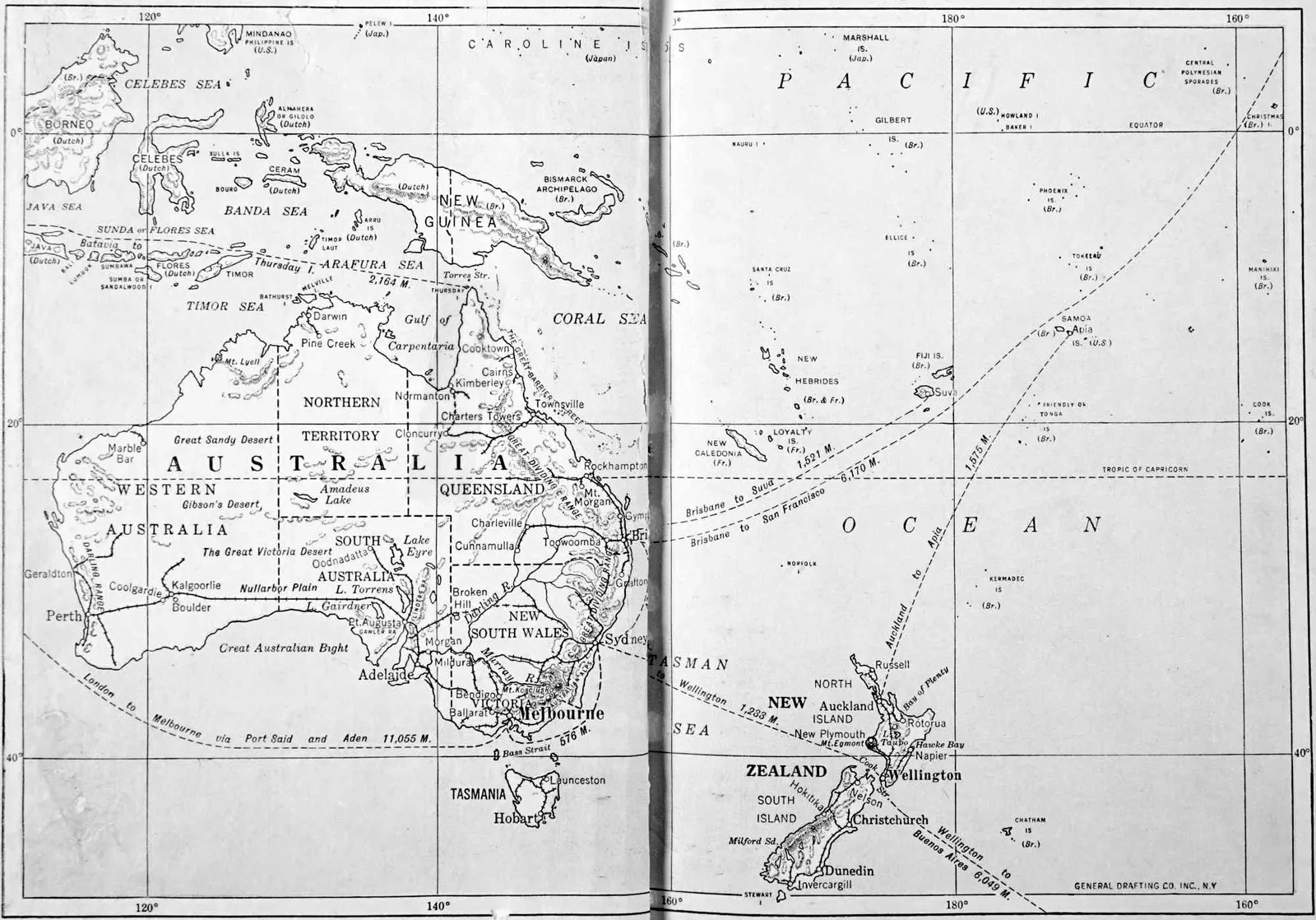
Guinea, and thence going southward inside the Great
Barrier Reef to Brisbane in Queensland.
The itinerary looked interesting, the voyage venturesome,
and as I walked on board my heart sang. A day
or so later it wept. The meat was atrocious, the bread
soggy, the rancid butter oil, and the water lukewarm and
bitter. As a whole, my fellow voyagers were no better than
the food. For the most part they were a motley crowd
of dirty Hindoos and Malays, with the flotsam and jetsam,
blacks, browns, and whites found scattered throughout
the islands.
Moreover, two of our Moslem passengers developed a
fever, which led to our being quarantined at some of the
ports. We were twenty-five long days on the Equator,
and it was only when the cool breezes off the Barrier Reef
blew new ozone into our lungs that life again seemed worth
the living.
But from the day I landed in Brisbane and started off
on my journeyings in the “lonely continent” to the day on
which I once more turned my face toward home I had no
regrets that I had come. Australia was full of surprises
and of interest for me; the beauties of New Zealand and
the air of its mountains soon drove the evil out of my soul
and put new life into my bones. I decided that here was
a case where the desire “for to admire and for to see” that
had sent me off to the other side of the world had done
some good to me after all. I trust that you, too, may be
glad that I went and that I have set down here the story
of what I saw.
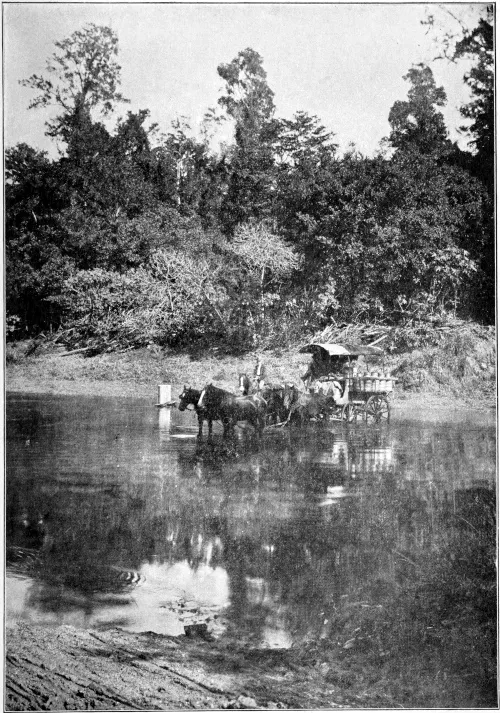
The few rivers of Australia are short and mostly unnavigable. In
summer many of the streams dry up entirely or form a series of detached
pools. The one big river system is the Murray, on the eastern side of the
continent.
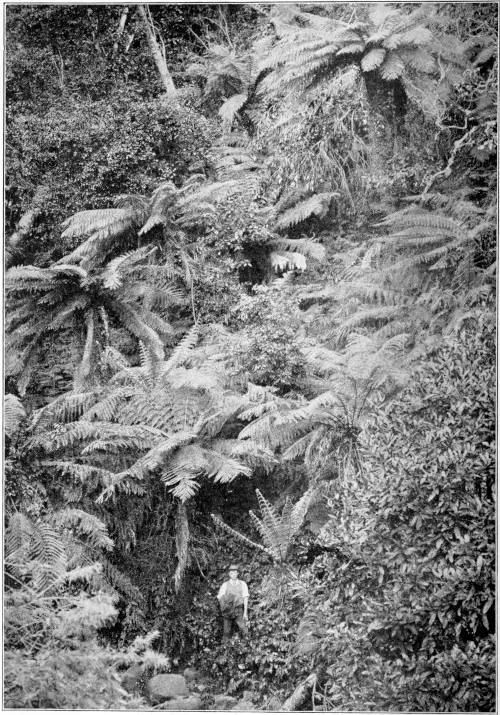
In some dense Australian wilds are towering tree ferns such as disappeared
from the rest of the earth before the Coal Age and are now seen
elsewhere only in the fossilized remains of prehistoric times.
CHAPTER II
THE GIANT OF THE SOUTH SEAS
THE Australians say their country is the biggest
thing south of the Equator, and what I have seen
here makes me think that they are right. Australia
is as big as the United States without
Alaska, twenty-five times larger than Great Britain and
Ireland, fifteen times the size of France, and three fourths
as large as all Europe.
It is a country of magnificent distances, being longer
from east to west than the distance from New York to
Salt Lake, and wider from north to south than from New
York to Chicago. By the fastest trains, Brisbane is
thirty-six hours from Sydney, and Sydney is eighteen
hours from Melbourne. It takes three days and eighteen
hours to make the trip by rail from Melbourne on the
southeast to Perth on the southwest coast.
Australia is also a land great in its resources. Since
gold was discovered there in 1851, it has produced five
billion dollars’ worth of the precious metal. Gold has
been found all over the continent—in the mountains, on
the farms, and in the sands of the deserts. Yet the greater
part of the country has never been prospected, vast areas
have not even been explored, and new gold mines may be
discovered any day. It is known that the continent contains
great quantities of iron, and tin has been extensively
mined. There is coal in every state and the deposits of
New South Wales, the only ones that have been well surveyed,
are estimated to contain more than one billion tons.
The coal beds of the state of Queensland are believed to be
inexhaustible. Silver, too, is found in all the states, and
the Broken Hill mines of New South Wales are among the
richest of the world.
More important than its mineral wealth, however, are
the pastoral and agricultural riches of Australia. Enormous
flocks of sheep pasture on the sweet grasses of thousands
upon thousands of her acres. She produces some of
the best wool on earth and exports a quarter of a billion
dollars’ worth annually. Her wheat lands produce enough
for the needs of her five and a half million people and
furnish one hundred million bushels for export. It is
estimated that with close settlement she can raise one
billion bushels, or sufficient to feed a population of one
hundred and fifty millions. Dairying is now one of the
largest of her industries and sixty million dollars’ worth of
Australian butter goes overseas every year.
In Australia there are great fertile tracts of land, but
there are also vast areas of desert. The well-watered
eastern part of the continent is rolling and hilly for about
one hundred and fifty miles back from the coast. West of
this region lies the country of plains, the first part of which
is a belt of prairie lands three hundred miles wide, where
there are fine sheep and cattle ranches and wheat and
fruit farms. Here, too, is the only real river system of
Australia, the Murray-Darling. Near the western border
of the plains is the salt Lake Eyre sunk in a depression below
sea level. Beyond Lake Eyre, extending almost across
the continent to within three hundred miles of the west
coast, and to within about the same distance from the
ocean on the north and south, is the Great Desert. This
has an estimated area of eight hundred thousand square
miles, or about one fourth of all Australia. Except
in the southwest corner, where gold is mined, there are
said to be less than one thousand white people in this
arid waste. The air is so dry that one’s fingernails become
as brittle as glass, screws come out of boxes, and
lead drops out of pencils. I am told there are six-year-old
children living in this region who have never seen a
drop of rain.
Australia is a land of strange things as well as big ones—queer
plants, queer animals, and aborigines who are the
most backward members of the human race. There are
lilies that reach the height of a three-story house, trees
that grow grass, and other trees whose trunks bulge out
like bottles. In the dense “bush” are mighty eucalyptus
trees rising two hundred feet high. They shed their bark
instead of their foliage, and the leaves are attached to the
stems obliquely instead of horizontally. There are towering
tree ferns such as disappeared from the rest of the
earth before the Coal Age and are now seen elsewhere only
in the fossilized remains of prehistoric times.
Two thirds of the animals of Australia, like its famous
kangaroo, are marsupials; that is, the females have pouches
in which they carry their young. Except for the opossum,
and the opossum rat of Patagonia, marsupials occur
nowhere else. Stranger than the kangaroo, stranger even
than Australia’s wingless bird, the emu, is the platypus,
which is found only on this island continent. It has a
bill like a duck’s, fur like a seal’s, and a pouch like that
of a kangaroo. It is equally at home on the land and in
the water. It lays eggs, yet it is a mammal; though a
mammal it has no teats, but nourishes its young by means
of milk that exudes through pores into its pouch.
As for the natives, when William Dampier, the first
Englishman to land on the shores of Australia, came here
in 1699, he described the aborigines as “the miserablest
people in the world, with the unpleasantest looks and
the worst features of any people I ever saw. Setting
aside their human shape, they differ little from brutes.”
Whence these natives came and how long they had been on
their island continent none knows. All agree, however,
that the bushman, or blackfellow, as he is generally called,
is the lowest form of man. Throughout uncounted years
he has made no progress. He is without history and without
tradition. Contact with civilization kills him. The
aborigines of Australia are a dying race, numbering now a
scant fifty thousand.
For centuries after the rest of the world was making history,
Terra Australis, or the South Land as it was called,
was also a terra incognita, a land unknown. This does
not seem strange when one considers how isolated it is.
It is so far from the other land masses of the globe that
it deserves its name of the “lonely continent.” It is
eighteen hundred miles from Asia, forty-five hundred
miles from Africa, and more than six thousand miles from
the west coast of North America. Even New Zealand,
which on the map looks so close to it, is twelve hundred
miles away. It takes the best Pacific steamers nineteen
days to go from Sydney to San Francisco, and for the
fastest mail boats it is a five-weeks’ voyage from any Australian
port to Liverpool.
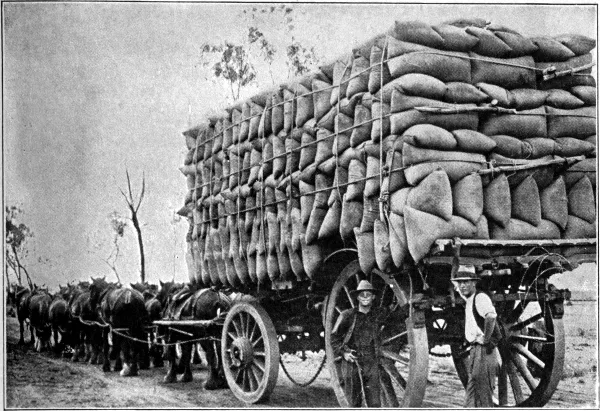
Australia produces enough wheat for her 5,250,000 people, and has
100,000,000 bushels for export. With close settlement, it is estimated that
she can raise 1,000,000,000 bushels, or sufficient for 150,000,000 people.
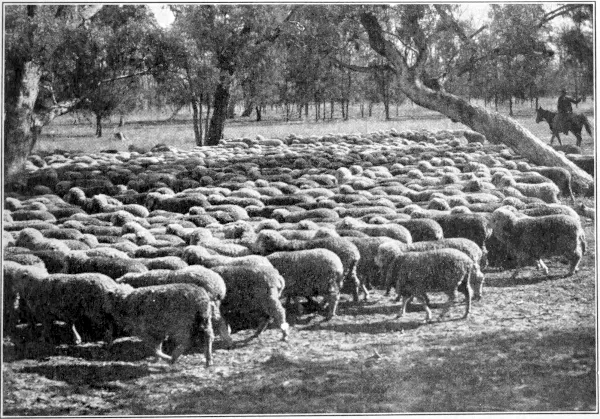
Half the world is kept warm with wool from the flocks of sheep pastured
on tens of thousands of Australia’s acres. She produces some of the
best wool on earth, and exports more than any other country.
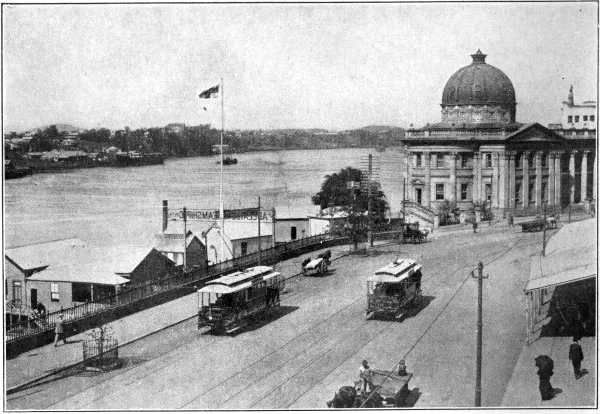
Fifty years ago Brisbane was a village, and before that a British convict
colony. To-day it is the fourth city in size in the Commonwealth,
and the capital of the progressive state of Queensland.
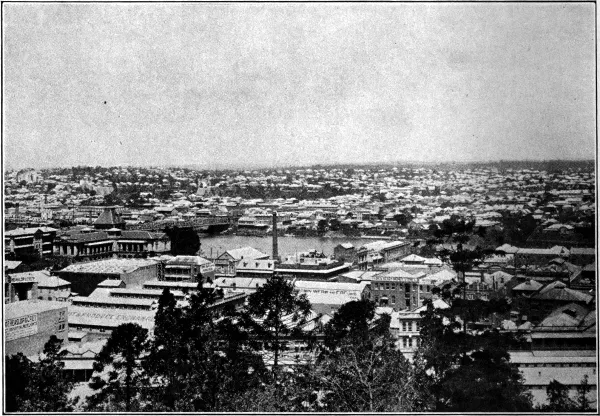
Brisbane is cut in two by the Brisbane River, a wide stream navigated by
ocean vessels, which come here for cargoes of frozen beef, wool, and grain.
When the United States was an infant among the independent
nations of the earth, the history of Australia began.
And just here the story of the “lonely continent”
is linked with our own. There were a number of persons
in the American colonies who remained loyal to the King
throughout the Revolutionary War. When independence
was won they found this country an uncomfortable place
in which to stay. So it was planned by the British to
make Australia a new home for the American “Loyalists.”
This scheme failed, but another took its place. In colonial
days the British had used America as a dumping place for
undesirable citizens, especially political prisoners, and had
sent them across the Atlantic at the rate of one thousand a
year. Now that this human riffraff could no longer be
shipped to us it was decided to transport them to Australia.
Accordingly, in 1788 a thousand convicts were landed at
Sydney Cove, and this was the beginning of the British
occupation of the great South Land.
One hundred and thirteen years after that initial settlement
there came into being the Commonwealth of Australia.
In the birth year of the present century, the half
dozen different Australian colonies, some as widely separated
as any parts of our own country, became a federated
union of the six states of Queensland, Victoria, New South
Wales, South Australia, West Australia, and Tasmania.
Before this these states had quarrelled frequently over matters
of trade and internal development, and each had gone
its way without regard for its neighbours. With federation,
the tariff barriers between them were removed, common
policies were agreed upon, and all joined hands in
the determination to work together to create a new nation
of white men within the British Empire.
Besides the six states, there are the Northern Territory,
the Federal Territory, and the territories of Papua and
New Guinea. The Northern Territory is the tropical area
of some half a million square miles ceded by the state of
South Australia to the central government. The Federal
Territory corresponds nearly to our District of Columbia;
for it is the nine hundred and forty square miles set aside
for Canberra, the new capital of the Commonwealth.
During the erection of the necessary buildings at Canberra,
the capital remains at Melbourne. The territory of
Papua, or British New Guinea, is the southeastern part of
the island of New Guinea and is administered by officials
nominated by the Governor-General of Australia. The
Territory of New Guinea consists of those lands formerly
embraced in German New Guinea, which Australia governs
under a mandate from the League of Nations.
In many ways the constitution of the Commonwealth
is like ours. Each of the states has its separate government,
with great latitude in the management of its own
affairs. The British Crown appoints a Governor-General
for the whole Commonwealth, but his authority is merely
nominal and the real executive power is in the hands of the
Premier of Australia and his nine ministers. The Prime
Minister is the leader of the majority of the Federal Parliament
of which he and his cabinet must be members.
Parliament consists of a Senate and a House, organized
much like our own Congress. The Senators are elected for
six years and the representatives for three, but under certain
conditions the House may be dissolved by the
Governor-General before the three-year term is up. There
are seventy-six representatives elected in proportion to
population, and thirty-six senators, six from each state.
Senators and representatives get the same salaries, each
receiving five thousand dollars a year. It is provided that
no member of Parliament can hold office if he has been
bankrupt and failed to pay his debts, and if he takes benefit,
whether by assignment or otherwise, of any bankruptcy
law during his term of office his seat will at once become
vacant. He cannot have any interest in any company
trading with the government, nor can he take pay for other
services rendered to the government. The state governments
are organized like that of the Commonwealth, each
having its premier, who is the leader of the majority in the
state Parliament.
Following the World War many countries experienced
political upheavals and radical ventures in government.
But it was in Australia years earlier that a working-man’s
party first gained control of a national government. As
we go about in the several states of the Commonwealth we
shall find many evidences of the part played in public
affairs by the labour unions. They have frequently held
a majority in state legislatures, but are especially anxious
to dominate the federal Parliament so that they may put
their ideas into effect on a wholesale scale. Woman
suffrage, adopted in Australia almost without opposition,
has added strength to the labour element, for it is generally
agreed that nearly every workingman’s wife goes to the
polls, while many of the women of the well-to-do classes
stay at home.
CHAPTER III
QUEENSLAND
MOST travellers from our hemisphere first set
foot on the Australian continent at Sydney,
the biggest seaport of the country and the
seventh city in size in the whole British Empire.
I first stepped out upon its mainland at Brisbane,
which lies five hundred miles north of Sydney and is the
capital of the state of Queensland.
In coming down the coast from Thursday Island and
Torres Strait I had one of the wonder trips of the world,
for my way lay inside the Great Barrier Reef.
Imagine a chain of coral as long as from New Orleans
to Chicago. Let the chain be composed now of atolls,
great coral walls encircling lagoons, now of long coral
ridges, and now of gardens of the beautiful red, white,
and pink flowers fashioned by these insects of the seas.
Such is the Great Barrier Reef, which extends along
the whole eastern coast of Australia northward to Torres
Strait. For the most part it is only from five to fifteen
miles from the mainland although in one place it is a
hundred miles off shore. At times we were close to the
coast, and again were moving along near huge rings of
coral that seemed to float on the green sea. Some of the
atolls had vegetation upon them, their round basins being
circled with coconut trees, while others, seen only at low
tide, were stony and bare.
The air was wonderfully clear and the sky a heavenly
blue. The few clouds made big patches of dark blue velvet
on the dreary gray of the Australian mountains. The
sea was as smooth as a mill pond. We were feeling our
way along through a wide canal, one side of which was
walled with the cliffs of Australia and the other by this
masonry of countless millions of coral polyps. Our
steamer had to go cautiously, for under the smooth waters
were treacherous spurs and peaks of coral ready to rip
holes in her side. Our captain kept a sharp lookout for
brown waters, which mean bars, or green, which indicate
coral, and steered a course through the deep blue of the
safe passage. Among navigators the shallows between
Cape York and New Guinea have the reputation of being
the worst waters in the world. Some of the ship captains
boast that they can smell the coral in the dark, just as
those of our transatlantic liners declare that they can
smell the ice of the bergs that drift down from the North.
Such cautious sailing began to get on the nerves of some
of the passengers and I think all of us were glad when our
steamer turned into Moreton Bay, the outer harbour of
Brisbane. We approached a low shore of sandy dunes and
beaches rising gradually into rolling hills thick with trees.
Slowly we entered the mouth of the wide Brisbane River,
up which we travelled for several hours. As our steamer
went on through the murky water, we could look over the
side and see masses of jelly fish, transparent mushrooms of
bright violet, tossed this way and that by the waves from
the ship. The banks were low and covered with bushes.
Along the way there were meat-freezing plants, each surrounded
by little houses roofed with galvanized iron, the
homes of the workmen.
As we kept on, the country on each side of the river became
more hilly, and when we reached Brisbane I found it
a place of as many gulleys as Kansas City. Most of the
town lies on the right bank of the river. There are many
pretty villas, and rising high above them is the Queensland
Parliament House.
After a lenient examination by the customs officials, I
drove to my hotel through streets not unlike those of an
American town. They were paved with wood instead of
brick or asphalt. The stores reminded me of ours at home,
and the size of the buildings surprised me.
Brisbane, the capital of the second largest of the six
states of Australia, has more than two hundred thousand
people, and is the fourth city in size on the continent.
During the last half century it has had a phenomenal
growth. Less than seventy-five years ago it was taken
away from the neighbouring colony of New South Wales
and became the capital of Queensland. At first it grew but
slowly, for it was handicapped by having been the site of
the Moreton Bay Settlement, a colony for the worst of
the convicts sent over from England. When it began to get
on its feet a terrible flood swept away so many of the houses
in the low-lying sections that it was believed the town
would never recover. Yet it took a new lease of life, and
to-day it is hard to realize that, fifty years ago, it was only
a village with less than one thousand inhabitants.
The public buildings were planned with an eye to the
needs of the future. The State Treasury would do credit
to our own capital at Washington. The Law Courts cost
nearly two hundred thousand dollars, and the Parliament
Building half a million. In George Street is a splendid
palace which houses the Lands Office, and the Public
Library is a striking piece of Italian architecture. On a
steep cliff above the big-domed custom house rises the
Cathedral of St. John, considered the finest Gothic structure
in all Australasia.
Talking with the Queenslanders it is easy to see that
they think theirs is the coming state of Australia. They
say the good lands of Victoria have long since been taken
up, that New South Wales is fairly well developed, and
that such large areas of South Australia and West Australia
are desert that those states can never support a great
population. Queensland has two slogans: One claims
that it is “a paradise for willing workers,” and the other
that it is “the richest unpeopled country in the world.”
The state has vast tracts of arid land, which it expects
to reclaim by artesian wells. It has already redeemed
from the desert a country more than twice as large as the
state of New York, having discovered that most of the
great area beyond the coastal range is underlaid with subterranean
lakes and streams, which will furnish water for
stock. The cultivated acreage is growing every year.
Enough pastures for seventeen million sheep are now in
use, and the state has already nearly twice as many sheep
as any other division of Australia.
Queensland might be called “The Newest England” of
these British south lands. It is a principality in itself.
It comprises the northeastern quarter of the Australian
continent; from north to south it is as long as from Washington
to Omaha, and from east to west about as wide as
from Washington to Chicago. It is three times as big
as France, and twelve times the size of England and
Wales.
The upper half of Queensland is not far from the Equator
and raises cotton, sugar, tobacco, and all sorts of tropical
fruits. Bananas do so well that one of its nicknames
is the “Banana State.” Scrub lands cleared at a cost of
about ten dollars an acre can be planted without ploughing
and will produce fruit in a twelvemonth. Fifteen tons
of pineapples to the acre is not an unusual crop, and pines
weighing from fourteen to sixteen pounds have been
grown. The factories for canning this fruit that have
been started with the aid of the government may some
day compete with the great pineapple canneries of Hawaii.
A great advantage of the fruit-growing business in
Australia, as in South America, is the difference in seasons
in the Northern and Southern hemispheres. Being
south of the Equator, the fruits ripen at a time of year
when European and North American markets offer the
best prices, and refrigeration and fast boats are already
landing Queensland fruits on our winter tables.
Australia usually raises enough sugar to supply her own
needs, and ninety per cent of her crop is produced in tropical
Queensland. Sugar cane was first grown here about
1865, and in the early days the plantations were worked
with coloured labour brought in from the South Sea
islands. Later on it was decided to send the “blacks”
home, and keep the resources of the state for white men
exclusively. From the standpoint of the growers, this was
a real sacrifice, and the Commonwealth government is now
doing everything possible to stimulate sugar production.
At one time it paid bonuses on sugar produced by white
men, but these have been given up. Now the government
buys the entire crop outright and controls its refining and
sale. The cane is crushed in Queensland, but is refined by
the big Colonial Sugar Refining Company in Melbourne
and Sydney. Under the government monopoly the consumer
pays about twelve cents a pound. Importation of
sugar by private individuals or companies is forbidden,
and whenever the Queensland crop falls below three hundred
thousand tons the government imports enough to
meet the requirements.
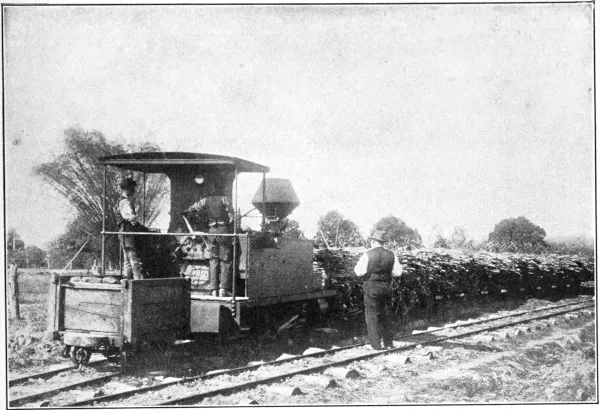
Australia has her sugar bowl in Queensland, which produces nearly
enough cane to supply the entire population. It is one of the few places in
the world where the crop is grown without coloured labour.
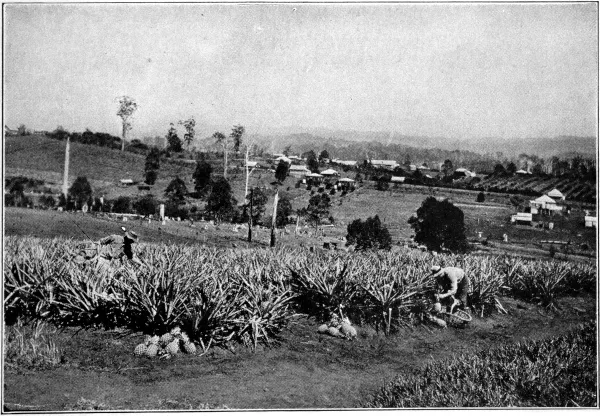
When it is snowing in New York, the Queensland fruit grower is gathering
his pineapples. They are raised on land leased from the government
with the privilege of purchase on easy terms.
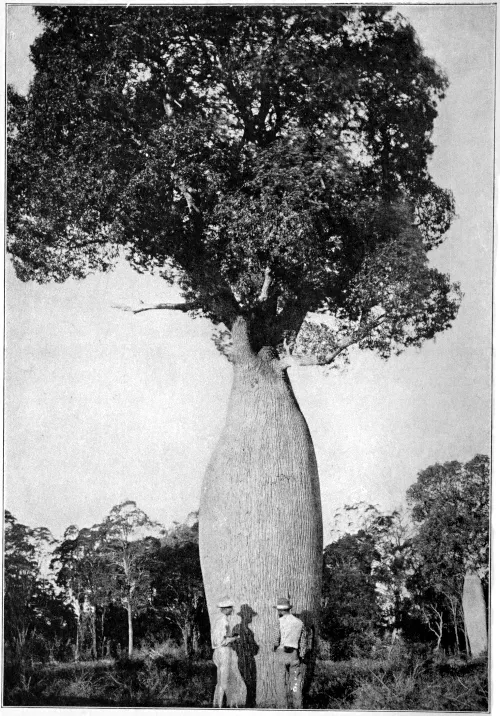
On the elevated sandstone plains of interior Queensland grows the
queer bottle tree. One’s general impression of Australian forests is their
total unlikeness to anything elsewhere.
In the southern part of the state are the Darling Downs,
four million acres of the richest soil on the continent.
Here the average rainfall is more than thirty inches a year,
and almost everywhere artesian water may be had within
a few feet of the surface. Since they were first settled in
1840 the Downs have been the home of prosperity. To-day
they roll away in orchards and green fields, dotted
here and there with herds of fat dairy cattle, and checkered
with chocolate squares of ploughed lands. I am told that
some of the soil is too rich to raise wheat until it has been
farmed a few years. In some places it produces one hundred
and ten bushels of corn to the acre, and on a number
of farms two crops are raised every year. A great deal of
money is made in alfalfa, which grows very rank. Often
as many as nine crops are cut in one year, each yielding
from one to two tons per acre. On the best land it is not
uncommon for a man to get a hundred dollars per acre
annually out of alfalfa. As a general thing the farming is
carelessly done, and but little fertilizer is used. The seeds
are merely sown and the crop is reaped.
The principal city on the Downs is Toowoomba, two hundred
miles west of Brisbane and two thousand feet above
sea level. It serves as a playground and health resort for
the people of Brisbane and elsewhere in the hot lowlands.
Throughout the year the climate is temperate and bracing,
and in June and July, the coolest months of the year, there
are often frosty mornings here and fires are welcome at
night.
Toowoomba is also the unofficial capital of the rich
farming district of the Downs. Its streets are generally
full of men who have ridden in from the country
to talk sheep, wool, grapes, wheat, or timber, or to seek
amusement after their hard work in the fields. Its pretty
homes are surrounded by gardens of English flowers and
hawthorne hedges and rows of weeping willow trees. I
have seen many weeping willows along the streams of
Australia, and the people say that all are the descendants
of slips brought from the island of St. Helena. In the old
days ships bound for Australia used to stop for water at
the place of Napoleon’s exile and the outgoing colonists
provided themselves with willow cuttings to be planted in
their new homes.
Queensland’s great need is more people. In this huge
state, capable of supporting a population of many millions,
there are less than eight hundred thousand, or only about
one person to every square mile. I have before me an advertisement
of the Acting-Registrar General declaring that
the two necessities of the state are “increased production
and increased population” and offering inducements in
the way of cheap lands on easy terms to “the industrious
in every walk of life.”
Throughout Australia land transfers are made under
what is called the Torrens Title, a system which has
spread to Canada, to England, and to other countries of
Europe, and has been adopted by the United States for the
Philippines and Hawaii. Ohio also has adopted it, and
others of our states are using it in modified forms. By
this system the landowner registers his property with the
land office, receiving a duplicate certificate of title. If
later he wishes to sell he hands over the certificate to the
purchaser, who has the sale registered at the land office,
where the facts of the transaction are entered on the
original certificate. If the owner puts a mortgage on the
property the terms are recorded with the Registrar. The
certificate therefore always contains the name of the owner,
a description of the land, and a statement of all liens and
encumbrances. No title searching is necessary, and by the
payment of a small fee at the Registrar’s office, anybody
can find out all about a given piece of land. The Torrens
System and the secret ballot are two big ideas that we owe
to our Australian cousins.
For many years a thorn in the flesh of the small farmers
and workingmen of Queensland was the fact that, by
special legislation, big lease holders of the public lands
paid lower rents per acre than the holders of small tracts.
The Land Act Bill of 1915, framed to remedy this condition,
was passed by the lower house of the state Parliament
but was rejected by the upper chamber, or Legislative
Council. The Council was at that time composed of
thirty-seven members appointed nominally by the Crown,
but really by the Queensland Prime Minister and his
Cabinet. They could hold office for life, and no limit was
placed on their number. As constituted in 1915, the
Council had only two representatives of labour and the
rest of its members were conservatives, many of them
moneyed men determined to guard their own interests.
On the other hand, the seventy-two members of the Legislative
Assembly are elected by the people for three-year
terms. The Land Act Bill was passed by the next Assembly
and again rejected by the Council. Then the
government stepped in to see that the will of the people
was carried out. It appointed enough new members
known to favour the act to swamp the conservatives in the
Council, and the bill at once became law. So enlarged,
the Council, with its majority in absolute accord with that
in the lower house, became a mere rubber stamp for the
legislation passed by the Assembly, and even approved the
bill ending its own existence.
The government of Queensland is sometimes criticized
as a patriarchal institution for coddling the people.
Both town and country make all sorts of demands on it to
serve their interests. They tell a story of one official who,
exasperated by a deputation of farmers, burst out with
this:
“You ask the government to do everything. I am
surprised that you do not demand that we furnish milk for
your babies.”
Queensland, the northern half of which lies just south of the Equator,
is sometimes called the “Banana State,” because of the success of settlers
in growing that fruit in the newly cleared lands.
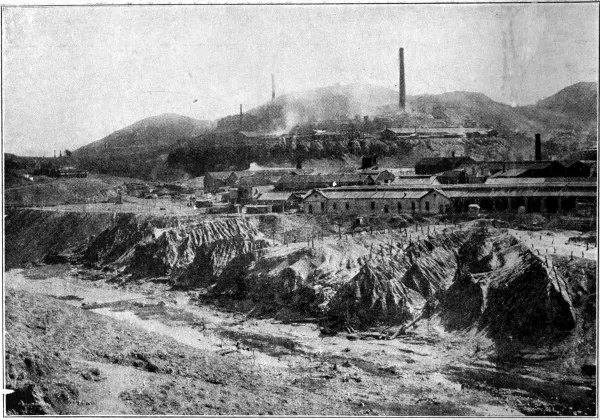
The farmer who owned the hill now known as Mount Morgan sold it to
prospectors for five dollars an acre. It has since yielded gold worth
$125,000,000 besides vast quantities of copper.
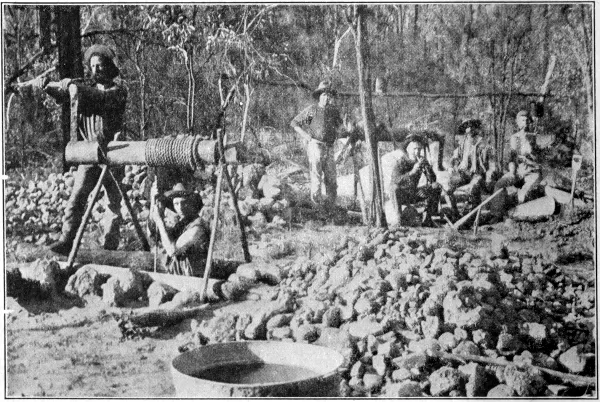
In the Anakie gold fields of western Queensland mining sapphires is a
well established industry, with an output worth about one hundred thousand
dollars a year. The lemon or orange tinted stones are the most
prized.
CHAPTER IV
A CROWN OF GOLD AND A CROSS OF CACTUS
QUEENSLAND is one of the gold states of
Australia. It is especially noted for Mount
Morgan, perhaps the richest gold mine of the
world. This mountain is twenty-four miles
from the city of Rockhampton, on the coast north of
Brisbane. It has already produced more than one hundred
and twenty-five million dollars’ worth of gold, and
paid more than fifty million dollars in dividends. The
original fourteen owners invested only a few hundred
pounds.
The mountain belongs to a low range of hills not far
from the coast. It was part of a farm owned by a man
named Gordon, who had fenced it in and was using it for
pasturage. One night Gordon was visited by two brothers
named Morgan, who were prospecting. The Morgans
stayed overnight, and Gordon told them he thought there
was copper on his farm as he had noticed green and blue
stains in the rocks. The next day he took the prospectors
to the mountain, and when they left they carried away
samples. A few days later they came back and offered
him five dollars an acre for the property. He was glad
to sell, and for this price the Morgans bought one of the
richest mining properties ever known. To get money to
work the mine they sold a half interest to three men in
Rockhampton for ten thousand dollars. With this they
experimented, and finally discovered that the ore could
be worked by the chlorination process. The result was
that they and their associates soon became millionaires.
Since then the works have expanded until a town has
grown up at the foot of the mountain. There are great
mills, in which more than two thousand men are employed.
The mine has continued to pay big dividends, but these
now come from copper rather than from gold. For, when
the gold began to grow scarce, apparently inexhaustible
supplies of copper were found underneath the deposits of
the more precious metal.
Some people think that there may be other gold deposits
in the neighbourhood equally as rich as those of
Mount Morgan. However that may be, it is a fact that
twenty miles from the city a little boy one day found a
nugget worth ten thousand dollars.
Rockhampton is a city of twenty thousand founded on
the gold and copper mines. It is now growing as a centre
of the dairying and mixed farming interests fast developing
in the surrounding country. The town, which
has the Tropic of Capricorn running through one of its
streets, is built some thirty miles inland on a steamy
valley of the Fitzroy River. It is cut off by a high range
of hills from the ocean breezes. Even in June, the coolest
month of the year, the thermometer goes above eighty
degrees Fahrenheit, and in February the mercury often
rises to one hundred and sixteen. In the early gold-mining
days the Britishers who came out to get rich and toiled in
the heat nicknamed the place the “City of the Three
S’s”—Sin, Sweat, and Sorrow. Nevertheless, it is a
growing town full of business.
Three hundred miles northwest of Rockhampton is the
town of Charters Towers, the centre of another big gold
field a few miles back of the seaport of Townsville. The
gold at the “Towers” was discovered in 1872 by three
prospectors, who took out millions of dollars’ worth in a
short time. The principal mining is quartz, some of the
workings being very deep. As at Mount Morgan, copper
mining is carried on profitably along with the gold mining.
Another field is that of Gympie, where, it is said,
the boys used to pick up grains of gold in the streets after
a rain, sometimes getting as much as half an ounce a day.
In that town one man found a nugget worth eleven hundred
dollars.
So far, Queensland has produced nearly half a billion
dollars’ worth of gold, and mines are still being worked
throughout a large area, although the cream of the known
deposits has been skimmed off.
There are also deposits of lead, as well as of iron,
bismuth, and silver. Iron is found in all sections, and
in one district there are little mountains of iron ore.
Mt. Leviathan, a hill two hundred feet high, is said to be
composed of pure magnetic iron. In the long tongue of
York Peninsula, which Queensland thrusts up toward
Torres Strait, there are tin deposits over a wide area.
Tin is found also in the southern part of the state.
Some of the finest Australian opals come from western
Queensland. That region has a long belt of opal-bearing
country, extending from a point near the Gulf of
Carpentaria across the southern border of the state and
into New South Wales. The opals are brought into Brisbane
by the handful and sold at low prices. Many of the
opal miners are sheep-shearers, who hunt for the stones in
the off season. The gems are found in quartz and in
sandstone, from six inches to thirty feet below the surface.
The Queensland black opal brings big prices in Paris,
London, and New York. It is not really black but a
mixture of rich colours, with iridescent green and violet
prevailing. Deep down in its heart is a living spark of
flame, which has given it also the name of the “fire opal.”
About two hundred miles west of Rockhampton are the
Anakie gem fields which are studded with sapphires.
Stones to the value of nearly one hundred thousand
dollars are produced there every year. The best of them
are of the clear lemon and orange tints which have become
especially popular with the jewellers of Paris.
So much for Queensland’s crown of gold studded with
gems. Her cross is the greenish-gray cactus, which has
ruined vast areas of rich agricultural lands. I have heard
different stories about how prickly pear came to Australia.
Some say John Macarthur, who was such a benefactor
to the country through his introduction of the
Merino sheep from Spain, is responsible for it. Perhaps
he had seen the cactus hedges used in the thickly settled
Mediterranean countries to separate small holdings and
thought they would be a good thing for the gardens and
paddocks of the Australian settlers. It is even said that
the first prickly-pear plant was sent to the Downs carefully
wrapped in cotton wool and packed in a sealed box.
Now, for mile upon mile the traveller sees only an impenetrable
thicket of this spiny, gray-green vegetation,
growing right up to the settlers’ front doors. It is stated
that the plant covers more than fifteen million acres of
Queensland, or an area nearly twice that of Rhode Island.
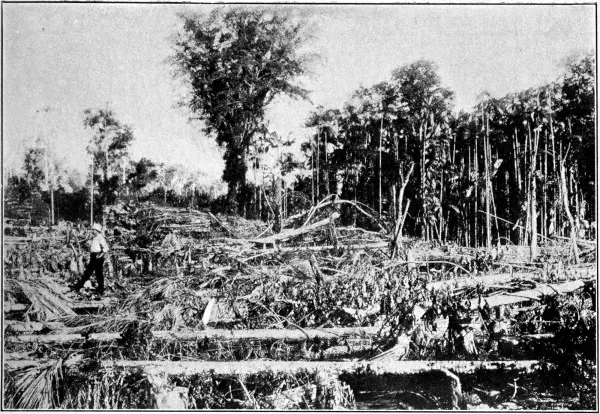
When an Australian speaks of clearing the land of “scrub” he does not
refer to a mere matter of brush and saplings, but to what we would consider
a dense forest of full-grown trees.
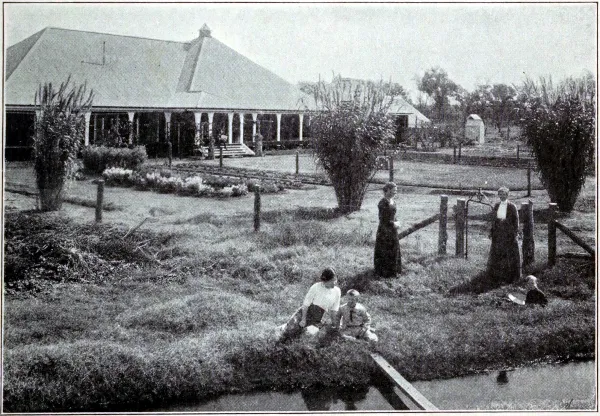
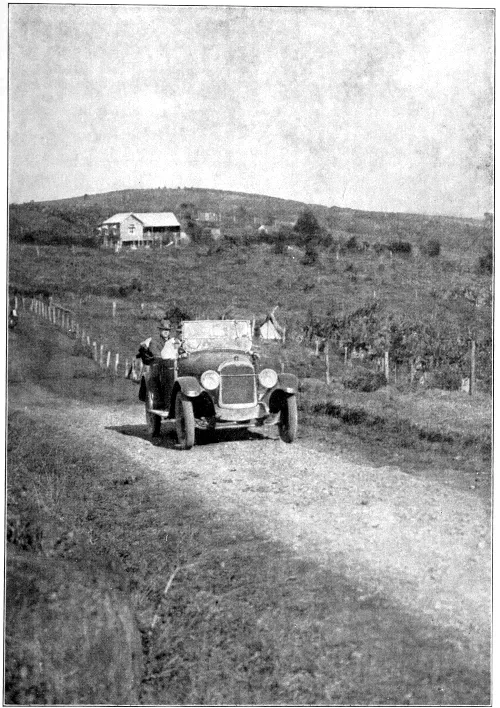
In the cattle country of southern Queensland the farm houses are one-story
frame bungalows, roofed with corrugated iron and often set up on
iron piles to keep out the wood-devouring ants.
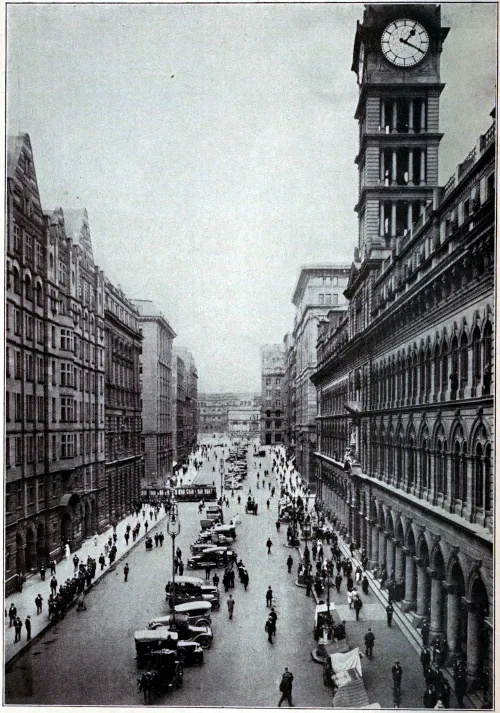
An American dropped from an airplane into Martin Place, Sydney,
would feel very much at home. Many of the newer buildings are of our
skyscraper type, while the street is filled with motor cars made in the
States.
The state government sent a Prickly-Pear Commission
on an eighteen-months’ tour around the world in the
effort to find some parasite or disease with which to destroy
the pear. It has offered great rewards to any chemist who
finds a specific against it, and year by year different
methods of extermination are tried out. So far, however,
no cheap and infallible way has been found. Uprooting
or cutting is useless, unless every single leaf is
burned. Squirting a solution of arsenic and soda into
each leaf by means of a “pear gun” has proved effective
in the case of small growing plants, but this is too slow and
expensive on such an overwhelming proposition as fifteen
million acres. The remedy probably lies in the closer
settlement of the country and the principle of every
man’s keeping his own dooryard clean.
CHAPTER V
THE METROPOLIS OF THE ANTIPODES
I AM in Sydney, the fastest-growing city of Australia
and the commercial metropolis of this part of the
world. People who look upon the island continent
as a big desert surrounded by a strip of pasture
should come to Sydney. They will find here a city that
will open their eyes. It has now about the population of
St. Louis or Boston, but it seems to have twice as much
business as any place of the same size in the United States.
Situated south of the Equator and about the same distance
from it as Louisiana, it lies in the centre of the most
populous part of Australia, and just where goods can most
easily come in for distribution over a vast territory.
Sydney is the capital and distribution point for the two
million people of New South Wales, a state the size of
Texas and Indiana combined. These two million are the
richest people of a country with a per-capita wealth of
$1,624 or, at five to the family, eighty-one hundred dollars
per family.
I know one man who has a million acres of land, and I
could hardly throw a stone in the business part of Sydney
without striking the holder of five thousand acres and
more. There are men here who have a million sheep, and
many who own flocks of tens of thousands. Australia has
no Fords or Rockefellers. Rarely does any one leave an
estate worth above five million dollars. On the other
hand, the wealth is more evenly divided than in the
United States, and the workers live much more comfortably
than their brothers in Europe. Everywhere on the
streets of Sydney I see signs of well-being. There are no
patched clothes, and in fact there is no poverty as we
know it.
Of all the big cities south of the Equator, I like Sydney
best. Especially do I like the people here. Buenos
Aires has a population of more than a million and a half,
but it is a succotash of Italian, Portuguese, and Spanish
ingredients, with a mixture of Indian, English, German,
and French. Rio de Janeiro has a million and a quarter
inhabitants, sprinkled with so much African blood that
one can hardly tell where the white ends and the black
begins. Moreover, as in other cities of South America,
most of the people are wretchedly poor.
Here the faces are all English, Irish, and Scotch, or,
what is better, pure Australian. The Australians are
finer looking than their British cousins. They are taller,
straighter, and better-formed. Six feet is not an uncommon
height for either men or women. The latter
are Amazons. Many of them are slender and they tower
above me like so many giantesses. They are sometimes
called “cornstalks,” because they spring up so rapidly
and grow so tall.
Its magnificent harbour and the enterprise of its people
have made Sydney the New York of Australia. The
city does business with all the world. It is the terminus
of a dozen great steamship lines connecting the continent
with Europe, Asia, Africa, and North and South America.
To-day there are tramps in the harbour from Cape Town,
ships from China and Japan, fast vessels from France,
and big steamers from England. One American passenger
line connects Sydney with San Francisco, and three
others carry freight to and from our Pacific and Atlantic
coasts. The Commonwealth Line, which now operates
a number of Australian government-owned ships of
steel and wood, has a regular service from Sydney to
London via the Suez Canal. Besides being linked up
with all the great ports of the world, Sydney is a centre
of trade along the coast and with the countless islands of
the South Seas.
The commerce here is enormous. The wool shipments
alone have a value of something like sixty million dollars a
year, and there is a large export of grain, coal, and meat.
Considering the number of the population, the imports
are very heavy. Although New South Wales has not
so many people as Chicago, it buys three hundred and
sixty million dollars’ worth of goods from foreign countries
every year, and most of them come in through
Sydney.
In beauty and commercial advantages, Sydney harbour
equals the Bay of Naples, the harbour of Rio de Janeiro,
or the famous waters about Constantinople on the Bosporus.
At its entrance, which is not more than a mile
wide, great rocks rising to more than half the height of
the Washington Monument form a natural gateway. No
matter how stormy the ocean outside, when a steamer
passes the Heads, it finds quiet waters. It enters a winding
lake or stream, with hundreds of bays, inlets, and
creeks studded with islands and walled with wooded hills.
The harbour has an area of twenty-two square miles of
water held in a rock-bottomed basin. There is a reef in
the fairway, but since it runs parallel with the direction of
incoming and outgoing vessels, it is an advantage rather
than a drawback, for it divides the harbour into two
deep-sea channels. There are no large rivers depositing
sand and silt to be dredged out. At the Heads the water
is eighty feet deep, and at the wharves it is from thirty to
fifty feet. The ships come right into the town, so that
one can step ashore, walk three minutes, and be in the
business section.
Since coming here I have climbed to the top of the
Public Works Building for a bird’s-eye view of the city.
This building is on the harbour in almost the centre of the
town. Standing upon it one can see the great ocean
steamers landing goods at the quays, the ships entering
and leaving, and the little tugs and ferries moving this
way and that.
Looking over the city I noticed that its buildings cut the
skyline like the teeth of a broken saw, one now and then
extending for many stories above its neighbours. There
are indeed three Sydneys—the fast-disappearing city of
the early governors, with its gabled cottages and brick
houses; the Sydney of a later time with the ugly architecture
of the Victorian era; and the modern, up-to-date
Sydney, which reminds me of an American city. It has
buildings of the skyscraper type, though not so high as
ours. Many of the houses are built of yellow sandstone
taken from local quarries.
Sydney covers a large area. Its streets wind about like
those of Boston, and it is facetiously said that the place
was originally laid out by a bullock driver with a boomerang.
The city is noted for its excellent wooden pavements,
which, according to our consul here, will last for
ten years without repairs. Some time ago part of the
pavement of George Street, upon which are some of the
chief business houses, was taken up. The blocks were as
good as when laid eleven years before, save that they had
been worn down about one fourth of an inch. These
blocks are of eucalyptus wood dipped in boiling tar and
laid on a foundation of cement. They are fitted as closely
as a parquet floor, and are so smooth that three-ton loads
can be hauled over them by one horse. Paving blocks
of the Australian eucalyptus are now used by some cities
of Europe.
One of the most interesting rides I have had in Australia
was my trip from Brisbane to Sydney. This takes one
through the better parts of the states of Queensland and
New South Wales. The road-bed is smooth and the cars
are about like those of the United States except that there
are no Pullmans until the boundary of New South Wales
is reached. There is no baggage checking system such as
ours, although the traveller is given a receipt for his
trunks. The first-class car in which I rode was divided
into compartments with cushioned benches under the
windows.
The scenery on this trip is worth noticing. A part of
the way is over mountains and across rolling grazing lands.
Some of the ride was through forests of eucalyptus trees,
always and in all their numerous varieties called “gums”
by the Australians. The leaves of the trees seemed to me
to hang down as though in mourning and most of them
had lost half their bark. The old bark was black and
hung in long streamers down the trunks like dishevelled
hair, while the new bark, white or silver-gray, looked
very pretty by contrast.
In some places there were groves of dead trees. They
had been ringed with the axe to kill them for clearing and
stood stark and gray without leaves or bark. In the glare
of the bright sun their limbs looked like clean and well-polished
bones. A dead Australian forest is a veritable
skeleton forest, the deadest-looking thing in nature.
Where the trees have been felled the stumps are perfectly
white, the logs lying on the ground are white, and the
whole makes one think of a bone yard.
When we passed over the Darling Downs we travelled
for miles across green fields as flat as a floor surrounded
by wire fences, which enclosed great flocks of fat sheep
and herds of sleek cattle. On the ploughed lands the soil
was as black as that of the Nile Valley and the dark
ground looked soft and velvety in the brilliant sunlight.
We crossed tracts each of a hundred acres and more of
luxuriant alfalfa, and again went through fields where the
green blades of wheat were just poking their tips up
through the dark earth. Where a stream had made a
deep cut I could see that the rich top soil was many feet
in depth.
There were but few farm outbuildings, no big barns,
and no farmhouses of any great size. The homes were
one-story cottages of wood painted yellow and roofed with
galvanized iron. In spite of Australia’s huge forests,
wood is still expensive and galvanized iron is largely used.
Most of the houses had big round iron tanks on their
porches to catch the rain from the roofs. Many had
galvanized iron chimneys, and a few were built entirely of
this material, which is imported from England.
I noticed that some of the cottages were set high up on
iron piles capped by iron saucers with rims turned down,
in the same way that the American farmer protects his
granary from the rats. The upturned saucers are used to
keep out the white ants which will devour almost any wood
or leather they can get hold of. In tropical Queensland
the piles have another advantage; for they permit a circulation
of air under the houses, cooling the floors.
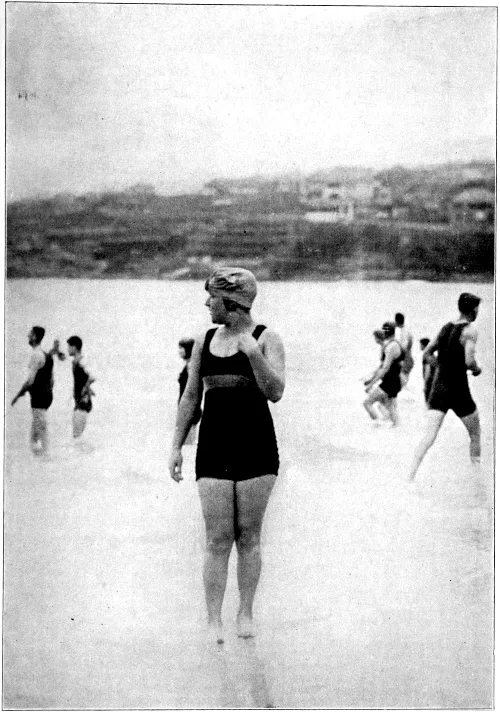
Bondi Beach, near Sydney, is the resort of thousands. Though sometimes
accused of overdoing it, the devotion of the Australians to outdoor
pleasures has helped make them a healthy, vigorous people.
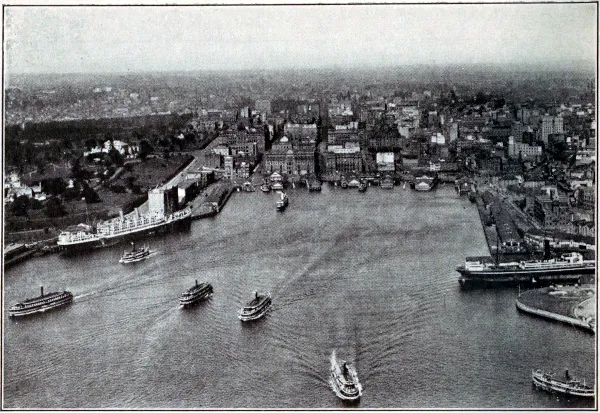
The water traffic of Sydney harbour centres at the Circular Quay,
where all the ferries dock, and the street-car lines converge. The ferry
system is one of the largest and most efficient in the world.
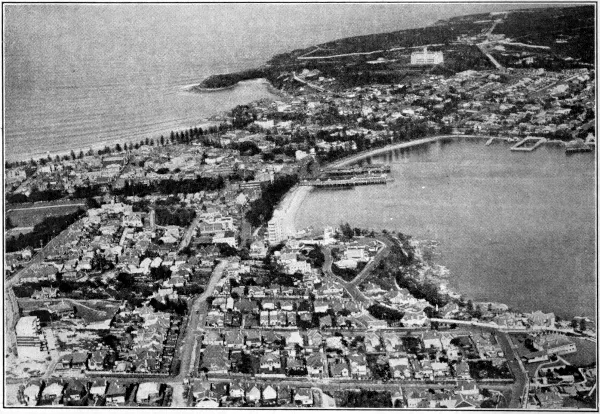
On the narrow neck of land separating Sydney harbour from the ocean
is Manly Beach, which divides honours with Bondi as a place for surf bathing.
On the hills some of the wealthy business men have their mansions.
CHAPTER VI
WALKS ABOUT SYDNEY
COME with me for a walk through the city of
Sydney. The sun is hot, but the porticoes of
iron and glass, built out over the sidewalks, will
protect us from its rays. We stroll by great
stores with fine window displays, and find we can buy
almost anything here that is to be had in New York.
The prices are marked in pounds, shillings, and pence.
Some of the department stores sell several million dollars’
worth of goods annually and employ from five hundred
to one thousand clerks. Such stores do a big mail-order
business with the people on the sheep stations and
farms of the “back blocks.”
One feature of Sydney is the numerous arcades that are
cut through from one street to another and lined with
stores. They are ceiled with glass, paved with tiles, and
decorated with tropical plants and flowers. They are delightful
quarters in which to shop during the heat of the
day.
The principal artery of the business section is Circular
Quay, where the many ferries to the suburbs move in and
out with their thousands going to and from work. The
main streets of the down-town district lead to it. On
Macquarie Street is the entrance to the Government
House, where the governor of New South Wales resides.
This thoroughfare was named for a stern old administrator
of colonial times who used convict labour to put up the
Parliament House and other buildings, many of which are
still in use. Pitt and King streets are lined with handsome
stores and office buildings. Above Circular Quay are
great concrete wheat elevators with a capacity of six
million bushels, which were erected not long ago under
American supervision.
Sydney has big insurance buildings, bank buildings,
excellent clubs, and many hotels. The two largest hotels
are the Australia and the Wentworth, which have the
features of the best American and European houses. The
prices are about the same as in the United States, though
at first they seem cheaper. The extras make up the
difference. There are small hotels in every block, but
most of these are merely saloons, or public houses, with a
room or so for rent to conform to the law providing that
liquor shall be sold only at places offering board and lodging
as well as drinks.
There are some splendid public buildings. Take the
town hall, for example. It is a magnificent stone structure
in the heart of the city, containing a pipe organ,
which is the largest south of the Equator, and a hall seating
five thousand people. Some years ago the city of
Melbourne bought what was then the largest organ in
Australia. But Sydney was, of course, bound to beat
Melbourne, and bought a bigger one. Her organ cost
eighty-five thousand dollars, and has several thousand
pipes.
Other fine structures are the Public Works office and
the buildings of the various state departments. On
George Street is the Victoria Market, put up at enormous
expense to serve the whole city. But it did not succeed
and has now been turned into offices. Throughout the
city and suburbs are a number of well-regulated municipal
markets.
In the down-town section is the office of the Sydney
Bulletin, the most widely read paper in the Commonwealth.
This bright pink weekly has been called a “cross
between the London Punch and the New York Nation,”
for its contents are both grave and gay. But it also
has a flavour peculiarly its own. For one thing, it is so
full of slangy phrases that outsiders almost need a glossary
to understand some of its paragraphs. In it “Bananaland”
may stand for Queensland; “Apple Isle” for Tasmania;
the “Ma State” for New South Wales; “Fog
Land” for Great Britain; the “Big Smoke” for London.
Under the heading of “Aboriginalities” are paragraphs
from correspondents throughout the country on matters
relating to Australian place names, natural history,
strange customs, and the like. The tone of the paper is
often flippant, and, so the conservatives say, even irreverent
and disloyal.
Nevertheless, the Bulletin is doing much toward building
up an Australian literature, for its encouragement
and prompt checks have kept going many a struggling
young poet or journalist. It is the chief literary and
dramatic paper of the country, and its so-called “red
page” always carries able book reviews and criticisms.
Politically, it is independent, although it inclines more
to the Labour than to the Liberal view. Still, it does
not hesitate at times to publish editorials denouncing
the Labour leaders. It is Australian of the Australians,
and is read in the towns and cities, in the scorching
northern mining camps, in the remotest sand plains of
the west, and in the isolated sheep stations of the
“bush.”
Sydney has as good lungs as any city of Europe. It is
noted for its extensive park system. Moore Park contains
more than three hundred and fifty acres, Centennial
Park five hundred and fifty acres, and there are also the
cricket fields, race courses, and fair grounds. One of the
best zoos of the world is at Taronga Park on the north
side of the harbour. Here cages have been largely dispensed
with, and the animals are given as nearly as possible
their native conditions and surroundings. The Botanical
Gardens are on the spot where the early convicts raised
their vegetables.
Sixteen miles south, of Sydney is the National Park,
which contains more than thirty-three thousand acres,
most of them covered with virgin forest. Convenient to
the city there are also a number of sandy beaches where
“surfing,” swimming, and fishing are enjoyed. At the
Manly and Bondi beaches “surfing” is especially popular.
It is the sport of expert swimmers, who throw themselves
on boards on which the incoming waves dash them to
shore. The pastime is borrowed from the South Sea
Islanders and is especially adapted to the heavy surf of
the Sydney beaches.
The most interesting park in all Australia is the Domain.
It is in the centre of Sydney and has magnificent trees,
velvety lawns, and walks and drives of every description.
The park is accessible to everyone; there are no signs to
keep off the grass, and babies and grown-ups play and
stroll upon it.
Every Sunday afternoon the Domain becomes the forum
of the people. Any one who wishes to preach or pray or
talk politics has a right to set up his pulpit on the grass
and toot for hearers. No one questions his doctrines,
and he may say what he pleases. There are at least a
score or more of such speakers here every Sunday, each
with a crowd about him. There are lightning calculators,
labour agitators, Socialists, preachers of every gospel and
every creed, phrenologists and beggars, faith healers and
cranks of all sorts.
The crowd is a good-natured one, made up of all classes,
but with working people in the majority. When I visited
the Domain the other Sunday, there were at least twenty-five
thousand persons there. I paused for a time at each
group. The first was gathered about a lightning calculator,
who talked a blue streak as his hand danced over a blackboard,
stopping only at intervals to sell books explaining
how to learn the higher mathematics in three lessons. The
next speaker was a temperance orator. He was criticizing
the rich men and the officials of the city and denouncing
the saloons. Beyond him was a Socialist, who demanded
heavier taxes from the rich and a general division of property,
and farther on was a Negro, who was preaching the
end of the world in a marked Yankee accent. At another
place a Salvation Army band was led by a woman with
a sweet singing voice and a complexion as fair as that of
a baby.
About fifty feet from this crowd I saw a walking hospital
in charge of a woman called “the Good Samaritan.”
The old lady had thirteen invalids, each of whom was
terribly afflicted. They were of all ages, from babies to
threescore and ten—some lame, some halt, and some blind.
They sat about in chairs on the grass while the Good
Samaritan in their midst showed their sores and deformities
to the crowd and begged money for their support.
She had a carpet laid at her feet and upon this the charitably
inclined cast their pennies and sixpences.
Near by was a blind man with a cracked voice and a
fiddle, who sang and sawed for money, and farther over an
orator haranguing about the big captains of industry
in America. They were, he said, enslaving the Yankee
labouring men, and would in time probably come over to
place the yoke of bondage on the workers of Australia.
All this discussion in the different parts of the park went
on without commotion or trouble; every one said what he
pleased and none bothered about what anybody said.
Leaving the Domain, I walked back to the hotel, noticing
the queer signs by the way. One was “Lollies for
Sale.” It was over the door of a confectioner’s store where
all sorts of candies were displayed. “Lollies” is the popular
word here for candies, and between the acts at the
theatres boys go about through the audience calling out
“Lollies, ladies! Lollies, gents! Does any one want a
box of fine fresh lollies?” So, I suppose, America is indebted
to Australia for its “lollipops.”
CHAPTER VII
THE LAND OF THE GOLDEN FLEECE
THERE were large flocks in the days of the
patriarchs, when Abraham and Lot had to
separate to get new grazing grounds. It is
written that King Solomon sacrificed one hundred
and twenty thousand sheep when he dedicated
the Temple at Jerusalem, and we know that Mesha,
King of Moab, gave Jehoram, King of Israel, one hundred
thousand lambs as tribute. We have read also of
Job’s “cattle upon a thousand hills.” The sheep kings
of those days must have had immense farms, but they
were nothing in comparison with those of Australia. In
the state of Victoria there are six sheep stations of more
than one hundred thousand acres each; in New South
Wales are nearly two hundred of like area, and Queensland
has ranches so extensive that one will support upward
of one hundred and forty thousand sheep. In the
whole Commonwealth there are eighteen estates carrying
more than one hundred thousand head each.
Yet, even at that, there are old timers who consider
these farms small. In the early days, when land was taken
up in great parcels at less than nominal rates, there were
men who acquired tracts the size of the state of Rhode
Island. James Tyson, one of the most noted of the stock
kings, owned three million acres and died worth twenty
millions of dollars, an unheard-of fortune at that time.
Samuel McCaughey, who came to Australia practically
penniless in 1856, when sheep raising was on the decline
because of the gold fever, picked up blocks of land and
bought flocks of sheep until he finally had one million
head, owned a million acres outright, and leased a million
or so besides. At one shearing he clipped a million and a
quarter pounds of wool.
Nowadays the tendency is away from these enormous
holdings. With a view to getting more people on the
land, all the state governments have done something
toward their reduction. Moreover, closer settlement frequently
means greater production from the land, for the
smaller holdings are not generally devoted to sheep alone,
but are used for wheat growing, dairying, and other farming
as well. In districts where at one time a property of
two hundred thousand acres was thought not too large to
provide for one man and his family, five thousand acres is
now considered a good pastoral proposition. Sometimes a
five-thousand-acre farm, well cultivated and improved,
pays better than two hundred thousand acres did in the
past.
The sheep ranches used to be merely wild lands, where
flocks were grazed on the hills and valleys with a few shepherds
to watch them. The present sheep stations are
more like farms. The land is fenced in great fields, or
paddocks, of eight hundred acres or more. Some contain
several thousand acres, and single paddocks may have
from two to twenty thousand sheep. Our American consul
at Sydney tells me of one station he visited, which had
wire fencing enough to reach from New York to San
Francisco, enough roads to make a highway from New
York to Baltimore, and enough employees to populate a
good-sized town. I have travelled over other stations
quite as large, and I have been amazed at the vast extent
of the fencing.
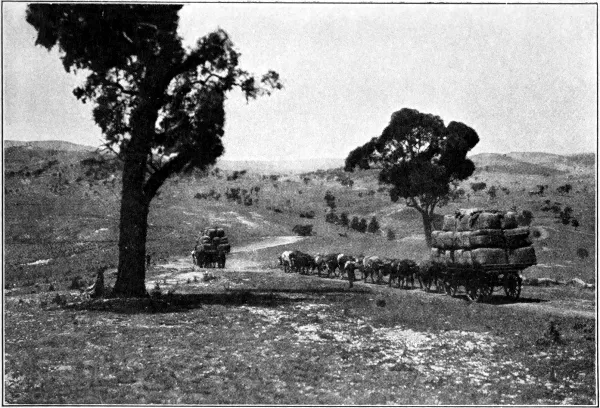
In the great “back blocks,” where sheep ranches of 100,000 acres are
common, it takes days and even weeks for the bullock drivers and their
teams to get the wool clip to the nearest railroad.
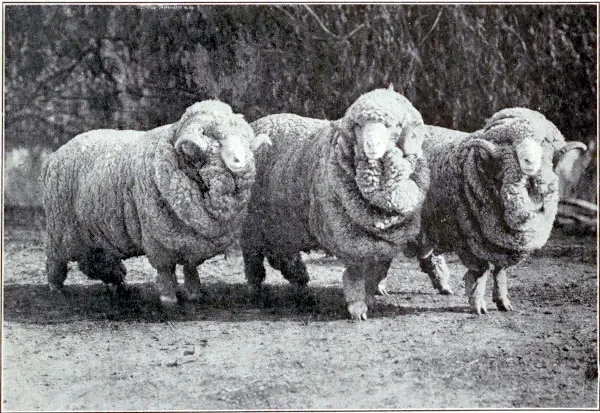
The Australian sheep men have brought the Merino to its highest
perfection and doubled the weight of its average fleece since the breed
was first introduced.
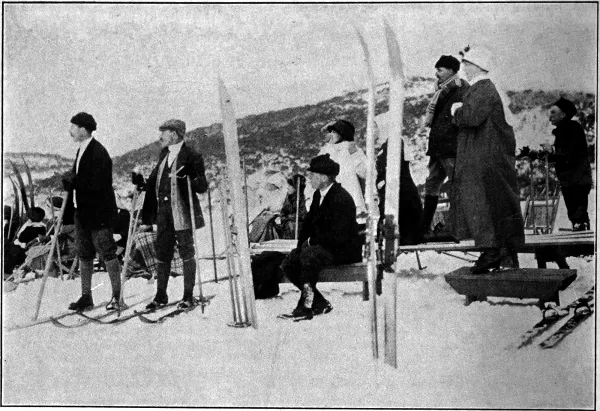
Though the snowfall is confined to a few isolated areas, the slopes of
Mount Kosciusko, which is more than seven thousand feet high and the
loftiest peak on the continent, are the scenes of real winter sports.
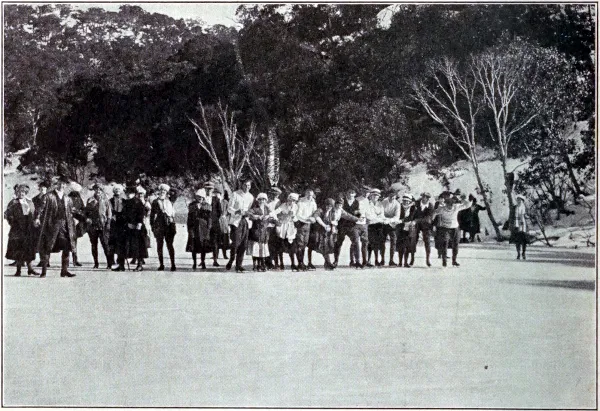
Even about the winter’s ice on the mountain lakes of Victoria the trees
are as green as in the spring, for the eucalyptus sheds its bark instead of
its leaves and makes the country an “evergreen land.”
In the state of New South Wales, where I am now writing,
practically all its thirty-four million sheep are kept in
fenced paddocks. There are thousands of miles of wire
netting put up to keep out wild dogs and rabbits. Millions
of dollars have been invested in buildings, and the salary
list of a great station may be as long as that of a department
store. Sheep raising is by no means a cheap business
and to make it pay everything must be carefully managed.
It costs from fifteen to twenty thousand dollars a year to
run even a good-sized station and there are some ranches on
which the annual expenses mount up to hundreds of thousands
of dollars. Of late years wages have steadily increased,
until the men are now paid from five to nine
dollars a week with board and lodging. Each man receives
weekly about twelve pounds of meat, ten pounds of
flour, and a quarter of a pound of tea, as well as other
rations, so that every big farm must keep a store and a
warehouse. Even the smaller stations have a dozen or
more men in ordinary times, and at shearing season the
hands are numbered by scores. Then there is the land
itself, which, when taken in tracts of tens of thousands
of acres, costs the purchaser or tenant a large sum of
money. The rates for leases are different in the several
states, but in all there are farms paying annual rents of
thousands of dollars.
The ranchers are called “squatters,” which in Australia
is not a disparaging term, as with us. It was first applied
to those who settled on unoccupied lands, and then to those
leasing vast tracts from the government at nominal rentals.
Since these men often grew to be rich, the title became a
complimentary one and it is now applied to stock-owners
and graziers generally.
The squatters are Jasons who have won a splendid
Golden Fleece. Of the five hundred and fifty million
sheep in the world, Australia has around eighty million, or
more than any other country. Russia, Argentina, and
South Africa come next, in the order named. Australia’s
yearly wool production runs to between six and seven
hundred million pounds and her annual wool exports
have been bringing her the sum of two hundred and
fifty million dollars. Wool is her greatest single source
of wealth. Her sheep also furnish exports of frozen
mutton that in good years have increased her income by
twenty-five million dollars. The annual exports of sheepskins
are sometimes worth fifteen million dollars, and sausage
casings, made of the intestines of sheep and lambs,
are sent overseas to the value of five hundred thousand
dollars.
During my stay here I have attended Sydney’s annual
sheep show. There were hundreds of fine animals
from every part of Australia. More than half of them
were entered in the fine-wool class, and the rest were fat
sheep raised for mutton. Every sheep at the show was
worth several hundred dollars, and some were valued at
thousands. Among the latter was the ram that took first
prize. It was a great barrel-shaped bale of wool with a
pair of big horns at one end of it. The wool lay on the
ram in folds and rolls, the skin apparently wrinkling
itself in order that the animal might hold more. His
ears were entirely hidden by the wool, which also came out
three inches over the eyes, leaving only small holes for the
ram to see through. I poked my finger into the fleece and
could just touch the skin. The wool hung down in great
bunches on the belly and the legs were covered clear to
the hoofs. On the outside the fleece was of a dirty white
colour, but when I pulled it apart I could see it was of a
rich creamy white. The strands were spiral and springy
and very fine.
The Australian farmers pay more for blooded sheep
than do those of any other country. It is not uncommon
for a well-bred ram to sell for five thousand dollars and
one has even brought more than thirty thousand dollars.
The hundreds of sheep men at the show looked much
like a crowd of Yankee business men. They were all
landholders, and many had farms which would be considered
principalities in the United States, but some of
which are looked upon as quite small here. For instance,
at the dinner closing the event I asked whether the vice-president
of the show had a large station. The reply was
that he had not, for his holdings comprised only about
sixty-five thousand acres. Another man pointed out to
me owns two hundred thousand acres and another has
half a million acres, all fenced.
CHAPTER VIII
IN THE GREAT WOOL MARKET
SYDNEY is the chief wool market of Australia. It
annually ships hundreds of millions of pounds to
Europe, Japan, and the United States, and it has
some of the largest wool warehouses on the globe.
Let us take a walk through one of them. We are in a
great room covering many acres. It is roofed with glass
and upon its floors are thousands of bales of wool, each
as high as your shoulder and marked with the name of the
station from which it came. All are wrapped in yellow
bagging, but the tops are open and the white wool seems
to have burst forth and to be pouring out upon the
floor.
In parts of the warehouse are mountains of wool which
have been taken out of the bales, and in other places men
are repacking the wool for shipment. Thrust your hand
into one of the piles. Now look at it! It shines as though
it were coated with vaseline and your cuff is soiled with
the grease; for this is unscoured wool, just as it came from
the sheep’s back.
All of the Australian wool clip is sold at auction, and
the sales are attended by wool buyers from England, continental
Europe, the United States, and Japan. We see
many of them in the Sydney warehouses dressed in overalls
and linen coats to protect their clothes from the greasy
wool. They go from bale to bale, taking notes of each
man’s stock, in order that they may know how much to
offer when it is put up at the Sydney Wool Exchange.
The Exchange is near the wharves in the heart of the
city. It is a long, narrow room, much like a chapel, with
an auctioneer’s desk like a pulpit in one end of it. The
various wholesale dealers or commission merchants are
allotted different days on which they may auction off their
stock, and on those days the buyers come to bid. As
many as ten thousand bales are sometimes sold in one
day, and single sales will foot up as much as three quarters
of a million dollars. Cable reports are received as to the
prices in the great wool markets over the world, and the
excitement rises and falls with the quotations.
I had a chat with one of the largest wool dealers. He
told me that some years ago almost all the wool of Australia
was shipped by the squatters direct to London, and
there resold and reshipped. At present the greater part
of the product is shipped to commission agents at the
Australian ports, to which the textile-manufacturing
countries send their buyers.
The prices of wool vary according to quality, and the
quality varies with the breed of the sheep and the part of
the animal’s body from which it is clipped. The coarse
wool sometimes brings only about eighteen cents a pound,
but for the last ten years the price of the best wool has
averaged forty-four cents a pound in Australia and has
gone as high as a dollar a pound in London. Some flocks
have won such reputations for producing fine wool that
their fleeces always bring better prices. I have before me
a list of some of the wool sales of one year, showing that
certain wool growers got as much as five cents a pound
more than the market rates.
Few people realize how many factors enter into the
quality of wool and go to determine its value and use.
The grading of wool is a science and must be done by experts.
It is taught in the agricultural colleges of Australia,
and at Sydney there are night classes where the students
learn about sheep and wool. They study the different
breeds, and practise grading and classifying baled wool,
which is sent to the school by the dealers. In apron and
overalls, each student goes through the bales picking out
the good and bad wool and sorting it according to quality.
He is taught also how to shear sheep, how to scour wool,
and, in fact, every process in the growing and marketing
of the product. The English mills often send their young
men to Australia to learn the business at first hand. Some
years ago there was a blind buyer at Boston who operated
with success, making his purchases by the touch and odour.
He could tell not only the quality of the wool, but the section
of the country or the part of the world from which it
came.
Because it is well adapted to dry climates, the Merino
sheep is the breed preferred in Australia, although the
strain is modified by cross-breeding to suit different conditions.
The sheep on the great plains country are of the
large, robust type found to give the biggest returns on
such areas. On the highlands, where the pasturage is
lighter and the climate colder, a small Merino is raised
that yields an extra fine fleece. In the western part of the
state of Victoria is still another type, which produces the
best Merino wool in the world. Upon this wool certain
mills in Europe, America, and Japan are absolutely dependent
for the manufacture of some of their goods.
Wools differ in their wave or curl and in other particulars
that will show up in weaving. The other day I was
shown some Merino wool under the microscope. To the
naked eye the wool, as it comes from the sheep, seems
to be made of fine curly hairs. It is only by putting
it under a microscope that one can see it differs from
hair. Enlarged to the size of a lead pencil, each wool
fibre is seen to be covered with sharp scales which overlap
one another like those of a fish. The scales are so close
together that there are several thousand of them on a
piece of the fibre an inch long. The fibre is so fine that a
pound of it can be spun into a thread one hundred miles
long. When wool is spun and woven, the scales interlock
and thus give the thread or fabric its strength.
I have had a talk about the growth of Australia’s wool
industry with one of the old-time squatters, a man who
has been raising sheep for many years and who has now
about fifty thousand head in two different stations.
Said he:
“We have fewer sheep in Australia than we had ten
years ago. Here in New South Wales we then had
nearly forty million, and to-day we have approximately
thirty-three million. We have lost some by drought and
some by overstocking, and have now just about what we
can easily feed.”
“Where did your first sheep come from?” I asked.
“They were brought over from England by the convicts,”
was the reply. “When Captain Phillip came here
in 1788 he brought twenty-nine sheep and other live stock.
These sheep did very well, and a few years after that Captain
Macarthur started the movement to make a sheep
country of Australia. Macarthur was a military man
with a scientific bent. He had a farm near Sydney
and experimented in crossing some East Indian rams and
Irish ewes, and as a result produced wool better than that
of either of the forebears. He then experimented with the
Merinos. You know, perhaps, that up to that time the
finest wool all came from Spain, which had always been
noted as a sheep-breeding country. Hoping to keep a
monopoly of the trade in the best wool, the Spanish
government forbade the exportation of any Merino
sheep. But Captain Macarthur got some from the flock
of King George III of England, who had originally secured
them from the King of Spain, and also imported
several Merinos from South Africa.
“The British government gave him a grant of ten thousand
acres of land on which to continue his experiments,
and in a short time he proved that Australia could produce
sheep as well as Spain and that Australian wool was as
fine as the Spanish. It was long before the wool exportations
amounted to much, but the flocks steadily increased
and the character of the wool improved, until now we raise
more wool and better wool than any other country on
earth.”
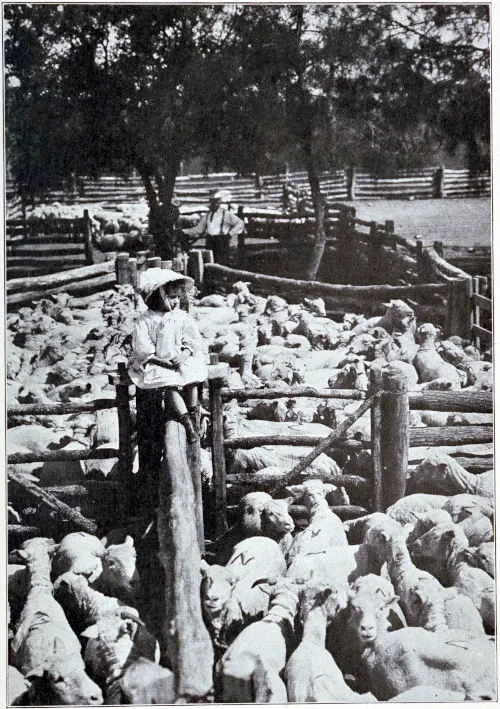
Australia’s greatest single source of wealth is sheep, of which she has
more than any other country in the world, producing a half billion pounds
of wool, besides vast quantities of mutton.
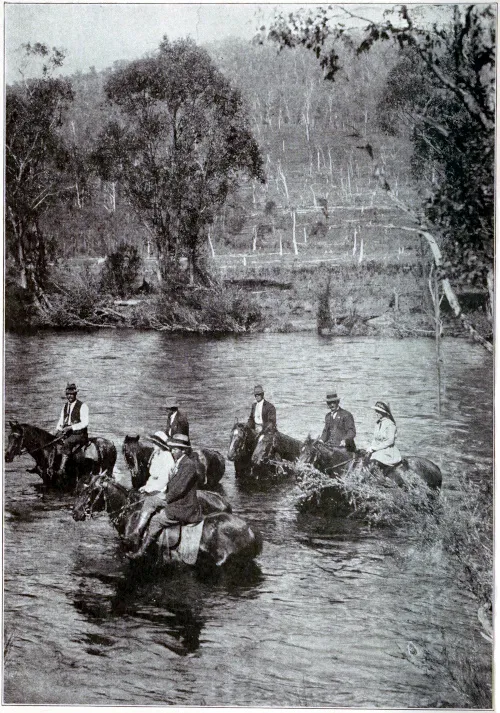
Bush life is not all isolation and hard work. Every big station has its
saddle horses, and both men and women are accustomed to long rides to
dances, tea parties, or picnics.
CHAPTER IX
LIFE ON THE SHEEP STATIONS
SOME of the Australian squatters and their managers
live like lords. Their low, one-story
houses roofed with galvanized iron have a score
or more rooms looking out over wide verandas
that run along the front. There are many servants and
the station is often more like the estate of a feudal baron
than that of an ordinary farmer. Most of the sheep men
are well educated, many are college-bred, and their homes
show all the evidences of culture and taste. One squatter
has a picture gallery that cost him one hundred and twenty-five
thousand dollars, and others have music rooms and
fine libraries. The leading Australian and London newspapers
are to be found at all the stations. Whatever else
is lacking, one is sure to see a well-read Sydney Bulletin
lying about.
Most of the stations have large stables, with horses for
the use of the men employed on the estate and for pleasure
riding and driving, as well. They are usually well supplied
with guns and fishing tackle, and not infrequently have
tennis, cricket, croquet, and golf grounds.
Far from being slack about social forms, the people on
the best sheep stations are more careful about matters of
etiquette than those in the cities. It is the usual thing to
dress for the evening, and, although there may not be a
stranger within fifty miles, the men will appear night after
night in dinner coats and the ladies in décolleté gowns.
In travelling through the country every gentleman carries
a dress suit with him: If he goes away from the railroad
he usually tucks his evening clothes in his saddle bags
or in the back of his automobile.
No matter how far out in the country they may live,
both men and women pay a great deal of attention to dress,
and on some of the stations a hundred miles from nowhere
the latest fashions are as much in demand as in the Australian
metropolis. Many of the belles of the Queensland
“bush” come regularly to Brisbane and carry back
wardrobes to astonish their rivals. The fair country girls
of New South Wales get their fashions from Sydney and
those of Victoria send to Melbourne for new clothes once
or twice a year. A great deal of ordering is done by mail.
One reads a good deal about the loneliness of the life in the
“bush,” or “out back,” or “in the back blocks,” as the
rural districts of Australia are called here. But it is my
observation that, except in the most sparsely settled areas,
the station dwellers have a social life of their own. For
one thing, they have become used to the great distances
and make nothing of visiting trips that we should consider
long journeys. It is not uncommon for a young man or a
young woman to ride or drive fifteen miles to take a cup of
tea with a friend. At the dances, guests come from forty
and fifty miles around, dance all night, and then start back
at daybreak. The stations are noted for their hospitality.
When a caller arrives, whether friend or stranger, everyone
takes it for granted that he will stay overnight.
The automobile has worked wonders in both the social
and the business life of “outback” Australia. Long inspection
journeys or trips to town are now easier matters
than when horses were the sole means of getting about.
A homestead may be one or two hundred miles from the
nearest railroad station, but the owner thinks little of running
in to take the train for a business trip to the city.
Sometimes, of course, the country is soaked with rain and
the motor cars must be laid up for a few days. But, in
general, the automobile has replaced other vehicles and is
considered an absolute necessity. This is especially true
for those who run several stations. I have heard of one
man, for example, who has five ranches at an average of
seventy-five miles apart. Two of these he visits every
week, while he gets around to the others at least twice a
month. He keeps a car on each of the properties as well
as one at Melbourne, where the stock and wool are marketed.
His bill for gasoline, oil, and repairs is more than
five thousand dollars a year, but he considers this merely
necessary overhead, as he says he could not well carry on
his business without the cars.
Saddle horses are still indispensable on the big farms,
however, and there seems no likelihood that Australia
will ever stop breeding the fine horses for which she is
famous. Besides, these people are racing enthusiasts, and
there is great rivalry between the stables of many of the
sheep men. Every town has its track, to which the
station men come from a hundred miles around whenever
there is a race meeting.
The big stations are often owned by syndicates or
wealthy men living in Sydney or some other city, the
ranches being in charge of managers, some of whom started
in as “jackeroos.” “Jackeroo” is the name given the
young man who begins as a ranch hand with the idea of
learning the business. In the old days he was frequently a
well-born young Britisher sent out ostensibly to gain experience
in sheep raising, but really to be kept out of the
way of mischief at home.
The “jackeroos” were divided into classes, each with
its special nickname. The “gold tail” paid sometimes
as much as fifteen hundred dollars for the privilege of
watching the sheep and learning how to handle them.
He usually stood well with the proprietor and had something
of a place in society. The “silver tail” paid nothing
and, as a rule, got nothing except experience, while the
“copper tail” was paid a small stipend for his work.
The “experience” of the “gold tails” usually consisted in
hunting, galloping at breakneck speed over the vast
plains, horse racing, and making love to any attractive
girls they could find. After a year or two some returned
to Old England. But many stayed on and became
real sheep men, winning their share of the Golden
Fleece.
To-day the “jackeroos” are sober and serious young
fellows, mostly sons of overseers, managers, and small
graziers, who get wages from the start. Their status
differs from that of the other station hands only in their
having separate living quarters and, on some ranches, eating
at the owner’s or manager’s table.
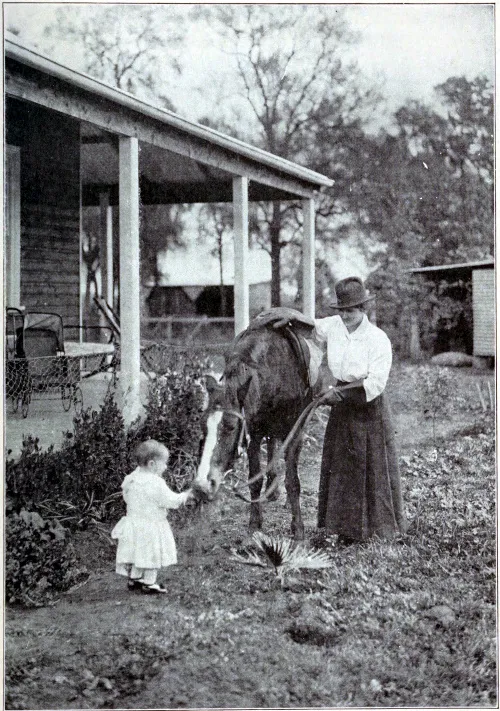
Like the men, the women on the sheep stations are much out of doors,
and many of them have in times of necessity taken over the management
of great flocks.
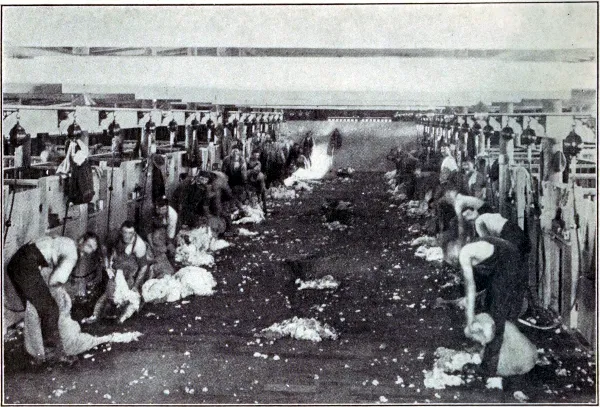
Shearing sheep is done with machine clippers, which are quicker than
hand shears, less wasteful of the wool, and not likely to wound the sheep.
A good workman will shear one hundred sheep a day.
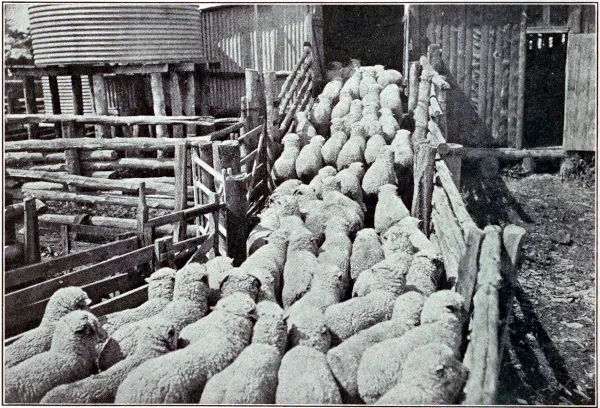
Australia supports sixteen sheep for every person in her population.
Millions of acres of land unsuitable for farming or cattle furnish sufficient
pasturage for sheep.
A big sheep station nowadays is, as I have said, a large-size
business proposition, requiring competent managers
and overseers. On the more important stations there are
bookkeepers and storekeepers. Nearly every one has its
blacksmiths and carpenters, its gardeners, hostlers, garage
men, and men of all work. The managers are skilled men
who get high salaries, for the station’s profit depends
largely upon them. They are usually expert sheep
breeders and are always trying to improve their stock. I
know of one manager, for instance, in charge of fifty thousand
sheep, who asserts that he has increased his wool crop
more than seventy-five thousand pounds a year by developing
sheep that yield heavier fleeces. At an average of,
say, thirty cents a pound, an additional seventy-five thousand
pounds of wool would mean twenty-two thousand
five hundred dollars a year more profit, or enough to
pay the salary of an expensive manager several times
over.
I might be inclined to doubt this manager’s claims had
I not learned from government officials that the average
weight of the Merino fleece for all Australia has been increased
by three pounds. This is largely the result of
expert breeding. Some of the best fleeces now run to
eight and nine pounds each.
The sheep-station men who lead the most lonely lives
are the boundary riders. They go along the fences day
after day and see that the gates are closed and everything
is all right. They spend their time in the saddle, riding
forty, fifty, and sometimes a hundred miles daily. They
carry their blankets with them and sleep on the ground,
hobbling their horses beside them.
The real aristocrats of the sheep business are those who
clip the wool from the animals’ backs. Sheep shearing is
almost a profession in Australia. There are thousands
who do nothing else, and they form one of the most important
classes of Australian workmen. In the old days
the sheep shearer was dependent on the wool growers, taking
work wherever he could get it and living in any kind
of quarters the station might see fit to give him. But this
has changed, and now he dictates terms to the sheep men,
with special laws in every state to back him up. The employer
must provide decent accommodations and had
best handle the men with gloves, or else he will have to
reckon with the shearers’ union, one of the most powerful
in the Commonwealth. When shearing time comes, the
squatter signs a contract, made out according to a prescribed
form; and, as a rule, this agreement is rigidly lived
up to by both parties. One of the union rules most strictly
enforced is that no shearer can be compelled to shear wet
sheep. Yet, if he has arrived in the station and finds the
sheep wet, he must be paid for the time he waits for their
wool to dry out. This is sometimes a hardship for the
employer, for even in dry seasons the heavy fleeces absorb
considerable moisture.
The season lasts for nine months. Gangs of shearers
start in Queensland, where it is warmest, and then work
their way south from station to station until they reach
the island state of Tasmania. From there some of the
shearers go over to New Zealand, which has a still later
season.
Every station has its shearing shed, with barracks for
the men. The shearers furnish their own food, buying it
of the squatter at wholesale prices. Each gang of shearers
has its own cook, and they usually live very well.
In the past many of the shearers were drunkards.
They would work at a station until the job was completed,
and then take their wages to the nearest public house and
there consume them in liquor. Sometimes, they would
hand their money over to the saloon-keeper and tell him to
keep an account and put them out when the money was
gone, a bargain promptly fulfilled by the publican. To-day
many of these men are frugal and temperate. They
shear for a few years, getting a thousand dollars or more a
season, and then invest their savings in stock of their own.
Nowadays the sheep are practically all sheared by machines,
somewhat like a barber’s clippers, which are run
by steam, compressed air, or electricity. The clippers are
fastened to a flexible tube like that connecting a dentist’s
drill with its motor. They consist of little knives which
move backward and forward over each other at the rate of
two thousand times a minute and cut through the wool as
a hot knife cuts through butter, taking it off more smoothly
and cleanly than by hand. I have seen sheep shorn in
this way so that their skins were as smooth as the nap of
fine cloth, and as they scampered off they seemed to be
clad in soft, white, velvety coats. The managers tell me
that, as compared with shearing by hand, the machines save
from a quarter to a half pound of wool per sheep, and that
there is less danger of cutting the skin than in hand shearing.
The average number shorn by each machine is a
little more than one hundred per day. Some men can
shear more than one hundred per day by hand, and one
man is known to have cut the wool from three hundred
and twenty-one sheep in one day with a pair of hand
shears.
After the wool is shorn it is sorted according to the part
of the animal from which it came. On some stations it
is put up in bales of three hundred and ninety pounds.
Getting the wool to market is a considerable item in the
station’s expenses, especially if it is situated far from a railroad.
While motor trucks and tractors are coming into
use, much of the clip is still hauled on carts drawn by
oxen. Some carts will carry ten tons, a yoke of eight or
ten oxen being used to pull them.
The bullock drivers, or “bullockies,” as they are called
in this land of nicknames, are familiar figures in Australia’s
sheep country. Many of them have no other homes than
their great, creaking carts, and these often form the homes
of their families as well. Such outfits sometimes even include
goats to furnish milk on the way.
The “bullockies” spend their lives crawling along the
lonely roads behind their slow-moving oxen. In the back
blocks they will tell you stories of big loads and record
trips. One bullock driver hired a brass band to meet his
biggest load of wool at the edge of the railroad town, which
he entered with a flourish that brought all the population
out to do him honour. A New South Wales “bullocky”
drove a team of forty-two oxen ninety-two miles with a
load of one hundred and forty-four bales of wool. His team
was yoked four abreast and they were kept on the move
by the cracks of a whip loaded with ten pounds of shot
to weight the lash. Their driver probably used also a
steady stream of the profanity for which all Australian
“bullockies” are noted.
Another character of the life of the sheep stations is the
“sun-downer,” a tramp whose like I have not met in any
other part of the world. He will not work, but he travels
about on foot from station to station, carrying a can for
making his tea and a blue blanket for a bed. From the
colour of his blanket he is sometimes called a “humping
bluey.”
When the “sun-downers” arrive at a station they call
upon the manager, demand food, and always get it. They
are so common that custom has fixed their ration at one
pound of flour, half a pound of sugar, and two ounces of tea.
In some places little shanties have been put up to accommodate
them overnight. Some of these tramps are men
who have made a failure in Australia, but many of them
are rovers from all over the world, ship deserters, and adventurers,
who, after a season or two, move on to some
other land.
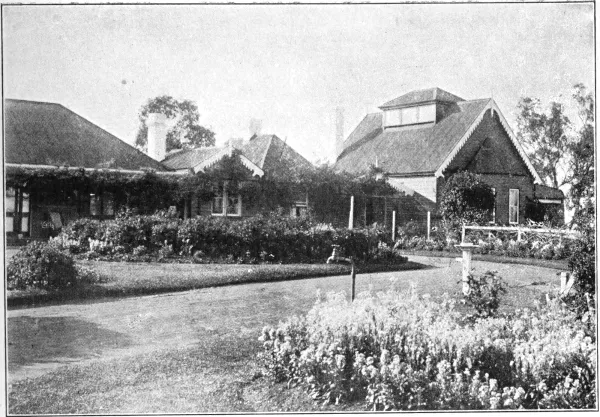
Many a sheep station is a community in itself, with its carpenter and
blacksmith shops, its laundry, and its outlying houses and native huts
clustered around the dwelling of the owner or manager.
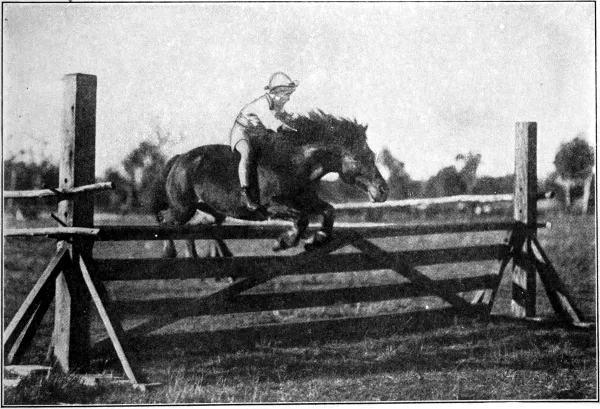
From the time he can be lifted to a horse’s back, the Australian is an
enthusiast about riding and racing. Even a small meet may be the signal
for a general holiday and an exodus from work.
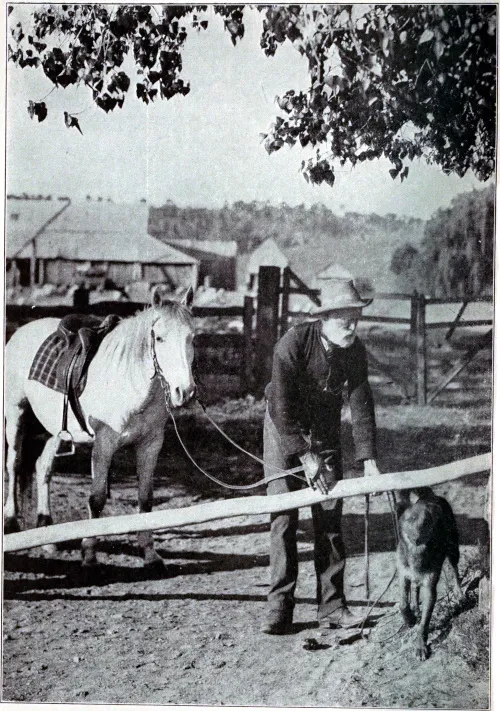
The boundary rider is much away from home, spending his days in the
saddle and many of his nights in the open. It is his job to see that the
rabbit fences are intact, the gates closed, and the flocks secure.
CHAPTER X
RABBITS AND DINGOES
SIR HARRY LAUDER tells a story of a Scotchman
visiting a farm in the Australian back blocks.
Said he to the farmer:
“I notice that you’re Scotch.”
“Yes,” replied the farmer, “and my wife, too.”
“I dare say,” said the visitor, “there are many Scotch
people in these parts.”
“Yes,” was the answer, “we have quite a lot of Scotch
folk, but that isn’t our real trouble—it’s rabbits!”
When the Australian stockman has a nightmare, he
dreams of a rabbit, the pest of the Commonwealth and
the terror of the pastures. There are tens of millions of
rabbits all over the country, and but for the constant
warfare against them they would eat up all the grass
of Australia. Hundreds of stations have been ruined
by them, and the larger places employ men to do nothing
else but destroy them. Some of the rabbiters kill an average
of four hundred rabbits a day. Yet those that survive
cost Australia countless millions of dollars, and the
end of the plague is not yet in sight.
Enormous rewards have been offered for a method of
exterminating the pests. The government of New South
Wales once promised one hundred and twenty-five thousand
dollars to any one who would suggest or invent a
means for their extermination throughout the state. The
reward was never claimed, and the rabbits breed and breed
and never stop breeding. A pair will produce six litters a
year, and each litter will average five rabbits. As soon
as the bunnies are six months old they begin to breed, and
in five years a single pair will increase to ten million pairs.
One can gain some idea of what this means from the fact
that every family of seven rabbits will eat as much as one
sheep.
The man who first brought rabbits to Australia was a
squatter near Melbourne who wanted something to remind
him of home. Besides, he thought hunting wallabies,
kangaroos, and wombats was poor fun in comparison with
the good old English sport of “chasing the hare.” He
soon found, however, that hunting rabbits was a serious
business. They multiplied so rapidly that his station was
overrun. His pasture disappeared, and do what he could,
they increased by thousands. They eventually cost him
more than two hundred thousand dollars in loss of stock,
in addition to the money he spent in his attempts at their
destruction.
Among the best methods of controlling the pest are
poisoning, fencing, and the paying of bounties. In poisoning,
coarse bran saturated with phosphorus is sometimes
sown in furrows, and so covered that stock will not
get it, though the rabbits will burrow for it. The great
drawback of this method is that it also kills numbers of
insect-destroying birds.
Another system works well in dry seasons and in areas
where water is scarce. Tanks, water holes, and dams are
surrounded with wire netting, and troughs of poisoned
water are placed outside. Often the trough, too, is enclosed
in wire with a hole in it just big enough to let in a
rabbit. In this way, the bodies of the poisoned rabbits
can be collected, skinned, and burned. It is dangerous to
leave the dead animals to dry up in the sun where stock
grazes, for when grass is scarce the cattle will eat the carcasses
for the sake of the salt in them. This method, too,
exterminates numbers of insect-eating birds, so it has its
disadvantages, though it does kill thousands of rabbits. I
have heard that in one of the drought years, when the
rabbits were more numerous than they are now, three million
were poisoned at a single water hole.
But fencing and bounties have proved still more effective
than poisoning. The local boards in infested districts
pay millions of dollars for rabbits killed, and states
and individuals spend millions on fences. According to
the definition in the South Australian law the “rabbit-proof”
fence must be of wire netting three feet high, set
four inches into the ground, and topped by one strand of
barbed wire. A “vermin fence,” which is put up to keep
out “rabbits, wild dogs, and foxes,” is built like the rabbit-proof
fence, except that it is four and one half feet high and
has three strands of barbed wire at the top. These fences
form a network over the land and make the stone-walled
fields of New England look like mere chicken runs in comparison.
They are even built across the roads, so that travelling
along the highways is often a dreary business of
opening and closing gates in the rabbit fences. In some
sections where there are gates about every five miles, the
men passengers on mail coaches usually arrange “gate
watches” between them. There is a heavy penalty for
leaving one open.
The extent of the fences is amazing. One built by the
government of New South Wales along the South Australian
boundary is three hundred and fifty miles long.
Southern Queensland has one six hundred and twelve miles
long. The state of South Australia has more than enough
to make a girdle round the earth, and New South Wales
has spent more than thirty millions of dollars in building
her one hundred thousand miles of rabbit fence.
As a result of these various measures, in the more closely
settled areas the rabbit pest is pretty well under control
and is now at its worst only in lands so poor that it is unprofitable
to fence them.
Moreover, the rabbit has in recent years been made to
pay something for his keep. Frozen rabbits are shipped
to the markets of Europe to the number of twenty millions
a year, and along Australian country roads one may
see thousands of rabbit carcasses hung on fences awaiting
wagons to take them to the packing houses for freezing.
Rabbit skins worth some eighteen million dollars are annually
exported for making felt hats, coat linings, and
women’s furs.
In the early nineties, when the news of the discoveries of
the great German bacteriologist, Doctor Koch, was being
flashed about the world, Australia hoped that some bacillus
might be found that would rid her of her rabbits. It
was claimed that an assistant of Pasteur had found a culture
which would spread an infectious and deadly disease
among rabbits, but from which other animals would be
immune. Pasteur was invited out to Australia to try out
this specific, but, as he was too old to undertake the voyage,
he sent a representative. A small island stocked with
every kind of animal on the continent was handed over to
this scientist but he failed to satisfy the authorities that
his system of inoculation could be carried out without danger
to other animals, and so the wonder-working bacillus
is still to be discovered.
The states have had no better luck in introducing other
animals to prey upon the rabbits. Some years ago West
Australia turned two hundred cats into one of the rabbit
districts, thinking they would exterminate the vermin.
When the government inspectors went around a year
later to check up results they found that the cats were
living in the rabbits’ burrows on the friendliest terms
with their long-eared landlords.
Foxes were brought in with the same object as well as
for sport. But now that Reynard takes annual toll of
about one hundred thousand sheep the foxes are shot,
trapped, poisoned, and fenced against. In some places
they are more dreaded then the wild dogs, or dingoes.
When the Australian aborigines were first seen by the
white settlers from England, they had with them many
dogs, which they had trained to hunt. Some people
claim that these dogs are native to Australia, some that
they were brought in by Malay invaders from the north,
and some that they are the descendants of a number of
sick dogs left by a Dutch vessel on the shores of Australia
in 1622. If the last theory is true, the climate must have
agreed with the dogs, for they have multiplied and spread
all over the country. To this day the southwest corner
of Queensland and the northwest corner of New South
Wales are badly infested with them. In a recent year
dingoes and foxes were responsible for the loss of one
hundred and forty thousand sheep in New South Wales
alone. Strangely enough, the dingoes generally eat only
the tongues of the sheep they kill.
The “dogger” employed by the station manager to get
rid of the dingoes is usually the station rabbiter as well.
As he makes his rounds to lay baits of phosphorized grain
for the rabbits, he drags along at the tail of his cart a bit
of mutton or other fresh meat. At intervals of a mile or
so he leaves some meat with strychnine well rubbed into
it. The wild dog will follow the trail to the bait, gulp
down the meat, and shortly thereafter fall dead in convulsions.
Each sheep station is represented on the nearest local
county board, generally by the store-keeper. When the
“dogger” presents the scalp and the tail of a dingo, joined
by a strip of skin cut along the back, the storekeeper
credits him with the sum of one dollar and eighty-seven
cents. Three times a year vouchers are turned in to the
secretary of the board and the employee receives his check.
As a rule the station owner adds enough to make up the
amount paid for each dingo scalp to five dollars, so that,
whether he is a regular station employee or an independent
worker, the Australian “dogger” makes a good
living.
CHAPTER XI
WATER FOR THIRSTY LANDS
NO OTHER continent has as much dry land or as
little rainfall as Australia. It has a great dry
heart enclosed in green. More than two thirds of
the country has less than twenty inches of rain a
year, or about one third of the annual rainfall of New
Orleans, and less than half the average for Boston or
Washington. You may have heard of Yuma, Arizona,
as one of the hottest, driest spots in the United States. In
twelve months it gets less than ten inches of rain. Two
fifths of all Australia is just as dry.
Australia is the hottest country on record. I have
ridden for miles astride the Equator in Africa, and have
visited the arid wastes of South America and Asia, but I
have never found heat to compare with this. Out in the
country in the dry times one feels he is walking on a tin
roof over the lower regions, and the people facetiously say
that they have to feed their hens cracked ice to keep them
from laying boiled eggs. And yet sunstroke is quite rare
in Australia.
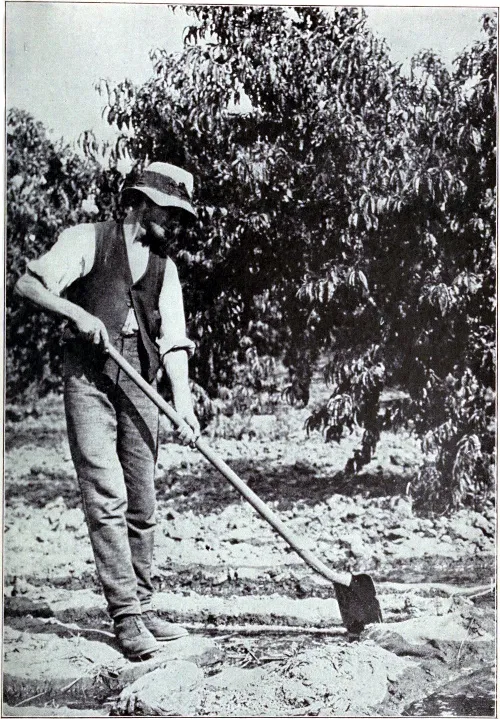
Irrigation promises to transform parts of Australia into orchards like
those of our Northwest. Her fruits and farm products are already popular
in European markets, where the opposite seasons work to her
advantage.
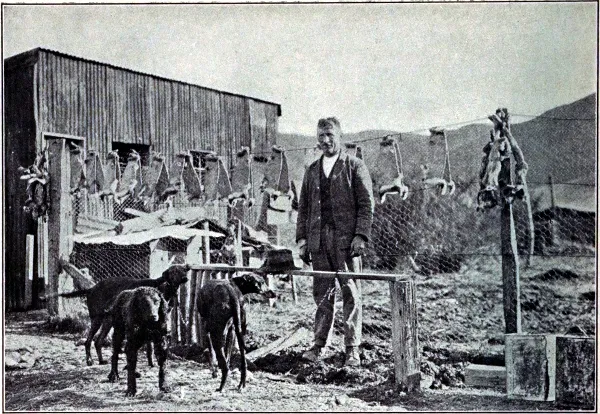
Square miles of pasturage have been destroyed and many squatters
made bankrupt by rabbits. The larger stations employ men solely to
hunt and trap rabbits. A single hunter may kill four hundred a day.
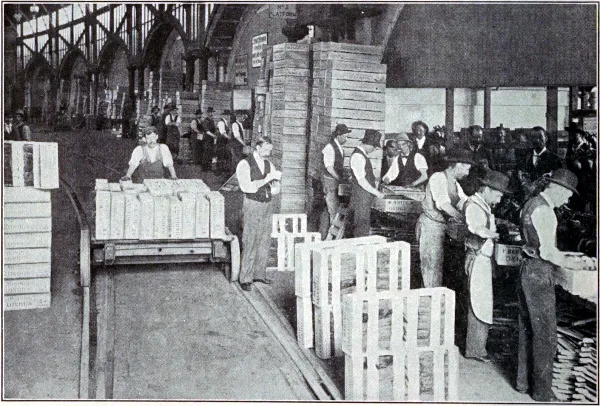
In a year Australia exports 20,000,000 frozen rabbits an $18,000,000
worth of skins for making felt hats and women’s furs. Thus she makes the
pest pay some of the cost of fighting him.
Along the eastern side of the continent, from twenty-five
to one hundred and fifty miles back from the Pacific
Coast, is the Dividing Range. These mountains separate
the fertile and well-watered coast regions from the drainage
basin whose waters flow westward. They also rob moisture-laden
winds from the Pacific of much of their burden
of water. West of the mountains vast plateaus begin and
extend for two thousand miles, broken here and there by
barren hills and rocky peaks. These plains lie close to or
within the tropics, and all day long absorb heat which
they give off by radiation at night. Ordinarily this would
have the effect of drawing in a supply of moisture from the
ocean, but on the Australian continent the heated interior
is so immense that not enough moist air comes in to water
it.
The few rivers of the country are short and mostly unnavigable.
There is, in fact, only one big river system, the
Murray-Darling. From its source in the Australian Alps
the Murray flows between the states of New South Wales
and Victoria, then crosses the southeastern corner of South
Australia. It is navigable for small steamers to a distance
of twelve hundred miles or more from its mouth. Of its
tributaries the most important are the Darling, which
crosses New South Wales to join it in the southwestern
part of the state, and the Murrumbidgee. The whole system
waters a big basin on the eastern side of the continent
in which are some of the best sheep farms of Australia.
If you have looked at the map, you have noticed that
even if Australia has but few rivers, there are a number of
large lakes, especially in South Australia. But these
bodies of water help matters little, for most of them are
salt, and there are no fresh-water lakes to speak of on the
whole continent. All the salt lakes are surrounded by flats
of treacherous mud encrusted with salt. In dry years the
lakes shrink; then a wet season fills them and the grass
springs up all about them.
Australia is not only a land of scanty rainfall, few rivers,
and great heat. It is also a land of droughts. A district
that has rejoiced in sufficient rain for one or two years and
piled up wealth from its crops and its flocks may have to
face a year or more of dryness that shrivels up the face of
the earth. One need not go far in Australia to hear of the
horrors of drought. Stockmen on their stations far off in
the interior sometimes go crazy because the rain fails to
come, and many have lost fortunes on account of dry
weather. In such times, even a man with thousands of
acres and tens of thousands of sheep may have to sit helpless
and watch the animals die before his eyes.
The droughts clear the land of everything green. The
pastures become as bare as the roads, and the sheep
stagger about, nosing in the dust for the seeds of grasses
and trees. Sometimes trees are cut down to give them
food. During one drought a sheep-raiser who had four
thousand acres of land kept one hundred men busy cutting
off the branches of his apple and other trees to feed the
flocks. The sheep ate the leaves and even the twigs.
This same man had another gang skinning dead sheep as
fast as they died, and a third whose business it was to lift
up the exhausted animals when they fell. This was to keep
them from the carrion crows hovering about over them
ready to peck out their eyes. During these droughts one
may see the bodies of kangaroos lying here and there upon
the plains. Thousands of rabbits die, and I have been
told that even the birds drop dead from the trees and that
their bodies line both sides of the fences.
At intervals the whole continent suffers from terrible
dryness. Every state except Tasmania has its drought
history. The Riverina country of New South Wales is
one of the best of the sheep-raising districts. It produces
some of the finest wool and is noted for its excellent grass,
yet in times of severe drought it looks as though a fire had
swept over it. Most of it is then as bare as a baseball
diamond. There is not a green sprout or any sign of
vegetable life to be seen. In one drought prevailing in
parts of Queensland there were tracts strewn with dead
sheep, cattle, and horses, and in some districts more than
half the sheep were lost. At another time the wool clip
of Australia was reduced almost twelve per cent. and the
number of lambs born was cut down enormously.
Ten of the thirteen big droughts recorded since 1880
affected principally interior regions where the rainfall is
normally less then twenty-five inches; but almost the whole
continent suffered in the great drought of 1902-1903.
Imagine what it would be like if all the United States from
New York to San Francisco had no rain, and there was no
green except on the mountains and in parts of New England.
Then you will have some idea of conditions in
Australia during this visitation.
The great drought was the culmination of five unfavourable
seasons. Fifteen million sheep and one and a half
million cattle died in a single year, while in the whole
period sixty million sheep and four million cattle perished
of thirst and starvation. Wheat production fell off to
less than one third of the normal. For lack of water mining
operations were checked. Many people left the country,
the birth rate decreased, and the death rate rose.
There was another general drought in 1919-1920, which
was severe but not so bad as the one of 1902. Besides, by
that time the people had learned more about irrigation
and storing up fodder for grassless winters.
The first irrigation enterprise in the country was undertaken
by two brothers named Chaffey, who had had experience
in dry farming in California. They secured from
the government of Victoria a big grant of land, which was
then described as a “howling wilderness of spinnifex and
mallee scrub,” and irrigated it from the Murray River. It
has been little more than a generation since then. Where
once was that wilderness there are now twelve thousand
acres of irrigated land supporting a population of six thousand
people.
Other areas in northern Victoria, where streams are not
available and artesian water is unfit for household and
stock use, are irrigated by what is called the Wimmera-Mallee
system. The state government has built storage
basins in the mountains of the Wimmera River region
from which small surface ditches are run down the slopes,
sometimes for a distance of two hundred miles. By
excavating basins and throwing dams across natural depressions,
three reservoirs have been built holding fifty
billion cubic yards of water. These tanks are filled once or
twice a year. In some cases the government permits a
limited use of this water for irrigation, but generally most
of it goes to supply live stock and households. Victoria
rents water at an unusually low price, the rate being from
one dollar and twenty cents to one dollar and forty-four
cents an acre foot.
Three fourths of the irrigated lands of Australia lie
along the Murray and its tributaries, and the most important
of the irrigation projects is a scheme for impounding
the waters of this river. Backed by the Commonwealth
treasury, the state governments of New South
Wales, Victoria, and South Australia share the expense.
Just below Albury on the boundary between New South
Wales and Victoria they are building a dam to store one
million acre feet of water, and another of half a million
acre feet. In South Australia another reservoir will hold
five hundred thousand acre feet. It is estimated that
when completed these reservoirs will irrigate twelve million
acres of land, or an area more than twice the size of
the whole state of New Jersey.
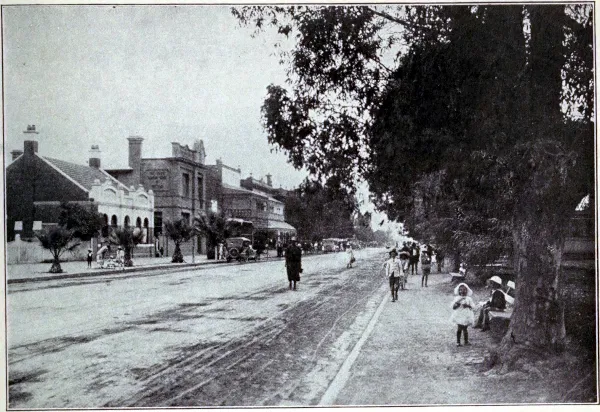
Mildura is the centre of a fine fruit district, which a generation ago
was a wilderness given over to rabbits. The success of this irrigation
project started Australia on her policy of reclaiming arid lands.
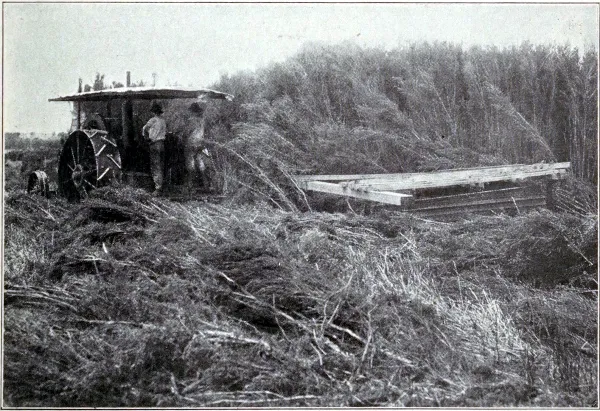
Victoria is fast clearing the scrub once infesting more than one fourth
of the state. After the growth is levelled and dried, it is burned off, cultivated
with stump-jump ploughs, and sown in wheat.
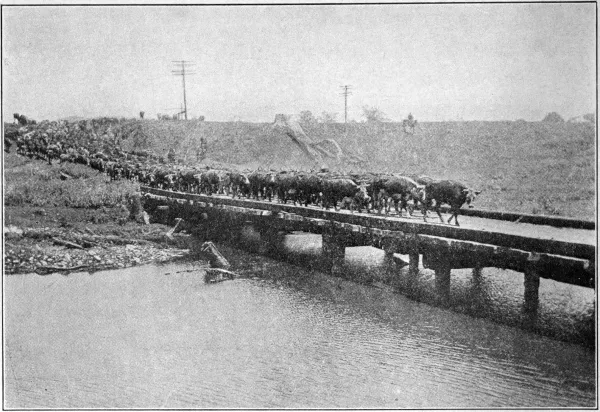
Cattle are often saved by driving them from a drought area to a region
where pasturage is available. The government maintains stock routes so
laid out as to take in all possible water holes and streams.
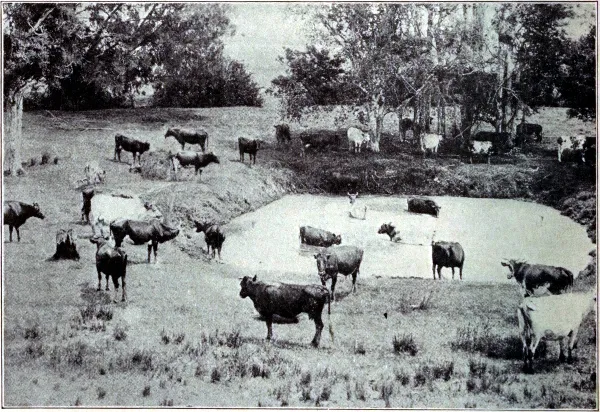
In parts of Australia much of the rainfall of a year may come in one
violent downpour. The rainwater is caught in basins, or “tanks,” dug in
depressions and lined with cement.
Victoria has, besides, some twenty irrigation projects
of her own, the most important being the one in the Goulburn
Valley, which serves nearly nine hundred thousand
acres, or an area greater than that of the state of Rhode
Island. New South Wales’s principal scheme is the Murrumbidgee
River project, which, when completed, will
water two hundred thousand acres.
For the Murrumbidgee scheme the government first
bought a tract of about three hundred and fifty thousand
acres. Then it started construction of the Burrinjuck
Reservoir, a lake forty-one miles long formed by damming
the river. The state surveyed the land, fixed routes for
highways and the railroad, put in a tree nursery, established
an experimental farm, made brick for houses, cut up the
land into farm blocks, and got a planning expert from
America to lay out the smaller towns and the two future
cities of Leeton and Griffin. After twenty million dollars
had been spent in this preparatory work the land was
opened to settlers.
Leeton and Griffin are now model cities. Each has a
civic centre, broad straight streets for business, and pretty
winding streets for residences, with a playground for children
in every block. The factory districts are segregated
and have railroad sidings so that transfers of freight may
be easily effected. Butter, cheese, and bacon factories and
fruit canneries have been erected and have done well.
It was a bright day in Australia’s farming history when
its supply of underground water was discovered. Its
Great Artesian Basin is the largest known. It is bigger
than the state of Texas, taking in a large part of Queensland,
ninety thousand square miles of South Australia,
almost as much of New South Wales, and twenty thousand
square miles of the Northern Territory. In this vast area
there is little or no surface water, but under it lie lakes
and streams, which supply many gushing wells. Two of
Queensland’s wells flow two million gallons of water every
day, while sixteen of them have a daily outflow of more
than one and a half million gallons. Some are very deep.
The well at Winton was sunk four thousand feet before
water was struck, and in many the water has come from
a depth of more than half a mile. In New South Wales a
large number of bores have been drilled, and in South
Australia artesian wells are multiplying rapidly.
The water from the deep wells is often hot enough to
scald a dog to death. It is slightly salt and contains some
soda, but generally the sheep thrive upon it. In some
cases, however, it is too full of mineral matter for the stock
and can be used only for irrigation.
The water from the wells is run to the pastures in pipes
and ditches. The ditches are made with huge ploughs constructed
of logs in the form of a V, the end shod with iron.
A team of eight or ten oxen drags the plough along the
course desired for the stream. This makes a broad furrow,
forming a canal at which the stock can drink. There are
many canals of this kind from fifteen to twenty miles long.
One of the best features about artesian water is the fact
that droughts do not affect the supply.
In some of the dry areas where there are no streams for
irrigation and where artesian water is not to be had or is
not usable for either stock or irrigation, catchment basins
and reservoirs have been built to conserve rain water.
Sometimes these are dug down below the surface of the
ground and roofed over to prevent loss by evaporation.
In places skeleton buildings with large roof areas
are set up to catch the rain.
Moreover, the Australians are learning the lessons of dry
farming and of laying up supplies against unfavourable
seasons. Many of the stockmen, especially those with
small holdings, pack away grass in pits dug in the ground.
Salt is mixed in with the fodder to prevent its fermentation
and the whole mass is covered with earth to exclude the
air. Treated in this way, the food will keep for years, and
insure against loss of stock by starvation in a dry season.
Nevertheless, the settler is not safe in starting to raise
sheep or cattle unless he has enough capital to tide him
over the lean years that are sure to come.
As a rule, the dry spells affect different parts of the country
at different times. Hence the stock can be saved by
being driven from stricken areas to places where the pasturage
is good. The dreaded droughts as well as the need
of feeders to the railroads account for the stock routes that
form a network over the whole country.
In Australia, as in all countries, the cattle regions are
in wide, unsettled areas. The cattleman has his herds
“’way out back” in the “Never-Never Land” where they
roam over unfenced tracts of vast extent. In the Northern
Territory the average pastoral holding is two hundred and
seventy-five thousand acres. The great events of the year
are the “musters” of the “mobs” of cattle, when the stock
is counted, sorted, branded, and selected for marketing.
Sometimes the trip to the nearest port or railroad will take
as long as five months. The law demands that the cattle
roads be kept open and that the stock be allowed to feed
on a half-mile stretch on each side of the route as they pass
along. It also requires that the cattle move at least six
miles a day.
In poor seasons, when water and forage are particularly
scarce, hundreds of cattle may die of thirst or starvation on
the way. Therefore the stock routes are laid out by the
governments to take advantage of every known source of
water. Streams, springs, water holes, and stagnant pools
are marked out, for in the arid regions the stock will drink
about any liquid they can get. Wells are dug and tanks
for catching what rain may fall are constructed. New
South Wales has seven hundred of these public watering
places, which are under government supervision. South
Australia’s stock routes extend from Port Augusta to
the borders of Queensland and Western Australia, and
up into the northwest desert for seven hundred miles.
Western Australia looks after two thousand miles of stock
routes leading from inland stations to the cities on the
southwest coast.
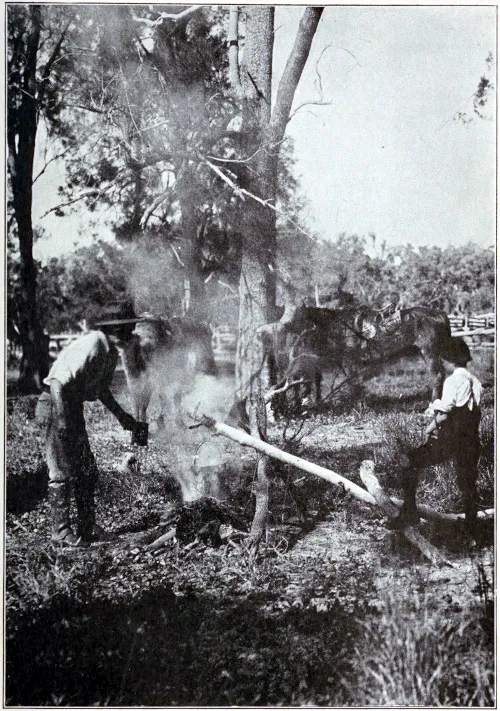
No Australian would think of going through a day without tea. Cattle
men, sheep herders, bullock drivers, and even the “sundowner” carry it
with them and “boil the billy” over camp fires.
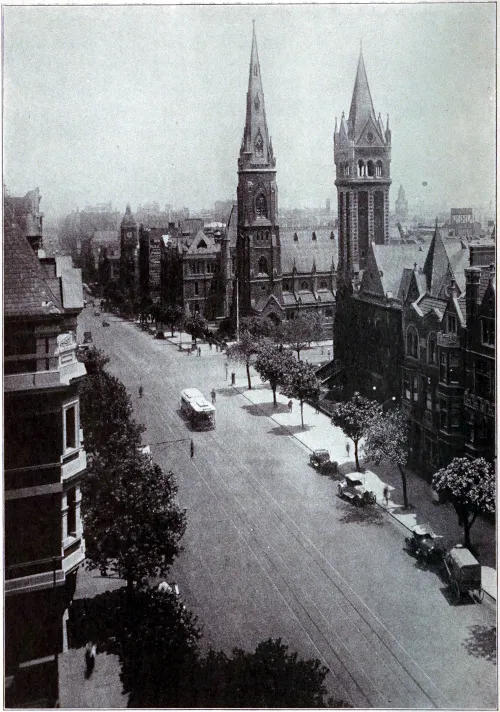
Unlike its rival, Sydney, Melbourne grew according to plan. Collins
Street, the main thoroughfare, and the other principal streets were laid
out a mile long, 99 feet wide, and in checker-board patterns.
One of the most marvellous things about Australia is her
quick recovery from a drought. Within a week after a
rain plains that have been reduced to dust, without a
vestige of any growth for miles and miles, are covered
with green and in a short time furnish luxuriant pasturage.
The drought never kills the seeds of native grasses in the
ground. Three years after the drought of 1902, New
South Wales, which had lost seventeen million sheep, had
increased her flocks from twenty-three million head to
forty million and the number of her cattle and horses had
doubled. By 1905 the number of sheep and cattle in the
whole Commonwealth exceeded the figures for 1900.
The Australians cannot be beaten for enthusiastic faith
in their country, and some of them go so far as to tell
me that droughts are a good thing. They say the soil
must rest occasionally and that dry seasons, like ice and
snow in cold countries, are simply Nature’s methods of
forcing the lands to lie fallow.
CHAPTER XII
MELBOURNE
IT WOULD surprise many Americans who think
theirs is the only real country on earth to come down
to Australia. Take the city of Melbourne. It is
not so old as Chicago, and it is younger than any
town of its size in the United States. In 1837, when
Chicago was incorporated, Melbourne contained five
wooden shacks and eight turf huts. To-day it is a magnificent
city almost as big as Detroit. There is not a country
in Europe or a state of the Union but would be proud
to own such a capital.
The city lies at the bottom of eastern Australia, on the
banks of the River Yarra, near where it empties into the
Bay of Port Phillip. One can walk for six miles along
the wharves and count forty bridges crossing the Yarra
and other streams in the city and suburbs. Steamers of
eight thousand tons, drawing twenty-three feet of water,
can come right into the town, but larger vessels anchor
at Port Melbourne three miles below it.
In a bend of the river and close by the wharves is the
million-dollar municipal market house. This is a three-story
brick structure housing hundreds of stalls to which
Melbourne housewives come to purchase their supplies.
A part of the building is given up to storage rooms for
butter, rabbits, chickens, and other things awaiting shipment
overseas.
Melbourne is built on a flat plain. It covers many
acres and is well laid out on the checkerboard plan.
The principal streets are ninety-nine feet in width. The
best business blocks and public buildings are on Collins
Street, which is the main thoroughfare. St. Kilda’s Road,
which runs from the centre of the town past the Botanical
Gardens and the official residence of the Governor-General
of Australia, is one of the finest boulevards in
the world. It was built to honour King George V, then
Duke of York, when he came out in 1901 to open the first
Federal Parliament.
On all sides of the city are attractive suburbs, the most
beautiful of which is Toorak, where the rich have their
homes. Their handsome residences are set in large gardens
and are generally hidden by high walls from the passerby.
In the less pretentious suburbs the newcomer is struck by
the number of one-story houses. The reason for this, as
well as for the growing number of apartment houses in this
and other Australian cities, is the difficulty of getting
servants.
Although it was decided at the beginning of this century
to build the federal capital on a new site, Melbourne has
remained for more than twenty years the “temporary”
capital of the Commonwealth. When the states were
federated there was hot rivalry between Sydney and Melbourne.
Neither was willing for the other to become the
national capital, so it was provided in the Constitution that
a new city should be built, at least one hundred miles from
Sydney, and that, pending the erection of the necessary
buildings, Melbourne should be the seat of government.
The site for the new capital was donated by the state
of New South Wales. It is at Canberra, about two hundred
miles southwest of Sydney. The architects of the world
were invited to submit plans for the city, and the prize was
won by Walter Burley Griffin, of Chicago.
The World War interfered with the construction of Canberra,
and it has also been held back by much opposition
to the great outlay of money involved. On his visit to
Australia two years after the war was over, the Prince of
Wales presided at the laying of the cornerstone of the
Parliament buildings. Bridges and roads have been
built, sewerage and water-supply systems have been installed,
and a meeting place for the Parliament has been
provided. Nevertheless, it will be some years yet before
the Commonwealth’s made-to-order capital is completed.
As the capital of Victoria, Melbourne has the state offices.
It has also city buildings and a town hall. These structures
cost many millions of dollars. One of them houses
the splendid public library containing a quarter of a million
books, and under the same roof are the museums of
sculpture, technology, and ethnology, and an art gallery.
In connection with the art gallery there is a travelling
scholarship for art students endowed by the state.
The town hall is a great structure of white freestone on
the corner of Collins and Swanston streets in the very heart
of the city. It is the home of the mayor and city officials,
including the council, and it has also an amusement hall
which will seat three thousand, where public entertainments
are given at cost prices. For concerts, it has a
thirty-five-thousand dollar organ, which, as I have said,
was the largest south of the Equator until Sydney bought
a bigger one. The city employs an organist to play it
twice a week for the entertainment of the people, and
any Thursday or Saturday one can drop in and listen to
the music for an hour or so free of charge. Melbourne
not only provides free concerts for its citizens, but reserves
one section of its race track to which the public is admitted
without having to buy tickets.
The Australians believe that their cities should be run
for the benefit of the people and they do not overlook any
opportunity to this end. Melbourne owns its tramways
and maintains all sorts of public institutions, such as museums,
picture galleries, and baths. It has numerous
night schools and a working man’s college with several
thousand students. The city keeps up an aquarium and
a good zoölogical garden. It has about six thousand acres
set aside for parks and pleasure grounds, and its citizens
have many organizations and clubs for outdoor amusement.
The Melbourne Cricket Club, which was founded
about the time the city was begun, now numbers more
than three thousand members. It keeps twenty men busy
taking care of its property. Already more than half a
million dollars has been spent on the nine-acre cricket
ground, which is said to be the finest in the world.
I wish I could take you out to one of the great meetings
at Flemington Lawn, the Melbourne race course, which
the people here think is the finest on earth. It has an area
of about three hundred acres, most of which is covered
with a lawn of thick velvety green. There are really two
courses, one for steeplechase events and the other for
running and hurdle races. The track, grandstands,
and stables are all well built and equipped with the latest
improvements.
The inside of the ring, which is given up to the people
who pay no admission, is usually crowded with workmen
and their families. The grandstand, built on a hill at
one side of the course, has the first-class seats, and directly
behind it on the hill itself are equally good places, which
can be had for lower prices. In any one of these situations
the spectator has full view of the race from start to finish
and need not lose sight of the horses for the tenth of a
second.
I have several times gone out to the races, which are
held every Saturday afternoon during the season. They
are attended by thousands. Flemington Lawn is a good
place to see the people of Melbourne at their best. Everyone
goes to the races—business men, public officials, and
even the preachers, though I would not say that I saw any
of the clergy place any extravagant bets. The crowd in
the grandstand has as well-dressed and fine-looking men
and women as one can see at any similar show the world
over.
People down here have a way of dating events by saying,
“Oh, yes, that was the year So-and-So won the Cup.”
They are referring to the Melbourne Cup Race, the chief
sporting event of the South Pacific and one of the greatest
of the whole world. Melbourne Cup Day, the first
Tuesday in November, is a general holiday, and the city
does little or no work during the week of this race. Flemington
is crowded with a brilliant throng. Often one
hundred and fifty thousand people attend, some coming
from points three thousand miles distant. Nearly all
bet, the women as well as the men. The bookmaker is
in his element, and one hears many stories of crooked
methods and thrown races, though how much truth there
is in them I do not know. Clerks and shop girls go without
lunches for weeks to save money to lay on the favourites.
Office boys steal stamps and petty cash, and bank
clerks are sometimes tempted beyond their strength to
speculate with the funds under their hands so as to gamble
on the great event.
An attorney general of New South Wales, speaking of
the Melbourne Cup and the other races so frequent
throughout the Commonwealth, once declared that
“... nine tenths of the embezzlements and the
forgeries and the breaches of trust which come before the
Australian courts are directly due to horse-racing and its
concomitants.”
But editors and preachers, votes in the hands of women,
and state and Commonwealth legislation have so far been
powerless to stop betting on the races. The gambling
spirit pervades all classes of Australians, from the farmer
who stakes everything on the freaks of the climate, to the
legislator who helps put a radical law on the statute books
with the feeling that the chances are even that it will work
out all right.
I should say that drinking is quite as much of a national
vice of the Australians as gambling. I know of no
country where it is more common. In many families it is
usual to serve whisky and soda at afternoon teas, the men
taking the whisky and the women the tea. Some of the
people keep themselves “soaked” a good part of the time.
Scotch whisky is the favourite tipple and the customary
way of taking it is to mix it with water and sip it. Americans
once prided themselves on drinking their whisky
“straight,” swallowing it down in one gulp, but here the
same amount mixed with water lasts for an hour. A
great many have whisky with their meals, and treating,
or, as they call it here, “shouting,” is common. The
man who drinks alone is thought to be mean, and in the
smoking rooms of the hotels one sees men sipping and
talking together from dinner until bedtime.
There are no saloons here as we know them. To illustrate:
“Is that big building a hotel?” I asked a Melbourne man
one afternoon as we were passing one of the finest structures
of this city.
“No,” was the reply, “I don’t think it’s a hotel. I
think it is a coffee palace. Still, I heard the other day
that its owners had bought out the right to sell liquors and
so it may be a hotel after all.”
“But what is a coffee palace?” I asked.
“A coffee palace,” my acquaintance replied, “is where
they keep everything that belongs to a proper hotel except
the bar. A hotel is a place where liquors are sold;
without the liquors it can’t be a hotel, and a coffee palace
can’t sell liquor.”
“What do you mean by the owners buying out the right
to sell liquor?”
“That is a part of our liquor-option law. Only so
many places are licensed, and if a new place wants to start
up it has to buy an old license or wait until one is given
up. Liquors can be sold only at public houses, or hotels,
providing board and lodging. However, it is true that
many of the hotels have only one or two bedrooms to
rent. They make their money from the bar.”
Notwithstanding these restrictions, and the absence
of the American type of saloon, I find that bars are even
more frequent here than they used to be at home. The
man who wants a drink can get it in any block, and if he is
an Australian the chances are, nine out of ten, that he
wants it.
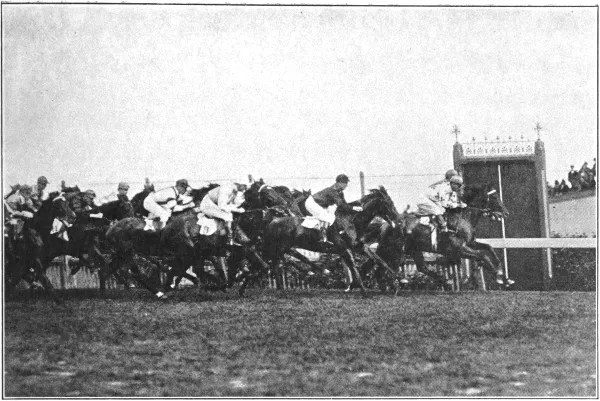
The race horse is one of the national idols of Australia. Every one,
from preacher to porter, goes to the races, nearly all bet, and the attendance
at the Melbourne Cup sometimes numbers 150,000 people.
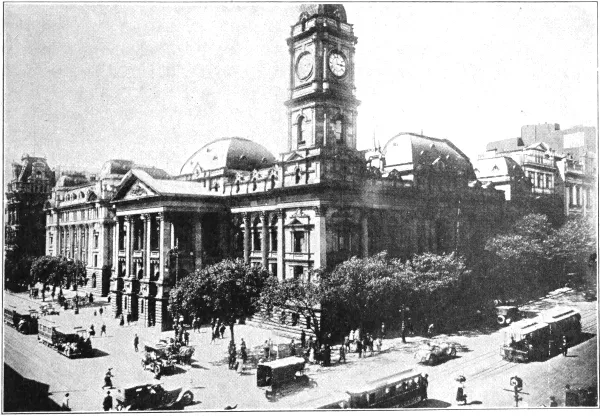
The great white stone town hall contains a room with three thousand
seats for public entertainments. The city employs musicians to give free
concerts twice a week on its $35,000 organ.
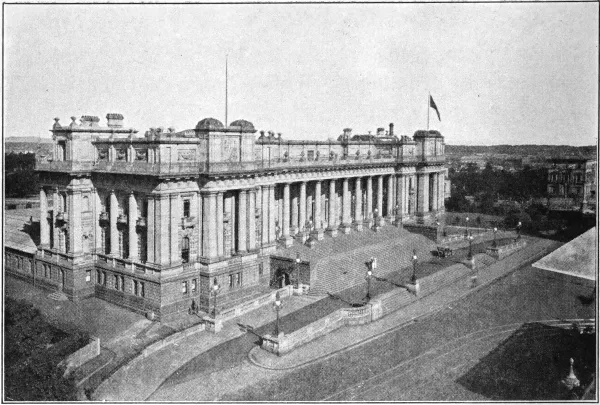
Until the completion of the made-to-order capital at Canberra, the seat
of the Australian federal government, remains at Melbourne, where the
Commonwealth House and Senate meet every year.
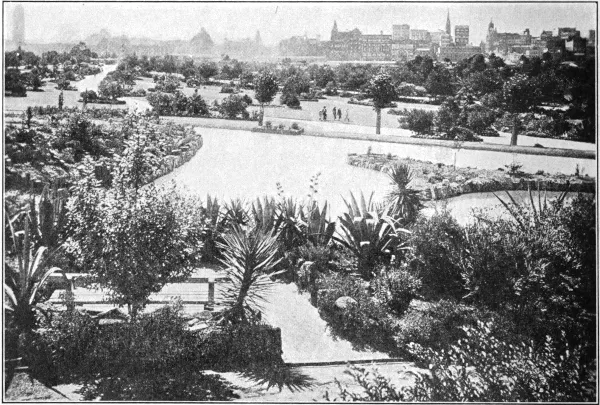
Alexandra Gardens in the centre of Melbourne remind one somewhat of
Boston Common and Central Park. A shack village when Chicago was
incorporated, the city is now one of the fine capitals of the world.
One of the surprising things is the little account taken of
drunkenness or drinking. No one seems ashamed of having
contracted the habit, and many men refer as nonchalantly
to having been drunk as you would to having
had your dinner.
Not long ago I was on a train in company with three
Australians who were evidently old friends. One of the
men said: “You see how much fatter I look. That fat
comes from temperance. I have taken on flesh since I
stopped drinking. I used to drink five bottles of gin
every week right along and often much more. About
six months ago I tapered off and at once began to gain
weight. Since then I have gained two stone in a month.”
The other gentlemen contributed like stories of themselves
and their friends. They kept up the conversation
until the train stopped at a station, when all went out for a
glass of whisky and soda.
To me one of the worst features of the liquor traffic
in Melbourne and other Australian cities is the fact that
the drinks are dispensed by women. The Melbourne
girls are especially beautiful, and the town has the reputation
of having the prettiest barmaids of Australia. Some
of them are witty and nearly all are charming, so that it is
no wonder that the men like to come in for a chat and a
drink.
CHAPTER XIII
IN THE MARTS OF THE CITY
MELBOURNE is one of the best business cities
of Australia, and to a large extent the money
centre of the country. It has a number of
rich men, its people are great spenders, and
money is kept on the move most of the time. By no
means all of it goes for good living. There are numbers
of insurance companies, real-estate firms, and banking institutions.
The chief banks have branches in the state of
Victoria and in all parts of the continent.
Some of the stores are called universal providers, taking
the place of our department stores. All have good window
displays and they advertise in the spread-eagle American
way. One man boasts of having one million books
in his stock, and fills the newspapers with rhymed effusions
about his goods. His shop is called the Book Arcade, and
it is a sort of department store, in which books are featured.
It sells also stationery, candy, and pictures, and
in it you may get a tooth pulled or a photograph taken
while you wait. As in Sydney, many of the big stores
are in arcades from one principal street to another which
protect the shoppers from the blazing sun in summer.
Among the most interesting shops are those selling
jewellery, for they give an idea of the wealth and the tastes
of the people. There are quarts of diamonds and pearls
displayed in the cases, and the windows are filled with
rings, brooches, and precious stones. Among the most
common of the jewels are Australian opals. They may
be seen everywhere. I verily believe I have handled a
half bushel of them since I came to the country. They are
sold set and unset, and are cheaper than with us, although
the better stones bring good prices. An opal the size of
a small pea costs three dollars, while for fifteen dollars you
can get one full of fire and as big as your sweetheart’s
thumb nail. Like diamonds, the stones are sold by
weight, at so much a carat.
In walking through the business streets I see many
curious signs. One reads: “John Jones, Fellmonger.”
That is a fur store, as I can see from the ’possum, the
platypus, and other skins in the window. The shop
next door has the word “Draper” above it. That is a
dry-goods store, while the sign “Ironmonger” on the
building over the way shows that it is a place for selling
hardware. In Australia the druggists are called chemists,
and a drug store is a chemist shop. Lumber dealers are
“timber merchants,” and the lumberman is a “timber
getter.”
Besides what seems to an American their queer use of
English, the Australians are even more addicted to slang
than we are. Their most common ejaculation is “My
word!” You hear this everywhere. It takes the place of
“Mon Dieu!” in French, “Ach Gott!” in German, and
“Oh, Lord!” in the United States. The Australian evidently
thinks his word a better thing to swear by than the
name of the Almighty. Among other slang phrases are
the words “screw,” for salary or income; “narked,” for
angry; “cush,” for comfortable, and “putting on side,” for
putting on airs. If a man is assaulted by highwaymen
and robbed he is “stuck up,” and if he has no money
whatever, it is common to say he “has not a bean.”
“Good iron” is an expression of incredulity at a preposterous
story. People ask you to “hang up your horse”
instead of hitching it. “To have” a man is to fool him or
take him in. If a person fails “he has gone the bung,”
and if he is well off “he is pretty well on.” We use the
expressions “on the jump” or “on the go”; the Australian
says he is “on the wallaby.” When a man acts
foolishly we sometimes say “he is off his base”; with the
Australian “he is off his pannikin.” An Australian girl
does not primp, she “tittivates.” An Australian dude is
a “toff,” a tramp is a “swagman,” “a humping bluey,” or a
“sun-downer.” Luggage is always called “swag,” and
the common word for food is “tucker.”
As to Melbourne’s business hours, the forty-four-hour
week prevails generally. Most of the big stores are not
open before half-past eight or nine; all except fruit and
confectionery shops must close at six, and all are required
to shut up for the half holiday every Saturday. Barbers
and tobacconists may close half a day on Wednesday, instead
of Saturday. Even the drug stores have to close
on Saturday afternoons and on Sundays as well.
Melbourne is called the Yankee city of Australia and
its people pride themselves on being like us. They are
considered the most enterprising of any people south of
the Equator. I have been frequently asked if Melbourne
did not remind me of home, or whether we have anything
better of the same kind in the United States.
Many Americans flocked here during the gold rushes of
the early fifties and some of them stayed and bought property.
Several of the finest business blocks are owned by
Americans; for instance, the Equitable Life Insurance
Company of New York has one of the best office buildings
here. A great many fortunes have been made in Melbourne
real estate. The romances of its land speculations
are like those of New York and Chicago. The island of
Manhattan was bought from the Indians for about a peck
of beads, buttons, and trinkets; Chicago could once have
been purchased for a pair of old boots. The Australian
aborigines traded the site of Melbourne, including six
hundred thousand acres surrounding it, for forty pairs of
blankets, forty-two tomahawks, and a few knives, scissors,
looking glasses, and shirts. The same ground is worth
more than one hundred million dollars to-day. John
Batman, the man who bought this tract, was not allowed
to keep it. His claim was disputed by others, and a
few months later the governor of Australia came down
from Sydney, laid out the town, and sold off the lots at
auction.
That auction made fortunes for the successful bidders.
There were about two hundred men present, and nearly
all bought city lots of half an acre each. The first sold
for $150 and another for twice that. One block of ten
acres netted $2500. That area is now worth at least
$15,000,000 and the value of many of the other lots has
increased in about the same ratio. The net proceeds of
the day’s sale were less than $20,000, yet to-day the same
land is worth at least $40,000,000; that is, its value has
increased just about two thousandfold, which is certainly
a fair profit. The auctioneer was a man named Hoddle,
who worked on commission. His fees for the sale were
about $285, and he took them in land. He was awarded
two lots in Elizabeth Street, which he lived to see worth
$1,250,000. That was certainly one occasion when talk
was worth money, for Hoddle must have received in the
end hundreds of dollars for every time he opened his mouth
to cry, “Sold.”
This auction took place in 1837. From that time the
town grew steadily. Within twelve months a hundred
houses were built, and within five years it had six thousand
inhabitants. It was incorporated in 1842. Ten years
later nuggets of gold as big as your fist were discovered
at Ballarat, some hundred miles back in the country, and
Melbourne boomed as San Francisco did, and at just
about the same time.
Hundreds of thousands of men passed through the city
on their way to and from the goldfields, and within ten
years more than four hundred million dollars’ worth of
gold was sent into Melbourne for shipment to Europe.
The town doubled and quadrupled in size. It soon
reached the rank of a city, and kept growing until about
1890, when it had half a million people.
Then came a panic, which seemed for a time to be the
ruin of Australia. But Melbourne was soon on its feet
again and I agree with the people here who believe that
their city is destined to become even greater as the
Commonwealth grows.
CHAPTER XIV
THE STATE-OWNED RAILWAYS
IN MAKING the trip from Sydney to Melbourne, I
was painfully reminded of the worst feature of railroading
on this continent. At Albury, on the frontier
between New South Wales and Victoria, I was
routed out of my berth at daylight and compelled to
change cars. Although the central government controls
the telephone and telegraph services of Australia, the railroads
are owned by the states, and since each has a different
gauge for its tracks, passengers and goods must often
be transferred.
The lines in Queensland, Western Australia, and Tasmania,
which are not contiguous states, have a narrow
gauge. The tracks in Victoria are five feet three inches
in width, as are those of the main lines of South Australia.
Only New South Wales and the Transcontinental line
built by the Commonwealth government have the world
standard gauge of four feet eight and one half inches. In
going from Brisbane in Queensland to Perth in Western
Australia one must change five times because of differing
track widths, and this is one of the reasons why the
thirty-five hundred mile journey takes practically six days.
Such conditions cost more than time. For example, the
transfer charges on freight between New South Wales
and Victoria range from thirty to seventy cents a ton.
Imagine what it would mean in the United States if
passengers and freight had to be moved from one train to
another every time a state line were crossed.
Ever since the states formed the Commonwealth there
has been much discussion of the unification of these conflicting
railroad gauges. This is certainly one of Australia’s
greatest needs, but so far the expense has proved
prohibitive. A commission of three eminent engineers,
an Englishman, an Australian, and an American, recently
reported that to convert all the existing lines in the Commonwealth
to the standard gauge would cost about two
hundred and ninety million dollars. This would mean
an expenditure of more than fifty dollars for every man,
woman, and child in Australia. It has also been proposed
to standardize the chief routes connecting the five state
capitals on the mainland at a cost of about ninety million
dollars, but just now even this seems more than the country
can afford. Yet the diversity of gauges imposes such
a burden on Australian business that some day unification
will have to come.
At present there are about twenty-six thousand miles of
railways on the continent, of which twenty-three thousand
miles are owned and operated by the states, twenty-eight
hundred are privately owned, and the rest are in the
hands of the Commonwealth government. This is about
one tenth the mileage of the United States, which has
approximately the same area but twenty times as many
people. Most of the Australian railroads are, like the bulk
of the population, on the eastern side of the continent.
The great tropical Northern Territory has only one railroad,
which is but two hundred miles long.
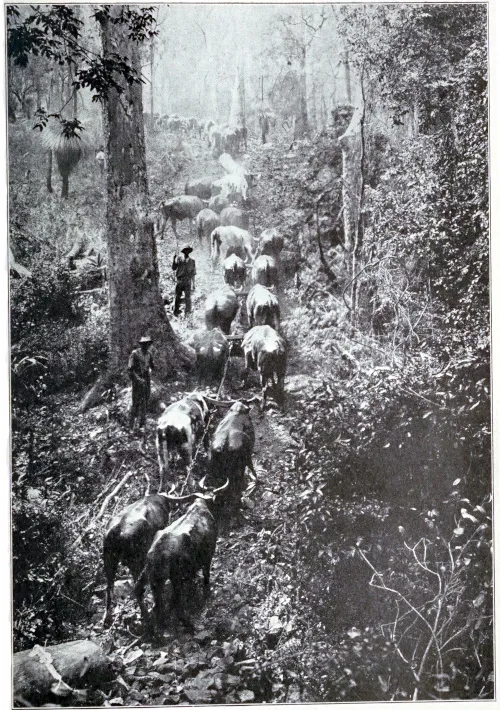
Australian railroad tracks are laid on ties cut from her forests of eucalyptus.
One variety, the iron bark, is practically immune from fire, while
the kauri, jarrah, and blue gum last for fifteen or twenty years.
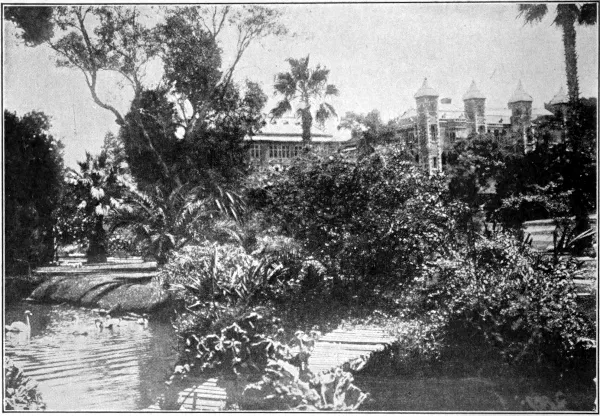
For years the governor of Western Australia in his palace at Perth
could communicate with the rest of the Commonwealth only by ship or
telegraph. Now the Transcontinental Railway connects his capital with
the mainland.
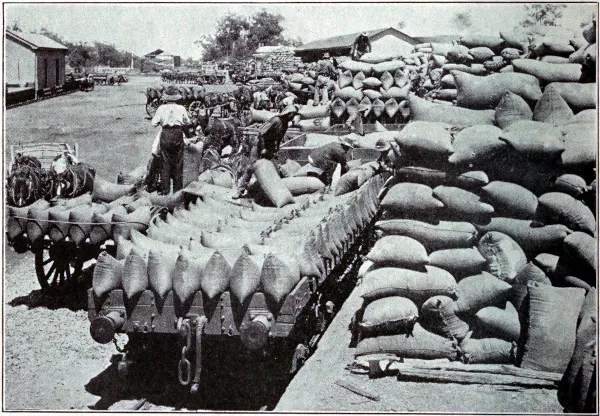
Despite the expense in handling, Australia still ships the bulk of her
wheat in bags and on flat cars. Because of the dry climate, it is safe
from rain but much is destroyed by rats.
In each state the lines are operated by one or more
commissioners appointed by the cabinet. The Minister
for Railways directs legislation and answers questions in
the state Parliament; but otherwise the commissioners
have a free hand. Federal lines are managed by a railway
commissioner for the Commonwealth.
In Sydney I asked a member of the New South Wales
railroad commission whether he thought government control
of the railroads was a good thing. He replied:
“There is no doubt of it. The results have been so
good that we are convinced that such management is for
the best interests of the people. We are giving a better
service at less cost than private roads could do.”
“But how about the political end of the machine?”
I asked. “Do not the politicians try to manage the commissioners
and control the vote of your employees?”
“No,” was the reply. “Our laws provide that we
shall be absolutely free. The government does not dictate
to the chief commissioner and his three assistants.
We have our own staff of officials, whom we appoint, and
no promotion can be made without our consent. We have
about forty thousand employees in this state alone and
we are careful to do them justice. We hold a court every
other Wednesday, to which our men can appeal if they
have grievances. There are many such appeals and about
one third of them are settled in favour of the men.”
“How about wages and hours of work?”
“We have the eight-hour day and we pay higher wages
than do the European railways. Our men are better
treated than those of any railroad I know. They are
under the civil service and no man can be removed except
for cause.”
“How about the profits? Do your railroads pay?” I
asked.
“Yes, we usually manage to show a small surplus after
meeting interest charges on the capital invested. But
our revenue fluctuates from year to year, according to
whether there is a good or a poor season for farming and
sheep raising. In unfavourable seasons the carriage of
fodder and the transfer of stock to better pastures at
reduced rates mean smaller earnings and larger operating
expenses. Extensions into thinly settled districts also
cut down the net income, since several of these lines earn
little more than the cost of maintaining them. Nevertheless,
we are pushing out roads into the good territory,
knowing that settlement will soon follow and that the
new lines will ultimately become profitable.”
Another prominent official with whom I talked on this
subject is a Queensland railroad man. Said he:
“As far as I can see, the government control of our railways
has been an excellent thing for the state. It has
given us profitable railways which could never have been
built by private parties. Take our Rockhampton line,
for instance. It begins at the coast and runs four hundred
miles westward through a thinly populated country.
When it was first completed there were places on that line
where one could ride one hundred miles without seeing a
town. But the railroad made the land on both sides of
the track available for sheep raising. It is now taken up
for pastures, and there are hundreds of flocks feeding upon
it. Towns have sprung up along the line, and in time the
road will pay well.”
“How about the profits on the Queensland roads?”
said I.
“If there are any, they are never large,” was the reply,
“you see we don’t want a big profit, for it is our principle
to keep the rates for freight and passengers as low as we
can. As the lines make more money we shall lower the
rates and increase wages.”
“Are you satisfied with the narrow gauge?” I asked.
“Yes. It pays us better than the broad gauge. Our
roads cost only about half as much per mile to build as
those of New South Wales and they furnish all the transportation
required.”
“Where do you get your equipment?” I asked.
“We used to buy most of our rolling stock from England,
but now, as in the other Australian states, our locomotives
and cars are built at the state railway shops.
Our shops are at Ipswich, which is close to big coal deposits.
We buy steel rails from the steel mills at Newcastle,
and about the only equipment we now get from
abroad are patented devices and specialties.”
I may add that not all those to whom I have talked are
so favourable in their reports on the state-owned railways.
One man reminded me that in most cases these lines,
operated in the interests of the people, charge as high
freight and passenger rates as do our privately owned roads
in the States. Another calls attention to the fact that
sometimes for four years running the Australian lines
have shown considerable losses and capital is by no means
always certain of the four per cent. dividend it has a right
to expect from them.
One thing that strikes one about the Australian locomotives
and passenger and freight cars is the fact that
they are much lighter than those to which we are accustomed.
The freight cars seem particularly small and
light. In my trips over the country I have passed hundreds
of slat-sided cars transporting livestock. The sheep
cars are double-deckers. The Australian wheat goes to
market in open-top cars, instead of in box cars, as with
us, and is handled in sacks instead of in bulk. The
wheat export amounts to one hundred million bushels a
year, and most of it is shipped overseas in bags. I have
seen enormous stacks of full wheat bags along the railways
and at the ports. As the grain is harvested in the dry season,
there is no danger of its fermentation when bagged
and stacked in this way. Neither is there much risk
of its getting wet, for it is often covered with tarpaulin,
both in the stacks awaiting shipment and on the cars.
There is, however, considerable loss every year from rats
and other vermin. Since she got her grain elevators at
Sydney, New South Wales has been building special grain
cars for handling wheat in bulk.
The ties for Australia’s railroads are furnished by her
eucalyptus forests, many of which contain splendid timber.
The Tasmanian blue gum, a species of eucalyptus,
is one of the most durable of woods. It has twice the
strength of English oak and, used as railroad ties or paving
blocks, in the Tasmanian climate it has a life of from
fifteen to twenty years. In the dry air of Victoria blue
gum sleepers last twice as long. The jarrah, a eucalyptus
of Western Australia, has been known to withstand fire
better than iron girders. This wood is one of the few
that will resist the white ants, and seaborers make no
impression upon it. I have heard that jarrah piles driven
at Port Adelaide in 1868 showed no signs of decay forty-two
years later. Karri is another remarkably durable
eucalyptus of Western Australia much used for ties.
Karri planks from ships dismantled after thirty years of
service have been sawed up to make paving blocks, and a
log of this wood that had lain forty-six years in mud below
high-water mark was reported “perfectly sound” by
a government expert.
One of the biggest railroad undertakings of modern
times was building the Australian Transcontinental line
for a thousand miles across the desert. Until this was
completed Western Australia was cut off from her sister
states by a great waste of sand and could communicate
with them only by telegraph or by sea. The ocean journey
from Perth to Sydney took seven days. Neither Western
Australia nor her neighbour, South Australia, felt able to
finance an unprofitable railroad joining them together.
So it became the job of the Commonwealth government,
which began the line in 1912 and completed it five years
later.
The overland journey from Adelaide, South Australia,
to Perth on the coast of Western Australia used to take
two months. By train it now takes two days. Besides
decreasing the time between Western Australia and
New Zealand or America, the railroad shortens the trip
from London to Melbourne or Sydney by almost a week.
Preparing the road-bed and laying the track across the
level stretches of the desert were easy matters. The
real problem was providing water and supplies for the two
construction gangs as they worked toward each other
across the hot and arid wastes, unwatered and uninhabited
save by hordes of flies and mosquitoes. Four hundred
and twenty-five miles west of Port Augusta the railroad
enters the Nullarbor Plain, a vast empty limestone
plateau on which there is not a single water hole. Here it
runs in a bee line for three hundred and thirty miles—the
longest straight stretch of track in the world. The
rest of the route is through sandhill country where there
are at intervals natural rock catchment basins for water.
Although this region is called a desert, there is an annual
rainfall of from two to five inches, and this was caught
in great roofed-over reservoirs and saved for the use of
the workers.
For some time the question of water supply on the Nullarbor
Plain threatened to hold up indefinitely the construction
of the Transcontinental. Then a message came
from Kalgoorlie telling the good news that water had been
found on, or rather under, the plain. The engineer in
charge wired that he had pumped out seventy thousand
gallons from an artesian bore about three hundred miles
east of Kalgoorlie. Another bore, one hundred miles
farther east, struck brackish water usable for locomotives.
These two wells now furnish water sufficient not only for
the railroad but for limited irrigation and pastoral purposes
besides. There are tanks every fifty miles across
the plain, connected by a pipe line from the Kalgoorlie
reservoir.
While the Transcontinental was being built, and before
the pipe and the tanks were constructed, water for two
hundred horses, three hundred camels, and twelve hundred
workmen had to be brought by cars and on camel-back.
At one time it was carried three hundred miles by
tank cars and thirty miles by camels to the eastern end of
steel at a cost of thirty-nine dollars for each thousand
gallons. To supply the western railhead, water was piped
for three hundred and fifty miles to a big reservoir and
then hauled two hundred and twenty miles to the construction
camps.
Without the aid of camels it is probable that the Transcontinental
never could have been built. The “ships
of the desert” took the engineers on the preliminary survey
of the line, they bore the men who went along the route
looking for wells and water holes, and later on they were
the indispensable carriers of water and construction
materials over miles of waste land and through months of
overpowering heat.
Every effort was made to provide endurable conditions
for those who worked on the railroad. The chief engineer
and his staff lived on camp trains specially designed for
desert use. The trains consisted of seven or eight coaches
built with double roofs to give protection from the sun.
All the openings were screened against the swarms of
flies, mosquitoes, and other insects. There were, besides,
a car for stores, a well-equipped hospital car, and cars with
living and sleeping quarters for the staff.
The workmen lived in small light huts of canvas and
wood, which could be knocked down and moved, as they
had to be about every three days. Like the cars, each of
the huts used for sleeping quarters had an extra roof.
The heat was often so intense that at midday it was sometimes
impossible to work, for rails, sleepers, and everything
else were too hot to touch. The thermometer
frequently registered one hundred and thirty degrees in
the shade.
Supplies of clothing and food were brought up from the
warehouses at the eastern and western terminals of the
road on what were known as “tea and sugar” trains.
The men were well fed and their daily menus included
not only bread and meat, but even fresh fruit and vegetables.
It cost thirty million dollars to build the Transcontinental,
but this sum is not considered unduly great in
view of the obstacles overcome. Except for the money
spent in supplying water, the expenses were not large.
In no part of the route does the track cross a river or climb
a steep grade. Comparatively few common labourers
were required. Construction was simply a matter of
making an even bed for the sleepers, then placing the
rails with a track-layer, and bolting and spiking them
down. The road moved forward at the rate of a mile a
day.
The World War slowed up the work, for many of the
construction force enlisted. Nevertheless, at the end of
five years eastern and western railheads met, and to-day
it is possible to go by train from Perth to Brisbane on a
route joining all the capitals of the five mainland states.
The Transcontinental may, perhaps, never pay in pounds,
shillings, and pence. In time saved, however, it has
already proved itself invaluable and, what is more important,
it serves to bind all parts of the Commonwealth
more closely together.
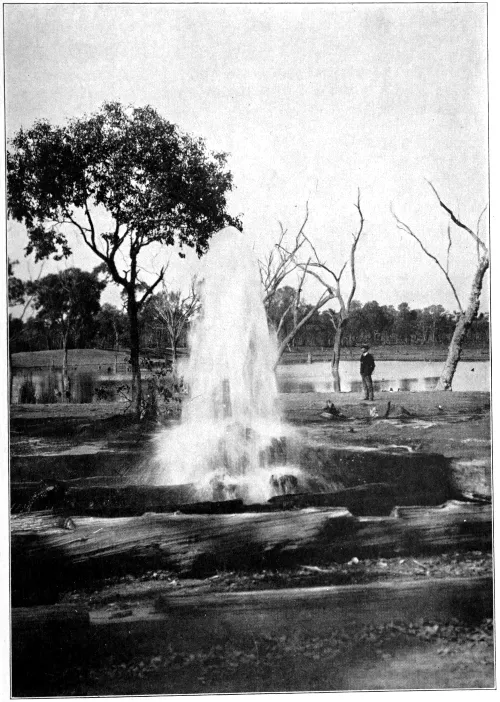
Discovery of Australia’s artesian water has led to the reclamation of
millions of her acres. Artesian bores spouting thousands of gallons solved
the water problem in laying the Transcontinental across the desert.
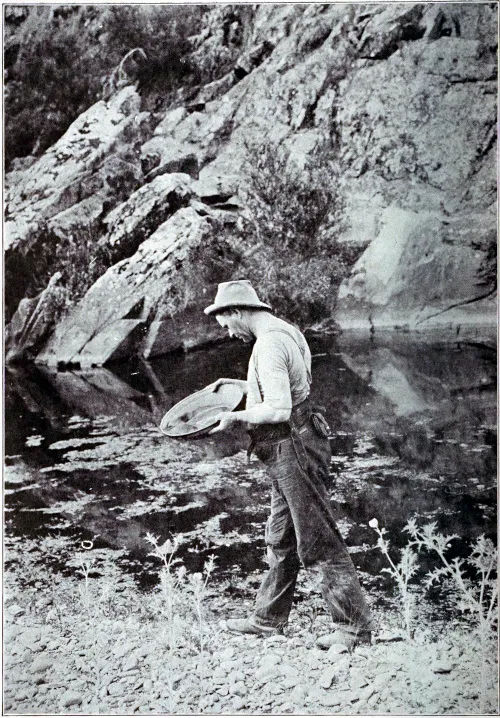
Though the great gold diggings of Ballarat are worked out, thousands
of prospectors are still panning the stream beds of Victoria, hoping for one
more great strike like those of the gold-fever days.
CHAPTER XV
GOLD DIGGINGS IN CREEK AND DESERT
I AM in Ballarat, the heart of what was once the chief
mining district of this golden continent. Within a
stone’s throw of me was found a lump of gold as big
as a watermelon and from under the hotel where I
stay fortunes in gold have been taken. Every bit of earth
in sight has been run through a sieve again and again to
wash out the precious dust it contained, and for miles about
the valley of Yarrowee Creek has been honeycombed with
diggings. It is even said that the water in some of the
deepest mines contains gold. One story is told of how
several barrels of water from here were hermetically sealed
and sent off to Paris. They were kept there for years, and
when opened were discovered to have precipitated several
gold nuggets. I doubt the truth of this story!
Gold was known to exist in Australia long before 1851,
when Hargraves, an Australian who had prospected in
California, discovered it in paying quantities. Hargraves
had gone to California in the gold rush of ’48 and had
failed, but he was haunted by the idea that the gold
country in California resembled a certain valley in the
hills of New South Wales. This valley was that in which
Ballarat lies. He decided to go back home and prospect.
He did so and his discoveries threw all Australia into
a fever. In a short time it was proved that every creek
within a radius of seventy miles from here had gold in its
sands, and in the placer mines opened at Ballarat gold
was found in great lumps.
One of the first big nuggets weighed one hundred and one
pounds, while the “Welcome” nugget weighed as much as
a good-sized man, tipping the scales at one hundred and
eighty-four pounds and nine ounces. I have seen models
of the nuggets in the mining museums of Queensland, of
New South Wales, and of Victoria, as well as in the different
state mining schools. The “Welcome” nugget, which
was the size of a big baby, was twenty inches long, twelve
inches wide, and seven inches thick. It was sold in Melbourne
for fifty thousand dollars. In 1858 a lump of gold
worth twenty thousand dollars was found in New South
Wales, and fourteen years later a mass of gold and quartz
weighing six hundred and thirty-nine pounds was discovered
at Hills End in the same state. An offer of one
hundred and sixty-five thousand dollars for it was refused.
Some of the most remarkable mines of Victoria were
at Bendigo, about a hundred miles from Melbourne,
where in the height of their production the goldfields
yielded more than a million dollars a year. The mines at
Ballarat are now worked out, but quartz mining is still
carried on at Bendigo Amalgamated, a consolidation of
the mines in that region. The average yield is about one
hundred and sixty-five thousand ounces a year. Since
1851 the mines of Victoria have produced upward of one
and a half billion dollars’ worth of gold.
The Ballarat of to-day is not like the Ballarat of the
great gold rush. Then it was a city of tents, which probably
housed more people than the present population of
twenty thousand. Now it is a well-built town, with many
comfortable homes, and streets as wide and as well
paved as those of Washington. The principal thoroughfare
is lined with marble statues, and there are others
scattered throughout the long park in the suburbs.
Ballarat has good stores and banks, and even a stock
exchange, but there is not a mine-shaft house in sight.
The people are especially proud of their theatre seating
three thousand, an art gallery containing some fairly good
paintings, and a mechanics’ institute with a library of
twenty-two thousand volumes. It has four other free
libraries, good public schools, and churches of every
Christian denomination under the sun. It has flour mills,
woollen mills, and iron factories. The town has become
the commercial centre of a rich pastoral and agricultural
region. It is seventy-five miles from Melbourne by rail,
and on the main road from Melbourne to Adelaide.
The mining school at Ballarat is, I venture, as well
equipped as any similar institution in the United States.
I had letters to its superintendent from the director of the
mint at Melbourne, and its president kindly showed me
through. The college is built over a gold mine which it
operates to give practical training to the students. The
boys go down into the shafts and work the mine, thus
learning by actual experience how gold is taken out of the
earth. Connected with the school are all sorts of reduction
works run by the students, including cyanide plants,
a chlorination plant, and facilities for all the various
methods of treating ore. There are large chemical laboratories,
assay furnaces, and, in short, everything needed
for such a college.
To-day Victoria and Western Australia are the leading
gold-producing states of the Commonwealth. I have
talked with miners from Western Australia, who tell me
that much of the vast territory has not been touched.
Said one mining expert:
“The gold we know of extends over an area of more than
six hundred thousand square miles. You can take dirt
from the road at any point along a thousand miles, wash
it, and find colour.”
Kimberley, where gold was discovered in the eighties,
was the first of the Western Australia fields, and it proved
a disappointment. The prospectors there were working
along dispiritedly when in 1892 a man rode into the town
of Southern Cross with great news. He brought with him
ten thousand dollars’ worth of nuggets and dust picked up
in two days in a desert region that the aborigines called
“Goldarda.” There are still old-timers to tell of the
scenes that followed. In two hours the price of a horse
rose from ten dollars to two hundred and fifty dollars.
Camels could not be had. Dogs, cows, and goats were at
a premium. So was anything on wheels, from buggies to
baby carriages. Some men set off with wheelbarrows.
In a day or two Southern Cross was practically deserted,
and its inhabitants were trekking across the hundred and
twenty-five miles of desert that lay between them and
the new strike at Coolgardie. They did not even know
the location of the water holes along the route. Many
were two or three weeks on the way and arrived with
tongues swollen and lips cracked and blackened from
thirst.
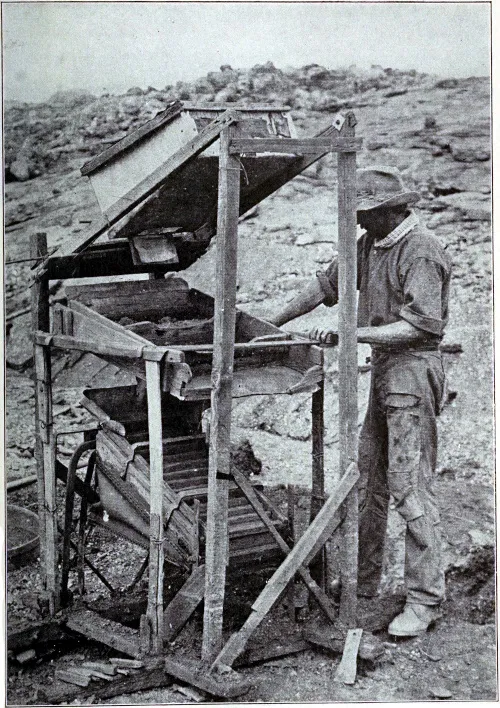
In parts of Western Australia, where water cannot be had, gold is dry-blown.
The soil is first sifted for nuggets and then the metal is separated
from lighter waste by means of bellows.
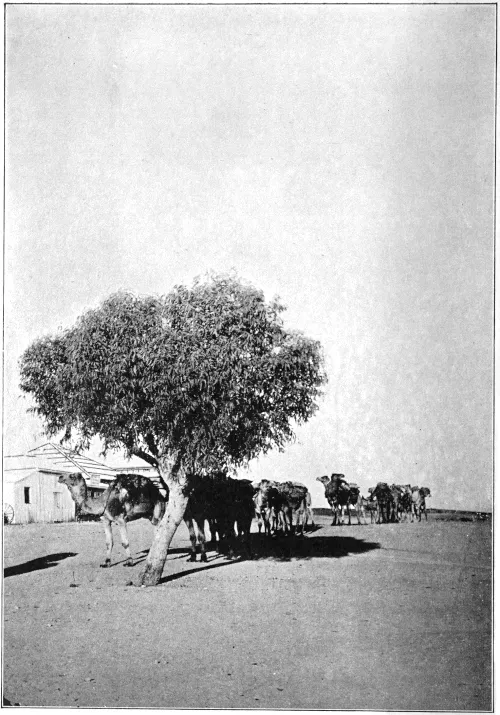
More than ten thousand camels are used in the dry back blocks, especially
in the mining districts of Western Australia. Sometimes it may
cost five dollars or more to give one a real drink.
In a few weeks the news brought men from all parts of
Australia; in a few months it attracted them from all
parts of the world. Capital became interested. The
Wealth of Nations mine at Coolgardie, from which three
great nuggets were taken at once, but which later proved
only a low-grade mine, was discovered by an Indian camel
driver who was paid two dollars and a half for his find.
The owners of the camel took out more than a hundred
thousand dollars’ worth of gold and then sold the mine for
seven hundred thousand dollars. The original Coolgardie
claim yielded more than two and a half million dollars in
its first ten years.
In 1893, when the Coolgardie claims were giving out, a
grocer of Adelaide formed a syndicate of fifteen people with
a capital of less than a thousand dollars. The prospectors
they sent out turned up the riches of the famous Golden
Mile of Kalgoorlie. Five years later, when the syndicate
was disbanded, it voted its original capital as a bonus to
its secretary. The value of the shares, based on its holdings
at the Golden Mile, was then more than thirty-six
million dollars. At that date the syndicate had produced
seventeen tons of gold. The money distributed to the
Adelaide shareholders was close to five millions in cash,
besides upward of seventeen millions in stock.
The great handicap in the Kalgoorlie, Coolgardie, and
other desert mines was lack of water, which then cost
about as much as gasoline does now. In the Coolgardie
fields water brought as much as twenty-five and fifty cents
a gallon, and there was a regular business of evaporating
and condensing salt water from the lakes and wells to make
it fit to drink.
It was impossible to get enough to wash out the gold,
which had to be dry-blown. That is, the soil spaded from
shallow trenches was first sifted for nuggets, then thrown
into the wind and expertly caught in iron pans. It was
tossed up again and again to get rid of the lighter waste.
Later on bellows worked by hand or foot power were used,
and still later fanning mills were introduced. I am told
that in those early “roaring nineties” one could see above
the mining camps in the desert a red cloud of dust. This
“hell cloud,” as it was called, hid the miners from view, and
out of it came the sound of laughter and curses, and the
roar of the gravel raining into thousands of iron pans.
Although at that time the whole of Western Australia
had only about as many people to pay its taxes as Des
Moines has now, the government did a great deal to help
get water for the miners. In the Coolgardie district it
built a number of tanks, bored artesian wells, and installed
condensers. Kalgoorlie now has a reservoir with a capacity
of five million gallons. It is fed by a stream through a
steel pipe as big around as a barrel and three hundred and
fifty miles long. The water comes from a point near
Perth and is lifted by a series of pumps to a height of
about thirteen hundred feet. The Western Australia
government sells it at an average rate of seventy-five cents
a thousand gallons; in the early days water used to cost
sixteen times as much. Without this pipe line Australia’s
best gold mines would have to be abandoned, and the cities
of Coolgardie, Kalgoorlie, and Boulder would sink back
into a forlorn desert. Nowadays, as one of the old prospectors
put it, “Water? They waste it! At Kalgoorlie,
they even bathe in it, at twenty-five cents a head!”
In developing Western Australia’s mineral wealth,
camels have proved almost as invaluable as water. They
had been introduced into the country in the early days and
multiplied faster than in their native Arabia. Along with
them came their nomadic or Bedouin drivers, who found
Australian wages to their liking and stayed on, although in
many cases their jobs have now been taken by white men.
It is estimated that more than twelve thousand camels are
worked in the dry back blocks of the continent. The ungainly
beasts stalk back and forth between the railway
terminals of the east and the dry lands of the west.
From the silver-mining centre at Broken Hill in western
New South Wales they start out for the northwestern part
of the state and for interior South Australia, Queensland,
and the Northern Territory. From “The Hill” they take
supplies to the remote sheep stations, returning with wool.
Three hundred and fifty camels are worked by the water-supply
branch of the Western Australian government.
They serve the gold prospectors and the settlers of the
“Never-Never Land,” and they are the police and mail
carriers of the desert blocks.
In the desert gold-mining camps a considerable expense
of doing business is watering the camels. A camel ordinarily
drinks seven or eight gallons, when thirsty he will take
in twenty gallons, and after several days without water
forty gallons are hardly enough to fill him up. Where
water is scarce it may cost his owner two or three dollars
to treat his mount to a drink; one camel just in from a long
trip drank fourteen dollars’ worth before he was satisfied.
But before I leave the subject of gold mining in Australia
let me tell you of the visit I made to the mint at
Melbourne where for many years gold dust and bullion
have been turned into sovereigns. The gold comes from
different sections of Australia and after being coined is
shipped off to London. The greater part of the metal
goes into sovereigns and half sovereigns.
I went through this money mill with its director. We
first watched the gold as it came in. Some of it was dust,
but much was in the form of bullion bricks from the
smelters. As it was handed over the counter the clerks
weighed it, using scales so fine that they can weigh accurately
a golden grain as small as the point of a pin or a great
nugget the size of my head. After the gold has been
weighed a memorandum of the amount is made for the depositor,
which he presents at the cashier’s office to get his
money.
Leaving this room we went on to see how the smelting
was done. The gold is melted in crucibles or pots of fine
clay and plumbago. Each pot has a capacity of perhaps
half a gallon of liquid gold. It is fitted into a little furnace
not unlike the forge of a country blacksmith, set in a long,
narrow ledge on one side of the melting room. In the room
we entered there were twenty of such furnaces, nearly all of
them filled with gold. The fuel used is coke, and a strong
draught makes such a heat that the metal bubbles like
boiling water. I was dazzled when I looked into the pots.
The liquid was emerald rather than gold. I saw it poured
out into moulds and the stream was a current of beautiful
molten green on a background of light yellow. Later,
when the moulds were opened, the green had disappeared
and the metal had become a bright golden yellow.
I next watched the bars of bullion being rolled into the
strips from which the gold coins are cut. Each was a ruler
of gold twenty-five inches long, two inches wide, and not
quite half an inch thick. I followed a truck load of these
bars as they were wheeled into the rolling room. Here
they were pressed between great steel rollers, which made
them longer and thinner. At the finish each bar had become
fourteen feet long and was just the thickness of a
sovereign. Moreover, the pressing had polished it so that it
shone like a new wedding ring. I noticed that the workmen
wore thick gloves, and was told that this was because
the strips of metal get hot as they are rolled.
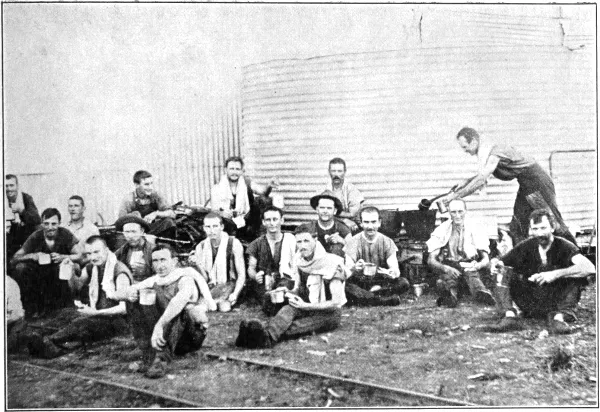
Once treated with scant consideration, the shearers who now have
one of the strongest unions in the country are veritable autocrats about
their hours, wages, and quarters. Every afternoon they knock off for
tea and a smoke.
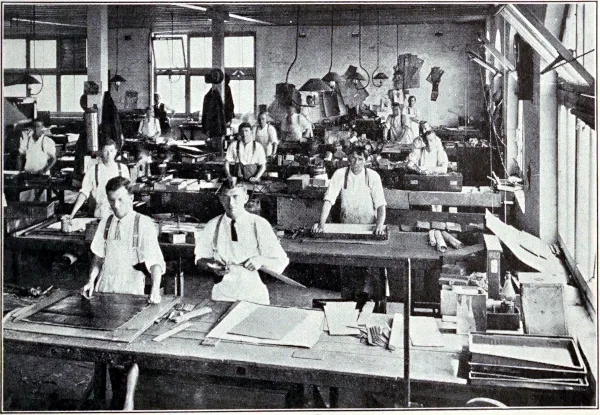
Like 600,000 other Australians, these leather workers are union men
with good wages, fair hours, and a weekly half holiday. Forty-eight
hours is the weekly maximum, though in some trades as little as thirty-six
hours count as full time.
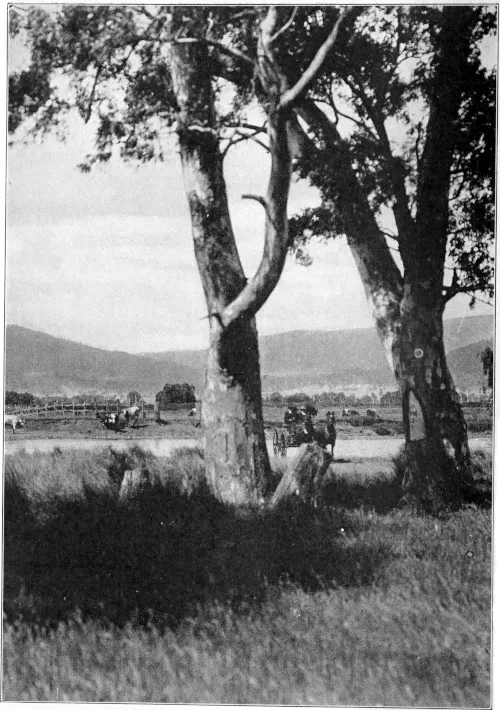
The agriculturist feels keenly the need for more people on the land, but
he stands with the trade unions in opposition to letting in swarms of
coloured labour from the over-populated Orient.
The next process is making the blanks. This is done
by steel punches which cut the metal into disks much as
a cook cuts the dough in making biscuits. I stood beside
this machine and heard it chop, chop, chop, as it punched
out sovereigns at the rate of ninety to the minute, twenty-seven
thousand dollars per hour.
Each blank is weighed to see that it has exactly the right
weight of gold for a sovereign, and is then run through a
coining press which stamps the image of the king upon it
and at the same time mills the edges. All of this work is
done with cold steel pressing upon the cold gold. The
only heat after the melting is that which comes from the
pressure caused by the enormous weight on the metal.
I have no doubt that Australia will be turning virgin
gold into sovereigns for years and years to come, but its
production of the precious metal is on the wane. The
mines of Kalgoorlie are still paying, but those of Coolgardie
are worked out. The annual production for the whole
country is now only half that of Victoria in its best days,
and is considerably below the best year’s output in
Queensland and Western Australia. It may be, though,
that more Golden Miles lie hidden under the vast unprospected
areas of the continent.
CHAPTER XVI
A WHITE WORKERS’ CONTINENT
THE workers’ continent—and for white men only!
That is how these people speak of Australia.
They have tried to make it the paradise of the
labourer, and are determined to keep out all members
of the coloured races—black, brown, or yellow—who
might wish to share it with them. All sorts of schemes
have been devised for the benefit of the wage-workers,
most of them intended, as far as I can see, to help them
sell the least work for the most money.
Australia is the land of the labour union. No other
country is so thoroughly unionized, and nowhere else does
organized labour go so far toward running both the government
and business. There are unions of sheep shearers
and factory workers; unions of rabbit trappers and harness
makers; there are unions for occupations I hardly knew
existed. Six hundred thousand people, or one out of every
nine of the population, belong to labour unions of one
kind or another.
This continent is also the home of the eight-hour day.
It was established in Australia and New Zealand long before
workers in other countries even began to demand it.
Australians are so proud of this fact that they have put
up a monument to remind posterity how its work day was
shortened. I have seen most of the great monuments of
the world; I have lived in the shadow of our own huge
shaft in honour of George Washington, climbed the
Pyramid of Cheops in Egypt, and beheld the splendour of
the Taj Mahal in India. But never before have I seen
anything like this monument in Melbourne, commemorating
a victory for labour in its centuries of struggle with
capital. It would never be noticed for its size or beauty,
for it is merely a simple shaft of stone. Its significance
comes from the three huge figure “8’s” at its top. These
represent the slogan of Australian workmen of more
than a generation ago—“eight hours’ work, eight hours’
play, and eight hours’ rest.” The “Three Eights” monument,
as it is called, gives the key to the story of the
hours of labour in Australia to-day, and the spirit which
still seems to rule the people.
The agitation for the shorter working day began in Australia
nearly seventy years ago, shortly after the gold fever
first struck the country. Many of those who had come out
to make their fortunes in nuggets found only disappointment,
and had to look for other work. Most of these men
drifted to Melbourne and Sydney, where they soon organized
trade unions like those to which they had belonged in
England. The workers in the building trades in New
South Wales were the first to get their eight-hour day. In
a comparatively short time it was generally adopted in all
the states, and now forty-eight hours is the recognized
maximum for a week’s work throughout Australia, although
in some trades forty-four, forty-two, and even
thirty-six hours are considered full time.
Recently there was a move in the Federal Parliament
to legislate a forty-four-hour week throughout the Commonwealth,
but the members of the Labour Party were not
quite strong enough to carry the measure. The forty-four-hour
week now generally prevails in Queensland, where
the Labour Party is firmly in the saddle and rides all kinds
of socialistic hobbies. The rallying cry is: “Cheap bread,
cheap beef, and high wages.” In the attempt to realize
the first two of these ideals the state runs twenty-two
cattle ranches and fifty butcher shops. It catches fish
and sells them at retail, operates a meat-packing plant,
and has a big produce business selling direct to the consumer
without the intervention of the middleman. It
even runs a hotel of its own. Wages and hours are regulated
by the government, which also owns and operates
the railroads, the saw-mills, and the mines. There is a
government savings bank with deposits of seventy millions
of dollars from a population of seven hundred thousand:
The state competes with private insurance companies and
has lowered rates by twenty-five per cent.
When the labour unions began their campaign for
shorter hours, workers in the goldfields were making such
big pay that the general wage level was high, and the men
were then satisfied with their earnings. Later the original
slogan was enlarged until the “four sacred eights” of
Australian labour were: “eight hours of work, eight hours
of play, eight hours of rest, and eight bob a day.” But
after a while, eight shillings, or two dollars, did not look
so fair to the workers as the “living wage,” and so they began
to go after that. How well they have succeeded may
be gathered from the definition of a living wage as laid
down by the New South Wales Court of Industrial Arbitration.
It reads:
The living wage is standardized as the wage which still does neither
more nor less than enable a worker of the class to which the lowest
wage would be awarded to maintain himself, his wife, and two children—the
average dependent family—in a house of three rooms and a
kitchen, with food, plain and inexpensive, but quite sufficient in
quantity and quality to maintain health and efficiency, and with allowance
for the following other expenses: Fuel, clothes, boots, furniture,
utensils, taxes, life insurance, savings, accident or benefit society, loss
of employment, union contributions, books and newspapers, train
and tram fares, sewing machine, mangle, school requisites, amusements
and holiday, intoxicating liquors, tobacco, sickness and death,
domestic help, unusual contingencies, religion or charity.
It is such a standard of living that the Australian labour
unions are determined to maintain for the workers. So
far they have been able not only to enforce most of their
demands, but to have many of them written into the laws.
Factories, shops, and stores are subject to all sorts of restrictions,
and seem to be run quite as much in the interests
of the workers in them as for their owners.
Each union has rigid rules and regulations governing
the employment of its members, and generally they are
upheld by the state courts for the arbitration of industrial
disputes. In New South Wales, for example, the law gives
preference to union men in employment. In one instance,
an employer wanted a workman. Two men applied, one
a unionist. But the employer chose the non-union man,
believing him more competent for the job. For this the
Arbitration Court fined him ten dollars, and he had to pay
costs of as much more. The judge informed him that the
court, and not the employer, must decide as to the competency
of employees.
In another case some dock workers had made demands
which a steamship company would not meet. The men
did not strike, but, just when their work was most urgently
needed, went on a picnic. To avoid such interruptions
the company proposed to pay men to work by the week
instead of by the day and offered a fair weekly wage. The
unionists refused to accept these terms, whereupon the
company employed non-union men, and the case went to
the Arbitration Court. The judges ruled that the union
members must be reinstated, and the company had to discharge
the men it had hired to take their places.
At Sydney the union of dock workers is so strong that
no steamship company dares employ a non-union man.
But once the wharfingers, as they are called, went a step
too far. In order to create a shortage of workers and
force up wages they stopped taking in new members. The
ship owners had the union brought before the Arbitration
Court, which decided that, although the dock men
might keep non-union men off the Sydney wharves, they
must keep their books open to receive new members.
One more case: An oil company employed six lads under
twenty-one to tighten up the hoops on some casks. The
coopers’ union took the matter to the Arbitration Court,
which upheld the men and declared this simple hammering
was cooperage. The company was fined and had to discharge
the youths and employ coopers at fifteen dollars a
week to do boys’ work.
I am told that decisions of this sort, and the laws behind
them, have bred bad feeling between wage earners and
the men for whom they work. A man of means is distrusted
by the working classes, not because they may envy
him his wealth, but because he is an employer. The capitalist
class has little sympathy for the workers, while the
employed have a strong antagonism for the employer, and
so the Australians are a divided people.
But there is one subject on which all Australia is agreed,
and that is that the continent shall be kept exclusively a
white man’s country. The workers and their unions are
to a large degree responsible for this policy of a white
Australia, but no party opposes it. The men in power say
that Australia has learned her lesson in time, and that she
will never let in cheap labour from China, Japan, and
the surrounding islands which would lower wages and the
standard of living. North and west of the continent are
seven hundred millions of Orientals who would be glad to
get out of their crowded countries into this thinly settled
land of promise. Besides, all the Australians are proud
of their British blood. They wish to keep it without a
“taint of colour,” and seem to be willing to pay the price
in a smaller population and slower development.
Still, there are some Australians who doubt the advisability
of Asiatic exclusion. Is it possible, they ask,
for a population of five and a half millions to hold this vast
area until it is filled up with white people? Australia has
less than two persons to the square mile as compared with
thirty-five in the United States and three hundred and
fifty-one in the United Kingdom. The Commonwealth is
less thickly populated than Siberia, South Africa, or even
Arabia. Moreover, most of her people are concentrated
along the east, south, and southwest coasts, which contain
about eighty per cent. of the population, and there is a
strong tendency toward concentration in the cities. Nearly
one fifth of the white inhabitants live in Sydney and forty-two
per cent. are in the six capitals. Yet Australia is a
land of raw materials. Her fields, farms, and mines need
development, and this development calls for many people.
There are hardly any white men in the tropics of Queensland
and the Northern Territory, where rich crops of cotton,
sugar cane, tobacco, and fruits might be produced.
Some of the capitalists say that because of the climate
these regions will never be developed until coloured labour
is admitted to work them.
But most Australians feel it is better to delay indefinitely
making money out of the tropical lands than to
allow Northern Australia to be opened to swarms of
Asiatics. They point to the Negro problem in our own
South as an example of what would happen if the bars
were let down, and predict that conditions would eventually
become much worse than any we have in the United
States. They prefer to depend on selected white immigration,
chiefly from Great Britain, and also on their
favourable birth rate. The births now average 24.6 per
thousand of population, while the death rate is only
10.8, so that Australia enjoys a natural rate of increase of
13.2 per thousand. Some of the labour bodies go so far as
to oppose even white immigration, clinging obstinately to
the theory that there is only so much work to be done in
Australia, and that if more people are admitted there will
not be enough jobs to go round.
Exclusion of the coloured races is accomplished quite
simply. Immigration officers are given the authority to
compel each would-be immigrant to write fifty words in
any language the officials choose. Like our own Chinese
immigration laws, this provision is intended to exclude
labourers and artisans; it is not meant to keep out travellers,
students, or merchants.
The Australian leaders emphatically deny that their
policy is founded on race prejudice or persecution. They
declare it is merely “a defensive measure to prevent an
intolerable lowering of the standard of living.”
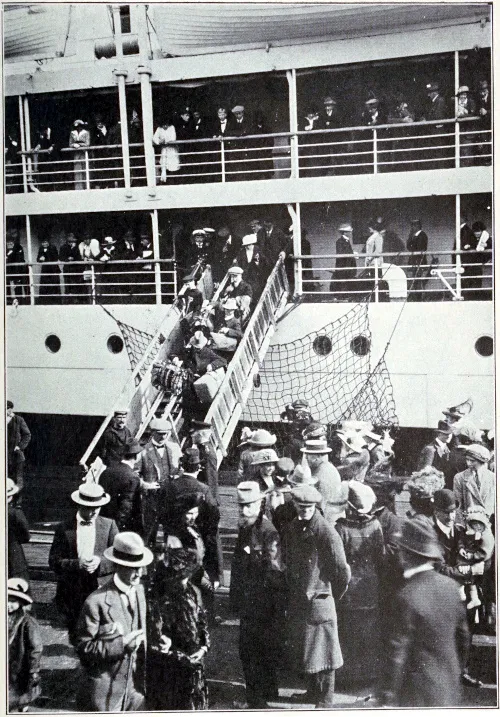
If some Australian labour leaders had their way, even white immigrants
would be barred on the theory that this would lessen the competition for
jobs and keep wages up.
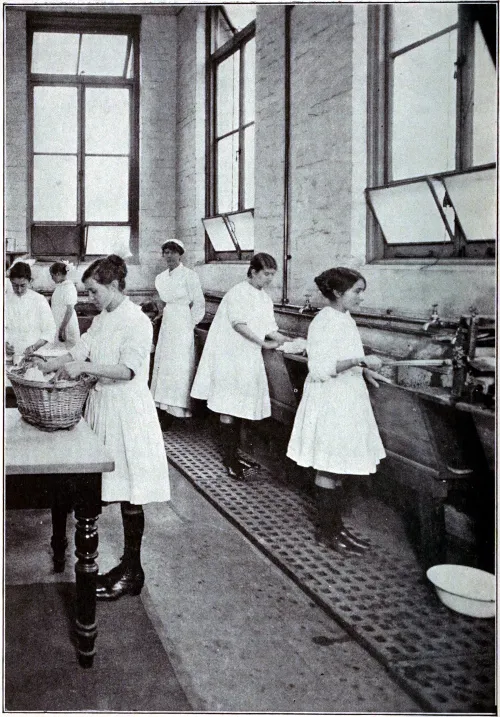
Regular courses in all the domestic arts, including laundering, are
important for the girls of Australia, where servants are luxuries of the few
and women are thrown on their own resources.
I had a talk with one of the parliamentary leaders
in Victoria about working conditions and the Australian
standard of living. He said to me:
“I know it is commonly believed that we have an eight-hour
law down here in Australia. The fact is that an
absolute eight-hour law would not suit us so well as our
forty-eight-hour-per-week law. Many of our trades have
such conditions that they cannot be restricted to a fixed
time, and some days a man must work more than eight
hours and sometimes less. Take the bakers. They set
their sponge, and if the dough rises they can get through
their work in less than eight hours; but if not, it takes them
nine, or perhaps longer. What we have is a fixed time
per week and an extra rate for all overtime. In New
South Wales the forty-four-hour week prevails in many
important industries. In certain unhealthful trades such
as rock chopping, sewer mining, stone masonry, and underground
mining of metals, the hours may be even shorter.”
“Is there not a large force in the government employ?”
I asked.
“Yes,” was the answer. “In New South Wales the
railroads, the street cars, and the wharves are under the
state government. The state has also its employees for
education, police, health, justice, state lands, public
works, and other such activities. Besides, it operates
timber yards, dockyards, brick and pipe works, stone
quarries, and hydro-electric plants. Moreover, the Commonwealth
government has its employees in the postal,
telegraph, telephone, and other national services.”
“How many state and federal employees have you here
in New South Wales?” I asked.
I was surprised at the answer, which was: “More than
ninety-nine thousand.”
“And what is your population?”
“A little more than two million.”
“Well,” said I, “let us figure it. Divide your two
million by ninety-nine thousand and you will find that
practically one in every twenty persons works for the state.
If we had a proportionate number of government employees
in the United States, with our population of
one hundred and ten millions, there would be five million
government officials, which at the low average of a thousand
dollars per annum would cost us at least five billion
dollars every year. Our Congress would never stand for
such a condition.”
As far as I can see the workingmen live very well. Few
of them have hollows in their cheeks or wrinkles in their
stomachs. A few years ago some statistician calculated
the value of the food consumed by workers in different
countries, and according to his figures, an Australian has
better food and more of it than the average American
wage earner. The people are great meat eaters. The
meat is good, too. I have never found better mutton
anywhere, and the beef is as fat and as juicy as the best
cuts from Chicago.
Like the British, these Australians drink an astonishing
quantity of tea. Every man, woman, and child has a cup
every afternoon, and, likely as not, another cup or so later
in the evening. Tea is provided without extra charge at
hotels, and at railroad stations it is served at the same
tables as beer and whisky. The tea is always drunk with
milk and sugar, and every person takes four lumps.
CHAPTER XVII
THE THREE “R’S” IN AUSTRALIA
AWAY off here on the other side of the globe I have
had a reminder of home. In the offices of the
Minister of Public Instruction of New South
Wales I found letters sent to Australia by children
in the United States. Some of our school teachers
interest their classes in geography by having the pupils
exchange letters with boys and girls in other parts of the
world. One such letter, which now lies before me, came
from a thirteen-year-old boy in Nebraska and was answered
by a Sydney lad of the same age. Both letters
were read in class and here is what the Australian children
heard about our “Corn-husker” state:
I live near Maitland, Nebraska. This is a fine place, only dry and
windy at times.
Next I will tell you what we grow here. We use ploughs to stir up
the ground and harrows to level it off. We plant oats and corn with a
machine called a corn planter. We cultivate the corn with a cultivator
three times. We cut the oats with a binder, shock it up and when
it is dry it is hauled to the house and stacked. In the fall when the
corn gets ripe we have to husk it and crib it up to keep it for our stock
or sell it if we want to.
Our school begins at nine o’clock in the morning and closes at four
o’clock in the afternoon. Then we go home and do our chores and get
ready for supper. After supper I help in my father’s store.
Most of the girls help their mothers do housework. When they
think they get old enough they get married if they can find somebody
to suit them. Well, I guess I will close.
Yours truly,
Arthur Ashley.
Australia has good public schools. In all the states
primary education is free and compulsory. In New
South Wales if children between seven and fourteen are
not sent to school their parents are fined one dollar and
twenty-five cents for the first offence and five dollars or
seven days’ imprisonment for each subsequent one. There
are school officers who hunt up absent pupils, and the truants
are sure to be caught. In Sydney a special school for
truants has been established with a trained psychologist
in charge, who makes a study of the causes and cure of
“playing hookey.”
The Australians try to give every child a chance to go to
school, but this is often difficult in the sparsely settled
areas. In many districts children must go by train to the
nearest school and some of the state-owned railroads give
them passes on which they ride back and forth every day
without any charge. Where there are a dozen pupils
in a neighbourhood, provisional schools are established.
When attendance rises above twelve the provisional school
goes on the regular public-school list. If there are not
enough scholars for a provisional school, what is known as
a half-time school is formed, which is visited by a teacher
on alternate days. In still more thinly peopled districts
teachers go from house to house. During one year
fourteen itinerant teachers in Queensland travelled a
total of sixty-seven thousand miles to give instruction
to eighteen hundred pupils. In that state, also, there are
ten schools where small groups of children of outlying districts
have a teacher only once a week, on Saturdays!
Although every child is given a common school education, public high
schools are not yet numerous. Preparatory school training is had
mostly in sectarian institutions such as the Church of England Grammar
School at Melbourne.
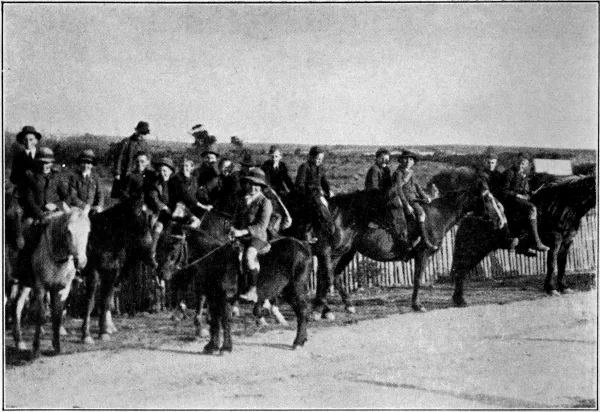
In this land of great unsettled tracts some children ride to school on
horseback, others are carried free on state-owned railroads, and many have
to wait for the round of an itinerant teacher.
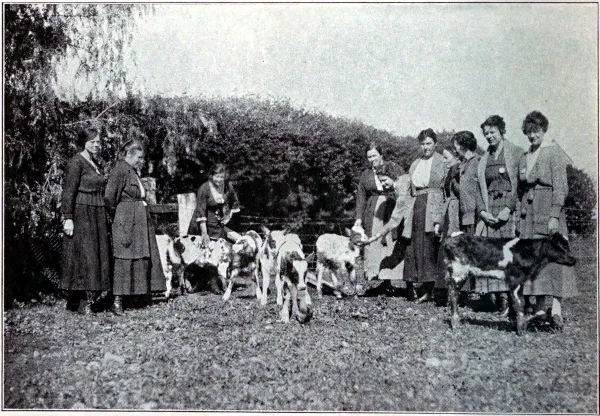
Butter made in Victoria competes with that from Denmark in British
markets. The state helps to maintain high standards in dairy products
by giving expert instruction to farmers and their wives.
New South Wales has three travelling schools. Each
consists of a wagon or automobile with a tent for the
teacher and one for the school. The teacher drives up,
sets up his tents, takes out his books, administers a dose
of instruction, and at the end of a week moves on to the
next place. New South Wales has also correspondence
courses for pupils cut off from other means of education.
Grade subjects are taught by mail to children between the
ages of seven and fourteen. These courses were started
in 1916 as an experiment and have grown so popular that
there are now seven hundred children enrolled at the Department
of Education at Sydney and fifteen teachers are
required to direct their work.
It is no wonder that practically every man, woman, and
child in the Commonwealth can read and write, a fact that
should take some of the conceit out of us when we recall
that in the United States twenty-five per cent. of the men
examined for our army in the World War were illiterates.
The Australian school child’s health is well looked after.
Medical inspection, and often medical treatment, is provided
in the city schools, and the school departments of
several of the states have travelling hospitals and travelling
medical, dental, and eye clinics.
For many years Australia had few public high schools,
and state education stopped at the age of twelve or
fourteen years. But high schools are now quite common
and are growing in numbers and in the variety of subjects
taught.
The schools of art are a feature of education in this part
of the world. In Queensland the government contributes
dollar for dollar, or rather pound for pound, to any town
that raises a fund for this purpose. For instance, if a
village will put up one thousand pounds to establish a
library and school of art, the government will give another
thousand, and will continue its gifts as the people give
more. These schools of art teach not only drawing, painting,
and music, but also typewriting and stenography, and,
in fact, about everything you will find offered in the Young
Men’s Christian Association courses in the United States.
All have reading rooms, and their libraries are well supplied
and largely patronized. The School of Arts in Sydney
has a library of sixty thousand volumes.
In addition to these schools every city of any size has its
technical schools. Sydney has a technological museum
with eighty-two thousand exhibits including one thousand
specimens of wool. The museum building alone cost one
hundred thousand dollars. In Melbourne there is a
Working Men’s College with buildings and equipment
worth upward of a quarter of a million dollars. The college
is open to both sexes and now has enrolled more than
two thousand students. Many of its classes are held in the
evening, when there are lectures upon applied science,
engineering, mining, commercial law, and other technical
subjects, as well as on the leading trades.
The twenty-five technical schools of Victoria are under
the direction of the Education Department. Among the
trade subjects taught are photography, wood and metal
working, plumbing and gas fitting, carpentry, coach
building, wool sorting, and house and sign painting, with
cooking and dressmaking for the girl students.
Every state in the Commonwealth has its university at
the state capital. I visited Sydney University, which has
about as many students, both men and women, as Leland
Stanford University in California. It confers degrees in
art, science, law, and medicine, and the courses embrace
all branches except theology. Its graduates are received
at Oxford and Cambridge on an equal footing with those
from British institutions. The same thing is true of graduates
of the University of Melbourne.
Compared with the enrollment at similar institutions
in the United States the attendance at Australia’s high
schools and universities is not large. Our state of Washington
and the state of Victoria have about the same
population. Yet Washington’s high schools and its state
university have four times as many pupils and students as
have the Victoria secondary schools and the University of
Melbourne combined. In all the state universities together
there are less than seven thousand undergraduates.
As a people, the Australians are sometimes criticized for
not being interested in higher education. In fact, the true
stories of the thousands of American boys and girls who
make sacrifices and do all kinds of work to put themselves
through college read like fiction to the young Australian.
Every state has its agricultural college and all run experimental
farms to develop new methods and new crops.
Agricultural experts are sent travelling around the country
lecturing to the farmers, and special schools are organized
to meet any new need.
For example, in order to help the dairy farmers build up
a big business, the state governments had their agricultural
schools give instruction in making butter and cheese. The
result is that there are now a number of large butter and
cheese factories in every state and the exports of dairy
products are rapidly increasing.
Victoria and New South Wales now produce more than
one hundred and twenty-five million pounds of butter and
about fifteen million pounds of cheese every year. The
dairy cows of New South Wales alone yield enough milk
annually to give a gallon to every man, woman, and child
in the United States, while if the butter export of the Commonwealth
were sent to us, we would get nearly a pound
apiece. Most of the Australian butter sold abroad goes
to British markets.
The beginning of dairying in Victoria is interesting.
One of the butter makers talked to me about it while I was
in Melbourne. Said he:
“Twenty-five years ago we made no butter to speak of.
Our total shipments did not amount to more than fifty
thousand pounds a year. Then the government came
in and helped the farmers. It arranged a scale of bounties
for butter exports which was to continue for four years.
For the first year we were to receive from the government a
bonus of four cents per pound for all the butter shipped,
the second year three cents, the third year two cents, and
the fourth year one cent. The people at once began to
study and experiment. Men who until then would not
have a dairy cow on their places bought good stock, and
now our butter is selling at high prices in both Asia and
Europe. We use American machinery in our dairies.”
The number and circulation of Australian newspapers
show that there is no lack of interest in reading among the
people. Including the magazines and the trade journals,
nearly a thousand newspapers and periodicals are published
on the continent. In Melbourne the leading dailies
are the Argus, the Age, and the Herald. The Sydney
Herald is taken in all parts of Australia, and one sees
the Sydney Mail everywhere. Brisbane, Adelaide, and
Perth have both morning and afternoon dailies, and, in
fact, there is scarcely a large town on the continent which
has not four or more papers. The most popular weeklies
are the Sydney Bulletin and the Melbourne Australian,
the Adelaide Observer, the West Australian, and the Sunday
Sun. The big city newspapers have Saturday editions of
many pages, which sell at four cents a copy and go out to
all parts of the Commonwealth. There are all sorts of
agricultural journals, sheep journals, and financial journals.
As a rule the Australian newspapers are less sensational
than those in the United States, yet more lively than the
English newspapers. Judging by the amount of advertising
they carry, I should say that the owner of a popular
Australian paper has a gold mine.
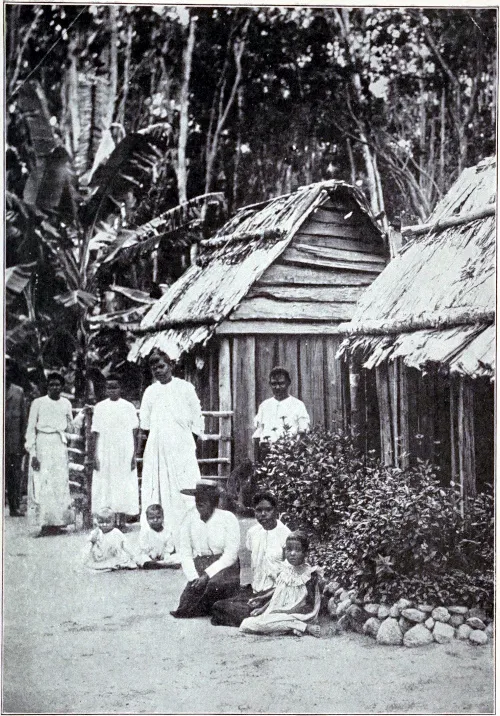
Some of the aborigines are housed at the back-block mission stations,
where their children are given an elementary education. But most of
them are nomads and call only occasionally on the state aborigine boards
for supplies of food and clothing.
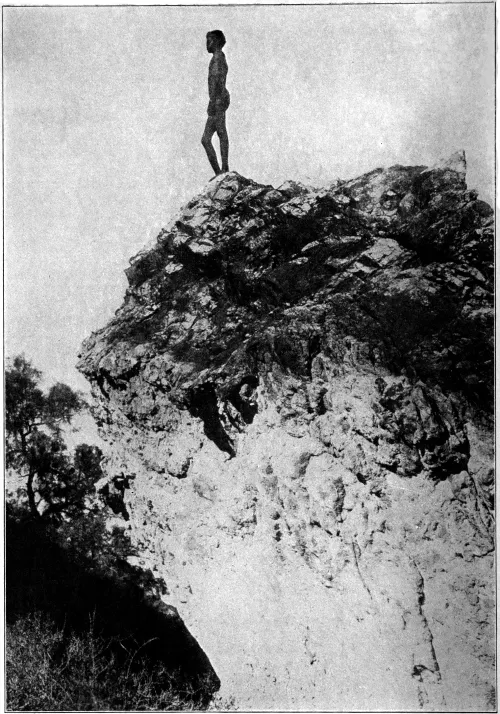
The Australian aborigines were cannibals in the past, and still stand at
the bottom of the ladder of human progress. They are incapable of advancing
in contact with civilization and are now a dying race.
CHAPTER XVIII
THE ABORIGINES
THE Australians call the aborigines “blacks,” and
“blackfellows,” and they sometimes use the word
“nigger,” but the few natives I have seen were
chocolate brown rather than black. Their hair is
curly, but not woolly, and they have neither the thick lips
nor the very flat nose of the African. Some of the aborigines
are quite fine looking; they are generally straight and
well formed, although often lean. In Townsville, Queensland,
I saw a “gin,” as the women of the aborigines are
called, who would have passed without notice in any
mixed crowd of coloured people of our Southern States.
She was about eighteen years old, with the skin of a mulatto,
high cheekbones, a slightly receding chin, and a big
mouth. Her hair was fine, smooth, and glossy.
This girl had on European clothes, but in the interior of
northern Australia both men and women go naked, or at
most have only a few ornaments in their noses and ears,
with perhaps a string or two about their waist for carrying
their crude weapons. In northwestern Queensland the
natives put on belts of human hair for certain ceremonies.
They wear grass necklaces and often stripe their bodies
with paint. Sometimes they have several opossum skins
about their shoulders. They make their hair stiff with fat
or clay and tie bands about it to keep it from falling into
their eyes. Hair grease is profusely used everywhere and
the native gives himself a coat of fish oil when he can get
it. This envelops him in a rancid smell which is very
offensive to Europeans. The methods of dressing the
hair vary. Sometimes it is bound up with cloths, and the
knuckle bones of the kangaroo are so fastened to it that
they hang down over the ears, or kangaroo teeth are tied
to the forelocks, so that they dangle between the eyebrows.
About Port Darwin in northern Australia the blacks
wear nose pins, some of which are ten inches long. The
nose is pierced in the centre, and the pins are thrust
through so that they stand out for five inches beyond
the nostrils. They are made of the bones of turkeys,
kangaroos, or emus. Occasionally parrot quills are used
with the bright-coloured feathers sticking out on each side
of the nose. Some of the natives pierce their ears and insert
kangaroo bones as plugs.
Nearly all the aborigines have scars upon their bodies
and the bigger the scars the prouder the owners. To make
ornaments the skin is cut with flints or shells, powdered
charcoal is dusted in, and the wounds are kept open for
months, so that when they heal they leave ridges on the
body as thick as your finger. These scars are found on the
native’s back and chest, on the biceps muscles, and sometimes
on the thighs and stomach. Among certain tribes
the men are scarred by having little pieces of skin cut out
to the tune of the victim’s yells of pain.
The scars on the women are not always voluntary, but
are often the result of the cruel treatment inflicted upon
them by their husbands. The men regard their wives as
their slaves and when angry, club them and cut them with
their stone hatchets or jab them with their hardwood
spears. If a woman is killed in this family discipline, it is
not considered a matter of consequence. The aboriginal
wife has no rights that the men are bound to respect, and
if she is caught away from home any one may maltreat her.
As a daughter she is sold or given away by her father or
brothers, and after marriage she is a drudge and slave. A
husband can lend his wife to a friend or give her away.
He can forbid her speaking to another man, and in some
tribes she is not allowed to exchange a word with her
grown-up brothers. She is often a bride at the age of ten,
and is usually married before she reaches sixteen. There
are many bachelors among the blacks, but no old maids,
for even a homely girl can work.
When a man dies his widows become the property of
his eldest brother, who can keep or dispose of them, as he
pleases. The eldest brother has the right to give away or
trade off his sisters, and the father often exchanges the
females of the family for wives for his sons.
The native woman of Australia cannot complain that all
the professions of her tribe are not open to her. She does
all the work, from building the house to getting the food
and nursing the baby. Most of the tribes are nomadic.
They build little shelters of bark or skins wherever they
camp, making a new village at each stopping place.
In travelling, the woman carries all the belongings of the
family. She is laden down like a pack horse and walks
along bent over behind her husband, who, perhaps, carries
nothing but his clubs and boomerangs. If she falls behind
the rest of the party she is pretty sure of a whipping
from her lord and master. As soon as they come to a new
camp the woman cuts the bark and builds the hut. She
then goes out and digs roots, picks fruit, and climbs the
trees to chop out the larvæ of worms, which she cooks for
breakfast. She often carries her child with her, laying it
on the ground as she digs. As a result of such treatment
she ages rapidly, her hair soon grows gray, her face
wrinkles, and she dies at about thirty. Even the men
seldom live to be more than fifty.
The lives of the aborigines are shortened by exposure,
poor diet, and contact with civilization and its vices.
They are said to be the least developed people of the world.
I am told that they live more like animals than human
beings. Their food is largely vegetable, including all sorts
of roots. They collect wild fruits, and for bread they
make a sort of paste of grass seeds moistened and ground
between stones into a flour. This they make into dough
and eat it either cooked or raw. A favourite dish is wild
honey, which they find in the hollow trees by following the
bee to its hoard.
They are fond of ants, worms, and snakes. There are
ants in all parts of Australia, and certain varieties are
caught by the aborigines. The native stands upon an
ant hill and stamps with his feet, whereupon the insects
run up his legs. After his shanks are well coated he
scrapes the ants off and eats them. The larger kinds
are roasted or dried in the sun.
Another delicacy is the beetle, which is consumed both
as a worm and as a matured insect. The worms are picked
out of the rotten trees and cooked in red-hot ashes. Foreigners
who have eaten them say that so served they are
not at all bad, and that they look and taste like an omelet.
Snakes and lizards of all kinds are roasted. The enormous
iguana lizard is especially liked. This reptile tastes
much like a young chicken, and its legs are greedily devoured
by the Australian aborigines. It is eaten also
throughout South America.
The natives are fond of grasshoppers and locusts, which
sometimes come in great swarms. At such times the
women gather them by the basketful and the people have
a great feast. They first throw the grasshoppers into the
fire to burn off the wings and legs and then drag them out
and roast each one separately. The flesh so prepared
tastes not unlike roasted chestnuts.
There seems little doubt that the Australian aborigines
are cannibals. The records show that they were cannibals
in the past and according to credible stories the eating of
human flesh continues among them in parts of Australia
to-day.
The government reports give instances of cannibalism.
Some years ago a man named Edwards saw the natives
roasting an infant in one of their ovens. He watched the
blacks open the body and begin eating the flesh, but the
sight made him so faint that he was not able to continue
his observations. In his book, “Among the Cannibals,”
Carl Lumholtz says that the natives consider nothing so
delicious as the flesh of a black man, although any human
flesh is a delicacy. In parts of Queensland children who
die suddenly are roasted, and there is proof that they have
even been killed for food. In western Queensland the
flesh of the full-blooded blacks is preferred, but half-caste
children are roasted and eaten. The blacks are said to
prefer the flesh of the Chinese or the Malays, who are
vegetable eaters, to that of meat-eating Europeans, whose
flesh is tougher and more salty.
Many Australians have told me that the blackfellows
have more intelligence than is generally supposed. They
show evidences of reasoning powers and marvellous skill
in trailing men and animals. Their children are taught to
trace snakes and lizards over bare rocks. Even the tiniest
track on the hardest ground does not escape the really untamed
aborigine. For this reason blackfellows are regularly
attached to the bush police force, like so many bloodhounds,
to track escaped criminals or men lost in the
desert. The black tracker almost invariably gets his
man, even when the criminal is mounted and his pursuer
afoot.
The Australian bushmen have a saying: “Get a black
and you’ll find water.” Parties going into unknown dry
lands in the west take along an aboriginal, for when there
is no water to be had from sandy basins or deep hollows in
granite rocks which still hold some of the last rain, the
blackfellow is able to find roots of desert trees with which
to quench thirst. He draws water from these roots by
cutting them into short lengths and letting them drain, a
drop at a time, into a wooden bowl.
As hunters the blacks get the largest game without
firearms. They trap emus, hunting them with dingoes,
and driving them into nets and pitfalls. In the wilds,
hunters station themselves near the water holes and wait
until the emu comes down to drink. They then rig up a
net across its path, drive it in, and when it has become entangled,
kill it with their spears or clubs. They imitate
the call of the bird by pounding on a piece of hollow log.
Sometimes a man will cover himself with bushes and thus
creep up on an emu and kill it.
The aborigines catch kangaroos in nets or run them down
with dogs and spears. They go into the water with bushes
about their heads and sneak up on ducks and cranes. To
get fish they sometimes poison the water with certain
plants and capture them as they rise to the surface. The
native way of taking catfish is to wade the streams and
feel for them with their feet. They kill the fish by biting
deeply into the flesh just back of the head.
I bought several boomerangs the other day for fifty
cents apiece. The boomerang is merely a flat curved piece
of wood, about two inches wide and from twenty inches to
a yard long. It is so shaped that when correctly hurled
it will return to the thrower. The natives display great
skill in throwing boomerangs, but do not, as I had supposed,
use them as weapons. They sometimes kill small
birds with them, but usually the sticks are merely playthings.
For fighting and for all heavy hunting the blackfellows
prefer spears and lances, some of which weigh as
much as four or five pounds and are nine feet in length.
They are barbed with bone, flint, iron, or hard wood.
As far as I can learn, the aborigines reverence no Great
Father as do our Indians, although they believe in a
future state and happy hunting grounds. They have a
great dread of ghosts and demons, and think that certain
places, such as caves and thickets, are haunted by them.
Their witch doctors are supposed to cure diseases, which
they are sure are caused by spirits. The doctors pretend
to locate the demon, and to suck pieces of wood out of the
body where the pain is. The blacks are convinced that
most of their woes are due to sorcery, and that certain
men can cause others to fall sick and die. They believe
their medicine men can make rain and so hold them responsible
for drought as well as for any other suffering of
the tribe. The aborigines use all sorts of charms to ward
off evil spirits. They have an idea that the white settlers
are dead natives come to life again and claim that they
themselves will appear as white men after death.
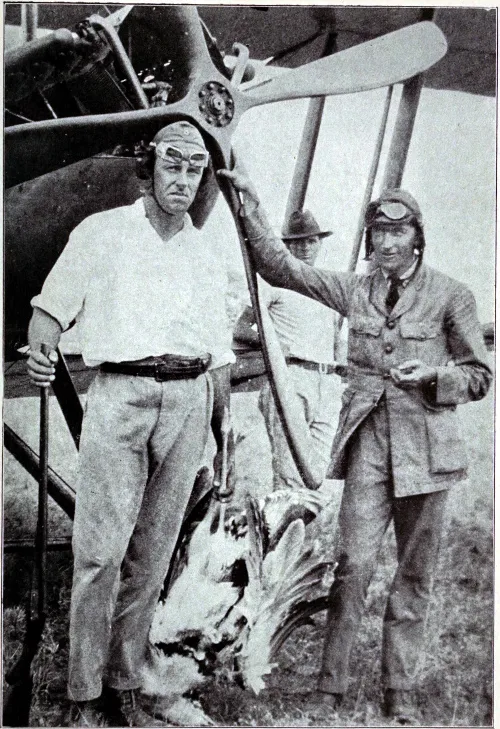
In their fondness for any kind of sport the Australians sometimes
shoot turkeys from an airplane. The males of one variety of this bird
always tend the nest when it contains hatching eggs.
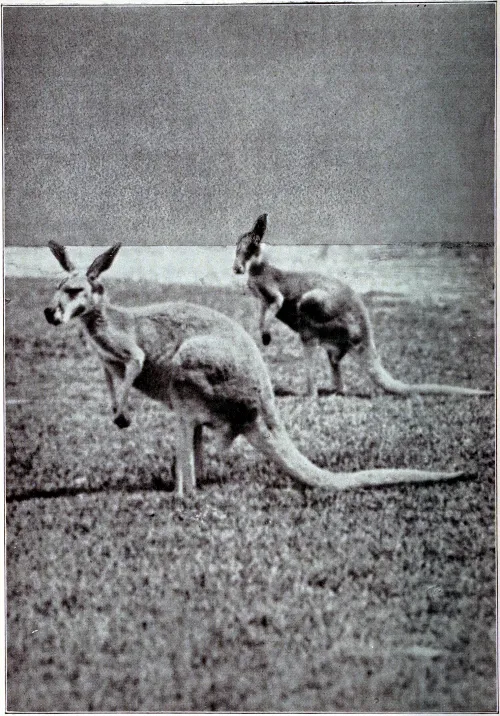
A full-grown kangaroo standing on his hind legs may be taller than a
man, but his newborn infant is often only an inch long. The baby is
almost transparent and must stay a long time in the mother’s pouch.
As the future state of the aboriginal is thought to depend
largely on how he is buried, the natives are very careful
to inter their dead fellows with certain rites. The men
are usually trussed up before burial. The knees of the
corpse are bent up to its neck and tied there, the arms
are bound to the sides, and the calves forced up to the
thighs. Then rugs of skins or pieces of bark are fastened
about the body, and it is buried three or four feet deep
in the sand, a mound covered with logs being erected
above it. As for the women and children, they are considered
of no account, either dead or alive, and their
remains are usually rolled up between sheets of bark and
covered with earth.
In some parts of Australia the aborigines practise
cremation, while in others the dead bodies are dried before
fires until they turn into mummies. Some tribes lay the
dead out upon platforms in the trees, and allow the birds
to clean the bones, just as the bones of Parsees are cleaned
by the vultures when the dead are exposed in the Towers
of Silence at Bombay. Afterward the bones are buried
in the earth or dropped into hollow trees.
The aborigines of Australia are a dying race. Nobody
knows how many were here two centuries ago, but it is
estimated that there are now only sixty thousand of them
left. Of these perhaps a fourth are in Queensland, a half
in Western Australia, and ten thousand in the Northern
Territory. There are only about one hundred in the
state of Victoria, and only about fifteen hundred in New
South Wales. South Australia has sixteen thousand.
The native race of Tasmania is entirely extinct, its last
member having died in 1876. These figures are not exact,
for no accurate census of the aborigines has ever been
taken. They live in the wilds, and in the vast regions
of unexplored Australia no one can tell how many there
are.
CHAPTER XIX
KANGAROOS AND DANCING BIRDS
AUSTRALIA is a country where every other animal
carries its baby in its breast pocket. It
has one hundred and ten different varieties of
marsupials, or animals which have in their
bellies pouches in which they carry their young. Some
of these animals are taller than a man and some are no
bigger than your thumb. Some climb trees, some gallop
over the plains, and some spend more than half their time
in the water. During my travels I have seen certain
varieties in their natural surroundings and I have examined
and photographed others in the zoölogical gardens.
Every city here has its zoölogical garden, and every
town has its museum, so that there is no trouble seeing
the wild animals of Australia, either stuffed or alive.
What interests me most is the kangaroo. Before I
came here I had an idea that all kangaroos were alike.
I now know that there are forty-nine varieties, ranging
in size from the great gray kangaroo, the male of which
measures from nose to tail tip more than seven feet, down
to the kangaroo rabbit and kangaroo rat. The Sydney
and Melbourne zoos have specimens of nearly every kind.
In them I saw kangaroos taller than I am, jumping around
in fields inclosed by wire fences. They had enormous
hind legs, which sent them flying through the air as
though they were on steel springs. They can leap thirty
feet at a jump, and gallop over the country faster on two
legs than a horse can on four. But, as they tire quickly,
horses can overtake them in the end.
The largest of the kangaroos are the red and the gray
varieties, which are found all over Australia. Horses and
dogs are bred for the sport of hunting them. The dogs
are a cross between the greyhound and the deerhound,
fleet of foot and very fierce. When brought to bay, the
big kangaroo is dangerous and will attack a dog or a man.
With its back against a tree it waits for its enemy. A
dog that comes too near is grasped in the kangaroo’s
forearms, hugged tightly to its breast, and disembowelled
with a rip of one of its clawed feet. The ivory-like claws
on the kangaroo’s hind feet are three or four inches in
length, and cut like knives. The kangaroo can swim as
well as run, and when chased, it will, if possible, take to
the water. If a dog follows, the kangaroo tries to drown
it by holding it under water.
The kangaroos go about in pairs. One usually sees
a male and a female together and the little head of a baby
kangaroo is often spied sticking out of the pouch of the
mother. When it first sees the light of day the baby
kangaroo is not more than an inch long. It has no hair
and is almost transparent, like an earthworm. Its mother
puts it into her pouch, and there it lies and sucks until it
grows big enough to come forth and eat grass. Even
then it crawls back into the pouch whenever it is tired
or at the least sign of danger, poking its head out now
and then to see if the coast is clear. It leaves the pouch
for good after eight or nine months, when it weighs eight
or ten pounds, and has become too heavy for the mother
to carry.
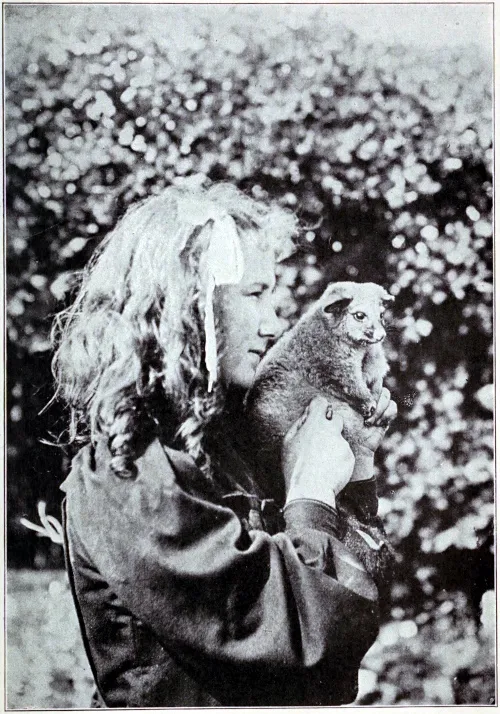
The opossum is the only one of the Australian marsupials to be found
anywhere else in the world. Quantities of the fur are exported, to be used
as trimming on women’s coats.
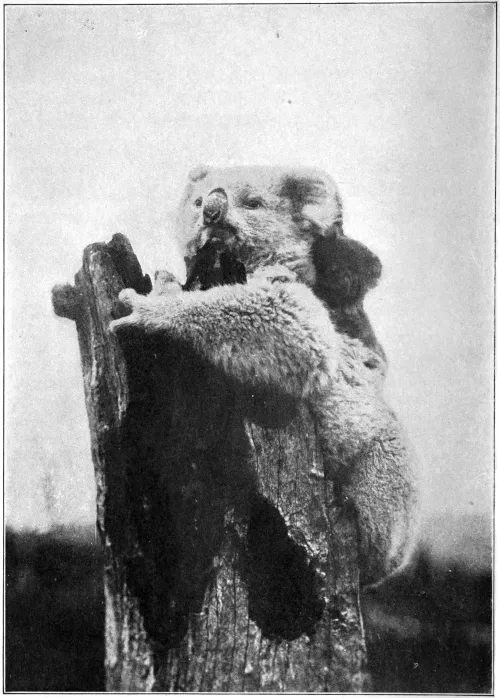
Except for the opossum and opossum rat of Patagonia, marsupials
are found only in Australia. We import quantities of Australian opossum
fur as trimming for women’s coats.
Most kangaroos are plain dwellers and grass eaters.
Carl Lumholtz was the first to discover a variety that
lives in trees. He found them through the blacks of
northern Queensland, and with their help was able to get
several specimens. There are some in the museum at
Sydney and I am told that others have been sent to several
museums in Europe.
The tree kangaroo is a baby beside its big gray and red
cousins. Its head is like that of a squirrel, and its body
is better proportioned than that of the kangaroo of the
plains. It has arms and legs about eight or ten inches
long, and a tail a little bit longer. It spends most of the
time in the trees, sleeping there in the daytime and coming
down only at night for water. It eats tree leaves.
This animal is considered a great delicacy by the blacks,
who have trained the dingoes to tree it. Then the natives
climb, not only the tree in which the kangaroo is lodged,
but all the trees near by, in order to catch it if it jumps
from one to another.
The musk kangaroo is so small you can put it in your
pocket. There is a kangaroo that looks like a rabbit,
known as the hare kangaroo, and another called the rat
kangaroo. One of the commonest of the small kangaroos
is the wallaby, which is killed for its skin, as are many of
the other kinds. There is a great demand for kangaroo
leather for bags, shoes, and other articles, and quite a lot
is exported to the United States.
Australia has a curious little beast which is a sort of
link between the mammals and the birds. This is the
platypus, which has a bill like that of a duck, and feet so
covered with webbing that it can swim. Yet it nourishes
its young with its milk. It tunnels in the earth
like a mole and is usually found along the fresh-water
streams of Tasmania and Victoria. It feeds upon small
water insects, shell fish, beetles, and vegetable particles.
It is sometimes speared by the blacks, and white men occasionally
catch it with night lines.
The life of the platypus is interesting. A pair will live
in a little tunnel, one of the openings of which is below
the water and the other in the bank just above it. Their
nest is in the tunnel, halfway between the two doors, the
water door and the land door of their house. Here the
female hatches her young, laying one or two eggs for each
setting. As with the American skunk, the odour of the
platypus advertises its presence for miles around.
Platypus fur is most beautiful, although the animal is
so scarce that it is hardly an article of commerce. I have
a skin of one about twelve inches wide by eighteen inches
long. The fur is as soft and smooth as moleskin, but the
bill and the legs are as hard as horn. The skin is sometimes
used to make rugs, a good platypus rug being worth
at least one hundred and twenty-five dollars.
Some of the queerest animals of this continent are
found along the coast. Penguins live on the islands of the
far south, and the big-billed pelican is common, especially
on the coral reefs off Queensland. There are also seals,
and a sort of sea cow, which excited great interest
some years ago on account of its likeness to the fabled
mermaid. In the first days of Australia one of a party
of fishermen collecting bêche-de-mer on the Queensland
coast imagined he saw some of these wonderful creatures,
half-woman, half-fish. He came running to his
companions saying that he had seen some mermaids
disporting themselves in blue sea grass. One of them,
he declared, had raised her head and shoulders out of the
water and looked at him. He had been so terrified that he
had fled to the ship as fast as his legs could carry him.
Later on the men discovered that the supposed mermaids
were the Australian dugongs. The mothers constantly
hold their young to their breasts and in this position look
not unlike the traditional mermaid.
The dugong is somewhat like a porpoise. It has a
smooth round body, a broad, fat tail, and two anterior
flippers, which are short, thick, and fleshy. Its head has
a rounded muzzle and the mouth of the male has projecting
tusks. When fully grown the dugong is from eight to
ten feet in length, but it sometimes attains to as much as
twelve feet. The animals gather in herds of from half a
dozen to forty and swim about together. The females,
which are more numerous than the males, cry like human
beings when suckling their babies.
The dugongs are found chiefly in the tropical waters
about the north coast. The natives hunt them under the
direction of white men, chasing them in boats or bark
canoes, and spearing the cows with harpoons. The best
place to strike is through the tail, for the animal is quite
powerless once its tail is lifted out of the water.
The natives are fond of dugong flesh. They cook and
eat it, boiling down the fat for the oil, which has a medicinal
value like that of cod liver oil. The hides and the
large tusks of the male are marketable.
I wish I could show you some of the odd birds of Australia.
The continent has more than seven hundred
varieties, some of which are found nowhere else. In
the Brisbane museum I saw scores of different kinds of
parrots, some as white as snow, others of a delicate pink,
and others as red as blood. The lyre bird, which is one
of the most curious of all, has a tail shaped just like a
lyre. The satin-bower bird builds a playground near the
tree where it has its nest. This is a sort of platform,
sometimes three feet in diameter, made of sticks woven together.
Over this the male birds build a bower of woven
twigs, decorating it with all the beautiful things they can
find. They weave gay feathers among the sticks, and put
bones and shells here and there. Some of the bowers
found in the vicinity of settlements are ornamented with
pieces of broken china and glass. One variety decorates
the bower with fresh flowers every day. These bowers
are not nests nor are they the homes of the birds. They
are supposed to be the rendezvous, or courting places,
where the males dance and strut before their lady friends.
The young bower birds are bright green, but when full
grown the males are of a deep, shining blue-black closely
resembling satin. They have blue bills, yellow at the
tip, and their legs and feet are yellowish white. The
females are green and brown, with bills of a dark horn
colour. The birds are found all along the east coast of
Australia and in many parts of the interior.
You may know the little poem by the small boy who
was indignant at having his pennies put in the Sunday-school
box. One verse reads:
I wish I were a cassowary
In the wilds of Timbuctoo.
Wouldn’t I eat a missionary,
Skin and bones and hymn book, too!
Australia is the land of the cassowary. In part of the
country there are thousands of these great birds, which
resemble the ostrich and the emu. The ostriches and the
emus live on the open plains. The cassowaries are found
in the forests and brushwoods. They are wary birds and
seldom come out of the jungles. I have seen a number of
them during my stay in Australia. The bird is about
four and a half feet high, with black feathers, brown at
the base. It has eyes like an eagle, and a long, thin neck,
with a naked head, and flat but powerful bill. The cassowary’s
legs are very strong and look more like clubs than
bird legs. They end in three large claws like those of an
emu.
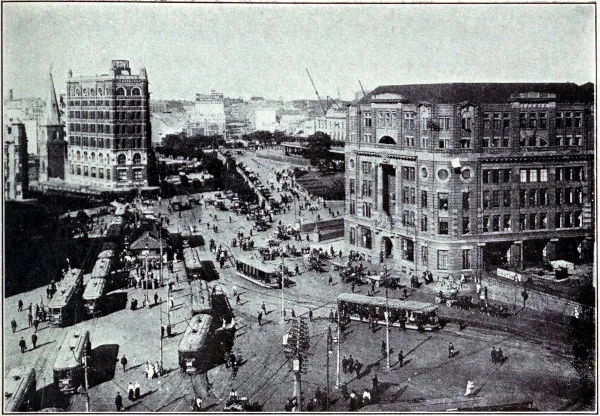
Sydney is not only the fastest-growing city of Australia but also the
commercial metropolis of the South Seas. About the size of St. Louis,
it handles the bulk of the trade of New South Wales.
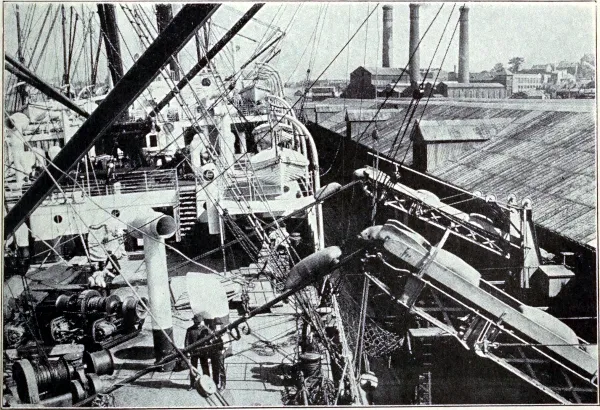
Most of Australia’s wheat still goes overseas in sacks, loaded in ships
by belt conveyors, but the grain elevators being built in increasing numbers
permit the grain to be handled in bulk at less cost.
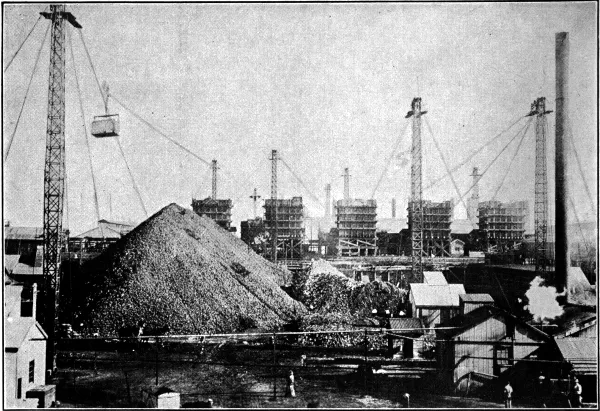
The companies operating the world-famous silver and lead mines at
Broken Hill and the steel works at Newcastle have been large buyers of
American mining machinery and of plant equipment and tools.
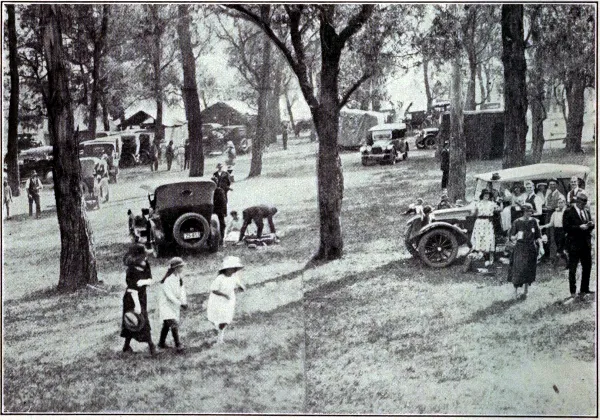
American automobiles dominate the market in Australia. Here the
motor-car is now regarded as a necessity, especially in the back country
where distances are great.
The emu is the national bird of Australia. It is larger
than the cassowary, and is often five or six feet in height.
It is much like the ostrich, except that its legs are shorter
and its body more thickset and clumsy. Its dull brown
plumage spotted with gray looks more like coarse hair
than feathers, and emu skins are sometimes used for rugs.
The cassowaries have no hair on their heads, but the
heads of the emus are completely feathered, or I might
say haired. The wings are so short that they are invisible
when held close to the body. The birds are quite
dangerous and can kill a dog or a man with a kick.
Hunting emus is one of the favourite sports of Australia
for which dogs and horses are specially trained. The
best time for a hunt is early in the morning, when the
birds go out to feed on grass. The dogs are taught to
catch the emus by the neck, else they may be killed by the
bird, which kicks backward or sidewise like a cow. In
some sections the settlers try to destroy them, to save the
grass for the sheep. They send out men to hunt for the
nests and break the eggs. On a back-block sheep station
fifteen hundred eggs were destroyed at one time, while
in one county of New South Wales ten thousand emus
were killed in nine months. In the thickly settled portions
of Australia they have been practically exterminated.
The aborigines hunt them for food, eating the flesh with
the skin on it. They are especially fond of the hind
quarters, which taste not unlike beef. Emu eggshells
are sometimes mounted in silver and used as milk jugs or
sugar bowls.
Among the kingfishers is the kookooburra, or laughing
jackass. Its hoarse cry is like a laugh and can be heard
for miles through the forests. This bird has a head about
as big as its body, but its laugh is a thousand times bigger
than both body and head. It says, “Ha! ha! ha! hoo! hoo!
hoo!” contemptuously laughing again and again, until at
last it puts the nerves of the bush traveller on edge. It
eats snakes, lizards, and other reptiles, and for this reason
is protected by law.
CHAPTER XX
AUSTRALIA AS OUR CUSTOMER
I SHOULD like to take any one who doubts the importance
of Australia’s foreign trade down to the
wharves of Sydney harbour. There he would see
great steamers from London, Marseilles, and other
great European ports, and smaller vessels from India,
China, Japan, and the islands of the South Seas. He
would see merchant vessels from South Africa, and ships
from New York and San Francisco flying the Stars and
Stripes.
An American in business here has shown me the tally
sheet of a single shipment of American goods landed at
Sydney from one of the ships out of San Francisco. It
included four hundred tons of sewing machines, one
thousand tons of fencing wire, and four hundred tons of
roll paper. There were also hardware, machinery, and
machine tools; lubricating, illuminating, and fuel oils;
chemicals and tobacco.
We sell to Australia at the rate of about sixteen dollars
for every man, woman, and child of her population. American
goods are displayed in all the stores, and American
farming implements are used on most of the farms. The
Australians like our hatchets, which they call tomahawks,
evidently thinking we first made them as weapons for the
Indians. Our carpenter’s tools are in demand, especially
our saws and augurs, braces and bits.
American notions are sold everywhere. In Townsville,
Queensland, I saw patent camp chairs with the Yankee
trade-mark on them; our cuff clasps and collar buttons
are in common use, and there are all sorts of knicknacks,
marked American and sold as such. In fact, the shrewd
Australian shopkeepers sometimes take advantage of the
favourable reputation our goods enjoy. The other day I
dropped into a store that advertised American candy, and
asked the tall young lady clerk what brands they imported
from the States. She replied that her “American” sweets
were made in Sydney, but they called them American
because they thought this would make them sell better.
The Australians smoke American tobacco. They use
finecut and plug, shaving off the plug for their pipes.
The favourite brands are not those most widely known
in the United States, but I venture they differ only in
name. The cigars smoked by the Australians are made
chiefly in the local factories, but the tobacco in them
comes from the United States. In the great island of
New Guinea, which is administered by Australia, our
tobacco is often used as money, so many plugs buying a
dinner, an old coat, or, maybe, a wife.
Australia is the land of the well-to-do. Out of every
twenty-five grown-ups in the Commonwealth, seven are
property owners, and even in the big cities, poverty slums
scarcely exist. Of the five and a half million people in
the Commonwealth, more than three million have savings
accounts, their deposits aggregating more than seven
hundred million dollars. To show Australia’s purchasing
power another way: in one of the early post-war years,
when our foreign sales were unusually large, China, with
her teeming population, bought only one hundred and
thirty-eight million dollars’ worth of our goods, while
Australia, with one sixtieth as many people, bought one
hundred and twenty million dollars’ worth.
The Australians are good spenders. The people of all
classes dress well and live well. The women of Melbourne
wear their clothes with as much of an air as those of any
city in the United States. They buy expensive hats and
in midwinter nearly every girl has her furs. As a rule the
city business men wear silk hats. Their suits do not fit
quite so well, perhaps, as those cut by American tailors,
but they are far better looking than the average suit made
in London. Men’s clothes cost about as much in Melbourne
and Sydney as in New York, and American styles,
especially hats, seem to be in demand.
American-made stockings really command the Australian
market, and the well-to-do women, certainly those
of the cities and large towns, all wear silk hosiery from
our mills. The same thing is true of American-made corsets.
Both men and women seem quite willing to pay
the higher prices demanded for our shoes, which are
looked upon with the same high favour as in other parts
of the world. The men buy mostly high shoes, or “boots,”
as they are called, though in the cities oxfords are gaining
in popularity. The women like our “low cuts” and will
pay fifteen and eighteen dollars for a pair of smart, well-shaped
pumps, which they call “court shoes,” or strap
slippers, known here as “bar shoes.”
A great deal of our lumber used to come to Australia,
not only in the shape of boards and logs, but as paper,
some of the Australian newspapers being printed on
paper made from American wood pulp. But the shipments
of newsprint from the United States have declined
since the duty has risen to fifteen dollars a ton and Canada
now gets a large share of the business. Many of the
publishers use American type. A linotype salesman of
one of the American firms tells me that he has scattered
his machines throughout the states.
The leading American typewriters are well known in
Australia. Some of the agencies conduct business training
schools besides renting and selling machines in the
same way as in America. One may buy American
cameras in any large centre, and the American bicycle is
to be seen everywhere. Our electrical supplies and equipment
also have a splendid market in Australia.
Although Australia is beginning to manufacture her
own woollen goods, she still buys a large proportion of
her textiles from England and the European continent.
Nevertheless, American firms have built up a large trade
in cottons, particularly shirtings, calicoes, and denims.
Credit is the latest commodity imported from the
United States. Until 1921 London bankers had enjoyed
a monopoly in handling the bonds of the Australian states.
In that year Queensland disagreed with the home government
over a question of legislative policy and came to
New York for money. Two loans amounting to twenty-two
million dollars were floated in Wall Street at six and
seven per cent. These bonds soon sold above par, and it
is believed that the loans will help promote our trade in
Queensland.
In a recent year Australia was the largest foreign purchaser
of American automobiles and all our leading motor-car
companies now have well-established agencies here.
The Commonwealth is as big as the United States yet
it has only one tenth as many miles of railroads, so that
the motor car is a great aid to travel, and is becoming,
as with us, a business necessity. At present the Commonwealth
has only one car to every seventy-three people,
while the United States has one to every ten and Canada
one to every sixteen. American automobiles selling for
from seven hundred to twenty-four hundred dollars are the
most popular. On account of freight and other charges,
the selling price of any car is nearly twice that of the same
make in the United States. Gasoline, tires, and other
motor supplies also cost about double as much as with us.
Hence the car that has a low gas consumption and is easy
on tires makes a stronger appeal than do the heavier machines.
Some tires are now being made in Australia,
the local factories supplying about half the demand of the
country.
As a rule, the automobile chassis only is imported from
the States. This is because the Australian tariff has been
framed so as to protect and develop the local body-making
industry throughout the Commonwealth. The duty on
an American or foreign car, body and all complete, is
exceedingly heavy, while the duty on the chassis alone is
moderate. The Australian manufacturers turn out good-looking
automobile bodies. They are not so standardized
as are ours, as the makers are willing to cater to individual
tastes.
Speaking of local manufactures reminds me of a great
change that has taken place in Australia’s markets in the
last few years. It used to be that every town of any size
had hardware stores stocked with American-made farm
implements and machinery. As I have said, our ploughs,
reapers, saws, hatchets, and hammers are largely used,
but they are not sold now in the same proportion as formerly.
This is because Australia has begun to use her
abundant supplies of coal and iron to make her own steel.
The business began in a big way with the Newcastle works
of the great Broken Hill Mining Company. This concern
was started soon after the discovery at Broken Hill,
New South Wales, of some of the richest silver deposits
on earth. The original company issued a small amount
of stock at five hundred and fifty dollars a share. A year
later one share sold for one hundred and fifty thousand
dollars and six years later was worth, with dividends and
bonuses, the sum of seven and a half million dollars.
Eleven companies, more or less interrelated, are now
operating at Broken Hill, mining lead and zinc as well as
silver.
One of these, the Broken Hill Proprietary Company,
Limited, opened iron works at Newcastle just after the
outbreak of the World War. Cut off from other sources
of supply, the various state railways poured in orders for
material, and since then there have grown up about this
and a similar plant at Lithgow affiliated industries producing
iron and steel goods. One is making galvanized
iron, so much of which is used all over the country for
roofs, tanks, and even houses. Another is turning out
wire nails and fencing. A third is kept busy producing
car-wheel tires and axles. At Melbourne is the plant of
the Sunshine Harvester Company, which employs four
thousand workmen and makes tractors and other kinds
of agricultural implements. In all, close to one hundred
and thirty metal and machinery plants are fabricating
domestic or imported iron and steel.
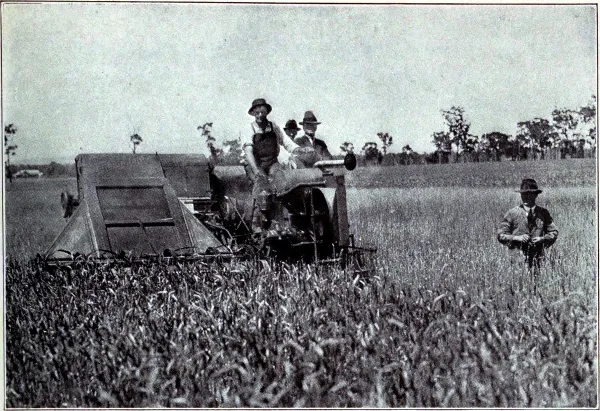
This stripper harvester is a product of Australia’s attempt to make her
own farm machinery, for it was manufactured at Melbourne. The dry
climate makes it possible to thresh the wheat as it stands in the field.
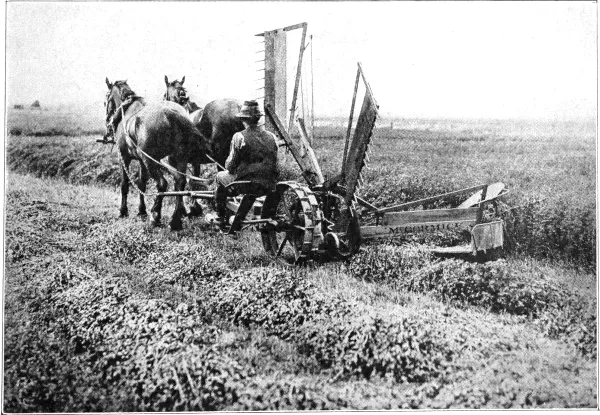
American agricultural machinery is widely used in Australia but must
now compete with implements produced in the Commonwealth and protected
by the high tariff policy.
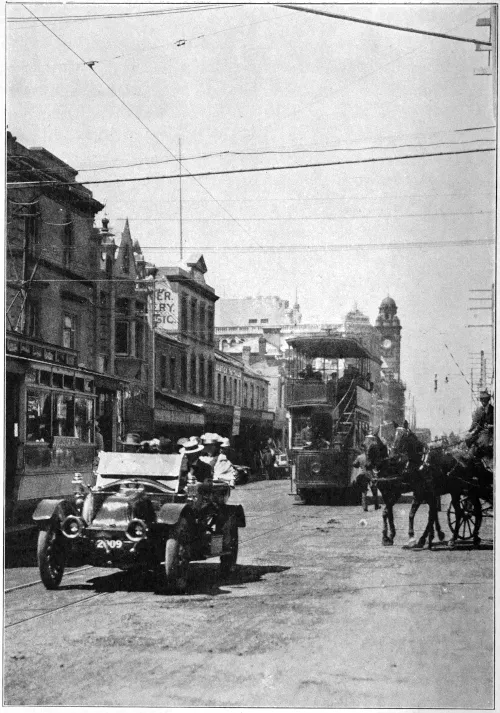
Hobart has the reputation among Australians of being a slow, old-fashioned
town, though recently it has been rejuvenated by the hydro-electric
power development at Great Lake.
In one way, the effort to develop home industries has
helped American trade. It has created an enormous
demand for American machinery, tools, and other equipment
with which to operate the new factories. Not long
ago the state of Victoria ordered two enormous electric
generators and other machinery for a power plant being
erected at the so-called “brown coal” mines in that state
to furnish current to Melbourne, ninety miles away.
The Commonwealth government has set up a high tariff
wall around everything manufactured in Australia, and is
doing all it can to foster home industries. Some British
companies have already established branch factories here
to be inside the tariff wall. A great advantage of the
branch plant is the fact that it brings the British exporter
several thousand miles nearer to his Far-Eastern markets.
When it comes to making goods for export in competition
with other countries, however, the local manufacturer is
somewhat handicapped by the higher labour costs in the
Commonwealth.
Great Britain has a preferential tariff arrangement with
Australia so that certain of her goods come in at lower
duties than those paid on similar goods from the United
States or other countries. Yet, in spite of this “imperial
preference,” our trade is healthy and growing. We sell
Australia more than one fifth of all the goods she buys
abroad and take a good proportion of the half billion
dollars’ worth of wool, hides, pearl shell, and other raw
products that she annually sends into the markets of the
world.
CHAPTER XXI — CHAPTER XXII
TASMANIA
I WRITE this in one of the “farthest south” towns of
the globe. Hobart is twenty-five hundred miles
below the Equator, with nothing but ocean between
it and the frozen lands of the Antarctic. It is now
the end of April, late in the fall in this topsy-turvy land,
but the grass is as green as in old Ireland in June, and,
although Mount Wellington, back of the city, has a coat
of snow, the sheep are everywhere feeding out-of-doors,
and it is as warm as Ohio in May.
As I look around me I cannot realize that this is Tasmania,
the country I studied about years ago as Van
Diemen’s Land. I had read of the cruel treatment of the
criminals sent out to it from England. I knew it was an
island somewhere between the South Pole and Australia.
I had an idea that it was bleak, bare, and inhospitable,
the jumping-off place of creation, and it seemed that to
visit it would hardly be worth the time and expense.
I have changed my opinion. Tasmania is the Switzerland
of the southern Pacific, and one of the most healthful
and beautiful lands of the globe. It is a heart-shaped
island, with its top less than two hundred miles from
Australia and its point toward the Pole. At the southernmost
tip the Pacific and the Indian oceans meet. Tasmania
is all mountains, valleys, and glens; with waterfalls
and lakes, forests of fern trees, trout brooks, and hunting
parks. Its coast is deeply indented with fiords and harbours,
and the tourist bureaus have made it a great health
resort. The whole country is spotted with boarding
houses and hotels, and during the summer months, from
December until May, it is swarming with visitors. One
can go almost anywhere by motor, coach, horseback, or
rail, and always have good company. There are also
many tourists on foot.
Although more than twice the size of Belgium, Tasmania
has only about two hundred thousand people, compared
with Belgium’s seven millions. Hobart, the capital and
largest city on the island, has about fifty-two thousand.
It lies on a fine harbour in a nest of hills on the banks of
the Derwent. Back of the river rises a mountain, the
rocks of which look like the pipes of an organ. The town
is well laid out in checkerboard fashion; it runs up hill
and down and here and there takes a jump out into the
country.
I went from one end of the city to the other one day on a
street car. The people of Hobart pride themselves on
having the first electric railroad line in their latitude.
The cars are not like any we have in the United States.
They were made in England and look as though they had
been pounded out by a crossroads blacksmith. They are
enormous double-deckers, and their sides are plastered
with advertisements. I rode on the roof right under a
great steel bow, which, pressing against the overhead
wire, takes the place of our trolley. I timed the trip
and found we made speed only when going down hill.
Most of the time our motion was a succession of spasmodic
jerks, as though the electricity were afflicted with fits.
Near Hobart was Port Arthur, the chief penal colony
of the old Van Diemen’s Land. Its site can be reached by
a short sail down the Derwent River. Some of the convict
buildings are still standing, and one can get a guide there
who will describe the terrible punishments that drove
many of the prisoners to suicide. They were flogged,
tortured with dripping water, and loaded with heavy
chains. They were kept in dark cells, were made to pull
railway cars, and were subjected to all sorts of inhuman
treatment. Many of the best families in Tasmania today
are descendants of these convicts. Some of them will
acknowledge their ancestry, but if one asks them the crime
for which their forebears were transported each will invariably
reply that it was for stealing a loaf of bread.
It would have taken a good-sized bakehouse running
steadily to supply the many loaves said to have been stolen
by these early Tasmanians. Transportation of criminals
ceased in 1853, and all the arrivals since then are people
who have come of their own accord. To-day the number
of crimes is no greater than in other parts of the Empire.
Indeed, the Tasmania of to-day is rather pious than
otherwise. The majority of the people are either immigrants
or the descendants of immigrants from England,
Ireland, Scotland, or Australia.
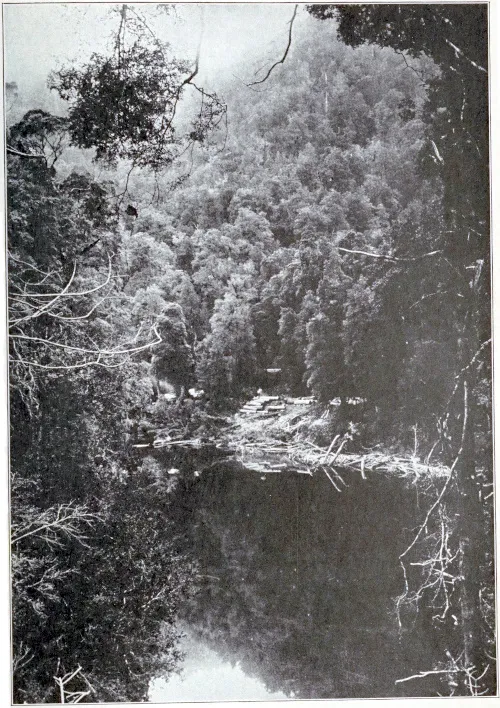
Unlike continental Australia, Tasmania has a moist climate. This
has given the island dense forests of eucalyptus and other woods which
furnish railroad ties and paving blocks to her sister states.
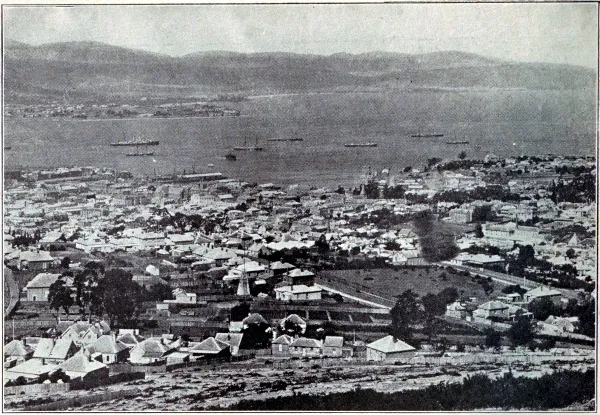
Hobart, the capital of Tasmania, lies on the south coast of the island
between the great hills on both sides of the Derwent River. Its harbour is
second only to that of Sydney.
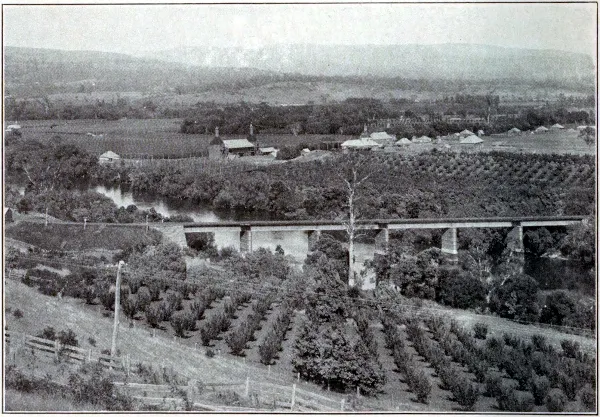
Tasmania deserves its name of the “Apple Isle,” for it annually exports
many shiploads of apples to the mainland and London. The
orchardist often makes a profit of upwards of $200 an acre.
The Hobart museum is a Mecca to students of ethnology,
for here is preserved the body of the last of the
aborigines. When the island was a penal colony there
were still a number of the original blacks, but they were
so corrupted by escaped convicts that they became a
menace to the whites. In 1830 a drive of three thousand
Europeans was organized against them and all who survived
were finally exiled to a dreary, windswept island
in Bass Strait. Here their health suffered because they
were forced to wear clothes, which they never took off, no
matter how filthy they became. The poor creatures were
also the easy prey of the sealers and escaped criminals
that came now and then to their place of exile, and at the
end of fifteen years only forty-four survived. A woman,
Truganini, the last of the race, died at the age of seventy-three,
in 1876. Her skeleton is in the museum and the
scientists come here to study the skull. The native Tasmanians
belonged to an even more backward race and
stage of civilization than the aborigines of Australia.
The island state deserves its name of the “Apple
Island.” It is a voyage of more than a month by sea from
Hobart to London, but apples are sent to England every
year by the shipload in refrigerator steamers. The annual
crop now amounts to more than two million bushels and
brings in close to two and a half million dollars. It would
surprise our orchardists to see how close the Tasmanians
plant apple trees. They set them out ten feet apart, instead
of twenty or forty feet, as with us, and I am told
that as many as six hundred bushels are sometimes
gathered from a single acre. The trees begin to bear in
their third or fourth year and keep on bearing for twenty-five
or thirty years.
Tasmania ships much green fruit to Australia. It raises
quantities of pears, plums, cherries, and currants, and in
recent years has been exporting several hundred thousand
dollars’ worth of jam, not only to the United Kingdom,
but to South Africa, France, and even to the United
States. By the law of the Commonwealth every jar of
jam or marmalade exported must bear a label stating
that it was made in Australia. Tasmania, which had
built up a reputation for her preserves before the federation
of the states, does not like this law, for it seems to
give all the credit to Australia. The jam makers get
around it by printing their labels with the word “Tasmania”
in large letters and “Australia” in smaller letters.
These people are excellent farmers and their crops are
usually good. The wheatfields cover only about twenty-two
thousand acres, but the average production is more
than eighteen bushels per acre, which is far ahead of the
yield in the other Australian states. Large quantities of
barley and oats are grown.
This island ranks with Vermont as a place for breeding
fine sheep. It has many sheep worth upward of a
thousand dollars apiece. They are sold to the mainland
states and the countries of South America, pedigreed rams
often bringing as much as five thousand dollars each.
The land holdings are smaller than in Australia or New
Zealand, so that the Tasmanian sheep breeders can therefore
take better care of their stock. This is a great turnip
country, and in this part of the world a good turnip country
is a good sheep country. There are fields about
Hobart that have produced as much as sixteen tons of
turnips to the acre, and in northeastern Tasmania twenty-five
tons have been grown on an acre.
Until 1872 the minerals of Tasmania were practically
unknown, but in that year on Mount Bischoff, in the
northwestern part of the island, tin mines were opened
which have proved to be the largest tin mines of the world.
They paid their first dividend in 1878, and are still yielding
large profits.
Another big mineral property is that at Mount Lyell,
which was discovered in 1881. It was first worked as a
gold mine, but was afterward found to contain copper and
silver. When these ores were smelted the results were so
gratifying that the original company was reorganized
with a capital of about four and a half million dollars, a
railroad was built from the mines to the smelting works,
and within a short time the company had five smelters
treating eleven thousand tons of ore a month. This company
paid its first dividend in 1897 and by the middle of
the year following it had distributed more than a million
dollars to its stockholders. It now pays out many thousands
a year in salaries and wages and is making money
right along from its copper.
I have made some inquiries about lands, both mineral
and agricultural, and I find that all the best land has
been taken up and that farms and city property bring
almost as much as in the United States. For years one
trouble with Tasmania was the fact that its lands were
held in big blocks by rich men who would not sell. But
now, under the closer settlement laws, the Minister of
Lands may acquire, either compulsorily or by agreement,
private land in any part of the island to be leased to
settlers. The land taken over by the government is
divided into farm allotments, the value of which may
not exceed twenty thousand dollars. These are rented
on ninety-nine-year leases. Unfortunately, the government
is not yet rich enough to buy up many of the large
estates.
One of the troubles about taking up government lands
is the dense growth of timber which must be cut down
before they can be used. The climate here is moist and
the undergrowth is thicker than in most parts of our
country. Much of the timber is eucalyptus, but there
are also beeches, dogwoods, oaks, and other hard woods.
There are millions of acres of virgin forests, some of which
are now being cut to furnish railway ties to other Australian
states and to South Africa.
The cost of living is as high in Tasmania as in the other
Australian states, but wages are lower. The best paid
labourers are the skilled iron and electrical workers, and
they get a maximum of only thirty dollars a week. As to
clerks and bookkeepers, they are poorly paid, and there
are few clerical positions open. Domestic servants are in
demand and their wages are fair.
The Australians of the mainland seem to consider the
people of Tasmania as slow as the New Yorkers do the
Philadelphians. They have a saying: “Don’t send a live
man to Tasmania; send flowers.” I have heard it said
that the island used to be peopled by women, children, and
graybeards; for as soon as the boys reached man’s estate
they crossed Bass Strait to Victoria or New South Wales.
This, however, is no longer true; Tasmania is waking up,
and its people think it has a big future as a manufacturing
centre for all Australia. Its numerous lakes and rivers
can furnish abundant water power at low cost and the
development of its hydro-electric resources is going forward
rapidly. All kinds of electrical appliances, which are
regarded more or less as luxuries even in the large cities
of the mainland, are conveniences of every-day life in
many small towns of Tasmania.
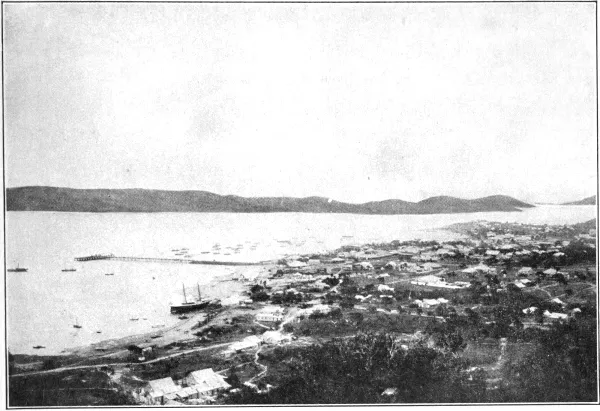
Thursday Island is the commercial centre for all Torres Strait. About
its deep harbour has grown up a clean, well-regulated town, the home of
representatives of all the peoples of the South Pacific.
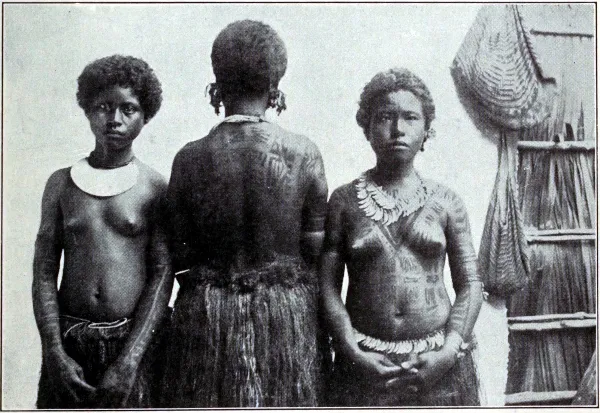
The youngest of these island maidens has to go through several months
more of suffering before she can appear with her complete blouse of tattooing.
The design must be pricked in with a thorn driven under her skin.
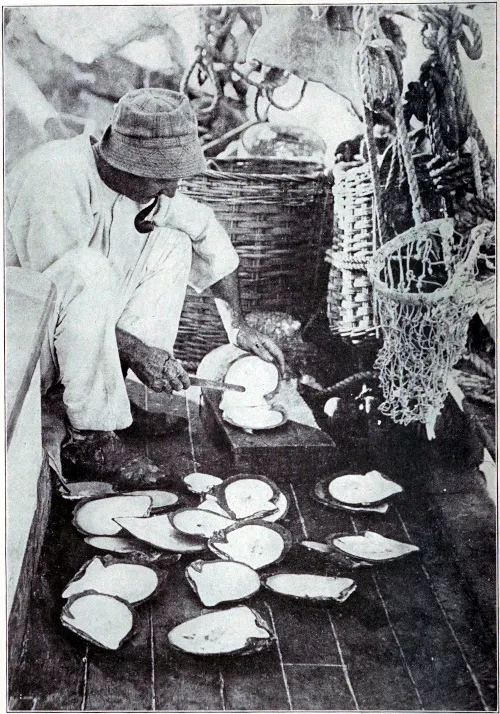
Experienced men claim they can tell by the appearance of the outside of
certain oyster shells that they contain pearls. Natives are not allowed to
open such finds, which are reserved for the white overseer.
The state government has already built a hydro-electric
power station at Great Lake, about sixty miles north
of Hobart. This delivers thirty thousand horse power
to the Electrolytic Zinc Corporation, whose works are
the largest of the kind in existence. It also supplies a big
carbide-manufacturing plant as well as power for Hobart’s
street cars and lighting system. Woollen mills, a big
chocolate factory, and other industrial plants will get
their power from this station. So will Launceston as soon
as the transmission line from the lake to the northern
city is completed. Launceston has its own power plant
but this does not give sufficient current for its needs.
Ultimately the capacity of the Great Lake power house
will be raised to seventy-two thousand horse power.
Other projects are planned, for Tasmania’s hydro-electric
resources are estimated at more than two hundred thousand
horse power. There is even talk of transmitting
some of the power from the island by cable to the mainland.
THE PEARL FISHERIES OF THURSDAY ISLAND
THE metropolis of the pearl-fishing industry of
the Pacific Ocean is Thursday Island. It lies in
Torres Strait off the north coast of Queensland
and is part of that state. I visited it on my
way to Java and the East Indies, but its story rightly
belongs with that of Australia, and so I tell it here.
If you will turn to the map you will see that Torres
Strait, which separates Australia from New Guinea, is
spotted with islands. There are hundreds of them, some
inhabited by strange tribes and others sparsely settled by
Australians. There are islands for every day of the
week, and when we came into the harbour of Thursday
Island we were told we must go on to Friday Island for
quarantine.
Thursday Island is scarcely more than a tiny speck in
Torres Strait, but owing to its excellent harbour it is a
port of call for ships on their way through the passage.
All the steamers that go about north Australia to Europe
stop here. There are also steamers for Japan, China, the
Philippines, and other parts of Asia, as well as vessels
bound for New Guinea and the islands of the South Seas.
The island has a military importance, as it commands
Torres Strait and is one of the defences of the British
possessions in this part of the world. The harbour is
large enough and deep enough for the biggest warships; it
has been strongly fortified and has also a coaling
station.
Through its commerce and pearl fisheries a considerable
town has grown up on the island. Two piers have been
built out into the harbour for the accommodation of the
smaller steamers, and back of these are the warehouses
and stores. There are six hotels, three or four churches,
and the large house of the governor, who is a Queensland
official. This stands on a little hill at one end, not
far from the barracks, great two-story buildings with
galleries around them, looking not unlike one of our
second-class summer hotels.
The port has one of the most mixed populations of this
part of the world. I had no sooner stepped on the wharf
than I was surrounded by representatives of all the
peoples of the South Pacific. There were brown men,
black men, and yellow men; Filipinos, Japanese, Chinese,
East Indians, Fijians, Papuans, and Australian aborigines.
There were pearl divers, beachcombers, bêche-de-mer
fishermen, and adventurers of all colours and races.
Thursday Island is a sort of Suez for an area of nearly
twenty thousand square miles of island-sprinkled ocean
between New Guinea and Australia. The town itself is
far cleaner than many of its population, being quite free
from epidemics, for the Queensland government rigidly enforces
the health regulations. Native councillors elected
by the people must see that the villagers keep their
houses, food, and clothing clean, that they go regularly to
church, and that they send their children to school.
These black officials strut about in red jerseys with the
word “Councillor” in white letters across the front.
The chief interest in Thursday Island lies in its pearl
fisheries. Pearls and shells are the principal subjects of
discussion, and the finding of a large pearl is talked
of everywhere. The best pearl shells are taken from
the coral islands and lagoons. The oysters grow to an
enormous size, often having shells as big as a tin wash
basin. The average weight of a pair of shells is about two
pounds. The oysters lie on the bottom of the sea or cling
to the coral rocks. They do not like sand or mud, and
will not thrive where the tide shifts the bottom about.
They grow largest where they can fasten themselves to
coral formations. There are many caverns in the reefs,
and the oysters attach themselves to the roofs of these
submarine caves in clusters of a dozen or more. They
cling to the rocks by a cartilage, or muscle, that extends
out near the hinge of the shell, and then branches off into
multitudinous threads, each of which glues itself to the
rock.
Several years ago a perfect pearl, weighing thirty-two
and a half grains and valued at five thousand dollars, was
taken out of the Thursday Island grounds. But this was
a rare find, indeed, for most of the money in getting pearl
oysters comes from the shells and not from the occasional
pearls within them. It is estimated that only one shell
in a thousand contains a pearl. In a recent year the
value of Australia’s export of pearl shell was nearly two
million dollars, while the value of the pearls shipped in
the same year was only about one sixth as much.
Shell is cash at Thursday Island, and in the world’s
markets the better quality commands from five hundred
to a thousand dollars a ton. It is used for making
mother-of-pearl knife handles, buttons, and in all sorts of
inlaid work. Trading vessels sail from island to island
collecting the shell from the natives, in exchange for
tobacco, calico, and other goods. The traders pay from
sixty to one hundred dollars per ton for shell that will sell
in London for about ten times as much.
The Japanese have almost monopolized the diving at
Thursday Island, for they will stay longer under water
and risk more than any one else. Among the divers are
also many South Sea Islanders, besides Danes, Swedes,
and Malays. The proprietors of the pearl ships say the
Japanese are the best, and that the others often pretend
to be sick.
The fishing is done by fleets consisting of one large
boat, of, say, one hundred tons, and several smaller ones.
The divers work from the small boats, each of which has a
pump to supply them with air when they are under the
surface. As even the small boats cost several thousand
dollars each, the business takes considerable capital.
The diver prepares for his plunge by slipping on over
heavy flannels a diving suit to which ropes and air tubes
are attached. He wears a metal helmet with circles of
glass set in it so that he may see about him. His boots
are soled with plates of copper or lead weighing about
twenty-eight pounds to each foot, while the total weight
of his equipment may be more than one hundred and
fifty pounds.
When a diver goes down he takes with him a net bag,
which he fills with shells. He then jerks the signal rope and
is pulled up. The shells are counted and weighed, and he
is paid according to what he has found. One diver has a
record of having gathered one thousand pairs of shells in a
day, but half this number is considered a good showing.
Even with the most modern equipment, one hundred
and eighty feet is considered the maximum depth at which
divers can work safely, although some have gone to a depth
of two hundred or more feet. As the shallower beds have
given out, the divers have had to go deeper and deeper and
Queensland has made a law forbidding diving below the
safety level. But the state courts have held that a diver
must actually be seen below that depth before violation of
the statute can be proved, and, as the reefs are quite remote
and supervision is virtually impossible, the men often take
great risks. At one hundred feet below the surface the
pressure is sixty pounds to the square inch, and it increases
as the diver goes deeper. At a certain depth he
is attacked by pains in his muscles and joints, deafness
and spells of fainting, and a kind of paralysis called
“diver’s palsy.” If he is brought too quickly to the surface
the sudden removal of the pressure may cause profuse
bleeding or even death. Every year ten per cent. of
the Torres Strait divers die from the immediate effects of
their calling.
I am told that the profession has other great dangers.
The Strait swarms with tiger sharks, which here grow to a
length of twenty feet. They follow the pearl luggers, attracted
by the pieces of salt beef now and then thrown
from the boats. Unless very hungry, they trouble only
the naked divers and the man in a suit can open an aircock
and make enough bubbles to frighten them away. When
the naked diver is attacked by a shark he stirs up the water
and thus often confuses his enemy so that he gets back
alive, although he may perhaps be maimed for life by the
teeth of the terrible fish. As a rule the divers are not
afraid of the sharks, but they do not spear fish at the bottom
of the sea without first ascertaining whether there
are sharks about, for the dead fish would surely draw
them.
Another terror is the great squid. This marine monster
fastens its long tentacles upon anything within its reach.
If disturbed it vomits an inky fluid which discolours the
waters about, and the diver, bewildered in the gloom, is
liable to fall against the rocks and be caught.
In the native pearl fisheries much of the diving is done
by women, who go down without suits. They fasten
stones to their feet to enable them to sink, but do not plug
up their nostrils and ears as do the pearl divers of India.
Most of them can stay under water only a few seconds
more than a minute, and they cannot work in such deep
waters as the men in diving dress.
Pearls worth one hundred dollars are quite common and
a big one, lately discovered, sold for twenty-five hundred
dollars. Since an oyster may contain a thousand-dollar
pearl, and the pearls are so small they can be easily stolen,
the opening of the shells is carefully watched. A knife
much like a common table knife, with a thin, flexible blade
and a strong handle, is used. A good operator can open a
ton of shells in a day and not miss a pearl. The shells containing
the pearls have sometimes a curious appearance so
that experts can tell before they are opened that they have
pearls in them. Such shells are always laid aside to be
handled by the proprietor or the foreman of the sloop.
Sometimes one oyster will contain a dozen small pearls
and even more. Such oysters are often diseased and
their shells are rough, but on the other hand a perfectly
healthy oyster may contain a fine round pearl of large size.
Many people believe that some irritating substance is the
cause of every pearl. Looked at through a microscope, a
pearl cut in two shows concentric layers like an onion with
a hole, or sometimes a grain of sand in the centre. It is
supposed that the grain of sand irritates the oyster so that
it exudes carbonate of lime, coating the scratchy particle
over and over until there has been formed a smooth round
ball that does hot hurt.
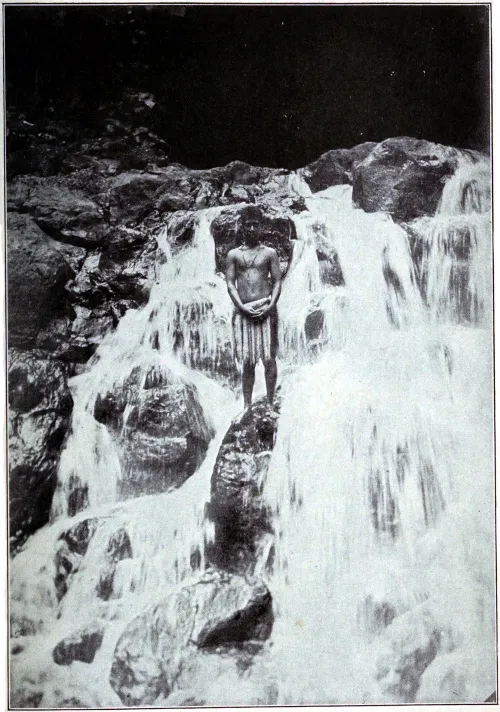
The islands about Torres Strait are probably volcanic fragments of the
immense continent supposed once to have connected Asia and Australia.
Only the larger ones are inhabited.
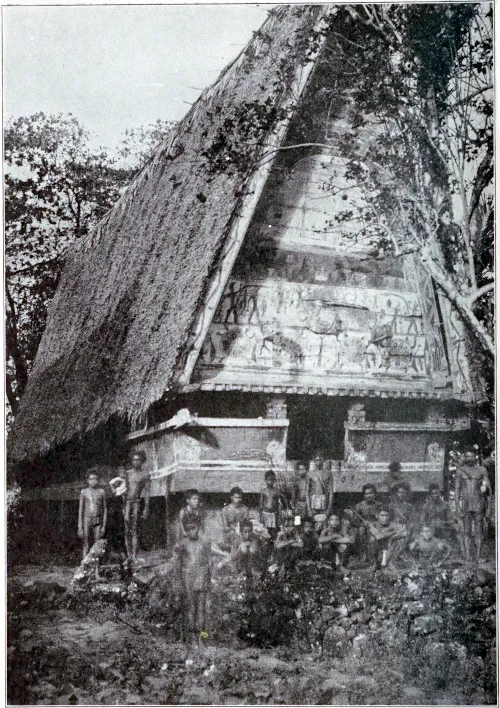
The natives’ community house is in the centre of most South Sea
island villages. All discussions, feasts, and gatherings are held here, the
traveller is free to use it, and the peddler finds it at once a hotel and show
room.
CHAPTER XXIII
AUSTRALIA’S ISLAND WARDS
MOST people associate Thursday Island with its
great neighbour New Guinea, the second largest
island on the globe. Of what we might call
mainland New Guinea I have already written
in my book on Java and the East Indies. You will recall
that it is divided into Dutch New Guinea, Papua, and
former Kaiser Wilhelm’s Land. Both Papua and the
former German possessions are now administered by Australia.
Besides former Kaiser Wilhelm’s Land, the Territory
of New Guinea embraces the Bismarck Archipelago
and some of the Solomon Islands. Germany owned also
the Marshall and the Caroline Islands, lying north of the
Equator, which are now governed by Japan, while former
German Samoa is under the jurisdiction of New Zealand.
Australia has the responsibility of looking after nearly one
hundred thousand square miles of territory outside the
Commonwealth, and although she is determined to remain
an “all-white” continent, she has under her jurisdiction
thousands of primitive coloured peoples.
The natives of former Kaiser Wilhelm’s Land are, if
anything, wilder and more savage than those of Papua.
Thousands of them go naked save for breech cloths of
bark for the men and short petticoats of woven grass for
the women. Along the extreme northern coast are tribes
that are entirely nude, with the exception of a shell necklace
and a few bird-of-paradise feathers stuck in their
woolly hair. Some tribes paint themselves in stripes of
white, red, yellow, and black, and others scar themselves
with flints or by fire.
I have photographs of native houses recently taken in
New Guinea. Some of these houses are of great size, and
many families live under one roof. The buildings are frequently
set upon piles, a platform of poles being first constructed,
a skeleton framework built upon this, and mats of
woven leaves or grass fastened to it. The mats are so arranged
that they can be raised or lowered to keep out the
mosquitoes and the flies, which are exceedingly troublesome.
In other parts of the island there are houses built
in the trees, to which the people retreat in times of danger.
The different tribes are frequently at war with one another,
and the missionaries tell me that sometimes these
feuds go on between tribes and villages for generations.
Cannibalism exists in some localities, though not to a great
extent. The British have observed it among the people
along the Gulf of Papua, and it is found also in northern
New Guinea. The ordinary food of the natives is about
the same as that of the Samoans, their chief diet being
the yam, the taro, which is a kind of potato, and the
banana.
The islands of the Bismarck Archipelago have some
tribes stranger even than those of New Guinea. On one of
them, according to good authorities, the girls are kept in
wicker cages from the age of six or eight years until they
are married. The cages are built inside large houses set
aside for the purpose. The girls are let out once a day to
bathe, but otherwise they are not permitted to leave their
traps. Their food is handed in through the bars, and they
pace up and down at times like caged lions. These cages
are under the charge of the old women of the tribe, who
see that the girls do not flirt with the passers-by or peepers-in.
The young men have the right to look at the cages
now and then, and probably, after making proper presents
to the guards and the parents of the girl, one may woo the
maiden of his choice through the bamboo meshes.
I am told that these girls do not suffer in health from
their imprisonment, and that notwithstanding their seclusion
they make very good wives, and later on are by no
means averse to having their daughters caged up as they
were. In this hot climate the people mature rapidly, and the
marriageable age for a girl is eleven or twelve years. The
unmarried damsel of fifteen is considered an old maid.
New Britain, the principal island of this group, is three
hundred and fifty miles long. New Ireland, the next in
size, is about two hundred miles long and only twenty
miles wide. New Britain is traversed by a mountain
chain whose tallest peak is The Father. It is seventy-five
hundred feet high and is an active volcano.
In New Ireland the people of each village are divided
into two classes and marriage between the classes is strictly
forbidden. If a woman marries outside her class the punishment
is death, but the male offender merely pays a fine.
Both women and men go naked, and cannibalism is common.
The people live in small huts shaped like beehives,
surrounded by bamboo fences. The young unmarried men
have common houses where they live together.
Most of the few hundred Europeans living in the Archipelago
are gathered at Rabaul, in New Britain. This is a
well-planned, spick-and-span town, once the capital of
German New Guinea. Here one of the most interesting
characters of the Pacific islands had her headquarters.
This was a woman of remarkable courage and business
ability, half Samoan, who back in the eighties started
German New Guinea on the road to prosperity in the coconut
business. “Queen Emma,” as she was called, was a
most enterprising trader, and it was from her that the
German New Guinea Development Company, in which
the former Kaiser was said to be a heavy investor, bought
trading rights. The enormous areas under her management
were finally forbidden to German officers because of
their cruelty to the natives, whom Queen Emma always
championed. She was almost worshipped by the islanders,
of whom she employed thousands. At length, however,
she married a handsome young German officer and went to
Europe to take a high place in the society of Berlin. She
died several years ago at Monte Carlo.
New Ireland, too, has its romance, for it was here that
some forty years ago a wealthy Frenchman, the Marquis
de Rays, tried to start the Free Colony of Oceania. In
his prospectus New Ireland was described as an earthly
paradise in which each settler was to have fifty acres with
a house and every comfort. Would-be colonists from the
crowded lands and streets of France, Belgium, and Italy
were numerous. Money was poured into the enterprise,
which, however, suffered from mismanagement and poor
organization. Arrived at the spot chosen on the unsheltered
southeast point of the island, the colonists’ ship
dumped its cargo on the open beach. Steam cranes,
sugar-mill machinery, handsome carriages, agricultural implements,
bricks, crates of food, and immense piles of
clothing lay in confusion under the tropical sun. Boxes
of handles for shovels and axes were landed, but neither
shovels nor axes could be found to go with them. There
were stacks of wheelbarrows without wheels. Much of
the clothing was heavy and unsuited to the climate. The
only thing entirely complete to the last detail was the
building material for a cathedral, a gift to the settlers from
the French people! It was never put up.
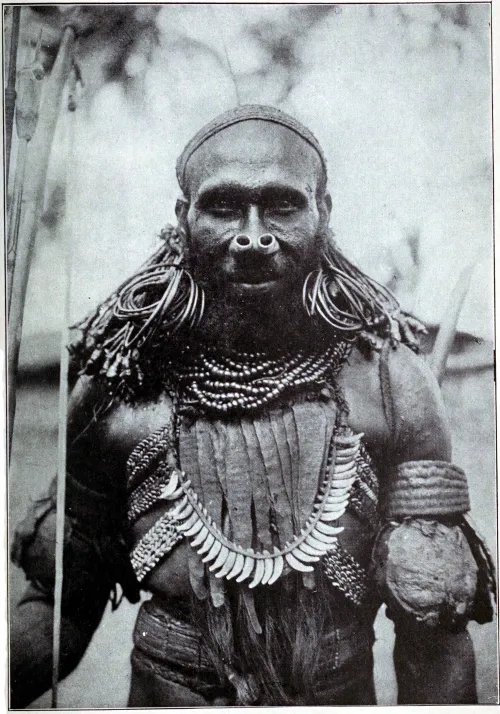
Among some Pacific island men a big waist is considered the sign of a
glutton, so they lace themselves in tightly with belts of fibre. This man,
owing to his necklaces, looped earrings, and unusual nose plugs, is the
envy of his village.
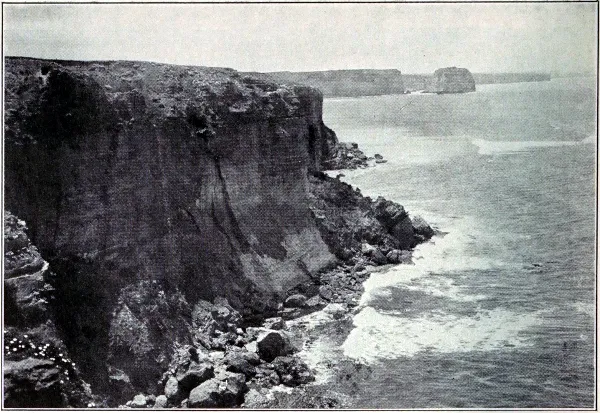
The Tasman Sea is named for Abel Tasman, greatest of all Dutch
navigators. He discovered, also, New Zealand and Tasmania and was
the first man to circumnavigate Australia.
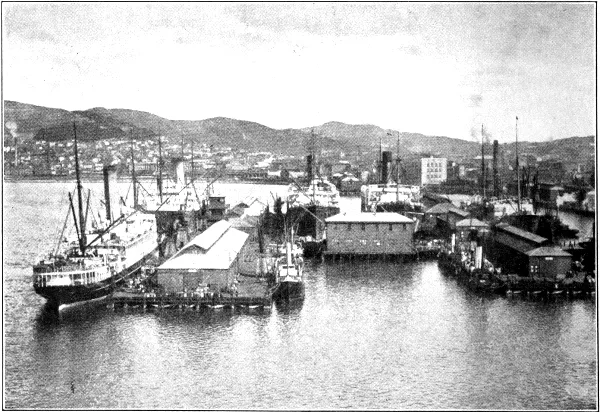
At Wellington, capital and chief port of New Zealand, the hills
come so close to the water that some of the streets run through tunnels
and many of the houses are seven hundred feet up.
Many of the intending colonists did not even leave the
ship. Some died of malaria, for quinine had been left out
of the medical stores. The rest of them scattered, a number
going on to Australia. Only one, a mere boy, decided
to stay on, and he at last grew to be one of the wealthiest
men of New Guinea.
A little to the east of the Bismarck Archipelago are the
Solomon Islands. The principal island in this group is
Bougainville, which is bigger than Porto Rico. It is quite
rugged, having two constantly active volcanoes and one
mountain of an altitude of more than two miles above sea
level. The natives here are of the same race as those on the
adjoining islands, and equally as savage. In most cases
the men go naked, and in some of the islands the women
wear no clothing until they are married. Both men and
women pierce their ears, the holes in the lobes being gradually
stretched until they are as big around as a napkin
ring. Among some tribes the nose is pierced and a long
pin of bone or shell is stuck through it. There is some
tattooing, and scars made by burning are considered fine
ornaments.
The Solomon Islanders are barely out of cannibalism,
and head-hunting was not long ago the profession and
pleasure of most of the young men. Polygamy is practised,
and some of the chiefs have as many as a hundred
wives. The islanders do some farming, raising bananas,
yams, and taro. They are good fishermen, and gather
shells and pearls for sale.
Coconuts are the chief product of the Solomon Islands,
although it has been proved that rubber, sugar cane, and
cotton will flourish there. But expansion of the plantations
cannot be undertaken without a large supply of
labour.
Australia has introduced fairer labour conditions than
she found throughout the islands she now administers.
Special ordinances provide for a ten-hour day, a weekly
day of rest, and observance of public holidays. Board,
lodging, and medical attendance are free and minimum
and maximum wages have been prescribed. There is
neither slavery nor forced labour, and the recruiting of
native labour is strictly regulated.
Missionaries, especially those of the Methodist Church,
are at work in all the islands. Their faithful labour has
gone on for many years, and there are now a large number
of native evangelists. One of the missionaries tells me
that the people are being slowly but surely civilized, and
that a number of them are Christians.
CHAPTER XXIV
ACROSS THE TASMAN SEA TO WELLINGTON
I CAME from Australia to Wellington, the capital of
New Zealand, on a vessel as well furnished, as well
kept, and as well managed as any of the floating
palaces that steam on our Great Lakes. But the
voyage was far from being as smooth as a sail on the Lakes.
The South Pacific Ocean is much like the North Atlantic.
It is wild and stormy at times, and I found it a great contrast
to the calm waters of the tropics through which I
had passed on my way to Australia. The clear skies of
the Equator and their golden stars had disappeared, and
in their place were heavens plated with lead and heavy,
low-hanging clouds full of wind.
How the steamer rolled! There were ladder-like racks
on the table to hold the dishes at every meal, and we had
to lift our soup plates to our chins, balancing the steaming
liquid to the movement of the boat. One night a buxom
young lady, who was strikingly décolleté, sat opposite me
at the table. The ship gave a sudden lurch and her soup
went down—outside. Another girl lost her coffee in my
lap. In my cabin it made me almost seasick to watch my
pajamas swing violently to and fro on their hooks. As
I walked the deck I had to bend this way and that to keep
my balance, and when I sat down the steward tied my
chair to the rail outside the saloon wall to keep me from
sliding down to the edge of the boat. The spray dashed
over everything, and, as a New Zealand girl said, “It was
really na-a-hsty!”
Still, the southern ocean is grand. Stand on deck beside
me and take a look at a storm off the coast of New
Zealand. The green water of the shallow sea rolls toward
us in vast waves. It is a seething, boiling mass. Our
steamer mounts sea-green hills spotted with foam, and
plunges down into valleys blanketed with white. Great
billows chase one another like racehorses over the roads of
the sea. They roar as they run with a noise like the thunder
of a thousand Niagaras.
Now two waves meet. The foam dashes up in a spray
and turns to rainbows in the sun, which now and then
breaks through the clouds. The rainbows are so close
that we can almost wash our fingers in them. They
come and they go, a hundred different rainbows in as
many minutes. They dance in and dance out. They
ride for a moment on the crests of the waters, only to shine,
disappear, and give place to others. How the ship struggles
and groans! Every now and then a mist closes
down upon us, and our foghorn blows continually. We
are hours in making a few miles and are tossed about all
night by the storm.
I suppose there is not much chance that the Tasman
Sea will change its ways, but it has been proposed to change
its name. After the World War it was suggested that it
be re-christened the “Anzac Sea” in honour of the troops
sent from this part of the world to fight with the Allies.
You remember that their organization was officially
known as the Australia-New Zealand Army Corps. The
supplies sent to the first contingent at Gallipoli were
marked with the initial letters: A. N. Z. A. C. and thus
the “Anzacs” got their name. Anzac Day, April 25th, is
now observed as a national holiday in New Zealand in
memory of those who gave their lives at Gallipoli, and in
Palestine, Egypt, and France. The day is kept more like
a Sunday than as an ordinary holiday, and the use of the
word “Anzac” for trade purposes is prohibited by law.
I am told that some people even disapprove of its being
used as a geographical term.
The morning was clear when we sailed into Wellington
harbour and cast anchor before the capital city of the
island dominion. On going ashore I found Wellington
rather like an American than a British town. It has more
than one hundred thousand people and is growing like a
green bay tree. The city lies in a nest in the hills, with its
business streets round the harbour, some of them built
upon land reclaimed from the sea. The houses are mostly
of wood, and one of the government buildings is said to be
the biggest wooden structure in the world. The wharves
are of wood, but they are big enough to accommodate the
largest steamers, and the water is so deep that ships come
close to the shore and anchor within a stone’s throw of the
post-office.
Both Wellington and Auckland, the chief ports of New
Zealand, have fine harbours, although neither is as good
as the one at Sydney. The New Zealanders say that when
they go to Sydney they pin a tag on their coats, reading:
“Yes, I am pleased with your harbour,” and thus avoid
answering the same question twenty times an hour. Wellington
is as windy as Chicago, and Australians say they
can always tell a man from Wellington because, no matter
where he may be, every time he turns a street corner he
grabs his hat to keep it from blowing away.
The stores here are not unlike ours. Their windows are
well dressed and their goods attractively displayed. In
the business section there are roofs of corrugated iron
built out over the sidewalks so that shoppers are protected
from the sun or rain in going from store to store. The
merchants carry large stocks, and seem to be prosperous.
There are many jewellery stores, book stores, and millinery
shops. The butcher shops are walled and floored with
tiles, and the beef and mutton sold in them are equal to
any you can get in Chicago or London, and much cheaper.
The grocery stores are clean and up to date, while the displays
on the fruit stands make my mouth water. They
have home-grown apples and grapes, and tropical fruits of
all kinds from the Tonga Islands and the Fijis.
The city is lighted by electricity. It has a good water
supply and a municipally owned street-car system, one
line of which runs through a tunnel under a mountain and
out to a popular bathing beach. Wellington has gone far
ahead of our cities in municipal ownership. Besides its
street-car system, it owns its water supply and drainage
works, its cemeteries, baths, and slaughter houses. Many
of its homes are lighted from a municipal central station,
and it has a monopoly on the local milk business. The
city buys and distributes all the milk produced within a
radius of about twenty-five miles. Any surplus is made
into butter and cheese, and an ice plant is operated in connection
with the dairy business.
I have been told that the reason for the number of
wooden buildings here is the fact that years ago a severe
earthquake did great damage and made the people afraid
to put up high structures of brick and steel. But the
Wellingtonians of to-day laugh at the idea of another
earthquake, and substantial buildings are going up all over
the city. A big new Parliament House is about completed,
and the government is carrying out a large construction
programme for the better housing of its various offices.
One of the finest buildings in the Dominion is the home of
the mail and the telegraph services—a structure of native
stone covering half a block.
CHAPTER XXV
THE DOMINION OF NEW ZEALAND
ON THE map New Zealand looks like a little
stepdaughter of Australia, and most of us
think of the two countries as near neighbours.
We associate them in our minds as belonging
together, and imagine that the trip from one to the other
is no more than a week-end journey.
This is all wrong. New Zealand is twelve hundred
miles from Australia. It is a separate dominion of the
British Empire, and entirely independent of the Commonwealth.
The voyage from Sydney to Wellington takes
four days, or almost the time of the fastest crossing of
the Atlantic from New York. The two countries are as
unlike in climate as South Carolina and Norway. The
northern tip of Australia is nearer the Equator than
Florida, while the southernmost island of New Zealand is
in the relative position of Portland, Oregon.
New Zealand is a land of lofty mountains, geysers,
volcanoes, rivers, fiords, and glaciers. Australia has no
geysers, glaciers, or volcanoes; her mountains are not high,
she has but few rivers, and the heart of the country is a
vast desert. New Zealand has seventeen ports with harbours
deep enough to accommodate ocean-going vessels;
Australia’s seven largest ports have comparatively shallow
harbours, which have required much dredging. Australia
has more than three hundred and ninety species of
lizards and a hundred different kinds of snakes, most of
them poisonous. New Zealand has no snakes of any kind.
The aborigines of Australia are among the most primitive
peoples of the world, but the Maoris, the natives of New
Zealand, are able to take a part in the government of their
country.
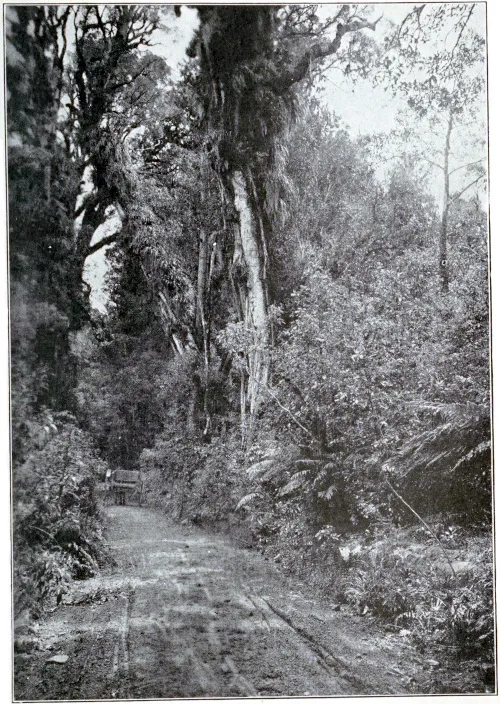
New Zealand is one of the most remarkable botanical regions of the
world and nowhere are there more beautiful forests. The giant fern is so
common that it is the emblem of the country.
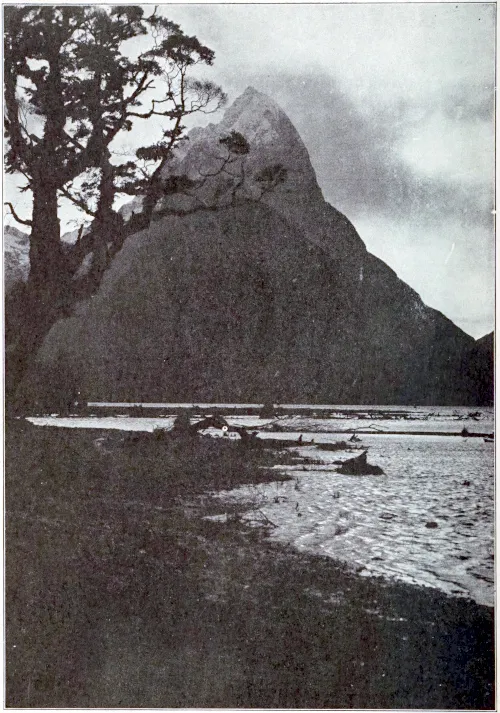
The southwest coast of the South Island rivals both Norway and
Switzerland in its scenic beauty. There the glaciers have made fourteen
great sounds, walled with steep cliffs and lofty mountain peaks.
Yet there are also many points of likeness between these
two South Sea members of the British Empire, especially
in their forms of government. Each country has a
Governor-General appointed by the British Crown and
each has a Parliament of two houses. In both the executive
power is in the hands of a ministry, that is, the leaders
of the majority parties in the Parliaments. Each maintains
a separate tariff against Great Britain and neither
tolerates the least interference of the Crown in its domestic
affairs, though both are consulted by Great Britain on
matters affecting the British Empire. Furthermore, both
Australia and New Zealand are the scenes of all sorts of
experiments in government ownership and control and
each is noted for its liberal labour laws. The New Zealand
government owns the railroads, the telegraphs, and the
telephones; it competes with private companies in the
insurance business, owns and operates the coal mines on
the public lands, and undertakes all water-power developments.
To most of us New Zealand is an empty land in a far-distant
part of the globe. I find it filled with a busy people
and moving rapidly along on the lightning express of civilization.
Neither is it so far away, after all. It is now
only eighteen days from San Francisco, only about thirty-five
days from London, and good steamship lines connect it
with all parts of the globe. From the New Zealand ports
there are regular sailings to London by way of the Cape of
Good Hope, by the Suez Canal, or the Panama Canal.
Still another route to Europe is across the Pacific from
Auckland to Vancouver, a voyage of more than six thousand
miles; thence by rail to Montreal, Quebec, or New
York, and then across the Atlantic. Scores of steamers
go from port to port along the wild New Zealand coast,
and one can leave here almost any week for the Tongas,
the Fijis, and other islands of the South Seas.
The Dominion of New Zealand is made up of three
islands. As they lie on the map they form a great boot
turned upside down with its toe toward Australia and
with the ankle broken by Cook Strait. The foot is the
North Island, on which are situated Auckland and Wellington,
the two biggest cities. The South Island, which
contains the highest mountains and some of the best
agricultural areas, forms the leg, and Stewart Island, the
little patch of land at the bottom, makes the loop at the
end of the boot strap.
The total length of the boot is one thousand miles, or
more than the distance from New York to Chicago. At
its broadest part it is about as wide as from New York to
Boston. The North Island is nearly as big as Pennsylvania,
and the South Island is larger than Illinois. Stewart
Island is about half the size of Rhode Island. It is
mountainous, and although it supports a few sheep, it is
chiefly a summer resort. The combined area of these
three islands and some smaller ones adjoining is a little
more than that of Colorado. In 1901 New Zealand annexed
the Cook Islands, and under a mandate from the
League of Nations it now administers former German
Samoa.
The New Zealand in which we are interested consists
of the two large islands. They contain all the cities,
almost all the people, and everything that makes the
Dominion the live, wide-awake, prosperous country that
it is to-day.
The climate here is warmer than that of New England.
It is moist and rainy. January and February are the hottest
months and July and August the coldest. On the
North Island snow falls only on the mountains and high
hills and is practically unknown in Wellington and Auckland.
On the South Island there is a good deal of snow
south of Christchurch.
A large part of the North Island is hilly and some of its
plains are covered with pumice sand, which unfits them for
tillage or pasturage. One part of it has hot springs and
geysers like those of Yellowstone Park. It has several
volcanoes, although they are mostly inactive now. Ngauruhoe,
the youngest, continually sends up little clouds of
steam. The Ruapehu volcano, which is nine thousand
feet high, has glaciers on its upper slopes, and ends in a
hot crater lake, which is often covered with steam. White
Island, in the Bay of Plenty, is a vast bed of piping hot
sulphur. On days when the sea is calm a person may land
on its rocky shore, but walking about it is not pleasant, for
the crusty ground breaks under his feet and the sulphur
eats up the soles of his shoes and his clothes if it touches
them.
Mount Egmont, near the southwest coast of the North
Island, reminds me much of Fuji-yama, Japan. It is a
perfect cone, eighty-three hundred feet high, or more than
two thousand feet higher than Mount Washington. It is
thirty miles in diameter at the base. At its foot lies New
Plymouth, a town of about eleven thousand people.
Mount Egmont rises out of one of the most fertile districts
of New Zealand. The soil is a rich loam, so good for grass
that it has sold for four hundred dollars an acre. It is
used for dairying, the butter being exported to Great
Britain and the United States.
Like the Tasmanians, the New Zealanders call their
country the Switzerland of the Pacific, and the mountains
of the South Island are named the Southern Alps. They
reach a height of more than twelve thousand feet in Mount
Cook, which the native Maoris call “Aorangi,” or the
“cloud piercer.” The snow line is lower than in Switzerland,
and the people here say that the scenery surpasses
that of the European Alps. Many of the New Zealand
peaks are covered with perpetual snow, and there are great
glaciers on both sides of the range, descending in places
to within a few feet of sea level. Some of the peaks have
never been climbed and many glaciers are still unnamed.
Some of the latter are of enormous extent. The Tasman
Glacier is eighteen miles long, two thousand feet thick, and
in places three miles wide. It covers an area of three
thousand acres. Both the Murchison Glacier and the
Godley Glacier are ten miles long and each has an area of
more than five thousand acres.
The southwest coast of the South Island is bitten into by
fourteen deep sounds hollowed out by the glaciers of ages
past. The most beautiful of all is Milford Sound. It is
surrounded by lofty cliffs and mountains about whose
heads float wreaths of mist and down whose sides silvery
cascades plunge into the sea. Milford Track, which the
New Zealanders call the “most beautiful walk in the
world,” leads from the Sound for twenty-six miles through
forests, mountains, and valleys to Te Anau, the second
largest lake in the Dominion.
The largest lake is Taupo, in the centre of the North
Island. It is surrounded by mountains capped with perpetual
snow, and in flood times a magnificent waterfall
thunders down into it from the sheer cliffs on its western
side.
In summer the New Zealand mountains are full of travellers
and explorers from all over the world. The tourist
agents of Europe send parties and the people of the Old
World come to this Switzerland of the South Seas just as
we go to the Switzerland of Europe. The New Zealand
government, which is the chief excursion bureau, has a
department devoted to exploiting the scenery. It prints
illustrated guide books, which it gives away or sells at cost.
The government builds roads and bridges through the
most picturesque parts. It maintains a series of rest
houses along Milford Track, and operates the hot-springs
district as a tourist resort.
New Zealand is an evergreen land, as the leaves stay
on most of the trees all the year round. Here is the same
green that one sees in England and Ireland; for, like the
mother country, the Dominion has an abundant rainfall.
The fences about the houses are often hedges with leaves
of a varnished green. There are many varieties of evergreen
plants, such as the holly. The New Zealand palm
lily is to be seen everywhere. It grows to a height of
twenty feet without a branch, and then its top blossoms
out in green tassels like a palm. The people call it the
cabbage tree.
And then the ferns! New Zealand has enough to establish
ferneries for all creation. There are acres of them,
miles of them! Some of the deep glens and gorges are
walled with ferns. They are of all kinds, some like great
trees and others as fine as the maidenhair. There is one
plant, half fern and half vine, which is used by the natives
for bedding. This is the “supplejack,” which climbs the
loftiest trees, coiling its wire-like stems about the branches.
The runners are so tough that they can be used for ropes.
They maintain their coil after being pulled from a tree, and
are said to have been used for making spring mattresses.
Think of sleeping on fern beds, upon fern springs, and you
have one of the possibilities of New Zealand.
Both the North Island and the South Island have much
good land. I visited a farm on the Canterbury Plains in
the South Island which a good authority tells me has produced
ninety bushels of wheat to the acre, and I have
travelled through sections where thirty, forty, and fifty
bushels are not uncommon. Some of the land produces a
hundred bushels of oats to the acre and much of it yields
turnips by the ton. There are millions of acres sown with
English grasses. In northern New Zealand, swamp areas
once considered worthless have been drained and now
form some of the richest land in the Dominion. On the
whole, New Zealand comes as near being a rich and beautiful
garden as any country with a temperate climate lying
south of the Equator.
As for the people, they are enthusiasts about their
country. They believe in New Zealand for the New Zealanders.
It is estimated that the Dominion could accommodate
perhaps four times its present population of a
million and a quarter, but I doubt whether away down
in their souls the inhabitants really want immigration.
Certainly the government has put no premium upon it.
Even British subjects wishing to go out to New Zealand
must be nominated for admission by a resident of the
Dominion before they can get their transportation at the
reduced rates sometimes offered. The government is
especially anxious to keep out the Chinese, and limits the
number admitted, each of whom has to pay a tax of five
hundred dollars. The result is that there are now less
than three thousand Chinese in the country, and practically
no Japanese.
Of the more than a million population only forty thousand
are Maoris or aborigines. The remainder are nearly
all British-born subjects, more than half of whom were
born in New Zealand. The rest have come from England,
Scotland, or Ireland. The Dominion is in fact a little
Britain. The houses are much like English cottages, the
business places are like English shops, and the money is in
pounds, shillings, and pence. The language is English and
I sometimes hear the cockney accent of London. The
people are, I think, far more progressive and less provincial
than the inhabitants of Great Britain, and they
seem to me much more like the nephews of Uncle Sam
than the sons of John Bull.
CHAPTER XXVI
“SOCIAL PESTS”
WHILE other countries have talked about
land reform or their peasants have staged
revolutions to get farms of their own,
New Zealand has quietly gone ahead and
put through a system of land ownership and taxation
which in the United States would be called socialistic.
What would our people say, for example, if Congress
should pass laws carrying out a land policy such as was
explained to me by one of the national leaders of New
Zealand? He said:
“We do not look upon land as like other property.
Land should belong to the state. It is given to it by the
Lord, to be held in trust for the people. It is all right
for a man to own the improvements he makes and to be
allowed to sell them or leave them to his descendants;
but as to the land itself I don’t think God ever intended
any one man to own vast tracts and be able to hand on
the property to his descendants through generation after
generation.
“As the trustee of the people the government has no
more right to sell large tracts of land than it has to give
them away. The ideal method would be for the government
to own all the land and lease it, and that is
what we some day hope to accomplish here. As it is
now, I think we have blasted the ambitions of those
who dreamed of building up great estates as family
inheritances.”
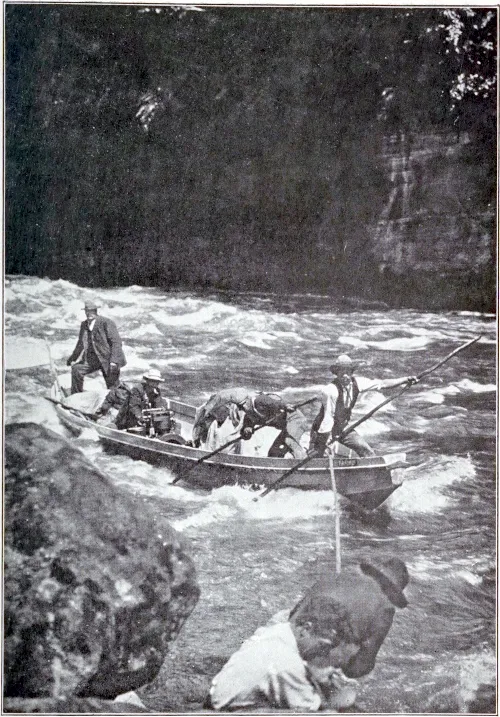
New Zealand has abundant water power, much of which is still undeveloped.
The government has selected seventy-odd sites for hydro-electric
projects and has a big programme under way.
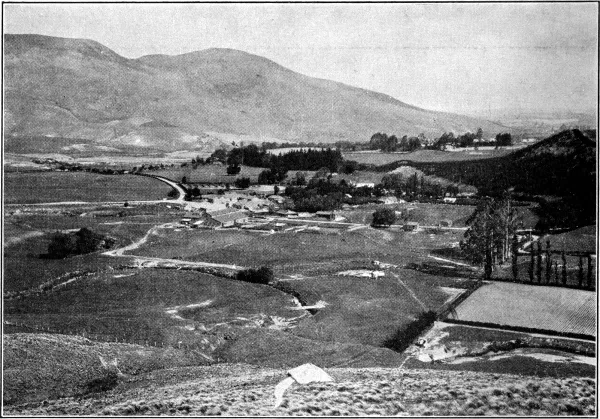
The big land problem was getting the immense sheep blocks held by
a few cut up into smaller areas for general farming. The government
has the right to condemn land for closer settlement.
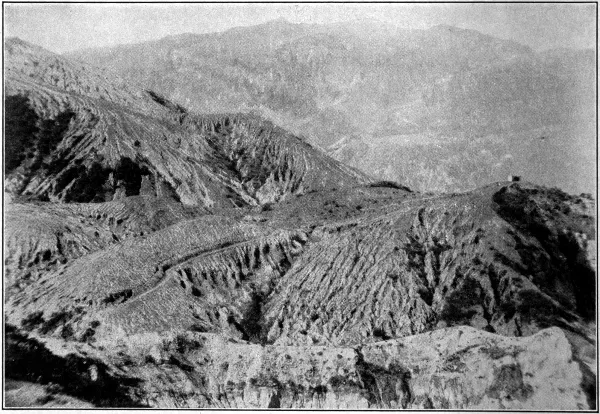
New Zealand has experienced some terrible volcanic eruptions. In one
the top of Mt. Tarawera was blown off, with an explosion heard five hundred
miles away, and surrounding villages were buried sixty feet deep in
mud.
It does not seem likely that the government will ever
own all the land in New Zealand, but it holds enough to
control the situation, and it stands ready to take more
whenever it thinks it necessary. What the people are
after is to make their country one of small farms, and they
are opposed to large holdings by any person or corporation.
They call the big landowner a “social pest,” and
have not hesitated to strip him of a part, at least, of his
possessions. Lands taken from the big proprietors have
been cut up and sold to settlers, whom the government
helps and encourages quite as much as it discourages the
owners of vast tracts.
Indeed, the lot of the large landowner in New Zealand
is not a happy one. His lands are at the mercy of the
government, which can force him to sell at any time. The
more land he owns, the higher his tax rate. If he does
not live in New Zealand, his taxes are automatically increased
by fifty per cent.
The development of land policies aimed at the larger
owners is comparatively recent, and entirely contrary to
the theories of the men who established the first colonies
here. The story of how the system came to be changed,
as I have learned it in talking with some of the highest
officials in the Dominion, is most interesting. It all goes
back to the very beginnings of the country.
Before the year 1840 considerable effort had been
made to induce the British government to colonize the
islands of New Zealand. But the imperial authorities
were always busy with other things and, besides, they
pointed to Australia, a whole continent with plenty of
room for British settlers. The leaders of the colonization
movement replied that Australia was for many
reasons unsuited to their purposes. They wanted to
establish a colony of British farmers with ideals and
conditions like those of old England. The climate of
Australia, they said, was unfavourable to this scheme,
there was little place for English farming methods there,
and finally, they thought the convicts sent to Australia
made it an undesirable country for their plans.
At last they organized a colonizing corporation called
the New Zealand Company. The plan was to set up
landlords in the new country, with tenant farmers to work
their estates. Members of old British county families
with sufficient capital were invited to join and they, in
turn, induced sons of the family tenants to go out with
them. A system of grazing “runs,” as they were called,
soon sprang up and were found to pay well, for large
numbers of sheep and cattle could be pastured on the
grass lands all the year round at small expense. Much of
the land was bought at very low prices by men who never
went to New Zealand. One man, for instance, paid two
dollars and a half an acre for fifty thousand acres now
worth one hundred dollars an acre. Others purchased
tracts of twenty thousand, fifty thousand, or even two
hundred thousand acres.
For the most part these great holdings lay idle, while
their absentee owners waited for the land to increase in
value. Sometimes they used their vast acreage for grazing
sheep, having perhaps a dozen shepherds on a principality
that should have supported several thousand
farmers. There was a sort of craze for big farms, and
individuals and groups took up all the lands they could
get. The unfederated states of the New Zealand of that
day had no common policies, and sold off their lands
indiscriminately to any who would buy them, in order to
raise money to build railroads or meet other expenses.
Often lands were held by English syndicates, whose
managers squeezed the tenants in every possible way to
increase dividends. It was stated in the New Zealand
Parliament that the manager of one of these absentee
land companies had made a speech to his directors in London,
apologizing because he could declare a dividend and
bonus of only fifteen per cent. at that time, and saying
that the shareholders must not look for bigger profits
until wages in New Zealand were reduced. The tenants
were charged such high rents that there was no money in
farming. The small holdings were mortgaged so that
the farm owner paid as much interest as the tenants did
rent, and most of the money from both was going to
England.
Feeble efforts to tax the big farms out of existence did
not prove successful. The landholders could pay high
taxes and still make fine profits on their huge sheep and
cattle pastures. They held tight to their acres, New
Zealand lost favour with intending settlers, and even those
who had come in began to sell out and leave the country,
moving across to New South Wales and Victoria.
Such were the conditions that faced New Zealand’s
greatest premier, Richard Seddon, or “King Dick,” when
he came into power. Richard Seddon was a man of the
people. Born in England, the son of a Lancashire farmer,
he learned the trade of an engineer, and when, as a boy, he
first came to Australia, he worked in the railroad shops.
Later he went to the goldfields at Bendigo, and there
swung a pick in the mines. Throughout the rest of his
life some of his friends called him “Digger Dick.” After
three years he came to New Zealand to try his luck in
the goldfields of the west coast. It was there he first
engaged in politics. He was elected mayor of his town
and in 1879 was sent to the New Zealand Parliament,
in which he held a seat until his death twenty-seven years
later. For thirteen years of that time he was leader of
Parliament, and therefore the prime minister of the
country.
Seddon was a great, deep-chested, hearty sort of a man,
with a jovial manner, a jolly laugh, an amazing memory
for faces, and a gift for handling people, especially those
of the class from which he came. He had tremendous
force and driving power, and while he was in office he put
through a great many laws in the interest of the working
man.
One of the first big questions he tackled was the land
problem, which he felt was responsible for the hard times
from which New Zealand was then suffering. His solution
was a new land law, which provided chiefly that the
government should have the right to buy any lands in the
Dominion for the purpose of re-dividing them for sale to
settlers. In case an owner refused to sell, or held out for
an exorbitant price, the government could condemn the
lands and take them over at a fair price. Under this
law, which is still in force, the Minister of Lands may at
any time notify a proprietor in writing that his land or a
portion thereof is required for purposes of settlement.
Within six months the owner must tell the Minister
whether he will enter into an agreement with the government
for its subdivision and disposal, or whether it shall
be taken compulsorily under the Land for Settlements
Act.
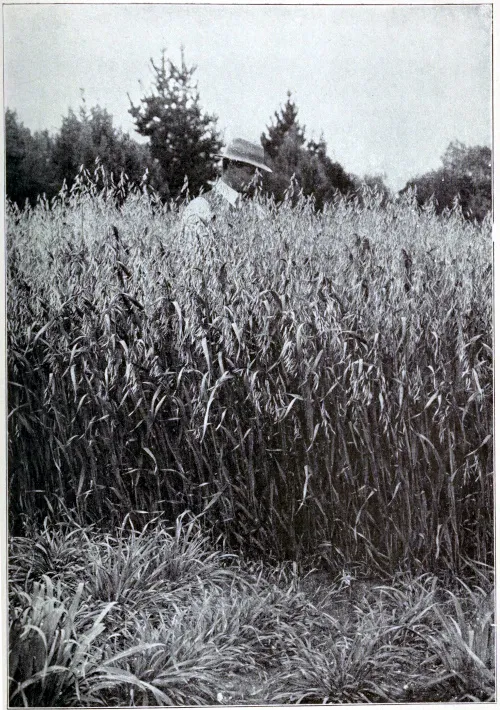
The government conducts four big experiment farms and in the laboratories
at Wellington tests seeds and fertilizers for the farmers. This is a
crop of rust-resisting oats on a government farm.
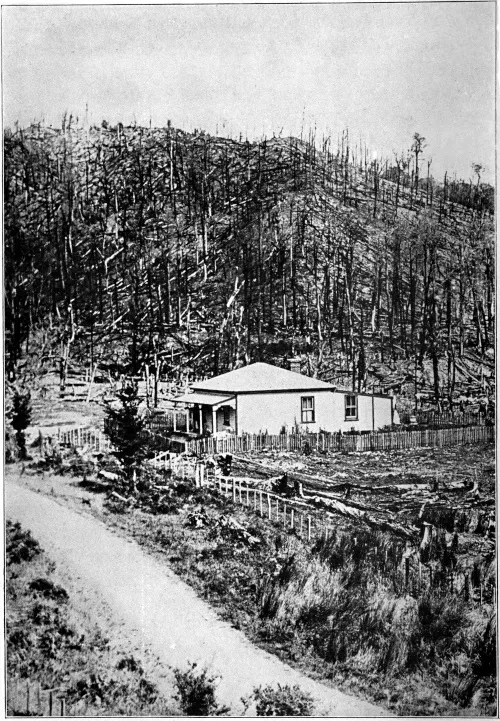
Believing that the future of the country depends chiefly on agriculture,
the New Zealand government offers every inducement to settlers to take
up unimproved land and clear it for cultivation.
In talking with officials as to just how this law worked,
I asked them to give me a typical case. Here is the story
of what happened when the government took over the
bulk of an estate of more than eighty thousand acres.
The tract belonged to a man who had bought a large
part of it more than half a century before, paying about
one dollar an acre. Much of it was rich farm land, but
it was being used mostly for sheep raising. For tax purposes,
the land had been valued at a million and a half,
which the owner claimed was two hundred thousand dollars
too high. When the authorities wanted to buy his
land for settlers, he refused to sell an acre, and the government
thereupon took possession.
The question of the value of the property was referred
to the Court of Assessment. The owner was finally
allowed to retain the homestead and a reasonable amount
of the land adjoining, and the government was empowered
to take the rest, paying the owner the amount of the
assessed valuation. The land officials then resurveyed the
estate and divided it into farms of three hundred and
twenty acres or less. They laid out a town site and three
village sites and built a railroad across the property.
They spent about three hundred thousand dollars in
developing the tract before opening it up to settlers.
The lands were rapidly taken on the usual government
terms, and at the end of six years, instead of being a big
sheep run, the estate was made up of productive small
farms. Land formerly used for grazing was yielding
forty-five bushels of wheat to the acre and there were
eleven thousand acres of it in English grass. Under intensive
cultivation more wool and mutton were being
shipped from the estate than when it was all devoted to
sheep. In the neighbourhood of fifty thousand sheep
and lambs were exported from it annually. When the
government took that estate the employees upon it numbered
something like a score. Under the new arrangement
the same area supported more than twelve hundred
people and was spotted with pretty farm homes and school
houses.
Within twenty years after Seddon came into power
the number of farms in New Zealand had doubled and the
population had grown from six hundred and thirty-four
thousand to more than a million. As Seddon once said,
“land formerly used to raise only sheep was turned to
raising men.”
Though the government had arbitrary power to take
almost any lands it wanted, the number of forced sales
was not very large. The presence of the law on the
statute books and the realization that the government
meant business resulted in offers of great tracts of
land for sale. Almost every year nearly twice as
much land was offered to the government as it was
prepared to buy, and it was thus able to pick and choose
such lands as were best suited by location and quality
for settlement. Usually, also, there were more applicants
for land than there were farms available for sale, so that
the government was in position to award the lands to those
who seemed most likely to make successful farmers.
Under the present laws an applicant may take up land
with the right to purchase on a renewable lease. He must
be at least seventeen years of age, and must want the land
solely for his own use. Including the land for which he
makes application, he must not own anywhere in New
Zealand more than five thousand acres. For allotment
purposes, every acre of first-class land is counted as seven
and a half acres; every acre of second-class land as two
and a half acres, and every acre of third-class land as
one acre. No applicant is allotted more land than the
officials think he can properly care for, and all prospective
settlers must pass an examination as to their qualifications.
Veterans of the World War are allowed to acquire land
on especially easy terms, and more than eight thousand
former New Zealand soldiers took up farms within five
years after the troops returned home.
The government still has about 4,500,000 acres of which
about 400,000 acres are suitable for settlers. Most of the
remainder is rough land, not available for farming. About
150,000 acres are disposed of each year, and the land
department reports a profit of more than $250,000 a year
on its operations. It has loaned more than $100,000,000
to 50,000 settlers, and about half of this sum has been
paid back. In the meantime, the area under active cultivation
has enormously increased. Out of a total of
48,000,000 acres in New Zealand suitable for farms and
pasturage all but 5,000,000 acres are now occupied, and
more than 17,000,000 acres have been seeded, either
with crops or for pasture.
CHAPTER XXVII
THE WOMEN OF THE DOMINION
NEW ZEALAND was the first country in the
world to give women the vote. At first they
were not eligible for election to Parliament,
but later this bar was removed. New Zealand
claims also that she had the first woman mayor. This
was a Mrs. Yates, of Onehunga, a small town near Auckland.
On the death of her husband, who had been the
mayor, she was elected to fill his place, and I understand
she handled her job very well.
The New Zealand women got the vote as far back as
1893, and that without any militant tactics. Few of
them seemed interested in woman suffrage, yet since
getting it they have gone to the polls in almost as great
numbers as the men. One reason for this is a law making
it compulsory for people to vote or lose their privilege.
The names of the legal voters in each district are enrolled
before every election. Any person who does not appear
at the polls must give a good reason for his absence, or else
when the next roll is prepared his name will be struck
from the list.
There is no women’s party in New Zealand, and it is
often said that the women’s vote has not had a distinct
influence except in matters of infant welfare, maternity
care, and the regulation of the liquor traffic. I put the
question to a New Zealand woman, asking her:
“What has woman suffrage done for New Zealand?”
“I will tell you one thing it has done,” she quickly replied.
“It has closed twenty-five per cent. of all the
saloons for good and it has closed all of them after six
o’clock in the evening. In some parts of New Zealand
there is absolute prohibition by local option. One town
I have especially in mind was noted for its drunkenness
and disorder. It is now one of the quietest and most respectable
of communities. It has cut down its police
force, and for want of other use its jail has been made the
headquarters of the Salvation Army.”
Prohibition is a live issue in New Zealand, and some of
the people believe the country will yet go bone dry. To
get a license to sell liquor a man must show that he provides
also food and lodging, so that all the saloon-keepers
here really run hotels. Liquor may be sold only between
the hours of seven in the morning and six in the evening,
and one does not see drunken men staggering home at all
times of night.
It used to be that in ninety-nine cases out of a hundred
women served the liquor at the hotels. The prettier the barmaid
the greater was her custom and the higher were her
wages. But this has been changed by a law forbidding the
renewal of barmaids’ licenses. Nowadays, if one does
come across a woman behind the bar in a public house, she
is far from being the pretty, captivating barmaid of romance.
More than likely she is the elderly widow of a
hotel-keeper unable to support herself in any other line of
business and so allowed to continue in this one during her
lifetime.
So far not as many girls in New Zealand go out to work
for their living as with us. Before the World War few
daughters of well-to-do homes thought of such a thing.
But when the Dominion sent forty-one per cent. of her men
to the front, their places had to some extent to be taken
by girls and women. Even the banks, which are most
conservative, opened their doors to girl clerks. Some of
the women workers, having had a taste of independence,
like to work, and there is growing up a class like our
woman stenographers, bank clerks, and journalists. Many
of the young women have taken up nursing, getting their
training in the hospitals, which are all operated by the
government or under government supervision. Those
who were sent to Europe during the World War were
nurses of at least ten years’ hospital experience and they
stood exceptionally high among the army nursing corps
of the Allies.
The working women of New Zealand are, like the men,
well protected by law as to their hours, wages, and conditions
of employment. The government Department of
Labour is watchful of their interests and welfare, and has
woman inspectors who visit the factories and other places
of business where women and girls are employed to see
that the laws are obeyed. By defining a factory as “any
building, office, or place in which two or more persons are
employed directly or indirectly in any handicraft,” the
New Zealand government brings even the smallest establishments
under the law, and thus protects women
from sweatshop conditions. In offices and stores their
hours of labour are fixed at forty-eight a week with an allowed
overtime of not more than one hundred and twenty
hours in a year, or three hours in any one day. In most
of the manufacturing industries women work forty-four
hours a week. The law requires that they shall be paid
for overtime at the rate of time and a half. Minimum
wages are fixed by law in practically all trades in which
women are employed, including work in the stores. These
minimum rates vary with the particular nature of the
work and the worker’s skill and experience.
The law also forbids the employment of any girls under
fifteen years of age, and those under eighteen are not permitted
to work for wages unless they have passed through
the fourth standard, or grade, of the public schools. It
is illegal to employ girls or “learners” in any trade
without paying them wages while learning. In the past,
some factories were found to be taking on inexperienced
girls and paying them nothing, telling them that their
services were not worth wages at the start, but that they
would be paid as soon as they were “experienced.” At
the end of a few weeks or months these employers would
often dismiss the girls, saying they had not made good,
and then bring in a fresh lot on the same terms. Employers
are required to provide sanitary, well lighted
and ventilated workrooms equipped with fire escapes.
These labour laws are by no means dead letters. Employers
are fined for every transgression of them. I have
just been looking over a list of cases illustrating this fact.
One man who cut short the dinner hour of his girls paid
ten dollars and costs, and another, a restaurant owner,
who kept his waitresses at work for eleven and a half
hours in one day, had to pay a fine of thirty-six dollars, although
one of the girls had had three afternoons off that
week. Another restaurant man was fined seven and a
half dollars and costs for employing his waitresses fifty-two
hours a week, and a third was fined for not allowing
one of his woman workers an hour for her meals. In the
town of Napier a storekeeper employing women for more
than forty-eight hours in each of two succeeding weeks was
fined forty dollars. The government inspectors learned of
a baker who kept his two daughters working all night.
They arrested him and fined him five dollars for each girl,
warning him that on the next offence the fine would be
fifty dollars. The saleswomen in stores must have seats
and must be allowed to use them. I have before me reports
of cases of merchants who were fined for not furnishing
such seats.
The government also protects women from being worked
at hours that will necessitate their going home late at
night. One labour inspector reported that he found a
factory in which a set of girls were put on from eight to ten
in the morning and then taken off until one. They were
worked from one until five, and again from seven to
nine, making altogether eight hours. Another lot of girls
worked from ten until twelve, from three until seven, and
from nine until eleven. This arrangement did not require
more than the legal time, but the officials thought it was
bad for the girls to have to go home so late at night, and
not have their regular time for rest.
The working day of hotel helpers, many of whom are
women, is defined by law, and meals cannot be served outside
the regular hours. If dinner is limited to the hours between
six and eight, the traveller arriving at a hotel at
eight-fifteen cannot get anything to eat until breakfast, no
matter how hungry he may be. Even a world-famous
prima donna found she could not get dinner at an unusual
hour at her hotel in Wellington. She was accustomed to
postponing her dinner until after her concerts, and asked to
have it served at eleven o’clock. But the hotel manager
refused. It would have meant keeping several servants
after hours and paying them overtime, and he was unwilling
to do so.
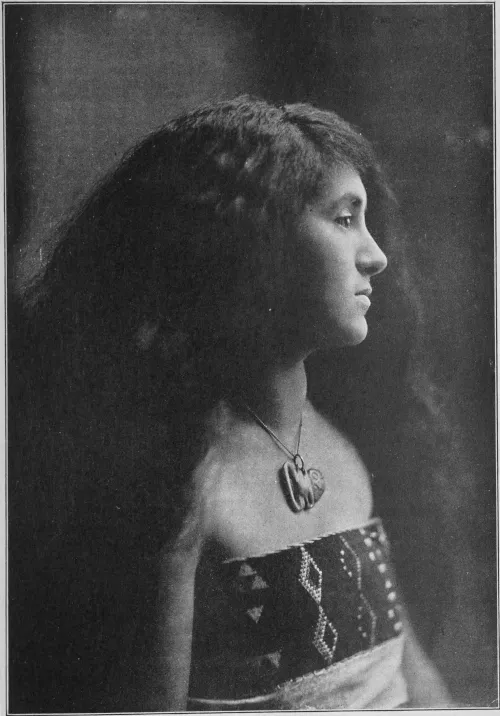
The Maoris do not make good servants but prefer to lead their own
easy-going lives. This belle’s robe is handwoven from New Zealand flax.
She wears also the greenstone charm without which no native woman is
fully dressed.
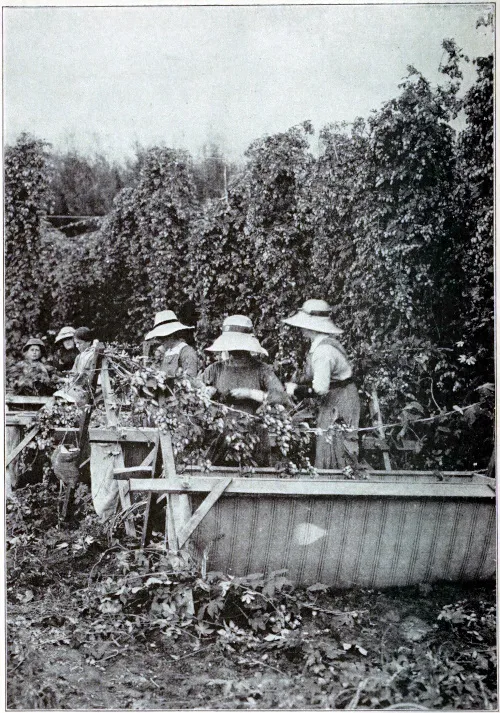
The town of Nelson has the reputation of having “the prettiest girls
in the country,” and “seven women to one man.” Some of its surplus
women find work in the hop fields.
The women working in factories are not so well organized
as the men, and even where they do the same work they
do not, as a rule, get as much pay. Most of the women in
the manufacturing industries are in the clothing, hat-making,
tailoring, printing, and shoe-making trades.
In New Zealand there is no real servant class, such as our
immigrant girls from Europe. The native Maoris do not
make good house workers and most of the Chinese are in
business for themselves, running laundries, fruit shops,
and market gardens, though some of them are employed
as cooks. The people who first came here from the British
Isles were not of the lower classes. New Zealand was
never a penal colony and men came voluntarily, seeking
better opportunities than those they had found in the old
country. Some came for their health, some followed the
gold rush in the middle of the last century, and some were
remittance men, members of the finest of the old British
families. Moreover, many of the settlers acquired lands
of their own, and the children of independent landholders
do not care to go out as domestic servants. Therefore,
domestic workers are scarce, and in the average New
Zealand household the whole family shares in the work of
the home. Every child has his duties, and, I may add, is
generally paid for performing them. Nearly every ten-year-old
has a savings account which grows with the money
earned at home.
In the country it is almost impossible to get servants,
and in the towns the young women prefer to work in the
factories, notwithstanding the fact that when the matter
of board is taken into consideration, wages there are
often less than those of house servants.
When a family does secure a servant girl she frequently
rules the household, besides fixing her own wages and hours
off. She usually demands one half holiday every week,
every Sunday afternoon, and the whole day free every
other Sunday.
The New Zealand government has not overlooked the
servant girl. The working man’s premier, Sir Richard
Seddon, found that the employment agencies were
cheating young women who came to them to get work,
and that they often sent girls to improper places. So
he started free public employment offices for domestic
workers, which are still carried on.
In the report of a woman supervisor of these offices I
find some interesting comments on how servants should be
treated to make them efficient. She advises mothers to
make domestic duties more attractive to their daughters,
and to work with and teach them. To mistresses she
says:
“A mistress who has but one servant should work with
her during the morning hours. Under such circumstances
a girl will become very proficient, and the domestic machinery
will move along on oiled bearings. The mistress
who does nothing to help her servant and is always hurrying
her wears the girl out. It is she who brings domestic
service into bad repute, and she who is driving the girls into
the factories.
“Servants are becoming scarcer every year. Even the
old women who used to be a trouble to the office have found
employment, nearly all of them in the country. Some girls
engage places and then do not go to them. Perhaps they
find something better in the meantime and break their
engagements. I would suggest that the government provide
fines for such offences, as they cause great inconvenience.
If an employer fails to take a girl after engaging
her, the servant is entitled to a week’s pay, so it seems only
fair that a girl be penalized if she fails to report when she
has accepted a place.”
Just here I want to say a word about the pretty girls
of New Zealand. These islands are full of them. The
climate gives them the rosiest of cheeks, and they look
much like the women of England, Scotland, and Ireland.
In manners and dress they will compare favourably with
those of the United States or Europe. They read the
papers and are able to discuss the political issues of the
hour with each other and with the men.
The women here do not go in for club life quite as much
as do our women in the States. I think one reason for
that is the fact that the population is more scattered
through the country on farms than gathered together in
towns. Another reason may be the fact that the New
Zealanders take a great interest in games, and the girls
and boys and men and women join in tennis, golf, swimming,
and other outdoor sports.
CHAPTER XXVIII
A COUNTRY WITHOUT A POORHOUSE
HOW would you like to be sure of a pension from
Uncle Sam in your old age? How would you
like to know that if your income after sixty-five
years of age was less than three hundred and
ninety dollars a year, you would get from the government
at Washington at least enough money to keep you
alive?
That is the situation here in New Zealand. Every
citizen is assured that if old age finds him without sufficient
money to live on, the government will provide up to a
maximum sum of one hundred and ninety-five dollars a
year. To widows with children larger pensions are paid.
New Zealand has had an old-age pension law for more
than a quarter of a century, and everyone now seems to
think it is a fine thing. Certainly there are no poorhouses
here, as we know them, and the old-woman beggar is conspicuously
absent.
According to New Zealanders, their country was the
first in the world to pass a non-contributory old-age pension
law. In fact, I find New Zealand claims to hold twelve
“Firsts” in social legislation. After listening to the
enthusiastic talk of the people, I have been surprised at
what their country, situated in what we think of as the
most remote corner of the globe, has to show. According
to my notes, New Zealand was the first country to:
Provide non-contributory old-age pensions;
Introduce conciliation and arbitration of industrial
disputes;
Establish universal penny postage;
Start government grading of butter, cheese, and hemp
for export;
Go into the state insurance business;
Set up state maternity homes;
Open a government tourist department;
Give women parliamentary suffrage;
Operate state coal mines;
Organize a state department of public health;
Enact minimum wage laws for women and minors;
Build houses and sell them to workmen.
All these “firsts,” and the fact that she has the lowest
death rate in the world, back up New Zealand’s claim of
being the “Newest England” and a “Brighter Britain.”
The old-age pension law was one of the many acts for the
benefit of the common people put through by Seddon during
his long term as premier. He introduced the bill and
fought it through to passage in the face of considerable
opposition. He took the position that pensions from
the state were not a matter of kindness or charity to those
past the ability to work, but only their rightful due.
The law is so worded that pensioners need feel no
humiliation in accepting state funds. Its introduction
states that:
“It is just and right that every person who has for a
number of years assisted by his (or her) work in the development
of the country, and has also by payment of taxes
contributed to its good government, should be protected
against want in his (or her) old age.”
The law provides that the pensioner must have been a
resident of New Zealand for twenty-five years prior to his
application; that he must not during that time have been
imprisoned for five years for any offence, and that he must
not during the twelve years preceding his application have
been in jail four months or on four occasions for an offence
punishable by one year’s imprisonment. The applicant
must not during the past twelve years have deserted his
wife and children and must have lived a sober and reputable
life in the year preceding his application. All applications
are made at the post offices, where such as pass
the examinations are given certificates, each entitling its
owner to a pension for one year. The certificates have to
be renewed every year.
Since the first pension law was enacted, the amount of
the annual allowance has been several times increased.
Already the government has paid out more than forty-five
million dollars in doles to the aged, and there are, I am
told, about twenty thousand people now receiving these
pensions. This is considerably more than one pensioner
to every hundred persons in the country.
If the United States had a similar law, with the same
proportion of pensioners, we should have 7000 of them
in Washington, almost 90,000 in New York, 40,000 in
Chicago, 28,000 in Philadelphia, and a thousand or more in
each of a score of other cities. In the whole country we
should have a million and a half pensioners, and if each
received $180 a year, the amount of the average pension in
New Zealand, the total distribution of money among our
old people would amount to more than $288,000,000. As
a matter of fact, this sum would be only about $30,000,000
more than our government now pays out each year in
pensions for old soldiers and their dependents, not including
the payments to veterans of the World War.
One of Wellington’s big buildings is the government
life-insurance office. Here you may find out just how
much the body politic is willing to bet on the chances
of life and death of its people. The government has been
in the life-insurance business for fifty years, but it
has never forbidden the private companies to operate,
and competes with them right along. Indeed, it is said
that the latter are getting most of the new business because
they put more life and energy into selling insurance
than the state institution does. The government life insurance
company uses the postmasters as its agents, and
thus has offices at every crossroads. It requires as strict a
physical examination as any private company, but its rates
are low and the insured feel certain of their money. There
are now some sixty thousand state policies in force representing
an insurance of about eighty-five million dollars.
The state insurance business is managed like our private
life-insurance companies and upon similar calculations of
the chances of life and death. It sells some policies on the
paid-up system and has also a savings-fund plan. Special
rates are granted to those who abstain from intoxicating
liquors, and another form of policy provides annuities for
government clerks after they are sixty years of age.
Fire and accident policies are also written in competition
with the commercial companies.
One reason the government went into the business was
the fact that the companies operating in New Zealand at
that time were charging rates as high as those in the
United States, England, and other countries, where the
“expectancy of life” is not so great as it is here. The
New Zealanders are wonderfully healthy. They live, on
the average, eight years longer than we do. It may be
that their lives are lengthened by the amount of protection
and security they have from their various government
enterprises. Moreover, the country is not over-populated,
there is no competition with coloured or cheap foreign
labour, a living wage is guaranteed to all, farms may still
be had on comparatively easy terms, there is little poverty
throughout the Dominion, and the general level of comfort
is high. The average wealth for all persons over twenty
years of age has been estimated at four thousand dollars,
and that notwithstanding the fact that there are few
millionaires in New Zealand and not many persons who
are rich according to our standards.
The per-capita deposits in New Zealand banks are steadily
increasing, showing that the country is accumulating
wealth. In 1890 the average was just under one hundred
dollars for every one of the population; twenty years later
it had risen to a little more than one hundred and twenty-five,
and the latest figure is two hundred dollars. The
present assets of the six principal banks total more than
three hundred and forty millions of dollars, and their liabilities
come to less than three hundred millions.
The postal savings banks are banks of deposit, paying
interest of from 3¼ to 4 per cent. on all accounts. At
present the deposits approximate a total of $220,000,000
held by about 680,000 depositors. This equals one savings
account to every 1.8 persons of the population. Deposits
as low as one shilling, or twenty-five cents are taken, but no
interest is paid on any sum below $5 or above $25,000.
On sums up to $2500 the rate is 4 per cent.; on larger
amounts it is 3¼ per cent.
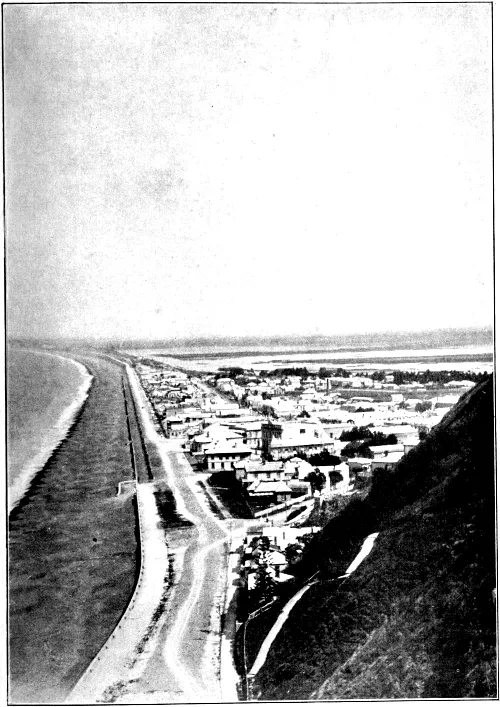
On the beautiful curved shore of Hawke Bay, protected from the ocean
by a breakwater, is Napier, the chief shipping point of a large meat- and
wool-producing district.
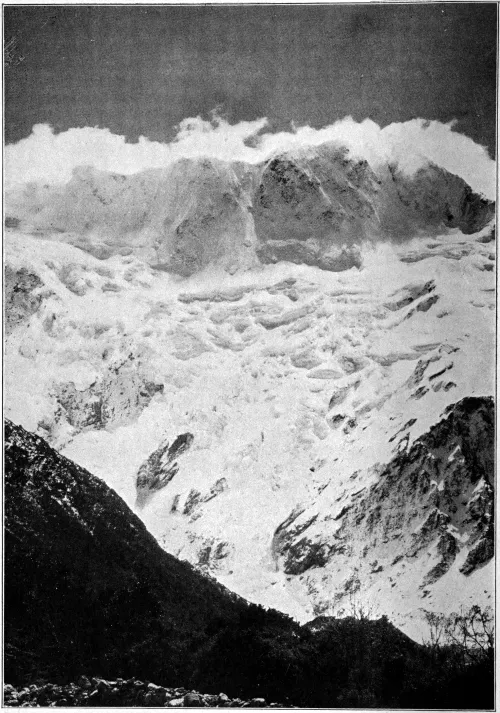
In the Mt. Cook Range of the Southern Alps are ten peaks more than
ten thousand feet high. The great Tasman Glacier provides thrills for the
most expert mountain climber.
New Zealand has its building and loan associations,
though not to the same extent as the United States. The
farmers have also organized all sorts of coöperative associations.
The stock of the New Zealand Loan and Mercantile
Company, a big firm which buys up produce and ships
it abroad, is owned chiefly by the New Zealand growers
from whom it buys. I have visited a big store, the stock
of which is held by its customers. It has a large capital,
and its manager told me that it paid ten per cent. dividends.
It is much like one of our department stores, with the
prices marked on all articles offered for sale. Many of
the meat-freezing establishments are managed by stock
companies, in which the sheep and cattle owners are interested,
and most of them pay good dividends.
There is a National Provident Fund, which any one between
the ages of sixteen and fifty may join, provided that his
income during the three years prior to joining has not been
more than fifteen hundred dollars. No medical examination
is required. A contributor to the Fund is protected
in case of incapacity to work, his children and widow receive
an allowance upon his death, and on reaching the
age of sixty he receives for the rest of his life a pension of
from two dollars and a half to ten dollars a week, according
to the scale of his contributions. Married women contributing
to the Fund get a bonus of thirty dollars on the
birth of each child. The applicant joins by filling in a
form at a postal money-order office or local office of the
Fund and paying his first weekly contribution. Although
the Fund is only about ten years old, it has nearly twenty-two
thousand contributors.
Another institution in which New Zealand takes especial
pride is the office of the Public Trust, the first institution
of its kind in the world. Through this the government
acts after the fashion of our commercial trust companies.
A public trustee is appointed for the whole country and he
has under him a staff of lawyers of high reputation. Suppose
a man dies intestate; the Public Trust administers his
estate. If you want to make your will, the Public Trust
will draw it for you and you may make the Trust your
executor. Suppose you have been acting as trustee to an
estate and wish to lay aside your responsibility; the Public
Trust will take it over. If an insane person has no guardian,
the Public Trust will look after his affairs. Unless
expressly directed otherwise, all money coming into the
office goes into a common fund. This is invested by the
public trustee in first-class securities for the benefit of the
estates in his charge.
The Public Trust now handles estates and funds to the
value of more than one hundred and twenty-five million
dollars, and the amount is growing every year. More than
thirty thousand wills are on deposit in the office, an evidence
of the increasing public confidence in the institution.
Although it was established to give the people service at
low rates and not to make money, and though its fees
are never above three per cent. the office has been so well
managed that it not only pays for itself, but yields a profit
of more than fifty thousand dollars a year. While it is a
government institution, the Public Trust provides its own
buildings and pays taxes and postage just as if it were a
commercial enterprise. Its employees are under the civil
service and hold office during good behaviour.
Practically every New Zealand post office is a telegraph
office, a telephone office, a savings bank, a government life-insurance
and pension agency, and a money-order office,
so you see postman and postmaster have plenty to do.
There are now government telephones almost everywhere,
although they are not so numerous in proportion to the
population as they are in the United States. Telephones
are still considered somewhat in the class of luxuries. In
the hotels, for example, one rarely sees a telephone in
every room, but there will be an instrument in the hall on
each floor.
But there is another side to the picture of New Zealand’s
government activities. A man is worth not what
he makes, but what he has left when his debts are paid. It
is the same with a nation, and New Zealand has rapidly
rolled up a huge public debt. At the end of the century
it owed about two hundred and twenty million dollars, or
more than three hundred dollars per head, or fifteen hundred
dollars per family of five. This debt kept on growing,
and then was more than doubled by expenditures in the
World War, which were a tremendous burden to a small
country like New Zealand.
Suppose the same conditions to prevail in the United
States with its one hundred and five million inhabitants.
Instead of the twenty-two billions we now owe, we should
owe more than eighty-seven billion dollars, or almost exactly
four times the sum that we and our children, and our
children’s children for generations to come, must be heavily
taxed to pay.
On the other hand, it must be remembered that nearly
half the total debt of New Zealand is invested in railroads,
telephones, telegraphs, hydro-electric systems, farm land,
and loans to settlers. These investments pay interest, and
are represented by assets of much greater value than the
amount of borrowed money spent upon them.
CHAPTER XXIX
WHERE THE WORKING MAN RULES
I HAD lost myself in Auckland. I had been visiting
our American consul in one of the suburbs under
the shadow of Mount Eden and had started back on
foot when I met a rosy-cheeked, bright-eyed, healthy-looking
young man and asked him to direct me to my
hotel.
“I am going that way,” said he, “and if you will walk
with me I will show you.” So we went along together.
“How are times here?” said I.
“Very good,” was the reply. “We all have plenty of
work and we get enough to keep us from starving.”
“What is your business?” I asked.
“I am a carpenter. I have a job building workmen’s
houses for the government, and I get sixteen shillings and
tenpence ($3.75) a day.”
“What hours do you work?”
“Oh!” with a laugh, “my hours are not bad. I work
only forty-four hours a week and have a half holiday
Saturdays.”
“But how about wages on Saturday?”
“The wages are just the same as for the other days. I
suppose I should say I get one hundred and one shillings
per week instead of fifteen shillings and tenpence a
day.”
This conversation gives you some idea of work and
wages in New Zealand. Though there is some variation
among the different industries, forty-four hours is the usual
working week of the labouring man, and every one has his
weekly half holiday. For any work beyond the standard
number of hours in a day or week the men usually get
paid time and a half or even double time.
My carpenter friend is typical of the New Zealand
worker, who is a well-paid, well-housed, and well-fed individual.
I noticed in Wellington, as here in Auckland, a
general air of well-being and prosperity. The people are
polite and friendly and do not seem inclined to take things
in too much of a hurry. They are proud of their town, as
I think they have a right to be.
Auckland is the largest city in the Dominion and is
about the size of New Haven, Connecticut. Its spacious
inner harbour, which has five and a half miles of smooth
deep water, is thirty miles from the open sea. There are
nine wharves, swarming with business, but they are not
sufficient for the fast-growing port, one of the trade centres
of the South Pacific. The annual imports and exports
come to more than a hundred million dollars and the
figure is growing rapidly.
The city is built up and down hill. Even Queen Street,
the chief retail business thoroughfare, is not entirely level.
All the tram cars start from the foot of this street, serving
not only Auckland itself but suburban towns within a
radius of eight miles. The lines are owned by the city,
and every one is divided into fare zones of two cents each.
Taxicabs are very expensive here, for New Zealand has to
pay around a dollar a gallon for gasoline, which is imported
from the United States.
Here, as elsewhere in the Dominion, the working men are
the lords and their unions have dictated many of the laws.
The famous conciliation and arbitration acts not only
recognize unions of workers and unions of employers, but
encourage their organization. It is provided that a workmen’s
union may be composed of fifteen members and
any such union may come under the law by registering itself
with the Department of Labour. Three or more employers
may form a union and register. The Conciliation
and Arbitration Act was supposed to provide for the peaceful
settlement of all disputes between employers and employed.
From 1894, when the first act was passed, until
1905, New Zealand had no strikes. Although this legislation
has not entirely prevented strikes in the last twenty
years, it has undoubtedly reduced their frequency and
severity.
New Zealand is divided into eight industrial districts,
each of which has its Council of Conciliation. If there is
a dispute, complaint may be made to a council by
either party. The council sends for persons and papers,
and after examination gives a judgment, which is filed as
an industrial agreement.
If either party to the dispute is not satisfied, however,
an appeal can be made from a council to the Court of
Arbitration of the Dominion. This consists of three members,
one of whom is a judge of the Supreme Court. One
of the others is nominated by the national association of
employers, and the third is named by the trades unions.
This court gives the case a rehearing, and its judgment is
final. It can fix wages and working hours, and it can impose
fines. It may assess damages upon the parties to
the suit, and all the property of the loser can be taken to
satisfy such claims. If the judgment is against a trades
union or an industrial association without property, the
individual members of the organization are liable.
The unions do not have to register, and a registered
union may, after due notice, withdraw its registration, but
so long as it is registered it must abide by the decisions of
the Court of Arbitration. Failing to do so, it may have
its charter taken away from it. The advantage of registration
to the unions is that only a registered union can
have an employer brought before either a council or the
Court.
Whether registered or not, the employer must appear.
An employer or worker bound by an award or an industrial
agreement who takes part in a strike or lockout in the industry
affected is subject to heavy fine. Unless fourteen
days’ notice has been given, a strike or lockout in a public
utility or an industry dealing in the necessities of life is
considered a statutory offence, even when the party in
fault is not bound by an award. A strike in the milk
business or on a railroad or street-car line would fall under
this provision.
I have before me the official reports of a number of industrial
cases. Here is one that came before the Council
of Conciliation in Dunedin at the instance of the Dunedin
Painters’ Union. The Council decided that the painters
should work from eight o’clock until five on five days of the
week, and from eight until twelve on Saturday, one hour
being allowed each day, except Saturday, for dinner. The
decision fixed the number of apprentices, and it provided
that employers should hire members of the union in preference
to non-union painters.
In the case of the Bakers’ Union of Christchurch the
Court of Arbitration decided that overtime must be paid at
the rate of time and a quarter for the first four hours and
at the rate of time and a half for every hour thereafter.
The decision limited each journeyman to but one apprentice,
and fixed the term of apprenticeship to four years.
It provided that no carter could be employed in a bakehouse,
but that a baker might send out his employees to
deliver bread, provided they were not required to work
overtime.
Decisions of the councils and the Court may establish
the rate of wages not only for the parties to the dispute,
but for others in the same industry, although local and
trade conditions are always taken into consideration. For
instance, if the Court fixes the wages of the bookbinders in
one district at so much a month the bookbinders in other
districts will at once demand the same and most likely get
it. Not all the cases are decided in favour of the unions,
however. In determining fair rates, the Court of Arbitration
has tried to find out the minimum on which a worker
can live in decent comfort and also what wages each employer
can give and still make a profit. Awards run for
three years, when a revision may be asked. At the expiration
of the first three-year period after the arbitration law
went into effect the unions entered the Court with new demands
for higher wages, but in many cases the increases
were denied.
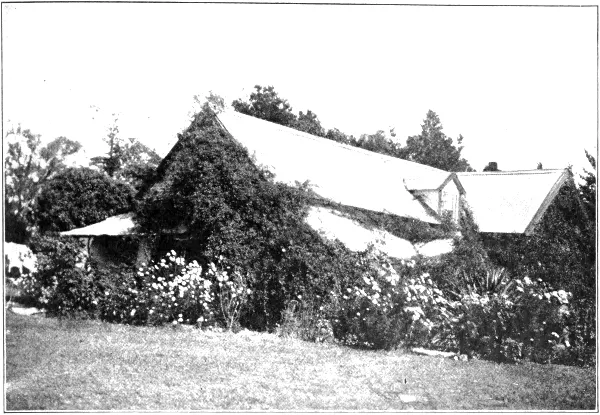
The Christmas holidays come in New Zealand’s summer, and roses and
sweet peas take the place of holly and mistletoe. Nevertheless, the people
stick to home customs and eat the plum puddings of the British season.
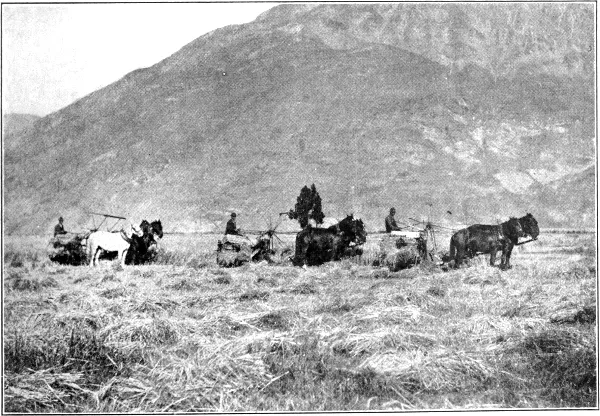
Most of the land requires expensive fertilizers to produce grain. Therefore
New Zealand raises wheat only for her own use and depends on sheep
and dairy products as money makers.
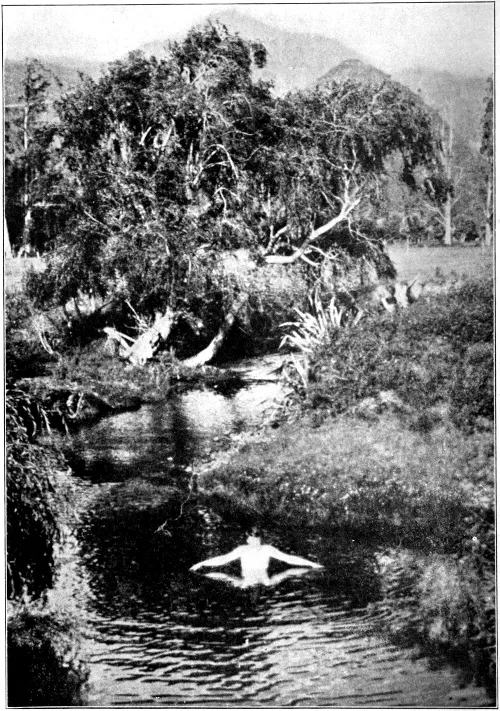
Put a New Zealander near water and he will get into it. Many
great swimmers have been developed, but accidents are so frequent that
drowning is sometimes called “the New Zealand death.”
To an American, the Dominion laws fixing hours and
wages and regulating relations between workmen and
employers seem radical, but the New Zealanders do not
think them so. They claim that as a people they are,
like their British ancestors, naturally conservative.
Their government, they say, has been compelled by force
of circumstances to go into all sorts of things, and reforms
have come about in a natural and orderly way. For example,
it was essential that farmers should get their produce
to market. There were no big capitalists ready to
finance railroad building, so means of transportation had
to be provided by the government. The insurance companies
did not adapt their rates to the conditions of the
country; so the government went into competition.
Twenty-odd years ago the New Zealand coal-mine operators
took advantage of a diminished coal importation from
Australia to put up prices for fuel. The government met
this situation by working the coal beds of the public lands
on the west coast. This it has continued to do, supplying
its own railways and competing in the open markets with
the private mine owners. The latter say they can stand
the competition quite well, since the government mines are
worked at a higher cost, not because of a difference in
wages, for wages are regulated by law, but because the
state miners take things easier and produce less. The
“government stroke” is a common expression here for the
way state employees do their work.
Again, take the story of how the Court of Arbitration
came to be. It was told me by one of the officials of the
Labour Department. Said he:
“The workingmen won their power in New Zealand
through a strike that failed. At that time the unions controlled
many branches of trade and they were fairly well
united. The Maritime Union, whose members handled
all the freight at the wharves, was an old organization,
with plenty of money in its treasury from assessments
throughout a long period of years. As the funds increased,
it was decided that all new members should pay
an initiation fee proportionate to the share each would
have in the assets of the treasury. There were but few
labouring men who could do this, and the number of new
members fell off. Although it could not handle all the
freight, the union would not permit non-union men to work.
The ship owners would not stand this. They took on
extra men and defied the union. The union men struck,
and through their relations with the other unions brought
about a general strike all over New Zealand. Their demands
were unreasonable, and the sympathy of the people
was with the non-unionists and the ship owners. Men
came in from Australia and elsewhere to help break the
strike. The feeling was so great that even clerks in the
stores asked for vacations, put on overalls, and worked for
a time as stevedores. The result was that the strikers
were badly beaten, and they knew it.
“Then they reconsidered the situation and decided that
their only chance for a fair show in the future was in electing
working men to Parliament. They began their campaign
at once, adopting the rule that every candidate
of their party must be a working man. They argued
the question of their rights in the shops, on the
streets, and on the stump. The people outside the labouring
classes became interested in the struggle. Public
sentiment changed. It was seen that there were two sides
to the question, and enough working men were elected
to Parliament to give the unions the balance of power.
Organized labour in New Zealand has never had a majority
in Parliament but it sent up enough of its own
men to be a powerful factor in shaping the laws of the
Dominion.”
After the end of that great strike one of the first questions
Parliament considered was how to avoid such conflicts
in the future. How could it best look after the
interests of the three parties to labour disputes—the employers,
the employees, and the public? The conciliation
councils and the Court of Arbitration for industrial disputes
were the answer the legislators found to their problem.
The workman’s grievance against the “company store”
and the “company house” does not exist in New Zealand,
where payment for labour in goods is illegal. In any action
for wages, any goods or articles furnished by the employer
or supplied on his premises cannot be brought forward
as an offset, nor can the employer sue his clerks for
things so bought. Workmen must be paid in money, and
at least once a month, if they so desire. In absence of
written agreements those engaged in manual labour must
be paid weekly, and if not so paid they can attach all money
due or thereafter to become due to the employer on the
work. The wages of those who receive less than ten dollars
per week cannot be touched for debt and where a man
goes bankrupt the unpaid wages of his clerks and workmen
for four months preceding are preferential claims on
the estate.
For many years the government built workmen’s houses,
which might be leased or purchased on the instalment
plan by wage-earners. In the serious shortage of houses
after the World War these operations were extended.
Parliament appropriated about five millions of dollars to
be lent to employers and corporations for building workmen’s
houses and apartments. The law allows borrowers
from the government’s fund to erect workers’ houses costing
up to thirty-four hundred dollars, and the money is
advanced on five-per-cent. interest. The workmen get
title to the houses by paying each week a little more than
the ordinary rental charge for such homes.
As in Australia, the weekly half holiday is compulsory
and the factory owner or merchant who keeps his place
open after the hour for closing is fined for doing so,
whether he requires his employees to work or not. I find
a record of a man in Foxton who kept two boys under
eighteen years of age at work on Saturday afternoon. He
was called up by the Court and heavily fined. Another
man employed a carter to work on a half holiday. He
paid five dollars and costs for so doing. It is the same with
all classes of clerks and it is the same in the factories.
The day for the weekly afternoon off is not specified by
law, but is usually fixed every January by the authorities.
In some towns it comes on Tuesday, in some Wednesday,
in some Thursday, and in many Saturday. Saturday is
the day usually chosen by the factories, even though the
stores in the same town may close on another day. If
Saturday is the day fixed there are certain classes of storekeepers
such as grocers, butchers, and market men, who
may choose another day for their weekly half holiday.
On half holidays the streets of Auckland and the other
towns in the Dominion are as deserted as on Sunday. The
hotels are usually open, but as far as I can see, there is
much less drinking at such times than one would expect,
and nothing like that on Saturday afternoons in the cities
of Scotland, or even in our own towns before prohibition.
Most of the people here go to the parks or out into the
country. There are cricket matches, golf tournaments,
and outdoor games of all kinds.
As a people, the New Zealanders are devoted to sports.
In football, the national winter sport, New Zealand has
held the world championship. Everyone, men and women,
boys and girls, seems to play games of one sort or another.
They go in for tennis, golf, hockey, polo, and all kinds of
water sports. Owing to the great numbers who swim in
the lakes, the rivers, and the surf, there are many fatalities
every year, and drowning is sometimes called the “New
Zealand death.”
Like the Australians, the New Zealanders love nothing
so well as gambling on horse races. But here the betting
is regulated by the government and one seldom hears talk
of crooked methods. Betting is done through a machine,
the invention of a New Zealander, called a totalisator.
Only those actually present at the track are allowed to
bet, so there are no poolrooms such as have caused so
much scandal in the United States, and there is no gambling
by telegraph or telephone. All but ten per cent.
of the money placed on each race is divided among the
winners. The tenth held out goes to the government
and the club that stages the event, the club taking three
fourths of the amount, and the government the rest.
At the meets the horses are all on view for at least half
an hour before each race. After a spectator has satisfied
himself as to how he wants to place his bets, he goes to
the betting machine, gives the number of the horse on
which he wishes to invest, and purchases tickets stamped
with that number. The lowest price for a betting slip is
two dollars and a half, but tickets at ten times that amount
may be had.
The totalisator, or the “tote,” as it is always called, is
a score board with slots in its face. Under each slot is
the number of a horse, and above each number is the
amount bet on him. Another window gives the total
amount put up on the race, and at the left is a board
showing the dividends that the winner will pay. The
“tote” pays only on the horses that win first and second
places. Two thirds of the money on each race, minus the
ten per cent. for the club and the government, is paid those
betting on the winner, and the other third is divided among
the backers of the second horse.
Seeing the throngs at the races, at football matches,
and on the beaches, one feels sure that in New Zealand
Jack will never be a dull boy on account of all work and
no play.
CHAPTER XXX
ON THE GOVERNMENT RAILWAYS
TAKE a seat beside me on the train from Auckland
to Rotorua, and see how one part of New Zealand
looks out-of-doors. We shoot from the city
out into a rich farming district. The fields are
green with luxuriant grass, or black where the soil is being
turned up for planting. Near Auckland the farms and
farmhouses are small. The pioneer cabins are not so big
as those in the newly cleared regions of the United States.
In many places there is a scarcity of lumber. The
average farmhouse is a wooden cottage of four, five, or
six rooms roofed with galvanized iron and there are no
barns, no stables, no outbuildings. The stock feed in the
fields all the year round, for the grass is always green, and
the winters are not severe.
We ride over plains covered with bush, a sort of thick
scrub growth not unlike dwarf cedars, and then follow for
miles the banks of the Waikato River, the largest in New
Zealand. Now we are in another farming section. Here
the holdings are larger. We cross a big farm where there
are droves of cattle and sheep. The sheep are feeding on
turnips, biting them out of the ground in which they are
growing. We pass through some rolling fields that look
like the blue-grass country of Kentucky and others that
remind one of the meadows of old England. Here and
there are groves of cabbage trees, each with its tall trunk
ending in a feather duster of green leaves.
As we proceed we come into a region of ferns. They
cover the hills, and in the valleys rise into trees shaped like
umbrellas. The whole earth is matted with them. The
tree ferns have stems as thick as a telegraph pole and
some rise fifteen feet without a branch.
Farther south we enter the highlands. We pass through
forests of tall trees wrapped around with vines, their
wide-spreading branches thick with leaves. Many of
them are loaded with flowering vines, which ornament the
living as well as the dead boughs, hanging down amid the
green leaves or wrapping themselves around the dead
limbs to make them green again.
As we go I examine the railroad. Like all in the Dominion,
it belongs to the government, and its officials are
civil-service employees. The conductor, who is called
the guard, comes through from time to time and punches
the tickets. This is a regular feature of New Zealand
travel. I hardly settle down after one punch before the
guard or an inspector comes and asks for my ticket once
more, and at the end of a long journey it is as full of holes
as a sieve.
The smaller stations serve also as post-offices. They
have signs showing that they are government savings
banks and government life-insurance offices as well.
At every stop a bell is rung half a minute before the train
starts, and every now and then there is a five-minute
halt that the passengers may get out and buy a cup of
tea or a glass of whisky or beer at the hotels, which are
always found close by the larger stations. The whisky is
Scotch, and has a smoky, peaty taste. Tea is fourpence
a cup and everyone takes it with sugar and milk; it is
strong, but not bad. Coffee is not sold, for no one wants
it. The New Zealanders are great eaters of meat and
drinkers of tea. Nevertheless, they are generally of
the lean, athletic build. I suppose this is partly on account
of the exercise everyone gets in the out-of-door
sports.
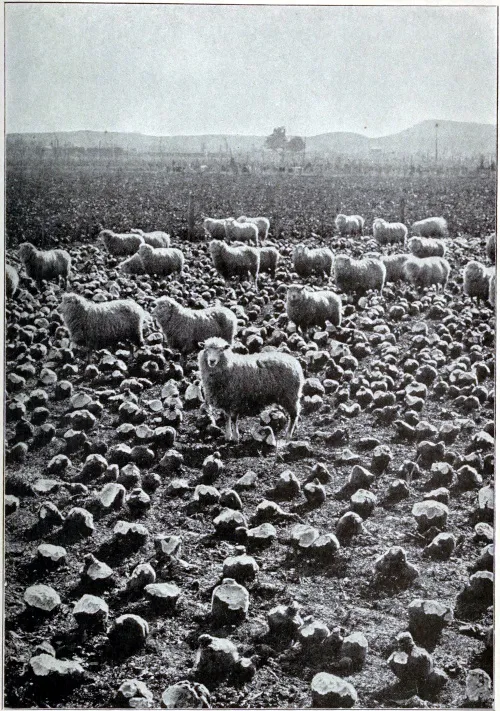
The railroad from Auckland to Rotorua passes through field after field
of turnips, where sheep bite the vegetables from the ground. New Zealanders
say that a good turnip country is a good sheep country.
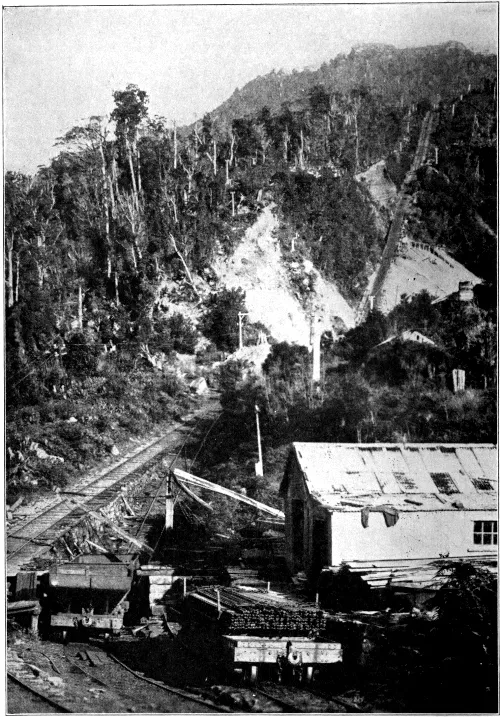
About the only privately owned railroad tracks in the Dominion are
light lines built to get out lumber and coal. They act as feeders to the
government system with which they are connected.
My chief complaint against these government railroads
is their poor heating arrangements. To-day the weather
is chilly and every passenger has a travelling blanket
wrapped around his feet. I have one of fox skin, and to
this I have added my rubber hot water bottle. I take it
from my bag and have it filled from time to time by the
girls at the station tea shops. One young woman is
amazed at my request. She wonders why I want the
hot water. At last a smile creeps from her lips to her
eyes. She says, “Oh, I understand. You want it for
the bai-by (baby).” “Yes, my dear,” I say, as I hand
her a shilling, “but I am the bai-by.”
One hears a good deal of the English cockney accent in
New Zealand. “A” is frequently like “i” or “y.” I
find that I have to translate what is said on the streets or in
other public places before I understand what it means.
This is the case in the stores. In buying the fox skin I
spoke of, I asked the department store clerk at Auckland
where the rugs were kept. He said:
“Go through that aisle and down by the lices.”
I could not think what he meant by “the lices,” and a
brief vision of crawling insects and frowzy hair came before
my eyes until on the other side of the store I saw some
white lace with carpets and rugs beyond and then I knew
the young man meant laces. As for the letter “h,” it is
worse mistreated in New Zealand than in London itself,
on when it should be off, and off when it should be on.
Still, these faults in pronunciation are not heard among
the better class New Zealanders. They pride themselves
on speaking pure English, and claim that they are
far superior to the Australians in their use of the mother
tongue. Of late, a decided movement has been started
in the schools and throughout the country for pure
English.
The gauge of the railway from Auckland to Rotorua
is only three feet six inches, which is the width of all the
three thousand miles of track in the two islands. In
1870, when the government took over the few short lines
then operated and began its railroad-construction programme,
it was faced with the problem of building through
a rough and mountainous country with as little expense
as possible. So the narrow gauge was adopted. Nevertheless,
the cost has been enormous. The total capital
invested in railways is now almost a quarter of a billion
dollars, or an average, including all equipment and buildings,
of upward of sixty thousand dollars per mile. Exceptionally
steep grades have had to be overcome. There
is a three-mile stretch on the line between Auckland and
Wellington where the trains climb up one foot in every
fifteen. This is said to be the steepest railroad grade in
the world. It is where the line passes over Rimutaka
Mountain. Two engines are used to make the ascent, and
the locomotives going down are equipped with steel shoes
which grip a centre rail and act as brakes. In places
there are windbreaks built to protect the trains from the
terrific blasts that sweep over the mountains. On two
occasions the cars have been blown from the tracks.
Other items in construction costs are the numerous
bridges and tunnels. There are many rivers fed by
heavy rainfalls, and at frequent intervals long spans of
steel and concrete are found. On the west coast of the
South Island is the Otira Tunnel, which runs for five
miles under mountains. The power used in the tunnel
is electricity. This road was built to bring coal from
the western fields to the eastern railroad connections.
The longest run in the Dominion is that from Wellington
to Auckland, a distance of but four hundred and
twenty-six miles. This is the only road in the country
on which sleeping cars are used. The New Zealand
sleeper, which is only fifty feet long, is by no means the
roomy affair to which we are accustomed in the States.
The car is divided into two- or four-berth compartments
reached by a narrow corridor extending along its whole
length. While my berth was being made up I had to stand
in the hallway with the other three occupants of my compartment.
Though our cars were small, and much of the journey
was over steep grades, the going was not nearly as bumpy
as one would suppose, for the engineers take pains to run
their trains smoothly and do not jerk and jostle the
passengers at every start and stop as is often the case in
the States. Practically all the engines and coaches used
on the Dominion railroads are now built in New Zealand,
either in the government railway shops or by a private
firm.
The New Zealand government believes that the railroads
exist for the people, and is managing them in their
interests and for the development of the country. It
does not try to make a large profit, being entirely satisfied
with a return of from three to four per cent. per
annum. In the past, surplus revenues have been returned
to the taxpayers in the shape of reduced freight rates and
passenger fares, but in the years of depression after the
World War the lines earned less than three per cent.
The regular passenger rate is two cents a mile. Young
people under twenty-one who are learning a trade or
business and must go to work by rail are allowed reduced
fares. All students may travel on cut rates, and in districts
where there are no schools the railroads take children
to and from those that are nearest free of charge. This
is true whether they are going to private or to public
schools. The government considers this service worth
what it costs because it promotes popular education. Now
and then special trains are run to take the school children
out over the country for practical lessons in geography.
The charge for such excursions just about covers the cost
of running the extra trains, and any school can have an
instructive trip of this kind upon the request of the
teacher in charge.
One New Zealander with whom I talked said:
“It is our idea that the railroads are the servants of the
people. We want to bring every farmer’s produce to the
markets at the lowest cost, and to make it possible for our
people to compete with those of other lands in the markets
of the world. If we can build railroads so that the man
one hundred miles from the seaboard can get his produce
aboard ship at the same cost as the man who lives only
ten miles away, the first man’s land becomes as valuable
as that of the land-holder near the coast. Then we get
more taxes out of him and he becomes a more prosperous
member of the community. We are now devoting the
roads largely to opening up new country, and are pushing
them out into the public lands.”
“I notice that you have more than fifteen thousand
government railway employees,” said I. “Is not the
service on the railroads seriously affected by the fact
that the government runs them? Do not the clerks and
the trainmen vote to keep in power the politicians who
promise them the most in the way of raising their wages
or enabling them to hold their jobs?”
“I don’t think there has been any attempt to do anything
of that kind, and I doubt if it could succeed,” was
the reply. “Our civil-service rules are rigid and we maintain
them. There are special boards to which railroad
employees may bring their grievances. Furthermore,
when a new party comes in, there is no wholesale overturning
of the government service such as, I understand, used
to prevail in your country. Only the elected officials are
changed. Promotion in government service is by seniority,
and few men, if any, get their jobs through political pull.”
CHAPTER XXXI
THE YELLOWSTONE OF NEW ZEALAND
MARK TWAIN said Pittsburgh looked like “Hell
with the lid off.” I have come to a part of
New Zealand that looks like “Hell with the
lid on,” save that there are a thousand and
one holes in the cover, from which all sorts of poisonous
gases, malodorous smells, boiling springs, and other infernal
manifestations are pouring forth. I am in the
Yellowstone Park of New Zealand, a land of volcanoes,
geysers, earthquakes, and lakes of boiling mud, a land
in which old Mother Earth seems afflicted with perpetual
colic and is ever vomiting forth hot paint, or belching out
steam full of alum.
This region is situated near the centre of the North
Island, one hundred and seventy-one miles southeast of
Auckland. It is about thirty miles wide and one hundred
miles long, covering almost two million acres. The crust
upon it is so thin that in walking or riding over it one
seems to hear a thousand devils grumbling and raging
below, and almost expects to crash through into Hades at
any moment.
Here the face of the earth changes from week to week.
Great cracks open, new boiling pools burst forth, and there
are frequent earthquakes. One spot is known as Earthquake
Flat, because it shivers and shakes regularly every
ten minutes. On top of a mountain in the geyser field
there is a great hole called the “Safety Valve of New Zealand,”
out of which constantly roars a column of steam.
Now and then a mountain breaks into eruption. Some of
the volcanoes are active, and no one knows when one of
those now dormant may spring into life, as Mount Tarawera
did in 1886. In that year, on the 10th of June,
several native villages were covered to a depth of sixty
feet by a deluge of mud. Both houses and inhabitants
were destroyed as were those of Pompeii and Herculaneum
by the eruption of Vesuvius centuries ago. The bottom of
a big lake was blown out and in its place came a roaring
crater, which sent up a column of steam to a height of
almost three miles. The earth broke open. There was
one crack nine miles long. New lakes were formed, clouds
of ashes and dust turned noon to night, and throughout the
region there was a downpour of water, mud, and stones.
The noise of the explosion was heard five hundred miles
away.
The eruption destroyed the famous pink terraces of the
New Zealand Yellowstone. The terraces were in the form
of basins made by the sediment from the mineral waters of
a geyser one hundred feet above the lake. They were
filled with the clearest of boiling water, blue at the topmost
terrace, and changing in colour to a lighter hue as it fell
from basin to basin. The walls of the terraces seemed to
be made of jewels, some pink, others white. The water
played over them in tiny cascades, and when the sun shone
the hillsides were alive with showers of diamonds, pearls,
emeralds, and rubies. Since the great eruption, terraces
have not formed again, as it was hoped they would, though
small and imperfect basins of similar structure are occasionally
seen to-day.
In my journey here from Auckland, the train climbed
to an elevation of about one thousand feet above the sea.
As we entered the volcanic region the earth seemed hollow,
and it rumbled and grumbled as the cars went over it. I
saw steam coming forth from the cracks here and there
and wondered if the crust might not break and drop us
into the bubbling, boiling, steaming mass that evidently
lay below.
We passed the village of Koutu, which is almost hidden
in columns of steam pouring forth from the ground, and
skirted the shores of Lake Rotorua to the town of Rotorua
itself. Rotorua is the most famous health resort of the
South Seas. The country about it is clouded with vapour
from pools of boiling water, each of which has medicinal
properties. There are hotels and cottages and all the
surroundings of similar resorts in the United States or Europe.
The government has charge of the springs and fixes
the rates for baths and accommodations, thus preserving
the use of the place for the people at reasonable cost.
There are public gardens in which are the great bath
houses and other buildings. On the grassy lawns tourists
and health seekers may bowl and play tennis and croquet.
There are long borders of beautiful flowers. The town is
laid out in broad streets shaded by oaks, pines, and gums,
through which the blue waters of Lake Rotorua may be
seen sparkling in the sunlight. It is no wonder that tens
of thousands of visitors come every year to this spot.
Many of the baths have curious names. One, owing
to the beauty it gives the complexion, was years ago
named after the famous French actress, Madame Rachel.
Another is called the Priest Bath, another the Painkiller, a
third the Coffee Pot, and a fourth the Blue Bath. The
Lobster Bath is so hot that it turns one the colour of a
boiled lobster. The names sound queer at first, and when
I was told I could have a half hour at The Priest, I felt
like protesting I was not a Catholic, but a cast-iron
Presbyterian.
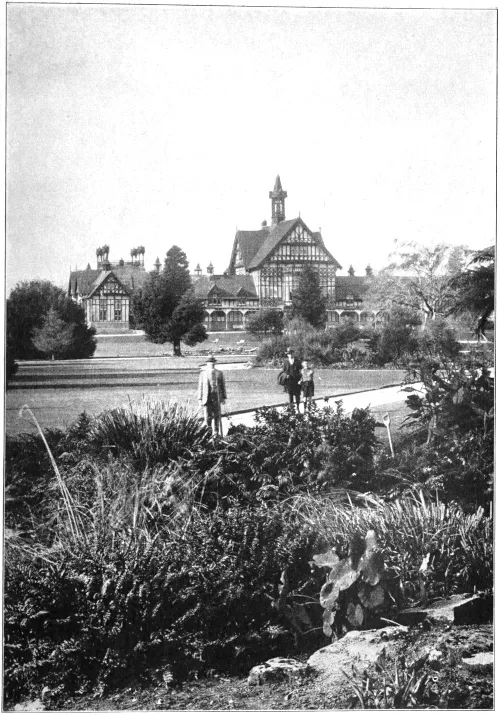
Rotorua, the Yellowstone of New Zealand, with its hot springs baths
and geysers, is the chief health resort of the Dominion. The hotels and
even the sanatoriums are controlled by the government.
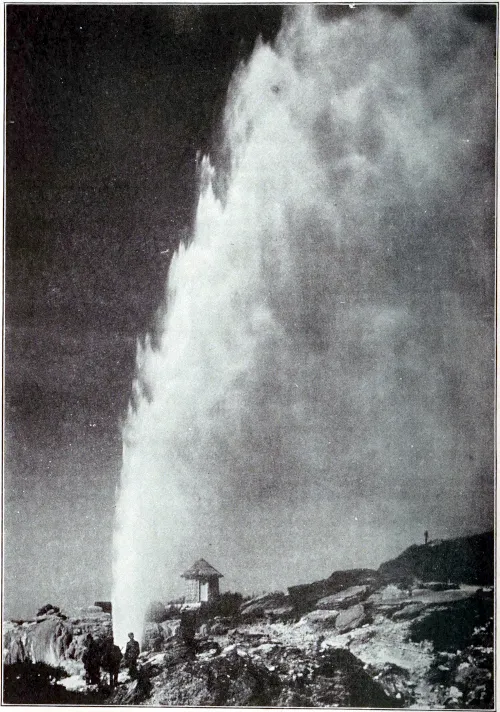
Wairoa never plays unless it is given a barrel of soap—then it usually
goes up in great style. But except on special occasions the government
does not permit it to be dosed, as this weakens a geyser.
Joking aside, the baths are wonderful. The Rachel is
a boiling cauldron of enormous depth with a flow of fifty
thousand gallons daily. The water evidently contains
much sulphuretted hydrogen, for a smell of bad eggs fills
the air all around it. The visitor is usually disgusted until
he steps into the pool. Then his skin seems to have turned
to satin, and he is as comfortable as though on beds of rose
leaves. The Coffee Pot pool is covered with an oily
slime and the water is thick, brown, and muddy, but it
gives great relief to any one suffering from rheumatism.
In the Spout Bath, the patient goes down into a sort of
cave, where the warm water pours on him from a spout
above. The boiling water from one of the springs is mixed
with waters of a cold lake to make the temperature endurable.
Others of the baths have such strong mineral
properties that one must be examined by a doctor before
he can enter them.
For my guide in visiting the geysers, I have one of the
Maoris, many of whom live in this region. I chose a woman
who spoke fair English to take me through the crackling,
steaming, rumbling, spurting region about me. She leads
me from one wonder to another. Here is a pool of boiling,
bubbling mud which now and then shoots a column high
into the air. That great round vat with the white walls
is made of the silica and other minerals thrown up by a
geyser called the Brain Pot. That vast pool in which
the yellow fluid seethes and boils is known as the Champagne
Pool; its contents fizz like so much champagne,
and the gases now and then throw the water up to a height
of six or eight feet. The walls are of different colours, here
white, there dark red, and there yellow with sulphur. We
go to see the Pohutu Geyser, which formerly twice a day
sent a majestic column of water high into the air for from
twenty minutes to three hours at a time. But today
Pohutu sulks and is entirely unreliable, though a way has
been found to make it perform on demand. When some
distinguished visitor comes along, the officials give the
geyser an emetic of several barrels of soap, and then it
plays up in great style. And that reminds me of the
Pack-horse Mud Geyser, so named because it was not
active until one day a pack horse fell into it. Before that
it was simply a quiet pool of mud containing sulphuric
acid.
One of the most remarkable of all the geysers of this
whole region was the Waimangu, which during the years of
its activity was undoubtedly the greatest wonder of the
kind in the world. It was not discovered until 1901 and
for five years after that it played almost every day. It
was fierce “play,” though, for, unlike the ordinary geyser,
the Waimangu flung up black mud and stones, as well as
scalding water, sometimes to the height of fifteen hundred
feet. Then suddenly, for no apparent reason, it stopped,
though it is believed that it may at any time break forth
again. Once two girls and a guide were caught in the
flood of scalding mud and were killed. Now one sees
there only a hollow of some two acres covered with black,
steaming water.
But come and take a trip with me into the mouth of
Hell itself. This is a region about twelve miles from
Rotorua. We sail across the lake, passing over what was
evidently once a volcanic crater, then take horses across
country to Tikitere. As we near it we see great columns
of steam rising into the air. We tie our horses and, staff
in hand, plunge into the vapour. We are in the midst of
acres of boiling springs separated by thin walls upon which
we walk, looking down into the terrible commotion below.
Here is a whirlpool. The water is as black as ink. It
boils and steams and bubbles and spits. It is hotter than
the “burning fiery furnace” into which King Nebuchadnezzar
cast Shadrach, Meshach, and Abednego. Watch
out, for if your foot slips you will be scalded to death.
Now we are on a great yellow mound looking into a
sulphur pool, the gases of which almost sicken us as we
stoop over. The pool is filled with boiling mud. The
steam is so thick we can hardly see through it. Be careful
where you step. A girl slipped into that vat the other day
and came out cooked.
Look at this hole! See how it churns up mud and oil.
It makes a noise like running machinery and the Maoris
have named it the Donkey Engine.
See the white stuff on which you are standing. It looks
like salt. You have passed out of the sulphur fields and
are now on hills of snow, which glisten in contrast with
the boiling mud about you. Pick up some of the snow or
salt and taste it. How it puckers your mouth! Your lips
and tongue wither as though you had bitten into a green
persimmon. The stuff is neither salt nor snow. It is
alum. There are bushels of it here, mixed with other
minerals, and in some parts of New Zealand there are
cliffs of alum and springs that flow alum water.
But let us take a look at the Inferno. We walk through
a stream over a thin crust of sulphur and gaze down into a
great vat twenty feet deep and so large that you could drop
a native house into it. It seems to be filled with boiling
paint, and as it seethes it now and then throws up a column
of mud. The odour is nauseating and we give our hands to
the guides and beg them to lead us away. We go out
through clouds of camphor steam from the Devil’s Punch
Bowl, and on into the open, where there are green hills,
blue sky, and the good earth of every day.
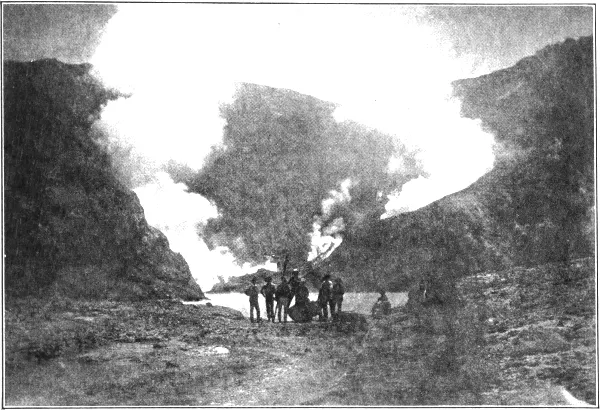
White Island is a roaring, steaming sulphur pit, and has a lake of hot,
acid water. The earth is treacherous and corrosive, and there is no sign
of life except the birds of the air.
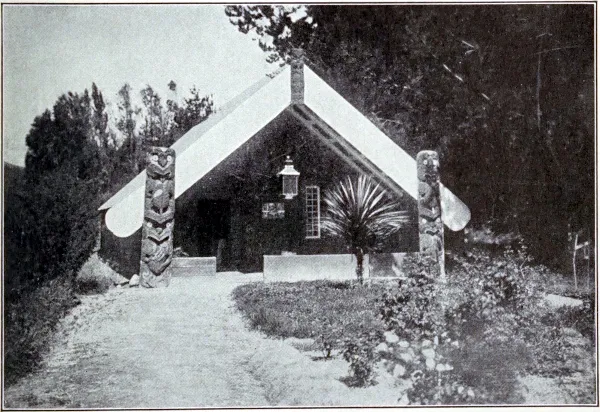
The government restaurant at Lake Taupo is designed after the typical
Maori house, with its wonderfully carved columns, walls, and rafters.
Such houses took years to build and were often fifty feet long.
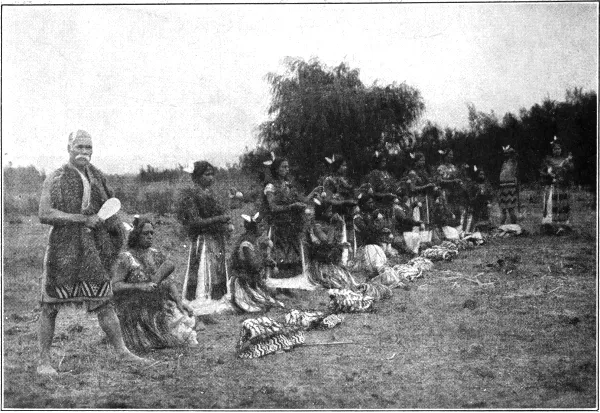
Much of the charm of the poi dance comes from the flash and play of
light fibre balls on short flax strings. The balls are swung in time to the
soft crooning of the Maori women as they dance.
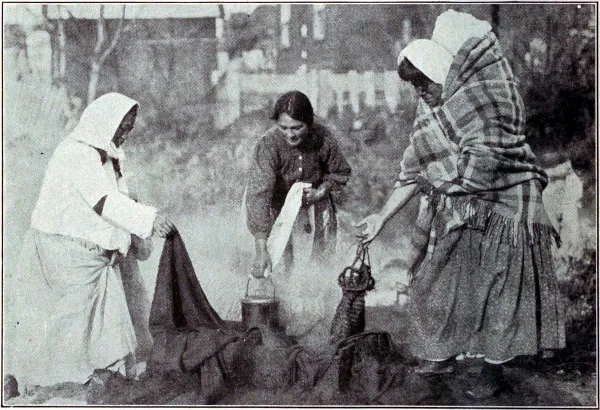
In the hot springs district Mother Nature helps the Maori housewife
by providing outdoor fireless cookers. Vessels of food are placed over
holes or in the hot pools—and that is all there is to it.
CHAPTER XXXII
THE MAORIS
THIS morning I stood and watched a crowd of
Maori girls and boys swimming together in one
of the steaming pools near my hotel at Rotorua.
The pool was about twenty feet square, and in it
were a dozen children as naked as the day they were born.
Steam rose from the water, and in the rays of the morning
sun the brown bodies shone through the mist. One
of the bathers was a girl of fourteen. She was pouring
water over herself with a bucket, when I threw a silver
sixpence into the pool. With all the rest she dived for it,
finally emerging with the coin in her mouth. As I walked
on to other pools I saw here and there the heads of men
and women floating, as it were, upon the water. They
were Maoris, but whether they were taking this method of
getting warm or merely having their morning baths I do
not know.
I have been into many of the Maori houses. They are a
sort of cross between an Indian hut and an English tenant
cottage. About Rotorua many of them are built directly
over the steaming earth, and have warm bathing pools
behind them. In this part of New Zealand old Mother
Earth is kind to her Maori daughters; she does their cooking
for them. They never have to make a fire or put the
kettle on. Each woman has a steam cooker of her own,
always at the right temperature. This cooker is usually
an old wooden box with the lid knocked out and slats
nailed on the bottom, sunk into the earth over a steam
hole. The food is dropped in, an old piece of carpet or
cloth is thrown over the top of the box, and in due time
the meal is cooked.
Cooking is done also in the boiling pools. Potatoes are
pared and put into bags made of a network of flax, each
holding a quarter or half peck. The bag is dropped into
the pool and tied with a string to a stake outside. In a
little while the potatoes are ready for eating. Meat may
be prepared the same way or it may be put into a bucket
and steamed. In fact, the Rotorua Maoris, who now celebrate
Christmas in British fashion, cook their plum puddings
in these petty volcanoes.
In some places all the villagers cook at one great vat, and
in others, such as Whakarewarewa, all do their washing in
the same hot pool, the water of which is soft and cleansing.
It is surprising how few Maoris one sees in travelling
through New Zealand. According to the last census there
are about fifty-two thousand of the aborigines living in the
Dominion, most of them on the North Island. The race
is more than holding its own, and has increased by about
ten thousand persons in the last thirty years. Most of
the Maoris are scattered over the country in villages
situated on lands reserved for them. They are represented
in Parliament by four members, and although subject to
the laws of New Zealand, they are governed largely through
their own chiefs. The better class dress in European
clothes, both men and women affecting bright colours.
No one knows where the Maoris came from, although a
number of scientists are convinced that they navigated to
the New Zealand islands from Hawaii. Others believe
that they originated in Tahiti or Tonga. They have light
brown complexions and high cheek bones and their noses
are more like those of the Anglo-Saxon than of the North
American Indian. The men are of magnificent physique,
being tall, broad-shouldered heavyweights, with strong
necks, big hands, and big feet. They excel in games, especially
in football and other contests where quickness of
eye and hand is essential. Nearly all of the men speak
English. They are orderly and well-behaved, and even
when drunk do not cause as much trouble as do our
Indians.
I rather like the Maori women. The older ones are not
especially good looking, but they seem well disposed and
pleasant. Some of the younger ones are beautiful and
many have rosy complexions. They have luxuriant dark
hair, heavy eyebrows, and liquid black eyes full of soul.
Some of them are clean and nearly all are intelligent.
Their beauty vanishes with years. Now and then one
sees an old native woman with her chin and lips tattooed,
after the ancient fashion. This was a sign of a wife’s submission
to her husband. The young women of to-day do
not thus mar their good looks.
The Maoris used to be experts in tattooing. In the past
both men and women decorated not only their faces but
most of their bodies in that way. Every great chief had
his face covered with ornamental spirals and designs picturing
his exploits in battle and was tattooed on the
thighs and hips in patterns that often extended from his
knees to his waist, giving him the appearance of having on
a pair of neat-fitting trunks.
The women were tattooed chiefly on the lips and chin,
with a sort of fish-hook curl at the corner of each eye.
Some of them had their thighs and breasts decorated.
The tattooing instrument was a small bone chisel, which
was driven in with a mallet. The pain was so great that
the work could be done only a little at a time, and a complete
job often took years.
When the British first came to New Zealand cannibalism
was quite general among the Maoris. The tribes warred
with one another, and after a battle there was always a
feast of human flesh, in which the women were not allowed
to join. The greatest insult one Maori could offer another
was to hint that the man’s father had been eaten; for this
was considered a family disgrace.
I have before me a paper that tells just how one of
these cannibal feasts was conducted. The corpse of one
of those killed in the fight was sacrificed to the god of war
and the rest of the dead were given over to the braves who
had taken part in the battle. The cooking ovens were dug
out of the earth and the human flesh was thrown in and
kept there for about twenty-four hours. When it was
roasted the chief had the first bite, then his sons, and then
the whole army. The eating was accompanied with singing
and dancing, and all gorged themselves to such an extent
that many died after the banquet. When the feast
was over the remains were packed up in baskets and sent
around to the neighbouring tribes. Any tribe that accepted
the offering was supposed to have made a treaty of
friendship with the senders and to be ready to fight with
them thereafter.
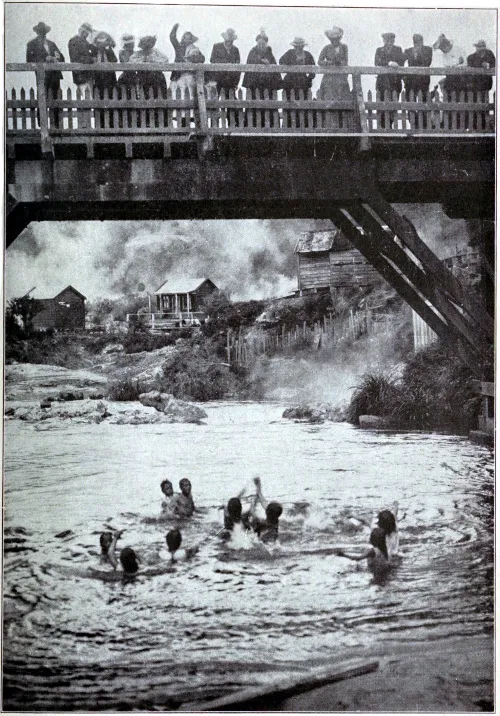
“This morning I stood and watched a crowd of Maori girls and boys
swimming together and diving for pennies in one of the steaming pools near
my hotel at Rotorua.”
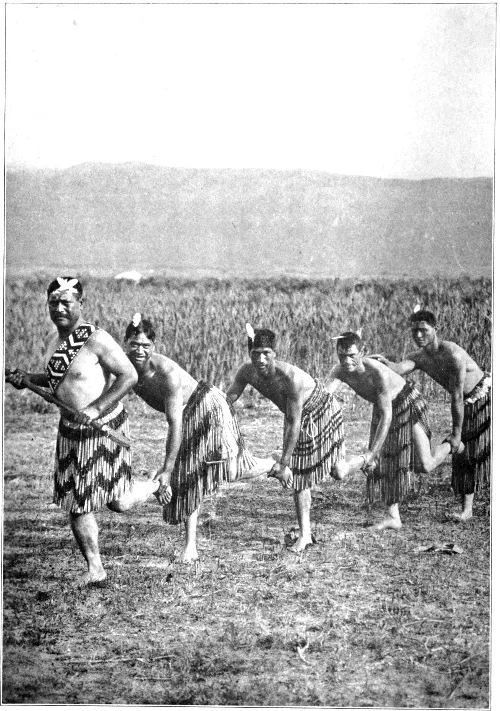
The Maori haka used to precede battles and was intended to work the
braves into a fury, for the fight. Nowadays the hakas are frequently
staged for the benefit of tourists.
In spite of their cannibalism, the Maoris were more advanced
in civilization than our American Indians. They
had a social organization of their own, the people of each
tribe being divided into classes consisting of priests, chiefs,
a middle class, and slaves. They were warlike and it is
doubtful whether the British could have gained a foothold
on the islands without great loss of life had it not been
for the dissensions among the various tribes.
Maori marriage customs were much like those of savages
in other parts of the world. Sometimes girls were carried
off by force, and then the friends of the groom and the
friends of the bride would fight each other. Both polygamy
and divorce were allowed and the chiefs usually had
several wives. The Maori gods were demons who were
feared rather than reverenced or worshipped.
The men were fishers and fighters, and the women
cooked the food, wove baskets, brought the firewood, and
made the clothing. The men were not hunters, for there
was no big game in the islands. They snared the wild
pigeons and other birds. When Captain Cook came along
in 1769 he left the natives the first pigs they had ever seen.
In the days of tribal warfare the natives often barricaded
themselves within an enclosure called a pa, the term now
used for their settlements. As day after day they pursued
their policy of “watchful waiting” for their enemies,
the men occupied themselves with wood carving, in which
they became most expert. To-day one sometimes sees the
doorways of their houses beautifully and accurately carved
as in the olden times. They had no patterns but made up
their designs as they went along.
The women used to make most elaborate and beautiful
feather cloaks, plaiting the soft, downy plumage of the
kiwi into woven flax. These cloaks were handed down
from mother to daughter. Few are made nowadays, but
they are sometimes worn on special occasions and in the
poi dances.
For the poi dance the girls are dressed in kiwi-feather
cloaks or in loose embroidered draperies of gay colours.
Their long, wavy dark hair is confined only by ribbons
about their foreheads. Usually their feet are bare.
The dance gets its name from the two small balls of flax
fibre with which each girl is provided. These are attached
to strings and, as the girls go through various movements,
representing such things as swimming, the flight of butterflies,
the soaring of birds, or the rowing of a canoe, the
poi balls are swung in perfect time. The music is a soft
crooning, which is delightful, as the Maoris all have beautiful
speaking and singing voices.
The men’s dance, the haka, is quite different. In olden
times this usually preceded a battle and was intended not
only to work the braves into a state of fury but also to put
them in good condition for the fight. It calls into play practically
every muscle of the body. It is always possible for
tourists to see some kind of a haka, but only on great
occasions, and for distinguished visitors, like the Prince
of Wales, for example, is it witnessed in its true glory.
Then Maoris, who in ordinary life may be doctors, lawyers,
grocers, and landlords, put patches of black paint on their
faces, array themselves in knee skirts of flax fibre, and
arm themselves with feather-tufted spears. With their
bodies bare to the waist and with bare feet and legs, they
leap and stamp, stick out their tongues, and make faces
such as the old natives believed would frighten their
enemies, give sharp barking shouts, slap their knees, and
swing their spears in perfect time to the music of a band.
In their primitive state the Maoris were, of course,
superstitious and traces of their ancient beliefs are still
to be found. For instance, near the native fort at Rotorua
is a kind of bird box set on top of a pole. This was a
spirit house, and when danger was near, the spirit who
lived in it was supposed to shout out a warning to the
people. Within the memory of old native women the
Maoris used to put food in the box for the spirit.
Like other South Sea Islanders the Maoris believed in
the tapu, by which certain things were forbidden. For
example, a chief, his family, and his belongings were
tapu. A chief who touched his own head must put
his fingers to his nose and snuff up the sacred contagion
from his head or else he would suffer the consequences
of tapu. One might make a tree tapu by giving
it a chop with an axe. Certain animals, places, and foods
were forbidden. There are cases on record where natives
in perfect health died in great agony after finding they
had made a mistake and eaten some food that was tapu.
Charms were worn to ward off evil. The most common
was a piece of green stone carved into a grotesque figure
with rolling eyes and tongue lolling out. This is the tiki,
or green charm, which is still often worn by the native
women on chains about their necks.
It gives one an idea of how recently the Maoris were
savages, feared by the pioneers, to hear the story of the
first white man born in the Wellington District, who
is still alive. He remembers how one night when he
was three or four years of age the Maoris came upon
the hut that his parents had set up in the bush.
The older people were obliged to run for their lives,
but the child was too heavy to carry and could not walk
well. If they tried to take him, all might be captured and
killed. So he was thrust far up the chimney and told
that whatever happened he must make no sound. There
he spent the rest of the night, without a cry, while the
Maoris searched the house and took away whatever struck
their fancies. In the morning, after the natives had left,
his parents returned and took him down from his perch,
half dead with fright and exhaustion.
Yet the grandchildren of those uncivilized Maoris are
to-day occupying important positions in the Dominion,
acting as members of Parliament and making good in
various professions. They had their own battalion in the
Anzac forces in the World War and were conspicuous for
bravery. Many of them married French girls. The cultured
Maori is received in any society. The outstanding
orator of New Zealand is Sir James Carroll, the son
of an Irishman and a full-blooded Maori woman. He
has served in the highest position his country can bestow,
for he has been acting Prime Minister of the Dominion.
In New Zealand, while intermarriage with the Maoris is
not exactly favoured, neither is it actually frowned upon,
and the number of half castes is increasing. Still, one
hears gossip about mixed marriages. There is the case
of a wealthy New Zealand girl who announced her intention
of marrying a native. Her mother was opposed
and took her daughter on a trip around the world. But
the girl returned and married her Maori. Her children
are rather dark, yet they go everywhere. Another case I
have heard of is that of an Englishman of good family who
married a native and took her to England. Their children
were educated on the Continent and did not realize
the status of their mother until their father died and she
returned with them to New Zealand. Then she went
back to her Maori relations. The oldest daughter was
engaged to an officer in the British army, but broke her
engagement when she found out about the roots of her
family tree.
The Maoris now own about five million acres of land
in the Dominion, by far the larger part of it in the North
Island. They are fairly good farmers, though inclined
to be indolent. Sometimes a native will sell some of his
land, take the cash, and live high while it lasts. The less
educated man who comes into money usually gets himself
a high-powered car and a loud checked suit; he buys his
wife an expensive fur coat and makes all the display
possible. The natives are protected by the government
through special land boards, which will not allow a Maori
to part with all his land.
CHAPTER XXXIII
MUTTON AND BUTTER FOR LONDON TABLES
NEW ZEALAND is one of the leading sheep
countries of the world, and Christchurch is its
mutton metropolis. It is a South Island city
of more than seventy thousand people, situated
near the sea on the Canterbury Plains, the breeding
ground of the sheep that have made New Zealand mutton
famous.
Though so small, the Dominion ranks sixth in the number
of its sheep. Thousands of carcasses are frozen in
this country every year and a fleet of steamers is always
moving over the oceans carrying delicious mutton chops
and roasts to the tables of England. The distance to
London via the Panama Canal is more than eleven
thousand miles. It is even farther by the Cape of Good
Hope or the Suez Canal, but nevertheless both the cost
of rearing the sheep and the freight charges are so low
that New Zealand mutton can be sold in London for less
than that raised in England itself.
Let me give you some idea of New Zealand’s sheep
industry. It is the one out of which the country makes
the most money, though dairying is now a close second.
There are in the Dominion about twenty-two million
sheep, or enough to give every man, woman, and child a
flock of eighteen. Although only one thirtieth the size of
the United States, New Zealand has nearly half as many
sheep as we have, and its wool production is proportionately
much greater than ours. It exports annually fifty-five
million dollars’ worth of frozen mutton, five million
dollars’ worth of tallow, and fifty-five million dollars’
worth of wool.
There are sheep farms everywhere. I have visited many
of them and have found them much better kept than similar
properties in the United States. They are divided
into large fields fenced with wire. This is primarily a
grazing country, and its future seems to be in sheep raising
and dairying. The New Zealand farmer does not have to
house his stock. The soil is fertile, and there is abundant
rainfall, so that he can produce meat at much less cost
than if he lived in a land of droughts, scanty grass, and
more severe winters. Sixteen million acres have been sown
in grasses and the greater part of the crops grown is fed
to sheep and cattle.
In Australia sheep are reared chiefly for their wool.
Here they are bred for their meat as well. The discovery
that Canterbury mutton could be frozen and shipped to
England where, because of its delicate flavour, it commanded
high prices, revolutionized farming in the Dominion.
Formerly sheep had been fed on wild grasses and
raised for their wool and tallow. When it was realized
that native mutton could be marketed abroad at a profit,
special studies were made of the kinds of food producing
the best meat and the grazing lands were intensively cultivated
for fodder. The absence of sour swamp grasses
and weeds in the pasturage of the country has been suggested
as a reason for the fine flavour of its mutton.
New Zealand mutton won its reputation as Canterbury
mutton, though by no means all of it was even then raised
on the Canterbury Plains. The South Island was, it is
true, the cradle of the industry, which now flourishes
over the whole of the Dominion, but there is said to be
no finer sheep country in the world than the limestone
downs of Hawke’s Bay on the North Island. Many of
the sheep stations are very large, for it has been found
that it is best to have only two or three animals to an
acre of pasture land, and some of the flocks number five
thousand, ten thousand, and even twenty thousand head.
The size of the average flock from year to year is about
one thousand.
The chief breeds of sheep are the Lincolns, the Leicesters,
the Corriedales, the Southdowns, and the Romneys.
The Lincolns thrive best on the wild lands and hills of the
North Island, the Romney Marsh on moist soil, and the
Merinos on the dry plains. The best mutton sheep are
cross-breds, which are known as freezers.
There is an old saying that you can’t get blood out of
turnips, but the New Zealanders do it by feeding them to
sheep. In fact, practically every good chop I eat here is
mostly turnips, and the people tell me that turnip-fed
sheep produce the best mutton. In buying a sheep farm
the first question asked is whether the land will raise
turnips, and if so the price is much higher than it would
be otherwise. Turnip fields are to be seen on every landscape,
of which they often form a striking feature. The
crop grows luxuriantly and forms a carpet of bright green.
Later on, when the sheep have had their first chance at it,
the green has all disappeared and in its place there is a
great bed of black soil covered with white balls in rows.
The field looks as though it had been ploughed and sown
with billiard balls. I have watched the sheep biting these
balls. They eat them out of the ground, digging away
until even the roots have disappeared. Sometimes the
farmers dig up the turnips and feed them to their flocks.
Alfalfa and mangel-wurzels, a coarse kind of beet, are
also grown for fattening sheep.
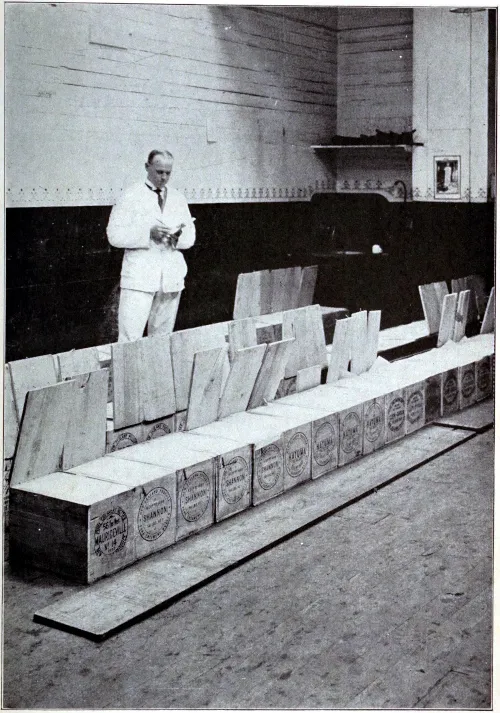
Most of New Zealand’s butter is sold abroad on the coöperative basis,
the farmers and the creameries dividing the profits. None can be exported
until it has been graded by a government expert.
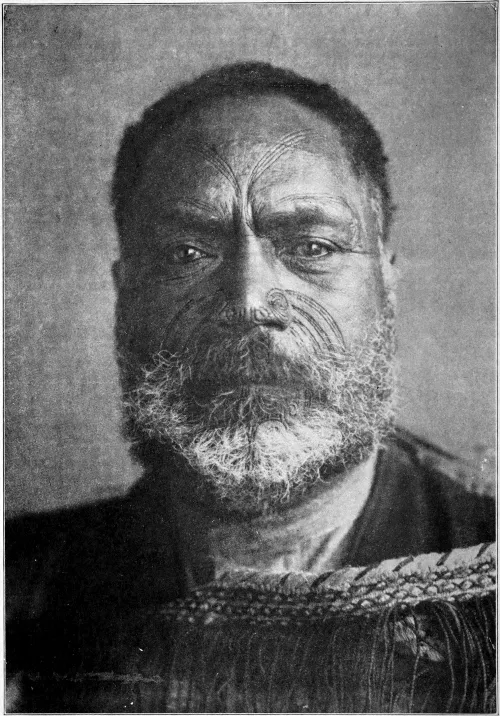
The tattooed chieftain has almost entirely disappeared, but in the past
the Maori men used to cover most of their faces and bodies with ornamental
spirals. The women were tattooed only on lips and chin.
On the larger estates the sheep are kept in enormous
fields, and a few hands suffice to care for a flock of thousands.
Like most of the workers of New Zealand, the
shepherds are unionized and their wages and hours have
been established throughout the industry. In some cases
their employers add to the regular wages by paying a
bonus at the close of the season. I met one man who told
me he gave each of his hands fifty dollars when the hardest
of the work was done.
The shearing, which usually begins in September and lasts
until January, is done by machinery. A gang of shearers
will work through a district with their machines, going from
farm to farm like wheat harvesters or a threshing crew in
the United States. Some of the farms have their own shearing
sheds, but often several sheep stations will own one
in common, to which all the flocks are driven. Occasionally
shearers come over from Australia, where the season
is earlier, but they are more often New Zealand men with
small farms of their own or some other occupation for the
rest of the year. They are organized, of course, and are
veritable autocrats, with the power of financial life or death
over the wool growers. If the farmers wait until late
summer for the clip, the fleeces get full of seeds from the
grasses on which the sheep feed, making “seedy wool,”
which brings poor prices. It does not pay the farmer to
quarrel with the shearers when the summer suns of January
are ripening the grass seeds.
The wool clips vary greatly according to the breeds of
sheep. The Merino fleeces range all the way from four to
seven pounds each, while the Leicesters will average ten
pounds and the Lincolns about eleven pounds. There
are sheep which produce from twenty to thirty pounds of
wool at a clip, but these are exceptional.
Though not so numerous as in Australia, rabbits are
among the pests of the New Zealand sheep districts. They
were introduced into the islands as pets and with the idea
also that they might furnish meat. They increased so
rapidly that they threatened to overrun the whole country
and eat up all its pasturage. Millions of dollars have
been spent in killing them or in fencing them out of the
sheep lands and the government distributes poisoned oats
from its various agricultural stations to help the farmers
destroy them. Trapping rabbits for their skins has become
an important industry, in which many men are engaged,
and this has tended to make them less of a menace
to the sheep runs. Exports of rabbit skins now bring in
between two and three million dollars annually. Most of
them go to Great Britain and the United States where the
fur is manufactured into felt hats. It takes the fur of
six rabbits to make a man’s hat. Considerable numbers of
frozen rabbits are also shipped from Dunedin to the
world’s markets.
But let us go to one of the refrigeration plants and see
just how mutton is prepared for London dinner tables.
New Zealand has fifty meat-freezing plants, and the
largest and oldest of all is here at Christchurch. It is
known as the Belfast Freezing Works and is a coöperative
institution, the sheep owners being the principal stockholders.
We take a car and ride out to the works, which are
within a few miles of Christchurch. The buildings consist
of great sheds surrounded by paddocks filled with sheep
ready for killing. Near by are drying yards, which at
first sight seem covered with snow, but as we get closer
we see that they are spotted with great piles of newly washed
wool. We are first taken to the sheep yards where we watch
the men drive the animals up a runway to the killing
station on the second floor. Several old sheep are used
day after day and year after year as the advance guard to
lead their brothers to slaughter. They start the procession,
and the thousands behind, sheep-like, follow them.
Often ten thousand sheep pass up that roadway in one
day.
The sheep are killed at the rate of ten every minute, and
it is only seven minutes from the time the live sheep is
seized until it is ready for freezing. There is a long string
of carcasses steadily flowing out of the killing station into
the cooling room and later on from there down to the
freezing chambers, where the temperature is eight degrees
above zero.
In three days the sheep are as hard as stone. Tap one
of the carcasses as we stand in a freezing room. It
resounds like a drum. Take one down and rest it on the
floor; it is so stiff that it stands alone. My fingers feel
frost-bitten as I take notes, and we are glad to get out.
After a look at the freezing machinery, which the manager
tells us came from America, we go to the other departments
of the works to see what is being done with the
by-products. In one place sheep tongues are being canned
to be shipped all over the world. The cooking is done in
great vats in which the water is kept boiling by steam
pipes. The white tongues bob up and down in the boiling
water and from time to time bare-armed men take some
out with pitchforks and put others in their places.
In another room we see workers rendering fat; in another
they are dressing the sheep heads, and in others they are
pulling wool from the skins and spreading it out to dry.
A curious department is that where the blood and bones
are made into fertilizer. The dried blood is roasted in a
great cylinder several hundred feet long. On the floor
I see a pile of blood as big as a small haystack. It smells
like ammonia, and my eyes water as I look.
This blood is very valuable for manure. For a long
time it went to waste in most of the slaughter houses and
freezing plants of New Zealand. Then some Americans
came down and made a contract for the product. The
New Zealanders soon saw that the foreigners were making
a good thing out of their blood money, and concluded
to take the profit themselves. When the time came for
the renewal of the contract they refused, and now, I am
told, this and the other by-products of the Christchurch
plant pay about all of the expenses of its operation.
As we walk through the works I ask the manager to tell
me about his labour and costs. He replies that the
average earnings of the men are about twenty-five dollars
for a forty-four-hour week. Except on Saturdays the
men come to the factory at eight o’clock in the morning
and work until five in the afternoon, taking an hour off
for dinner. They have in addition to this what are called
“smoke-o’s.” These are recesses of ten minutes twice
a day for a smoke. The foreman fixes the times, which
are usually ten o’clock in the morning and three in the
afternoon. These smoke recesses are common in all
New Zealand factories. In places where many women
are employed, they stop work for tea every afternoon.
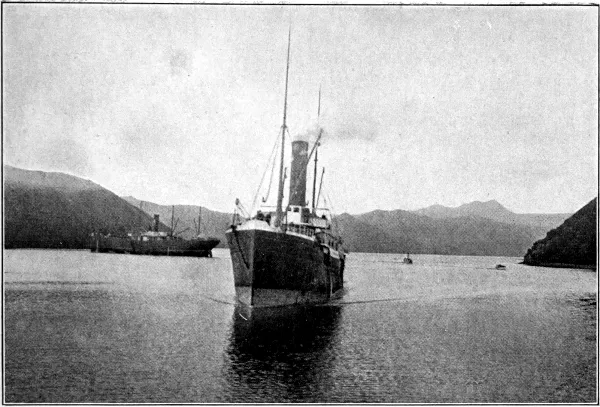
New Zealand will probably remain an agricultural country, dependent
on sea traffic for her manufactured goods. She has plenty of deep bays
and inlets for harbouring even the largest ships.
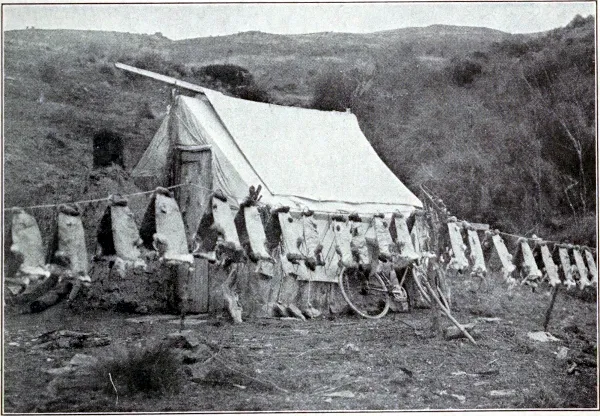
To the sheep station owner the rabbit is an unmitigated evil, but to trappers,
freezing works, and skin exporters, it is a valuable animal.
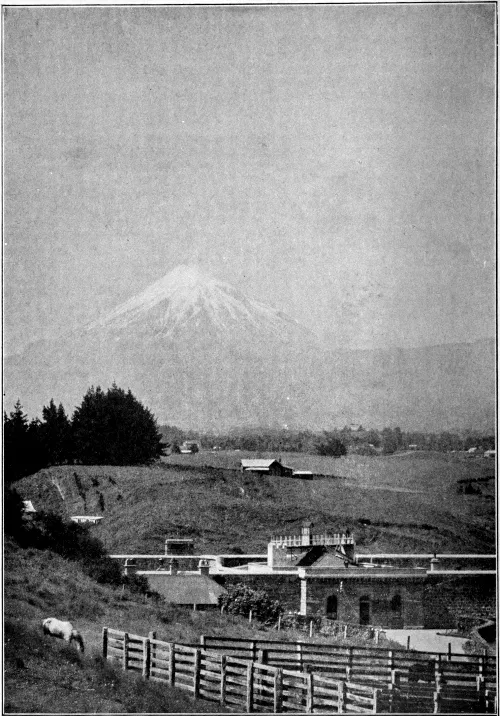
The volcanic cone of Mount Egmont looks down on Taranaki, one of
the world’s richest dairy regions. New Zealand’s climate is so mild and
her pasturage so good that stock can feed outdoors the year round.
As far as I can see, the men seem contented with their
jobs. Many of them own little cottages near the works,
the average working man’s house costing about twenty-five
hundred dollars. The manager tells me that if a man
is ordinarily economical he can pay for his home in five
years, and that most of the men save money. He says
that the factory insures the lives of its employees upon
such terms that if they are killed while on duty their heirs
will receive from fifteen hundred to twenty-five hundred
dollars, according to the amount of their policies.
Handling the wool clip of New Zealand is another big
business in the Dominion. As yet only a small proportion
is kept at home to be used by her factories. The mills
take around seven million pounds in a total production
of nearly two hundred million pounds. New Zealanders
say that they do not expect they will ever be serious
competitors with the woollen mills of old England. They
declare that they prefer to maintain the present high
standard of living for the working classes rather than
bring in cheap foreign labour for factories. There are but
twelve woollen mills in the country and only three of
these, the ones at Petone, Kaiapoi, and Dunedin, are
large establishments. The Kaiapoi mill is near Christchurch
and is famous for making the most beautiful
travelling rugs in the world.
The Kaiapoi mills employ many girls. They are
healthy, rosy-cheeked, and well dressed, and hundreds of
them ride to and from the factory on bicycles. They
work eight hours a day, their wages being about eleven
dollars a week.
Next to sheep raising, dairying is the great farming
industry of the Dominion. There are in the two islands
more than a million dairy cows and heifers and the government
does everything in its power to encourage the breeding
of fine stock and the production of good milk, butter,
and cheese. It advances money to dairy companies for
acquiring land and machinery and setting up buildings.
The loans must be repaid within fifteen years, and the
rate charged is five per cent.
There are numerous coöperative butter and cheese factories
to which the farmers take their milk. Here it is
inspected for its purity and tested for its butter fat. The
producers are paid on the basis of the fat content, and dirty
milk is, of course, refused. Some of the plants close for
three months every year, but many of those in the best
dairying regions keep going the year round, making either
butter or cheese as season or market demands. New
Zealand exports annually in the neighbourhood of twenty-five
thousand tons of butter and sixty thousand tons of
cheese, worth approximately sixty-five million dollars.
Most of this cheese and butter goes, of course, to Great
Britain, but increasing quantities are being shipped to
Canada, and in spite of our high tariff, some of it finds a
market in the United States.
All meat and dairy products exported from New Zealand
are inspected and graded by government agents. The
official standards are so high, and the inspectors have
done their work so well, that their stamps are accepted
as absolute guarantees of quality and weight in the markets
of the world. In fact, New Zealand butter and cheese
now rank with the output of the famous Danish coöperatives.
The meat-export trade is entirely controlled by a
government board, on which the producers themselves
are represented, and no foreign sales or shipments can
be made without its approval. It maintains a permanent
agency in London where the bulk of New Zealand mutton
is sold.
CHAPTER XXXIV
SOME FREAKS OF NATURE
SINBAD, the Sailor, the bird expert of the Arabian
Nights, should have come to New Zealand. Here
he would have found a bird as tall as a giraffe that
laid eggs as big as a pumpkin. Sindbad was never
able to prove that his roc really existed, but if you will
come out to New Zealand, you can see for yourself remains
of its giant bird, the moa. There is a stuffed one at
Christchurch, besides the skeletons of a dozen others. I
have examined the real eggs the moa laid when it trod the
soil of this country a century or so ago.
The great moa is supposed to be the biggest bird ever
created. I sat down before the huge model of it in the
museum at Christchurch and made these notes: “If I
were to stand under the bird its tail feathers would tickle
the top of my head. Its ankle is as big around as my calf
and its gray body is the size of a small haystack. Its tall,
thin neck is stretched so high above its breast that Barnum’s
circus managers would have had a hard time getting
the animal into a freight car. Its legs are as strong as
those of a camel, and it looks quite as big as the biggest
‘ship of the desert.’ Its enormous feet have claws much
like those of a turkey, save that each is a foot long. I
doubt not the moa could have stamped out the life of a
man at one kick.” Beside one of the skeletons is placed
the skeleton of an ordinary man. The head of the bird
rises at least eight feet above the skull of the man.
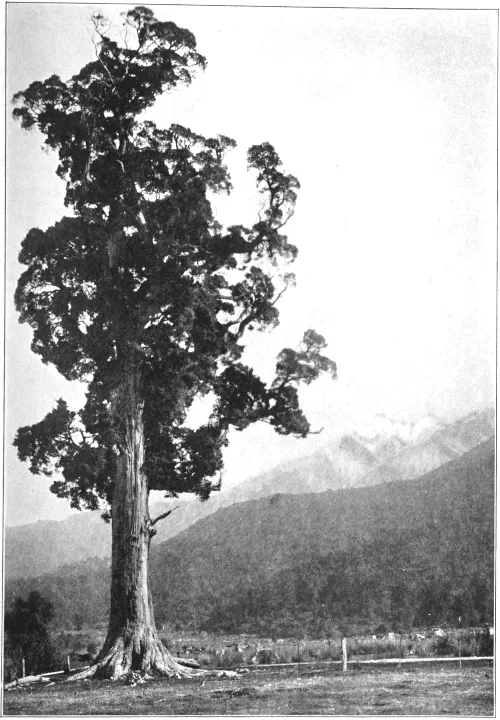
Next to the kauri pine, the totara is the most valuable timber tree of
the Dominion. The country has been denuded of so much of its forests
that conservation policies have become necessary.
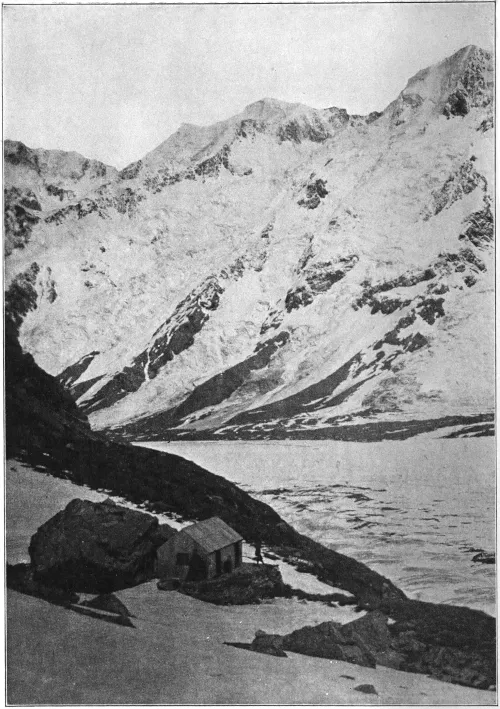
On the slopes of Mt. Cook near the Tasman Glacier the government
has established a sanctuary for the kea parrot, which is elsewhere destroyed
on sight because of its sheep-killing habit.
The bones of the moa were first discovered about eighty
years ago, and later great quantities of them were found.
The bird existed in New Zealand within a comparatively
recent period and there are Maoris who say that their
forefathers knew of it. The probability is that it was
here long before the Maoris came, and there is no doubt
that it was once hunted and eaten in great numbers.
In old ovens that have been excavated bones of cooked
moa have been found. But as for who the moa hunters
were and when they lived, no one knows.
The moa eggs were each about a foot long. One was
found some years ago by a labourer digging the foundation
of a house. He had gone down several feet when he came
upon the skeleton of a man in a sitting posture. The
egg was held in the skeleton’s bony fingers in such a
manner as to bring it immediately opposite the mouth,
and it is supposed that it was placed there with the idea
that the ghost of the dead might have something to eat
during the intervals of his long sleep. The stone spear
and axe by the side of the man showed that he was probably
a warrior, and his skull bore evidence of having received
several hard knocks, possibly on the battlefield. The
egg was ten inches long and seven inches in diameter and
its shell was about as thick as a twenty-five-cent piece.
It was perfectly empty, but whether time or the dead
warrior had sucked out the contents the records do not say.
Though a bird, the moa had no wings. It seems to have
been a giant edition of some of the strange birds New
Zealand has now; for there are to-day in the Dominion
wingless birds not larger than good-sized chickens. I refer
to the kiwis, some of which I have seen alive here at
Christchurch. I have had several of them in my hands,
and by feeling carefully I found what seemed like a little
lump on each side where the wings ought to be. Some
say that the kiwi is without wings because the dense
growth of the New Zealand bush prevented its flights and
so, through the ages, it lost its wings for lack of use. It
makes up for this deficiency, however, by its swiftness of
foot. It runs very fast, with its body held in an oblique
position and its neck stretched forward. This bird has
hair-like feathers of somewhat the colour of a quail, and
a long bill, sharp at the point, with which it can bore down
into the mud for worms. Its legs are much like those of
the moa.
The kiwi is a night bird. At Canterbury College, where
I saw them, the birds were penned up like chickens and
had to be brought out of the coop for me to examine them.
They seemed almost blinded by the light and ran about
this way and that in apparent terror. Kiwis are becoming
scarce in New Zealand, for the Maoris are fond of them as
food, and their feathers are highly prized for cloaks. They
are now to be found only in the dense beds of ferns covering
parts of New Zealand. It is difficult to catch them, for
they look much like the dead fern leaves and take refuge
in crevices in the rocks and in the deep holes that they
dig in the ground for their nests. They used to be hunted
with dogs.
One of the most curious things about this bird is the
size of its egg, which is almost as big as the kiwi itself. It
is a creamy white colour and as smooth and as glossy as
ivory.
Another New Zealand bird quite as strange as the kiwi
is the kea parrot, which kills sheep. Thousands of sheep
have been destroyed by these birds, the loss from them
being so great that the government pays a bounty of one
dollar a head. As many as fifteen thousand keas have been
killed in a year, though they are no longer as numerous as
formerly. The kea has fastidious tastes. It does not
care for any part of the sheep except the kidneys and the
fat surrounding them. It has become as expert in anatomy
as a surgeon and has learned just where the sheep’s
kidneys lie. I am told that it strikes the right spot every
time. Fastening its talons into the wool on the animal’s
back it bores with its bill into the side of the sheep directly
over the kidneys, making a hole as smooth as though the
flesh had been cut round with a knife. The kea tears out
the kidneys and the fat, and then leaves the sheep to die
in great agony.
There are different theories as to how keas acquired
this strange taste. Until sheep were introduced into
New Zealand the birds had lived on berries and insects.
Then they began to pick the meat from the sheep skins
hung up to dry. Later on they attacked the live sheep,
and after a time, having discovered the kidneys, ignored
every other part of the animal. Whether the birds talk
to each other or not I do not know, but they hand on to
one another as effectively as though they had a language
their gruesome way of butchering sheep.
There is one place in the Dominion where the kea’s life
is safe. This is at the Hermitage, on the sunny slopes of
Mount Cook, where the government maintains a sanctuary,
in order that this parrot may not become entirely
extinct. The Hermitage is the starting place for those
who try to scale New Zealand’s loftiest mountain, and
some of the people who have stayed there bring back
stories of the doings of the keas. They are great thieves,
and one woman tells how her moccasins were stolen from
the windowsill of her room. Others complain of being
kept awake at night by the keas squawking and clawing
up and down on the corrugated-iron roof of the hotel. If
the birds get hold of a pillow they will tear it all to pieces,
perhaps thinking that inside the soft substance they will
find some of the kidney fat they love.
Kiwis and keas are, however, but a few of the freaks that
Mother Nature has placed in this out-of-the-way part of
the world. There are others so strange that I hesitate to
mention them. In New Zealand there are no kangaroos,
but there are marsupial rats here, and I saw at the college
a mouse not much larger than a good-sized cricket with a
pouch for bringing up its young. This mouse, which is
one of the smallest marsupials known, is now very rare.
It is a part of the biological collection of the college
museum at Christchurch, and was shown me by the chief
biologist. He showed me also a live lizard, the tuatera,
which is a descendant of a family of three-eyed lizards.
The third eye is in the middle of the head and, is clearly
visible through the skin of the young animal, but becomes
thickly covered when he reaches maturity. The scientists
say there is little doubt that this eye was once used. The
lizard I looked at was about a foot long, and, I should say,
measured two inches in diameter.
But better than the mother mouse and the three-eyed
lizard, I liked the black swans of New Zealand. They are
to be seen in all parts of the islands, and one can shoot
them anywhere around the lakes. They are even more
beautiful than the white swans, and as they sail along in
the water their feathers look just like black plush.
Then there are the swamp hens which, with their bright
blue bodies and red legs, look, as a woman who had been
in the United States said to me the other day, “like your
Mystic Shriners on parade.”
I must not forget to mention the strangest pet any
country ever had. This was a dolphin, the only whale I
ever heard of which had its own special act of Parliament.
When passing through Pelorus Sound on the trip between
Wellington on the North Island and Nelson on the South
Island one always hears the story of “Pelorus Jack.”
He was a big silvery gray fellow, different from all the
other whales in these waters, and he had a habit of going
out to meet incoming ships. He would escort them for
miles and then go back to his own haunts. He would
play about the vessels and even rub himself against their
sides, and one theory was that he came to the boats so as to
rub his back against their keels, and thus rid himself of
parasites. Another was that he loved playing in the
waves ruffled up by the ships.
The fame of “Pelorus Jack” spread until there were tourist
trips into the Sound to see him and Parliament passed
a law to protect him, for there was always a fear that
some of the whalers in these waters might kill him. In
fact, it was said that one ship injured him and that he
would never meet that steamer again. But at last he
disappeared. Some hold a party of Norwegian whalers
responsible for his death, while others believe he was killed
by one of the mines sowed by a German raider during the
World War. Perhaps he merely died of old age, for the
Maoris claim that he was not under two hundred and
seventy-five years old. Once, it is said, he had a mate,
but, if so, he never brought his wife out to greet the tourists.
New Zealand has some curiosities of vegetable life
quite as remarkable as those of her animal world. One
of the strangest is what is known as the vegetable caterpillar.
This looks like a real caterpillar, two inches long,
with a sprout, like a horn, growing out of its head. When
it is full grown the sprout comes out and takes root and
becomes a vigorous plant about eight inches tall, with
a single stem, but no leaf. The only one I have seen was
a plant that had been dried after being taken out of the
ground.
I might also speak of New Zealand flax, which I have
seen at many places on the islands. This flax, which
grows wild and on swamp lands, has thick blades about
two inches wide and five or six feet long. In the middle
of the clustered blades grows the tall, straight flax stick
with seed pods at the top. The upstanding New Zealand
men are often called “flax sticks.” When the blades are
harvested, at intervals of three years, the green covering
is stripped from them, leaving the fibre exposed. This is
washed, hung up to bleach, and then made into tow and
cordage. It competes successfully with the hemp of
Manila, and thousands of tons are exported every year.
Of late years the flax fields have suffered from a small
fly which makes holes in the leaves and so reduces the
quantity of good fibre. Since it has been found that
drained swamp lands make the richest dairy farms, it is a
question whether it is best to drain them for cattle runs
or leave them to produce flax.
A product almost as valuable as flax in the export trade
of the Dominion is kauri gum. It is a solidified turpentine,
or fossil resin, which is found in great chunks in the
ground in the North Island. The lumps may be the
size of a walnut or as big as a man’s head, and single pieces
have been found weighing as much as one hundred pounds.
It is often as clear as amber, but varies greatly in colour.
Sometimes it is a rich yellow, sometimes brown, and sometimes
just the colour of champagne. Some of the best of
it is sold to the manufacturers of varnish and linoleums,
the bulk of it being sent to the United States. Kauri
gum is by no means a cheap article, selling for more than
four hundred and fifty dollars a ton, and the annual export
is worth nearly two million dollars.
Hundreds of men go over the kauri forests with spears
and picks looking for this gum. They drive their spears
down into the earth and when they strike a piece, dig it
out. The gum lies within a limited area, consisting of
about seven hundred thousand acres north of Auckland
and about thirty thousand acres southeast of that city.
Part of this is government land, upon which the right to
dig kauri is sold at so much a year.
Most of the diggers are Austrians, but some are
Maoris and some English-Australian settlers. The Austrians
make a regular business of hunting kauri and
work in bands of thirty or more. The settlers dig for the
gum when they are not farming, and the Maoris seek it to
supplement their funds when food runs low. Many of
the Austrian gum diggers make more than twenty-five
dollars a week.
This gum appears on the kauri pine, a tree that often
grows one hundred and fifty feet high and twelve feet in
diameter. The kauri is about the best timber of New
Zealand, and is used largely in building and furniture
making. The gum comes from the great forests of the
past which have rotted away. Some of the standing
kauri trees are bled for their resin like our turpentine
forests of the southern states, but this method is illegal,
and most of the product is still obtained from the deposits
in the ground.
Kauri gum is used by the varnish and linoleum manufacturers
because it assimilates oil easily and at low temperatures.
As the New Zealand deposits are worked from
year to year the gum gets more and more expensive and
in anticipation of their giving out the question of substitutes
has been studied. China-wood oil, extracted from
nuts, and exported from Hankow, China, is now being
extensively used and has become a keen competitor of
kauri.
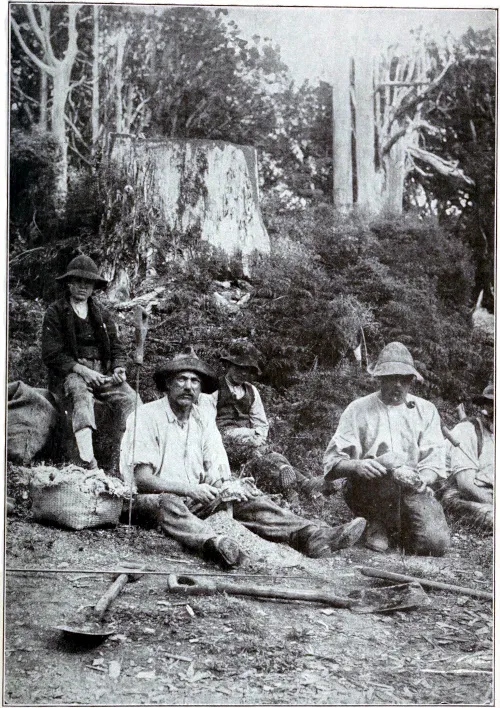
Kauri gum is the fossilized resin of the kauri pine forests of the past.
It is dug from the ground, and most of it is exported to the United States
to be used in the manufacture of varnish and linoleum.
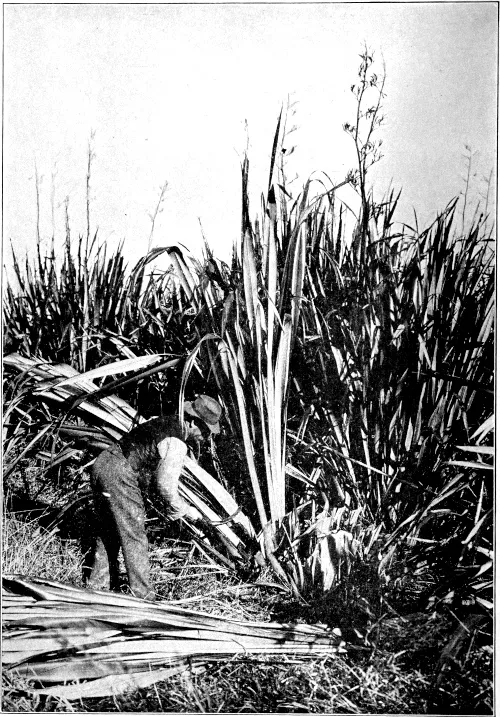
We call a tall, straight person a “bean pole,” but the New Zealanders
say he is a “flax stick,” borrowing their comparison from the seed-bearing
stalk that rises from the centre of the native flax.
CHAPTER XXXV
AMERICAN GOODS IN NEW ZEALAND
IN THE foregoing chapters I have mentioned two
facts that should mean much to the exporters of the
United States. One is that New Zealand is an
agricultural country, exporting raw materials and
importing manufactured articles, and the other is that the
per-capita wealth of all persons of more than twenty
years of age is about four thousand dollars. In other
words, New Zealand is dependent on foreign markets as
outlets for her rich agricultural production, and on foreign
factories to supply her needs for finished goods, and she
has the money to pay for what she wants. The total
foreign trade, imports and exports, comes to more than
four hundred dollars a year for every one of her people.
This, the New Zealanders claim, is the highest per-capita
foreign trade in the world. In some years half the amount
has been spent for goods brought in from other countries.
In travelling here one sees everywhere evidences of
prosperity and a high level of comfort. The people are
well dressed and live in modern, well-built houses. Unlike
Australia, New Zealand has a big rural population, and
about half the inhabitants live out on the land or in country
villages. There are only four cities of any size, but
there are a hundred towns of one or two thousand, and
perhaps a dozen ranging between two and ten thousand.
All are up to date in their conveniences and equipment.
The New Zealand cities have their theatres, libraries,
and stores, their banks and their factories. Each has its
cricket club and its recreation grounds, and the people
devote a large part of their time to amusements and sports.
The short working day gives leisure to the wage earners.
They leave their jobs in time to dress for the evening,
and take their families to the movies, where they often see
American films. During the half holiday they spend more
money than if they were at work.
In proportion to its population, Auckland, the commercial
metropolis, has more rich men than any other
city in New Zealand, although Wellington, the capital, is
growing the fastest. On the South Island, the largest
city is Christchurch. It is on the famous Canterbury
Plains, “The Garden Spot of New Zealand.” South of it
is Dunedin, with a population of sixty thousand. Christchurch
and Dunedin are rival towns, the feeling between
the people of the two places being much the same as
that between the populations of Minneapolis and St.
Paul. Christchurch was founded by a group of Church
of England settlers, who gave it its religious name.
Dunedin was started by Scotch Presbyterians at about
the same time, and in its early days it was by no means
safe to question election, justification, sanctification, or
infant damnation within its precincts. The Scotch colonists
wanted to name this settlement after their capital
at home. But there were so many Edinburghs in the
world that they decided on the Celtic name for Edinburgh
and called the place Dunedin.
To-day nine tenths of the people of Dunedin are of
Scotch descent and the place is a magnet for Scottish immigrants.
There are Scotch names over the stores, Scotch
names for the streets, and the little stream that runs
through the north end of the town is called the Water of
Leith. When I asked a rosy-faced boy the name of one
of the churches, he replied with a thick brogue:
“That, sor, is the Fierst Kirk.”
The Dunedin men say that their churches are far better
off than those of the rival city. They are all out of debt
and have money in the bank. When the city was founded
one tenth of all the land was set aside for the Church.
This is leased out for twenty-one years at a time, on condition
that at the close of each such lease all improvements
made shall belong to the Church.
Dunedin is in the rich Otago Province, which irrigation
has made into a great fruit-producing region. Grapes,
peaches, pears, nectarines, and several kinds of nuts are
raised in abundance. For a time the industry suffered
from the great numbers of birds, but the importation of
the German owl, which killed off most of them, solved
that difficulty. Dairying and sheep raising are carried
on almost as extensively as on the Canterbury Plains, and
the farmers raise four good crops of alfalfa in a year.
There are four big woollen mills in the neighbourhood of
Dunedin and here also is one of the car shops of the government
railways. Another local industry is the freezing
of thousands of rabbits for export.
Our trade with New Zealand is rapidly increasing.
Every year we sell her goods valued at nearly forty million
dollars, or more than eighteen per cent. of the total imports.
Great Britain has the bulk of the trade, but the United
States comes next, and then Australia. There is no doubt
that we might double our share if we tried hard enough.
I have met a number of American salesmen, all of whom
say that they are doing well. They are, however, somewhat
handicapped by the bad impression created by that
class of our commercial travellers who are for ever bragging
of their country and over-praising their goods. This
is particularly distasteful to all New Zealanders and
especially so to the business man. On the whole, however,
the people like our goods and are friendly to the Yankees,
as they call us.
Take, for instance, a salesman I met the other night
in the chief hotel at Dunedin. He has been selling goods
here and in other parts of Australasia during the past
five years. Said he:
“American goods are fast making their way in this
part of the world. I am the agent for several large companies
and am doing well. We are selling printing paper
by the ton. There is a good demand for farming machinery
of all kinds, and tens of thousands of acres of sheep pastures
are enclosed in fences of American wire. Our
automobiles are the most popular and the country is
alive with ‘flivvers.’ The New Zealanders bought ten
million dollars’ worth of our cars in a single year, to say
nothing of four million dollars’ worth of tires. They
have spent as much again on our gasoline and oils. American
bicycles are sold everywhere, and in spite of their
higher prices our carpenter’s tools are preferred to those
of Europe. Recently I took a big order for steel rails.
We have also a good business in electrical supplies.”
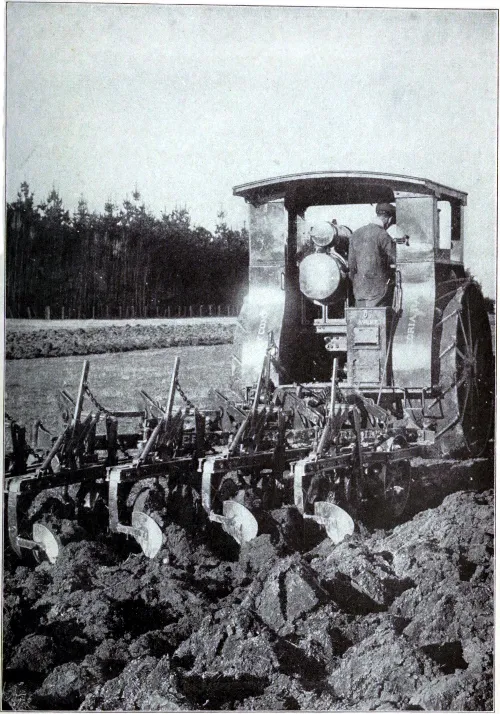
As in every other country where modern farming methods prevail,
American agricultural machinery is much used in New Zealand. So also
are our automobiles, tires, and small tools.
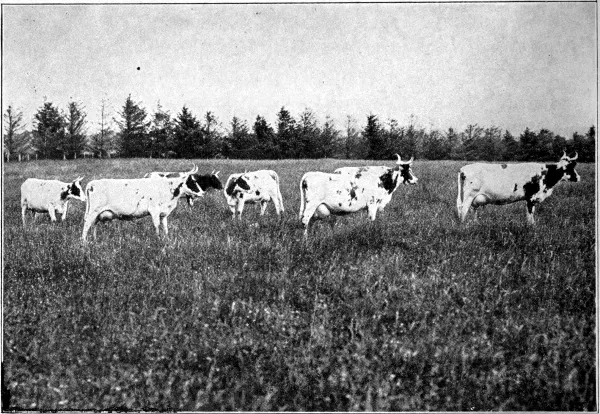
Among the many good dairy herds of the Dominion, Ayrshires,
Jerseys, and Holsteins are the favourite breeds. Tons of the finest cheese
and butter are annually exported.
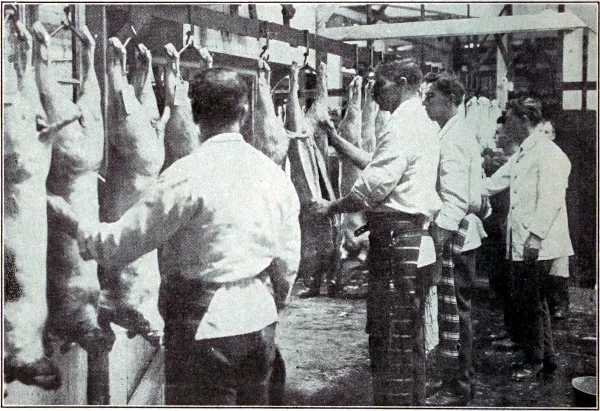
Refrigerator ships, sailing overseas with New Zealand’s frozen mutton,
have revolutionized her farming. Instead of being raised on wild grasses
for wool and tallow, as formerly, the sheep are now fattened on cultivated
forage crops.
The government is undertaking to develop New Zealand’s
water power. It has picked out no less than
seventy-two sites for hydro-electric projects, and it has a
big programme under way. The Lake Coleridge plant,
seventy miles from Christchurch, serves a population of
more than one hundred thousand, and enables Christchurch
to have a two-cent fare on its municipally owned
street-car lines. The Waikato plant, seventeen miles
from the town of Cambridge in the North Island, can
generate eighty-four hundred horsepower; and the Waipori
Falls project furnishes eighty thousand horsepower
for the city and the factories of Dunedin. Extensions of
these three plants are being pushed, and the government
has plans for other installations which will give electric
energy to practically all the towns and rural districts of
the North Island. Such projects should mean more
business for the electrical-supply firms of the United
States.
Our firms are selling Connecticut clocks, Illinois farm
machinery, and Massachusetts watches. I saw American
typewriters in Wellington. There is a good market for
all sorts of Yankee notions. The other day while riding
on a train with a New Zealand merchant, I asked him
what he thought of American goods. Pulling his right
foot from under his travelling rug, he put it up on the
seat beside me.
“You see those shoes?” said he. “They are American.
They are the easiest shoes I have ever had on. They have
not troubled me a day since I bought them.”
The New Zealand government is one of the chief customers
for manufactured goods. It owns the railroads,
builds bridges, and operates coal mines. Hence, its purchases
are enormous. It buys all sorts of iron and steel
building materials, as well as hardware, galvanized roofing,
elevators, irrigation pumps, and all kinds of machinery
and engineering apparatus.
We now have the best consular service of any commercial
nation, and New Zealand offers a splendid field for
its operations. Times have changed both in this Dominion
and in Australia, since the day typified by the young
man who got himself appointed consul at Melbourne.
His only business experience had been as postmaster in his
little home town in Wisconsin. He was asked by an
American why he did not keep the State Department
posted on the openings for American trade, and on the
big business developments going on everywhere. He
replied that he reported upon all things that the department
directly asked for, but that he did not consider it best
to advertise the great trade opportunities of Australia for
fear it might call them to the attention of other nations.
New Zealand buyers give to British firms as many orders
as they can, without too great a sacrifice of their own interests.
This is especially true since the World War,
as the people are anxious to do what they can to stimulate
British trade and thus help the mother country pay her
enormous debt and regain prosperity. I find here a
strong love for Old England. Many New Zealanders,
even those born and bred here, speak of a trip there as
going “home,” and of British articles as goods “made at
home.” The Dominion appears entirely content under
the British Crown, doubtless because the bonds binding
her are not tight. For example, in the World War, Great
Britain could not have conscripted soldiers from the
Dominion as France did from Algeria. It was the people
themselves who decided in favour of compulsory military
service, though not until many thousands of young men
had already volunteered and gone overseas. In Australia,
conscription was defeated by the voters of the Commonwealth.
I recently visited Invercargill, the town farthest south
on this side of the world. It is the bottom city of the
Pacific, far below the latitude of Cape Town, at the tip
of Africa, and almost as far south as Punta Arenas at the
tail of South America. It is at the extreme south of New
Zealand, and as nice a little city of fifteen thousand people
as you will find anywhere. The town is as well built as
any of the same size in the United States. It has water
works, good schools, a public library, and a beautiful park,
upon the waters of which swim half-a-dozen jet-black
swans.
Walking through the streets, I stopped at an agricultural
implement store. It was filled with farming machinery,
and I noticed that at least half of the stock was
American. There were several Chicago drills, two Ohio
harvesters, and some Illinois ploughs. I talked with the
proprietor. He said he had a good sale for American
reapers, and all sorts of American farming tools, but that
the British and Canadians are trying to crowd us out of
the market. Said he:
“One of your chief competitors is Canada. The Canadian
firms will sell on longer time, and we can get better
prices for their goods on that account. We have to give a
discount for cash, and cash sales are much harder to
make.”
On the same street I saw American bicycles in a shop
window, and farther up, American handsaws. At present
most of the cottons sold here come from England, but the
people are beginning to buy our print goods. I saw some
in a Wellington dry-goods store and asked the merchant
where he got them. He replied that he had given an
American firm a trial order, and that they were selling
well. He showed me his invoice. It was for eight thousand
dollars, and this he called a trial order. Most firms in the
United States would consider it a pretty good one. But
this part of the world is so far away that the merchants
must buy a whole season’s stock in one consignment.
And there is no chance for a re-order.
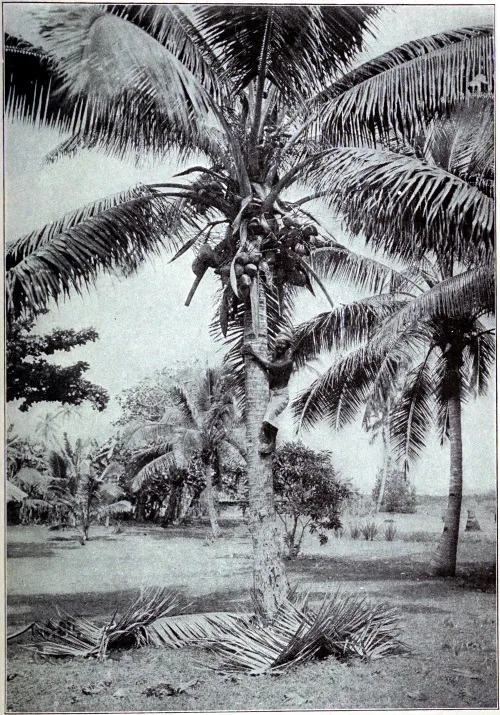
Coconuts are common to all the islands of the South Seas, and provide
the chief source of income. Niuafoou, an outlying island of the Tongas,
is said to grow the largest in the world.
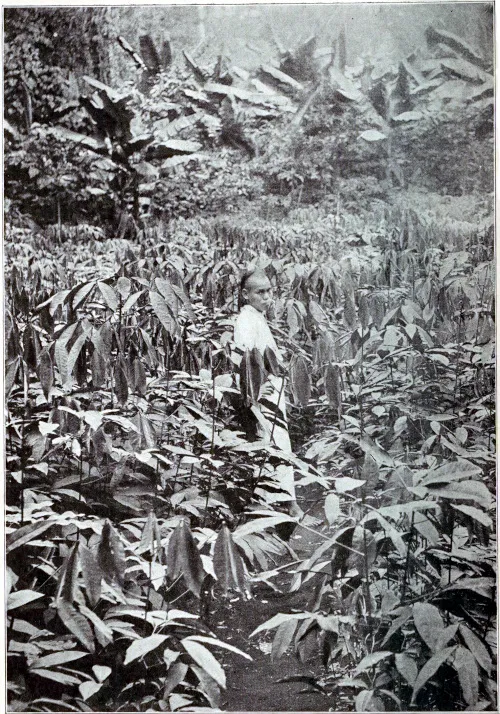
Rubber growing is proving profitable in the Fijis, and nurseries have
been established for raising the young trees. The Fijian’s inborn dislike
of work has often made it necessary to import labour for the plantations.
CHAPTER XXXVI
THE FIJIS AND THE TONGAS
THE ports of Australia and New Zealand swarm
with sea captains, traders, and others, who know
the South Seas as you know the palm of your
hand. The Canadian Pacific steamers plying
between Vancouver and Sydney by way of Hawaii call
at the Fijis, and the Tongas are easily reached from Auckland,
New Zealand. During my stay in these waters
I have had the many talks about these far-away islands
that form the basis of what follows.
I have spoken of the Tongas as being easily reached from
New Zealand. This seems a strange statement when I
tell you they are about as far from Auckland as New
York is from Cuba. Distances mean little in the South
Seas, however. The Fijis are eleven hundred miles from
Auckland and the Tongas are only a few hundred miles
nearer, yet New Zealand once wanted them put under its
government. The idea was to establish here a British
Island Empire which should be two thousand miles in
length, or longer than the distance from Canada to the
Gulf of Mexico. The project fell through, and the two
archipelagoes are still crown colonies, the Tongas being
under the British High Commissioner for the Western
Pacific, who is also Governor of the Fijis.
There are men still living who can tell stories of the days
when the Fijians were the most bloodthirsty cannibals on
earth. They made human sacrifices, and widows were
burned on the funeral pyres of their husbands. When a
chief built a home he planted a living victim under each
post, and when his canoes were launched he used men as
rollers upon which the craft slid down into the sea. When
he died his wives were strangled to line his grave; such a
thing as killing a baby was too common for notice.
The last king of the Fijis, Thakombau, was the son of
Tanoa, a notorious man eater. Thakombau himself was
something of a cannibal, but his father craved human
flesh as a matinée maiden craves candy. He sent his war
canoes about the South Sea Islands for victims, and they
often brought back cargoes of dead men, women, and
even babies. Upon their return everyone joined in a
feast of human flesh.
One can still see on the islands the ovens in which the
cooking was done. They were filled with red-hot stones,
and it is related by the missionaries that victims were often
roasted alive. At one time fifty bodies were cooked,
and at another eighty women were strangled for a single
feast. Whenever the stock of dead enemies ran low, the
king used to send his men to the watering places to lie in
ambush for fishermen or for women who had gone down
to bathe.
King Thakombau killed his first victim when he was
six years old, and he was famous as a cannibal until the
time of his conversion by the missionaries. It was after
he reformed that he made the treaty which gave these
islands to England. The story of this treaty is interesting.
The home of a white trader named Williams, who
was acting as United States consul to Fiji, was burned,
and the natives stole some of the furniture and stores while
the house was ablaze. Williams demanded three thousand
dollars damages. The Fijian king refused. Then Williams
got the backing of the United States government, and
finally the sum of forty-five thousand dollars was demanded.
It was out of the question for the savage king
and his subjects to raise this sum, so when certain money-lenders
of Australia offered to settle the claim in return
for two hundred thousand acres of his best land, Thakombau
joyfully accepted. But the British government
would not permit this transaction. Thereupon Thakombau
agreed to cede the Fijis to Great Britain if she
would pay the debt. A commission visited the islands
and reported adversely on the proposal, but in 1874, convinced
that the islands needed the rule of a civilized power,
the British made a treaty with Thakombau annexing his
whole domain. Meantime, the claim of the United
States had been allowed to drop during our Civil War, and
was never revived.
Though no longer master of the Fijis after the British
took possession, Thakombau continued to live in royal
state. At his death his mantle fell to his son, the high
chief Ratu Epele Nailatikau, who kept up all the show of
royalty. He possessed no real power, but he made the
natives treat him with the most abject respect. Only
the highest chiefs were permitted to enter his house at
Mbau, and even they must crouch silently against the
wall and await his invitation to speak. Whenever he was
through smoking a cigar, he would indicate by a nod which
chief might have the honour of finishing the butt. A new
clean mat was unrolled for his dinner table about which
crept the men and women who bore him food. No
commoner was allowed to eat in his presence.
Canoes loaded down with yams, coconuts, turtles, and
yaqona root for making the native drink, kava, were
constantly landing at Mbau. The offerings were carried
humbly to the door of Ratu Epele and the natives crouched
outside, gently clapping their hands, until their tributes
were graciously accepted. In the days of his grandfather,
Tanoa, any island that failed to furnish the expected tribute
was frightfully punished. When the people of the
island of Maliki, designated to provide turtles for the
king, so far forgot themselves as to eat some of their
catch, Tanoa sent a fleet of war canoes. Every man and
woman on the island was killed, while the children were
taken captive to Mbau so that the boys there might earn
their titles as killers of men by clubbing them to death.
The Fijians of to-day are among the most civilized of
all the South Sea Islanders. They have been converted
to Christianity and have their own native preachers.
They are divided among a half-dozen denominations, with
the Methodists claiming the largest number of converts.
The oldest established church in the islands is that of
the Methodist mission founded in 1825.
The missionaries established the first schools in the
Fijis and until a few years ago the education of the
natives was left entirely to the Methodists and the Catholics.
The government now maintains a high school
near the town of Suva, where the sons of chiefs are
trained, and it also helps other schools that comply with
its requirements. At an industrial school near Suva the
islanders are taught boat building, iron working, and
other manual arts. Boys are entered for terms of five
years. Children of European residents are educated at
government expense in separate institutions.
The Fiji Islands were discovered in 1643 by Tasman,
the Dutch navigator, the same man who discovered Tasmania
and New Zealand. Their area is less than that of
New Jersey, and their total population is little more than
that of Dayton, Ohio. Only about half the people are
native Fijians. For some years their number decreased
steadily, but this decline seems now to have been checked.
The people are especially subject to epidemics. In 1875
measles was brought into the islands by sailors from a
British ship. The disease took a most virulent form and
killed forty thousand natives in a short time. Great
numbers of them died when influenza swept the world in
1917 and 1918.
The Fijians are strong and well built, and in appearance
far superior to our American Indians. They have dark
copper skins and frizzly hair, which stands up about their
heads in enormous mops, making them seem tall. In
order to get their hair to stick up, they plaster it with
damp lime, which bleaches it to an auburn shade, so that
they look very grotesque. When young, the women are
handsome, having pretty eyes and well-moulded faces.
In the settled regions they wear loose cotton gowns, but
back in the interior the usual attire is a fringe of grass
about the waist, a string of beads, and a fan. The men
wear about the same costume.
One frequently sees a native with a long pin, or
scratcher, thrust through his hair. This weapon is used to
make war upon the vermin with which almost every head
is infested. Sometimes the irritation gets beyond the
scratching point, and in desperation the man so attacked
kindles a fire of banana leaves and, lying down with his
head near the fire, thus smokes out his unwelcome visitors.
The Fijians are good-natured. They are cleanly and
spend a great part of their time in the water. After every
bath they rub themselves down with coconut oil, the rancid
odour of which enables one to smell a native long before
seeing him.
Though they are practically all Christians, the natives
cling stubbornly to many of their old customs. One of
these is the performance of the fire walkers. On the
island of Beqa is a circular pit about twenty feet in diameter.
The bottom is lined with volcanic stones and when
a fire walk is to be staged the pit is filled with dry sticks
and a fire is kept up until the stones are red hot. Then
the glowing coals are brushed aside and out of the forest
comes a procession of young men, their bodies gleaming
with coconut oil and garlanded with flowers. Slowly
they tread over the hot stones, singing as they go. Then
they vanish into the dense woods, apparently unhurt.
After they have gone, whole pigs and vegetables are put
on the hot stones and covered with leaves and earth.
Soon a well-cooked feast is ready for both spectators and
performers. Scientists say that the volcanic stones
used are poor heat conductors and that they radiate heat
quickly. Thus the surface cools sufficiently to permit
the fire walkers to tread the stones, though they retain
enough heat inside to cook the feast. At any rate,
nothing will persuade the fire walkers to step on hot limestone,
which is a good conductor and a poor radiator.
The thickness of the skin on the soles of the natives’ unshod
feet no doubt accounts in great measure for the
“miracle.”
Many natives live in and about Suva and Levuka, the
principal towns, but most of them dwell in villages scattered
over the islands. A Fiji village consists almost entirely
of thatched huts with walls of woven bamboo built
without the use of nails. The roofs are thick and the
thatch is so skilfully put on that it seems to be woven.
Some of the houses are conical in shape, others oblong,
and others oval. The usual hut has but one room, in
which the whole family stays in the daytime, when it
rains, and where all sleep at night. The bed is a mat on
the floor, and the pillow a bamboo log, which is placed
under the neck in order to keep the sleeper’s headdress
well up from the ground. There is but little cooking,
as raw fruit forms a large part of the diet of the people.
The chief ports of the Fijis, Suva and Levuka, have
steamship service to Sydney, Auckland, the Tongas, and
the Samoa Islands. An excursion to Suva, which is
also the capital, is a popular winter trip for New Zealanders.
Besides the natives, about a thousand Europeans
live there, most of them in well-built modern houses.
Its chief street, the Victoria Parade, is lined on one side
with rain trees whose thick foliage protects one from the
sun, and on the other side with hotels and business houses.
The British governor has his office at Suva. He lives
there like a little king in a palace that cost about a hundred
thousand dollars.
The Governor of the Fijis is appointed by the King of
England, and gets a salary of fifteen thousand dollars a
year, besides the five thousand he is paid as High Commissioner
of the Western Pacific. He has a sort of cabinet,
or executive council. The laws for the islands are made
by a legislative council, of which he is president. There
are a large number of district chiefs and native magistrates,
and seven of the provinces have resident supervisors
to assist the chiefs. In ordinary matters the
native laws and customs are respected as far as possible.
There is a constabulary of Fijians and East Indians, besides
the defence force, which is composed of Europeans,
half-castes, and natives.
Most of the money made in the Fijis comes from sugar
plantations and coconut groves. Upon the higher portions
of the islands coffee is now being grown, and yields
about five hundred pounds to the acre. A large number
of tea gardens have been set out, and some planters are
making money from rubber.
Each coconut tree has an average yield of a hundred
nuts per annum, and brings in about a dollar per year net.
At this rate, a grove of ten thousand trees will mean ten
thousand dollars a year, and as the trees are set close together
ten thousand do not take up any great area. After
the trees are once planted, little needs to be done until
they begin to bear at the end of from five to seven years.
The nuts are broken open and the meat is cut up and
dried, to be shipped abroad as copra, for use in making
soaps, hair restorers, and “nut” butter.
Nearly all the profitable enterprises in the islands are
owned or backed by Englishmen. The chief difficulty
that confronts them is the labour problem. Having few
wants and being blessed by nature with the means of
supplying them without much trouble, the Fijians feel
no need to work. Sustained effort they abhor, although
in their own way they are industrious, and are the best
native carpenters and canoe builders in the South Seas.
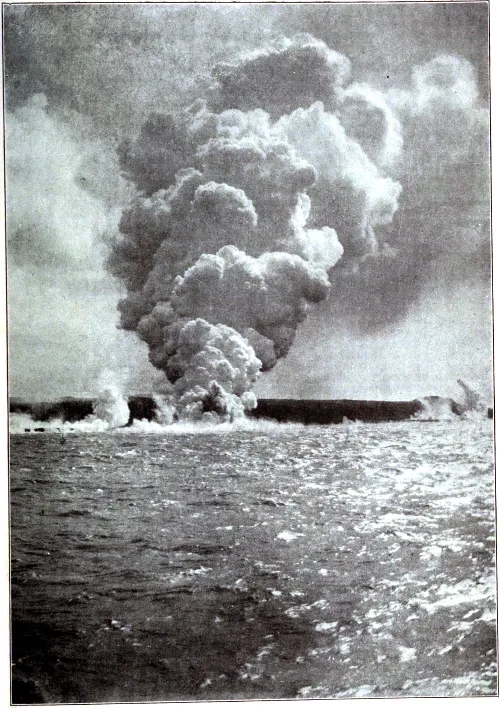
Though the largest island in the Samoan group, Savii has few inhabitants.
It is volcanic and parts of it are often enveloped in clouds of
steam caused by boiling lava rushing down into the sea.
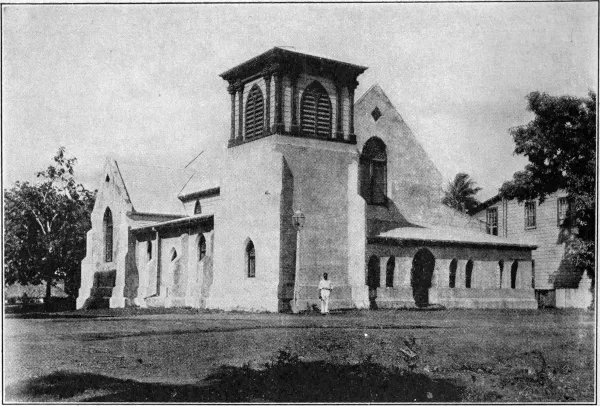
The native church at Apia is well attended, the Samoans being fond of
religious ceremonies. Most families also hold daily prayer services in their
homes.
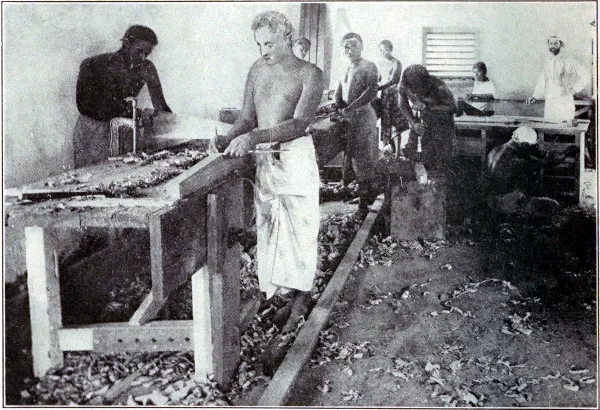
At mission schools natives are trained in wood-working and boat-building,
but the islanders as a rule are not industrious and work only
enough to supply their simple needs.
It was just a year after the British took over the islands
that the measles epidemic decimated the population, so
that, what with the decreased number of the Fijians and
the natives’ distaste for work, the plantation owners had
to import labourers. Workers were brought in from India,
the Solomon Islands, the Gilberts, and the New Hebrides.
The government regulated the employment of imported
labour. It cost about seventy-five dollars to bring in a
native from the New Hebrides, and forty dollars to get
one from the Gilberts, and the employer had to agree to
return the labourers at his own expense at the close of their
engagement. It cost more to import the East Indians,
but they were usually hired for terms of five years, on the
understanding that they should have food free for six
months after their arrival, and free lodgings and medical
care for the whole term. Their wages were paid weekly,
the men receiving twenty-five cents a day and the women
eighteen cents.
More and more coolies were imported from India, while
the numbers brought from other islands fell off. At the
close of their terms of service many of the East Indians
took up little plantations of their own, where they grew
rice, sugar, coconuts, and bananas. There are now upward
of sixty thousand of them in the islands, compared
with about ninety thousand Fijians, five thousand Europeans,
and a sprinkling of half-castes, Polynesians, and
Chinese. As in other British colonies to which they have
been admitted, the East Indians have bred a serious race
problem, and their further importation has been stopped.
They declare themselves as good as the whites and demand
equal rights with them. A few years ago half the Indian
population went on a strike, which reached such a climax
of violence that it had to be put down with military force.
Eighty per cent. of the trade of the Fijis is with Australia
and New Zealand, and the total amounts to about
twenty-two million dollars a year. Some of the imports
come from the United States. We supply them with
timber, oil, hardware, and cheap clocks and watches.
The Fijian will use none but an American axe, which he
likes because it is light, sharp, and well tempered. He
likes also American-made knives or machetes, with blades
about fifteen inches long, with which he clears his fields
and gathers his bananas and coconuts. The people buy
about one and a half million dollars’ worth of cottons
yearly and there is a demand for canned meats and flour.
As High Commissioner of the Western Pacific, the
British governor of the Fijis looks after the Tongas, which
lie about two hundred miles southeast of the nearest of the
Fijis. They still have a native ruler, Salote, the Queen
of the Tongans, who handles native matters through her
high chiefs. The government is, in fact, a sort of hereditary
monarchy under the British crown.
The Tongas have a total area about one tenth that of
Connecticut. The largest of them is only twenty miles
long, and many are little more than atolls and coral
rocks rising out of the sea. Some of them are volcanic,
but their soil is well suited to growing coconuts and sugar.
The entire population would hardly make a city of twenty-five
thousand inhabitants, and there is only one town,
Nukualofa, the capital. It has a race track and cricket
grounds, and claims some of the finest motor roads south
of the Equator.
CHAPTER XXXVII
THE SAMOAS
IN COMING from the Fijis to Apia, the capital of
Western Samoa, our ship crossed the date line, and
when we sailed over the 180th meridian, east longitude,
we went from one day into the day before. I felt some
satisfaction in getting back one of the many days I have
lost in going across the Pacific in the opposite direction.
It was delightful sailing along the Equator. We had
nothing but sunshine, and such glorious sunshine! As we
coasted the island of Savaii, the largest of the Samoan
group, the air was fresh and the wind strong enough to
make it cool and pleasant. The sea was steel blue, with
silvery whitecaps dancing upon it, between us and the
shore, and the sky was full of white, smoky clouds.
The volcanic island of Savaii in its thick cloak of verdure
makes one think of the Hawaiian Islands. As we
passed along its shores it seemed a great hill shaped like
a horseshoe, with the ends of the shoe sloping down to the
water.
Going on we soon reached Upolu, on the north coast of
which Apia is situated. Both Upolu and Savaii now belong
to the Territory of Western Samoa, which has been
created from what was formerly German Samoa and is
now administered by New Zealand under a mandate from
the League of Nations. The United States owns Tutuila,
Manua, and some of the smaller islands of the group.
When Germany and the United States came to their
agreement about the division of the Samoas in 1899, the
Germans, in their greed for land, were glad to take the
two biggest islands. But out here it is thought that we
got the best of the bargain. Both Savaii and Upolu together
are not so large as Rhode Island, and much of
Savaii has been so recently subject to volcanic action as to
be unfit for cultivation. Savaii is forty-eight miles long
and twenty-five miles wide, and Upolu is a good deal
smaller. Both islands are mountainous and well watered.
Like Tutuila, they have been built up by volcanoes and
are for the most part surrounded by coral reefs.
As I came into the harbour of Apia the tide was low,
and I could see a great garden of coral rising out of the
water. Here and there along the shore were groves of
coconut trees, and, farther up the mountains, plantations of
cacao. Amid the green jungle on the hills I noticed
patches of chocolate brown, where the ground had been
cleared for cacao plantations. Just back of Apia gleamed
the white villa where Robert Louis Stevenson lived, and
above it rose mountain after mountain of different shades
of green or blue, covered with vegetation and canopied by
masses of fleecy clouds. Here the shadows turned the sea
to green, and there to navy blue, while upon the land
they made a mass of light and dark patches of velvet
on the green crops and the still deeper green forest.
Close to the water’s edge were what from our steamer
looked like vast cornfields. These the captain said were
coconut orchards, containing tens of thousands of trees
loaded with millions of nuts.
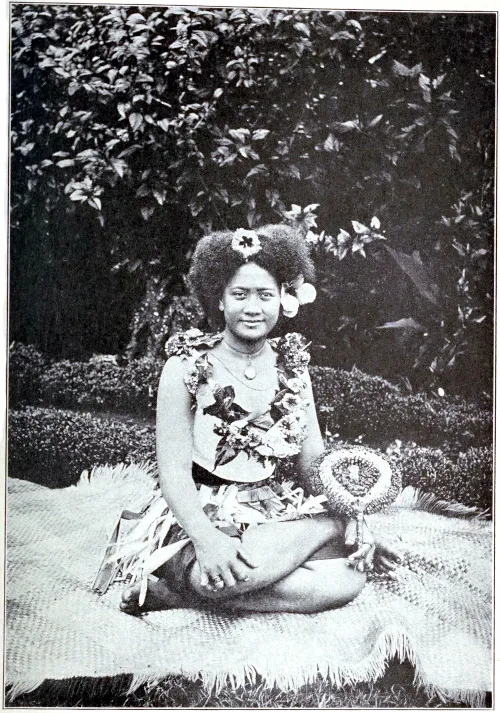
As they grow older the Samoan girls lose their beautiful figures but
never part with their sweet dispositions and their love for ornaments and
flowers. The women marry in their ’teens, and large families are the rule.
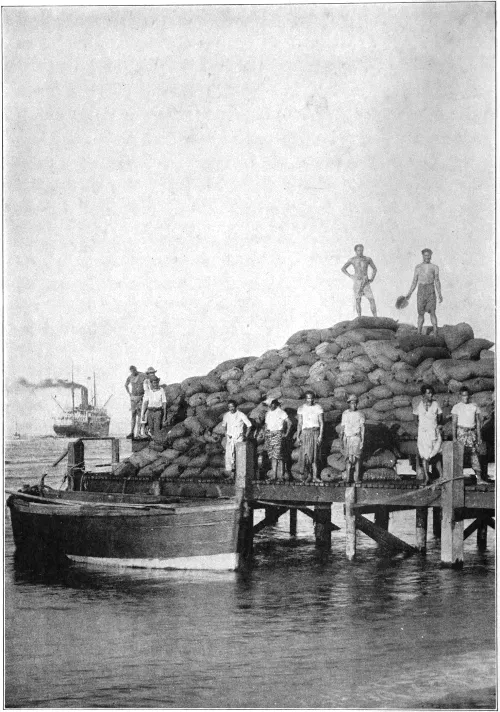
The chief product and export of Samoa is copra, the meat of the coconut.
Dried and packed in sacks, it is shipped abroad for use in making
soaps, toilet preparations, and “nut” butters.
I am disappointed in Apia. From Robert Louis Stevenson’s
letters and the place it once held in international
affairs I had expected to find it a large city. It is
really a small town with a foreign population of less
than five hundred British, Germans, New Zealanders, and
Swedes, with a few Americans and French for good measure.
Its buildings are bungalows, with roofs of galvanized
iron, strung around the harbour.
Our steamer was greeted by a great crowd of Samoans
and the whole population of foreigners, through which I
went up to the Tivoli Hotel, my headquarters during
my stay. It did not take me long to exhaust the sights of
Apia. The town has a half-dozen business houses engaged
in shipping cacao and copra and in furnishing the natives
with different kinds of fancy goods, cottons, and tinned
stuffs. There are also two photographers, a number of
consuls, and a baker’s dozen or so of government officials.
My guide over the island of Upolu was one of the
Samoan chiefs. He was half naked when I came into his
house, a kind of thatched shack not far from Apia, but he
dressed himself in my presence and went about with me.
I found that he spoke good English, knew the islands well,
and was very intelligent, as are all the natives I have so far
met.
With him I visited many of the native houses. Owing
to the hot climate, the Samoan dwelling is scarcely more
than a roof made of plaited branches supported on a number
of slender posts through which all the airs of heaven
may circulate. The walls are mats of fibre which are
rolled up inside and against the roof when not in use, and
which may be let down to keep out the wind and rain.
Not a nail is used in the construction of such a house, but
instead the parts are tied together with yards of plaited
coconut fibre called cinnet. The men spend much of
their leisure time plaiting cinnet, some of which is as fine
as twine.
The floor of the typical hut is a circular terrace raised
about two feet above the ground and surrounded by a
shallow ditch. The terrace is made of stones closely
fitted together, and over it is spread a layer of white coral
pebbles gathered from the beach to form the carpet for the
hut. The pebbles, which serve for mattresses as well as
floor covering, are sometimes known as “Samoan feathers.”
When the native is ready for bed he simply lays a fibre or
grass mat upon them, takes down his pillow from the rafters,
crawls under his mosquito net, and goes off to the
Land of Nod. His pillow is no more than a little log set
on four short legs so as to raise his head well off the
floor.
The Samoans have always been noted for their hospitality.
They give all strangers a cordial welcome, and food,
lodging, and even clothing may be had in any native house
without thought of compensation. Nevertheless, when a
white visitor stays in a Samoan home he gives presents on
leaving to the full value of his entertainment. No native
guest ever does this, but the foreigners have been so liberal
in the past that they have led the people to expect gifts.
No Samoan host would, however, lower himself so greatly
as to take money. In almost every settlement there is a
“Taupo,” or “Maid of the Village,” elected by the people
to receive guests and take a leading part in all public ceremonies
and festivals. When she goes any distance from
home the maiden is surrounded by a train of elderly
women as chaperons. She holds office for a few years,
or until she is married.
The Samoans are a clean people. Everywhere I see
them in bathing. The women and the men wade about
waist-deep in the streams and swim together in the surf,
splashing one another, and acting more like children than
grown-ups.
The young women have beautiful forms. They are as
straight as the statue of Venus in the Capitoline Museum
at Rome, and as plump and as well formed as the Venus de’
Medici. Their complexions are of a rich chestnut brown
and their large soulful eyes are full of smiles. Unfortunately
they often bleach their black hair to a bright red by
the use of lime. Both women and men are good-natured,
gentle, kind, and easily governed.
I have been asked to investigate the chances for Americans
to get rich in the Samoan Islands. Robert Louis
Stevenson made about twenty thousand dollars a year out
of his books, but as far as I can learn, for all his sweating
on his cacao plantation, he did not get a cent out of it.
The islands have an excellent climate. It is good for
consumptives, and if the consumptive were anything else
than an impractical newspaper or literary man he might
prosper at coconut raising or in growing cacao. There are
cacao planters on Upolu who are making money.
Cacao plants produce the seeds from which chocolate is
made. The trees are planted in rows about fourteen feet
apart and it is four years before they come into bearing.
After that time, if properly cared for, they are profitable.
One Samoan planter has recently netted more than twelve
hundred dollars a year from sixty acres, and there are
others who are doing equally well.
This man has three thousand trees planted at Pago Pago
and expects to set out more. Another planter I have
heard of got nine hundred dollars a year from less than
eight acres of cacao in American Samoa. It is estimated
that two thirds of all the land in the Samoan Islands is
suitable for the growing of cacao. As to coconuts, there
is money to be made in raising them on almost any of the
Pacific islands.
During my stay at Apia I have heard much about
things in our part of the Samoan Islands. The Tutuilans
now consider themselves American citizens and hurrah
for the Stars and Stripes as enthusiastically as we do on
the Fourth of July. The government has brought quiet
to the island, torn for years by strife among the different
tribes. Figuratively speaking, the people are now turning
their swords into pruning hooks.
We are ruling the Samoans after the Dutch method;
that is, we are working through their chiefs and allowing
them to govern themselves. Every village is a little republic,
with its own chief, who is in most cases a hereditary
ruler. Our naval officers, who administer the islands, sit
behind the chiefs and pull the strings, and the people think
they are ruling themselves. Unless inconsistent with our
laws, native customs are never changed without the consent
of the people. Missionary work is encouraged.
The Island of Manua contains about twenty square
miles. It is mountainous and surrounded by coral reefs.
The mountains are about a half mile in height, but the
land rises so gradually that the whole island can be cultivated.
The Manuans are much the same as the Tutuilans,
except that, being out of the line of ocean steamship
travel, they are less advanced. They have had missionaries
for the last century and are Christians. They have
churches and schools and live peacefully under their king,
producing enough food for themselves and selling enough
copra to satisfy their few other wants. Coconut and
banana plantations are being put out on all our islands.
The American naval officers with whom I have talked
have nothing but good to say of the people.
When the Americans first took possession, a party of
officers was received in great state by the King of Manua,
who insisted on treating them to kava before he discussed
business. He had his chiefs with him, and the Queen sat
beside him during the audience. The kava was brought
in by the belle of the island in a cup fastened to a branch
of coconut palm. It was given first to the king, who
handed it back to her, whereupon she filled it and again
gave it to His Majesty. After pouring some on the
ground, he took a drink of it. It was next presented
to the officers in the order of their rank and they had to
drink it, although they knew of the traditional way of
making this native beverage.
Kava comes from a root grown in the Pacific Islands
and by the old formula is made in the following manner:
The kava is washed and cut up into little cubes.
Then a young girl, preferably a pretty girl, after washing
her hands and rinsing her mouth, begins to work.
She puts one cube of kava into her mouth, and chews it
vigorously. When it is well masticated she adds another
and another until she has in her cheeks a mass of fibre as
big as an egg. This she takes out and lays in a large flat
bowl and then begins to form another egg. She keeps on
making eggs until all of the root is chewed. Then water is
poured into the bowl, and the girl begins to knead the
fibrous mass under it. When it is strained it is a milky
liquid that tastes for all the world like a mixture of soapsuds
and bitters. It is not considered intoxicating, but
when taken in excess it goes to one’s knees, so that for a
time the imbiber cannot walk straight.
This drink is used in all the islands of the Pacific. In
the out-of-the-way Samoas a person making kava has the
right to ask any girl who is passing, no matter who she may
be, to come in and chew his root for him. In most parts
of Samoa this practice of chewing has died out, and the
roots are now pounded up with stones instead. In the
more remote districts, I am told the old custom prevails.
The London Missionary Society is doing much good
throughout all parts of Samoa. It has been working here
for three generations and claims thousands of converts to
Christianity. Roman Catholics also have missionaries on
some of the islands. The Samoans are naturally religious
and the level of their morality is far higher than that of the
foreigners who bring in whisky and introduce the vices of
civilization to these southern seas. There are, it is true,
high-class business men scattered through the various archipelagoes,
but the average beach-combing trader is as a
rule a curse instead of a blessing and most of the evils that
have come to the people are due to him.
For many of us the chief interest of the Samoas lies in
the fact that it was near Apia that Robert Louis Stevenson
passed the last years of his life and did much of his best
writing. While I was there I rode up to “Vailima,” the
big, rambling house in which he lived. Some time after his
death the place was purchased by a wealthy German
planter, who did all he could to dispel the Stevenson atmosphere
and soon destroyed most of the vestiges of the
former owner’s taste. He put up a sign over the gate beginning
with Eingang verboten and going on to say in
English, French, and Samoan, as well as German, that
strangers were forbidden to come inside the enclosure.
He allowed Stevenson’s tomb to become overgrown with
weeds, and the pilgrimages to it from the incoming ships
became fewer every year.
Now “Vailima” is the official residence of the administrator
of Western Samoa and Stevenson’s memory is kept
much greener than it was in the days of German control.
Once more travellers go up the steep mountain path to
the peak of Vaea where he was buried as he had requested.
You recall how much the Samoans loved their
“Tusitala,” or “Teller of Tales” as they called Stevenson.
Part of the road from Apia to “Vailima” was laid by them
and christened “The Road of the Loving Hearts.” At
his funeral it was the natives who had worked with him
who bore Stevenson’s body up the steep path to the
mountain top, where he now lies with the Pacific at his feet.
On his tombstone are the lines of the “Requiem” he had
written to be inscribed there:
Under the wide and starry sky,
Dig the grave and let me lie.
Glad did I live and gladly die,
And I laid me down with a will.
This be the verse you grave for me:
“Here he lies where he longed to be.
Home is the sailor, home from the sea,
And the hunter home from the hill.”
SEE THE WORLD
WITH
Frank G. Carpenter
You can go round the world under your own living-room
lamp by reading the travels of Frank G. Carpenter.
Millions of Americans have already found Carpenter
their ideal fellow traveller, and have enjoyed visiting
with him all the corners of the globe. He tells his readers
what they want to know, shows them what they want to
see, and makes them feel that they are there.
Doubleday, Page & Company, in response to the
demand from Carpenter readers, is now publishing the
complete story of Carpenter’s World Travels, of
which this book is the ninth in the series. Those already
available are:
1. “The Holy Land and Syria”
2. “From Tangier to Tripoli”
Morocco, Algeria,
Tunisia, and Tripoli
3. “Alaska, Our Northern Wonderland”
4. “The Tail of the Hemisphere”
Chile and Argentina
5. “From Cairo to Kisumu”
Egypt, The Sudan,
and Kenya Colony
6. “Java and the East Indies”
Java, Sumatra,
The Moluccas, New Guinea,
Borneo, and the Malay Peninsula
7. “France to Scandinavia”
France, Belgium,
Holland, Denmark,
Norway, Sweden
8. “Mexico”
9. “Australia, New Zealand, and Some Islands of the
South Seas”
Australia, New Zealand,
New Guinea, The Samoas,
The Fijis and the Tongas
Carpenter’s World Travels are the only works of their
kind. These books are familiar talks about the countries
and peoples of the earth, with the author on the spot and
the reader in his home. No other one man has visited
so much of the globe and written on the ground, in plain
and simple language, the story of what he has found.
Carpenter’s World Travels are not the casual record
of incidents of the journey, but the painstaking study of a
trained observer, devoting his life to the task of international
reporting. Each book is complete in itself; together
they form the most vivid, interesting, and understandable
picture of our modern world ever published.
They are the fruit of more than thirty years of unparalleled
success in writing for the American people, and
the capstone of distinguished services to the teaching
of geography in our public schools, which have used
some four million copies of the Carpenter Geographical
Readers.
In the present state of affairs, a knowledge of nations
and peoples is essential to an understanding of what is
going on and of how and why all that is happening affects
us. Carpenter takes his readers to the lands of the news
and makes more real the daily flashes by cable and radio.
A word to your bookseller will enable you to get the books
of Carpenter’s World Travels already published and
to learn how you may arrange to secure the entire series.