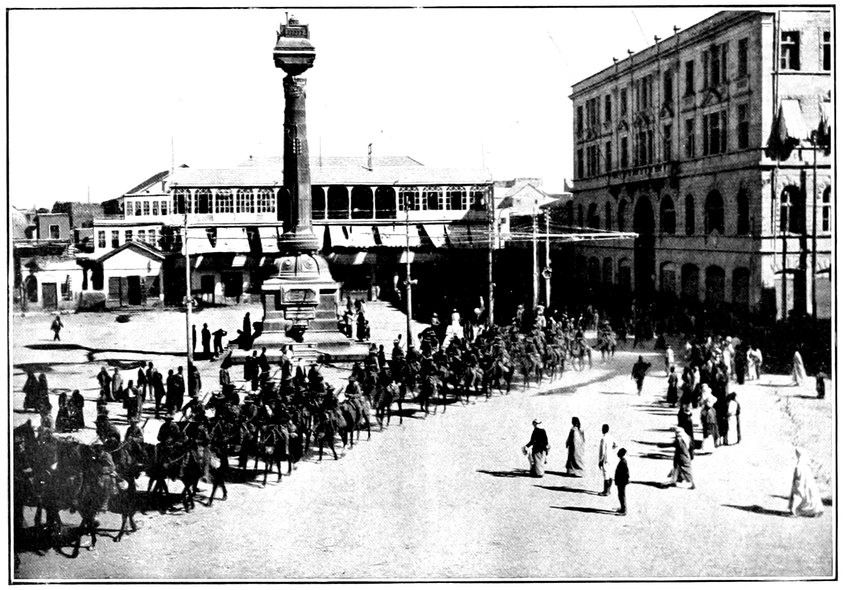
Fighting for Palestine Three Years’ Campaigning — AROUND ROMANI — THE TURKISH ADVANCE — FIGHTING IN THE DARK — KATIA — BIR EL ABD — ON THE FLANK — MAGDHABA — RAFA — DESERT ADVENTURES — FIRST GAZA — AMONG THE CACTUS — SECOND GAZA — BEERSHEBA — GALLOPING THE TRENCHES — A FAMOUS CHARGE — UP THE PHILISTINE PLAIN — JERUSALEM AND JERICHO — AMMAN — ES SALT — JORDAN VALLEY — PREPARING FOR DAMASCUS — AUSTRALIA’S NEW FRIENDS — THE WONDERFUL FORTNIGHT — A BOLD SCHEME — CAMOUFLAGE — THE NIGHT BEFORE — THE ADVANCE — THE GREAT RIDE BEGINS — ESDRAELON PLAIN — DOOMED TURKISH ARMY — CUT OFF — TERRIBLE AIR WORK — FINE STAFF WORK — GERMANS FIGHT WELL — EAST OF JORDAN — THE RACE FOR DAMASCUS — GREAT-HEARTED HORSES — ABANA GORGE — EXULTANT ARABS — THE GALLOP INTO DAMASCUS — VETERANS — BEAUTIFUL DAMASCUS — THE ANZACS’ PART — AMMAN CAPTURED — ARABS AND TURKS — THE TECHNICAL SERVICES — THE M.O. — THE A.S.C.
1
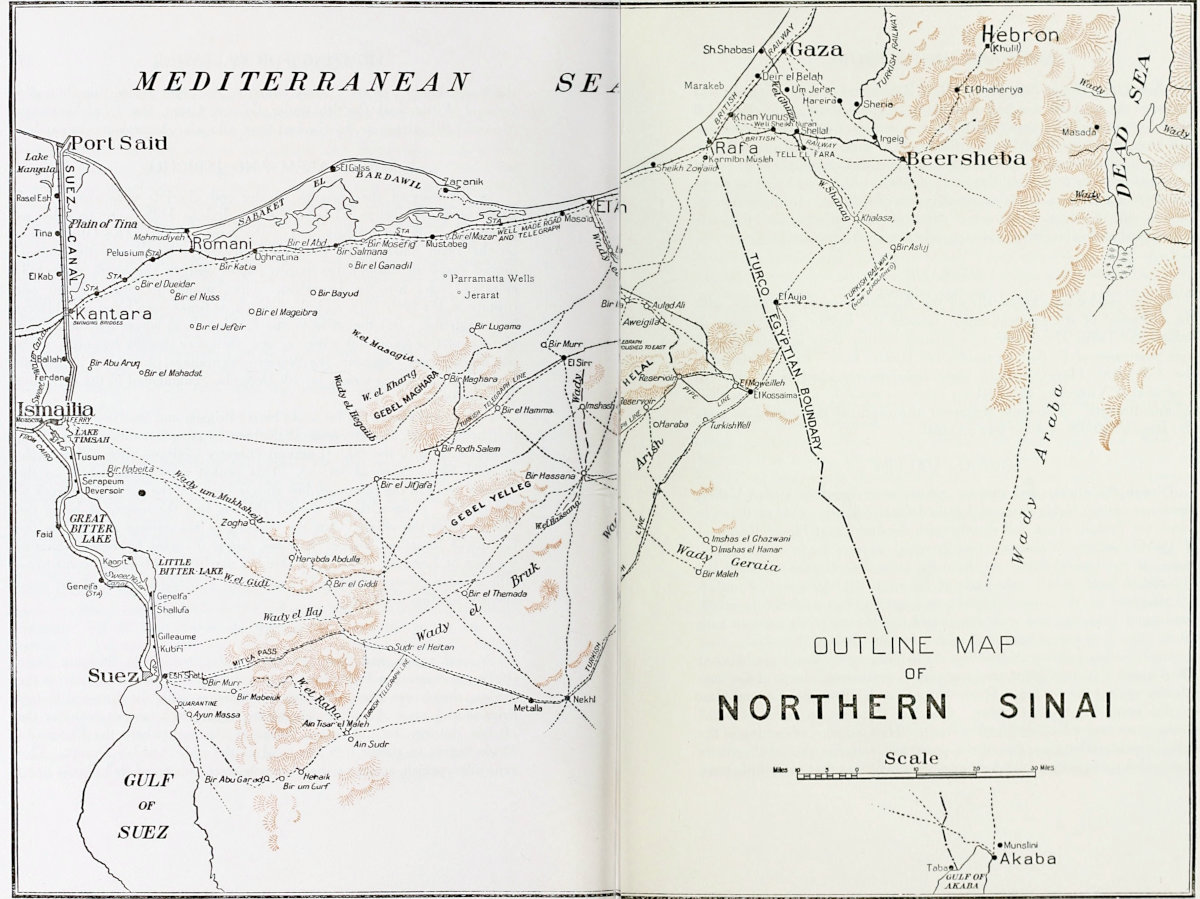
If the Turks had not aspired to the capture of the Suez Canal, and the
reconquest of Egypt, they might still have been in quiet possession of
the whole of Palestine. This campaign, so rich in brilliant exploits and so
appealing to the imagination of the people of the world’s three greatest
religions, was the direct result of Turkish aggression. Prompted by
Germany, the Turk had, early in 1915, penetrated Central Sinai and,
moving down the ancient route of the Wady Muksheib, attempted with a
very inadequate force to cross and hold the Canal. He was easily driven
off by a British force, which included a few Australian units. That was
before our attack upon Gallipoli. It was not until the following year, when
the heroic failure on the Peninsula had removed the menace to the heart
of his Empire at Constantinople, that the enemy was able to attack Egypt
with an army that gave him any promise of success.
Soon after the return of the Australians from Gallipoli, in 1916, at a
time when the future of the Light Horse, which had fought as infantry at
Anzac, was in considerable doubt, the Turk appeared in strength in
northern Sinai. Thirty or forty miles across the desert from Port Said,
there is a widely-scattered area marked here and there by hods, or little
palm groves, which tell of the presence of water at shallow depth. The
Romani area, as it is generally called, has always been of prime
importance to the armies which, since the dawn of history, have marched
east and west across the Sinai Desert between Egypt and Syria and Persia,
and lands even further afield. Napoleon rested there before that precarious
leap at El Arish which nearly cost him his army. Ancient invaders of
Egypt always refreshed their thirsty and desert-worn troops around Romani
before sweeping down upon the rich prize of the Nile Delta.
In 1916 the Turks began their forward operations by a raid in great
2strength, which beat down the resistance of Yeomanry posts at Katia and
Oghratina. At that time, the organization and training of the Anzac
Mounted Division was being completed at Salhia, west of the Canal. The
2nd Brigade, under Brigadier-General Ryrie, was immediately rushed out
to Romani, where it was found that the enemy had temporarily withdrawn
further east.
Steps were taken at once by the British Command to make the Romani
area secure. The remainder of the Anzac Mounted Division, commanded
by Major-General Chauvel, went out in support of the 2nd Brigade;
British infantry followed. The railway was pushed vigorously forward.
The 1st and 2nd Light Horse Brigades, with their camp at Romani, were
engaged in ceaseless reconnaissance in force. Taking the task alternately in
24–hour shifts, they kept substantial touch with the enemy, who was all the
while adding to his numbers, bringing up guns over the desert from
El Arish, and pressing steadily onward. By the beginning of August a
line of infantry strong posts extended at a right angle towards the north
from the sea, covering Romani to the east. There we were invincible; so
the Turk, moving swiftly and in strength, to the number of about 18,000,
on the night of 3rd August attempted a great flanking movement past the
south-western flank of the infantry line. His scheme was to drive in
behind the infantry and Romani, cut our railway and other communications
with the Canal, and envelop our entire forward force. Anticipating this
move, however, General Chauvel had that night placed the 1st Light Horse
Brigade, under the temporary command of Brigadier-General Meredith
(General Cox being absent on sick leave in England), on a line of outposts
joining up with the desert end of the infantry line, and thence swinging
towards the Canal at a right angle. This disposition completely frustrated
the enemy, and won us the battle of Romani.
The Turkish vanguard reached the Light Horse posts soon after
midnight and attacked immediately. For hours an extraordinary hand-to-hand
fight was waged in the dark among the sand dunes. The Light Horse
line, ten times outnumbered, was pressed steadily back, but maintained an
unbroken front to the enemy host. Soon after dawn the 2nd Light Horse
Brigade, temporarily commanded by Brigadier-General Royston, a South
3African veteran (General Ryrie being absent on leave in England), was
galloped forward in support and, dismounting, carried on the fight while
the Regiments of the 1st Brigade passed through them to the rear for a brief
breathing-space. All that day, the 4th August, the Turks gained ground
on this flank, and at the same time kept our infantry in their posts by
heavy shelling and a demonstration in strength from the east. A small
number of infantry available was put in to support the Light Horse line,
which, by nightfall, had been pushed back so close to the camp that
some units were served with tea by the regimental cooks as they fought.
But the end was now in sight. The New Zealand Mounted Rifle Brigade,
and a Brigade of Yeomanry, both under Brigadier-General Chaytor,
supported by a British infantry force, came swiftly down on the Turkish
left flank, which was high in the air. By nightfall we knew that the
battle of Romani was ours. At dawn next morning there was a slashing
general attack with the bayonet. The enemy’s line broke, his retreat
became a rout, and only the physical impossibility of getting speed out
of our horses, many of which had been without water for nearly fifty
hours, saved the whole Turkish army from destruction. The horses,
burdened with an average load of 240 to 250 lbs., and often up to 280 lbs.,
laboured gallantly, but slowly, over the deep, hot sand.
Many thousands of prisoners, several guns, great quantities of
munitions and other material were captured; but it was not until the
retreating Turk had reached the large palm area around Katia, six miles
away, and had been able to re-form his firing line in a reserve position
there, that we were able to collect our scattered Brigades and give him
fresh battle. The fight at Katia was drawn. On our side it was marked
by a stirring charge of the 1st and 2nd Light Horse Brigades and the New
Zealand Mounted Brigade, in an unbroken line across the sands. In the
preceding weeks the horses had frequently been watered in the hod at
Katia, and this, doubtless, contributed to the spirit they displayed in the
charge. The three Brigades, however, which had the support of a Brigade
of Yeomanry, were compelled by heavy fire from the enemy batteries to
dismount and fight on foot. The 3rd Light Horse Brigade, under
Brigadier-General Antill, which had undertaken a wide flanking movement
on the south, was held up by the enemy in Hamisah, where, in a
brilliant little engagement, they smashed the Turk and took 440 prisoners,
4with a trifling loss on our side. The delay, unfortunately, kept the 3rd
Brigade off the Turkish left flank at Katia, and enabled him stoutly to
resist the frontal assault of the Australians and New Zealanders. Towards
nightfall the engagement was reluctantly broken off.
Touch was maintained with the retreating Turks, and, a few days later,
the same Brigades again engaged them at Bir el Abd, some fifteen miles
further east. Once more a gallant dismounted frontal attack was made by
our forces, but again the 3rd Brigade on the flank was obstructed, and
its enveloping mission frustrated. In the main fight, which was much
hotter than that at Katia, our men pressed in close with the rifle. The
Turk was strongly supported by guns and machine guns in a very
advantageous defensive position, and the Australians and New Zealanders
were unable to reach him with the bayonet. The engagement was marked
by many splendid acts of heroism and self-sacrifice, but it was doomed
to be indecisive. The Turks evacuated the position the following day
and were pursued to the edge of the oasis area, withdrawing with the
remnant of their shattered Romani army to the neighbourhood of El Arish,
fifty miles away.
After the fight at Bir el Abd there was ceaseless heavy reconnaissance
and patrol work for the Light Horse, as the railroad, and with it the full
strength of what was now an established British army of invasion, moved
slowly, though inexorably, across the desert. On 21st December the Light
Horse and Imperial Camel Corps entered El Arish and received a demonstrative
greeting from the Arabs of that old village.
During these Romani operations, fraught with so much significance for
Palestine and Egypt, the extreme right of the British line was entrusted to
Colonel C. L. Smith, V.C., M.C., afterwards Commander of the Camel
Brigade, who had under him a composite force made up of the 11th Light
Horse Regiment, from Queensland, a London Regiment of Yeomanry
and four companies of “Camels,” drawn from Australia, Scotland and
Wales—a truly Imperial lot. A Turkish force, reported to be three
thousand strong, was moving down from Magara in a south-westerly
direction, with the intention of cutting in between Romani and the Canal.
This estimate of enemy strength proved to be exaggerated, but our column
had some sharp little fights against superior odds, and its work was warmly
commended by the Commander-in-Chief. At Awedia the Camel companies
went into action for the first time since their hurried formation;
but as most of the Australians were old Light Horse and infantry veterans
from Gallipoli, they were not strange to fire, and, like the remainder of
the Australians fighting at Romani, they rejoiced in open warfare after the
confined trench work of the Peninsula. A day or two later, the column
fought sharply at Hilu and Baud, each time mauling the enemy severely
and contributing substantially to the general disaster in store for the Turks.
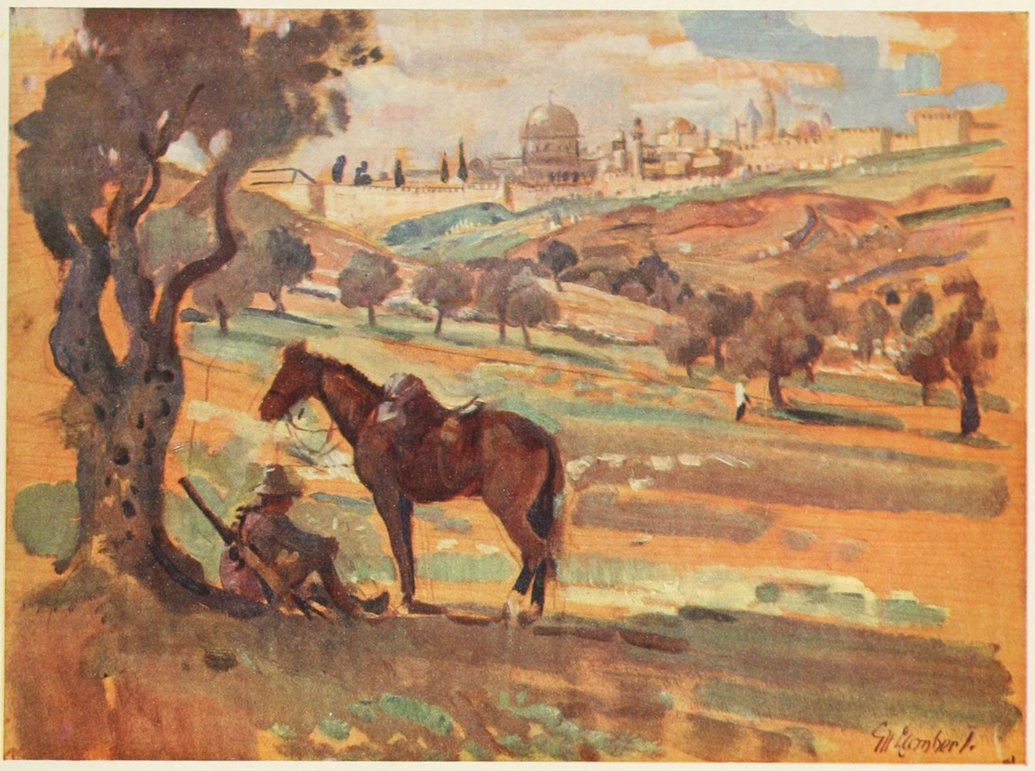
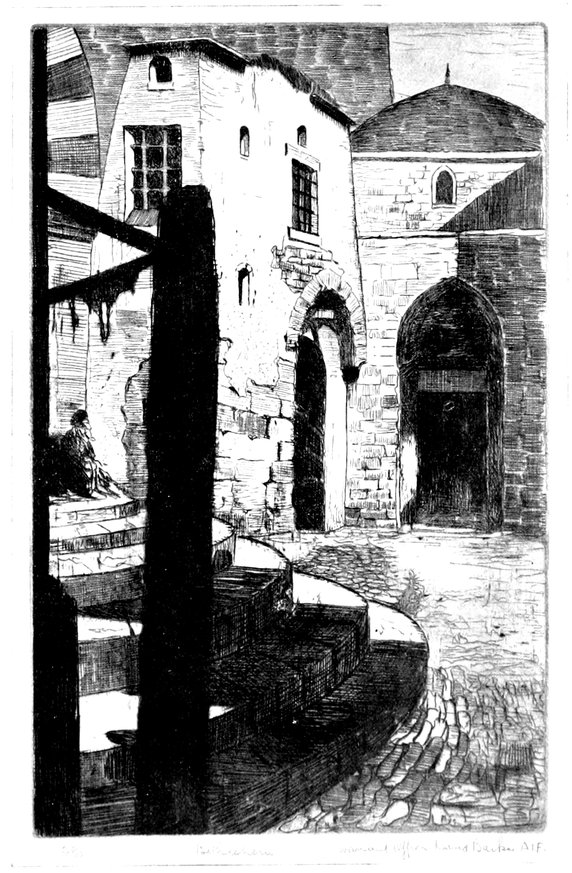
JERUSALEM, FROM BELOW THE MOUNT OF OLIVES
By Lieut. G. W. Lambert
5
On the night of the 22nd December, the Anzac Mounted Division,
made up of the 1st and 3rd Light Horse Brigades, commanded by
Generals Cox and Royston, the New Zealand Brigade (General Chaytor),
and the Imperial Camel Brigade (General Smith, V.C.) which included a
majority of Australians, moved upon the Turkish post at Magdhaba,
twenty-three miles away up the Wady El Arish. Again marching all
night, they came at dawn within striking distance of the garrison settlement.
Deploying swiftly, they soon had Magdhaba surrounded, and, galloping in
as close as the Turkish fire, which came in strength from a number of
well-concealed entrenched positions, permitted, dismounted and pressed
forward in troop rushes with the bayonet.
The chief trouble for the Anzac Mounted Division at Magdhaba was the
supply of water for the horses. If the Turks could not be smothered by
nightfall, a withdrawal was imperative, for it was impossible to contemplate
another day’s fighting with the horses still thirsty. In a country like this,
where all the chargers are brought from far overseas, horseflesh must not
be lightly thrown away. The struggle for Magdhaba was, therefore, as
at Rafa a fortnight later, a struggle against time, a gamble against daylight.
The Division, with the Imperial Camel Corps, fighting still under the able
command of Major-General Chauvel, scored just on the call of time. As
the day was closing vital Turkish strong posts fell almost simultaneously to
our assaulting units on three sides of the settlement. In a wild rush the
encircling troops overwhelmed the Turks, and met—with an extraordinary
mingling of units coming in from every point—in the centre of the ring of
battle. The survivors of the Turkish garrison, some 1250 officers and men,
were made prisoners. Our total casualties were fewer than 150. Darkness
fell swiftly, and, in the early hours of the night, there was an amazing scene
as the prisoners were collected, and officers and men sought their units and
searched for their led horses. Before midnight the Division was re-formed
and, with the exception of a few squadrons left to clear the battle-ground
and escort the wounded, our victorious little force was riding—for the second
night in succession—back to water and rest at El Arish. As they tracked
along in the darkness there were whole squadrons with not a man awake—a
strange Christmas Eve!
7
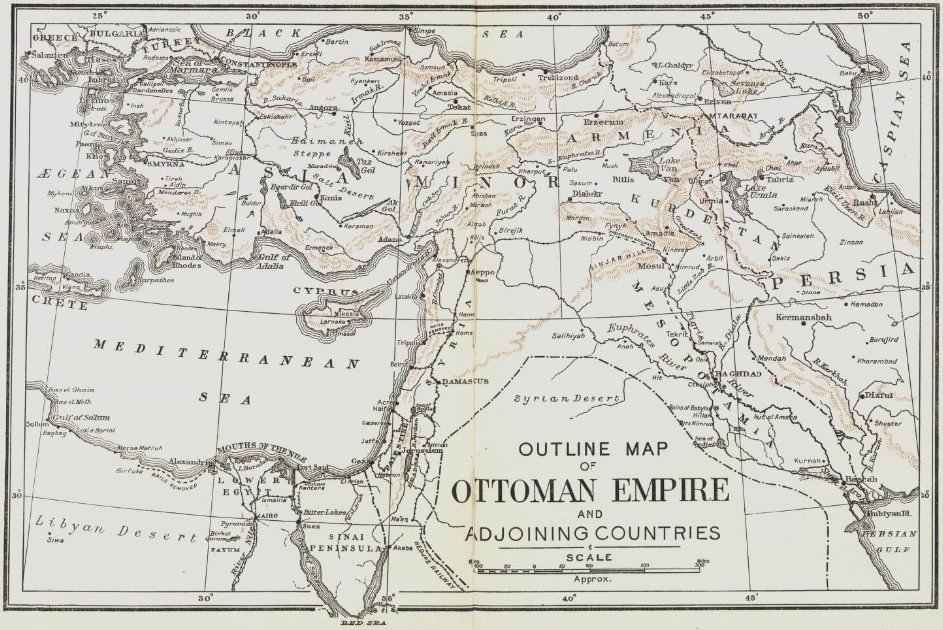
8
Next came Rafa. On the evening of 8th January the Anzac Mounted
Division, made up of the Brigades which had fought a few days before
at Magdhaba, strengthened by the Camel Brigade and a Brigade of
Yeomanry, cleared camp near El Arish and, riding all night, appeared
before Rafa at dawn. The Turks held a strongly entrenched position
consisting of three main systems of redoubts with many outlying rifle-pits
on high ground, culminating in a knoll. On this knoll was a solitary tree,
visible for many miles; and this, roughly speaking, was our objective.
As at Magdhaba, the enemy was rapidly surrounded by Brigades moving
at the trot and the gallop. Then the horses were raced back to places of
safety, and the circle closed in on foot. The ground was more open than
at Magdhaba, and our advance lay up long, bare slopes, swept by enemy
fire. All day the cordon drew closer. Again, until the last moment,
there was uncertainty as to whether the Turk could be smashed before
nightfall. Again our horses were without water. And again victory came
at sundown; this time after a series of long, sustained charges with fixed
bayonets in the face of expert Turkish riflemen and German machine
gunners, shooting at their best over specially prepared zones of fire. Rafa
was a grim, deadly fight, waged up to the moment when our exhausted, but
still excited, troopers jumped down on the Turks in their trenches.
That spirit of mercy which has distinguished so many Australian fights
was shown here at its best. The Turks, who had shot at our men mercilessly
and effectively until they charged home into the very trenches, then
dropped their rifles and held out their hands—to have them warmly shaken
by Australians! Such incidents, occurring frequently as they have in this
campaign, may not be according to the rules of war, and the psychology
disclosed may be difficult to follow; but the recollection of them, while it
always moves our men who were concerned to shamefaced laughter, must
clearly be a source of lasting gratification. At Rafa, practically every Turk
who survived was made a prisoner, and we also secured many guns and
much war material. Even in more marked degree than Magdhaba was
Rafa placed to our credit at the eleventh hour, for not only was our force
threatened by the lack of water and the approach of darkness, but heavy
enemy reinforcements were rapidly approaching.
9
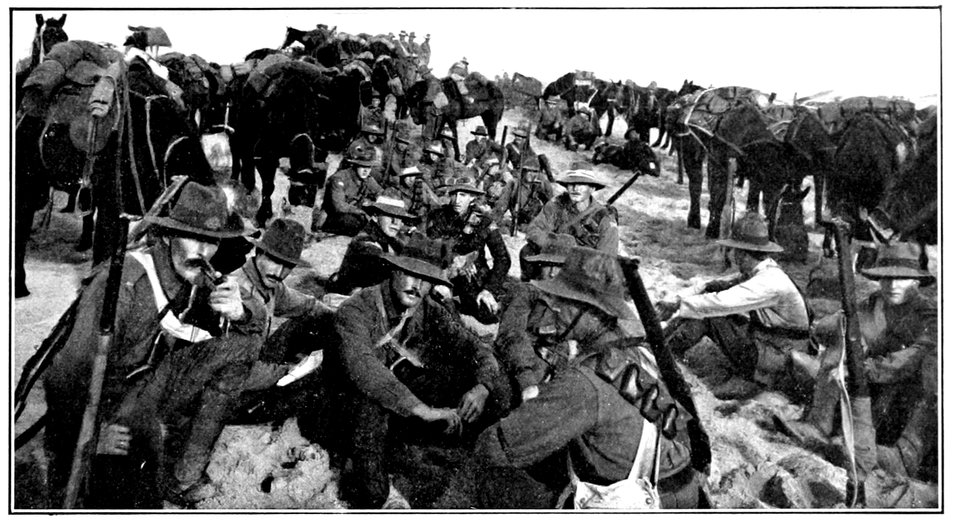
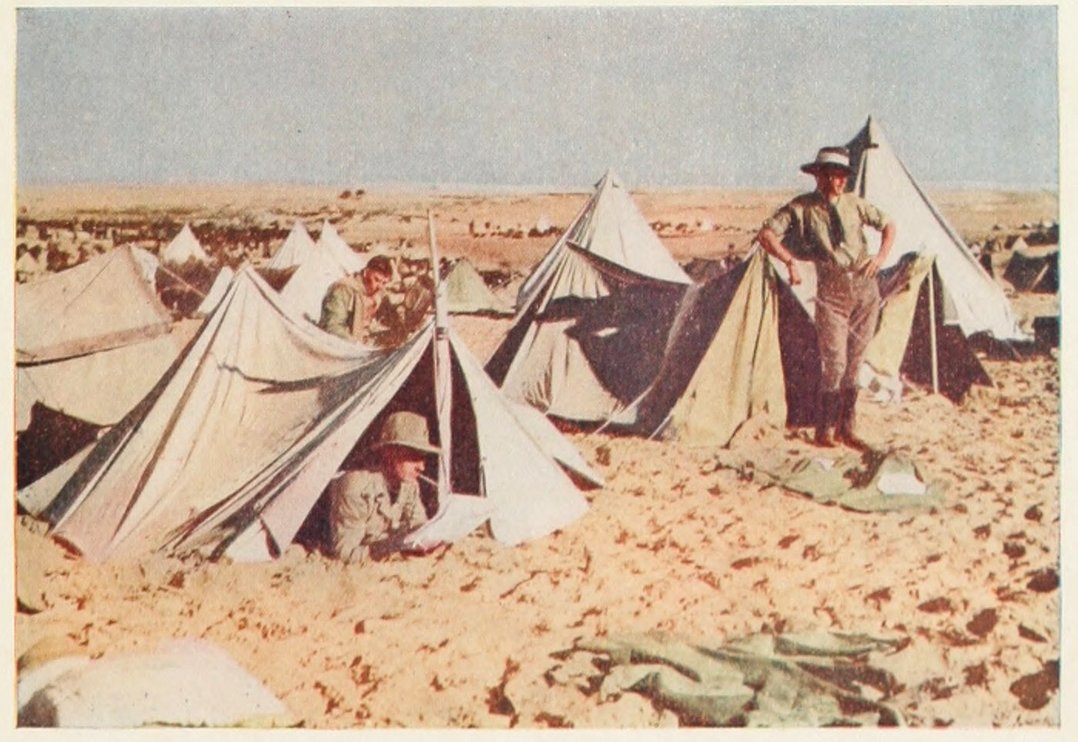
A BRIEF HALT RICHLY EARNED
10

3rd L.H. CAMP AT BELAH, A FAVOURITE RESTING GROUND BY THE SEA SOUTH OF GAZA
11This marked the passing of the desert. On the evening of the night
march which brought us close to Rafa, our troops were still in the waste in
which they had spent nearly a year without a glimpse of civilization or
verdure. Travelling all night through the heavy sand, they came, just
before dawn, on sounder going for their horses, and daylight showed them
a wide, rolling landscape, gay with brilliant winter flowers—the fringe of
Palestine.
No survey, however incomplete, of this fine campaign should fail to
mention the countless little desert expeditions in Western and Central Sinai,
in the early days of the fighting. These had various purposes. Sometimes
they were political, but more than once they led to sharp fighting. The first
time Australians were actually engaged east of the Canal was when the 9th
Light Horse Regiment (chiefly South Australians, with a few Victorians),
by a long night march and clever manœuvre, swooped down and bagged
the Turkish outpost garrison at Jifjafa. Then there was a fine dash by the
11th Light Horse Regiment to Nekhl, the British pre-war administrative
centre in Sinai. Later, two interesting expeditions were made up the Wady
Muksheib, the ancient and central route across Sinai by which the Turks
came in their feeble attack on the Canal, early in 1915. The drawback
of that route was the shortage of water, and along the Wady bed some
ancient power had excavated huge cisterns which filled during the rains.
These cisterns are still intact. Once, the Light Horsemen pumped them
out, and so closed the route for that season to the Turks; going out again,
they sealed and covered them so as to make their rediscovery by the enemy
very difficult.
Australian units from the Camel Brigade more than once rode across
the desert to Akaba, at the head of the Persian Gulf. In October, 1916,
a force marched thirty-five miles across the sandhills from Bayud to
Maghara, and engaged in a vigorous reconnaissance in the foothills below
the almost inaccessible, high-built Turkish garrison position. As an
instance of the man-power and transport necessary to maintain a force in
12action on the desert for even a few days, the details of this little enterprise
are remarkable. The column contained only 1100 rifles, and the operations
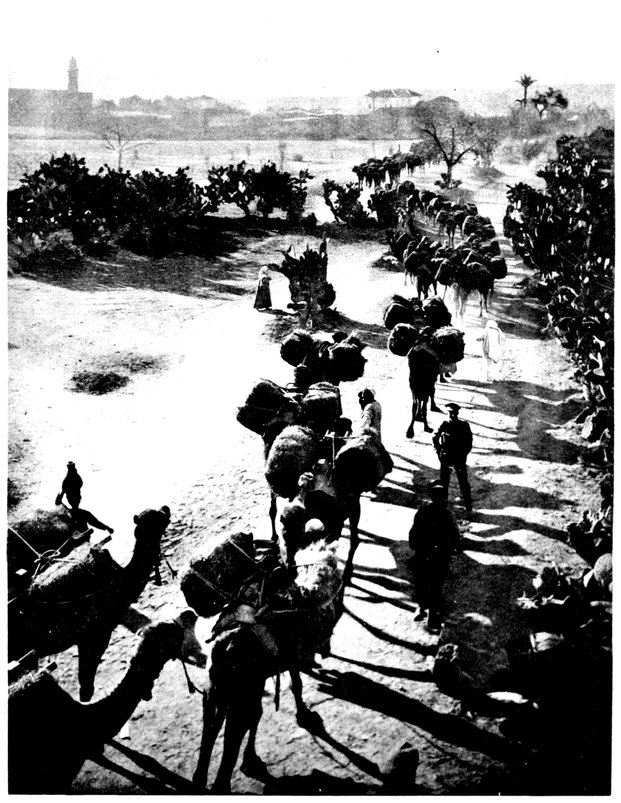
covered but a few days; but no fewer than 7000 camels, 2300 horses and
(including natives) 5000 men were employed to provide supplies of food
and water for the force.
All these little side-shows necessitated long night marches across
countless desert hillocks. To the untrained eye, one square mile of country
in Sinai is indistinguishable from any other square mile, even by daylight.
At night all movement was by compass and the stars, and the task of our
guides was complicated a hundredfold by the constant change of route
imposed by the steepness of many of the sand dunes. Very early the
Light Horseman displayed that apparently inborn sense of direction which,
almost alone, would have made him famous in this campaign. After a brief
trial, the native guides provided by the Imperial authorities were found to be
too slow and uncertain, while, if the enemy was close, fear usually reduced
them to a state of imbecility. As soon as this was recognized, the whole of
the guiding was done by our own officers, many of whom developed a
certainty of location, whatever the circumstances, which amounted almost
to inspiration.
Ten weeks after Rafa, on 26th March, came the first battle of Gaza.
The scheme for the capture of this old gateway of Palestine proper was
similar to that which succeeded so decisively at Rafa and Magdhaba. We
were to move by night and envelop and isolate the town, with a view to its
capture before the Turk could bring up reinforcements. But it was a
far bigger enterprise than the two earlier raids. Modern Gaza is a fairly
compact old town, which, before the war, contained 30,000 inhabitants.
Most of the houses are of mud and straw, but there are also many
substantial modern residences. The little city is graced by many mosques
and minarets. Standing on a low hill on the inland edge of the wide belt
of sand dunes, which, on this coast, everywhere fringe the Mediterranean,
it is bounded on the north, east and south by an occasional fine orange
grove, wide areas of olives and an intricate network of huge, sprawling
cactus hedges surrounding hundreds of tiny fields. The Turks were soundly
dug in, and well supported by many guns in commanding positions, while
the irregular system of cactus hedges made an ideal barrier between them
and the naked plain over which the attacking troops had to advance.
13Since Rafa a notable change had taken place in our force. The mounted
troops had been reinforced by the arrival of large numbers of Yeomanry and,
for the first time in the campaign, a substantial force of infantry was available
for frontal attack. Marching in the darkness, part of our army surrounded
Gaza, while a strong mounted force took up positions to the east and north
to prevent the intervention of heavy Turkish reinforcements, which were
within easy striking distance. British infantry attacked from the south and
east. On their right flank was a Brigade of Yeomanry. Next came the
New Zealanders, and on the extreme right, pushing in from the north, with
their flank on the sea, was the 2nd Light Horse Brigade, with Brigadier-General
Ryrie back in his old command. Unfortunately, a heavy morning
fog prevented the infantry from getting into grips with the Turk in the
earlier part of the day.
The mounted troops, moving faster, galloped first through the scattered
groves of olives and then pressed forward, still on their horses, amidst the
maze of cactus hedges. For our men it was a wonderful day of detached,
individual fighting. Exact conformity was impossible. Regiments and
squadrons, and even troops, fought wild little hole-and-corner combats of
their own. There was much excited steeplechasing over the cactus. At
times, our men and the Turks fought each other from either side of a hedge
a few paces in width, the enemy on foot and our troops firing from their
horses. Then the Light Horse, dismounting, hacked their way through
the cactus with their bayonets, and did effective work with the steel. Our
machine gunners, advancing in rushes in front and to a flank of the 2nd
Brigade, maintained a clever and deadly covering barrage.
The fighting was marked by countless fine incidents. One Light Horse
squadron gallantly rushed an important Turkish observation post. The New
Zealanders, assisted by a Light Horse troop, took a number of enemy guns.
Swinging one of these round, and sighting through the open barrel at point
blank range, they demolished with a single shot a stone house containing a
number of troublesome Turkish riflemen. By nightfall, both the infantry
and mounted troops had won into the outskirts of the town, and captured
large numbers of prisoners. But the garrison was still strong, and heavy
Turkish reinforcements were closing in rapidly from three directions. We
had missed by a hairsbreadth. The fight was broken off and our men,
14suffering a sense of disappointment scarcely less than that felt at the
evacuation of Gallipoli, were withdrawn.
Three weeks later, on 19th April, the second battle of Gaza was fought
on a long line extending from the sea eastward towards Beersheba.
The Australians fought dismounted out on the right flank, and the day was
the bloodiest our men have known in their Palestine fighting. For many
hours they pressed forward in thin lines, up long, bare slopes, in the face
of heavy and well-directed high explosive, shrapnel, machine gun and rifle
fire. In places they made substantial headway and bent the Turks back.
At one point, since known to fame as “Tank Redoubt,” two Australian
companies of the Camel Brigade, co-operating with the British infantry on
their flank, won temporary possession of a main key in the enemy line.
Many splendid deeds distinguished this day’s hard fighting; they will rank
with the best performances of Australian infantry in the war, and the exploit
of the “Camels” at the Tank Redoubt with the greatest achievements of
British arms in any age. But the Turk, though badly shaken, stood firm.
The simple fact was that, in this Gaza-Beersheba line, which lent itself
admirably to stout defence, we had encountered enemy forces so superior
in number and equipment, that further advance was, for the time, physically
impossible.
Between then and the end of the following October, when the Turkish
position was shattered, significant additions were made to our strength. We
were reinforced by some Divisions of infantry, and many guns of different
calibre, while the Desert Mounted Corps was formed from the old Desert
Column, consisting of the Anzac and Australian Mounted Divisions, and
a Yeomanry Division. During this period, too, General Allenby arrived
from France as Commander-in-Chief. In the great attack which demolished
the enemy’s strong defensive system on this line, the Turk was out-witted and
outfought. By a wide detour, covering several days and notable for its long,
exhausting marches, and the remarkable performances of the Engineers in
the development of water in desert areas, the Anzac Mounted Division
appeared as a bolt from the blue to the south-east of Beersheba, on the
morning of 31st October. Beersheba marked the end of the Turkish line
of defence. Seen from the surrounding hills, the scattered modern town,
with its wide, dusty streets planted with straggling eucalyptus and pepper
trees, is not unlike some western townships in Australia. It lies in a basin
below the southern end of the Judean Range, and had been strongly fortified
by the enemy. The attack from the south-east, however, was a complete
surprise to the Turk.
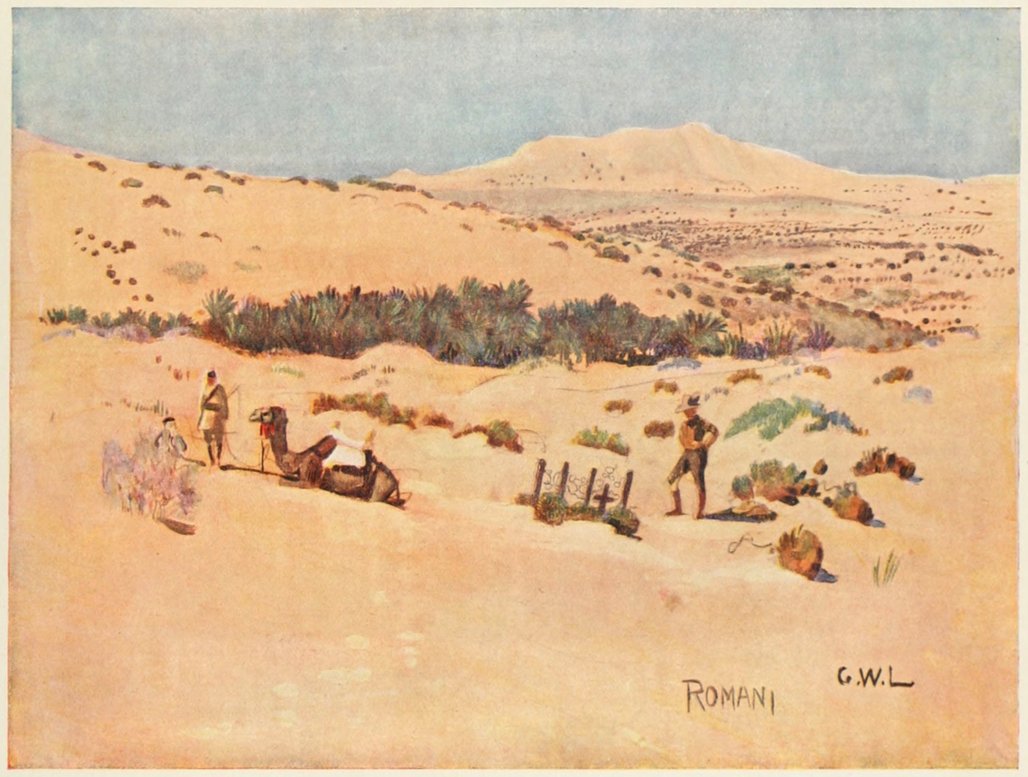
ROMANI. MOUNT ROYSTON IN THE DISTANCE
By Lieut. G. W. Lambert
15
In the early morning the New Zealanders moved swiftly to the assault
of Tel es Saba, a formidable mound, bristling with machine guns and rifles.
At the same time, the 1st Light Horse Brigade went in to the south
on the New Zealanders’ left, while the 2nd Light Horse Brigade dashed
away on a long gallop under heavy shell-fire, and took up a position to the
north, to cut off the retreat of the Beersheba garrison along the road
leading over the Central Range, through Hebron and Bethlehem, to Jerusalem.
After very heavy fighting on foot, over broken ground, the New
Zealanders, supported by the 1st Light Horse Brigade, scaled and captured
Tel es Saba. The day was well advanced. Beersheba had not fallen, and
it was patent that, if we relied upon a dismounted attack, the town would
certainly resist until nightfall; which would have given the enemy an
opportunity to adjust his forces and perhaps upset our whole offensive.
Four miles away to the south-east, the Australian Mounted Division was in
reserve, and, shortly before sunset, Brigadier-General Grant received orders
to attack the town with the 4th Light Horse Brigade. Between him and
Beersheba lay a definite system of strongly-held Turkish trenches. As it
was recognized that time did not permit of a dismounted advance, the
decision was made to go in mounted, at a gallop. This hazardous enterprise
of galloping infantry into an entrenched position was entrusted to the
4th Regiment, from Victoria, and the 12th Regiment, from New South
Wales.
Moving off at a trot, and soon quickening the pace to a gallop, the
regiments swept in a bee-line towards Beersheba. They were soon under
heavy shell and machine gun fire, but this only served to speed
the horsemen. Charging wildly down on the Turks, despite heavy rifle fire,
leading troops of Light Horsemen jumped the advanced trenches at a gallop,
going clean over the Turkish bayonets. Once within the enemy trench
16system, part of the force dismounted, and, jumping down with their
bayonets among the startled enemy, soon cleared the position. Meanwhile
the mad gallop of the other squadrons was continued through enemy
resistance into the very heart of the town. The Turks were thrown into
hopeless disorder, and, believing that the handful of Australians formed but
the advance guard of a great cavalry force, put up an indifferent fight.
Upwards of 1100 were captured, but the darkness, which fell immediately
after our horse clattered into the town, enabled many more to escape. Nine
field guns and a large quantity of material fell into our hands. The Light
Horsemen had charged with fixed bayonets, not that they could make any
use of them on horseback, but for the moral effect upon the enemy. This
magnificent enterprise, establishing as it did that Turkish nerves were not
proof against a resolute body of galloping horse, led to highly important
results in the Great Drive which followed. The Yeomanry, who were
equipped with cavalry swords, a privilege not then enjoyed by any of the
Australian Light Horse, routed greatly superior numbers of Turks in a
series of charges which rank with the greatest performances of British
regular cavalry.
A few days after Beersheba the Turkish line was broken by the infantry
at Sheria, and again between Gaza and the sea. The mounted men were
turned loose on the heels of the retreating enemy, and the wild stern chase
was continued for nearly fifty miles. The speed of the horsemen was
regulated chiefly by difficulties of transport and water supply; but all the
way the Turk fought clever rear-guard actions, making therein especially
effective use of his strong equipment of machine guns. The Australians’
work was fast and bold throughout. There were scores of fights by night
and day, which brought credit to the staff work and Brigade and Regimental
fighting. Up till then it was the grandest cavalry drive in the war, and
perhaps it has no equal in any campaign of the past. When the British
forces came to a halt on a line running roughly from the coast a few miles
north of Jaffa eastward to the mountains, the cessation of the pursuit was
due not to enemy resistance, but to the impossibility, at that time, of
extending our lines of communication any further. During this great
cavalry drive, the Desert Mounted Corps, which embraced all the
mounted troops, was under the command of Lieut.-General Sir H. G.
Chauvel, who enjoys the distinction of being the first Australian to rise to
17the leadership of a Corps. And, with the 3rd Light Horse Brigade under
General Wilson and the 4th under General Grant, the four Australian
Mounted Brigades were, for the first time, all under Australian commands.
In the wars of the ancients, cavalry and chariots were always used
down on the Philistine Plain, while the Judean Hills were regarded as
practicable only for infantry. It is the same to-day. The Great Drive
on the Plain finished, the British infantry, with Yeomanry dismounted,
moved eastward through the narrow passes and up the harsh, rocky hillsides
of Judea towards Jerusalem. The Turks stubbornly resisted our
capture of the Holy City, and the fighting, at times, was bitter and bloody
in the extreme. But the gallant little Londoners, to whom fell the honour
of most of this significant advance, won their way steadily forward. Only
one Light Horse Regiment, the Western Australians, played any immediate
part in the operations which, on 9th December, culminated in the surrender
of Jerusalem.
A few weeks later, the 1st Light Horse Brigade and the New Zealanders
marched secretly, at night, from Bethlehem by steep mountain tracks, and,
co-operating with the 60th (London) Infantry Division, after a sharp fight
at Nebi Musa captured Jericho. This exploit was distinguished, as the
Anzacs’ work in the campaign has always been, by the remarkable work of
our guides. A squadron of the 1st Brigade had the honour of being the
first to enter the village; but the winning of the Jordan Valley, like the
capture of Jerusalem, was, in the main, due to the solid fighting qualities of
the men of London. To-day, all through the Judean Hills, you come upon
little wooden crosses which tell of the spirit and self-sacrifice of our good
ally, the fighting Cockney.
A brief pause, and then, the Desert Mounted Corps Bridging Train
(B Troop, Australian Engineers) having thrown the first bridge across the
Jordan, the Anzac Mounted Division, together with the Imperial Camel
Brigade and, once again, the Londoners, made their famous rush for the
Hedjaz Railway, far out across Jordan to the east, where the Plateau of
Moab begins to merge into the sand of the wide Arabian Desert. This
expedition, which, so far as the Colonials were concerned, fell chiefly upon
the 2nd Light Horse Brigade, the New Zealanders and the Camels, was
perhaps the severest we had had since crossing the Canal. Rain fell
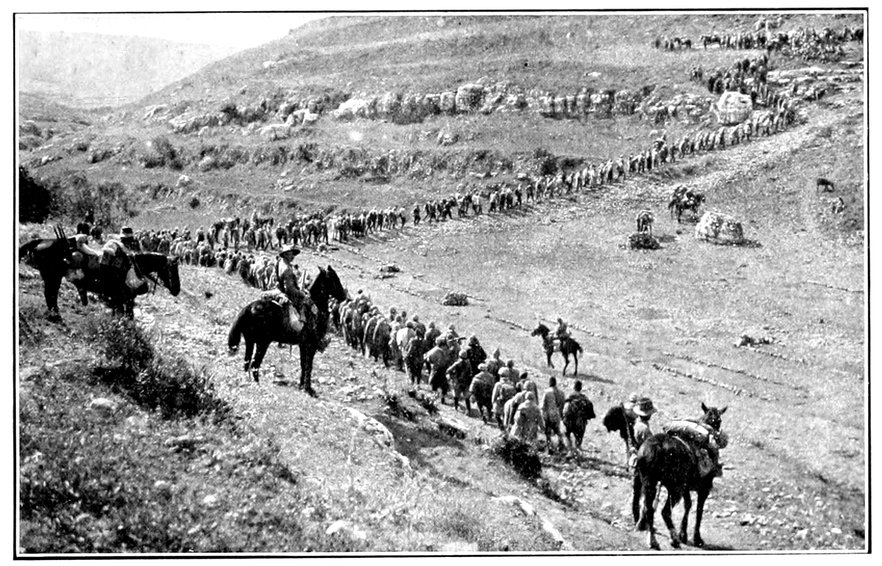
almost unceasingly for many days. The mountain tracks were so narrow
and broken that the Brigades, travelling only by night, moved in single file,
leading their horses and camels. The weather was piercingly cold. Men
were wet through for several days and nights in which they knew no sleep,
and were almost ceaselessly engaged in heavy fighting. In these circumstances,
the destruction of some miles of the railway, and the safe
withdrawal of the force, was an especially good performance.
19
20
A few weeks later practically all the Australian mounted troops, with
the exception of the Camels, again crossed the Jordan, and, cutting in
behind the Turks after some rare mountaineering feats in the darkness,
took possession of Es Salt, a considerable Turkish base. In this enterprise,
the 3rd Light Horse Brigade particularly distinguished itself, the 8th
Regiment of Victorians alone taking prisoners equal to at least twice their
fighting strength. The same Regiment also captured thirty machine guns
and large quantities of other war material.
During the spring and summer, which were spent in Jordan Valley,
there were many highly successful little defensive fights. One of these, in
which the Turkish attack fell mainly upon the 2nd Light Horse Regiment
of Queenslanders, left nearly two hundred enemy dead within a few
chains of our barbed wire. At about the same time, the foe assaulted the
Musallabeh knoll, on the other side of the river, held by the 1st Battalion
(Australians) of the Camel Brigade, and got to close quarters, in which
bombs and bayonets, and even stones and hands were freely used on both
sides. The Turks were beaten off with some hundreds of casualties.
On 12th July, a day on which the shade temperature stood for hours at
120 degrees, a stout attempt was made by a considerable force of German
infantry against the 1st Light Horse Brigade under Brigadier-General Cox,
on this same Musallabeh sector. Our line there was a series of small
strong posts over a long and broken front. The Germans, advancing in the
dark, penetrated between two of the posts, and actually reached the centre
of our advanced position. A feature of this fight was that every little post,
21except one which was overwhelmed, successfully resisted the German
attack, although all were surrounded and isolated for hours. In some,
practically every officer and man became a casualty. The Germans were
routed by a brilliant counter-attack of the 1st Light Horse Regiment (New
South Wales), which was in reserve, and the affair cost the Germans 360
prisoners and about 1,200 casualties. Our losses were slight. Troops from
four States, Tasmania, South Australia, Queensland and New South Wales,
shared in the victory. On the same day, also in Jordan Valley, a troop
of Queenslanders, men from the 5th Light Horse Regiment, twice left their
lines with bombs, and, surprising enemy forces many times their number,
brought in forty-five prisoners, and they had killed and wounded as many
more in the fight. The casualties suffered by the troop were one officer
and two men slightly wounded. Two cars of No. 1 Australian Light Car
Patrol also took part with the Imperial Service (Indian) Cavalry in a
brilliant counter-attack east of the Jordan.
The long, distressing summer in Jordan Valley died hard. In September,
when the Anzac Mounted Division was there, the hottest days of the
whole year were endured. The various mounted troops had held the
Jordan sector in turn, those in reserve enjoying brief periods of rest on the
bracing uplands about Solomon’s Pools, a little to the south of Jerusalem.
There the sunny days were cool, and at night men who had known little
sleep down on the Jordan rejoiced in the mountain mists and the unwonted
comfort of their blankets.
In the course of the year there had been another interesting change in
the composition of General Allenby’s army. Many of the Yeomanry and
British infantry had gone to other battle fronts, and in their place came
one hundred thousand Indian horse and foot. Many of our Light Horsemen
had fought beside the Gurkhas and other Indians on the Peninsula;
some of us had seen the Indian cavalry in France in the early days of the
war; but to most of the Australians the Indians were strangers. To-day,
after a few months and a stirring campaign together, the bond between the
two races is a remarkably strong one.
The Australian soldier has, for a man of insular breeding, shown
an extraordinary capacity for making friends. He has an easy way
22with peoples of all races and colours. In France he is completely at his
ease among the French peasantry; and he saunters through the Arab
villages in Palestine as familiarly and as confidently as he used to walk the
streets of his townships and cities at home. His old enemy the Turkish
ranker is his admired personal friend. But the strong bond which sprang
up so quickly between the Light Horseman and the Indians was perhaps
the strangest of all his new war friendships. They were divided by colour,
the language barrier was absolute, and, most unpromising of all, there was
the barrier of caste, which prevented the devout Indian from sharing his
rations, and so made little acts of camp hospitality impossible. But the
barriers, although they seemed impassable, were miraculously surmounted.
The Indians made no secret of their admiration of the Light Horseman as
a past-master at the game of combined mounted and dismounted fighting,
while the Australian was genuinely appreciative of the splendid soldierly
qualities of the highly-trained regular Indian cavalry. Moreover, nearly all
the Indians rode Australian horses!
Every trooper in Palestine knew that a great campaign would be
launched in the early autumn. General Allenby would, according to the
camp-fire strategists, “hop in” during the brief season between the extreme
heat and the beginning of the heavy rains in November. Further, the
C. in C. would, in all probability, assail the enemy line at the full of the
moon, so that we should have light for the great cavalry night marches
that were anticipated. But it is doubtful whether any soldier in Palestine,
who was not in the official secret, forecasted a scheme so bold as that
General Allenby had resolved upon. Certainly, none dared to hope for a
triumph so dazzlingly swift and complete.
The great campaign opened at dawn on the morning of 19th September,
1918. A fortnight after General Allenby flung his artillery bombardment at
the enemy line, the great Turkish and German force in Western and Eastern
Palestine had been destroyed, and our prisoners numbered 75,000. Of the
4th, 7th, and 8th Turkish Armies south of Damascus only a few thousand
foot-sore, hunted men escaped. Practically every gun, the great bulk of the
machine guns, nearly all the small-arms, and transport, every aerodrome
and its mechanical equipment and nearly every aeroplane, an intricate and
widespread telephone and telegraph system, large dumps of munitions and
every kind of supplies—all had, in fourteen swift and dramatic days, been
stripped from an enemy who for four years had resisted our efforts to smash
him. It was a military overthrow so sudden and so absolute that it is
perhaps without parallel in the history of war. And it is still more
remarkable because it was achieved at a cost so trifling.
23
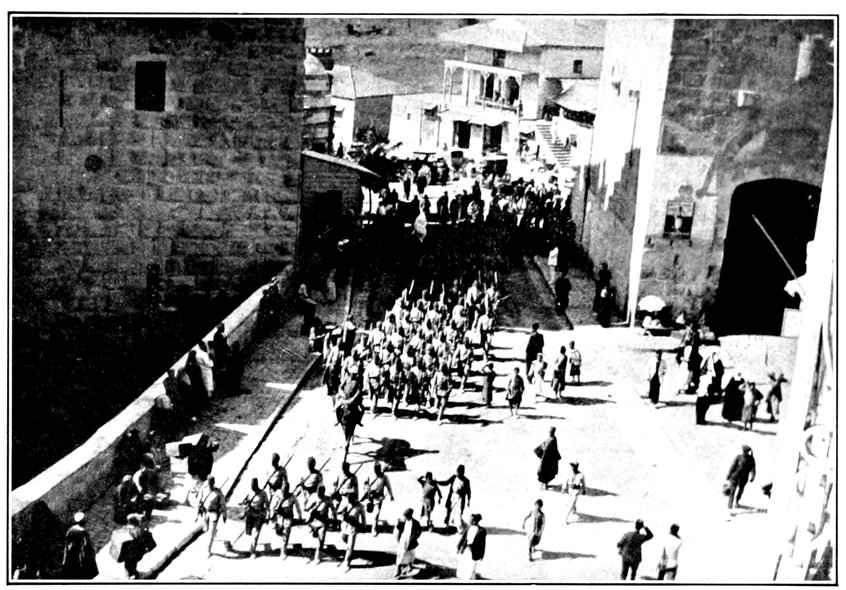
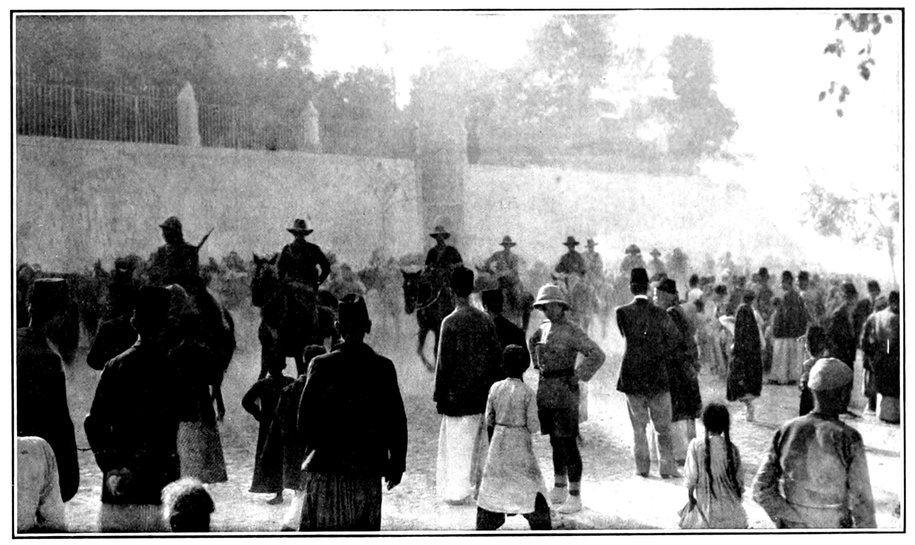
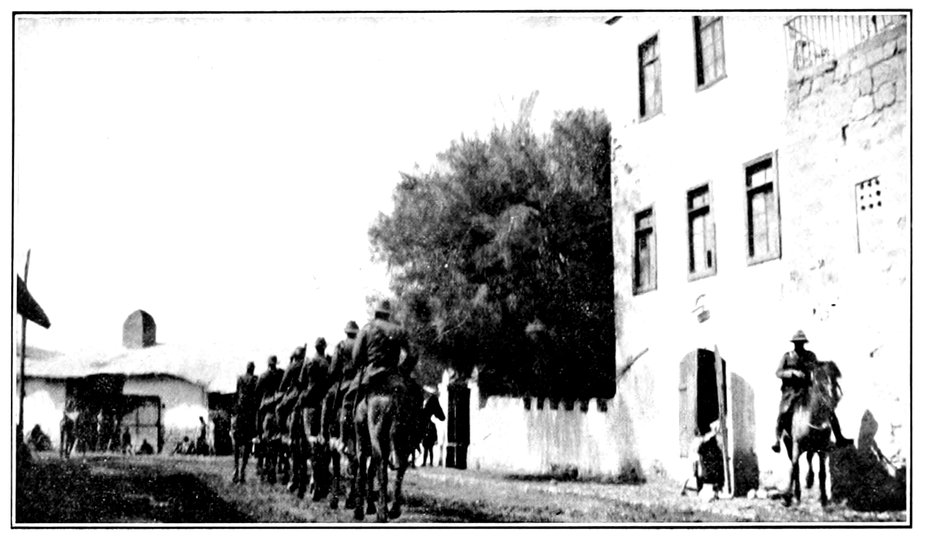
TURKS MARCHING OUT OF OLD CITY OF JERUSALEM AT BEGINNING OF WAR, 1914
(Captured German Photograph)
24
25It was a stupendous result, gained by a simple scheme. The
strategy was strikingly bold, but perhaps the most impressive thing about
General Allenby’s triumph was the superb manner in which his plan was
carried through. The campaign went with a bang from the moment the
line was broken until Damascus, more than 150 miles distant, was taken.
It galloped all the way. There was never a moment’s indecision, never a
semblance of fumbling. Here was a British Army at its best, every man
efficient, every man enthusiastic.
The scheme was obviously the conception of a confident leader of horse.
General Allenby is a cavalryman, and he had under his command the most
powerful cavalry force in the war. And he knew the quality of his mounted
men. All of the Australians and New Zealanders and Yeomanry had been
in the sixty-mile drive from Gaza, of the previous year, and most of them
had been in the saddle in Egypt and Palestine for two and a half years. The
dashing Indian cavalry had been with him for many months and had given
many examples of their speed and love of battle. Again and again in the
summer their advanced patrols had galloped down bodies of Turks, and
their terrible use of the lance in those little actions had a highly useful effect
on Turkish nerves. The cavalry was General Allenby’s special weapon for
the campaign, but in addition, he had a substantial and fit force of veteran
infantry. He had, too, a particularly brilliant lot of airmen, and in his
supply services he possessed a vast organization of railway, motor, camel,
horse, mule and donkey transport, which was efficient and resourceful in
the highest degree, and had already performed miracles.
Altogether the British Army of Palestine was, when the final campaign
opened, as near to perfection as any force ever was. All ranks were
veterans and all were animated by that spirit which every army feels when
confident of victory and happy in its leaders.
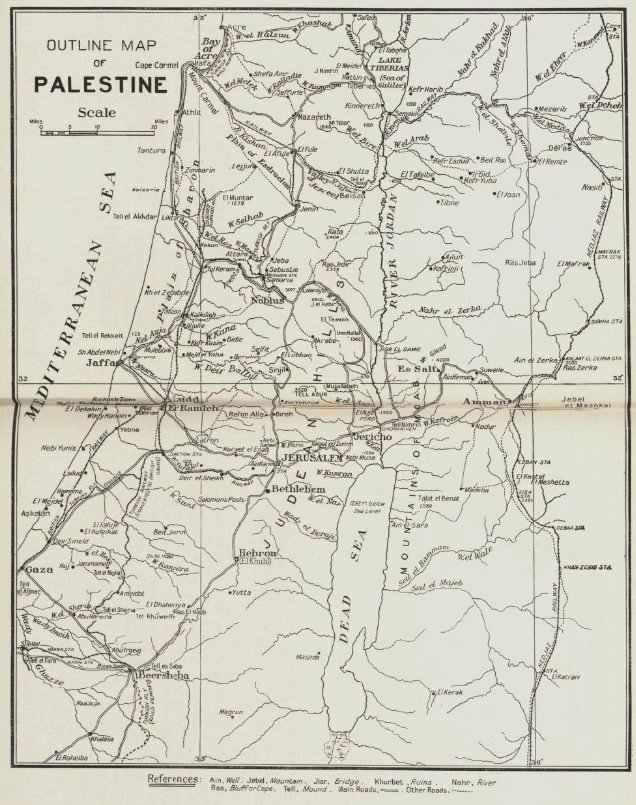
This was the scheme. We faced the Turks on a fifty-mile line running
from a point on the Mediterranean coast about twelve miles north of
Jaffa south-eastward across the Plain of Sharon, thence eastward over the
26Mountains of Samaria at a height of 1500 to 2000 feet, falling to
1000 feet below sea-level where it crossed the Jordan Valley, and
terminating in the foothills of the Mountains of Gilead. The Sharon Plain
sector was some fifteen miles in length, across Samaria fifteen miles, and
the stretch in the Jordan Valley about eighteen. The Turkish position
was a strong one. On Samaria, or the Central Palestine Range, south
of Nablus, the enemy had ideal defensive country, rugged and broken,
yet well served by rail—on the north-west to Haifa, and on the north-east
across the Jordan at Beisan and by way of Damascus to Turkey; he had
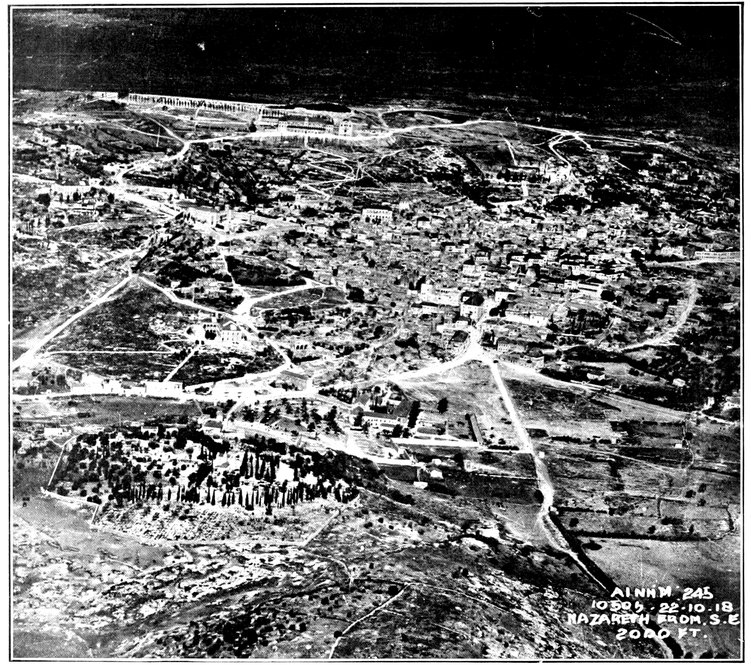
also good roads to Haifa and to Damascus by way of Nazareth.
To push the Turk on the mountains by a frontal attack would have
meant at best the gradual withdrawal of his forces. In Jordan Valley the
enemy’s safety lay in the fact that his guns on the foothills of either side
covered the limited ground which was practicable for horse and transport.
And, even if we had galloped up Jordan Valley, it would have been
extremely difficult from there to swing in behind the Turkish position on
the Central Range. General Allenby took the Plain of Sharon for his great
enterprise. Forty miles behind the Turkish position the Jordan Valley and
the Plain of Sharon are joined to the Esdraelon Plain—the old Plain of
Armageddon. In other words, the Jordan and Sharon and Esdraelon
formed a half-circle round the main central Turkish position on the mountains.
All the enemy lines of communication led across Esdraelon. If we
could seize the Plain swiftly, cut the railways and hold the roads, the
Turkish army west of the Jordan was in our hands. It was a scheme
calculated to test the mettle of any army. If we were to succeed, every
branch of the service had to show at its best. First our airmen had to destroy
or drive off the German aeroplanes and so keep the enemy ignorant of
our plans; then the artillery barrage had to make the way possible for our
infantry; in its turn, the infantry had, in one rush, to drive a gap for our
cavalry, and the cavalry, galloping through the gap, had to cover fifty miles
and reach Esdraelon Plain on the night of the first day. Lastly, the cavalry
must hold the communications they had cut, and to do so, they had to be fed.
The transport necessary for feeding tens of thousands of men and horse had
to travel almost as fast as the cavalry. The scheme had to go through to
time-table or it might not go through at all. If the artillery had failed to do
its work in a swift half-hour’s bombardment, or if the infantry had faltered,
the enemy would have had time to redistribute his forces, and General
Allenby might have been robbed of his victory.
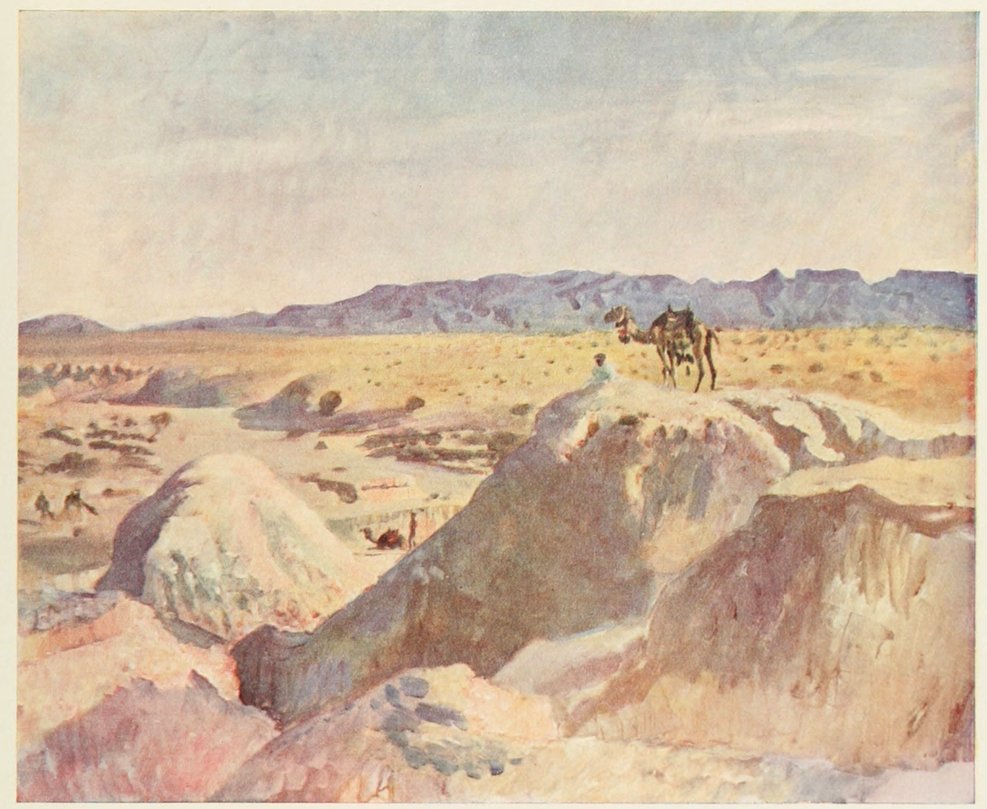
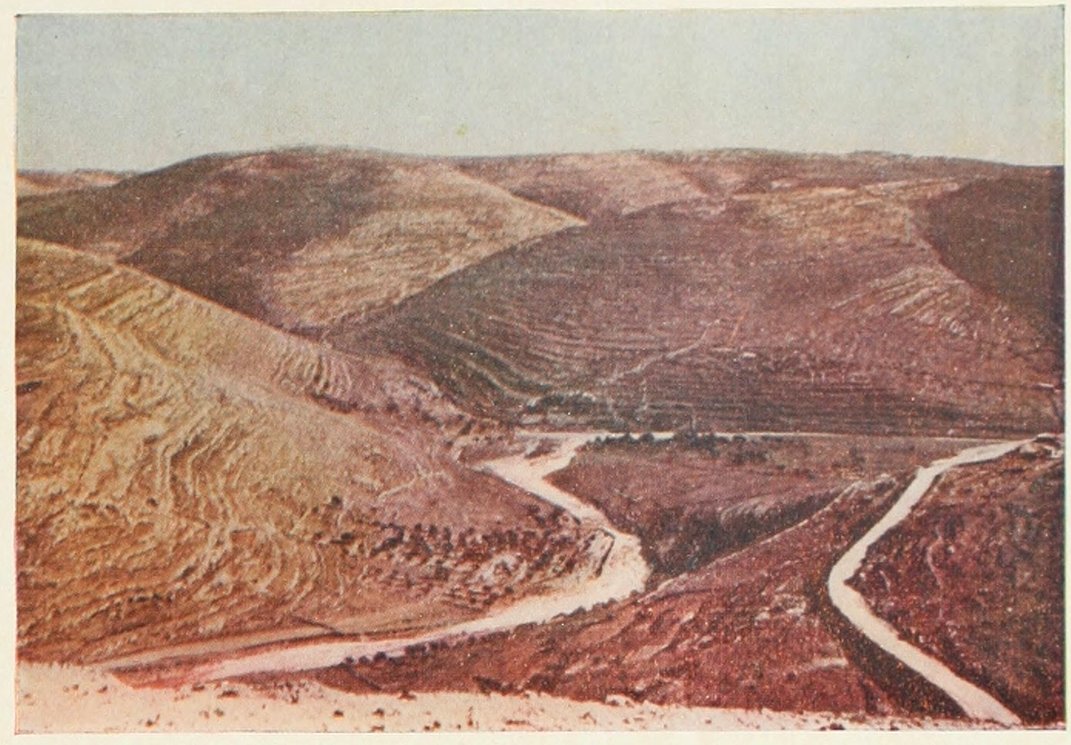
MAGDHABA, SHOWING THE WADY BED ABOUT ONE MILE FROM TURKISH BUILDINGS
By Lieut. G. W. Lambert
27
General Allenby took no chances. He followed the sound principle of
fighting under the best possible conditions. By the aid of clever and greatly
successful bluff, the Commander-in-Chief delivered his smashing blow
at an unexpected point of the Turkish line. The enemy was led to
believe that the British offensive would fall on the eastern sector. While a
huge force of cavalry, artillery and infantry was being smuggled by night
marches to the Plain of Sharon on the west, active and amusing camouflage
preparations were being made in the Jordan Valley. For instance, many
dummy camps were brought into existence, and large numbers of realistic
canvas horses were tethered in them. Mules drawing sledges were
driven about in the dust to suggest heavy traffic. Fast’s Hotel at
Jerusalem, then being conducted for officers by the Canteen Board, was
ostentatiously emptied of its inmates, two sentry-boxes were placed at
the entrance, and a whisper was started in the bazaars that the hotel
would be General Allenby’s advanced headquarters during the coming
offensive. Simultaneously, the Arabs east of the Jordan made realistic sham
preparations for an attack on Amman, out on the Hedjaz. They put down
a big base, engaged in bold reconnaissance, and cut the line between
Amman and Damascus. The deception of the enemy was complete. We
know now that he expected and prepared for the blow on the east, and
was stiffening his defences there until a few hours before our bombardment
opened on the west, near the Mediterranean.
The airmen materially assisted in this hoodwinking. During the eight
weeks preceding the offensive, the German air service was practically driven
out of the sky. Fifteen machines were destroyed or forced down and
enemy aerodromes were bombed. So complete was our ascendancy that
not an enemy plane was seen over the threatened sector for eight days
before the offensive began.
Blind as to our movement of troops, and mistaken by fifty miles as
to where his line was to be assailed, the enemy’s plight was further
accentuated by the destruction of his communications on the very evening
of the bombardment. Pulling out at night from their sham camp near
Amman, the Arabs rushed away up north, and cut the railway and
telegraph communications between Deraa and the great Turkish base at
Damascus. This left the enemy on his whole front without supplies for the
fight. Other telegraph lines further west were severed at the same time,
and a bomb from an Australian plane on the night before our advance
28destroyed his great forward telephone exchange at Nablus, which dislocated
all his lateral communications. When our guns opened at dawn on
19th September, the Turks were already in a desperate plight.
On the night before the bombardment there was an atmosphere of
perfect confidence in our camp close behind the line. Every man was
moved by the prospect of a successful adventure, which would
give vast immediate results and have an incalculable influence on the
world war. The tropical intensity of Jordan Valley, where the Australian
Brigades, with one exception, and some of the British and Indian cavalry
had spent the whole summer, had left its mark. We had suffered much
from malaria and other fevers, which, it was feared, might recur when we
moved into the cooler north. The horses were, if not in poor condition,
certainly on the light side; but these things were forgotten as the critical
day approached. The Australian Mounted Division, commanded by
Major-General Hodgson, and now made up entirely of Light Horse,
except for one dashing, picturesque regiment of French Colonial regulars,
had recently been armed with swords. The period of training in the new
arm was very brief—for many Regiments only a few hours; but the men
taking very keenly to it, soon reached a high standard of efficiency. Every
trooper was excited at the thought of a true cavalry charge. The Anzac
Mounted Division was still in the line in Jordan Valley.
During many nights before the push every road on the coastal sector
was crowded with slow-moving, well-ordered traffic. By day all was normal,
except for significant glimpses of camps in the wide olive groves around
Ludd, and in the orchards and orange groves about Jaffa. But as darkness
fell the whole countryside would become thronged with masses of horse and
foot and guns, and every kind of transport, groping their way through blinding
clouds of dust. The roads were impassable outside the organized columns;
the night was loud with the shouts of drivers speaking divers languages.
A few hours before the great push began this night traffic culminated in a
general move northward, the cavalry moving up close behind the infantry,
and the supplies following the cavalry. Every road was massed with
motor-lorries and horse transport; every track with endless strings of camels.
Each unit in the great army was pressing up as closely as possible to the
starting gate.
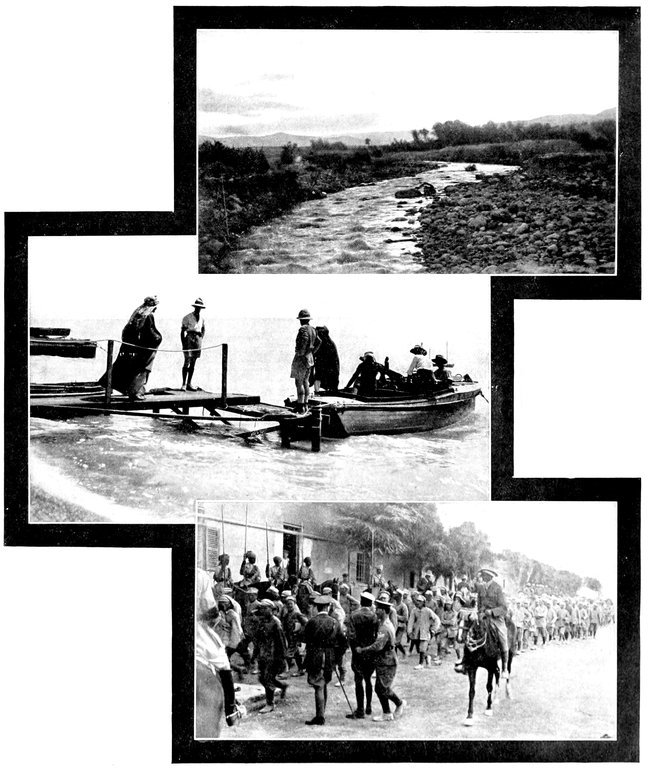
29
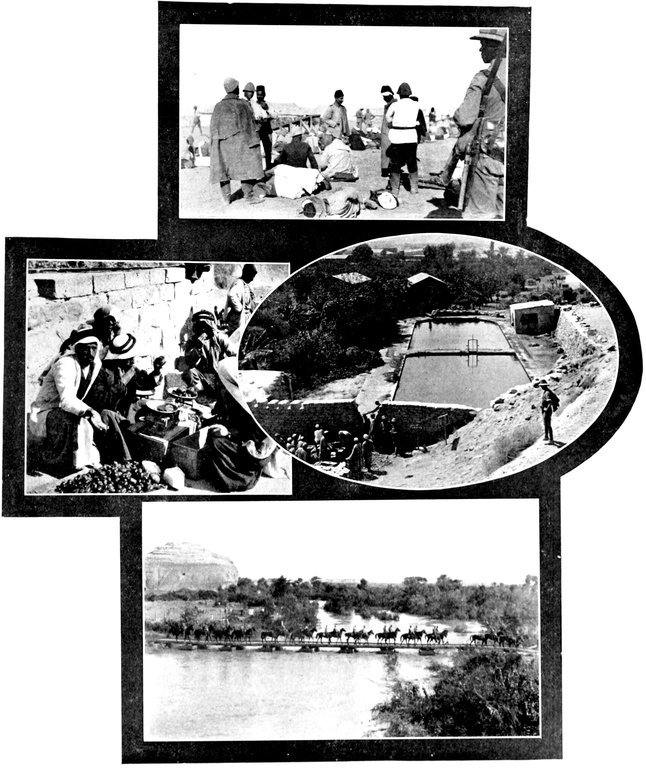
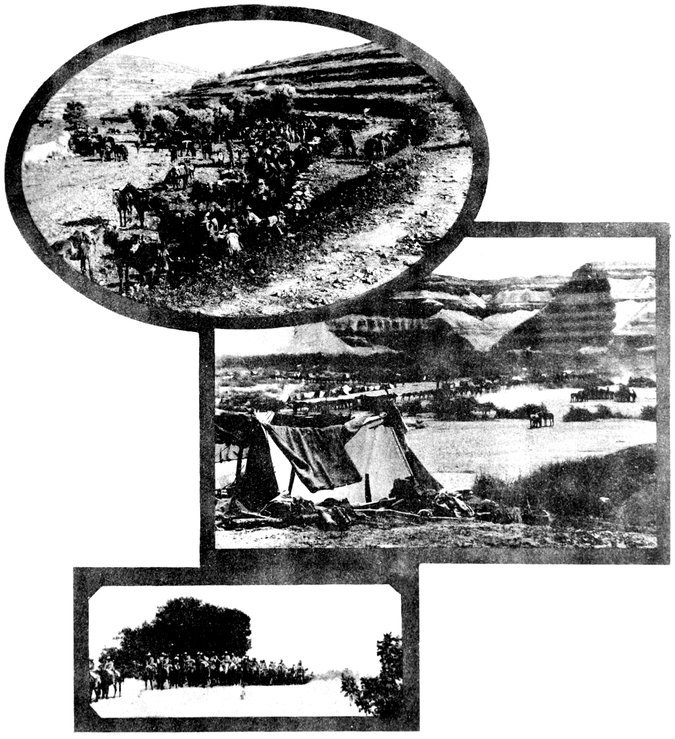
[top]
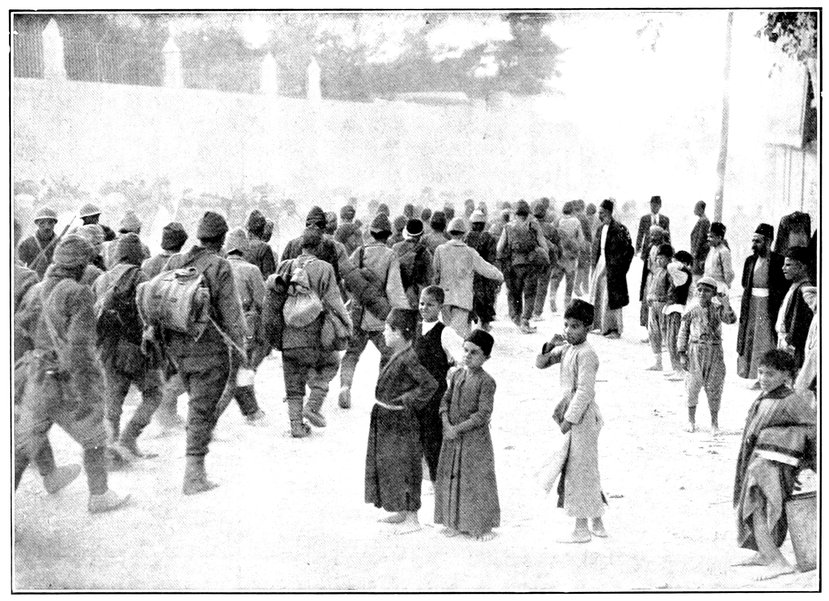
TURKISH PRISONERS AT BEERSHEBA
[middle]
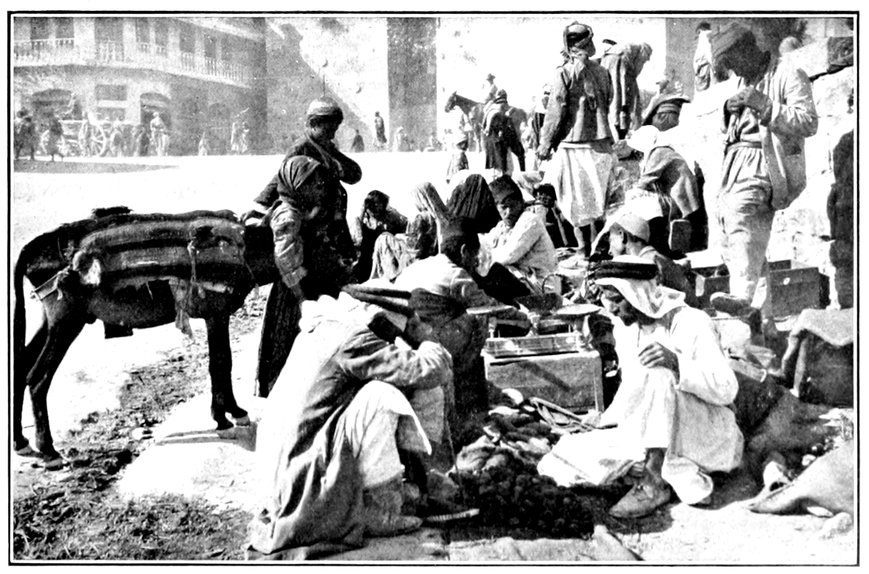
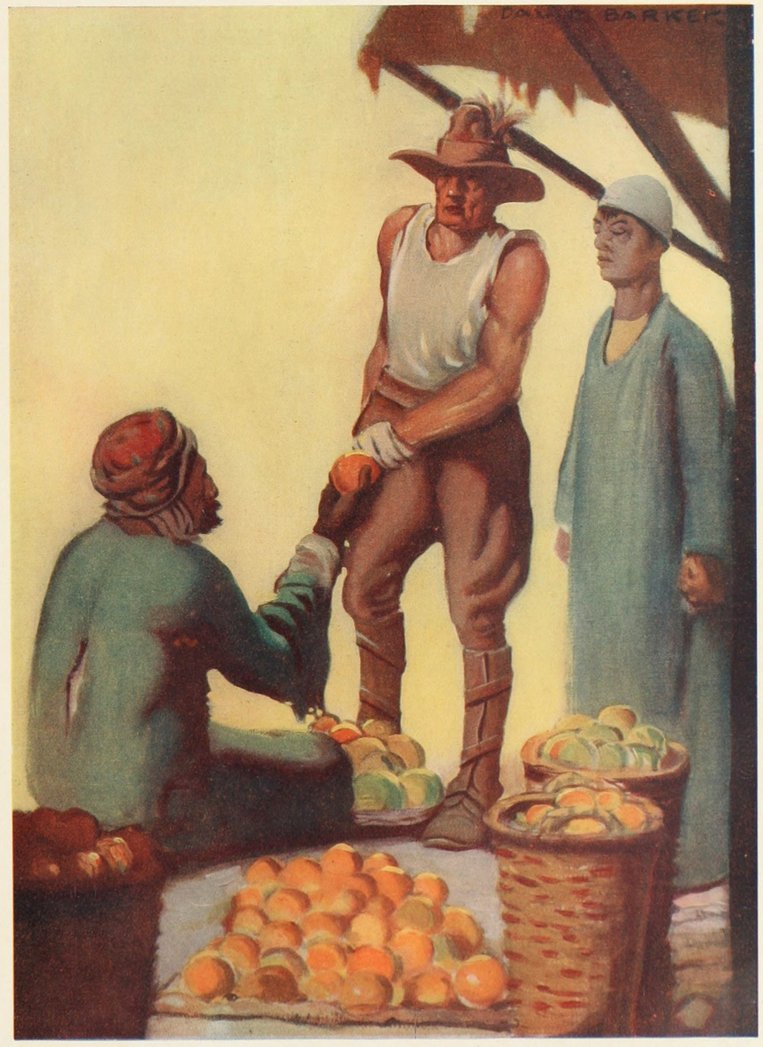
STREET MARKET, JERUSALEM
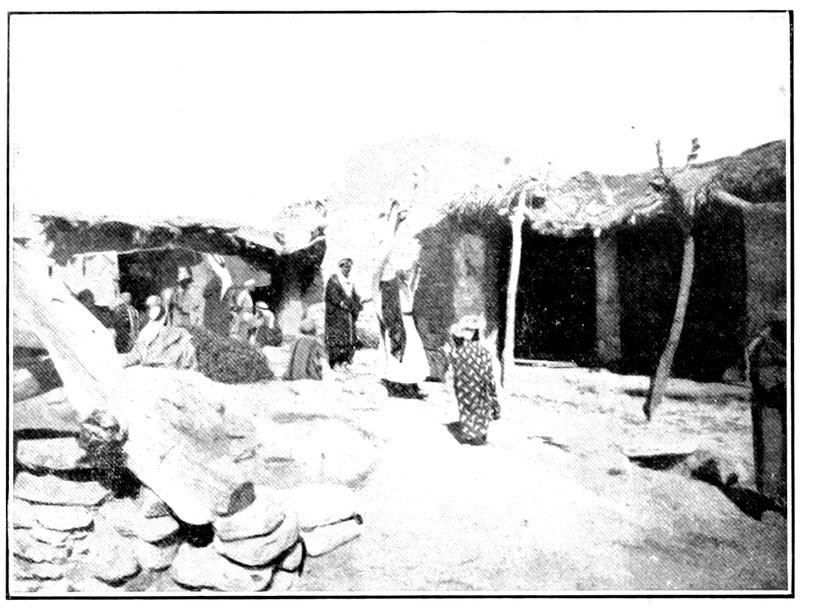
Inset—JERICHO
Showing the pretty little Garden Oasis
[bottom]
LIGHT HORSE CROSSING JORDAN
30
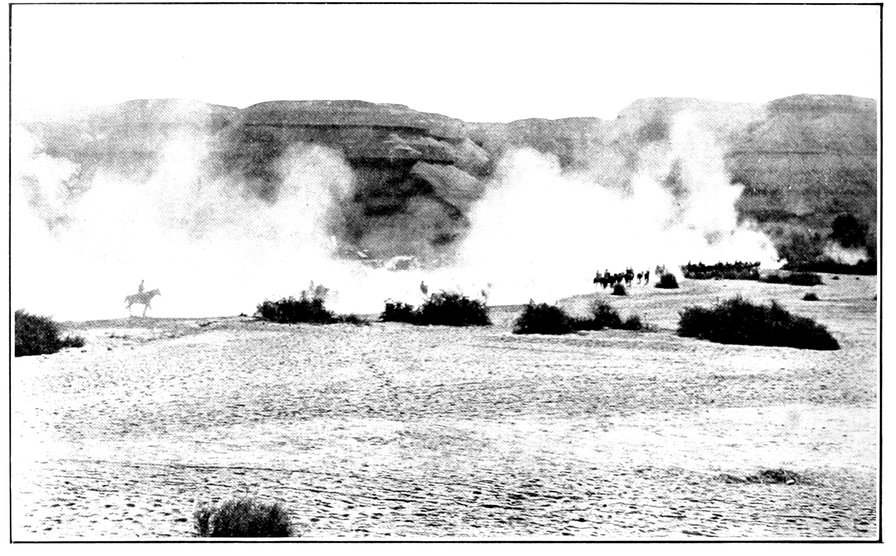
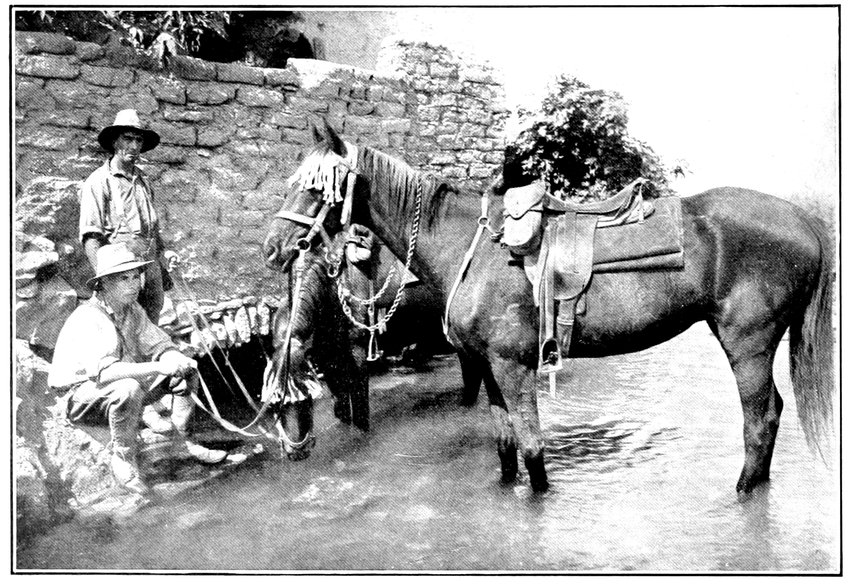
SPRING WATER, CLEAR AND COLD
31The bombardment opened at dawn, a heavy barrage. For half an hour
the startled Turks were battered in their trenches. Then, abruptly, the
bombardment ceased. “Now the infantry,” said a Brigadier of horse “and
then!...”
Our battalions leaped forward as the gunnery died away, and carried the
Turkish trenches after a brief struggle. They simply overwhelmed the
enemy riflemen, and even the German machine gunners and Austrian
artillerymen, after a wild burst of bad shooting, were forced to flight or
submission. Within half an hour the infantry had made a gap for the great
force of Indian and Yeomanry cavalry waiting near the coast, and soon
afterwards they opened another a few miles inland. The expectant horsemen
jumped off like thoroughbreds from the barrier.
They rode away in the sunrise, the advanced squadrons trotting out after
the ground scouts, the flank patrols galloping wide; Brigade after Brigade
rode out over the rolling sandhills. The men were eager, the horses fought
for their heads. The swords of the Yeomanry flashed and Indian lances
glinted from each successive skyline. It was like a war scene of the picture
galleries. Quickening the pace, the Regiments raced on past our guns,
most of which were already limbered-up for the pursuit. The infantry,
busy with their prisoners, cheered them as they passed, and soon they were
speeding down on Turks who had fled from the onslaught of the infantry.
But their sport with sword and lance was brief. In this Sharon sector, the
enemy had no forward reserves, no second-line trenches. The Turkish
front here had depended for its safety on a one trench system. From the
crossing of the trenches until they reached the Esdraelon Plain, late in the
night, the cavalry encountered no resistance. Once or twice they sighted
small bodies of the enemy and made for them at the gallop. But the
Turks would not give battle. Before the campaign was three hours old
there began the long series of almost bloodless surrenders which were to
be the most amazing feature of the sleepless fortnight.
The perfection of our organization was revealed very early. The cavalry
was scarcely clear of the trench system before scores of field guns were
rumbling in their wake. And, pressing on after the artillery by many
tracks, good and bad, went mile after mile of camels and wheeled transport.
32Where the cavalry went the supplies must follow; and the cavalry rode from
forty to fifty miles between sunrise and midnight. With nothing to check
them, their pace was controlled only by the endurance of their horses. The
men rode light; they carried only one blanket, and that as a saddle-cloth.
Tent sheets and waterproofs were forbidden. It was a wild ride against
time. But horses were loaded with three days’ rations, and few carried less
than 250lbs.—many of them more than 280lbs.
At dawn next morning the Yeomanry were across the Esdraelon Plain
and in Nazareth, where they caught most of the garrison of 3000 and the
whole population still in their beds. They secured the town at the expense
of eighteen casualties. By noon the Esdraelon Plain was in our hands, and
the Turkish Army in Western Palestine left without a line of communication
or retreat, except at Beisan on the north-east corner of the trap; and
the capture of Beisan was already assured. How completely the enemy
was deceived, and how light were his forces on the sector broken for the
cavalry, is shown by the fact that on the first day, although our horse
travelled fully forty miles on a wide front, only 900 prisoners were taken by
them. Next day, as the net closed round the forward enemy forces on the
Central Range, and they attempted to retreat across the Esdraelon Plain,
our cavalry took upwards of 12,000.
At the beginning of the second day, we contained the Turkish western
army on the south, west and north. The Anzac Mounted Division, which
is two-thirds Australian and the balance New Zealanders, and a light
infantry force, all under Major-General Sir E. W. C. Chaytor, were moved
up the Jordan Valley on the east of the Turks and so the net was
completed. But the task of the Anzacs was difficult. Before they could
move, the enemy guns dominating the narrow ground on either side of the
river had to be silenced or shifted. This meant that the Turks had to begin
their retreat on the Samarian Range before the Division could race them for
the crossings. Not until the second day did this come about, and then the
Anzacs, riding fast, closed the fords and the Turkish Western Army was
doomed. Forty hours after the fight commenced, as the second day was
closing, the enemy began to stream down the tracks leading on to the
Esdraelon Plain from his forward mountain position. He had already
33abandoned guns and transport, a tragedy which he owed mainly to the
appalling havoc wrought with bombs and machine guns by our airmen.
At dusk on the second day a large force was reported to be heading
towards Jenin, on the northern edge of the Esdraelon Plain. General
Chauvel, who was directing the battle from Megiddo (now Lejjun), the
actual site of ancient Armageddon, at once ordered the 3rd Light Horse
Brigade to move to the attack. An hour later, the Brigade had captured a
mass of prisoners, who subsequently counted out at more than 7000; and
we had the first evidence of the demoralization of the enemy. As the
Brigade approached Jenin, with the 10th Light Horse Regiment (Western
Australians) leading and the 9th (chiefly South Australians) working round
to the rear of the village, the Turks ran out and surrendered in thousands.
We had one officer and one man wounded. The only shots fired at us
came from nine German riflemen, who fought to a finish, although two of
our machine guns were laid on them at a range of sixty yards. The plan
had put our troops into certain positions and the Turks, as at sham fight,
recognizing the checkmate, were surrendering without bloodshed. Any
resistance which followed on the long ride to Damascus came almost
entirely from the Germans.
An endeavour has been made in the preceding pages to show how the
galloping cavalry cordon was thrown round the main enemy position on
the Samarian Range. Before the close of the second day, our horsemen,
stoutly armed with machine guns and automatic rifles, in addition to
rifle and sword and lance, and further strengthened by many batteries
of horse artillery, held all the roads and railways behind the Turks and
Germans. The enemy was practically cut off from supplies and retreat.
Worse than that, he was already irretrievably smashed by the attack of the
British and Indian infantry on his front. Recoiling from this blow, and
hastening to reach the Esdraelon Plain before the cavalry completed the
net, he was caught by our airmen in narrow mountain passes, subjected to
terrible bombing and harassing machine gun fire, and forced to abandon
most of his guns and transport. At the same time, the 5th Australian
Light Horse Brigade under Brigadier-General Macarthur Onslow,
accompanied by one regiment of French cavalry, was thrown in during the
first day on his right flank, about halfway between the old front line and
the Esdraelon Plain. The Australians, moving very fast, scattered with
their swords a force several thousand strong north of Tul Keram and took
two thousand prisoners. Then, riding all night, they cut the enemy frontline
railway close behind Nablus. A few hours later, the Brigade captured
Nablus itself.
35
36
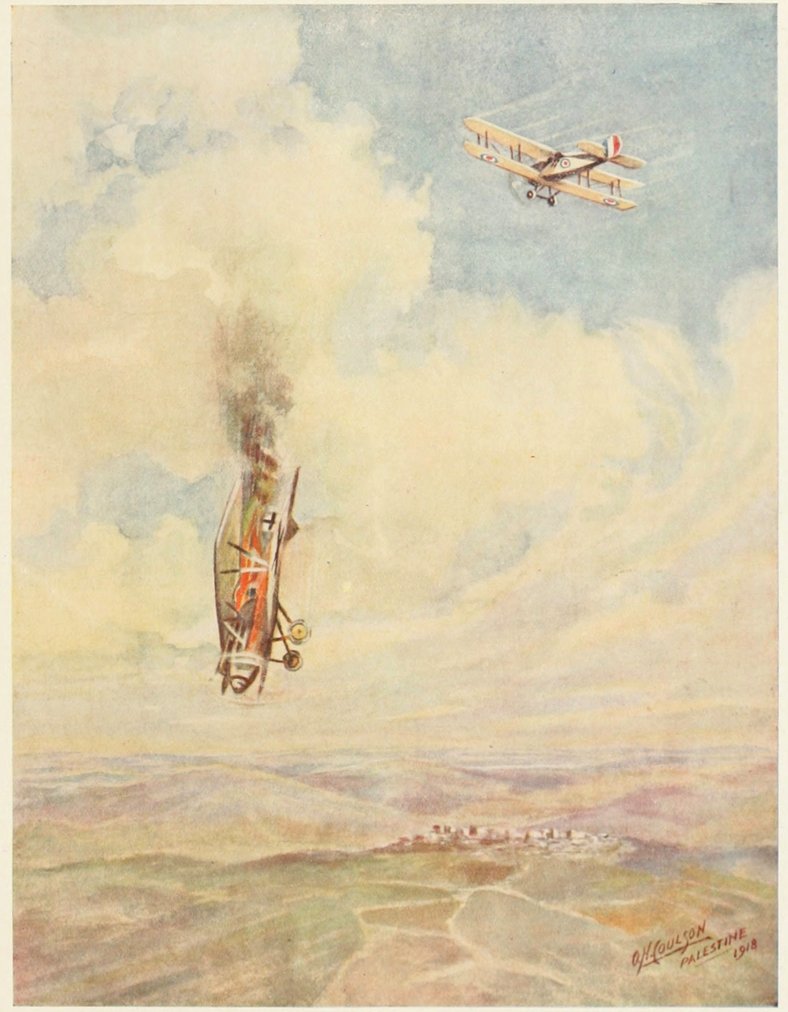
But before this the airmen had commenced their work in the passes.
When our infantry broke the enemy’s line on the Plain of Sharon, many
thousands of Turks, who were on the foothills eastward of the gap our
cavalry had galloped through, had endeavoured to swing round and retreat
to the highlands of Samaria. But the movement was at once detected by the
Australian airmen. The Turks, with their transport, were seen to be
heading for a narrow defile leading up from Tul Keram to Anebta. Using
their wireless, the airmen called up aerodromes where dozens of British and
Australian pilots were awaiting the signal. The doomed column, extending
over upwards of two miles, was deep in the pass when the first flight
arrived with its bombs. Beginning on the leading troops and vehicles, the
airmen, flying low, had, in a few minutes, blocked the narrow track. Pilot
after pilot, flying in perfect order, dropped his bombs, and then, assisted
by the observers, raked the unfortunate Turks with machine guns. Their
ammunition exhausted, the airmen sped back to their aerodrome for more,
and returned again to the slaughter. Some pilots made four trips on that
day. While the airmen attacked the column, the 5th Light Horse Brigade
came up over the hills on either side of the track, and caught the Turks
with their swords as they attempted to escape. Blocked in front, the
battered, distracted procession closed up and telescoped, and fires broke out
among the massed and broken vehicles.
Still more appalling, because of the greater magnitude of the disaster,
was the fate of a column between Balata and Fermeh on its way down
the range towards Beisan, on the Jordan. Flying over Samaria, you
appreciate the opportunities which this retreating army offered to the
airmen. The stony hills are not so rugged as in Judea, but they are still
too steep to permit masses of troops to move off the narrow roads. These
roads wind along beside the wadies and are flanked nearly all the way by
abrupt hillsides. The Balata column contained the bulk of the enemy’s
forward transport. It stretched, slow-moving and in full view from the air,
over seven or eight miles of the confined track. An Australian reconnaissance
pilot sighted it soon after dawn and, an hour later, dozens of British and
37Australian bombers and machine gunners, flying within a few hundred feet
of the ground, were smashing it to splinters. Again they began at the
head, and forced the helpless drivers to pile up from the rear. For hours
the bombing was continued. Here the airmen worked unaided by any
other arm of the service, and they had wrecked or disabled the whole of
the transport before the infantry came up from the south and took the
dazed survivors. The broken material afterwards collected in the pass
included 90 guns, 840 four-wheeled and 76 two-wheeled horse and cattle
vehicles, 50 motor-lorries and a large number of miscellaneous transport,
such as water carts and travelling kitchens. The horror of the scene
during the bombardment and afterwards need not be dwelt upon. As the
bombs rained down with pitiless regularity, scores of lorries and wagons
were overturned and dashed to pieces as they went hurtling down into the
rocky beds of the wadies. Included in the column were large formations
of infantry, and these and the drivers, rushing from the track to escape the
bombs, were shot down by airmen. These air attacks were repeated many
times on a similar scale in the first two days.
Rarely have the various services of an army worked in such perfect
accord. The infantry drove the enemy from his front, the Australian and
French cavalry, at the same moment, struck from the flank at his very heart
at Nablus; as he attempted to retreat in good order, the airmen wrecked him
from the skies, and, in a few hours, turned his army into a shell-shocked
rabble, with few guns or munitions, and little food. The wretched Turks,
in their tens of thousands, urged on by officers, came at last to the outlets
into the Esdraelon Plain. When first the cavalry galloped down upon them,
and they surrendered in hordes without the least attempt at resistance, we
were astonished. It was not until we learned what had happened in the
mountains that we understood the tragic state of their morale.
The air force achieved a notable victory. They had not only inflicted
very heavy losses, but had incalculably lessened the task of both our infantry
and cavalry. They had prevented the Turk from fighting effective rear-guard
actions against the pursuing infantry, and had hammered him so
soundly that he was incapable of any attempt to burst through our cordon
of cavalry. Without this help from the airmen, General Allenby must still
have won a great victory; but it would have been much short of the
38sensational one achieved. Progress must have been much slower, and our
casualties heavier by many thousands.
Before the fight was two days old our aeroplanes were using aerodromes
captured from the enemy. At one point on the march to Damascus, when
we were a hundred miles from our starting-place, a number of airmen came
up and established a flying ground abreast of our cavalry advance guard.
Throughout the operations an air-post service was maintained between the
leading troops and General Headquarters. An Australian Brigadier and a
Colonel of the Light Horse, who were in hospital far down the line when
the campaign opened, surprised their troops by alighting from aeroplanes in
their midst, a hundred miles from our starting-point.
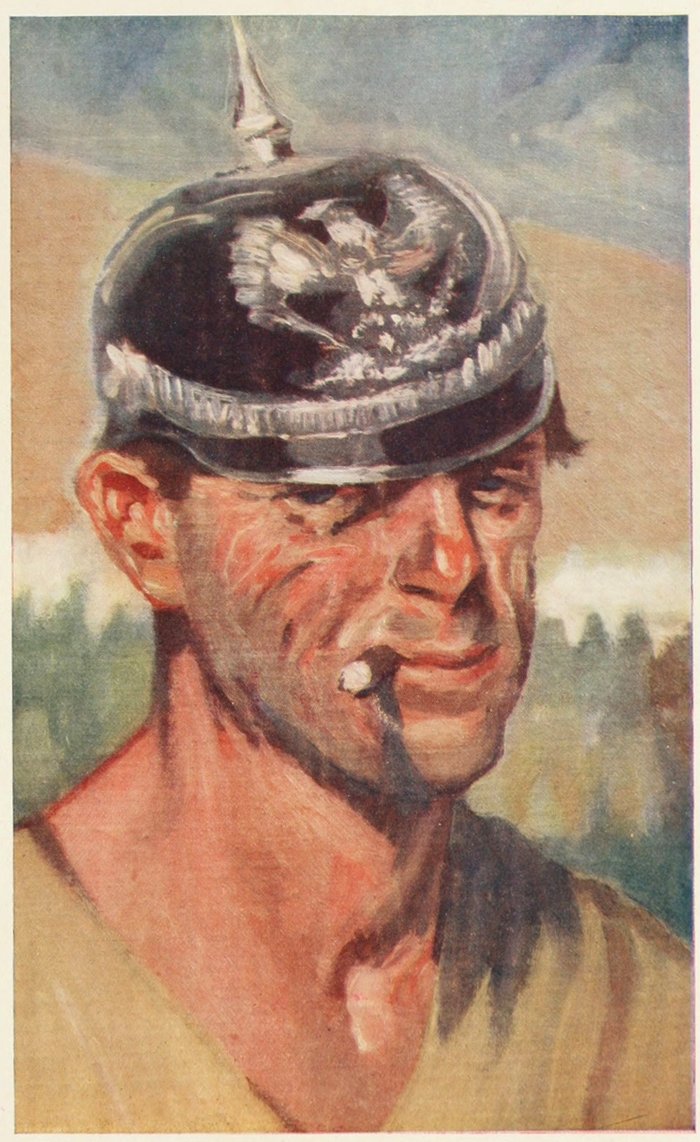
The few thousand Germans who were with the Turkish 7th and 8th
Armies west of the Jordan met the same fate as their allies; nearly all were
destroyed or captured. But one must give the Germans credit for a stout
resistance. Throughout, they fought resolutely to avert the great disaster,
and if all of them did not continue the struggle to the death, it must be
remembered that they were in a desperate situation. They handled
nearly all of the hundreds of machine guns, which were the most formidable
weapons possessed by the enemy. All the way to Damascus
they fought stout rear-guard actions.
Having the great body of Turks on Samaria safe, and most of them
already accounted for, General Allenby decided to clear Haifa; the operation
demonstrated the relative morale of the Turks and Germans. A flying
reconnaissance of armoured cars and smaller cars of the Light Car Patrol
was pushed into the outskirts of the town. About three miles from the
town our force saw the heads of a party of Turks in a strong redoubt two
hundred yards from the road. The armoured cars halted and swept the
Turkish parapet with their machine guns. The white flag was at once
hoisted, and about eighty Turks came out without firing a shot. Two
miles further on, the British came upon an Austrian battery of light field
guns, supported by German machine gunners. Our little probing expedition
was at once brought to a standstill, and was not sorry to pull out. Next day
the Indians and Yeomanry, supported by horse artillery, rode into the town,
and again the only opposition came from the Austrians and Germans.
“We tried to cover the Turks’ retreat,” said a captured German officer, “but
we expected them to do something, if only keep their heads. At last we
decided they were not worth fighting for.”
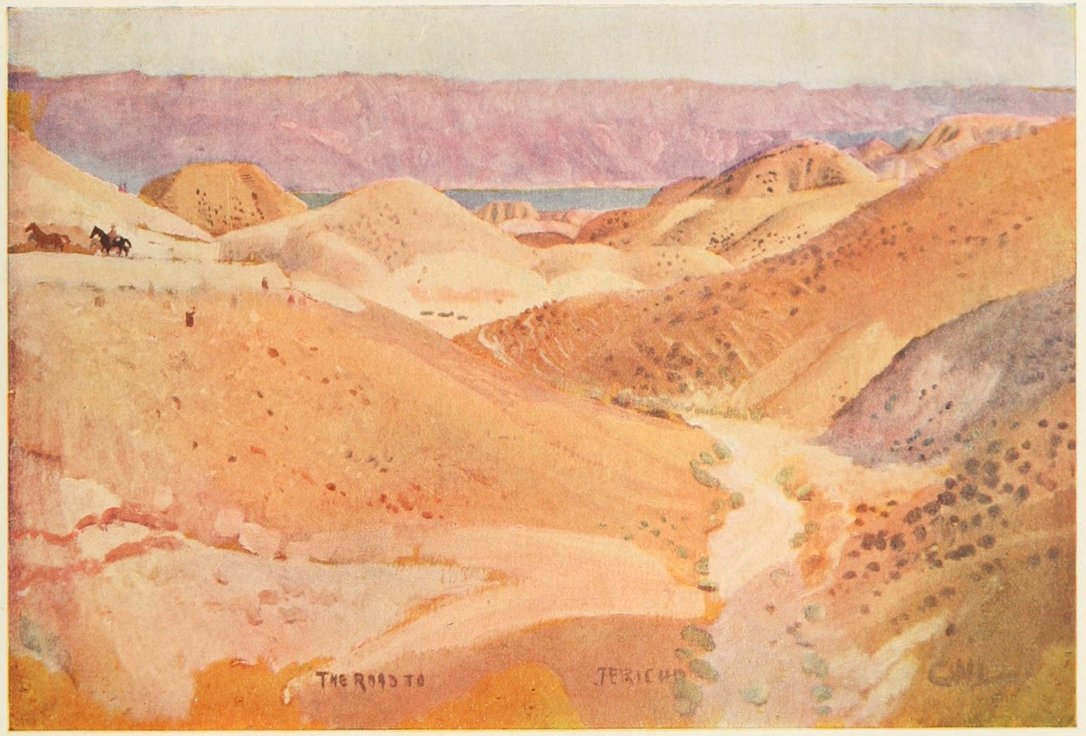
THE ROAD TO JERICHO
By Lieut. G. W. Lambert
39
Before Haifa fell our troops were moving swiftly east of Jordan. A
Division of Indian and Yeomanry cavalry crossed the Jordan about Beisan
and rode eastward. Simultaneously, the Anzac Mounted Division forded
and swam the river further to the south, and moved on Es Salt and Amman.
The Australians and New Zealanders were familiar with the country. This
was their third expedition to the Plateau of Moab and the heights of Gilead.
They knew every goat-walk on the steep mountain side. This time they
had come to stay; the Fourth Turkish Army on the East was to share the
fate of the 7th and 8th Armies on Samaria. The tactics employed on both
sides of the river were broadly similar. General Allenby depended for
success upon the speed and stamina of his horses. Before the operations
commenced, the Turk held a defensive position which was roughly an
extension of his line west of the Jordan. He was strong in the foothills of
Gilead; on the mountain he had his base at Es Salt, and at Amman he had
a substantial force guarding a vital series of tunnels and viaducts on his
Hedjaz railway. Beyond the railway the Eastern Palestine Range flattens
out on the wide desert, which extends right across to the Euphrates. On
the fringe of the desert was the Army of the Sherif of Mecca, a picturesque,
galloping, thrusting, well-armed force. The Arabs harassed the Turk by
day and night, repeatedly dashing in and cutting his railway and telegraph
communications with Damascus. When attacked, they would fade away
into the wide desert and leave the slow-footed Turk in the air. While the
Anzacs marched upon Es Salt and Amman, the Arabs made a detour in the
desert, appeared on the flank of the enemy north of Deraa, and cut the
railway where the Hedjaz line junctions with the line which supplied the
Turks west of the Jordan.
Meanwhile the Indian and Yeomanry Division had crossed Eastern
Palestine and reached Deraa, where it joined hands with the Arab army.
Then the Arabs, the Indians and the Yeomanry sped on towards Damascus.
There was still a chance of escape for some 20,000 Turks, who had moved
northwards of Deraa before the arrival of our forces. These struggled
gamely towards Damascus, hoping either to make a stand at that great base
40or to escape by rail to the north. But General Chauvel still had in hand
the Australian Mounted Division and a strong force of Indians and
Yeomanry, which had returned to the Jordan after the capture of Haifa.
With the Australians leading, he marched from Esdraelon Plain north-east
across Jordan for Damascus. Then ensued one of the grand races
of the war. Our tired horses were called upon for the heaviest work of the
lightning campaign. Marching by Beisan, the 4th Light Horse Brigade,
after a stiff fight—the most expensive cavalry fight in the campaign—took
Semakh, and then, co-operating with the 3rd Brigade, which had come
down from Nazareth, occupied Tiberias. After a day’s partial rest, during
which our men swam and fished in the blue waters of Galilee, the Australian
Division marched swiftly for the Jordan crossing, a few miles south of Lake
Huleh. But the enemy was now seized of our intention, and the German
machine gunners put up a fine resistance. Their stand at Semakh aimed
at preventing us reaching Damascus before the 20,000 Turks, who were
retreating from the direction of Deraa, and to give time for the removal of
as many military stores as possible from the city. South of Lake Huleh, also,
the Germans fought well and delayed us for a few hours. We then ran
through as far as Kunneitra, but, a few miles further on, were again held up
by machine guns and a field battery.
Our horses had covered, with marching and fighting, an average of thirty
and forty miles a day. Thousands of Australian-bred animals must have
covered some 400 miles in twelve days, a very fine performance when it is
remembered that they carried a load exceeding an average of 250lbs. and
had been on short rations. On our ride to Damascus, the excellent work
of the staff was demonstrated again. As the advance guard of the 4th
Light Horse Regiment (Victorian), travelling north-east, came within view
of the green and generous plain of Damascus, we saw, some eight miles
away on our right, and moving north-west, a great converging column
of the fugitive Turks from Deraa. Nearly all of these were captured,
the Germans once more fighting well with their machine guns. But even
the Germans had now almost given up hope, and on this last day before
Damascus, and in the two days which followed, they abandoned their
machine guns, and fled at the galloping approach of the Australians.
That evening many thousands of prisoners were captured by the 3rd and
5th Australian Light Horse Brigades, and the city was enveloped.
41
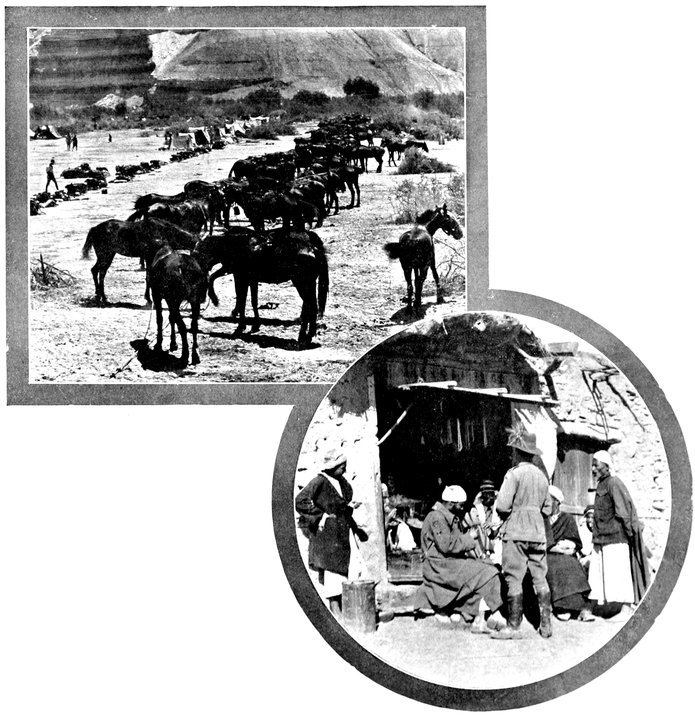
[top]
IN THE JORDAN VALLEY
[bottom]
SHOPPING IN JERICHO
42
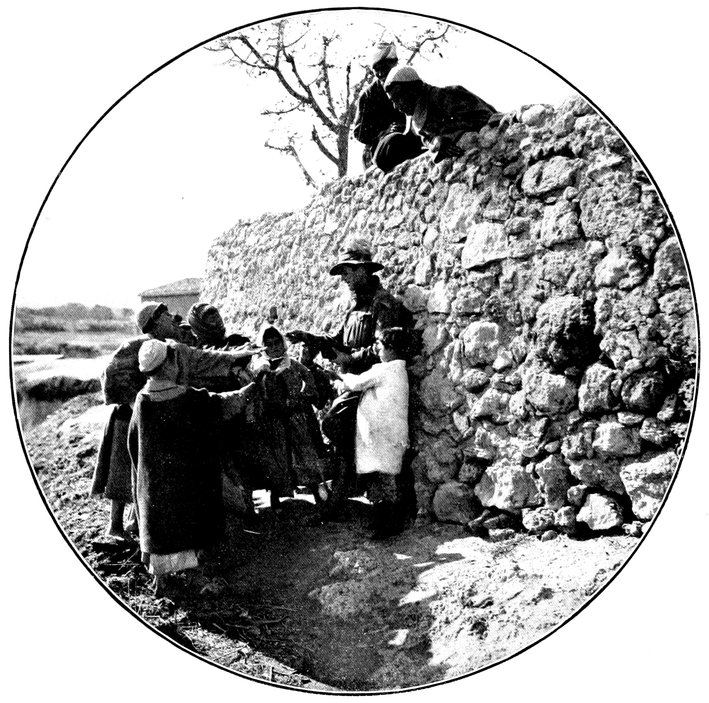
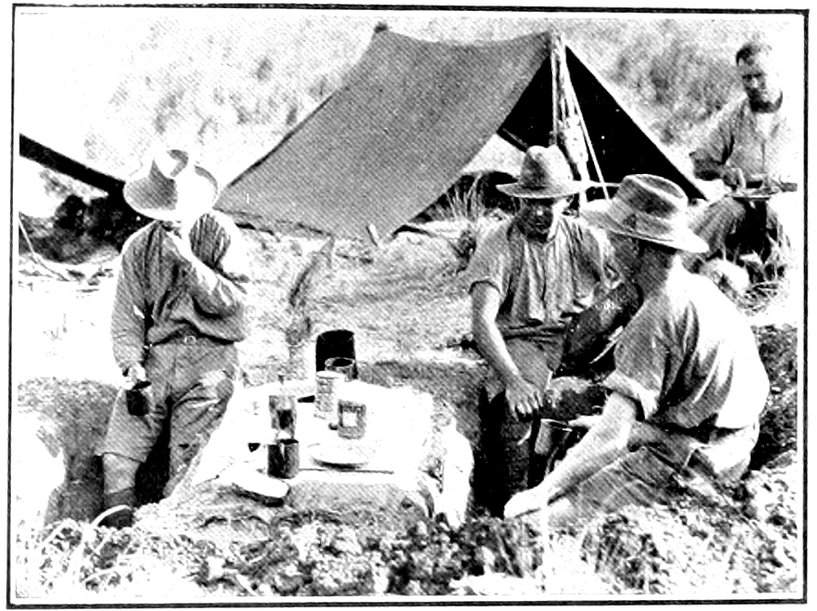
A MEAL OUTSIDE THE BIVVIES
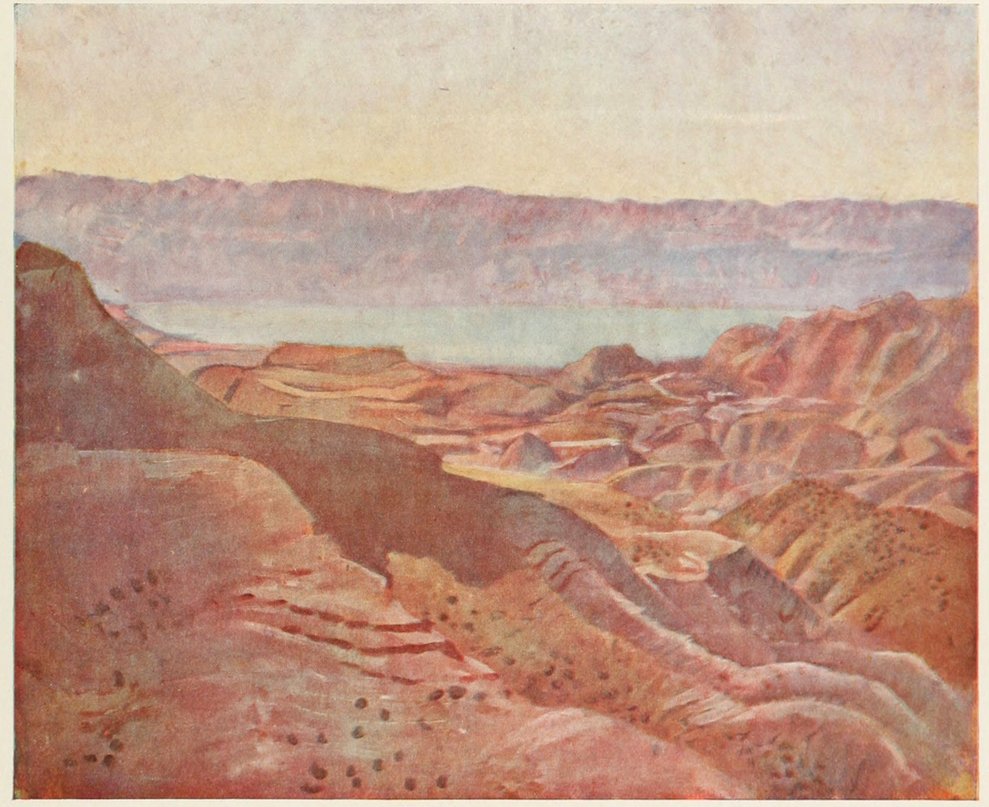
THE DEAD SEA (SUNRISE)
By Lieut. G. W. Lambert
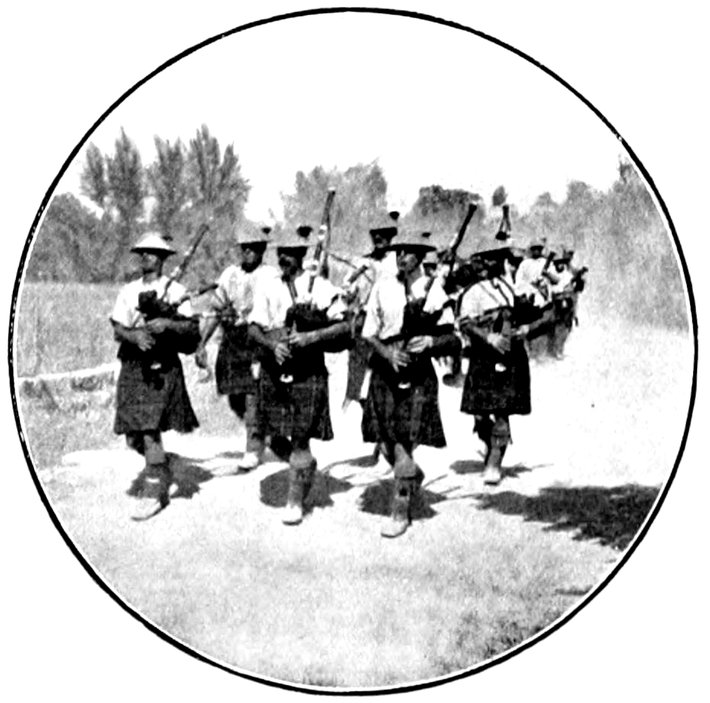
SCOTTIES ON A ROUTE MARCH
43
At dusk, in the Abana Pass, which leads out from Damascus towards
Beirut, another disaster befell the enemy. Here, a column many miles in
length was committed in a deep and narrow and singularly beautiful
gorge. The floor of the gorge is less than a hundred yards across, and it
is crowded with the Abana River—a rushing, mountain torrent,—a railway
and a road. The river banks are overgrown with trees and bushes;
the railway and road cross and re-cross the tumbling stream. On either
side rise the gaunt cliffs of the desert. In this brief survey it is impossible
to describe the fight between the long enemy column and the handful of
dismounted Light Horsemen of the 3rd and 5th Brigades, who were perched
in pockets of the cliffs on either side. The Germans, working their machine
guns from the tops of motor wagons and lorries, fought to the death. Three
hundred and seventy officers and men were killed, and fell among the dead
and dying horses in the wild tumult of the chaotic column. We had scarcely
a man hit. That ended the attempt to leave Damascus by the west; but
the enemy was streaming out by the north along the road to Aleppo.
Their run, however, was brief. Early next morning the 3rd Light Horse
Brigade—the first force to enter Damascus—was in hot pursuit. The
German machine gunners again attempted a rear-guard, but they could not
withstand the charges of the elated Light Horsemen. Thousands of
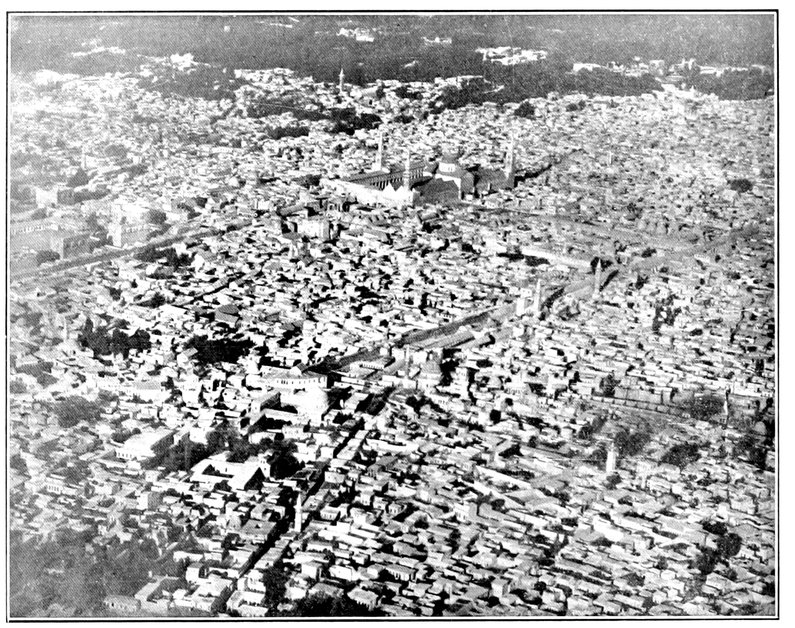
prisoners and hundreds of machine guns were taken by the Brigade.
On the morning of 1st October a squadron of the 4th Light Horse
Regiment received orders to patrol into the city. Winding along the
crooked lanes between the irrigated orchards and gardens, it came upon
the great Turkish barracks, swarming with troops. The Turks did not at
once surrender, and the squadron leader, before attacking, awaited the
arrival of the remainder of the Regiment. Then followed a fitting termination
to the wonderful, and practically bloodless, British ride. A few hundred
of the 4th Light Horse took nearly 12,000 prisoners in Damascus before
noon, together with dozens of field pieces and scores of machine guns.
Scarcely a shot was fired. There was no formal surrender; each body of
men laid down its arms as the Australians rode up.
The Victorians entered the city and joined up with the exulting Arabs.
These two forces, which had started hundreds of miles apart with two
44mountain systems intervening, were mingled together in the midst of the
swirling, madly-excited populace. To the Arab, Damascus was the
dazzling prize, the promised reward. Here he was to proclaim and set
up his government. Riding forth from his tent on the desert, or his little
mud village, he was, in Damascus, the lord of a city of 250,000 souls—the
oldest city in the world, and distinguished by the richness and strange
character and beauty of its surroundings. Fired with pride, his long robes
touched with brilliant patches of silk, he rode the streets on his sprightly
desert horse, caparisoned with richly woven Persian saddle-bags. His
scabbard of gold and silver flashed in the sunlight, and he fired his rifle
freely at the skies. Ameer Feisal, the third son of the Sherif of Mecca,
who was soon to be proclaimed the new ruler, rode into the city. The
Arabs of the city gave an almost fanatical greeting to the Prince.
Although the Victorians secured the great haul of prisoners, the first
troops to enter Damascus were the Light Horsemen from Western
Australia, who, also, had had the distinction of being the first mounted men
to enter Jerusalem, in December. The Western Australians found their
way into Damascus by accident, and their ride was one of the most dramatic
and picturesque incidents of the campaign.
The 3rd Light Horse Brigade, to which the Western Australians belong,
spent the night in the Abana Gorge, a few miles from Damascus, to the
west along the Beirut Road. Brigadier-General Wilson was under orders
to move at dawn and seize the road leading from the city northward
towards Aleppo. It was hoped that a track would be found around the
outskirts of the town, but this proved impracticable. The Brigade, therefore,
with a troop of scouts leading, and the Western Australians following, came
down the Abana Gorge, clearing a track through the shambles of dead
Turks and Germans and hundreds of camels and horses, heaped on the
road in the fighting of the evening before. It soon became plain to the
officer second in command of the Western Australians, who was riding
ahead with the scouts, that the only way to the Aleppo road lay through the
heart of Damascus. The city had not surrendered, and he did not know
how many of the enemy it contained. But he decided on the bold course,
and pressed on. As the scouts passed the outskirts of the city, riding a
narrow road with the river on one side and a prolonged, mud-built garden
wall on the other, there was a sudden burst of Turkish rifle fire. No one
was hit, and the officer in command, checking the scouts until the advanced
squadron of Western Australians came up, ordered drawn swords, and
dashed on at a gallop. Across the river, two or three hundred yards away,
were thousands of Turks at the barracks. For a moment, the enemy
decision was in the balance. But the sight of the great Australian horses
coming at a gallop (the Turks and natives never ceased to marvel at the
size of our horses), the flashing swords, and the ring of shoes upon the
metal, turned the scale. “The shooting by the Turks,” said one of our
officers, “gave way, in a second, to the clapping of hands by the citizens.”
45
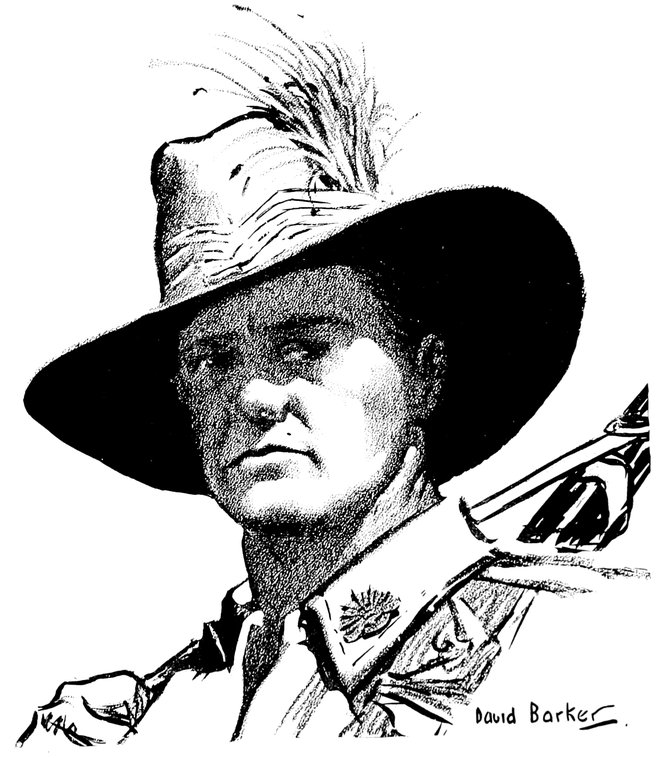
46
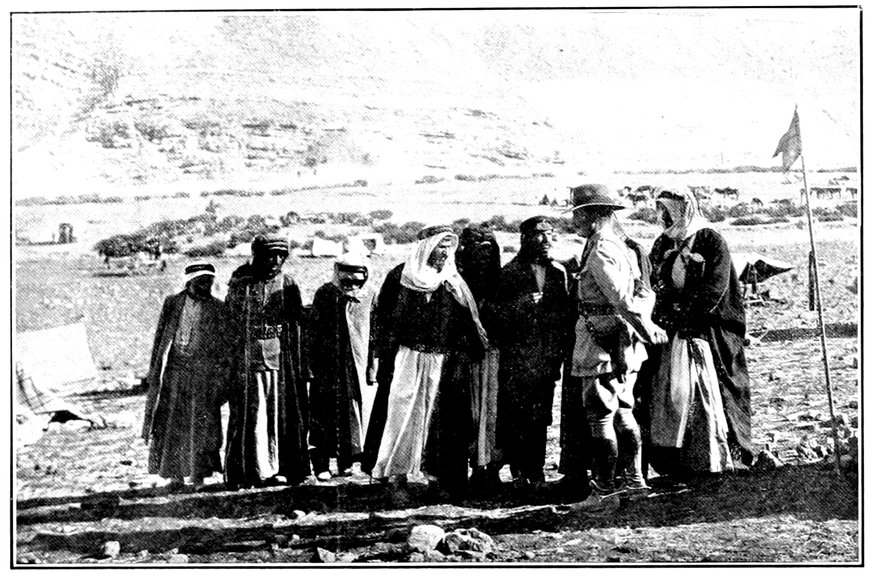
MAJOR-GEN. CHAYTOR RECEIVES A DEPUTATION OF ARAB CHIEFS NEAR AMMAN
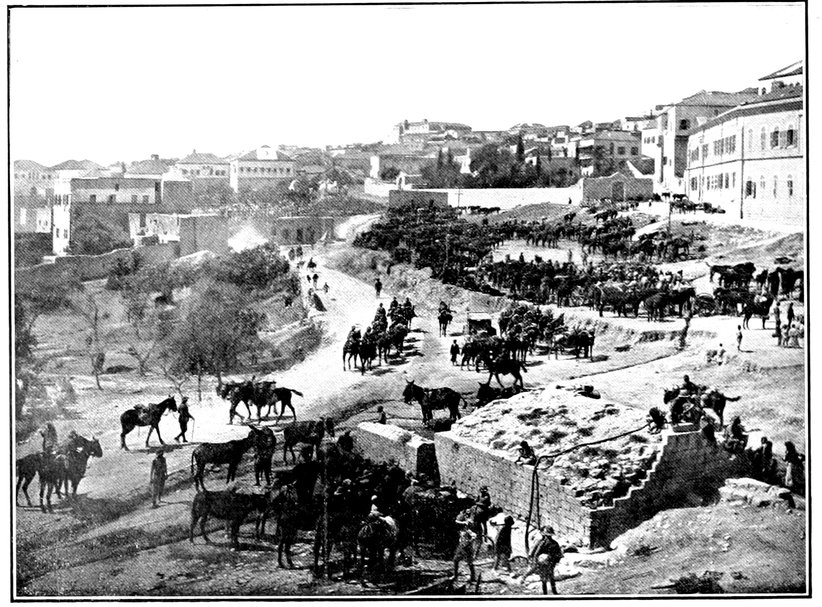
47The Australians rode hard, scattering the excited people from their track.
The firing increased, but its character had changed. The shots were now
coming from native Arabs, who were expressing their feelings, in the popular
Arab way, by blazing at the heavens. Across the river ahead, in front of
the large new Town Hall, a huge crowd was assembled, and clattering over
a bridge, the cavalry pulled up at the steps of the building. Instantly, there
were hundreds of eager horse-holders, and an intense demonstration of
goodwill. The East was greeting the victors of the day. Three officers, all
carrying their revolvers, entered the building, and demanded the civil governor.
They were at once taken upstairs to that personage, a trim, little middle-aged
Turk, who greeted them with complete calm and much dignity, and begged
to know their wishes. He was told that a great British force of cavalry
was entering the town, and that he would be held responsible for good order
and the protection of property; the shooting in the streets must instantly
cease. The Governor replied that there was nothing to fear from the civil
population, that the shooting was merely the expression of an excess of
feeling, and that the British wishes would be respected in every way.
He then begged the Australian officers to accept his hospitality.
A reliable guide was obtained and the party hurried forward. As the
Australians continued their ride through the city they received the honours
traditionally lavished on conquerors. The stalls were emptied of their
incomparable grapes and pomegranates, which were handed up to the
passing horsemen. Crowds hung to their stirrups and ran along with their
hands on the bridle reins. They were smothered with perfumes. Every man
who smoked enjoyed a gift cigar. Dark-eyed women and pretty girls
appeared in every window, some of them the wives, doubtless, of Turkish
soldiers, timidly, and showing no pleasure; others boldly waved their hands,
smiled their welcome, and threw down scents and other favours.
48
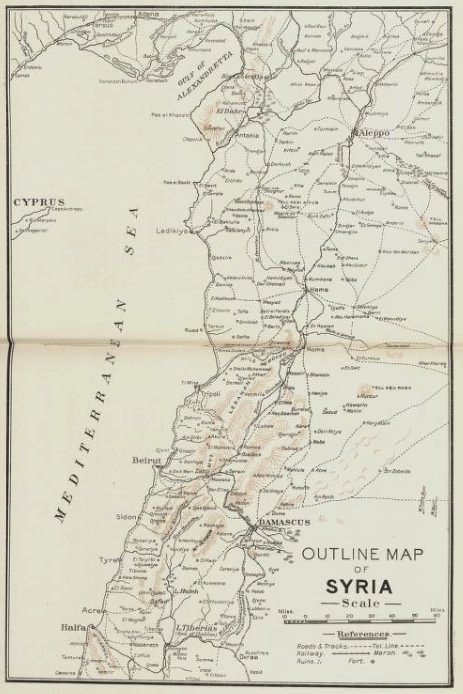
50
It was a wonderful hour for our young Australian countrymen. But
the long war had made them into reserved men of the world, and the streets
of old Damascus were but a stage in the long path of the war. They rode,
very dusty and unshaved, their big hats battered and drooping, through
the tumultuous populace of the oldest city in the world, with the same easy,
casual bearing, and the same quiet self-confidence that are their distinctive
characteristic on their country tracks at home. They ate their grapes and
smoked their cigars, and missed no pretty eyes at the windows; but they
displayed no excitement or elation. They had become true soldiers of
fortune. And their long-tailed horses, at home now, like their owners, on
any road in any country, saw nothing in the shouting mob or banging rifles,
or the narrow ways and many colours of the bazaars, to cause them once to
start, shy, or even cock an ear. The 3rd Brigade rode out to a series of ugly,
but highly successful, actions with stout rear-guards of German machine
gunners. Few men, in any age, have passed through twenty-four more
adventurous and gratifying hours than they during this first day around
Damascus.
The district of Damascus is an irrigation settlement on a vast scale, set in
the midst of comparative desert. So rich and close are the orchards, and so
tall the plantations of poplars and other decorative trees, that, looking over
the city from the neighbouring hills, all you see of the city of 250,000 people
are the stately minarets of its many mosques and the roofs of the larger
residences of the rich. Immediately to the west of the town rises the bare,
glaring mountain side, and to the east and north and south of the green
expanse of gardens you ride out upon the harsh and treeless plain.
Damascus owes all its wealth, even its very existence, to the torrential
Abana River, which, surging down from Anti-Lebanon, bursts from the
mountain gorge on to the plain and, splitting up into several beautiful
streams, has made a rural paradise on the edge of the Arabian wilderness.
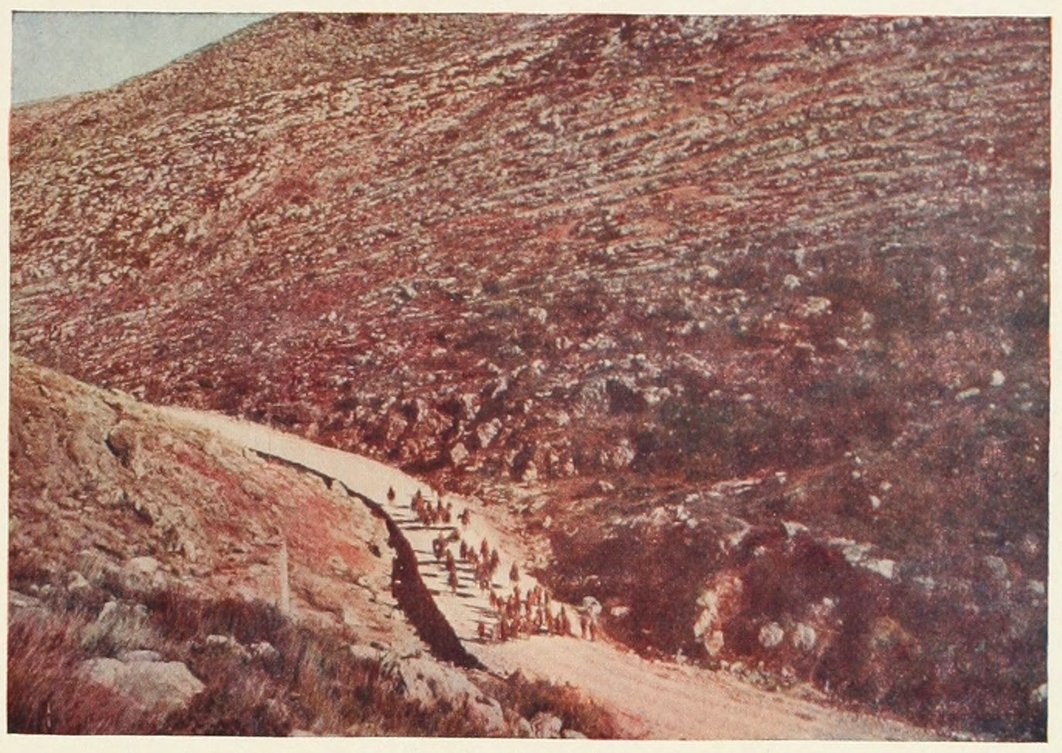
AUSTRALIANS ON THE ROAD TO JERUSALEM
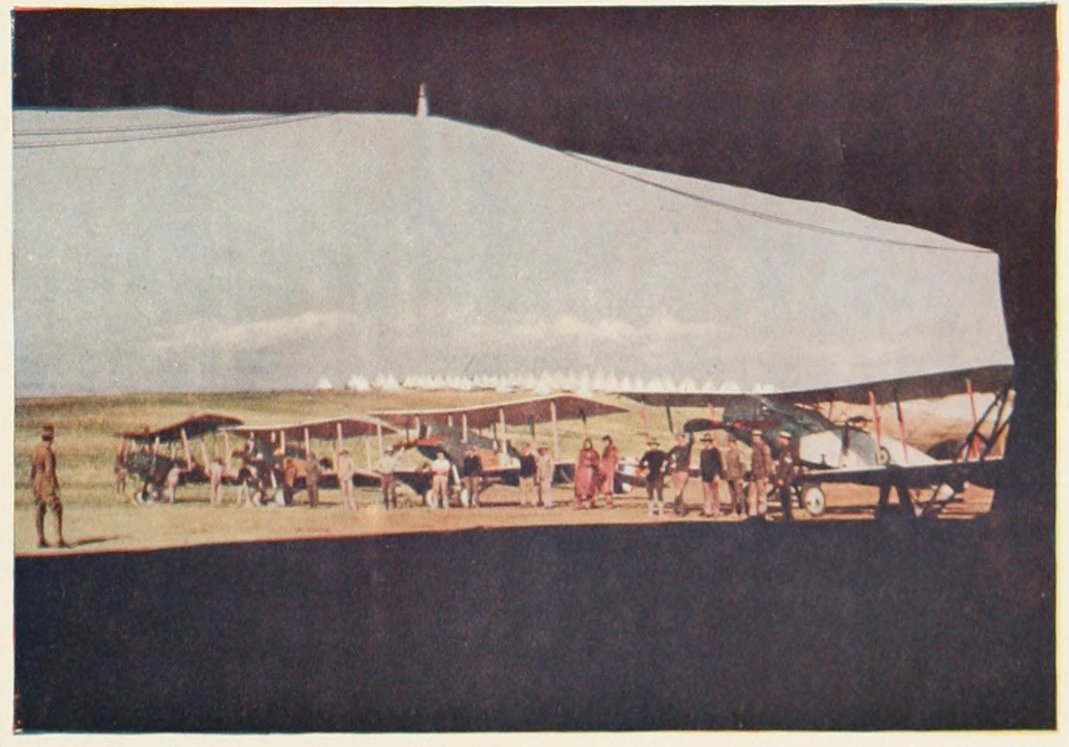
AN AUSTRALIAN FLYING SQUADRON IN PALESTINE
Photos, in colour by Capt. Frank Hurley
51In Palestine the troops looked in vain for the Promised Land “flowing
with milk and honey.” The Plain of Philistia was fertile, but apart from the
few Jewish and German colonies, and the orange groves about Jaffa, it was,
with all its natural possibilities, a land bare and neglected, a reproachful
ghost of a great life that is gone. But Damascus was a prize worth the
winning. Here, after nearly three years of desert and exhausted, unfruitful
regions, was an area good to look upon, and teeming with an active people.
Few of us were sorry that we had at last outrun our supplies, or rather,
that the huge capture of prisoners had somewhat strained the wonderful
commissariat which had so gallantly kept at the heels of the galloping
cavalry, and that a brief halt was necessary for the Australian Mounted
Division. For a month some of the Regiments were in camps in the gardens
around the city, and man and horse never accepted rest more gratefully.
After thirteen days on bully and biscuit, it was good to know fresh meat
and bread again; the mutton was of the best, and the bread, if dark and
coarse and heavy, was still a long way ahead of biscuit. We were too late
for the famous Damascus apricots, but there were grapes for the multitude,
and pears and apples and pomegranates, and, also, raisins and other dried
fruits and specialties in Eastern sweetmeats. Best of all, every camp was
within sight and sound of many running waters.
Noisy little streams crossed our path a hundred times a day. Follow
one along, and it suddenly disappeared into an underground passage, to
burst forth like a spring a hundred yards away. In the streets, many of the
gutters are river-fed waterways, and, to reduce the dust, the tired civic
authorities block the drains and cause an effective little flood, which is
extended by boys splashing with their hands. You buy grapes at the stalls,
and carry them a few yards to dip into the waters of a mountain stream.
But Damascus is dirty and insanitary. Without the purge of the Abana
waters, flushing through it and under it, the city would die of its filth in a
single summer. And even with its beautiful streams it proved a false friend
to great numbers of Australians. The Australian Mounted division suffered
more sickness in the Damascus area than anywhere else in the campaign.
In most of the operations which cleared Sinai and Palestine of the
Turk, the lead was entrusted to the veterans of the Anzac Mounted
Division. In this last and greatest campaign of all, the Division found
itself away from the spectacular side of the enterprise. A trusty mounted
Division was needed for the subsidiary, but highly important, work on
Moab and Gilead, east of Jordan, and the choice fell upon the Anzacs.
The Australians and New Zealanders complained about their luck.
But their task made one strong appeal to them. Twice before they had
been across the Jordan, and twice they had returned leaving not a few of
their men in enemy graves. The two great raids over the river, early in the
52year, were brilliantly successful, as raids. Each time our purpose was
achieved. But each time our men broke off the fight strongly against their
inclination, and prayed for the day when they would get orders to go over
and see the job through, and stay. Old Amman, the ancient Philadelphia,
was especially coveted by our men. There, in March, 1918, we had fought
for days over sodden ground in extreme winter weather and come away,
the railway having been well broken, just after the New Zealanders had
won into the town. This time, Australians and New Zealanders competed,
in a sporting way, for first entry, and the 5th Light Horse Regiment,
from Queensland, narrowly gained the honour.
At the outset, the Anzacs, and the small infantry force operating with
them, made up chiefly of the Jewish Battalion, the British West Indians
and troops from India proper, had no chance of breaking out of our bridgeheads
east of the river. Their orders were to keep in very close and firm
touch with the enemy, and to demolish him as soon as he began to withdraw
in consequence of his defeat on Samaria. Also, this Jordan Valley force
was to push northwards up the Valley, and complete the cordon round the
two Turkish armies on Samaria. Both missions were admirably accomplished.
While the New Zealanders and infantry were advancing up the
Valley, the Australians were probing the strongly entrenched and wired
positions along the Moab and Gilead foothills, across the river. As soon
as the Turk moved the two Australian Brigades pounced upon his rear-guard,
and fought him as he climbed the narrow wady tracks up on to the
tableland. Meanwhile, the New Zealanders, crossing away to the north at
Jisr el Darnie, ascended the goat-track which leads from there to Es Salt,
and, for the third time in the campaign, that old stone-built town was in
Australasian hands.
All the way our men had evidence of the success of the British bluff.
The Turks’ defences on the foothills, and higher up, were particularly
strong. Had our main attack gone that way, the fight would have been
very bitter, with the enemy in a strong natural position. But now the
Turks were compelled to abandon their stronghold because of their disaster
in the west, and, also, because the Arabs had broken their communications
to the north, and were joining hands with a British and Indian cavalry
Division right across those communications. As the Australians passed
Shunet Nimrin, they discovered a long-range navy gun lying on its side, a
piece known to them as “Nimrin Nellie” and “Jericho Jane,” with which
the Turk had often made our camps near Jericho dusty and unpleasant.
53
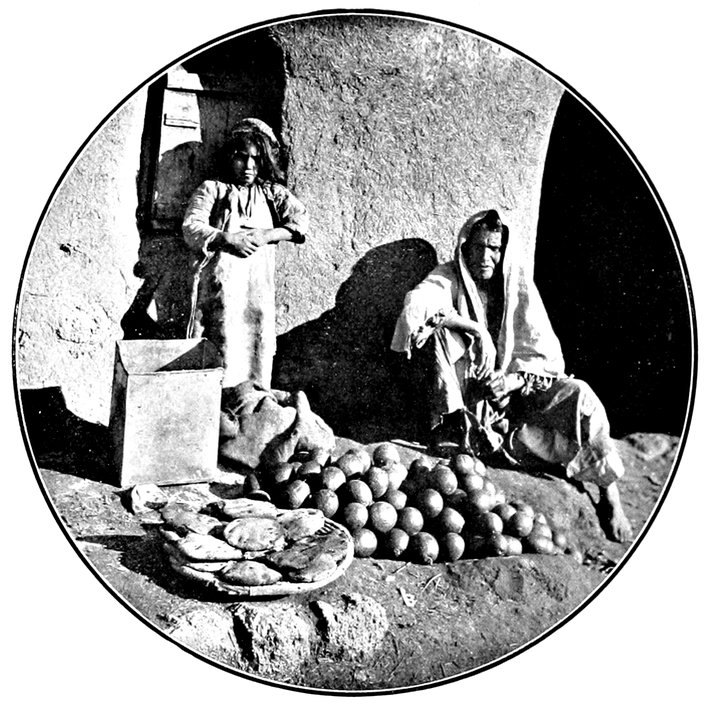
54
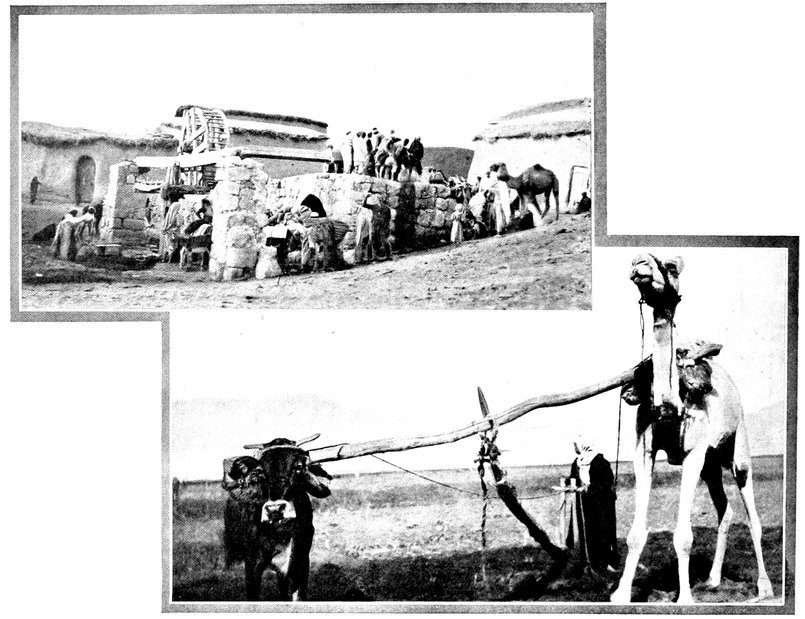
[top]
THE VILLAGE WELL
[bottom]
NATIVE PLOUGH AND TEAM
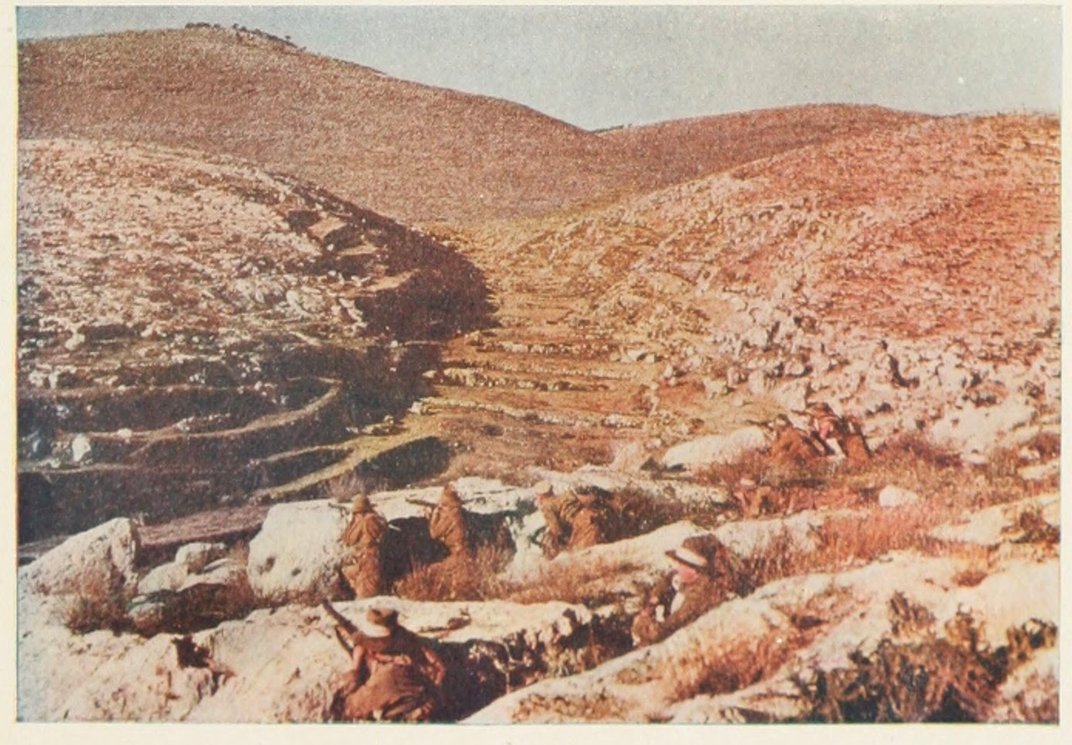
AUSTRALIANS PRIOR TO THE FIGHT FOR HEIGHTS OF NALIN
Photos, in colour by Capt. Frank Hurley
55
It was not until our men were far across the tableland, and close to
Amman, that the enemy showed fight. There our advance guard came
under machine gun fire; but the Division’s rapid advance on the town
was not stayed. As the scene of the severe March fighting came into
view the Australians appreciated the disaster which had so suddenly fallen
upon the Turkish arms. In March, the only possible approaches to
Amman led through hurricanes of machine gun fire, together with shells
from several field batteries. But now, the broken foe, although he fought
gamely at this particular spot, was quickly out-witted and out-classed by
Light Horse manoeuvre, and soon the Australians, after trifling casualties,
were riding in the streets of the squalid modern village, and marvelling at
the glory of the ancient Roman amphitheatre. Contact with the Roman in
this hour of our triumph did us good. It subdued our vanity. In these
far outposts of the old Roman Empire, on the very edge of the barbarian
desert, the massiveness of the stone-work and the fine quality of the
decorative carving proclaimed to the least imaginative mind the culture
and mighty physical achievements of our great rivals in the task of Empire
building. “The splendour that was Rome” is told far more convincingly
in distant Amman and Baalbek than in the ruins of Rome itself.
The Australians took 350 prisoners in Amman, and the New Zealanders
another good bag as the Turks attempted to escape to the north. But the
chief, and by far the most amusing, exploit of the Anzacs’ campaign, fell
to the 2nd Light Horse Brigade under General Ryrie, at Ziza, about
twenty miles to the south. News came through that a large Turkish force,
which had been far to the south on the Hedjaz railway at Maan, was in
an entrenched position at Ziza, and a regiment of Queenslanders rode
down to spy out the land and, if possible, to smash them. The C.O.
reported that he was in touch with 5000 Turks, who wished to capitulate,
but they would not lay down their arms until they were sure that a great
force of hostile Arabs, by whom they were surrounded, would be kept
away from them. So the Colonel of the Queenslanders suggested that the
whole Brigade should hurry down to assure the Turks of their safety.
General Ryrie at once decided to go, and the twenty miles were covered in
less than three hours.
56
The Brigade arrived shortly before dark, and an extraordinary situation
was discovered. The Turks were in a strongly defended position around
the village. They were made up, in the main, of Anatolians, regulars and
the cream of the Ottoman army. Moreover, they were well armed and
capable of a good fight. Our Brigade was not complete and was outnumbered
by about ten to one. The Turkish commander rode out to meet
the Australian Brigadier. “I will surrender,” he said, “if you will protect
us against the Arabs.” “Certainly,” said the Brigadier. “The Arabs are
our allies; if you surrender, you have nothing to fear.” But the Turkish
leader would not be convinced, and he demanded that the Australian force
should be greatly increased before his men gave up their arms. Otherwise,
he would be pleased to fight. General Ryrie was anxious to complete the
surrender and save casualties, and the Australians and Turks spent the
night together in arms around the same camp fires!
Next morning, the Turks laid down their arms and marched as prisoners
to Amman. The incident was an interesting sidelight on the feeling of the
Turk towards the Arabs, whom he has so long governed. But it is a
highly significant fact that, in the long campaign, the Arabs took 17,000
Turkish prisoners, and the Turks not a single Arab. To the Arab, the
Turk has been an enemy in arms. To the Turk, the Arab has been a rebel,
and deserving of a rebel’s fate.
Ziza practically finished the Anzacs’ brilliant little campaign. In all,
some 11,000 prisoners were taken. The total battle casualties for the
Division did not exceed a few score.
The writer of this sketch has been obliged to keep severely to the work
of the Force as a whole, and has recorded little or nothing of the great
achievements of the many technical services, lacking which the victorious
progress of the Light Horsemen would have been impossible. The
performances of the Australian No. 1 Flying Corps Squadron, the first
Commonwealth Flying Squadron engaged in the war, deserve a volume to
themselves. Recruited chiefly from the Light Horse Regiments, both
pilots and observers excelled in resource and daring, and in their golden
chivalry to their foes, and in their many fine rescues of fallen comrades
far behind the enemy lines, shone the spirit of Saladin and King Richard.
They were the modern Knights of Palestine.
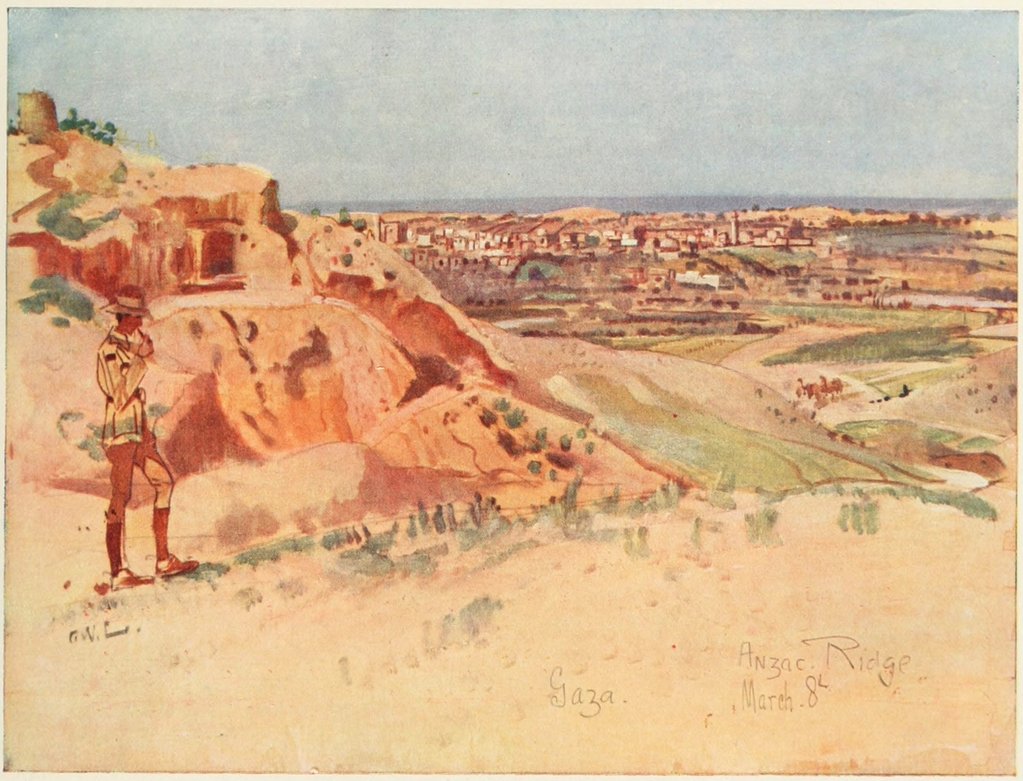
ANZAC RIDGE, GAZA
By Lieut. G. W. Lambert
57Then there were the Engineers (no attempt is made to place these
services in order of merit—a hopeless task), who found us water at
will, as with a magician’s wand, beneath the blistering sands of Sinai;
who bridged the Jordan under heavy fire for the crossing to Moab, and
who, so often, blew enemy railroads, bridges and viaducts heavenward.
Working over every kind of country from the desert to the mountains, they
won through because of their indomitable spirit, and their boundless gift
for improvization.

In the whole war there has not been a campaign which depended
so much for its success upon the native wit of the individual. Conditions
changed with dramatic suddenness from battle to battle. What served
to-day, was useless to-morrow. As an example of this, take the superb
work of our Medical Services. The Medical Officer was, all the way, a
man of many inventions. In the desert the wounded were habitually
carried on sledges made of sheets of galvanized iron, and, later, upon an
improvement of this device; as the campaign progressed, they were borne
on camels; and once, at least, in the mountains east of Jordan, they were
carried lying flat on rough beds made of greatcoats on the backs of horses;
and as the road improved, they were carried in two-wheeled sand-carts,
in ordinary G.S. wagons and every kind of motor. The Light Horse
galloped, and those who would serve them must gallop too. The almost
miraculous rapidity and efficiency with which the Medical Units would
establish their various stations and communications, at the very heels of
a fight, distant perhaps a hundred swiftly-covered miles from railhead,
made them worthy peers of the sparkling horsemen. And, thanks to the
establishment of the mobile operating theatre—a veritable galloping
machine, like the rest of the force—under a gifted surgeon, it was possible
for the most intricate skull and abdominal operations to be carried out at
the edge of the zone of fire. All honour to our doctors and their devoted
staffs! And especially dear in the memory of Light Horsemen will always
be the mounted stretcher-bearers. No wounded man was beyond their
gallant reach.
Of the Light Horseman’s debt to the Nursing Sisters this narrative will
not dare an estimate. As long as memory lasts, every officer and man will
think with deep gratitude of the sustained, self-sacrificing devotion of these
noble Australian women. Fighting in this alien and uncivilized land,
thousands of young Australians for years never spoke to a British woman,
58except when in hospital. What the ever-ready sympathy and helpful
friendship of the Sisters meant to them only these lonely soldiers could
tell.
The supreme masters of improvization were the officers and men who
handled the supplies. Not only the Australians, but the whole of the
Imperial Cavalry—the greatest mounted force in the war under a single
command—led by General Chauvel, depended for their rations upon the
distinguished ability of the Queensland Colonel who was responsible for
the direction of the supply and transport for mounted corps in the Desert.
A cavalry force requires about four times the quantity of supplies which
suffices for infantry, and, on occasions, it travels four times as fast. During
the ride to Damascus, the horsemen, more than once, covered sixty miles
in twenty-four hours; and on the whole advance, no man or horse went
short of a mobile ration. British railways, captured Turkish railways and
rolling-stock, motor-lorries, four-wheeled G.S. wagons, two-wheeled limbers
(their off-side horses carrying pack-saddles, so that, if the vehicle failed, the
load could be transferred), camels in tens of thousands, countless mules and
donkeys—the interminable, sleepless procession on the roads during General
Chauvel’s final triumph was a fitting culmination to the great transport
record from the Canal onward.
Of our Australian machine gunners and signallers, and of the model
Veterinary Service, which cared for our sick and wounded walers as
promptly and faithfully as the Medical people cared for the men, and of
the British batteries of Horse Artillery, which unfailingly advanced to
extreme limits with their guns and shot so unerringly (never was man so
welcome as a galloping gunner in a sticky dismounted fight)—of all these,
it is enough to say that without them Palestine could not be ours to-day.
The fighting ceased for the Australians early in October, with the capture
of Damascus and Amman, though No. 1 Australian Light Car Patrol (Captain
James), accompanying the 5th Cavalry Division, took a prominent part
in the capture of Aleppo, and in the pursuit of the Turko-German forces
north of that city. The final campaign yielded prodigious results at a
trifling cost in battle casualties. Of the 75,000 prisoners made by
General Allenby’s Army, more than 40,000 were taken by the Australian
and Anzac Mounted Divisions. The losses in killed and wounded,
in the two Divisions, were nominal. Unfortunately, however, the
59Force then suffered the worst spell of sickness it had known since leaving
Australia. The terrible ordeal of Jordan Valley during the summer took its
suspended toll. Malaria ran like wildfire through the regiments, and
there was also much acute influenza with pneumonia following, sandfly
fever, and other more or less serious diseases peculiar to the Holy Land.
Many brave men, who had survived four years of hard fighting and
extremely rough living, lost their lives by sickness in the moment of victory.
The Australian Mounted Division was pushing on from Damascus
towards the country north of Aleppo, and the armistice was signed as they
reached Homs, which marked the northern limit attained by the Light
Horsemen.
To-day, the force asks only one question: “Who goes Home—and
when?”
Palestine, December, 1918.