The following awards for services rendered in connection with
military operations in the field were made by His Majesty the
King to members of the Australian Imperial Force.
THE VICTORIA CROSS
Captain Alfred John Shout, 1st Battalion, Australian Imperial Force (New
South Wales).
For most conspicuous bravery at Lone Pine trenches, in the Gallipoli
Peninsula. On the morning of 9th August 1915, with a very small
party, Captain Shout charged down trenches strongly occupied by the
enemy, and personally threw four bombs among them, killing eight and
routing the remainder. In the afternoon of the same day, from the position
gained in the morning, he captured a further length of trench under similar
conditions, and continued personally to bomb the enemy at close range
under very heavy fire, until he was severely wounded, losing his right hand
and left eye. This most gallant officer has since succumbed to his
injuries.
Lieutenant William John Symons, 7th Battalion, Australian Imperial Force
(Victoria).
For most conspicuous bravery on the night of 8th-9th August 1915,
at Lone Pine trenches, in the Gallipoli Peninsula. He was in command
of the right section of the newly captured trenches held by his
battalion, and repelled several counter-attacks with great coolness. At
about 5 a.m. on 9th August a series of determined attacks were made
by the enemy on an isolated sap, and six officers were in succession killed
or severely wounded, a portion of the sap being lost. Lieutenant Symons
then led a charge and retook the lost sap, shooting two Turks with his
revolver. The sap was under hostile fire from three sides, and Lieutenant
Symons withdrew some 15 yards to a spot where some overhead cover could
be obtained, and in the face of heavy fire built up a sand barricade. The
enemy succeeded in setting fire to the fascines and woodwork of the
head-cover, but Lieutenant Symons extinguished the fire and rebuilt
the barricade. His coolness and determination finally compelled the
enemy to discontinue their attacks.
Lieutenant Frederick Harold Tubb, 7th Battalion, Australian Imperial
Force (Victoria).
For most conspicuous bravery and devotion to duty at Lone Pine
trenches, in the Gallipoli Peninsula, on 9th August 1915. In the early
morning the enemy made a determined counter-attack on the centre of
the newly captured trench held by Lieutenant Tubb. They advanced
up a sap and blew in a sandbag barricade, leaving only one foot of it
standing; but Lieutenant Tubb led his men back, repulsed the enemy,
and rebuilt the barricade. Supported by strong bombing parties, the
enemy succeeded in twice again blowing in the barricade, but on each
occasion Lieutenant Tubb, although wounded in the head and arm, held
his ground with the greatest coolness and rebuilt it, and finally succeeded
in maintaining his position under very heavy bomb fire.
Second Lieutenant Hugo Vivian Hope Throssell, 10th Light Horse
Regiment, Australian Imperial Force (Western Australia).
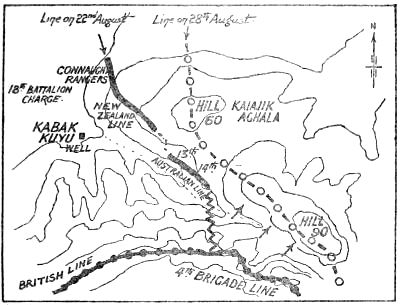
For most conspicuous bravery and devotion to duty during operations
on the Kaiakij Aghala (Hill 60), in the Gallipoli Peninsula, on 29th and
30th August 1915. Although severely wounded in several places during
a counter-attack, he refused to leave his post or to obtain medical assistance
till all danger was past, when he had his wounds dressed and returned
to the firing-line until ordered out of action by the medical officer. By his
personal courage and example he kept up the spirits of his party and was
largely instrumental in saving the situation at a critical period.
No. 384 Corporal Alexander Stewart Burton, 7th Battalion, Australian
Imperial Force, and
No. 2130 Corporal William Dunstan, 7th Battalion, Australian Imperial
Force (Victoria).
For most conspicuous bravery at Lone Pine trenches, in the Gallipoli
Peninsula, on 9th August 1915. In the early morning the enemy made a
determined counter-attack on the centre of the newly captured trench held
by Lieutenant Tubb, Corporals Burton and Dunstan, and a few men.
They advanced up a sap and blew in a sandbag barricade, leaving only
one foot of it standing; but Lieutenant Tubb, with the two corporals,
repulsed the enemy and rebuilt the barricade. Supported by strong
bombing parties, the enemy twice again succeeded in blowing in the
barricade, but on each occasion they were repulsed and the barricade
rebuilt, although Lieutenant Tubb was wounded in the head and arm,
and Corporal Burton was killed by a bomb while most gallantly building
up the parapet under a hail of bombs.
No. 943 Private John Hamilton, 1st Battalion, Australian Imperial Force
(New South Wales).
For most conspicuous bravery on 9th August 1915, in the Gallipoli
Peninsula. During a heavy bomb attack by the enemy on the newly
captured position at Lone Pine, Private Hamilton, with utter disregard to
personal safety, exposed himself under heavy fire on the parados, in order
to secure a better fire position against the enemy's bomb-throwers. His
coolness and daring example had an immediate effect. The defence was
encouraged and the enemy driven off with heavy loss.
No. 465 Lance-Corporal Albert Jacka, 14th Battalion Australian Imperial
Force (Victoria).
For most conspicuous bravery on the night of the 19th-20th May 1915,
at "Courtney's Post," Gallipoli Peninsula. Lance-Corporal Jacka, while
holding a portion of our trench with four other men, was heavily attacked.
When all except himself were killed or wounded, the trench was rushed
and occupied by seven Turks. Lance-Corporal Jacka at once most
gallantly attacked them single-handed, and killed the whole party, five by
rifle fire and two with the bayonet.
No. 958 Private Leonard Keysor, 1st Battalion, Australian Imperial Force
(New South Wales).
For most conspicuous bravery and devotion to duty at Lone Pine
trenches, in the Gallipoli Peninsula. On 7th August 1915 he was in
a trench which was being heavily bombed by the enemy. He picked up
two live bombs and threw them back at the enemy at great risk to his
own life, and continued throwing bombs, although himself wounded,
thereby saving a portion of the trench which it was most important to
hold. On 8th August, at the same place, Private Keysor successfully
bombed the enemy out of a position from which a temporary mastery over
his own trench had been obtained, and was again wounded. Although
marked for hospital, he declined to leave, and volunteered to throw bombs
for another company which had lost its bomb-throwers. He continued to
bomb the enemy till the situation was relieved.
THE MOST HONOURABLE ORDER OF THE BATH
To be a Knight Commander.
Major-General William Throsby Bridges, C.M.G., General Officer
Commanding 1st Australian Division (since died of wounds).
To be Additional Members of the Military Division of the Third Class,
or Companions.
Colonel (temporary Major-General) H. G. Chauvel, C.M.G., Commanding
Australian Mounted Division.
Colonel (temporary Surgeon-General) Neville Reginald Howse, V.C.,
Mediterranean Expeditionary Force, Staff.
Colonel (temporary Brigadier-General) the Honourable James Whiteside
McCay, 2nd Infantry Brigade.
Colonel (temporary Brigadier-General) F. C. Hughes, commanding 3rd Light
Horse Brigade.
Colonel (temporary Brigadier-General) John Monash, 4th Infantry Brigade.
Colonel (temporary Brigadier-General) Joseph John Talbot Hobbs,
Commanding Divisional Artillery.
Colonel (temporary Brigadier-General) C. B. B. White, D.S.O., Chief of
Staff, 1st Australian Army Corps.
Lieut.-Colonel Harold Pope, 16th Battalion (South and Western
Australia).
Lieut.-Colonel Richard Edmond Courtney, 14th Battalion (Victoria).
Lieut.-Colonel George Jamieson Johnston, 2nd Field Artillery Brigade.
Lieut.-Colonel James Harold Cannan, 15th Battalion (Queensland and
Tasmania).
Lieut.-Colonel Charles Rosenthal, 3rd Field Artillery Brigade.
Lieut.-Colonel Granville John Burnage, 13th Battalion (New South
Wales).
Lieut.-Colonel Ernest Hillier Smith, 12th Battalion (South Australia,
Western Australia, Tasmania).
THE MOST DISTINGUISHED ORDER OF SAINT MICHAEL
AND SAINT GEORGE
To be Additional Members of the Third Class, or Companions.
Colonel the Honourable Joseph Livesley Beeston, Army Medical Corps.
Colonel (temporary Brigadier-General) G. de L. Ryrie, Commanding 2nd
Light Horse Brigade (New South Wales).
Lieut.-Colonel Alfred Joshua Bennett, D.S.O., 1st Battalion (New
South Wales).
Lieut.-Colonel Henry Gordon Bennett, 6th Battalion (Victoria).
Lieut.-Colonel W. E. H. Cass, Commanding 2nd Infantry Battalion.
Lieut.-Colonel Sydney Ernest Christian, 1st Field Artillery Brigade.
Lieut.-Colonel C. M. Macnaghten, Commanding 4th Infantry Battalion
(New South Wales).
Lieut.-Colonel Jeremy Taylor Marsh, Divisional Train, Army Service
Corps.
Lieut.-Colonel T. M. Martin, Commanding 2nd Australian General Hospital.
Lieut.-Colonel Robert Heylock Owen, 3rd Infantry Battalion (New
South Wales).
Lieut.-Colonel David Sydney Wanliss, 5th Infantry Battalion (Victoria).
Major (temporary Lieut.-Colonel) D. M. McConaghy, Commanding
3rd Battalion (New South Wales).
Major (temporary Lieut.-Colonel) James Campbell Robertson, 9th
Battalion (Queensland).
Major Alfred Joseph Bessell-Browne, D.S.O., 3rd Field Artillery
Brigade.
Major Edmund Alfred Drake Brockman, 11th Battalion (Western
Australia).
Major Giffard Hamilton Macarthur King, 1st Field Artillery Brigade.
Major Reginald Lee Rex Rabett, 1st Field Artillery Brigade.
Major George Ingram Stevenson, 2nd Field Artillery Brigade.
Major J. L. Whitham, Second in Command, of 12th Battalion (South and
Western Australia and Tasmania).
THE DISTINGUISHED SERVICE ORDER
To be Companions.
Rev. W. E. Dexter (Chaplain 4th Class), 2nd Infantry Brigade (Victoria).
Rev. J. Fahey (Chaplain 4th Class), 3rd Infantry Brigade (Queensland, South
Australia, Western Australia, and Tasmania).
Lieut.-Colonel Walter Ramsay McNicoll, 6th Australian Infantry
Battalion (Victoria).
On the night of 25th-26th April 1915, during operations near Gaba
Tepe, for repeatedly exhibiting great gallantry and skill in the command of
his battalion.
Lieut.-Colonel Cyril Brudenell Bingham White, Royal Australian
Garrison Artillery, Staff.
During the operations near Gaba Tepe on 25th April, 1915, and
subsequently for his distinguished service co-ordinating Staff work, and in
reorganization after the inevitable dislocation and confusion arising from
the first landing operations. He displayed exceptional ability.
Major Charles Henry Brand, 3rd Infantry Brigade (Australian Forces).
On 25th April 1915, during operations in the neighbourhood of Gaba
Tepe, for conspicuous gallantry and ability in organizing stragglers under
heavy fire, and for organizing and leading an attack resulting in the
disablement of three of the enemy's guns. Major Brand himself conveyed
messages on many occasions under fire during emergencies.
Major W. L. H. Burgess, 3rd Field Artillery Brigade.
Major James Samuel Denton, 11th Australian Infantry Battalion (Western
Australia).
During the operations in the neighbourhood of Gaba Tepe on the
25th April 1915, for valuable services in obtaining and transmitting
information to ships' guns and mountain batteries, and subsequently for
holding a trench, with about 20 men, for over six days, repulsing
several determined attacks.
Major Gus Eberling, 8th Battalion (Victoria).
Major James Heane, 4th Australian Infantry Battalion (New South Wales).
On 1st May 1915, during the operations near Gaba Tepe, for displaying
conspicuous gallantry in leading his company to the support of a small
force which, in an isolated trench, was without means of reinforcement,
replenishment, or retreat. He attained his object at a heavy sacrifice.
Major Herbert William Lloyd, 1st Field Artillery Brigade.
Major Francis Maxwell de Frayer Lorenzo, 10th Battalion (South
Australia).
Major William Owen Mansbridge, 16th Australian Infantry Battalion
(Western Australia).
On 25th April 1915, during operations near Gaba Tepe, for exceptional
gallantry and resource during the first assault, and again on the 2nd and
3rd May during an assault on a difficult position.
Major (temporary Lieut.-Colonel) A. M. Martyn, Commanding Officer
Engineers, First Australian Division.
Major Robert Rankine, 14th Australian Infantry Battalion (Victoria).
On the night of 26th-27th April 1915, during operations in the neighbourhood
of Gaba Tepe, for gallantly leading an assault resulting in the
capture of a most important post, and subsequently for holding that
position against repeated attacks for five days without relief.
Major Arthur Borlase Stevens, 2nd Battalion (New South Wales).
Major (temporary Lieut.-Colonel) Leslie Edward Tilney, 16th Battalion
(South Australia, Western Australia).
Captain Arthur Graham Butler, Australian Army Medical Corps
(attached 9th Australian Infantry Battalion).
During operations in the neighbourhood of Gaba Tepe on 25th April
1915 and subsequent dates, for conspicuous gallantry and devotion to duty
in attending wounded under heavy fire, continuously displaying courage of
high order.
Captain Cecil Arthur Callaghan, 2nd Battery, Australian Field Artillery,
Australian Imperial Force (New South Wales).
For conspicuous gallantry and ability on 12th July 1915, during an
action on the Gallipoli Peninsula. As forward observing officer, he
advanced with the first line of infantry and established telephone communication
with his battery from the captured hostile trenches. During
the day he continued to advance under heavy fire, sending back accurate
reports, valuable not only to the guns, but also to the corps staff.
Captain Cecil Duncan Sasse, 1st Battalion, Australian Imperial Force (New
South Wales).
For conspicuous gallantry and determination during the attack on Lone
Pine, Gallipoli Peninsula, on 6th-7th August 1915, when he led several
bayonet charges on trenches occupied by the enemy, resulting in substantial
gains. Captain Sasse was wounded three times, but remained on duty.
Captain (temporary Major) Alan Humphrey Scott, 4th Battalion,
Australian Imperial Force (New South Wales).
For conspicuous gallantry in the attack on Lone Pine, Gallipoli Peninsula,
on 6th-7th August 1915. He held on to a very exposed position
till all the wounded had been removed. Later, after a heavy bombarding
attack in superior force had compelled him to retire, he led a bayonet
charge which re-took and held a position, in face of the enemy's enfilading
machine-gun fire. This position was of great importance, as linking up
the positions captured on either flank.
THE MILITARY CROSS
Major J. T. M'Coll.
Captain J. S. S. Anderson, Staff, 1st Infantry Brigade.
Captain M. H. Cleeve, 4th Infantry Brigade.
Captain G. Cooper, 14th Infantry Battalion (Victoria).
Captain J. E. Dods, Medical Officer, 5th Light Horse (Queensland).
Captain J. Hill, 15th Infantry Battalion (Queensland and Tasmania).
Captain Owen Glendower Howell-Price, 3rd Battalion, Australian
Imperial Force (New South Wales).
For conspicuous gallantry on 7th August 1915, in the attack on Lone
Pine, Gallipoli Peninsula. He showed the greatest bravery in leading an
attack against the Turkish trenches, frequently rallying his men under
heavy fire, and restoring order at critical moments. He killed three
Turks with his own hands.
Captain (temporary Major) R. L. Leane, 11th Infantry Battalion (Western
Australia).
Captain G. McLaughlin, 1st Field Artillery Brigade (New South Wales).
Captain Jasper Kenneth Gordon Magee, 4th Australian Infantry Battalion
(New South Wales).
On 25th April 1915 and subsequent dates, during operations in the
neighbourhood of Gaba Tepe, for gallantry in leading his men, and
exhibiting sound judgment and ability on several occasions, under a
constant and harassing fire.
Captain J. H. F. Pain, 2nd Infantry Battalion (New South Wales).
Captain Clifford Russell Richardson, 2nd Australian Infantry Battalion
(New South Wales).
On 25th April 1915, during operations near Gaba Tepe, for displaying
great coolness and courage, and leading a charge against superior numbers
under a heavy cross fire, resulting in the flight of the enemy in disorder.
Captain James William Albert Simpson, 13th Australian Infantry Battalion
(New South Wales).
On 2nd May 1915, during an attack in the neighbourhood of Gaba
Tepe, for showing conspicuous bravery and skill in directing the battalion
through unreconnoitred scrub. He was conspicuously active in consolidating
the position gained under heavy fire.
Captain W. C. N. Waite, 3rd Field Artillery Brigade (Composite).
Lieutenant (temporary Captain) Heinrich Bächtold, 1st Field Company,
Australian Engineers.
Lieutenant G. N. Croker, Divisional Engineers.
Lieutenant Alfred Plumley Derham, 5th Australian Infantry Battalion
(Victoria).
On 25th April 1915, and subsequently during operations in the
neighbourhood of Gaba Tepe, for acting with great bravery and ability,
and continuing to do duty until 30th April, although shot through the
thigh on 25th April.
Lieutenant Charles Fortescue, 9th Australian Infantry Battalion (Queensland).
From 25th to 29th April 1915, during operations near Gaba Tepe, for
conspicuous gallantry. He twice led charges against the enemy, and
rendered good service in collecting reinforcements and organizing
stragglers.
Lieutenant R. G. Hamilton, Signal Company.
Lieutenant (temporary Captain) G. H. L. Harris, 1st Light Horse Regiment
(New South Wales).
Lieutenant (temporary Captain) H. James, 11th Infantry Battalion (Western
Australia).
Lieutenant (temporary Captain) J. E. Lee, 13th Infantry Battalion (New
South Wales).
Lieutenant Reginald George Legge, 13th Australian Infantry Battalion
(New South Wales).
On 1st and 2nd May 1915, during operations in the neighbourhood
of Gaba Tepe, for conspicuous ability and courage in the successful
handling of his machine gun section. On several occasions he inflicted
severe losses on the enemy, and was himself severely wounded in the neck.
Lieutenant Eric Edwin Longfield Lloyd, 1st Battalion, Australian
Imperial Force (New South Wales).
For exceptionally gallant conduct on 5th June 1915, during the operations
in the Gallipoli Peninsula, in personally leading a party of 100 men
to take a trench from which an enemy machine gun was severely harassing
his position. Although unable to remove the machine gun owing to the
heavy head cover, he destroyed it with rifle fire. He personally shot two
Turks with his own pistol, and, with his party, inflicted severe losses on the
enemy.
Lieutenant Terence Patrick McSharry, 2nd Australian Light Horse
Regiment (Queensland).
For exceptional bravery and resource on many occasions since 25th
April 1915, especially on night of 28th-29th May, during operations in
the neighbourhood of Gaba Tepe, Dardanelles, in organizing several
assaults, and at great personal risk making several valuable reconnaissances.
He was again brought to notice for gallant conduct on the night, 4th-5th
June.
Lieutenant N. Marshall, 5th Infantry Battalion (Victoria).
Lieutenant J. H. Mirams, 2nd Field Company, Engineers.
Lieutenant (temporary Captain) Uvedale Edward Parry-Okeden, 1st
Australian Divisional Ammunition Park.
Lieutenant Percy John Ross, 7th Battery, Australian Imperial Force
(Queensland).
For conspicuous gallantry in the attack on Lone Pine on 6th and 7th
August, 1915, when he kept his gun in action for forty-eight hours, although
continuously attacked at close quarters by superior gun fire. His gun
emplacement was several times almost completely demolished, and he
himself was finally wounded. Lieutenant Ross rendered very valuable
assistance to the infantry in the attack through his determination to keep
his gun in action at all costs.
Lieutenant Alfred John Shout, 1st Australian Infantry Battalion (New
South Wales).
On 27th April 1915, during operations near Gaba Tepe, for showing
conspicuous courage and ability in organizing and leading his men in a
thick, bushy country, under very heavy fire. He frequently had to expose
himself to locate the enemy, and led a bayonet charge at a critical moment.
Lieutenant S. E. Sinclair, 1st Field Artillery Brigade (New South Wales).
Second Lieutenant E. T. Bazeley, 22nd Battalion (Victoria).
Second Lieutenant W. A. Moncur, 7th Infantry Battalion (Victoria).
Second Lieutenant R. I. Moore, 3rd Infantry Battalion (New South Wales).
Second Lieutenant R. T. Ramsay, 9th Field Ambulance.
No. 96 Sergeant-Major D. Smith, 5th Battalion, 2nd Australian Brigade
(Victoria).
On 8th May 1915, during operations south of Krithia, for conspicuous
gallantry and good services in rallying and leading men forward to the
attack. Although wounded in both arms, he continued to direct his men,
setting a valuable example of devotion to duty.
THE DISTINGUISHED CONDUCT MEDAL
Second Lieutenant R. R. Chapman.
Second Lieutenant W. C. McCutcheon.
Lieutenant (temporary Captain) W. W. Meligan.
No. 6 Sergeant A. Anderson, 2nd Australian Infantry Battalion (New South
Wales).
For conspicuous gallantry on 25th April 1915 and subsequent dates, during
the operations near Gaba Tepe, in assisting to reorganize small parties of
various battalions under heavy fire, and placing them in the firing line.
No. 74 Private T. Arnott, 1st Australian Infantry Battalion (New South
Wales).
For conspicuous gallantry on 30th May 1915, in the neighbourhood of
Gaba Tepe, whilst serving in a machine gun section. Although engaged
by two hostile machine guns which demolished the emplacement, Private
Arnott served his gun whilst exposed to the enemy's fire until badly
wounded. One hostile machine gun was destroyed.
No. 189 Sergeant W. Ayling, 11th Australian Infantry Battalion (Western
Australia).
On 25th April 1915, during operations near Gaba Tepe, for gallantry
in commanding his platoon after his officer had been wounded. When
compelled to retire he carried the wounded officer with him, and on
obtaining reinforcements again led his platoon to the attack.
Corporal G. Ball.
No. 43 Lance-Corporal H. A. Barker, 7th Battalion, Australian Imperial
Force (Victoria).
For conspicuous gallantry, ability, and resource on the 25th and 26th
April, 1915, near Gaba Tepe (Dardanelles). During the operations on
these two days, the officer, sergeant, and corporal of his machine gun
section, having been wounded, Corporal Barker assumed the command,
and continued working the guns under a heavy shell fire. At one time the
enemy actually succeeded in getting into the machine gun trench, but
were all killed. One after another the machine guns were rendered
useless by shell fire, but he collected portions of useless guns, and built
them up anew. Finally he was working with two guns only, composed of
parts of at least seven other guns.
Bombardier C. W. Baxter.
Private A. Bell.
No. 874 Sergeant C. E. Benson, 9th Battalion, Australian Imperial Force
(Queensland).
For gallant conduct and ability on the 25th April 1915, at Gaba Tepe
(Dardanelles). With great courage and presence of mind he, on two
occasions, rallied and led forward again into the firing-line men whose
officers had all been killed or wounded, and who had suffered very heavy
losses. His fine example and devotion to duty were conspicuous.
No. 695 Private W. J. Birrell, C Company, 7th Battalion, 2nd Australian
Brigade (Victoria).
On 8th May 1915, during operations near Krithia, for distinguished
conduct in collecting and organizing men who had become detached, and
leading them to a weak flank of the firing-line.
No. 170 Lance-Corporal P. Black, 16th Australian Infantry Battalion (South
Australia, Western Australia).
On the night of 2nd-3rd May 1915, during operations near Gaba Tepe,
for exceptional gallantry. After all his comrades in his machine gun
section had been killed or wounded, and although surrounded by the enemy,
he fired all available ammunition and finally brought his gun out of action.
Corporal H. Brennan.
No. 997 Private L. W. Burnett, Australian Army Medical Corps.
From 25th April to 5th May 1915, during operations near Gaba Tepe,
for exceptionally gallant work and devotion to duty under heavy fire.
No. 1250 Private D. H. Campigli, 8th Battalion, Australian Imperial Force
(Victoria).
For gallant conduct on the 25th and 26th April 1915, near Gaba Tepe
(Dardanelles), when, with a small detachment, which was retiring on the
main body, he, on two occasions, carried in a wounded man under
heavy fire.
No. 119 Lance-Corporal F. R. Cawley, 15th Battalion, Australian Imperial
Force (Queensland, Tasmania).
For conspicuous gallantry on the night of the 9th-10th May 1915, near
Gaba Tepe (Dardanelles). During a sortie from Quinn's Post, Lance-Corporal
Cawley, accompanied by another non-commissioned officer,
advanced with great coolness and courage past the first line of the enemy's
trenches to a tent some distance in the rear. They killed all the occupants,
and cut the telephone wires which connected it with the fire-trenches, thus
preventing communication from the rear.
No. 66 Lance-Corporal V. Cawley, No. 2 Field Ambulance, 1st Australian
Division.
For conspicuous gallantry on 25th April 1915, and subsequently during
landing operations in the neighbourhood of Gaba Tepe. He advanced
under heavy rifle and shrapnel fire and spent the day attending to wounded
men. He repeatedly, during the following days, brought wounded men in
over ground swept by the enemy's fire.
No. 182 Sergeant W. A. Connell, 12th Australian Infantry Battalion
(Western Australia).
On 25th April 1915, during operations near Gaba Tepe, for gallantly
attacking an entrenched position and an enemy's machine gun.
No. 94 Staff Sergeant-Major M. E. E. Corbett, 15th Australian Infantry
Battalion (Queensland).
On 3rd May 1915, during operations near Gaba Tepe, for exceptional
gallantry in serving his machine gun after he had been wounded, until it
was put out of action, and again for rallying men and leading them to a
second attack, retrieving a difficult situation.
No. 1403 Private M. D. Cowtan, 1st Australian Casualty Clearing Hospital.
For conspicuous good work on 25th April 1915, and subsequently
during the landing operations in the neighbourhood of Gaba Tepe. He
was indefatigable during the first four days in giving aid and carrying
water to the wounded, and his unswerving courage under fire was
invaluable in its effect.
No. 733 Lance-Corporal J. Craven, 15th Battalion, Australian Imperial Force
(Queensland, Tasmania).
For conspicuous gallantry on the 27th April 1915, near Gaba Tepe
(Dardanelles), when, under a heavy shell and machine-gun fire, he carried
water and food to the men in the front trenches. He also assisted four
wounded men into shelter, and, later on, he exhibited the greatest coolness
and courage in voluntarily carrying messages under heavy fire and at great
personal risk.
Sergeant R. C. Crawford.
No. 712 Sergeant N. A. Cross, 13th Australian Infantry Battalion (New South
Wales).
For conspicuous gallantry on 9th May 1915, during operations near
Gaba Tepe, in taking an enemy's trench. Out of a party of 40 men to
which he belonged, only 12 reached their objective. On the officer in
command being wounded, he endeavoured to assist him back, but the
officer was again shot and killed. Sergeant Cross then immediately
returned to the forward position.
Lance-Corporal F. P. Curran.
No. 457 Lance-Corporal C. Davis, 1st Battalion, Australian Imperial Force
(New South Wales).
For great gallantry on the 5th June 1915, during the operations near
Gaba Tepe (Dardanelles). He was one of a small party who, led by an
officer, and under a heavy fire, made a direct attack on a machine gun,
which was destroyed.
— Driver G. Dean, Australian Divisional Signal Company.
On 8th May 1915, during operations near Krithia, for distinguished
gallantry. Was detailed to accompany four officers to the firing-line to
lay telephone wire. Owing to the heavy fire only one officer reached the
position. Driver Dean kept up constant communication with brigade
headquarters until 3 a.m. on 9th May, when the remaining officer was
wounded. Alone, he assisted this officer back and attended other
wounded men, but never neglected his duties on the telephone.
No. 926 Private S. Diamond, 6th Battalion, Australian Imperial Force
(Victoria).
For conspicuous gallantry and ability on the 25th and 26th April 1915,
near Gaba Tepe (Dardanelles). When, on one occasion during the
operations, most of the officers having been killed or wounded, and part
of the line having commenced to retire, Private Diamond showed the
greatest courage and decision of character in assisting to stop the retirement,
and in leading the men forward again under a heavy fire. He also
frequently carried messages over open ground swept by a heavy fire, and
exhibited a splendid example of devotion to duty.
No. 744 Private H. Edelsten, 15th Battalion, Australian Imperial Force
(Queensland, Tasmania).
For conspicuous gallantry on the 25th April 1915, near Gaba Tepe
(Dardanelles). After the landing, he passed frequently from the supports
to the firing-line under a very heavy fire to keep the communications open.
Later on, he showed great bravery on three occasions in carrying wounded
men to a place of safety.
Sergeant A. G. Edwards.
Driver L. Farlow.
No. 325 Private A. Farmer, 3rd Australian Infantry Battalion (New South
Wales).
On 25th April 1915, during operations near Gaba Tepe, for gallantry
in repeatedly carrying messages and twice going back for ammunition
under severe rifle and machine-gun fire; and again on 27th April, when
his officer was wounded, for organizing a party of three men who carried
the wounded officer to the rear. Private Farmer exposed himself fearlessly,
and it was owing to his coolness and initiative that the party succeeded.
He was himself wounded.
No. 151 Lance-Corporal G. C. Farnham, 3rd Field Ambulance, Australian
Imperial Force (Queensland, South Australia, Western Australia, Tasmania).
For great gallantry on the 25th April 1915, and throughout the landing
operations near Gaba Tepe (Dardanelles). In attending to the wounded
under a heavy fire he showed the greatest zeal and disregard of danger,
and at all times gave a fine exhibition of coolness and devotion to duty.
No. 261 Gunner G. G. Finlay, 2nd Battery, 1st Australian Field Artillery
Brigade (New South Wales).
For conspicuous gallantry on 8th June 1915, south-west of Krithia,
Gallipoli Peninsula. When a company of infantry had been forced by
enfilade fire to vacate a trench, it was reported that one of their wounded
had been left in the trench, which was now absolutely commanded by the
enemy's fire. Gunner Finlay, with another man, volunteered to bring
him in, and succeeded in doing so. It was a most gallant adventure and
showed a fine spirit of self-sacrifice.
No. 851 Lance-Corporal W. Francis, 13th Australian Infantry Battalion
(New South Wales).
On 3rd May 1915, during operations near Gaba Tepe, for great bravery
in removing wounded from the trenches to a dressing station over ground
swept by machine-gun fire.
No. 764 Lance-Corporal H. W. Freame, 1st Australian Infantry Battalion
(New South Wales).
On 25th April 1915, and subsequently during the operations near
Gaba Tepe, for displaying the utmost gallantry in taking water to the
firing-line although twice hit by snipers.
No. 499 Lance-Corporal R. V. Gay, 6th Battalion, Australian Imperial Force
(Victoria).
For conspicuous gallantry and ability on the 25th and 26th April 1915,
near Gaba Tepe (Dardanelles). When, on one occasion during the
operations, most of the officers having been killed or wounded, and part
of the line having commenced to retire, Corporal Gay showed great
courage and decision of character in assisting to stop the retirement, and
in leading the men forward again under a heavy fire. He also frequently
carried messages over open ground swept by a heavy fire, and exhibited a
splendid example of devotion to duty.
No. 918 Private F. Godfrey, 12th Australian Infantry Battalion (Western
Australia).
On 25th April 1915, during operations near Gaba Tepe, for exceptionally
gallant conduct in personally capturing an enemy officer, and going
out single-handed and shooting five enemy snipers.
Corporal R. L. Graham.
No. 122 Private C. P. Green, 10th Battalion, Australian Imperial Force
(South Australia).
For conspicuous gallantry on the 25th April 1915, during the landing
at Gaba Tepe (Dardanelles). He had reached shelter on the beach, when
he saw a wounded man struggling in the surf, which was under heavy
fire. Without hesitation, he turned back, reached the man in the water,
and brought him successfully to shore, and subsequently to a place of
shelter.
No. 611 Private J. V. F. Gregg-Macgregor, 1st Field Ambulance,
Australian Imperial Force (New South Wales).
For conspicuous gallantry and devotion to duty on the 25th April 1915,
and subsequent days, after the landing at Gaba Tepe (Dardanelles). In
company with another man, Private Gregg-Macgregor showed the greatest
bravery and resource in attending to the wounded. Totally regardless of
danger, he was for three consecutive days under a continuous and heavy
shell and rifle fire, dressing and collecting the wounded from the most
exposed positions. He allowed no personal risk or fatigue to interfere
with the performance of his duties, and his gallant conduct and devotion
offered a splendid example to all ranks.
No. 582 Lance-Corporal C. Grimson, 1st Australian Light Horse Regiment
(New South Wales).
For conspicuous gallantry on the night of the 28th-29th May 1915,
near Gaba Tepe (Dardanelles). Owing to the explosion of a mine, which
destroyed a portion of our parapet, the enemy was enabled to occupy a
portion of our trenches, thus dividing the defending force into two. Lance-Corporal
Grimson crawled over the broken ground towards the enemy,
capturing successively three Turks. He then, with the greatest courage,
entered the remaining portion of the trench held by the enemy, about 12
in number, and compelled them all to surrender, thus enabling the
defending force to re-unite.
No. 2 Staff-Sergeant C. V. Heath, Australian Flying Corps.
For conspicuous pluck and determination in Mesopotamia on the
1st August 1915. He assisted to pole a "bellum" (long flat-bottomed
boat) 28 miles in twelve hours in intense heat, in order to rescue aviators
who had been forced to descend in the enemy's country.
No. 493 Private C. R. Heaton, 9th Battalion, Australian Imperial Force
(Queensland).
For great bravery on the 25th April 1915, near Gaba Tepe (Dardanelles),
when he rescued and brought into shelter, under a very heavy shell and
rifle fire, a wounded man.
Sergeant W. J. Henderson.
No. 371 Private E. P. Hitchcock, Australian Army Medical Corps (attached
6th Battalion, Australian Imperial Force) (Victoria).
For conspicuous gallantry and devotion to duty on the 8th May 1915,
and following days, north of Cape Helles (Dardanelles). In assisting the
wounded under constant heavy fire, Private Hitchcock exhibited a heroism
beyond praise. Absolutely regardless of danger, he, in company with
another man, attended to the wounded, leading up the stretcher-bearers,
and dressing the severe cases in the fire-trenches, even before they were
completed. Not only was he instrumental in saving many lives, but, by
his coolness and courage, he set a splendid example of devotion to duty,
and gave the greatest encouragement to all ranks.
No. 556 Sergeant V. Horswill, 11th Battalion, Australian Imperial Force
(Western Australia).
For great gallantry and devotion to duty near Gaba Tepe (Dardanelles).
After two ammunition-carriers had been wounded, he rendered invaluable
service in assisting to carry up and distribute ammunition under a heavy
shell and rifle fire.
No. 1293 Private R. Humberston, 3rd Australian Infantry Battalion (New
South Wales).
On 25th April 1915, and subsequently during operations near Gaba
Tepe, for conspicuous coolness and bravery in volunteering on many
occasions for dangerous missions and for judgment in carrying them out.
No. 1065 Staff-Sergeant H. Jackson, Australian Army Medical Corps.
From 25th April until 5th May 1915, during operations near Gaba
Tepe, for exceptionally gallant work and devotion to duty under heavy fire.
No. 518 Private W. S. James, 15th Battalion, Australian Imperial Force
(Queensland, Tasmania).
For conspicuous bravery on the night of the 3rd-4th May 1915, during
the operations near Gaba Tepe (Dardanelles). During an attack by the
enemy he frequently picked up and threw back their own hand-grenades,
exhibiting the greatest coolness and courage at a critical time. Later on
he assisted in carrying food and water to the firing-line under a very heavy
and continuous shell and machine-gun fire.
Private W. P. Kedley.
Private W. Kelly.
Private W. J. Kelly.
No. 75 Lance-Corporal T. Kennedy, 1st Australian Infantry Battalion (New
South Wales).
On 25th April 1915, and subsequent dates, during operations near
Gaba Tepe, for displaying the greatest coolness and pluck in running
round under heavy fire and collecting stragglers, whom he formed and led
into the firing-line. This he did time after time, with excellent results.
No. 741 Lance-Corporal J. Kenyon, 9th Australian Infantry Battalion
(Queensland).
On 25th April 1915, during operations near Gaba Tepe, for conspicuous
courage and initiative in returning from the firing-line under heavy fire,
collecting reinforcements, and assisting in leading a successful bayonet
charge to the top of a hill, which was eventually held against great odds.
No. 323 Private A. M. Kirkwood, 6th Battalion, Australian Imperial Force
(Victoria).
For conspicuous gallantry and ability on the 8th May 1915, during the
operations north of Cape Helles (Dardanelles). During an advance, when
the officers and non-commissioned officers had been killed or wounded,
Private Kirkwood assumed the command, taking charge of the men in his
immediate neighbourhood, directing their fire and, by his coolness and
courage, rendering valuable assistance in steadying all ranks at a critical
moment. He led each advance in his section of the line, and, finally,
performed most valuable service in consolidating the position gained.
Private J. H. Kruger.
Gunner A. G. McAllister.
No. 697 Sergeant J. M. McCleery, 11th Battalion, Australian Imperial Force
(Queensland, South Australia, Western Australia, Tasmania).
For conspicuous gallantry and ability on the 25th April 1915. After
the landing at Gaba Tepe (Dardanelles), he led an attack on a strongly
held position, and by his bravery and the ability with which he handled his
force, he succeeded in gaining the position.
Private W. M'Crae.
No. 1156 Corporal R. McGregor, 3rd Battalion, Australian Imperial Force
(New South Wales).
For great bravery on the 27th April 1915, subsequent to the landing at
Gaba Tepe (Dardanelles). Ammunition in the firing-trench having run
short, and efforts to obtain supplies having failed, owing to the ammunition-carriers
having been killed, he volunteered to return to the support trench
in the rear and obtain further supplies. This he succeeded in doing,
although both in going and returning he was exposed to a very heavy
shell fire.
No. 99 Sapper G. F. McKenzie, 3rd Field Company, Australian Engineers.
On 4th May 1915, during a landing and an attack on the enemy's
redoubt near Gaba Tepe, for conspicuous gallantry in rescuing a wounded
sapper and carrying him back to the boat under heavy fire. Having
pushed the boat off, he himself returned to the beach and was
subsequently wounded.
No. 577 Gunner A. McKinlay, 3rd Battery, 1st Australian Field Artillery
Brigade (New South Wales).
For conspicuous gallantry on the 8th June 1915, south-west of Krithia,
Gallipoli Peninsula. When a company of infantry had been forced by
enfilade fire to vacate a trench, it was reported that one of their wounded
had been left in the trench, which was now absolutely commanded by the
enemy's fire. Gunner McKinlay, with another man, volunteered to bring
him in, and succeeded in doing so. It was a most gallant adventure, and
showed a fine spirit of self-sacrifice.
Corporal H. M. MacNee.
Private F. O. McRae.
No. 1357 Lance-Corporal J. T. Maher, 15th Battalion, Australian Imperial
Force (Queensland, Tasmania).
For gallant conduct and resource on several occasions during the
operations at Quinn's Post (Dardanelles). Corporal Maher particularly
distinguished himself as a brave and expert bomb-thrower, and always
exhibited the highest courage and devotion to duty.
No. 852 Private H. C. Martyr, 8th Battalion, Australian Imperial Force
(Victoria).
For conspicuous bravery on the 26th April 1915, near Gaba Tepe
(Dardanelles), when he went out and carried a wounded man over 50
yards of open ground, swept by a heavy shell and rifle fire, to shelter.
He exhibited great courage and coolness, and gave a fine example of
devotion to duty.
No. 927 Sergeant G. F. Mason, 11th Battalion, Australian Imperial Force
(Western Australia).
For conspicuous gallantry and ability on the 25th April 1915, and the
three following days at Gaba Tepe (Dardanelles). During these days of
continuous fighting, Sergeant Mason showed great courage and resource
in holding his men together under constant fire, and when isolated parties
which had advanced too far had to be withdrawn, he covered their retirement
with conspicuous skill and bravery.
No. 322 Corporal R. A. Mason, 3rd Australian Light Horse Regiment (South
Australia, Tasmania).
For conspicuous gallantry and resource between the 26th May and the
28th June 1915, near Gaba Tepe (Dardanelles), during the mining
operations. He invariably performed exceptionally good work, and
exhibited a complete disregard of danger. He took a leading part in
loading and tamping numerous mines, and was always ready to undertake
any work, however hazardous. He gave a splendid example of courage
and devotion to duty.
No. 280 Private A. C. B. Merrin, 5th Australian Infantry Battalion, 2nd
Australian Brigade (Victoria).
On 25th April 1915, and subsequently during operations on the
Gallipoli Peninsula, for exhibiting on many occasions the greatest courage
and coolness in carrying messages, helping wounded, and bringing up food
and water under heavy fire.
No. 1151 Corporal R. I. Moore, 3rd Australian Infantry Battalion (New
South Wales).
From 25th until 29th April 1915, during operations near Gaba Tepe.
Commanded his section under heavy and continuous fire from snipers who
were within 30 yards of his trench. He displayed exceptional courage
in twice advancing alone about 20 yards, and on the second occasion
he accounted for five of the enemy.
No. 370 Private A. A. Morath, Australian Army Medical Corps (attached
6th Battalion, Australian Imperial Force) (Victoria).
For conspicuous gallantry and devotion to duty on the 8th May 1915,
and following days, north of Cape Helles (Dardanelles). In assisting the
wounded under constant heavy fire, Private Morath exhibited a heroism
beyond praise. Absolutely regardless of danger, he, in company with
another man, attended to the wounded, leading up the stretcher-bearers,
and dressing the severe cases in the fire-trenches, even before they were
completed. Not only was he instrumental in saving many lives, but by his
coolness and courage he set a splendid example of devotion to duty, and
gave the greatest encouragement to all ranks.
Lance-Corporal C. R. Murfitt.
No. 315 Lance-Corporal H. Murray, 16th Australian Infantry Battalion
(South Australia).
For distinguished service on several occasions from 9th to 31st May
1915, during operations near Gaba Tepe, when attached to the machine
gun section. During this period he exhibited exceptional courage, energy,
and skill, and inflicted severe losses on the enemy, he himself being twice
wounded.
No. 305 Private G. Pappas, 13th Battalion, Australian Imperial Force (New
South Wales).
For great gallantry on the 4th May 1915, near Gaba Tepe (Dardanelles).
He volunteered to go out and bring in a wounded man, under
heavy machine-gun fire, and succeeded in carrying him to a place of safety.
Private G. L. Peel.
Sapper C. R. Rankin.
No. 543 Private S. Ricketson, 5th Battalion, Australian Imperial Force
(Victoria).
For gallant conduct and great bravery on the 25th May 1915, at Gaba
Tepe (Dardanelles). When all his officers and non-commissioned officers
had been killed or wounded, he showed great coolness and courage in
rallying men under a very heavy fire, and his example and devotion to
duty exercised the greatest influence over the men, and kept them steady
under trying conditions. He also exhibited conspicuous bravery in digging
in the open, and under a heavy fire, a shelter for a wounded officer.
No. 530 Private G. Robey, 9th Australian Infantry Battalion (Queensland).
On 25th April 1915, during operations near Gaba Tepe, for conspicuous
gallantry in swimming to a boat and bringing back into safety a wounded
comrade who was the only occupant. This was done under heavy fire.
No. 1088 Corporal E. Robson, 4th Australian Infantry Battalion (New South
Wales).
On 1st May 1915, during operations near Gaba Tepe, for distinguished
conduct in the command of a platoon, guiding and controlling the men
after the officer commanding the platoon had been wounded. Although
in an exposed position he personally carried up ammunition and freely
exposed himself.
No. 178 Private C. H. G. Rosser, 3rd Field Ambulance, Australian Imperial
Force (Queensland, South Australia, Western Australia, Tasmania).
For conspicuous gallantry and devotion to duty on the 25th April 1915
and subsequent days, after the landing at Gaba Tepe (Dardanelles). In
company with another man, Private Rosser showed the greatest bravery
and resource in attending to the wounded. Totally regardless of danger,
he was for three consecutive days under a continuous and heavy shell and
rifle fire, dressing and collecting the wounded from the most exposed
positions. He allowed no personal risk or fatigue to interfere with the
performance of his duties, and his gallant conduct and devotion offered
a splendid example to all ranks.
Sergeant P. F. Ryan.
Corporal A. Sheppard.
Private W. E. Sing.
Corporal P. Smith.
Private T. B. Stanley.
No. 41 Staff Sergeant-Major A. Steele, 9th Australian Infantry Battalion
(Queensland).
From 25th to 29th April 1915, during operations near Gaba Tepe, for
distinguished conduct in manning and maintaining his machine gun, which
he continued to work after the remainder of his section had been killed or
wounded.
Sergeant R. G. Stone.
Lance-Corporal J. Tallon.
No. 204 Corporal R. Tickner, 15th Battalion, Australian Imperial Force
(Queensland, Tasmania).
For conspicuous gallantry on the night of the 9th-10th May 1915, near
Gaba Tepe (Dardanelles). During a sortie from Quinn's Post, Corporal
Tickner, accompanied by another non-commissioned officer, advanced with
great coolness and courage past the first line of the enemy's trenches to a
tent some distance in the rear. They killed all the occupants, and cut the
telephone wires which connected it with the first trenches, thus preventing
communication from the rear.
No. 791 Private W. Upton, 13th Australian Infantry Battalion (New South
Wales).
On 25th April 1915, during operations near Gaba Tepe, for great
bravery in bringing wounded into shelter, and again on 2nd May, after
being shot through the foot, in continuing to defend his trench until again
wounded.
Private J. C. Vaughan.
Private A. J. Vines.
Sergeant A. J. Wallish.
No. 456 Private J. C. Weatherill, 10th Australian Infantry Battalion (South
Australia).
On 25th April 1915, during operations near Gaba Tepe, for exceptionally
good work in scouting and in an attack resulting in the capture of two
of the enemy's guns.
Corporal H. Webb.
No. 974 Sergeant M. Wilder, 9th Battalion, Australian Imperial Force
(Queensland).
For conspicuous gallantry on the 26th April 1915, near Gaba Tepe
(Dardanelles). Assisted by another non-commissioned officer, who was
subsequently killed, he carried a wounded man into a place of safety under
a very heavy fire. Later on, he was instrumental in collecting stragglers,
whom he led back into the firing-line.
Corporal J. Williams.
Corporal E. D. Wood.
No. 213 Private A. Wright, 15th Australian Infantry Battalion (Queensland).
On the night of 2nd-3rd May 1915, during operations near Gaba Tepe,
for repeated instances of gallantry when acting as a scout and guide to his
unit.
Private E. Yazley.