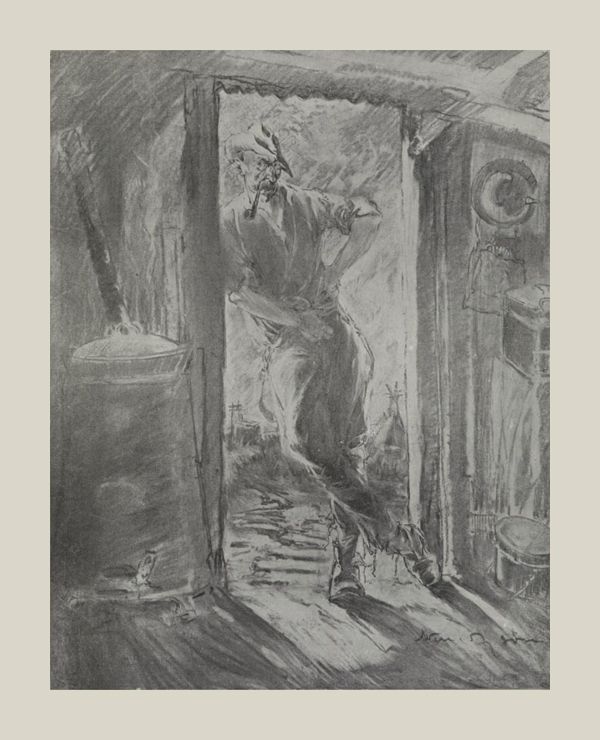
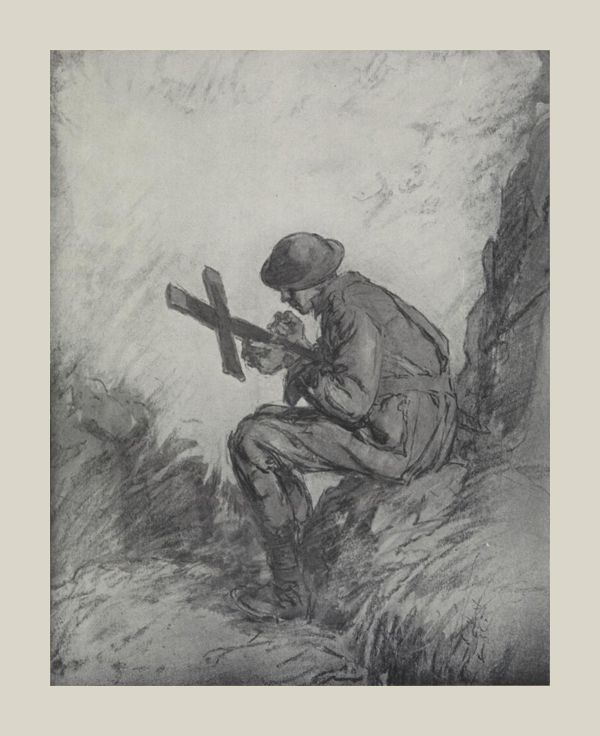
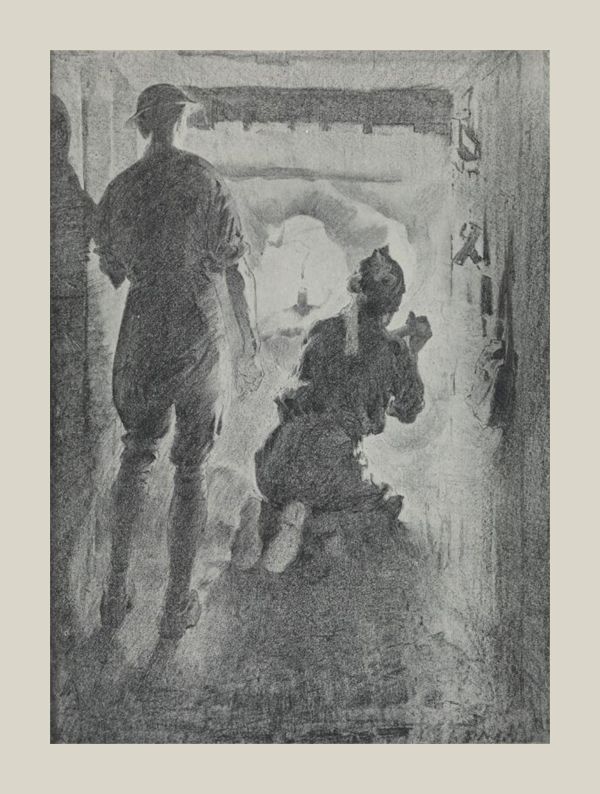
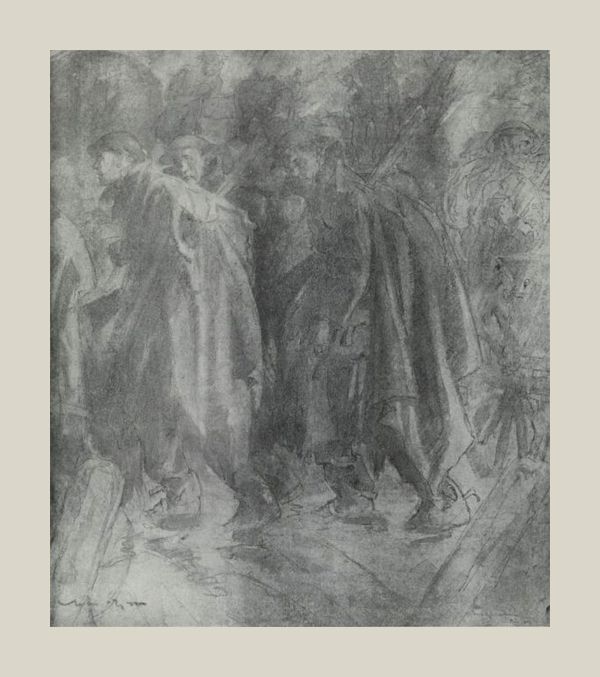
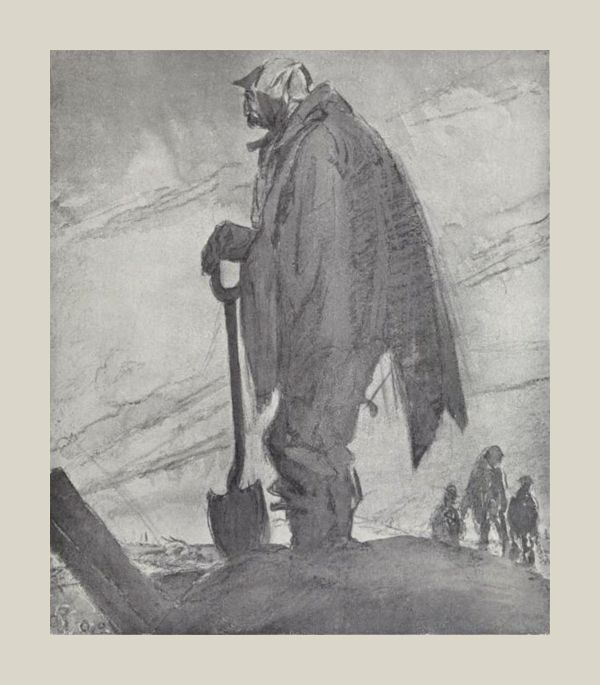
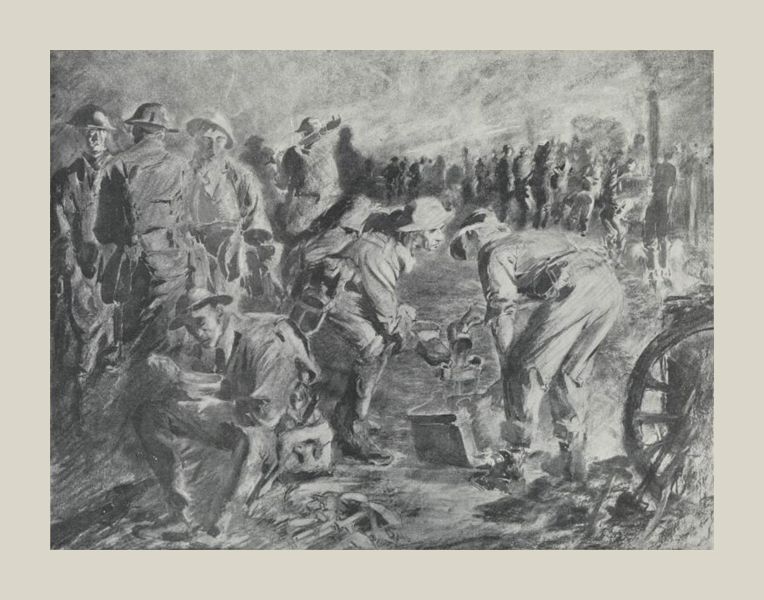
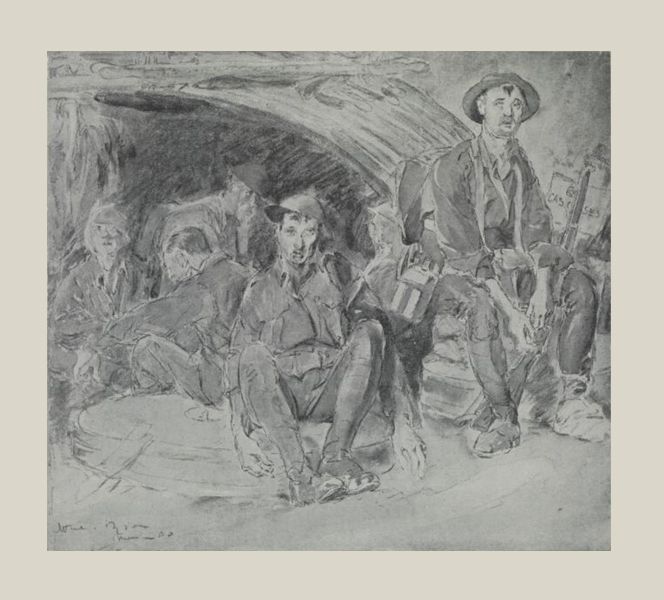
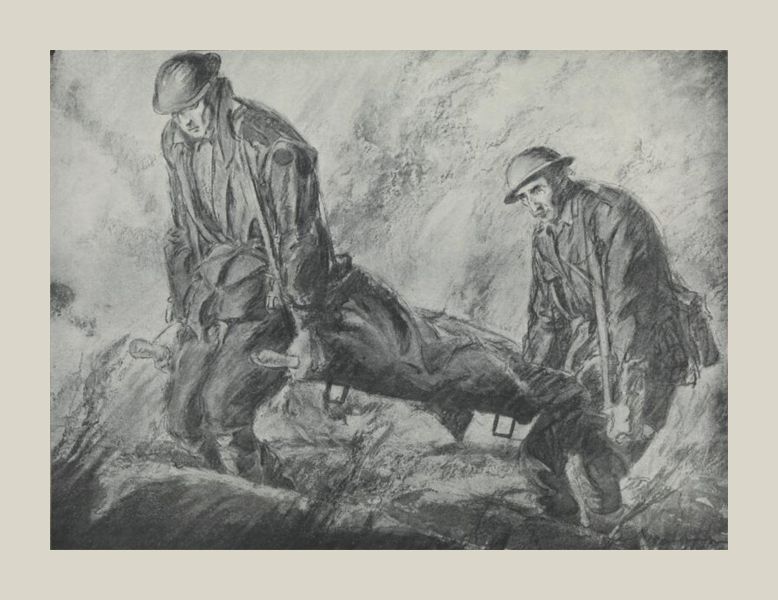
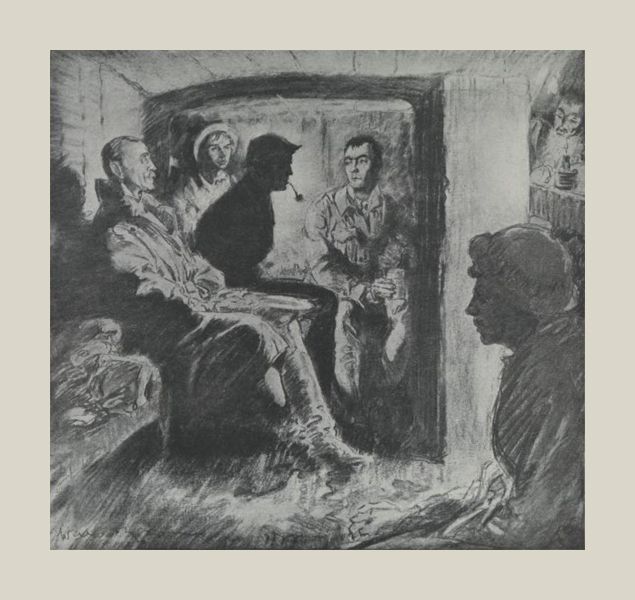
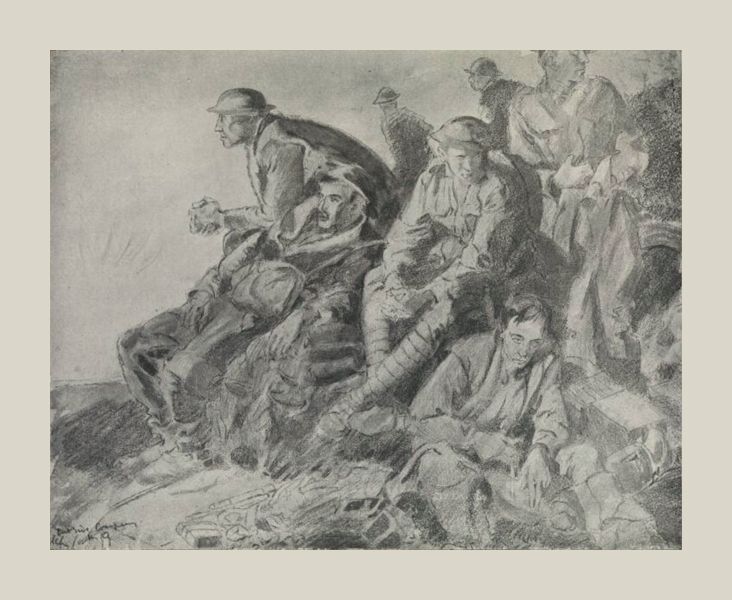
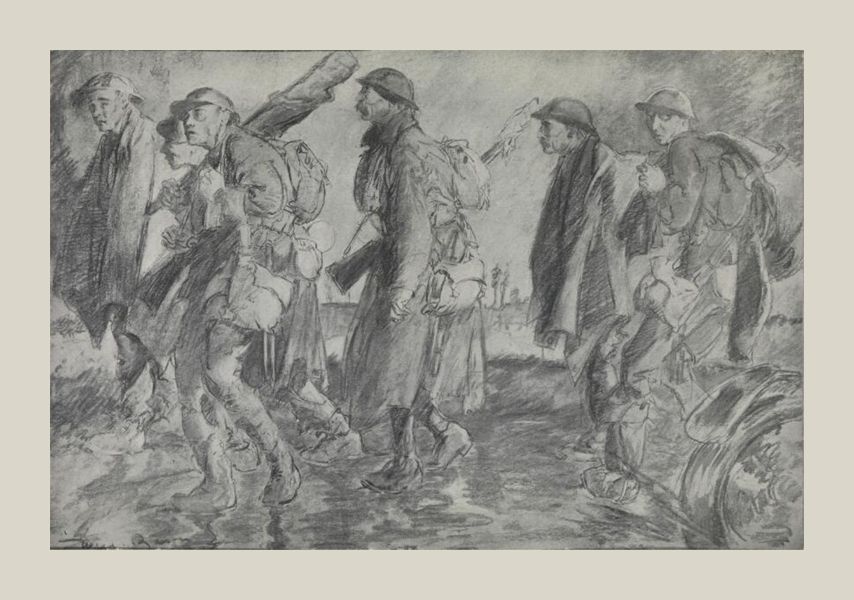
Everybody knows that Mr. Dyson, who has made these striking
sketches of the great war in which he has himself been wounded,
originally became famous as a caricaturist, probably the most original
caricaturist of our time. To some it may even need a word of further
explanation adequately to connect a caricaturist so fanciful with a
tragedy so grave and grim. Nor indeed is the connection only that more
obvious one, which has drawn so many men of genius into duties that
are simply normal because they are national. Mr. Dyson is indeed as
patriotic in external as he is public spirited in internal politics;
but his case here must not be confused with what might have occurred
if, in some national crisis, the late Phil May had drawn a cartoon for
Sir John Tenniel, or if the late Dan Leno had sung, with all possible
sincerity, a patriotic song. In such cases men might say that great
artists were behaving like good citizens; but that it was rather of
their ordinary than their extraordinary qualities that they were at
that moment justly proud. The importance of Mr. Dyson’s work cannot be
properly appreciated unless we realise that his patriotism and public
spirit are extraordinary as well as ordinary; for to be extraordinary
without being also ordinary is merely another name for being mad. Mr.
Dyson in becoming more national does not become less individual; nor
does he for the first time become serious. The graver work of such an
artist will not be merely grotesque, if only because his most grotesque
work was always full of gravity. His caricature was a criticism, and
indeed a very severe criticism, of the whole modern world. And it is
perhaps the severest of all criticisms on the modern world, that the
one form of art that has rendered it most seriously and most subtly,
is the art of caricature. Here it may well be left an open question
whether this character in our time, as compared with former times,
means that we more easily appreciate satirists, or merely that we more
easily lend ourselves to satire.
In any case the lightest, wildest or even crudest sketch scratched down
by Dyson has always had more of the true grip of gravity than the whole
of the Royal Academy. It is our modern misfortune that what is most
solemn is most frivolous; because it is, in motive if not in method,
most facile. There is always genuine thought in the design as well as
the detail of Mr. Dyson’s work; and it is thought of a kind that is
too little defined or understood. Where he has always differed from a
common capable caricaturist is approximately in this; that it was never
the comic but rather the serious feature that he caricatured. It is
the soul rather than the body that he has drawn out in long fantastic
lines. His comedy has never been merely comic, but rather philosophic
and poetic. When he drew a Jew he did not merely draw the nose of a
Jew, as a man might draw the trunk of an elephant; the most prominent
thing about an elephant but not the most elephantine. He would rather
draw that oriental type of eye, so strange in its shape and setting;
which can be seen carved on colossal Assyrian masks of stone or painted
flat on the cases of Egyptian mummies. And this marks his philosophic
sentiment; he throws on things a new light which is also an ancient
light; which is in its nature historic and even pre-historic. This
is what links him up with the school of the great satirists; for it
is one of the chief strokes of satire to tell new things that they
are old; nay, in a sense to extinguish them by telling them they are
eternal. But there is necessarily the same sort of epic symbolism
underlying his treatment of the toils and perils he most sincerely
admires, as underlying his treatment of the luxury and tyranny he has
most drastically denounced or exposed. And that is why something of
this almost allegoric spirit must be appreciated, in appreciating his
studies of the appalling pageant of the great war.
Being a satirist he is a humorist; but we must not look for mere lively
notes of what may be called the humours of the trenches. Nothing can be
more admirable in another aspect than those humours; or above all than
the humour, and especially the good humour, which generally endures
and records them. But such an artist is not concerned so much with
that comic relief, by which details arc relieved against tragedy,
as with that high and tragic relief by which the tragedy itself is
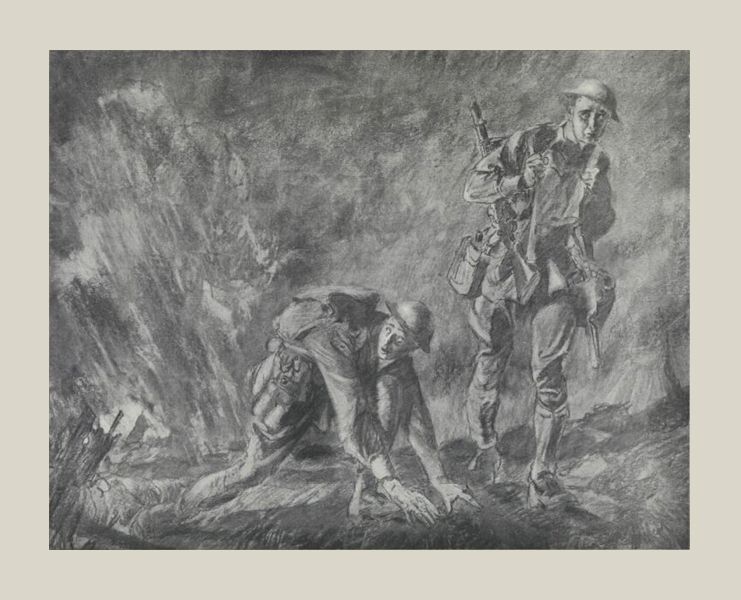
relieved against the light of heaven. Indeed there is something
significant in all that white light and sharp shadow which belongs to
such scenes, and is so favourable to the art of black and white. There
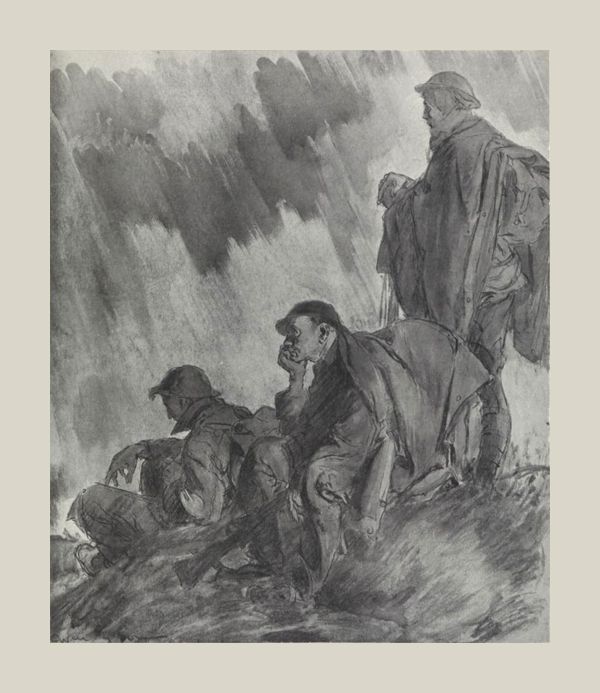
is even something of allegory in that awful and empty daylight in which
armies live, so often without a stick of roof or a rag of curtain. All
the soldiers in a great war are historical characters; but these are
rather specially standing, not against court or camp, but only against
the sky. They are under a light which will indeed prove eternal; even
as compared with other historic groups they will continue in a sort
of permanent publicity; for we do not yet realise from what distant
heights and terraces of time the arena of this war will be seen. And
therefore it is, perhaps, that through all the rags and rude equipment
that Dyson draws can be traced the lines of a sort of nakedness, like
that of the dead on the Last Day.
It may be that such a criticism is too much haunted by the shadow of
those sharp satiric and philosophic designs of his former work; in
which the draughtsmanship was itself a kind of swordsmanship. But those
who have most valued his more fantastic visions will be disposed to
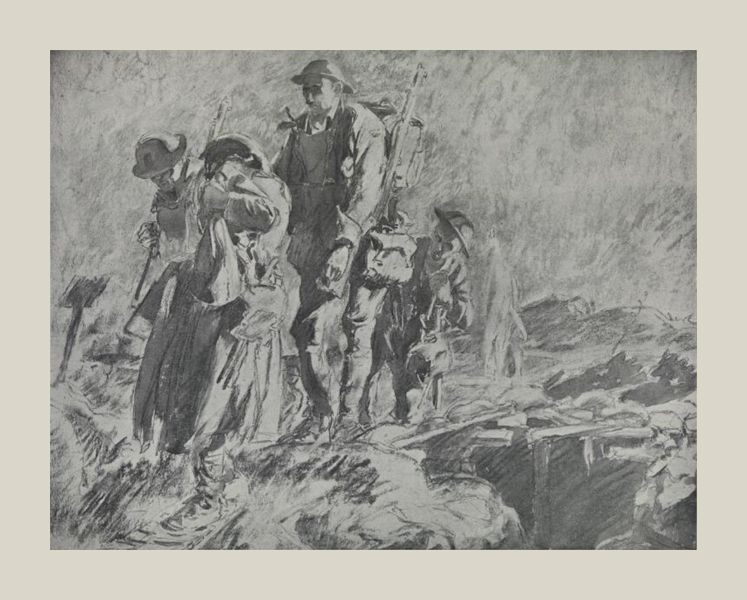
recognise this larger reality through the veil of realism. They will
be able to see the old and true types of mankind, as it were, in a
masquerade of khaki. A certain loose precision of line, which renders
the length of limb or the lightness of the lifted head in the young
soldier, is the same as that which gave, in the Labour Cartoons, a
new and too much neglected dignity to the young workman. And it will
be well to note this; since a conventional patriotism is too prone
to forget that the young soldier generally is the young workman. But
neither in the new sketches nor the old ones was the dignity merely
dignified, in the sentimental manner; and many will still think it
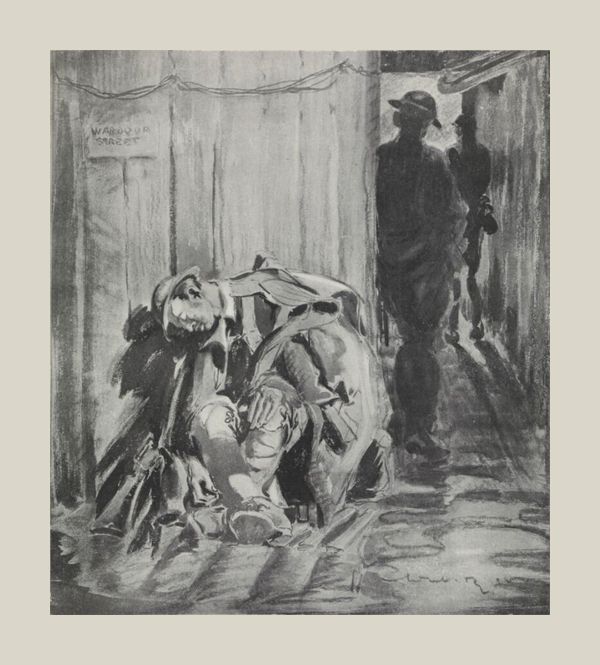
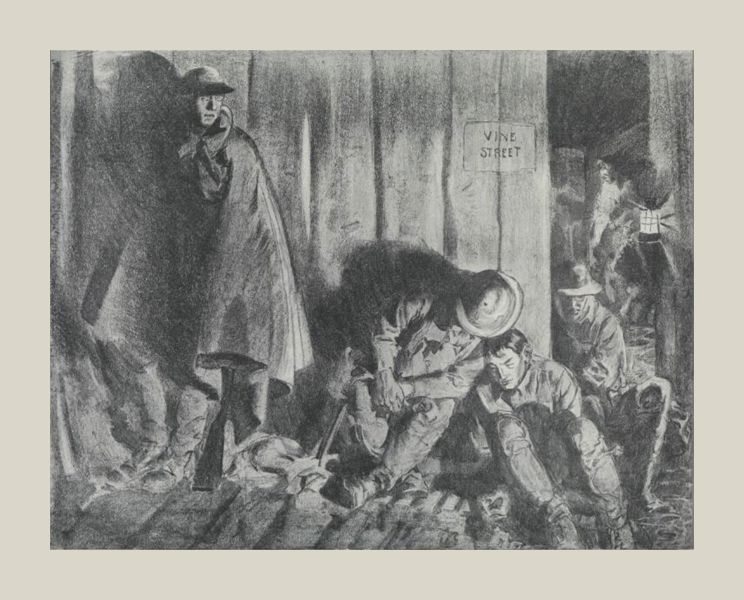
comic precisely because it is tragic. In this sense there is a note of
satire in the names of famous or notorious London streets, stuck up as
labels in the tunnels of the sunken labyrinth of trench warfare. It is
wholesome to remember that many of these men have sat or stood with
as haggard an endurance upon the stones of the real streets at home;
and have suffered almost as much from the horrors of peace as from the
horrors of war. Nor should we forget how much of the life of labour
has been subterranean, and with less hope of an outlet on victory.
Tyranny is in a true sense oppression; it is the weight of worldly evil
that the artist has felt; a thing not so much unearthly as unnaturally
earthly. And this again will always make him a true interpreter of the
great war, whether in the idealism of caricature or the realism of such
work as this. For what the free men of the world are now labouring to
lift is indeed an oppression almost in the literal sense of a load; it
is like a nightmare in this vital sense, that while it lasts it seems,
not less, but more real than reality. The barbarism which all free men
defy to-day might well be embodied in one of the Dyson demons, swinish,
swollen, sullen; the thing described by the genius of an artist in
another art; by M. Emile Cammaerts writing also of the Satan who has
set up his throne in Belgium:
“Il n’est pas triste; il n’est pas fier; il n’est pas beau;
Il n’est pas même troublant; il n’est pas ambigu;
Il est laid; il est lâche; est gros, il est sot;
Et il pue!”
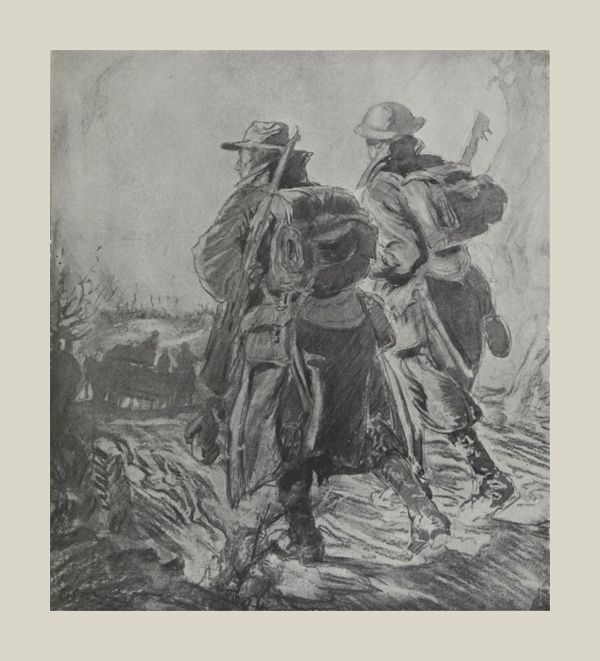
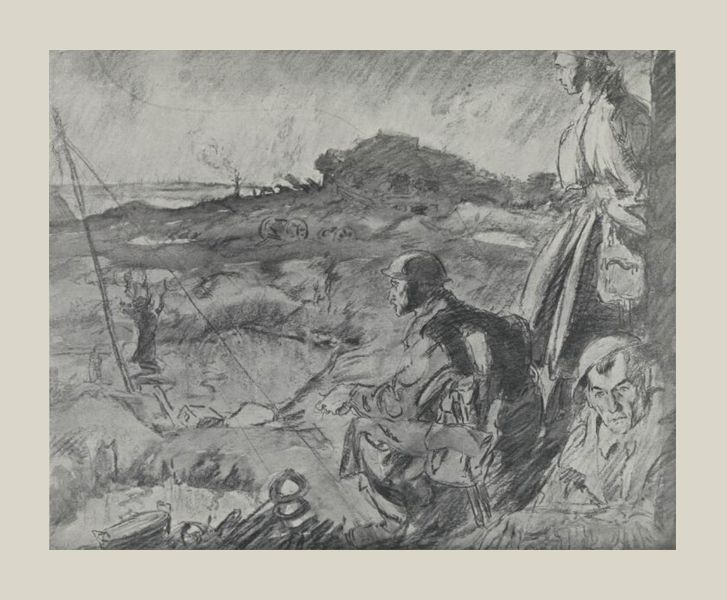
We are fighting against a living slime, like that mud of Flanders which
men loathe more than wounds and death. And indeed the two spirits of
the war might be conceived as meeting in the flats of the Flemish coast
under the emblems of the two elements; the strange slow strength of
the inland swamp and the force and freedom of the sea. Against such
elemental emptiness of bare lands and bleak waters. Dyson has moved
and showed his comrades moving; and his stroke is here none the less
militant because he is now using only the artillery of art, which
fights not with fire but with light.
G. K. CHESTERTON.