FOSSIL SHELL-FISH (MOLLUSCA).
Molluscan Characters.—
T
The phylum or sub-kingdom Mollusca is a group of
soft-bodied animals (mollis, soft), which, although
having no external skeleton, usually possess the protective
covering of a shell. This shell is secreted
from the outer skin or mantle, and is composed of
carbonate of lime (calcareous) with a varying proportion
of organic material.
Hard Parts.—
Fossil molluscan remains consist practically of the
shells, but the calcareous apertural lid (operculum)
of some kinds is often preserved, as in Turbo and
Hyolithes; or the horny lids of others, as Bithynia of
the European Pleistocene “brick earths.” The cuttle-fishes
have hard, horny beaks and internal bones,
and the latter are frequently found fossil in Australia.
Characters of Pelecypoda.—
The class for first consideration is the important
one of the Bivalved Mollusca, the LAMELLIBRANCHIATA
(“plate-gills”) or PELECYPODA
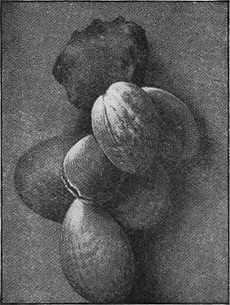
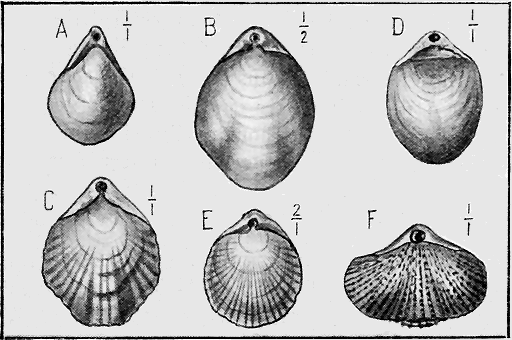
(“hatchet foot”). The shells are double, hinged dorsally
and placed on either side of the animal, that is,
they are left and right. The height is measured on a
vertical line drawn from the beaks or umbones to the
ventral margin. The length is the greatest distance
between the margins parallel with a line drawn
through the mouth and posterior adductor impression.
The thickness is measured by a line at right
angles to the line of height. The shell being placed
mouth forward, the valves are thus left and right.
The anterior is usually shorter, excepting in some
cases, as in Donax and Nucula.
Hinge Structure.—
In the absence of the animal, the character of the
hinge-structure is very important. Some are without
teeth (edentulous). The oldest forms have been
grouped as the “Palaeoconcha,” and it has been
shown that here, although well-developed teeth were
absent, the radial ribs of the surface and ventral areas
were carried over to the dorsal margin and became a
fixed character in the form of crenulations or primitive
teeth.
The taxodont type of hinge teeth shows alternating
teeth and sockets, as in Nucula.
The schizodont type is seen in the heavy, variable
teeth of Trigonia and Schizodus.
The isodont type of hingement is a modification of
the taxodont, represented by two ridges originally
divergent below the beak, and forming an interlocking
series of two pairs of teeth and sockets as in
Spondylus; or where the primitive hinge disappears
as in Pecten, the divergent ridge-teeth (crura) may
only partially develop.
The dysodonts have a feeble hinge-structure
derived from the external sculpture impinging on the
hinge-line, as in Crenella.
The pantodonta are an ancient palaeozoic group
which seems allied to the modern teleodont or long
toothed shells, but the laterals may exceed a pair in a
single group, as in Allodesma.
The diogenodonta have lateral and cardinal teeth
upon a hinge-plate, but never more than two laterals
and three cardinals in any one group, as in Crassatellites.
The cyclodonta have extremely arched teeth, which
curve out from under the beaks, as in Cardium.
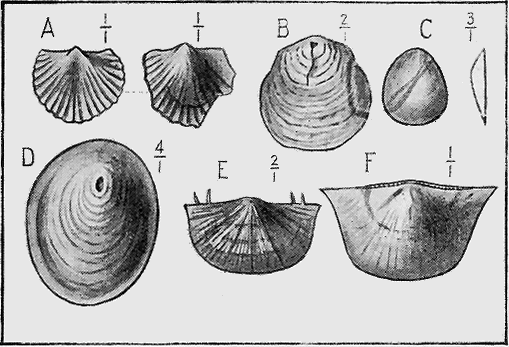
Fig. 90—LOWER PALAEOZOIC BIVALVES.
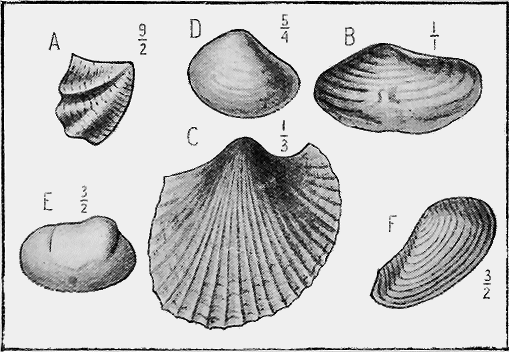
A—Ambonychia macroptera, Tate. Cambrian. S. Australia
B—Grammysia cuneiformis, Eth. fil. Silurian. Victoria
C—Panenka gippslandica, McCoy sp. Silurian. Victoria
D—Nucula melbournensis, Chapm. Silurian. Victoria
E—Nuculites maccoyianus. Chapm. Silurian. Victoria
F—Palaeoneilo victoriae, Chapm. Silurian. Victoria
The teleodonts include the more highly developed
types of hinge, with attenuated teeth and sockets.
Common shells of our coast, and from Cainozoic beds,
belonging to this group are Venus, Mactra and Meretrix.
The asthenodonta are boring and burrowing molluscs
that have lost the hinge dentition from disuse as
Corbula and Pholas.
Cambrian Bivalve.—
The earliest example of a bivalved shell in Australian
rocks is Ambonychia macroptera (Fig. 90 A),
which occurs in the Cambrian Limestone of Curramulka,
S. Australia. It is quite a small form, being
less than a quarter of an inch in length.
Ordovician Bivalve.—
In the basal Ordovician mudstone of Heathcote,
Victoria, there is a bivalve which in some respects
resembles a Modiolopsis (?M. knowsleyensis), but the
exact relationship is still doubtful.
Silurian Bivalves.—
The Silurian sandstones, mudstones, slates and
limestones of Australia and New Zealand, unlike the
older rocks just mentioned, contain a rich assemblage
of bivalve fossils. In Victoria the lower
division or Melbournian stage contains the following
principal genera:—Orthonota, Grammysia, Leptodomus,
Edmondia, Cardiola, Ctenodonta, Nuculites,
Nucula, Palaeoneilo, Conocardium, Modiolopsis and
Paracyclas. The upper division or Yeringian stage
contains other species of similar genera to those in
the Melbournian, as Grammysia, Palaeoneilo and
Conocardium; whilst Panenka, Mytilarca, Sphenotus,
Actinodesma, Lunulicardium, Actinopteria and
Cypricardinia are, so far as known, peculiar to this
and a still higher stage. Cardiola is a widely distributed
genus, occurring as well in Tasmania; whilst in
Europe it is found both in Bohemia and Great Britain.
Its time-range in the northern hemisphere is
very extensive, being found in beds ranging from
Upper Ordovician to Devonian. Actinopteria is
found also in New South Wales and New Zealand,
and Pterinea and Actinodesma in New South Wales.
The molluscs with a taxodont hinge-line (beset with
numerous little teeth and sockets) are quite plentiful
in the Australian Silurian; such as Nucula, a form
common around Melbourne (N. melbournensis (Fig.
90 D)); Nuculites, which has an internal radial buttress
or clavicle separating the anterior muscle-scar
from the shell-cavity, and which is found likewise
in the Melbourne shales (N. maccoyianus (Fig.
90 E)); Ctenodonta, represented in both the Melbournian
and Yeringian stages (C. portlocki); and
Palaeoneilo, a handsome, subrostrate generic type
with concentric lamellae or striae, commonest in the
Melbournian, but occasionally found in the younger
stage (P. victoriae Fig. 90 F, Melbournian;—P.
raricostae, Yeringian). Conocardium is represented
by two species in Victoria (C. bellulum and C. costatum);
whilst in New South Wales C. davidis is found
at Oakey Creek. In New Zealand Actinopteria and
Pterinea occur in the Wangapeka series (Silurian).
Devonian Bivalves.—
The compact limestone and some shales of Middle
Devonian age in the N.E. Gippsland area in Victoria,
contain several as yet undescribed species belonging
to the genera Sphenotus, Actinodesma and Paracyclas.
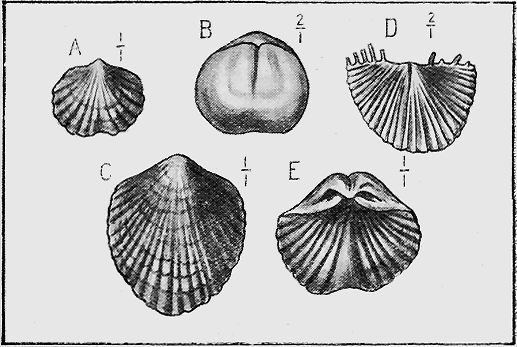
Fig. 91—PALAEOZOIC BIVALVES.
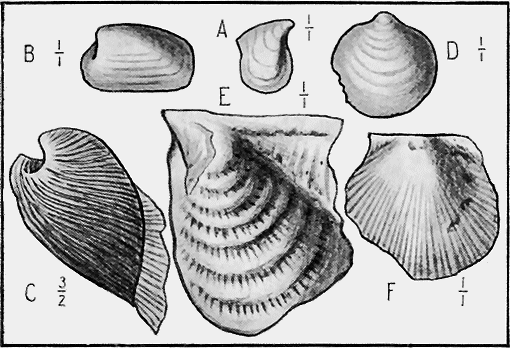
A—Mytilarca acutirostris, Chapm. Silurian. Victoria
B—Modiolopsis melbournensis, Chapm. Silurian. Victoria
C—Goniophora australis, Chapm. Silurian. Victoria
D—Paracyclas siluricus, Chapm. Silurian. Victoria
E—Actinopteria australis, Dun. Devonian. New South Wales
F—Lyriopecten gracilis, Dun. Devonian. New South Wales
The genera Paracyclas, Aviculopecten and Pterinea
have been recorded from New South Wales, chiefly
from the Yass district. The derived boulders found
in the Upper Cretaceous beds forming the opal-fields
at White Cliffs, New South Wales, have been determined
as of Devonian age. They contain, amongst
other genera, examples of Actinopteria (A. australis),
Lyriopecten (L. gracilis) (Fig. 91 F), and Leptodesma
(L. inflatum and L. obesum).
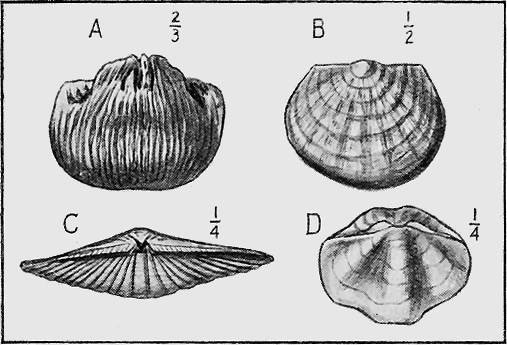
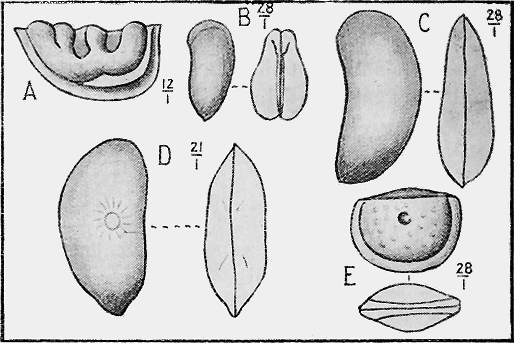
Fig. 92—CARBOPERMIAN BIVALVES.
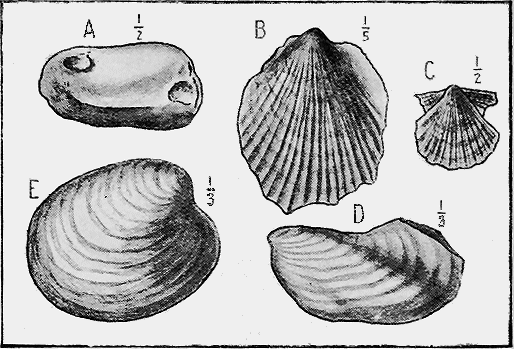
A—Stutchburia farleyensis, Eth. fil. Carbopermian. N.S. Wales
B—Deltopecten limaeformis, Morris sp. Carbopermian. N.S. Wales
C—Aviculopecten sprenti, Johnston. Carbopermian. N.S. Wales
D—Chaenomya etheridgei, de Kon. Carbopermian. N.S. Wales
E—Pachydomus globosus J. de C. Sow. Carbopermian. N.S. Wales
Carbopermian Bivalves.—
One of the most prolific palaeozoic series for
bivalved mollusca is the Carbopermian. To select
from the numerous genera and species we may mention
Stutchburia farleyensis (Fig. 92 A) and
Edmondia nobilissima from Farley, New South
Wales; and Deltopecten limaeformis (Fig. 92 B),
found in the Lower Marine Series at Ravensfield, New
South Wales, and in the Upper Marine Series at
Burragorang and Pokolbin in the same State, in
Queensland at the Mount Britton Gold-field, and in
Maria Id., Tasmania. Deltopecten fittoni occurs in
both series in New South Wales, and in the Upper
Marine Series associated with “Tasmanite shale” in
Tasmania. Aviculopecten squamuliferus is a handsome
species found alike in Tasmania and New South
Wales; whilst A. tenuicollis is common to W. Australia
and New South Wales. Other characteristic
bivalves of the Carbopermian of New South Wales
are Chaenomya etheridgei (Fig. 92 D) and Pachydomus
globosus (Fig. 92 E). The gigantic Eurydesma
cordatum is especially characteristic of the New
South Wales Lower Marine Series, and is also found
in Tasmania. All three species are found in Queensland.
Triassic Bivalves.—
The Triassic rocks of New South Wales were accumulated
under either terrestrial, lacustrine, or
brackish (estuarine) conditions. Hence the only
bivalved mollusca found are referred to the freshwater
genera Unio (U. dunstani) and Unionella (U.
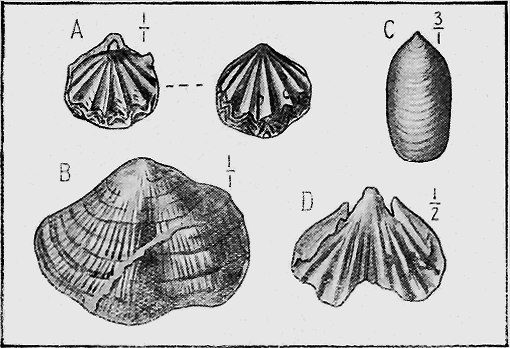
bowralensis and U. carnei (Fig. 93 A)). The latter
genus differs from Unio in the structure of the adductor
muscle-impressions.
Fig. 93—LOWER MESOZOIC BIVALVES.
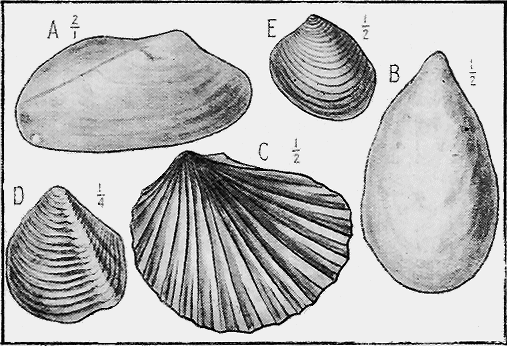
A—Unionella carnei, Eth. fil. Triassic. New South Wales
B—Mytilus problematicus, Zittel. Triassic. New Zealand
C—Monotis salinaria, Zittel. Triassic. New Zealand
D—Trigonia moorei, Lycett. Jurassic. W. Australia
E—Astarte cliftoni, Moore. Jurassic. W. Australia
The Queensland Trias (Burrum Formation) contains
a solitary species of bivalved mollusca, Corbicula
burrumensis. This genus is generally found
associated with freshwater or brackish conditions.
In New Zealand marine Triassic beds occur, containing,
amongst other genera, a species of Leda. In
the succeeding Wairoa Series the interesting fossil,
Daonella lommeli occurs. This shell is typical of
the Norian (Upper Trias) of the Southern Tyrol.
Above the Daonella bed occurs the Trigonia bed, with
that genus and Edmondia. In the next younger
stage, the Otapiri Series, near Nelson, there are fine-grained
sandstones packed full of the remains of
Mytilus problematicus (Fig. 93 B) and Monotis
salinaria (Fig. 93 C), the latter also a Norian fossil.
Jurassic Bivalves.—
Jurassic bivalved molluscs are plentiful in the W.
Australian limestones, as at Greenough River.
Amongst others may be mentioned Cucullaea semistriata,
Ostrea, Gryphaea, Trigonia moorei (Fig. 93 D),
Pecten cinctus, Ctenostreon pectiniforme and
Astarte cliftoni (Fig. 93 E). Several of the species
found are identical with European Jurassic fossils.
Jurassic strata in Victoria, being of a freshwater
and lacustrine nature, yield only species of
Unio, as U. dacombei, and U. stirlingi.
The Jurassic beds of S. Australia contain a species
of Unio named U. eyrensis. In the same strata which
contains this shell, plant remains are found, as
Cladophlebis and Thinnfeldia, two well-known types
of Jurassic ferns.
Lower Cretaceous Bivalves.—
In Queensland the Lower Cretaceous limestones
and marls contain a large assemblage of bivalves,
the more important of which are Nucula truncata
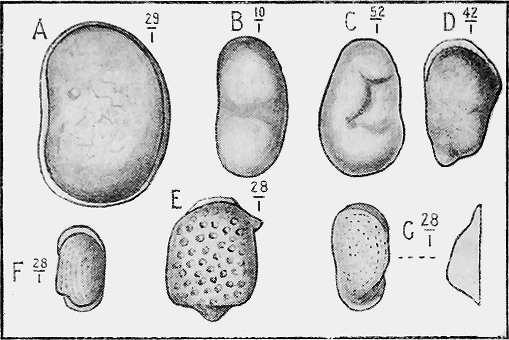
(Fig. 94 A), Maccoyella reflecta (Fig. 94 B), M.
barkleyi, Pecten socialis and Fissilunula clarkei (Fig.
94 C), from Wollumbilla; and Inoceramus pernoides,
I. carsoni and Aucella hughendenensis from the Flinders
River (the latter also from New South Wales).
In the Lake Eyre District of S. Australia we find
Maccoyella barkleyi, which also occurs in Queensland
and New South Wales (at White Cliffs), Trigonia
cinctuta, Mytilus rugocostatus and Modiola eyrensis.
The handsome bivalve, Pleuromya plana occurs near
Broome in W. Australia.
Fig. 94—CRETACEOUS BIVALVES.
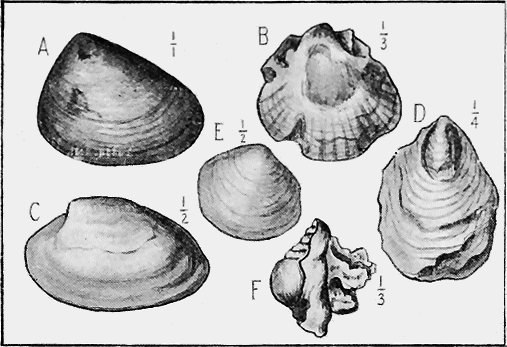
A—Nucula truncata, Moore. L. Cretaceous. South Australia
B—Maccoyella reflecta, Moore sp. Up. and L. Cretaceous. Q’land.
C—Fissilunula clarkei, Moore sp. Up. and L. Cretaceous. Q’land.
D—Inoceramus carsoni, McCoy. L. Cretaceous. Queensland
E—Cyrenopsis opallites, Eth. fil. Up. Cretaceous. New South Wales
F—Conchothyra parasitica, Hutton. Cretaceous. New Zealand
Upper Cretaceous Bivalves.—
The Upper Cretaceous or Desert Sandstone at Maryborough,
Queensland, has yielded amongst others,
the following shells:—(Nucula gigantea, Maccoyella
reflecta also found in the Lower Cretaceous of
Queensland, New South Wales and S. Australia), and
Fissilunula clarkei (also found in the L. Cretaceous
of New South Wales, Queensland and S. Australia).
Some of these beds, however, which were hitherto
believed to belong to the Upper and Lower Series
respectively may yet prove to be on one horizon—the
Lower Cretaceous. Cyrenopsis opallites (Fig. 94 E)
of White Cliffs, New South Wales, appears to be a
truly restricted Upper Cretaceous species.
The Cretaceous of New Zealand (Amuri System)
contains Trigonia sulcata, Inoceramus sp. and the
curious, contorted shell, Conchothyra parasitica (Fig.
94 F) which is related to Pugnellus, a form usually
considered as a sub-genus of Strombus.
From Papua an Inoceramus has been recorded from
probable Cretaceous beds.
Cainozoic Bivalves.—
In Victoria, South Australia, and the N.W. of Tasmania,
as well as in New Zealand, Cainozoic marine
beds are well developed, and contain an extensive
bivalved molluscan fauna. Of these fossils only a
few common and striking examples can here be
noticed, on account of the limits of the present work.
The commonest genera are:—Ostrea, Placunanomia,
Dimya, Spondylus, Lima, Pecten, Arca, Barbatia,
Plagiarca, Cucullaea, Glycimeris, Limopsis, Nucula,
Leda, Trigonia, Cardita, Cuna, Crassatellites, Cardium,
Protocardium, Chama, Meretrix, Venus
(Chione), Dosinea, Gari, Mactra, Corbula, Lucina,
Tellina, Semele and Myodora.
Fig. 95—CAINOZOIC BIVALVES.
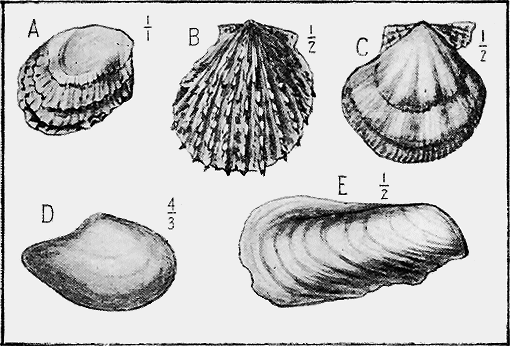
A—Dimya dissimilis, Tate. Balcombian. Victoria
B—Spondylus pseudoradula, McCoy. Balcombian. Victoria
C—Pecten polymorphoides, Zittel. Janjukian. South Australia
D—Leda vagans, Tate. Janjukian. South Australia
E—Modiola praerupta, Pritchard. Balcombian. Victoria
Persistent Species.—
To mention a few species of persistent range, from
Balcombian to Kalimnan, we may cite the following
from the Cainozoic of southern Australia:—Dimya
dissimilis (Fig. 95 A), Spondylus pseudoradula (Fig.
95 B), Lima (Limatula) jeffreysiana, Pecten polymorphoides
(found also in the Oamaru Series, New
Zealand) (Fig. 95 C), Amusium zitteli (found also in
both the Waimangaroa and Oamaru Series of New
Zealand), Barbatia celleporacea, Cucullaea corioensis,
Limopsis maccoyi, Nucula tenisoni, Leda vagans (Fig.
95 D), Corbula ephamilla and Myodora tenuilirata.
Balcombian Bivalves.—
On the other hand, many species have a restricted
range, and these are invaluable for purposes of stratigraphical
correlation. For example, in the Balcombian
we have Modiola praerupta (Fig. 95 E), Modiolaria
balcombei, Cuna regularis, Cardium cuculloides,
Cryptodon mactraeformis, Verticordia pectinata and
V. excavata.
Fig. 96—CAINOZOIC BIVALVES.
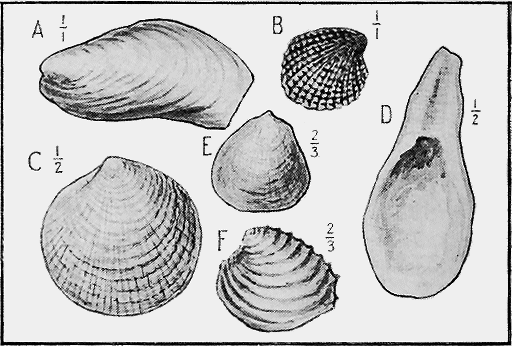
A—Modiola pueblensis, Pritchard. Janjukian. Victoria
B—Cardita tasmanica, Tate. Janjukian. Tasmania
C—Lucina planatella, Tate. Janjukian. Tasmania
D—Ostrea manubriata, Tate. Kalimnan. Victoria
E—Limopsis beaumariensis, Chap. Kalimnan. Victoria
F—Venus (Chione) subroborata, Tate sp. Kalimnan. Victoria
Janjukian Bivalves.—
In the Janjukian Series restricted forms of bivalves
are exceptionally numerous, amongst them being:—Dimya
sigillata, Plicatula ramulosa, Lima polynema,
Pecten praecursor, P. eyrei, P. gambierensis, Pinna
cordata, Modiola pueblensis (Fig. 96 A), Arca dissimilis,
Limopsis multiradiata, L. insolita, Leda leptorhyncha,
L. crebrecostata, Cardita maudensis, C.
tasmanica (Fig. 96 B), Cuna radiata, Lepton crassum,
Cardium pseudomagnum, Venus (Chione) multitaeniata,
Solenocurtus legrandi, Lucina planatella
(Fig. 96 C), Tellina porrecta and Myodora lamellata.
In Papua a Pecten (P. novaeguineae) has been recorded
from the ? Lower Pliocene of Yule Island.
Kalimnan Bivalves.—
The Kalimnan beds contain the following
restricted or upward ranging species:—Ostrea
arenicola, O. manubriata (Fig. 96 D), Pecten
antiaustralis (also in the Werrikooian Series),
Perna percrassa, Mytilus hamiltonensis, Glycimeris
halli, Limopsis beaumariensis (also Werrikooian)
(Fig. 96 E), Leda crassa (also living), Trigonia
howitti, Cardita solida, C. calva (also living),
Erycina micans, Meretrix paucirugata, Sunetta gibberula,
Venus (Chione) subroborata (Fig. 96 F),
Donax depressa, Corbula scaphoides (also living),
Barnea tiara, Lucina affinis, Tellina albinelloides and
Myodora corrugata.
Werrikooian Bivalves.—
The next stage, the Werrikooian (Upper Pliocene),
contains a large percentage of living species, as Ostrea
angasi, Placunanomia ione (ranging down into Janjukian),
Glycimeris radians, Leda crassa (also a common
Kalimnan fossil), various species of Venus
(Chione), as V. strigosa and V. placida, and Barnea
australasiae.
Pleistocene Bivalves.—
The bivalved shells of the Pleistocene are similar to
those now found living round the Australian coast,
as Pecten asperrimus, Mytilus latus, Leda crassa,
Soletellina biradiata and Spisula parva.
Pleistocene shells of bivalved genera occur in the
coastal hills of Papua, including the following:—Cultellus,
Corbula, Mactra, Tellina, Venus (Chione),
Dione, Dosinea, Leda and Arca.
The SCAPHOPODS (“digger foot”) or the “Elephant-tusk
shells” are adapted, by their well-developed
foot, to burrow into the mud and sand.
Fig. 97—FOSSIL SCAPHOPODS and CHITONS.
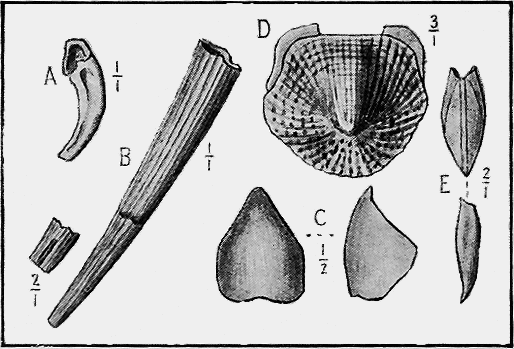
A—Dentalium huttoni, Bather. Jurassic. New Zealand
B—Dentalium mantelli, Zittel. Cainozoic. Victoria
C—Chelodes calceoloides, Eth. fil. Silurian. New South Wales
D—Ischnochiton granulosus, Ashby and Torr sp. Cainozoic (Balc). Victoria
E—Cryptoplax pritchardi, Hall. Cainozoic (Kalimnan). Victoria
Devonian Scaphopods.—
This group of mollusca makes its first appearance
in Australasian sediments in the Middle Devonian
(Murrumbidgee beds) of New South Wales, represented
by Dentalium tenuissimum.
Jurassic Scaphopods.—
In the Jurassic strata of the Mataura Series of New
Zealand, Dentalium huttoni (Fig. 97 A) occurs at
the Kowhai River and Wilberforce.
Cretaceous Scaphopods.—
Dentalium wollumbillensis occurs in the drab and
dark-coloured limestones of the Lower Cretaceous
of the Lake Eyre Basin in S. Australia, and the same
species is also found in the Lower Cretaceous (Rolling
Downs Formation) of Wollumbilla, Queensland.
Cainozoic Scaphopods.—
The Cainozoic beds both of New Zealand and southern
Australia yield many species of Dentalium, the
commonest and most widely distributed being the
longitudinally ribbed D. mantelli (Fig. 97 B), which
ranges from the Balcombian to the Werrikooian
stages in Australia, and is also typical of the Oamaru
Series in New Zealand, where it is accompanied by
the ponderous species, D. giganteum, which attained
a length of over six inches. Another form common
in our Cainozoics is the smooth-shelled D. subfissura;
this also has a wide range, namely Balcombian to
Kalimnan.
Palaeozoic Chitons.—
The POLYPLACOPHORA or Chitons (“Mail-shells”),
first appeared in the Ordovician. In Australia
Chelodes calceoloides (Fig. 97 C) is found in the
Silurian of Derrengullen Creek, Yass, New South
Wales; and another species of the genus is found in
beds of the same age at Lilydale, Victoria. Between
that period and the Cainozoic or Tertiary there is a
gap in their history in Australia.
Cainozoic Chitons.—
Ischnochiton granulosus (Fig. 97 D) is a Balcombian
species of the modern type of “mail-shell,”
occurring not infrequently in the clays of Balcombe’s
Bay, Port Phillip, Victoria. Cryptoplax pritchardi
(Fig. 97 E) is a curious form belonging to the attenuated,
worm-like group of the Cryptoplacidae, until
lately unknown in the fossil state; it is found in the
Kalimnan Series near Hamilton, Victoria. Several
other genera of the chitons are found fossil in the
Australian Cainozoics which still live on our coasts,
as Lorica, Plaxiphora and Chiton. The first-named
genus is represented fossil by Lorica duniana from
the Turritella bed (Janjukian) of Table Cape, Tasmania.
Characters of Gasteropoda.—
The GASTEROPODA (“belly-foot”) or univalve
shells possess a muscular foot placed beneath the
stomach and viscera. In the Heteropoda this foot is
modified as a vertical fin, and in the Pteropoda as
two wing-like swimming membranes close to the head.
The mantle lobe is elevated along the back like a
hood, and its surfaces and edges secrete the shell
which contains the animal. The shell is typically a
cone (example, Patella or Limpet) which is often
spirally coiled either in a plane (ex. Planorbis), conically
turbinoid (ex. Trochus), or turreted (ex.
Turritella). The body and shell are attached by
muscles, the spiral forms being attached to the columella
or axial pillar, and the bowl-shaped forms to the
inner surface of the shell.
Gasteropod shells are normally right-handed
(dextral), but a few genera as Clausilia, Bulinus
and Physa, are left-handed (sinistral). The
height or length of the shell is measured from
the apex to the lower margin of the mouth.
In coiled shells we may regard them as a
more or less elongated cone wound round a central
pillar, the columella, or around a central tube.
A turn or coil of the shell is a whorl, and together,
with the exception of the last, form the spire. The
line between two adjacent whorls is the suture. When
the columella is solid the shell is said to be imperforate,
and when a central tube is left by the imperfect
fusion of the whorls, it is perforate. The opening of
the tubular columella is termed the umbilicus, and
this is sometimes contracted by the encroachment of
shell matter termed the callus. The aperture is
entire when the rim is uninterrupted; and channelled
when there is a basal notch, where the siphon which
conducts water to the gills is lodged.
As a rule the large heavy gasteropods inhabit
shallow water. The following living genera are
characteristic of rocky shore-lines; Risella, Buccinum,
Purpura and Patella. Genera typical of sandy
shores are Nassa, Natica, Cypraea, Turritella and
Scala.
Cambrian Gasteropods.—
From the Cambrian of South Australia Prof. Tate
described some minute Gasteropods which he referred
to the genera Stenotheca (S. rugosa, var. paupera),
Ophileta (O. subangulata) (Fig. 98 A), and Platyceras
(P. etheridgei). In these beds at Curramulka
the following Pteropods were found by the
same authority, viz., Salterella planoconvexa, Hyolithes
communis (Fig. 98 C) and H. conularioides.
The Cambrian Limestone of the Kimberley District,
W. Australia, contains the characteristic Pteropod
Salterella hardmani (Fig. 98 B). The shell is a
conical tube, straight or slightly curved, and measuring
scarcely an inch in length.
Fig. 98—LOWER PALAEOZOIC GASTEROPODA.
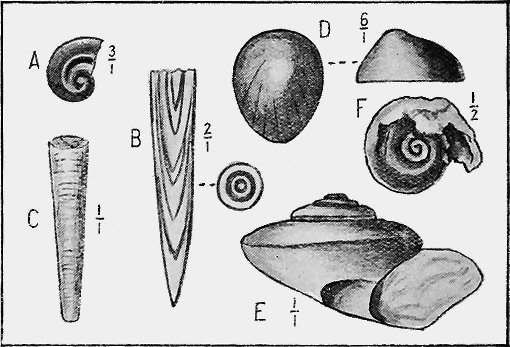
A—Ophileta subangulata, Tate. Cambrian. South Australia
B—Salterella hardmani, Foord. Cambrian. West Australia
C—Hyolithes communis, Billings. Cambrian. South Australia
D—Scenella tenuistriata, Chapm. Cambrian. Victoria
E—Raphistoma browni, Eth. fil. Ordovician. South Australia
F—Helicotoma johnstoni, Eth. fil. Silurian. Tasmania
The Upper Cambrian of the Mersey River District
in Tasmania has afforded some doubtful examples of
the genus Ophileta.
In the Upper Cambrian Limestones of the Dolodrook
Valley, near Mt. Wellington, Victoria, a minute
limpet shaped Gasteropod occurs, named Scenella
tenuistriata (Fig. 98 D).
Ordovician Gasteropods.—
Ordovician limestones with fossil shells occur in
the Leigh’s Creek District in South Australia, and
also at Tempe Downs and Petermann and Laurie’s
Creeks, W. of Alice Springs. The euomphaloid
shell Ophileta gilesi was described from Laurie’s
Creek, and Eunema larapinta from the Tempe Downs.
A pleurotomarid, Raphistoma browni (Fig. 98)
occurs near Leigh’s Creek, and at Laurie’s and Petermann
Creeks. A Pteropod, Hyolithes leptus, has
been described from the Lower Ordovician of Coole
Barghurk Creek, near Meredith, Victoria.
Silurian Gasteropods.—
The Silurian Gasteropods are fairly well represented,
especially in the upper stage, and are widely
distributed throughout the Australian fossiliferous
localities. Moreover, some of the species are
identical with those found as far off as North
America and Europe. In Victoria the shales and
sandstones of the lower stage (Melbournian) contain
the genera Bellerophon, Cyrtolites and Loxonema.
The Pteropoda include Tentaculites, Coleolus, Hyolithes
and Conularia (C. sowerbii (Fig. 99 F), a
species also found in Great Britain). The Victorian
limestones and mudstones of the upper stage (Yeringian)
are somewhat rich in Gasteropods, such genera
occurring as Pleurotomaria, Phanerotrema (with cancellated
shell and large slit-band), Murchisonia,
Gyrodoma, Bellerophon, Trematonotus (a spiral shell
with a large trumpet-shaped mouth and a dorsal row
of perforations in place of a slit-band), Euomphalus,
Cyclonema, Trochus (Scalaetrochus), Niso (Vetotuba),
Loxonema, Platyceras and Capulus. The
section Pteropoda contains Tentaculites, Hyolithes
and Conularia.
Fig. 99—SILURIAN GASTEROPODA.
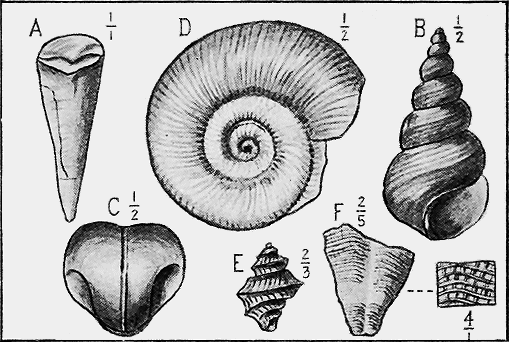
A—Hyolithes spryi, Chapm. Silurian (Melb.) Victoria
B—Gyrodoma etheridgei, Cressw. sp. Silurian (Yeringian). Vict.
C—Bellerophon cresswelli. Eth. fil. Silurian (Yeringian). Victoria
D—Euomphalus northi, Eth. fil. sp. Silurian (Yeringian). Victoria
E—Trochonema montgomerii. Eth. fil. sp. Silurian. Tasmania
F—Conularia sowerbii, Defr. Silurian (Yeringian). Victoria
In the Silurian of New South Wales the chief
Gasteropod genera are Bellerophon (B. jukesi),
Euomphalus, Omphalotrochus, and Conularia (C.
sowerbii.).
In Tasmania are found Raphistoma, Murchisonia,
Bellerophon, Helicotoma, Trochonema and Tentaculites.
Devonian Gasteropods.—
The derived boulders of the White Cliffs opal field
have been referred to the Devonian system, but of
this there is some doubt, as the Gasteropods noted
from these boulders closely resemble those of the
Silurian fauna: they are Murchisonia Euomphalus
(E. culleni), and Loxonema. The genus Murchisonia
has also been recorded from the Baton River, New
Zealand (Wangepeka Series) by MacKay.
The Middle Devonian Gasteropod fauna in Victoria,
as found in the Buchan and Bindi Limestones,
comprises Murchisonia, Trochus, and Platyceras.
Fig. 100—UPPER PALAEOZOIC GASTEROPODA.
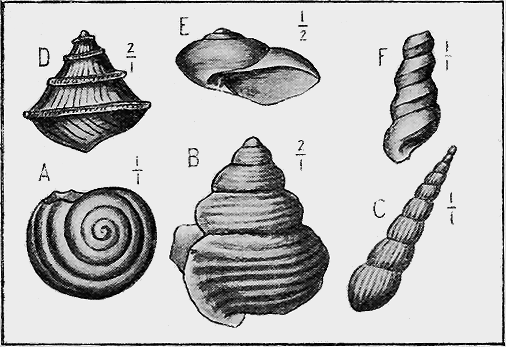
A—Gosseletina australis, Eth. fil. sp. Carboniferous. N.S. Wales
B—Yvania konincki, Eth. fil. Carboniferous. N.S. Wales
C—Loxonema babbindoonensis, Eth. fil. Carboniferous. N.S. Wales
D—Pleurotomaria (Ptychomphalina) morrisiana, McCoy. Carbopermian. N.S. Wales
E—Platyschisma oculum, Sow. sp. Carbopermian. N.S. Wales
F—Murchisonia carinata, Eth. Carbopermian. Queensland
In New South Wales the best known genera are
Pleurotomaria, Murchisonia, Bellerophon, Euomphalus
and Loxonema. The two latter genera have
also been obtained at Barker Gorge, Western Australia.
Carboniferous Gasteropods.—
Carboniferous Gasteropoda have been found in New
South Wales, belonging to the genera Gosseletina (G.
australis) (Fig. 100 A) and Yvania (Y. konincki)
(Fig. 100 B), both of which have their countertypes
in the Carboniferous of Belgium. Y. konincki is
also found in the Carbopermian (Gympie beds) of
Rockhampton, Queensland, while Y. levellii is found
in the Carbopermian of Western Australia.
Carbopermian Gasteropods.—
The Carbopermian gasteropods of New South Wales
are Pleurotomaria (Mourlonia), Keeneia platyschismoides,
Murchisonia, Euomphalus, Platyschisma (P.
oculum) (Fig. 100 E), Loxonema and Macrocheilus.
Examples of the genus Conularia are sometimes
found, probably attaining a length, when complete, of
40 centimetres.
In Tasmania we find Conularia tasmanica, a handsome
Pteropod, also of large dimensions. Platyschisma,
Pleurotomaria (Mourlonia), Bellerophon
and Porcellia are amongst the Carbopermian Gasteropods
of Queensland.
In Western Australia Pleurotomaria (Mourlonia),
Bellerophon, Euomphalus, Euphemus, Platyceras,
and Loxonema occur in the Carbopermian.
Jurassic Gasteropods.—
Jurassic gasteropods are found sparingly in the
limestone of the Geraldton District and other localities
in Western Australia. The more important of
these are Pleurotomaria (P. greenoughiensis), Turbo
(T. australis) (Fig. 101 A) and Rissoina (R. australis)
(Fig. 101 B).
Fig. 101—MESOZOIC GASTEROPODA.
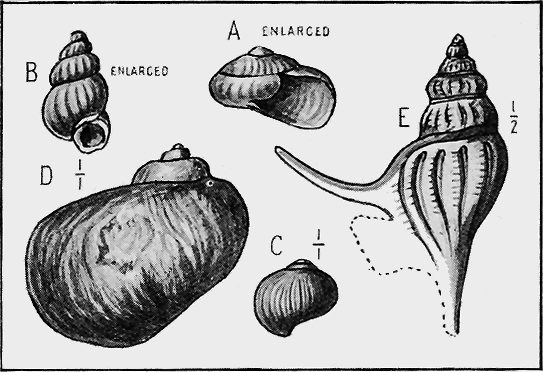
A—Turbo australis, Moore. Jurassic. West Australia
B—Rissoina australis, Moore. Jurassic. West Australia
C—Natica ornatissima, Moore. Cretaceous. Queensland
D—Pseudamaura variabilis, Moore sp. Cretaceous. Queensland
E—Rostellaria waiparensis, Hector.—Cretaceous. New Zealand
Cretaceous Gasteropods.—
The Queensland gasteropod fauna comprises
Cinulia a typical Cretaceous genus, Actaeon and
Natica. These occur in the Lower Cretaceous or
Rolling Downs Formation. Cinulia is also found in
South Australia at Lake Eyre with Natica (N. ornatissima)
(Fig. 101 C). Pseudamaura variabilis (Fig.
101 D) is found in New South Wales, Queensland and
South Australia; whilst Anchura wilkinsoni occurs in
Queensland and South Australia.
In New Zealand the Waipara Greensands (Cretaceous)
contain a species of Rostellaria (R. waiparensis)
(Fig. 101 E).
Cainozoic Gasteropods.—
Cainozoic Gasteropods are exceedingly abundant in
beds of that system in Australasia. The Cainozoic
marine fauna in Australia is practically restricted to
the States of Victoria, South Australia, and Tasmania;
whilst New Zealand has many species in common with
Australia.
Genera.—
The commonest genera of the marine Cainozoic or
Tertiary deposits are:—Haliotis, Fissurellidea, Emarginula,
Subemarginula, Astralium, Liotia, Gibbula,
Eulima, Niso, Odostomia, Scala, Solarium, Crepidula,
Calyptraea, Natica, Rissoa, Turritella, Siliquaria,
Cerithium, Newtoniella, Tylospira, Cypraea, Trivia,
Morio, Semicassis, Lotorium, Murex, Typhis, Columbella,
Phos, Nassa, Siphonalia, Euthria (Dennantia),
Fusus, Columbarium, Fasciolaria, Latirus, Marginella,
Mitra, Volutilithes, Voluta, Harpa, Ancilla, Cancellaria,
Terebra, Pleurotoma, Drillia, Conus, Bullinella
and Vaginella.
Persistent Species.—
Amongst the Cainozoic Gasteropoda of southern
Australia which have a persistent range through
Balcombian to Kalimnan times, we find:—Niso psila,
Crepidula unguiformis (also Werrikooian and Recent),
Natica perspectiva, N. hamiltonensis, Turritella
murrayana, Cerithium apheles, Cypraea leptorhyncha,
Lotorium gibbum, Volutilithes antiscalaris
(also in Werrikooian), Marginella propinqua, Ancilla
pseudaustralis, Conus ligatus and Bullinella exigua.
Balcombian Gasteropods.—
Species restricted to the Balcombian stage include
Scala dolicho, Seguenzia radialis, Dissocheilus eburneus,
Trivia erugata, Cypraea ampullacea (Fig.
102 A), C. gastroplax, Colubraria leptoskeles, Murex
didymus (Fig. 102 B), Eburnopsis aulacoessa (Fig.
102 C), Fasciolaria concinna, Mitra uniplica, Harpa
abbreviata, Ancilla lanceolata, Cancellaria calvulata
(Fig. 102 D), Buchozia oblongula, Pleurotoma optata,
Terebra leptospira and Vaginella eligmostoma (Fig.
102 E), (also found at Gellibrand River).
Fig. 102—CAINOZOIC GASTEROPODA.
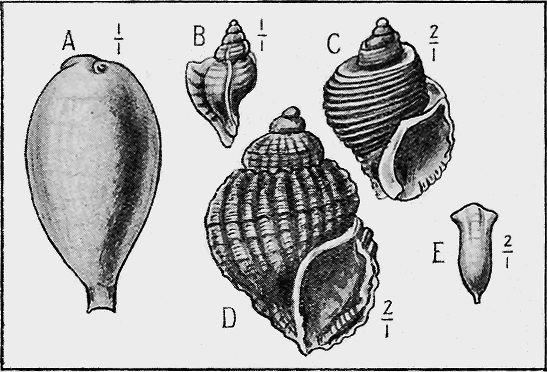
A—Cypraea ampullacea, Tate. Cainozoic (Balc.) Victoria
B—Murex didymus, Tate. Cainozoic (Balc.) Victoria
C—Eburnopsis aulacoessa, Tate. Cainozoic (Balc.) Victoria
D—Cancellaria calvulata, Tate. Cainozoic (Balc.) Victoria
E—Vaginella eligmostoma, Tate. Cainozoic (Balc.) Victoria
Fig. 103—CAINOZOIC GASTEROPODA.
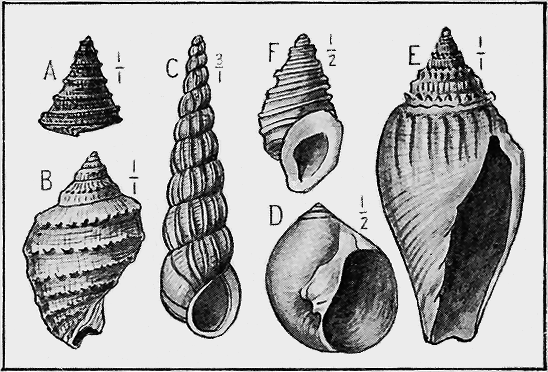
A—Eutrochus fontinalis, Pritchard. Cainozoic (Janjukian). Vict.
B—Morio wilsoni, Tate. Cainozoic (Janjukian). Victoria
C—Scala lampra, Tate sp. Cainozoic (Janjukian). South Australia
D—Natica gibbosa, Hutton. Cainozoic (Janjukian). South Australia
E—Volutilithes anticingulatus, McCoy sp. Cainozoic (Janjukian). Victoria
F—Struthiolaria sulcata, Hutton. Cainozoic (Awatere series). New Zealand
Janjukian Gasteropods.—
Species of Gasteropods restricted to the Janjukian
stage include:—Pleurotomaria tertiaria, Haliotis
mooraboolensis, Liotia lamellosa, Thalotia alternata,
Eutrochus fontinalis (Fig. 103 A), Astralium hudsonianum,
Turbo atkinsoni, Odostomia polita, Scala
lampra (Fig. 103 C), Natica gibbosa (Fig. 103 D) (also
found in the Pareora Series of the Oamaru system
and in the Wanganui beds of New Zealand), Calyptraea
subtabulata, Turritella aldingae, Cerithiopsis
mulderi, Cerithium flemingtonense, Cypraea platyrhyncha,
C. consobrina, Morio wilsoni (Fig. 103 B),
Lotorium abbotti, Murex otwayensis, Eburnopsis
tesselatus, Tudicla costata, Latirus semiundulatus,
Fusus meredithae, Columbarium spiniferum, Voluta
pueblensis, V. heptagonalis, V. macroptera (also recorded
from Hall’s Sound, Papua) (Fig. 103 E),
Volutilithes anticingulatus (also from Papua), Harpa
clathrata, Bela woodsi, Bathytoma paracantha and
Volvulella inflatior.
Dolium costatum, allied to the “Fig-Shell” has
been noted from the Cainozoic clays (? Lower Pliocene),
Yule Island, Papua.
Fig. 104—LATE CAINOZOIC and PLEISTOCENE GASTEROPODA
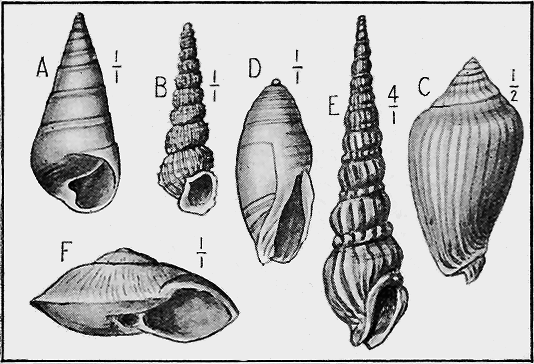
A—Bankivia howitti, Pritchard. Cainozoic (Kal.) Victoria
B—Eglisia triplicata, Tate sp. Cainozoic (Kal.) Victoria
C—Voluta masoni, Tate. Cainozoic (Kal.) Victoria
D—Ancilla papillata. Tate sp. Cainozoic (Kal.) Victoria
E—Terebra geniculata, Tate. Cainozoic (Kal.) Victoria
F—Helix simsoniana, Johnston. Pleistocene. Tasmania
Kalimnan Gasteropods.—
Species of Gasteropods restricted to the Kalimnan
Stage, or only passing upwards include:—Bankivia
howitti (Fig. 104 A), Liopyrga quadricingulata,
Calyptraea corrugata, Natica subvarians, Turritella
pagodula, Eglisia triplicata (Fig. 104 B), Tylospira
clathrata, Cypraea jonesiana, Lotorium ovoideum,
Sistrum subreticulatum, Voluta masoni (Fig. 104 C),
Ancilla papillata (Fig. 104 D), Cancellaria wannonensis,
Drillia wanganuiensis (also in the Petane Series
of New Zealand), Terebra catenifera, T. geniculata
(Fig. 104 E) and Ringicula tatei.
New Zealand Cainozoic Gasteropods.—
Characteristic Gasteropoda of the Oamaru Series
in New Zealand are Pleurotomaria tertiaria (also in
the Australian Janjukian), Scala lyrata, Natica darwinii,
Turritella cavershamensis, Ancilla hebera (also
in the Australian Balcombian and Janjukian) and
Pleurotoma hamiltoni. Gasteropods of the Awatere
Series in New Zealand are Natica ovata, Struthiolaria
sulcata (Fig. 103 F), and Scaphella corrugata (found
also in the Oamaru Series). The Putiki beds of the
Petane Series in New Zealand contain Trophon
expansus, Pisania drewi and Pleurotoma wanganuiensis.
Werrikooian Gasteropods.—
The marine gasteropods of the Werrikooian of
southern Australia, as found at Limestone Creek,
Glenelg River, Western Victoria, and the Moorabool
Viaduct near Geelong, are nearly all living at the
present time, with the exception of a few older
Cainozoic species. Amongst these latter are Conus
ralphi, Pleurotoma murndaliana, Volutilithes antiscalaris
and Columbarium craspedotum.
Pleistocene Gasteropoda.—
The Pleistocene land mollusca, and especially the
gasteropods of Australia, present some striking
points of interest, for whilst most of the species
are still living, some appear to be extinct. The
travertine deposits of Geilston, near Hobart, Tasmania
contain Helix geilstonensis and H. stanleyana,
the latter still living. The calcareous Helix sandstone
of the islands in Bass Strait are largely composed
of shells of that genus and generally represent
consolidated sand-dunes which have undergone a
certain amount of elevation. One of the prevalent
species is Helix simsoniana (Fig. 104 F), a handsome
keeled form, somewhat related to the living H.
launcestonensis. It is found in some abundance in
the Kent’s Group and in the adjacent islands.
The large ovoid land-shells, Panda atomata, although
still existing, are found associated with extinct
marsupials, as Thylacoleo, in the stalagmitic
floor of the Buchan Caves, Gippsland.
The Diprotodon-breccias of Queensland have
afforded several species of Helix and other land-shells,
as well as the brackish-water genus Melania. The
Raised Beaches of Queensland, New South Wales,
Victoria, and Tasmania all contain species of land
and freshwater shells identical with those now found
living in the same localities.
The Raised Beaches of New Zealand contain numerous
marine shells all having living representatives.
Some of these elevated beaches occur as high as 150
feet above sea-level at Taranaki, and at 200 feet near
Cape Palliser in Cook Strait.
Many species of Pleistocene Mollusca identical with
those now living in Torres Strait, the China Sea and
the Philippine Islands are found in Papua. They
occur in the greenish sandy clay of the hills near the
present coast line and comprise the following genera
of Gasteropods:—Ranella, Nassa, Mitra, Oliva, Terebra,
Conus, Strombus, Bulla and Atys.
Characters of Cephalopoda.—
The highest class of the mollusca is the CEPHALOPODA
(“head-feet”). In these shell-fish the extremity
of the body or foot is modified, and furnished
with eyes, a funnel and tentacles. It has also strong
horny beaks or jaws which make it a formidable
enemy to the surrounding life in the sea. In the
chambered forms of this group the animal partitions
off its shell at regular intervals, like the Pearly
Nautilus and the Ammonite, inhabiting only the last
chamber cavity, but still communicating with the
earlier series by a continuous spiral tube (siphuncle).
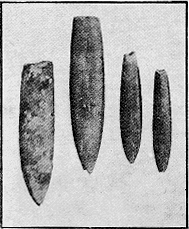
In some forms like the living squid and the extinct
Belemnite, the shell is internal and either spoon-shaped,
or dart-shaped, that is, subcylindrical and
pointed.
Characters of Cephalopod Shells.—Nautiloidea.—
In geological times the nautiloid forms were the
first to appear (in the Ordovician), and they were
either straight shells, as Orthoceras, or only slightly
curved, as Cyrtoceras. Later on they became more
closely coiled, and as they were thus less likely to be
damaged, they gradually replaced the straight forms.
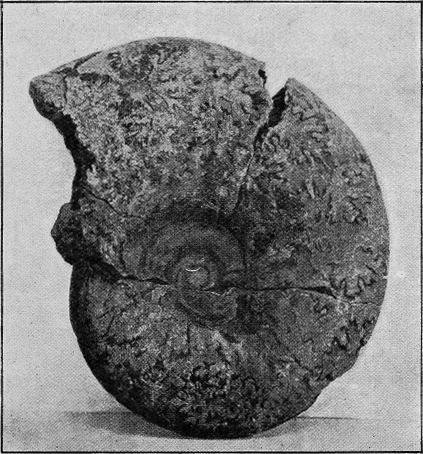
The Ammonites have the siphuncle close to the outside
of the shell, whilst in the Nautilus it is more or
less median. The sutures or edges of the septa in
Nautilus and its allies are curved or wavy, but not so
sharply flexed or foliaceous as in Ammonites. The
Nautiloidea range from the Ordovician and are still
found living.
Ammonoidea.—
The Ammonoidea appear in Devonian times and die
out in the Cretaceous. They were very abundant in
Jurassic times, especially in Europe.
Belemnoidea.—
The Belemnoidea, ranging from the Trias to Eocene,
comprise the extinct Belemnites, the interesting genus
Spirulirostra of Miocene times, and the living Spirula.
Sepioidea.—
The Sepioidea or true Cuttle-fishes (“pen-and-ink
fish”) range from the Trias to the present day.
Octopoda.—
The Octopoda, with Octopus and Argonauta (the
paper “Nautilus”) are present-day modifications.
The male of the latter is without a shell, the female
only being provided with a delicate boat-shaped shell
secreted by the mantle and the two fin-like expansions
of the dorsal arms.
Ordovician Cephalopods.—
The Ordovician cephalopods of Australasia are not
numerous, and are, so far as known, practically restricted
to the limestones of the Larapintine series at
Laurie’s Creek and Tempe Downs, in Central South
Australia. Amongst them may be mentioned Endoceras
warburtoni (Fig. 105 A), (a straight form in
which the siphuncle is partially filled with organic
deposits); Orthoceras gossei; O. ibiciforme; Trochoceras
reticostatum (a coiled form); and Actinoceras
tatei (a genus characterised by swollen siphuncular
beads between the septa).
Fig. 105—PALAEOZOIC CEPHALOPODA.
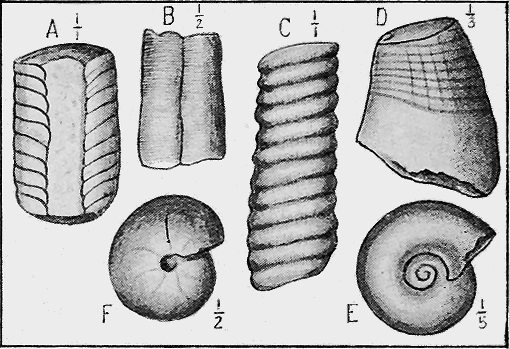
A—Endoceras warburtoni, Eth. fil. Ordovician. South Australia
B—Orthoceras lineare, Münster sp. Silurian (Yer.) Victoria
C—Cycloceras ibex, Sow. sp. Silurian (Melb.) Victoria
D—Phragmoceras subtrigorium, McCoy. Mid Devonian. Victoria
E—Gastrioceras jacksoni, Eth. fil. Carbopermian. W. Australia
F—Agathiceras micromphalum, Morris sp. Carbopermian. N.S.W.
Silurian Cephalopods.—
Silurian cephalopods are more generally distributed,
and in Victoria constitute an important factor
in the molluscan fauna of that system. Orthoceras
and Cycloceras are the best known genera, represented
by Orthoceras capillosum, found near Kilmore, Victoria;
O. lineare (Fig. 105 B), from the Upper Yarra;
Cycloceras bullatum, from the Melbournian of Collingwood
and Whittlesea; and C. ibex (Fig. 105 C)
from South Yarra and Flemington, in both Melbournian
shale and sandstone. The latter species
occurs also at Rock Flat Greek, New South Wales.
Other Victorian species are Kionoceras striatopunctatum,
a well-known European fossil with a reticulated
and beaded ornament, found near Warburton and at
McMahon’s Creek, Upper Yarra.
Orthoceras is also recorded from Tasmania and
from the Wangapeka beds of Baton River, New Zealand.
Cyclolituites, a partially coiled nautilian is
recorded from Bowning, near Yass, New South Wales;
whilst the closely related Lituites is noted from the
Silurian of Tasmania.
Devonian Cephalopods.—
The only genus of cephalopoda at present recorded
from the Devonian of Victoria is Phragmoceras (P.
subtrigonum) (Fig. 105 D), which occurs in the
Middle Devonian Limestone of Buchan, E. Gippsland.
From beds of similar age in New South Wales Orthoceras,
Cyrtoceras and Goniatites have been noted;
whilst the latter genus also occurs near Kimberley,
Western Australia. In Queensland Gyroceras philpi
is a characteristic shell, found in the Fanning and
Reid Gap Limestones of the Burdekin Formation
(Middle Devonian).
Carbopermian Cephalopods.—
The Carbopermian rocks of New South Wales have
yielded Orthoceras striatum, Cameroceras, Nautilus
and Agathiceras micromphalum (Fig. 105 F). In
Queensland the Gympie Formation contains Orthoceras,
Gyroceras, Nautilus, Agathiceras micromphalum
and A. planorbiforme. In Western Australia
the Kimberley rocks contain Orthoceras, Glyphioceras
sphaericum and Agathiceras micromphalum;
whilst the largest known Australian goniatite, Gastrioceras
jacksoni (Fig. 105 E) is found in the Irwin
River District. Actinoceras hardmani is an interesting
fossil from the Carbopermian of Lennard River,
N.W. Australia. In Tasmania the genera Orthoceras
and Goniatites have been recorded from beds of similar
age.
Triassic Cephalopods.—
For Triassic cephalopoda we look to New Zealand,
where, in the Mount Potts Spiriferina Beds of the
Kaihiku Series a species of Orthoceras has been recorded.
The Wairoa Series next in succession contains
Orthoceras and an Ammonite.
Fig. 106—MESOZOIC and CAINOZOIC CEPHALOPODA.
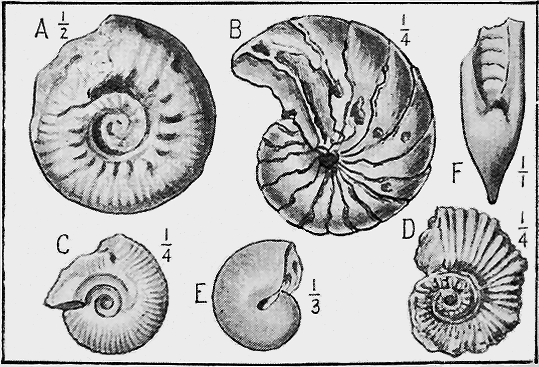
A—Perisphinctes championensis, Crick. Jurassic. West Australia
B—Nautilus hendersoni, Eth. fil. L. Cretaceous. Queensland
C—Haploceras daintreei, Eth. sp. L. Cretaceous. Queensland
D—Crioceras australe, Moore. L. Cretaceous. Queensland
E—Aturia australis, McCoy. Cainozoic. Victoria
F—Spirulirostra curta, Tate. Cainozoic (Janjukian). Victoria
Jurassic Cephalopods.—
The Jurassic of Western Australia yields a rich
cephalopod fauna, from which may be selected as
typical examples the Nautilus, N. perornatus and the
following Ammonites: Dorsetensia clarkei; Normanites
australis; and Perisphinctes championensis
(Fig. 106 A). These all occur in the Greenough
River District, and at several other Jurassic localities
in Western Australia.
The Jurassic system of New Zealand (Putataka
Series) contains Ammonites aucklandicus and Belemnites
aucklandicus, both from the upper marine horizon
of that series.
Upper Jurassic Ammonites belonging to the genera
Macrocephalites (M. cf. calloviensis) and Erymnoceras
(E. cf. coronatum) have been recorded from
Papua.
Lower Cretaceous Cephalopods.—
Remains of Cephalopoda are fairly abundant in the
Lower Cretaceous of Australasia. From amongst
them may be selected the following—Nautilus hendersoni
(Fig. 106 B) (Q.); Haploceras daintreei (Fig.
106 C) (Q. and N.S.W.); Desmoceras flindersi (Q.
and N.S.W.); Schloenbachia inflatus (Q.); Scaphites
cruciformis (N. Terr.); Ancyloceras flindersi (Q. and
N.S.W.); Crioceras australe (Fig. 106 D) (Q. and
S.A.); Belemites australis (Q.); B. oxys (Q., N.S.W.,
and S.A.); B. sellheimi (Q. and S.A.); B. diptycha,
= canhami, Tate, (Q., N.S.W., and S.A.); and B.
eremos (Centr. S.A.).
Upper Cretaceous Cephalopods.—
In the Upper Cretaceous (Desert Sandstone) of
Queensland there occurs a Belemnite somewhat resembling
Belemnites diptycha, but with a very pointed
apex.
Cretaceous Cephalopods, New Zealand.—
In New Zealand the Amuri System (Cretaceous)
contains fossils which have been referred to the genera
Ammonites, Baculites, Hamites, Ancyloceras and
Belemnites, but probably these determinations require
some further revision. A species of Belemnite has
also been noted from probable Cretaceous beds in
Papua.
The Cainozoic System in Victoria contains a true
Nautilus, N. geelongensis; and Aturia australis (Fig.
106 E), a nautiloid shell having zig-zag suture lines
and septal necks enclosing the siphuncle. A. australis
is also found in the Oamaru Series of New Zealand;
in Victoria it has an extensive vertical range,
from Balcombian to Kalimnan (Oligocene to Lower
Pliocene). Species of Nautilus are also found in the
Janjukian of the Murray River Cliffs; where, in some
cases the shell has been infilled with clear gypsum or
selenite, through which can be seen the tubular siphuncle
in its original position. Spirulirostra curta
(Fig. 106 F) is an interesting cuttle-bone of rare
occurrence. The genus is represented by two other
species only, occurring in the Miocene of Italy and
Germany. In Victoria it is occasionally found in the
Janjukian marly limestone at Bird Rock near Torquay.
COMMON OR CHARACTERISTIC FOSSILS OF THE
FOREGOING CHAPTER.
PELECYPODA.
Ambonychia, macroptera, Tate. Cambrian: S. Australia.
(?) Modiolopsis knowsleyensis, Chapm. L. Ordovician: Victoria.
Orthonota australis, Chapm. Silurian (Melbournian): Victoria.
Grammysia cuneiformis, Eth. fil. Silurian (Melbournian):
Victoria.
Leptodomus maccoyianus, Chapm. Silurian (Melbournian):
Victoria.
Edmondia perobliqua, Chapm. Silurian (Melbournian): Victoria.
Cardiola cornucopiae, Goldfuss sp. Silurian (Melbournian):
Victoria.
Panenka gippslandica, McCoy sp. Silurian (Tanjilian): Victoria.
Ctenodonta portlocki, Chapm. Silurian: Victoria.
Nuculites maccoyianus, Chapm. Silurian: Victoria.
Nucula melbournensis, Chapm. Silurian (Melb.): Victoria.
Palaeoneilo victoriae, Chapm. Silurian (Melb.): Victoria.
Pterinea lineata, Goldfuss. Silurian (Yeringian): Victoria.
Lunulicardium antistriatum, Chapm. Silurian (Tanj.): Victoria.
Conocardium costatum, Cressw. sp. Silurian: Victoria.
Conocardium davidis, Dun. Silurian: New South Wales.
Actinopteria boydi, Conrad sp. Silurian (Yer.): Victoria.
Aviculopecten spryi, Chapm. Silurian (Melb.): Victoria.
Modiolopsis complanata, Sowerby sp. Silurian (Melb.): Victoria.
Goniophora australis, Chapm. Silurian (Yer.): Victoria.
Cypricardinia contexta, Barrande. Silurian (Yer.): Victoria.
Paracyclas siluricus, Chapm. Silurian (Melb.): Victoria.
Actinopteria australis, Dun. Devonian: New South Wales.
Lyriopecten gracilis, Dun. Devonian: New South Wales.
Leptodesma inflatum, Dun. Devonian: New South Wales.
Stutchburia farleyensis, Eth. fil. Carbopermian: New South
Wales.
Edmondia nobilissima, de Koninck. Carbopermian: New
South Wales.
Deltopecten limaeformis, Morris sp. Carbopermian: New
South Wales, Queensland and Tasmania.
Aviculopecten squamuliferus, Morris sp. Carbopermian: New
South Wales and Tasmania.
Aviculopecten tenuicollis, Dana sp. Carbopermian: New
South Wales and W. Australia.
Chaenomya etheridgei, de Koninck sp. Carbopermian: New
South Wales and Queensland.
Maeonia elongata, Dana. Carbopermian: New South Wales.
Pachydomus globosus, J. de C. Sow. sp. Carbopermian: New
South Wales, Tasmania and Queensland.
Eurydesma cordatum, Morris. Carbopermian: New South
Wales and Queensland.
Unio dunstani, Eth. fil. Trias: New South Wales.
Unionella carnei, Eth. fil. Trias: New South Wales.
Corbicula burrumensis, Eth. fil. Trias: Queensland.
Daonella lommeli, Wissm. sp. Trias: New Zealand.
Mytilus problematicus, Zittel. Trias: New Zealand.
Monotis salinaria, Zittel. Trias: New Zealand.
Cucullaea semistriata, Moore. Jurassic: W. Australia.
Trigonia moorei, Lycett. Jurassic: W. Australia.
Ctenostreon pectiniforme, Schlotheim sp. Jurassic: W. Australia.
Astarte cliftoni, Moore. Jurassic: W. Australia.
Unio dacombei, McCoy. Jurassic: Victoria.
Unio eyrensis, Tate. Jurassic: S. Australia.
Nucula truncata, Moore. Lower Cretaceous: Queensland
and S. Australia.
Maccoyella reflecta, Moore sp. L. Cretaceous: New South
Wales, Queensland (also U. Cretaceous), and S. Australia.
Maccoyella barkleyi, Moore sp. L. Cretaceous: New South
Wales, Queensland and S. Australia.
Fissilunula clarkei, Moore sp. L. Cretaceous: New South
Wales, Queensland, and S. Australia; also Up. Cret. in
Queensland and South Australia.
Inoceramus carsoni, McCoy. Lower Cretaceous: Queensland.
Trigonia cinctuta, Eth. fil. Lower Cretaceous: S. Australia.
Mytilus rugocostatus, Moore. Lower Cretaceous: Queensland
and S. Australia.
Cyrenopsis opallites, Eth. fil. Upper Cretaceous: New South
Wales.
Conchothyra parasitica, Hutton. Cretaceous: New Zealand.
Dimya dissimilis, Tate. Cainozoic (Balc.-Kal.): Victoria and
South Australia.
Spondylus pseudoradula, McCoy. Cainozoic (Balc.-Kal.):
Victoria and South Australia.
Pecten polymorphoides, Zittel. Cainozoic (Balc.-Kal.): Victoria
and South Australia; also New Zealand.
Cucullaea corioensis, McCoy. Cainozoic (Balc.-Kal.): Victoria
and South Australia.
Leda vagans, Tate. Cainozoic (Balc.-Kal.): Victoria and
South Australia.
Corbula ephamilla, Tate. Cainozoic (Balc.-Kal.): Victoria
and South Australia.
Modiola praerupta, Pritchard. Cainozoic (Balc.): Victoria.
Pecten praecursor, Chapm. Cainozoic (Janjukian): Victoria.
Modiola pueblensis, Pritchard. Cainozoic (Janjukian): Victoria.
Limopsis insolita, Sow. sp. Cainozoic (Janjukian): Victoria
and S. Australia. Also Oamaru Ser., N.Z.
Cardita tasmanica, Tate. Cainozoic (Janj.): Tasmania.
Lucina planatella, Tate. Cainozoic (Janj.): Victoria and Tasmania.
Pecten novaeguineae, T. Woods. Cainozoic (?Lower Pliocene),
Yule Island, Papua.
Ostrea manubriata, Tate. Cainozoic (Kal.): Victoria.
Glycimeris halli, Pritch. Cainozoic (Kal.): Victoria.
Limopsis beaumariensis, Chapm. Cainozoic (Kalimnan
and Werrikooian): Victoria.
Trigonia howitti, McCoy. Cainozoic (Kal.): Victoria.
Meretrix paucirugata, Tate sp. Cainozoic (Kal.): Victoria.
Venus (Chione) subroborata, Tate, sp. Cainozoic (Kal.):
Victoria and South Australia.
SCAPHOPODA.
Dentalium tenuissimum, de Koninck. Mid. Devonian: New
South Wales.
Dentalium huttoni, Bather. Jurassic: New Zealand.
Dentalium wollumbillensis, Eth. fil. L. Cretaceous: Queensland.
Dentalium, mantelli, Zittel. Cainozoic: Victoria, S. Australia
and New Zealand.
POLYPLACOPHORA.
Chelodes calceoloides, Eth. fil. Silurian: New South Wales.
Ischnochiton granulosus, Ashby and Torr sp. Cainozoic
(Balc.): Victoria.
Lorica duniana, Hull. Cainozoic (Janjukian): Tasmania.
Cryptoplax pritchardi, Hall. Cainozoic (Kal.): Victoria.
GASTEROPODA.
Ophileta subangulata, Tate. Cambrian: S. Australia.
Platyceras etheridgei, Tate. Cambrian: S. Australia.
Salterella planoconvexa, Tate. Cambrian: S. Australia.
Salterella hardmani, Foord. Cambrian: W. Australia.
Hyolithes communis, Billings. Cambrian: S. Australia.
Scenella tenuistriata, Chapm. Cambrian (Upper): Victoria.
Ophileta gilesi, Tate. Ordovician: S. Australia.
Raphistoma browni, Tate. Ordovician: S. Australia.
Hyolithes leptus, Chapm. Lower Ordovician: Victoria.
Helicotoma johnstoni, Eth. fil. Ordovician: Tasmania.
Coleolus (?) aciculum, J. Hall. Silurian (Melb.): Victoria.
Hyolithes spryi, Chapm. Silurian (Melb.): Victoria.
Conularia ornatissima, Chapm. Silurian (Melb.): Victoria.
Phanerotrema australis, Eth. fil. Silurian (Yer.): Victoria.
Gyrodoma etheridgei, Cressw. sp. Silurian (Yer.): Victoria.
Trematonotus pritchardi, Cressw. Silurian (Yer.): Victoria.
Bellerophon cresswelli, Eth. fil. sp. Silurian (Yer.) Victoria.
Euomphalus northi, Eth. fil. sp. Silurian (Yer.): Victoria.
Cyclonema australis, Eth. fil. Silurian (Yer.): Victoria.
Trochonema montgomerii, Eth. fil. sp. Silurian: Tasmania.
Bellerophon jukesii, de Koninck. Silurian: New South Wales.
Conularia sowerbii, Defrance. Silurian: Victoria and New
South Wales.
Euomphalus culleni, Dun. Devonian: New South Wales.
Gosseletina australis, Eth. fil. Carboniferous: New South
Wales.
Yvania konincki, Eth. fil. Carboniferous: New South Wales;
and Carbopermian: Queensland.
Bellerophon costatus, Sow. Carbopermian: W. Australia.
Mourlonia humilis, de Koninck. Carbopermian: West Australia
and New South Wales.
Pleurotomaria (Ptychomphalina) morrisiana, McCoy. Carbopermian:
New South Wales.
Keeneia platyschismoides, Eth. fil. Carbopermian (Lower
Marine): New South Wales.
Platyschisma oculum, Sow. sp. Carbopermian: New South
Wales and Queensland.
Macrocheilus filosus, Sow. Carbopermian: New South Wales.
Loxonema babbindonensis, Eth. fil. Carbopermian: New
South Wales.
Conularia tenuistriata, McCoy. Carbopermian: New South
Wales and Queensland.
Conularia tasmanica, Carbopermian: Tasmania.
Murchisonia carinata, Etheridge. Carbopermian: Queensland.
Pleurotomaria greenoughiensis, Eth. fil. Jurassic: W. Australia.
Turbo australis, Moore. Jurassic: W. Australia.
Rissoina australis, Moore. Jurassic: W. Australia.
Cinulia hochstetteri, Moore. Cretaceous: Queensland and S.
Australia.
Natica ornatissima, Moore. Cretaceous: S. Australia.
Pseudamaura variabilis, Moore sp. Cretaceous: New South
Wales, Queensland and S. Australia.
Anchura wilkinsoni, Eth. fil. Cretaceous: Queensland and S.
Australia.
Rostellaria waiparensis, Hector. Cretaceous: New Zealand.
Niso psila, T. Woods. Cainozoic (Balc.-Kal.): Victoria and
S. Australia.
Crepidula unguiformis, Lam. Cainozoic (Balc.-Recent): Victoria
and Tasmania.
Natica hamiltonensis, Tate. Cainozoic (Balc.-Recent): Victoria
and South Australia.
Turritella murrayana, Tate. Cainozoic (Balc.-Kal.): Victoria,
S. Australia and Tasmania.
Cerithium apheles, T. Woods. Cainozoic (Balc.-Kal.): Victoria.
Volutilithes antiscalaris, McCoy sp. Cainozoic (Balc.-Werrikooian):
Victoria.
Ancilla pseudaustralis, Tate sp. Cainozoic (Balc.-Kal.):
Victoria, S. Australia and Tasmania.
Cypraea ampullacea, Tate. Cainozoic (Balc.): Victoria.
Murex didyma, Tate. Cainozoic (Balc.): Victoria.
Eburnopsis aulacoessa, Tate. Cainozoic (Balc.): Victoria.
Cancellaria calvulata, Tate. Cainozoic (Balc.): Victoria.
Vaginella eligmostoma, Tate. Cainozoic (Balc.): Victoria.
Eutrochus fontinalis, Pritchard. Cainozoic (Janjukian): Victoria.
Turbo atkinsoni, Pritchard. Cainozoic (Janjukian): Tasmania
and Victoria.
Scala lampra, Tate sp. Cainozoic (Janjukian): S. Australia.
Natica gibbosa, Hutton. Cainozoic (Janjukian): Victoria.
Also Oamaru and Wanganui Series: New Zealand.
Morio wilsoni, Tate. Cainozoic (Janjukian): Victoria.
Voluta heptagonalis, Tate. Cainozoic (Janjukian): S. Australia.
Volutilithes anticingulatus, McCoy sp. Cainozoic (Janjukian):
Victoria and Tasmania. Also Papua.
Bathytoma paracantha, T. Woods sp. Cainozoic (Janj.):
Victoria and Tasmania. Also Papua.
Dolium costatum, Deshayes. Cainozoic. (? Lower Pliocene):
Yule Island, Papua.
Bankivia howitti, Pritch. Cainozoic (Kal.): Victoria.
Eglisia triplicata, Tate sp. Cainozoic (Kal.): Victoria.
Voluta masoni, Tate. Cainozoic (Kal.): Victoria.
Ancilla papillata, Tate sp. Cainozoic (Kal.): Victoria.
Drillia wanganuiensis, Hutton. Cainozoic (Kal.): Victoria.
Also Petane Series: New Zealand.
Terebra geniculata, Tate. Cainozoic (Kal.): Victoria.
Pleurotomaria tertiaria, McCoy. Cainozoic (Kal.): Victoria.
Also Oamaru Series: New Zealand.
Scala lyrata, Zittel sp. Cainozoic (Oamaru): New Zealand.
Natica darwinii, Hutton. Cainozoic (Oamaru): New Zealand.
Turritella cavershamensis, Harris. Cainozoic (Oamaru): New
Zealand.
Ancilla hebera, Hutton sp. Cainozoic (Oamaru): New Zealand.
Also (Balc. and Janj.): Victoria, South Australia and
Tasmania.
Pleurotoma hamiltoni, Hutton. Cainozoic (Oamaru): New
Zealand.
Natica ovata, Hutton. Cainozoic (Awatere Series): New
Zealand.
Struthiolaria sulcata, Hutton. Cainozoic (Awatere Series):
New Zealand.
Trophon expansus, Hutton. Cainozoic (Petane Series): New
Zealand.
Pisania drewi, Hutton. Cainozoic (Petane Series): New
Zealand.
Bankivia fasciata, Menke. Cainozoic (Werrikooian-Recent):
Victoria.
Astralium aureum, Jonas sp. Cainozoic (Werrikooian-Recent):
Victoria.
Natica subinfundibulum, Tate. Cainozoic (Balc.-Werr.):
Victoria and S. Australia.
Nassa pauperata, Lam. Cainozoic (Werr.-Rec.): Victoria.
Helix tasmaniensis, Sow. Cainozoic (Pleistocene): Tasmania.
Helix geilstonensis, Johnston. Cainozoic (Pleistocene): Tasmania.
Panda atomata, Gray sp. Cainozoic (Pleist.-Rec.): Victoria
and New South Wales.
CEPHALOPODA.
Endoceras warburtoni, Eth. fil. Ordovician: S. Australia.
Orthoceras gossei, Eth. fil. Ordovician: S. Australia.
Orthoceras ibiciforme, Tate. Ordovician: S. Australia.
Trochoceras reticostatum, Tate. Ordovician: S. Australia.
Actinoceras tatei, Eth. fil. sp. Ordovician: S. Australia.
Orthoceras capillosum, Barrande. Silurian: Victoria.
Orthoceras lineare, Münster sp. Silurian (Yer.): Victoria.
Cycloceras bullatum, Sow. sp. Silurian (Melbournian): Victoria.
Cycloceras ibex, Sow. sp. Silurian (Melbournian): Victoria.
Kionoceras striatopunctatum, Münster sp. Silurian (Tanjilian):
Victoria.
Phragmoceras subtrigonum, McCoy. Mid. Devonian: Victoria.
Gyroceras philpi, Eth. fil. Mid. Devonian: Queensland.
Orthoceras striatum, Sow. Carbopermian: New South Wales.
Agathiceras micromphalum, Morris sp. Carbopermian: New
South Wales and W. Australia.
Gastrioceras jacksoni, Eth. fil. Carbopermian: W. Australia.
Actinoceras hardmani, Eth. fil. Carbopermian: N.W. Australia.
Nautilus perornatus, Crick. Jurassic: W. Australia.
Dorsetensia clarkei, Crick. Jurassic: W. Australia.
Normanites australis, Crick sp. Jurassic: W. Australia.
Perisphinctes championensis, Crick. Jurassic: W. Australia.
Ammonites aucklandicus, Hector. Jurassic: New Zealand.
Belemnites aucklandicus, Hector. Jurassic: New Zealand.
Nautilus hendersoni, Eth. fil. Lower Cretaceous: Queensland.
Haploceras daintreei, Etheridge sp. Lower Cretaceous:
Queensland and New South Wales.
Ancyloceras flindersi, McCoy. Lower Cretaceous: Queensland
and New South Wales.
Crioceras australe, Moore. Lower Cretaceous: Queensland
and S. Australia.
Scaphites eruciformis, Eth. fil. Lower Cretaceous: Northern
Territory.
Belemnites diptycha, McCoy. Lower Cretaceous: Queensland,
New South Wales, and S. Australia.
Belemnites eremos, Tate. Lower Cretaceous: S. Australia.
Nautilus geelongensis, Foord. Cainozoic (Janjukian): Victoria.
Aturia australis, McCoy. Cainozoic (Balc.-Kal.): Victoria.
Oamaru Series: New Zealand.
Spirulirostra curta, Tate. Cainozoic (Janjukian): Victoria.
LITERATURE.
MOLLUSCA.
Cambrian.—Foord, A. H. Geol. Mag., Dec. III. vol. VII.
1890, pp. 98, 99 (Pteropoda). Tate, R. Trans. R. Soc.
S. Austr., vol. XV. 1892, pp. 183-185 (Pelec. and Gastr.),
pp. 186, 187 (Pteropoda). Etheridge, R. jnr. Trans.
R. Soc. S. Austr., vol. XXIX. 1905, p. 251 (Pteropoda).
Chapman, F. Proc. R. Soc. Vict., vol. XXIII. pt. II.
1910, pp. 313, 314 (Gastr.).
Ordovician.—Etheridge, R. jnr. Parl. Papers, Leg. Assemb.,
S. Austr., No. 158, 1891, pp. 9, 10 (Gastr. and Ceph.).
Tate, R. Rep. Horn. Sci. Exped., pt. 3, 1896, pp. 98-110.
Chapman, F. Proc. R. Soc. Vic., vol. XV. pt. II. 1903,
pp. 119, 120 (Hyolithes).
Silurian.—McCoy, F. Prod. Pal. Vic., Dec. VI. 1879, pp.
23-29. Etheridge, R. jnr. Rec. Austr. Mus., vol. I.
No. 3, 1890, pp. 62-67 (Gastr.). Idem, ibid., vol. I.
No. 7, 1891, pp. 126-130 (Pelec. and Gastr.). Cresswell,
A. W. Proc. R. Soc. Vict., vol. V. 1893, pp. 41-44.
Etheridge, R. jun. Rec. Austr. Mus., vol. III. No. 4, 1898,
pp. 71-77 (Gastr.). Idem, Rec. Geol. Surv. New South
Wales, vol. V. pt. 2, 1898, pp. 67-70 (Chelodes). De
Koninck, L. G. Mem. Geo. Surv. New South Wales, Pal.
No. 6, 1898, pp. 29-35. Etheridge, R. jnr. Prog. Rep.
Geol. Surv. Vict., No. XI. 1899, pp. 34, 35 (Pelec.). Idem,
Rec. Austr. Mus., vol. V. No. 2, 1904, pp. 75-77 (Ceph.).
Chapman, F. Proc. R. Soc., Vict., vol. XVI. pt. 11. 1904,
pp. 336-341 (Pteropoda). Idem, Mem. Nat. Mus. Melbourne,
No. 2, 1908 (Pelecypoda).
Devonian.—McCoy, F. Prod. Pal., Vict., Dec. IV. 1876, pp.
18, 19 (Ceph.). Etheridge, R. jnr. Geol. and Pal.
Queensland, 1892, p. 69 (Gyroceras). De Koninck, L. G.
Mem. Geol. Surv. New South Wales, Pal. No. 6, 1898,
pp. 85-105.
Carboniferous.—Etheridge, R. jnr. Rec. Austr. Mus., vol. III.
No. 1, 1897, pp. 7-9 (Actinoceras). Idem, Geol. Surv.
W.A., Bull. No. 27, 1907, pp. 32-37.
Carbopermian.—Morris, J., in Strzelecki’s Phys. Descr. of New
South Wales, etc., 1845, pp. 270-278 and 285-291. Foord,
A. H. Geol. Mag., Dec. III. vol. VII. 1890, pp. 103, 104.
Etheridge, R. jnr. Geol. and Pal. Queensland, 1892, pp.
264-296. Idem., Proc. Linn. Soc. New South Wales, vol.
IX. 1895, pp. 530-537 (Pelec. and Gastr.). De Koninck,
L. G. Mem. Geol. Surv. New South Wales, Pal. No. 6,
1898, pp. 203-274. Etheridge, R. jnr. and Dun, W. S.
Mem. Geol. Surv. New South Wales, Pal. No. 5, vol. II.
pt. I. 1906 (Palaeopecten). Idem, ibid., vol. II., pt. 2,
1910 (Eurydesma).
Trias.—Zittel, K. Novara Exped., vol. I. Abth. II. Geol.
Theil., 1864, pp. 26-29. Etheridge, R. jnr. Mem. Geol.
Surv. New South Wales, Pal. No. 1, 1888, pp. 8-14.
Jurassic.—Zittel, K. Novara Exped., vol. I., Abth. II. Geol.
Theil., 1864, pp. 20-34. Moore, C. Quart. Journ. Geol.
Soc., vol. XXVI. pp. 245-260 (Jurassic and Cretaceous
Moll.). Etheridge, R. jnr. ibid., vol. XXVIII. 1872,
pp. 317-359 (Palaeozoic, Jur. and Cret. Moll.). Crick,
G. C. Geol. Mag., Dec. IV. vol. I. 1894, pp. 385 393 and
433-441 (Ceph.). Chapman, F. Proc. R. Soc. Vict., vol.
XVI. pt. II. 1904, pp. 327-332. Marshall, P. Trans.
New Zealand Inst., vol. XLI. 1909, pp. 143-145 (New
Zealand Ceph.). Etheridge, R. jnr. Geol. Surv. W.A.
Bull. No. 36, 1910, pp. 30-40.
Cretaceous.—Etheridge, R. jnr. Geol. and Pal. Queensland,
1892, pp. 445-503 and 561-574. Idem, Geol. Surv.
Queensland, Bull. No. 13, 1901, pp. 13-35. Idem, Mem.
Roy. Soc. S. Aust., vol. II. pt. 1, 1902 (S.A. Moll.).
Idem, Mem. Geol. Surv. New South Wales, Pal. No. 11,
1902, pp. 16-49 (New South Wales Moll.).
Cainozoic.—Zittel, K. Novara Exped. Geol. Theil., vol. I.
Abth. II. 1864, pp. 34-55 (Pelec. and Gastr. New Zealand).
McCoy, F. Prod., Pal. Vict., Dec. I. 1874;
Dec. II. 1875; Dec. III. 1876; Dec. V. 1877; Dec. VI.
1879. Woods, J. E. T. Proc. R. Soc. Tas. (1875), 1876,
pp. 13-26 (Table Cape Moll.). Idem, Proc. Linn. Soc.
New South Wales, vol. III. 1879, pp. 222-240 (Muddy
Creek Moll.). Idem, ibid., vol. IV. 1880, pp. 1-24.
Hutton, F. W. Trans. New Zealand Inst. vol. IX. 1877,
pp. 593-598. Ibid., vol. XVII. 1885, pp. 313-332 (New
Zealand Pelec. and Gastr.). Idem, Proc. Linn. Soc. New
South Wales, vol. I. 2nd ser. (1886), 1887, pp. 205-237,
(distr. lists, Pareora and Oamaru). Idem, Macleay, Mem.
Vol. Linn. Soc. New South Wales, 1893, pp. 35-92 (Pliocene
Moll. New Zealand). Tate, R. Trans. R. Soc. S.
Austr., vol. VII. 1886, pp. 96-158, and vol. IX., 1887,
pp. 142-189 (Pelec.); ibid., pp. 190-194 (Scaphopoda);
ibid., 194-196 (Pteropoda). Idem, ibid., vol. X. 1888,
pp. 91-176; vol. XI. 1889, pp. 116-174; vol. XIII. 1890,
pp. 185-235; and vol. XVII. 1893, pp. 316-345 (Gastr.).
Idem, Journ. R. Soc., New South Wales, vol. XXVII.
1893, pp. 169-191. Idem, ibid., vol. XXXI. 1897, pp.
392-410 (Gastr. and Pelec.). Idem, Trans. Roy. Soc.
S. Austr., vol. XXIII. 1899, pp. 260-277 (Revision of
Moll.). Pritchard, G. B. Proc. Roy. Soc. Vic., vol. VII.
1895, pp. 225-231 (Pelec.). Idem, ibid., vol. VIII. 1896,
pp. 79-141 (Moll. of T. Cape). Idem, ibid., vol. XI. pt.
I. 1898, pp. 96-111 (Gastr.). Idem, ibid., vol. XIV.
pt. I. 1901, pp. 22-31 (Pelec.). Idem, ibid., vol. XVI.
pt. II. 1903, pp. 87-103 (Pelec.). Idem, ibid., vol. XVI.
pt. I. 1903, pp. 83-91 (Pleurotomaria). Idem, ibid., vol.
XVII. pt. I. 1904, pp. 320-337 (Gastr.) Idem, ibid.,
vol. XXVI. (N.S.) pt. I. 1913, pp. 192-201 (Volutes).
Hall, T. S. Proc. R. Soc. Vict., vol. XVII. pt. II. 1905, pp.
391-393 (Chitons). Ashby, E. and Torr. W. G. Trans. R.
Soc. S. Austr., vol. XXV. 1901, pp. 136-144 (Chitons).
Thomson, J. A. Trans. New Zealand Inst., Vol. XL. 1908,
pp. 102, 103 (N.Z. Moll.). Chapman, F. Proc. R. Soc.
Vict. vol. XX. pt. II. 1908, pp. 218-220 (Chiton). Idem,
ibid., vol. XXV. pt. I. 1912, pp. 186-192 (Gastr.).

 To