Seneca’s
‘Quæstiones
Naturales,’
Lib. I. c. xiv.
Description
of Auroræ.
In Seneca’s ‘Quæstiones Naturales,’ Lib. I. c. xiv., we find the following:—“Tempus
est, alios quoque ignes percurrere, quorum diversæ figuræ sunt.
Aliquando emicat stella, aliquando ardores sunt, aliquando fixi et hærentes,
nonnunquam volubiles. Horum plura genera conspiciantur. Sunt Bothynoë[1],
quum velut corona cingente introrsus igneus cœli recessus est similis effossæ
in orbem speluncæ. Sunt Pithitæ[2], quum magnitudo vasti rotundique ignis
dolio similis, vel fertur vel in uno loco flagrat. Sunt Chasmata[3], quum aliquod
cœli spatium desedit, et flammam dehiscens, velut in abdito, ostentat.
Colores quoque omnium horum plurimi sunt. Quidam ruboris acerrimi,
quidam evanidæ ac levis flammæ, quidam candidæ lucis, quidam micantes,
quidam æqualiter et sine eruptionibus aut radiis fulvi.
…
Seneca,
c. xv.
C. xv. “Inter hæc ponas licet et quod frequenter in historiis legimus,
cœlum ardere visum: cujus nonnunquam tam sublimis ardor est ut inter
ipsa sidera videatur, nonnunquam tam humilis ut speciem longinqui incendii
præbeat.
“Sub Tiberio Cæsare cohortes in auxilium Ostiensis coloniæ cucurrerunt,
tanquam conflagrantis, quum cœli ardor fuisset per magnam partem noctis,
parum lucidus crassi fumidique ignis.”
Translation.
We may translate this:—“It is time other fires also to describe, of which
there are diverse forms.
“Sometimes a star shines forth; at times there are fire-glows, sometimes
fixed and persistent, sometimes flitting. Of these many sorts may be distinguished.
There are Bothynoë, when, as within a surrounding corona, the
fiery recess of the sky is like to a cave dug out of space. There are Pithitæ,
when the expanse of a vast and rounded fire similar to a tub (dolium) is either
carried about or glows in one spot.
“There are Chasmata, when a certain portion of the sky opens, and gaping
displays the flame as in a porch. The colours also of all these are many.
Certain are of the brightest red, some of a flitting and light flame-colour,
some of a white light, others shining, some steadily and yellow without
eruptions or rays.
…
“Amongst these we may notice, what we frequently read of in history, the
sky is seen to burn, the glow of which is occasionally so high that it may be
seen amongst the stars themselves, sometimes so near the Earth (humilis) that
it assumes the form of a distant fire. Under Tiberius Cæsar the cohorts ran
together in aid of the colony of Ostia as if it were in flames, when the
glowing of the sky lasted through a great part of the night, shining dimly
like a vast and smoking fire.”
Auroræ frequently
read
of in history.
From the above passages many striking particulars of the Aurora may be
gathered; and by the division of the forms of Aurora into classes it is
evident they were, at that period, the subject of frequent observation.
The expression “et quod frequenter in historiis legimus” shows, too, that the
phenomena of Auroral displays were a matter of record and discussion with
the writers of the day.
Various forms of Aurora may be recognized in the passages from Chap. xiv.;
while in those from Chap. xv. a careful distinction is drawn between the
Auroræ seen in the zenith or the upper regions of the sky, and those seen on
the horizon or apparently (and no doubt in some cases actually) near the
Earth’s surface.
A spurious
Aurora.
The description of the cohorts running to the fire only to find it an Aurora,
calls to mind the many similar events happening in our own days. Not,
however, but that a mistake may sometimes occur in an opposite direction.
In the memoirs of Baron Stockmar an amusing anecdote is related of one
Herr von Radowitz, who was given to making the most of easily picked up
information. A friend of the Baron’s went to an evening party near Frankfort,
where he expected to meet Herr von Radowitz. On his way he saw a
barn burning, stopped his carriage, assisted the people, and waited till the
flames were nearly extinguished. When he arrived at his friend’s house he
found Herr von Radowitz, who had previously taken the party to the top of
the building to see an Aurora, dilating on terrestrial magnetism, electricity,
and so forth. Radowitz asked Stockmar’s friend, “Have you seen the beautiful
Aurora Borealis?” He replied, “Certainly; I was there myself; it will soon
be over.” An explanation followed as to the barn on fire: Radowitz was
silent some ten minutes, then took up his hat and quietly disappeared.
Auroræ as
portents.
It is probable that many of the phantom combats which are recorded to
have appeared in forms of fire in the air on the evenings preceding great
battles might be traced to Auroræ, invested with distinct characteristics by
the imagination of the beholders. Auroræ are said to have appeared in the
shape of armies of horse and foot engaged in battle in the sky before the
death of Julius Cæsar, which they were supposed to foretell. For more than
a year before the siege and destruction of Jerusalem by Titus Vespasian, the
Aurora was said to have been frequently visible in Palestine.
Josephus, in his ‘Wars of the Jews’ (Whiston’s Translation, Book VI.
chap. v. sect. 3), in referring to the signs and wonders preceding the destruction
of Jerusalem, speaks of a star or comet, and that a great light shone
round about the altar and the holy house, which light lasted for half an hour,
and that a few days after the feast of unleavened bread a certain prodigious
and incredible phenomenon appeared—“for before sunsetting chariots and
troops of soldiers in their armour were seen running about among the clouds,
and surrounding of cities.” (This, if an Aurora, must have been an instance
of a daylight one.)
We find in Book II. of Maccabees, chap. v. verses 1, 2, 3, 4 (B.C. about
176 years):—
“1. About this same time Antiochus prepared his second voyage into Egypt:
“2. And then it happened that through all the city, for the space almost of
forty days, there were seen horsemen running in the air, in cloth of gold, and
armed with lances like a band of soldiers.
“3. And troops of horsemen in array, encountering and running one against
another, with shaking of shields and multitude of pikes, and drawing of
swords and casting of darts, and glittering of golden ornaments and harness
of all sorts.
“4. Wherefore every man prayed that that apparition might turn to
good.”
Early descriptions
of
Auroræ.
In Aristotle’s ‘De Meteoris,’ Lib. I. c. iv. and v., the Aurora is described
as an appearance resembling flame mingled with smoke, and of a purple red
or blue colour. Pliny (Lib. II. c. xxvii.) speaks of a bloody appearance of
the heavens which seemed like a fire descending on the earth, seen in the
third year of the 107th Olympiad, and of a light seen in the nighttime
equal to the brightness of the day, in the Consulship of Cæcilius and Papirius
(Lib. II. c. xxxiii.), both of which may be referred to Auroræ.
In the ‘Annals of Philosophy,’ vol. ix. p. 250, it is stated that the Aurora
among English writers is first described by Matthew of Westminster, who
relates that in A.D. 555 lances were seen in the air (“quasi species lancearum
in aëre visæ sunt a septentrionali usque ad occidentem”).
In the article in the ‘Edinb. Encyc.’ vol. iii. (1830), the Aurora (known to the
vulgar as “streamers” or “merry dancers”) is distinguished in two kinds—the
“tranquil” and the “varying.” Musschenbroek enumerates as forms:—trabs,
“the beam,” an oblong tract parallel to the horizon; sagitta, “the
arrow;” faces, “the torch;” capra saltans, “the dancing goat;” bothynoë,
“the cave,” a luminous cloud having the appearance of a recess or hollow in
the heavens, surrounded by a corona; pithiæ, “the tun,” an Aurora resembling
a large luminous cask. The two sorts of Auroræ distinguished as
the “bothynoë” and “pithiæ” are evidently taken from the passage in Seneca’s
‘Quæstiones’ before quoted. In ‘Liberti Fromondi Meteorologicorum’
(London, 1656), Lib. II. cap. v. “De Meteoris supremæ regionis aëris,”
art. 1. De Capra, Trabe, Pyramide, &c., these and other fantastic forms
attributable to Auroræ are more fully described.
In the article “Aurora Polaris,” Encyc. Brit. edit. ix., we find noted that
from a curious passage in Sirr’s ‘Ceylon and the Cingalese,’ vol. ii. p. 117, it
would seem that the Aurora, or something like it, is visible occasionally in
Ceylon, where the natives call it “Buddha Lights,” and that in many parts
of Ireland a scarlet Aurora is supposed to be a shower of blood. The earliest
mentioned Aurora (in Ireland) was in 688, in the ‘Annals of Cloon-mac-noise,’
after a battle between Leinster and Munster, in which Foylcher O’Moyloyer
was slain.
In the article in the Edinb. Encyc. before referred to it is stated that it was
not much more than a century ago that the phenomenon had been noticed to
occur with frequency in our latitudes.
Dr. Halley had begun to despair of seeing one till the fine display of
1716.
Early notices
of
Auroræ not
frequent in
our latitudes.
The first account on record in an English work is said to be in a book
entitled ‘A Description of Meteors by W. F. D. D.’ (reprinted, London, 1654),
which speaks of “burning spears” being seen January 30, 1560. The next
is recorded by Stow as occurring on October 7, 1564; and, according to Stow
and Camden, an Aurora was seen on two nights, 14th and 15th November,
1574.
Twice, again, an Aurora was seen in Brabant, 13th February and 28th
September, 1575. Cornelius Gemma compared these to spears, fortified
cities, and armies fighting in the air. Auroræ were seen in 1580 and 1581
in Wirtemberg, Germany.
Then we have no record till 1621, when an Aurora, described by Gassendi
in his ‘Physics,’ was seen all over France, September 2nd of that year.
In November 1623 another, described by Kepler, was seen all over
Germany.
From 1666 to 1716 no appearance is recorded in the ‘Transactions of the
French Academy of Sciences;’ but in 1707 one was seen in Ireland and at
Copenhagen; while in 1707 and 1708 the Aurora was seen five times.
The Aurora of 1716, occurring after an interval of eighty years, which
Dr. Halley describes, was very brilliant and extended over much country,
being seen from the west of Ireland to the confines of Russia and the east of
Poland, extending nearly 30° of longitude, and from about the 50th degree of
latitude, over almost all the north of Europe, and in all places exhibiting at
the same time appearances similar to those observed in London. An Aurora
observed in Bologna in 1723 was stated to be the first that had ever been
seen there; and one recorded in the ‘Berlin Miscellany’ for 1797 is called a
very unusual phenomenon. Nor did Auroræ appear more frequent in the
Polar Regions at that time, for Cælius states that the oldest inhabitants of
Upsala considered the phenomenon as quite rare before 1716. Anderson, of
Hamburg, writing about the same time, says that in Iceland the inhabitants
themselves were astonished at the frequent Auroræ then beginning to take
place; while Torfæus, the Icelander, who wrote in 1706, was old enough
to remember the time when the Aurora was an object of terror in his native
country.
According to M. Mairan, 1441 Auroræ were observed between A.D. 583
and 1751, of which 972 were observed in the winter half-years and 469
during the summer half-years. In our next Chapter we propose to give some
general descriptions of Auroræ from comparatively early sources.
Sir John
Franklin’s
description.
Sir John Franklin (‘Narrative of a Journey to the Shores of the Polar Sea
in the years 1819, 1820, 1821, 1822’) describes an Aurora in these terms:—
Parts of
the Aurora:
beams,
flashes, and
arches.
“For the sake of perspicuity I shall describe the several parts of the
Aurora, which I term beams, flashes, and arches.
“The beams are little conical pencils of light, ranged in parallel lines,
with their pointed extremities towards the earth, generally in the direction
of the dipping-needle.
Formation
of the
Aurora.
“The flashes seem to be scattered beams approaching nearer to the earth,
because they are similarly shaped and infinitely larger. I have called them
flashes, because their appearance is sudden and seldom continues long.
When the Aurora first becomes visible it is formed like a rainbow, the light
of which is faint, and the motion of the beams undistinguishable. It is
then in the horizon. As it approaches the zenith it resolves itself into
beams which, by a quick undulating motion, project themselves into wreaths,
afterwards fading away, and again and again brightening without any visible
expansion or contraction of matter. Numerous flashes attend in different
parts of the sky.”
Arches of
the Aurora.
Sir John Franklin then points out that this mass would appear like an arch
to a person situated at the horizon by the rules of perspective, assuming its
parts to be equidistant from the earth; and mentions a case when an Aurora,
which filled the sky at Cumberland House from the northern horizon to the
zenith with wreaths and flashes, assumed the shape of arches at some distance
to the southward. He then continues:—“But the Aurora does not always
make its first appearance as an arch. It sometimes rises from a confused mass
of light in the east or west, and crosses the sky towards the opposite point,
exhibiting wreaths of beams or coronæ boreales on its way. An arch also,
which is pale and uniform at the horizon, passes the zenith without displaying
any irregularity or additional brilliancy.” Sir John Franklin then mentions
seeing three arches together, very near the northern horizon, one of which
exhibited beams and even colours, but the other two were faint and uniform.
(See example of a doubled arc Aurora observed at Kyle Akin, Skye, Plate
VII.)
He also mentions an arch visible to the southward exactly similar to one in
the north. It appeared in fifteen minutes, and he suggests it probably had
passed the zenith before sunset. The motion of the whole body of the
Aurora from the northward to the southward was at angles not more than
20° from the magnetic meridian. The centres of the arches were as often in
the magnetic as in the true meridian. A delicate electrometer, suspended
50 feet from the ground, was never perceptibly affected by the Aurora.
Aurora does
not often
appear until
some hours
after sunset.
Sir John Franklin further remarks that the Aurora did not often appear
immediately after sunset, and that the absence of that luminary for some
hours was in general required for the production of a state of atmosphere
favourable to the generation of the Aurora.
Aurora
seen in daylight.
On one occasion, however (March 8th, 1821), he observed it distinctly
previous to the disappearance of daylight; and he subsequently states that
on four occasions the coruscations of the Aurora were seen very distinctly
before daylight had disappeared.
[In the article “Aurora Polaris,” Encyc. Brit. edit. ix., the Transactions of
the Royal Irish Academy, 1788, are referred to, where Dr. Usher notices that
the Aurora makes the stars flutter in the telescope; and that, having remarked
this effect strongly one day at 11 A.M., he examined the sky, and saw
an Auroral corona with rays to the horizon.
Instances are by no means rare of the principal Aurora-line having been
seen in waning sunlight, and in anticipation of an Aurora which afterwards
appeared.]
The Rev.
James Farquharson’s
observations. Auroral
arch. Passage
across the
zenith.
The Rev. James Farquharson, from the observation of a number of Auroræ
in Aberdeenshire in 1823 (‘Philosophical Transactions,’ 1829), concluded:—that
the Aurora follows an invariable order in its appearance and progress;
that the streamers appear first in the north, forming an arch from east to
west, having its vertex at the line of the magnetic meridian (when this
arch is of low elevation it is of considerable breadth from north to south,
having the streamers placed crosswise in relation to its own line, and all
directed towards a point a little south of the zenith); that the arch moves
forward towards the south, contracting laterally as it approaches the zenith,
and increasing its intensity of light by the shortening of the streamers and the
gradual shifting of the angles which the streamers near the east and west
extremities of the arch make with its own line, till at length these streamers
become parallel to that line, and then the arch is seen in a narrow belt 3° or
4° only in breadth, stretching across the zenith at right angles to the magnetic
meridian; that it still makes progress southwards, and after it has reached
several degrees south of the zenith again enlarges its breadth by exhibiting
an order of appearances the reverse of that which attended its progress
towards the zenith from the north; that the only conditions that can explain
and reconcile these appearances are that the streamers of the Aurora are
vertical, or nearly so, and form a deep fringe which stretches a great way from
east to west at right angles to the magnetic meridian, but which is of no great
thickness from north to south, and that the fringe moves southward, preserving
its direction at right angles to the magnetic meridian.
M. Lottin’s
observations.
Dr. Lardner, in his ‘Museum of Science and Art,’ vol. x. p. 189 et seq.,
alludes to a description of “this meteor” (sic) supplied by M. Lottin, an officer
of the French Navy, and a Member of the Scientific Commission to the North
Seas. Between September 1838 and April 1839, being the interval when
the sun was constantly below the horizon, this savant observed nearly 150
Auroræ. During this period sixty-four were visible, besides many concealed
by a clouded sky, but the presence of which was indicated by the disturbances
they produced upon the magnetic needle.
The succession of appearances and changes presented by these “meteors”
is thus graphically described by M. Lottin:—
Formation
of the
auroral
bow.
“Between four and eight o’clock P.M. a light fog, rising to the altitude of
six degrees, became coloured on its upper edge, being fringed with the light
of the meteor rising behind it. This border, becoming gradually more
regular, took the form of an arch, of a pale yellow colour, the edges of which
were diffuse, the extremities resting on the horizon. This bow swelled slowly
upwards, its vertex being constantly on the magnetic meridian. Blackish
streaks divided regularly the luminous arc, and resolved it into a system of
rays. These rays were alternately extended and contracted, sometimes slowly,
sometimes instantaneously, sometimes they would dart out, increasing and
diminishing suddenly in splendour. The inferior parts, or the feet of the
rays, presented always the most vivid light, and formed an arc more or less
regular. The length of these rays was very various, but they all converged
to that point of the heavens indicated by the direction of the southern pole
of the dipping-needle. Sometimes they were prolonged to the point where
their directions intersected, and formed the summit of an enormous dome of
light.
It ascends to
the zenith.
Reaches the
zenith.
“The bow then would continue to ascend toward the zenith. It would
suffer an undulatory motion in its light—that is to say, that from one extremity
to the other the brightness of the rays would increase successively in
intensity. This luminous current would appear several times in quick succession,
and it would pass much more frequently from west to east than in
the opposite direction. Sometimes, but rarely, a retrograde motion would
take place immediately afterward; and as soon as this wave of light had run
successively over all the rays of the Aurora from west to east, it would return
in the contrary direction to the point of its departure, producing such an
effect that it was impossible to say whether the rays themselves were actually
affected by a motion of translation in a direction nearly horizontal, or if this
more vivid light was transferred from ray to ray, the system of rays themselves
suffering no change of position. The bow, thus presenting the appearance
of an alternate motion in a direction nearly horizontal, had usually
the appearance of the undulations or folds of a ribbon or flag agitated by the
wind. Sometimes one, and sometimes both of its extremities would desert
the horizon, and then its folds would become more numerous and marked,
the bow would change its character and assume the form of a long sheet of
rays returning into itself, and consisting of several parts forming graceful
curves. The brightness of the rays would vary suddenly, sometimes surpassing
in splendour stars of the first magnitude; these rays would rapidly
dart out, and curves would be formed and developed like the folds of a
serpent; then the rays would affect various colours, the base would be red,
the middle green, and the remainder would preserve its clear yellow hue.
Such was the arrangement which the colours always preserved. They were
of admirable transparency, the base exhibiting blood-red, and the green of
the middle being that of the pale emerald; the brightness would diminish,
the colours disappear and all be extinguished, sometimes suddenly and sometimes
by slow degrees. After this disappearance fragments of the bow
would be reproduced, would continue their upward movement and approach
the zenith; the rays, by the effect of perspective, would be gradually
shortened; the thickness of the arc, which presented then the appearance of
a large zone of parallel rays, would be extended; then the vertex of the
bow would reach the magnetic zenith, or the point to which the south pole
of the dipping-needle is directed. At that moment the rays would be seen
in the direction of their feet. If they were coloured they would appear as
a large red band, through which the green tints of their superior parts could
be distinguished, and if the wave of light above mentioned passed along
them their feet would form a long sinuous undulating zone; while throughout
all these changes the rays would never suffer any oscillation in the direction
of their axis, and would constantly preserve their mutual parallelisms.
Multiple
bows. Corona
formed.
“While these appearances are manifested new bows are formed, either
commencing in the same diffuse manner or with vivid and ready formed rays;
they succeed each other, passing through nearly the same phases, and arrange
themselves at certain distances from each other. As many as nine have been
counted having their ends supported on the earth, and in their arrangement
resembling the short curtains suspended one behind the other over the scene
of a theatre, and intended to represent the sky. Sometimes the intervals
between these bows diminish, and two or more of them close upon each
other, forming one large zone traversing the heavens and disappearing towards
the south, becoming rapidly feeble after passing the zenith. But sometimes
also, when this zone extends over the summit of the firmament from east to
west, the mass of rays appear suddenly to come from the south, and to form,
with those from the north, the real boreal corona, all the rays of which
converge to the zenith. This appearance of a crown, therefore, is doubtless
the mere effect of perspective; and an observer placed at the same instant at
a certain distance to the north or to the south would perceive only an arc.
“The total zone, measuring less in the direction north and south than in
the direction east and west, since it often leans upon the corona, would be
expected to have an elliptical form; but that does not always happen: it has
been seen circular, the unequal rays not extending to a greater distance than
from eight to twelve degrees from the zenith, while at other times they reach
the horizon.
“Let it then be imagined that all these vivid rays of light issue forth
with splendour, subject to continual and sudden variations in their length
and brightness; that these beautiful red and green tints colour them at intervals;
that waves of light undulate over them; that currents of light
succeed each other; and in fine, that the vast firmament presents one immense
and magnificent dome of light, reposing on the snow-covered base supplied
by the ground, which itself serves as a dazzling frame for a sea calm and
black as a pitchy lake. And some idea, though an imperfect one, may be
obtained of the splendid spectacle which presents itself to him who witnesses
the Aurora from the Bay of Alten.
Duration of
corona.
“The corona when it is formed only lasts for some minutes; it sometimes
forms suddenly, without any previous bow. There are rarely more than two
on the same night, and many of the Auroras are attended with no crown
at all.
Disappearance
of
Aurora.
“The corona becomes gradually faint, the whole phenomenon being to the
south of the zenith, forming bows gradually paler and generally disappearing
before they reach the southern horizon. All this most commonly takes place
in the first half of the night, after which the Aurora appears to have lost its
intensity; the pencils of rays, the bands, and the fragments of bows appear
and disappear at intervals. Then the rays become more and more diffused,
and ultimately merge into the vague and feeble light which is spread over
the heavens, grouped like little clouds, and designated by the name of
auroral plates (plaques aurorales). Their milky light frequently undergoes
striking changes in the brightness, like motions of dilatation and contraction,
which are propagated reciprocally between the centre and the circumference,
like those which are observed in marine animals called Medusæ. The phenomena
become gradually more faint, and generally disappear altogether on
the appearance of twilight. Sometimes, however, the Aurora continues
after the commencement of daybreak, when the light is so strong that a
printed book may be read. It then disappears, sometimes suddenly; but it
often happens that, as the daylight augments, the Aurora becomes gradually
vague and undefined, takes a whitish colour, and is ultimately so mingled
with the cirro-stratus clouds that it is impossible to distinguish it from them.”
Lieutenant Weyprecht has grandly described forms of Aurora in Payer’s
‘New Lands within the Arctic Circle’ (vol. i. p. 328 et seq.) as follows:—
Lieut. Weyprecht’s
description. Formation
of arches.
“There in the south, low on the horizon, stands a faint arch of light. It
looks as it were the upper limit of a dark segment of a circle; but the stars,
which shine through it in undiminished brilliancy, convince us that the
darkness of the segment is a delusion produced by contrast. Gradually the
arch of light grows in intensity and rises to the zenith. It is perfectly
regular; its two ends almost touch the horizon, and advance to the east and
west in proportion as the arch rises. No beams are to be discovered in it,
but the whole consists of an almost uniform light of a delicious tender colour.
It is transparent white with a shade of light green, not unlike the pale green
of a young plant which germinates in the dark. The light of the moon
appears yellow contrasted with this tender colour, so pleasing to the eye and
so indescribable in words, a colour which nature appears to have given only
to the Polar Regions by way of compensation. The arch is broad, thrice the
breadth, perhaps, of the rainbow, and its distinctly marked edges are strongly
defined on the profound darkness of the Arctic heavens. The stars shine
through it with undiminished brilliancy. The arch mounts higher and
higher. An air of repose seems spread over the whole phenomenon; here
and there only a wave of light rolls slowly from one side to the other. It
begins to grow clear over the ice; some of its groups are discernible. The
arch is still distant from the zenith, a second detaches itself from the dark
segment, and this is gradually succeeded by others. All now rise towards
the zenith; the first passes beyond it, then sinks slowly towards the northern
horizon, and as it sinks loses its intensity. Arches of light are now stretched
over the whole heavens; seven are apparent at the same time on the sky,
though of inferior intensity. The lower they sink towards the north the
paler they grow, till at last they utterly fade away. Often they all return
over the zenith, and become extinct just as they came.
Band of
light appears. Second band
and rays.
“It is seldom, however, that an Aurora runs a course so calm and so
regular. The typical dark segment, which we see in treatises on the subject,
in most cases does not exist. A thin bank of clouds lies on the horizon.
The upper edge is illuminated; out of it is developed a band of light, which
expands, increases in intensity of colour, and rises to the zenith. The colour
is the same as in the arch, but the intensity of the colour is stronger. The
colours of the band change in a never-ceasing play, but place and form
remain unaltered. The band is broad, and its intense pale green stands out
with wonderful beauty on the dark background. Now the band is twisted
into many convolutions, but the innermost folds are still to be seen distinctly
through the others. Waves of light continually undulate rapidly through
its whole extent, sometimes from right to left, sometimes from left to right.
Then, again, it rolls itself up in graceful folds. It seems almost as if breezes
high in the air played and sported with the broad flaming streamers, the
ends of which are lost far off on the horizon. The light grows in intensity,
the waves of light follow each other more rapidly, prismatic colours appear
on the upper and lower edge of the band, the brilliant white of the centre
is enclosed between narrow stripes of red and green. Out of one band have
now grown two. The upper continually approaches the zenith, rays begin
to shoot forth from it towards a point near the zenith to which the south
pole of the magnetic needle, freely suspended, points.
Corona
formed.
“The band has nearly reached it, and now begins a brilliant play of rays
lasting for a short time, the central point of which is the magnetic pole—a
sign of the intimate connexion of the whole phenomenon with the magnetic
forces of the earth. Round the magnetic pole short rays flash and flare
on all sides, prismatic colours are discernible on all their edges, longer and
shorter rays alternate with each other, waves of light roll round it as a centre.
What we see is the auroral corona, and it is almost always seen when a band
passes over the magnetic pole. This peculiar phenomenon lasts but a short
time. The band now lies on the northern side of the firmament, gradually
it sinks, and pales as it sinks; it returns again to the south to change and
play as before. So it goes on for hours, the Aurora incessantly changes
place, form, and intensity. It often entirely disappears for a short time,
only to appear again suddenly, without the observers clearly perceiving how
it came and where it went; simply, it is there.
Single-rayed
band.
“But the band is often seen in a perfectly different form. Frequently it
consists of single rays, which, standing close together, point in an almost
parallel direction towards the magnetic pole. These become more intensely
bright with each successive wave of light; hence each ray appears to flash
and dart continually, and their green and red edges dance up and down as
the waves of light run through them. Often, again, the rays extend through
the whole length of the band, and reach almost up to the magnetic pole.
These are sharply marked, but lighter in colour than the band itself, and in
this particular form they are at some distance from each other. Their colour
is yellow, and it seems as if thousands of slender threads of gold were
stretched across the firmament. A glorious veil of transparent light is spread
over the starry heavens; the threads of light with which this veil is woven
are distinctly marked on the dark background; its lower border is a broad
intensely white band, edged with green and red, which twists and turns in
constant motion. A violet-coloured auroral vapour is often seen simultaneously
on different parts of the sky.
Aurora in
stormy weather. Fragments.
“Or, again, there has been tempestuous weather, and it is now, let us
suppose, passing away. Below, on the ice, the wind has fallen; but the
clouds are still driving rapidly across the sky, so that in the upper regions its
force is not yet laid. Over the ice it becomes somewhat clear; behind the
clouds appears an Aurora amid the darkness of the night. Stars twinkle
here and there; through the opening of the clouds we see the dark firmament,
and the rays of the Aurora chasing one another towards the zenith. The
heavy clouds disperse, mist-like masses drive on before the wind. Fragments
of the northern lights are strewn on every side: it seems as if the storm had
torn the Aurora bands to tatters, and was driving them hither and thither
across the sky. These threads change form and place with incredible
rapidity. Here is one! lo, it is gone! Scarcely has it vanished before it
appears again in another place. Through these fragments drive the waves of
light: one moment they are scarcely visible, in the next they shine with
intense brilliancy. But their light is no longer that glorious pale green; it
is a dull yellow. It is often difficult to distinguish what is Aurora and what
is vapour; the illuminated mists as they fly past are scarcely distinguishable
from the auroral vapour which comes and goes on every side.
Bands. Rays reach
the pole. No noise.
“But, again, another form. Bands of every possible form and intensity
have been driving over the heavens. It is now eight o’clock at night, the
hour of the greatest intensity of the northern lights. For a moment some
bundles of rays only are to be seen in the sky. In the south a faint, scarcely
visible band lies close to the horizon. All at once it rises rapidly, and spreads
east and west. The waves of light begin to dart and shoot, some rays mount
towards the zenith. For a short time it remains stationary, then suddenly
springs to life. The waves of light drive violently from east to west, the
edges assume a deep red and green colour, and dance up and down. The
rays shoot up more rapidly, they become shorter; all rise together and
approach nearer and nearer to the magnetic pole. It looks as if there were
a race among the rays, and that each aspired to reach the pole first. And
now the point is reached, and they shoot out on every side, to the north and
the south, to the east and the west. Do the rays shoot from above downwards,
or from below upwards? Who can distinguish? From the centre
issues a sea of flames: is that sea red, white, or green? Who can say? It is
all three colours at the same moment! The rays reach almost to the horizon:
the whole sky is in flames. Nature displays before us such an exhibition of
fireworks as transcends the powers of imagination to conceive. Involuntarily
we listen; such a spectacle must, we think, be accompanied with sound.
But unbroken stillness prevails; not the least sound strikes on the ear.
Once more it becomes clear over the ice, and the whole phenomenon has
disappeared with the same inconceivable rapidity with which it came, and
gloomy night has again stretched her dark veil over everything. This was the
Aurora of the coming storm—the Aurora in its fullest splendour. No pencil
can draw it, no colours can paint it, and no words can describe it in all its
magnificence.”
A reproduction of the woodcut in Payer’s ‘Austrian Arctic Voyages,’
illustrating some of the features of the above description, will be found on
Plate I.
In the ‘Edinburgh Encyclopædia,’ article “Aurora,” we find:—
Descriptions
of Auroræ
in high
Northern
latitudes.
“In high Northern latitudes the Auroræ Boreales are singularly resplendent,
and even terrific.
“They frequently occupy the whole heavens, and, according to the testimony
of some, eclipse the splendour of stars, planets, and moon, and even of the
sun itself.
In Siberia.
“In the south-eastern districts of Siberia, according to the description of
Gmelin, cited and translated by Dr. Blagden (Phil. Trans. vol. lxxiv. p. 228),
the Aurora is described to begin with single bright pillars, rising in the
north, and almost at the same time in the north-east, which, gradually
increasing, comprehend a large space of the heavens, rush about from place
to place with incredible velocity, and finally almost cover the whole sky up
to the zenith, and produce an appearance as if a vast tent were expanded in
the heavens, glittering with gold, rubies, and sapphires. A more beautiful
spectacle cannot be painted; but whoever should see such a northern light
for the first time could not behold it without terror.”
Maupertius’s
description
at Oswer-Zornea.
Maupertius describes a remarkable Aurora he saw at Oswer-Zornea on the
18th December, 1876. An extensive region of the heavens towards the
south appeared tinged of so lively a red that the whole constellation of Orion
seemed as if dyed in blood. The light was for some time fixed, but soon
became movable, and, after having successively assumed all the tints of violet
and blue, it formed a dome of which the summit nearly approached the
zenith in the south-west.
Red Auroræ
rare in Lapland.
Maupertius adds that he observed only two of the red northern lights in
Lapland, and that they are of very rare occurrence in that country.
The observations of Carl Bock, the Norwegian naturalist, kindly communicated
by him to me, and detailed in Chapter III., quite confirm this
observation of Maupertius as to the rare occurrence of red Auroræ in
Lapland, he having only seen one.
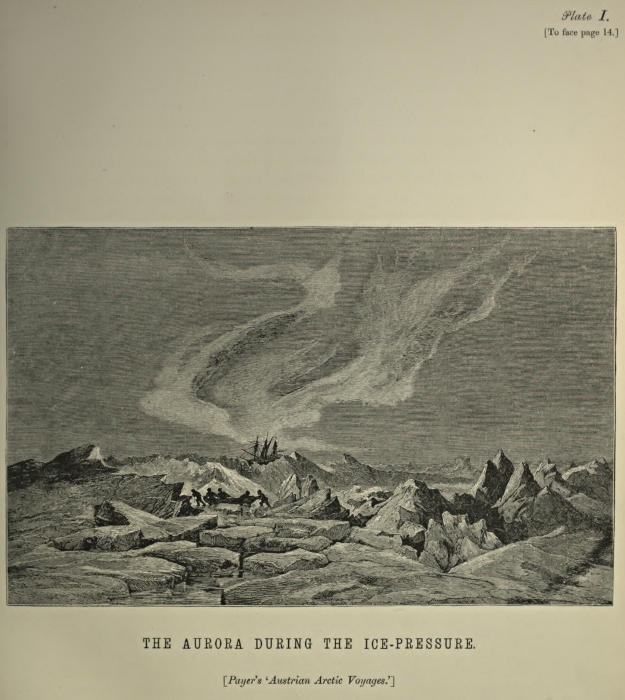
Plate I.
Captain
Sabine’s
Auroræ.
Captain Sabine describes Auroræ seen at Melville Island (Parry’s first
voyage, January 15). Towards the southern horizon an ordinary Aurora
appeared. The luminous arch broke into masses streaming in different
directions, always to the east of the zenith.
Curvature of
arches towards
each
other.
The various masses seemed to arrange themselves in two arches, one
passing near the zenith and a second midway between the zenith and the
horizon, both north and south, but curving towards each other. At one
time a part of the arch near the zenith was bent into convolutions like a
snake in motion and undulating rapidly.
(‘Annals of Philosophy,’ vol. ix. p. 250.)
Aurora seen
at Sunderland,
Feb. 8,
1817. Formation of
corona.
It began about 7 P.M. during a strong gale from the N.W., with single
bright streamers in the N. and N.W., which covered a large space and rushed
about from place to place with amazing velocity, and had a fine tremulous
motion, illuminating the hemisphere as much as the moon does eight or nine
days from change. About 11 o’clock part of the streamers appeared as if
projected south of the zenith and looked like the pillars of an immense
amphitheatre, presenting a most brilliant spectacle and seeming to be in a
lower region of the atmosphere, and to descend and ascend in the air for
several minutes. (This appears to have been the formation of a corona.)
One streamer passed over Orion, but neither increased nor diminished its
splendour.
Dr. Hayes’s
Aurora, 6th
January,
1861.
‘Recent Polar Voyages’ contains a narrative of the voyage of Dr. Hayes,
who sailed from Boston on the 6th of July, 1860, and wintered at Port
Foulbe. He witnessed a remarkable display of the Aurora Borealis on the
morning of the 6th January, 1861.
Development
of
Aurora.
The darkness was so profound as to be oppressive. Suddenly, from the
rear of the black cloud which obscured the horizon, flashed a bright ray.
Presently an arch of many colours fixed itself across the sky, and the Aurora
gradually developed.
Rays
changed to
glow.
The space within the arch was filled by the black cloud; but its borders
brightened steadily, though the rays discharged from it were exceeding
capricious, now glaring like a vast conflagration, now beaming like the glow
of a summer morn. More and more intense grew the light, until, from
irregular bursts, it matured into an almost uniform sheet of radiance.
Towards the end of the display its character changed. Lurid fires flung
their awful portents across the sky, before which the stars seemed to recede
and grow pale.
Mixed
colours. Colours
change. Tongues of
white flame
formed.
The colour of the light was chiefly red; but every tint had its turn, and
sometimes two or three were mingled; blue and yellow streamers shot across
the terrible glare, or, starting side by side from the wide expanse of the
radiant arch, melted into each other, and flung a strange shade of emerald
over the illuminated landscape. Again this green subdues and overcomes
the red; then azure and orange blend in rapid flight, subtle rays of violet
pierce through a broad flash of yellow, and the combined streams issue in
innumerable tongues of white flame, which mount towards the zenith.
The illustration which accompanies this description in the work is reproduced
on Plate II., and forcibly reminds one of the “curtains” of the
Aurora described in the preceding Chapter by Mons. Lottin.
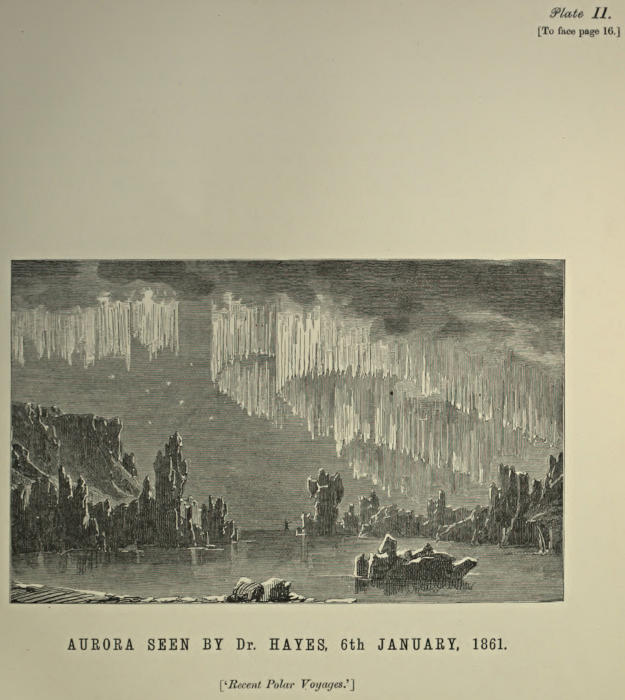
Plate II.
Prof. Lemström’s
Aurora, 1st
September,
1868.
In the first Swedish Expedition, 1868, some remarkable observations were
made on the appearance of luminous beams around the tops of mountains,
which M. Lemström showed by the spectroscope to be of the same nature as
Auroræ.
Aurora from
earth’s surface. Yellow-green
line
seen.
On the 1st September, 1868, on the Isle of Amsterdam in the Bay of
Sweerenberg, there was a light fall of snow, and the snowflakes were observed
falling obliquely. All at once there appeared a luminous phenomenon
which, starting from the earth’s surface, shot up vertically, cutting the
direction of the falling snowflakes, and this appearance lasted for some
seconds. On examination with a spectroscope the yellow-green line was
found by Lemström (but of feeble intensity) when the slit of the instrument
was directed towards a roof or other object covered with snow, and even in
the snow all round the observer.
Lemström’s
conclusions.
M. Lemström concluded that an electric discharge of an auroral nature,
which could only be detected by means of the spectroscope, was taking place
on the surface of the ground all around him, and that, from a distance, it
would appear as a faint display of Aurora.
[It should, however, here be noted that the reflection of an Aurora from a
white or bright surface would give, in a fainter degree, the spectrum of the
Aurora itself; and, apart from the phenomena seen by the eye, the case
fails to be conclusive that an Aurora on the surface of the ground was
examined.]
Mr. J. R.
Capron’s
Aurora, Oct.
24, 1870. Silver glow
in north. Phosphorescent
cloud-streamers. Crimson
masses on
horizon. Coloured
streamers. Corona
formed. Aurora fades
away.
The description, from my notes made at the time of this fine display, is as
follows:—“Last evening (October 24) the Aurora Borealis was again most
beautifully seen here (Guildford). At 6 P.M. indications of the coming
display were visible in the shape of a bright silver glow in the north, which
contrasted strongly with the opposite dark horizon. For two hours this
continued, with the addition from time to time of a crimson glow in the
north-east, and of streamers of opaque-white phosphorescent cloud, shaped
like horse-tails (very different from the more common transparent auroral
diverging streams of light), which floated upwards and across the sky from
east and west to the zenith. At about 8 o’clock the display culminated; and
few observers, I should think, ever saw a more lovely sky-picture. Two
patches of intense crimson light about this time massed themselves on the
north-east and north-west horizon, the sky between having a bright silver
glow. The crimson masses became more attenuated as they mounted upwards;
and from them there suddenly ran up bars or streamers of crimson
and gold light, which, as they rose, curved towards each other in the north,
and, ultimately meeting, formed a glorious arch of coloured light, having at
its apex an oval white luminous corona or cloud of similar character to the
phosphorescent clouds previously described, but brighter. At this time the
spectator appeared to be looking at the one side of a cage composed of
glowing red and gold bars, which extended from the distant parts of the
horizon to a point over his head. Shortly after this the Auroral display
gradually faded away, and at 9 o’clock the sky was of its usual appearance,
except that the ordinary tint seemed to have more of indigo, probably by
contrast with the marvellous colours which had so lately shone upon it.”
T. F.’s description
of
same at
Torquay.
Mr. Gibbs’s
report in
London.
T. F., describing the same Aurora from Torquay, says it showed itself at
sundown, attained its maximum at 8, and lasted until 11. At 8 o’clock more
than half the visible heavens was one sea of colour; the general ground
greenish yellow and pale rose, with extensive shoals of deep rose in the east
and west; while from the north, streaming upwards to and beyond the
zenith, were tongues and brushes of rosy red, so deep that the sky between
looked black. Mr. Gibbs reported that in London, at about 8 o’clock, brilliant
crimson rays shot up to the zenith, and the sky seemed one mass of fire.
A facsimile of my water-colour sketch of this fine discharge is given on
Plate III.
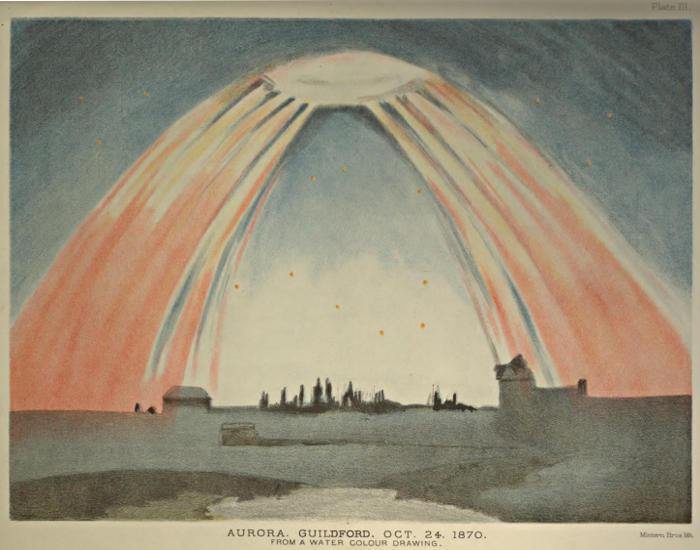
Plate III.
Mr. Barker’s
Auroræ, 9th
November
(1870?). Red Aurora. White
Aurora.
On the 9th November (1870?) Mr. Barker saw at New Haven (U. S.) a most
magnificent crimson Aurora. At about a quarter to 6 P.M. it consisted of a
brilliant streamer shooting up from the north-western horizon. This was
continued in a brilliant red, but rather nebulous, mass of light passing
upwards and to the north. Its highest points were from 30° to 40° in
altitude. A white Aurora, consisting of bright streamers, appeared simultaneously
and extended round to the north-east. Prof. Newton informed
Mr. Barker that he had observed an equally brilliant red patch of auroral
light in the north-east five or ten minutes earlier.
Red seen
through
white.
Since the lower end of the red streamers was much lower than that of the
white, it would seem as if the red were seen through the white, the red being
most remote.
Crimson line
not seen in
white
Aurora.
Spectroscopic observations of this Aurora were made. The crimson Aurora
lasted less than half an hour, and then disappeared. In the white Aurora,
which remained, the crimson line could not be seen.
Carl Bock’s
vibrating
rays.
It may be here noted that during the Aurora seen by Carl Bock in Lapland,
and painted by him by its own light (described, p. 25), he had the impression
of sets of vibrating rays behind each other, and in the drawing it looks as if
streamers were seen behind an arc.
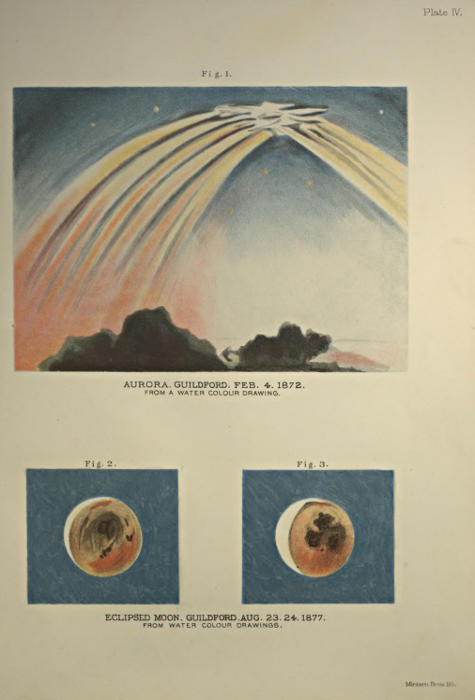
Plate IV.
Mr. J. R.
Capron’s
Aurora,
Feb. 4, 1872.
Masses of
phosphorescent
vapour. Rose tints
appeared. Aurora
from behind
clouds. Formation
of corona. Duration of
corona. Streamers
from corona. Rain during
Aurora. Wind during
night. Phosphorescent
clouds preceded
the
Aurora in
daylight.
My description of this Aurora as seen at Guildford, and as given at the time,
is as follows:—“Last evening, returning from church a little before 8 P.M.,
the sky presented a weird and unusual aspect, which at once struck the eye.
A lurid tinge upon the clouds which hung around suggested the reflection of
a distant fire; while scattered among these, torn and broken masses of vapour,
having a white and phosphorescent appearance, and quickly changing their
forms, reminded me of a similar appearance preceding the great Aurora of
24th October, 1870. Shortly some of these shining white clouds or vapours
partly arranged themselves in columns from east to west, and at the same
time appeared the characteristic patches of rose-coloured light which are
often seen in an auroral display. About 8 o’clock the clouds had to a certain
extent broken away, and the Aurora shone out from behind heavy banks of
vapour, which still rested on the eastern horizon, the north-west horizon
being free from cloud and glowing brightly with red light. And now, at
about 8.15, was presented a most beautiful phenomenon. While looking
upwards, I saw a corona or stellar-shaped mass of white light form in the
clear blue sky immediately above my head[4], not by small clouds or rays
collecting, but more in the way that a cloud suddenly forms by condensation
in the clear sky on a mountain top, or a crystal shoots in a transparent
liquid, having too, as I thought, an almost traceable nucleus or centre, from
which spear-like rays projected. From this corona in a few seconds shot
forth diverging streamers of golden light, which descended to and mingled
with the rosy patches of the Aurora hanging about the horizon. The spaces
of sky between the streamers were of a deep purple (probably an effect of
contrast). The display of the corona, though lasting a few minutes only,
was equal to, if not excelling in beauty, the grand display of October 1870,
before described, in which case, however, a ring or disk of white light of considerable
size took the place of the stellar-shaped corona. What struck me
particularly was the corona developing itself as from a centre in the clear
sky, and the diverging streamers apparently shooting downwards, whereas in
general the streamers are seen to shoot up from the horizon and converge
overhead. The effect may have been an illusion; but, if so, it was a remarkable
one. The general Aurora lasted for some time, till it was lost in a
clouded sky; and, in fact, rain was descending at one time while the Aurora
was quite bright. Strong wind prevailed during the night[5]. The Aurora
was probably very extensive, as the evening, notwithstanding the clouds, was
nearly as bright as moonlight. The peculiar clouds referred to must have
preceded the Aurora in daylight, as I recollect seeing them at 6.30 as we
went to church.”
Aurora
predicted.
They had even then a peculiarly wild, ragged, and phosphorescent appearance,
and so much resembled some I had seen to accompany the Aurora
of October 1870, that I predicted (as came to pass) a display later in the
evening. A facsimile of my water-colour sketch of this Aurora is given on
Plate IV. fig. 1, while the corona and rays are represented (with rather too
hard an outline) on Plate V. fig. 2.
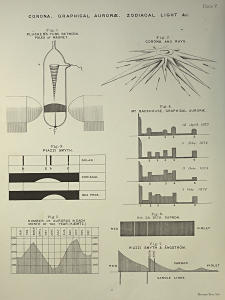
Plate V.
Aurora seen
at Cardiff. Formation
of corona.
An Aurora was seen at Cardiff. A dusky red aspect of the sky towards the
north, and extending itself across the zenith westward, made its appearance
about half-past 5 P.M. The lights reached their greatest intensity at 6 o’clock,
when the sky was suffused with a rich crimson glow, a broad band of colour
reaching from N.E. to W. A corona of deep hue, having rugged sharply
defined edges, stood out prominently in the zenith, apparently on a parallel
plane to the earth, and having its centre almost immediately over the head of
the spectator.
Radii
thrown out
from corona.
From this corona, elliptic in form, and in its broadest diameter about four
times the size of the moon, there were thrown out brilliant silvery blue radii,
extending to the N.E. and W. horizon, and presenting the appearance of a
vast cupola of fire.
Rain fell
when Aurora
died out.
At half-past 6 the lights died completely out, leaving masses of cloud
drifting up from the south, and a shower of rain fell. The corona was
remarked upon as unusual. At Edinburgh the sky was brilliant for several
hours. (The date of this Aurora is uncertain, as the account is from an
undated newspaper cutting. It is supposed to be in February 1872, but
could hardly have been on the 4th, as the Aurora of that date did not reach
its maximum development at Edinburgh till 8 P.M.)
Silvery
brightness
in N.E. Light-cloud,
which moved
from E. to
W. Formation
of arc in N. Streamers. Horizontal
clouds of
misty light.
About 7 P.M. my attention was drawn to a silvery brightness in the north-east.
Above, and still more to the east, was a bright cloud of light, which
looked dense and misty, and gave one the impression of an illuminated fog-cloud.
The edges were so bright that the adjacent sky, but for the stars
shining in it, might, by contrast, have been taken for a dark storm-cloud.
The light-cloud expanded upwards until its apex became conical, and then
moved rapidly from east, along the northern horizon, until it reached the
due west, where it rested, and formed for some time a luminous spot in
the sky. About the same time a long low arch of light formed along the
northern horizon, having a brighter patch at each extremity; and these being
higher in the sky, the arch and turned-up ends were in shape like a Tartar
bow. This bow was permanent; and later on a cloud of rose-coloured light
formed in the east, looking like the reflection of a distant fire. From the
bow also shot up curved streamers of silver light towards the zenith, which
at one time threatened to form a corona. This, however, did not happen,
and the Aurora gradually faded away, until, when the moon rose about 8,
a silver tinge in the east alone remained. I should also mention that fleecy
horizontal clouds of misty light floated in the north above the bow across the
streamers.
Mr. H. Taylor informed me he saw a similar Aurora some three weeks
before, in which the bright horizontal light and short white streamers were
the main characters. I am not sure that the horizontal light-clouds were not
actual mist-clouds illuminated by reflection of the Aurora; not so, however,
I think, the first-mentioned cloud, which had more the appearance of the
aura in the large end of an illuminated Geissler tube.
Spectrum of
the Aurora
described.
I examined the Aurora with a Browning direct-vision spectroscope, and
found Ångström’s line quite bright, and by the side of it three faint and misty
bands towards the blue end of the spectrum upon a faintly illuminated
ground. I could also see at times a bright line beyond the bands towards the
violet. There was not light enough to take any measurements of position of
the lines.
I made a pencil sketch of this Aurora, at the time when the light-cloud
had moved W. and the arc formed, and of the spectrum. These drawings are
reproduced on Plate VI. figs. 1 and 1a.
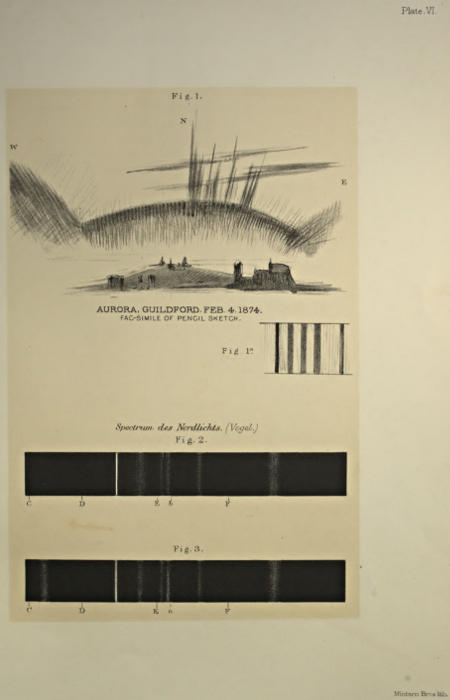
Plate VI.
Mr. Herbert
Ingall’s
Aurora, July
18, 1874. Haze canopy
formed. Bright
bluish flames
appeared. Beams and
streamers
appeared. Oscillatory
motion of
rays.
An Aurora of July 18th, 1874, seen by Mr. Herbert Ingall at Champion
Hill, S.E., was described by him as an extraordinary one. About 11 the
sky was clear; at midnight the sky was covered by a sort of haze canopy,
sometimes quite obscuring the stars, and then suddenly fading away. Mr.
Ingall was shortly after remarking the sky in the S.E. and S. horizon as being
more luminous than usual, when his attention was drawn to a growing
brightness in the S.W., and a moment afterwards bright bluish flames
“swept over the S.W. and W. horizon, as if before a high wind. They were
not streamers, but bright blue flames.” They lasted about a minute and
faded; but about two minutes afterwards a glowing luminosity appeared in
the W.S.W., and broke into brilliant beams and streamers. The extreme
rays made an angle of 90° with each other, the central ray reaching an
altitude of 50°. The extreme divergence of the streamers (indicating their
height above the earth’s surface), and their direction (from W.S.W. to E.N.E.)
at right angles to the magnetic meridian, suggested to Mr. Ingall a disturbance
of an abnormal character. The rays had an oscillatory motion for about
fifteen seconds, and then disappeared, “as if a shutter had suddenly obscured
the source of light.”
Mr. Ingall’s
remarks corroborated.
Mr. Ingall’s remarks were corroborated by an observer in lat. 54° 46´ 6″·2 N.,
long. 6h 12m 19s·75 W. The display, however, was more brilliant, and the
intensity of light at midnight illuminated the whole district as with an electric
light. The rays, too, bore tints differing from one another; the largest
seemed to partake of the nature of the blue sky, while the smaller ones,
running parallel with the horizon, were ever changing from blue to orange-red.
Rev. C.
Gape saw
flashes or
streaks of a
pale blue
colour.
On June 25 (same year?), between 9 and 10 o’clock, the Rev. Chas. Gape
saw at Rushall Vicarage, Scole, Norfolk, in the E.S.E., very frequent flashes
or streaks of a pale blue colour darting from the earth towards the heavens
like an Aurora. The day had been dull and close, with distant thunder.
In the E.S.E. it was dark, but overhead and everywhere else it was clear
and starry.
Mr. J. R.
Capron’s
white
Aurora of
Sept. 11,
1874.
On September 11, 1874, we were at Kyle Akin, in the Isle of Skye. The
day had been wet and stormy, but towards evening the wind fell and the
sky became clear. About 10 P.M. my attention was called to a beautiful
Auroral display.
Double arc
of pure
white light
in the N.
No crimson or rose tint was to be seen, but a long low-lying arc of the
purest white light was formed in the north, and continued to shine with more
or less brilliancy for some time. The arc appeared to be a double one, by the
presence of a dark band running longitudinally through it.
White
streamers. Auroral bow
believed to
be near the
earth.
Occasional streamers of equally pure white light ran upwards from either
end of the bow. The moon was only a day old, but the landscape was lighted
up as if by the full moon; and the effect of Kyle Akin lighthouse, the
numerous surrounding islands, and the still sea between was a true thing of
beauty. The display itself formed a great contrast to the more brilliant
but restless forms of Auroræ generally seen. I particularly noticed a somewhat
misty and foggy look about the brilliant arc, giving it almost a solid
appearance. The space of sky between the horizon and the lower edge of
the arc was of a deep indigo colour, probably the effect of contrast. I had a
strong impression that the bow was near to the earth, and was almost convinced
that the eastern end and some fleecy clouds in which it was involved
were between myself and the peaks of some distant mountains.
I have not seen any other account of this Aurora, of which I was able at
the time to obtain a sketch. This is reproduced on Plate VII. It was a
lovely sight, and wonderfully unlike the cloud-accompanied and crimson
Auroræ which I had seen in the South.
It is noticed in Parry’s ‘Third Voyage’ that the lower edge of the auroral
arch is generally well defined and unbroken, and the sky beneath it so exactly
like a dark cloud (to him often of a brownish colour), that nothing could
convince to the contrary, if the stars, shining through with undiminished
lustre, did not discover the deception.
No trace of
brown colour
in segment
of sky below
the arc.
I saw no trace of brown colour. The segment below the arch resting on
the horizon was of a deep indigo colour.
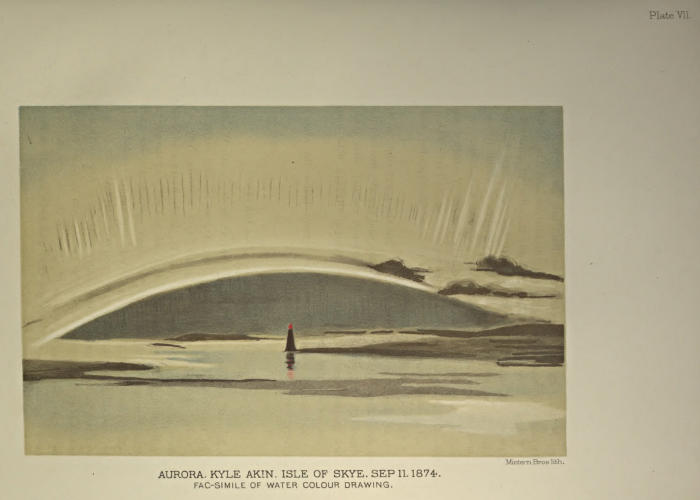
Plate VII.
Dr. Allnatt’s
Aurora,
June 9, 1876. Band of
auroral light
appeared. Streaks of
cirro-stratus
divided the
Aurora. Want of
electric
manifestations
attributed
to
absence of
sun-spots.
Dr. Allnatt, writing to the ‘Times’ from Abergele, North Wales, near the
coast of the Irish Channel, reported an Aurora on the night of the 9th
June, 1876. After a cool and gusty day, with a strong N.E. wind and a
disturbed sea, there appeared at 11 P.M. in the N. horizon a broad band of
vivid auroral light, homogeneous, motionless, and without streamers. About
midnight a long attenuated streak of black cirro-stratus stretched parallel
with the horizon, and divided the Aurora into nearly symmetrical sections.
On the preceding day the sky was covered with dark masses of electric cloud
of weird and fantastic forms. The season had been singularly unproductive
of high electric manifestations, which Dr. Allnatt thought might be attributable
to the comparative absence of spots on the solar disk. [It may here
be noted how conspicuous the years 1877 and 1878 have been for absence of
Sun-spots and of Auroræ.]
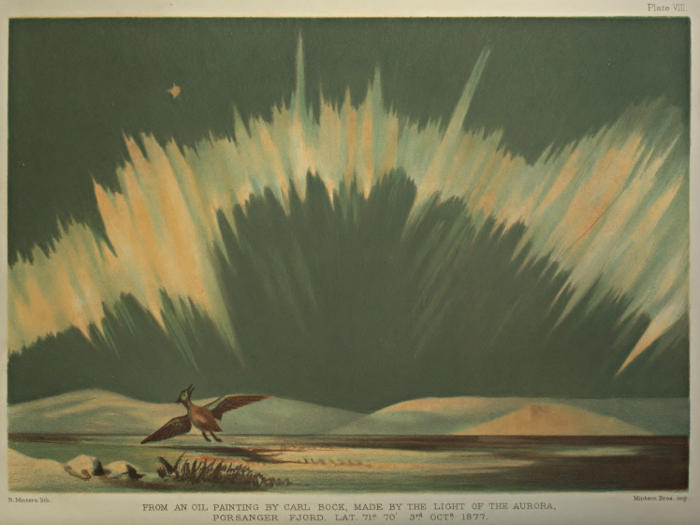
Plate VIII.
Herr Carl
Bock’s Lapland
Aurora,
3rd Oct.
1877. Lapland
Auroræ
generally of
the yellow
type.
In January 1878 I had the pleasure to meet, at the Westminster Aquarium,
Herr Carl Bock, the Norwegian naturalist, who accompanied four Laplanders,
two men and two women, with sledges, tents, &c., on their visit to this
country. The Laplanders (as mentioned elsewhere) did not confirm the
accounts of noises said to have been observed by Greenlanders and others
during the Aurora. Carl Bock mentioned to me that the displays he saw in
Lapland were most brilliant, but generally of the yellow type (the Laplanders
called the Aurora “yellow lights”). He saw only one red Aurora.
He kindly lent me a picture (probably in its way unique), an oil-painting of
an Aurora Borealis, entirely sketched by the light of the Aurora itself.
A picture
painted by
light of the
Aurora. Movement
of the rays. Inner edge
of arc
fringed with
rays.
The painting is remarkable for the tender green of the sky, an effect
probably due to a mixture of the ordinary sky colour with the yellow light of
the Aurora. This picture was taken at Porsanger Fjord, in lat. 71° 50´, on
3rd October, 1877. It lasted from 9 P.M. till about 11 P.M. The rays kept
continually moving, and certain of them seemed in perspective and behind
the others. It will be noticed that the inner edge of the arc is fringed with
rays, contrary to the sharp and definite margin which is usually presented.
Probably two Auroræ or auroral forms were seen—a quiescent arc in front,
and a set of moving streamers beyond. Two larger and brighter patches of
light are seen at each extremity of the arc, as in the case of the Aurora seen
by me at Guildown, February 4th, 1874, which, indeed, the display much
resembles. A reduced facsimile of Herr Bock’s excellent picture is given on
Plate VIII.
Aurora of
longitudinal
rays.
Herr Bock also acquainted me that on the following day he saw an Aurora
in which the lines of light, instead of being vertical, were longitudinal, and
were continually swept along in several currents. They were not so strong
as in the former case.
Rev. T. W.
Webb’s
Aurora. Arc resolved
into sets of
streamers
moving in
opposite
directions.
The Rev. T. W. Webb has described to me in a letter an Aurora very like
that seen by Carl Bock in Lapland, and apparently the prevailing type in
those regions. An arc similar to that figured by Carl Bock appeared in the
N.W., and seemed to resolve itself into two sets of streamers moving in
opposite directions (or the one set might be fixed and the other moving), like
the edges of two great revolving toothed wheels. This lasted but for a few
seconds; but during that interval the tints were varied and brilliant, including
blue and green.
English
Arctic
Expedition,
1875-76. Instructions
for use of
officers. Appendix B. Capt. Sir
G. Nares’s
report. True Auroræ
seldom observed,
and
displays
faint. Citron-line
observed on
only two
displays. Appendix C.
In anticipation of the starting of this Expedition, some instructions for the
use of the officers in connexion with the hoped for display of brilliant Auroræ
were prepared:—as to general features of the Auroræ, by Professor Stokes; as
to Polarization, by Dr. William Spottiswoode; and as to Spectrum work, by
Mr. Norman Lockyer and myself. As these instructions were somewhat
elaborate, and will apply to all Auroral displays, I have supplied a copy
of them in Appendix B. They were unfortunately not brought into
requisition, for want of the Auroræ themselves. Capt. Sir George Nares
has reported to the Admiralty, under date 5th December, 1877, as follows:—“Although
the auroral glow was observed on several occasions between
25 October, 1875, and 26 February, 1876, true Auroræ were seldom observed;
and the displays were so faint, and lasted so short a time, and the spectrum
observations led to such poor results, that no special report has been considered
necessary. Although the citron-line was observed occasionally, on
only two displays of the Aurora was it well defined, and then for so short a
time that no measure could be obtained.” (For Sir George Nares’s further
Report see Appendix C, containing extracts from blue-book, ‘Results derived
from the Arctic Expedition, 1875-6.’)
Aurora
Australis. Mr. Forster’s
description. Long
columns of
white light
spreading
over the
whole sky.
In an article on Auroræ in high Southern latitudes (Phil. Trans. No. 461,
and vol. liv. No. 53), we find that Mr. Forster, who as naturalist accompanied
Capt. Cook on his second voyage round the world, says:—“On
February 17th, 1773, in south latitude 58°, a beautiful phenomenon was
observed during the preceding night, which appeared again this, and several
following nights. It consisted of long columns of a clear white light
shooting up from the horizon to the eastward almost to the zenith, and
gradually spreading over the whole southern part of the sky. These columns
were sometimes bent sideways at their upper extremities; and though in most
respects similar to the northern lights of our hemisphere, yet differed from
them in being always of a whitish colour, whereas ours assume various tints,
especially those of a fiery and purple hue. The sky was generally clear when
they appeared, and the air sharp and cold, the thermometer standing at the
freezing point.” This account agrees very closely in particulars with Capt.
Maclear’s notice of Aurora Australis [after referred to], and especially in the
marked absence of red Auroræ.
The height of the barometer does not appear to be mentioned, the temperature
being apparently much the same as in the more recent cases.
Capt.
Maclear’s
Aurora
Australis,
3rd March,
1874. Light of
pale yellow
tint only.
In a letter dated from H.M.S. ‘Challenger,’ North Atlantic, April 10th,
1876, Capt. Maclear was good enough to communicate to me some particulars
of an Aurora Australis seen 3rd March 1874, in lat. 54° S., long. 108° E.
The letter is mainly descriptive of the spectrum (which will be described in
connexion with the general question of the spectrum of the Aurora). It
states that the red line was looked for in vain, and that the light appeared
of a pale yellow, and had none of the rosy tint seen in the northern
displays.
Capt.
Maclear’s
Auroræ
described in
‘Nature.’
Capt. Maclear has since contributed to ‘Nature,’ of 1st November 1877, a
description of four Auroræ seen from the ‘Challenger’ in high southern
latitudes (including the one communicated to me). He speaks of the opportunity
of observing as not frequent, either from the rarity of the phenomena,
or because the dense masses of cloud prevalent in those regions prevented
their being seen except when exceptionally bright. There were four appearances
described:—
Feb. 9, 1874.
(1.) At 1.30 on the morning of February 9th, 1874, preceded by a watery
sunset, lat. 57° S. and long. 75° E., bar. 29·0 in., ther. 35°; brilliant streaks
to the westward. Day broke afterwards with high cirrus clouds and clear
horizon.
Feb. 21,
1874.
(2.) At 9.30 P.M., February 21, 1874, lat. 64° S., long. 89° E., bar. 28·8 in.,
ther. 31°; one bright curved streamer. The Aurora preceded a fine morning
with cumulo-stratus clouds, extending from Jupiter (which appeared to be
near the focus) through Orion and almost as far beyond. Under this a black
cloud, with stars visible through it. Real cumuli hid great part of the
remainder of the sky, but there were two vertical flashing rays which moved
slowly to the right (west). Generally the Aurora was still bright.
March 3,
1874. Auroral line
found in
light to
southward.
(3.) At midnight, March 3rd, 1874, lat. 53° 30´ S., long. 109° E., bar. 29·1,
ther. 36°, after some days’ stormy weather, a brilliant sunset, followed by a
fine morning. Soon after 8 P.M. the sky began to clear and the moon shone
out. Noticing the light to the southward to be particularly bright, Capt.
Maclear applied the spectroscope, and found the distinguishing auroral line.
Brilliant
white clouds
seen.
About midnight the sky was almost clear, but south were two or three
brilliant light clouds, colour very white-yellow, shape cumulo-stratus. From
about west to near south extended a long feathery light of the same colour,
parallel with the horizon, and between south and west there appeared occasionally
brilliant small clouds. The upper edges seemed hairy, and gave one
the idea of a bright light behind a cloud. The forms changed, but no particular
order was noticed.
(Here follows a description of the spectrum, and the mode in which a
delineation by the lines was obtained.)
March 6,
1874. Capt.
Maclear
suggests
whether a
low barometer
has
to do with
the absence
of red.
(4.) At 8 P.M., March 6th, 1874. This was a slight Aurora, seen to the
southward; after this the clouds changed to high cirrus. Capt. Maclear
suggests whether a low barometer has any thing to do with the absence of red
in the spectrum, the normal state of the barometer being an inch lower in
those regions than in more temperate latitudes.
Barometer
falls after
the Aurora,
and strong
gale from
the S. or S.W.
follows.
Edin. Encyc. vol. iii. article “Aurora.” Dr. Kirwan observed that the
barometer commonly falls after the Aurora. Mr. Winn, in the seventy-third
volume of the Phil. Trans., makes the same remark, and says that in twenty-three
instances, without fail, a strong gale from the south or south-west
followed the appearance of an Aurora. If the Aurora were bright, the gale
came on within twenty-four hours, but was of no long continuance; if the
light was faint and dull, the gale was less violent, longer in coming, and longer
in duration.
Pale yellow
glow rare in
the Aurora
Borealis.
The pale yellow-coloured glow referred to by Capt. Maclear is, in my experience,
rare in the Aurora Borealis. It is probably the “æqualiter et sine
eruptionibus aut radiis fulvi,” described by Seneca (antè, p. 1), and may probably
belong to more southern climes.
Spectrum
of Auroræ
Australes
extends
more into
the violet.
We shall see too, by-and-by, that these Auroræ Australes as to spectrum
extend more into the violet than the Aurora Borealis. The yellow, as complementary
to violet, is likely thus to make (in the absence of the red) its
appearance.
It is, however, somewhat singular that Carl Bock found almost exclusively
yellow Auroræ in Lapland.
In Proctor’s ‘Borderland of Science,’ article “The Antarctic Regions,” we
find quoted a passage from a letter by Capt. Howes, of the ‘Southern Cross,’
in which a graphic description is given of a Southern Aurora:—
Capt.
Howes’s description
of
a Southern
Aurora.
“At about half-past one on the 2nd of last September the rare phenomenon
of the Aurora Australis manifested itself in a most magnificent manner.
Our ship was off Cape Horn, in a violent gale, plunging furiously into a
heavy sea, flooding her decks, and sometimes burying her whole bows beneath
the waves. The heavens were as black as death, not a star was to be seen,
when the brilliant spectacle first appeared.
Balls of
electric fire
resting on
mast-heads
&c.
“I cannot describe the awful grandeur of the scene; the heavens gradually
changed from murky blackness till they became like vivid fire, reflecting a
lurid glowing brilliancy over every thing. The ocean appeared like a sea of
vermilion lashed into fury by the storm, the waves dashing furiously over our
side, ever and anon rushed to leeward in crimson torrents. Our whole ship—sails,
spars, and all—seemed to partake of the same ruddy hues. They were
as if lighted up by some terrible conflagration. Taking all together—the
howling, shrieking storm, the noble ship plunging fearlessly beneath the
crimson-crested ways, the furious squalls of hail, snow, and sleet, drifting
over the vessel, and falling to leeward in ruddy showers, the mysterious
balls of electric fire resting on our mast-heads, yard-arms, &c., and, above all,
the awful sublimity of the heavens, through which coruscations of auroral
light would shoot in spiral streaks, and with meteoric brilliancy,—there was
presented a scene of grandeur surpassing the wildest dreams of fancy.”
The foregoing picture presents a singular contrast to the yellow-white
Auroræ described as seen in high southern latitudes by Capt. Maclear, and is
interesting as a southern Aurora of a red or ruddy tint. Looking, however,
at the extreme rarity of red Auroræ in those latitudes, and the description of
“mysterious balls of electric fire resting on our mast-heads, yard-arms, &c.” (a
phenomenon not often noticed in connexion with the Aurora), it suggests
itself that the case in question may have been an instance not of a true
Aurora, but of an electric display, with conditions approaching those experienced
by travellers who have found themselves in mountainous districts
surrounded by storm-clouds charged with electricity[6].
Prof. Piazzi
Smyth’s
typical
Auroræ.
Prof. Piazzi Smyth was kind enough lately to send me the fourteenth
volume of the ‘Astronomical Observations made at the Royal Observatory,
Edinburgh, during the years 1870-1877.’ This volume, amongst its other
interesting matter, affords some valuable information on the subject of the
Aurora Borealis. The Aurora plates are five in number, three comprising
some well-executed chromo-lithographs of typical Auroræ, from sketches
made by Prof. Smyth, the other two plates being of the Aurora spectrum.
The Auroræ delineated are thus described:—
Aug. 6, 1871,
quiescent
arc. August 21,
1871,
active arc.
Plate 5. (August 6, 1871.) An example of a mild quiescent kind of
auroral arc, with dark cavernous substratum. (August 21, 1871.) An example
of a bright large active arc darting out rays.
Sept. 7, 1871,
arc streamers
and
clouds. May 8, 1871,
double arc
(longitudinal).
Plate 6. (September 7, 1871.) An auroral arc, with streamers and dark
clouds, and maintaining a bright appearance though in proximity to the
moon. (May 8, 1871.) A double-arched auroral arc (the arches are longitudinally
arranged).
April 28,
1871, multiple
arc. Oct. 25,
1870,
coloured
Aurora.
Plate 7. (April 28, 1871.) A multiple-arched arc of Aurora with moonlight.
(October 25, 1870.) A case of grandest coloured Auroræ, or Aurora
superb and almost universal.
All the foregoing drawings are very vivid and striking, and form a most
interesting set of typical forms of Auroræ.
According to my own experience, the Aurora with arches arranged longitudinally,
thus,  , is the rarest of all the forms. I have not met
with it myself, nor do I recollect an illustration of one other than Prof.
Smyth’s.
Mr. Kinahan’s
Auroric
Lights. White and
red. White light
appears in
pencils
radiating
from a
point.
Mr. G. Henry Kinahan writes to ‘Nature,’ from Ovoca, under date
January 27th, 1877, and speaks of two distinct kinds of light so classed—one
brilliant and transparent, of a white yellowish-blue or yellowish-red colour,
while the other is semi-opaque and of a bloody red colour, the latter being
considered in Ireland a forerunner of bad weather. The first kind generally
appears as intermittent pencils of light that suddenly appear and disappear.
Frequently
not stationary,
but
jumping
about.
Usually they proceed or radiate from some point near the north of the
horizon; but Mr. Kinahan has frequently seen them break from a point in
the heavens, not stationary, but jumping about within certain limits. Sometimes
these lights occur as suddenly flashing clouds of light of a white colour,
but at other times of blue and reddish yellow.
In daylight
like sun-rays. Red light
appears in
clouds floating
upwards
or diffused.
If this class of lights is watched into daylight, they appear somewhat like
faint rays of a rising sun. One morning, while travelling in West Galway in
the twilight, they were very brilliant, and quite frightened Mr. Kinahan’s
car-driver, who thought the sun was going to rise in the north instead of the
east. The second, or bloody red light, usually occurs in clouds floating in
one direction up into the heavens, but often diffused over a portion of the sky.
Mr. Kinahan has never seen them coming from the east, and on only a few
occasions from the south, but generally from the west, north-west, or north.
Red light
appears as
dirty misty
clouds in
daylight,
or as a mist
or misty
rays.
If both kinds of light appear at the same time, the second while passing
over the first dims it. If the second class is watched into daylight, they
appear as dirty misty clouds that suddenly form and disappear without the
spectator being able to say where they come from or where they go to, or as
a hazy mist over a portion of the sky, that suddenly appears and disappears, or
as misty rays proceeding from a point in the horizon. Generally, when
these clouds occur, there is a bank of black clouds to the westward.
Season since
October
1876 prolific
in auroric
light.
Mr. Kinahan then speaks of the season as having been prolific in auroric
light, as there had been few nights since the 1st October then last (1876) in
which they did not appear. On many occasions they were late in the night,
being very common and brilliant during the dark days of December, a few
hours before dawn (about 5 o’clock). Each time there was a fine day they
appeared also, and the weather broke again.
Mr. J. Allan
Broun questions
nature
of these
lights, as
Aurora is
seldom seen
at 5 A.M. in
this country. On 77 occasions
seen
only twice
so early. Season was
of marked
infrequency
elsewhere.
Mr. Jno. Allan Broun refers to this graphic account of Mr. Kinahan’s,
and concludes there must have been some mistake as to the nature of these
“auroric lights,” as the Aurora Borealis is very rarely seen at 5 A.M. in this
country. In the years 1844 and 1845, during which the Aurora was sought for
at Makerstown every hour of the night, it was observed in 77 nights on an
average of nearly three hours each night; but it was seen only twice so early,
and that with a bright or brilliant Aurora, which remained during five hours
on the first occasion, and from 6 P.M. to 6 A.M. on the second. Parts of the
phenomenon seen by Mr. Kinahan, Mr. Broun also could not say he had ever
seen; and if Mr. Kinahan’s observations could have been confirmed it would
have been most important, especially as made so frequently at the epoch of
minimum. The description is in many respects a sufficiently recognizable
one of auroral discharges; but the frequent appearance in early morning is
certainly unusual, and few if any Auroræ seem to have been recorded as
appearing elsewhere in Great Britain during the time which Mr. Kinahan refers
to as so prolific (see, however, Dr. Allnatt’s, antè, p. 24). In fact, the season
in question was one of marked infrequency (see English Arctic Expedition
Report, antè, p. 26). Mr. Buchan furnished Mr. Broun with a note of Auroræ
seen in the stations of the Scottish Meteorological Society during the year
1876, and they were 42 in number, 26 in the first half, and 16 in the second
half of the year. The greater part were seen in the most northerly stations,
including the Orkney, Shetland, and Faroe Islands, and only 9 south of
the Forth.
Luminous
arch, Sept.
11, 1814. Height
above horizon
6 to 9
miles.
In the ‘Annals of Philosophy,’ vol. iv. p. 362, there is a minute description
of a luminous arch which appeared in the sky on the night of Sunday,
September 11th, 1814, and was seen in the west of England opposite the
Irish Sea, the west part of the south of Scotland, and part of the west of
Ireland. It was described as a part of either a body of dense greyish-white
light, or a mass of luminous matter in the shape of an arch. Its height above
the horizontal line was estimated at not more than 9 nor less than 6 miles.
It moved
southward,
and was
assumed to
differ from
the Aurora.
Its direction when first seen was N. 80° E., and S. 80° W. It moved to the
southward. It was assumed to differ from the Aurora Borealis in wanting
coruscations, and in its having a much paler light.
Noises attending
Auroræ. Gmelin affirms
them. Other testimony
to
them. Musschenbroek. Cavallo. Nairne. Belknap.
In the Edinb. Encyc., Gmelin is stated, in continuation of his description of
an Arctic Aurora, to add:—“For however fine the illumination may be, it is
attended, as I have heard from the relation of many persons, with such a
hissing, cracking, and rushing noise through the air, as if the largest fireworks
were playing off.” To describe what they then heard, the natives are
said to use the expression, “Spolochi chodjat”—that is, The raging host is passing.
The hunter’s dogs, too, are also described as so much frightened when
the Auroræ overtake the hunters, that they will not move, but lie obstinately
on the ground till the noise has passed. This account of noises seems to be
confirmed by other testimony. They are stated to have been heard at Hudson’s
Bay and in Sweden; and Musschenbroek mentions that the Greenland
whale-fishers assured him they had frequently heard the noise of the Aurora
Borealis, but adds that “no person in Holland had ever experienced this
phenomenon.” Mr. Cavallo declares he “has repeatedly heard a crackling
sound proceeding from the Aurora Borealis” (Elements of Nat. or Exper.
Phil. vol. iii. p. 449). Mr. Nairne mentions that in Northampton, when the
northern lights were very bright, he is confident he perceived a hissing or
whizzing sound. Mr. Belknap of Dover, New Hampshire, North America,
testifies to a similar fact (American Trans. vol. ii. p. 196).
Sir John
Franklin
negatives
them.
Sir John Franklin mentions, in his ‘Journey to the Shores of the Polar
Sea’:—“Nor could we distinguish its (the Aurora’s) rustling noise, of which,
however, such strong testimony has been given to us that no doubt can remain
of the fact.”
March 11th.
Hissing
noise heard
during Aurora’s
passage. Explained
to arise from
the snow.
In detail, he mentions he never heard any sound that could be unequivocally
considered as originating in the Aurora, although he had had an opportunity
of observing that phenomenon for upwards of 200 nights (the Aurora
was registered at Bear Lake 343 times without any sound being heard to
attend its motions); but the uniform testimony of the natives and all the
older residents in the country induced him to believe that its motions were
sometimes audible. On the 11th March, at 10 P.M., a body of Aurora rose
N.N.W.; and after a mass had passed E. by S., the remainder broke away
in portions, which crossed about 40° of the sky with great rapidity. A hissing
noise, like that of a bullet passing through the air, was heard, which seemed
to proceed from the Aurora; but Mr. Wentzel assured the party the noise
was occasioned by severe cold succeeding mild weather, and acting upon the
surface of the snow previously melted in the sun’s rays. A similar noise was
heard the next morning.
Capt. Sabine
also negatives
noise.
In Parry’s first voyage, Captain Sabine describes an Aurora seen at Melville
Island, and adds that the Aurora had the appearance of being very near the
party, but no sound could be heard.
Article
“Aurora
Polaris,”
Encyc. Brit.,
suggests
noises as
not improbable.
In the article “Aurora Polaris,” Encyc. Brit, edition ix., the writer admits
the evidence of scientific Arctic voyagers having listened in vain for such
noises; but, referring to the statements of Greenlanders and others on the
subject, concludes there is no à priori improbability of such sounds being
occasionally heard, since a somewhat similar sound accompanies the brush-discharge
of the electric machine.
Payer negatives
and
discredits
noises.
Payer, of the Austrian Polar Expedition (1872-1874), states that the
Aurora was never accompanied by noise, and discredits the alleged accounts
of noises in the Shetlands and Siberia.
As also
Weyprecht.
Lieut. Weyprecht, of the same expedition, says (antè, p. 14):—“Involuntarily
we listen; such a spectacle must, we think, be accompanied with sound, but
unbroken silence prevails, not the least sound strikes on the ear.”
Herr Carl
Bock negatives
noises
in the case
of Lapland
Auroræ.
Herr Carl Bock, who accompanied the Laplanders visiting this country (at the
Westminster Aquarium) in 1877-78, and who witnessed many brilliant auroral
displays in Lapland, assured me he could trace no noise, except on one occasion,
when he heard a sort of rustling, which he attributed to the wind. The
Laplanders themselves did not associate any special noise with the Aurora.
Auroral
noises in
telephone. Ringing
sound in
vacuum-tube
under influence
of
magnet.
It has been recently stated, in an article on the Telephone in ‘Nature,’ that
Professor Peirce “has observed the most curious sounds produced from a
telephone in connexion with a telegraph wire during the Aurora Borealis;”
but no further details are given. In experimenting with a silicic fluoride
vacuum-tube between the poles of an electro-magnet, I found, on the magnet
being excited, that the capillary stream of blue light was decreased in volume
and brightness, and at the same time from within the tube a peculiar whistling
or slightly metallic ringing sound was heard.
Adverse
conclusion
as to noises
accompanying
Aurora.
I certainly have never met with an instance of noise accompanying an
Aurora and traced to it. On the whole the balance of evidence seems quite
adverse to any proof of noises proper ordinarily accompanying an Aurora.
Colours of
the Aurora. Sir John
Franklin’s
views. Other observers
have
described all
colours of
spectrum. Violet rare.
Crimson
indicates
coming
Aurora.
Sir John Franklin considered the colours in the Polar Aurora did not
depend on the presence of any luminary, but were generated by the motion
of the beams, and then only when that motion was rapid and the light brilliant.
The lower extremities, he says, quivered with a fiery red colour, and
the upper with orange. He also saw violet in the former. Other observers
have, in their various descriptions of Auroræ, mentioned the colours of the
rays or beams as red, crimson, green, yellow, &c.; in fact, comprising the
range of the spectrum. Violet seems less frequently mentioned. The red
or crimson colour is frequently the first indication of the coming Aurora, and
is usually seen on or near the horizon. The colours have frequently been
observed to shift or change.
Prof. Piazzi
Smyth describes
colours
of Aurora
of Feb.
4, 1872, as
seen at
Edinburgh.
Prof. Piazzi Smyth, in a letter to ‘Nature,’ describing the Aurora of
February 4th, 1872, as seen at Edinburgh, says that when the maximum development
was reached all the heavens were more or less covered with pink
ascending streamers, except towards the N., which was dark and grey—first by
means of a long low arch of blackness, transparent to large stars, and then by
the streamers which shot up from this arch, which were green and grey only
for several degrees of their height, and only became pink as they neared the
zenith. The red streamers varied from orange to rose-pink, red rose, and
damask rose.
The Professor pointed out that the spectroscope knew no variety of reds
giving one red line only, and attributed this to the mixing up of rays and
streamers of blackness out of the long low arch. When the Aurora faded
away a true starlight-night sky appeared; so that evidently the dark arch and
streamers were as much part of the Aurora as the green and red lights.
Dr. Allnatt
at Frant
describes
vivid colours
of same
Aurora.
Dr. Allnatt, at Frant, found in the case of the same Aurora the south-western
part of the heavens tinged by a bright crimson band. A dark elliptical cloud
extending from S. to S.E. was illuminated at its upper edge with a pale yellow
light, and sent up volumes of carmine radii interspersed with green and the
black alternating matter characteristic of elemental electricity. Almost due
E., and of about 25 degrees elevation, was a bright insulated spot of vivid
emerald-green, which appeared almost sufficiently intense to cast a faint
shadow from intercepting objects. At 7 o’clock the Aurora had passed the
zenith, and the sky presented a weird and wonderful appearance. A dark
rugged cloud, some 8 degrees E. of the zenith, was surrounded by electric
light of all hues—carmine, green, yellow, blood-red, white, and black; and
the bright spot still existed in the south.
Descriptions
at Blackburn
and
Cambridge. Lapland
Auroræ
yellow.
At Blackburn, in Lancashire, the rays were described as glowing in the
N.E. from silvery white to deepest crimson; and at Cambridge the same
Aurora was described as of a brilliant carmine tint. The Auroræ seen in
Lapland by Herr Carl Bock, were, he informed me, almost invariably yellow;
he saw only one red one.
Hydrogen
vacuum-tube
suggestive
of Aurora
colours.
The behaviour of a hydrogen Geissler vacuum-tube will be subsequently
referred to in the Chapter on the comparison of some tubes with the Aurora
spectrum, and is suggestive as to Aurora colours.
Variation of
tints in.
The capillary part of this tube, when lighted by a small coil, was found
to vary in tint—silver-white, bright green, and crimson being each in succession
the dominant colour, according to the working of the break of the
coil. When a spectroscope was used, the red, blue, and violet lines of the
gas were seen to change in intensity in accordance with the light colour seen
in the tube.
Variation of
colour in nitrogen
tube
under influence
of magnet.
A Geissler nitrogen vacuum-tube was also so arranged that the capillary part
of it should be vertically between the conical extremities of the armatures of
a large electro-magnet, the armatures just being clear of the outside of the
tube. The tube was then lighted up by a small coil, and the magnet excited
by four large double-plate bichromate cells.
Change from
rosy to violet
hue.
The stream of light was steady and brilliant, and, except at the violet pole,
of the rosy tint peculiar to a nitrogen vacuum-tube. On excitation of the
electro-magnet, the discharge was seen to diminish in volume, with an apparent
increase in impetuosity; and not only the capillary part, but in a less
degree the bulbs also of the tube, changed from a rosy to a well-marked violet
hue.
Photographic
plates
taken. Difference
in.
We several times connected and disconnected the magnet with its batteries,
but always with the same result. Of the spectrum of the capillary part of
this tube we took photographic plates with quartz prisms and lenses, taking
care that all things should be as equal as possible, the apparatus undisturbed,
and the time of exposure exactly the same. One plate was taken with
the tube in its normal condition, the other while it was under the influence of
the magnet. The spectra were identical, except that the plate of the tube
influenced by the magnet was decidedly the brightest, and was found to
penetrate more into the violet region (the Author’s ‘Photographed Spectra,’
p. 60, plate xxv.). These plates effectually corroborated the change of colour,
as the violet ray would have more photographic effect than the rosy. The
identity of the spectra of the capillary part proved that the change in colour
could not have proceeded from an extension of the violet glow. (A similar
experiment will be found also detailed in Part III. Chapter XII.)
Height of
Aurora. Sir John
Franklin
considers it
within the
region of the
clouds. At no great
elevation.
Sir John Franklin (Narrative of a Journey on the Shores of the Polar Sea
in the years 1819, ’20, ’21, ’22) says:—“My notes upon the appearance of
the Aurora coincide with those of Dr. Richardson in proving that that phenomenon
is frequently seated within the region of the clouds, and that it is
dependent in some degree upon the cloudy state of the atmosphere.” And
further:—“The observations of Dr. Richardson point particularly to the
Aurora being formed at no great elevation, and that it is dependent upon
certain other atmospheric phenomena, such as the formation of one or other
of the various modifications of cirro-stratus.”
Sir John Franklin also refers to notes from the Journal of Lieut. Robert
Hood, R.N., on an Aurora:—
Observations
of
Lieut. Robert
Hood
and Dr.
Richardson. A beam not
more than 7
miles from
the earth. An arch 7
miles from
the earth.
The observations were made at Basquian House, and at the same time by
Dr. Richardson at Cumberland House, quadrants and chronometers having
been prepared for the purpose. On the 2nd April the altitude of a brilliant
beam was 10° 0´ 0″ at 10h 1m 0s at Cumberland House. Fifty-five miles
S.S.W. it was not visible. It was estimated that the beam was not more than
7 miles from the earth, and 27 from Cumberland House. On the 6th April
the Aurora was for some hours in the zenith at that place, forming a confused
mass of flashes and beams; and in lat. 53° 22´ 48″ N., long. 103° 7´ 17″, it
appeared in the form of an arch, stationary, about 9° high, and bearing
N. by E. It was therefore 7 miles from the earth.
An arch between
6 and
7 miles from
the earth.
On the 7th April the Aurora was again in the zenith before 10 P.M. at
Cumberland House, and in lat. 53° 36´ 40″ N., long. 102° 31´ 41″. The
altitude of the highest of two concentric arches at 9h P.M. was 9°, at 9h 30m
it was 11° 30´, and at 10h 0m 0s P.M. 15° 0´ 0″, its centre always bearing
N. by E. During this time it was between 6 and 7 miles from the earth.
[The bearings are true, not magnetic.]
Sir John
Franklin’s
remarks.
Sir J. Franklin says this was opposed to the general opinion of meteorologists
of that period: he also noticed he had sometimes seen an attenuated
Aurora flashing across the sky in a single second, with a quickness of motion
inconsistent with the height of 60 or 70 miles, the least that had hitherto been
ascribed to it.
Dr. Richardson’s
conclusions.
The needle was most disturbed, February 13, 1821, P.M., at a time when
the Aurora was distinctly seen passing between a stratum of cloud and the
earth; and it was inferred from this and other appearances that the distance
of the Aurora from the earth varied on different nights. Dr. Richardson concludes
that his notes prove, independent of all theory, that the Aurora is
occasionally seated in a region of the air below a species of cloud which is
known to possess no altitude; and is inclined to infer that the Aurora Borealis
is constantly accompanied by, or immediately precedes, the formation of one
or other of the forms of cirro-stratus.
Captain
Parry observed
Auroræ
near
the Earth’s
surface. Sir W. R.
Grove’s observation
at
Chester. Mr. Ladd’s
observation
at Margate. The author’s
observation
at Kyle
Akin, Skye.
Captain Parry observed Auroræ near the earth’s surface; and records that
he and two companions saw a bright ray of the Aurora shoot down from the
general mass of light between him and the land, which was distant some
3000 yards. Sir W. R. Grove (‘Correlation of Physical Forces’) saw an
Aurora at Chester, when the flashes appeared close, so that gleams of light
continuous with the streamers were to be seen between him and the houses—“he
seemed to be in the Aurora.” Mr. Ladd, of Beak Street, Regent Street,
has related to me an appearance he was struck with, and examined carefully.
Standing in the evening in Margate Harbour, he saw a white ray of the
Aurora, which, apparently shooting downwards, was clearly placed between
his eye and the opposite head of the pier, which projected into the sea. Mr.
Ladd also informed me that Prof. Balfour assured him that such an appearance
was not unusual. In the double-arc Aurora seen by me in the Isle of
Skye, September 11, 1874 (described antè, p. 23), I had a strong impression
that the bow was near the earth, and thought that the eastern end, and some
fleecy clouds in which it was involved, were between myself and the peaks of
the distant mountains.
Dalton’s calculation
of
100 miles. Backhouse’s
50 to 100
miles. Prof. Newton,
mean
130 miles. Elevation of
Auroræ cannot
exceed a
few miles.
In the article “Aurora Polaris,” Encyc. Brit., edition ix., Dalton is
instanced as having calculated the height of an Aurora in the north of England
at 100 miles; and Backhouse as having made many calculations, with the
result of an average height of 50 to 100 miles. Prof. Newton, too, is quoted
for the height of 28 Auroræ (calculated by one observation of altitude and
amplitude of an arch) as ranging from 33 to 281 miles, with a mean of
130 miles. It is, however, pointed out that a height of 62 miles above the
earth’s surface would imply a vacuum attainable with difficulty, even with
the Sprengel pump. This difficulty is then met by a reference to the observed
altitude of some meteors, and to a suggestion of Prof. Herschel’s that electric
repulsion may carry air or other matter up to a great height. Dr. Lardner
(‘Museum of Science and Art,’ vol. x. p. 192) speaks of the height of Auroræ
as not certainly ascertained; but considers them atmospheric phenomena
scarcely above the region of the clouds, and does not think it probable that
their elevation in any case can exceed a few miles.
M’Clintock’s
observations. Capt. Ross
saw Auroræ
on an ice-cliff,
which
he attributed
to electric
action.
M’Clintock, after noticing that the beams of the Aurora were most frequently
seen in the direction of open water, says that in some cases patches of light
could be plainly seen a few feet above a small mass of vapour over an opening
in the ice. Captain Ross, in his Antarctic voyage, saw the bright line of the
Aurora forming a range of vertical beams along the top of an ice-cliff; and
suggested this was produced by electrical action taking place between the
vaporous mist thrown upwards by the waves against the berg, and the colder
atmosphere with which the latter was surrounded.
Bergman
estimates
height as
468 miles.
Bergman, from a mean of 30 computations, makes the height of the phenomenon
to be 72 Swedish (about 468 English) miles.
Boscovich
825 miles.
Father Boscovich calculated the height of an Aurora Borealis observed on
the 16th December, 1727, to have been 825 miles.
Mairan 600
miles. Euler several
thousand
miles. Dr. Blagden
about 100
miles.
Mairan supposed the far greater number of Auroræ to be at least 600 miles
above the surface of the earth. Euler assigned them an elevation of several
thousands of miles. Dr. Blagden, however, limited their height to about
100 miles, which he supposed to be the region of fireballs—remarking that
instances were upon record in which northern lights had been seen to join
and form luminous balls, darting about with great velocity, and even leaving
a train behind them like common meteors (Phil. Trans. vol. lxxiv. p. 227).
Dalton 150
miles.
Mr. Dalton, from an observation of the luminous arches on a base of
22 miles, found the altitude of the Aurora to be about 150 miles (Dalton’s
‘Meteorological Observations and Essays,’ 1793, pp. 54, 153).
Dr. Thompson
assumes
considerable
height. His table. Average of
31 observations,
500
miles.
Dr. Thompson, ‘Annals of Philosophy,’ vol. iv. p. 429 (1814), assumes that
the height of the beams above the surface of the earth was much greater than
that of most other meteorological appearances, and gives (p. 430) a table of
Auroræ, mainly taken from Bergman, Opusc. v. p. 291, of 31 Auroræ
observed in the years 1621 to 1793, with heights in English miles. The
lowest is, 23rd February, 1784, London (Cavendish), 62 miles; the highest,
23rd October, 1751, Fournerius, 1006 miles! The average of the 31 estimated
observations gives a height of about 500 miles. It is not stated
how these observations were obtained, though methods are mentioned how
they might be.
Prof. Heis’s
instrument
for determining
height of
Auroræ.
Prof. Heis, of Münster, exhibited at the recent Scientific Loan Collection
at South Kensington (‘Official Catalogue,’ 3rd edit. p. 296, No. 1231) an
instrument for the determination of the position of the point of convergence
of the rays of the Aurora, and for determining the height of the Aurora. A
ball resting in a pan was to be brought into position, so that several diverging
pencils of Aurora, when properly viewed, were covered by the rod which
passed through the centre of the ball. The point of the rod (which could be
moved up and down in the ball), when the instrument was set to the astronomical
meridian, showed the azimuth and altitude of the converging point of
the pencils of light. This point of convergence does not coincide with the
point to which the inclination-needle directs. From the deviation of the two
points, the height of the Aurora could be calculated.
Professor
Newton’s
method of
calculating
height.
Professor H. A. Newton (Sil. Journ. of Science, 2nd ser. vol. xxix. p. 286)
has proposed a method of calculating the height of Auroræ by one observation
of altitude and amplitude of an arch. It assumes that the auroral arches
are arcs of circles, of which the centre is the magnetic axis of the earth, or at
least that they are nearly parallel to the earth’s surface, and probably also to
the narrow belt or ring surrounding the magnetic and astronomical poles.
Professor Newton finds that, d being the distance from the observer to the
centre of curvature of the nearest part of this belt (for England, situated about
75° N. lat., 50° W. long.), h the apparent altitude of the arch, 2a its amplitude
on the horizon, x its height, R the earth’s radius, and c the distance of the
observer from the ends of the arch:—
| sin φ = sin d cos a cosec(d + h) |
(1) |
| tan c = z sin h sin φ sec ²φ |
(2) |
| x = R - (sec c - 1) |
(3) |
Gave a
height from
33 to 281
miles, and a
mean of 130
miles.
This method with 28 Auroræ gave a height from 33 to 281 miles and a mean
of 130 miles.
Galle has suggested (Pogg. Ann. cxlvi. p. 133) that the height of Auroræ
might be calculated from the amount of divergence between the apparent
altitude of the auroral corona and that indicated by the dipping-needle, a
principle which has been adopted in Prof. Heis’s apparatus before described.
The results do not differ materially from Professor Newton’s.
The conclusions to be arrived at from the foregoing instances and opinions
are certainly very puzzling. The terrestrial character of some Auroræ seems
well established. The height to which these phenomena may ascend is left
almost a matter of conjecture, and further observations are very desirable.
Phosphorescence. Phosphorescent
bands. Storm-clouds
which
threw out
cirri. Shone with
a sort of
phosphorescence. Storm-cloud
surrounded
by glories of
a phosphorescent
whiteness.
In the voyage of the ‘Hansa’ (‘Recent Polar Voyages,’ p. 420), on the 9th
September, 1869, at 10 P.M., Aurora gleams appeared in the west, shooting
towards the south. “Radiant sheaves and phosphorescent bands mounted
towards the zenith,” but the phantasmagoria quickly vanished. M. Silbermann
(‘Comptes Rendus,’ lxviii. p. 1120) mentions storm-clouds which threw out
tufts of cirri from their tops, which extended over the sky, and resolved into,
first, fine, and afterwards more abundant rain. (I saw a fine day example of this
on the Lago di Guarda, ending in a copious discharge of rain attended with
loud thunder and vivid lightning.) Usually the fibres were sinuous; but in
much rarer cases they became perfectly rectilinear and surrounded the cloud
like a glory, and occasionally shone with a sort of phosphorescence. On the
night of 6th September, 1865, at 11 P.M., a stormy cloud was observed in the
N.N.W., and lightning was seen in the dark cumulous mass. Around this mass
extended glories of a phosphorescent whiteness, which melted away into the
darkness of the starry sky. Round the cloud was a corona, and outside this
two fainter coronæ. After the cloud had sunk below the horizon the glories
were still visible.
Sabine’s
luminous
cloud at
Loch Scavaig,
Skye. Other observations
of
luminous
clouds.
Sabine mentions a cloud frequently enveloping Loch Scavaig, in Skye, as
being at night perfectly self-luminous, and that he saw rays, similar to those
of the Aurora, but produced in the cloud itself. Sabine also refers to
luminous clouds mentioned in Gilbert’s Annals, and to observations by
Beccaria, Deluc, the Abbé Rozier, Nicholson, and Colla; and to luminous
mists as observed by Dr. Verdeil at Lausanne in 1753, and by Dr. Robinson
in Ireland.
Aurora at
Melville
Island.
He also describes (Parry’s First Voyage) an Aurora seen at Melville
Island, and says the light was estimated as equal to that of the moon when a
week old. Besides the pale light, which resembled the combustion of phosphorus,
a slight tinge of red was noticed when the Aurora was most vivid;
but no other colours. This Aurora was repeatedly seen on the following day.
Procter
suspects
Aurora is
formed in a
mist. M’Clintock:
Aurora is
never visible
in a perfectly
clear
atmosphere.
Mr Procter, in a letter to me, suspects that the Aurora is generally formed
in a sort of “mist or imperfect vapour;” and this mist or imperfect vapour
seems in many instances to form part of the Aurora, and to partake of its
self-luminous character. M’Clintock does not imagine that the Aurora is
ever visible in a perfectly clear atmosphere. He has often observed it just
silvering or rendering luminous the upper edge of low fog or cloud-banks,
and with a few vertical rays feebly vibrating.
Aurora of
Feb. 4, 1874. Illuminated
fog-cloud. Capt. Oliver’s
meteor-cloud. Auroral display,
24th
Oct., 1870. Streamers
of phosphorescent
cloud.
An instance of apparent phosphorescence is supplied by the Aurora of the
4th February, 1874 (antè), when a bright cloud of light was seen which gave
the impression of an “illuminated fog-cloud.” Captain S. P. Oliver saw at
Buncrana, Co. Donegal, on February 4, 1874, what he describes as a meteor-cloud,
viz. “a broad band of silvery white and luminous cloud.” This
appearance, as described by another correspondent, was evidently an imperfectly
formed (perhaps actually forming) Auroral arc. The great Auroral
display of the 24th of October, 1870, as seen by me, included, according to
my notes made at the time, “streamers of opaque white phosphorescent
cloud, very different from the more common transparent Auroral diverging
streams of light.”
Aurora of
Feb. 4, 1872,
at Frant. Radii of
phosphorescent
light.
Describing the Aurora of February 4, 1872, at Frant, Dr. Allnatt says:—“At
a later hour of the night the canopy of cirro-stratus had separated, and
was transformed into luminous masses of radiant cumulus. At 10.40 the
Aurora reappeared in the N., and sent luminous radii of white phosphorescent
light from the periphery of a segment of a perfectly circular arch”[7].
The author’s
description
of same
Aurora. Masses of
phosphorescent
vapour.
Again, February 4th, 1872, as described by me, the first signs of the
Aurora were (in dull daylight) a lurid tinge upon the clouds, which suggested
the reflection of a distant fire; while scattered among these, “torn and broken
masses of white vapour having a phosphorescent appearance” reminded me
of a similar observation in October 1870.
Day Auroræ
must have a
phosphorescent
glow. Ångström
considers
yellow-green
line
due to fluorescence
or
phosphorescence. Oxygen and
some of its
compounds
phosphorescent.
The day Auroræ, which are elsewhere described, and are not very uncommon,
could, we may presume, hardly be seen without the presence of
some phosphorescent glow. Professor Ångström, in his Aurora Memoir
(discussed elsewhere), in discussing the yellow-green line, considers the only
probable explanation to be that it owes its origin to fluorescence or phosphorescence.
He says that some fluorescence is produced by the ultra-violet
rays; and adds, “an electric discharge may easily be imagined, which, though
in itself of feeble light, may be rich in ultra-violet light, and therefore in a
condition to cause a sufficiently strong fluorescent light.” And he refers to
the fact that oxygen and some of its compounds are phosphorescent.
A phosphoretted
hydrogen
spectrum-band
is close
to yellow-green
auroral line. Phosphorescent
or fluorescent
after-glow
of electric
discharge.
In the examination of certain spectra connected with the Aurora, detailed
in Part II., I have shown that the bright edge of one of the phosphoretted
hydrogen bands is in close proximity to the yellow-green Auroral line. I
have also referred to the peculiar brightening by reduction of temperature of
one of the bands in the red end of the spectrum of phosphoretted hydrogen,
so that from almost invisible it became bright, and to the peculiar brightening
of a line in the yellow-green in certain “Aurora” and phosphorescent tubes.
It has also been observed that the electric discharge has a phosphorescent or
fluorescent after-glow (isolated, I believe, by Faraday). It seems difficult to
avoid in some way connecting all these circumstances with the yellow-green
line of the Aurora, if not also with the line in the red.
Sorby’s experiments
on fluorescence
and
absorption. Bonelleine,
spectrum of. Coloured
layer of
fungi. Spectrum of
Oscillatoriæ.
Mr. Sorby, in his experiments on the connexion between fluorescence and
absorption (‘Monthly Microscopical Journal’), found in the spectrum of a
solution in alcohol of a strongly fluorescent substance called bonelleine (the
green colouring-matter found in the Aurelia Bonellia-viridis) two bright
bands, the one red and the other green, with centres respectively at 6430
and 5880, and their limits towards the blue end at 6320 and 5820. On
adding an acid the red band changed its place to 6140. The superficial
membranous coloured layer of the fungi Russula nitida and vesca in alcohol
gave an absorption band with centre at 5540, while the spectrum of fluorescence
extended to 4400. A solution of Oscillatoriæ in water gave a
spectrum of absorption with bands at 6200 and 5690; while the spectrum of
fluorescence showed two bright bands having their centres at 6470 and 5800,
and their limits towards the blue end at 6320 and 5710.
Sea phosphorescence,
a continuous
spectrum.
These instances of course cannot be connected with the Aurora except as
showing the spectrum region and lines of fluorescence. The sea phosphorescence,
according to Professor Piazzi Smyth, has a continuous spectrum
extending from somewhat below E to near F (Plate V. fig. 3).
Ångström
finds the
sky almost
phosphorescent.
Ångström, on the occasion of the starry night when he found traces of the
green line in all parts of the heavens, speaks of the sky as being “almost
phosphorescent.”
Author of
article in
Encyc. Brit.
suggests
that the
phosphorescent
or fluorescent
light
may be due
to chemical
action. Herschel’s
observation
of phosphorescence
in
Geissler and
“garland”
tubes.
The author of the Aurora article in the Encyc. Brit. suggests that the
phosphorescent or fluorescent light attributed to the Aurora may be due to
chemical action. He also questions Ångström’s assumption that water-vapour
is absent in the higher atmosphere, and thinks that it and other
bodies may, by electric repulsion, be carried above the level they would
attain by gravity. He then continues that if discharges take place between
the small sensible particles of water or ice in the form of cirri (as Silbermann
has shown to be likely) surface decomposition would ensue, and it is
highly probable the nascent gases would combine with emission of light.
He adds “that it has been almost proved that in the case of hydrogen
phosphide the very characteristic spectrum (light?) produced by its combustion
is due neither to the elements nor to the products of combustion, but
to some peculiar action at the instant of combination; and it is quite possible
that under such circumstances as above described water might also give
an entirely new spectrum.” Professor Herschel has referred to the phosphorescent
light which remains glowing in Geissler tubes after the spark has
passed, and to the fact that one of the globes of a “garland” tube which
was heated did not shine after the spark had passed, apparently because of
the action of heat on the ozone to which the phosphorescence might be due.
(See experiments on Mr. Browning’s bulbed tube, Part III. Chap. XV.)
Aurora and
Ozone. Smells of
sulphur
during
Auroræ attributed
to
ozone.
Accounts are given by travellers in Norway of their being enveloped in the
Aurora, and perceiving a strong smell of sulphur, which was attributed to the
presence of ozone. M. Paul Rollier, the aëronaut, descended on a mountain
in Norway 1300 metres high, and saw brilliant rays of the Aurora across a
thin mist which glowed with a remarkable light. To his astonishment, an
incomprehensible muttering caught his ear; when this ceased he perceived a
very strong smell of sulphur, almost suffocating him (‘Arctic Manual,’ p. 726).
Question
whether the
oxygen of
the air may
be changed
into ozone.
In the case of the Aurora, the question naturally arises whether the
oxygen of the air may be changed into ozone, perhaps also whether the
nitrogen may not be modified in some similar manner.
Ozone destroyed
by
heat.
The absorption spectra of oxygen, and of the same gas in its form of ozone,
may possibly differ; but this can hardly happen in the case of incandescent
oxygen, for ozone is at once destroyed by heat at 300°, and slowly at 100°,
and must be partially at least destroyed by the heat of the discharge. If
any lines were due to ozone in such a spectrum, we should expect they would
be weakened by heat and brightened by cold.
Ozone in a
large bell-receiver
not
manifested
in spectrum.
In the case of a continued discharge in a large exhausted bell-receiver, the
presence of ozone in considerable quantities was manifested to us by its
odour when the receiver was removed from the pump; but the spectrum of
the stream of light did not appear to differ from that in Geissler tubes.
Professor
Dewar demonstrates
that ozone
is condensed
oxygen.
In a course of lectures at the Royal Institution in March 1878, on the
Chemistry of the Organic World, Prof. Dewar appears to have demonstrated,
by Prof. Andrews’ apparatus, that ozone is really condensed oxygen, and,
further, that during this condensation heat is absorbed, which is evolved
during the decomposition or re-expansion.
Refers to the
silent discharge
between
the atmosphere
and
the earth.
He also exhibited the oxidizing power of ozone in its action on mercury,
and commented on its similar action upon organic matter in forming nitrates,
and on its remarkable bleaching properties, but added there was as yet no
proof of its combining with free nitrogen. That peroxide of hydrogen
accompanies the formation of ozone by the slow combustion of phosphorus,
and that this peroxide acts with ozone in decomposing organic bodies, though
in an inexplicable manner, the Professor considered to be proved. He also
referred to the silent discharge probably perpetually going on between the
upper and lower strata of the atmosphere, and also between these and the
earth, accounting, as the Professor considered, for some of the chemical
actions whereby nitrogenous compounds are formed in the soil.
No spectrum
of
ozone obtained.
As far as I am aware, no information as to a possible spectrum of ozone,
or a modification of the oxygen or other spectra by its presence, has, up to
the present time, been obtained[8].
Suggestion
to subject
electric discharge
to
influence of
cold.
It has been suggested by Mr. Procter and myself that the electric discharge
in an exhausted moist tube, if subjected to a considerable degree of cold,
might produce a modification of the air-spectrum, perhaps even a spectrum
analogous to that of the Aurora.
For some further notes on this subject see Appendix D (Aurora and Ozone).
Polarization
of the Aurora
light. Mr. Ranyard
found none.
In ‘Nature,’ vol. vii. p. 201, is contained an account of observations of the
polarization of the zodiacal light and of the Aurora, by Mr. A. Cowper
Ranyard, who, using both a double-image prism and a Savart on the great
Aurora of February 4th, 1872, detected no trace of polarization. He also
examined a smaller one of 10th November, 1871, with a like result.
Prof. Alexander
found
strong polarization
in
latitude 60°.
Mr. Fleming (who refers to these observations) remarks that the only other
account he had met with was contained in Prof. Stephen Alexander’s Report
on his Expedition to Labrador, given in Appendix 21 of the U.S. Coast Survey
Report for 1860, p. 30. Professor Alexander found strong polarization with
a Savart’s polariscope, and thought that the dark parts of the Aurora gave
the strongest polarization. This was in latitude about 60°, at the beginning
of July, and near midnight. It is not stated whether there was twilight or
air-polarization at the time, nor is the plane of polarization given.
Mr. Shroeder
found
no polarization.
The question naturally arises, especially as the darkest parts of the Aurora
are usually situated low down near the horizon, whether the polarization in
the latter case did not proceed from the atmosphere and not from the Aurora
itself. Mr. Shroeder found no traces of polarization in the Aurora of
February 4th, 1872. Further examinations of the Aurora with some delicate
form of polariscope would seem very desirable.
Polarization
not found in
the zodiacal
light; except
faint
traces by
Mr. Burton.
The evidence of polarization in the case of the zodiacal light seems also
almost entirely negative—Mr. Ranyard pointing out observations of his own,
of Captain Tupman, and of Mr. Lockyer with this result. Mr. Burton,
using a Savart set so as to give a black centre when the bands were parallel
to the plane of polarization, believed he detected faint traces of polarization
in the brightest parts of the zodiacal light (as seen in Sicily), the bands being
black-centred when their direction coincided with the axis of the cone of
light. Mr. Burton saw no trace of bands when examining the slight remaining
twilight apart from the zodiacal light. Mr. Ranyard was not able to
confirm Mr. Burton’s observations on the same evening and with the same
instrument.
Number of
Auroræ. Sir John
Franklin’s
observations.
Sir John Franklin saw in the Arctic Regions, in the years 1819, 1820,
1821, 1822:—In the month of September two Auroræ, in October three, in
November three, in December two, in January five, in February seven, in
March sixteen, in April fifteen, and in May eleven.
Periodicity
as to days
not established.
Periodicity as to days seems to have no certain law; and though certain
days in February and March are marked as those of fine returning displays,
they must be looked on as accidental.
Maxima and
minima.
Two well-marked annual maxima seem to occur in March and October (the
latter the greater), and two minima in June and January, the greater in
June (Encyc. Brit.). The 4th of February, 1872, and same day 1874, are,
however, curious instances of a recurring remarkable display.
Kæmtz’s
table.
A table by Kæmtz, showing the number of Auroras in each month of
the year, with the maxima and minima as above stated, will be found on
Plate V. fig. 5.
Dr. Hayes’s
observations
in winter of
1860-61.
Dr. Hayes has observed that in the winter of 1860-61 (when the ten or
eleven years’ inequality was at its maximum) only three Auroræ were seen and
recorded, and they were feeble and short in duration.
Captain
Maguire’s
observations
at Point
Barrow as
to number
and time of
appearances.
Captain Maguire, at Point Barrow (1852-54), reports that the Aurora was
seen six days out of seven, and on 1079 occasions, being nearly one third of
the hourly observations. It was seldom seen between 9 A.M. and 5 P.M., not
at all between 10 A.M. and 4 P.M. It increased regularly and rapidly from
5 P.M. until 1 A.M., and then diminished in the same way until 9 A.M.
The winters of 1877 and 1878 and the springs of 1878 and 1879 have been
singularly deficient in Auroræ. I have seen none at Guildown.
Duration of
Aurora. Sometimes a
few minutes;
at other
times the
whole night
or even days.
In the article in the ‘Edinb. Encyc.’ before referred to some remarks are
made on the duration of the Aurora. Sometimes it is formed and disappears
in the course of a few minutes. At other times it lasts for hours or during
the whole night, or even for two or three days together. Musschenbroek
observed one in 1734 which he considered to have lasted ten days and nights
successively, and another in 1735 which lasted from the 22nd to the 31st
March.
Auroræ may
run on into
the day
without
being
noticed.
With respect to Captain Maguire’s observations (antè) it may be remarked
that Auroræ may doubtless frequently run on into and through the day
without their being noticed (instances, however, are known of Auroræ seen
in daylight); and hence it is difficult to judge of the limit of duration of a
particular Aurora unless indications are sought for during the day (by the
shapes of clouds, action of the magnet, &c.) as well as during the night.
Probably Auroræ seen during successive nights may be parts of a continuous
discharge.
Travelling
of Auroræ. Donati’s investigations.
Donati undertook to study the Aurora with reference to the mode of its
extension; and he arrived at the result that the Aurora of February 4, 1872,
was not observed in different regions of the earth in the same physical
moment; but everywhere at the same local hour, as in the case of celestial
phenomena, which do not share in the earth’s rotation.
Questions
sent to
Italian Consuls.
The Minister of Foreign Affairs sent a circular to all Italian Consuls,
asking them the necessary questions; and in reply received reports from
forty-two places in our hemisphere and from four in the southern, the
places embracing in one latitude the considerable extent of 240 degrees of
longitude.
An epitome of the tables (in which the results are divided into three zones)
is as follows:—
Table of
results.
| Zone. |
Mean longitude
of zone. |
No. of
stations. |
Mean hour
of maximum. |
Mean hour
of end. |
| Eastern |
2 hrs. 5 mins. E. |
9 |
9½ hrs. |
12¼ hrs. |
| Middle |
0 hr. 20 mins. E. |
17 |
8½ hrs. |
11½ hrs. |
| Western |
5 hrs. 38 mins. W. |
13 |
8¾ hrs. |
9¾ hrs. |
Extensions
of the
Aurora. The Aurora
passed
through
four periods.
First period
of origin,
light weak.
Second
period, increase
of intensity.
Third period,
continuous
brightness.
Fourth
period, decrease.
Donati summed up the facts:—That the light phenomena of this Aurora
began to show themselves in the extreme east of the southern hemisphere in
Eden and Melbourne; shortly after, they were observed in the east of our
hemisphere in China (but not in Japan); from China the Aurora passed
over the whole of Asia and Europe, and crossed the Atlantic and the
American Continent as far as California. It was invisible in Central and
South America. During these immense extensions it passed through four
periods. In the first (called by Donati the period of origin) the light of the
Aurora was pretty weak, and spread from Shanghai to Bombay; in the
second period, during which it passed on from Bombay to Taganrog, it
acquired a sudden increase of intensity; in the third period (called by Donati
the normal) the Aurora passed over Europe from east to west with regularity
and a continuous brightness; the fourth period, that of decrease, was observed
in America. The Aurora had a tendency to end earlier in reference
to the local hour in the western stations than in the eastern. The acceleration
on an average of the end of the phenomenon was twenty minutes for
every hour of longitude.
Donati’s
conclusions. Explanation
of mode of
propagation
of same
Aurora.
Donati concluded that these facts were not reconcilable with the theory of
the Aurora depending on meteorological and electro-magnetic phenomena of
the globe. Since, too, we have not a yearly, but a ten-yearly period of the
Aurora, which coincides with that of sun-spots and terrestrial magnetism,
Donati supposed that the cosmic causes of the polar lights were electro-magnetic
currents between the sun and the earth. This would explain the
mode of propagation of the Aurora of 4th February. Conceive an electric
current going from the earth to the sun, or vice versâ; certain phenomena
of the Aurora could only be observed in those parts of the atmosphere which
have a determinate position or direction with reference to this current; and
consequently these phenomena would be successively visible on the different
meridians, as these meridians, by reason of the earth’s rotation, assume the
same position to the current. For the Aurora to be visible certain meteorological
and telluric circumstances must, however, doubtless work together
with the cosmical cause.
Geographical
Distribution
of
Auroræ. Prof. Fritz’s
and Prof.
Loomis’s
line of frequency.
Professors Fritz and Loomis have investigated this subject; and Petermann’s
‘Mittheilungen,’ vol. xx. (1874), contains a paper by the former,
from which it appears that the northern limit of Auroræ chosen by Professor
Loomis nearly coincided, except in England, with a line of frequency in
Professor Fritz’s paper. This line nearly passes through Toronto, Manchester,
and St. Petersburg. Professor Loomis places it as far north as
Edinburgh. On a line across Behring’s Straits, and coming down below
60° N. in America and the Atlantic, and just north of the Hebrides, to
Dröntheim, and including the most northern points of Siberia, the frequency
is represented by 100.
Within this
another zone
of greatest
frequency
and intensity.
Within this is another zone of greatest frequency and intensity, which
passes just south of Point Barrow, in lat. 72° N., on the northern coast of
America, and by the Great Bear Lake to Hudson’s Bay, where it reaches a
latitude of 60°, then on to Nain, on the coast of Labrador, and to the south
of Cape Farewell; then bending sharper to the northward, it passes between
Iceland and the Faroe Islands, near to the North Cape, on by the northern
ice-sea to Nova-Zembla and Cape Tschejuskin, and on just to the north of
the Siberian coast to the south of Kellett Land, thence returning to Point
Barrow.
Lines on
which annually
nearly
the same
number of
Auroræ are
seen.
More or less parallel with this line are the lines on which annually nearly
the same number of Auroræ are seen. The line for one Aurora annually
went from Bordeaux, through Switzerland, past Krakau, south of Moscow
and Tobolsk, to the northern end of Lake Baikal, on to the Sea of Ochotsk
and to the Southern Aleutes, thence through Northern California to the
mouth of the Mississippi and to Bordeaux. The line for five Auroræ
annually went from Brest through Belgium, Stettin, Wologda, between
Tobolsk and Beresow, parallel to the previous line to Ochotsk, and on to
Brest, &c. Almost exactly with the line of greatest frequency coincides
the line forming the boundary of the direction of visibility of the Northern
Light towards the Pole or towards the Equator; while northwards of this
line the Polar Light is seen in the direction towards the Equator; and from
all stations the Northern Lights are seen in directions which are pretty much
normal to that curve and the entire system of isochasms.
Assumed
connexion
between
Aurora
and ice-formation.
Professor Fritz has remarked that the curves of greater frequency tend
towards the region of atmospheric pressure, and also that they bear some
relation to the limit of perpetual ice—tending most southward where, as in
North America, the ice limit comes further south. He also endeavours to
show a connexion between the periods of maximum of Auroræ and those of
ice-formation, and considers ice to be an important local cause influencing
their distribution. These being most frequently seen over open water in
the Arctic regions, has been referred to as noticed by Franklin and others.
Extent and
principal
zone of
Aurora. M. Moberg’s
Finland observations
(1846-55)
compared by
Prof. Fritz
with those
in other regions.
The Finland observations, published by M. Moberg in his ‘Polarlichter
Katalogue’ of Northern Lights in the years 1846-55, numbering 1100, have
been compared by Prof. Fritz, in his paper in the ‘Wochenschrift für Astronomie,’
with the auroral phenomena of the same period in all other regions.
The Table shows that of 2035 days of the months August to April on
which Northern Lights were seen, 1107 days were those of Northern Lights
for Finland. On 794 they were visible simultaneously in America, and
mostly also in Europe; on 101 days in Europe only, and on 212 days in Finland
only. On 958 days Northern Lights were visible in Europe and America
which were not visible in Finland. All these numbers refer only to the
months August to April, as in the remaining months the brightness of the
night in Finland makes such observations impossible.
The conclusion is arrived at that a large portion of Auroræ have no very
great extension, or that the causes producing the phenomena must often be
of a very local character; while in another portion of the phenomena the
extent, or the regions of simultaneous appearance are very considerable.
Number
limited to
Finland
only small.
The number limited to Finland, for which hitherto corresponding observations
from other lands are wanting, is very small—212, or 19 per cent. of the
whole number seen in Finland. With the increase of frequency of the
phenomena at the time of maximum, the number observed in Finland and
America on the same day increases; while those observed in Finland and
Europe only, or in Finland only, decreased, in accordance with the known
law that with the frequency the intensity and extent also increase.
One third of
Auroræ seen
in America
and Europe
simultaneously.
Between 1826 and 1855, of 2878 days on which, in America, the Northern
Lights were seen, there were 1065 on which they were also visible in Europe;
so that at least every third day of Auroræ was common to both these portions
of the globe. In the years 1846 to 1855, and 1868 to 1872, there were in
the first period 657 Northern-Light days common to America and Europe out
of 1691, and in the second 397 out of 715.
Local occurrence
of
the Aurora
not in favour
of its assumed
cosmical
nature.
The comparison by Prof. Fritz of M. Moberg’s Finland observations has
been lately reviewed in ‘Nature’ (March 8, 1878) and the result arrived at
that, “After ten years, in spite of the vastly accumulated material of careful
observations, there appears no necessity to change Herr Fritz’s system of
curves in any essential detail; indeed certain parts of the same, which were
at first only based on probability and supposition (the part of the principal
zone between the north of Norway and Nishen Kolynisk as an instance), we
now know with perfect certainty to be correct.” It has been remarked that
the local occurrence of Auroræ is not in accordance with the hypothesis of
the phenomenon being one of a cosmical nature.
The winter of 1870 was remarkable for brilliant displays; and the displays
of October 24th and 25th, 1870, were remarkably brilliant in England and
in America also, and the Aurora Australis was seen on the same days at
Madras. These displays were seen in England and America in the daytime
as patches or coronæ of white light, with streamers stretching upward
from them.
Auroræ and
clouds. Dr. Richardson’s
observations. Aurora constantly
accompanied
by or immediately
precedes
the
formation
of cirro-stratus.
Dr. Richardson (‘Sir John Franklin’s Narrative’), so long ago as the years
1819-1822, made many recorded observations on the connexion of clouds
with the Aurora Borealis in the Polar regions. Some of these are alluded
to in Chapter V., section “Height of the Aurora,” for the purpose of showing
the moderate distance he found it to be above the earth; and his inference is
there mentioned, “that the Aurora Borealis is constantly accompanied by or
immediately precedes the formation of one or other of the various kinds of
cirro-stratus.” On the 13th November and 18th December, 1820, the connexion
of an Aurora with a cloud intermediate between cirrus and cirro-stratus
is mentioned. It is, however, also mentioned that the most vivid
coruscations of the Aurora were observed when there were only a few
attenuated shoots of cirro-stratus floating in the air, or when that cloud was
so rare that its existence was only known by the production of a halo round
the moon. (An instance of attenuated streaks of cirro-stratus in connexion
with an auroral arc will be found in the Aurora seen at Guildown on the 4th
February 1874, a sketch of which is reproduced on Plate VI. fig. 1.)
Polarity discerned
in
cirro-stratus
clouds.
Dr. Richardson goes on to express his opinion that he, on some occasions,
discerned a polarity in the masses of clouds belonging to a certain kind of
cirro-stratus (approaching cirrus), by which their long diameters, having all
the same direction, were made to cross the magnetic meridian nearly at right
angles.
Apparent
polarity of
Aurora
might perhaps
be
ascribed to
the clouds
themselves.
Dr. Richardson further suggests that if it should be thereafter proved that
the Aurora depends upon the existence of certain clouds, its apparent polarity
might perhaps be ascribed to the clouds themselves which emit the light; or,
in other words, the clouds might assume their peculiar arrangement through
the operation of one cause (magnetism, for instance), while the emission of
light might be produced by another—a change in their internal constitution
perhaps connected with a motion of the electric fluid.
Dr. Richardson further remarks that, generally speaking, the Aurora
appeared in small detached masses for some time before it assumed that convergency
towards the opposite parts of the horizon which produced the arched
form.
Sir John
Franklin’s
observations.
Sir John Franklin says in his Polar expeditions he often perceived the clouds
in the daytime disposed in streams and arches such as the Aurora assumes.
Dr. Low’s.
Dr. Low (‘Nature,’ iv. p. 121) considers he witnessed a complete display of
auroral motions in cirrus cloud, and considers all clouds subject to magnetic
or diamagnetic polarization; he states that when the lines converge towards
the magnetic pole fine weather follows, and when at right angles to it wet and
stormy.
M. Silbermann’s
observations,
15th April,
1869. Cirrus
clouds took
the place of
the Aurora.
In the Encyc. Brit. edition 9, article “Aurora Polaris,” after referring to
the evidence of Franklin, Richardson, and Low, M. Silbermann (‘Comptes
Rendus,’ lxviii. p. 1051) is quoted in detail for observed connexion between
the Aurora and cirrus cloud. 15th April, 1869, at 11h 16m, an Aurora
appeared and disappeared; but it seemed as if the columns were still visible,
and it soon became obvious that fan-like cirrus clouds, with their point of
divergence in the north, had taken the place of the Aurora. Between 1 and
2 A.M. the clouds had passed the zenith, and let fall a little fine frozen rain.
At 4 A.M. the cirrus of the false Aurora was still visible, but deformed towards
the top, and presenting a flaky aspect. The cirrus never appeared to replace
the Aurora either from right or left, but to substitute itself for it like the
changes of a dioramic view.
Payer
thinks the
transition of
Aurora into
clouds not
proved.
Payer, in his ‘Austrian Arctic Voyages,’ thinks that the occurrence of the
Aurora during the day (i. e. light clouds with its characteristic movement) had
been rather imagined than actually observed, and that the transition of white
clouds into auroral forms at night has never been satisfactorily proved. He,
however, mentions the mist-like appearance of the Aurora.
Dr. Allnatt’s
observations,
4th
February,
1872, at
Frant. Aurora
passed into
cirro-stratus.
Dr. Allnatt observed the splendid Aurora of 4th February, 1872, at Frant,
and noticed the weird and wonderful appearance of the phenomena. At 6 P.M.
the Aurora commenced by the S.W. portion of the heavens being tinged with
a bright carmine hue, and in a short time the whole visible hemisphere was
lighted up. A dark elliptical cloud extending from S. to S.E. and S.W. sent
up volumes of coloured radii. At 7 the Aurora had passed the zenith, and a
dark, broken, rugged cloud some 8° E. of zenith was surrounded by electric
light of all hues. At 7.40 the Aurora began to wane, and passed into a
homogeneous cirro-stratus of sufficient density to obscure the stars, disappearing
at 7.45.
Later, cirro-stratus
was transformed
into luminous
cumulus.
At a later hour of the night the canopy of cirro-stratus had separated and was
transformed into luminous masses of radiant cumulus; so that, as Dr. Allnatt
observes, there were called in requisition almost all the most prominent cloud-modifications
during the progress of the phenomena. The succession of
formation, transformation, and reformation from Aurora to cloud and from
cloud to Aurora was, Dr. Allnatt concluded, conclusive of the theory before
advanced of the electric origin of the recurrent rayed cloud-modifications in
the place of the magnetic meridian, over which so much mystery had been
cast.
Aurora and
thunder-storms.
Silbermann’s
theory.
Silbermann asserts that Auroræ are produced by the same general phenomena
as thunder-storms, and concludes that the Auroræ of 1859 and 1869 assumed
the character of thunder-storms which, instead of bursting in thunder, had
been drawn into the upper parts of the atmosphere, and their vapour being
crystallized in tiny prisms by the intense cold, the electricity became luminous
in flowing over these icy particles.
Prof. Piazzi
Smyth on
monthly
frequency of
Auroræ and
storms.
Professor Piazzi Smyth has observed that the monthly frequency of Auroræ
varies inversely with that of thunder-storms. His Table of comparisons is as
follows:—
His table
of observations.
| Month. |
Lightning. |
Auroræ. |
| January |
24·0 |
29·7 |
| February |
14·4 |
42·5 |
| March |
7·0 |
35·0 |
| April |
15·4 |
27·5 |
| May |
37·4 |
4·8 |
| June |
48·0 |
0·0 |
| July |
55·2 |
0·5 |
| August |
38·4 |
12·6 |
| September |
22·4 |
36·6 |
| October |
20·8 |
49·4 |
| November |
15·0 |
32·4 |
| December |
15·0 |
28·8 |
| Mean of whole year |
24·0 |
20·1 |
Silbermann’s
observations
15th April,
1869.
30th April,
1865.
Silbermann, on 15th April, 1869, observed a fall of rain (tiny crystals of ice)
on the disappearance of an Aurora and its change into cloud forms (see section,
“Auroræ and Clouds,” p. 53). He also observed a rain of little sparkling ice-prisms
on 30th April, 1865, at Paris, the city being then enveloped in a cirrus
of vertical fibres similar to that which frequently accompanies the Aurora.
On the occasion of the Aurora seen by me at Guildown, 4th February,
1872, rain fell immediately succeeding the formation of the corona.
The falling of rain as an immediate sequence of an Aurora seems, however,
to be rather the exception than the rule; but possibly this may vary with the
character of the Aurora itself—whether it be of the crimson class, passing
into cloud and accompanied with much electric disturbance, or of the more
quiescent white.
A falling
barometer
observed to
follow
Auroræ.
A falling barometer following a display of Auroræ has been noticed by Sir
John Franklin and others; and in some cases (notably one in Sicily before
referred to) storms and floods have accompanied this.
Professor
Christison’s
observations.
In a paper read before the Royal Society of Edinburgh in 1868, Prof.
Christison mentioned, as a fact of importance to agriculturists, that the first
great Aurora after autumn is well advanced, and following a period of fine
weather, is a sign of a great storm of rain and wind in the forenoon of the
second day afterwards.
Mr. C. L. Prince, in his ‘Climate of Uckfield,’ p. 218, remarks that displays
of Auroræ are almost invariably followed by very stormy weather, after an
interval of from 10 to 14 days.
Aurora and
the magnetic
needle. Sir John
Franklin’s
observations.
Motion communicated
to the needle
was neither
sudden nor
vibratory.
Return of
needle to its
former position
very
gradual. Different
positions of
the Aurora
had considerable
influence
on
the direction
of the
needle. Needle disturbed
when
Aurora not
visible. Quiescent
yellow
Aurora
produced no
perceptible
effect on
needle. Return of
needle more
speedy after
formation
of a second
arch. Slow when
disturbance
was considerable.
Sir John Franklin, in his ‘Narrative’ (before referred to), gives Lieutenant
Robert Hood, R.N., the credit of being “the first who satisfactorily proved, by
his observations at Cumberland House (before mentioned), the important fact
of the action of the Aurora upon the compass-needle,” and also “to have
proved the Aurora to be an electrical phenomenon, or at least that it induces
a certain unusual state of electricity in the atmosphere.” Sir John Franklin
then mentions that the motion communicated to the needle was neither sudden
nor vibratory. Sometimes it was simultaneous with the formation of arches,
prolongation of beams, or certain other changes of form or of activity of the
Aurora. But generally the effect of these phenomena upon the needle was
not visible immediately; but in about half an hour or an hour the needle had
obtained its maximum of deviation. From this its return to its former position
was very gradual, seldom regaining it before the following morning, and frequently
not until the afternoon, unless it was expedited by another arch of
the Aurora operating in a direction different from the former one. The magnetic
needle in the open air was disturbed by the Aurora whenever it approached
the zenith. Its motion was not vibratory (as observed by Mr. Dalton), perhaps
owing to the weight of the card. It moved slowly to the E. or W. of the
magnetic meridian, and seldom recovered its original direction in less than
eight or nine hours. The greatest extent of its aberration was 45´. The
arches of the Aurora were remarked commonly to traverse the sky nearly at
right angles to the magnetic meridian; but deviation was not rare, and it was
considered that the different positions of the Aurora had considerable influence
on the direction of the needle. When an arch was nearly at right angles to
the magnetic meridian, the motion of the needle was towards the W. This
motion was greater when the extremity of the arch approached from the west
towards the magnetic north. A westerly motion also took place when the
extremity of an arch was in the true north, or about 36° to the west of the
magnetic north. The motion of the needle was towards the east when the
same end of an arch originated to the southward of the magnetic west, and
when of course its opposite extremity approached nearer to the magnetic
north. In one case only a complete arch was formed in the magnetic meridian.
In another the beam shot up from the magnetic north to the zenith. In both
these cases the needle moved towards the west. The needle was most
disturbed on February 13, 1821, at a time when an Aurora was distinctly
seen passing between a stratum of clouds and the earth. Sometimes the
needle deviated though no Aurora was visible; but it was uncertain whether
there might not have been a concealed Aurora at the time. Clouds were
sometimes observed during the day to assume the form of the Aurora, and
deviations of the needle were occasionally remarked at such times. An
Aurora sometimes approached the zenith without producing any change of
position of the needle; while at other times a considerable alteration took
place, though the beams or arches did not come near the zenith. The Aurora
was frequently seen without producing a perceptible effect on the needle. At
such times it was generally an arch or a horizontal stream of dense yellowish
light with little or no internal motion. The disturbance of the needle was
not always proportionate to the agitation of the Aurora, but was always
greater when the quick motion and vivid light were observed to take place
in a hazy atmosphere. In a few instances the needle commenced at the instant
a beam started from the horizon upwards; and its return was according to
circumstances. If an arch formed immediately afterwards, having its extremities
placed on opposite sides of the magnetic north and south to the former one,
the return of the needle was more speedy, and it generally went beyond the
point from which it first started. When the disturbance was considerable, it
seldom regained its usual position before 3 or 4 P.M. on the following day.
On one occasion only the needle had a quick vibratory motion (between
343° 50´ and 344° 40´). The disturbance produced by the Aurora was so great
that no accurate deductions as to diurnal variation could be made.
Magnetic
observations
on board the
‘Tegetchoff.’
Payer, in his ‘New Lands within the Arctic Circle’ (vol. i. pp. 327, 328),
gives the result of the magnetic observations on board the Austrian ship
‘Tegetchoff’ in the years 1872-74, made by means of a magnetic theodolite,
a dipping-needle, and three variation instruments. The extraordinary disturbances
of the needle rendered the determination of exact mean values for the
magnetic constants impossible. The following were the principal results of
these observations:—
Disturbances
great.
(1) The magnetic disturbances were of extraordinary magnitude and
frequency.
Greater
as the rays
were rapid. Quiescent
arches exercised
no
influence.
(2) They were closely connected with the Aurora, and they were greater as
the motion of the rays was more rapid and fitful and the prismatic colours
more intense. Quiescent and regular arches, without changing rays or
streamers, exercised mostly no influence on the needle.
Declination-needle,
effects on.
(3) In all the disturbances the declination-needle moved towards the east,
and the horizontal intensity decreased while the inclination increased.
Sir John Franklin sums up his information as to the needle to much
the same effect, viz. that brilliant and active coruscations cause a deflection
almost invariably if they appear through a hazy atmosphere and if
the prismatic colours are exhibited in the beams or arches. On the contrary,
when the air is clear and the Aurora presents a steady dense light of a
yellow colour and without motion, the needle is often unaffected by its
appearance.
Parry’s experience.
Parry (Third Voyage) found his variation-needle (extremely light and
delicately suspended) in no instance affected by the Auroræ; but he seems to
have principally met with the quiescent form of that phenomenon.
M. Lottin, the French savant (whose description of an Auroral display has
been given in Chapter II.), observed in the North Sea, between September
1838 and April 1839, while the sun was below the horizon, 150 Auroræ.
During this period 64 were visible, “besides many which a cloudy sky
concealed, but the presence of which was indicated by the disturbances they
produced upon the magnetic needle” (Lardner’s ‘Museum of Science and Art,’
vol. x. p. 189).
Grand displays
accompanied
by motion
of needle to
the west.
It has been remarked by some observers that grand displays of the Aurora
are frequently preceded or accompanied by an extraordinary motion of the
needle to the westward.
Captain Maguire found at Point Barrow (1852-54) that the appearance of
the Aurora in the south was connected with the motion of the magnet to the
east of the magnetic north, and if in the north to the west of the same.
Solar disturbances
and Aurora.
On an occasion in 1859 great solar disturbances were observed, the
Greenwich magnets were much disturbed, and a fine Aurora was visible.
Cipoletti’s
observation.
Cipoletti, of Florence, remarks on the strong magnetic disturbances at
Vienna and Munich during the Auroræ of 4th February, 1872, and 4th
February, 1874.
Dr. Thompson
concludes
that
cylinders of
Aurora
cannot be
doubted to
be magnets.
Dr. Thompson, in his ‘Annals of Philosophy,’ vol. iv. p. 431 (1814), mentions
as an authenticated fact that during the prevalence of the Aurora the magnetic
needle was frequently observed to become unsteady, and (p. 432) concludes
that cylinders of Aurora cannot be doubted to be magnets. The only three
bodies capable of assuming magnetic properties are iron, nickel, and cobalt.
When meteors are considered, it is not altogether extravagant to conjecture
that bodies similar in their nature to some of the solid bodies which constitute
our globe may exist in some unknown state in the atmosphere.
During the Aurora of 13th May, 1869, the declination at Greenwich varied
1° 25´, while the vertical force experienced four successive maxima, and
the greatest oscillation amounted to 0·04 of the total mean value. The horizontal
force varied only 0·014 of its mean value.
During the Aurora of 15th April, 1869, the declination at Stonyhurst varied
2° 23´ 14″ in nine minutes.

Plate IX.
Auroræ,
magnetic
disturbances,
and
sun-spots
in Italy.
Auroræ were frequent in Italy in April 1871. On the 10th a remarkable
one was seen, with declinometer deflected towards the east, and 63 sun-spots
were counted. On the morning of the 10th the deflection continued, and at
midday 97 sun-spots were counted.
On the 18th a brilliant Aurora lasted to 10 o’clock at night. From this
time till the 23rd the Aurora appeared constantly, giving a reddish tinge
in the north and north-west. A brilliant display took place on the evening
of the 23rd. On the evenings when the Aurora appeared the magnetometers
were disturbed throughout Italy, and ended by a violent agitation
during the whole of the 24th. Sun-spots were observed at Rome, Palermo,
and Moncalieri, but the greater number on the days of the Auroræ. A
brilliant display at Moncalieri on June 18 was accompanied by very violent
magnetic disturbance.
Proctor’s
sun-spots
and Aurora.
September 25, 1870, Mr. Proctor counted 102 spots on the solar disk; and
on the night of the 24th and morning of the 25th an Aurora of unwonted
magnificence was visible at various stations in England, France, and Germany.
Sun-spots
and the
magnet.
11 years’
period.
Schwabe’s
sun-spot
period.
With respect to sun-spots and the magnet, the frequency of magnetic
storms, causing oscillation of the needle, gradually increased from a minimum
in 1843 to a maximum in 1848, giving a variation of something near 11
years altogether. Schwabe observed the sun-spots for 24 years, and found
they had a regular maximum and minimum every five years, and that the
years 1843 and 1848 were minimum and maximum years coinciding with the
magnetic variation at those periods.
Prof.
Loomis
considers
connexion
established
between
magnetic
declination,
auroral displays,
and
sun-spots.
Professor Loomis (‘American Journal of Science,’ vol. v. April 1873)
considers that a comparison between the mean daily range of the magnetic
declination and the number of Auroras observed in each year, and also with
the extent of the black spots on the surface of the sun, establishes a connexion
between these phenomena, and indicates that auroral displays (at
least in the middle latitudes of Europe and America) are subject to a law
of periodicity, that their grandest displays are repeated at intervals of
about 60 years, and that there are also other fluctuations, less distinctly
marked, which succeed each other at an average interval of about 10 or 11
years, the times of maxima corresponding quite remarkably with the maxima
of solar spots.
Illustrative
table of coincidences.
An illustration of the result of these observations is given on Plate IX.
fig. 2. The curves are in close correspondence, and the coincidence at the
times of maximum and minimum is remarkable. The auroral maximum
generally occurs a little later than the magnetic maximum; and the connexion
between the auroral and magnetic curves appears somewhat more
intimate than between the auroral and sun-spot curves.
Prof.
Loomis
considers
a sun-spot
a solar disturbance
affecting the
earth’s magnetism.
Professor Loomis contends “that the black spot is a result of a disturbance
of the sun’s surface, which is accompanied by an emanation of some
influence from the sun, which is almost instantly felt upon the earth in an
unusual disturbance of the earth’s magnetism, and a flow of electricity, developing
the auroral light in the upper regions of the earth’s atmosphere.”
Carrington
and Hodgson’s
observations
of
bright spots
on the sun,
accompanied
by
magnetic
disturbance
at Kew, and
followed by
wide-spread
Auroræ.
This connexion between the sun’s spots and the earth’s magnetism has
been considered as proved; and one instance at least of an intense disturbance
and outbreak of the sun’s surface having been observed simultaneously with
the occurrence of a terrestrial magnetic storm is a matter of record. This
will be found detailed in the ‘Monthly Notices of the Royal Astronomical
Society,’ vol. xx. pp. 13 and 15, and is so interesting in its character that it
may be briefly referred to here. Mr. R. C. Carrington, September 1, 1859,
11h 18m, while observing and drawing a group of solar spots, saw suddenly
two patches of intense bright light break out in the middle of the group.
The brilliancy was fully equal to that of direct sunlight. Seeing the outbreak
was on the increase, Mr. Carrington left the telescope, to call some one to
witness it. On his return within sixty seconds it was nearly concluded. The
spots travelled from their first position, and vanished as two rapidly fading
dots of white light. In five minutes the two spots traversed a space of about
35,000 miles. Mr. Carrington found no change in the group itself. His
impression was that the phenomena took place at an elevation considerably
above the general surface of the sun, and above and over the great group of
spots on which it was seen projected. It broke out at 11h 18m, and
vanished at 11h 23m. Mr. R. Hodgson independently on the same day, and at
close upon the same time, saw a very brilliant star of light, much brighter
than the sun’s surface, most dazzling to the protected eye, illuminating the
upper edges of the adjacent spots and streaks. The rays extended in all
directions, and the centre might be compared to α Lyræ when seen in a large
telescope. It lasted for some five minutes.
At the very moment of this solar disturbance the instruments at Kew indicated
a magnetic storm; and Proctor, in his volume on the Sun, page 206,
details how this magnetic storm was accompanied by very widely-spread
indications of electrical disturbance in many parts of the globe. Vivid
Auroræ were seen not only in both hemispheres, but in latitudes and places
where they are seldom witnessed. Rome, Cuba, and the West Indies, the
tropics within 18° of the equator, and even South America and Australia, are
thus referred to for displays. At Melbourne, on the night of September 2nd,
the greatest Aurora ever seen there made its appearance.
It was observed, too, that magnetic communication was at the same time
disturbed all over the earth. Strong currents, continually changing their
direction, swept along the telegraphic wires. At Washington and Philadelphia
the signal-clerks received severe shocks, and the wires had to give up
work. At a station in Norway the transmitting apparatus was set fire to;
and at Boston, in North America, a flame of fire followed the pen of Baine’s
electric telegraph.
Mr. John
Allan
Broun’s
magnetic
oscillation-curves;
showing
that the sun’s magnetic
action
has lately
become more
constant. In diagram,
curves gradually
flatten.
In an interesting communication to ‘Nature’ (January 3rd, 1878), entitled
“The Sun’s Magnetic Action at the Present Time,” Mr. John Allan Broun
has contributed some magnetic oscillation-curves, deduced from observations
made in the Trevandrum Observatory (nearly on the magnetic equator),
by which, if confirmed by other observations, it would appear that the sun’s
magnetic action has lately become gradually more constant. The curves are
three in number,—no. 1 for the years 1855-58, no. 2 for the years 1865-68,
no. 3 for the years 1874-77. In no. 1 curve the minimum is very clearly
marked by two points corresponding to April 1 and May 1, 1856, and there
is little difference in the rapidity with which the curve descends to and
ascends from the minimum. In no. 2 curve the epoch of minimum is by no
means so well marked; it occurs between the points for April 1 and September
1, 1866. There is also a considerable difference in the rapidity of
variation in the descending and ascending branches of the curve. The
descent is nearly as rapid as in curve no. 1; but the ascent is very much
slower. In curve no. 3 the lowest point is that for December 1, 1875; but
it is even now, with points a year and a half later, difficult to say whether
this is the minimum or not, the point for January 1, 1877, being only 0·02
(two hundredths of a minute of arc) higher. In this curve the change of
range in diurnal oscillation is quite insignificant from November 1, 1874, to
April 1, 1877, an interval of three years and five months. In the diagram
given by Mr. Broun the curves show themselves gradually flattening, no. 3
being almost a straight line.
Mr. Broun
never found
an Aurora
without a
corresponding
irregularity
in the
declination-needle.
Mr. Broun remarks upon the report of Sir George Nares as to the insignificant
nature of the Auroræ seen in the Arctic Expedition in the winter of
1875-76, and the accompanying statement that, as far could be discovered,
they were totally unconnected with any magnetic or electric disturbance; and
states, as the result of his own experience in the south of Scotland, that several
of the Auroræ observed by him were of the very faintest kind, “were traces”
which he could never have remarked had he not been warned by very slight
magnetic irregularities to examine the sky with the greatest attention.
Again, in no case had he seen the faintest trace of an Aurora without finding
at the same time a corresponding irregularity in the movement of the force or
declination-magnet.
Prof. Piazzi
Smyth comments
on
variance in
the cycles.
Prof. Piazzi Smyth, commenting on this article, makes the inquiry how the
sun-spot cycle and the terrestrial magnetic oscillation cycle can be considered
as agreeing, the sun-spot cycle, according to Prof. Wolf, being 11·111 years,
and the magnetic cycle 10·5 years according to Mr. Broun.
M. Faye’s
remarks to
a similar
effect.
Another correspondent writes and quotes M. Faye, in ‘La Météorologie
Cosmique,’ for the remark, “La période des taches portée à 11 ans ·1 par M.
Wolf n’étant pas égale à celle des variations magnétiques (10 ans ·45), ces
deux phénomènes n’ont aucun rapport entre eux.”
Mr. Broun’s
rejoinder
and explanation.
Mr. Broun, in a further letter, rejoins that if we could accept Dr. Wolf’s
view we should find that the mean duration of a cycle for both phenomena
since 1787 would be 11·94 years, while the sun-spot results for eight cycles
determined by Dr. Wolf during eighty years before 1787 give 10·23 or, if we
take nine cycles, 10·43 years for the mean duration. It is by mixing these
two very different means that the Zurich philosopher finds 11·1 years, a mean
which Mr. Broun considers can evidently have no weight given to it. On
the other hand, if Dr. Wolf is in error (as Mr. Broun believes he is) as to
the existence of a maximum in 1797, the mean durations for the eighty years
after and for the eighty years before 1787 agree as nearly as the accuracy of
the determinations for the beginning of the eighteenth century will permit.
Mr. Broun then repeats his conviction that the sun-spot maxima and minima
are really synchronous with those of the magnetic diurnal observations.
Mr. Jenkins’s
explanation
of
Prof.
Loomis’s
chart.
Mr. B. G. Jenkins, in a letter to ‘Nature,’ refers Prof. Smyth to Prof.
Loomis’s chart of magnetic oscillations given in Prof. Balfour Stewart’s paper
in ‘Nature’ (vol. xvi. p. 10), for the purpose of showing that there are exactly
seven minimum periods from 1787 to 1871, the mean of which is twelve
years, the mean of the seven corresponding maximum periods being 11·8
years. The true magnetic declination-period is, then, the mean of these, viz.
11·9 years. In exactly the same manner he finds that the mean period
of sun-spots is 11·9 years.
Jupiter’s
suspected
connexion
with sun-spots.
The auroral displays also have the same period. Mr. Jenkins also refers
to Wolf, De La Rue, Stewart, and Loewy, as having stated their belief that
Jupiter is the chief cause in the production of sun-spots, and draws attention
to the period of 11·9 years as being Jupiter’s anomalistic year, or the time
which elapses between two perihelion passages.
Infrequency
of
Auroræ and
absence of
sun-spots in
1876-78.
The infrequency of Auroræ during the years 1876-78, and a corresponding
comparative absence of sun-spots, may be added to the evidence on the
subject. I have seen no account of important Auroræ during the years
mentioned, and day after day has recently (1878) passed with a perfectly
clean sun-disk.
Aurora and
electricity. Sir John
Franklin’s
experience
with electrometer.
Sir John Franklin failed to get indications of electricity connected with the
Aurora with a pith-ball electrometer; but with another form of electrometer
specially constructed for the purpose he seems to have got some, though not
very strong or regular, indications of repulsion between the needle of the
instrument and the conductor when Auroræ were seen. He does not decide
whether the electricity was received from or summoned into action by the
Aurora.
Parry’s
experience.
Parry, at Fort Bowen, with a gold leaf electroscope connected with a chain
attached by glass rods to the skysail mast-head, 115 feet above sea-level, found
no effect.
Dr. Allnatt’s
experience,
February 4,
1872.
Dr. Allnatt, at Frant, during the display of 4th February, 1872, found the
earth’s electricity so powerful that the gold leaves of the electrometer remained
divergent for a considerable time.
M’Clintock
found electroscope
affected in
Baffin’s Bay
and Port
Kennedy.
M’Clintock observes that on six occasions of Aurora in Baffin’s Bay, the
electroscope was strongly affected, and on three occasions of Aurora at Port
Kennedy. The electricity was always positive.
Dec. 18.—Dr. Walker called him to see the electroscope. The charge was
at first weak, but afterwards strong enough to keep the leaves diverged.
Dr. Walker found two periods of minimum electrical disturbance about 9 P.M.
and noon.
Electric
currents in
telegraphic
wires during
Auroræ.
Electric currents have been reported as produced in telegraph wires during
Auroræ. Though transient they are said to be often very powerful, and to
interrupt the ordinary signals. Loomis (Sillim. Journ. vol. xxxii.) mentions
cases where wires have been ignited, brilliant flashes produced, and combustible
materials kindled by their discharge.
Here, too, we may note the account of electric phenomena in the case of the
Aurora Australis described (antè, p. 28) by Mr. Proctor.
Mr. George
Draper’s
report as to
disturbed
condition of
the Indian
Submarine
and other
cables
during
Aurora of
February 4,
1872.
Mr. George Draper, of the British-Indian Submarine Telegraph Company,
speaking of the Aurora of February 4, 1872 (and writing to the ‘Times’
under date February 5th), states that the Aurora visible in London was also
visible at Bombay, Suez, and Malta, and that the Company’s electrician at
Suez reported that the earth-currents there were equal to 170 cells (Daniell’s
battery), and that sparks came from the cable. The electrical disturbances
lasted until midnight, and interrupted the working of both sections of the
British Indian Cable between Suez and Aden, and Aden and Bombay. For
some days previously the signals on the British Indian cables had been much
interfered with by electrical and atmospheric disturbances.
At Malta there was a severe storm on the morning of the 4th, so that it
was necessary to join the cable to earth for some hours, and the Aurora was
very large and brilliant there.
The electrical disturbances on the cables in the Mediterranean and on those
between Lisbon and Gibraltar, and Gibraltar and the Guadiana, were also
very great. The signals on the land line between London and the Land’s End
were interrupted for several hours on the night of the 4th by atmospheric
currents. Similar effects accompanied the displays of Oct. 24 and 25, 1870.
Aurora and
meteoric
dust. Theories of
Dr. Zeyfuss
and M.
Gröneman.
A theory has been propounded independently by Dr. Zeyfuss and by
M. Gröneman, of Gröningen, according to which the light of the Aurora is
caused by clouds of ferruginous meteoric dust ignited by friction with the
atmosphere. Gröneman shows that these might be arranged along the magnetic
curves by the action of the earth’s magnetic force during their descent,
and that their influence might produce the observed magnetic disturbances.
Ferruginous
dust in the
Polar
Regions.
The arches might be accounted for by the effects of perspective; and the
iron spectrum shows correspondence with some of the lines of the Aurora.
Ferruginous particles have been found in the dust of the Polar regions according
to Professor Nordenskiöld, but whether derived from stellar space or from
volcanic eruption is uncertain. A difficulty has been suggested that while
meteors are more frequent in the morning, or on the face of the earth which
is directed forward on its orbit, the reverse prevails in the case of Auroræ.
Gröneman meets this by supposing that in the first case the velocity may be
too great to allow of arrangement by the earth’s magnetic force. He accounts
for the infrequency of the Aurora in equatorial regions by the weakness of the
earth’s magnetic force, and the fact that when it does occur the columns must
be parallel to the earth’s surface.
Baumhauer’s
proposition.
Baumhauer (Compt. Rend. vol. lxxiv. p. 678) advances, as regards Polar
Auroræ, the proposition, that not only solid masses large and small, but clouds
of “uncondensed” (meteoric) matter probably enter our atmosphere.
If from our knowledge of the meteoric stones which fall to the earth’s
surface we may draw any conclusion respecting the chemical constitution of
these clouds of matter, it would appear that they may contain a considerable
portion of the magnetic minerals iron and nickel. Let such a cloud approach
our earth, regarded as a great magnet, it would be attracted towards the
Pole, and, penetrating our atmosphere, the particles which have not been
oxidized, and are in a state of extremely fine division, would by their oxidation
generate light and heat, producing the polar Auroræ. Baumhauer suggests
it would be interesting in support of this theory to detect in the soil of polar
areas the presence of nickel. The presence of iron and nickel in meteoric
masses in considerable quantities is frequent; and cases are also on record by
Eversmann of hailstones containing crystals of a compound of iron and sulphur,
by Pictet of hailstones containing nuclei which proved to be iron, and by
Cozari of hailstones containing nuclei of an ashy-grey colour, the larger ones
of which were attracted by the magnet, and found to contain iron and nickel.
Nickel was found by Reichenbach in parts of Austria on hills consisting of
beds of sandstone and limestone, and quite free from metallic veins.
Mr. Lefroy’s
description
of a phenomenon
ascribed by
him to
streams of
cosmic dust.
Mr. J. W. N. Lefroy, in ‘Nature,’ describes a phenomenon seen by him at
Fremantle, West Australia, in the month of May, which he designates
“A Lunar Rainbow, or an Intra-lunar convergence of Streams of slightly
illuminated Cosmic Dust?”
It lasted about three quarters of an hour, and consisted of one grand central
feather, of very bright white cloud, springing out of the horizon at W.N.W.,
and crossing the meridian at about 20° north of the zenith, with a width of
7° to 8°.
On either side of this was a system of seven or eight minor beams of light,
extending from the W. to the E. horizon, subtending a chord common to themselves
and to the main stream, and converging towards the axis of the central
stream so as to intersect it at a point about 30° or 40° below the western horizon,
at which the whole system subtended an azimuth of about 20°. Near the zenith,
where its transverse section was a maximum, that section subtended an angle
of about 40°.
The idea strongly suggested itself to Mr. Lefroy of converging streams of
infinitely minute particles of matter passing through space at a distance from
the earth at which its aerial envelope may have still a density sufficient by
its resistance to give cosmic dust passing through it that illumination which
it possessed. In about twenty minutes the streams of light had attained their
maximum brightness. Their apparent figure was that of a nearly circular
(slightly flattened) arc of an amplitude of 15° or 20°, as viewed from the middle
point of its chord.
The brightness and the convergence of the streams were both more marked
towards the western horizon than the eastern. This same phenomenon was
described in the ‘South-Australian Register’ as a beautiful lunar rainbow
visible in the western heavens.
Mr. Lefroy and other observers concurred in the impression that the minor
lateral streams on the N. side of the main one intervened between the earth
and the moon, and that one or more of them in their slow vibrations swept the
surface of the moon and sensibly obscured its light. There can be hardly any
question that the phenomenon observed was in fact an Aurora.
Suggestion
as to collecting iron and
nickel particles
from the
atmosphere.
It may be a question whether iron and nickel particles of meteoric origin
do not ordinarily exist in the atmosphere in a greater degree than we suspect,
and might be detected if special means, such as magnets, plates of glass
covered with glycerine, &c., were adopted for the purpose of collecting and
examining the cosmic dust. Larger gatherings than usual of iron and nickel
particles during the presence of Auroræ would be in support of Mr. Lefroy’s
theory.
The Aurora
and planets
Venus and
Jupiter. The planet
Venus’s halo
during
Aurora.
During a brilliant Aurora seen at Sunderland, February 8, 1817 (‘Annals
of Philosophy,’ p. 250), about 8 o’clock, Venus was about 8° above the horizon,
and displayed a very peculiar appearance. Her rays passed through a thin
mist or cloud, probably electric, of a deep yellow tint. Her apparent magnitude
seemed increased, and a halo was formed round her as sometimes
appears round the moon in moist weather; but the stars that were in that
part of the heavens shone with their accustomed brilliancy.
Dr. Miles’s
observation
of Venus
during an
Aurora.
The Rev. T. W. Webb, in his ‘Celestial Objects’ (1859), p. 43, quoting
from the Philosophical Transactions, mentions that, “January 23rd, 1749-50,
there was a splendid Aurora Borealis about 6 P.M. The Rev. Dr. Miles, at
Tooting, had been showing Jupiter and Venus to some friends with one of
Short’s reflectors, greatest power 200, when a small red cloud of the Aurora
appeared, rising up from the S.W. (as one of a deeper red had done before),
which proceeded in a line with the planets and soon surrounded both. Venus
appearing still in full lustre, he viewed her again with the telescope without
altering the focus, and saw her much more distinctly than ever he had done
upon any occasion. His friends were of the same opinion. They all saw her
spots plain (resembling those in the moon), which he had never seen before,
and this while the cloud seemed to surround it as much as ever.”
I think this effect might perhaps have arisen from the Aurora acting as a
screen, and removing the glare with which so bright an object as Venus is
always accompanied; but the case is a singular one, and one would be glad of
further experience. I suggested observations on this head during Sir Geo.
Nares’s Arctic Expedition; but the suggestion, for some reason of which I am
not aware, was not included in the official instructions issued.
Brightness
of stars
during
Auroræ.
Remarks are frequent of the brightness of stars as seen through Auroræ.
Payer, of the Austrian Expedition, remarks that falling stars passed through
the Aurora without producing any perceptible effect or undergoing any change.
Aurora of
Oct. 24,
1870, and
Jupiter.
A grand display of the Aurora took place 24th October, 1870. About this
time the belts of Jupiter were observed to be highly coloured. As observed
by me on the night of November 2, 1870, at 9 P.M., with an 8¼-in. Browning
reflector, achromatic eyepieces 144, 305, and 450, the equatorial zone was of
a distinctly dark ochre colour, deepening to red-brown as it approached the
lower (N.) edge. Two thin belts above were slate-purple, and a darker belt
below was of a deep purple colour.
According
to Lassell
and others,
Jupiter’s
belts exhibit
the brightest
colours at
period of
Auroræ.
Lassell, Proctor, and others have reported Jupiter’s belts to exhibit the
brightest colours at the period of Auroræ. Mr. Browning gives a drawing of
Jupiter as seen on January 31, 1870 (a year noted for Auroræ), with the belts
brightly coloured. The finest view of Jupiter I ever had was on the
8th February, 1872 (a fine Aurora was on the 4th), when, with the 8¼-inch
Browning reflector, I saw the whole surface of the planet (by glimpses) cloud-mottled.
The equatorial belt was, however, then slightly tinted only. In
Dr. Miles’s observation (p. 66) he does not seem to have noticed the colouring
of Jupiter’s belts.
Infrequency
of Auroræ
and lightness
in tint
of Jupiter’s
belts.
The three past years, 1876, 1877, and 1878, have been distinguished by the
infrequency of Auroræ; and Jupiter’s equatorial zone and belts have been
mainly reported of light tints.
The subject apparently deserves more attention than it has hitherto received.
The Aurora
and the
Zodiacal
Light. Ångström’s
observation
on spectrum.
Ångström in 1867 found the spectrum of the Zodiacal Light to be monochromatic,
consisting of a single line in the green, to which he assigned
approximately the position 1259 on Kirchhoff’s scale, the same that he had
determined for the green line of the Aurora Borealis; and Respighi, on the
Red Sea, on the evening of the 11th and the morning of the 12th January
1872, perceived in the Zodiacal Light not only this green line, but near it,
towards the blue, a band or zone of apparently continuous spectrum.
Respighi’s
at Campidoglio.
At the Observatory of the Royal University of Campidoglio, February 5th,
1872, Respighi, at 7 P.M., was able to discern the same spectrum; and on
directing the spectroscope to other points he found that this spectrum showed
itself in all parts of the heavens from the horizon to the zenith, more or less
defined in different parts, but everywhere as bright as in the Zodiacal Light.
The Observatory Assistant, Dr. di Legge, likewise observed this spectrum
distinctly in various parts of the heavens. Respighi’s observations corroborating
Ångström’s in 1867, appeared to him to demonstrate the identity
of the Zodiacal Light with the Aurora, and to establish the identity of their
origin.
Pringle
thinks the
Aurora may
be considered
as
allied to the
Zodiacal
Light.
Pringle, in a letter to ‘Nature’ from South Canara, October 3, 1871,
alludes to the Aurora as being considered by many allied to the Zodiacal
Light, and does not think the evidence then hitherto adduced against the
theory at all conclusive. He says:—“Assume the auroral light to consist of
solid particles of matter, planet dust, shining by reflected light, and it is not
difficult to imagine the Aurora playing amongst these tiny worlds, each of
which would have its own small magnetic system swayed like our own by the
monster magnet the sun.”
Phosphorescence
of sky
when Zodiacal
Light
has been
seen bright.
He notices he has never found it to have a decided outline, nor traced it
east or west to 180° from the sun. He also refers to others having noticed that
when the Zodiacal Light has been seen unusually bright, a “phosphorescence”
of the sky was everywhere visible.
Pringle
failed to
find bright
lines or
bands in the
Zodiacal
Light.
He does not seem at that time to have examined the matter spectroscopically;
and on June 23, 1872, he writes again, pointing out the peculiarity
in Respighi’s observation that the green line was seen everywhere as bright
as in the Zodiacal Light, and suggesting that it was due to a concealed Aurora
present at the time of Ångström’s and Respighi’s observations. He further
states he had examined the Zodiacal Light with a Browning 5-prism spectroscope
(I presume a compound direct-vision form is meant) since the last
December, and, brilliant as the phenomenon had frequently been, failed to
detect the slightest appearance of bright lines or bands. A faint diffuse
spectrum about as intense as that of a bright portion of the Milky Way was
all he had obtained.
Prof. Piazzi
Smyth
confirms
this.
Professor Piazzi Smyth, in the clear sky of Italy, and with an instrument
specially designed for showing faint spectra, found no lines or bands, but only
a faint continuous spectrum extending from about midway between D and E
in the solar spectrum to nearly F (see Plate V. fig. 3, in which the continuous
spectrum is graphically shown, white on a black ground).
Colour of
the Zodiacal
Light.
It may here be mentioned that the Zodiacal Light is usually described as,
in these latitudes, of a golden yellow or pale lemon tinge.
Rev. Mr.
Webb’s observation,
February 2,
1862. He found no
green line of
the Aurora.
On one occasion, however, it has been described as not having this tinge,
but rather resembling the light of the Milky Way, but brighter. On another
occasion I saw the whole cone of a crimson hue without any mixture of yellow.
The Rev. Mr. Webb thought that a display seen at Hardwick Vicarage,
February 2nd, 1862, showed a ruddy tinge not unlike the commencement of
a crimson Aurora—“it was certainly redder or yellower than the galaxy.” He
examined it with a pocket spectroscope which would show distinctly the green
line of the Aurora (probably Browning’s miniature), but nothing of the kind
was visible, nor could any thing be traced beyond a slight increase of general
light, which, on closing the slit, was extinguished long before the auroral band
would have become imperceptible.
A. W.
Wright’s
observations
and conclusions.
A. W. Wright examined the Zodiacal Light with a Duboscq single-prism
spectroscope, the telescope and collimator having a clear aperture of 2·4 centimetres,
magnifying-power of telescope 9 diameters. Special precautions
were taken about the observations, and the conclusions arrived at were:—
(1) The spectrum of the Zodiacal Light is continuous, and is sensibly the
same as that of faint sunlight or twilight.
(2) No bright line or band can be recognized as belonging to this spectrum.
(3) There is no evidence of any connexion between the Zodiacal Light and
the Polar Aurora.
Polarization
of Zodiacal
Light. Burton’s
observation
confirmed
by Wright
and
Tacchini.
The Polarization of the Zodiacal Light has been already referred to under
the head of “Polarization of the Aurora:” but it may be here noted that
Mr. Burton’s observation of polarization of the light there mentioned has
been confirmed by Wright and Tacchini, and the presence of reflected sunlight
established. In this respect it differs from the Aurora, in which no
trace of polarization has hitherto been detected; and looking at this, and at
the weight of evidence in the spectroscopic observations, the theory of a connexion
between the Aurora and the Zodiacal Light must, as the matter stands,
be given up.
Aurora-like
patches on
the partially-eclipsed
moon,
Feb. 27,
1877.
In anticipation of the total eclipse of the Moon on the 27th February, 1877,
several articles appeared in the leading journals of the day describing, for the
public benefit, the appearances which might be expected during the occurrence
of the phenomenon.
Formerly it
was thought
the moon
was illuminated
by
auroral light.
Among these was one by Mr. R. A. Proctor, in which the following passage
occurs:—“That dull, or occasionally glowing red colour, shown by the moon
when she is fully and even deeply immersed in the shadow of the earth, is a
phenomenon whose explanation is not without interest. Formerly it was
thought that the moon possessed an inherent light, or perhaps was illuminated
by auroral light, which only became discernible at the time of total eclipse.
Indeed even Sir W. Herschel fell into the mistake of supposing this the only
available explanation, having miscalculated the efficiency of the true cause.”
Author’s
notes of the
eclipse. Colour-tints
described. A crimson-scarlet
tint
reminded
author of an
auroral
glow.
This passage was only pointed out to me by a friend after the eclipse had
actually taken place, and I had sent him some notes of what I then saw. My
notes on the occasion comprised, amongst others, the following remarks:—“The
tints of colour also during partial eclipse, owing, no doubt, to the
moon’s considerable altitude, were singularly bright and well contrasted.
Silver-grey, dusky copper-red, and the same tint clearer and brighter were
ranged side by side with a lovely jewel effect. We noticed also at times a
crimson-scarlet tint, deeper and less mixed with yellow than the copper colour.
This last tint reminded me much of a crimson glow common to the Aurora,
and which I also once distinctly remarked (of course in a weaker degree) in
the zodiacal light” (antè, p. 68).
Eclipse, Aug.
23-24, 1877. Sky clear,
but eclipsed
moon misty
and indistinct
until
total obscuration. Succession
of colours.
On the occasion of the eclipse of August 23-24, 1877, we were favoured
at Guildown, in common with many other places, by a singularly clear sky
during the progress of the moon’s obscuration and subsequent clearing. In
the early part of the evening, however, the moon, from some cause (possibly
atmospheric vapour), seemed to have, as the earth’s shadow advanced on its
disk, an unexpectedly misty and indistinct appearance, which lasted up to
and including total obscuration. Golden yellow, yellow copper, dull copper,
ruddy copper, and dull red were successively the principal colours observed
at different times and at various portions of the moon’s surface.
As shadow
passed off,
indistinctness
gave
way to a
sharpness of
the moon’s
features as
seen through
shadow. Two patches
of crimson
light described.
After referring to some spectroscopic appearances, my notes then ran on
thus:—“As the shadow began to pass off, and the bright sharp crescent of the
illuminated portion of the moon to appear, the general aspect of the moon’s
disk seemed to me to greatly change. The certain amount of indistinctness
noticeable during approach and continuance of totality, gave way to a considerable
sharpness of the moon’s features as seen through the shadow. The
shadowed part glowed with a richer copper tint, on which were seen dark,
almost black, spots and patches.” Then follows a description of these; and
the notes continue:—“Two features here struck me—the one a continuation
of the upper limb of the illuminated crescent, so that it seemed to form a
bead of light just on the centre of the upper edge of the moon; the other
two patches of crimson light, similar to those I described as having been seen
in the last total eclipse. One of these, quite a small one, was just under the
elongated bead before described; the other, a much larger and more diffused
one, was seen towards the south-west limb of the moon, about midway between
it and the centre. The spots or patches were of a decidedly crimson-red,
in contrast to the ordinary copper-red of the disk, and were noticed by
my friend as well as by myself.”
Patches well
seen in field-glass;
lost in
small refractor. They gradually
deepened
in tint.
These were eye observations. The patches were quite well seen (but not
so brightly as with the eye) with a double achromatic field-glass. With a 3¼-inch
Cooke refractor and low power, they seemed lost in the general moon
tint; but they were then diminishing in brightness. From a comparison of
my two sketches, the patches seem to have gradually deepened in tint, and
we considered them to have disappeared in a like gradual manner.
Two
sketches
taken.
My first sketch was taken shortly after end of total phase; the second
about ten minutes later. I have reproduced the original sketches in preference
to any drawing prepared from them (Plate IV. figs. 2 and 3).
The patches did not last long, but were lost as the shadow swept off
the moon. I saw nothing of the sort during the approach of or pending
totality, nor until a small crescent of the moon began to appear behind the
shadow.
I have looked for other accounts of these patches, but cannot find any.
Most observers have described the deeper colour of the shadowed moon by
the word “copper.” Some extend this colour to red; but there is probably
much in the state of the atmosphere affecting this.
Dec. 3, 1703,
moon’s colour
described.
At Avignon, December 3, 1703, the moon appeared, pending eclipse,
“extraordinarily illuminated and of a very bright red,” while other and
different features were seen at Montpelier.
On March 19, 1848, observers in England, Ireland, and Belgium described
the moon’s disk as “intensely bright coppery red.” On the occasion of
August 23-24, 1877, before mentioned, an article in one of the public papers
described the moon’s disk, during totality, as of a “dull copper colour.”
Mr. Keye’s
observation.
Mr. Henry Keye, in the Engadine, at a height of 4500 feet above sea-level,
and with the purest air, saw the partially covered moon (before totality) as a
“dull copper colour.”
Prof. Pritchard’s. M. Faye’s. Dr. Allnatt’s
at Frant.
Prof. Pritchard, writing from the Oxford University Observatory, says that
at 12h 10m (about the time my sketches were taken) there was a good deal of
light on the moon’s following limb, and the colour was “more red than copper,”
and apparently redder than it had been at a similar distance of time before
totality. Mons. Faye reported to the French Academy of Sciences that “a
striking phenomenon not previously noticed was that the reddish tinge, resembling
that of a fine sunset, was deepest at the margin of the disk, a circumstance
which he could not explain.” Dr. Allnatt, writing from Frant, says:—“At
totality the moon’s disk presented a most extraordinary appearance: the
western limb was comparatively transparent, but the main body appeared as
though enveloped in a semi-opaque clot of coagulated blood, through which
the lunar features were dimly visible.”
Observations
as to
the patches.
The observations of Prof. Pritchard and Mons. Faye point more immediately
to redness; and this is the nearest approach I can find to the patches
I noticed. These patches do not seem to me easy of explanation. They could
not well be colours or details due to the actual surface of the moon itself. The
moon, we are aware, has only a certain portion of the visible disk slightly tinted.
The Mare Serenitatis is certainly of a slight green tinge; and to the Palus
Somni and certain other districts is attributed a pale red or pink; but these
tints could hardly have sufficed to produce the effect seen, as the patches were
conspicuous for a bright and decided colour. The positions, moreover, did
not correspond; while the ease with which other details of the surface were
seen at the time would, if the tints had arisen from the surface itself, probably
have enabled the circumstance to be detected.
Refraction
of sun’s rays
not a satisfactory
explanation.
The refraction of the sun’s rays by passage through the earth’s atmosphere
is, too, not a satisfactory explanation. This, as judged by the appearance of
the covered moon immediately before and at totality, gives a disk of shadow
deeper in tone in the centre and lightening towards the edges, but in other
respects fairly uniform, so that the whole disk seems to partake of the same
tint and its graduations; and this is what might have been expected under
the circumstances. The patches, on the other hand, were quite local.
Question of
lunar atmosphere.
The theory of the moon’s possessing no atmosphere whatever is now
very generally, but perhaps too readily, received (mainly upon the evidence
of the spectroscopic observations of occulted stars[9]), as there still seems a
reasonable doubt whether our satellite may not possess an atmosphere, possibly
rarefied, but yet sufficiently dense to permit of the formation of cloud or
vapour.
Instance of
patch of
vapour or
cloud on
moon’s surface.
A curious case, in which a patch of vapour or cloud was supposed to be
detected on the moon’s surface, is reported by the Rev. J. B. Emmett in a
communication to the ‘Annals of Philosophy’ (New Series, vol. xii. p. 81).
It is dated “Great Ouseburn, near Boroughbridge, July 5, 1826,” the observation
being made with “the greatest care with a very fine telescope.”
On the 12th April 8h, while observing the part of the moon called Palus
Mœotis by Nevelius, with an excellent Newtonian reflector of 6 inches
aperture, at a particular part of the Palus, which he minutely describes, he
saw, with powers 70 and 130, “a very conspicuous spot wholly enveloped in
black nebulous matter, which, as if carried forward by a current of air,
extended itself in an easterly direction, inclining a little towards the south,
rather beyond the margin of Mœotis.” April 13th 8h to 9h, the cloudy appearance
was reduced both in extent and intensity, and the spot from which
it seemed to issue had become more distinctly visible. On April 17th
scarcely a trace of the nebulous matter remained; but so long after as
June 10th 8h “a little blackness” remained about the spot. Mr. Emmett
suggested “smoke of a volcano or cloudy matter.” A copy of the drawing
annexed to the paper is given on Plate X. fig. 10 (black patch on moon).
If this observation was (as it certainly appears to be) critical and exact, there
must have been a disturbance of the moon’s surface, indicating some sort of
cloud- or vapour-supporting atmosphere; and probably, for the purposes of
Auroræ, an atmosphere of a very rarefied condition would suffice[10].
Prof. Alexander’s
evidence
in
favour of a
lunar atmosphere.
According to the ‘New York Tribune,’ at a recent semi-annual meeting of
the American Academy of Sciences, Professor Alexander “brought forward
a variety of evidence tending to indicate some envelope like an atmosphere
for the moon. The evidence was principally drawn from observations during
eclipses. The explanations usually offered for the bright band seen around
the moon at such times was fully considered, and shown to be inadequate,
though good as far as they would apply. The ruddy band of light is much
too broad to be the sun’s chromosphere. It was most apparent in those
instances where the moon was nearest the earth. It would best be accounted
for by supposing an atmosphere to the moon, a thin remnant of ancient
nebulosity, comparable to that which accompanies the earth and gives rise to
the appearance of the Aurora Borealis.” Is it not, however, possible that
the appearance might have arisen from Auroræ in action within the region
of the earth’s own atmosphere during the passage of the sun’s rays through
it at the time of the eclipse? The whole subject is difficult of explanation,
and should be one of the points for attention on the occasion of the next
total Lunar eclipse. It seemed to me appropriate for introduction into the
present history of the Aurora, whatever its solution may ultimately be.
Mars and
Jupiter.
In the case of Mars and Jupiter, whose atmospheres are sufficiently recognized,
red- and scarlet-tinted patches are frequently noticed. In Mars this is
generally attributed to the geological character of the surface of the planet
itself; but I have observed on Mars’s surface during the recent opposition a
local rosy tint of a more diffused and indefinite character; and in the case of
Jupiter the appearances seem almost always connected with the clouds’ belts,
as distinguished from the regions lying nearer to the planet’s surface.
Prof.
Dorna’s
“Lunar
Aurora.”
Professor Dorna, of Turin, ascribed a flickering light seen on the reddened
disk of the moon during the Lunar eclipse of February 1877 to the action of
a Lunar Aurora, holding that the refraction of the sun’s rays within the
cone of the earth’s shadow was not an adequate explanation (‘L’Opinione
Nazionale,’ March 3, 1877).
Spectroscopic
observations
bearing on
the subject. Mr. Christie’s
observations
at
Greenwich.
The spectroscope might have afforded some information on the question;
but my own telescopes (8¼ and 3¼ in.) were not of sufficient aperture to
give a sensible spectrum of a portion of the moon’s eclipsed surface, and my
observations were chiefly made on the entire disk with hand-spectroscopes
without a slit. Mr. Christie, at the Royal Observatory, Greenwich, made a
set of observations during totality, and also during subsequent partial phase,
with a single-prism spectroscope. During totality a strong absorption band
was seen in the yellow, and the red and blue ends of the spectrum were
completely cut off, while the orange was greatly reduced in intensity. The
yellow and green were comparatively bright, and seemed to constitute the
whole visible spectrum. The absorption band became narrowed as the end
of the total phase approached, and during partial phase was reduced to a
mere line. The red end of the spectrum was cut off by a dark band commencing
about halfway from D to C, in which a black line was suspected.
The bands observed were characteristic of the spectrum of light which has
passed through a thick stratum of air. In the description of the spectrum
of the Aurora in Part II., it will be seen that the conspicuous red and green
lines of the Aurora are either coincident with, or very close to, some of these
atmospheric lines. It does not appear that Mr. Christie examined the
crimson patches specifically, nor that he saw bright lines on any part of the
moon’s eclipsed disk.
Mr. Pratt’s
notes of
Lunar
Eclipse,
August 23,
1877.
Mr. Henry Pratt has also kindly handed me for use his notes of the Lunar
eclipse of August 23, 1877, as seen at Brighton on a splendid night. They
were made as the phenomenon progressed, are 58 in number, and in many
instances only a few minutes, or even seconds, apart. A selection of them is
here given:—9h 13m 50s, first contact of shadow. 9h 30m, shadow very dark;
no details of disk easily seen. 9h 40m, first appearance of red. 9h 50m, red
all over disk, except margin bluish and S. part green tint. 10h 2m, a sudden
brightening of whole disk, in strong contrast to two minutes previously.
10h 15m, E. limb much darker. 10h 35m, south pole decidedly brightest. 10h 44m,
S.E. limb much brighter. 10h 48m, whole disk much darker. 10h 51m, S.E.
limb brightening again. 11h 1m, N.E. limb brightening. 11h 3m, N.E. limb
has darkened and brightened three times during last two minutes. 11h 20m,
N. pole has darkened. 11h 21m, N. pole has brightened. 11h 24m 30s, N. pole
darker red. 11h 35m, N. pole bright. 11h 35m 30s, same dark and red.
11h 42m, N.E. limb especially bright for a few seconds, and then reddened
and shaded again. 11h 49m, S. pole reddened. 12h 1m, S.W. limb reddest
part; S. pole red; N. pole paler red. 12h 3m 50s, first appearance of E. limb
(my first sketch was made shortly after this, and my second about ten minutes
later). 12h 21m, a bright patch on N.N.W. separated from N. pole. 12h 24m,
S.W. region is reddest part of eclipse. 12h 40m, redness of shadow fading out.
With a small Browning star-spectroscope Mr. Pratt saw the red and blue
ends of the spectrum cut off, but nothing else. Mr. Pratt adds that the
red colour was not an effect of contrast or an optical delusion in any way, as
was proved by using at times a limited field containing only the red portion
under examination. In reference to the curious brightening and darkening
of the disk, and the change from time to time of local colour, he says that
with much experience he has seen nothing of the same marked character on
other occasions, and that “the whole matter was at the time astonishing to
me, but none the less real.” The local red patches seen by me seem also to
have been observed by Mr. Pratt.
Mr. Pratt’s
observation
on the floor
of Plato.
As an addition to the instances of Tycho, Picard, &c., mentioned in the
note on p. 73, Mr. Pratt has also sent me his notes of some observations by
him, of “local obscuration of the floor of Plato.” As somewhat condensed,
they are as follows:—1872, July 16. While in other parts of the floor spots
and streaks were well visible, “the N.W. portion was in such a hazy condition
that nothing could be defined upon it.” 1873, Nov. 1. 27 light
streaks seen (7 new): the brightness of the streaks was in excess of their
usual character, as compared with the craterlets; “an obliteration or invisibility
of all the light streaks in the neighbourhood of craterlet no. 1 was very
noticeable;” and also “a similar obliteration of the N. end of the streak
called the Sector, near craterlet 3.” 1874, January 1. 18 light streaks seen,
including 3 new, “some of which outshone other longer known ones. This
was curious; for had they been as bright within the last two years as on this
occasion I must have noticed them.” Mr. Pratt points out, as worthy of
remark, that some months previous to November 1st, 1873, neither craterlets
nor streaks on the floor of Plato “had maintained their previous characteristic
brightness,”—a fact which he thinks ought to be considered together
with the outbreak of brilliancy of both orders on that day, as well as
the apparently sudden existence of new ones.
Observation
by Mr. Hirst
of a dark
shade on the
moon.
The ‘Observatory,’ March 1, 1879, p. 375, contains an account, by Mr.
H. C. Russell, of some Astronomical Experiments made on the Blue Mountains,
near Sydney, N. S. W. Among these it is noticed that on 21st October, 1878, at
9 A.M., when looking at the moon, Mr. Hirst found that a large part of it was
covered with a dark shade, quite as dark as the shadow of the earth during
an eclipse of the moon. Its outline was generally circular, and fainter near
the edges. Conspicuous bright lunar objects could be seen through it; but it
quite obliterated the view of about half the moon’s terminator, while those
parts of the terminator not in the shadow were distinctly seen.
No change in the position of the shade could be detected after three hours’
watching. The observation is made, “One could hardly resist the conviction
that it was a shadow; yet it could not be the shadow of any known
body. If produced by a comet, it must be one of more than ordinary
density, although dark bodies have been seen crossing the sun which were
doubtless comets.” The diameter of the shadow from the part of it seen on
the moon was estimated at about three quarters that of the moon[11].
Aurora and
the solar
corona. Mr. Norman
Lockyer’s
‘Solar
Physics.’
Mr. Norman Lockyer, in his ‘Solar Physics,’ a work of 666 pages, gives but
little space to the Aurora. The index comprises:—“Aurora Borealis, connexion
with sun-spots, pp. 82-102.” “Affirmed coincidence of spectrum
with that of the corona, pp. 244, 256.”
Extracts
from as to
Aurora’s
connexion
with sun-spots
and
with solar
corona.
Page 82. After referring to Gen. Sabine as having shown that there are
occasional disturbances in the magnetic state of the earth, and that these
disturbances have a periodical variation, coinciding in period and epoch with
the variation in frequency and magnitude of the solar spots as observed by
Schwabe, the author proceeds to state, “and the same philosopher has given
us reason to conclude that there is a similar coincidence between the outburst
of solar spots and of the Aurora Borealis.”
Page 102. “We have also shown that sun-spots or solar disturbances
appear to be accompanied by disturbances of the earth’s magnetism, and these
again by auroral displays.”
Evidence of
American
observers on
nature of the
corona considered.
Page 243. “What, then, is the evidence furnished by the American
observers on the nature of the corona (solar)? It is bizarre and puzzling to
the last degree. The most definite statement on the subject is that it is
nothing more nor less than a permanent Solar Aurora! the announcement
being founded on the fact that three bright lines remained visible after the
image of a prominence had been moved away from the slit, and that one
(if not all) of these lines is coincident with a line (or lines) noticed in the
spectrum of the Aurora Borealis by Professor Winlock.” Mr. Lockyer then
adds, that amongst the lines he had observed up to that time, some forty in
number, this line was among those which he had most frequently recorded,
and was, in fact, the first iron line which made its appearance in the part of
the spectrum he generally studied, when the iron vapour is thrown into the
chromosphere.
Mr. Lockyer’s
conclusion
adverse
to the question
being
settled.
Hence he thought he should always see it if the Aurora were a permanent
solar corona, and gave out this as its brightest line, and on this ground alone
should hesitate to regard the question as settled.
Prof.
Young’s
communication
to
‘Nature.’
Page 256 is an extract from a communication by Prof. Young to ‘Nature,’
March 24, 1870, in which the Professor refers to the bright line 1474 as
being always visible with proper management. He also thinks it probable
that this line coincides with the Aurora line reported by Prof. Winlock
at 1550 of Dr. Huggins’s scale, though he is by no means sure of it. He had
only himself seen it thrice, and then not long enough to complete a measurement.
He was only sure that its position lay between 1460 and 1490 of
Kirchhoff.
He does not
abandon his
hypothesis,
it having
other elements
of
probability.
For this reason he did not abandon the hypothesis, which appeared to have
other elements of probability, in the general appearance of the corona, the
necessity of immense electrical disturbances in the solar atmosphere as the
result of the powerful vertical currents known to exist there, as well as
the curious responsiveness of our terrestrial magnets to solar storms; yet he
did not feel in a position to urge it strongly, but rather awaited developments.
Father Secchi was disposed to think the line hydrogen, while
Mr. Lockyer still believed it to be iron.
Dr. Schellen
reviews the
subject
in eclipse
of 1869.
Dr. Schellen, in his ‘Spectrum Analysis,’ treats the matter more in detail.
Referring to the eclipse of 1869 as confirming the previous observations
that the coronal spectrum was free from dark lines, he points out that
Pickering, Harkness, Young, and others were agreed that with the extinction
of the last rays of the sun all the Fraunhofer lines disappeared at once
from the spectrum. He further says:—
Young observed
three
bright lines
in the spectrum
of the
corona. Coincidence
of these lines
with three
bright lines
observed by
Winlock in
the Aurora. Corona self-luminous,
and probably
of a gaseous
nature. Corona supposed
to be
a permanent
polar light
existing in
the sun. Polar light
in the sun
attributed to
electricity. Dr. Schellen
thinks
nature of the
corona still
a problem.
“The small instruments employed by Pickering and Harkness, with a large
field of view, exhibited a spectrum obtained at once from the corona, the prominences,
and the sky in the neighbourhood of the sun. These instruments
showed during totality a faint continuous spectrum free from dark lines, but
crossed by two or three bright lines. Young, with a spectroscope of five
prisms, observed the three bright lines in the spectrum of the corona, and
deduced the following positions according to Kirchhoff’s scale:—1250 ± 20,
1350 ± 20, and 1474. It had been already explained why the last and
brightest of these lines was thought to belong to the corona and not to that
of the prominences, and it seemed probable that the other two lines belonged
also to the light of the corona, from the fact that they were both wanting in
the spectrum of the prominences when observed without an eclipse. But
what invested these three lines with a peculiar interest was the circumstance
that they appeared to coincide exactly with the first three of the five bright
lines observed by Professor Winlock in the spectrum of the Aurora Borealis.
These lines of the Aurora were determined by Winlock according to Huggins’s
scale; and if these be reduced to Kirchhoff’s scale, the positions of the lines
would be 1247, 1351, and 1473, while the lines observed by Young were 1250,
1350, and 1474.” Dr. Schellen then points out that if it be borne in mind
that Young found the positions of the two fainter lines more by estimation
than by measurement, the coincidence between the bright lines of the corona
and those of the Aurora would be found very remarkable. The brightest of
the lines, 1474, was the reversal of a strongly marked Fraunhofer line,
ascribed by Kirchhoff and Ångström to the vapour of iron. Dr. Schellen
then details Professor Pickering’s observations with the polariscope, showing
that the corona must be self-luminous, and that from the bright lines seen in
its spectrum it is probably of a gaseous nature, and forms a widely diffused
atmosphere round the sun; and then adds, “It has been supposed, from the
coincidence of the three bright lines of the corona with those of the Aurora
Borealis, that the corona is a permanent polar light existing in the sun
analogous to that of our earth.” Dr. Schellen here adds:—“Lockyer, however,
justly urges against this theory the fact that although the brightest of
these three lines, which is due to the vapour of iron, is very often present
among the great number of bright lines occasionally seen in the spectrum of
the prominences, it is by no means constantly visible, which ought to be the
case if the corona were a permanent polar light in the sun.” (Professor
Young’s answer to this, on the ground of line 1474 being always visible,
has been already given.) “A yet bolder theory is the ascription of such a
polar light in the sun to the influence of electricity, which has been proved,
it is well known, by the relation of the magnetic needle, and the disturbance
of the electric current in the telegraph wires, to play an important part in
the phenomenon of the Aurora Borealis;” and Dr. Schellen then concludes with
an opinion that the nature of the corona was still a problem[12].
Various
places of
wave-length
assigned to
these lines.
On reference to the ‘American Journal of Science,’ vol. xlviii. pp. 123 and
404, it seems that the auroral observations before referred to were made on
15th April, 1869, by C. S. Pierce, with “an ordinary chemical spectroscope,
with the collimator pointed directly to the heavens,” and were reported by
Winlock. The lines were 1280, 1400, and 1550 of Huggins’s scale, and were
reduced to Kirchhoff’s scale by Young. These lines have had all sorts of
places of wave-length assigned to them by different writers. Proctor gives
5570, 5400, 5200; Pickering and Alvan Clarke, 5320 (assumed to be 5316,
coronal line); Barker, 5170, 5200, 5020; Backhouse, 5320, 4640, and 4310.
In my ‘Aurora Spectrum,’ Plate XII., I have assigned two, with a?, to 5320
(Alvan Clarke) and 5020 (Barker). The third might perhaps be placed at
4640 (Backhouse and Winlock).
Doubts
raised as to
closeness
of the observations
for the purpose
of
comparison.
The coincidences relied on in the foregoing observations depend, of course,
upon (1) the accuracy of the observations themselves, and (2) the subsequent
reduction of the lines for comparison. Assuming the correctness of the latter,
what have we as to the former? Two of Professor Young’s positions of
coronal lines, as stated, seem to have far too much of the ± element to make
them sufficiently accurate. Pierce’s auroral observation does not state how
the lines were positioned. As they all end with a cypher, the suspicion
naturally arises that the measurements did not extend beyond the first three
places of the figures, and, if so, could not be used for accurate comparison.
The auroral lines, too, are generally rather wide and nebulous, and not easy
of comparison with sharper ones.
Supposed
causes of the
Aurora. Sulphurous
vapours. Magnetic
effluvia.
At first the Aurora was described to be sulphurous vapours issuing from the
earth; and Musschenbroek pointed out that certain chemical mixtures sent
forth a phosphorescent vapour, in some respects resembling the Aurora. Dr.
Halley originally proposed a similar theory, but ultimately concluded that
the Aurora might be occasioned by the circulation of the magnetic effluvia of
the earth from one pole to another.
Zodiacal
light.
M. de Mairan, in 1721, in a treatise, ascribed the Aurora to the impulse
of the zodiacal light upon the atmosphere of the earth.
Luminous
particles of
our atmosphere.
Euler combated this theory, and ascribed the Aurora to the luminous
particles of our atmosphere driven beyond its limits by the light of the sun,
and sometimes ascending to the height of several thousand miles.
Electric fluid
in vacuo
resembles
Aurora.
Mr. Hawksbee very early showed that the electric fluid assumes, in vacuo
or in highly rarefied atmosphere, an appearance resembling the Aurora. Mr.
Canton contrived an imitation of the Aurora by means of electricity transmitted
through the Torricellian vacuum in a long glass tube, and showed
that such a tube would continue to display strong flashes of light for 24
hours and longer without fresh excitation.
Experiment
with electrical
machine
and exhausted
receiver.
In the ‘Edinburgh Encyclopædia,’ date 1830, is mentioned an experiment
in which an electrical machine and air-pump are so disposed that strong sparks
pass from the machine to the receiver of the air-pump.
Dr. Franklin’s
theory.
As the exhaustion proceeds the electricity forces itself through the receiver
in a visible stream, at first of a deep purple colour; “but as the exhaustion
advances it changes to blue, and at length to an intense white, with which
the whole receiver becomes completely filled.” [It will be noticed that this
experiment bears a close resemblance to Prof. Ångström’s exhausted flask
referred to later in treating of the spectrum of the Aurora.]
Dr. Franklin gave a different form to the electric theory of the Aurora,
supposing that the electricity which is concerned in the phenomenon passes
into the Polar regions from the immense quantities of vapour raised into the
atmosphere between the tropics (Exper. and Observ. 1769, p. 43).
Mr. Kirwan’s
theory.
Mr. Kirwan (Irish Trans. 1788) supposed that the light of the Aurora
Borealis and Australis was occasioned by the combustion of inflammable air
kindled by electricity.
Mons.
Monge’s.
Mons. Monge proposed the theory that the Auroræ were merely clouds
illuminated by the sun’s light falling upon them after numerous reflections
from other clouds placed at different distances in the heavens (Leçons de
Physique par Prejoulz, 1805, p. 237).
Mons. Libes’.
Mons. Libes propounded a theory that the electric fluid, passing through a
mixture of azote and oxygen, produced nitric acid, nitrous acid or nitrous
gas, and that these substances, acted upon by the solar rays, would exhibit
those red and volatile vapours which form the Aurora Borealis (Traité de
Physique, ou Dictionnaire de Physique, par Libes; Rozier’s Journal, June
1790, February 1791, and vol. xxxviii. p. 191).
Mr. Dalton’s.
Mr. Dalton considered the Aurora a magnetic phenomenon whose beams
were governed by the magnetism of the earth. He observed that the luminous
arches were always perpendicular to the magnetic meridian (Dalton’s
Meteorological Observations and Essays, 1793, pp. 54, 153).
Abbé Bertholon’s.
The Abbé Bertholon ascribed the Aurora Borealis to a phosphorico-electric
light (Encyc. Méthod. art. Auroræ).
Dr. Thompson
concluded
the
arches to be
an optical
deception.
Dr. Thompson (Annals of Philosophy, vol. iv. p. 429), from the observations
of Mr. Cavendish and Mr. Dalton, concluded there was no doubt that
the arched appearance of the Aurora was merely an optical deception, and
that in reality it consisted of a great number of straight cylinders parallel
to each other and to the dipping-needle at the place where they were seen.
Artificial
Auroræ produced
in exhausted
tubes.
With many of us (at least it was so in my own case) our first viewed Auroræ
have been artificial ones, devised by electricians and having their locus at the
Royal Polytechnic in Regent Street or in some scientific lecture-room. The
effects in these cases are produced in tubes nearly exhausted by means of an
air-pump, and then illuminated by some form of electric or galvanic current.
Tubes described.
In one instance the tube is usually of the form shown on Plate X. fig. 9,
supported on a base with a brass ball electrode at the lower end, and a pointed
wire at the upper. In another case the tube is of the form shown on same
Plate, fig. 8. After exhaustion it is permanently closed, the current passing
through it by means of the platinum-wire electrodes introduced into each
end of the tube. The first form of tube is usually excited by a frictional
plate machine; the second by a galvanic current from a Grove or bichromate
battery, which, by the aid of a Ruhmkorff coil, has had its character changed
from quantity to intensity. In each instance, upon connexion with the source
supply of the electric current, a very similar effect is produced.
Effects described.
Brilliant streams of rose-coloured light pass between the electrodes, sometimes
as a single luminous misty band, sometimes in divided vibrating sprays
or streams, and sometimes in a flaky column of striæ.
All this, before the spectroscope took its part in the investigation, we were
content to accept as a very fair and probable explanation of the Aurora accompanied
by a mimic representation of the phenomenon.
These appearances may, of course, be produced at will in tubes having
electrodes; but it is, moreover, possible to produce them, though with less
effect, in certain other forms of tube having no such direct communication
with the external electric machine.
One electrode only may be connected with the coil or electrical machine.
The appearance is then a faint representation of what happens when the
current entirely passes (but see experiments with a single wire detailed in
Part III.).
Tube without
electrodes.
In the case of an exhausted tube having no electrodes, the wires from the
coil may be made into a little helix and placed at each end of the tube, and
the induced currents within will show themselves in flashes and streams of
light, varying in colour and tint according to the gaseous or other contents of
the tube.
Tube excited
by friction.
In some cases the ordinary forms of galvanic or electrical machine for supplying
the current of electricity may be dispensed with. A long straight tube
exhausted and closed at each end, and without electrodes, Plate X. fig. 6, being
slightly warmed and then excited by friction with the dry hand or a piece of
flannel, silk handkerchief, or the like, is soon filled with the most brilliant
flashes of light playing in the interior, and when once thoroughly charged
needs but little further excitation to keep up the effect.
Geissler’s
mercury
tube.
Geissler has introduced a form of tube in which electricity in its form of
flashes and glow of light is produced by the friction of mercury. The outer
tube is strong, and contains within it a smaller tube of uranium glass with
balls blown upon it (Plate X. fig. 7). The tubes are exhausted and a small
quantity of mercury is introduced which has access to both surfaces of the
inner tube, as well as to the inner surface of the outer tube. Upon the tube
being reversed end for end or shaken, the mercury runs up or down the tube
and causes a very considerable display of whitish light.
The before-described tubes are also referred to, and their spectra described,
in the section “On the comparison of some tube and other Spectra with the
Aurora” (Part II.).
The aura or brush from the electrical machine has been considered as
resembling the Aurora, while the hissing and crackling accompanying it has
been supposed to corroborate the reports of similar noises having been heard
during an auroral display.
Prof. Lemström’s
instrument
to
demonstrate
the nature
of Auroræ.
Prof. Lemström, of the University of Helsingfors, has devised an instrument
for the purpose of demonstrating that Auroræ are produced by electrical
currents passing through the atmosphere. An illustration of this instrument
(for which I am indebted to the Editor of ‘Nature’) is introduced (fig. 1).
The instrument was exhibited at the recent Scientific Loan Collection at
South Kensington, and a full description of it, together with an essay by
Prof. Lemström, “On the Theory of the Polar Light,” will be found in the
third edition of the Official Catalogue, p. 386. no. 1751. The apparatus is
intended to show that an electric current passing from an insulated body does
not produce light in air of normal pressure; but as it rises to the rarefied air
in the Geissler tubes a phenomenon very like the real Polar Light is produced.

Fig. 1.
A is an electrical machine, the negative pole being connected with a copper
sphere and the positive with the earth.
s s´ is of ebonite as well as R R d, so that B is quite insulated as the earth
is in space. B is surrounded by the atmosphere. a´ a´ a´ a´ a´ a´ are a series of
Geissler tubes with copper ends above and below. All the upper ends are
connected with a wire which goes to the earth; consequently a current runs
in the direction of the arrows through the air, and the Geissler tubes become
luminous when the electrical machine is set into operation.
The Geissler tubes represent the upper part of the atmosphere which
becomes luminous when the Aurora Borealis is observed in the northern
hemisphere. The phenomena produced by the Lemström apparatus are
considered consistent with the theory advocated by Swedish observers that
electrical currents emanating from the earth and penetrating into the upper
regions produce Auroræ in both hemispheres. The experiment differs from
the apparatus of M. de la Rive, who placed his current in vacuo, and did not
show the property of ordinary atmospheric air, in allowing to pass unobserved,
at the pressure of 760 millims., a stream of electricity which illuminates a
rarefied atmosphere.
M. de la
Rive’s apparatus
described.
De la Rive’s apparatus was also exhibited at the same time, and will be
found described at p. 385 of the Catalogue, No. 1749. A large sphere of
wood represented the earth, and iron cylinders the two extremities of the
terrestrial magnetic axis. These penetrated into two globes filled with
rarefied air, simulating the higher regions of the Polar atmosphere. The
electric discharge turned around a point situate in the prolongation of the
axis, in a different direction at either pole, when the two cylinders were
charged by means of a horseshoe electro-magnet, in accordance with observations
on the rotation of the rays of the Aurora.
De la Rive’s
magnet in
an electric
egg.
De la Rive placed an electro-magnet in an electric egg. As soon as the
magnet was set in action the discharge which had before filled the egg was
concentrated into a defined band of light, which rotated steadily round the
magnet.
Gassiot’s
experiment
with 400
Grove cells
and exhausted
receiver
between
poles of
magnet.
Gassiot describes an experiment with his great Grove’s battery of 400 cells,
in which an exhausted receiver was placed between the poles of the large
electro-magnet of the Royal Institution.
“On now exciting the magnet with a battery of 10 cells, effulgent strata
were drawn out from the positive pole, and passed along the under or upper
surface of the receiver according to the direction of the current.
“On making the circuit of the magnet and breaking it immediately, the
luminous strata rushed from the positive pole and then retreated, cloud following
cloud with a deliberate motion, and appearing as if swallowed up by
the positive electrode.” Mr. Marsh considered this bore a very considerable
resemblance to the conduct of the auroral arches, which almost invariably
drift slowly southward.
Mr. Marsh
considered
the Aurora
an electric
discharge
between the
magnetic
poles of the
earth.
He considered it probable that the Aurora was essentially an electric
discharge between the magnetic poles of the earth, leaving the immediate
vicinity of the north magnetic pole in the form of clouds of electrified matter,
which floated southward, bright streams of electricity suddenly shooting forth
in magnetic curves corresponding to the points from which they originated,
and then bending southward and downward until they reached corresponding
points in the southern magnetic hemisphere, and forming pathways by which
the electric currents passed to their destination; and, further, that the magnetism
of the earth caused these currents and electrified matter composing
the arch to revolve round the magnetic pole of the earth, giving them their
observed motion from east to west or from west to east.
Varley’s
observation
on a glow-discharge
in vacuo. Spark surrounded
by
an aura
which could
be separated.
Varley showed that when a glow-discharge in a vacuum tube is brought
within the field of a powerful magnet, the magnetic curves are illuminated
beyond the electrodes between which the discharge is taking place, as well
as in the path of the current, and also thought that this illumination was
caused by moving particles of matter, as it deflected a balanced plate of talc
on which it was caused to infringe. It has also been shown that in electrical
discharges in air at ordinary pressure, while the spark itself was unaffected by
the magnet, it was surrounded by a luminous cloud or aura which was driven
into the magnetic curve, and which might also be separated from the spark
by blowing upon it.
Most of the foregoing interesting results and experiments will be found
repeated and verified in Part III.
Prof. Lemström’s
theory.
Prof. Lemström thinks that terrestrial magnetism plays only a comparatively
secondary part in the phenomena of the Polar Light, this part consisting
essentially in a direct action upon the rays.
That the experiments of M. de la Rive do not all furnish the proof that the
rays of the light are really united under this influence.
Character
of the Polar
Light.
That the Polar Light considered as an electrical discharge gives the following
results:—
(1) An electric current arising from the discharge itself, which takes place
slowly.
(2) Rays of light consisting of an infinite number of sparks, each spark
giving rise to two induction currents going in opposite directions.
(3) A galvanic current going in an opposite direction to that of the discharge,
and having its origin in the electromotive force discovered by M. Edlund in
the electric spark. That these currents require a closed circuit; but this is
not necessary in the case of the Aurora, as the earth and rarefied air of the
upper regions are immense reservoirs of electricity producing the same effect
as if the circuit were closed. That permanent moisture in the air, a good
conductor of electricity, is the cause of a slow and continuous discharge
assuming the form of an Aurora, instead of suddenly producing lightning as
in equatorial regions and mean latitudes.
Polar Light
due to electric
discharges
only.
He sums up, that the electric discharges which take place in the Polar
regions between the positive electricity of the atmosphere and the negative
electricity of the earth are the essential and unique cause of the formation of
the Polar Light, light the existence of which is independent of terrestrial magnetism,
which contributes only to give to the Polar Light a certain direction,
and in some cases to give it motion.
This Prof. Lemström maintains contrary to those who believe they see in
terrestrial magnetism, or rather in the induction currents, what is capable of
developing the origin of the Polar Light.
Theories of
MM. Becquerel
and
De la Rive.
M. Becquerel’s theory is that solar spots are cavities by which hydrogen and
other substances escape from the sun’s protosphere. That the hydrogen takes
with it positive electricity which spreads into planetary space, even to the
earth’s atmosphere and the earth itself, always diminishing in intensity because
of the bad conducting-power of the successive layers of air and of the earth’s
crust. That would then only be negative, as being less positive than the air.
The diffusion of electricity through planetary space would be limited by the
diffusion of matter, since it cannot spread in a vacuum. That gaseous matter
extends further than the limits usually assigned to the earth’s atmosphere, is
proved by the observation of Auroræ at heights of 100 and 200 kilometres,
where some gaseous matter must exist. M. de la Rive agrees with
M. Becquerel as to the electric origin of the Aurora, but considers the earth
is charged with negative electricity and is the source of the positive atmospheric
electricity, the atmosphere becoming charged by the aqueous vapour
rising in tropical seas. The action of the sun he considers is an indirect one,
varying with the state of the sun’s surface, as shown by coincidences in the
periods of Aurora and sun-spots.
M. Planté’s
experiments. Effects produced
resembling
Auroræ.
M. Planté has performed some experiments with a very considerable series
of secondary batteries. By inserting the positive electrode after the negative
in a vessel of salt water, luminous and other effects were observed which were
considered to have a strong resemblance to those of Auroræ.
M. Planté advocates the theory that the imperfect vacuum of the upper
regions, acting like a large conductor, plays the part of the negative electrode
in his experiments, while the positive electricity flows towards the planetary
spaces, and not towards the ground, through the mists and ice-clouds which
float above the Poles.
M. Planté’s
experiments
producing
a corona,
an arc, or a
sinuous line.
In an article in ‘Nature,’ March 14, 1878, a further account is given of
M. Planté’s experiments, under the head of “Polar Auroræ;” and it is stated
that, in these experiments, the electric current, in presence of aqueous
vapour, yielded a series of results altogether analogous to the various
phases of Polar Auroræ. If the positive electrode of the secondary battery
was brought into contact with the sides of a vessel of salt water, there was
observed, according to the distance of the film (electrode?) from the liquid,
either a corona formed of luminous particles arranged in a circle round the
electrode (fig. 2, p. 90), an arc bordered with a fringe of brilliant rays (fig. 3), or
a sinuous line which rapidly folded and refolded on itself (fig. 4). This undulatory
movement, in particular, formed a complete analogy with what had been
compared in Auroræ to the undulations of a serpent, or to those of drapery
agitated by the wind. The rustling noise accompanying the experiment was
analogous to that sometimes said to accompany Auroræ, and was caused by the
luminous electric discharge penetrating the moisture. As in Auroræ, magnetic
perturbations were produced by bringing a needle near the circuit, the
deviation increasing with the development of the arch.
The Auroræ were produced by positive electricity, the negative electrode
producing nothing similar.
Illustrations of these miniature Auroræ are given in ‘Nature,’ and reproduced
on p. 90. No mention of any spectroscopic observations is made.
Mr. Holden’s
views.
In a communication to the Metropolitan Scientific Association (‘Observatory,’
March 1, 1879, p. 389), Mr. A. P. Holden, after supporting the theory
of a connexion between the waxing and waning of the solar corona and sun-spots,
adopts Mr. F. Pratt’s hypothesis “that the Aurora is simply light filmy
cirrus cloud, first deposited at the base of a vast upper body of highly rarefied
vapour, and illuminated by the free electricity escaping in the condensation
through the very rarefied medium above, towards the north or south. The
Aurora would, according to this theory, have its origin in a vast electrical
storm, resulting from a violent condensation of vapour which causes a flow of
electricity from the pole to restore equilibrium.” The Aurora would thus, in
Mr. Holden’s opinion, “depend on storm phenomena of an intense character;
and the frequency of Auroræ at the sun-spot maxima would indicate the connexion
of the latter with the weather.”
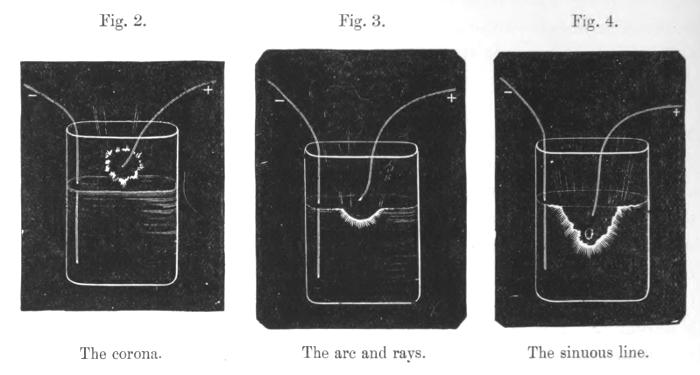
Fig. 2. The corona.
Fig. 3. The arc and rays.
Fig. 4. The sinuous line.