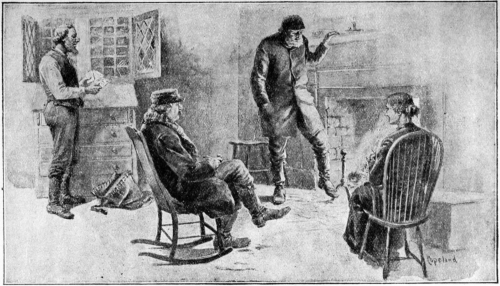
It was nearly school-time, but Jode didn't
seem to be at all in a hurry. He sat on the
wood-pile with the empty chip-basket beside
him, slowly untying his shoes. The old gobbler
strutted around the corner of the kitchen,
and halted suddenly with one foot drawn up,
as he caught sight of the red stockings.
"Quit! quit!" he cried, stretching his neck
with an angry gobble.
Aunt Jane had come to the door to shake the
table-cloth. She stood a moment, sniffing the
warm spring air, and peering up at the pink
peach-tree buds through her spectacles.
"Quit! quit!" cried the turkey again, and
his angry voice attracted her attention.
"Well, Mary Ann," she exclaimed, "I just
wish you'd see what that boy's a-doin'! It isn't
for me to say, but if he was mine, he'd not go
around barefoot this kind of weather. Next
thing will be croup. You'd better 'tend to
him."
"Meddlesome old thing!" muttered Jode,
disrespectfully, throwing a chip at the gobbler.
"Both of you had to go and tell."
The table-cloth whisked into the kitchen, followed
by the complaining voice, and soon after
his mother came to the door and called him.
"Have you fed the calves, Joseph?"
"Yes'm."
"And filled the chip-basket?"
"Almost."
"Then hurry, my son; it is nearly school-time."
"I say, ma," he began, "can't I go barefooted?
It's plenty warm, and lots of the boys
do."
"Why, no, child," she answered. "I told
you the other day not to think of such a thing
for another month at least. Put on your shoes
immediately, and don't let me hear another
word about it. It's of no use to tease."
Jode knew that, perfectly. In all the ten
years of his varied experiences, it never had
been of any use. Now, although the feet that
slipped back into the red stockings and stout
shoes were very loath to go, they went slowly
but surely in.
"Wish't I was an Indian," he said, as he
went through the orchard, balancing his geography
on his head and swinging his lunch-basket,
while the dog frisked around him. He
had a queer way of talking to himself. "I
could stay out-doors all the time then, and never
have to go to school. Indians have a better
time than anybody, 'thout it's dogs. O Penny,
ain't you glad you're a dog?"
The first bell was just beginning to ring
when he went through the gate at the end of
the lane, so he had plenty of time to stop when
he reached Squire Hooper's barn, and look at
the flaming show-bills with which it was covered.
Johnny Harris was there ahead of him, and
he noticed, with a pang of envy, that his feet
were bare, and that his stubby toes were digging
up the soft earth, as he stood looking at
the pictures.
"I'm goin' to the show," announced Jode,
proudly. "Our hired man said he'd take me
if I'd pay. Pa always pays me every spring
for dropping corn, so I'll have more than
enough."
Johnny did not say anything, for his father
was the drunken shoemaker of the little settlement,
and the cross-road tavern took all their
spare pennies. He stood and looked with longing
eyes at the pictures of the animals. He
knew what a stir there would be circus-day.
How the wagons would begin to rattle along
the roads at daylight from all directions; and
how the band would play in town; and the
frightened country horses would prance, and
the crowds of people would block the streets
to see the long, gay procession. But it would
be six miles away, and he would miss it all.
While they looked at the side-show pictures,—the
fat woman and the two-headed
man and the African giant,—the second bell
began to ring and away they raced to the
schoolhouse. In his haste Jode left his geography
on the gate-post by Squire Hooper's
barn, and never thought of it again until after
the noon-hour, when they came tramping in
from the playground.
"You are very careless, Joseph," said the
teacher. "Sit with Harris to study, and don't
let it happen again, sir."
The boys put their heads together behind the
map of the New England States, and began
studying their boundaries.
"Let's begin with the littlest," whispered
Jode. "And don't you talk to me, old fellow;
I don't want to be kept in again after school.
Rhode Island is bounded on the north by Massachusetts,
on the east by—"
"Oh, say," interrupted Johnny, "I've got
some field-mice in a box at home. I was going
to bring them to-day, but was afraid the
teacher would take 'em away. They're the
cunningest little things! Come over after
school and I'll show 'em to you."
"All right," whispered Jode, with one eye
on the teacher. "On the north by Massachusetts,
on the east by Massachusetts and Atlantic
Ocean, on the south by—"
"Oh gracious! look there!" interrupted
Johnny again. "Look at Boney Woods!
What's he a-doin'?"
Boney had his book propped up in front of
him. His head was bowed studiously over
his lesson, but his lesson was farthest from
his thoughts. He had cut a piece of leather
from the top of his boot-leg, and was making
a pair of spectacles.
"Oh, never mind him. Come on, and let's
learn this. I've got through half the day all
right, and don't want to spoil it all now.
Rhode Island is bounded on the north by
Massachusetts, on the east by Massachusetts
and Atlantic Ocean, on the south by Atlantic—"
"I say, Jode," interrupted his seat-mate, "I
can pick up three marbles at a time with my
toes."
"So could I," answered Jode, "if I didn't
have my shoes on."
"Bet you couldn't!"
"Bet I could!"
"Take 'em off and try," coaxed Johnny.
"Well, I'll just show you," retorted Jode.
There was a class in algebra at the board,
and the teacher was very busy explaining some
problem. "Let x equal the length of the fish,"
he was saying. Jode raised his foot carefully
and began to untie his shoe.
"And let y equal the length of its tail,"
continued the teacher, completely absorbed in
the problem.
In a moment the shoe slipped off noiselessly,
and Johnny put three of his largest marbles in
a row on a crack in the floor.
"Aw, that ain't fair," said Jode. "You
can't pick up that big Pompey yourself. Put
down three little grays."
Johnny grumbled, but made the change, and
Jode triumphantly picked them up with his
toes.
"There," said he. "What did I tell you?"
Just then one of the marbles began to slip. He
tried to regain his hold, and all three of them
dropped noisily, and went rolling across the
floor.
The teacher turned quickly, and his eyes
fell, not on Johnny and Jode, but on Boney
Woods, who had finished the spectacles and
put them on, and was now lolling out his
tongue, and making hideous faces at the
smaller children.
So intent was he on this, that he did not
know he was being watched, until the awful
stillness that had settled over the noisy room
warned him that something was the matter.
Then he faced around in his seat in great haste,
to make the discovery that he was the centre
of attraction.
"Are you quite through with your little
exhibition, Bonaparte?" asked the teacher.
"Come here! Just as you are—don't take
them off."
Poor Boney went up with fear and trembling.
"I'll settle with you after school, sir. Take
a seat on the platform and study your lesson."
Boney stumbled to his place, and sat looking
at his book, with hot, briny tears stealing down
under the huge spectacles. From past experiences
he had learned too well what that meant.
The school settled down into almost breathless
silence, and the guilty couple began to study
violently.
"I can't get my shoe laced up without his
seeing me," whispered Jode, presently.
"Oh, leave it off," begged Johnny, "and
slip the other one off, too. It feels awful good
to get rid of shoes." He stretched out his ten
little brown toes, and surveyed them with a
satisfied air. "See them feet?" he asked.
"Them old feet don't care for nothing but
glass. They can stand rocks or anything.
Why, in summer, I can tramp down the thorniest
kind of bushes, blackberryin', and never
mind the briars a bit."
"Aw, I wouldn't be such a brag," responded
Jode. Nevertheless, he silenced the inward
voice that reminded him of his mother's command,
and followed his little friend's example.
It was soon time for the afternoon recess,
and they all went trooping out into the warm
sunshine, all but Boney, doomed to solitude
and the leather spectacles.
Half a dozen boys crossed the playground,
and went to the blacksmith shop on the other
side of the road. Jode followed slowly, for the
sticks and stones hurt his bare feet, and his
conscience hurt him more, as he remembered
his mother's parting instructions.
As usual the good-natured blacksmith was
busy at his anvil, and paid no attention to the
crowd of boys making themselves at home in
his smithy. A seedy-looking stranger on a
mule rode up to the door to have a loose shoe
fastened in place.
"Be keerful, young 'uns," he drawled, "this
'ere mewel's heels is loaded."
The boys shoved back a little to give the newcomer
more room, and then kept on shoving
each other in play. The end boy fell against
Johnny, and Johnny fell against Jode, and
Jode took another step backward. This time
his little bare foot came down on the piece of
hot iron that the blacksmith had thrown aside
when he went to wait on his new customer.
Jode never distinctly remembered what happened
after that, he was so nearly crazed with
the fierce pain. He knew that the blacksmith
lifted him in his strong arms, and carried him,
screaming, to the house. He felt some woman
bandage his foot with something cool and
soothing, and wash his hot, flushed face. Then
two of the big boys carried him home, and laid
him on the sitting-room lounge, and went off,
forgetting to close the door.
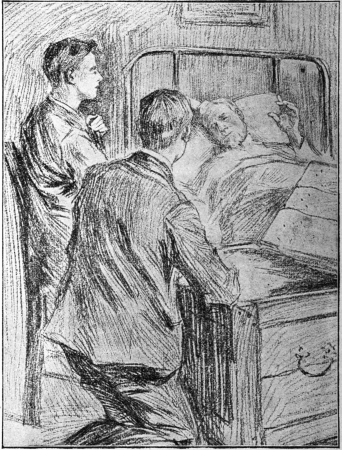
He sat up and called his mother. No one
answered. Everything was so still about the
house that his own voice sounded strange when
he called. Then he remembered that she had
gone to a quilting that afternoon, and that
Aunt Jane had built a fire away down by the
ash-hopper and was making soap. So it was
useless to call.
Three or four chickens, seeing the door open,
seized that opportunity to venture in, and
walked around pecking at the carpet, and looking
inquiringly at the disconsolate figure on
the lounge.
"Shoo!" he cried, savagely, "you tormentin'
old things!" Then he hopped across
the room and banged the door after them, and
hopped back.
The throbbing pain in his foot, and the
deserted appearance of the house, brought the
tears to his eyes. Then he remembered the
show, and that his foot would not be well
enough for him to earn the money dropping
corn. He would have to miss it. Throwing
himself on the lounge again, he cried softly to
himself with great sobs that nearly choked
him.
When his mother came home, she found
him fast asleep with cheeks and lashes wet, and
sobbing at intervals in his sleep.
Aunt Jane undertook to lecture him next day
about his disobedience and what it led to, but
he began to cry again, and she relented.
"Well, Joseph," she said, looking over her
square-bowed spectacles, "I guess you've had
a hard lesson, and one you won't forget in a
hurry. As long as your heart's set on goin'
to that show, if you'll learn to sew carpet-rags
I'll pay you by the pound, and you can earn
the money that way."
So Jode went patiently to work with thread
and needle, and all those long April days sat in
the house with his foot on a pillow, and sewed
yards and yards of carpet-rags.
The pounds grew slowly, but the day came
at last when he rolled his balls into the sack
with Aunt Jane's, and two new silver dimes and
a nickel jingled in his pockets.
Johnny Harris came every day to ask about
the foot, and see the size of the balls. He
looked enviously at the shining coins when
Jode proudly displayed them.
"Gracious! Ain't she pretty?" he exclaimed,
spinning one of the dimes around
on the table. Then he balanced it on his
thumb-nail, and tried its edge with his teeth,
and finally put it in his mouth, while he watched
Aunt Jane get out the steelyards, to weigh the
warp for the new carpet.
Presently he turned to Jode with a white,
scared face. "Oh, I've done swallered it!"
"You mean old thing," cried Jode. "I
worked days and days to earn that dime. O
Johnny! what did you do it for?"
"I didn't mean to," protested Johnny,
eagerly. "It just slipped down as easy—this
way." Suiting the action to the word, he
took up the other dime, and popped it into
his mouth.
"I was rolling it 'round with my tongue this
way, and I sort o' choked, and it just slipped—ker-che-ew!"
Unlucky Johnny! This dime slipped also,
for a mighty sneeze seized him, and sent the
money rolling across the floor. Both boys
darted after it with outstretched hands, but it
bounced through the open door, and slipped out
of sight behind the old stone steps. It was
useless to attempt to move them. The toys
of half a century had found a hiding-place in
that crack, and Aunt Jane herself had, years
ago, seen it swallow up the cherished treasure
of her childish affection—a string of amber
beads.
Johnny stood in open-mouthed horror at
what he had done, while Jode's gaze wandered
from the steps to Johnny, as if he saw the
whole menagerie, animals, tent and all, disappearing
down that gaping crack and the little
red throat. It was more than he could bear.
"It's all your fault, Johnny Harris; if it
hadn't been for you, I wouldn't have burnt
my foot in the first place. I just can't bear
to do it all over again, and besides, there isn't
time anyway."
He lifted his hand angrily, and slapped
Johnny's fat, freckled face. Then both the
boys began to cry.
Aunt Jane disappeared in the closet for something,
and stood there a moment, shaking with
inaudible laughter, till the square-bowed spectacles
slid down her nose. She looked very
stern, though, when she came out and said,
"There! there! boys, that's enough. It's no
use to cry over spilled milk or swallowed
money, either."
"Oh, please, ma'am, Miss Jane," begged
Johnny, "won't you teach me to sew carpet-rags?
I'll pay him back sure if you'll let me."
Aunt Jane looked at the clumsy little hands,
brown, dirty, and covered with warts, and
shook her head. It seemed a hopeless task.
But the earnest look on the face and in the
anxious eyes made her relent, and she gave a
reluctant promise.
The rag-sewing commenced again. This
time two boys sat on the door-step, longing to
be out in the spring wind and sunshine, and
one nursed his lame foot, and one wrestled
manfully with thread that would snarl, and
needles that would stick into his clumsy fingers.
As they sewed they talked, and the subject
that came up oftenest was the circus. How
Johnny longed to go! After awhile a hope
whispered to him, that maybe he could pay his
debt to Jode in time to earn enough money to
go himself.
Although Aunt Jane sorted the rags so that
most of the short ones fell to her lot, and the
long ones to Johnny's, and contributed many a
yard on the sly, Jode's foot was well before
Johnny proudly paid over the two dimes, and
only a long, red scar remained, to remind Jode
of his disobedience and punishment.
"Wisht I was goin', too," sighed Johnny,
when the last pound was weighed and delivered.
Then, regardless of ceremony, he pulled his
hat over his eyes, and started home on the run.
He did not go all the way. Aunt Jane spied
him when she went to the barn for eggs. He
was lying on the hay with his face in his
arms.
She stood and looked at him a moment,
thinking what an honest little heart it was,
beating under the patched, faded jacket,—thinking
of his drunken father and his miserable
home,—of how much he wanted to go
with the other boys, and how keenly he felt
his poverty.
Then she took the eggs to the house, and
tying her sunbonnet tighter, started resolutely
down the lane to the big road in the direction
of Johnny's home. The hand under her gingham
apron gripped firmly an old leather purse.
That evening as Jode sat in the twilight,
just inside the door, listening to the frogs
croaking in the meadow-pond, a dusky little
figure came running down the path. It was
Johnny.
"Hi! Jode," he cried, "I'm a-goin', too!
I'm a-goin', too! I'm too glad to hold still.
The money jest rained down like the manna on
ole Moses! I don't know who left it, but it
was left at our house, and it was left fer me!"
Then, throwing himself on the ground, he
turned one somersault after another down the
path into the dewy darkness of the warm April
night.