“Had I a little son, I would christen him
Nothing-to-do.”
Charles
Lamb.
There is a complaint which is not
to be found in the doctor’s books, but which is,
nevertheless, such a common and troublesome one, that one
heartily wishes some physic could be discovered which would cure
it.
It may be called the nothing-to-do complaint.
Even quite little children are subject to it, but they never
have it badly. Parents and nurses have only to give them
something to do, or tell them of something to do, and the thing
is put right. A puzzle or a picture-book relieves the
attack at once.
But after the children have out-grown puzzles, and
picture-books, and nurses, and when even a parent’s advice
is received with a little impatience, then the
nothing-to-do complaint, if it seizes them at all, is a
serious disease, and often very difficult to cure; and, if not
cured, alas! then follows the melancholy spectacle of grown-up
men and women, who are a plague to their friends, and a weariness
to themselves; because, living under the notion that there is
nothing for them to do, they want everybody else to
do something to amuse them.
Anyone can laugh at the old story of the gentleman who got
into such a fanciful state of mind—hypochondriacal, it is
called—that he thought he was his own umbrella; and so, on
coming in from a walk, would go and lay it in the
easy-chair by the fire, while he himself went and leant up
against the wall in a corner of the hall.
But this gentleman was not a bit more fanciful and absurd than
the people, whether young or old, who look out of windows on
rainy days and groan because there is nothing to do; when,
in reality, there is so much for everybody to do, that most
people leave half their share undone.
The oddest part of the complaint is, that it generally comes
on worst in those who from being comfortably off in the world,
and from having had a great deal of education, have such a
variety of things to do, that one would fancy they could never be
at a loss for a choice.
But these are the very people who are most afflicted. It
is always the young people who have books, and leisure, and
music, and drawing, and gardens, and pleasure-grounds, and
villagers to be kind to, who lounge to the rain-bespattered
windows on a dull morning, and groan because there is nothing
to do.
In justice to girls in general, it should be here mentioned,
that they are on the whole less liable to the complaint than the
young lords of the creation, who are supposed to be their
superiors in sense. Philosophers may excuse this as they
please, but the fact remains, that there are few large families
in England, whose sisterhoods have not at times been teazed half
out of their wits, by the growlings of its young gentlemen,
during paroxysms of the nothing-to-do complaint; growling
being one of its most characteristic symptoms.
Perhaps among all the suffering sisterhoods it would have been
difficult to find a young lady less liable to catch such a
disorder herself, than Aunt Judy; and perhaps that was the reason
why she used to do such tremendous battle with No. 3, whenever,
after his return from school for the holidays, he happened to
have an attack.
“What are you groaning at through the window, No.
3?” she inquired on one such occasion; “is it
raining?”
A very gruff-sounding “No,” was the
answer—No. 3 not condescending to turn round as he
spoke. He proceeded, however, to state that it had rained
when he got up, and he supposed it would rain again as a
matter-of-course, (for his especial annoyance being implied,) and
he concluded:—
“It’s so horribly ‘slow’ here, with
nothing to do.”
No. 6, who was sitting opposite Aunt Judy, doing a French
exercise, here looked up at her sister, and perceiving a smile
steal over her face, took upon herself to think her
brother’s remark very ridiculous, so, said she, with a
saucy giggle:—
“I can find you plenty to do, No. 3, in a minute.
Come and write my French exercise for me.
No. 3 turned sharply round at this, with a frown on his face
which by no means added to its beauty, and called out:—
“Now, Miss Pert, I recommend you to hold your
tongue. I don’t want any advice from a conceited
little minx like you.”
Miss Pert was extinguished at once, and set to work at the
French exercise again most industriously, and a general silence
ensued.
But people in the nothing-to-do complaint are never quiet for
long. Teazing is quite as constant a symptom of it, as
growling, so No. 3 soon came lounging from the window to the
table, and began:—
“I say, Judy, I wish you would put those tiresome books,
and drawings, and rubbish away, and I think of something to
do.”
“But it’s the books, and the drawings, and the
rubbish that give me something to do,” cried Aunt
Judy. “You surely don’t expect me to give them
up, and go arm and arm with you round the house, bemoaning the
slowness of our fate which gives us nothing to do. Or shall
we? Come, I don’t care; I will if you like. But
which shall we complain to first, mamma, or the maids?”
While she was saying this, Aunt Judy shut up her drawing book,
jumped up from her chair, drew No. 3’s arm under her own,
and repeated:—
“Come! which? mamma, or the maids?” while Miss
Pert opposite was labouring with all her might to smother the
laugh she dared not indulge in.
But No. 3 pushed Aunt Judy testily away.
“‘Nonsense, Judy! what has that to do with
it? It’s all very well for you girls—now, Miss
Pert, mind your own affairs, and don’t stare at
me!—to amuse yourself with all manner of—”
“Follies, of course,” cried Aunt Judy, laughing,
“don’t be afraid of speaking out, No. 3.
It’s all very well for us girls to amuse ourselves with all
manner of follies, and nonsense, and rubbish;” here Aunt
Judy chucked the drawing-book to the end of the table, tossed a
dictionary after it, and threw another book or two into the air,
catching them as they came down.
“—while you, superior, sensible young man that you
are, born to be the comfort of your family—”
“Be quiet!” interrupted No. 3, trying to stop her;
but she ran round the table and proceeded:—
“—and the enlightener of mankind;
can’t—no, no, No. 3, I won’t be
stopt!—can’t amuse yourself with anything, because
everything is so ‘horribly slow, there’s nothing to
do,’ so you want to tie yourself to your foolish
sister’s apron string.”
“It’s too bad!” shouted No. 3; and a race
round the table began between them, but Aunt Judy dodged far too
cleverly to be caught, so it ended in their resting at opposite
ends; No. 6 and her French exercises lying between them.
“No. 6, my dear,” cried Aunt Judy, in the lull of
exertion, “I proclaim a holiday from folly and
rubbish. Put your books away, and put your impertinence
away too. Hold your tongue, and don’t be Miss Pest;
and vanish as soon as you can.”
Miss Pert performed two or three putting-away evolutions with
the velocity of a sunbeam, and darted off through the door.
“Now, then, we’ll be reasonable,” observed
Aunt Judy; and carrying a chair to the front of the fire she sat
down, and motioned to No. 3 to do the same, taking out from her
pocket a little bit of embroidery work, which she kept ready for
chatting hours.
No. 3 was always willing to listen to Aunt Judy.
He desired nothing better than to get her undivided attention,
and pour out his groans in her ear; so he sat down with a very
good grace, and proceeded to insist that there never was anything
so “slow” as “it was.”
Aunt Judy wanted to know what it was; the place or the
people, (including herself,) or what?
No. 3 could explain it no other way than by declaring that
everything was slow; there was nothing to do.
Aunt Judy maintained that there was plenty to do.
Whereupon No. 3 said:—
“But nothing worth doing.”
Whereupon Aunt Judy told No. 3 that he was just like Dr.
Faustus. On which, of course, No. 3 wanted to know what Dr.
Faustus was like, and Aunt Judy answered, that he was just like
him, only a great deal older and very learned.
“Only quite different, then,” suggested No. 3.
“No,” said Aunt Judy, “not quite
different, for he came one day to the same conclusion that you
have done, namely, that there was nothing to do, worth doing in
the world.”
“I don’t say the world, I only say
here,” observed No. 3; “there’s plenty to do
elsewhere, I dare say.”
“So you think, because you have not tried else
where,” answered Aunt Judy. “But Dr. Faustus,
who had tried elsewhere, thought everywhere alike, and declared
there was nothing worth doing anywhere, although he had studied
law, physic, divinity, and philosophy all through, and knew
pretty nearly everything.”
“Then you see he did not get much good out of
learning,” remarked No. 3.
“I do see,” was the reply.
“And what became of him?”
“Ah, that’s the point,” replied Aunt Judy,
“and a very remarkable point too. As soon as he got
into the state of fancying there was nothing to do, worth doing,
in God’s world, the evil spirit came to him, and found him
something to do in what I may, I am sure, call the devil’s
world—I mean, wickedness.”
“Oh, that’s a story written upon Watts’s old
hymn,” exclaimed No. 3, contemptuously:—
“‘For Satan finds some mischief
still,
For idle hands to do.’
Judy! I call that a regular
‘sell.’”
“Not a bit of it,” cried Aunt Judy, warmly;
“I don’t suppose the man who wrote the story ever saw
Watts’s hymns, or intended to teach anything half as
good. It’s mamma’s moral. She told me she
had screwed it out of the story, though she doubted whether it
was meant to be there.”
“And what’s the rest of the story then?”
inquired No. 3, whose curiosity was aroused.
“Well! when the old Doctor found the world as it was, so
‘slow,’ as you very unmeaningly call it, he
took to conjuring and talking with evil spirits by way of
amusement; and then they easily persuaded him to be wicked,
merely because it gave him something fresh and exciting to
do.”
“Watts’s hymn again! I told you so!”
exclaimed No. 3. “But the story’s all nonsense
from beginning to end. Nobody can conjure, or talk to evil
spirits in reality, so the whole thing is impossible; and where
you find the moral, I don’t know.”
No. 3 leant back and yawned as he concluded.
He was rather disappointed that nothing more entertaining had
come out of the story of Dr. Faustus.
But Aunt Judy had by no means done.
“Impossible about conjuring and actually talking
to evil spirits, certainly,” said she; “but spiritual
influences, both bad and good, come to us all, No. 3, without
bodily communion; so for those who are inclined to feel like Dr.
Faustus, there is both a moral and a warning in his
fate.”
“I don’t know what about,” cried No.
3. “I think he was uncommonly stupid, after all he
had learnt, to get into such a mess. Why, you yourself are
always trying to make out that the more people labour and learn,
the more sure they are to keep out of mischief. Now then,
how do you account for the story of your friend Dr.
Faustus?”
“Because, like King Solomon, he did not labour and learn
in a right spirit, or to a right end,” replied Aunt
Judy. “Lord Bacon remarks that when, after the
Creation, God ‘looked upon everything He had made, behold
it was very good;’ whereas when man ‘turned
him about,’ and took a view of the world and his own
labours in it, he found that ‘all’ was ‘vanity
and vexation of spirit.’ Why did he come to such a
different conclusion, do you think?”
“I suppose because the world had got bad, before King
Solomon’s time,” suggested No. 3.
“Its inhabitants had,” replied Aunt Judy.
“They had become subject to sin and misery; but the world
was still God’s creation, and proofs of the ‘very
good’ which He had pronounced over it were to be found in
every direction, and even in fallen man, if Solomon had had the
sense, or rather I should say, good feeling to look for
them. Ah! No. 3, there was plenty to be learnt and
done that would not have ended in ‘vanity and
vexation of spirit’ if Solomon had learnt in order
to trace out the glory of God, instead of establishing his own;
and if he had worked to create, as far as was in his
power, a world of happiness for other people, instead of seeking
nothing but his own amusement. If he had worked in the
spirit of God, in short.”
“But who can?—Nobody,” exclaimed No. 3.
“Yes, everybody, who tries, can, to a certain
extent,” said Aunt Judy. “It only wants the
right feeling; some of the good God-like feeling which originated
the creation of a beautiful world, and caused the contemplation
of it to produce the sublime complacency which is described,
‘And God looked upon everything that He had made, and
behold it was very good.’”
“It’s a sermon, Judy,” cried No. 3, half
bored, yet half amused at the notion of her preaching;
“I’ll set up a pulpit for you at once, shall
I?”
“No, no, be quiet, No. 3,” exclaimed Aunt Judy,
“I wish you would try and understand what I say!”
“Well, then,” said No. 3, “it appears to me
that do what one might now the world has grown bad, it would be
impossible to pronounce that ‘very good,’ as
the result of one’s work. There would always be
something miserable and unsatisfactory at the end of everything;
I mean even if one really was to look into things closely, and
work for other people’s good, as you say.”
“There might be something miserable and
unsatisfactory, in the result, certainly,” answered Aunt
Judy; “but that it would all be ‘vanity and
vexation of spirit’ I deny. Our blessed Saviour came
into the world after it had grown bad, remember; and He worked
solely for the restoration of the ‘very good,’ which
sin had defaced. It was undoubtedly miserable and
unsatisfactory that He should be rejected by the very
creatures He came to help; but when He uttered the words
‘It is finished,’ the work which He had accomplished,
He might well have looked upon and called very good: very very
good; even beyond the creation, were that possible.”
“There can be no comparison between our Saviour and
us,” murmured No. 3.
“No,” replied his sister; “but only let
people work in the same direction, and they will have more
‘profit’ of their ‘labour,’ than King
Solomon ever owned to, who had, one fears, only learnt, in order
to be learned, and worked, to please himself. No man who
employs himself in tracing out God’s footsteps in
the world, or in working in God’s spirit for the
world, will ever find such labours end in ‘vanity and
vexation of spirit!’ Solomon, Dr. Faustus, and the
grumblers, have only themselves to thank for their
disappointment.”
“It’s very curious,” observed No. 3, getting
up, and stretching himself over the fire, “I mean about
Solomon and Dr. Faustus. But what can one do? What
can you or I do? It’s absurd to be fancying one can
do good to one’s fellow-creatures.”
“Nevertheless, there is one I want you to do good to, at
the present moment,” said Aunt Judy—“if it is
not actually raining. Don’t you remember what despair
No. 1 was in this morning, when father sent her off on the pony
in such a hurry.”
“Ah, that pony! That was just what I wanted
myself,” interrupted No. 3.
“Exactly, of course,” replied Aunt Judy.
“But you were not the messenger father wanted, so do not
let us go all over that ground again, pray. The fact was,
No. 1 had just heard that her pet ‘Tawny Rachel’ was
very ill, and she wanted to go and see her, and give her some
good advice, and I am to go instead. Now No. 3, suppose you
go instead of me, and save me a wet walk?”
No. 3, of course, began by protesting that it was not possible
that he could do any good to an old woman. Old women were
not at all in his way. He could only say, how do you do?
and come away.
Aunt Judy disputed this: she thought he could offer her some
creature comforts, and ask whether she had seen the Doctor, and
what he said, as No. 1 particularly wished to know.
What an idea! No, no; he must decline inquiring what the
Doctor said; it would be absurd; but he could offer her something
to eat.
—And just ask if she had had the Doctor.—Well,
just that, and come away. It would not occupy many
minutes. But he wished, while Aunt Judy was about it, she
had found him something rather longer to do!
Aunt Judy promised to see what could be devised on his return,
and No. 3 departed. And a very happily chosen errand it
was; for it happened in this case, as it so constantly does
happen, that what was begun for other people’s sake, ended
in personal gratification. No. 3 went to see “Tawny
Rachel,” out of good-natured compliance with Aunt
Judy’s request, but found an interest and amusement in the
visit itself, which he had not in the least expected.
Ten, twenty, thirty, minutes elapsed, and he had not returned;
and when he did so at last, he burst into the house far more like
an avalanche than a young gentleman who could find “nothing
to do.”
Coming in the back way, he ran into the kitchen, and told the
servants to get some hot water ready directly, for he was sure
something would be wanted. Then, passing forward, he
shouted to know where his mother was, and, having found her,
entreated she would order some comfortable, gruelly stuff or
other, to be made for the sick old woman, particularly insisting
that it should have ale or wine, as well as spice and sugar in
it.
He was positive that that was just what she ought to
have! She had said how cold she was, and how glad she
should be of something to warm her inside; and there was nobody
to do anything for her at home. What a shame it was for a
poor old creature like that to be left with only two dirty boys
to look after her, and they always at play in the street!
Her daughter and husband were working out, and she sat moaning
over the fire, from pain, without anybody to care!
* * *
Tender-hearted and impulsive, if thoughtless, the spirit of
No. 3 had been moved within him at the spectacle of the gaunt old
woman in this hour of her lonely suffering.
Poor “Tawny Rachel!” The children had called
her so, from the heroine of Mrs. Hannah More’s tale,
because of those dark gipsy eyes of hers, which had formerly
given such a fine expression to her handsome but melancholy
face. Melancholy, because care-worn from the long
life’s struggle for daily bread, for a large indulged
family, who scarcely knew, at the day of her death, that she had
worn herself out for their sakes.
Poor “Tawny Rachel!” She was one day asked
by a well-meaning shopkeeper, of whom she had purchased a few
goods, where she thought she was going to?
“Tawny Rachel” turned her sad eyes upon her
interrogator, and made answer:—
“Going to? why where do you think I’m going to,
but to Heaven?—‘Deed! where do you think I’m
going to, but to Heaven?” she repeated to herself slowly,
as if to recover breath; and then added, “I should like to
know who Heaven is for, if not for such as me, that have slaved
all their lives through, for other folk;” and so saying,
Tawny Rachel turned round again, and went away.
Poor “Tawny Rachel!” The theology was
imperfect enough; but so had been her education and
advantages. Yet as surely as her scrupulous, never-failing
honesty, and unmurmuring self-denial, must have been inspired by
something beyond human teaching; so surely did it prove no
difficult task to her spiritual guide, to lead her onwards to
those simple verities of the Christian Faith, which, in her case,
seemed to solve the riddle of a weary, unsatisfactory life, and,
confiding in which, the approach of death really became to her,
the advent of the Prince of Peace.
* * *
“But she had quite cheered up,” remarked No. 3,
“at the notion of something comforting and good,” and
so—he had “come off at once.”
“At once!”—the exclamation came from Aunt
Judy, who had entered the room, and was listening to the
account. “Why, No. 3, you must have been there an
hour at least. And nevertheless I dare say you have
forgotten about the Doctor.”
“The Doctor!” cried No. 3,
laughing,—“It’s the Doctor who has kept me all
this time. You never heard such fun in your
life,—only he’s an awful old rascal, I must
say!”
Mamma and Aunt Judy gazed at No. 3 in bewilderment. The
respectable old village practitioner, who had superintended all
the deceases in the place for nearly half a century—to be
called “an awful old rascal” at last! What
could No. 3 be thinking of?
Certainly not of the respectable village practitioner, as he
soon explained, by describing the arrival at Tawny Rachel’s
cottage of a travelling quack with a long white beard.
“My dear No. 3!” exclaimed mamma.
“Mother, dear, I can’t help it!” cried No.
3, and proceeded to relate that while he was sitting with the old
woman, listening to the account of her aches and pains, some one
looked in at the door, and asked if she wanted anything; but,
before she could speak, remarked how ill she seemed, and said he
could give her something to do her good.
“Judy!” added No. 3, breaking suddenly off; “he
looked just like Dr. Faustus, I’m sure!”
“Never mind about that,” cried Aunt Judy.
“Tell us what Tawny Rachel said.”
“Oh, she called out that he must give it, if she
was to have it, for she had nothing to pay for it with. I
had a shilling in my pocket, and was just going to offer it, when
I recollected he would most likely do her more harm than
good. But the gentleman with the white beard walked in
immediately, set his pack down on the table, and said,
‘Then, my good woman, I shall give it you;’
and out he brought a bottle, tasted it before he gave it to her,
and promised her that it would cure her if she took it
all.”
“My dear No. 3!” repeated mamma once more.
“Yes, I know she can’t be cured, mother, and I
think she knows it too; but still she ‘took it very
kind,’ as she called it, of him, and asked him if he
would like to ‘rest him’ a bit by the fire, and the
gentleman accepted the invitation; and there we all three sat,
for really I quite enjoyed seeing him, and he began to warm his
hands, remarking that the young gentleman—that was I, you
know—looked very well. Oh, Judy, I very nearly said
‘Thank you, Dr. Faustus,’ but I only laughed and
nodded, and really did hold my tongue; and then the two began to
talk, and it was as good as any story you ever invented, Aunt
Judy. Tawny Rachel was very inquisitive, and asked
him:—
“‘You’ve come a long way, sir, I
suppose?’
“‘Yes, ma’am; I’m a great traveller,
and have been so a many years.’
“‘It’s a wonder you have not settled before
now.’
“‘I might have settled, ma’am, a many
times.’
“‘Ah, when folks once begin wandering, they
can’t settle down. You were, maybe, brought up to
it.’
“‘I was brought up to something a deal better than
that, ma’am.’
“‘You was, sir? It’s a pity, I’m
sure.’
“‘My father was physician to Queen Elizabeth,
ma’am, a many years.’”
When No. 3 arrived at this point of the dialogue, mamma and
Aunt Judy both exclaimed at once, and the former repeated once
more the expostulatory “My dear No. 3!” which
delighted No. 3, who proceeded to assure them that he had himself
interrupted the travelling quack here, by suggesting that it was
Queen Charlotte he meant.
“Old Queen Charlotte, you know, Judy, that No. 1 was
telling the children about the other day.”
But the “gentleman,” as No. 3 called him, had
turned very red at the doubt thus thrown on his accuracy, and put
a rather threatening croak into his voice, as he said:—
“Asking your pardon, young gentleman, I know what
I’m saying, and it was Queen Elizabeth, and not Charlotte
nor anybody else!”
No. 3 described that he felt it best, after this, to hold his
tongue and say no more, so Tawny Rachel put in her word, and
remarked, it was a wonder the queen hadn’t made their
fortunes; on which the gentleman turned rather red again, and
said that the queen did make their fortune, but wouldn’t
let them keep it, for fear they should be too great and too
rich—that was it! This statement required a little
explanation, but the gentleman was ready with all
particulars. The queen used to pay his father by hundreds
of pounds at a time, because that was due to him, but being
jealous of his having so much money, she always set some one to
take it away from him as he left the place! So that was the
reason why these was no fortune put by for him after his father
died, and that was the reason why he couldn’t very well
settle at first, though everybody wished him to stay, and
so he took to travelling; for his father had left him all
his secrets, and he was qualified to practise anywhere, and had
cured some thousands of sick folks up and down!
No. 3 declared that he had not made the old man’s
account of himself a bit more unconnected than it really was,
and, on the whole, it sounded very imposing to poor Tawny Rachel,
who watched his departure with a sort of respectful awe.
No. 3 added, that not liking to disturb her faith either in
the man or the bottle, he had himself helped her to the first
dose, and had then begun to talk about the creature comforts
before described, the very mention of which seemed to cheer the
old lady’s heart, and to interest her at least as much as
the biography of the travelling quack.
“So now, mother,” concluded he, “order the
gruel, and we’ll give three cheers for Queen Elizabeth, and
Dr. Faustus—eh, Judy? But I do think the poor old
thing ought not to take that man’s poisonous rubbish; so
here’s my shilling, and welcome, if you’ll give some
more, and let us send for a real doctor.”
The “nothing-to-do” morning had nearly slipped
away, between the conversation with Aunt Judy, and the visit to
Tawny Rachel; and when, soon after, a friend called to take No. 3
off on a fossil hunt, and he had to snatch a hasty morsel before
his departure, he declared he was like the poor governess in the
song, who was sure to
“Find out,
With attention and zeal,
That she’d scarcely have time
To partake of a meal,”
there was so much to do. “But you’re a
capital fellow, Judy,” he added, kissing her, “and
you’ll tell me a story when I come back;” and off he
ran, shutting his ears to Aunt Judy’s declaration that she
only told stories to the “little ones.”
Nor would she, on his return, and during the cozy evening
“nothing-to-do” hour, consent to devote herself to
his especial amusement only. So, after arguing the point
for a time, he very wisely yielded, and declared at last that he
would be a “little one” too, and listen to a
“little one’s” story, if Aunt Judy would tell
one.
It was rather late when this was settled, and the little ones
had stayed up-stairs to play at a newly-invented
game—bazaars—in the nursery; but when No. 3 strode in
with the announcement of the story, there was a shout of delight,
followed by the old noisy rush down-stairs to the
dining-room.
It is not a bad thing to be a “little one” now and
then in spirit. People would do well to try and be so
oftener. Who that has looked upon a picture of himself as a
“little one,” has not wished that he could be
restored to the “little one’s” spirit, the
“little one’s” innocence, the “little
one’s” hopeful trust? “Of such is the
kingdom of Heaven!” And though none of us would like
to live our lives over again, lest our errors should be repeated,
and so doubled in guilt, all of us, at the sight of what we once
were, would fain, very fain, if we could, lie down to sleep, and
awake a “little one” again. Never, perhaps, is
the sweet mercy of an early death brought so closely home to our
apprehension, as when the grown-up, care-worn man looks upon the
image of himself as a child.
Happily, however—nay, more than happily,
mercifully—the grown-up man, if he do but put on the
humility, may gain something of the peace of a “little
one’s” heart!
Aunt Judy had twisted up a roll of muslin for a turban on her
head by the time they came down, “for,” said she,
“this is to be an eastern tale, and I shall not be
inspired—that is to say, I shall not get on a
bit—unless there is a costume and manners to correspond, so
you three little ones squat yourselves down Turkish-fashion on
the floor, with your legs tucked under you. There now!
that’s something like, and I begin to feel myself in the
East. Nevertheless, I am rather glad there is no critical
Eastern traveller at hand, listening through the key-hole to my
blunders.
“However, errors excepted, here is the wonderful story
of
“A great many years ago, in a country which cannot be
traced upon the maps, but which lies somewhere between the great
rivers Indus and Euphrates, lived Schelim, King of the Hills.
“His riches were unlimited, his palaces magnificent, and
his dresses and jewels of the most costly description. He
never condescended to wear a diamond unless it was inconveniently
large for his fingers, and the fiery opals which adorned his
turban (like those in the mineral-room at the British Museum)
shimmered and blazed in such a surprising manner, that people
were obliged to lower their eyes before the light of them.
“Powerful as well as rich, King Schelim could have
anything in the world he wished for, but—such is the
perversity of human nature—he cared very little for
anything except smoking his pipe; of which, to say the truth, he
was so fond, that he would have been well contented to have done
nothing else all day long. It seemed to him the nearest
approach to the sublimest of all ideas of human
happiness—the having nothing to do.
“He caused his four sons to be brought up in luxurious
ease, his wish for them being, that they should remain ignorant
of pain and sorrow for as long a period of their lives as was
possible. So he built a palace for them, at the summit of
one of his beautiful hills, where nothing disagreeable or
distressing could ever meet their eyes, and he gave orders to
their attendants, that they should never be thwarted in
anything.
“Every wish of their hearts, therefore, was gratified
from their baby days; but so far from being in consequence the
happiest, they were the most discontented children in his
dominions.
“From the first year of their birth, King Schelim had
never been able to smoke his pipe in peace. There were
always messages coming from the royal nursery to the
smoking-room, asking for something fresh for the four young
princes, who were, owing to some mysterious cause, incapable of
enjoying any of their luxurious indulgences for more than a few
hours together.
“At first these incessant demands for one thing or
another for the children, surprised and annoyed their papa
considerably, but by degrees he got used to it, and took the
arrival of the messengers as a matter of course.
“The very nurses began it:—
“‘May it please your Majesty, the young princes,
your Majesty’s incomparable sons—may their shadows
never be less!—are tired of their jewelled rattles, and
have thrown them on the floor. Doubtless they would like
India-rubber rings with bells better.’
“‘Then get them India-rubber rings with
bells,’ was all King Schelim said, and turned to his pipe
again.
“And so it went on perpetually, until one day it came
to,—
“‘May it please your Majesty, the young princes,
your Majesty’s incomparable sons—may their shadows
never be less!—have thrown their hobbyhorses into the
river, and want to have live ponies instead.’
“At the first moment the king gave his usual answer,
‘Then get them live ponies instead,’ from a sort of
mechanical habit, but the words were scarcely uttered when he
recalled them. This request awoke even his sleepy soul out
of its smoke-dream, and inquiring into the ages of his sons, and
finding that they were of years to learn as well as to ride, he
dismissed their nurses, placed them in the hands of tutors, and
procured for them the best masters of every description.
“‘For,’ said he, ‘what saith the
proverb? “Kings govern the earth, but wise men govern
kings.” My sons shall be wise as well as kingly, and
then they can govern themselves.’
“And after settling this so cleverly, King Schelim
resumed his pipe, in the confident hope, that now, at last, he
should smoke it in peace.
“‘For,’ said he, ‘when my sons shall
become wise through learning, they will be more moderate in their
desires.’
“I do not know whether his Majesty’s incomparable
sons relished this change from nurses to tutors, but on that
particular point they were allowed no choice; so if they bemoaned
themselves in their palace on the hill, their father knew nothing
of it.
“And to soften the disagreeableness of the restraint
which learning imposes, King Schelim gave more strict orders than
ever, that, provided the young gentlemen only learnt their
lessons well, every whim that came into their heads should be
complied with soon as expressed.
“In spite of all his ingenious arrangements, however,
the royal father did not enjoy the amount of repose he
expected. All was quiet enough during lesson-hours, it is
true; but as soon as ever that period had elapsed, the young
princes became as restless as ever. Nay—the older
they grew, the more they wanted, and the less pleased they became
with what was granted.
“From very early days of the tutorship, the old story
began:—
“‘May it please your Majesty, the young princes,
your Majesty’s incomparable sons—may their shadows
never be less!—are tired of their ponies, and want horses
instead.’
“The king was a little disappointed at this, and
actually laid down his pipe to talk.
“‘Is anything the matter with the ponies?’
he asked.
“‘May it please your Majesty, no; only that your
incomparable sons call them slow.’
“‘Spirited lads!’ thought the king, quite
consoled, and gave the answer as usual:—
“‘Then get them horses instead.’ But
when only a few days afterwards he was informed that his
incomparable sons had wearied of their horses, because they also
were ‘slow,’ and wished to ride on elephants instead,
his Majesty began to feel disturbed in mind, and wonder what
would come next, and how it was that the teaching of the tutors
did not make his sons more moderate in their desires.
“‘Nevertheless,’ said he, ‘what saith
the proverb, “Thou a man, and lackest
patience?” And again,
“Early ripe, early rotten,
Early wise, soon forgotten.”
My sons are but children yet.’
“After which reflection he returned to his pipe as
before, and disturbed himself as little as possible, when
messenger after messenger arrived, to announce the fresh vagaries
of the young princes.
“It is impossible to enumerate all the luxuries,
amusements, and delights, they asked for, obtained, and wearied
of during several years. But the longer it went on, the
more hardened and indifferent their father became.
“‘For,’ said he, ‘what saith the
proverb? “The longest lane turns at
last.” At last my sons will have everything man can
wish for, and then they will cease from asking, and I shall smoke
my pipe in peace.’
“One day, however, the messenger entered the royal
smoking-room in a greater hurry than ever, and was about to
commence his usual elaborate peroration respecting the
incomparable sons, when his Majesty held up his hand to stop him,
and called out:—
“‘What is it now?’
“‘May it please your Majesty, your Majesty’s
in—’
“‘What is it they want?’ cried the
king, interrupting him.
“‘May it please your Majesty, something to
do.’
“‘Something to do?’ repeated the perplexed
king of the hills; ‘something to do, when half the riches
of my empire have been expended upon providing them with the
means of doing everything in the world that was delightful to the
soul of man?
“‘Surely, oh son of a dog, thou art laughing at my
beard, to come to me with such a message from my sons.’
“‘Nevertheless, may it please your Majesty, I have
spoken but the truth. Your Majesty’s
in—’
“‘Hush with that nonsense,’ interrupted the
king.
“‘Your Majesty’s sons, in fact, then, have
sickened and pined for three mortal days, because they have got
nothing to do.’
“‘Now, then, my sons are mad!’ exclaimed
poor King Schelim, laying down his pipe, and rising from his
recumbent position; ‘and it is time that I bestir
myself.’
“And thereupon he summoned his attendants, and sent for
the royal Hakim, that is to say, physician; and the most learned
and experienced Dervish, that is to say, religious teacher of the
neighbourhood.
“‘For,’ said he, ‘who knows whether
this sickness is of the body or the soul?’
“And having explained to them how he had brought up his
children, the indulgences with which he had surrounded them, the
learning which he had had instilled into them, and the way in
which he had preserved them from every annoying sight and sound,
he concluded:—
“‘What more could I have done for the happiness of
my children than I have done, and how is it that their reason has
departed from them, so that they are at a loss for something to
do? Speak one or other of you and explain.’
“Then the Dervish stepped forward, and opening his
mouth, began to make answer.
“‘And,’ said he, ‘oh King of the
Hills, in the bringing up of thy sons, surely thou hast forgotten
the proverb which saith, “He that would know good manners,
let him learn them from him who hath them not.” For
even so may the wise man say of happiness, “He that would
know he is happy, must learn it from him who is not.”
But again, doth not another proverb say, “Will thy candle
burn less brightly for lighting mine?” Wherefore the
happiness which a man has, when he has discovered it, he is bound
to impart to those that have it not. Have I spoken
well?’
“Then King and the Hakim declared he had spoken
remarkably well; nevertheless I am by no means sure that King
Schelim knew what he meant. Whereupon the Dervish offered
to go at once to the four incomparable princes, and cure them of
their madness in supposing they had nothing to do, and King
Schelim in great delight, and thoroughly glad to be rid of the
trouble, told him that he placed his sons entirely in his hands;
then taking him aside, he addressed to him a parting word in
confidence.
“‘Thou knowest, oh wise Dervish, that I have had
no education myself, and therefore, as the proverb hath it,
“To say I don’t know, is the comfort of my
life,” yet what better is a learned man than a fool, if he
comes but to this conclusion at last? See thou restore
wisdom and something to do to the souls of my sons.’
“Which the Dervish promised to accomplish, accordingly
in company with the Hakim, he betook himself to the palace of the
four princes, his Majesty’s incomparable sons.
“Well, in spite of all they had heard, both the Dervish
and Hakim were surprised at what they really found at the palace
of the four princes.
“It was as if everything that human ingenuity could
devise for the gratification, amusement, and occupation both of
body and mind had been here brought together. Horses,
elephants, chariots, creatures of every description, for hunting,
riding, driving, and all sorts of sport were there, countless in
numbers, and perfect in kind. Gardens, pleasure-grounds,
woods, flowers, birds, and fountains, to delight the eye and ear;
while within the palace were sources of still deeper
enjoyment. The songs of the poets and the wisdom of the
ancients reposed there upon golden shelves. Musicians held
themselves in readiness to pour exquisite melodies upon the air;
games, exercises, in-door sports in every variety could be
commanded in a moment, and attendants waited in all directions to
fulfil their young masters’ will.
“The poor old Dervish and Hakim looked at each other in
fresh amazement at every step they took, and neither of them
could find a proverb to fit so extraordinary a case.
“At last, after a long walk through chambers and
anti-chambers without end, hung round with mirrors and ornaments,
they reached the apartment of the young princes, where they found
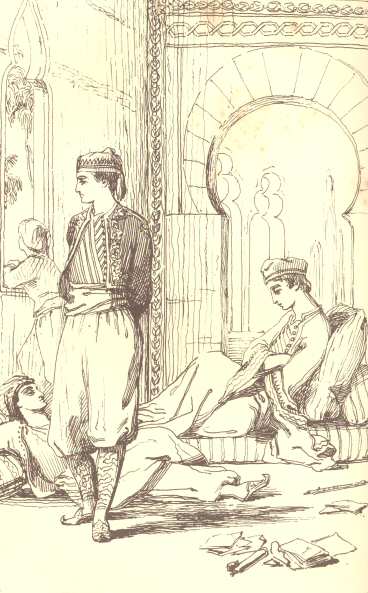
the four incomparable creatures lounging on four ottomans,
sighing their hearts out, because they had ‘nothing to
do.’
“As the door opened, the eldest prince glanced languidly
round, and inquired if the messenger had returned from their
father, and being answered that the Dervish and Hakim, who now
stood before him, were messengers from their father, he called
out to know if the old gentleman had sent them anything to
do!
“‘The king, your father’s spirit is
disturbed with anxiety,’ answered the Dervish, ‘lest
some sudden calamity should have deprived his sons of the use of
their limbs or their senses, or lest their attendants should have
failed to provide them with everything the earth affords
delightful to the soul of man.’
“‘The king, our father’s spirit is disturbed
with smoke,’ replied the eldest prince, ‘or he never
would have sent such an old fellow as you with such an answer as
that. What’s the use of the use of one’s limbs,
or one’s senses, or all the earth affords delightful to the
soul of man, if we’re sick of it all? Just go back
and tell him we’ve got everything, and are sick of
everything, and can do everything, and don’t care to do
anything, because everything is so ‘slow;’ so we will
trouble him to find us something fresh to do. There! is
that clear enough, old gentleman?’
“‘The king, your father,’ answered the
Dervish, ‘has provided against even that emergency; I am
come to tell you of something fresh to see and to do.’
“No sooner had the Dervish uttered these words, than the
four princes jumped up from the ottoman in the most lively and
vigorous manner, and clamoured to know what it was, expressing
their hope that it was a ‘jolly lark.’
“In answer to which the Dervish, lifting himself up in a
commanding manner, stretched out his arm, and exclaimed, in a
solemn voice:—
“‘Young men, you have exhausted happiness.
Nothing new remains in the world for you, but misery and
want. Follow me!’
“There was something so unusual about the tone of this
address, and it was uttered in so imposing a manner, that the
young princes were, as it were, taken by storm, and they followed
the Dervish and Hakim, without a word of inquiry or
objection.
“And he led them away from the palace on the beautiful
hill—away from all the sights and sounds that were
collected together there to delight the soul of man with both
bodily and intellectual enjoyment—down into the city in the
valley, among the close-packed habitations of common men,
congregated there to labour, and just exist, and then die.
“And presently the Dervish and the Hakim spoke together,
and then the Hakim led the way through a gloomy by-street, till
he came to a habitation into which he entered, and the rest
followed without a word. And there, stretched upon a
pallet, wasted and worn with pain, lay a youth scarcely older
than the young princes themselves, the lower part of whose body
was wrapped round with bandages, and who was unable to move.
“The Hakim proceeded at once to unloosen the fastenings,
and to examine the limbs of the sufferer. They had been
crushed by a frightful accident, while working for his daily
bread, in the quarries of marble near the palace on the hill.
“‘Is there no hope, my father?’ he
ejaculated in agony as the bruised thighs were exposed to the
light, revealing a spectacle from which the princes turned
horrified away.
“But the Dervish stood between them and the door, and
motioned them back.
“‘Is there no hope?’ repeated the
youth. ‘Shall I never again tread the earth in the
freedom of health and strength? never again climb the
mountain-side to taste the sweet breath of heaven? never again
even step across this narrow room, to look forth into the narrow
street?’
“Sobs of distress here broke from the speaker; and,
covering his face with his hands, he awaited the Hakim’s
reply. But while the latter bent down to whisper his
answer, the Dervish addressed himself to the trembling
princes:—
“‘Learn here, at last,’ said he, ‘the
value of those limbs, the power of using which you look upon with
such thankless indifference. As it is with this youth
to-day, so may it be with you to-morrow, if the decree goes forth
from on high. Bid me not again return to your father to
tell him you are weary of a blessing, the loss of which would
overwhelm you with despair.’
“The young princes,” continued Aunt Judy, were, as
their father had said, but children yet; that is to say, although
they were fourteen or fifteen years old, they were childish, in
not having reflected or learnt to reason. But they were not
hard-hearted at bottom. Their tenderness for others had
never been called out during their life of self-indulgence, but
the sight of this young man’s condition, whom they
personally knew as one who had at times been permitted to come up
and join in their games, over-powered them with dismay.
“They entreated the Hakim to say if nothing could be
done, and when he told them that a nurse, and better food, and
the discourse of a wise companion, were all essential for the
recovery of the patient, there was not, to say the truth, one
among them who was not ready with promises of assistance, and
even offers of personal help.
“And now, bidding adieu to this youthful sufferer, whose
distress seemed to receive a sudden calm from the sympathy the
young princes betrayed, the Hakim led the way to another part of
the town, where he entered a house of rather better description,
in a small room of which they found a pale, middle-aged man, who
was engaged in making a coarse sort of netting for trees.
Hearing the noise of the entrance, he looked up, and asked who it
was, but with no change of countenance, or apparent recognition
of anyone there. But as soon as the Hakim had uttered the
words ‘It is I,’ a gleam of delight stole over the
pale face, and the man, rising from his chair, stretched out his
arms to the Hakim, entreating him to approach.
“And then the young princes saw that the pale man was
blind.
“‘Is there any change, oh Cassian?’ inquired
the Hakim, kindly.
“‘None, my father,’ answered the blind man,
in a subdued tone. ‘But shall I murmur at what is
appointed? Surely not in vain was the privilege granted me,
of transcribing the manuscripts which repose on the golden
shelves in the palace of the royal princes. Surely not in
vain did I gather, from the treasures of ancient wisdom, and the
divine songs of the poets, sources of consolation for the
suffering children of men.’
“‘And has anyone been of late to read to
you?’ asked the Hakim.
“But this inquiry the blind man seemed scarcely able to
answer. Big tears gathered into the sightless eyes, and
folding his hands across his bosom, he murmured out:—
“‘None, oh my father. Not to everyone is it
permitted to trace the characters of light in which the wise have
recorded their wisdom. I alone of my family knew the
secret. I alone suffer now. But shall I not submit to
this also with a cheerful spirit? It is written, and it
behoves me to submit.’
“And, with tears streaming over his cheeks, the blind
man took up the netting which he had laid aside, and forced
himself to the work.
“‘Seest thou!’ exclaimed the Dervish,
turning to the prince who stood next him, apparently absorbed in
contemplating the scene. ‘Seest thou how precious are
the powers thou hast wearied of in the spring-time of life?
How dear are the opportunities thou hast not cared to delight
in? Bid me not again return to the king, your father, to
tell him his sons can find no pleasure in blessings, the
deprivation of which they themselves would feel to be the
shutting out of the sun from the soul.’
“Then the young prince to whom the Dervish addressed
himself, wept bitterly, and begged to be allowed to visit the
blind man from time to time, and read to him out of the
manuscripts that reposed on the golden shelves in the palace on
the hill; and which, he now learnt for the first time, had been
transcribed for his use, and that of his brothers, by the skill
of the sufferer before him.
“And when the blind man clasped his hands over his head,
and would have prostrated himself on the ground, in gratitude to
him who spoke, asking who the charitable pitier of the afflicted
could be, the prince embraced him as if he had been his brother,
forced him back gently into his seat, and bidding him await him
at that hour on the morrow, followed the Hakim from the
house.
“And now the Dervish and Hakim spoke together once
again, and the place they visited next was of a very different
description.
“Enclosed within walls, and limited in extent, because
in the outskirts of a populous town, the garden into which they
presently entered, was—though but as a drop in comparison
with the ocean—no unworthy rival of the gorgeous
pleasure-grounds of the palace. There, too, the roses
unfolded themselves in their glory to the sun, tiny fountains
scattered their cooling spray around, and singing-birds,
suspended on overshadowing trees, of this scene of miniature
beauty a venerable was perceived, seated under the shadow of an
arbour, in front of a table on which were scattered manuscripts,
papers, parchments, and dried plants, and in one corner of which
were laid a set of tablets and writing materials.
“Although the door by which they entered had fallen to,
with a noise as they passed through, the old man did not seem to
be aware of it, nor did he notice their presence until they came
so near, that their shadows fell on some of the papers on the
table. Then, indeed, he looked suddenly up, and with a
smile and gesture of delight, bade them welcome.
“It was not difficult to divine that the old man had
lost the sense of hearing, and the Dervish, taking up the tablets
from the table, wrote upon them the following words, which he
showed to the young princes, before presenting them to him for
whom they were intended:—
“‘Hast thou not wearied yet, oh brother, of thy
narrow garden, and the ever-recurring succession of flowers, and
thy study of the secrets of Nature?’
“Whereat the deaf man smiled again, and wrote upon the
tablets:—
“‘Can anyone weary of tracing out the skilful
providence of the Divine Mind? Is it not a world within a
world, oh my brother, and inexhaustible in itself?’
“The youngest prince pressed forward to read the answer,
and having read it, turned to the Dervish, and said, ‘Ask
him why the singing-birds are suspended in the garden, whose
voices he cannot hear.’
“‘Write on the tablet, my son,’ said the
Dervish; and when he had written it, the old man answered, in the
same manner as before:—
“‘I would remember my infirmity, my son, lest my
soul should be tied to the beauties of the visible world, but now
when I see the twittering bills of the feathered songsters, I
remember that one sense has departed, and that the others must
follow; and I prepare myself for death, trusting that those who
have rejoiced in the Divine Mind—however
imperfectly—here, may rejoice yet more hereafter, when no
sense or power shall be wanting!’
“After this, the venerable old man led them to a
secluded corner of the garden, where his young son was
instructing one portion of a class of children from the secrets
of his father’s manuscripts, while another set of
youngsters were engaged in cultivating flowers, by regular
instruction and rule. Many a bright, cheerful face looked
up at the old man and his visitors as they passed, but no one
seemed to wish to leave his work, or his lesson, or the kind
young tutor who ruled among them.
“‘We have wasted our lives, oh my father!’
exclaimed the young princes, as they passed from this
sight. ‘Tell us, may we not come back again here, to
learn true wisdom from this man and his son?’
“Having obtained the old man’s willing consent to
his, the Hakim retiring conducted his companions back into the
streets; and the young princes, whose eyes were now opened to the
instruction they were receiving, came up to the Dervish, and
said:—
“‘Oh, wise Dervish, we have learnt the lesson you
would teach, and we know now that it is but a folly, and a
mockery, and a lie, when a man says that he has nothing to
do. There is enough to do for all men, if their minds are
directed right! Have I not spoken well?’
“‘Thou hast spoken well according to thy
knowledge,’ answered the Dervish, ‘but thou hast yet
another lesson to learn.’
“The prince was silenced, and the Dervish and Hakim
hurried forward to a still different part of the city, where
several trades were carried on, and where in one place they came
upon an open square, about which a number of gaunt, wild-looking
men, were lounging or sitting; unoccupied, listless, and sad.
“‘This is wrong, my father, is it not?’
inquired one of the princes; but the Dervish, instead of
answering him, addressed a man who was standing somewhat apart
from the others, and inquired why he was loitering there in
idleness, instead of occupying himself in some honest manner?
“The man laughed a bitter mocking laugh, and turning to
his companions, shouted out, ‘Hear what the wise man
asks! When trade has failed, and no one wants our labour,
he asks us why we stand idling here!’ Then, facing
the Dervish, he continued, ‘Do you not know, can you not
see, oh teacher of the blind, that we have got nothing to
do?—Nothing to do!’ he repeated with a
loud cry—‘Nothing to do! with hearts willing
to work, and hands able to work,’—(here he stretched
out his bared, muscular arm to the Dervish,)—‘and
wife and children calling out for food! Give us
something to do, thou preacher of virtue and
industry,’ he concluded, throwing himself on the ground in
anguish; ‘or, at any rate, cease to mock us with the solemn
inquiry of a fool.’
“‘Oh, my father, my father,’ cried the young
princes, pressing forward, ‘this is the worst, the very
worst of all! All things can be borne, but this dire
reality of having nothing to do. Let us find them
something to do. Let us tear up our gardens, plough up our
lawns, and pleasure-grounds, so that we do but find work for
these men, and save their children and wives from
hunger.’
“‘And themselves from crime,’ added the
Dervish solemnly. Then quitting his companions, he went
into the crowd of men, and made known to them in a few hurried
words, that, by the order of their young princes, there would,
before another day had dawned, be something found to do for them
all.
“The cheer of gratitude which followed this
announcement, thrilled through the heart of those who had been
enabled to offer the boon, and so overpowered them, that, after a
liberal distribution of coin to the necessitous labourers, they
gladly hurried away.
“‘Now my task is ended,’ cried the Dervish,
as they retraced their steps to the palace on the hill.
‘My sons, you have seen the sacred sorrow which may attach
to the bitter complaint of having Nothing to do.
Henceforth seal your lips over the words, for, in all other cases
but this, they are, as you yourselves have said, a folly, a
mockery, and a lie.’
“It is scarcely necessary to add,” continued Aunt
Judy, “that the young princes returned to the palace in a
very different state of mind from that in which they left
it. They had now so many things to do in prospect, so much
to plan and inquire about, that when the night closed upon them,
they wondered how the day had gone, and grudged the necessary
hours of sleep. But on the morrow, just as they were
eagerly recommencing their left-off consultations, the Dervish
appeared among them, and suggested that their first duty still
remained unthought of.
“The incomparable sons were now really surprised, for
they had been flattering themselves they were most laudably
employed. But the Dervish reminded them, that, although
their duty to mankind in general was great, their duty to their
father in particular was yet greater, and that it behoved them to
set his mind at rest, by assuring him, that henceforth they would
not prevent him from smoking his pipe in peace, by restless
discontent, and disturbing messages and wants.
“To this the young princes readily agreed, and
thoroughly ashamed, on reflection, of the years of harass with
which they, in their thoughtless ingratitude, had worried poor
King Schelim, they repaired to his presence, and without entering
into unnecessary explanations, (which he would not have
understood,) assured him that they were perfectly happy, that
they had got plenty to do, as well as everything to enjoy, that
they were very sorry they had tormented him for so long a period
of his life, but that they begged to be forgiven, and would never
do so again!
“King Schelim was uncommonly pleased with what they
said, although he had to lay down his pipe for a few minutes to
receive their salutations, and give his in return; after which
they returned to their palace on the hill, and led thenceforward
useful, intelligent, and therefore happy lives, reforming
grievances, consoling sorrows, and taking particular care that
everybody had the opportunity of having something to
do.
“And as they never again disturbed their father King
Schelim, with foolish messages, he smoked his pipe in peace to
the end of his days.”
“Nice old Schelim!” observed No. 8, when Aunt
Judy’s pause showed that the story was done. A
conclusion which made the other little ones laugh; but now Aunt
Judy spoke again.
“You like the story, all of you?”
Could there be a doubt about it? No!
“Schelim, King of the Hills, and his four sons,” was
one of Aunt Judy’s very, very, very, best inventions.
But they had the happy knack of always thinking so of the last
they heard.
“And yet there is a flaw in it,” said Aunt
Judy.
“Aunt Judy!” exclaimed several voices at once, in
a tone of expostulation.
“Yes; I mean in the moral:” pursued she,
“there is no Christianity in the teaching, and therefore it
is not perfect, although it is all very good as far as it
goes.”
“But they were eastern people, and I suppose Mahometans
or Brahmins,” suggested No. 4.
“Exactly; and, therefore, I could not give them
Christian principles; and, therefore, although I have made my
four princes turn out very well, and do what was right, for the
rest of their lives (as I had a right to do); yet it is only
proper I should explain, that I do not believe any people can be
depended upon for doing right, except when they live upon
Christian principles, and are helped by the grace of God, to
fulfil His will, as revealed to us by His Son Jesus Christ.
“Certainly it is always more reasonable to do
right than wrong, even when the wrong may seem most pleasant at
the moment; because, as all people of sense know, doing right is
most for their own happiness, as well as for everybody
else’s, even in this world.
“But although the knowledge of this may influence us
when we are in a sober enough state of mind to think about it
calmly, the inducement is not a sufficiently strong one to be
relied upon as a safe-guard, when storms of passion and strong
temptations come upon us. In such cases it very often goes
for nothing, and then it is a perfect chance which way a person
acts.
“Even in the matter of doing good to others, we need the
Christian principle as our motive, or we may be often tempted to
give it up, or even to be as cruel at some moments, as we are
kind at others. It is very pleasant, no doubt, to do good,
and be charitable, when the feeling comes into the heart, but the
mere pleasure is apt to cease, if we find people thankless or
stupid, and that our labours seem to have been in vain. And
what a temptation there is, then, to turn away in disgust, unless
we are acting upon Christ’s commands, and can bear in mind,
that even when the pleasure ends, the duty remains.
“And now,” said Aunt Judy in conclusion, “a
kiss for the story-teller all round, if you please. She has
had an invitation, and is going from home to-morrow.”
“Oh, Aunt Judy!” ejaculated the little ones, in
not the most cheerful of tones.
“Well,” cried Aunt Judy, looking at them and
laughing, “you don’t mean to say that you will not
find plenty to do, and plenty to enjoy while I am
away? Come, I mean to write to you all by turns, and I
shall inquire in my letters whether you have remembered, to
your edification, the story of Schelim, King of the Hills,
and his four sons.”


