Once upon a time I wrote a little account of
some of the agreeable boys I had known,
whereupon the damsels reproached me with partiality,
and begged me to write about them. I owned
the soft impeachment, and promised that I would
not forget them if I could find any thing worth
recording.
That was six years ago, and since then I have been
studying girls whenever I had an opportunity, and
have been both pleased and surprised to see how
much they are doing for themselves now that their
day has come.
Poor girls always had my sympathy and respect,
for necessity soon makes brave women of them if
they have any strength or talent in them; but the
well-to-do girls usually seemed to me like pretty
butterflies, leading easy, aimless lives when the
world was full of work which ought to be done.
Making a call in New York, I got a little lesson,
which caused me to change my opinion, and further
investigation proved that the rising generation was
wide awake, and bound to use the new freedom
well. Several young girls, handsomely dressed,
were in the room, and I thought, of course, that they
belonged to the butterfly species; but on asking one
of them what she was about now school was over, I
was much amazed to hear her reply, "I am reading
law with my uncle." Another said, "I am studying
medicine;" a third, "I devote myself to music,"
and the fourth was giving time, money, and heart
to some of the best charities of the great city.
So my pretty butterflies proved to be industrious
bees, making real honey, and I shook hands with
sincere respect, though they did wear jaunty hats;
my good opinion being much increased by the fact
that not one was silly enough to ask for an autograph.
Since then I have talked with many girls, finding
nearly all intent on some noble end, and as some
of them have already won the battle, it may be
cheering to those still in the thick of the fight, or
just putting on their armor, to hear how these sisters
prospered in their different ways.
Several of them are girls no longer; but as they
are still unmarried, I like to call them by their old
name, because they are so young at heart, and have so
beautifully fulfilled the promise of their youth, not
only by doing, but being excellent and admirable
women.
A is one in whom I take especial pride. Well-born,
pretty, and bright, she, after a year or two of
society, felt the need of something more satisfactory,
and, following her taste, decided to study medicine.
Fortunately she had a father who did not think
marriage the only thing a woman was created for,
but was ready to help his daughter in the work she
had chosen, merely desiring her to study as
faithfully and thoroughly as a man, if she undertook the
profession that she might be an honor to it. A was
in earnest, and studied four years, visiting the
hospitals of London, Paris, and Prussia; being able to
command private lessons when the doors of public
institutions were shut in her face because she was
a woman. More study and work at home, and then
she had the right to accept the post of resident
physician in a hospital for women. Here she was so
successful that her outside practice increased rapidly,
and she left the hospital to devote herself to patients
of all sorts, beloved and valued for the womanly
sympathy and cheerfulness that went hand in hand
with the physician's skill and courage.
When I see this woman, young still, yet so
independent, successful, and contented, I am very proud
of her; not only because she has her own house, with
a little adopted daughter to make it home-like, her
well-earned reputation, and a handsome income, but
because she has so quietly and persistently carried
out the plan of her life, undaunted by prejudice,
hard work, or the solitary lot she chose. She may
well be satisfied; for few women receive so much
love and confidence, few mothers have so many
children to care for, few physicians are more heartily
welcomed and trusted, few men lead a freer, nobler
life, than this happy woman, who lives for others and
never thinks of any fame but that which is the best
worth having, a place in the hearts of all who
know her.
B is another of my successful girls; but her task
has been a harder one than A's, because she was as
poor as she was ambitious. B is an artist, loving
beauty more than any thing else in the world;
ready to go cold and hungry, shabby and lonely, if
she can only see, study, and try to create the
loveliness she worships. It was so even as a child; for
flowers and fairies grew on her slate when she should
have been doing sums, painted birds and butterflies
perched on her book-covers, Flaxman's designs, and
familiar faces appeared on the walls of her little
room, and clay gods and goddesses were set upon
the rough altar of her moulding board, to be toiled
over and adored till they were smashed in the
"divine despair" all true artists feel.
But winged things will fly sooner or later, and
patient waiting, persistent effort, only give sweetness
to the song and strength to the flight when the door
of the cage opens at last. So, after years of hard
work with pencil and crayon, plaster and clay, oil and
water colors, the happy hour came for B when the
dream of her life was realized; for one fine spring
day, with a thousand dollars in her pocket and a little
trunk holding more art materials than clothes, she
sailed away, alone, but brave and beaming, for a
year in England.
She knew now what she wanted and where to find
it, and "a heavenly year" followed, though to many
it would have seemed a very dull one. All day and
every day but the seventh was spent in the
National Gallery, copying Turner's pictures in oil and
water colors. So busy, so happy, so wrapt up in
delightsome work, that food and sleep seemed
impertinencies, friends were forgotten, pleasuring had
no charms, society no claims, and life was one
joyful progress from the blue Giudecca to the golden
Sol de Venezia, or the red glow of the old Temeraire.
"Van Tromp entering the mouth of the Texel" was
more interesting to her than any political event
transpiring in the world without; ancient Rome
eclipsed modern London, and the roar of a great city
could not disturb the "Datur Hora Quieti" which
softly grew into beauty under her happy brush.
A spring-tide trip to Stratford, Warwick, and
Kenilworth was the only holiday she allowed herself;
and even this was turned to profit; for, lodging
cheaply at the Shakespearian baker's, she roamed
about, portfolio in hand, booking every lovely bit she
saw, regardless of sun or rain, and bringing away a
pictorial diary of that week's trip which charmed
those who beheld it, and put money in her purse.
When the year was out, home came the artist,
with half her little fortune still unspent, and the one
trunk nearly as empty as it went, but there were
two great boxes of pictures, and a golden saint in a
coffin five feet long, which caused much interest at
the Custom House, but was passed duty-free after
its owner had displayed it with enthusiastic
explanations of its charms.
"They are only attempts and studies, you know,
and I dare say you'll all laugh at them; but I feel
that I can in time do something, so my year has
not been wasted," said the modest damsel, as she set
forth her work, glorifying all the house with
Venetian color, English verdure, and, what was better
still, the sunshine of a happy heart.
But to B's great surprise and delight, people did
not laugh; they praised and bought, and ordered
more, till, before she knew it, several thousand
dollars were at her command, and the way clear to the
artist-life she loved.
To some who watched her, the sweetest picture
she created was the free art-school which B opened
in a very humble way; giving her books, copies,
casts, time, and teaching to all who cared to come.
For with her, as with most who earn their good
things, the generous desire to share them with others
is so strong it is sure to blossom out in some way,
blessing as it has been blessed. Slowly, but surely,
success comes to the patient worker, and B, being
again abroad for more lessons, paints one day a little
still life study so well that her master says she "does
him honor," and her mates advise her to send it to
the Salon. Never dreaming that it will be accepted,
B, for the joke of it, puts her study in a plain frame,
and sends it, with the eight thousand others, only
two thousand of which are received.
To her amazement the little picture is accepted,
hung "on the line" and noticed in the report. Nor
is that all, the Committee asked leave to exhibit it
at another place, and desired an autobiographical
sketch of the artist. A more deeply gratified young
woman it would be hard to find than B, as she now
plans the studio she is to open soon, and the happy
independent life she hopes to lead in it, for she has
earned her place, and, after years of earnest labor, is
about to enter in and joyfully possess it.
There was C,—alas, that I must write was! beautiful,
gifted, young, and full of the lovely
possibilities which give some girls such an indescribable
charm. Placed where it would have been natural
for her to have made herself a young queen of
society, she preferred something infinitely better,
and so quietly devoted herself to the chosen work
that very few guessed she had any.
I had known her for some years before I found it
out, and then only by accident; but I never shall
forget the impression it made upon me. I had
called to get a book, and something led me to speak
of the sad case of a poor girl lately made known to
me, when C, with a sudden brightening of her whole
face, said, warmly, "I wish I had known it, I could
have helped her."
"You? what can a happy creature like you know
about such things?" I answered, surprised.
"That is my work." And in a few words which
went to my heart, the beautiful girl, sitting in her
own pretty room, told me how, for a long time, she
and others had stepped out of their safe, sunshiny
homes to help and save the most forlorn of our
sister women. So quietly, so tenderly, that only those
saved knew who did it, and such loyal silence kept,
that, even among the friends, the names of these
unfortunates were not given, that the after life might
be untroubled by even a look of reproach or
recognition.
"Do not speak of this," she said. "Not that I am
ashamed; but we are able to work better in a private
way, and want no thanks for what we do."
I kept silence till her share of the womanly labor
of love, so delicately, dutifully done, was over. But
I never saw that sweet face afterward without thinking
how like an angel's it must have seemed to those
who sat in darkness till she came to lift them up.
Always simply dressed, this young sister of charity
went about her chosen task when others of her age
and position were at play; happy in it, and
unconsciously preaching a little sermon by her lovely life.
Another girl, who spent her days reading novels and
eating confectionery, said to me, in speaking of C,—
"Why doesn't she dress more? She is rich
enough, and so handsome I should think she would."
Taking up the reports of several charities which
lay on my table, I pointed to C's name among the
generous givers, saying,—
"Perhaps that is the reason;" and my visitor went
away with a new idea of economy in her frivolous
head, a sincere respect for the beautiful girl who
wore the plain suit and loved her neighbor better
than herself.
A short life; but one so full of sweetness that all
the bitter waters of the pitiless sea cannot wash its
memory away, and I am sure that white soul won
heaven sooner for the grateful prayers of those
whom she had rescued from a blacker ocean.
D was one of a large family all taught at home,
and all of a dramatic turn; so, with a witty father to
write the plays, an indulgent mother to yield up her
house to destruction, five boys and seven girls for the
corps dramatique, it is not to be wondered at that
D set her heart on being an actress.
Having had the honor to play the immortal Pillicoddy
on that famous stage, I know whereof I write,
and what glorious times that little company of
brothers and sisters had safe at home. But D
burned for a larger field, and at length found a
chance to appear on the real boards with several of
her sisters. Being very small and youthful in
appearance they played children's parts, fairies in
spectacles and soubrettes in farce or vaudeville.
Once D had a benefit, and it was a pretty sight to
see the long list of familiar names on the bill; for the
brothers and sisters all turned out and made a jolly
play of "Parents and Guardians," as well as a
memorable sensation in the "Imitations" which they
gave.
One would think that the innocent little girls
might have come to harm singing in the chorus of
operas, dancing as peasants, or playing "Nan the
good-for-nothing." But the small women were so
dignified, well-mannered, and intent on their duties
that no harm befell them. Father and brothers
watched over them; there were few temptations for
girls who made "Mother" their confidante, and a
happy home was a safe refuge from the unavoidable
annoyances to which all actresses are exposed.
D tried the life, found it wanting, left it, and put
her experiences into a clever little book, then turned
to less pleasant but more profitable work. The
father, holding a public office, was allowed two
clerks; but, finding that his clear-headed daughter
could do the work of both easily and well, gave her
the place, and she earned her thousand a year, going
to her daily duty looking like a school girl; while
her brain was busy with figures and statistics which
would have puzzled many older heads.
This she did for years, faithfully earning her
salary, and meanwhile playing her part in the
domestic drama; for real tragedy and comedy came
into it as time went on; the sisters married or died,
brothers won their way up, and more than one
Infant Phenomenon appeared on the household
stage.
But through all changes my good D was still
"leading lady," and now, when the mother is gone,
the other birds all flown, she remains in the once
overflowing nest, the stay and comfort of her father,
unspoiled by either poverty or wealth, unsaddened
by much sorrow, unsoured by spinsterhood. A wise
and witty little woman, and a happy one too, though
the curly locks are turning gray; for the three
Christian graces, faith, hope, and charity, abide with
her to the end.
Of E I know too little to do justice to her success;
but as it has been an unusual one, I cannot resist
giving her a place here, although I never saw her,
and much regret that now I never can, since she has
gone to plead her own cause before the wise Judge of all.
Her story was told me by a friend, and made so
strong an impression upon me that I wrote down
the facts while they were fresh in my mind. A few
words, added since her death, finish the too brief
record of her brave life.
At fourteen, E began to read law with a legal
friend. At eighteen she began to practise, and did
so well that this friend offered her half his business,
which was very large. But she preferred to stand
alone, and in two years had a hundred cases of all
sorts in different courts, and never lost one.
In a certain court-room, where she was the only
woman present, her bearing was so full of dignity
that every one treated her with respect. Her
opponent, a shrewd old lawyer, made many sharp or
impertinent remarks, hoping to anger her and make
her damage her cause by some loss of self-control.
But she merely looked at him with such a wise, calm
smile, and answered with such unexpected wit and
wisdom, that the man was worsted and young Portia
won her suit, to the great satisfaction of the
spectators, men though they were.
She used to say that her success was owing to
hard work,—too hard, I fear, if she often studied
eighteen hours a day. She asked no help or patronage,
only fair play, and one cannot but regret that it
ever was denied a creature who so womanfully proved
her claim to it.
A friend says, "she was a royal girl, and did all
her work in a royal way. She broke down suddenly,
just as she had passed the last hostile outpost; just
as she had begun to taste the ineffable sweetness of
peace and rest, following a relative life-time of battle
and toil."
But, short as her career has been, not one brave
effort is wasted, since she has cleared the way for
those who come after her, and proved that women
have not only the right but the ability to sit
upon the bench as well as stand at the bar of justice.
Last, but by no means least, is F, because her
success is the most wonderful of all, since every
thing was against her from the first, as you will see
when I tell her little story.
Seven or eight years ago, a brave woman went
down into Virginia with a friend, and built a school-house
for the freed people, who were utterly forlorn;
because, though the great gift of liberty was theirs, it
was so new and strange they hardly understood how
to use it. These good women showed them, and
among the first twenty children who began the
school, which now has hundreds of pupils, white as
well as black, came little F.
Ignorant, ragged and wild, yet with such an
earnest, resolute face that she attracted the attention
of her teachers at once, and her eagerness to learn
touched their hearts; for it was a hard fight with
her to get an education, because she could only be
spared now and then from corn-planting, pulling
fodder, toting water, oyster-shucking or grubbing
the new land.
She must have made good use of those "odd
days," for she was among the first dozen who earned
a pictorial pocket-handkerchief for learning the
multiplication table, and a proud child was F
when she bore home the prize. Rapidly the patient
little fingers learned to write on the first slate she
ever saw, and her whole heart went into the task of
reading the books which opened a new world to her.
The instinct of progression was as strong in her
as the love of light in a plant, and when the stone
was lifted away, she sprang up and grew vigorously.
At last the chance to go North and earn something,
which all freed people desire, came to F; and
in spite of many obstacles she made the most of it.
At the very outset she had to fight for a place in
the steamer, since the captain objected to her being
admitted to the cabin on account of her color;
though any lady could take her black maid in
without any trouble. But the friend with whom she
travelled insisted on F's rights, and won them by
declaring that if the child was condemned to pass
the night on deck, she would pass it with her.
F watched the contest with breathless interest, as
well she might; for this was her first glimpse of the
world outside the narrow circle where her fourteen
years had been spent. Poor little girl! there seemed
to be no place for her anywhere; and I cannot help
wondering what her thoughts were, as she sat alone
in the night, shut out from among her kind for no
fault but the color of her skin.
What could she think of "white folks" religion,
intelligence, and courtesy? Fortunately she had
one staunch friend beside her to keep her faith in
human justice alive, and win a little place for her
among her fellow beings. The captain for very
shame consented at last, and F felt that she was
truly free when she stepped out of the lonely
darkness of the night into the light and shelter of the
cabin, a harmless little girl, asking only a place to
lay her head.
That was the first experience, and it made a deep
impression on her; but those that followed were
pleasanter, for nowhere in the free North was she
refused her share of room in God's world.
I saw her in New York, and even before I learned
her story I was attracted to the quiet, tidy, door-girl
by the fact that she was always studying as she sat
in the noisy hall of a great boarding-house, keeping
her books under her chair and poring over them at
every leisure moment. Kindly people, touched by
her patient efforts, helped her along; and one of the
prettiest sights I saw in the big city was a little
white girl taking time from her own sports to sit on
the stairs and hear F recite. I think Bijou Heron
will never play a sweeter part than that, nor have a
more enthusiastic admirer than F was when we
went together to see the child-actress play "The
Little Treasure" for charity.
To those who know F it seems as if a sort
of miracle had been wrought, to change in so
short a time a forlorn little Topsy into this
intelligent, independent, ambitious girl, who not only
supports and educates herself, but sends a part of
her earnings home, and writes such good letters to
her mates that they are read aloud in school. Here
is a paragraph from one which was a part of the
Christmas festival last year:—
"I have now seen what a great advantage it is to
have an education. I begin to feel the good of the
little I know, and I am trying hard every day
to add more to it. Most every child up here from
ten to twelve years old can read and write, colored
as well as white. And if you were up here, I think
you would be surprised to see such little bits
of children going to school with their arms full of
books. I do hope you will all learn as much as
you can; for an Education is a great thing."
I wonder how many white girls of sixteen would
do any better, if as well, as this resolute F, bravely
making her way against fate and fortune, toward the
useful, happy womanhood we all desire. I know
she will find friends, and I trust that if she ever
knocks at the door of any college, asking her
sisters to let her in, they will not disgrace
themselves by turning their backs upon her; but prove
themselves worthy of their blessings, by showing
them Christian gentlewomen.
Here are my six girls; doctor, artist, philanthropist,
actress, lawyer, and freed woman; only a few
among the hundreds who work and win, and receive
their reward, seen of men or only known to God.
Perhaps some other girl reading of these may take
heart again, and travel on cheered by their example;
for the knowledge of what has been done often
proves wonderfully inspiring to those who long to do.
I felt this strongly when I went to a Woman's
Congress not long ago; for on the stage was a
noble array of successful women, making the noblest
use of their talents in discussing all the questions
which should interest and educate their sex. I was
particularly proud of the senators from Massachusetts,
and, looking about the crowded house to see
how the audience stirred and glowed under their
inspiring words, I saw a good omen for the future.
Down below were grown people, many women,
and a few men; but up in the gallery, like a garland
of flowers, a circle of girlish faces looked down
eager-eyed; listening, with quick smiles and tears,
to the wit or eloquence of those who spoke,
dropping their school books to clap heartily when a
good point was made, and learning better lessons in
those three days than as many years of common
teaching could give them.
It was close and crowded down below, dusty and
dark; but up in the gallery the fresh October air blew
in, mellow sunshine touched the young heads, there
was plenty of room to stir, and each day the garland
seemed to blossom fuller and brighter, showing how
the interest grew. There they were, the future Mary
Livermores, Ednah Cheneys, Julia Howes, Maria
Mitchells, Lucy Stones, unconsciously getting ready
to play their parts on the wider stage which those
pioneers have made ready for them, before gentler
critics, a wiser public, and more enthusiastic friends.
Looking from the fine gray heads which adorned
the shadowy platform, to the bright faces up aloft, I
wanted to call out,—
"Look, listen, and learn, my girls; then, bringing
your sunshine and fresh air, your youth and vigor,
come down to fill nobly the places of these true
women, and earn for yourselves the same success
which will make their names long loved and honored
in the land."
We had been to tea with some friends in
Shaftesbury Terrace, and were so busy with our
gossip that the evening slipped away unperceived
till the clock struck half-past ten. We were two
lone ladies, and had meant to leave early, as we were
strangers in London and had some way to drive; so
our dismay on discovering the lateness of the hour
may be imagined.
We had not engaged a carriage to come for us,
knowing that a cab-stand was near by, and that a
cab would be much cheaper than the snug broughams
ladies usually secure for evening use.
Out flew the little maid to get us a cab, and we
hurried on our wraps eager to be gone. But we
waited and waited, for Mary Ann did not come, and
we were beginning to think something had happened
to her, when she came hurrying back to say that all
the cabs were gone from the neighboring stand, and
she had run to another, where, after some delay, she
had secured a hansom.
Now it is not considered quite the thing for ladies
to go about in hansom cabs, without a gentleman to
accompany them, especially in the evening; but
being independent Americans, and impatient to
relieve our weary hostess of our presence, we said
nothing, but bundled in, gave the address,—24
Colville Gardens, Bayswater,—and away we went.
A dense fog had come on, and nothing was visible
but a short bit of muddy street, and lamps looming
dimly through the mist. Our driver was as husky
as if it had got into his throat, and the big, white
horse looked absolutely ghostly as he went off at the
breakneck pace which seems as natural to the
London cab-horse as mud is to London streets.
"Isn't it fun to go rattling round in this all-out-of-doors
style, through a real London fog?" said my
sister, who was now enjoying her first visit to this
surprising city.
"That remains to be seen. For my part, I'd give
a good deal to be shut up, dry and decent, in a
four-wheeler, this is so very rowdy," I returned, feeling
much secret anxiety as to the propriety of our proceeding.
"You are sure you gave the man the right direction?"
I asked, after we had driven through what
seemed a wilderness of crescents, terraces, gardens,
and squares.
"Of course I did, and he answered, 'All right,
mum.' Shall I ask him if it is all right?" said M,
who dearly liked to poke up the little door in the
roof, which was our only means of communication
with the burly, breezy cherub who sat up aloft to
endanger the life of his fare.
"You may, for we have ridden long enough to go
to St. Paul's."
Up went the little door, and M asked blandly,—
"Are you sure you are going right, driver?"
"No, mum, I ain't," was the cheering response
breathed through the trap-door (as M called it) in a
hoarse whisper.
"I told you where to go, and it is time we were
there."
"I'm new come to London, mum, and ain't used
to these parts yet,"—began the man.
"Good gracious! so are we; and I'm sure I can't
tell you any thing more than the name and number
I have already given. You'd better ask the first
policeman we meet," cried I, with the foreboding
fear heavier than before.
"All right, mum," and down went the little door,
and off rattled the cab.
My irrepressible sister burst out laughing at the
absurdity of our position.
"Don't laugh, M, for mercy's sake! It's no joke
to be wandering about this great city at eleven
o'clock at night in a thick fog, with a tipsy driver,"
I croaked, with a warning pinch.
"He isn't tipsy, only stupid, as we are, not to
have engaged a carriage to come for us."
"He is tipsy; I smelt gin in his breath, and he
is half asleep up there, I've no doubt, for we have
passed one, if not two policemen, I'm sure."
"Nonsense! you wouldn't know your own father
in this mist. Let Jarvey alone and he will bring us
safely home."
"We shall see," I answered, grimly, as a splash of
mud lit upon my nose, and the cab gave a perilous
lurch in cutting round a sharp corner.
Did any one ever find a policeman when he was
wanted? I never did, though they are as thick as
blackberries when they are not needed.
On and on we went, but not a felt helmet appeared,
and never did escaping fugitive look more eagerly
for the North Star than I did for a gleaming badge
on a blue coat.
"There's a station! I shall stop and ask, for I'm
not going slamming and splashing about any longer.
Hi there, driver!" and I poked up the door
with a vigor that would have startled the soundest
sleeper.
"Ay, ay, mum," came the wheezy whisper, more
wheezy than ever.
"Stop at this station-house and hail some one.
We must get home, and you must ask the way."
"All right, mum," came back the hollow mockery
conveyed in those exasperating words.
We did stop, and a star did appear, when I, with
all the dignity I could muster, stated the case and
asked for aid.
"Pleeseman X," gave it civilly; but I greatly fear
he did not believe that the muddy-faced woman with
a croaky voice, and the blonde damsel with curls,
long earrings and light gloves, were really respectable
members of the glorious American Republic.
I felt this and I could not blame him; so, thanking
him with a bow which would have done credit to
the noblest of my Hancock and Quincy ancestors,
we went on again.
Alas, alas, it was all go on and no stop; for
although our driver had responded briskly, "Ay, ay,
sir," to the policeman's inquiry, "You know your
way now, don't you?" he evidently did not know
it, and the white horse went steadily up and down
the long, wet streets, like a phantom steed in a
horrid dream.
Things really were becoming serious; midnight was
approaching. I had not the remotest idea where we
were, and the passers-by became more and more
infrequent, lights vanished from windows, few cabs
were seen and the world was evidently going to bed.
The fog was rapidly extinguishing my voice, and
anxiety quenching my courage. M's curls hung limp
and wild about her face, and even M's spirits began
to fail.
"I am afraid we are lost," she whispered in my ear.
"Not a doubt of it."
"The man must be tipsy, after all."
"That is evident."
"What will people think of us?"
"That we are tipsy also."
"What shall we do?"
"Nothing but sit here and drift about till morning.
The man has probably tumbled off; this dreadful
horse is evidently wound up and won't stop till
he has run down; the fog is increasing, and nothing
will bring us to a halt but a collision with some
other shipwrecked Yankee, as lost and miserable as
we are."
"Oh, L, don't be sarcastic and grim now! Do
exert yourself and land somewhere. Go to a hotel.
This horrid man must know where the Langham is."
"I doubt if he knows any thing, and I am sure
that eminently respectable house would refuse to
admit such a pair of frights as we are, at this
disreputable hour. No, we must go on till something
happens to save us. We have discovered the secret
of perpetual motion, and that is some comfort."
M groaned, I laughed, the ghostly horse sneezed,
and I think the driver snored.
When things are pretty comfortable I am apt to
croak, but when every thing is tottering on the
verge of annihilation I usually feel rather jolly.
Such being the perversity of my fallen nature, I
began to enjoy myself at this period, and nearly
drove poor M out of her wits by awful or whimsical
suggestions and pictures of our probable fate.
It was so very absurd that I really could not help
seeing the funny side of the predicament, and M was
the best fun of all, she looked so like a dilapidated
Ophelia with her damp locks, a blue rigolette all
awry, her white gloves tragically clasped, and her
pale countenance bespattered with the mud that lay
thick on the wooden boot and flew freely from the
wheels.
I had my laugh out and then tried to mend matters.
What could we do? My first impulse was to
stir up the sleeping wretch above, and this I did by
energetically twitching the reins that hung loosely
before our noses like the useless rudder of this lost
ship.
"Young man, if you don't wake up and take us
to Colville Gardens as quickly as possible, I shall
report you to-morrow. I've got your number, and
I shall get my friend, Mr. Peter Taylor, of Aubrey
House, to attend to the matter. He's an M.P.,
and will see that you are fined for attempting to
drive a cab when you know nothing of London."
I fear that most of this impressive harangue was
lost, owing to the noise of the wheels and the
feebleness of my nearly extinguished voice; but it had
some effect, for though the man did not seem scared
by the threatened wrath of an M.P., he did feel
his weak point and try to excuse it, for he answered
in a gruffy, apologetic tone,—
"Who's a-goin' to know any thing in such a
blessed fog as this? Most cabbies wouldn't try to
drive at no price, but I'll do my best, mum."
"Very well. Do you know where we are now?"
I demanded.
"Blest if I do!"
He didn't say "blest"—quite the reverse;—but
I forgave him, for he really did seem to be making
an effort, having had his nap out. An impressive
pause followed, then M had an inspiration.
"Look, there's a respectable man just going into
his house from that four-wheeled cab. Let us hail
the whole concern, and get help of some sort."
I gave the order, and, eager to be rid of us at any
price, our man rattled us up to the door at which a
gray-haired gentleman was settling with his driver.
Bent on clutching this spar of salvation, I burst
out of our cab and hastened up to the astonished
pair. What I said I don't know, but vaguely
remember jumbling into my appeal all the names of
all the celebrated and respectable persons whom I
knew on both sides of the water, for I felt that my
appearance was entirely against me, and really
expected to be told to go about my business.
John Bull, however, had pity upon me, and did
his best for us, like a man and a brother.
"Take this cab, madam; the driver knows what
he is about, and will see you safely home. I'll
attend to the other fellow," said the worthy man,
politely ignoring my muddy visage and agitated
manners.
Murmuring blessings on his head, we skipped into
the respectable four-wheeler, and in a burst of
confidence I offered Mr. Bull my purse to defray the
expenses of our long drive.
"Rash woman, you'll never see your money
again!" cried M, hiding her Roman earrings and
clutching her Etruscan locket, prepared for highway
robbery if not murder.
I did see my purse again and my money, also;
for that dear old gentleman paid our miserable
cabby out of his own pocket (as I found afterwards),
and with a final gruff "All right!" the pale
horse and his beery driver vanished in the mist. It
is, and always will be my firm belief that it was a
phantom cab, and that it is still revolving ceaselessly
about London streets, appearing and disappearing
through the fog, to be hailed now and then by some
fated passenger, who is whisked to and fro, bewildered
and forlorn, till rescued, when ghostly steed
and phantom cab vanish darkly.
"Now you will be quite safe, ladies;" and the
good old gentleman dismissed us with a paternal
smile.
With a feeling of relief I fell back, exhausted by
our tribulations.
"I know now how the wandering Jew felt," said
M, after a period of repose.
"I don't wish to croak, dear; but if this man does
not stop soon, I shall begin to think we have gently
stepped out of the frying-pan into the fire. Unless
we were several miles out of our way, we ought to
arrive somewhere," I responded, flattening my nose
against the pane, though I literally could not see
one inch before that classical feature.
"Well, I'm so tired, I shall go to sleep, whatever
happens, and you can wake me up when it is time
to scream or run," said M, settling herself for a
doze.
I groaned dismally, and registered a vow to spend
all my substance in future on the most elegant and
respectable broughams procurable for money, with a
gray-haired driver pledged to temperance, and a
stalwart footman armed with a lantern, pistol,
directory, and map of London.
All of a sudden the cab stopped; the driver, not
being a fixture, descended, and coming to the
window, said, civilly,—
"The fog is so thick, mum, I'm not quite sure if
I'm right, but this is Colville Square."
"Don't know any such place. Colville Gardens
is what we want. There's a church at the end, and
trees in the middle, and "—
"No use, mum, describin' it, for I can't see a
thing. But the Gardens can't be far off, so I'll try
again."
"We never shall find it, so we had better ask the
man to take us at once to some station, work-house,
or refuge till morning," remarked M, in such a tone
of sleepy resignation that I shook her on the spot.
Another jaunt up and down, fog getting thicker,
night later, one woman sleepier and the other crosser
every minute, but still no haven hove in sight.
Presently the cab stopped with a decided bump
against the curb-stone, and the driver reappeared,
saying, with respectful firmness,—
"My horse is beat out, and it's past my time for
turning in, so if this ain't the place I shall have to
give it up, mum."
"It is not the place," I answered, getting out with
the calmness of despair.
"There's a light in that house and a woman looking
out. Go and ask her where we are," suggested
M, waking from her doze.
Ready now for any desperate measure, I rushed
up the steps, tried vainly to read the number, but
could not, and rang the bell with the firm
determination to stay in that house till morning at any
cost.
Steps came running down, the door flew open,
and I was electrified at beholding the countenance
of my own buxom landlady.
"My dear soul, where 'ave you been?" she cried,
as I stood staring at her, dumb with surprise and
relief.
"From the Crystal Palace to Greenwich, I believe.
Come in, M, and ask the man what the fare
is," I answered, dropping into a hall chair, and
feeling as I imagine Robinson Crusoe did when he got
home.
Of course that civil cabby cheated me abominably.
I knew it at the time, but never protested; for I was
so glad and grateful at landing safely I should have
paid a pound if he had asked it.
Next day we were heroines, and at breakfast alternately
thrilled and convulsed the other boarders by
a recital of our adventures. But the "strong-minded
Americans" got so well laughed at that they took
great care never to ride in hansom cabs again, or
get lost in the fog.
It was the day before Christmas, and grandpa's
big house was swarming with friends and relations,
all brimful of spirits and bent on having a
particularly good time. Dinner was over and a brief
lull ensued, during which the old folks took naps,
the younger ones sat chatting quietly, while the
children enlivened the day by a quarrel.
It had been brewing for some time, and during
that half hour the storm broke. You see, the boys
felt injured because for a week at least the girls had
been too busy to pay the slightest attention to them
and their affairs,—and what's the good of having
sisters and cousins if they don't make themselves
useful and agreeable to a fellow? What made it
particularly hard to bear was the fact that there
was a secret about it, and all they could discover
was that they were to have no part in the fun.
This added to their wrath, for they could have
borne the temporary neglect, if the girls had been
making something nice for them; but they were not,
and the irate lads were coolly informed that they
would never know the secret, or benefit by it in the
least.
Now this sort of thing was not to be borne, you
know, and after affecting to scorn the whole
concern, the boys were finally goaded to confess to one
another that they were dying to learn what was
going on, though no power on earth would make
them own as much to the girls. It certainly was
very tantalizing to the poor fellows penned up in the
breakfast-room (to keep the house quiet for an hour)
to see the girls prance in and out of the library with
the most aggravating air of importance and delight;
to watch mysterious parcels borne along; to hear
cries of rapture, admiration, or alarm from the next
room, and to know that fun of some sort was going
on, and they not in it.
It snowed so they could not go out; all had
played their parts manfully at dinner, and were just
in the lazy mood when a man likes to be amused by
the gentler half of the race (which they believe
was created for that express purpose), and there, on
the other side of the folding doors, were half-a-dozen
sprightly damsels, laughing and chatting, without
a thought or care for the brothers and cousins gaping
and growling close by.
The arrival of a sleigh-load of girlish neighbors
added to the excitement, and made the boys feel
that something must be done to redress their
wrongs.
"Let's burst in on them and take a look, no matter
if they do scold," proposed Tom, the scapegrace,
ready for a raid.
"No, that won't do; grandma said we were to let
the girls alone, and we shall lose our presents if we
don't behave. You just lean up against the door,
Joe, and if it flies open, why it is an accident, you
know," said Alf the wise.
So Joe, the fat cousin, backed up to the door like
a young elephant, and leaned hard; but it was locked,
and nothing came of it but a creak from the door,
and a groan from Joe.
"I'll look through the keyhole, and tell what I
see," cried little Neddy; and no one forbade him,
though, at any other time, big brother Frank would
have cuffed his ears for daring to suggest such a
prank.
"There's something bright, and the girls are
fussing round it. Kitty's got a lot of red and blue
ribbons in her hand, and Grace is up in a chair, and
Nell—oh, it's cake; a great dish full of the jolliest
kinds, and bon-bons, and sugared fruit, just the sort
I like. I say, knock the door down, some of you big
fellows, and let's have one grab!" cried Neddy,
maddened by the sight of the forbidden sweeties.
"Be quiet, and take another peep; it's rather
interesting to hear what's going on," said Frank,
reposing upon the sofa like the Great Mogul, as the
boys called him.
Poor little Tantalus obediently applied his eye to
the keyhole, but fell back with a blank face, saying
in a despairing tone:
"They've plugged it up, and I can't see a thing!"
"Serves you right; if you'd held your tongue they
never would have known what you were about,"
was Frank's ungrateful answer.
A stifled giggle from the other side of the door
caused a dead silence to pervade the breakfast-room
for several minutes, while Neddy wriggled out of
sight under the sofa as if to escape from the finger
of scorn.
Suddenly Tom cried in a shrill whisper, "I've got
it!" and pointed to a ventilator over the door.
A simultaneous rush of boys and chairs took place;
but Tom claimed the rights of a discoverer, and,
softly mounting an improvised ladder of tables and
stools, he peered eagerly through the glass, while
impatient hands plucked at his legs, and the pressure of
the mob caused his perch to totter perilously.
The spectacle which he beheld would have
touched the heart of any little girl, but to an
unappreciative boy it possessed no charm, for it was only
a doll's Christmas tree. For weeks, the young
mammas had been making pretty things for their
wooden, wax, or porcelain darlings, and it was excellent
practice, since many a pair of hands that scorned
patchwork and towels, labored patiently over small
gowns, trimmed gay hats, and wrought wonders in
worsted, without a sigh.
It really was a most delightful little tree, set in an
Indian jar, snowed over with flour, garlanded with
alternate festoons of cranberries and pop-corn, and
every bough laden with such treasures that if dolls
could stare any harder than they do, they certainly
would have opened their painted eyes with amazement
and joy. Such "darling" hats, and caps; such
"sweet" gowns and cloaks; such "cunning" muffs
and tippets! Dressing cases as perfect as grown-up
ones, I assure you; mittens that must have been knit
on darning-needles; shoes of colored kid fit for a
doll's Cinderella, and sets of brass and bead jewelry
that glittered splendidly. Wee bottles of perfume
for waxen noses; tiny horns of comfits; travelling
bags, and shawl straps, evidently worked by the
fairies; and underclothes which I modestly forbear
to describe, merely saying that very few of the
seams were puckered, and the trimmings "perfectly lovely."
At the moment when Peeping Tom's profane eye
beheld the innocent revel, the dolls were seated in a
circle, their mammas standing behind them, while
the happy little hostesses bestowed the gifts with
appropriate remarks. It is needless to say that the
dolls behaved beautifully, their cheeks glowing with
pleasure as they returned thanks in voices so like
those of their mothers that one couldn't tell the
difference.
The tree was soon stripped, and then the chatter
began again, for every thing must be tried on at
once, and more than one doll who came in shabby
clothes bloomed out in gorgeous array, or was made
tidy for the winter.
"I'm so glad to get a worked flannel petticoat for
my Jemima. Mamma was saying only yesterday
that she didn't approve of show at the expense
of comfort, and I knew she meant Jemmy, who
hadn't a thing on but her pink silk dress and
earrings," observed Mrs. Kitty, in a moral tone.
"Clementina has been suffering for shoes, though
her feet don't show with a train. I meant to have
saved enough to buy her some, but what with limes
and candy, and pencils, and fines for saying 'awful,'
I do believe the poor thing would have gone
bare-footed all winter, if Nell hadn't given her these
beauties," replied Mrs. Alice, proudly surveying her
daughter's feet in red kid boots of a somewhat
triangular shape.
"I couldn't make them fit very well, because the
cotton is all coming out of her toes, and it was hard
to measure," explained Mrs. Nell, conscious that
shoemaking was not her mission.
"They are just the thing; for I'm afraid my poor
Clem is going to have the gout, young as she is. It
is in our family, so it is well to be prepared,"
answered Mrs. Alice, with the beautiful forethought of
a maternal heart.
"These muffs are made out of our Tabby's skin. I
thought you'd like them as keepsakes, for we all
loved her," said Grace, with a pensive sigh, as she
smoothed the white fur of a dear departed cat,
feeling that black and violet bows would have been
more suitable than red and blue for the decoration
of these touching memorials.
"I wonder if there isn't a nice place somewhere
for good cats when they die? I hope so: for I'm
sure they have souls, though they may be little bits
of ones," observed Kitty, who felt as if her name was
a tie between herself and the pets she most adored.
"I wonder if they have ghosts," said Nell, as if
she feared that Tabby's might appear.
A faint "Meou" seemed to float down to the
startled girls from some upper region, and for an
instant they stood staring about them. Then they
laughed like a chime of bells, and accused little Lotty
of pinching the kitten in her arms.
"I didn't; it was Tom up dere," protested the
child, pointing to the ventilator, from which a round
red face was staring at them, like a full moon.
Shrieks of indignation greeted the discovery, and
a rain of small articles pelted the countenance of the
foe, as it grinned derisively, while a jeering voice
called out:
"I don't think much of your old secret. It wasn't
worth the fuss you made about it, and I wouldn't
have any if I couldn't do better than that."
"I'd like to see you get up any thing half as nice.
You couldn't do it. Boys never invent new games,
but girls do. Papa says so, and he knows,"
answered Nell.
"Pooh! We fellows could beat you as easy as
not, if we cared to; so you needn't brag, miss. Men
invent every thing in the world, 'specially ventilators,
and you see how useful they are," returned Tom,
glad that he had kept his place in spite of the
maltreatment his extremities were undergoing.
"Boys are more curious than girls, anyway. We
should never have done such a mean thing as to
peek at you," cried Kitty, coming to the rescue, and
hitting the enemy in his weakest spot.
"Oh, we only did it for fun. Give us a taste of
your spread, and we'll never say a word about it,"
returned the barefaced boy, with a wheedlesome air,
and a tender glance toward the dainty tea-table set
forth so temptingly just under his nose.
"Not a bit, unless you'll say our tree is lovely and
own that we are the cleverest at getting up new and
nice things," said Kitty, sternly.
"Never!" roared Tom; "we can beat you any
day if we choose."
"Then do it, and we will own up; yes, and we
will go halves in all the goodies we get off our big
tree to-night," added Kitty, bound to stand by her
sex and ready to wager a year's bon-bons in the
defence of her position.
"By George, I'll do it if the fellows will agree!
Honor bright now, and no dodging," said Tom, recklessly
pledging himself and friends to any thing and
every thing.
"Honor bright," chorused the girls in high glee.
"Only don't be a month about it; you boys are so
slow," added Grace, in a superior tone, that ruffled
the gentleman at the ventilator.
"We'll do it to-morrow; see if we don't," he
cried out, rashly heaping difficulties upon his
party.
"Then you'd better set about it at once, and
leave us in peace," said Nell, tartly.
"I shall go, ma'am, when I please, and not one
minute sooner"—began Tom, with immense dignity;
but he did not keep his word; for the sudden
withdrawal of his head, followed by a crash and howls of
mingled merriment, wrath, and pain, plainly proved
that circumstances over which he had no control
hastened his departure.
The ladies sat down to their afternoon tea, which
was much enlivened by guessing what those "stupid
boys" would do. The gentlemen, warned by Tom's
downfall, contented themselves with racking their
mighty minds to invent some new, striking, and
appropriate entertainment which should cover their
names with glory and demolish their opponents for
ever more.
Perhaps it was too soon after dinner; perhaps the
brightest wits of the party had been shaken by the
fall, or the cold affected the inventive powers; for,
rack as they would, those mighty minds refused to
work.
"You ought to have given us more time; of
course we can't get up any thing clever in one day
and a half," grumbled Frank, much annoyed because
all the rest looked to him and he had not an idea to
offer.
"I wasn't going to have a parcel of girls crow over
me. I'd blow myself up for a show before I'd let
them do that," answered Tom, rubbing his bruised
elbows with a grim and defiant glance toward the
fatal ventilator, for he felt that he had got not only
himself but his mates into a scrape.
"Don't worry, old fellows; time enough; sleep on
it, and something capital will pop into somebody's
noddle, see if it doesn't," counselled Alf, with a sage
nod, as he went to discover who was sobbing in the
hall.
Little Lotty sat on the fuzzy red mat, with a
tortoise-shell kitten in her arms, her white pinafore
full of candies, and her chubby face bedewed with
tears.
"What's the matter, Toddlekins?" asked Alf, in
such a sympathetic tone that the afflicted infant
poured forth her woes in one breath, with the brown
eyes flashing through their tears and a dramatic
gesture of the small hands that told the tale better
than her broken words.
"De naughty, naughty girls turned out my Torty
'cause she hopped on de table and drinked de tea,
and I comed too, and we is doing to have a kitmouse
tee all ourselfs up in de nursery, so now!"
Alf laughed at her indignation, but dried her tears,
and sent her away happy with a sprig of hemlock
from the decorations of the hall. "Virtue is its own
reward" proved true in this case; for as Alf went
back to his mates he had an idea—such a superb one
that it nearly took his breath away and caused him to
break into a wild sort of jig, as he cried aloud—"I've
found it, boys; I've found it!"
"Where? What? How?" asked the others,
clinging to him as if they were shipwrecked mariners,
and he a rope thrown out to them.
The idea was evidently a good one, for it was
received with great applause, and everybody was
interested at once in helping Alf elaborate his plan.
"Won't it be heaping coals of fire on their heads
after the shabby way they have treated us?" said
Tom, chuckling at the thought of the girls' remorse
when the touching surprise in store for them should
be revealed.
"But how the dickens shall we get enough
m——?" began Frank, rather inclined to throw
cold water on the affair because he was not the
originator of it.
"Hush!" shouted Alf; then added in a melodramatic
whisper, "If the girls hear that word we are
lost. I've planned how to manage that, but it will
take time, and we'd better begin at once, or there
won't be enough you-know-whats to go round.
Come upstairs; we can talk safely there without a
pack of girls listening at the keyhole, as I know they
are this identical minute."
Alf raised his voice at the last words, and the
boys trooped off with derisive hoots; for a guilty
rustle and a sudden outburst of conversation in the
other room told them that their shot had hit
somebody.
"I wish we hadn't dared them to do it; for they
will be sure to get up some dreadful surprise. I shall
be expecting it every minute, and that will make me
so nervous I shall not enjoy myself a bit."
"I'm not afraid; they won't invent any thing to-night,
so we may as well clear up and be ready for
our tree," answered Kitty to Nell as they packed
the dolls on the sofa to sleep while their mammas
enjoyed themselves.
No need to tell about that evening, for every
child knows what a Christmas tree is better than we
can describe it, so we will skip into the next morning
when the boys' joke came off.
The young folks usually slept late after their
unwonted revelry by night, but, strange to relate, the
lads were early astir. In fact, Mary, the cook, saw
several small ghosts whisking up the back-stairs
when she went down to kindle her fire, and curious
sounds were heard in attic and cellar, store-room
and closets.
Something very exciting was going on, and the
elders were evidently in it, for, though several
mammas were heard to cry out when certain
mysterious things were shown them, they never said a
word, but looked up bits of gay ribbon without a
murmur; while the papas enjoyed the fun and lent
a hand in the most delightful manner.
When the girls came down to the late breakfast
they found notes under their napkins, inviting them
to a surprise party in the drying room at eleven
A.M.
"I didn't think they'd be so quick. Shall you dare
to go?" whispered Nell to Kitty as they compared
notes and tried to make out the device on the seal,
which was evidently intended for an animal of some
sort.
"We must go, for we promised. Of course it
won't amount to any thing, and we can keep our
sweeties," answered Kitty, lovingly eying the pretty
box of French bon-bons which she had so rashly
staked.
"You'll be sorry if you don't, for it is the
completest thing you ever saw, and no end of fun in it,"
began Tom, assuming an ecstatic expression and
smacking his lips.
"Hold your tongue and go to work, or we shall
not be ready in time. We've got to trim all the
jigamarees, hang the thingummies while they are
fresh, and see that the basket of treasures arrives
safely," said Alf, with such mysterious nods and
smiles that the girls were instantly consumed by an
intense curiosity to know what "thingummies" and
"jigamarees" were, while "treasures" had such
a rich sound that they began to hope the boys were
really going to atone for the past by some splendid
piece of generosity.
"Come punctually at eleven and bring your boxes
with you; they will be a good deal lighter when you
come down again;" with which cheering remark
Frank led off his men, leaving the girls to watch the
clock with anxious, yet eager eyes.
Their wonder and suspense was much increased by
the fact that Lotty was sent for and carried off by
an escort of two. Listening at the foot of the
back-stairs they heard her little voice exclaim
approvingly:
"Oh how funny! how berry nice!" then the door
closed, and the girls heard no more.
As the clock struck, up marched seven young
ladies, each with a bon-bon box under her arm and
an eager sparkle in her eyes. As they paused at
the door Tom's voice was heard saying, "I wish
they'd hurry up, for I'm tired of this business and
have had scratching enough."
"They are coming! Now mind, no scrambling
till I give the word. Each fellow stand in his place,
keep the bows right side up and hold tight, or there
will be a dreadful piece of work," answered Alf,
evidently giving last touches to the spectacle.
"They have borrowed Fred's monkey and are
going to scare us; I know they are by what Tom said:
and I hear a queer noise—don't you?" whispered
Nell, clutching Grace's skirts.
"It cannot be any thing very bad or Lotty would
cry. Steady, girls; I'm going to knock," and Kitty
gave a bold "rat-tat-tat," which caused a sensation
within.
The door opened, and Frank made his best bow
as he said, with a flourish:
"Enter, ladies, and join us in the interesting
festival which we have prepared at your desire. Take
a look first, and then I will explain this charming
scene if it is not clear to you."
No need to tell the girls to take a look; they had
done that already; but it was evident that an
explanation would be necessary, for they were quite
mystified by the "charming scene;" and well they
might be, for it was a curious one.
The middle of the room was adorned by a large
tub, in which stood a small spruce tree hung with
the oddest things that ever swung from a bough.
Mice by their tails, bits of cheese, milk in small
bottles, gay balls, loops of string, squares of red and
blue flannel like little blankets, bundles of herbs
tied with bright ribbons, and near the top hung a
cage with several small white animals dancing about
in it.
But funniest of all was the circle of boys
around this remarkable tree, at the foot of which
Lotty sat; for each held a cat or kitten in his arms
decorated with a gorgeous bow; both boys and cats
so absurdly solemn and ill at ease that after one look
the girls burst into a gale of merriment.
"Glad you like it, ladies; we have done our best,
and I flatter myself it is a pretty neat thing," began
showman Frank, with a gratified air, while the other
boys with difficulty restrained their charges from
escaping to their mistresses.
"It's very funny, but what does it all mean?"
asked Grace, wiping her eyes, and nodding to her
own fat Jerry, whose yellow eyes appealed to her
for aid.
"It is a Kitmouse tree, the first one ever known,
prepared at great expense for this occasion, to prove
that we can invent superior amusements, and entirely
outdo other folks who shall be nameless."
"It isn't half so pretty as our tree was," said Kitty,
as Frank paused for breath.
"But think how much more pleasure it will give;
for cats can enjoy and dolls can't. These presents
are useful and instructive; for we have not only
food and drink, but catnip and cataplasms for the
poor darlings, if they have catarrh or any other
catastrophe of that sort; but here is a little catechism
for the kits, and string for cats' cradles when they
have learned their lessons. Cataracts of milk will
flow from these bottles for their refreshment, and a
catalogue of delicacies will be furnished free to any
lady wishing to repeat this performance at a future
time."
"Hurry up, and give Jerry a bite of something, or
he'll eat me," cried Tom, who had been silently
struggling with his puss while Frank delivered the
speech, which he considered a masterpiece of wit.
"If the ladies will sit upon the window-seats I
will give out the presents at once;" and Frank
proceeded to do so, amid much merriment; for the
kittens began at once to play with the balls, the cats to
eat and drink, while the boys surveyed the scene
with great satisfaction, and the girls applauded as the
mice were handed round, one to each cat, as a
delicate attention, though few were eaten.
The pussies behaved remarkably well, for the lads
had wisely selected the most amiable ones they
could find, and the six belonging to the house
received them hospitably. Mother Bunch and her
three kits did the honors, while Torty and Jerry
tried to be polite, though aristocratic Torty arched
her back at the half-starved little cat Neddy found
in the street, and stout old Jerry growled to himself
when Nell's pretty white Snowball took his mouse
away.
Such a frolic as they had, boys and girls, cats and
kittens, altogether, one would have thought the
house was coming down about their ears. The
elders took a peep at them, but a very little of that
sort of fun satisfied them and they soon left the
youngsters to themselves.
"It's almost one, and we are going coasting before
dinner, so own up girls, and hand over the goodies,"
said Alf at last, when a lull came and every one stopped
for breath after a lively game of tag, which caused the
cats to seek refuge in every available nook and
corner.
"I suppose we must; for it certainly was a bright
idea, and we have had a capital time," confessed
honest Nell, sitting down in the clothes-basket, where
Mother Bunch had collected her family when the
romp began, and beginning to divide her candies.
"Stop a minute!" cried Kitty, with a twinkle in
her black eyes; "was not the agreement that you
should invent something newer and nicer than our
dolls' affair?"
"Yes; and isn't this ever so much better fun in
every way than all that fuss for rag babies that don't
know or care any thing about it?" cried Alf, as proud
as a peacock of his success.
"Of course it is," admitted sly Kitty.
"Wasn't it clever of us to get it up, and haven't
we pleased you by treating your cats well?"
"I'm sure you have, and it was dear of you to do it."
"Well, then, what's the trouble?"
"Only that you did not invent the thing all
yourselves," coolly answered Kitty.
"I should like to know who did!" cried the boys
with one breath.
"Lotty. She put the idea into your heads with
her funny word 'kitmouse.' You never would have
thought of it but for that. A girl helped you; and
a very little one too; you had to call her in to make
the cats mind, I'm sure, so you have lost your wager
and we will keep our bon-bons, thank you."
Kitty made a low courtesy and stood crunching a
delicious strawberry drop as she triumphantly
surveyed the astounded boys, who looked as much taken
aback as Antonio and his friends when Portia
outwits Shylock in the famous court scene.
"She's got us there," murmured Frank, with an
approving nod to his clever young sister.
"Oh, come; that's not fair; we had a right to
take just a word that meant nothing till we made it.
I don't care for the sweet stuff, but I'm not going to
own that we are beaten!" cried Alf, in high dudgeon;
for he had taken much credit to himself for this
bright idea.
"You must own that a girl helped you. Do that
fairly and I'll go halves, as we promised; for you
have made a good joke out of Lotty's word," said
Kitty, who was generous as well as just, and felt that
the poor lads deserved some reward for their labor.
"All right, if the other fellows agree," returned
Tom, helping himself to a handful of candy as
he spoke; which cool performance had such a
good effect upon the other boys that they all cried
out, "We do! we do!" while Alf, swinging Lotty to
his shoulder, marched away, singing at the top of his
voice,
"Now cheer, boys, cheer,
With three times three,
Our little Lot,
And her kitmouse tree!"
I.
ROSES.
It was a cold November storm, and every thing
looked forlorn. Even the pert sparrows were
draggle-tailed and too much out of spirits to fight
for crumbs with the fat pigeons who tripped through
the mud with their little red boots as if in haste to
get back to their cosy home in the dove-cot.
But the most forlorn creature out that day was a
small errand girl, with a bonnet-box on each arm,
and both hands struggling to hold a big broken
umbrella. A pair of worn-out boots let in the wet upon
her tired feet; a thin cotton dress and an old shawl
poorly protected her from the storm; and a faded
hood covered her head.
The face that looked out from this hood was too
pale and anxious for one so young; and when a
sudden gust turned the old umbrella inside out with a
crash, despair fell upon poor Lizzie, and she was so
miserable she could have sat down in the rain and
cried.
But there was no time for tears; so, dragging the
dilapidated umbrella along, she spread her shawl
over the bonnet-boxes and hurried down the broad
street, eager to hide her misfortunes from a pretty
young girl who stood at a window laughing at her.
She could not find the number of the house where
one of the fine hats was to be left; and after hunting
all down one side of the street, she crossed over,
and came at last to the very house where the pretty
girl lived. She was no longer to be seen; and, with
a sigh of relief, Lizzie rang the bell, and was told to
wait in the hall while Miss Belle tried the hat on.
Glad to rest, she warmed her feet, righted her
umbrella, and then sat looking about her with eyes
quick to see the beauty and the comfort that made
the place so homelike and delightful. A small
waiting-room opened from the hall, and in it stood many
blooming plants, whose fragrance attracted Lizzie as
irresistibly as if she had been a butterfly or bee.
Slipping in, she stood enjoying the lovely colors,
sweet odors, and delicate shapes of these household
spirits; for Lizzie loved flowers passionately; and
just then they possessed a peculiar charm for her.
One particularly captivating little rose won her
heart, and made her long for it with a longing that
became a temptation too strong to resist. It was so
perfect; so like a rosy face smiling out from the
green leaves, that Lizzie could not keep her hands
off it, and having smelt, touched, and kissed it, she
suddenly broke the stem and hid it in her pocket.
Then, frightened at what she had done, she crept
back to her place in the hall, and sat there, burdened
with remorse.
A servant came just then to lead her upstairs;
for Miss Belle wished the hat altered, and must give
directions. With her heart in a flutter, and pinker
roses in her cheeks than the one in her pocket, Lizzie
followed to a handsome room, where a pretty girl
stood before a long mirror with the hat in her hand.
"Tell Madame Tifany that I don't like it at all,
for she hasn't put in the blue plume mamma ordered;
and I won't have rose-buds, they are so common,"
said the young lady, in a dissatisfied tone, as she
twirled the hat about.
"Yes, miss," was all Lizzie could say; for she
considered that hat the loveliest thing a girl could
possibly own.
"You had better ask your mamma about it, Miss
Belle, before you give any orders. She will be up
in a few moments, and the girl can wait," put in a
maid, who was sewing in the anteroom.
"I suppose I must; but I won't have roses,"
answered Belle, crossly. Then she glanced at Lizzie,
and said more gently, "You look very cold; come
and sit by the fire while you wait."
"I'm afraid I'll wet the pretty rug, miss; my feet
are sopping," said Lizzie, gratefully, but timidly.
"So they are! Why didn't you wear rubber boots?"
"I haven't got any."
"I'll give you mine, then, for I hate them; and as
I never go out in wet weather, they are of no earthly
use to me. Marie, bring them here; I shall be glad
to get rid of them, and I'm sure they'll be useful
to you."
"Oh, thank you, miss! I'd like 'em ever so much,
for I'm out in the rain half the time, and get bad
colds because my boots are old," said Lizzie, smiling
brightly at the thought of the welcome gift.
"I should think your mother would get you
warmer things," began Belle, who found something
rather interesting in the shabby girl, with shy
bright eyes, and curly hair bursting out of the old
hood.
"I haven't got any mother," said Lizzie, with a
pathetic glance at her poor clothes.
"I'm so sorry! Have you brothers and sisters?"
asked Belle, hoping to find something pleasant to
talk about; for she was a kind little soul.
"No, miss; I've got no folks at all."
"Oh, dear; how sad! Why, who takes care of
you?" cried Belle, looking quite distressed.
"No one; I take care of myself. I work for
Madame, and she pays me a dollar a week. I stay
with Mrs. Brown, and chore round to pay for my
keep. My dollar don't get many clothes, so I can't
be as neat as I'd like." And the forlorn look came
back to poor Lizzie's face.
Belle said nothing, but sat among the sofa cushions,
where she had thrown herself, looking soberly
at this other girl, no older than she was, who took
care of herself and was all alone in the world. It
was a new idea to Belle, who was loved and petted
as an only child is apt to be. She often saw
beggars and pitied them, but knew very little about
their wants and lives; so it was like turning a new
page in her happy life to be brought so near to
poverty as this chance meeting with the milliner's
girl.
"Aren't you afraid and lonely and unhappy?"
she said, slowly, trying to understand and put
herself in Lizzie's place.
"Yes; but it's no use. I can't help it, and may
be things will get better by and by, and I'll have
my wish," answered Lizzie, more hopefully, because
Belle's pity warmed her heart and made her troubles
seem lighter.
"What is your wish?" asked Belle, hoping
mamma wouldn't come just yet, for she was getting
interested in the stranger.
"To have a nice little room, and make flowers,
like a French girl I know. It's such pretty work,
and she gets lots of money, for every one likes her
flowers. She shows me how, sometimes, and I can
do leaves first-rate; but"—
There Lizzie stopped suddenly, and the color
rushed up to her forehead; for she remembered
the little rose in her pocket and it weighed upon her
conscience like a stone.
Before Belle could ask what was the matter,
Marie came in with a tray of cake and fruit, saying:
"Here's your lunch, Miss Belle."
"Put it down, please; I'm not ready for it yet." And
Belle shook her head as she glanced at Lizzie,
who was staring hard at the fire with such a
troubled face that Belle could not bear to see it.
Jumping out of her nest of cushions, she heaped
a plate with good things, and going to Lizzie,
offered it, saying, with a gentle courtesy that made
the act doubly sweet:
"Please have some; you must be tired of waiting."
But Lizzie could not take it; she could only cover
her face and cry; for this kindness rent her heart
and made the stolen flower a burden too heavy to
be borne.
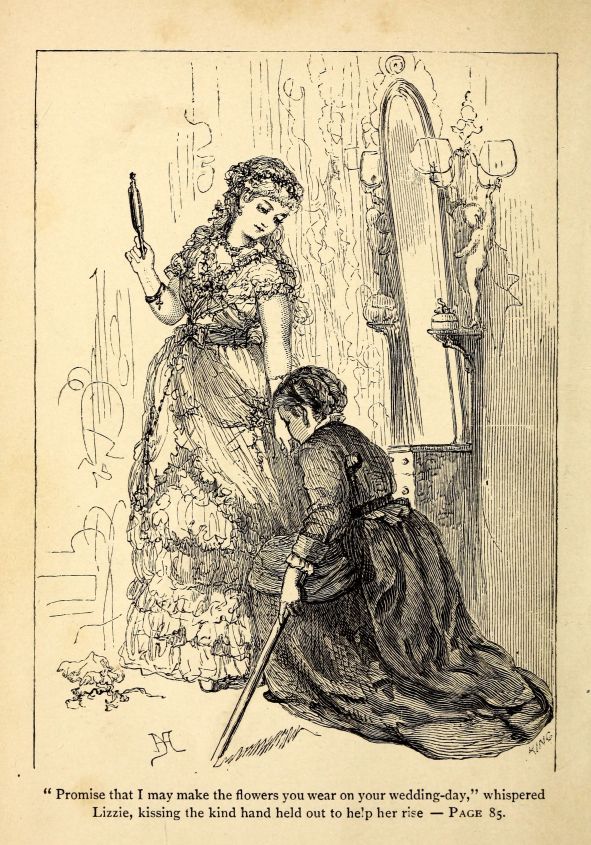
"Oh, don't cry so! Are you sick? Have I been
rude? Tell me all about it; and if I can't do any
thing, mamma can," said Belle, surprised and
troubled.
"No; I'm not sick; I'm bad, and I can't bear
it when you are so good to me," sobbed Lizzie,
quite overcome with penitence; and taking out the
crumpled rose, she confessed her fault with many
tears.
"Don't feel so much about such a little thing as
that," began Belle, warmly; then checked herself,
and added, more soberly, "It was wrong to take it
without leave; but it's all right now, and I'll give
you as many roses as you want, for I know you are
a good girl."
"Thank you. I didn't want it only because it
was pretty, but I wanted to copy it. I can't get
any for myself, and so I can't do my make-believe
ones well. Madame won't even lend me the old
ones in the store, and Estelle has none to spare for
me, because I can't pay her for teaching me. She
gives me bits of muslin and wire and things, and
shows me now and then. But I know if I had a
real flower I could copy it; so she'd see I did know
something, for I try real hard. I'm so tired of
slopping round the streets, I'd do any thing to earn
my living some other way."
Lizzie had poured out her trouble rapidly; and
the little story was quite affecting when one saw the
tears on her cheeks, the poor clothes, and the thin
hands that held the stolen rose. Belle was much
touched, and, in her impetuous way, set about
mending matters as fast as possible.
"Put on those boots and that pair of dry
stockings right away. Then tuck as much cake and
fruit into your pocket as it will hold. I'm going to
get you some flowers, and see if mamma is too busy
to attend to me."
With a nod and a smile, Belle flew about the room
a minute; then vanished, leaving Lizzie to her
comfortable task, feeling as if fairies still haunted the
world as in the good old times.
When Belle came back with a handful of roses,
she found Lizzie absorbed in admiring contemplation
of her new boots, as she ate sponge-cake in a
blissful sort of waking-dream.
"Mamma can't come; but I don't care about the
hat. It will do very well, and isn't worth fussing
about. There, will those be of any use to you?" And
she offered the nosegay with a much happier
face than the one Lizzie first saw.
"Oh, miss, they're just lovely! I'll copy that
pink rose as soon as ever I can, and when I've
learned how to do 'em tip-top, I'd like to bring you
some, if you don't mind," answered Lizzie, smiling
all over her face as she buried her nose luxuriously
in the fragrant mass.
"I'd like it very much, for I should think you'd
have to be very clever to make such pretty things.
I really quite fancy those rose-buds in my hat, now
I know that you're going to learn how to make
them. Put an orange in your pocket, and the
flowers in water as soon as you can, so they'll be
fresh when you want them. Good by. Bring
home our hats every time and tell me how you get on."
With kind words like these, Belle dismissed Lizzie,
who ran downstairs, feeling as rich as if she had
found a fortune. Away to the next place she
hurried, anxious to get her errands done and the
precious posy safely into fresh water. But
Mrs. Turretville was not at home, and the bonnet could
not be left till paid for. So Lizzie turned to go
down the high steps, glad that she need not wait.
She stopped one instant to take a delicious sniff
at her flowers, and that was the last happy
moment that poor Lizzie knew for many weary months.
The new boots were large for her, the steps
slippery with sleet, and down went the little errand
girl, from top to bottom, till she landed in the
gutter directly upon Mrs. Turretville's costly bonnet.
"I've saved my posies, anyway," sighed Lizzie,
as she picked herself up, bruised, wet, and faint
with pain; "but, oh, my heart! won't Madame
scold when she sees that band-box smashed flat,"
groaned the poor child, sitting on the curbstone to
get her breath and view the disaster.
The rain poured, the wind blew, the sparrows
on the park railing chirped derisively, and no one
came along to help Lizzie out of her troubles.
Slowly she gathered up her burdens; painfully she
limped away in the big boots; and the last the
naughty sparrows saw of her was a shabby little
figure going round the corner, with a pale, tearful
face held lovingly over the bright bouquet that was
her one treasure and her only comfort in the
moment which brought to her the great misfortune of
her life.
II.
FORGET-ME-NOTS.
"Oh, mamma, I am so relieved that the box has
come at last! If it had not, I do believe I should
have died of disappointment," cried pretty Belle,
five years later, on the morning before her
eighteenth birthday.
"It would have been a serious disappointment,
darling; for I had set my heart on your wearing my
gift to-morrow night, and when the steamers kept
coming in without my trunk from Paris, I was very
anxious. I hope you will like it."
"Dear mamma, I know I shall like it; your
taste is so good and you know what suits me so
well. Make haste, Marie; I'm dying to see it,"
said Belle, dancing about the great trunk, as the
maid carefully unfolded tissue papers and muslin
wrappers.
A young girl's first ball-dress is a grand affair,—in
her eyes, at least; and Belle soon stopped dancing,
to stand with clasped hands, eager eyes and
parted lips before the snowy pile of illusion that
was at last daintily lifted out upon the bed. Then,
as Marie displayed its loveliness, little cries of delight
were heard, and when the whole delicate dress was
arranged to the best effect she threw herself upon
her mother's neck and actually cried with pleasure.
"Mamma, it is too lovely! and you are very kind
to do so much for me. How shall I ever thank you?"
"By putting it right on to see if it fits; and when
you wear it look your happiest, that I may be
proud of my pretty daughter."
Mamma got no further, for Marie uttered a French
shriek, wrung her hands, and then began to burrow
wildly in the trunk and among the papers, crying
distractedly:
"Great heavens, madame! the wreath has been
forgotten! What an affliction! Mademoiselle's
enchanting toilette is destroyed without the wreath,
and nowhere do I find it."
In vain they searched; in vain Marie wailed and
Belle declared it must be somewhere; no wreath
appeared. It was duly set down in the bill, and a
fine sum charged for a head-dress to match the
dainty forget-me-nots that looped the fleecy skirts
and ornamented the bosom of the dress. It had
evidently been forgotten; and mamma despatched
Marie at once to try and match the flowers, for
Belle would not hear of any other decoration for
her beautiful blonde hair.
The dress fitted to a charm, and was pronounced by
all beholders the loveliest thing ever seen. Nothing
was wanted but the wreath to make it quite perfect,
and when Marie returned, after a long search, with
no forget-me-nots, Belle was in despair.
"Wear natural ones," suggested a sympathizing
friend.
But another hunt among greenhouses was as fruitless
as that among the milliners' rooms. No
forget-me-nots could be found, and Marie fell exhausted
into a chair, desolated at what she felt to be an
awful calamity.
"Let me have the carriage, and I'll ransack the
city till I find some," cried Belle, growing more
resolute with each failure.
Mamma was deep in preparations for the ball, and
could not help her afflicted daughter, though she was
much disappointed at the mishap. So Belle drove
off, resolved to have her flowers whether there were
any or not.
Any one who has ever tried to match a ribbon,
find a certain fabric, or get any thing done in a hurry,
knows what a wearisome task it sometimes is, and
can imagine Belle's state of mind after repeated
disappointments. She was about to give up in
despair, when some one suggested that perhaps the
Frenchwoman, Estelle Valnor, might make the
desired wreath, if there was time.
Away drove Belle, and, on entering the room,
gave a sigh of satisfaction, for a whole boxful of the
loveliest forget-me-nots stood upon the table. As
fast as possible, she told her tale and demanded the
flowers, no matter what the price might be. Imagine
her feelings when the Frenchwoman, with a shrug,
announced that it was impossible to give mademoiselle
a single spray. All were engaged to trim
a bridesmaid's dress, and must be sent away at once.
It really was too bad! and Belle lost her temper
entirely, for no persuasion or bribes would win a
spray from Estelle. The provoking part of it was
that the wedding would not come off for several
days, and there was time enough to make more
flowers for that dress, since Belle only wanted a few
for her hair. Neither would Estelle make her any,
as her hands were full, and so small an order was
not worth deranging one's self for; but observing
Belle's sorrowful face, she said, affably:
"Mademoiselle may, perhaps, find the flowers she
desires at Miss Berton's. She has been helping me
with these garlands, and may have some left. Here
is her address."
Belle took the card with thanks, and hurried away
with a last hope faintly stirring in her girlish heart,
for Belle had an unusually ardent wish to look her
best at this party, since Somebody was to be there,
and Somebody considered forget-me-nots the
sweetest flowers in the world. Mamma knew this, and
the kiss Belle gave her when the dress came had a
more tender meaning than gratified vanity or
daughterly love.
Up many stairs she climbed, and came at last to a
little room, very poor but very neat, where, at the
one window, sat a young girl, with crutches by her
side and her lap full of flower-leaves and petals.
She rose slowly as Belle came in, and then stood
looking at her, with such a wistful expression in her
shy, bright eyes, that Belle's anxious face cleared
involuntarily, and her voice lost its impatient tone.
As she spoke, she glanced about the room, hoping
to see some blue blossoms awaiting her. But none
appeared; and she was about to despond again,
when the girl said, gently:
"I have none by me now, but I may be able to
find you some."
"Thank you very much; but I have been everywhere
in vain. Still, if you do get any, please send
them to me as soon as possible. Here is my card."
Miss Berton glanced at it, then cast a quick look
at the sweet, anxious face before her, and smiled so
brightly that Belle smiled also, and asked, wonderingly:
"What is it? What do you see?"
"I see the dear young lady who was so kind to
me long ago. You don't remember me, and never
knew my name; but I never have forgotten you all
these years. I always hoped I could do something
to show how grateful I was, and now I can, for you
shall have your flowers if I sit up all night to make
them."
But Belle still shook her head and watched the
smiling face before her with wondering eyes, till the
girl added, with sudden color in her cheeks:
"Ah, you've done so many kind things in your
life, you don't remember the little errand girl from
Madame Tifany's who stole a rose in your hall, and
how you gave her rubber boots and cake and flowers,
and were so good to her she couldn't forget it if
she lived to be a hundred."
"But you are so changed," began Belle, who did
faintly recollect that little incident in her happy
life.
"Yes, I had a fall and hurt myself so that I shall
always be lame."
And Lizzie went on to tell how Madame had dismissed
her in a rage; how she lay ill till Mrs. Brown
sent her to the hospital; and how for a year she
had suffered much alone, in that great house of pain,
before one of the kind visitors had befriended her.
While hearing the story of the five years, that
had been so full of pleasure, ease and love for
herself, Belle forgot her errand, and, sitting beside
Lizzie, listened with pitying eyes to all she told of
her endeavors to support herself by the delicate
handiwork she loved.
"I'm very happy now," ended Lizzie, looking
about the little bare room with a face full of the
sweetest content. "I get nearly work enough to
pay my way, and Estelle sends me some when she
has more than she can do. I've learned to do it
nicely, and it is so pleasant to sit here and make
flowers instead of trudging about in the wet with
other people's hats. Though I do sometimes wish
I was able to trudge, one gets on so slowly with
crutches."
A little sigh followed the words, and Belle put
her own plump hand on the delicate one that held
the crutch, saying, in her cordial young voice:
"I'll come and take you to drive sometimes, for
you are too pale, and you'll get ill sitting here at
work day after day. Please let me; I'd love to;
for I feel so idle and wicked when I see busy people
like you that I reproach myself for neglecting my
duty and having more than my share of happiness."
Lizzie thanked her with a look, and then said, in a
tone of interest that was delightful to hear:
"Tell about the wreath you want; I should so
love to do it for you, if I can."
Belle had forgotten all about it in listening to this
sad little story of a girl's life. Now she felt half
ashamed to talk of so frivolous a matter till she
remembered that it would help Lizzie; and, resolving
to pay for it as never garland was paid for before,
she entered upon the subject with renewed interest.
"You shall have the flowers in time for your ball
to-morrow night. I will engage to make a wreath
that will please you, only it may take longer than
I think. Don't be troubled if I don't send it till
evening; it will surely come in time. I can work
fast, and this will be the happiest job I ever did,"
said Lizzie, beginning to lay out mysterious little
tools and bend delicate wires.
"You are altogether too grateful for the little I
have done. It makes me feel ashamed to think I
did not find you out before and do something better
worth thanks."
"Ah, it wasn't the boots or the cake or the roses,
dear Miss Belle. It was the kind looks, the gentle
words, the way it was done, that went right to my
heart, and did me more good than a million of money.
I never stole a pin after that day, for the little rose
wouldn't let me forget how you forgave me so
sweetly. I sometimes think it kept me from greater
temptations, for I was a poor, forlorn child, with no
one to keep me good."
Pretty Belle looked prettier than ever as she
listened, and a bright tear stood in either eye like a
drop of dew on a blue flower. It touched her very
much to learn that her little act of childish charity
had been so sweet and helpful to this lonely girl,
and now lived so freshly in her grateful memory. It
showed her, suddenly, how precious little deeds of
love and sympathy are; how strong to bless, how
easy to perform, how comfortable to recall. Her
heart was very full, and tender just then, and the
lesson sunk deep into it never to be forgotten.
She sat a long time watching flowers bud and
blossom under Lizzie's skilful lingers, and then
hurried home to tell all her glad news to mamma.
If the next day had not been full of most delightfully
exciting events, Belle might have felt some
anxiety about her wreath, for hour after hour went
by and nothing arrived from Lizzie.
Evening came, and all was ready. Belle was
dressed, and looked so lovely that mamma declared
she needed nothing more. But Marie insisted that
the grand effect would be ruined without the
garland among the sunshiny hair. Belle had time
now to be anxious, and waited with growing
impatience for the finishing touch to her charming
toilette.
"I must be downstairs to receive, and can't wait
another moment; so put in the blue pompon and
let me go," she said at last, with a sigh of
disappointment; for the desire to look beautiful that
night in Somebody's eyes had increased four-fold.
With a tragic gesture, Marie was about to adjust
the pompon when the quick tap of a crutch came
down the hall, and Lizzie hurried in, flushed and
breathless, but smiling happily as she uncovered the
box she carried with a look of proud satisfaction.
A general "Ah!" of admiration arose as Belle,
mamma, and Marie surveyed the lovely wreath that
lay before them; and when it was carefully arranged
on the bright head that was to wear it, Belle blushed
with pleasure. Mamma said: "It is more beautiful
than any Paris could have sent us;" and Marie
clasped her hands theatrically, sighing, with her
head on one side:
"Truly, yes; mademoiselle is now adorable!"
"I am so glad you like it. I did my very best
and worked all night, but I had to beg one spray
from Estelle, or, with all my haste, I could not
have finished in time," said Lizzie, refreshing her
weary eyes with a long, affectionate gaze at the
pretty figure before her.
A fold of the airy skirt was caught on one of the
blue clusters, and Lizzie knelt down to arrange it as
she spoke. Belle leaned toward her and said
softly: "Money alone can't pay you for this kindness;
so tell me how I can best serve you. This is
the happiest night of my life, and I want to make
every one feel glad also."
"Then don't talk of paying me, but promise that
I may make the flowers you wear on your wedding-day,"
whispered Lizzie, kissing the kind hand held
out to help her rise, for on it she saw a brilliant
ring, and in the blooming, blushing face bent over
her she read the tender little story that Somebody
had told Belle that day.
"So you shall! and I'll keep this wreath all my
life for your sake, dear," answered Belle, as her full
heart bubbled over with pitying affection for the
poor girl who would never make a bridal garland
for herself.
Belle kept her word, even when she was in a
happy home of her own; for out of the dead roses
bloomed a friendship that brightened Lizzie's life;
and long after the blue garland was faded Belle
remembered the helpful little lesson that taught her
to read the faces poverty touches with a pathetic
eloquence, which says to those who look, "Forget-me-not."
"O, mamma, don't let them kill him! He isn't
doing any harm, and he's old and weak, and
hasn't any one to be good to him but Posy and
me!" cried little Ned, bursting into his mother's
room, red and breathless with anxiety and haste.
"Kill whom, dear? Sit down and tell me all
about it."
"I can't sit down, and I must be quick, for they
may do it while I'm gone. I left Posy to watch
him, and she is going to scream with all her might
the minute she sees them coming back!" cried
Ned, hovering restlessly about the doorway, as if
expecting the call that was to summon him to the
rescue.
"Mercy on us! what is it, child?"
"A dear old horse, mamma, who has been hobbling
round the road for a week. I've seen him
driven away from all the neighbors, so Posy and I
give him clover and pat him; and to-day we found
him at our bars, looking over at us playing in the
field. I wanted him to come in, but Mr. White
came along and drove him off, and said he was to be
killed because he had no master, and was a
nuisance. Don't let him do it!"
"But, Neddy, I cannot take him in, as I did the
lame chicken, and the cat without a tail. He is too
big, and eats too much, and we have no barn.
Mr. White can find his master, perhaps, or use him for
light work."
Mamma got no further, for Ned said again,—
"No, he can't. He says the poor old thing is of
no use but to boil up. And his master won't be
found, because he has gone away, and left Major to
take care of himself. Mr. White knew the man,
and says he had Major more than eighteen years,
and he was a good horse, and now he's left to die
all alone. Wouldn't I like to pound that man?"
"It was cruel, Neddy, and we must see what we
can do."
So mamma put down her work and followed her
boy, who raced before her to tell Posy it would be
"all right" now.
Mrs. West found her small daughter perched on
a stone wall, patting the head of an old white horse,
who looked more like a skeleton than a living
animal. Ned gave a whoop as he came, and the poor
beast hastily hobbled across the road, pressing
himself into a nook full of blackberry vines and thorny
barberry bushes, as if trying to get out of sight
and escape tormentors.
"That's the way he does when any one comes,
because the boys plague him, and people drive him
about till he doesn't know what to do. Isn't it a pity
to see him so, mamma?" said tender-hearted Ned,
as he pulled a big handful of clover from his father's
field close by.
Indeed, it was sad, for the poor thing had evidently
been a fine horse once; one could see that by
his intelligent eye, the way he pricked up his ears,
and the sorrowful sort of dignity with which he
looked about him, as if asking a little compassion in
memory of his long faithfulness.
"See his poor legs all swelled up, and the bones
in his back, and the burrs the bad boys put in his
mane, and the dusty grass he has to eat. Look! he
knows me, and isn't afraid, because I'm good to
him," said Ned, patting old Major, who gratefully
ate fresh clover from the friendly little hand.
"Yes, and he lets me stroke his nose, mamma.
It's as soft as velvet, and his big eyes don't frighten
me a bit, they are so gentle. Oh, if we could only
put him in our field, and keep him till he dies,
I should be so happy!" said Posy, with such a
wheedlesome arm about mamma's neck, that it was
very hard to deny her any thing.
"If you will let me have Major, I won't ask for
any other birthday present," cried Ned, with a
sudden burst of generosity, inspired, perhaps, by the
confiding way in which the poor beast rubbed his
gray head against the boy's shoulder.
"Why, Neddy, do you really mean that? I was
going to give you something you want very much.
Shall I take you at your word, and give you a
worn-out old horse instead?" asked mamma,
surprised, yet pleased at the offer.
Ned looked at her, then at old Major, and
wavered; for he guessed that the other gift was the
little wheelbarrow he had begged for so long,—the
dear green one, with the delicious creak and rumble
to it. He had seen it at the store, and tried it, and
longed for it, and planned to trundle every thing in
it, from Posy to a load of hay. Yes, it must be
his, and Major must be left to his fate.
Just as he decided this, however, Posy gave a cry
that told him Mr. White was coming. Major
pressed further into the prickly hedge, with a
patient sort of sigh, and a look that went to Ned's
heart, for it seemed to say,—
"Good by, little friend. Don't give up any thing
for me. I'm not worth it, for I can only love you in
return."
Mr. White was very near, but Major was safe; for,
with a sudden red in his freckled cheeks, Ned put
his arm on the poor beast's drooping neck, and said,
manfully,—
"I choose him, mamma; and now he's mine, I'd
like to see anybody touch him!"
It was a pretty sight,—the generous little lad
befriending the old horse, and loving him for pure
pity's sake, in the sweet childish way we so soon
forget.
Posy clapped her hands, mamma smiled, with a
bright look at her boy, while Mr. White threw over
his arm the halter, with which he was about to lead
Major to his doom, and hastened to say,—
"I don't want to hurt the poor critter, ma'am, but
he's no mortal use, and folks complain of his being
in the way; so I thought the kindest thing was to
put him out of his misery."
"Does he suffer, do you think? for if so, it would
be no kindness to keep him alive," said mamma.
"Well, no, I don't suppose he suffers except for
food and a little care; but if he can't have 'em, it
will go hard with him," answered Mr. White,
wondering if the old fellow had any work in him still.
"He never should have been left in this forlorn
way. Those who had had his youth and strength
should have cared for him in his age;" and
Mrs. West looked indignant.
"So they should, ma'am; but Miller was a mean
man, and when he moved, he just left the old horse
to live or die, though he told me, himself, that
Major had served him well, for nigh on to twenty
years. What do you calculate to do about it,
ma'am?" asked Mr. White, in a hurry to be off.
"I'll show you, sir. Ned, let down the bars, and
lead old Major in. That shall be his home while he
lives, for so faithful a servant has earned his rest,
and he shall have it."
Something in the ring of mamma's voice and the
gesture of her hand made Ned's eyes kindle, and
Mr. White walk away, saying, affably,—
"All right, ma'am; I haven't a word to say
against it."
But somehow Mr. White's big barn did not look
as handsome to him as usual when he remembered
that his neighbor, who had no barn at all, had taken
in the friendless horse.
It was difficult to make Major enter the field; for
he had been turned out of so many, driven away
from so many lawns, and even begrudged the scanty
pickings of the roadside, that he could not
understand the invitation given him to enter and take
possession of a great, green field, with apple trees
for shade, and a brook babbling through the middle
of it.
When at last he ventured over the bars, it was
both sad and funny to see how hard he tried to
enjoy himself and express his delight.
First, he sniffed the air, then he nibbled the sweet
grass, took a long look about him, and astonished
the children by lying down with a groan, and trying
to roll. He could not do it, however, so lay still
with his head stretched out, gently flapping his tail
as if to say,—
"It's all right, my dears. I'm not very strong,
and joy upsets me; but I'm quite comfortable, bless
you!"
"Isn't it nice to see him, all safe and happy,
mamma?" sighed Posy, folding her hands in childish
satisfaction, while Ned sat down beside his
horse, and began to take the burrs out of his mane.
"Very nice, only don't kill him with kindness,
and be careful not to get hurt," answered mamma,
as she went back to her work, feeling as if she had
bought an elephant, and didn't know what to do
with him.
Later in the day a sudden shower came up, and
mamma looked about to be sure her little people
were under cover, for they played out all day long,
if possible. No chickens could the maternal hen
find to gather under her wings, and so went clucking
anxiously about till Sally, the cook, said, with a
laugh,—
"Ned's down in the pastur', mum, holding an
umberella over that old horse, and he's got a
waterproof on him, too. Calvin see it, and 'most died
a-laughing."
Mamma laughed too, but asked if Ned had on his
rubber boots and coat.
"Yes, mum, I see him start all in his wet-weather
rig, but I never mistrusted what the dear was up
to till Calvin told me. Posy wanted to go, but I
wouldn't let her, so she went to the upper window,
where she can see the critter under his
umberella."
Mamma went up to find her little girl surveying
the droll prospect with solemn satisfaction; for there
in the field, under the apple tree, stood Major,
blanketed with the old waterproof, while his new
master held an umbrella over his aged head with a
patient devotion that would have endeared him to
the heart of good Mr. Bergh.
Fortunately the shower was soon over, and Ned
came in to dry himself, quite unconscious of any
thing funny in his proceedings. Mamma kept
perfectly sober while she proposed to build a rough
shed for Major out of some boards on the place.
Ned was full of interest at once; and with some
help from Calvin, the corner under the apple tree
was so sheltered that there would be no need of the
umbrella hereafter.
So Major lived in clover, and was a happy horse;
for Cockletop, the lame chicken, and Bobtail, the
cat, welcomed him to their refuge, and soon became
fast friends. Cockle chased grasshoppers or pecked
about him with meditative clucks as he fed; while
Bob rubbed against his legs, slept in his shed, and
nibbled catnip socially as often as his constitution
needed it.
But Major loved the children best, and they took
good care of him, though some of their kind attentions
might have proved fatal if the wise old beast
had not been more prudent than they. It was
pleasant to see him watch for them, with ears
cocked at the first sound of the little voices, his
dim eyes brightening at sight of the round faces
peeping over the wall, and feeble limbs stirred into
sudden activity by the beckoning of a childish hand.
The neighbors laughed at Ned, yet liked him all
the better for the lesson in kindness he had taught
them; and a time came when even Mr. White
showed his respect for old Major.
All that summer Neddy's horse took his rest in
the green meadow, but it was evident that he was
failing fast, and that his "good time" came too late.
Mamma prepared the children for the end as well as
she could, and would have spared them the sorrow
of parting by having Major killed quietly, if Ned
had not begged so hard to let his horse die
naturally; for age was the only disease, and Major
seemed to suffer little pain, though he daily grew
more weak, and lame, and blind.
One morning when the children went to carry
him a soft, warm mash for breakfast, they found
him dead; not in the shed, where they had left him
warmly covered, but at the low place in the wall
where they always got over to visit him.
There he lay, with head outstretched, as if his last
desire had been to get as near them as possible, his
last breath spent in thanking them. They liked to
think that he crept there to say good by, and took
great comfort in the memory of all they had done
for him.
They cried over him tenderly, even while they
agreed that it was better for him to die; and then
they covered him with green boughs, after Ned
had smoothed his coat for the last time, and Posy
cut a lock from his mane to make mourning rings of.
Calvin said he would attend to the funeral, and
went off to dig the grave in a lonely place behind
the sand-bank. Ned declared that he could not
have his horse dragged away and tumbled into a
hole, but must see him buried in a proper manner;
and mamma, with the utmost kindness, said she
would provide all that was needed.
The hour was set at four in the afternoon, and the
two little mourners, provided with large handkerchiefs,
Ned, with a black bow on his arm, and Posy
in a crape veil, went to drop a last tear over their
departed friend.
At the appointed time Calvin appeared, followed
by Mr. White, with a drag drawn by black Bill.
This delicate attention touched Neddy; for it might
have been bay Kitty, and that would have marred
the solemnity of the scene.
As the funeral train passed the house on its way
down the lane, mamma, with another crape veil on,
came out and joined the procession, so full of
sympathy that the children felt deeply grateful.
The October woods were gay with red and yellow
leaves, that rustled softly as they went through
the wood; and when they came to the grave, Ned
thanked Calvin for choosing such a pretty place. A
pine sighed overhead, late asters waved beside it,
and poor Major's last bed was made soft with
hemlock boughs.
When he was laid in it, mamma bade them leave
the old waterproof that had served for a pall still
about him, and then they showered in bright leaves
till nothing was visible but a glimpse of the dear
white tail.
The earth was thrown in, green sods heaped over
it, and then the men departed, feeling that the
mourners would like to linger a little while.
As he left, Mr. White said, with the same gravity
which he had preserved all through the scene,—
"You are welcome to the use of the team and my
time, ma'am. I don't wish any pay for 'em; in fact,
I should feel more comfortable to do this job for old
Major quite free and hearty."
Mamma thanked him, and when he was gone,
Ned proposed that they should sing a hymn, and
Posy added, "They always sing, 'Sister, thou art
mild and lovely' at funerals, you know."
Mamma with difficulty kept sober at this idea
but suggested the song about "Good old Charlie,"
as more appropriate. So it was sung with great
feeling, and then Posy said, as she "wiped her
weeping eyes,"—
"Now, Ned, show mamma our eppytap."
"She means eppytarf," explained Ned, with a
superior air, as he produced a board, on which he
had printed with India ink the following words,—
"Here lies dear old Major. He was a good horse when he
was young. But people were not kind to him when he was
old. We made him as happy as we could. He loved us, and
we mourn for him. Amen."
Ned's knowledge of epitaphs was very slight,
so he asked mamma if this one would do; and she
answered warmly,—
"It is a very good one; for it has what many lack,—the
merit of being true. Put it up, dear, and I'll
make a wreath to hang on the gravestone."
Much gratified, Ned planted the board at the
head of the grave, Posy gathered the brightest
leaves, and mamma made a lovely garland in which
to frame the "eppytap."
Then they left old Major to his rest, feeling sure
that somewhere there must be a lower heaven for
the souls of brave and faithful animals when their
unrewarded work is done.
Many children went to see that lonely grave, but
not one of them disturbed a leaf, or laughed at the
little epitaph that preached them a sermon from the
text,—
"Blessed are the merciful."
"I'm so disappointed that I can't go; but papa says
he can't afford it this summer. You know we
lost a good deal by the great fire, so we must all
give up something;" and Nelly gave a sigh, as if her
sacrifice was not an easy one.
"I'm sorry, too, for I depend on hearing all about
your adventures every summer. It is almost as good
as going myself. What a pity Newport is such an
expensive place," answered Kitty Fisher, Nelly's
bosom friend.
"I dare say papa could manage to let me go
for a week or so; but my outfit would cost so much
I dare not ask him. One must dress there, you know,
and I haven't had a new thing this summer," said
Nelly.
"I'm sure your old things as you call them, are
nice enough for any place. I should think I was
made, if I had such a lovely wardrobe;" and Kitty's
eye roved round the pretty room where several gowns
and hats were strewn as if for a survey.
"Ah, my dear, you don't know how quickly
fashionable women spy out make-shifts, and despise you
for them. All the girls I should meet at Newport
would remember those clothes and I shouldn't enjoy
myself a bit. No, I must stay at home, or slip away to
Aunt Becky's, up in New Hampshire, where no one
minds your clothes, and the plainer they are the
better. It is as dull as tombs up there, and I long
for the sea, so it seems as if I couldn't give up my
trip."
"Why not go to a cheaper place?" asked Kitty,
adding, with sudden excitement, "Now look here!
This is just the thing, and I can go too, so you won't
be lonely.
"Mary Nelson wrote me the other day, begging
I'd come down to Oceana, and stay with her. It's a
nice, quiet place, with a beach all to ourselves, lighthouse,
rocks, fishing, boats, and all sorts of agreeable
things. Not a bit fashionable, and every one wears
old clothes and enjoys him or her self in a sensible
way."
"What's board there?"
"Ten a week, with bath-house, boats, and an old
carriage thrown in."
"Who is there?"
"Several teachers resting, a family or two of
children, and a lot of boys camping out on the Point."
"And old clothes really will do?"
"Mary says she lives in her boating-dress, and
went to an evening party in a white morning-gown.
I'd quite decided to go and have a nice free time,
after you were off; but now you come with me, and
for once see what fun we poor folks can have
without any fuss or feathers."
"I will. Papa wants me to go somewhere, and
will not think my expenses down there are extravagant.
I'll pack to-day, and to-morrow we will be off."
Next day they were off, to be heartily welcomed by
Mary, and speedily made at home by Marm Wolsey,
as the old lady who kept the house was called. It
was a delightfully quiet, pleasant place, with big
rooms plainly furnished, but clean and full of fresh
sea breezes day and night. Being founded on a
rock, the boats were moored almost at the door, the
bath-house was close by, on a smooth beach, and the
lighthouse twinkled Cheerfully, through fog or
moonlight, just over the Point.
Such pleasant times as the girls had; taking early
dips in the sea, lying in hammocks on the airy
piazza through the hot hours, rowing, fishing,
scrambling over the rocks, or sitting in shady nooks,
working and reading.
No one thought of clothes; and when Nelly timidly
put on a delicate silk one day, she was told finery
was not allowed, and a merry resolution was passed
that no one should "dress up" under penalty of a
fine. So flannel boating suits were all the fashion:
and Miss Phelps would have rejoiced at the sight of
half-a-dozen rosy-faced girls skipping about the rocks
in a costume as simple and sensible as the one she
recommends.
Of course the campers on the Point soon discovered
the mermaids in the Cove, and, by a series of those
remarkable accidents which usually occur at such
times, got acquainted without much ceremony.
Then the fun increased amazingly, and the old
house saw gay doings; for the lads had bonfires,
concerts by moonlight on the rocks, and picnics in every
available cove, grove, and sea-weedy nook the place
could boast.
The mothers of the flocks of riotous children were
matrons to the girls; and the shy teachers came out
amazingly when they found that the three friends
were not fashionable city ladies, but lively girls,
bent on having an agreeable and sociable time.
Nelly particularly enjoyed all this, and daily
wondered why she felt so much better than at Newport,
forgetting that there her time was spent in dressing
by day, and dancing in hot rooms half the night,
with no exercise but a drive or a genteel sail, with
some one to do the rowing for her.
"It is the air and the quiet, I fancy," she said one
day, when a month had nearly gone. "I'm
getting so brown papa won't know me, and so fat
I have to let out all my things. I do believe I've
grown several inches across the shoulders with all
this rowing and tramping about in a loose suit."
"Just so much health laid up for next winter. I
wish I could afford to bring down a dozen pale girls
every season, and let them do what you have been
doing for a month or two. Poor girls, I mean, who lose
their health by hard work, not by harmful play," said
Mary, who knew something about the dark side of
life, having been a governess for years, with little
brothers and sisters to care for, and an invalid
mother.
"It is so cheap here I should think most any one
could afford to come," said Nelly, feeling a virtuous
satisfaction in the thought of the money she had
saved by this economical trip.
"Ah, what seems cheap to you would be far
beyond the means of many a poor girl who only
makes three or four dollars a week. I've often
wondered why rich people don't do little things of
that sort more. It must be so pleasant to give health
and happiness at such small cost to themselves."
"If papa were as well off as he was before the fire,
I could do something of that sort, and I'd like to;
but now I can do nothing," and Nelly felt rather
uncomfortable at the memory of the seventeen easy
years she had passed without ever thinking of such
things.
"Girls, I've got an idea, and you must give me
your advice at once," cried Kitty, bouncing in with
her hat half off and her eyes full of fun.
"Tell on. What is it?" asked Nelly, ready for any
thing.
"Well, you know the boys have been very polite
to us in many ways; they break camp in two days,
and we ought to give them a farewell of some sort,
to show that we are grateful for their civility. Don't
you think so?"
"Of course! What shall we do?"
"We have had picnics and water parties, and sings
and dances in our parlor, so we must get up
something new."
"Have a masquerade; it's such fun to fix up dresses,"
said Nelly, who rather longed to show some of her
neglected splendor.
"We might borrow the old barn, to have a grand
time. There's no hay in it, so we could light it up
splendidly," added Kitty, seizing upon the idea with
delight.
"How about supper?" asked prudent Mary,
remembering the appetites of a dozen hearty lads
sharpened by sea air and exercise.
"I'll pay for the supper. I've saved so much by
my cheap trip, I can spare twenty dollars as well
as not," cried Nelly, bound to have the thing done
handsomely if at all.
"Bless you, child, it needn't cost half that! Don't
go and be extravagant, for we can have cake of Marm
Wolsey, and make lemonade ourselves; it won't cost
much, and the boys will be just as well off as if we
had a grand spread."
"You let me manage that part of the affair. I
have ordered suppers at home, and I know what is
proper. I will go up to town by the first boat
to-morrow, and be back in time to help about dresses, and
trimming up the barn. Marm will lend us sheets,
and with green boughs, flowers, and candles, we can
make a lovely room for our little party. I'll bring
down some colored candles, and get some old-fashioned
dresses at home, and do any errands for you."
Here Nelly stopped for breath, and the others fell
to discussing what they would "go as." Their
fellow-boarders were taken into the secret, and in
an hour Marm Wolsey's whole establishment was in
a ferment. Notes of invitation were dispatched;
and replies on birch-bark came pouring in with most
agreeable promptitude.
The campers accepted to a man, and were soon
seen ravaging the little town for red flannel and
fisherman's toggery, or shouting with laughter in their
tents as they fabricated horse-hair beards, Indian
wampum and Roman armor.
Next morning Nelly departed, charged with sundry
very important commissions, and the rest fell to
work decorating the barn and overhauling their
wardrobes, while good-natured Marm "het the big
oven" and made cake till the air smelt as if a gale
from the Spice Islands had blown over the Point.
At four, the boat came in; but no one saw Nelly
arrive, for the whole flock had gone over the rocks
to get hemlock boughs in the grove.
When Mary and Kitty returned, they ran to the
big room where they held their confabulations, and
there found Nelly looking over a bundle of old
brocades. Something odd in her face and manner
made them both say at once,—
"What's the matter? Has any thing gone wrong?"
"I'm afraid you will think so, when I tell you
that I have ordered no supper, got no pretty candles
or flowers, and only spent two dollars of my money,"
said Nelly, looking both amused and anxious.
"Lost your purse?" cried Kitty.
"No."
"Thought better of it, like a wise child," said Mary.
"I brought something down that you didn't ask
for, and may be sorry to have; but I couldn't help it.
Look out there and see if that isn't better than
bon-bons or finery."
Nelly pointed to a rock not far from the window,
and both her friends stared in surprise; for all they
saw was a strange girl sitting there, gazing out over
the sea with an expression of wordless delight in
her tired, white face and hungry eyes.
"Who is it?" whispered Mary.
"My little seamstress," answered Nelly. "I went
to get her to fix my dress, and found her looking
so pale and used up my heart ached. All the while
she was fitting me, and I was telling her about our
fun down here, she kept saying with a little gasp as
if for fresh air,—
"'How beautiful it must be, Miss Nelly! I'm so
glad you are enjoying so much and look so well.'
"Then what you once said, Mary, came into my
head, and my money burnt in my pocket till I broke
out all of a sudden, saying,—
"'Wouldn't you like to go down with me for a
week and get rested and freshened up a little,
Jane?'
"Girls, if I had asked her to go straight to heaven,
or do any lovely thing, she could not have looked
more amazed, delighted, and touched.
"'O, Miss Nelly, you are too good. I'm afraid
I ought not to leave work. It seems almost too
splendid to believe.'
"I wouldn't hear a word, for my heart was set
on doing it when I saw how she longed to go.
So I said she could help us with our dresses, and I
must have her come on that account if no other.
"Then she said she had nothing fit to wear, and I
was so glad to be able to tell her that none of us
wore nice clothes, and hers were quite fit. I just
made her put on her bonnet, brought her away in
the twinkling of an eye, and there she is enjoying
rest, fresh air, sunshine and her first view of the sea."
"Nelly, you are an angel!" and Kitty hugged
her on the spot, while Mary beamed at her with
tears in her eyes, as she said, quietly,—
"I did not think my little sermon would be so soon
and beautifully taken to heart. The sight of that
poor child, sitting there so happy, is better than the
most splendid supper you could have ordered. I
shall always love and honor you for this, dear."
Nelly's face was a pretty mixture of smiles and
tears, as her friends kissed and praised her. Then
she said, brightly,—
"Now we will have nothing but our cake and
lemonade, and make up in good spirits for the
supper we have lost. Flowers will do for favors, and
tallow candles will help the moon light up our
'hall.' See my Bo-Peep dress; and here are lots of things
for you. To-morrow Jane will help us, and we will
be splendiferous."
Three happy faces bent over the old brocades,
three busy tongues chattered gaily of trains and
flounces, and three pairs of friendly eyes peeped
often at the quiet figure on the rocks, finding
greater satisfaction in that sweet little tableau than
in any they could plan.
Merry times they had next day, for Jane's skilful
fingers worked wonders, and gratitude inspired her
with all manner of brilliant ideas. She was
introduced as a friend; any deficiencies in her wardrobe
were quietly supplied by Nelly, and she proved
herself an invaluable ally, enjoying every minute of
the precious time.
Nothing could have been prettier in its way than
the old barn, draped with sails and sheets, with
flags and pennons from the boats, great peonies and
green boughs for decorations. Candles and lanterns
twinkled their best, and the great doors at both
ends stood wide open, letting in floods of moonlight,
fresh air and lovely glimpses of the sea.
The neighbors all came to "peek," and the hearty
laughter of the big brown fishermen clustered round
the door was good to hear, as the comical, quaint, or
charming figures entered the room. Tow-headed
children roosted on the beams, women in calico
gowns sat staring in the stalls, while babies slept
placidly in the hay-racks, and one meek cow
surveyed the scene with astonished eyes.
Powhattan, St. George, Brother Jonathan, Capt. Cuttle,
Garibaldi and other noble beings came from
the camp, to find Bo-Peep in a ravishing little
costume, with a Quakeress, Sairey Gamp, Dolly
Varden and a host of other delightful ladies ready to
receive them.
What happy hours followed, with the promenades,
and plays, and homely yet delightful surroundings.
The barn was so cool, so spacious, and every thing
was so free and simple, that every one "went in and
enjoyed himself like a man," as Capt. Kyd gracefully
remarked to Mary Nelson, who was capitally
and cheaply got up as the Press, dressed in
newspapers, with a little telegraph, posts, wires and all,
on her head.
Fruit, cake and lemonade was all the feast, spread
on the big rock in front of the barn, and no one
complained; for moonlight, youth and happy hearts
lent their magic to the scene.
"Never had such a good time in my life," was
the general verdict when the party broke up at
eleven, and the gallant guests departed, to return the
compliment by a charming serenade an hour later.
"Now that just puts the last touch to it. So
romantic and delicious!" sighed Nelly, listening
luxuriously to the melodious strains of that college
favorite, "Juanita."
"It's all like a beautiful dream to me," sighed
Jane, who was peeping through the blinds with the
other pretty white ghosts, and enjoying the whole
thing to her heart's core.
Kitty threw out some flowers, and when each
youth had stuck a relic in his button-hole, the
sailor hats disappeared, leaving only the musical
assurance that "Her bright smile haunts me still,"
to echo over the rocks and die away in the lapping
of the tide upon the shore.
A quiet week followed, and the girls spent it
teaching Jane to row and swim, taking her to drive in
the old wagon, and making her "have a good time."
She was so blissfully happy and improved so
much that Nelly had serious thoughts of applying
to her father for more money, so that Jane might
stay longer. But though she said not a word about
her little charity, the truth crept out, and several of the
ladies quietly made up a handsome sum for Jane.
They gave it to Nelly, asking her to use it and
say nothing of them, lest it should annoy the little
seamstress. So Nelly, when her own time was up
had the pleasure of telling Jane she was to stay
some weeks longer, and of slipping into her hand
the means so kindly provided for her.
She had no words in which to thank these friends,
but her happy face did it as she bade them good-by,
when they left her smiling, with wet eyes, among
the roses in the lane.
"Our visit has been a success, though it wasn't
Newport, hey, Nelly?" said Kitty, as they rumbled
away in the big omnibus.
"Oh, yes! I've had a lovely time, and mean to
come next summer and bring another Jane, to go
halves with me; it gives such a relish to one's fun
somehow," answered Nelly, contentedly tying on
her last year's hat.
"Old clothes, wholesome pleasures and a charitable
deed are all the magic that has made your
month so happy and so helpful," said Mary, putting
an affectionate arm about the shoulders in the now
faded jacket.
"And good friends; don't forget to add that,"
answered Nelly, with a grateful kiss.
TWITTER THE FIRST.
"Mamma, I do wish I had a nice, new play.
Can't you make me one?" said Bertie, pensively
surveying the soles of his shoes, as he lay flat
on his back with his heels in the air.
"No, dear, I couldn't possibly stop now, for I
must write my letters, or they won't be in time, and
papa will be disappointed."
"Then I wish I had somebody to play with me!
A jolly little chap who would amuse me and make
me laugh," continued Bertie, and, dropping his legs,
he lay for a moment, looking as if he really did
need a playmate very much.
"Tweet! tweet!" said a little voice, in such a
brisk tone that the boy stared about him eager to
see who spoke.
One pane of the long window that opened on the
balcony was fixed like a door, so that the room
might be ventilated. This pane stood open, and
perched upon its threshold was a sparrow peering
in with an inquisitive air, and a bold "Tweet! tweet!"
as if he said,—
"Here's a little friend all ready to play with you."
"Oh, mamma, see the cunning bird! He wants to
come in! Don't stir, and may be he'll hop down
and eat the crumbs of my luncheon on the table.
It's Cocky Twitters; I know him by his tail, with
only two feathers in it, and his twinkling eye, and
his little fat body," cried Bertie, lying as still as a
statue, and looking with delight at the new-comer.
You see Bertie lived near a square where many
English sparrows had their homes, and all winter
the kind child fed his little neighbors. Day after
day he strewed crumbs in the balcony, and day after
day the birds came to peck them gratefully, or to
fly away with the big bits to their nests. So they
learned to know and love and trust each other, and
the passers-by often saw a pretty sight up in the
sunny balcony where the delicate boy stood with his
feathered friends about him; some at his feet, some
on his shoulders, some boldly stealing crumbs from
his basket, and the more timid hopping about on the
wide balustrade, catching such stray mouthfuls as
reached them.
Bertie was fond of his birds, and had names for
some of them, but his favorite was Cocky Twitters,
a bold, saucy, droll fellow, who was always whisking
about as if he had every thing in the bird-world to
attend to. He fought like a little game-cock if any
other sparrow troubled him, but he was good to the
weak and timid ones, and never failed to carry a
nice crumb or two to his old papa, who had
something the matter with his wing, and seldom went
far from the little brown house stuck like a wasp's
nest on one of the trees.
Cocky had often thought about coming in to call,
but never had found the courage to really do it, so
Bertie was enchanted when, after a good deal of
tweeting, much perking up of his smooth head, and
many a sidelong twinkle of his little black eye,
Cocky actually hopped down upon the table.
Mamma sat motionless, smiling at her little guest,
and Bertie hardly dared to wink as he watched his
pet's pranks.
Cocky had evidently made up his mind to have a
right good time, and see, taste, examine, and enjoy
all he found in this new world. So he paraded
about the table, ate a bit of cake, pecked at an
apple, and drank prettily out of Bertie's silver mug;
then he wiped his bill quite properly, took a look at
the books, peeped into the inkstand, draggled his
tail in the gum-pot, examined mamma's work-basket,
and took a sniff at the flowers. After that he
strolled over the carpet with such a funny swagger
of his thin legs, such an important roll of his fat, little
body, and such an impudent cock of his head, that
Bertie burst out laughing, which made Cocky flit
away to the top of the clock, where he sat and
twittered as if he was laughing too.
"I wish I could keep him a few days, he is so
jolly! Couldn't I put him in Dickey's cage, and feed
and be good to him, mamma?"
"He would never trust you again if you did."
"But I should 'splain it to him, and tell him it
was only a visit."
"He wouldn't like it, and I think you will enjoy
him more when he makes visits of his own accord.
He would be the maddest little bird that ever flew
if you shut him up; but leave him free, and every
day it will be a pleasure to open the pane and see
him come in confidingly. He is tired of this
warm room already, and trying to get out. Show
him the way, and let him go."
"I'll have one good feel of him anyhow, but I
won't hurt him," said Bertie, yielding the point, but
bound to get a little fun out of his fat friend before
he went.
So he danced about after Cocky, who was so
bewildered he could not find his own little door, and
bounced against all the wrong panes till he was
dizzy, and fell down in a corner. Then Bertie softly
grabbed him and though he pecked fiercely, Bertie
got a "good feel" of the soft, warm mite. Then
he let him go, and Cocky sat on the balustrade and
chirped till all his friends came to see what the fuss
was about.
"Oh, I do wish I could understand what they say.
He's telling them all about his visit, and they look
so cunning, sitting round listening and asking
questions. You know French and German; don't you
know bird-talk too, mamma?" asked Bertie, turning
round, after he had stood with his nose against the
glass till it was as cold as a little icicle.
"No, dear, I am sorry to say I don't."
"I thought mammas knew every thing," said
Bertie, in a disappointed tone.
"They ought to if they expect to answer all the
questions their children ask them," answered mamma,
with a sigh, for Bertie had an inquiring mind and
often puzzled his parents sorely.
"I suppose you haven't got time to learn it?"
was the next remark.
"Decidedly not. But you have, so you'd better
begin at once, and let me go on with my work."
"I don't know how to begin."
"You must ask some wiser person than I am
about that," answered mamma, scratching away at a
great rate.
"I know what I'll do!" said Bertie, after meditating
deeply for a few minutes; and, putting on his
cap and coat, he went out upon the balcony.
Mamma thought he had gone to consult Cocky,
and forgot all about him for a time. But Bertie
had another plan in his head, and went resolutely
up to one of the windows of the next house. It
opened on the same balcony, and only a low bar
separated the houses, so Bertie often promenaded
up and down the whole length, and more than once
had peeped under the half-drawn curtain at the
gray-headed gentleman who always seemed to be
too busy with his books to see his little neighbor.
Bertie had heard Professor Parpatharges Patterson
called a very learned man, who could read seven
languages, so he thought he would call and inquire
if bird language was among the seven. He peeped
first, and there was Mr. P. reading away with his
big spectacles on, and some dreadfully wise old book
held close to his nose. As he did not look up,
Bertie tapped softly, but Mr. P. did not hear. Then
this resolute young person pushed up the window,
walked coolly in, and stood close to the student's
side. But Mr. P. did not see him till the remarkable
appearance of a small blue mitten right in the
middle of Plato's Republic, caused the Professor to
start and stare at it with such a funny expression of
bewilderment that Bertie could not help laughing.
The blithe sound seemed to wake the man out of
a dream, for, falling back in his chair, he sat
blinking at the child like a surprised owl.
"Please, sir, I knocked, but you didn't hear, so I
came in," said Bertie, with an engaging smile, as he
respectfully pulled off his cap and looked up at the
big spectacles with bright, confiding eyes.
"What did you wish, boy?" asked the Professor,
in a solemn, yet not ungentle, tone.
"I wanted to know if you would tell me how I
could learn bird-talk."
"What?" and the man stared at the child harder
than ever.
"Perhaps I'd better sit down and 'splain all about
it," remarked Bertie, feeling that the subject was
too important to be hastily discussed.
"Take a seat, boy;" and the Professor waved his
hand vaguely, as if he did not know much about any
chair but his own old one, with the stuffing bursting
out, and ink spots everywhere.
As all the chairs had books and papers piled up
in them, Bertie, with great presence of mind, sat
down upon an immense dictionary that lay near
by, and with a hand on either knee, thus briefly
explained himself:
"My mamma said that you were very wise, and
could read seven langwitches, so I thought you
would please tell me what Cocky Twitters says."
"Is Twitters a bird or a boy?" asked the
Professor, as if bewildered by what seemed a very
simple affair to innocent Bertie.
At this question, the boy burst forth into an
eager recital of his acquaintance with the sparrows,
giving a little bounce on the fat dictionary now and
then when he got excited, while his rosy face
shone with an eagerness that was irresistible.
The Professor listened as if to a language which
he had almost forgotten, while the ghost of a smile
began to flicker over his lips, and peer out from
behind his glasses, as if somewhere about him there
was a heart that tried to welcome the little guest,
who came tapping at the long-closed door.
When Bertie ended, out of breath, Mr. P. said,
slowly, while he looked about as if to find
something he had lost,—"I understand now, but I'm
afraid I've forgotten all I ever knew about
birds,—and boys too," he added, with an odd twinkle of
the glasses.
"Couldn't you reccomember if you tried hard, sir?"
"I don't think I could."
Bertie gave a great sigh, and cast a reproachful
glance upon the Professor, which said as plainly
as words, "You must have been a very idle man
to live among books till you are gray, and not know
a simple thing like this."
I think Mr. P. understood that look, and felt
ashamed of his sad ignorance; for he rose up and
went walking about the room, poking into corners
and peering up at the books that lined the walls, till
he found a large volume, and brought it to Bertie,
who still sat despondently upon the dictionary.
"Perhaps this will help us. It tells much about
birds, and the tales are all true."
Bertie caught the book in his arms, laid it open
on his knees, and with one delighted "Oh!" at the
first peep, became entirely absorbed in the gay
pictures. With an air of relief, the Professor retired
to his chair, and sat watching him very much as he
had watched Cocky Twitters. A pretty little picture
he made; for a ray of sunshine crept in to shine
on his bright head like a playmate come to find
him; his downy brows were knit, and his rosy
mouth pursed up at times with the mingled
exertions of mind and body, for the book was both
beautiful and heavy. His eyes feasted on the
pages; and now and then he laughed out with delight,
as he found a bird he knew, or gave a satisfied
nod, and trotted his foot to express his satisfaction
at some unusually splendid one. Once he tried to
cross his tired legs, but they were too short, and
the book went down with a bang that made him
glance at his host in alarm.
But while he studied Audubon's birds, the
Professor had studied mamma's boy, and found he
could "reccomember" some of the traits belonging
to that species of wild-fowl. As he looked, the
smile had been playing hide-and-go-seek among
his wrinkles, getting less ghostly every minute, and
when the book fell, it came boldly out and sat
upon his face so pleasantly, that Bertie ceased to be
afraid.
"Put it on the table, boy," said Mr. P., beckoning
with an inky finger.
Bertie lugged his treasure thither, and leaning
both elbows on it, began to brood again. It really
did seem as if the Professor wanted to have a good
"feel" of the boy as the boy did of Cocky, for
presently the inky finger softly stroked the yellow head,
then touched the round, red cheek, and put a little
curl back behind the ear. Then the spectacles took
a long look all over the little figure, from the striped
stockings to the fur collar on the small coat, and
something about it, a certain chubbiness of outline
and softness of exterior perhaps, seemed to be so
attractive, that, all of a sudden, two large hands
hovered over Bertie, gently clutched him, and set
him on the Professor's knee.
If Mr. P. felt any doubts as to how his guest
would take this liberty, they were speedily set at
rest, for Bertie only gave one wiggle to settle
himself, and, turning a page, said affably,—
"Now, tell me all about 'em."
And Professor Parpatharges Patterson actually
did tell him story after story out of that charming
book, till the sound of a bell made the truant jump
down in a great hurry, saying,—
"Mamma wants me, and I must go, but I'll
come again soon, and may be, if we study hard, we
shall learn bird-talk after all."
Mr. P. shook his head; but Bertie would not
give up yet, and added encouragingly,—
"Mamma says people are never too old to learn,
and papa says Latin makes all the other langwitches
easy; I see lots of Latin books, and you read 'em,
so I'm sure, if you listen to my sparrows, when I
feed 'em, you can understand some of their talk."
"I'll try, and let you know how I get on," said
Mr. P., laughing as if he didn't know how very well,
but couldn't help making the attempt.
"I'm very much obliged to you, sir, and I shall
be glad to pay you for your trouble. I've got two
dollars in my tin bank, and I'll smash it, and get 'em
out, if that will be enough," said Bertie, suddenly
remembering to have heard that Mr. P. was not rich.
"No, boy, I don't want your pennies, you shall
pay in some other way, if I succeed," answered the
Professor, with a touched sort of look about the
spectacles.
"I've had a very nice time. Good day, sir," and
Bertie held out his hand, as he made his best bow.
"Good day, boy. Come again."
I think there must have been some magic about
that blue mitten, or the warm little hand inside,
for, as he held it quite buried up in his own big one,
Mr. P. suddenly stooped down, and said, in a queer,
bashful sort of tone,—
"Suppose you pay with kisses, if you have any
to spare."
"I've got hundreds; I always keep 'em ready,
because mamma needs so many," and Bertie held
up his rosy mouth, as if this sort of coin best suited
the treasury of a loving heart.
Considering that the Professor had not kissed
any one for twenty years at least, he did it very
well, and, when Bertie was gone, stood looking down
at the corpulent old dictionary, as if he still saw
a bright-eyed little figure sitting on it, and
considered that a great improvement upon the dust
that usually lay there.
TWITTER THE SECOND.
Mamma was right; for Cocky, finding himself well
treated at his first visit, called again, and being
feasted on sugar, fruit, and cake, and allowed to
go when he liked, was entirely won. From that
time he was the friend of the family, and called as
regularly as the postman. He knew his own little
door, and if it was shut he tapped with his bill till
some one opened it, when he came bustling in,
chirping a gay "How are you?" and waggling his ragged
tail in the most friendly manner. Weather made
no difference to him; in fact rainy days were his
favorite times for calling. His little coat was
waterproof, he needed no umbrella, and often came
hopping in, with snow-flakes on his back, as jolly as you
please.
I don't know what Bertie would have done without
this sociable little neighbor, for it was a stormy
winter and he could not go out much; other children
were at school; even mamma's inventive powers
gave out sometimes, and toys grew tiresome. But
Cocky never did, and such games as the two had
together it would have done your heart good to see,
for the boy was so gentle that the bird soon grew
very tame and learned to love and trust with the
sweetest confidence. A jollier sparrow never hopped;
and after a good lunch with Bertie, both drinking out
of one mug, both pecking at the same apple, and
sharing the same cake, Cocky was ready for play.
He would hide somewhere and Bertie would hunt
for him, guided now and then by a faint "Tweet"
till the little gray bunch was found in some sly
nook and came bouncing out with a whisk and a
chirp.
When Bertie sat at lessons, Cocky would roost on
his shoulder, hop over the open page with his head
on one side as if reading it, peer into the inkstand
inquisitively, or settle himself among the flowers
that stood in the middle of the table, like a little
teacher ready to hear the lessons when they were
learned.
And sometimes when Bertie lay asleep, tired with
books or play, Cocky would circle round him with
soft flight, and perch on his pillow, waiting silently
till his playmate woke, "like an angel guarding the
dear in his sleep," as old nurse said, watching the
pretty sight.
Professor Parpatharges Patterson was right also;
for he apparently did try to understand "bird-talk,"
and did succeed; for a few days after Bertie's call
a letter came flying in at the open pane just at
twilight, very much as if Cocky had brought it
himself. It was written on robin's-egg-colored paper,
and bore the title, "Life and Adventures of Cocky
Twitters, Esq."
Mamma began to laugh as she glanced over it,
and Bertie screamed with delight when a funny
sketch appeared of an egg with a very small but
brisk little bird hopping out of it without a feather
on him. It was very funny, and when mamma read
Cocky's thoughts and feelings on first beholding the
world, it was so droll, and Bertie was so tickled, that
he rolled on the floor and kicked up his heels.
Mr. P. must have tried very hard to "reccomember"
the accomplishments and gayety of his youth,
for the sketch was so good and the first chapter of
this bird-book so merry that mamma put it in a
little portfolio and showed it to all her friends, for no
one ever dreamed that the studious old Professor had
it in him to do such a clever thing.
Bertie wanted to rush right in and thank him that
very night, but mamma said he had better wait till
morning and then play a little joke in return for the
Professor's. So next day, when Mr. P. pulled up the
curtain of his study window, there hung a lovely posy
of flowers and a little card with "Bertie Norton's
compliments and thanks" on it.
That pleased the old man; and all that day the roses
filled his room with their sweet breath, mutely
talking to him of a happy time when his little daughter
used to put nosegays on his table, and dance about
him like a blooming rose escaped from its stem.
For years no one had thought to scatter flowers
among the wise books out of which the poor man
tried to gather forgetfulness, if not happiness. No
one guessed that he had a lonely heart as well as a
learned head, and no childish hand had clung to his
till the blue mitten rested there, unconsciously
leading him from his sad solitude to the sweet society of
a little neighbor.
Bertie soon called again, and this time Mr. P. heard,
saw, and welcomed him at once. A cushion lay on
the fat dictionary, the bird-book was all ready, the
eyes behind the big spectacles beamed with satisfaction
as the boy climbed on his knee, and the inky hands
held the chubby guest more eagerly and carefully
than the most precious old book ever printed.
After that second call the new friendship flourished
wonderfully, and the boy became to the Professor
what Cocky was to Bertie, a merry, innocent visitor,
whose pretty plays and pranks cheered the dull days,
whose love and confidence warmed his heart, whose
presence grew more and more precious since its
unconscious power made sunshine for the lonely man.
Such good times as they had! Such nice chats and
stories, such laughs at very small jokes, such plans
for summer, such fun feeding the sparrows, who soon
learned to come to both windows fearlessly, and such
splendid chapters as were added to "C. Twitter's
Life and Adventures," with designs that half killed
mamma with laughing.
The people in the house were much amused with
the change in the Professor, and for a time could
not understand what was going on up in that once
quiet room. For the sound of little feet trotting about
was heard, also a cheery child's voice, and now and then
a loud bang as if a pile of books had tumbled down,
followed by shouts of merriment, for Mr. P. could
laugh capitally, after a little practice.
Stout Mrs. Bouncer, the landlady, went up one day
to see what was going on, and was so surprised at
the spectacle that met her eyes she could hardly
believe her senses.
In the middle of the room was a house built of the
precious books which the maid had been forbidden to
touch, and in the middle of this barricade sat Bertie,
reading "Æsop's Fables" aloud. The table which
used to be filled with Greek and Hebrew volumes,
learned treatises, and intricate problems was now
bestrewn with gay pictures, and Mr. P., with his
spectacles pushed back, his cuffs turned up, and a
towel tied round him, was busily pasting these
brilliant designs into a scrap-book bound in
parchment and ornamented with brass clasps.
The Professor evidently had made up his mind
that the faded pages were much improved by the
gay pictures, and sat smiling over his work as he saw
a dead language blossom into flowers, and heard it
sing from the throats of golden orioles and soaring
larks.
"Well, I never!" said Mrs. Bouncer to herself,
and then added aloud, after a long stare, "Do you
want any thing, sir?"
"Nothing, thank you, ma'am, unless you happen
to have a couple of apples in the house. Good, big,
red ones, if you please," answered Mr. P., so briskly
that she couldn't help laughing, as she said,—
"I'll send 'em right up, sir, and a fresh jumble or
so for the little boy."
"Thank you, ma'am, thank you. We fellows have
been hard at it for an hour, and we are as hungry as
bears; hey, Bertie?"
"I'm fond of jumbles," was the young student's
suggestive reply, as he peeped over the walls with a
nod and a smile.
"Bless my heart, what has come to the Professor!"
thought Mrs. Bouncer, as she hastened away, while
Mr. P. waved his paste brush and Bertie kissed his
hand to her.
The neighbors said the same when they saw the
two playmates walking out together, as they often
did in fine weather. Five old ladies, who sat all day
at their different windows watching their neighbors,
were so astonished at the sudden appearance of the
Professor, hand-in-hand with a yellow-haired little
laddie, that they could hardly believe their spectacles.
When they saw him drawing Bertie round the square
on his sled Racer, they lifted their ten old hands in
utter amazement, and when they beheld him actually
snowballing, and being snowballed by, that mite of a
boy, they really thought the sky must be going to
fall.
Mamma heartily enjoyed all this; for through her
doctor she had learned much about Mr. P., and
both admired and pitied him, and was very glad that
Bertie had so wise and kind a playmate. She saw
that they did each other good, and in many delicate
ways helped the boy to serve, amuse and repay the
man who made him so happy.
Cocky also approved of the new friend, and
called occasionally to express his views on
education. He was very affable, but never allowed
Mr. P. to take the same liberties that Bertie did, and
after a general survey, would light upon the bald
pate of a plaster Homer, whence he watched the
boys at play, with deep interest. Mr. P. was
immensely flattered by Cocky's visits, and made his
"Life" so interesting and droll, that Bertie really
believed that the man and bird did it between
them.
"I owe a great deal to Mr. Twitters, and I hope
I shall discover a way to show my gratitude," said
the Professor more than once, and he did, as you
will see. It was a very happy winter, in spite
of rain and snow, and as spring came on, the three
friends had fine times in the park. Bertie fed his
birds there now; and they, remembering how he
had kept them alive through the bitter weather,
seemed to love him more than ever. They flocked
round him as soon as he appeared, chirping, fluttering,
pecking, and hopping so fearlessly and gayly,
that people often came to see the pretty sight, and
"Bertie's birds" were one of the lions of the
neighborhood.
Cocky was very busy and important about this
time. His tail-feathers had grown again, he seemed
to have put on a new drab waistcoat, and his head
was so sleek that Bertie was sure he used
pomade. When he called at the balcony, he often
brought another sparrow with him,—a plump,
downy bird, with a bright eye, a Quakerish dress,
and very gentle manners.
"Mamma says Cocky is going to be married,
and that pretty one is his little sweetheart. Won't
it be nice? I wonder if he will ask us to the
wedding, and where he will live!" said Bertie, standing
still in the park, staring up at the nests stuck
on the elm boughs, now green with tender leaves
and noisy with happy birds.
"I don't think he will ask us, and I very much
fear that there won't be room in that brown nest
for the old papa and the young folks also,"
answered Mr. P., staring as hard as Bertie did.
"Then we must ask the mayor to have a new
house put up for Cocky. Don't you think he would if
I wrote him a nice letter and showed him your book?
He'd see what a brave good bird my Twitters is,
and give him a nice house, I'm sure," said Bertie
earnestly, for he would believe that Cocky had
really done all the fine and funny things recounted
in that remarkable book.
"Leave it to me, boy. I will see what can be
done about a mansion for Cocky to begin housekeeping
in;" and Mr. P. gave a knowing nod, as if
he had a new idea.
So Bertie said no more, and, soon after this
conversation, went to Plymouth, on a visit with
mamma. May-day was coming, and Bertie wanted
to hang baskets on the doors of young and old
neighbors; chief among the latter his dear Mr. P.
Nowhere in New England do May-flowers grow
so large and rosy, or bloom so early and so sweet
as in Plymouth, and Bertie gathered a great hamper
full of the best, made up in nosegays, garlands, and
baskets. Then they came home, and all along the
way people sniffed and peeped and smiled at the
odorous load which the boy guarded so carefully
and rejoiced over so much.
Very early next morning, Bertie and mamma
set out to hang the May-baskets on a dozen doors.
The five old ladies each had one, and were
immensely pleased at being remembered; for Bertie
had discovered that hearts can be young in spite of
gray hair, and proposed doing this all himself.
Then there was a sick lady who used to look out
at the child as he played, with a sad, white face and
wistful eyes; two pretty little girls came next, and
had raptures in their night-gowns, when the baskets
were brought up to them in bed.
Down in a back street was a lame boy who made
hockey-sticks; a blind woman who knit the blue
mittens, and several children who never had a
flower except the dusty dandelions in the park.
One can easily imagine how happy these bits of
spring made them, and how they welcomed the
sweet things with their woody fragrance and rosy faces.
When the last was given, mamma proposed a
little walk over the bridge, for it was a lovely day,
and she seemed in no haste about breakfast.
Bertie was very hungry before they got back,
and was quite ready to go in the back way, directly
to the dining-room, where his bread and milk was
waiting for him. Right in the middle of breakfast,
Mary, the girl, gave mamma a card, on which was
written two words: "All ready!"
Why mamma should laugh when she read it, and
why Mary should say, in a whisper, "It's just lovely,
ma'am," and then run out of the room giggling,
Bertie could not understand.
"Can't I know, mamma?" he asked, feeling sure
that some joke or secret was afoot.
"Yes, dear, all in good time. Go now and see if
Mr. Patterson has found the May-flowers you hung
on his window."
Away went Bertie to the balcony, found the posy
gone, and the room empty; so he turned about and
was going back, when all of a sudden he saw something
that nearly took his breath away with surprise
and delight.
Now you must know that the house on the
other side of Bertie's jutted out a little, and the
niche thus made was covered with a woodbine that
climbed up from the grass-plot below. All summer
this vine rustled its green leaves above that end of
the balcony; in the autumn it hung crimson
streamers there, and through the winter the
sparrows loved to cuddle down among the twisted
stems, sunning their backs in the sheltered corner,
and pressing their downy breasts against the warm
bricks. Bertie used to hang great shells full of
plants there, and called it his garden, but now
something even more delightful and ornamental
than ivy or flame-colored nasturtiums met his eye.
Up among the budding sprays stood a charming
little house, with a wide piazza all round it; a white
house, with cunning windows and a tiny porch,
where the door stood hospitably open, with the
owner's name painted on it.
When Bertie read "C. Twitters," he had to hold
on to the railing, lest he should tumble over, so
pleased was he with this delightful surprise. As if
nothing was wanting to make it quite perfect,
Cocky himself came flying up to say "Good morning;"
and after a long survey of the new house
went to examine it. He walked all round the
piazza, sat upon the chimney to see if that was all
right, popped his head into the porch, appeared to
read the name on the door, and to understand all
about it, for with one shrill chirp, he walked in and
took possession at once.
Then Bertie danced for joy and called out, "Oh,
mamma, come and see! He likes it; he's gone in,
and I'm sure he means to live there!"
Mamma came, and so did Mr. P., both pretending
to be much amazed at Cocky's daring to build a
house so near without asking leave.
But Bertie was not deceived a bit, and hugged
them both on the spot, with many thanks for this
charming joke, while Cocky sat at his door and
twittered, like a grateful, happy little bird, as he
was.
That was only the beginning of it; for the
interesting things that happened after this May-day
were too many to tell. Cocky was married at once,
and went to house-keeping in his new villa.
Mrs. Twitters evidently liked it extremely, and began to
bring in her straw furniture and feather-beds, like
a busy little house-wife. Papa Twitters came
too; though they had a hard job to get him there,
he was so lame with rheumatism. But the vine
helped the poor old dear; for after he had got
safely across the street, he hopped up the woodbine,
little by little, till he got to the porch, and there sat
down to rest.
He did not stay long, however, for, like a wise
bird, he felt that the young folks would do better
alone, and after a nice visit, he returned to the
brown nest in the park, where his children called
every day and never forgot to take the old papa
a crumb of comfort.
Cocky made an excellent husband, and often
brought his wife to call on Bertie, who, when the
warm days came, sat much in the balcony, always
ready for a chat, a game, or a song. All the other
birds were chirping gayly, so he joined the chorus;
and his favorite was that merry ballad beginning,—
"A little cock-sparrow,
Sat up in a tree,
And whistled, and whistled,
And thus whistled he."
While Bertie and Cocky sang, mamma smiled
over her work within, and a gray head often popped
out of Mr. P.'s window, as if he loved to listen and
to learn still more of the sweet, new language his
little neighbors taught him.
Marjorie sat on the door-step, shelling peas,
quite unconscious what a pretty picture she
made, with the roses peeping at her through the
lattice work of the porch, the wind playing hide-and-seek
in her curly hair, while the sunshine with its
silent magic changed her faded gingham to a golden
gown, and shimmered on the bright tin pan as if it
were a silver shield. Old Rover lay at her feet, the
white kitten purred on her shoulder, and friendly
robins hopped about her in the grass, chirping "A
happy birthday, Marjorie!"
But the little maid neither saw nor heard, for her
eyes were fixed on the green pods, and her thoughts
were far away. She was recalling the fairy-tale
granny told her last night, and wishing with all her
heart that such things happened nowadays. For in
this story, as a poor girl like herself sat spinning
before the door, a Brownie came by, and gave the
child a good-luck penny; then a fairy passed, and
left a talisman which would keep her always happy;
and last of all, the prince rolled up in his chariot,
and took her away to reign with him over a lovely
kingdom, as a reward for her many kindnesses to
others.
When Marjorie imagined this part of the story,
it was impossible to help giving one little sigh, and
for a minute she forgot her work, so busy was she
thinking what beautiful presents she would give to
all the poor children in her realm when they had
birthdays. Five impatient young peas took this
opportunity to escape from the half-open pod in her
hand and skip down the steps, to be immediately
gobbled up by an audacious robin, who gave thanks
in such a shrill chirp that Marjorie woke up, laughed,
and fell to work again. She was just finishing,
when a voice called out from the lane,—
"Hi, there! come here a minute, child!" and
looking up, she saw a little old man in a queer little
carriage drawn by a fat little pony.
Running down to the gate, Marjorie dropped a
curtsy, saying pleasantly,—
"What did you wish, sir?"
"Just undo that check-rein for me. I am lame,
and Jack wants to drink at your brook," answered
the old man, nodding at her till his spectacles danced
on his nose.
Marjorie was rather afraid of the fat pony, who
tossed his head, whisked his tail, and stamped his
feet as if he was of a peppery temper. But she
liked to be useful, and just then felt as if there
were few things she could not do if she tried,
because it was her birthday. So she proudly let down
the rein, and when Jack went splashing into the
brook, she stood on the bridge, waiting to check him
up again after he had drunk his fill of the clear, cool
water.
The old gentleman sat in his place, looking up at
the little girl, who was smiling to herself as she
watched the blue dragon-flies dance among the ferns,
a blackbird tilt on the alder-boughs, and listened
to the babble of the brook.
"How old are you, child?" asked the old man,
as if he rather envied the rosy creature her youth
and health.
"Twelve to-day, sir;" and Marjorie stood up
straight and tall, as if mindful of her years.
"Had any presents?" asked the old man, peering
up with an odd smile.
"One, sir,—here it is;" and she pulled out of
her pocket a tin savings-bank in the shape of a
desirable family mansion, painted red, with a green
door and black chimney. Proudly displaying it on
the rude railing of the bridge, she added, with a
happy face,—
"Granny gave it to me, and all the money in it is
going to be mine."
"How much have you got?" asked the old gentleman,
who appeared to like to sit there in the
middle of the brook, while Jack bathed his feet and
leisurely gurgled and sneezed.
"Not a penny yet, but I'm going to earn some,"
answered Marjorie, patting the little bank with an
air of resolution pretty to see.
"How will you do it?" continued the inquisitive
old man.
"Oh, I'm going to pick berries and dig dandelions,
and weed, and drive cows, and do chores. It
is vacation, and I can work all the time, and earn
ever so much."
"But vacation is play-time,—how about that?"
"Why, that sort of work is play, and I get bits
of fun all along. I always have a good swing
when I go for the cows, and pick flowers with the
dandelions. Weeding isn't so nice, but berrying
is very pleasant, and we have good times all together."
"What shall you do with your money when you
get it?"
"Oh, lots of things! Buy books and clothes for
school, and, if I get a great deal, give some to granny.
I'd love to do that, for she takes care of me, and
I'd be so proud to help her!"
"Good little lass!" said the old gentleman, as he
put his hand in his pocket. "Would you now?" he
added, apparently addressing himself to a large
frog who sat upon a stone, looking so wise and
grandfatherly that it really did seem quite proper
to consult him. At all events, he gave his opinion
in the most decided manner, for, with a loud croak,
he turned an undignified somersault into the brook,
splashing up the water at a great rate. "Well,
perhaps it wouldn't be best on the whole. Industry
is a good teacher, and money cannot buy happiness,
as I know to my sorrow."
The old gentleman still seemed to be talking to
the frog, and as he spoke he took his hand out
of his pocket with less in it than he had at first
intended.
"What a very queer person!" thought Marjorie,
for she had not heard a word, and wondered what
he was thinking about down there.
Jack walked out of the brook just then, and she
ran to check him up; not an easy task for little
hands, as he preferred to nibble the grass on the
bank. But she did it cleverly, smoothed the ruffled
mane, and, dropping another curtsy, stood aside to
let the little carriage pass.
"Thank you, child—thank you. Here is something
for your bank, and good luck to it."
As he spoke, the old man laid a bright gold dollar
in her hand, patted the rosy cheek, and vanished in
a cloud of dust, leaving Marjorie so astonished at
the grandeur of the gift, that she stood looking at
it as if it had been a fortune. It was to her; and
visions of pink calico gowns, new grammars, and
fresh hat-ribbons danced through her head in
delightful confusion, as her eyes rested on the shining
coin in her palm.
Then, with a solemn air, she invested her first
money by popping it down the chimney of the scarlet
mansion, and peeping in with one eye to see if
it landed safely on the ground-floor. This done,
she took a long breath, and looked over the railing,
to be sure it was not all a dream. No; the
wheel-marks were still there, the brown water was not yet
clear, and, if a witness was needed, there sat the big
frog again, looking so like the old gentleman, with
his bottle-green coat, speckled trousers, and
twinkling eyes, that Marjorie burst out laughing, and
clapped her hands, saying aloud,—
"I'll play he was the Brownie, and this is the
good-luck penny he gave me. Oh, what fun!" and
away she skipped, rattling the dear new bank like a
castanet.
When she had told granny all about it, she got
knife and basket, and went out to dig dandelions;
for the desire to increase her fortune was so strong,
she could not rest a minute. Up and down she
went, so busily peering and digging, that she never
lifted up her eyes till something like a great white
bird skimmed by so low she could not help seeing
it. A pleasant laugh sounded behind her as she
started up, and, looking round, she nearly sat down
again in sheer surprise, for there close by was a
slender little lady, comfortably established under a big
umbrella.
"If there were any fairies, I'd be sure that was
one," thought Marjorie, staring with all her might,
for her mind was still full of the old story; and
curious things do happen on birthdays, as every one
knows.
It really did seem rather elfish to look up
suddenly and see a lovely lady all in white, with
shining hair and a wand in her hand, sitting under what
looked very like a large yellow mushroom in the
middle of a meadow, where, till now, nothing but
cows and grasshoppers had been seen. Before
Marjorie could decide the question, the pleasant laugh
came again, and the stranger said, pointing to the
white thing that was still fluttering over the grass
like a little cloud,—
"Would you kindly catch my hat for me, before
it blows quite away?"
Down went basket and knife, and away ran Marjorie,
entirely satisfied now that there was no magic
about the new-comer; for if she had been an elf,
couldn't she have got her hat without any help from
a mortal child? Presently, however, it did begin
to seem as if that hat was bewitched, for it led the
nimble-footed Marjorie such a chase that the cows
stopped feeding to look on in placid wonder; the
grasshoppers vainly tried to keep up, and every
ox-eye daisy did its best to catch the runaway, but
failed entirely, for the wind liked a game of romps,
and had it that day. As she ran, Marjorie heard
the lady singing, like the princess in the story of
the Goose-Girl,—
"Blow, breezes, blow!
Let Curdkin's hat go!
Blow, breezes, blow!
Let him after it go!
O'er hills, dales and rocks,
Away be it whirled,
Till the silvery locks
Are all combed and curled."
This made her laugh so that she tumbled into a
clover-bed, and lay there a minute to get her breath.
Just then, as if the playful wind repented of its
frolic, the long veil fastened to the hat caught in a
blackberry-vine near by, and held the truant fast till
Marjorie secured it.
"Now come and see what I am doing," said the
lady, when she had thanked the child.
Marjorie drew near confidingly, and looked down
at the wide-spread book before her. She gave a
start, and laughed out with surprise and delight;
for there was a lovely picture of her own little home,
and her own little self on the door-step, all so
delicate, and beautiful, and true, it seemed as if done
by magic.
"Oh, how pretty! There is Rover, and Kitty
and the robins, and me! How could you ever do it,
ma'am?" said Marjorie, with a wondering glance at
the long paint-brush, which had wrought what
seemed a miracle to her childish eyes.
"I'll show you presently; but tell me, first, if it
looks quite right and natural to you. Children
sometimes spy out faults that no one else can see,"
answered the lady, evidently pleased with the artless
praise her work received.
"It looks just like our house, only more beautiful.
Perhaps that is because I know how shabby it really
is. That moss looks lovely on the shingles, but the
roof leaks. The porch is broken, only the roses
hide the place; and my gown is all faded, though it
once was as bright as you have made it. I wish the
house and every thing would stay pretty forever as
they will in the picture."
While Marjorie spoke, the lady had been adding
more color to the sketch, and when she looked up,
something warmer and brighter than sunshine shone
in her face, as she said, so cheerily, it was like a
bird's song to hear her,—
"It can't be summer always, dear, but we can
make fair weather for ourselves if we try. The
moss, the roses, and soft shadows show the little
house and the little girl at their best, and that is
what we all should do; for it is amazing how lovely
common things become, if one only knows how to
look at them."
"I wish I did," said Marjorie, half to herself,
remembering how often she was discontented, and
how hard it was to get on, sometimes.
"So do I," said the lady, in her happy voice.
"Just believe that there is a sunny side to every
thing, and try to find it, and you will be surprised
to see how bright the world will seem, and how
cheerful you will be able to keep your little self."
"I guess granny has found that out, for she never
frets. I do, but I'm going to stop it, because I'm
twelve to-day, and that is too old for such things,"
said Marjorie, recollecting the good resolutions she
had made that morning; when she woke.
"I am twice twelve, and not entirely cured yet;
but I try, and don't mean to wear blue spectacles if
I can help it," answered the lady, laughing so blithely
that Marjorie was sure she would not have to try
much longer. "Birthdays were made for presents,
and I should like to give you one. Would it please
you to have this little picture?" she added, lifting
it out of the book.
"Truly my own? Oh, yes, indeed!" cried Marjorie,
coloring with pleasure, for she had never owned
so beautiful a thing before.
"Then you shall have it, dear. Hang it where
you can see it often, and when you look, remember
that it is the sunny side of home, and help to keep
it so."
Marjorie had nothing but a kiss to offer by way
of thanks, as the lovely sketch was put into her
hand; but the giver seemed quite satisfied, for it
was a very grateful little kiss. Then the child took
up her basket and went away, not dancing and singing
now, but slowly and silently; for this gift made
her thoughtful as well as glad. As she climbed the
wall, she looked back to nod good-by to the pretty
lady; but the meadow was empty, and all she saw
was the grass blowing in the wind.
"Now, deary, run out and play, for birthdays
come but once a year, and we must make them as
merry as we can," said granny, as she settled
herself for her afternoon nap, when the Saturday
cleaning was all done, and the little house as neat as
wax.
So Marjorie put on a white apron in honor of the
occasion, and, taking Kitty in her arms, went out to
enjoy herself. Three swings on the gate seemed to
be a good way of beginning the festivities; but she
only got two, for when the gate creaked back the
second time, it stayed shut, and Marjorie hung over
the pickets, arrested by the sound of music.
"It's soldiers," she said, as the fife and drum
drew nearer, and flags were seen waving over the
barberry-bushes at the corner.
"No; it's a picnic," she added in a moment; for
she saw hats with wreaths about them bobbing up
and down, as a gayly-trimmed hay-cart full of
children came rumbling down the lane.
"What a nice time they are going to have!"
thought Marjorie, sadly contrasting that merry-making
with the quiet party she was having all by
herself.
Suddenly her face shone, and Kitty was waved
over her head like a banner, as she flew out of the
gate, crying, rapturously,—
"It's Billy! and I know he's come for me!"
It certainly was Billy, proudly driving the old
horse, and beaming at his little friend from the
bower of flags and chestnut-boughs, where he sat in
state, with a crown of daisies on his sailor-hat and
a spray of blooming sweetbrier in his hand. Waving
his rustic sceptre, he led off the shout of "Happy
birthday, Marjorie!" which was set up as the wagon
stopped at the gate, and the green boughs suddenly
blossomed with familiar faces, all smiling on the
little damsel, who stood in the lane quite
overpowered with delight.
"It's a s'prise party!" cried one small lad,
tumbling out behind.
"We are going up the mountain to have fun!"
added a chorus of voices, as a dozen hands beckoned
wildly.
"We got it up on purpose for you, so tie your
hat and come away," said a pretty girl, leaning
down to kiss Marjorie, who had dropped Kitty, and
stood ready for any splendid enterprise.
A word to granny, and away went the happy
child, sitting up beside Billy, under the flags that
waved over a happier load than any royal chariot
ever bore.
It would be vain to try and tell all the plays and
pleasures of happy children on a Saturday afternoon,
but we may briefly say that Marjorie found a
mossy stone all ready for her throne, and Billy
crowned her with a garland like his own. That a
fine banquet was spread, and eaten with a relish
many a Lord Mayor's feast has lacked. Then how
the whole court danced and played together
afterward! The lords climbed trees and turned
somersaults, the ladies gathered flowers and told secrets
under the sweetfern-bushes, the queen lost her shoe
jumping over the waterfall, and the king paddled
into the pool below and rescued it. A happy little
kingdom, full of summer sunshine, innocent delights,
and loyal hearts; for love ruled, and the only war
that disturbed the peaceful land was waged by the
mosquitoes as night came on.
Marjorie stood on her throne watching the sunset
while her maids of honor packed up the remains of
the banquet, and her knights prepared the chariot.
All the sky was gold and purple, all the world
bathed in a soft, red light, and the little girl was very
happy as she looked down at the subjects who had
served her so faithfully that day.
"Have you had a good time, Marjy?" asked
King William; who stood below, with his royal nose
on a level with her majesty's two dusty little shoes.
"Oh, Billy, it has been just splendid! But I don't
see why you should all be so kind to me," answered
Marjorie, with such a look of innocent wonder, that
Billy laughed to see it.
"Because you are so sweet and good, we can't
help loving you,—that's why," he said, as if this
simple fact was reason enough.
"I'm going to be the best girl that ever was, and
love everybody in the world," cried the child, stretching
out her arms as if ready, in the fulness of her
happy heart, to embrace all creation.
"Don't turn into an angel and fly away just yet,
but come home, or granny will never lend you to
us any more."
With that, Billy jumped her down, and away
they ran, to ride gayly back through the twilight,
singing like a flock of nightingales.
As she went to bed that night, Marjorie looked
at the red bank, the pretty picture, and the daisy
crown, saying to herself,—
"It has been a very nice birthday, and I am something
like the girl in the story, after all, for the old
man gave me a good-luck penny, the kind lady told
me how to keep happy, and Billy came for me like
the prince. The girl didn't go back to the poor
house again, but I'm glad I did, for my granny
isn't a cross one, and my little home is the dearest
in the world."
Then she tied her night-cap, said her prayers,
and fell asleep; but the moon, looking in to kiss the
blooming face upon the pillow, knew that three
good spirits had come to help little Marjorie from
that day forth, and their names were Industry,
Cheerfulness, and Love.
I.
HOW SHE FOUND IT.
Patty stood at one of the windows of the
Asylum, looking thoughtfully down into the
yard, where twenty girls were playing.
All had cropped heads, all wore brown gowns
and blue aprons, and all were orphans like herself.
Some were pretty and some plain, some rosy and
gay, some pale and feeble, but all seemed happy
and having a good time in spite of many drawbacks.
More than once one of them nodded and beckoned
to Patty, but she shook her head decidedly, and still
stood, listlessly watching them, and thinking to
herself with a child's impatient spirit,—
"Oh, if some one would only come and take me
away! I'm so tired of living here I don't think I
can bear it much longer."
Poor Patty might well wish for a change; for she
had been in the Asylum ever since she could
remember; but though every one was kind to her, she was
heartily tired of the place, and longed to find a home
as many of the girls did.
The children were nursed and taught until old
enough to help themselves, then were adopted by
people or went out to service. Now and then
some forlorn child was claimed by relatives who had
discovered it, and once the relatives of a little girl
proved to be rich and generous people, who came
for Katy in a fine carriage, treated all the other girls
in honor of the happy day, and from time to time
let Katy visit them with hands full of gifts for her
former playmates and friends.
This event had made a great stir in the Asylum, and
the children were never tired of talking it over and
telling it to new comers as a modern sort of fairy
tale. For a time, each hoped to be claimed in the
same way, and stories of what they would do when
their turn came was one of the favorite amusements of
the house.
By and by Katy ceased to come, and gradually
new girls took the place of those that left, and her
good fortune was forgotten by all but Patty. To
her it always remained a splendid possibility, and
she comforted her loneliness by visions of the
day when her "folks" would come for her, and bear
her away to a future of luxury and pleasure, rest
and love.
But no one came, and year after year Patty worked
and waited, saw others chosen and herself left to the
many duties and few pleasures of her dull life. The
reason why she was not taken was because of her
pale face, her short figure, with one shoulder higher
than the other, and her shy ways. She was not ill
now, but looked so, and was a sober, quiet little
woman at thirteen.
People who came for pets chose the pretty little
ones; and those who wanted servants took the tall,
strong, merry-faced girls, who spoke up brightly and
promised to learn and do any thing required of them.
The good matron often recommended Patty as a
neat, capable, gentle little person, but no one seemed
to want her, and after every failure her heart grew
heavier and her face sadder, for the thought of
spending her life there was unbearable.
Nobody guessed what a world of hopes and
thoughts and feelings was hidden under that blue
pinafore, what dreams the solitary child enjoyed, or
what a hungry, aspiring young soul lived in that
crooked little body.
But God knew; and when the time came He
remembered Patty and sent her the help best fitted
for her needs. Sometimes, when we least expect it,
a small cross proves a lovely crown, a seemingly
unimportant event becomes a life-long experience,
or a stranger changes into a friend.
It happened so now; for as Patty said aloud with
a great sigh, "I don't think I can bear it any longer!"
a hand touched her shoulder, and a voice said,
gently,—
"Bear what, my child?"
The touch was so light and the voice so kind that
Patty answered before she had time to feel shy.
"Living here, ma'am, and never being chosen out
like the other girls are."
"Tell me all about it, dear. I'm waiting for a
friend, and I'd like to hear your troubles," sitting
down in the window-seat and drawing Patty beside
her.
She was not young, nor pretty, nor finely dressed,
only a gray-haired woman in plain black; but her face
was so motherly, her eyes so cheerful, and her voice so
soothing, that Patty felt at ease in a minute, and
nestled up to her as she told her little woes in a few
simple words.
"You don't know any thing about your parents?"
asked the lady.
"No, ma'am; I was left here a baby without even a
name pinned to me, and no one has come to find
me. But I shouldn't wonder if they did yet, so I
keep ready all the time and learn as hard as I can, so
they won't be ashamed of me, for I guess my folks is
respectable," and Patty lifted her head with an air
of pride that made the lady ask, with a smile,—
"What makes you think so?"
"Well, I heard the matron tell a lady who chose
Nelly Brian that she always thought I came of high
folks because I was so different from the others, and
my ways was nice, and my feet so small,—see if they
ain't,"—and, slipping them out of the rough shoes
she wore, Patty held up two slender little feet with
the arched insteps that tell of good birth.
Miss Murry laughed right out at the innocent
vanity of the poor child, and said, heartily, "They
are small, and so are your hands in spite of work,
and your hair is fine, and your eyes are soft and
clear, and you are a good child I'm sure, which is
best of all."
Pleased and touched by the praise that is so
pleasant to us all, yet half ashamed of herself, Patty
blushed and smiled, put on her shoes, and said, with
unusual animation,—
"I'm pretty good, I believe, and I know I'd be
much better if I only could get out. I do so long to
see trees and grass, and sit in the sun and hear birds.
I'd work real hard and be happy if I could live in
the country."
"What can you do?" asked Miss Murry, stroking
the smooth head and looking down into the wistful
eyes fixed upon her.
Modestly, but with a flutter of hope at her heart,
Patty told over her domestic accomplishments, a
good list for a thirteen-year-older, but Patty had
been drilling so long she was unusually clever at all
sorts of house-work as well as needle-work.
As she ended, she asked, timidly,—
"Did you come for a girl, ma'am?"
"My sister did; but she has found one she likes,
and is going to take her on trial," was the answer
that made the light fade out of Patty's eyes and the
hope die in her heart.
"Who is it, please?"
"Lizzie Brown, a tall, nice-looking girl of fourteen."
"You won't like her I know, for Lizzie is a real
——;" there Patty stopped short, turned red, and
looked down, as if ashamed to meet the keen, kind
eyes fixed on her.
"A real what?"
"Please, ma'am, don't ask; it was mean of me to
say that, and I mustn't go on. Lizzie can't help
being good with you, and I am glad she's got a chance
to go away."
Miss Murry asked no more questions; but she liked
the little glimpse of character, and tried to brighten
Patty's face again by talking of something she liked.
"Suppose your 'folks,' as you say, never come for
you, and you never find your fortune, as some girls
do, can't you make friends and fortune for yourself?"
"How can I?" questioned Patty, wonderingly.
"By taking cheerfully whatever comes, by being
helpful and affectionate to all, and wasting no time
in dreaming about what may happen, but bravely
making each day a comfort and a pleasure to yourself
and others. Can you do that?"
"I can try, ma'am," answered Patty, meekly.
"I wish you would; and when I come again you
can tell me how you get on. I think you will
succeed; and when you do, you will have found a fine
fortune, and be sure of friends. Now I must go;
cheer up, deary, your turn must come some day."
With a kiss that won Patty's heart, Miss Murry
went away, casting more than one look of pity at
the little figure in the window-seat, sobbing, with
a blue pinafore over its face.
This disappointment was doubly hard to Patty;
because Lizzie was not a good girl, and deserved
nothing, and Patty had taken a great fancy to the
lady who spoke so kindly to her.
For a week after this she went about her work
with a sad face, and all her day-dreams were of
living with Miss Murry in the country.
Monday afternoon, as she stood sprinkling clothes,
one of the girls burst in, saying, all in a breath,—
"Somebody's come for you, and you are to go
right up to the parlor. It's Mrs. Murry, and she's
brought Liz back, 'cause she told fibs, and was lazy,
and Liz is as mad as hops, for it is a real nice place,
with cows, and pigs, and children; and the work
ain't hard and she wanted to stay. Do hurry, and
don't stand staring at me that way."
"It can't be me—no one ever wants me—it's
some mistake"—stammered Patty, so startled and
excited, she did not know what to say or do.
"No, it isn't. Mrs. Murry won't have any one but
you, and the matron says you are to come right up.
Go along; I'll finish here. I'm so glad you have got
a chance at last;" and with a good-natured hug,
the girl pushed Patty out of the kitchen.
In a few minutes Patty came flying back, all in
a twitter of delight, to report that she was going at
once, and must say good-by all round. Every one
was pleased, and when the flurry was over, the
carriage drove away with the happiest little girl ever
seen inside, for at last some one did want her, and
Patty had found a place.
II.
HOW SHE FILLED IT.
For a year Patty lived with the Murrys, industrious,
docile, and faithful, but not yet happy, because
she had not found all she expected. They
were kind to her, as far as plenty of food and not
too much work went. They clothed her comfortably,
let her go to church, and did not scold her
very often. But no one showed that they loved
her, no one praised her efforts, no one seemed
to think that she had any hope or wish beyond
her daily work, and no one saw in the shy,
quiet little maid-servant, a lonely, tender-hearted
girl longing for a crumb of the love so freely given
to the children of the house.
The Murrys were busy people; the farm was
large, and the master and his eldest son were hard
at it all summer. Mrs. Murry was a brisk, smart
housewife, who "flew round" herself, and expected
others to do likewise. Pretty Ella, the daughter,
was about Patty's age, and busy with her school,
her little pleasures, and all the bright plans young
girls love and live in. Two or three small lads
rioted about the house, making much work, and
doing very little.
One of these boys was lame, and this fact seemed to
establish a sort of friendly understanding between him
and Patty, for he was the only one who ever
expressed any regard for her. She was very good to
him, always ready to help him, always patient with
his fretfulness, and always quick to understand his
sensitive nature.
"She's only a servant, a charity girl who works
for her board, and wears my old duds. She's
good enough in her place, but of course she can't
expect to be like one of us," Ella said to a young
friend once, and Patty heard her.
"Only a servant"—that was the hard part, and it
never occurred to any one to make it softer; so
Patty plodded on, still hoping and dreaming about
friends and fortune.
If it had not been for Miss Murry I fear the child
would not have got on at all. But Aunt Jane never
forgot her, though she lived twenty miles away, and
seldom came to the farm. She wrote once a month,
and always put in a little note to Patty, which she
expected to have answered.
So Patty wrote a neat reply, very stiff and short
at first; but after a time she quite poured out her
heart to this one friend who sent her encouraging
words, cheered her with praise now and then, and
made her anxious to be all Miss Jane seemed to
expect. No one took much notice of this correspondence,
for Aunt Jane was odd, and Patty used
to post her replies herself, being kindly provided
with stamps by her friend.
This was Patty's anchor in her little sea of
troubles, and she clung to it, hoping that some time,
when she had earned such a beautiful reward, she
would go and live with Miss Murry.
Christmas was coming, and great fun was expected;
for the family were to pass the day before at
Aunt Jane's, and bring her home for the dinner
and dance next day. For a week beforehand,
Mrs. Murry flew round with more than her accustomed
speed, and Patty trotted from morning till night,
lending a hand at all the least agreeable jobs.
Ella did the light, pretty work, and spent much
time over her new dress, and the gifts she was
making for the boys.
Every thing was done at last, and Mrs. Murry
declared that she should drop if she had another
thing to do but go to Jane's and rest.
Patty had lived on the hope of going with them;
but nothing was said about it, and they all trooped
gayly away to the station, leaving her to take care
of the house, and see that the cat did not touch one
of the dozen pies stored away in the pantry.
Patty kept up bravely till they were gone; then
she sat down like Cinderella, and cried, and cried
until she couldn't cry any more, for it did seem as
if she never was to have any fun, and no fairy
godmother came to help her. The shower did her
good, and she went about her work with a meek,
patient face that would have touched a heart of
stone.
All the morning she finished up the odd jobs left
her to do, and in the afternoon, as the only approach
to a holiday she dared venture, she sat at the parlor
window and watched other people go to and fro,
intent on merry-makings in which she had no part.
One pleasant little task she had, and that was
arranging gifts for the small boys. Miss Jane had
given her a bit of money now and then, and out of
her meagre store the affectionate child had made
presents for the lads; poor ones, but full of good-will
and the desire to win some in return.
The evening was very long, for the family did not
return as early as they expected to do, so Patty got
out her treasure-box, and, sitting on the warm
kitchen hearth, tried to amuse herself, while the
wind howled outside and snow fell fast.
There we must leave her for a little while, quite
unconscious of the happy surprise that was being
prepared for her.
When Aunt Jane welcomed the family, her first
word, as she emerged from a chaos of small boys'
arms and legs, was "Why, where is Patty?"
"At home, of course; where should she be?"
answered Mrs. Murry.
"Here with you. I said 'all come' in my letter;
didn't you understand it?"
"Goodness, Jane, you didn't mean bring her
too, I hope."
"Yes, I did, and I'm so disappointed I'd go and
get her if I had time."
Miss Jane knit her brows and looked vexed, as Ella
laughed at the idea of a servant's going pleasuring
with the family.
"It can't be helped now, so we'll say no more,
and make it up to Patty to-morrow, if we can." And
Aunt Jane smiled her own pleasant smile, and
kissed the little lads all round, as if to sweeten her
temper as soon as possible.
They had a capital time, and no one observed that
Aunty now and then led the talk to Patty, asked a
question about her, caught up every little hint dropped
by the boys concerning her patience and kindness,
and when Mrs. Murry said, as she sat resting,
with a cushion at her back, a stool at her feet,
and a cup of tea steaming deliciously under her
nose,—
"Afraid to leave her there in charge? Oh, dear
no! I've entire confidence in her, and she is equal
to taking care of the house for a week if need be.
On the whole, Jane, I consider her a pretty promising
girl. She isn't very quick, but she is faithful,
steady, and honest as daylight."
"High praise from you, Maria; I hope she knows
your good opinion of her."
"No, indeed; it don't do to pamper up a girl's
pride by praising her. I say, 'Very well, Patty,'
when I'm satisfied, and that's enough."
"Ah, but you wouldn't be satisfied if George only
said, 'Very well, Maria,' when you had done your
very best to please him in some way."
"That's a different thing," began Mrs. Murry, but
Miss Jane shook her head, and Ella said, laughing,—
"It's no use to try and convince Aunty on that
point, she has taken a fancy to Pat, and won't see
any fault in her. She's a good child enough; but I
can't get any thing out of her, she is so odd and
shy."
"I can; she's first rate, and takes care of me
better than any one else," said Harry, the lame boy,
with sudden warmth, for Patty had quite won his
selfish little heart by many services.
"She'll make mother a nice helper as she grows
up, and I consider it a good speculation. In four
years she'll be eighteen, and if she goes on doing so
well, I shan't begrudge her wages," added Mr. Murry,
who sat near by, with a small son on each
knee.
"She'd be quite pretty if she was straight, and
plump, and jolly. But she is as sober as a
deacon, and when her work is done, sits in a corner,
watching us with her big eyes, as shy and mute as
a mouse," said Ned, the big brother, lounging on the
sofa.
"A dull, steady-going girl, just fitted for a
servant, and no more," concluded Mrs. Murry, setting
down her cup as if the subject was ended.
"You are quite mistaken, and I'll prove it!" and
up jumped Aunt Jane so energetically, that the
boys laughed and the elders looked annoyed. Pulling
out a portfolio, Aunt Jane untied a little bundle
of letters, saying impressively,—
"Now listen, all of you, and see what has been
going on under Patty's blue pinafore this year."
Then Miss Jane read the little letters one by one,
and it was curious to see how the faces of the
listeners woke up, grew attentive first, then touched,
then self-reproachful, and finally how full of interest,
and respect, and something very like affection for
little Patty.
These letters were pathetic to read, as Aunty
read them to listeners who could supply much that
the writer generously left unsaid, and the involuntary
comments of the hearers proved the truth of
Patty's words.
"Does she envy me because I'm 'pretty and gay,
and have a good time?' I never thought how
hard it must be for her to see me have all the fun,
and she all the work. She's a girl like me, though
she does grub; and I might have done more for her
than give her my old clothes, and let her help dress
me when I go to a party," said Ella, hastily, as
Aunt Jane laid down one letter in which poor Patty
told of many "good times and she not in 'em."
"Sakes alive, if I'd known the child wanted me
to kiss her now and then, as I do the rest, I'd have
done it in a minute," said Mrs. Murry, with
sudden softness in her sharp eyes, as Aunt Jane read
this little bit,—
"I am grateful, but, oh! I'm so lonely, and it's
so hard not to have any mother like the children.
If Mrs. Murry would only kiss me good-night
sometimes, it would do me more good than pretty
clothes or nice victuals."
"I've been thinking I'd let her go to school a
spell, ever since I heard her showing Bob how to do
his lessons. But mother didn't think she could
spare her," broke in Mr. Murry, apologetically.
"If Ella would help a little, I guess I could.
Anyway, we might try a while, since she is so eager
to learn," added his wife, anxious not to seem
unjust to sister Jane.
"Well, Joe laughed at her as well as me, when
the boys hunched up their shoulders the way she
does," cried conscience-stricken Bob, as he heard a
sad little paragraph about her crooked figure, and
learned that it came from lugging heavy babies at
the Asylum.
"I cuffed 'em both for it, and I have always liked
Patty," said Harry, in a moral tone, which moved
Ned to say,—
"You'd be a selfish little rascal if you didn't, when
she slaves so for you and gets no thanks for it.
Now that I know how it tires her poor little back
to carry wood and water, I shall do it of course.
If she'd only told me, I'd have done it all the
time."
And so it went on till the letters were done, and
they knew Patty as she was, and each felt sorry
that he or she had not found her out before. Aunt
Jane freed her mind upon the subject, and they
talked it over till quite an enthusiastic state of
feeling set in, and Patty was in danger of being killed
with kindness.
It is astonishing how generous and kind people
are when once waked up to a duty, a charity,
or a wrong. Now, every one was eager to repair
past neglect, and if Aunt Jane had not wisely
restrained them, the young folks would have done
something absurd.
They laid many nice little plans to surprise Patty,
and each privately resolved not only to give her a
Christmas gift, but, what was better, to turn over
a new leaf for the new year.
All the way home they talked over their various
projects, and the boys kept bouncing into Aunt
Jane's seat, to ask advice about their funny ideas.
"It must have been rather lonesome for the poor
little soul all day. I declare I wish we'd taken her
along," said Mrs. Murry, as they approached the
house, through the softly-falling snow.
"She's got a jolly good fire all ready for us, and
that's a mercy, for I'm half frozen," said Harry,
hopping up the step.
"Don't you think if I touch up my blue merino
it would fit Patty, and make a nice dress for
to-morrow, with one of my white aprons?" whispered
Ella, as she helped Aunt Jane out of the sleigh.
"Hope the child isn't sick or scared; it's two
hours later than I expected to be at home," added
Mr. Murry, stepping up to peep in at the kitchen
window, for no one came to open the door, and
no light but the blaze of the fire shone out.
"Come softly and look in; it's a pretty little
sight, if it is in a kitchen," he whispered, beckoning
to the rest.
Quietly creeping to the two low windows, they all
looked in, and no one said a word, for the lonely
little figure was both pretty and pathetic, when they
remembered the letters lately read. Flat on the old
rug lay Patty fast asleep; one arm pillowed her
head, and in the other lay Puss in a cosy bunch, as
if she had crept there to be sociable, since there was
no one else to share Patty's long vigil. A row of
slippers, large and small, stood warming on the
hearth, two little nightgowns hung over a chair,
the tea-pot stood in a warm nook, and through the
open door they could see the lamp burning brightly
in the sitting-room, the table ready, and all things
in order.
"Faithful little creature! She's thought of every
blessed thing, and I'll go right in and wake her up
with a good kiss!" cried Mrs. Murry, making a dart
at the door.
But Aunt Jane drew her back, begging her not to
frighten the child by any sudden demonstrations.
So they all went softly in, so softly that tired Patty
did not wake, even though Puss pricked up her ears
and opened her moony eyes with a lazy purr.
"Look here," whispered Bob, pointing to the poor
little gifts half tumbling out of Patty's apron. She
had been pinning names on them when she fell
asleep, and so her secret was known too soon.
No one laughed at the presents, and Ella covered
them up with a look of tender pity at the few
humble treasures in Patty's box, remembering as
she laid back what she had once called "rubbish,"
how full her own boxes were of the pretty things
girls love, and how easy it would have been to add
to Patty's store.
No one exactly knew how to wake up the sleeper,
for she was something more than a servant in their
eyes now. Aunt Jane settled the matter by stooping
down and taking Patty in her arms. The big eyes
opened at once and stared up at the face above them
for a moment, then a smile so bright, so glad, shone
all over the child's face that it was transfigured, as
Patty clung to Aunt Jane, crying joyously,—
"Is it really you? I was so afraid you wouldn't
come that I cried myself to sleep about it."
Never had any of them seen such love and happiness
in Patty's face before, heard such a glad, tender
sound in her voice, or guessed what an ardent soul
lay in her quiet body.
She was herself again in a minute, and, jumping
up, slipped away to see that every thing was
ready, should any one want supper after the cold
drive.
They all went to bed so soon that there was no
time to let out the secret, and though Patty was
surprised at the kind good-nights all said to her, she
thought it was because Miss Jane brought a warmer
atmosphere with her.
Patty's surprises began early next day, for the
first thing she saw on opening her eyes was a pair
of new stockings hanging at the foot of her bed,
crammed full of gifts, and several parcels lying on
the table.
Didn't she have a good time opening the delightful
bundles? Didn't she laugh and cry at the droll
things the boys gave, the comfortable and pretty
things the elders sent? And wasn't she a happy
child when she tried to say her prayers and couldn't
find words beautiful enough to express her gratitude
for so much kindness?
A new Patty went down stairs that morning,—a
bright-faced girl with smiles on the mouth that
used to be so sad and silent, confidence in the timid
eyes, and the magic of the heartiest good-will to
make her step light, her hand skilful, her labor a
joy, and service no burden.
"They do care for me, after all, and I never will
complain again," she thought, with a glad flutter at
her heart, and sudden color in her cheeks, as every
one welcomed her with a friendly "Merry Christmas,
Patty!"
It was a merry Christmas, and when the bountiful
dinner was spread and Patty stood ready to wait,
you can imagine her feelings as Mr. Murry pointed
to a seat near Miss Jane and said, in a fatherly tone
that made his bluff voice sweet,—
"Sit down and enjoy it with us, my girl; nobody
has more right to it, and we are all one family
to-day."
Patty could not eat much, her heart was so full;
but it was a splendid feast to her, and when healths
were drank she was overwhelmed by the honor Harry
did her, for he bounced up and exclaimed,—
"Now we must drink 'Our Patty, long life and
good luck to her!'"
That really was too much, and she fairly ran away
to hide her blushes in the kitchen roller, and work
off her excitement washing dishes.
More surprises came that evening; when she went
to put on her clean calico she found the pretty blue
dress and white apron laid ready on her bed "with
Ella's love."
"It's like a fairy story, and keeps getting nicer
and nicer since the godmother came," whispered
Patty, as she shyly looked up at Aunt Jane, when
passing ice-cream at the party several hours later.
"Christmas is the time for all sorts of pleasant
miracles, for the good fairies fly about just then, and
give good-luck pennies to the faithful workers who
have earned them," answered Miss Jane, smiling
back at her little handmaid, who looked so neat and
blithe in her new suit and happy face.
Patty thought nothing farther in the way of bliss
could happen to her that night, but it did when Ned,
anxious to atone for his past neglect, pranced up to
her, as a final contra-dance was forming, and said
heartily,—
"Come, Patty, every one is to dance this, even
Harry and the cat," and before she could collect
her wits enough to say "No," she was leading off
and flying down the middle with the young master
in great style.
That was the crowning honor; for she was a girl
with all a girl's innocent hopes, fears, desires and
delights, and it had been rather hard to stand by
while all the young neighbors were frolicking together.
When every one was gone, the tired children
asleep, and the elders on their way up to bed,
Mrs. Murry suddenly remembered she had not covered
the kitchen fire. Aunt Jane said she would do it,
and went down so softly that she did not disturb
faithful Patty, who had gone to see that all was
safe.
Aunt Jane stopped to watch the little figure
standing on the hearth alone, looking into the
embers with thoughtful eyes. If Patty could have
seen her future there, she would have found a long
life spent in glad service to those she loved and who
loved her. Not a splendid future, but a useful,
happy one; "only a servant," yet a good and faithful
woman, blessed with the confidence, respect and
affection of those who knew her genuine worth.
As a smile broke over Patty's face, Miss Jane said,
with an arm round the little blue-gowned figure,—
"What are you dreaming and smiling about,
deary? The friends that are to come for you some
day, with a fine fortune in their pockets?"
"No, ma'am, I feel as if I'd found my folks, and
I don't want any finer fortune than the love they've
given me to-day. I'm trying to think how I can
deserve it, and smiling because it's so beautiful and
I'm so happy," answered Patty, looking up at her
first friend with full eyes and a glad, grateful glance
that made her lovely.
I was born in Springfield,—excuse me if I don't
mention how many years ago, for my memory is
a little treacherous on some points, and it does not
matter in the least. I was a gay young 'bus, with a
long, red body, yellow wheels, and a picture of
Washington on each side. Beautiful portraits, I assure you,
with powdered hair, massive nose, and a cataract of
shirt-frill inundating his buff vest. His coat and eyes
were wonderfully blue, and he stared at the world
in general with superb dignity, no matter how much
mud might temporarily obscure his noble countenance.
Yes, I was an omnibus to be proud of; for my
yellow wheels rumbled sonorously as they rolled;
my cushions were soft, my springs elastic, and my
varnish shone with a brilliancy which caused the
human eye to wink as it regarded me.
Joe Quimby first mounted my lofty perch, four
fine gray horses drew me from obscurity, and Bill
Buffum hung gayly on behind as conductor; for in
my early days there were no straps to jerk, and
passengers did not plunge in and out in the
undignified way they do now.
How well I remember my first trip, one bright
spring day! I was to run between Roxbury and
Boston, and we set out in great style, and an
admiring crowd to see us off. That was the beginning of
a long and varied career,—a useful one too, I hope;
for never did an omnibus desire to do its duty more
sincerely than I did. My heart yearned over every
one whom I saw plodding along in the dust; my door
opened hospitably to rich and poor, and no hand
beckoned to me in vain. Can every one say as
much?
For years I trundled to and fro punctually at my
appointed hours, and many curious things I saw—many
interesting people I carried. Of course, I
had my favorites, and though I did my duty faithfully
to all, there were certain persons whom I loved
to carry, whom I watched for and received into my
capacious bosom with delight.
Several portly old gentlemen rode down to their
business every day for years, and I felt myself
honored by such eminently respectable passengers.
Nice, motherly women, with little baskets, daily
went to market; for in earlier days housewives
attended to these matters and were notable
managers. Gay young fellows would come swarming up
beside Joe, and crack jokes all the way into town,
amusing me immensely.
But my especial pets were the young girls,—for we
had girls then,—blithe, bonny creatures, with health
on their cheeks, modesty in their bright eyes, and
the indescribable charm of real maidenliness about
them. So simply dressed, so quiet in manner, so
unconscious of display, and so full of innocent gayety,
that the crustiest passenger could not help softening
as they came in. Bless their dear hearts! what
would they say if they could see the little fashion-plates
school-girls are now? The seven-story hats
with jet daggers, steel arrows, and gilt horse-shoes
on the sides, peacocks' tails in front, and quantities
of impossible flowers tumbling off behind. The
jewelry, the frills and bows, the frizzled hair and
high-heeled boots, and, worst of all, the pale faces,
tired eyes, and ungirlish manners.
Well, well, I must not scold the poor dears, for
they are only what the times make them,—fast and
loud, frivolous and feeble. All are not spoilt, thank
heaven; for now and then, a fresh, modest face
goes by, and then one sees how lovely girlhood may be.
I saw many little romances, and some small tragedies,
in my early days, and learned to take such interest
in human beings, that I have never been able to
become a mere machine.
When one of my worthy old gentlemen dropped
away, and I saw him no more, I mourned for him
like a friend. When one of my housewifely women
came in with a black bonnet on, and no little lad or
lass clinging to her hand, I creaked my sympathy
for her loss, and tried not to jolt the poor mother
whose heart was so heavy. When one of my pretty
girls entered, blushing and smiling, with a lover
close behind, I was as pleased and proud as if she
had been my own, and every black button that
studded my red cushion twinkled with satisfaction.
I had many warm friends among the boys who
were allowed to "hang on behind," for I never
gave a dangerous lurch when they were there, and
never pinched their fingers in the door. No, I gave
a jolly rumble when the steps were full; and I kept
the father of his country beaming so benignly at them
that they learned to love his old face, to watch for
it, and to cheer it as we went by.
I was a patriotic 'bus; so you may imagine my
feelings when, after years of faithful service on that
route, I was taken off and sent to the paint-shop,
where a simpering damsel, with lilies in her hair,
replaced G. Washington's honored countenance.
I was re-christened "The Naiad Queen," which
disgusted me extremely, and kept to carry picnic
parties to a certain lake.
Earlier in my life I should have enjoyed the fun;
but I was now a middle-aged 'bus, and felt as if I
wanted more serious work to do. However, I
resigned myself and soon found that the change did
me good; for in the city I was in danger of getting
grimy with mud, battered with banging over stones,
and used up with the late hours, noise and excitement
of town life.
Now I found great refreshment in carrying loads
of gay young people into the country for a day of
sunshine, green grass, and healthful pleasure. What
jolly parties they were, to be sure! Such laughing
and singing, feasting and frolicking; such baskets
of flowers and fresh boughs as they carried home;
and, better still, such blooming cheeks, happy eyes,
and hearts bubbling over with the innocent gayety of
youth! They soon seemed as fond of me as I was
of them, for they welcomed me with shouts when I
came, played games and had banquets inside of me
when sun or rain made shelter pleasant, trimmed
me up with wreaths as we went home in triumph,
and gave three rousing cheers for the old 'bus when
we parted. That was a happy time, and it furnished
many a pleasant memory for duller days.
After several seasons of picnicking, I was taken to
an asylum for the deaf, dumb, and blind, and daily
took a dozen or so out for an airing. You can
easily imagine this was a great contrast to my last
place; for now, instead of rollicking parties of boys
and girls, I took a sad load of affliction; and it
grieved me much to know that while some of the
poor little creatures could see nothing of the beauty
round them, the others could hear none of the
sweet summer sounds, and had no power to express
their happiness in blithe laughter or the gay chatter
one so loves to hear.
But it did me good; for, seeing them so patient
with their great troubles, I was ashamed to grumble
about my small ones. I was now getting to be an
elderly 'bus, with twinges of rheumatism in my
axletrees, many cracks like wrinkles on my once
smooth paint, and an asthmatic creak to the hinges
of the door that used to swing so smartly to and fro.
Yes, I was evidently getting old, for I began to
think over my past, to recall the many passengers
I had carried, the crusty or jolly coachmen I had
known, the various horses who had tugged me over
stony streets or dusty roads, and the narrow escapes
I had had in the course of my career.
Presently I found plenty of time for such reminiscences,
for I was put away in an old stable and left
there undisturbed a long, long time. At first, I
enjoyed the rest and quiet; but I was of a social
turn, and soon longed for the stirring life I had left.
I had no friends but a few gray hens, who roosted on
my pole, laid eggs in the musty straw on my floor,
and came hopping gravely down my steps with
important "cut, cut, ka da cuts!" when their duty was
done. I respected these worthy fowls, and had
many a gossip with them; but their views were
very limited, and I soon tired of their domestic
chat.
Chanticleer was coachman now, as in the days
of Partlet and the nuts; but he never drove out,
only flew up to my roof when he crowed, and sat
there, in his black and yellow suit, like a
diligence-driver sounding his horn. Interesting broods of
chickens were hatched inside, and took their first
look at life from my dingy windows. I felt a
grandfatherly fondness for the downy things, and liked to
have them chirping and scratching about me, taking
small flights from my steps, and giving funny little
crows in imitation of their splendid papa.
Sundry cats called often, for rats and mice
haunted the stable, and these gray-coated huntsmen
had many an exciting chase among my moth-eaten
cushions, over the lofts, and round the grain-bags.
"Here I shall end my days," I thought, and resigned
myself to obscurity. But I was mistaken;
for just as I was falling out of one long doze into
another, a terrible commotion among the cats, hens,
and mice woke me up, and I found myself trundling
off to the paint-shop again.
I emerged from that fragrant place in a new
scarlet coat, trimmed with black and ornamented with
a startling picture of a salmon-colored Mazeppa,
airily dressed in chains and a blue sheet, hanging by
one foot to the back of a coal-black steed with red
nostrils and a tempestuous tail, who was wildly
careering over a range of pea-green mountains on
four impossible legs. It was much admired; but I
preferred George Washington, like the loyal 'bus that
I am.
I found I was to live in the suburbs and carry
people to and from the station of a new railway,
which, with the town, seemed to have sprung up
like mushrooms. Well, I bumped passengers about
the half-finished streets; but I did not like it, for
every thing had changed much during my retirement.
Everybody seemed in a tearing hurry now,—the
men to be rich, the women to be fine; the boys and
girls couldn't wait to grow up, but flirted before
they were in their teens; and the very babies
scrambled out of their cradles as if each was bent on
toddling farther and faster than its neighbor. My
old head quite spun round at the whirl every thing
was in, and my old wheels knew no rest, for the new
coachman drove like Jehu.
It is my private opinion that I should soon have
fallen to pieces if a grand smash had not settled the
matter for me. A gay young fellow undertook to
drive, one dark night, and upset his load in a ditch,
fortunately breaking no bones but mine. So I was
sent to a carriage factory for repairs; but,
apparently, my injuries were past cure, for I was left on
a bit of waste land behind the factory, to go to ruin
at leisure.
"This is the end of all things," I said, with a
sigh, as year after year went by and I stood there
alone, covered with wintry snow or blistered by
summer sunshine. But how mistaken I was! for
just when all seemed most sad and solitary, the
happiest experience of my life came to me, and all
the world was brightened for me by the coming of
my dearest friends.
One chilly spring night, when rain was falling,
and the wind sighed dismally over the flats, I was
waked from a nap by voices and the rustling of
straw inside my still strong body.
"Some tramp," I thought, with a yawn, for I had
often taken lodgers for a night, rent free. But
the sounds I now heard were the voices of children,
and I listened with interest to the little creatures
chirping and nestling in there like the chickens I
told you of.
"It's as nice as a house, Hans, and so warm I'll
soon be dry," said one of the homeless birds who
had taken shelter in my bosom.
"It's nicer than a house, Gretchen, because we
can push it about if we like. I wish we could stay
here always; I'm so tired of the streets," sighed
another young voice.
"And I'm so hungry; I do wish mother would
come," cried a very tired baby voice, with a sob.
"Hush, go to sleep, my Lina! I'll wake you if
mother brings us bread, and if not you will feel no
disappointment, dear."
Then the elder sister seemed to wrap the little
one close, and out of my bosom came a soft lullaby, as
one child gave the other all she had,—love and care.
"In the shed yonder I saw a piece of carpet; I
shall go and bring it to cover us, then you will not
shiver so, dear Gretchen," said the boy; and out
into the rainy darkness he went, whistling to keep
his spirits up and hide his hunger.
Soon he came hurrying back with the rude coverlet,
and another voice was heard, saying, in the tone
that only mothers use,—
"Here is supper, dear children. Eat all; I have
no wish for any more. People were very good to
me, and there is enough for every one."
Then, with cries of joy, the hungry birds were
fed, the motherly wings folded over them, and all
seemed to sleep in the poor nest they had found.
All night the rain pattered on my old roof, but
not a drop went through; all night the chilly wind
crept round my windows, and breathed in at every
broken pane, but the old carpet kept the sleepers
warm, and weariness was a sure lullaby. How
pleased and proud I felt that I could still be useful,
and how eagerly I waited for day to see yet more
of my new tenants! I knew they would go soon
and leave me to my loneliness, so I longed to see
and hear all I could.
The first words the mother said, as she sat upon
the step in the warm April sun, pleased me
immensely, for they were of me.
"Yes, Hans, it will be well to stay here a day at
least, if we may, for Lina is worn out and poor
Gretchen so tired she can go no more. You shall
guard them while they sleep, and I will go again
for food, and may get work. It is better out here
in the sun than in some poor place in the city, and
I like it well, this friendly old carriage that
sheltered us when most we needed it."
So the poor woman trudged away, like a true
mother-bird, to find food for the ever-hungry brood,
and Hans, a stout lad of twelve, set about doing
his part manfully.
When he heard the workmen stirring in the
great factory, he took courage, and, going in, told
his sad tale of the little tired sisters sleeping in the
old omnibus, the mother seeking work, the father
lately dead, and he (the young lad) left to guard
and help the family. He asked for nothing but
leave to use the bit of carpet, and for any little job
whereby he might earn a penny.
The good fellows had fatherly hearts under their
rough jackets, and lent a helping hand with the
readiness the poor so often show in lightening one
another's burdens. Each did what he could; and
when the mother came back, she found the children
fed and warmed, cheered by kind words and the promise of help.
Ah! it was a happy day for me when the
Schmidts came wandering by and found my door
ajar! A yet happier one for them, since the
workmen and their master befriended the poor souls so
well that in a week the houseless family had a home,
and work whereby to earn their bread.
They had taken a fancy to me, and I was their
home; for they were a hardy set and loved the sun
and air. Clever Hans and his mother made me as
neat and cosy as possible, stowing away their few
possessions as if on shipboard. The shed was given
to mother Schmidt for a wash-house, and a gypsy
fire built on the ground, with an old kettle slung
over it, in which to boil the clothes she washed for
such of the men as had no wives. Hans and
Gretchen soon found work selling chips and shavings
from the factory, and bringing home the broken
food they begged by the way. Baby Lina was a
universal pet, and many a sixpence found its way
into her little hand from the pockets of the kindly
men, who took it out in kisses, or the pretty songs
she sang them.
All that summer my family prospered, and I was
a happy old 'bus. A proud one, too; for the dear
people loved me well, and, in return for the shelter
I gave them, they beautified me by all the humble
means in their power. Some one gave Gretchen a
few scarlet beans, and these she planted among the
dandelions and green grass that had grown about
my wheels. The gay runners climbed fast, and
when they reached the roof, Hans made a trellis of
old barrel hoops, over which they spread their
broad leaves and bright flowers till Lina had a
green little bower up aloft, where she sat, as happy
as a queen, with the poor toys which her baby fancy
changed to playthings of the loveliest sort.
Mother Schmidt washed and ironed busily all
day in her shed, cooked the soup over her gypsy
fire, and when the daily work was done sat in the
shadow of the old omnibus with her children round
her, a grateful and contented woman. If any one
asked her what she would do when our bitter
winter came, the smile on her placid face grew graver,
but did not vanish, as she laid her worn hands
together and answered, with simple faith,—
"The good Gott who gave us this home and
raised up these friends will not forget us, for He
has such as we in His especial charge."
She was right; for the master of the great factory
was a kind man, and something in the honest,
hard-working family interested him so much that he
could not let them suffer, but took such friendly
thought for them that he wrought one of the pleasant
miracles which keep a rich man's memory green
in grateful hearts, though the world may never
know of it.
When autumn came and the pretty bower began
to fade, the old omnibus to be cold at night, and
the shed too gusty even for the hardy German
laundress, a great surprise was planned and gayly
carried out. On the master's birthday the men had
a holiday, and bade the Schmidts be ready to take
part in the festival, for all the factory people were
to have a dinner in one of the long rooms.
A jovial time they had; and when the last bone
had been polished off, the last health drunk, and
three rousing cheers for the master given with a
will, the great joke took place. First the Schmidts
were told to go and see what had been left for them
in the 'bus, and off they ran, little dreaming what
was to come. I knew all about it, and was in a
great twitter, for I bore a grand part in it.
The dear unsuspecting family piled in, and were
so busy having raptures over certain bundles of
warm clothes found there that they did not mind
what went on without. A dozen of the stoutest
men quietly harnessed themselves to the rope
fastened to my pole, and at a signal trotted away
with me at a great pace, while the rest, with their
wives and children, came laughing and shouting
after.
Imagine the amazement of the good Schmidts at
this sudden start, their emotions during that
triumphal progress, and their unspeakable surprise
and joy when their carriage stopped at the door of
a tidy little house in a lane not far away, and they
were handed out to find the master waiting to
welcome them home.
Dear heart, how beautiful it all was! I cannot
describe it, but I would not have missed it for the
world, because it was one of the scenes that do
everybody so much good and leave such a pleasant
memory behind.
That was my last trip, for the joyful agitation of
that day was too much for me, and no sooner was
I safely landed in the field behind the little house
than one of my old wheels fell all to pieces, and I
should have tumbled over, like a decrepit old
creature, if the men had not propped me up. But I did
not care; my travelling days were past, and I was
quite content to stand there under the apple-trees,
watching my family safe and busy in their new home.
I was not forgotten, I assure you; for Germans
have much sentiment, and they still loved the old
omnibus that sheltered them when most forlorn.
Even when Hans was a worker in the factory he
found time to mend me up and keep me tidy;
pretty Gretchen, in spite of much help given to the
hard-working mother, never forgot to plant some
common flower to beautify and cheer her old friend;
and little Lina, bless her heart! made me her
baby-house. She played there day after day, a tiny
matron, with her dolls, her kitten and her bits of
furniture, as happy a child as ever sang "Bye-low"
to a dirty-faced rag-darling. She is my greatest
comfort and delight; and the proudest moment of
my life was when Hans painted her little name on
my door and gave me to her for her own.
Here my story ends; for nothing now remains to
me but to crumble slowly to ruin and go where the
good 'busses go; very slowly, I am sure, for my
little mistress takes great care of me, and I shall
never suffer from rough usage any more. I am
quite happy and contented as I stand here under
the trees that scatter their white petals on my rusty
roof each spring; and well I may be, for after my
busy life I am at rest; the sun shines kindly on me,
the grass grows greenly round me, good friends
cherish me in my old age, and a little child nestles
in my heart, keeping it tender to the last.
"Please ma'am, will you give me one of
them red tulips?"
The eager voice woke Helen from her reverie,
and, looking up, she saw a little colored girl holding
on to the iron railing with one hand, while the other
pointed to a bed of splendid red and yellow tulips
waving in the sunshine.
"I can't give you one, child, for they don't belong
to me," answered Helen, arrested by the wistful face,
over which her words brought a shadow of disappointment.
"I thought maybe you lived in this house, or
knew the folks, and I do want one of them flowers
dreadful bad," said the girl, regarding the gay tulips
with a look of intense desire.
"I wish I could give you one, but it would be
stealing, you know. Perhaps if you go and ask, the
owner may let you have one, there are so many."
And having offered all the consolation in her
power, Helen went on, busy with a certain
disappointment of her own, which just then weighed very
heavily on her girlish heart.
Half an hour later, as she came down the street
on the opposite side, she saw the same girl sitting
on a door-step, still gazing at the tulips with
hopeless admiration.
The child looked up as she approached, and
recognizing the pretty young lady who had spoken
kindly to her, smiled and nodded so confidingly,
that Helen could not resist stopping to say,—
"Did you ask over there?"
"Yes, ma'am, but the girl said, 'No,' and told me
to clear out; so I come over here to set and look at
the pretties, since I can't have none," she answered,
with a patient sigh.
"You shall have some!" cried Helen, remembering
how easily she could gratify the innocent longing
of the poor child, and feeling a curious sympathy
with all disappointed people. "Come with me,
dear; there is a flower shop round the corner, and
you shall have a posy of some sort."
Such wonder, gratitude and delight shone in
Betty's face, that Helen felt rejoiced for her small
kindness. As they walked, she questioned her about
herself, and quite won her heart by the friendly
interest expressed in Betty's mother, Betty's kitten,
and Betty's affairs generally.
When they came to the flower shop little Bet felt
as if she had got into a fairy tale; and when Helen
gave her a pot with a blue hyacinth and a rosy tulip
blooming prettily together, she felt as if a lovely
fairy had granted all her wishes in the good old
way.
"It's just splendid! and I don't know how to
thank you, miss. But mother takes in washing,
and she'll love to do yours, and plait the ruffles
elegant—'cause you done this for me!" cried
Betty, embracing the flower-pot with one hand,
and squeezing Miss Helen's with the other.
Helen promised to come and see her new friend,
and when they parted, kept turning round to
watch the little figure trotting up the hill, often
pausing to turn, and show her a beaming black
face, all smiles and delight, as Betty threw her
kisses and hugged the dear red tulip like a treasure
of great price.
When she vanished, Helen said to herself, with
a smile and a sigh,—
"There, I feel better for that little job; and it
is a comfort to know that some one has got what
she wants, though it is not I."
Some weeks later, when Helen was preparing to
go into the country for the summer, and wanted
certain delicate muslins done up, she remembered
what Betty had said about her mother, and had
a fancy to see how the child and her flowers
prospered.
She found them in a small, poor room, hot and
close, and full of wash-tubs and flat-irons. The
mother was busy at her work, and Betty sat by the
one window, listlessly picking out ruffles.
When she saw the face at the door, she jumped
up and clapped her hands, crying, delightedly, "O
mammy, it's my lady; my dear, pretty lady truly
come at last!"
Such a welcome made friends of the three at
once, and Mrs. Simms gladly undertook the work
Helen offered.
"And how are the posies?" asked the young
lady, as she rose to go.
"Only leaves now, miss; but I take real good
care of 'em, and mammy says they will blow again
next spring," answered Betty, showing her poor
little garden, which consisted of the hyacinth,
tulip, and one stout dandelion, blooming bravely
in an old teapot.
"That will be a long time to wait, won't it?"
"Yes'm; but I go and take peeks at them flowers
in the shop, and once the man gave me a pink that
hadn't no stem. Maybe he will again, and so I'll
get along," said Betty, softly touching her cheerful
dandelion as if it were a friend.
"I wish you would come and see my garden, little
Betty. You should pick as many flowers as you
liked, and play there all day long. I suppose
your mother couldn't spare you for a visit, could
she?"
Betty's face shone at the blissful thought, then
the smile faded, and she shook her head, saying,
steadily, "No, miss, I guess she couldn't, for she
gets so tired, I like to help her by carrying home
the clothes. Some day, maybe, I can come."
Something in the patient little face touched
Helen, and made her feel as if she had been too
busy thinking of her own burden to help others
bear theirs. She longed to do something, but did
not know how till Mrs. Simms showed her the way,
by saying, as she stroked the frizzly little head
that leaned against her,—
"Betty thinks a heap of flowers, and 'pears to
git lots of comfort out of 'em. She's a good child,
and some day we are going to see the country, soon
as ever we can afford it."
"Meantime the country must come to you," said
Helen, with a happy thought shining in her face.
"If you are willing, I will make a nice little plan
with Betty, so she can have a posy all the time. I
shall come in town twice a week to take my German
lessons, and if Betty will be at the corner of the
Park, by the deer, every Wednesday and Saturday
morning at ten o'clock, I'll have a nice nosegay for
her."
If she had proposed to present the child with
all the sweeties in Copeland's delightful shop, it
would not have given greater joy. Betty could
only dance a jig of rapture among the wash-tubs,
and Mrs. Simms thank Helen with tears in her
eyes.
"Ain't she just like a good fairy, mammy?" said
Betty, settling down in an empty clothes-basket to
brood over the joyful prospects.
"No, honey, she's an angel," answered mammy,
folding her tired hands for a moment's rest, when
her guest had gone.
Helen heard both question and answer, and sighed
to herself, "I wish somebody else thought so."
When the first Wednesday came, Betty was at
the trysting-place half an hour too soon, and had
time to tell the mild-eyed deer all about it, before
Miss Helen came.
That meeting was a pretty sight, though only a
fawn and an old apple-woman saw it. Helen was
half-hidden behind a great nosegay of June roses,
lilies of the valley, sweet jonquils and narcissus,
sprays of tender green, and white lilac plumes.
Betty gave one cry of rapture, as she clutched it
in both hands, trembling with delight, for never had
she dreamed of owning such a treasure as this.
"All for me! all for me!" she said, as if it was
hard to believe. "Oh, what will mammy say?"
"Run home and see. Never mind thanks. Get
your posy into water as soon as you can, and come
again Saturday," said Helen, as she went on, with a
nod and a smile, while Betty raced home to fill
every cup and plate they owned, and make a
garden of the poor little room, where mammy worked
all day.
All through the summer, rain or shine, these two
friends kept tryst, and though Helen seemed no
nearer getting her wish, this little flower-mission of
hers helped her to wait.
Strangers watched the pretty girl with her
nosegays, and felt refreshed by the winsome sight.
Friends joked her about her black Flora, and
would-be lovers pleaded in vain for one bud from her
bouquets.
She found real happiness in this small duty, and
did it faithfully for its own sake, little dreaming
that some one was tracking her by the flowers she
left behind her in the byways of her life.
For, seeing how much these fragrant messengers
were to Betty and her mother, Helen fell into the
way of taking flowers to others also, and never
went to town without a handful to leave here and
there, by some sick-bed, in a child's hand, on a
needle-woman's table, or dropped in the gutter, for
dear, dirty babies to find and crow over.
And, all unconsciously, these glimpses of poverty,
pain, neglect, and loneliness, taught her lessons she
had never learned before,—a sweeter language
than German, a nobler music than any Herr
Pedalstrum could give her, and a more winning charm
than either youth or beauty could confer,—for the
gay girl was discovering that life was not all a
summer day, and she was something better than a
butterfly.
When autumn came, and she returned to her city
home, her young friends discovered that Helen's
quiet season had improved her wonderfully, for
behind the belle, they found a tender-hearted
woman.
She took up her old life where she laid it down,
apparently; but to those who knew her best, there
was a difference now, for, in many unsuspected ways,
pretty Helen was unconsciously fitting herself for
the happiness that was coming to her very soon.
Betty helped to bring it, though she never
guessed that her measles were a blessing to her
dear lady. When Dr. Strong, finding a hot-house
bouquet beside her bed, very naturally asked where
it came from, Betty told all about Miss Helen, from
the time of the red tulips to the fine tea-roses in
her hand.
"She has lots of bunches like these sent to her,
and she gives 'em to us poor folks. This one was
for her to take to a splendid ball, but she kept it all
fresh, and came herself to fetch it to me. Ain't she
kind?"
"Very, to you; but rather cruel to the gentlemen
who hope to see her wear their gifts, for one
evening at least," answered the doctor, examining the
bouquet, with an odd smile.
"Oh, she does keep some, when they are from
folks she likes. I was there one day when some
violets come in with a book, and she wouldn't give
me one. But I didn't care a mite, for I had two
great posies, all red geranium and pinks, instead."
"She likes violets, then?" and the doctor gently
patted Betty's head, as if he had grown suddenly
fond of her.
"I guess she does, for when I went the next week,
that very bunch was in the vase on her table, all
dead and yeller, and she wouldn't let me fling it
away, when I wanted to put in a rose from the bush
she gave me."
"You are a grateful little girl, my dear, and a
very observing child. Now keep warm and quiet,
and we'll have you trotting off to Miss Helen's in a
week or so."
The doctor stole a sprig of rose geranium out of
Betty's last bouquet, and went away, looking as if he
had found something even sweeter than that in the
dingy room where his patient lay.
Next day Miss Helen had fresh violets in the vase
on her table, and fresh roses blooming on her cheeks.
Dr. Strong advised her not to visit Betty, as there
was fever in the neighborhood, but kindly called
every day or two, to let Helen know how her little
friend was getting on.
After one of these calls, the doctor went away,
saying to himself, with an air of tender pride and
satisfaction,—
"I was mistaken, and judged too hastily last year.
Helen is not what I thought her, a frivolous, fashionable
beauty, but a sweet, sensible girl, who is tired
of that empty life, and quietly tries to make it
beautiful and useful in the best and truest way. I
hope I read the blue eyes right; and I think I may
venture to say now what I dared not say last year."
After that same visit, Helen sat thinking to herself,
with a face full of happiness and humility,—"He
finds me improved, so I have not waited in
vain, and I believe that I shall not be disappointed
after all."
It is evident that the doctor did venture, and that
Helen was not disappointed; for, on the first day of
June, Betty and her mother, all in their best, went
to a certain church, and were shown to the best
seat in the gallery, where several other humble
friends were gathered to see their dear Miss Helen
married.
Betty was in high feather, with a pink dress, blue
sack, yellow ribbons in her hat, and lighted up the
seat like an animated rainbow. Full of delight and
importance, was Miss Betty, for she had been in the
midst of the festive preparations, and told glowing
tales to her interested listeners, while they waited
for the bride.
When the music sounded, Betty held her breath,
and rolled up her eyes in a pious rapture. When a
general stir announced the grand arrival, she leaned
so far over the gallery, that she would have gone head
first if her mother had not caught her striped legs,
and when the misty, white figure passed up the aisle,
Betty audibly remarked,—
"If she had wings she'd look like an out-and-out
angel, wouldn't she, mammy?"
She sat like a little ebony statue all through the
service; but she had something on her mind, and the
moment the bridal couple turned to go out, Betty
was off, scrambling down stairs, dodging under
people's arms, hopping over ladies' skirts, and
steadily making her way to the carriage waiting for
the happy pair.
The door had just closed, and Dr. Strong was
about to draw down the curtain, when a little black
face, with a yellow hat surrounding it like a glory,
appeared at the window, an arm was thrust in offering
a bunch of flowers, and a breathless voice cried,
resolutely,—
"Oh, please, do let me give 'em to my lady!
They bloomed a-purpose for her, and she must have
'em."
Those outside saw a sweet face bend to kiss the
little black one, but they did not see what happened
afterward, for Helen, remembering a year ago, said
smiling,—
"Patient waiters are no losers. The poor child
has red tulips all her own at last!"
"And I have mine," answered the happy doctor,
gently kissing his young wife, as the carriage rolled
away, leaving Betty to retire in triumph.
A certain fine old lady was seventy-three on
the 8th of October. The day was always
celebrated with splendor by her children and grand-children;
but on this occasion they felt that something
unusually interesting and festive should be done,
because grandma had lately been so very ill that no
one thought she would ever see another birthday.
It pleased God to spare her, however, and
here she was, almost as well and gay as ever.
Some families do not celebrate these days, and so
miss a great deal of pleasure, I think. But the
people of whom I write always made a great deal of
such occasions, and often got up very funny
amusements, as you will see.
As grandma was not very strong, some quiet
fun must be devised this time, and the surprises
sprinkled along through the day, lest they should be
too much for her if they all burst upon her at once.
The morning was fine and clear, and the first
thing that happened was the appearance of two
little ghosts, "all in white," who came prancing
into the old lady's room, while she lay placidly
watching the sun rise, and thinking of the many
years she had seen.
"A happy birthday, gramma!" cried the little
ghosts, scrambling up to kiss the smiling old face
in the ruffled night-cap.
There was a great laughing, and cuddling, and
nestling among the pillows, before the small arms
and legs subsided, and two round, rosy faces
appeared, listening attentively to the stories grandma
told them till it was time to dress.
Now you must know that there were only two
grandchildren in this family, but they were equal
to half a dozen, being lively, droll little chaps, full of
all manner of pranks, and considered by their relatives
the most remarkable boys alive.
These two fellows were quite bursting with the
great secrets of the day, and had to rush out as soon
as breakfast was done, in order to keep from "letting
the cat out of the bag."
A fine dinner was cooked, and grandma's favorite
niece came to eat it with her, bringing a bag full of
goodies, and a heart full of love and kind wishes,
to the old lady.
All the afternoon, friends and presents kept coming,
and Madam, in her best gown and most imposing
cap, sat in state to receive them. A poet came
with some lovely flowers; the doctor brought a fine
picture; one neighbor sent her a basket of grapes;
another took her a drive; and some poor children,
whom grandma had clothed and helped, sent her
some nuts they had picked all themselves, while
their grateful mother brought a bottle of cream and
a dozen eggs.
It was very pleasant, and the bright autumn day
was a little harvest time for the old lady, who had
sowed love and charity broadcast with no thought of
any reward.
The tea-table was ornamented with a splendid
cake, white as snow outside, but rich and plummy
inside, with a gay posy stuck atop of the little Mont
Blanc. Mrs. Trot, the housekeeper, made and
presented it, and it was so pretty all voted not to cut it
till evening, for the table was full of other good
things.
Grandma's tea was extra strong, and tasted unusually
nice with Mrs. Hosy's rich cream in it. She
felt that she needed this refreshment to prepare her
for the grand surprise to come; for the family gifts
were not yet given.
The boys vanished directly after tea, and shouts
of laughter were heard from Aunt Tribulation's
room. What larks as they had up there no one
knew; but every one was sure they were preparing
some fun in honor of the occasion.
Grandma was not allowed to go into the study,
and much tacking and rummaging went on for a time.
Then all the lamps were collected there, leaving
grandma and grandpa to sit in the parlor, talking
tenderly together by the soft glimmer of fire-light,
as they used to do forty years ago.
Presently something scarlet and gold, feathery
and strange, flitted by the door and vanished in the
study. Queer little yells and the sound of dancing
feet were heard. Then there was a hunt for the cat;
next, Mrs. Trot was called from the kitchen, and all
but the boys came to escort grandma to the scene of
glory.
Leaning on grandpa's arm, she marched first; then
came Mrs. Coobiddy, the mother of the boys, bearing
Aunt Carmine's picture; for this auntie was over the
water and could not come, so, at grandma's desire,
her portrait was borne in the procession.
Aunt Trib followed, escorted by Thomas Pib, the
great cat, with his best red bow on. Mrs. Trot and
Belinda, the little maid, brought up the rear. A
music-box in the hall played the "Grand March" from
"Norma;" and, with great dignity, all filed into the
study to behold an imposing spectacle.
A fire burned brightly on the hearth, making the
old-fashioned andirons shine like gold. All the lamps
illuminated the room, which was trimmed with scarlet
and yellow leaves. An arch of red woodbine,
evergreen and ferns from the White Mountains was made
over the recess which held the journals, letters and
books of the family; for their name was Penn, and they
all wrote so much that blots were found everywhere
about the house, and a flock of geese lived in the
back yard, all ready to have their quills tweaked out
at a minute's notice.
Before this recess stood a great arm-chair, in
which the father of grandma had been laid, a
new-born baby, and nearly smothered by being sat upon
by the fat nurse. This thrilling fact gave it a
peculiar interest to the boys; for, if great-grandpa had
been smashed, where would they have been?
In front of this ancient seat stood a round table
loaded with gifts, and on each side stood an Indian
chief in full costume, bearing lighted Chinese
lanterns on the ends of their spears, and war-clubs on
their shoulders.
The arranging of these costumes had caused
much labor and fun; for the splendid crowns, a foot
high, were made of hen's feathers, carefully collected
and sewed on to paper by Aunt Trib; the red shirts
were fringed and bedecked with odd devices;
leather leggings went above the warriors' knees, and
all the family breast-pins were stuck about them.
Daggers, hatchets, clubs, and spears were made by
the lads themselves, and red army blankets hung
gracefully from their shoulders. They had planned
to paint their faces blue and red, like the Feejee
Islanders at Barnum's show; but Mrs. Coobiddy
would not consent to have her handsome boys
disfigure themselves; so the only paint they wore was
nature's red in their cheeks, and heaven's blue in
their eyes, as they stood by grandma's throne, smiling
like a pair of very mild and happy little chiefs.
It really was a fine sight, I assure you, and
grandma was quite overcome by the spectacle. So
she was introduced to her gifts as quickly as possible,
to divert her mind from the tender thought that all
these fond and foolish adornments were to please her.
Every gift had a poem attached, and as the
presents were of every description, the verses
possessed an agreeable variety. Here are a few as a
sample. A small tea-kettle was one gift, and this
pleasing verse seemed to be bubbling out of its
spout:—
"A little kettle, fat and fair,
To sit on grandma's stove,
To simmer softly, and to sing
A song of Freddie's love."
Another was this brief warning tucked into a
match-box:—
"On this you scratch
Your little match.
When the spark flies
Look out for your eyes!
When the lucifer goes
Look out for your nose!
Little Jack gives you this
With a birthday kiss."
A third was rather sentimental, from Mrs. Coobiddy:—
"Within doth lie
A silken tie,
Your dress to deck;
Soft and warm
As daughter's arm
Round mother's neck."
Mr. Pib presented a mouse-trap all set; and in
order to explain his poem, I must relate an incident
in his varied career.
Pib had long been one of the family, and was
much respected and beloved by them all. In fact,
he was so petted and stuffed that he grew as fat and
big as a small dog, and so clumsy that he could no
longer catch the mice who dodged about among the
dishes in the kitchen closets.
In vain had Mrs. Trot shut him up there; in vain
had Aunt Trib told him it was his duty to clear the
cupboards of such small deer. Poor fat Pib only
bounced about, broke the china, rattled down the
pans, to come out with empty paws, while the saucy
mice squeaked scornfully, and pranced about under
his very nose.
One day Trib saw Pib catch a squirrel, and having
eaten it he brought the tail to her as a trophy of his
skill. This displeased his mistress, and she gave
him away, after a good scolding for killing squirrels
and letting mice, his lawful prey, go free.
Pib was so depressed that he went into the bag
without a mew or a scratch, and was borne away
to his new home in another part of the town.
But he had no intention of staying; and after a
day under the sofa, passed in deep thought, and
without food or drink, he made up his mind to go
home. Slipping out, he travelled all night, and
appeared next morning, joyfully waving his tail, and
purring like a small organ.
Aunt Trib was glad to see him, and when he had
explained that he really did do his best about the
mice, she forgave him, and got the trap for him to
give grandma, that she might no longer be annoyed
by having her private stores nibbled at.
"Dear madam, with respect
My offering I bring;
The hooks all baited well,
And ready for a spring.
No more the cunning mice
Your biscuits shall abuse,
Nor put their babes to sleep
Within your fur-lined shoes.
The trap my work must do;
Forgive your portly cat,
For he, like you, has grown
For lively work too fat.
All larger, fiercer game
I gallantly defy,
And squirrel, rat and mole
Beneath my paw shall die.
So, with this solemn vow,
T. Pib his gift presents,
And sprawling at your feet
Purrs forth his compliments."
Which he actually did, and then sat bolt upright on
the rug, surveying the scene with the dignity of a
judge and the gravity of an owl.
Such funny presents! A wood-box and a water-carrier;
a blue and gold gruel-bowl, and a black silk
apron; a new diary, and a pound of remarkably
choice tea; a pretty letter on birch bark, sealed with
a tiny red leaf; and a bust of the wisest man in
America, were some of them.
How the dear old lady did enjoy it all, and how
grateful she was for the smallest trifle! An old
friend sent her a lock of her mother's hair, and the
sight of the little brown curl made her forget how
white her own was, as she went back to the time
when she last kissed that tender little mother fifty
years ago.
Fearing that tears would follow the smiles too
soon, Aunt Trib announced that the famous Indian
chiefs, Chingchangpopocattepattle and
Pockeyhockeyclutteryar, would now give a war-dance and
other striking performances to represent Indian
customs.
Then all sat round, and the warriors leaped into
the middle of the room with a war-whoop that caused
Mr. Pib to leave precipitately. It was a most
exciting spectacle; for after the dance came a fight, and
one chief tomahawked, scalped, and buried the other
in the space of two minutes.
But the ladies mourned so for the blond little
Pockeyhockeyclutteryar that he had to come alive
and join in a hunting expedition, during which they
shot all the chairs for buffaloes and deer, and came
home to roast a sofa pillow over their fire, and feast
thereupon with the relish of hungry hunters.
These exploits were brought to an end by the
arrival of more friends, with more gifts, and the
introduction of the birthday cake. This was cut by
the queen of the fête, and the panting chiefs handed
it round with much scuffling of big moccasins and
tripping over disarranged blankets.
Then all filled their glasses with water, and drank
the toast, "Grandma, God bless her!" After which
the entire company took hands and danced about
the big chair, singing in chorus:—
"Long may she wave, and may we all
Her dear face live to see,
As bright and well at seventy-four
As now at seventy-three."
The clock struck ten, and every one went home,
leaving the family to end the day as they began it,
round grandma's bed, with good-night kisses and
the sound of her last words in their ears:—
"It has been a beautiful and happy day, my dears,
and if I never see another you may always remember
that I thought this one my best and brightest birthday."
Cambridge: Press of John Wilson & Son.