(With Illustrations by Addie Ledyard)
Mamma began it by calling her
rosy, dimpled, year-old baby
Cupid, and as he grew up the
name became more and more
appropriate, for the pretty boy
loved every one, every one loved
him, and he made those
about him fond of one another, like a regular little
god of love.
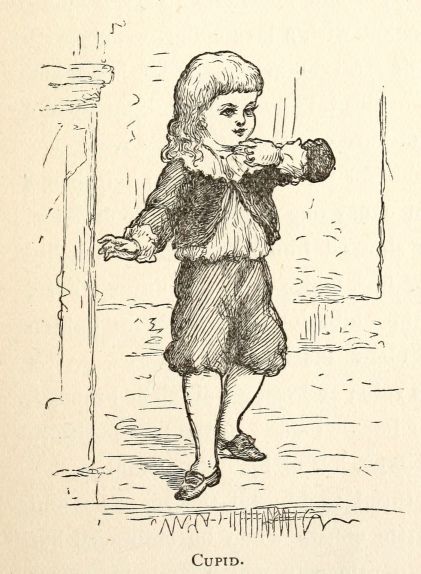
Cupid.
Especially beautiful and attractive did he look as
he pranced on the door-steps one afternoon while
waiting the arrival of a little cousin. Our Cupid's
costume was modernized out of regard to the prejudices
of society, and instead of wings, bandage, bow
and arrow, he was gorgeous to behold in small
buckled shoes, purple silk hose, black velvet
knickerbockers, and jacket with a lace collar, which, with
his yellow hair cut straight across the forehead, and
falling in long, curling love-locks behind, made him
look like an old picture of a young cavalier.
It was impossible for the little sprig to help being
a trifle vain when every one praised his comeliness,
and every mirror showed him a rosy face, with big
blue eyes, smiling lips, white teeth, a cunning nose,
and a dimple in the chin, not to mention the golden
mane that hung about his neck.
Yes, Cupid was vain; and as he waited, he pranced,
arranged the dear buckled shoes in the first position,
practised his best bow, felt of his dimple, and smiled
affably as he pictured to himself the pleasure and
surprise of the little cousin when he embraced her
in the ardent yet gentle way which made his greetings
particularly agreeable to those who liked such
tender demonstrations.
Cupid had made up his mind to love Chow-chow
very much, both because she was his cousin, and
because she must be interesting if all papa's stories
of her were true. Her very name was pleasing to
him, for it suggested Indian sweetmeats, though papa
said it was given to her because she was such a
mixture of sweet and sour that one never knew whether
he would get his tongue bitten by a hot bit of ginger,
or find a candied plum melting in his mouth when he
tried that little jar of Chow-chow.
"I know I shall like her, and of course she will
like me lots, 'cause everybody does," thought Cupid,
settling his love-locks and surveying his purple legs
like a contented young peacock.
Just then a carriage drove up the avenue, stopped
at the foot of the steps, and out skipped a tall, brown
man, a small, pale lady, and a child, who whisked
away to the pond so rapidly that no one could see
what she was like.
A great kissing and hand-shaking went on
between the papas and mammas, and Cupid came in
for a large share, but did not enjoy it as much as
usual, for the little girl had fled and he must get at
her. So the instant Aunt Susan let him go he ran
after the truant, quite panting with eagerness and
all aglow with amiable intentions, for he was a
hospitable little soul, and loved to do the honors of his
pleasant home like a gentleman.
A little figure, dressed in a brown linen frock, with
dusty boots below it, and above it a head of wild
black hair, tied up with a large scarlet bow, stood
by the pond throwing stones at the swans, who
ruffled their feathers in stately anger at such
treatment. Suddenly a pair of velvet arms embraced
her, and half turning she looked up into a rosy,
smiling face, with two red lips suggestively puckered
for a hearty kiss.
Chow-chow's black eyes sparkled, and her little
brown face flushed as red as her ribbon as she tried
to push the boy away with a shrill scream.
"Don't be frightened. I'm Cupid. I must kiss
you. I truly must. I always do when people come,
and I like you very much."
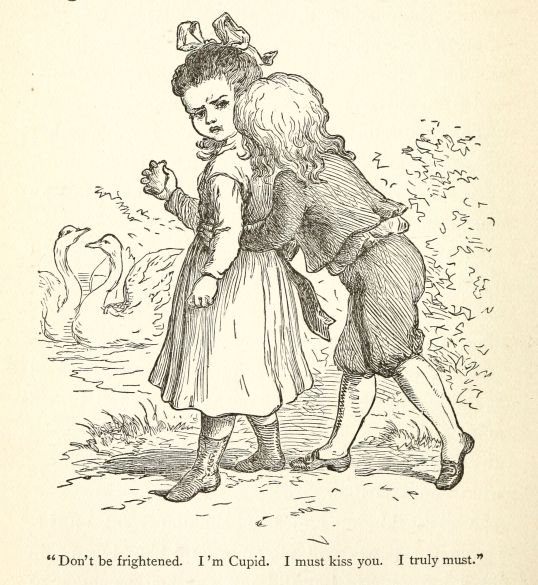
"Don't be frightened. I'm Cupid. I must kiss you. I truly must."
With this soothing remark, the velvet arms pressed
her firmly, and the lips gave her several soft kisses,
which, owing to her struggles, lit upon her nose, chin,
top-knot, and ear; for, having begun, Cupid did not
know when to leave off.
But Chow-chow's wrath was great, her vengeance
swift, and getting one hand free she flung the gravel
it held full in the flushed and smiling face of this
bold boy who had dared to kiss her without leave.
Poor Cupid fell back blinded and heart-broken at
such a return for his warm welcome, and while he
stood trying to clear his smarting eyes, a fierce little
voice said close by,—
"Does it hurt?"
"Oh! dreadfully!"
"I'm glad of it."
"Then you don't love me?"
"I hate you!"
"I don't see why."
"I don't like to be hugged and kissed. I don't
let anybody but papa and mamma do it, ever,—so,
now!"
"But I'm your cousin, and you must love me.
Won't you, please?" besought Cupid, with one eye
open and a great tear on his nose.
"I'll see about it. I don't like crying boys,"
returned the hard-hearted damsel.
"Well, you made me; but I forgive you," and
Cupid magnanimously put out his hand for a friendly
shake. But Chow-chow was off like a startled deer,
and vanished into the house, singing at the top of
her voice a nursery rhyme to this effect,—
"And she bids you to come in,
With a dimple in your chin,
Billy boy, Billy boy."
When Cupid, with red eyes and a sad countenance,
made his appearance, he found Chow-chow on her
father's knee eating cake, while the elders talked.
She had told the story, and now from the safe stronghold
of papa's arm condescended to smile upon the
conquered youth.
Cupid went to mamma, and in one long whisper
told his woes; then sat upon the cushion at her feet,
and soon forgot them all in the mingled joys of
eating macaroons and giving Chow-chow smile for smile
across the hearth-rug.
"I predict that we shall be much amused and edified
by the progress of the friendship just begun,"
said Cupid's papa, a quiet man, who loved children
and observed them with affectionate interest.
"And I predict a hard time of it for your young
man, if he attempts to tame my strong-minded little
woman here. Her mother's ideas are peculiar, and
she wants to bring Chow-chow up according to the
new lights,—with contempt for dress and all
frivolous pursuits; to make her hardy, independent, and
quite above caring for such trifles as love, domestic
life, or the feminine accomplishments we used to
find so charming."
As Chow-chow's papa spoke, he looked from the
child in her ugly gray frock, thick boots, and mop
of hair tied up in a style neither pretty nor becoming,
to his wife in her plain dress, with her knob of
hair, decided mouth, sarcastic nose, and restless eyes
that seemed always on the watch to find some new
wrong and protest against it.
"Now, George, how can you misrepresent my
views and principles so? But it's no use trying to
convince or out-talk you. We never get a chance,
and our only hope is to bring up our girls so that
they may not be put down as we are," returned
Mrs. Susan, with a decided air.
"Show us how you are going to defend your sex
and conquer ours, Chow-chow; give us your views
generally. Now, then, who is in favor of the Elective
Franchise?" said Uncle George, with a twinkle of
the eye.
Up went Aunt Susan's hand, and to the great
amusement of all up went Chow-chow's also and,
scrambling to her feet on papa's knee, she burst into
a harangue which convulsed her hearers, for in it the
child's voice made queer work with the long words,
and the red bow wagged belligerently as she laid
down the law with energy, and defined her views,
closing with a stamp of her foot.
"This is our platform: Free speech, free love,
free soil, free every thing; and Woman's Puckerage
for ever!"
Even Aunt Susan had to laugh at that burst, for
it was delivered with such vigor that the speaker
would have fallen on her nose if she had not been
sustained by a strong arm.
Cupid laughed because the rest did, and then
turned his big eyes full of wonder on his mother,
asking what it all meant.
"Only fun, my dear."
"Now, Ellen, that's very wrong. Why don't you
explain this great subject to him, and prepare him to
take a nobler part in the coming struggle than those
who have gone before him have done?" said Mrs. Susan,
with a stern look at her husband, who was
petting the little daughter, who evidently loved him best.
"I don't care to disturb his happy childhood with
quarrels beyond his comprehension. I shall teach
him to be as good and just a man as his father,
and feel quite sure that no woman will suffer wrong
at his hands," returned Mrs. Ellen, smiling at Cupid's
papa, who nodded back as if they quite understood
each other.
"We never did agree and we never shall, so I
will say no more; but we shall see what a good
effect my girl's strength of character will have upon
your boy, who has been petted and spoiled by too
much tenderness."
So Aunt Susan settled the matter; and as the days
went on, the elder people fell into the way of
observing how the little pair got on together, and were
much amused by the vicissitudes of that nursery
romance.
In the beginning Chow-chow rode over Cupid
rough-shod, quite trampled upon him in fact; and
he bore it, because he wanted her to like him, and
had been taught that the utmost courtesy was due a
guest. But when he got no reward for his long-suffering
patience he was sometimes tempted to rebel,
and probably would have done so if he had not had
mamma to comfort and sustain him. Chow-chow
was very quick at spying out the weaknesses of her
friends and alarmingly frank in proclaiming her
discoveries; so poor Cupid's little faults were seen and
proclaimed very soon, and life made a burden to
him, until he found out the best way of silencing
his tormentor was by mending the faults.
"My papa says you are a dandy-prat, and you
are," said Chow-chow, one day when the desire to
improve her race was very strong upon her.
"What is a dandy-prat?" asked Cupid, looking
troubled at the new accusation.
"I asked him, and he said a vain fellow; and you
are vain,—so now!"
"Am I?" and Cupid stopped to think it over.
"Yes; you're horrid vain of your hair, and your
velvet clothes, and the dimple in your chin. I know
it, 'cause you always look in the glass when you are
dressed up, and keep feeling of that ugly hole in
your chin, and I see you brush your hair ever so
much."
Poor Cupid colored up with shame, and turned his
back to the mirror, as the sharp-tongued young
monitor went on:—
"My mamma said if you were her boy she'd cut
off your curls, put you in a plain suit, and stick some
court-plaster over that place till you forgot all
about it."
Chow-chow expected an explosion of grief of
anger after that last slap; but to her amazement
the boy walked out of the room without a word.
Going up to his mother as she sat busy with a letter,
he asked in a very earnest voice,—
"Mamma, am I vain?"
"I'm afraid you are a little, my dear," answered
mamma, deep in her letter.
With a sad but resolute face Cupid went back to
Chow-chow, bearing a pair of shears in one hand
and a bit of court-plaster in the other.
"You may cut my hair off, if you want to. I
ain't going to be a dandy-prat any more," he said,
offering the fatal shears with the calmness of a
hero.
Chow-chow was much surprised, but charmed with
the idea of shearing this meek sheep, so she snipped
and slashed until the golden locks lay shining on the
floor, and Cupid's head looked as if rats had been
gnawing his hair.
"Do you like me better now?" he asked, looking
in her eyes as his only mirror, and seeing there the
most approving glance they had ever vouchsafed
him.
"Yes, I do; girl-boys are hateful."
He might have retorted, "So are boy-girls," but he
was a gentleman, so he only smiled and held up his
chin for her to cover the offending dimple, which she
did with half a square of black plaster.
"I shall never wear my velvet clothes any more
unless mamma makes me, and I don't think she will
when I tell her about it, 'cause she likes to have me
cure my faults," said Cupid when the sacrifice was
complete, and even stern Chow-chow was touched
by the sweetness with which he bore the rebuke, the
courage with which he began the atonement for his
little folly.
When he appeared at dinner, great was the outcry;
and when the story was told, great was the effect
produced. Aunt Susan said with satisfaction,—
"You see what an excellent effect my girl's Spartan
training has on her, and how fine her influence is
on your effeminate boy."
Uncle George laughed heartily, but whispered
something to Chow-chow that made her look
ashamed and cast repentant glances at her victim.
Cupid's papa shook hands with the boy, and said,
smiling, "I am rather proud of my 'dandy-prat,'
after all."
But mamma grieved for the lost glory of her little
Absalom, and found it hard to pardon naughty
Chow-chow, until Cupid looked up at her with a
grave, clear look which even the big patch could not
spoil, and said manfully,—
"You know I was vain, mamma, but I won't be
any more, and you'll be glad, because you love me
better than my hair, don't you?"
Then she hugged the cropped head close, and
kissed the hidden dimple without a word of
reproach; but she laid the yellow locks away as if
she did love them after all, and often followed the
little lad in the rough gray suit, as if his sacrifice
had only made him more beautiful in her eyes.
Chow-chow was quite affable for some days after
this prank, and treated her slave with more gentleness,
evidently feeling that, though belonging to an
inferior race, he deserved a trifle of regard for his
obedience to her teachings. But her love of power
grew by what it fed on and soon brought fresh woe
to faithful Cupid, who adored her, though she
frowned upon his little passion and gave him no
hope.
"You are a 'fraid-cat," asserted her majesty, one
afternoon as they played in the stable, and Cupid
declined to be kicked by the horse Chow-chow was
teasing.
"No, I ain't; but I don't like to be hurt, and it's
wrong to fret Charley, and I won't poke him with
my hoe."
"Well, it isn't wrong to turn this thing, but you
don't dare to put your finger on that wheel and let
me pinch it a little bit," added Chow-chow, pointing
to some sort of hay-cutting machine that stood
near by.
"What for?" asked Cupid, who did object to
being hurt in any way.
"To show you ain't a 'fraid-cat. I know you are.
I'm not, see there," and Chow-chow gave her own
finger a very gentle squeeze.
"I can bear it harder than that," and devoted
Cupid laid his plump forefinger between two wheels,
bent on proving his courage at all costs.
Chow-chow gave a brisk turn to the handle,
slipped in doing so, and brought the whole weight
of the cruel cogs on the tender little finger, crushing
the top quite flat. Blood flowed, Chow-chow stopped
aghast; and Cupid, with one cry of pain, caught and
reversed the handle, drew out the poor finger, walked
unsteadily in to mamma, saying, with dizzy eyes and
white lips, "She didn't mean to do it," and then
fainted quite away in a little heap at her feet.
The doctor came flying, shook his head over the
wound, and drew out a case of dreadful instruments
that made even strong-minded Aunt Susan turn
away her head, and bound up the little hand that
might never be whole and strong again. Chow-chow
stood by quite white and still until it was all over
and Cupid asleep in his mother's arms; then she
dived under the sofa and sobbed there, refusing to
be comforted until her father came home. What
that misguided man said to her no one ever knew,
but when Cupid was propped up on the couch at
tea-time, Chow-chow begged piteously to be allowed
to feed him.
The wounded hero, with his arm in a sling,
permitted her to minister to him; and she did it so
gently, so patiently, that her father said low to
Mrs. Ellen,—
"I have hopes of her yet, for all the woman is not
taken out of her, in spite of the new lights."
When they parted for the evening, Cupid, who
had often sued for a good-night kiss and sued in
vain, was charmed to see the red top-knot bending
over him, and to hear Chow-chow whisper, with a
penitent kiss, "I truly didn't mean to, Coopy."
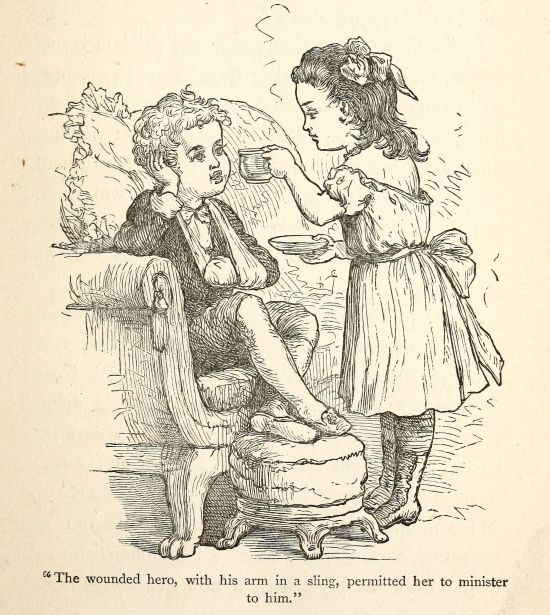
"The wounded hero, with his arm in a sling, permitted her to minister to him."
The well arm held her fast as the martyr whispered
back, "Just say I ain't a 'fraid-cat, and I don't
mind smashing my finger."
Chow-chow said it that night and thought it next
day and for many following days, for each morning,
when the doctor came to dress the "smashed"
finger, she insisted on being by as a sort of penance.
She forced herself to watch the bright instruments
without shivering, she ran for warm water, she
begged to spread the salve on the bandage, to hold
the smelling-bottle, and to pick all the lint that was
used.
And while she performed these small labors of
love, she learned a little lesson that did her more
good than many of mamma's lectures. For Cupid
showed her the difference between the rash daring
that runs foolish risks, and the steady courage that
bears pain without complaint. Every day the same
scene took place; Chow-chow would watch for
and announce the doctor; would bustle out the
salve-box, bandage, and basin, set the chair, and call
Cupid from his book with a new gentleness in her
voice.
The boy would answer at once, take his place,
and submit the poor swollen hand to the ten minutes'
torture of little probes and scissors, caustic and
bathing, without a word, a tear, or sound of suffering.
He only turned his head away, grew white
about the lips, damp on the forehead, and when it
was all over would lean against his mother for a
minute, faint and still.
Then Chow-chow would press her hands together
with a sigh of mingled pity, admiration, and
remorse, and when the boy looked up to say stoutly,
"It didn't hurt very much," she would put his sling
on for him, and run before to settle the pillows,
carry him the little glass of wine and water he was
to take, and hover round him until he was quite
himself again, when she would subside close by, and
pick lint or hem sails while he read aloud to her
from one of his dear books.
"It is a good lesson in surgery and nursing for
her. I intend to have her study medicine if she
shows any fondness for it," said Aunt Susan.
"It is a good lesson in true courage, and I am
glad to have her learn it early," added Uncle George,
who now called Cupid a "trump" instead of a
"dandy-prat."
"It is a good lesson in loving and serving others
for love's sake, as all women must learn to do soon
or late," said gentle Mrs. Ellen.
"It is teaching them both how to bear and forbear,
to teach and help, and comfort one another, and take
the pains and pleasures of life as they should do
together," concluded Cupid's papa, watching the little
couple with the wise kind eyes that saw a pretty
story in their daily lives.
Slowly the finger healed, and to every one's
surprise was not much disfigured, which Cupid insisted
was entirely owing to Chow-chow's superior skill in
spreading salve and picking lint. Before this time,
however, Chow-chow, touched by his brave patience,
his generous refusal to blame her for the mishap, and
his faithful affection, had in a tender moment
confessed to her little lover that she did "like him a
great deal," and consented to go and live in the old
swan-house on the island in the pond as soon as he
was well enough.
But no sooner had she enraptured him by these
promises than she dashed his joy by adding certain
worldly conditions which she had heard discussed
by her mamma and her friends.
"But we can't be married until we have a lot of
money. Nobody does, and we must have ever so
much to buy things with."
"Yes, but papa said he'd give us some little furniture
to put in our house, and mamma will let us have
as much cake and milk-tea as we want, and I shall
be very fond of you, and what's the use of money?"
asked the enamoured Cupid, who believed in love in
a cottage, or swan-house rather.
"I shan't marry a poor boy, so now!" was the
mercenary Chow-chow's decision.
"Well, I'll see how much I've got; but I should
think you would like me just as well without," and
Cupid went away to inspect his property with
as much anxiety as any man preparing for matrimony.
But Cupid's finances were in a bad state, for he
spent his pocket-money as fast as he got it, and had
lavished gifts upon his sweetheart with princely
prodigality. So he punched a hole in his savings-bank
and counted his small hoard, much afflicted to
find it only amounted to seventy-eight cents, and a
button put in for fun. Bent on winning his mistress
no sacrifice seemed too great, so he sold his live
stock, consisting of one lame hen, a rabbit, and a
choice collection of caterpillars. But though he
drove sharp bargains, these sales only brought him
in a dollar or two. Then he went about among his
friends, and begged and borrowed small sums, telling
no one his secret lest they should laugh at him, but
pleading for a temporary accommodation so earnestly
and prettily that no one could refuse.
When he had strained every nerve and tried every
wile, he counted up his gains and found that he had
four dollars and a half. That seemed a fortune to
the innocent; and, getting it all in bright pennies,
he placed it in a new red purse, and with pardonable
pride laid his offering at Chow-chow's feet.
But alas for love's labor lost! the cruel fair crushed
all his hopes by saying coldly,—
"That isn't half enough. We ought to have ten
dollars, and I won't like you until you get it."
"O Chow-chow! I tried so hard; do play it's
enough," pleaded poor Cupid.
"No, I shan't. I don't care much for the old
swan-house now, and you ain't half so pretty as you
used to be."
"You made me cut my hair off, and now you
don't love me 'cause I'm ugly," cried the afflicted
little swain, indignant at such injustice.
But Chow-chow was in a naughty mood, so she
swung on the gate, and would not relent in spite of
prayers and blandishments.
"I'll get some more money somehow, if you will
wait. Will you, please?"
"I'll see 'bout it."
And with that awful uncertainty weighing upon
his soul, poor Cupid went away to wrestle with
circumstances. Feeling that matters had now reached
a serious point, he confided his anxieties to mamma;
and she, finding that it was impossible to laugh or
reason him out of his untimely passion, comforted
him by promising to buy at high prices all the
nosegays he could gather out of his own little garden.
"But it will take a long time to make ten dollars
that way. Don't you think Chow-chow might come
now, when it is all warm and pleasant, and not stop
until summer is gone, and no birds and flowers and
nice things to play with? It's so hard to wait,"
sighed Cupid, holding his cropped head in his hands,
and looking the image of childish despair.
"So it is, and I think Chow is a little goose not
to go at once and enjoy love's young dream without
wasting precious time trying to make money. Tell
her papa said so, and he ought to know," added
Uncle George, under his breath, for he had tried it,
and found that it did not work well.
Cupid did tell her, but little madam had got the
whim into her perverse head; and the more she was
urged to give in, the more decided she grew. So
Cupid accepted his fate like a man, and delved away
in his garden, watering his pinks, weeding his
mignonette, and begging his roses to bloom as fast and
fair as they could, so that he might be happy before
the summer was gone. Rather a pathetic little lover,
mamma thought, as she watched him tugging away
with the lame hand, or saw him come beaming in
with his posies to receive the precious money that
was to buy a return for his loyal love.
Tender-hearted Mrs. Ellen tried to soften Chow-chow
and teach her sundry feminine arts against the
time she went to housekeeping on the island, for
Mrs. Susan was so busy hearing lectures, reading
reports, and attending to the education of other
people's children that her own ran wild. In her good
moods, Chow-chow took kindly to the new lessons,
and began to hem a table-cloth for the domestic
board at which she was to preside; also swept and
dusted now and then, and once cooked a remarkable
mess, which she called "Coopy's favorite pudding,"
and intended to surprise him with it soon after the
wedding. But these virtuous efforts soon flagged,
the table-cloth was not finished, the duster was
converted into a fly-killer, and her dolls lay unheeded
in corners after a few attempts at dressing and
nursing had ended in ennui.
How long matters would have gone on in this
unsatisfactory way no one knows; but a rainy day
came, and the experiences it gave the little pair
brought things to a crisis.
The morning was devoted to pasting pictures and
playing horse all over the house, with frequent
pauses for refreshment and an occasional squabble.
After dinner, as the mammas sat sewing and the
papas talking or reading in one room, the children
played in the other, quite unconscious that they
were affording both amusement and instruction to
their elders.
"Let's play house," suggested Cupid, who was
of a domestic turn, and thought a little rehearsal
would not be amiss.
"Well, I will," consented Chow-chow, who was
rather subdued by the violent exercises of the
morning.
So a palatial mansion was made of chairs, the
dolls' furniture arranged, the stores laid in, and
housekeeping begun.
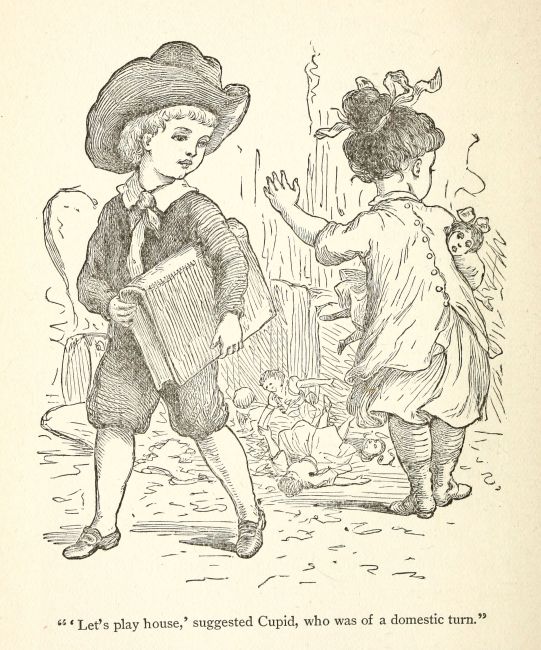
"'Let's play house,' suggested Cupid, who was of a domestic turn."
"Now, you must go off to your business while I
'tend to my work," said Chow-chow, after they had
breakfasted off a seed-cake and sugar and water tea
in the bosom of their family.
Cupid obediently put on papa's hat, took a large
book under his arm, and went away to look at
pictures behind the curtains, while Mrs. C. bestirred
herself at home in a most energetic manner, spanking
her nine dolls until their cries rent the air,
rattling her dishes with perilous activity, and going
to market with the coal-hod for her purchases.
Mr. Cupid returned to dinner rather early, and
was scolded for so doing, but pacified his spouse by
praising her dessert,—a sandwich of sliced apple,
bread, and salt, which he ate like a martyr.
A ride on the rocking-horse with his entire family
about him filled the soul of Mr. Cupid with joy,
though the trip was rendered a little fatiguing by
his having to dismount frequently to pick up the
various darlings as they fell out of his pockets
or their mother's arms as she sat behind him on a
pillion.
"Isn't this beautiful?" he asked, as they swung
to and fro,—Mrs. Cupid leaning her head on his
shoulder, and dear little Claribel Maud peeping out
of his breast-pocket, while Walter Hornblower and
Rosie Ruth, the twins, sat up between the horse's
ears, their china faces beaming in a way to fill a
father's heart with pride.
"It will be much nicer if the horse runs away and
we all go smash. I'll pull out his tail, then he'll
rear, and we must tumble off," proposed the restless
Mrs. C., whose dramatic soul delighted in tragic
adventures.
So the little papa's happy moment was speedily
banished as he dutifully precipitated himself and
blooming family upon the floor, to be gathered up
and doctored with chalk and ink, and plasters of
paper stuck all over their faces.
When this excitement subsided, it was evening,
and Mrs. Cupid bundled her children off to bed,
saying,—
"Now, you must go to your club, and I am going
to my lecture."
"But I thought you'd sew now and let me read
to you, and have our little candles burn, and be all
cosey, like papa and mamma," answered Cupid, who
already felt the discomfort of a strong-minded wife.
"My papa and mamma don't do so. He always
goes to the club, and smokes and reads papers and
plays chess, and mamma goes to Woman's Puckerage
meetings,—so I must."
"Let me go too; I never saw a Puckerage lecture,
and I'd like to," said Cupid, who felt that a walk
arm-in-arm with his idol would make any sort of
meeting endurable.
"No, you can't! Papa never goes; he says they
are all gabble and nonsense, and mamma says his
club is all smoke and slang, and they never go
together."
So Chow-chow locked the door, and the little pair
went their separate ways; while the older pair in the
other room laughed at the joke, yet felt that Cupid's
plan was the best, and wondered how Ellen and her
husband managed to get on so well.
Chow-chow's lecture did not seem to be very
interesting, for she was soon at home again. But
Mr. Cupid, after smoking a lamp-lighter with his feet up,
fell to reading a story that interested him, and forgot
to go home until he finished it. Then, to his
great surprise, he was told that it was morning, that
he had been out all night, and couldn't have any
breakfast. This ruffled him, and he told madam she
was a bad wife, and he wouldn't love her if she did
not instantly give him his share of the little pie
presented by cook, as a bribe to keep them out of the
kitchen.
Mrs. C. sternly refused, and locked up the pie,
declaring that she hated housekeeping and wouldn't
live with him any more, which threat she made good
by quitting the house, vowing not to speak to him
again that day, but to play alone, free and happy.
The deserted husband sat down among his infants
with despair in his soul, while the spirited wife, in
an immense bonnet, pranced about the room, waving
the key of the pie-closet and rejoicing in her
freedom. Yes, it was truly pathetic to see poor
Mr. Cupid's efforts at housekeeping and baby-tending;
for, feeling that they had a double claim upon him
now, he tried to do his duty by his children. But
he soon gave it up, piled them all into one bed, and
covered them with a black cloth, saying mournfully,
"I'll play they all died of mumps, then I can sell
the house and go away. I can't bear to stay here
when she is gone."
The house was sold, the dead infants buried under
the sofa, and then the forsaken man was a homeless
wanderer. He tried in many ways to amuse himself.
He travelled to China on the tailless horse, went to
California in a balloon, and sailed around the world
on a raft made of two chairs and the hearth-brush.
But these wanderings always ended near the ruins of
his home, and he always sat down for a moment to
watch the erratic movements of his wife.
That sprightly lady fared better than he, for her
inventive fancy kept her supplied with interesting
plays, though a secret sense of remorse for her
naughtiness weighed upon her spirits at times. She
had a concert, and sang surprising medleys, with
drum accompaniments. She rode five horses in a
circus, and jumped over chairs and foot-stools in the
most approved manner. She had a fair, a fire, and
a shipwreck; hunted lions, fished for crocodiles, and
played be a monkey in a style that would have
charmed Darwin.
But somehow none of these festive games had
their usual relish. There was no ardent admirer to
applaud her music, no two-legged horse to help her
circus with wild prancings and life-like neighs, no
devoted friend and defender to save her from the
perils of flood and fire, no comrade to hunt with her,
no fellow-monkey to skip from perch to perch with
social jabberings, as they cracked their cocoa-nuts
among imaginary palms. All was dull and tiresome.
A strong sense of loneliness fell upon her, and for
the first time she appreciated her faithful little friend.
Then the pie weighed upon her conscience; there it
was, wasting its sweetness in the closet, and no one
ate it. She had not the face to devour it alone; she
could not make up her mind to give it to Cupid;
and after her fierce renunciation of him, how could
she ask him to forgive her? Gradually her spirits
declined, and about the time that the other
wanderer got back from his last trip she sat down to
consider her position.
Hearing no noise in the other room, Uncle George
peeped in and saw the divided pair sitting in opposite
corners, looking askance at each other, evidently
feeling that a wide gulf lay between them, and
longing to cross it, yet not quite knowing how. A
solemn and yet a comical sight, so Uncle George
beckoned the others to come and look.
"My boy will give in first. See how beseechingly
he looks at the little witch!" whispered Mrs. Ellen,
laughing softly.
"No, he won't; she hurt his feelings very much
by leaving him, and he won't relent until she goes
back; then he'll forgive and forget like a man," said
Cupid's papa.
"I hope my girl will remain true to her principles,"
began Aunt Susan.
"She'll be a miserable baby if she does," muttered
Uncle George.
"I was going on to say that, finding she has done
wrong, I hope she will have the courage to say so,
hard as it is, and so expiate her fault and try to do
better," added Aunt Susan, fast and low, with a soft
look in her eyes, as she watched the little girl sitting
alone, while so much honest affection was waiting
for her close by, if pride would let her take it.
Somehow Uncle George's arm went round her
waist when she said that, and he gave a quick nod,
as if something pleased him very much.
"Shall I speak, and help the dears bridge over
their little trouble?" asked Mrs. Ellen, pretending
not to see the older children making up their
differences behind her.
"No; let them work it out for themselves. I'm
curious to see how they will manage," said papa,
hoping that his boy's first little love would prosper
in spite of thorns among the roses.
So they waited, and presently the affair was settled
in a way no one expected. As if she could not
bear the silence any longer, Chow-chow suddenly
bustled up, saying to herself,—
"I haven't played lecture. I always like that, and
here's a nice place."
Pulling out the drawers of a secretary like steps,
she slowly mounted to the wide ledge atop, and
began the droll preachment her father had taught her
in ridicule of mamma's hobby.
"Do stop her, George; it's so absurd," whispered
Mrs. Susan.
"Glad you think so, my dear," laughed Uncle George.
"There is some sense in it, and I have no doubt
the real and true will come to pass when we women
learn how far to go, and how to fit ourselves for the
new duties by doing the old ones well," said Mrs. Ellen,
who found good in all things, and kept herself
so womanly sweet and strong that no one could
deny her any right she chose to claim.
"She is like so many of those who mount your
hobby, Susan, and ride away into confusions of all
sorts, leaving empty homes behind them. The
happy, womanly women will have the most influence
after all, and do the most to help the bitter,
sour, discontented ones. They need help, God
knows, and I shall be glad to lend a hand toward
giving them their rights in all things."
As papa spoke, Chow-chow, who had caught sight
of the peeping faces, and was excited thereby, burst
into a tremendous harangue, waving her hands,
stamping her feet, and dancing about on her perch as
if her wrongs had upset her wits. All of a sudden the
whole secretary lurched forward, out fell the drawers,
open flew the doors, down went Chow-chow with a
screech, and the marble slab came sliding after, as
if to silence the irrepressible little orator forever.
How he did it no one knew, but before the top fell
Cupid was under it, received it on his shoulders, and
held it up with all his might, while Chow-chow
scrambled out from the ruins with no hurt but a
bump on the forehead. Papa had his boy out in a
twinkling, and both mammas fell upon their rescued
darlings with equal alarm and tenderness; for
Susan got her little girl in her arms before
Mr. George could reach her, and Chow-chow clung there,
sobbing away her fright and pain as if the maternal
purring was a new and pleasant solace.
"I'll never play that nasty old puckerage any
more," she declared, feeling of the purple lump on
her brow.
"Nor I either, in that way," whispered her
mamma, with a look that made Chow-chow ask
curiously,—
"Why, did you hurt yourself too?"
"I am afraid I did."
"Be sure that your platform is all right before you
try again, Poppet, else it will let you down when
you least expect it, and damage your best friends as
well as yourself," said Mr. George, setting up the
fallen rostrum.
"I'm not going to have any flatporm; I'm going
to be good and play with Coopy, if he'll let me,"
added the penitent Chow-chow, glancing with shy,
wet eyes at Cupid, who stood near with a torn
jacket and a bruise on the already wounded hand.
His only answer was to draw her out of her
mother's arms, embrace her warmly, and seat her
beside him on the little bench he loved to share
with her. This ready and eloquent forgiveness
touched Chow-chow's heart, and the lofty top-knot
went down upon Cupid's shoulder as if the little
fortress lowered its colors in token of entire surrender.
Cupid's only sign of triumph was a gentle pat
on the wild, black head, and a nod towards the
spectators, as he said, smiling all over his chubby
face,—
"Every thing is nice and happy now, and we
don't mind the bumps."
"Let us sheer off, we are only in the way," said
Mr. George, and the elders retired, but found it
impossible to resist occasional peeps at the little
pair, as the reconciliation scene went on.
"O Coopy! I was so bad, I don't think you can
love me any more," began the repentant one with a
sob.
"Oh yes I can; and just as soon as I get money
enough, we'll go and live in the swan-house, won't
we?" returned the faithful lover, making the most
of this melting mood.
"I'll go right away to-morrow, I don't care about
the money. I like the nice bright pennies, and we
don't need much, and I've got my new saucepan to
begin with," cried Chow-chow in a burst of generosity,
for, like a true woman, though she demanded
impossibilities at first, yet when her heart was won
she asked nothing but love, and was content with a
saucepan.
"O Goody! and I've got my drum," returned the
enraptured Cupid, as ready as the immortal Traddles
to go to housekeeping with a toasting fork and
a bird-cage, or some such useful trifles.
"But I was bad about the pie," cried Chow-chow
as her sins kept rising before her; and, burning to
make atonement for this one, she ran to the closet,
tore out the pie, and, thrusting it into Cupid's hands,
said in a tone of heroic resolution, "There, you eat
it all, and I won't taste a bit."
"No, you eat it all, I'd like to see you. I don't
care for it, truly, 'cause I love you more than a
million pies," protested Cupid, offering back the
treasure in a somewhat ruinous state after its
various vicissitudes.
"Then give me a tiny bit, and you have the rest,"
said Chow-chow, bent on self-chastisement.
"The fairest way is to cut it 'zactly in halves, and
each have a piece. Mamma says that's the right
thing to do always." And Cupid, producing a jack-knife,
proceeded to settle the matter with masculine
justice.
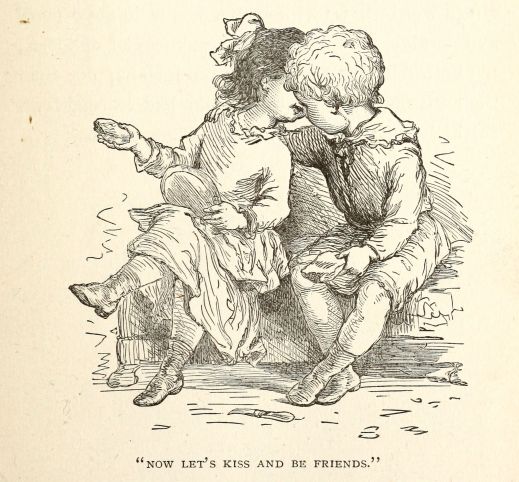
"NOW LET'S KISS AND BE FRIENDS."
So side by side they devoured the little bone of
contention, chattering amicably about their plans;
and as the last crumb vanished, Cupid said persuasively,
as if the league was not quite perfect without
that childish ceremony,—
"Now let's kiss and be friends, and never quarrel
any more."
As the rosy mouths met in a kiss of peace, the
sound was echoed from the other room, for Mr. George's
eyes made the same proposal, and his wife
answered it as tenderly as Chow-chow did Cupid.
Not a word was said, for grown people do not "'fess"
and forgive with the sweet frankness of children;
but both felt that the future would be happier than
the past, thanks to the lesson they had learned from
the little romance of Cupid and Chow-chow.
Coming home late one night, my eye was caught
by the sight of a spotted dog sitting under a
lamp all alone, and, as I passed, I said to him,—
"Go home, little doggie! It is too late for you
to be out, and you'll get rheumatism if you stay
there."
Alas for the poor fellow! he had no home to go
to; and, evidently feeling that I had invited him to
share mine by a friendly remark, he came pattering
after us down the street, and when we reached our
door stood wagging his tail, as if to say,—
"Thank you; yes, I should be most grateful if
you'd allow me to lie on your door-mat till
morning."
His handsome, wistful eyes, and the insinuating
wag of his thin tail, expressed this as plainly as any
words could have done, and it grieved me much to
see that I had awakened hopes which I could not
fulfil.
I explained to him how it was; that this was not
my house, and I really could not take him into my
room; that there were five cats downstairs, and
several old ladies upstairs; one snarly, fat poodle
on the first floor; and half-a-dozen young men about
the house, ready for mischief at all hours of the day
or night. Such being the case, it was evidently no
home for a strange doggie, so like a huckleberry
pudding in appearance that I named him Huckleberry
on the spot.
He seemed to understand it, for he stopped wagging
and retired from the steps; but he was bitterly
disappointed; and when I had gently closed the
door, apologizing as I did so, he gave one disconsolate
howl, and went to sit under the lamp again, as
if that little circle of light made the dull November
night less cold and lonely.
A day or two afterward, as I stood looking at
the ruins of the great fire, a spotted dog lying on
the edge of a smoking cellar attracted my attention.
"Faithful fellow! he is still watching his master's
property, I dare say, though every thing is ashes.
How beautiful that is!" I thought to myself, and
went a little nearer to enjoy the touching spectacle.
As I approached, doggie looked up, and I knew
him at once by the queer black patch on his left eye,
and he knew me, for he sat up and began to beat the
ground with his tail by way of welcome.
"Why, Huckleberry, is it you? Was your master
burned out? and don't you know where he is
gone?" I asked.
Now, I am very stupid about learning languages,
and nearly died of German; but the language of
animals I understand without any grammar or
dictionary; and I defy any one to read it better than
myself. So, when Huckleberry gave a bark, I knew
it meant, "Yes, ma'am;" and when he came fawning
about my very muddy boots, he added this touching
remark as plainly as if he had said it in the most
elegant English:—
"Dear woman, I'm homeless, friendless, and forlorn;
pity me, and I will be a faithful servant to you,
on the word of an honest, grateful dog!"
It was very hard to say no, but I tried to soften
my refusal by offering him some nice little cakes
which I was intending to give my boys that
evening; for when they come home from college Saturday
night, we always have a jubilee in honor of the
class of '76, to which I belong.
Doggie evidently needed them more than the
lads, and gobbled up the whole dozen with a rapidity
that made me wish I had a beefsteak or two in my
pocket. While he was finishing the last one, I slipped
away, and devoutly hoped I should see the poor,
dear thing no more, for it rent my heart to leave him
out in the cold; yet what could I do with him in my
one room?
A week or two passed, and I forgot my spotted
friend in the absorbing task of getting Christmas
presents ready. Every one else seemed to have
forgotten him, too; for, late one snowy afternoon, as
I hurried home, quite worn out with trying to shop
among a mob of other women as busy and as impatient
as myself, I saw a sight that made the tears
come to my eyes in spite of the snow-flakes roosting
on my lashes.
On the upper step of a church, close to the door,
is if waiting for it to open to him, lay poor Huckleberry,
dirty, thin, and evidently worn out with the
hardships of his lot. Tired of asking for admittance
at men's doors, he had gone to God's house, and no
one had turned him away. If he had lain there all
that stormy night, I think by morning he would have
been safe in the little lower heaven which I am sure
awaits the faithful, brave, and good among animals,
when their long and often unacknowledged service
is over in this world.
That mute reproach went to my heart, for now it
seemed as if this small charity had been sent to me
especially, and that I had neglected it till it was
nearly too late. Huckleberry seemed to feel as if it
was no use to appeal to human kindness any more,
for he made no sign of recognition, and lay quite
still, as if waiting till his dumb prayer for help was
heard and answered by Him who sees the sparrow's
fall.
Up the steps I went, and, putting down my parcels,
patted the head that seemed almost too tired
to be lifted up, and with remorseful tenderness I
said,—
"My poor dear, come home with me. I truly
mean it now. Forgive me, and let me show you
that in charitable Boston not even a dog need
starve!"
He didn't believe me. He was tired of false
hopes, worn out with following people home to find
the doors shut in his face, and seemed to have made
up his mind to stay in the only refuge left him.
I wondered as I watched him if he had ever seen
that door open, and, remembering the light, the
warmth, the music, and the quiet figures moving in
and out, had thought it was a better world, and so,
when every other hope failed, came back to wait for
a chance to creep in and lie humbly in some corner,
feeling safe and happy.
I shall never know, for I had not time to ask
about it, and he was too tired to talk. Feeling that
my duty was very plainly to give poor doggie a lift,
I coaxed him home with great difficulty, and he
slowly followed, looking so incredulous and amazed
that I felt bound to redeem the character of the
human race in his eyes.
Once in my room, with a plate of cold meat before
him and a warm rug placed at his disposal, Huckleberry
gave in, believed, rejoiced, and was so grateful
that he stopped now and then, even when bolting
lumps of cold steak, to look at me and wag his tail
with a whine of thanks.
Dear thing! how dirty, lean, and ugly he was! with
one lame foot, a torn ear, and a bit of old rope
round his neck where the collar should have been.
Never mind; I loved him, and went on petting him
with a reckless disregard of consequences and fleas.
I had no more idea what I should do with him than
if he had been an elephant; but remembering the
blessed society for the prevention of cruelty to
animals, I felt that I could fall back on them when
all other hopes failed.
So, while Huckleberry lay on the rug, roasting
first one side and then the other, with his nose on a
bone, just to make him feel sure it wasn't all a
dream, I sat staring at him and planning a future for
him such as few dogs enjoy. He seemed to feel this,
for he gurgled and grunted in his sleep, woke up
now and then with a start, and stared back at me
with eyes full of doggish loyalty as he whacked the
floor with his grateful tail.
"One of our fellows shall take him!" I decided;
and, having picked out the most tender-hearted boy
among my large and choice collection, I wrote to
this victim an alluring epistle, offering him a lovely
carriage-dog whom I had been so fortunate as to
find. Would he like to have the first look at him
and become his owner free of cost?
This being finished and sent to the post, I ordered
a big tub of hot water to be ready early in the
morning for my dog's bath, and heartily wished I could
fatten him up over night, as at present he was not
an inviting animal.
Then I retired to my bed, leaving Huckleberry
asleep on the rug. Bless my heart, how he did
snore! and when a very loud one woke him up, he
seemed to feel that it was necessary for him to come
and put his cold nose on my face, or paw at the
pillow, till I flew up, thinking it was robbers. Then
he would apologize in the most contrite manner, and
explain that he only came to see if I was all right,
and to express his thanks all over again.
After which he returned to his rug with a sigh
of satisfaction, and fell asleep much quicker than I
could.
In the morning he was escorted to the shed for
his bath, to the great amusement of the servants
and the fierce indignation of the cats. All five spit
and glared from the various elevated refuges to
which they had flown on his entrance; and one
black kit made darts at him, looking like a little
demon in her wrath.
Huckleberry behaved like a dog of good manners
and temper, and, after vainly trying to appease the
irate pussies, took no notice of them, being absorbed
in his own afflictions.
He did not like the bath, but bore it like a hero,
and let me scrub him till he was as clean as a very
spotted bow-wow could be. He even submitted to
the indignity of a little blanket pinned about his
neck like an old woman, and trotted meekly upstairs
after me, leaving the men and maids in fits of
laughter, and the cats curling their whiskers with
scorn at the whole proceeding.
Leaving my wash to dry, I flew out and bought
a fine red collar for him; then I devoted the rest of
my day to fussing over him, that he might be as
presentable as possible.
Charley did not come till the next day, and the
agonies I went through, meantime, with that blessed
dog, "no mortal creeter knows," as Mrs. Gamp would say.
I'm afraid I gave him too much meat, or else joy
flew to his head and made him wild, for he
developed such a flow of spirits that I felt as if I had an
unchained whirlwind in my room. He bounced to
the window every time a cart went by; growled at
every dog he saw; barked at every one who entered
the room; drank out of my pitcher; worried the
rosettes off my slippers; upset my work-basket,
the fire-irons, and two bottles in his artless play;
scratched the paint off the door trying to get out,
and, when he got to the yard, chased all the cats till
they fled over the walls in every direction.
When exhausted with these little amusements, he
would come and try to lick my face, put his paws in
my lap, and languish at me with his fine eyes; and
when I told him I couldn't have it, he cast himself
at my feet and squirmed rapturously.
He was a great plague, but I was fond of him,
and when Charley came was sorry that he must
leave me. But he had been on the rampage all that
second night, for I put him in the hall to sleep, and
he had scratched and howled at every door till I let
him in to save him from the shower of boots hurled
at him by the young gentlemen whose slumbers he
had disturbed; so it was high time he went.
Charley laughed at him, but, when I had told the
story, the good lad took pity on him and led him
away after I had kissed and bade him be a good
dog. He didn't seem satisfied, but consented to go
to please me, and trotted round the corner, looking
so neat and respectable it did my heart good to see
him.
"Now he is settled, and what a comfort that is!"
I said to myself as I restored my devastated home
to order.
But he wasn't: oh, dear, no; for in two days
back he came, all his own naughty self, and I found
him boldly erect upon the steps waiting for me. He
had run away and come home to his first friend, sure
of a welcome.
It was very flattering, but also inconvenient; so
he was restored to his master after a scolding and
a patting which probably spoilt the effect of the
lecture.
Three times did that dear deluded dog come
back, and three times was he bundled home again.
Then Charley shut him up in an old shed, and kept
him there except when he led him out by a chain
for an airing.
But Huckleberry's grateful passion could not be
restrained, and cost him his life in the end. He
amused his leisure hours scratching and burrowing
at the foundation stones of the shed wall, and, being
loosely built, a big one fell on him in some way,
hurting him so badly that there was no cure for his
broken bones.
A note from Charley came to me, saying, "If you
want to say good-by to poor old Huckleberry, come
out and do it, for I've got to kill him, he is so
hurt."
Of course I went, and there I found him lying on
a soft bed of hay, with his wounds bound up, and
tender-hearted Charley watching over him. How
glad he was to see his "missis!" How hard he
tried to come and meet me! and how satisfied he
looked when I bent down to stroke him, and let him
feebly lick my hand as much as he liked!
He could hardly breathe for pain, and his eyes
were already dim, but his dear old tail wagged to
the last; and when I had said the tenderest good-by
I knew, he laid down his head with a sigh that
seemed to say,—
"Now I'm content, and can die in peace. I've
thanked her, and she is sorry for me, so it's all right.
You may put me out of pain as soon as you like.
Master Charley; I'm ready."
It was soon done. I heard a shot, saw my lad go
into the garden with a pick-axe and a spade, and
then I knew that doggie was ready for his grave.
We wrapped him in a bit of cheerful red carpet, and
when a bed had been delved out for him, we laid
the little bundle in, covered it up, and left the
winter snow to spread a soft white pall over poor
Huckleberry's last home.
Nelly sat beside her mother picking lint, but
while her fingers flew, her eyes often looked
wistfully out into the meadow, golden with
buttercups, and bright with sunshine. Presently she said,
rather bashfully, but very earnestly, "Mamma, I
want to tell you a little plan I've made, if you'll
please not laugh."
"I think I can safely promise that, my dear," said
her mother, putting down her work that she might
listen quite respectfully.
Nelly looked pleased, and went on confidingly.
"Since brother Will came home with his lame foot,
and I've helped you tend him, I've heard a great
deal about hospitals, and liked it very much.
To-day I said I wanted to go and be a nurse, like Aunt
Mercy; but Will laughed, and told me I'd better
begin by nursing sick birds and butterflies and
pussies before I tried to take care of men. I did not
like to be made fun of, but I've been thinking that
it would be very pleasant to have a little hospital
all my own, and be a nurse in it, because, if I took
pains, so many pretty creatures might be made well,
perhaps. Could I, mamma?"
Her mother wanted to smile at the idea, but did
not, for Nelly looked up with her heart and eyes so
full of tender compassion, both for the unknown
men for whom her little hands had done their best,
and for the smaller sufferers nearer home, that she
stroked the shining head, and answered readily:
"Yes, Nelly, it will be a proper charity for such a
young Samaritan, and you may learn much if you
are in earnest. You must study how to feed and
nurse your little patients, else your pity will do no
good, and your hospital become a prison. I will
help you, and Tony shall be your surgeon."
"O mamma, how good you always are to me!
Indeed, I am in truly earnest; I will learn, I will be
kind, and may I go now and begin?"
"You may, but tell me first where will you have
your hospital?'
"In my room, mamma; it is so snug and sunny,
and I never should forget it there," said Nelly.
"You must not forget it anywhere. I think that
plan will not do. How would you like to find
caterpillars walking in your bed, to hear sick pussies
mewing in the night, to have beetles clinging to
your clothes, or see mice, bugs, and birds tumbling
downstairs whenever the door was open?" said her
mother.
Nelly laughed at that, thought a minute, then
clapped her hands, and cried: "Let us have the old
summer-house! My doves only use the upper part,
and it would be so like Frank in the story-book.
Please say yes again, mamma."
Her mother did say yes, and, snatching up her
hat, Nelly ran to find Tony, the gardener's son, a
pleasant lad of twelve, who was Nelly's favorite
playmate. Tony pronounced the plan a "jolly"
one, and, leaving his work, followed his young
mistress to the summer-house, for she could not wait
one minute.
"What must we do first?" she asked, as they
stood looking in at the dim, dusty room, full of
garden tools, bags of seeds, old flower-pots, and
watering-cans.
"Clear out the rubbish, miss," answered Tony.
"Here it goes, then," and Nelly began bundling
every thing out in such haste that she broke two
flower-pots, scattered all the squash-seeds, and
brought a pile of rakes and hoes clattering down
about her ears.
"Just wait a bit, and let me take the lead, miss.
You hand me things, I'll pile 'em in the barrow and
wheel 'em off to the barn; then it will save time,
and be finished up tidy."
Nelly did as he advised, and very soon nothing
but dust remained.
"What next?" she asked, not knowing in the least.
"I'll sweep up, while you see if Polly can come
and scrub the room out. It ought to be done before
you stay here, let alone the patients."
"So it had," said Nelly, looking very wise all of
a sudden. "Will says the wards—that means the
rooms, Tony—are scrubbed every day or two, and
kept very clean, and well venti—something—I
can't say it; but it means having a plenty of air
come in. I can clean windows while Polly mops,
and then we shall soon be done."
Away she ran, feeling very busy and important
Polly came, and very soon the room looked like
another place. The four latticed windows were set
wide open, so the sunshine came dancing through
the vines that grew outside, and curious roses peeped
in to see what frolic was afoot. The walls shone
white again, for not a spider dared to stay; the wide
seat which encircled the room was dustless now,
the floor as nice as willing hands could make it; and
the south wind blew away all musty odors with its
fragrant breath.
"How fine it looks!" cried Nelly, dancing on the
doorstep, lest a footprint should mar the still damp
floor.
"I'd almost like to fall sick for the sake of staying
here," said Tony, admiringly. "Now, what sort
of beds are you going to have, miss?"
"I suppose it won't do to put butterflies and toads
and worms into beds like the real soldiers where
Will was?" answered Nelly, looking anxious.
Tony could hardly help shouting at the idea; but
rather than trouble his little mistress, he said very
soberly: "I'm afraid they wouldn't lay easy, not
being used to it. Tucking up a butterfly would
about kill him; the worms would be apt to get lost
among the bedclothes; and the toads would tumble
out the first thing."
"I shall have to ask mamma about it. What will
you do while I'm gone?" said Nelly, unwilling that
a moment should be lost.
"I'll make frames for nettings to the window, else
the doves will come in and eat up the sick people."
"I think they will know that it is a hospital, and
be too kind to hurt or frighten their neighbors,"
began Nelly; but, as she spoke, a plump white dove
walked in, looked about with its red-ringed eyes,
and quietly pecked up a tiny bug that had just
ventured out from the crack where it had taken refuge
when the deluge came.
"Yes, we must have the nettings. I'll ask mamma
for some lace," said Nelly, when she saw that; and,
taking her pet dove on her shoulder, told it about her
hospital as she went toward the house; for, loving
all little creatures as she did, it grieved her to have
any harm befall even the least or plainest of them.
She had a sweet child-fancy that her playmates
understood her language as she did theirs, and that
birds, flowers, animals, and insects felt for her the
same affection which she felt for them. Love
always makes friends, and nothing seemed to fear the
gentle child; but welcomed her like a little sun who
shone alike on all, and never suffered an eclipse.
She was gone some time, and when she came back
her mind was full of new plans, one hand full of
rushes, the other of books, while over her head
floated the lace, and a bright green ribbon hung
across her arm.
"Mamma says that the best beds will be little
baskets, boxes, cages, and any sort of thing that
suits the patient; for each will need different care
and food and medicine. I have not baskets enough;
so, as I cannot have pretty white beds, I am going
to braid pretty green nests for my patients, and,
while I do it, mamma thought you'd read to me the
pages she has marked, so that we may begin right."
"Yes, miss; I like that. But what is the ribbon
for?" asked Tony.
"Oh, that's for you. Will says that if you are to
be an army surgeon, you must have a green band
on your arm; so I got this to tie on when we play
hospital."
Tony let her decorate the sleeve of his gray jacket,
and, when the nettings were done, the welcome books
were opened and enjoyed. It was a happy time,
sitting in the sunshine, with leaves pleasantly astir
all about them, doves cooing overhead, and flowers
sweetly gossiping together through the summer
afternoon. Nelly wove her smooth, green rushes,
Tony pored over his pages, and both found something
better than fairy legends in the family histories
of insects, birds, and beasts. All manner of
wonders appeared, and were explained to them, till
Nelly felt as if a new world had been given her, so
full of beauty, interest, and pleasure that she never
could be tired of studying it. Many of these things
were not strange to Tony, because, born among
plants, he had grown up with them as if they were
brothers and sisters, and the sturdy, brown-faced
boy had learned many lessons which no poet or
philosopher could have taught him, unless he had
become as childlike as himself, and studied from the
same great book.
When the baskets were done, the marked pages
all read, and the sun began to draw his rosy curtains
round him before smiling "Good-night," Nelly
ranged the green beds round the room, Tony put in
the screens, and the hospital was ready. The little
nurse was so excited that she could hardly eat her
supper, and directly afterwards ran up to tell Will
how well she had succeeded with the first part of
her enterprise. Now brother Will was a brave
young officer, who had fought stoutly and done his
duty like a man. But, when lying weak and wounded
at home, the cheerful courage which had led him
safely through many dangers seemed to have
deserted him, and he was often gloomy, sad, or fretful,
because he longed to be at his post again, and time
passed very slowly. This troubled his mother, and
made Nelly wonder why he found lying in a pleasant
room so much harder than fighting battles or
making weary marches. Any thing that interested and
amused him was very welcome, and when Nelly,
climbing on the arm of his sofa, told her plans,
mishaps, and successes, he laughed out more heartily
than he had done for many a day, and his thin face
began to twinkle with fun as it used to do so long
ago. That pleased Nelly, and she chatted like any
affectionate little magpie, till Will was really
interested; for when one is ill, small things amuse.
"Do you expect your patients to come to you,
Nelly?" he asked.
"No, I shall go and look for them. I often see
poor things suffering in the garden, and the woods,
and always feel as if they ought to be taken care of
as people are."
"You won't like to carry insane bugs, lame toads,
and convulsive kittens in your hands, and they would
not stay on a stretcher if you had one. You should
have an ambulance, and be a branch of the Sanitary
Commission," said Will.
Nelly had often heard the words, but did not
quite understand what they meant. So Will told
her of that great and never-failing charity, to which
thousands owe their lives; and the child listened
with lips apart, eyes often full, and so much love and
admiration in her heart that she could find no words
in which to tell it. When her brother paused, she
said earnestly: "Yes, I will be a Sanitary. This
little cart of mine shall be my ambulance, and I'll
never let my water-barrels go empty, never drive
too fast, or be rough with my poor passengers, like
some of the men you tell about. Does this look
like an ambulance, Will?"
"Not a bit; but it shall, if you and mamma like
to help me. I want four long bits of cane, a square
of white cloth, some pieces of thin wood, and the
gum-pot," said Will, sitting up to examine the little
cart, feeling like a boy again, as he took out his
knife and began to whittle.
Upstairs and downstairs ran Nelly till all necessary
materials were collected, and almost breathlessly
she watched her brother arch the canes over the
cart, cover them with the cloth, and fit in an upper
shelf of small compartments, each lined with cotton
wool to serve as beds for wounded insects, lest they
should hurt one another or jostle out. The lower
part was left free for any larger creatures which
Nelly might find. Among her toys she had a tiny
cask which only needed a peg to be water-tight:
this was filled and fitted in before, because, as the
small sufferers needed no seats, there was no place
for it behind, and, as Nelly was both horse and
driver, it was more convenient in front. On each
side of it stood a box of stores. In one were minute
rollers, as bandages are called, a few bottles not yet
filled, and a wee doll's jar of cold-cream, because
Nelly could not feel that her outfit was complete
without a medicine-chest. The other box was full
of crumbs, bits of sugar, bird-seed, and grains of
wheat and corn, lest any famished stranger should
die for want of food before she got it home. Then
mamma painted "U. S. San. Com." in bright letters
on the cover, and Nelly received her charitable
plaything with a long sigh of satisfaction.
"Nine o'clock already! Bless me, what a short
evening this has been!" exclaimed Will, as Nelly
came to give him her good-night kiss.
"And such a happy one," she answered. "Thank
you very, very much, dear Will. I only wish my
little ambulance was big enough for you to go
in,—I'd so like to give you the first ride."
"Nothing I should like better, if it were possible,
though I've a prejudice against ambulances in
general. But, as I cannot ride, I'll try and hop out to
your hospital to-morrow, and see how you get
on,"—which was a great deal for Captain Will to say,
because he had been too listless to leave his sofa for
several days.
That promise sent Nelly happily away to bed,
only stopping to pop her head out of the window to
see if it was likely to be a fair day to-morrow, and
to tell Tony about the new plan as he passed
below.
"Where shall you go to look for your first load
of sick folks, miss?" he asked.
"All round the garden first, then through the
grove, and home across the brook. Do you think I
can find any patients so?" said Nelly.
"I know you will. Good-night, miss," and Tony
walked away with a merry look on his face, that
Nelly would not have understood if she had seen it.
Up rose the sun bright and early, and up rose
Nurse Nelly almost as early and as bright. Breakfast
was taken in a great hurry, and before the dew
was off the grass this branch of the S. C. was all
astir. Papa, mamma, big brother and baby sister,
men and maids, all looked out to see the funny little
ambulance depart, and nowhere in all the summer
fields was there a happier child than Nelly, as she
went smiling down the garden path, where tall
flowers kissed her as she passed, and every blithe
bird seemed singing a "Good speed."
"How I wonder what I shall find first," she
thought, looking sharply on all sides as she went.
Crickets chirped, grasshoppers leaped, ants worked
busily at their subterranean houses, spiders spun
shining webs from twig to twig, bees were coming
for their bags of gold, and butterflies had just begun
their holiday. A large white one alighted on the
top of the ambulance, walked over the inscription
as if spelling it letter by letter, then floated away
from flower to flower, like one carrying the good
news far and wide.
"Now every one will know about the hospital,
and be glad to see me coming," thought Nelly.
And indeed it seemed so, for just then a blackbird,
sitting on the garden wall, burst out with a song
full of musical joy, Nelly's kitten came running after
to stare at the wagon and rub her soft side against
it, a bright-eyed toad looked out from his cool bower
among the lily-leaves, and at that minute Nelly
found her first patient. In one of the dewy
cobwebs hanging from a shrub near by, sat a fat black
and yellow spider, watching a fly whose delicate
wings were just caught in the net. The poor fly
buzzed pitifully, and struggled so hard that the
whole web shook; but the more he struggled, the
more he entangled himself, and the fierce spider was
preparing to descend that it might weave a shroud
about its prey, when a little finger broke the threads
and lifted the fly safely into the palm of a hand,
where he lay faintly humming his thanks.
Nelly had heard much about contrabands, knew
who they were, and was very much interested in
them; so, when she freed the poor black fly, she
played he was her contraband, and felt glad that her
first patient was one that needed help so much.
Carefully brushing away as much of the web as she
could, she left small Pompey, as she named him, to
free his own legs, lest her clumsy fingers should hurt
him; then she laid him in one of the soft beds with
a grain or two of sugar if he needed refreshment,
and bade him rest and recover from his fright,
remembering that he was at liberty to fly away
whenever he liked, because she had no wish to make a
slave of him.
Feeling very happy over this new friend, Nelly
went on singing softly as she walked, and presently
she found a pretty caterpillar dressed in brown fur,
although the day was warm. He lay so still she
thought him dead, till he rolled himself into a ball
as she touched him.
"I think you are either faint from the heat of this
thick coat of yours, or that you are going to make
a cocoon of yourself, Mr. Fuzz," said Nelly. "Now
I want to see you turn into a butterfly, so I shall
take you, and if you get lively again I will let you
go. I shall play that you have given out on a march,
as the soldiers sometimes do, and been left behind
for the sanitary people to see to."
In went sulky Mr. Fuzz, and on trundled the
ambulance till a golden-green rose-beetle was
discovered, lying on his back kicking as if in a fit.
"Dear me, what shall I do for him?" thought
Nelly. "He acts as baby did when she was so ill,
and mamma put her in a warm bath. I haven't got
my little tub here, or any hot water, and I'm afraid
the beetle would not like it if I had. Perhaps he
has pain in his stomach; I'll turn him over, and pat
his back, as nurse does baby's when she cries for
pain like that."
She set the beetle on his legs, and did her best to
comfort him; but he was evidently in great distress,
for he could not walk, and instead of lifting his
emerald overcoat, and spreading the wings that lay
underneath, he turned over again, and kicked more
violently than before. Not knowing what to do,
Nelly put him into one of her soft nests for Tony
to cure if possible. She found no more patients in
the garden except a dead bee, which she wrapped in
a leaf, and took home to bury. When she came to
the grove, it was so green and cool she longed to
sit and listen to the whisper of the pines, and watch
the larch-tassels wave in the wind. But, recollecting
her charitable errand, she went rustling along the
pleasant path till she came to another patient, over
which she stood considering several minutes before
she could decide whether it was best to take it to
her hospital, because it was a little gray snake, with
a bruised tail. She knew it would not hurt her, yet
she was afraid of it; she thought it pretty, yet
could not like it; she pitied its pain, yet shrunk
from helping it, for it had a fiery eye, and a sharp
quivering tongue, that looked as if longing to bite.
"He is a rebel, I wonder if I ought to be good
to him," thought Nelly, watching the reptile writhe
with pain. "Will said there were sick rebels in his
hospital, and one was very kind to him. It says,
too, in my little book, 'Love your enemies.' I think
snakes are mine, but I guess I'll try and love him
because God made him. Some boy will kill him if
I leave him here, and then perhaps his mother will
be very sad about it. Come, poor worm, I wish to
help you, so be patient, and don't frighten me."
Then Nelly laid her little handkerchief on the
ground, and with a stick gently lifted the wounded
snake upon it, and, folding it together, laid it in
the ambulance. She was thoughtful after that, and
so busy puzzling her young head about the duty
of loving those who hate us, and being kind to
those who are disagreeable or unkind, that she
went through the rest of the wood quite forgetful
of her work. A soft "Queek, queek!" made
her look up and listen. The sound came from the
long meadow grass, and, bending it carefully back,
she found a half-fledged bird, with one wing
trailing on the ground, and its eyes dim with pain or
hunger.
"You darling thing, did you fall out of your nest
and hurt your wing?" cried Nelly, looking up into
the single tree that stood near by. No nest was to
be seen, no parent-birds hovered overhead, and little
Robin could only tell its troubles in that mournful
"Queek, queek, queek!"
Nelly ran to get both her chests, and, sitting
down beside the bird, tried to feed it. To her
great joy it ate crumb after crumb as if it were
half starved, and soon fluttered nearer with a
confiding fearlessness that made her very proud. Soon
Baby Robin seemed quite comfortable, his eye
brightened, he "queeked" no more, and but for
the drooping wing would have been himself again.
With one of her bandages Nelly bound both wings
closely to his sides for fear he should hurt himself by
trying to fly; and, though he seemed amazed at her
proceedings, he behaved very well, only staring at
her, and ruffling up his few feathers in a funny way
that made her laugh. Then she had to discover
some way of accommodating her two larger patients,
so that neither should hurt nor alarm the other. A
bright thought came to her after much pondering.
Carefully lifting the handkerchief, she pinned the
two ends to the roof of the cart, and there swung
little Forked-tongue, while Rob lay easily below.
By this time Nelly began to wonder how it
happened that she found so many more injured things
than ever before. But it never entered her innocent
head that Tony had searched the wood and meadow
before she was up, and laid most of these creatures
ready to her hands, that she might not be
disappointed. She had not yet lost her faith in fairies,
so she fancied they too belonged to her small
sisterhood, and presently it did really seem impossible to
doubt that the good folk had been at work.
Coming to the bridge that crossed the brook, she
stopped a moment to watch the water ripple over
the bright pebbles, the ferns bend down to drink,
and the funny tadpoles frolic in quieter nooks where
the sun shone, and the dragon-flies swung among
the rushes. When Nelly turned to go on, her blue
eyes opened wide, and the handle of the ambulance
dropped with a noise that caused a stout frog to
skip into the water heels over head. Directly
in the middle of the bridge was a pretty green
tent, made of two tall burdock leaves. The stems
were stuck into cracks between the boards, the
tips were pinned together with a thorn, and one
great buttercup nodded in the doorway like a sleepy
sentinel. Nelly stared and smiled, listened, and
looked about on every side. Nothing was seen
but the quiet meadow and the shady grove, nothing
was heard but the babble of the brook and
the cheery music of the bobolinks.
"Yes," said Nelly softly to herself, "that is a fairy
tent, and in it I may find a baby elf sick with
whooping-cough or scarlet fever. How splendid it would
be! only I could never nurse such a dainty
thing."
Stooping eagerly, she peeped over the buttercup's
drowsy head, and saw what seemed a tiny cock of
hay. She had no time to feel disappointed, for the
haycock began to stir, and, looking nearer, she
beheld two silvery-gray mites, who wagged wee tails,
and stretched themselves as if they had just waked
up. Nelly knew that they were young field-mice,
and rejoiced over them, feeling rather relieved that
no fairy had appeared, though she still believed them
to have had a hand in the matter.
"I shall call the mice my Babes in the Wood, because
they are lost and covered up with leaves," said
Nelly, as she laid them in her snuggest bed, where
they nestled close together, and fell fast asleep
again.
Being very anxious to get home, that she might
tell her adventures, and show how great was the
need of a sanitary commission in that region, Nelly
marched proudly up the avenue, and, having
displayed her load, hurried to the hospital where
another applicant was waiting for her. On the step of
the door lay a large turtle, with one claw gone, and
on his back was pasted a bit of paper with his name,
"Commodore Waddle, U.S.N." Nelly knew this
was a joke of Will's, but welcomed the ancient
mariner, and called Tony to help her get him in.
All that morning they were very busy settling
the new-comers, for both people and books had to
be consulted before they could decide what diet
and treatment was best for each. The winged
contraband had taken Nelly at her word, and flown
away on the journey home. Little Rob was put in
a large cage, where he could use his legs, yet not
injure his lame wing. Forked-tongue lay under a
wire cover, on sprigs of fennel, for the gardener said
that snakes were fond of it. The Babes in the
Wood were put to bed in one of the rush baskets,
under a cotton-wool coverlet. Greenback, the beetle,
found ease for his unknown aches in the warm heart
of a rose, where he sunned himself all day. The
Commodore was made happy in a tub of water,
grass, and stones, and Mr. Fuzz was put in a
well-ventilated glass box to decide whether he would be
a cocoon or not.
Tony had not been idle while his mistress was
away, and he showed her the hospital garden he
had made close by, in which were cabbage, nettle,
and mignonette plants for the butterflies, flowering
herbs for the bees, chickweed and hemp for the
birds, catnip for the pussies, and plenty of room
left for whatever other patients might need. In the
afternoon, while Nelly did her task at lint-picking,
talking busily to Will as she worked, and interesting
him in her affairs, Tony cleared a pretty spot in the
grove for the burying-ground, and made ready some
small bits of slate on which to write the names of
those who died. He did not have it ready an hour
too soon, for at sunset two little graves were needed,
and Nurse Nelly shed tender tears for her first losses
as she laid the motherless mice in one smooth
hollow, and the gray-coated rebel in the other. She
had learned to care for him already, and, when she
found him dead, was very glad she had been kind
to him, hoping that he knew it, and died happier in
her hospital than all alone in the shadowy wood.
The rest of Nelly's patients prospered, and of the
many added afterward few died, because of Tony's
skilful treatment and her own faithful care. Every
morning when the day proved fair the little
ambulance went out upon its charitable errand; every
afternoon Nelly worked for the human sufferers
whom she loved; and every evening brother Will
read aloud to her from useful books, showed her
wonders with his microscope, or prescribed remedies
for the patients, whom he soon knew by name
and took much interest in. It was Nelly's holiday;
but, though she studied no lessons, she learned
much, and unconsciously made her pretty play both
an example and a rebuke for others.
At first it seemed a childish pastime, and people
laughed. But there was something in the familiar
words "Sanitary," "hospital," and "ambulance"
that made them pleasant sounds to many ears. As
reports of Nelly's work went through the neighborhood,
other children came to see and copy her design.
Rough lads looked ashamed when in her
wards they found harmless creatures hurt by them,
and going out they said among themselves, "We
won't stone birds, chase butterflies, and drown the
girls' little cats any more, though we won't tell them
so." And most of the lads kept their word so well
that people said there never had been so many birds
before as all that summer haunted wood and field.
Tender-hearted playmates brought their pets to be
cured; even busy fathers had a friendly word for the
small charity, which reminded them so sweetly of
the great one which should never be forgotten;
lonely mothers sometimes looked out with wet
eyes as the little ambulance went by, recalling
thoughts of absent sons who might be journeying
painfully to some far-off hospital, where brave
women waited to tend them with hands as willing,
hearts as tender, as those the gentle child gave to
her self-appointed task.
At home the charm worked also. No more idle
days for Nelly, or fretful ones for Will, because the
little sister would not neglect the helpless creatures
so dependent upon her, and the big brother was
ashamed to complain after watching the patience of
these lesser sufferers, and merrily said he would try
to bear his own wound as quietly and bravely as
the "Commodore" bore his. Nelly never knew how
much good she had done Captain Will till he went
away again in the early autumn. Then he thanked
her for it, and though she cried for joy and sorrow
she never forgot it, because he left something behind
him which always pleasantly reminded her of the
double success her little hospital had won.
When Will was gone, and she had prayed softly
in her heart that God would keep him safe and
bring him home again, she dried her tears and went
away to find comfort in the place where he had
spent so many happy hours with her. She had not
been there before that day, and when she reached
the door she stood quite still and wanted very much
to cry again, for something beautiful had happened.
She had often asked Will for a motto for her
hospital, and he had promised to find her one. She
thought he had forgotten it; but even in the hurry
of that busy day he had found time to do more than
keep his word, while Nelly sat indoors, lovingly
brightening the tarnished buttons on the blue coat
that had seen so many battles.
Above the roof, where the doves cooed in the sun,
now rustled a white flag with the golden "S.C."
shining on it as the west wind tossed it to and fro.
Below, on the smooth panel of the door, a skilful
pencil had drawn two arching ferns, in whose soft
shadow, poised upon a mushroom, stood a little
figure of Nurse Nelly, and underneath it another
of Dr. Tony bottling medicine, with spectacles upon
his nose. Both hands of the miniature Nelly were
outstretched, as if beckoning to a train of insects,
birds, and beasts, which was so long that it not only
circled round the lower rim of this fine sketch, but
dwindled in the distance to mere dots and lines.
Such merry conceits as one found there! A mouse
bringing the tail it had lost in some cruel trap, a
dor-bug with a shade over its eyes, an invalid
butterfly carried in a tiny litter by long-legged spiders,
a fat frog with gouty feet hopping upon crutches,
Jenny Wren sobbing in a nice handkerchief, as she
brought poor dear dead Cock Robin to be restored
to life. Rabbits, lambs, cats, calves, and turtles, all
came trooping up to be healed by the benevolent
little maid who welcomed them so heartily.
Nelly laughed at these comical mites till the tears
ran down her cheeks, and thought she never could
be tired of looking at them. But presently she saw
four lines clearly printed underneath her picture,
and her childish face grew sweetly serious as she
read the words of a great poet, which Will had
made both compliment and motto:—
"He prayeth best who loveth best
All things, both great and small;
For the dear God who loveth us,
He made and loveth all."
"It's no use, I can't find a horse anywhere, for
love or money. All are either sick or kept
quiet to-day for fear of being sick. I declare I'd
almost rather lose Major than disappoint mother,"
said Farmer Jenks, coming in on Sunday morning
from a fruitless visit to his neighbors.
It was in the height of the horse distemper, and
his own valuable beast stood in the stall, looking
very interesting, with his legs in red flannel
bandages, an old shawl round his neck, his body well
covered by blankets, and a pensive expression in his
fine eyes as he coughed and groaned distressfully.
You see it was particularly unfortunate to have
Major give out on Sunday, for grandma had been to
church, rain or shine, every Sunday for twenty years,
and it was the pride of her life to be able to say
this. She was quite superstitious about it, and really
felt as if her wonderful health and strength were
given her as a reward for her unfailing devotion.
A sincerely pious and good old lady was Grandma
Jenks, and her entry into the church always made a
little sensation, for she was eighty-five years old, yet
hale and hearty, with no affliction but lame feet. So
every Sunday, all the year round, her son or grandsons
drove her down to service in the wide, low
chaise, got expressly for her benefit, and all the
week seemed brighter and better for the quiet hour
spent in the big pew.
"If the steeple should fall, folks wouldn't miss it
any more than they would old Mrs. Jenks from her
corner," was a saying among the people, and grandma
felt as if she was not only a public character, but a
public example for all to follow, for another saying
in the town was,—
"Well, if old Mrs. Jenks can go to meeting,
there's no excuse for our staying at home."
That pleased her, and so when the farmer came in
with his bad news, she looked deeply disappointed,
sat still a minute tapping her hymn-book, then took
her two canes and got up, saying resolutely,—
"A merciful man is merciful to his beast, so I
won't have poor Major risk his life for me, but I
shall walk."
A general outcry followed, for grandma was very
lame, church a mile away, and the roads muddy
after the rain.
"You can't do it mother, and you'll be sick for
the winter if you try," cried Mrs. Jenks, in great
trouble.
"No, dear; I guess the Lord will give me strength,
since I'm going to His house," answered the old
lady, walking slowly to the door.
"Blest if I wouldn't carry you myself if I only
could, mother," exclaimed the farmer, helping her
down the steps with filial gentleness.
Here Ned and Charley, the boys, laughed, for
grandma was very stout, and the idea of their father
carrying her tickled them immensely.
"Boys, I'm ashamed of you!" said their mother,
frowning at them. But grandma laughed too, and
said pleasantly,—
"I won't be a burden, Moses; give me your arm
and I'll step out as well as I can, and mebby some
one may come along and give me a lift."
So the door was locked and the family set off.
But it was hard work for the old lady, and soon she
said she must sit down and rest a spell. As they
stood waiting for her, all looking anxious, the boys
suddenly had a bright idea, and, merely saying they
had forgotten something, raced up the hill again.
"I'm afraid you won't be able to do it, mother,"
the farmer was just saying, when the sound of an
approaching carriage made them all turn to look,
hoping for a lift.
Nearer and nearer drew the rattle, and round the
corner came, not a horse's head, but two felt hats on
two boys' heads, and Charley and Ned appeared,
trotting briskly, with the chaise behind them.
"Here's your team, grandma! Jump in, and
we'll get you to meeting in good time yet," cried
the lads, smiling and panting as they drew up close
to the stone where the old lady sat.
"Boys, boys, it's Sunday, and we can't have any
jokes or nonsense now," began Mrs. Jenks, looking
much scandalized.
"Well, I don't know, wife. It's a new thing, I
allow, but considering the fix we are in, I'm not sure
it isn't a good plan. What do you think, mother?"
asked the farmer, laughing, yet well pleased at the
energy and good-will of his lads.
"If the boys behave themselves, and do it as a
duty, not a frolic, and don't upset me, I reckon I'll
let 'em try, for I don't believe I can get there any
other way," said grandma.
"You hoped the Lord would give you strength,
and so He has, in this form. Use it, mother, and
thank Him for it, since the children love you so well
they would run their legs off to serve you," said the
farmer, soberly, as he helped the old lady in and
folded the robes round her feet.
"Steady, boys, no pranks, and stop behind the
sheds. I can lend mother an arm there, and she can
walk across the green. This turn-out is all very well,
but we won't make a show of it."
Away went the chaise rolling gently down the
hill, and the new span trotted well together, while
the old lady sat calmly inside, frequently saying,—
"Don't pull too hard, Ned. I'm afraid I'm very
heavy for you to draw, Charley. Take it easy, dears;
there's time enough, time enough."
"You'll never hear the last of this, Moses; it
will be a town joke for months to come," said
Mrs. Jenks, as she and her husband walked briskly after
the triumphal car.
"Don't care if I do hear on't for a considerable
spell. It's nothing to be ashamed of, and I guess
you'll find that folks will agree with me, even if they
do laugh," answered the farmer, stoutly; and he was
right.
Pausing behind the sheds, grandma was handed
out, and the family went into church, a little late but
quite decorously, and as if nothing funny had occurred.
To be sure, Ned and Charley were very red and hot,
and now and then stole looks at one another with a
roguish twinkle of the eye; but a nudge from mother
or a shake of the head from father kept them in good
order, while dear old grandma couldn't do enough
to show her gratitude. She passed a fan, she handed
peppermints in her hymn-book, and when Ned
sneezed begged him to put her shawl over his
shoulders.
After church the lads slipped away and harnessed
themselves all ready for the homeward trip. But
they had to wait, for grandma met some friends and
stopped to "reminiss," as she called it, and her son
did not hurry her, thinking it as well to have the
coast clear before his new team appeared.
It was dull and cold behind the sheds, and the
boys soon got impatient. Their harness was rather
intricate, and they did not want to take it off, so
they stood chafing and grumbling at the delay.
"You are nearest, so just hand out that blanket
and put it over me; I'm as cold as a stone," said
Ned, who was leader.
"I want it myself, if I've got to wait here much
longer," grumbled Charley, sitting on the whiffletree,
with his legs curled up.
"You're a selfish pig! I'm sure I shall have the
horse-cough to-morrow if you don't cover me up."
"Now you know why father is so particular about
making us cover Major when we leave him standing.
You never do it if you can help it, so how do you
like it yourself?"
"Whether I like it or not, I'll warm you when we
get home, see if I don't, old fellow."
Up came the elders and away went the ponies, but
they had a hard tug of it this time. Grandma was
not a light weight, the road pretty steep in places,
and the mud made heavy going. Such a puffing and
panting, heaving and hauling, was never heard or
seen there before. The farmer put his shoulder to
the wheel, and even Mrs. Jenks tucked up her black
silk skirts, and gave an occasional tug at one shaft.
Grandma bemoaned her cruelty, and begged to
get out, but the lads wouldn't give up, so with
frequent stoppages, some irrepressible laughter, and
much persistent effort, the old lady was safely landed
at the front door.
No sooner was she fairly down than she did what
I fancy might have a good effect on four-legged
steeds, if occasionally tried. She hugged both boys,
patted and praised them, helped pull off their
harness, and wiped their hot foreheads with her own
best Sunday handkerchief, then led them in and fed
them well.
The lads were in high feather at the success of
their exploit, and each showed it in a different way.
Charley laughed and talked about it, offered to trot
grandma out any day, and rejoiced in the strength
of his muscles, and his soundness in wind and limb.
But Ned sat silently eating his dinner, and when
some one asked him if he remembered the text of
the sermon, he answered in grandma's words, "A
merciful man is merciful to his beast."
"Well, I don't care, that's the only text I remember,
and I got a sermon out of it, any way," he said,
when the rest laughed at him, and asked what he
was thinking about.
"I seem to know now how Major feels when we
keep him waiting, when I don't blanket him, and
when I expect him to pull his heart out, with no
time to get his breath. I'm going to beg his pardon
after dinner, and tell him all about it."
Charley stopped laughing when sober Ned said
that, and he saw his father and mother nod to one
another as if well pleased.
"I'll go too, and tell the old fellow that I mean to
uncheck him going up hill, to scotch the wheels so
he can rest, and be ever so good to him if he'll only
get well."
"You might add that you mean to treat him like
a horse and a brother, for you have turned pony
yourself," said his father, when Charley finished his
virtuous remarks.
"And don't forget to pet him a good deal, my
dears, for horses like to be loved, and praised, and
thanked, as well as boys, and we can't do too much
for the noble creatures who are so faithful and useful
to us," said Mrs. Jenks, quite touched by the new
state of feeling.
"It's my opinion that this sickness among the
horses will do a deal of good, by showing folks the
great value of the beasts they abuse and neglect.
Neighbor Stone is fussing over his old Whitey as if
he was a child, and yet I've seen that poor brute
unmercifully beaten, and kept half starved. I told
Stone that if he lost him it would be because kind
treatment came too late; and Stone never got mad,
but went and poured vinegar over a hot brick under
Whitey's nose till he 'most sneezed his head off.
Stone has got a lesson this time, and so have some
other folks."
As the farmer spoke, he glanced at the boys, who
remorsefully recalled the wrongs poor Major had
suffered at their hands, not from cruelty, but
thoughtlessness, and both resolved to treat him like a friend
for evermore.
"Well," said grandma, looking with tender pride
at the ruddy faces on either side of her, "I'm
thankful to say that I've never missed a Sunday for
twenty year, and I've been in all sorts of weather,
and in all sorts of ways, even on an ox sled one time
when the drifts were deep, but I never went better
than to-day; so in this dish of tea I'm going to drink
this toast: 'Easy roads, light loads, and kind drivers
to grandma's team.'"
After Cinderella was married and settled,
her god-mother looked about for some other
clever bit of work to do, for she was not only the
best, but the busiest little old lady that ever lived.
Now the city was in a sad state, for all it looked so
fine and seemed so gay. The old king was very lazy
and sat all day in his great easy-chair, taking naps
and reading newspapers, while the old queen sat
opposite in her easy-chair, taking naps and knitting
gold-thread stockings for her son. The prince was
a fine young man, but rather wild, and fonder of
running after pretty young ladies with small feet
than of attending to the kingdom.
The wise god-mother knew that Cinderella would
teach him better things by and by, but the old lady
could not wait for that. So, after talking the matter
over with her ancient cat, Silverwhisker, she put on
her red cloak, her pointed hat and high-heeled shoes,
took her cane and trotted away to carry out her
plan. She was so fond of making people happy
that it kept her brisk and young in spite of her
years; and, for all I know, she may be trotting
up and down the world this very day, red cloak,
pointed hat, high-heeled shoes, and all.
In her drives about the city, she had been much
grieved to see so many beggar-children, ragged,
hungry, sick, and cold, with no friends to care for them,
no homes to shelter them, and no one to teach, help,
or comfort them. When Cinderella's troubles were
well over, the good god-mother resolved to attend
to this matter, and set about it in the following
manner:—
She went into the poor streets, and whenever she
found a homeless child she bade it come with her;
and so motherly was her face, so kind her voice, that
not one feared or refused. Soon she had gathered
a hundred little boys and girls,—a sad sight, for
some were lame, some blind, some deformed, many
black and many ugly, all hungry, ragged, and forlorn,
but all dear children in her sight, for the little
hearts were not spoilt, and her fairy power could
work all miracles. When she had enough, she led
them beyond the city gates into the beautiful
country and no one saw them go, for she made
them invisible to other eyes. Wondering, yet
contented, they trooped along, delighted with all they
saw. The strong helped the weak; those who
could see described the lovely sights to the blind;
the hungry found berries all along the road; the
sick gladly breathed the fresh air, and to none did
the way seem long, for green grass was underneath
their feet, blue sky overhead, and summer sunshine
everywhere.
As they came out from a pleasant wood, a great
shouting arose, when the god-mother pointed to a
lovely place and told them that was home. She
had but to wish for any thing and it was hers; so
she had wished for a Children's Home, and there it
was. In a wide meadow stood a large, low house,
with many blooming little gardens before it, and
sunny fields behind it, full of pretty tame creatures,
who came running as if to welcome and tell the
children that their holiday had begun. In they
went, and stood quite breathless with wonder and
delight, all was so pleasant and so new. There
were no stairs to tire little feet with climbing up, or
to bump little heads with tumbling down, but four
large rooms opening one into the other, with wide
doors and sunny windows on every side.
In one stood a hundred clean white beds, with a
hundred little, clean white caps and gowns ready
for the night. Dark curtains made a comfortable
twilight here, and through the room sounded a soft
lullaby from an unseen instrument, so soothing that
all the children gaped at once and began to nod like
a field of poppies.
"Yes, yes, that will work well, I see; but it is
not yet time for bed," said the god-mother, and,
touching another spring, there instantly sounded a
lively air, which would wake the soundest sleeper
and make him skip gayly out of bed.
In the second room was a bath, so large that it
looked like a shallow lake. A pretty marble child
stood blowing bubbles in the middle, and pink and
white shells, made of soap, lay along the brim. The
pool was lined with soft sponges, and heaps of
towels were scattered about, so that while the little
folks splashed and romped they got finely washed
and wiped before they knew it.
In the third room stood a long table, surrounded
by low chairs, so no one could tip over. Two rows
of bright silver porringers shone down the table;
a fountain of milk played in the middle, and on a
little railway, that ran round the table, went mimic
cars loaded with bread, funny donkeys with panniers
of berries on either side, and small men and
women carrying trays of seed-cakes, gingerbread,
and all the goodies that children may safely eat.
Thus every one got quickly and quietly served,
and meals would be merry-makings, not scenes of
noise and confusion, as is often the case where
many little mouths are to be filled.
The fourth room was larger than any of the
others, being meant for both work and play. The
wails were all pictures, which often changed,
showing birds, beasts, and flowers, every country, and
the history of the world; so one could study
many things, you see. The floor was marked out
for games of all kinds, and quantities of toys lay
ready for the little hands that till now had owned
so few. On one side long windows opened into
the gardens, and on the other were recesses full of
books to study and to read.
At first, the poor children could only look and
sigh for happiness, finding it hard to believe that all
this comfort could be meant for them. But the
god-mother soon made them feel that this was
home, for, gathering them tenderly about her, she
said,—
"Dear little creatures, you have had no care, no
love or happiness, all your short, sad lives; but now
you are mine, and here you shall soon become the
blithest, busiest children ever seen. Come, now,
and splash in this fine pond; then we will have
supper and play, and then to bed, for to-morrow
will be a long holiday for all of us."
As she spoke, the children's rags vanished, and
they sprang into the bath, eager to pick up the
pretty shells and see the marble child, who, smiling,
blew great bubbles that sailed away over their heads.
Great was the splashing and loud the laughter
as the little people floated in the warm pool and
romped among the towel-cocks, while the
god-mother, in a quiet corner, bathed the sick and
bound up the hurts of those whom cruel hands
had wounded.
As fast as the children were washed, they were
surprised to find themselves clothed all in a minute
in pretty, comfortable suits, that pleased their eyes,
and yet were not too fine for play. Soon a ring of
happy faces shone round the table. The fountain
poured its milky stream into every porringer, the
mimic cars left their freight at each place, the
donkeys trotted, and the little market-men and women
tripped busily up and down, while the god-mother
went tapping about, putting on bibs, helping the shy
ones, and feeding the babies who could not feed
themselves. When all were satisfied, the fountain
ceased to play, the engine let off steam, the donkeys
kicked up their heels to empty the panniers, the
bibs folded themselves up, the porringers each
turned a somerset and came down clean, and all
was ready for breakfast.
Then the children played for an hour in the
lovely play-room, often stopping to wonder if they
wouldn't presently wake up and find it all a dream.
Lest they should get quite wild with excitement,
the god-mother soon led them to the great bedroom,
and ordered on the caps and gowns, which
was done before the children could wink. Then she
taught them the little prayer all children love, and
laid them in their cosey beds, with a good-night kiss
for each. The lullaby-flute began to play, weary
eyelids to close, and soon a hundred happy little
souls lay fast asleep in the Children's Home.
For a long time the old lady let her family
do nothing but enjoy themselves. Every morning
they were led out into the meadow like a flock
of lambs, there to frisk all day with their healthful
playmates, sun and air, green grass, and exercise,
for, being a wise woman, she left them to the magic
of a better nurse than herself, and Nature, the dear
god-mother of the world, did her work so well that
soon no one would have known the rosy, happy
troop for the forlorn little creatures who had come
there.
Then the old lady was satisfied, and said to herself,—
"Now they may work a little, else they will learn
to love idleness. What shall I give them to do that
will employ their hands, make them happy, and be
of use to others?"
Now, like many other excellent old ladies, the
god-mother had a pet idea, and it was pinafores.
In her day all children wore them, were simply
dressed, healthy, gay, and good. At the present
time foolish mothers dressed their little ones like
dolls, and the poor things were half-smothered with
finery. At home there was a constant curling and
brushing, tying of sashes and fussing with frills,
abroad there was no fun, for hats, top-heavy with
feathers, burdened their heads, fine cloaks and coats
were to be taken care of, smart boots, in which they
couldn't run, were on their feet, and dainty little
gloves prevented their ever making dear dirt-pies.
Very cross and fretful were the poor little people
made by all this, though they hardly knew what the
matter was, and the foolish mammas wondered and
sighed, sent for Dr. Camomile, and declared there
were never seen such naughty children before.
"Put on pinafores, and let them romp at their
ease, and you will mend all this," said the
god-mother, who knew everybody.
But the fine ladies were shocked, and cried out:
"My dear madam, it is impossible, for pinafores are
entirely out of fashion," and there it ended.
But the old lady never gave up her idea, and
when she had successfully tried it with her large
family, she felt sure that much of the health and
happiness of children lay in big, sensible pinafores
and plenty of freedom.
"I'll show them the worth of my idea," she said,
as she sat thinking, with her eyes on the blue
flax-fields shining in the sun. "These poor children shall
help the rich ones, who never helped them, and we
will astonish the city by the miracles we'll work."
With that she clapped her hands, and in a minute
the room was filled with little looms and spinning-wheels,
thimbles and needles, reels for winding
thread, and all necessary tools for the manufacture
of fairy pinafores. She could have wished for
them already made, but she thought it better to
teach the children some useful lessons, and keep
them busy as well as happy.
Soon they were all at work, and no one was
awkward or grew tired, for the wheels and looms were
enchanted; so, though the boys and girls knew
nothing of the matter when they began, they
obeyed the old lady, who said,—
"A good will
Giveth skill,"
and presently were spinning and weaving, reeling
and sewing, as if they had done nothing else all
their lives.
Many days they worked, with long play spells
between, and at last there lay a hundred wonderful
pinafores before their eyes. Each was white as
snow, smooth as satin, and all along the hem there
shone a child-name curiously woven in gold or
silver thread. But the charm of these "pinnies,"
as the children called them, was that they would
never tear, get soiled, or wear out, but always
remain as white and smooth and new as when first
made, for they were woven of fairy flax. Another
fine thing was that whoever wore one would grow
gentle and good, for the friendly little weavers and
spinners had put so much love and good-will into
their work that it got into the pinafores and would
never come out, but shone in the golden border, and
acted like a charm on the childish hearts the aprons
covered.
Very happy were the little people as they saw the
pile grow higher and higher, for they knew what
they were doing, and wondered who would wear
each one.
"Now," said the god-mother, "which of my good
children shall go to the city and sell our pinnies?"
"Send Babie, she is the best and has worked
harder than all the rest," answered the children,
and little Barbara quite blushed to be so praised.
"Yes, she shall go," said the god-mother, as she
began to lay the aprons in a little old-fashioned
basket.
As soon as the children saw it, they gathered
about it like a swarm of bees, exclaiming,—
"See! see! it is Red Riding-Hood's little basket
in which she carried the pot of butter. Dear
grandma, where did you get it?"
"The excellent old lady whom the wolf ate up was
a friend of mine, and after that sad affair I kept it
to remember her by, my dears. It is an immortal
basket, and all children love it, long to peep into it,
and would give much to own it."
"What am I to do?" asked Babie, as the
god-mother hung the basket on her arm.
"Go to the Royal Park, my dear, where all the
young lords and ladies walk; stand by the great
fountain, and when any children ask about the
basket, tell them they may put in their hands and
take what they find for a silver penny. They will
gladly pay it, but each must kiss the penny and
give it with a kind word, a friendly wish, before
they take the pinnies. When all are sold, lay the
silver pennies in the sunshine, and whatever
happens, be sure that it is what I wish. Go, now, and
tell no one where you come from nor why you sell
your wares."
Then Babie put on her little red cloak, took the
basket on her arm, and went away toward the city,
while her playmates called after her,—
"Good luck! good-by! Come home soon and tell
us all about it!"
When she came to the great gate, she began to
fear she could not get in, for, though she had often
peeped between the bars and longed to play with
the pretty children, the guard had always driven
her away, saying it was no place for her. Now,
however, when she came up, the tall sentinel was
so busy looking at her basket that he only stood
smiling to himself, as if some pleasant recollection
was coming back to him, and said slowly,—
"Upon my word, I think I must be asleep and
dreaming, for there's little Red Riding-Hood come
again. The wolf is round the corner, I dare say,
Run in, my dear, run in before he comes; and I'll
give the cowardly fellow the beating I've owed him
ever since I was a boy."
Babie laughed, and slipped through the gate so
quickly that the guard rubbed his eyes, looked about
him, and said,—
"Yes, yes, I thought I was asleep. Very odd
that I should dream of the old fairy-tale I haven't
read this twenty years."
In a green nook near the great fountain, Babie
placed herself, looking like a pretty picture with her
smiling face, bright eyes, and curly hair blowing in
the wind. Presently little Princess Bess came
running by to hide from her maid, of whom she was
sadly tired. When she saw Babie, she forgot every
thing else, and cried out,—
"O the pretty basket! I must have it. Will you
sell it, little girl?"
"No, my lady, for it isn't mine; but if you like to
pay a silver penny, you may put in your hand and
take what you find."
"Will it be the little pot of butter?" said the
Princess, as she pulled out her purse.
"A much more useful and wonderful thing than
that, my lady. Something that will never spoil nor
wear out, but keep you always good and happy
while you wear it," answered Babie.
"That's splendid! Take the penny, lift the lid,
and let me see," cried Bess.
"First kiss it, with a kind word, a friendly wish,
please, my lady; for these are fairy wares, and can
be had in no other way," said Babie.
Princess Bess tossed her head at this, but she
wanted the fairy gift, so she kissed the silver penny
said the word, and wished the wish; then in went
her hand and out came the white pinafore, with a
golden Bess shining all along the hem, and little
crowns embroidered on the sleeves.
"O the pretty thing! Put it on, put it on before
Primmins comes, else she won't let me wear it,"
cried the princess, throwing her hat and cloak on
the grass, and hurrying on the pinafore.
She clapped her hands and danced about as if
bewitched, for on each corner of the apron hung
a tiny silver bell, which rang such a merry peal it
made one dance and sing to hear it. Suddenly
she stood quite still, while a soft look came into
her face, as all the pride and wilfulness faded away.
She touched the smooth, white pinafore, looked
down at the golden name, listened to the fairy bells,
and in that little pause seemed to become another
child; for presently she put her arms round Babie's
neck and kissed her, quite forgetting that one was
a king's daughter and the other a beggar child.
"Dear little girl, thank you very much for my
lovely pinny. Wait here till I call my playmates,
that they too may buy your fairy wares."
Away she ran, and was soon back again with a
troop of children so gayly dressed they looked like
a flock of butterflies. The maids came with them,
and all crowded about the wonderful basket, pushing
and screaming, for these fine children had not fine
manners. Babie was rather frightened, but Bess
stood by her and rang her little bells, so that all
stopped to listen. One by one each paid the penny,
with the friendly word and wish, and then drew
out the magic pinafore, which always showed the
right name. The maids were so much interested
when they learned that these aprons made their
wearers good, that they gladly put them on; for,
having gold and silver woven in them, the fine linen
was not thought too plain for such noble little
people to wear.
How they all changed as the pinnies went on!
No more screaming, pushing, or fretting; only
smiling faces, gentle voices, and the blithe ringing of the
fairy bells. The poor maids almost cried for joy,
they were so tired of running after naughty children;
and every thing looked so gay that people stopped
to peep at the pretty group in the Royal Park.
When the last apron was sold, Babie told them
that something strange was going to happen, and
they might see it if they liked. So they made a
wide ring round a sunny spot where she had laid
the hundred silver pennies. Presently from each
coin sprang a little pair of wings; on one the kind
word, on the other the friendly wish that had been
uttered over them, and, lifted by their magic, the
pennies rose into the air like a flock of birds, and
flew away over the tree-tops, shining as they went.
All the children were so eager to see where they
would alight that they ran after. No one stumbled,
no one fell, though they followed through crowded
streets and down among strange places where they
had never been before. All the maids ran after the
children, and the stately papas and mammas
followed the maids, quite distracted by the strange
behavior of their children and servants. A curious
sight it was, and the city was amazed, but the
pennies flew on till they came to a bleak and barren
spot, where many poor children tried to play in the
few pale rays of sunshine that crept between the
tall roofs that stood so thickly crowded on every
side. Here the pennies folded their wings and fell
like a silver shower, to be welcomed by cries of joy
and wonder by the ragged children.
The poor mothers and fathers left their work to
go and see the sight, and were as much amazed to
find a crowd of fine people as the fine people were
to see them; for, though they had heard of each
other, they had never met, and did not know how
sad was the contrast between them.
No one knew what to do at first, it was all so
strange and new. But the magic that had got into
the pinafores began to work, and soon Princess Bess
was seen emptying her little purse among the poor
children. The other boys and girls began at once
to do the same, then the fine ladies felt their hearts
grow pitiful, and they looked kindly at the poor,
sad-faced women as they spoke friendly words and
promised help. At sight of this, the lords and
gentlemen were ashamed to be outdone by their wives
children, and the heavy purses came out when
the little ones failed, till all about the dreary place
there was played a beautiful new game called "give
away."
No one ever knew who did it, but, as the city
clock struck noon, all the bells in all the steeples
began to ring, and the tune they played was the
same blithe one the little bells had chimed. Other
wonders happened, for as the clear peal went
sounding through the air the sun came glancing through
all manner of chinks never seen before, and shone
warm and bright upon the rich and poor standing
together like one family. The third wonder was
that when the fine folk came to put their purses
back into their pockets, they were fuller than before,
because for every bit of money given away there
were two in its place, shining brighter than any
gold, and marked with a little cross.
This was the beginning, but it would take a long
time to tell all the good done by the fairy pinafores.
Nobody guessed they were at the bottom of the
changes which came about, but people thought some
blessing had befallen the children, so blooming, good,
and gay did they become. Busied with their own
affairs, the older people would have forgotten the
poor folk and the promises made them, if the
children had not reminded them. Some little girl who
wore a fairy pinny would climb into her mother's
lap and say,—
"Mamma, I'm tired of my dolls; I want to make
some clothes for the ragged children we saw the
day I bought my pretty pinafore. Will you show
me how?"
Then the mother would kiss the little face she
loved so well, and give the child her wish, finding
much happiness in seeing the comfortable suits
go on, and receiving the thanks of less fortunate
women; for motherly hearts are the same under
rags and silk. The boys, though small fellows, were
never tired of playing the new game with silver
pennies, and made their fathers play with them, till
many men who began it to please the little lads
went on for the love of charity.
Princess Bess ordered the Park gates to stand
open for the poor as well as the rich, and soon
one could hardly tell the difference; for the poor
children were comfortably clothed, and the foolish
mammas, finding their little sons and daughters
grew rosy strong, and happy in the plain pinafores,
grew wiser, and left off fretting them with useless
finery, finding that their own innocent gayety and
beauty were their sweetest ornaments, and learning
that the good old fashion of simplicity was the best
for all.
Things were prospering in this way when news
of the fairy pinafores reached the old king. He
seldom troubled himself about matters, but when he
read accounts of the kind things his people were
doing, he was so much interested that he forgot his
nap, and the queen counted her stitches all amiss
while listening. Cinderella and the Prince heard
of it also, and felt quite reproached that they had
forgotten every one but themselves. It was talked
of at court, and everybody wished pinafores for
their children; but the unknown child with the
famous basket had vanished no one knew whither.
At last, after searching through the city, a
sentinel was found who remembered seeing Babie come
in from the country. When the king heard this, he
ordered his carriage, the old queen put by her work
to go with him, and the Prince with Cinderella got
into the famous pumpkin coach, for they too wished
to see the wonderful child.
Away they drove, followed by their lords and
ladies, through the wood, and there beyond they
saw the Children's Home. Full of curiosity, yet
fearing to alarm the dwellers in that quiet place, every
one alighted and went softly toward the house.
Every thing was so still and pleasant, all were
charmed, and felt as if a spell were falling on them.
When the court gentlemen heard the song of the
birds overhead, they felt ashamed of the foolish
speeches they were making; when the fine ladies
saw the flowers blooming in the little gardens, their
gay dresses seemed less beautiful; the old king and
queen felt quite young and lively all at once, and
Cinderella and her Prince longed for another race,
such as they had when the glass slipper was lost.
Presently they found a little lad reading in the
sun, and of him the king asked many questions.
The child, forgetting that the god-mother wished
to remain unknown, told all she had done, and bade
them look in at the window, and see if what he said
was not true. Every one peeped, and there they
saw the children sitting at the looms and wheels
motionless; for the dear old lady had fallen fast
asleep, and no one stirred lest they should wake her
Like a room full of breathing, smiling images they
sat, and, as the heads came at the windows, all looked
up and whispered, "Hush!" like a soft wind sighing
through the place.
Cinderella, who dearly loved her god-mother, felt
reproached that she had done so little while the
good old lady had done so much, and, stepping in,
she began to stitch away on one of the new set
of pinafores which they were making. At that,
the lively young Prince skipped in after her, and,
whisking a small boy out of his seat before a
loom, began to weave with all his might; for, as
the old lady said,—
"A good will
Giveth skill."
"I'll not be outdone by those children!" cried
the king, and began briskly winding the thread
which hung on blind Nanny's outstretched hands.
"Neither will I, my dear!" returned the queen,
and whipping on her spectacles she cut out a
pinafore on the spot.
After that, of course, every one else came rushing
in, and soon all the wheels buzzed, looms jangled,
needles flew, and scissors snipped, while the children
stood by smiling at the sight of the fine folks
working as if for their lives.
The noise woke the god-mother, who understood
the matter at once, and was glad to see things in
such good train. As she wished to say a word, she
gave a smart tap with her staff, and every one
stopped but the king, who was so busy winding his
thread that he kept on till the skein was done,
when he patted Nanny on the head, saying, in such
a brisk tone his people hardly knew him for the
lazy old king,—
"There, I feel better for that. We'll do another
presently, my fine little girl." Then he nodded to
the god-mother with twinkling eyes, for being a
fairy he respected her very much. She nodded back
at him, and said gravely,—
"Your majesty is very welcome, and I am glad
you have waked up at last. Don't fall asleep again,
but go and make homes for all your poor, so that
when you do fall asleep for the last time you will
leave your son as happy a kingdom as you have
found here. And you, my dear Cinderella, remember
this: let your children be children while they
may, and be sure they all wear pinafores."
"It's the meanest thing I ever heard of, and I
won't bear it!" cried Kitty, sitting down
on her half-packed trunk, with a most rebellious
expression.
"You must, my dear: it is the rule of the school,
and you must submit. I'm very sorry, for I
expected great comfort and pleasure from your little
letters; but if madam has to read and correct them
all, of course they will be compositions, and not
particularly interesting," said mamma, with a sigh, as
she folded up the small garments as tenderly as if
her little girl had been inside of them.
"I didn't mind much about it when I read the
rules, but now that I'm really going it seems like a
prison; and I shall be just wild to tell you every
thing. How can I, if that old lady has got to see
what I write? I know I shan't like the food, and
I can't ask you to send me any goodies without her
knowing it. If I'm homesick, I shall want to tell
you, and of course there will be lots of funny things
you'd enjoy, but for this disgusting rule. I do
declare I won't go!" and Kitty cast her new boots
sternly on the floor.
"Yes, you will, Puss, because papa and I want
you to. This is an excellent school; old-fashioned
in some things, and I like it for that, though this
rule is not a wise one, I fancy. You must do the
best you can, and perhaps madam won't be very
particular about what you write to me, if you are a
good child."
"I know she will. I saw fussiness in her face.
She's sure to be strict and prim, and I shall be so
miserable." Here Kitty began to cry over her woes.
It was a habit of hers to have a great many troubles,
and to be very much afflicted about trifles, for
she had not a real trial in the world except her own
fidgety little self. As she sat on her trunk, with
all her possessions scattered about her, and one great
tear on the end of her nose (she couldn't squeeze
out another to save her life), she was a very pathetic
object; and mamma felt so tender about losing her
that she could not make light of this grief, as she
often did when Kitty wept over some trifle.
All of a sudden a bright idea came into her head,
for mothers' wits are usually sharper than other
people's where their children are concerned. Up
she got, and hurrying to her desk pulled out a box
of many-colored note-paper, with envelopes to match,
saying, as she showed them, with a smile,—
"I've thought of a nice plan, a sort of joke
between us. Come here, and I'll tell you about it."
So Kitty wiped away her one tear, and ran to
hear the new plan, full of curiosity and interest; for
pretty papers are always attractive, and mamma
looked as if the joke was going to be a funny one.
"I will fill your little portfolio with these, and for
each color we will have a different meaning, which I
shall understand. Let me see. When you are well
and happy, use this pink paper; when you are
home-sick, take the blue; if you want goodies, use the
green; and if you don't feel well, take the violet.
How do you like the idea, Puss?"
"It's regularly splendid! I do love to have secrets,
and this will be such a nice one, all private
between our two selves. Mamma, you are a perfect
dear, and I'll send you a letter every week. It will
be such fun to write it all prim and proper, and let
madam see it, and then have it tell you all about
me by the color."
And Kitty danced about the room till the little
blue bow on the top of her head stood straight up
as if with excitement.
So the portfolio was fitted out in great style, and
Kitty felt as proud as you please; for other girls
didn't have colored note-papers, much less private
jokes with their mammas. The new arrangement
made her quite willing to go; and all that day she
kept looking at her mother with twinkling eyes, and
the last thing she said, as the carriage drove away,
was,—
"Don't forget what pink, blue, green, and violet
means, mamma."
The first week was a hard one, for every thing
was new, and the rules were rather strict. Kitty
did her best for the honor of her family, but
sometimes her woes did seem heavier than she could bear,
especially French verbs, and getting up very early.
So when Saturday came, and the home letters
were to be written, she longed to pour out her full
heart to dear mamma, but did not dare to do it, for
madam went about among the girls, suggesting,
correcting, and overseeing their productions as if they
were nothing but compositions.
"Remember, my dears, these three rules when
you are writing letters. Always put in something
about your heavenly Father, the progress of your
studies, and your duty to parents and teachers.
None of these important points have been touched
upon in your epistle, Miss Catherine; therefore, as it
is much blotted, and badly spelled, I desire you to
rewrite it, making these additions. Here is an
excellent sample of the proper style;" and madam
laid a model letter before poor Kitty, who muttered
to herself, as she read it,—
"I might as well write a sermon, and done with it.
Papa will laugh, and mamma won't get one bit of
news from it. I'll let her know how unhappy I am
any way."
So Kitty took out her bluest paper (the homesick
color, you know), and produced the following letter,
which madam approved and sent:—
MY DEAR MAMMA,—With every sentiment which affection
can suggest, I hasten to inform you that I am well, and trust
you also and my honored father are enjoying that best of
blessings, robust health.
I am endeavoring to prove by diligence and good conduct my
gratitude for the advantages now offered me, and trust that my
progress may be a source of satisfaction to my parents and
teachers, as well as profitable to myself in years to come.
Madam is most kind to me, and my schoolmates are agreeable
and friendly young ladies. That I may merit their affection
and respect is the sincere wish of my heart, for friendship
adds a charm to life, and strengthens the most amiable
sentiments of the youthful mind.
As Monday is your birthday, please accept this little picture
as a token of my love, with best wishes for many happy
returns of the day. May our heavenly Father, in his infinite
goodness, long preserve you to us, and, when this earthly
pilgrimage is over, may your landing be on that happy shore
where naught but bliss can meet you, and where your virtues
will receive the recompense which they deserve.
I desire much to see you, but do not repine, since you deem it
best to send me from you for a time. Our meeting will be the
more delightful for this separation, and time soon flies when
profitably employed.
Please give my love to all, especially my papa, and believe
me, dear mamma,
Your ever dutiful and affectionate daughter,
CATHERINE AUGUSTA MURRY.
"It's perfectly awful," said Kitty to herself, as she
read it over; and so it was, but madam was an old
fashioned lady, and had been brought up to honor
her parents in the old-fashioned way. Letters like
that were written in her youth, and she saw no
occasion to change the style for what she called the
modern slipshod mixture of gossip and slang.
The good lady never thought there might be a
middle course, and that it was a better way to teach
composition to let the children write their own natural
little letters, with hints as to spelling, grammar,
and other necessary matters, than to make them copy
the Grandisonian style of her own youth.
Poor Kitty rebelled sadly, but submitted, and
found her only comfort in the thought that mamma
would find something in the letter besides what
this disrespectful little person called "madam's old
rubbish."
Mamma did find it, and sent back such a tender
reply that Kitty's heart reproached her for causing so
much anxiety, when things were not very bad after
one got used to them.
So the next letter was a cheerful pink one, and
though the contents were not a bit more interesting
than the first one it gave great satisfaction.
A green one went next, for as Kitty's spirits
improved she felt the need of a few home goodies to
sweeten her studies and enliven her play hours.
As only sensible dainties came, and madam was
propitiated by a particularly delicate cake, presented
with all due respect, she made no objection to an
occasional box from home.
Kitty therefore found herself a great favorite, and
all the girls were very fond of her, especially when
the "sweeties" arrived.
"I think your mother is perfectly splendid to
send such nice things without your saying a word.
I have to tease mine when I go home on a visit, and
she always forgets, and I can't remind her because
the griffin sees my letters, and cuts out all requests
for food, 'as if you were not properly supplied with
the best in the market.'"
Fanny said that,—the wag and romp of the
school,—and as she imitated the "griffin," as she
had naughtily named madam, there was a general
giggle, in which Kitty was glad to join, for she did
get goodies without "saying a word," and the idea
tickled her immensely.
But she told her secret to no one, and, finding that
the pink notes made mamma very happy, she tried
not to think of her "woes" when she sat down to
write. This little bit of self-denial was its own
reward; for, as the woes only existed in her own
imagination, when she resolutely stopped thinking
of them they vanished.
Plenty of work and play, young society, and
the affectionate desire to please her mother did for
Kitty just what mamma had hoped. At home she
was too much petted and pitied, as the youngest
is apt to be; and so she had the "fidgets," which are
to little people what "nerves" are to the elders.
Now she had no time to dawdle and bemoan herself:
if she did, other girls went to the head of the
class, led the games, and got the best marks.
So Kitty bestirred herself, and in three months
was quite another child. Madam praised her, the
girls loved her, mamma was both pleased and proud,
and papa quite decided that Puss should have a
little gold watch on her next birthday.
The pink paper was soon used up, since there was
no call for any of the other colors, except an
occasional green sheet; and a new stock was gladly sent
by mamma, who was quite satisfied with the success
of her little plot.
But mamma had been rather troubled about one
thing, and that was the breaking of the rule. It had
seemed a foolish one to her, and she had taught
Kitty how to escape it. That was a bad example,
and so she wrote to madam and "'fessed," like an
honest mamma as she was.
She did it so prettily and penitently that old
madam was not angry; indeed, when the matter
was sensibly and respectfully put before her, she
saw the justice of it, forgave the little plot, and
amazed her pupils by gradually omitting to watch
over them as they wrote.
When saucy Fanny spoke of it, she answered that
she trusted them to write only what was true and
modest, and, finding that the times had changed a
little since her young days, she meant to relax some
of her rules.
That pleased the girls, and they proved their
gratitude by honorably forbearing to put into their
letters any thing disrespectful toward the dear old
griffin. Some of the most affectionate freely took
their letters to her for correction; and when she
had read a few, and laughed over them till her
spectacles were dim, she quite depended on seeing them,
and found what used to be a dull task now changed
to a very pleasant amusement.
As a contrast to the model letter already
inserted (and which I beg leave to state was really
written from school by a little girl of twelve), I will
only add one which Kitty wrote after the old rule
was set aside:—
MY DEAR LITTLE MAMMA,—Now that I can tell you every
thing, I will answer the questions you asked in your last,
and please, please don't think I am a vain thing because I seem
to praise myself. It is truly what people say and do, and I
never should have told if you had not asked me.
You want to know if I am liked. Why, mamma, I'm a
leading girl. Others fight to walk with me, and bribe me with
their nice things to sit by them. I'm at the head most of the
time, and try not to be grand about it; so I help the others, and
am as kind and generous as I know how to be.
Madam is just as dear and clever as she can be, and I'm
actually fond of her. Don't tell, but I fancy I'm her favorite,
for she lets me do ever so many things that she once forbid,
and isn't half so strict as she was.
I'm truly glad I came, for I do get on, and haven't had a woe
this ever so long. Isn't that nice? I'm homesick sometimes,
and look at my blue paper, but I won't use it; so I go and have
a good run, or chatter French with madam, and get cheered up
before I write.
I miss you most at night, mamma dear, for then I have no
one to tell my goods and bads to, and so get right. But not
having you, I remember what you told me, that I always have
God, and to him I open my heart as I never did before Prayers
mean something to me now, and I say them so earnestly that
sometimes I cry, and that makes me feel so fresh and strong
and ready to go on again.
I do try to be good, and don't ask for any reward but to see
you look proud and pleased when I come home. I'd give
any thing if I could hug you now and then, because you don't
mind if I tumble your collar: madam does, and that spoils the
fun of it. Kissing is a kind of inspiration, you know; and one
doesn't stop to think of clothes when one is so full of love, it
must spill over in kisses.
That sounds sentimental, but I'm not going to take it out,
because you'll understand what I mean, and won't laugh.
That's the comfort of private letters, isn't it?
Now, good-by, my dearest mother. Lots of love to papa,
and do both write soon to your own little PUSS.
Just as Kitty was folding it up, madam came by,
and quite mechanically held out her hand for it, as
she used to do.
Kitty caught it back, and then blushed and looked
distressed; for madam said gravely, as she
remembered the new rule,—
"I beg your pardon, I forgot. Seal it up, my dear;
I won't ask to read your secrets any more."
Kitty saw that she was hurt, and with an impulsive
gesture thrust the letter into madam's hand,
saying bravely, though she quaked a little at some
of the things she had written,—
"Please read it. There are no secrets in it, only
foolish things that mamma likes to know because
they are about me. You'll think I'm a vain goose,
but I'd rather you did that than think I told tales,
or did any thing sly."
Thus urged, madam read the letter; and Kitty
stood by, with cheeks much pinker than the paper,
expecting a lecture when the last word came. But,
to her great amazement, the old lady kissed her as
she gave it back, and said, in a voice as gentle as
if speaking to one of her own little daughters, lost
long ago,—
"It is a good letter, my dear, and a true one.
Give my regards to your mamma, and tell her that
your suspicion about my favorite is quite correct."
"Well, what do you think of her?"
"I think she's a perfect dear, and not a
bit stuck up with all her money."
"A real little lady, and ever so pretty."
"She kissed me lots, and don't tell me to run
away, so I love her."
The group of brothers and sisters standing round
the fire laughed as little May finished the chorus of
praise with these crowning virtues.
Tall Alf asked the question, and seemed satisfied
with the general approval of the new cousin
just come from England to live with them. They
had often heard of Kate, and rather prided themselves
on the fact that she lived in a fine house, was
very rich, and sent them charming presents. Now
pity was added to the pride, for Kate was an orphan,
and all her money could not buy back the parents
she had lost. They had watched impatiently for
her arrival, had welcomed her cordially, and after
a day spent in trying to make her feel at home
they were comparing notes in the twilight, while
Kate was having a quiet talk with mamma.
"I hope she will choose to live with us. You
know she can go to any of the uncles she likes
best," said Alf.
"We are nearer her age than any of the other
cousins, and papa is the oldest uncle, so I guess
she will," added Milly, the fourteen-year-old
daughter of the house.
"She said she liked America," said quiet Frank.
"Wonder if she will give us a lot of her money?"
put in practical Fred, who was always in debt.
"Stop that!" commanded Alf. "Mind now, if
you ever ask her for a penny I'll shake you out of
your jacket."
"Hush! she's coming," cried Milly, and a dead
silence followed the lively chatter.
A fresh-faced bright-eyed girl of fifteen came
quietly in, glanced at the group on the rug, and
paused as if doubtful whether she was wanted.
"Come on!" said Fred, encouragingly.
"Shall I be in the way?"
"Oh! dear, no, we were only talking," answered
Milly, drawing her cousin nearer with an arm about
her waist.
"It sounded like something pleasant," said Kate,
not exactly knowing what to say.
"We were talking about you," began little May,
when a poke from Frank made her stop to ask,
"What's that for? We were talking about Kate,
and we all said we liked her, so it's no matter if I
do tell."
"You are very kind," and Kate looked so pleased
that the children forgave May's awkward frankness.
"Yes, and we hoped you'd like us and stay
with us," said Alf, in the lofty and polite manner
which he thought became the young lord of the
house.
"I am going to try all the uncles in turn, and then
decide; papa wished it," answered Kate, with a
sudden tremble of the lips, for her father was the only
parent she could remember, and had been unusually
dear for that reason.
"Can you play billiards?" asked Fred, who had
a horror of seeing girls cry.
"Yes, and I'll teach you."
"You had a pony-carriage at your house, didn't
you?" added Frank, eager to help on the good work.
"At grandma's,—I had no other home, you
know," answered Kate.
"What shall you buy first with your money?"
asked May, who would ask improper questions.
"I'd buy a grandma if I could," and Kate both
smiled and sighed.
"How funny! We've got one somewhere, but
we don't care much about her," continued May, with
the inconvenient candor of a child.
"Have you? Where is she?" and Kate turned
quickly, looking full of interest.
"Papa's mother is very old, and lives ever so far
away in the country, so of course we don't see much
of her," explained Alf.
"But papa writes sometimes, and mamma sends
her things every Christmas. We don't remember
her much, because we never saw her but once, ever
so long ago; but we do care for her, and May
mustn't say such rude things," said Milly.
"I shall go and see her. I can't get on without
a grandmother," and Kate smiled so brightly that
the lads thought her prettier than ever. "Tell
me more about her. Is she a dear old lady?"
"Don't know. She is lame, and lives in the old
house, and has a maid named Dolly, and—that's all
I can tell you about her," and Milly looked a little
vexed that she could say no more on the subject
that seemed to interest her cousin so much.
Kate looked surprised, but said nothing, and stood
looking at the fire as if turning the matter over in
her mind, and trying to answer the question she was
too polite to ask,—how could they live without a
grandmother? Here the tea-bell rang, and the
flock ran laughing downstairs; but, though she said
no more, Kate remembered that conversation, and
laid a plan in her resolute little mind which she
carried out when the time came.
According to her father's wish she lived for a
while in the family of each of the four uncles before
she decided with which she would make her home.
All were anxious to have her, one because of her
money, another because her great-grandfather had
been a lord, a third hoped to secure her for his son,
while the fourth and best family loved her for
herself alone. They were worthy people, as the world
goes,—busy, ambitious, and prosperous; and every
one, old and young, was fond of bright, pretty,
generous Kate. Each family was anxious to keep her, a
little jealous of the rest, and very eager to know
which she would choose.
But Kate surprised them all by saying decidedly
when the time came,—
"I must see grandma before I choose. Perhaps
I ought to have visited her first, as she is the oldest.
I think papa would wish me to do it. At any rate, I
want to pay my duty to her before I settle anywhere,
so please let me go."
Some of the young cousins laughed at the idea,
and her old-fashioned, respectful way of putting it,
which contrasted strongly with their free-and-easy
American speech. The uncles were surprised, but
agreed to humor her whim, and Uncle George, the
eldest, said softly,—
"I ought to have remembered that poor Anna was
mother's only daughter, and the old lady would
naturally love to see the girl. But, my dear, it will
be desperately dull. Only two old women and a
quiet country town. No fun, no company, you
won't stay long."
"I shall not mind the dulness if grandma likes
to have me there. I lived very quietly in England,
and was never tired of it. Nursey can take care of
me, and I think the sight of me will do the dear old
lady good, because they tell me I am like mamma."
Something in the earnest young face reminded
Uncle George of the sister he had almost forgotten,
and recalled his own youth so pleasantly that he
said, with a caress of the curly head beside him,—
"So it would, I'm sure of it, and I've a great
mind to go with you and 'pay my duty' to mother,
as you prettily express it."
"Oh, no, please don't, sir; I want to surprise her,
and have her all to myself for a little while. Would
you mind if I went quite alone with Nursey? You
can come later."
"Not a bit; you shall do as you like, and make
sunshine for the old lady as you have for us. I
haven't seen her for a year, but I know she is well
and comfortable, and Dolly guards her like a dragon.
Give her my love, Kitty, and tell her I send her
something she will value a hundred times more than
the very best tea, the finest cap, or the handsomest
tabby that ever purred."
So, in spite of the lamentations of her cousins,
Kate went gayly away to find the grandma whom
no one else seemed to value as she did.
You see, grandpa had been a farmer, and lived
contentedly on the old place until he died; but his
four sons wanted to be something better, so they
went away one after the other to make their way in
the world. All worked hard, got rich, lived
splendidly, and forgot as far as possible the old life
and the dull old place they came from. They were
good sons in their way, and had each offered his
mother a home with him if she cared to come. But
grandma clung to the old home, the simple ways,
and quiet life, and, thanking them gratefully, she
had remained in the big farm-house, empty, lonely,
and plain though it was, compared to the fine homes
of her sons.
Little by little the busy men forgot the quiet,
uncomplaining old mother, who spent her years
thinking of them, longing to see and know their
children, hoping they would one day remember how
she loved them all, and how solitary her life must
be.
Now and then they wrote or paid her a hasty
visit, and all sent gifts of far less value to her than
one loving look, one hour of dutiful, affectionate
companionship.
"If you ever want me, send and I'll come. Or,
if you ever need a home, remember the old place is
here always open, and you are always welcome," the
good old lady said. But they never seemed to need
her, and so seldom came that the old place evidently
had no charm for them.
It was hard, but the sweet old woman bore it
patiently, and lived her lonely life quietly and
usefully, with her faithful maid Dolly to serve and love
and support her.
Kate's mother, her one daughter, had married
young, gone to England, and, dying early, had left
the child to its father and his family. Among them
little Kate had grown up, knowing scarcely any
thing of her American relations until she was left
an orphan and went back to her mother's people.
She had been the pet of her English grandmother,
and, finding all the aunts busy, fashionable women,
had longed for the tender fostering she had known,
and now felt as if only grandmothers could give.
With a flutter of hope and expectation, she
approached the old house after the long journey was
over. Leaving the luggage at the inn, and accompanied
by faithful Nurse, Kate went up the village
street, and, pausing at the gate, looked at the home
where her mother had been born.
A large, old-fashioned farm-house, with a hospitable
porch and tall trees in front, an orchard behind,
and a capital hill for blackberries in summer, and
coasting in winter, close by. All the upper windows
were curtained, and made the house look as if it was
half-asleep. At one of the lower windows sat a
portly puss, blinking in the sun, and at the other
appeared a cap, a regular grandmotherly old cap,
with a little black bow perked up behind. Something
in the lonely look of the house and the pensive
droop of that cap made Katy hurry up the walk and
tap eagerly at the antique knocker. A brisk little
old woman peered out, as if startled at the sound,
and Kate asked, smiling, "Does Madam Coverley
live here?"
"She does, dear. Walk right in," and throwing
wide the door, the maid trotted down a long, wide
hall, and announced in a low tone to her mistress,—
"A nice, pretty little girl wants to see you, mum."
"I shall love to see a young face. Who is it,
Dolly?" asked a pleasant voice.
"Don't know, mum."
"Grandma must guess," and Kate went straight
up to the old lady with both hands out, for the first
sight of that sweet old face won her heart.
Lifting her spectacles, grandma looked silently a
minute, then opened her arms without a word, and
in the long embrace that followed Kate felt assured
that she was welcome to the home she wanted.
"So like my Anna! And this is her little girl?
God bless you, my darling! So good to come and
see me!" said the old lady when she could speak.
"Why, grandma, I couldn't get on without you,
and as soon as I knew where to find you I was in a
fidget to be off; but had to do my other visits first,
because the uncles had planned it so. This is Dolly,
I am sure, and that is my good nurse. Go and get
my things, please, Nursey. I shall stay here until
grandma sends me away."
"That will never be, deary. Now tell me every
thing. It is like an angel coming to see me all of a
sudden. Sit close, and let me feel sure it isn't one
of the dreams I make to cheer myself when I'm
lonesome."
Kate sat on a little stool at grandma's feet, and,
leaning on her knee, told all her little story, while
the old lady fed her hungry eyes with the sight of
the fresh young face, listened to the music of a
loving voice, and felt the happy certainty that some one
had remembered her, as she longed to be remembered.
Such a happy day as Kate spent talking and
listening, looking at her new home, which she found
delightful, and being petted by the two old women,
who would hardly let Nursey do any thing for her.
Kate's quick eyes read the truth of grandma's lonely
life very soon; her warm heart was full of tender
pity, and she resolved to devote herself to making
the happiness of the dear old lady's few remaining
years, for at eighty one should have the prop of
loving children, if ever.
To Dolly and madam it really did seem as if an
angel had come, a singing, smiling, chattering sprite,
who danced all over the old house, making blithe
echoes in the silent room, and brightening every
corner she entered.
Kate opened all the shutters and let in the sun,
saying she must see which room she liked best
before she settled. She played on the old piano, that
wheezed and jangled, all out of tune; but no one
minded, for the girlish voice was as sweet as a lark's.
She invaded Dolly's sacred kitchen, and messed to
her heart's content, delighting the old soul by praises
of her skill, and petitions to be taught all she knew.
She pranced to and fro in the long hall, and got
acquainted with the lives of painted ancestors hanging
there in big wigs or short-waisted gowns. She took
possession of grandma's little parlor, and made it so
cosey the old lady felt as if she was bewitched, for
cushioned arm-chairs, fur foot-stools, soft rugs, and
delicate warm shawls appeared like magic. Flowers
bloomed in the deep, sunny window-seats, pictures
of lovely places seemed to break out on the oaken
walls, a dainty work-basket took its place near
grandma's quaint one, and, best of all, the little
chair beside her own was seldom empty now.
The first thing in the morning a kiss waked her,
and the beloved voice gave her a gay "Good-morning,
grandma dear!" All day Anna's child hovered
about her with willing hands and feet to serve her,
loving heart to return her love, and the tender
reverence which is the beautiful tribute the young
should pay the old. In the twilight, the bright head
always was at her knees; and, in either listening to
the stories of the past or making lively plans for the
future, Kate whiled away the time that used to be
so sad.
Kate never found it lonely, seldom wished for
other society, and grew every day more certain that
here she could find the cherishing she needed, and
do the good she hoped.
Dolly and Nurse got on capitally; each tried
which could sing "Little Missy's" praises loudest,
and spoil her quickest by unquestioning obedience
to every whim or wish. A happy family, and the
dull November days went by so fast that Christmas
was at hand before they knew it.
All the uncles had written to ask Kate to pass
the holidays with them, feeling sure she must be
longing for a change. But she had refused them
all, saying she should stay with grandma, who could
not go anywhere to join other people's merry-makings,
and must have one of her own at home. The
uncles urged, the aunts advised, and the cousins
teased; but Kate denied them all, yet offended no
one, for she was inspired by a grand idea, and
carried it out with help from Dolly and Nurse,
unsuspected by grandma.
"We are going to have a little Christmas fun up
here among ourselves, and you mustn't know about
it until we are ready. So just sit all cosey in your
corner, and let me riot about as I like. I know you
won't mind, and I think you'll say it is splendid
when I've carried out my plan," said Kate, when
the old lady wondered what she was thinking about
so deeply, with her brows knit and her lips smiling.
"Very well, dear, do any thing you like, and I
shall enjoy it, only don't get tired, or try to do too
much," and with that grandma became deaf and
blind to the mysteries that went on about her.
She was lame, and seldom left her own rooms; so
Kate, with her devoted helpers, turned the house
topsy-turvy, trimmed up hall and parlors and great
dining-room with shining holly and evergreen, laid
fires ready for kindling on the hearths that had
been cold for years, and had beds made up all over
the house.
What went on in the kitchen, only Dolly could
tell; but such delicious odors as stole out made
grandma sniff the air, and think of merry Christmas
revels long ago. Up in her own room Kate wrote
lots of letters, and sent orders to the city that made
Nursey hold up her hands. More letters came in
reply, and Kate had a rapture over every one. Big
bundles were left by the express, who came so often
that the gates were opened and the lawn soon full
of sleigh-tracks. The shops in the village were
ravaged by Mistress Kate, who laid in stores of gay
ribbon, toys, nuts, and all manner of queer things.
"I really think she's lost her mind," said the
post-master as she flew out of the office one day with a
handful of letters.
"Pretty creter! I wouldn't say a word against
her, not for a mint of money. She's so good to
old Mrs. Coverley," answered his fat wife, smiling as
she watched Kate ride up the village street on an
ox-sled.
If grandma had thought the girl out of her wits,
no one could have blamed her, for on Christmas day
she really did behave in the most singular manner.
"You are going to church with me this morning,
grandma. It's all arranged. A close carriage is
coming for us, the sleighing is lovely, the church
all trimmed up, and I must have you see it. I shall
wrap you in fur, and we will go and say our prayers
together, like good girls, won't we?" said Kate, who
was in a queer flutter, while her eyes shone, her lips
were all smiles, and her feet kept dancing in spite
of her.
"Anywhere you like, my darling. I'd start for
Australia to-morrow, if you wanted me to go with
you," answered grandma, who obeyed Kate in all
things, and seemed to think she could do no wrong.
So they went to church, and grandma did enjoy
it; for she had many blessings to thank God for,
chief among them the treasure of a dutiful, loving
child. Kate tried to keep herself quiet, but the odd
little flutter would not subside, and seemed to get
worse and worse as time went on. It increased
rapidly as they drove home, and, when grandma was
safe in her little parlor again, Kate's hands trembled
go she could hardly tie the strings of the old lady's
state and festival cap.
"We must take a look at the big parlor. It is all
trimmed up, and I've got my presents in there. Is
it ready, Doll?" asked Kate, as the old servant
appeared, looking so excited that grandma said,
laughing,—
"We have been quiet so long, poor Dolly don't
know what to make of a little gayety."
"Lord bless us, my dear mum! It's all so beautiful
and kinder surprisin', I feel as ef merrycles had
come to pass agin," answered Dolly, actually wiping
away tears with her best white apron.
"Come, grandma," and Kate offered her arm.
"Don't she look sweet and dear?" she added,
smoothing the soft, silken shawl about the old lady's
shoulders, and kissing the placid old face that beamed
at her from under the new cap.
"I always said madam was the finest old lady
a-goin', ef folks only knew it. Now, Missy, ef you
don't make haste, that parlor-door will bust open,
and spoil the surprise; for they are just bilin' over
in there," with which mysterious remark Dolly
vanished, giggling.
Across the hall they went, but at the door Kate
paused, and said with a look grandma never forgot,—
"I hope I have done right. I hope you'll like
my present, and not find it too much for you. At
any rate, remember I meant to please you and give
you the thing you need and long for most, my dear
old grandma."
"My good child, don't be afraid. I shall like any
thing you do, and thank you for your thought of
me. What a curious noise! I hope the fire hasn't
fallen down."
Without another word, Kate threw open the door
and led grandma in. Only a step or two—for the
old lady stopped short and stared about her, as if
she didn't know her own best parlor. No wonder
she didn't, for it was full of people, and such people!
All her sons, their wives and children, rose as she
came in, and turned to greet her with smiling faces.
Uncle George went up and kissed her, saying, with
a choke in his voice, "A merry Christmas, mother!"
and everybody echoed the words in a chorus of
good-will that went straight to the heart.
Poor grandma could not bear it, and sat down in
her big chair, trembling, and sobbing like a little
child. Kate hung over her, fearing the surprise had
been too much; but joy seldom kills, and presently
the old lady was calm enough to look up and welcome
them all by stretching out her feeble hands
and saying, brokenly yet heartily,—
"God bless you, my children! This is a merry
Christmas, indeed! Now tell me all about it, and
who everybody is; for I don't know half the little
ones."
Then Uncle George explained that it was Kate's
plan, and told how she had made every one agree
to it, pleading so eloquently for grandma that all
other plans were given up. They had arrived while
she was at church, and had been with difficulty kept
from bursting out before the time.
"Do you like your present?" whispered Kate,
quite calm and happy now that the grand surprise
was safely over.
Grandma answered with a silent kiss that said
more than the warmest words, and then Kate put
every one at ease by leading up the children, one
by one, and introducing each with some lively
speech. Everybody enjoyed this and got acquainted
quickly; for grandma thought the children the most
remarkable she had ever seen, and the little people
soon made up their minds that an old lady who had
such a very nice, big house, and such a dinner waiting
for them (of course they had peeped everywhere),
was a most desirable and charming grandma.
By the time the first raptures were over Dolly
and Nurse and Betsey Jane (a girl hired for the
occasion) had got dinner on the table; and the
procession, headed by Madam proudly escorted by her
eldest son, filed into the dining-room where such a
party had not met for years.
It would be quite impossible to do justice to that
dinner: pen and ink are not equal to it. I can only
say that every one partook copiously of every thing;
that they laughed and talked, told stories, and sang
songs; and when no one could do any more, Uncle
George proposed grandma's health, which was drunk
standing, and followed by three cheers. Then up
got the old lady, quite rosy and young, excited and
gay, and said in a clear strong voice,—
"I give you in return the best of grandchildren,
little Kate."
I give you my word the cheer they gave grandma
was nothing to the shout that followed these words;
for the old lady led off with amazing vigor, and the
boys roared so tremendously that the sedate tabby
in the kitchen flew off her cushion, nearly frightened
into a fit.
After that, the elders sat with grandma in the
parlor, while the younger part of the flock trooped
after Kate all over the house. Fires burned every
where, and the long unused toys of their fathers
were brought out for their amusement. The big
nursery was full of games, and here Nursey collected
the little ones when the larger boys and girls were
invited by Kate to go out and coast. Sleds had
been provided, and until dusk they kept it up, the
city girls getting as gay and rosy as Kate herself
in this healthy sport, while the lads frolicked to their
hearts' content, building snow forts, pelting one
another, and carousing generally without any policeman
to interfere or any stupid old ladies to get
upset, as at home in the park.
A cosey tea and a dance in the long hall followed,
and they were just thinking what they would do
next when Kate's second surprise came.
There were two great fireplaces in the hall: up
the chimney of one roared a jolly fire, but the other
was closed by a tall fire-board. As they sat about,
lasting after a brisk contra dance, a queer rustling
and tapping was heard behind this fire-board.
"Rats!" suggested the girls, jumping up into the chairs.
"Let's have 'em out!" added the boys, making
straight for the spot, intent on fun.
But before they got there, a muffled voice cried,
"Stand from under!" and down went the board
with a crash, out bounced Santa Claus, startling the
lads as much as the rumor of rats had the girls.
A jolly old saint he was, all in fur, with sleigh-bells
jingling from his waist and the point of his
high cap, big boots, a white beard, and a nose as
red as if Jack Frost had had a good tweak at it.
Giving himself a shake that set all the bells ringing,
he stepped out upon the hearth, saying in a
half-gruff, half-merry tone,—
"I call this a most inhospitable way to receive
me! What do you mean by stopping up my favorite
chimney? Never mind, I'll forgive you, for
this is an unusual occasion. Here, some of you
fellows, lend a hand and help me out with my sack."
A dozen pair of hands had the great bag out in a
minute, and, lugging it to the middle of the hall,
left it beside St. Nick, while the boys fell back into
the eager, laughing crowd that surrounded the
new-comer.
"Where's my girl? I want my Kate," said the
saint, and when she went to him he took a base
advantage of his years, and kissed her in spite of
the beard.
"That's not fair," whispered Kate, as rosy as the
holly-berries in her hair.
"Can't help it,—must have some reward for sticking
in that horrid chimney so long," answered Santa
Claus, looking as roguish as any boy. Then he
added aloud, "I've got something for everybody,
so make a big ring, and the good fairy will hand
round the gifts."
With that he dived into his bag and brought out
treasure after treasure, some fine, some funny, many
useful, and all appropriate, for the good fairy seemed
to have guessed what each one wanted. Shouts of
laughter greeted the droll remarks of the jolly saint,
for he had a joke about every thing, and people were
quite exhausted by the time the bottom of the sack
was reached.
"Now, then, a rousing good game of blind man's
buff, and then this little family must go to bed, for
it's past eleven."
As he spoke, the saint cast off his cap and beard,
fur coat, and big boots, and proceeded to dance a
double shuffle with great vigor and skill; while the
little ones, who had been thoroughly mystified,
shouted, "Why, it's Alf!" and fell upon him en
masse as the best way of expressing their delight at
his successful performance of that immortal part.
The game of blind man's buff that followed was
a "rouser" in every sense of the word, for the
gentlemen joined, and the children flew about like
a flock of chickens when hawks are abroad. Such
peals of laughter, such shouts of fun, and such
racing and scrambling that old hall had never seen
before. Kate was so hunted that she finally took
refuge behind grandma's chair, and stood there looking
at the lively scene, her face full of happiness at
she remembered that it was her work.
The going to bed that night was the best joke of
all; for, though Kate's arrangements were peculiar,
every one voted that they were capital. There
were many rooms, but not enough for all to have
one apiece. So the uncles and aunts had the four
big chambers, all the boys were ordered into the
great play-room, where beds were made on the
floor, and a great fire blazing that the camping
out might be as comfortable as possible. The
nursery was devoted to the girls, and the little ones
were sprinkled round wherever a snug corner was
found.
How the riotous flock were ever got into their beds
no one knows. The lads caroused until long past
midnight, and no knocking on the walls of paternal
boots, or whispered entreaties of maternal voices
through key-holes, had any effect, for it was
impossible to resist the present advantages for a grand
Christmas rampage.
The girls giggled and gossiped, told secrets, and
laid plans more quietly; while the small things
tumbled into bed, and went to sleep at once, quite
used up with the festivities of this remarkable day.
Grandma, down in her own cosey room, sat listening
to the blithe noises with a smile on her face, for
the past seemed to have come back again, and her
own boys and girls to be frolicking above there, as
they used to do forty years ago.
"It's all so beautiful I can't go to bed, Dolly, and
lose any of it. They'll go away to-morrow, and I
may never see them any more," she said, as Dolly
tied on her night-cap and brought her slippers.
"Yes, you will, mum. That dear child has made
it so pleasant they can't keep away. You'll see
plenty of 'em, if they carry out half the plans they
have made. Mrs. George wants to come up and
pass the summer here; Mr. Tom says he shall send
his boys to school here, and every girl among them
has promised Kate to make her a long visit. The
thing is done, mum, and you'll never be lonely any
more."
"Thank God for that!" and grandma bent her
head as if she had received a great blessing. "Dolly,
I want to go and look at those children. It seems
so like a dream to have them here, I must be sure of
it," said grandma, folding her wrapper about her,
and getting up with great decision.
"Massy on us, mum, you haven't been up them
stairs for months. The dears are all right, warm
as toasts, and sleepin' like dormice, I'll warrant,"
answered Dolly, taken aback at this new whim of
old madam's.
But grandma would go, so Dolly gave her an arm,
and together the two old friends hobbled up the
wide stairs, and peeped in at the precious children.
The lads looked like a camp of weary warriors
reposing after a victory, and grandma went laughing
away when she had taken a proud survey of this
promising portion of the rising generation. The
nursery was like a little convent full of rosy nuns
sleeping peacefully; while a pictured Saint Agnes,
with her lamb, smiled on them from the wall, and
the firelight flickered over the white figures and
sweet faces, as if the sight were too fair to be lost
in darkness. The little ones lay about promiscuously,
looking like dissipated Cupids with sugar
hearts and faded roses still clutched in their chubby
hands.
"My darlings!" whispered grandma, lingering
fondly over them to cover a pair of rosy feet, put
back a pile of tumbled curls, or kiss a little mouth
still smiling in its sleep.
But when she came to the coldest corner of the
room, where Kate lay on the hardest mattress,
under the thinnest quilt, the old lady's eyes were full
of tender tears; and, forgetting the stiff joints that
bent so painfully, she knelt slowly down, and, putting
her arms about the girl, blessed her in silence for the
happiness she had given one old heart.
Kate woke at once, and started up, exclaiming
with a smile,—
"Why, grandma, I was dreaming about an angel,
and you look like one with your white gown and
silvery hair!"
"No, dear, you are the angel in this house. How
can I ever give you up?" answered madam, holding
fast the treasure that came to her so late.
"You never need to, grandma, for I have made
my choice."
"Rain, rain, go away,
Come again another day,"
Sang little Marnie, as she stood at the window
watching the drops patter on the pane, the
elm-boughs toss in the wind, and the clover-blossoms
lift up their rosy faces to be washed. But the
rain did not go away, and, finding that mamma had
fallen asleep over her book, Marnie said to herself,—-
"I will go and play quietly with my fairy-land till
mamma wakes up and cuts me some paper fairies
to put in it."
Marnie's fairy-land was as pretty a plaything as
any child could wish for, and, as every child can
make one in the summer-time, let us tell what it
was. The little girl firmly believed in elves and
was always wishing she could go to fairy-land.
That rainy day, when she had longed for something
to do, her mother said,—
"As you can't go to fairy-land, why don't you
make one for yourself?"
Such a happy thought, and such a busy little girl
as Marnie was, working away, forgetful of rain or
loneliness! Mamma was so kind and helpful in
suggesting ways and supplying means, that the
new fairy-land really did seem to rise as if by
enchantment.
A long, shallow box, filled with earth, which was
covered with moss of all kinds, gathered by Marnie
the day before; some green as grass, some soft as
velvet, some full of red-brimmed cups, some feathery
and tall, some pale and dry: marsh, rock, tree, and
field had given their share, and out of this the little
hands fashioned a dainty pleasure-ground for the
elves. Ferns and spires of evergreen were the trees
fencing in the garden, standing in groups or making
shady avenues. Silver-white mushrooms with rosy
lining stood here and there, like little tables, and
mossy mounds or colored pebbles served for seats.
Marnie's china bowl was sunk deep in the moss,
filled with water, on which floated pea-pod boats
with rose-leaf sails. Acorn-cups, with blue and
white comfits for eggs, were fastened in the trees,
and toy-birds brooded over their nests in the most
natural manner. Dead butterflies, lady-bugs, and
golden-green beetles from Marnie's museum, hung
here and there, as if alive. On a small mound stood
a pretty Swiss châlet, with some droll wooden men
and women near it. One girl was churning,
another rocking a mite of a baby, a man and his
donkey were just going up the hill, and a family
of wooden bears from Berne sat round a table
eating dinner. A little marble hound with a golden
chain about its neck guarded this child's paradise,
and nothing was wanted to make it quite perfect
but some of the winged paper dolls with prettily
painted faces that mamma made so nicely.
"I must wait till she wakes up," said Marnie,
with a patient sigh, as she drew her little chair
before the table where the box stood, and, leaning
her chin on her chubby hand, sat looking
admiringly at her work.
The ruddy glow of the fire shone warmly over
the green hills and dales of fairy-land, the soft
patter of the rain sounded like tiny feet tripping
to and fro, and all the motionless inhabitants of the
garden seemed waiting for some spell to break their
sleep. Marnie never knew how it happened, but, as
she sat looking at the Swiss cottage, she suddenly
heard a rustling inside, and saw something pass
before the open windows. She thought the
chrysalis she had put in there had come to life, and
waited, hoping to see a pretty butterfly pop its
head out. But what a start she gave when
suddenly the little door opened and a wee man came
marching out. Yes, actually a living tiny man,
dressed like a hunter, in green from top to toe,
with a silver horn slung over his shoulder and a
bow in his hand.
Marnie held her breath lest she should blow him
away, and peeped with all her eyes from behind the
hemlock-boughs, wondering what would happen
next. Up the steps ran the little man to the
balcony that always hangs outside a Swiss châlet, and
lifting his horn to his lips blew a blast so soft and
clear it sounded like the faint, far-off carol of a bird.
Three times the fairy bugle sounded, and at the
third blast, swarming up from the moss below,
dropping from the ferns above, floating on the ripples of
the mimic lake, and turning somersaults over the
mushrooms, came hundreds of lovely little creatures,
all gay, all graceful, all in green. How they danced
to and fro, airy as motes in a sunbeam! how they
sung and shouted as they peeped everywhere! and
how their tiny faces shone as they rejoiced over the
pleasant land they had found! For the same peal
that brought the moss people from their beds woke
up every inanimate thing in fairy-land.
The toy-birds began to sing, the butterflies and
lady-bugs fluttered gayly about, the white hound
broke his chain and frisked away, the wooden maid
began to churn, the mother set the cradle rocking,
while the mite of a baby kicked up its wooden legs,
and the man whipped the donkey, which gave such
a natural bray Marnie couldn't help laughing, it was
so droll. Smoke rose from the Swiss cottage, as if
fairy feasts were being cooked within; and the merry
moss people, charmed with the pretty house, crowded
it so full that every window showed half-a-dozen
bright faces, the balcony quite creaked with the
weight of them, and green caps came bobbing out
at the chimney-top.
Dear me, what fun they did have! Marnie never
saw such capital games before; and the best of it
was, every one joined in them,—moss men and
women, wee moss children, even moss grandfathers
and mothers, as gray as the lichens from which they
came. Delightful little folk they were, so lovely in
face, so quaint in dress, so blithe and brisk in spirit,
so wonderful and bewitching altogether that Marnie
longed to call her mother, but did not, lest a
word should frighten them away.
Presently she caught the sound of delicate noises,
and, listening intently, she discovered that they were
talking of her.
"Ha! ha! isn't this a fine pleasure-ground for us
this rainy day!" cried one merry moss boy, as he
paused to settle his pointed cap, after turning
somersaults till he looked like a leaf blown about by the
wind.
"Hush, Prance," whispered a pretty little moss
girl, with a wreath of coral in her hair, "you will
wake the child if you shout so loud, and then she
will no longer see and hear us, which would be a
pity; for we amuse her, as one may guess by the
smile on her face."
Now that surprised Marnie very much, for she
was sure she was wide awake, and would have said
so, if she had not remembered that it was not polite
to contradict.
"What shall we do to thank this child for making
as a pretty garden?" said Prance, skipping because
he couldn't keep still.
"Let us put her baby-house in order," answered
little Trip, who was a tidy body.
"So we will, and play in it afterward," cried all
the moss children, whisking away to the corner of
the nursery where Marnie's toys were tumbling
about. Such busy, helpful little people as they
were! and such wonders as they worked with their fairy
fingers! Marnie forgot to be ashamed of the
disorderly baby-house in her delight at the change they
soon wrought.
The boys mended broken chairs and tables, pots
and pans, trundled the small furniture to its proper
place, and attended to the wooden cows and horses
in the topsy-turvy barn. The little maids swept
and dusted, put the doll's clothes in order, ran about
the kitchen, washing cups and dishes, or rubbed up
the mirrors in the drawing-room, which was a very
fine apartment. Yes, indeed! for the curtains were
of red damask, the sofa had real pillows, a tiny piano
tinkled its six notes, and the centre-table held a vase
of elegant wax-flowers, not to mention that there
was a grate, gilt clock, two fine candlesticks, and
portraits of all the dolls painted by mamma.
"There!" said Prance, when not a speck of dust
remained: "now things look as they should, and I
hope Miss Marnie will take the hint and keep her
house tidy. Now what shall we play?"
"I've been thinking this would be a nice chance
to try living like real people, as we have often
wanted to. Let some be servants, some fine ladies
and gentlemen, and all do as much like these persons
in the house as we can."
As Trip spoke, all the moss children clapped their
hands, and skipped about, crying,—
"We will! we will!"
The dear little sprites had no idea that servants
were not as nice parts to play as master and mistress;
so one was Byelow the nurse, and put on a cap and
shawl, and took some very young moss folk into the
doll's nursery to play be the fine people's children.
Another was cook, and clattered the pans about in
the kitchen with a big apron on, and her little dress
pinned up. A third was Dimity the maid, very
smart indeed, and full of airs. A stoutish moss boy
was coachman, and began to rub down the painted
horses, and furbish up the little carriages in the
stable; while another with plump legs put powder
on his head and played footman.
Prance and Trip took the hardest parts of all, for
they said they would be master and mistress. There
was no trouble about clothes, for some fashion-books
lay on the table, and these queer little things only
had to choose what costume they would have, when,
lo and behold! there it was all made and on.
Marnie didn't think them half so pretty in the
fashionable finery as in their own simple green suits, and
she laughed heartily at the funny mistakes they
made in getting their furbelows and feathers
properly arranged. Poor Prance quite gasped in his
little broadcloath suit as he put on a tiny beaver,
smoothed his gloves, and shouldered a doll's
umbrella, saying so like Marnie's papa that she quite
started,—
"Mrs. Prance, I wish to dine at three: don't be
behind hand."
"Yes, dear," meekly answered Trip, who had
whisked into an elegant morning-dress and cap, and
nodded from the window as Mr. Prance went by to
his office.
"What will you have for dinner, ma'am?" asked
Skillet the cook, popping her head into the parlor
where madam was playing read a novel on the sofa.
"Mercy on us! I'm sure I don't know;" and little
Mrs. Prance ran down to see what there was in the
pantry.
Mr. Prance was evidently not a good provider;
for all she could find was a pea which came out of
one of the boats, some jelly, sugar, milk, and cake
which Marnie had been playing with, and a whole
dinner in wood, painted brilliantly and stuck on to
the dishes.
"It's a rainy day, and no one is likely to come to
dinner, so we will have a pease pudding with jelly,
and warm up these dishes, for every thing is very
high,—we must economize," said Mrs. Prance,
shaking her head, just as mamma often did when she
visited the kitchen.
"Very well, ma'am," returned Skillet, retiring
into the closet to eat cake and jelly, and drink the
milk as soon as her mistress left the room.
"It's time to dress, I suppose, for some one may
call. Get out my blue silk and lace head-dress,
Dimity," said Mrs. Prance, going up to her chamber,
too busy about her toilet to mind the baby, who was
crying in the nursery.
"Lace me tightly. I'm growing stout, I do believe,
and my figure will be ruined if I allow it,"
said madam; and Dimity squeezed her into such a
light dress that Trip got a pain in her side directly.
"I can bear it a little while, but I don't see how
ladies can do it all the time,—it's dreadful!" she
sighed, as Dimity piled her pretty hair in a fuzzy
bunch on the top of her head, and hung jewels in
her little ears, after putting costly bits of lace here
and there, and poking her tiny feet into high-heeled
boots that made her totter when she tried to walk.
These and her train nearly tripped her up, for, if
Dimity had not caught her, Mrs. Prance would have
tumbled downstairs.
Hardly was she safe in the parlor when the bell
rang, and Buttons showed in several very fashionable
ladies, who sat down and began to talk about
dress, servants, gentlemen, and the opera, so exactly
like some of mamma's callers that Marnie wondered
where the sly little moss people could have been
hidden to know how to imitate them so well. As
soon as one lady left, all the rest said sharp things
about her; and when they got out, after saying
good-by most tenderly, they all abused Mrs. Prance,
who said to herself when alone,—
"Tiresome, ill-natured creatures, I can't bear any
of them; but I must return their calls as soon as
my new bonnet comes from Paris."
By the time the last gossip was gone, it was past
two, and Mrs. Prance was dying for her dinner,
being quite exhausted. Imagine her dismay when
her husband arrived with two gentlemen to dine.
She clasped her hands and flew into the kitchen,
where she found Skillet fuming over the little stove,
and scolding because it wasn't a range like the one
she used in her last place. Every thing was in
confusion, and the prospect of dinner a gloomy one.
"We must have soup," cried distracted Mrs. Prance.
"No meat to make it of, ma'am," said Skillet,
crossly.
"Boil two or three of these caraway-seeds in a
pot of hot water, pepper it well, and add the leg
of that fly to give it a relish, then call it by some
French name, and it will be all right," returned
Mrs. Prance, who was suddenly inspired by this
bright thought. "Dissolve some of the jelly for wine,
and send up those nuts and raisins for dessert. Do
your best, Skillet, and don't keep us waiting."
"I'd like to give you a week's warning, ma'am,
the place don't suit me," said the red-faced cook,
with her arms akimbo.
"Don't be impertinent, Skillet! You can go tomorrow,
if you wish, but till then behave yourself,"
and Mrs. Prance retired with dignity.
Dressing her tired countenance in smiles, she went
to welcome her undesired guests, and thank them
for "this unexpected pleasure." Mr. William Wisp
and Mr. Robin Goodfellow were two very elegant
little gentlemen, with ruffled shirt-fronts, eye-glasses,
and curled-up mustaches, quite splendid to behold.
They chatted with their host and hostess in the
most affable manner, affecting not to see that
Mr. Prance's face grew more and more stern every
minute, and that poor Mrs. Prance cast despairing
glances at the clock, which plainly said "half-past
three."
It really was becoming awkward, when Buttons
announced, "Dinner, ma'am," and the cloud lifted
suddenly from the faces of all. Skillet had done
her best, fearing she wouldn't get her wages if she
didn't; and the first course did very well.
Greasy warm water, flavored with pepper, was
so like a French soup no one knew the difference,
and everybody took a few sips and pretended to
like it; but to airy creatures, fed on sun and dew,
it wasn't nice, of course. There was no fish, for the
tin ones melted in the frying-pan; and there was no
time to get any more. The wooden leg of mutton
got burnt in the oven, and the painted vegetables
were not very satisfactory, though they looked quite
fine. Mr. Prance frowned as he chipped away at
the meat, and Mrs. Prance wanted to sob behind
her napkin as he gave her a black look, saying
sternly,—
"Mrs. P., your cook is unbearable. I desire that
you will dismiss her at once."
"I have, my dear," meekly answered his wife;
and then good-natured Mr. Wisp struck in with a
droll anecdote, while every one pecked at the
painted feast, and was glad when the pudding
came.
Here was another blow; for instead of leaving
the pea in its skin, and sending it up a nice, round
little pudding, Skillet had taken the skin off as if it
was the cloth it was boiled in, and nothing remained
but a mealy ruin. Mrs. Prance groaned, and then
coughed to hide the sound of woe, and served out
her dish with the calmness of despair. The jelly
didn't go round, the cook had eaten so much on the
sly; and when the wine came, Mr. Prance looked
disgusted, it was so weak. However, the nuts
and raisins were all right; and after one sip of
currant-water, in answer to the gentlemen when they
drank her health, unhappy Mrs. Prance left the
table, wishing that she never had been born.
Trip was a clever little sprite, and entered into
the spirit of her part so heartily that she really
dropped a tear or two as she sat alone in her fine
drawing-room. Presently the gentlemen came to
say good-by, for they were going to try Prance's
horses. Tired Mrs. Prance wished her husband
would ask her to join them,—a drive would be
so refreshing; but he only nodded grimly, and
went away without a word. Mrs. Prance immediately
took to her bed, for she was to have a party
in the evening, and feared she never would live
through it if she didn't rest.
But very little repose did the poor lady get that
afternoon, for the children acted as if possessed.
Flibberty-Gibbet fell off his rocking-horse and broke
the bridge of his nose. Midget set her little dress
a-fire, and frightened every one out of their wits.
Poppet ran out of the back gate, and was lost for
a whole hour; while Weewee, the baby, had a fit,
owing to Mrs. Byelow's giving him a pickle when
he cried for it. If poor, dear Mrs. Prance was
hustled off her bed once that afternoon, she was a
dozen times, and at last gave it up entirely, whipped
the children all round, scolded every servant in the
house, had a good cry and a strong cup of tea, and
felt better.
The gentlemen, meantime, had each lighted a tiny
cigarette, made from one stolen from papa's box,
and had driven off in great style. Mr. Prance had
the tin gig, with Silver-gray for a horse; Mr. Wisp
took the straw chaise and yellow Bill harnessed with
red; Mr. Goodfellow chose the smart dog-cart with
the creaking wheels, and black Jerry, who had lost
his tail, but was a fine beast nevertheless. With
their hats on one side, and puffing their cigars, the
little gentlemen drove gayly round the squares in
the carpet, till Prance proposed a race from one end
of a long seam to the other.
Away they went, with much cracking of whips,
and crying out "Hi, yar!" looking like three
distracted bugs skimming along at a great rate.
Prance would have certainly won, if, just as he
passed Mr. Wisp, the wheel of the gig had not ran
against a big knot in the seam, which upset
Mr. Prance right in the way of Mr. Wisp, whose straw
chaise turned over them all like an extinguisher.
leaving nothing to be seen but yellow Bill's legs
sticking straight up in the air.
Mr. Goodfellow passed the wreck, but soon returned
in alarm to pull the wounded from the ruins.
Prance was only shaken, but poor Mr. Wisp was so
much bruised he could not rise, and when they
looked about for a carriage in which to get him
home, not one of the three could be had, for two
were smashed, and Jerry had galloped off with the
dog-cart, never pausing till he had reached the barn.
With much difficulty they lifted the groaning Wisp
on to a visiting-card, which fortunately lay on the
floor, and bore him away to the residence of Mr. Prance.
The house had just subsided after the baby's fit,
when this arrival set it all in confusion again. Wisp
was put into the best bed, where, after a drop of
arnica had been applied to his bruises, and a doll's
smelling-bottle of hot water to his feet, he groaned
himself to sleep.
Leaving his friend Robin to take care of him,
Mr. and Mrs. Prance snatched a hasty cup of tea, and
hurried to dress for their party.
Mr. Prance, I regret to say, was in a bad humor,
for his dinner distressed him, his broken carriages
annoyed him, and he didn't feel at all like seeing
company. He pulled the bell down ringing for hot
water, told the footman he was a "blockhead"
because his boots were not blacked to his mind, and
asked his wife "why the dickens the buttons were
always off his shirts?"
Mrs. Prance was likewise out of sorts, and nothing
went well. The new pink lace dress was not
becoming. Dimity didn't dress her hair well, and she
looked so pale and nervous that she was quite
discouraged.
When master and mistress met at last in the
lighted drawing-room, two crosser little faces
seldom seen. Trip threw herself into an arm-chair
with a sigh, and put on her gloves in silence.
Prance, who was a waggish moss boy, marched
solemnly up and down the room with his hands in
his pockets, and an air of offended dignity, that
made Marnie shake with laughter.
"Mrs. Prance, you gave us a very bad dinner
to-day, and I was much mortified. If you can't
manage better, madam, I shall give up housekeeping."
"I sincerely wish you would, my dear, for what
with servants, and children, and company, I am
nearly worn out," and Mrs. Prance sobbed behind
her lace handkerchief.
"I thought when I married you that you were
able to look after things properly," said Mr. Prance,
still marching up and down with a frown on his
face.
"I never was taught to do any thing but look
pretty," sighed Mrs. Prance.
"Don't be a goose, my dear."
"You used to call me an angel."
Here the bell rang. Mr. Prance took his hands
out of his pockets, Mrs. Prance dried her tears, and
both looked quite gay and beaming when the guests
appeared.
Such dashing little beaux and belles as did arrive,
dressed in the most astonishing style,—the ladies
with bits of bouquets and fans, satin slippers, and
trailing skirts. The gentlemen had stiff collars, gay
ties, wee boots and gloves, and twirled their eyeglasses
as if they had been going to parties all their
lives. Every one simpered and chatted, laughed
and flirted, looked at each other's clothes, and
whispered gossip round the room. Then a band of
moss people, led by the green huntsman's horn,
struck up the blithest dancing tune ever heard, and
the little company began to spin round in couples
like a party of teetotums. It was not the airy,
graceful gambols Marnie had admired in her fairy-land,
but it was the fashionable step, and therefore
must be elegant. There seemed to be a good deal
of romping, and the gentlemen twisted the ladies
about till they looked quite flushed.
They kept up the dancing as hard as they could
till supper-time, when every one ate as if exhausted.
Where the supper came from, Marnie didn't know,
but there it was,—ice, salad, cake, coffee, oysters,
and wine, all complete, and the company made
themselves uncomfortable eating all sorts of stuff at
that late hour. After supper, several of the young
ladies sang, opening their mouths very wide, and
screaming small screams without any music in them,
while the little piano tottered under the banging it
received. Then Misses Moth, Cobweb, and
Pease-blossom gave an air from the famous opera of
Oberon, and every one said, "How sweet!" as they
patted their gloves together and tried to look as if
they knew all about it.
After a good deal of noise, there was dancing
again, and Marnie observed that the company got
more and more excited. Some of the gentlemen
were very silly, but the ladies did not seem to mind
it. Poor Mr. and Mrs. Prance were so tired they
could hardly keep their eyes open, and when at last
their guests began to go they could scarcely hide
their joy.
"Such a charming party!" "Had a most delightful
time!" said the people, bidding them good-night;
and then added as soon as the door was
shut: "Wasn't it a miserable affair?" "Those
Prances are very ordinary people, and I shall not
go again,"—quite in the regular way.
I'm sorry to say that Mr. Prance was one of those
who had taken too much wine; and when Mrs. Prance
fell into a chair exhausted, he sat down upon
the fender and began to sing,—
"Where the bee sucks, there suck I,"
in a sleepy voice, nodding like an owl.
This was very trying to Mrs. Prance's feelings:
she lost her temper, and scolded him as well as she
knew how. Marnie was quite frightened to hear
the lecture she gave her naughty husband, who sat
smiling and blinking till his little coat-tails took
fire. The instant a bright blaze shot up behind him
as he skipped off the fender, Mrs. Prance stopped
scolding, and ran to put the fire out like a devoted
little wife. But, oh! sad to tell, her dress caught,
and in a minute two blazes flew about the room
like a pair of lively Will-o'-the-wisps. Every one
screamed and ran, men and maids, Mr. Goodfellow
and his patient, the children tumbled out of bed, and
came scampering downstairs, and Weewee roared
in his cradle as loud as if he tried to call "Fire!
Fire!"
Marnie was so frightened at the idea of those
cunning, tricksy imps being burnt up, that she
screamed also with all her might, and in a minute
every sign of the moss people vanished. She rubbed
her eyes, but all was quiet,—nothing stirred in
fairy-land; the doll's house was topsy-turvy as
before, and all she saw were hundreds of motes
dancing in the sunshine that now shone brightly on
her face. Marnie was so sorry to lose her new
playmates, that she would have cried about it if mamma
had not waked up just then and asked what was the
matter. When Marnie had told her all about it,
she laughed at the funny dream, and then looked
sober, as she said, with a kiss,—
"If these sly rogues are going to come and imitate
us to amuse our little children, we must be careful
what we do that we may set them a good example."
"You and papa are not so bad as Mr. and Mrs. Prance,
though you do some of the things they did.
But the droll little moss boys and girls set me a
good example in one way, and I'm going to show
them that I don't forget it," said Marnie, beginning
to put her playthings in order.
"So am I," added mamma, laughing again as she
put away her novel and took up her sewing, thinking
to herself that she really would attend more to
the comfort of home, and not care so much for
fashionable society.
So you see some good was done after all by the
merry little phantoms of a dream, for Marnie
mamma did not forget the moss people.
She was lying on the rug, in the twilight, all
alone, seeing pictures in the fire, and talking
to herself.
It hadn't been a happy day, and Fanny felt a
little sad, though she wouldn't own that the reason
was because she had been idle, disobedient, and
wilful.
"Nobody cares for me or takes any pains to make
me happy," grumbled Fanny. "Since mamma died,
and papa went to England, I've been just as miserable
as I could be. Cousin Mary is so sober and
strict and fussy, I don't have a bit of fun, but study,
sew, walk, go to bed and get up, like the hateful
little story-book girls, who never do wrong or get
tired of going on as regularly as a clock. Oh, dear! if
I had some friends and playmates, this big, quiet
house wouldn't seem so dismal."
Fanny laid her face on her arm and tried to cry
but not having any thing to cry for, she couldn't
squeeze out a single tear. Suddenly she heard a
chime of delicate bells ringing sweetly in the room,
and filling the air with perfume.
"Bless me, what's that?" and Fanny popped up
her head to see. But every thing was still and in
its place, and when she spoke the bells ceased.
So she lay down again, and presently heard a
sweet little voice say sorrowfully,—
"What an ungrateful child Fanny is to say she
has no friends, when the house is full of them, if
she would only learn to see them! Her good cousin
took her home, and tries to be a mother to her,
though she is feeble and fond of quiet. It was very
kind of her to have a noisy, spoilt child always
about; for, though it worries her, she never complains,
but tries to make Fanny a gentle, helpful, happy
child."
The blue hyacinth standing in the window said
this, and the lovely pink one answered warmly,—
"Yes, indeed! and I often wonder that Fanny
doesn't see this, and try to return some of the patient
care by affectionate little acts, and grateful words,
and cheerful looks. Why, she might make this
house perfectly charming, if she chose: it was too
lonely and still before, but now a bright-faced,
gentle little girl, with her merry ways, would
delight us all.
"I bloom my best to please her, and send out my
perfume to attract her, for I love her much, and
want her to feel that I am her friend. But she
takes no notice of me, she doesn't care for my love,
she is blind to my beauty, and gives no answer to
my sweet invitation, though she longs for playmates
all the time."
With a soft sigh the flowers shook their delicate
heads, and said no more. But before Fanny could
speak, Goldy, the canary, gave a little skip on his
perch, and cried out, in a shrill chirp,—
"I quite agree with you, ladies: that child doesn't
know how to enjoy her blessings, or recognize her
friends when she sees them. Here I sit day after
day, telling her in all sorts of ways how glad I am
she is come; how fond I am of her, and how much
I want to talk with her. I get quite excited
sometimes, and sing till my throat aches, trying to make
her understand all this; but she won't, and all I get
for my pains is a pettish, 'Do stop screaming, you
noisy bird,' and a cloth over the cage to keep me
quiet. It's very hard;" and Goldy shook a little
tear out of his round black eye. "I love the sun,
and air, and blithe company so dearly, and she won't
let me have any of them.
"She promised to take care of me, but she doesn't,
and I go hungry, thirsty, and untidy, while she
mopes and wishes she had something pleasant to do.
"To-day, now, I've had neither seed nor water;
no sniff of fresh air, no fly about the room, not a
bit of apple, not a kind word or look, but have sat
in the dark, with the cover over my cage, because I
tried to tell how glad I was to see the sun, in spite
of my hunger and thirst, loneliness and homesickness.
Ah, well! some day she may be kinder to
me, and then I'll show her what a loving friend
I can be."
And with a last peck at the husks that lay in the
cage, a last sad look about his gloomy house, Goldy
put his head under his wing and tried to forget his
troubles in sleep.
Fanny was going to start up and feed and pet
him, with remorseful tenderness, when a new voice
sounded behind her, and she waited to listen.
It was the piano, and every thing it said went to
a sort of tune, because it couldn't help being
musical at all times.
"When first she came to stay, little Fanny used
to play and sing like any lark, between the daylight
and the dark, and our mistress loved it well. But
now, I grieve to tell, she scarcely sings a note; no
more the sweet songs float like spirits through the
gloom, making gay the quiet room.
"I cannot tell how much her little fingers' touch
ever thrills me with delight; how my keys, black
and white, love to dance as she plays; how my
pedal quick obeys, and bass and treble blend, to
please our little friend.
"But now she sits apart, with discord in her
heart, forgetting I am here with power to soothe
and cheer; that she'd better sing than sigh, better
laugh than cry, for hearts get out of tune, and
should be mended soon.
"Little Fanny, sing again, like a bird in spite of
rain. Fill the house with music gay, make a
concert of each day; and when others play on you,
answer sweetly, as I do."
"Why, it's talking poetry, I do believe!" cried
Fanny, as the last words went echoing through the
room and died away.
"How any one can be lonely with us for friends
is hard to understand," said another voice from the
bookcase. "Here we are, lots of us, rows of us,
regiments of us; every sort of story book; here's
fairy tales new and old; here's Robinson Crusoe
and dear old Mother Goose, Mrs. Barbauld and
Miss Edgeworth; here's German picture books and
French fables, English games and American notions,
of every kind. Come and read us, come and read
us, and never say again you have no friends, and
nothing to do."
There was such a noise that no one heard Fanny
laugh out, for each book was shouting its own title
and making such a stir it sounded like a wind
blowing dry leaves about.
"I don't wish to intrude myself, for I'm not
literary, nor musical, nor botanical; but I am
domestic, and have an eye for all useful things," said
a needle, in a sharp tone, as it sat bolt upright in
Fanny's topsy-turvy basket, on the table.
"I am woman's friend, and with my help she
does a deal of good, whiles away many long hours,
and finds a good deal of quiet happiness in my
society. Little girls don't care much for me until
they have doll children to sew for; even then some
of them neglect and abuse me, and don't learn to
use me nicely. I know a young lady who hasn't a
rag to her back; and yet her mamma takes no pains
to clothe her, though a charming blue dress, and
white apron, and nice little underclothes lie all
ready cut out and basted.
"I pity that poor doll so much that I'd gladly sew
for her alone, if I could. I'm afraid I should be
thought rude, if I suggested to the mamma to sew
instead of fretting, so I wouldn't say a word on any
account; but I see more than people would believe,
and judge accordingly."
After which pointed remarks, the needle actually
winked at the thimble, and then sat stiffer than
ever in the unfinished blue gown.
Fanny was so ashamed that she turned her face
toward the fire, just in time to see a brilliant
spark-spirit standing in a cave of glowing coals. Waving
its tiny hand, the spirit said,—
"Years ago a little girl lived here, who made
this the happiest home ever seen, by her gentle
ways, her loving heart, her cheerful voice, and
willing hands.
"Every one loved her, and she was always happy,
for duty was pleasant. The world was bright, and
she was never out of tune.
"She tended flowers in the window yonder, and
grew as beautiful as they; she touched the old
piano, and filled the house with music; she fed her
little bird, and was as cheerful as he; she read and
studied those books, growing wise and good and
gay on the food they gave her; she sewed busily,
clothing naked children as well as dolls, and many
blessed her. She often lay where you lie now, not
discontented and sad, but with a happy heart, a
busy fancy, and the love of many friends to keep
her always blithe.
"We loved her well, and we love you for her
dear sake. If you would see her image, look up and
try to imitate her."
Rather startled at the serious manner of the
sprite, Fanny lifted her eyes, and there hung the
picture of her mother, when a little girl. She had
often seen it before, but it never had seemed so
beautiful and dear as now, when, looking at it
with full eyes, little Fanny said softly to herself,—
"O dear mamma, I will be like you, if I can:
I'll find friends where you found them; I'll make
home happy as you did. I'll try to be loved for
your sake, and grow a useful, cheerful, good woman,
like you."
"Are you going to Mrs. Turtle's this evening?"
asked a gay young Periwinkle of his friend
Cockle, as they met on the sands.
"Well, I don't know: what is to be done, and
who will be there?" replied Cockle, rather
languidly, for it had been a very gay season, and he
was decidedly "used up."
"There will be no dancing, for the alderman
doesn't approve of it; but there is to be singing,
tableaux, and a supper of course. It's the last night
of the season; and, as they are having a farewell
hop up at the hotel, we thought we would get up
some sort of fun among ourselves. Lovely Lily
Crab will be there; the Lobsters, Barnacles, Horse-shoes,
and Sea-snails, besides the Mosquitoes, Fire-flies,
and Water-beetles. I hear there are also to be
strangers of distinction, a Flying-fish, a Water-shrew,
and Mother Carey's Chickens."
"Hum, ha, well; maybe I'll look in for an hour.
I rather fancy Lily Crab; and the alderman gives
capital suppers. I'm going to enjoy a weed; so
ta-ta, till this evening."
Young Cockle didn't mean a cigar, but a nap
under the sea-weed. Periwinkle took a weed also;
and both were so much refreshed that they were
among the first at the party.
The Turtles were a very aristocratic family, for
they were both ancient and honorable. Their
coat-of-arms was a globe resting on a turtle's back; and
so many of their ancestors had been aldermen, it
was vain to try to count them. Even their
diseases were aristocratic, for they always died of
apoplexy or gout. Some people said it was because
they were such high livers; but the turtles insisted
that it was hereditary, and couldn't be helped.
They were very slow, and rather heavy, but
intensely dignified and well-bred. They lived
elegantly, gave fine parties, and had one son, who was
considered a very eligible young Turtle. It was
thought that he would marry the beautiful Lily
Crab, the belle of the bay; but she flirted sadly with
Oceanicus Lobster, and no one could tell which she
would take.
The Turtles had chosen a fine, smooth place on
the beach, with a pretty pool near by, for such of
the guests as could not remain long out of water.
A flat rock at one end was set apart as a stage for
the tableaux; and at the other end the supper was
spread. The alderman waddled importantly about
before the company arrived, looking very portly and
imposing; while his wife, in black velvet and gold
ornaments, sat tranquilly by, and took a little rest
before the labors of the evening began. Columbus,
the son, was elegantly got up in a new suit of black,
with a white tie, and a flower in his button-hole.
The moon served for a chandelier; and a party of
fireflies had promised to act as footlights when they
were needed. The tide was coming in; and, instead
of carriages, wave after wave rolled up and left its
load at the Turtles' door.
The Barnacles and Mussels came first, for they
seldom left home, and always got back again at an
early hour. Miss Mosquito arrived, full of scandal
and gossip, and kept up a perpetual hum in some
one's ear, though everybody disliked, and tried to
get rid of her. She was a vixenish spinster, thin,
satirical, sharp-tongued, and so bad-tempered that
people said her name, which was Xantippe, suited
her excellently. A modest little Water-shrew, in
Quaker drab, came with the Beetles, who took their
places near the pool, being unused to crowds. The
Lobsters, always a peculiar family, came straggling
in, one by one, in their usual awkward way, and were
soon followed by the Periwinkles and Cockles. A
party of Petrels came marching in with the Flying-fish,
who looked, and doubtless felt, entirely out of
his element. The bustle caused by the arrival of
the distinguished strangers had just subsided, when
Columbus Turtle and Oceanicus Lobster were seen
to rush toward the door; young Cockle put his
glass in his eye, and Periwinkle sighed. There was
a stir among the ladies, and Miss Mosquito spitefully
remarked to her Cousin Firefly, "Dear me! what a
fuss they do make about those vulgar people!"
"Commodore Crab, Mrs. Crab, and Miss Crab!"
announced the servant, and in they came. The
commodore had taken part in many sea-fights, and
was famous for never letting go when once he had
grappled with a foe. But he was rather shy in
company, and so was madame; and often, when any
one approached to speak to them, they both
precipitately retreated backward, so retiring were the
dispositions of this excellent couple. The
commodore wore his orange uniform, and limped, having
lost a leg in battle. Mrs. C. was elegantly attired
in green, with red ornaments. But Miss Crab,—how
shall I paint that lovely creature? She was in
snowy white from head to foot, a perfect blonde, and
carried in her hand an exquisite bouquet of rosy
seaweed, the sight of which caused young Turtle to
glare at young Lobster, for both had sent bouquets,
and Lily had chosen his rival's. Now her parents
wished the young lady to accept Columbus, for he
was rich; but she loved him not, for she had given
her heart to Oceanicus, who was poor. Still, having
been fashionably brought up, she felt it was her duty
to secure a fine establishment; and so she tried to
like dull Columbus, while she flirted with sprightly
Oceanicus. Matters had reached a crisis, and it was
evident that something would be decided that very
night, for both gentlemen haunted the fair Lily's
steps, and scowled at one another tragically.
"I always thought there would be mischief there,
for that girl's behavior is scandalous. There was a
case very much like this at the hotel last year, and
it ended in an elopement and a suicide," buzzed Miss
Mosquito in the ear of Madam Turtle, who drew
herself up, as she replied, in her most dignified tone,
glancing at her son,—
"I have no fears in that quarter: such affairs
are conducted with propriety in our first families.
Excuse me: I have a word for Mrs. Crab."
"If that is a sample of the manners of 'our first
families,' I'm glad I don't belong to 'em," scolded
Miss Mosquito to herself. "Ah, if I had my way,
I'd soon spoil your beauty, miss," she muttered,
looking at Lily Crab. And so she would; for this
spiteful creature used to delight in stinging the
pretty girls up at the hotel, especially their poor
dear noses, till they weren't fit to be seen.
The Snails came late, as they always did; and
one of them, on being introduced to the Shrew-mouse,
began to complain of her servants, as fashionable
ladies are apt to do when they get together.
"There never was such a perfect slave to a house
as I am to mine," she said. "We see a great deal
of company, and things must be in order; but they
never are, though we keep ten servants. How do
you manage, ma'am? You look quite plump and
serene; and here am I worn to the bone, with my
worries and cares."
"I come from the brook over the hill, and we
country people live much more simply than you city
folks. I keep no servants at all, but do every thing
myself, and bring up my eight children without
help," answered the Shrew-mouse, settling the folds
of her white shawl with a tranquil air.
"Dear me! how remarkable! But, you see, an
active life doesn't suit me. You have always been
used to that sort of thing, I dare say, and so get on
very well. I was brought up differently." And,
with a cool stare, the handsome violet Snail moved
slowly away, while the Shrew-mouse and the Beetles
laughed among themselves.
"Pray, how came a person who does her own
work to get into our set?" asked Madam Snail of
a testy old Horse-shoe whom she much respected.
"Because she is a very charming person, and I
advised Turtle to invite her," replied the
Horse-shoe, in a tone as sharp as his tail.
"Dear me! what are we coming to?" sighed the
Snail, who, being very conservative, disliked
progress of all kinds.
"My dear sir, I assure you, it's a splendid
investment,—perfectly safe, and very desirable," said old
Lobster to the alderman, whom he held by the
button-hole in a corner.
"Are you the president of the bank?" asked old
Turtle, with a sly twinkle of the eye.
"No, sir, not even a director; but I take an
interest in it, and, if I had your means, I'd invest
there, for the safest bank I know is that of my
friends Oyster, Mussel, and Company," replied
Lobster, who was as deep an old party as ever swam.
"I'll think of it, and make inquiries, and, if it's all
satisfactory, I'll take your advice, for I value your
opinion, and have confidence in your judgment,"
said Turtle, who considered Lobster an unprincipled
speculator.
"Praise from you, sir, may well make me proud.
You will certainly be re-elected, and remain an
alderman to the day of your death, if the influence
and vote of A. Lobster can keep you in place,"
answered the other, who looked upon Turtle as a
thick-headed, easy-going old gentleman, whom it
would not be difficult to defraud of his money in
some strictly business-like way.
"It's all right: he'll nibble, and we shall float in
spite of fate," whispered Lobster to his friend
Hercules Mussel, in a tone of exultation, for the fact
was the bank of Oyster, Mussel, and Company was
in a very desperate state, though few suspected it.
Meantime Miss Lily was driving her lovers to
despair, by being extremely amiable to both. She
sat on a sea-green sofa, fanning herself with a tiny
coral fan, while the two gentlemen stood before her,
trying to annoy each other and amuse her.
"Sad affair, that of Bessie Barnacle and young
Cockle, wasn't it?" said Columbus, in his slow way,
thinking it would please Lily to pity or condemn
her former rival.
"What was it? I've been shut up for a week
with a sad cold, and have heard nothing," replied
the young lady, fixing her large eyes on Columbus
in a way that confused him dreadfully in his story.
"Why, you know, she was all but engaged to
Phillip Periwinkle, cousin to Tom who is here
to-night; but just as the thing was considered settled,
Charley Cockle cut in, and they eloped. Her family
insist that she was torn away; but I doubt it."
"So do I. Any girl of sense would prefer a fine
fellow like Charley, without a cent, to a noodle
worth half a million, like Phil Periwinkle," said
Oceanicus, in a tone that made the blood of Columbus boil.
"It was a most improper and ungentlemanly thing
to do, and no one but a low-born puppy would have
done it," he answered grimly.
"Well, I should say Phil was the puppy, to take
a beating so quietly. I consider it a spirited thing
on Charley's part, and I fancy Miss Lily agrees with
me," returned Oceanicus, with an insinuating smile
and bow.
"You oughtn't to ask me such naughty questions,"
simpered Lily behind her fan. "It was dreadfully
improper, and all that sort of thing, I know; but
then it was so romantic, and I adore romance,—don't
you, Mr. Turtle?"
"Decidedly not that style of it. In good families
such things are not allowed; but it is no more
than I should expect of a Cockle," remarked Columbus,
with scorn.
"Now, really, my dear fellow, you ought not to
be so severe, when your Cousin Theresa did the
same thing, you know."
As Oceanicus said this, he looked straight at
young Turtle in the most impertinent manner. But
for once Columbus was his match, for he said
coolly, "Old Barnacle vows he will have Cockle
imprisoned, if he can find a fit place for such a young
rascal, and I advised him to try a lobster-pot."
Now that was a direct insult, for Oceanicus had
been caught in one not long ago, on his way home
from a frolic, and would have been boiled if his
friends had not gone to the rescue. It was considered
a sad disgrace to die by boiling, or to be caught
in any way; so the Lobster family hushed it up
as carefully as the Turtles did Theresa's runaway
match. Oceanicus gave Columbus a look which he
long remembered, but said nothing to him; and
turning to Miss Crab, as if they were alone, he
murmured regretfully, "My dear Lily, it must be
dreadfully dull for you with no dancing. Won't
you let me bring you something to eat? I see they
have begun supper at last."
"I was about to take Miss Crab down myself,"
said young Turtle, haughtily.
"Now don't quarrel and be absurd about me. I
am going to stay here, and you may each bring me
something. I could fancy a shrimp, and a glass of
briny," said Miss Lily, hoping to soothe the angry
gentlemen.
Both rushed away; but Oceanicus, who was
always brisk, got back first, and whispered, as he
handed the glass, "Remember after the tableaux."
"Oh, dear, no! I couldn't think of it!" cried Miss
Lily, with a little scream. "Now you may hold my
things, while I eat. Be careful not to break that,
for I value it very much," she added, as she handed
Turtle the fan he had given her. "How sweet
they are! I do so love flowers," she went on taking
a long sniff at her bouquet before she gave it to
Lobster to hold. Then, taking off her gloves, she
coquettishly sipped her wine; and, holding the
shrimp in one delicate claw, she daintily picked off
its legs, putting them bit by bit into her mouth, till
nothing but the tail remained, which Turtle kept as
a love-token.
"My dear creature, how miserably you are looking:
I'm afraid this gay season has been too much
for you. People at your time of life should be
careful of themselves," said Miss Mosquito to Fanny
Firefly, who was a universal favorite, being a bright,
merry little lady.
"I'm very well, thank you, dear, and none the
worse for my gayeties. If you can stand a dissipated
season, I guess I can, for you are older than me,
you know," returned Miss Fanny, sweetly, as she
walked away with Tom Periwinkle, who shunned
"Miss Skeet," as he called her, as if she had been a
walking pest,—a flying one she certainly was.
"Poor girl! I'm sorry she is losing her good
looks so fast, and getting so sharp and sour. She
used to be rather pretty and amiable, but she is quite
spoilt, and having neither money nor accomplishments
she will soon be quite forgotten," said
Xantippe, with a sigh that said plainly, "If she was
like me, now, she'd be every thing that was good
and charming."
"How are the Horse-shoes getting on, Miss
Mosquito?" asked Mrs. Turtle.
"I don't see much of them, they are not in my
set, you know. People who rose from mud, and
still have relations living there, are not the sort of
persons with whom I care to associate," replied
Xantippe, with a scornful perk of her long nose.
Now both the Turtles and Lobsters had connections
in Mudville, and so of course were offended
by that speech. Old Mrs. Lobster turned as red as
if she had been boiled; but Mrs. Turtle never
forgot herself, and changed the subject by saying
politely, "We are going to have supper early on
account of the tableaux: as you are going to act,
won't you step down with me and have some
refreshment before the rush begins?"
"Thank you, I'm going to supper at the hotel by
and by. I'm rather delicate, you know, and I find
the things I get there agree with me better than
common suppers. I see Mrs. Barnacle is expecting
me to come and amuse her, so I must fly. Pray
take care and not excite yourself, my dear lady, for
you know apoplexy is sadly fatal to your family.
You, Mrs. Lobster, are happy in being free from
that aristocratic complaint." And with these
farewell stings, Miss Mosquito buzzed away, leaving the
two old ladies to exclaim angrily, as they settled their
cap-ribbons, "Xantippe gets quite unbearable. She
is regularly blood-thirsty, and stabs right and left
with her cruel tongue. Let us go and have a
comfortable dish of tea, my dear; I'm sure we need it."
It was very amusing to see the company at
supper; the alderman trying to think of his guests
before himself; the young ladies delicately picking
at their food, and pretending to have no appetite
after taking a hearty tea at home; the young men
eating every thing they could lay their hands on,
and drinking more than was good for them. The
old ladies were rather neglected, but made the best
of it, and slipped a few trifles into their pockets
for the dears at home; while their stout husbands
stuffed till they were speechless.
After supper, there was singing; and the Petrels
came out splendidly, for they were a glee club, and
sung all sorts of sea-songs in fine style, particularly
"A Life on the Ocean Wave," and "Rocked in the
Cradle of the Deep." Miss Mosquito, in a shrill
small voice, sang Tennyson's "Blow, Bugle, blow;"
and Mrs. Shrew-mouse gave a lullaby very sweetly.
Old Lobster, who was a gay fellow still, warbled
"I know a bank," which made Old Turtle laugh till
they thought he would certainly go off in a fit;
and, to Lily's delight, young Lobster's serenade
entirely eclipsed young Turtle's barcarolle. After
this, the Flying-Fish performed some wonderful
feats in the pool; and the Beetles were allowed as
a special favor to show the young people the new
Grasshopper-step which was all the rage.
Then came the tableaux. A row of fireflies made
capital foot-lights; a thick cobweb was the curtain,
and two spiders were engaged to work it. Monsieur
Hyla, a tree-frog, piped sweetly between the
pictures, and every thing went smoothly. The first was
a scene from "The Tempest." A venerable Horse-shoe
was Prospero, and his stiff tail was very effective
as the magic wand. Lily Crab was Miranda,
and looked lovely as she gazed admiringly at
Oceanicus, who played Ferdinand. A Hedgehog did
Caliban; a Firefly was Ariel; and the picture was a
great success everybody said but Columbus Turtle.
The alderman himself consented to appear in the
next as the Ancient Mariner telling his story to the
wedding guest. His face was wanting in expression,
and he was rather stout for the haunted man; but
as several members of his family had led seafaring
lives, and died at fabulously great ages, he felt it was
an appropriate part for him. Young Lobster was
the detained guest, and was really fine in the
longing look he gave at the bridal train just passing by.
Columbus was the bridegroom, and Lily the bride,
and very sweet she looked under her veil; while
Turtle was absolutely brilliant with momentary
excitement.
The "Three Fishers" followed, and was the gem
of the whole, for one of the Petrels chanted the
words as the scenes were shown. First, the fishers
were seen "sailing out into the west" on the pool in
large shells. A Jelly-fish, young Cockle, and Tom
Periwinkle were the fishers, and the ladies applauded
violently, as they rowed gallantly away. Then the
three wives appeared up in the light-house tower,
which was made by collecting the fireflies on the
top of the rock, while the Shrew-mouse, Miss Beetle,
and Miss Snail, as the wives, looked anxiously out
for the boats "that would never come back to the
land." The gentlemen quite brought down the
house at this, but the ladies thought it "just a
trifle flat." The last scene was really thrilling, for
the "three corpses lay out on the shining sands,"
and "the women were weeping and wringing their
hands" most tragically. Young Jelly-fish was very
ghostly, and the anguish of Mrs. Shrew-mouse so
capitally acted it was evident she had known
sorrow. "The Lily Maid of Astolat" followed, for that
and the "Fishers" are always favorites at the
seaside. Of course Lily Crab was the maid, laid on
a bed of splendid sea-weeds in the great rosy-lipped
shell which was the boat. In the prow sat a toad,
as the faithful old dwarf who steered her down to
Camelot, and his ugliness made her beauty more
dazzling. On the shore of the pool stood the
handsomest Petrel, as King Arthur; another was
Lancelot; and a pretty Miss Periwinkle was Guinevere.
A good many of the company had not read "Idyls
of the King," and hadn't the least idea what it all
meant; but they took care to look as if they did,
and patted their hands with an approving, "Very
sweet," "Quite exquisite;" "Really, it does the
young people a vast deal of credit;" "Altogether
commy la faut," as old Mrs. Lobster said, trying to
be elegant, though she was a very ordinary woman,
who could do nothing but make salads, for her father
kept a restaurant years ago.
The last one was the "Corsair's Bride." Columbus
was the stern papa, and Lily the lovely daughter,
both in the Greek costume, and it is easy for one to
imagine how becoming it must have been.
This was an acted tableau; for, as Haidee lay
listlessly on her divan, thinking of the gallant being
who had sung under her window one moonlight
night, the same gallant being magnificently got up
as a corsair burst into the room, followed by his
band. Oceanicus looked as dark, fierce, and
melodramatic as half-a-dozen Byrons, and quite
electrified the audience by knocking down the stately papa,
exclaiming, "Tyrant, I defy thee! Ha! ha! she is
mine!" and rushing from the stage with Lily on his
arm.
This thrilling display of tragic power produced
round after round of tumultuous applause, and cries
of "Lob! Lob!" from all parts of the house. The
curtain rose, but no one appeared except Columbus,
still on the ground, having been half-stunned and
wholly bewildered by the attack, that not having
been planned beforehand. He lay staring blankly,
and looking so forlorn that the wags who had pulled
up the curtain dropped it, and raised him instead.
Everybody laughed at him, and praised Oceanicus.
The Lobsters quite glowed with pride; the young
ladies declared it was "perfectly thrilling;" and the
young gentlemen vowed that "Lob outdid himself,
by Jove!"
By the time the excitement subsided, people began
to wonder why the "stars" didn't appear to receive
their honors. But nowhere could they be found,
and Mrs. Crab began to look anxious. Some one
suggested that they might be strolling on the beach
to cool and compose themselves. A careful search
was made, but no trace of them was discovered, till
an old Jelly-fish who was lying on the sand informed
them that a young couple had sailed away not long
before, and that he heard them say there would be
just time to stop at the Rev. Dr. Cod's before they
caught the outward-bound steamer.
When this dreadful intelligence was carried back
to the party, Mrs. Crab fainted dead away, and the
Commodore stamped about, using very strong
language. Miss Mosquito triumphantly exclaimed, "I
told you so;" and every one was much excited.
The party broke up at once, and as the last wave
left the door Mrs. Turtle said with a long sigh,
"For my part, I'm glad the season's over, that we
are done with fashion and frivolity, and can go back
to our simple, sensible ways, and live like
respectable creatures."
Cambridge: Press of John Wilson & Son.