On the night of Bird’s arrival in New York Jack and
Larry O’More were late for supper. In fact they did
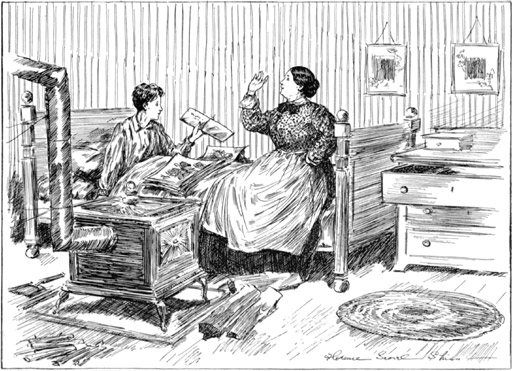
not come in until she had gone to bed on the “extension”
lounge in the parlour, where she was lying with
her teeth clenched in an effort to keep her eyes shut
and to choke down the nervousness to which crying
would have brought the quickest relief. If Bird could
only have been alone in the dark and quiet for a few
hours, it would have been much easier for her to have
overcome her great disappointment. But in the corner
of the family sitting room, amid a litter of sewing
and the smell of pipe smoke, with the glare and noise
of a busy street coming in the two small windows,
sleep was impossible. Finally her aunt closed the lid
of the sewing-machine with a bang, tossed her work
into a heap in the corner, and, turning out the gas,
went into the kitchen.
There were six rooms in the flat, all quite small.
The sitting room in front and the kitchen in the rear
had windows that opened out, above the three bedrooms
clustered round an air-shaft that was like a
great chimney having small windows let into it,
through which even at noon only a gray, sunless light
entered, and the air had no freshness but was full of
odours and noises from the flats above and below.
Mr. and Mrs. O’More occupied the room next to
the sitting room, Billy sleeping beside them on a
small mattress that was propped up nightly upon two
chairs; for when the bed was thus made, there was no
room to move about. Jack and Larry slept in the
middle room which had a door into the hallway, while
the third room, opening out of the kitchen, had been
used by the oldest boy, Tom, before he had taken
wholly to wild ways and drifted off. Now it was
more than a year since he had slept there and it was
tightly packed with broken furniture, old boxes, and
various kinds of trash that it had been easier to throw
in there than to dispose of in any other way. A
small bath-room at the end of the hall was littered up
in much the same way, and it was evident that no one
cared for bathing, as the tub was used as a cubby
hole for pails, a mop, broom, and the wash boiler and
board, for which there was no room on the overloaded
fire-escape. Still Mrs. O’More felt the dignity
of having a bath-room, for it stamped her home
as a “flat,” tenements so called having no such
luxuries.
Presently Bird gave up all idea of going to sleep or
even of closing her eyes, and do her best she
could not keep from hearing the conversation that
passed between her aunt and uncle in the kitchen, for
they made no effort to lower their voices, and she dared
not close the door as the only breath of air that
reached little Billy, who was tossing about and muttering
in his sleep, came through the front windows.
After hearing herself thoroughly discussed until
her cheeks burned, her uncle closed with the remark,
“Well, of course Terry was all kinds of a helpless
fool, but he shouldn’t be blamed for it, his mother was
a lady out of our class, and his wife too, judging from
the looks and ways of the kid, and don’t you forget it,
and it must come rough to her to be shoved about,
anyhow.”
Then a new resolve came to Bird from the rough
but well-meaning words. Her grandmother and her
mother had been ladies,—she would not forget that
any more than she would forget her father’s wish
that she should learn to paint and win the success that
had been denied to him.
Presently the subject changed and she heard her
aunt speak of Tom and say that it was three months
since she had heard from him, and she feared he was
dead.
“I hope it will be three months more, then,” O’More
had cried with an oath that made Bird quiver and pull
the pillow over her head, but she was obliged to take
it off again because of the heat. “He never minds
us unless he’s in a scrape, or there’s something to pay.
But he’s not dead, if that’s any comfort, for he wrote
to me two weeks gone, saying he must have fifty
dollars or leave his job, and I wrote him that he’d
leave it for all of me.”
“And you never told me! I could have sent him
a trifle; God knows what he’s done by this,” and Mrs.
O’More covered her red head with her apron and
began to whimper.
“Look here, Rose O’More,” answered her husband,
while Bird judged by the jar that he had brought his
fist down on the table with a bang, “that scoundrel
has bled you long enough; now we are saving up to
have little Billy doctored, and I’ll not see you rob
yourself and him for that other that we gave the best
of everything, and he’s turned it to the worst, even if
he is the eldest born. If I were you, I’d bank the bit
o’ money that comes in from the sewin’ and not keep
it about ye.”
“The top drawer of the bureau is bank enough for
me. The sum is near complete to buy the frame for
his leg, and it will be wanted next week when I take
Billy to the doctor, for it’s to his own house he shall
go, and not to the thing they call the “clink” at the
hospital, to be stood up and twisted before a crowd o’
dunce heads.”
So Billy was to go to a doctor. That was good
news, and Bird began to take an interest in life again,
for Billy, in a single hour had crept quickly into her
sensitive, motherly little heart, and with her to love
and to serve were one and the same impulse.
Presently two new voices joined the conversation,
knives and forks rattled, and amid pauses she heard
scraps of conversation muffled by food-filled mouths,
and knew that they were talking of her. Jack and
Larry had come home and were having supper. Jack,
who worked in an office by day, was attending
an evening school of type-writing and bookkeeping,
while Larry, who was of slight build and whose
ambition was to be a jockey and ride races, was kept
late on the track where he was serving an apprenticeship
as handy man to a well-known trainer.
“Where is she? Let’s have a peek at her. I hope
she’s pretty if I’ve got to look at her steady,” said
Larry, who prided himself on his eye for beauty, and
wore plaid clothes and wonderful pink and green
neckties, the colours of the stable to which he was
attached, and thought it the finest thing in the world,
for jockeys are often as loyal to their racing colours
as college men are to theirs.
“She isn’t so handsome but what it’ll keep until
morning, and she’s dead asleep by this. Quit yer
noise, all of ye; ye’ll wake little Billy, and he’s been
that fretful to-day that the rasp of his voice would
wear through an iron bar,” Mrs. O’More added, as
the three burst into loud laughter over some tale of
track happenings that Larry told.
Then the voices dropped to a hum, and then
turned to the song of the bees in Mrs. Lane’s hives,
and Bird drifted away into that sleep that God sends
to make our tired bodies and minds able to live
together without quarrelling.
******
Bird slept heavily for many hours, yet to her it
seemed only a few minutes when she awoke again,
a streak of light shining directly across her face and
the same noises coming from every side. This time,
however, the light was from the sun, not from the
gas, and the noises were fourfold, for there is nothing
so varied, penetrating, and stunning as the sound
of the awakening of a great city to unaccustomed
ears.
For a few moments she lay quite still, gazing about,
and trying to realize where she was, and whether
awake or asleep, for so many things had happened
during the past week, that it all seemed like a bad
dream.
Not many days before, morning light brought the
hope to Bird that this day her father might be better;
only the day before she had waked in Mrs. Lane’s
big white bed, to see that kind soul watching beside
her and Twinkle had come racing upstairs.
Presently it all came back to her, and, getting up,
she raised the shade quietly, for no one else was
awake, and looked down into the street in which
wagons of all kinds were passing, while the sidewalks
were already, at six o’clock, swarming with children,
driven into the air as early as possible by the heat of
the night. Then she looked about for her clothes
and a place where she might go to bathe and dress,
for the small rooms were all open through, and the
lack of privacy and the sight of the flushed disordered
sleepers was a fresh jar to her.
Finally she tiptoed into the kitchen where a
friendly clothes-horse offered shelter, and managed
to make herself neat, and arranged her hair at a
mirror hung over the kitchen sink, which she afterward
found was the family toilet place; then she
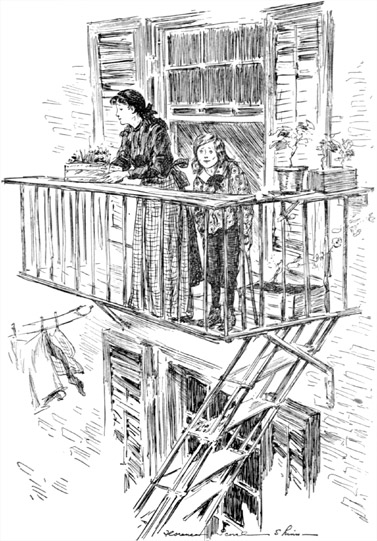
stepped out on to the fire-escape where there was
the possibility of a breeze.
At that moment she heard Billy’s querulous little
voice wail, “Oh, I’m so tired—tireder than last
night, and I hurt all over,” and she slipped back
through the hallway into the front room again to
meet her aunt who stood in the middle of the parlour,
gazing at the empty sofa and open window in some
alarm.
“Oh, so yer up and dressed betimes and not fallen
out of the winder through sleep-walkin’,” she said,
not unkindly. “Jack has turns of it at the coming
of every hot weather, and he’s been down the escape
to the ground, up to the roof and every place he
could get, so it gave me a turn when I missed yer.
Here, I’ll just throw a few clothes on Billy and you
can take him down to the street for a mouthful of air,
while I get the breakfast. I’ll fetch him to the
doctor to-day if it does put back my sewin’, and
see if I can’t get some ease for him.”
“Shall I wash him first?” Bird asked quickly, as
his mother began to pull and jerk at his clothes, and
then stopped short as she saw a flash in her aunt’s
eyes that told her that she must be careful what
she said.
“Wash him this time of the morning when he’s
scarce awake, and have him all tired before he has a
bite of breakfast? I guess not. You can clean him
up this noon, before I take him to the doctor’s,”
and Billy, now hopping, now stumbling along on his
little crutch, led the way down the three flights of
dark stairs, moving carefully from step to step so
that he should not trip in the holes in the carpet
with which they were covered.
Once in the street Bird was at the same time
interested and confused by what was going on about
her. A Jewish fish pedler, with much wagging
of head and hands, was trying to sell some stale-smelling
flat-fish to a woman who had preceded
them downstairs. Another pedler, with a push
cart, piled high with cabbages, radishes, and greens,
went into one of the houses with a basketful of his
wares at the very moment that a big, roan truck-horse
halted with his soft, inquisitive nose dangerously near
the green stuff. First he sampled a bunch of radishes,
but these were too hot for his taste, so he tried a
carrot or two, and mangled fully a peck of spinach
before he sniffed the cabbages. At these he gave a
whinny of delight and nosed among them so vigorously
that half a dozen rolled into the gutter, and
when the man returned, the horse had started back a
yard or so in fright and looked guiltless of the mischief,
and the pedler ran down the street after some
suspicious-looking boys. Meanwhile the horse
stepped forward and nibbled the biggest cabbage
with great relish, while Billy clapped his hands, half
a dozen other children cheered, and Bird herself
laughed and felt glad to see the horse, who did
not look overfat, have such a good breakfast.
For if Bird loved flowers and all outdoors, she
loved animals still more even if she did not know it,
but the other children did not think of the horse at
all; they were only glad because it had outwitted
the pedler, for between the people of poorer New
York and the push-cart people there is everlasting
war. This lesson Bird learned that morning before
the various factories in the neighbourhood had blown
their seven-o’clock whistles.
Another thing that struck her sensitive ear was
the different languages that were spoken by the
passers-by,—the various mixtures of slang and foreign
idioms that the speakers used for English being
almost as difficult for her to understand as the German
and Italian.
At Laurelville, to be sure, people spoke in two
ways. The real country folk had a vigorous, if
homely, dialect, such as the Lanes spoke, while Dr.
Jedd, the minister, and her father and mother used a
purer speech, though her father alone had the soft,
distinct way of pronouncing the words that was one
of Bird’s great attractions.
Little Billy, however, was quite at home with this
street language, as far as understanding it went, but
no word of it came from his baby lips, strangely
enough, and though he was really over six years old,
he had the slight frame and innocent, open-eyed gaze
of a child of four, and he was entirely “different
like” from the rest of his family, as his mother said,
and it provoked her as if the fact of the child’s
being apart from her own rudeness was a personal
reproach.
“Hullo, Billy,” called a freckled, lanky-looking
girl of perhaps fifteen,—reading by her face, though
she was no taller than Bird,—who was coming across
the street from a grocer’s carefully carrying a bottle
of milk as if it was a rare possession.
“Hello, Mattie,” he answered cheerfully, hopping
to the curb to meet her. “Where’ve you been? I
thinked you moved away.”
“I’ve been working all of two weeks, and we
moved right in back of your house yesterday.
We’ve got two fine rooms now, and I buy Tessie
a bottle of milk every morning now my own self,”
she said proudly.
“Tessie’s legs are very bad again, and I can’t get
her out except Sundays when mother’s at home to
help, but she’s got a rocking-chair and she can pull
it all round the room an’ see up out the winder to
your ’scape. We seen you sittin’ up there last night.
Who’s the girl?” she added, dropping her voice as
Bird drew near to Billy, not knowing how he went
about alone and fearful lest he should fall.
“It’s Bird, my cousin; she came last night from the
far-away country,” he answered, clinging to Bird’s
hand, while the two girls looked at each other,
one shyly and the other—city bred and quick-witted—curiously,
noticing at once the plain black
gown.
“Come to visit or stop?” she asked presently.
“I’ve come to stay,” said Bird, slowly, only half
realizing the truth of the words.
“Father dead?”
“Yes.”
“Mother living?”
“No.”
“Any brothers and sisters?”
“No.”
“Well, that’s tough luck,” said Mattie, her tone
full of sympathy. As she set the precious bottle on
a damp spot on the sidewalk, so that her hands need
not heat the milk, she noticed the tears in Bird’s
eyes and changed the subject quickly.
“Ain’t you going to work soon? I’ve got a good
job—cash-girl—$3.50 a week, Saturday afternoons
off all summer; ’n, if I’m smart in a year, I can get to
be an assistant stock-girl. How old are you, anyhow?
I’m fifteen and over.”
“I’m thirteen and Uncle John is going to send
me to school by and by; he says that it closes
too soon to make it worth while this term.”
“Yes, you’ll have to go until you’re fourteen or
they’ll chase you up, even if you do live in a flat
with stair carpet. It’s too bad, though; you’d have
lots more fun working.”
“But I want to go to school as long as I can,”
said Bird, smiling at Mattie’s mistake.
“Oh, then you want to begin in an office type-writing
or keeping sales books. I don’t like that;
it’s too slow and you can’t see the crowd. You’ll
have a daisy time this summer, though, with nothin’
to do but takin’ Billy riding in trolleys and seein’ the
town. I’ll tell you all the parks where they have
music. Billy’s pa is free with dimes for trolley rides.
Last year, before my pa’s falling accident, we lived
down this street, and when Tessie’s legs were well
enough, Mr. O’More ’d often give me a quarter to
take Billy along fer a ride. You can ride near all
day fer that, if you know how to work the transfers
and stick up fer yer rights.”
“Was your father badly hurt?” asked Bird, drawn
to this stranger by a common chord.
“Yes, hurt dead,” she answered, in a matter-of-fact
tone without the trace of a tremble, “and then
pretty soon we had to move, and we’ve been doin’
it most ever since, so I kinder lost track o’ Billy.
You see mother worried sick and we all got down on
our luck, but now she’s got a steady job to do scrubbin’
at the Police Court, and I’ve got a job, and
we’ve got two rooms and everything is all hunky;
that is ’cept Tessie’s legs, but some’s worse than her
and can’t even sit up.”
“You say you live behind us; which house is it?
Perhaps I could see your sister through the window,”
said Bird, somehow feeling reproached at Mattie’s
cheerfulness.
“It’s the little low house down in the yard, back
of yours, that’s got winders that stick out of the roof.
Ours is the top middle and it’s got blinds to it,—all
the winders haven’t,—and they’re fine to draw-to if
it rains, ’cause you don’t have to shut the window.
It’s a rear building, and some don’t like ’em, and of
course Tessie would rather see out to the street, but
rents come so high and rear buildings are stiller at
night; that is, when there’s not too many cats.
Were rents high a month where you came from?”
“I don’t exactly know,” said Bird, trying to remember.
“I think we paid ten dollars, but we had
a whole house, though it was old, and a garden, and
a woodshed, and a barn, and chickens. Everybody
lived in whole houses in Laurelville, even though
some had only two or three rooms.”
“Ten dollars for all that, and we pay eight for two
rooms!” ejaculated Mattie, looking hard at Bird to
see if she was in earnest, and, seeing that she was,
quickly grew confidential, and, coming close, whispered:
“Would you, may be, sometime come in and
tell Tessie about it and the garden and chickens?
She’s read about the country in a book she’s got,—oh,
yes, she can read; she’s twelve and went to school
up to last year, for all she isn’t much bigger ’n Billy—but
she can’t seem to understand what it’s just
like and she’s cracked after flowers; the man in the
corner market gave her one in a pot last year, but
it didn’t live long because we hadn’t a real window
that opened out then. Maybe your aunt won’t let
you come ’cause we live in a rear; my mother says
she’s awful proud; but then, most anybody would be,
living in a whole flat with bells and a stair carpet.
“Say, Bird,” she continued, after a moment’s
silence,—during which the pedler had given up
chasing the boys, rearranged his scattered wares, and
plodded patiently on,—this time dropping her voice
to a whisper and putting her lips to the other’s ear,
“if yer aunt won’t let yer come over, maybe you’d
wave to Tessie when you and Billy’s takin’ the air
on the ’scape. I’ll tie a rag to our blind so’s you’ll
know the winder. It would be an awful lot of company
fer her daytimes when we’re out to have somebody
to wave to. Yer will? I believe ye; somehow
I could tell in a minute ye’d be different from the
rest,” and giving Bird a thump on the back expressive
of gratitude, Mattie picked up her milk bottle
and hurried round the corner.
A shout from above next attracted Bird, and looking
up she saw her uncle leaning out of the window
and calling to them to come up for breakfast. Billy
could hop downstairs quite easily, but in going up
he was obliged to crawl, baby fashion, on his hands
and knees, so Bird followed, slowly carrying his crutch.
Her uncle and cousins were already seated at the
table when the pair came up, both rather out of
breath. Of the two boys, Larry made no attempt to
rise and shake hands, but stared hard at Bird’s pale,
clear-cut face and neatly brushed almost blue-black
hair and lashes that made her violet-black eyes
darker yet, then gave a quick nod in which recognition
and approval were combined, and continued his
meal; while Jack got up, came forward pleasantly, if
with the very flourishy sort of manner that somehow
always reminds one of the pigeon wings and squirrels
in old fashioned writing-books, and waved her to a
seat between himself and his father and began to collect
the dishes about her plate.
“Go on with yer eatin’,” said Mrs. O’More, rather
sharply, as if resenting the attention. “Bird can
wait on herself,—she’s got all day to do it in and
it’s time you were off. Come round this side by
Billy’s chair so’s you can spread his bread; he’s
always cuttin’ himself,” she added.
The food was plentiful enough, if rather coarse in
quality,—a dish of oatmeal, slices of head-cheese
and corn-beef on the same dish, potatoes sliced cold
with pickled cabbage, a bowl of hard-boiled eggs,
a huge plate of bread with a big pot of coffee, still
further heating the close room from its perch on the
gas range. But the table-cloth was soiled and tumbled,
and Bird saw with horror that her uncle wiped
his mouth on the edge of it, using it as a napkin,
while the dishes seemed to have been thrown on
without any sort of arrangement.
Not feeling hungry herself, she began to cut up
some meat for Billy, who fed himself awkwardly
using his knife instead of a fork; but Bird did not
dare say anything, and in a few minutes his appetite
failed and he sat picking holes in a piece of bread,
while Bird looked at the heaped-up plate her uncle
pushed toward her with dismay, yet forced herself to
eat from inbred politeness.
Larry and Jack, having finished, pushed back their
chairs, and hastily filling their lunch-boxes with bread,
meat, and eggs, took their coats from the rack in the
narrow hall and went out, Larry calling, “So long,”
as he went downstairs, but Jack turned back and
said pleasantly to Bird, “Good-by till night, and don’t
get homesick, Ladybird!”
“Ladybird, indeed,” snapped Mrs. O’More, “you
needn’t bother; she can’t well sicken long over what
she ain’t got,” at which unnecessarily cruel remark,
that made Bird stoop lower over her plate and
swallow some coffee so quickly that coughing hid her
tears, O’More looked up and said: “What’s wrong
with yer to-day, Rosy? You’ve no call to hit out
when nobody’s touchin’ yer.”
“What’s wrong? What’s right, I’d like you to
tell me?” she flashed; “me with a lot uv sewin’ to
do, and to get Billy up-town to the doctor’s by ten.”
“You don’t do that tomfool dressmakin’ with my
leave and consent. I can keep my family and well,
too, if you weren’t so set on robbin’ yerself fer Tom,
who’ll land himself in prison yet for all of you, if,
please God, he doesn’t drag the rest of us along with
him.”
“I can wash the dishes and dress Billy if I may,”
said Bird, timidly, feeling the tension of a bitter
quarrel in the air.
“Well, you may try it for onct, but look to it you
neither smash them nor make him cry; there’s
days he near takes fits at the sight of water. Here’s
his clean suit, and I’ll just go and finish up that silk
skirt,” and Mrs. O’More pulled some clothes from a
corner bureau and left Bird and Billy alone.
“Don’t you worry with what she says,” said
O’More, in a gruff whisper, pressing Bird’s shoulder
with his kindly grasp. “Just you be good to the
little feller and yer Uncle John ’ll stand by yer, and
maybe ye’ll see some way to chirk things up a bit.
I’ve been thinkin’ some of puttin’ a bit uv an awning
out on the ’scape to keep the sun off him while he’s
takin’ the air, only travellin’ so much I’ve not got to
it. I’d do it to-day, only I must go to the yards to
unload a car o’ horses. To-morrer, maybe, I’ll stay
around home.”
“Don’t you want any breakfast, Billy?” Bird
asked, as her uncle clumped downstairs.
“No,—yes,—I’m hungry, but I’m tired more,” he
answered, laying his head on the table.
“Suppose I wash and dress you first, and then you
can go out on the piazza and eat something and see
if you can spy Tessie.”
“Will you hurt Billy’s bones when you wash him?
Ma always does,” he added, his lower lip beginning to
quiver. He always called himself by name and often
spoke in short sentences as very young children do.
“I’ll try not to; and if I do, you must tell me and
I’ll stop right away.”
Bird looked about the room to see what she could
find without calling her aunt, whose very presence
seemed to irritate Billy. There were two stationary
wash-tubs beside the range; one of these being
empty, she proceeded to fill it half full of water,
making it comfortably warm by aid of the tea-kettle.
Next she hunted up a piece of soap and found a
towel with much difficulty, for the roller towel on
the kitchen door was for general use.
“Come and play duck and go in swimming,” she
said to Billy, who had been watching her with interest
as she overturned a pail and put it in the corner of
the tub for a seat.
The idea struck the child’s fancy so completely
that he could hardly wait to slip out of his few
clothes and be helped up on a chair and then into
the tub, where he sat comfortably pouring the water
over himself with a tea-cup, and chuckling in a way
that would have warmed his father’s heart.
Meanwhile, Bird gathered the dishes together in
the sink, wiping off the plates with bits of bread,—as
she had done ever since she could remember and
had seen her mother do in the short “better days”
when they had a pretty home and her mother had
always herself washed the best china in the inside
pantry,—and straightened the furniture and hung up
various articles that littered the floor so that there
was room to move about. By this time Billy was
ready for drying, which Bird did so gently that he
did not even wince, for she had ministered to her
father, seen her father care for her mother, and God
had given her the best gift that a girl, be she child or
woman, can have,—the gift of loving touch, of doing
the right thing almost unconsciously for the weak or
helpless.
Billy, clean, refreshed, with his bright hair brushed
into a wreath around his forehead, sitting in his little
chair on the fire-escape, and being fed with bread
and milk by Bird, who talked to him as he ate, was
a different being from the crumpled little figure that
had only a few moments before looked so pathetic
sitting in his high-chair, head on table.
As Bird gave him the last morsel and wiped his
mouth, he leaned backward to where she knelt behind
him and, clasping his arms around her neck,
pulled her head down to him, and, nestling there,
whispered, “Billy loves Bird very much, and she
must stay close by him forever ’n’ ever, won’t
she?”
“See, that must be Tessie’s window down there,”
she said, not trusting herself to answer and catching
sight of a white rag hanging from the blind of a low
building that stood in the rear of a shop that fronted
on the next street. It was an old-fashioned, two-story,
wooden house, with dormer windows in a roof that
had been once shingled. There were a dozen such
in Laurelville, and as Bird looked at it she wondered
how it came to be there, built in on all sides, and if
it didn’t miss the garden that must have once surrounded
it.
Then as she looked she saw the outline of a face
inside the window. It was so far down and across
that she could not distinguish the features, but she
waved the towel she held, and Billy shook his hand.
Presently something white waved back, and thus a
telegraph of love and sympathy crossed the dreary
waste of brick and clothes-lines, and put the three in
touch, and the Bird, who had been taken from the
country wilds and put in a city cage, and the two
little cripples were no longer alone, for even at these
back windows there was some one to wave to and
respond.
Mrs. O’More was in a better mood when, an hour
later, having finished the gown, she came back to the
kitchen to find the dishes washed and set away, and
Billy sitting contentedly in his chair throwing crumbs
to try to coax some pigeons that lived in the stable
next door from the roof to the fire-escape.
“I’ll take him up to the doctor’s now,” she said to
Bird, without vouchsafing any remarks upon the improved
appearance of the kitchen, though she saw
it all. “You can come along with me if you like,
or you can stop here and look about and rest yourself
a bit. There’s plenty of passing to be seen from
the front room.”
Bird said she thought she would rather stay at
home.
“Mind, now, and lock the inside hall door as soon
as we’ve gone and don’t let anybody in, for, in spite
of the catch on the door below, there’s always pedlers
and one thing and another pushing up.”
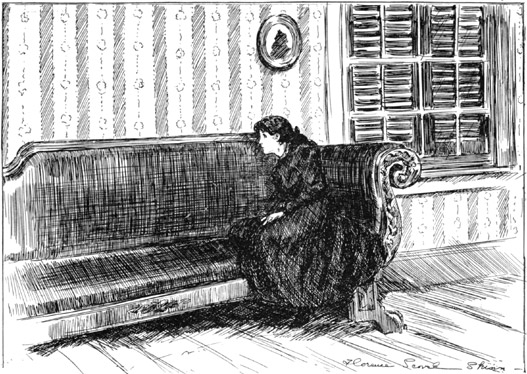
After Mrs. O’More had left, Bird went through
into the sitting room. Seating herself by the window
with her arms on the sill, she looked down into the
street. It was an intensely hot day in spite of a
breeze that blew from the East River; down by the
pavement the mercury was climbing up into the nineties—summer
had come with a jump. Could it be
only a week ago that she had been picking long-stemmed,
purple violets by the brook beyond the
wood lot at Laurelville? Was it only day before yesterday
that Lammy had brought her the red peonies,
and they had walked up the hill road together?
She had stayed by the window for some time, perhaps
half an hour, watching the horses that were led
out from the stable to be cooled by spray from the
hose attached to the hydrant in front, when a slight
noise in the kitchen caused her to turn. The light
from the window opening on the fire-escape was
darkened, and a man’s figure showed for a second in
outline against the sky and then swung noiselessly
into the kitchen.
Bird’s first impulse was to scream, but, checking it,
she shrank trembling behind a tall rocking-chair and
watched. The man glanced about the kitchen and
came directly through to the room where her uncle
and aunt slept. It did not seem to occur to him that
there was anybody at home, though Bird did not
think of this until afterward.
Pausing before the bureau, he opened the upper
drawer, and, after passing his hand rapidly through
the clothing it contained, drew out a long wallet,
which Bird recognized as the one from which her
aunt had taken some money before going to the doctor’s.
Without thinking of the result or counting the
cost, she rushed forward and caught the wallet tight
in both hands, crying, “You mustn’t take it, you
shan’t; for it’s the money to pay for mending poor
Billy’s leg.”
The man, taken utterly by surprise, fell back, but
only for a moment, and, muttering a string of such
words as Bird had never before heard, seized her by
the shoulder with one hand while he tried to wrench
the pocket-book from her with the other; but, strong
as he was, this took several minutes, for Bird hung on
desperately, clinging to his arm after he had secured
the wallet, until finally he picked her up bodily and
threw her on to the bed, and before she could recover
herself, locked the door into the sitting room, and,
taking out the key, did the same to the door into the
boys’ room, through which he retreated, leaving her
a prisoner, for the window into the air-shaft was high
out of reach.
As Bird sat on the edge of the bed sobbing with
fright and the thought of what the loss of the money
might mean to Billy, noise of a scuffle reached her
ears from the kitchen and the locked door burst open
suddenly as it had closed, pushed by a strong shoulder,
but it was the face of a perspiring policeman
that peered through the crack.
“Catch him, oh, do catch him!” she implored; “he’s
got the money from Aunt Rose’s drawer that’s to pay
for mending Billy’s leg!”
“He’s caught safe enough, my girl,—me mate has
him in the kitchen and the money, too, though he did
try to throw it over the yards when we grappled him.
You see there’s been a slew of these daylight thieves
around these parts lately, sneaking over roofs and
down escapes when folks are at work. We spotted
this one goin’ through the saloon on the corner and
in among the skylights, and we followed but lost
track, for he has another wallet lifted besides this
one, and if he’d slid out a minute sooner, we’d have
lost him.”
“Then holding on did some good, after all,” Bird
gasped, still standing with tightly clasped hands as if
she were holding the precious money in them.
“An’ did yer grab him, now? Look at that fer
pluck,—it’s a wonder he didn’t smash yer entirely.
Come out and take a look at him; maybe ye can tell
did ye see him before.”
Bird looked, but the young man was a stranger to
her. He did not appear to be more than twenty, and,
as they led him away, handcuffed to an officer, he
pulled his hat so low over his face that the crowd
that gathered and followed as soon as the street was
reached could not see his features, or if he was old
or young.
Bird gave the officer her uncle’s name, and he said:
“When he comes in, tell him to come round to the
station-house and he’ll get his money all right. I’ve
got to take it in as evidence.” The street was hardly
clear again of the curious crowd when the twelve-o’clock
whistle sounded and workmen appeared from
all quarters, either with pails to eat their dinners in
the shade of the house fronts, or on the way to their
various homes.
Mrs. O’More and her husband—for he had been
watching for their car—came up the street together,
little Billy between them, and it was strange that they
did not meet the policemen with their prisoner. Bird
was watching eagerly for them, and, after hearing
their news,—that the doctor said it was possible to
help the lame leg, only that Billy must grow stronger
before it could be done,—told them hers.
Both listened eagerly. Her uncle said, “Yer pluck
does credit to the O’Mores, but did ye mind the
villain’s face what it was like?”
“Oh, yes,” Bird answered excitedly, “it was
smooth and fair, and he had very blue eyes with a
long scar over one, and his hair was quite red.”
Glancing at her aunt, she saw that she had turned
deadly pale, and a certain resemblance struck her for
the first time.
“God help us,—it’s Tom come back to rob his
own mother,” gasped poor John O’More.
“But you’ll not appear against him, John,” cried
his wife, throwing her arms around him as he seized
his hat and turned to go out.
“I can’t, woman, I can’t; but maybe it’ll do no
good. I must go round to the station and get
the wallet and see to this, anyway.”
And Bird, after laying Billy on the lounge for a
nap, sat by her aunt,—who, while waiting to hear
the outcome, had collapsed and was crying noisily,—and
tried to take off her tight waist and bathe her
face, and she realized that there were even worse
griefs than leaving one’s home and father, for surely
dear Terry was safe beyond all harm now.