The cover image was created by the transcriber and is placed in the public domain.
AULD LANG SYNE
F. Max Müller
BY
The Rt. Hon. Professor F. MAX MÜLLER
AUTHOR OF THE “SCIENCE OF LANGUAGE,” ETC.
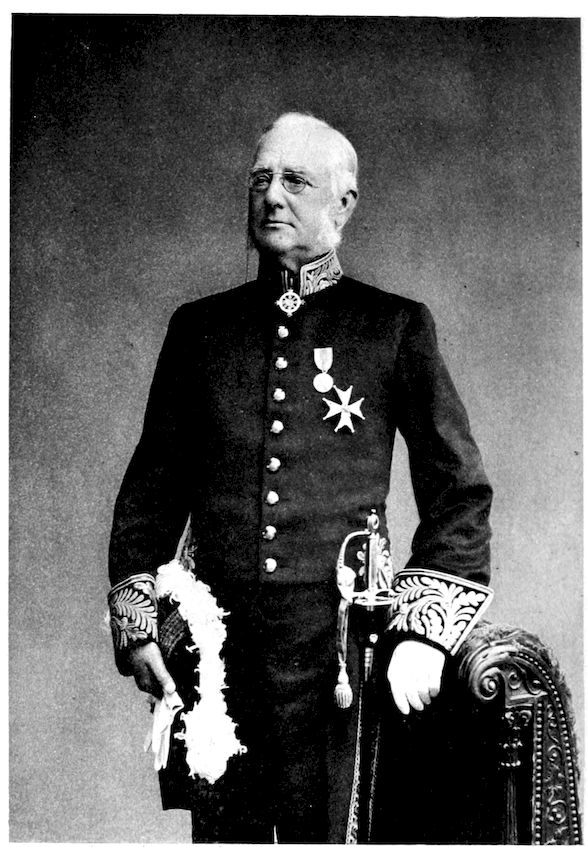
WITH A PORTRAIT
New York
CHARLES SCRIBNER’S SONS
1899
Copyright, 1898, by
CHARLES SCRIBNER’S SONS
TROW DIRECTORY
PRINTING AND BOOKBINDING COMPANY
NEW YORK
PREFACE
v
What are you to do when you are sent away by
your doctor for three or four weeks of perfect rest?
You are made to promise that you will lie perfectly
fallow, take no books and allow no proofsheets to
reach you. A very eminent German professor, the
late Dr. Neander, the famous Church historian,
solved the difficulty in his own way. He had
faithfully promised his physician that he would
take no books with him to Karlsbad, but had at last,
as a great favour, obtained permission to take at
least one work with him on his journey. On the
morning of his departure the doctor wished to say
good-bye to his patient, and calling at his door saw
a cart laden with heavy folios. “But, dear professor,”
he said, with considerable surprise and
displeasure, “you had promised me to take no
books with you.” “Yes, doctor,” the professor replied,
“but you allowed me one work, so I thought
I might take the Fathers with me to Karlsbad.” I
might have done the same, if I had taken the “Rig
Veda” only, or the Sacred Books of the East with
vime, but my conscience would not allow it, so that I
found myself in small lodgings at an English watering
place with nothing to do all day long but
to answer a number of accumulated letters and to
read The Times, which always follows me. What
was I to do? Doctors ought to know that to a
man accustomed to work enforced rest is quite as
irritating and depressing as travaux forcés. In
self-defence I at last hit on a very simple expedient.
I began to write what could be written without a
single book, and taking paper, pen and ink—these
I had never forsworn—I jotted down some recollections
of former years. The fancy took me, and
I said with Goethe:—
Ihr naht euch wieder, schwankende Gestalten—
and after a day or two I was so absorbed in my
work, if work it could be called, that I said again
with Goethe:—
Ihr drängt euch zu! Nun gut, so mögt ihr walten....
Of course I had to leave many a gap in my sketch
of Auld Lang Syne. Dates, even names, would
now and then leave me in the lurch, and as I had
no means of verifying anything, I had to wait till
I was settled again among my books and letters
and papers at home. But though I corrected some
glaring anachronisms and some mistaken names, I
viicould leave my MS. very much as it had been written
down in my temporary exile, and I can therefore
vouch for its truth so far that it is an exact
copy of the negative developed by long exposure
in my memory. Whether it is accurate, who can
tell? I know from sad experience that my memory
is no longer what it was. All I can say is that
the positive copy here published is as true and as exact
as the rays of the evening sun of life, falling on
the negative in my memory, could make it. Though
I have suppressed whatever could possibly have
given offence to any sensible person, however sensitive,
I have not retouched the pictures of my
friends or acquaintances, nor have I tried, as is
now so much the fashion, to take out all the lines
and wrinkles so that nothing remains but the
washed-out faces of angels.
What I give here is but a small portion of the
panorama of life that has passed before my eyes.
Of myself there is but little, for the spectator or
interpreter in a panorama should remain unseen
and in the dark. It is a pleasure to him, though
often a sad pleasure, to see once more what he has
seen before, to live the old time over again, to look
once more at dear faces, once so full of love and
life, to feel the touch of a vanished hand, and hear
a voice that is still.
As we grow old it is our fate to lose our friends;
viiibut the friends we have lost are often nearer to us
than those who remain. Will they never be quite
near to us again? Stars meet stars after thousands
of years, and are we not of more value than
many a star?
Thus wrote Shakespeare; but with all due respect
for the immortal bard, he was wrong for
once. Did not my dear friend, Arthur Stanley,
hate music, and was he not to be trusted? Were
his affections dark as Erebus?
True it is, music gives us a new life, and to be
without that life is the same loss as to be blind,
and not to know the infinite blue of the sky, the
varied verdure of the trees, or the silver sparkle of
the sea. Music is the language of the soul, but
it defies interpretation. It means something, but
that something belongs not to this world of sense
and logic, but to another world, quite real, though
2beyond all definition. How different music is from
all other arts! They all have something to imitate
which is brought to us by the senses. But what
does music imitate? Not the notes of the lark,
nor the roar of the sea; they cannot be imitated,
and if they are, it is but a caricature. The melodies
of Schubert were chosen, not from the Prater,
but from another world.
For educational purposes music is invaluable.
It softens the young barbarian, it makes him use
his fingers deftly, it lifts him up, it brings him
messages from another world, it makes him feel
the charm of harmony and beauty. There is no
doubt an eternal harmony that pervades every
kind of music, and there are the endless varieties
of music, some so strange that they seem hardly to
deserve to be called a gift of the Muses. There is
in music something immortal and something mortal.
There is even habit in music; for the music
that delights us sounds often hideous to uneducated
ears.
Indian music is thoroughly scientific, based on
mathematics, and handed down to the present age
after many centuries of growth. But when we
hear it for the first time, it seems mere noise,
without melody, without harmony, without rhythm.
The Maoris have their own music too, but send a
New Zealander to hear a long symphony of Beethoven,
3and, if he can, he will certainly run away
long before the finale.
In a lesser degree it is the same with us. Beethoven’s
compositions were at first considered wild
and lawless. Those who admired Mozart and
Haydn could not endure him. Afterwards the
world was educated up to his Ninth Symphony,
but some of his later sonatas for pianoforte and
violin were played by Mendelssohn and David in
my hearing, and they both shrugged their shoulders,
and thought that the old man had been no
longer quite himself when he wrote them. We have
grown into them, or up to them, and now many a
young man is able to enjoy them, and to enjoy
them honestly. I remember the time when Schumann’s
songs were published at Leipzig, and the
very same songs which now delight us were then
by the best judges called curious, strange, interesting,
promising, but no more. Yes, there is habit
in music, and we are constantly passing through a
musical education; nay, the time comes when our
education seems finished, and we can learn and
take in no more. I have passed through a long
school. I began with Haydn, Mozart, and Beethoven,
lived on with Mendelssohn, rose to Schumann,
and reached even Brahms; but I could
never get beyond, I could never learn to enjoy
Wagner except now and then in one of his lucid
4intervals. No doubt this is my fault and my loss,
but surely the vulgus profanum also has its rights
and may protest against being tired instead of being
refreshed and invigorated by music. Would
Mendelssohn have admired Wagner? Would Beethoven
have listened to his music, would Bach
have tolerated it? Yet these were musicians too,
though perhaps not sufficiently educated. To be
honest, a great deal of Wagner’s music seems tiresome
to me, and I do not see why it should ever
end.
My musical education began very early, so early
that I cannot remember ever passing through any
drudgery. As long as I remember I could play,
and I was destined to become a musician, till I
went to the University, and Mendelssohn advised
me to keep to Greek and Latin. I was born and
brought up in Dessau, a small German town in an
oasis of oak-trees where the Elbe and the Mulde
meet, a town then overflowing with music. Such
towns exist no longer.
When I went to school at Dessau, this small
capital of the small Duchy of Anhalt-Dessau
counted, I believe, not more than ten or twelve
thousand inhabitants. Everybody knew everybody.
As a boy I knew not only the notables
of Dessau, I knew the shops and the shopmen,
the servants, the day-labourers (Tagelöhner) who
5sawed and split wood in the street, every old
woman that sold apples, every beggar that asked
for a Pfennig—mark, not a penny, but the tenth
part of a penny. It was a curious town, with one
long street running through it, the Cavalierstrasse,
very broad, with pavements on each side. But
the street had to be weeded from time to time,
there being too little traffic to prevent the grass
from growing up between the chinks of the stones.
The houses had generally one storey only; those of
two or three storeys were mostly buildings erected
by the Duke for his friends and his higher officials.
Many houses were mere cottages, consisting of a
ground floor and a high roof. Almost every house
had a small mysterious looking-glass fastened outside
the window in which the dwellers within could
watch and discuss an approaching visitor long before
he or she came within speaking distance. It
was the fashion not only to whitewash the plastered
walls of houses, but to green-wash, or to blue-wash,
or to pink-wash them. All this is changed now;
few people remember the old streets, with distant
lamps swinging across to make darkness more visible
at night, and with long waterspouts frowning
down on the pavement like real gurgoyles, and not
frowning only, but during a thunderstorm pouring
down buckets of water on the large red and green
umbrellas of the passers-by.
6Dessau was then a very poor town, but a læta
paupertas reigned in it; everybody knew how
much everybody else possessed or earned, and no
one was expected to spend more than was justified
by his position. We can hardly understand
now with how little people then managed, not
only to live, but thoroughly to enjoy the highest
pleasures of life. My grandfather, who was the
Duke’s Prime Minister, received, I believe, no
more than two thousand thalers (£300) salary,
though there may have been additional allowances
for rent, carriages and horses. But there was a
curious mixture of simplicity of life and enjoyments
of the highest kind. I remember in my
grandfather’s house delightful social gatherings,
musical and literary performances. I remember
Mozart’s “Don Juan,” Beethoven’s “Fidelio” being
performed there, the latest works of Goethe
and Jean Paul being read and appreciated with a
cup of tea or a glass of wine. A more select circle
enjoyed their Shakespeare, their Dante, their
Calderon in English, Italian, and Spanish. I remember
my grandfather (the son of Basedow, the
reformer of national education in Germany) in his
Court uniform, driving to Court in his carriage
and pair, servants in full livery, everybody making
room for him and bowing deep on each side, hat
in hand. And when he came back from Court,
7was it not a real holiday for his grandchildren to
turn the pockets of his uniform inside out—the
pockets were lined on purpose with soft leather—to
see what bonbons and cakes he had brought
home for us from Tafel—i.e., dinner at Court? Almost
my first recollections come from my grandfather’s
house. My mother, after the very early
death of my father, who died before I was four
years old, had gone back to live at her father’s
house. This was a very common arrangement
then. Two or three generations often lived together
in the same house, and among the better
families the house was looked upon as a common
home, descending from father to son and grandson.
There was a large garden stretching out behind
the house, which was our playground. Our
neighbours’ gardens were separated on each side
from our own by a low hedge only. Next door to
us was the house of a soap and candle maker, and
I still remember the disagreeable smells on the day
when soap was boiled and candles were drawn.
People talked across the garden hedge to their
neighbours, and all the affairs of the town were
discussed there. Our neighbour on the right side
took lodgers, and one of them was a young man
who had come to Dessau to study music under F.
Schneider, and at the same time to give music
lessons. He had been a theological student, but
8had umgesattelt (changed saddles), and now tried
to support himself as best he could at Dessau.
He often talked to me across the garden hedge (I
was only five years old). One day he lifted me
across into his own garden, and asked whether I
would like to learn the pianoforte. I, of course,
said yes, and he then bade me promise to come to
him every day for half an hour, but not to say a
word to my mother or to anybody else. The bargain
was struck; I kept my music quite secret,
till, after about half a year or so, I sat down at my
grandfather’s pianoforte, and to the amazement of
everybody played some easy pieces of Mozart or
Diabelli. Of course the young theological student—his
name was Kahle—was engaged at once to be
my music-master. He charged five Groschen (sixpence)
for a lesson, and I made very rapid progress.
My mother was very musical; she had a
splendid alto voice, and was often invited to sing
the solos at the great musical festivals in Germany.
My aunts, too, sang very well, and as a little boy I
could sing all the songs which they sang, and well
remember being put on a table to sing Händel’s
great arias, “Schnell wie des Blitzes Strahl,” etc.
Dessau at that time was steeped in music.
The reigning Duke kept a first-rate orchestra,
and at the head of it was Friedrich Schneider, a
well-known composer of the old school, a cantor,
9like Bach, but also Ducal Capellmeister, and the
head of what was then called a musical school,
now a conservatorium. This school was frequented
by students from all parts of Germany,
and it has produced some excellent musicians and
well-known composers. There were public concerts
given regularly every fortnight at a very low
charge, and there were rehearsals twice a week, at
which a few people only were allowed to be present.
I was one of the few, and every Tuesday
and Friday after school I sat there for an hour or
two hearing the very best music excellently performed,
and being deeply impressed, nay, awed by
old Schneider, who stormed at the players when a
single note went wrong, and used language which
I was not allowed to repeat. He was a character.
A small, square man, with greyish hair flowing
down to his shoulders, his black eyes full of fire,
and sometimes of fury. He was very fond of his
glass of wine, which had given to his whole face,
and particularly to his nose, a glowing ruddy complexion.
He brooked no opposition from anybody,
and he was the terror of all the young musicians
who showed themselves at Dessau. His
orchestra had such a reputation at that time that
some of the greatest celebrities considered it an
honour either to have their compositions performed
or to be allowed to sing or play at his concerts.
10I remember Paganini, Sonntag, Spohr,
Mendelssohn (then quite a young man), and many
more passing through their ordeal at Dessau.
Mendelssohn’s visit left a deep impression on my
mind. I was still a mere child, he a very young
man, and, as I thought, with the head of an
angel. Mendelssohn’s was always a handsome
face, but later in life the sharpness of his features
betrayed his Jewish blood. He excelled as an organ
player, and while at Dessau he played on the
organ in the Grosse Kirche, chiefly extempore. I
was standing by him, when he took me on his
knees and asked me to play a choral while he
played the pedal. I see it all now as if it had
been yesterday, and I felt convinced at that time
that I too (anch’ io) would be a musician. Was
not Weber, Karl Maria von Weber, my godfather,
and had he not given me my surname of Max?
My father and mother had been staying with
Weber at Dresden, and my father had undertaken
to write the text for a new opera, which was never
finished. Weber was then writing his “Freischütz,”
and my mother has often described to me
how he would walk about the whole day in his
room composing, not before the pianoforte, but
with a small guitar, and how she heard every melody
gradually emerging from the twang of his little
instrument. Both his wife and my mother were
11expecting their confinement, and it was arranged
that if the children should be boys, they should
be called Max, if girls, Agathe. We were both
boys, and Weber’s son, Max Maria von Weber, became
a distinguished traveller, a most charming
writer, and at last an influential financier in the
Austrian service. He stayed with me several times
at Oxford, and we exchanged notes about our respective
fathers. He published a life of his father,
which has, I believe, been translated into English.
Old Schneider was kind to young Mendelssohn,
whenever he came to Dessau; they were
both ardent admirers of Händel and Bach, but
the more modern and romantic compositions of
the young composer did not quite meet the approval
of the severe Maestro. Schneider was terribly
outspoken, and apt to lose his temper and become
violent. He once had a most painful scene
with Madame Sonntag, or rather with Countess
Something, as she was then. First of all, he
thought very little of any composer whose name
ended in ini or ante, and he would but seldom
yield to the Duke and Duchess when they wished
now and then to have some of Rossini’s or Mercadante’s
music performed by their own orchestra.
But when the Italian Countess ventured to speak
to his orchestra and to ask them for a ritardando
of her own, he flourished his bâton and broke out:
12“Madame,” he said, “you may sing as you like,
but I look after of my orchestra,” and there was
an end of it.
Life went on, and what time I could spare from
school work, perhaps too much, was given to music.
There was not an air or a symphony of
Beethoven’s which at that time I could not have
hummed from beginning to end, and even now I
often detect myself humming, “Ich bin’s, du bist’s,
O himmlisches Entzücken!” Who does not know
that duet between Fidelio and Florestan? Much
of that humming repertorio has remained with me
for life, though I cannot always tell now where an
Allegro or Adagio comes from. It comes without
being called, I cannot drive it away when I want
to be quiet. I hum the bass, I whistle the piccolo,
I draw out the notes from the violoncello, I
blow the trumpet, in fact I often feel like Queen
Bess, “And she shall have music wherever she
goes.”
When I was about eleven or twelve, old Schneider
allowed me to play with accompaniment of
the full orchestra some concertos of Mozart, etc.
This was a great event in my quiet life, and everything
looked as if music was to be my profession.
When afterwards I went to the Nicolai School at
Leipzig, the school at which Leibniz (not Leibnitz)
had been educated, I lived again in the
13musical house of Professor Carus. His wife sang
sweetly; his son, my old friend, Professor V.
Carus, was an excellent violin player, a pupil of
David. I myself began to play the violoncello,
but without much success, and I joined a chorus
under Mendelssohn, who was then director of
the famous Gewandhaus Concerts at Leipzig.
We often had to sing anything he had composed
and wished to hear before performing it in public.
As a friend of my father and my mother, Mendelssohn
was always most charming to me, but
he did not encourage my idea of a musical career.
The fact was I had not time to serve two masters.
I could not practise and study music as it ought to
be practised and studied without neglecting Greek
and Latin, and, as life became more serious, my
mind was more and more drawn to the thoughts
of antiquity, to Homer and Cicero, and away from
the delights of music. I heard excellent music at
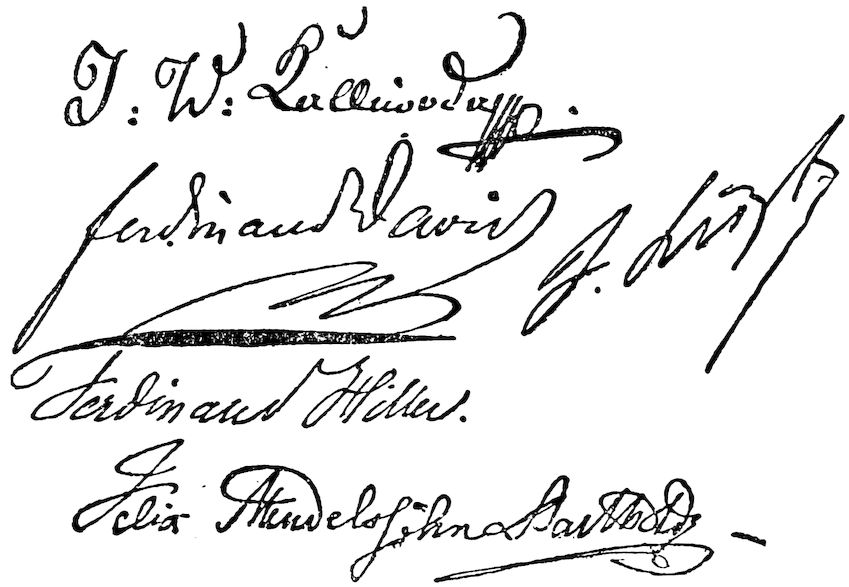
the house of Professor Carus. I still have an old
slip of paper on which Mendelssohn, Liszt, David,
Kalliwoda and Hiller wrote their names for me
one evening after they had been playing quartettes
at Professor Carus’s house. (See page 14.)
14
I even ventured while at Leipzig to play sometimes
at public concerts in the neighbourhood.
But when I began to look forward to what I should
make of my life, and how I should carve out for
myself a useful career, I saw that music was out
of the question. There was another consideration
which determined my choice. There was much
deafness in my family. My mother became deaf
when she was still quite young, my grandmother,
several of my uncles and cousins, all had lost their
hearing, and this induced me, young as I was, to
choose a profession which would be possible even
if I should share the same misfortune. I could
not think of medicine, or law, or the Church—so I
said to myself, keep to Greek and Latin, try to be
15a scholar. A professorship was my highest ambition,
but I thought that even if that should fail, I
might find a quiet Benedictine cell somewhere, and
support myself by my pen. So music had to step
into the background, not altogether, but so as not
to interfere with more serious work. No, music,
though somewhat slighted, has remained a true
and faithful friend to me through life. I have enjoyed
music until very late in life when I began to
feel satisfied, and would much rather hum a symphony
to myself than hear it played, often not half
so well as I remembered it at Dessau, at the Gewandhaus
Concerts at Leipzig, and at the marvellous
Conservatoire Concerts in Paris. These
were the perfection of instrumental music. Never
has any other performance come near them. It
was difficult to get a ticket. People used to form
queue and stand the whole night in order to secure
the next morning an abonnement for the season.
To buy a ticket was beyond my means, for when
I was at Paris I had entirely to support myself.
But a friend of mine took me to the Conservatoire,
and I often sat in the corridor without seeing
the orchestra, listening as if to organ music.
It was perfect. Every instrument of the orchestra
was first-rate—the players had mostly passed
through the same school, the conductor was an old
man with a German name which I forget. Was it
16Habeneck? He reminded me of Schneider, and
certainly his orchestra marched like a regiment of
soldiers.
And besides being a constant source of the
highest enjoyment to me, music has often helped
me in my pilgrimage through life. Both in Paris
and later on in London, many a house was open to
me which would have remained closed to a mere
scholar. Musicians also always took an interest in
the son of the poet, Wilhelm Müller, whose songs
had been set to music, not only by Schubert, but
by many other popular composers. I well remember,
when telling Jenny Lind whose son I was,
how she held up her hands and said: “What?
the son of the poet of the ‘Müllerlieder’! Now
sit down,” she said, “and let me sing you the
‘Schöne Müllerin.’” And she began to sing, and
sang all the principal songs of that sad idyll, just
moving her head and hands a little, but really acting
the whole story as no actress on the stage
could have acted it. It was a perfect tragedy, and
it has remained with me for life. Stockhausen also
(who, as I saw too late, has just been celebrating
his seventieth birthday) once sang the “Winterreise”
to me in the same way, but as I had to accompany
him I had only half the pleasure, though
even that was great.
How many memories crowd in upon me! I
17heard Liszt when I was still at school at Leipzig.
It was his first entry into Germany, and he came
like a triumphator. He was young, theatrical, and
terribly attractive, as ladies, young and old, used to
say. His style of playing was then something
quite new—now every player lets off the same
fireworks. The musical critics who then ruled
supreme at Leipzig were somewhat coy and reserved,
and I remember taking a criticism to the
editor of the Leipziger Tageblatt which the writer
did not wish to sign with his own name. Mendelssohn
only, with his well-tempered heart, received
him with open arms. He gave a matinée
musicale at his house, all the best known musicians
of the place being present. I remember, though
vaguely, David, Kalliwoda, Hiller; I doubt
whether Schumann and Clara Wieck were present.
Well, Liszt appeared in his Hungarian costume,
wild and magnificent. He told Mendelssohn
that he had written something special for him.
He sat down, and swaying right and left on his
music-stool, played first a Hungarian melody, and
then three or four variations, one more incredible
than the other.
We stood amazed, and after everybody had paid
his compliments to the hero of the day, some of
Mendelssohn’s friends gathered round him, and
said: “Ah, Felix, now we can pack up (‘jetzt
18können wir einpacken’). No one can do that; it
is over with us!” Mendelssohn smiled; and
when Liszt came up to him asking him to play
something in turn, he laughed and said that he
never played now; and this, to a certain extent,
was true. He did not give much time to practising
then, but worked chiefly at composing and
directing his concerts. However, Liszt would
take no refusal, and so at last little Mendelssohn,
with his own charming playfulness, said: “Well,
I’ll play, but you must promise me not to be
angry.” And what did he play? He sat down
and played first of all Liszt’s Hungarian Melody,
and then one variation after another, so that no
one but Liszt himself could have told the difference.
We all trembled lest Liszt should be offended,
for Mendelssohn could not keep himself
from slightly imitating Liszt’s movements and
raptures. However, Mendelssohn managed never
to offend man, woman, or child. Liszt laughed
and applauded, and admitted that no one, not he
himself, could have performed such a bravura.
Many years after I saw Liszt once more, at the
last visit he paid to London. He came to the
Lyceum to see Irving and Ellen Terry act in
“Faust.” The whole theatre rose when the old,
bent Maestro appeared in the dress circle. When
the play was over, I received an invitation from
19Mr., now Sir Henry, Irving to join a supper party
in honour of Liszt. I could not resist, though I
was staying with friends in London and had no
latch-key. It was a brilliant affair. Rooms had
been fitted up on purpose with old armour,
splendid pictures, gorgeous curtains. We sat
down, about thirty people; I knew hardly anybody,
though they were all known to fame, and
not to know them was to profess oneself unknown.
However, I was placed next to Liszt, and I reminded
him of those early Leipzig days. He was
not in good spirits; he would not speak English,
though Ellen Terry sat on his right side, and, as
she would not speak German or French, I had to
interpret as well as I could, and it was not always
easy. At last Miss Ellen Terry turned to me and
said: “Tell Liszt that I can speak German,” and
when he turned to listen, she said in her girlish,
bell-like voice: “Lieber Liszt, ich liebe Dich.” I
hope I am not betraying secrets; anyhow, as I
have been indiscreet once, I may as well say what
happened to me afterwards. It was nearly 3 A.M.
when I reached my friend’s house. With great
difficulty I was able to rouse a servant to let me
in, and when the next morning I was asked where
I had been, great was the dismay when I said that
I had had supper at the Lyceum. Liszt had
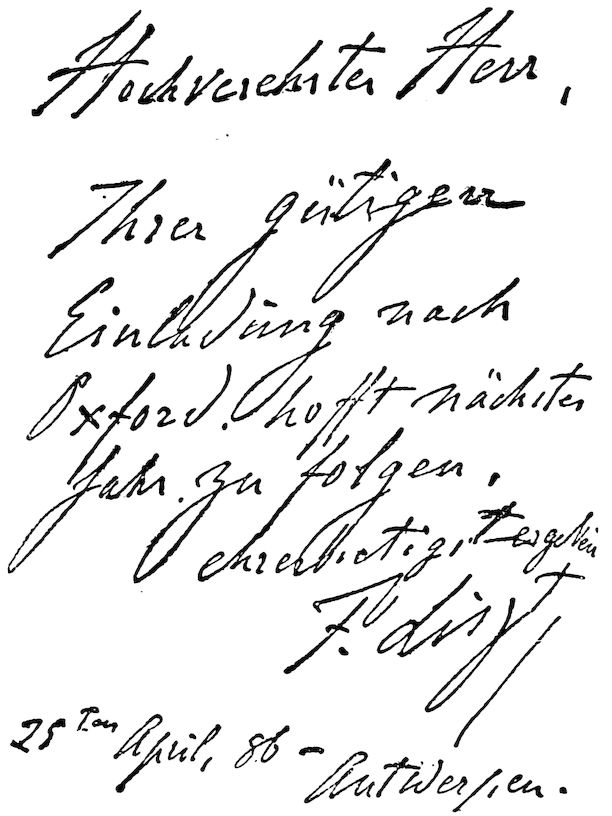
promised to come to stay with me at Oxford, but
20the day when I expected him, the following note
arrived from Amsterdam, probably one of the last
he ever wrote:—
A few weeks after, I saw his death announced in
the papers.
And thus Liszt left the stage. I saw his entrance
21and his exit, and when I asked myself,
What has he left behind? I could only think of
the new school of brilliant executionists of which
he may truly be called the founder and life-long
apostle. I confess that, though I feel dazzled at
the impossibilities which he and his pupils perform
with their ten fingers, I often sigh for an Allegro
or an Andante by Haydn and Mozart as they
were played in my young days with simplicity and
purity on very imperfect instruments. Players
now seem to think of themselves only, not of the
musical poets whose works they are to render.
Mendelssohn, Clara Wieck (Madame Schumann)
even Moscheles and Hummel acted as faithful
interpreters. On listening to them, exquisite
as their execution was, one thought far more of
what they played than how they played. That
time is gone, and no one has now, or will ever have
again, the courage to bring it back. If one wants
to enjoy a sonata of Haydn one has to play it
oneself or hum it, because the old fingers will not
do their work any longer.
And Mendelssohn also, whom I had known as a
young man, said good-bye to me for the last time
in London. It was after the first performance of
his “Elijah” in 1847. He too said he would come
again next year, and then came the news of his
sudden death. I saw him last at Bunsen’s house,
22where he played at a matinée musicale always ready
to please and oblige his friends, always amiable
and charming, even under great provocation. Only
once I remember seeing him almost beside himself
with anger, and well he might be. He possessed a
most valuable album, with letters, poems, pictures,
compositions of the most illustrious men of the
age, such as Goethe and others. The binding had
somewhat suffered, so it was sent to be mended,
and I was present when it came back. It was at
his sister’s house, Fanny Hensel’s, at Berlin.
Mendelssohn opened the album, jumped up and
screamed. The binder had cut off the blue skies
and tree-tops of all the Italian sketches, and the
signatures of most of the poems and letters. This
was too much for Felix, he was for once infelix.
Still, happy and serene as his life certainly was,
for he had everything a man of his talents could
desire, there were bitter drops in it of which the
world knew little, and need not know anything now.
There are things we know, important things which
the world would be glad to know. But we bury
them; they are to be as if they had never been,
like letters that are reduced to ashes and can
never be produced again by friends or enemies.
He was devoted to his sister Fanny, who was
married to Hensel the painter, an intimate friend
of my father. When I was a student at Berlin, I
23was much in their house in the Leipziger Strasse,
and heard many a private concert given in the
large room looking out on the garden. Mendelssohn
played almost every instrument in the orchestra,
and had generally to play the instrument
which he was supposed to play worst. When he
played the pianoforte, he was handicapped by being
made to play with his arms crossed. All the
celebrities of Berlin (and Berlin was then rich in
celebrities) were present at those musical gatherings,
and Mendelssohn was the life of the whole.
He was never quiet for a moment, moving from
chair to chair and conversing with everybody.
Boeckh, the great Greek scholar, lived in the
same house, and Mendelssohn had received so
good a classical education that he could hold his
own when discussing with the old master the choruses
of the Antigone. Mendelssohn was, in fact,
a man teres et rotundus. He was at home in classical
literature, he spoke French and English, he
was an exquisite draughtsman, and had seen the
greatest works of the greatest painters, ancient
and modern. His father, a rich banker in Berlin,
had done all he could for the education of his
children. He was the son of Mendelssohn the
philosopher, and when his son Felix had become
known to fame, he used to say with his slightly
Jewish accent: “When I was young I was called
the son of the great Mendelssohn; now that I am
old I am called the father of the great Mendelssohn;
then, what am I?” Well, he found the
wherewithal that enabled his son, and his other
children too, to become what they were, all worthy
of their great grandfather, all worthy of the name
of Mendelssohn.
24
Die glückliche Fischerin.
25Felix was attached to both his sisters, Fanny
and Rebekah (Dirichlet), but he was more particularly
devoted to Fanny (Hensel). They had been
educated together. She knew Greek and Latin
like her brother, she played perfectly, and composed
so well that her brother published several
of her compositions under his own name. They
were one spirit and one soul, and at that time
ladies still shrank from publicity. Everybody
knew which songs were hers (I remember, for instance,
“Schöner und Schöner schmückt sich die
Flur”), and it was only later in life that she began
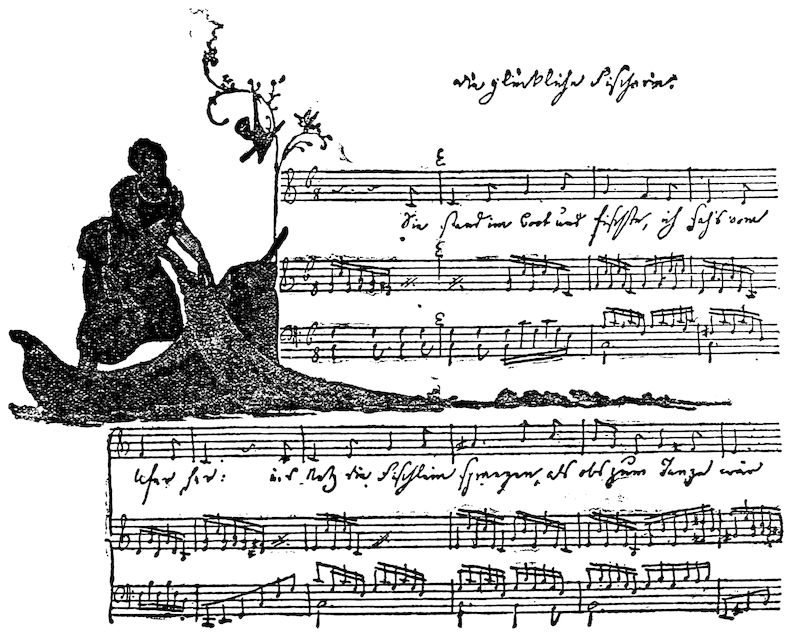
to publish under her own name. I give the beginning
of a song which she wrote for my mother.
The words are my father’s, the little vignette was
drawn by her husband, who was an eminent artist
at Berlin.
The struggles which many, if not most men of
genius, more particularly musicians, have had to
pass through were unknown to Felix Mendelssohn
Bartholdy. Some people go so far as to say that
26they miss the traces of those struggles in his character
and in his music. And yet those who knew
him best know that his soul, too, knew its own bitterness.
His happiest years were no doubt spent
at Leipzig, where I saw much of him while I was
at school and at the University. He was loved and
admired by everybody; he was undisputed master
in the realm of music. He was at first unmarried,
and many were the rumours as to who should be
his bride. News had reached his friends that his
heart had been won by a young lady at Frankfurt;
but nobody, not even his most intimate friends,
knew for certain. However, one evening he had
just returned from Frankfurt, and had to conduct
one of the Gewandhaus Concerts. The last piece
was Beethoven’s Ninth Symphony. I had sung
in the chorus, and found myself on the orchestra
when the concert was over, the room nearly empty,
except his personal friends, who surrounded him
and teased him about his approaching engagement.
His beaming face betrayed him, but he would say
nothing to anybody, till at last he sat down and
extemporised on the pianoforte. And what was
the theme of his fantasy? It was the passage of
the chorus, “Wer ein holdes Weib errungen, mische
seinen Jubel ein.” That was his confession to his
friends, and then we all knew. And she was indeed
“ein holdes Weib” when she arrived at Leipzig.
27One thing only she lacked—she could not
express all she felt. She was soon called the
“Goddess of Silence” by the side of her devoted
husband, who never could be silent, but was always
bubbling over like champagne in a small glass.
They were a devoted couple, not a whisper was
ever heard about either of them, though Mendelssohn
had many friends, the greatest of all being his
sister Fanny. With her he could speak and exchange
whatever was uppermost or deepest in his
heart. I have heard them extemporise together
on the pianoforte, one holding with his little finger
the little finger of the other. Her death was the
heaviest loss he ever suffered in life. He was so
unaccustomed to suffering and distress that he
could never recover from this unexpected blow.
Nor did he survive her long. She died on the
14th of May, 1847; he followed her on the 4th of
November of the same year.
During most of the time when Mendelssohn celebrated
his triumphs as director of the Gewandhaus
Concerts, young Robert Schumann was at Leipzig,
but he was little seen. Mendelssohn, so bright
and happy himself, wished to see the whole world
around him bright and happy, and was kind to
everybody. The idea of jealousy was impossible
at that time in Mendelssohn’s heart. Neither could
Schumann, as a young and rising musician, have
28thought himself then to be in any sense an equal
or rival of Mendelssohn. But there are natures
which like to be left alone, or with a very few intimate
friends only, and which shrink from the too
demonstrative happiness of others. It is not envy,
it often is modesty; but in any case it is not pleasant.
Schumann was conscious of his own strength,
but he was still struggling for recognition, and he
was also struggling against that adversity of fortune
which seems to decree poverty to be the lot
of genius. There was another struggle going on,
a struggle which is generally fought out in private,
but which in his case was carried on before
the eyes of the world, at least the musical world
of Leipzig. He was devoted to a young pianoforte
player, Clara Wieck. But her father, a great
teacher of music, would not allow the marriage.
He had devoted years of his life to the musical
education of his daughter, and then, as she was
just beginning to earn applause for herself and her
master, as well as the pecuniary reward for their
combined labours, a young musician, poor, and
not yet recognised, wished to carry her off. Parents
have flinty hearts, and the father said “No.”
Many a time have I watched young Schumann
walking alone in the neighbourhood of Leipzig,
being unexpectedly met by a young lady, both
looking not so happy as I thought that under the
29circumstances they ought. This went on for some
time, till at last, as usual, the severe or flinty-hearted
father had to give way, and allow a marriage
which certainly for many years was the realisation
of the most perfect happiness, till it ended
in a terrible tragedy. There was the seed of madness
in the genius of Schumann as in that of so
many really great men, and in an access of mania
he sought and found rest where Ophelia sought
and found it.
I did not see much of Schumann, nor of Madame
Schumann, in later life, though in concerts in London
I often admired her exquisite rendering of her
husband’s compositions. I only recollect Schumann
as a young man sitting generally in a corner
of the orchestra, and listening to one of his works
being performed under Mendelssohn’s direction. I
remember his very large head, his drooping eyes;
I hardly ever remember a smile on his face. And
yet the man must have been satisfied, if not happy,
who could write such music as his, who could
write, “Wohlauf noch getrunken den funklenden
Wein!” and he lived to see his own creations admired
more even than those of Mendelssohn. He
lived to see his critics turned into admirers; in
fact he educated his public, and gained a place for
that thoughtful, wistful, fairy-like music which is
peculiarly his own.
30Many celebrated musicians stayed at Leipzig
during Mendelssohn’s reign. I remember Moscheles,
Thalberg, Sterndale Bennett, Clara Novello,
young and fascinating, and many more. Another
friend of Mendelssohn who stayed some
time at Leipzig was Ferdinand Hiller. We heard
several of his compositions, symphonies and all
the rest, performed at the Gewandhaus Concerts
under Mendelssohn’s direction. In his life there
was, perhaps, too little of the dira necessitas that
has given birth to so many of the masterpieces of
genius. He might, no doubt, have produced much
more than he did; but that he was striving to the
very end of his life was proved to me by an interesting
letter I received from him about a year before
his death. His idea was to write a great oratorio,
and he wanted me to supply him with a text.
It was a colossal plan, and I confess it seemed
to me beyond the power of any musician, nay, of
any poet. It was to be a historical drama, representing
first of all the great religions of the world,
each by itself. We were to have the hymns of the
Veda, the Gâthas of the Avesta, the Psalms of the
Old Testament, the Sermons and Dialogues of
Buddha, the trumpet-calls of Mohammed, and,
lastly, the Sermon on the Mount, all of them together
forming one mighty symphony in which no
theme was lost, yet all became in the end an accompaniment
31of one sweet song of love dominating
the full chorus of the ancient religions of the
world. It was a grand idea, but was it possible to
realise it? I was ready to help, but before a year
was over I received the news of Hiller’s death,
and who is the musician to take his place, always
supposing that he could have achieved such a
World Oratorio?
It was in the last year of his life that Mendelssohn
paid his last visit to England to conduct his
last oratorio, the “Elijah.” It had to be performed
at Exeter Hall, then the best place for
sacred music. Most of the musicians, however,
were not professionals, and they had only bound
themselves to attend a certain number of rehearsals.
Excellent as they were in such oratorios as
the “Messiah,” which they knew by heart, a new
oratorio, such as the “Elijah,” was too much for
them; and I well remember Mendelssohn, in the
afternoon before the performance, declaring he
would not conduct.
“Oh, these tailors and shoemakers,” he said,
“they cannot do it, and they will not practise! I
shall not go.” However, a message arrived that
the Queen and Prince Albert were to be present,
so nothing remained but to go. I was present,
the place was crowded. Mendelssohn conducted,
and now and then made a face, but no one else
32detected what was wrong. It was a great success
and a great triumph for Mendelssohn. If he
could have heard it performed as it was performed
at Exeter Hall in later years, when his
tailors and shoemakers knew it by heart, he would
not have made a face.
It was at Bunsen’s house, at a matinée musicale,
that I saw him last. He took the liveliest interest
in my work, the edition of the Rig Veda, the
Sacred Hymns of the Brâhmans. A great friend
of his, Friedrich Rosen, had begun the same work,
but had died before the first volume was finished.
He was a brother of the wife of Mendelssohn’s
great friend, Klingemann, then Hanoverian
Chargé d’Affaires in London, a poet many
of whose poems were set to music by Mendelssohn.
So Mendelssohn knew all about the Sacred
Hymns of the Brâhmans, and talked very intelligently
about the Veda. He was, however, subjected
to a very severe trial of patience soon after.
The room was crowded with what is called the
best society of London, and Mendelssohn being
asked to play, never refused. He played several
things, and at last Beethoven’s so-called “Moonlight
Sonata.” All was silence and delight; no
one moved, no one breathed aloud. Suddenly in
the middle of the Adagio, a stately dowager sitting
in the front row was so carried away by the
33rhythm, rather than by anything else, of Beethoven’s
music, that she began to play with her fan,
and accompanied the music by letting it open and
shut with each bar. Everybody stared at her, but
it took time before she perceived her atrocity, and
at last allowed her fan to collapse. Mendelssohn
in the meantime kept perfectly quiet, and played
on; but, when he could stand it no longer, he
simply repeated the last bar in arpeggios again
and again, following the movements of her fan;
and when at last the fan stopped, he went on
playing as if nothing had happened. I dare say
that when the old dowager thanked him for the
great treat he had given her, he bowed without
moving a muscle of his inspired face. How different
from another player who, when disturbed
by some noise in the audience, got up in a rage
and declared that either she or the talker must
leave the room.
And yet I have no doubt the old lady enjoyed
the music in her own way, for there are many
ways of enjoying music. I have known people
who could not play a single instrument, who could
not sing “God save the Queen” to save their life,
in eloquent raptures about Mendelssohn, nay,
about Beethoven and Bach. I believe they are
perfectly honest in their admiration, though how
it is done I cannot tell. I began by saying that
34people who have no music in them need not be
traitors, and I alluded to my dear friend Stanley.
He actually suffered from listening to music, and
whenever he could, he walked out of the room
where there was music. He never disguised his
weakness, he never professed any love or admiration
for music, and yet Jenny Lind once told me
he paid her the highest compliment she had ever
received. Stanley was very fond of Jenny Lind,
but when she stayed at his father’s palace at Norwich
he always left the room when she sang. One
evening Jenny Lind had been singing Händel’s
“I know that my Redeemer liveth.” Stanley, as
usual, had left the room, but he came back after
the music was over, and went shyly up to Jenny
Lind. “You know,” he said, “I dislike music;
I don’t know what people mean by admiring it. I
am very stupid, tone-deaf, as others are colourblind.
But,” he said with some warmth, “to-night,
when from a distance I heard you singing
that song, I had an inkling of what people mean
by music. Something came over me which I had
never felt before; or, yes, I had felt it once before
in my life.” Jenny Lind was all attention.
“Some years ago,” he continued, “I was at Vienna,
and one evening there was a tattoo before the
palace performed by four hundred drummers. I
felt shaken, and to-night while listening to your
35singing, the same feeling came over me; I felt
deeply moved.” “Dear man,” she added, “I
know he meant it, and a more honest compliment
I never received in all my life.”
However, unmusical as Stanley’s house was,
Jenny Lind, or Mrs. Goldschmidt as she was then,
often came to stay there. “It is so nice,” she
said; “no one talks music, there is not even a
pianoforte in the house.” This did not last long
however. A few days after she said to me: “I
hear you have a pianoforte in your rooms at All
Souls’. Would you mind my practising a little?”
And practise she did, and delightful it was. She
even came to dine in College, and after dinner she
said in the most charming way: “Do you think
your friends would like me to sing?” Of course,
I could not have asked her to sing, but there was
no necessity for asking my friends. In fact, not
only my friends listened with delight to her singing,
but the whole quadrangle of All Souls’ was
black with uninvited listeners, and the applause
after each song was immense, both inside and outside
the walls of the College.
Stanley’s feeling about music reminds me of another
music-hater at Oxford, the late Dr. Gaisford,
the famous Dean of Christ Church. It was he
who put my name on the books of “The House,” a
very great honour to an unknown German scholar
36on whom the University, at his suggestion, had just
conferred the degree of M.A. What the Dean’s
idea of music was may best be judged from his
constantly appointing old scouts or servants who
were too old to do their work any longer as bedmakers
to be singing men in the Cathedral choir.
The Dean’s stall was under the organ, and one
day in every month, when “The voice of Thy
thunder was heard round about, and the lightnings
shone upon the ground, and the earth was
moved and shook withal,” a certain key in the organ
made the seat on which the Dean sat vibrate
under him. On that day, before he left the
Cathedral, he invariably thanked the organist, Dr.
Corfe, for the nice tune he had played.
Music, in fact, was at a very low ebb at Oxford
when I arrived there. The young men would have
considered it almost infra dignitatem to play any
instrument; the utmost they would do was now
and then to sing a song. Yet there was much love
of music, and many of my young and old friends
were delighted when I would play to them. There
was only one other person at Oxford then who was
a real musician and who played well, Professor
Donkin, a great mathematician, and altogether a
man sui generis. He was a great invalid; in fact,
he was dying all the years I knew him, and was
fully aware of it. It seemed to be quite admissible,
37therefore, that he, being an invalid, and I, being
a German, should “make music” at evening
parties; but to ask a head of a house or a professor,
or even a senior tutor, to play would have been
considered almost an insult. And yet I feel certain
there is more love, more honest enjoyment of
music in England than anywhere else.
And how has the musical tide risen at Oxford
since those days! Some of the young men now
come up to college as very good performers on the
pianoforte and other instruments. I never know
how they learn it, considering the superior claims
which cricket, football, the river, nay, the classics
and mathematics also have on their time at school.
There are musical clubs now at Oxford where the
very best classical music may be heard performed
by undergraduates with the assistance of some
professional players from London. All this is due
to the influence of Sir F. Ouseley, and still more
of Sir John Stainer, both professors of Music at
Oxford. They have made music not only respectable,
but really admired and loved among the
undergraduates. Sir John Stainer has been indefatigable,
and the lectures which he gives both on
the science and history of music are crowded by
young and old. They are real concerts, in which
he is able to illustrate all he has to say with the
help of a well-trained choir of Oxford amateurs.
38As to myself, I have long become a mere listener.
One learns the lesson, whether one likes it or not,
that there is a time for everything. Old fingers
grow stiff and will no longer obey, and if one knows
how a sonata of Beethoven ought to be played, it
is most painful to play it badly. So at last I said:
“Farewell!” The sun has set, though the clouds
are roseate still with reflected rays. It may be that
I have given too much time to music, but what
would life have been without it? I do not like to
exaggerate, or say anything that is not quite true.
Musical ears grow sensitive to anything false,
whether sharp or flat. But let us be quite honest,
quite plain. Is there not in music, and in music
alone of all the arts, something that is not entirely
of this earth? Harmony and rhythm may
be under settled laws; and in that sense mathematicians
may be right when they call mathematics
silent music. But whence comes melody? Surely
not from what we hear in the street, or in the
woods, or on the sea-shore, not from anything that
we hear with our outward ears, and are able to imitate,
to improve, or to sublimise. Neither history
nor evolution will help us to account for Schubert’s
“Trockne Blumen.” Here, if anywhere, we see
the golden stairs on which angels descend from
heaven to earth, and whisper sweet sounds into
the ears of those who have ears to hear. Words
39cannot be so inspired, for words, we know, are of
the earth earthy. Melodies, however, are not of
this earth, and the greatest of musical poets has
truly said:—
Heard melodies are sweet, but those unheard are sweeter.
LITERARY RECOLLECTIONS I
40
I am the son of a poet, and I have tried very hard
all my life not to be a poet myself, if poet means a
man who tries to make his thoughts dance gracefully
in the chains of metre and rhyme. In my
own very prosaic work I have had to suffer all my
life from suppressed poetry, as one suffers from
suppressed gout. Poets will, no doubt, protest
most emphatically against so low a view of their
art. They assure us that they never feel their
chains, and that they are perfectly free in giving
expression to their thoughts in rhyme and metre.
Some of the more honest among them have even
gone so far as to confess that their best thoughts
had often been suggested to them by the rhyme.
Platen may be quite right when he says:
Was stets und aller Orten sich ewig jung erweist
Ist in gebundenen Worten ein ungebundener Geist.
(What proves itself eternal in every place and time
Is an unfettered spirit, free in the chains of rhyme.)
True, very true. You may get that now and then,
but in our modern languages it is but seldom that
41thought soars up quite free on the wings of rhyme.
Many and many a thought sinks down because of
the weight of the rhyme, many and many a thought
remains altogether unspoken because it will not
submit to the strait jacket of the rhyme; many
and many a poor thought is due entirely to an irrepressible
rhyme; and if some brilliant thoughts
have really been suggested by the rhyme, would it
not be better if they had been suggested by something
else, whether you call it mind or soul? The
greatest masters of rhyme, such as Browning in
English or Rückert in German, and even H. Heine,
often fall victims to their own mastery. They spoil
their poems in order to show that they can find a
rhyme for anything and everything, however grotesque
the rhyme may be. I remember once being
bold enough to ask Tennyson what was the
use or excuse of rhyme. He was not offended, but
was quite ready with his answer: “Rhyme helps
the memory,” he said—and that answer was as
honest as it was true. But what is useful for one
purpose, for the purpose of recollecting, may be
anything but useful for other purposes, it may be
even hurtful, and in our case it has certainly
proved hurtful again and again to the natural flow
and expression of thought and feeling.
Nor should I venture to say a word against
Platen’s gebundene Worte. It was only the very
42necessity of finding a word to answer to time which
led me to speak of chains of rhyme. Gebundene
Worte are not necessarily rhymed words, they are
measured words, and these are no doubt quite
natural and quite right for poetry. Metre is measure,
and metrical utterance, in that sense, was not
only more natural for the expression of the highest
thoughts, but was probably everywhere more ancient
also than prose. In every literature, as far as
we know, poetry came first, prose second. Inspired
utterance requires, nay produces, rhythmic movements
not only of the voice (song and prosodia),
but of the body also (dance). In Greek, chorus
means dance, measured movement, and the Greek
choruses were originally dances; nay, it can be
proved that these dancing movements formed
really the first metres of true poetry. Hence, it
was quite natural that David should have danced
before the Lord with all his might. Language itself
bears witness to the fact that the oldest metres
were the steps and movements of dancers. As the
old dances consisted of steps, the ancient metres
consisted of feet. Even we ourselves still speak of
feet, not because we understand what it means, but
simply because the Greeks and Romans spoke of
feet, and they said so because originally the feet
really marked the metre.
The ancient poets of the Veda also speak of feet,
43and they seem to have been quite aware why they
spoke of metrical feet, for in the names of some of
their metres we still find clear traces of the steps
of the dances which accompanied their poems.
Trishtubh, one of their ancient metres, meant three-step;
Anushtubh, the later Sloka, meant by-step[1]
or Reigen. The last syllables or steps of each line
were called the Vritta, or the turn, originally the
turn of the dancers, who seem to have been allowed
to move more freely till they came to the end of
one movement. Then, before they turned, or while
they turned, they marked the steps more sharply
and audibly, either as iambic or as trochaic, and
afterwards marched back again with greater freedom.
Hence in ancient Sanskrit the end or turn
of each line was under stricter rules as to long and
short steps, or long and short syllables, whereas
greater freedom was allowed for the rest of a line.
Thus Sanskrit Vritta, the turn, came to mean the
metre of the whole line, just as in Latin we have
the same word versus, literally the turn, then verse,
and this turn became the name for verse, and remained
so to the present day. There is no break
in our history, and language is the chain that holds
it together. A strophe also was originally a turning,
to be followed by the antistrophe or the return,
all ideas derived from dancing. The ancient Sanskrit
44name for metre and metrical or measured
speed was Khandas. The verb Khand would correspond
phonetically to Latin scandere, in the sense
of marching, as in a-scendere, to march upward,
to mount, and de-scendere, to march downward, all
expressing the same idea of measured movement,
but not of rhyme or jingle. These movements were
free and natural in the beginning; they became
artificial when they became traditional, and we find
in such works as the Sanskrit Vritta-ratnâkara,
“the treasury of verse,” every kind of monstrosity
which was perpetrated by Hindu poets of the Renaissance
period, and perpetrated, it must be confessed,
with wonderful adroitness.
But I must not tire my friends with these metrical
mysteries. What I want them to know is that
in the most ancient Aryan poetry which we possess
there is no trace of rhyme, except here and there
by accident, and that everywhere in the history of
the poetry of the Âryas, rhyme, as essential to
poetry, is a very late invention. It is the same in
Semitic languages, though in Semitic as well as in
Aryan speech, in fact, wherever grammatical forms
are expressed chiefly by means of terminations,
rhyme even in prose is almost inevitable. And
this was no doubt the origin of rhyme. In languages
where terminations of declension and conjugation
and most derivative suffixes have retained
45a full-bodied and sonorous form, it was difficult
to avoid the jingle of rhyme. In Latin, which
abounds in such constantly recurring endings as
orum, arum, ibus, amus, atis, amini, tatem, tatibus,
inibus, etc., good prose writers had actually to be
warned against allowing their sentences to rhyme,
while poets found it very easy to add these ornamental
tails to their measured lines.
There can be little doubt that it was the rhymed
Latin poetry, as used in the services of the Roman
Catholic Church, which suggested to the German
converts the idea of rhymed verses. The pagan
poetry of the Teutonic races had no rhymes. It
was what is called alliterative. In the German
dialects the accent remained mostly on the radical
syllable of words, and thus served to shorten the
terminations. Hence we find fewer full-bodied
terminations in Gothic than in Latin, while in later
Teutonic dialects, in English as well as in German,
these terminations dwindled away more and more.
Thus, we say Di’ chter when the Romans would
have Dicta’ tor, Pre’ diger for prœdica’ tor, cha’ ncel
for cance’ lla. In order to bind their poetical lines
together the German poets had recourse to initial
letters, which had to be the same in certain places
of each verse, and which, if pronounced with
strong stress or strain, left the impression of the
words being knitted together and belonging together.
46Here is a specimen which will show that
the rules of alliteration were very strictly observed
by the old German poets, far more strictly than by
their modern imitators. The old rule was that in
a line of eight arses there should be two words in
the first and one in the second half beginning with
the same letter, consonant or vowel, and always in
syllables that had the accent. Here is a line from
the old “Song of Hildebrand,” dating from the
eighth century:—
Hiltibraht joh Hadhubrant
Hiltibraht and Hadhubrant
Untar harjum tuâm, etc.
Between hosts twain, etc.
Rückert has imitated this alliterating poetry in
his poem of “Roland”:—
Roland der Ries
Im Rathhaus zu Bremen
Steht er im Standbild
Standhaft und wacht.
Kingsley has attempted something like it in his
“Longbeard’s Saga,” but with much greater freedom,
not to say licence:—
Scaring the wolf cub,
Scaring the horn-owl,
Shaking the snow-wreaths
Down from the pine boughs.
But to return to our modern poetry and to the
47poets whom I have known, and of whom I have
something to tell, does it not show the power of
tradition if we see them everywhere forcing their
feet into the same small slippers of rhyme? And
who would deny that they have achieved, and still
are achieving, wonderful feats?—tours de force, it
is true, but so cleverly performed that one hardly
sees a trace of the force employed. No doubt
much is lost in this process of beating, and hammering,
and welding words together (a poet is
called a Reimeschmied, a smith of rhymes, in German);
much has to be thrown away because it
will not rhyme at all (silver has been very badly
treated in English poetry, because it rhymes with
nothing, at present not even with gold), but what
remains is often very beautiful, and, as Tennyson
said, it sticks to the memory. One wishes
one could add that the difficulty of rhyme serves
to reduce the number of unnecessary poets that
spring up every year. But rhyme does not
strangle these numerous children of the Muses,
and it is left to our ill-paid critics to perform
every day, or every week, this murder of the innocents.
It may not seem very filial for the son of a poet
thus to blaspheme against poetry, or rather, against
rhyme. Well, I can admire rhymed poetry, just
as I can admire champagne, though if the wine
48is really good I think it is a pity to make it
mousseux.
H. Heine, who certainly was never at a loss for
a rhyme, writes, at the end of one of his maddest
poems, “Die Liebe”: “O Phœbus Apollo, if
these verses are bad, I know thou wilt forgive me,
for thou art an all-knowing god, and knowest quite
well why for years I could not trouble myself any
longer with measuring and rhyming words!” And
he adds: “I might, of course, have said all this
very well in good prose.” He ought to know, but
there will not be many of his admirers to agree
with him.[2]
I hardly remember having ever seen my father,
and I came to know him chiefly through his poetry.
He belonged to the post-Goethe period, though
Goethe (died 1832) survived him. He was born
in 1794, and died in 1827, and yet in that short
time he established a lasting reputation not only
as a scholar, but as a most popular poet. His best
known poems are the “Griechenlieder,” the Greek
songs which he wrote during the Greek war of independence.
Alas! in those days battles were won
by bravery and the sword, now by discipline and
repeating guns. These Greek songs, in which his
love of the ancient Greeks is mingled with his admiration
for heroes such as Kanaris, Mark Bozzaris,
49and others who helped to shake off the
Turkish yoke, produced a deep impression all
over Germany, perhaps because they breathed the
spirit of freedom and patriotism, which was then
systematically repressed in Germany itself. The
Greeks never forgot the services rendered by him
in Germany, as by Lord Byron in England, in
rousing a feeling of indignation against the Turk,
and as the marble for Lord Byron’s monument in
London was sent by some Greek admirers of the
great poet, the Greek Parliament voted a shipload
of Pentelican marble for the national monument
erected to my father in Dessau.
My father’s lyrical poems also are well known
all over Germany, particularly the cycles of the
“Schöne Müllerin” and the “Winterreise,” both
so marvellously set to music by Schubert and
others. He certainly had caught the true tone of
the poetry of the German people, and many of
his poems have become national property, being
sung by thousands who do not even know whose
poems they are singing. As a specimen showing
the highest point reached by his poetry, I like
to quote his poem on Vineta, the old town overwhelmed
by the sea on the Baltic coast. The
English translation was made for me by my old,
now departed, friend, J. A. Froude:—
50
VINETA.
I.
I.
Aus des Meeres tiefem, tiefem Grunde
From the sea’s deep hollow faintly pealing,
Klingen Abendglocken dumpf und matt,
Far-off evening bells come sad and slow;
Uns zu geben wunderbare Kunde
Faintly rise, the wondrous tale revealing
Von der schönen alten Wunderstadt.
Of the old enchanted town below.
II.
II.
In der Fluthen Schoss hinabgesunken
On the bosom of the flood reclining
Bleiben unten ihre Trümmer stehn,
Ruined arch and broken spire,
Ihre Zinnen lassen goldne Funken
Down beneath the watery mirror shining
Wiederscheinend auf dem Spiegel sehn.
Gleam and flash in flakes of golden fire.
III.
III.
Und der Schiffer, der den Zauberschimmer
And the boatman who at twilight hour
Einmal sah im hellen Abendroth,
Once that magic vision shall have seen,
Nach derselben Stelle schifft er immer,
Heedless how the crags may round him lour,
Ob auch rings umher die Klippe droht.
Evermore will haunt the charmèd scene.
51
IV.
IV.
Aus des Herzens tiefem, tiefem Grunde
From the heart’s deep hollow faintly pealing,
Klingt es mir, wie Glocken, dumpf und matt:
Far I hear them, bell-notes sad and slow,
Ach! sie geben wunderbare Kunde
Ah! a wild and wondrous tale revealing
Von der Liebe, die geliebt es hat.
Of the drownèd wreck of love below.
V.
V.
Eine schöne Welt is da versunken.
There a world in loveliness decaying,
Ihre Trümmer bleiben unten stehn,
Lingers yet in beauty ere it die;
Lassen sich als goldne Himmelsfunken
Phantom forms across my senses playing,
Oft im Spiegel meiner Träume sehn.
Flash like golden fire-flakes from the sky.
VI.
VI.
Und dann möcht’ ich tauchen in die Tiefen,
Lights are gleaming, fairy bells are ringing,
Mich versenken in den Wiederschein,
And I long to plunge and wander free
Und mir ist als ob mich Engel riefen
Where I hear those angel-voices singing
In die alte Wunderstadt herein.
In those ancient towers below the sea.
52That the poet did not consider rhyme an essential
element of poetry, he has shown in some of
his assonantic poems, such as:
Alle Winde schlafen
Auf dem Spiegel der Flut;
Kühle Schatten des Abends
Decken die Müden zu.
Luna hängt sich Schleier
Ueber ihr Gesicht,
Schwebt in dämmernden Träumen
Ueber die Wasser hin.
Alles, alles stille
Auf dem weiten Meer,—
Nur mein Herz will nimmer
Mit zur Ruhe gehn.
In der Liebe Fluten
Treibt es her und hin,
Wo die Stürme nicht ruhen,
Bis der Nachen sinkt.
Though my father was a great admirer of
Goethe, he seems to have incurred his displeasure
and to have been brought into personal collision
with the grand old poet. Goethe had translated
some modern Greek songs; it may be, as my father
thought, without having fully mastered the difficulties
of the spoken Greek language. My father
53published a complete translation of Fauriel’s collection
of Greek popular poetry,[3] and Goethe did
not like comparisons between his work and that
of anybody else, least of all of quite a young poet.
“Die schöne Müllerin” also may have seemed to
Goethe an encroachment on a domain peculiarly
his own. In fact, when my father, with my mother,
went to Weimar to pay their respects to Goethe,
his Excellency was somewhat stiff and cold. My
mother, also, had evidently not been sufficiently
careful and respectful. She was the granddaughter
of the famous pedagogue Basedow, the reformer
of national education all over Germany, who had
been a friend of Goethe in his youth. Goethe
speaks of him in his poem, “Prophete rechts
(Basedow), Prophete links (Lavater), das Weltkind
(Goethe) in der Mitten.” And he also
complains bitterly of Basedow in his “Dichtung
und Wahrheit,” as being never without a pipe in
his mouth, and as lighting his pipe with most offensive
tinder—Stinkschwamm, as Goethe calls it.
My mother, when asked by Goethe, “Was für eine
geborene” she was (What had been her maiden
name?), could not resist the temptation, and replied,
laughing: “Your Excellency ought to scent
it; I am the granddaughter of Basedow.” Happily
54my mother was very beautiful, and was pardoned
the liberty she had taken. Still, the relations
between my father and Goethe always remained
rather strained, and all that I find in his
album is a medallion portrait of Goethe with the
following lines, dated 7th November, 1825:—
Meinen feyerlich Bewegten
Mache Dank und Freude kund;
Das Gefühl das Sie erregten
Schliesst dem Dichter selbst den Mund.
He was on much warmer terms with the poets of
the Swabian school, Uhland, Schwab, Justinus
Kerner, etc. In the year before his death, 1827,
he spent some time with them in Würtemberg, and
in many respects he may be reckoned as belonging
to their school. The verses which Uhland wrote
in my father’s album have often been quoted as a
curious prophecy of his early death. It seems
that some conversations which he had with the
Seherin of Prevorst[4] when staying in Justinus
Kerner’s house near Weinsberg, had filled him
and his friends with misgivings. Uhland’s lines
were:—
Wohl blühet jedem Jahre
Sein Frühling, süss und licht,
Auch jener grosse, klare—
Getrost, er fehlt dir nicht;
55 Er ist dir noch beschieden
Am Ziele deiner Bahn,
Du ahnest ihn hienieden
Und droben bricht er an.
Zu freundlicher Erinnerung an,
L. Uhland.
Stuttgart, den 13 Sept., 1827.
Justinus Kerner himself also wrote some lines in
which he alludes to the apparition of spirits. His
rooms, as my mother assured me, were always full
of them, and they all seemed on the most familiar
terms with the other inmates.
Nicht wie Geister, nein! wie Sterne
Kamt ihr freundlich in der Nacht,
Ja, so ernst und mild wie Sterne
Hat uns euer Bild gelacht
Oft wenn schweigt der Welt Getümmel
Wird’s so treten in den Himmel
Den die Lieb uns angefacht.
Justinus Kerner
und seine Hausfrau,
Friedericke.
Weinsberg, 7, 15, ’27.
am Tage euerer nächtlichen
Erscheinung.
I once came myself in personal contact with Uhland,
the head of the Swabian school of poetry,
when he was already an old man. He came to
Leipzig when I was a student there, and stayed at
56the house of Professor Haupt, the famous Latin
and German scholar. Uhland was a very shy and
retiring man, and had declined every kind of public
reception. However, the young students would
not be gainsayed, and after assembling in the afternoon
to consider what should be done to show
their respect to the German poet and the liberal
German politician, they marched off, some 600 or
800 of them, drew up in front of the house where
they knew Uhland was staying, and sang some
of Uhland’s songs. At last Uhland, a little, old,
wrinkled man, appeared at the window, and expected
evidently that some one should address
him. But no arrangements had been made, and
no one ventured to speak, fearing that at the same
time two or three others might step forward to address
the old poet. After waiting a considerable
time, the position became so trying that I could
bear it no longer; I stepped forward, and in a few
words told Uhland how he was loved by us as a poet,
as a scholar, and as a fearless defender of the rights
of the people, and how proud we were to have him
amongst us. We then waited to hear him speak,
but he could not overcome his shyness, and sent a
message to ask some of us to come into his room
to shake hands with him. Even then he could say
but very little, but when he knew that I was the
son of his old friend, Wilhelm Müller, he was
57pleased. To me it was like a vision of a bygone
age when I looked the old poet in the eyes, and
whenever I hear his song, “Es zogen drei Burschen
wohl über den Rhein,” or when I read his beautiful
ballads, I see the silent poet looking at me
with his kind eyes, unable to use meaningless
words, but simply saying “Thank you.”
Another poet who was a friend and admirer of
my father, and whom I saw likewise like a vision
only passing before me, was Heinrich Heine. He
was younger than my father (1799–1856), and evidently
looked up to him as his master. “I love
no lyric poet,” he wrote, “excepting Goethe, so
much as Wilhelm Müller.” I found a letter of his
which deserves to be preserved. Alas! the whole
of my father’s library and correspondence was
destroyed by fire, and this letter escaped only because
my mother, a great admirer of Heine’s
poems, had preserved it among her own books.
Here is the letter, or at least parts of it. The
original was sent about the years 1841–43, when I
was a student at Leipzig, to Brockhaus’ Blätter
für Litterarische Unterhaltung, but the original was
never returned to me. It has often been quoted
in histories of German literature, and I give the
extracts here from Gustav Karpeles’ “Heinrich
Heine’s Autobiographie,” Berlin, 1888, pp. 149,
150:—
58Hamburg, 7th June, 1826.
I am great enough to confess to you openly that my
Small Intermezzo metre[5] possesses not merely accidental
similarity with your own accustomed metre, but probably
owes its most secret rhythm to your songs—those dear
Müller-songs which I came to know at the very time when
I wrote the Intermezzo. At a very early time I let German
folk-song exercise its influence upon me. Later on,
when I studied at Bonn, August Schlegel opened many
metrical secrets to me; but I believe it was in your songs
that I found what I looked for—pure tone and true simplicity.
How pure and clear your songs are, and they are
all true folk-songs. In my poems, on the contrary, the
form only is to a certain extent popular, the thoughts belong
to our conventional society. Yes, I am great enough
to repeat it distinctly, and you will sooner or later find it
proclaimed publicly, that through the study of your seventy-seven
poems it became clear to me for the first time how
from the forms of our old still existing folk-songs new
forms may be deduced which are quite as popular, though
one need not imitate the unevennesses and awkwardnesses
of the old language. In the second volume of your poems
the form seemed to me even purer and more transparently
clear. But why say so much about the form? What I
yearn to tell you is that, with the exception of Goethe,
there is no lyric poet whom I love as much as you.
59Another fragment of the same letter occurs on
page 195 (951). Here Heine, referring to his
North Sea poems, writes:—
The “North Sea” belongs to my last poems, and you can
see there what new keys I touch, and on what new lines I
move along. Prose receives me in her wide arms, and in
the next volume of my “Reisebilder” you will find in
prose much that is mad, bitter, offensive, angry, and very
polemical. Times are really too bad (1826), and whoever
has strength, freedom, and boldness has also the duty
seriously to begin the fight against all that is bad and
puffed up, against all that is mediocre, and yet spreads
itself out so broad, so intolerably broad. I beg you, keep
well disposed towards me, never doubt me, and let us grow
old together in common striving. I am conceited enough
to believe that when we are both gone my name will be
named together with yours. Let us therefore hold together
in love in this life also.
I never came to know Heine. I knew he was
in Paris when I was there in 1846, but he was already
in such a state of physical collapse that a
friend of mine who knew him well, and saw him
from time to time, advised me not to go and see
him. However, one afternoon as I and my friend
were sitting on the Boulevard, near the Rue Richelieu,
sipping a cup of coffee, “Look there,” he
said, “there comes Heine!” I jumped up to see,
my friend stopped him, and told him who I was.
It was a sad sight. He was bent down, and dragged
60himself slowly along, his spare greyish hair was
hanging round his emaciated face, there was no
light in his eyes. He lifted one of his paralysed
eyelids with his hand and looked at me. For a
time, like the blue sky breaking from behind grey
October clouds, there passed a friendly expression
across his face, as if he thought of days long gone
by. Then he moved on, mumbling a line from
Goethe, in a deep, broken, and yet clear voice, as
if appealing for sympathy:—
“Das Maulthier sucht im Düstern seinen Weg.”
Thus vanished Heine, the most brilliant, sparkling,
witty poet of Germany. I have seen him,
that is all I can say, as Saul saw Samuel, and
wished he had not seen him. However, we travel
far to see the ruins of Pompeii and Herculaneum,
of Nineveh and Memphis, and the ruins of a mind
such as Heine’s are certainly as sad and as grand
as the crumbling pillars and ruined temples
shrouded under the lava of Vesuvius. “Eine
schöne Welt ist da versunken,” I said to myself,
and I went home and read in Heine’s “Buch der
Lieder.” “Du bist wie eine Blume,” “Ich habe
im Traum geweinet,” “Ein Tannenbaum steht einsam.”
“Yes,” I said, “snow-white lilies spring
from muddy ponds, and small mushrooms are said
to grow on fresh-fallen snow.”
Few poets in Germany have been or are still so
61admired and loved as Heine, but few poets also
have been so viciously maligned as Heine. Society,
no doubt, had a right to frown on him, but
against such calumnies as were heaped on him by
envy, hatred, and malice, it is well to remember
some of his last lines:—
Hab’ eine Jungfrau nie verführet
Mit Liebeswort, mit Schmeichelei,
Ich hab’ auch nie ein Weib berühret,
Wüsst’ ich, dass sie vermählet sei.
Wahrhaftig, wenn es anders wäre,
Mein Name, er verdiente nicht
Zu strahlen in dem Buch der Ehre,
Man dürft’ mir spucken in’s Gesicht.
That is strong language and evidently meant as
an answer to his spies and enemies. But why will
people always spy into the most uninteresting
part of a poet’s life? Why are they bent on
knowing on what terms Dante stood to Beatrice,
Petrarch to Laura, Goethe to Frau von Stein,
Heine to George Sand. Volumes have been written
on their intimate relations, and yet whom does
it concern, and what can it teach us? Let the
dead bury their dead.
Whilst at Leipzig as a young student I still imagined
myself a poet, and from time to time some
of my poems appeared, to my great joy, in the local
62papers. I even belonged to a poetical society,
and I remember at least two of us who in later
times became very popular writers in Germany.
One was a Jew of the name of Wolfsohn, whose
play, “Only a Soul,” giving the tragedy of a Russian
peasant girl, proved a great success all over
Germany, and is still acted from time to time.
He died young. Another, Theodor Fontane, is
alive, and one of the best known and best loved
novel-writers of the day. He was a charming
character, a man of great gifts, full of high spirits
and inexhaustible good humour. He began life
in a chemist’s shop, and had a very hard struggle
in his youth, which may have prevented his growing
to his full height and strength. He might
have been another Heine, but the many years of
hard work and hopeless drudgery kept him from
soaring as high as his young wings would have
carried him. I remember but little of his poetry
now, there remains but the sense of pleasure which
I derived from it at the time. Now and then, as it
happens to all of us, a few long-forgotten lines rise
to the surface. In a political poem of his, I remember
a young Liberal being warned with the
following words:—
Sonst spazierst du nach Siberien
In die langen Winterferien,
Die zugleich Hundstage sind!
63And I have never forgotten the last lines of his
beautiful poem, “Die schöne Rosamunde,” where
he says of the King:—
Ihn traf des Lebens grösster Schmerz:
Der Schmerz um dieses Leben!
All young poets in Germany were then liberal
and more than liberal, all dreamt and sang of a
united Germany. But being thirty years ahead of
Bismarck, they were unmercifully sent to prison,
and often their whole career was ruined for life.
Living much in that society, I too, a harmless boy
of eighteen, was sent to prison as a person highly
dangerous to the peace of Europe. The confinement
in the academic career was not very severe,
however, except in one respect. From time to
time one was allowed to go out, provided one kept
on good terms with the attendants. But the serious
thing was that as one became a popular character
all one’s friends came to visit one, and they
expected of course to be hospitably entertained.
The consumption of beer and tobacco was considerable,
and so was the bill at the end of my political
incarceration. More of that perhaps by-and-by.
Nearly all the political poetry of that time,
much as it then stirred the people, is now forgotten;
even the names of the poets are known to
but few, though they have found their way into the
64various histories of German literature. I remember
as one of the best, Herwegh, who came to
Leipzig when I was a student, and who, of course,
was fêted by the Burschenschaft at a brilliant supper.
Much beer was drunk, much tobacco was
smoked, many speeches were made. The police
were present, and the names of all who had taken
part were entered in the Black Book, mine among
the rest. Herwegh was a real poet, unfortunately
he spent nearly all his poetical genius on political
invective. How well I remember his poem in
which every verse ended with the words:—
Wir haben lang genug geliebt,
Wir wollen endlich hassen!
But there were some poems of his which well
deserved a longer life. One began with the words:
“Ich möchte hingehen wie das Abendroth.” Very
beautiful, but my memory does not serve me
further, and my copy of his poems has vanished
from my library like many other volumes which I
lent to my friends.[6]
65I well remember the pleasure which Herwegh’s
poems gave me, but the words themselves are gone.
It is the same with so many of our recollections. I
can still feel the intense delight, the hushed reverence
66with which I looked the first time at Raphael’s
Madonna di San Sisto, and looked at it again
and again whenever I passed through Dresden.
But whether the colour of the Virgin’s dress is
red or blue I cannot tell. I dare say it is all there,
in the treasure-house of my memory. Nay, sometimes
it suddenly appears, only never when I call
for it. What is forgotten, however, does not seem
to be entirely forfeited; it can be gotten again, and
it probably forms, though unknown, the fertile soil
for new harvests: that which thou sowest is not
quickened except it die.
Another famous political poet whose acquaintance
I made when he was an old man was Moritz
Arndt. His poetry was not very great, but the
effect which he produced by his “Was ist des
Deutschen Vaterland” has been, and is still, perfectly
marvellous. If Bismarck finished the unity
of Germany, Arndt laid the foundation of it, and
in the grateful memory of the people his song will
probably be remembered long after Bismarck’s
diplomatic triumphs have been forgotten. I shall
never forget old Arndt, for, old as he was, he gave
me such a grip of the hand that I thought the
blood would squirt from my nails.
Lesser poets and writers whom I knew at that
time, while I was a student at Leipzig, were Karl
Beck, of Hungarian extraction, Robert Blum (fusillé67at Vienna by Windischgrätz, 9th November,
1848), Herlossohn, Kühne, Laube, and several more
whose names I could find in Histories of German
Literature, or the Conversations-Lexicon, but no
longer in the camera obscura of my memory. And
yet some of their poems were really beautiful, full
of high thoughts and deep feeling. But the world
does not recognise a poet of one poem, or even of
ten or twenty. In order to be a poet a man must
produce hundreds of poems, volume after volume,
good, bad, and indifferent. Nor is there here anything
like the survival of the fittest. Although
ever so many of Schiller’s or Goethe’s poems have
become old and antiquated—few will deny this—yet
no one is satisfied with a selection of the best,
few people would ever agree as to which are the
best. We must take them all or none. In that respect
the ancient poets are certainly much better
off. What is left of Tyrtaeos or Sappho, or of
Horace and Catullus, can be carried in our waistcoat
pocket, nay, in the folds of our brains; and
though even here sifting might increase enjoyment,
yet we can take in whatever there is without sinking
under the burden. But who can remember
Goethe or Wordsworth or Victor Hugo, aye, who
has time even to read all their verses, so as to
mark, learn, and inwardly digest them?
In towns like Paris and London, if a poet once
68succeeds in attracting attention, and gathering
some male and female admirers around him, the
very atmosphere which he breathes, the wide survey
of humanity which he commands, strengthen
and inspire him. No one becomes an Alpine
climber who has no Alps to climb, and many a
poetical soul languishes and withers if confined
within the walls of a small provincial town. I
have known very ordinary mortals who when they
came to write for a great and influential newspaper
became inspired like the prophetess on the Delphic
tripod, and wrote well, while their ordinary
writings remain feeble. I have known poets in
small provincial towns who became changed after
they had changed their provincial public for the
public of a large capital. I remember a dear cousin
of mine at Dessau, Adolf von Basedow, who was
my playfellow when we were children, and remained
my true friend all through life. He had a quite
exceptional gift for occasional poetry, and later in
life he wrote many things without ever being able
to find a proper publisher. Some of his plays were
acted and proved successful on neighbouring stages,
but he never received that response which inspires
and nerves a poet for higher efforts. He was very
modest, nay, almost shy, and in these days humility,
however charming in the man, is not likely to open
the road to success. Now that he is gone, there are
69all his poetical productions laid aside and soon to
be forgotten, while some of the poetry we are asked
to admire in these days is far inferior to those fallen
leaves. He was an officer and went through the
whole of the Franco-German war, having, like so
many others, to leave his wife and children at home.
He returned home safe, but his health had suffered,
and he never was himself again. I have seldom
known a more high-minded and truly chivalrous
character, content with the small surroundings
in which he had to move, but never making the
smallest concession to expediency or meanness.
He was proud of his name, and whatever we may
think of the small nobility in Germany, their
manly pride keeps up a standard of honour without
which the country would not be what it is.
We may laugh at their courts of honour and their
duels, arising often from very trifling causes, but
in our age of self-seeking and pushing we want
some true knights as the salt of the earth.
While I was at the University at Leipzig I well
remember meeting Robert Blum in literary circles.
He certainly was not a poet, but when required he
could speak very powerfully and wield his pen
with great effect. Never shall I forget the horror I
felt when I heard of his execution at Vienna. No
doubt there was danger when the mob broke into
the Kaiserburg, shouting and yelling, and when
70Prince Metternich said to the Emperor, who had
asked him what this hideous noise could mean,
“Sire, c’est que Messieurs les démocrates appellent
la voix de Dieu.” But for all that, to shoot a member
of the German Parliament then sitting at Frankfurt
was an outrage for which Austria has had to
pay dearly. Still more cruel was the execution at
the same time of a little helpless Jew, Jellineck,
whom I had known as belonging to a small class
reading Arabic with Professor Fleischer at Leipzig.
Robert Blum may have been a dangerous man
in the then state of German political excitement,
but Jellineck was nothing but a perfectly harmless
scholar, and if he was found guilty by a court-martial,
it could only have been because he could
never express himself intelligibly. If he had been
killed in the streets of Vienna like many others, all
one could have said would have been, “Qu’allait-il
faire dans cette galère?” but to shoot a harmless
student after a short court-martial was no better
than lynching. There has been a Nemesis for all
that, as Austria knows too well, and what would
the world be without that invisible Nemesis?
With every year my own work became more and
more prosaic, and yet more and more absorbing.
Neither at Berlin nor afterwards at Paris, had I
time or inclination to make new friends or cultivate
literary society. Berlin never was rich in poets or
71poetry; Paris also, when I was there in 1844, and
again in 1847 and 1848, had no names to attract me.
Lamartine had some fascination for me, and I managed
to see him and hear much about him from a
common friend, Baron von Eckstein. This German
Baron was a well-known character in Paris between
1840 and 1850, a German settled there for many
years, a Roman Catholic, much mixed up, I believe,
in small political transactions, and a constant
contributor to the Augsburger Zeitung, at that
time the Times of Germany. He was a man of
wide interests, a student of Sanskrit, chiefly attracted
by the mystic philosophy of the Upanishads
and the Vedânta. When he heard of my having
come to Paris to attend Burnouf’s lectures and
to prepare the first edition of the “Rig Veda,”
he toiled up to my rooms, though they were au
cinquième and he was an old man and a martyr
to gout. He was full of enthusiasm, and full of
kindness for a poor student. I was very poor then;
I hardly know now how I managed to keep myself
afloat, yet I never borrowed and never owed
a penny to anybody. I disliked giving lessons, but
I worked like a horse for others, copying and collating
manuscripts at the Bibliothèque Royale. I
lived like a Hindu Sannyâsin, but, as Heine said,
Und ich hab’ es doch ertragen—
Aber fragt mich nur nicht wie.
72Baron Eckstein’s eyes were too weak to allow
him to copy and collate Sanskrit manuscripts, and
I gladly did it for him. I recollect copying for
him, among other texts, the whole of the Aitarêya
Brâhmana in Latin letters. I still possess a copy
of it. He paid me liberally, and he often invited
me to lunch with him at his café, which was welcome
to a young man of good appetite, who had to
be satisfied with wretched dinners at the Palais
Royal, but not at Véfour’s or the Trois Frères
Provençaux. Being the Paris correspondent of the
leading German paper, the Baron was on friendly
terms with many of the political and literary celebrities
of the time. I believe he was in receipt of a
literary pension from the French Government, but
I do not know it for certain. He offered to introduce
me to George Sand, to Lamennais, to the
Comtesse d’Agout (Daniel Stern), to Lamartine,
Victor Hugo, and others. But I shut my eyes and
shook my head; I had no time then for anything
but the Veda, and getting ready for the great battle
of life that was before me. I am sorry for it
now, but, without self-denial, we can never do anything.
When the February revolution came, Baron
d’Eckstein was very active. His friend Lamartine
was then in the ascendant, and through him
he knew all that was going on. No revolution, I
73believe, was ever made with so little preparation.
There was no conspiracy of any kind. A night or
two before the contemplated banquet to Ledru
Rollin, Lamartine was asked by his friends, Eckstein
being present, whether he would accept office
under the Duchesse d’Orléans, provided she was
proclaimed Regent in the Chamber. He laughed
as if it were an idle dream, outside the sphere of
practical politics, as we now say, but he accepted.
The Duchesse and her friends counted on him,
and his prestige at that time was so great that he
might have carried anything. But no one knows
his own prestige, and when the moment came,
when the Duchesse d’Orléans was present in the
Chamber and Lamartine was expected to speak,
there was confusion and fright; some shots had
been fired in the Assembly, the name of the Republic
had been shouted, the Deputies broke up,
and the Duchesse had to fly. Never was kingdom
lost with so little excuse. I saw the whole so-called
revolution from my windows at the corner
of the Rue Royale and the Boulevard de la Madeleine.
I may have to describe what I saw at some
other time. At present I am thinking of the poet-statesman
only, of Lamartine and his brilliant
speech from the balcony of the Hôtel de Ville.
Whatever Lamartine was, a poet, a dreamer, an
aristocrat, he had the spirit of noblesse in him,
74and that spirit prevailed at the time. It was due
to him, I believe, that capital punishment was then
abolished once for all for political offences. Sinister
elements came to the surface, but they had
soon to hide again. I remember another speaker
at the Hôtel de Ville, speaking after Lamartine in
support of the abolition of every kind of title and
privilege, and, before all, for the abolition of the
nobility. He was eloquent, he was furious, and
after he had summed up all the crimes committed
by the French nobility and laughed at those who
had grown rich and powerful by the misdeeds of
their noble ancestors, he finished up in a loud
voice, “Soyons ancêtres nous-mêmes,” a sentiment
loudly applauded by the unwashed multitudes who
aspired to take the place of the ancêtres whom
they had just heard execrated from the balcony
of their terrible Hôtel de Ville.
All the walls in the streets where I lived were
then chalked with the mysterious words, Liberté,
Egalité, Fraternité. Not far from my house there
was a tobacconist’s shop, called Aux trois blagues,
with three tobacco pouches painted over the window.
My friend, the tobacconist, was an aristo, so
he left the trois blagues and simply wrote underneath,
Liberté, Egalité, Fraternité.
But I must not forget another poet, the greatest
German poet I have ever known, and of whom I
75saw a great deal at Berlin before I migrated to
Paris, I mean Rückert. It is strange how little
his poems are known in England and France. He
has never had an apostle, nor would a mere herald
do him much service. He was a poet somewhat
like Wordsworth, who must be laid siege to, not
till he surrenders, but till we surrender to him. If
he is known at all in England, it is through his
lyric poems, which have been set to music, as they
deserved to be, by Schumann. Who has not heard
“Du, meine Seele, du, mein Herz,” one of the
grandest songs of our age? But, alas! either the
words are murdered in a translation which would
break the heart both of the poet and the composer,
or the German words are often pronounced so
badly that no one can tell whether they are English
or German or Sanskrit. Rückert was one of
the richest poets. There is hardly a branch of
poetry which he has not cultivated. I say cultivated
on purpose, for his poetry was always a
work of art, sometimes almost of artifice. He was
not equally successful in all his poetical compositions:
particularly towards the end of his life he
disappointed many of his admirers by his dramatic
attempts. He is like Wordsworth in this respect
also, that one cannot enjoy all he writes, yet in the
end one comes to enjoy much that has been put
aside at first, because it comes from him.
76I may be prejudiced, yet a poet whose verses
Goethe repeated on his deathbed is not likely to
be overrated by me. These are the verses which,
we are told, Goethe murmured before he exclaimed,
“More light, more light!” and passed
away:—
UM MITTERNACHT.
Um Mitternacht
Hab’ ich gewacht
Und aufgeblickt zum Himmel,
Kein Stern am Sterngewimmel
Hat mir gelacht
Um Mitternacht.
Um Mitternacht
Hab’ ich gedacht
Hinaus in dunkle Schranken;
Es hat kein Lichtgedanken
Mir Trost gebracht
Um Mitternacht.
Um Mitternacht
Nahm ich in Acht
Die Schläge meines Herzens;
Ein einz’ger Puls des Schmerzens
War angefacht
Um Mitternacht.
Um Mitternacht
Kämpft’ ich die Schlacht
77O Menschheit, deiner Leiden;
Nicht konnt’ ich sie entscheiden
Mit meiner Macht
Um Mitternacht.
Um Mitternacht
Hab’ ich die Macht
In deine Hand gegeben:
Herr über Tod und Leben,
Du hältst die Wacht
Um Mitternacht.
If I had a strong personal liking for Rückert
it might be excused. He was really an Eastern
poet, rich in colour, but equally rich in thought.
The first poems of his I knew in my youth were
his “Oestliche Rosen.” My father reviewed them
(“Vermischte Schriften,” vol. v., p. 290). He declared
he might have judged them by one letter,
the letter K, which in Roman times meant
condemnation, but which in Rückert’s case would
give to his “Oestliche Rosen” their right title of
“Köstliche Rosen.” One of Rückert’s greatest
works, a real treasury of meditative thought and
mature wisdom, was his “Weisheit des Brahmanen,”
and this also appealed, no doubt, strongly
to my own personal tastes. His translations
of Oriental poetry, Sanskrit, Persian, Arabic, are
perfect masterpieces. They often take away one’s
78breath by the extraordinary faithfulness and marvellous
reproduction in German of plays on words
and jingle of rhymes that seemed to be possible
once, and once only, whether in Persian, Arabic,
or Sanskrit. I may have been influenced by all
this, and still more by my personal regard for the
poet, but for all that I should strongly advise all
who care for poetry, and for German poetry, to
judge for themselves, and not to be disheartened if
they do not strike gold on the first pages they open.
To know Rückert personally was a treat. I
had heard much about him before I made his acquaintance,
when I was a student at Berlin. The
Duchess of Anhalt-Dessau, my own peculiar duchess,
had in her youth been much admired by the
Crown Prince of Prussia, afterwards Frederick
William IV. She was herself a Prussian princess,
a daughter of Prince Frederick Ludwig Karl of
Prussia, who died 1796, and of a Princess of Mecklenburg-Strelitz,
who after the death of her husband
married the Duke of Cumberland, and became
Queen of Hanover. This princess, a lady of great
natural gifts, highly cultivated and well read, was
personally acquainted with some of the most distinguished
men in Germany. Even in the narrow
sphere in which she had learnt to move and act in
Dessau, she did much good in trying to discover
young men of talent, and assisting them in their
79studies. She had always been very gracious to me,
and even as a boy I was often invited to play with
her à quatre mains at the Castle. I saw her for the
last time after I had begun my Oriental studies at
Leipzig, and before I went to Berlin. She told me
then that she herself had known a little Sanskrit,
that she and the young Crown Prince of Prussia
had learnt the Sanskrit alphabet, and had corresponded
in it, to the great annoyance of people
who opened or read all letters that were not meant
for them. “When you go to Berlin,” she said,
“you must see Rückert, but do not be frightened.
I was myself most anxious to see him. The King
invited him to dinner, together with a number of
his illustrious ménagerie. I asked the King where
Rückert was sitting, the poet of ‘Frauenliebe’ and
‘Liebesfrühling.’ ‘Look there,’ the King said.
‘That broad-shouldered boor with his elbows on
the table, eating a hunk of bread, that is your
poet!’ And a désillusionnement it was,” she said.
“Still, I was proud to have seen him and to have
talked to him.” So I was prepared.
Frederick William IV. had tried hard to attract
a number of the most eminent men in Germany to
Berlin. Berlin by itself is not attractive, and it
seemed as if the men who were then best known
in Germany had chosen the South, rather than the
North, for their residence. The Brothers Grimm
80Schelling, Cornelius and many more were tempted
to Berlin by large salaries, and among them was
Rückert also, not so much the Oriental scholar as
the poet. He went to Berlin, after long hesitation
and misgivings, and announced lectures on Arabic,
Persian, and other Oriental languages. But he
could not brook the restraints of official life. He
had a little Landgut, Neusess, near Coburg, and
thither he felt so strongly drawn during the summer
that he soon appealed to the Minister of Public
Instruction for leave of absence during each
summer. This was most graciously granted by the
King, but soon after followed a petition for leave
of absence during a particularly severe winter.
This too was granted, though the Minister ventured
to say: “But, my dear Professor, if you are always
absent during the summer semester, and now ask
for leave of absence during the winter semester
also, when do you mean to lecture?” Nor was
this all. When I called on the Professor to enter
my name for his lectures on the “Gulistan,” a
Persian poem, he received me very coldly. He
was indeed the broad-shouldered giant whom the
Duchess had described to me. He wore a long
dressing-gown, and his hair, parted in the middle,
was hanging wildly about his temples.
“Why do you want to learn Persian?” he said.
I humbly explained my reason. “It is no use your
81learning Persian,” he continued, “if you do not
know Arabic.” To this I was able to reply that I
had studied Arabic for a year under Professor
Fleischer at Leipzig. However, the Professor was
not to be foiled. He wanted to get away to Neusess,
but at the same time to be able to satisfy the
Minister that he had done his duty in offering to
lecture. “You know,” he said, “tres faciunt collegium.
I cannot lecture for one.” This was unanswerable,
according to German academical etiquette.
So I bowed, and went into the highways
and hedges to secure the help of two commilitones.
Accompanied by them, I invaded the Professor
once more in his den. All three of us told him
that we were most anxious to learn Persian.
One of them actually did wish to learn Persian,
and became afterwards a very distinguished scholar.
He was then called Paul Bötticher, but he is best
known by his later name, Paul de Lagarde, a man
of extraordinary power of work and an enormous
accumulation of knowledge. When Rückert saw
there was no escape, he yielded, at first not with a
very good grace; but he soon became most delightful.
We were really working together, and when
he found out that I was the son of his old friend
Wilhelm Müller, nothing could exceed his kindness
to me. At first he often confessed to his pupils
that he had forgotten his Persian, but with every
82week it seemed to come back to him. Nothing
more was said about Neusess, and the fields and
meadows and woods that he had to desert for our
sakes. Whatever may have been said about Rückert
as a professor, he was more useful in his informal
teaching than many learned professors who
year after year read their lectures to large admiring
audiences.
“I cannot teach you Persian,” he used to say, “I
can only tell you and show you how to learn it. I
learnt everything I know by myself, and so can
you. We will work together, but that is all I can
do.” It was astounding to see how this giant had
worked, all by himself. No one at that time
thought, for instance, of studying Tamil. He
showed me a copy of a complete Tamil, or was it
Telugu, dictionary in folio, which he had copied
and largely added to. He had studied Chinese too.
He was far advanced in Sanskrit and Zend, and in
Arabic and Persian he had probably read more,
though in his own way, than many a learned professor.
Such an honest student as Rückert was
could do more good to his pupils in one hour than
others by a whole semester of lecturing. And this
is the secret of the success of German professors.
They take their pupils into their work-shops, they
do not keep them standing and gaping at the show-window.
Thus the immense advantage which English
83Universities enjoy in being able to combine
professorial with tutorial teaching, is made up for
to a certain extent by the devotion of the German
professors, who give up their time in their seminaries
and so-called societies for the benefit of students
who want to learn how to work, and do not
wish to be simply crammed for examinations.
They make friends of their pupils, their pupils are
proud to do much of the drudgery work for them,
while they remain for life their grateful pupils and
afterwards their loyal colleagues. After term was
over, there was, of course, no holding Rückert in
Berlin, but he invited me to see him at Neusess,
which a few years afterwards I did.
There I found the old man working in his farmyard
like a real peasant, pitchforking manure
into his cart, and carting it off to the fields. He
was delighted to see me, and when he had washed
his hands he came into his study to shake hands,
and to talk about the work on which I was then
engaged. Rückert was a scholar with whom one
could discuss any question quite freely. Even if
one had to differ from him, he was never offended
by contradiction. When we could not agree he
used to say: “We will leave this for the present,
and discuss it another time.” He told me, among
other things, how my father had saved his life.
The two young men were travelling together
84on foot in Italy. Italy was at that time, in the
beginning of the century, the cynosure of every
German student, and of every German poet.
Goethe had described it, and they all wanted to
follow in Goethe’s footsteps, and pass their “Wanderjahre”
in the “Land wo die Citronen blühn!”
How they did it with a few thalers in their
pockets we can hardly understand, but it was
done.
Rückert and my father were travelling on foot,
and they had often to sleep in the poorest osterias.
In these wretched hovels they got more than they
had bargained for, and one fine morning, after getting
out into the fresh air, they saw a lake, and
my father jumped in to have a bath. Rückert
could not resist, and followed. But he could not
swim, the lake was deeper than he had thought,
and he was on the point of drowning when my
father swam towards him and rescued him. “I
wrote my first epic poem then, in the style of
Camoens,” said Rückert, with a loud chuckle,
“and I called it the ‘Lousiade,’ but it has never
been published.” After this visit I lost sight of
Rückert, as of many of my German friends. But
I still possess the manuscript of a metrical and
rhymed version of the Sanskrit poem the “Meghadûta,
the Cloud Messenger,” which I made and
afterwards published (in 1847), and which contains
85a number of corrections and suggestions
made by Rückert in pencil. “I translated it myself,”
he said to me, “but I shall not publish my
translation now.”
During my stay in Paris, as I remarked, there
was no time for poets or poetry. I had to sit
up night after night to copy and collate Sanskrit
MSS., and I shall never forget how often I
screwed down my green-shaded lamp in the morning
and saw the sun slowly rising over the Boulevard,
and lighting up the arch of the Porte St.
Martin. I lived au cinquième in a corner house of
the Boulevard de la Madeleine, in a house which
exists no longer, or at all events has been very
much changed, so that on my last visit I could not
find my windows again.
LITERARY RECOLLECTIONS II
86
When I had settled in England in 1847, my
literary acquaintances began afresh. I have had
the good fortune of being on more or less intimate
terms with such poets as Kingsley, Clough, Matthew
Arnold, Tennyson, Browning, and with poets
in prose such as Froude, Ruskin, Carlyle, and I
may add, in spite of the Atlantic, Emerson, Lowell,
and Oliver Wendell Holmes. I knew other
writers such as Macaulay, Arthur Helps, Arthur
Stanley, Frederick Maurice, Dr. Martineau; I may
add even the names of Faraday, Lyall, Sedgwick,
Thirlwall, Grote, Whewell, Richard Owen, Darwin,
Huxley, among my personal acquaintances or
friends.
Kingsley was married to one of my wife’s aunts.
She was one of six most remarkable sisters, all
married except the eldest and, I believe, the most
gifted, who had devoted her life to the education
of her younger sisters. Besides Charles Kingsley,
87the husbands of the other sisters were Froude,
the historian; Lord Wolverton, of high standing
in the financial world as the head of the house of
Glyn, and the valued adviser of Mr. Gladstone in
his earlier financial reforms; R. Mertyns Bird, an
illustrious name in the history of India as the
organiser of the North-Western Provinces; and
“S. G. O.”
How soon popularity vanishes! There was a
time when everybody knew and spoke of “S. G.
O.” He was Lord Sidney Godolphin Osborne,
an influential writer on political and social subjects,
a frequent contributor to The Times during
the Crimean War, a man of great force and independence
of character. He was a giant in stature,
and extremely attractive by his varied knowledge
in different branches of physical science. He was
a well-known microscopist, and when it was
wanted, a doctor, a nurse, a surgeon, a dentist.
However, he was not a poet, like his two brothers-in-law.
He was an active clergyman, a sanitary
reformer, a ready helper wherever poor people
were ready to be helped. These five men, the
husbands of five remarkable sisters—of whom one,
Mrs. Bird, is still living at the age of ninety-six
(she died this year), and not only living, but alive
to all that is interesting in the world, and full of
good works—represented a power in England.
88“S. G. O.” moved in a sphere of his own, and seldom
came to Oxford. But Kingsley and Froude
soon became my intimate friends.
If I call Froude a poet it is because, as I explained
before, I do not consider rhyme as essential
to poetry. But for really poetical power, for
power of description, of making the facts of history
alive, of laying bare the deepest thoughts of
men and the most mysterious feelings of women,
there was no poet or historian of our age who
came near him. I knew him through all his phases.
I knew him first when he was still a fellow of Exeter
College. I was at that time often with him in
his rooms in High Street, opposite to St. Mary’s
Church, when he was busy writing novels, and I
well remember passing an evening with him and
trying to find the right name for a novel which
afterwards appeared under the title of “Nemesis
of Faith.” I saw him almost daily while his persecution
at Oxford was going on, gaining strength
every day. He had to give up his fellowship, on
which he chiefly depended. I will not repeat the
old story that his novel was publicly burnt in the
quadrangle of Exeter College. The story is interesting
as showing how quickly a myth can spring
up even in our own lifetime, if only there is some
likelihood in it, and something that pleases the
popular taste. What really happened was, as I
89was informed at the time by Froude himself, no
more than that one of the tutors (Dr. Sewell) spoke
about the book at the end of one of his College
Lectures. He warned the young men against the
book, and asked whether anybody had read it.
One of the undergraduates produced a copy which
belonged to him. Dr. Sewell continued his sermonette,
and warming with his subject, he finished
by throwing the book, which did not belong to
him, into the fire, at the same time stirring the
coals to make them burn. Of what followed there
are two versions. Dr. Sewell, when he had finished,
asked his class, “Now, what have I done?”
“You have burned my copy,” the owner of the
book said in a sad voice, “and I shall have to buy
a new one.” The other version of the reply was,
“You have stirred the fire, sir.”
And so it was. A book which at present would
call forth no remark, no controversy, was discussed
in all the newspapers, and raised a storm all over
England. Bishops shook their heads, nay even
their fists, at the young heretic, and even those
among his contemporaries at Oxford who ought to
have sympathised with him, and were in fact quite
as unorthodox as he was, did not dare to stand up
for him or lend him a helping hand. Stanley
alone never said an unkind word of him. The
worst was that Froude not only lost his fellowship,
90but when he had accepted the Headmastership of
a college far away in Tasmania, his antagonists
did not rest till his appointment had been cancelled.
Froude unfortunately was poor, and his
father, a venerable and well-to-do Archdeacon, was
so displeased with his son that he stopped the allowance
which he had formerly made him. It
seems almost as if the poverty of a victim gave
increased zest and enjoyment to his pursuers.
Froude had to sell his books one by one, and was
trying hard to support himself by his pen. This
was then not so easy a matter as it is now. At
that very time, however, I received a cheque for
£200 from an unknown hand, with a request that
I would hand it to Froude to show him that he
had friends and sympathisers who would not forsake
him. It was not till many years later that I
discovered the donor, and Froude was then able
to return him the money which at the time had
saved him from drowning. I should like to mention
the name, but that kind friend in need is no
longer among the living, and I have a feeling that
even now he would wish his name to remain unknown.
This is by no means the only instance of
true English generosity which I have witnessed.
But at the time I confess that I was surprised,
for I did not yet know how much of secret goodness,
how much of secret strength there is in England,
91how much of that real public spirit, of that
chivalrous readiness to do good and to resist evil
without lifting the vizor. Froude had a hard
struggle before him, and, being a very sensitive
man, he suffered very keenly. Several times I remember
when I was walking with him and friends
or acquaintances of his were passing by without
noticing him, he turned to me and said: “That
was another cut.” I hardly understood then what
he meant, but I felt that he meant not only that
he had been dropped by his friends, but that he
felt cut to the quick. Persecution, however, did
not dishearten him; on the contrary, it called
forth his energies, and the numerous essays from
his pen, now collected under the title “Short Studies
on Great Subjects,” show how he worked, how
he thought, how he followed the course that seemed
right to him without looking either right or left.
Bunsen, who was at the time the Prussian Minister
in London, and had heard from me about
Froude, took a deep interest in him, and after
consulting with Archdeacon Hare and Frederick
Maurice, suggested that he should spend a few
years at a German university. I was asked to
bring my young friend to Carlton Terrace, where
Bunsen received him with the truest kindness.
What he tried to impress on him was that the
questions which disturbed him required first of all
92a historical treatment, and that before we attempt
to solve difficulties we should always try to learn
how they arose. Froude was on the point of going
to Germany with the assistance of some of Bunsen’s
friends when other prospects opened to him in
England. But frequently in later life he referred
to his interview with Bunsen and said, “I never
knew before what it meant that a man could drive
out devils.”
I confess I was somewhat surprised when
Froude suddenly told me of his plan of writing a
History of England, beginning with Henry VIII.
My idea of a historian was that of a professor
who had read and amassed materials during half
his life, and at the end produced a ponderous
book, half text, half notes. But, hazardous as the
idea of writing a History of England seemed to
me for so young a man, I soon perceived that
Froude had an object in writing, and he certainly
set to work with wonderful perseverance. Few of
his critics have given him credit for what he did
at Simancas and at the Record Office in London.
I have seen him at work, morning and evening,
among piles of notes and extracts. I know how
the pages which are such pleasant light reading
were written again and again till he was satisfied.
Often I had to confess to him that I never copied
what I had once written, and he was outspoken
93enough to tell me, “But you ought; and you will
never write good English if you don’t.” He
learnt Spanish, French, and German, so as to be
able to read new and old books in these languages.
He always kept up his classical reading,
and translated, as far as I remember, several
Greek texts from beginning to end. To these he
afterwards referred, and quoted from them, without
always, as he ought, going back again to the
original Greek.
It is not for me to say that he did not make
mistakes, and that he was not weak in some
branches of historical knowledge. I cannot deny
that in his translations also there are mistakes,
arising from haste rather than from ignorance.
But who has ever examined any translation from
any language, without finding signs of what seems
carelessness or ignorance? Four eyes see more
than two. We have translations of Plato and
Aristotle in Latin and in almost every language
of Europe. The text has been critically examined
for hundreds of years, and every difficult passage
has been explained again and again. But is there
any one translation which could be called immaculate?
Was not even the last translation of Plato
which is so deservedly popular, characterised by
the late Rector of Lincoln, in the well-known
words of a French writer, as très belle, mais peu
94fidèle? Now, while the true scholar, when examining
a new translation, rejoices over every new
happy rendering, the ill-natured critic, particularly
if he wants to display his own superior knowledge,
can easily pick out a number of passages
where a mistake has been made, or where he
thinks that a mistake has been made, and then
proceed to show that the very best Greek scholar
of the day does not know “what every schoolboy
ought to know,” etc. There are many passages in
Greek and other authors that admit of more than
one translation. If the translator adopts one and
rejects another, the game of the critic is easy
enough: he has only to adopt the rejected rendering,
and his triumph is secured. If that is so
in Greek, how much more is it the case in translating
passages from faded documents written in
antiquated Spanish, nay, even letters of Erasmus
written in his peculiar Latin, or statutes in Norman-French.
Translation is a difficult art, and scholars, particularly
those who know the language from
which, or the language into which, they translate
as well as their own, consider a good translation
almost impossible. I have had some experience
in translating, and I know something of the treatment
which translators may expect from conceited
critics. The Sacred Books of the East, translated
95by myself and a number of friends, the best
scholars I could find, have not escaped that kind
of pedantic criticism. Impartial and honest
critics have recognised the difficulties under which
scholars labour in translating, often for the first
time, ancient texts, whether Greek or Sanskrit.
It is easy enough to translate a text, after it has
once been translated; it is easy even to improve
in a few places on the translations of the first
pioneers. But to translate for the first time an
ancient text, badly edited or not yet edited at all,
is a totally different thing, and those who undertake
it have a right not only to the indulgence, but
to the gratitude of all who come after them. No
one in our sphere of studies would call himself a
scholar who has not edited a text never edited before,
or at least translated a text that never was
translated before. There are some critics who
think they have done their duty if they can discover
a few flaws in a translation, though they
cannot even appreciate the labours and the brilliant
though silent discoveries of a first translator.
The work that has to be done by a first translator
of an ancient text is often the work of a real decipherer.
He has to grope his way through Egyptian
darkness like the first interpreter of an Egyptian
or Babylonian inscription. He cannot help
making mistakes. But though we know now how
96often even a Champollion (died 1832) was mistaken,
do we not feel ashamed if we read what
another most eminent Egyptologist and Coptic
scholar, Amadeo Peyron (died 1870), the head of
the Egyptian Museum at Turin, said of Champollion?
“I have known Champollion,” he said,
“the so-called decipherer of hieroglyphics, very
well, from his first visits to our Museum. I took
him for an ordinary swindler, and his publications
have afterwards confirmed me in my views. His
philological labours have remained to me unsolved
riddles.”[7]
I have lately had another experience. I had to
revise my translation of Kant’s “Critique of Pure
Reason,” and I was surprised to see how many passages
there were which I had to alter, not because
I did not know either German or English, but because
in many places a translation can only be
approximately faithful; and it is only a happy
thought that enables us now and then to approach
nearer to the German original, though in that case
often at the expense of the English idiom.
In the case of Froude, we must remember that,
whatever he wrote, he had to meet not a single
critic only, but a whole army. As far as one
could see, a kind of association had been formed
for the suppression of his “History.” Those who
97were behind the scenes know how certain of his
rivals and enemies actually banded themselves together,
as if against a common enemy. Now, I remember
seeing in Fraser’s Magazine, then edited
by Froude, a review of Green’s “History of the
English People,” with pages and pages of mistakes
in names, in dates, in facts. Yet, the same writers
who delighted in picking holes in Froude’s “History”
from week to week, from month to month,
from year to year, kept up a constant chorus of applause
for Green’s “History of the English People”—no
doubt rightly so; but why not mete the
same measure to others also? One of his reviewers
openly confessed that if he took the trouble of
reading a book carefully, he could not afford to
review it in one paper only, he had to write at
least five or six articles to make it pay. This
Φρουδοφονία, as it was called, went on year after
year, but, strange to say, Froude’s work was not
killed by it; on the contrary, it became more and
more popular. In fact, together with his other
works, it enabled him to live independently and
even comfortably by his pen. Things have come
to such a pass that, if we may trust the experience
of publishers, nothing sells so well as a well-abused
book, while laudatory notices seem to produce
little or no effect. The public, it seems, has
grown too wise. Even such powerful adjectives
98as epoch-making (Epoche-machend), monumental
and even pyramidal, fall flat. Epoche-machend has
too often been found out to mean no more than
Poche-machend (Poche in German means claque),
and monumental has once or twice proved a misprint
for momental or momentary. Few scholars
would agree with M. Le Bon that “works of history
must be considered as works of pure imagination,
as fanciful accounts of ill-observed facts.”
This is a French exaggeration. But neither are
books of history meant to be mere chronicles.
History is surely meant to teach not only facts,
but lessons also; and, though historians may say
that facts ought to speak for themselves, they will
not speak without a vates sacer. I am the last
man to stand up for an unscholarlike treatment of
history, or of anything else. But as I do not call
a man a scholar who simply copies and collates
MSS., makes indices or collects errata, I doubt
whether mere Quellenstudium will make a historian.
Quellenstudium is a sine quâ non, but it is
not everything; and whereas the number of those
who can ransack archives and libraries is large, the
world has not been rich in real historians whom
it is a delight to listen to, such as Herodotus,
Thucydides, Livy and Tacitus, Montesquieu, Gibbon,
and, may we not add, Macaulay and Froude?
None of these historians, not even Gibbon, has
99escaped criticism, but how poor should we be without
them!
Sir Walter Raleigh, when he was writing his
“History of the World” in the Tower of London,
overheard two boys quarrelling over the facts of an
incident that had happened the day before; and he
said to himself: “If these two boys cannot agree
on an event which occurred almost before their
own eyes, how can any one be profited by the
narration which I am writing, of events which
occurred in ages long past?” The answer which
the critical historian would give to Raleigh would
probably be: “Go and examine the two boys; find
out their home, their relations, their circumstances,
particularly the opportunities they had of seeing
what they profess to have seen; and try to discover
whether there was any bias in their minds
that could have made them incline towards one
side rather than the other. Give all that evidence,
and then you are a real historian.” But is
that true, and were any of the great historians satisfied
with that? Was not their heart in their
work, and is the heart ever far from what we call
bias? Did not Herodotus, in describing the conflict
between Greece and Asia, clearly espouse the
cause of Greece? I know he has been called the
father of lies rather than of history; but he has
survived for all that. Did not Thucydides throughout
100his history write as the loyal son of Athens?
Was Tacitus very anxious to find out all that
could be said in favour of Tiberius? Was even
Gibbon, in his “Decline and Fall of the Roman
Empire,” quite impartial? Ranke’s “History of the
Popes,” may be very accurate, but for thousands
who read Macaulay and Froude is there one who
reads Ranke, except the historian by profession?
History is not written for historians only. Macaulay
wrote the history of the English Restoration
as a partisan, and Froude made no secret on which
side he would have fought, if he had lived through
the storms of the English Reformation. If Macaulay
had been one of the two boys of Sir Walter
Raleigh, he would probably not have discovered
some of the dark shadows on the face of William
III. which struck the other boy; while some critics
might possibly say of Froude that in drawing
the picture of Henry VIII. he may have followed
now and then the example of Nelson in the use of
his telescope. Still, in describing such recent periods
as the reign of Henry VIII., historians cannot,
at all events, go very far wrong in dates or
names. Froude may have been wrong in embracing
the cause of Henry VIII. and accepting all the
excuses or explanations which could be given for
his violent acts. But Froude is, at all events, honest,
in so far that no one can fail to see where his
101sympathies lie, so that he really leaves us free to
decide what side we ourselves should take.
When the historian has to analyse prominent
characters, and bring them again full of life on the
stage of history, is it not the artist, nay the poet,
who has to do the chief work, and not the mere
chronicler? In Froude’s case the difficulty was
very great. The contemporary estimates of Henry’s
character were most conflicting, and without taking
a line of his own, without claiming in fact the same
privilege which Henry’s contemporaries claimed,
whether friends or foes, it would have been impossible
for him to create a character that should be
consistent and intelligible. There was nothing too
fiendish to be told of the English king by the
Papal party, and yet we cannot help asking how
such a caitiff, as he is represented to have been by
Roman Catholic agents, could have retained the
love of the English people and secured the services
of some of the best among the noblemen and
gentlemen of his time? If we take upon ourselves
to reject all reports of Royal Commissioners in
Henry’s reign as corrupt and mendacious, would
it be worth while to write any history of the English
people at all? It is, no doubt, an ungrateful
task to whitewash a historical character that has
been besmirched for years by a resolute party.
Yet it has to be done from time to time, from a
102sense of justice, and not from a mere spirit of opposition.
Carlyle’s heroes were nearly all the
best-abused men in Christendom: Frederick the
Great, Cromwell, and Goethe. Every one of these
characters was lying, as Carlyle said himself, under
infinite dung; yet every one of them is now admired
by thousands, because they trust in Carlyle.
It was the same Carlyle who encouraged Froude
in his work of rehabilitating Bluff King Hal, and
we ought, at all events, to be grateful to him for
having enabled us to know all that can be said by
the king’s advocates. If Froude wrote as a partisan,
he wrote, at the same time, as a patriot, and
if a patriot sees but one side of the truth, some
one else will see the other.
Can we imagine any history of our own times
written from the pole star, and not from amid the
turmoil of contending parties? Would a history
of the reign of Queen Victoria, written by Gladstone,
be very like a history written by Disraeli?
However, these squabbles of reviewers about the
histories of Macaulay and Froude are now almost
entirely forgotten, while the historical dramas
which Macaulay and Froude have left us, remain,
and Englishmen are proud of possessing two such
splendid monuments of the most important periods
of their history. Macaulay’s account of William
III. remained unfinished, and it is characteristic
103of Froude that, if I understood him rightly,
he gave up the idea of finishing the reign of Queen
Elizabeth, because, as an Englishman, he was disappointed
in her character towards the end of her
reign.
I saw much of Froude again during the last years
of his life, when he returned to Oxford as Regius
Professor of History, having been appointed by
Lord Salisbury. “It is the first public recognition
I have received,” he used to say. He rejoiced in
it, and he certainly did credit to Lord Salisbury’s
courageous choice. His lectures were brilliant,
and the room was crowded to the end. His private
lectures also were largely attended, and he was on
the most friendly and intimate terms with some of
his pupils.
There is no place so trying for a professor as Oxford.
Froude’s immediate predecessors, Goldwin
Smith, Stubbs, and Freeman, were some of the best
men that Oxford has produced. Their lectures
were excellent in every respect. Yet every one
of them had to complain of the miserable scantiness
of their audiences at Oxford. The present
Bishop of Oxford, Dr. Stubbs, in his “Seventeen
Lectures on the Study of Mediæval and Modern
History” (1886), states what may sound almost incredible,
that he had sometimes to deliver his lectures
“to two or three listless men.” The same
104may be said of some of the best lectures delivered
in the University. The young men are encouraged
in each college to attend the lectures delivered
by the tutors, and are given to understand
that professorial lectures “do not pay” in the examinations.
These examinations are chiefly in the
hands of college tutors. Professor Stubbs was not
given to complain about anything that might seem
to concern himself, yet he confesses that “sometimes
he felt hurt that in the combined lecture list
he found the junior assistant tutor advertising a
course on the same subject, or at the same hours,
as his own.” Nay, he goes so far in his modesty
as to say: “It may be better that there should be
a dozen or fifteen college lecturers working away
with large classes, when I have only a few stray
men,” but the real friends of the University would
hardly think so. As things are at present, it has
been said, and, I believe, truly said, that nearly all
professorial lectures might be abolished, and the
studies of the undergraduates would go on just
the same. Oxford suffers in this respect from a
real embarras de richesse. The University is rich
enough, though by no means so rich as it was formerly,
to keep up a double staff of teachers, professorial
and tutorial. It supports sixty-five professors,
readers, and lecturers, and probably four
or five times as many tutors. Many of the tutors
105are quite equal to the professors, nay, it may be,
even superior to them, but the most popular tutor,
whose lectures, when in college, were crowded,
has to be satisfied with two or three listless men
as soon as he has been raised to the professoriate.
Froude’s lectures formed an exception, but even
this was quoted against him.
Froude was not only the most fascinating lecturer,
but the most charming companion and friend.
His conversation was like his writings. It never
tired one, it never made one feel his superiority.
His store of anecdotes was inexhaustible,
and though in his old age they were sometimes
repeated, they were always pleasant to listen to.
He enjoyed them so thoroughly himself, he
chuckled over them, he covered his eyes as if half
ashamed of telling them. They are all gone now,
and a pity it is, for most of them referred to what
he had actually seen, not only to what he had
heard, and he had seen and heard a good deal,
both in Church and State. He knew the little
failings of great men, he knew even the peccadilloes
of saints, better than anybody. He was never ill-natured
in his judgments, he knew the world too
well for that, and it is well, perhaps, that many
things which he knew should be forgotten. He
himself insisted on all letters being destroyed that
had been addressed to him, and from a high sense
106of duty, left orders that his own letters, addressed
to his friends, should not be divulged after his
death. Though he left an unfinished autobiography,
extremely interesting to the few friends who
were allowed to read it, those who decided that
it should not be published have acted, no doubt,
wisely and entirely in his spirit.
My friend Charles Kingsley was a very different
man. He was a strong man, while Froude
had some feminine weaknesses, but also some of
the best feminine excellencies. His life and his
character are well known from that excellent biography
published by his gifted widow, not much
more than a year after his death. This Life of
hers really gave a new life to him, and secured a
new popularity and influence to his writings. In
him, too, what I admired besides his delightful
character was his poetical power, his brilliant yet
minute and accurate descriptions of nature, and
the characters he created in his novels. With all
the biographies that are now published, how little
do people know after all of the man they are asked
to love or hate! In order to judge of a man, we
ought to know in what quarry the marble of which
he was made was carved, what sunshine there was
to call forth the first germs of his mind, nay, even
whether he was rich or poor, whether he had what
we rightly call an independence, and whether from
107his youth he was and felt himself a free man.
There is something in the character of a man like
Stanley, for instance, which we have no right to
expect in a man who had to struggle in life like
Kingsley. The struggle for life may bring out
many fine qualities, but it cannot but leave traces
of the struggle, a certain amount of self-assertion,
a love of warfare, and a more or less pronounced
satisfaction at having carried the day against all
rivals and opponents. These are the temptations
of a poor man which do not exist for a man of independent
means. It is no use shutting our eyes
to this. Every fight entails blows, and wounds,
and scars, and some of them remain for life.
Kingsley seems to have had no anxieties as a
young man at school or at the University, but
when he had left the University and become a
curate, and, more particularly, when he had married
on his small curacy and there were children,
his struggles began in good earnest. He had
often to write against time; he had to get up subject
after subject in order to be able to write an
article, simply that he might be able to satisfy the
most troublesome tradesmen. He always wrote at
very high pressure; fortunately his physical frame
was of iron, and his determination like that of a
runaway horse. People may say that he had the
usual income of a country clergyman, but why will
108they forget that a man in Kingsley’s position had
not only to give his children an expensive education,
but had to keep open house for his numerous
friends and admirers? There was no display in
his quiet rectory at Eversley, but even the simplest
hospitality entails more expense than a small
living can bear, and his friends and visitors ranged
from the lowest to the highest—from poor workmen
to English and foreign royalties. As long as
he could wield his pen he could procure the necessary
supplies, but it had to be done with a very
great strain on the brain. “It must be done, and
it shall be done,” he said; yes, but though most
of his work was done, and well done, it was like
the work of an athlete who breaks down at the
end of the day when his victory is won. People
did not see it and did not know it, for he never
would yield, and never would show signs of yielding.
When, towards the end of his life, a canonry
was offered him, first at Chester, then at Westminster,
he felt truly grateful. “After all,” he said to
me, “these stalls are good for old horses.” His
professorship at Cambridge was really too much
for him. He was not prepared for it. Personally
he did much good among the young men, and was
certainly most popular. At Cambridge as a professor
he did his best, but he had hardly calculated
Quid valeant humeri, quid ferre recusent.
109Anyhow, the work soon became too much even for
his iron constitution, and he was glad to be relieved.
The fact is that Kingsley was all his life,
in everything he thought and in everything he
did, a poet, a man of high ideals, and likewise of
unswerving honesty. No one knew Kingsley,
such as he really was, who had not seen him at
Eversley, and among his poor people. He visited
every cottage, he knew every old man and old
woman, and was perfectly at home among them.
His “Village Sermons” gave them just the food
they wanted, though it was curious to see every
Sunday a large sprinkling of young officers from
Sandhurst and Aldershot sitting quietly among the
smock-frocked congregation, and anxious to have
some serious conversation with the preacher afterwards.
Kingsley was a great martyr to stammering,
it often was torture to him in a lively conversation
to keep us all waiting till his thoughts
could break through again. In church, however,
whether he was reading or speaking extempore,
there was no sign of stammering; apparently
there was no effort to overcome it. But when we
walked home from church he would say: “Oh, let
me stammer now, you won’t mind it.”
He was not a learned theologian, his one idea
of Christianity was practical Christianity, honesty,
purity, love. He was always most courteous, most
110willing to bow before higher authority or greater
learning; but when he thought there was anything
wrong, or mean, or cowardly, anything with
which he, as an honest man, could not agree, he
was as firm as a rock.
His favourite pursuits lay in natural science.
He knew every flower, every bird, every fish, and
every insect in his neighbourhood, and he had imbibed
a belief in the laws of nature, which represented
to him indirectly the thoughts of God.
When, therefore, after a long continuance of
drought, the bishop of his diocese ordered him to
have a special prayer for rain, he respectfully and
firmly declined. He would pray for the good gifts
of heaven, offer thanks to God for all that He was
pleased to send in His wisdom, but he would not
enter into particulars with Him, he would not put
his own small human wisdom against the Divine
wisdom; he would not preach on what he thought
was good for us, for God knew best. He had no
difficulty in persuading his farmers and labourers
that if they had any trust in God, and any reverence
for the Divine wisdom that rules the world, they
would place all their troubles and cares before Him
in prayer, but they would not beg for anything
which, in His wisdom, He withheld from them.
“Thy will be done,” that was his prayer for rain.
There was great commotion in ecclesiastical dovecotes,
111most of all in episcopal palaces. All sorts
of punishments were threatened, but Kingsley remained
throughout perfectly quiet, yet most determined.
He would not degrade his sacred office
to that of a rain-maker or medicine-man, and he
carried his point. “In America we manage these
things better!” said an American friend of Kingsley.
“A clergyman in a village on the frontier
between two of our States prayed for rain. The
rain came, and it soaked the ground to such an extent
that the young lambs in the neighbouring
State caught cold and died. An action was brought
against the clergyman for the mischief he had
done, and he and his parishioners were condemned
to pay damages to the sheep farmers. They never
prayed for rain again after that.”
Kingsley incurred great displeasure by the support
he gave to what was called Christian Socialism.
His novel “Alton Locke,” contained some
very outspoken sentiments as to the terrible sufferings
of the poor and the duties of the rich. Kingsley,
Frederick Maurice, and their friends, did not
only plead, but they acted; they formed societies
to assist poor tailors, and for a time the clothes
they wore showed but too clearly that they had
been cut in Whitechapel, not in Regent Street.
Poor Kingsley suffered not only in his wardrobe,
but in his purse also, owing to his having been
112too sanguine in his support of tailoring by co-operation.
However, his books, both in prose and poetry,
became more and more popular, and this meant
that his income became larger and larger.
Publishers say that novels and sermons have the
largest market in England and the colonies, and
Kingsley provided both. All went on well: even
his being stopped once in the middle of a sermon
by a clergyman who had invited him to preach in
his church in London, but did not approve of his
sermon, did not hurt him. He had many influential
friends; both the Queen and the Prince of
Wales had shown by special marks of favour how
much they appreciated him, and he had a right to
look forward to ecclesiastical preferment and to a
greater amount of leisure and freedom. One unexpected
cloud, however, came to darken his bright
and happy life. Some people will say that he
brought it upon himself, but there are certain
clouds which no honest man can help bringing
upon himself. He, no doubt, began the painful
controversy with Newman. Having seen how
much misery had been caused among some of his
own dearest friends by the Romanising teaching
under the auspices of Newman and Pusey, he
made the mistake of fastening the charge of dishonesty,
half-heartedness, and untruthfulness on
113Newman personally, instead of on the whole Roman
Catholic propaganda in England from the
time of Henry VIII.’s apostasy from the Roman
Church to that of Newman’s apostasy from the
Church of England. I shall not enter into this
controversy again. I have done so once, and
have been well punished for having ventured to
declare my honest conviction that throughout this
painful duel Kingsley was in the right. But
Kingsley was clumsy and Newman most skilful.
Besides, Newman was evidently a man of many
friends, and of many able friends who knew how
to wield their pens in many a newspaper.
In spite of having taken a most unpopular step
in leaving the national church, Newman always
retained the popularity which he had so well
earned as a member of that Church. I have myself
been one of his true admirers, partly from
having known many of his intimate friends at Oxford,
partly from having studied his earlier works
when I first came to England. I read them more
for their style than for their contents. If Newman
had left behind him no more than his exquisite
University sermons and his sweet hymns he
would always have stood high among the glories
of England. But Kingsley also was loved by the
people and surrounded by numerous and powerful
friends. It must be due to my ignorance of the
114national character, but I have certainly never been
able to explain why public sympathy went so entirely
with Newman and against Kingsley; why
Kingsley was supposed to have acted unchivalrously
and Newman was looked upon as a martyr
to his convictions, and as the victim of an illiberal
and narrow-minded Anglican clique. Certain it is
that in the opinion of the majority Kingsley had
failed, and failed ignominiously, while Newman’s
popularity revived and became greater than ever.
Kingsley felt his defeat most deeply; he was
like a man that stammered, and could not utter at
the right time the right word that was in his mind.
What is still more surprising was the sudden collapse
of the sale of Kingsley’s most popular books.
I saw him after he had been with his publishers to
make arrangements for the sale of his copyrights.
He wanted the money to start his sons, and he
had a right to expect a substantial sum. The sum
offered him seemed almost an insult, and yet he
assured me that he had seen the books of his publishers,
and that the sale of his books during the
last years did not justify a larger offer. He was
miserable about it, as well he might be. He felt
not only the pecuniary loss, but, as he imagined,
the loss of that influence which he had gained by
years of hard labour.
However, he was mistaken in his idea that he
115had laboured in vain. Immediately after his death
there came the most extraordinary reaction. His
books sold again in hundreds of thousands, and his
family received in one year a great deal more from
his royalties than had been offered him for the
whole copyright of all his books. People are more
willing now to admit that though Newman may
have been right in his “Apologia pro Vita Sua,”
Kingsley was not wrong in pointing out the weak
points in Newman’s character and in the moral and
political doctrines of the Roman Catholic system,
more particularly of the Jesuits, and the dangers
that threatened his beloved England from those
who seemed halting between the two Churches, the
one national, the other foreign, the one reformed,
the other unreformed.
There was another occasion when Newman’s and
Kingsley’s friends had a sharp conflict at Oxford.
When the Prince of Wales was invited to Oxford
to receive his honorary degree of D.C.L., he had,
as was the custom, sent to the Chancellor a list of
names of his friends on whom he wished that the
same degree should be conferred at the same time.
One of them was Kingsley, then one of his chaplains.
When his name was proposed a strong
protest was made by Dr. Pusey and his friends, no
one could understand why. Dr. Pusey declared
distinctly that he did not mean to contest Kingsley’s
116orthodoxy, but when asked at last to give his
reasons, he declared that Kingsley’s “Hypatia”
was an immoral book. This was too much for Dr.
Stanley, who challenged Pusey to produce one single
passage in “Hypatia” which could be called
immoral. On such conditions Shakespeare could
never have received an honorary degree from
the University of Oxford. I still possess the copy
of “Hypatia” which Stanley examined, marking
every passage that could possibly be called
immoral. It need hardly be said that there was
none. Still Dr. Pusey threatened to veto the degree
in Convocation and to summon his friends
from the country to support him. And what could
have been done to prevent an unseemly scandal on
such an occasion as a royal visit to Oxford? Dr.
Stanley and his friends yielded, and Kingsley’s
name was struck out from the Prince’s list, and,
what was still worse, it was never placed again on
the list of honorary doctors such as might really
have reflected honour on the University. If ever
the secret history of the degrees conferred honoris
causa by the University of Oxford on truly eminent
persons, not members of the University, comes to
be written, the rejection of Kingsley’s name will
not be one of the least interesting chapters.
Kingsley’s death was a severe blow to his country,
and his friends knew that his life might have
117been prolonged. It was a sad time I spent with
him at Eversley, while his wife lay sick and the
doctors gave no hope of her recovery. He himself
also was very ill at the time, but a doctor
whom the Queen had sent to Eversley told him
that with proper care there was no danger for him,
that he had the lungs of a horse, but that he required
great care. In spite of that warning he
would get up and go into the sick-room of his wife,
which had to be kept at an icy temperature. He
caught cold and died, being fully convinced that
his wife had gone before him. And what a funeral
it was! But with all the honour that was paid to
him, all who walked back to the empty rectory felt
that life henceforth was poorer, and that the sun
of England would never be so bright or so cheerful
again, now that he was gone. Though I admired—as
who did not?—his poetical power, his brilliant
yet most minute and accurate descriptions of nature,
and the lifelike characters he had created in
his novels, what we loved most in him was his
presence, his delightful stammer, his downright
honesty, and the perfect transparency of his moral
nature. He was not a child, he was a man, but
unspoiled by the struggles of his youth, unspoiled
by the experiences of his later years. He was an
English gentleman, a perfect specimen of noble
English manhood.
118Having been particularly attached to his young
niece, my wife, he had at once allowed me a share
in his affections, and when other members of her
family shook their heads, he stood by me and bade
me be of good cheer till the day was won, and she
became my wife. That was in 1859. Here are
some verses he had addressed to his two nieces,
to my wife and to her sister, afterwards Mrs. Theodore
Walrond (died 1872):—
TO G***.
A hasty jest I once let fall—
As jests are wont to be, untrue—
As if the sum of joy to you
Were hunt and picnic, rout and ball.
Your eyes met mine: I did not blame;
You saw it: but I touched too near
Some noble nerve; a silent tear
Spoke soft reproach and lofty shame.
I do not wish those words unsaid.
Unspoilt by praise or pleasure, you
In that one look to woman grew,
While with a child, I thought, I played.
Next to mine own beloved so long!
I have not spent my heart in vain.
I watched the blade; I see the grain;
A woman’s soul, most soft, yet strong.
119A FAREWELL.
My fairest child, I have no song to give you;
No lark could pipe to skies so dull and grey:
Yet, ere we part, one lesson I can leave you
For every day.
Be good, sweet maid, and let who will be clever.
Do noble things, not dream them, all day long:
And so make life, death, and that vast for ever
One grand sweet song.
In the original, as written down in her album,
there is a third verse between the two:—
I’ll tell you how to sing a clearer carol
Than lark who hails the dawn on breezy down,
To earn yourself a purer poet’s laurel
Than Shakespeare’s crown.
LITERARY RECOLLECTIONS III
120
Knowing both Kingsley and Froude very intimately,
I soon came to know many of their friends,
though my residence at Oxford kept me clear from
the vortex of literary society in London. In some
respects I regretted it, but in others I found it a
great blessing. It requires not only mental, but
considerable physical strength to stand the wear
and tear of London life, and I confess I never
could understand how some of my friends, Browning,
Tyndall, Huxley, M. Arnold, and others, could
manage to do any serious work, and at the same
time serve the Moloch of Society to whom so many
men and women in London offer themselves and
their children as willing sacrifices year after year.
They had not only to dine out and lose their evenings,
but wherever they went they had to shine,
they had often to make speeches, long speeches,
at public dinners, they came home tired and slept
badly, and in the morning they were interrupted
121again by letters, by newspapers, by calls, then by
meetings and committees, by the inevitable leaving
of cards, and, lastly, there was with many of
them their official work. Society is a voracious
animal, and has deprived the world of much that
can only be the outcome of quiet hours, of continuous
thought, and of uninterrupted labour. These
men must have had not only the brain, but the
physical constitution also of giants, to survive this
constant social worry.
A quiet dinner with a few friends is pleasant
enough, and a certain amount of social friction
may even be useful in keeping us from rusting;
nay, a casual collision with a kindred spirit may
sometimes call forth sparks which can be turned
into light and heat. But to dress, to drive a few
miles, then to be set down, possibly, between two
strangers who have little to say and much to ask,
and who, if ill-luck will have it, may not even be
beautiful or charming, is a torture to which men
like Browning and M. Arnold ought never to have
submitted. An afternoon tea is a far more rational
amusement, because people are not kept chained
for two hours to one chair and two neighbours,
but can move about and pick out some of their
friends whom they really wish to talk to. Even
a luncheon is more bearable, for it does not last
so long, and one may find a chance of talking
122to one’s friends. But dinners are tortures, survivals
of the dark ages for which there is no longer
any excuse, and I believe that more people, and
good people too, have fallen victims to dinners,
public or private, than have broken their necks in
the hunting field.
I had hoped at one time that the æsthetic phase
through which English society was passing, would
have put an end to, or would at least have modified,
these social gobblings. Surely it is a most
unbeautiful sight to see a number of people, young
and old, with or without teeth, filling their mouths
with mutton or beef, chewing, denticating, masticating
their morsels, and then washing them down
with wine or water. No doubt it can be done inoffensively,
or even daintily, but is it? Eastern
ladies know how to throw small morsels of food
into their open mouths with their fingers, and
Eastern poets describe this performance with rapture.
Chinese poets become eloquent even over
chop-sticks as handled by their fair ones. But for
all that, the Hindus seem to me to show their good
taste by retiring while they feed, and reappearing
only after they have washed their hands and face.
Why should we be so anxious to perform this no
doubt necessary function before the eyes of our
friends? How often have I seen a beautiful face
distorted by the action of the jaw-bones, the temples
123forced out, and the cheeks distended by obstinate
morsels. Could not at least the grosser
part of feeding be performed in private, and the
social gathering begin at the dessert, or, with men,
at the wine, so as to have a real Symposion, not a
Symphagion? But I am on dangerous ground, and
shall broach no further heresies.
Life at Oxford has many advantages. Of course
our London friends tell us that we are mere provincials,
but that is a relative expression, and, anyhow,
we enjoy life in peace. It is true we have
not shaken off the regular society dinners altogether,
but no one is offended if his friends tell
him that they are too busy to dine out. And we
still have our pleasant small dinners or luncheons
of four, six, at the utmost eight people, when you
can really see and enjoy your friends, and not only
roast beef and port. In former years, when I first
came to Oxford, it was different, but then the evil
was chiefly confined to heads of colleges and halls,
and there were even then exceptions, where you
dined to meet a few friends, and not simply to lay
in food.
One of my earliest dinners I remember at Oxford
was to meet Thackeray. Thackeray was then
writing “Esmond,” and a Mr. Stoddard—a fellow
of St. John’s College—asked me to meet him at
dinner. We were only four, and we were all very
124much awed by Thackeray’s presence, particularly
I, not being able as yet to express myself freely
in English. We sat silent for some time, no one
ventured to make the first remark, the soup was
over, and there was a fine John Doré on the table
waiting to be splayed. We were hoping for some
brilliant sally from Thackeray, but nothing came.
At last Thackeray suddenly turned his large spectacled
eyes on me and said: “Are you going to
eat your own ancestor?” I stared, everybody else
stared. At last we gave it up, and Thackeray,
looking very grave and learned, said: “Surely you
are the son of the Dorian Müller—the Müller who
wrote that awfully learned book on the Dorians;
and was not John Doré the ancestor of all the
Dorians?” There was a general, “Oh, oh!” but
the ice was broken, and no one after this horrible
pun was afraid of saying anything. All I could tell
Thackeray was that I was not the son of Otfried
Müller, who wrote on the Dorians, but of Wilhelm
Müller, the poet, who wrote “Die Homerische
Vorschule,” and “Die Schöne Müllerin,” and
as to John Doré being our ancestor, how could that
be? The original John Doré, so I have been told,
was il Janitore, that is, St. Peter, and had no wife,
as some people will have it, or at least never acknowledged
her in public, though he was kind to
his mother-in-law. All this did not promise well,
125yet the rest of our little dinner party was very
successful; it became noisy and even brilliant.
Thackeray from his treasures of wit and sarcasm
poured out anecdote after anecdote; he used
plenty of vinegar and cayenne pepper, but there
was always a flavour of kindliness and good-nature,
even in his most cutting remarks. I saw more of
him when he came to Oxford to lecture on the
Four Georges, and when he stood for Parliament
and was defeated by Cardwell and Charles Neate.
After one of his lectures, when I expressed my
delight with his brilliant success, “Wait, wait,”
he said, “the time will come when you will lecture
at Oxford.” At that time my English was still
very crumbly; there was no idea of my staying on
in England, still less of my ever becoming a professor
at Oxford.
Thackeray’s novels were a great delight to me
then, and some have remained so for life. Still,
there is a fashion in all things, in literature quite
as much as in music, and when lately reading “The
Newcomes” I was surprised at the meagreness of
the dialogue, the very dialogues for which we felt
so impatient from month to month when the book
first came out in numbers. Still one always recognises
in Thackeray the powerful artist, who, like a
Japanese painter, will with a few lines place a living
man or woman before you, never to be forgotten.
126I am sorry I missed seeing and knowing more
of Charles Dickens. I met him in my very early
days with a friend of mine at some tavern in the
Strand, but did not see him again till quite at the
end of his career, when he was giving readings
from his novels, and knew how to make his audiences
either weep or laugh. Still I am glad to have
seen him in the flesh, both as a young and as an
old man. However wide apart our interests in life
might be, no one who had read his novels could
look on Dickens as a stranger. He knew the heart
of man to the very core, and could draw a picture
of human suffering with a more loving hand than
any other English writer. He also possessed now
and then the grand style, and even in his pictures
of still life the hand of the master can always be
perceived. He must have shed many a tear over
the deathbed of poor Joe; he must have chuckled
and shouted over Mr. Winkle and Mr. Tupman
going out partridge shooting. Perhaps to our taste,
as it now is, some of his characters are too sentimental
and simpering, but there are few writers
now who could create his child-wife. It always
seemed to me very strange that my friend Stanley,
though he received Dickens among the great ones
of Westminster Abbey, could not, as he confessed
to me, take any pleasure in his works.
But though I could not spend much time in
127London and cultivate my literary acquaintances
there, Oxford itself was not without interesting
poets. After all, whatever talent England possesses
is filtered generally either through Oxford or Cambridge,
and those who have eyes to see may often
watch some of the most important chapters in the
growth of poetical genius among the young undergraduates.
I watched Clough before the world
knew him, I knew Matthew Arnold during many
years of his early life, and having had the honour
of examining Swinburne I was not surprised at his
marvellous performances in later years. He was
even then a true artist, a commander of legions of
words, who might become an imperator at any
time. Clough was a most fascinating character,
thoroughly genuine, but so oppressed with the
problems of life that it was difficult ever to get a
smile out of him; and if one did, his round ruddy
face with the deep heavy eyes seemed really to
suffer from the contortions of laughter. He took
life very seriously, and made greater sacrifices to
his convictions than the world ever suspected. He
was poor, but from conscientious scruples gave up
his fellowship, and was driven at last to go to America
to make himself independent without giving up
the independence of his mind. With a little more
sunshine above him and around him he might have
grown to a very considerable height, but there was
128always a heavy weight on him, that seemed to render
every utterance and every poem a struggle.
His poems are better known and loved in America,
I believe, than in England, but in England also
they still have their friends, and in the history of the
religious or rather theological struggles of 1840–50
Clough’s figure will always be recognised as one
of the most characteristic and the most pleasing. I
had once the misfortune to give him great pain. I
saw him at Oxford with a young lady, and I was told
that he was engaged to her. Delighted as I was at
this prospect of a happy issue out of all his troubles,
I wrote to him to congratulate him, when a most
miserable answer came, telling me that it all was
hopeless, and that I ought not to have noticed what
was going on.
However, it came right in the end, only there
were some years of patient struggle to be gone
through first; and who is not grateful in the end
for such years passed on Pisgah, if only Jordan is
crossed at last?
Another poet whom I knew at Oxford as an undergraduate,
and whom I watched and admired to
the end of his life, was Matthew Arnold. He was
beautiful as a young man, strong and manly, yet
full of dreams and schemes. His Olympian manners
began even at Oxford; there was no harm in
them, they were natural, not put on. The very
129sound of his voice and the wave of his arm were
Jovelike. He grappled with the same problems as
Clough, but they never got the better of him, or
rather he never got the worse of them. Goethe
helped him to soar where others toiled and sighed
and were sinking under their self-imposed burdens.
Even though his later life was enough to dishearten
a poet, he laughed at his being Pegasus im Joche.
Sometimes at public dinners, when he saw himself
surrounded by his contemporaries, most of them
judges, bishops, and ministers, he would groan over
the drudgery he had to go through every day of his
life in examining dirty schoolboys and schoolgirls.
But he saw the fun of it, and laughed. What a
pity it was that his friends, and he had many, could
find no better place for him. Most of his contemporaries,
many of them far inferior to him, rose to
high positions in Church and State, he remained
to the end an examiner of elementary schools. Of
course it may be said that, like so many of his literary
friends, he might have written novels and
thus eked out a living by pot-boilers, as they are
called, of various kinds. But there was something
noble and refined in him which restrained his pen
from such work. Whatever he gave to the world
was to be perfect, as perfect as he could make it,
and he did not think that he possessed a talent for
novels. His saying “No Arnold can ever write a
130novel” is well known, but it has been splendidly
falsified of late by his own niece. He had to go
to America on a lecturing tour to earn some money
he stood in need of, though he felt it as a dira necessitas,
nay, as a dire indignity. It is true he had
good precedents, but evidently his showman was
not the best he could have chosen, nor was Arnold
himself very strong as a lecturer. England has
not got from him all that she had a right to expect,
but whatever he has left has a finish that will
long keep it safe from the corrosive wear and tear
of time.
When later in life Arnold took to theological
studies, he showed, no doubt, a very clear insight
and a perfect independence of judgment, but he
had only a few spare hours for work which in order
to be properly done would have required a
lifetime. Yet what he wrote produced an effect,
in England at least, more lasting than many a
learned volume, and he was allowed to say things
that would have given deep offence if coming from
other lips. His famous saying about the three
Lord Shaftesburys has been judged very differently
by different writers. As a mere matter of taste it
may seem that Arnold’s illustration of what he
took to be the common conception of the Trinity
among his Philistine friends was objectionable.
Let us hope that it was not even true.
131But Arnold’s intention was clear enough. He
argued chiefly against those who had called the
Roman Catholic doctrine of the Mass “a degrading
superstition.” He tells them they ought to discover
in it what the historian alone, or what Arnold
means by a man of culture, can discover;
namely, the original intention of the faithful in
thus interpreting the words of Christ (St. John,
vii., 53): “Verily, verily, I say unto you, Except
ye eat the flesh of the Son of Man, and drink His
blood, ye have no life in you.” It was in protesting
against this narrowness that he reminded his
Protestant friends of the weak joints in their own
armour, particularly their too literal acceptation
of the doctrine of the Trinity.[8] And I doubt
whether he was altogether wrong when he charged
them with speaking of the Father as a mere individual,
or, as he expressed it, a sort of infinitely
magnified and improved Lord Shaftesbury with a
race of vile offenders to deal with, whom his natural
goodness would incline him to let off, only his
sense of justice would not allow it. And is it not
true that many who speak of Christ as the Son of
God take “son” in its common literal sense, or,
as Arnold expressed it, imagine “a younger Lord
Shaftesbury, on the scale of his father and very
dear to him, who might live in grandeur and
132splendour if he liked, but who preferred to leave
his home to go and live among the race of offenders,
and to be put to an ignominious death, on the
condition that his merits should be counted against
their demerits, and that his father’s goodness
should be restrained no longer from taking effect,
but any offender should be admitted to the benefit
of it, simply on pleading the satisfaction made
by the son”? Finally, when he points out the extremely
vague conception of the Holy Ghost as a
person and as an individual, does he really exaggerate
so very much when he says that He is with
many no more than “a third Lord Shaftesbury,
still on the same high scale, who keeps very much
in the background and works in a very occult
manner, but very efficaciously nevertheless, and
who is busy in applying everywhere the benefits
of the son’s satisfaction and the father’s goodness?”
Nay, even when he goes on to say that
this is precisely the Protestant story of justification,
what he wants to impress on his Protestant
readers is surely no more than this, that from his
point of view there is nothing actually degrading
in their very narrow view, as little as in the common
Roman Catholic view of the Mass. What he
means is no more than that both views as held
by the many are grotesquely literal and unintelligent.
133People who hold such views would be ready
to tell you, he says, “the exact hangings in the
Trinity’s council chamber.” But, with all that he
is anxious to show that not only was the original
intention both of Roman and English Catholics
good, but that even in its mistaken application it
may help towards righteousness. In trying to impress
this view both on Protestants and Roman
Catholics, Arnold certainly used language which
must have pained particularly those who felt that
the picture was not altogether untrue. However,
his friends, and among them many high ecclesiastics,
forgave him. Stanley, I know, admired his
theological writings very much. Many of his
critics fully agreed with what Arnold said, only
they would have said it in a different way. There
is a kind of cocaine style which is used by many
able critics and reformers. It cuts deep into the
flesh, and yet the patient remains insensible to
pain. “You can say anything in English,” Arthur
Helps once said to me, “only you must know
how to say it.” Arnold, like Carlyle and others,
preferred the old style of surgery. They thought
that pain was good in certain operations, and
helped to accelerate a healthy reaction.
The only fault that one may find with Arnold,
is that he did not himself try to restore the original
and true conception of the Trinity to that
134clear and intelligible form which he as an historian
and a man of culture could have brought out better
than any one else. The original intention of
the Lord’s Supper, or the Mass, can easily be
learnt, as Arnold has shown, from the very words
of the Bible (St. Luke, xxii., 20): “The cup is
the new testament in my blood.” But the doctrine
of the Trinity requires a far more searching
historical study. As the very name of Trinity is
a later invention, and absent from the New Testament,
it requires a thorough study of Greek, more
particularly of Alexandrian philosophy, to understand
its origin, for it is from Greek philosophy
that the idea of the Word, the Logos, was taken
by some of the early Fathers of the Church.
As the Messiah was a Semitic thought which
the Jewish disciples of Christ saw realised in the
Son of Man, the Word was an Aryan thought which
the Greek disciples saw fulfilled in the Son of God.
The history of the divine Dyas which preceded the
Trias is clear enough, if only we are acquainted
with the antecedents of Greek philosophy. Without
that background it is a mere phantasm, and
no wonder that in the minds of uneducated people
it should have become what Arnold describes
it,[9] father, son, and grandson, living together in
the same house, or possibly in the clouds. To
135make people shrink back from such a conception
is worth something, and Arnold has certainly
achieved this, if only he has caused hundreds and
thousands to say to themselves: “We never were
so foolish or so narrow-minded as to believe in
three Lord Shaftesburys.”
For some reason or other, however, the “three
Lord Shaftesburys” have disappeared in the last
edition of “Literature and Dogma” and have been
replaced by “a Supernatural Man.” Froude, who
was an intimate friend both of Arnold and of Sir
James Stephen, told me that the latter had warned
Arnold that the three Lord Shaftesburys were
really actionable, and if Arnold hated anything it
was a fracas. In the fifth edition they still remain,
so that the change must have been made later on,
when he prepared the cheap edition of his book.
Anyhow, they are gone!
Arnold was a delightful man to argue with, not
that he could easily be convinced that he was
wrong, but he never lost his temper, and in the
most patronising way he would generally end by:
“Yes, yes! my good fellow, you are quite right,
but, you see, my view of the matter is different,
and I have little doubt it is the true one!” This
went so far that even the simplest facts failed
to produce any impression on him. He had fallen
in love with Émile Burnouf’s attractive but not
136very scholar-like and trustworthy “Science de la
Religion.” I believe that at first he had mistaken
Émile for Eugène Burnouf, a mistake which has
been committed by other people besides him.
But, afterwards, when he had perceived the difference
between the two, he was not at all abashed.
Nay, he was betrayed into a new mistake, and
spoke of Émile as the son of Eugène. I told him
that Eugène, the great Oriental scholar—one of
the greatest that France has ever produced, and
that is saying a great deal—had no son at all, and
that he ought to correct his misstatement. “Yes,
yes,” he said, in his most good-humoured way,
“but you know how they manage these things
in France. Émile was really a natural son of the
great scholar, and they call that a nephew.” This
I stoutly denied, for never was a more irreproachable
père de famille than my friend and master
Eugène Burnouf. But in spite of all remonstrances,
Émile remained with Arnold the son of
Eugène; “For, you see, my good fellow, I know
the French, and that is my view of the matter!”
If that happened in the green wood, what would
happen in the dry!
We had a long-standing feud about poetry. To
me the difference between poetry and prose was
one of form only. I always held that the same
things that are said in prose could be said in
137poetry, and vice versâ, and I often quoted Goethe’s
saying that the best test of poetry was whether it
would bear translation into prose or into a foreign
language. To all that, even to Goethe’s words,
Arnold demurred. Poetry to him was a thing by
itself, “not an art like other arts,” but, as he
grandly called it, “genius.”
He once had a great triumph over me. An
American gentleman, who brought out a “Collection
of the Portraits of the Hundred Greatest
Men,” divided them into eight classes, and the
first class was assigned to poetry, the second to
art, the third to religion, the fourth to philosophy,
the fifth to history, the sixth to science, the seventh
to politics, the eighth to industry. Arnold was
asked to write the introduction to the first volume,
H. Taine to the second, myself and Renan to the
third, Noah Porter to the fourth, Dean Stanley to
the fifth, Helmholtz to the sixth, Froude to the
seventh, John Fiske to the eighth.
I do not know whether Arnold had anything to
do with suggesting this division of Omne Scibile
into eight classes; anyhow, he did not allow the
opportunity to pass to assert the superiority of
poetry over every other branch of man’s intellectual
activity. “The men,” he began, “who are the
flower and glory of our race are to pass here before
us, the highest manifestations, whether on this
138line or that, of the force which stirs in every one
of us—the chief poets, religious founders, philosophers,
historians, scholars, orators, warriors,
statesmen, voyagers, leaders in mechanical invention
and industry, who have appeared among
mankind. And the poets are to pass first. Why?
Because, of the various modes of manifestation
through which the human spirit pours its force,
theirs is the most adequate and happy.”
This is the well-known ore rotundo and spiritu
profundo style of Arnold. But might we not ask,
Adequate to what? Happy in what? Arnold himself
answers a little farther on: “No man can
fully draw out the reasons why the human spirit
feels itself able to attain to a more adequate and
satisfying expression in poetry than in any other
of its modes of activity.” Yet he continues to call
this a primordial and incontestable fact; and how
could we poor mortals venture to contest a primordial
and incontestable fact? And then, limiting
the question “to us for to-day,” he says, “Surely
it is its solidity that accounts to us for the superiority
of poetry.” How he would have railed if any
of his Philistines had ventured to recognise the
true superiority of poetry in its solidity!
Prose may be solid, it may be dense, massive,
lumpish, concrete, and all the rest, but poetry is
generally prized for its being subtle, light, ideal,
139air-drawn, fairy-like, or made of such stuff as
dreams are made of. However, let that pass.
Let poetry be solid, for who knows what sense
Arnold may have assigned to solid? He next falls
back on his great master Goethe, and quotes a passage
which I have not been able to find, but the
bearing of which must depend very much on the
context in which it occurs. Goethe, we are told,
said in one of his many moods: “I deny poetry
to be an art. Neither is it a science. Poetry is
to be called neither art nor science, but genius.”
Who would venture to differ from Goethe when
he defines what poetry is? But does he define it?
He simply says that it is not art or science. In
this one may agree, if only art and science are defined
first. No one I think has ever maintained
that poetry was science, but no one would deny
that poetry was a product of art, if only in the
sense of the Ars poetica of Horace, or the Dichtkunst
of Goethe. But if we ask what can be meant
by saying that poetry is genius, Goethe would
probably say that what he meant was that poetry
was the product of genius, the German Genie.
Goethe, therefore, meant no more than that poetry
requires, in the poet, originality and spontaneity
of thought; and this, though it would require some
limitation, no one surely would feel inclined to
deny, though even the authority of Goethe would
140hardly suffice to deprive the decipherer of an inscription,
the painter of the “Last Supper,” or
the discoverer of the bacilli of a claim to that
divine light which we call genius.
Arnold then goes on to say that poetry gives
the idea, but it gives it touched with beauty,
heightened by emotion. Would not Arnold have
allowed that the language of Isaiah, and even
some of the dialogues of Plato, were touched with
beauty and heightened by emotion though they
are in prose? I think he himself speaks somewhere
of a poetic prose. Where, then, is the true
difference between the creations of Isaiah and of
Browning, between the eloquence of Plato and of
Wordsworth?
Arnold has one more trump card to play in order
to win for poetry that superiority over all the
other manifestations of the forces of the human
spirit which he claims again and again. I have always
been a sincere admirer of Arnold’s poetry,
still I think there is more massive force in some of
his prose than in many of his poems; nay, I believe
he has left a much deeper and more lasting
impression on what he likes to call the Zeitgeist
through his essays than through his tragedies.
What then is his last card, his last proof of the
superiority of poetry? Poetry, he argues, has
more stability than anything else, and mankind
141finds in it a surer stay than in art, in philosophy,
or religion. “Compare,” he says, “the stability
of Shakespeare with that of the Thirty-nine Articles.”
Poor Thirty-nine Articles! Did they ever claim
to contain poetry, or even religion? Were they
ever meant to be more than a dry abstract of theological
dogmas? Surely they never challenged
comparison with Shakespeare. They are an index,
a table of contents, they were a business-like agreement,
if you like, between different parties in the
Church of England. But to ask whether they will
stand longer than Shakespeare is very much like
asking whether the Treaty of Paris will last longer
than Victor Hugo. There is stay in poetry provided
that the prose which underlies it is lasting,
or everlasting; there is no stay in it if it is mere
froth and rhyme. Arnold always liked to fall back
on Goethe. “What a series of philosophic systems
has Germany seen since the birth of Goethe,”
he says, “and what sort of stay is any one of them
compared with the poetry of Germany’s one great
poet?” Is Goethe’s poetry really so sure a stay
as the philosophies of Germany; nay, would there
be any stay in it at all without the support of that
philosophy which Goethe drank in, whether from
the vintage of Spinoza or from the more recent
crues of Kant and Fichte? Goethe’s name, no
142doubt, is always a pillar of strength, but there is
even now a very great part of Goethe’s “Collected
Works” in thirty volumes that is no longer a stay,
but is passé, and seldom read by any one, except
by the historian. Poetry may act as a powerful
preservative, and it is wonderful how much pleasure
we may derive from thought mummified in
verse. But in the end it is thought in its ever-changing
life that forms the real stay, and it matters
little whether that thought speaks to us in
marble, or in music, in hexameters, in blank verse,
or even in prose. Poetry in itself is no protection
against folly and feebleness. There is in the world
a small amount of good, and an immense amount
of bad poetry. The former, we may hope, will
last, and will serve as a stay to all who care for
the music of thought and the harmony of language;
the twaddle, sometimes much admired in
its time (and there is plenty of it in Goethe also),
will, we hope, fade away from the memory of man,
and serve as a lesson to poets who imagine that
they may safely say in rhythm and rhyme what
they would be thoroughly ashamed to say in simple
prose. Nor is the so-called stay or immortality
of poetry of much consequence. To have benefited
millions of his own age, ought surely to satisfy
any poet, even if no one reads his poems, or
translations of them, a thousand years hence.
It is strange to go over the old ground when he
with whom one travelled over it in former times is
no more present to answer and to hold his own
view against the world. There certainly was a
great charm in Arnold, even though he could be
very patronising. But there was in all he said a
kind of understood though seldom expressed sadness,
as if to say, “It will soon be all over, don’t
let us get angry; we are all very good fellows,”
etc. He knew for years that though he was strong
and looked very young for his age, the thread of
his life might snap at any moment. And so it did—felix
opportunitate mortis. Not long before his death
he met Browning on the steps of the Athenæum.
He felt ill, and in taking leave of Browning he
hinted that they might never meet again. Browning
was profuse in his protestations, and Arnold,
on turning away, said in his airy way: “Now, one
promise, Browning: please, not more than ten
lines.” Browning understood, and went away with
a solemn smile.
Arnold was most brilliant as Professor of Poetry
at Oxford, from 1857 to 1867. He took great pains
in writing and delivering his lectures. He looked
144well and spoke well. Some of his lectures were
masterpieces, and he set a good example which was
followed by Sir Francis Doyle, 1867–77, well
known by his happy occasional poems, then by
John Shairp from 1877 to his death, and lastly
by Francis Palgrave from 1885–95. The best of
Arnold’s lectures were published as essays;
Shairp’s lectures appeared after his death, and
have retained their popularity, particularly in
America. Palgrave’s lectures, we may hope, will
soon appear. They were full of most valuable information,
and would prove very useful to many
as a book of reference. I have known no one better
informed on English poetry than my friend
Palgrave. His “Golden Treasury” bears evidence
of his wide reading, and his ripe judgment in selecting
the best specimens of English lyric poetry.
One had but to touch on any subject in the history
of English literature, or to ask him a question,
and there was always an abundance of most valuable
information to be got from him. I owe him
a great deal, particularly in my early Oxford days.
For it was he who revised my first attempts at
writing in English, and gave me good advice for
the rest of my journey, more particularly as to
what to avoid. He is now one of the very few
friends left who remember my first appearance in
Oxford in 1846, and who were chiefly instrumental
145in retaining my services for a University which
has proved a true Alma Mater to me during all
my life. Grant (Sir Alexander), Sellar, Froude,
Sandars, Morier, Neate, Johnson (Manuel), Church,
Jowett, all are gone before me.
Here are some old verses of his which I find in
my album:—
An English welcome to an English shore
Such as we could, some four years since we gave thee,
True-hearted warmth of Friendship, frank and free,
Survive yet in this island-circling coast,
We need not fear again to welcome thee:—
So may we, blessing thee, ourselves be blest,
And prove not all unworthy of our guest.
What happy days, what happy evenings we
spent together lang syne! How patient they all
were with their German guest when he first tried
in his broken English to take part in their lively
and sparkling conversations. Having once been
146received in that delightful circle, it was easy to
make more acquaintances among their friends who
lived at Oxford, or who from time to time came to
visit them at Oxford. It was thus that I first
came to know Ruskin, Tennyson, Browning, and
others.
Ruskin often came to spend a few days with his
old friends, and uncompromising and severe as he
could be when he wielded his pen, he was always
most charming in conversation. He never, when
he was with his friends, claimed the right of speaking
with authority, even on his own special subjects,
as he might well have done. It seemed to
be his pen that made him say bitter things. He
must have been sorry himself for the severe censure
he passed in his earlier years on men whose
honest labour, if nothing else, ought to have protected
them against such cruel onslaughts. Grote’s
style may not be the very best for an historian, but
in his Quellenstudium he was surely most conscientious.
Yet this is what Ruskin wrote of him:
“There is probably no commercial establishment
between Charing Cross and the Bank, whose head
clerk could not have written a better History of
Greece, if he had the vanity to waste his time on
it.” Of Gibbon’s classical work he spoke with
even greater contempt. “Gibbon’s is the worst
English ever written by an educated Englishman.
147Having no imagination and little logic, he
is alike incapable either of picturesqueness or wit,
his epithets are malicious without point, sonorous
without weight, and have no office but to make a
flat sentence turgid.” I feel sure that Ruskin, such
as I knew him in later years, would have wished
these sentences unwritten.
He was really the most tolerant and agreeable
man in society. He could discover beauty where
no one else could see it, and make allowance where
others saw no excuse. I remember him as diffident
as a young girl, full of questions, and grateful
for any information. Even on art topics I have
watched him listening almost deferentially to
others who laid down the law in his presence.
His voice was always most winning, and his language
simply perfect. He was one of the few
Englishmen I knew who, instead of tumbling out
their sentences like so many portmanteau, bags,
rugs, and hat-boxes from an open railway van,
seemed to take a real delight in building up their
sentences, even in familiar conversation, so as to
make each deliverance a work of art. Later in
life that even temperament may have become
somewhat changed. He had suffered much, and
one saw that his wounds had not quite healed.
His public lectures as Professor of Fine Art were
most attractive, and extremely popular at first.
148But they were evidently too much for him, and on
the advice of his medical friends he had at last
to cease from lecturing altogether. Several times
his brain had been a very serious trouble to him.
People forget that, as we want good eyes for seeing,
and good ears for hearing, we want a strong,
sound brain for lecturing.
I have seen much of such brain troubles among
my friends, and who can account for them? It is
not the brain that thinks, nor do we think by means
of our brain; but we cannot think without our
brain, and the slightest lesion of our brain in any
one of its wonderful convolutions is as bad as a
shot in the eye.
If ever there was an active, powerful brain, it
was Ruskin’s. No doubt he worked very hard, but
I doubt whether hard work by itself can ever upset
a healthy brain. I believe it rather strengthens
than weakens it, as exercise strengthens the muscles
of our body. His was, no doubt, a very sensitive
nature, and an overwrought sensitiveness is much
more likely to cause mischief than steady intellectual
effort. And what a beautiful mind his was, and
what lessons of beauty he has taught us all. At
the same time, he could not bear anything unbeautiful;
and anything low or ignoble in men revolted
him and made him thoroughly unhappy. I remember
once taking Emerson to lunch with him, in
149his rooms in Corpus Christi College. Emerson
was an old friend of his, and in many respects a
cognate soul. But some quite indifferent subject
turned up, a heated discussion ensued, and Ruskin
was so upset that he had to quit the room and
leave us alone. Emerson was most unhappy, and
did all he could to make peace, but he had to leave
without a reconciliation.
It is very difficult to make allowance for these
gradual failures of brain power.
Again and again I have seen such cases at Oxford,
where men were clearly no longer themselves,
and yet had to be treated as if they were; nay,
continue to exercise their old influence till at last
the crash came, and one began to understand what
had seemed so strange, and more than strange, in
their behaviour. I believe there are as many degrees
of insanity as there are of shortsightedness
and deafness, and the line that divides sanity from
insanity is often very small. I have had to watch
the waverings of this line in several cases, and it is
enough to upset one’s own equilibrium to have to
deal with a friend who to-day is quite like himself
and quite like ourselves, and the next day a raving
lunatic. My predecessor at Oxford, Dr. Trithen,
half Russian, half Swiss by birth, and a man of extraordinary
gifts and wonderfully attractive, went
slowly out of his mind and had at last to be sent
150to an asylum. But even then he wrote the most
reasonable and touching letters to me on all sorts
of subjects, though when I went to see him he was
quite unapproachable. Fortunately he died soon
after from brain disease, but who could say what
was the cause of it? Nothing remains of him but
the edition of a Sanskrit play, the Vîracharitra.
But his knowledge of Sanskrit and all sorts of
languages, his peculiar power of mimicry in imitating
the exact pronunciation of different dialects,
and his knack of copying Oriental MSS. so that
one could hardly tell the difference between the
original and the copy were quite amazing. He
might have grown to be another Mezzofanti if the
fates had not been against him. He was the very
type of a fascinating Russian, full of kindness and
courtesy, sparkling in conversation, always ready
to help others and most careless about himself;
but there always was an expression in his coruscating
eyes which spoke of danger, and foreboded
the tragedy which finished his young and promising
life.
Painful as these intellectual breakdowns are,
they are not half so painful as when we see in our
friends what is at first called mere wrongheadedness,
but is apt to lead to a complete deterioration
of moral fibre, and in the end to an apparent inability
to distinguish between right and wrong, between
151truth and falsehood. In the former case we
know that a slight lesion in one of the ganglion cells
or nerve-fibres of the brain is sufficient to account
for any disturbance in the intellectual clock-work.
The man himself remains the same, though at
times hidden from us, as it were, by a veil, and we
feel towards him the same sorrowful sympathy
which we feel towards a man who has lost the use
of his eyes or his legs, who cannot see or cannot
walk. We know that the instruments are at fault,
not the operator. But it is very difficult to make
the same allowance in cases of moral deterioration.
Here instruments and operator seem to be the
same, though, for all we know, here too the brain
may be more at fault than the heart. A well-known
oculist maintained that the peculiarities,
or what he called the distortions, in Turner’s latest
pictures were due to a malformation in the muscles
of his eyes. He actually invented some spectacles
by which everything that seemed ill-proportioned
in Turner’s latest productions came right
if looked at through these corrective lenses. May
not what we call shortsightedness, conceit, vanity,
envy, hatred and malice—all, as it seems, without
rhyme or reason—be due in the beginning to some
weakness or dimness of sight that might have
been corrected, if treated in time, by those who
are nearest and dearest to the sufferer? This may
152seem a dangerous view of moral responsibility;
but, if so, it can be dangerous to the sufferer only,
not to those who ought to sympathise, i.e. to feel
and suffer, with him. To me it has proved a solution
of many difficulties during a long and varied
intercourse with men and women; the only difficulty
is how to make these invalids harmless to
themselves.
Ruskin’s influence among the undergraduates at
Oxford was most extraordinary. He could persuade
the young Christ Church men to take spade
and wheelbarrow and help him to make a road
which he thought would prove useful to a village
near Oxford. No other professor could have
achieved that. The road was made, but was also
soon washed away, and, of course, Ruskin was
laughed at, though the labour undergone by his
pupils did them no doubt a great deal of good, even
though it did not benefit the inhabitants of the
village for any length of time. It was sad to see
Ruskin leave Oxford estranged from many of his
friends, dissatisfied with his work, which nevertheless
was most valuable and highly appreciated by
young and old, perhaps by the young even more
than by the old. His spirit still dwells in the
body, and if any one may look back with pride and
satisfaction upon the work which he has achieved
it is surely Ruskin.
153Another though less frequent visitor to Oxford
was Tennyson. His first visit to our house was
rather alarming. We lived in a small house in
High Street, nearly opposite Magdalen College,
and our establishment was not calculated to receive
sudden guests, particularly a Poet Laureate. He
stepped in one day during the long vacation, when
Oxford was almost empty. Wishing to show the
great man all civility, we asked him to dinner that
night and breakfast the next morning. At that
time almost all the shops were in the market, which
closed at one o’clock. My wife, a young housekeeper,
did her best for our honoured guest. He
was known to be a gourmand, and at dinner he was
evidently put out when he found the sauce with
the salmon was not the one he preferred. He was
pleased, however, with the wing of a chicken, and
said it was the only advantage he got from being
Poet Laureate, that he generally received the liver-wing
of a chicken. The next morning at breakfast
we had rather plumed ourselves on having been
able to get a dish of cutlets, and were not a little
surprised when our guest arrived to see him whip
off the cover of the hot dish, and to hear the exclamation:
“Mutton chops! the staple of every
bad inn in England.” However, these were but
minor matters, though not without importance at
the time in the eyes of a young wife to whom Tennyson
154had been like one of the Immortals. He
was simply delightful and full of inquiries about
the East, more particularly about Indian poetry,
and I believe that it was then that I told him that
there was no rhyme in Sanskrit poetry, and ventured
to ask him why there should be in English.
He was not so offended as Samuel Johnson seems
to have been when asked the same question. The
old bear would probably have answered my question
by, “You are a great fool, sir; use your own
judgment,” while Tennyson gave the very sensible
answer that rhyme assisted the memory.
It is difficult to define the difference between an
Oxford man and a Cambridge man; but if Ruskin
was decidedly a representative of Oxford, Tennyson
was a true son of the sister University. I had
been taught to admire Tennyson by my young
friends at Oxford, many of whom were enthusiastic
worshippers of the poet. My friends often
forgot that I had been brought up on German
poetry, and that though I knew Heine, Rückert,
Eichendorff, Chamisso, and Geibel, to say nothing
of Goethe, Schiller, Bürger, and even Klopstock,
their allusions to Tennyson, Browning, nay, to
Shelley and Keats, often fell by the wayside and
were entirely lost on me.
However, I soon learnt to enjoy Tennyson’s
poetry, its finish, its delicacy, its moderation—I
155mean, the absence of all extravagance; yet there
is but one of his books which has remained with
me a treasure for life, his “In Memoriam.” To
have expressed such deep, true, and original
thought as is contained in each of these short
poems in such perfect language, to say nothing of
rhyme, was indeed a triumph. Tennyson was
very kind to me, and took a warm interest in my
work, particularly in my mythological studies. I
well remember his being struck by a metaphor in
my first Essay on Comparative Mythology, published
in 1856, and his telling me so. I had said
that the sun in his daily passage across the sky
had ploughed a golden furrow through the human
brain, whence sprang in ancient times the first
germs of mythology, and afterwards the rich
harvest of religious thought.
“I don’t know,” he said, “whether the simile is
quite correct, but I like it.” I was of course very
proud that the great poet should have pondered
on any sentence of mine, and still more that he
should have approved of my theory of seeing in
mythology a poetical interpretation of the great
phenomena of nature. But it was difficult to have
a long discussion with him. He was fond of uttering
short and decisive sentences: his yes was yes
indeed, and his no was no indeed.
It was generally after dinner, when smoking his
156pipe and sipping his whiskey and water, that Tennyson
began to thaw, and to take a more active
part in conversation. People who have not known
him then, have hardly known him at all. During
the day he was often very silent and absorbed in
his own thoughts, but in the evening he took an
active part in the conversation of his friends. His
pipe was almost indispensable to him, and I remember
one time when I and several friends were
staying at his house, the question of tobacco turned
up. I confessed that for years I had been a perfect
slave to tobacco, so that I could neither read
nor write a line without smoking, but that at last
I had rebelled against this slavery, and had entirely
given up tobacco. Some of his friends
taunted Tennyson that he could never give up tobacco.
“Anybody can do that,” he said, “if he
chooses to do it.” When his friends still continued
to doubt and to tease him, “Well,” he said,
“I shall give up smoking from to-night.” The
very same evening I was told that he threw his
pipes and his tobacco out of the window of his
bedroom. The next day he was most charming,
though somewhat self-righteous. The second day
he became very moody and captious, the third day
no one knew what to do with him. But after a
disturbed night I was told that he got out of bed
in the morning, went quietly into the garden,
157picked up one of his broken pipes, stuffed it with
the remains of the tobacco scattered about, and
then, having had a few puffs, came to breakfast, all
right again. Nothing was said any more about
giving up tobacco.
He once very kindly offered to lend me his
house in the Isle of Wight. “But mind,” he said,
“you will be watched from morning till evening.”
This was in fact his great grievance, that he could
not go out without being stared at. Once taking a
walk with me and my wife on the downs behind
his house, he suddenly started, left us, and ran
home, simply because he had descried two strangers
coming towards us.
I was told that he once complained to the Queen,
and said that he could no longer stay in the Isle of
Wight, on account of the tourists who came to stare
at him. The Queen, with a kindly irony, remarked
that she did not suffer much from that grievance,
but Tennyson, not seeing what she meant, replied:
“No, madam, and if I could clap a sentinel wherever
I liked, I should not be troubled either.”
It must be confessed that people were very inconsiderate.
Rows of tourists sat like sparrows
on the paling of his garden, waiting for his appearance.
The guides were actually paid by sightseers,
particularly by those from America, for
showing them the great poet. Nay, they went so
158far as to dress up a sailor to look like Tennyson,
and the result was that, after their trick had been
found out, the tourists would walk up to Tennyson
and ask him: “Now, are you the real Tennyson?”
This, no doubt, was very annoying, and
later on Lord Tennyson was driven to pay a large
sum for some useless downs near his house, simply
in order to escape from the attentions of admiring
travellers.
Why should not people be satisfied with the
best that a poet is and can give them, namely his
poetry? Why should they wish to stare at him?
Few poets are greater than their poetry, and Tennyson
was not one of them. Like all really great
men, Tennyson disliked the worship that was paid
him by many who came to stare at him and to
pour out the usual phrases of admiration before
him. Tennyson frequently took flight from his
intending Boswells, and he was the very last man
to appreciate the “Il parle” by which in Paris all
conversation was hushed whenever Victor Hugo
was present at a dinner and spoke to his neighbour,
possibly only to ask him for the menu.
People have learnt after his death what a possession
they had in Tennyson. He may not rank
among the greatest poets of England, but there
was something high and noble in him which reacted
on the nation at large, even though that
159influence was not perhaps consciously realised.
Anyhow, after his death, it was widely felt that
there was nobody worthy to fill his place; and
why was it not left empty, as in the Greek army,
where, we are told, a place of honour was reserved
for a great hero who was supposed to be present
during the heat of the battle, and to inspire those
who stood near his place to great deeds of valour?
Browning was neither of Cambridge nor of Oxford,
but his genius was much more akin to Oxford
than to Cambridge, and towards the end of his life,
particularly after his son had entered at Balliol
College, he was very often seen amongst us. Though
he was not what we call a scholar, his mind was
saturated with classical lore, and his appreciation
of Greek poetry, Greek mythology, and Greek
sculpture was very keen. He could not quote
Greek verses, but he was steeped in the Greek
tragedians and lyric poets. Of course this classical
sympathy was but one side of his poetry.
Browning was full of sympathy, nay, of worship,
for anything noble and true in literature, ancient
or modern. And what was most delightful in him
was his ready response, his generosity in pouring
out his own thoughts before anybody who shared
his sympathies. For real and substantial conversation
there was no one his equal, and even in
the lighter after-dinner talk he was admirable. His
160health seemed good, and he was able to sacrifice
much of his time to society. He had one great
advantage, he never consented to spoil his dinner
by making, or, what is still worse, by having to
make, a speech. I once felt greatly aggrieved, sitting
opposite Browning at one of the Royal Academy
dinners. I had to return thanks for literature
and scholarship, and was of course rehearsing my
speech during the whole of dinner-time, while he
enjoyed himself talking to his friends. When I
told him that it was a shame that I should be made
a martyr of while he was enjoying his dinner in
peace, he laughed, and said that he had said No
once for all, and that he had never in his life made
a public speech. I believe, as a rule, poets are not
good speakers. They are too careful about what
they wish to say. As dinner advanced I became
more and more convinced of the etymological
identity of honor and onus. At last my turn came.
Having to face the brilliant society which is always
present at this dinner, including the Prince
of Wales, the Ministers of both parties, the most
eminent artists, scientists, authors and critics, I
had of course learnt my speech by heart, and was
getting on very well, when suddenly I saw the
Prince of Wales laughing and saying something to
his neighbour. At once the thread of my speech
was broken. I began to think whether I could
161have said anything that made the Prince laugh,
and what it could have been, and while I was
thinking in every direction, I suddenly stood
speechless. I thought it was an eternity, and
I was afraid I should have to collapse and make
the greatest fool of myself that ever was. I
looked at Browning and he gave me a friendly nod,
and at that moment my grapple-irons caught the
lost cable and I was able to finish my speech.
When it was over I turned to Browning and said:
“Was it not fearful, that pause?” “Far from it,”
he said, “it was excellent. It gave life to your
speech. Everybody saw you were collecting your
thoughts, and that you were not simply delivering
what you had learnt by heart. Besides, it did not
last half a minute.” To me it had seemed at least
five or ten minutes. But after Browning’s good-natured
words I felt relieved, and enjoyed at least
what was left of a most enjoyable dinner, the only
enjoyable public dinner I know.
The best place to see Browning was Venice, and
I think it was there that I saw him for the last
time. He was staying in one of the smaller palaces
with a friend, and he was easily persuaded
to read some of his poems. I asked him for his
poem on Andrea del Sarto, and his delivery was
most simple and yet most telling. He was a far
better reader than Tennyson. His voice was natural,
162sonorous, and full of delicate shades; while
Tennyson read in so deep a tone, that it was like
the rumbling and rolling sound of the sea rather
than like a human voice. His admirers, both gentlemen
and ladies, who thought that everything he
did must be perfect, encouraged him in that kind
of delivery; and while to me it seemed that he
had smothered and murdered some of the poems I
liked best, they sighed and groaned and poured
out strange interjections, meant to be indicative of
rapture.
There is a definiteness in Tennyson’s poetry
which makes it easy to recite and even to declaim
his poems, while many of Browning’s compositions
do not lend themselves at all to vivâ voce
repetition. There is always a superabundance of
thought and feeling in them, and his mastery of
rhyme and rhythm proved a temptation which he
could not always resist. One often wished that
some of Browning’s poems could have passed
through the Tennysonian sieve, to take away all
that is unnecessary in them, and to moderate his
exuberant revelling in language. Still his friends
know what they possess in his poetry. When
they are sad, he makes them joyful; when they
exult, he tones them down; when they are hungry,
he feeds them; when they are poor, he makes
them rich; and, like a true prophet, he knows how
163to bring fresh water out of the rocks, out of the
commonest events in our journey through the
desert of life. It is a pity that his poetry does
not lend itself to translation. Perhaps he is too
thoroughly English, perhaps his sentences are too
labyrinthine even for German readers. Anyhow,
Browning is known abroad much less than Tennyson,
and if translatableness is a test of true
poetry, his poetry would not stand that test well.
To have known such men as Tennyson and
Browning is indeed a rare fortune. It helps us
in two ways. We are preserved from extravagant
admiration, which is always stupid; and, on the
other hand, we can enjoy even insignificant verses
of theirs, as coming from our friends and lighting
up some corner of their character. There are
cases where personal acquaintance with the poets
actually spoils our taste for their poetry, which we
might otherwise have enjoyed; and to imagine
that one knows a poet better because one has once
shaken hands with him, is a fatal mistake. It
would be far better to go at once to Westminster
Abbey, and spend a few thoughtful moments at
the tombs of such poets as Tennyson or Browning,
for there, at all events, there would be no
disappointment.
LITERARY RECOLLECTIONS IV
164
Authors complain, and in many cases complain
justly, of the large number of letters and visits
which they receive from unknown friends and distant
admirers. I myself, though the subjects on
which I write are not exactly popular, have been
sitting at the receipt of such custom for many
years. It is difficult to know what to do. To answer
all the letters, even to acknowledge all the
books that are sent to me from India, Australia,
New Zealand, from every new sphere of influence
in Africa, from America, North and South, and
from the principal countries of Europe, would be
physically impossible. A simple knowledge of
arithmetic would teach my friends that if I were
only to glance at a book in order to give an opinion,
or say something pleasant about it, one hour
at least of my time in the morning would certainly
be consumed by every single book. Every writer
imagines that he is the only one who writes a letter,
asks a question, or sends a book; but he forgets
165that in this respect everybody has as much
right as everybody else, and claims it too, unmindful
of the rights of others, and quite unconscious
that the sum total of such interruptions would
swallow up the whole of a man’s working day.
And there is this further danger: however guarded
one may be in expressing one’s gratitude or
one’s opinion of the merits of a book, one’s letter
is apt to appear in advertisements, if only far
away in India or the Colonies; nay, we often find
that the copy of a book was not even sent us by
the author himself, but with the author’s compliments,
that is, by an enterprising publisher.
However, there is a compensation in all things,
and I gladly confess that I have occasionally derived
great advantage from the letters of my unknown
friends. They have sent me valuable corrections
and useful remarks for my books, they
have made me presents of MSS. and local publications
difficult to get even at the Bodleian and the
British Museum, and I feel sure that they have
not been offended even though I could not enter
into a long correspondence with every one of my
epistolary friends on the origin of language or the
home of the Aryan race. My worst friends are
those who send me their own writings and wish
me to give an opinion, or to find a publisher for
them. Had I attempted to comply with one half
166of these requests, I could have done nothing else
in life. What would become of me if everybody
who cannot find a publisher were to write to me!
The introduction of postcards has proved, no
doubt, a great blessing to all who are supposed to
be oracles, but even an oracular response takes
time. Speaking for myself, I may truly say that
I often feel tempted to write to a man who is an
authority on a special subject on which I want information.
I know he could answer my question
in five minutes, and yet I hardly ever venture to
make the appeal, but go to a library, where I have
to waste hours and hours in finding the right book,
and afterwards the right passage in it. Why
should not others do the same?
And what applies to letters applies to personal
visits also. I do sometimes get impatient when
perfect strangers call on me without any kind of
introduction, sometimes even without a visiting
card, and then sit down to propound some theory
of their own. Still, taking all in all, I must not
complain of my visitors. They do not come in
shoals like letters and books, and very often they
are interesting and even delightful. Many of
them come from America, and the mere fact that
they want to see me is a compliment which I appreciate.
They have read my books, that is another
compliment which I always value; and they
167often speak to me of things that years ago I have
said in some article of mine, and which I myself
have often quite forgotten.
It strikes me that Americans possess in a very
high degree the gift of sight-seeing. They possess
what at school was called pace. They travel over
England in a fortnight, but at the end they seem to
have seen all that is, and all who are, worth seeing.
We wonder how they can enjoy anything. But
they do enjoy what they see, and they carry away
a great many photographs, not only in their albums
but in their memory also. The fact is that they
generally come well prepared, and know beforehand
what they want to see; and, after all, there are
limits to everything. If we have only a quarter
of an hour to look at the Madonna di San Sisto,
may not that short exposure give us an excellent
negative in our memory, if only our brain is sensitive,
and the lens of our eyes clear and strong?
The Americans, knowing that their time is limited,
make certainly an excellent use of it, and seem to
carry away more than many travellers who stand
for hours with open mouths before a Raphael, and
in the end know no more of the picture than of the
frame. It requires sharp eyes and a strong will to
see much in a short time. Some portrait painters,
for instance, catch a likeness in a few minutes;
others sit and sit, and stare and stare, and alter
168and alter, and never perceive the real characteristic
points in a face.
It is the same with the American interviewer.
I do not like him, and I think he ought at all
events to tell us that we are being interviewed.
Even ancient statues are protected now against
snap-shots in the museums of antiquities. But
with all that I cannot help admiring him. His
skill, in the cases where I have been under his
scalpel or before his brush, has certainly been extraordinary,
and several of them seem to have seen
in my house, in my garden, in my library, and in
my face, what I myself had never detected there,
and all that in about half an hour. I remember
one visit, however, which was rather humiliating.
An American gentleman (I did not know that he
was interviewing me) had been sitting with me for
a long time, asking all sorts of questions and making
evidently a trigonometrical survey of myself
and my surroundings. At last I had to tell him
that I was sorry I had to go, as I had to deliver a
lecture. As he seemed so interested in my work I
naturally expected he would ask me to allow him
to hear my lecture. Nothing of the kind! “I
am sorry,” he said, “but you don’t mind my sitting
here in your library till you come back?” And,
true enough, there I found him when I came home
after an hour, and he was delighted to see me
169again. Some months after I had my reward in a
most charming account of an interview with Professor
Max Müller, published in an American journal.
This power of observation which these interviewers,
and to a certain extent most American
travellers, seem to possess, is highly valuable, and
as most of us cannot hope to have more than a few
hours to see such monuments as St. Peter or Santa
Sophia, or such giants as Tennyson or Browning,
we ought to take a leaf out of the book of our
American friends, and try to acquire some of their
pace and go.
And then, America does not send us interviewers
only, but nearly all their most eminent men
and their most charming women pay us the compliment
of coming over to the old country. They
generally cannot give us more than a few days, or
it may be a few hours only; and in that short
space we also have to learn how to measure them,
how to appreciate and love them. It has to be
done quickly, or not at all. Living at Oxford, I
have had the good fortune of receiving visits from
Emerson, Dr. Wendell Holmes, and Lowell, to
speak of the brightest stars only. Each of them
stayed at our house for several days, so that I
could take them in at leisure, while others had to
be taken at one gulp, often between one train and
the next. Oxford has a great attraction for all
170Americans, and it is a pleasure to see how completely
at home they feel in the memories of the
place. The days when Emerson, Wendell Holmes,
and Lowell were staying with us, the breakfasts
and luncheons, the teas and dinners, and the delightful
walks through college halls, chapels and
gardens are possessions for ever.
Emerson, I am grieved to say, when during his
last visit to England he spent some days with us,
accompanied and watched over by his devoted
daughter, was already on the brink of that misfortune
which overtook him in his old age. His
memory often failed him, but as through a mist
the bright and warm sun of his mind was always
shining, and many of his questions and answers
have remained engraved in my memory, weak and
shaky as that too begins to be. I had forgotten
that Emerson had ceased to be an active preacher,
and I told him that I rather envied him the opportunity
of speaking now and then to his friends
and neighbours on subjects on which we can seldom
speak except in church. He then told me
not only what he had told others, that “he had
had enough of it,” but he referred to an episode in
his life, or rather in that of his brother, which
struck me as very significant at the time. “There
was an ecclesiastical leaven in our family,” he said.
“My brother and I were both meant for the ministry
171in the Unitarian community. My brother
was sent by my father to Germany (I believe to
Göttingen), and after a thorough study of theology
was returning to America. On the voyage home
the ship was caught in a violent gale, and all hope
of saving the ship and the lives of the passengers
was given up. At that time my brother said his
prayers, and made a vow that if his life should be
spared he would never preach again, but give up
theology altogether and earn an honest living in
some other way. The ship weathered the storm,
my brother’s life was saved, and, in spite of all entreaties,
he kept his vow. Something of the same
kind may have influenced me,” he added: “anyhow,
I felt that there was better work for me to
do than to preach from the pulpit.” And so, no
doubt, there was for this wonderfully gifted man,
particularly at the time and in the place where he
lived. A few years’ study at Göttingen might
have been useful to the younger Emerson by showing
him the track followed by other explorers of
the unknown seas of religion and philosophy, but
he felt in himself the force to grapple with the
great problems of the world without going first to
school to learn how others before him had grappled
with them. And this was perhaps the best
for him and for us. His freshness and his courage
remained undamped by the failures of others,
172and the directness of his judgment and poetical
intuition had freer scope in his rhapsodies than it
would have had in learned treatises. I do not wonder
that philosophers by profession had at first
nothing to say to his essays because they did not
seem to advance their favourite inquiries beyond
the point they had reached before. But there were
many people, particularly in America, to whom
these rhapsodies did more good than any learned
disquisitions or carefully arranged sermons. There
is in them what attracts us so much in the ancients,
freshness, directness, self-confidence, unswerving
loyalty to truth, as far as they could see it.
He had no one to fear, no one to please. Socrates
or Plato, if suddenly brought to life again in
America, might have spoken like Emerson, and
the effect produced by Emerson was certainly like
that produced by Socrates in olden times.
What Emerson’s personal charm must have been
in earlier life we can only conjecture from the
rapturous praises bestowed on him by his friends,
even during his lifetime. A friend of his who
had watched Emerson and his work and his ever-increasing
influence, declares without hesitation
that “the American nation is more indebted to his
teaching than to any other person who has spoken
or written on his themes during the last twenty
years.” He calls his genius “the measure and
173present expansion of the American mind.” And
his influence was not confined to the American
mind. I have watched it growing in England. I
still remember the time when even experienced
literary judges spoke of his essays as mere declamations,
as poetical rhapsodies, as poor imitations
of Carlyle. Then gradually one man after another
found something in Emerson which was not to be
found in Carlyle, particularly his loving heart, his
tolerant spirit, his comprehensive sympathy with
all that was or was meant to be good and true,
even though to his own mind it was neither the
one nor the other.
After a time some more searching critics were
amazed at sentences which spoke volumes, and
showed that Emerson, though he had never written
a systematic treatise on philosophy, stood on
a firm foundation of the accumulated philosophic
thought of centuries. Let us take such a sentence
as “Generalisation is always a new influx of divinity
into the mind—hence the thrill that attends.” To
the ordinary reader such a sentence can convey
very little; it might seem, in fact, a mere exaggeration.
But to those who know the long history
of thought connected with the question of the origin
of conceptual thought as the result of ceaseless
generalisation, Emerson’s words convey the
outcome of profound thought. They show that he
174had recognised in general ideas, which are to us
merely the result of a never-ceasing synthesis, the
original thoughts or logoi underlying the immense
variety of created things; that he had traced them
back to their only possible source, the Divine Mind,
and that he saw how the human mind, by rising
from particulars to the general, was in reality approaching
the source of those divine thoughts, and
thus becoming conscious, as it were, of the influx of
divinity. Other philosophers have expressed similar
thoughts by saying that induction is the light
that leads us up, deduction the light that leads us
down. Mill thought that generalisation is a mere
process of mother-wit, of the shrewd and untaught
intelligence; and that, from one narrow point of
view, it is so, has been fully proved since by an
analysis of language. Every word is a generalisation,
and contains in itself a general idea, the so-called
root. These first generalisations are, no
doubt, at first the work of mother-wit and untaught
intelligence only, and hence the necessity of constantly
correcting them, whether by experience or by
philosophy. But these words are nevertheless the
foundation of all later thought, and if they have
not reached as yet the fulness of the Divine Logoi,
they represent at least the advancing steps by
which alone the human mind could reach, and
will reach at last, the ideas of the Divine Mind.
175Thus one pregnant sentence of Emerson’s shows,
when we examine it more closely, that he had seen
deeper into the mysteries of nature, and of the
human mind, than thousands of philosophers, call
them evolutionists (realists) or nominalists. Evolutionists
imagine that they have explained everything
that requires explanation in nature if they
have shown a more or less continuous development
from the moneres to man, from the thrills of
the moneres to the thoughts of man. Nominalists
again think that by ascending from the single to
the general, and by comprehending the single
under a general name, they have solved all the
questions involved in nature, that is, in our comprehension
of nature. They never seem to remember
that there was a time when all that we
call either single or general, but particularly all
that is general, had for the first time to be conceived
or created. Before there was a single tree,
some one must have thought the tree or treehood.
Before there was a single ape, or a single man,
some one must have thought that apehood or that
manhood which we see realised in every ape and
in every man, unless we can bring ourselves to believe
in a thoughtless world. If that first thought
was the concept of a mere moneres, still in that
thought there must have been the distant perspective
of ape or man, and it is that first thought alone
176which to the present day keeps the ape an ape, and
a man a man. Divine is hardly a name good enough
for that first Thinker of Thoughts. Still, it is that
Divinity which Emerson meant when he said that
generalisation is always a new influx of divinity
into the mind because it reveals to the mind the
first thoughts, the Divine Logoi, of the universe.
The thrill of which he speaks is the thrill arising
from the nearness of the Divine, the sense of the
presence of those Divine Logoi, or that Divine
Logos, which in the beginning was with God, and
without which not anything was made that was
made. Evolution can never be more than the
second act; the first act is the Volition or the
Thought of the universe, unless we hold that
there can be effect without a cause, or a Kosmos
without a Logos.
Such utterances, lost almost in the exuberance
of Emerson’s thoughts, mark the distinction between
a thoughtful and a shallow writer, between
a scarred veteran and a smooth recruit. They
will give permanence to Emerson’s influence both
at home and abroad, and place him in the ranks
of those who have not lived or thought in vain.
When he left my house, I knew, of course, that we
should never meet again in this life, but I felt that
I had gained something that could never be taken
from me.
177Another eminent American who often honoured
my quiet home at Oxford was James Russell Lowell,
for a time United States Minister in England.
He was a Professor and at the same time a politician
and a man of the world. Few essays are so
brimful of interesting facts and original reflections
as his essays entitled “Among my Books.” His
“Biglow Papers,” which made him one of the
leading men in the United States, appeal naturally
to American rather than to Cosmopolitan readers.
But in society he was at home in England as much
as in America, in Spain as well as in Holland.
I came to know him first as a sparkling correspondent,
and then as a delightful friend.
Here is the letter which began our intimacy:—
Legacion de nos Estados Unidos
de America en Espana.
18th Jan. 1880.
I read with great satisfaction what you wrote about jade.[12]
One is tempted to cry out, with Marlowe’s Tamburlaine,
“How now, ye pampered jades of Asia!” One thing in
the discussion has struck me a good deal, and that is, the
178crude notion which intelligent men have of the migration
of tribes. I think most men’s conception of distance is
very much a creature of maps—which make Crim Tartary
and England not more than a foot apart, so that the feat of
the old rhyme—“to dance out of Ireland into France,”
looks easy. They seem to think that the shifting of habitation
was accomplished like a modern journey by rail, and
that the emigrants wouldn’t need tools by the way or would
buy them at the nearest shop after their arrival. There is
nothing the ignorant and the poor cling to so tenaciously
as their familiar household utensils. Incredible things
are brought every day to America in the luggage of emigrants—things
often most cumbrous to carry and utterly
useless in the new home. Families that went from our
seaboard to the West a century ago, through an almost
impenetrable wilderness, carried with them all their domestic
pots and pans—even those, I should be willing to
wager, that needed the tinker. I remember very well the
starting of an expedition from my native town of Cambridge
in 1831, for Oregon, under the lead of a captain of
great energy and resource. They started in waggons ingeniously
contrived so as to be taken to pieces, the body
forming a boat for crossing rivers. They carried everything
they could think of with them, and got safely to the
other side of the continent, as hard a job, I fancy, as our
Aryan ancestors had to do. There is hardly a family of
English descent in New England that doesn’t cherish, as
an heirloom, something brought over by the first ancestors
two hundred and fifty years ago. And besides the motive
of utility there is that also of sentiment—particularly
strong in the case of an old tool.
Faithfully yours, J. R. Lowell.
179Lowell’s conversation was inexhaustible, his information
astonishing. Pleasant as he was, even
as an antagonist, he would occasionally lose his
temper and use very emphatic language. I was
once sitting next to him when I heard him stagger
his neighbour, a young lady, by bursting out with:
“But, madam, I do not accept your major premiss!”
Poor thing, she evidently was not accustomed
to such language, and not acquainted with that
terrible term. She collapsed, evidently quite at
a loss as to what gift on her part Mr. Lowell
declined to accept.
Sometimes even the most harmless remark about
America would call forth very sharp replies from
him. Everybody knows that the salaries paid by
America to her diplomatic staff are insufficient, and
no one knew it better than he himself. But when
the remark was made in his presence that the
United States treated their diplomatic representatives
stingily, he fired up, and discoursed most
eloquently on the advantages of high thoughts and
humble living. His cleverness and readiness in
writing occasional verses have become proverbial,
and I am glad to be able to add two more to the
many jeux d’esprit of this brilliant and amiable
guest.
Abundant as was his wit in the true sense of
that word, his kindness was equally so. After he
had written the above verses for my wife, my young
daughter Beatrice (now Mrs. Colyer Fergusson)
asked him, as young ladies are wont to do, for a
few lines for herself. He at once resumed his pen
and wrote:—
O’er the wet sands an insect crept
Ages ere man on earth was known—
181And patient Time, while Nature slept,
The slender tracing turned to stone.
’Twas the first autograph: and ours?
Prithee, how much of prose or song,
In league with the Creative powers,
Shall ’scape Oblivion’s broom so long?
In great haste,
Faithfully yours,
J. R. Lowell.
24th June, 1886.
I lost the pleasure of shaking hands with Longfellow
during his stay in England. Though I have
been more of a fixture at Oxford than most professors,
I was away during the vacation when he
paid his visit to our University, and thus lost seeing
a poet to whom I felt strongly attracted, not
only by the general spirit of his poetry, which was
steeped in German thought, but as the translator
of several of my father’s poems.
I was more fortunate with Dr. Wendell Holmes.
His arrival in England had been proclaimed beforehand,
and one naturally remained at home in
order to be allowed to receive him. His hundred
days in England were one uninterrupted triumphal
progress. When he arrived at Liverpool he
found about three hundred invitations waiting for
him. Though he was accompanied by a most active
182and efficient daughter, he had at once to engage a
secretary to answer this deluge of letters. And
though he was past eighty, he never spared himself,
and was always ready to see and to be seen.
He was not only an old, but a ripe and mellow
man.
There was no subject on which one could touch
which was not familiar to the Autocrat of the Breakfast
Table. His thoughts and his words were
ready, and one felt that it was not for the first
time that the subject had been carefully thought
out and talked out by him. That he should have
been able to stand all the fatigue of his journey
and the constant claims on his ready wit seemed to
me marvellous. I had the pleasure of showing
him the old buildings of Oxford. He seemed to
know them all, and had something to ask and to
say about every one.
When we came to Magdalen College, he wanted
to see and to measure the elms. He was very
proud of some elms in America, and he had actually
brought some string with which he had measured
the largest tree he knew in his own country.
He proceeded to measure one of our finest elms in
Magdalen College, and when he found that it was
larger than his American giant, he stood before it
admiring it, without a single word of envy or disappointment.
183I had, however, a great fright while he was staying
at our house. He had evidently done too
much, and after our first dinner party he had
feverish shivering fits, and the doctor whom I sent
for declared at once that he must keep perfectly
quiet in bed, and attend no more parties of any
kind. This was a great disappointment to myself
and to many of my friends. But at his time of
life the doctor’s warning could not be disregarded,
and I had, at all events, the satisfaction of sending
him off to Cambridge safe and sound. I had him
several days quite to myself, and there were few
subjects which we did not discuss. We mostly
agreed, but even where we did not, it was a real
pleasure to differ from him. We discussed the
greatest and the smallest questions, and on every
one he had some wise and telling remarks to pour
out. I remember one long conversation while we
were sitting in an old wainscoted room at All
Souls’, ornamented with the arms of former fellows.
It had been at first the library of the college,
then one of the fellows’ rooms, and lastly a
lecture-room. We were deep in the old question of
the true relation between the Divine and the Human
in man, and here again, as on all other questions,
everything seemed to be clear and evident to his
mind. Perhaps I ought not to repeat what he said
to me when we parted: “I have had much talk
184with people in England; with you I have had a
real conversation.” We understood each other,
and wondered how it was that men so often misunderstood
one another. I told him that it was
the badness of our language, he thought it was the
badness of our tempers. Perhaps we were both
right. With him again good-bye was good-bye for
life, and at such moments one wonders indeed how
kindred souls became separated, and one feels
startled and repelled at the thought that, such as
they were on earth, they can never meet again.
And yet there is continuity in the world, there is
no flaw, no break anywhere, and what has been
will surely be again, though how it will be we cannot
know, and if only we trust in the Wisdom that
pervades and overshadows the whole Universe, we
need not know.
Were I to write down my more or less casual
meetings with men of literary eminence, I should
have much more to say, much that was of deep interest
and value to myself, but would hardly be of
interest to others. I felt greatly flattered, for instance,
when years ago Macaulay invited me to
see him at the Albany, and to discuss with him the
new regulations for the Indian Civil Service. This
must have been in about 1854. I was quite a
young and unknown man at the time, but I had
already made his acquaintance at Bunsen’s house,
185where he had been asked to meet Herr von Radowitz,
for a short time Prime Minister in Prussia,
and the most famous talker in Germany. It was
indeed a tournament to watch, but as it was in
English, which Radowitz spoke well, yet not well
enough for such a contest, Macaulay carried the
day, though Radowitz excelled in repartee, in
anecdotes, and in a certain elegance more telling
in French than in English.
I went to call on Macaulay in London, well provided
as I thought with facts and arguments in
support of the necessity of Oriental studies, which
I knew he had always discouraged, in the preparation
and examination of candidates for the Indian
Civil Service. He began by telling me that he
knew nothing of Indian languages and literature,
and that he wanted to know all I had to say on the
real advantages to be derived by young civilians
from a study of Sanskrit. I had already published
several letters in The Times on the subject, and had
carried on a long controversy with Sir Charles
Trevelyan, afterwards published in a pamphlet, entitled
“Correspondence relating to the Establishment
of an Oriental College in London.”
Macaulay, after sitting down, asked me a number
of questions, but before I had time to answer any
one of them, he began to relate his own experiences
in India, dilating on the difference between a
186scholar and a man of business, giving a full account
of his controversy, while in India, with men
like Professor Wilson and others, who maintained
that English would never become the language of
India, expressing his own strong conviction to the
contrary, and relating a number of anecdotes, showing
that the natives learnt English far more easily
than the English could ever learn Hindustani or
Sanskrit. Then he branched off into some disparaging
remarks about Sanskrit literature, particularly
about their legal literature, entering minutely
into the question of what authority could be assigned
to the Laws of Manu, and of what possible
use they could be in determining lawsuits between
natives, ending up with the usual diatribes about
the untruthfulness of the natives of India, and their
untrustworthiness as witnesses in a court of law.
This went on for nearly an hour and was very
pleasant to listen to, but most disappointing to a
young man who had come well primed with facts
to meet all these arguments, and who tried in vain
to find a chance to put in a single word. At the
end of this so-called conversation Macaulay thanked
me for the useful information I had given him, and
I went back to Oxford a sadder and I hope a wiser
man. What I had chiefly wished to impress on
him was that Haileybury should not be suppressed,
but should be improved, should not be ended, but
187mended. But it was easier and more popular to
suppress it, and suppressed it was, so that in England,
which has the largest Oriental Empire in the
world, there is now not a single school or seminary
for the teaching of Oriental languages, whereas
France, Italy, Prussia, Austria and Russia have all
found it expedient to have such establishments and
to support them by liberal grants. Everybody
now begins to see that these governments are reaping
their rewards, but in England the old argument
remains the same: “We can always find interpreters
if we pay them well, and if we only speak loud
enough the natives never fail to understand what
we mean.”
This is no doubt much the same as what Mr.
Layard meant when he explained to me how he
managed to keep his diggers in order: “I speak
English to them; if they do not understand I
shout at them,” he said; “if they won’t obey, I
knock them down; and if they show fight, I shoot
them down.” No doubt this was an exaggeration,
but it certainly does not prove the uselessness of a
thorough knowledge of Oriental languages for those
who are sent to the East to govern millions, and
not to shout at them, or to knock them down.
Another true friend of mine was Arthur Helps,
the author of “Friends in Council,” and for a long
time clerk to the Privy Council. He often paid
188us a visit on his way to or from Blenheim, where he
used to stay with the then Duke of Marlborough.
He had a very high opinion of the Duke’s ability
as President of the Council, and considered his
personal influence most important. “At the time
of a change of Ministry, you should see the members
of the Cabinet,” he said. “People imagine
they are miserable and disheartened. The fact is
they are like a pack of schoolboys going home for
their holidays, and scrambling out of the Council
Chamber as fast as ever they can.”
Once when he came to stay with us on his return
from Blenheim, he told me how the Duke had
left the day before for London, and that on that
very day the emu had laid an egg. The Duke had
taken the greatest interest in his emus and had
long looked forward to this event. A telegram
was sent to the Duke, which, when shown to Mr.
Helps, ran as follows: “The emu has laid an egg,
and, in the absence of your Grace, we have taken
the largest goose we could find to hatch it.”
Helps was a most sensible and thoroughly honest
man; yet the last years of his life were dreadfully
embittered by some ill-advised speculations of his
which brought severe losses not only on himself,
but, what he felt far more keenly, on several of his
friends whom he had induced to share in his undertaking.
189I missed the pleasure of knowing Lord Lytton.
But this illustrious writer, Lord Lytton, or in
earlier days, Sir Lytton Bulwer Lytton, whose
“Last Days of Pompeii” had been the delight of
my youth, paid me a great and quite undeserved
compliment by dedicating to me one of his last, if
not his very last work, “The Coming Race,” 1871.
The book was published anonymously, and as it
was dedicated to me, I tried very hard to discover
the author of it, but in vain. It was only after
his death that Lord Lytton’s authorship became
known. The book itself could hardly be called a
novel, nor was there anything very striking or sensational
in it. Yet, to the honour of the English
public be it said, it was discovered at once that it
could not be the work of an ordinary writer. It
went through edition after edition, and, to the
great delight of the anonymous author, was received
with universal applause. Vril was the
name given by the author to the fluid which in
the hands of a Vrilya was raised into the mightiest
agency over all forms of matter, animate or inanimate.
It destroyed like the flash of lightning,
yet, differently applied, it replenished or invigorated
life. With it a way could be rent through
the most solid substances, and from it a light was
extracted, steadier, softer, and healthier than from
all other inflammable materials. The fire lodged in
190the hollow of a reed, and directed by the hand of
a child, could shatter the strongest fortress, or
cleave its burning way from the van to the rear of
an embattled host. All this reads almost like a
prophecy of the electric fluid in its application to
engines of war and engines of peace, but its name
now survives chiefly in the powerful and invigorating
fluid extracted from beef, and advertised on
every wall as Bo-vril—unless I am quite mistaken
in my etymology.
There are many more of the most eminent men
in England from whom I have received kindness,
and with whom, even as a young man, I had some
interesting intercourse. But I become more and
more doubtful whether I can trust my memory,
and whether, in writing down my recollections, I
am doing my friends full justice. When I gave
my first lectures at the Royal Institution (in 1861),
I came into frequent contact with Faraday. He
was then what I thought an old man, and though
it was quite beyond my power to estimate his
greatness, he was one of those men who at once
gave one the impression that they are really great.
There was dignity and composure in his conversation,
and at the same time a kindly welcome in
his dark bright eyes which made one feel at home
with him from the very first meeting. Though
the subject I had to lecture on was quite new to
191him, he took the liveliest interest in my lectures.
I told him how disappointed his assistant had
been—I believe his name was Anderson or Robertson—when
he offered me his services for my lectures,
and I had to tell him that I wanted nothing,
no gas, no light, no magnets, that there would be
no experiments, not even diagrams to pull up and
down. “O yes,” said Faraday, “I know how he
tells his friends that he does all the hard work at
my lectures, all the experiments, but that he lets
me do the talking.” He seemed much amused
when I told him that I had had just the same experience,
and that one of my compositors was fully
convinced that he was really responsible for my
books, and told his fellow-compositors that I could
not have brought out a single book without him.
Faraday sat patiently through most, if not all of
my lectures, and it was a pleasure to look at his
face beaming with intelligence. When I lectured
for the first time on the Science of Language, I
had in the beginning to clear the ground of many
prejudices, and amongst the rest, to dispose of
what was then almost an article of faith—namely,
that all the languages of the world were derived
from Hebrew. I gave a whole lecture to this question,
and when it was over, an imposing old lady
came up to shake hands with me and to thank me
for the beautiful lecture I had delivered. “How
192delightful it is to know,” she continued, “that
Adam and Eve spoke Hebrew in Paradise, and
that all the other languages of the world, English
not excepted, have come out of Hebrew and out of
Paradise.” I really felt very much humiliated,
and when Faraday came up I told him what had
happened. “Oh, you must not be discouraged,”
he said, “I hardly ever lecture on chemistry without
an old dowager coming up to me with an incredulous
smile and saying: ‘Now, Mr. Faraday,
you don’t really mean to say that the water I
drink is nothing but what you call oxygen and
hydrogen?’ Go on,” he said, “something will always
stick.”
I certainly had splendid audiences; all the best
men of the town were there. But brilliant as my
audiences were—they included A. P. Stanley,
Fredk. Maurice, Dean Milman, Bishop Thirlwall,
Mill, Lady Stanley, even royalty honoured me several
times—the old habitués of the Royal Institution
were not easy to please. The front row was
generally occupied by old men with hearing-trumpets,
old Indians, old generals, old clergymen, etc.
A number of ladies came in with their newspaper
and unfolded it before the lecture began, and
seemed to read it with their eyes while their ears
were supposed to follow my arguments. One’s
self-conceit is sometimes very much tried. After
193one of my lectures I saw one of the old East Indians
led out by his son or nephew, who shouted
in a loud voice into his father’s ear, “That was a
splendid lecture, was it not?” “Yes,” said the
old man in a still louder voice, “very interesting—very;
didn’t understand a single word of it.”
Such is reputation. On another occasion the same
deaf and loud-voiced gentleman was heard to tell
his neighbour who I was and what I had done.
“Yes,” he shouted, “I know him; he is a clever
young man. And we have appointed him to do
some work for us, to publish the old Bible of
India. We have also made him our examiner for
the Civil Service of India. A clever young man, I
assure you.”
That is how I rose in the estimation of the London
world, and how Albemarle Street became
crowded with fashionable carriages, and people
could hardly find places in order to hear all about
Aryan roots and our Aryan ancestors, and our
common Aryan home somewhere in Asia.
It was in the same Royal Institution that I first
raised my voice against the thoughtless extravagances
of the so-called Darwinian School, and this
at a time when it required more courage to express
a doubt on any Darwinian theories than to doubt
the descent of all languages from Hebrew. As to
Darwin himself, I had expressed my admiration of
194him in my very first course of lectures, and I had
more particularly tried to show how the idea of
evolution, or development, or growth, or whatever
name we like to use instead of the name of history,
had at all times been the guiding principle in the
researches of the students of the “Science of Languages.”
Our object had always been to discover
how languages came to be what they are, to study
the origin and growth, or more truly the history of
language. If we spoke of the development or evolution
of language (Entwickelung) it was simply in
order to avoid the constant use of the same word.
We comparative philologists had, in fact, been
talking evolution for more than forty years, as
M. Jourdain had been talking prose all his life,
without being aware of it (sans que j’en susse
rien). But we never went into raptures about
that blessed word “evolution,” or about the
passage from the homogeneous to the heterogeneous.
What I, from my own point of view, valued
particularly in Darwin’s philosophy was the technical
term of Natural Selection. Logically it was
not quite correct, for, say what you like, selection
presupposes a selector. Without a selector there
is no selection, and unless we speak mythologically,
we cannot speak of Nature as a selector. I should
have preferred, therefore, Rational Elimination,
195looking upon Reason, or the Good of Plato, as the
power that works for good or for fitness in all that
survives or is not crowded out. But with this restriction
Natural Selection was the very term we
wanted to signify that process which is constantly
going on in language—“excluding caprice as well
as necessity, including individual exertion as well
as general co-operation, applicable neither to the
unconscious building of bees nor to the conscious
architecture of human beings, yet combining within
itself both these operations, and raising them to
a higher conception.”[14] Natural selection was the
very term we wanted for a true insight into the so-called
growth of language, and it was Darwin who
gave it us, even though for our own purposes we
had to define it more strictly.
I gave Darwin full credit for having discovered
and popularised this new “category of thought,”
but the constant hallelujahs that were raised over
the discovery of Evolution showed surely an extraordinary
ignorance of the history of philosophical
thought in Europe. Darwin himself was the
very last person to claim evolution as a discovery
of his own; but is there a single paper that has
not called him the discoverer of Evolution? He
knew too well how, particularly in his own special
field of study, the controversy whether each so-called
196genus or species had required a separate act
of creation, had been raging for centuries. He remembered
the famous controversy in 1830 at the
French Institute, between Cuvier and Geoffray
Saint-Hilaire, and Goethe’s equally famous remarks
on the subject. It would seem as if Darwin
himself had originally been under the spell of
the old idea that every species, if not every individual,
required a special act of creation, and he
describes, if I remember rightly, the shock it gave
him when he saw for the first time that this idea
had to be surrendered. It was evidently considered
to be the orthodox view of creation,
though I do not know why; nay, it seems to be
so still, if we remember how the present Archbishop
of Canterbury was represented as unfit to
wear a mitre because he believed in evolution; that
is, as I should say, in his senses. I myself, on the
contrary, was given to understand at the time by
my unorthodox friends that my want of belief in
evolution was but a survival of my orthodox opinions.
I was much puzzled before I could understand
why I was looked at askance, till in one of
the reviews I was told in so many words that if I
did not believe in evolution, I must believe in the
theory of special creations, or in nothing at all.
Even Tyndall, dear honest Tyndall, told me one
day at the Royal Institution that it was no use my
197kicking against the pricks, and I then had an opportunity
of telling him my mind. “When some
substance is brought you,” I said, “don’t you first
of all analyse it to find out what it consists of,
before you use it for any further experiments?
Well, that is really what a student of language
does. When you bring him a word like evolution,
the first thing he asks for is an analysis or definition.
That may often seem very discourteous, but
it cannot be otherwise in any decent laboratory
of chemistry or thought. Now if evolution is
meant for an action, you cannot have an action
without an actor, whether his action is direct or indirect.
Of course you will say that we all know
that, that it is mere childish logic; but, if so, we
should not imagine that we can neglect this childish
logic with impunity, that we can have a successful
experiment without first wiping our crucibles
clean. If, on the contrary, evolution is to be
taken in the sense of a process excluding an actor
or evolver, this should be clearly stated, and in
that case the more familiar word ‘growth’ would
have been far preferable, because it would not
have raised unfounded expectations. But even
growth means very little unless it is authenticated
by history step by step.
“If then you tell me that there is growth, not
only from the sperm to men like you and me, not
198only from an egg to a caterpillar, from a caterpillar
to a chrysalis, and from a chrysalis to a butterfly,
but likewise from inorganic to organised matter,
from plants to animals, from reptiles to birds,
from apes to men, I have not a word to say against
it. I know you to be an honest man, and if you
can assure me that there are historical facts, real,
visible facts, to support this transition from one
species to another, or even from one genus to another,
I trust you. It would be simple arrogance
were I to doubt your word, within your own
special sphere of study. You have seen the transition
or connecting links, you know that it is not
only possible, but real, and there is an end of it.
Only allow me to say that from a philosophical
point of view there is nothing new in this concept
of growth, or, as you call it, evolution. You
would never say that Lamarck had been the discoverer
of growth in nature, neither has it any
definite meaning to me when you say that Darwin
was the discoverer of evolution. I can understand
enough of Darwin’s ‘Origin of Species’ to enable
me to admire his power of observation and his
true genius of combination. I can see how he has
reduced the number of unnecessary species, and
of unnecessary acts of so-called special creation;
and that possibly he has traced back the whole of
the animal and vegetable kingdoms to four beginnings,
199and in the end to one Creator. Darwin did
not go beyond this, he required four beginnings
and one Creator. It was left to his followers to
carry out his principles, as they thought, by eliminating
the Creator, and reducing the four beginnings
to one. If you think that all this rests on
well ascertained facts, I have nothing to say except
to express my surprise that some men of
great learning and undoubted honesty are not so
positive as to these facts as you are. But with the
exception of a Creator, that is, a subjective Author
of the universe, all this is really outside my
special province, and I could afford to be silent.
Only when Darwin maintains the transition from
some highly developed animal into a human being,
I say, Stop! Here the student of language
has a word to say, and I say that language is
something that, even in its most rudimentary
form, puts an impassable barrier between beast
and man.”
Soon after, when I had been asked to give a
new course of lectures at the Royal Institution, I
had selected this very point, the barrier which
language forms between man and brute, for my
subject, and as Darwin’s “Descent of Man” was
then occupying the thoughts of philosophers, I
promised to give a course of lectures on “Darwin’s
Philosophy of Language.” Entertaining, as
200I did, a sincere admiration for Darwin, I felt that
it would have been even discourteous to attempt
to be courteous to such a man by passing over in
silence what he had said on language. This kind
of courtesy is most offensive to a true man of science.
Otherwise nothing would have been easier
than to find antagonists for my purpose, beginning
with Epicurus and ending with Mr. H.
Wedgwood’s “Etymological Dictionary of the
English Language” (second edition, 1872). It so
happened that the author of that dictionary was a
friend of Darwin’s, and had easily persuaded him
that interjections and imitations of natural sounds
formed the material elements of all human speech,
and that, as certain animals barked, and mocking
birds and parrots imitated sounds which they
heard, there seemed to be no reason whatever why
animals in a few millions of years should not have
invented a language of their own. This naturally
fell in with Darwin’s own views and wishes, and
though he always spoke with great reserve on the
subject of language, yet he would have been more
than human if he had surrendered his conviction
of the descent of man from some kind of animal
on account of this, as his friend had assured him,
so easily removable barrier of language. Given a
sufficient number of years, he thought, and why
should not bow-wow and pooh-pooh have evolved
201into “I bark” and “I despise”? The fact that
no animal had ever evolved such words could not
be denied, but it could be ignored, or explained
away by evidence clearly showing that animals
communicated with each other; as if to communicate
were the same as to speak. My object in my
lectures (published at the time in Longman’s Magazine)
was to show that no such transition from
pooh-pooh to I despise is possible; nay, that even
the first step, the formation of roots, that is, of
general concepts out of single sounds, that is, single
percepts, is beyond the power of any animal,
except the human animal. Even now it is only
the human baby or puppy that can learn to imitate
human language, and what is the mere learning
of a language, compared with the creation of
language, which was the real task of those human
animals that became men? In all the arguments
which I used in support of my theory—a theory
no longer controverted, I believe, by any competent
and independent scholar and thinker—I never
used a single disrespectful word about Mr. Darwin.
But for all that I was supposed to have
blasphemed, again not by Mr. Darwin himself, but
by those who called themselves his bulldogs. I
was actually suspected of having written that notorious
article in The Quarterly Review which gave
such just offence to Darwin. Darwin himself was
202above all this, and I have his letter in which he
writes, 5th January, 1875:—
I have just read the few first pages of your article in
The Contemporary Review, and I hope that you will permit
me to say that neither I, nor my son, ever supposed that
you were the author of the review in the Quarterly. You
are about the last man in England to whom I should have
attributed such a review. I know it was written by Mr.
M., and the utterly false and base statements contained in
it are worthy of the man.
But what was better still, Mr. Darwin gave me
an opportunity of discussing the facts and arguments
which stood between him and me in a personal
interview. Sir John Lubbock took me to
see the old philosopher at his place, Down, Beckenham,
Kent, and there are few episodes in my
life which I value more. I need not describe the
simplicity of his house, and the grandeur of the
man who had lived and worked in it for so many
years. Darwin gave me a hearty welcome, showed
me his garden and his flowers, and then took me
into his study, and standing leaning against his
desk began to examine me. He said at once that
personally he was quite ignorant of the science of
language, and had taken his facts and opinions
chiefly from his friend, Mr. Wedgwood. I had
been warned that Darwin could not carry on a
203serious discussion for more than about ten minutes
or a quarter of an hour, as it always brought
on his life-long complaint of sickness. I therefore
put before him in the shortest way possible the
difficulties which prevented me from accepting the
theory of animals forming a language out of interjections
and sounds of nature. I laid stress on the
fact that no animal, except the human animal, had
ever made a step towards generalisation of percepts,
and towards roots, the real elements of all
languages, as signs of such generalised percepts,
and I gave him a few illustrations of how our
words for one to ten, for father, mother, sun and
moon had really and historically been evolved.
That man thus formed a real anomaly in the
growth of the animal kingdom, as conceived by
him, I fully admitted; but it was impossible for
me to ignore facts, and language in its true meaning
has always been to my mind a fact that could
not be wiped away by argument, as little as the
Himalayas could be wiped away with a silk handkerchief
even in millions of years. He listened
most attentively without making any objections,
but before he shook hands and left me, he said in
the kindest way, “You are a dangerous man.” I
ventured to reply, “There can be no danger in our
search for truth,” and he left the room.
He was exactly the man I had imagined, massive
204in his forehead, kind in his smile, and hardly
bent under the burden of his knowledge or the
burden of his years. I must give one more of his
letters, because my late friend Romanes, who saw
it in my album, seems to have entirely misapprehended
its meaning. He saw in it a proof of Mr.
Darwin’s extraordinary humility. I do not deny
his humility, it was extraordinary, and, what is
more, it was genuine. All great men know how
little they know in comparison with what they do
not know. They are humble, they do not only
wish to appear so. But I see in Darwin’s letter
far more of humour than of humility. I see him
chuckling while he wrote it, and though I value it
as a treasure, I never looked upon it as a trophy.
Down, Beckenham, Kent,
15th Oct., 1875.
My Dear Sir,
I am greatly obliged to you for so kindly
sending me your essay, which I am sure will interest me
much. With respect to our differences, though some of
your remarks have been rather stinging, they have all been
made so gracefully, I declare that I am like the man in the
story who boasted that he had been soundly horsewhipped
by a Duke.
Pray believe me,
Yours very sincerely,
Charles Darwin.
RECOLLECTIONS OF ROYALTIES I
205
By royal I do not mean kings and emperors only,
or queens and empresses. I should have very little
to tell of them. But royal, as is well known, has
a wider meaning. The families of all reigning
sovereigns, whether grand dukes, dukes, princes,
landgraves, electors, etc., are royalty, nay even certain
mediatised families, families that have ceased
to be reigning, and which are very numerous on
the continent, claim the same status, and may
therefore intermarry with royal princes and princesses.
Princes and princesses may also marry
persons who are not royalty, but in that case the
marriage is morganatic—a perfectly good and legal
form of marriage both from an ecclesiastical and
civil point of view, only that the children of such
marriages, though perfectly legitimate, cannot succeed
to the throne: in many cases no great loss to
them. It has been my good fortune to see a good
deal of royalty during the whole of my life. I say
206good fortune on purpose, for, with all the drawbacks
inherent in Court life, royal persons enjoy
some great advantages. Their position is assured
and well defined. It requires no kind of self-assertion,
and wherever they appear, they have no
equals, no rivals, and hardly any enviers. They
know that their presence always gives pleasure,
and that every kind word or look from them is
highly appreciated. They seldom have any inducement
to try to appear different from what they
are, or to disguise what they think or feel. What
is the use of being a bishop, Stanley used to say,
except that you can speak your own mind! The
same applies to crowned heads, and if some of
them, and it may be some bishops also, do not
avail themselves of this privilege, it is surely their
own fault. No doubt, if a bishop wants to become
an archbishop, he has to think twice about what
he may and what he may not say. But a king or
a prince does not generally want to become anything
else, and as they want nothing from anybody,
they are not likely to scheme, to flatter, or
to deceive. Whatever people may say of the atmosphere
of courts and the insincerity of courtiers,
the sovereign himself, if only left to himself, if
only seen in his own private cabinet, is generally
above the vitiated atmosphere that pervades his
palace, nor does he, as a rule, while speaking with
207perfect freedom himself, dislike perfect freedom in
others.
Of course there are differences among royalty
as well as among commonalty. Some sovereigns
have become so accustomed to the daily supply of
the very cheapest flattery, that the slightest divergence
from the tone of their courtiers is apt
to startle or to offend them. Still most human
beings like fresh air.
And have we not known persons who display
their mitres and shake their crosiers before our
faces, far more than kings their crowns and their
sceptres? There is a whole class of people in ordinary
life who have become something, and who
seem always to be thanking God that they are not
as other men are. They have ceased to be what
they were, quite unaware that even in becoming
something, there ought always to be or to remain
something that becomes or has become. They
seem to have been created afresh when they were
created peers, temporal or spiritual.
But we must not be unfair to these new creations
or creatures. I have known bishops, and archbishops
too, in England, who, to their friends, always
remained Thirlwalls or Thomsons, and in the
second place only Bishops of St. David’s or Archbishops
of York. My friend Arthur Stanley never
became a dean. He was always Stanley; Dean of
208Westminster, if necessary. If he had been what
he ought to have been, Archbishop of Canterbury,
he would never have ceased to be A. P. Stanley,
his chuckle would always have been just the same,
and if his admirers had presented him with a mitre
and crosier, he would probably have put the mitre
on his head sideways, and said to his friends what
another bishop is reported to have said on a similar
occasion: “Thank you, my friends, but a new
hat and an alpaca umbrella would have been far
more useful than a mitre and a crosier.” With regard
to royal personages, they have the great advantage
that they are to their business born. They
have not become, they were born royal. I was
much struck by the extraordinary power of observation
of a French friend of mine, who, when in
1855 the Queen and the Empress Eugénie entered
the Grand Opera at Paris together, and were
received with immense applause, turned to his
neighbour, an Englishman, and said: “Look at
the difference between your Queen and our Empress.”
They had both bowed most graciously,
and then sat down. “Did you not observe,” he
continued, “how the Empress looked round to see
if there was a chair for her before she sat down.
But your Queen, a born Queen, sat down without
looking. She knew a chair must be there, as surely
as she is Queen of England.”
209There must be something to hedge a king.
While most people have to move in a crowd, and
hold their own even in a mob—and it is difficult to
move with ease when you are hustled and pushed—royal
persons are never in a crowd, and have
never to adopt a position of self-defence or self-assertion.
Still there is a difference between royal
persons also. Some of them with all their dignity
manage to hide their crown in everyday life; others
seem always conscious that it is there, and that
they must not condescend too low, lest it should
tumble from their head.
My first acquaintance with royalty was at Dessau,
my native town. Much has been written to
ridicule the small German princes and their small
Courts. And it cannot be denied that the etiquette
kept up by the courtiers, and the nobility, in
some of the small capitals of Germany is ludicrous
in the extreme. But there is in the sovereigns
themselves an inherited dignity, a sentiment of
noblesse oblige, which demands respect. The reigning
Duke of Anhalt-Dessau was to us boys a
being by himself, and no wonder. Though the
Duchy was so small that on one occasion a troublesome
political agitator, who had been expelled from
the Duchy, threatened to throw stones and break
the Duke’s windows as soon as he had crossed the
frontier, to us children Dessau was our world.
210When I was a child, the town of Dessau, the capital
of the Duchy, contained not more than 10,000
or 12,000 inhabitants, but the Duke, Leopold Friedrich
(1817–1871), was really the most independent
sovereign in Europe. He was perfectly irresponsible,
a constitution did not exist, and was never
allowed to be mentioned. All appointments were
made by the Duke, all salaries and pensions were
paid from the Ducal chest, whatever existed in the
whole Duchy belonged, or seemed to belong, to
him. There was no appeal from him, at least not
in practice, whatever it may have been in theory.
If more money was wanted, the Dukes, I believe,
had only to issue a new tax, and the money was
forthcoming. And with all that one never, or
hardly ever, heard of any act of injustice. The
Duke was rich, nearly the whole of the Duchy belonged
to him, and he had large landed property
elsewhere also. Taxation was low, and during years
of war and distress, taxes were actually remitted by
the Dukes. The only public opinion there was,
was represented by the Duke’s own permanent
civil service, and certainly in it tradition was so
strong that even the Duke, independent as he was,
would have hesitated before going against it.
But the Duke himself was a splendid example
of uprightness, fairness, and justice. He belonged
to one of the oldest reigning families in Europe.
211The Hohenzollern, and even the Hohenstaufen,
were but of yesterday compared with the glorious
ancestors of the Ascanian princes. They did not
actually claim descent from Ascanius, the son of
Aeneas, nor from Askenas, the grandson of Japhet,
though some crazy genealogists may have done
so; but there is no flaw in their pedigree from the
present Duke to Albrecht the Bear, Markgrave
of Brandenburg in 1134. Some people would
probably say that he belonged to a totemistic
age. The Duke whom I knew, and who died in
1871, was the eighteenth successor of this Albrecht
the Bear, and though his possessions had
been much reduced in the course of centuries, he
knew what was due from him to his name, and to
the blood of his ancestors. He never forgot it.
He was a tall and very handsome man, very quiet,
very self-contained, particularly during the later
part of his life, when his increasing deafness made
any free intercourse between him and his friends
and officials extremely difficult. He worked as
hard as any of his ministers, and no wonder, considering
that everything, whether important or
not, had finally to be decided by him. As he had
been much attached to my father, and as my
grandfather was his president or prime minister,
he took some interest in me when I was a boy at
school in Dessau, and I can remember standing
212before him and looking up to him in his cabinet
with fear and trembling, although nothing could
be kinder than the handsome tall man with his
deep voice and his slowly uttered words; he seemed
to move in an atmosphere of his own, far removed
from the life of his subjects. The ducal castle at
Dessau was a grand old building, a quadrangle
open in front, with turrets that held the staircases
leading up to the reception rooms. Some of his
ancestors had been highly cultivated men, who
had travelled in Italy, France, and England, and
had collected treasures of art, which were afterwards
stored up in the old Palace (Schloss) at
Dessau, and in several beautiful parks in the
neighbourhood that had been laid out a hundred
years ago after the model of English parks. The
orange trees (Orangerie) in those parks and gardens
were magnificent, and I do not remember
having seen such an abundance of them anywhere
else; but they suddenly began to wither and die,
and even replanting them by their heads and letting
the roots grow as new branches does not
seem to have saved them.
The Duke and his highly cultivated Duchess
were the little gods of Dessau. They seemed to
live on their own Olympus. Everything depended
on them; everything, such as theatre, concerts, or
any public amusements, had to be provided out
213of their private purse. No wonder that the people
looked up to them, and that whatever they
did was considered right, whatever they said was
repeated as gospel.
Scholars are just now writing learned essays as
to whether the idea of the apotheosis of Augustus
came to the Romans from Greece or from Egypt,
or whether it may be a survival of fetishism. It
may have had a much more homely origin, however.
To the common people in the villages
round Dessau, I feel sure that the Duke was little
short of a god, provided always that they knew
what was meant by a god. He might not have
created the world, even Divus Augustus was not
credited with that tour de force; but there was
nothing else, I believe, that the peasants would
have thought beyond the power of their Duke.
To us children also, the Duke, the Duchess, and
all the members of the Ducal family, were something
quite different from the rest of the world,
and some of these impressions of childhood often
remain for life. When their carriage passed
through the streets, everybody stood still, took
off his hat, and remained bareheaded till they had
passed. There was nothing servile in all this,
as little as there is in a Frenchman signing himself
Votre très-obéissant serviteur, for no one ever
thought at that time that it could be otherwise.
214Nor am I at all certain that this outward respect
for a sovereign is a mistake, for in honouring their
sovereign, people after all but honour themselves.
Whether he is supposed to be a sovereign by the
grace of God, or by hereditary right, or by the
voice of the people, he represents the country and
the people; he is their duke, their king, their emperor,
and if they wish to see him honoured by
others, they must not fail to honour him themselves.
When I saw the other day a king passing
through the streets of his own capital, and no one
touching his hat, I thought, “What a low opinion
these people must have of themselves.” Even as
boys at school we felt a pride in our Duke, and,
though we knew scraps only of the glorious history
of his ancestors, we knew how they had borne
the brunt of the battle in all the greatest episodes
of the history of Germany.
Little is said of these numerous small principalities
in the history of Germany, but without
them German history would often be quite unintelligible,
and Germany would never have had so
intense a vitality, would never have become what
it is now. No doubt there was also an element of
danger in them, particularly during the first half
of this century, when as members of the German
Confederation they could band together and support
either Austria or Prussia in their fatal rivalry.
215They were the horses, as Bismarck said, harnessed
to the chariot of Germany, some before
and some behind, and pulling in different directions,
so that it was impossible to advance. But
that danger is past, thanks chiefly to Bismarck’s
policy, and for the future the smaller principalities
that have escaped from his grasp will form the
most useful centres of intellectual life, nor are
they likely now to be absorbed by Prussia, if well
advised. There was a time during the Austro-Prussian
war in 1866 when everybody expected
that Anhalt, being almost an enclave of Prussia,
would share the fate of Hanover, Nassau, and the
Electorate of Hessia. The reigning Duke had the
strongest sympathies for Austria. But he had a
clever minister, who showed him that there were
only two ways open to him under the circumstances,
either to abdicate of his own free will, and
make as advantageous an arrangement with Prussia
as possible, or to say yes to whatever demand
was made from Berlin. He chose the latter alternative,
and it is reported that it was of him that
Bismarck said: “I know what to do with my enemies,
but what to do with my friends, I don’t.”
I cannot resist the temptation of giving here a
short sketch of the really glorious history of the
duchy and the Dukes of Anhalt, such as it was
known to us as boys. Nor should it be supposed
216that I exaggerate the importance of my native
duchy. I doubt, indeed, whether there is any
reigning house now that can produce such a
splendid record as Anhalt. If it has remained
small and lost much of its former political influence,
that is due chiefly to a law of inheritance
which prevailed in the ducal family. Instead of
making the eldest son the ruler of the whole
duchy, it was the custom to divide the land among
all the princes. Thus instead of one Duchy of
Anhalt there were four duchies, Anhalt-Dessau,
Anhalt-Cöthen, Anhalt-Zerbst, and Anhalt-Bernburg,
some of them again subdivided. From time
to time the duchies were reunited, and so they are
at present, the last of the collateral branches having
died out in 1863, when they were united once
more into one duchy.
If we go slowly back into the past, and that
seems to me the real task of the historian, we
shall find that there is no critical epoch in the
history of Germany, and of the history of the
world, where we do not meet with some of the
princes of the small Duchy of Anhalt, standing in
the very front of the fight. I only wonder that
no one has yet attempted to write a popular history
of the four principalities of Anhalt, in order
to show the share which they took in the historical
development of Germany. I have tried to refresh
217my memory by reading a carefully written manual,
“Anhalt’s Geschichte in Wort und Bild,” by Dr.
Hermann Lorenz, 1893, but instead of quoting his
opinion, or the opinions of any historians, as to
the personal merits and the historical achievements
of the princes of Anhalt, whether as warriors or as
rulers, I shall try to quote, wherever it is possible,
the judgments pronounced on them by some of
their own contemporaries, whose names will carry
greater weight.
The beginning of the nineteenth century was
dominated by Napoleon’s invasion and almost
annihilation of Germany. Dessau was then ruled
by Prince Leopold Friedrich Franz (1740–1806).
He had done an immense amount to raise both
the material and the intellectual status of his
people, and had well earned the name he is still
known by, of “Father Franz.” Many of the
princes of that time were far in advance of the
people, and they met, as he did, with considerable
difficulty in overcoming the resistance of those
whom they wished to benefit by their reforms.
The young prince of Dessau had travelled in Holland,
England, and Italy. He avoided France,
which he said was dangerous to young princes,
and yet he was enlightened enough to erect a
monument to Rousseau in his beautiful park at
Wörlitz. He loved England. “In England,” he
218used to say, “one becomes a man.” Nor did he
travel for pleasure only. While in England, he
studied agriculture, architecture, gardening, brewing,
and various other manufactures, in order to
introduce as many improvements as possible
among his own people. In Italy he studied art,
both ancient and modern, under Winckelmann,
and this great antiquarian was so delighted with
the young prince and his companion that he spoke
of their visit as the appearance of two young Greek
gods. At that time it was still possible to buy
old classical statues and old Italian pictures, and
the young prince gladly availed himself of his opportunities
as far as his financial resources would
allow, and brought home to Dessau many valuable
specimens of ancient and modern art. These he
arranged in his various palaces and museums, all
open to the people, and in the beautiful parks and
gardens which he had created after English models
in the neighbourhood of his capital. After a hundred
years some of these parks, particularly that
of Wörlitz, can vie with some of the finest parks in
England. Like the neighbouring duchy of Weimar,
Dessau soon attracted visitors from all parts
of Germany. Goethe himself and his enlightened
patron, the Duke Karl August, were often the
guests of the Duke of Dessau, and Goethe has in
several places spoken in rapturous terms of the
219beauties of Wörlitz, and the charm of the Duke’s
society. Wieland, Lavater, Matthison, and other
celebrities often passed happy days at Dessau as
guests of the Duke.
But after Duke Franz had spent all his life in
embellishing his land and inspiring his subjects
with higher and nobler ideals, the Napoleonic
thunder-cloud, which had long threatened Germany,
burst over his head, and threatened to destroy
everything that he had planted. After the
battle of Jena in 1806 Prussia and the whole of
Germany were at the mercy of the great French
conqueror, and Napoleon, with his army of 100,000
men, who had to be lodged and fed in every
town of Germany through which they passed, appeared
at Dessau on 21st October, 1806. The old
Prince had to receive him bareheaded at the foot
of the staircase of his castle. My mother, then a
child of six, remembered seeing her own grand
and beautiful prince standing erect before the
small and pale Corsican. The Prince, however, in
his meeting with the Emperor, was not afraid to
wear the Prussian order of the Black Eagle on his
breast, and when he was asked by Napoleon
whether he too had sent a contingent to the Prussian
army, he said, “No, sir.” “Why not?”
asked the Emperor. “Because I have not been
asked,” was the answer. “But if you had been
220asked?” continued the Emperor. “Then I should
certainly have sent my soldiers,” the Prince replied;
and he added: “Your Majesty knows the
right of the stronger.” This was a not very prudent
remark to make, but the Emperor seems to
have liked the outspoken old man. He invited
him to inspect with him the bridge over the Elbe
which had been burnt by the Prussians to cover
their retreat. He demanded that it should be rebuilt
at once, and on that condition he promised to
grant neutrality to the duchy. Nay, before leaving
Dessau in the morning he went so far as to
ask his host whether he could do anything for
him. “For myself,” the Prince replied, “I want
nothing. I only ask for mercy for my people, for
they are all to me like my children.”
The next critical period in the history of Germany
is that of Frederick the Great, marked by
the Seven Years’ War (1756–1763) and the establishment
of Prussia as one of the great Powers
of Europe.
Here again we find a prince of Anhalt as one of
the principal actors. The instrument with which
Frederick the Great won his victories was his
well-drilled army, and the drill-master of that
army had been Leopold, Fürst zu Anhalt, the
Field-Marshal of Frederick’s father. At the head
of his grenadiers and by the side of Prince Eugène,
221Prince Leopold of Dessau had won, or
helped to win, the great battles of Höchstadt,
Blindheim (corrupted to Blenheim), Turin, and
Malplaquet in the War of the Spanish Succession,
and had thus helped in establishing against the
overweening ambition of Louis XIV. what was
then called the political equilibrium of Europe.
The Prussian Field-Marshal was known at the
time all over Germany as the “Alte Dessauer,”
and through Carlyle’s “Life of Frederick the
Great” his memory has lately been revived in
England also. Having completely reorganised
the Prussian army and having led it ever so many
times to brilliant victories, he was for Prussia in
his time what Bismarck was in our own. But
after the death of Frederick I. and Frederick William
II., Frederick II., or the Great, disliked the
old general’s tutelage and dismissed him: much
as Bismarck has been dismissed in our own time.
The young King wrote to the old Field-Marshal
quite openly: “I shall not be such a fool as to
neglect my most experienced officers, but this
campaign (in Silesia) I reserve for myself lest the
world should think that the Prussian King cannot
go to war without his tutor.” His old tutor was
very angry, but he did not rebel, and in a State
like Prussia, Frederick the Great was probably as
right as the present Emperor in saying “Let one
222be King.” However, after Frederick had once
established his own position as a general, he recalled
his old tutor, and in the second Silesian
War it was the brave warrior who stormed the
heights of Kesselsdorf at the head of his old
grenadiers, and won one of the most difficult and
most decisive victories for his King. The King
after the battle took off his hat before his tutor
and embraced him in the sight of the whole army.
The inscription placed on the Field-Marshal’s
monument at Berlin, probably composed by
the King himself, is simple and true: “He led
the Prussian auxiliary forces victoriously to the
Rhine, the Danube, and the Po; he took Stralsund
and the island of Rügen. The battle of Kesselsdorf
crowned his military career. The Prussian
army owes him its strict discipline and the
improvement of its infantry.” The successors of
Frederick the Great have never forgotten what
they owe to the “Alte Dessauer,” and I doubt not
they may be counted on in the future also as the
stoutest friends and supporters of the illustrious
house of Albrecht the Bear, the first Markgrave of
Brandenburg.
If stronger testimony to the military genius of
the Old Dessauer were wanted from the mouth of
his own contemporaries, it might easily be quoted
from the despatches of Prince Eugène. That
223great general freely admits that the Prince’s troops
surpassed his own in courage and discipline; nay,
he adds, “the Prince of Dessau has done wonders
in the battle of Turin.” The Emperor of Austria
endorsed this judgment, and added, “that he had
earned immortal glory,” and he conferred on him
the title of Serene Highness.
So much for the eighteenth century. If now we
look back to the seventeenth, the century of the
Thirty Years’ War, we find Anhalt the constant
trysting-ground of the two parties, the Catholic
and the Protestant Powers, and we see the princes
of Anhalt again and again at the head of the
Northern or Protestant armies. The Elbe often
divided the two, and the bridge over the river
near Dessau was contested then as it was during
the Napoleonic wars. Well do I remember, when
as a boy I went to the Schanzenhaus, a coffeehouse
on the way to the new bridge over the Elbe,
how it was explained to me that these Schanzen
or fortifications were what was left of the works
erected by Wallenstein: just as I learnt at a later
time that my own house at Oxford called Park’s
End, was so called not because it stood as it does
now at the end of the Park, but because what is
now called the Park was originally the Parks, i.e.,
the parks of artillery erected by Cromwell’s army
against the walls of Oxford. The right name of
224my house should therefore have been not Park’s
End, but Parks’ End. A more merciless war than
the Thirty Years’ War was seldom waged; villages
and whole towns vanished from the ground,
and many tracts of cultivated land, particularly
along the Elbe, were changed into deserts. Yet
during all that time the Anhalt princes never
wavered. When the Elector of the Palatinate,
Frederick II., had been proclaimed King in Bohemia
in 1619, his commander-in-chief was Prince
Christian of Anhalt. When after years of slaughter
Gustavus Adolphus came to the assistance of
the Protestant Powers in Germany and won the
decisive battle of Lützen, one of Prince Christian’s
sons, Prince Ernest, fought at his side and died
of his wounds soon after the battle. The memory
of Gustavus Adolphus has been kept alive in
Dessau to the present day. He has become the
hero of popular romance, and as a schoolboy I
heard several stories told by the common people
of his adventures during the war. There stands a
large red brick house which I often passed on my
way from Dessau to Wörlitz, and which is simply
called Gustavus Adolphus. The story goes that
the Swedish king was in hiding there under a
bridge while the enemy’s cavalry passed over it.
One more century back brings us to the time of
the Reformation, and once more among the most
225prominent champions of the Protestant cause we
see the princes of Anhalt. The very cradle of the
Reformation, Wittenberg, was not far from Dessau,
and the reigning family of Anhalt was closely connected
by marriage with the Saxon princes of the
house of Wettin, the chief protectors of the reforming
movement in Germany. Prince Wolfgang of
Anhalt was present at the Diet of Worms, in 1521,
and again in 1529, at the Diet of Speier. He
openly declared in favour of ecclesiastical reform,
and he extended his patronage to Luther when he
came to preach at Zerbst. This was at that time
a most dangerous step to take, but the young
prince was not to be frightened by Pope or Emperor,
and at the Diet of Augsburg he was again
one of the first princes to sign the Augsburg Confession.
During the momentous years that followed,
the Anhalt princes were willing, as they declared,
to risk life and wealth, land and throne,
for the Gospel. Nor was this a mere phrase, for
Prince Wolfgang, when he found himself surrounded
at Bernburg by the Imperial army, chiefly
Spanish, had in good earnest to fly for his life and
remain in hiding for some time. When he was
able to return to his duchy, he devoted his remaining
years to repairing, as much as possible, the
ravages of the war, and he then retired into private
life of his own free will, leaving the government
226to his three cousins, and ending his days as
a simple citizen in the small town of Zerbst.
Let me quote once more the judgment passed on
him by the most eminent of his own contemporaries.
Luther and Philip Melanchthon have
spoken in no uncertain tone of the merits of the
Anhalt princes during the most critical period of
the Reformation. Of Prince Wolfgang Melanchthon
said: “No one will come again, equal to him
in authority among princes, in love towards
churches and schools, in zeal to maintain peace
and concord, and in readiness to give up his life
for his faith.” Of Prince George, called the Gottselige,
Luther is reported to have declared: “He
is more pious than I am, and if he does not get
into heaven, I too shall certainly have to remain
outside.” Nay, even his antagonist, the Emperor
Charles V., confessed that he knew no other person
in the whole of his empire who could be compared
in piety or ability to Prince George of Anhalt.
Who knows of him now outside the limits
of the Duchy of Dessau? but it is all the more the
duty of his descendants to keep his memory fresh
as one of that small band of men who have done
their duty.
So much for the princes of the house of Anhalt
during the period of the Reformation. No other
reigning family could produce a brighter escutcheon
227during the troubles of the sixteenth century, and we
saw how that escutcheon was preserved bright and
brilliant during the centuries that followed, the
seventeenth, eighteenth, and nineteenth. If the title
of Grand Duke does not depend on the number of
square miles, surely no family has deserved that
title so well as the ducal family of Anhalt.
Beyond the sixteenth century, the history of Germany
tells us little of the private character of the
Anhalt princes, but we may look forward to new
information which the Ducal Archives will yield if
examined, as they have been of late by competent
historians. Much useful work has been done during
the last twenty-two years by a historical society established
at Dessau. A Codex Anhaltinus has been
published and much light has been thrown on
transactions in which some princes of Anhalt had
taken a prominent part. If during the time of the
Crusades the names of the Ascanians are but seldom
mentioned, there was a good reason for it.
Bernhard of Clairvaux himself, wise man as he was
with all his fanaticism, had persuaded them to turn
their arms against the heathen on the eastern borders
of Germany, rather than against the heathen
who had conquered the Holy Land. Slavonic tribes,
particularly the Wends and Sorbs, who were still
heathen, were constantly threatening the eastern
parts of the German Empire, the very ramparts of
228civilisation and Christianity, and it was felt to be
absolutely necessary to drive them back, or to induce
them to adopt a civilised and Christian mode
of life. In 1134 Albrecht, commonly called Albrecht
the Bear, had been invested by the Emperor
Lothar with the Northern Mark, or the Mark
Brandenburg, as his fief, in order to defend it as
best he could against these Slavonic inroads. This
Albrecht the Bear is the ancestor of the reigning
Dukes of Anhalt, the present duke being his nineteenth
successor. It was the same Mark Brandenburg
which was afterwards to become the cradle of
Prussia and indirectly of the German Empire. Albrecht’s
influence was so great at the time that,
after the death of the Emperor Lothar, he succeeded
in carrying the election of the Emperor
Konrad III., the Hohenstaufen, against the Welfic
party, who wished to raise the Duke of Bavaria,
Henry the Proud, to the Imperial throne of Germany.
The Emperor rewarded Albrecht’s services
by taking the Duchy of Saxony away from the
Welfic Duke of Bavaria, and bestowing it on him.
This led to a bloody war between the two claimants,
and ended in the defeat of Albrecht. But
though deprived again of his Saxon fief, Albrecht
proved so successful in his own mark against the
Sorbs and Wends that he received the title of
Markgrave of Brandenburg, and as such became
229one of the Electors of the German Empire. All
those fierce fights against the Slavonic races on the
western frontier of Germany are now well-nigh forgotten,
and only the names of towns and rivers remain
to remind us how much of what is now German
soil, between the Elbe and Oder, had for a
long time been occupied by Slavonic tribes, uncivilised
and pagan. Albrecht had really inherited this
task of subduing and expelling these enemies from
German soil from his father, Count Otto, who was
the grandson of Count Esiko of Ballenstädt (1050).
All these princes and their knights had to spend
their lives in settling and defending the frontiers
or marks of Germany, or of what had been German
soil before the southward migrations of the German
tribes began. They held their fiefs from the
German Emperors, but were left free to do whatever
they deemed necessary in the defence of their
strongholds (burgs) and settlements. The first of
the Saxon Emperors, Henry I. (919–936), was
called the Burgenbauer, because he encouraged all
over Germany the building of strongholds which
afterwards grew into villages and towns, and thus
led gradually to a more civilised life in the German
Empire. Wherever it was possible churches were
built, bishoprics were founded, monasteries and
schools established and supported by liberal grants
of land. A great share in this Eastern conquest
230fell to the Counts of Anhalt, and their achievements
were richly rewarded by the great Saxon Emperors,
Henry I. and Otto the Great. There can be no
doubt that these bloody crusades of the German
Markgraves against their pagan enemies in the
East of Europe, though less famous, left more lasting
and more substantial benefits to Germany than
all the crusades against the Saracens.
I shall carry my historical retrospect no farther,
but it may easily be imagined how this long
and glorious history of the princes of the house
of Anhalt made a deep impression on the minds
of the young generation, and how even as boys
we felt proud of our Duke. Though the belief
in heredity was not then so strong as it is
now—and I must confess that even now my own
belief in acquired excellencies being inherited is
very small—yet standing before our Ascanian[15]231Duke, the descendant and representative of so
many glorious ancestors, one felt something like
232the awe which one feels when looking at an oak
that has weathered many a storm, and still sends
forth every year its rich green foliage. It was a
just pride that made even the schoolboys lift their
caps before their stately Duke and his noble Duchess,
and I must confess that something of that
feeling has remained with me for life, and the title
of Serene Highness, which has since been changed
to Royal Highness (Hoheit), has always sounded
to my ears not as an empty title or as inferior to
Royal Highness or even Majesty, but as the highest
that could be bestowed on any sovereign, if he
had deserved it by high ideals, and by true serenity
of mind in the storms and battles of life.
As to myself, if as a boy I was not quite so
much overawed by the inhabitants of the old
stately palace at Dessau as my friends and schoolfellows,
it was due perhaps to their personal kindness
233to our family, and likewise to a strange event
that happened while I was still very young. The
reigning Duke had three brothers and only one
son, and in the absence of male heirs it was supposed
that the duchy would have gone to Prussia.
One of his brothers had married a Countess von
Reina, and their children therefore could not succeed.
The other brother was married to a Hessian
princess, and they had no sons. But for that, they
would possibly have succeeded to the throne of
Denmark, as it was only due to the resignation of
the elder in favour of her younger sister that this
younger sister, the mother of the Princess of
Wales, became Queen of Denmark, and her husband
King. Both the ducal family and the whole
country were anxious, therefore, that the only remaining
brother of the Duke should marry and
have children, when suddenly he announced to the
world that he had fallen in love with a young lady
at Dessau, a cousin of mine, and that no power on
earth should prevent him from marrying her.
There was a considerable flutter in the dovecotes
of the Dessau nobility; there was also a very just
feeling of regret among the people, who disliked
the idea of a possible amalgamation with Prussia.
Everything that could be thought of was done to
prevent the marriage, but after waiting for several
years the marriage was celebrated, and my cousin,
234as Baronne von Stolzenberg, became the Prince’s
(morganatic) wife, and sister-in-law of the reigning
Duke. The Prince was a handsome man, and extremely
good-natured and kind, there was not an
atom of pride in him. They lived very happily
together, and after a few years they were received
most cordially even by the old Duke and
his relations. In this way the doings and sayings
of the Duke and the ducal court became less hidden
behind the mysterious veil that formerly
shrouded Olympus, and one began to see that its
inhabitants were not so very different after all
from other human beings, but that they acted up
to their sense of duty, did a great deal of good
work unknown to the world at large, and were certainly
in many respects far more cultivated and far
more attractive than those who were inclined to
sneer at the small German courts, and to agitate
for their suppression.
What would Germany have been without her
small courts? Without a Duke Charles Augustus
of Weimar, there would probably have been no
Wieland, no Herder, no Goethe, and no Schiller.
It is not only plants that want sunshine, genius
also requires light and warmth to bring it out, and
the refining influence of a small court was nowhere
so necessary as during the period of storm
and stress in Germany. It cannot be denied that
235some of these small courts were hotbeds of corruption
of every kind. I remember how in my
younger days the small Duchy of Anhalt-Cöthen,
for instance, suffered extremely from maladministration
during the reign of the last Duke, who
died without heirs, and had no scruples in impoverishing
the country, and suppressing all opposition,
however legitimate. He was a sovereign by
divine rights, as much as the King of Prussia, and
with the assistance of his ministers he could alienate
and sell whatever he liked. He actually established
a public gambling house on the railway
station at Cöthen. In the third Duchy of Anhalt,
that of Anhalt-Bernburg, the reigning Duke was
for a time almost out of his mind, but no one had
the power to restrain or to remove him. The ministers
did all they could to prevent any public
scandal, but it was not easy to prevent, if not a
revolution—that would have been difficult on so
small a scale—at least a complaint to the German
Diet, and that might have become serious. Many
were the stories told of the poor Duke and believed
by the people. Like all court stories they
went on growing and growing, and they were repeated
“on the highest authority.” One day, it
was said, the Duke of Bernburg had been reading
the history of Napoleon, how he had decorated
a sentinel, and made him an officer on the field of
236battle. The Duke, so we are told, carried away by
his enthusiasm, rushed out of his room, embraced
the sentinel, fastened some medal on his breast
and said: “Thou art a captain.” The soldier, not
losing his presence of mind, said to the Duke: “I
thank your Serene Highness, but would you
please give it me in writing?” The Duke did,
and nothing remained for his ministers but to
grant to the private the title and the pension of
a captain, and to let him wear the small medal
which the Duke had given him. I confess I could
never come face to face with the fortunate captain
or find out his whereabouts. Still to doubt the
truth of the story would have been considered the
extreme of historical scepticism. Another time
the Duke’s enthusiasm was fired by reading an
account of a wild-boar hunt in the neighbouring
duchy of Anhalt-Dessau, which had been attended
by a number of princes from all parts of Germany.
He summoned his Prime Minister and told him,
“I must have wild boars in my forests. Turn out
a herd of pigs, they will do quite as well.” This
command too had to be obeyed, and the extraordinary
part of it was that in a few years these
tame pigs had completely reverted to their wild
state, probably not without some intermarriages
with neighbouring wild boars, and the Duke of
Bernburg could invite the Duke of Dessau and
237other princes to hunt wild boars in the Hartz
mountains, as well as in the forest of Dessau.
Again I cannot vouch for the truth of the story,
but I have been assured by competent authorities
that such a return from the tame to the savage
state is by no means incredible. Very soon after
this exploit, however, the ducal race of Bernburg
became extinct, and the three duchies now form a
happy union under the old name of Duchy of Anhalt.
The year 1848 came at last, and everything was
changed. There were émeutes in the streets of
Dessau, and when one of my uncles, the General
commanding the ducal army, was telling his men
that they would have to fire on the people, he received
a message from some of them to say that
they would willingly fire on anybody outside the
town in the open, but not in the streets, because
they might smash their own fathers’ windows.
This respect for window-glass served, however, another
good purpose. When my uncle, in default
of a large enough prison, had to confine a number
of people in the Duke’s hothouses, they were as
quiet as lambs, because here too they were afraid
of breaking the glass. In spite of this innate respect
for glass and established authority, much
mischief was done at Dessau in 1848. Splendid
old oaks in the ducal forests were cut down, the
238game was killed by hundreds, and a new constitution
was proclaimed. There was a chamber, I believe
there was even a desire for a House of Peers,
if Peers could be found; there were two responsible
ministers, and the Duke had to be satisfied
with a Civil List.
The Duke bore all this with wonderful serenity,
but the Duchess died, I believe, from anxiety and
nervous prostration. In 1848 even Dukes and
Duchesses were hustled, and this was more than
she could bear. She had done all that was in her
power to make herself useful in her exalted position,
and she deeply felt the ingratitude of those
whom she had helped and befriended in former
years, and who had joined the opposition. She
told me herself that she had once to walk out on
foot from her palace with an umbrella, because
every one of her four carriages had been ordered
by the Prime Minister, the Second Minister, the
wife of the Prime, and some friend of the Second
Minister. This Second Minister was a young man
who had left the University not many years before,
and was practising at Dessau as a lawyer. Of
course, there was great joy among his former University
friends; many were invited to Dessau, and
as there was an abundance of old wine in the
castle, the gates of the ducal cellar, so I was informed,
were thrown open, and the thirsty young
239students soon reduced the store of wine to what
they thought more reasonable dimensions. Some
of the Rhenish wines in that cellar were more than
a hundred years old, so old that but a few bottles
were fit for drinking. A thick crust had formed
inside the bottles, and only one or two glasses of
wine were left. But what was left was considered
so useful as medicine in certain illnesses that
any doctor was allowed to prescribe and order
bottles of it from the ducal cellars. My uncle, the
Commander-in-chief of the small Anhalt army, had
been through all the Napoleonic wars, had marched
twice into Paris, and was such a Franzosenfresser,
that, fond as he was of wine, he would never touch
French wine, least of all French champagne. He
lived to a very considerable age, he celebrated his
silver, his golden, his diamond, and his iron (sixty-five
years) wedding, and danced at his diamond
wedding with his wife and one of the bridesmaids.
He was my godfather, and as he had made the acquaintance
of his wife at my christening, he never
called me by any other name but “mein Wohlthäter,”
my benefactor. As he had been at the
battle of Jena (1806) with the Emperor William,
then a mere cadet in the Prussian army, and afterwards
through many campaigns, the Emperor
treated him to the very end of his life as his personal
friend. Once every year he had to go to
240Berlin to stay with the Emperor, and talk over old
times. He was about five years older than the
Emperor, and almost the last time he saw him the
Emperor said to him: “Well, Stockmarr, we are
both getting old, but as long as you march ahead,
I shall follow.” “Yes, your Majesty,” Stockmarr
replied, “and as long as you are behind to support
me, I hope we shall get on and bring our
shares up to par.” “Oh, Stockmarr,” the Emperor
replied, “you are not a courtier. If you
knew what the courtiers say to me, you would
have said, ‘Oh, your Majesty, your Majesty, your
shares will rise to at least 15 per cent. premium.’”
General Stockmarr told me the story himself, and
it gave me a new idea of the old Emperor’s humour,
and his insight into the character of his
surroundings.
Kind-hearted as the Duke of Dessau was, there
were certain things that he could not stand. As
his deafness grew upon him his chief amusement
was shooting and driving about in his open carriage
through the beautiful oak-forests that surround
Dessau. There are long avenues through
the old oak-forests like bowers formed by the lower
branches of the trees, so that one can see the
deer a mile off. Here the old Duke was to be
seen almost every day. The common people had
many endearing names for him, and when they
241saw his carriage from a distance they shouted
Hä Kimmet, and the whole village was soon gathered
to see their kind old Duke passing. He
knew every tree, every stone, every road. In a
wood not far from Dessau there was a large boulder,
dropped there by a passing iceberg long before
the time even of Albrecht the Bear and Count
Esiko. One day, as he was passing by, the Duke
missed the stone and drove straight to the next
village to find out who had dared to move it.
The Schulze of the village stood trembling before
the Duke, and had to confess that as the road had
had to be mended, the village commune had decided
to blast the old useless stone and to break it
up for that purpose. The Duke declared that it
was his stone, that they had no right to touch it,
and that they must replace it. That was, of
course, an impossibility, without going back as far
as the Glacial period. But the peasants had to
go on searching all over the neighbourhood till at
last they found two similar boulders, not quite so
large as the original stone of offence, still, large
enough to cause them much trouble and expense
in transporting them to their village. This was
their punishment, and from it there was no appeal.
The two new stones may now be seen in a
public park near Dessau, dedicated to the memory,
one of Bismarck, the other of Moltke.
242The sound of the Duke’s carriage was well
known, not only in the town, but, as the people
said, even by the deer in the forest. Other carriages
might pass and the deer would not budge,
but as soon as the Duke’s carriage was heard approaching
they would all scamper away. The
fact was that no one was allowed to shoot in the
large ducal preserves except the Duke himself. It
was a very great favour if he allowed even his
brothers or his best friends to accompany him
now and then.
Some of his forests were stocked with wild
boars. These animals were quite tame while they
were being fed in winter, but in summer they
would attack the horses of a carriage and become
really dangerous. If they could break out by
night, which happened not unfrequently, the peasants
would find next morning whole fields of
corn ploughed up, trampled down, and destroyed.
Large damages had to be paid by the Duke, but
he never demurred as long as he was unshackled
by his two responsible ministers. After 1848,
however, not only was the amount to be paid for
damages considerably reduced by his ministers,
but the Duke was told that this pig-preserving
was a very expensive amusement, and that it
might make him very unpopular. The Duke
knew better. He knew the peasants liked his
243boars, and still more the ample damages which he
paid, but he did not like the advice of his ministers.
So whenever any mischief had been done
by the boars, the peasants ran after his carriage in
the forest and told him how much they had lost.
In his good-nature he used to say: “I will pay it
all, let me know how much it is; only do not tell
my ministers.”
After a time things settled down again at Dessau,
still the old state of things could never come
back. The three duchies of Anhalt-Dessau, Cöthen,
and Bernburg with its beautiful Hartz
mountains, when united, formed a more considerable
principality, and it was thought necessary to
have a regular parliament to control its finances,
and watch over its legislation. Everything assumed
a grander air; the Duke, who since the
days of the Old Dessauer had been Serene Highness
(Durchlaucht), now became Highness (Hoheit),
which is supposed to be a step higher than
Serene Highness (Durchlaucht), though I cannot
see how language could ever produce a finer title
than Serene Highness. The railway, which as the
Berlin jokers said, had led to the discovery of
Dessau, brought it at all events close to Berlin,
Leipzig, Magdeburg, and the great Continental
net of railways. People from all parts of Germany
came to settle in the quiet, beautiful town
244on the Mulde; the Elbe had been made navigable
nearly as far as Dessau, and the port near the
Walwitzberg became an important commercial
centre for export and import.
Whenever I pay a visit to Dessau I find the town
more and more enlarged and much improved. The
old lamps that swung across the streets are gone,
the gurgoyles frown no longer on large red and
green umbrellas; there are gas lamps, and there
are waterworks, and cabs, and tramways. The
grass is no longer allowed to grow in the chinks of
the pavement. The old Duke is gone, and the old
people whom I knew as a boy are gone too. The
wild boars are still there, but they are no longer
allowed to break out of bounds. Old men and
women are still seen sawing wood and cutting it up
in the street, but I do not know their faces, nor
the faces of the old women from whom I bought
my apples. I look at every man and woman that
passes me, there is not one whose face or name I
know. It is only when I go to the old cemetery
outside the town that old names greet me again,
some very dear to me, others almost forgotten during
my Wanderjahre. No doubt the present is better,
and the future, let us trust, will be better still;
but the past had its own charms; our grandfathers
were as wise as their sons and grandsons, and possibly
they were happier.
RECOLLECTIONS OF ROYALTIES II
245
My first and very pleasant contact with Royalty
had taken place at Dessau, while I was a schoolboy.
When afterwards I went to the University
of Berlin, the Duchess of Dessau had given me
an introduction to Alexander von Humboldt, and
while I was in Paris, working at the then Bibliothèque
Royale, Humboldt had used his powerful
influence with the King, Frederick William IV., to
help me in publishing my edition of the “Rig
Veda” in Germany. Nothing, however, came of
that plan; it proved too costly for any private publisher,
even with Royal assistance. But when,
after having published the first volume in England,
under the patronage of the East India Company,
I passed some weeks at Berlin, in 1850, collating
some of the Vedic MSS. in the Royal Library
there, I received a message from Humboldt that
the King wished to see me.
Frederick William IV. was a man of exceptional
246talent, nay, a man of genius. I had heard much
about him from Bunsen, who was a true friend and
confidant of the King, ever since they had met at
Rome. I had seen some of the King’s letters to
Bunsen; some of them, if I remember rightly,
signed, not by the King’s name, but by Congruentia
Incongruentium, probably from his imagining
that the different opinions and counsels of his various
friends and advisers would find their solution
in him. This idea, if it was entertained by the
King, would account for the many conflicting sides
of his character, and the frequent changes in his
opinions. I presented my volume of the “Rig
Veda” to him at a private audience. He knew all
about it, and had so much to tell me about the oldest
book of mankind, that I had hardly a chance to
say anything myself. But it was impossible to listen
to him without feeling that one was in the
presence of a mind of very considerable grasp and
of high and noble ideals.
A few days after this audience I received an invitation
to dine with the King at Potsdam, and
Humboldt wrote to me that he would take me in
his carriage.
But a curious intermezzo happened. While I
was quietly sitting in my room with my mother,
a young lieutenant of police entered, and began to
ask a number of extremely silly questions—why
247I had come to Berlin, when I meant to return to
England, what had kept me so long at Berlin,
etc. After I had fully explained to him that I
was collating Sanskrit MSS. at the Royal Library,
he became more peremptory, and informed me
that the police authorities thought that a fortnight
must be amply sufficient for that purpose (how I
wished that it had been so), and that they requested
me to leave Berlin in twenty-four hours.
I produced my passport, perfectly en règle; I explained
that I wanted but another week to finish
my work. It was all of no avail, I was told that
I must leave in twenty-four hours. I then collected
my thoughts, and said very quietly to the
young lieutenant, “Please to tell the police authorities
that I shall, of course, obey orders, and
leave Berlin at once, but that I must request them
to inform His Majesty the King that I shall not
be able to dine with him to-night at Potsdam.”
The poor young man thought I was laughing at
him, but when he saw that I was in earnest he
looked thunderstruck, bowed, and went away. All
this seems now almost incredible even to myself
while I am writing it down, but so it was. Nor
was the explanation far to seek. One of my
friends, with whom I had been almost every day,
was Dr. Goldstücker, a young Sanskrit scholar,
who had been mixed up with political intrigues,
248and had long been under strict surveillance. I
was evidently looked upon as an emissary from
England, then considered the focus of all political
conspiracies; possibly my name had been found
in the Black Book as a dangerous man, who, when
he was about eighteen, had belonged to a secret
society, and had sung Arndt’s song, “Was ist des
Deutschen Vaterland,” before Bismarck sang it in
his own way. It was not long, however, before
another police official appeared, an elderly gentleman
of very pleasant manners, who explained to
me how sorry he was that the young lieutenant of
police should have made so foolish a mistake. He
begged me entirely to forget what had happened,
as it would seriously injure the young lieutenant’s
prospects if I lodged a complaint against him. I
promised to forget, and, at all events, not to refer
to what had happened in the Royal presence.
Humboldt and I drove to Potsdam, and I had a
most delightful dinner and evening party. The
King was extremely gracious, full of animated conversation,
and evidently in the best of humours.
While the Queen was speaking to me, he walked
up to us, bowed to the Queen, and said to her, not
to me, “S’il vous plait, monsieur.” With this
sally he took her arm and walked into the dining-room.
We followed and sat down, and during the
whole dinner the King carried on a conversation
249in a voice so loud that no one else ventured to
speak. I watched the King, and saw how his face
became more and more flushed, while he hardly
touched a drop of wine during the whole of dinner.
After dinner we all stood, and the King walked
about from one to the other.
Humboldt, who was at that time an old man,
about eighty, stood erect for several hours like all
the rest. When we drove home it was very late,
and I could not help remarking on the great sacrifice
he was making of his valuable time in attending
these court functions.
“Well,” he said, “the Hohenzollern have been
very kind to me, and I know they like to show
this old piece of furniture of theirs. So I go
whenever they want me.” He went on to say how
busy he was with his “Kosmos,” and how he
could no longer work so many hours as in former
years. “As I get old,” he said, “I want more
sleep, four hours at least. When I was young,”
he continued, “two hours of sleep were quite
enough for me.” I ventured to express my
doubts, apologising for differing from him on any
physiological fact. “It is quite a mistake,” he
said, “though it is very widely spread, that we
want seven or eight hours of sleep. When I was
your age, I simply lay down on the sofa, turned
250down my lamp, and after two hours’ sleep I was
as fresh as ever.”
“Then,” I said, “your Excellency’s life has
been double the life of other people, and this accounts
for the immense amount of work you have
been able to achieve.” Humboldt was never married
and, I was told, had never been in love. But
I did not tell him what was in my mind, that under
such circumstances his life had really been
four times that of ordinary mortals.
“Yes,” he said, “I have had a long span of life
to work, but I have also been very much helped
by my friends and colleagues. I know,” he continued,
“I have been abused for not building my
own stoves for making chemical experiments; but
a general, in order to make great conquests, must
have colonels, captains, lieutenants, and even privates
under him.” And those who served under
him and assisted him had certainly no cause to regret
it. He helped them whenever he could, and
his influence at that time was very great. To be
mentioned in a note in his “Kosmos” was for
a scholar what it was for a Greek city to be
mentioned in the catalogue of ships in the
“Iliad.” I could not resist telling him in strict
confidence my little adventure with the police
lieutenant, and he was highly amused. I hope he
did not tell the King; anyhow, no names were
251mentioned and the poor lieutenant of police, who,
of course, had only done what he was told, may,
long ago I hope, have become a president of
police, or some “grosses Thier.” When I left
Humboldt I felt I should not see him again, and
the old man was moved as much as I was in
saying good-bye. These old heroes had very
large and tender hearts. After all, I was only one
out of hundreds of young men in whom he took
an interest, and I happen to know that his interest
was not only in words, but in deeds also. He
was by no means what we should call a rich man,
but I know that he sent young Brugsch, afterwards
the great Egyptian scholar, Brugsch Pasha,
a handsome sum of money to enable him to
finish his studies at the University of Berlin,
though no one at the time heard anything about
it.
I did not see Humboldt again, nor Frederick
William IV. Long before this time it had become
clear that King William IV. was not what he imagined
himself to be—the congruence of all the
incongruent elements then fermenting in Prussia
and Germany at large. There can be little doubt
that towards the end of his life his mind, or rather
his judgment, had given way. His mind, I believe,
remained lively to the very end; but, in a
State like Prussia, the Government without a
252clear-sighted King is like a runaway engine without
its driver. It may keep to the rails for a time,
but there is sure to be a smash at the end. The
King had parted with one friend after another.
His own brother, the Prince of Prussia, afterwards
the first German Emperor, fell into disgrace,
and had in the end to leave the country and
take refuge in England. The name by which he
was known in the family was not flattering. He
was a soldier, clear-headed and straightforward.
His whole heart was in the army, and when he
afterwards came to the throne, he wisely left
everything else to his responsible ministers, after
he had once learnt to trust them. The army was
the pride of his life, and to see that army ordered
out of Berlin, and not allowed to restore order in
the streets of the capital, had nearly broken his
heart. He was intensely unpopular in 1848. His
own palace was taken possession of, and, in order
to preserve it from pillage, a large inscription was
put on the walls, “National Property.” I was not
in Germany that year, but I heard much from my
friends there—v. Schlœzer, Ernst Curtius, and
others—all personal friends of the Prince and
Princess of Prussia. The Prince was not even allowed
to command his own, the Prussian army, in
the Schleswig-Holstein war, then just beginning;
and the following letter, written in London, and
253addressed to one of his comrades, shows how
deeply he felt it:—
Mit welchen Gefühlen habe ich gestern Euren Sieg bei
Schleswig vernommen!!! Gott sei Dank dass unser alter
Waffenruhm auch gegen einen ehrlichen Feind sich bewährt
hat! Sage doch Deinen Untergebenen, wie glücklich
ich wäre über diese Siegesnachricht: wie der Geist,
der Euch zum Siege führte, der alte preussische war, der
vor nichts zurückschreckt. Wie beneide ich Dir das
Glück, diese Lorbeeren geerntet zu haben. Du weisst,
wie nahe es daran war, dass ich sie mit Dir hätte theilen
können. Wie wären dabei alle meine Wünsche in Erfüllung
gegangen: Truppen meiner beiden lieben Corps
geführt zu haben, im Ernst - Kampfe!—Es sollte nicht
sein!—Aber ich kann es nicht verschmerzen, da die Möglichkeit
vorhanden war! Nun, Gott wird es doch wohl
noch einst so fügen, dem wir ja Alles anheim stellen
müssen. Wer kann und muss es wohl mit mehr Resignation
als ich! Er prüft mich schwer, aber mit einem
reinen Gewissen erwarte ich den Tag der Wahrheit, damit
ich dem neuen Preussen meine Kräfte widmen kann, wie
dem alten, wenngleich das Herz trauern muss, über den
Fall des alten Preussen, des Selbständigen. Lebe wohl!
Gott schütze Dich ferner und erhalte Dich den Deinen,
die sehr besorgt sein müssen. Ich kenne die Verluste
noch nicht, mir bangt etwas vor ihnen.
Ewig Dein treuer Freund,
Wilhelm.
London, d. 29. 4. 48.
I was at that time in London, and often with
Bunsen at the Prussian Legation in Carlton
254House Terrace. There was a constant succession
of couriers bringing letters from Berlin. On one
occasion a sub-editor from The Times office rushed
in and said: “Well, another one is gone, the King
of Bavaria!” He did not see that the Bavarian
minister, Baron Cetto, was in the room, and thus
received this very informal notification of his
sovereign’s fate. It was known that the King had
remained at his palace, but that the Prince of
Prussia had left Berlin. For several days no one
knew where he was. I was quietly sitting on the
sofa with Bunsen (27th March, 1848, 8 A.M.) discussing
some question of Vedic mythology, when
a servant came in and whispered something in
Bunsen’s ear. Bunsen rose, took me by the arm
and said: “Make haste, run away.” I did so,
and as I ran out of the door I rushed against the
Prince of Prussia. I hardly knew him at first, for
he was not in uniform, and had no moustache.
In fact, I saw him as few people have ever seen
him. He stayed in London for many weeks at
the Prussian Legation, where I met him several
times, and, honest and hardworking as he was all
through life, he did not waste the time in Bunsen’s
house, nor did Bunsen lose the opportunity
of showing the Prince how well a free and popular
form of government could be carried on with
due respect for order and law, and with love and
255devotion to the throne. This London episode of
the Prince’s life has borne ample fruit in the hey-dey
of the German Empire, and he by whom the
seed was sown has but seldom been remembered,
or thanked for the good work he did then for his
sovereign and for his country.
There was no sovereign more constitutional
than the King of Prussia at the beginning of his
reign. He surrounded himself with enlightened
and liberal-minded ministers, and never interfered
with their work. Having been brought up to look
upon his brother as a great genius, he was very
humble about his own qualifications, and he even
thought for a time of abdicating in favour of his
son. This, however, would not have suited Bismarck’s
hand. When the Prince of Prussia came
to the throne, he stipulated one thing only with
his ministers: they must give him a free hand to
strengthen the army; for all the rest he would
follow their advice. And so he did for several
years. But when they failed to keep their promise,
and to get Parliament to pass the necessary
military budget, he parted with them and invited
Bismarck to form a new ministry in 1862. This
was the beginning of the political drama which
ended at Sedan, if indeed it ended then.
I had heard much from my friends Roggenbach,
Schlœzer, and E. Curtius about the Princess of
256Prussia (afterwards the Queen of Prussia, and the
first German Empress), and my expectations were
not deceived when I was presented to her during
her stay in England in the spring of 1851. She was
grand’ dame, highly gifted, highly cultivated. She
wanted to see everything and know everybody
worth knowing in England. It was she who went
to Eton to see a cricket match played. She had
heard much about it, and was most anxious to watch
it. After the game had been going on for a good
quarter of an hour, she turned impatiently to the
Provost, and asked: “When are the boys going to
begin?” She had evidently expected some kind of
fight or skirmish, and was rather disappointed at
the quiet and business-like way in which the boys,
who were on their best behaviour, threw the ball
and hit it back. However, at that time everything
English, even the games, was perfect in the eyes
of the Germans, and nothing more perfect than the
Princess Royal, when she had been won by the
young Prince of Prussia in 1857. The Princess of
Prussia never forgot people whom she had once
taken an interest in, and I had several interesting
interviews with her later on—at Coblentz in 1863,
at Baden in 1872. I confess I was somewhat taken
aback when, after dinner, the Empress took me by
the hand, and stepped forward, addressing the
whole company present, and giving the ladies and
257gentlemen a full account of what this Oxford professor
had done for Germany during the Franco-German
war by defending their cause in The Times.
All I could reply was that I had done little enough,
and that I could not help saying what I had said in
The Times, and that I was proud of having been
well abused for having spoken the truth.
Whatever disappointments she may have had in
life, she lived long enough to see the fulfilment of
her patriotic dreams; she wore the Imperial crown
of Germany, and she saw in the Crown Prince
Frederick the fulfilment of all that a mother can
dream of for her son. One wishes that she had
died a year sooner, so as to be spared the terrible
tragedy of her son’s illness and death in 1888.
That son, our Princeps juventutis, had been educated
by my friend Ernst Curtius, and was on most
friendly terms with many of my German friends. I
made his acquaintance when he came to Oxford as
a very young man in 1857. He brought George
Bunsen and two friends with him, and I took rooms
for them at the Angel Hotel, which stood where
the Examination School, the so-called Chamber of
Horrors, now stands. For several days I took the
Prince to all the Colleges and to some of the lectures,
even to one of the public examinations. No
one knew him, and we preserved the strictest incognito.
He quickly perceived the advantages of
258the English university system, particularly of the
college life and the tutorial teaching. But he saw
that it would be hopeless to attempt to introduce
that system into Germany. Though at that time
everything English was admired in Germany, he
was clear-sighted enough to see that it is better to
learn than simply to copy. The weak point in the
German university system is that, unless an undergraduate
is personally known to a professor, he receives
very little guidance. He generally arrives
from school, where he has been under very strict
guidance, without any choice as to what he really
wishes to learn. He then suddenly finds himself
independent, and free to choose from an immense
menu (Index lectionum) whatever tempts his appetite.
Most German students, when they leave
school, have not only a natural curiosity, but a real
thirst for learning. They have also a feeling of great
reverence for the professors, particularly for the
most famous professors in each university. They
often select their university in order to hear the
lectures of a certain professor, and if he is moved
to another university they migrate with him. In the
strictly professional faculties of medicine, law, and
theology, there is no doubt a certain routine, and
students know by a kind of tradition what lectures
they should attend in each semester. But in the
philosophical faculty there is little, if any, tradition,
259and looking at my book of lectures, attested
by the various professors at Leipzig, I am perfectly
amazed at the variety of incongruous subjects on
which I attended professorial classes. Unless they
were all properly entered and attested in my book
I could not believe that at that time (1840–41),
when I was only seventeen years of age, I had really
attended lectures on so many heterogeneous subjects.
In this respect, in preventing waste, the
college or tutorial system has, no doubt, many advantages,
but the young Prince saw very clearly
that what is called in Germany academic freedom
cannot be touched, that the universities could not
be changed into schools, if for no other reason, because
it would be impossible to find the necessary
funds to inaugurate the college system by the side
of the professorial system. All that could possibly
be done would be to establish a closer relation between
professors and undergraduates, to increase,
in fact, the number of seminaries and societies, and
to make it obligatory on each professor to have
some personal intercourse with the students who
attend his lectures.
The Prince’s incognito was carefully preserved at
Oxford, though it was not always easy to persuade
his attendants not to bow and take off their hats
whenever they met the Prince. The very last day,
however, and just before I asked for the bill at the
260hotel, one of his A.D.C.’s forgot himself, bowed
very low before the door of the hotel, and stood
bareheaded before the Prince. The hotel-keeper
smiled and came to me with a very knowing look,
telling me of the discovery he had made. He was
very proud of his perspicacity; but I am sorry to
say that the discovery had its painful influence on
the bill also, which, under the circumstances, could
not be helped.
What struck the Prince most at Oxford was the
historical continuity of the University. I reminded
him of the remark which Frederick William IV.
made when at Oxford:—
“Gentlemen,” he said, “in your University everything
that is young is old, everything that is old is
young.” “We cannot do everything,” the Prince
used to say, “but we shall do our best in Germany.”
Though the Prince was still very young,
he could at times be very serious. There had actually
been rumours, as I have said before, that his
father, always one of the most humble-minded men,
would abdicate in favour of his son, who was very
popular, while the father at one time was not, and
the thought that he might soon be called upon to
rule the destinies of Prussia and of Germany was
evidently not unfamiliar to him. How different
was his destiny to be! What terrible events
had happened before I saw much of the Prince
261again; for though I saw him in his own happy
home life at the Neue Palais at Potsdam in 1863,
it was not until after the Prusso-Austrian and
Franco-German wars that I had again some real
personal intercourse with the Prince at Ems in the
year 1871. He had sent me a very kind letter immediately
after his return to Berlin from Paris.
Even Bismarck had sent me a message through his
private secretary that he was proud of his new ally.
I had defended the policy of the German Emperor
in The Times, simply because I could not keep silent
when the policy of Germany was misrepresented
to the people of England.
Here is the Prince’s letter, which I received in
May, 1871:—
Berlin, Mai 1871.
Ich habe mit aufrichtigem Danke und ganz besonderem
Interesse Ihre “Letters on the War” entgegengenommen,
welche Sie die Freundlichkeit hatten, mir zu übersenden.
Mit der einmüthigen Hingebung unseres Volkes während
der grossen Zeit die wir durchkämpft, steht im schönsten
Einklang die patriotische Haltung welche unsere deutschen
Brüder, oft unter den schwierigsten Verhältnissen und mit
Opfer aller Art bewährt und durch die sie sich für immer
einen Anspruch auf die Dankbarkeit des Vaterlandes erworben
haben.
Dass die Erfahrungen, welche die Deutschen in England
während unseres ruhmvollen Krieges gemacht, nicht immer
erfreulich waren, ist mir freilich bekannt, Gründe der
verschiedensten Art kamen zusammen um eine Verstimmung
262zu erzeugen, die hüben und drüben von allen einsichtigen
und patriotischen Männern gleich schmerzlich
empfunden ist.
Meine feste und zuversichtliche Hoffnung bleibt es aber
dass dieselbe bald jenem herzlichen Einvernehmen wieder
Platz machen wird, welches die Natur unserer gegenseitigen
Beziehungen und Interessen verlangt. Dieses Ziel
wollen wir verfolgen, unbeirrt durch Aufregungen und
Eindrücke des Augenblicks, überzeugt, dass es für das
Gedeihen beider Länder ebenso heilsam wie für den
Frieden Europa’s unerlässlich ist.
Sie haben Ihrerseits niemals aufgehört in diesem Geiste
thätig zu sein und es ist mir deshalb Bedürfniss, Ihnen
meine dankbare Anerkennung für Ihr erfolgreiches Wirken
hierdurch auszusprechen.
Ihr wohlgeneigter
Friedrich Wilhelm.
At Ems the Prince was the popular hero of the
day, and wherever he showed himself he was enthusiastically
greeted by the people. He sent me
word that he wished to see me. When I arrived
the antechambers were crowded with Highnesses,
Excellencies, Generals, all covered with stars and
ribands. I gave my card to an A. D. C. as simple
Max Müller, and was told that I must wait, but I
soon saw there was not the slightest chance of my
having an audience that morning. I had no uniform,
no order, no title. From time to time an
officer called the name of Prince So-and-So, Count
So-and-So, and people became very impatient.
263Suddenly the Prince himself opened the door, and
called out in a loud voice, “Maximiliane, Maximiliane,
kommen Sie herein!”
There was consternation in the crowd as I
walked through, but I had a most pleasant half-hour
with the Prince. Once when I began to
bubble over and tried to express, as well as I
could, my admiration for his splendid achievements
in the war, he turned away rather angrily,
and said, “Na, sind Sie denn auch unter die
Schmeichler gegangen!” I wrote a sonnet at the
time, which I find among my old papers:—
IN EMS AM 19. JULI 1871.
DEM KRONPRINZEN VON DEUTSCHLAND.
Wie jungen Most von altem Holz umschlungen
Fühlt ich mein Blut, das sich im Herzen rührte,
Als es den Druck der Heldenhand verspürte,
Die Deutschlands Schwert so ritterlich geschwungen.
Oft hört ich’s schon gesagt und auch gesungen,
Wie Dich dein Stern von Sieg zu Siege führte,
Doch fühlt ich nie, wie sich’s für Dich gebührte,
Das Herz so ganz von Lieb und Stolz durchdrungen.
Einst sah ich in der Jugend schönen Hüllung
In Dir die Zukunft Deutschlands sich entfalten,
Die neue Zeit erstehen aus der alten:—
Heut stand vor mir die herrlichste Erfüllung—
Ein deutscher Fürst, das Aug’ vol Treu und Adel,
Ein ganzer Mann, Held ohne Furcht und Tadel.
264This was followed by another sonnet at the
time of his death:—
DEM KAISER FRIEDRICH—1888.
Wir warteten im Stillen lange Jahre,
Und nimmer wankte unsres Herzens Glaube;
Wir sah’n im dunklen Grün die reiche Traube,
Und wussten, welchen Saft sie uns bewahre.
Und jetzt! O klaget nicht an seiner Bahre,
Wenn auch der Leib zerfällt zum Erdenstaube,
Nie werde das dem blinden Tod zum Raube,
Was er gewollt das Hohe, Schöne, Wahre!
Dem edlen Geiste woll’n wir Treue halten,
In stillem Dulden wie in kühnem Wagen;
Wir ehren ihn durch Thaten, nicht durch Klagen,
Und lassen unsre Liebe nie erkalten:
Was wir verloren, kann kein Blick ermessen,
Was wir gehabt, das bleibe unvergessen.
The old Emperor was at Ems at the same time,
and so was the Emperor Alexander of Russia. It
was a surprise to me to see these two Emperors
walking together in the crowd, and fetching their
glass of water at the spring, apparently without
any protection. The people did not much crowd
round them, but neither were they kept back by the
police officers. I asked one of the higher officials
how they managed to keep out any dangerous Poles
265or Frenchmen, who might have shot the two Emperors
with a double-barrelled pistol at any moment.
The place was swarming with people of every
nationality; but he said that there was no one at
Ems who was not known. I confess it was a riddle
to me. The good old Emperor, who had heard of
my presence, asked me to dine, and he also thanked
me for my advocacy of Germany in The Times.
What a change since I ran against him in Bunsen’s
room! Abeken, who during the war had been
Bismarck’s right hand, was there, and I learnt from
him that the famous Ems telegram had been written
by him, though, of course, inspired and approved of
by Bismarck. This is now well known, and has
become ancient history. Great as was the enthusiasm
at Ems, it was heart-breaking to see the invalided
soldiers, looking young and vigorous, but
without arms or legs, their only wish being to catch
a glimpse of the Emperor or the Crown Prince.
Some of them had been blinded in the war; others
walked about on crutches, some with both arms cut
off, and using iron forks instead of hands and fingers.
All was done that could be done for them, and the
Emperor and the Crown Prince shook hands with
as many of them, officers or privates, as they could.
The Crown Prince had sent me word that he wished
to see me once more; but his surroundings evidently
thought that I had been favoured quite enough, and
266our meeting again was cleverly prevented. No doubt
princes must be protected against intruders, but
should they be thwarted in their own wishes? I
had another happy glimpse, however, of the Crown
Prince in his family circle, in 1876.
In the year 1879 the Crown Prince came once
more to Oxford, this time with his young son, the
present German Emperor, and accompanied by
the Prince of Wales. He had not forgotten his
former visit, when he was not much older than his
son was then, and he reminded me of what had
happened to us in the Examination Schools on his
former visit. The Prince had preserved the strictest
incognito, but when we entered the schools his
appearance, and that of several foreign-looking
gentlemen, had attracted some attention. However,
we sat down and listened to the examination.
It was in Divinity, and one of the young
men had to translate a chapter in the Gospel of
St. John. He translated very badly, and the
Prince, not accustomed to the English pronunciation
of Greek, could not follow. Suddenly there
was a burst of laughter. The Prince did not perceive
that it was due to a really atrocious mistranslation.
He turned to me and said: “Let us
go; they are laughing at us.” When we were
outside I explained to him what had happened;
but it was really so bad that I must not repeat it
267here. The passage was St. John, iv., 9: Λέγει
οὔν αὐτῷ ἡ γυνὴ ἡ Σαμαρειτῖς.
The young Prince, the present Emperor, who
was with his father, was very much pleased with
what he saw of Oxford, of the river, and of the life
of the young men. He would have liked to spend
a term or two at Oxford, but there were objections.
Fears of English influence had begun to show
themselves at Berlin. Several young ladies tried
their powers of persuasion on the young Prince,
who told me at the time, in true academic German,
“In all my life I have not been canvassed so
much” (In meinem Leben bin ich noch nicht so
gekeilt worden).
It is well known how warm an interest the
young Prince, now the German Emperor, has always
taken in the success of Oxford, and for how
many years he has always sent his congratulations
by telegram to the successful, and now almost
charmed, Oxford crew.
When the Crown Prince with his son and the
Prince of Wales honoured my College (All Souls’)
with their presence at luncheon, I remember presenting
to them three tumblers of the old ale that
is brewed in the College, and is supposed to be
the best in the University, very drinkable (süffig),
but very strong. One year when several men from
Cambridge were passing their long vacation at
268Oxford (one of them was Lightfoot, afterwards
Bishop of Durham, another Augustus Vansittart),
they were made free of all the common-rooms at
Oxford, and constituted examiners of the beers
brewed in the different Colleges. All Souls’ came
out at the head of the tripos, but there was to be a
new examination in the year following, and competitors
were invited to send their essays to F. M.
M., Professor of Comparative Palaeontology, at
All Souls’. I took a tumbler of the old ale myself
and drank to the health of “The three Emperors.”
The Crown Prince did not see what I meant, and
asked again and again, “But how so (Wie so)?”
“The future German Emperor,” I said, “the future
Emperor of India (the Prince of Wales), and,
in the very distant future, the third Emperor of
Germany.” The Crown Prince smiled, but an expression
of seriousness or displeasure passed over
his face, showing me that I touched a sensitive
nerve. The Crown Prince was a curious mixture.
In his intercourse with his friends he liked to forget
that he was a Prince, he spoke most freely and
unguardedly, and enjoyed a good laugh about a
good joke. He allowed his friends to do the same,
but suddenly, if any of his friends made a remark
that did not quite please him, he drew back, and
it took him some time to recover himself. He was
a noble and loyal nature. He knew Bismarck, he
269knew his strong, and he knew his very weak, and
more than weak, points; but such was his gratitude
for what the old statesman had done for
Prussia and Germany that he never said an unkind
word against him. I believe he would never
have parted with him, though he was quite aware
of the danger of a major domus in the kingdom of
Frederick the Great. History will have much to
say about those years, and will teach us once more
the old lesson—how small the great ones of the
earth can be.
Once more I met the Prince at Venice, when he
was enjoying himself with the Crown Princess and
some of his daughters. He was then incognito,
and he had the best cicerone in his learned and
charming wife. They worked hard together from
morning till evening. At last the people of Venice
found out who he was, and crowded round him to
that extent that he had to take refuge in the royal
palace. What struck me at the time was a sadness
and far greater reticence in the Prince. Still,
at times, the old joyous smile broke out, as if he
had forgotten how serious life had become to him.
Again some years passed. The accounts of the
old Emperor’s health showed that his end was
drawing near, but at the same time began the disquieting
rumors about the Crown Prince’s health.
The Prince sent for me shortly after his arrival
270in London, where he had come for the Queen’s
Jubilee, 1887. He looked as grand as ever, and
in his eyes there was the same light and life and
love, but his voice had become almost a whisper.
Nevertheless, he spoke hopefully, almost confidently,
and went through all the festivities like a
hero. Who will ever forget him on horseback in
the white uniform of the Prussian Cuirassiers, in
the midst of the sons and sons-in-law of the
Queen? I saw him once more at Windsor, the
day before he left for Germany. In the evening,
after dinner, he walked up to me and spoke to
me for a long time. His voice had regained its
timbre, and I felt convinced like himself that the
downward course of his malady was over, and that
the uphill work was now to begin.
After he had spoken to me for nearly half an
hour, one of his aides-de-camp came up to him,
and said: “Not another word, your Royal Highness.”
He shook my hand: I looked up to him
full of hope; it was for the last time. He himself,
I believe, retained his hopefulness to the
very end. The Greeks said: “Those whom the
gods love die young.” When the Prince Consort
died, and when the Emperor Frederick died, one
felt inclined to say: “Those whom all men love
die young.” Five reigns have thus passed before
my eyes, those of Frederick William III., 17971840;
271Frederick William IV., 1840–1861; Wilhelm
I., 1861–1888; Frederick III., 1888; Wilhelm
II., 1888; and if there is one lesson which
their history teaches us, and which everybody
should take to heart, it is that the wonderful work
which they have achieved is due to the hard work,
the determined purpose, and the persevering industry
of these sovereigns. I did not know much
of the personal work of Frederick William III.,
but, beginning with Frederick William IV. to the
present Emperor, I have had occasional glimpses
of their private life, enough to show that none of
these men looked upon his place in life as a sinecure.
In no case was their throne an easy chair.
Their bed was in very truth a bed of iron, not a
bed of roses. These sovereigns have been at
work day and night; they have shared not only
in the triumphs, but in the privations and sufferings
of their army. I shall never forget, when I
was at Ems in 1871, passing the house where the
old Emperor resided; and there in the first storey,
behind a green curtain, one could clearly see him
standing at his desk, with a lamp by his side,
reading and signing despatches, while everybody
else enjoyed the cool air of the evening, nay, long
after most people had gone to bed. The Emperor
Frederick, before he was Emperor, was unhappy
about one thing only, that he had not work enough
272to do, and if there is a sovereign indefatigable in
the service of his country it is surely the present
King of Prussia, the German Emperor. I must
say no more, for I have made it a rule in these
Recollections not to say anything about living
persons, least of all royalties. Besides, through
all my life I have tried to follow the rule that
Ruskin lays down for himself: “In every person
who comes near you look for what is good and
strong; honour that; rejoice in it, and, as you
can, try to imitate it.”
Though I did not see much of Prince Albert—I
am thinking of the time when he was still called
Prince Albert, and not yet the Prince Consort—I
heard much about him, partly from Bunsen,
who admired him greatly, partly through one of
his private secretaries, my old friend Dr. Karl
Meyer.[16] By this time the world knows not only
273the nobility of the Prince’s character, but the
strength of his intellect, his unceasing industry,
and his loyal devotion to his queen and country.
But there was a time when those who knew him
felt indignant, nay, furious, at the treatment which
he received in England. It would be well if that
page could be torn out of the history of England,
and as she who suffered most has long forgiven, if
not forgotten, who has a right to renovare dolores?
Apart from all personal considerations, it seemed
a most extraordinary hallucination to imagine that
he who was the consort of the Queen should exercise
no influence on his wife. Human nature after
all is superior even to the English constitution.
One can imagine a political philosopher indulging
in so Utopian a theory as a marriage without influence,
but that practical men, men of the world,
men of common sense, should have imagined such
a possibility—that English statesmen should have
imagined that a wife, because she was a Queen,
would never be influenced by her husband, will
hardly sound credible to future historians. I remember
only one analogous case. When Lord
John Russell was proposed as Secretary for Foreign
Affairs, several members of the Cabinet objected,
fearing Lady Russell’s influence, and pointing
out the danger of Cabinet secrets oozing out
through her indiscretion. Lord Palmerston listened
274for a long time, and then turned to his colleagues
and said: “Well, I see one remedy only—one
of us must always sleep with them.” When
he saw blank consternation on the faces of his
colleagues, “Well, well,” he said, “we shall take
it by turns.” At a time when it was fully believed
that Prince Albert had been taken to the Tower
for high treason, no wonder that even a young
German student who spent his days in the Bodleian
Library should have been attacked as a spy.
It was a passing madness, and the wonder is that
it passed without more serious consequences.
Prince Albert took a most lively interest in a
scheme which I had strongly advocated in The Times and elsewhere, namely, that there should be
a school of Oriental languages in England, as in
every other country that has political and commercial
relations with the East. I pointed out that
for years France had maintained its École des
Langues Orientales vivantes; that Austria had its
Oriental School for the diplomatic service and for
the education of official interpreters; that, long
before the Afghan disaster, there was a professor
teaching the Afghan language in the University of
St. Petersburg (and, I may add now, that Prussia
has a flourishing Oriental seminary in which even
African languages are taught by professors and
native teachers); but no one would listen to me
275except Prince Albert. The different offices, Foreign
Office, Horse Guards, Colonial Office, etc.,
declared that interpreters could always be had,
and that the best way to secure their fidelity was
to pay them well. That others might pay them
better seemed never to have entered their minds.
Prince Albert saw clearly the disadvantage under
which England was labouring, nay, the danger that
threatened her trade and her general influence in
the East. He spoke to Lord Granville, and Lord
Granville wrote to me to make further proposals.
This I did; but beyond that I decided I would not
go, for such was the feeling at that time, that the
name of Prince Albert and my own, as that of a
German scholar, would have been sufficient to
wreck the whole scheme. I remember writing at
the time to Prince Albert that we must wait till
“Her Majesty, Public Opinion, became more favourable.”
In the meantime, to speak of commercial
interests only, how much has England lost
by her unwillingness to incur an expense which
other countries have readily incurred, which the
people of England have a right to demand, and
which would not have amounted to anything like
the cost of a single man-of-war! The Prince of
Wales took the same warm interest in the foundation
of an Oriental school in London, as may be
seen from the speech he delivered at the Royal
276Institution in 1890, when the scheme of a school
of Oriental languages was taken up by the Imperial
Institute, but even his persuasive eloquence
has hitherto proved ineffectual to realise a wish
that was so near his father’s heart, and of such
enormous importance to English interests in the
East.
As I think it right to abstain from recording my
recollections of royal persons still alive, I must say
nothing of the stay of the young Prince of Wales
at Oxford; but, among the many things which I
treasure in my memory, I may at least produce
one small treasure, a sixpence, which I won from
His Royal Highness at whist. I have always
been a very bad whist player, but good luck would
have it that I won a sixpence at Frewen Hall, the
Prince’s residence at Oxford. The Prince maintained
that I had calculated my points wrongly,
but not being a courtier, I held my own, and actually
appealed to General Bruce. When he decided
in my favour, the Prince graciously handed
me my sixpence, which I have kept ever since
among my treasures. I may speak more fully of
Prince Leopold, the late Duke of Albany, a deeply
interesting character of whom much was expected,
and in whom much has been lost. He was often a
great sufferer while at Oxford, but when he was
well, no one was so well as he was, no one looked
277more brilliant or more vigorous. His little dinner
parties were charming. His tutor, Mr. (now
Sir) R. Collins, knew how to collect his guests, and
the Prince was the most excellent host. Whenever
I had some distinguished man staying with
me, a note was sure to come from the Prince, asking
whether he might invite Emerson or Froude,
or whoever it might be, and I well remember his
adding: “You may tell Mr. Froude that I have
read the whole of his ‘History.’” And so he had.
Being often confined to his bed he had read a
great deal, and was read to by his devoted tutor,
Sir R. Collins. How many fond hopes centred in
that life, and how anxious many of the best men
that Oxford has produced were to inspire him with
a love each of his own subject. Sanskrit, I soon
perceived, had no chance. But for a time astronomy
was in the ascendant, then history, then art.
But there was always the danger to be guarded
against of the young student becoming too much
absorbed in any one subject, and losing that general
sympathy with learning and art which is so
desirable in a Prince. The Prince had a quick
eye for small weaknesses, but his kindness was
likewise extreme. I so well remember sitting by
him at dinner, and enjoying the most exquisite
real Johannisberger from the royal cellar. Prince
Metternich used to send every year some of the
278best of his crue to the royalties represented at the
Congress of Vienna, having received Johannisberg
from that Congress. Prince Leopold knew how to
appreciate the wines sent him from the royal cellar.
“They like port better at Oxford,” he said to me,
“but we shall keep to the Rheinwein.” It was
really a quite exceptional wine, the aroma of it
being perceptible even at the dinner-table. I
quoted some of my father’s drinking songs, “Das
Essen, nicht das Trinken, bracht’ uns um’s Paradies,”
etc. Many delightful evenings were thus
spent in the Prince’s drawing-room. I often
played à quatre mains with him, fearing only to
touch and hurt his fingers, which was always most
painful to him. But to return to the Johannisberger.
Long after the Prince had settled at
Boyton, I was staying with him, and at dinner he
said: “Now we must drink the health of the
Princess of Wales; it is her birthday. I have one
bottle left of the Oxford Rheinwein. I kept it for
you. It has travelled about with me from place
to place; but there will be no more of it, it is the
last bottle.”
Once more the Prince was most kind to me under
most trying circumstances. I was to dine at
Windsor, and when I arrived my portmanteau was
lost. I telegraphed and telegraphed, and at last
the portmanteau was found at Oxford station, but
279there was no train to arrive at Windsor before 8.30.
Prince Leopold, who was staying at Windsor, and
to whom I went in my distress, took the matter in
a most serious spirit. I thought I might send an
excuse to say that I had had an accident and could
not appear at table; but he said: “No, that is impossible.
If the Queen asks you to dinner, you
must be there.” He then sent all round the Castle to
fit me out. Everybody seemed to have contributed
some article of clothing—coat, waistcoat, tie, shorts,
shoes and buckles. I looked a perfect guy, and I
declared that I could not possibly appear before the
Queen in that attire. I was actually penning a note
when the 8.30 train arrived, and with it my luggage,
which I tore open, dressed in a few minutes, and
appeared at dinner as if nothing had happened.
Fortunately the Queen, who had been paying a
visit, came in very late. Whether she had heard
of my misfortunes I do not know. But I was very
much impressed when I saw how, with all the devotion
that the Prince felt for his mother, there
was this feeling of respect, nay, almost of awe, that
made it seem impossible for him to tell his own
mother that I was prevented by an accident from
obeying her command and appearing at dinner.
Oxford is an excellent place for seeing illustrious
visitors from all parts of the world. It is the cynosure
of all Americans, and it is strange to see how
280many travellers know all about the beauties of Oxford,
and seem often to be quite unaware of the
similar, nay, in some respects greater, beauties of
Cambridge. There is only one drawback. Most
travellers come to Oxford during the Long Vacation,
and during the Long Vacation most professors
naturally go away. In that way I have missed seeing
some people whose acquaintance I should have
highly valued. I thus lost the pleasure of showing
the late Emperor of Brazil the historical sights of
Oxford, being absent when he passed through.
He saw everything in a marvellously short time,
but then he was up sight-seeing at five in the morning.
However, I made his acquaintance afterwards
in Switzerland. We were staying at an out-of-the-way
place at Gimmelwald, and one day about five
in the morning there was a loud knock at my bedroom
door. The whole wooden cottage trembled.
When I got up to see what was the matter, I saw my
friend Mr. Ralston, standing breathless on the staircase
and saying, “The Emperor of Brazil wants to
see you. He is staying at Interlaken, and has persuaded
the Empress to stay another day to see you.
But you must get up at once and take a carriage
and drive to Interlaken.” I did so, and was with
the Emperor and Empress soon after breakfast.
The Empress and the gentlemen-in-waiting were
not in the best of humours on account of this unexpected
281delay in their journey. We had a long
and undisturbed talk in a private room. I was
sorry the Emperor would speak French, though,
having been at school in Switzerland, he spoke
German quite as well. He was full of questions
about Sanskrit literature and the Vedic religion. I
was amazed at his knowledge, for he had actually
begun to study Sanskrit, and was fully aware of all
the difficulties that had to be met before we could
hope to gain an insight into the heart of the ancient
religion of the Vedic Rishis. He had a young
German with him who acted as his tutor in Sanskrit,
and likewise in Hebrew. It was very pleasant
to be examined by a man who really knew what
questions to ask, and who was bent on finding out
by himself what the “Rig Veda,” the most ancient
of all the books in the world, really contained. Like
many others he seemed to expect too much, and I
had to tell him he must not be disappointed, and
that, though the Veda was certainly the oldest book
in the proper sense of that word, which had been
preserved to us in an almost miraculous manner,
still it bore already traces of a long growth, nay,
even of a long decay of religious thought. If the
Vedic poets were different from what we expected
them to be, it was our fault, not theirs. They
showed us what the world was like in the second
millennium B.C., and if we thought that there was
282in that millennium much that sounds childish and
absurd to us, it was well that we should know that
fact, and talk no longer of the mysterious or esoteric
wisdom of the East. Like most students, the Emperor
wished to know the exact date of the Veda,
and I did not find it easy to explain to him that
where we have no contemporaneous history we cannot
expect an exact chronology. If some scholars
placed the Veda 5000 or 10,000 B.C., we should find
it difficult to refute them, but we should gain nothing,
it would be like one of the distant dates in
Egyptian and Babylonian chronology, a mere point
in vacuo. He was surprised when I confessed to
him that even the low date of about 1200 B.C., which
I had fixed upon, seemed to me too high rather than
too low, and that I should feel it a relief if anybody
could establish a lower date for at least some of the
Vedic hymns. I think the Emperor saw that in
spite of this inevitable uncertainty, the “Rig Veda”
would always maintain its unique position in the
history of religion, nay, of literature, being without
an equal anywhere, and allowing us an insight into
the growth of thought, such as we find in no other
literature. Whatever the antecedents of the Vedic
religion may have been, however rudely its original
features may have been effaced even before the beginning
of the Brâhmana period, we can still see
here and there in the Veda some germ ideas, some
283thoughts requiring no antecedents, and in that sense
primitive, more primitive even than the thoughts
of Egypt, Babylon, and Nineveh, whatever their
merely chronological antiquity may have been. I
do not know how it happened—that from discussing
the ancient names of metals and the relative value
of gold and silver, as fixed, we do not know how,
in Egypt, Babylon, and afterwards in Greece, in
Italy, and the rest of the civilised world at about
1 to 15—our conversation drifted away into financial
questions. Here I must have been betrayed
into uttering some financial heresy, possibly savouring
of bimetallism, for I well remember the Emperor
becoming rather impatient and saying: “I
know all about that, and have studied the question
for many years. Let us return to the Veda.”
After a very pleasant luncheon we parted, and
soon after the Emperor lost his crown, as some
would have it, because he had given too much
thought and time to his studies instead of keeping
in touch with the leaders of the different parties
around his throne. However that may be, Brazil
has not been long before regretting her learned
Emperor. I heard afterwards that to the very end
of his reign, and even when in exile, the Emperor
kept his tutor and carried on his studies in Sanskrit
and Hebrew. When at Stockholm in 1889, attending
the International Oriental Congress, under
284the auspices of the King of Sweden, I received a
letter from the Emperor of Brazil giving an account
of his Sanskrit studies. I showed the letter
to the King of Sweden, Oscar II., himself a man
extremely well informed on Eastern literature, and
full of the warmest sympathy for Oriental scholars
and scholarship. He read the letter and sighed.
“I have no leisure for Sanskrit,” he said. “The
happy Emperor of Brazil has but one people to
govern, I have two.”
I might go on for a long time with my royal
recollections, but it is, of course, impossible to do
so when living persons are concerned. Most of
the royal persons with whom I was brought into
contact were eminent among their peers, but were
I to say what I think of them, I should at once be
called ugly names—courtier, flatterer, etc. Such
things cannot be helped, and the only excuse I
could, perhaps, plead as a circonstance atténuante
would be the reverence I imbibed with my mother’s
milk for my own Duke and my own Duchess
of Anhalt-Dessau.
There is only one more sovereign about whom I
may say a few words, the late Queen of Holland,
highly gifted as she was, and most charming in society.
She frequently came to England; according
to the newspapers, as a friend and advocate of the
Emperor Napoleon. She was far too wise, however,
285to attempt to play such a part at the English
court. But that she was much admired and won
the hearts of many people in London is certainly
true. She came to lunch with Stanley at the Deanery.
She had asked him to invite a number of literary
men—Tennyson, Monckton Milnes (Lord
Houghton), Huxley, and several more. We were
waiting and waiting, but Tennyson did not appear.
Stanley suggested that we should not wait any
longer, but the Queen refused to sit down before
the great poet’s arrival. At last it was suggested
that Tennyson might be mooning about in the
Cloisters, and so he was. He was caught, and was
placed next to the Queen. The Queen knew wonderfully
how to hide her Crown, and put everybody
at their ease. She took the conversation into her
own hands, and kept the ball rolling during the
whole luncheon. But she got nothing out of Tennyson.
He was evidently in low spirits, and, sitting
next to him, I could hear how to every question
the Queen addressed to him he answered,
“Yes, Ma’am,” “No, Ma’am,” and at last, by a
great effort, “Ma’am, there is a good deal to be said
on both sides of the question.” He then turned to
me and said in a whisper, but a loud whisper: “I
wish they had put some of you talking fellows next
to Regina.”
While I am finishing these “Recollections of
286Royalties,” and sending the proof sheets to press,
the last echoes of the greatest triumph that has
ever been granted to royalty, which has ever been
celebrated by royalty, are vanishing from our ears.
May those royal recollections never vanish from
our memories! We need not, nay, we cannot exaggerate
their importance. Magnificent as the
pageant has been of the Diamond Jubilee of the
Queen of England, what was invisible in it was far
greater than what was so brilliantly visible in the
royal procession passing through the crowded
streets of London. Has there ever been an empire
like the British, not excluding the Babylonian,
the Persian, the Macedonian, or the Roman
empires? Sixty years of one reign is not a mere
numerical expression; no, it means permanent
vitality, unbroken continuity, sustained strength
and vigour, such as, I believe, have never been
witnessed in any reign during the whole history
of the world.
And England is not only the greatest, it is also
the freest, country in the world, so free that even
republics may well envy it its fresh and pure air;
and yet was there ever among the vast masses,
rich and poor, a more universal outburst of hearty
loyalty to the Throne, of personal love of the sovereign,
than in the days of Queen Victoria’s Jubilee?
287It was said early in her reign by a royal and
loyal thinker that constitutional government was
then on its trial in England. So it was, but it
has come out triumphant, and stronger than ever.
Constitutional government under a royal protector
will henceforth be recognised as the most perfect
form of government which human ingenuity has
been able to devise, after many centuries of patient
and impatient search. Royalty has proved its
right to exist, and that under the sceptre of a
Queen who, if compared to other sovereigns, will
be famous not only for much that she has done,
but also for much that she has not done. Constitutional
government has proved its superiority
over any form of government by the triumph on
22nd June.
If the people have been loyal to the Queen, how
loyal has the Queen been to her people; if her
subjects have shared her joys and sorrows, how
warmly has she taken the sufferings of her people
to heart. Royalty has its dangers, and mankind
has suffered much from kings and emperors, but
the greatness of England during the last sixty
years has chiefly been due to the mutual esteem
and love of her people and their sovereign. The
world will know henceforth one at least of the
secret springs of England’s health and wealth and
strength—namely, the true sympathy that for
288years has knitted ruler and ruled together. England
has had great ministers and counsellors, but
ask those ministers, who for years has been their
truest and most trusted counsellor, and they will
not hesitate in their answer. No wonder that
England, celebrating the Sixty-years’ Jubilee of
her Sovereign, should have roused the admiration—and
it may be, the envy also—of other nations.
Let us hope that the admiration, so ungrudgingly
bestowed, may last, and that the envy, if any, may
pass away. “Viel Ehr, viel Feind” is as true
here as elsewhere. Let other nations blame and
criticise, it is the highest compliment they can
pay. But let them ponder what Europe would
have been without England, what the world would
have been without the sceptre of the wise and
good Queen Victoria.
BEGGARS
289
Often when I had related to my friends some of
my painful experiences with beggars and they
laughed at me, “Wait,” I said, “I shall have my
revenge; and when I am unfit to do anything else,
I shall write a book about Beggars.” Now it has
sometimes happened to me of late that, when I
had sat down to do the work to which I have been
accustomed for so many years, I could not get on
at all, or if by a great effort of will I managed to
do something, it was of no use, and had to be done
again. I felt, therefore, that the time had come
for rest, or at all events, for a change of occupation,
and, though I had not yet sufficient time to
spare for writing a whole book on beggars, I
thought I might jot down a few of my experiences,
not only as an amusement to myself, but possibly
as a useful lesson to some of my friends. It seems
to me that my experience has been large, larger
than that of most of my acquaintances. Why, I
cannot tell; but beggars, and extremely clever
beggars too, have evidently singled me out as an
easy prey. They seem to have imagined—in fact
290they told me so again and again—that I was a
rich man, and could well afford to help a poor
beggar. They little knew what a poor beggar I
was myself, and how hard I have had to work
through life to keep myself afloat, and to live as I
was expected to live among my wealthy colleagues
at Oxford. They would have smiled incredulously
if I had told them how many hours, nay, how
many weeks, a scholar has often to do the hardest
drudgery without getting a penny for his work.
He has often to be thankful if he can find a publisher
for what is the outcome of years of hard
labour. It is schoolbooks only that are remunerative,
or novels and sermons, and novels he has to
leave to his worldly, sermons to his unworldly,
fellow-labourers.
Some of my beggar acquaintances were so
clever and so well educated that they might easily
have made a living for themselves; but, as one of
them told me when I thought I had made him
thoroughly ashamed of himself, and quite confidential,
they preferred begging to any other kind
of occupation. “Talk of shooting partridges or
pheasants,” he said, “talk of racing or gambling,
there is no sport like begging. There must always
be risk in sport, and the risk in begging is very
great. You are fighting,” my half-penitent informant
said, “against tremendous odds. You ring
291at the door, and you must first of all face a servant,
who generally scrutinises you with great suspicion,
and declines to take your name or your
card, unless you have a clean shirt and a decent
pair of boots. Then, after you have been admitted
to the presence, you have to watch every expression
of your enemy or your friend, as the case may
be. You have to face the cleverest people in the
world, and you know all the time that the slightest
mistake in your looks or in the tone of your
voice may lead to ruin. You may be kicked out
of the house, and if you meet with a high-minded
and public-spirited gentleman, who does not mind
trouble and expense, you may find yourself in the
hands of the police for trying to obtain money under
false pretences. No,” he concluded, “I have
known in my time what hunting and shooting and
gambling are; but I assure you there is no sport
like begging.”
What is one to do with such a visitor—in appearance,
in manners, and in language, quite a
gentleman, or a ci-devant gentleman, a man who
has been at a university, and who, when asked,
will translate a page of Homer to you very fairly,
who bears, of course, a noble name, and has
friends, as he gives you to understand, in every
university or at every court in Europe—what is
one to do with him, if not to accelerate his departure
292by means of a small gift, for which he is generally
very grateful? But that is really the worst
one can do. For, on the strength of it, your noble
sportsman will at once go to other covers, to all
your friends, tell them that you have helped him,
describe your generosity, your room, your dog,
your cat, and thus among your unsuspecting
friends secure a fresh bag, dearer to him, if you
may believe him, than any number of pheasants
and partridges.
The information which these beggars possess is
quite astounding. They have stepped into my
room, and given me the most minute information
about my friends and relations in Germany, who
live in a small and little-known town, describing
their houses, their gardens, their dogs—everything,
in fact, to show that they had been on the
most familiar terms with them. This happened to
me some years ago when the organisation among
the foreign beggars in London was far more perfect
than it is, or seems to be, at present. It may
be, of course, that they know that an old fox who
has been hunted again and again is difficult to
catch. Anyhow, I have not of late heard of any
such exploits as, unfortunately, I have had to suffer
from in former years.
It was after the Schleswig-Holstein war, in
about 1850, that one morning a young military-looking
293man stepped into my room. He limped,
and told me he had still a ball in his leg, which
must be removed. He presented himself as an
officer in the Danish Army—the only officer who
had joined the rebels, the Schleswig-Holsteiners—and
had been taken prisoner at the battle of Idstedt
in 1850. He described most graphically
how he was confronted with his former Danish
comrades, how his epaulettes were torn off, how
his sword was broken, and he himself sent to a
military prison, previous, as he thought, to being
fusillé for high treason. All this naturally appealed
to my sympathy, and then he went on telling
me, in the most confidential way, that when at
last sentence of death had been pronounced against
him, he knew quite well that it would never be
carried out, because the Queen of Denmark was
his dearest friend, and would never have allowed
such a thing. “Give me some paper,” he said;
“I must write to my beloved Queen, and tell her
I am safe in England. She will be in deep distress
till she hears of me.” He sat down and
wrote a letter, which he wished me to read. I
only saw the beginning of it: that was quite
enough; it was in a style which only the most
devoted lover could have used. That letter was
stamped—I supplied the stamps—dropped into
the pillar-box, sent to Copenhagen, and must have
294been delivered to the Queen, though I doubt its
being preserved in the royal archives. And that
was not all. In a few days a letter came from
Copenhagen, delivered by post, which again I was
asked to read, but declined. I did not wish to
pry into State or Court secrets. But all this
showed, at all events, how cleverly the whole
scheme had been laid, so that a confederate could
send from Copenhagen a letter apparently written
by the Queen, in answer to a letter despatched to
her a few days before. I was completely taken in.
The young officer went to London to have the ball
extracted. I doubt now whether there was any
ball to extract. There he made many acquaintances,
and was helped by some very influential
people. I remember one, who afterwards rose to
the highest post in our Diplomatic Service, and
was at that time known among his friends as
never having a five-pound note in his possession.
He gave him £10, and when I asked him: “But,
my dear fellow, where in the world did you get
that ten-pound note?” he used, as was his wont,
very strong language, and said: “I borrowed it
from the porter at my club.” This little comedy
went on for some time. The man himself must
have enjoyed his sport thoroughly, and he never
lost his presence of mind. I still think that he
must have been at one time in the Danish Service,
295as he possessed very accurate information
about Danish officials and Danish affairs in general,
though in what capacity he served his country
and his Queen has never been found out. His
ostensible correspondence with the Queen continued
for some time. Even remittances arrived, as
we were told from his royal patroness, but most
of his funds were drawn, I am sorry to say, from
English pockets, and might have served some better
purpose. As far as I remember—for I am trying
to recall events that happened nearly fifty
years ago—a collection was made for our clever
adventurer, and he left England uninjured to look
for more dupes in the United States.
Though I might have learnt a lesson, I have to
confess that hardly a month passed without something
of the same kind happening to me. Few
swindlers were so clever or had their schemes so
beautifully prepared as my Danish friend, but I
generally felt whenever I was taken in that I could
hardly have acted differently. Nay, when I mustered
courage to say “No,” I often regretted it.
Let me give an instance. A gentleman steps into
your room, tells you that he has been robbed,
offers you his gold watch, and asks you to lend
him a pound to pay his bill at the hotel. What
are you to do? I declined to advance any money,
particularly as my visitor behaved rather like a
296sturdy beggar, and what was the consequence?
He broke out into violent abuse, mentioned a
number of newspapers whose correspondent he
professed to be, and told me I should rue the day
when I had insulted him. And it was not a vain
threat. From time to time I received extracts,
not indeed from The Times or the Débats or the
Augsburger Zeitung, but from some obscure local
papers, with violent tirades against me as an ignoramus,
as a Jesuit, as a German spy, as a hard-hearted
miser, etc. For all I know, the man may
have been in momentary distress, but was I to
open a pawnbroker’s shop in my house?
There was a time, and it lasted for several
years, when a man, though he never tried his
hand on me, victimised a large number of my
friends. He called himself my brother, evidently
unaware of the fact that I never had a brother.
He must have taken the “Clergy List,” for week
after week came letters from my friends, mostly
clergymen in London who had known me at Oxford
and who had been swindled by my brother.
Twice The Times was kind enough to print a
letter from me in large type to warn my friends.
It was of no use. I seldom went to London
without some friend coming up to me and asking
after my brother, or expressing himself thoroughly
ashamed of having allowed himself to be so stupidly
297victimised by a common impostor. One
friend told me that he was so convinced that the
man was a swindler that he had him turned out
of the house. But then it struck him that after
all the man might really be my brother, who only
wanted a ticket to go to Oxford, so he rushed into
the street after him, apologised, and pressed a
sovereign into his hand. “There were telegraphs
in those days, and why did you not telegraph to
me?” I said. But my brother went on unabashed.
He once called at the house of Lord W., telling
the old story of having been robbed, and wanting
a ticket to go to Oxford to see his dear brother.
Lord W. was not to be taken in so easily, but
Lady W., who came into the room and heard the
story, said to the young man: “Perhaps you are
not aware that you are speaking to a very near
relation of your brother, who is the husband of my
niece?” The man never flinched, but was rushing
up to Lady W. to shake hands most affectionately
and to embrace her, if she had not beaten
a sudden retreat. Lord W. was quite convinced
that the man was an impudent beggar, took him
to the front door, and told him to be gone.
“Would you tell your servant to call a cab for
me,” he said, “to go to the station?” A servant,
who was present, hailed a cab. “Please to give
the man half a crown,” my brother said. The
298half-crown was given, and the man got away unharmed,
having swindled one of the cleverest
financial men in London out of half a crown.
Only a few minutes after, my wife called at her
aunt’s house, and regretted that she was just too
late to make the long-desired personal acquaintance
of my lost brother.
After carrying on this business for more than
two years in England, and chiefly in London, the
place seems to have become too hot at last. He
vanished from the soil of England without ever
having called on his brother at Oxford, and the
next I heard of him was through some friends in
New Zealand, who had suffered as others had suffered
before in England.
The worst of such experiences is that they make
us very hard-hearted. One believes nothing that
a man tells one who comes begging to the door.
And yet how much of real misery there is! It is
a problem which really seems to admit of no solution.
Of course we must not expect angels to
come to us in the disguise of beggars. All beggars
are more or less disreputable; not one of
them would venture to tell the true story of his
life. Yet they generally have something to say
for themselves, and they hardly know the mischief
they are doing by making it impossible for any
one with any self-respect to believe the old, old
299stories which they are telling. They say: “What
can we do? We must say something to appeal to
your pity, and the unvarnished tale of our life is
too long and too dry, and not likely to excite your
sympathy.” All this is true, but what is to be
done to alleviate or to cure this terrible evil of
poverty and beggary? Nothing really seems to
remain but to adopt the example of the Buddhists,
and give to the beggar a recognised status in
society. The Buddhists have no poor rates, but
whoever is admitted to the brotherhood has a
right to go round the village or town once or
twice a day, to hold out his begging bowl, and to
take home to his monastery whatever is given him.
No householder likes these Bhikshus or beggars
to depart from his house without having received
a gift, however small, while the Bhikshu himself
is not degraded, but enjoys, on the contrary, the
same respect which the begging friars enjoyed
during the middle ages. Even in later times we
hear in Scotland of the Gaberlunzie men, and elsewhere
of Bedesmen, Bluegowns, etc., all forming a
kind of begging fraternity, and having a recognised
position in society.
Free above Scot-free, that observe no laws,
Obey no governor, use no religion,
But what they draw from their own ancient custom,
Or constitute themselves, yet they are no rebels.
“Antiquary,” chap. xii.
300All this is extinct now, but the beggar is not extinct,
and never will be, as we are told. What
then is to be done? for we are all more or less responsible
for their existence. It seems to me
that there is only one thing to be done, namely,
to give up, every one of us, whatever quotum of
our income we think right, and to hand it over to
such societies as take the trouble to find out for
us some not quite undeserving poor. Our Charity
Organisation Society does no doubt much good,
but it should have another branch, the members
of which should be understood to give, say, a
tenth part, or any other quotum of their annual
income for charitable purposes. Such a society
existed formerly. The members of it were not
subjected to any inquisitorial questions. They
simply declared that they would regularly devote
a tenth of their income to the alleviation of poverty,
and they were left perfectly free to do it
each in his own way. What has become of that
society? The organiser and leading spirit of it
died, and no one seems to have taken it up again.
There is, however, one class of beggars and impostors
more objectionable than any—people who
do not beg for money, but borrow, and never mean
to return either the money or any thanks. I have
known of a good many cases where young men
visiting Oxford and having made a few acquaintances
301among the undergraduates, were invited to
dinner in college, and not only borrowed from
their young companions, but, introduced by their
young friends, ran up bills among the tradesmen
of the town, and then quietly slipped away, leaving
their friends to satisfy their creditors as best
they could. All this goes on, and it seems impossible
to stop it. Even if now and then these
swindlers make a mistake, and place themselves
within the clutches of the law, what satisfaction is
it to keep them in prison for a month or two?
No one knows their real names. They are
boarded and fed at the expense of the country,
and enjoy a little rest from their labours. That
is all. They go in and come out of prison as if
nothing had happened, and all they have learnt in
prison is how to be more careful in future.
Who can doubt that there is much poverty and
suffering, even undeserved suffering, among the
poor, more particularly among poor foreigners in
London? The Society for the Relief of Foreigners
in Distress does much, but that much is but like a
drop of milk in an ocean of salt water. The stories
of the applicants printed each year, and carefully
sifted by the committee, are simply heart-rending.
And those who go to see for themselves often wish
they had never crossed the thresholds of these
hovels in which whole families live huddled up together,
302hungry, sick, dying, dead. One feels utterly
hopeless and helpless at the sights one sees.
One might as well jump into the Atlantic to save a
sinking vessel and a drowning crew as attempt to
rescue this drowning humanity.
And the men, after all, can help themselves.
They can work, they may fight and beg, and even
steal, and be sent to prison. But what is the fate
of the poor unfortunate women!
There is one more class of beggars, though they
would indignantly protest against such a name, who
have given me great trouble. They are gentlemen
who have something to sell and who are willing to
sell it to you as a great favour. In Oxford these
gentlemen have generally manuscripts to sell, ancient,
valuable, unique. As I spent a good deal of
my time at the Bodleian Library, and was there
every day for several years as Oriental librarian, I
made some curious acquaintances. After some time
I never trusted a man who offered to sell scarce
manuscripts or unique books to the library. My
experiences were many, most of them painful.
Perhaps the most interesting was when we received
a visit from the famous forger, Simonides. Fortunately
his fame had preceded him. There had
been a full account of his doings and misdoings
abroad, yet he arrived quite unabashed with a box
full of Greek MSS. I had warned our librarian,
303the Rev. H. O. Coxe, and it was amusing to watch
the two when their pourparlers began. Simonides—so
called, not because he was a descendant of
the poet Simonides, but (with a long î) because his
ancestor was one Simon, a Jew—addressed the librarian
half in ancient Greek, half in modern English.
He knew both equally well. His manners
were most engaging. The librarian was equally
polite, and began to examine some of the Greek
MSS. “These are of small value,” Simonides said,
“they are modern. What century would you assign
to them?” The librarian assigned the thirteenth
century to them, and Simonides fully
agreed. He then went on producing MS. after
MS., but claiming for none of them more than the
twelfth or tenth century. All went on most amicably
until he produced some fragments of an
uncial Greek MS. The librarian opened his eyes
wide, and, examining them very carefully, put
some of them aside for further consideration. Becoming
more and more confidential, Simonides at
last produced a real treasure. “This,” he said,
“ought to repose nowhere but in the Bodleian Library.
And what century would you assign to it,
Mr. Librarian?” Simonides said with a smile and
a respectful bow. Mr. Coxe turned over a few
pages, and, looking very grave, though never quite
without his usual twinkle, “The second half of the
304nineteenth century, sir,” he said, “and now pack
up your MSS. and Apage (begone).”
Simonides did as he was told, and, with an injured
expression, walked away. Next day he
wrote a Greek letter to the librarian, bitterly complaining
about the Apage, and offering some more
MSS. for his inspection. But all was in vain; too
much had been discovered about him in the meantime.
He was certainly a most extraordinary man—a
scholar who, if he had applied his ingenuity
to editing instead of forging Greek MSS., might
have held a very high position. His greatest
achievement was, of course, the newly discovered
Greek text of the history of ancient Egypt by
Uranios. The man possessed a large quantity of
later Greek MSS. It seems that in the Eastern
monasteries, where he sold, he also acquired some
Greek MSS., by what means we must not ask.
He tried several of these MSS. with chemicals to
see whether, as was the fashion during the middle
ages, the parchment on which they were written
had been used before, and the old writing scraped
off in order to get writing material for some legends
of Christian saints or other modern compositions.
When that has been the case, chemical
appliances bring out the old writing very clearly,
and he knew that in this way some very old and
valuable Greek texts had been recovered. In that
305case the old uncial writing comes out generally in
a dark blue, and becomes quite legible as underlying
the modern Greek text. As Simonides was
not lucky enough to discover or recover an ancient
Greek text, or what is called a Palimpsest
MS., the thought struck him that he might manufacture
such a treasure, which would have sold at
a very high price. But even this did not satisfy
his ambition. He might have taken the text of
the Gospels and written it between the lines of
one of his modern Greek MSS., adding some startling
various readings. In that case detection
would have seemed much more difficult. But he
soared higher. He knew that a man of the name
of Uranios had written a history of Egypt which
was lost. Simonides made up his mind to write
himself in ancient Greek a history of Egypt such
as he thought Uranios might have written. And,
deep and clever as he was, he chose Bunsen’s
“Egypt” and Lepsius’ “Chronology” as the authorities
which he faithfully followed. After he
had finished his Greek text, he wrote it in dark
blue ink and in ancient uncial Greek letters between
the letters of a Greek MS. of about 1200
a.d. Anybody who knows the smallness of the
letters in such a MS. can appreciate the enormous
labour it must have been to insert, as it were, beneath
and between these minute lines of each letter
306the supposed earlier writing of Uranios, so
that the blue ink should never encroach on the
small but true Greek letters. One single mistake
would have been fatal, and such is the knowledge
which antiquaries now possess of the exact changes
of Greek letters in every century that here, too,
one single mistake in the outline of the old uncial
letters would have betrayed the forger.
When Simonides had finished his masterpiece,
he boldly offered it to the highest tribunal, the
Royal Berlin Academy. The best chemists of
the time examined it microscopically, and could
find no flaw. Lepsius, the great Egyptologist,
went through the whole text, and declared that
the book could not be a forgery, because no one
except Uranios could have known the names of
the ancient Egyptian kings and the right dates of
the various dynasties, which were exactly such as
he had settled them in his books. The thought
that Simonides might have consulted these very
books never entered anybody’s mind. Great was
the excitement in the camp of the Egyptologists,
and, though the price demanded by Simonides
was shamefully extravagant, Bunsen persuaded
the then King of Prussia, Frederick William IV.,
to pay it and to secure the treasure for Berlin.
Dindorf, the famous Greek scholar, had been entrusted
by Simonides with the editing of the text,
307and he had chosen the Clarendon Press at Oxford
to publish the first specimen of it. In the meantime
unfavourable reports of Simonides reached
the German authorities, and during a new examination
of the MS. some irregularities were detected
in the shape of the uncial M, and at last
one passage was discovered by a very strong microscope
where the blue ink had run across the
letters of the modern Greek text. No doubt
could then remain that the whole MS. was a forgery.
Part of it had actually been printed at the
Clarendon Press, and I was able to secure six
copies of Dindorf’s pamphlet, which was immediately
destroyed, and has now become one of the
scarcest books in any library. After I had secured
my copy, I read on the first page κὰτ’ ἐμὴν
ἰδέαν, which was intended for “According to my
idea.” I went straight to the then Master of
Balliol, Dr. Scott, of Greek Lexicon fame. I
asked him whether he thought such an expression
possible before the fifteenth century A.D. He took
down his Stephanus, but after looking for some
time and hesitating, he admitted at last that such
an expression was certainly not quite classical.
Simonides had, of course, to refund the money,
and was sent to prison, never to appear again in
the libraries of Europe. A number of his forgeries,
however, exist in England, in public and
308private collections; among them portraits of the
Virgin Mary and some of the Apostles painted by
St. Luke, a copy of Homer with a dedication from
Perikles to the tyrant of Syrakuse, other Greek
MSS. written on paper made of human skin, etc.
His forged MS. of Uranios was such a masterpiece
that he was offered £100 for it, but he declined,
and I have never been able to find out what has
been the end of it.
Some years afterwards another forger of the
name of Shapira offered to the British Museum
some scrolls of parchment containing the text of
the Pentateuch from the hand of Moses. They,
too, were very closely criticised, and were exhibited
for some time at the Museum; nay, a Commission
was appointed to report on the MS., for
which, very naturally, an enormous sum was demanded.
It was perfectly well known, of course,
among Semitic scholars that writing for literary
purposes was unknown at the time of Moses, and
that the very alphabet used by the forger belonged
to a much later period. Poor Shapira, whose name
had already become notorious as connected with
the spurious Moabite antiquities, which he had
sold at Berlin, professed to be so dejected when
the fraud was discovered, a fraud, as he stated, not
committed by himself, but practised on him by
some Arabs, that he went to Belgium, and there,
309according to the newspapers, committed suicide;
while some of his victims maintained that even
then the newspaper paragraphs on his suicide
were a forgery, and that he had retired from an
ungrateful world under the veil of a new name.
It is extraordinary how low a man may sink
who once takes to this kind of trade. A Greek
gentleman whom I knew, and who moved in the
very best society in London, who held a responsible
position in a bank, where he was trusted with
any amount of money, roused the suspicions of
the authorities in the coin department of the British
Museum. He possessed himself a very valuable
collection of ancient coins, and was admitted
to all the privileges of a special student of numismatics.
Nearly all the employees of the British Museum
were his personal friends, and no one would have
ventured to doubt his honour. However, some
unique specimens of Greek coins disappeared, or
rather were found to be replaced by inferior specimens.
A trap was laid, and there remained little
doubt that he had transferred the better specimens
to his own collection, substituting inferior specimens
in his possession. At first no one would believe
it, but an English jury found him guilty, and
he was condemned to five years’ penal servitude.
Great efforts were made by some of the Foreign
310Ministers, and by the directors of the bank in
which he had been employed, and a pardon was
obtained for him on condition of his never returning
to England. When, however, inquiries were
made as to his behaviour in the hulks where he
had been detained in the meantime, it turned out
that this perfect gentleman had behaved there
worse than the lowest criminal, so that it was quite
out of the question to release him, and he was
kept to serve his full sentence. What may have
become of him afterwards, who knows? But it
shows how scientific devotion can go hand in hand
with moral degradation, nay, can blunt the conscience
to such an extent that exchange seems no
robbery, and even the abstraction of a book from
a public or private library is looked upon as a
venial offence. MSS. have again and again disappeared
from libraries, and have been returned after
the death of the scholar who took them, showing,
at least, a late repentance. But I have also known
of cases where MSS. seemed to have vanished and
suspicion fell on scholars who had consulted them
last, while after a time the MSS. turned up again,
having been placed in a wrong place in the library;
which, of course, in a large library is tantamount
to throwing them out of window.
There was a well-known case in the same coin-room
of the British Museum, where, during a visit
311of a number of gentlemen and ladies, it was observed
that a very valuable and almost unique
Sicilian coin had disappeared. All the gentlemen
present in the room at the time had to be
searched, and no one objected except one. He
protested his innocence, but declared that nothing
would induce him to allow his pockets to be
searched. All the other visitors were allowed to
go home, but he was detained while the coin-room
was swept, and every corner searched once
more. At last the missing coin was found in a
chink of the floor.
Every apology was made to the suspected person,
but he was asked why he had so strongly objected
to being searched. He then produced from
his pocket another specimen of the very same
coin. “I came here,” he said, “to compare my
specimen, which is very perfect, with the only
other specimen which is thought to be superior
to mine, and almost unique in the world. Now,
suppose,” he added, “that you had not found
your coin, and had found my specimen in my
pocket, would anybody have believed in my innocence?”
Such cases will happen, though no doubt a man
must have been born under a very unlucky star
to come in for such a trial. In most museums
unique specimens are now never shown except
312under precautions which make such accidents, as
well as deliberate thefts, almost impossible.
After all the sad experiences which one has had,
it is perhaps quite right that we should shut our
ears and our house against all beggars, whether in
rags or in the disguise of gentlemen. But even
our servants have hearts, and though they have
orders not to admit beggars, they often are, or
imagine they are, better judges than ourselves. I
know that they sometimes give something where
their masters, rightly or wrongly, decline to do
anything. Physical suffering appeals to them,
though they also have learnt how beggars who ask
for a crust of bread throw away what has been
given them as soon as they leave the house.
I remember once my servant coming in and saying:
“There is a poor man at the door, I believe
he is dying, sir!” I confess I did not believe it,
but I went to see him, and he looked so ill that
the doctor had to be sent for. The doctor declared
he was in the last stage of consumption,
and I was glad to send him to the Infirmary.
He was a poor tailor, a German by birth, but
who had lived many years in England and spoke
English perfectly well. Being well taken care of,
he got better for a time. I went to see him and
tried to cheer him as well as I could. He was
surprised to see me, and said with a frown: “Why
313do you come to see me?” I said that he seemed
quite alone in the world, without any friends or
relations in England.
“Friends and relations!” he said. “I have
never had any in all my life.”
“You had father and mother?” I said.
“No,” he answered, “I never had. I never
knew anybody that belonged to me. I was
brought up at a Government school for poor children,
was apprenticed to a tailor, and when I was
quite young sent to England, where I have been
working in different places for nearly twenty years.
I have never begged, and have always been able to
support myself.”
He told me the name of the tailor for whom he
had been working in Oxford, and I received the
most satisfactory account both from his employer
and from the men with whom he had been working.
“Why do you come to see me?” he said again
and again. “No one has ever been kind to me.
I want to die; I have nothing to care for in this
world. The few things that belong to me I wish
to leave to the poor servant girl in the house
where I have last been at work, the little money
in my purse may go to the Infirmary. I know no
one else; no one cares for me, or has ever cared
for me.”
314Who can imagine such a life? Without father
or mother, without friends, without the sense of
belonging to anybody in the world, of ever being
loved or pitied by a single human soul. Even the
idea of a kind and loving Father in heaven had no
meaning for him. His one wish was to have done
with it all. It was no trouble to him to leave this
world and to cease from stitching. He could not
even express anything like gratitude. All he
could say was that it was so strange that any one
should care for him, and come to see him. He
passed away without suffering, anyhow without a
sound of complaint. Whatever he left was given
to the poor servant girl, who was equally surprised
that the poor tailor should have thought of her.
What an empty, purposeless life it seemed to have
been, and yet his, too, was a precious soul, and
meant to be more on earth than a mere sewing
machine.
Yes, now and then one can do a little good, even
to professional beggars; but very, very seldom—and
it is right that such cases should be known and
remembered. The most difficult people to deal with
are educated young foreigners, who always came
to me with the same tale. Some of them were
hardened sinners, and had to end their visits to
Oxford and to the always open rooms of undergraduates
in college, with a visit to our gaol. I
315have no doubt whatever that some of them belonged
to good families, and had received an excellent
education. Some of them had run away from
home with a woman they had fallen in love with;
others may have committed some crime, mostly
while serving in the army, and had tried to escape
punishment by deserting. But there were others
who had come to England to learn English, hoping
to support themselves by giving lessons, for as
soon as a foreigner arrives in England he imagines
that a dozen people are ready to learn his language,
which in many cases he is quite unable to
teach. I remember one of this class whom, by
mere accident, I was able to help. He came to me
in a ragged and very disreputable state. He told
me he was starving, and wished me to find pupils
for him at Oxford. Well, I managed with some
effort to get hold of him and shake him. He
showed that he knew Greek and Latin, and his
German was that of an educated man. “My dear
fellow,” I said, “how in the world did you sink so
low?” He saw that I meant it, and, with tears in
his eyes, told me his simple, and this time true,
story. He had been a teacher in a well-known
German watering-place, and, as he had several
English pupils, he was anxious to perfect himself
in English. He arrived in London without knowing
anybody, and with but a small sum of money
316left. “I don’t know what happened to me,” he
said; “I must have had a very serious illness, and
I was told that for weeks I was in a delirious
fever. When I came to myself, I was in a miserable
hovel occupied by a poor German family in
Whitechapel. I know nothing about them, nor
how I had fallen into their hands. But they had
taken me in; they had nursed me, as I found out,
for several weeks; and they now asked me to repay
what they had spent on me. My money was
gone; I knew no one who would have sent me any
money from Germany. My Whitechapel friends
were kind to me, and at last they advised me, as I
knew Greek and Latin, to go to Oxford and Cambridge
and beg. I did not like it at all; but what
could I do? I owed them the money, and I had
no means of earning anything in London. I was
starving, and my friends had little to eat and drink
themselves.” I believed his story, and this time I
had no reason to regret it. The master of a school
for boys near London had written to me to recommend
a German teacher as a stop-gap. I wrote to
him, giving him a full account of my man, and
told him that he had experience in teaching, and
wished to stay for a time in England to improve
his knowledge of English. The master said he
would give him a trial. I told the young man to
get rid of every article of clothing he had on, and
317had him clothed as well as I could before I sent
him off. He acquitted himself admirably at the
school, and his first thought was to pay the poor
Samaritans in Whitechapel for what they had done
for him. After a time he went back to Germany
to resume his work as a teacher of German at the
fashionable watering-place he had come from;
and for several years I regularly received letters of
thanks from him, telling me how well he was getting
on in the world, that he was happily married, and
hoped that he would see me once more, though not
in England, but at his watering-place in Germany.
Here I had my reward.
During the first year I was in England I sometimes
saw harrowing scenes among the poor German
families stranded and wrecked in London.
These poor people flocked to the Prussian Legation.
Generally they could only see the porter.
If they were lucky, they saw a secretary; and, if
very lucky, the Minister himself, Bunsen, came to
see them in the hall. Now and then I was sent to
find out what might be true in the heart-rending
stories they told. And often there was plenty of
truth in them. Father, mother, and children had
been tempted away from a small village in the
Black Forest or the Erzgebirge. They had been
told that England was made of gold and silver,
and that they had only to scratch the soil to get
318as much as they wanted and bring it home. They
believed it all, and when they saw the glistening
white chalk cliffs near Dover, they thought they
were all of silver. Then when they came to London,
the misery began, and began very soon.
They were hungry, the children were sickly, and
there was nothing for them to do to earn an
honest penny. Nothing remained but to earn dishonest
pennies, and in this they were readily
helped by all the people around them.
I cannot tell the harrowing scenes I saw. Those
who care to know what is going on among the
poor German families in London should go themselves,
and they would see more than they would
wish ever to have seen. One case I shall never
forget, and it is perhaps as well that people should
know these things. In one room on a miserable
bed there lay a poor girl, quite young, who had
given birth to a child. The child had fortunately
died. The people about her had been kind to her,
and done all they could be expected to do. But,
oh! the sad, half-delirious face of the dying mother,
for there could be no doubt that she was dying.
And what was her story? As far as I could find
out from the women about her, she was the daughter
of a German clergyman. A young Englishman
had come to their vicarage to learn German. He
had fallen in love with his pretty German teacher,
319and the poor girl had fallen in love with him. He
had promised her marriage, and when she could
no longer hide her state from her parents she had
been persuaded by her lover to follow him to England.
In London he had left her with a small sum
of money at a little German hotel, promising to
come back as soon as possible after he had seen
his father. When the money which he had left
for her became low, she had been sent to a poor
German family. She never believed that he whom
she called her English husband had forsaken her.
Something, she felt sure, had happened to prevent
him from coming back to her. I hope she
was right. However, he never came; she died, and
died in agonies, calling for him, for her child, for
her happy home in Germany, and with her last
breath and her last tears for her mother! She
never divulged any names. She died and was
buried with her child.
Can society do nothing for these poor victims?
Can we only call them hard names—some of them
being the most gentle, the most loving, the most
innocent creatures in the world! Have we not
even some Pharisees left among us who will go
out one by one, beginning at the eldest even unto
the last, instead of throwing a stone at her? Who
is to solve this problem if not He who said:
“Neither do I condemn thee; go, and sin no
320more”? And she, the poor girl, was she really so
great a sinner? She did not look so. And if she
was, had she not expiated her sin and been purified
by the most awful suffering? She looked so
pure and innocent that Heine’s lines were constantly
coming into my mind:—
Mir ist’s als ob ich die Hände
Auf’s Haupt Dir legen sollt’,
Und beten dass Gott Dich behüte,
So fromm, so rein, so hold.
Poor girl! I felt for her with all my heart, but
I had but few words of comfort for her. How difficult
it is to judge. Love, youth, nature, and ignorance
have to be reckoned with in our judgments;
and society, which no doubt has to enforce
certain laws for its own protection, should distinguish
at least between sins against society and
sins against God, before whom one untrue and unkind
word, written or spoken, may weigh heavier
in the scales, for all we know, than the sin of
many a heart-broken girl.
3. “Neugriechische Volkslieder,” gesammelt von C. Fauriel,
übersetzt von Wilhelm Müller, Leipzig, 1825.
4. See J. Kerner, “Die Seherin von Prevorst,” 1829.
5. The metre used in his volume of “Tragödien nebst einem
lyrischen Intermezzo,” Berlin, 1823. I possess a copy of it
with Heine’s dedication: “Als ein Zeichen seiner Achtung und
mit dem besonderen Wunsche, dass der Waldhornist das lyrische
Intermezzo seiner Aufmerksamkeit würdige, überreicht dieses
Buch der Verfasser.”
6. As many of my unknown friends have come to my assistance
and sent me Herwegh’s poem I feel bound to give it here
in its entirety:—
11. This was written in 1851, and here in 1897 that Welcome
has never ceased to be a blessing to me.
12. I had written some articles in The Times to show that when
we meet with jade tools in countries far removed from the few
mines in which jade is found, we must admit that they were
carried along as precious heirlooms by the earliest emigrants
from Asia to Europe, by the same people who carried the tools
of their mind, that is the words of their language, from their
original homes to the shores of the Mediterranean, to Iceland,
to Ireland, and in the end to America.
14. “Lectures on the Science of Language,” vol. ii., p. 343.
15. Ascania seems to have been the Latin rendering of Asgaria,
which appears on the map as Ascharien, and is now called Aschersleben.
It must have been very tempting for a mediæval
Latin scholar to see in Asgaria or Ascharia a trace of Ascanius,
the son of Aeneas. Old local names, however, are difficult to
explain, particularly if they occur on German soil that was formerly
occupied by Slavonic tribes, because the Germans often
mispronounced and then misinterpreted Slavonic names. It is
easy to guess, but often difficult to prove their original form
and meaning. If, as seems but fair, we admit a German origin
for Asgaria or Ascharien, it is most natural to see in it a modification
of the well-known word As-gard, i.e., the home of the
gods. Âs (or ass), plus-aesir, was a name of the gods in Old
Norse; in Gothic it would have been, as Grimm has shown
(“Deutsche Mythol.,” p. 22), Anses, and this is found in several
proper names such as Ansgâr, AS. Oscar, god-spear. The
Swedish åska, lightning, thunder, if it stands for ás-ekja, meant
originally the driving of the god, i.e., of Thor, thunder being
supposed to be due to the rattle of his chariot. Proper names
such as Ásbjörn, Ásmodr display the same element. Asgard is
the abode of the gods, by the side of Mitgart, the abode of men,
or the earth, and would have supplied a very natural name
either for a sanctuary or for any place sacred to the gods. But
though our way seems easy from Asgard to Asgaria, Ascania,
Ascharien and even Aschersleben, and though in Esics also, the
name of a Prince of Asgaria, we may recognise a derivation of
Âs, meaning divine or beloved by the gods, Gottlieb, there is
another word that may put in a claim on Askanius if that was
not a more learned corruption of Asgaria. For Askr in German
mythology (Grimm, l.c., p. 327) is the first man, and means
ashtree, and from him the Iscaevones, mentioned by Tacitus,
derived their name (Grimm, l.c., p. 324). According to tradition
the first King of the Saxons also was called Aschanes, and he is
said to have sprung from a rock in the midst of a wood (Grimm,
l.c., p. 537). We must admit therefore the possibility that our
Ascanius was a German word Aschanes, and in that case had
nothing to do with Âs, aesir, the ancient gods of the Scandinavians.
Having met with these various traces of the gods as the
names of men and places in Anhalt, one feels tempted to see
in the An of Anhalt too a remnant of the same name. Anhalt
is explained as the place ane holt, without wood, but as it seems
to have stood in the very midst of a wood, or an der halde, near
the precipice, this derivation is not very likely. Others take it
in the modern sense of Anhalt, a firm hold or safe refuge. All
this is possible, but it is likewise possible to take An for Ans,
so that Anhalt might have been the wood or grove of the gods.
We must not lay too much stress on the loss of the s, particularly
if by a popular etymology Anhalt had been made to convey
the meaning of support or stronghold. All these are and can
only be guesses, and certainty could only be gained, if at all,
from old historical documents giving the original forms of all
these names and trustworthy indications as to how they arose.
The whole question is one for the historian rather than for the
philologist, and I gladly leave it to them to solve the riddle if
they can.
16. Dr. Meyer was a most interesting character. He had been
for years in Bunsen’s house, formerly private secretary to
Schelling, the philosopher. He was a poet and a scholar, very
strong in Welsh, having spent many years travelling about in
Wales. He certainly was not cut out for life at court. After
leaving England he spent the last years of his life as reader to
the old Emperor of Germany; a most faithful soul, and full of
varied information. Some of his occasional poems were beautiful,
his “Bellone Orientalis” a masterwork; but they are all forgotten
now. Dr. Meyer was devoted to the Prince, and much
that the world does not know of him, and never will know, I
learnt at the time from Dr. Meyer.
TRANSCRIBER’S NOTES
Silently corrected obvious typographical errors and variations in spelling.
Retained archaic, non-standard, and uncertain spellings as printed.