Preface
Augustus has been much less attractive to biographers than
Iulius; perhaps because the soldier is more interesting than
the statesman; perhaps because the note of genius conspicuous
in the Uncle was wanting in the Nephew. Yet Augustus was
the most successful ruler known to us. He found his world,
as it seemed, on the verge of complete collapse. He evoked
order out of chaos; got rid one after the other of every
element of opposition; established what was practically a new
form of government without too violent a breach with the
past; breathed fresh meaning into old names and institutions,
and could stand forth as a reformer rather than an innovator,
while even those who lost most by the change were soothed
into submission without glaring loss of self-respect. He worked
ceaselessly to maintain the order thus established, and nearly
every part of his great empire had reason to be grateful for
increased security, expanding prosperity, and added amenity of
life. Nor can it be said that he reaped the credit due in
truth to ministers. He had excellent ministers and agents,
with abilities in this or that direction superior to his own;
but none who could take his place as a whole. He was the
centre from which their activities radiated: he was the
inspirer, the careful organiser, the unwearied manipulator of
details, to whom all looked, and seldom in vain, for support and
guidance. We may add this to a dignity never forgotten,
enhanced by a physical beauty and grace which helped to
secure reverence for his person and office, and established a
sentiment which the unworthiness of some of his successors
could not wholly destroy. He and not Iulius was the founder
of the Empire, and it was to him that succeeding emperors
looked back as the origin of their power.
Yet his achievements have interested men less than the
conquest of Gaul and the victories in the civil war won by the
marvellous rapidity and splendid boldness of Iulius. Consequently
modern estimates of the character and aims of
Augustus have been comparatively few. An exhaustive
treatise is now appearing in Germany by V. Gardthausen,
which will be a most complete storehouse of facts. Without
any pretence to such elaboration of detail, I have tried in these
pages to do something to correct the balance, and to give a
picture of the man as I have formed it in my own mind.
The only modest merit which I would claim for my book is that
it is founded on a study as complete as I could make it of the
ancient authorities and sources of information without conscious
imitation of any modern writer. These authorities are better
for the earlier period to about B.C. 24, while they had the
Emperor’s own Memoirs on which to rely. The multiform
activities of his later life are chiefly to be gathered from inscriptions
and monuments, which record the care which neglected
no part however remote of the Empire. In these later years
such histories as we have are more concerned with wars and
military movements than with administration. Suetonius is full
of good things, but is without chronological or systematic order,
and is wanting in the critical spirit to discriminate between
irresponsible rumours and historical facts. Dio Cassius, plain
and honest always, grows less and less full as the reign goes
on. Velleius, who might at least have given us full details of
the later German wars, is seldom definite or precise, and is
tiresome from devotion to a single hero in Tiberius, and by
an irritating style.
It has been my object to illustrate the policy of Augustus
by constant reference to the Court view as represented by the
poets. But in his later years Ovid is a poor substitute for
Horace in this point of view. The Emperor’s own catalogue
of his achievements, preserved on the walls of the temple at
Ancyra, is the best possible summary; but a summary it is
after all, and requires to be made to live by careful study and
comparison.
The constitutional history of the reign is that which has
generally engaged most attention. I have striven to state the
facts clearly. Of their exact significance opinions will differ.
I have given my own for what it is worth, and can only say
that it has been formed independently by study of our authorities.
I have not tried to represent my hero as faultless or to
make black white. Nothing can clear Augustus of the charge
of cruelty up to B.C. 31. But in judging him regard must be
had to his age and circumstances. We must not, at any rate,
allow our judgment of his later statesmanship to be controlled
by the memory of his conduct in a time of civil war and confusion.
He succeeded in re-constituting a society shaken to
its centre. We must acknowledge that and accept the bad
with the good. But it is false criticism to deny or blink the
one from admiration of the other.
I have to thank the authorities of the British Museum
for casts of coins reproduced in this book: also the Syndics
of the Pitt Press, Cambridge, for the loan of certain other
casts.
CHAPTER I CHILDHOOD AND YOUTH, B.C. 63-44
Iam nova progenies
cœlo demittitur alto.
Birth of Augustus, Sept. 23, B.C. 63.
In a house at the eastern corner of the Palatine, called “At
the Oxheads,”[1] on the 23rd of September, B.C. 63—some nine
weeks before the execution of the Catilinarian
conspirators by Cicero’s order—a child was born
destined to close the era of civil wars thus
inaugurated, to organise the Roman Empire, and to be its
master for forty-four years.
The father of the child was Gaius Octavius, of the plebeian
gens Octavia, and of a family that had long occupied a high
position in the old Volscian town of Velitræ. Two branches
of the Octavii were descended from C. Octavius Rufus,
quæstor in B.C. 230. The elder branch had produced five
consuls and other Roman magistrates, but of the younger
branch Gaius Octavius, the father of Augustus, was the first
to hold curule office. According to the inscription, afterwards
placed by his son in the sacrarium of the palace,[2] he had
twice served as military tribune, had been quæstor, plebeian
ædile, iudex quæstionum, and prætor. After the prætorship
(B.C. 61) he governed Macedonia with conspicuous ability
and justice. He is quoted by Cicero as a model administrator
of a province; and he was sufficiently successful against the
Bessi and other Thracian tribes—constant scourges of Macedonia—to
be hailed as “imperator” by his soldiers. He
returned to Italy late in B.C. 59, intending next year to be a
candidate for the consulship, but early in B.C. 58 he died
suddenly in his villa at Nola, in the same chamber as that
in which his son, seventy-two years later, breathed his last.[3]
The mother of Augustus.
The mother of the young Gaius Octavius was Atia, daughter
of M. Atius Balbus,[4] of Velitræ, and Iulia, sister of Gaius
Iulius Cæsar. This connection with Cæsar—already
rising in political importance—may have
made his birth of some social interest, but the ominous
circumstances said to have accompanied it are doubtless
due to the curiosity or credulity of the next generation. The
people of Velitræ, it is reported, had been told by an oracle that
a master of the Empire was to be born there. Rumours, it is
said, were current in Rome shortly before his birth that a
“king of the Roman people” was about to be born. His
mother dreamed strange dreams, and the learned Publius
Nigidius prophesied the birth of a lord of the world; while
Catullus and Cicero had visions.[5] But there was, in fact,
nothing mysterious or unusual in his infancy, which was passed
with his foster-nurse at Velitræ. When he was two years
old his father, on his way to his province, carried out successfully
an order of the Senate to destroy a band of brigands near
Thurii, survivors, it is said, of the followers of Spartacus and
Catiline. In memory of this success his parents gave the boy
the cognomen Thurinus. He never seems to have used the
name, though Suetonius says that he once possessed a bust of
the child with this name inscribed on it in letters that had
become almost illegible. He presented it to Hadrian, who
placed it in his private sacrarium.[6]
The stepfather of Augustus.
The great-uncle of Augustus.
The first Triumvirate and its results.
About B.C. 57 or 56[7] his mother Atia re-married. Her
husband was L. Marcius Philippus (prætor B.C. 60, governor
of Syria B.C. 59-7, Consul B.C. 56); and when
in his ninth year Octavius lost his foster-mother
he became a regular member of his stepfather’s
household. Philippus was not a man of much force, but he
belonged to the highest society, and though opposed to Cæsar
in politics, appears to have managed to keep on good terms
with him.[8] But during his great-nephew’s boyhood
Cæsar was little at Rome. Prætor in B.C.
62, he had gone the following year to Spain. He
returned in B.C. 60 to stand for the consulship, and soon
after the consulship, early in B.C. 58, he started for Gaul, from
which he did not return to Rome till he came in arms in
B.C. 49. But though occupied during the summers in his
famous campaigns beyond the Alps, he spent most of his
winters in Northern Italy—at Ravenna or Lucca—where he
received his partisans and was kept in touch with home politics,
and was probably visited by his relatives. Just before entering
on his consulship he had formed with Pompey and
Crassus the agreement for mutual support known
as the First Triumvirate. The series of events
which broke up this combination and made civil war inevitable
must have been well known to the boy. He must have been
aware that the laurelled despatches of his great-uncle announcing
victory after victory were viewed with secret alarm by
many of the nobles who visited Philippus; and that these men
were seeking to secure in Pompey a leader capable of outshining
Cæsar in the popular imagination by victories and
triumphs of his own. He was old enough to understand
the meaning of the riots of the rival law-breakers, Milo and
Clodius, which drenched Rome in blood. Election after
election was interrupted, and, finally, after the murder of
Clodius (January, B.C. 52), all eyes were fixed on Pompey as
the sole hope of peace and order. There was much talk of
naming him dictator, but finally he was created sole consul
(apparently by a decree of the Senate) and remained sole
consul till August, when he held an election and returned his
father-in-law, Metellus Scipio, as his colleague.
Pompey’s position after B.C. 52.
The upshot of these disorders, therefore, was to give Pompey
a very strong position. He was, in fact, dictator (seditionis
sedandæ causa) under another name; and the
Optimates hastened to secure him as their
champion. A law had been passed in B.C. 56,
by agreement with Cæsar, giving Pompey the whole of Spain
as a province for five years after his consulship of B.C. 55. As
Cæsar’s government of Gaul terminated at the end of B.C. 49,
Pompey would have imperium and an army when Cæsar left
his province. He would naturally indeed be in Spain; but the
Senate now passed a resolution that it was for the good of the
State that Pompey should remain near Rome. He accordingly
governed Spain by three legati, and remained outside the walls
of the city with imperium. The great object of the Optimates
was that Cæsar should return to Rome a privatus while
Pompey was still there in this unprecedented position. Cæsar
wished to be consul for B.C. 48. The Optimates did not
openly oppose that wish, but contended that he should lay
down his provincial government and military command first,
and come to Rome to make his professio, or formal announcement
of his being a candidate, in the usual way.[9]
But Cæsar declined to walk into this trap. He knew that
if he came home as a privatus there were many ready to prosecute
him for his actions in Gaul, and with Pompey there in
command of legions he felt certain that a verdict inflicting
political ruin on him could be obtained. He therefore stood by
the right—secured by a law of B.C. 55, and reinforced by
Pompey’s own law in B.C. 52—of standing for the consulship
without coming to Rome, and without giving up his province
and army before the time originally fixed by the law. He
would thus not be without imperium for a single day, but
would come to Rome as consul.
Here was a direct issue. Pompey professed to believe that
it could be settled by a decree of the Senate, either forbidding
the holder of the election to receive votes for Cæsar in his
absence, or appointing a successor in his province. Cæsar, he
argued, would of course obey a Senatus-consultum. But Cæsar
was on firm ground in refusing to admit a successor till the
term fixed by the law had expired, and also in claiming that his
candidature should be admitted in his absence—for that too
had been granted by a law. If neither side would yield the
only possible solution was war.[10]
Provocation to Cæsar.
Cæsar hesitated for some time. He saw no hope of mollifying
his enemies or separating Pompey from them. His
daughter Iulia’s death in B.C. 54 after a few years’
marriage to Pompey had severed a strong tie between
them. The death of Crassus in B.C. 53 had
removed, not indeed a man of much strength of character, but
one whose enormous wealth had given him such a hold on the
senators that any strong act on their part, against his wishes,
was difficult. After his death the actual provocations to
Cæsar had certainly increased. The depriving him, under the
pretext of an impending Parthian war, of two legions which
were being kept under arms in Italy; the insult inflicted upon
him by Marcellus (Consul B.C. 51) in flogging a magistrate of
his new colony at Comum, who if the colony were regarded as
legally established would be exempt from such punishment;—these
and similar things shewed Cæsar what he had to expect
if he gave up office and army. He elected therefore to stand
on his legal rights.
Civil war.
Legality was on his side, but long prescription was in favour
of the Senate’s claim to the obedience of a magistrate,
especially of the governor of a province. There
was therefore a deadlock. Cæsar made one
attempt—not perhaps a very sincere one—to remove it. He
had won over Gaius Curio, tribune in B.C. 50, by helping him
to discharge his immense debts. Curio therefore, instead of
opposing Cæsar, as had been expected, vetoed every proposal
for his recall. His tribuneship ended on the 9th of December,
B.C. 50, and he immediately started to visit Cæsar at Ravenna.
He told him of the inveteracy of his opponents, and urged him
to march at once upon Rome. But Cæsar determined to
justify himself by offering a peaceful solution—“he was
willing to hand over his province and army to a successor, if
Pompey would also give up Spain and dismiss his armies.”
Curio returned to Rome in time for the meeting of the
Senate on the 1st of January, B.C. 49, bringing this despatch
from Cæsar.
The majority of the Senate affected to regard it as an act of
rebellion. After a debate, lasting five days, a decree was passed
on January the 7th, ordering Cæsar to give up his province
and army on a fixed day, on pain of being declared guilty of
treason. This was vetoed by two tribunes, M. Antonius and
Q. Cassius. Refusing, after the usual “remonstrance,” to
withdraw their veto, they were finally expelled and fled to
Ariminum, on their way to join Cæsar at Ravenna. The
Senate then passed the Senatus-consultum ultimum, ordering
the magistrates and pro-magistrates “to see that the state took
no harm,” and a levy of soldiers—already begun by Pompey—was
ordered to be held in all parts of Italy.
Cæsar crosses the Rubicon.
Cæsar, informed of this, addressed the single legion which
was with him at Ravenna, urging it to support the violated
tribunes. Satisfied with the response to his appeal,
he took the final step of passing the Rubicon
and marching to Ariminum, outside his province.
Both sides were now in the wrong, the Senate by forcibly
interfering with the action of the tribunes, Cæsar by entering
Italy. An attempt, therefore, was made to effect a compromise.
Lucius Cæsar—a distant connection of Iulius—visited him at
Ariminum, bringing some general professions of moderation
from Pompey, though it seems without any definite suggestion.
Cæsar, however, so far modified his former offer as to propose
a conference, with the understanding that the levy of troops in
Italy was to be stopped and Pompey was to go to his Spanish
province. On receiving this communication at Capua Pompey
and the consuls declined all terms until Cæsar had withdrawn
from Ariminum into Gaul; though they intimated, without
mentioning any date, that Pompey would in that case go to
Spain. But the levy of troops was not interrupted; and
Cæsar’s answer to this was the triumphant march through
Picenum and to Brundisium. Town after town surrendered,
and the garrisons placed in them by Pompey generally joined
the advancing army, till finally a large force, embracing many
men of high rank, surrendered at Corfinium. Cæsar had
entered Italy with only one legion, but others were summoned
from winter quarters in Cisalpine Gaul, and by the time he
reached Brundisium Pompey had given up all idea of resisting
him in Italy, and within the walls of that town was preparing
to cross to Epirus, whither the consuls with the main body of
his troops had already gone. Cæsar had no ships with which
to follow him. He was content to hasten his flight by
threatening to block up the harbour. Pompey safely out of
Italy, he went to Rome to arrange for his regular election into
the consulship. Meeting with opposition there[11]—one of the
tribunes, L. Cæcilius Metellus, vetoing all proposals in the
Senate—he hastened to Spain to attack the legates of Pompey,
stopping on his way to arrange the siege of Marseilles (which
had admitted Ahenobarbus, named successor of Cæsar in Gaul),
and sending legati to secure Sicily, Sardinia, and Africa. Of
these the only failure was in Africa, where Curio was defeated
and killed. This province therefore remained in the hands of
the Pompeians; but Cæsar’s own successes in Spain, the fall of
Marseilles, and the hold gained upon the corn supplies of Sicily
and Sardinia placed him in a strong position. The constitutional
difficulty was surmounted; he was named Dictator to
hold the elections, returned himself as consul, and, after eleven
days in Rome for the Latin games, embarked at Brundisium on
January 3, B.C. 48, to attack Pompey in Epirus.
Iulius Cæsar master of the Roman world, B.C. 47.
It is not necessary to follow the events of the next six
months. Cæsar had to struggle with great difficulties, for
Pompey as master of the sea had a secure base
of supplies; and therefore, though Cæsar drew
vast lines round his camp, he could not starve
him out. Pompey, in fact, actually pierced Cæsar’s lines and
defeated him in more than one engagement. Eventually,
however, Cæsar drew him into Thessaly; and the great
victory of Pharsalia (August 9th) made up for everything.
Pompey fled to Egypt, to meet his death on the beach by
order of the treacherous young king; and though Cæsar still
had weary work to do before Egypt was reduced to obedience,
and then had to traverse Asia Minor to crush Pharnaces of
Pontus at Zela, when he set foot once more in Italy in
September, B.C. 47, he had already been created Dictator,
and was practically master of the Roman world.
Octavius takes the toga virilis and is made a pontifex, B.C. 48.
In these momentous events the young Octavius had
taken no part. At the beginning of B.C. 49 he had been
sent away to one of his ancestral estates in the
country. But we cannot suppose him incapable
of understanding their importance or being an
uninterested spectator. His stepfather Philippus
was Pompeian in sympathy, but his close connection with
Cæsar kept him from taking an active part in the war, and
he was allowed to remain in Italy, probably for the most part
in his Campanian villa. From time to time, however, he
came to Rome; and Octavius, who now lived entirely with
him, began to be treated with a distinction natural to the near
relative of the victorious dictator. Soon after the news of
Pharsalia he took the toga virilis, and about the same time
was elected into the college of pontifices in the place of
L. Domitius Ahenobarbus, who had fallen in the battle.
This was an office desired by the highest in the land, and
the election of so young a boy, just entering upon his sixteenth
year, put him in a position something like that of a prince of
the blood; just as afterwards Augustus caused his two grandsons
to be designated to the consulship, and declared capable of
official employment as soon as they had taken the toga virilis.[12]
Octavius’s relations with his parents and his great-uncle.
The boy, who three years before had made a great impression
by his delivery of the laudatio at his grandmother Iulia’s
funeral, again attracted much attention by his
good looks and modesty. He became the fashion;
and when (as was customary for the pontifices)
he presided in a prætorian court during the feriæ Latinæ, it
was observed to be more crowded by suitors and their friends
than any of the others. It seems that the rarity of his
appearance at Rome added to the interest roused by his great-uncle’s
successes. For his mother did not relax her watchfulness.
Though legally a man he was still carefully guarded.
He was required to sleep in the same simple chamber, to visit
the same houses, and to follow the same way of life as before.
Even his religious duties were performed before daylight, to
escape the languishing looks of intriguing beauties. These
precautions were seconded by his own cool and cautious
temperament, and the result seems to have been that he
passed through the dangerous stage of adolescence—doubly
dangerous to one now practically a prince—uncontaminated by
the grosser vices of Rome. Stories to the contrary, afterwards
spread abroad by his enemies, are of the most unsubstantial
and untrustworthy kind.
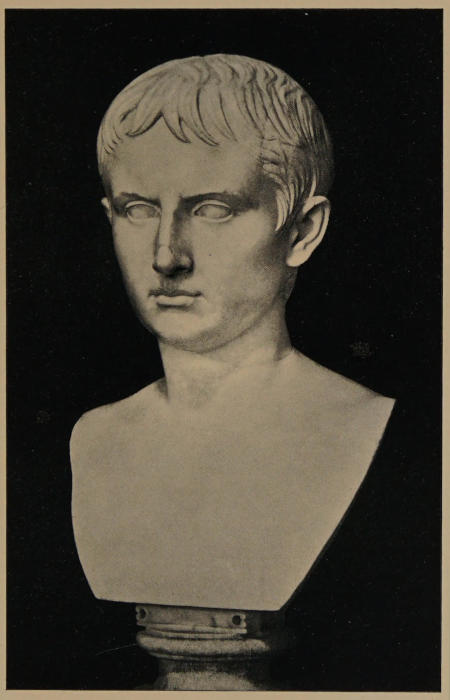
The young Octavius.
Photographed from the Bust in the Vatican by Edne. Alinari.
To face page 10.
Wishes to go to Africa with Cæsar.
But though he seems to have quietly submitted to this
tutelage, he soon conceived an ardent desire to share in the
activities of his great-uncle. Cæsar had been very
little at Rome since the beginning of the civil
war. A few days in March, B.C. 49, thirteen
days in December of the same year, were all that he had spent
in the city. He was absent during the whole of his consulship
(B.C. 48) till September, B.C. 47. On his return from
Alexandria in that month, he stayed barely three months at
Rome. On the 19th of December he was at Lilybæum, on
his way to Africa to attack the surviving Pompeians. Octavius
longed to go with him, and Cæsar was willing to take him.
But his health was not good, and his mother set herself against
it. The Dictator might no doubt have insisted, but he saw that
the boy was not fit to face the fatigues of a campaign. Octavius
submitted, quietly biding his time. He was rewarded by finding
himself high in his great-uncle’s favour when he returned
in B.C. 46 after the victory of Thapsus. He was admitted to
share his triple triumph, riding in a chariot immediately behind
that of the imperator, dressed in military uniform as though he
had actually been engaged. He found, moreover, that he had
sufficient interest with Cæsar to obtain pardon for the brother
of his friend Agrippa, taken prisoner in the Pompeian army in
Africa. This first use of his influence made a good impression,
without weakening his great-uncle’s affection for him. Though
Cæsar did not formally adopt him,[13] he treated him openly as
his nearest relation and heir. Octavius rode near him in his
triumph, stood by his side at the sacrifice, took precedence of
all the staff or court that surrounded him, and accompanied
him to theatres and banquets. He was soon besieged by
petitions to be laid before Cæsar, and shewed both tact and
good nature in dealing with them. This close connection
with the wise and magnanimous Dictator, inspired him with
warm admiration and affection, which help to explain and excuse
the severity with which he afterwards pursued his murderers.
Octavius employed in civil duties, B.C. 46.
In order to give him experience of civic duties, one of the
theatres was now put under his charge. But his assiduous
attention to this duty in the hot season brought
on a dangerous illness, one of the many which he
encountered during his long life. There was a
general feeling of regret at the prospect of a career of such
promise being cut short. Cæsar visited him daily or sent
friends to him, insisted on the physicians remaining constantly
at his side, and being informed while at dinner that the boy
had fainted and was in imminent danger, he sprang up from
his couch, and without waiting to change his dining slippers,
hurried to his chamber, besought the physicians in moving
terms to do their utmost, and sitting down by the bed shewed
the liveliest joy when the patient recovered from his swoon.
Octavius follows Cæsar to Spain, B.C. 45.
Octavius was too weak to accompany the Dictator when
starting for Spain against Pompey’s sons in December B.C. 46.
But as soon as he was sufficiently recovered he
determined to follow him. He refused all company
except that of a few select friends and the
most active of his slaves. He would not admit his mother’s
wish to go with him. He had yielded to her before, but he
was now resolved to take part in a man’s work alone. His
voyage, early in B.C. 45, proved long and dangerous; and when
at length he landed at Tarraco he found his uncle already at
the extreme south of Spain, somewhere between Cadiz and
Gibraltar. The roads were rendered dangerous by scattered
parties of hostile natives, or outposts of the enemy, and his
escort was small. Still, he pushed on with energy and reached
Cæsar’s quarters near Calpe, to which he had advanced after
the victory at Munda (March 17th). Gnæus Pompeius had fled
on board a ship, but was killed when landing for water on the
11th of April, and it was apparently just about that time that
Octavius reached the camp. Warmly received and highly
praised for his energy by the Dictator, he was at once admitted
to his table and close intimacy, during which Cæsar
learned still more to appreciate the quickness of his intelligence
and the careful control which he kept over his tongue.
Octavius accompanies his great-uncle to Carthage.
Affairs in Southern Spain having been apparently settled
(though as it proved the danger was by no means over),
Octavius accompanied Cæsar to Carthage, to
settle questions which had arisen as to the assignment
of land in his new colony. The Dictator
was visited there by deputations from various Greek states,
alleging grievances or asking favours. Octavius was applied to
by more than one of them to plead their cause, and had therefore
again an opportunity of acquiring practical experience in
the business of imperial government, and in the very best
school.
He preceded Cæsar on his return to Rome, and on his arrival
had once more occasion to shew his caution and prudence.
Among those who met him in the usual complimentary procession
was a young man who had somehow managed to make
himself a popular hero by pretending to be a grandson of the
great Marius. His real name was Amatius or Herophilus, a
veterinary surgeon according to some, but certainly of humble
origin. As Marius had married Cæsar’s aunt Iulia, this man
was anxious to be recognised as a cousin by the Dictator. He
had in vain applied to Cicero to undertake his cause, and to
Atia and her half-sister to recognise him. The difficulty for
Octavius was that the man was a favourite of the populace, of
whose cause Cæsar was the professed champion; yet his recognition
would be offensive to the nobles and a mere concession
to clamour. Octavius avoided the snare by referring the case
to Cæsar as head of the state and family, and refusing to
receive the would-be Marius till he had decided.[14]
Octavius at Apollonia, B.C. 45-44.
He did not remain long at Rome however. Cæsar returned
in September, and was assassinated in the following March.
And during that interval, though he found time
for many schemes of legislation, and of restoration
or improvement in the city, he was much employed
in preparing for two expeditions—calculated to last three years—first
against the Daci or Getæ on the Danube, and secondly
against the Parthians in Mesopotamia. These were the two
points of active danger in the Empire, and Cæsar desired to
crown his public services by securing their peace and safety.
For this purpose six legions were quartered in Macedonia for
the winter, in readiness to march along the Via Egnatia to
the eastern coast of Greece. Returning from Spain Dictator
for life, Cæsar was to have two “Masters of the Horse.” One
was to be Octavius, who had meanwhile been created a patrician
by the Senate.[15] But for the present he was sent to pass the
winter at Apollonia, the Greek colony at the beginning of the
Via Egnatia, where he might continue his studies in quiet with
the rhetors and other teachers whom he took with him or
found there,[16] and at the same time might get some military
training with the legions that were not far off. He was
accompanied by some of the young men with whom he
habitually associated. Among them were Agrippa and
Mæcenas, who remained his friends and ministers to the end
of their lives, and Salvidienus Rufus, who almost alone of his
early friends proved unfaithful.[17]
He seems to have led a quiet life at Apollonia, winning
golden opinions in the town and from his teachers for his
studious and regular habits. The admiration and loyalty of
his friends were confirmed; and many of the officers of the
legions seem to have made up their minds to regard him as the
best possible successor to the Dictator.
News of Cæsar’s assassination brought to Apollonia.
In the sixth month of his residence at Apollonia, in the
afternoon of a March day, a freedman of his mother arrived
with every sign of rapid travel and agitation. He
delivered a letter from Atia, dated the 15th of
March. It briefly stated that the Dictator had
just been assassinated in the Senate House. She
added that she “did not know what would happen next; but
it was time now for him to play the man, and to think and
act for the best at this terrible crisis.”[18] The bearer of the
letter could tell him nothing else, for he had been despatched
immediately after the murder, and had loitered nowhere on
the way; only he felt sure that as the conspirators were
numerous and powerful, all the kinsfolk of the Dictator would
be in danger.
This was the last day of Octavius’s youth. From that hour
he had to play a dangerous game with desperate players. He
did not yet know that by the Dictator’s will he had been
adopted as his son, and was heir to the greater part of his vast
wealth; but a passionate desire to avenge him sprang up in
his breast, a desire strengthened with increasing knowledge,
and of which he never lost sight in all the political complications
of the next ten years.
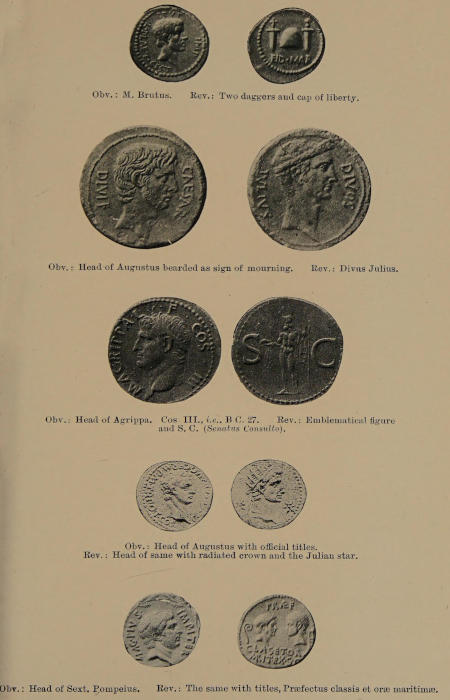
Obv.: M. Brutus. Rev.: Two daggers and cap of liberty.
Obv.: Head of Augustus bearded as sign of mourning. Rev.: Divus Julius.
Obv.: Head of Agrippa. Cos III., i.e., B.C. 27. Rev.: Emblematical figure
and S. C. (Senatus Consulto).
Obv.: Head of Augustus with official titles.
Rev.: Head of same with radiated crown and the Julian star.
Obv.: Head of Sext. Pompeius. Rev.: The same with titles, Præfectus classis et oræ maritime.
To face page 16.
CHAPTER II THE ROMAN EMPIRE AT THE DEATH OF IULIUS CÆSAR
Vicinæ ruptis inter se legibus
urbes Arma ferunt; sævit toto
Mars impius orbe.
Natural boundaries of the Roman Empire.
At the death of Cæsar the Roman Empire had been for the
most part won. Egypt was indeed annexed by Augustus,
though on a peculiar tenure, but subsequent additions
were in a manner consequential, the inevitable
rectifications of a long frontier. Such were
the provinces of the Rhine, the Alps, and the Danube as far
east as Mœsia; and to a certain extent the province of
Galatia and Lycaonia (B.C. 25). The Rhine, the Danube,
and the Euphrates seemed already the natural boundaries of the
Empire on the north and east, the Atlantic Ocean on the west,
and the African and Arabian deserts on the south. And these
boundaries, with occasional modifications, and for the most
part temporary extensions, continued to the end.
Its dangers.
But though the greater part of this wide Empire was already
won, it was not all equally well organised and secured. Thus,
in Northern Gaul, there were still Germans and
other enemies to be conquered or repelled; in
Southern Spain a son of the great Pompey was in arms;
Macedonia was continually subject to invasion by Getæ,
Bessi, and other barbarians; the Dalmatians and neighbouring
tribes made Illyricum an uncertain member of the Empire;
in Syria, Cæcilius Bassus—an old officer of Pompey’s—was
defying Roman armies, and inviting the aid of the Parthians
always ready to cross the Euphrates into the Roman province.
Cæsar’s precautions and preparations.
To confront two of these dangers Cæsar had collected a
large army in Macedonia in the autumn of B.C. 45 to crush
the Getæ, and then crossing to Syria to force
the Parthian to respect the frontier of the
Euphrates, or even to attack them in Mesopotamia.
The former of these projects was no doubt important
for the safety of the Empire, and was in after years successfully
secured by Augustus and his legates. The latter was more
visionary and theatrical, meant perhaps to strike the imagination
of the Romans rather than to secure great practical advantage.
After Cæsar’s death Antony lost more than he gained by
similar enterprises, and Augustus always avoided coming into
actual contact with the Parthians, or attempting to extend his
rule beyond the Euphrates. But there were dangers within
the Empire no less formidable than from without. Its integrity
had rested, and generally securely rested, on the loyalty of its
provincial governors to the central authority as represented by
the Senate, or, in the last resort, by the order of the people
expressed in a lex or plebiscitum. It was the beginning of the
end when these governors used the forces under their command,
or the wealth and influence secured abroad, to defy or coerce
the authorities at home. Sertorius, Sulla, and Cæsar himself,
had shewn that this was not an impossible contingency. It
was against this danger that, among other reforms in the
government of the Provinces, Cæsar’s own law had provided
that the tenure of a proprætor should be confined to
one, and of a proconsul to two years. But now that he was
going on a distant expedition, calculated as likely to occupy
three years, he took other precautions. Having provided for
the chief offices at home,[19] he was careful to see that the provinces
should be held by men whom he believed to be loyal to
himself, and likely from their character and ability to maintain
their peace and security. Being Consul and Dictator, and his
acta being confirmed beforehand by Senate and people, he could
make what nominations he pleased. A decree of the Senate
was still taken as a matter of form, but the old practice (often
a farce) of drawing lots for the provinces was abandoned;[20]
Pompey’s law ordaining a five years’ interval between curule
office and a province was neglected, and Cæsar practically
nominated the governors. But it raises a doubt as to the
unfettered power or the insight of the Dictator that five of
those thus nominated were among the assassins on the Ides of
March.[21] Nor in other respects did his choice prove happy.
The state of open war or dangerous unrest which shewed itself
in almost all parts of the Empire after his death must be learnt
by a review of the provinces, if we are to understand the
problem presented to Augustus and his colleagues in the triumvirate,
and the relief felt by the Roman world when Augustus
finally took the administration into his own hands, and shewed
himself capable of restoring law and order.
(1) The Gauls.
The Gauls now included three districts, the status of which
was somewhat unsettled. (1) Cisalpine Gaul, that is, Italy
between Etruria and the Alps, was still nominally
a province, though Cæsar’s law of B.C. 48 had
granted full civitas to the transpadane, as that of B.C. 89 had
to the cispadane, towns. It had formed part of Cæsar’s province
from B.C. 58 to B.C. 48, and he seems to have retained
it until after the battle of Pharsalia, when he appointed first
Marcus Brutus and then C. Vibius Pansa to it. Though part
of Italy, and generally peaceful, it had great military importance
in case of an invasion from the north. After March B.C. 44
it was to be in the hands of Decimus Brutus, who had long
served under Cæsar, and was regarded by him with special
confidence and affection. Antony’s attempt to wrest it from
Decimus Brutus brought on the first civil war after Cæsar’s
death.
(2) Transalpine Gaul.
(2) Transalpine Gaul technically consisted of “the Province,”
that is, South-eastern France, from the Cevennes on
the west to Italy, and from the Lake of Geneva on the north
to the sea. But since Cæsar’s conquests there had to be added
to this the rest of France, Belgium, and Holland as far as the
Rhine. No formal division into distinct provinces had yet
been made. In B.C. 49 Decimus Brutus, after driving out
Ahenobarbus, the governor named by the Senate, remained in
command of the whole till B.C. 45, when he returned in
Cæsar’s train to Italy. But in the course of these four years,
or on his return, (3) Belgica was separated from the rest and
assigned to Hirtius, who, however, governed it by a legate
named Aurelius, without going there himself.[22] In the course
of the next year a farther division was made: Aurelius
retained Belgica; Lepidus, with four legions, was appointed
to “the Province” (afterwards called Gallia Narbonensis)
together with Hispania Citerior; while L. Munatius Plancus
governed the rest, consisting of what was afterwards two
provinces—Aquitania and Lugdunensis. Plancus and Decimus
Brutus were named consuls for B.C. 42, and therefore their
governorships necessarily terminated at the end of B.C. 43, and
might do so earlier. In the course of B.C. 43 Plancus founded
Lugdunum[23] (Lyon), which was afterwards the capital of the
central province of the four organised by Augustus. But
though the organisation of this country was not complete,
Cæsar’s conquest had been so decisive that no advantage was
taken of the civil war by the natives to attempt a rising.[24]
There seem to have been some insignificant movements in
B.C. 42, but it was not for some years later that any danger of
importance arose there. The Belgæ had been expected to
rise on Cæsar’s assassination, but their chiefs hastened to assure
Hirtius’s legate of their adhesion to the Roman government.[25]
(3) Illyricum.
The province of Illyricum had been formed about the
same time as that of Macedonia (B.C. 146), but its limits had
fluctuated, and it had not received much continuous
attention. It included places, such as Dyrrachium,
Corcyra, Issa, Pharus, which had been declared free after the contest
with Queen Teuta in B.C. 228, but were practically under
Roman control. Yet some of the most powerful tribes not only
did not acknowledge Roman authority, but made frequent incursions
upon Roman Illyricum. The most dangerous of these
were the Dalmatians, with whom several wars are recorded. In
B.C. 117 L. Cælius Metellus occupied Salonæ;[26] in B.C. 87-5
Sulla won a victory over them;[27] in B.C. 78-77 C. Cosconius,
after a two years’ campaign, took Salonæ by storm.[28] But
little was really effected in securing the province against its
enemies. It was let much alone so long as its tribute was
paid, and was put under the governor sometimes of Macedonia,
sometimes of Cisalpine Gaul. In Cæsar’s case (B.C. 58) it was
specially assigned, like the rest of his province, and he seems
at first to have intended to go there in force and subdue the
hostile barbarians. But the Gallic campaigns drew him away,
and he only once actually entered Illyricum (B.C. 54) to
overawe the invading Pirustæ. In the last year of his proconsulship
(B.C. 50) some troops which he sent against the
Dalmatians were cut to pieces. The result of this was that
the barbarians, fearing his vengeance, adhered to Pompey in
the civil war, whose legate, M. Octavius, with a considerable fleet,
maintained himself there,[29] and in B.C. 49 defeated and captured
Gaius Antonius, whom Cæsar sent against him.[30] At the
beginning of the next year Aulus Gabinius, while trying to
lead a force round the head of the Adriatic to join Cæsar, lost
nearly all his men in a battle with the Dalmatians.[31] After
Pharsalia Gabinius was sent back to assist Cornificius, who
had been despatched to Illyricum as proprætor after the
mishap of Gaius Antonius; but he was again defeated and shut
up in Salonæ, where he died suddenly.[32] In B.C. 47, however,
P. Vatinius, having joined Cornificius, defeated and drove
Octavius out of the country.[33] After serving also in the
African campaign of B.C. 46, Vatinius was sent back to
Illyricum with three legions (B.C. 45) expressly to reduce the
still independent tribes. At first he gained sufficient success
to be honoured by a supplicatio,[34] but after Cæsar’s death he
was defeated by the Dalmatians with the loss of five cohorts,
and was driven to take refuge in Dyrrachium.[35] Early in
B.C. 43 he was forced to surrender his legions to M. Brutus,
who, however, in the year and a half which preceded his
death at Philippi, was too busy elsewhere to attend to Illyricum.[36]
Hence the expeditions of Pollio in B.C. 39,[37] and of Augustus in
B.C. 35 were rendered necessary, and they for a time secured
the pacification of the country and the extension of Roman
provinces to the Danube.
(4) Spain.
At the death of Iulius Spain was also a source of great
danger and difficulty. Since B.C. 197 it had been divided into
two provinces—Citerior and Ulterior—separated
by the Saltus Castulonensis (Sierra Morena), each
governed by a prætor or proprætor. In B.C. 54 Pompey
introduced a triple division. Of his three legates Afranius
held Hispania Citerior; but the farther province was divided
between Petreius, who held the district as far west as the
Anas (Guadiana), afterwards called Bætica, while Terentius
Varro governed the country west of that river with Lusitania.
Having forced Pompey’s legates to surrender the country
(B.C. 49), Cæsar seems not to have continued the triple division.
Q. Cassius was sent to Hispania Ulterior, M. Lepidus to Hispania
Citerior. But Cassius offended his own soldiers as well as the
natives, and had to escape by sea, being drowned on his way
home. Nor did his successor Trebonius do much better in
B.C. 47; for many of his soldiers deserted to Gnæus Pompeius
when he came to Spain after the defeat at Thapsus in the spring
of B.C. 46.[38] And though Gnæus Pompeius perished soon after
the battle of Munda (B.C. 45) his younger brother Sextus
survived. At Cæsar’s death he was already at the head of
a considerable fleet which enabled him to control Sicily and
re-occupy Bætica, when its last Cæsarean governor—the famous
C. Asinius Pollio—left it to join Antony in Gallia Narbonensis
in the summer of B.C. 43. The upper province had meanwhile
been governed by the legates of Metellus, who was about to
return to it and Gallia Narbonensis with four legions when
Cæsar’s death introduced new complications.[39]
(5) Sicily.
Sicily for eight years after Cæsar’s death was practically
separated from the Empire. In B.C. 49 it had been easily won
over to Cæsar’s authority by C. Curio, and after
his success in Spain against Pompey’s legates Cæsar
had nominated Aulus Allienus[40] as its proprætor. In B.C. 46
Allienus was succeeded by M. Acilius[41] (afterwards sent to
Achaia), who in his turn was succeeded by T. Furfanius
Postumus (B.C. 45). Finally, among Cæsar’s arrangements for
B.C. 44 was the appointment of Pompeius Bithynicus to Sicily.
His father had served under Pompey and had perished with
him in Egypt; and Bithynicus seems to have feared retaliation
from the Pompeians if they returned to power; for on the death
of Cæsar we find him writing to Cicero in evident anxiety as
to his position.[42] He failed to hold the island against Sext.
Pompeius, who landed in B.C. 43, and after sustaining a slight
reverse at Messene forced Bithynicus to yield him a share in
the government, and shortly afterwards put him to death
because he believed him to be plotting against him.[43] Sicily
therefore had to be restored to the Empire by the triumvirs,
a task which fell chiefly to Augustus.
(6) Sardinia.
Sardinia was important for its supply of corn. In B.C. 49
Cæsar’s legate Q. Valerius Orca occupied it without difficulty,
its governor, M. Aurelius Cotta, escaping to Africa.
In B.C. 48 Orca was succeeded by Sext. Peducæus.[44]
But the arrangements made between that date and B.C. 44 are
not known, for Peducæus appears to have been in Rome from
the end of B.C. 45.[45] In the first division of the provinces by
the triumvirs (November, B.C. 43) it fell to Octavian’s share,[46]
though Suetonius remarks that Africa and Sardinia were the
only two provinces never visited by him.[47] Meanwhile Sext.
Pompeius occupied it,[48] and it was not recovered till B.C. 38.
(7) Africa. Numidia.
The province of Africa—the ancient territory of Carthage—may
be taken with this western part of the Empire. It had
long been a peaceful province, but in B.C. 46 it was
the scene of the great rally of the Pompeians after
the disaster at Pharsalia. Since their final defeat at
Thapsus it had been farther secured by Cæsar’s colony at Carthage
(B.C. 46-5), and had been governed by a fervent Cæsarean,
C. Calvisius Sabinus. At the end of B.C. 45 Sabinus returned
to Rome, and Q. Cornificius (once Cæsar’s quæstor) was
named to succeed him. But affairs in Africa had been complicated
by the formation of a new province from the
dominions of Iuba, called sometimes New Africa, sometimes
Numidia (B.C. 46). Of this new province the first proprætor
was the historian Sallust, succeeded in B.C. 45 by T. Sextius with
three legions. On Cæsar’s death, therefore, there were two
men in Africa who might possibly take different views of the
situation. Cornificius indeed—friend and correspondent of
Cicero—shewed at once that he meant to stand by the Senate.
A few months later he was confirmed in this resolution by the
fact of his continuance in office depending on the senatorial
decree of the 20th of December,[49] whereas Antony had
commissioned Calvisius Sabinus (who had never withdrawn his
legates from Africa) to go back to the province.[50] Accordingly,
after Antony’s defeat at Mutina (April, B.C. 43), the Senate felt
strong enough to order Sextius to transfer his three legions to
Cornificius, who was himself under orders to send two of them
to Rome.[51] This was done, and with the remaining legion
Cornificius maintained his position in Old Africa, when the
Triumvirate was formed in November, and was able to offer
protection to many of the proscribed. But Sextius now
claimed both provinces, as having fallen to Octavian’s share.
He enrolled troops in his own province and obtained the help
of Arabion, of the royal family of Numidia and chief of the
robber tribe of Sittians; and though Cornificius had the stronger
force, he was presently defeated and killed. Octavian, however,
looked upon Sextius as a partisan of Antony rather than of
himself, and presently sent C. Fuficius Fango to supersede him.
Sextius seems to have foreseen that differences would occur
between Antony and Octavian likely to give him a chance of
recovering his province. Therefore under pretence of wishing
to winter in a genial climate he stayed on in Africa. His
opportunity came with the new distribution of provinces after
Philippi (October-November, B.C. 42). Old or “Prætorian”
Africa fell to Antony, New Africa or Numidia to Octavian.
But upon the quarrel between Octavian and Fulvia (supported
by Lucius Antonius) in B.C. 41, Sextius was urged by Fulvia
to demand the prætorian province from Fango as properly
belonging to Antony. After several battles, in which he met
with various fortunes, Fango was at last driven to take refuge
in the mountains, and there killed himself. Sextius then held
both provinces till, in B.C. 40, the triumvir Lepidus took possession
of them as his share of the Empire.[52]
Thus the Western Provinces, in spite of Cæsar’s precautions,
were all in a condition to cause difficulty to his successors in
the government. The Eastern Provinces were for the most
part in a state of similar disorder. Illyricum has already been
discussed, as most conveniently taken with the Gauls. For
those farther east Cæsar’s arrangements were no more
successful in securing peace than in the West.
(8) Macedonia.
The victory at Pharsalia put Macedonia under Cæsar’s
control, and he apparently continued to govern it till B.C. 45
by his legates. While in Egypt (B.C. 48-7),
fearing, it seems, that it might be made a centre
of resistance,[53] he directed Gabinius to go there
with his legions, if the state of Illyricum allowed of it.[54] We
have no farther information as to its government till the
autumn of B.C. 45, when a large military force was stationed
there; and in that, or the following year, Q. Hortensius—son of
the famous orator—was made governor. Marcus Brutus was
named by Cæsar to succeed him in B.C. 43, and Hortensius did,
in fact, hand over the province to him at Thessalonica at the
beginning of that year. But meanwhile Antony had induced
the Senate to nominate himself (June, B.C. 44). He withdrew
five of the legions and then managed to get the province transferred
to his brother Gaius. When Antony was declared a
hostis, the Senate revoked the nomination of Gaius and restored
the province, along with Illyricum, to M. Brutus, who
was in fact already in possession, having defeated and captured
Gaius Antonius.
(9) Greece.
Closely connected with Macedonia was Greece, which had
been left, since B.C. 146, in a somewhat anomalous position.
Thessaly indeed, was, to a great extent, incorporated
with Macedonia; but the towns in
Bœotia, as well as Athens and Sparta, were
nominally free, though connected with Rome in such a way
as to be sometimes spoken of separately as “provinces.” So
with the towns in the Peloponnese once forming the Achæan
League. The League was dissolved and each town had a
separate fœdus or charter.[55] But with all this local autonomy
Greece was practically governed by Rome, and in certain cases
the proprætor of Macedonia exercised jurisdiction in it. But
as yet there was no “province” of Greece or even of Achaia,
with a separate proconsul or proprætor. Cæsar, as in other
cases, made temporary arrangements which afterwards became
permanent under Augustus. In B.C. 48, Q. Fufius Calenus,
one of his legates, was sent to take possession of Greek cities in
Cæsar’s interest, and remained at Patræ with troops till B.C. 47,
exercising authority over the whole of the Peloponnese.[56] In
the autumn he went home and was rewarded by the consulship
for the rest of the year. But in B.C. 46, Cæsar appointed
Serv. Sulpicius Rufus governor of Greece, and his authority
seems to have extended throughout the Peloponnese and as far
north as Thessaly.[57] Sulpicius returned to Rome at the end of
B.C. 45, or beginning of B.C. 44, and does not seem to have had
a successor. Greece appears to have been tacitly allowed to
revert to its old position of nominal freedom and real attachment
to Macedonia. M. Brutus at any rate, as governor
of Macedonia, assumed that he had authority in Greece.
After the re-arrangement at Philippi (B.C. 42), it fell to Antony’s
share, who, for a time at least, yielded Achaia to Sext.
Pompeius.[58]
The Asiatic Provinces.
(10) Bithynia and Pontus.
As Cæsar was meditating a settlement of Syria, it was
important that the Asiatic provinces should be in safe hands.
To Bithynia and Pontus—among the newest of
Roman provinces—L. Tillius Cimber had been
nominated. We know nothing of his antecedents
except that we find him among the influential
friends of Cæsar in B.C. 46; but his provincial appointment was
readily confirmed by the Senate after his share in Cæsar’s death.[59]
He devoted himself to the collection of a fleet, with which he
aided the pursuit of Dolabella, and afterwards assisted Brutus
and Cassius.
(11) Asia.
The province of Asia was quiet and wealthy. For financial
and strategic reasons it was specially necessary at this time to
have it in safe hands. Cæsar had nominated C.
Trebonius, who had been his legate in Gaul and
Britain, and had often been intrusted with important commands.
He had stuck to his old general in the civil war and had been
rewarded by the prætorship of B.C. 48, and the province of
Farther Spain in the next year. Though he was not successful
in Spain Cæsar continued to trust him sufficiently to send him
to Asia. He did not actually strike a blow in the assassination,
but he aided it by withdrawing Antony from the Senate on
a treacherous pretence of business. His appointment was
readily confirmed by the Senate, and he went to Asia purposing
to fortify towns and collect troops to aid the party of the
assassins. It was this—not alone his participation in the
murder—which caused Dolabella, probably at the instigation
and certainly with the approval of Antony,[60] to put him to
death when refused admittance by him into Smyrna or
Pergamus. At the end of the year the Senate had arranged
that he was to be succeeded by one of the Consuls, Hirtius or
Pansa. But after his murder the province remained in the
hands of his quæstor,[61] and on the death of Hirtius and Pansa
at Mutina it was transferred by the Senate to M. Brutus (to
be held with Macedonia), who in the course of B.C. 42 made a
progress through it to hold the conventus, to collect men and
money, and to meet Cassius. It was, no doubt, heavily taxed;
and after the battle of Philippi Antony took possession of it
and again unmercifully drained its resources.
(12) Cilicia.
On quitting the province of Cilicia in July, B.C. 50, Cicero
left it in charge of his quæstor, C. Cælius Caldus. Whether,
in the confusion of the first years of civil war,
any successor was appointed we do not know.
The province needed some resettlement, for in B.C. 47 Cæsar
stopped at Tarsus, on his way to Pontus, for some days, to meet
the chief men and make certain regulations, of which he does
not tell us the nature.[62] But it seems that then, or shortly
afterwards, it was considerably reduced in extent. The
Phrygian “dioceses”—Laodicea, Apamea, and Synnada—were
assigned to Asia, as well as most of Pisidia and Pamphylia.
The remainder—Cilicia Aspera, and Campestris, with Cyprus—seem
to have been held somewhat irregularly by Cæsar’s own
legates. It was afterwards treated by Antony as though at his
own disposal, Cyprus and Cilicia Aspera being presented to
Cleopatra, part of Phrygia with Lycaonia, Isaurica, and Pisidia
to Amyntas, king of Galatia. The province, in fact, as
known to Cicero, was almost separated from the Empire until
reorganised by Augustus.
(13) Syria.
The province of Syria was extremely important in view of
the danger from the Parthians. Bounded on the north by
Mount Amanus it included Phœnicia and Cœle-Syria
as far south as the head of the Red Sea and
the eastern mouth of the Nile. On the east it was bounded
by the Euphrates and the deserts of Arabia. After the
organisation of Pompey in B.C. 63 it had been administered by
proconsuls and the usual staff. In B.C. 57-6 it was held by
Gabinius, who employed his forces for the restoration of
Ptolemy Auletes to the throne of Egypt. In B.C. 54-3 it was
held by Crassus; and after his fall at Carrhæ it was successfully
defended and administered by C. Cassius as quæstor and
proquæstor. In B.C. 51-50, while Cicero was in Cilicia, it
was ruled by Bibulus; and in B.C. 49 Pompey secured it for his
father-in-law, Q. Cæcilius Metellus Scipio, who collected
troops and went to the aid of Pompey in Thessaly, and after
Pharsalia escaped to Africa. It was then put in the hands of
the quæstor, Sextus Iulius, a connection of the Dictator, with
some legions, one of which had been left there by Cæsar in
anticipation of the coming Parthian war. But a new complication
had been introduced by Q. Cæcilius Bassus. This
man had been with Pompey at Pharsalia and had escaped to
Syria, where for a time he lived obscurely. But after a while,
by tampering with the soldiers of Sextus Iulius, who was both
incompetent and vicious, he induced them to assassinate their
commander and transfer their allegiance to himself.[63] Professing
to be lawful proconsul of Syria he fortified himself in Apamea,
and there repulsed forces sent by Cæsar under Antistius Vetus
and L. Statius Murcus successively. He made some agreement
with the Parthians which secured their aid;[64] and though
Murcus was reinforced by Crispus governor of Bithynia, Bassus
was still unsubdued at the time of Cæsar’s death. There had
been, therefore, a double need for a strong man in Syria, and
Cæsar had nominated C. Cassius, the former defender of it
against the Parthians. After Cæsar’s death, however, Dolabella
secured the passing of a law transferring Syria to himself
with the command against the Parthians. But some irregularity
in the auguries taken at the comitia gave Cassius a plausible
excuse for ignoring this law. Consequently when Dolabella
entered the province from the north, Cassius did so from the
south. After some successful movements in Palestine, Cassius
induced Murcus and Crispus, and finally Bassus himself, to
hand over their legions to him, as well as Trebonius’s legate,
Allienus, who was bringing some legions from Egypt.[65] Thus
reinforced he shut up Dolabella in Laodicea and frightened
him into committing suicide. Syria therefore remained in the
hands of Cassius; and when he fell at Philippi it was vacant.
In accordance with the agreement made with Octavian after
that battle it fell to the lot of Antony, who retained it
personally, or by his legates, till his death.
(14) Egypt.
Egypt was still an independent kingdom, ruled since B.C. 47
by Cleopatra. Nevertheless, there was a considerable Roman
force stationed in it, partly left by Gabinius, when
he restored Ptolemy Auletes in B.C. 57-6, partly
stationed there by Cæsar himself. They must have been
somewhat in the position of the English troops supporting
the authority of the Khedive, but prepared to resist all
outside interference. So in this case the Romans retained
a preponderating influence, though with no legal authority or
right of raising revenue. These troops appear to have been in
a very disorderly state, and in B.C. 50 murdered two of the
sons of Bibulus who were among their officers.[66]
(15) Cyrene and Crete.
The district between Egypt and Roman Africa, called
Cyrene, was once joined to Egypt and then governed by a
king of its own (B.C. 117). This king (Ptolemy
Apion), dying in B.C. 96 without issue, left his
dominions to the Romans. The Roman government
took over the royal estates, and placed a tax on the
principal product of the country—silphium (valuable for its
medicinal qualities)—but did not organise it as a province.
The five principal cities[67] were allowed to retain a pretty
complete autonomy. But upon disagreements between these
states breaking out, the whole country in B.C. 74 was reduced
to the form of a province governed by a quæstor pro prætore.[68]
Six years later (B.C. 68-7) complaints as to the harbouring of
pirates caused Q. Cæcilius Metellus to reduce Crete also.[69]
When Pompey superseded Metellus in B.C. 67, he introduced
certain changes in the administration of both provinces, though
there is no proof that he combined them as was done at a later
date. In B.C. 44 indeed, they were assigned separately—Crete
to Brutus and Cyrene to Cassius[70]—while Antony produced a
memorandum of Cæsar’s directing that Crete should be restored
to liberty,[71] that is, should cease to pay tributum. At
the division of the provinces after Philippi both were assigned
to Antony, and he assumed the right some years later of
forming out of them a kingdom for his daughter by Cleopatra.
The general disorders in the Empire.
It will be seen therefore that at Cæsar’s death there was
hardly any part of the Empire in which there were not
elements of mischief more or less active. The
most peaceful district was perhaps Greece, though
it managed to put itself under the frown of the
triumvirs by sympathising with Brutus, and later on under
that of Octavian by sympathising with Antony. The disturbances
which most affected the actual residents in Rome
and Italy were those in Sicily and Sardinia, Gaul and
Illyricum. The man who should put an end to these
would seem a saviour of society. The struggles in the
far East, though from a financial point of view they were
of considerable importance, would not loom so large in the
eyes of the Italians. We have now to trace the steps by
which Augustus was able to satisfy the needs of the state; to
restore peace and plenty to Italy; to organise and safeguard
the provinces; and thus to be almost worshipped as the visible
guarantee of order and tranquillity.
CHAPTER III THE INHERITANCE
Cui dabit partes scelus
expiandi Iuppiter?
News of Cæsar’s murder brought to Apollonia, March, B.C. 44.
The news of his great-uncle’s death reached Octavius at
Apollonia in the afternoon, just as he and his suite were
going to dinner. A vague rumour of some great
misfortune quickly spread through the town, and
many of the leading inhabitants hastened to the
house with zealous friendliness to ascertain its
truth. After a hasty consultation with his friends, Octavius
decided to get rid of most of them while inviting a few of the
highest rank to discuss with him what should be done. This
being effected with some difficulty, an anxious debate was
carried on into the night. Opinions were divided. One
party urged Octavius to go to the army in Macedonia, appeal
to its attachment to Cæsar, and call on the legions to follow
him to Rome to avenge the murdered Dictator.[72] Those who
thus advised trusted to the impression likely to be made by
Octavius’s personal charm and the pity which his position
would excite. Others thought this too great an undertaking
for so young a man. They argued that the many friends
whom Cæsar had raised to positions of honour and profit
might be trusted to avenge his murder. They did not yet
know that theirs were the very hands which had struck him
down. After listening to the various opinions Octavius resolved
to take no decisive step until he had reached Italy, had
consulted his friends there, and had seen the state of affairs
with his own eyes.
Octavius prepares to go to Italy, April, B.C. 44.
Preparations for crossing were begun at once, and in the
few days before the start farther details of the assassination
reached Apollonia. The citizens begged Octavius
to stay, putting all the resources of the town at
his disposal; and a number of officers and soldiers
came from the army with tenders of service,
whether to guard his person or to avenge the Dictator. But
for the present he declined all offers. He thanked the Apolloniates
and promised the town immunities and privileges—a
promise which in after years he did not forget. He told the
officers and soldiers that he would claim their services at some
future time. For the present he did not need them: “only
let them be ready when the time came.” The conduct of
the Martia and Quarta a few months later shewed that these
feelings were genuine and lasting.
Octavius had a poor vessel and a stormy crossing, but landed
in safety, probably at Hydruntum (Otranto), the nearest point
in Calabria, and in fair weather only a five hours’ voyage.[73]
That fact and the state of the wind may have influenced the
choice of the port. But he was also too much in the dark as
to affairs in Italy to venture upon such a frequented landing-place
as Brundisium, where he might have found himself
in the midst of political enemies or hostile troops. From
Hydruntum he went by land to Lupiæ, rather more than
half way to Brundisium. There he first met some who had
witnessed Cæsar’s funeral, had heard the recitation of his will,
and could tell him that he was adopted as Cæsar’s son, and
(with a deduction of a liberal legacy to the citizens) was heir
to three-quarters of his property,[74] the remaining fourth being
divided between Cæsar’s two other grand-nephews Q. Pedius
and Lucius Pinarius. He learnt also that the Dictator’s
funeral, which by his will was to be conducted by Atia,
had been performed in the Forum amidst great popular excitement,
caused partly by the sight of his wounded body,[75]
partly by Antony’s speech, and had been followed by attacks
on the houses of the chief assassins, who, after barricading
themselves for three days on the Capitol, had found it necessary
to retire from Rome, first to the villa of Brutus at
Lanuvium, and then to Antium,[76] in spite of the amnesty
voted in the Senate on the 17th of March.
Octavian accepts the inheritance and name, May, B.C. 44.
Though deeply moved by this story Octavian did not allow
his feelings to betray him into taking any false or hasty step.
Satis celeriter quod satis bene was his motto now as in
after life.[77] He went on to Brundisium, having
ascertained that it was not occupied by enemies, and
there received letters from his mother and stepfather
confirming what he had already heard. His mother
begged him to join her at once, to avoid the jealousies roused
by his adoption. Philippus advised him to accept neither
inheritance nor name, and to hold aloof from public business.
The advice was, no doubt, prompted by affection, and was
natural in the circumstances. But though Octavian never
blustered, neither did he easily turn aside: he wrote back
declaring his determination to accept. His own friends henceforth
addressed him as “Cæsar,” his full name now being
Gaius Iulius Cæsar Octavianus.[78] The adoption indeed was
not complete without the formal passing of a lex curiata; but
though that was delayed for more than a year, the new name
was assumed at once. He complied with his mother’s wish
that he should visit her first, and he soon had the satisfaction
of feeling that though Philippus was still opposed, her heart
was with him in the manly resolve to sustain the great part
which Cæsar’s affection had assigned to him. Cicero mentions
in a letter of April 11th that Octavius had arrived in Italy,
and on the 18th that he had reached Naples. On the 19th
Balbus—the Dictator’s friend and agent—called on him and
learned from his own lips his resolve to accept the inheritance.
On the 22nd Cicero met him at his stepfather’s villa near
Puteoli, and anxiously watched for any indication of his
political aims. He was only partly satisfied.
“Octavius here treats me with great respect and friendliness.
His own people addressed him as ‘Cæsar,’ but as Philippus did not do
so, I did not do it either. I declare it is impossible for him to be
a good citizen! He is surrounded by such a number of people who
actually threaten our friends with death. He says the present state
of things is intolerable.”[79]
It was not Octavian’s cue as yet to break openly with the
aristocrats. The first struggles for his rights were likely to be
with Antony, in which the aid of Cicero and his party would
be useful. At the same time he was too cautious and self-controlled
to commit himself or betray his real intentions,
which remained an enigma to the emotional orator, who hardly
ever spoke without doing so. Cicero consoled himself by the
reflection that at any rate Octavian’s claims must cause a
quarrel with Antony. Yet he was indignant that this stripling
could go to Rome without risk, while Brutus and Cassius and
the other “heroes” of the dagger could not. Octavian’s
journey to Rome was for the twofold purpose of giving formal
notice to the prætor urbanus that he accepted the inheritance,
and of making a statement of his intentions as administrator of
the will at a public assembly. For the latter he needed to be
introduced to the meeting by a tribune. For this service he
relied on Lucius Antonius. All three brothers were in office
this year—Marcus consul, Gaius prætor, Lucius tribune; and
as supporters of the late Cæsar they could not in decency refuse
him this opportunity of declaring his sentiments.
Octavian and M. Antonius.
Octavian reached Rome in the first week of May, duly
accepted the inheritance, and was introduced to a contio by
Lucius Antonius about the 10th of that month.[80]
The speech was not satisfactory to the Ciceronian
party. He declared his intention to carry out his “father’s”
will as to the legacy to the people, and to celebrate the games
at the dedication of the temple of Venus promised by Cæsar.
Preparations for them were begun at once, two of the
Dictator’s friends, Matius and Postumius, being selected to
superintend them.[81] But though confining himself to expressions
of veneration for his “father’s” memory, and uttering no
threats against any one, Octavian had not given up for a
moment his resolve to punish the murderers. The amnesty voted
in the Senate he regarded as a temporary expedient. All that
was needed was an accuser, and he did not mean that such a
person should be long wanting. But meanwhile his first business
was to secure his own position and the possession of Cæsar’s
property. This at once brought him into collision with
Antony.
The money at the temple of Ops.
The financial arrangements of the late Dictator were to
a great degree to blame for this. He seems to have introduced
the system of the fiscus, though without the name
known in later times: that is, large sums of money
were deposited in the temple of Ops to his order,
separate from the public ærarium of the temple of Saturnus,
and not clearly distinguished from his own private property. It
was as though a Chancellor of the Exchequer paid portions of
the revenue to his private banking account, and were to die
suddenly without leaving any means of distinguishing between
public and private property.[82] Cicero says that this money
(700,000,000 sesterces, or about five and a half millions sterling)
was the proceeds of the sale of confiscated properties,[83] and there
was, it seems, much other property in lands and houses from
the same source. The claim by an heir of Cæsar would be
met by a double opposition—from the government, which
would regard the whole as public; and from the owners or
their representatives, who might have hopes of recovering parts
of it. For at Rome confiscation did not bar claims under
marriage settlements, or for debts secured on properties. The
large sum at the temple of Ops had been taken over entirely
by Antony the Consul, nominally as being public money, really—as
Cicero affirms—to liquidate his own enormous debts. It
is very likely that Antony shared the spoil with others, perhaps
with his colleague Dolabella, and they may have satisfied their
consciences with some partial use of it for public purposes.[84]
At any rate it was not forthcoming when Octavian put in his
claim. Even in regard to such property as was handed over to
him he was constantly harassed by lawsuits. Claimants were
instigated, as he believed, by one or other of the Antonies; while
Gaius Antonius, acting prætor urbanus for Brutus, would often
preside in the court. He was resolved, however, to carry out
Cæsar’s will, even if he had to sell his own paternal estate
and draw upon his mother’s resources. But it seems, after all,
that the property of Cæsar which he did manage to get, or his
own wealth, was so ample, that he was able to do this without
crippling himself. Pinarius and Pedius got their shares, but
handed them over to him, perhaps as being too heavily weighted
with legacies to be of much value to them, or thinking that
his great future made it a good investment. At any rate the
legacies were paid, the games given, and when some months
later he proceeded to enroll two legions of veterans he was able
to pay each man a bounty amounting to something like £20
of our money.[85] At no time in his career does he seem to have
had serious money difficulties. No doubt his resources were
always large, but he must also have had the valuable faculty of
husbanding them in small matters, while always having enough
for large outlays.
Difficulties about Octavian’s adoption.
But it was not only in regard to money that Octavian
found himself thwarted by Antony and his brothers. A
tribune, probably Lucius Antonius himself, prevented
the formal passing of the lex curiata for
his adoption, with a view of weakening his claims
upon the inheritance. When he wished to be elected tribune
in the place of Cinna, who had fallen a victim to the mob in
mistake for L. Cinna, a prætor who had spoken against Cæsar,
he was prevented by the partisans of Antony.[86] There was
indeed a legal obstacle in the fact that he was now a patrician,[87]
was under age, and had not held the quæstorship, though this
last was a breach of custom rather than of law. Lastly,
Antony treated him with studied disrespect, keeping him
waiting in his ante-room; while Lucius Antonius and the
other tribunes forbade him to place Cæsar’s gilded chair in
the Circus at his games.[88]
Octavian and the Optimates. After the meeting of the Senate in June.
It was clear that a breach between the two was imminent.
The younger man was not abashed by the years or high office
of the other; and though some formal reconciliation
was brought about by common friends or by
military officers, Octavian seems to have allowed
the Ciceronians to believe that he intended to
join them in opposing Antony. His attentions to them
became more marked after the meeting of the Senate of the
1st of June. To this meeting the Constitutionalists had been
looking forward as likely to bring the uncertainty to an end.
At it the question of the provinces was to be settled; the two
consuls, with the aid of a committee, were to report on what
were the genuine acta of Cæsar; and some means were to be
found to enable Brutus and Cassius to carry on their duties as
prætors in Rome with safety.
Antony and Cæsar’s acta and veterans.
Meanwhile Antony had been availing himself of the papers
of Cæsar as though the committee had already reported. He
had also been securing himself—as he thought—by
visiting the colonies of Cæsar’s veterans in
Campania[89] and by gradually collecting a bodyguard.
This had now assumed sufficiently formidable proportions
to overawe the Senate.[90] It is true that he had experienced
difficulties at Capua, where the existing coloni resented
his attempt to plant others in the same territory; but, on the
whole, he seems to have improved his position by his tour
in April and May. Then again Lepidus had visited Sext.
Pompeius in Spain, and was reported to have induced him, on
condition of recovering his father’s property, to return to Rome
and place his naval and military forces (amounting to more
than six legions) at the disposal of the consuls.[91] This, thinks
Cicero, would make Antony irresistible; and so no doubt
thought Octavian also.
The position of Brutus and Cassius. The change of provinces.
Nor did the meetings of the Senate in June effect anything
to dissipate these fears. What was done for Brutus and
Cassius satisfied neither party. They were offered
the cura annonæ, superintendence of the corn
supply—Cassius in Sicily, Brutus in Asia—which
would give them a decent pretext for being absent
from Rome for the rest of the year. They, however, regarded
this offer as an insult.[92] So also in regard to the provinces:
Brutus and Cassius were deprived of Macedonia and Syria,
which Cæsar had assigned to them respectively, and were
offered the unimportant governorships of Crete and Cyrene.
But Antony in the same meetings secured still greater military
strength for himself by an arrangement with Dolabella.
The latter was appointed to Syria and the command against
the Parthians by a lex; and he then induced the Senate to
give Macedonia to himself, with the command of the legions
stationed there, one of which he had bargained with Dolabella
to hand over to him. These decrees having been passed,[93] he
sent his brother Gaius over at once to announce the fact to
the legions in Macedonia and to give them notice that they
might at any time be summoned to Italy. For Antony himself
had no intention of going to Macedonia. His private
resolve was to hold Gallia Cisalpina with the largest force
possible, as giving him most hold on Italy. He had only
accepted Macedonia in order to get these legions into his
hands. At the same time he carried a repeal of Cæsar’s law
confining the tenure of a province for a proprætor to one, and
for a proconsul to two, years.
Antony gets himself nominated to Cisalpina Gaul.
Though this increasing power of Antony was naturally calculated
to alarm Octavius, he was, on the other hand, opposed
to Decimus Brutus—one of the assassins—retaining
Gallia Cisalpina. He therefore supported
Antony in carrying a law conferring that
province on him at the end of his consulship.[94] The Senators
now saw that they had been tricked. They had given Antony
the Macedonian legions without conditions, and he would now
use them in another province given him by a lex—over which
they had no control. Suggestions were made to remove
Gallia Cisalpina from the list of provinces, and incorporate it
(as was afterwards done by Augustus) in Italy, thus doing
away with any pretext for a proconsul residing there with
legions. But for the present the law stood which assigned it to
Antony for B.C. 43. It appears to have been passed by the
beginning of July, and he at once sent word to his brother to
bring the legions over. They were expected in July,[95] but did
not actually arrive till nearly three months later. Meanwhile
a war of recriminations was maintained between Antony the
consul and Brutus and Cassius the prætors by letters or
edicts. Antony accused the prætors of collecting forces hostile
to the government, the prætors accused Antony of making it
impossible for them to come to Rome by denouncing them in
speeches and edicts, in breach of his promise. On the 1st of
August L. Calpurnius Piso—father-in-law of the late Cæsar—inveighed
against Antony in the Senate, ending with a hostile
motion, of the exact nature of which we are not informed.
But he could get no one to speak or vote with him, so completely
cowed were the Senators by Antony’s military forces.[96]
On the other hand, Antony was uneasy at the growing
popularity of Octavian, especially among the veterans. He
had himself made a bid for their favour by two commissions
for assigning land to them both in Italy and the provinces.
But the veterans were suspicious; they had expected some
signal act of vengeance for the murder of Cæsar; and at the
same time Antony’s lavish grants of public land to unworthy
favourites impoverished the exchequer and diminished the
amount available for distribution. They lowered his popularity
with the veterans as much as they annoyed the Senators, who
yet did not venture to oppose him.
Attempted assassination of Antony.
The friction between the two men—varied by occasional
reconciliations—became more and more acute, until about the
end of September it was rumoured that Octavian had suborned
men to assassinate Antony. Of course Octavian disclaimed
it, and upon Antony giving out that certain men
had been found in his house with daggers, he
went openly with an offer to serve along with his
friends among his bodyguards. The popular belief was that
Antony had invented the whole story to discredit him; but
Cicero and others of his party both believed and approved, and
subsequent writers are divided in opinion. Nicolas of Damascus
probably gives Octavian’s own version, according to which
Antony was unable to produce the pretended assassins to a
council of his friends, or to induce them to advise active
retaliation upon Octavian. Appian points out that it was not
to Octavian’s interest just then that Antony should disappear,
for it would have been a great encouragement to the party of
the Assassins, of whose real sentiments towards himself he was
no doubt aware.[97]
For with this party his alliance was a matter of great doubt.
In June Cicero had said of him:
Octavian and the Optimates.
“In Octavian, as I have perceived, there is no little
ability and spirit; and he seems likely to be as well
disposed to our heroes as I could wish. But what confidence
one can feel in a man of his age, name, inheritance, and
upbringing may well give us pause. His stepfather, whom I saw at
Antium, thinks none at all. However, we must foster him, and, if
nothing else, keep him estranged from Antony. Marcellus will be
doing admirable service if he gives him good advice. Octavian
seems devoted to him, but has no great confidence in Pansa and
Hirtius.”[98]
Philippus was not a man for whom Cicero had a great
respect.[99] But Marcellus, the husband of Octavia (Cos. B.C. 50),
was a sound aristocrat and a trustworthy man. Still Octavian
had done nothing since to identify himself with the conservative
party, in spite of his differences with Antony. With
Cicero himself he kept up friendly communications; yet at the
final breach between Cicero and Antony in September, it does
not seem to have occurred to Cicero to put forward Octavian
as Antony’s opponent; nor does he mention him in the first
two Philippics. It was Octavian’s own independent action
which first shewed that he was ready and able to assume that
position, and Cicero viewed this at first with anxiety and
almost dismay.
Octavian enrolls veterans.
Antony left Rome on the 9th of October to meet the
Macedonian legions at Brundisium. Octavian no longer
hesitated. Sending agents to tamper with the
loyalty of the newly arrived legions, he himself
went a round of the veterans in Campania, offering
them a bounty of 500 denarii (about £20), if they would
enlist again. In doing this he acted wholly on his own
initiative and without authority from Senate or people, and
without holding any office giving him military command.[100] In
after years Augustus regarded this as the first step in his public
career, the first service rendered to the State: “When nineteen
years old I raised an army on my own initiative and at my own
expense, with which I restored to liberty the republic which
had been crushed under the tyranny of a faction.” And not
only did he reckon this his first public service; the wording of
this statement is a declaration that he thereby adopted the
policy and was continuing the work of his “father,” for he uses
the very phrase which Cæsar had used in justifying himself.[101]
This phrase illustrates another point also. Ostensibly the
enrolment of veterans was to protect himself against Antony.
Perhaps he did not yet see how it was to be done, but at the
bottom of his heart was the purpose of checkmating, if not
destroying, the clique which had caused Cæsar’s murder,
though for the moment he was with them in opposition to
Antony, and was eager to have Cicero’s support and approval.
Yet how doubtful and uneasy the orator felt is shewn by two
letters in which he tells what Octavian was doing.
“Puteoli, 2 November. On the evening of the 1st I got a letter
from Octavian. He is entering upon a serious undertaking. He has
won over to his views all the veterans at Casilinum and Calatia. And
no wonder: he gives a bounty of 500 denarii apiece. Clearly his
view is a war with Antony under his own leadership. So I perceive
that before many days are over we shall be in arms. But whom are
we to follow? Consider his name, consider his age! Again, he
demands to begin with a secret interview with me at Capua of all
places! It is really quite childish to suppose that it can be kept
quiet. I have written to explain to him that it is neither necessary
nor practicable. He sent a certain Cæcina of Volaterræ to me, an
intimate friend of his own, who brought me news that Antony was
on his way to the city with the Alaudæ, was imposing money contribution
on the municipal towns, and was marching at the head of
the legion with colours flying. He wanted my opinion, whether he
should start for Rome with his legion of 3,000 veterans, or should
hold Capua, and so intercept Antony’s advance, or should join the
three Macedonian legions now sailing by the Mare Superum, which
he hopes are devoted to himself. They refused to accept a bounty
offered them by Antony, as my informant at least asserts. They even
used grossly insulting language to him and moved off when he
attempted to address them. In short, Octavian offers himself as our
military leader, and thinks that our right policy is to stand by him.
On my part I advised his making for Rome. For I think he will
have, not only the city mob, but, if he can impress them with confidence,
the loyalists also on his side. Oh, Brutus! Where are
you! What an opportunity you are losing! I did not actually
foresee this, but I thought that something of the sort would
happen.”
“Puteoli [3] November. Two letters on the same day from
Octavian! His present view is that I should come to Rome at once,
and that he wishes to act through the Senate. I told him that a
meeting of the Senate was impossible before the 1st of January, and
I believe it is so. But he adds also, ‘and by your advice.’ In short
he insists, while I suspend judgment. I don’t trust his youth, I am
in the dark as to his disposition, I am not able to do anything
without your friend Pansa. I am afraid of Antony succeeding, and
I don’t like moving far from the sea. At the same time I fear some
great coup being struck without my being there. Varro for his part
dislikes the youth’s plan. I don’t agree with him. He has forces on
which he can depend. He can count on Decimus Brutus, and is
making no secret of his intentions. He is organising his men in
companies at Capua, he is paying them their bounty money. War
seems to be ever coming nearer and nearer.”[102]
Antony’s breach with the Senate, November-December, B.C. 44.
In spite of these half-hearted and doubtful expressions of
Cicero, the Senate at his own suggestion was presently glad to
approve Octavian’s action, and to accept his aid.
For events now followed quickly. When Antony
met the legions at Brundisium, sent over by his
brother Gaius,[103] he seems at first to have found
them ready to obey him. But difficulties were presently promoted
by the agents of Octavian, who offered the men liberal
bounties, or scattered libelli among them denouncing Antony’s
tyranny and neglect of Cæsar’s memory, and urging Octavian’s
claim on their allegiance. Signs of mutiny soon shewed themselves,
and after a stormy meeting at which some officers and
men used insubordinate language, Antony arrested and put to
death several of the officers as ringleaders, and about 300 men.[104]
These severities, followed by more liberal offers and some conciliatory
language, seemed for the time to put an end to the
mutiny. Selecting therefore a “prætorian cohort” from the
legions, Antony started for Rome, ordering the rest to march in
detachments up the coast road to Ariminum, where the via
Æmilia through the valley of the Po begins. In Cicero’s letters
of the 8th, 11th, and 12th of November are recorded the various
rumours of his approach, and the anxieties as to what he intended
to do at Rome.[105] He arrived about the 20th in full military
array, and entered the city with a strong bodyguard, the rest
of his men being encamped outside the walls. He did not stay
long however. Having summoned the Senate for the 25th, in
an edict, in which he denounced the character and aims of
Octavian,[106] he went to Tibur, where he had ordered his new
levies to muster. Here he delivered a speech, which Cicero
afterwards described as “pestilent.”[107] On the 25th, however, he
did not appear in the Senate. A second edict postponed the
meeting to the 29th. Cicero insinuates that his non-appearance
on the 25th was caused by some extra debauch. But, in fact,
the reason may have been the news about the legio Martia,
which, instead of going to Ariminum, had turned off from the
coast road and reached Alba Fucensis. It might be of course
that the legion was on its way to join Antony at Tibur, to
which there was a good road from Alba Fucensis (via Valeria).
Antony therefore went to Alba, but found the gates closed,
and was greeted by a shower of arrows from the walls. It was
clear that this legion at least did not mean to serve him. He
came to Rome for the meeting of the Senate on the 29th, but
was informed just before it that the Quarta had followed the
example of the Martia, and was at Alba Fucensis. He understood
that these legions meant to join Octavian, and he no
longer thought it possible to get Octavian declared a hostis,
though one of his partisans was ready to propose it. Having
therefore transacted some formal business—chiefly the allotment
of provinces, in which his brother Gaius obtained Macedonia,
and a supplicatio in honour of Lepidus, he hurriedly returned
to Tibur. His friends and supporters visited him in
great numbers; but within a few days he was on his march to
Ariminum to join what remained of the five Macedonian
legions.[108]
Cicero’s doubts as to Octavian’s intentions.
Antony’s object was to attack Decimus Brutus, whose forces
were concentrated at Mutina. But at any rate, he was gone
from Rome, and Octavian had won the first trick
in the game. Cicero attributes Antony’s lowered
tone in the Senate, and his hurried departure, to
Octavian’s promptness and success in raising the veterans, and
inducing the Martia and Quarta to desert him. At first,
however, he had not felt easy as to the young man’s intentions.
Writing from Puteoli on the 5th of November he tells Atticus
that he gets a letter from Octavian every day, begging him to
come to Capua and once more to save the republic, or, if not,
at least to go to Rome. Cicero is “shamed to refuse and yet
afraid to take”; but owns that Octavian is acting with vigour,
and will probably enter Rome in great force. But he doubts
whether the young man understands the situation, or the
terrorism established by Antony in the Senate. He had better
wait, he thinks, till the new consulate begins on January 1st.[109]
About the 12th of November, he tells Atticus that if Octavian
wins now, the fear is that he will confirm Cæsar’s acta more
completely than ever, which will be against the interests of
Brutus, while, if he is beaten, Antony will become more
despotic still.[110] Early in December (or the end of November),
he mentions with alarm the possibility of Octavian being
elected for a chance vacancy in the Tribunate[111]; and assents
to a remark made by Atticus, that though Octavian had given
Antony a notable check, “they must wait to see the end.”
Again he says to Oppius, “I cannot be warmly on his side
without having some security that he will cordially embrace
the friendship of Brutus and Cassius and the other tyrannicides.”[112]
Octavian begins his march.
On the 9th of December, however, when he came to Rome
after Antony’s departure, Cicero made up his mind that for the
present all distrust was to be dismissed or at
least concealed. Octavian had mustered his forces
at Alba Fucensis, and after some communications
with the Senate—which warmly welcomed his offer of aid—had
started with his legions on the track of Antony; who before
the end of the year began the investment of Mutina, upon
the refusal of Decimus Brutus to quit the province.
Octavian is recognised by the Senate, and obtains imperium, Jan. B.C. 43.
Accordingly, on the 20th of December, Cicero himself proposed
a resolution in the Senate authorising the Consuls-designate
to provide for the safe meeting of the Senate on the 1st of
January; approving of an edict of Decimus Brutus, just
arrived, in which he forbade any one with imperium entering
his province to succeed him; directing all provincial governors
to retain their provinces till successors were named by the
Senate; and, lastly, approving the action of “Gaius Cæsar”
in enrolling the veterans, and of the Martia and Quarta in
having joined him. These resolutions were to be formally put
to the Senate on the 1st of January by the new consuls.[113]
Accordingly on that and the following days, after somewhat
stormy debates, these decrees were passed, as well as one which
acknowledged the services of Octavian, and gave
him the rank of proprætor with imperium. It
was also enacted that in regard to elections to
office he should be considered to have held the
quæstorship. He thus became a member of the Senate, with
a right of speaking among the prætorii, and consequently with
a plausible claim to stand for the consulship, in spite of his
youth. A second decree—after the battles at Mutina—gave
him consularia ornamenta.[114]
Octavian was now fully launched on his public career. He
had shown both Antony and the Senate that he was no negligible
quantity. Though the Senate neither liked nor trusted
him, he had played his cards with such skill that it was forced
to treat him as its champion; while Antony had contrived to
put himself in such clear opposition to the constitutional claims
of the Senate, that Octavian could attack him without thereby
committing himself to the support of the Assassins, and had
made himself so strong that (if he proved successful against
Antony) he would hereafter be able to dictate his own terms.
Cicero saw this clearly enough, but he hoped that the defeat
of Antony would secure to the side of the Senate the governors
of Gaul and Spain with their legions,[115] and that thus supported
they would be able to discard their youthful champion. “He
was,” he said later on, “to be complimented, distinguished, and—extinguished.”[116]
We shall now see how the hopes of the
sanguine orator were once more blasted, and how all these
intrigues were baffled by the wary policy and cool persistence
of “the boy.”
CHAPTER IV THE CONSULSHIP AND TRIUMVIRATE
Gravesque
principum amicitias.
Octavian’s position at the beginning of B.C. 43.
The campaign of Mutina, in which Octavian had now embarked,
was ended by two battles—one at Forum Gallorum on
the 15th, and another at Antony’s camp on the
21st of April. After the latter date there were
military movements of some interest and importance,
but no actual conflict. Before these battles Octavian’s
position had been difficult and delicate; and though it was much
improved after them, it was not in the way expected by the
Senate. The change was due to his own prudence and energy.
Since his start from Alba to follow Antony the aspect of affairs
at Rome had been much modified, and he had had good reason
to doubt the favour of the party over whom Cicero was now
exercising a predominant influence. Cicero appears indeed to
have kept up a constant correspondence with Octavian, in
which he did his best by flattery and argument to retain his
aid and lull his suspicions. But there were facts which it must
have been difficult for him to explain to Octavian’s satisfaction.
It is true that besides the honours voted to him in the Senate
in the first week of B.C. 43, he had been joined with the other
magistrate in the Senatus-consultum ultimum, empowering them
to “see that the state took no harm.”[117] But though the
decrees also gave him a constitutional right to command
soldiers,[118] yet the despatch of the two consuls to the seat of
war deprived him of the chief command; while the more
moderate party had carried over Cicero’s head a resolution to
send three commissioners to negotiate with Antony. Cicero
asserts that they were only authorised to convey to Antony the
Senate’s order that he was to quit the Gallic province. That
was not, however, the view of the commissioners themselves.
One of them—Serv. Sulpicius Rufus—died on the journey;
but the other two—L. Calpurnius Piso and L. Marcius Philippus—brought
back some proposals from Antony in February,
which, had they been accepted, might perhaps have secured
the safety of Brutus and Cassius, but would certainly have
left Octavian out in the cold, without any pretext for keeping
up his military force.
Antony’s proposals.
Antony proposed to give up the Cisalpine province, on
condition of receiving Transalpine Gaul—exclusive of Narbonensis—with
the six legions already under
him, supplemented by those at present commanded
by Dec. Brutus, for five years, or for such time as
Brutus and Cassius should be consuls or proconsuls. Secondly,
on condition that the acta of his consulship—including the
use of the money from the temple of Ops and his grants
of lands—should be left intact; and that those serving with
him should have complete indemnity.[119] The envoys were
against the extreme measure of declaring a state of war
(rather than a tumultus) and proclaiming Antony a hostis, and
the majority of the Senate agreed with them and voted for
further negotiations. It was a strange position. Octavian
had been authorised by the Senate to drive Antony from
Cisalpine Gaul. One of the consuls—Aulus Hirtius—had
left Rome with two legions, and had, in fact, come into contact
with the enemy in a cavalry skirmish at Claterna; the
other consul, Pansa, was also preparing to follow. Yet the
Senate was negotiating with Antony as though he were not
a hostis, but a citizen with a grievance. The time was soon
to come when Octavian, too, would find it convenient to
make terms with Antony; but nothing could have been more
against his interests than the present action of the Senate. It
would seem to him a cynical disregard of their mutual obligations.
Nor was this the worst. Antony’s offer as to Brutus
and Cassius was only an offer to recognise an accomplished
fact. These two leaders in the assassination had been already
nominated by the Senate to Macedonia and Syria. Cicero was
in constant correspondence with them, addressing them as the
chief hope of the constitution, and suggesting that their armies
might be used to maintain the hold of the party on Italy.
Trebonius, moreover, had been sent to Asia with the express
understanding that he was to fortify that province and collect
money to support Brutus and Cassius. When news came that
Trebonius had been put to death by Dolabella, the latter was
declared a hostis by the Senate, and his punishment entrusted
to Cassius.
Antony’s letter to Octavian.
These facts must have gradually made it quite clear to
Octavian that the complete triumph of the Ciceronian party
would be no less damaging to him than that of
Antony. But though skilful use was made
of them by Antony himself in a letter addressed to Hirtius
and Octavian,[120] the young Cæsar was not to be induced to take
any premature step. The Senate might be dealt with hereafter:
for the present the first necessity was to prevent
Antony from becoming strong enough to dictate terms to
himself as well as to the Senate. He therefore quietly continued
to take his part in the campaign.
The military situation in the spring of B.C. 43.
The Senatorial armies commanded the district round Mutina,
except Bononia, Regium Lepidi, and Parma. Of these towns,
the first was twenty-three miles east of Mutina
along the Æmilian road; the other two about
the same distance west of it. They were in the
hands of Antony, affording him bases of operation on either
side of Mutina. In the middle of February Cicero was
daily expecting to hear of Dec. Brutus ending the war by
a sally from Mutina. At that time Antony’s headquarters
were at Bononia, only a part of his troops actually investing
Mutina. Hirtius was at Claterna, eleven miles east of
Bononia; Octavian at Forum Cornelii (Imola), nine miles
farther east. Bad weather had prevented serious operations,
but some time in March Antony evacuated Bononia to
push on the siege of Mutina with his full force. Hirtius and
Octavian at once occupied Bononia, and gradually pushed out
fortified posts towards Mutina;[121] for Dec. Brutus was hard
pressed for food, and they feared that he would have to surrender.
But not being on an equality with Antony, especially
in cavalry, they were anxious to wait for the fresh legions
from Rome under Pansa. Some minor skirmishes took place
from time to time,[122] but as the days dragged on and Mutina
was not relieved, the anxiety at Rome grew greater and
greater. “I am restlessly waiting for news,” writes Cicero
on the 11th of April; “the decisive hour is upon us; for
our whole hope depends on relieving Dec. Brutus.”[123] On
the 15th and 16th there was a panic in the city caused by the
prætor Ventidius Bassus. He had enrolled two legions of
veterans, and was believed to be about to enter Rome. He,
however, marched off to Potentia to watch the result of the
struggle in Gallia Cisalpina; and a few days later came the
news of the victory of Forum Gallorum, which changed this
unreasonable panic into an exultation almost as unreasonable.[124]
Battle of Forum Gallorum, April 15th, B.C. 43.
Pansa was expected to reach the seat of war about the 16th
of April. A detachment, consisting of the Martia and two
prætorian cohorts, was sent out to conduct him
and his four new legions into camp. In order
to intercept this force Antony concealed two
legions in Forum Gallorum, only allowing his cavalry and
light armed to be seen. On the 14th Pansa encamped near
Bononia, and next morning started to join Hirtius in his
camp near Mutina, along with the troops sent out to meet
him. The main force marched over the open country; the
two prætorian cohorts kept to the via Æmilia. Near Forum
Gallorum there was some marshy and difficult ground. The
Martia got through this first, and suddenly sighted Antony’s
cavalry. The men could not be held back: enraged at the
recollection of their comrades executed at Brundisium, they
broke into a charge. Pansa, unable to stop them, tried to
bring up two new legions to their support. But Antony was
too quick for him. He suddenly led out his legions from the
village, and Pansa, in danger of being surrounded, had to
retire upon his camp of the previous night, having himself
received two wounds, while the prætorian cohorts on the
Æmilian road were cut to pieces. Antony seemed to have
won the day. But he attempted too much. He pushed on
towards Bononia, hoping to storm the camp, but was beaten
off and forced to retire to his own quarters near Mutina. He
was, however, many hours’ march from them. His men were
tired, and when they reached Forum Gallorum again they
were met by Hirtius, who, having heard of Pansa’s disaster,
had come out with twenty veteran cohorts. Antony’s wearied
men were utterly routed almost on the ground of their
morning’s victory, and he had to escape with his cavalry to
his camp near Mutina, which he did not reach till long after
sunset. Hirtius had no cavalry to pursue him, and accordingly
went on to visit the wounded Pansa.
Though the prætorian cohorts which had suffered so
severely on the road were Octavian’s, he was not leading
them, nor does he seem to have been engaged in either of the
battles. But it appears that some of Antony’s men had
threatened the camp in charge of which he had been left,
and that his success in repelling this attack was sufficiently
marked for his soldiers to greet him with the title of Imperator
as well as Hirtius and Pansa.[125]
Antony’s second defeat at Mutina, 21 April.
The news of this victory reached Rome on the 20th, and
the extravagant exultation of the Ciceronians may be gathered
from the Fourteenth Philippic. But Antony was
still investing Mutina, and though he had lost
heavily, so also had his opponents, especially the
Martia and Octavian’s prætorian cohorts. Pansa, disabled by
his wounds, had been carried to Bononia, and for some days
nothing of importance was attempted. But on the 21st
Hirtius and Octavian moved to the west of Mutina, where
the lines of investment were less complete, with the hope of
relieving the town on that side. Antony sent out his cavalry
to intercept them, and, after some skirmishing, two legions to
support it. Octavian attacked and drove them back to their
camp, into which Hirtius forced his way, but was killed within
the vallum. Octavian got possession of the body, but had
presently to evacuate the camp. Still Antony’s losses in these
two battles had been so severe that he feared being himself
invested by Octavian, who would in that case, he felt sure, be
joined by Lepidus and Plancus. Whatever might then be the
fate of Decimus Brutus, he at any rate would be paralysed. He
resolved to make a dash for the Transalpine province, hoping
there to be joined not only by Pollio, Lepidus, and Plancus,
but by Ventidius also. He accordingly raised the siege, and
with a strong body of cavalry marched along the via Æmilia. At
Dertona he left the road, and made the difficult pass of Aquæ
Statiellæ, leading to the coast at Vada Sabatia. There he was
joined by Ventidius, and proceeded along the Riviera into the
province. Decimus Brutus did not start in pursuit till the
third day, partly owing to the exhausted state of his men after
their long investment, partly because he wished to induce
Octavian to join him.
The exultant Ciceronians slight Octavian.
The news of Antony’s retirement reached Rome on the
26th. The exultant Ciceronians regarded the war as at an
end, and next day, under Cicero’s influence,
Antony and his adherents were declared hostes in
the Senate.[126] He was believed to be utterly ruined,
and the Senate was regarded as once more supreme. Decimus
Brutus would of course cut to pieces the poor remains of
Antony’s troops; Lepidus and Plancus would hold their
provinces in obedience to the Senate. Octavian was no longer
necessary, and was immediately made to feel it. Not only
were scandalous rumours spread abroad, charging him with
causing the death of Hirtius, and suborning his physician to
poison the wounds of Pansa,[127] but in the vote of thanks to
the army no mention was made of him. The vote also was
so framed as to introduce divisions in the army itself by
naming certain cohorts for honour and passing over others;
while the legates conveying these thanks and honours were
instructed to communicate directly with the men, not through
Octavian as their commander. The legions of Pansa were
transferred to Decimus Brutus, even the Martia and Quarta,
formerly commended for joining Octavian. At the same
time, all those most likely to be hostile to him were promoted.
Sext. Pompeius was declared head of the naval forces of the
republic; Brutus and Cassius were confirmed in their provinces
and given special powers in all other provinces east of the
Adriatic; a commission of ten was appointed to revise the
acta of Antony’s consulship, in which Octavian had no place.[128]
Lastly, his claim to a triumph and to be a candidate for one
of the vacant consulships was rejected, though as a kind of
sop he was granted consularia ornamenta,[129] and Cicero appears to
have proposed his having an ovation.[130] But it was about the
same time that Cicero’s unlucky epigram as to “distinguishing
and extinguishing” him was reported to Octavian.[131] If Cicero,
who was in constant correspondence with him, and was even
discussing the possibilities of their holding the consulship as
colleagues,[132] could thus speak, what was he to think of the
rest? No doubt all these circumstances contributed to fix
Octavian’s resolve. He at once declined to co-operate with
Decimus Brutus, or to surrender his legions to him. Although
those under Hirtius and Pansa had been assigned bodily by the
Senate to Brutus, the Martia and Quarta refused to obey the
order, and declared their loyalty to Octavian. Their example
was followed by the other veterans, who refused to serve under
an assassin of their old imperator. Thus fortified, Octavian
adopted a line of conduct which partly alarmed and partly
puzzled the other commanders of troops. He established
secret communications with Antony, releasing prisoners taken
from his army, and allowing certain officers to rejoin him;
while he himself, remaining inactive for some months, was
privately preparing to enforce his claim on the consulship.
The departure of Decimus Brutus left him in undisturbed
command of the greater part of Cisalpine Gaul, and there were
no military forces between him and Rome, now that Ventidius
had accomplished his rapid march from Potentia to the western
coast at Vada.
Revulsion of feeling at Rome.
The gradual disillusionment of the Ciceronians as to the
victory over Antony; the perplexity caused by the inactivity
of Octavian; the delays and helplessness of
Decimus Brutus—all these are faithfully reflected
in the Cicero correspondence of this period. At
first everything is couleur-de-rose. On the 21st of April, on
the receipt of the news of the battle of Forum Gallorum, he
writes:—
“In the youthful Cæsar there is a wonderful natural strain of
virtue. Pray heaven we may govern him in the flush of honours
and popularity as easily as we have held him up to this time! This
is certainly a more difficult thing, but nevertheless I have no
mistrust. For the young man has been convinced, and chiefly by
my arguments, that our safety is his work, and that, at any rate, if
he had not diverted Antony from the city, all would have been
lost.”[133]
On the 27th (after hearing of the fight at the camp) he
thinks Octavian is with Decimus Brutus in pursuit of Antony
or, as he says, “of the remnant of the enemy.”[134]
But presently he is informed that Octavian is not thus
acting, or serving the interests of the Senate. Decimus
Brutus writes from Dertona on the 5th of May:—
“If Cæsar had hearkened to me and crossed the Apennines, I
should have reduced Antony to such straits that he would have
been ruined by failure of provisions rather than the sword. But
neither can any one control Cæsar, nor can Cæsar control his own
army—both most disastrous facts.”[135]
Decimus Brutus was inaccurately informed as to the relations
between Octavian and his troops,[136] but was quite right in
concluding that he had no help to expect from him. He
wrote again on the 12th of May, attributing his delay in
beginning the pursuit to the fact that “he could not put any
confidence in Cæsar without visiting and conversing with
him.”[137] He had, however, gained nothing by the interview,
and had been specially dismayed to find that the Martia and
Quarta refused to join him.[138] On the 24th of May he writes
again, warning Cicero that Octavian has heard of his epigram;
that the veterans are indignant at the proceedings in Rome;
and that Octavian had secured all the troops lately commanded
by Pansa.[139] Later in the same month he appears to have
suggested the recall of M. Brutus, and that meanwhile the
defence of Italy should be intrusted to Octavian.[140]
This last suggestion shows how far he had failed to penetrate
the policy of Octavian. The mistake was shared by
L. Munatius Plancus, governor of Celtic Gaul, who was
moving down towards the province expecting to be joined
by Octavian in opposing Antony, or, at any rate, supposing
that Octavian’s army was at the disposal of the Senate. “Let
Cæsar,” he says, on the 6th of June, “come with the best
troops he has, or, if anything prevents him from coming in
person, let his army be sent.”[141] Some weeks later he too had
learnt that Cæsar’s real purpose had been misunderstood. He
writes on the 28th of July:—
“I have never ceased importuning him by letter, and he has
uniformly replied that he is coming without delay, while all the
time I perceive that he has given up that idea, and has taken up
some other scheme. Nevertheless, I have sent our friend Furnius
to him with a message and a letter, in case he may be able to do
some good.”[142]
While the generals in Gaul were thus being gradually
brought to see that Octavian had an independent policy of
his own, the hopes of support entertained by Cicero at home
were one by one disappearing. By the middle of May he
knew that Antony’s retreat was not the disorganised flight
supposed, nor the end of the war.
“The news which reached Rome,” he says, about the 15th of
May, “and what everybody believed, was that Antony had fled
with a small body of men, who were without arms, panic stricken,
and utterly demoralised. But if he is in such a position (as
Græceius tells us) that he cannot be offered battle without risk,
he appears to me not to have fled from Mutina, but merely to have
changed the seat of war. Accordingly there is a general revulsion
of feeling.”[143]
In these circumstances Cicero could do nothing but try to
keep Decimus Brutus, Lepidus, and Plancus loyal to the
Senate, and urge them to act with vigour.
“Be your own Senate,” he writes to Plancus about the 27th of May,
“and follow wherever the interests of the public service shall lead
you. Let it be your object that we hear of some brilliant operation
by you before we thought that it was going to happen. I pledge
you my word that whatever you achieve the Senate will accept as
having been done not only with loyal intention, but with wisdom
also.”[144]
But on the 29th of May Lepidus joined Antony.[145] On the
3rd of June Decimus Brutus writes for the last time in despairing
tones to Cicero from near Grenoble,[146] and though a subsequent
junction with Plancus kept him from destruction for a few
weeks longer, he was never able to do anything of any account
again. The only hope remaining to Cicero was to induce
M. Brutus or C. Cassius, or both, to come to Italy with their
armies. He had not, indeed, quite given up hope of Octavian’s
loyalty, but his old doubts were recurring, and though he still
used flattering words to him, he must have been conscious
that Octavian had gauged their value. Late in June, writing
to urge M. Brutus to come to Italy, he says: “The protecting
force of the young Cæsar I regard as trustworthy; but
so many are trying to sap his loyalty that at times I am
mortally afraid of his giving in.”[147]
Octavian, after some vain negotiations, at length moves on Rome. Aug., B.C. 43.
It does not seem true that Octavian yielded to the influence
of others in the steps which he now took. As at other times
in his life he may have listened to advice, but the
final decision was always his own, adopted from
passing sentiment or passion, but with the cool
determination of settled policy. He had decided
that to be able to treat with Antony on equal
terms he must obtain one of the vacant consulships. This
would make him legally head of the State, and add to his
military strength the prestige and authority of that position.
If possible he would be elected without any show of force, and
therefore began negotiations with the Senate soon after the
battles of Mutina through Cicero. But the Senate suspected
Cicero of wishing for the consulship himself, and would not
listen to the suggestion. The constitutional difficulty about
the election gave the Senate a decent excuse for postponement.
Both consuls were dead, and the prætor was unable to “create”
a higher imperium than his own. There was no one to name
a dictator, and as magistrates with imperium still existed the
auspicia had not reverted to the patres, therefore they could
not name interreges. On the 1st of January, when the curule
offices would all be vacant, the auspicia would revert to the
Senate. Accordingly, after some discussion, Cicero tells a
correspondent at the end of June, it had been held to be
best, “in the interests of the constitution, to put off the
elections till January.”[148] But Octavian had no intention of
being thwarted by this technical difficulty. He had no wish
for the present to farther weaken Antony, and bring the
whole weight of the Ciceronians upon himself, but he was
resolved that the consulship was necessary in order to be on
an equal footing with him.[149] He therefore allowed a deputation
of four hundred of his soldiers to go to Rome to demand
the payment of the bounties voted to them, with the understanding
that they were also to ask for the consulship for
Octavian. There would be some show of reason in combining
these two demands, for they needed his protection against the
decemvirs, who were likely to interfere in the allotment of
lands made both by Iulius and Antony. But the deputation,
though admitted to the curia, received an unfavourable answer.
We are told that the Senate insisted on their appearing unarmed,
but that one of them left the Senate house and returned
with a sword and the remark, “If you do not give Cæsar the
consulship this will do so.” Whereupon Cicero exclaimed,
“If that is your way of pressing his suit, he will get it.”
The same story is told of Iulius, and one is always suspicious
of such dramatic scenes.[150] At any rate, Octavian regarded the
attitude of the Senate as hostile, and determined to march on
Rome with his eight legions,[151] a corresponding force of cavalry,
and some auxiliary troops.
Octavian enters Rome and obtains the consulship. August, B.C. 43.
He moved in two columns, the first consisting of his
swiftest and most active men, led by himself; for among
other causes of anxiety was a fear that his mother
and sister might meet with ill-treatment in Rome.
The Senate had no troops to oppose to this formidable
army, and in its terror sent legates with
the money promised to the men, but lately refused to the
deputation. Octavian however refused them entrance into
the camp, and pushed on without stopping. The panic in the
city grew daily more acute, and Cicero, who had pledged his
credit for Octavian’s loyalty,[152] found himself an object of suspicion
and retired from Rome. Then every concession was
made in the Senate: the bounty promised to some of the
troops was doubled, and extended to all the troops alike,
though the exchequer was exhausted by the payment of only
two legions.[153] Octavian was to have the distribution of lands
and rewards instead of the decemvirs, and was allowed to be a
candidate for the consulship in his absence. Messengers were
sent to announce these concessions to him; but he had
scarcely heard them when he was informed of a change of
sentiment in Rome. The legions, summoned by the Senate
from Africa, had arrived; Cicero had reappeared; the decrees
were rescinded; and measures were being taken to defend the
city. The two legions from Africa were to be supported by
a levy en masse and by a legion enrolled by Pansa but not
taken with him. The city prætor M. Cornutus was to be
commander-in-chief. At the same time boats and other means
of transport were being prepared in the Tiber for the escape
of the chief citizens, their families and property, in case of
defeat; while a vigorous search was being made for Octavian’s
mother and sister as hostages. Octavian felt that no time
was to be lost. Sending forward messengers to assure the
people that they would not be harmed,[154] he continued his
advance on Rome. A day’s march from the city he was met
by a large number of real or pretended sympathisers; and felt
it safe to leave his troops and enter Rome with a strong bodyguard.
Enthusiastic crowds greeted his entrance, and as he
approached the temple of Vesta he had the happiness of seeing
his mother and sister, who had taken sanctuary with the
Vestals, and now came out to embrace him. The three
legions in Rome, in spite of some opposition from their
officers, declared for him; and the prætor Cornutus killed
himself in despair. It was all over, and Octavian was master
of the situation. For a moment indeed there seemed a gleam
of hope. A rumour reached the city that the Martia and
Quarta had refused to follow Octavian to Rome. Cicero
hastily gathered some partisans into the Senate house in the
evening to discuss the possibility of further resistance. But
while they were in conference they learnt that the rumour
was false. There was nothing for it but to disperse, and
Cicero was fain to seek out Octavian and offer a tardy
congratulation—received with ironical courtesy.
The consulship and other honours.
The constitutional difficulty as to the election was at once
surmounted by the investment of two men with proconsular
powers to hold it. The rest was a mere form,
and on the 19th of August Octavian, with his
cousin Q. Pedius, entered upon their consulship.
The now obsequious Senate proceeded to heap honours upon
him. He was to have money to pay the promised bounties;
to enjoy an imperium, when with an army, superior to the
consuls; to do whatever he thought necessary for the protection
of the city; and to take over the army lately assigned to
Decimus Brutus. The lex curiata for his adoption under
Cæsar’s will was at once passed, and he was now by right as well
as by courtesy a Cæsar. His colleague, Q. Pedius, at the same
time carried a law for the trial of all concerned in the murder
of Iulius, and the quæstio seems at once to have been instituted.
All were condemned in their absence and lost their citizenship
and the protection of the laws.[155] Brutus and Cassius, with the
rest of the assassins, were thus put at a great disadvantage. It
was an act of war on their part, as condemned men, to hold
their provinces or command troops. That the Senate, in
which the majority were doubtless in favour of Brutus and
Cassius, should have practically sanctioned these measures,[156]
shews how completely it was cowed. Octavian’s position was,
in fact, a very strong one. It was not possible for M. Brutus
to transport a sufficient force from Macedonia to crush him,
much less for Cassius from Syria. The two combined would
no doubt hope some day to be able to attack him; but meanwhile
he had time to fortify himself by new coalitions.
Octavian goes to meet Antony.
Cæsar—as we should now call him—only stayed in Rome to
see these measures secured. He then left the city under the
care of Pedius, and marched once more into Cisalpine
Gaul. His nominal object was to destroy
Decimus Brutus—now a condemned man—but
his real purpose was to come to an understanding with Antony
and Lepidus. Letters had already passed between them, and
some plan of action had been agreed upon. Antony was to crush
Decimus Brutus and Plancus, while the Senate was persuaded
by Pedius to rescind the decrees declaring Antony and Lepidus
hostes. This news was sent to Cæsar while on his leisurely
march, and passed on by him to Antony; who thereupon proceeded
to fulfil his part of the bargain. He was by this time,
or shortly afterwards, reinforced by Asinius Pollio[157] with two
legions from Spain, who at once succeeded in securing the
cohesion of Plancus. The greater part of the troops under
Decimus Brutus also insisted on following Plancus; and Brutus
was obliged to fly with a small force.
Death of Decimus Brutus.
The triumvirate arranged, Nov., B.C. 43.
This settled the fate of Decimus Brutus, and left Northern
Italy open to Antony, unless Cæsar still chose to oppose
him. After various fruitless attempts to escape,
Brutus was put to death by a Sequanian Gaul,
under orders from Antony,[158] who then with Pollio
and Lepidus[159] marched into Cispadane Gaul with a large part
of their forces, the rest being left to guard the province. The
invading army marched along the Æmilian road as though to
attack Cæsar. But the real intention on both sides was to
come to terms. On an islet in a tributary of the Po, between
Mutina and Bononia, the three leaders, Antony, Lepidus, and
Cæsar met for conference, though not till elaborate precautions
had been taken against treachery. For two days they sat from
morning till night in earnest debate, in full view
of their respective armies. On the third the
soldiers of both sides were summoned to a contio,
and informed of the articles which had been agreed upon,
though the last and most terrible of them—the proscription—was
not communicated. The terms announced were: (1)
Cæsar agreed to abdicate the consulship, which was to be held
for the remainder of the year by Ventidius Bassus; (2) Lepidus
and Plancus were to be consuls for B.C. 42; (3) Lepidus,
Cæsar, and Antony were to be appointed by a lex for the
remainder of the year, and for five years from the next 1st of
January, triumviri reipublicæ constituendæ—a board of three for
settling the constitution.
Powers of the Triumvirate.
The Triumvirate was practically a dictatorship in commission.
The word was avoided owing to its prohibition in Antony’s
law. But the triumvirs were to exercise all the
powers of a dictator; their acta were to be
authoritative; they were to be independent of the
Senate; superior to all magistrates; to have the right of proposing
laws to the Comitia; to regulate the appointment of
magistrates and provincial governors. The colleagueship was
an apparent concession to the fundamental principle of the
constitution; but from the first it was practically a duumvirate
rather than a triumvirate, Lepidus being treated almost at
once as inferior. The Empire east of the Adriatic was for the
moment separated from this home government, being held by
Brutus and Cassius; but the western part was to be divided
among the three—Cæsar taking Africa, Sardinia, and Sicily;
Antony, Cisalpine Gaul and Transalpina, with the exception
of Narbonensis; Lepidus, Gallia Narbonensis and Upper
Spain. In these districts each would be supreme and govern
personally or by their legates. But the greater part of Cæsar’s
share was still in the hands of Sextus Pompeius, and would have
to be won back. It was accordingly arranged that in the
following year Lepidus, as consul, should be responsible for the
order of Italy, while Cæsar undertook to put down Sextus, and
Antony to confront M. Brutus and Cassius.
The soldiers of both armies, having no desire to fight each
other, received the announcement with enthusiasm. Their
devotion to Iulius Cæsar’s memory was warmed by the belief
that the anti-Cæsarean clique at Rome meant to deprive them
of the money and lands assigned to them. The Triumvirs,
on the other hand, promised them allotments in the choicest
parts of Italy—Capua, Rhegium, Venusia, Vibo, Beneventum,
Ariminum, Nuceria. There was land at most of these places
which from one cause or another had become ager publicus;
and when that failed there would always be owners, whose part
in the war just over, and that about to take place, would give
opportunity for confiscation. This combination of military
chiefs therefore suited the views and wishes of the soldiers, and
some of them urged that the bond should be drawn still closer
by Cæsar’s marriage with Antony’s stepdaughter Clodia.[160]
Cæsar assented to the betrothal, but as Clodia was still quite
young, he prudently deferred the marriage. He doubtless
foresaw possible inconveniences in being too closely allied
with Antony.
The Proscription.
The next step was for the three to enter Rome and obtain
a legal confirmation of their appointment. But they did not
wait till their arrival in the city to begin the
vengeance. They had agreed to follow the precedent
of Sulla by publishing lists of men declared
to be out of the pale of the law. The larger list was reserved
for further consideration; but a preliminary list of seventeen
names was drawn up at once, and soldiers were sent with
orders to put the men to death wherever found. Among
these were Cicero, his brother, and nephew. Plutarch tells
us that Cicero’s name was put upon the list as a compromise.
Octavian bargained for Lucius Cæsar, Antony’s uncle, and in
return conceded to Antony the inclusion of Cicero, while
Lepidus consented to his brother, L. Paulus, being entered.[161]
Four of the seventeen were found at once and put to death.
Cicero escaped till the arrival of the triumvirs in Rome, but
was killed near Formiæ on the 7th of December, his brother
and nephew having already been put to death in Rome.
Cæsar was the first to arrive in the city, and was quickly
followed by Antony and Lepidus, each with a strong prætorian
guard. Their appointment was duly confirmed in the Comitia
on the proposal of the tribune Titus Titius, and on the 27th
of November they entered upon their office.[162]
Naturally the sudden execution of three of the seventeen
who were found in Rome had created great alarm in the city,
where no one knew whose turn was to come next. The
panic was somewhat lessened by Pedius publishing the list of
the seventeen, with the assurance that no more executions
were intended. He appears to have honestly believed this, but
the agitation of the night of horror was too much for him, and
he died within the next twenty-four hours. On the day after
the installation of the triumvirs (November 28th) the citizens
were horrified to see an edict fixed up in the Forum, detailing
the causes of the executions which were to follow, and offering
a reward for the head of any one of those named below—25,000
sesterces to a freeman, 10,000 and freedom to a slave.
All who aided or concealed a proscribed man were to suffer
death themselves. Below were two tablets, one for Senators
and one for equites. They contained 130 names, besides the
original seventeen, to which were shortly added 150 more.
Additions were continually being made during the following
days, either from private malice or covetousness. In some
cases men were first killed and then their names inserted in
the lists. The edict made it the interest of slaves to betray
their masters, against whom perhaps in many cases these unfortunate
men had a long list of injuries to avenge. They
had now the fierce gratification of seeing their oppressors
grovelling at their feet. But it also placed a severe strain on
the affection of the nearest kinsmen whose lives were forfeited
if they concealed or aided the proscribed. The sale of confiscated
property at low rates gave opportunities for the covetous,
and many a man perished because he possessed house or land
desired by Fulvia or some friend of Antony. But though
the terror revealed much meanness and treachery, it also
brought to light many instances of courage and devotion.
Wives and sons risked death for husbands and fathers; and
there were slaves who assumed the dress of their masters and
died for them.
The massacre began with Salvius, though holding the
sacrosanct office of tribune. Two prætors—Minucius and L.
Velleius—were cut down while engaged in their courts. To
shew how no connections, however high, were to save any
man, at the head of the list was a brother of Lepidus, an uncle
of Antony, a brother of Plancus, and the father-in-law of
Asinius Pollio. But as usual in times of such horror, many
perished who from their humble position or their youth could
have had no share in politics. The total number eventually
proscribed, according to Appian, was “three hundred Senators
and about two thousand equites.” Livy says that there were
130 names of Senators on the lists, and a large number
(plurimi) of equites. Livy is probably giving the number of
Senators who actually perished.[163] In Rome itself the terror
was probably brief. It would not take long to find those who
stayed in the city; the gates and roads were strictly guarded,
and it was difficult to evade military vigilance. But many
were hiding in the country, and the search for them went on
into the first months of the next year, and all through Italy
soldiers were scouring towns, villages, woods, and marshes in
search of the proscribed. Probably the exact number of
those executed was never known. But it seems likely that
about half escaped, some of whom in happier times rose to
high office. There were three possible places of refuge, the
camp of M. Brutus in Macedonia, of Cassius in Syria, and
the fleet of Sext. Pompeius in Sicily. Pompeius sent vessels
to cruise round the southern coasts of Italy and pick up
refugees; and tried to counteract the edict by offering those
who saved any one of them double the sum set upon their
heads by the triumvirs. He was liberal in relieving their
necessities, and found commands or other employments for
those of high rank.[164] At length, early in B.C. 42 Lepidus
informed the Senate that the proscriptions were at an end.
He seems to have meant by this that no new list was to be
issued, not that those already proscribed were to be pardoned;
and Cæsar, who was present, entered a protest against being
bound even by this declaration.[165]
Protest of Ladies.
In fact another list was published, but this time it was of
properties to be confiscated, not of lives to be
taken. In spite of the already large confiscations
the triumviral government was in financial difficulties.
Confiscated properties were liable to reductions for the
dowries of widows, 10 per cent. to sons, and 5 per cent. to
daughters.[166] These claims were not always paid perhaps, but
they sometimes were. Again, besides the natural fall of prices
caused by so much property coming into the market at once,
much of it was sold to friends and partisans at great reductions,
few venturing to bid against men in power or soldiers. The
treasury, therefore, was not enriched as much as might have
been expected; and as the triumvirs had two wars in the
immediate future to face, they were in great need of money.
The tributum and tax on slaves were reimposed, but failed to
produce a surplus. A device therefore was hit upon something
like the fines on “Malignants” in England, under the
Commonwealth. Lists of persons more or less suspect were put
up, who were ordered to contribute a tenth of their property.
Each man had to value his own estate, and this gave rise to
frequent accusations of fraud, generally resulting in the confiscation
of the whole. Others found it impossible to raise the
money without selling property, which could only be done just
then at a ruinous sacrifice. An alternative was offered to such
men which proved equally ruinous. They might surrender
their whole estate and apply for the restoration of a third.
The treasury was not likely to be prompt in completing the
transaction, for it had first to sell and satisfy charges on the
estate, nor to take a liberal view of the amount due to the
owner. It was an encumbered estates act, under which the
margin of salvage was always small, and tended to disappear
altogether.[167] Among those thus proscribed were about fourteen
hundred ladies. They did not silently submit, but applied to
Octavia, as well as to Antony’s mother Iulia, and his wife Fulvia.
By Octavia and Iulia they were kindly received, but were
driven from Fulvia’s door. Undismayed they appeared before
the tribunal of the triumvirs, where Hortensia, daughter of the
orator Hortensius, pleaded their cause with something of her
father’s eloquence. “If they were guilty,” she argued, “they
ought to have shared the fate of their relations. If not it was
as unjust to injure their property as their persons. They had
no share in political rights, and therefore were not liable to
taxation. Women had of old voluntarily contributed their
personal ornaments to the defences of the country; but they
had never contributed, and, she hoped, never would contribute
to a civil war, or shew sympathy on either side.” The
triumvirs received the protest with anger, and ordered their
lictors to drive the ladies away. But they were struck by
marks of disapproval among the crowd; and next day a new
edict was substituted, which contained only four hundred names
of women, and, instead of naming individual men, imposed on
all properties above 100,000 sesterces (about £800) an
immediate tax of 2 per cent. of the capital, and one year’s
income for the expenses of the war.[168]
Responsibility of Augustus for the proscriptions.
For a just view of the character of Augustus, it is important
to decide how far he acquiesced in the cruelties of the proscription.
With the general policy he seems to have
been in full accord; and as far as a complete
vengeance on those implicated in the murder of
Iulius was concerned, he was no doubt inexorable. But his
administration as sole head of the state was so equitable and
clement, that many found it difficult to believe that he did
more than tacitly acquiesce in the rest of the proscriptions.
Augustus himself, in the memoir left to be engraved after his
death, omits all mention of them, and conveniently passes from
the legal condemnation of the assassins to the assertion that he
spared the survivors of Philippi. Paterculus only alludes to
them in a sentence, which contains a skilful insinuation that
Augustus only joined in them under compulsion. Appian
makes no distinction between the three. He tells us, indeed,
some stories of mercy shown by Augustus, and of his expressing
approbation of acts of fidelity on the part of friends or slaves.
But he also credits Antony with at least one act of a similar
kind. Plutarch says that most blame was thought to attach to
Antony, as being older than Cæsar and more influential than
Lepidus. Dio goes more fully into the question. He affirms
that Antony and Lepidus were chiefly responsible for the proscriptions,
pointing out that Octavian by his own nature, as well
as his association with Iulius, was inclined to clemency; and
moreover, that he had not been long enough engaged in politics
to have conceived many enmities, while his chief wish was to
be esteemed and popular; and lastly, that when he got rid of
these associates, and was in sole power, he was never guilty of
such crimes. The strongest of these arguments is that which
claims for Cæsar’s youth immunity from widespread animosities;
and it does seem probable that outside the actual assassins
and their immediate supporters, Augustus would not personally
have cared to extend the use of the executioner’s sword. But
he cannot be acquitted of a somewhat cynical indifference to
the cruelties perpetrated under the joint name and authority of
the triumvirs. None of them have been directly attributed to
him, except perhaps in the case of his (apparently unfaithful)
guardian Toranius; but neither is there any record of his
having interfered to prevent them. Suetonius seems to give
the truer account, that he resisted the proscription at first, but,
when it was once decided upon, insisted that it should be carried
out relentlessly. The proscription was an odious crime; but a
proscription that did not fulfil its purpose would have been a
monstrous blunder also. I do not, however, admit Seneca’s
criticism that his subsequent clemency was merely “cruelty
worn out.”[169] The change was one of time and circumstance.
Youth is apt to be hard-hearted. With happier surroundings
and lengthened experience his character and judgment ripened
and mellowed.
Death of Atia.
While these horrors were just beginning Cæsar lost his
mother Atia, the tender and careful guide of his childhood and
youth, the first of his near kin to recognise and
approve his high destiny. She died while he was
still consul, that is, between the 19th of August
and the 27th of November, B.C. 43. Devoted to her in her
life Cæsar now obtained for her the honours of a public funeral.
During the campaign of Mutina she was, it seems, at Rome;
and when his estrangement from the Senate made her position
unpleasant or dangerous, she had taken sanctuary with the
Vestal Virgins accompanied by Octavia, and was ready to greet
him when he returned to Rome. Nicolas of Damascus gives
an attractive picture of Octavian’s relations with his mother;
and even the uncomplimentary Suetonius owns that his dutiful
conduct to her had been exemplary. She had brought up her
son with strictness, and the author of the de oratoribus classes
her with the mother of the Gracchi. But her strictness had
not forfeited her son’s affection, nor failed to impress upon him
a high sense of duty. Her second husband Philippus survived
her several years.[170]
CHAPTER V PHILIPPI
Cum fracta virtus, et minaces
turpe solum tetigere mento.
M. Brutus and C. Cassius in the East.
The first task of the Triumvirs, after securing their power at
Rome, was the restoration of unity and peace to the Empire,
which was threatened at two points: Brutus and
Cassius were in arms in the East, Sext. Pompeius
in the West. The opposition of Brutus and
Cassius seemed the more formidable of the two. Brutus,
indeed, after holding Macedonia throughout B.C. 43, after
capturing and eventually putting to death Gaius Antonius,
and after winning some laurels in contests with surrounding
barbarians, had towards the end of the year practically abandoned
the province and removed to Asia, in which a decree of the
Senate had given him proprætorial authority along with
Cassius. But at Cyzicus and on the coast of Bithynia he had
collected a considerable fleet, and having thus strengthened
himself and levied large sums of money, he sent urgent
messages to Cassius to join him in the defence of the
republic.
Meanwhile Cassius had done much towards securing the
rest of the East to their cause. At the end of B.C. 44 he had
entered Palestine, and been joined successively by the forces of
L. Statius Murcus, proconsul of Syria; of M. Crispus, proconsul
of Bithynia; of Cæcilius Bassus, the old Pompeian
officer who had seduced the troops of Sextius Iulius from their
allegiance; and by four legions from Egypt under Aulus
Allienus, whom Dolabella had sent to bring them to himself.
With twelve legions he had shut up Dolabella at Laodicea-ad-Mare,
aided by a fleet raised in part by Lentulus, the proquæstor
of Asia, and had eventually terrified him into suicide.
He had himself also, or by his legates, collected a fleet strong
enough to prevent Cleopatra sending aid to Antony and
Octavian, while part of it, under Statius Murcus and Cn.
Domitius Ahenobarbus, was to watch the harbour of Brundisium
and prevent the despatch of troops from Italy.
In the spring of B.C. 42, therefore, when Brutus and Cassius
met at Smyrna they were both in possession of formidable
forces, naval and military, and Cassius at any rate was also well
supplied with money. They did not, however, at once push
on to Macedonia, for they believed that the danger threatened
by Sext. Pompeius would delay the advance of the Triumvirs.
They therefore spent some months in farther securing the
East. Brutus proceeded to reduce the cities in Lycia, Cassius
sailed against Rhodes, while one of his legates invaded Cappadocia,
and defeated and killed King Ariobarzanes. Both
encountered some resistance, but when they met again in the
summer at Sardis they had successfully carried out their objects;
and Cassius had refilled his exchequer by the taxes of Asia, the
towns in which had been compelled to pay nearly ten years’
revenue in advance.
Having told off a portion of his fleet to keep up the watch
over Cleopatra and at Brundisium, the two proconsuls set out
together for Abydos, and thence crossed to Europe. They
marched along the coast road, formerly traversed by Persian
invaders, their fleet also, like that of the Persian king of old,
coasting along parallel with their march, till they came to the
part of the Pangæan range which covers the ten miles between
Philippi and its harbour Neapolis (Datum). There they found
the road blocked by Gaius Norbanus and Decidius Saxa, with
eight legions, sent in advance by Antony. When they left
the main road and attempted to pass nearer Philippi they found
the heights immediately south of the town also guarded. They
drove off the enemy and encamped on two hills which they
connected by a trench and stockade; and eventually farther
secured their position by occupying a line of hills commanding
the road to the sea. They thus kept up communication with
the fleet at Thasos as a base of supplies. Norbanus and Saxa
did not venture to attack them, but retired upon Amphipolis,
and thence sent intelligence to Rome, meanwhile keeping the
enemy in check by skirmishing parties of cavalry. Brutus and
Cassius were in no hurry to advance, for they had an excellent
position, and were sure of supplies while in touch with their
fleet; whereas their opponents depended on the country,
which was neither rich nor well stocked. The fleet of Murcus
and Domitius might also delay, and perhaps prevent Antony
and Cæsar from bringing reinforcements, while the fleet at
Thasos could stop supplies being conveyed by sea.
The difficulties of Antony and Cæsar with Sextus Pompeius.
Nor were these the only difficulties in the way of the
Triumvirs. Ever since the battle of Munda (B.C. 45) Sextus
Pompeius had been leading a piratical life in the
Western Mediterranean. His forces had been
continually increased by fugitive Pompeians and
by natives from Africa, until he had become possessed of a
formidable power against which the successive governors of
Southern Spain had been able to effect little. After the death
of Iulius Cæsar an attempt was made through Lepidus to come
to terms with him, and he had agreed to submit to the government
on condition of a restitutio in integrum, including the
restoration of his father’s property. But though Antony
obtained a confirmation from the Senate the arrangement was
never carried out. Probably the immense sum named as the
value of the property—about five millions sterling—made it
impossible, especially when the money in the temple of Ops
had been squandered. Moreover Pompeius seems to have
demanded the actual house and estates of his father, and these
were in Antony’s hands, who would not easily surrender them.
Sextus therefore stayed in Spain or with his fleet. When the
Senate broke with Antony it renewed negotiations with
Sextus, promised him the satisfaction of his claims, passed a vote
of thanks to him for services, and confirmed him in his command
of all Roman ships on active service.[171] The Triumvirs
deposed him from this command, and put his name on the proscription
list. His answer was to sail to Sicily, force Pompeius
Bithynicus to surrender Messana, and take possession of the
island. Here he was joined by numerous refugees of the
proscribed and many skilful seamen from Africa and elsewhere.
By thus holding Sicily and Sardinia he could do much towards
starving out Italy, upon the southern shores of which he also
made frequent descents. He acted as an independent ruler, and
presently put Bithynicus to death on a charge of plotting
against him.[172]
The campaign of Philippi.
Cæsar and Antony suspected Lepidus of keeping up communication
with Pompeius, and consequently he was practically
shelved. He was to remain at Rome to keep
order and carry out formal duties, while Antony
was to transport his legions from Brundisium to
attack Brutus and Cassius, and Cæsar was to conduct the war
against Sextus Pompeius. But the strength of Pompeius
seems not to have been fully realised. Cæsar despatched a
fleet under Q. Salvidienus to Sicily, while he himself went by
land to Rhegium. But Salvidienus was badly defeated by
Pompeius and had to retire to the Italian shore to refit,[173] and
before Cæsar had time to do anything more he was called to
the aid of Antony, who was in difficulties at Brundisium, the
exit of the harbour being blocked by the ships of Statius
Murcus, presently reinforced by those of Ahenobarbus. The
arrival of Cæsar and his fleet enabled the transports to cross,
and Antony marched along the Egnatian Way to join his
advanced army at Amphipolis. Cæsar was once more attacked
by illness and obliged to stay at Dyrrachium; but hearing that
Antony, on his arrival, had suffered some reverses in cavalry
skirmishes, he resolved to join him at all hazards. It was
indeed a crisis of the utmost importance to him. He was
leaving Italy exposed to a double danger, on the east from
Murcus and Ahenobarbus, on the south from Sextus Pompeius.
If Antony were defeated Cæsar would be in a most alarming
position; if Antony won without him, his own prestige would
be damaged and he might have to take a second place in the
joint government. As before in the Spanish journey his resolution
conquered physical weakness, and he reached the seat of
war before any general engagement had taken place. He
found the army somewhat discouraged. Antony had left his
heavy baggage at Amphipolis, which had been secured by
Decidius and Norbanus, and had advanced over the wide plain
(about sixty miles) to within a mile of the high ground on
which Brutus and Cassius were entrenched. But they were
too strongly posted to be attacked, and he had suffered some
losses in his attempts to draw them down. His men were
getting demoralised by the evidently superior position of the
enemy, who were protected on the right by mountains, and on
their left by a marsh stretching between them and the sea,
so that it was impossible to turn their position on either side.
Delay was all in favour of Brutus and Cassius, whose fleet
afforded abundant provisions, while Antony would have great
difficulty in feeding his army during the winter, and the season
was already advanced. In mere numbers there was not much
difference. Both had nineteen legions; and, though those of
Brutus were not at their full strength, he and Cassius had
20,000 cavalry, as against 13,000 of Antony and Cæsar.
First battle at Philippi.
The first battle (late in October) was brought on by an
attempt of Antony’s to get across the marsh by a causeway
which he had himself constructed, and storm an
earthwork which Cassius had thrown up to prevent
him. Repulsing a flank attack made by the
division of Brutus, he carried the earthwork and even took
the camp of Cassius, who with his main body retired to the
heights nearer Philippi with heavy loss. But Antony had
also suffered severely, and the fate of the day could not be
considered decided until it was known how Brutus had fared,
who after the unsuccessful attack on Antony’s flank, had
attacked Cæsar’s division which was opposite him. In this
last movement he had been entirely successful. Cæsar’s camp
had been stormed and his men driven into flight, he himself
being absent through illness. The result of this cross victory
was that both armies returned to their original positions.
Antony, finding that the left wing was defeated, did not venture
to remain in the camp of Cassius. Cassius might have
returned to it, but for a mistake which cost him his life. He
was wrongly informed that Brutus had been defeated, and
being short-sighted he mistook a squadron of cavalry that
was riding up to announce Brutus’s success for enemies, and
anticipated what he supposed to be inevitable capture by
suicide. Brutus, informed of this, withdrew his men from
the attack on Cæsar’s camp, and retired behind their lines,
occupying again Cassius’s abandoned quarters.
Second battle at Philippi, November.
Nearly at the same time as this indecisive battle the cause
of the triumvirs had suffered a disaster nearer home. A fleet
of transports conveying the Martia, another legion,
and some cavalry was destroyed by Murcus and
Ahenobarbus, and the greater part of the men had
been lost at sea or forced to surrender. Though Brutus did
not yet know this he held his position for about a fortnight
longer. But the tidings when they came made it more than
ever necessary for Antony and Cæsar to strike a blow; for
they were still more isolated than before and more entirely cut
off from supplies. On the other hand, the officers and men
in the army of Brutus were inspired by it with an eager desire
to follow up the good news by fighting a decisive battle.
Brutus yielded against his better judgment and drew out his
men. Antony and Cæsar did the same. But it was not
until the afternoon was well advanced that the real fighting
began. After spending more time than usual in hurling
volleys of pila and stones, they drew their swords and grappled
in a furious struggle at close quarters. Both Antony and
Cæsar were active in bringing up fresh companies to fill up
gaps made by the fallen. At last the part of the line against
which Cæsar was engaged began to give way, retiring step by
step, and fighting desperately all the while. But the order
grew looser and looser, until at length it broke into downright
flight. The camp of Brutus was stormed and his whole army
scattered. Cæsar was left to guard the captured camp, while
Antony (as at Pharsalia) led the cavalry in pursuit. He
ordered his men to single out officers for slaughter or capture,
lest they should rally their men and make a farther stand.
He was particularly anxious to capture Brutus, perhaps as
hoping to avenge his brother. But in this his men were
foiled by a certain Lucilius, who threw himself in their way
professing to be Brutus, and the mistake was not discovered
till he was brought to Antony. Brutus had, in fact, escaped to
high ground with four legions. He hoped with this force to
recapture his camp and continue the policy of wearing out the
enemy by delay. But a good look-out was maintained by
Antony during the night, and the next morning his officers
told Brutus that they would fight no more, but were resolved
to try to save their lives by making terms with the victors.
Exclaiming that he was then of no farther use to his country,
Brutus called on his freedman Strato to kill him, which he
immediately did.
Conduct of Cæsar after the victory.
There is some conflict of testimony as to the severitie
inflicted after the victory. The bulk of the survivors with
their officers submitted and were divided between
the armies of the two triumvirs. A certain number
who had been connected with the assassination and
included in the proscription lists felt that they had no mercy
to expect, and saved farther trouble by putting an end to their
own lives. But some also, as Favonius the Stoic, imitator of
Cato, were executed. Suetonius attributes to Cæsar not only
special severity, but cruel and heartless insults to those whom
he condemned. To one man begging for burial he answered
that “that would be business of the birds.” A father and son
begging their lives he bade play at morra for the privilege of
surviving. And he ordered the head of Brutus to be sent
home that it might be placed at the foot of Iulius Cæsar’s
statue. As usual there remain some doubts as to these stories.
That of the father and son, for instance, is related by Dio, but
placed after Actium.[174] And the story as to the head of Brutus
is somewhat inconsistent with the honourable treatment of the
body attributed to Antony.[175] The refusal of funeral rites is
contrary to his own assertion in his autobiography; and, in the
Monumentum Ancyranum, he declares that he “spared all
citizens.”[176] But it must be conceded that until the assassins
and their supporters were finally disposed of he shewed himself
relentless. The milder sentiments are those of a later time.
The plea of a duty to avenge his “father’s” murder may
mitigate, but cannot annul, his condemnation.
Second division of the Empire, B.C. 42.
The victory of Philippi reunited the eastern and western parts
of the Empire, and therefore necessitated a fresh distribution
of spheres of influence among the triumvirs.
The new agreement was reduced to writing
and properly attested, partly that Cæsar might silence opposition
at Rome, but partly also because the two men had already
begun to feel some of their old distrust of each other. During
the late campaign, when there seemed some chance of defeat,
Antony had expressed regret at having embarrassed himself
with Cæsar instead of making terms with Brutus and Cassius,
and such words, however hasty or petulant, would be sure to
reach Cæsar’s ears. The respect also shewn by Antony to
the remains of Brutus, and the evident tendency of the defeated
party to prefer union with him rather than with Cæsar, as well
as the more generous terms which he was willing to grant,
must all have suggested to Cæsar the precarious nature of the
tie between them. It was necessary therefore to put the
arrangement now made beyond dispute.
The division did not, as two years later, distinguish between
East and West. It was still only the western half of the Empire
which was to be divided. Italy was to be treated as the centre
of government, open to all the triumvirs alike for recruiting
and other purposes. The provinces were to be administered
in the usual way by governors approved of by them, except
that Antony was to have Gaul and Africa, Cæsar Spain and
Numidia, thus securing to each a government in the west and
south roughly equal in extent and in importance, now that
Sicily and Sardinia were in the hands of Sextus Pompeius and
thus actually hostile to Italy. But the last article in the
agreement, though intended to provide only for a passing state
of affairs, did in fact foreshadow the division of the Empire
into East and West. By it Antony undertook to go at once to
Asia to crush the fragments of the republican party still in
arms in the East, and to collect money sufficient for the payment
of the promised rewards to the veterans. Cæsar, on the
other hand, was to return to Italy to carry on the war against
Sextus Pompeius and arrange the assignation of lands. Lepidus
was still consul as well as triumvir, but if the suspicion of his
being in correspondence with Pompeius was confirmed he was
to have no province and was to be suppressed by Cæsar. If it
did not turn out to be true Antony undertook to hand over
Africa to him. He was throughout treated as subordinate—
“a slight, unmeritable man,
Meet to be sent on errands.”
The real governors of the Empire were to be Antony and
Cæsar. The force of circumstances ordained that for the
next ten years Antony was to govern the East and Cæsar the
West. And as yet the heart and life of the Empire was in the
west. It was this, as much as the difference of his character,
which eventually secured to Cæsar the advantage over his
colleague and made him master of the whole.
CHAPTER VI PERUSIA AND SICILY
actus cum freto Neptunius
dux fugit ustis navibus.
Augustus returns to Rome after Philippi, early in B.C. 41.
The campaign which ended with the second battle at Philippi
and the death of Brutus had been won at the cost of much
physical suffering to Cæsar, who only completed
his twenty-first year some days after it. He had
been in bad health throughout, barely able to
endure the journey across Macedonia, and only
performing his military duties with the utmost difficulty and
with frequent interruptions. On his return journey he had to
halt so often from the same cause that reports of his death
reached Rome. The slowness with which he travelled also gave
time for all kinds of rumours to spread abroad as to farther
severities to be exercised upon the republican party on his return,
and many of those who felt that they were open to suspicion
sought places of concealment for themselves or their property.
B.C. 41 Consuls L. Antonius Pietas, Serv. Vatia Isauricus II. Allotting lands for the veterans.
Cæsar sent reassuring messages to Rome, but he did not
arrive in the city till the beginning of the next year (B.C. 41).
He found Lucius Antonius consul, who had
celebrated a triumph on the first day of the year
for some trifling successes in Gaul. The real
control of affairs, however, was being exercised
by Fulvia, the masculine wife of Marcus Antonius,
widow successively of Clodius and Curio, against whom
Lepidus had been afraid or unable to act. Fulvia and Lucius
professed to be safeguarding the interests of Marcus and fulfilling
his wishes, and Lucius adopted the cognomen Pietas as a
sign of his fraternal devotion. But the moving spirit throughout
was Fulvia. Cæsar’s first business in Rome was the allotment
of land to the veterans. This had been begun a year
before in Transpadane Gaul, on the establishment of the
Triumvirate, by Asinius Pollio, left in command of that
district; and Vergil has given us some insight into the
bitterness of feeling which it often roused:
“Shall some rude soldier hold these new ploughed lands?
Some alien reap the labours of our hands?
Ah, civil strife, what fruit your jangling yields!
Poor toilsome souls—for these we sowed our fields!”
When there was public land available for the purpose, the
allotment could generally be made without much friction; but
as there was not enough of it, the old precedent of “colonisation”
was followed. A number of Italian towns (nineteen in
all) were selected, in the territories of which the veterans of a
particular legion were to be settled as coloni, with a third of the
land assigned for their support. No doubt in each case the
lands held by men who had served in the opposite camp were
first taken as being lawfully confiscated; but it must often
have happened that there was not enough of such lands, and
that those of persons not implicated in the civil wars were
seized wholly or in part. In such cases it was understood that
the owners were to be compensated by money arising from the
sale of other confiscations. But this money was either insufficient
or long in coming. Petitions and deputations remonstrating
against the injustice poured in upon Cæsar, who, on
the other hand, had to listen to many complaints from the
veterans of inadequate provision made for them and of promises
still unfulfilled.
L. Antonius and Fulvia take advantage of the discontent.
This was a sufficiently thorny task in itself. But it was
made still more irksome by L. Antonius and Fulvia. Their
pretext was that the veterans in Antony’s legions
were less liberally treated than those in Cæsar’s
own; and Lucius claimed, as consul and as representing
his brother, the right of settling the allotments
of Antony’s veterans. Cæsar retorted by complaining
that the two legions to which he was entitled by his written
agreement with Antony had not been handed over to him.
Starting from these counter charges they were soon at open
enmity, embittered by the frequent collision between the
constitutional authority of the consul and the extra-constitutional
imperium of the triumvir. Lucius and Fulvia made
capital out of this, maintaining that Marcus was ready to lay
down his extraordinary powers as triumvir, and to return to
Rome as consul. Fulvia was credited with a more personal
motive. Antony’s infatuation for Cleopatra was becoming
known in Rome, and it was believed that Fulvia designedly
promoted civil troubles in the hope of inducing her husband
to return.[177] At any rate she and Lucius took advantage of
the ill-feeling against Cæsar caused by the confiscation of
land. They feigned to plead for the dispossessed owners,
maintaining that the confiscations had already produced enough
for the payment of all claims, and that, if it were found that
this was not so, Marcus would bring home from Asia what
would cover the balance. They thus made Cæsar unpopular
with both sides—with the veterans who thought that he might
have satisfied their claims in full; with the dispossessed owners,
who, over and above the natural irritation at their loss, thought
that his measure had not been even necessary, and that he
might have paid the veterans without mulcting them, or might
have waited for the money from Asia. Specially formidable
was the anger of landowners who were in the Senate. The
discontent was increased by the hardness of the times; for
corn was at famine price owing to Sextus Pompeius and
Domitius Ahenobarbus infesting the Sicilian and Ionian seas.
Cæsar was therefore in a serious difficulty. Unable to satisfy
veterans and Senators at the same time, he found how powerless
is mere military force against widespread and just resentment.
His one answer to senatorial remonstrance had been, “But
how am I to pay the veterans?” Now, however, he found it
necessary to let alone the properties of Senators, the dowries of
women, and all holdings less than the share of a single veteran.
This again led to mutinies among the troops, who murdered some
of their tribunes, and were within a little of assassinating Cæsar
himself. They were only quieted by the promise that all
their relations, and all fathers and sons of those who had fallen
in the war, should retain lands assigned to them. This
again enraged a number of the losers, and fatal encounters
between owners and intruding “colonists” became frequent.
The soldiers had the advantage of training, but the inhabitants
were more numerous, and attacked them with stones and
tiles from the housetops, both in Rome and the country
towns. The burning of houses became so common that it
was found necessary to remit a whole year’s rent of houses
let for 500 denarii (£20) and under in the city, and a fourth
part in the rest of Italy.
Other provocations offered to Augustus. He takes steps to protect himself.
Cæsar was also made to feel that attachment to Antony
meant hostility to himself; for two legions despatched
by him to Spain were refused passage
through the province by Q. Fufius Calenus and
Ventidius Bassus, Antony’s legates in Gallia Transalpina.[178]
Alarmed by the aspect of affairs, he tried to come to
some understanding with Lucius and Fulvia, but found them
resolutely hostile. The mediation of officers in the army,
of private friends and Senators proved of no avail; though he
produced the agreement drawn up between Marcus and himself,
and offered to allow the Senate to arbitrate on their
disputes. Satisfied that by the refusal of this offer Lucius
and Fulvia had put themselves in the wrong, he determined to
rely upon his army. For Lucius had been collecting men
among those offended by Cæsar, and Fulvia, accompanied by
many Senators and equites, had occupied Præneste with a body
of troops, to which she regularly gave the watchword as their
commander, appeared among them wearing a sword, and
frequently harangued the men.
The men of Cæsar’s army, no doubt acting on a hint from
himself, now took the matter into their own hands. They
suddenly entered Rome, affirming that they wished to consult
the Senate and people. Assembling on the Capitol, with such
citizens as ventured to come, they ordered the agreement
between Cæsar and Antony to be read, voted its confirmation,
constituted themselves judges between the disputants, and
named a day on which Fulvia, Lucius, and Cæsar were to
appear before them at Gabii. Having ordered these resolutions
to be written out and deposited with the Vestals, they
peaceably dispersed. Cæsar was present and of course consented
to appear; but Lucius and Fulvia, though at first
promising to attend at Gabii, did not do so. They scoffed at
the idea of a mob of soldiers, a senatus caligatus[179] (a “Tommy-Atkins-parliament”),
presuming to speak for Senate and
people. They were therefore voted in their absence to be
in the wrong, and Cæsar’s acta were confirmed. The show
of legality thus gained for him was used by his officers to
justify the collection of money in all directions. Temples
were stripped of silver ornaments to be coined into money,
and troops were summoned from Cisalpine Gaul, which in
spite of the claims of Marcus Antonius, was now made a
part of Italy without a provincial governor having a right
to maintain troops.[180] Lucius also, as consul, enrolled men
wherever his authority was acknowledged, and once more
there was civil war in Italy. It was in many respects a
recrudescence of the republican opposition lately headed by
Brutus and Cassius. For Sextus Pompeius had been joined
by Murcus with vessels carrying two legions and 500 archers,
and was reinforced with the remains of the armies of Brutus
and Cassius, which had taken refuge in Cephallenia. In
Africa Antony’s legate, Titus Sextius, though he had surrendered
the province to Cæsar’s legate Lurco, had resumed
possession and put Lurco to death. Lastly, Domitius Ahenobarbus
was threatening Brundisium with seventy ships. It
was not clear how far these movements were known or
approved by Antony; but the old republican party hoped
that their upshot would be the dissolution of the triumvirate,
the downfall of Cæsar, and the restoration of the old constitution.
Open war between Augustus and L. Antonius B.C. 41-40.
For the present Cæsar left Sextus Pompeius alone. But he
sent a legion to Brundisium and summoned Salvidienus with
his six legions from his march into Spain.
Salvidienus had been opposed by Antony’s legates
Pollio and Ventidius, and was now harassed in his
rear by them when he turned homeward along the
via Cassia. Open hostilities, however, began elsewhere. Some
legions at Alba Fucensis showed signs of mutiny, and both
Cæsar and Antonius started for Alba, hoping to secure their
adhesion. But Antonius got there first, and by lavish promises
won them to his side. Cæsar only came in time to
skirmish with Antonius’s rearguard under C. Furnius, and
then moved northward to renew his attack on Furnius,
who had retreated to Sentinum in Umbria. On his way
he unsuccessfully attacked Nursia, where Antonius had a
garrison, and while he was thus engaged Antonius himself
led his main army to Rome. Such troops as Cæsar had left
in or near the city surrendered to him; while Lepidus, without
attempting resistance, fled to Cæsar,[181] and the other consul
made no opposition. Lucius summoned a contio, declared that
he meant to depose Cæsar and Lepidus from their unconstitutional
office, and to re-establish the just authority of the
consulship, with which his brother Marcus would be fully
satisfied. His speech was received with applause; he was
hailed imperator; and the command in a war was voted to
him, though without the enemy being named. Reinforced
by veterans of his brother’s army he started along the via
Cassia to intercept the returning Salvidienus.
Informed of these transactions Cæsar hurried to Rome,
leaving Sentinum still besieged. But it was Agrippa who
struck the decisive blow. With such forces as he could
collect he, too, marched on the heels of Antonius along the
via Cassia, and occupied Sutrium, about thirty miles from
the city. This cut off L. Antonius’s communications with
Rome, who, with Salvidienus in front of him and Agrippa
in his rear, could neither advance or retire along the Cassia
without fighting. With an enemy on both sides of him he
did not venture to give battle, but turned off the road to
Perusia. At first he encamped outside the town expecting to
be soon relieved by Pollio and Ventidius. But finding that
they were moving slowly, and that three hostile armies—under
Cæsar, Agrippa, and Salvidienus—were threatening him, he
retired within the walls; where he thought he might safely
winter. Cæsar at once began throwing up lines of circumvallation,
and cut him off from all chance of supply. Perusia
is on a hill overlooking the Tiber and the Trasimene lake.
But its position, almost impregnable to assault, made it also
somewhat easy to blockade. Fulvia was active in urging the
legates of Antony in Gaul and North Italy to come to the
relief of Lucius. But Pollio and Ventidius hesitated and
doubted, not feeling certain of the wishes of Marcus; and
though Plancus cut up one legion on its march to join Cæsar,
neither he nor any of the others ventured to engage him when
he and Agrippa threw themselves in their way. Pollio retired
to Ravenna, Ventidius to Ariminum, Plancus to Spoletium,
leaving Lucius to his fate; while Fufius Calenus remained in
the Alpine region without stirring. Meanwhile Salvidienus
proceeded to Sentinum, which he took, and shortly afterwards
received the surrender of Nursia.
B.C. 40 Cos, C. Asinius Pollio, Cn. Domitius Calvinus. Fall of Perusia.
Livia.
Cæsar was thus able to use his whole force against Perusia.
The blockade lasted till March, B.C. 40, when L. Antonius
was compelled to surrender by hunger. Cæsar
had taken an active share in the siege throughout,
and had run serious risks, at one time being nearly
captured in a sally of gladiators while engaged in
sacrifice; at another being in danger from a mutiny in his own
army. On the fall of Perusia the townsmen suffered severely
from the victorious soldiery, apparently without the order, and
perhaps against the wish, of Cæsar; and in the course of the
sack the town itself was accidentally set on fire and in great
part destroyed. There is again a conflict of testimony as to
Cæsar’s severities. Suetonius says that he executed a great number,
answering all appeals with a stern “Death!” (moriendum est):
and his enemies asserted that he deliberately enticed L. Antonius
into the war to have an excuse for thus ridding himself of his
opponents. Some also reported that he caused 300 to be
put to death on the Ides of March, at an altar dedicated to
Iulius. On the other hand, it is certain that L. Antonius was
allowed to go away in safety; and Livy says that Cæsar
pardoned him and “all his soldiers.” Appian attributes the
death of such leading men as fell to the vindictiveness of the
soldiers. Velleius, of course, takes the same view; while Dio,
equally of course, agrees rather with Suetonius. The first
writer to mention the Perusinæ aræ is Seneca; but as his
object was to contrast the clemency of Nero with the cruelty
of Augustus, it is fair to suspect that he was not very particular
as to the historical basis for his allegations. If there were some
executions and also some altar dedicated to Iulius—both of which
are more than probable—it would be easy for popular imagination
to connect the two. No doubt all in Perusia who were
implicated in the assassination, or had been on the proscription
lists, would have short shrift.[182] The altar story is unlike the
usual good sense of Augustus; but it seems that in this siege
he desired to emphasise the fact that he was the avenger of
his “father,” some at least of the leaden bullets used by the
slingers bearing the words Divom Iulium.[183] At any rate,
whether during the siege or by executions after it, there seems
no doubt that at Perusia a blow was struck at the old republican
party—already decimated by civil war and proscription—from
which it never recovered. The victory, moreover, left Cæsar
supreme in Italy. The legates of M. Antonius for the most
part abandoned their legions and went to join him, or to Sicily
to join Sextus Pompeius, who was already negotiating with
Antony. Fufius Calenus, indeed, refused to surrender his eleven
legions; but he died shortly afterwards, and his son handed
them over to Cæsar. Plancus, abandoned by his two legions,
escaped to Antony. Ventidius seems to have done the same;
while Pollio, though not leaving Italy, hung about the east
coast in expectation of Antony’s arrival. Among others,
Tiberius Nero abandoned a garrison which he was commanding,
and, with his wife Livia (soon to be the wife of
Augustus) and his infant son (afterwards the
Emperor Tiberius), fled to Sextus Pompeius. Thither also went
Antony’s mother Iulia, whom Pompeius received with respect
and employed as envoy to her son; while Fulvia embarked at
Brundisium and sailed to Athens to meet her husband. In
Italy there was no one to rival Cæsar, who by these surrenders
and desertions had now a formidable army. What he had still
to fear was a combination of Antony and Sextus Pompeius and
an invasion of Italy by their joint forces.
Fresh terms with M. Antonius.
Marriage with Scribonia, B.C. 40.
Such an invasion was, in fact, contemplated. Antony was
in Asia when he heard of the fall of Perusia. Crossing to
Athens he met Fulvia and his mother Iulia, the
latter bringing an offer from Sextus Pompeius of
support against Cæsar. Antony was in no good
humour with his wife or his agents, whom he must have
regarded as having blundered. Nor was he prepared to begin
hostilities at once. But he promised that if Sextus did so he
would accept his aid; and that, even if he did not, he would
do his best to include him in any terms made with Cæsar.
Meanwhile, though the veterans were shy of enlisting against
Antony, Cæsar found himself at the head of more than forty
legions, and with such an army had no fear of not holding his
own on land. But his opponents were strong at sea, and, if
they joined with Sextus Pompeius, would have the coasts of Italy
at their mercy. He therefore tried on his own account to
come to an understanding with Pompeius. With this view he
caused Mæcenas to negotiate his marriage with Scribonia,
sister of Scribonius Libo, and aunt to the wife of
Pompeius. He had been betrothed in early life to
a daughter of his great-uncle’s colleague, P. Servilius
Isauricus, and in B.C. 43 to Antony’s stepdaughter, Clodia. But
neither marriage had been completed, and at the beginning of
Fulvia’s opposition, in B.C. 41, he had repudiated Clodia. The
present union was one of political convenience only. Scribonia
had been twice married, and by her second husband had a son
only a few years younger than Cæsar himself. She was therefore
much the older, and seems also to have been of difficult temper.
That at least was the reason he gave for the divorce which
followed a year later, on the day on which she gave birth to
her daughter Iulia. But a truer reason (besides his passion for
Livia) was the fact that by that time circumstances were
changed, and it was not necessary, or even convenient, to have
such a connection with Sextus Pompeius any longer.
First reconciliation of Brundisium, and new division of the Empire.
Antony arrived off Brundisium in the summer of B.C. 40, and
was joined by Sextus and Domitius Ahenobarbus. The three
made some descents upon the coast and threatened
Brundisium with a blockade. But before much
damage had been done the interference of common
friends brought about a reconciliation. Antony
consented to order Sextus Pompeius to return to
Sicily, and to send away Ahenobarbus as proprætor of Bithynia.
A conference was held at Brundisium, at which Pollio represented
Antony, Mæcenas Cæsar, while M. Cocceius Nerva
(great-grandfather of the Emperor) attended as a common
friend of both. The reconciliation here effected was to be
confirmed by the marriage of Antony (whose wife Fulvia had
just died at Sicyon) to Cæsar’s sister Octavia, widow of
C. Claudius Marcellus, the consul of B.C. 50. The two
triumvirs accordingly embraced, and agreed to a new division
of the Empire. An imaginary line was to be drawn through
Scodra (Scutari) on the Illyrian coast. All west of this line,
up to the Ocean, was to be under the care of Cæsar, except
Africa, which was already in the hands of Lepidus; all east of
it, up to the Euphrates, was to go to Antony. The war
against Sextus Pompeius (unless he came to terms) was to be
the common care of both, in spite of Antony’s recent negotiations
with him. Cæsar, on his part, agreed to amnesty all who
had joined Antony from the armies of Brutus and Cassius, in
some cases even though they had been among the assassins.[184]
Lastly, both were to have the right to enlist an equal number
of soldiers in Italy. This agreement was followed by an interchange
of hospitalities, in which Antony displayed the luxury
and splendour learnt at the Egyptian court, while Cæsar
affected the simplicity of a Roman and a soldier.[185]
A new agreement with Sext. Pompeius, B.C. 39.
But Sextus did not tamely submit to be thus thrown over.
He resumed his old plan of starving out Italy. His freedman,
Menodorus, wrested Sardinia from the governor
sent by Cæsar, and his ships, cruising off Sicily,
intercepted the corn-ships from Africa. The
people of Rome were threatened with famine,
and on the arrival of Cæsar and Antony to celebrate the
marriage, though an ovation was decreed to both, there were
serious riots in which Cæsar’s life was in danger, and which
had to be suppressed by Antony’s soldiers. They were forced
by the outcry to renew negotiations with Sextus, whose brother-in-law
Libo—in spite of the advice of Menodorus—arranged
a meeting between him and the triumvirs at Misenum, early
in B.C. 39. Every precaution was taken against treachery at
the hands of Pompeius. And not without reason. The
execution of Bithynicus three years before had been followed
and surpassed by the treacherous murder of Statius Murcus,
followed by the cruel crucifixion of his slaves on the pretence
that the crime had been theirs. The conference was therefore
held on temporary platforms erected at the end of the mole at
Puteoli, with a space of water between them. But an agreement
having been reached, Antony and Cæsar accepted a
banquet on board his ship; and when Menodorus suggested to
Pompeius that he should cut the cables and sail away with them
as prisoners, he answered that Menodorus should have done it
without asking, but that he himself was bound by his oath.
The terms made between them were that Sextus Pompeius was
to remain governor of Sicily, Sardinia, and Corsica, with his
fleet, as well as in Peloponnesus, but was to remove all
garrisons from Italian towns and undertake not to hinder
commerce or receive runaway slaves,[186] and should at once
allow the corn which he had impounded to reach Italy. On
the other hand, all men of rank who had taken refuge with
him were to have restitution of civil rights and property. If they
had been on the proscription lists, they were to recover only a
fourth; and if they had been condemned for the assassination,
they were to be allowed a safe place of exile. Those—not
coming under these three classes—who had served in his army
or navy, were to have the same claim to pensions as those in
the armies of the triumvirs.
Pompeius then returned to Sicily, the triumvirs to Rome.
Thence they went different ways: Antony and Octavia to
Athens; Cæsar to Gaul, where the disturbed state of the
country required his presence. Now, therefore, begins the
separate administration of East and West, and the different
principles on which it was carried on contributed largely to
the final rupture between the two men. Antony’s was the
otiose policy of setting up client kings who would take the
trouble of government off his hands and yet be ready to pay
him court and do him service, because their dignity and power
depended upon his supremacy. Thus Darius, grandson of
Mithradates, was appointed to Pontus; Herod to Idumæa and
Samaria; Amyntas to Pisidia; Polemon to a part of Cilicia.
To Cæsar, on the other hand, fell the task of preserving order
and establishing Roman rule in countries nearer home, peace
and good government in which were essential to the comfort
of the city. Above all, he was bound to prevent Sextus
Pompeius from again interrupting the commerce and corn
supply of Italy. The only service of any of Antony’s
partisans near enough to be of active interest to Rome was
the victory of Pollio over the Parthini, for which he was
awarded a triumph.[187]
B.C. 38, renewed war with Sextus Pompeius.
But the war with Sextus Pompeius soon became Cæsar’s chief
task, and its renewal was with some justice laid at Antony’s
door. For being as he thought unfairly treated by
Antony as to the Peloponnese, which the latter
had declined to hand over till he had collected the
year’s taxes, Pompeius once more began harassing
the Italian shores and intercepting corn-ships. Cæsar answered
this by bringing troops from Gaul and building ships. He
established two depôts—at Brundisium and Puteoli—and
invited Antony’s presence at Brundisium to discuss the question
of war. Antony doubtless found it inconvenient to be closely
pressed on this matter, for he was greatly responsible for the
difficulty. Though he came to Brundisium, therefore, he left
again immediately, without waiting for Cæsar, who had been
delayed. He gave out that he was opposed to any breach of
the treaty with Pompeius, ignoring the fact that Pompeius had
already broken it. He even threatened to reclaim Menodorus
as his slave, on the ground that he had been the slave of Cn.
Pompeius, and had therefore passed to him as the purchaser of
Pompey’s confiscated estate. Unable, therefore, to reckon on
help from Antony, Cæsar undertook the business himself. He
strengthened assailable points on the Italian coasts; collected
ships at Rome and Ravenna; and took over Corsica and
Sardinia from Menodorus, who deserted to him and was made
joint admiral with Calvisius. He set sail himself from
Tarentum, Calvisius from Cosa in Etruria; while a large
army was stationed at Rhegium. Pompeius was almost taken
by surprise, but yet managed to reach Cumæ and all but
defeat his enemy’s fleet. This was followed by a violent
storm in which Cæsar’s fleet suffered severely, off the Skyllæan
promontory, and by a second battle in which it only
escaped destruction by nightfall. A second terrible storm,
which Pompeius’s more experienced mariners managed to
avoid, still further reduced Cæsar’s sea forces. Pompeius,
elated by these successes, assumed the title of son of Neptune,
and wore sea-green robes as a sign of his origin.[188]
Activity of Agrippa, B.C. 37-6. Second reconciliation with Antony.
Cæsar did not give in, but he changed his generals.
Agrippa was summoned from Gaul, where he had been very
successful, and for the first time since the expedition
of Iulius Cæsar, had led an army across
the Rhine. The construction and command of
a new fleet were entrusted to him. With
characteristic energy he not only built and manned a large
number of ships, but began the formation of a new harbour
(portus Iulius) for their safety and convenience, by piercing
the causeway between the sea and the Lucrine Lake, deepening
the lake itself, and connecting it with the lake Avernus.
Here he practised his ships and men during the winter, and by
the summer of B.C. 36 was ready for action. Meanwhile fresh
negotiations with Antony were conducted by Mæcenas, and
in the spring of B.C. 37 a reconciliation was arranged at
Tarentum, with the help of Octavia. The two triumvirs met
on the river Taras, and after an interchange of hospitalities
they agreed: First, that the triumvirate should be renewed
for a second period of five years, that is, to the last day of
B.C. 33.[189] Secondly, that Antony should supply Cæsar with
120 ships for the war against Sextus, and Cæsar give Antony
20,000 men for the Parthian war, which was now becoming
serious. Some farther mutual presents were made through
Octavia, and Antony started for Syria leaving her and their
child with her brother.
Continued war with Sextus Pompeius, B.C. 37-36.
Cæsar’s plan of campaign for B.C. 37 was that on the 1st of
July a combined attack should be made on Sicily, from three
points—from Africa by Lepidus, from Tarentum
by Statilius Taurus, and from Puteoli by himself.
Another violent storm baffled this plan; Cæsar
had to take refuge at Elea; Taurus had to put
back to Tarentum; while, though he reached Sicily, Lepidus
returned without effecting anything of importance. Another
winter and spring had to be spent on preparations, and it was
not till the autumn of B.C. 36 that the final engagements took
place. At that time Pompeius’s fleet was stationed along the
Sicilian coast from Messana to Tyndaris, with headquarters at
Mylæ. After reconnoitring the position from the Æolian
islands, Cæsar left the main attack to Agrippa, while he
himself joined Taurus at Leucopetra. Agrippa repulsed the
enemy’s ships, but not decisively enough to enable him to
pursue them to their moorings. It was sufficient, however, to
enable Cæsar to cross to Tauromenium, leaving his main body
of men on the Italian shore under the command of Valerius
Messalla. Here he soon found himself in the greatest danger.
Pompeius’s fleet was not held up by Agrippa, as Cæsar thought,
but appeared off Tauromenium in force. Messalla was unable
to cross to his relief, and a body of Pompeian cavalry attacked
him while his men were making their camp. Cæsar himself
managed to get back to Italy, but he left three legions, 500
cavalry, and 2,000 veterans, under Cornificius, encamped near
Tauromenium, surrounded by enemies, and without means of
supply. He himself landed in a forlorn condition, with only
one attendant, and with great difficulty found his way to the
camp of Messalla. Thence he sent urgent orders to Agrippa
to despatch a force to the relief of Cornificius; commanded
Messalla to send for reinforcements from Puteoli; while
Mæcenas was sent to Rome with full powers to suppress the
disorders likely to occur when the ill-success against Pompeius
was known.
The force despatched by Agrippa found Cornificius and his
men in a state of desperate suffering in the difficult district of
Mount Ætna, and conveyed them to the fleet off Mylæ.
So far, though Pompeius had maintained his reputation at sea,
he had not shown himself able to follow up a success on land.
And now the tide turned against him. Agrippa seized Tyndaris,
in which Pompeius had large stores, and Cæsar landed
twenty-one legions there, with 2,000 cavalry and 5,000 light-armed
troops. His plan was to assault Messana while Agrippa
engaged the fleet. There was a good road from Tyndaris to
Messana (via Valeria), but Pompeius still held Mylæ and other
places along the coast with the defiles leading to them. He
was misled, however, by a report of an immediate attack by
Agrippa, and, withdrawing his men from these defiles and
strong posts, allowed Cæsar to occupy them. Finding the
report to be false, he again attempted to intercept Cæsar as he
was marching with some difficulty over the district of Mount
Myconium. But his general (Tisienus) failed to take advantage
of Cæsar’s unfavourable position, who, having meanwhile
been joined by Lepidus, encamped under the walls of Messana.
He was now strong enough on land to send detachments to
occupy the various towns from which Pompeius drew supplies;
and therefore it was necessary for the latter to abandon Sicily,
or to scatter the fleet of Agrippa and so open the sea to his
transports. In a second battle off Mylæ, however, the fleet of
Pompeius was nearly annihilated, and though he escaped himself
into Messana, his land forces under Tisienus surrendered to
Cæsar. When he discovered this Pompeius, without waiting
for the eight legions which he still had at Lilybæum, collected
seventeen ships which had survived the battle and fled to
Asia, hoping that Antony in gratitude for former services would
save and possibly employ him.
Deposition of Lepidus.
The danger which for so many years had hung like a cloud
about the shores of Italy was thus at an end. But there was
one more danger still to be surmounted before
Cæsar’s authority was fully established in Sicily.
The eight Pompeian legions from Lilybæum
under Plennius presently arrived at Messana. Finding Pompeius
fled, as Cæsar happened to be absent, Plennius handed
them over to Lepidus, who was on the spot. Lepidus added
them to his own forces, and being thus strengthened, conceived
the idea of adding Sicily to his province of Africa. It had
not been definitely included in any of the triumviral agreements;
he had been the first to land there, and had in the
course of his march forced or persuaded many cities to submit,—why
should he have less authority to deal with it than Cæsar,
whose office was the same as his own? He had originally
bargained for Narbonensis and Spain: he had been shifted
to Africa without being consulted, and his provinces had been
taken over by Cæsar. He was now at the head of twenty-two
legions, and would no longer be treated as a subordinate.
His arguments were sound; but they needed to be backed by
a determination as fixed as that of his rival, and, above all, by
the loyalty of his army. Neither of these advantages were his.
In a stormy interview with Cæsar he shewed that he could
scold as loudly as another. But when they had parted, he failed
from indolence or blindness to detect that Cæsar’s agents were
undermining the fidelity of his men, especially in the Pompeian
legions, by informing them that without Cæsar’s assent
the promises made them by Lepidus would not be held valid.
On his next visit to the camp of Lepidus with a small bodyguard,
Cæsar was mobbed by the soldiers, and even had some
of his guard killed, but when in revenge for this he invested
Lepidus with his main army, the forces of the latter began
quickly to melt away, and before many days he was compelled
to throw himself at Cæsar’s feet. He was forced to
abdicate the triumvirate, and sent to reside in Italy, where he
remained till his death (B.C. 13), in a private capacity and
subject to constant mortifications. He retained indeed the
office of Pontifex Maximus, because of certain religious difficulties
as to its abdication, but he was never allowed to
exercise any but the most formal functions. This treatment
of a colleague was not generous; but the whole career of
Lepidus since the beginning of the civil war had been weak
and shifty. He was “the greatest weathercock in the world”
(ventosissimus),[190] as Decimus Brutus told Cicero, and he certainly
presents the most pitiful figure of all the leading men of
the day.
The fate of Sextus Pompeius, B.C. 35.
The old policy of Philippi and Perusia was followed as
regards the forces of Pompeius. Senators and equites were,
it is to be feared, in many cases put to the sword;
while the rank and file were admitted into Cæsar’s
army, and an amnesty was granted to those
Sicilian towns which had submitted either to Pompeius or
Lepidus. Africa and Sicily Cæsar took over as his part of the
Empire and appointed proprætors to each. He did not
attempt to pursue Sextus Pompeius; he preferred that Antony
should have the responsibility and perhaps the odium of dealing
with him. In fact, he did some years afterwards make his
execution a ground of complaint against Antony. Yet Antony
seems to have had little choice in the matter. For Pompeius
acted in Asia much as he had acted in Sicily and Italy, capturing
towns and plundering ships, while sending peaceful
embassies to Antony, offering to serve him against Cæsar.
Being at last compelled to surrender to Amyntas (made king
of Pisidia by Antony), and being by him delivered to Antony’s
legate Titius, he was taken to Miletus and there put to death.
But it was, and still remains, uncertain whether this was done
by Antony’s order.
He was just forty, and had led a strange life since he witnessed
his father’s death from the ship off the coast of Egypt.
He seems to have had some generous qualities which attached
men to him. But the times were out of joint, and he was
compelled to live the life of a pirate and freebooter, having a
grievance against every successive party that gained power at
Rome, trusting none, and feeling no obligation to treat them
as fellow citizens or even as noble enemies. He seems to have
missed more than one chance of crushing Cæsar; but his
troops, though numerous, were fitted neither by spirit nor
by discipline to encounter regularly trained legions in open
fight. We cannot withhold a certain admiration for the
courage and energy which maintained him as virtual ruler of
no inconsiderable portion of the Roman Empire for nearly
twelve years.
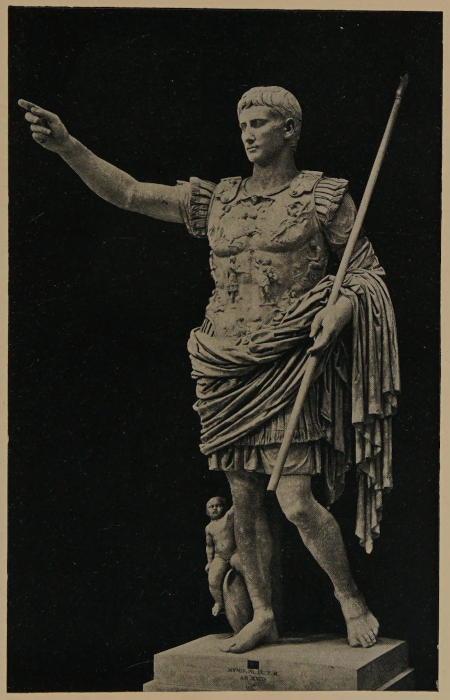
Augustus addressing Troops.
Photographed from the Statue in the Vatican by Edne. Alinari.
To face page 108.
CHAPTER VII ACTIUM
Altera iam teritur bellis civilibus aetas.
Sævis Liburnis, scilicet invidens,
privata deduci superbo
non humilis mulier triumpho.
The early manhood of Augustus and its fruits.
When Sextus fled from Sicily Cæsar was about to complete
his 27th year. It was nearly nine years since, while little
more than a boy, he had first boldly asserted himself
in opposition to men more than twice his
own age, and had forced those who had been statesmen
before he was born to regard him as their
champion or respect him as their master. Since that time he had
had little rest from grave anxieties or war. At Mutina, Philippi,
Perusia, and in Sicily, he had tasted danger and disaster as well
as victory; and had more than once been in imminent hazard.
These fatigues had been made more trying by frequent illness,
apparently arising from a sluggish liver, to which he had been
subject from boyhood. Through all he had been supported by
an indomitable persistence and a passionate resolve to avenge
his adoptive father, all the more formidable perhaps in a
character naturally cold and self-contained. As he went on
there gradually awoke in him a nobler ambition, that of
restoring and directing the distracted state. Neither now nor
afterwards do the more vulgar attributes of supreme power—wealth,
luxury, and adulation—seem to have had charms for him.
He felt the governing power in him, he believed in his “genius,”
what we might call his “mission,” and the difficulties of a
divided rule became more and more clear to him. From this
time, therefore, he used every means which wise statesmanship or
crafty policy could suggest to rid himself of the remaining partner
in the Triumvirate, and to gain a free hand in the work of
restoration which he had already begun.
Marriage with Livia, B.C. 38.
In private life he had taken a step which was the source of
a lifelong happiness to him. The political marriage with
Scribonia in B.C. 40, contracted with the idea of
conciliating Sextus Pompeius, had been ended by
divorce on the very day of the birth of his only
daughter Iulia. The reason alleged was her disagreeable
disposition; but, besides the change in the political situation,
there was another reason of a more personal nature. The
peace of Misenum had permitted many partisans of Brutus,
Cassius, or Lucius Antonius, who had fled to Sextus Pompeius,
to return to Rome. Among others came Tiberius Nero,[191]
with his young wife, Livia Drusilla. Unless statues and coins
are more than usually false, she was possessed of rare beauty.
In B.C. 38 she was twenty years old, and had one son (the future
Emperor Tiberius) now in his fourth year, and was within
three months of the birth of her second son Drusus. Even
to the lax notions of divorce and re-marriage then current this
seemed somewhat scandalous. A year was held to be the
necessary interval for a woman between one marriage and
another. But the object of this convention was to prevent
ambiguity as to the paternity of children; and when Cæsar
consulted the pontifices, they told him that, if there was no
doubt as to the paternity of the child with which Livia was
pregnant, the marriage might lawfully take place at once. No
opposition seems to have been made by Livia’s husband, who was
at least twenty years her senior.[192] He acted as a father in
giving her to her new husband, and entertained the bridal pair
at a banquet. The marriage was so prompt that a favourite
page of Livia’s, seeing her take her place on the same dinner
couch as Cæsar, whispered to his mistress that she had made a
mistake, for her husband was on the other couch. On the
birth of Drusus, Cæsar sent the infant to its father, thus complying
with the conditions of the pontifices. That the two
men should have been on good terms is not incredible in view
of the prevailing sentiment as to divorce. We find Cicero, for
instance, writing effusively to Dolabella almost directly after he
had compelled his daughter to divorce him for gross misconduct,
and there are other instances. At any rate Tiberius Nero, on
his death-bed in B.C. 33, left the guardianship of his sons to
Cæsar; and in spite of such a beginning the marriage proved
permanently happy. Cæsar was devoted to Livia to the day of
his death; his last conscious act was to kiss her lips.[193]
Honours voted to Cæsar.
The victory in Sicily left him supreme in the West, and
he at once devoted himself to the re-establishment of order
and prosperity. The relief to Italy and Rome was
immense; for with Pompeius master of the sea
the city was always in danger of famine, and the
Italian coast of devastation. This feeling of relief found
expression in the proceedings of the Senate, which now began
those votes of special honours and powers to Cæsar, which in
the course of the next ten or twelve years gradually clothed
him with every attribute of supremacy in the state. On his
return from Sicily he was decreed an ovation, as after Philippi,[194]
as well as statues and a triumphal arch. On the day of the
victory over Pompeius (2nd of September), there were to be
feriæ and supplicationes for ever; he and his wife and family
were to be feasted on the Capitol; and he was to have the
perpetual right of wearing the laurel wreath of victory. He
refused the office of Pontifex Maximus, as long as Lepidus lived,
but he accepted the privileges of the tribuneship—the personal
sanctity which put any one injuring or molesting him under a
curse, and the right of sitting with the tribunes in the Senate.
This it seems gave him practically the full tribunicia potestas
within the city. But it was a novel measure, and its full
consequences were not perhaps foreseen.[195] He had twice before
wished to be elected tribune, but his “patriciate” stood in his
way. This was meant as a kind of compromise, and it furnishes
the keynote to his later plans for absorbing the powers
of the republican offices.
Measures of conciliation and restoration.
The wars for security of frontiers.
Cæsar’s chief difficulties now came from the large military
forces of which he found himself possessed, either by his own
enlistment or from that of the various defeated
leaders. To disband them was neither safe in
view of possible complications with Antony, nor
possible without finding large sums of money or great tracts of
unoccupied land with which to reward the men; whereas his
object now was to put an end to confiscation, fines, and
unusual imposts, and to bring back confidence and security.
After suppressing more than one incipient mutiny, he contrived
to secure enough land for those who had served their full time,
partly by purchases from Capua, where there was still a good
deal of unassigned land. He repaid the colony by granting it
revenues from lands at Cnossus in Crete, which had become
ager publicus on the defeat of the pirates, and on some of which
a Roman colony was not long afterwards established.[196] Some
of the men, again, who had been most clamorous and mutinous
he sent to Gaul as a supplementum to colonies already existing,
or to found new colonies.[197] He was thus able to make
remission of taxation, as well as of arrears due from the lists of
forfeiture published by the triumvirs. His enemies said that
his object was to throw the odium of their original imposition
upon Antony and Lepidus; or to make a merit of necessity,
since in most cases it would have been impossible to collect the
money. These motives may have had a share in his policy, but
he doubtless also wished to restore confidence and cause an
oblivion of the miseries of the civil wars. For the soldiers who
remained various other employments were found. The weakness
of the central government had long been shewn by the
existence of marauding bands in various parts of Italy. The
civil wars had aggravated the evil, till travelling had become
dangerous almost everywhere, and even the streets of Rome
were unsafe. Cæsar now organised a police force of soldiers
under Sabinus Cotta to patrol the city and Italy, and within a
few months the evil was much mitigated.[198] Besides this, Statilius
Taurus was sent with an army to restore order in
the two African provinces—Proconsularis and
Numidia.[199] Another expedition was sent against
the Salassi, inhabiting the modern Val d’Aosta, who had for
two years been holding out against Antistius Vetus. He had
driven them into their mountain fastnesses; but when he left
the district they once more descended and expelled the Roman
garrisons. The war was entrusted to Valerius Messalla, who
reduced them at least to temporary submission (B.C. 35-34).[200]
Another similar war was that against the Iapydes, living in
what is now Croatia, who in their marauding expeditions had
come as far as Aquileia and plundered Roman colonies. To
this Cæsar went in person. He destroyed their capital,
Metulum, on the Colapis (mod. Kolpa), after a desperate
resistance, in the course of which he was somewhat severely
injured by the fall of a bridge. The rest of the country then
submitted.[201] The Iapydes had no doubt provoked the attack.
But that does not seem to be the case with the Pannonians,
whom Cæsar proceeded to invade. They were a mixed
Illyrian and Celtic tribe, dwelling in forests and detached villages
without great towns, and appear to have lived peaceably. But
Cæsar resolved to take their one important town, Siscia, at the
junction of the Kolpa and Save, partly as a convenient
magazine in wars against the Daci, and partly for the mere
object of keeping his army employed and paid at the expense
of a conquered country. The siege of the town lasted thirty
days, and after its fall he returned to Rome, leaving Fufius
Geminus to continue the campaign. So again in the spring of
B.C. 34 Agrippa was sent against the Dalmatians, and when
later in the season he was joined by Cæsar in person, their chief
towns were taken and burnt; and this people, who since their
defeat of Gabinius in B.C. 44-43, had been practically independent,
had again to submit and pay tribute, with ten years’
arrears, and restore the standards taken from Gabinius. Their
submission was followed by that of other tribes, and by the middle
of B.C. 33, the whole of Illyricum was restored to obedience.
These were the sort of successes to make a man popular at
Rome; for they were not costly in blood or treasure, and
they affected the interests of a large number of merchants and
men of business. Nor was this all. One of his legates,
Statilius Taurus, was so successful in Africa, and another, C.
Norbanus, in Spain, that both were decreed triumphs in B.C. 34,
and in the same year Mauretania was made a Roman province.
Cæsar had declined a triumph after the Pannonian war, but
accepted honours for Octavia and Livia, who were exempted
from the tutela, to which all women were subject; and during
these two years his name was becoming associated with success
and with the expansion of the Empire and of trade.
Improvements in the city.
This was accompanied by restorations and improvements in
the city calculated to appeal still more strongly to popular
imagination. In B.C. 33 Agrippa as ædile reformed
the water supply of Rome, constructing
700 basins, 500 fountains, and repairing the
aqueducts.[202] He also cleansed the cloacæ, adorned the circus,
distributed oil and salt free, and opened the baths gratis
throughout his year of office, besides throwing among the
spectators at the theatre tesseræ (tickets) entitling the holders
to valuable presents. Cæsar himself, who was consul for a
few months at the beginning of B.C. 33, erected the Porticus
Octaviæ, named in honour of his sister, with the spoils of the
Illyrian and Pannonian wars,[203] and began the building of the
temple of Apollo and the two libraries, on the site bought for a
house on the Palatine before B.C. 36, when that of Hortensius
had been granted to him by the Senate,[204] and while he was still
living in the house of Calvus near the Forum.
The contrast of Antony’s career.
The Parthians.
These successes in the Western provinces, combined with
such costly improvements in the city, impressed
(as it was intended that they should) the minds of
the people in Rome with the feeling that Cæsar’s
name was the best guarantee for the era of peace and prosperity
which seemed at last to be succeeding the ruin and
horror of civil war. In strong contrast—carefully emphasized
by Cæsar and his friends—were the military expeditions in the
East, and the extravagance of Antony’s infatuation for
Cleopatra in Egypt. In B.C. 40 he had been roused from the
intoxication of love and revelry in Alexandria to find Syria in
the hands of the Parthian Pacorus, son of Orodes,
and of Labienus, son of the old legate of Iulius,
who had joined the enemy after the battle of Philippi. They
had defeated and killed his legate, Decidius Saxa, and taken
possession of the province. It is true that next year, B.C. 39,
P. Ventidius drove away Labienus, and in B.C. 38 defeated the
Parthians and killed Pacorus. But Antony was jealous of
Ventidius, deposed him from his command, and went in
person to besiege the remains of the Parthian army in
Samosata, where they had been received by Antiochus, king
of Commagene. He failed to take the town, and though in
his despatch he took all the credit of previous successes, the
truth was well known in Rome. After his failure at Samosata
he made somewhat inglorious terms with Antiochus, and going
off to meet Cæsar at Tarentum left C. Sosius in charge of Syria.
Sosius put down an insurrection in Judæa and established
Herod as king (B.C. 38-7). But in B.C. 36 Antony suffered
severe reverses in an expedition against Phraates, who had just
succeeded his father Orodes as king of Parthia. One success,
however, in the course of an inglorious campaign enabled him
to send home laurelled despatches, the real value of which
Cæsar and his friends took care should be known. In B.C. 35
he began carving out a kingdom for his elder son by Cleopatra,
and making preparations for an expedition against the king of
Armenia, whom he accused of failing in his duty of supporting
him in the previous year. Having first made a treaty of
friendship with the king of Media, in B.C. 34 he invaded
Armenia, and getting possession of the person of the king by
an act of treachery which shocked Roman sentiment—not
very scrupulous in such matters—he brought him in silver
chains to Alexandria.
Cleopatra.
Thus Antony’s career as an administrator and defender of
the Empire was rightly or wrongly looked upon as comparing
unfavourably with that of Cæsar. But still more
shocking to Roman feeling was his position in
Cleopatra’s court. Though the moral standard at Rome was
far from high, it was rigid in regard to certain details. Just
as a valid marriage could only be contracted with a woman
who was a civis, so for a man in high position to live openly
with a foreign mistress, however high her rank, was peculiarly
scandalous. The beloved Emperor Titus, a hundred years
later, had to give way to this sentiment and dismiss his
Idumæan mistress. But that a Roman imperator should not
only have such a connection with a “barbarous” queen, but
should act as her officer and courtier; that she should have a
bodyguard of Roman soldiers; should give the watchword to
them as their sovereign; and should even employ them to deal
with what in one sense or another was Roman territory—this
seemed an outrage of the worst kind. In a poem written it
seems while the campaign at Actium was still undecided, but
when rumours of Antony’s defeat were reaching Rome,
Horace well expresses the disgust with which the position
conceded to Cleopatra by Antony’s fondness was regarded:
False, false the tale our grandsons will declare—
That Romans to a woman fealty sware;
Shouldered their pikes; presented arms; and did
Whate’er her wrinkled eunuchs deigned to bid:
Or that among our Roman flags were seen
The gauzy curtains of her palanquin.”
[205]
Antony himself made no concealment as to the queen’s
connection with the army. After his disastrous expedition of
B.C. 36-5, Cleopatra supplied him with money, and he told
his men when paying them that they were receiving it from
her. The connection also involved a breach with Cæsar.
Their friendship—always doubtful—had been patched up from
time to time by formal reconciliations; in B.C. 43 after
Mutina; in B.C. 40 at Brundisium; and in B.C. 37 at Tarentum.
For a time Antony had found great pleasure in the
society of Octavia, with whom he lived for a time at Athens.
But after the meeting at Tarentum he left Octavia with her
brother on his return to the East, and soon fell again under
Cleopatra’s spell, who, though not beautiful, fascinated him by
her art and infinite variety. When in B.C. 35 Octavia, trying
to effect another reconciliation, went to Athens, taking money
and soldiers for him from her brother, Antony accepted the
gifts, but sent her word that she was to return to Rome.
Cæsar would have had her repudiate him at once, but she
seems to have been sincerely attached to him, and to have
shrunk from the idea of an insult to herself being made an
occasion of civil war. She persisted in living in his town
house, and in bringing up with liberality, not only her own
children by him, but also Antony’s children by Fulvia.
Final breach between Cæsar and Antony.
But after his return from the Armenian expedition (B.C. 34)
Antony became still more infatuated with Cleopatra. He
publicly gave her the title of “Queen of Queens,” and her
eldest son the name of Cæsarion and “King of Kings”;
while to his two sons and daughter by Cleopatra he assigned
kingdoms in Syria, Armenia, Libya, and Cyrene. He had
the assurance to write to the Senate asking for the confirmation
of these acta. When his two friends, C. Sosius and Cn.
Domitius Ahenobarbus entered on their consulship
(1st of January, B.C. 32), they resolved to suppress
this despatch, in spite of Cæsar’s wishes; but
they communicated to the Senate his message that the second
period of the Triumvirate having expired (on the last day of
B.C. 33), he had no desire for its renewal. He did not,
however, lay down his imperium, and the object of this
declaration was to embroil Cæsar with the Senate, should he
wish to retain his extraordinary powers. Ahenobarbus, indeed,
had had enough of civil war and wished to take no step likely
to bring it about. But Sosius made an elaborate speech in
praise of Antony, and attacking, or at least depreciating,
Cæsar; and was only prevented from bringing in a motion
in Antony’s favour by the intervention of a tribune. A
few days after this Cæsar (who had not been present on the
1st of January) summoned the Senate, and delivered a speech
from the consular bench, which though studiously moderate as
regards himself, was very outspoken as regards Sosius and
Antony. No one ventured to reply, and the Senate was
dismissed with the assurance that Cæsar would produce proofs
of what he had said about Antony. The two consuls, without
taking any farther step, left Rome privately and joined
Antony in Alexandria. They were followed by a considerable
number of Senators, Cæsar giving out that they went with
his full consent, and declaring that others might go if they
chose.
The grievances of either side.
War proclaimed against Cleopatra, B.C. 32.
This was a division of the governing body similar to that
of B.C. 49-8, and it was evident that a civil war was imminent.
Sentiment was by no means all on one side at
Rome, as is proved by the numbers of the Senate
who crossed to Antony. Party feeling, in fact,
was so keen that the very boys in the streets divided themselves
into Cæsarians and Antonians;[206] and both leaders shewed
great eagerness by arguments and declarations to put themselves
in the right. Antony’s grievances against Cæsar were:
(1) that he deprived Lepidus of Africa without consulting
him; (2) that he had not shared with him the countries
formerly controlled by Sextus Pompeius; (3) that he enrolled
soldiers in Italy without sending him the contingents due by
their agreement. Cæsar’s against Antony were that he was
occupying Egypt (not a Roman province) without authority;
had executed Sextus Pompeius, whom he (Cæsar) had wished
to spare; had disgraced the Roman name by his conduct to
the king of Armenia, by his connection with Cleopatra, and
by bestowing kingdoms on his children by her; and, lastly, had
wronged him by acknowledging Cæsarion as a son of Iulius
Cæsar. Letters and messages were interchanged for some
months on these and other points, both trying to justify
themselves. Antony, in one letter at least, preserved by
Suetonius, ridicules in the coarsest terms what he regards as
Cæsar’s hypocritical or prudish objection to his connection
with the queen. But at length Cæsar found means to
discredit Antony in the eyes of the Senators, and to convince
them that they must prevent an invasion of Italy by a proclamation
of war against Cleopatra, which would be understood
to be against Antony. He did this by using two of Antony’s
officers who had quarrelled with him and returned to Rome—M.
Titius and L. Munatius Plancus. The latter, Cicero’s
correspondent, the governor of Celtic Gaul in B.C. 44, and
consul in B.C. 42, had joined Antony in Alexandria as his
legatus, and had been much in his confidence. He is held up
to scorn by contemporary writers as a monster of fickleness
and an ingrained traitor, and his thus turning upon Antony was
regarded with much contempt even by the Cæsarians. The
story he and his companion had to tell, however, served
Cæsar’s turn. They brought word that, on hearing of his
speech in the Senate, Antony had publicly divorced Octavia
in the presence of the Senators, and had announced that he
intended to undertake a war against him. They also told how
Antony styled Cleopatra his queen and sovereign, gave her
a bodyguard of Roman soldiers, with her name on their
shields; how he escorted her to the forum and sat by her side
on the seat of justice; how, when she rode in her chair he
walked on foot by her side among the eunuchs; how he called
the general’s quarters or prætorium “the Palace,” wore an
Egyptian scimitar and a robe embroidered with gold, and sat
on a gilded chair; and how some religious mummeries had
been played, in which he took the part of Osiris, she of the
Moon and Isis. The Roman world believed that Antony was
bewitched by Cleopatra; and the serious consequences likely
to ensue were made more manifest by his will, of which
Augustus got either a copy or an account of its contents from
Plancus, and read it publicly from the Rostra. In it Antony
affirmed the legitimacy of Cæsarion, gave enormous legacies
to his children by Cleopatra, and ordered his body to be buried
with that of the queen’s in the royal mausoleum. Altogether
people began to believe the report that he meant to hand over
the Empire, even Rome itself, to Cleopatra, and to transfer the
seat of government to Alexandria. There was one of those
outbursts of feeling which carries all before it.
Even those who had been neutral, or inclined to
be suspicious of Cæsar, turned violently against
Antony. He was deposed from the consulship for B.C. 31, to
which he had been elected, and declared to be divested of
imperium. It seems probable that he was not at first declared
a hostis,[207] but war was voted against Cleopatra. It was enough
for his enemies that he should be found fighting with the
Egyptians against Rome; and the vote was well understood to
include him. Cæsar was appointed to proclaim the war with
all the Fetial ceremonies, and the Senate assumed the sagum.[208]
Both sides were now making preparations in earnest. Cæsar
could draw forces from Italy, Gaul, Spain, Illyricum, Sardinia,
Sicily, and other islands. Antony relied on Asia, the parts
about Thrace, Greece and Macedonia, Egypt, Cyrene, and the
islands of the Ægean, besides a large number of client kings
who had owed their position to him.[209] He silenced their
scruples, when gathered at Samos, by pointing out that they
would not be formally at war with Rome, and promising that
within two months of the victory he would lay down his
imperium and remit all power to the Senate and people. Nor
did he confine his exertions to the East. Agents were sent to
cities in Italy carrying money, though Cæsar—who kept
himself well informed—frustrated this attempt for the most
part.
Antony approaches Italy.
From Samos Antony removed his headquarters to Athens,
whence in the winter of B.C. 32 he started to invade Italy.
But at Corcyra he got intelligence of an advanced
squadron of Cæsar’s fleet near the Acroceraunian
promontory, and thinking that Cæsar was there
in full force, he decided to put off hostilities till the spring, by
which time he expected to be joined by the forces of the client
kings. He himself wintered at Patræ, distributing his forces
so as to guard various points in Greece. He scornfully rejected
Cæsar’s proposal for an interview, on the ground that there
was no one to decide between them, if either broke the terms
upon which they might agree. The proposal was probably
not seriously meant. It was only another means of putting
Antony in the wrong.
B.C. 31, Con., C. Octavius Cæsar, Val. Messala. The beginning of hostilities.
Nothing, however, was done before the end of the year, a
storm having frustrated an attempt of Cæsar’s to surprise some
of the enemy’s ships at Corcyra. In the early spring the
first move was made by Agrippa, who swooped down upon
Methone in Messenia, killed Bogovas, late king of
Mauretania, and harassed the shores of Greece by
other descents, in order to divert Antony’s attention;
who was now with his main fleet in the
Ambracian gulf, having secured the narrow entrance to it by
towers on either side, and with ships stationed between. His
camp was close to the temple of Apollo, on the south side of the
strait. The successes of Agrippa encouraged Cæsar to move.
He landed troops in Ceraunia, making his own headquarters at
the “Sweet Haven,” at the mouth of the Cocytus, and sent
a detachment by land round the Ambracian sea to threaten
Antony’s camp. Having failed to entice the fleet from the
Ambracian gulf, or to tempt the men to abandon Antony, he
seized the high ground overlooking the strait, and opposite
Actium, where he entrenched himself, on the ground on which
he afterwards built Nicopolis. The summer months, however,
were wearing away without any decisive blow being struck by
either side, and the delay was irksome to both. Rome was in a
state of simmering revolt owing to distress and heavy taxes, a
discontent which found expression in the conspiracy of Lepidus,
son of the ex-triumvir. It was promptly suppressed, indeed,
and Lepidus was sent over to Cæsar to receive his condemnation;
but, nevertheless, Mæcenas, who was in charge of Rome,
found that he had no sinecure. To Antony, again, delay
meant discontent among his Eastern followers, tottering loyalty,
and probable abandonment. Above all, Cleopatra was in a
highly nervous state, and was urging a return to Egypt. At
last on the 31st of August, a cavalry engagement going against
Antony, she became clamorous; and after long deliberation,
Antony determined to follow her advice. He ordered his ships
to be prepared for battle, but with the secret intention of
avoiding a fight and sailing away to Alexandria.[210]
Battle of Actium, Sept. 3, B.C. 31.
Cæsar was kept informed of this, and resolved to prevent it.
His idea was to allow the Antonian fleet to issue out and begin
their course, and then to fall upon their rear. But
Agrippa thought that the superior sailing powers
of the Antonian fleet would render this impossible,
and urged an attack as soon as the ships cleared the straits.
There had been rough weather for four days, but on the 3rd of
September there was a calm,[211] or only some surf from the preceding
storms; and when the trumpet rang out for the start
Antony’s huge vessels, furnished with towers and filled with
armed men, began streaming out of the straits. They did not
at first show any signs of standing out to sea. The ships took
up a close order and waited to be attacked. There was a brief
pause on Cæsar’s side. He or Agrippa hesitated to attack
these great galleons with their smaller craft. But before long
an order was issued to the vessels on the extremities of Cæsar’s
fleet to exert their utmost powers in rowing in order to get
round Antony’s two wings. To avoid this danger Antony was
forced against his will to order an attack.
The battle raged all the afternoon without decisive result;
though the smallness of Cæsar’s vessels proved in many points a
decided advantage. They could be rowed close up to bigger
ships and be rowed away again when a shower of javelins had
been poured in upon the enemy. Antony’s men returned the
volleys and used grappling irons of great weight. If these irons
caught one of the smaller ships they were doubtless very
effective; but if the cast missed they either seriously damaged
their own ship, or caused so much confusion and delay that an
opportunity was given to the enemy to pour in fresh volleys of
darts. At length Cleopatra, whose ships were on the southern
fringe of the fleet, could bear the suspense no longer. She gave
the signal for retreat, and a favourable breeze springing up, the
Egyptian ships were soon fading out of sight. Antony thinking
that this was the result of a panic, and that the day was lost,
hastened after the retiring squadron. The example of their
leader was followed by many of the crews, who lightening their
ships by throwing overboard the wooden towers and war tackle,
fled with sails full spread. But others still maintained the
struggle, and it was not until Cæsar’s men began throwing
lighted brands upon the enemy’s ships that the rout became
general. Even then the work was not over, for Cæsar spent
the whole night on board endeavouring to rescue men from the
burning ships.[212]
The finale of the civil war in Egypt, B.C. 31-30.
Antony got clear off from pursuit, but his camp on land was
easily taken, and his army was intercepted while trying to
retreat into Macedonia. For the most part the
men took service in Cæsar’s legions, the veterans
being disbanded without pensions. Antony, however,
was followed to Egypt by many of his adherents of rank,
and still thought himself strong enough to make terms with
Cæsar. But he could no longer hope for aid from the client
kings. They all hastened to make their peace with Cæsar, or
were captured and punished. Even Cleopatra was secretly
prepared to betray him.
With the exception of one visit to Brundisium of seven days,
to suppress the mutiny of some discontented veterans, Cæsar
spent the winter at Samos and Athens, collecting an army and
navy destined to deprive Egypt permanently of its independence.
Cleopatra had indeed tried to brave it out. She
returned to Alexandria with her prows decked with flowers
and her pipers playing a triumphant tune. The people are
not likely to have been deceived, but there was no sign of
revolt. She was able to seize the property of those whose
fidelity she suspected, and even put to death the captive king
of Armenia to gratify her ally the king of Media. Messages
were sent to the kings who had been allied with Antony, and
for some gladiators whom he had in training at Trapezus.
The gladiators started but were intercepted, and no help came
from the client kings. A still worse disappointment awaited
him in Cyrene, over which he had placed L. Pinarius Scarpus
with four legions. When, leaving Cleopatra at Parætonium,
he went to take over these legions, Pinarius refused to receive
him and even put his messengers to death, and shortly afterwards
handed over his province and army to Cæsar’s legate,
Cornelius Gallus. This was an unmistakable sign that
Antony’s day of influence was over. Cleopatra returned to
Alexandria and made secret preparations for retiring into
Asia, as far as Iberia (Georgia) if necessary, though still
keeping up appearances and sending in every direction for aid.
Cleopatra’s son Cæsarion and Antony’s son by Fulvia (Antyllus)
were declared of man’s estate and capable of governing, and
messages were despatched to Cæsar proposing that Antony
should retire to Athens as a privatus, and that Cleopatra should
abdicate in favour of Cæsarion. The queen also, without
Antony’s knowledge, sent Cæsar a gold sceptre and crown.
He made no reply to Antony, but answered in threatening
terms to Cleopatra, while sending his freedman Thyrsus to
give her privately a reassuring message. Antony suspected
the purport of Thyrsus’s mission, and with a last ebullition
of his old swaggering humour had him flogged, and sent back
with the message, that if Cæsar felt aggrieved he might put
his freedman Hipparchus (who had joined Cæsar) to the
torture in revenge. But things went from bad to worse with
him. News came that the gladiators had been impounded,
that his own legatus in Syria (Q. Didius) had bidden the
Arabs burn the ships which he had prepared for his flight in
the Red Sea, and that the only two client kings who had
seemed inclined to stand by him—those of Cilicia and Galatia—had
fallen off. He therefore tried once more to open
communications with Cæsar. He sent him as a prisoner one
of the assassins of Iulius, whom he had protected and employed,
P. Turullius, and a considerable sum of money by the hands
of his son Antyllus. Cæsar put Turullius to death and took
the money, but returned no answer to Antony, though he
again sent a private message to Cleopatra. Presently Antony
was informed that Gallus had arrived at Parætonium with the
four legions taken over from Pinarius; and believing that even
now his personal influence was sufficient to win back the men,
he hurried thither, accompanied by the remains of his fleet
coasting along to guard him. But this only led to farther
disaster. The soldiers refused to listen to him; and when his
ships entered the harbour the chains were made fast across the
mouth and they were trapped. On land he now found himself
between two hostile forces; for Cæsar with Cleopatra’s
connivance had landed at Pelusium and was marching on
Alexandria, and Gallus was attacking him from Parætonium.
He once more executed one of those rapid movements for
which he was famous. Hastening back to Alexandria he
flung his cavalry upon Cæsar’s vanguard when tired with its
march. But the success of this movement encouraged him to
make a general attack, in which he was decisively beaten.
His last resource, the ships still remaining in the harbour of
Alexandria, failed him. Acting under Cleopatra’s orders the
captains refused to receive him. The queen, it is said, had
shut herself up in the Tomb-house or Ptolemæum, hoping to
drive Antony to despair and suicide, as the only solution of the
difficulty. If that was indeed her motive, she was both
successful and repentant. Antony stabbed himself, and begged
to be carried to the Tomb-house, where he died in her arms.
Death of Cleopatra.
Cæsar was now eager to secure Cleopatra’s person. He
sent Gallus to her with soothing messages, which he delivered
to her at the porch. But while he was speaking
with her C. Proculeius entered by a window,
seized the queen, and conveyed her to the Palace,
where she was allowed her usual attendants and all the
paraphernalia of royalty. Of the two accounts of Cæsar’s
interview with her the more picturesque one is given by the
usually prosaic Dio. He found her looking charming in her
mourning, surrounded by likenesses of various kinds of the
great Iulius, and in the bosom of her dress a packet of letters
received from him. On his entrance she rose with a blush
and greeted him as her lord and master. She pleaded that
Iulius had always honoured her and acknowledged her as
queen. She read affectionate passages from his letters, which
she kissed passionately with tears streaming from her eyes,
being at the same time careful to put respectful admiration and
affection for Cæsar himself into her looks and the tone of her
voice. Cæsar quite appreciated the drama thus played for his
behoof, but feigned unconsciousness, keeping his eyes fixed on
the ground and saying nothing but: “Courage, madam! Do
not be alarmed, for no harm will happen to you.” He said no
word, however, as to her retention of royal power, nor did
his voice betray the least tenderness. In an agony of disappointment
she flung herself at his feet and besought him by
the memory of his father to allow her to die and share
Antony’s tomb. Cæsar made no reply except once more to
bid her not be alarmed; but he gave orders that though
allowed her usual attendants she was to be closely watched.
Cleopatra understood only too well that the intention was to
take her to Rome that she might adorn the victor’s triumph.
But in order to secure greater freedom she feigned submission
and to be busied in collecting presents to take to Livia.
Having thus diminished the vigilance of Epaphroditus and her
other guards, she some days afterwards made a parade of
writing a letter to Cæsar, which she induced Epaphroditus to
convey. When he returned, however, he found the queen,
decked in royal robes, lying dead with two of her waiting
women dead or dying by her side. “No one knows for
certain,” says Dio, “how she died. Some say that a venomous
snake was conveyed to her in a water-vessel or in some
flowers. Others that the long pin with which she fastened
her hair had a poisoned point, with which she pricked her arm.”
Plutarch, with a like expression of doubt, says that the snake
was conveyed in a basket of figs; and that on receiving the
letter brought by Epaphroditus Cæsar understood her purpose
and hurried to the Palace to prevent it, and even summoned
some of the mysterious Psylli—snake charmers and curers—to
suck out the poison.[213] But in spite of his disappointment, he
admired her spirit and gave her a royal funeral. Perhaps after
all he felt relieved of a difficulty. According to Plutarch she
had shown him that she was not to be easily managed. At
the end of her conversation with Cæsar, he says, she handed
him a schedule of the royal treasures. But when one of her
stewards or treasurers remarked that she was keeping back
certain sums, the enraged queen sprang up, clutched his hair,
and beat his face with her fists. When Cæsar smiled and
tried to pacify her, she exclaimed: “A pretty thing, Cæsar,
that you should visit and address me with honour in my fallen
state, and that one of my own slaves should malign me! If I
have set apart certain women’s ornaments, it was not for
myself, but for Octavia and Livia, that they might soften your
heart to me.”
It would be pleasanter if the death of Cleopatra and the
confiscation of her treasury were the end of the story. But
the executions of the two poor boys, Cæsarion and Antyllus,
were acts of cold-blooded cruelty. The former, who could not
have been more than sixteen, had been sent by his mother with
a large supply of money to Æthiopia, but was betrayed by his
pædagogus, overtaken by Cæsar’s soldiers, and put to death.
The young Antonius (or Antyllus) begged hard for his life,
and fled for safety to the heroum of the divine Iulius, constructed
by Cleopatra, but was dragged away and killed. He
could at most have been no more than fourteen, and had in
childhood been betrothed to Cæsar’s infant daughter, Iulia.
Perhaps the pretensions of Cæsarion to the paternity of Cæsar,
and his acknowledgment as heir to the throne of Egypt, made
his death inevitable; but the extreme youth of Antyllus and
his helplessness might have pleaded for him. The rest of
Antony’s children were protected by Octavia, and brought up
as became their rank.
It is impossible not to feel some sympathy for Antony, who
had thus flung away fame and life for a woman’s love. But it
was doubtless a happy thing for the world that the direction of
affairs fell to the cautious Augustus rather than to him. He
had some attractive qualities, but no virtues. Boundless self-indulgence
in a ruler more than outweighs good-nature or
liberality. It brings more suffering to subjects than the occasional
gratification caused by the latter qualities can compensate.
His scheme for erecting a series of semi-independent kingdoms
in the East would almost certainly have been the cause of
endless troubles. He was not more than fifty-three at his
death, but there were signs of a great decay of energy and
activity. The people thought of him—
“As of a Prince whose manhood was all gone,
And molten down in mere uxoriousness.”
And undoubtedly, if instead of spending a winter in Samos
in luxury and riot and part of another at Athens in much the
same way, he had begun his attack on Cæsar a year earlier, the
result might have been different. But he let the occasion
slip and found, as others have done, that the head of Time is
bald at the back.
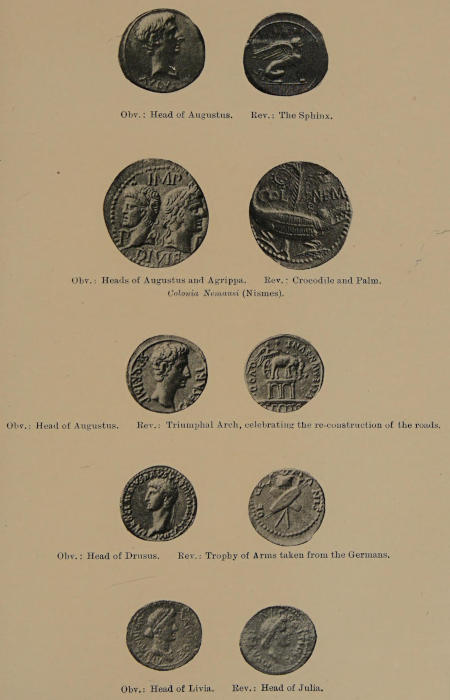
Obv.: Head of Augustus. Rev.: The Sphinx.
Obv.: Heads of Augustus and Agrippa. Rev.: Crocodile and Palm.
Colonia Nemausi (Nismes).
Obv.: Head of Augustus. Rev.: Triumphal Arch, celebrating the reconstruction of the roads.
Obv.: Head of Drusus. Rev.: The Trophy of Arms taken from the Germans.
Obv.: Head of Livia. Rev.: Head of Julia.
To face page 130.
CHAPTER VIII THE NEW CONSTITUTION, B.C. 30-23
Hic ames dici pater atque princeps.
The new constitution.
The seven years which followed the death of Antony and
Cleopatra witnessed the settlement of the new constitution in
its most important points. It has been called a
dyarchy, the two parties to it being the Emperor
and the Senate. They were not, however, at any
time of equal power. As far as it was possible Augustus rested
his various functions on the same foundation as those of the
Republican magistrates, and treated the Senate with studious
respect. But in spite of all professions, in spite even of himself,
he became a monarch, whose will was only limited by
those forces of circumstance and sentiment to which the most
autocratic of sovereigns have at times been forced to bow.
The important epochs in this reconstruction are the years
B.C. 29, 27, 23; but it will be necessary sometimes to
anticipate the course of events and to speak at once of what
often took many years to develop.
Reduction of the army.
The reduction of the vast armaments which the various
phases of the civil war had called into existence was made
possible by the wealth which the possession of
Egypt put into Cæsar’s hands. Though Egypt
became a Roman province it was from the first
in a peculiar position, governed by a “prefect” appointed by
the Emperor, who took as his private property both the
treasures and domain lands of the Ptolemaic kings and the
balance of the revenues over the expenses. This formed the
nucleus of what was afterwards called the fiscus,[214] the imperial
revenue as distinguished from the ærarium or public treasury.
He was thus enabled to disband many legions at once, without
the dangerous discontent of the veterans, or the irritation of
fresh confiscations. It was imperatively necessary to do this if
he wished to avoid the dangers which had so often threatened
the State from leaders of overgrown military forces. The
number of legions under arms during the preceding ten years
was indeed formidable. In B.C. 36, when Cæsar took over
those of Lepidus and Sextus Pompeius, he had forty-four or
forty-five legions under his command.[215] Between that time
and the war with Antony he had reduced the number to
eighteen. But after the victory at Actium and the death of
Antony, the legions taken over from him, along with those
newly raised for the war, again amounted to fifty. Therefore
Cæsar had twice to deal with a body of about 250,000 men.
He says himself that in the course of his wars half a million
citizens had taken the military oath to him. The wealth of
Egypt served to purchase lands or compensate towns for such
as were taken for the veterans. From first to last more than
300,000 men were provided for in this way.[216] An important
purpose also served by this measure was the repeopling of Italy
and the renovation of many towns which during the civil wars,
or from other causes, had fallen into decay. Republican precedent
was followed by recalling the ancient practice of settling
“colonies” in the Italian towns, but with this difference, that
the new colonists were usually treated as a supplementum of an
already existing colonia, lands being purchased for them from
private owners or from the communities. Augustus claims
twenty-eight of such Italian colonies, of which thirteen are
known to have been in past times “Roman” or “Latin”
colonies. Other towns, besides a money compensation, were
rewarded by being raised to the status of a colony, generally
with the addition of “Iulia” or “Augusta” to their name.
This system was presently extended beyond Italy—to Africa,
Spain, Sicily, Illyricum, Macedonia, Achaia, Gallia Narbonensis,
Asia, Syria, and Pisidia. Settlements in these countries were
all colonies of veterans, except Dyrrachium, which was filled
with dispossessed Italians. This was not altogether a novelty:
for extra-Italian colonies had been already established in
Cisalpine and Transalpine Gaul, at Carthage, and at Corinth.
Iulius Cæsar is said to have settled 80,000 citizens in this way
outside Italy. The extra-Italic colonies of Augustus, however,
differed from these last in regard to status. They had what
was called Latinitas, that is, citizenship without the right of
voting or holding office at Rome. In virtue of this citizenship
they came under the Roman law and belonged to the
assize (conventus) of the provincial governors. Some of them,
again, had the special privileges which were summed up in the
general term “Italic right” (ius Italicum), and included freedom
from the jurisdiction of the provincial governor (libertas),
and exemption from tribute (immunitas). The general aim
seems to have been to put the extra-Italic colonies as far as
possible in the same position as those in Italy. As a rule also
the veterans settled in a colony had been enlisted in the province,
and had, therefore, already local connections. Augustus
took trouble in fostering and adorning these towns, whether in
Italy or the provinces, and records with pride that many had
become populous cities during his lifetime. In many cases
their subsequent importance shewed that they had been well
selected. Thus Carthage had a great mediæval history;
Durazzo and Philippi were long places of consequence;
Saragossa, Merida, Cordova, Aix, Patras, Beyroot, all trace their
prosperity to the colonisation of Augustus.[217]
Improvements at Rome.
Nor did he meanwhile forget to encourage restoration
at Rome, to which he had already given a strong impulse.
Nothing had damaged Antony in the eyes of the
Romans more than the report of his intention to
transfer the seat of Empire to Alexandria. A
similar report as to the establishment of an imperial city for
the East at Ilium caused a like uneasiness a few years later,
which found expression in one of Horace’s most spirited odes.[218]
Cæsar prudently shewed not only that he held firmly by the
Imperial position of Rome, but that he also wished to make it
externally worthy to be the capital of the world. As in all
his projects, no one co-operated more loyally than Agrippa.
But others also were pressed into the service; and those
especially who had earned triumphs were encouraged to use
a portion at least of their spoils in public works. In the next
few years there was a great outburst of temple restoration,[219]
and it became the fashion among the immediate friends and
followers of Augustus to signalise their tenure of office or
a military success by undertaking some important building.
Horace again has reflected the view of such matters which
the official classes were expected to take, and perhaps to a
certain extent did take. The sufferings of the Romans in
the revolutionary period had undoubtedly been great. The
ruinous state of the temples was doubtless connected with the
unsettled times—whether as cause or consequence, who could
exactly say? It was not unnatural to suppose that among the
other delicta maiorum this too had moved the wrath of the gods.
At any rate moral laxity went side by side with scepticism and
neglect of religious observances. Nor need we regard either
poet or emperor as a monster of hypocrisy in supporting such
a doctrine. Habit and tradition are stronger than philosophy.
There always remains the Incalculable after all our reasoning;
and many to-day regret the decay of religious sentiment as a
public misfortune, who are yet profoundly uncertain as to
what they in truth believe themselves.
Honours bestowed on Cæsar, B.C. 30-27.
On his return from Asia and Greece, where he had spent
the winter and spring of B.C. 30-29, Cæsar was received with
enthusiasm by all classes. Solemn sacrifice was
offered by the consul in the name of the people,
and every honour which the Senate could bestow
was awaiting his acceptance. Those voted after Actium were
lavishly increased in September B.C. 30, on the news of Antony’s
death and the occupation of Alexandria. Two triumphal
arches were to be erected, one at Rome and another at
Brundisium;[220] the temple of the divine Iulius was to be
adorned with the prows of captured ships; his own birthday,
the day of the victory at Actium, and that of the entry into
Alexandria were to be for ever sacred; the Vestal Virgins
and the whole people were to meet him on his return in
solemn procession; he was to have the foremost seat at all
festivals; and was to celebrate three triumphs—one for the
victory over the Dalmatian and neighbouring tribes, a second
for Actium, and a third for Egypt. The tribunicia potestas
for life had again been voted to him with the right of exercising
it within a mile radius beyond the walls. He was to
have the right to hear all cases on appeal and to have a casting
vote in all courts. His name was to be mentioned in public
prayers for the state. On the 1st of January, B.C. 29, all his
acta had been confirmed; and when it became known that the
Parthians had referred a disputed succession to the throne to
his arbitration, some fresh honours were devised. The disasters
under Crassus and Antony had made the Romans particularly
sensitive in regard to the Parthians; and this apparent acknowledgment
by them of a superiority attaching to Augustus,
however indefinite, was represented by the court party and the
court poets, not only as a veritable triumph over the Parthians,
but as a step in a career of Eastern conquest of almost unlimited
extent.[221] Accordingly his name was now to be coupled
with those of the gods in hymns; a tribe was named Iulia in
his honour; he was to wear the chaplet of victory in all
assemblies; and to nominate as many members as he chose
to all the sacred colleges. Cæsar accepted most of these
honours, but begged to be excused the procession on his
return. This was an honour which he always avoided if he
could, preferring to enter the city quietly by night. It was no
doubt a trying ordeal at the end of a long journey, and he may
have felt like Cromwell that a larger crowd still would have
come out to see him hanged. The three triumphs, however,
were now celebrated with the greatest splendour, especially
the third over Egypt, in which a figure of the dead queen
lying upon a couch, with son and daughter beside her, was
a prominent feature.
The increase of the Patriciate and the Census.
Cæsar now had ample powers for every purpose of government.
The tribunicia potestas in itself gave him legislative
initiative and control over other departments.
It was afterwards regarded as the most important
of his powers. But in his first measures of reform
he availed himself rather of his powers as consul. The consulship
was to be really, as it always remained nominally, the
chief state office, combining all the prerogatives once centred
in the rex. Thus in holding the Census of B.C. 28 he acted
as Consul with his colleague Agrippa, exercising indeed a
censoria potestas, though not one formally bestowed, but as
inherent in the consulship.[222] He concluded it with the solemn
lustrum, which had not been performed for forty-two years, the
last Censors (B.C. 50) having apparently been prevented from
performing this solemnity by the outbreak of civil war. The
Census was made the occasion of a reform in the ordines and
especially of the Senate. In the first place, he recruited the
dwindling number of patrician gentes by raising certain plebeian
families to the patriciate, as his own family had been raised by
Iulius in B.C. 45 in virtue of a lex Cassia. The same power
was now accorded to him by a law proposed by L. Sænius,
who was consul during the last two months of B.C. 30. The
object seems to have been to preserve a kind of nobility, which
at the same time should have certain political disabilities.
The patricians, indeed, still had the exclusive right of being
appointed to certain religious offices, but, on the other hand,
they were debarred from the tribuneship and the plebeian
ædileship,[223] the two offices in which a man by legislative proposals
or lavish expenditure might make himself politically
conspicuous.
The lectiones Senatus.
A similar desire to restore the ancient order of the State
prompted his reformation of the Senate. The powers of this
body had always been great precisely because they
were not defined by law; and by associating it
with himself he would gain all the advantages of
this indefiniteness and prestige, while really keeping full control
of it. Iulius Cæsar had made the mistake of treating it
with studied disrespect, and his chief enemies were within its
walls. The Triumvirs, though in reality despotic, had looked
to it to give their acta an outward show of legality. Thus on
Octavian’s demand it had condemned Q. Gallius in B.C. 43,
and Salvidienus in B.C. 40, for treason. It had confirmed
the triumviral acta en bloc, giving Antony charge of the
Parthian war and ratifying his arrangements in the East in
advance. It had voted triumphs and other honours to the
triumvirs and their agents. It was the Senate that in B.C. 41
voted L. Antonius an hostis, that in B.C. 32 decreed war against
Cleopatra, deposed Antony from consulship and imperium, and
in B.C. 31-30 voted the various honours and powers to the
victorious Cæsar. The late civil war had in a way made the
importance of the Senate more prominent. So many Senators
had joined Antony at Alexandria that, like Sertorius in Spain
and Pompey in Epirus, he had professed to have the Senate
with him. The victory of Actium had pricked that bubble,
and the Senate at Rome remained the only Senate of the
Empire. Cæsar was wise to put himself under the ægis of
this ancient and still respected body. But it was necessary to
secure its dignity and effectiveness, which had suffered in
various ways during the revolutionary period. Among other
things its numbers had been swollen and often with men of
inferior social standing. Iulius Cesar had filled it with his
creatures—provincials from Gaul and Spain, sons of freedmen,
centurions, soldiers, and peregrini—so that a pasquinade was
put up by some wit that “no one was to show a new Senator
the way to the Senate House.”[224] Another batch of Senators
was introduced after Cæsar’s death, chiefly by Antony, in virtue
of real or fictitious entries found in Cæsar’s papers, whom the
populace nicknamed “post-mortem Senators” (Senatores orcini),[225]
or sometimes even on their own initiative without any other
formality than assuming the laticlave and senatorial shoe.[226]
Many Senators no doubt perished in the proscriptions, in
the subsequent battles of Philippi and Perusia, and in the contests
with Sextus Pompeius, but the Triumvirs appear to have
been lavish in enrolling new members without regard to
fortune, origin, or official position; and so careless were they
in this matter that cases are recorded of unenfranchised slaves
having obtained office and seats in the Senate and being then
recognised and claimed by their masters.[227] The result was that
at the time of the battle of Actium there were more than a
thousand Senators.[228] This was too large a number for practical
work, without taking into consideration inferiority of character.
No doubt a good many who had sided with Antony disappeared
in various ways; but in now making a formal lectio Cæsar
resolved to reduce the number still more. Sixty voluntarily
resigned and were allowed to retain the purple and certain
social distinctions, but a hundred and forty were simply omitted
from the new list. By this means the roll was reduced to
about six hundred, which continued to be the number in
subsequent lectiones.
To secure their attendance and to prevent interference in
the provinces the regulation was enforced which prohibited
any Senator from leaving Italy (except for Sicily or Gallia
Narbonensis) unless he had imperium or was on a legatio,[229]
that is, practically, unless he was serving the state in some way
on Cæsar’s nomination. In the next lectio (B.C. 19) Augustus
tried an elaborate system of co-option, by nominating thirty on
the existing roll, each of whom were to name five who were
to draw lots for admission, and so on till the number was made
up. But finding that it was not worked fairly he stopped this
and made up the roll himself. This continued to be the system,
but as time went on the difficulty was not so much to exclude
unworthy men as to induce enough of the right sort to serve.
Membership became less attractive as the imperial power
developed, and the holding of profitable offices depended on
the will of the Emperor, who was not bound to select from the
Senate. Moreover, a property qualification was now required.
None had existed under the republic by definite law, though a
certain fortune was regarded as practically necessary; and as
the Senate was recruited from the ordo equester, a minimum was
in the last century of the republic automatically secured.
Cæsar fixed 800,000 sesterces, and later on a million sesterces
as the Senatorial fortune, though in cases of special fitness he
gave grants to enable men to maintain their position. Still
the honour of membership was not found to make up for its
disabilities—the difficulty of going abroad and the prohibition
as to engaging in commerce. In B.C. 13 Augustus was
obliged to compel men who had the property qualification to
serve. Even then the attendance was so slack that in B.C. 11
the old quorum of four hundred was reduced. In B.C. 9 various
regulations were introduced to facilitate business, such as the
publication of an order of the day (λεύκωμα), fixed days of
meeting, a variation as to the quorum required for different
kinds of business, a scale of fines for non-attendance, the
selection by lot of thirty-five Senators to attend during
September and October, and an extension to the prætors of
the power of bringing business before the house. Towards the
end of the life of Augustus, when his age made it too much of
an exertion to meet the full Senate, a committee of sixteen
Senators was selected by lot to confer with him at his own
house. The inevitable consequence was that this small
committee practically settled most questions, which only came
formally before the whole body, whose administrative function
was farther lessened by the diminished importance of the
ærarium as compared with the imperial treasury or fiscus.
Finally, it lost the right of coining silver, retaining only the
bronze. On the whole, then, the tendency was towards
restricting the functions of the Senate and making membership
less attractive. But this does not appear to have been the
original design of Augustus. He habitually addressed it with
respect, referred all his powers to its confirmation, and took it
into his confidence on imperial affairs. He revived the ancient
dignity of princeps Senatus—in abeyance since the death of
Cicero—and held that rank himself all his life. Certain of the
provinces were still left to its management, and cases of
majestas were referred to its decision. The publication of the
Senate’s acta had originated with Iulius Cæsar (B.C. 59), who
was not likely to have done anything to enhance its prestige.
The prohibition of this publication by Augustus was perhaps
intended partly to protect the proceedings from criticism, partly
to emphasise the fact that the Senate shared with him the
intimate secrets of government which it was not for the public
advantage to have generally known. The effect, however,
was not good; what could not be ascertained with exactness
from official sources was often misrepresented by irresponsible
rumour, and one of the early measures of Tiberius was to reverse
this order.[230]
The end of the anarchy.
With a Senate purified by his first lectio Cæsar felt that the
constitution might in form, at any rate, be restored. But first
the end of the revolutionary period had to be
marked. On January 11, B.C. 29, the temple of
Ianus was closed, for the first time since B.C. 235,
for the third time in all Roman history. It was still shut
when Cæsar returned from Asia, and on the 1st of January,
B.C. 28, the augurium salutis was taken. This ceremony—ascertaining
by augury whether prayers for the people should
be offered to Salus—could only be performed in time of complete
peace. At the same time a single edict annulled all the
acta of the triumvirs, which were to have no force from his
sixth consulship (B.C. 28).[231] The constitutional significance of
this will be best seen by recalling some facts as to the triumvirs.
Whether its acta were good or bad, the triumvirate was in itself
a suspension of the constitution. Established by a lex on the
27th of November, B.C. 43, to hold office till the 31st of
December, B.C. 38, its authority had been renewed in the course
of B.C. 37 to the 31st of December, B.C. 33, whether by
another lex or by the will of the triumvirs themselves is a
moot point.[232] But, however appointed, the triumvirs were
like dictators in superseding all other magistrates, and more
powerful than dictators from the length of their tenure of
office, and because the terms of their appointment (reipublicæ
constituendæ causa) gave them absolute legislative powers.
They could abolish, modify, or grant dispensation from existing
laws. Their edicts had the force of laws, and such laws as
were passed in the regular way during their office either confirmed
their powers, or were passed at their desire to give
formal permanence to their edicts. They had complete control
of elections, and agreed between themselves as to the
nomination of magistrates, often for several years in advance.
They controlled the treasury, the domain lands, the raising or
removal of taxation in Rome and Italy. They divided among
themselves the command of the military forces and the government
of the provinces. Each of them, personally or by a
legatus, exercised imperial powers in the provinces assigned
to him; set up or put down client kings; granted immunities
or freedom to cities, or abolished them; bestowed or withdrew
the citizenship of individuals; waged war with surrounding
nations; raised or remitted taxation. At Rome also they had
exercised the right of summoning, consulting, and presiding
over the Senate, of vetoing the motion of other Senators, but
without being subject to the tribunician veto themselves. To
abolish the acta of such a despotic body might with reason be
regarded a considerable step towards a restoration of the
constitution. Even if some of his own acta were thereby
abolished, Cæsar would have no difficulty in re-enacting them
if desirable. The point was to abolish the memory of a period
of unconstitutional government, to prevent its enactments
remaining as precedents or grounds of claim by citizen or
subject, and to leave the field open for the new arrangement
which Cæsar wished men to regard as a restoration of the
republic. For he had already conceived a plan, in virtue of
which the people, magistrates, and Senate should resume their
old functions, while he himself should be practically the
colleague of the higher magistrates—endowed with their
powers, though not necessarily with their office—and thereby
practically direct the policy of the state. The key to the
policy—as he wished it to be regarded—is contained in his own
comment: “After that time (January 1, 27) I was superior to
all in rank, but of power I had no more than my colleagues in
the several offices.”[233] There were some of his powers difficult
to reconcile with this theory of a restored constitution; but he
was careful to rest these on votes of the people or Senate, to
accept them only for fixed periods, or to profess to share them
with his colleagues.[234]
Inauguration of the new constitution, 1 January, B.C. 27.
The new constitution was now introduced in a characteristic
scene, apparently designed to make it clear that Cæsar did not
seek power, but undertook it under pressure. In a meeting
of the Senate, at the beginning of his seventh consulship, he
delivered from a written copy a carefully prepared
speech, in which he surrendered to the Senate all
the powers which it had bestowed upon him, as
well as those which he had acquired in any other
way—the command of troops, the powers of legislation, the
government of the provinces. He based his resolution on justice,
the inherent right of the people to manage its own affairs, and
on his own right to consult for his personal safety, health, and
ease. At the same time, he dwelt on his public services and
those of his adoptive father, the labours they had both endured,
the dangers to which both had been exposed, and justified the
exercise up to this time of his various powers. Finally, he
urged them to refrain from innovations, to give a hearty
obedience to the laws, to elect the best men for civil and
military offices without prejudice or favouritism, to deal
honestly with public money, to treat allies and subjects equitably,
to seek no wars but to be prepared for any, and to see
that he had no cause to regret his renunciation of power. The
speech was received with loud remonstrances, some sincere and
some perhaps cautious and time-serving, but so general that he
had to consent with real or feigned reluctance to receive back
his autocratic powers. Was he merely playing a part, or had
he any real wish to retire from public life? As in most cases
there was probably a division of feeling in his heart. He was
in weak health, and had had another illness a few months before.
For eighteen years—just half his life—he had been ceaselessly
engaged in fatiguing duties, in wars for which he had no
genius, and in civil administration which, though much better
suited to his taste and abilities, had been carried out amidst
constant opposition and difficulty. One side of his mind may
well have been eager for rest. But, on the other hand, no man
who has tasted power and feels that he can wield it quits it
without pain. At no time did he find pleasure in the outward
trappings of state, or in the personal indulgences for which
it gives opportunity, but he was ambitious in the best sense.
He loved his country and desired to be remembered as the
restorer of its prosperity and happiness, as the benefactor of the
Empire and the guarantee of its peace and good government.
Twenty-four years later when Valerius Messalla, speaking in
the name of people and Senate, greeted him with the
affectionate title of “Father of his country,” he burst into
tears and could only murmur that he had nothing more to pray
for except to retain their affection to the end of his life. But
whatever secret wish he may have had for rest he must have
known that it was impossible. The elements of disorder and
oppression were not destroyed. If the restraining hand were
removed they would break out into new activity. Nor would
it be safe for himself after years of steady working for this end,
in the course of which he must have offended countless
interests, to trust himself to a new generation of statesmen
without the experience in the working of a free state possessed
by their ancestors, and yet with the same passions and ambitions.
A scheme had, in fact, been elaborated in conjunction with his
faithful friends and ministers, Agrippa and Mæcenas. Dio
represents the former as urging Cæsar to withdraw from power
and frankly to restore the republic. He grounded his advice
on the financial and political difficulties which he would have
to face, on the uncertainty of his own health, on the
impossibility of drawing back hereafter and the evil destiny of
all those who in previous ages had attempted to gain absolute
power. Mæcenas, on the other hand, not only urged him to
retain his power, but went into most elaborate details as to the
arrangements which it would be necessary to make. He did
not deny the risks, but maintained that the glory was worth
them, and that a withdrawal was neither safe for himself nor
for the people. It is not clear how far we may regard these
two speeches, as well as that of Augustus in the Senate, as
representing what was really said. It is possible that as
they were all written documents they may have been
preserved, and that Dio is translating from them; but at
any rate they represent fairly well the two sides of the
question which Augustus must have considered with care and
anxiety.[235]
Division of the Provinces, B.C. 27.
The arrangement actually made was of the nature of a
compromise. The provinces were divided, as formerly between
Antony and Cæsar, so now between Cæsar and the
Senate. Those that required considerable military
forces were to be under Cæsar, governed by his
deputies with the rank of prætor (legati pro prætore), appointed
by his sole authority, and holding office during his pleasure.
The rest were to be still governed by proconsuls, selected as of
old by ballot under the superintendence of the Senate from
the ex-prætors or ex-consuls, subject to the existing laws as to
length of tenure and the obligation of furnishing accounts, and
liable with their staff to prosecution de rebus repetundis in the
ordinary courts. The “primacy” of the Emperor, however,
was apparent in this partnership with the Senate, no less than
in that with colleagues in office. In the allotment of
Senatorial provinces he retained the right of nominating the
exact number required, so that no one of whom he disapproved
could obtain a province. In both classes of province he
appointed a procurator, with authority over the finances
independent of the proconsul or legatus.[236] In both also the
governor received a salary fixed by himself, and had to conform
to certain general principles laid down by him. In all alike he
possessed a majus imperium, soon afterwards, if not at first,
defined as a proconsulare imperium.[237]
For the rest he retained his right of being yearly elected
consul, his tribunician power, his membership of the sacred
colleges, his command of the army. But freedom of election
was ostensibly restored to the people, and the Senate was still
the fountain of honour, and had the control of the ærarium.
But this last was no longer managed by two elected quæstors,
but by two men of prætorian rank, nominated by the Emperor.
It was, moreover, now of minor importance, as the fiscus (to
use the later term) was entirely in the hands of Cæsar, and into
it went the revenues of the imperial provinces, and, above all, of
Egypt. The key of the position was that though the old
republican magistrates still existed, Cæsar in various ways was
their colleague, and of course the predominant partner. The
Senate, however, accepted his view of the case, as afterwards
expressed in the Monumentum, that he had “transferred the
republic from his power to the authority of the Senate and
people of Rome.” To show their confidence in him the
Senators voted him a bodyguard (the men drawing double pay),
and confirmed his authority in the provinces. The latter,
which made him princeps throughout the Empire, as he already
was in Rome, he refused to accept for more than ten years.
But it was always renewed subsequently for periods of five or
ten years; and when in B.C. 23, the proconsulare imperium was
declared to be operative within, as well as beyond, the
pomærium, he had, in fact, supreme control, military and
financial, in all parts of the Empire. To mark his exceptional
position without offending the prejudice against royalty, it was
desired to give him a special title of honour. His own wish
was for “Romulus,” as second founder of the state. But
objection was raised to it as recalling the odious position of
rex, and he eventually accepted the title of Augustus, a word
connected with religion and the science of augury, and thereby
suggesting the kind of sentiment which he desired to be
attached to his person and genius. This was voted by the
Senate on the Ides (13th) of January, B.C. 27, and confirmed by
a plebiscitum on the 16th. He was now “first” or princeps
everywhere, whether in the Senate, or among his colleagues in
the offices, or among the proconsuls in the provinces.[238] He
was, therefore, spoken of as princeps in ordinary language, and
the word gradually hardened into a title. It exactly suited the
view which he himself wished to be taken of his political
position, as giving a primacy of rank among colleagues of equal
legal powers; though, of course, a primacy, supported by the
power of the purse and the sword, made him a master while
masquerading as a colleague. He, however, adopted the word
as rightly expressing his position without giving needless offence,
and his successors took it as a matter of course, though it less
frequently occurs in inscriptions than their other titles.[239]
Closely connected with the bestowal of the title Augustus
was another vote of the Senate, that the front of his house
should not only be adorned with the laurels that told of victory
over his enemies, but also with the oaken or “civic” crown
which told of the lives of citizens preserved. This appears
again and again on his coins with the legend—ob cives servatos:
and it is mentioned by Augustus himself at the end of his
record of achievements, as though—with the later title of
Pater Patriæ—it indicated the chief glory of his career.
CHAPTER IX THE FIRST PRINCIPATUS, B.C. 27-23
Serves iturum Cæsarem in ultimos
orbis Britannos et invenum recens
examen Eois timendum
partibus Oceanoque rubro.
Gaul and Britain.
The settlement of his official status at Rome left Augustus free
to turn to other parts of the Empire. He had spent the greater
part of two years after the victory at Actium in
organising the East. His face was now turned
northward and westward. In the spring of B.C. 27, he set out
for Gaul to reorganise the provinces won by Iulius in
B.C. 58-49, and farther secured by the operations of Agrippa in
B.C. 37 and Messalla in B.C. 29. It was understood that he
meant also to cross to Britain, and the court poets are dutifully
anxious as to the dangers he will incur, and prophetically certain
of the victories he will win. A British expedition had been for
some years floating in Roman minds. It is true that Iulius
Cæsar had invaded the island and imposed a tribute on some of
the tribes. But the tribute does not seem to have been paid.
The Briton was still intactus, and was classed with the Parthian
as a danger to the frontier of the Empire.[240] He was chiefly
known at Rome by the presence of certain stalwart slaves, and
by the determination he displayed not to admit adventurous
Roman merchants.[241] But, after all, Augustus found enough to
do in Gaul, and saw good reason for abstaining from such a
dangerous adventure. The Britons, though they neglected
the tributum, yet paid a duty on exports and imports to and
from Gaul, principally ivory ornaments, and the better sorts of
glass and pottery; and it was pointed out that the danger of a
British invasion of Gallia was small, that a military occupation
of the island would cost more than the tribute would bring in,
and that the portoria would be rather diminished than increased
by it.[242] Augustus, at any rate, professed to be satisfied by
certain envoys sent to him from Britain. They dedicated some
offerings on the Capitol, and received for their countrymen the
title of “Friends of Rome!”[243]
Augustus in Gaul, B.C. 27-6.
Augustus spent the summer and winter of B.C. 27-6 in
Narbo, finding enough to do in holding a census of the rest of
Gaul for purposes of taxation, and regularly
organising the country annexed by Iulius to
that ancient province, which had been Roman
long before his time. Four provinces were created with
separate legati. The original “province” was now called
Gallia Narbonensis; the south-western district, extending from
the Pyrennees to the Loire, retained its old name of Aquitania;
the central or “Celtic” Gaul was called Lugdunensis, from
its capital Lugdunum, made a colonia in B.C. 43; the northern
country up to the Rhine was Belgica, including the districts on
the left bank of the Rhine, in which Agrippa had settled certain
German tribes who had crossed the river. Augustus was not
content with a merely political organisation. He established
schools to spread the use of the Latin language, and everywhere
introduced the principles of Roman law. He took especial
pains to adorn and promote the towns in Narbonensis, where
traces of his buildings are still to be seen. The effect of his
work now and ten years later was that Gaul became rapidly
Romanised both in speech and manners, and that in learning
and civilisation it soon rivalled Italy itself.
This was a work thoroughly congenial to Augustus, and in
which his ability was conspicuous. But he now had to engage
again in war, for which his genius was by no means so well
suited. Ianus Quirinus was again open. The surrounding
barbarians were again threatening Macedonia; the Salassi
of the Val d’Aosta were again making raids, and there was
imminent danger in Northern Spain. The governor of
Macedonia, M. Crassus (grandson of the triumvir) had been
so successful over the Thracians and Getæ, that he was
allowed a triumph in July, B.C. 27, but it appears that their
incursions did not cease in spite of these victories.[244] The war
with the Salassi was entrusted to Terentius Varro Muræna,
who, after winning some victories in the field, sold many
thousands of their men of military age into slavery, and established
a colony of 3,000 veterans to overawe them, called
Augusta Prætoria, the modern Aosta.[245]
Augustus in Spain, B.C. 26-25.
The Arabian Expedition.
From Narbo, Augustus next proceeded to Spain in the early
part of B.C. 26, and spent the rest of the year in peaceful
reforms and in the organisation of the province.
But in B.C. 25 he was forced to enter upon a
campaign against the Cantabri and Astures, those
warlike tribes in the north-west, who, nominally included in
the upper province, were continually harassing the more
obedient peoples, and showing their dislike of Roman supremacy.[246]
The war was tantalising and difficult. The hardy
highlanders knew every forest, mountain, and valley, and the
Roman soldiers could neither provide against sudden attacks,
not get at the enemy in their fastnesses. From fatigue and
anxiety Augustus fell ill and was obliged to retire to Tarraco,
leaving the conduct of the campaign to Gaius Antistius Vetus,
who was able to win several engagements, because after the
retirement of Augustus the natives ventured more frequently to
appear in the open. Another of his legates, Titus Carisius,
took Lance (Sallanco); and finally Augustus founded a colony
of veterans among the Lusitani, called Augusta Emerita
(Merida), and another called Cæsar-Augusta (Zaragossa) among
the Editani, on the site of the ancient Salduba, from which all
the great roads to the Pyrennees branch off. The Cantabri
were not crushed, but they were quiet for a time. Ianus was
closed, and Augustus returned at the beginning of B.C. 24; and
the courtier Horace is again called on to celebrate a success,
and to welcome the Emperor’s home-coming as of a victor.[247]
The Senate voted him a triumph, partly for the Spanish campaign
and partly for some successes of his legate, M. Vinicius,
in Gaul, who had caused his soldiers to proclaim Augustus
imperator for the eighth time. Augustus refused the triumph,
but accepted the acclamation of imperator—thus assuming as
head of the army that what was everywhere done was, to use the
technical expression, done “under his auspices,” and was to be
reckoned to his credit. He also accepted honours for his
young nephew Marcellus, and his stepson Tiberius. The
former was admitted to the Senate with prætorian rank, and
with ten years seniority for office, in virtue of which he was at
once elected ædile, though only in his twentieth year; the latter
was allowed five years’ seniority, and at once elected quæstor
in his nineteenth year. A triumphal arch was also erected in
honour of Augustus in the Alpine region.[248] The temple of
Ianus did not remain long closed, however. Soon after
Augustus left Spain the Cantabri and Astures again rose; and
in B.C. 24 took place the ill-judged and unfortunate
expedition of Ælius Gallus into Arabia. A march
of six months’ duration, in which large numbers
perished from heat and disease and only seven men in actual
fighting, was followed by a retreat lasting sixty days. Gallus
had been misled and duped by the satrap of the Nabatæans, and
all the hopes of splendid booty were baffled. The expedition
had been approved, if not suggested, by Augustus, partly on
the pretext of preventing incursions into Egypt; but more, it
would seem, because Arabia was regarded as an El Dorado,
where vast treasures of gold and jewels were to be found,
accumulated from the export of the rich spices of the country,
which the inhabitants were believed to keep jealously in a
country as yet never pillaged by an invader. As usual, the
court poets echo the popular delusions, and eulogise the certain
success of the Emperor; Horace harps on the rich “treasures of
the Arabians,” their “well-stocked houses,” their “virgin
stores.” The Roman arms are to strike terror in the East
and the Red Sea, and are at length being employed on what is
their proper and natural foe.[249] Augustus, says another poet, is
now a terror to the “homestead of the yet unplundered
Arabia.”[250] Happily this was an almost solitary instance of
such wild schemes, prompted by greed, and promoted by
ignorance and delusion. Augustus came to see that the
frontiers of his great empire afforded sufficient work for its
military resources; but it was not till near the end of his long
life that a great military disaster gave him a sharp reminder of
the impolicy of pushing beyond them.
New buildings at Rome.
During these years the process of adorning Rome with
splendid buildings or restorations of old ones had been steadily
going on. For the largest number of these
Augustus himself was responsible. In B.C. 28
the temple of Apollo on the Palatine, with its
colonnades and libraries, had been dedicated. In the same
year the restoration of 82 temples was begun on his initiative,
and apparently at his expense. The new temple of Mars
Ultor, vowed at Philippi, with its surrounding forum Augustum,
was in process of erection, as well as another to Iupiter
Tonans on the Capitol, vowed in the course of the Cantabrian
expedition to commemorate a narrow escape from being struck
by lightning. He also completed the forum and basilica
partly erected by Iulius, had begun or projected the porticus
Liviæ et Octaviæ, and had erected the imposing rotunda
intended as the mortuary of the Iulian gens: while Statilius
Taurus had built the first amphitheatre, Plancus a great temple
of Saturn, and Cornelius Balbus was about to begin a new
theatre. But most splendid of all were the benefactions of
Agrippa. Baths, bridges, colonnades, gardens, aqueducts, were
all dedicated by him to the use of the public. Above all, by
B.C. 25 he had completed the magnificent Pantheon, still in its
decline one of the most striking buildings in the world. It
was dedicated to Mars and Venus, mythical ancestors of the
Iulian gens, but its name may be derived either from its
numerous statues of the gods, or from the supposed likeness of
its dome to the sky. Its purpose—beyond being a compliment
to Augustus—is still a subject of dispute. Nor have we any
record of its use except as the meeting-place of the Arval
brothers.[251]
The illness and recovery of Augustus, B.C. 23.
Great way, therefore, was already made towards justifying
the boast of Augustus that he found Rome brick and left it
marble. For these buildings were lined or paved
with every kind of precious marble and stone. But
the year following his return from Spain witnessed
a crisis in his life as well as in his political position.
He seems to have been in a feeble state of health all through
B.C. 24, the effect probably of his fatigues and anxieties in
Spain. But soon after entering on his eleventh consulship in
B.C. 23, he became so much worse that he believed himself to
be dying. It became necessary, therefore, to make provision
for the continuance of the government. Augustus had no
hereditary office, and no power of transmitting his authority.
Still it was supposed that he was training his nephew and son-in-law
Marcellus, or his stepson Tiberius, to be his successor.
The former was curule-ædile, and seems to have conceived the
ambition of succeeding his uncle. But when he thought death
approaching, Augustus did not designate either of these young
men. He handed his seal to Agrippa, and the official records
of the army and revenue to Cn. Calpurnius Piso, his colleague
in the consulship. He would play his part as constitutional
magistrate to the last. To speculate on what might have been
is not very profitable. Agrippa had advised a restoration of the
republic in B.C. 30. But every year since then had made it
more difficult; and, if he had wished to do it, he would probably
have found it as impossible as his master had done, and
would have had to choose between supporting Marcellus and
taking the direction of affairs into his own hands. The difficulty,
however, did not arise; for owing either to the goodness of
his constitution, or the skill of his physician, Antonius Musa,
Augustus recovered.
The new constitutional settlement, B.C. 23.
When he met the Senate once more he offered to read his
will to prove that he had been true to his constitutional
obligations, and had named no successor, but had
left the decision in the hands of the Senate and
people. The Senators, however, declined to hear
it, but insisted that the powers which he had been exercising
should be more clearly defined and placed on a better legal
footing. Accordingly a Senatus-consultum was drawn up, to
be afterwards submitted to the centuriate assembly, giving
him a variety of powers, and forming a precedent which was
followed in the case of subsequent emperors. It began with
a confirmation of the tribunicia potestas, for life and unlimited
as to place, with the right of bringing business of any kind
before the Senate (ius relationis). It next gave him the ius
proconsulare, both within and without the pomærium, involving
a maius imperium in all provinces. Further, it gave him the
right of making treaties; the right of summoning, consulting,
and dismissing the Senate (ius consulare); the confirmation of
all his acta, “Whatever he shall think to be for the benefit and
honour of the republic in things divine and human, whether
public or private”; finally, exemption from the provisions of
certain laws and plebiscita. Some legal difficulty was apparently
discovered afterwards as to the right of proposing laws to the
centuriate assembly, which was remedied in B.C. 19 by his
receiving the full consular power for life, with the right of
having lictors, and sitting on the consular bench. This seems
to have been a concession to legal purists. He doubtless
exercised the full consular powers before; but a distinction
was drawn by some between the ius consulare and the imperium
consulare, and whatever doubt there might be was now set at
rest.
The imperial powers.
As the imperial powers may now be considered as fully
developed, future extensions being merely logical deductions
from the constitution as now established, it will
be convenient here once for all to point out their
nature and extent. They may be classed under
two headings—(1) imperium; (2) potestas tribunicia.
The first—imperium—embraces all those powers which
Augustus obtained as representing the curule magistrates,
or from special law and senatorial decrees. As imperator,
then, he had supreme command of all forces by land or sea.
The military oath was now taken in his name, no longer to
individual officers raising legions. He alone had the right to
enrol soldiers; he nominated the officers; his procurators paid
the men in his name; from him proceeded all rewards. The
Senate, indeed, still awarded triumphs and triumphalia ornamenta,
but it was at his suggestion, and the tendency was to
confine the right of triumph to the Emperor himself.
By the same imperium he decided on questions of peace or
war; on the distribution of the ager publicus, and the assignation
of lands to veterans and coloni generally.
Finally, the right of conferring the citizenship, complete or
partial, and settling the status of all colonies and municipia, and
of interpreting the laws by a constitutio principis, expressed in an
edict or decree, which amounted, in fact, to legislative power.
The second—potestas tribunicia—was superior to the ordinary
powers of the tribunes, because by it he could veto their proceedings,
while they could not veto his. “It gave him”—to
use Dio’s words—“the means of absolutely putting a stop to
any proceeding of which he disapproved; it rendered his
person inviolable, so that the least violence offered him by
word or deed made a man liable to death without trial as
being under a curse.” From the ancient constitution of the
office also it made him president of the comitia tributa
(representing the old consilia plebis), gave him the right of
interposing in all decisions of magistrates or Senate affecting
the persons or civil status of citizens (auxilii latio), and that of
compelling obedience by imprisonment or other means, as in
the republic the tribunes had done even to the consuls in
extreme cases (coercitio). Though this power was given the
Emperor for life, it was also in a sense annual; and it was
in effect so much the most important of all his powers, while
at the same time in origin and professed object so much the
most popular, that it became the custom from henceforth to
date all documents, inscriptions, and the like, by the year of
the tribunician power from 27th of June this year (B.C. 23).
The imperium was renewed at intervals of ten or five years,
the tribunician power of Augustus went on from year to year
without break. It was now unnecessary any longer to hold
the consulship, for the imperium given him in other ways
covered all, and more than all, which the consulship could
give. It was convenient to use it for rewarding others, as it
retained all its outward signs of dignity, and still in theory
made its holder head of the state, though in reality its duties
had become almost wholly ceremonial. He therefore abdicated
the consulship, which he did not hold again till B.C. 5, when
he desired to give éclat to his grandson’s deductio in forum.
The clause in the lex, quoted above, also gave Augustus
supreme control of all religious matters, and made him able,
among other things, to nominate most of the members of the
sacred colleges. He did not become Pontifex Maximus till
the death of Lepidus (B.C. 13). When that took place he
became official, as well as real, head of the Roman religion.
Certain other arrangements in regard to the city of Rome
itself followed, all in the direction of centralisation. Thus
Augustus presided at the review of the equites, which used
to be held by the censors. Public works were mostly entrusted
to curatores appointed by him; for the supply of corn
he named a præfectus annonæ; and for police a præfectus urbi,
under whom were the cohortes urbanæ, the night-watch and
fire brigade (nocturni vigiles). Each of these bodies had their
own officers or præfecti; but Augustus from time to time
appointed some one as præfectus urbi, to whom all alike would
be subject. Such an officer, however, did not always assume
the name, and really as well as theoretically the ultimate
authority was Augustus himself, who later on, by dividing
Rome into regiones and vici, made elaborate arrangements for
the effective policing of the city.
The succession.
Augustus might pose as a constitutional magistrate enjoying
a life-tenure of his office, without the right of transmitting it
to an heir. This view was strictly legal, but it
was evident that such a power could not safely
be left by its holder without any understanding as to a
successor. The matter was indeed in the hands of Senate and
people; but in the minds of possible heirs, as well as of the
Senate and people themselves, it began to be thought natural
and necessary that some arrangement of the sort should be
made. The cases are numerous in all history of rulers,
whether new or hereditary, who have wished to found or
continue a dynasty, or who have thought to prevent confusion
and danger after their own death by naming a successor, or by
taking him into present partnership. Such a scheme was not as
yet fully developed, even if it was contemplated. But Marcellus,
who had been adopted by Augustus on his marriage to Iulia,
betrayed his hopes by protesting against the preference shewn
by the apparently dying Emperor to Agrippa; and Augustus
yielded so far as to send Agrippa from Rome as governor of Syria.
Death of Marcellus.
A sudden disaster, however, put an end to any intention
that may have been formed in regard to Marcellus. In the
summer of B.C. 23, he was attacked by fever, and
Antonius Musa, who had successfully treated
Augustus by a régime of cold baths, tried a
similar treatment on the young man with fatal effect. His
death was a great grief to Augustus and so severe a blow to
Octavia, that she lived afterwards in complete retirement. It
produced a sensation in Rome such as has been witnessed more
than once among us at the death of an heir to the throne;
and has been immortalised by a celebrated passage inserted by
Vergil in the sixth book of the Æneid, a work in which
Augustus was specially interested as a consecration of the
greatness of Rome and the hereditary dignity of the Iulian
gens. It is skilfully placed at the end of the catalogue of
Roman heroes whose souls are being reviewed by Anchises in
the Elysian realms, where they are waiting their time for
entering the bodies of men destined to make Roman history.
The Marcellus of the Punic war naturally introduces the
younger shade, whose brief tenure of life is even now foreshadowed
by the cloud that hangs about his brow. When
Vergil recited the lines to the Emperor and his sorrowing
sister, Octavia fainted from emotion, and Augustus bestowed
a splendid reward upon the poet. It may help us to realise
the scene if we once more read the familiar lines. Æneas
notices the mysterious and melancholy shade and eagerly
questions his father:—
“‘What youth is this of glorious mien
The noblest and the best between,
Cheered to the echo? See, a cloud
(The darkening shadow of the shroud)
Hovers about him even now,
And black night broods upon his brow.
Is he some scion of the race,
Destined our mighty line to grace?’
Thus spake the son, the father sighed,
And thus with rising tears replied:
‘Seek not, my son, to learn the woe,
Your progeny is doomed to know.
The fates will show and then withdraw
The gift men loved but hardly saw.
Too mighty, gods! for so you deemed,
With such a prince Rome’s race had seemed!
What sobs shall thrill the Martian plain!
Ah, Tiber, what dark funeral train
Your waves shall see, as past the Mound
New-built you sweep your waters round!
No scion of the Ilian stock
Shall raise such hopes, such hopes shall mock.
Ah, Romulus, thy land shall see
No son to fire thy pride as he.
Oh loyalty! Oh faith unstained!
Oh strong right hand to yield untrained!
Whether on foot he grasped the sword,
Or charger’s flank with rowel scored,
No foe would e’er have faced his steel
Nor learnt what ’tis the vanquished feel.
Oh child of many tears, if fate
Shall not prevent your living date,
Thou art Marcellus! Lilies fair
Scatter in handfuls on his bier!
Oh let me but his herse bestrew
With flowers bright with purple hue.
Vain gift! but let it still be paid
To grace my far-off grandson’s shade.’”
The death of Marcellus had occurred in an unhealthy season
when many shared the same fate. Yet there were found
people who attributed it to Livia’s jealousy on behalf of her
son Tiberius, and her anger at the preference shown to the
Emperor’s nephew. Scarcely any death occurred in the
imperial family that did not give rise to some such idle and
malevolent gossip. But the Emperor soon had cause to
regret the absence of Agrippa, who was living in Lesbos
and administering Syria by his legate. The next year was
a year of sickness and scarcity at Rome, and was also disturbed
by more than one outbreak of political unrest, one of the few
conspiracies against the life of Augustus being detected and
punished. We do not know why Muræna and Fannius Cæpio
plotted to kill Augustus, if they really did so. It may be that
the change made in the principate in B.C. 23 seemed to them
to be too much in the direction of autocracy, or that the
consulship without Augustus as colleague suggested some idea
that its old supremacy might be recovered. The violent party
strife which occurred later at the election for B.C. 21, may
have had some connection with the same feeling. Muræna
had had a successful career, had been rewarded by an augurship
and a consulship in B.C. 23, and there is nothing known which
explains his conduct. It may be that his offence was chiefly
intemperance of language. Dio says that he had a sharp
tongue which spared no one, and Horace perhaps meant to
give him a hint in the ode addressed to him. Velleius tells us
that, unlike his fellow conspirator Fannius Cæpio, he was a
man of high character.[252] At any rate their execution—for
both are said to have been put to death—is one of the few
instances of severity on the part of Augustus since the civil
war. This trouble was followed by others—a renewed outbreak
in Spain, riots at the elections, and a coldness between
himself and his devoted friend and minister Mæcenas, caused,
it is said, by his being supposed to have communicated to his
wife Terentia, the sister of Muræna, some secret as to the
detection of the plot. All these things must have caused
Augustus much uneasiness. He had left Rome in the
summer of B.C. 22 for Sicily, intending to start thence
on another progress through the Eastern Provinces. There
urgent messages came to him to return and put a stop to the
disturbances. He did not wish to give up his Eastern journey
and yet did not venture to leave the city without some control.
His thoughts turned naturally to the support that had never
failed him—to Agrippa. He was summoned home primarily
to take charge of Rome; but he came back to what seemed
the highest possible position next to that of the Emperor, and
one that promised a still greater one in the future. Augustus
insisted on his divorcing Marcella (daughter of Octavia) and
marrying his own daughter Iulia, left a widow by Marcellus.
As usual Agrippa did all that was imposed upon him well and
thoroughly (B.C. 21-20). Having restored order in the city,
he next went to Gallia Narbonensis, where he not only put a
stop to some dangerous disturbances, but initiated great public
works in the way of roads and aqueducts. Passing to Spain
he finally crushed the Cantabri and Astures, who were again
in arms. He seems indeed to have suffered reverses in this
war, as his master had done before, but in the end he reduced
them to submission. All this good work was done while
Augustus was in the East (B.C. 21-19), and for it he refused
the triumph offered him by the Senate at the instigation of
the Emperor. But his succession, should he survive the
Emperor, was now secured by his being associated with him
in the tribunicia potestas and other prerogatives for five years
at the first renewal of his powers in B.C. 17. Agrippa had
now two sons by Iulia, Gaius born in B.C. 20, Lucius in
B.C. 17; and Augustus adopted both of them by the ancient
process of a fictitious purchase. He had now legitimate heirs
and nothing farther was done about the succession for some
years. Agrippa died in March, B.C. 12, just as his period of
tribunician power was expiring. But during these years the
two sons of Livia, Tiberius and Drusus, had begun those
services on the German frontier and among the Rhæti and other
powerful tribes which proved their vigour and ability. These
services were renewed, after a few months’ interval of quiet,
in B.C. 13 and following years. Accordingly Augustus seems
to have meditated putting Tiberius in much the same position
as Agrippa had held. In B.C. 11 he compelled him to divorce
his wife Vipsania (a daughter of Agrippa) and marry Agrippa’s
widow Iulia, the Emperor’s only daughter. He thought still
farther to secure a line of descendants to succeed if necessary
to his power. But he made the mistake of neglecting sentiment.
Tiberius was devotedly attached to Vipsania, by whom
he had a son, and could feel neither affection nor respect for
Iulia, who fancied that she lowered herself in marrying him.
The only thing that could compensate him for such a marriage
was the chance of succession, and that was barred by the
existence of Gaius and Lucius Cæsar. His only son by Iulia
died, and before long her frivolity and debaucheries disgusted
him, and therefore, though associated in the tribunician
power for five years in B.C. 7, he sought and obtained permission
in the next year to retire to Rhodes, where he stayed
seven years in seclusion.
Gaius and Lucius Cæsar.
Meanwhile the boys were being brought up with a view to
their splendid future under the eye of Augustus, when he was
at home, and often under his personal instruction,
accompanied him as they grew older on his
journeys, in a carriage preceding his own or riding
by his side, and in fact were treated in every way as real and
much beloved sons. In the year in which they assumed the
toga virilis (B.C. 5 and B.C. 2) Augustus again entered upon
the consulship, that the deductio in forum should be as brilliant
and dignified as possible. The Senate was not behindhand;
from the day of taking the toga virilis it voted that they should
be capable of taking part in public business, and each of them
in turn was designated consul, Gaius to enter upon his office
that time five years. A new dignity moreover was invented,
each in turn being named by the equites princeps inventutis.
As Augustus was princeps senatus as well as princeps civitatis,
each of these young men was to be the head of the next ordo,
the original condition for belonging to which was that a man
must be iuvenis. Both were members of the College of
Augurs. They were, in fact, treated as we expect to see
princes of the blood and heirs-apparent treated.[253] But whatever
was the intention of Augustus or the expectation of the people,
fate interposed ruthlessly. The younger—Lucius—died first,
on the 20th of August, A.D. 2, at Marseilles, before he could
enter on the consulship to which he had been designated; the
elder Gaius was sent into Asia in B.C. 1, where he entered upon
his consulship of A.D. 1. The object of his mission was to
force Phraates IV., king of the Parthians, to evacuate
Armenia which he had invaded. This was accomplished
without fighting and by personal negotiation with the Parthian
king; but when he entered Armenia to take possession and
arrange for its restoration to its recognised king, he was wounded
by an act of treason under the walls of Artagera. Weakened
by this wound, and being in other respects in a feeble state
of health and spirits, he obtained leave from Augustus to lay
down his command. He started on his homeward journey,
but died on the way at Limyra in Lycia the 23rd of
February, A.D. 4.
Tiberius finally fixed upon as successor.
The succession was once more uncertain. The members
of the imperial family at this time were few. Of the children
of Agrippa and Iulia Agrippa Postumus was barely
sixteen, and his two sisters, the younger Iulia and
Agrippina a few years older. Drusus, the younger
brother of Tiberius, had married Antonia, daughter of Marcus
Antonius and Octavia, and had left three children, Germanicus,
b. B.C. 15, Livia b. B.C. 12, and Claudius (afterwards Emperor)
b. B.C. 10. Augustus meant to provide a new line of descendants
by marrying Agrippina to Germanicus, but that did not
take place till about A.D. 5. Meanwhile, probably on Livia’s
suggestion, he turned his thoughts to his stepson Tiberius,
who had divorced Iulia and had a son (Drusus) by his former
wife Vipsania, who was married to his cousin Livia. There
is no good evidence that Augustus entertained any but warm
feelings for Tiberius, and he certainly had had good reason to
respect his military abilities and energy. He seems to have been
hurt at his prolonged stay at Rhodes and to have regarded it
as a sign that Tiberius cared nothing for him and his family.
He had therefore discouraged his return two years before,
though he had given him the position of legatus as a colourable
pretext for staying abroad without loss of dignity. Upon the
death of Lucius, however, he seems to have wished him to
return to Rome. Tiberius did so, partly on the instigation of
his mother, and partly, perhaps, because he had reason to expect
the hostility of Gaius, and yet had judged from the latter’s
visit to him on his way to Syria that he was not likely to be
a formidable rival; for he was at once somewhat arrogant and
weak, and was surrounded by injudicious and dishonest advisers.
On his return he for some time lived in retirement and
refrained from all public business. But when the death of
Gaius was announced (A.D. 4) Augustus adopted Tiberius and
Agrippa Postumus, having first arranged that Tiberius should
adopt his nephew Germanicus. The adoption of Agrippa
Postumus was shortly afterwards annulled, and he was banished
to an island under surveillance.[254]
There was now therefore a regular line of succession.
Tiberius indeed had no drop of Iulian blood in his veins, but
adoption according to Roman law and sentiment placed him
exactly in the same position as that of a naturally born son,
and by his son’s marriage to Antonia, his adoption of
Germanicus, and the marriage of the latter to Agrippina,
it seemed that there was security that after him must come
some one who was collaterally or directly descended from
Augustus. In the same year (A.D. 4) Tiberius was once
more associated with Augustus in the tribunician power for
ten years.[255] There could be no longer any doubt who would
succeed. At the death of Augustus there would be, if
Tiberius survived, a man already possessed of the most
important of his functions; and his position was still farther
strengthened in the last year of the Emperor’s life by being
associated also in his imperium proconsulare. This gave him
authority in the provinces and the command of all military
forces; and we find him, in fact, upon the death of Augustus
giving the watchword at once to the prætorian guard.
Augustus therefore is responsible for the principate of
Tiberius, though some of its powers had to be formally
bestowed by a decree of the Senate. Did he do ill or well
in this? Hardly any emperor left behind him such an evil
reputation as Tiberius. His funeral procession was greeted
with shouts of “Tiberius to the Tiber,” the Senate did not
vote him the usual divine honours, and Tacitus has
exerted all his skill to make his name infamous. A
gallant attempt has been made by Mr. Tarver to plead for
a rehearing of the case, and to shew that Tiberius was pure in
private life and admirable as a ruler. I for one agree with
him in rejecting as unproved slander and often as
physically impossible the charges of monstrous immoralities
raked up both by Tacitus and Suetonius, often, no doubt, from
the prurient gossip of Rome, which has never been surpassed
for foulness. The same summary rejection cannot, I think,
be applied to the formidable list of his cruelties. But these
mainly fell upon members of the imperial family and their
adherents; they did not affect the Empire at large. Augustus
could not foresee these family and dynastic tragedies; but he
judged, and apparently judged rightly, that he was leaving a
successor whose prudence and sagacity, in spite of what
seemed a sullen reserve, would secure the peace and prosperity
of the Empire as a whole. There is nothing to prove that
Augustus regarded him otherwise than affectionately. If he
turned out to be the monster represented by his enemies,
Augustus no doubt made a grave mistake. It is a ridiculous
suggestion that he deliberately designated him his successor
in order that people might regret himself. Such recondite
snares for posthumous fame are more like the cunning
of a madman than the motives influencing a reasonable
being. Suetonius, who reports the suggestion, says that
after mature reflection he is convinced that a man so
careful and prudent as Augustus must have acted on
better motives; must have weighed the virtues and
faults of Tiberius and decided that the former predominated.
As a matter of fact Augustus had little choice. Agrippa
Postumus was impossible; Germanicus might have served,
but he could never have displaced his uncle without a struggle.
At the time of Tiberius’ adoption he was only nineteen, and
Augustus could not reckon on the ten more years of life which
in fact remained for him. No doubt in these last years of his
life Augustus had come to see that some sort of hereditary
principle was necessary to prevent civil war at every vacancy.
In B.C. 23 he had ignored that principle altogether, and as far
as he could without naming an heir had put Agrippa in the
way of the succession. But Agrippa had now been dead nearly
sixteen years, and Augustus had had no minister since either
so able or so faithful. Like Cromwell in his last hours, he
was driven to recognise the conveniency of the hereditary
principle; and though the practical designation of Tiberius was
apparently a breach of it, yet by means of the adoptions and
marriages which he had arranged, it best prepared for its
continuance hereafter. It was one of those politic compromises
which had characterised his whole policy. It moreover
best secured the position and safety of the beloved Livia; and
it set a precedent which was often followed with advantage in
after-times, when military arrogance and violence did not overpower
every other consideration, that an Emperor’s natural
heir should be his successor, or at any rate some one closely
allied to him; and that in case of the failure or complete
unworthiness of such an heir a prudent emperor should provide
for the succession by adoption.
CHAPTER X THE IMPERIAL AND MILITARY POLICY OF AUGUSTUS
Tu regere imperio populos,
Romane, memento.
The extension of the Empire under Augustus.
At the end of his life Augustus left, among other memoirs, a
roll containing certain maxims of state which he thought
important for his successors to observe. Among
them was an injunction not to seek to increase
the Empire, for it would be difficult to guard an
extended frontier. His own policy had been directed generally
on this principle. Such additions as were made in his time
were mainly those rendered inevitable by the necessity of
securing the already existing frontiers. When his generals
went beyond that they met with difficulties and sometimes
with disaster.[256] The additions actually made were (1) in Africa:
Egypt was made a province in B.C. 30, at first almost as a private
possession of the Emperor, though in B.C. 10 it was, nominally
at any rate, put on the same footing as the other provinces.
Mauretania, on the other hand, though made a province in
B.C. 33, was restored to independence under King Iuba in B.C. 25.
(2) In Asia a new province of Galatia was formed in B.C. 25,
with a capital at Ancyra, and embracing several districts, such
as Lycaonia, Isauria, Pamphylia, and parts of Phrygia. (3) In
the West, sometime before A.D. 6, Mœsia, answering to the
modern Servia and Bulgaria, was made a province as a barrier
of the Empire on the Danube. So also Illyricum, in B.C. 9-8,
was extended to the Danube by the addition of Pannonia;
Noricum, also on the Danube, was held in subjection, if not
fully organised as a province, after B.C. 16; and Rhætia (modern
Bavaria) was put under a Roman procurator after B.C. 15.
All these additions were clearly rendered necessary in order to
protect the line of the Danube as the frontier of the Empire.
Lastly, on the reorganisation of Gaul in four provinces
(B.C. 16-14), two districts along the left bank of the Lower
Rhine, called Germania Superior and Germania Inferior, were
also occupied and partly organised, while some minor Alpine
districts, Alpes Maritimæ (Savoy and Nice), Alpes Cottiæ
(Susa and district), Alpes Penninæ (Canton du Valois) were
taken over and administered sometimes independently and
sometimes as part of other provinces. In these cases again the
extension was merely consequential, the inevitable result of
having a long frontier to defend against invading tribes.[257] The
Rhine and the Danube then became the limits of the Empire.
We shall have occasion to see immediately what dangers
awaited an attempt to go beyond them.
The East.
Augustus twice spent periods of between two and three
years in the East, engaged in resettling frontiers
and re-organising the Roman provinces.
After the victory at Actium (B.C. 31) he remained in
the East till B.C. 29. The changes then made chiefly
consisted in upsetting most of the arrangements which
had been made by Antony with various client kings, and in
favour of the children of Cleopatra. Thus Cyprus, which had
been restored to Cleopatra, was now separated from Egypt and
made a province; the coast towns of Syria and Palestine were
reunited to the province of Syria; certain cities of Crete and
Cyrene, Iudæa and Ituræa, and of Cilicia, which Antony had
assigned to Cleopatra’s son, Cæsarion, were either reunited to
the provinces or declared free, as was also the case with other
districts and towns assigned by Antony to his own son by
Cleopatra. Certain client kings, however, were allowed to
retain their territory and dignity, such as Herod in Iudæa,
Amyntas in Galatia, Archelaus in Cappadocia. But the
eternal question in the East was that of the Parthians.
They not only were resolved to maintain the Euphrates as the
limit beyond which Roman power was not to pass, but they
had frequently made raids upon Syria, and were always attempting
to occupy Armenia, which was a Roman protectorate, and
the intervening kingdom of Media. The disaster of Crassus
in Mesopotamia, and the chequered operations of Antony, had
all sprung from these facts. When Augustus arrived in Asia
the state of things which had finally resulted from the operations
of Antony was that Artaxes (whose father, Artavasdes, had
been treacherously captured by Antony and afterwards put to
death by Cleopatra) was king of Armenia, and had attacked
Media and captured its king Artavasdes; and that Phraates
had recovered his kingdom of Parthia. Augustus had two or
three advantages in dealing with these complications. He
found the brothers of the Armenian Artaxes still prisoners at
Alexandria, and sent them to Rome as hostages. Again the
captured king of Media managed to escape and appealed to
him for help; and, lastly, Phraates of Parthia had only just
recovered his throne, from which he had been expelled by a
rebellion headed by Tiridates, and the latter escaped to Syria
and sent to implore the help of Augustus, while legates from
Phraates also arrived soliciting his support. Augustus availed
himself skilfully of these complications to assume the position
of a lord paramount and arbiter. He allowed Tiridates to
remain in safety in Syria; but he treated the legates of Phraates
in a friendly manner, and cordially invited a son of that king
to accompany him to Rome, where, however, he was kept as
a hostage. Artavasdes was set up in Lesser Armenia to form
a check upon Artaxes. These diplomatic successes were
regarded in Rome, as we have seen, as veritable triumphs over
the dangerous Parthians—the only name much known there.
The abolition of the arrangements of Antony, which had
involved the curtailment of the Roman Empire, was recorded
on coins struck in B.C. 29, with a head of Augustus on the
obverse, and on the reverse a figure of victory standing on
the mystic cista, with the legend Asia recepta. But it is with
his second Eastern progress (B.C. 22-19) that the useful public
works, such as roads and buildings, of which traces are still
found, probably began.
Movements in the East between B.C. 24 and B.C. 22.
Between these two visits there had been only two movements
of serious importance—the useless and almost disastrous expedition
of Ælius Gallus into Arabia (B.C. 24-3), and
the invasion of Southern Egypt at Elephantine by
Candace, queen of Æthiopia, encouraged by the
diminution of the Roman forces in Egypt during
the Arabian expedition. The Æthiopians gained some minor
successes over three Roman cohorts stationed near the frontier,
but were eventually repulsed by the præfect Gaius Petronius,
who pursued them to their capital town Nabata, which he took
and plundered.[258]
Second Eastern progress, B.C. 22-19.
The second eastward progress of Augustus began with
some months’ residence in Sicily. There he was busied in
founding colonies, of which seven are named.
The chief town of Sicily was still Syracuse, but
it seems to have suffered in the time of Sextus
Pompeius, and Augustus placed in it two thousand settlers,
probably veterans. It was the object of such colonies to
provide for veterans and poor Italians, but also to Romanise
countries more completely, and to introduce an industrial
class. Sicily needed above all things free cultivators. Its
corn trade had suffered from the competition of Africa,
Sardinia, and Egypt, and its pastoral farms were largely owned
by Roman capitalists, who did not reside, but employed slave-labour
directed by bailiffs or villici.[259] One object at least,
therefore, of these measures of Augustus was to bring into the
country a class of small landowners residing on their property.
Land was found for them by purchase, where there was no
ager publicus available.
Augustus in Greece B.C. 21.
From Sicily Augustus passed to Greece and wintered at
Samos. Achaia was a senatorial province, but the Emperor,
we may notice, exercised complete authority there.
He had already established two colonies—at
Actium and Patræ, and he seems to have devoted most of
his attention to promoting their interests. He compelled the
inhabitants of several townships in the neighbourhood of both
towns to migrate to the new colonies, and he insisted on the
colony at Actium being admitted to the Amphictyonic
League. The places were well chosen for naval purposes,
but the element of compulsion in his policy towards them was
unfortunate. He does not appear to have done much for
Greece generally. It was in a lamentably decaying state, the
population declining, and old towns disappearing. Nearly
the only exception was the Iulian colony at Corinth. Such
changes as Augustus made on this visit rather tended to
emphasise this state of things, and certainly did nothing to
relieve it. Athens, which retained nothing of its greatness
except its past and the still surviving reputation as a university
town (though Marseilles was running it hard even in that),
had disgraced itself in his eyes by the display of sympathy, first
for the Pompeians against Iulius, again for Brutus and Cassius
against the triumvirs, and lastly for Antony against himself.
A town always on the losing side can expect little favour. It
was deprived of its few remaining extra-Attic dependencies,
Ægina and Eretria, and was forbidden to avail itself of almost
the only source of revenue left—the fees which certain persons
were still willing to pay for the honour of being enrolled as its
citizens. Sparta, indeed, was rewarded by the restoration of
Cythera, in return, it is said, for hospitality to Livia when
in exile with her former husband; but, on the other hand, it
was deprived of the control over its harbour town of Gythium.
But though both Iulius and Augustus favoured Sparta, as against
Athens—a fact commemorated by a temple to Iulius and an
altar to Augustus—it remained completely insignificant.
Very different was his policy in Asia. There Augustus set
himself to restore the prosperity of the towns by grants of
money, by relief from or readjustment of tribute, and by the
promotion of useful public works. Nor were details of local
administration and internal reforms neglected. Edicts are
preserved which touch on such matters as the age of local
magistrates, or the succession to the property of intestates in
Bithynia, shewing with what minute care he studied local
interests and problems. It was now probably that schemes
were set on foot for opening up the country by roads, afterwards
carried out by his legates. Milestones are being now discovered
along the via Sebaste connecting the six Pisidian colonies
dated in the eighteenth year of his tribunician power (B.C. 6)
and a marble temple to Augustus still stands at Ancyra
(Angora), to witness the gratitude of these Asiatic cities.
At the same time disorder or illegal conduct was sternly
punished. Cyzicus was deprived of its libertas for having
flogged and put to death some Roman citizens, and the
same punishment was awarded for their internal disorders
to Tyre and Sidon, whose ancient liberties had been secured
to them by Antony when he handed over the country to
Cleopatra.
Return of the standards by the Parthians.
But of all his achievements during this progress nothing
made such a sensation in the Roman world, or was so much
celebrated by the poets of the day, as the fact that
he received back from the Parthian king the Roman
eagles and standards lost by Crassus in B.C. 53, by
Antony’s legate Decidius Saxa in B.C. 40, and by Antony himself
in B.C. 36 in a battle with Parthians and Medes. Those
taken by the Medes had been returned to him, but not those
taken by the Parthians. In B.C. 23 Tiridates, who had been
allowed to take refuge in Syria in B.C. 30, came to Rome, and
Phraates, to counteract his appeal, sent ambassadors thither
also. After consulting the Senate Augustus declined to give
up Tiridates, but he sent back to Phraates the son whom he had
kept at Rome for the last six years on condition that the king
should restore the standards. Pressed though he was by the
disaffection of his subjects, Phraates had not yet fulfilled his
bargain. But perhaps this disaffection had by B.C. 20 become
more acute, or he was alarmed by the promptness with which
Augustus asserted Roman supremacy in Armenia. Artaxes
had ruled ill and had been insubordinate. Augustus appears
to have meditated an expedition against him, but his subjects
anticipated the difficulty by assassinating him. Augustus says
that he might have made Armenia a province, but preferred to
allow the ancient kingdom to remain. Accordingly on his
order Tiberius went to Armenia and with his own hand placed
the diadem on the head of Tigranes, brother of the late king,
who had been living in exile at Rome. Thus the supremacy
of Augustus was acknowledged in Armenia and its king ruled
by his permission. A coin struck in B.C. 19 represents it as a
real capture of Armenia, having on its reverse Cæsar Div. F.
Armen. capt. Imp. viiii. The Parthian king thought it well
now to fulfil his bargain, and again Tiberius was commissioned
to receive the captured standards in Syria. With the standards
were also some prisoners; though there were others who had
in the thirty-three years that had elapsed since the fall of Crassus
settled peaceably in Parthian territory, married wives, and now
refused to return.[260] Such a contented abandonment of their
native land seemed shocking to the orthodox Roman, unable
to suppose life worth living among barbarians for one who
had once been a citizen of the Eternal City. Prisoners of war
were never much valued at Rome. It was the traditional
maxim that the state never paid ransom, though private friends
might and did, and Horace’s ode may be meant to support the
Emperor’s refusal of some demand of Phraates for ransom of
prisoners to accompany the standards. This transaction, however,
was the crown of the Emperor’s work in the East. It is
commemorated on coins of B.C. 19 bearing a triumphal arch,
with Augustus receiving the standards, on the obverse, and the
legend civibus et signis militaribus a Parthis receptis on the
reverse. The poets were not behind with their compliments.
Vergil, who was in Greece in this the last year of his life,
seems to have inserted three lines in his description of opening
the doors of Bellona to bring in an allusion to it.[261] Horace,
who had for the time given up lyric poetry, yet contrives a
compliment in one of his epistles;[262] and, on returning to lyric
poetry in B.C. 13-12, is careful to include it among the great
services of Augustus; and Propertius, after prophetic suggestions
as to what will be done, at last burst out into a triumphant
hymn of praise over the achievements of these years,
and, above all, on the Nemesis that has come for the slaughtered
Crassus.[263] Many years afterwards Ovid takes the opportunity
in describing the temple of Mars Ultor, in which Augustus
deposited the recovered standards, to glorify him for having
wiped out an old and shameful stain upon the Roman arms.[264]
There were many other arrangements made with the client
kings of Asia, all of which were accompanied by the strict
condition that they were henceforth to confine themselves to
the territories now assigned to them and were to make no
wars of aggression. The pax augusta was to be strictly maintained
everywhere.
Augustus returns from the East, B.C. 19.
All this had been done without any drop of blood shed in
war, and Augustus was able to devote the winter of B.C. 20-19
at Samos to rest and enjoyment, receiving
numerous embassies from all parts, as far as from
India. The Indian envoys brought him a present
of tigers, a beast never before seen in Greece or Italy, and a
wonderful armless dwarf who could draw a bow and throw
javelins with his feet. He returned next year by way of
Athens, where he was initiated in the Eleusinian mysteries
and where he met with Vergil. The poet joined the Emperor’s
train, visited Megara with him, and returned with him to
Italy, only to fall ill at Brundisium and die (September 22).
Troubles in the West. Defeat of Lollius, B.C. 16.
Though Augustus returned to Rome amidst loud congratulations,
the Western part of the Empire was not yet at peace, and
in fact there were many threatening signs of
future trouble. Agrippa, indeed, in the very year
of the Emperor’s return from the East, crushed the
rebellious Cantabri and Astures, not without severe fighting;
but though Augustus was able now to remain at home, passing
laws, holding the secular games, and strengthening his family
by adopting Agrippa’s children, the Empire was not at peace,
the Ianus Quirinus still stood open. There were, in fact, a
number of “little wars,” mostly frontier raids. Thus in B.C.
17-16, P. Silius Nerva was engaged with various Alpine tribes,
and in repelling an inroad of Pannonians. There were also
about the same time brief outbursts in Spain and Dalmatia, and
inroads of barbarous tribes (Dentheletæ and Scordisci) into
Macedonia. In Thrace the guardian of the sons of Cotys had
to be assisted against the Bessi, and the Sauromatæ had to be
driven back across the Danube. These were comparatively
unimportant affairs, But a more serious danger was caused by
some warlike German tribes—Sugambri, Usipetes, and Tencteri—crossing
the Rhine and invading Gallia Belgica. They
defeated some Roman cavalry, and while pursuing them came
up with Lollius and his main army, which they again defeated,
capturing the eagle of the Fifth Legion. Suetonius says that
the affair was rather disgraceful than really disastrous. But it
seemed sufficiently serious to Augustus. Agrippa was away in
the East looking after Syria and Asia, and did not return till
B.C. 13; and he resolved to go to Gaul himself, taking with
him Tiberius, and leaving Drusus to carry on the latter’s
prætorship. The Germans, however, had no wish to fight a
regular imperial army, they therefore retired beyond the Rhine,
and made terms and gave hostages.
Administration of Gaul, B.C. 16-14.
Augustus nevertheless found enough to do without positive
fighting in introducing improvements and reforms. At
Nemausus the old gate of the town walls still
stands, inscribed with his name, and dated in the
seventh year of his tribunician power (B.C. 16); he
had, moreover, to listen to long tales of grievances caused by
the extortions of Licinius, the procurator at Lugdunum. This
man’s career was an early example of that of the rich freedmen
of later times. Brought as prisoner from Gaul by Iulius
Cæsar, and apparently emancipated by Octavian in accordance
with his uncle’s will, he had by some means amassed an
immense fortune, and retained the favour of Augustus by large
contributions to the public works from time to time promoted
by the Emperor. A millionaire disposed to such liberality is
always welcome to a sovereign with a taste for expensive
reforms. As a Gaul by birth, Augustus seems to have supposed
that he would be a sympathetic officer. But he proved more
Roman than the Romans in exacting the last farthing. We are
reminded of “Morton’s fork” and of Empson and Dudley,
when we are told that he insisted on certain monthly payments
being made fourteen times in the year, on the ground that
November and December meaning the ninth and tenth
months, there must be two more to be accounted for! The
complaints were so serious, however, that Licinius thought it
necessary to offer to surrender his whole property to Augustus,
as though he had only amassed it for the public service, with
the deliberate purpose of weakening the disloyal natives. We
are not told whether he was left in power, but at any rate he
escaped punishment and survived Augustus. He probably was
recalled to Rome, where he tried to pacify public indignation
by large contributions to the restoration of the Curia Iulia,
which was re-dedicated in honour of the Emperor’s grandsons
about A.D. 12.
Campaigns of Tiberius and Drusus, B.C. 15.
But another and more serious trouble had now to be faced.
The Rhæti, inhabiting the modern Grisons, Tyrol, and parts of
Lombardy, were making raids upon Gaul and
Italy, burning and slaying and plundering. With
them were allied the Vindelici (inhabiting parts
of modern Baden, Wurtenburg, and S. Bavaria), with other
Alpine tribes.[265] The campaign against these tribes was intrusted
to Tiberius, who conceived a masterly plan which was crowned
with brilliant success. Drusus was summoned from Rome to
guard the passes into Lombardy, and in the valleys of the
Tridentine Alps at the entrance of the Brenner pass, near the
Lacus Benacus (Lago di Garda), he won a brilliant victory
over them, and forced many of their mountain strongholds.
Shut off thus from Italy they turned their armies towards
Helvetic Gaul, but were met by Tiberius and again defeated
between Bâle and the Lake of Constance. These two defeats
seem practically to have annihilated these tribes, and they gave
no further trouble. It was after this that Noricum was
annexed, and Rhætia and Vindelicia conquered, and presently
formed into the province Rhætia.
At the end of B.C. 14 Augustus returns to Rome.
B.C. 13.
Still Augustus had to stay on another year in Gaul. Risings
had to be suppressed among the Ligurians of the Maritime
Alps, and in Pannonia; while Agrippa, who had
returned from Palestine accompanied or followed
by Herod, went to Sinope, on the Pontus, to put
down a disturbance that had arisen owing to a disputed claim
to the crown of the Cimmerian Bosporus, which an usurper
named Scribonius had seized. At the end of B.C. 14, or the
beginning of B.C. 13, Augustus returned to Rome with
Tiberius, who entered then upon his first consulship, and there
they were also joined by Agrippa. Whether the temple of
Ianus was now closed for the third time is not certain. But
there are some good reasons for supposing that it was. In two
passages, Horace, writing in B.C. 13, speaks of it as though it
were a recent occurrence; Dio, in speaking of the return of
Augustus, says that he came back after “having settled all the
affairs of the Gauls, Germanies and Spains”; there was
certainly a lull in the German trouble, where Drusus had been
left in command; and lastly an inscription recording the
extension of the great road to Gades in Southern Spain, has the
date of this year, and records the closing of Ianus in honour of
Augustus. None of these are in themselves absolute proofs, but
taken together they form a strong presumption.[266]
At any rate, Augustus returned to Rome with
the feeling that he had secured peace. Though he, as usual,
avoided meeting a complimentary procession by entering the
city after nightfall, yet he came with laurelled fasces. The
next morning, after greeting a crowd of people on the Capitol,
he caused the laurels to be taken off and solemnly laid on the
knees of Jupiter, and the first business he transacted in the
Senate was the settlement of the claims of his soldiers. But
the peace did not last long. Augustus himself spent the next
three years in Italy busied with the census, the lectio senatus,
legislation, and various ceremonies. Lepidus died in the early
part of this year, and he was at once declared Pontifex
Maximus, though the inauguratio did not take place till the
following February.
Death of Agrippa, B.C. 12.
However, before the year was ended, news came of disturbances
in Pannonia, and Agrippa—once more associated in the
tribunician power—was sent thither. He had no
fighting, for the rising was abandoned at his approach.
It was his last journey. Next spring he was taken
ill in one of his Campanian villas. Augustus threw all business
aside and hastened to his house, but arrived too late. Never
had ruler a more faithful or abler friend and servant. At every
crisis of his life Agrippa had been by his side, and wherever danger
was most threatening he had taken the post of difficulty and
honour. If he gained wealth in his master’s service, he was
always ready to spend it in support of his master’s aims. In
the interests of the dynasty he had sunk all private wishes and
ambitions. About Agrippa the passion for prurient scandal,
characteristic of the age and people, for once is silent, and not
a single line or innuendo survives to impeach his private or
public life. Augustus shewed both his respect and deep feeling.
He accompanied the body to Rome, pronounced the funeral
oration himself, and deposited the ashes in the new mausoleum
which he had erected for his own family.
Tiberius in Pannonia.
The news of Agrippa’s death seems to have encouraged the
Pannonians once more to strike for freedom. Tiberius accordingly
was appointed to succeed him in the command.
He laid waste wide portions of their
country, inflicted much slaughter upon the
inhabitants, and seems quickly to have reduced them to
obedience, though only for a time.
Drusus in Germania B.C. 12-9.
Meanwhile Drusus was not idle. The Sugambri and their
allies crossed the Rhine into the district called Lower Germany,
a part of Belgium (now North Brabant), where
they would find tribes nearly allied to themselves,
and willing to shake off the Roman yoke.
Drusus had been engaged in the consecration of an altar to
Augustus at Lugdunum, where he had invited the attendance
of leading Gauls from all these provinces. He hurried back
to the Rhine and drove the invaders over the river, and then
throwing a bridge across it (somewhere below Cologne), he
attacked the Usipites on the right bank of the Lupia, and
then marched up the Rhine to attack the Sugambri. But
there was a fleet of ships supporting him in the Rhine. He
cut a canal from the River to Lake Flevo (Zuyder Zee), so that
this fleet might sail up the coast to the mouths of the three
rivers—the Amisia, Visurgis, and Albis (Ems, Weser, Elbe).
He proposed to make the Elbe the limit of the Roman Empire,
instead of the Rhine; but in this first year only reduced the
coast as far as the Visurgis. The next year (B.C. 11), he
advanced by land to the same river, only farther inland, and
occupied the country of the Cherusci (Westphalia), and though
on their way home his men were nearly caught in an ambush,
they got back safely to the banks of the Lupia, and several
forts were established in various parts of the country. The
next year (B.C. 10) he was engaged with the Chatti (Hessen),
who endeavoured to regain the territories from which he had
driven them in the previous year.[267] In B.C. 9, being now
consul, he pushed as far as the Elbe, where he erected a trophy
to mark the extreme limit of the Roman advance, through the
land of the Chatti and Trevi. But on his return march he
fell and broke his leg, and there being no skilled physician with
the army, he died after thirty days’ suffering. Besides these
marches into Germany, he had, during his command, established
a line of fortresses on the Lower Rhine, to the number
of fifty, as far up the stream as Argentoratum (Strassburg).
Tiberius in Germany B.C. 8-7.
On hearing of his brother’s accident, Tiberius, who was at
Ticinum, hurried to his side, was with him when he died, and
accompanied the corpse on foot back to Rome,
where he delivered a funeral oration, and Augustus,
who returned from Lugdunum at this time,
another. The ashes were placed in the Mausoleum of
Augustus. Tiberius was appointed to succeed him on the
Rhine, and in B.C. 8 crossed the river to attack the Sugambri.
But as the other tribes made their submission, the Sugambri
were induced to send some of their leading men to negotiate
also. Augustus then took a step which requires, at any rate,
some explanation. He seized these legates and kept them in
confinement in various towns as hostages. It had the immediate
effect, however, of keeping the Sugambri quiet, large
numbers of them were settled on the left bank of the Rhine,
and Tiberius was able to come home for his triumph in B.C. 7,
with which the name of Drusus was also associated.
No wars of any consequence disturbed the peace of the
Empire for nearly nine years. Tiberius retired to Rhodes in
B.C. 6, and his successors in the command of the army of the
Rhine had the task of maintaining and strengthening the
conquests of Drusus. The two districts on the left bank of
the river, Germania Inferior and Superior, though for some
purposes they belonged to Gallia Belgica, yet as military
districts were distinct, and they included some fortresses on
the right bank of the Rhine. The country between the
Rhine and the Elbe was in an ambiguous position. It was
not a province, and yet the commanders on the Rhine
occupied as much of it as they could from time to time
maintain.
Tiberius again in Germany and Illyricum, A.D. 4-7.
But in A.D. 4 Tiberius, now returned from Rhodes, and
adopted son of Augustus, took over the command on the
Rhine, and immediately began a great forward
movement like that of his brother Drusus. He
too advanced to the Weser and reduced the
Cherusci who were in revolt; and after marching
to the Lippe again, advanced to the Elbe (A.D. 5), reducing
the Chauci and Longobardi, this time with the support of a
fleet that entered the mouth of the Elbe. Some others thought
it safer to send envoys and make terms of friendship with
Rome. Next year (A.D. 6) he was to attack the Marcomanni
under a powerful leader named Marobudus. The attack was
to be made from two sides. C. Sextius Saturninus, an able and
experienced officer, was to lead one army from the Rhine,
through the territory of the Chatti (near Cologne), while
Tiberius himself led another from Noricum across the Danube.
The two were to converge upon the district now occupied by
the Marcomanni answering to the modern Bohemia. Tiberius
was accompanied by the governor of Pannonia (Valerius
Messalinus), and a large part of the troops stationed there.
But the expedition was prevented by a sudden rising in
Pannonia and Dalmatia. The inhabitants of these countries
had not become reconciled to Roman rule; they felt the
burden of the tribute, and the opportunity afforded by the
withdrawal of so many troops was eagerly seized. Tiberius
was forced to offer terms to Marobudus, which he accepted,
and hurry back to Pannonia, while Saturninus returned to
the Rhine for fear of an outbreak there. The rising in
Pannonia and Dalmatia was with difficulty suppressed after a
weary struggle lasting between three and four years. Many
legions had to be drafted into the country from other provinces
as well as large auxiliary forces. Germanicus was summoned
to assist with a new army, and Augustus himself came to
Ariminum to be near at hand. Suetonius affirms that it
was the most serious struggle in which the Romans had been
engaged since the Punic wars. In B.C. 9 Tiberius indeed
returned to Rome to claim his triumph, but had to go back to
put a last touch to the war.
The fall of Varus, A.D. 9.
Meanwhile the army of the Rhine had been under the
command of P. Quintilius Varus. Velleius gives an unfavourable
account of him. He was more a courtier
than a soldier, and in his government of Syria
had shown himself greedy of money. “He
entered a rich province a poor man, and left a poor province
a rich one.” From the time of his accession to the command
in B.C. 7 he seems to have regarded the country between the
Rhine and Elbe as completely reduced to the form of a Roman
province, and proceeded to levy tribute with the same strictness
as he had been used to do in Syria. But the German tribes
did not regard themselves as Roman subjects. The Romans
were only masters of so much as their camps could control.
While Varus was living in fancied security in his summer camp
on the Weser, busied only with the usual legal administration
of a provincial governor, four great German peoples, the
Cherusci, Chatti, Marsi, and Bructeri, were secretly combining
under the lead of the Cheruscan chief, Arminius, to
strike a blow for liberty. As the autumn of A.D. 9 approached
Varus prepared to return to the regular winter quarters on
the Rhine (Castra Vetera). Arminius, who had served in the
Roman army, and had been rewarded by the citizenship and
the rank of eques, had ingratiated himself with Varus, and
was fully acquainted with his plans, and though Varus had
been warned of his treachery he seems to have taken no heed.
In order to bring him through the difficult country where the
ambush was to await him, a rising of a tribe off his direct
road to the Lower Rhine was planned. He fell into the trap,
and turning aside to chastise the rebellious tribe, was caught
in a difficult pass, somewhere between the sources of the Lippe
and Ems, and he and nearly the whole of his army perished.
For three days the army struggled through a thick and almost
pathless forest, encumbered by a heavy baggage train, and a
number of women and children, attacked and slaughtered
at nearly every step by the Germans who were concealed in
the woods, and continually made descents upon them. A
miserable remnant was saved by the exertions of L. Asprenas,
a legate of Varus, who had come to the rescue. Varus and
some of his chief officers appear to have committed suicide.
The loss of three legions and a large body of auxiliaries greatly
affected the Emperor, now a man of over seventy. For many
months he wore signs of mourning, and we are told that at
times in his restless anxiety he beat his head upon the door,
crying, “Varus, give me back my legions!” Perhaps this is
the picturesque imagination of anecdote mongers. Though
alarmed for the possible consequences both at home and in the
provinces, he acted with spirit and energy. He ordered the
urban pickets to be carefully posted, suspended all changes in
provincial governments, and held a levy of citizen soldiers,
enforcing by threats and punishment the duty of giving in the
names. For some time past service in the army had been
regarded as a profession sufficiently attractive to draw volunteers,
without having recourse to the legal right of conscription.
But a sudden emergency like this seems to have found
men apathetic or disinclined, and he had to resort to the old
methods. He thought it necessary also to get rid for a time
of Gauls or Germans who were serving in the city cohorts or
residing in Rome. Tiberius, on the news of the disaster,
hurried from his Pannonian quarters to Rome, and was
appointed to the Rhine command, to which he went early in
A.D. 10. The danger most to be feared was that the victorious
Germans would at once cross the Rhine. But this
had been averted partly because the Marcomanni had declined
to join the insurrection, even when Arminius sent the head of
Varus to their chief, Marobudus, and partly by the fact that
the rebellious Germans themselves wasted time in blockading
Aliso, the fort erected by Drusus on the Lippe, which was
obstinately defended by its garrison under Lucius Cædicius.
It proved to be the Ladysmith of the German war, for the
Germans, fearing to leave it on their rear, missed the opportunity
of attacking the camps on the Rhine before they could
be reinforced. The brave garrison, when their provisions were
exhausted, escaped on a dark night and reached Castra Vetera in
safety. Still, the result of the rising was to free Germany beyond
the Rhine. When Tiberius arrived to take the command in
A.D. 10, he spent the first year in strengthening the forts along
that river; and though in A.D. 11 he moved his summer camp
beyond it, he never went far, or apparently engaged in any
warlike operations then or in A.D. 12. In the next year he
returned to Rome and was succeeded in the command by his
nephew, Germanicus. The forward movements of this young
prince belong to the next reign, but Tiberius no doubt learnt
now what a few years later induced him to recall Germanicus
and be content with the frontier of the Rhine.
Administrative reforms. The post.
The life of Augustus was now near its close, and there are
no more military enterprises to record. He had never commanded
in the field since the Cantabrian war
of B.C. 25; but he had taken part in the
most important wars by moving to within
such a distance of the seat of war as to hear news quickly
and to superintend the despatch of provisions and reinforcements.
He was probably more usefully employed in this way,
and was enabled to see, by personal observation, the needs of
the provinces and the best methods of remedying abuses and
promoting prosperity. In the course of his reign he is said to
have visited every province except Sardinia and Africa, and
hardly any is without some trace of his activity and liberality
in the way of roads, bridges, or public buildings. He was
anxious that all, however distant, should feel in touch with the
central authority at Rome. Among other means to promote
this was the establishment or improvement of an imperial post
which should reach the most distant dependencies.
We must not think of this as being like the modern postal
service—meant for the general use of the public. It was
purely official. Just as the main purpose of the great roads was
to facilitate the rapid movement of armies and officials, so the
post was a contrivance to expedite official despatches, to convey
the Emperor’s orders to remotest parts of the Empire, and to
carry back news and warnings to the government at home.
Along the great roads in Italy and the provinces there had long
been posting houses where relays of horses, mules, or carriages
could be obtained, but there was never what we should call a
postal service for the transmission of private letters. Rich men
kept slaves for this purpose (tabellarii), the magistrates had official
messengers (statores), and the companies of publicani had their
regular service of carriers. Private people could, as a favour,
get their letters occasionally conveyed by some of these; and
it was considered a proper act of politeness at Rome when
despatching a slave with letters to distant places, to send round
to one’s friends to know whether they wished to send any by
him. Again, governors of provinces under the republic had
arranged with certain scribes in Rome to copy out the diurna
acta and transmit them by slaves or paid messengers. But for
official purposes Augustus arranged a number of stations along
the great roads with men, horses, and carriages, to convey to
and from Rome all the news that it was needful for the
government to know or all orders that emanated from the
Emperor.[268] Private persons would have no right to use these
public servants or conveyances; but no doubt the organisation
for the public service facilitated the transmission of private
correspondence also.
This actual and material tightening of the bond which united
distant parts of the Empire with the central government went
side by side with the moral effect of the change in the position
of the governors. No longer permitted to make what profit
they could from excessive exactions, or percentages allowed
by usage though not by law, they all received a fixed salary, as
did the lesser officials; and though extortion was still occasionally
heard of, the provinces knew that they had a rapid means of
appealing to the Emperor and a fair certainty of redress.
The army under one commander-in-chief.
Another change that made at first for unity, though it afterwards
had the contrary effect, concerned the army. In
the time of the republic there was in theory no
one standing army. There were many armies, all
of which took the military oath to their respective
commanders. Now the military oath was taken by all to one
man—the Emperor. The commanders of legions were his
legati. He regulated the pay, the years of service, the retiring
allowance for all alike. Each of the republican imperators
had a prætorian guard, generally consisting of auxiliary troops.
Now there was one prætorian guard, naturally stationed at
Rome, and though distinguished from the rest by increased pay
and easier years of service, it, as well as the cohortes vigilum,
was under the same command. This applies also to the fleet
which was organised under Augustus chiefly to protect the coast
and clear the sea of pirates: the two principal stations being at
Misenum on the west, and Ravenna on the east coast, with a
third maintained for a time at Forum Iulii (Fréjus). The
men serving in these ships occupied the same position as citizen
soldiers or auxiliaries, and like them took the oath to one man—the
Emperor. But the very completeness of the organisation,
it is right to notice here, eventually made for disruption.
Certain legions became constantly attached to certain provinces,
the auxiliaries serving with them being as a rule recruited from
the same provinces. The several branches of the army thus
came to feel an esprit de corps, and to regard themselves as
a separate entity with separate interests and claims. Consequently,
when in after-times the central authority was in
dispute or in process of change, the legions in the different
provinces spoke and thought of themselves as separate “armies,”
capable of taking an independent line and having a determining
voice in deciding who should be their Imperator. In those
troublous times the provinces which had no military establishment,
or only a weak one, ceased to count for much, and had
to follow the strongest army near them.[269] For the present such
difficulties were not foreseen. Augustus was a strict disciplinarian,
and little was heard as yet of any serious insubordination.
When it did occur it was promptly punished.
He disbanded the 10th legion for misconduct, and exercised at
times the full vigour of military punishment for desertion of
posts or lesser offences, and was careful in addressing his troops
not to lower his dignity by affectation of equality. He called
them “Soldiers!” not “Fellow-soldiers!” At the same time
he kept up the traditional exclusiveness of the legions, and seldom
employed freedmen, except as a kind of special constable in the
city, and twice in times of great distress, the Illyrian and German
wars: even then they were formed in separate cohorts,
and armed in some way less complete than the legionaries.
The same conservative attachment to the ancient superiority
of Rome made him chary of granting the citizenship
either to individuals, or to masses of soldiers, or to states.
This was one of the points in which his policy was opposite
to that of Iulius. The latter by his large grants of citizenship
to soldiers, professional men and communities, had helped to raise
the number of citizens from about 450,000 in B.C. 70 to 4,063,000
(the number in the Census of B.C. 28). During the forty-five
years that remained to Augustus the number had only gone up
to 4,937,000 (the Census of A.D. 13). This is probably little
more than can be accounted for by the growth of population;
so that extensions of the franchise must have been insignificant.
His idea was an empire, one in its military obligations and in
its subjection to one supreme head, and yet not divorced from
the original city state. Rome was to be the imperial city, the
seat of government; the Populus Romanus was to be the
inhabitants of Rome extended to the limits of Italy. There
was to be a sharp line of division between the ruling and the
ruled. It was one of those compromises that are without the
elements of permanence. And yet it established a sentiment
that has lasted, and is a reason that even to this day the
centre of spiritual life to a large part of Europe is on the banks
of the Tiber. In material matters the extension of the citizenship
meant the gradual shifting of the centre of power, and
when early in the third century Caracalla, for purposes of
taxation, extended the citizenship to the whole Empire, though
the Roman name and its historical prestige remained, Rome
itself became only one of a number of cities in a widely spread
empire, and politically by no means the most important.
Such a conception was far from the mind of Augustus. It
would have seemed to him to be more worthy of his rival
Antony, who was for setting up a new Rome in Alexandria.
CHAPTER XI AUGUSTUS AND HIS WORSHIPPERS
O tutela præsens
Italiæ dominæque Romæ.
Popular feeling towards Augustus.
After the settlement of the constitution in B.C. 23 Augustus
was only absent from Italy three times, from B.C. 22 to B.C. 19
in Sicily and the East, from B.C. 16 to B.C. 13 in
Gaul and Spain, and B.C. 9-10 in Gaul. At the
outbreak of the Pannonian and Dalmatian wars
A.D. 6-9 he stayed for some time at Ariminum. For the rest
of the time he lived at Rome, with the usual visits to his
country houses, made by land or yacht. His return to the
city after any prolonged absence was celebrated with every
sign of rejoicing, with sacrifices, music, and a general holiday.
On his return from Gaul in B.C. 13 an altar was dedicated to
Fortuna redux.[270] Nor was this mere adulation. The people
had come to look upon him as the best guarantee of peace and
security. The troubles of the days preceding the civil wars,
the street fighting and massacres, the horrors of the civil war
itself, were not forgotten: but his own part in them was
ignored or forgiven; it was only remembered that he had put
an end to them; that he had restored the ruinous city in
unexampled splendour; that it was owing to his liberality, or
that of his friends acting under his influence, that at Rome
there were luxurious baths, plentiful water, abundant food,
streets free from robbers, help ready in case of fire, and cheerful
festivals nearly always in progress. It was thanks to him that
the roads in Italy were not beset by brigands, that the corn-ships
from Egypt crowded the harbour of Puteoli unmolested
by pirates on their course,[271] that not only the dreaded Parthian,
but princes from the ends of the earth were sending embassies
desiring the friendship of Rome. At the least sign of the old
disorders they clamoured for his return and besought him to
become Dictator, director of the corn trade, perpetual guardian
of morals, anything, convinced that under his absolute rule
there would be peace, plenty, and security. Horace exactly
represents this feeling when he addresses Augustus in his
absence in Gaul: “Oh scion of the gracious gods, oh best
guardian of the race of Romulus ... return! Your country
calls for you with vows and prayer ... for when you are
here the ox plods up and down the fields in safety; Ceres and
bounteous blessing cheer our farms; our sailors speed o’er seas
that know no fear of pirates; credit is unimpaired; no foul
adulteries stain the home; punishment follows hard on
crime.... Who fears Parthian, Scythian, German, or
Spaniard with Cæsar safe? Each man closes a day of peace
on his native hills, trains his vines to the widowed trees, and
home returning, light of heart, quaffs his wine and ends the
feast with blessings on thee as a god indeed.”[272]
The worship of Augustus.
These feelings found expression in a form which in our day
is apt to appear, according to our temperament,
ridiculous or profane. In plain terms this was to
treat Augustus as divine, a god on earth. The various expressions
of Horace[273] may perhaps be put down to poetical
exaggeration or conventional compliment, though there is a
real meaning at their back; but though Augustus refused to
allow temples and altars to himself in Rome and Italy,[274] and
even ordered certain silver statuettes to be melted down, the
evidence of inscriptions makes it certain that the cult began in
his lifetime in several places, as at Pompeii, Puteoli, Cumæ in
Campania, and in other parts of Italy.[275] In Rome itself, when
Augustus reorganised the vici, the old worship of the Lares
Compitales at some consecrated spot in each vicus or “parish”
was restored, but they were commonly spoken of as Lares
Augusti, and the Genius Augusti was associated with them. It
is this fact that, to a certain extent, explains and renders less
irrational an attitude of mind which we are apt to dismiss
as merely absurd. Each man had a Genius—a deity to whom
he was a particular care. We speak of a man’s “mission,”
implying by the word itself some external and directing power,
probably divine. The step is not a long one which identifies
the man and his genius, especially when his mission seems to
be to bring us peace and prosperity. “Oh Melibæus, ’twas a
god that wrought this ease for us!” exclaims the countryman
in Vergil, who had got back his lands. This confusion between
the inspirer and the inspired, between the mission and the man,
was everywhere apparent. Among the statues in the temples,
and in the sacred hymns and other acts of worship, the figure
or the name of Augustus was associated with those of the gods
in a way that admitted, indeed, of a distinction being drawn between
a memorial to an almost divine man and an act of devotion
to a god, but often obscured that distinction for ordinary folk.
When we dedicate a church to a saint, or “to the glory of
God and in memory of So-and-so,” the distinction is of course
clear, but the confusion which has from time to time resulted
is also notorious. Thus in the Cuman Calendar of a sacred
year, in which the anniversaries of striking events in the career
of Augustus are marked for some act of worship, sometimes
the supplicatio is bluntly stated as Augusto; sometimes in
honour of some abstract idea as imperio Augusti, Fortunæ reduci,
Victoriæ Augustæ; at others to a god—Iovi sempiterno, Vestæ,
Marti Ultori, Veneri. In fact, the supplicatio always had a
double reference, it was an act of prayer or thanksgiving to
a god, but it was also an honour to a successful man. The
two ideas properly distinct easily coalesced. A supplicatio
in honour of Augustus, without much violence, became a
supplicatio to him.
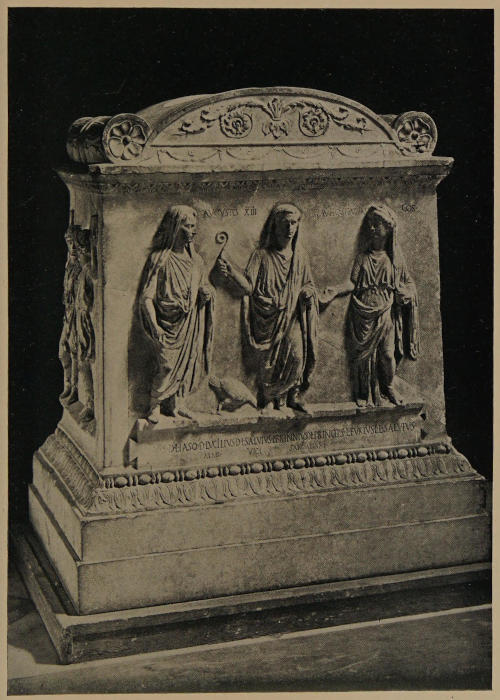
Altar dedicated to the Lares of Augustus in B.C. 2 by a Magister Vici.
Photographed from the Original in the Uffizi Gallery, Florence.
To face page 196.
Of the still more formal cult which arose after his death
with a temple regularly dedicated to him by Livia on the
Palatine, and a new college of Augustales to keep up the
worship in all parts of the Empire, an explanation somewhat
analogous may be given. He was declared divus by the Senate,
he was the late Emperor of blessed memory, a sainted soul, the
very spirit or genius of eternal Rome. The traditions in early
Roman history of the god-born and deified founder, the hero-worship
of Greece, the veil which concealed (as it still conceals)
the state of the departed, combined with the tolerant spirit of
polytheism to make it almost as easy for the men of that time
to admit a new deity into the Olympian hierarchy, as for
mediæval Europe to admit a new saint into the Calendar.
Augustus, as we said, had the good sense and modesty to put
difficulties in the way of this worship in Rome and Italy. It
was another matter in the provinces. The divine, or semi-divine,
honours paid him there were closely bound up with
loyalty to Rome and a belief in her eternal mission. He
therefore allowed temples and altars to be built, but always on
the understanding that the name of Rome should be associated
with his own. Such a method of expressing devotion to Rome
and reverence for her magistrates had not been unknown in
earlier times. In the second century B.C. a colossal statue
of Rome had been set up by the Rhodians in a temple of
Athena; the people of Chalcis had erected a temple in honour
of Flamininus; and Cicero implies that in his time it was not
an uncommon thing to do in the Asiatic provinces. At
Smyrna a temple to Rome had been erected in B.C. 195;[276]
and even before these the communities in Asia and Greece had
been accustomed to honour the Ptolemies in a similar manner.
The new cult therefore had nothing strange to the feelings and
habits of the time. It began early in his career of success—not
later at most than B.C. 36, after the defeat of Sextus
Pompeius[277]—and it spread rapidly. We hear of temples “to
Rome and Augustus,” or altars, at Cyme, Ancyra, Pergamus,
Nicomedia, Alexandria, Paneas, Sparta, and elsewhere in the
East. Connected with them were yearly festivals and games,
as at Athens, Ancyra, and in Cilicia.[278] Nor was it in the East
only that this worship began in the lifetime of Augustus. We
hear of temples or altars in Spain, Mœsia, Pannonia, Narbonne;
and the altar at Lugdunum (Lyon), consecrated by Drusus in
B.C. 12, was deliberately intended to supersede the Druidical
religion which was national and separatist.
The attitude of Augustus to this worship.
For forming an estimate of Augustus himself it is of great
interest to decide, if possible, how far he was
deluded, how far he was acting from deliberate
policy in countenancing these things. When
some people of Tarraco reported to him, as an omen of his
victorious career, that a palm had grown on the mound of
his altar in that city, he replied with half-grave, half-playful
irony, “That shews how often you use it!”[279] But there
is no note of disapproval or abnegation in the answer. He
accepts it as a natural fact that there should be such an altar,
as a modern sovereign might accept the compliment of a
statue. Can we explain it, except as a case of conscious fraud
or blinding vanity? I believe we may. We must notice first
that Augustus had been zealous in the apotheosis of Iulius, had
urged Antony to become his flamen, had built a temple to him
in Rome, and encouraged the building of temples and altars
elsewhere. Now this apotheosis and worship of Iulius had
begun before his death,[280] as Augustus knew perfectly well.
But in spite of the manifestly party spirit of the packed Senate
that voted the divine honours to Iulius, he gave no sign of
revulsion or incredulity. On the contrary, he professed himself
the heir not only of his wealth and honours, but also of his
religious obligations and political purposes. It is clear, again,
that Augustus believed in the gods, that is, in some immortal
being or beings who governed and controlled the world. The
restorer of a hundred temples, of sacred writings and ancient
religious rites, the pious fulfiller of vows made in the hour of
danger or escape, may have had crude or uncertain beliefs,
have held views philosophical or superstitious, wise or foolish,
but he could hardly have been an atheist.
He was too busy a man to be much troubled with philosophic
doubts, and perhaps—obvious as it may be—the answer of
Napoleon would have represented his view: who after
listening for a time to certain atheistic arguments, said,
pointing to the starry heavens, “All very well, gentlemen,
but who made all that?” Given a belief in oneself and in
Providence, the next step is to believe that Providence is on
our side, as Cromwell saw the hand of God even in his most
questionable achievements. If we can translate this into the
language of an age accustomed to hear at any rate with
acquiescence of heroic men, sons of the gods and destined to
be enrolled among their peaceful ranks, of the genius which
attended each man from the cradle to the grave, of the care
of the gods for the welfare of the state in its darkest hours,
manifested by omens, warnings, and even material appearances:
if again we consider how much it adds to the strength of a
belief to find it shared by others and to see that it makes for
the moral good of the world, we may come faintly to conceive
a frame of mind in Augustus on this subject which need not—in
view of his age and its sentiments—be set down either
as wholly irrational or wholly hypocritical. “The Roman
Empire,” he might say to himself, “is all that really matters
in the world. I am divinely appointed to restore and defend
it. I have in fact secured its peace and prosperity. If the
people call me god, it is their way of honouring the Genius
that directs me, the Providence that has selected me to be
their benefactor and saviour. If they believe in that, they
must also believe in the sanctity and eternal authority of Rome
and the Empire. Religion and loyalty are but different words
for the same virtue.” In his eyes the state was divinely
appointed, even in itself divine, and in so far as he represented
the state he was a divinity to its subjects. Stability was its
first requisite. “My highest ambition,” he said in an edict,
“is to be called the author of an ideally good constitution,
and to carry with me to the grave a hope that the foundations
I have laid will remain unmoved.” Goodness, and loyalty to
the state, had become convertible terms to him. Once as he
was looking at a villa formerly belonging to Cato, one of his
companions, thinking to please him by denouncing an anti-Cæsarean,
spoke of the “obstinate wrong-headedness of
Cato.” But he answered gravely “any one who is opposed
to revolution is a good man as well as a good citizen.” At
another time he came upon one of his grandsons reading a
book of Cicero. The boy, thinking he was on forbidden
ground, tried to conceal the book; but Augustus took it into
his hand, read in it a short time, and handed it back with the
remark, “A true scholar, my boy, and a patriot.” Perhaps he
thought with remorse of his own part in the great man’s
death, perhaps of the time when he believed him to have been
false to himself, but “patriot”—“a lover of his country”—made
up for all.[281]
The civilitas of Augustus.
It is clear, again, that it was not personal vanity or a desire
for adulation that actuated Augustus. He disliked fulsome
compliments or overstrained titles of respect, and
laughed at cringing attitudes, as when he said of
some obsequious petitioner that “he held out his
billet and then snatched it away again like a man giving a
penny to an elephant.” He specially objected to be called
dominus, a word properly applying to a master of slaves, and
forbade the word to be used even in jest in his own family.
He wished to be regarded as a citizen among citizens. He
took care to shew interest (unlike Iulius) in the games and
shows that were liked by the people, and disapproved of special
marks of respect being paid to his young grandsons by the
people rising and cheering when they entered the circus.
He went through the streets on foot even when Consul, or
rode with the curtains of his sedan drawn back, that he might
not seem to avoid the looks or approach of the crowd; he
admitted all kinds of people without distinction of rank to his
morning levees; forbade the Senators to rise when he entered
or left the house; visited friends without state, and was careful
to attend family festivities such as betrothal parties. At
elections he went round with his candidates and canvassed for
votes, and appeared for his clients in the courts (though anxious
not to allow his presence to exercise an unfair influence) and
shewed no annoyance at being cross-questioned and refuted.
In the Senate he allowed great freedom of speech without
resentment. He was interrupted while speaking by cries of
“We don’t understand,” “I would contradict you if it were
of any use.” On one occasion, when he was leaving the
house with some signs of anger after a tiresome debate, he
was followed by cries, “Senators should be allowed to speak
freely on public affairs,” something like the shouts of
“Privilege” that greeted Charles I. on a famous occasion.
When he mildly remonstrated with Antistius Labeo for
nominating Lepidus (whom he particularly disliked and treated
with great contumely) to the Senate, Antistius retorted rudely,
“Every one is entitled to his own opinion.” He was tolerant
of such language and wrote a soothing note to Tiberius, who
expressed himself vehemently about some occurrence of the
sort: “My dear Tiberius, don’t give way to youthful excitement,
or be so very indignant at some one being found to
speak harm of me. It is quite enough if we can prevent their
doing us any harm.” In matters more personal or private he
could stand a telling or rough retort. When holding a
review of the equites he brought up a number of charges
against a certain eques, who rebutted them one after the
other and ended with the contemptuous remark: “Next
time, sir, you cause inquiries to be made about a respectable
man, you had better intrust the business to respectable people.”
Seeing another eques eating in the circus he sent a message to
him, “When I want to lunch, I go home.” “Yes,” was the
answer, “but you are not afraid of losing your place.”
Another eques was rebuked by him for squandering his
patrimony, and deigned no further remark than, “Oh well,
I was under the impression that it was my own property.”
He once paid a Senator’s debts, and got no more thanks than
a note with the words, “Not a farthing for myself!” A
young man was once noticed at Court with an extraordinary
likeness to himself. Augustus ordered him to be introduced
and said: “Young gentleman, was your mother ever at
Rome?” “No,” he replied, “but my father was.” In this
case it must be acknowledged that the Emperor richly
deserved the retort. The point, however, in all these stories
is that he was content to give and take and be a man among
men. There would be no longer any ground for Pollio’s
remark, when Augustus wrote some satirical epigrams upon
that incarnation of all the talents: “I say nothing. It is
not easy to write against a man who can write one’s name
in a proscription list.” There are other anecdotes which still
farther illustrate this human side of Augustus. A veteran
begged him to appear for him in court, and Augustus named one
of his friends to undertake the case. The veteran cried out,
“But when you were in danger at Actium, Cæsar, I did not
get a substitute; I fought for you myself!” With a blush
Augustus consented to appear. The troubles and tragedies of
life interested him. On hearing of one of Herod’s family
executions, he remarked, “I had rather be Herod’s pig than
his son!” And when a man supposed to be rich was found
on his death to be overwhelmed with debt, he sent to purchase
his pillow at the auction, which had enabled him to sleep when
he owed such enormous sums. He could bear to have the
laugh turned against himself. The story of the man with
the two ravens, one taught to greet himself and the other
Antony, has been already referred to (p. 119). Another is of
a similar kind. A poor Greek poet was in the habit of
waylaying him as he left his house for the forum with complimentary
epigrams to thrust into his hand. Augustus took no
notice for some time, but one day seeing the inevitable tablet
held out he took it and hastily scribbled a Greek epigram of
his own upon it. The poet by voice and look affected to be
overpowered with admiration, and running up to the Emperor’s
sedan handed him a few pence, crying, “By heaven above
you, Augustus, if I had had more I would have given it you!”
Everybody laughed and Augustus ordered his steward to give
him a substantial sum of money.
It is curious that though Augustus was unmoved by rough
retorts or offensive speeches he shewed considerable sensitiveness
to attacks which took the form of lampoons and epigrams.
He went so far on some occasions as to refute them in an
edict. But he used the “edict” as a means of communication
with the citizens and provinces on all sorts of subjects,
such as for explaining his purpose in putting up the bust of
distinguished men, or to draw attention to what he thought
useful in ancient writers. But he shrank not only from
offensive poems, but from being the subject of any poetry
or history composed by incompetent people. Before all
things he was not to be made to look ridiculous by witty
attacks or clumsy praise. The prize poem or declamation
was an abomination to him, and the prætors were charged
to prevent the public use of his name in such compositions.
Connected with this sensitive refinement of taste may be
mentioned the simplicity of his manners and way of life.
The residences of Augustus.
The Palace of Augustus, though in a group of great splendour,
was not in itself on a scale approaching the huge constructions
of later Emperors. He appears at first
to have occupied a modest house close to the
forum, which had once belonged to the orator
Licinius Calvus, who died B.C. 47. He then purchased a site
on the Palatine on which to erect a new house; but in B.C. 36,
after the final defeat of Sextus Pompeius, the Senate voted
him the house of Hortensius. In a chamber of this house he
slept summer and winter for the rest of his life, though
occasionally when unwell he would pass the night in the
house of Mæcenas on the Esquiline which was regarded as a
healthier situation. On receiving this house from the Senate,
he devoted the site already purchased to the temple of Apollo
and its libraries, which with its peristyle was filled with the
most precious specimens of Greek art, and in which under the
statue of Apollo by Scopas the Sibylline books were preserved
in gilded caskets. In B.C. 12, upon becoming Pontifex Maximus,
he built a small temple of Vesta between these buildings
and his house, to keep up the tradition of the Pontiff residing
near the shrine of Vesta in the forum, while he handed over
the official residence of the Pontiff to the Vestal Virgins themselves.
The house of Hortensius was afterwards partly destroyed
by fire and rebuilt with greater magnificence, the neighbouring
house once owned by Catiline being taken in; but even then
it was on a moderate scale compared with the later palaces.
Its entrance, however, was conspicuously marked by the laurels,
the civic crown, and gilded shields which were placed there by
vote of the Senate since B.C. 27. Besides this town-house,
which has furnished the name for a royal residence to this day,
he had of course various villas in different parts of Italy. But
they were not numerous in comparison with the number we
know to have been owned by nobles at the end of the
republic. There was one at the ninth milestone on the
Flaminian Way called ad gallinas, in the gardens of which was
the bay tree, from the leaves of which Augustus had his
garland made when celebrating his triumphs; as it became the
traditional habit of succeeding Emperors to do also. The
others near Rome were selected for their coolness and healthy
position—Lanuvium twenty miles from the city on a lofty
spur of the Alban Mountains, “cold Præneste” twenty-five
miles, and “sloping Tibur” about twenty miles away. These,
however, were suburban residences and gave no escape from
society or business. They were full of Roman villas,[282] and in
the temple of Hercules at Tibur he frequently sat to administer
justice. When he could get a real holiday he preferred a
yachting voyage among the islands on the Campanian coast.
For one of them (Ænaria) he took in exchange from the
municipality of Naples the beautiful Capreæ, destined for
greater notoriety under his successor. He used to call it or
some small island in the bay his “Castle of Idleness.”[283] His
villas were on a modest scale. He greatly disapproved of the
vast country palaces which were becoming the fashion, and
forced his granddaughter to demolish one which she was
building.[284] Earlier in life he was accused of extravagance in the
matter of rich furniture and antique bronzes. But he seems
to have shaken off this weakness later on. The furniture of
his villas was extremely simple, and there were no costly
pictures and statues in them, but the gardens were carefully
laid out with terraces and shrubberies, and generally adorned
with various curiosities, as at Capreæ with the huge bones of a
whale.
His table was simple and the dinners never long. He was
careful in selecting his company, but knew how to make
graceful concessions as to the rank of his guests when occasion
required it. He drank little wine, and generally not of the
best vintages; but he exerted himself to promote conversation
and to draw out the silent and shy. He would sometimes come
late and retire early without breaking up the party; sometimes
talked instead of eating, taking his own simple food before or
after the meal. Before all he does not appear to have adopted
the unsociable habit, often mentioned by Cicero and especially
characteristic of Iulius, of reading and answering his letters at
table. The dinner was generally a family function and his
young grandsons were always present at it. Sometimes conversation
was varied by reciters, readers, actors or professors of
philosophy. But at the Saturnalia and other festivals the
quiet and decorum of these meals gave way to the spirit of the
hour. The table was better furnished and the Emperor presented
his guests with all kinds of gifts, or amused himself by
holding a kind of blind auction, putting together lots of widely
different value which the guests bid for without knowing what
they were purchasing. On such occasions gambling with dice
was permitted, though in family parties the Emperor took care
to lose or to surrender his winnings, and sometimes he supplied
each member of the party with a sum of money beforehand
with which to make their stakes. But games of chance had a
fascination for him at all times of his life, and his real gambling
was not confined to festival days. He made no secret of it,
and we hear nothing of any great loss or gain. Social life at
Rome began early in the day, visitors at a levee would arrive
soon after daybreak, and a magistrate would sometimes have to
be up immediately after midnight, to take omens or perform
some other religious rite. But as Augustus worked late at
night, and was not a good sleeper, early rising was painful to
him, and resulted in his falling fast asleep in his sedan. If any
of these night duties became imperative he took the precaution
of sleeping in some lodging near the place. But his normal
habit was to work up to noon, then after the light luncheon or
prandium, often consisting of bread and a few grapes, to sleep
for a short time fully dressed. Having finished the morning’s
work and bath, dinner (cena) would come between 3 and 4,
though busy men like the Emperor often pushed it on to 6 or 7;
after dinner he went to his study, and there finished off what
was left of the day’s work, his memoranda and accounts,
sitting or reclining on his couch far into the night. The
amount of work which he must have bestowed upon his official
business is shewn by the state of readiness and completeness in
which the various schedules of the finances of the Empire and
the army, and the book of political maxims were found at his
death. In early youth he had dabbled in literature, and composed
a tragedy in the Greek fashion called “Ajax”; but coming
in later years to estimate its value more truly he destroyed it,
and when some friend or flatterer inquired for it, he said,
“Ajax has fallen on his own sponge.”[285] He composed also
memoirs of his own life, but they were interrupted by his
serious illness after the Spanish War (B.C. 25-3), and never
resumed. They were used by Suetonius and other writers, as
well as collections of his letters, edicts, and speeches, but have
not been preserved. Only one of his epigrams has survived, of
which I shall speak hereafter. These excursions into literature,
never very serious, seem to have ceased as he got on in life.
In the third book of his Odes (written between B.C. 30-25),
Horace tells the Muses that “they afford a recreation to high
Cæsar when he has put his troops into winter quarters and
seeks a rest from toil,”[286] but in the fourth book (B.C. 13-12) it
is the statesman, the conqueror, and reformer that he addresses,
not the man of letters. The Epistle addressed to Augustus
in B.C. 12, though it deals with literary criticism and explicitly
supports the Emperor’s well-known dislike of being
the theme of inferior writers, while it dwells upon his numerous
employments and warmly compliments him on his successful
achievements, contains no word or hint of his authorship.[287]
The principate was a most laborious profession, absorbing all
his energies and occupying all his time, and though he might
enjoy the company of literary men, despatches, edicts, and
state papers would now be the limit of his literary ambition.
The heavy work of his lofty position was performed under
painful conditions of health. Besides at least four serious
illnesses[288] of which we hear, he was subject to periodical
complaints, generally recurring at the beginning of spring and
autumn. Soon after B.C. 30 he gave up the martial exercises
of the Campus, then the less fatiguing ball games, and finally
confined himself to getting out of his sedan to take short runs
or walks. As he grew old his only outdoor amusements (except
yachting) seem to have been fishing and playing games with
little children.
In the last years of his life he gave up going into Roman
society. In the earlier part of his principate he dined out
freely, and not always in select company. He seems to have
been rather inclined to the vulgar millionaire, perhaps because
he could reckon on contributions to the public objects which
he had at heart. He did not expect splendid entertainments,
and was content with the wine of the district, still he did not
like being treated with too little ceremony. To one man
who gave him a dinner ostentatiously plain and common, he
remarked on leaving—“I did not know that I was such an
intimate friend of yours.” At times, too, he had occasion to
assume the Emperor with some of these nouveaux riches, as in
the celebrated case of Vedius Pollio. This man had a stewpond
of lampreys, which he fed with flesh. When he was
entertaining Augustus on one occasion the cup-bearer dropped
a valuable crystal cup, and his master ordered him at once to
be thrown to the lampreys. Augustus tried to beg him off,
but when Pollio refused, he ceased to entreat; assuming
imperial airs he ordered all the cups of the same sort in the
house, and all others of value, to be brought into the room and
broken. Licinius, the grasping procurator of Gaul, was
another of these rich vulgar people, with whom Augustus was
somewhat too intimate, and expected in return for that honour
large contributions to his works. On one occasion he even
took the liberty of altering the figure in the promissory note
sent by him so as to double the sum. Licinius said nothing,
but on the next occasion he sent a note thus expressed: “I
promise towards the expense of the new work—whatever your
Highness pleases.”
Wit is seldom kind, and some of the retorts attributed to
him are not always exceptions to the rule. To a humpbacked
advocate pleading before him, and often repeating the
expression, “If you think I am wrong in any way, pray set
me straight,” he said, “I can give you some advice, but I
can’t set you straight.” To an officer who made rather too
much fuss about his services, and kept pointing to an ugly
scar on his forehead, he said, “When you run away you
shouldn’t look behind you.” More good-natured are the
following. To a young prefect who was being sent home
from camp for misbehaviour, and who exclaimed, “How
can I go home? What am I to say to my father?” he
replied, “Tell him that you did not like me.” To another
who was being cashiered, and pleaded to have the usual
good-service pension, that people might think he had left
the service in the usual way, he said, “Well, give out that
you have received the money; I won’t say that I haven’t
paid it.”
Though affable to all, and neither an unkind nor unreasonable
master to his slaves, or patron to his freedmen,
he was enough a man of his age not to hesitate to inflict
cruel punishment for certain offences. A secretary who had
taken a bribe to disclose some confidential paper, he ordered
to have his legs broken. A favourite freedman was forced to
commit suicide when detected in intrigues with Roman
married ladies. He ordered the personal servants of his
grandson Caius, who had taken advantage of his illness
and death to enrich themselves in the province of Syria, to
be thrown into the sea with weights attached to their feet.
To those who had been his friends there is hardly any
instance of extreme severity after the end of the civil wars.
It is possible that Muræna died before trial, though his
fellow-conspirator was put to death. Cornelius Gallus, the
first prefectus of Egypt, committed suicide rather than
confront the accusations brought against him and the evident
animus of the Senate; but Augustus did not wish it, and
exclaimed with tears in his eyes that it was hard that he
should be the only man who might not be angry with his
friends without the matter going farther than he intended.
The coldness that arose between him and his ministers
Agrippa and Mæcenas was only temporary and never very
grave. He deeply deplored their loss at their death. We
shall have to discuss his conduct to his daughter and granddaughter
and their paramours in another chapter. But
neither in regard to these persons nor the conspirators against
his life did he ever act in a way that his contemporaries would
think cruel.
These anecdotes of Augustus do not suggest a very heroic
figure, very quick wit, or great warmth of heart. They
rather indicate what I conceive to be the truer picture, a cool
and cautious character, not unkindly and not without a sense
of humour; but at the same time as inevitable and unmoved
by pity or remorse as nature herself. No one accuses him
of having neglected or hurried any task that it was his duty
to perform. But neither friend, relation, nor minister ever
really influenced him. He issues orders, and they all obey
instinctively, without remonstrance, and generally with
success. He is providence to them all. Everything succeeds
under his hands. He is no soldier, though he knows
one when he sees him, but all the nations of the earth seek
his friendship. Till the last decade of his life no serious
reverse befel his armies; at home all opposition melted away,
as the difficulties in a road or course disappear before a skilful
driver or steerer. He is not godlike, but there is an air of
calm success about him which swayed men’s wills and
awakened their reverence.
CHAPTER XII THE REFORMER AND LEGISLATOR
Quid leges sine moribus
vanæ proficiunt?
The earliest reforms in the Empire.
The activity of Augustus as reformer in the city and Italy,
and to a great extent in the provinces also, was subsequent to
the settlement of his constitutional position in B.C.
23, after which date changes in it were generally
consequential, and in matters of detail. But it
began long before. In B.C. 36 he had taken effective measures
to suppress the brigandage which had pushed its audacity
nearly up to the very gates of Rome. In B.C. 34-3 Agrippa,
under his influence, had started the improvement in the
water supply of Rome by restoring the Aqua Marcia; had
cleansed and enlarged the cloacæ, repaired the streets, and
begun many important buildings. In B.C. 31 we have
evidence that Augustus was turning his attention to the
details of administration in the provinces,[289] and in the next
year, in his resettlement of Asia, he restored to Samos,
Ephesus, Pergamus, and the Troad, works of art which
Antony had taken from them to bestow upon Cleopatra.[290]
In B.C. 28, measures of relief were adopted for state debtors,
and a term fixed beyond which those who were in actual
possession of properties could not be disturbed by legal proceedings.
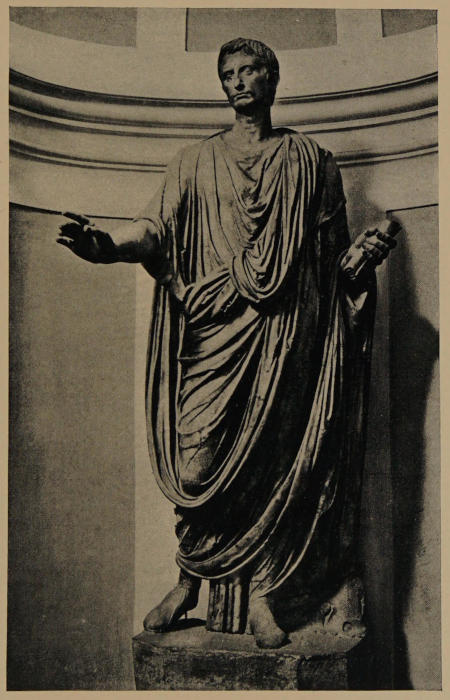
Augustus as Senator.
Photographed from the Statue in the Uffizi Gallery, Florence.
To face page 212.
The roads and police patrols, B.C. 27.
The first need of the country was security. How
difficult this had long been to maintain, and how ill the
senatorial government at the end of the Republic
had been able to cope with the evil is
shewn by the fact that remnants of the bands
of Spartacus and Catiline were in B.C. 61 still infesting the
district of Thurii. In spite of the repressive measures of
B.C. 36, which seem to have been successful as far as the
immediate neighbourhood of Rome was concerned, at the
end of the civil war armed bands still openly appeared in
various parts of Italy, seized and carried off travellers, confined
them in the slave-barracks, or ergastula, or put them
to ransom. These ergastula were originally slave-prisons
used for keeping refractory slaves, who worked during the
day in chains, and were shut up in separate cells at night,
often underground or only lighted by windows high up
and out of reach of the inmates. In some parts of Italy—chiefly
the north—they were not known, and chained
slaves were not employed; but in other parts they were
numerous, and afforded convenient hiding-places. The
chief abuse connected with them was that men properly
free could be carried off and concealed in them as though
they were slaves, while they afforded a leader in rebellion
convenient sources from which to draw recruits; the
miserable inmates being only too ready to join any one who
gave them a hope of freedom and release from those horrible
dens. Accordingly a review of the ergastula is constantly
heard of, till they were finally abolished by Hadrian. Among
the measures for the suppression of brigandage now taken
was a visitation of these places. It was not done in mercy
to the slaves. Augustus, though he treated his own servants
with kindness, took the sternest Roman view of the absolute
power of a master, and boasts that after the war with Sextus
Pompeius he handed over 30,000 slaves—who had been
serving with the enemy—to their masters “to be punished.”[291]
When we remember what the “punishment” of a Roman
slave meant, it is difficult to think without horror of the
sum total of human misery which this implies.
The great roads of Italy secured.
A more effective and permanent measure, however, was to
secure the roads and make them fit for rapid military movements.
A system of road commissions (curæ
viarum) was started in B.C. 27, commissioners
(curatores) being appointed to superintend each
of the great roads leading from Rome to various parts of
Italy. The duty at first was usually imposed upon men
who had enjoyed triumphs, and Augustus himself, after his
triple triumph, undertook the via Flaminia, the great north
road from Rome to Ariminum on the Adriatic, from which
place other roads branched off through the valley of the Po,
and to the Alpine passes. The pavement of the road was
relaid, the bridges repaired, and the completion of the work
was commemorated by the still existing arch at Rimini,
with its partially surviving inscription.[292] For greater safety,
also, military pickets were stationed at convenient points along
the roads, which put a stop to brigandage.
In close connection with the roads were the twenty-eight
military colonies established by Augustus in Italy. Of these
seven were along the line of the Flaminia, or near it; one of
them (Bononia) was the point where the main roads to Rome
converge. Others guarded the entrances to the Alpine passes,
or the road through Venetia to Istria—which Augustus included
in Italy—while another group protected the main
roads through Campania. Thus these colonies were not only
centres of loyalty to the Empire, but served to keep open the
great routes. The object of the division of Italy into eleven
regions, the exact date of which is not known, was probably
for the purpose of the census, and the taxation which was
connected with it, but it was also for other administrative
purposes, as for the regulation of the military service of the
young men in each of them.[293] The regions followed the
natural divisions of the country and of nationalities, but
the importance of the roads in connection with them is
shown by the fact that before long they became known in
many cases by the name of the chief road that traversed them,
as Æmilia, Flaminia, and others. What Augustus was doing
for Italy his legates under his authority were doing for the
most important provinces. Great roads—viæ Augustæ—were
being laid everywhere. We have evidence of them
from inscribed tablets in Dalmatia, Pisidia, and Cilicia,
Bætica, Northern Spain, Gallia Narbonensis, and elsewhere.[294]
These works went on throughout his reign, but in B.C. 20
he commemorated his formal appointment as head commissioner
of all roads by placing a pillar covered with gilded
bronze in the forum near the temple of Saturn, with the
distances of all the chief places along the great roads from one
of the thirty-seven city gates from which these roads branch out.
The base of this milliarium aureum is still in its place.
The collegia.
Another source of mischief were the collegia, or guilds.
Under cover of promoting the interests of certain trades and
professions these guilds were used, or were believed
to be used, for all kinds of illegal purposes. Some
of them were of great antiquity, but they had come to be so often
misused for political terrorism (especially the collegia opificum)
that the Senate had suppressed many of them in B.C. 63. But
Clodius shortly afterwards got a law passed authorising their
meetings, and he employed them freely for promoting his own
riotous proceedings. Iulius Cæsar had dissolved all except the
most ancient and respectable, but during the civil wars they
seem to have revived. Under a law passed in B.C. 22 Augustus
held a visitation of them. Some were dissolved and some reformed,
and a licence was henceforth required from Senate and
Emperor for their meetings.
Feeding the city.
In the city itself the first need was food. It depended very
largely on imported corn. Again and again we hear of dearth
and famine prices at Rome. The people, often,
no doubt, rightly, believed that this dearness of
provisions arose from artificial causes. When
Sextus Pompeius and his confederates were scouring the seas
and pouncing upon corn-ships the cause was clear enough,
and the gratitude to Augustus for crushing him was very
natural. But even when there was no such evident danger
great distress was often caused by sudden rise of prices. The
idea had always been in such times to appoint some powerful
man præfectus annonæ, with a naval force enabling him to
secure that the corn fleets should have free passage to Italy,
should be able to unload their cargoes without difficulty,
and dispose of them at a moderate price. A well-known
instance of this was the appointment of Pompey in B.C. 57.
But in less troublous times a separate commissioner was
appointed to watch the several places of corn export, Sicily,
Sardinia, and Africa. These were not posts of very great
dignity, and Brutus and Cassius in B.C. 44 looked upon their
nomination to them as a kind of insult. But besides the
dangers of the sea and of pirates certain merchants had hit
upon means—practised long before at Athens—of artificially
raising the price. They made what we should call “a
corner” in corn. Either they bought it up and kept it
back from the market, or they contrived various ways of
delaying the ships and producing a panic among the dealers.
As in all difficulties, the people looked to Augustus for help,
and in B.C. 22 begged him to accept the office of præfectus
annonæ, “chief commissioner of the corn market.” While
declining the dictatorship offered him at the same time with
passionate vehemence, he accepted this commissionership;
and the law which he caused to be passed now or some
time later on shews how necessary some State interference
was. By this law penalties were inflicted on any one “who
did anything to hinder the corn supply, or entered into any
combination with the object of raising its price; or who
hindered the sailing of a corn-ship, or did anything of malice
propense whereby its voyage was delayed.”[295]
Distribution of corn free or below market value.
But besides a free and unmolested corn market, the Roman
populace had long come to look for another means of support—a
distribution of corn either altogether free or
considerably below the market price. Detached
instances of this practice occur in the earlier
history of Rome, the corn sometimes coming as
a present from some foreign sovereign, sometimes being distributed
by private liberality. It had always been objected to
by the wiser part of the Senate, and had laid the donors open
to the charge of trying to establish a tyranny. It was reserved
for the tribune Gaius Gracchus to make it into a system
(B.C. 122). Since his time it had been submitted to as a
matter of course by nearly all magistrates. Sulla, indeed,
seems to have suspended it for a time, but the first measure
of the counter revolution that followed his death was to
re-establish it. Iulius Cæsar had restricted it to citizens
below a certain census, but had not the courage to abolish
it. It was, indeed, a kind of poor-law relief, but of the worst
possible sort. It not only induced a number of idle and useless
people to prefer the chances of city life to labour in the
country, but it unnaturally depressed the price of corn, and
therefore discouraged the Italian farmer, already nearly ruined
by the competition of foreign corn; it exhausted the treasury,
and, after all, did not relieve the poor. Livy regards it as one
of the causes which denuded Italy of free cultivators, and left
all the work to slaves. Cicero always denounced it on much
the same grounds, and Appian points out how it brought the
indigent, careless, and idle flocking into the city.[296] The
system, moreover, was open to gross abuses, slaves being
manumitted that they might take their share, under contract
to transfer it to their late masters. Augustus saw that
by these distributions injustice was done both to farmers and
merchants, and that agriculture in Italy was being depressed by
it. He says in his memoirs[297] that he had at one time almost
resolved to put a stop to the practice, but refrained from doing
so because he felt sure that the necessity of courting the
favour of the populace would induce his successors to restore
it. However unsound this reasoning may be, it would no
doubt have been an heroic measure for one in his position
to have carried out the half-formed resolution. As a matter
of fact, his distributions were on a large scale, and in times of
distress were entirely gratis. Tesseræ, or tickets, entitling
the holders to a certain amount of corn or money, were distributed
again and again. The value of the corn tickets was
generally supplied from the fiscus or his private revenue; but
that after all was only a question of accounts, it did not affect
the economical or moral results in any way.
State loans.
A better economical measure was a system of State loans.
Immediately after the end of the civil war the transference to the
Roman treasury of the enormous wealth in money
and jewels of the Ptolemies at Alexandria caused
the price of money to go down and the money value of
landed property consequently to go up. For a time at least
the common rate of interest sank from 12 to 4 per cent.
Augustus took advantage of this state of things to relieve landowners
who were in difficulties, by lending them money free
of interest, if they could show property of double the value
as security for repayment.
The Tiber.
There were other reforms equally beneficial. Among the
many curæ (commissions) which he established was one for
superintending public works, which would thus
not depend on private munificence; another of
the streets; of the water supply; and, above all, of the Tiber.
Rome was, as it still is, extremely subject to floods. Quite
recently there were five or six feet of water in the Pantheon,
and in B.C. 27 the rise of the Tiber was so serious that the
lower parts of the city were covered, and the augurs declared
it to be an omen of the universal prevalence of the power of the
new princeps. In B.C. 23 it swept away the pons Sublicius.[298]
He could not of course prevent these floods, but he gave
some relief by dredging and widening the river-bed, which
was choked with rubbish and narrowed by encroachments.
The commission thus established remained an important one
for many generations, but in B.C. 8 he superintended the
business himself.
Fire brigades.
A danger at Rome, more frequent and no less formidable than
flood, was fire. So frequent were fires that the most stringent
laws had been passed against arson, which it seems
was even punishable by burning alive. In B.C. 23
Augustus formed a kind of fire brigade of public slaves under
the control of the curule-ædiles. But the old magistracies
were no longer objects of desire, and it was difficult to get
men of energy to fill them, a state of things which was one
of the chief blots in the new imperial system. At any rate in
this case they were not found efficient, and in the later years
of his reign (A.D. 6), a new brigade in four divisions was
formed of freedmen with an equestrian præfect, who turned
out to be so effective that they became regularly established.
The Sibylline Books and Sacred Colleges.
Another part in the scheme of Augustus for the reconstruction
of society was to revive the influence of the Sacred
Colleges and brotherhoods, and to renew the
ceremonies with which they were connected.
One method of doing this was to become a
member of them all himself, much as the king of England
is sovereign of all the Orders. Thus according to the Monumentum
(ch. 7) he was pontifex, augur, quindecemvir for
religious rites, septemvir of the Epulones, an Arval brother,
a fetial and a sodalis Titius. Nor was he only an honorary
or idle member. He attended their meetings and joined in
their business, and took part in whatever rites they were
intended to perform. Thus his membership of the Arval
brethren is recorded in the still existing acta; as a fetial he
proclaimed war against Cleopatra. The sodales Titii, a college
of priests of immemorial antiquity, had almost disappeared until
the entrance of Augustus into their college revived them and
their ritual. He not only joined these colleges, but revived
and even increased their endowments,[299] and, above all, those of
the six Vestal Virgins, to whom he presented the regia, once
the official residence of the Pontifex Maximus, and an estate
at Lanuvium. The restoration of the College of Luperci,
which had celebrated on the 15th of February the old ceremony
of “beating the bounds” almost from the foundation of
the city, was more or less a political matter. It had gone out
of fashion, and its ceremonies had got to be looked upon as
undignified. Iulius Cæsar had revived and re-endowed them.
The Senate for that very reason in the reaction after his death
had deprived them of these endowments, which Augustus now
restored. We have already noticed his renewal of the augurium
salutis, the old ceremonial prayer at the beginning of the year
that could only be offered in time of peace. He also induced
some one to accept the office of flamen Dialis in B.C. 11, after
it had been vacant since B.C. 87, because the restrictions under
which its holder laboured were so numerous and tiresome that
in spite of its dignity—its seat in the Senate and curule chair
and lictor—no one would accept it. He took pains again to
restore the Sibylline Books to their old place of importance.
The originals were lost in the fire of B.C. 82, and a commission
had at once been issued to collect others from towns
in Greece and Greek Italy. But some of them were getting
illegible from age, and some were of doubtful authenticity,
and consequently all kinds of prophetic verses got into circulation,
giving rise at times to undesirable rumours and panics.
Augustus in B.C. 18 ordered them to be re-copied and edited,
and the authorised edition was then deposited in his new
temple of Apollo on the Palatine, and continued to be consulted
till late in the third century. After an attempt by
Iulian to revive its authority it was finally burnt by Stilicho
about A.D. 400.
Pontifex Maximus.
As one of the quindecemvirs Augustus had charge of these
books, but he formally took the official headship of Roman
religion by becoming Pontifex Maximus. He was
elected and ordained to that office in March B.C.
12. The people had wished him to take it in
B.C. 30, but he would not violate what was a traditional and
sacred rule that the office was lifelong, and though Lepidus
was degraded from the triumvirate in B.C. 36, he was still
Pontifex Maximus. It is true that he was not allowed to do
any of the duties, or only those of the most formal kind, but
still he had the office. The ground for asking Augustus to
take it was that the election of Lepidus had been irregular;
he had managed to get put in during the confusion following
the assassination of Cæsar, and therefore might be deposed.
Augustus however takes credit for his scrupulous observance
of a religious rule, and was particularly gratified by the crowds
of people who came up to vote for him, a sort of ecclesiastical
coronation.[300]
The ludi sæculares, May 31-June 2, B.C. 17.
In B.C. 17 he gave an emphasis to some of these religious
revivals by celebrating the ludi sæculares, the centenary of
the city, in virtue of some verses found in this
Sibylline volume. We need not trouble ourselves
as to whether his calculation of the year was a
right one (the sæculum was really 110 years), it is enough
to note that they were meant, like a centenary of a college or
university, to call out patriotic and loyal feelings which should
embrace both the country and the country’s religion. They
are made interesting to us by the fact that Horace—always
ready to further his master’s purposes—was selected to write
the Anthem or Ode to be sung by a chorus of twenty-seven
boys and twenty-seven girls. An inscription, found in 1871 in
the bed of the Tiber, gives the official program of this festival,
and ends with the words Carmen composuit Q. Horatius Flaccus.[301]
The poet probably had before him, when he wrote it, the
general scheme of the festival, which included solemn sacrifices
and prayer to Iuno, Diana, Iupiter, and Ilithyia. Augustus
and Agrippa took the leading part in the religious functions—as
members of quindicemviri—and both repeated the prayers,
which in the case of all these deities invoked a blessing on the
“Populus Romanus Quiritium.” In short, everything was done
to mark it as a national festival, to make the Romans recall
their glorious inheritance and unique position, and at the same
time to show that the princeps represented that greatness before
gods and men. Whatever else Augustus may have thought of
the national religion, he evidently regarded it as the surest
bond of national life, and the inclusion of a prayer to Ilithyia,
goddess of childbirth, joined with his contemporaneous attempt
to encourage marriage and the production of children
(which the obedient Horace echoes[302]), shews that he also
connected that religion with morality. The restoration of
religion, in fact, in his mind, goes side by side with the purification
of morals. It is the practical statesman’s view of
religion as a necessary police force and perhaps something
more. Napoleon restored the Catholic Church in France
with a similar sagacity, and the people blessed him, as they
did Augustus, for giving them back le bon Dieu.
The reformation of morals.
But the state of things required in his judgment, not only
a religious revival, but more stringent laws. Horace again
reflects his master’s views in the making, before
they find expression in act. The sixth ode of
the first book (written about B.C. 25) joins to the
necessity of a restoration of the temples and a return to religion
a warning as to the relaxation of morals, tracing the progress in
vice of the young girl and wife, with the shameful connivance
of the interested husband, and exclaims: “Not from such
parents as these sprang the youth that dyed the sea with Punic
blood, and brake the might of Pyrrhus and great Antiochus and
Hannibal, scourge of God.” Again in the twenty-fourth ode
of the same book, also written about B.C. 25, he warmly urges a
return to the old morality, and promises immortality to the
statesman who shall secure it: “If there be one who would
stay unnatural bloodshed and civic fury, if there be one who
seeks to have inscribed on his statue the title of ‘Father of
the Cities,’ let him pluck up heart to curb licentiousness. His
shall be a name for the ages!” And when Augustus has acted
on the resolution, to the formation of which the poet was privy,
he tells him ten years later that by his presence family life is
cleansed from its foul stains, that he has curbed the licence of
the age and recalled the old morality.[303] This he would represent
as the result of the Emperor’s legislation, the lex marita
of the secular hymn.
It was after his return from the East in B.C. 19 that Augustus
first received censorial powers for five years. Whether this
amounted to a definite office—a præfectura moribus or regimen
morum, as Dio and Suetonius assert—does not much matter. The
experiment of appointing censors in the ordinary way had been
tried in B.C. 22 for the last time and had not been successful,
and the censoria potestas now given to Augustus practically put
into his hands that control over the conduct of private citizens
which the censors had exercised by their power of inflicting
“ignominy” upon them. The ancient censorial stigma had
been applied to irregularities in almost every department of life,
but it depended on the will of the censors themselves, not on
laws. Feeling now directly responsible for the morals and
general habits of the citizens he began a series of legislative
measures designed to suppress extravagance and debauchery,
and to encourage marriage and family life, which would have
permanent validity. He believed in externals, even trivial
ones, as indicating a growing laxity; making, for instance, a
point of men appearing in the forum and on official occasions
in the old Roman toga. The lighter and more comfortable
lacerna or pallium was as abominable in his eyes as a suit of
flannels would seem to a martinet of to-day in the Park or on
parade.[304] Before all things the Romans were to be national,
in dress no less than in other respects.
Sumptuary laws.
But the failure which always attends such regulations was no
less inevitable in regard to the first of his new reforming
measures, his sumptuary laws, regulating the exact
amount that it was legal to spend on a cena in
ordinary days, on festivals, and at wedding feasts, or the repotia
which the bridegroom gave on the afternoon following his
marriage. This was no new thing. It had been tried at
various times throughout Roman history. Beginning with
a very ancient law regulating the amount of silver plate each
man might legally possess, the rent he might pay for his house,
and the provisions of the Twelve Tables, we have laws in the
third and second centuries B.C., limiting the cost of dress and
jewels for women, the number of guests that might be entertained
at banquets, and the amount that might be spent upon
them. Sulla had also a sumptuary law, among his other acts,
of the same kind. But Iulius Cæsar had gone farther than
any one in B.C. 46. He had not only regulated the cost of
furniture and jewels, according to the rank of the owners, and
the amounts to be spent upon the table, but he had sent agents
into the provision markets, who seized all dainties beyond the
legal price, and even entered private houses and removed dishes
from the table. Of course such measures were not only
annoying, they were ineffective also. Directly he left Rome
the rules were neglected. Our own Statute Book has many
laws of the same kind, which rapidly became dead letters.
Nearly the one and only permanent effect of the old
sumptuary laws had been to create a sentiment against large
and crowded dinner parties as vulgar.[305] Nor did Augustus
succeed much better. Towards the end of his reign he
issued an edict extending the legal amount which might
be spent on banquets, hoping to secure some obedience
to the law. But nothing that we know of Roman life
afterwards leads us to think that this form of paternal government—though
quite in harmony with Roman ideas—ever
attained its object. Human nature was stronger than political
theory.
The Iulian laws of marriage, adultery and divorce.
Nor were the laws, carried about the same time,[306] on
marriage, divorce, and kindred subjects, much more effective.
In part they re-enacted rules which had always
been acknowledged and always disobeyed, and so
far as they did not punish a crime, but endeavoured
to enforce marriage, they were continually resisted or effectually
evaded. They consisted of a series of enactments—whether
we regard them as separate laws or chapters in the
same law—for restraining adultery and libitinage, for regulating
divorce, and for encouraging the marriage of all ranks.[307] They
were passed in B.C. 18-17, and were supplemented by a law of
A.D. 9, called the lex Papia Poppæa. The text of none of
them survives, and we have to trust to scattered notices in
the later legal writers. They may be roughly classed as
restrictive, penal, and beneficiary. In the first may be placed
the regulation that no senator or member of a senatorial family
might marry a freed-woman, courtesan, actress, or the daughter
of an actor; though other men might marry a freed-woman
or even emancipate a slave in order to marry her. And under
the same head came the regulations as to divorce. The legal
doctrine appears to have been that marriage contracted with
the old religious ceremony called confarreatio was indissoluble,
except in the case of the wife’s adultery, on whose condemnation
to death the execution was preceded by a solemn dissolution
of the marriage or diffareatio. It was also a common belief
that no divorce had ever taken place at Rome until that of
Carvilius in B.C. 231. Yet the laws of the Twelve Tables
(B.C. 450) contained provisions as to divorce, so that it had
certainly been known before; and perhaps the truth was that
Carvilius was the first to divorce his wife without any plea of
adultery, in which case he would have to give security for the
repayment of her dowry. Since that time the religious confarreatio
had become extremely rare. Both men and women
avoided an indissoluble tie. The fashion was to be married
sine manu, that is, without the woman passing into the manus
or power of her husband. She still remained subject to the
patria potestas, or to that of her guardian, or was sui iuris
according to her circumstances at the time. Such marriages
could be dissolved by either party, and without charge of
misconduct. Public opinion seems to have restrained both
men and women for some time from taking advantage of their
freedom, but its force steadily diminished, till towards the end
of the republic divorce became so common as to provoke little
remark. It was an arrangement—as in the case of Augustus
and his family—governed almost entirely by considerations of
convenience or advantage, and generally left all parties concerned
on a friendly footing. This of course was not always
the case when the divorce was the result of misconduct,
or at least of misconduct on the wife’s part, nor even
if it resulted from incompatibility of temper or money
disputes, which left a feeling of soreness behind them. It
was a system—however disastrous to family life—too deeply
rooted for Augustus to attempt to change it, even if he
had wished to do so. His law seems to have dealt only
with certain formalities and conditions of divorce—such as
the necessity of having witnesses, and in case of a charge
of misconduct a kind of family council or court of inquiry—not
with the freedom of divorce itself, except that in the
case of a freed-woman, she was prevented from divorcing
her husband or marrying again without his consent. That,
however, rested on the idea of the rights of a patronus rather
than on the sanctity of marriage. Otherwise the law chiefly
dealt with questions of property, restraining the husband from
alienating his wife’s estate without her consent, and re-enacting
(with what modifications we do not know) the provisions for
the repayment of dowry.
Penalties (1) for adultery or seduction.
The penal enactments affected (1) those guilty of adultery or
seduction (stuprum), and (2) those who remained unmarried
or without children. In adultery both parties were
punished by transportation (deportatio in insulam)
and a partial confiscation of property. A husband’s
unfaithfulness incurred no penalty except that he lost all claim
to retain any part of the wife’s dowry, even for the benefit of
children. But the old barbarous principle of the injured
husband’s right to kill both wife and paramour, if detected by
himself, was retained, though under certain conditions. If he
allowed the guilty wife to remain with him, he was bound to
release the man; and if he connived at the adultery for gain, he
was subject to a fine. Stuprum was formerly defined as the
forcible detention of a free woman for immoral purposes, and
could be punished by flogging or imprisonment. Under the
Iulian law it was extended to the seduction of an unmarried
woman or a widow who had been living chastely.
(2) For remaining unmarried.
The penalties upon those who remained unmarried between
certain ages were in the form of a direct tax or of certain
disabilities. The former, under the name of
uxorium, was of great antiquity, and had been
levied by the censors of B.C. 404, but it was light
and intermittent; the Iulian law revived and increased it.
The disabilities were that an unmarried man between the
legal ages could not take a legacy from a testator not related
to him within the sixth degree, unless he married within a
hundred days of being informed of the legacy. This was
extended by the lex Papia Poppæa (A.D. 9) to the childless,
who could only take half any legacy from a testator unconnected
with them within the sixth degree. One child saved
a man from coming under this law, three children a freeborn
woman, four a freed-woman. Again, a husband and wife who
were childless could only receive a tenth of a legacy left by
one to the other, though, if there were children by another
marriage, a tenth was added for each, or if they had had
children who had died. For all alike there were numerous
exemptions founded on absence from home on public service,
age, or ill-health; and a certain time of grace (vacatio) was
given between the attainment of the legal age and the actual
marriage, or between two marriages, or after a divorce.
Privileges to parents. The ius trium liberorum.
The beneficiary clauses of the law were those which
relieved married men or women and men or women with
children from these disabilities, and gave them
exemption from certain onerous public duties
and special places of honour in the theatres. The
fathers of three children at Rome, four in Italy,
five in the provinces, had also certain preferences for offices
and employments and other honorary distinctions, such as
taking precedence of a colleague in the consulship. This was
not a new idea, for it had in one shape or another existed in
many Greek states, and in B.C. 59 Iulius Cæsar had in his
agrarian law given the preference to fathers of three children
in the distribution of land.
Opposition to the law.
The disabilities imposed on the unmarried were met with
vehement resistance, in consequence of which the clause was
introduced giving the three years’ grace between
the attainment of the legal age and the actual
marriage. After the passing of the Papia Poppæa
(A.D. 9) the Emperor in the theatre or circus was received
with loud shouts from the equestrian seats demanding its
repeal. He is said to have sent for the children of Germanicus
and held them up as an example for all to follow; and he
afterwards summoned two meetings of the equites, one of
those married, and the other of the single. To each he
delivered a speech, which Dio reports or invents. He pointed
with dismay to the fact that the first meeting was so much
less numerous than the second. He commended the married
men for having done their duty to the State, but to the
unmarried he addressed a longer and more vehement appeal.
He argued that they were defeating the purpose of the Creator,
were contributing to the disappearance of the Roman race,
which was being replaced by foreigners necessarily admitted to
the franchise in order to keep up the numbers of the citizens;
that he had only followed in his legislation the precedent of
ancient laws with increased penalties and rewards, and that
while he acknowledged that marriage was not without its
troubles, yet that was true of everything else, and they were
compensated by other advantages and the consciousness of
duty done.[308]
But though the Emperor carried his point at the time and
passed a law which remained in force for more than three
centuries, it did not really benefit morality. It was constantly
evaded by colourable marriages, often with quite young
children. “Men did not marry to have heirs, but in order
to become heirs,” it was said. And though Augustus
attempted to prevent this by an edict enacting that no
betrothal was to count which was not followed by a marriage
within two years, other means of evading the law were found
which gave rise to the intrusion of spies and informers who
made their profit by thus violating the secrets of the family.
Again, the granting of the ius trium liberorum became gradually
a matter of form, and the idea of the superiority of the married
state necessarily disappeared with the rise of certain Christian
ideals. The law was repealed by the sons of Constantine.
The character of Augustus in view of this legislation.
Though a line is often drawn between a man’s public and
private character, it still remains hard to reconcile the earnestness
of Augustus in pressing these laws and his
severity in punishing offences of this nature with
the reports of his own personal habits. I have
already expressed my disbelief in the stories of his
youthful immoralities. Suetonius, who spares no emperor the
inevitable chapter summing up his sins of the flesh, asserts that
not even his friends deny the intrigues of his later years, but
merely urge that they were conducted not for the gratification
of his passions, but for motives of policy, that he might gain
information of secret plots. He mentions no names and gives
no evidence; the only names that have come down are those
mentioned in Antony’s extraordinary letter justifying his own
connection with Cleopatra. Antony, however, could only
have known Roman gossip at second or third hand in
Alexandria, and the whole tone of the letter is so reckless
and violently coarse that it goes for very little by way of
evidence. Dio indeed mentions the wife of Mæcenas. But
his statements do not hang together or amount to very much.
In one place he tells us that Augustus was annoyed with
Mæcenas because the latter had told his wife something as to
measures being taken against her brother Murena. At another
he says that some gossips attributed his journey to Gaul in
B.C. 16 to a wish to enjoy her society without exciting popular
remark, “for he was so much in love with her that he once
made her dispute with Livia as to the superiority in beauty.”
Even if the gossip was worth anything, this hardly looks like a
secret intrigue. Nor is it a confirmation of it that Mæcenas
at his death left Augustus his heir. However, the fact may
nevertheless be so. Livia is said elsewhere by Dio to have
explained her lasting influence over Augustus by the fact that
she was always careful not to interfere in his affairs, and, while
remaining strictly chaste herself, always pretended not to
know anything of his amours. If Livia did say this, it would
of course be a sufficiently strong proof of the allegations against
him. But such reported sayings rest ultimately on gossip and
tittle-tattle, and do not go for much. The story told by Dio,
and amplified by Zonaras, of Athenodorus of Tarsus getting
himself conveyed into his chamber in the covered sedan
intended for some mistress, and springing out of it sword in
hand and then appealing to Augustus as to whether he did not
often run such risks, is not very likely in itself, and at any rate
must refer to the triumviral days. For about B.C. 30 Athenodorus
was sent back to govern Tarsus. The one epigram by
the hand of Augustus, which has been preserved by Martial,[309]
is undeniably outspoken and coarse, but it is the coarseness of
disgust, not of lubricity, and to my mind is evidence—so far as
it may be called so—for him rather than against him. If,
however, all that Suetonius and Dio allege against his middle
life is true, we must still remember that in the eyes of his
contemporaries, and indeed in Roman society generally from
Cato downwards, such indulgence in itself was not reprehensible.
It entirely depended on circumstances, and whether
other obligations—such as friendship, public duty, family
honour—were or were not violated. From that point of view
the only crime of Augustus would be in the case of Terentia,
wife of Mæcenas, if the tale is true. As among the other
emperors whose life Suetonius wrote, with the exception of
Vespasian, the character of Augustus stands out clear. One
age cannot judge fairly of another, and it is not seldom that
we find ourselves at as great a loss to reconcile theory and
practice, as to account for lives such as those of Augustus
and Horace in conjunction with the legislation of the former
and the moral sentiments occasionally expressed by the latter.
CHAPTER XIII LATER LIFE AND FAMILY TROUBLES
Edepol, Senectus, si nil quidquam
aliud viti apportes tecum, cum
advenis, unum id sat est quod diu
vivendo multa quæ non volt videt.
The situation in B.C. 20-17.
After the restoration of the standards and prisoners from the
Parthians in B.C. 20, and when the peaceful settlement of the
Eastern provinces and subordinate kingdoms had
been carried through or fairly started, Augustus
appears to have thought that the greater part of
his life’s work had been accomplished. The frontiers of the
Empire had been settled and secured. The Eastern provinces
had been visited, necessary reforms introduced, and great works
of public utility set on foot. He wrote word to the Senate
that the Empire was sufficiently extensive, and that he had
no intention of adding to it by further annexations. He
returned to Rome the following year (B.C. 19) to find that
the renewed trouble in Northern Spain had been settled, or
was on the point of being settled, by Agrippa. He proposed
to devote himself henceforth to internal reforms and the
superintendence of the peaceful improvements which he
contemplated in the provinces. He no doubt had in mind
the necessity of a personal visitation of distant parts of the
Empire from time to time; but by associating the able and
trustworthy Agrippa with himself in the tribunician power
(B.C. 18) he might feel that he would always have a support
in the administration at home or abroad on which he could
rely. It was at this time, therefore, that the reforms and
restorations were accomplished which have been described in
the last chapter, crowned by the national festival, the ludi
sæculares, in which he and Agrippa stood side by side as mouthpieces
of the whole people before the gods.
We have seen, however, how these peaceful hopes were
disappointed. Scarcely were the secular games over than news
came of the serious disturbances in Gaul, Pannonia, Dalmatia,
and Thrace, which led to his three years’ absence from Rome
and his long residence in Gaul and Spain. He had only
returned to Rome from this absence little more than a year
when he lost Agrippa, who died in March, B.C. 12, and he
was obliged to fall back upon the support of Tiberius, as his two
grandsons were only eight and five years old respectively. It
was in B.C. 11 that he compelled him to divorce his wife,
Vipsania, to whom he was devotedly attached, and marry
Iulia, left a widow by Agrippa. The change was thoroughly
distasteful to Tiberius. He loved Vipsania, and he had good
reason to suspect Iulia of at least levity. So strong were his
feelings for his divorced wife that means had to be taken
to prevent the two meeting, for on a chance rencontre he was
observed to follow her with straining eyes and tears. The
arrangement, indeed, was wholly the work of Augustus, with
a view to a possible failure in the succession (which did
actually occur), for by this time he had evidently imbibed the
idea of a dynasty, and of the necessity of having some one
connected with him to take his place, who would be regarded
as a natural successor by all classes of citizens. But it proved
the origin of a sorrow and mortification which did much to
overcloud his later days.
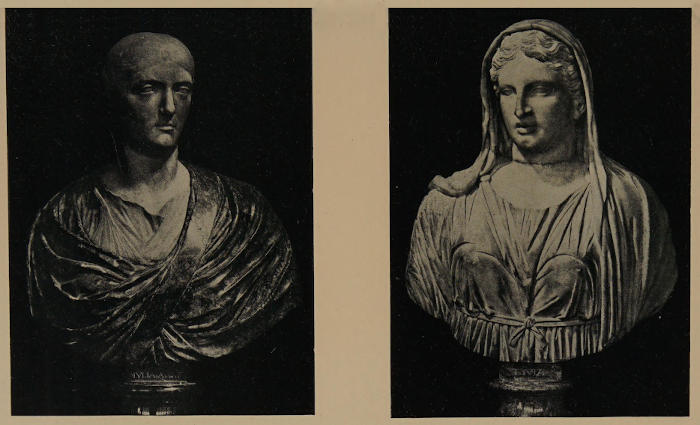
Julia, Daughter of Augustus.
From the Bust in the Uffizi Gallery, Florence.
To face page 234.
Livia, Wife of Augustus.
From the Bust in the Uffizi Gallery, Florence.
Page 274.
Iulia, b. B.C. 39; ob. A.D. 14.
At first, we are told, the marriage seemed likely to be a
happy one. Iulia accompanied her husband on his campaigns
in Dalmatia (B.C. 11-10), or at any rate awaited him at Aquileia,
where a child was born and died. But from that time
forward the breach between them was always
widening. Tiberius seems to have remembered
certain passages that had passed between them
while she was still the wife of Agrippa, and she regarded him
as her social inferior, and wrote a violent complaint of his character
and habits to Augustus—supposed to have been composed
for her by her lover, Sempronius Gracchus, who paid for that
service by his life in the first year of the next reign; and
when in B.C. 6 Tiberius retired to Rhodes, his motive seems
to have been as much to escape her company as to avoid the
awkwardness of his political position. Left thus to her own
devices in the midst of a corrupt society, she seems soon to
have outdone all former excesses. She was beautiful—except
that she early had grey hair—witty and wilful: so wilful
and capricious that Augustus used to say that he had “two
fanciful daughters whom he was obliged to put up with—the
state and Iulia.” She drew round her all the rich and extravagant
youth. At the amphitheatre, on one occasion, some
one pointed out the contrast between the respectable elderly
personages who surrounded Livia and the wild youth who
formed her own train. “Oh! they will grow old along with
me!” she replied. To a graver friend, who suggested that
she would do better to imitate the economical habits of her
father, she retorted: “He forgets that he is a Cæsar; I
remember that I am Cæsar’s daughter.” Once the Emperor
entered the room while she was at her toilet and noticed that
her tire women had been plucking out her grey hairs. He
stayed chatting on all kinds of subjects, and insensibly led the
conversation to the subject of old age. “Which would you
prefer?” he asked, “to be grey or bald?” “Oh, grey,” she
replied. “Then I wonder,” said he, “that you let these
women make you bald so soon.” She had at times given him
some unpleasant doubts as to her conduct. She came to see
him once dressed in a meretricious style, which she knew
would vex him. Next day she reappeared dressed with
complete decorum. He had said nothing the day before, but
now exclaimed, “Isn’t this a style more becoming to a daughter
of Augustus?” “Oh,” said she, “I dressed to-day for my
father to see, yesterday for my husband.”
He had never liked her mixing in general society as a girl.
She and his granddaughters, who lived in his house, were
trained to spend their time in women’s work, spinning wool,
and the like, and to have no secret conversations or idle talk;
and he once wrote to a young noble who had called on her
while staying at Baiæ that “he had taken a great liberty.”
But in spite of such seclusion she had developed a considerable
knowledge of and taste for literature, and her cheerful good
nature made her popular at court and in society. Her father
watched her career as a married woman, and from time to time
gave her half-grave and half-playful hints as to her extravagance
in dress and the style of people that surrounded her. But he
does not seem to have entertained serious suspicions. Meanwhile
she is said by our authorities not only to have been
indulging in numerous intrigues, but to have violated all
propriety and decency by joining in noisy revelry at night in
the streets and forum, and to have been present at parties where
men stayed late and drank deep. The crash came at a moment
that seemed a culminating one in the Emperor’s career, when
a scandal must have been peculiarly trying.
Pater patriæ, B.C. 2.
Since the beginning of B.C. 8 Augustus had been at home.
In that year a fresh period of his various powers had been duly
renewed by a vote of the Senate, which had also
honoured him by naming the month Sextilis after
him as “August,” and he had had the gratification
of welcoming Tiberius home from Germany victorious, and
witnessing his triumph. His young grandson Gaius was
designated consul in B.C. 5 for the sixth year from that time,
and the next year he himself took that office after an interval
of eighteen years, that he might add dignity to the ceremony
of Gaius taking the toga virilis. Though vexed at Tiberius’s
retirement to Rhodes, he had good reason to hope that in the
two young Cæsars the succession was well provided for. In
spite of some uneasiness on the German frontier and among
the Parthians, there was for the time profound peace. At the
beginning of B.C. 2 he was again consul, in order to introduce
the second grandson to the forum; and to show their appreciation
of his achievements, and their affection for his person, the
Senate at length voted to give him the title of “pater patriæ.”
It was first offered him by a popular deputation in his villa at
Antium. He made some difficulty about accepting it; but
the next time he appeared at the theatre or circus he was met
by loud shouts, the whole people addressing him by that title,
and at the following meeting of the Senate on the 5th of February
Valerius Messala was put up to address him formally: “With
prayers for your person and your house, Cæsar Augustus—for
in offering them we deem ourselves to be praying for the
perpetual felicity of the Republic and the prosperity of this
city—we, the Senate, in full accord with the Roman people,
unanimously salute you as Father of your country.” Augustus,
rising with tears in his eyes and voice, could just answer briefly,
“My dearest wishes have been fulfilled, Fathers of the Senate,
and what is there left for me to ask of the immortal gods
except that I may retain this unanimous feeling of yours to the
last day of my life?”
Though the title had long been popularly applied to
Augustus, this was the first official recognition of it. It had
very old historical precedent, from Romulus to Iulius Cæsar.
It was meant to be the highest compliment which could be
paid, but it conferred no new powers, though in after-times
some of the Emperors regarded it as giving them a kind of
paternal authority. Augustus was evidently highly gratified.
The shows given at his expense this year were of unusual
magnificence: gladiators, wild beast hunts, sham sea-fights on
the flooded Transtiberine fields, had all roused great enthusiasm,
and a special festival in his honour had been held at Naples—in
the Greek fashion—as an expression of thanks to him for
assistance rendered in the distress caused by a recent earthquake
and eruption of Vesuvius. The year thus opened with unusual
cheerfulness, and though now past sixty he might feel encouraged
by the popular enthusiasm to continue his work with
unabated energy.
Detection of Iulia.
Suddenly the disgrace that had been gathering round his
house was revealed to him. We are not told who enlightened
him and turned the suspicions which he had persistently
put away into certainty. Of course the
natural suggestion is that it was Livia, between
whom and Iulia, as mother of the two young heirs who stood
in the way of Livia’s son Tiberius, there was no cordial feeling.
The contrast in their ways of life, and the remarks
caused by it, no doubt reported by good-natured friends,
had not helped to make these relations any more pleasant.
But whoever was the informant, Augustus was at last
thoroughly roused, and thrown into the greatest state of
agitation. Whatever may have been his own private vices in
the past, the decorum of the palace in which Livia presided
was unimpeached and highly valued by him. The pure
atmosphere of the Augustan house—Horace says—and the
paternal care of the Emperor were mainly the causes of the
manly characters of Tiberius and Drusus, and Horace always
echoes what Augustus at any rate wished to be thought true.
To have the secrets of the family thus revealed to the multitude,
to the scorn of the hostile and the pity of the well-disposed,
was no doubt galling. He shunned society for some time and
kept away from Rome. He had also the additional annoyance
of reflecting that the publicity was greatly his own fault. In
the heat of his anger he wrote to the Senate and put the affair,
more or less, in its hands. In cooler moments he repented of
this, and exclaimed that “it would never have happened if
Agrippa and Mæcenas had been alive.” Several men are said to
have suffered death on the charge, though we only know of
two names, Iulius Antonius and Sempronius Gracchus, the
former of whom committed suicide, while the latter was
banished to an island on the African coast. Seneca, who
generally makes the worst of Augustus, says that he spared
their lives and punished them by banishment. The case of
Iulius Antonius was particularly bad. He was the son of
Antony by Fulvia, had been brought up by Octavia, married
to her daughter Marcella, and by her influence and the kindness
of Augustus, had been prætor (B.C. 13) and consul
(B.C. 10). He had therefore been treated as a member of the
family, and a highly favoured one. Gracchus is said to have
begun his intrigue while Iulia was the wife of Agrippa, and to
have helped to irritate her against her husband Tiberius. But
however guilty Iulia may have been, she did not forfeit the
popular affections. Again and again Augustus was assailed by
petitions to recall her. He passionately refused, exclaiming at
last to a more than usually persistent meeting, that he “would
wish them all daughters and wives like her.” The most that he
could be persuaded to grant was that at the end of five years
she should be allowed to exchange her island (Pandateria) for
Rhegium, and to live under less stringent conditions as to dress
and food, and the servants who attended her. Her mother,
Scribonia, accompanied her into exile, and though Tiberius,
acting under the authority of Augustus, sent from Rhodes a
message of divorce, he made a formal request that she might
be allowed to retain whatever he had given her. The sincerity
of such an intercession was illustrated by the fact that on the
death of Augustus he immediately deprived her of all allowances.
She, however, only survived her father a few weeks. All this
severity is perhaps best accounted for if we accept the statement
of Dio and Pliny, that she was charged not only with adultery,
but with joining in some plot against her father in favour of her
lover, Iulius Antonius.[310] At any rate it is difficult not to feel
some sympathy with a woman, married and re-married without
choice on her part or any question of affection, for nine years
the wife of a man as old as her father, and then transferred to
another, whose heart was fixed elsewhere, and whom his
warmest admirers cannot describe as one likely to be sympathetic
or expansive, one in fact who began with a strong
prejudice against her. She knew also that her own mother,
with whom she seems to have kept up affectionate relations,
had been turned off immediately after her birth for no assignable
reason, just as she had been married for a momentary
political object. She could have grown up with no very deep
reverence for her father’s morality or lofty ideas of the marriage
relationship.
Death of Gaius and Lucius Cæsar, A.D. 2-4.
From this time forward family misfortunes seemed to dog
the steps of Augustus for some years to come. The next blow
was the death of the two young sons of Iulia,
Gaius and Lucius, whom he had adopted, had
personally educated in their childhood, and was
training for their great future. When the elder was only 15
(B.C. 5) he had been designated consul for A.D. 1, and the
Senate had voted that he and his brother might at that age
“take part in public business,” that is, might be employed in
any capacity the Emperor might choose directly they assumed
the toga virilis. Accordingly, in B.C. 1, Gaius was sent to the
East, with a pretty wide commission to visit the Eastern
provinces. He seems to have travelled considerable distances,
and even entered Arabia. Tiberius, who was then at Rhodes,
crossed to Samos to greet him. The meeting, however, was
not a happy one. M. Lollius, the head of Gaius’s staff, seems
to have influenced the young prince against Tiberius, and
induced him to send home a report to the Emperor of certain
indications that he was contemplating some treasonable
measures. Augustus candidly informed Tiberius of this, and
it was it seems partly from the necessity of clearing himself,
that at the earnest entreaty of his mother, he, two years later,
sought and obtained the permission of Augustus to return to
Rome. Meanwhile there had been wild talk among the staff
of Gaius, one of them expressing his readiness to sail to Rhodes
and bring the head of “the exile” back. He does not, however,
appear to have forfeited the confidence or affection of
Augustus, who writes to him on the 23rd September, A.D. 1:
“Good day to you, Gaius, apple of my eye, whom by heaven
I continually miss when away. But it is especially on days
such as this one that my eyes seek for my Gaius; and wherever
you have spent it I hope that you have kept my sixty-fourth
birthday in good health and spirits. For you see I have safely
passed the grand climacteric, which for all old men is their 63rd
year. Pray heaven that whatever time remains for me I may
spend with the knowledge that you and your brother are safe
and sound and the republic supremely prosperous, with you
playing the man and preparing to take up my work.” But
these hopes were doomed to be disappointed, as we have seen,
by the treacherous wound received at Artagera in Armenia in
A.D. 4. Two years earlier his younger brother, Lucius, had
died suddenly and somewhat mysteriously at Marseilles at the
beginning of a progress through the Western provinces, which
was to form part of his political education. The fact that his
death corresponded nearly with the return of Tiberius from
Rhodes gave rise to suspicions that it had been caused by the
machinations of Livia, anxious to secure the succession for her
son. Even the death of Gaius, though so far away, was put
down to the same malignant influence; for it was argued that
his wound was slight and had not been expected to end fatally.
Tacitus records that the detractors of the imperial family were
accustomed to remark that “Livia had been a fatal mother to the
republic, a fatal stepdame to the family of the Cæsars.” There
is, however, no scrap of evidence to connect her with either
event. It is doubtful whether the young men had shewn much
promise; but their death was treated as a matter for public
mourning. At Pisæ, of which colony they were “patrons,”
there still exist two long and pompous inscriptions (Cenotaphia)
recording their death, speaking of the successful campaign of
Gaius in the East, ordering mourning “in view of the magnitude
of so great and unexpected a calamity,” and decreeing
various honours to the memory of Lucius “princeps
iuventutis,” and of Gaius “princeps designate.”
The succession.
These losses were followed by the adoption of Tiberius by
Augustus, and that of Germanicus by Tiberius. The former
had already several children, so that the sons and
grandsons and great-grandsons—by adoption—of
Augustus in A.D. 7, as recorded on the arch at Pavia, were
Tiberius; Germanicus; Drusus, son of Tiberius; Nero and
Drusus, sons of Germanicus, and Claudius, his brother. All
these survived Augustus. But Tiberius and Claudius alone
reigned, Caligula was not born till five years later (A.D. 12).
Fresh troubles. The younger Iulia.
Augustus thus felt that the succession was well secured;
but the last decade of his life was destined in some ways
to be the most troubled of all. The German
wars began again in A.D. 4, and culminated in
the Varian disaster of A.D. 9; while the difficulties
and alarm were increased by the dangerous risings in
Pannonia and Dalmatia (A.D. 6-9), during which Augustus
remained for some time at Ariminum, to be within moderate
distance of the seat of war. A renewed outbreak of piracy
also compelled him to take over the management of Sardinia
from the Senate for three years (A.D. 6-9). This was partly
the cause, perhaps, of the distress at Rome in B.C. 6 from
a rise in the price of corn, intensified by various disastrous
fires. The unrest thus created led to some more or less
dangerous conspiracies, such as that of Plautius Rufus, who
was accused of abetting disturbances and spreading seditious
libels. Others were connected with attempts to rescue Iulia
at Rhegium and Agrippa Postumus in Planasia, an island near
Elba. We also hear of a plot of one Cornelius Cinna, who
however was pardoned and allowed to be consul in A.D. 4.
Seneca asserts that after this act of clemency the life of Augustus
was never attempted again; and Dio has recorded a conversation
between him and Livia in that year, in which, seeing her
husband sleepless and torn with continued anxieties, she
recommended this policy of leniency. But one last mortification
remained for him. In A.D. 9 his granddaughter Iulia was
discovered to have followed her mother’s example. She
was married to Æmilius Paulus Lepidus, and had a son and
a daughter Lepida, once betrothed to the future Emperor
Claudius, but never married to him. Her lover, D. Silanus,
was not banished to any definite place, but was obliged to
leave Rome, to which he was not allowed to return till A.D. 20,
and then under disabilities for State employment. Iulia herself
was banished to the island Tremesus (St. Domenico), on the
coast of Apulia, where she remained till her death in A.D. 27,
supported by an allowance from Livia. We do not know
enough of the affair to judge of her guilt; but in some
mysterious way her husband was involved in a charge of treason
about this time. In the same year the poet Ovid was banished
to Tomi, forty miles south of the mouth of the Danube, in a
district exposed to constant raids of the Sarmatians and Dacians.
It has always been supposed that this severity was connected
with the affair of Iulia, and that either he was one of her
lovers, or was privy to some of her intrigues, amatory or
political. The reason assigned in the edict appears to have
been the licentiousness of his verse, and as Augustus was just
then engaged in reinforcing his laws against various forms of
immorality, and trying to encourage marriage as against
concubinage, this may have been partly the reason. Only as
his most licentious poems had been published seven years before
it seems a little late in the day. His own account of his
misfortune—never outspoken—goes through two phases. At
first he seems to wish to attribute it all to his amatory poems.
“He is a poet destroyed by his own genius: his verses have
been his undoing: they deserved punishment, but sure not so
heavy a one.” But presently he began to own that there was
something else: “Not,” he says, “any political offence, no
plot against the Emperor, no plan of violence against the
state. He had seen something he should not have seen. He
is ruined by his own simplicity and want of prudence, combined
with treachery on the part of friends and slaves. The exact
cause he dare not reveal, and yet it is well known at Rome.”
Ovid was now fifty-two and married for a third time to a wife
connected distantly with the imperial family. The chances
are therefore against an intrigue with Iulia. There is one
other possible explanation; Ovid was at Elba when he got
notice of the edict, staying with his wife’s connection, Paulus
Fabius Maximus, who afterwards incurred the suspicion of
Livia as favouring Agrippa Postumus, confined in the neighbouring
island of Planasia since B.C. 7. We know from
Suetonius that there was at least one plot to remove him, and
it may be that Ovid knew of it and even saw some of the
conspirators.
However that may be, the other explanation is also possible:
that Augustus meant what he said, and regarded Ovid’s works
as unwholesome. He was what would be called in our time a
“decadent” poet. He represents the worst side of Roman
society, as it began to be unfavourably affected by that abstention
from practical politics, which came to be the fashion in the
latter half of the reign of Augustus. He had himself refused
to take any office that would give him a seat in the Senate,
and seemed to think that to be the natural conduct of a man
of taste and literature. He was the mouthpiece of the gilded
youth who sought in amorous intrigue, and a fastidious dalliance
with the Muses, a more congenial employment than the performance
of those duties to the state which no longer held
out promises of unlimited wealth or power. He was only
cleverer than the ruck of such men, and Augustus may
possibly have selected him as the representative of a tendency
at which he was alarmed. Ovid was precisely the sort of man
to create the tone of society which had been the ruin of his
daughter and granddaughter. It is quite possible that being
intimate with such circles the poet may have known, or been
supposed to know, something inconvenient about the last
scandal, and, at any rate, he would be on the side of Iulia as
against her grandfather. At the time of his exile he was
engaged, at the Emperor’s suggestion or request, on the
composition of the poetical Calendar or Fasti, which was
incidentally to celebrate the chief events of Roman history,
and it has been suggested that the story of Claudia’s vindication
of her chastity (Fast. iv. 305 sqq.) was intended as a veiled
defence of the elder or younger Iulia. Whatever the offence
given, neither Augustus nor Tiberius could ever be induced
to allow his recall.
The poet’s abject language in praying to be allowed to
return illustrates incidentally the absolute supremacy of the
Emperor, and the attribution to him of divine honours and
powers, the steady progress of which has been noted in a
previous chapter. We may also note that what Paris is to the
Parisians, Rome is to Ovid. Augustus and his ministers or
friends had made it the home of splendour and luxury. The poet
fondly dwells on all its beauties, pleasures, and conveniences,
and, like a true Parisian, can hardly conceive of life away from
it, its games, its theatres, the sports on the Campus, the lounge
in the forum, or the wit and poetry heard at the tables of the
great. As the spring comes round in his dreary, treeless
dwelling on the Pontus, he thinks of the flowers and vines of
Italy, but, above all, of the pleasures of the city in April, the
month of festivals: “It is holiday with you now, and the wordy
war of the wrangling forum is giving place to the unbroken round
of festivals. The horses are in request, and the light foils are
in play. The young athletes, their shoulders glistening with oil,
are bathing wearied limbs in baths supplied by the virgin
stream. The stage is in full swing, and the audiences are
clapping their favourite actors, and the three theatres are echoing
instead of the three forums. Oh four times, oh beyond all
counting, happy he who may enjoy the city unforbidden!”
It had been the object of Augustus to make the city splendid
and attractive, and to keep the citizens comfortable and
contented and proud of their home. He had doubtless
succeeded; but it was sometimes at the cost of a lowered
standard of public duty and a growing devotion to personal
ease and enjoyment.
CHAPTER XIV THE LAST DAYS
Let the sound of those he fought for,
And the feet of those he wrought for,
Echo round his bones for evermore.
The activities of the last years of Augustus, A.D. 8-14.
The public and private troubles mentioned in the last chapter
did not break the spirit or paralyse the energies of the aged
Emperor, or prevent him from taking a strenuous
part in the administration of the Empire. The
last eight years of his life were full of stir and
movement, though our meagre authorities give
us few details. He actively supported the campaigns of
Tiberius and Germanicus; he was introducing reforms in
Gaul;[311] he was pushing on improvements in the East, and
founding a series of colonies in Pisidia as a defence against
the predatory mountain tribes; he was directing a census
of the whole Empire; he was emending his marriage laws by
the farther enactments contained in the lex Papia Poppæa,
which he supported by energetic speeches; he was elaborating
a great financial scheme; he was personally attending to the
embankment of the Tiber; he was reforming the city police
and fire brigades; and when the Varian disaster occurred we
have seen with what energy he acted, how he enforced the
law of military service and despatched reinforcements to the
Rhine, while he cleared the city of dangerous elements and
provided against possible movements in the provinces. Though
now seventy-two years old he shewed no sign of senility in
heart; and as it was said that at every stage of his life he had
the beauty appropriate to it, so in spirit, courage, and prudence
he seems always to have answered to any strain to which he
was submitted.
Financial measures of Augustus.
To understand the financial changes of these years it is
necessary to recall a few broad facts as to the revenue of the
Empire. It arose from (1) Italy, (2) the provinces.
In Italy the sources of revenue were the
customs (portoria), the rent of public land, the
vicesima or 5 per cent. on the value of manumitted slaves.
From the time that it became the habit to pay the soldiers,
a tributum or property tax had been raised, at first as a temporary
measure, or even as a loan, but gradually as a regular
thing. Since the Macedonian wars, however, B.C. 167, this
tributum had not been levied: the additional wealth acquired
by the new conquests being sufficient. It does not appear
that the tributum was abolished by law, and indeed for a short
time it was reimposed by the Triumvirs, though only as an
extraordinary tax (temerarium). After the Social war of B.C. 89
the Italians became full citizens and shared this exemption.
The second and most important source of revenue were the
provinces. There were royalties on mines, customs, rent of
public land, and other sources of profit to the government; but
also every province paid a stipendium—a certain sum of money—to
the Roman treasury. The manner in which it was paid—whether
in money or produce, or a mixture of the two—differed
in different provinces, as also did the mode of its
assessment and collection; but the broad fact was that each
province had to furnish a sum of money, and that owners
of property in a province were liable to a tributum or
tax.[312]
In the time of Augustus there was no great change made in
the nature or incidence of this taxation; but the management
of the treasury itself was revolutionised. In the first place,
the ærarium instead of being under the care of the yearly
elected quæstors, who issued money on the order of Senate
or magistrates, was put under præfecti appointed by the
Emperor, and though the Senate still had a nominal control
over it, it was really under his power. In the next place, a
new ærarium was formed, afterwards called the fiscus, into
which was paid the revenues of the imperial provinces. This
was entirely under the Emperor, and the tendency was in time
to have every extraordinary revenue, such as confiscations,
lapsed legacies (caduca), and the like, paid into it. Besides
this there was the patrimonium Cæsarum, the private property
of the Emperor in virtue of his office. To this belonged the
whole revenues of Egypt and the Thracian Chersonese, and
other large estates. When Augustus talks of his having
supplemented the treasury or made distributions to the people,
it is often from this fund that he drew, though he had besides
large personal property (res familiaris), which he employed at
times for the same purpose.
Of course from the revenue of the provinces had to be
deducted the cost of their administration and defence. Provinces,
therefore, which needed large forces and constant
defence from surrounding barbarians did not pay. Cicero,
indeed, asserts that in his time none of the provinces except
Asia paid for their expenses. This probably is an exaggeration,
but there is no doubt that the loss on some had to be put
against the gain on others, and that the balance of the yearly
budget was not always on the right side, as, at a later date, we
know that Vespasian said that the treasury wanted four hundred
million sesterces (about £3,000,000 sterling) to be solvent. The
outbreak of the German wars in A.D. 4, and the large forces
which it had long been necessary to keep upon the Rhine had
caused, if not a deficit, at any rate the near prospect of one.
It was just such a crisis as in old times would have justified
the levying of a tributum as a special war tax. There were,
however, two reasons against Augustus doing this. In the
first place, such a tributum would be temporary, and he wanted
a permanency; and, in the second place, the citizens had come
to view freedom from the tributum as their special privilege,
differentiating Italy from the subject provinces, and marking
them out as a governing body. True to his policy of avoiding
offensive names, while at the same time getting what he
wanted, Augustus decided against the tributum. What he did
was to create a new department, an army-pay treasury (aes
militare), with two præfects of prætorian rank. The money
in this treasury was to be devoted to the pay and pensions of
the soldiers. He started it with a gift in his own name and
that of Tiberius of 170,000,000 sesterces (about £1,500,000),
and arranged that the tax which he had contrived soon after
the end of the civil wars, the 1 per cent. on goods sold at
auctions or by contract, should be paid into it. But this was
not sufficient for the purpose, and he had to look round for
other means of raising revenue. He did therefore what a late
Chancellor of the Exchequer did for us—he imposed death
duties: 5 per cent. on all legacies except those from the
nearest relatives. This avoided the offensiveness of depriving
the people of Italy of a valued privilege, while it in fact
brought them financially almost in a line with the provinces.
For those who paid tributum did not pay vicesima, and vice
versâ. Still the tax offended a powerful class and met with
much resistance. The practice of leaving large legacies to
friends, as an acknowledgment of services rendered, was
common in Italy, and the tax therefore fell heavily upon the
rich. In A.D. 13 a determined move was made in the Senate
to obtain its abolition. Augustus sent a written communication
to the Senate, pointing out that the money was necessary,
but asking them to contrive some other method of raising it.
The Senators declined to formulate any plan, and only answered
that they were ready to submit to anything else. Thereupon
Augustus proposed a tributum or tax on land and houses.
Confronted with this alternative the Senate at once withdrew
from opposition. It was a case of financial necessity, and it
must not be supposed that Augustus wished to lower the prestige
of Italy or the value of the citizenship. That was one of the
points in which he reversed the policy of Iulius, who had been
lavish in bestowing the citizenship, and seems to have had
visions of a uniform Empire united in privilege as in government.
Augustus, on the other hand, was even ultra-conservative
and ultra-Roman in this respect. He made constant difficulties
about granting the citizenship. In answer to Tiberius, who
begged it for some favourite Greek, he insisted upon only
granting it if the man appeared personally and convinced him
of the soundness of his claim. Even Livia met with a refusal
in behalf of some Gaul. The Emperor offered to grant the
man immunity from tribute, saying that he cared less about
a loss to his treasury than for vulgarising the citizenship.
Declining health and strength.
Though Augustus shewed in this transaction all his old tact
and statesmanship with no failure either in determination or
power of finesse, yet he was growing visibly feebler
in body. He gave up attending social functions;
and it was too much for him to appear any longer
at meetings of the Senate. Accordingly, instead of the half-yearly
committee of twenty-five members who used to be appointed
to prepare measures for the House, a sort of inner cabinet of
twenty members appointed for a year—with any members of
his family whom he chose—met at his house and often round
the couch on which he was reclining, and their decisions were
given the force of a Senatus-consultum. His interest, however,
in every detail was as keen as ever. For instance, we have a
letter from him to Livia, written at the end of A.D. 11, as to
the advisability of allowing Claudius (the future Emperor) to
appear in Rome during the ceremonies connected with the
consulship of his brother Germanicus. Claudius (now twenty-one)
was reported to be deformed and half-witted, and his
mother Antonia herself described him as scarcely human
(monstrum hominis). The letter is worth reading, partly
because it is the only complete one (at any rate, of any
length) which we possess, and partly because it illustrates the
care which Augustus took to keep up the prestige of the
imperial family, to avoid, above all things, incurring popular
ridicule, and his attention to minute details:—
“I have consulted with Tiberius, as you desired me to do,
my dear Livia, as to what is to be done about your grandson
(Claudius) Tiberius. We entirely agree in thinking that we
must settle once for all what line we are to take in regard to
him. For if he is sound and, to use a common expression, has
all his wits about him, what possible reason can there be for our
doubting that he ought to be promoted through the same grades
and steps as his brother? But if we find that he is deficient,
and so deranged in mind and body as to be unfit for society, we
must not give people accustomed to scoff and sneer at such
things a handle for casting ridicule both on him and on us.
The fact is that we shall always be in a state of agitation if we
stop to consider every detail as it occurs, without having made
up our minds whether to think him capable of holding offices
or not. On the present occasion, however, in regard to the
point on which you consult me, I do not object to his having
charge of the triclinium of the priests at the games of Mars if
he will submit to receive instructions from his relative, the son
of Silanus, to prevent his doing anything to make people stare
or laugh. We agree that he is not to be in the imperial box
at the Circus. For he will be in full view of everybody and
be conspicuous. We agree that he is not to go to the Alban
Mount or to be in Rome on the days of the Latin festival.
For if he is good enough to be in his brother’s train to the
mountain, why should he not be honorary city prefect? Those
are the decisions at which we arrived, my dear Livia, and we
wish them to be settled once for all to prevent our wavering
between hope and fear. You are at liberty, if you choose, to
give Antonia this part of my letter to read.”
Confidence in Tiberius.
Perhaps the voice is the voice of Tiberius, but the courtesy
and well-bred style are all Augustus’s. By this time the
influence of Tiberius was well established, and
Augustus treats him as a successor who has a
right to be consulted on all family matters and
important State affairs. Since his return from Rhodes Tiberius
had done eminent service to the State both on the Rhine and
in Illyricum. In appointing Varus to Germany Augustus had
made a mistake which he seldom committed. He had nearly
always picked good men, but P. Quintilius Varus had not
only been extortionate in his former province, but was neither
energetic nor prudent; and his experience among the unwarlike
inhabitants of Syria was not a good preparation for dealing
with the brave and warlike Germans. Tiberius knew him
well, having been his colleague in the consulship of B.C. 13,
and would certainly not have appointed him. It was to
Tiberius that the Emperor then turned to retrieve the disaster
and confront the almost more serious dangers in Illyricum.
And if he found him trustworthy in the field, this letter shows
how much confidence he felt in him at home. It was a
common report that Augustus knew and disliked his character.
The lackeys of the palace gave out that he had on one occasion
exclaimed, “Unhappy people of Rome who will some day be
the victims of those slow grinders!” And in a speech to the
Senate some expressions used by him were taken to convey an
apology for his reserved and sullen manners, and an acknowledgment,
therefore, of his mistrust or dislike. But it is abundantly
plain that in these last years he not only trusted his
military abilities, but felt a sincere affection for himself. In
earlier times, before the retreat to Rhodes, the short notes
written to him (parts of which are preserved by Suetonius[313])
are playful and intimate; and though he was vexed at his
retirement and answered a suggestion of return by a message
bidding him “dismiss all concern for his relatives, whom he
had abandoned with such excessive eagerness,”[314] yet the
fragments preserved of the Emperor’s letters to him in these
later times breathe not only admiration, but warm affection.
“Goodbye, Tiberius, most delightful of men! Success to you
in the field, you who serve the Muses as well as me! Most
delightful of men, and, as I hope to be happy, bravest of heroes
and steadiest of generals!” And again: “How splendidly
managed are your summer quarters! I am decidedly of
opinion that, in the face of so many untoward circumstances
and such demoralisation of the troops, no one could have borne
himself with greater prudence than you are doing! The
officers now at Rome who have served with you all confess
that the verse might have been written for you, ‘One man by
vigilance restored the State.’” Once more: “Whenever anything
occurs that calls for more than usually earnest thought
or that stirs my spleen, what I miss most, by heaven, is my
dear Tiberius, and that passage of Homer always occurs to
me—
“‘If he but follow, e’en from burning fire
We both shall back return, so wise is he!’”
And in the midst of his laborious campaign the Emperor
writes to him anxiously: “When I hear or read that you
are worn out by the protracted nature of your labours, heaven
confound me if I do not shudder in every limb; and I beseech
you to spare yourself, lest if we hear of your being ill your
mother and I should expire and the Roman people run the
risk of losing their empire. It doesn’t matter a bit whether I
am well or not as long as you are not well. I pray the gods
to preserve you to us and to suffer you to be well now and
always, unless they abhor the Roman people.”
These letters seem sufficiently to refute the idle stories of
the gêne that his presence was to Augustus, of his being a wet
blanket to cheerful conversation, and a makeshift with which
the Emperor was forced to put up in default of better heirs.
Nor did Tiberius fall short in respect and loyal service. After
his adoption in A.D. 4, he immediately accepted the position of
a son under the patria potestas, abstained from manumissions
and other acts of a man who was sui iuris, and apparently transferred
his residence to the palace, and seems really to have taken
the burden from shoulders no longer strong enough to bear it.
Death of Augustus at Nola, August 19, A.D. 14.
For now the end was near, portended as the pious or
credulous believed by many omens. There was an eclipse of
the sun,[315] and various fiery meteors in the sky.
On one of his statues the letter C of Cæsar was
melted by lightning, and the augurs prophesied,
or afterwards invented the prediction, that he
would die within a hundred days and join the gods—æsar
being good Etruscan for “divinities.” He himself seems to
have been made somewhat nervous by certain accidents that
might be twisted into omens. The early part of A.D. 14 was
taken up with the usual legal business, but also with the
Census, which he held this year in virtue of his consular power
and with Tiberius as his colleague. The organisation of the
city into vici probably made the actual clerical work easy and
rapid, but when that was over came the ceremony of “closing
the lustrum” (condere lustrum), and the offering of solemn
sacrifice and prayer. This took place in the Campus Martius,
and large crowds assembled to witness it. But the Emperor,
uneasy at something which he thought ominous, or perhaps
really feeling unwell, would not read the solemn vows, which
according to custom had been written out and were now put
into his hands. He said that he should not live to fulfil them
and handed them over to Tiberius to read. After this ceremony
was over, Augustus was anxious to get away from Rome
and take his usual yachting tour along the Latin and Campanian
coast. On this occasion he had the farther object of
accompanying Tiberius as far as Beneventum on the Appian
road, on his way to Brundisium and Illyricum, where some
difficulties resulting from the recent war required his presence
and authority. But various legal causes awaiting decision
detained the Emperor in the city. He was restive and
impatient at the delay, and petulantly exclaimed that “if they
let everything stop them he should never be at Rome again.”
At length, however, he set out, accompanied by Livia and
Tiberius and a numerous court. They reached the coast at
Astura, in the delta of a river of the same name, which falls
into the sea at the southern point of the bay of Antium. It
was a quiet place though there were seaside villas near, and
there Cicero had spent the months of his mourning for Tullia,
finding consolation in the solitude of the woods which skirt
the side of the stream. At Astura the party embarked, but
owing to the state of the wind they did so by night. A chill
then caught brought on diarrhœa, and laid the foundation of
his fatal illness. Nevertheless the voyage along the Campanian
coast and the adjacent islands was continued till they
reached Capreæ. It was on this voyage that, happening to
touch at Puteoli, he was so much delighted and cheered by the
thanks offered him by the crew of an Alexandrian corn-ship
for his safeguarding of the seas. At Capreæ he seems to have
stayed some time, amusing himself by watching the young
athletes training for the Greek games at Naples—the only
town in Italy except Rhegium which at this time retained any
traces of Hellenic customs and life. He gave parties, also, at
which he asked his Roman guests to dress in Greek fashion
and speak Greek, and the Greeks to use Roman dress and
speak Latin. There was the usual distribution of presents,
and on one occasion he gave a banquet to the athletes in training,
and watched them after dinner pelting each other with
apples and other parts of the dessert. It was a custom, more
honoured in the breach than in the observance, with which he
was familiar. He once entertained a certain Curtius, who
prided himself on his taste in cookery, and who thought a fat
thrush that had been put before him was ill-done. “May I
despatch it?” he said to the Emperor. “Of course,” was the
reply; upon which he threw it out of the window. On this
occasion the aged Emperor, feeling, we may suppose, somewhat
better and glad to be away from the cares of State, enjoyed
this curious horse-play. He was also particularly cheerful
during these days at Capreæ, pleasing himself with inventing
Greek verses and then defying one of Tiberius’ favourite
astrologers to name the play from which they came.
Before long, however, he crossed to Naples, with his illness
still upon him, but with alternate rallies and relapses. At
Naples he had to sit through some long gymnastic contests
that were held every fifth year in his honour. Such a
function in an August day at Naples would have been
trying to the most vigorous and healthy, but for a man in his
seventy-sixth year, and suffering from such a complaint, it
must have been deadly. He preferred, however, not to disappoint
people eager to shew him honour. He then fulfilled his
purpose of accompanying Tiberius to Beneventum, and having
taken leave of him there turned back towards Naples. But he
was never to reach it. At Nola, about eighteen English miles
short of that town, his illness became so acute that he was
obliged to stop at the villa there in which his father had died
seventy-two years before. Messengers were hastily sent to
recall Tiberius. With him the dying man had a long private
conversation, in which he seems to have imparted to him
his wishes and counsels as to the government; and perhaps it
was now that he pointed out the three nobles who were
possible candidates for the succession—“Marcus Lepidus, who
was fit for it, but would not care to take it; Asinius Gallus,
who would desire it, but was unfit; and L. Arruntius, who
was not unfit for it and would have the courage to seize it if
opportunity offered.” But this conference over he busied
himself with no other affairs of State. He seemed to acquiesce
in the fact that he had done with the world, its vexations
and problems. On the last day of his life, the 19th of August
(his lucky month!) the only question which he continually
repeated was whether his situation was causing any commotion
out of doors. Then he asked for a mirror and directed his
attendants to arrange his hair and close his already relaxing
jaws, that he might not shock beholders by the ghastliness of
his appearance. Then his friends were admitted to say goodbye.
With a pathetic mixture of playfulness and sadness he
asked them whether “they thought that he had played life’s
farce fairly well?” quoting a common tag at the end of
plays:—
“If aught of good our sport had, clap your hands,
And send us, gentles all, with joy away.”
These being dismissed, he turned to Livia and asked for news
of one of her granddaughters who was ill; but even as he
spoke he felt the end was come—“Livia, don’t forget our
wedded life, goodbye!” And as he tried to kiss her lips he
fell back dead.
It was a rapid and painless end, for which he had so often
hoped, an euthanasia that he used to pray for, for himself and
his friends. Up to the last his mind had been clear, with only
the slightest occasional wandering. And so after long years of
work and struggle, of mixed evil and good, of stern cruelties
and beneficent exertion, of desperate dangers and well-earned
honours, the great Emperor as he lay dying looked into the
eyes which he had loved best in the world.
The body was borne to Rome by the municipal magistrates
of the several towns along the road, the cortège always moving
by night because of the heat, and the bier being deposited in
the court-house of each town till it reached Bovillæ, twelve
miles from Rome. There a procession of Roman knights took
it in charge, having obtained that honour from the consuls,
conducted it to Rome, and deposited it in the vestibule of his
own house on the Palatine.
With not unnatural or unpardonable emotion some extravagant
proposals were made in the Senate as to funeral honours
and general mourning. But Tiberius disliked such excesses,
and the funeral though stately was simple. The bier was
carried on the shoulders of Senators to the Campus. Twice
the cortège stopped, first at the Rostra, where Drusus, the son
of Tiberius, delivered a funeral oration (laudatio), and again at
the front of the temple of Iulius, where Tiberius himself read
a panegyric. Drusus had dwelt chiefly on his private virtues,
Tiberius confined himself to his public work. He began with
a reference to his youthful services to the state immediately
after the death of Cæsar; his success in putting an end to the
civil wars, and his clemency after them. He spoke of the skill
with which, while splendidly rewarding his ministers, he yet
prevented them from gaining a power detrimental to the
state; of his disinterested and constitutional conduct when,
having everything in his hands, he yet shared the power with
the people and Senate; of his unselfishness in the division of
the provinces in taking the difficult ones upon himself; of his
equity in leaving Senate and constitution independent; of his
economy and liberality; of the good order which he kept and
the wholesome laws which he carried; of his sympathy with
the tastes and enjoyments of the people; of his hatred of
flattery and tolerance of free speech. The address was read
and had been carefully composed. There is not much fervour
or eloquence in it, but it skilfully put the points which
Augustus would himself have put, and indeed had put in that
apologia pro vita sua which we know from the inscription at
Ancyra.
The speeches over, the cortège moved on to the Campus
Martius, where the body was burnt on the pyre prepared for it,
and the ashes ceremoniously collected by eminent equites, who
according to custom wore only their tunics, without the toga,
ungirdled, and with bare feet. The urn was then deposited
in the Mausoleum which Augustus had himself erected in
B.C. 28 on the Campus close to the curving river-bank, which
had already received the ashes of his nephew Marcellus, of his
sister Octavia, of his two grandsons, and of his great friend and
minister Agrippa, but was sternly closed by his will to his erring
daughter and granddaughter.
His will, and other documents left by him.
Always careful and businesslike, he left his testamentary
dispositions and the accounts of his administration in perfect
order. His will, which had been deposited with
the Vestal Virgins and was now read aloud by
Drusus in the Senate, made Tiberius heir to two-thirds,
Livia to one-third of his private property. In case of
their predeceasing him it was to be divided between Drusus
(son of Tiberius), Germanicus, and his three sons, as “second
heirs.” There were liberal legacies to citizens and soldiers
and to various friends. The property thus disposed of was
the res familiaris: the Patrimonium Cæsarum—Egypt, the
Thracian Chersonese, and other estates—went to his successor
in the principate. The will contained an apology for the
smallness of the amount thus coming to his heirs (150,000,000
sesterces or about £1,200,000) on the plea that he had devoted
to the public service nearly all the vast legacies which had
fallen to him. By the will Livia was also adopted into the
Iulian gens and was to take his name. She was thenceforth
therefore known as Iulia Augusta, and seems to have assumed
that thereby she obtained a certain share in the imperial prerogatives,
a claim which led to much friction between herself
and her son.
Besides the will, and a roll containing directions as to his
funeral, there were two other documents drawn up by
Augustus with great care. One was a breviarium totius
imperii, an exact account of the state of the Empire, the
number of soldiers under colours, the amount of money in the
treasury or the fiscus, the arrears due, and the names of those
freedmen who were to be held responsible. As a kind of
appendix to this were some maxims of state which he wished
to impress upon his successor: such as, not to extend the
citizenship too widely, but to maintain the distinction between
Roman and subject; to select able men for administrative
duties, but not to allow them to become too powerful or think
themselves indispensable; and not to extend the frontiers of
the Empire.
A third roll contained a statement of his own services and
achievements (index rerum a se gestarum). Meant to be preserved
as an inscription, it is in what we might call the
telegraphic style, a series of brief statements of facts without
note or comment beyond the suggestiveness of a word here
and there designedly used. Yet it is essentially a defence of
his life and policy—the oldest extant autobiography. He
directed it to be engraved on bronze columns and set up outside
the Mausoleum. This was no doubt done, but the bronze
columns have long ago disappeared.[316] Fortunately, however,
copies of the inscription were engraved elsewhere (with a
Greek translation) in temples of “Rome and Augustus,” as at
Apollonia in Pisidia and Ancyra in Galatia. That at Ancyra
(Angora) exists nearly complete to this day, and some portions
at Apollonia. No life of Augustus could be complete without
this document, which is therefore given in an English dress at
the end of this book.
The Senate at once proceeded to decree divine honours to
him. A temple was to be built at Rome, which was afterwards
consecrated by Livia and Tiberius. Others were
erected elsewhere, and the house at Nola in which he died was
consecrated. His image on a gilded couch was placed in the
temple of Mars, and festivals (Augustalia) were established
with a college of Augustales to maintain them in all parts of
the Empire, as well as an annual festival on the Palatine which
continued to be held by succeeding Emperors.
Rumours as to the death of Augustus.
The usual foolish rumours followed his death. Some said
that Tiberius did not reach Nola in time to see him alive;
that he had died some time before, but that Livia
closed the doors and concealed the truth. Others
even said that his death had been hastened by
Livia by means of a poisoned fig; and professed to explain it
by a piece of secret court history. Shortly before his death,
they said, Augustus had gone attended only by Fabius Maximus
on a secret visit to Agrippa Postumus in the island of Planasia,
to which he had been confined since the cancelling of his
adoption in A.D. 5; and that Livia fearing that he would relent
towards him and name him as successor, determined that he
should not live to do so, Fabius Maximus having meanwhile
died suddenly and somewhat mysteriously. But the authentic
accounts of his last illness and death give the lie to such an
unnecessary crime. Unhappily the jealousy of the unfortunate
Agrippa Postumus was a fact which helped to spread such
stories, but it was a jealousy roused by the knowledge of some
secret plots to carry him off and set him up as a rival, and “the
first crime of the new reign”—his assassination by his guards—must,
we fear, lie at the door of either Tiberius or Livia.
Another report was that the soul of Augustus flew up to heaven
in the shape of an eagle that rose from his pyre. Nor must
the ingenious Senator—Numerius Atticus—be omitted, who
declared on oath that he had seen the soul of the Emperor
ascending, and was said to have received a present of 25,000
denarii (about £1,000) from Livia in acknowledgment of this
loyal clearness of vision.
The continuous government.
The prudent forethought of Augustus in regard to the
succession answered its purpose. There was practically no
break in the government. Tiberius was possessed
of tribunicia potestas, which enabled him to
summon and consult the Senate. He also, in
virtue of his proconsular imperium, gave the watchword to the
prætorian guard, and despatched orders to the legions in service
in the provinces. There was, indeed, some question as to
whether this imperium legally terminated with the death of
the princeps, but the matter was settled by all classes taking
the oath (sacramentum) to him, and all the powers and honours
(except the title of pater patriæ, which he would not accept)
were shortly afterwards voted to him in the Senate and confirmed
by a lex. His professed reluctance to accept the whole
burden only brought out more clearly how the work of
Augustus had made the rule of a single man inevitable: “I
ask you, sir, which part of the government you wish to have
committed to you?” said Asinius Gallus. No answer was
possible. A man could not control the provinces without
command of the army. But he could not control the army if
another man controlled the exchequer. He could not keep
order in Rome and Italy, if another had command of all the
legions and fleets abroad, and could at any moment invade the
country or starve it out by stopping the corn-ships. And if a
man had the full control of the purse and the sword, the rest
followed. It was well enough for the officials to have the old
titles and perform some of the old work, but if the central
authority were once removed there would be chaos. The
Senate had attempted to exercise that central authority and
failed. It could not secure the loyalty of men who, exercising
undisturbed power in distant lands, soon grew impatient of
the control of a body of mixed elements and divergent views,
which they often conceived to be under the influence of
cliques inimical to themselves. The provinces too as they
became more Romanised were certain to claim to be put on a
more equal status with Italy: they could only be held together
by a man who had equal authority everywhere, never by a
local town council. Augustus, indeed, did not realise this
development, or rather he feared its advent. In his eyes Rome
ought still to rule, but could only do so by all its powers being
centred in one man, who could consult the interest and attract
the reverence of all parts of the Empire alike. The success
of this plan depended, of course, on the character of the man,
and perhaps, above all, on his abilities as a financier; but, at any
rate, it was impossible to return to a system of divided functions,
and constitutional checks, which were shewn to be inoperative
the moment a magistrate drew the sword and defied them. So
far the work of Augustus stood, and admitted of no reaction.
Republican ideals could only be entertained as pious opinions,
not more practical than some of the republican virtues, on the
belief in which they were founded.
CHAPTER XV THE EMPEROR AUGUSTUS, HIS CHARACTER AND AIMS, HIS WORK AND FRIENDS
Hic vir hic est, tibi quem
promitti sæpius audis.
The early career and change of character.
When a great piece of work has been done in the world it is
not difficult to find fault with it. A man seldom if ever sees
the bearing and ultimate results of his own actions,
or carries out all that he intended to do. Even
when he seems to have done so, time reveals
faults, miscalculations, failures. At an age when
among us a boy is just leaving school, Augustus found himself
the heir of a great policy and a great name amidst the ruins of
a constitution and the disjecta membra of a great Empire.
A comparatively small city state had conquered the greater
part of the known world, and proposed to govern it by the
machinery which had sufficed when its territory was insignificant,
not extending at any rate beyond the shores of Italy.
A close corporation, greedy and licentious, had divided
amongst its members the vast profits from the gradually extending
dominions. The central authority which should have
restrained the rulers of distant provinces and the collection of
their revenues was composed to a great extent of those most
deeply interested in the corruptions which it was their duty to
judge and condemn. Loyalty to this central authority grew
weaker and weaker, party spirit grew stronger and less
scrupulous. In the desperate struggle for wealth and luxury
men stuck at nothing. Bloodshed bred bloodshed, violence
provoked violence, till good citizens and honourable men (and
there were always such) found themselves helpless; and the
constitution which had rested on the loyalty of magistrates and
citizens was ready to fall at the first touch of resolute disobedience.
Then a great man appeared. Iulius Cæsar had
not been free from the vices or corruption of his contemporaries;
but party connections at home led him to sympathise
with the people, and the ten years of war and government in
Gaul, during which his enemies at home were constantly
threatening and thwarting him, had convinced him that the
existing constitution was doomed. He was resolved to attempt
its reconstruction, even at the risk of civil war. But civil war
is a sea of unknown extent. Conqueror though he was in all
its battles, it left him only a few months to elaborate reforms.
In those he did some great things; but his revival of the
Sullan Dictatorship was too crude a return to monarchy, while
the exigencies of civil war forced him to employ inferior agents.
The aristocratic clique saw themselves about to lose their
cherished privilege of tyranny and extortion, and they killed
him.
When Octavian came home to take up his inheritance, he
would naturally have joined Antony, and taken immediate
vengeance on the guilty clique. But he found him intent
upon the consolidation of his own position, and not inclined to
admit his claim to the inheritance or to any share of power.
He therefore outwardly joined the leaders of the party which
he detested in order to get rid of Antony and forestall his bid
for autocracy. The vicissitudes of the struggle which followed,
ending in the triumvirate and the division of the Roman
world, infected him with the poison of civil strife—the cruelty
which treats honourable enemies as outlaws, and regards
personal triumph as the only end of political exertion. This
period in his career and in the development of his character
ends with the victory over Sextus Pompeius, in B.C. 36, and
the additional security gained by the successes of Agrippa in
Gaul during the two preceding years. From that time he
began to regard himself as the champion of law and order, as
the defender of Italy, and the guarantee of peace in the
Western Provinces.
Then came a great danger—the danger of a separation of
East and West. Under the influence of his passion for
Cleopatra, Antony was building up a new empire of subordinate
kings, it is true, but subordinate to Alexandria not
Rome: and Alexandria was being adorned with the spoils of
Asiatic temples to make it a worthy capital of the Eastern
world. How far this was really to involve a diminution of the
Roman Empire was probably not clear to Antony himself.
The old provinces were not formally separated, but they were
pared and diminished to round off the new kingdoms for his
and Cleopatra’s children. At Rome the danger was looked
upon as a real one; and once more Augustus felt that if he
was to have a free hand in the renovation of the Empire which
he contemplated, Antony must disappear. No doubt every
artifice was employed to discredit his opponent, and to convince
the Roman people that their dominion in the East was
slipping from them. But, however Machiavellian his tactics,
there was a solid basis of fact beneath them; a real danger of
separation had existed. The victory of Actium settled that
question; and when the few severities which followed it were
over, we are happily called thenceforth to contemplate the
legislator and reformer, the administrator of, on the whole, a
peaceful Empire. There were no more civil wars, and no
serious conspiracies. With rare exceptions—perhaps only the
Arabian expedition—the wars in which Augustus was henceforth
engaged were the necessary consequences of a long
frontier. War was often prevented by diplomacy, and such
wars as were undertaken were always successful, with the
exception of those with the Germans, and even in their case
immediate danger was averted.
The moral problem presented by the change from ruthless
cruelty to wise and persistent clemency has exercised the
minds of philosophers and historians ever since. “It was not
clemency,” says Seneca, “but a surfeit of cruelty.” But this
explains nothing. If Augustus had ever been cruel for
cruelty’s sake, the increased opportunities of exercising it
would have whetted his appetite for blood as it did in some of
his successors. It was circumstances that had changed, not
altogether the man. Still, no doubt, success softened (it does
not always) Augustus’s character. His ministers were humane
men and in favour of milder methods; his wife was a high-minded
woman, and always ready to succour distress, as she
shewed during the proscriptions, and afterwards in her son’s
reign. He had among his immediate friends philosophers and
men of letters, whose influence, so far as it went, was
humanising. And lastly such opposition as still existed was no
longer of irreconcilables who had known “liberty”; a new
generation had grown up which on the whole acquiesced in
the peace and security of a benevolent despotism. It was a
new era, and Augustus became a new man. Full of honours
and possessed with irresistible powers, feeling the responsibility
heavily, and often in vain desiring rest, he had no farther
personal object to gain beyond the credit of having served his
country and saved the Empire. The apologia of the index
rerum, brief and bald as it is, was intended to shew that he had
done this.
The value of his work.
In estimating the value of his work we are met with this
difficulty at the very threshold of the inquiry, that his object
was to avoid quick and conspicuous changes.
Instead of discussing some heroic measure we
have to examine a multitude of details. In every
department of political and social life we trace his hand.
Working day and night, he was scheming to alter what he
thought bad, and to introduce what he thought good. The
reconstruction and embellishment of the city, the restoration
of religion, the rehabilitation of marriage, measures necessary
for the security of Rome and Italy, for the better government
and material prosperity of the provinces, for the solvency of
the exchequer, and for the protection of commerce—all these
continually occupied his time and his thoughts. Of this
steady industry this or that result may be open to criticism,
but, on the whole, it seems certain that it increased the good
order and prosperity of the Empire, and therefore added to the
comfort and happiness of innumerable lives.
Advantages and disadvantages of the autocracy.
But of course the upshot of it all was the establishment of
a monarchy; and it still remains to be considered how far its
benefits were counterbalanced by evils arising
from the loss of freedom. It might be argued
that tyrants always appeal to their right use of
power however irregularly obtained, but that the plea is beside
the question. Freedom is the only guarantee of the continuance
of good government. The beneficent tyrant may any day be
succeeded by a bad one. The policy of Augustus had led the
people on step by step to forfeit this freedom, and lose even the
taste for it, lulled to sleep by the charms of safety and luxury.
When the glamour had faded from some eyes, it was too late.
The generation which had known freedom had disappeared;
the experience necessary for working the old machinery no
longer existed. The few who still remembered with regret
the old constitution, under which they had hoped to take an
independent share of political activity, had nothing left to them
but sullen submission.
In the provinces.
In the provinces, indeed, this consideration did not apply. The
despotism there added to the sum of happiness and took nothing
away. They had lost their independence long
ago. They were already under a master, a master
who was changed at short intervals, whom it was very difficult
to bring to an account if he were oppressive, in whose selection
they had had absolutely no share, and whose character
they had no means of calculating beforehand. They might
one year be enjoying all the benefits of an able and disinterested
ruler, the next they might find themselves in the
power of a tyrannical extortioner, selfish, cynical, cruel. The
old republican names and ideals were nothing to them; or
rather they suggested organised oppression and a conspiracy to
refuse redress. The change to one master, who had everything
to gain by their prosperity, and was at the same time
master of their old oppressors, must have seemed in every
respect a blessing. If there was any drawback it was that
nationality and the desire for self-government were killed by
kindness. In all difficulties and disasters they looked to the
Emperor for aid and seldom looked in vain. In the East
especially this was probably not wholesome; yet the immediate
effects in producing prosperity and comfort were marked
enough to put aside for the present all such scruples.
In Italy.
But for the governing nation itself, while some of the
benefits were no less manifest, the mischievous results were
more easy to point out. Material prosperity was
much increased. The city was made a pleasant
and attractive place of residence. Italy was partially repeopled
with an industrious class. Commerce was encouraged
and protected, literature and the fine arts were fostered, and
the Palace on the whole set a good example of simplicity of
living. But, on the other hand, the rule of a single person
stifled political life. By the system of curæ or special commissions
all administrative work was transferred to nominees of
the Emperor, who were often his intimate friends, or even his
freedmen, bound to him by the closest ties of subordination.
The old magistracies became unattractive, not only because
they no longer led as a matter of course to profitable employment
abroad, but because their holders had little of interest to
do. The Senate, though treated with respect and retaining
some importance as a high court of justice, was practically no
longer a governing body. It was wholly at the beck of the
Emperor, and such work of consequence as it still performed
was often transacted by small committees, the main body
merely assenting. In spite, therefore, of the dignity of the
Senator’s position, it ceased to attract the best men. The
higher classes turned away from a political career, and gave
themselves up more and more to luxurious idleness. The rise
of the freedman—practically the rule of favourites—was clearly
foreshadowed, though owing to the industry of Augustus, and
his genius for detail, it did not become prominent in his time.
As the upper classes were thus to a certain extent demoralised
by the Principate, so the city proletariat was pampered and
made still more effete. The city was made only too attractive
to them, and they were to be kept in good humour by an
endless series of games and shows. There was a good deal of
truth in the retort of the player Pylades, when reproved by
Augustus for his feud with Bathyllus, that it was for the
Emperor’s advantage that the people should have their attention
fixed on the playhouse rather than on politics. But they soon
began not only to regard these amusements as their right: they
expected also to be fed at the cost of the government, whether
by direct gifts of money, or by the distribution of cheap or
even gratuitous corn. Nor can it be said that the amusements
provided for them were of an elevating nature. Augustus
boasts in the Index (c. 20), that he gave seven shows of
gladiators in his own name or that of his sons, in which about
10,000 men in all had fought;[317] and besides other games
twenty-six venationes of “African beasts,” i.e., mostly elephants,
in which about 3,500 were killed. The mob of Rome
needed little brutalising, but they got it in abundance.
With such drawbacks, however, it still must be owned that
the administration of Augustus largely increased the sum of
human happiness by the mitigation of oppression in the provinces,
and by the suppression of disorder in Rome and Italy.
The finances were placed on a sound footing, property was
rendered secure, and men felt everywhere that they might
pursue their business with every chance of enjoying the fruits
of their labours. This was something after a century of
revolution more or less acute, and twenty years of downright
civil war. It is worth while to attempt to picture to ourselves
the man who was the author of these good and bad results.
The personal appearance and character of Augustus.
Augustus was a short man (just under five feet seven
inches), but so well proportioned that the defect in height
was not noticed unless he was standing by much
taller men. He was remarkably handsome at
all periods of his life, with an expression of
calm dignity, whether silent or speaking, which involuntarily
inspired respect. His eyes were grey, and so bright and
keen that it was not easy to meet their gaze. If he had
a personal vanity it was in regard to them. He liked to
think that they dazzled those on whom he looked, and he
was pleased at the answer of the Roman eques, who, when
asked why he turned away, replied, “Because I could not bear
the lightning of your eyes.” Vergil gratified this vanity of
his patron when in the description of the battle of Actium
(Æn., viii. 650) he pictures him,
Stans celsa in puppi; geminas cui tempora flammas
Læta vomunt.
And the Emperor Iulian, in “The Banquet of the Emperors,”
laughs not unkindly at the same weakness when he introduces
him, “changing colour like a chameleon, and wishing that
the beams darting from his eyes should be like those of the
mighty sun.” The busts, statues, and coins of Augustus fully
confirm this statement as to his beauty; and in the triumphal
statue found in Livia’s villa at Prima Porta, the artist has
succeeded in suggesting the brightness and keenness of his
eyes. He was usually clean shaven, but from his uncle’s death
to B.C. 38, according to Dio (48, 34), he grew his beard as a
sign of mourning; though coins showed him with a slight
whisker till about B.C. 36. These portraits are full of life and
character. The clear-cut features, the firm mouth and chin,
the steady eyes, the carelessly ordered hair, the lines on forehead
and cheeks, suggest a man who had suffered and laboured,
who was yet self-controlled, calm, and clear-headed. It is a
face not without some tenderness, but capable of firing up into
hot indignation and even cruelty. There is an air of suffering
but of determined victory over pain; altogether a face of a
man who had done a great work and risen to a high place in
the world and knew it; who had confidence, lastly, in his star.
On taking leave of Gaius Cæsar, it is said, he wished him “the
integrity of Pompey, the courage of Alexander, and his own
good fortune.” On some of his coins beneath the head
crowned with the crown of twelve rays, is the Iulian star, first
observed at the funeral of Iulius Cæsar, and which he adopted
as the sign of his own high fortunes: on others the Sphinx,
which he at first adopted as his signet—emblem perhaps of
a purpose unbetrayed. Augustus was accomplished in the
subjects recognised in the education of his time, though he
neither wrote nor spoke Greek with ease. He had studied
and practised rhetoric, and had a good and correct taste in
style, avoiding the use of far-fetched or obsolete words and
expressions, or affected conceits. He ridiculed Antony for his
“Asiatic” style of oratory, full of flowers of speech and flamboyant
sentences; and writing to his granddaughter,
Agrippina, while praising her abilities he warns her against
pedantic expressions whether in conversation or writing. Without
being an orator, he spoke clearly and to the point, assisted
by a pleasant voice, which he took pains to preserve and improve.
In the Senate, the camp, and private conferences, he preferred
to read his speeches, though he could also speak well on the spur
of the moment. In domestic life, though somewhat strict, he
was generally simple and charming. He lived much with wife
and children, associating himself with their employments, and
even joining in the games of the latter. He personally superintended
the education of his adopted sons, taught them his own
method of shorthand, and interested himself in their reading.
He had old-fashioned ideas about the proper employment of
the women in his family. They were expected to busy themselves
in weaving for the use of the household, to visit and
receive visits only with his approval, and not to converse on
subjects that could not with propriety be entered on the
day’s journal. Though his daughter and granddaughters were
well educated, and had a taste for literature, it may well be
that a home thus conducted was so dull as partly to account
for their aberrations in the fuller liberty of married life.
His attachments were warm and constant, and he was not
illiberal to his friends or disinclined to give them his full confidence.
But he was always his own master. No friend or
freedman gained control over him or rose to the odious position
of “favourite.” He allowed and even liked freedom of speech,
but it was always without loss of dignity. He was not a man
with whom liberties were taken even by the most intimate.
He was quick tempered, but knew it, and was ready to admit
of caution and advice, as in the well-known story of Mæcenas,
watching him in court about to condemn a number of prisoners
(probably in the civil war times), and throwing across to him a
note with the words, Surge tandem carnifex! “Tis time to
rise, hangman!” Or when he received with complaisance
the advice of Athenodorus (hero of the covered sedan) that
when he was angry he should say over the letters of the
alphabet before coming to a decision.
His ultra-Roman views.
In later times he was always looked back upon by his
successors as the true founder of the Empire, and
the best model for their guidance; yet it is
doubtful how far he had wide and far-reaching
views. He was a statesman who dealt with facts as he found
them and did the best he could. He was deeply impressed
with the difficulty of his task. Commenting on the fact of
Alexander the Great having accomplished his conquests by
the age of 32, and then feeling at a loss what to do for the
rest of his life, he remarked that he “was surprised that
Alexander did not regard the right ordering of the empire
he possessed a heavier task than winning it.” But in one
important respect at least he was wrong in his idea of what he
had done. He never conceived of an empire filled with citizens
enjoying equal rights, or in which Rome could possibly occupy
a secondary place. He was ultra-Roman in his views; and
worked and schemed to maintain the supremacy of the
Eternal City. That supremacy may indeed be said to have
remained to this day in the region of spiritual affairs. But it
was destined to disappear politically, except in name, before
many generations had passed away, and as a logical consequence
of much that he had himself done. A new Rome and a new
Empire—though always resting on the old title and theory—were
to arise, in which Italy would be a province like the rest,
and old Rome but the shadow of a mighty name.
The court circle.
Among those who exercised a permanent influence on
Augustus, the first place must be given to Livia (B.C. 54-A.D. 29).
The writers on Augustus comment
on the romantic revolution of her fortunes. After
the affair of Perusia she fled with her husband, Nero, and her
little son, Tiberius, from Augustus, who was to be her
husband, and was to be succeeded by her son. Her divorce
and prompt marriage to Augustus, while within a few months
of being again a mother, is not only a thing revolting to our
ideas, it was strictly against Roman principles and habits, and
required all her new husband’s commanding influence to be
admitted as legal. Yet Suetonius says, and says truly, that he
continued “to love and honour her exclusively to the end”
(dilexit et probavit unice et perseveranter). The same writer
gives an account of the Emperor’s intrigues with other
women. To our ideas the two statements are contradictory,
but Suetonius would not have thought so. Conjugal love was
not amor; the latter was thought even inconsistent with, or
at least undesirable in, conjugal affection. He means that
throughout his life Augustus continued to regard her with
affection, to respect her character, and give weight to her
opinion. For my own part, I believe that something more
might be said, and that much of what has come down to
us as to the conduct of the Emperor may be dismissed as
malignant gossip. But however that may be, the influence
of Livia over him seems never to have failed, and it was
exercised on the side of clemency and generosity. She set an
excellent example of pure and dignified conduct to Roman
society, and, though abstaining from interference generally in
political matters, was ready to give advice when called upon.
She seems usually to have accompanied him, when possible, on
his foreign progresses or residences away from Rome. When
Herod visited Augustus at Aquileia in B.C. 14, she appears to
have shared her husband’s liking for that strange medley of
magnificence and cruelty, and sent him costly gifts for the
festivity which accompanied the completion of the new city
of Cæsarea Sebaste in B.C. 13. The usual allegation against
her is that she worked for the succession of her sons, Tiberius
and Drusus, as against the Iulian family, represented by the
son of Octavia and the children of Iulia. To secure this
object she was accused in popular rumour of compassing the
deaths successively of Marcellus, of Gaius and Lucius Cæsar,
of Agrippa Postumus, and, finally, of having even hastened the
end of Augustus himself. This last is not mentioned by
Suetonius, and is only related by Dio as a report, for which he
gives no evidence, and which he does not appear to have
believed. Tacitus records the criticism of her as a gravis
noverca to the family of the Cæsars, and seems to accept her
guilt in regard to Gaius and Iulius (Ann. 4, 71). But he is
also constrained to admit that she exercised a humanising
influence over Tiberius, that his victims constantly found
refuge and protection in her palace, and that she was benevolent
and charitable to the poor—maintaining a large number of
orphan boys and girls by her bounty. The most suspicious
case against her is the execution of Agrippa Postumus
immediately after the death of Augustus—“the first crime
of the new reign.” It will never be known whether the
order for that cruel deed issued from her or her crafty son.
The death of Marcellus was in no way suspicious, as it
occurred in a season of exceptional unhealthiness, when large
numbers were dying at Rome of malarial fever. As to the
deaths of Gaius and Lucius, no suspicion seems to have
occurred to Augustus, and he was keenly anxious for their
survival. The poisoned fig supposed to have been given to
himself is a familiar feature in the stories of great men’s death
of every age in Italy. Tacitus in the famous summing up of
her character, while acknowledging the purity of her domestic
conduct, yet declares that her social manners were more free
than was considered becoming among women of an earlier
time; that as a mother she was extravagantly fond, as a wife
too complaisant; and that her character was a combination
of her husband’s adroitness and her son’s insincerity. He by
no means intends to draw a pleasing portrait. He seldom does.
But what we may take for true is that she was beautiful, loyal
to her husband, open-handed and generous to the distressed,
merciful and kind to the unfortunate. To those who think
such qualities likely to belong to a poisoner and murderess, her
condemnation must be left. It is curious that neither Vergil,
Horace, nor Propertius mention or allude to Livia; nor does
Ovid do so until after the death of Augustus—for the consolatio
ad Liviam on the death of Drusus is not his. On some of the
inscriptions of a later period in the reign her name appears
among the imperial family as wife of the Princeps. That was
itself an innovation, and it seems as if the poets abstained from
mentioning her under orders. It was improper for a matron
of high rank to be made public property in this way. Horace,
for instance, only once alludes to the wife of Mæcenas, and
then under a feigned name.
Of those who influenced the earlier policy of Augustus, and
supported him in the first twenty years of the Principate, the
first place must be given to Agrippa and Mæcenas.
M. Vipsanius Agrippa (B.C. 63-13), differed widely from
Mæcenas, but was like him in constant attachment and fidelity
to Augustus. He was with him in Apollonia, and on the
news of the murder of Iulius advised an appeal to the army.
Even before this he had accompanied him to Spain when he
went to join his uncle in B.C. 45, and ever afterwards served
him with unswerving fidelity and conspicuous success. In the
war with Sextus Pompeius, at Perusia, in Gaul, Spain and
Illyria, in the organisation of the East, and on the Bosporus,
it was his energy and ability that decided the contest in favour
of his master, or secured the settlement that he desired. He
was the organiser of the Roman navy, and though his great
work at the Lucrine lake proved to be only temporary, the
squadrons that guarded the seas at Misenum, Ravenna and
Forum Iulii were the result of his activity and foresight. His
acts of splendid liberality in Rome have been already noticed.
He shewed the same magnificence in Gaul and elsewhere, and
seems also to have largely assisted in the great survey of the
empire instituted by Augustus. Not only did he support all
the plans and ideas of his master, he was ready to take any
position and make any personal sacrifice to further his views.
After his first marriage to Pomponia, by whom he was the father
of Vipsania, he was married to Marcella, the Emperor’s niece.
To support his master’s plans for the succession he submitted
to divorce her and marry Iulia, after having previously made
way for the rise of Marcellus by accepting a command in the
East. The Emperor shewed his confidence in him on every
occasion. In B.C. 23 when he thought himself dying he
placed his seal in his hands, in B.C. 18 he caused him to be
admitted to share his tribunician power for five years, which
was renewed again in B.C. 13; so that though his two sons were
adopted by Augustus, the succession would almost certainly
have fallen to him had the Emperor died in their minority.
This elevation however did not give him rest: the last years
of his life were spent in the East, on the Bosporus and in
Pannonia, from which last he only returned to die. This
faithful service had been rendered in spite of the fact that
he had advised against the acceptance of the principate. He
had urged the financial difficulties, the irreconcilable nature
of the opposition, the impossibility of drawing back, and
Octavian’s own weak health. But when his master preferred
the advice of Mæcenas, he took his part in the undertaking
without faltering and with splendid loyalty. Though
Augustus owed much of his success to his own cautious statesmanship,
he owed even more to the man who failed in nothing
that he undertook, and would claim no honour for himself in
return. The Emperor delivered the funeral oration over this
loyal servant, and, deposited his ashes in the Mausoleum which
he had built for his own family.
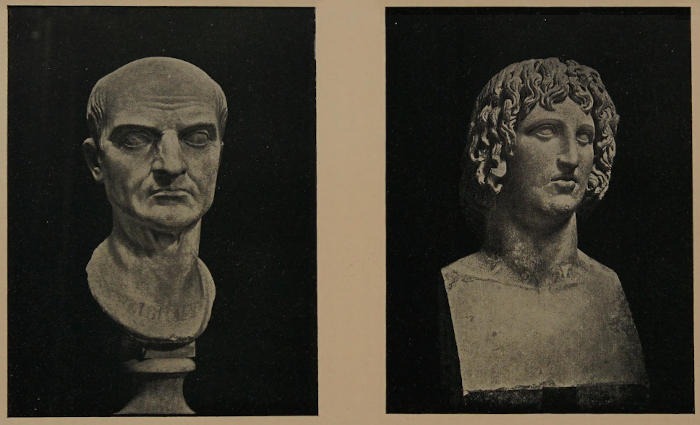
Mæcenas.
Photographed from the Head in the Palazzo dei Conservatori,
Rome, by Edne. Alinari.
To face page 279.
P. Vergilius Maro.
Photographed from the Bust in the Capitoline Museum,
Rome, by Edne. Alinari.
Page 284.
C. Cilnius Mæcenas (circ. B.C. 65-B.C. 8), was probably a
few years older than Augustus, but near enough to his age to
have been one of his companions at Apollonia. His influence
was maintained till about B.C. 16. It is most conspicuous
from the time immediately following the Perusian war. He
negotiated the marriage with Scribonia, the peace of Brundisium
with Antony (B.C. 40), and the subsequent reconciliation
of B.C. 38. In the war against Sextus Pompeius (B.C. 38-36),
he was partly with Augustus, but partly at Rome, with full
powers to act for him and even to alter his despatches and
letters as seemed necessary, having the triumvir’s private seal
entrusted to him for that purpose. This was possible from
the fact of such letters being written by amanuenses and being
therefore only recognisable by the seal. Thus Cicero often
commissions Atticus to write formal letters to his friends for
him. This position—it was no definite office, or perhaps
was more like being legatus to Octavian than anything else—he
seems to have retained till after the battle of Actium, at
which he probably was not present, though that has been disputed.
He detected the conspiracy of the younger Lepidus,
and sent him to Octavian to be judged. In B.C. 29, on
Octavian’s return from the East, he recommended the establishment
of a despotism, as a republic was no longer possible.
The speech preserved by Dio (52, 14-40) may very well be
genuine, in view of the habit of the day, and of Augustus
himself, of reading addresses even in comparatively private
conferences on matters of importance.[318] Even if it is not the
genuine speech, it correctly represents many of the principles
on which Augustus did act, and as to which he doubtless consulted
Mæcenas. It counsels him to keep in his hands legislation,
foreign affairs, elections, executive appointments and the
courts of law, and to hear cases of appeal himself: exactly what
Augustus did under various disguises. It argues that it was
necessary both for his own safety and that of the state that he
should remain in power, the glory being well worth the risk.
Other recommendations are a reform of Senate and equites,
the maintenance of the old republican magistrates for home
service, the establishment of a præfectus urbi, the exercise by
himself of censorial functions, the subordination of provincial
governors to the Emperor, and their payment by a fixed salary,
with the appointment of procurators to superintend the finances
of the provinces. A system of education for the equites is also
suggested, which does not seem to have been carried out; but
many of the financial proposals were adopted, as well as the
idea of keeping the people amused by games and shows. The
advice to abolish the comitia Augustus could not follow consistently
with his policy of compromise. They remained and
were the causes of more than one trouble and disturbance, but
their freedom of election was gradually but surely destroyed,
and one of the first measures of Tiberius was to abolish them
as no longer a reality. The reform of the Senate was, as we
have seen, carried out. As for the judicia, the Senate became
a high court for cases of treason (maiestas), before which alone
Senators could be tried; the decuriæ iudicum were reformed, and
Augustus himself performed the functions of a court of appeal
in various ways, sometimes by his tribunician power of “interceding”
against the sentences of magistrates or Senate, and
sometimes by hearing cases from the provinces of citizens who
disputed the competence of provincial courts and claimed to
be heard at Rome. Mæcenas holding no office never became
a Senator; but he represented the Emperor in his absence,
unless Agrippa was appointed to do so instead. In this
capacity he really exercised a greater power than any definite
office would have given him, and the whole business of the
Empire passed through his hands.[319]
But it was not only as the ostensible representative of
the Emperor that he worked for his support. In the comparative
retirement of his palace on the Esquiline he contributed
to that object by gathering round him the best
intellects and first men of letters of the day, whom he
induced to devote their talents not only to glorify the
Emperor personally, but to popularise his policy and magnify
his service to the state. How far this may have been
effectual by making it the fashion to accept and admire
the principate may perhaps be questioned, but that he should
have secured such writers as Vergil, Horace, and Propertius on
his side says much for his insight and literary taste. One of
the weaknesses of the position of Iulius had been that he had the
literary class mostly against him. The present reputation and
future fame of Augustus were to be better safeguarded. Personally
Mæcenas was luxurious and effeminate, always a valetudinarian,
and in his later years afflicted with almost constant
insomnia. This accounts well enough for the retirement from
public business during the last eight years of his life without
those other causes of the Emperor’s displeasure which have
been already discussed. His wife was a beauty, much younger
than himself, wilful and wayward; and if it is true that she
intrigued with Augustus, it seems also true that her husband
repaid her in kind. There were frequent quarrels and reconciliations,
so that Seneca says that he married her “a thousand
times;” and once at any rate the family trouble found its way
into the law courts, where, however, the bona fides of the
divorce which she was alleged to have made was questioned.[320]
In spite of some coldness between them in later years, and the
physical infirmities which removed him from public business,
Augustus sincerely mourned his loss, as of a counsellor who
never betrayed his confidence or spoke idle words. He had
no real successor. From the time of his death the Emperor
seems more and more to have become his own prime minister,
or to have looked to his own family for assistance as well as
for a successor. Tacitus (Ann. 3, 30) says that his place was
taken by Sallustius Crispus, great-nephew of the historian; but
Augustus does not seem to have thought highly of his ability,
and the part he took in affairs was not prominent enough to have
secured mention by either Suetonius or Dio. Mæcenas wrote
himself both in prose and verse, but in an affected and obscure
style, which Augustus playfully ridiculed. The stoic Seneca is
particularly severe on a poem in which he declares that he clings
to life in spite of all physical sufferings however painful:—
“Though racked with gout in hand and foot,
Though cancer deep should strike its root,
Though palsy shake my feeble thighs,
Though hideous hump on shoulders rise,
From flaccid gum teeth drop away;
Yet all is well if life but stay.
Give me but life, and e’en the pain
Of sharpest cross shall count as gain.”
Augustus and the poets.
The chief writers of the Mæcenas circle, who either became
intimate with Augustus himself, or were induced by Mæcenas
to join in the chorus of praise, were Vergil, Varius,
Horace, Propertius. Of the epics of L. Varius
Rufus (circ. B.C. 64-14) on Iulius Cæsar and
Augustus, we have only a few fragments. The historian, Livy,
(B.C. 59-A.D. 16) was also on friendly terms with Augustus,
and seems to have had some hand in teaching Claudius, son of
Drusus, the future emperor. But his great work—from the
foundation of Rome to the death of Drusus (B.C. 9) was afterwards
regarded as being too republican, and even Augustus
used laughingly to call him the Pompeian. It was the poets
who made Augustus and his policy the subject of their praises,
and who employed their genius to support his views.
Vergil.
The first to do this was P. Vergilius Maro (B.C. 70-17).
The earliest of his writings, the Eclogues, composed between
B.C. 42-37, do not show any close connection
with Augustus. The first indeed celebrates the
restoration of his farm after a personal interview with Octavian,
on the suggestion of Pollio and Mæcenas, and the poet declares
that never will there fade from his heart the gracious look of
the young prince. But the chief object of praise in the
Eclogues, so far as there is one, is Pollio, who had been left in
charge of the distribution of lands by the Triumvirs in B.C. 42.
In the Georgics, however, finished after B.C. 30, we find that
he has fallen in with the new régime. They are dedicated to
the minister Mæcenas, they celebrate Augustus’s triple triumph
of B.C. 29, and they were composed partly, at any rate, at the
wish of Mæcenas, who with Augustus was anxious to make
country life and pursuits seem desirable. No doubt the theme
itself was congenial to Vergil, who preferred a country life at
Nola, or near Tarentum, to the bustle of Rome; but it also
happened to chime in with the views of Augustus, who all his
life believed in the influence of literature and wished to have
the poets on his side. Accordingly, soon after his return from
the East in B.C. 29 he seems to have suggested to Vergil to
compose a poem that would inspire men with a feeling of
national pride and an enthusiasm for the greatness of Rome’s
mission. The plan and form were no doubt wholly Vergil’s,
but the spirit and purpose, like those of Horace’s more patriotic
odes of about the same time, were those which the Emperor
desired. He was not satisfied with mere suggestion, he was
eager for the appearance of the poem. While in Gaul and
Spain from B.C. 27-24 he frequently wrote to the poet urging
the completion of the work. A part of one of Vergil’s answers
has been preserved:
“As to my Æneas, upon my honour if I had anything
written worth your listening to, I would gladly send it. But
the subject thus begun is so vast, that I almost think I must
have been beside myself when I undertook a work of this
magnitude; especially considering that—as you are aware—I
am also devoting part of my time to different and much more
important studies.”
The Æneid was thus undertaken at the solicitation of
Augustus. The legend on which it turns—perhaps a late one—of
the landing of Æneas in Italy and the foundation of
Rome by his descendant, is with great skill interwoven with a
fanciful descent of the gens Iulia from his son Iulus, to magnify
Rome and her divine mission, and at the same time to point to
Augustus as the man of destiny, and as representing in his own
person and career the majesty of the Roman people. In such
a poem detailed allusions cannot be expected as in the occasional
odes of Horace. Yet, besides the fine passage in the eighth
book describing the victory of Actium and the discomfiture of
Cleopatra, and that in the sixth announcing the victorious
career of Augustus, we have, more or less, direct references to
the restoration of religious worship in the vici, to the return of
the standards by the Parthians, and the death of the young
Marcellus. In form, the Æneid follows the model of Homer,
the supreme epic. But in substance it is original, in that it
does not take for its theme one of the old myths—as the
Alexandrine poets always did—but while teeming with all
kinds of mythological allusions it finds its chief inspiration in
the greatness of Rome, measured by the elemental strife
preceding the accomplishment of the divine purpose: tantæ
molis erat Romanam condere gentem—“So vast the task to
found the Roman race,” is the keynote of the whole. It is
original as the epic of Milton was original who, with details
borrowed from every quarter, took for his theme the foundation
of a world and the strife in heaven that preceded it. Vergil’s
epic is Roman history on the highest plane, and has crystallised
for ever a view of that history which has done more than arms
and laws to commend it to the imagination of mankind.
Augustus had a true intuition when he forbade the poet’s
executors to obey his will and burn the rolls containing this
great national epic.
Horace.
Q. Horatius Flaccus (B.C. 65-B.C. 8) is not perhaps so great
a poet as Vergil, but he possessed the charm which keeps such
work as his alive. His connection with Augustus
is a remarkable phenomenon in literary history.
Having fought on the side of his enemies at Philippi, and having
shared in the amnesty granted to the bulk of the troops, he
returned home to find his paternal property confiscated.
Poverty drove him to poetry, poetry gained him the friendship
of Varius and Vergil, who introduced him to Mæcenas, who
saw his merit, relieved him from the uncongenial employment
of a clerk, and eventually introduced him to Augustus. The
Emperor, in his turn, was not long in recognising his charm.
He writes to Mæcenas:
“In old times I was vigorous enough to write my friends’
letters for them. Nowadays being overwhelmed with business
and weak in health, I am very anxious to entice Horace away
from you. He shall therefore quit your table of parasites and
come to my table of kings and assist me in writing letters.”
The refusal of Horace—prudent no doubt in view of his
tastes and habits—did not lose him the Emperor’s favour. He
twice received substantial marks of it, and some extracts of
letters to him from Augustus have been preserved which
exhibit the latter in his most gracious mood:
“Consider yourself a privileged person in my house, as though
an habitual guest at my table. You will be quite within your
rights and will always be sure of a welcome; for it is my wish
that our intimacy should be on that footing if your state or
health permits it.”
And again:
“What a warm recollection I retain of you, you will be
able to learn from Septimius among others, as I happened to
be talking about you in his presence the other day. For you
need not suppose, because you were so high and mighty as to
reject my friendship, that I am on the high horse too to pay
you back.”
Augustus, in fact, had a great opinion of Horace, and
predicted his immortality. He selected him to write the
ode for the secular games, pressed him later in life to
immortalise the achievements of Tiberius and Drusus, and
was desirous of his own name appearing as the recipient of
one of his Satires or Epistles.
“I am quite angry, let me tell you, that you don’t give me
the preference as a person to address in your writings of that
kind. Are you afraid that an appearance of intimacy with me
will damage your reputation with posterity?”
Horace made the Emperor a return in full for such condescension.
How far the genius of a poet is warmed or
chilled by patronage it is not easy to decide. So far as he is
tempted away from his natural bent, or confined in the free
expression of thought, he suffers: so far as he is saved from
sordid cares, he is a gainer. Horace, in early youth, sympathised
with the republican party in whose ranks he had
served, and probably in later life still felt a theoretical
preference for it, and could speak of the nobile letum and atrox
animus of Cato with a true note of admiration, But he was
a man of his time. The policy of Octavian had made the
supremacy of Augustus inevitable, and it at least secured peace
and safety. The patronage and liberality of Mæcenas assuredly
helped to turn the scale, but I see no reason to doubt
that the poet was convinced, though, perhaps, without enthusiasm,
that the new régime was one to be supported by
reasonable men. The kindness of the Emperor naturally
enhanced the effect of his commanding personality, but it
would be difficult for a poet so placed to write with greater
dignity and less fulsomeness than Horace does in the first
epistle of the second book, addressed to Augustus at his own
request. But it is in the Odes that we must trace the unbroken
sympathy with the career and policy of Augustus. If they
are closely examined, with an eye to chronological arrangement,
the ingenuity with which these imitations of Greek models are
framed to support and recommend the purposes or celebrate
the successes of the Emperor, will stand revealed in a striking
manner. The Epodes and the first three books of the Odes
were apparently written between B.C. 35 and B.C. 25. Dropped
in among a number of poems of fancy, or passion, or mere
literary tours de force, are compositions that follow not only the
actual achievements of Augustus, but his ideals, his intentions,
and his aspirations, from the years just before Actium to his
return from Spain in B.C. 25. We begin with the Second
Epode, which refers with regret to the abandoned intention
of invading Britain in B.C. 35, and expresses his alarm at the
prospect of a renewed civil war. In the Sixteenth Epode this
terror has become a reality; the civil war has begun, and the
poet, foreseeing the downfall of the state, turns longing eyes
to the peace and calm of the fabled islands of the West.
From Italy and all its horrors they must at any rate depart.
In the Ninth Epode the relief has come; the shameful
servitude of a Roman imperator and Roman soldiers to a
foreign queen is over; Antony and Cleopatra are in full flight
(B.C. 31). In another year it is known that Antony has fallen
by his own hand, and that Cleopatra has saved herself the
indignity of the triumphal procession by the adder’s aid
(Od. i. 39). The discharge of the legions follows, and their
settlement in Italian and Sicilian lands (2 Sat., 6, 54). In
the other odes of the first book the devotion to Augustus
proceeds apace. The Iulian star is in the ascendant (1, 2, 20);
Augustus is pater and princeps, anticipating the future titles
(1, 2, 20); he is again contemplating the invasion of Britain
(1, 35, 29); the Arabian expedition is being planned with all
its futile hopes of wealth (1, 29; 1, 35). In the second book
of the Odes, beginning with reflections on the evils of civil
war (2, 1), the poet notices one after the other the triumphs of
Augustus or his generals in B.C. 27-24. The Cantabrian war
(2, 6, 2; 2, 11, 1); the triumphal arch at Susa (2, 9, 19);
the success of his diplomacy in Scythia, Armenia, and Parthia
(ib.) In the third book the embassy of British chiefs is
treated as though the island were annexed (3, 5, 2); the
Cantabrians are regarded as conquered after the expedition of
Augustus (3, 8, 22; 3, 14). Then succeeds a period of
statesmanship and reform. The Emperor’s Roman policy, and
his determination to keep Rome the centre of government, are
warmly supported (3, 3); the moral evils, the extravagance
and debauchery of the age must be cured, and Horace proceeds
to support the abortive legislation of B.C. 27, and to foreshadow
the censorial acts, and the legislation of B.C. 18. There is a
protest against the magnificence and extent of country houses
(2, 15); against the effeminacy of youth (iii. 2); against the
immorality of women and the licentiousness that led to civil
strife (3, 24). The Carmen sæculare speaks of the legislation
as effected, and foretells its success (20); while in the fourth
book he asserts that, at any rate while Augustus is with them,
that success has been secured (4, 5), and that he has not only
given them peace, but a great moral reform (4, 15). The
policy of the Emperor in regard to the bugbear of the East,
the Parthian power, is also followed step by step. They are
the dangerous enemy whose subjection will make Augustus
divine (3, 5, 1-4), and whose threatened invasions keep his
ministers in constant anxiety (3, 29, 27). This is before
B.C. 20; but in B.C. 19 they have made submission and
restored the standards and prisoners (Epist. i. 18, 56), and
this is one of the triumphs of Augustus that requires a master
hand to record (Epist. ii. 1, 255); it is the glory of the
Augustan age (Od. 4, 15, 6), and as long as Augustus is
safe, no one will fear them more (4, 5, 25). Finally, at the
Emperor’s request, he celebrated the victories of Drusus and
Tiberius over the Vindelici and Rhæti (4, 4 and 14), and
especially the defeat of the Sugambri who had routed Lollius
(4, 2, 34; 4, 14, 51), with a compliment to Augustus himself
for having gone to Gaul to support Tiberius and Drusus with
reinforcements and advice (4, 14, 33), and for having at length
closed the door of Ianus (4, 15, 9). The lyrical career of
Horace, therefore, corresponds remarkably with the activities
of Augustus. His genius presented those activities to his
fellow citizens (and Horace’s verses were soon read in schools)
exactly in the light in which the Emperor wished them to be
viewed. If we lay aside some expressions of overstrained compliment,
which favoured the growing fashion of paying the
Emperor divine honours, it cannot be said that the language
is fulsome or degrading to the poet. The “parasitic table” of
Mæcenas may, as M. Beulé asserts, have been a misfortune
to the poets, and attenuated their vein of inspiration: but a
man must have something in practical life on which to pin his
faith; and Horace might have done worse than devote his
genius to promote loyalty to the great statesman who had
saved Roman society and given peace and prosperity to an
empire. Just as Vergil, if he had followed his own impulse,
might have perhaps produced a fine poem on the Epicurean
cosmogony, but not one that lives and breathes with the noble
glow of patriotism.
Propertius.
Sextus Propertius (circ. B.C. 45-circ. B.C. 15) was another
of the Mæcenas circle of poets who did something to glorify
Augustus. He is not (but that is a personal
opinion) on anything like the same level as either
Vergil or Horace as an artist. He is said to have died young,
perhaps at thirty years of age, and there is no evidence of
personal intimacy with Augustus, but there is some indication
of his having been on bad terms with Horace. His elegies
also are nearly all poems of passion. Politics and emperors are
mere episodes, and were introduced in deference to Mæcenas.
Still many points in the career of Augustus are referred to in
the same spirit as that of Horace. The siege of Perusia—described
in tones of horror, which would scarcely have been
acceptable—precedes his conversion (1, 21), and the failure of
the marriage law of B.C. 27 is only referred to with relief
(2, 7, 1). In more complimentary terms he speaks of the
victory of Actium (3, 7, 44), and of the downfall of Antony
and Cleopatra (4, 8, 56; 4, 10, 32, sqq.; 4, 7, 56); and the
end of the civil wars is attributed to Augustus (illa qua vicit
condidit arma manu, 3, 8, 41). Then came the intended
invasion of Britain (3, 23, 5); the Arabian expedition and
the Indian envoys (3, 1, 15; 4, 3 1); the opening and
description of the Palatine Library—the best extant (3, 29);
the raids of the Sugambri and their suppression (5, 6, 77);
while he has the Parthians frequently on his lips, though rather
as predicting what is to be done with them than as recording
the return of the standards.[321] In the fifth book there are signs
of a beginning of a Fasti like that of Ovid as a record of events
in Roman history; and it is possible that this was in obedience
to a wish of Augustus, who, on his death, transferred the task
to Ovid. Thus his voice also was secured, in part at least, in
support of the imperial régime.
Ovid.
Publius Ovidius Naso (B.C. 43-A.D. 18) belongs to the last
part of the reign. He had only seen Vergil, and though he
had heard Horace recite, he does not profess to have known
him. He was quite young when Augustus was
winning his position and reforming the constitution,
and there are no signs of his coming forward as a court
poet till Mæcenas and his circle had disappeared, and if he had
attracted the attention of Augustus at all, it was probably not
altogether in a favourable manner. His earliest poems—the
Amores and Heroidum Epistulæ—do not touch on public
affairs; they are poems of passion—the former personal, the
latter dramatic. In the Ars Amatoria (about B.C. 2-A.D. 2) for
the first time we detect the court poet from a complimentary
allusion to the approaching mission of Gaius Cæsar to Syria
and Armenia, with his title of princeps iuventutis and that of
Augustus as pater patriæ, as also to the naumachia or representation
of the battle of Salamis given by Augustus in the
flooded nemus Cæsarum in B.C. 2 (A. A., 1, 171-2). The
Metamorphoses had been composed before his exile in A.D. 9,
but after the death of Augustus he apparently introduced the
Epilogue (xv. 745 sq.) containing an eulogy on Tiberius, and
on the now finished career of Augustus. It is the Fasti—the
Calendar of events in Roman history—that probably was undertaken
in obedience to a wish of the Emperor, and in which
accordingly we find points in his career touched upon. It was
dedicated to Germanicus, and contains an allusion to his own
exile, and was therefore, partly at least, composed between
B.C. 2 and A.D. 10. His allusions to Augustus are not those
of an intimate acquaintance, but of an admiring subject—real
or feigned. He mentions the battle of Mutina (iv. 627); the
bestowal of the title Augustus (i. 589); the recovery of the
standards from the Parthians as a triumph of the Emperor
(vi. 467). He alludes to Augustus becoming Pontifex Maximus
(iii. 415); to the laurels on his palace front (iv. 957); to the
demolition of the house of Vedius Pollio as connected with the
reforms and the laws of B.C. 18 (vi. 637); to the division of the
city into vici, and the worship of the Lares Augusti (v. 145); to
the Forum Augusti and the temple of Mars dedicated in B.C. 2.
(v. 551, sqq.). Ovid afterwards protested that his books had
been read with pleasure by Augustus, and assumed to have some
knowledge of the private chambers of the palace (Trist., 1,
5, 2; 2, 520), but there is nothing in the allusions to matters
which he knew that Augustus wished to have recorded that
has the air of close or intimate relations. They are the conventional
expressions of the outside, and perhaps humble,
panegyrist, not those of a friend and supporter, like Horace.
The abject expressions in the Tristia and the letters from
Pontus need not be taken into account. They are merely
bids for a recall, and they often express in the crudest form the
growing fashion of worshipping the Emperor or his genius.
Perhaps the most subtle of these appeals is that in which he
explains why he had spent his youth in writing frivolous
poetry instead of celebrating the glories of the Emperor—he
was not a good enough poet, and would have dishonoured a
subject above his reach (Tr., ii. 335-340). This was using a
weapon forged by the Emperor himself, who had always let
it be known that he disliked being the subject of inferior
artists. The melancholy and feebleness of these later poems
of Ovid seem to bear a sort of analogy with the cloud that
descended on the later years of Augustus. Vergil and Horace
have the freshness of the morning or the vigour of noon,
Ovid the gathering sadness of the evening.
AUGUSTUS’S ACCOUNT OF HIS REIGN (FROM THE INSCRIPTION IN THE TEMPLE OF ROME AND AUGUSTUS AT ANGORA)
1. When I was nineteen I collected an army on my own account and
at my own expense, by the help of which I restored the republic
to liberty, which had been enslaved by the tyranny of a faction; for
which services the Senate, in complimentary decrees, added my
name to the roll of their House in the consulship of Gaius Pansa
and Aulus Hirtius [B.C. 43], giving me at the same time consular
precedence in voting; and gave me imperium. It ordered me as
proprætor “to see along with the consuls that the republic suffered
no damage.” Moreover, in the same year, both consuls having
fallen, the people elected me consul and a triumvir for revising the
constitution.
2. Those who killed my father I drove into exile, after a legal
trial, in punishment of their crime, and afterwards when these same
men rose in arms against the republic I conquered them twice in
a pitched battle.
3. I had to undertake wars by land and sea, civil and foreign, all
over the world, and when victorious I spared surviving citizens.
Those foreign nations, who could safely be pardoned, I preferred to
preserve rather than exterminate. About 500,000 Roman citizens
took the military oath to me. Of these I settled out in colonies or
sent back to their own towns, after their terms of service were over,
considerably more than 300,000; and to them all I assigned lands
purchased by myself or money in lieu of lands. I captured 600
ships, not counting those below the rating of triremes.
4. I twice celebrated an ovation, three times curule triumphs, and
was twenty-one times greeted as imperator. Though the Senate
afterwards voted me several triumphs I declined them. I frequently
also deposited laurels in the Capitol after performing the vows which
I had taken in each war. For successful operations performed by
myself or by my legates under my auspices by land and sea, the
Senate fifty-three times decreed a supplication to the immortal gods.
The number of days during which, in accordance with a decree of
the Senate, supplication was offered amounted to 890. In my
triumphs there were led before my chariot nine kings or sons of
kings. I had been consul thirteen times at the writing of this, and
am in the course of the thirty-seventh year of my tribunician power
[A.D. 13-14].
5. The Dictatorship offered me in my presence and absence by
the Senate and people in the consulship of Marcus Marcellus and
Lucius Arruntius [B.C. 22] I declined to accept. I did not refuse
at a time of very great scarcity of corn the commissionership of corn
supply, which I administered in such a way that within a few days
I freed the whole people from fear and danger. The consulship—either
yearly or for life—then offered to me I declined to accept.
6. In the consulship of M. Vinicius and Q. Lucretius [B.C. 19],
of P. and Cn. Lentulus [B.C. 18], and of Paullus Fabius Maximus and
Q. Tubero [B.C. 11], when the Senate and people of Rome unanimously
agreed that I should be elected overseer of the laws
and morals, with unlimited powers and without a colleague, I
refused every office offered me which was contrary to the customs
of our ancestors. But what the Senate at that time wished me to
manage, I carried out in virtue of my tribunician power, and in
this office I five times received at my own request a colleague
from the Senate.
7. I was one of the triumvirate for the re-establishment of the
constitution for ten consecutive years. I have been princeps senatus
up to the day on which I write this for forty years. I am Pontifex
Maximus, Augur, one of the fifteen commissioners for religion, one of
the seven for sacred feasts, an Arval brother, a sodalis Titius, a fetial.
8. In my fifth consulship [B.C. 29] I increased the number of the
patricians by order of people and Senate. I three times made up
the roll of the Senate, and in my sixth consulship [B.C. 28] I took a
census of the people with M. Agrippa as my colleague. I performed
the lustrum after an interval of forty-one years; in which the number
of Roman citizens entered on the census roll was 4,063,000. A second
time with consular imperium I took the census by myself in the
consulship of Gaius Censorinus and Gaius Asinius [B.C. 8], in which
the number of Roman citizens entered on the roll was 4,223,000. I
took a third census with consular imperium, my son Tiberius Cæsar
acting as my colleague, in the consulship of Sextus Pompeius and
Sextus Appuleius [A.D. 14], in which the number of Roman citizens
entered on the census roll was 4,937,000. By new laws passed I
recalled numerous customs of our ancestors that were falling into
desuetude in our time, and myself set precedents in many particulars
for the imitation of posterity.
9. The Senate decreed that vows should be offered for my health
by consuls and priests every fifth year. In fulfilment of these vows
the four chief colleges of priests or the consuls often gave games in
my lifetime. Also individually and by townships the people at large
always offered sacrifices at all the temples for my health.
10. By a decree of the Senate my name was included in the ritual
of the Salii; and it was ordained by a law that my person should be
sacred and that I should have the tribunician power for the term of
my natural life. I refused to become Pontifex Maximus in succession
to my colleague during his life, though the people offered me
that sacred office formerly held by my father. Some years later I
accepted that sacred office on the death of the man who had availed
himself of the civil disturbance to secure it; such a multitude
flocking to my election from all parts of Italy as is never recorded
to have come to Rome before, in the consulship of P. Sulpicius and
C. Valgius [6 March, B.C. 12].
11. The Senate consecrated an altar to Fortuna Redux, near the
temple of Honour and Virtue, by the Porta Capena, for my return, on
which it ordered the Vestal Virgins to offer a yearly sacrifice on the
day on which in the consulship of Q. Lucretius and M. Vinicius
[B.C. 19] I returned to the city from Syria, and gave that day the
name Augustalia from my cognomen [15 Dec.].
12. By a decree of the Senate at the same time part of the prætors
and tribunes of the plebs, along with the consul Q. Lucretius and
leading nobles, were despatched into Campania to meet me—an
honour that up to this time has been decreed to no one else. When
I returned to Rome from Spain and Gaul after successful operations
in those provinces, in the consulship of Tiberius Nero and Publius
Quintilius [B.C. 13], the Senate voted that an altar to Pax Augusta
should be consecrated for my return on the Campus Martius, upon
which it ordered the magistrates and priests and Vestal Virgins to
offer an annual sacrifice [30 Jan.].
13. Whereas the Ianus Quirinus, which our ancestors ordered to
be closed when peace throughout the whole dominions of the Roman
people by land and sea had been obtained by victories, is recorded
to have been only twice shut before my birth since the foundation
of the city, the Senate three times voted its closure during my
principate.
14. My sons Gaius and Lucius Cæsar, whom fortune snatched
from me in their early manhood, in compliment to me, the Senate
and Roman people designated consuls in their fifteenth year with a
proviso that they should enter on that office after an interval of five
years. From the day of their assuming the toga virilis the Senate
decreed that they should take part in public business. Moreover,
the Roman equites in a body gave each of them the title of Princeps
Iuventutis, and presented them with silver shields and spears.
15. To the Roman plebs I paid 300 sesterces per head in virtue
of my father’s will; and in my own name I gave 400 apiece in my
fifth consulship [B.C. 29] from the sale of spoils of war; and a second
time in my tenth consulship [B.C. 24] out of my own private property
I paid a bounty of 400 sesterces per man, and in my eleventh consulship
[B.C. 23] I measured out twelve distributions of corn, having
purchased the grain from my own resources. In the twelfth year
of my tribunician power [B.C. 11], I for the third time gave a bounty
of 400 sesterces a head. These largesses of mine affected never less
than 50,200 persons. In the eighteenth year of my tribunician
power and my twelfth consulship [B.C. 5] I gave 320,000 of the urban
plebs sixty denarii a head. In the colonies of my soldiers, in my
fifth consulship [B.C. 29] I gave from the sale of spoils of war 1,000
sesterces a head; and among such settlers the number who received
that triumphal largess amounted to about 120,000 men. In my
thirteenth consulship [B.C. 2] I gave 60 denarii apiece to the plebeians
then in receipt of public corn; they amounted to somewhat more
than 200,000 persons.
16. The money for the lands, which in my fourth consulship
[B.C. 30], and afterwards in the consulship of M. Crassus and Cn.
Lentulus the augur [B.C. 14], I assigned to the soldiers, I paid to the
municipal towns. The amount was about 600,000,000 sesterces,
which I paid for lands in Italy, and about 260,000,000 which I
disbursed for lands in the provinces.
I was the first and only one within the memory of my own generation
to do this of all who settled colonies in Italy and the provinces.
And afterwards in the consulship of Tib. Nero and Cn. Piso [B.C. 7],
and again in the consulship of C. Antistius and D. Lælius [B.C. 6],
and of C. Calvisius and L. Pasienus [B.C. 4], and of L. Lentulus and
M. Messalla [B.C. 3], and of L. Caninius and Q. Fabricius [B.C. 2], to
the soldiers, whom after their terms of service I sent back to their
own towns, I paid good service allowances in ready money; on which
I expended 400,000,000 sesterces as an act of grace.
17. I four times subsidised the ærarium from my own money, the
sums which I thus paid over to the commissioners of the treasury
amounting to 150,000,000 sesterces. And in the consulship of M.
Lepidus and L. Arruntius [A.D. 6], to the military treasury, which was
established on my initiative for the payment of their good service
allowance, to the soldiers who had served twenty years or more, I
contributed from my own patrimony 170,000,000 sesterces.[322]
18. From and after the year of the consulship of Gnæus and
Publius Lentulus [B.C. 18], whenever the payment of the revenues
were in arrear, I paid into the treasury from my own patrimony the
taxes, whether due in corn or money, sometimes of 100,000 persons,
sometimes of more.
19. I built the curia and Chalcidicum adjoining it, and the temples
of Apollo on the Palatine with its colonnades, the temple of the
divine Iulius, the Lupercal, the colonnade at the Flaminian circus,
which I allowed to be called Octavia, from the name of the builder
of the earlier one on the same site, the state box at the Circus
Maximus, the temples of Jupiter Feretrius and of Jupiter Tonans
on the Capitol, the temple of Quirinus, the temples of Minerva and
of Juno the Queen, and of Jupiter Liberalis on the Aventine, the
temple of the Lares at the head of the via Sacra, the temple of the
divine Penates in the Velia, the temple of Youth, the temple of the
Mater Magna on the Palatine.
20. The Capitolium and the Pompeian theatre—both very costly
works—I restored without any inscription of my own name. Water-conduits
in many places that were decaying from age I repaired;
and I doubled the aqueduct called the Aqua Marcia, by turning a
new spring into its channel.
The Forum Iulium and the basilica, which was between the temple
of Castor and the temple of Saturn, works begun and far advanced
by my father, I completed; and when the same basilica was
destroyed by fire, I began its reconstruction on an extended plan, to
be inscribed with the names of my sons, and in case I do not live to
complete it I have ordered it to be completed by my heirs.
In my sixth consulship [B.C. 28], I repaired eighty-two temples of
the gods in the city in accordance with a decree of the Senate, none
being omitted which at that time stood in need of repair. In my
seventh consulship [B.C. 27] I constructed the Flaminian road from
the city to Ariminum, and all the bridges except the Mulvian and
Minucian.
21. On ground belonging to myself I built a temple to Mars Ultor
and the Forum Augustum, with money arising from sale of war spoils.
I built a theatre adjoining the temple of Apollo, on ground for the
most part purchased from private owners, to be under the name of
my son-in-law Marcus Marcellus. Offerings from money raised by
sale of war-spoil I consecrated in the temple of Apollo, and in the
temple of Vesta, and in the temple of Mars Ultor, which cost me about
100,000,000 sesterces. Thirty-five thousand pounds of gold,[323] crown
money contributed by the municipia and colonies of Italy for my
triumphs, I refunded in my fifth consulship [B.C. 29], and subsequently,
as often as I was greeted Imperator, I refused to receive
crown money, though the municipia and colonies had decreed it
with as much warmth as before.
22. I three times gave a show of gladiators in my own name, and
five times in the name of my sons and grandsons; in which shows
about 10,000 men contended. I twice gave the people a show of
athletes collected from all parts of the world in my own name, and a
third time in the name of my grandson. I gave games in my own
name four times, as representing other magistrates twenty-three
times. In behalf of the quindecimviri, and as master of the college,
with M. Agrippa as colleague, I gave the Secular games in the
consulship of C. Furnius and C. Silanus [B.C. 17]. In my thirteenth
consulship [B.C. 2], I gave for the first time the games of Mars which,
since that time, the consuls have given in successive years. I gave
the people wild-beast hunts, of African animals, in my own name and
that of my sons and grandsons, in the circus and forum, and the
amphitheatres twenty-six times, in which about 3,500 animals were
killed.
23. I gave the people the spectacle of a naval battle on the other
side of the Tiber, in the spot where now is the grove of the Cæsars,
the ground having been hollowed out to a length of 1,800 feet, and
a breadth of 1,200 feet, in which thirty beaked ships, triremes or
biremes, and a still larger number of smaller vessels contended. In
these fleets, besides the rowers, there fought about three thousand
men.
24. In the temples of all the states of the province of Asia, I
replaced the ornaments after my victory, which he with whom I had
fought had taken into his private possession from the spoliation of
the temples. There were about eighty silver statues of me, some on
foot, some equestrian, some in chariots, in various parts of the city.
These I removed, and from the money thus obtained I placed
golden offerings in the temple of Apollo in my own name and in
that of those who had honoured me by the statues.
25. I cleared the sea of pirates. In that war I captured about
30,000 slaves, who had run away from their masters, and had borne
arms against the republic, and handed them back to their owners to
be punished. The whole of Italy took the oath to me spontaneously,
and demanded that I should be the leader in the war in which I
won the victory off Actium. The provinces of the Gauls, the Spains,
Africa, Sicily, Sardinia, took the same oath. Among those who
fought under my standards were more than seven hundred Senators,
eighty-three of whom had been, or have since been, consuls up
to the time of my writing this, 170 members of the sacred
colleges.
26. I extended the frontiers of all the provinces of the Roman
people, which were bordered by tribes that had not submitted to
our Empire. The provinces of the Gauls, and Spains and Germany,
bounded by the Ocean from Gades to the mouth of the river Elbe, I
reduced to a peaceful state. The Alps, from the district near the
Adriatic to the Tuscan sea, I forced to remain peaceful without
waging unprovoked war with any tribe. My fleet sailed through the
Ocean from the mouth of the Rhine towards the rising sun, up to the
territories of the Cimbri, to which point no Roman had penetrated,
up to that time, either by land or sea. The Cimbri, and Charydes,
and Semnones and other peoples of the Germans, belonging to the
same tract of country, sent ambassadors to ask for the friendship of
myself and the Roman people. By my command and under my
auspices, two armies were marched into Æthiopia and Arabia, called
Felix, nearly simultaneously, and large hostile forces of both these
nations were cut to pieces in battle, and a large number of towns
were captured. Æthiopia was penetrated as far as the town Nabata,
next to Meroe. Into Arabia the army advanced into the territories of
the Sabæi as far as the town Mariba.
27. I added Egypt to the Empire of the Roman people. When
I might have made the Greater Armenia a province after the assassination
of its king Artaxes, I preferred, on the precedent of our
ancestors, to hand over that kingdom to Tigranes, son of King
Artavasdes, grandson of King Tigranes, by the hands of Tiberius
Nero, who was then my stepson. The same nation being afterwards
in a state of revolt and rebellion, I handed over to the government
of King Ariobarzanes, son of Artabazus, king of the Medes, after it
had been reduced by my son Gaius; and after his death to his son
Artavasdes, upon whose assassination I sent Tigranes, a member of
the royal family of the Armenians, into that kingdom. I recovered
all the provinces on the other side of the Adriatic towards the East
and Cyrenæ, which were by this time for the most part held by
various kings, and before them Sicily and Sardinia which had been
overrun by an army of slaves.
28. I settled colonies of soldiers in Africa, Sicily, Macedonia, both
the Spains, Achaia, Asia, Syria, Gallia Narbonensis, Pisidia. Italy
has twenty-eight colonies established under my auspices, which
have in my lifetime become very densely inhabited and places of
great resort.
29. A large number of military standards, which had been lost
under other commanders, I recovered, after defeating the enemy,
from Spain and Gaul and the Dalmatians. I compelled the Parthians
to restore the spoils and standards of three Roman armies, and to
seek as suppliants the friendship of the Roman people. These
standards I laid up in the inner shrine belonging to the temple of
Mars Ultor.
30. The tribes of the Pannonii, which before I was princeps an
army of the Roman people never reached, having been subdued by
Tiberius Nero, who was then my stepson and legate [B.C. 11], I
added to the Empire of the Roman people, and I extended the
frontier of Illyricum to the bank of the river Danube. And when an
army of the Daci crossed to the south of that river it was conquered
and put to flight under my auspices; and subsequently my army,
being led across the Danube, forced the tribes of the Daci to submit
to the orders of the Roman people.
31. To me there were often sent embassies of kings from India,
who had never before been seen in the camp of any Roman general.
By embassadors the Bastarnæ and the Scythians and the kings of
the Sarmatians, who live on both sides of the river Don, and the
king of the Albani and of the Hiberi and of the Medes, sought our
friendship.
32. Kings of the Parthians—Tiridates, and afterwards Phrates,
son of King Phrates—fled to me for refuge; of the Medes Artavasdes;
of the Adiabeni Artaxares; of the Britons Dumnobellaunus
and Tim ...;[324] of the Marcomanni and Suebi....[324] Phrates, king
of the Parthians, son of Orodes, sent all his sons and grandsons to
me in Italy, not because he had been overcome in war, but seeking
our friendship by means of his own sons as pledges. And a very
large number of other nations experienced the good faith of the
Roman people while I was princeps, with whom before that time
there had been no diplomatic or friendly intercourse.
33. The nations of the Parthians and the chief men of the Medes
by means of embassies sought and accepted from me kings of those
peoples—the Parthians Vonones, son of King Phrates, grandson of
King Orodes; the Medes Ariobarzanes, son of King Artavasdes,
grandson of King Ariobarzanes.
34. In my sixth and seventh consulships [B.C. 28, 27], when I had
extinguished the flames of civil war, having by universal consent
become possessed of the sole direction of affairs, I transferred the
republic from my power to the will of the Senate and people of
Rome. For which good service on my part I was by decree of the
Senate called by the name of Augustus, and the door-posts of my
house were covered with laurels in the name of the state, and a civic
crown was fixed up over my door, and a golden shield was placed
in the Curia Iulia, which it was declared by its inscription the Senate
and people of Rome gave me in recognition of valour, clemency,
justice, piety. After that time I took precedence of all in rank, but
of power I had nothing more than those who were my colleagues
in the several magistracies.
35. While I was administering my thirteenth consulship [B.C. 2],
the Senate and equestrian order and the Roman people with one
consent greeted me as Father of my Country, and decreed that it
should be inscribed in the vestibule of my house, and in the Senate
house, and in the Forum Augustum, and under the chariot which
was there placed in my honour in accordance with a senatorial
decree.
When I wrote this I was in my seventy-sixth year [A.D. 13-14].