Impressions of the metropolis—A trunk full of letters—Friendship of
Children—Sir Thomas Lawrence—Lizars stops work—A family of
artists—Robert Havell, Junior—The Birds of America fly to London—The
Zoölogical Gallery—Crisis in the naturalist's affairs—Royal
patronage—Interview with Gallatin—Interesting the Queen—Desertion
of patrons—Painting to independence—Personal habits and tastes—Enters
the Linnæan Society—The White-headed Eagle—Visit to the
great universities—Declines to write for magazines—Audubon-Swainson
correspondence—"Highfield Hall" near Tyttenhanger—In Paris
with Swainson—Glimpses of Cuvier—His report on The Birds of
America—Patronage of the French Government and the Duke of
Orleans—Bonaparte the naturalist.
Audubon reached London on May 21, 1827, and
put up at the "Bull and Mouth" tavern, but soon moved
into more permanent lodgings at number 55 Great
Russell Street, near the British Museum. Though for
a long time eager to see the capital, no sooner had he
reached it than he was anxious to be away and more
homesick than ever for his family and his beloved
America. London then seemed to him "like the mouth
of an immense monster, guarded by millions of sharp-edged
teeth," from which he could escape only by
miracle.
He had brought with him a formidable array of
letters addressed to the élite of the capital,[342] and he bore
besides nearly a trunkful for the Continent, as well as
general letters from Henry Clay, Andrew Jackson and
others in America for our consular and diplomatic representatives
in Europe. His epistolary basis for the
acquisition of useful acquaintances could hardly have
been better, and further testimonials were gathered at
every stage of his progress to the city of his hopes, but
Audubon's best letter of credit, which could be read by
all the world, was an open, winning countenance. After
he had wandered over London for the greater part of
three days without finding a single individual at home,
he was tempted to consign his valuable documents to
the post, an error which he did not repeat, as it deprived
him of the acquaintance of fully one-half of the people
to whom they were addressed. One of these London
letters which follows, written by Captain Basil Hall to
John Murray, the noted publisher and founder of the
Quarterly Review, is particularly interesting in showing
that Audubon was far from pleased with the progress
of his work in Edinburgh, and that he was then
contemplating a change which was later effected.
Edinb 23rd Feby. 1827
My Dear Sir
This will be delivered to you by my friend Mr John Audubon,
an American Gentleman who has been residing here this
winter, & I beg in the most particular manner to introduce him
to your acquaintance and to ask for him the advantage of your
good offices.
Mr Audubon has spent [a] great part of his life in making
a collection of drawings of the Birds of North America, & in
studying their Habits, with the intention of publishing a Complete
Ornithology of America. For such a work his materials,
both in the shape of drawings and of written notes, are immense
and he is now going to London in order to set this gigantic work
in motion.
Mr Audubon, however, is not very well versed in the details
of such matters, & therefore I beg of you to have the goodness
to aid him with your advice on the occasion—to introduce engravers
printers & so forth to him, and generally speaking to
put him in the way of bringing out his work in an advantageous
manner to himself.
I trust all this will give you no more trouble than you will
be willing to take at my earnest solicitation.
I remain Ever, My Dear Sir,
Most Sincerely Yrs
Basil Hall.
John Murray Esqr
Audubon carried also a long letter from "Mr.
Hay,"[343] dated at "16 Athol Crescent, Edinburgh, 15
March, 1827," and addressed to the care of his brother,
Robert William Hay, of Downing Street, West, in
which this curious statement occurs: "Mr. A. is son of
the late French Admiral Audubon, but has himself lived
from the cradle in the United States, having been born
in one of the French colonies."
The document which was to prove of greatest service
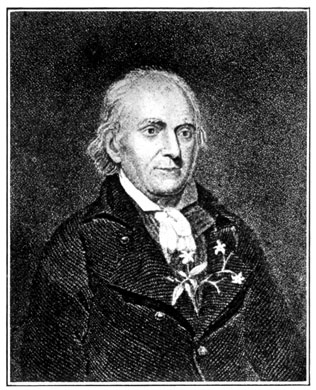
to him, however, was addressed to John George Children,[344]
then in charge of the Department of Zoölogy in
the British Museum and secretary of the Royal Society.
Children assumed the management of Audubon's work
when he returned to America in 1829 and again in
1831; to him and Lord Stanley, in 1830, the naturalist
probably owed his nomination to membership in the
Royal Society.
Soon after reaching London Audubon paid his respects
to Sir Thomas Lawrence, for whom he had two
letters, and made an appointment for showing his work
to this famous artist. He was also gratified to receive
the subscription of Lord Stanley and of Charles Lucien
Bonaparte, who was then in London.
Audubon had not been in London a month before
word was received from Lizars that all his colorers had
struck work and that everything was at a stand. Accordingly,
he began to search London for skilled workmen,
and on June 18 wrote: "I went five times to see
Mr. Havell, the colorer, but he was out of town. I am
full of anxiety and greatly depressed. Oh! how sick
I am of London!" Three days later another discouraging
letter came from Lizars, who shortly after threw
up his contract and left his patron in a sad predicament—with
an enormously expensive work, still-born,
on his hands, without adequate funds, and, in short,
with all his cherished plans suspended in mid-air. Audubon
no doubt realized that if his grand undertaking
were to succeed at all, it must experience a new birth
in London, where an expert engraver of the requisite
enterprise and zeal must be found without delay. He
closed his journal on the second day of July with the
remark that he was too dull and mournful to write a
line, and it was not opened again for nearly three months.
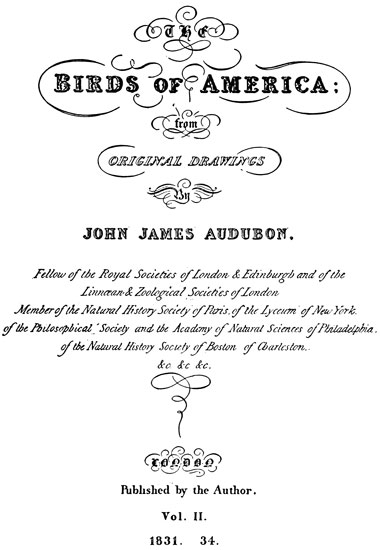
TITLE PAGE OF THE ORIGINAL EDITION OF "THE BIRDS OF AMERICA," VOLUME
II, 1831-1834.
This gap in Audubon's record can now be filled in
reference to some important particulars, for in the interval
he made his greatest discovery in England, in
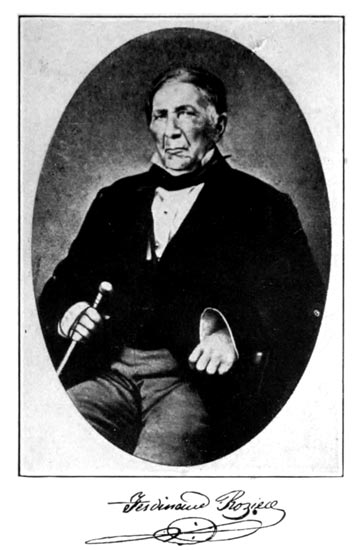
Robert Havell, Junior, then a young and unknown
artist of thirty-four, who through eleven years of the
closest association with his new patron was to become
one of the greatest engravers in aquatint the world has
ever seen. Until recently the intimate story of Audubon's
relation to the Havells has been much obscured.[345]
The reference in the journal record of June 19, just
given, was undoubtedly to Robert Havell, Senior, who
for many years was associated with his father, Daniel
Havell, the first of five generations of artists of that
name, in the engraving and publishing business, but
who at this time was established independently at 79
Newman Street, London; he also conducted a shop
called the "Zoölogical Gallery," at which were sold engravings,
books, artists' materials, naturalists' supplies,
and specimens of natural history of every sort. His
three sons, Robert, George, and Henry Augustus, all
became artists, but the eldest, who bore his father's
name, was educated for a learned profession. Contrary
to his father's injunctions and advice, Robert, who was
bent on becoming an artist, abruptly left his home in
1825, determined to shift for himself. He began with
an extensive sketching tour on the River Wye, in Monmouthshire,
and produced numerous paintings which,
as his biographer remarks, display all the charm found
in the work of his distinguished cousin, William Havell.
These won immediate recognition in London, where he
received commissions from various publishers, including
the house of Messrs. Colnaghi & Company.
Robert Havell, Senior, then in his fifty-eighth year,
though deeply interested in Audubon's adventurous
plans, felt himself too old to embark on so extended a
work, which it was then believed would require from
fourteen to sixteen years for completion; he volunteered,
however, to do his best to find a substitute.
With this in view, he applied to Mr. Colnaghi, the publisher,
and was immediately shown the unsigned proof
of a beautiful landscape, exquisitely drawn and engraved
by one of the youthful retainers of his establishment.
The elder Havell, after scrutinizing it carefully,
exclaimed, "That's just the man for me!"
"Then," replied the publisher, "send for your own son!"
Through this singular coincidence, father and son became
reconciled and a partnership between them was
soon announced.
As a test of young Havell's skill, to follow the
story of his biographer, Audubon gave him his drawing
of the Prothonotary Warbler, which had already been
engraved and issued by Lizars as Plate iii of The Birds
of America earlier in that year. Havell finished the
engraving in two weeks, when a proof was struck and
the naturalist summoned. Audubon examined the
print with the utmost keenness and deliberation; then
he seized the sheet, and holding it up, danced about
the room, calling out in his French accent: "Ze jig is
up, ze jig is up!" The Havells, who at first thought
this might signify disapproval, were quickly disabused
when Audubon approached young Robert and, throwing
his arms about his neck, assured him that his long-sought
engraver had been found at last. Having given
this story, I wish it were possible to confirm it, but a
close examination of this plate proves either that the
story is a fiction, or that some other drawing was used
as a test of Havell's skill.[346]
The part which this interesting family played in
Audubon's success will be unfolded later.[347] Suffice it
now to say that Messrs. Robert Havell & Son, in London,
undertook afresh the production of The Birds of
America in the summer of 1827. The partnership was
divided or dissolved in 1828, when Robert, junior, who
from the first did all of the engraving, took entire
charge of that part of the business, and moved his engraving
establishment around the corner to 77 Oxford
Street; there it remained until broken up in 1838. Robert
Havell, Senior, continued in charge of the printing
and coloring until 1830, when he seems to have permanently
retired, two years before his death in 1832,
events which, as will be seen, are indirectly registered
in the legends of some of Audubon's plates.[348]
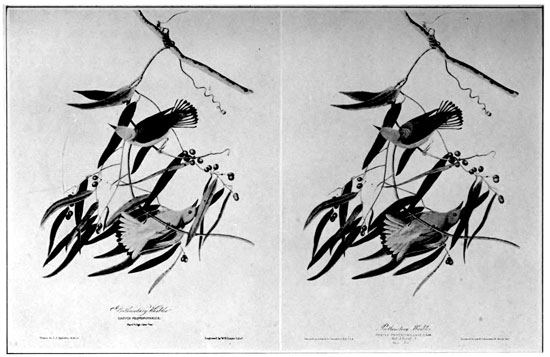
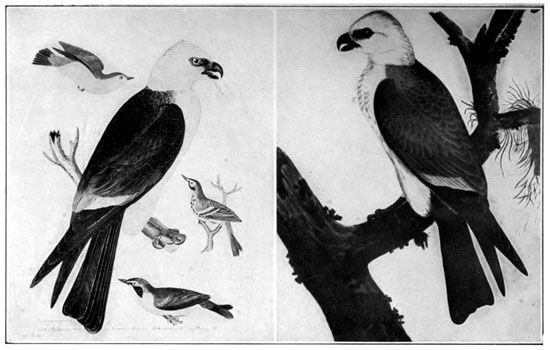
THE PROTHONOTARY WARBLER PLATES, "THE BIRDS OF AMERICA," PLATE XI, BEARING THE LEGENDS OF THE
ENGRAVERS W. H. LIZARS (LEFT) AND ROBERT HAVELL, JR. (RIGHT), BUT IDENTICAL IN EVERY
OTHER DETAIL OF ENGRAVING, ANY APPARENT DIFFERENCE BEING DUE TO THE
COLORING, WHICH WAS ADDED BY HAND.
Under the younger Havell's guiding hand, Audubon
found that his illustrations could be produced in
better style, more expeditiously, and at far less cost
than in Edinburgh. When Lizars was later shown the
third number which the Havells had produced, he called
his assistants and observed how completely the London
workmen had beaten them; he even offered to resume
work on the engraving and at Havell's price, but Audubon
was averse to further experimenting. "If he can
fall," said he, "twenty-seven pounds in the engraving
of each number, and do them in a superior style to his
previous work, how enormous must his profits have
been; a good lesson to me in the time to come, though I
must remember Havell is more reasonable owing to
what has passed between us in our business arrangements,
and the fact that he owes so much to me."
This characteristic note was sent from Liverpool,
December 6, 1827, to his agent, Daniel Lizars, father
to W. H. Lizars, at Edinburgh:
I will not ask if you have any new name for me, as I might
be disappointed were I to expect an affirmative answer.
If you see Sir Wm. Jardine tell him that Charles Bonaparte
has left the U. S. for ever, and has gone to reside in Florence,
Italy.
I have wrote to Mr. Havell to send you a No. 5, which I
wish you to send to Professor Wilson, or indeed a whole set, to
enable him to write the notice he has promised for me the 1st.
of next month.
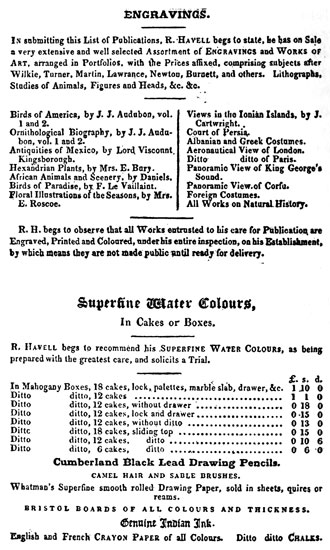
REVERSE OF PANELS OF ROBERT HAVELL'S ADVERTISING FOLDER REPRODUCED ON
FACING INSERT.
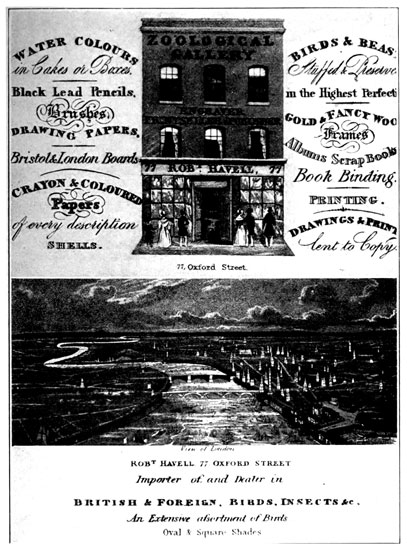
OUTSIDE ENGRAVED PANELS OF AN ADVERTISING FOLDER ISSUED BY ROBERT HAVELL,
ABOUT 1834; THE PRINTING ON THE REVERSE IS REPRODUCED
ON THE FACING PAGE.
From the only copy known to exist, in possession of Mr. Ruthven Deane. It
is a strip of heavy paper, 18 by 3⅝ inches in size, printed on both
sides, and folded twice, the folded size being 4½ by 3⅝
inches. One side bears the four panels, engraved
by Robert Havell, reproduced on this and
the following page; and the reverse,
the printed matter reproduced
on pages 386 and 387.
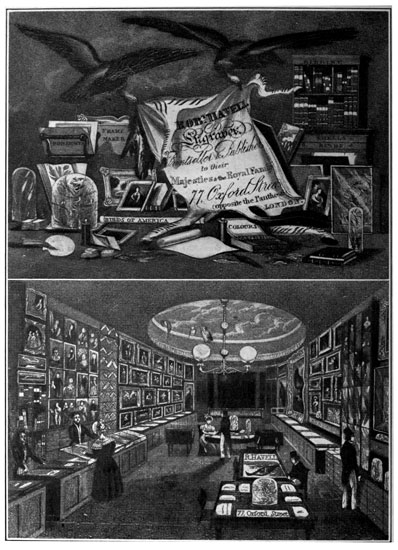
INSIDE ENGRAVED PANELS OF THE ADVERTISING FOLDER ISSUED BY ROBERT HAVELL,
ABOUT 1834.
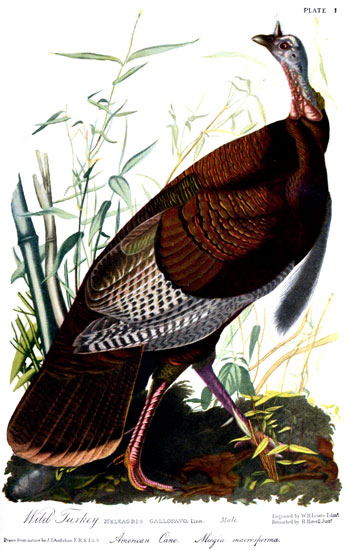
The lower panel shows the interior of the "Zoölogical Gallery," 77 Oxford
Street. Audubon's plate of the Cock Turkey is being
examined at one of the tables.
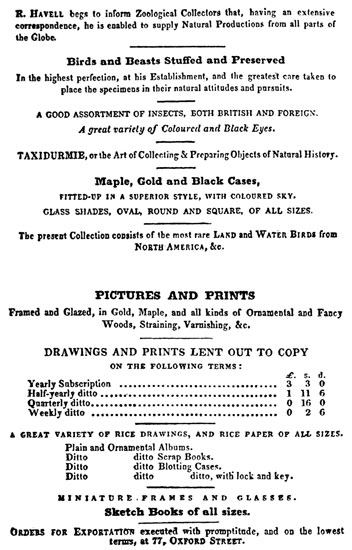
REVERSE OF PANELS OF ROBERT HAVELL'S ADVERTISING FOLDER REPRODUCED ON
FACING INSERT.
Audubon sent another letter to this agent, from
London, January 21, 1828, when he was still waiting
for an answer to his last: "When I write to any one I
expect an answer, but when I write to a man I esteem,
and to whom I entrust a portion of my business, I feel
miserable until I hear from him.... I am extremely
anxious to close my business for 1827, and cannot do so
without receiving your a/c, and the money due by my
subscribers."
The summer of 1827 was probably Audubon's most
critical period in England. His work was then in the
air and ruin of all his hopes seemed inevitable, but with
palette and brush he again extricated himself from
financial difficulties. At this time, he said, "I painted
all day, and sold my work during the dusky hours of
the evening as I walked through the Strand and other
streets where the Jews reigned; popping in and out of
Jew-shops or any others, and never refusing the offer
made me for the pictures I carried fresh from the
easel." He sold seven copies of the "Entrapped Otter"
in London, Manchester, and Liverpool, and from seven
to ten copies of some of his other favorite subjects; once
when he inadvertently called at a shop where he had
just disposed of a picture, the dealer promptly bought
the duplicate and at the same price that he had paid
for the first.
In the autumn of this year, when it was found that
his agents were neglecting their business, Audubon
determined to make a sortie to collect his dues and
further augment his subscription list. He left London
on September 16, and visited in succession Manchester,
Leeds, York, Newcastle-on-Tyne, Alnwick Castle and
Belford, to see the Selbys, finally reaching Edinburgh
on the 22nd of October.
Audubon had set his mark at obtaining 200 subscribers
by May, 1828, but he fell far short of realizing
it. On August 9 he wrote: "This day seventy sets
have been distributed; yet the number of my subscribers
has not increased; on the contrary, I have lost some."
At York he found that a number of his Birds, which had
been forwarded from Edinburgh before he had taken
his departure, "was miserably poor, scarcely colored
at all"; and a copy of his first number which was later
examined at the Radcliffe Library in Oxford was so
unsatisfactory that he rolled it up and took it away, with
the reflection that Lizars, whom he had paid "so amply
and so punctually," could have made him a better return.
The colorists gave no end of trouble, but he
never hesitated to reject their work when it did not
meet his requirements, and the defective plates were
invariably sent back to Havell's shop to be washed, hot-pressed,
and done over again. To such watchful care
must be ascribed, in large measure, the high degree of
perfection which his big work eventually attained.
When it is remembered that upwards of one hundred
thousand of his large plates had to be colored laboriously
by hand, and that at one time fifty persons were
engaged at the Havell establishment, we can understand
the difficulties involved in maintaining a uniform standard
of excellence in a work that was issued piecemeal and
spread over a long period of time.
In August, 1827, Audubon wrote to Mrs. Thomas
Sully of Philadelphia to announce the removal of his
business to London. By this change he expected to
save "upwards of an hundred pounds per annum, a
large sum," as he remarked, "for a man like me." His
third number had then been issued, and he expressed
the hope that all would go smoothly after "this first year
of hard trials and times," and that he would be able to
send for his wife and one of his sons in the coming
autumn or winter. He was then painting "a flock of
Wild Turkeys for the king, who had honored him with
his particular patronage and protection." When writing
to his young son, John W. Audubon, on the 10th
of the same month, he charged him to devote two hours
daily to the preparation of bird skins, and to send him
not only the skins but live birds and mussel shells, for
which he would be duly paid. Said the father:
I would give you 500 dollars per annum, were you able
to make for me such drawings as I will want. I wish you would
draw one bird only, on a twig, and send it [to me] to look at,
as soon as you can after receiving this letter.... I should
like to have a large box filled with branches of the trees, covered
with mosses &c., such as Mama knows I want; now recollect,
all sorts of Birds, males and females, ugly or handsome.
Audubon had come to London with the idea of having
his work published under the patronage of King
George IV; in order to gain a personal interview with
the Sovereign he had brought a letter to Robert Peel,
who was then the Home Secretary, but a change in
the Cabinet had upset his plans and the letter was returned.
He then applied to the American Ambassador,
Mr. Albert Gallatin, who upon their first meeting addressed
him in French and showed "the ease and charm
of manner of a perfect gentleman"; but when the question
of an audience with the King was broached, Gallatin
laughed at the idea as preposterous. "The king,"
he declared, "sees nobody; he has the gout, is peevish,
and spends his time playing whist at a shilling a rubber.
I had to wait six weeks before I was presented to him
in my position of ambassador, and then I merely saw
him six or seven minutes." When Audubon then suggested
that the Duke of Northumberland might interest
himself in his behalf, Gallatin, who disliked the English
heartily, replied: "I have called hundreds of times on
like men in England, and have been assured that his
grace, or lordship, or [her] ladyship was not at home,
until I have grown wiser, and stay at home myself, and
merely attend to my political business, and God knows
when I will have done with that."
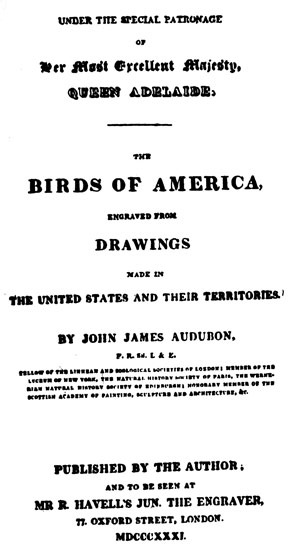
TITLE PAGE OF AUDUBON'S PROSPECTUS OF "THE BIRDS OF AMERICA" FOR 1831.
As the American Ambassador had predicted, King
George evinced no ardent desire to meet the American
woodsman, though he consented to take the work under
his patronage and to become a subscriber on the usual
terms; this plan, however, fell through, for the King,
who was reported to have taken his copy, failed to pay
for it. With Queen Adelaide, on the other hand, the
naturalist was more successful, and in his "Prospectus"
of 1831 she was announced as his special patron, with
her name heading his list. Negotiations to interest the
Queen were going on when the following note was sent
to Audubon by Sir J. W. Waller, who occupied some
position in the king's household and was spoken of as
"oculist to his majesty":
Saturday 9 o clock [1830].
I have scarce an Instant as I am going to Town to breakfast
with the Dk. of Gloucester, but yr. Letter is urgent &
therefore I can only desire Mr. A. to send his Number immediately
to the Stable Yard, directed to her Majesty, & the first
moment I can see her, I will speak on the subject, but at this
Moment I will not promise to mention it to the King for reasons
I cannot put on paper.
At Edinburgh Audubon was alarmed to find that
subscribers were rapidly deserting him, six having cancelled
their names without the formality of giving reasons.
He hoped to supply their places at Glasgow, then
a rich city of one hundred and fifty thousand people,
but after a visit there of four days in November, 1827,
he was obliged to return to Edinburgh with but one
new name on his list.
On October 22 he expressed the resolve for the coming
year "to positively keep a cash account" with himself
and others, "a thing" he had "never yet done." The
wisdom of that decision was apparent upon settling his
accounts for 1827 with both Lizars and Havell, as appears
from this note, written in his journal on January
17, 1828: "It is difficult work for a man like me to see
that he is neither cheating nor cheated. All is paid for
1827, and I am well ahead in funds. Had I made such
regular settlements all my life I should never have been
as poor a man as I have been; but on the other hand I
should never have published the "Birds of America."
Again, for February 7 we find this record: "Havell
brought me the sets he owed me for 1827, and I paid
him in full. Either through him or Mr. Lizars I have
met with a loss of nearly £100, for I am charged with
fifty numbers more than can be accounted for by my
agents or myself. This seems strange always to me,
that people cannot be honest, but I must bring myself
to believe many are not, from my own experiences."
Shortly after reaching London, as we have seen,
Audubon had made the acquaintance of Sir Thomas
Lawrence, then at the head of the Royal Academy and
favorite painter of the Court and fashionable society.
The friendship of this influential artist at a critical moment
proved most fortunate, for Sir Thomas called
repeatedly at his lodgings, and at each visit brought
patrons who went away with some of his pictures but
not without leaving a handsome toll of sovereigns in
his lap; the "Entrapped Otter" again did duty by
bringing him twenty-five pounds, while others returned
from seven to thirty-five pounds. At a later time the
artist visited the "Zoölogical Gallery," as the Havell
establishment in Newman Street was then known, and
saw Audubon's large paintings called "The Eagle and
the Lamb," and "English Pheasants Surprised by a
Spanish Dog" or "Sauve qui peut." Audubon, who
on this occasion missed seeing his distinguished visitor,
had written in his journal three days before (December
23, 1828) that the paintings were what he called "finished,"
but that, as usual, he could not bear to look at
either. Sir Thomas praised the "Eagle," admired an
"Otter," which was later exhibited in London, but gave
no opinion on the "Pheasants." Afterwards, however,
when Audubon proposed to present this canvas to King
George, the artist assured him that this picture was
worth 300 guineas and that it was too good to be given
away; if offered to the King, no doubt, said he, "it
would be accepted and placed in his collections, but you
would receive no benefit from the gift." According to
a later record, this canvas was sold to Mr. John Heppenstall
of Sheffield; whether it was ever delivered, or
not, I do not know, but either the original or a copy,
here reproduced, now forms the central figure in the
large Audubon collection in the American Museum of
Natural History in New York, and is an excellent illustration
of the elaborate and ambitious character of
Audubon's larger compositions. These fortunate windfalls
came none too soon, for to follow the journal:
Mr. Havell had already called to say that on Saturday I
must pay him sixty pounds. I was then not only not worth a
penny, but had actually borrowed five pounds a few days before
to purchase materials for my pictures. But these pictures
which Sir Thomas sold for me enabled me to pay my
borrowed money, and to appear full-handed when Mr. Havell
called. Thus I passed the Rubicon.
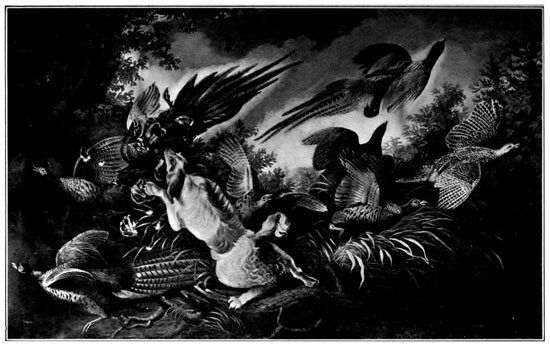
"ENGLISH PHEASANTS SURPRISED BY A SPANISH DOG"
AFTER AUDUBON'S ORIGINAL PAINTING, ABOUT SIX BY NINE FEET IN SIZE, NOW IN POSSESSION OF THE AMERICAN MUSEUM OF NATURAL
HISTORY, NEW YORK. PUBLISHED BY COURTESY OF THE AMERICAN MUSEUM OF NATURAL HISTORY.
This was before the reform of the penal laws in England,
when it seems to have been hard for a man to
escape hanging, not to speak of being sent to prison
for debt, the chief terror of life in certain circles.
There were 223 capital offenses, and in 1829 in the
city of London alone 7,114 persons were sent to the
debtors' prison.[349]
Without the sale of his pictures in the summer of
1827, Audubon felt that he must certainly have become
a bankrupt, yet he was periodically displeased with the
results of his efforts in oil colors, and resolved to "spoil
no more canvas" but to draw "in my usual old untaught
way, which is what God meant me to do"; "I can draw,"
he continues, "but I shall never paint well." In the
fall of 1828, however, he was again working in oils,
and produced four large pieces, one of which was called
"The Eagle and the Lamb," and two others which were
doubtless variations of his "Pheasant" and "Otter" pictures.
"It is charity," said the artist, "to speak the
truth to a man who knows the poverty of his talents,
and wishes to improve; it is villainous to mislead him,
by praising him to his face, and laughing at his work
as they go down the stairs of his house." Sir Thomas
Lawrence had praised some of these pictures and had
promised to select one for exhibition at Somerset House.
As regards "The Eagle and the Lamb," which Audubon
hoped would go to Windsor Castle, William
Swainson would give no opinion; the same canvas, or
else a replica, was in possession of the Audubon family
in 1898.[350]
On December 14, 1827, Audubon wrote that, acting
upon the advice of Mr. Maury, the American consul
at London, he had presented a copy of his Birds to
John Quincy Adams, the President of the United
States, and another, through Henry Clay, to the American
Congress; in order that the latter should be as
perfect as possible, Havell was asked to do the coloring
himself, but these proposed gifts do not appear to
have been executed.[351]
New Year's, 1828, found the naturalist in Manchester,
where but a few days before he had received
the fifth and last number of his plates for 1827 and
expressed himself well pleased with it. While returning
to London by coach, he consented to take a hand
at cards to accommodate his fellow passengers, but
declined to play for money; "I never play," he confessed,
"unless obliged to by circumstances; I feel no
pleasure in the game, and long for other occupation."
"I missed my snuff," he added, and whenever his hands
went into his pockets in search of the box, he "discovered
the strength of habit thus acting without thought";
but he remembered a resolution he had formed to give
up the habit and stuck to it for a time at least; doubtless,
like his later friend, John Bachman, he reformed
more than once, for in a letter to Victor Audubon, of
November 5, 1846, Bachman added this postscript:
"To Audubon: The snuff—the snuff, it is here! I have
just taken a pinch, and the ladies have blown you up—sky-high,
for teaching me such a bad practice; I say,
however, that you beat me all to pieces in that art."
The first winter in London dragged heavily for the
naturalist, who exclaimed in January, 1828: "How
long am I to be confined in this immense jail"; when
Daniel Lizars reported from Edinburgh the loss of four
of his subscribers, he writes, "I am dull as a beetle.
Why do I dislike London? Is it because the constant
evidence of the contrast between the rich and the poor
is a constant torment to me, or is it because of its size
and crowd? I know not, but I long for sights and
sounds of a different nature," such, we might add, as
the flocks of wild duck which were occasionally seen
from Regent's Park as they passed over the city and
made him more homesick than ever. Audubon
hated the city quite as cordially as Charles Lamb ever
affected to detest the country, and when leaving it,
afoot or by stage, it seemed as if he could never be
rid of it. "What a place is London," he would say, but
naïvely add: "many persons live there solely because
they like it."
On February 4, 1828, Audubon was elected to membership
in the Linnæan Society, and in November he
presented it with a copy of his work, which was then
well under way. This was noticed in a letter to Swainson,
written on November 7, when no acknowledgment
of the gift had then been received; and he mentioned
also the sale of his picture of "Blue Jays" for ten
guineas. At a meeting of the Linnæan Society not
long after his election, copies of Selby's Illustrations of
British Ornithology and of his own work were placed
side by side for inspection, and "very unfair comparisons
were drawn between the two"; had Selby, Audubon
reflected, been given "the same opportunities that
my curious life has granted me, his work would have
been far superior to mine"; "I supported him," he
added, "to the best of my power."
Revision of his older drawings demanded much of
Audubon's attention during these years. On February
10, 1828, he began the Whiteheaded Eagle (No. 7,
Plate xxxi), the original of which had been procured on
the Mississippi, where the bird was represented as dining
on a wild goose; now, he said, "I shall make it
breakfast on a catfish, the drawing of which is also with
me, with the marks of the talons of another eagle, which
I disturbed on the banks of the same river, driving him
from his prey." On the 16th of that month he was
engaged with this drawing from seven in the morning
until half after four, stopping only to take the glass of
milk which his landlady would bring to him. This plate
was engraved in the following April, and on May 1,
1828, a first proof was sent to the Marquis of Landsdowne,
president of the Zoölogical Society, as a mark
of appreciation by its author, who had become a member
of that body in the preceding winter.
A striking characteristic of Audubon's work was its
diversity, produced not only by attractive embellishments
of many kinds, but by the moving force and
action with which he ever sought to vitalize his subjects.
It is therefore not surprising that he was nettled
by an incident like this:
February 28. To-day I called by appointment on the Earl
of Kinnoul, a small man, with a face like the caricature of an
owl; he said he had sent for me to tell me all my birds were
alike, and he considered my work a swindle. He may really
think this; his knowledge is probably small; but it is not the
custom to send for a gentleman to abuse him in one's house. I
heard his words, bowed, and without speaking, left the rudest
man I have met in this land.
Audubon had not yet visited the great university
towns of England, the support of which he knew would
be a valuable asset, and on March 3, 1828, he set out
by stage for Cambridge. His driver, he remarked,
"held confidances with every grog-shop between London
and Cambridge, and his purple face gave powerful
evidences that malt liquor [was] more enticing to him
than water." His reception at Cambridge was hearty;
he was entertained by Professors Sedgwick, Whewell,
and Henslow, dined repeatedly "in Hall" with the dons,
and received the subscription of the librarian of the
University. It is interesting to recall that young
Charles Darwin, "the man who walks with Henslow,"
as some of the dons called him, was then an undergraduate
at King's College, and that thirty-one years were
to pass before modern biology was born in 1859, the
year of the appearance of the epoch-making Origin of
Species.
By the 15th of March Audubon was again in London,
and on the 24th he started for Oxford. Dr.
Williams, as he noted in his journal, subscribed for his
Birds in favor of the Radcliffe Library, as did also Dr.
Kidd for the Anatomical School; but, though hospitably
treated by all, not one of the twenty-four colleges
of that great University emulated their example, and
the naturalist went away disappointed.
Upon his return to London in early April, Audubon
received a call from John C. Loudon, editor of the
Magazine of Natural History, and was invited to contribute
to that journal. "I declined," he said, "for I
will never write anything to call down upon me a second
volley of abuse. I can only write facts, and when I
write these, the Philadelphians call me a liar." He was
then chafing under the criticism which his rattlesnake
stories had produced.[352] On April 6 the persistent Mr.
Loudon called again and offered Audubon eight
guineas for an article, only to be again refused. Still
unwilling to admit defeat, the editor proposed to engage
William Swainson to prepare an extended review
of the naturalist's work, and in this he succeeded so well
that Audubon immediately relented and sent him a
paper.[353] Swainson offered to write the review for a
copy of the work at its cost price, and Audubon replied
in the following letter:[354]
London, April 9th 1828.
My Dear Sir,
Mr. Loudon called on me yesterday and showed me a letter
from you to him, in which many very flattering expressions respecting
myself and my works you are so kind as to offer to
review the latter so as to have your opinion in writting in time
for the first no. of the magazine that will appear next month.—you
also desire that I should send you a sett of the works as far
as publishing which you wish to keep provided I will let you
have it at the price it costs me. I assure you my Dear Sir, that
was I to take you at your word it would be a sore bargain for
you as the a/m would be very nearly double that for which it
is sold to my subscribers.—therefore you will permit me to
alter your offer and to say that if it suits you to pay 35
shillings per number I will be contented; I would be still more
so was I rich enough to present it to you.—
It is the only set on hand at present except one which I
must have to exhibit.—
The answer respecting the Shrieke [Shrike] has I hope met
with your wishes.—
Ever since I became acquainted with our mutual friend Dr.
Fraill [Traill] I have had a great desire to see and speak to
you & I regret that I never have had an opportunity. My time
is so completely taken up that it is with difficulty that I can
enjoy a day's rest—Should you come to town pray call on me
when I may have the pleasure of shaking your hand and to assure
you verbally that I am truly and sincerely
yours obe st
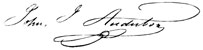
John J. Audubon
95 Great Russell St.
Bedford Sq.
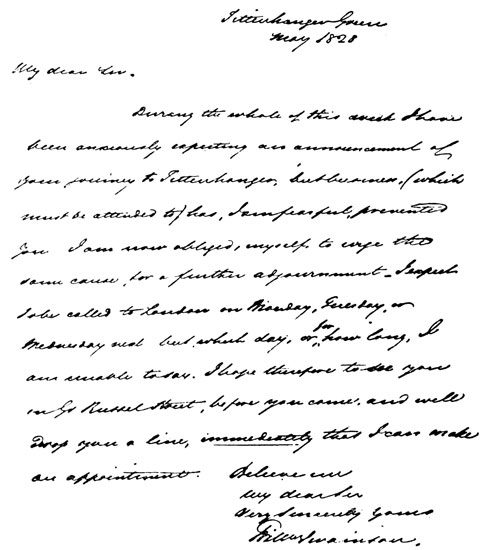
LETTER OF WILLIAM SWAINSON TO AUDUBON, MAY, 1828.
From the Deane MSS.
Thus began an intimate friendship between William
Swainson and John James Audubon which lasted until
1830, and their intercourse did not wholly cease before
1838. In his use of English at this time Audubon
was not far behind Swainson, whose mother tongue it
was. Swainson, according to Dr. Günther, was "extremely
careless in orthography and loose in his style
of writing: he persistently misspelt not only technical
terms, but also the names of foreign authors, and even
of some of his familiar friends and correspondents; he
knew no other language but his own, and the application
of Latin and Greek for the purpose of systematic
nomenclature was a constant source of error."
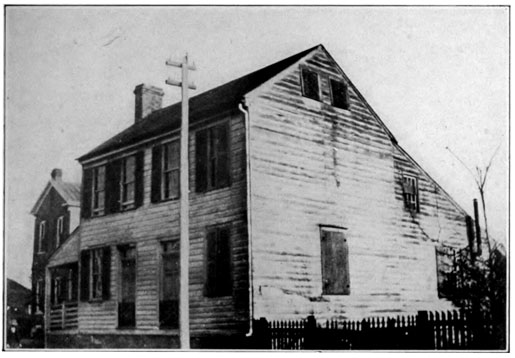
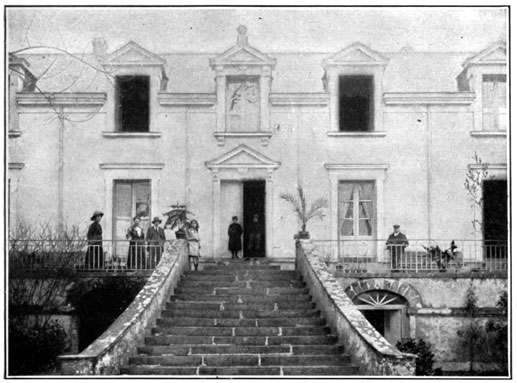
At this time Swainson was living in semi-retirement
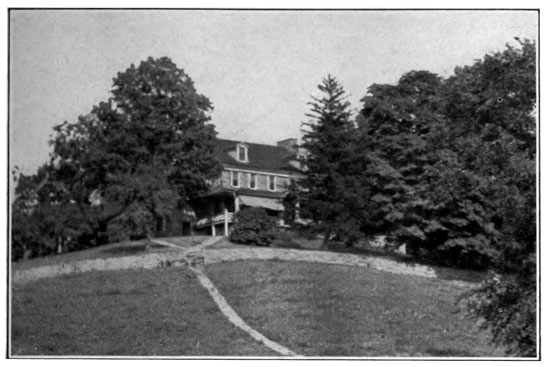
at a farmstead of considerable size, called "Highfield
Hall,"[355] near Tyttenhanger Green, a small settlement,
off the highroad, two miles southeast of the historic
town of St. Albans, in Hertfordshire; though his letters
were always dated from "The Green" at Tyttenhanger,
his associations were with the more considerable village
of London Colney, but a mile to the south, on the road
to Barnet. Audubon had brought a letter of introduction
from Dr. Traill, a valiant champion of Swainson
at Edinburgh, but was unable to go to the country
to deliver it. Swainson, however, attended promptly
to the review, and on April 11, 1828, sent it to Mr.
Loudon, who published it in the May number of his
Magazine.[356]
Swainson's review was extremely laudatory, and
Audubon reproduced extracts from it in later editions
of his "Prospectus." To quote a characteristic paragraph,
he said that the naturalist's ornithological papers
printed in one of the Scotch journals, are as valuable to the
scientific world, as they are delightful to the general reader.
They give us a rich foretaste of what we may hope and expect
from such a man. There is a freshness and an originality
about these essays, which can only be compared to the animated
biographies of Wilson.... To represent the passions and the
feelings of birds, might, until now, have been well deemed chimerical.
Rarely, indeed, do we see their outward forms represented
with any thing like nature. In my estimation, not more
than three painters ever lived who could draw a bird. Of these
the lamented Barrabaud [Barraband], of whom France may
be justly proud, was the chief. He has long passed away; but
his mantle has at length been recovered in the forests of
America.
Audubon spent four days with Swainson and his
family at Tyttenhanger, from May 28 to June 1, 1828,
when they talked birds and made drawings; Audubon
also showed Swainson "how to put up birds in his style,
which delighted him." The friendship between these
men, though very intimate while it lasted, received a
sudden check two years later, when Audubon was about
to publish the letterpress to his plates, as will be related
farther on.[357]
Though his hands were already more than full at
this time, Audubon seems to have played with the idea
of publishing a work on the birds of Great Britain, but
on May 1 he wrote to Swainson that the plan did not
meet with favor, and later he relinquished all claims in
such a project to his assistant, William MacGillivray.[358]
In the spring of 1828 Audubon began to think of
returning to the United States, to renew or revise his
drawings and extend his researches. "I am sure," he
said, "that now I could make better compositions, and
select better plants than when I drew mainly for amusement."
In order to raise the necessary funds, he resorted
again to picture painting, his never failing resource,
and worked in oil colors daily from morning light
until dusk, unless called to Havell's to decide some question
of necessary detail. The following letters to
Swainson shed further light on this work and on the
progress of The Birds of America, the eighth number of
which was published early in July:
London, July 1st 1828.
My dear Sir.—
I have been expecting to have the pleasure of seeing you for
upwards of a week, having mentioned in your last note that
you intended spending a couple of days in London before the
end of June.—When are you coming?—the beautifull lamb
came quite safe and is now on the canvas (in efigy) for ages to
come—I bought a superb Golden Eagle from Mr. Cross that
also has helped to fill it —— [Here apparently some words
have been deleted, and it is impossible to read them.] I long
to shew them to you.—I have finished the picture of the Turkeys,
and painted a white headed eagle—in fact I have worked
from 4 every morning untill dark—but the best news I have
to tell is; that I have received 4 letters from my wife, one dated
2nd of May, all well—but not quite settled about coming before
the end of summer. I have changed quarters and am now at
79 Newman Street Oxford Street, in Mr. Havell's house where
I have taken 3 rooms and feel more comfortable although I
have not the little piece of ground to walk on.—I imagine the
country to be now quite beautifull and had I time to spare
would walk out to see you Mrs S & the dear little folks at
Tittenhanger Green.—I received a visit on Saturday last of
the whole of Lord Milton's family who after complimenting the
author of the "Birds of America" very kindly subscribed for
two copies of the work.—I have mended my pen—I should have
sent the Blackwood magazine to you, but I so much expected
to see you here that it is yet on my table, and will keep it untill
you come.—All my exertions to procure live grouses have been
abortive here—I have written to Scotland to a friend and perhaps
will have some soon.—The 8th number is now printing and
colouring and will be out this month—the 9th is began.—If you
are hungry or thirsty when you come to town please make for
my [here a word is omitted], and I will try to manage matters
in this way.—May I ask what you are doing?—I saw Dr
Fraill's [Traill's] son a few days ago—he inquired after your
son and family.—I expect a copy of Loudon's magazine this
evening. I feel anxious to see what sort of a cut the Doves
make, as well as the birds of Washington.—
With sincerest regards & esteem to yourself and Lady—
I am yours most truly
John J. Audubon.
79 Newman Street,
Oxford Street.
London Thursday July 1828.
My dear Mr Swainson,
Although your last note said that you knew not when I
should have the pleasure of seeing you in town, I have hoped
every morning to see you that day.—When will you come?—There
is a talk of my picture of the Eagle and the Lamb going
to her Majesty, Sir Walter Waller has been written to on the
subject and every thing is in train to lead poor I like a lamb to
Windsor Castle!—I am told the picture is a grand one but you,
my dear Sir, have not said so! When you come I will show you
13 grouses pretty fairly grouped on one canvas, with seven
pheasants with a Fox on another, etc. etc. I have worked hard
this month from 4 p.m. untill 7 a.m. [sic] every day—I regretted
that your brother did not come to see me—I have a
great desire to see you but I cannot at present leave town.—My
8th No. is just out.—The 9th & 10th are engraving.—I
have sent word to my son to land [?] & bring some skins for
you & perhaps you may have a rare assortment bye and bye.—I
hope your Lady and dear Children are all quite well Pray remember
me kindly to them.——I wish to name a bird after
you in the 1st No. of 1829 & wish you to choose a name.
Believe yours ever and truly obliged
J. J. Audubon
79 Newman Street,
Oxford Street.
By the 9th of August eight pictures had been begun,
but none was finished, and the number of his subscribers
had fallen to seventy. At about this time Captain
Basil Hall[359] returned from his journey through
the United States, and brought direct news from Victor
Audubon, who was then at Louisville, from Dr. Richard
Harlan and Thomas Sully, to all of whom the naturalist's
letters had been delivered the previous year.
Towards the end of the month Audubon received the
following note from the secretary of the Zoölogical Society,
N. A. Vigors, who was also anxious to obtain
from him an article for his Journal:
My dear Sir:—
I hope you do not forget your promise of giving us a
paper for the Zoölogical Journal. We should be much gratified
by having your name with us: and, if possible, should wish
to have whatever you may favour us with within the next ten
days. I have been but a few hours in town, and shall leave
town again tomorrow for a few days, or I should have called
upon you to speak personally upon the subject. I believe I
have already mentioned, that we are in the habit of remunerating
those of our correspondents who wish for payment for
their labours, at a rate not exceeding £10.10.0 per sheet.
A letter from you in answer will reach me, if sent to Bruter
Ct: before Wednesday on which day a parcel will be forwarded
to me from thence.
Believe me my dear Sir,
Yours faithfully,
N: A: Vigors.
[Addressed]
J. J. Audubon Esq.,
69 Great Russell St.;
Bloomsbury.
[Readdressed]
Newman Street,
Oxford Street
Audubon refused this request, saying that "no
money can pay for abuse," and this time he did not
retract.
Without immediate prospect of seeing his family,
for neither Mrs. Audubon nor her sons were enthusiastic
over the proposal that they should go to England, the
naturalist was momentarily depressed; he turned to
Swainson for advice, at the same time suggesting that
they visit Paris together. Audubon wrote in his journal
for August 16, 1828, that he had invited Swainson to
accompany him to France, whither his friend had expressed
a desire to go when the subject had been
broached at Tyttenhanger; on the 25th of that month
he added: "I do not expect much benefit by this trip,
but I shall be glad to see what may be done." The
letter just referred to follows:
London, Wednesday Augt. 13, 1828.
My dear Mr. Swainson,
I reached my lodging in great comfort by the side of your
amiable Docr Davie two hours and a half after we shook hands—I
wish I might say as much of my Journey through Life.—I
have had sad news from my dear wife this morning, she has positively
abandoned her coming to England for some indefinite
time, indeed she says that she looks anxiously for the day when
tired myself of this country I will return to mine and live although
a humbler (Public) Life, a much happier one—her
letter has not raised my already despondent spirits in somethings
and at the very instant I am writing to you it may perhaps
be well that no instrument is at hand with which a woeful
sin might be committed—I have laid aside brushes, thoughts of
painting and all except the ties of friendship—I am miserable
just now and you must excuse so unpleasant a letter—Would
you go to Paris with me? I could go with you any day that
you would be please to mention, I will remain there as long and
no longer than may suit your callings—I will go with you to
Rome or anywhere, where something may be done for either of
our advantage and to drive off my very great uncomfortableness
of thoughts—My two sons are also very much against coming
to England, a land they say where neither freedom or simplicity
of habits exist and altogether uncongenial to their mode
of life.—What am I to do? As a man of the World and a man
possessed of strong unprejudiced understanding I wish that you
would advise me.—But now on your account I will change the
subject—I called on Newman two days ago & to the following
enquiries he gave me yesterday the following answers
What the price of
| ½ doz best Pure Lake |
dowards [?] |
answer |
12/— |
| ½ doz best Carmin |
" |
" |
20/— |
| ½ doz best UltraMarine |
" |
" |
84/— |
| ½ doz best Vermillion |
" |
" |
6/— |
| ½ doz best Terra di Verona |
" |
" |
4/— |
As I thought the above prices enormous I have declined advising
chalks for you & will await your advent.—
Should you not feel inclined to go to France at present
which by the bye is the very best season on account of seeing
the vintage etc. etc.—please write to me so or come to town
which would be still more agreeable & talk the matter over as
I think I would persuade you to absent yourself for a month
or so—I hope your kind lady continues quite well & your Dear
Little ones—
Believe me yours most sincerely
John J. Audubon.
Please write by return of Post—
79 Newman Street
Oxford Street.
On this journey to Paris Audubon was accompanied
by Mr. and Mrs. Swainson and an American artist,
named Parker, who had been at work on a portrait of
the naturalist in oils. For Audubon it was mainly a
canvassing tour; Parker hoped to obtain orders for portraits,
and Swainson, new ornithological material at the
great museum in the Jardin des Plantes, for a work
upon which he was then engaged.[360]
The party set out on the 1st of September, traveling
by way of Dover and Boulogne, and reached Paris
on Thursday, September 4. They alighted at the Messagerie
Royale, Rue des Victoires, and, after looking
up lodgings, went at once to the Jardin des Plantes to
pay their respects to Cuvier. The Museum of Natural
History was closed, but they knocked and asked for the
Baron. "He was in," said Audubon, in the journal of
his Paris experience,
but, we were told, too busy to be seen. Being determined to
look at the great man, we waited, knocked again, and with a
certain degree of firmness sent in our names. The messenger
returned, bowed, and led the way up stairs, where in a minute
Monsieur the Baron, like an excellent good man, came to us;
he had heard of my friend Swainson and greeted him as he
deserves to be greeted; he was polite and kind to me, though
my name had never made its way to his ears. I looked at him,
and here follows the result: age about sixty-five; size corpulent,
five feet five, English measure; head large; face wrinkled and
brownish; eyes gray, brilliant and sparkling; nose aquiline,
large and red; mouth large, with good lips; teeth few, blunted
by age, excepting one on the lower jaw, measuring nearly
three-quarters of an inch square.[361]
They were immediately invited to dine on the following
Saturday at six o'clock, and later saw Cuvier at his
home, at his Museum, and at the Academy of Sciences,
over which he presided.
Geoffroy Saint-Hilaire pleased Audubon greatly
and proved to him by his conversation that he understood
perfectly the difference between the French and
the English. The Duke of Orleans, who then occupied
the Palais Royal, seemed to him the finest physical type
of man he had ever met. "He had my book brought
up," said the naturalist, "and helped me untie the strings
and arrange the table, and began by saying that he felt
great pleasure in subscribing to the work of an American,
for he had been most kindly received in the United
States and should never forget it." When the plate of
the Baltimore Orioles was held up to view, the Duke
exclaimed: "This surpasses all I have seen, and I am
not astonished now at the eulogiums of M. Redouté."
He conversed in both English and French, had much
to say of American cities and rivers, and added: "You
are a great nation, a wonderful nation." The Duke
wrote his name in Audubon's subscription book, promised
to try to enlist a number of the crowned heads of
Europe in his behalf, and gave him besides a number
of orders for pictures of animals.
Audubon had already made friends with the veteran
painter of flowers, Pierre Joseph Redouté, and when
it was proposed that they should exchange works, the
"Raphael of Flowers" consented, gave Audubon at once
nine numbers of his Belles Fleurs, and promised to send
"Les Roses."
During this visit of eight weeks Parker painted portraits
of both Cuvier and Redouté; Swainson worked
steadily at the Museum, where Isidore Geoffrey Saint-Hilaire
gave him the use of his private study; while
Audubon, for the most part, was driving from post to
pillar in his not altogether successful efforts to extend
his subscription list. As already intimated, his greatest
success in Paris was in winning the friendship and endorsement
of Cuvier, who reported upon his work at a
meeting of the Royal Academy of Sciences held on
September 22.[362] Audubon has related how on this occasion
he had an appointment to meet the Baron in the
library of the Institute at precisely half past one
o'clock; he waited; the hall filled, and the clock ticked
on, but the great savant did not appear. Finally, said
Audubon, after an hour had passed, "all at once I heard
his voice, and saw him advancing, very warm and apparently
fatigued. He met me with many apologies,
and said, 'Come with me'; and as we walked along, he
explaining all the time why he had been late, while his
hand drove a pencil with great rapidity, and he told me
that he was actually now writing the report on my
work!"[363] Cuvier's published report, which was extremely
laudatory, showed little signs of haste. After
speaking of Audubon's talents and accomplishments he
said:
The execution of these plates, so remarkable for their size,
seems to us equally successful in the drawing, the engraving,
and coloring, and though it may be difficult to represent relief
in a colored print with as much effect as in painting proper,
this is no disadvantage in works on natural history; naturalists
prefer the true color of objects to those accidental shades
which result from the diverse inflections of light; necessary
though these be for completing the truth of a picture, they are
foreign as well as prejudicial to scientific accuracy.[364]
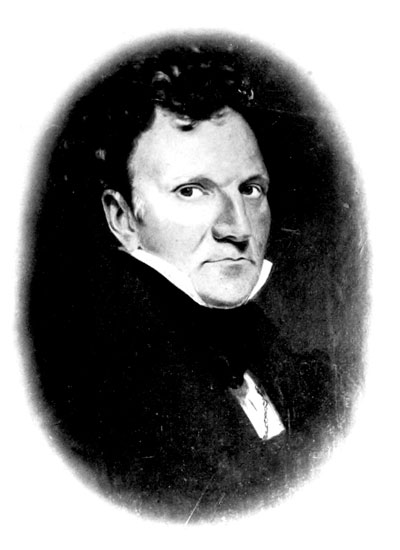
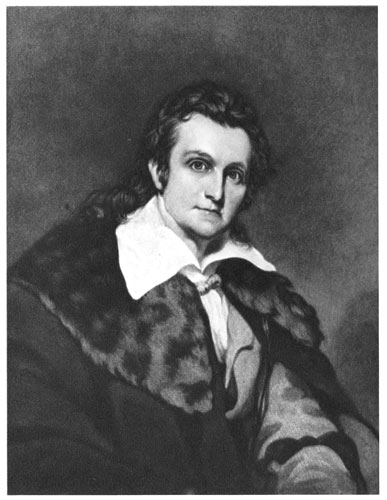
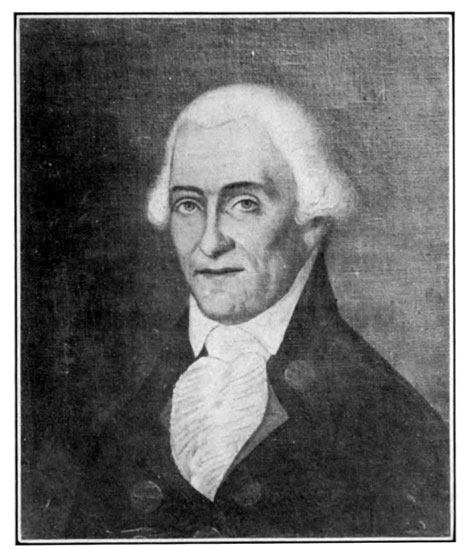
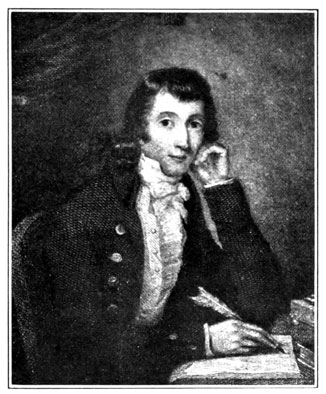
AUDUBON
AFTER A PORTRAIT IN OILS, HITHERTO UNPUBLISHED, PAINTED ABOUT 1826
W. H. HOLMES FOR WALTER HORTON BENTLEY, OF MANCHESTER, AND IN
1913 IN POSSESSION OF HIS GRANDSON, JOHN CONWAY BENTLEY, FORMERLY
OF GLASGOW. IN THE ORIGINAL AUDUBON IS REPRESENTED
IN A GREEN COAT, A CRIMSON CLOAK WITH DEEP FUR EDGING
THROWN OVER ONE SHOULDER, AND WITH PORTFOLIO IN
HAND. FROM A PHOTOGRAPH IN POSSESSION OF
MR. RUTHVEN DEANE.
By November Audubon was once more in London,
busy at painting to fill his orders and his purse. On
the 11th of the month, we find Swainson, whose own
exchequer was empty, writing to Audubon for a loan;
this letter, and one soon to follow, illustrate some of the
characteristics to which we have referred:
Tuesday 11 Nov. 1828.
I had written the enclosed, my dear Mr. Audubon, before
your letter of Monday reached me. It has come this instant,
Dreams, you know, must always be interpreted contrawise, we
might have lifted up our arms, as you saw in your dream but,
if you had not awoke, it was no doubt to have shaken hands!
But that my regard for you may be evinced, I will bring myself
to lay under an obligation, which I would only ask for one of
my own family. I was that moment thinking to which I should
write, to ask the loan of 80 £ for a few months, and now I
will ask it of you. If you was aware of the peculiar feelings
which we Englishmen have on such occasions, perhaps you
would smile, but so it is that we never ask any one, from whom
we have the least idea of a refusal. Now, did I not believe
you to be a sincere friend, do you imagine I should have told
you I was in want of Money much less have asked you to lend
me some. The fact is, I have suffered a severe loss during my
being in Paris, what little I had on hand has been spent there
and in making preparations for the publication of my Zool.
Illustrations. Two or three months however, hard work will
bring me round again & repay you.
Let me see your letter to the President of the Zool. Soc.
before it goes, and you shall see mine.
I shall be most thankful for the Grouse. I send 2 drawings
to Havell to be engraved spur him on for I want to have
every thing ready before the new year.
Yours most sincerely,
W. Swainson.
John J. Audubon, Esq.
79 Newman St.
In December the Swainsons invited Audubon to
dine with them at Christmas; in his letter Swainson
said:
Why are you so sad? I would lay ten shillings that old
Havell has been disappointing you as he has done me. He is
in matters of business a complete daudle—an old woman, and
I have done with him. His son I think better of he has a good
idea of punctuality in business.... In one of your walks I
hope you have thought about the French Wine that we talked
so much about and have ascertained the particulars from your
friend, so that we may order a cask. I hope you have not mistaken
the price,—for if not, nothing that can be drank in this
country is one half as cheap.
In the following letter Swainson refers to the second
series of his Zoölogical Illustrations,[365] the sale of which
was irritating him, and to N. A. Vigors, with whom he
had entered upon a notorious controversy in 1828:
18 January, 1829.
My Dear Mr. Audubon,
I write this in utter uncertainty whether it will find you in
London. My first number has now been out three weeks—it
has been seen and universally admired, and how many copies
do you think the Publisher has sold? now pray guess as the
Americans say. 100—no. twentyfive, no. fifteen, no. ten? yes.
positively ten copies and no more, has been sold. I blush almost
to confess this mortification to even, you, but so it is. Now,
my dear Sir, what am I to think of the "generally diffused
taste," as the phrase is, for Natural History.
This allthough vexing to me, may be a consolation to you,
who are able to exhibit on what I call your Red Book the names
of a good portion of 150 subscribers to a 200 guinea Book.
Think yourself my friend exceedingly well off.
The amount of sale must be kept silent, it would be a nice
nut to crack for V [igors]. & his friends.
I shall be able to do without the water birds, if you have
not found any.
I have had a most extraordinary letter from Waterton,
which will highly amuse you. The man is mad—stark, staring
mad.
Yours very faith'ly
W. Swainson.
Can you tell me any safe expeditions made of sending and
receiving letters and Parcels from Philadelphia.
J. J. Audubon Esq.
79 Newman St.
Oxford St.
Early in 1829 Bonaparte wrote from Rome, where
he had then settled, and the following letter shows that
he had then heard of Audubon's visit to France, and
was keenly interested in his success:
Rome January 10 th 1829.
Dear Sir,
I received in due time your favours of November 3d. & December
21 st. & now come to thank you for them, wishing you
or rather expressing to you at the occasion of the renewal of
the year, the warm wishes I constantly have for your health,
happiness & especially for the success of your work. From the
contents of your letter I clearly perceive that one at least of
my letters to you must have miscarried. Nothing could be
more interesting to me than the narrative of your journey to
France, though I had heard from other quarters the good &
well deserved reception you met with. Your letter of August
20 th. never came at hand, & it must have been the same with
at least one of mine to you. What you mention about Temminck
quite astonishes me! ... I thought he would have undertaken
even a journey to see you & your drawings!!! Please
let me know when you write whether the Ornithological Illustrations
of Jardine, Vigors & Co are stopped or still going
on.—The animals I spoke to you of were reported as delivered
to you by Mr Gray of the British Museum who had received
them for me from the U. States. Is it not so? ... Corvus
Cornix with us is very fond of the sea shore & feeds
occasionally on fish, but I never observed it had the singular
habits of C. ossifragus at least as described by Wilson.
I am surprized at Messrs J B's conduct; I have always
found them extremely kind and well disposed towards me; &
although we have settled our accounts I had no reason to believe
they would refuse our box. However we can do without
their interference quite as well, & I hope you have already forwarded
the box to Leghorn recommending it to the care of my
agent in that port. Messrs F. & A. Filuchs.(?) I shall keep a
good lookout for it being extremely anxious to see your new
number. I should never have done if I was [to] repeat [to]
you all the praise given to your work by our Italian artists &
men of science!... I shall merely state that on my part I
prefer the plate of Goldfinches to any other, birds and plants,
being life itself; & that I am most anxious to see Astur Stanleyi
which I strongly suspect to be my Falco Cooperii....
By this time, however you may have been able to ascertain the
fact ... please let me know how the thing stands. It is only
by your letter that I hear of my work (2 d) being in London:
I have not yet seen a copy myself nor did I know positively that
it had been published. You must surely have received one
from myself at all events, for I directed Messrs Gay & Lea to
let you have one of the very first out. Let me know whether
you have it & your opinion about it.—I think you are right in
going to Russia, especially as in giving them the American
Birds you will probably give us the Russians, some of which
are hardly known. Try to get for me Pyrrhula longicauda, P.
rosea & Scalopax—thalina, the latter especially. I shall not
loose sight of the portrait, but it will be still more difficult to get
the signature. I will however endeavor from some of my relations.
You were right in supposing me "dans les bras de la
paix & le bonheur d'un heureux père de famille" but greatly mistaken
to think I was taking "le plaisir des sciences". Settling
and other cursed worldly affairs have so much taken up my
time, that I have not looked a specimen or a book since I am
in Rome ... my small library itself & my Cabinet have not
even been arranged & I tremble to find all my birds destroyed
when the happy day will come to look into them. In the mean
time an addition has been made six weeks ago to my small family.
I have another son who has received the names of Lucien
Louis Joseph Napoleon & better than that who is the porthrait
of health itself. I am sure you will divide my happiness &
excuse my delay in answering you principally on that account.
I am in debt with half the scientific world & this has been the
first letter I scratched since I am in Rome!... I hope to be
more regular & less in a hurry in future ... though God
knows!... I will not however close this letter without mentionaing
the pleasure I had the other day in getting you a
new subscriber & that among the English themselves.! The
Earl of Shrewsbury & his good Lady highly admired your work
the other day at my house & were so pleased with it that they
said they would write immediately to add their name to the list.
The Earl of Shrewsbury is as you know the first Earl of Great
Britain a catholic & what is more to you a man of great taste.
His not having heard of your work shows that you have not
made enough noise about it: & I am sure his name will be
followed by a great many others to which Mr. Chapittar (Lord
Shrewsb. friend) has promised me to show the work & deliver
the prospectuses. Did you hear of the death of poor Mr
Barnes killed by a stag (?). It is a great loss for the Queen.
I remain, Dear Sir, begging you the London news
your most obliged friend
Charles L. Bonaparte.
[Addressed] Mr. J. J. Audubon
79 Newman Street
Oxford St.
London
Inghilterra.
[Endorsed] Answered Feby. 8 th. 1829.
J. J. A.
Audubon continued to work on his paintings during
the winter of 1828-9, hoping to put his affairs in
such order that he might be able to start for America
in the following year.
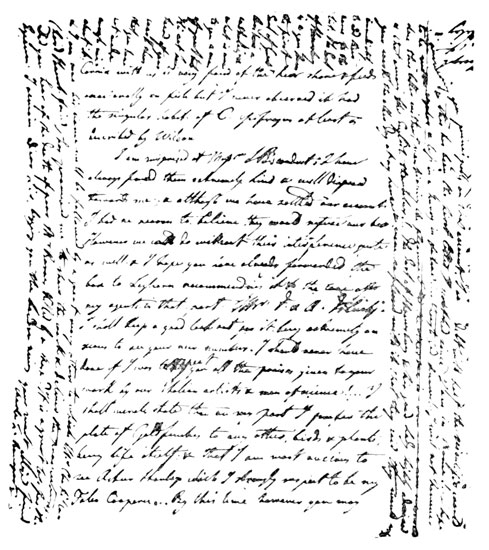
PART OF LETTER OF CHARLES LUCIEN BONAPARTE TO AUDUBON, JANUARY 10, 1829.
From the Howland MSS.